Practice Set 39 Class 6 Answers Maths Chapter 17 Geometrical Constructions Maharashtra Board

Balbharti Maharashtra State Board Class 6 Maths Solutions covers the Std 6 Maths Chapter 17 Geometrical Constructions Class 6 Practice Set 39 Answers Solutions.

Geometrical Constructions Class 6 Maths Chapter 17 Practice Set 39 Solutions Maharashtra Board

Std 6 Maths Practice Set 39 Solutions Answers

Question 1.
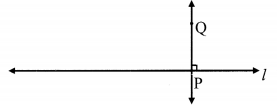
Draw line l. Take any point P on the line. Using a set square, draw a line perpendicular to line l at the point P.
Solution:
Step 1:
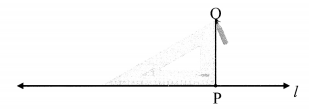
Maharashtra Board Class 6 Maths Solutions Chapter 17 Geometrical Constructions Practice Set 39 1

Step 2:
Maharashtra Board Class 6 Maths Solutions Chapter 17 Geometrical Constructions Practice Set 39 2
line PQ ⊥ line l

Question 2.
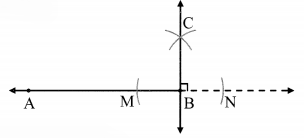
Draw a line AB. Using a compass, draw a line perpendicular to AB at point B.
Solution:
Step 1:

Maharashtra Board Class 6 Maths Solutions Chapter 17 Geometrical Constructions Practice Set 39 3

Step 2:
Maharashtra Board Class 6 Maths Solutions Chapter 17 Geometrical Constructions Practice Set 39 4

Step 3:
Maharashtra Board Class 6 Maths Solutions Chapter 17 Geometrical Constructions Practice Set 39 5
line BC ⊥ line AB.

Question 3.
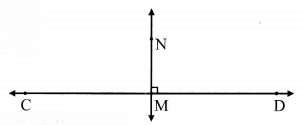
Draw line CD. Take any point M on the line. Using a protractor, draw a line perpendicular to line CD at the point M.
Solution:
Step 1:
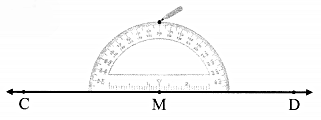
Maharashtra Board Class 6 Maths Solutions Chapter 17 Geometrical Constructions Practice Set 39 6

Step 2:
Maharashtra Board Class 6 Maths Solutions Chapter 17 Geometrical Constructions Practice Set 39 7
line MN ⊥ line CD

Maharashtra Board Class 6 Maths Chapter 17 Geometrical Constructions Practice Set 39 Questions and Activities

Question 1.
When constructing a building, what is the method used to make sure that a wall is exactly upright? What does the mason in the picture have in his hand? What do you think is his purpose for using it? (Textbook pg. no. 87)
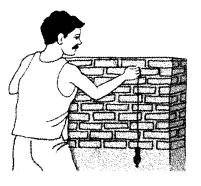
Maharashtra Board Class 6 Maths Solutions Chapter 17 Geometrical Constructions Practice Set 39 8
Solution:
When constructing a building, a weight (usually with a pointed tip at the bottom) suspended from a string called as plummet or plump bob is aligned from the top of the wall to make sure that the wall is built exactly upright.
The mason in the picture is holding a plumb bob.
The string of the plumb bob is suspended from the top of the wall, such that plumb bob hangs freely. By observing whether the vertical wall is parallel to the string we can check if the constructed wall is vertical.

Question 2.
Have you looked at lamp posts on the roadside? How do they stand? (Textbook pg. no. 87)
Solution:
The lamp posts on the road side are standing erect or vertical.

Question 3.
For the above explained construction, why must we take a distance greater than half of the length of AB? What will happen if we take a smaller distance? (Textbook pg. no. 88)
Solution:
For the above construction, in step-3 we take distance greater than half of the length of AB, so that the arcs drawn by keeping the compass on points A and B intersect each other at point Q.
If the distance in compass is less than half of the length of AB, then the arcs drawn by keeping the compass at A and B will not intersect each other.

Std 6 Maths Digest
Practice Set 18 Class 6 Answers Maths Chapter 6 Bar Graphs Maharashtra Board

Balbharti Maharashtra State Board Class 6 Maths Solutions covers the Std 6 Maths Chapter 6 Bar Graphs Class 6 Practice Set 18 Answers Solutions.

Bar Graphs Class 6 Maths Chapter 6 Practice Set 18 Solutions Maharashtra Board

Std 6 Maths Practice Set 18 Solutions Answers

Question 1.
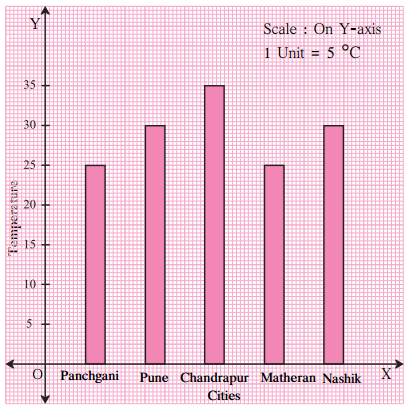
This bar graph shows the maximum temperatures in degrees Celsius in different cities on a certain day in February. Observe the graph and answer the questions:
Maharashtra Board Class 6 Maths Solutions Chapter 6 Bar Graphs Practice Set 18 1

  1. What data is shown on the vertical and the horizontal lines?
  2. Which city had the highest temperature?
  3. Which cities had equal maximum temperatures?
  4. Which cities had a maximum temperature of 30 °C?
  5. What is the difference between the maximum temperatures of Panchgani and Chandrapur?

Solution:

  1. Temperature is shown on the vertical line and cities are shown on the horizontal line.
  2. The city Chandrapur had the highest temperature.
  3. Pune and Nashik had the equal maximum temperature of 30°C and Panchgani and Matheran had the equal maximum temperature of 25°C.
  4. Pune and Nashik had a maximum temperature of 30 °C.
  5. The difference between the maximum temperatures of Panchgani and Chandrapur can be calculated as Difference in temperature = Temperature of Chandrapur – Temperature of Panchgani
    = 35°C – 25°C
    = 10°C

Maharashtra Board Class 6 Maths Chapter 6 Bar Graphs Practice Set 18 Intext Questions and Activities

Question 1.
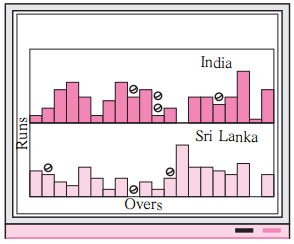
Observe the picture alongside: (Textbook pg. no. 35)

  1. To which sport is this data related?
  2. How many things does the picture tell us about?
  3. What shape has been used in the picture to represent runs?

Maharashtra Board Class 6 Maths Solutions Chapter 6 Bar Graphs Practice Set 18 2
Ans:

  1. The given data is related to cricket.
  2. The picture tells about runs scored in different overs by India and Srilanka. The represents the wickets fallen in that over.
  3. To represent runs, rectangular or bar shape is used.

Question 2.
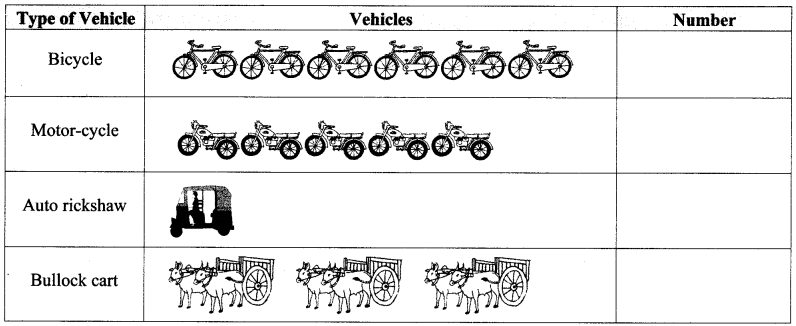
A pictogram of the types and numbers of vehicles in a city is given below.
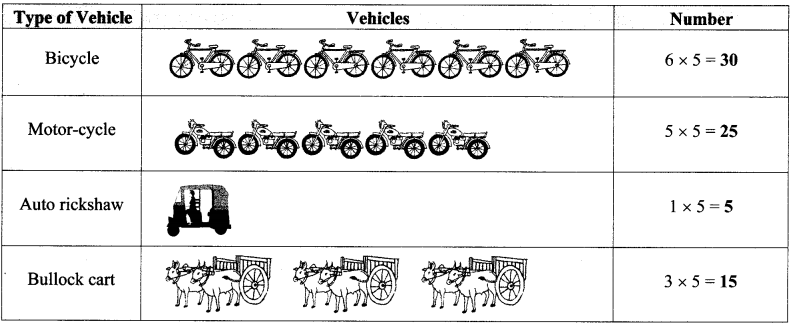
Taking 1 picture = 5 vehicles, write the numbers in the pictogram. (Textbook pg. no.35)
Maharashtra Board Class 6 Maths Solutions Chapter 6 Bar Graphs Practice Set 18 3
Solution:
Maharashtra Board Class 6 Maths Solutions Chapter 6 Bar Graphs Practice Set 18 4
Drawing pictograms is time consuming.
Sometimes, it is practically not possible to draw pictures for the given values (for example population of villages etc). In such cases, representing the data by making use of graphs can serve the purpose. Such data can be represented by using graphs.

Std 6 Maths Digest

Practice Set 41 Class 6 Answers Maths Chapter 18 Three Dimensional Shapes Maharashtra Board

Balbharti Maharashtra State Board Class 6 Maths Solutions covers the Std 6 Maths Chapter 18 Three Dimensional Shapes Class 6 Practice Set 41 Answers Solutions.

Three Dimensional Shapes Class 6 Maths Chapter 18 Practice Set 41 Solutions Maharashtra Board

Std 6 Maths Practice Set 41 Solutions Answers

Question 1.
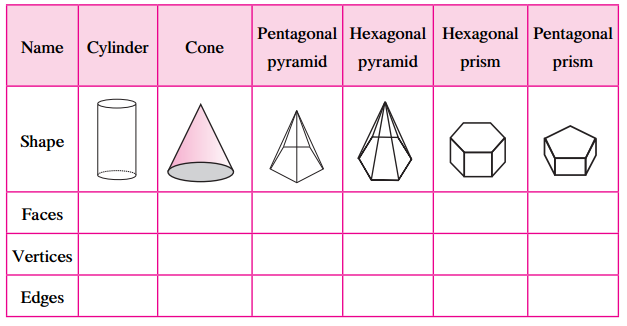
Write the number of faces, edges and vertices of each shape in the table.
Maharashtra Board Class 6 Maths Solutions Chapter 18 Three Dimensional Shapes Practice Set 41 1
Solution:

Name Cylinder Cone Pentagonal pyramid Hexagonal pyramid Hexagonal prism Pentagonal prism
Faces 3 (2 flat + 1 curved) 2 (1 flat + 1 curved) 6 (5 triangles + 1 pentagon) 7 (6 triangles + 1 hexagon) 8 (6 rectangles + 2 hexagons) 7 (5 rectangles + 2 pentagons)
Vertices 0 1 6 7 12 10
Edges 2 (circular) 1 (circular) 10 12 18  15

Maharashtra Board Class 6 Maths Chapter 18 Three Dimensional Shapes Practice Set 41 Questions and Activities

Question 1.

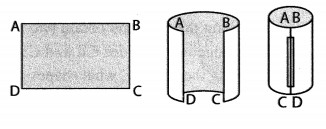
  1. Take a rectangular sheet.
  2. Bring together its opposite sides. What shape does it form? (Textbook pg. no. 94)

Maharashtra Board Class 6 Maths Solutions Chapter 18 Three Dimensional Shapes Practice Set 41 2
Solution:
It forms a hollow cylinder.

Question 2.

  1. Take a cylindrical tin.
  2. Take a rectangular sheet with one side equal to the height of the tin.
  3. Wrap it around the tin to cover it completely and cut away the extra paper.
  4. Then unfold it and spread it out on a table.
  5. Take another sheet. Place the tin on it and draw its circular outline.
  6. Cut away the paper around it. Cut out another circle like this one.
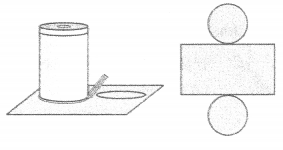
  7. Place these discs next to the rectangular paper as shown in the given figure. Which figure is obtained? (Textbook pg. no. 94)

Maharashtra Board Class 6 Maths Solutions Chapter 18 Three Dimensional Shapes Practice Set 41 3
Solution:
The figure obtained is the net of the closed cylinder.

Question 3.
Can you tell? (Textbook pg. no. 95)
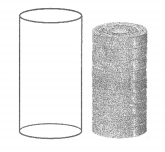
When playing carom, you make a pile of the pieces as shown in the picture. What is the shape of this pile?
If you place a number of CD’s or round biscuits one on top of the other, what shape do you get?
Maharashtra Board Class 6 Maths Solutions Chapter 18 Three Dimensional Shapes Practice Set 41 4
Solution:
In all the cases, it will form a cylindrical shape (2 circular faces and 1 curved surface).

Question 4.

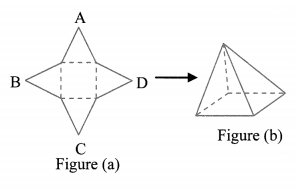
  1. Draw a net as shown in figure (a) on a card sheet and cut it out.
  2. Fold along the dotted lines of the square and bring the sides together so that the vertices A, B, C and D meet at a point.

What shape does it form? (Textbook pg. no. 95)
Maharashtra Board Class 6 Maths Solutions Chapter 18 Three Dimensional Shapes Practice Set 41 5
Solution:
The given net forms a quadrangular pyramid.

Question 5.

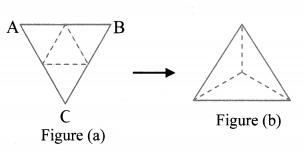
  1. Draw a net as shown in figure (a) on a card sheet and cut it out.
  2. Fold along the dotted lines of the triangle and bring the sides together so that the vertices A, B and C meet at a point.

What shape does it form? (Textbook pg. no. 95)
Maharashtra Board Class 6 Maths Solutions Chapter 18 Three Dimensional Shapes Practice Set 41 6
Solution:
The given net forms a triangular pyramid.

Question 6.

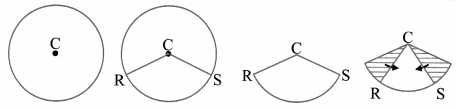
  1. Using a compass draw a circle with centre C on a paper.
  2. Draw two radii CR and CS.
  3. Cut out the circle.
  4. Cut along the radii and obtain two pieces of the circle.
  5. Bring together the sides CR and CS of each piece.

On completing the activity, what shapes did you get? (Textbook pg. no. 95)
Maharashtra Board Class 6 Maths Solutions Chapter 18 Three Dimensional Shapes Practice Set 41 7
Solution:
On completing the activity, we get an open cone.

Read Also:

Std 6 Maths Digest

Practice Set 23 Class 7 Answers Chapter 5 Operations on Rational Numbers Maharashtra Board

Balbharti Maharashtra State Board Class 7 Maths Solutions covers the 7th Std Maths Practice Set 23 Answers Solutions Chapter 5 Operations on Rational Numbers.

Operations on Rational Numbers Class 7 Maths Chapter 5 Practice Set 23 Solutions Maharashtra Board

Std 7 Maths Practice Set 23 Solutions Answers

Question 1.
Write three rational numbers that lie between the two given numbers.
i. \(\frac{2}{7}, \frac{6}{7}\)
ii. \(\frac{4}{5}, \frac{2}{3}\)
iii. \(-\frac{2}{3}, \frac{4}{5}\)
iv. \(\frac{7}{9},-\frac{5}{9}\)
v. \(\frac{-3}{4}, \frac{+5}{4}\)
vi. \(\frac{7}{8}, \frac{-5}{3}\)
vii. \(\frac{5}{7}, \frac{11}{7}\)
viii. \(0, \frac{-3}{4}\)
Solution:
i. \(\frac{2}{7}, \frac{6}{7}\)
The three numbers lying between \(\frac { 2 }{ 7 }\) and \(\frac { 6 }{ 7 }\) are \(\frac{3}{7}, \frac{4}{7}, \frac{5}{7}\)

ii. \(\frac{4}{5}, \frac{2}{3}\)
\(\frac{4}{5}=\frac{24}{30}, \frac{2}{3}=\frac{20}{30}\)
The three numbers between \(\frac { 4 }{ 5 }\) and \(\frac { 2 }{ 3 }\) are \(\frac{21}{30}, \frac{22}{30}, \frac{23}{30}\)

iii. \(-\frac{2}{3}, \frac{4}{5}\)
\(\frac{-2}{3}=\frac{-10}{15}, \frac{4}{5}=\frac{12}{15}\)
The three numbers between \(\frac { -2 }{ 3 }\) and \(\frac { 4 }{ 5 }\) are \(\frac{-9}{15}, \frac{-7}{15}, \frac{4}{15}\)

iv. \(\frac{7}{9},-\frac{5}{9}\)
The three numbers between \(\frac { 7 }{ 9 }\) and \(\frac { -5 }{ 9 }\) are \(\frac{6}{9}, 0, \frac{-4}{9}\)

v. \(\frac{-3}{4}, \frac{+5}{4}\)
The three numbers between \(\frac { -3 }{ 4 }\) and \(\frac { +5 }{ 4 }\) are \(\frac{-2}{4}, \frac{-1}{4}, \frac{3}{4}\)

vi. \(\frac{7}{8}, \frac{-5}{3}\)
\(\frac{7}{8}=\frac{21}{24}, \frac{-5}{3}=\frac{-40}{24}\)
The three numbers between \(\frac { 7 }{ 8 }\) and \(\frac { -5 }{ 3 }\) are \(\frac{17}{24}, \frac{11}{24}, \frac{-13}{24}\)

vii. \(\frac{5}{7}, \frac{11}{7}\)
The three numbers between \(\frac { 5 }{ 7 }\) and \(\frac { 11 }{ 7 }\) are \(\frac{6}{7}, \frac{8}{7}, \frac{9}{7}\)

viii. \(0, \frac{-3}{4}\)
The three numbers between 0 and \(\frac { -3 }{ 4 }\) are \(\frac{-1}{8}, \frac{-2}{8}, \frac{-5}{8}\)

Maharashtra Board Class 7 Maths Chapter 5 Operations on Rational Numbers Practice Set 23 Intext Questions and Activities

Question 1.
Answer the following questions: (Textbook pg. no. 36)

  1. Write all the natural numbers between 2 and 9.
  2. Write all the integers between -4, and 5.
  3. Which rational numbers are there between \(\frac { 1 }{ 2 }\) and \(\frac { 3 }{ 4 }\) ?

Solution:

  1. 3, 4, 5, 6, 7, 8
  2. -3, -2, -1, 0, 1, 2, 3, 4
  3. \(\frac{1}{2}=\frac{1 \times 2}{2 \times 2}=\frac{2}{4}=\frac{2 \times 10}{4 \times 10}=\frac{20}{40}\)
    \(\frac{3}{4}=\frac{3 \times 10}{4 \times 10}=\frac{30}{40}\)
    ∴ The rational numbers between \(\frac { 1 }{ 2 }\) and \(\frac { 3 }{ 4 }\) are \(\frac{21}{40}, \frac{22}{40}, \frac{25}{40}, \frac{27}{40}\) etc.

Std 7 Maths Digest

Practice Set 21 Class 7 Answers Chapter 4 Angles and Pairs of Angles Maharashtra Board

Balbharti Maharashtra State Board Class 7 Maths Solutions covers the 7th Std Maths Practice Set 21 Answers Solutions Chapter 4 Angles and Pairs of Angles.

Angles and Pairs of Angles Class 7 Maths Chapter 4 Practice Set 21 Solutions Maharashtra Board

Std 7 Maths Practice Set 21 Solutions Answers

Question 1.
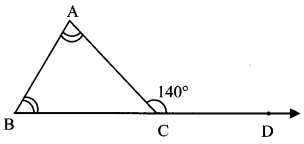
∠ACD is an exterior angle of ∆ABC. The measures of ∠A and ∠B are equal. If m∠ACD = 140°, find the measures of the angles ∠A and ∠B.
Maharashtra Board Class 7 Maths Solutions Chapter 4 Angles and Pairs of Angles Practice Set 21 1
Solution:
Let the measures of ∠A be x°.
m∠A = m∠B = x°
∠ACD is the exterior angle of ∆ABC
∴ m∠ACD = m∠A + m∠B
∴ 140 = x + x
∴ 140 = 2x
∴ 2x = 140
∴ x = \(\frac { 140 }{ 2 }\)
= 70
∴ The measures of the angles ∠A and ∠B is 70° each.

Question 2.
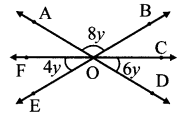
Using the measures of the angles given in the figure alongside, find the measures of the remaining three angles.
Maharashtra Board Class 7 Maths Solutions Chapter 4 Angles and Pairs of Angles Practice Set 21 2
Solution:
m∠EOD = m∠AOB = 8y ….(vertically opposite angles)
∠FOL, ∠EOD and ∠COD form a straight angle.
∴ m∠FOE + m∠EOD + m∠COD = 180°
∴ 4y + 8y + 6y = 180
∴ 18y = 180
∴ y = \(\frac { 180 }{ 18 }\)
∴ y = 10
m∠EOD = 8y = 8 x 10 = 80°
m∠AOF = m∠COD ….(Vertically opposite angles)
= 6y = 6 x 10 = 60°
m∠BOC = m∠FOE ….(Vertically opposite angles)
= 4y = 4 x 10 = 40°
∴ The measures of ∠EOD, ∠AOF and ∠BOC are 80°, 60° and 40° respectively.

Question 3.
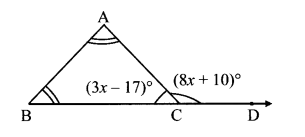
In the isosceles triangle ABC, ∠A and ∠B are equal. ∠ACD is an exterior angle of ∆ABC. The measures of ∠ACB and ∠ACD are (3x – 17)° and (8x + 10)° respectively. Find the measures of ∠ACB and ∠ACD. Also find the measures of ∠A and ∠B.
Maharashtra Board Class 7 Maths Solutions Chapter 4 Angles and Pairs of Angles Practice Set 21 3
Solution:
Let the measure of ∠A be y°. A
∴ m∠A = m∠B = y°
∠ACB and ∠ACD form a pair of linear angles.
∴ m∠ACB + m∠ACD = 180°
∴ (3x – 17) + (8x + 10) = 180
∴ 3x + 8x – 17 + 10 = 180
∴ 11x – 7 = 180
∴ 11x – 7 + 7 = 180 + 7 …(Adding 7 on both sides.)
∴ 11x = 187
∴ x = \(\frac { 187 }{ 11 }\) = 17
m∠ACB = 3x – 17 = (3 x 17) – 17 = 51 – 17 = 34°
m∠ACD = 8x + 10 = 8 x 17 + 10 = 136 + 10 = 146°
Here ∠ACD is the exterior angle of ∆ABC and ∠A and ∠B are its remote interior angles.
∴ m∠ACD = m∠A + m∠B
∴ 146 = y + y
∴ 146 = 2y
∴ 2y = 146
∴ y = \(\frac { 146 }{ 2 }\) = 73
∴ The measures of ∠ACB, ∠ACD, ∠A and ∠B are 34°, 146°, 73° and 73° respectively.

Maharashtra Board Class 7 Maths Chapter 4 Angles and Pairs of Angles Practice Set 21 Intext Questions and Activities

Question 1.
Use straws or sticks to make all the kinds of angles that you have learnt about. (Textbook pg. no. 29)
Solution:
(Student should attempt the activity on their own)

Question 2.
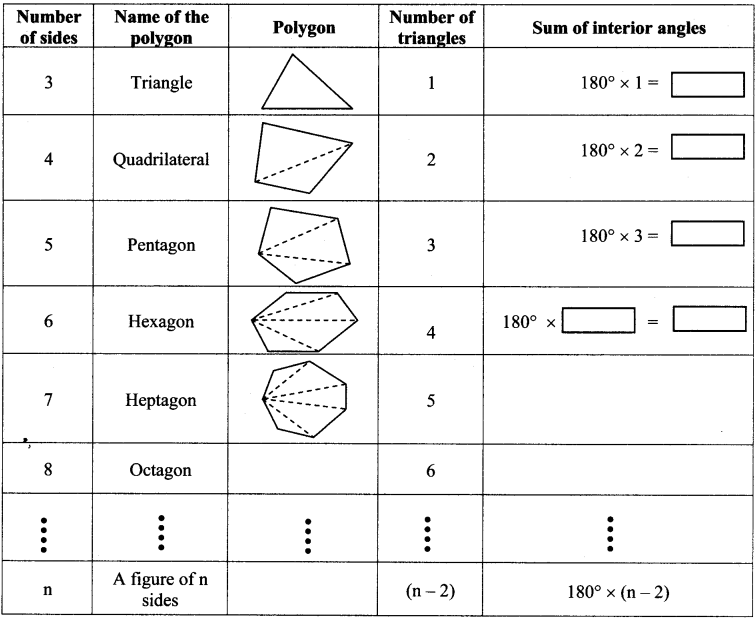
Observe the table given below and draw your conclusions (Textbook pg. no. 31)
Maharashtra Board Class 7 Maths Solutions Chapter 4 Angles and Pairs of Angles Practice Set 21 4
Solution:
i. 180°
ii. 360°
iii. 540°
iv. 720°
v. 180° x 5 = 900°
vi. Maharashtra Board Class 7 Maths Solutions Chapter 4 Angles and Pairs of Angles Practice Set 21 5 , 180° x 6 = 1080°
Std 7 Maths Digest

Practice Set 22 Class 7 Answers Chapter 5 Operations on Rational Numbers Maharashtra Board

Balbharti Maharashtra State Board Class 7 Maths Solutions covers the 7th Std Maths Practice Set 22 Answers Solutions Chapter 5 Operations on Rational Numbers.

Operations on Rational Numbers Class 7 Maths Chapter 5 Practice Set 22 Solutions Maharashtra Board

Std 7 Maths Practice Set 22 Solutions Answers

Question 1.
Carry out the following additions of rational numbers:
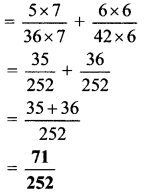
i. \(\frac{5}{36}+\frac{6}{42}\)
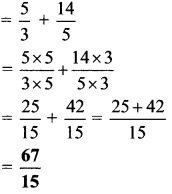
ii. \(1 \frac{2}{3}+2 \frac{4}{5}\)
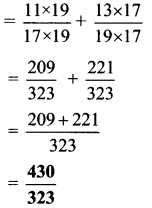
iii. \(\frac{11}{17}+\frac{13}{19}\)
iv. \(2 \frac{3}{11}+1 \frac{3}{77}\)
Solution:
i. \(\frac{5}{36}+\frac{6}{42}\)
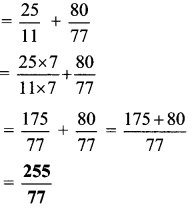
Maharashtra Board Class 7 Maths Solutions Chapter 5 Operations on Rational Numbers Practice Set 22 1

ii. \(1 \frac{2}{3}+2 \frac{4}{5}\)
Maharashtra Board Class 7 Maths Solutions Chapter 5 Operations on Rational Numbers Practice Set 22 2

iii. \(\frac{11}{17}+\frac{13}{19}\)
Maharashtra Board Class 7 Maths Solutions Chapter 5 Operations on Rational Numbers Practice Set 22 3

iv. \(2 \frac{3}{11}+1 \frac{3}{77}\)
Maharashtra Board Class 7 Maths Solutions Chapter 5 Operations on Rational Numbers Practice Set 22 4

Question 2.
Carry out the following subtractions involving rational numbers.
i. \(\frac{7}{11}-\frac{3}{7}\)
ii. \(\frac{13}{36}-\frac{2}{40}\)
iii. \(1 \frac{2}{3}-3 \frac{5}{6}\)
iv. \(4 \frac{1}{2}-3 \frac{1}{3}\)
Solution:
i. \(\frac{7}{11}-\frac{3}{7}\)
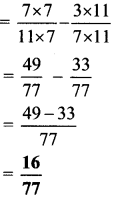
Maharashtra Board Class 7 Maths Solutions Chapter 5 Operations on Rational Numbers Practice Set 22 5

ii. \(\frac{13}{36}-\frac{2}{40}\)
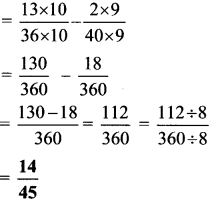
Maharashtra Board Class 7 Maths Solutions Chapter 5 Operations on Rational Numbers Practice Set 22 6

iii. \(1 \frac{2}{3}-3 \frac{5}{6}\)
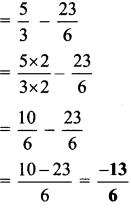
Maharashtra Board Class 7 Maths Solutions Chapter 5 Operations on Rational Numbers Practice Set 22 7

iv. \(4 \frac{1}{2}-3 \frac{1}{3}\)
Maharashtra Board Class 7 Maths Solutions Chapter 5 Operations on Rational Numbers Practice Set 22 8

Question 3.
Multiply the following rational numbers.
i. \(\frac{3}{11} \times \frac{2}{5}\)
ii. \(\frac{12}{5} \times \frac{4}{15}\)
iii. \(\frac{(-8)}{9} \times \frac{3}{4}\)
iv. \(\frac{0}{6} \times \frac{3}{4}\)
Solution:
i. \(\frac{3}{11} \times \frac{2}{5}\)
\(=\frac{3 \times 2}{11 \times 5}=\frac{6}{55}\)

ii. \(\frac{12}{5} \times \frac{4}{15}\)
\(=\frac{4}{5} \times \frac{4}{5}=\frac{4 \times 4}{5 \times 5}=\frac{16}{25}\)

iii. \(\frac{(-8)}{9} \times \frac{3}{4}\)
\(=\frac{(-2)}{3} \times \frac{1}{1}=\frac{-2}{3}\)

iv. \(\frac{0}{6} \times \frac{3}{4}\)
\(=0 \times \frac{3}{4}=0\)

Question 4.
Write the multiplicative inverse of.
i. \(\frac{2}{5}\)
ii. \(\frac{-3}{8}\)
iii. \(\frac{-17}{39}\)
iv. 7
v. \(-7 \frac{1}{3}\)
Solution:
i. \(\frac{5}{2}\)
ii. \(\frac{-8}{3}\)
iii. \(\frac{-39}{17}\)
iv. \(\frac {1}{7}\)
v. \(\frac {-3}{22}\)

Question 5.
Carry out the divisions of rational numbers:
i. \(\frac{40}{12} \div \frac{10}{4}\)
ii. \(\frac{-10}{11} \div \frac{-11}{10}\)
iii. \(\frac{-7}{8} \div \frac{-3}{6}\)
iv. \(\frac{2}{3} \div(-4)\)
v. \(2 \frac{1}{5} \div 5 \frac{3}{6}\)
vi. \(\frac{-5}{13} \div \frac{7}{26}\)
vii. \(\frac{9}{11} \div(-8)\)
viii. \(5 \div \frac{2}{5}\)
Solution:
i. \(\frac{40}{12} \div \frac{10}{4}\)
\(=\frac{40}{12} \times \frac{4}{10}=\frac{4}{3}\)

ii. \(\frac{-10}{11} \div \frac{-11}{10}\)
\(=\frac{-10}{11} \times \frac{-10}{11}=\frac{100}{121}\)

iii. \(\frac{-7}{8} \div \frac{-3}{6}\)
\(=\frac{-7}{8} \times \frac{-6}{3}=\frac{-7}{4} \times \frac{-3}{3}=\frac{7}{4}\)

iv. \(\frac{2}{3} \div(-4)\)
\(=\frac{2}{3} \times \frac{-1}{4}=\frac{1}{3} \times \frac{-1}{2}=\frac{-1}{6}\)

v. \(2 \frac{1}{5} \div 5 \frac{3}{6}\)
\(=\frac{11}{5} \div \frac{33}{6}=\frac{11}{5} \times \frac{6}{33}=\frac{1}{5} \times \frac{6}{3}=\frac{2}{5}\)

vi. \(\frac{-5}{13} \div \frac{7}{26}\)
\(=\frac{-5}{13} \times \frac{26}{7}=\frac{-10}{7}\)

vii. \(\frac{9}{11} \div(-8)\)
\(=\frac{9}{11} \times \frac{-1}{8}=\frac{-9}{88}\)

viii. \(5 \div \frac{2}{5}\)
\(=\frac{5}{1} \times \frac{5}{2}=\frac{25}{2}\)

Maharashtra Board Class 7 Maths Chapter 5 Operations on Rational Numbers Practice Set 22 Intext Questions and Activities

Question 1.
Complete the table given below. (Textbook pg. no. 34)

-3 \(\frac {3}{5}\) -17 \(\frac { -5 }{ 11 }\) 5
Natural Numbers x
Integers
Rational Numbers

Solution:

-3 \(\frac {3}{5}\) -17 \(\frac { -5 }{ 11 }\) 5
Natural Numbers x x x x
Integers x x
Rational Numbers

Question 2.
Discuss the characteristics of various groups of numbers in class and complete the table below. In front of each group, write the inference you make after carrying out the operations of addition, subtraction, multiplication and division, using a (✓) or a (x).
Remember that you cannot divide by zero. (Textbook pg. no. 35)

Group of Numbers Addition Subtraction Multiplication Division
Natural Numbers x
(7- 10 =-3)
x
(3÷5=\(\frac { 3 }{ 5 }\))
Integers
Rational Numbers

Solution:

Group of Numbers Addition Subtraction Multiplication Division
Natural Numbers x
(7- 10 =-3)
x
(3÷5=\(\frac { 3 }{ 5 }\))
Integers x
(4÷9=\(\frac { 4 }{ 9 }\))
Rational Numbers

Std 7 Maths Digest

Practice Set 17 Class 6 Answers Maths Chapter 5 Decimal Fractions Maharashtra Board

Balbharti Maharashtra State Board Class 6 Maths Solutions covers the Std 6 Maths Chapter 5 Decimal Fractions Class 6 Practice Set 17 Answers Solutions.

Decimal Fractions Class 6 Maths Chapter 5 Practice Set 17 Solutions Maharashtra Board

Std 6 Maths Practice Set 17 Solutions Answers

Question 1.
Carry out the following divisions.
i. 4.8÷2
ii. 17.5÷5
iii. 20.6÷2
iv. 32.5÷25
Solution:
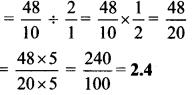
i. 4.8÷2
Maharashtra Board Class 6 Maths Solutions Chapter 5 Decimal Fractions Practice Set 17 1

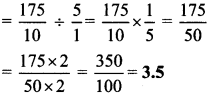
ii. 17.5÷5
Maharashtra Board Class 6 Maths Solutions Chapter 5 Decimal Fractions Practice Set 17 2

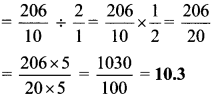
iii. 20.6÷2
Maharashtra Board Class 6 Maths Solutions Chapter 5 Decimal Fractions Practice Set 17 3

iv. 32.5÷25
Maharashtra Board Class 6 Maths Solutions Chapter 5 Decimal Fractions Practice Set 17 4

Question 2.
A road is 4 km 800 m long. If trees are planted on both its sides at intervals of 9.6 m, how many trees were planted?
Solution:
Length of road = 4 km 800 m
= 4 × 1000 m + 800 m
= 4000 m + 800 m
= 4800 m
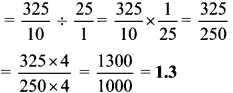
Number of trees on one side = 4800 ÷ 9.6
Maharashtra Board Class 6 Maths Solutions Chapter 5 Decimal Fractions Practice Set 17 5
= 500
∴ Number of trees on both sides = 2 x number of trees on one side
= 2 x 500 = 1000
If the trees are planted at the beginning of the road, then
Total number of trees = 1000 + 2 = 1002
∴ Total number of trees planted is 1000 or 1002.

Question 3.
Pradnya exercises regularly by walking along a circular path on a field. If she walks a distance of 3.825 km in 9 rounds of the path, how much does she walk in one round?
Solution:
Total distance walked in 9 rounds = 3.825 km
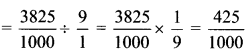
∴Distance walked in 1 round = 3.825 4 ÷ 9
Maharashtra Board Class 6 Maths Solutions Chapter 5 Decimal Fractions Practice Set 17 6
= 0.425 km
∴ Total distance walked in 1 round is 0.425 km.

Question 4.
A pharmaceutical manufacturer bought 0.25 quintal of hirada, a medicinal plant, for Rs 9500. What is the cost per quintal of hirada? (1 quintal = 100 kg)
Solution:
Cost of 0.25 quintal of hirada = Rs 9500
∴ Cost of 1 quintal of hirada = 9500 ÷ 0.25
Maharashtra Board Class 6 Maths Solutions Chapter 5 Decimal Fractions Practice Set 17 7
= Rs 38,000
∴ Cost per quintal of hirada is Rs 38,000.

Maharashtra Board Class 6 Maths Chapter 4 Operations on Fractions Practice Set 17 Intext Questions and Activities

Question 1.
Maths is fun! (Textbook pg. no. 34)

  1. Consider any three-digit number (say 527).
  2. Multiply the number by 7. Then multiply the product obtained by 13, and this product by 11.
  3. The found product is 5,27,527.

Take two or three other numbers. Do the same multiplication and find out how it is done.
Solution:
7 × 13 × 11 = 1001
∴ 527 × 1001 = 527 × (1000+ 1)
= (527 × 1000) + (527 × 1)
= 527000 + 527 = 527527
Thus, when any three-digit number is multiplied with 1001, the product obtained is a six-digit number in which the original three-digit number is written back to back twice.
(Students may consider any other three-digit numbers and verify the property.)

Std 6 Maths Digest

Practice Set 20 Class 7 Answers Chapter 4 Angles and Pairs of Angles Maharashtra Board

Balbharti Maharashtra State Board Class 7 Maths Solutions covers the 7th Std Maths Practice Set 20 Answers Solutions Chapter 4 Angles and Pairs of Angles.

Angles and Pairs of Angles Class 7 Maths Chapter 4 Practice Set 20 Solutions Maharashtra Board

Std 7 Maths Practice Set 20 Solutions Answers

Question 1.
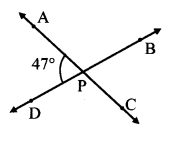
Lines AC and BD intersect at point P. m∠APD = 47° Find the measures of ∠APB, ∠BPC, ∠CPD.
Maharashtra Board Class 7 Maths Solutions Chapter 4 Angles and Pairs of Angles Practice Set 20 1
Solution:
∠APD and ∠APB are angles in a linear pair.
∴m∠APD + m∠APB = 180°
∴47 + m∠APB = 180
∴47 + m∠APB – 47 = 180 – 47 ….(Subtracting 47 from both sides)
∴m∠APB = 133°
m∠CPD = m∠APB = 133° … .(Vertically opposite angles)
m∠BPC = m∠APD = 47° … .(Vertically opposite angles)
∴The measures of ∠APB, ∠BPC and ∠CPD are 133°, 47° and 133° respectively.

Question 2.
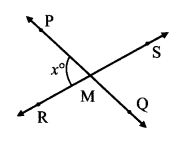
Lines PQ and RS intersect at point M. m∠PMR = x°.What are the measures of ∠PMS, ∠SMQ and ∠QMR?Maharashtra Board Class 7 Maths Solutions Chapter 4 Angles and Pairs of Angles Practice Set 20 2
Solution:
∠PMR and ∠PMS are angles in a linear pair.
∴ m∠PMR + m∠PMS = 180°
∴ x + m∠PMS = 180
∴ m∠PMS = (180-x)°
m∠QMR = m∠PMS = (180 – x)° … .(Vertically opposite angles)
m∠SMQ = m∠PMR = x° …. (Vertically opposite angles)
∴The measures of ∠PMS, ∠SMQ and ∠QMR are (180 – x)°, x° and (180 – x)° respectively.

Std 7 Maths Digest

Practice Set 19 Class 7 Answers Chapter 4 Angles and Pairs of Angles Maharashtra Board

Balbharti Maharashtra State Board Class 7 Maths Solutions covers the 7th Std Maths Practice Set 19 Answers Solutions Chapter 4 Angles and Pairs of Angles.

Angles and Pairs of Angles Class 7 Maths Chapter 4 Practice Set 19 Solutions Maharashtra Board

Std 7 Maths Practice Set 19 Solutions Answers

Question 1.
Draw the pairs of angles as described below. If that is not possible, say why.
i. Complementary angles that are not adjacent.
ii. Angles in a linear pair which are not supplementary.
iii. Complementary angles that do not form a linear pair.
iv. Adjacent angles which are not in linear pair.
v. Angles which are neither complementary nor adjacent.
vi. Angles in a linear pair which are complementary.
Solution:
i.
Maharashtra Board Class 7 Maths Solutions Chapter 4 Angles and Pairs of Angles Practice Set 19 1

ii. Sum of angles in a linear pair is 180°.
i.e. they are supplementary .
∴ Angles in a linear pair which are not supplementary cannot be drawn.

iii.
Maharashtra Board Class 7 Maths Solutions Chapter 4 Angles and Pairs of Angles Practice Set 19 2

iv.
Maharashtra Board Class 7 Maths Solutions Chapter 4 Angles and Pairs of Angles Practice Set 19 3

v.
Maharashtra Board Class 7 Maths Solutions Chapter 4 Angles and Pairs of Angles Practice Set 19 4

vi. Angles in linear pair have their sum as 180° But, complementary angles have their sum as 90°.
∴ Angles in a linear pair which are complementary cannot be drawn.

Note: Problem No. i, iii, iv, and v have more than one answers students may draw angles other than the once given.

Maharashtra Board Class 7 Maths Chapter 4 Angles and Pairs of Angles Practice Set 19 Intext Questions and Activities

Question 1.
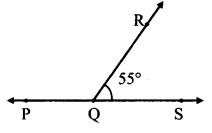
Observe the adjacent figure and answer the following questions: (Textbook pg. no. 29)
Maharashtra Board Class 7 Maths Solutions Chapter 4 Angles and Pairs of Angles Practice Set 19 5

  1. Write the names of the angles in the figure alongside.
  2. What type of a pair of angles is it?
  3. Which arms of the angles are not the common arms?
  4. m∠PQR = __.
  5. m∠RQS = __.

Solution:

  1. ∠PQR and ∠RQS
  2. Angles in a linear pair
  3. Ray QP and ray QS
  4. 125
  5. 55
    Here, m∠PQR + m∠RQS = 125° + 55°
    = 180°
    ∴The adjacent angles ∠PQR and ∠RQS are supplementary.

Std 7 Maths Digest

Practice Set 18 Class 7 Answers Chapter 4 Angles and Pairs of Angles Maharashtra Board

Balbharti Maharashtra State Board Class 7 Maths Solutions covers the 7th Std Maths Practice Set 18 Answers Solutions Chapter 4 Angles and Pairs of Angles.

Angles and Pairs of Angles Class 7 Maths Chapter 4 Practice Set 18 Solutions Maharashtra Board

Std 7 Maths Practice Set 18 Solutions Answers

Question 1.
Name the pairs of opposite rays in the figure alongside.
Maharashtra Board Class 7 Maths Solutions Chapter 4 Angles and Pairs of Angles Practice Set 18 1
Solution:

  1. Ray PL and ray PM
  2. Ray PN and ray PT

Question 2.
Are the ray PM and PT opposite rays? Give reasons for your answer.
Maharashtra Board Class 7 Maths Solutions Chapter 4 Angles and Pairs of Angles Practice Set 18 2
Solution:
No.
Ray PM and Ray PT do not form a straight line and hence are not opposite rays.

Maharashtra Board Class 7 Maths Chapter 4 Angles and Pairs of Angles Practice Set 18 Intext Questions and Activities

Question 1.
Observe the adjacent figure and answer the following questions. (Textbook pg. no. 28)
Maharashtra Board Class 7 Maths Solutions Chapter 4 Angles and Pairs of Angles Practice Set 18 3

  1. Name the rays in the figure alongside.
  2. Name the origin of the rays
  3. Name the angle in the given figure

Solution:

  1. Ray BA and ray BC
  2. Point B
  3. ∠ABC or ∠CBA

Question 2.
Observe the adjacent figure and answer the following questions. (Textbook pg. no. 28)
Maharashtra Board Class 7 Maths Solutions Chapter 4 Angles and Pairs of Angles Practice Set 18 4

  1. Name the angle in the figure alongside.
  2. Name the rays whose origin is point B

Solution:

  1. ∠ABC or ∠CBA
  2. Ray BA and ray BC

Std 7 Maths Digest