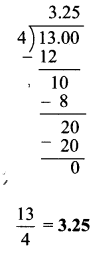
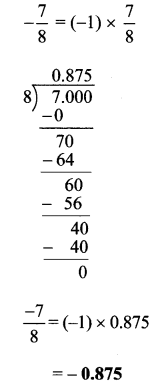
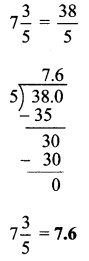
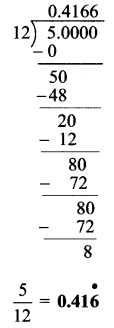
Practice Set 4 Class 6 Answers Maths Chapter 3 Integers Maharashtra Board

Balbharti Maharashtra State Board Class 6 Maths Solutions covers the Std 6 Maths Chapter 3 Integers Class 6 Practice Set 4 Answers Solutions.

Integers Class 6 Maths Chapter 3 Practice Set 4 Solutions Maharashtra Board

Std 6 Maths Practice Set 4 Solutions Answers

Question 1.
Classify the following numbers as positive numbers and negative numbers.
-5, +4, -2, 7, +26, -49, -37, 19, -25, +8, 5, -4, -12, 27
Solution:

Positive Numbers +4, 7, +26, 19, +8, 5, 27
Negative Numbers -5, -2, -49, -37, -25, -4, -12

Question 2.
Given below are the temperatures in some cities. Write them using the proper signs.

Place Shimla Leh Delhi Nagpur
Temperature 7 °C below 0° 12 °C below 0° 22 °C above 0° 31 °C above 0°

Solution:

Place Shimla Leh Delhi Nagpur
Temperature with proper sign -7 °C -12 °C +22 °C +31 °C

Question 3.
Write the numbers in the following examples using the proper signs.

  1. A submarine is at a depth of 512 meters below sea level.
  2. The height of Mt Everest, the highest peak in the Himalayas, is 8848 meters.
  3. A kite is flying at a distance of 120 meters from the ground.
  4. The tunnel is at a depth of 2 meters under the ground.

Solution:

  1. A submarine is at a depth of -512 meters from sea level.
  2. The height of Mt Everest, the highest peak in the Himalayas is +8848 meters.
  3. A kite is flying at a distance of +120 meters from the ground.
  4. The tunnel is at a depth of -2 meters from the ground.

Maharashtra Board Class 6 Maths Chapter 3 Integers Practice Set 4 Intext Questions and Activities

Question 1.
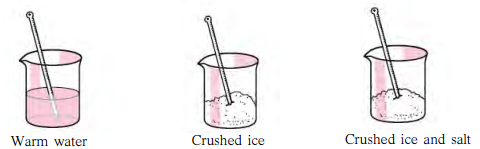
Take warm water in one beaker, some crushed ice in another and a mixture of salt and crushed ice in a third beaker. Ask your teacher for help in measuring the temperature of the substance in each of the beakers using a thermometer. Note the temperatures. (Textbook pg. no. 13)
Maharashtra Board Class 6 Maths Solutions Chapter 3 Integers Practice Set 4 1
Solution:
( Students should attempt this activity on their own)

Question 2.
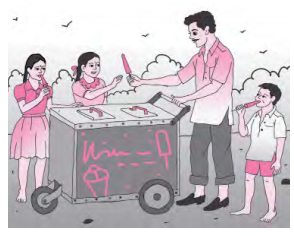
Look at the picture of the kulfi man. Why do you think he keeps the kulfi moulds in a mixture of salt and ice? (Textbook pg. no. 14)
Maharashtra Board Class 6 Maths Solutions Chapter 3 Integers Practice Set 4 2
Solution:
Kulfi man keeps the kulfi moulds in a mixture of salt and ice because such a mixture helps in keeping the kulfi cool for a longer period of time. The kulfi kept in the said mixture relatively takes more time to melt. This mixture is Considered ideal as it has the temperature of -4°C as against the temperature of ice i.e. 0°C.

Question 3.
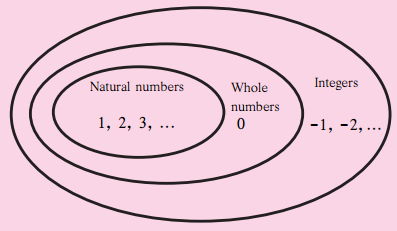
My class, i.e. Std. VI, is a part of my school. My school is in my town. My town is a part of a taluka. In the same way, the taluka is a part of a district, and the district is a part of Maharashtra State. In the same way, what can you say about these groups of numbers? Textbook pg. no. 15)
Maharashtra Board Class 6 Maths Solutions Chapter 3 Integers Practice Set 4 3
Solution:
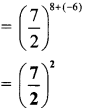
By observing the above given groups of numbers, we can infer that natural numbers are a part of whole numbers. In turn, whole numbers are a part of integers.

Std 6 Maths Digest

Maharashtra Board 8th Class Maths Miscellaneous Exercise 2 Solutions

Balbharti Maharashtra State Board Class 8 Maths Solutions covers the Miscellaneous Exercise 2 8th Std Maths Answers Solutions.

Miscellaneous Exercise 2 8th Std Maths Answers

Question 1.
Questions and their alternative answers are given. Choose the correct alternative answer.
i. Find the circumference of a circle whose area is 1386 cm²? [Chapter 15]
(A) 132 cm²
(B) 132 cm
(C) 42 cm
(D) 21 cm²
Solution:
(B) 132 cm

Hint:
i. Area of the circle = πr²
1386 = \(\frac { 22 }{ 7 }\) x r²
r² = 1386 x \(\frac { 7 }{ 22 }\)
= 63 x 7
= 441
r = √441 … [Taking square root of both sides]
= 21 cm
Circumference of the circle = 2πr
= 2 x \(\frac { 22 }{ 7 }\) x 21
= 132 cm

ii. The side of a cube is 4 m. If it is doubled, how many times will be the volume of the new cube, as compared with the original cube? [Chapter 16]
(A) Two times
(B) Three times
(C) Four times
(D) Eight times
Solution:
(D) Eight times

Hint:
ii. Original volume = (4)³ = 64 cu.m
New side = 8 m
∴ New volume = (8)² = 512 cu.m
Now, \(\frac{\text { new volume }}{\text { original volume }}=\frac{512}{64}\) = 8
original volume 64
∴ volume of new cube will increase 8 times as compared to the volume of original cube.

Question 2.
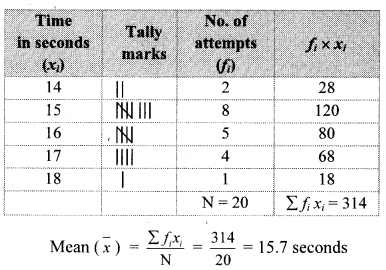
Pranalee was practicing for a 100 m running race. She ran 100 m distance 20 times. The time required, in seconds, for each attempt was as follows. [Chapter 11]
18, 17, 17, 16,15, 16, 15, 14,16, 15, 15, 17, 15, 16,15, 17, 16, 15, 14,15
Find the mean of the time taken for running.
Solution:
Maharashtra Board Class 8 Maths Solutions Miscellaneous Exercise 2 1
∴ The mean of the time taken for running 100 m race is 15.7 seconds.

Question 3.
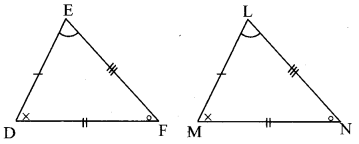
∆DEF and ∆LMN are congruent in the correspondence EDF ↔ LMN. Write the pairs of congruent sides and congruent angles in the correspondence. [Chapter 13]
Solution:
Maharashtra Board Class 8 Maths Solutions Miscellaneous Exercise 2 2
∆EDF ≅ ∆LMN
∴side ED ≅ side LM
side DF ≅ side MN
side EF ≅ side LN
∠E ≅∠L
∠D ≅∠M
∠F ≅∠N

Question 4.
The cost of a machine is Rs 2,50,000. It depreciates at the rate of 4% per annum. Find the cost of the machine after three years. [Chapter 14]
Solution:
Here, P = Cost of the machine = Rs 2,50,000
R = Rate of depreciation = 4%
N = 3 Years
A = Depreciated price of the machine
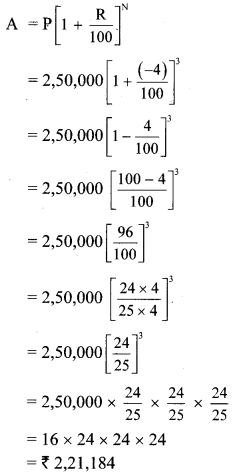
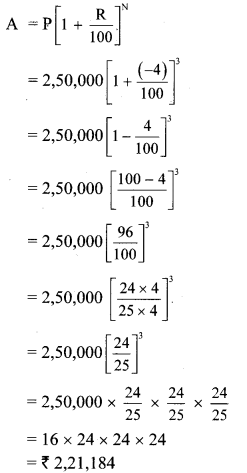
Maharashtra Board Class 8 Maths Solutions Miscellaneous Exercise 2 3
∴The cost of the machine after three years will be Rs 2,21,184.

Question 5.
In ☐ABCD, side AB || side DC, seg AE ⊥ seg DC. If l(AB) = 9 cm, l(AE) = 10 cm, A(☐ABCD) = 115 cm² , find l(DC). [Chapter 15]
Solution:
Given, side AB || side DC.
∴ ☐ABCD is a trapezium.
Maharashtra Board Class 8 Maths Solutions Miscellaneous Exercise 2 4
Given, l(AB) = 9 cm, l(AE) = 10 cm,
A(☐ABCD) = 115 cm²
Area of a trapezium
= \(\frac { 1 }{ 2 }\) x sum of lengths of parallel sides x height
∴ A(☐ABCD) = \(\frac { 1 }{ 2 }\) x [l(AB) + l(DC) x l(AE)]
∴ 115 = \(\frac { 1 }{ 2 }\) x [9 + l(DC)] x 10
∴ \(\frac { 115 \times 2 }{ 10 }\) = 9 + l(DC)
∴ 23 = 9 + l(DC)
∴ l(DC) = 23 – 9
∴ l(DC) = 14cm

Question 6.
The diameter and height of a cylindrical tank is 1.75 m and 3.2 m respectively. How much is the capacity of tank in litre?
[π = \(\frac { 22 }{ 7 }\)] [Chapter 16]
Solution:
Given: For cylindrical tank:
diameter (d) = 1.75 m, height (h) = 3.2 m
To Find: Capacity of tank in litre
diameter (d) = 1.75 m
= 1.75 x 100
….[∵ 1 m = 100cm]
= 175 cm
∴ radius (r) = \(=\frac{\mathrm{d}}{2}=\frac{175}{2}\) cm
h = 3.2 cm
= 3.2 x 100
= 320 cm
Capacity of tank = Volume of the cylindrical tank
= πr²h
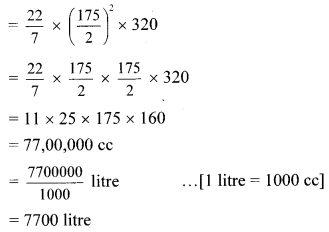
Maharashtra Board Class 8 Maths Solutions Miscellaneous Exercise 2 5
∴ The capacity of the tank is 7700 litre.

Question 7.
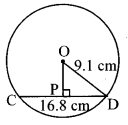
The length of a chord of a circle is 16.8 cm, radius is 9.1 cm. Find its distance from the centre. [Chapter 17]
Solution:
Maharashtra Board Class 8 Maths Solutions Miscellaneous Exercise 2 6
Let CD be the chord of the Circle with centre O.
Draw seg OP ⊥ chord CD
∴l(PD) = \(\frac { 1 }{ 2 }\) l(CD)
…[Perpendicular drawn from the centre of a circle to its chord bisects the chord]
∴l(PD) = \(\frac { 1 }{ 2 }\) x 16.8 …[l(CD) = 16.8cm]
∴l(PD) = 8.4 cm …(i)
∴In ∆OPD, m∠OPD = 90°
∴[l(OD)]² = [l(OP)]² + [l(PD)]² …..[Pythagoras theorem]
∴(9.1)² = [l(OP)]² + (8.4)² … [From (i) and l(OD) = 9.1 cm]
∴(9.1)² – (8.4)² = [l(OP)]²
∴(9.1 + 8.4) (9.1 – 8.4) = [l(OP)]²
…[∵ a² – b² = (a + b) (a – b)]
∴17.5 x (0.7) = [l(OP)]²
∴12.25 = [l(OP)]²
i.e., [l(OP)]² = 12.25
∴l(OP) = √12.25
…[Taking square root of both sides]
∴l(OP) = 3.5 cm
∴The distance of the chord from the centre is 3.5 cm.

Question 8.
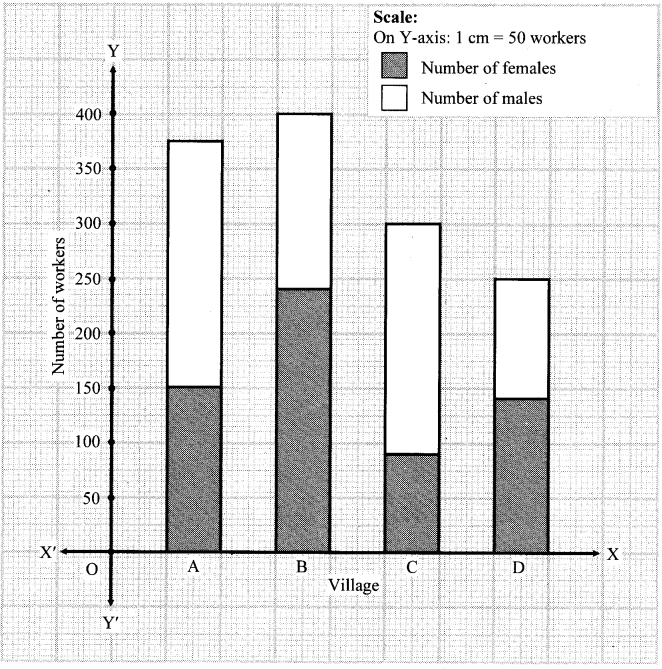
The following tables shows the number of male and female workers, under employment guarantee scheme, in villages A, B, C and D.

Villages A B C D
No. of females 150 240 90 140
No. of males 225 160 210 110

i. Show the information by a sub-divided bar-diagram.
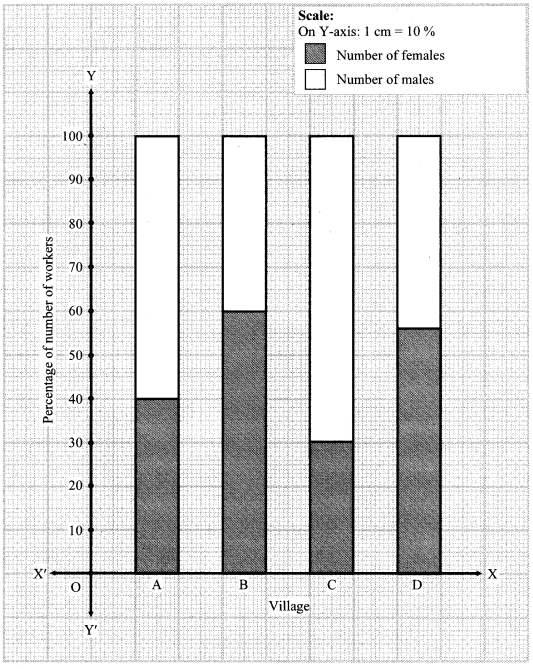
ii. Show the information by a percentage bar diagram. [Chapter 11]
Solution:
i.

Villages A B C D
No. of females 150 240 90 140
No. of males 225 160 210 110
Total 375 400 300 250

Maharashtra Board Class 8 Maths Solutions Miscellaneous Exercise 2 7

ii.

Villages A B C D
No. of females 150 240 90 140
No. of males 225 160 210 110
Total 375 400 300 250
Percentage of females 40% 60% 30% 56%
Percentage of males 60% 40% 70% 44%

Maharashtra Board Class 8 Maths Solutions Miscellaneous Exercise 2 8

Question 9.
Solve the following equations.
i. 17 (x + 4) + 8 (x + 6) = 11 (x + 5) + 15 (x + 3)
ii. \(\frac{3 y}{2}+\frac{y+4}{4}=5-\frac{y-2}{4}\)
iii. 5(1 – 2x) = 9(1 -x)
[Chapter 12]
Solution:
i. 17 (x + 4) + 8 (x + 6) = 11 (x + 5) + 15 (x + 3)
∴ 17x + 68 + 8x + 48 = 11x + 55 + 15x + 45
∴ 17x + 8x + 68 + 48 = 11x + 15x + 55 + 45
∴ 25x + 116 = 26x + 100
∴ 25x + 116 – 116 = 26x + 100 – 116
… [Subtracting 116 from both the sides]
∴ 25x = 26x – 16
∴ 25x – 26x = 26x – 16 – 26x
… [Subtracting 26x from both the sides]
∴ -x = -16
∴ \(\frac{-x}{-1}=\frac{-16}{-1}\)
∴ x = 16

ii. \(\frac{3 y}{2}+\frac{y+4}{4}=5-\frac{y-2}{4}\)
∴ \(\frac{3 y \times 2}{2 \times 2}+\frac{y+4}{4}=5-\frac{y-2}{4}\)
∴ \(\frac{6 y}{4}+\frac{y+4}{4}=5-\frac{y-2}{4}\)
∴ \(\frac{6 y}{4} \times 4+\frac{y+4}{4} \times 4=5 \times 4-\frac{y-2}{4} \times 4\)
……[Multiplying both the sides by 4]
∴ 6y + y + 4 = 20 – (y – 2)
∴ 7y + 4 = 20 – y + 2
∴ 7y + 4 = 22 – y
∴ 7y + 4 – 4 = 22 – y – 4
…..[Subtracting 4 from both the sides]
∴ 7y = 18 – y
∴ 7y + y = 18 – y + y
…[Adding y on both the sides]
∴ 8y = 18
∴ \(\frac{8 y}{8}=\frac{18}{8}\) … [Dividing both the sides by 8]
∴ \(y=\frac { 9 }{ 4 }\)

iii. 5(1 – 2x) = 9(1 – x)
∴ 5 – 10x = 9 – 9x
∴ 5 – 10x – 5 = 9 – 9x – 5
….[Subtracting 5 from both the sides]
∴ -10x = 4 – 9x
∴ -10x + 9x = 4 – 9x + 9x
… [Adding 9x on both the sides]
∴ -x = 4
∴ -x x (- 1) = 4 x (- 1)
… [Multiplying both the sides by – 1]
∴ x = – 4

Question 10.
Complete the activity according to the given steps.
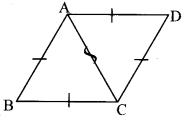
i. Draw rhombus ABCD. Draw diagonal AC.
ii. Show the congruent parts in the figure by identical marks.
iii. State by which, test and in which correspondence ∆ADC and ∆ABC are congruent.
iv. Give reason to show ∠DCA ≅ ∠BCA, and ∠DAC ≅ ∠BAC
v. State which property of a rhombus is revealed from the above steps. [Chapter 13]
Solution:
a.
Maharashtra Board Class 8 Maths Solutions Miscellaneous Exercise 2 9
b. In ∆ADC and ∆ABC,
side AD ≅ side AB …..[Sides of a rhombus]
side DC ≅ side BC …..[Sides of a rhombus]
side AC ≅ side AC … [Common side]
∆ADC ≅ ∆ABC … [By SSS test]
∠DCA ≅ ∠BCA …[Corresponding angles of congruent triangles]
∠DAC ≅ ∠BAC …[Corresponding angles of congruent triangles]
From the above steps, property of rhombus revealed is ‘diagonal of a rhombus bisect the opposite angles’.

Question 11.
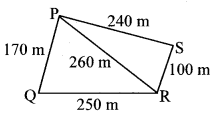
The shape of a farm is a quadrilateral. Measurements taken of the farm, by naming its corners as P, Q, R, S in order are as follows. l(PQ) = 170 m,
l(QR) = 250 m, l(RS) = 100 m, l(PS) = 240 m, l(PR) = 260 m.
Find the area of the field in hectare (1 hectare = 10,000 sq.m). [Chapter 15]
Solution:
Maharashtra Board Class 8 Maths Solutions Miscellaneous Exercise 2 10
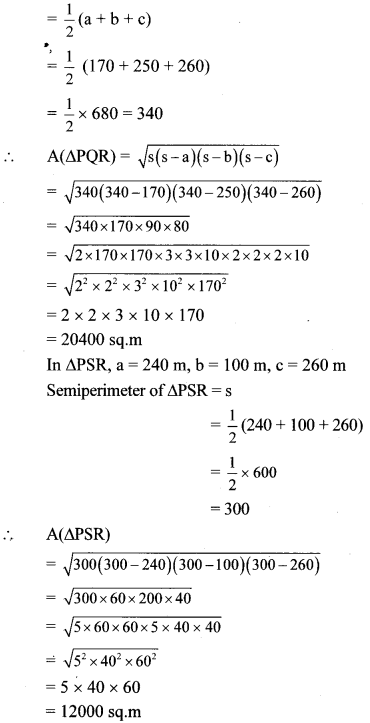
Area of the field = A(∆PQR) + A(∆PSR)
In ∆PQR, a = 170 m, b = 250 m, c = 260 m
Semiperimeter of ∆PQR = s
Maharashtra Board Class 8 Maths Solutions Miscellaneous Exercise 2 11
Area of the field = A(∆PQR) + A(∆PSR)
= 20400 + 12000
= 32400 sq.m
= \(\frac { 32400 }{ 10000 }\)
…[1 hectare = 10,000 sq.m]
= 3.24 hectares
∴ The area of the field is 3.24 hectares.

Question 12.
In a library, 50% of total number of books is of Marathi. The books of English are \(\frac { 1 }{ 3 }\) of Marathi books. The books on Mathematics are 25% of the English books. The remaining 560 books are of other subjects. What is the total number of books in the library? [Chapter 12]
Solution:
Let the total number of books in the library be x
50% of total number of books is of Marathi.
Number of Marathi books = 50% of x
= \(\frac { 50 }{ 100 }x\)
= \(\frac { x }{ 2 }\)
The books of English are \(\frac { 1 }{ 3 }\) of Marathi books.
Number of books of English = \(\frac{1}{3} \times \frac{x}{2}\)
= \(\frac { x }{ 6 }\)
The books on Mathematics are 25% of the English books.
Number of books of Mathematics
= 25% of \(\frac { x }{ 6 }\)
= \(\frac{25}{100} \times \frac{x}{6}\)
= \(\frac { x }{ 24 }\)
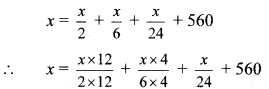
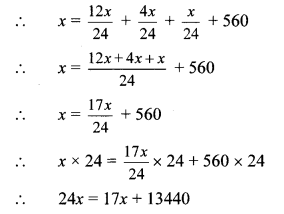
Since, there are 560 books of other subjects, the total number of books in the library are
Maharashtra Board Class 8 Maths Solutions Miscellaneous Exercise 2 12
Maharashtra Board Class 8 Maths Solutions Miscellaneous Exercise 2 13
∴ 24x – 17x = 17x + 13440 – 17x
∴ 7x = 13440
∴ \(\frac{7 x}{7}=\frac{13440}{7}\)
∴ x = 1920
∴ The total number of books in the library are 1920.

Question 13.
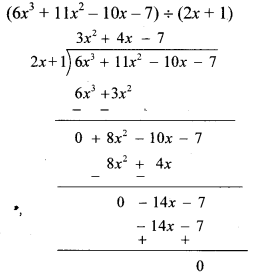
Divide the polynomial (6x³ + 11x² – 10x – 7) by the binomial (2x + 1). Write the quotient and the remainder. [Chapter 10]
Solution:
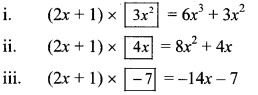
Maharashtra Board Class 8 Maths Solutions Miscellaneous Exercise 2 14
∴ Quotient = 3x² + 4x – 7,
remainder = 0
Explanation:
Maharashtra Board Class 8 Maths Solutions Miscellaneous Exercise 2 15

Maharashtra Board Class 8 Maths Solutions

Maharashtra Board 8th Class Maths Miscellaneous Exercise 1 Solutions

Balbharti Maharashtra State Board Class 8 Maths Solutions covers the Miscellaneous Exercise 1 8th Std Maths Answers Solutions.

Miscellaneous Exercise 1 8th Std Maths Answers

Question 1.
Choose the correct alternative answer for each of the following questions.
i. In ₹PQRS, m∠P = m∠R = 108°, m∠Q = m∠S = 72°. State which pair of sides of those given below is parallel. [Chapter 8]
(A) side PQ and side QR
(B) side PQ and side SR
(C) side SR and side SP
(D) side PS and side PQ
Solution:
(B) side PQ and side SR

Hint:
Maharashtra Board Class 8 Maths Solutions Miscellaneous Exercise 1 1
In ₹PQRS,
m∠P + m∠S = 108°+ 72
= 180°
Since, interior angles are supplementary.
∴ side PQ || side SR

ii. Read the following statements and choose the correct alternative from those given below them. [Chapter 8]
a. Diagonals of a rectangle are perpendicular bisectors of each other.
b. Diagonals of a rhombus are perpendicular bisectors of each other.
c. Diagonals of a parallelogram are perpendicular bisectors of each other.
d. Diagonals of a kite bisect each other.
(A) Statements (b) and (c) are true
(B) Only statement (b) is true
(C) Statements (b) and (d) are true
(D) Statements (a), (c) and (d) are true.
Solution:
(B) Only statement (b) is true

iii. If 19³ = 6859, find \(\sqrt[3]{0.006859}\). [Chapter 3]
(A) 1.9
(B) 19
(C) 0.019
(D) 0.19
Solution:
(D) 0.19

Hint:
\(\sqrt[3]{0.006859}\)
Maharashtra Board Class 8 Maths Solutions Miscellaneous Exercise 1 2

Question 2.
Find the cube roots of the following numbers. [Chapter 3]
i. 5832
ii. 4096
Solution:
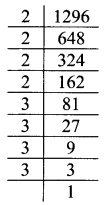
i. 5832 = 2 × 2 × 2 × 3 × 3 × 3 × 3 × 3 × 3
= (2 × 3 × 3) × (2 × 3 × 3) × (2 × 3 × 3)
= (2 × 3 × 3)³
= (18)³
\(\sqrt[3]{5832}=18\)
Maharashtra Board Class 8 Maths Solutions Miscellaneous Exercise 1 3

ii. 4096 = (4 × 4) × (4 × 4) × (4 × 4)
= (4 × 4)
= 16³
\( \sqrt[3]{4096}=16\)
Maharashtra Board Class 8 Maths Solutions Miscellaneous Exercise 1 4

Question 3.
m∝n,n = 15 when m = 25. Hence
i. Find m when n = 87,
ii. Find n when m = 155. [Chapter 7]
Solution:
Given that, m ∝ n
∴ m = kn …(i)
where, k is the constant of variation.
When m = 25, n = 15
∴ Substituting, m = 25 and n = 15 in (i), we get
m = kn
∴ 25 = k × 15
∴ k = \(\frac { 25 }{ 15 }\)
∴ k = \(\frac { 5 }{ 3 }\)
Substituting k = \(\frac { 5 }{ 3 }\) in (i), we get
m = kn
∴ m = \(\frac { 5 }{ 3 }n\) …(ii)

i. When n = 87, m = ?
Substituting n = 87 in (ii), we get
m = \(\frac { 5 }{ 3 }n\)
m = \(\frac { 5 }{ 3 }\) × 87
m = 5 × 29
m = 145

ii. When m = 155, n = ?
∴ Substituting m = 155 in (ii), we get
m = \(\frac { 5 }{ 3 }n\)
∴ 155 = \(\frac { 5 }{ 3 }n\)
∴ \(\frac{155 \times 3}{5}=n\)
∴ n = 31 × 3
∴ n = 93

Question 4.
y varies inversely with x. If y = 30 when x = 12, find [Chapter 7]
i. y when x = 15,
ii. x when y = 18.
Solution:
Given that,
\(y \propto \frac{1}{x}\)
∴ \(y=k \times \frac{1}{x}\)
where, k is the constant of variation.
∴ y × x = k …(i)
When x = 12, y = 30
∴ Substituting, x = 12 and y = 30 in (i), we get
y × x = k
∴ 30 × 12 = k
∴ k = 360
Substituting, k = 360 in (i), we get
y × x = k
∴ y × x = 360 ….(ii)

i. When x = 15,y = ?
∴ Substituting x = 15 in (ii), we get
y × x = 360
∴ y × 15 = 360
∴ y = \(\frac { 360 }{ 15 }\)
∴ y = 24

ii. When y = 18, x = ?
∴ Substituting y = 18 in (ii), we get
y × x = 360
∴18 × x = 360
∴ x = \(\frac { 360 }{ 18 }\)
∴ x = 20

Question 5.
Draw a line l. Draw a line parallel to line l at a distance of 3.5 cm. [Chapter 2]
Solution:
Steps of construction:

  1. Draw a line l and take any two points M and N on the line.
  2. Draw perpendiculars to line l at points M and N.
  3. On the perpendicular lines take points S and T at a distance 3.5 cm from points M and N respectively.
  4. Draw a line through points S and T. Name the line as n.

Maharashtra Board Class 8 Maths Solutions Miscellaneous Exercise 1 5
Line n is parallel to line l at a distance of 3.5 cm from it.

Question 6.
Fill in the blanks in the following statement.
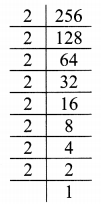
The number \((256)^{\frac{5}{7}}\) is __ of __ power of __. [Chapter 3]
Solution:
The number \((256)^{\frac{5}{7}}\) is 7th root of 5th power of 256.

Question 7.
Expand.
i. (5x – 7) (5x – 9)
ii. (2x – 3y)³
iii. \(\left(a+\frac{1}{2}\right)^{3}\) [Chapter 5]
Solution:
i. (5x – 7) (5x – 9)
= (5x)² + (-7 -9) 5x + (-7) × (-9).
…[∵ (x + a) (x + b) = x² + (a + b)x + ab]
= 25x² + (-16) × 5x + 63
= 25x² – 80x + 63

ii. Here, a = 2x and b = 3y
(2x – 3y)³
= (2x)³ – 3 (2x)² (3y) + 3 (2x) (3y)² – (3y)³
…[∵ (a – b)³ = a³ – 3a²b + 3ab² – b³]
= 8x³ – 3 (4x²) (3y) + 3 (2x) (9y²) – 27y³
= 8x³ – 36x²y + 54xy² – 27p³

iii. Here, A= a and B = \(\frac { 1 }{ 2 }\)
\(\left(a+\frac{1}{2}\right)^{3}=(a)^{3}+3(a)^{2}\left(\frac{1}{2}\right)+3(a)\left(\frac{1}{2}\right)^{2}+\left(\frac{1}{2}\right)^{3}\)
…[(A + B)³ = A³ + 3A²B + 3AB² + B³]
\(=\mathbf{a}^{3}+\frac{3 \mathbf{a}^{2}}{2}+\frac{3 \mathbf{a}}{4}+\frac{1}{8}\)

Question 8.
Draw an obtuse angled triangle. Draw all of its medians and show their point of concurrence. [Chapter 4]
Solution:
Maharashtra Board Class 8 Maths Solutions Miscellaneous Exercise 1 6
The point of concurrence of the medians PS, RU and QV is G.

Question 9.
Draw ∆ABC such that l(BC) = 5.5 cm, m∠ABC = 90°, l(AB) = 4 cm. Show the orthocentre of the triangle. [Chapter 4]
Solution:
Maharashtra Board Class 8 Maths Solutions Miscellaneous Exercise 1 7
Here, point B is the orthocentre of ∆ABC.

Question 10.
Identify the variation and solve.
It takes 5 hours to travel from one town to the other if speed of the bus is 48 km/hr. If the speed of the bus is reduced by 8 km/hr, how much time will it take for the same travel? [Chapter 7]
Solution:
Let, v represent the speed of the bus and t represent the time required to travel from one town to the other.
The speed of the bus varies inversely with the time required to travel from one town to the other.
∴ \(\mathbf{v} \propto \frac{1}{\mathbf{t}}\)
∴ \(\mathbf{v}=\mathbf{k} \times \frac{1}{\mathbf{t}}\)
where, k is the constant of variation.
∴ v × t = k …(i)
It takes 5 hours to travel from one town to the other if speed of the bus is 48 km/hr.
i.e., when v = 48, t = 5
∴ Substituting v = 48 and t = 5 in (i), we get
v × t = k
∴ 48 × 5 = k
∴ k = 240
Substituting k = 240 in (i), we get
v × t = k
∴ v × t = 240 …(ii)
Since, the speed of the bus is reduced by 8 km/hr,
∴ Speed of the bus in second case (v)
= 48 – 8 = 40 km/hr
∴ When v = 40, t = ?
∴ Substituting v = 40 in (ii), we get
v × t = 240
∴ 40 × t = 240
∴ \(t=\frac { 240 }{ 40 }\)
∴ t = 6
∴ The problem is of inverse variation and the bus would take 6 hours to travel the distance if its speed is reduced by 8 km/hr.

Question 11.
Seg AD and seg BE are medians of ∆ABC and point G is the centroid. If l(AG) = 5 cm, find l(GD). If l(GE) = 2 cm, find l(BE). [Chapter 4]
Solution:
The centroid of a triangle divides each median in the ratio 2:1.
i. Point G is the centroid and seg AD is the median.
Maharashtra Board Class 8 Maths Solutions Miscellaneous Exercise 1 8

ii. Point G is the centroid and seg BE is the median.
Maharashtra Board Class 8 Maths Solutions Miscellaneous Exercise 1 9
∴ l(BG) × 1 = 2 × 2
∴ l(BG) = 4 cm
Now, l(BE) = l(BG) + l(GE)
∴ l(BE) = 4 + 2
∴ l(BE) = 6 cm

Question 12.
Convert the following rational numbers into decimal form. [Chapter 1]
i. \(\frac { 8 }{ 13 }\)
ii. \(\frac { 11 }{ 7 }\)
iii. \(\frac { 5 }{ 16 }\)
iv. \(\frac { 7 }{ 9 }\)
Solution:
i. \(\frac { 8 }{ 13 }\)
Maharashtra Board Class 8 Maths Solutions Miscellaneous Exercise 1 10

ii. \(\frac { 11 }{ 7 }\)
Maharashtra Board Class 8 Maths Solutions Miscellaneous Exercise 1 11

iii. \(\frac { 5 }{ 16 }\)
Maharashtra Board Class 8 Maths Solutions Miscellaneous Exercise 1 12

iv. \(\frac { 7 }{ 9 }\)
Maharashtra Board Class 8 Maths Solutions Miscellaneous Exercise 1 13

Question 13.
Factorize.
i. 2y² – 11y + 5
ii. x² – 2x – 80
iii. 3x² – 4x + 1
Solution:
i. 2y² – 11y + 5
= 2y² – 10y – y + 5
= 2y(y – 5) – 1(y – 5)
= (y – 5)(2y – 1)
Maharashtra Board Class 8 Maths Solutions Miscellaneous Exercise 1 14

ii. x² – 2x – 80
= x² – 10x + 8x – 80
= x (x – 10) + 8 (x – 10)
= (x – 10)(x + 8)
Maharashtra Board Class 8 Maths Solutions Miscellaneous Exercise 1 15

iii. 3x² – 4x + 1
= 3x² – 3x – x + 1
= 3x(x – 1) – 1(x – 1)
= (x – 1) (3x – 1)
Maharashtra Board Class 8 Maths Solutions Miscellaneous Exercise 1 16

Question 14.
The marked price of a T.V. set is Rs 50,000. The shopkeeper sold it at 15% discount. Find the price of it for the customer. [Chapter 9]
Solution:
Here, marked price = Rs 50,000,
discount = 15%
Let the discount percent be x
∴x = 15%
i. Discount
Maharashtra Board Class 8 Maths Solutions Miscellaneous Exercise 1 17
= 500 × 15
= Rs 7,500

ii. Selling price = Marked price – Discount
= 50,000 – 7,500
= Rs 42,500
∴The price of the T.V. set for the customer is Rs 42,500.

Question 15.
Rajabhau sold his flat to Vasantrao for Rs 88,00,000 through an agent. The agent charged 2 % commission for both of them. Find how much commission the agent got. [Chapter 9]
Solution:
Here, selling price of the flat = Rs 88,00,000
Rate of commission = 2%
Commission = 2% of selling price
= \(\frac { 2 }{ 100 }\) × 88,00,000
= 2 × 88,000
= Rs 1,76,000
∴ Total commission = Commission from Rajabhau + Commission from Vasantrao
= Rs 1,76,000 + Rs 1,76,000
= Rs 3,52,000
∴ The agent got a commission of Rs 3,52,000.

Question 16.
Draw a parallelogram ABCD such that l(DC) = 5.5 cm, m∠D = 45°, l(AD) = 4 cm. [Chapter 8]
Solution:
Opposite sides of a parallelogram are congruent.
∴ l(AD) = l(BC) = 4 cm and
l(DC) = l(AB) = 5.5 cm
Maharashtra Board Class 8 Maths Solutions Miscellaneous Exercise 1 18

Question 17.
In the figure, line l || line m and line p || line q. Find the measures of ∠a, ∠b, ∠c and ∠d. [Chapter 2]
Maharashtra Board Class 8 Maths Solutions Miscellaneous Exercise 1 19
Solution:
i. line l|| line m and line p is a transversal.
∴m∠a = 78° …(i) [Corresponding angles]

ii. line p || line q and line m is a transversal.
∴m∠d = m∠a …[Corresponding angles]
∴m∠d = 78° …(ii)[From (i)]

iii. m∠b = m∠d …[Vertically opposite angles]
∴m∠b = 78° …[From (ii)]

iv. line l|| line m and line q is a transversal.
∴m∠c + m∠d = 180° …[Interior angles]
∴m∠c + 78° = 180° … [From (ii)]
∴m∠c =180° – 78°
∴m∠c = 102°
∴m∠a = 78°, m∠b = 78°, m∠c = 102°, m∠d = 78°

Maharashtra Board Class 8 Maths Solutions

Practice Set 1.1 Geometry 9th Standard Maths Part 2 Chapter 1 Basic Concepts in Geometry Solutions Maharashtra Board

Balbharti Maharashtra State Board Class 9 Maths Solutions covers the Practice Set 1.1 Geometry 9th Class Maths Part 2 Answers Solutions Chapter 1 Basic Concepts in Geometry.

9th Standard Maths 2 Practice Set 1.1 Chapter 1 Basic Concepts in Geometry Textbook Answers Maharashtra Board

Class 9 Maths Part 2 Practice Set 1.1 Chapter 1 Basic Concepts in Geometry Questions With Answers Maharashtra Board

Question 1.
Find the distances with the help of the number line given below.
Maharashtra Board Class 9 Maths Solutions Chapter 1 Basic Concepts in Geometry Practice Set 1.1 1
i. d(B, E)
ii. d (J, J)
iii. d(P, C)
iv. d(J, H)
v. d(K, O)
vi. d(O, E)
vii. d(P, J)
viii. d(Q, B)
Solution:
i. Co-ordinate of the point B is 2.
Co-ordinate of the point E is 5.
Since, 5 > 2
∴ d(B, E) = 5 – 2
∴ d(B, E) = 3

ii. Co-ordinate of the point J is -2.
Co-ordinate of the point A is 1.
Since, 1 > -2
∴ d(J, A) = 1 – (-2)
= 1 + 2
∴ d(J, A) = 3

iii. Co-ordinate of the point P is -4.
Co-ordinate of the point C is 3.
Since, 3 > -4
∴ d(P,C) = 3 – (-4)
= 3 + 4
∴ d(P,C) = 7

iv. Co-ordinate of the point J is -2.
Co-ordinate of the point H is -1.
Since, -1 > -2
∴ d(J,H) = – 1 – (-2)
= -1 + 2
∴ d(J,H) = 1

v. Co-ordinate of the point K is -3.
Co-ordinate of the point O is 0.
Since,0 > -3
∴ d(K, O) = 0 – (-3)
= 0 + 3
∴ d(K, O) = 3

vi. Co-ordinate of the point O is 0.
∴ Co-ordinate of the point E is 5.
Since, 5 > 0
∴ d(O, E) = 5 – 0
∴ d(O, E) = 5

vii. Co-ordinate of the point P is -4.
Co-ordinate of the point J is -2.
Since -2 > -4
∴ d(P, J) = -2 – (-4)
= – 2+ 4
∴ d(P, J) = 2

viii. Co-ordinate of the point Q is -5.
Co-ordinate of the point B is 2.
Since,2 > -5
∴ d(Q,B) = 2 – (-5)
= 2 + 5
∴ d(Q, B) = 7

Question 2.
If the co-ordinate of A is x and that of B is . y, find d(A, B).
i. x = 1, y = 7
ii. x = 6, y = -2
iii. x = -3, y = 7
iv. x = -4, y = -5
v. x = -3, y = -6
vi. x = 4, y = -8
Solution:
i. Co-ordinate of point A is x = 1.
Co-ordinate of point B is y = 7
Since, 7 > 1
∴ d(A, B) = 7 – 1
∴ d(A, B) = 6

ii. Co-ordinate of point A is x = 6.
Co-ordinate of point B is y = -2.
Since, 6 > -2
∴ d(A, B) = 6 – ( -2) = 6 + 2
∴ d(A, B) = 8

iii. Co-ordinate of point A is x = -3.
Co-ordinate of point B is y = 7.
Since, 7 > -3
∴ d(A, B) = 7 – (-3) = 7 + 3
∴ d(A, B) = 10

iv. Co-ordinate of point A is x = -4.
Co-ordinate of point B is y = -5.
Since, -4 > -5
∴ d(A, B) = -4 – (-5)
= -4 + 5
∴ d(A, B) = 1

v. Co-ordinate of point A is x =-3.
Co-ordinate of point B is y = -6.
Since, -3 > -6
∴ d(A, B) = -3 – (-6)
= -3 + 6
∴ d(A, B) = 3

vi. Co-ordinate of point A is x = 4.
Co-ordinate of point B is y = -8.
Since, 4 > -8
∴ d(A, B) = 4 – (-8)
= 4 + 8
∴d(A, B) = 12

Question 3.
From the information given below, find which of the point is between the other two. If the points are not collinear, state so.
i. d(P, R) = 7, d(P, Q) = 10, d(Q, R) = 3
ii. d(R, S) = 8, d(S, T) = 6, d(R, T) = 4
iii. d(A, B) = 16, d(C, A) = 9, d(B, C) = 7
iv. d(L, M) =11, d(M, N) = 12, d(N, L) = 8
v. d(X, Y) = 15, d(Y, Z) = 7, d(X, Z) = 8
vi. d(D, E) = 5, d(E, F) = 8, d(D, F) = 6
Solution:
i. Given, d(P, R) = 7, d(P, Q) = 10, d(Q, R) = 3
d(P, Q) = 10 …(i)
d(P, R) + d(Q, R) = 7 + 3 = 10 .. .(ii)
∴ d(P, Q) = d(P, R) + d(Q, R) …[From (i) and (ii)]
∴ Point R is between the points P and Q
i. e., P – R – Q or Q – R – P.
∴ Points P, R, Q are collinear.

ii. Given, d(R, S) = 8, d(S, T) = 6, d(R, T) = 4
d(R, S) = 8 …(i)
d(S, T) + d(R, T) = 6 + 4 = 10 …(h)
∴ d(R, S) ≠ d(S, T) + d(R, T) … [From (i) and (ii)]
∴ The given points are not collinear.

iii. Given, d(A, B) = 16, d(C, A) = 9, d(B, C) = 7
d(A, B) = 16 …(i)
d(C, A) + d(B, C) = 9 + 7 = 16 …(ii)
∴ d(A, B) = d(C, A) + d(B, C) …[From(i) and (ii)]
∴ Point C is between the points A and B.
i. e., A – C – B or B – C – A.
∴ Points A, C, B are collinear

iv. Given, d(L, M) = 11, d(M, N) = 12, d(N, L) = 8
d(M, N) = 12 …(i)
d(L, M) + d(N, L) = 11 + 8 = 19 …(ii)
∴d(M, N) + d(L, M) + d(N, L) … [From (i) and (ii)]
∴ The given points are not collinear.

v. Given, d(X, Y) = 15, d(Y, Z) = 7, d(X, Z) = 8
d(X, Y) = 15 …(i)
d(X,Z) + d(Y, Z) = 8 + 7= 15 …(ii)
∴ d(X, Y) = d(X, Z) + d(Y, Z) …[From (i) and (ii)]
∴ Point Z is between the points X and Y
i. e.,X – Z – Y or Y – Z – X.
∴ Points X, Z, Y are collinear.

vi. Given, d(D, E) = 5, d(E, F) = 8, d(D, F) = 6
d(E, F) = 8 …(i)
d(D, E) + d(D, F) = 5 + 6 = 11 …(ii)
∴ d(E, F) ≠ d(D, E) + d(D, F) … [From (i) and (ii)]
∴ The given points are not collinear.

Question 4.
On a number line, points A, B and C are such that d(A, C) = 10, d(C, B) = 8. Find d(A, B) considering all possibilities.
Solution:
Given, d(A, C) = 10, d(C, B) = 8.

Case I: Points A, B, C are such that, A – B – C.
Maharashtra Board Class 9 Maths Solutions Chapter 1 Basic Concepts in Geometry Practice Set 1.1 2
∴ d(A, C) = d(A, B) + d(B, C)
∴ 10 = d(A, B) + 8
∴ d(A, B) = 10 – 8
∴ d(A, B) = 2

Case II: Points A, B, C are such that, A – C – B.
Maharashtra Board Class 9 Maths Solutions Chapter 1 Basic Concepts in Geometry Practice Set 1.1 3
∴ d(A, B) = d(A, C) + d(C, B)
= 10 + 8
∴ d(A, B) = 18

Case III: Points A, B, C are such that, B – A – C.
Maharashtra Board Class 9 Maths Solutions Chapter 1 Basic Concepts in Geometry Practice Set 1.1 4
From the diagram,
d (A, C) > d(B, C)
Which is not possible
∴ Point A is not between B and C.
∴ d(A, B) = 2 or d(A, B) = 18.

Question 5.
Points X, Y, Z are collinear such that d(X, Y) = 17, d(Y, Z) = 8, find d(X, Z).
Solution:
Given,d(X, Y) = 17, d(Y, Z) = 8
Case I: Points X, Y, Z are such that, X – Y – Z.
Maharashtra Board Class 9 Maths Solutions Chapter 1 Basic Concepts in Geometry Practice Set 1.1 5
∴ d(X, Z) = d(X, Y) + d(Y, Z)
= 17 + 8
∴ d(X, Z) = 25

Case II: Points X, Y, Z are such that, X – Z – Y.
Maharashtra Board Class 9 Maths Solutions Chapter 1 Basic Concepts in Geometry Practice Set 1.1 6
∴ d(X,Y) = d(X,Z) + d(Z,Y)
∴ 17 = d(X, Z) + 8
∴ d(X, Z) = 17 – 8
∴ d(X, Z) = 9

Case III: Points X, Y, Z are such that, Z – X – Y.
Maharashtra Board Class 9 Maths Solutions Chapter 1 Basic Concepts in Geometry Practice Set 1.1 7
From the diagram,
d(X, Y) > d (Y, Z)
Which is not possible
∴ Point X is not between Z and Y.
∴ d(X, Z) = 25 or d(X, Z) = 9.

Question 6.
Sketch proper figure and write the answers of the following questions. [2 Marks each]
i. If A – B – C and l(AC) = 11,
l(BC) = 6.5, then l(AB) = ?
ii. If R – S – T and l(ST) = 3.7,
l(RS) = 2.5, then l(RT) = ?
iii. If X – Y – Z and l(XZ) = 3√7,
l(XY) = √7, then l(YZ) = ?
Solution:
i. Given, l(AC) =11, l(BC) = 6.5
Maharashtra Board Class 9 Maths Solutions Chapter 1 Basic Concepts in Geometry Practice Set 1.1 8
l(AC) = l(AB) + l(BC) … [A – B – C]
∴ 11= l(AB) + 6.5
∴ l(AB) = 11 – 6.5
∴ l(AB) = 4.5

ii. Given, l(ST) = 3.7, l(RS) = 2.5
Maharashtra Board Class 9 Maths Solutions Chapter 1 Basic Concepts in Geometry Practice Set 1.1 9
l(RT) = l(RS) + l(ST) … [R – S – T]
= 2.5 + 3.7
∴ (RT) = 6.2

iii. l(XZ) = 3√7 , l(XY) = √7,
Maharashtra Board Class 9 Maths Solutions Chapter 1 Basic Concepts in Geometry Practice Set 1.1 10
l(XZ) = l(X Y) + l(YZ) … [X – Y – Z]
∴ 3 √7 ⇒ √7 + l(YZ)
∴ l(YZ)= 3√7 – √7
∴ l(YZ) = 2 √7

Question 7.
Which figure is formed by three non-collinear points?
Solution:
Three non-collinear points form a triangle.

Class 9 Maths Digest

Practice Set 5.3 Geometry 10th Standard Maths Part 2 Chapter 5 Co-ordinate Geometry Solutions Maharashtra Board

Balbharti Maharashtra State Board Class 10 Maths Solutions covers the Practice Set 5.3 Geometry 10th Class Maths Part 2 Answers Solutions Chapter 5 Co-ordinate Geometry.

10th Standard Maths 2 Practice Set 5.3 Chapter 5 Co-ordinate Geometry Textbook Answers Maharashtra Board

Class 10 Maths Part 2 Practice Set 5.3 Chapter 5 Co-ordinate Geometry Questions With Answers Maharashtra Board

Practice Set 5.3 Geometry Class 10 Question 1. Angles made by the line with the positive direction of X-axis are given. Find the slope of these lines.
i. 45°
ii. 60°
iii. 90°
Solution:
i. Angle made with the positive direction of
X-axis (θ) = 45°
Slope of the line (m) = tan θ
∴ m = tan 45° = 1
∴ The slope of the line is 1.

ii. Angle made with the positive direction of X-axis (θ) = 60°
Slope of the line (m) = tan θ
∴ m = tan 60° = \(\sqrt { 3 }\)
∴ The slope of the line is \(\sqrt { 3 }\).

iii. Angle made with the positive direction of
X-axis (θ) = 90°
Slope of the line (m) = tan θ
∴ m = tan 90°
But, the value of tan 90° is not defined.
∴ The slope of the line cannot be determined.

Practice Set 5.3 Geometry Question 2. Find the slopes of the lines passing through the given points.
i. A (2, 3), B (4, 7)
ii. P(-3, 1), Q (5, -2)
iii. C (5, -2), D (7, 3)
iv. L (-2, -3), M (-6, -8)
v. E (-4, -2), F (6, 3)
vi. T (0, -3), s (0,4)
Solution:
i. A (x1, y1) = A (2, 3) and B (x2, y2) = B (4, 7)
Here, x1 = 2, x2 = 4, y1 = 3, y2 = 7
Maharashtra Board Class 10 Maths Solutions Chapter 5 Co-ordinate Geometry Practice Set 5.3 1
∴ The slope of line AB is 2.

ii. P (x1, y1) = P (-3, 1) and Q (x2, y2) = Q (5, -2)
Here, x1 = -3, x2 = 5, y1 = 1, y2 = -2
Maharashtra Board Class 10 Maths Solutions Chapter 5 Co-ordinate Geometry Practice Set 5.3 2
∴ The slope of line PQ is \(\frac { -3 }{ 8 } \)

iii. C (x1, y1) = C (5, -2) and D (x2, y2) = D (7, 3)
Here, x1 = 5, x2 = 7, y1 = -2, y2 = 3
Maharashtra Board Class 10 Maths Solutions Chapter 5 Co-ordinate Geometry Practice Set 5.3 3
∴ The slope of line CD is \(\frac { 5 }{ 2 } \)

iv. L (x1, y1) = L (-2, -3) and M (x2,y2) = M (-6, -8)
Here, x1 = -2, x2 = – 6, y1 = – 3, y2 = – 8
Maharashtra Board Class 10 Maths Solutions Chapter 5 Co-ordinate Geometry Practice Set 5.3 4
∴ The slope of line LM is \(\frac { 5 }{ 4 } \)

v. E (x1, y1) = E (-4, -2) and F (x2, y2) = F (6, 3)
Here,x1 = -4, x2 = 6, y1 = -2, y2 = 3
Maharashtra Board Class 10 Maths Solutions Chapter 5 Co-ordinate Geometry Practice Set 5.3 5
∴ The slope of line EF is \(\frac { 1 }{ 2 } \).

vi. T (x1, y1) = T (0, -3) and S (x2, y2) = S (0, 4)
Here, x1 = 0, x2 = 0, y1 = -3, y2 = 4
Maharashtra Board Class 10 Maths Solutions Chapter 5 Co-ordinate Geometry Practice Set 5.3 6
∴ The slope of line TS cannot be determined.

5.3.5 Practice Question 3. Determine whether the following points are collinear.
i. A (-1, -1), B (0, 1), C (1, 3)
ii. D (- 2, -3), E (1, 0), F (2, 1)
iii. L (2, 5), M (3, 3), N (5, 1)
iv. P (2, -5), Q (1, -3), R (-2, 3)
v. R (1, -4), S (-2, 2), T (-3,4)
vi. A(-4,4),K[-2,\(\frac { 5 }{ 2 } \)], N (4,-2)
Solution:
Maharashtra Board Class 10 Maths Solutions Chapter 5 Co-ordinate Geometry Practice Set 5.3 7
Maharashtra Board Class 10 Maths Solutions Chapter 5 Co-ordinate Geometry Practice Set 5.3 8
∴ slope of line AB = slope of line BC
∴ line AB || line BC
Also, point B is common to both the lines.
∴ Both lines are the same.
∴ Points A, B and C are collinear.

Maharashtra Board Class 10 Maths Solutions Chapter 5 Co-ordinate Geometry Practice Set 5.3 9
∴ slope of line DE = slope of line EF
∴ line DE || line EF
Also, point E is common to both the lines.
∴ Both lines are the same.
∴ Points D, E and F are collinear.

Maharashtra Board Class 10 Maths Solutions Chapter 5 Co-ordinate Geometry Practice Set 5.3 10
∴ slope of line LM ≠ slope of line MN
∴ Points L, M and N are not collinear.

Maharashtra Board Class 10 Maths Solutions Chapter 5 Co-ordinate Geometry Practice Set 5.3 11a
∴ slope of line PQ = slope of line QR
∴ line PQ || line QR
Also, point Q is common to both the lines.
∴ Both lines are the same.
∴ Points P, Q and R are collinear.

Maharashtra Board Class 10 Maths Solutions Chapter 5 Co-ordinate Geometry Practice Set 5.3 12
∴ slope of line RS = slope of line ST
∴ line RS || line ST
Also, point S is common to both the lines.
∴ Both lines are the same.
∴ Points R, S and T are collinear.

Maharashtra Board Class 10 Maths Solutions Chapter 5 Co-ordinate Geometry Practice Set 5.3 13
∴ slope of line AK = slope of line KN
∴ line AK || line KN
Also, point K is common to both the lines.
∴ Both lines are the same.
∴ Points A, K and N are collinear.

Practice Set 5.3 Geometry 9th Standard Question 4. If A (1, -1), B (0,4), C (-5,3) are vertices of a triangle, then find the slope of each side.
Solution:
Maharashtra Board Class 10 Maths Solutions Chapter 5 Co-ordinate Geometry Practice Set 5.3 14
∴ The slopes of the sides AB, BC and AC are -5, \(\frac { 1 }{ 5 } \) and \(\frac { -2 }{ 3 } \) respectively.

Geometry 5.3 Question 5. Show that A (-4, -7), B (-1, 2), C (8, 5) and D (5, -4) are the vertices of a parallelogram.
Proof:
Maharashtra Board Class 10 Maths Solutions Chapter 5 Co-ordinate Geometry Practice Set 5.3 15
Maharashtra Board Class 10 Maths Solutions Chapter 5 Co-ordinate Geometry Practice Set 5.3 16
∴ Slope of side AB = Slope of side CD … [From (i) and (iii)]
∴ side AB || side CD
Slope of side BC = Slope of side AD … [From (ii) and (iv)]
∴ side BC || side AD
Both the pairs of opposite sides of ꠸ABCD are parallel.
꠸ABCD is a parallelogram.
Points A(-4, -7), B(-1, 2), C(8, 5) and D(5, -4) are the vertices of a parallelogram.

Question 6.
Find k, if R (1, -1), S (-2, k) and slope of line RS is -2.
Solution:
R(x1, y1) = R (1, -1), S (x2, y2) = S (-2, k)
Here, x1 = 1, x2 = -2, y1 = -1, y2 = k
Maharashtra Board Class 10 Maths Solutions Chapter 5 Co-ordinate Geometry Practice Set 5.3 17
But, slope of line RS is -2. … [Given]
∴ -2 = \(\frac { k+1 }{ -3 } \)
∴ k + 1 = 6
∴ k = 6 – 1
∴ k = 5

5.3 Class 10 Question 7. Find k, if B (k, -5), C (1, 2) and slope of the line is 7.
Solution:
B(x1, y1) = B (k, -5), C (x2, y2) = C (1, 2)
Here, x1 = k, x2 = 1, y1 = -5, y2 = 2
Maharashtra Board Class 10 Maths Solutions Chapter 5 Co-ordinate Geometry Practice Set 5.3 18
But, slope of line BC is 7. …[Given]
∴ 7 = \(\frac { 7 }{ 1-k } \)
∴ 7(1 – k) = 7
∴ 1 – k = \(\frac { 7 }{ 7 } \)
∴ 1 – k = 1
∴ k = 0

Question 8.
Find k, if PQ || RS and P (2, 4), Q (3, 6), R (3,1), S (5, k).
Solution:
Maharashtra Board Class 10 Maths Solutions Chapter 5 Co-ordinate Geometry Practice Set 5.3 19
But, line PQ || line RS … [Given]
∴ Slope of line PQ = Slope of line RS
∴ 2 = \(\frac { k-1 }{ 2 } \)
∴ 4 = k – 1
∴ k = 4 + 1
∴ k = 5

Class 10 Maths Digest

Practice Set 5.2 Geometry 10th Standard Maths Part 2 Chapter 5 Co-ordinate Geometry Solutions Maharashtra Board

Balbharti Maharashtra State Board Class 10 Maths Solutions covers the Practice Set 5.2 Geometry 10th Class Maths Part 2 Answers Solutions Chapter 5 Co-ordinate Geometry.

10th Standard Maths 2 Practice Set 5.2 Chapter 5 Co-ordinate Geometry Textbook Answers Maharashtra Board

Class 10 Maths Part 2 Practice Set 5.2 Chapter 5 Co-ordinate Geometry Questions With Answers Maharashtra Board

Question 1.
Find the co-ordinates of point P if P divides the line segment joining the points A (-1, 7) and B (4, -3) in the ratio 2:3.
Solution:
Let the co-ordinates of point P be (x, y) and A (x1, y1) B (x2, y2) be the given points.
Here, x1 = -1, y1 = 7, x2 = 4, y2 = -3, m = 2, n = 3
∴ By section formula,
Maharashtra Board Class 10 Maths Solutions Chapter 5 Co-ordinate Geometry Practice Set 5.2 1
∴ The co-ordinates of point P are (1,3).

Question 2.
In each of the following examples find the co-ordinates of point A which divides segment PQ in the ratio a : b.
i. P (-3, 7), Q (1, -4), a : b = 2 : 1
ii. P (-2, -5), Q (4, 3), a : b = 3 : 4
iii. P (2, 6), Q (-4, 1), a : b = 1 : 2
Solution:
Let the co-ordinates of point A be (x, y).
i. Let P (x1, y1), Q (x2, y2) be the given points.
Here, x1 = -3, y1 = 7, x2 = 1, y2 = -4, a = 2, b = 1
∴ By section formula,
Maharashtra Board Class 10 Maths Solutions Chapter 5 Co-ordinate Geometry Practice Set 5.2 2
∴ The co-ordinates of point A are (\(\frac { -1 }{ 3 } \),\(\frac { -1 }{ 3 } \)).

ii. Let P (x1,y1), Q (x2, y2) be the given points.
Here, x1 = -2, y1 = -5, x2 = 4, y2 = 3, a = 3, b = 4
By section formula,
Maharashtra Board Class 10 Maths Solutions Chapter 5 Co-ordinate Geometry Practice Set 5.2 3
∴ The co-ordinates of point A are (\(\frac { 4 }{ 7 } \),\(\frac { -11 }{ 7 } \))

iii. Let P (x1, y1), Q (x2, y2) be the given points.
Here,x1 = 2,y1 = 6, x2 = -4, y2 = 1, a = 1,b = 2
∴ By section formula,
Maharashtra Board Class 10 Maths Solutions Chapter 5 Co-ordinate Geometry Practice Set 5.2 4
∴ The co-ordinates of point A are (0,\(\frac { 13 }{ 3 } \))

Question 3.
Find the ratio in which point T (-1, 6) divides the line segment joining the points P (-3,10) and Q (6, -8).
Solution:
Let P (x1, y1), Q (x2, y2) and T (x, y) be the given points.
Here, x1 = -3, y1 = 10, x2 = 6, y2 = -8, x = -1, y = 6
∴ By section formula,
Maharashtra Board Class 10 Maths Solutions Chapter 5 Co-ordinate Geometry Practice Set 5.2 5
∴ Point T divides seg PQ in the ratio 2 : 7.

Question 4.
Point P is the centre of the circle and AB is a diameter. Find the co-ordinates of point B if co-ordinates of point A and P are (2, -3) and (-2,0) respectively.
Solution:
Let A (x1, y1), B (x2, y2) and P (x, y) be the given points.
Here, x1 = 2, y1 =-3,
x = -2, y = 0
Maharashtra Board Class 10 Maths Solutions Chapter 5 Co-ordinate Geometry Practice Set 5.2 6
Point P is the midpoint of seg AB.
∴ By midpoint formula,
Maharashtra Board Class 10 Maths Solutions Chapter 5 Co-ordinate Geometry Practice Set 5.2 7
∴ The co-ordinates of point B are (-6,3).

Question 5.
Find the ratio in which point P (k, 7) divides the segment joining A (8, 9) and B (1,2). Also find k.
Solution:
Let A (x1, y1), B (x2, y2) and P (x, y) be the given points.
Here, x1 = 8, y1 = 9, x2 = 1, y2 = 2, x = k, y = 7
∴ By section formula,
Maharashtra Board Class 10 Maths Solutions Chapter 5 Co-ordinate Geometry Practice Set 5.2 8
∴ Point P divides seg AB in the ratio 2 : 5, and the value of k is 6.

Question 6.
Find the co-ordinates of midpoint of the segment joining the points (22, 20) and (0,16).
Solution:
Let A (x1, y1) = A (22, 20),
B (x2,y2) = B (0, 16)
Let the co-ordinates of the midpoint be P (x,y).
∴ By midpoint formula,
Maharashtra Board Class 10 Maths Solutions Chapter 5 Co-ordinate Geometry Practice Set 5.2 9
The co-ordinates of the midpoint of the segment joining (22, 20) and (0, 16) are (11,18).

Question 7.
Find the centroids of the triangles whose vertices are given below.
i. (-7, 6), (2,-2), (8, 5)
ii. (3, -5), (4, 3), (11,-4)
iii. (4, 7), (8, 4), (7, 11)
Solution:
i. Let A (x1, y1) = A (-7, 6),
B (x2, y2) = B (2, -2),
C (x3, y3) = C(8, 5)
∴ By centroid formula,
Maharashtra Board Class 10 Maths Solutions Chapter 5 Co-ordinate Geometry Practice Set 5.2 10
∴ The co-ordinates of the centroid are (1,3).

ii. Let A (x1 y1) = A (3, -5),
B (x2, y2) = B (4, 3),
C(x3, y3) = C(11,-4)
∴ By centroid formula,
Maharashtra Board Class 10 Maths Solutions Chapter 5 Co-ordinate Geometry Practice Set 5.2 11
∴ The co-ordinates of the centroid are (6, -2).

iii. Let A (x1, y1) = A (4, 7),
B (x2, y2) = B (8,4),
C (x3, y3) = C(7,11)
∴ By centroid formula,
Maharashtra Board Class 10 Maths Solutions Chapter 5 Co-ordinate Geometry Practice Set 5.2 12
∴ The co-ordinates of the centroid are (\(\frac { 19 }{ 3 } \),\(\frac { 22 }{ 3 } \))

Question 8.
In ∆ABC, G (-4, -7) is the centroid. If A (-14, -19) and B (3, 5), then find the co-ordinates of C.
Solution:
G (x, y) = G (-4, -7),
A (x1, y1) = A (-14, -19),
B(x2, y2) = B(3,5)
Let the co-ordinates of point C be (x3, y3).
G is the centroid.
By centroid formula,
Maharashtra Board Class 10 Maths Solutions Chapter 5 Co-ordinate Geometry Practice Set 5.2 13
∴ The co-ordinates of point C are (-1, – 7).

Question 9.
A (h, -6), B (2, 3) and C (-6, k) are the co-ordinates of vertices of a triangle whose centroid is G (1,5). Find h and k.
Solution:
A(x1,y1) = A(h, -6),
B (x2, y2) = B(2, 3),
C (x3, y3) = C (-6, k)
∴ centroid G (x, y) = G (1, 5)
G is the centroid.
By centroid formula,
Maharashtra Board Class 10 Maths Solutions Chapter 5 Co-ordinate Geometry Practice Set 5.2 14
∴ 3 = h – 4
∴ h = 3 + 4
∴ h = 7
Maharashtra Board Class 10 Maths Solutions Chapter 5 Co-ordinate Geometry Practice Set 5.2 15
∴ 15 = -3 + k
∴ k = 15 + 3
∴ k = 18
∴ h = 7 and k = 18

Question 10.
Find the co-ordinates of the points of trisection of the line segment AB with A (2,7) and B (-4, -8).
Solution:
A (2, 7), B H,-8)
Suppose the points P and Q trisect seg AB.
∴ AP = PQ = QB
Maharashtra Board Class 10 Maths Solutions Chapter 5 Co-ordinate Geometry Practice Set 5.2 16
∴ Point P divides seg AB in the ratio 1:2.
∴ By section formula,
Maharashtra Board Class 10 Maths Solutions Chapter 5 Co-ordinate Geometry Practice Set 5.2 17
Co-ordinates of P are (0, 2).
Point Q is the midpoint of PB.
By midpoint formula,
Maharashtra Board Class 10 Maths Solutions Chapter 5 Co-ordinate Geometry Practice Set 5.2 18
Co-ordinates of Q are (-2, -3).
∴ The co-ordinates of the points of trisection seg AB are (0,2) and (-2, -3).

Question 11.
If A (-14, -10), B (6, -2) are given, find the co-ordinates of the points which divide segment AB into four equal parts.
Solution:
Let the points C, D and E divide seg AB in four equal parts.
Maharashtra Board Class 10 Maths Solutions Chapter 5 Co-ordinate Geometry Practice Set 5.2 19
Point D is the midpoint of seg AB.
∴ By midpoint formula,
Maharashtra Board Class 10 Maths Solutions Chapter 5 Co-ordinate Geometry Practice Set 5.2 20
∴ Co-ordinates of D are (-4, -6).
Point C is the midpoint of seg AD.
∴ By midpoint formula,
Maharashtra Board Class 10 Maths Solutions Chapter 5 Co-ordinate Geometry Practice Set 5.2 21
∴ Co-ordinates of C are (-9, -8).
Point E is the midpoint of seg DB.
∴ By midpoint formula,
Maharashtra Board Class 10 Maths Solutions Chapter 5 Co-ordinate Geometry Practice Set 5.2 22
Maharashtra Board Class 10 Maths Solutions Chapter 5 Co-ordinate Geometry Practice Set 5.2 23
∴ Co-ordinates of E are (1,-4).
∴ The co-ordinates of the points dividing seg AB in four equal parts are C(-9, -8), D(-4, -6) and E(1, – 4).

Question 12.
If A (20, 10), B (0, 20) are given, find the co-ordinates of the points which divide segment AB into five congruent parts.
Solution:
Suppose the points C, D, E and F divide seg AB in five congruent parts.
∴ AC = CD = DE = EF = FB
Maharashtra Board Class 10 Maths Solutions Chapter 5 Co-ordinate Geometry Practice Set 5.2 24
∴ co-ordinates of C are (16, 12).
E is the midpoint of seg CB.
By midpoint formula,
Maharashtra Board Class 10 Maths Solutions Chapter 5 Co-ordinate Geometry Practice Set 5.2 25
∴ co-ordinates of E are (8, 16).
D is the midpoint of seg CE.
Maharashtra Board Class 10 Maths Solutions Chapter 5 Co-ordinate Geometry Practice Set 5.2 26
∴ co-ordinates of F are (4, 18).
∴ The co-ordinates of the points dividing seg AB in five congruent parts are C (16, 12), D (12, 14), E (8, 16) and F (4, 18).

Maharashtra Board Class 10 Maths Chapter 5 Co-ordinate Geometry Intext Questions and Activities

Question 1.
A (15, 5), B (9, 20) and A-P-B. Find the ratio in which point P (11, 15) divides segment AB. Find the ratio using x and y co-ordinates. Write the conclusion. (Textbook pg. no. 113)
Solution:
Suppose point P (11,15) divides segment AB in the ratio m : n.
By section formula,
Maharashtra Board Class 10 Maths Solutions Chapter 5 Co-ordinate Geometry Practice Set 5.2 27
∴ Point P divides seg AB in the ratio 2 : 1.
The ratio obtained by using x and y co-ordinates is the same.

Question 2.
External division: (Textbook pg. no. 115)
Suppose point R divides seg PQ externally in the ratio 3:1.
Maharashtra Board Class 10 Maths Solutions Chapter 5 Co-ordinate Geometry Practice Set 5.2 28
Let the common multiple be k.
Let PR = 3k and QR = k
Now, PR = PQ + QR … [P – Q – R]
∴ 3k = PQ + k
∴ \(\frac { PQ }{ QR } \) = \(\frac { 2k }{ k } \) = \(\frac { 2 }{ 1 } \)
∴ Point Q divides seg PR in the ratio 2 : 1 internally.
Thus, we can find the co-ordinates of point R, when co-ordinates of points P and Q are given.

Class 10 Maths Digest

Practice Set 5.1 Geometry 10th Standard Maths Part 2 Chapter 5 Co-ordinate Geometry Solutions Maharashtra Board

Balbharti Maharashtra State Board Class 10 Maths Solutions covers the Practice Set 5.1 Geometry 10th Class Maths Part 2 Answers Solutions Chapter 5 Co-ordinate Geometry.

10th Standard Maths 2 Practice Set 5.1 Chapter 5 Co-ordinate Geometry Textbook Answers Maharashtra Board

Class 10 Maths Part 2 Practice Set 5.1 Chapter 5 Co-ordinate Geometry Questions With Answers Maharashtra Board

Practice Set 5.1 Geometry Class 10 Question 1. Find the distance between each of the following pairs of points.
i. A (2, 3), B (4,1)
ii. P (-5, 7), Q (-1, 3)
iii. R (0, -3), S (0,\(\frac { 5 }{ 2 } \))
iv. L (5, -8), M (-7, -3)
v. T (-3, 6), R (9, -10)
vi. W(\(\frac { -7 }{ 2 } \),4), X(11, 4)
Solution:
i. Let A (x1, y1) and B (x2, y2) be the given points.
∴ x1 = 2, y1 = 3, x2 = 4, y2 = 1
By distance formula,
Maharashtra Board Class 10 Maths Solutions Chapter 5 Co-ordinate Geometry Practice Set 5.1 3
∴ d(A, B) = 2\(\sqrt { 2 }\) units
∴ The distance between the points A and B is 2\(\sqrt { 2 }\) units.

ii. Let P (x1, y1 ) and Q (x2, y2) be the given points.
∴ x1 = -5, y1 = 7, x2 = -1, y2 = 3
By distance formula,
Maharashtra Board Class 10 Maths Solutions Chapter 5 Co-ordinate Geometry Practice Set 5.1 1
∴ d(P, Q) = 4\(\sqrt { 2 }\) units
∴ The distance between the points P and Q is 4\(\sqrt { 2 }\) units.

iii. Let R (x1, y1) and S (x2, y2) be the given points.
∴ x1 = 0, y1 = -3, x2 = 0, y2 = \(\frac { 5 }{ 2 } \)
By distance formula,
Maharashtra Board Class 10 Maths Solutions Chapter 5 Co-ordinate Geometry Practice Set 5.1 2
∴ d(R, S) = \(\frac { 11 }{ 2 } \) units
∴ The distance between the points R and S is \(\frac { 11 }{ 2 } \) units.

iv. Let L (x1, y1) and M (x2, y2) be the given points.
∴ x1 = 5, y1 = -8, x2 = -7, y2 = -3
By distance formula,
Maharashtra Board Class 10 Maths Solutions Chapter 5 Co-ordinate Geometry Practice Set 5.1 4
∴ d(L, M) = 13 units
∴ The distance between the points L and M is 13 units.

v. Let T (x1,y1) and R (x2, y2) be the given points.
∴ x1 = -3, y1 = 6,x2 = 9,y2 = -10
By distance formula,
Maharashtra Board Class 10 Maths Solutions Chapter 5 Co-ordinate Geometry Practice Set 5.1 5
∴ d(T, R) = 20 units
∴ The distance between the points T and R 20 units.

vi. Let W (x1, y1) and X (x2, y2) be the given points.
Maharashtra Board Class 10 Maths Solutions Chapter 5 Co-ordinate Geometry Practice Set 5.1 6
∴ d(W, X) = \(\frac { 29 }{ 2 } \) units
∴ The distance between the points W and X is \(\frac { 29 }{ 2 } \) units.

Practice Set 5.1 Geometry 10th Question 2. Determine whether the points are collinear.
i. A (1, -3), B (2, -5), C (-4, 7)
ii. L (-2, 3), M (1, -3), N (5, 4)
iii. R (0, 3), D (2, 1), S (3, -1)
iv. P (-2, 3), Q (1, 2), R (4, 1)
Solution:
i. By distance formula,
Maharashtra Board Class 10 Maths Solutions Chapter 5 Co-ordinate Geometry Practice Set 5.1 7
Maharashtra Board Class 10 Maths Solutions Chapter 5 Co-ordinate Geometry Practice Set 5.1 8
∴ d(A, B) = \(\sqrt { 5 }\) …(i)
On adding (i) and (iii),
d(A, B) + d(A, C)= \(\sqrt { 5 }\) + 5\(\sqrt { 5 }\) = 6\(\sqrt { 5 }\)
∴ d(A, B) + d(A, C) = d(B, C) … [From (ii)]
∴ Points A, B and C are collinear.

ii. By distance formula,
Maharashtra Board Class 10 Maths Solutions Chapter 5 Co-ordinate Geometry Practice Set 5.1 9
On adding (i) and (iii),
d(L, M) + d(L, N) = 3\(\sqrt { 5 }\) + 5\(\sqrt { 2 }\) ≠ \(\sqrt { 65 }\)
∴ d(L, M) + d(L, N) ≠ d(M, N) … [From (ii)]
∴ Points L, M and N are not collinear.

iii. By distance formula,
Maharashtra Board Class 10 Maths Solutions Chapter 5 Co-ordinate Geometry Practice Set 5.1 10
On adding (i) and (ii),
∴ d(R, D) + d(D, S) = \(\sqrt { 8 }\) + \(\sqrt { 5 }\) ≠ 5
∴ d(R, D) + d(D, S) ≠ d(R, S) … [From (iii)]
∴ Points R, D and S are not collinear.

iv. By distance formula,
Maharashtra Board Class 10 Maths Solutions Chapter 5 Co-ordinate Geometry Practice Set 5.1 11
On adding (i) and (ii),
d(P, Q) + d(Q, R) = \(\sqrt { 10 }\) + \(\sqrt { 10 }\) = 2\(\sqrt { 10 }\)
∴ d(P, Q) + d(Q, R) = d(P, R) … [From (iii)]
∴ Points P, Q and R are collinear.

Coordinate Geometry Class 10 Practice Set 5.1 Question 3. Find the point on the X-axis which is equidistant from A (-3,4) and B (1, -4).
Solution:
Let point C be on the X-axis which is equidistant from points A and B.
Point C lies on X-axis.
∴ its y co-ordinate is 0.
Let C = (x, 0)
C is equidistant from points A and B.
∴ AC = BC
Maharashtra Board Class 10 Maths Solutions Chapter 5 Co-ordinate Geometry Practice Set 5.1 12
∴ (x + 3)2 + (-4)2 = (x- 1)2 + 42
∴ x2 + 6x + 9 + 16 = x2 – 2x + 1 + 16
∴ 8x = – 8
∴ x = – \(\frac { 8 }{ 8 } \) = -1
∴ The point on X-axis which is equidistant from points A and B is (-1,0).

10th Geometry Practice Set 5.1 Question 4. Verify that points P (-2, 2), Q (2, 2) and R (2, 7) are vertices of a right angled triangle.
Solution:
Distance between two points
Maharashtra Board Class 10 Maths Solutions Chapter 5 Co-ordinate Geometry Practice Set 5.1 13
Consider, PQ2 + QR2 = 42 + 52 = 16 + 25 = 41 … [From (i) and (ii)]
∴ PR2 = PQ2 + QR2 … [From (iii)]
∴ ∆PQR is a right angled triangle. … [Converse of Pythagoras theorem]
∴ Points P, Q and R are the vertices of a right angled triangle.

Question 5.
Show that points P (2, -2), Q (7, 3), R (11, -1) and S (6, -6) are vertices of a parallelogram.
Proof:
Distance between two points
Maharashtra Board Class 10 Maths Solutions Chapter 5 Co-ordinate Geometry Practice Set 5.1 14
PQ = RS … [From (i) and (iii)]
QR = PS … [From (ii) and (iv)]
A quadrilateral is a parallelogram, if both the pairs of its opposite sides are congruent.
∴ □ PQRS is a parallelogram.
∴ Points P, Q, R and S are the vertices of a parallelogram.

Question 6.
Show that points A (-4, -7), B (-1, 2), C (8, 5) and D (5, -4) are vertices of rhombus ABCD.
Proof:
Distance between two points
Maharashtra Board Class 10 Maths Solutions Chapter 5 Co-ordinate Geometry Practice Set 5.1 15

∴ AB = BC = CD = AD …[From (i), (ii), (iii) and (iv)]
In a quadrilateral, if all the sides are equal, then it is a rhombus.
∴ □ ABCD is a rhombus.
∴ Points A, B, C and D are the vertices of rhombus ABCD.

Practice Set 5.1 Question 7. Find x if distance between points L (x, 7) and M (1,15) is 10.
Solution:
X1 = x, y1 = 7, x2 = 1, y2 = 15
By distance formula,
Maharashtra Board Class 10 Maths Solutions Chapter 5 Co-ordinate Geometry Practice Set 5.1 17
∴ 1 – x = ± 6
∴ 1 – x = 6 or l – x = -6
∴ x = – 5 or x = 7
∴ The value of x is – 5 or 7.

Geometry 5.1 Question 8. Show that the points A (1, 2), B (1, 6), C (1 + 2\(\sqrt { 3 }\), 4) are vertices of an equilateral triangle.
Proof:
Distance between two points
Maharashtra Board Class 10 Maths Solutions Chapter 5 Co-ordinate Geometry Practice Set 5.1 18
∴ AB = BC = AC … [From (i), (ii) and (iii)]
∴ ∆ABC is an equilateral triangle.
∴ Points A, B and C are the vertices of an equilateral triangle.

Maharashtra Board Class 10 Maths Chapter 5 Coordinate Geometry Intext Questions and Activities

Question 1.
In the figure, seg AB || Y-axis and seg CB || X-axis. Co-ordinates of points A and C are given. To find AC, fill in the boxes given below. (Textbook pa. no. 102)
Maharashtra Board Class 10 Maths Solutions Chapter 5 Co-ordinate Geometry Practice Set 5.1 19
Solution:
In ∆ABC, ∠B = 900
∴ (AB)2 + (BC)2 = [(Ac)2 …(i) … [Pythagoras theorem]
seg CB || X-axis
∴ y co-ordinate of B = 2
seg BA || Y-axis
∴ x co-ordinate of B = 2
∴ co-ordinate of B is (2, 2) = (x1,y1)
co-ordinate of A is (2, 3) = (x2, Y2)
Since, AB || to Y-axis,
d(A, B) = Y2 – Y1
d(A,B) = 3 – 2 = 1
co-ordinate of C is (-2,2) = (x1,y1)
co-ordinate of B is (2, 2) = (x2, y2)
Since, BC || to X-axis,
d(B, C) = x2 – x1
d(B,C) = 2 – -2 = 4
∴ AC2 = 12 + 42 …[From (i)]
= 1 + 16 = 17
∴ AC = \(\sqrt { 17 }\) units …[Taking square root of both sides]

Class 10 Maths Digest

Practice Set 1.2 Geometry 10th Standard Maths Part 2 Chapter 1 Similarity Solutions Maharashtra Board

Balbharti Maharashtra State Board Class 10 Maths Solutions covers the Practice Set 1.2 Geometry 10th Class Maths Part 2 Answers Solutions Chapter 1 Similarity.

10th Standard Maths 2 Practice Set 1.2 Chapter 1 Similarity Textbook Answers Maharashtra Board

Class 10 Maths Part 2 Practice Set 1.2 Chapter 1 Similarity Questions With Answers Maharashtra Board

Question 1.
Given below are some triangles and lengths of line segments. Identify in which figures, ray PM is the bisector of ∠QPR.
Maharashtra Board Class 10 Maths Solutions Chapter 1 Similarity Practice Set 1.2 1
Solution:
In ∆ PQR,
\(\frac { PQ }{ PR } \) = \(\frac { 7 }{ 3 } \) (i)
\(\frac { QM }{ RM } \) = \(\frac { 3.5 }{ 1.5 } \) = \(\frac { 35 }{ 15 } \) = \(\frac { 7 }{ 3 } \) (ii)
∴ \(\frac { PQ }{ PR } \) = \(\frac { QM }{ RM } \) [From (i) and (ii)]
∴ Ray PM is the bisector of ∠QPR. [Converse of angle bisector theorem]

ii. In ∆PQR,
\(\frac { PQ }{ PR } \) = \(\frac { 10 }{ 7 } \) (i)
\(\frac { QM }{ RM } \) = \(\frac { 8 }{ 6 } \) = \(\frac { 4 }{ 3 } \) (ii)
∴ \(\frac { PQ }{ PR } \) ≠ \(\frac { QM }{ RM } \) [From (i) and (ii)]
∴ Ray PM is not the bisector of ∠QPR

iii. In ∆PQR,
\(\frac { PQ }{ PR } \) = \(\frac { 9 }{ 10 } \) (i)
\(\frac { QM }{ RM } \) = \(\frac { 3.6 }{ 4 } \) = \(\frac { 36 }{ 40 } \) = \(\frac { 9 }{ 10 } \) (ii)
∴ \(\frac { PQ }{ PR } \) = \(\frac { QM }{ RM } \) [From (i) and (ii)]
∴ Ray PM is the bisector of ∠QPR [Converse of angle bisector theorem]

Question 2.
In ∆PQR PM = 15, PQ = 25, PR = 20, NR = 8. State whether line NM is parallel to side RQ. Give reason.
Maharashtra Board Class 10 Maths Solutions Chapter 1 Similarity Practice Set 1.2 2
Solution:
PN + NR = PR [P – N – R]
∴ PN + 8 = 20
∴ PN = 20 – 8 = 12
Also, PM + MQ = PQ [P – M – Q]
∴ 15 + MQ = 25
Maharashtra Board Class 10 Maths Solutions Chapter 1 Similarity Practice Set 1.2 3
∴ line NM || side RQ [Converse of basic proportionality theorem]

Question 3.
In ∆MNP, NQ is a bisector of ∠N. If MN = 5, PN = 7, MQ = 2.5, then find QP.
Maharashtra Board Class 10 Maths Solutions Chapter 1 Similarity Practice Set 1.2 4
Solution:
In ∆MNP, NQ is the bisector of ∠N. [Given]
∴\(\frac { PN }{ MN } \) = \(\frac { QP }{ MQ } \) [Property of angle bisector of a triangle]
∴\(\frac { 7 }{ 5 } \) = \(\frac { QP }{ 2.5 } \)
∴ QP = \(\frac { 7\times 2.5 }{ 5 } \)
∴ QP = 3.5 units

Question 4.
Measures of some angles in the figure are given. Prove that \(\frac { AP }{ PB } \) = \(\frac { AQ }{ QC } \)
Maharashtra Board Class 10 Maths Solutions Chapter 1 Similarity Practice Set 1.2 5
Solution:
Proof
∠APQ = ∠ABC = 60° [Given]
∴ ∠APQ ≅ ∠ABC
∴ side PQ || side BC (i) [Corresponding angles test]
In ∆ABC,
sidePQ || sideBC [From (i)]
∴\(\frac { AP }{ PB } \) = \(\frac { AQ }{ QC } \) [Basic proportionality theorem]

Question 5.
In trapezium ABCD, side AB || side PQ || side DC, AP = 15, PD = 12, QC = 14, find BQ.
Maharashtra Board Class 10 Maths Solutions Chapter 1 Similarity Practice Set 1.2 6
Solution:
side AB || side PQ || side DC [Given]
∴\(\frac { AP }{ PD } \) = \(\frac { BQ }{ QC } \) [Property of three parallel lines and their transversals]
∴\(\frac { 15 }{ 12 } \) = \(\frac { BQ }{ 14 } \)
∴ BQ = \(\frac { 15\times 14 }{ 12 } \)
∴ BQ = 17.5 units

Question 6.
Find QP using given information in the figure.
Maharashtra Board Class 10 Maths Solutions Chapter 1 Similarity Practice Set 1.2 7
Solution:
In ∆MNP, seg NQ bisects ∠N. [Given]
∴\(\frac { PN }{ MN } \) = \(\frac { QP }{ MQ } \) [Property of angle bisector of a triangle]
∴\(\frac { 40 }{ 25 } \) = \(\frac { QP }{ 14 } \)
∴ QP = \(\frac { 40\times 14 }{ 25 } \)
∴ QP = 22.4 units

Question 7.
In the adjoining figure, if AB || CD || FE, then find x and AE.
Maharashtra Board Class 10 Maths Solutions Chapter 1 Similarity Practice Set 1.2 8
Solution:
line AB || line CD || line FE [Given]
∴\(\frac { BD }{ DF } \) = \(\frac { AC }{ CE } \) [Property of three parallel lines and their transversals]
∴\(\frac { 8 }{ 4 } \) = \(\frac { 12 }{ X } \)
∴ X = \(\frac { 12\times 4 }{ 8 } \)
∴ X = 6 units
Now, AE AC + CE [A – C – E]
= 12 + x
= 12 + 6
= 18 units
∴ x = 6 units and AE = 18 units

Question 8.
In ∆LMN, ray MT bisects ∠LMN. If LM = 6, MN = 10, TN = 8, then find LT.
Maharashtra Board Class 10 Maths Solutions Chapter 1 Similarity Practice Set 1.2 9
Solution:
In ∆LMN, ray MT bisects ∠LMN. [Given]
∴\(\frac { LM }{ MN } \) = \(\frac { LT }{ TN } \) [Property of angle bisector of a triangle]
∴\(\frac { 6 }{ 10 } \) = \(\frac { LT }{ 8 } \)
∴ LT = \(\frac { 6\times 8 }{ 10 } \)
∴ LT = 4.8 units

Question 9.
In ∆ABC,seg BD bisects ∠ABC. If AB = x,BC x+ 5, AD = x – 2, DC = x + 2, then find the value of x.
Maharashtra Board Class 10 Maths Solutions Chapter 1 Similarity Practice Set 1.2 10
Solution:
In ∆ABC, seg BD bisects ∠ABC. [Given]
∴\(\frac { AB }{ BC } \) = \(\frac { AD }{ CD } \) [Property of angle bisector of a triangle]
∴\(\frac { x }{ x+5 } \) = \(\frac { x-2 }{ x+2 } \)
∴ x(x + 2) = (x – 2)(x + 5)
∴ x2 + 2x = x2 + 5x – 2x – 10
∴ 2x = 3x – 10
∴ 10 = 3x – 2x
∴ x = 10

Question 10.
In the adjoining figure, X is any point in the interior of triangle. Point X is joined to vertices of triangle. Seg PQ || seg DE, seg QR || seg EF. Fill in the blanks to prove that, seg PR || seg DF.
Maharashtra Board Class 10 Maths Solutions Chapter 1 Similarity Practice Set 1.2 11
Solution:
Maharashtra Board Class 10 Maths Solutions Chapter 1 Similarity Practice Set 1.2 12

Question 11.
In ∆ABC, ray BD bisects ∠ABC and ray CE bisects ∠ACB. If seg AB = seg AC, then prove that ED || BC.
Maharashtra Board Class 10 Maths Solutions Chapter 1 Similarity Practice Set 1.2 13
Solution:
In ∆ABC, ray BD bisects ∠ABC. [Given]
∴\(\frac { AB }{ BC } \) = \(\frac { AE }{ EB } \) (i) [Property of angle bisector of a triangle]
Also, in ∆ABC, ray CE bisects ∠ACB. [Given]
∴\(\frac { AC }{ BC } \) = \(\frac { AE }{ EB } \) (ii) [Property of angle bisector of a triangle]
But, seg AB = seg AC (iii) [Given]
∴\(\frac { AB }{ BC } \) = \(\frac { AE }{ EB } \) (iv) [From (ii) and (iii)]
∴\(\frac { AD }{ DC } \) = \(\frac { AE }{ EB } \) [From (i) and (iv)]
∴ ED || BC [Converse of basic proportionality theorem]

Question 1.
i. Draw a ∆ABC.
ii. Bisect ∠B and name the point of intersection of AC and the angle bisector as D.
iii. Measure the sides.
Maharashtra Board Class 10 Maths Solutions Chapter 1 Similarity Practice Set 1.2 14
iv. Find ratios \(\frac { AB }{ BC } \) and \(\frac { AD }{ DC } \)
v. You will find that both the ratios are almost equal.
vi. Bisect remaining angles of the triangle and find the ratios as above. Verify that the ratios are equal. (Textbook pg. no. 8)
Solution:
Maharashtra Board Class 10 Maths Solutions Chapter 1 Similarity Practice Set 1.2 15
Note: Students should bisect the remaining angles and verify that the ratios are equal.

Question 2.
Write another proof of the above theorem (property of an angle bisector of a triangle). Use the following properties and write the proof.
i. The areas of two triangles of equal height are proportional to their bases.
ii. Every point on the bisector of an angle is equidistant from the sides of the angle. (Textbook pg. no. 9)
Maharashtra Board Class 10 Maths Solutions Chapter 1 Similarity Practice Set 1.2 16
Given: In ∆CAB, ray AD bisects ∠A.
To prove: \(\frac { AB }{ AC } \) = \(\frac { BD }{ DC } \)
Construction: Draw seg DM ⊥ seg AB A – M – B and seg DN ⊥ seg AC, A – N – C.
Solution:
Proof:
In ∆ABC,
Point D is on angle bisector of ∠A. [Given]
∴DM = DN [Every point on the bisector of an angle is equidistant from the sides of the angle]
\(\frac{A(\Delta A B D)}{A(\Delta A C D)}=\frac{A B \times D M}{A C \times D N}\) [Ratio of areas of two triangles is equal to the ratio of the product of their bases and corresponding heights]
∴ \(\frac{A(\Delta A B D)}{A(\Delta A C D)}=\frac{A B}{A C}\) (ii) [From (i)]
Also, ∆ABD and ∆ACD have equal height.
∴ \(\frac{\mathrm{A}(\Delta \mathrm{ABD})}{\mathrm{A}(\Delta \mathrm{ACD})}=\frac{\mathrm{BD}}{\mathrm{CD}}\) (iii) [Triangles having equal height]
∴\(\frac{\mathrm{AB}}{\mathrm{AC}}=\frac{\mathrm{BD}}{\mathrm{DC}}\) [From (ii) and (iii)]

Question 3.
i. Draw three parallel lines.
ii. Label them as l, m, n.
iii. Draw transversals t1 and t2.
iv. AB and BC are intercepts on transversal t1.
v. PQ and QR are intercepts on transversal t2.
vi. Find ratios \(\frac { AB }{ BC } \) and \(\frac { PQ }{ QR } \). You will find that they are almost equal. Verify that they are equal.(Textbook pg, no. 10)
Solution:
Maharashtra Board Class 10 Maths Solutions Chapter 1 Similarity Practice Set 1.2 17
(Students should draw figures similar to the ones given and verify the properties.)

Question 4.
In the adjoining figure, AB || CD || EF. If AC = 5.4, CE = 9, BD = 7.5, then find DF.(Textbook pg, no. 12)
Maharashtra Board Class 10 Maths Solutions Chapter 1 Similarity Practice Set 1.2 18
Solution:
Maharashtra Board Class 10 Maths Solutions Chapter 1 Similarity Practice Set 1.2 19

Question 5.
In ∆ABC, ray BD bisects ∠ABC. A – D – C, side DE || side BC, A – E – B, then prove that \(\frac { AB }{ BC } \) = \(\frac { AE }{ EB } \) (Textbook pg, no. 13)
Maharashtra Board Class 10 Maths Solutions Chapter 1 Similarity Practice Set 1.2 20
Solution:
Maharashtra Board Class 10 Maths Solutions Chapter 1 Similarity Practice Set 1.2 21

Class 10 Maths Digest

Practice Set 1.1 Geometry 10th Standard Maths Part 2 Chapter 1 Similarity Solutions Maharashtra Board

Balbharti Maharashtra State Board Class 10 Maths Solutions covers the Practice Set 1.1 Geometry 10th Class Maths Part 2 Answers Solutions Chapter 1 Similarity.

10th Standard Maths 2 Practice Set 1.1 Chapter 1 Similarity Textbook Answers Maharashtra Board

Class 10 Maths Part 2 Practice Set 1.1 Chapter 1 Similarity Questions With Answers Maharashtra Board

Question 1.
Base of a triangle is 9 and height is 5. Base of another triangle is 10 and height is 6. Find the ratio of areas of these triangles.
Solution:
Let the base, height and area of the first triangle be b1, h1, and A1 respectively.
Let the base, height and area of the second triangle be b2, h2 and A2 respectively.
Maharashtra Board Class 10 Maths Solutions Chapter 1 Similarity Practice Set 1.1 1

[Since Ratio of areas of two triangles is equal to the ratio of the product of their bases and corresponding heights]
∴ The ratio of areas of the triangles is 3:4.

Question 2.
In the adjoining figure, BC ± AB, AD _L AB, BC = 4, AD = 8, then find \(\frac{A(\Delta A B C)}{A(\Delta A D B)}\)
Maharashtra Board Class 10 Maths Solutions Chapter 1 Similarity Practice Set 1.1 2
Solution:
∆ABC and ∆ADB have same base AB.
Maharashtra Board Class 10 Maths Solutions Chapter 1 Similarity Practice Set 1.1 3
[Since Triangles having equal base]

Question 3.
In the adjoining figure, seg PS ± seg RQ, seg QT ± seg PR. If RQ = 6, PS = 6 and PR = 12, then find QT.
Maharashtra Board Class 10 Maths Solutions Chapter 1 Similarity Practice Set 1.1 4
Solution:
In ∆PQR, PR is the base and QT is the corresponding height.
Also, RQ is the base and PS is the corresponding height.
\(\frac{A(\Delta P Q R)}{A(\Delta P Q R)}=\frac{P R \times Q T}{R Q \times P S}\) [Ratio of areas of two triangles is equal to the ratio of the product of their bases and corresponding heights]
∴ \(\frac{1}{1}=\frac{P R \times Q T}{R Q \times P S}\)
∴ PR × QT = RQ × PS
∴ 12 × QT = 6 × 6
∴ QT = \(\frac { 36 }{ 12 } \)
∴ QT = 3 units

Question 4.
In the adjoining figure, AP ⊥ BC, AD || BC, then find A(∆ABC) : A(∆BCD).
Maharashtra Board Class 10 Maths Solutions Chapter 1 Similarity Practice Set 1.1 5
Solution:
Draw DQ ⊥ BC, B-C-Q.

Maharashtra Board Class 10 Maths Solutions Chapter 1 Similarity Practice Set 1.1 6
AD || BC [Given]
∴ AP = DQ   (i)  [Perpendicular distance between two parallel lines is the same]
∆ABC and ∆BCD have same base BC.
Maharashtra Board Class 10 Maths Solutions Chapter 1 Similarity Practice Set 1.1 7

Question 5.
In the adjoining figure, PQ ⊥ BC, AD ⊥ BC, then find following ratios.
Maharashtra Board Class 10 Maths Solutions Chapter 1 Similarity Practice Set 1.1 8
Solution:
i. ∆PQB and tPBC have same height PQ.
Maharashtra Board Class 10 Maths Solutions Chapter 1 Similarity Practice Set 1.1 9
ii. ∆PBC and ∆ABC have same base BC.
Maharashtra Board Class 10 Maths Solutions Chapter 1 Similarity Practice Set 1.1 10
iii. ∆ABC and ∆ADC have same height AD.
Maharashtra Board Class 10 Maths Solutions Chapter 1 Similarity Practice Set 1.1 11

Question 1.
Find \(\frac{A(\Delta A B C)}{A(\Delta A P Q)}\)
Maharashtra Board Class 10 Maths Solutions Chapter 1 Similarity Practice Set 1.1 12
Solution:
In ∆ABC, BC is the base and AR is the height.
In ∆APQ, PQ is the base and AR is the height.
Maharashtra Board Class 10 Maths Solutions Chapter 1 Similarity Practice Set 1.1 13

Class 10 Maths Digest

Work and Energy Class 9 Science Chapter 2 Questions And Answers Maharashtra Board

Class 9 Science Chapter 2

Balbharti Maharashtra State Board Class 9 Science Solutions Chapter 2 Work and Energy Notes, Textbook Exercise Important Questions and Answers.

Std 9 Science Chapter 2 Work and Energy Question Answer Maharashtra Board

Class 9 Science Chapter 2 Work and Energy Question Answer Maharashtra Board

1. Write detailed answers?

a. Explain the difference between potential energy and kinetic energy.
Answer:

Kinetic Energy Potential Energy
(i) Kinetic energy is the energy possessed by the body due to its motion. (i) Potential energy is the energy possessed by the body because of its shape or position.
(ii) K.E = 1/2 mv2 (ii) P.E = mgh
(iii) e.g., flowing water, such as when falling from a waterfall. (iii) e.g., water at the top of a waterfall, before the drop.

b. Derive the formula for the kinetic energy of an object of mass m, moving with velocity v.
Answer:
Suppose a stationary object of mass ‘m’ moves because of an applied force. Let ‘u’ be its initial velocity (here u = 0). Let the applied force be ‘F’. This generates an acceleration a in the object, and after time T, the velocity of the object becomes equal to ‘v’. The displacement during this time is s. The work done on the object is
W = F x s ……………….. (1)
Using Newton’s 2nd law of motion,
F = ma ……………….. (2)
Using Newton’s 2nd equation of motion
\(s=u t+\frac{1}{2} a t^{2}\)
However, as initial velocity is zero, u = 0
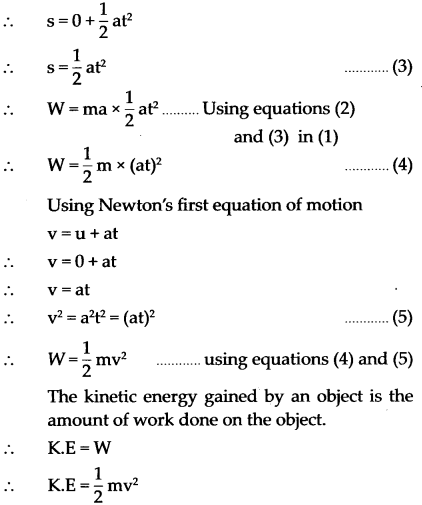
Maharashtra Board Class 9 Science Solutions Chapter 2 Work and Energy 1

Maharashtra Board Class 9 Science Solutions Chapter 2 Work and Energy

c. Prove that the kinetic energy of a freely falling object on reaching the ground is nothing but the transformation of its initial potential energy.
Answer:
Let us look at the kinetic and potential energies of an object of mass (m), falling freely from height (h), when the object is at different heights.

As shown in the figure, the point A is at a height (h) from the ground. Let the point B be at a distance V, vertically below A. Let the point C be on the ground directly below A and B. Let us calculate the energies of the object at A, B and C.

(1) Let the velocity of the object be vB when it reaches point B, having fallen through a distance x.
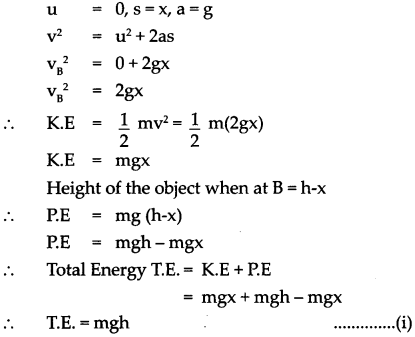
Maharashtra Board Class 9 Science Solutions Chapter 2 Work and Energy 2
(2) When the object is stationary at A, its initial velocity is u = 0
∴ K.E = 1/2 mass x velocity2
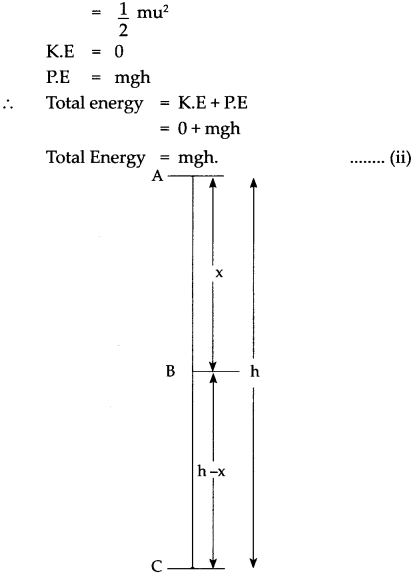
Maharashtra Board Class 9 Science Solutions Chapter 2 Work and Energy 3

Maharashtra Board Class 9 Science Solutions Chapter 2 Work and Energy

(3) Let the velocity of the object be vc when it reaches the ground, near point C.
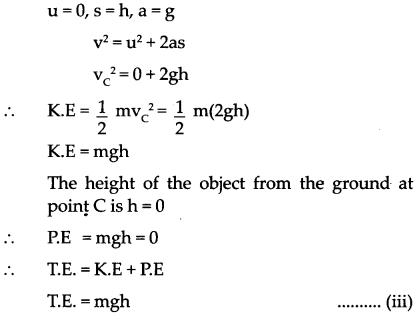
Maharashtra Board Class 9 Science Solutions Chapter 2 Work and Energy 4
From equations (i) and (iii) we see that the total potential energy of the object at its initial position is the same as the kinetic energy at the ground.

d. Determine the amount of work done when an object is displaced at an angle of 300 with respect to the direction of the applied force.
Answer:
When an object is displaced by displacement ‘s’ and by applying force ‘F’ at an ’angle’ 30°. work done can be given as
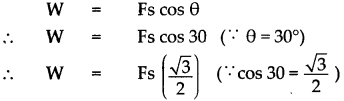
Maharashtra Board Class 9 Science Solutions Chapter 2 Work and Energy 25

e. If an object has 0 momenta, does it have kinetic energy? Explain your answer.
Answer:

  • No, it does not have kinetic energy if it does not have momentum.
  • Momentum is the product of mass and velocity. If it is zero, it implies that v = 0 (since mass can never be zero).
  • Now K.E = ~ mv2, So if v = 0 then K.E also will be zero.
  • Thus, if an object has no momentum then it cannot possess kinetic energy.

f. Why is the work done on an object moving with uniform circular motion zero?
Answer:

  • In uniform circular motion, the force acting on an object is along the radius of the circle.
  • Its displacement is along the tangent to the circle. Thus, they are perpendicular to each other.
    Hence θ = 90° and cos 90 = θ
    ∴ W = Fs cos θ = 0

Maharashtra Board Class 9 Science Solutions Chapter 2 Work and Energy

2. Choose one or more correct alternatives.

a. For work to be performed, energy must be ….
(i) transferred from one place to another
(ii) concentrated
(iii) transformed from one type to another
(iv) destroyed

b. Joule is the unit of …
(i) force
(ii) work
(iii) power
(iv) energy

c. Which of the forces involved in dragging a heavy object on a smooth, horizontal surface, have the same magnitude?
(i) the horizontal applied force
(ii) gravitational force
(iii) reaction force in vertical direction
(iv) force of friction

d. Power is a measure of the …….
(i) the rapidity with which work is done
(ii) amount of energy required to perform the work
(iii) The slowness with which work is performed
(iv) length of time

e. While dragging or lifting an object, negative work is done by
(i) the applied force
(ii) gravitational force
(iii) frictional force
(iv) reaction force

3. Rewrite the following sentences using a proper alternative.

a. The potential energy of your body is least when you are …..
(i) sitting on a chair
(ii) sitting on the ground
(iii) sleeping on the ground
(iv) standing on the ground
Answer:
(iii) sleeping on the ground

b. The total energy of an object falling freely towards the ground …
(i) decreases
(ii) remains unchanged
(iii) increases
(iv) increases in the beginning and then decreases
Answer:
(iii) increases

Maharashtra Board Class 9 Science Solutions Chapter 2 Work and Energy

c. If we increase the velocity of a car moving on a flat surface to four times its original speed, its potential energy ….
(i) will be twice its original energy
(ii) will not change
(iii) will be 4 times its original energy
(iv) will be 16 times its original energy.
Answer:
(ii) will not change

d. The work done on an object does not depend on ….
(i) displacement
(ii) applied force
(iii) initial velocity of the object
(iv) the angle between force and displacement.
Answer:
(iii) initial velocity of the object

4. Study the following activity and answer the questions.

1. Take two aluminium channels of different lengths.
2. Place the lower ends of the channels on the floor and hold their upper ends at the same height.
3. Now take two balls of the same size and weight and release them from the top end of the channels. They will roll down and cover the same distance.

Questions
1. At the moment of releasing the balls, which energy do the balls have?
2. As the balls roll down which energy is converted into which other form of energy?
3. Why do the balls cover the same distance on rolling down?
4. What is the form of the eventual total energy of the balls?
5. Which law related to energy does the above activity demonstrate? Explain.
Answer:
1. At the moment of releasing the ball they possess Potential energy as they are at a height above the ground.
2. As the balls roll down, the Potential energy is converted into Kinetic energy since they are now in motion.
3. Since they have been released from the same height, they will cover the same distance.
4. The eventual form of the total energy of the balls is “Mechanical Energy” i.e, a combination of Potential energy and Kinetic energy
5. The above activity demonstrates the “Law of Conservation of Energy”

5. Solve the following examples.

a. An electric pump has 2 kW power. How much water will the pump lift every minute to a height of 10 m? (Ans : 1224.5 kg)
Answer:
Given:
Power (P) = 2 kW = 2000 W
Height (h) = 10 m
Time (t) = 1 min = 60 s
Acceleration due to gravity (g) = 9.8 m/s2
To Find:
Mass of water (m)= ?
Formula:
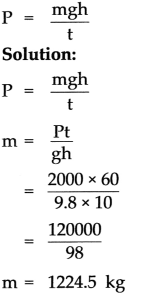
Maharashtra Board Class 9 Science Solutions Chapter 2 Work and Energy 5
Water lifted by the pump is 1224.5 kg

Maharashtra Board Class 9 Science Solutions Chapter 2 Work and Energy

b. If the energy of a ball falling from a height of 10 metres is reduced by 40%, how high will it rebound? (Ans : 6 m)
Answer:
Given: Initial height (h1) = 10m
Let Initial (P.E1) = 100
Final (P.E2) = 100 – 40
= 60

To Find:
Final height (h2) = ?
Formula:
P.E. = mgh
Solution:
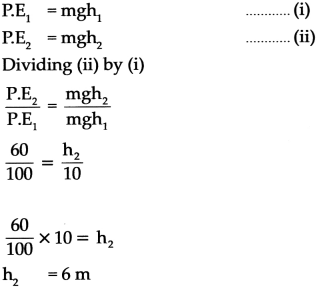
Maharashtra Board Class 9 Science Solutions Chapter 2 Work and Energy 6
The ball will rebound by 6 m.

d. The velocity of a car increase from 54 km/hr to 72 km/hr. How much is the work done if the mass of the car is 1500 kg? (Ans. : 131250 J)
Answer:
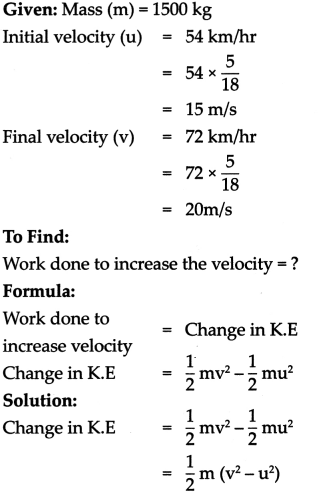
Maharashtra Board Class 9 Science Solutions Chapter 2 Work and Energy 23
Maharashtra Board Class 9 Science Solutions Chapter 2 Work and Energy 24
Work done to increase the velocity = 131250 J

e. Ravi applied a force of 10 N and moved a book 30 cm in the direction of the force. How much was the work done by Ravi? (Ans: 3 J)
Answer:
Given:
Force (F) = 10 N
θ = 0°, (Since force and displacement are in same direction)
Displacement (s) = 30 cm = 30/100 m
To Find:
Work (W) = ?
Formula:
W = Fs cos θ
Solution:
W = Fs cos θ
Solution:
The work done by Ravi is 3J
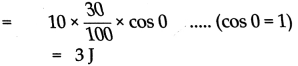
Maharashtra Board Class 9 Science Solutions Chapter 2 Work and Energy 7
Numericals For Practice

Maharashtra Board Class 9 Science Solutions Chapter 2 Work and Energy

Class 9 Science Chapter 1 Laws of Motion Intext Questions and Answers

Question 1.
What are different types of forces? Give examples.
Answer:
Forces are of two types.

  • Contact force e.g.: Mechanical force, frictional force, muscular force
  • Non-contact force e.g.: gravitational force, magnetic force, electrostatic force

Question 2.
Monashee wants to displace a wooden block from point A to point B along the surface of a table as shown. She has used force F for the purpose.

Maharashtra Board Class 9 Science Solutions Chapter 2 Work and Energy 22
(a) Has all the energy she spent been used to produce an acceleration in the block?
(b) Which forces have been overcome using that energy?
Answer:
(a) Only part of the energy applied by Minakshee is used in accelerating the block.
(b) Force of friction has been overcome using the energy.

Question 3.
Mention the type of energy used in the following examples.
(i) Stretched rubber string.
(ii) Fast-moving car.
(iii) The whistling of a cooker due to steam.
(iv) A fan running on electricity.
(v) Drawing out pieces of iron from garbage, using a magnet.
(vi) Breaking of a glass window pane because of a loud noise.
(vii) The drackers exploded in Diwali.
Answer:
(i) Potential energy
(ii) Kinetic energy
(iii) Sound energy
(iv) Electrical energy
(v) Magnetic energy
(vi) Sound energy
(vii) Sound energy, light energy and heat energy

Maharashtra Board Class 9 Science Solutions Chapter 2 Work and Energy

Question 4.
Study the pictures given below and answer the questions:
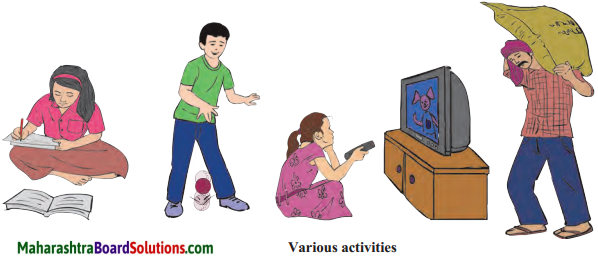
Maharashtra Board Class 9 Science Solutions Chapter 2 Work and Energy 26
(a) In which of the pictures above has work been done?
(b) From scientific point of view, when do we say that no work was done?
Answer:
(a) Girl studying : No work done
Boy playing with ball: Work is done
Girl watching T.V.: No work done Person lifting sack of grains : Work is done
(b) No work is said to be done when force is applied but there is no displacement.

Question 5.
Make two pendulums of the same length with the help of thread and two nuts. Tie another thread in the horizontal position.

Tie the two pendulums to the horizontal thread in such a way that they will not hit each other while swinging. Now swing one of the pendulums and observe. What do you see?
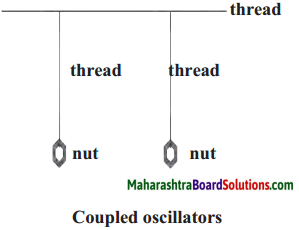
Maharashtra Board Class 9 Science Solutions Chapter 2 Work and Energy 27
Answer:
You will see that as the speed of oscillation of the pendulum slowly decreases, the second pendulum which was initially stationary, begins to swing. Thus, one pendulum transfers its energy to the other.

Question 6.
Ajay and Atul have been asked to determine the potential energy of a ball of mass m kept on a table as shown in the figure. What answers will they get? Will they be different? What do you conclude from this?
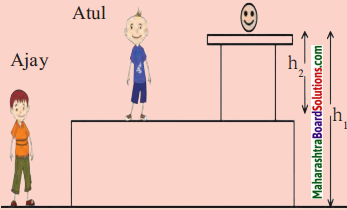
Maharashtra Board Class 9 Science Solutions Chapter 2 Work and Energy 28
Answer:

  • According to Ajay P.E1 = mgh1 and according to Atul P.E2 = mgh2.
  • Yes, the answer will be different as the two heights are different.
  • Potential energy is relative.

Maharashtra Board Class 9 Science Solutions Chapter 2 Work and Energy

Question 7.
Discuss the directions of force and of displacement in each of the following cases.
(i) Pushing a stalled vehicle.
(ii) Catching the ball which your friend has thrown towards you.
(iii) Tying a stone to one end of a string and swinging it round and round by the other end of the string.
(iv) Walking up and down a staircase; climbing a tree.
(v) Stopping a moving car by applying brakes.
Answer:
(i) Force and displacement are in the same direction.
(ii) Force and displacement are in the opposite direction.
(iii) Force and displacement are perpendicular to each other.
(iv) Force and displacement are in the opposite direction.
(v) Force and displacement are in the opposite direction.

Question 8.
(A) An arrow is released from a stretched bow.
(B) Water kept at a high flows through a pipe into the tap below.
(C) A compressed spring is released.
(a) Which words describe the state of the object in the above examples?
(b) Where did the energy required to cause the motion of the objects come from?
(c) If the obj ects were not brought in those states, would they have moved?
Answer:
(a) Words such as stretched bow, water kept at a height and compressed spring describe the state of the objects.
(b) The energy required for the objects came from its specific state or motion in the form of potential energy.
(c) No, if the objects were not brought in those states, they would have not moved.

Question 9.
Study the activity and answer the following questions.
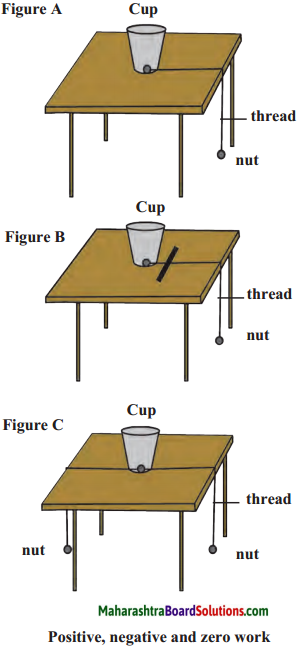
Maharashtra Board Class 9 Science Solutions Chapter 2 Work and Energy 29
(a) Figure A – Why does the cup get pulled?
(b) Figure B – What is the relation between the displacement of the cup and the force applied through the ruler?
(c) In Figure C-Why doesn’t the cup get displaced?
(d) What is the type of work done in figures A, B and C?
(e) In the three actions above, what is the relationship between the applied force and the displacement?
Answer:
(a) The cup gets pulled as the force of the nut and the displacement of the cup is in the same direction.
(b) The displacement of the cup and the force applied through the ruler is in the opposite direction.
(c) Tire cup does not get displaced as two equal forces are working in opposite directions.
(d) The work done in figure A is positive, figure B is negative and in figure C is zero.
(e) In figure A the applied force and the displacement is in the same direction, in figure B the applied force and the displacement is in the opposite direction and in figure C the applied force and displacement is perpendicular to each other.

Maharashtra Board Class 9 Science Solutions Chapter 2 Work and Energy

Question 10.
From the following activities find out whether work is positive, negative or zero. Give reasons for your answers.
(a) A boy is swimming in a pond.
(b) A coolie is standing with a load on his head.
(c) Stopping a moving car by applying brakes.
(d) Catching the ball which you friend has thrown towards you.
Answer:
(a) A boy is swimming in a pond: The work done is positive because the direction of applied force and displacement are the same.
(b) A coolie is standing with a load on his head: The work done is zero because the applied force does not cause any displacement.
(c) Stopping a moving car by applying brakes: The work done is negative because the fore applied by the brakes acts in a direction opposite to the direction of motion of car.
(d) Catching the ball which you friend has thrown towards you : Negative work because the force required to stop the ball, acts opposite to the displacement of the ball.

Question 11.
(a) Can your father climb stairs as fast as you can?
(b) Will you fill the overhead water tank with the help of a bucket or an electrical motor?
(c) Suppose Raj ashree, Yash and Ranjeet have to reach the top of a small hill. Raj ashree went by car. Yash went cycling while Ranjeet went walking. If all of them choose the same path, who will reach first and who will reach last? (Think before you answer.
Answer:
(a) No, father takes more time to climb stairs.
(b) Overhead water tank can be filled with the help of one electric motor rather than filling it with bucket.
(c) Raj ashree will reach first, followed by Yash and Ranjeet will reach last because car moves faster than a cycle and a person walking.

Class 9 Science Chapter 1 Laws of Motion Additional Important Questions and Answers

1. Choose and write the correct option:

Question 1.
Forces are of …………………… types.
(a) 2
(b) 3
(c) 4
(d) 5
Answer:
(a) 2

Maharashtra Board Class 9 Science Solutions Chapter 2 Work and Energy

Question 2.
Example of Contact force is ………………….. .
(a) Gravitational Force
(b) Magnetic Force
(c) Electrostatic Force
(d) Muscular Force
Answer:
(d) Muscular Force

Question 3.
Example of Non-contact force is ………………….. .
(a) Mechanical Force
(b) Frictional Force
(c) Muscular Force
(d) Electrostatic Force
Answer:
(d) Electrostatic force

Question 4.
Work is said to be done on a body when a …………………… is applied on object causes displacement of the object.
(a) Direction
(b) Area
(c) Volume
(d) Force
Answer:
(d) force

Question 5.
W = ………………. .
(a) mgh
(b) mdh
(c) mv2
(d) mfe
Answer:
(a) mgh

Maharashtra Board Class 9 Science Solutions Chapter 2 Work and Energy

Question 6.
The energy stored in the dry cell is in of ………………. energy.
(a) Light
(b) Chemical
(c) Solar
(d) Kinetic
Answer:
(b) chemical

Question 7.
The work done is zero if there is no ……………… .
(a) Direction
(b) Displacement
(c) Mass
(d) Angle
Answer:
(b) displacement

Question 8.
Flowing water has ………………. energy.
(a) Potential
(b) Chemical
(c) Solar
(d) Kinetic
Answer:
(d) kinetic

Question 9.
By stretching the rubber strings of a we store ………………. energy in it.
(a) Potential
(b) Chemical
(c) Electric
(d) Kinetic
Answer:
(a) potential

Maharashtra Board Class 9 Science Solutions Chapter 2 Work and Energy

Question 10.
………………. is the unit of force.
(a) Both B and C
(b) Newton
(c) Dyne
(d) Volts
Answer:
(a) Both B and C

Question 11.
For a freely falling body, kinetic energy is ………………. at the ground level.
(a) Maximum
(b) Minimum
(c) Neutral
(d) Reversed
Answer:
(a) Maximum

Question 12.
Energy can neither be ………………. nor ……………… .
(a) Destroyed
(b) Created
(c) Saved
(d) Both A and B
Answer:
(d) Both A and B

Question 13.
Work and …………………… have the same unit.
(a) Energy
(b) Electricity
(c) Force
(d) Both B and C
Answer:
(a) Energy

Maharashtra Board Class 9 Science Solutions Chapter 2 Work and Energy

Question 14.
S.I. unit of energy is ………………….. .
(a) Joule
(b) Ergs
(c) m/s2
(d) Both A and B
Answer:
(a) Joule

Question 15.
Work is the product of ………………….. .
(a) force and distance
(b) displacement and velocity
(c) kinetic and potential energy
(d) force and displacement
Answer:
(d) force and displacement

Question 16.
S.I. unit of work is ………………….. .
(a) dyne
(b) newton-meter or erg
(c) N/m2 or joule
(d) newton-meter or joule
Answer:
(d) newton-meter or joule

Question 17.
…………………… is the capacity to do work.
(a) Energy
(b) Force
(c) Power
(d) Momentum
Answer:
(a) Energy

Question 18.
Kinetic energy of a body (KE) = ………………….. .
(a) mv2
(b) 1/2 mv2
(c) mgh
(d) Fs
Answer:
(b) 1/2 mv2

Maharashtra Board Class 9 Science Solutions Chapter 2 Work and Energy

Question 19.
Potential energy of a body is given by (P.E.) = ………………….. .
(a) Fs
(b) mgh
(c) ma
(d) mv2
Answer:
(b) mgh

Question 20.
1 hp = ………………….. .
(a) 476 watts
(b) 746 watts
(c) 674 watts
(d) 764 watts
Answer:
(b) 746 watts

Question 21.
…………………… is the commercial unit of power.
(a) kilowatt second
(b) dyne
(c) kilowatt
(d) erg
Answer:
(c) kilowatt

Question 22.
1 kWh = …………………… joules.
(a) 3.6 x 10³
(b) 3.6 x 10⁶
(c) 6.3 x 10⁶
(d) 6.3 x 10³
Answer:
(b) 3.6 x 10⁶

Maharashtra Board Class 9 Science Solutions Chapter 2 Work and Energy

Based on Practicals

Question 23.
The work done by a force is said to be …………………… when the applied force does not produce displacement.
(a) positive
(b) negative
(c) zero
(d) none of these
Answer:
(c) zero

Question 24.
When some unstable atoms break up, they release a tremendous amount of …………………… energy.
(a) chemical
(b) potential
(c) nuclear
(d) mechanical
Answer:
(c) nuclear.

Name the following:

Question 1.
Unit of energy used for commercial purpose.
Answer:
Kilowatt-hour kW h is the unit of energy used for commercial purpose.

Question 2.
Unit used in industry to measure power.
Answer:
Horse power (hp) is the unit used in industry to express power.

Question 3.
SI unit of energy.
Answer:
SI unit of energy is Joule (J).

Question 4.
Two types of mechanical energy.
Answer:
Potential energy and kinetic energy are the two types of mechanical energy.

Maharashtra Board Class 9 Science Solutions Chapter 2 Work and Energy

Question 5.
An example where force acting on an object does not do any work.
Answer:
In a simple pendulum, the gravitational force acting on the bob does not do any work as there is no displacement in the direction of force.

Question 6.
The relationship between 1 joule and 1 erg.
Answer:
1 joule = 107 erg.

Question 7.
Various forms of energy
Answer:
The various forms of energy are mechanical, heat, light, sound, electro-magnetic, chemical, nuclear and solar.

State whether the following statements are true or false:

(1) The potential energy of a body of mass 1 kg kept at height 1 m is 1 J.
(2) Water stored at some height has potential energy.
(3) Unit of power is joule.
(4) Mechanical energy can be converted into electrical energy.
(5) Work is a vector quantity.
(6) Power is a scalar quantity.
(7) The kilowatt hour is the unit of energy.
(8) The CGS unit of energy is dyne.
(9) The SI unit of work is newton.
(10) Kinetic energy has formula – mv2
Answer:
(1) False
(2) True
(3) False
(4) True
(5) False
(6) True
(7) True
(8) False
(9) False
(10) True

Maharashtra Board Class 9 Science Solutions Chapter 2 Work and Energy

Find the odd man out.

Question 1.
Work, Energy, Power, Force.
Answer:
Force.

Question 2.
A stretched spring, A body placed in at some height, A bullet fired from gun.
Answer:
A bullet fired from gun.

Question 3.
A stretched spring, A rock rolling downhill, A bullet fired from gun.
Answer:
A stretched spring.

Write the formula of the following.

Question 1.
Kinetic energy
Answer:
\(\frac{1}{2}\)mv2

Question 2.
Potential energy
Answer:
mgh

Question 3.
Work
Answer:
Fs or Fs cosθ

Question 4.
Force
Answer:
ma

Maharashtra Board Class 9 Science Solutions Chapter 2 Work and Energy

Question 5.
Power
Answer:
\(\frac{w}{1}\)

One line answer.

Question 1.
(i) When is work done said to be zero?
Answer:
Work done is zero when force acting on the body and its displacement are perpendicular to each other.

(ii) Which quantities are measured in ergs?
Answer:
Work and energy are measured in ergs.

(iii) What is the relationship between newton, meter and joule?
Answer:
1 joule = 1 newton x 1 meter

(iv) What is energy?
Answer:
The ability of a body to do work is called energy.

(v) Give 4 examples of energy
Answer:
Solar, wind, mechanical and heat.

(vi) Which device converts electrical energy into heat?
Answer:
Electric water heater (Geyser) converts electrical energy into heat.

(vii) What is the relationship between second, horsepower and joule?
Answer:
1 horse power = \(\frac{746 \text { joules }}{1 \text { second }\)

Question 2.
Find whether work is positive, negative or zero.

Maharashtra Board Class 9 Science Solutions Chapter 2 Work and Energy

(a) Person moving along circle from A to B.
Answer:
Work done is positive as direction of applied force and displacement are the same.

(b) Person completing one circle and returns to position A.
Answer:
Work done is zero because there is no displacement for the person.

(c) Person pushing a car in the forward direction.
Ans,
Work done is positive as the motion of car is in the direction of the applied force.

(d) A car coming downhill even after pushing it in the opposite uphill direction.
Ans,
Work done is negative as the motion of car is in opposite direction of the applied force.

(e) Motion of the clock pendulum.
Answer:
work done is zero as there is no displacement of the pendulum and it comes back to its original position.

Give Scientific reasons:

Question 1.
A moving ball hits a stationary ball and displaces it.
Answer:

  • The moving ball has certain energy.
  • When it hits the stationary ball, the energy is transferred to the stationary ball, because of which it moves.
  • Hence, a moving ball hits a stationary ball and displaces it.

Maharashtra Board Class 9 Science Solutions Chapter 2 Work and Energy

Question 2.
Flowing water from some height can rotate turbine.
Answer:

  • Flowing water has certain energy.
  • When it hits the turbine, energy is transferred to the turbine, because of which it rotates.
  • Hence, flowing water from some height can rotate a turbine.

Question 3.
A stretched rubber band when released regains its original length.
Answer:

  • When we stretch a rubber band we give energy to it.
  • This energy is stored in it.
  • Hence, when we release it, it regains its original length.

Question 4.
Wind can move the blades of a windmill.
Answer:

  • Wind has certain energy.
  • When it hits the windmill energy is transferred to the windmill because of which it moves.
  • Hence, wind can move the blades of a wind mill.

Question 5.
An exploding firecracker lights up as well as makes a sound.
Answer:

  • The exploding firecracker converts the chemical energy stored in it into light and sound respectively.
  • Here, energy is converted from one type to another.
  • Hence, an exploding firecracker lights as well as makes a sound.

Question 6.
Work done on an artificial satellite by gravity is zero while moving around the earth.
Answer:

  • When the artificial satellite moves around the earth in a circular orbit, gravitation force acts on it.
  • The gravitational force acting on the satellite and its displacement are perpendicular to each other. i.e. 0 = 90°
  • For 0 = 90°, work done is zero. [ v cos 90 = 0)
  • Hence, work done on an artificial satellite by gravity is zero while moving around the earth.

Maharashtra Board Class 9 Science Solutions Chapter 2 Work and Energy

Difference between :

Question 1.
Work and Power:
Answer:

Work Power
(i) Work is the product of force and displacement.
(ii) Work is given by the formula : W = Fs
(iii) MKS unit – joule, CGS unit-erg
(i) Power is the rate of doing work.
(ii) Power is given by the formula : \(\mathrm{P}=\frac{\mathrm{W}}{\mathrm{t}}\)
(iii) MKS unit – joule/sec, CGS unit – erg/sec

Question 2.
Work and Energy:
Answer:

Work Energy
(i) It is the product of the magnitude of the force acting on the body and the displacement of the body in the direction of the force.
(ii) It is the effect of energy.
(i) It is the capacity to do work.
(ii) It is the cause of work.

Solve the following:

Type – A

Formula:
W = Fs cosθ
If force and displacement are in same direction, then θ = 0°, and cos θ = 1
If force and displacement are in opposite direction, then θ = 180°, and cos θ = -1
If force and displacement are perpendiculars, then θ = 90°, and cos θ = 0

Question 1.
Pravin has applied a force of 100 N on an object, at an angle of 60° to the horizontal. The object gets displaced in the horizontal direction and 400 J work is done. What is the displacement of the object? (cos 600 =12)
To Find:
Displacement (s) = ?
Formula:
W = Fs cos θ
Solution:
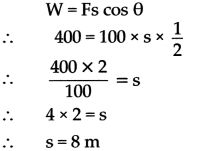
Maharashtra Board Class 9 Science Solutions Chapter 2 Work and Energy 8
The object will be displaced through 8 m.

Maharashtra Board Class 9 Science Solutions Chapter 2 Work and Energy

Question 2.
A force of 50 N acts on an object and displaces it by 2 m. If the force acts at an angle of 60° to the direction of its displacement, find the work done.
Answer:
50 J

Question 3.
Raj applied a force of 20 N and moved a book 40 cm in the direction of the force. How much was the work done by Raj?
Answer:
8J

Type -B

Formula:
1) W = K.E = 1/2 mv2
2) W = P.E = mgh
• W = P.E, W = K.E
1 km/hr =
\(\frac{1000}{3600} \mathrm{~m} / \mathrm{s}=\frac{5}{18} \mathrm{~m} / \mathrm{s}\)

Question 4.
A stone having a mass of 250 gm is falling from a height. How much kinetic energy does it have at the moment when its velocity is 2 m/s?
Answer:
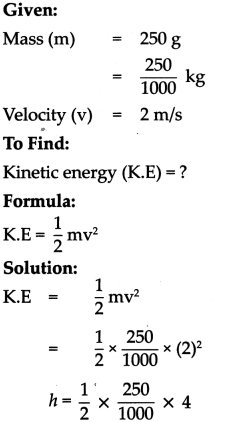
Maharashtra Board Class 9 Science Solutions Chapter 2 Work and Energy 9
Maharashtra Board Class 9 Science Solutions Chapter 2 Work and Energy 10
The kinetic energy of the stone is 0.5 J

Maharashtra Board Class 9 Science Solutions Chapter 2 Work and Energy

Question 5.
500 kg water is stored in the overhead tank of a 10 m high building. Calculate the amount of potential energy stored in the water.
Answer:
Given:
Mass (m) = 500 kg
Height (h) = 10 m
Acceleration due to gravity (g) = 9.8 m/s2
To Find:
Potential energy (P.E) = ?
Formula:
P.E = mgh
Solution:
P.E = mgh
= 500 x 9.8 x 10
= 500 x 98
= 49000J
The P.E of the stored water is 49000 J

Question 6.
Calculate the work done to take an object of mass 20 kg to a height of 10 m. (g = 9.8 m/s2)
Answer:
Given:
Mass (m) = 20 kg
Acceleration due to gravity (g) = -9.8 m/s2
Displacement (s) = (h) = 10 m.
To Find:
Work done (W) = ?
Formula:
(i) W = P.E = mgh
Solution:
W = mgh
= 20 x (-9.8) x 10
= -1960J
The work done to take an object of mass 20 kg to a height of 10 m is -1960 J.

Maharashtra Board Class 9 Science Solutions Chapter 2 Work and Energy

Question 7.
A body of 0.5 kg thrown upwards reaches a maximum height of 5 m. Calculate the work done by the force of gravity during this vertical displacement.
Answer:
Given:
Mass (m) = 0.5 kg
Acceleration due to gravity (g) = -9.8 m/s2
Displacement (s) = 5 m.
To Find:
Work done (W) = ?
Formula:
W = P.E = mgh
Solution:
W = mgh
= 0.5 x (-9.8) x 5
= -24.5 J
The work done by the force of gravity is -24.5 joule.

Question 8.
1 kg mass has a kinetic energy of 2 joule. Calculate its velocity.
Answer:
Given:
Mass (m) = 1 kg
Kinetic Energy (K.E) = 2 J
To Find:
Velocity (v) = ?
Formula:
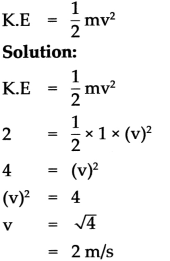
Maharashtra Board Class 9 Science Solutions Chapter 2 Work and Energy 11
The velocity is 2 m/s

Maharashtra Board Class 9 Science Solutions Chapter 2 Work and Energy

Question 9.
A rocket of mass 100 tonnes is propelled with a vertical velocity 1 km/s. Calculate kinetic energy.
Answer:
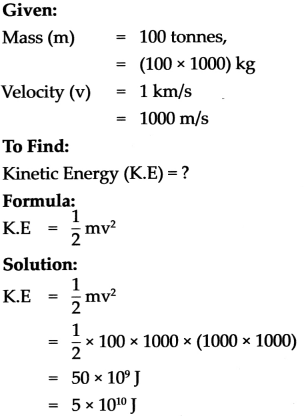
Maharashtra Board Class 9 Science Solutions Chapter 2 Work and Energy 12
The kinetic energy of the rocket is 5 x 10¹⁰ J

Type – C

Formula:
\(\text { 1) Power }=\frac{\text { work }}{\text { time }}=\frac{\text { mgh }}{t}\)

Maharashtra Board Class 9 Science Solutions Chapter 2 Work and Energy 13
Power should be expressed in kW
Time should be expressed in hours
1 k Wh = 1 unit

Question 10.
Swaralee takes 20 s to carry a bag weighing 20 kg to a height of 5 m. How much power has she used?
Given:
Mass (m) = 20 kg
Height (h) = 5 m
Time (t) = 20s
Acceleration due to gravity (g) = 9.8 m/s2
To Find:
Power (P) = ?
Formula:
\(\mathrm{P}=\frac{\mathrm{mgh}}{\mathrm{t}}\)
Solution:
\(\begin{aligned}
P &=\frac{m g h}{t} \\
&=20 \times 9.8 \times \frac{5}{20} \\
&=9.8 \times 5
\end{aligned}\)
= 49 W
Power used by Swaralee is 49 W

Maharashtra Board Class 9 Science Solutions Chapter 2 Work and Energy

Write notes on the following:

Question 1.
Derive the expression for potential energy.
Answer:
(i) To carry an object of mass ‘m’ to a height ‘h’ above the earth’s surface, a force equal to ‘mg’ has to be used against the direction of the gravitational force.

(ii) The amount of work done can be calculated as follows:
Work = force x displacement
∴ W = mg x h
∴ W = mgh

(iii) The amount of potential energy stored in the object because of its displacement.
PE = mgh (W = P.E)

(iv) Displacement to height h causes energy equal to mgh to be stored in the object.

Question 2.
When can you say that the work done is either positive, negative or zero?
Answer:

  • When the force and the displacement are in the same direction, the work done by the force is positive.
  • When the force and displacement are in the opposite directions, the work done by the force is negative.
  • When the applied force does not cause any displacement or when the force and the displacement are perpendicular to each other, the work done by the force is zero.

Question 3.
Explain the relation between, the commercial and SI unit of energy.
Answer:
The commercial unit of energy is a kilowatt-hour (kWh) while the SI unit of energy is the joule. Their relation is
1 kWh = 1kW x 1hr
= 1000 Wx 3600 s
= 3600000J
(Watt x Sec = Joule)
1 kWh = 3.6 x 10⁶ J.

Question 4.
How is work calculated if the direction of force and the displacement are inclined to each other?

Answer:
If the direction of force and the displacement are inclined to each other then, we must convert the applied force into the force acting along the direction of displacement.

Maharashtra Board Class 9 Science Solutions Chapter 2 Work and Energy

If θ is angle between force and displacement, then force (F1) in direction of displacement is
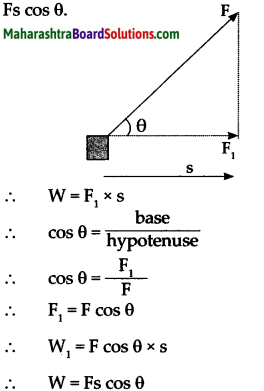
Maharashtra Board Class 9 Science Solutions Chapter 2 Work and Energy 14

Complete the flow chart.

Question 1.
Transformation of energy
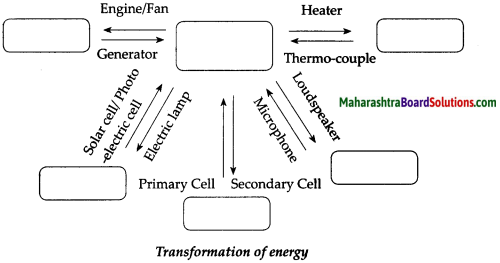
Maharashtra Board Class 9 Science Solutions Chapter 2 Work and Energy 15
Answer:
Maharashtra Board Class 9 Science Solutions Chapter 2 Work and Energy 16

Maharashtra Board Class 9 Science Solutions Chapter 2 Work and Energy

Question 2.
Transformation of energy
Maharashtra Board Class 9 Science Solutions Chapter 2 Work and Energy 17
Answer:
Maharashtra Board Class 9 Science Solutions Chapter 2 Work and Energy 18

Write effects of the following with examples.

Question 1.
Force
Answer:

  • A force can move a stationary object. The force of engine makes a stationery car to move.
  • A force can stop a moving object. The force of brakes can stop a moving car.
  • A force can change the speed of a moving object. When a hockey player hits a moving ball, the speed of ball increases.
  • A force can change the direction of a moving object. In the game of carrom ,when we take a rebound then the direction of striker changes because the edge of the carrom board exerts a force on the strike.
  • A force can change the shape and size of an object. The shape of kneaded wet clay changes when a potter converts it into pots of different shapes and sizes because the p otter applies force on the kneaded wet clay.

Give two examples in each of the following cases:

Question 1.
Potential energy
Answer:

  • Water stored in a dam
  • A compressed spring

Question 2.
Kinetic energy
Answer:

  • Water flowing
  • Bullet fired from a gun

Question 3.
Chemical energy
Answer:

  • Chemical in cell
  • Explosive mixture of a bomb

Maharashtra Board Class 9 Science Solutions Chapter 2 Work and Energy

Question 4.
Zero work done
Answer:

  • A stone tied to a string and whirled in a circular path
  • Motion of the earth and other planets moving around the sun

Question 5.
Negative work done
Answer:

  • A cyclist applies brakes to his bicycle, but the bicycle still covers some distance.
  • When a body is made to slide on a rough surface, the work done by the frictional force.

Question 6.
Positive work done
Answer:
(i) A boy moving from the ground floor to the first floor.
(ii) A fruit falling down from the tree.
= 0.5 hr x 30 days
= 15 hrs
To Find:
Energy consumed = ?
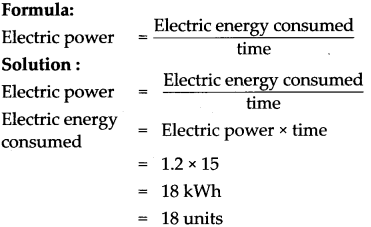
Maharashtra Board Class 9 Science Solutions Chapter 2 Work and Energy 19
The units of energy consumed in the month of April by the iron is 18 units.

Question 7.
A 25 W electric bulb is used for 10 hours every day. How much electricity does it consume each day?
Answer:
Given:
Power (P) = 25 W
25/1000 kW
Time (E) = 10 hrs
To Find:
Electric energy consumed = ?
Formula:
Electric energy consumed = power x time
Solutions:
Electric energy consumed = power x time
= 25/1000 x 10
= 0.25 kWh
The electric bulb consumes 0.25 kWh of electricity each day.

Maharashtra Board Class 9 Science Solutions Chapter 2 Work and Energy

Question 8.
If a TV of rating 100W is operated for 6 hrs per day, find the amount of energy consumed in any leap year?
Answer:
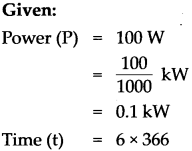
Maharashtra Board Class 9 Science Solutions Chapter 2 Work and Energy 20
= 2196 hrs.
To Find:
Electric energy consumed
Formula:
Electric energy consumed = power x time
Solution:
Electric energy consumed = power x time
= 0.1 x 2196
= 219.6 kWh
The amount of energy consumed is 219.6 kWh

Complete the paragraph.

Question 1.
………….. is the measure of energy transfer when a force (F) moves an object through a ………….. (d). So when ………….. is done, energy has been transferred from one energy store to another, and so: energy transferred = ………….. done. Energy transferred and work done are both measured in ………….. (J)
Answer:
Work is the measure of energy transfer when a force (F) moves an object through a distance (d). So when work is done, energy has been transferred from one energy store to another, and so: energy transferred = work done. Energy transferred and work done are both measured in joules (J).

Question 2.
………….. energy and ………….. done are the same thing as much as ………….. energy and work done are the same thing. Potential energy is a state of the system, a way of ………….. energy as of virtue of its configuration or motion, while ………….. done in most cases is a way of channeling this energy from one body to another.
Answer:
Potential energy and work done are the same thing as much as kinetic energy and work done are the same thing. Potential energy is a state of the system, a way of storing energy as of virtue of its configuration or motion, while work done in most cases is a way of channeling this energy from one body to another.

Maharashtra Board Class 9 Science Solutions Chapter 2 Work and Energy

Question 3.
In physics, ………….. is the rate of doing work or, i.e., the amount of energy transferred or converted per unit time. In the International System of Units, the unit of power is the ………….. equal to one ………….. per second.

Power is a ………….. quantity that requires both a change in the physical system and a specified time interval in which the change occurs. But more ………….. is needed when the work is done in a shorter amount of time.
Answer:
In physics, power is the rate of doing work or, i.e., the amount of energy transferred or converted per unit time. In the International System of Units, the unit of power is the watt. equal to one joule per second.

Power is a scalar quantity that requires both a change in the physical system and a specified time interval in which the change occurs. But more power is needed when the work is done in a shorter amount of time.

Activity-based questions

Answer in detail:

Question 1.
State the expression for work done when displacement and force makes an angle θ OR State the expression for work done when force is applied making an angle θ with the horizontal force.
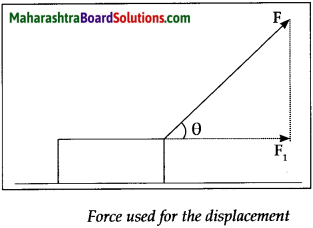
Maharashtra Board Class 9 Science Solutions Chapter 2 Work and Energy 21
Answer:
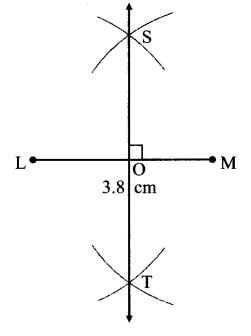
Let ‘F’ be the applied force and Fj be its component in the direction of displacement. Let ’S’ be the displacement.

The amount of work done is given by W = F1s ……………………………………… (1)
The force ‘F’ is applied in the direction of the string.

Let ‘θ’ be the angle that the string makes with the horizontal. We can determine the component ‘F1‘, of this force F, which acts in the horizontal direction by means of trigonometry.
\(\begin{aligned}
\cos \theta=\frac{\text { base }}{\text { hypotenuse }} \\
\therefore \quad \cos \theta=\frac{\mathrm{F}_{1}}{\mathrm{~F}} \\
\therefore \quad \mathrm{F}_{1}=\mathrm{F} & \cos \theta
\end{aligned}\)
Substituting the value of F1 in equation 1
Thus, the work done by F1 is
W cos θ s
∴ W = Fscosθ

Maharashtra Board Class 9 Science Solutions Chapter 2 Work and Energy

Question 2.
When a body is dropped on the ground from some height its P.E is converted into K.E but when it strikes the ground and it stops, what happens to the K.E?
Answer:
When a body is dropped on the ground, its K.E appears in the form of:

  • Heat (collision between the body and the ground).
  • Sound (collision of the body with the ground).
  • The potential energy of change in state of the body and the ground.
  • Kinetic energy is also utilized to do work i.e., the ball bounces to a certain height and moves to a certain distance vertically and horizontally till Kinetic energy becomes zero.
  • The process in which the kinetic energy of a freely falling body is lost in an unproductive chain of energy is called the dissipation of energy.

Question 3.
Explain the statement “Potential Energy is relative”.
Answer:

  • The potential energy of an object is determined and calculated according to a height of the object with respect to the observer.
  • So, the person staying on 6th floor more potential energy than those staying on the 3rd floor.
  • But, the person on the 6th floor will have lesser potential energy than on the 8th floor. Hence potential energy is relative.

9th Std Science Questions And Answers: