Maharashtra Board Class 11 Physics Important Questions Chapter 13 Electromagnetic Waves and Communication System

Balbharti Maharashtra State Board 11th Physics Important Questions Chapter 13 Electromagnetic Waves and Communication System Important Questions and Answers.

Maharashtra State Board 11th Physics Important Questions Chapter 13 Electromagnetic Waves and Communication System

Question 1.
Describe Gauss’ law of electrostatics in brief.
Answer:
i. Gauss’ law of electrostatics states that electric flux through any closed surface S is equal to the total electric charge Qin enclosed by the surface divided by so.
\(\int \vec{E} \cdot \overrightarrow{\mathrm{dS}}=\frac{\mathrm{Q}_{\text {in }}}{\varepsilon_{0}}\)
where, \(\vec{E}\) is the electric field and e0 is the permittivity of vacuum. The integral is over a closed surface S.

ii. Gauss’ law describes the relation between an electric charge and electric field it produces.

Question 2.
Describe Gauss’ law of magnetism in brief.
Answer:
i. Gauss’ law for magnetism states that magnetic monopoles which are thought to be magnetic charges equivalent to the electric charges, do not exist. Magnetic poles always occur in pairs.

ii. This means, magnetic flux through a closed surface is always zero, i.e., the magnetic field lines are continuous closed curves, having neither beginning nor end.
\(\int \overrightarrow{\mathrm{B}} \cdot \overrightarrow{\mathrm{dS}}\) = 0
where, B is the magnetic field. The integral is over a closed surface S.

Maharashtra Board Class 11 Physics Important Questions Chapter 13 Electromagnetic Waves and Communication System

Question 3.
Describe Faraday’s law along with Lenz’s law.
Answer:
i. Faraday’s law states that, time varying magnetic field induces an electromotive force (emf) and an electric field.

ii. Whereas, Lenz’s law states that, the direction of the induced emf is such that the change is opposed.

iii. According to Faraday’s law with Lenz’s law,
\(\int \overrightarrow{\mathrm{E}} \cdot \overrightarrow{\mathrm{d} l}=-\frac{\mathrm{d} \phi_{\mathrm{m}}}{\mathrm{dt}}\)
where, øm is the magnetic flux and the integral is over a closed loop.

Question 4.
What does Ampere’s law describe?
Answer:
Ampere’s law describes the relation between the induced magnetic field associated with a loop and the current flowing through the loop.

Question 5.
Describe Ampere-Maxwell law in brief.
Answer:
According to Ampere-Maxwell law, magnetic field is generated by moving charges and also by varying electric fields.
\(\int \overrightarrow{\mathrm{B}} \cdot \overrightarrow{\mathrm{d} l}=\mu_{0} \mathrm{I}+\varepsilon_{0} \mu_{0} \frac{\mathrm{d} \phi_{\mathrm{E}}}{\mathrm{dt}}\)
where, p0 and e0 are the permeability and permittivity of vacuum respectively and the integral is over a closed loop, I is the current flowing through the loop, E is the electric flux linked with the circuit.

Question 6.
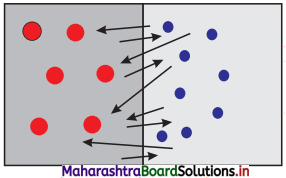
What are Maxwell’s equations for charges and currents in vacuum?
Answer:
\(\int \vec{E} \cdot \overrightarrow{\mathrm{dS}}=\frac{\mathrm{Q}_{\text {in }}}{\varepsilon_{0}}\)
\(\int \overrightarrow{\mathrm{B}} \cdot \overrightarrow{\mathrm{dS}}\) = 0
\(\int \overrightarrow{\mathrm{E}} \cdot \overrightarrow{\mathrm{d} l}=-\frac{\mathrm{d} \phi_{\mathrm{m}}}{\mathrm{dt}}\)
\(\int \overrightarrow{\mathrm{B}} \cdot \overrightarrow{\mathrm{d} l}=\mu_{0} \mathrm{I}+\varepsilon_{0} \mu_{0} \frac{\mathrm{d} \phi_{\mathrm{E}}}{\mathrm{dt}}\)

Question 7.
Explain the origin of displacement current?
Answer:

  1. Maxwell pointed a major flaw in the Ampere’s law for time dependant fields.
  2. He noticed that the magnetic field can be generated not only by electric current but also by changing electric field.
  3. Therefore, he added one more term to the equation describing Ampere’s law. This term is called the displacement current.

Question 8.
In the following table, every entry on the left column can match with any number of entries on the right side. Pick up all those and write respectively against (i), (ii), and (iii).

Name of the Physicist Work
i. H. Hertz a. Existence of EM waves
ii. J. Maxwell b. Properties of EM waves
iii. G. Marconi c. Wireless communication
d. Displacement current

Answer:
(i – a, b), (ii – d), (iii – c)

Question 9.
Varying electric and magnetic fields regenerate each other. Explain.
Answer:

  1. According to Maxwell’s theory, accelerated charges radiate EM waves.
  2. Consider a charge oscillating with some frequency. This produces an oscillating electric field in space, which produces an oscillating magnetic field which in turn is a source of oscillating electric field.
  3. Thus, varying electric and magnetic fields regenerate each other.

Question 10.
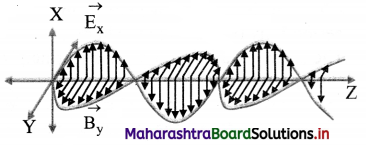
Draw a neat diagram representing electromagnetic wave propagating along Z-axis.
Answer:
Maharashtra Board Class 11 Physics Important Questions Chapter 13 Electromagnetic Waves and Communication System 1

Question 11.
How can energy be transported in the form of EM waves?
Answer:

  1. Maxwell proposed that an oscillating electric charge radiates energy in the form of EM wave.
  2. EM waves are periodic changes in electric and magnetic fields, which propagate through space.
  3. Thus, energy can be transported in the form of EM waves.

Maharashtra Board Class 11 Physics Important Questions Chapter 13 Electromagnetic Waves and Communication System

Question 12.
State the main characteristics of EM waves.
Answer:
i. The electric and magnetic fields, \(\vec{E}\) and \(\vec{B}\) are always perpendicular to each other and also to the direction of propagation of the EM wave. Thus, the EM waves are transverse waves.

ii. The cross product (\(\vec{E}\) × \(\vec{B}\)) gives the direction in which the EM wave travels. (\(\vec{E}\) × \(\vec{B}\)) also gives the energy carried by EM wave.

iii. The \(\vec{E}\) and \(\vec{B}\) fields vary sinusoidally and are in phase.

iv. EM waves are produced by accelerated electric charges.

v. EM waves can travel through free space as well as through solids, liquids and gases.

vi. In free space, EM waves travel with velocity c, equal to that of light in free space.
c = \(\frac {1}{\sqrt{µ_0ε_0}}\) = 3 × 10⁸ m/s,
where µ0 is permeability and ε0 is permittivity of free space.

vii. In a given material medium, the velocity (vm) of EM waves is given by vm = \(\frac {1}{\sqrt{µε}}\)
where µ is the permeability and ε is the permittivity of the given medium.

viii. The EM waves obey the principle of superposition.

ix. The ratio of the amplitudes of electric and magnetic fields is constant at any point and is equal to the velocity of the EM wave.
\( \left|\overrightarrow{\mathrm{E}}_{0}\right|=\mathrm{c}\left|\overrightarrow{\mathrm{B}}_{0}\right| \text { or } \frac{\left|\overrightarrow{\mathrm{E}}_{0}\right|}{\left|\overrightarrow{\mathrm{B}_{0}}\right|}=\mathrm{c}=\frac{1}{\sqrt{\mu_{0} \varepsilon_{0}}}\)
where, |\(\vec{E_0}\)| and |\(\vec{B_0}\)| are the amplitudes of \(\vec{E}\) and \(\vec{B}\) respectively.

x. As the electric field vector (\(\vec{E_0}\)) is more prominent than the magnetic field vector (\(\vec{B_0}\)), it is responsible for optical effects due to EM waves. For this reason, electric vector is called light vector.

xi. The intensity of a wave is proportional to the square of its amplitude and is given by the equations
\(\mathrm{I}_{\mathrm{E}}=\frac{1}{2} \varepsilon_{0} \mathrm{E}_{0}^{2}, \mathrm{I}_{\mathrm{B}}=\frac{1}{2} \frac{\mathrm{B}_{0}^{2}}{\mu_{0}}\)

xii. The energy of EM waves is distributed equally between the electric and magnetic fields. IE = IB.

Question 13.
Give reason: Electric vector is called light vector.
Answer:
As the electric field vector (\(\vec{E_0}\)) is more prominent than the magnetic field vector (\(\vec{B_0}\)), it is responsible for optical effects due to EM waves. For this reason, electric vector is called light vector.

Question 14.
Explain the equations describing an EM wave.
Answer:
i. In an EM wave, the magnetic field and electric field both vary sinusoidally with x.

ii. For a wave travelling along X-axis having \(\vec{E}\) along Y-axis and \(\vec{B}\) along the Z-axis,
Ey = E0 sin (kx – ωt)
Bz = B0 sin (kx – ωt)
where, E0 is the amplitude of the electric field (Ey) and B0 is the amplitude of the magnetic field (Bz).

iii. The propagation constant is given by k = \(\frac {2π}{λ}\) and λ is the wavelength of the wave. The angular frequency of oscillations is given by ω = 2πv, v being the frequency of the wave.
Hence, Ey = E0 sin (\(\frac {2πx}{λ}\) – 2πvt)
Bz = B0 sin (\(\frac {2πx}{λ}\) – 2πvt)

iv. Both the electric and magnetic fields attain their maximum or minimum values at the same time and at the same point in space, i.e., \(\vec{E}\) and \(\vec{B}\) oscillate in phase with the same frequency.

Question 15.
A radio wave of frequency of 1.0 × 10⁷ Hz propagates with speed 3 × 10⁸ m/s. Calculate its wavelength.
Answer:
Given: v= 1.0 × 10⁷ Hz, c = 3 × 10⁸ m/s
To find: Wavelength (λ)
Formula: vλ
Calculation: From formula,
λ = \(\frac {c}{v}\) = \(\frac {3×10^8}{1.0×10^7}\) = 30 m

Question 16.
A radio can tune in to any station in the 7.5 MHz to 12 MHz band. What is the corresponding wavelength band?
Answer:
Given: V1 = 7.5 MHz = 7.5 × 10⁶ Hz,
V1 = 12 MHz = 12 × 106 Hz.
To find: Wavelength band
Formula: λ = \(\frac {c}{v}\)
Calculation: From formula,
V1 = \(\frac {3×10^8}{7.5×10^6}\) = 40 m
V1 = \(\frac {3×10^8}{12×10^6}\) = 25 m
∴ Wavelength band = 40 m to 25 m

Question 17.
Calculate the ratio of the intensities of the two waves, if amplitude of first beam of light is 1.5 times the amplitude of second beam of light.
Answer:
a1 = 1.5 a2
To find: \(\frac {I_1}{I-2}\)
Formula: I ∝ a²
Calculation: From formula,
\(\frac{I_{1}}{I_{2}}=\left(\frac{a_{1}}{a_{2}}\right)^{2}=\left(\frac{1.5 a_{2}}{a_{2}}\right)^{2}\) = (1.5)² = 2.25

Question 18.
A beam of red light has an amplitude 2.5 times the amplitude of second beam of the same colour. Calculate the ratio of the intensities of the two waves.
Answer:
a1 = 2.5 a2
To find: \(\frac {I_1}{I-2}\)
Formula: I ∝ a²
Calculation: From formula,
\(\frac{I_{1}}{I_{2}}=\left(\frac{a_{1}}{a_{2}}\right)^{2}=\left(\frac{2.5 a_{2}}{a_{2}}\right)^{2}\) = (2.5)² = 6.25

Maharashtra Board Class 11 Physics Important Questions Chapter 13 Electromagnetic Waves and Communication System

Question 19.
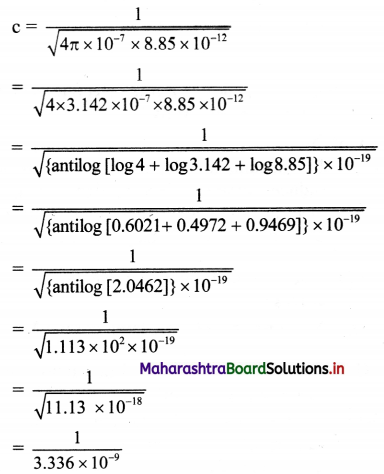
Calculate the velocity of EM waves in vacuum.
Answer:
Given: ε0 = 8.85 × 10⁻¹² C²/Nm²
µ0 = 4π × 10-7 Tm/A
To find: Velocity of EM waves (c)
Formula: c = \(\frac {1}{\sqrt{µ_0ε_0}}\)
Calculation: From formula,
Maharashtra Board Class 11 Physics Important Questions Chapter 13 Electromagnetic Waves and Communication System 2
………… (Taking square roots using log table)
= 0.2998 × 10⁹ ≈ 3 × 10⁸ m/s

Question 20.
In free space, an EM wave of frequency 28 MHz travels along the X-direction. The amplitude of the electric field is E = 9.6 V/m and its direction is along the Y-axis. What is amplitude and direction of magnetic field B?
Answer:
Given: v = 28 MHz, E = 9.6 V/m,
c = 3 × 10⁸ m/s
To find:
i. Amplitude of magnetic field (B)
ii. Direction of B
Formula:
|B| = \(\frac {|E|}{c}\)
Calculation: From formula,
|B| = \(\frac {9.6}{3×10^8}\) = 3.2 × 10⁻⁸ T
Since that E is along Y-direction and the wave propagates along X-axis. The magnetic induction, B should be in a direction perpendicular to both X and Y axes, i.e., along the Z-direction.

Question 21.
An EM wave of frequency 50 MHz travels in vacuum along the positive X-axis and \(\vec{E}\) at a particular point, x and at a particular instant of time t is 9.6 j V/m. Find the magnitude and direction of \(\vec{B}\) at this point x and at instant of time t.
Answer:
Given: \(\vec{E}\) = 9.6 j V/m
i. e., Electric field E is directed along +Y axis Magnitude of \(\vec{B}\).
|B| = \(\frac {|E|}{c}\) = \(\frac {9.6}{3×10^8}\) = 3.2 × 10⁻⁸ T
As the wave propagates along +X axis and E is along +Y axis, direction of B will be along +Z-axis i.e. B = 3.2 × 10⁻⁸ \(\hat{k}\)T.

Question 22.
A plane electromagnetic wave travels in vacuum along Z-direction. What can you say about the directions of its electric and magnetic field vectors? If the frequency of the wave is 30 MHz, what is its wavelength?
Answer:
Since the electromagnetic waves are transverse in nature, the electric and magnetic field vectors are mutually perpendicular to each other as well as perpendicular to the direction of propagation of wave.
As the wave is travelling along Z-direction,

\(\vec{E}\) and \(\vec{B}\) are in XY plane.
For v = 30 MHz = 30 × 106 Hz
Wavelength, λ = \(\frac {c}{v}\) = \(\frac {3×10^8}{30×10^6}\) = 10 m

Question 23.
For an EM wave propagating along X direction, the magnetic field oscillates along the Z-direction at a frequency of 3 × 10¹⁰ Hz and has amplitude of 10-9 T.
i. What is the wavelength of the wave?
ii. Write the expression representing the corresponding electric field.
Answer:
Given: v = 3 × 10¹⁰ Hz, B = 10-9 T
i. For wavelength of the wave:
λ = \(\frac{\mathrm{c}}{\mathrm{v}}=\frac{3 \times 10^{8}}{3 \times 10^{10}}\) = 10-2 m

ii. Since B acts along Z-axis, E acts along Y-axis. Expression representing the oscillating electric field is
Ey = E0 sin (kx – ωt)
Ey = E0 sin [(\(\frac {2π}{λ}\))x – (2πv)t]
Ey = E0 sin 2π [\(\frac {x}{λ}\) – vt]
Ey = E0 sin 2π [\(\frac {x}{10^{-2}}\) – 3 × 10¹⁰ t]
Ey = E0 sin 2π [100x – 3 × 10¹⁰ t] V/m

Question 24.
The magnetic field of an EM wave travelling along X-axis is
\(\vec{B}\) = \(\hat{k}\) [4 × 10⁻⁴ sin (ωt – kx)]. Here B is in tesla, t is in second and x is in m. Calculate the peak value of electric force acting on a particle of charge 5 µC travelling with a velocity of 5 × 10⁵ m/s along the Y-axis.
Answer:
Expression for EM wave travelling along
X-axis, \(\vec{B}\) = \(\hat{k}\) [4 × 10⁻⁴ sin (ωt – kx)]
Here, B0 = 4 × 10⁻⁴
Given: q = 5 µC = 5 × 10⁻⁶ C
v = 5 × 10⁵ m/s along Y-axis
∴ E0 = cB0 = 3 × 108 × 4 × 10-4
= 12 × 104 N/C
Maximum electric force = qE0
= 5 × 10-6 × 12 × 104
= 0.6 N

Maharashtra Board Class 11 Physics Important Questions Chapter 13 Electromagnetic Waves and Communication System

Question 25.
The amplitude of the magnetic field part of harmonic electromagnetic wave in vaccum is B0 = 510 nT. What is the amplitude of the electric field part of the wave?
Answer:
Given: B0 = 510 nT = 510 × 10-9 T
To find: Amplitude of electric field (E0)
Formula: E0 = B0C
Calculation: From formula,
E0 = 510 × 10-9 × 3 × 108
= 153V/m

Question 26.
Suppose that the electric field amplitude of an electromagnetic wave is E0 = 120 N/C and that its frequency is v = 50.0 MHz. (i) Determine, B0, ω, k, and λ. (ii) Find expressions for \(\vec{E}\) and \(\vec{B}\).
Solution:
For E0 = 120 N/C, v = 50 MHz = 50 × 106 Hz
i. λ = \(\frac {c}{v}\) = \(\frac {3×10^8}{50×10^6}\) = 6 m
B0 = \(\frac {E_0}{v}\) = \(\frac {120}{3×10^8}\) = 4 × 10⁻⁷ T = 400 nT
k = \(\frac {2π}{λ}\) = \(\frac {2π}{6}\) = 1.0472 rad/m
ω = 2πv = 2π × 50 × 106
= 3.14 × 10⁸ rad/s.

ii. Assuming motion of em wave along X-axis, expression for electric field vector may lie along Y-axis,
∴ \(\vec{E}\) = E0 sin (kx – ωt)
= 120 sin (1.0472 × – 3.14 × 10⁸ t) \(\hat{j}\) N/C
Also, magnetic field vector will lie along Z-axis, expression for magnetic field vector,
∴ \(\vec{E}\) = B0 sin (kx – ωt)
= 4 × 10⁻⁷ sin (1.0472 × – 3.14 × 10⁸ t) \(\hat{k}\) T.

Question 27.
What is electromagnetic spectrum?
Answer:
The orderly distribution (sequential arrangement) of EM waves according to their wavelengths (or frequencies) in the form of distinct groups having different properties is called the EM spectrum.

Question 28.
State various units used for frequency of electromagnetic waves.
Answer:

  1. SI unit of frequency of electromagnetic waves is hertz (Hz).
  2. Higher frequencies are represented by kHz, MHz, GHz etc.
    [Note: 1 kHz = 10³ Hz, 1 MHz =106 Hz. 1 GHz = 109 Hz]

Question 29.
State different units used for wavelength of electromagnetic waves.
Answer:

  1. The SI unit of wavelength of electromagnetic waves is metre (m).
  2. Small wavelengths are represented by micrometre (µm), angstrom (Å), nanometre (nm) etc.
    [Note:l A = 10-10 m = 10-8 cm, 1 µm = 10-6 m, 1 nm = 10-9 m.]

Question 30.
How are radio waves produced? State their properties and uses.
Answer:
Production:

  1. Radio waves are produced by accelerated motion of charges in a conducting wire. The frequency of waves produced by the circuit depends upon the magnitudes of the inductance and the capacitance.
  2. Thus, by choosing suitable values of the inductance and the capacitance, radio waves of desired frequency can be produced.

Properties:

  1. They have very long wavelengths ranging from a few centimetres to a few hundreds of kilometres.
  2. The frequency range of AM band is 530 kHz to 1710 kHz. Frequency of the waves used for TV-transmission range from 54 MHz to 890 MHz, while those for FM radio band range from 88 MHz to 108 MHz.

Uses:

  1. Radio waves are used for wireless communication purpose.
  2. They are used for radio broadcasting and transmission of TV signals.
  3. Cellular phones use radio waves to transmit voice communication in the ultra high frequency (UHF) band.

Question 31.
How are microwaves produced? State their properties and uses.
Answer:
Production:

  1. Microwaves are produced by oscillator electric circuits containing a capacitor and an inductor.
  2. They can be produced by special vacuum tubes.

Properties:

  1. They heat certain substances on which they are incident.
  2. They can be detected by crystal detectors.

Uses:

  1. Used for the transmission of TV signals.
  2. Used for long distance telephone communication.
  3. Microwave ovens are used for cooking.
  4. Used in radar systems for the location of distant objects like ships, aeroplanes etc,
  5. They are used in the study of atomic and molecular structure.

Question 32.
How are infrared waves produced? State their properties and uses.
Answer:
Production:

  1. All hot bodies are sources of infrared rays. About 60% of the solar radiations are infrared in nature.
  2. Thermocouples, thermopile and bolometers are used to detect infrared rays.

Properties:

  1. When infrared rays are incident on any object, the object gets heated.
  2. These rays are strongly absorbed by glass.
  3. They can penetrate through thick columns of fog, mist and cloud cover.

Uses:

  1. Used in remote sensing.
  2. Used in diagnosis of superficial tumours and varicose veins.
  3. Used to cure infantile paralysis and to treat sprains, dislocations and fractures.
  4. They are used in solar water heaters and solar cookers.
  5. Special infrared photographs of the body called thermograms, can reveal diseased organs because these parts radiate less heat than the healthy organs.
  6. Infrared binoculars and thermal imaging cameras are used in military applications for night vision.
  7. Used to keep green house warm.
  8. Used in remote controls of TV, VCR, etc.

Maharashtra Board Class 11 Physics Important Questions Chapter 13 Electromagnetic Waves and Communication System

Question 33.
Write short note on visible light.
Answer:

  1. It is the most familiar form of EM waves.
  2. These waves are detected by human eye. Therefore this wavelength range is called the visible light.
  3. The visible light is emitted due to atomic excitations.
  4. Visible light emitted or reflected from objects around us provides us information about those objects and hence about the surroundings.
  5. Different wavelengths give rise to different colours as shown in the table given below.
    Colour Wavelength
    Violet 380-450 nm
    Blue 450-495 nm
    Green 495-570 nm
    Yellow 570-590 nm
    Orange 590-620 nm
    Red 620-750 nm

Question 34.
How are ultraviolet rays produced? State their properties and uses.
Answer:
Production:

  1. Ultraviolet rays can be produced by the mercury vapour lamp, electric spark and carbon arc lamp.
  2. They can also be obtained by striking electrical discharge in hydrogen and xenon gas tubes.
  3. The Sun is the most important natural source of ultraviolet rays, most of which are absorbed by the ozone layer in the Earth’s atmosphere.

Properties:

  1. They produce fluorescence in certain materials, such as ‘phosphors’.
  2. They cause photoelectric effect.
  3. They cannot pass through glass but pass through quartz, fluorite, rock salt etc.
  4. They possess the property of synthesizing vitamin D, when skin is exposed to them.

Uses:

  1. Ultraviolet rays destroy germs and bacteria and hence they are used for sterilizing surgical instruments and for purification of water.
  2. Used in burglar alarms and security systems.
  3. Used to distinguish real and fake gems.
  4. Used in analysis of chemical compounds.
  5. Used to detect forgery.

Question 35.
How are X-rays produced? State their properties and uses.
Answer:
Production:

  1. German physicist W. C. Rontgen discovered X-rays while studying cathode rays. Hence, X-rays are also called Rontgen rays.
  2. Cathode ray is a stream of electrons emitted by the cathode in a vacuum tube.
  3. X-rays are produced when cathode rays are suddenly stopped by an obstacle.

Properties:

  1. They are high energy EM waves.
  2. They are not deflected by electric and magnetic fields.
  3. X-rays ionize the gases through which they pass.
  4. They have high penetrating power.
  5. Their over dose can kill living plant and animal tissues and hence are harmful.

Uses:

  1. Useful in the study of the structure of crystals.
  2. X-ray photographs are useful to detect bone fracture. X-rays have many other medical uses such as CT scan.
  3. X-rays are used to detect flaws or cracks in metals.
  4. These are used for detection of explosives, opium etc.

Question 36.
X-rays are used in medicine and industry. Explain.
Answer:
X-rays have many practical applications in medicine and industry. Because X-ray photons are of such high energy, they can penetrate several centimetres of solid matter and can be used to visualize the interiors of materials that are opaque to ordinary light.

Question 37.
How are Gamma rays produced? State their properties and uses.
Answer:
Production:
Gamma rays are emitted from the nuclei of some radioactive elements such as uranium, radium etc.

Properties:

  1. They are highest energy (energy range keV – GeV) EM waves.
  2. They are highly penetrating.
  3. They have a small ionising power.
  4. They kill living cells.

Uses:

  1. Used as insecticide and disinfectant for wheat and flour.
  2. Used for food preservation.
  3. Used in radiotherapy for the treatment of cancer and tumour.
  4. They are used to produce nuclear reactions.

Question 38.
Identify the name and part of electromagnetic spectrum and arrange these wavelengths in ascending order of magnitude:
Electromagnetic waves with wavelength
i. λ1 are used by a FM radio station for broad casting.
ii. λ2 are used to detect bone fracture.
iii. λ3 are absorbed by the ozone layer of atmosphere.
iv. λ4 are used to treat muscular strain.
Answer:
i. λ1 belongs to radiowaves.
ii. λ2 belongs to X-rays.
iii. λ3 belongs to ultraviolet rays.
iv. λ4 belongs to infrared radiations.
Ascending order of magnitude of wavelengths:
λ3 < λ3 < λ4 < λ1

Question 39.
Explain how different types of waves emitted by stars and galaxies are observed?
Answer:
i. Stars and galaxies emit different types of waves. Radio waves and visible light can pass through the Earth’s atmosphere and reach the ground without getting absorbed significantly. Thus, the radio telescopes and optical telescopes can be placed on the ground.

ii. All other type of waves get absorbed by the atmospheric gases and dust particles. Hence, the y-ray, X-ray, ultraviolet, infrared, and microwave telescopes are kept aboard artificial satellites and are operated remotely from the Earth.

iii. Even though the visible radiation reaches the surface of the Earth, its intensity decreases to some extent due to absorption and scattering by atmospheric gases and dust particles. Optical telescopes are therefore located at higher altitudes.

Maharashtra Board Class 11 Physics Important Questions Chapter 13 Electromagnetic Waves and Communication System

Question 40.
In communication using radiowaves, how are EM waves propagated?
Answer:
In communication using radio waves, an antenna in the transmitter radiates the EM waves, which travel through space and reach the receiving antenna at the other end.

Question 41.
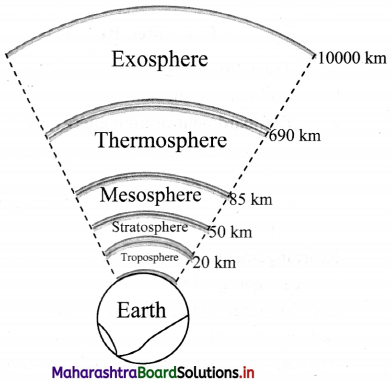
Draw a schematic structure of earth’s atmosphere describing different atmospheric layers.
Answer:
Maharashtra Board Class 11 Physics Important Questions Chapter 13 Electromagnetic Waves and Communication System 3

Question 42.
Draw a diagram showing different types of EM waves.
Answer:
Maharashtra Board Class 11 Physics Important Questions Chapter 13 Electromagnetic Waves and Communication System 4

Question 43.
Explain ground wave propagation.
Answer:

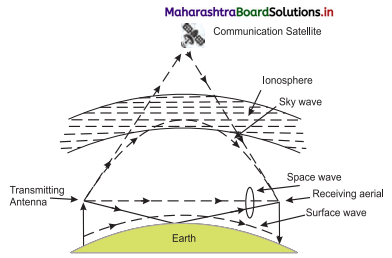
  1. When a radio wave from a transmitting antenna propagates near surface of the Earth so as to reach the receiving antenna, the wave propagation is called ground wave or surface wave propagation.
  2. In this mode, radio waves travel close to the surface of the Earth and move along its curved surface from transmitter to receiver.
  3. The radio waves induce currents in the ground and lose their energy by absorption. Therefore, the signal cannot be transmitted over large distances.
  4. Radio waves having frequency less than 2 MHz (in the medium frequency band) are transmitted by ground wave propagation.
  5. This is suitable for local broadcasting only. For TV or FM signals (very high frequency), ground wave propagation cannot be used.

Question 44.
Explain space wave propagation.
Answer:
i. When the radio waves from the transmitting antenna reach the receiving antenna either directly along a straight line (line of sight) or after reflection from the ground or satellite or after reflection from troposphere, the wave propagation is called space wave propagation.

ii. The radio waves reflected from troposphere are called tropospheric waves.

iii. Radio waves with frequency greater than 30 MHz can pass through the ionosphere (60 km – 1000 km) after suffering a small deviation. Hence, these waves cannot be transmitted by space wave propagation except by using a satellite.

iv. Also, for TV signals which have high frequency, transmission over long distance is not possible by means of space wave propagation.

Question 45.
Explain the concept of range of the signal.
Answer:
i. The maximum distance over which a signal can reach is called its range.

ii. For larger TV coverage, the height of the transmitting antenna should be as large as possible. This is the reason why the transmitting and receiving antennas are mounted on top of high rise buildings.

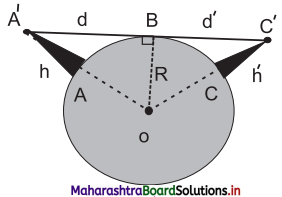
iii. Range is the straight line distance from the point of transmission (the top of the antenna) to the point on Earth where the wave will hit while travelling along a straight line.
Maharashtra Board Class 11 Physics Important Questions Chapter 13 Electromagnetic Waves and Communication System 5

iv. Let the height of the transmitting antenna (AA’) situated at A be h. B represents the point on the surface of the Earth at which the space wave hits the Earth.

v. The triangle OA’B is a right angled triangle. From ∆OA’ B,
(OA’)² = A’B² + OB²
(R + h)² = d² + R²
or R² + h² + 2Rh = d² + R² As
h << R, neglecting h²
d ≈ \(\sqrt{2Rh}\)

vi. The range can be increased by mounting the receiver at a height h’ say at a point C on the surface of the Earth. The range increases to d + d’ where d’ is 2Rh’. Thus
Total range = d + d’ = \(\sqrt{2Rh}\) + \(\sqrt{2Rh’}\)

Question 46.
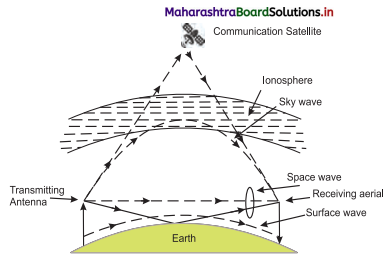
Explain sky wave propagation.
Answer:
Maharashtra Board Class 11 Physics Important Questions Chapter 13 Electromagnetic Waves and Communication System 6

  1. When radio waves from a transmitting antenna reach the receiving antenna after reflection in the ionosphere, the wave propagation is called sky wave propagation.
  2. The sky waves include waves of frequency between 3 MHz and 30 MHz.
  3. These waves can suffer multiple reflections between the ionosphere and the Earth. Therefore, they can be transmitted over large distances.

Question 47.
What is critical frequency?
Answer:
Critical frequency is the maximum value of the frequency of radio wave which can be reflected back to the Earth from the ionosphere when the waves are directed normally to ionosphere.

Question 48.
What is skip distance (zone)?
Answer:
Skip distance is the shortest distance from a transmitter measured along the surface of the Earth at which a sky wave of fixed frequency (if greater than critical frequency) will be returned to the Earth so that no sky waves can be received within the skip distance.

Maharashtra Board Class 11 Physics Important Questions Chapter 13 Electromagnetic Waves and Communication System

Question 49.
A radar has a power of 10 kW and is operating at a frequency of 20 GHz. It is located on the top of a hill of height 500 m. Calculate the maximum distance upto which it can detect object located on the surface of the Earth.
(Radius of Earth = 6.4 × 10⁶ m)
Answer:
Given: h = 500 m, R = 6.4 × 10⁶ m
To find: Maximum distance or range (d)
Formula: d = \(\sqrt{2Rh}\)
Calculation: From formula,
d = \(\sqrt{2Rh}\) = \(\sqrt{2×64×10^6×500}\)
= 8 × 104
= 80 km

Question 50.
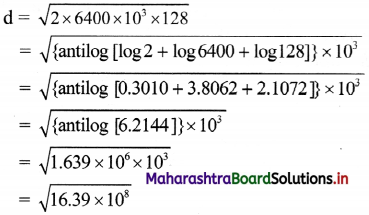
If the height of a TV transmitting antenna is 128 m, how much square area can be covered by the transmitted signal if the receiving antenna is at the ground level? (Radius of the Earth = 6400 km)
Answer:
Given: h = 128 m, R = 6400 km – 6400 × 10³ m
To find: Area covered (A)
Formulae: i. d = \(\sqrt{2Rh}\) ii. A = πd²
Calculation:
From formula (i),
Maharashtra Board Class 11 Physics Important Questions Chapter 13 Electromagnetic Waves and Communication System 7
= 4.048 × 104
= 40.48 km
From formula (ii).
Area covered = 3.142 × (40.48)²
= antilog [log 3.142 + 2log 40.48]
= antilog [0.4972 + 2(1.6073)]
= antilog [3.7118]
= 5.150 × 10³
= 5150 km²

Question 51.
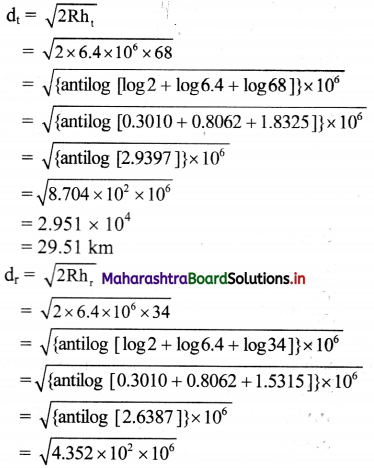
The height of a transmitting antenna is 68 m and the receiving antenna is at the top of a tower of height 34 m. Calculate the maximum distance between them for satisfactory transmission in line of sight mode. (Radius of Earth = 6400 km)
Answer:
Given: ht = 68 m, hr = 34 m,
R = 6400 km = 6.4 × 10⁶ m
To find: Maximum distance or range (d)
Formula: d = \(\sqrt{2Rh}\)
Calculation:
From formula,
Maharashtra Board Class 11 Physics Important Questions Chapter 13 Electromagnetic Waves and Communication System 8
= 2.086 × 104
= 20.86 km
d = dt + dr = 29.51 + 20.86 = 50.37 km

Question 52.
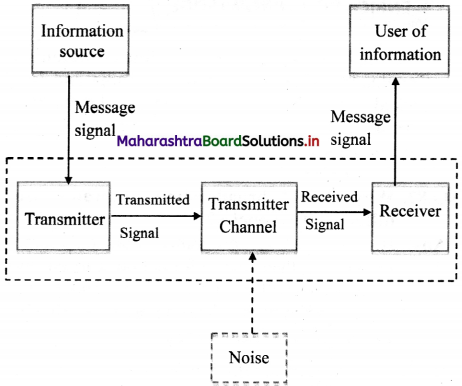
Explain block diagram of communication system.
Answer:
i. There are three basic (essential) elements of every communication system:

  1. Transmitter
  2. Communication channel
  3. Receiver

ii. In a communication system, the transmitter is located at one place and the receiver at another place.
Maharashtra Board Class 11 Physics Important Questions Chapter 13 Electromagnetic Waves and Communication System 9

iii. The communication channel is a passage through which signals transfer in between a transmitter and a receiver.

iv. This channel may be in the form of wires or cables, or may also be wireless, depending on the types of communication system.

Question 53.
What are the two different modes of communication?
Answer:
i. There are two basic modes of communication:
a. point to point communication
b. broadcast communication

ii. In point to point communication mode, communication takes place over a link between a single transmitter and a receiver e.g. telephony.

iii. In the broadcast mode, there are large number of receivers corresponding to the single transmitter e.g., Radio and Television transmission.

Maharashtra Board Class 11 Physics Important Questions Chapter 13 Electromagnetic Waves and Communication System

Question 54.
Explain the following terms:
i. Signal
ii. Analog signal
iii. Digital signal
iv. Transmitter
v. Transducer
vi. Receiver
vii. Attenuation
viii. Amplification
ix. Range
x. Repeater
Answer:
i. Signal: The information converted into electrical form that is suitable for transmission is called a signal. In a radio station, music and speech are converted into electrical form by a microphone for transmission into space. This electrical form of sound is the signal. A signal can be analog or digital.

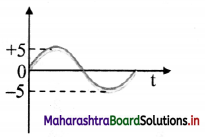
ii. Analog signal: A continuously varying signal (voltage or current) is called an analog signal. Since a wave is a fundamental analog signal, sound and picture signals in TV are analog in nature.
Maharashtra Board Class 11 Physics Important Questions Chapter 13 Electromagnetic Waves and Communication System 10

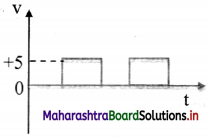
iii. Digital signal: A signal (voltage or current) that can have only two discrete values is called a digital signal. For example, a square wave is a digital signal. It has two values viz, +5 V and 0 V.
Maharashtra Board Class 11 Physics Important Questions Chapter 13 Electromagnetic Waves and Communication System 11

iv. Transmitter: A transmitter converts the signal produced by a source of information into a form suitable for transmission through a channel and subsequent reception.

v. Transducer: A device that converts one form of energy into another form of energy is called a transducer. For example, a microphone converts sound energy into electrical energy. Therefore, a microphone is a transducer. Similarly, a loudspeaker is a transducer which converts electrical energy into sound energy.

vi. Receiver: The receiver receives the message signal at the channel output, reconstructs it in recognizable form of the original message for delivering it to the user of information.

vii. Attenuation: The loss of strength of the signal while propagating through the channel is known as attenuation. It occurs because the channel distorts, reflects and refracts the signals as it passes through it.

viii. Amplification: Amplification is the process of raising the strength of a signal, using an electronic circuit called amplifier.

ix. Range: The maximum (largest) distance between a source and a destination up to which the signal can be received with sufficient strength is termed as range.

x. Repeater: It is a combination of a transmitter and a receiver. The receiver receives the signal from the transmitter, amplifies it and transmits it to the next repeater. Repeaters are used to increase the range of a communication system.

Question 55.
Explain the role of modulation.
Answer:

  1. Low frequency signals cannot be transmitted over large distances. Because of this, a high frequency wave, called a carrier wave, is used.
  2. Some characteristic (e.g. amplitude, frequency or phase) of this wave is changed in accordance with the amplitude of the signal. This process is known as modulation.
  3. Modulation also helps avoid mixing up of signals from different transmitters as different carrier wave frequencies can be allotted to different transmitters.
  4. Without the use of these waves, the audio signals, if transmitted directly by different transmitters, would have got mixed up.

Question 56.
Explain the different types of modulation.
Answer:

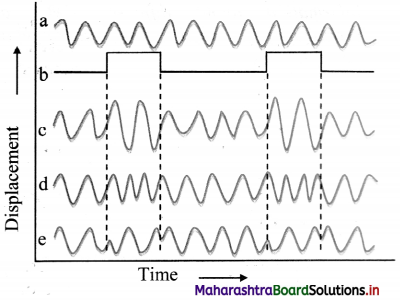
  1. Modulation can be done by modifying the amplitude (amplitude modulation), frequency (frequency modulation), and phase (phase modulation) of the carrier wave in proportion to the intensity of the signal wave keeping the other two properties same.
  2. The carrier wave is a high frequency wave while the signal is a low frequency wave.
  3. Waveform (a) in the figure shows a carrier wave and waveform (b) shows the signal.
  4. Amplitude modulation, frequency modulation and phase modulation of carrier waves are shown in waveforms (c), (d) and (e) respectively.
    Maharashtra Board Class 11 Physics Important Questions Chapter 13 Electromagnetic Waves and Communication System 12

Question 57.
State advantages and disadvantages of amplitude modulation.
Answer:
Advantages:

  1. It is simple to implement.
  2. It has large range.
  3. It is cheaper.

Disadvantages:

  1. It is not very efficient as far as power usage is concerned.
  2. It is prone to noise.
  3. The reproduced signal may not exactly match the original signal.

In spite of this, these are used for commercial broadcasting in the long, medium and short wave bands.

Question 58.
State uses and limitations of frequency modulation.
Answer:

  1. Frequency modulation (FM) is more complex as compared to amplitude modulation and, therefore is more difficult to implement.
  2. However, its main advantage is that it reproduces the original signal closely and is less susceptible to noise.
  3. This modulation is used for high quality broadcast transmission.

Maharashtra Board Class 11 Physics Important Questions Chapter 13 Electromagnetic Waves and Communication System

Question 59.
State benefits of phase modulation.
Answer:

  1. Phase modulation (PM) is easier than frequency modulation.
  2. It is used in determining the velocity of a moving target which cannot be done using frequency modulation.

Question 60.
Given below are some famous numbers associated with electromagnetic radiations in different contexts in physics. State the part of the electromagnetic spectrum to which each belongs.
i. 21 cm (wavelength emitted by atomic hydrogen in interstellar space).
ii. 1057 MHz (frequency of radiation arising from two close energy levels in hydrogen known as Lamb Shift).
iii. 5890 A – 5896 A [double lines of sodium]
Answer:
i. Radio waves (short wavelength or high frequency end)
ii. Radio waves (short wavelength or high frequency end)
iii. Visible region (yellow light)

Question 61.
Vidhya and Vijay were studying the effect of certain radiations on flower plants. Vidhya exposed her plants to UV rays and Vijay exposed his plants to infrared rays. After few days, Vidhya’s plants got damaged and Vijay’s plants had beautiful bloom. Why did this happen?
Answer:
Frequency of UV rays is greater than infrared rays, hence UV rays are much more energetic than infrared rays. Plants cannot tolerate the exposure of high energy rays. As a result, Vidhya’s plants got damaged and Vijay’s plants had a beautiful bloom.

Multiple Choice Questions

Question 1.
Which of the following type of radiations are radiated by an oscillating electric charge?
(A) Electric
(B) Magnetic
(C) Thermoelectric
(D) Electromagnetic
Answer:
(D) Electromagnetic

Question 2.
If \(\vec{E}\) and \(\vec{B}\) are the electric and magnetic field vectors of e.m. waves, then the direction of propagation of e.m. direction of wave is along the
(A) \(\vec{E}\)
(B) \(\vec{B}\)
(C) \(\vec{E}\) × \(\vec{B}\)
(D) \(\vec{E}\) • \(\vec{B}\)
Answer:
(C) \(\vec{E}\) × \(\vec{B}\)

Question 3.
The unit of expression µ0o ε0 is
(A) m / s
(B) m² / s²
(C) s² / m²
(D) s / m
Answer:
(C) s² / m²

Question 4.
According to Maxwell’s equation the velocity of light in any medium is expressed as
(A) \(\frac {1}{\sqrt{µ_0ε_0}}\)
(B) \(\frac {22}{\sqrt{µε}}\)
(C) \(\sqrt{\frac {µ}{ε}}\)
(D) \(\sqrt{\frac {µ_0}{ε}}\)
Answer:
(B) \(\frac {22}{\sqrt{µε}}\)

Question 5.
The electromagnetic waves do not transport.
(A) energy
(B) charge
(C) momentum
(D) pressure
Answer:
(B) charge

Question 6.
In an electromagnetic wave, the direction of the magnetic induction \(\vec{B}\) is
(A) parallel to the electric field \(\vec{E}\).
(B) perpendicular to the electric field \(\vec{E}\).
(C) antiparallel to the pointing vector \(\vec{S}\).
(D) random.
Answer:
(B) perpendicular to the electric field \(\vec{E}\).

Maharashtra Board Class 11 Physics Important Questions Chapter 13 Electromagnetic Waves and Communication System

Question 7.
Which of the following electromagnetic waves have the longest wavelength?
(A) heat waves
(B) light waves
(C) radio waves
(D) microwaves.
Answer:
(C) radio waves

Question 8.
Radio waves do not penetrate in the band of
(A) ionosphere
(B) mesosphere
(C) troposphere
(D) stratosphere
Answer:
(A) ionosphere

Question 9.
Which of the following electromagnetic wave has least wavelength?
(A) Gamma rays
(B) X- rays
(C) Radio waves
(D) microwaves
Answer:
(A) Gamma rays

Question 10.
If E is an electric field and \(\vec{B}\) is the magnetic induction, then the energy flow per unit area per unit time in an electromagnetic field is given by
(A) \(\frac {1}{µ_0}\) \(\vec{E}\) × \(\vec{B}\)
(B) \(\vec{E}\).\(\vec{B}\)
(C) E² + B²
(D) \(\frac {E}{B}\)
Answer:
(A) \(\frac {1}{µ_0}\) \(\vec{E}\) × \(\vec{B}\)

Question 11.
Out of the X-rays, microwaves, ultra-violet rays, the shortest frequency wave is ……………
(A) X-rays
(B) microwaves
(C) ultra-violet rays
(D) γ-rays
Answer:
(B) microwaves

Question 12.
The part of electromagnetic spectrum used in operating radar is ……………
(A) y-rays
(B) visible rays
(C) infra-red rays
(D) microwaves
Answer:
(D) microwaves

Question 13.
The correct sequence of descending order of wavelength values of the given radiation source is …………..
(A) radio waves, microwaves, infra-red, γ- rays
(B) γ-rays, infra-red, radio waves, microwaves
(C) Infra-red, radio waves, microwaves, γ- rays
(D) microwaves, γ-rays, infra-red, radio waves
Answer:
(A) radio waves, microwaves, infra-red, γ- rays

Question 14.
The nuclei of atoms of radioactive elements produce ……………
(A) X-rays
(B) γ-rays
(C) microwaves
(D) ultra-violet rays
Answer:
(B) γ-rays

Question 15.
The electronic transition in atom produces
(A) ultra violet light
(B) visible light
(C) infra-red rays
(D) microwaves
Answer:
(B) visible light

Question 16.
When radio waves from transmitting antenna reach the receiving antenna directly or after reflection in the ionosphere, the wave propagation is called ………………
(A) ground wave propagation
(B) space wave propagation
(C) sky wave propagation
(D) satellite propagation
Answer:
(C) sky wave propagation

Question 17.
Basic components of a transmitter are ……………..
(A) message signal generator and antenna
(B) modulator and antenna
(C) signal generator and modulator
(D) message signal generator, modulator and antenna
Answer:
(D) message signal generator, modulator and antenna

Question 18.
The process of changing some characteristics of a carrier wave in accordance with the incoming signal is called …………..
(A) amplification
(B) modulation
(C) rectification
(D) demodulation
Answer:
(B) modulation

Maharashtra Board Class 11 Physics Important Questions Chapter 13 Electromagnetic Waves and Communication System

Question 19.
The process of superimposing a low frequency signal on a high frequency wave is …………….
(A) detection
(B) mixing
(C) modulation
(D) attenuation
Answer:
(C) modulation

Question 20.
A device that converts one form of energy into another form is termed as ……………
(A) transducer
(B) transmitter
(C) amplifier
(D) receiver
Answer:
(A) transducer

Question 21.
A microphone which converts sound into electrical signal is an example of .
(A) a thermistor
(B) a rectifier
(C) a modulator
(D) an electrical transducer
Answer:
(D) an electrical transducer

Question 22.
The process of regaining of information from carries wave at the receiver is called
(A) modulation
(B) transmission
(C) propagation
(D) demodulation
Answer:
(D) demodulation

Question 23.
Range of communication can be increased by
(A) increasing the heights of transmitting and receiving antennas.
(B) decreasing the heights of transmitting and receiving antennas.
(C) increasing height of transmitting antenna and decreasing the height of receiving antenna.
(D) increasing height of receiving antenna only.
Answer:
(A) increasing the heights of transmitting and receiving antennas.

Question 24
Ionosphere mainly consists of
(A) positive ions and electrons
(B) water vapour and smoke
(C) ozone layer
(D) dust particles
Answer:
(A) positive ions and electrons

Question 25.
The reflected waves from the ionosphere are
(A) ground waves.
(B) sky waves.
(C) space waves.
(D) very high frequency waves.
Answer:
(B) sky waves.

Question 26.
Communication is the process of
(A) keeping in touch.
(B) exchanging information.
(C) broadcasting.
(D) entertainment.
Answer:
(B) exchanging information.

Question 27.
The message fed to the transmitter are generally
(A) radio signals
(B) audio signals
(C) both (A) and (B)
(D) optical signals
Answer:
(B) audio signals

Question 28.
Line of sight propagation is also called as ……………. propagation.
(A) sky wave
(B) ground wave
(C) sound wave
(D) space wave
Answer:
(D) space wave

Question 29.
The ozone layer in the atmosphere absorbs
(A) only the radio waves.
(B) only the visible light.
(C) only the y rays.
(D) X-rays and ultraviolet rays.
Answer:
(D) X-rays and ultraviolet rays.

Question 30.
Modem communication systems consist of
(A) electronic systems
(B) electrical system
(C) optical system
(D) all of these
Answer:
(D) all of these

Question 31.
What determines the absorption of radio waves by the atmosphere?
(A) Frequency .
(B) Polarisation
(C) Interference
(D) Distance of receiver
Answer:
(A) Frequency .

Question 32.
The portion of the atmosphere closest to the earth’s surface is ……………
(A) troposphere
(B) stratosphere
(C) mesosphere
(D) ionosphere
Answer:
(A) troposphere

Maharashtra Board Class 11 Physics Important Questions Chapter 13 Electromagnetic Waves and Communication System

Question 33.
An antenna behaves as resonant circuit only when its length is ………………
(A) λ/2
(B) λ/4
(C) λ
(D) n λ/2
Answer:
(D) n λ/2

Question 34.
Space wave travels through …………………
(A) ionosphere
(B) mesosphere
(C) troposphere
(D) stratosphere
Answer:
(C) troposphere

Question 35.
Transmission lines start radiating
(A) at low frequencies
(B) at high frequencies.
(C) at both high and low frequencies.
(D) none of the above.
Answer:
(B) at high frequencies.

Question 36.
If ‘ht‘ and ‘hr’ are height of transmitting and receiving antennae and ‘R’ is radius of the earth, the range of space wave is
(A) \(\sqrt {2R}\) (ht + hr)
(B) 2R \(\sqrt {(ht + hr)}\)
(C) \(\sqrt {2R(ht + hr)}\)
(D) \(\sqrt {2R}\) (√ht + √hr)
Answer:
(D) \(\sqrt {2R}\) (√ht + √hr)

Question 37.
In a communication system, noise is most likely to affect the signal ………..
(A) at the transmitter
(B) in the transmission medium
(C) in the information source
(D) at the destination
Answer:
(B) in the transmission medium

Question 38.
The power radiated by linear antenna of length 7’ is proportional to (A = wavelength)
(A) \(\frac {λ}{l}\)
(B) (\(\frac {λ}{l}\))²
(C) \(\frac {l}{λ}\)
(D) (\(\frac {l}{λ}\))²
Answer:
(D) (\(\frac {l}{λ}\))²

Question 39.
For efficient radiation and reception of signal with wavelength λ, the transmitting antennas would have length comparable to ……………….
(A) λ of frequency used
(B) λ/2 of frequency used
(C) λ/3 of frequency used
(D) λ/4 of frequency used
Answer:
(A) λ of frequency used

Maharashtra Board Class 11 Physics Important Questions Chapter 14 Semiconductors

Balbharti Maharashtra State Board 11th Physics Important Questions Chapter 14 Semiconductors Important Questions and Answers.

Maharashtra State Board 11th Physics Important Questions Chapter 14 Semiconductors

Question 1.
What are the factors on which electrical conductivity of any solid depends?
Answer:
Electrical conduction in a solid depends on its temperature, the number of charge carriers, how easily these carries can move inside a solid (mobility), its crystal structure, types and the nature of defects present in a solid.

Question 2.
Why are metals good conductor of electricity?
Answer:
Metals are good conductors of electricity due to the large number of free electrons (≈ 1028 per m³) present in them.

Maharashtra Board Class 11 Physics Important Questions Chapter 14 Semiconductors

Question 3.
Give the formula for electrical conductivity of a solid and give significance of the terms involved.
Answer:
Electrical conductivity (σ) of a solid is given by a = nqµ,
where, n = charge carrier density (number of charge carriers per unit volume)
q = charge on the carriers
µ = mobility of carriers

Question 4.
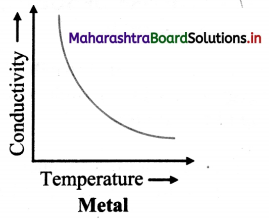
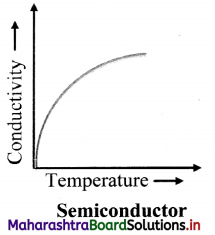
Explain in brief temperature dependence of electrical conductivity of metals and semiconductors with the help of graph.
Answer:
i. The electrical conductivity of a metal decreases with increase in its temperature.
Maharashtra Board Class 11 Physics Important Questions Chapter 14 Semiconductors 1

ii. When the temperature of a semiconductor is increased, its electrical conductivity also increases
Maharashtra Board Class 11 Physics Important Questions Chapter 14 Semiconductors 2

Question 5.
Mention the broad classification of semiconductors along with examples.
Answer:
A broad classification of semiconductors can be:

  1. Elemental semiconductors: Silicon, germanium
  2. Compound Semiconductors: Cadmium sulphide, zinc sulphide, etc.
  3. Organic Semiconductors: Anthracene, doped pthalocyanines, polyaniline etc.

Question 6.
What are some electrical properties of semiconductors?
Answer:

  1. Electrical properties of semiconductors are different from metals and insulators due to their unique conduction mechanism.
  2. The electronic configuration of the elemental semiconductors plays a very important role in their electrical properties.
  3. They are from the fourth group of elements in the periodic table.
  4. They have a valence of four.
  5. Their atoms are bonded by covalent bonds. At absolute zero temperature, all the covalent bonds are completely satisfied in a single crystal of pure semiconductor like silicon or germanium.

Question 7.
Explain in detail the distribution of electron energy levels in an isolated atom with the help of an example.
Answer:

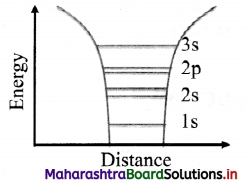
  1. An isolated atom has its nucleus at the centre which is surrounded by a number of revolving electrons. These electrons are arranged in different and discrete energy levels.
  2. Consider the electronic configuration of sodium (atomic number 11) i.e, 1s², 2s², 2p6, 3s1. The outermost level 3s can take one more electron but it is half filled in sodium,
  3. The energy levels in each atom are filled according to Pauli’s exclusion principle which states that no two similar spin electrons can occupy the same energy level.
  4. That means any energy level can accommodate only two electrons (one with spin up state and the other with spin down state)
  5. Thus, there can be two states per energy level.
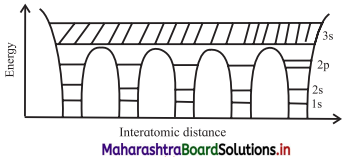
  6. Figure given below shows the allowed energy levels of a sodium atom by horizontal lines. The curved lines represent the potential energy of an electron near the nucleus due to Coulomb interaction.
    Maharashtra Board Class 11 Physics Important Questions Chapter 14 Semiconductors 3

Question 8.
Explain formation of energy bands in solid sodium with neat labelled energy band diagrams.
Answer:
i. For an isolated sodium atom (atomic number 11) the electronic configuration is given as 1s², 2s², 2p6, 3s1. The outermost level 3s is half filled in sodium.

ii. The energy levels are filled according to Pauli’s exclusion principle.

iii. Consider two sodium atoms close enough so that outer 3s electrons can be considered equally to be part of any atom.

iv. The 3s electrons from both the sodium atoms need to be accommodated in the same level.

v. This is made possible by splitting the 3 s level into two sub-levels so that the Pauli’s exclusion principle is not violated. Figure given below shows the splitting of the 3 s level into two sub levels.
Maharashtra Board Class 11 Physics Important Questions Chapter 14 Semiconductors 4

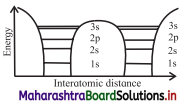
vi. When solid sodium is formed, the atoms come close to each other such that distance between them remains of the order of 2 – 3 Å. Therefore, the electrons from different atoms interact with each other and also with the neighbouring atomic cores.

vii. The interaction between the outer most electrons is more due to overlap while the inner most electrons remain mostly unaffected. Each of these energy levels is split into a large number of sub levels, of the order of Avogadro’s number due to number of atoms in solid sodium is of the order of this number.

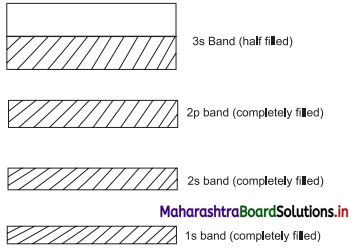
viii. The separation between the sublevels is so small that the energy levels appear almost continuous. This continuum of energy levels is called an energy band. The bands are called 1 s band, 2s band, 2p band and so on. Figure shows these bands in sodium metal.
Maharashtra Board Class 11 Physics Important Questions Chapter 14 Semiconductors 5

Question 9.
Explain concept of valence band and conduction band in solid crystal.
Answer:
A. Valence band (V.B):

  1. The topmost occupied energy level in an atom is the valence level. The energy band formed by valence energy levels of atoms in a solid is called the valence band.
  2. In metallic conductors, the valence electrons are loosely attached to the nucleus. At ordinary room temperature, some valence electrons become free. They do not leave the metal surface but can move from atom to atom randomly.
  3. Such free electrons are responsible for electric current through conductors.

B. Conduction band (C.B):

  1. The immediately next energy level that electrons from valence band can occupy is called conduction level. The band formed by conduction levels is called conduction band.
  2. It is the next permitted energy band beyond valence band.
  3. In conduction band, electrons move freely and conduct electric current through the solids.
  4. An insulator has empty conduction band.

Question 10.
Draw neat labelled diagram showing energy bands in sodium. Why broadening of higher bands is different than that of the lower energy bands?
Answer:
Maharashtra Board Class 11 Physics Important Questions Chapter 14 Semiconductors 6
Broadening of valence and higher bands is more since interaction of these electrons is stronger than the inner most electrons.

Question 11.
State the conditions when electrons of a semiconductor can take part in conduction.
Answer:

  1. All the energy levels in a band, including the topmost band, in a semiconductor are completely occupied at absolute zero.
  2. At some finite temperature T, few electrons gain thermal energy of the order of kT, where k is the Boltzmann constant.
  3. Electrons in the bands between the valence band cannot move to higher band since these are already occupied.
  4. Only electrons from the valence band can be excited to the empty conduction band, if the thermal energy gained by these electrons is greater than the band gap.
  5. Electrons can also gain energy when an external electric field is applied to a solid. Energy gained due to electric field is smaller, hence only electrons at the topmost energy level gain such energy and participate in electrical conduction.

Maharashtra Board Class 11 Physics Important Questions Chapter 14 Semiconductors

Question 12.
Define 1 eV.
Answer:
1 eV is the energy gained by an electron while it overcomes a potential difference of one volt. 1 eV= 1.6 × 10⁻¹⁹ J.

Question 13.
C, Si and Ge have same lattice structure. Why is C insulator while Si and Ge intrinsic semiconductors?
Answer:

  1. The 4 valence electrons of C, Si or Ge lie respectively in the second, third and fourth orbit.
  2. Energy required to take out an electron from these atoms (i.e., ionisation energy Eg) will be least for Ge, followed by Si and highest for C.
  3. Hence, number of free electrons for conduction in Ge and Si are significant but negligibly small for

Question 14.
What is intrinsic semiconductor?
Answer:
A pure semiconductor is blown as intrinsic semiconductor.

Question 15.
Explain characteristics and structure of silicon using a neat labelled diagram.
Answer:

  1. Silicon (Si) has atomic number 14 and its electronic configuration is 1s² 2s² 2p6 3s² 3p².
  2. Its valence is 4.
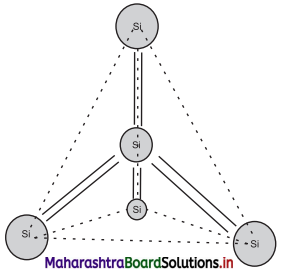
  3. Each atom of Si forms four covalent bonds with its neighbouring atoms. One Si atom is surrounded by four Si atoms at the comers of a regular tetrahedron as shown in the figure.
    Maharashtra Board Class 11 Physics Important Questions Chapter 14 Semiconductors 7

Question 16.
Describe in detail formation of holes in ii. intrinsic semiconductor.
Answer:
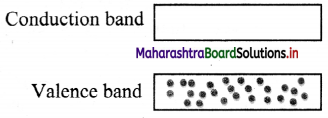
i. In intrinsic semiconductor at absolute zero temperature, all valence electrons are tightly bound to respective atoms and the covalent bonds are complete.

ii. Electrons are not available to conduct electricity through the crystal because they cannot gain enough energy to get into higher energy levels.
Maharashtra Board Class 11 Physics Important Questions Chapter 14 Semiconductors 8

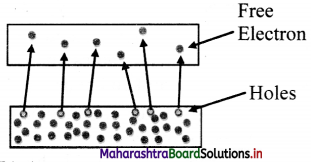
iii. At room temperature, however, a few covalent bonds are broken due to heat energy produced by random motion of atoms. Some of the valence electrons can be moved to the conduction band. This creates a vacancy in the valence band as shown in figure.
Maharashtra Board Class 11 Physics Important Questions Chapter 14 Semiconductors 9

iv. These vacancies of electrons in the valence band are called holes. The holes are thus absence of electrons in the valence band and they carry an effective positive charge.

Question 17.
How does electric conduction take place inside a pure silicon?
Answer:

  1. There are two different types of charge carriers in a pure semiconductor. One is the electron and the other is the hole or absence of electron.
  2. Electrical conduction takes place by transportation of both carriers or any one of the two carriers in a semiconductor.
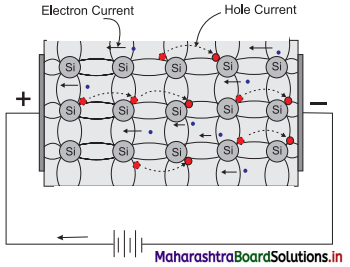
  3. When a semiconductor is connected in a circuit, electrons, being negatively charged, move towards positive terminal of the battery.
  4. Holes have an effective positive charge, and move towards negative terminal of the battery. Thus, the current through a semiconductor is carried by two types of charge carriers moving in opposite directions.
  5. Figure given below represents the current through a pure silicon.
    Maharashtra Board Class 11 Physics Important Questions Chapter 14 Semiconductors 10

Question 18.
Why do holes not exist in conductor?
Answer:

  1. In case of semiconductors, there is one missing electron from one of the covalent bonds.
  2. The absence of electron leaves an empty space called as hole; each hole carries an effective positive charge.
  3. In case of an conductor, number of free electrons are always available for conduction. There is no absence of electron in it. Hence holes do not exist in conductor.

Question 19.
What is the need for doping an intrinsic semiconductor?
Answer:
The electric conductivity of an intrinsic semiconductor is very low at room temperature; hence no electronic devices can be fabricated using them. Addition of a small amount of a suitable impurity to an intrinsic semiconductor increases its conductivity appreciably. Hence, intrinsic semiconductors are doped with impurities.

Question 20.
Explain what is doping.
Answer:

  1. The process of adding impurities to an intrinsic semiconductor is called doping.
  2. The impurity atoms are called dopants which may be either trivalent or pentavalent. The parent atoms are called hosts.
  3. The dopant material is so selected that it does not disturb the crystal structure of the host.
  4. The size and the electronic configuration of the dopant should be compatible with that of the host.
  5. Doping is expressed in ppm (parts per million), i.e., one impurity atom per one million atoms of the host.
  6. Doping significantly increases the concentration of charge carriers.

Question 21.
What is extrinsic semiconductors?
Answer:
The semiconductor with impurity is called a doped semiconductor or an extrinsic semiconductor.

Question 22.
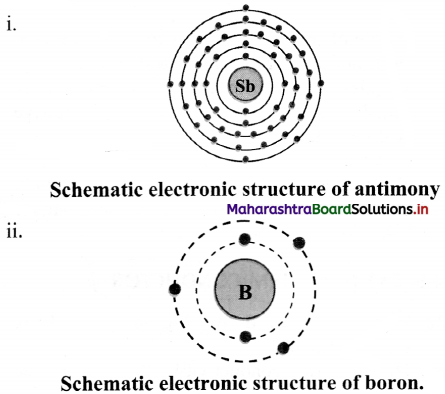
Draw neat diagrams showing schematic electronic structure of:
i. A pentavalent atom [Antimony (Sb)]
ii. A trivalent atom [Boron (B)]
Answer:
Maharashtra Board Class 11 Physics Important Questions Chapter 14 Semiconductors 11
[Note: Electronic structure of antimony is drawn as per its electronic configuration in accordance with Modern Periodic Table.]

Question 23.
With the help of neat diagram, explain the structure of n-type semiconductor in detail.
Answer:
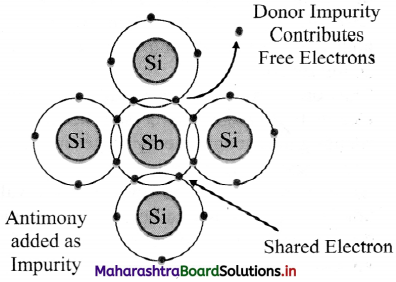
i. When silicon or germanium crystal is doped with a pentavalent impurity such as phosphorus, arsenic, or antimony we get n-type semiconductor.

ii. When a dopant atom of 5 valence electrons occupies the position of a Si atom in the crystal lattice, 4 electrons from the dopant form bonds with 4 neighbouring Si atoms and the fifth electron from the dopant remains very weakly bound to its parent atom
Maharashtra Board Class 11 Physics Important Questions Chapter 14 Semiconductors 12

iii. To make this electron free even at room temperature, very small energy is required. It is 0.01 eV for Ge and 0.05 eV for Si.

iv. As this semiconductor has large number of electrons in conduction band and its conductivity is due to negatively charged carriers, it is called n-type semiconductor.

v. The n-type semiconductor also has a few electrons and holes produced due to the thermally broken bonds.

vi. The density of conduction electrons (ne) in a doped semiconductor is the sum total of the electrons contributed by donors and the thermally generated electrons from the host.

vii. The density of holes (nh) is only due to the thermally generated holes of the host Si atoms.

viii. Thus, the number of free electrons exceeds the number of holes (ne >> nh). Thus, in n-type semiconductor electrons are the majority carriers and holes are the minority carriers.

Maharashtra Board Class 11 Physics Important Questions Chapter 14 Semiconductors

Question 24.
What are some features of n-type semiconductor?
Answer:

  1. These are materials doped with pentavalent impurity (donors) atoms.
  2. Electrical conduction in these materials is due to majority charge carriers i.e., electrons.
  3. The donor atom loses electrons and becomes positively charged ions.
  4. Number of free electrons is very large compared to the number of holes, ne >> nh. Electrons are majority charge carriers.
  5. When energy is supplied externally, negatively charged free electrons (majority charges carries) and positively charged holes (minority charges carries) are available for conduction.

Question 25.
With the help of neat diagram, explain the structure of p-type semiconductor in detail.
Answer:
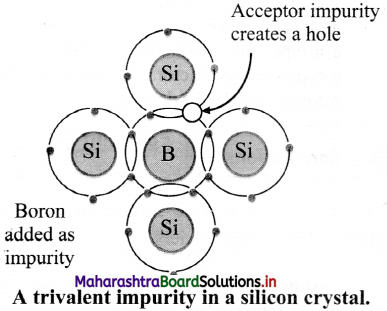
i. When silicon or germanium crystal is doped with a trivalent impurity such as boron, aluminium or indium, we get a p-type semiconductor.

ii. The dopant trivalent atom has one valence electron less than that of a silicon atom. Every trivalent dopant atom shares its three electrons with three neighbouring Si atoms to form covalent bonds. But the fourth bond between silicon atom and its neighbour is not complete.

iii. The incomplete bond can be completed by another electron in the neighbourhood from Si atom.

iv. The shared electron creates a vacancy in its place. This vacancy or the absence of electron is a hole.
Maharashtra Board Class 11 Physics Important Questions Chapter 14 Semiconductors 13

v. Thus, a hole is available for conduction from each acceptor impurity atom.

vi. Holes are majority carriers and electrons are minority carriers in such materials. Acceptor atoms are negatively charged ions and majority carriers are holes. Therefore, extrinsic semiconductor doped with trivalent impurity is called a p-type semiconductor.

vii. For a p-type semiconductor, nh >> ne.

Question 26.
What are some features of p-type semiconductors?
Answer:

  1. These are materials doped with trivalent impurity atoms (acceptors).
  2. Electrical conduction in these materials is due to majority charge carriers i.e., holes.
  3. The acceptor atoms acquire electron and become negatively charged-ions.
  4. Number of holes is very large compared to the number of free electrons. nh >> ne. Holes are majority charge carriers.
  5. When energy is supplied externally, positively charged holes (majority charge carriers) and negatively charged free electrons (minority charge carriers) are available for conduction.

Question 27.
What are donor and acceptor impurities?
Answer:

  1. Every pentavalent dopant atom which donates one electron for conduction is called a donor impurity.
  2. Each trivalent atom which can accept an electron is called an acceptor impurity.

Question 28.
Explain the energy levels of both donor and acceptor impurities with a schematic band structure.
Answer:
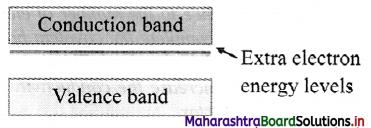
i. The free electrons donated by the donor impurity atoms occupy energy levels which are in the band gap and are close to the conduction band.
Maharashtra Board Class 11 Physics Important Questions Chapter 14 Semiconductors 14

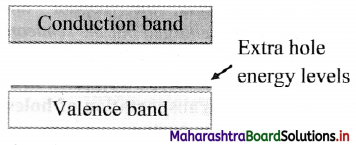
ii. The vacancies of electrons or the extra holes are created in the valence band due to addition of acceptor impurities. The impurity levels are created just above the valence band in the band gap.
Maharashtra Board Class 11 Physics Important Questions Chapter 14 Semiconductors 15

Question 29.
Distinguish between p-type and n-type semiconductor.
Answer:

p-type semiconductor n-type semiconductor
1. The impurity of some trivalent element like B, Al, In, etc. is mixed with semiconductor. The impurity of some pentavalent element like P, As, Sb, etc. is mixed
2. The impurity atom accepts one electron hence the impurities The impurity atom donates – one electron, hence the impurities added are known as donor impurities.
3. The holes are majority charge carriers and electrons are minority charge carriers. The electrons are j majority charge carriers and holes are minority charge carriers.
4. The acceptor energy level is close to the valence band and far away from conduction band. Donor energy level is close to the conduction band and far away from valence band.

Question 30.
What is the charge on a p-type and n-type semiconductor?
Answer:
n-type as well as p-type semiconductors are electrically neutral.

Question 31.
Explain the transportation of holes inside a p-type semiconductor.
Answer:
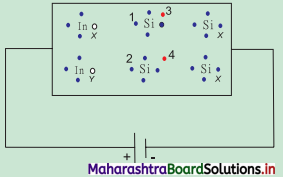
i. Consider a p-type semiconductor connected to terminals of a battery as shown.

ii. When the circuit is switched on, electrons at 1 and 2 are attracted to the positive terminal of the battery and occupy nearby holes at x and y. This creates holes at the positions 1 and 2 previously occupied by electrons.
Maharashtra Board Class 11 Physics Important Questions Chapter 14 Semiconductors 16

iii. Next, electrons at 3 and 4 move towards the positive terminal and create holes in their previous positions.

iv. But, the holes are captured at the negative terminal by the electrons supplied by the battery.

v. In this way, holes are transported from one place to other and density of holes is kept constant so long as the battery is working.

Question 32.
A pure Si crystal has 4 × 1028 atoms m-3. It is doped by 1 ppm concentration of antimony. Calculate the number of electrons and holes. Given n1 = 1.2 × 10¹⁶/m³.
Answer:
As, the atom is doped with 1 ppm concentration of antimony (Sb).
1 ppm = 1 parts per one million atoms. = 1/106
∴ no. of Si atoms = \(\frac {Total no. of Si atoms}{10^6}\)
= \(\frac {4×10^{28}}{10^6}\) = 4 × 10²² m-3
i.e., total no. of extra free electrons (ne)
= 4 × 10²² m-3
ni2 = ne nh
∴ nh = \(\frac {n_i^2}{n_e}\) = \(\frac {(1.2×10^{16})^2}{4×10^{22}}\)
= \(\frac {144×10^{30}{4×10^{22}}\)
= 36 × 10-8
= 3.6 × 10⁹ m-3.

Question 33.
A pure silicon crystal at temperature of 300 K has electron and hole concentration 1.5 × 10¹⁶ m-3 each. (ne = nh). Doping bv indium increases nh to 4.5 × 10²² m-3. Calculate ne for the doped silicon crystal.
Answer:
Given: At 300 K, ni = ne = nh = 1.5 × 10¹⁶ m-3
After doping nh = 4.5 × 10²² m-3
To find: Number density of electrons (ne)
Formula: ni² = ne nnh
Calculation From formula:
ne = \(\frac {n_i^2}{n_h}\) = \(\frac {(1.5×10^{16})^2}{4×10^{22}}\)
= \(\frac {255×10^{30}{45×10^{21}}\)
= 5 × 10⁻⁹ m-3.

Maharashtra Board Class 11 Physics Important Questions Chapter 14 Semiconductors

Question 34.
A Ge specimen is doped with A/. The concentration of acceptor atoms is ~1021 atoms/m³. Given that the intrinsic concentration of electron-hole pairs is ~10 19/m³, calculate the concentration of electrons in the specimen.
Answer:
Given: At room temperature,
ni = ne = nh = 1019 m-3
After doping nh = 1021 m-3
To find: Number density of electrons (nc)
Formulae: ni2 = nenh
Calculation: From formula,
ne = \(\frac {n_i^2}{n_h}\) = \(\frac {(10^{19})^2}{10^{21}}\)
= \(\frac {255×10^{30}{45×10^{21}}\)
= 1017 m-3.

Question 35.
A semiconductor has equal electron and hole concentration of 2 × 10⁸ m-3. On doping with a certain impurity, the electron concentration increases to 4 × 10¹⁰ m-3, then calculate the new hole concentration of the semiconductor.
Answer:
Given: ni = 2 × 10⁸ m-3, n = 4 × 10¹⁰ m-3
After doping nh = 1021 m-3
To find: Number density of holes (nh)
Formulae: ni 2= nenh
Calculation: From formula.
nh = \(\frac {n_i^2}{n_e}\) = \(\frac {(2×10^{8})^2}{4×10^{10}}\) = 106 m-3

Question 36.
What is a p-n junction?
Answer:
When n-type and p-type semiconductor materials are fused together, the junction formed is called as p-n junction.

Question 37.
Explain the process of diffusion in p-n junction.
Answer:
i. The transfer of electrons and holes across the p-n junction is called diffusion.

ii. When an n-type and a p-type semiconductor materials are fused together, initially, the number of electrons in the n-side of a junction is very large compared to the number of electrons on the p-side. The same is true for the number of holes on the p-side and on the n-side.

iii. Thus, a large difference in density of carriers exists on both sides of the p-n junction. This difference causes migration of electrons from the n-side to the p-side of the
Maharashtra Board Class 11 Physics Important Questions Chapter 14 Semiconductors 17

iv. They fill up the holes in the p-type material and produce negative ions.

v. When the electrons from the n-side of a junction migrate to the p-side, they leave behind positively charged donor ions on the n- side. Effectively, holes from the p-side migrate into the n-region.

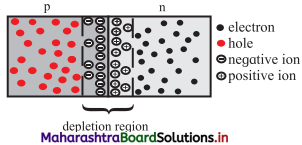
vi. As a result, in the p-type region near the junction there are negatively charged acceptor ions, and in the n-type region near the junction there are positively charged donor ions.

vii. The extent up to which the electrons and the holes can diffuse across the junction depends on the density of the donor and the acceptor ions on the n-side and the p-side respectively, of the junction.

Question 38.
Define potential barrier.
Answer:
The diffusion of carriers across the junction and resultant accumulation of positive and negative charges across the junction builds a potential difference across the junction. This potential difference is called the potential barrier.

Question 39.
Draw neat labelled diagrams for potentials barrier and depletion layer in a p-n junction.
Answer:
Maharashtra Board Class 11 Physics Important Questions Chapter 14 Semiconductors 18

Question 40.
Explain in brief electric field across a p-n junction with a neat labelled diagram.
Answer:

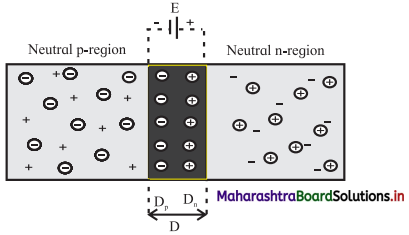
  1. When p-type semiconductor is fused with n-type semiconductor, a depletion region is developed across the junction.
  2. The n-side near the boundary of a p-n junction becomes positive with respect to the p-side because it has lost electrons and the p-side has lost holes.
  3. Thus, the presence of impurity ions on both sides of the junction establishes an electric field across this region such that the n-side is at a positive voltage relative to the p-side.
    Maharashtra Board Class 11 Physics Important Questions Chapter 14 Semiconductors 19

Question 41.
What is the need of biasing a p-n junction?
Answer:

  1. Due to potential barrier across depletion region, charge carriers require extra energy to overcome the barrier.
  2. A suitable voltage needs to be applied to the junction externally, so that these charge carriers can overcome the potential barrier and move across the junction.

Question 41.
Explain the mechanism of forward biased p-n junction.
Answer:

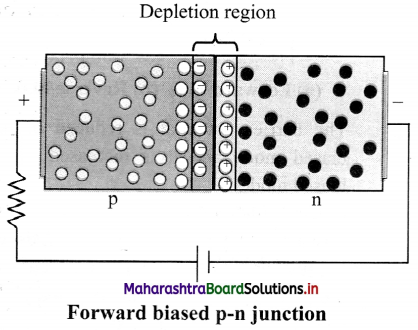
  1. In forward bias, a p-n junction is connected in an electric circuit such that the p-region is connected to the positive terminal and the n-region is connected to the negative terminal of an external voltage source.
  2. The external voltage effectively opposes the built-in potential of the junction. The width of potential barrier is thus reduced.
  3. Also, negative charge carriers (electrons) from the n-region are pushed towards the junction.
  4. A similar effect is experienced by positive charge carriers (holes) in the p-region and they are pushed towards the junction.
  5. Both the charge carriers thus find it easy to cross over the barrier and contribute towards the electric current.
    Maharashtra Board Class 11 Physics Important Questions Chapter 14 Semiconductors 20

Question 42.
Explain the mechanism of reverse biased p-n junction.
Answer:
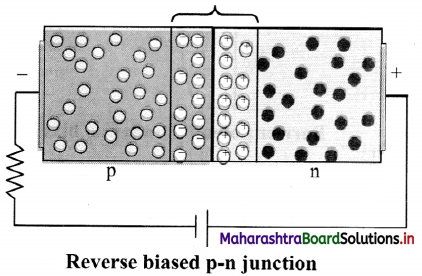
i. In reverse biased, the p-region is connected to the negative terminal and the n-region is connected to the positive terminal of the external voltage source. This external voltage effectively adds to the built-in potential of the junction. The width of potential barrier is thus increased.

ii. Also, the negative charge carriers (electrons) from the n-region are pulled away from the junction.

iii. Similar effect is experienced by the positive charge carriers (holes) in the p-region and they are pulled away from the junction.

iv. Both the charge carriers thus find it very difficult to cross over the barrier and thus do not contribute towards the electric current.
Maharashtra Board Class 11 Physics Important Questions Chapter 14 Semiconductors 21

Question 43.
State some important features of the depletion region.
Answer:

  1. It is formed by diffusion of electrons from n-region to the p-region. This leaves positively charged ions in the n-region.
  2. The p-region accumulates electrons (negative charges) and the n-region accumulates the holes (positive charges).
  3. The accumulation of charges on either sides of the junction results in forming a potential barrier and prevents flow of charges.
  4. There are no charges in this region.
  5. The depletion region has higher potential on the n-side and lower potential on the p-side of the junction.

Maharashtra Board Class 11 Physics Important Questions Chapter 14 Semiconductors

Question 44.
What is p-n junction diode? Draw its circuit symbol.
Answer:
A p-n junction, when provided with metallic connectors on each side is called a junction diode
Maharashtra Board Class 11 Physics Important Questions Chapter 14 Semiconductors 22

Question 45.
Explain asymmetrical flow of current in p-n junction diode in detail.
Answer:
Maharashtra Board Class 11 Physics Important Questions Chapter 14 Semiconductors 23
i. The barrier potential is reduced in forward biased mode and it is increased in reverse biased mode.

ii. Carriers find it easy to cross the junction in forward bias and contribute towards current because the barrier width is reduced and they are pushed towards the junction and gain extra energy to cross the junction.

iii. The current through the diode in forward bias is large and of the order of a few milliamperes (10-3 A) for a typical diode.

iv. When connected in reverse bias, width of the potential barrier is increased and the carriers are pushed away from the junction so that very few carriers can cross the junction and contribute towards current.

v. This results in a very small current through a reverse biased diode. The current in reverse biased diode is of the order of a few microamperes (10-6 A).

vi. When the polarity of bias voltage is reversed, the width of the depletion layer changes. This results in asymmetrical current flow through a diode as shown in figure.
Maharashtra Board Class 11 Physics Important Questions Chapter 14 Semiconductors 24

Question 46.
What is knee voltage?
Answer:
In forward bias mode, the voltage for which the current in a p-n junction diode rises sharply is called knee voltage.

Question 47.
What is a forward current in case of zero biased p-n junction diode?
Answer:
When the diode terminals are shorted together, some holes (majority carriers) in the p-side have enough thermal energy to overcome the potential barrier. Such carriers cross the barrier potential and contribute to current. This current is known as the forward current.

Question 48.
Define reverse current in zero biased p-n junction diode.
Answer:
When the diode terminals are shorted together some holes generated in the n-side (minority carriers), move across the junction and contribute to current. This current is known as the reverse current.

Question 49.
Explain the I-V characteristics of a reverse biased junction diode.
Answer:
i. The positive terminal of the external voltage is connected to the cathode (n-side) and negative terminal to the anode (p-side) across the diode.

ii. In case of reverse bias the width of the depletion region increases and the p-n junction behaves like a high resistance.

iii. Practically no current flows through it with an increase in the reverse bias voltage. However, a very small leakage current does flow through the junction which is of the order of a few micro amperes, (µA).

iv. When the reverse bias voltage applied to a diode is increased to sufficiently large value, it causes the p-n junction to overheat. The overheating of the junction results in a sudden rise in the current through the junction. This is because covalent bonds break and a large number of carries are available for conduction. The diode thus no longer behaves like a diode. This effect is called the avalanche breakdown.

v. The reverse biased characteristic of a diode is shown in figure.
Maharashtra Board Class 11 Physics Important Questions Chapter 14 Semiconductors 25

Question 50.
Explain zero biased junction diode.
Answer:
i. When a diode is connected in a zero bias condition, no external potential energy is applied to the p-n junction.

li. The potential barrier that exists in a junction prevents the diffusion of any more majority carriers across it. However, some minority carriers (few free electrons in the p-region and few holes in the n-region) drift across the junction.

iii. An equilibrium is established when the majority carriers are equal in number (ne = nh) and both moving in opposite directions. The net current flowing across the junction is zero. This is a state of‘dynamic equilibrium’.

iv. The minority carriers are continuously generated due to thermal energy.

v. When the temperature of the p-n junction is raised, this state of equilibrium is changed.

vi. This results in generating more minority carriers and an increase in the leakage current. An electric current, however, cannot flow through the diode because it is not connected in any electric circuit
Maharashtra Board Class 11 Physics Important Questions Chapter 14 Semiconductors 26

Question 51.
What is dynamic equilibrium?
Answer:
An equilibrium is established when the majority carriers are equal in number (ne = nh) and both moving in opposite directions. The net current flowing across the junction is zero. This is a state of‘dynamic equilibrium’.

Question 52.
Draw a neat diagram and state I-V characteristics of an ideal diode.
Answer:
An ideal diode offers zero resistance in forward biased mode and infinite resistance in reverse biased mode.
Maharashtra Board Class 11 Physics Important Questions Chapter 14 Semiconductors 27

Question 53.
What do you mean by static resistance of a diode?
Answer:
Static (DC) resistance:

  1. When a p-n junction diode is forward biased, it offers a definite resistance in the circuit. This resistance is called the static or DC resistance (Rg) of a diode.
  2. The DC resistance of a diode is the ratio of the DC voltage across the diode to the DC current flowing through it at a particular voltage.
  3. It is given by, Rg = \(\frac {V}{I}\)

Question 54.
Explain dynamic resistance of a diode.
Answer:

  1. The dynamic (AC) resistance of a diode, rg, at a particular applied voltage, is defined as
    rg = \(\frac {∆V}{∆I}\)
  2. The dynamic resistance of a diode depends on the operating voltage.
  3. It is the reciprocal of the slope of the characteristics at that point.

Question 55.
Draw a graph representing static and dynamic resistances of a diode.
Answer:
Maharashtra Board Class 11 Physics Important Questions Chapter 14 Semiconductors 28

Question 56.
Refer to the figure as shown below and find the resistance between point A and B when an ideal diode is (i) forward biased and (ii) reverse biased.
Maharashtra Board Class 11 Physics Important Questions Chapter 14 Semiconductors 29
Answer:
We know that for an ideal diode, the resistance is zero when forward biased and infinite when reverse biased.
i. Figure (a) shows the circuit when the diode is forward biased. An ideal diode behaves as a conductor and the circuit is similar to two resistances in parallel.
Maharashtra Board Class 11 Physics Important Questions Chapter 14 Semiconductors 30
∴ RAB = (30 × 30)/(30 +30) = 900/60 = 15 Ω

ii. Figure (b) shows the circuit when the diode is reverse biased.
Maharashtra Board Class 11 Physics Important Questions Chapter 14 Semiconductors 31
It does not conduct and behaves as an open switch along path ACB. Therefore, RAB = 30 Ω. the only resistance in the circuit along the path ADB.

Maharashtra Board Class 11 Physics Important Questions Chapter 14 Semiconductors

Question 57.
State advantages of semiconductor devices.
Answer:

  1. Electronic properties of semiconductors can be controlled to suit our requirement.
  2. They are smaller in size and light weight.
  3. They can operate at smaller voltages (of the order of few mV) and require less current (of the order of pA or mA), therefore, consume lesser power.
  4. Almost no heating effects occur, therefore these devices are thermally stable.
  5. Faster speed of operation due to smaller size.
  6. Fabrication of ICs is possible.

Question 58.
State disadvantages of semiconductor devices.
Answer:

  1. They are sensitive to electrostatic charges.
  2. Not very useful for controlling high power.
  3. They are sensitive to radiation.
  4. They are sensitive to fluctuations in temperature.
  5. They need controlled conditions for their manufacturing.
  6. Very few materials are semiconductors.

Question 59.
Explain applications of semiconductors.
Answer:
i. Solar cell:

  1. It converts light energy into electric energy.
  2. t is useful to produce electricity in remote areas and also for providing electricity for satellites, space probes and space stations.

ii. Photo resistor: It changes its resistance when light is incident on it.

iii. Bi-polar junction transistor:

  1. These are devices with two junctions and three terminals.
  2. A transistor can be a p-n-p or n-p-n transistor.
  3. Conduction takes place with holes and electrons.
  4. Many other types of transistors are designed and fabricated to suit specific requirements.
  5. They are used in almost all semiconductor devices.

iv. Photodiode: It conducts when illuminated with light.

v. LED (Light Emitting Diode):

  1. It emits light when current passes through it.
  2. House hold LED lamps use similar technology.
  3. They consume less power, are smaller in size and have a longer life and are cost effective.

vi. Solid State Laser: It is a special type of LED. It emits light of specific frequency. It is smaller in size and consumes less power.

vii. Integrated Circuits (ICs): A small device having hundreds of diodes and transistors performs the work of a large number of electronic circuits.

Question 60.
Explain any four application of p-n junction diode.
Answer:
1. Solar cell:

  1. It converts light energy into electric energy.
  2. It is useful to produce electricity in remote areas and also for providing electricity for satellites, space probes and space stations.

ii. Photodiode: It conducts when illuminated with light.

iii. LED (Light Emitting Diode):

  1. It emits light when current passes through it.
  2. House hold LED lamps use similar technology.
  3. They consume less power, are smaller in size and have a longer life and are cost effective.

iv. Solid State Laser: It is a special type of LED. It emits light of specific frequency. It is smaller in size and consumes less power.

Question 61.
What is thermistor?
Answer:
Thermistor is a temperature sensitive resistor. Its resistance changes with change in its temperature.

Question 62.
What are different ty pes of thermistor and what are their applications?
Answer:
There are two types of thermistor:
i. NTC (Negative Thermal Coefficient) thermistor: Resistance of a NTC thermistor decreases with increase in its temperature. Its temperature coefficient is negative. They are commonly used as temperature sensors and also in temperature control circuits.

ii. PTC (Positive Thermal Coefficient) thermistor: Resistance of a PTC thermistor increases with increase in its temperature. They are commonly used in series with a circuit. They are generally used as a reusable fuse to limit current passing through a circuit to protect against over current conditions, as resettable fuses.

Question 63.
How are thermistors fabricated?
Answer:
Thermistors are made from thermally sensitive metal oxide semiconductors. Thermistors are very sensitive to changes in temperature.

Maharashtra Board Class 11 Physics Important Questions Chapter 14 Semiconductors

Question 64.
Enlist any two features of thermistor.
Answer:

  1. A small change in surrounding temperature causes a large change in their resistance.
  2. They can measure temperature variations of a small area due to their small size.

Question 65.
Write a note on:
i. Electric devices
ii. Electronic devices
Answer:
i. Electric devices:

  1. These devices convert electrical energy into some other form.
  2. Examples: Fan, refrigerator, geyser etc. Fan converts electrical energy into mechanical energy. A geyser converts it into heat energy.
  3. They use good conductors (mostly metals) for conduction of electricity.
  4. Common working range of currents for electric circuits is milliampere (mA) to ampere.
  5. Their energy consumption is also moderate to high. A typical geyser consumes about 2.0 to 2.50 kW of power.
  6. They are moderate to large in size and are costly.

ii. Electronic devices:

  1. Electronic circuits work with control or sequential changes in current through a cell.
  2. A calculator, a cell phone, a smart watch or the remote control of a TV set are some of the electronic devices.
  3. Semiconductors are used to fabricate such devices.
  4. Common working range of currents for electronic circuits it is nano-ampere to µA.
  5. They consume very low energy. They are very compact, and cost effective.

Question 66.
Can we take one slab of p-type semiconductor and physically join it to another n-type semiconductor to get p-n junction?
Answer:

  1. No. Any slab, howsoever flat, will have roughness much larger than the inter-atomic crystal spacing (~2 to 3 Å).
  2. Hence, continuous contact at the atomic level will not be possible. The junction will behave as a discontinuity for the flowing charge carriers.

Question 67.
What is Avalanche breakdown and zener breakdown?
Answer:
i. Avalanche breakdown: In high reverse bias, minority carriers acquire sufficient kinetic energy and collide with a valence electron. Due to collisions the covalent bond breaks. The valence electron enters conduction band. A breakdown occurring in such a manner is avalanche breakdown. It occurs with lightly doped p-n junctions.

ii. Zener breakdown: It occurs in specially designed and highly doped p-n junctions, viz., zener diodes. In this case, covalent bonds break directly due to application of high electric field. Avalanche breakdown voltage is higher than zener voltage.

Question 68.
Indicators on platform, digital clocks, calculators make use of seven LEDs to indicate a number. How do you think these LEDs might be arranged?
Answer:
i. The indicators on platforms, digital clocks, calculators are made using seven LEDs arranged in such a way that when provided proper signal they light up displaying desired alphabet or number.

ii. This arrangement of LEDs is called Seven Segment Display.
Maharashtra Board Class 11 Physics Important Questions Chapter 14 Semiconductors 32

Multiple Choice Questions

Question 1.
The number of electrons in the valence shell of semiconductor is ……………
(A) less than 4
(B) equal to 4
(C) more than 4
(D) zero
Answer:
(B) equal to 4

Question 2.
If the temperature of semiconductor is increased, the number of electrons in the valence band will ……………….
(A) decrease
(B) remains same
(C) increase
(D) either increase or decrease
Answer:
(A) decrease

Question 3.
When N-type semiconductor is heated, the ……………..
(A) number of electrons and holes remains same.
(B) number of electrons increases while that of holes decreases.
(C) number of electrons decreases while that of holes increases.
(D) number of electrons and holes increases equally.
Answer:
(D) number of electrons and holes increases equally.

Question 4.
In conduction band of solid, there is no electron at room temperature. The solid is ……………
(A) semiconductors
(B) insulator
(C) conductor
(D) metal
Answer:
(B) insulator

Maharashtra Board Class 11 Physics Important Questions Chapter 14 Semiconductors

Question 5.
In the crystal of pure Ge or Si, each covalent bond consists of …………..
(A) 1 electron
(B) 2 electrons
(C) 3 electrons
(D) 4 electrons
Answer:
(B) 2 electrons

Question 6.
A pure semiconductor is ……………..
(A) an extrinsic semiconductor
(B) an intrinsic semiconductor
(C) p-type semiconductor
(D) n-type semiconductor
Answer:
(B) an intrinsic semiconductor

Question 7.
For an extrinsic semiconductor, the valency of the donor impurity is …………..
(A) 2
(B) 1
(C) 4
(D) 5
Answer:
(D) 5

Question 8.
In a semiconductor, acceptor impurity is
(A) antimony
(B) indium
(C) phosphorous
(D) arsenic
Answer:
(B) indium

Question 9.
What are majority carriers in a semiconductor?
(A) Holes in n-type and electrons in p-type.
(B) Holes in n-type and p-type both.
(C) Electrons in n-type and p-type both.
(D) Holes in p-type and electrons in n-type.
Answer:
(D) Holes in p-type and electrons in n-type.

Question 10.
When a hole is produced in P-type semiconductor, there is ……………….
(A) extra electron in valence band.
(B) extra electron in conduction band.
(C) missing electron in valence band.
(D) missing electron in conduction band.
Answer:
(C) missing electron in valence band.

Question 11.
The number of bonds formed in p-type and n-type semiconductors are respectively
(A) 4,5
(B) 3,4
(C) 4,3
(D) 5,4
Answer:
(B) 3,4

Question 12.
The movement of a hole is brought about by the valency being filled by a ………………..
(A) free electrons
(B) valence electrons
(C) positive ions
(D) negative ions
Answer:
(B) valence electrons

Question 13.
The drift current in a p-n junction is
(A) from the p region to n region.
(B) from the n region to p region.
(C) from n to p region if the junction is forward biased and from p to n region if the junction is reverse biased.
(D) from p to n region if the junction is forward biased and from n to p region if the junction is reverse biased.
Answer:
(B) from the n region to p region.

Question 14.
If a p-n junction diode is not connected to any circuit, then
(A) the potential is same everywhere.
(B) potential is not same and n-type side has lower potential than p-type side.
(C) there is an electric field at junction direction from p-type side to n-type side.
(D) there is an electric field at the junction directed from n-type side to p-type side.
Answer:
(D) there is an electric field at the junction directed from n-type side to p-type side.

Question 15.
In an unbiased p-n junction, holes diffuse from the p-region to n-region because
(A) free electrons in the n-region attract them.
(B) they move across the junction by the potential difference.
(C) hole concentration in p-region is more as compared to n-region.
(D) all the above.
Answer:
(C) hole concentration in p-region is more as compared to n-region.

Question 16.
The width of depletion region ……………
(A) becomes small in forward bias of diode
(B) becomes large in forward bias of diode
(C) is not affected upon by the bias
(D) becomes small in reverse bias of diode
Answer:
(A) becomes small in forward bias of diode

Question 17.
For p-n junction in reverse bias, which of the following is true?
(A) There is no current through P-N junction due to majority carriers from both regions.
(B) Width of potential barriers is small and it offers low resistance.
(C) Current is due to majority carriers.
(D) Both (B) and (C)
Answer:
(A) There is no current through P-N junction due to majority carriers from both regions.

Maharashtra Board Class 11 Physics Important Questions Chapter 14 Semiconductors

Question 18.
In the circuit shown below Di and D2 are two silicon diodes. The current in the circuit is …………….
Maharashtra Board Class 11 Physics Important Questions Chapter 14 Semiconductors 33
(A) 2 A
(B) 2 mA
(C) 0.8 mA
(D) very small (approx 0)
Answer:
(D) very small (approx 0)

Question 19.
For an ideal junction diode,
(A) forward bias resistance is infinity.
(B) forward bias resistance is zero.
(C) reverse bias resistance is infinity.
(D) both (B) and (C).
Answer:
(D) both (B) and (C).

Maharashtra Board Class 11 Physics Important Questions Chapter 8 Sound

Balbharti Maharashtra State Board 11th Physics Important Questions Chapter 8 Sound Important Questions and Answers.

Maharashtra State Board 11th Physics Important Questions Chapter 8 Sound

Question 1.
State the different types of waves.
Answer:

  1. Waves which require a material medium for their propagation are called mechanical waves. Example: Sound waves, string waves, seismic waves, etc.
  2. Waves which do not require material medium for their propagation are called electromagnetic waves. Example: Light waves, radio waves, y-rays, etc.
  3. The wave associated with any object when it is in motion is called as matter wave.
  4. Waves in which a disturbance created at one place travels to distant points and keeps travelling unless stopped by an external force are known as travelling or progressive waves.
  5. Waves are also of stationary type.

Maharashtra Board Class 11 Physics Important Questions Chapter 8 Sound

Question 2.
Define the following terms. Give their SI units.
i. Period
ii. Frequency
iii. Velocity
Answer:
i. Period (T):
The time taken by the particle of a medium to complete one vibration is called period of the wave.
SI unit: second (s)

ii. Frequency (n):
The number of vibrations performed by a particle per second is called frequency of a wave.
SI unit: hertz (Hz)

iii. Velocity (v):
The distance covered by a wave per unit time is called the velocity of the wave.
SI unit: m/s

Question 3.
State the properties that should be possessed by a medium for a mechanical wave to propagate through it.
Answer:

  1. The medium must be continuous and elastic so that it can regain its original state as soon as the deforming forces are removed.
  2. The medium should possess inertia. It must be capable of storing energy and transferring it in the form of waves.
  3. The frictional resistance of the medium should be negligible to avoid damped oscillations.

Question 4.
What are two types of progressive waves? State two characteristics of progressive waves.
Answer:
Progressive waves are classified into two types:
a. Transverse progressive waves
b. Longitudinal progressive waves.

Characteristics of progressive waves:
1. All the vibrating particles of medium have same amplitude, period and frequency.
2.. State of oscillation i.e., phase changes from particle to particle.

Question 5.
A violin string emits sound of frequency 510 Hz. How far will the sound waves reach when string completes 250 vibrations? The velocity of sound is 340 m/s.
Answer:
Given: n = 510 Hz, v = 340 m/s,
number of vibrations = 250
To find: Distance
Formula: v = nλ
Calculation:
From formula,
λ = \(\frac {v}{n}\) = \(\frac {340}{510}\) = \(\frac {2}{3}\) m
Distance covered in 1 vibration = \(\frac {2}{3}\) m
∴ Distance covered in 250 vibration
= \(\frac {2}{3}\) × 250 = 166.7 m 3
Answer: The distance covered by sound waves is 166.7 m

Question 6.
The speed of sound in air is 330 m/s and that in glass is 4500 m/s. What is the ratio of the wavelength of sound of a given frequency in the two media?
Answer:
Given: vair = 330 m/s, vglass = 4500 m/s
To find: \(\frac {λ_{air}}{λ_{glass}}\)
Formula: v = nλ
Calculation: From formula,
vair = n λair
vglass = n λglass
∴ \(\frac {λ_{air}}{λ_{glass}}\) = \(\frac {v_{air}}{v_{glass}}\) = \(\frac {330}{4500}\) = 7.33 × 10⁻²

Question 7.
The velocity of sound in gas is 498 m/s and in air is 332 m/s. What is the ratio of wavelength of sound waves in gas to air?
Answer:
vg = 498 m/s, va = 332 m/s
To find: Ratio of wavelengths (\(\frac {λ_g}{λ_a}\))
Formula: v = nλ
Calculation:
Frequency of sound wave remains same.
From formula,
For gas λg = \(\frac {v_g}{n}\) and for air λag = \(\frac {v_a}{n}\)
∴ \(\frac {v_g}{v_a}\) = \(\frac {v_g}{v_a}\) = \(\frac {498}{332}\) = \(\frac {3}{2}\)
∴ \(\frac {v_g}{v_a}\) = 3 : 2

Question 8.
A human ear responds to sound waves of frequencies in the range of 20 Hz to 20 kHz. What are the corresponding wavelengths, if the speed of sound in air is 330 m/s? Answer:
Given: v1 = vg = 330 m/s, n1 = 20 Hz,
n2 = 20 kHz = 20 × 10³ Hz
To find: Wavelength (λ1 and λ2)
Formula: v = nλ
Calculation:
From formula,
λ1 = \(\frac {v_1}{n_1}\) = \(\frac {330}{20}\) = 16.5 m
λ2 = \(\frac {v_2}{n_2}\) = \(\frac {330}{20×10^3}\) = 16.5 × 10-3 = 0.0165 m

Question 9.
A bat emits ultrasonic sound of frequency 1000 kHz in air. If the sound meets a water surface, what is the wavelength of (i) the reflected sound, (ii) the transmitted sound? Speed of sound in air is 340 m s-1 and in water is 1486 m s-1
Answer:
Given: n = 1000 kHz = 106 Hz,
va = 340 m/s,
vw = 1486 m/s
To find: Reflected wavelength (λR),
Transmitted wavelength (λT),
Formula: v = nλ
Calculation:
In different medium, frequency of sound wave remains same.
From formula,
Sound is reflected in air,
i. ∴ λR = \(\frac {v_a}{n}\) = \(\frac {330}{10^6}\) = 3.4 × 10⁻⁴ m
Sound is transmitted in water,
ii. ∴ λT = \(\frac {v_w}{n}\) = \(\frac {1486}{10^6}\) = 1.486 × 10⁻³ m

Maharashtra Board Class 11 Physics Important Questions Chapter 8 Sound

Question 10.
The wavelength of a sound note is 1 m in air and 2.5 m in a liquid. Find the speed of sound in the liquid, if the speed of the sound in air is 330 m/s.
Answer:
Given: λa = 1 m, λl = 2.5 m, va = 330 m/s,
To find: Speed of sound (vl)
Formula: v = nλ
Calculation:
From formula,
Since the frequency n remains the same,
va = nλa and vl = nλl
∴ \(\frac {v_l}{v_a}\) = \(\frac {λ_l}{λ_a}\)
∴ vl = va \(\frac {λ_l}{λ_a}\) = 330 × \(\frac {2.5}{1}\) = 825 m/s

Question 11.
Define a polarised wave.
Answer:
A wave in which the vibrations of all the particles along the path of a wave are constrained to a single plane is called a polarised wave.

Question 12.
Write down the main characteristics of longitudinal waves.
Answer:
Characteristics of longitudinal waves:

  1. All the particles of medium in the path of wave vibrate in a direction parallel to the direction of propagation of wave with same period and amplitude.
  2. When longitudinal wave passes through a medium, the medium is divided into alternate compressions (high pressure zone) and rarefactions (low pressure zone).
  3. A compression and adjacent rarefaction form one cycle of a longitudinal wave. The distance between any two consecutive points having same phase (successive compression or rarefactions) is called wavelength of the wave.
  4. For propagation of longitudinal waves, the medium should possess the property of elasticity of volume (bulk modulus). Thus, longitudinal waves can travel through solids, liquids and gases. Longitudinal wave cannot travel through vacuum or empty space.
  5. The compressions and rarefactions advance in the medium and are responsible for transfer of energy.
  6. When longitudinal wave advances through medium, there is periodic variations in pressure and density along the path of wave and with time.
  7. Since the direction of vibration of particles and direction of propagation of wave are same or parallel, longitudinal waves cannot be polarised.

Question 13.
State the mathematical expression for a transverse progressive wave travelling along the positive and negative x-axis.
Answer:
i. Consider a transverse progressive wave whose particle position is described by x and displacement from equilibrium position is described by y.
Such a sinusoidal wave can be written as follows:
∴ y (x, t) = a sin (kx – ωt + ø) ……… (1)
where a, k, ω and ø are constants,
y (x, t) = displacement as a function of position (x) and time (t)
a = amplitude of the wave,
ω = angular frequency of the wave
(kx0 – ωt + ø) = argument of the sinusoidal wave and is the phase of the particle at x at time t.

ii. At a particular instant, t = t0,
y (x, t0) = a sin (kx – ωt0 + ø)
= a sin (kx + constant)
Thus at t = t0, shape of wave as a function of x is a sine wave.

iii. At a fixed location x = x0
y(x0, t) = a sin (kx0 – ωt + ø)
= a sin (constant – ωt)
Hence the displacement y, at x = x0 varies as a sine function.

iv. This means that the particles of the medium, through which the wave travels, execute simple harmonic motion around their equilibrium position.

v. For (kx – ωt + ø) to remain constant, x must increase in the positive direction as time t increases. Thus, the equation (1) represents a wave travelling along the positive x axis.

vi. Similarly, a wave travelling in the direction of the negative x axis is represented by,
y(x, t) = a sin (kx + ωt +ø) …….(2)

Question 14.
Explain the Laplace’s correction to the Newton’s formula for the velocity of sound in air.
Answer:
Laplace’s correction:
Laplace suggested that the compression or rarefaction takes place too rapidly. Heat produced during compression and lost during rarefaction does not get sufficient time for dissipation. Due to this, the whole heat content remains same. Thus, it is an adiabatic process.

According to Laplace, E is the adiabatic modulus of elasticity of air medium which is given by,
E = γP ….(1)
where P = pressure of the air medium γ = ratio of specific heat of air at constant pressure (cp) and specific heat of air at constant volume (cv). i.e., γ = cp/cv.

iii. Using equation, v = \(\sqrt{\frac {E}{ρ}}\), we have velocity of sound in air,
v = \(\sqrt{\frac {γP}{ρ}}\), …. [From equation (1)]
For air, γ = 1.41
At NTP, P = 0.76 × 13600 × 9.8 N/m²
ρ = 1.293 kg/m³.
∴ v = \(\sqrt{\frac {1.41×0.76×13600×9.8}{1.293}}\) = 332.35 m/s
This value is in close agreement with the experimental value.

Question 15.
What is the effect of temperature on the velocity of sound in air?
Answer:
Effect of temperature on velocity of sound:
i. Let v0 and v be the velocity of sound in air at T0 and T Kelvin respectively. Let ρ0 and p be the densities of gas at temperature T0 and T respectively.

ii. Considering the number of moles n = 1 for the gas, we have,
Maharashtra Board Class 11 Physics Important Questions Chapter 8 Sound 1

iii. From above formula, we can conclude that velocity of sound in air increases with increase in temperature.

Question 16.
Show that for 1 °C rise in temperature, the velocity of sound in air increases by 0.61 m/s.
Answer:
Let v0 = velocity of sound at 0 °C or 273 K
v = velocity of sound at t °C or (273 + 1) K
we have, v ∝ √T
Maharashtra Board Class 11 Physics Important Questions Chapter 8 Sound 2
Hence, velocity of sound increases by 0.61 m/s when temperature increases by 1 °C.

Question 17.
Suppose you are listening to an out-door live concert sitting at a distance of 150 m from the speakers. Your friend is listening to the live broadcast of the concert in another country and the radio signal has to travel 3000 km to reach him. Who will hear the music first and what will be the time difference between the two? Velocity of light = 3 × 10⁸ m/s and that of sound is 330 m/s.
Answer:
Distance between me and the speakers
(s1) = 150 m, distance radio signal has to travel (S2) = 3000 km, vsound 330 m/s, vlight = 3 × 10⁸ m/s
Time taken by sound to reach me,
= \(\frac {s_1}{v_sound}\) = \(\frac {150}{330}\) = 0.4546 s
Time taken by the broadcasted sound (done by
EM waves = \(\frac {s_2}{v_light}\) = \(\frac {3000km}{30×10^5km/s}\) = \(\frac {3×1^30}{3×10^5}\) = 10-2 s
∴My friend will hear the sound first.
The time difference will be = 0.4546 – 0.01
= 0.4446 s.

Maharashtra Board Class 11 Physics Important Questions Chapter 8 Sound

Question 18.
Consider a closed box of rigid walls so that the density’ of the air inside it is constant. On heating, the pressure of this enclosed air is increased from P0 to P. It is now observed that sound travels 1.5 times faster than at pressure P0. Calculate P/P0.
Answer:
Given: vP = 1.5 vP0
To find: Ratio of pressure (\(\frac {p}{p_0}\))
Maharashtra Board Class 11 Physics Important Questions Chapter 8 Sound 3

Question 19.
The densities of nitrogen and oxygen at NTP are 1.25 kg/m³ and 1.43 kg/m³ respectively. If the speed of sound in oxygen at NTP is 320 m/s, calculate the speed in nitrogen, under the same conditions of temperature and pressure, (γ for both the gases is 1.4)
Answer:
Given: ρN = 1.25 kg/m³, ρ = 1.43 kg/m³,
v0 = 320 m/s,
To find: Speed in nitrogen (vN)
Formula: v = (\(\sqrt{\frac {γP}{ρ}}\) )
Calculation: From formula,
Maharashtra Board Class 11 Physics Important Questions Chapter 8 Sound 4

Question 20.
Find the temperature at which the velocity of sound in air will be 1.5 times its velocity at 0 °C
Answer:
Given: \(\frac {p}{p_0}\) = 1.5, T0 = 0 °C = 273 K
To find: Temperature (T)
Formula: \(\frac {v}{v_0}\) = \(\sqrt{\frac {T}{T_0}}\)
Calculation:
From formula,
\(\frac {T}{T_0}\) = (\(\frac {v}{v_0}\))²
∴ T = T0 (\(\frac {v}{v_0}\))²
∴ T = 273 (1.5)² = 614.25 K = 341.25 °C

Question 21.
The velocity of sound in air at 27 °C is 340 m/s. Calculate the velocity of sound in air at 127 °C.
Answer:
Given: T1 = 27 °C = 27 + 273 = 300 K,
v1 = 340 m/s,
T2 = 127 °C = 127 + 273 = 400 K
To find: Velocity (v2)
Formula: \(\frac {v_1}{v_2}\) = \(\sqrt{\frac {T_1}{T_2}}\)
Calculation: From formula,
v2 = v1 \(\sqrt{\frac {T_2}{T_1}}\) = 340, \(\sqrt{\frac {400}{300}}\)
= 340 × 1.1547
∴ v2 = 392.6 m/s

Question 22.
The wavelength of a note is 27 m in air when the temperature is 27 °C. What is the wavelength when the temperature is increased to 37 °C?
Answer:
Given: λ1 = 27 m,
T1 = 27 °C = 273 + 27 = 300 K,
T2 = 37 °C = 273 + 37 = 310 K
To find: Wavelength (λ2)
Maharashtra Board Class 11 Physics Important Questions Chapter 8 Sound 5

Question 23.
We cannot hear an echo at every place. Give reason.
Answer:

  1. Echo of sound depends upon the temperature of the surrounding and distance between source and reflecting surface.
  2. To hear a distinct echo at 22 °C, the minimum distance required between the source of sound and reflecting surface should be 17.2 metre.
  3. The velocity of sound depends on the temperature of air. Thus, the minimum distance will change with temperature. Hence, we cannot hear an echo at every place.

Question 24.
Write a short note on reverberation.
Answer:

  1. Reverberation is the phenomenon in which sound waves are reflected multiple times causing a single sound to be heard more than once.
  2. Sound wave gets reflected multiple times if the distance between reflecting surface and source of sound is less than 15 m.
  3. During reverberation, the time interval between the successive reflections of a sound is small.
  4. As a result, the reflected sound waves overlap and produce a continuously increasing loud sound which is at times difficult to understand. Measures to decrease reverberation:
  5. Reverberation can be decreased by making the walls and roofs rough and by using curtains in the hall to avoid reflection of sound.
  6. Chairs and wall surfaces should be covered with sound absorbing materials.
  7. Porous cardboard sheets, perforated acoustic tiles, gypsum boards, thick curtains etc. should be used on the ceilings and walls.

Question 25.
Define acoustics.
Answer:
The branch of physics which deals with the study of production, transmission and reception of sound is called acoustics.

Question 26.
State the conditions that must be satisfied for proper acoustics in an auditorium along-with their remedies.
Answer:
i. Acoustics of an auditorium should be such that the sound is heard sufficiently loudly at all the points in the auditorium. The surface behind the speaker should be parabolic with the speaker at its focus for uniform distribution of sound in the auditorium. Reflection of sound helps to maintain good loudness through the entire auditorium.

ii. Echoes and reverberations should be reduced. More absorptive reflecting surfaces and full auditoriums help in reducing echoes.

iii. Unnecessary focusing of sound, poor audibility zone or region of silence should be avoided. Curved surface of the wall or ceiling should be avoided for this purpose.

iv. Echelon effect which arises due to the mixing of sound produced in the hall by the echoes of sound produced in front of regular structure like stairs should be reduced. Stair type construction in the hall must be avoided for this purpose.

v. To avoid outside stray sound from entering, the auditorium should be sound-proof when closed.

vi. Inside fittings, seats, etc. should not produce any sound for proper acoustics. Air conditioners instead of fans and soft action door closers should be used.

Question 27.
State the applications of acoustics observed in nature.
Answer:
Application of acoustics in nature:
i. Bats apply the principle of acoustics to locate objects. They emit short ultrasonic pulses of frequency 30 kHz to 150 kHz. The resulting echoes give them information about location of the obstacle. This helps the bats to fly in even in total darkness of caves.

ii. Dolphins navigate underwater with the help of an analogous system. They emit subsonic frequencies which can be about 100 Hz. They can sense an object about 1.4 m or larger.

Maharashtra Board Class 11 Physics Important Questions Chapter 8 Sound

Question 28.
State the medical applications of acoustics.
Answer:
i. High pressure and high amplitude shock waves are used to split kidney stones into smaller pieces without invasive surgery. A reflector or acoustic lens is used to focus a produced shock wave so that as much of its energy as possible converges on the stone. The resulting stresses in the stone causes the stone to break into small pieces which can then be removed easily.

ii. Ultrasonic imaging uses reflection of ultrasonic waves from regions in the interior of body. It is used for prenatal (before the birth) examination, detection of anomalous conditions like tumour etc. and the study of heart valve action.

iii. Ultrasound at a very high-power level, destroys selective pathological tissues which is helpful in treatment of arthritis and certain type of cancer.

Question 29.
State the underwater applications of acoustics.
Answer:

  1. SONAR (Sound Navigational Ranging) is a technique for locating objects underwater by transmitting a pulse of ultrasonic sound and detecting the reflected pulse.
  2. The time delay between transmission of a pulse and the reception of reflected pulse indicates the depth of the object.
  3. Motion and position of submerged objects like submarine can be measured with the help of this system.

Question 30.
State the applications of acoustics in environmental and geological studies.
Answer:
i. Acoustic principle has important application to environmental problems like noise control. The quiet mass transit vehicle is designed by studying the generation and propagation of sound in the motor’s wheels and supporting structures.

ii. Reflected and refracted elastic waves passing through the Earth’s interior can be measured by applying the principles of acoustics.

iii. This is useful in studying the properties of the Earth. Principles of acoustics are applied to detect local anomalies like oil deposits etc. making it useful for geological studies.

Question 31.
A man shouts loudly close to a high wall. He hears an echo. If the man is at 40 m from the wall, how long after the shout will the echo be heard? (speed of sound in air = 330 m/s)
Answer:
Given s = 40m, v = 330 m/s
To Find: time (t)
Formula: Time = distance \(\frac {distence}{speed}\)
Calculation:
The distance travelled by the sound wave
= 2 × distance from man to wall.
= 2 × 40 = 80 m.
From formula,
∴ Time taken to travel the distance
\(\frac {distence}{speed}\) = \(\frac {80}{30}\) = 0.24 s

Question 32.
Write a short note on pitch of sound note.
Answer:

  1. Pitch refers to the sharpness or shrillness of sound.
  2. Increase in frequency of sound results in increase in the pitch and the sound is said to be sharper.
  3. Tone refers to a single frequency of a wave.
  4. A note may contain single or multiple tones.
  5. High frequency is generally referred as high pitch or high tone.
  6. Generally, speech of the men is of low pitch (shrill) and that of the women is of high pitch (sharp). Tones of an acoustic guitar are sharper than that of a base guitar. Sound of table is sharper than that of a dagga.

Question 33.
Write a short note on quality (timbre) of sound note.
Answer:
i. Timbre of a sound refers to the quality of the sound which depends upon the mixture of tones and overtones in the sound. Same sound played on different musical instruments feels significantly different and the musical instrument from which the sound generated can be easily identified.

Question 34.
Write a short note on loudness of sound.
OR
Explain how loudness affects the characteristics of sound.
Answer:
Loudness:
i. Loudness depends upon the intensity of vibration.

ii. Intensity of a wave is proportional to square of the amplitude (I ∝ A²) and is measured in the (SI) unit ofW/m²

iii. The human response to intensity is not linear, i.e., a sound of double intensity is louder but not doubly loud.

iv. Under ideal conditions, for a perfectly healthy human ear, the least audible intensity is I0 = 10-12 W/m².

v. Loudness of a sound of intensity I (measured in unit bel) is given by,
L2 = log10 (\(\frac {I}{I_0}\)) ………….. (1)

vi. Decibel is the commonly used unit for loudness.

vii. As, 1 decibel or 1 dB = 0.1 bel.
∴ 1 bel = 10 dB. Thus, loudness in dB is 10 times loudness in bel.
∴ LdB = 10Lbel = 10 log10 (\(\frac {I}{I_0}\))
For sound of least audible intensity I0
LdB = 10 log10 (\(\frac {I_0}{I_0}\)) = 10 log10 (1) = 0 ………… (2)
This corresponds to threshold of hearing.

viii. For sound of 10 dB,
10 = 10 log10 (\(\frac {I}{I_0}\))
∴ (\(\frac {I}{I_0}\)) = 10 1 or I = 10 I0
For sound of 20 dB,
20 = 10 log10 (\(\frac {I}{I_0}\))
= (\(\frac {I}{I_0}\)) = 10² or I = 100 I0 and so on.

ix. This implies, loudness of 20 dB sound is felt double that of 10 dB, but its intensity is 10 times that of the 10 dB sound. Similarly, 40 dB sound is left twice as loud as 20 dB sound but its intensity is 100 times as that of 20 dB sound and 10000 times that of 10 dB sound. This is the power of logarithmic or exponential scale. If we move away from a (practically) point source, the intensity of its sound varies inversely with square of the distance, i.e., I ∝ \(\frac {1}{r^2}\).

Question 35.
When heard independently, two sound waves produce sensations of 60 dB and 55 dB respectively. How much will the sensation be if those are sounded together, perfectly in phase?
Answer:
L1 = 60 dB = 10 log10 \(\frac {I_1}{I_0}\)
∴ \(\frac {I_1}{I_0}\) = 106
∴ I1 = 106I0
Similarly, I2 = 105.5 I0
As the waves combine perfectly in phase, the vector addition of their amplitudes will be given by A² = (A1 + A2)² = A\(_1^2\) + A\(_2^2\) + 2A1, A2 As intensity is proportional to square of the amplitude.
∴ I = I1 + I2 + 2\(\sqrt {I_1I_2}\) = 105 I0 (101 +100.5 + 2\(\sqrt {10^{1.5}}\))
= 105I0(10 + 3.1623 +2 × 100.75)
= 24.41 × 10⁵I0 = 2.441 × 10⁶I0
∴ L = 10 log10 (\(\frac {I}{I_0}\)) = 10 log10 (2.441 × 10⁶)
= 10[log10 (2.441) + log10(106)]
= 10(0.3876 + 6)
L = 63.876 dB ~ 64 dB

Maharashtra Board Class 11 Physics Important Questions Chapter 8 Sound

Question 36.
The noise level in a class-room in absence of the teacher is 50 dB when 50 students are present. Assuming that on the average each student outputs same sound energy per second, what will be the noise level if the number of students is increases to 100?
Answer:
Loudness of sound is given as,
Maharashtra Board Class 11 Physics Important Questions Chapter 8 Sound 6
∴ LB – LA = 0.301 × 10 = 3.01
∴ LB = LA + 3.01 = 53.01 dB

Question 37.
Calculate the decibel increase if there is a two-fold increase in the intensity of a wave. (Given: log10 2 = 0.3010)
Answer:
L = 10 log10 \(\frac {I}{I_0}\) decibel
L’ = 10 log10 \(\frac {2I}{I_0}\) decibel
L’ – L = 10 (log10 \(\frac {2I}{I_0}\) – log10 (\(\frac {I}{I_0}\))
= 10 log10 2
= 10 × 0.3010
∴ L’ – L = 3.01 dB

Question 38.
Derive the expression for apparent frequency when listener is stationary and source is moving away from the listener.
Answer:
Maharashtra Board Class 11 Physics Important Questions Chapter 8 Sound 7
i. Consider a source of sound S moving away from a stationary listener L with velocity vs. Let the speed of sound with respect to the medium be v (always positive). The listener uses a detector for counting each wave crest that reaches it.

ii. Let at t = 0, the source at point Si which is at a distance d from the listener, emit a crest. This crest reaches the listener at time t1, given as, t1 = d/v. …………(1)

iii. Let T0 be the time period at which the waves are emitted.
At t = T0, distance travelled by the source away from the stationary listener to reach point S2 = vsT0.
∴ Distance of point S2 from the listener = d + vsT0.
At S2, The source emits second crest. This crest reaches the listener at t2, given as,
t2 = T0 + (\(\frac {d+v_sT_0}{v}\)) …………. (2)

iv. Similarly, the time taken by the (p+1)th crest (where, p is an integer, p = 1, 2, 3,…), emitted by the source at time pT0, to reach the listener is given as,
tp+1 = pT0 + (\(\frac {d+pv_sT_0}{v}\)) …………. (3)
∴ the listener’s detector counts p crests in the time interval,
tp+1 – t1 = pT0 + (\(\frac {d+pv_sT_0}{v}\)) – \(\frac {d}{v}\)
The period of wave as recorded by the listener is,
Maharashtra Board Class 11 Physics Important Questions Chapter 8 Sound 8

Where, n = frequency recorded by the listener (apparent frequency)
n0 = frequency emitted by the source (actual frequency).
This is the expression for apparent frequency when the listener is stationary and the source is moving away from the listener.

Question 39.
Derive an expression for apparent frequency when listener is stationary and source is moving towards the listener.
Answer:
Maharashtra Board Class 11 Physics Important Questions Chapter 8 Sound 9
i. Consider a source of sound S moving towards a stationary listener L with velocity vs. Let the speed of sound with respect to the medium be v (always positive). The listener use a detector for counting each wave crest that reaches it.

ii. Let at t = 0, the source at point S1 which is at a distance d from the listener, emit a Crest. This crest reaches the listener at time t1, given as,
∴ t1 = d/v. ……….(1)

iii. Let T0 be the time period at which the waves are emitted.
At t = T0, distance travelled by the source away from the stationary listener to reach point S2 = vsT0.
Distance of S2 from the listener = d – vsT0.
At S2, The source emits second crest. This crest reaches the listener at
t2 = T0 + (\(\frac {d-v_sT_0}{v}\)) ………….. (2)

iv. Similarly, the time taken by the (p+1)th crest (where, p = 1,2,3,…), emitted by the source at time pT0, to reach the listener is given as,
tp+1 = pT0 + (\(\frac {d-pv_sT_0}{v}\)) ……………. (3)
∴ the listener’s detector counts p crests in the time interval,
tp+1 – t1 = pT0 + (\(\frac {d-pv_sT_0}{v}\)) – \(\frac {d}{v}\)
∴ the period of wave as recorded by the listener is,
Maharashtra Board Class 11 Physics Important Questions Chapter 8 Sound 10
Where, n = frequency recorded by the listener (apparent frequency)
n0 = frequency emitted by the source (actual frequency).
This is the expression for apparent frequency when the listener is stationary and the source is moving towards the listener.

Question 40.
Derive the expression for apparent frequency when the source is stationary and the listener is moving towards the source.
Answer:
Maharashtra Board Class 11 Physics Important Questions Chapter 8 Sound 11
i. Consider a listener approaching a stationary source S with velocity vL as shown in figure. Let the speed of sound with respect to the medium be v (always positive).

ii. Let at time t = 0, the source emits the first wave when the listener L1 is at an initial distance d from the source.
At time t = t1 the listener receives the first wave at the position L2.
Distance travelled by the listener towards the stationary source during time t1 = vLt1.
Distance travelled by the sound wave during time t1 = d – vLt1
∴ time taken by the sound wave to travel this distance, t1 = \(\frac {d-v_Lt_1}{v}\)
∴ t1 = \(\frac {d}{v+v_L}\) ………….. (1)

iii. Let at time t = T0 (time period of the waves emitted by the source), the source emits a second wave.
At t = t2, the listener receives the second wave. Distance travelled by the listener towards the stationary source during time t2 = vLt2.
Distance travelled by the sound wave during time t2 = d – vLt2
∴ time taken by the sound wave to travel this distance = \(\frac {d-v_Lt_2}{v}\)
However, this time should be counted after T0, as the second wave was emitted at t = T0.
∴ t2 = T0 + \(\frac {d-v_Lt_2}{v}\)
∴ t2 = \(\frac {vT_0+d}{v+v_L}\) …………. (2)

iv. Similarly, for the third wave, we get,
t3 = 2T0 + \(\frac {d-v_Lt_3}{v}\)
∴ t3 = \(\frac {2vT_0+d}{v+v_L}\) …………. (3)

v. Extending this argument to the (p + 1)th wave, we get,
tp+1 = pT0 + \(\frac {d-v_Lt_{p+1}}{v}\)
∴ tp+1 = \(\frac {pvT_0+d}{v+v_L}\) …………. (4)

vi. The observed or recorded period T is the time duration between instances of receiving successive waves.
Maharashtra Board Class 11 Physics Important Questions Chapter 8 Sound 12
This is the expression for apparent frequency when the source is stationary and the listener is moving towards the source.

Maharashtra Board Class 11 Physics Important Questions Chapter 8 Sound

Question 41.
Derive the expression for apparent frequency when the source is stationary and the listener is moving away from the source.
Answer:
Maharashtra Board Class 11 Physics Important Questions Chapter 8 Sound 13
i. Consider a listener moving away a stationary source S with velocity VL. Let the speed of sound with respect to the medium be y (always positive).

ii. Let at time t = 0, the source emits the first wave when the listener L1 is at an initial distance d from the source.
At time t = t1 the listener receives the first wave at the position L2.
Distance travelled by the listener away from the stationary source during time t1 = vLt1.
Distance travelled by the sound wave during time t1 = d + vLt1
∴ time taken by the sound wave to travel this distance,
t1 = \(\frac {d+v_Lt_1}{v}\)
∴ t1 = \(\frac {d}{v-v_L}\) ………….. (1)

iii. Let at time t = T0 (time period of the waves emitted by the source), the source emits a second wave.
At t = t2, the listener receives the second wave. Distance travelled by the listener away from the stationary source during time t2 = vLt2.
∴ Distance travelled by the sound wave during time t2 = d + vLt2.
∴ time taken by the sound wave to travel this distance = \(\frac {d+v_Lt_2}{v}\)
However, this time should be counted after T0, as the second wave was emitted at t = T0.
∴ t2 = T0 \(\frac {d+v_Lt_2}{v}\) ………….. (2)
∴ t2 = \(\frac {vT_0+d}{v-v_L}\)

iv. Similarly for the third wave, we get
t3 = 2T0 \(\frac {d+v_Lt_3}{v}\)
∴ t3 = \(\frac {2vT_0+d}{v-v_L}\) …………..(3)

v. Extending this argument to the (p + 1)th wave, we get,
tp+1 = pT0 + \(\frac {d+v_Lt_{p+1}}{v}\)
∴ tp+1 = \(\frac {pvT_0+d}{v-v_L}\) …………..(4)

vi. The observed or recorded period T is the time duration between instances of receiving successive waves.
Maharashtra Board Class 11 Physics Important Questions Chapter 8 Sound 14
This is the expression for apparent frequency when the source is stationary and the listener is moving away from the source.

Question 42.
State the common properties between Doppler effect of sound and light.
Answer:
i. The recorded frequency is different than the emitted frequency in case of relative motion between listener (or observer) and source (of sound or light waves).

ii. In case of relative approach, recorded frequency > emitted frequency.

iii. In case of relative recede, recorded frequency < emitted frequency.

iv. For values of listener velocity (vL) or source velocity (vs) much smaller then wave speed (speed of sound or light).
n = n0 (1±\(\frac {v_r}{v}\))
Where, vr = relative velocity
n = actual frequency of the source
n0 = apparent frequency of the source
v = velocity of sound in air.
(upper sign is used during relative approach and lower sign is during relative recede.)

v. If velocities of source and observer (listener) are along different lines, their respective components along the line joining them should be chosen for longitudinal Doppler effect and the same mathematical treatment is applicable.

Question 43.
State the major difference between Doppler effects of sound and light.
Answer:

  1. Speed of light being absolute, only relative velocity between the observer and the source matter irrespective of who is in motion. However, for obtaining exact Doppler shift for sound waves, it is absolutely important to know who is in motion.
  2. In case of light, classical and relativistic Doppler effects are different while sound only has classical doppler effect.
  3. Presence of wind affects the velocity of sound which affects the Doppler shift in sound.

Question 44.
A train, standing at the outer signal of a railway station blows a whistle of frequency 400 Hz in still air. (i) What is the frequency of the whistle for a platform observer when the train (a) approaches the platform with a speed of 10 m s-1 (b) recedes from the platform with a speed of 10 m s-1? (ii) What is the speed of sound in each case? The speed of sound in still air can be taken as 340 m s-1.
Answer:
Given: vs = 10 m/s, v = 340 m/s, n0 = 400 Hz
Apparent frequency (n), velocity of sound (vs) in each case
Formulae:
i. n = n0 (\(\frac {v}{v-v_s}\))
ii. n = n0 \(\frac {v}{v+v_s}\)
Calculation:
a. As the train approaches the platform, using formula (i),
n = 400 (\(\frac {340}{340-10}\)) = 421.12 Hz

b. As the train recedes from the platform, using formula (ii),
n = 400 (\(\frac {340}{340+10}\)) = 388.57 Hz

ii. The relative motion of source and observer results in the apparent change in the frequency but has no effect on the speed of sound. Hence, the speed of sound remains unchanged in both the cases.

Question 45.
A train blows a whistle of frequency 640 Hz in air. Find the difference in apparent frequencies of the whistle for a stationary observer, when the train moves towards and away from the observer with the speed of 72 km/hour. (Speed of sound in air = 340 m/s)
Answer:
Given: vs = 72 km/ hr = 20 m/s, n0 = 640 Hz,
v = 340 m/s
To find: Difference in apparent frequencies
(nA – n’A)
Formulae:
i. When the train moves towards the stationary observer then,
nA = n0 (\(\frac {v}{v-v_s}\))
ii. When the train moves away the stationary observer then,
n’A = n0 (\(\frac {v}{v+v_s}\))
Calculation: From formula (i),
nA = 640 (\(\frac {340}{340-20}\))
∴ nA = 680 Hz
From formula (ii),
n’A = 640 (\(\frac {340}{340+20}\))
∴ n’A = 604.4 Hz
Difference between nA and n’A
= nA – n’A = 75.6 Hz

Question 46.
The speed limit for a vehicle on road is 120 km/hr. A policeman detects a drop of 10% in the pitch of horn of a car as it passes him. Is the policeman justified in punishing the car driver for crossing the speed limit? (Given: Velocity of sound=340 m/s).
Answer:
Given: Speed limit, vL = 120 km/hr
n’A = nA – \(\frac {10}{100}\) nA = 0.9 nA
Velocity of sound, v = 340 m/s
To Find: Velocity of source (vs)
i. nA = (\(\frac {v}{v-v_s}\))n
ii. n’A = (\(\frac {v}{v+v_s}\))n
Calculation:
Dividing formula (i) by (ii),
Maharashtra Board Class 11 Physics Important Questions Chapter 8 Sound 15

Question 47.
A stationary source produces a note of frequency 350 Hz. An observer in a car moving towards the source measures the frequency of sound as 370 Hz. Find the speed of the car. What will be the frequency of sound as measured by the observer in the car if the car moves away from the source at the same speed? (Assume speed of sound = 340 m/s)
Answer:
Given: n0 = 350 Hz, v = 340 m/s,
nA = 370 Hz
To find: Speed (vL), Frequency (nA)
Formulae:
i. When the car moves towards the stationary source then,
nA = n0 (\(\frac {v+v_s}{v}\))

ii. When the car moves away from the stationary source then,
nA = n0 (\(\frac {v-v_L}{v}\))
Calculation: From formula (i),
370 = 35o (\(\frac {340+v_L}{340}\))
∴ 359.43 =340 +vL
∴ vL = 19.43 m/s
From formula (ii),
∴ nA = 35o (\(\frac {340-20}{340}\)) = \(\frac {35}{34}\) × 320
∴ nA = 329.41 Hz

Maharashtra Board Class 11 Physics Important Questions Chapter 8 Sound

Question 48.
A train, standing in a station-yard, blows a whistle of frequency 400 Hz in still air. The wind starts blowing in the direction from the yard to the station with a speed of 10 m s-1. What are the frequency, wavelength, and speed of sound for an observer standing on the station’s platform? Is the situation exactly identical to the case when the air is still and the observer runs towards the yard at a speed of 10 m s-1? The speed of sound in still air can be taken as 340 m s-1.
Answer:
Blowing of wind changes the velocity of sound. As the wind is blowing in the direction of sound, effective speed of sound ve = v + vw = 340 + 10 = 350 m/s
As the source and listener both are at rest, frequency is unchanged, i.e., n = 400 Hz.
∴ wavelength, λ = \(\frac {v_e}{n}\) = \(\frac {350}{400}\) = 0.875 m
For still air, vw = 0 and ve = v = 340 m/s
Also, as observer runs towards the stationary train vL = 10 m/s and vs = 0
The frequency now heard by the observer,
n = n0 (\(\frac {v+v_L}{v}\)) = 400 (\(\frac {340+10}{340}\))
= 411.76 Hz
As the source is at rest, wavelength does not change i.e., λ’ = λ = 0.875 m
Comparing the answers, it can be stated that, the situations in two cases are different.

Question 49.
A SONAR system fixed in a submarine operates at a frequency 40 kHz. An enemy submarine moves towards the SONAR with a speed of 360 km h-1. What is the frequency of sound reflected by the submarine? Take the speed of sound in water to be 1450 m s-1.
Answer:
Frequency of SONAR (source)
n = 40 kHz = 40 × 10³ Hz
Speed of sound waves, v = 1450 m s-1
Speed of the listener, vL = 360 km h-1
= 360 × \(\frac {5}{18}\) ms-1
= 100 m s-1
Since, the source is at rest and the observer moves towards the source (SONAR).
We have,
n = n0 (\(\frac {v+v_L}{v}\)) = 40 × 10³ × (\(\frac {1450+100}{14540}\))
∴ n = 4.276 × 10⁴ Hz
This frequency n’ is reflected by the enemy ship and is observed by the SONAR (which now acts as observer). Therefore, in this case vs = 100 m s-1
Apparent frequency,
n = n0 (\(\frac {v}{v-v_s}\))
= 4.276 × 10⁴ × (\(\frac {1450}{1450-100}\)) = 4.59 × 10⁴ Hz
∴ n = 45.9 kHz

Question 50.
A rocket is moving at a speed of 220 m s-1 towards a stationary target. While moving, it emits a wave of frequency 1200 Hz. Some of the sound reaching the target gets reflected back to the rocket as an echo. Calculate (i) the frequency of the sound as detected by the target and (ii) the frequency of the echo as detected by the rocket (velocity of sound = 330 m/s)
Answer:
Given: vs = 220 m/s, vL = 0 m/s, n = 1200 Hz
To find: Apparent frequency (n)
i. n = n0 (\(\frac {v}{v-v_s}\))
ii. n = n0 \(\frac {v+v_L}{v}\)
Calculation: For first case, observer is stationary and source i.e., rocket is moving towards the target.
Hence, using formula (i),
frequency of sound as detected by the target,
n = 1200 (\(\frac {330}{330-220}\)) = 3600 Hz
For second case, target acts as a source with frequency 3600 Hz as it is the source of echo. While rocket detector acts as an observer. This means, vs = 0 and VL = 220 m/s
Using formula (ii),
frequency of echo as detected by the rocket,
n = 3600 (\(\frac {330+220}{330}\)) = 600 Hz

Question 51.
A bat is flying about in a cave, navigating via ultrasonic beeps. Assume that the sound emission frequency of the bat is 40 kHz. During one fast swoop directly towards a flat wall surface, the bat is moving at 0.03 times the speed of sound in air. What frequency does the bat hear reflected off the wall?
Answer:
Here, frequency of sound emitted by bat,
n = 40 kHz
Velocity of bat, vs = 0.03 v
where v is velocity of sound.
The bat is moving towards the flat wall. This is the case of source in motion and the observer at rest.
Therefore, the frequency of sound reflected at the wall is,
n = ns (\(\frac {v}{v-v_s}\)) = n × (\(\frac {v}{v-0.03v}\))
= n × \(\frac {1}{0.97}\) = \(\frac {n}{0.97}\)
The frequency n’ is reflected by the wall and is again received by the bat moving towards the wall. This is the case of an observer moving towards the source with velocity vL = 0.03 v.
The frequency observed by bat,
Maharashtra Board Class 11 Physics Important Questions Chapter 8 Sound 16

Question 52.
A bat, flying at velocity VB = 12.5 m/s, is followed by a car running at velocity Vc = 50 m/s. Actual directions of the velocities of the car and the bat are as shown in the figure below, both being in the same horizontal plane (the plane of the figure). To detect the car, the bat radiates ultrasonic waves of frequency 36 kHz. Speed of sound at surrounding temperature is 350 m/s.
Maharashtra Board Class 11 Physics Important Questions Chapter 8 Sound 17
There is an ultrasonic frequency detector fitted in the car. Calculate the frequency recorded by this detector. The ultrasonic waves radiated by the bat are reflected by the car. The bat detects these waves and from the detected frequency, it knows about the speed of the car. Calculate the frequency of the reflected waves as detected by the bat. (sin 37° = cos 53° ~ 0.6, sin 53° = cos 37° ~ 0.8)
Answer:
The components of velocities of the bat and the car, along the line joining them, are
vc cos 53° ~ 50 × 0.6 = 30 m s-1 and
vB cos 37° ~ 12.5 × 0.8 = 10 m s-1
Maharashtra Board Class 11 Physics Important Questions Chapter 8 Sound 18
Doppler shifted frequency n = n0 (\(\frac {v±v_1}{v±v_s}\))
upper signs to be used during approach, lower signs during recede.
Case I: Frequency radiated by the bat
n0 = 36 × 10³ Hz,
The source (bat) is receding, while the listener (car) is approaching
vS = vB cos 37° = 10 m/s and
VL = vC cos 53° = 30 m/s
∴ Frequency detected by the detector in the car,
n = n0 (\(\frac {v+v_L}{v+v_s}\))
∴ n = 36 × 10³ (\(\frac {350+30}{350+10}\)) = 36 × 10³ × \(\frac {38}{36}\)
∴ n = 38 × 10³ Hz = 38 kHz

Case II: The car is the source.
Emitted frequency by the car, is given as,
n0 = 38 × 10³ Hz,
Car, the source, is approaching the listener (bat).
Now bat-the listener is receding while car the source is approaching,
∴ vs = vc cos 53° = 30 m/s
∴ vL = vB cos 37° = 10 m/s
∴ n = n0 (\(\frac {v-v_L}{v-v_s}\))
∴ n = 38 × 10³ (\(\frac {350-10}{350-30}\)) = 38 × 10³ × \(\frac {34}{33}\)
= 39.15 × 10³ Hz
∴ n = 39.15 kHz

Maharashtra Board Class 11 Physics Important Questions Chapter 8 Sound

Question 53.
Source of sound is placed at one end of a copper bar of length 1 km. Two sounds are heard at the other end at an interval of 2.75 seconds, (speed of sound in air = 330 m/s)
i. Why do we hear two sounds?
ii. Find the velocity of sound in copper.
Answer:
i. Two sounds are heard because sound travels through air as well as through copper.

ii. In air, t1 = \(\frac {distence}{time}\) = \(\frac {1000}{330}\) = 3.03 s
As the time interval is 2.75 seconds and sound travels faster in copper.
∴ In copper, t2 = 3.03 – 2.75 = 0.28 s
∴ velocity of sound in copper = \(\frac {1000}{0.28}\) = 3571 m/s

Question 54.
If all the persons mentioned in the table below are listening to a match commentary on the same channel at their respective locations positioning at same distance from television, then will they hear the same line of the commentary at same instant of time? Justify your answer.

Name of a person Location Humidity
Aijun Bangalore 65 %
Virendra Hyderabad 56%
Vikas Delhi 54%
Nilesh Mumbai 75%

Answer:
As the order of humidity for the above locations is Mumbai > Bangalore > Hyderabad > Delhi.
As velocity of sound increases with increase in humidity, the order of velocity of sound at their respective locations is Mumbai > Bangalore > Hyderabad > Delhi.
Hence, the order of persons who would listen the line of commentary first to last is Nilesh, Arjun, Virendra, Vikas.

Question 55.
Speed of sound is greater during day than at night. True or False? Justify your answer.
Answer:
True. At night, the amount of CO2 in atmosphere increases the density of atmosphere. Since, Speed of sound is inversely proportional to the square root of density. Hence, speed of sound is greater during day than in night.

Question 56.
Case I: During summer (33 °C), Prakash was waiting for a train at the platform, train arrived tt seconds after he heard train’s whistle.
Case II: During winter (19 °C), train arrived t2 seconds after Prakash heard the sound of train’s whistle.
i. Will t2 be equal to t1? Justify your answer.
ii. Calculate the velocity of sound in both the cases.
(velocity of sound in air at 0 °C = 330 m/s)
Answer:
i. Velocity of sound is directly proportional to square root of absolute temperature.
Hence, whistle’s sound will be first heard by Prakash in summer than in winter.
Therefore, the time interval between sound and train reaching Prakash in summer will be more than in winter.
i.e.,t1 > t2

ii. When t = 33 °C
∴ v1 = v0 + 0.61t
= 330 + 0.61 × 33
∴ v1 = 350.13 m/s
When t = 19 °C
v2 = v0 + 0.61t
= 330 + 0.61 × 19
v2 = 341.59 m/s

Question 57.
You are at a large outdoor concert, seated 300 m from speaker system. The concert is also being broadcast live. Consider a listener 5000 km away who receives the broadcast. Who will hear the music first, you or listener and by what time difference? (Speed of light = 3 × 10⁸ m/s and speed of sound in air = 343 m/s)
Answer:
s1 = 300 m,
v1 = 343 m/s,
∴ t1 = \(\frac {s_1}{v_1}\) = \(\frac {300}{343}\) = 0.8746 s
Now,
s2 = 5000 km = 5 × 10⁶ m,
v2 = c = 3 × 10⁸ m/s
∴ t2 = \(\frac {s_2}{c}\) = \(\frac {5×10^6}{3×10^8}\) = 0.0167 s
∴ t2 < t1
∴ Listener will hear the music first.
Time difference = t1 – t2
= 0.8746 – 0.0167
= 0.8579 s
The listener will hear the music first, about 0.8579 s before the person present at the concert.

Question 58.
When a source of sound moves towards a stationary observer, then the pitch increases. Give reason.
Answer:
When a source of sound moves towards a stationary observer, then the increase in pitch is due to actual or apparent change in wavelength. When the source of sound moves towards an observer at rest, waves get compressed and the effective velocity of sound waves relative to source becomes less than the actual velocity. Hence the wavelength of sound waves an decreases which results into increase in pitch.

Question 59.
In the examples given below, state if the wave motion is transverse, longitudinal or a combination of both?

  1. Light waves travelling from Sun to Earth.
  2. ultrasonic waves in air produced by a vibrating quartz crystal.
  3. Waves produced by a motor boat sailing in water.

Answer:

  1. Light waves (from Sun to Earth) are electromagnetic waves which are transverse in nature.
  2. Ultrasonic waves in air are basically sound waves of frequency greater than the audible frequencies. Therefore, these waves are longitudinal.
  3. The water surface is cut laterally and pushed backwards by the propeller of motor boat. Therefore, the waves produced are a mixture of longitudinal and transverse waves.

Maharashtra Board Class 11 Physics Important Questions Chapter 8 Sound

Question 60.
Internet my friend
Answer:
https://hyperphysics.phys-astr.gsu.edu/ hbase/hframe.html
[Students are expected to visit the above mentioned website and collect more information about sound.]

Multiple Choice Questions

Question 1.
Water waves are …………….
(A) longitudinal
(B) transverse
(C) both longitudinal and transverse
(D) neither longitudinal nor transverse
Answer:
(C) both longitudinal and transverse

Question 2.
Sound travels fastest in ……………..
(A) water
(B) air
(C) steel
(D) kerosene oil
Answer:
(C) steel

Question 3.
At room temperature, velocity of sound in air at 10 atmospheric pressure and at 1 atmospheric pressure will be in the ratio ……………..
(A) 10 : 1
(B) 1 : 10
(C) 1 : 1
(D) cannot say
Answer:
(C) 1 : 1

Question 4.
In a gas, velocity of sound varies directly as ………………
(A) square root of isothermal elasticity.
(B) square of isothermal elasticity.
(C) square root of adiabatic elasticity.
(D) adiabatic elasticity.
Answer:
(C) square root of adiabatic elasticity.

Question 5.
At a given temperature, velocity of sound in oxygen and in hydrogen has the ratio …………………
(A) 4 : 1
(B) 1 : 4
(C) 1 : 1
(D) 2 : 1
Answer:
(B) 1 : 4

Question 6.
With decrease in water vapour content in air, velocity of sound …………………..
(A) increases
(B) decreases
(C) remains constant
(D) cannot say
Answer:
(B) decreases

Question 7.
The temperature at which speed of sound in air becomes double its value at 0 °C is ……………….
(A) 546 °C
(B) 819 °C
(C) 273 °C
(D) 1092 °C
Answer:
(B) 819 °C

Question 8.
The velocity of sound in air at NTP is 330 m/s. What will be its value when temperature is doubled and pressure is halved?
(A) 330 m/s
(B) 165 m/s
(C) 330 √2 m/s
(D) \(\frac {330}{√2}\) m/s
Answer:
(D) \(\frac {330}{√2}\) m/s

Question 9.
A series of ocean waves, each 5.0 m from crest to crest, moving past the observer at a rate of 2 waves per second have wave velocity
(A) 2.5 m/s
(B) 5.0 m/s
(C) 8.0 m/s
(D) 10.0 m/s
Answer:
(D) 10.0 m/s

Maharashtra Board Class 11 Physics Important Questions Chapter 8 Sound

Question 10.
A radio station broadcasts at 760 kHz. What is the wavelength of the station?
(A) 395 m
(B) 790 m
(C) 760 m
(D) 197.5 m
Answer:
(A) 395 m

Question 11.
If the bulk modulus of water is 2100 MPa, what is the speed of sound in water?
(A) 1450 m/s
(B) 2100 m/s
(C) 0.21 m/s
(D) 21 m/s
Answer:
(A) 1450 m/s

Question 12.
If speed of sound in air at 0°C is 331 m/s. What will be its value at 35° C?
(A) 331 m/s
(B) 366 m/s
(C) 351.6 m/s
(D) 332 m/s.
Answer:
(C) 351.6 m/s

Question 13.
For a progressive wave, in the usual notation
(A) v = λT
(B) n = \(\frac {v}{λ}\)
(C) T = λv
(D) λ = \(\frac {1}{n}\)
Answer:
(B) n = \(\frac {v}{λ}\)

Question 14.
At normal temperature, for an echo to be heard the reflecting surface should be at a minimum distance of ………………. m.
(A) 34.4
(B) 17.2
(C) 10
(D) 20
Answer:
(B) 17.2

Question 15.
In a transverse wave, are regions of negative displacement.
(A) rarefactions
(B) compressions
(C) crests
(D) troughs
Answer:
(D) troughs

Question 16.
If pressure of air gets doubled at constant temperature then velocity of sound in air ……………….
(A) gets doubled
(B) remains unchanged
(C) √2 times initial velocity
(D) becomes half
Answer:
(B) remains unchanged

Question 17.
Wave motion has ……………………
(A) single periodicity.
(B) double periodicity.
(C) only periodicity in space.
(D) only periodicity in time.
Answer:
(B) double periodicity.

Question 18.
The speed of the mechanical wave depends upon ………………
(A) elastic properties of the medium only.
(B) density of the medium only.
(C) elastic properties and density of the medium
(D) initial speed.
Answer:
(C) elastic properties and density of the medium

Question 19.
Longitudinal waves CANNOT be …………………
(A) reflected
(B) refracted
(C) scattered
(D) polarised
Answer:
(D) polarised

Question 20.
Wavelength of the transverse wave is 30 cm. If the particle at some instant has displacement 2 cm, find the displacement of the particle 15 cm away at the same instant.
(A) 2 cm
(B) 17 cm
(C) -2 cm
(D) -17 cm
Answer:
(C) -2 cm

Question 21.
The wavelength of sound in air is 1.5 m and that in liquid is 2 m. If the velocity of sound in air is 330 m/s, the velocity of sound in liquid is
(A) 330 m/s
(B) 440 m/’s
(C) 495 m/s
(D) 660 m/s
Answer:
(B) 440 m/’s

Question 22.
The velocity of sound in a gas is 340 m/s at the pressure P, what will be the velocity of the gas when only pressure is doubled and temperature same?
(A) 170 m/s
(B) 243 m/s
(C) 340 m/s
(D) 680 m/s
Answer:
(C) 340 m/s

Question 23.
Choose the correct statement.
(A) For 1 °C rise in temperature, velocity of sound increases by 0.61 m/s.
(B) For 1 °C rise in temperature, velocity of sound decreases by 0.61 m/s.
(C) For 1 °C rise in temperature, velocity of sound decreases by \(\frac {1}{273}\) m/s.
(D) For 1 °C rise in temperature, velocity of sound increases by \(\frac {1}{273}\) m/s.
Answer:
(A) For 1 °C rise in temperature, velocity of sound increases by 0.61 m/s.

Question 24.
A sound note emitted from a certain source has a velocity of 300 m/s in air and 1050 m/s in water. If the wavelength of sound note in air is 2 m, the wavelength in water is …………
(A) 2 m
(B) 6 m
(C) 7 m
(D) 12 m
Answer:
(C) 7 m

Question 25.
A thunder clap was heard 6 seconds after a lightening flash was seen. If the speed of sound in air is 340 m/s at the time of observation, the distance of the listener from the thunder clap is ………………
(A) 56.6 m
(B) 346 m
(C) 1020 m
(D) 2040 m
Answer:
(D) 2040 m

Question 26.
The speed of sound in air at NTP is 330 m/s. The period of sound wave of wavelength 66 cm is …………………
(A) 0.2 s
(B) 0.1
(C) 0.1 × 10⁻² s
(D) 0.2 × 10⁻² s
Answer:
(D) 0.2 × 10⁻² s

Question 27.
If the velocity of sound in hydrogen is 1248 m/s, the velocity of sound in oxygen is [Given: MO = 32 and MH = 2]
(A) 1248 m/s
(B) 624 m/s
(C) 312 m/s
(D) 300 m/s
Answer:
(C) 312 m/s

Maharashtra Board Class 11 Physics Important Questions Chapter 8 Sound

Question 28.
If the source is moving away from the observer, then the apparent frequency …………..
(A) will increase
(B) will remain the same
(C) will be zero
(D) will decrease
Answer:
(D) will decrease

Question 29.
The working of SONAR is based on …………………
(A) resonance
(B) speed of a star
(C) Doppler effect
(D) speed of rotation of sun
Answer:
(C) Doppler effect

Question 30.
The formula for speed of a transverse wave on a stretched spring is ……………… (m = linear mass density, T = tension in Spring)
(A) v = \(\sqrt{\frac {m}{T}}\)
(B) v = \(\sqrt{\frac {T}{m}}\)
(C) v = (\(\frac {m}{T}\))\(\frac {3}{2}\)
(D) v = (\(\frac {T}{m}\))\(\frac {3}{2}\)
Answer:
(B) v = \(\sqrt{\frac {T}{m}}\)

Maharashtra Board Class 11 Physics Important Questions Chapter 9 Optics

Balbharti Maharashtra State Board 11th Physics Important Questions Chapter 9 Optics Important Questions and Answers.

Maharashtra State Board 11th Physics Important Questions Chapter 9 Optics

Question 1.
Express the speed of EM waves in terms of permittivity and permeability of the medium.
Answer:
In a material medium, the speed of EM waves is given by, c = \(\sqrt{\frac {1}{εµ}}\)
Where, ε = Permittivity and µ = permeability.
These constants depend on the electric and magnetic properties of the medium.

Question 2.
How can one classify commonly observed phenomena of light on the basis of nature of light?
Answer:
Commonly observed phenomena concerning light can be broadly split into three categories:

  1. Ray optics or geometrical optics: Ray optics can be used for understanding phenomena like reflection, refraction, double refraction, total internal reflection, etc.
  2. Wave optics or physical optics: Wave optics explains the phenomena of light such as, interference, diffraction, polarisation, Doppler effect etc.
  3. Particle nature of light: Particle nature of light can be used to explain phenomena like photoelectric effect, emission of spectral lines, Compton effect etc.

Maharashtra Board Class 11 Physics Important Questions Chapter 9 Optics

Question 3.
State the fundamental laws on which ray optics is based.
Answer:
Ray optics is based on the following fundamental laws:
i. Light travels in a straight line in a homogeneous and isotropic medium.

ii. Two or more rays can intersect at a point without affecting their paths beyond that point.

iii. Laws of reflection:
a. Reflected ray lies in the plane formed by incident ray and the normal drawn at the point of incidence and the two rays are on either side of the normal.
b. Angles of incidence and reflection are equal (i = r).

iv. Laws of refraction:
a. Refracted ray lies in the plane formed by incident ray and the normal drawn at the point of incidence; and the two rays are on either side of the normal.

b. Angle of incidence (90 and angle of refraction (62) are related by Snell’s law, given by,
n1 sin θ1 = n2 sin θ2
where, n1, n2 = refractive indices of medium 1 and medium 2 respectively.

Question 4.
Explain Cartesian sign conventions using a graph.
Answer:
According to Cartesian sign conventions:
i. All distances are measured from the optical centre or pole.

ii. Figures should be drawn in such a way that the incident rays travel from left to right. Thus, a real object should be shown to the left and virtual object or image to the right of pole (or optical centre).
Maharashtra Board Class 11 Physics Important Questions Chapter 9 Optics 1

iii. X-axis can be conveniently chosen as the principal axis with origin at the pole.

iv. Distances to the left of the pole are negative and those to the right of the pole are positive.

v. Distances above the principal axis (X-axis) are positive while those below it are negative.

Question 5.
Define and represent in a neat diagram the following terms:
i. Diverging beam
ii. Converging beam
Answer:
i. A diverging beam of light corresponds to rays of light coming from real point object.
Maharashtra Board Class 11 Physics Important Questions Chapter 9 Optics 2

ii. A converging beam corresponds to rays of light directed to a virtual point object or image.
Maharashtra Board Class 11 Physics Important Questions Chapter 9 Optics 3

Question 6.
Thickness of the glass of a spectacle is 2 mm and refractive index of its glass is 1.5. Calculate time taken by light to cross this thickness. Express your answer with most convenient prefix attached to the unit ‘second’.
Answer:
Speed of light in vacuum, c = 3 × 10⁸ m/s
Given that:
Refractive index, (nglass) = 1.5
Thickness of the glass = 2 mm
= 2 × 10sup>-3 m
∵ Re fractive index (nglass) = \(\frac{\text { speed of light in vacuum }(\mathrm{c})}{\text { speed of light in glass (v) }}\)
∵ v = \(\frac{\mathrm{c}}{\mathrm{n}_{\text {glass }}}=\frac{3 \times 10^{8}}{1.5}\) = 2 × 10⁸ m/s
As v = \(\frac {s}{t}\)
time taken (t) to cross the thickness (s),
t = \(\frac{\mathrm{s}}{\mathrm{v}}=\frac{2 \times 10^{-3}}{2 \times 10^{8}}\) = 1 × 10-11 s
Most convenient unit to express this small time is nano second. (1 ns = 10-9 s)
∴ t = 0.01 × 10⁻⁹ s = 0.01 ns

Question 7.
Explain the properties of the image formed after reflection of light from a plane surface.
Answer:

  1. The image of an object kept in front of a plane reflecting surface is virtual and laterally inverted.
  2. Image is of the same size as that of the object.
  3. It is situated at the same distance as that of object but on the other side of the reflecting surface.

Question 8.
Explain the formula to find the number of images formed when an object is placed in between two plane mirrors inclined at an angle θ.
Answer:

  1. If an object is kept between two plane mirrors inclined at an angle θ, multiple images (N) are formed due to multiple reflections from both the mirrors.
  2. The number of images can be calculated using formula n = \(\frac {360}{θ}\)
  3. Exact number of images seen (N) depends upon the angle between the mirrors and position of the object.
  4. When n is an even integer, for all positions of the object the number of images formed are N = n – 1.
  5. When n is an odd integer:
    a. For an object placed at the angle bisector of the mirrors: N = n- 1
    b. For an object placed off the angle bisector of the mirrors: N = n
  6. If n is not an integer, N = m, where m is integral part of n.

Question 9.
Define radius of curvature of a spherical mirror.
Answer:
Radius of the sphere of which a mirror is a part is called as radius of curvature of the mirror.

Question 10.
What is the focal length of a spherical mirror? Give its relation with the radius of curvature.
Answer:
i. For a concave mirror focal length is the distance at which parallel incident rays converge. For a convex mirror, it is the distance from where parallel rays appear to be diverging after reflection.

ii. In case of spherical mirrors, half of radius of curvature is focal length of the mirror,
f = \(\frac {R}{2}\)

Question 11.
Show with the help of a ray diagram that focal length of convex mirror is positive while that of concave mirror is negative.
Answer:
i. According to sign conventions, the incident rays are drawn from left of the mirror to the right as shown in the ray diagrams below.

ii. As the rays incident on convex mirror appear to converge at a point on the positive side of the origin, the focal length of the convex mirror is positive.
Maharashtra Board Class 11 Physics Important Questions Chapter 9 Optics 4

iii. However, in case of concave mirror, the rays converge at a point on negative side of the origin, the focal length of the concave mirror is negative.
Maharashtra Board Class 11 Physics Important Questions Chapter 9 Optics 5

Question 12.
Give relation between focal length, object distance and image distance for a small spherical mirror.
Answer:
For a point object or for a small finite object, the focal length of a small spherical mirror is related to object distance and image distance as,
\(\frac {1}{f}\) = \(\frac {1}{v}\) + \(\frac {1}{u}\)

Maharashtra Board Class 11 Physics Important Questions Chapter 9 Optics

Question 13.
What is lateral magnification? How does it vary in different types of spherical mirrors?
Answer:
i. Ratio of linear size of image to that of the object, measured perpendicular to the principal axis, is defined as the lateral magnification.
∴ m = \(\frac {h_2}{h_1}\) = \(\frac {v}{u}\) (for spherical lenses)
m = –\(\frac {v}{u}\) (for spherical mirrors)

ii. For any position of the object, a convex mirror always forms virtual, erect and diminished image. Thus, lateral magnification for convex lens is always m < 1.

iii. In the case of a concave mirror, it depends upon the position of the object.

Question 14.
Complete the following table for a concave mirror?

Position of object Position of image Lateral magnification
U = ∞ v = f m = 0
u > 2f ……………. m < 1
u = f V = ∞ ………………
…………… |v| > |u| m > 1
2f > u > f ……………… m > 1

Answer:

Position of object Position of image Lateral magnification
U = ∞ v = f m = 0
u > 2f 2f > v > f m < 1
u = f V = ∞ m = ∞
u < f |v| > |u| m > 1
2f > u > f v > 2f m > 1

Question 15.
Explain with proper diagram why parabolic mirrors are preferred over spherical one.
Answer:
i. Unlike spherical shape, every point on a parabola is equidistant from a straight line and a point.

ii. Consider given parabola having RS as directrix and F as the focus. Points A, B, C on it are equidistant from line RS and point F.
Maharashtra Board Class 11 Physics Important Questions Chapter 9 Optics 6

iii. Hence A’A = AF, B’B = BF, C’C = CF, and so on.

iv. If rays of equal optical path converge at a point, that point is the location of real image corresponding to that beam of rays.

v. From figure, the paths A”AA’, B”BB’. C”CC’, etc., are equal paths when mirror is neglected.

vi. If the parabola ABC is a mirror then by definition of parabola the respective optical paths,
A”AF = B”BF = C”CF

vii. Thus, F is the single point focus for entire beam of rays parallel to the axis and there is no spherical aberration.
Hence, parabolic mirrors are preferred over spherical one as there is no spherical aberration.

Question 16.
A small object is kept symmetrically between two plane mirrors inclined at 38°. This angle is now gradually increased to 41°, the object being symmetrical all the time. Determine the number of images visible during the process.
Answer:
The object is kept symmetrically between two plane mirrors. This implies the object is placed at angle bisector.
Thus, for θ = 38°,
n = \(\frac {360}{38}\) = 9.47
As it is not integral, N = 9 (the integral part of n)
∴ For going from 38° to 41°, the mirrors go through angles 39° and 40°. Number of images formed will remain 9 for all angles between 38° and 40°.
For angles > 40°, the n goes on decreasing and when θ = 41°,
n = \(\frac {360}{41}\) = 8.78 i.e., N = 8

Question 17.
A thin pencil of length 20 cm is kept along the principal axis of a concave mirror of curvature 30 cm. Nearest end of the pencil is 20 cm from the pole of the mirror. What will be the size of image of the pencil?
Answer:
For the pencil kept along the principal axis and the end of the pencil closest to pole is at 20 cm,
say, u1 = -20 cm
Flence, the other end of the stick is at distance, u2 = (u1 + 20) = -40 cm from pole of the mirror.
As R = -30 cm, F = \(\frac {R}{2}\) = -15 cm
Maharashtra Board Class 11 Physics Important Questions Chapter 9 Optics 7
∴ v2 = -24 cm
Here, negative signs indicate that images are formed on the left of the mirror.
Maharashtra Board Class 11 Physics Important Questions Chapter 9 Optics 8
The length of the image formed is given by,
v = v2 – v1 = -24 – (-60) = 36 cm.

Question 18.
An object is placed at 15 cm from a convex mirror having radius of curvature 20 cm. Find the position and kind of image formed by it.
Answer:
Given: u = – 15 cm,
f = \(\frac {R}{2}\) = + \(\frac {20}{2}\) = + 10cm
To find: Nature and position of image (v)
Formula: \(\frac {1}{v}\) + \(\frac {1}{u}\) = \(\frac {1}{f}\)
Calculation:
From formula,
∴ \(\frac {1}{v}\) = \(\frac {1}{f}\) – \(\frac {1}{u}\)
= \(\frac {1}{+10}\) – \(\frac {1}{-15}\) = \(\frac {1}{10}\) + \(\frac {1}{15}\)
= \(\frac {2+3}{30}\) = \(\frac {5}{30}\) = \(\frac {1}{6}\)
∴ v = 6 cm

Question 19.
Prove that refractive index of a glass slab is given by the formula,
n = \(\frac {Real depth}{Apparent depth}\)
Answer:
i. Consider a plane parallel slab of a transparent medium of refractive index n.

ii. A point object O at real depth R appears to be at I at apparent depth A, when seen from outside (air).

iii. Consider incident ray OA and OB as shown in figure.
Maharashtra Board Class 11 Physics Important Questions Chapter 9 Optics 9

iv. Assuming i and r to be very small, we can write,
tan r = \(\frac {x}{A}\) ≈ sin r and tan i = \(\frac {x}{R}\) ≈ sin i

v. According to Snell’s law, for a ray travelling from denser medium to rarer medium,
n = \(\frac{\sin \mathrm{r}}{\sin \mathrm{i}} \approx \frac{\left(\frac{\mathrm{x}}{\mathrm{A}}\right)}{\left(\frac{\mathrm{x}}{\mathrm{D}}\right)}=\frac{\mathrm{R}}{\mathrm{A}}=\frac{\text { Real depth }}{\text { Apparent depth }}\)

Question 20.
The depth of a pond is 10 m. What is the apparent depth for a person looking normally to the water surface? nwater = 4/3.
Answer:
Given: Real depth of pond, dreal = 10 m,
nw = \(\frac {4}{3}\)
To find: Apparent depth
Formula: n = \(\frac {Realdepth}{Apparent depth}\)
Calculation: From formula,
∴ Apparent depth = \(\frac {Realdepth}{n}\) = \(\frac {10}{(\frac{4}{3})}\)
= \(\frac {10×3}{4}\) = 7.5 m

Question 21.
A crane flying 6 m above a still, clear water lake sees a fish underwater. For the crane, the fish appears to be 6 cm below the water surface. How much deep should the crane immerse its beak to pick that fish?
For the fish, how much above the water surface does the crane appear? Refractive index of water = 4/3.
Answer:
For crane, apparent depth of fish = 6 cm,
Given that refractive index (nw) = \(\frac {4}{3}\)
nw = \(\frac {Realdepth}{Apparent depth}\)
∴ Apparent depth = \(\frac {4}{3}\) × 6 = 8 cm
Similarly, for fish, real height of crane = 6 m and
\(\frac{\mathrm{n}_{\mathrm{air}}}{\mathrm{n}_{\mathrm{w}}}=\frac{1}{\mathrm{n}_{\mathrm{w}}}=\frac{\text { Real height }}{\text { Apparent height }}\)
\(\frac {3}{4}\) = \(\frac {6}{Apparent height}\)
i.e., Apparent height = \(\frac {4×6}{3}\) = 8 m

Question 22.
Write a short note on Periscope.
Answer:
i. Instrument used to see the objects on the surface of a water body from inside of water is called periscope.
ii. It consists of two right angled prisms. The incident rays of light are reflected twice through these prisms.
iii. Total internal reflections occur inside these prisms and a clear view of the surface of water is obtained.
Maharashtra Board Class 11 Physics Important Questions Chapter 9 Optics 10

Question 23.
A ray of light passes from glass (ng = 1.52) to water (nw = 1.33). What is the critical angle of incidence?
Answer:
Given: ng = 1.52, nw = 1.33
To find: Critical angle (ic)
formula: sin ic = \(\frac {n_2}{n_1}\) = \(\frac {n_w}{n_g}\)
Calculation:
From formula,
ic = sin-1 (\(\frac {1.33}{1.52}\)) = sin-1 (0.875) = 61°2′

Question 24.
There is a tiny LED bulb at the center of the bottom of a cylindrical vessel of diameter 6 cm. Height of the vessel is 4 cm. The beaker is filled completely with an optically dense liquid. The bulb is visible from any inclined position but just visible if seen along the edge of the beaker. Determine refractive index of the liquid.
Answer:
Maharashtra Board Class 11 Physics Important Questions Chapter 9 Optics 11
As the bulb is just visible from the edge, the angle of incidence formed by ray OP must be equal to critical angle.
∴ refractive index (n) = \(\frac {1}{sin i_c}\)
From Figure,
tan ic = \(\frac {PQ}{OQ}\) = \(\frac {4}{3}\)
∴ sin ic = \(\frac {OQ}{OP}\) = \(\frac {3}{5}\)
∴ nliquid = \(\frac {5}{3}\)

Question 25.
What are convex and concave lenses? For which condition, convex lens will have negative focal length?
Answer:

  1. A lens is said to be convex if it is thicker in the middle and narrowing towards the periphery. According to Cartesian sign convention, its focal length is positive.
  2. Convex lens is visualized to be internal cross section of two spheres (or one sphere or a plane surface).
  3. A lens is concave if it is thicker at periphery and narrows down towards centre and has negative focal length.
  4. Concave lens is visualized to be external cross section of two spheres.
  5. For lenses of material optically rarer than the medium in which those are kept, convex lenses will have negative focal length and they will diverge the incident rays.

Question 26.
Which lenses can be considered as thin lenses?
Answer:
Lenses for which the maximum thickness is at least 50 times smaller than all the other distances are considered as thin lenses.

Question 27.
Give the expression for the focal length of combination of lenses when
i. Lenses are kept in contact with each other
ii. Two lenses kept at a distance d apart from each other.
Answer:
i. For thin lenses kept in contact:
\(\frac{1}{\mathrm{f}}=\frac{1}{\mathrm{f}_{1}}+\frac{1}{\mathrm{f}_{2}}+\frac{1}{\mathrm{f}_{3}}\) + ………

ii. For two lenses kept distance d apart:
\(\frac{1}{f}=\frac{1}{f_{1}}+\frac{1}{f_{2}}-\frac{d}{f_{1} f_{2}}\)

Question 28.
An object is placed infront of a convex surface separating two media of refractive index 1.1 and 1.5. The radius of curvature is 40 cm. Where is the image formed when an object is placed at 220 cm from the refracting surface?
Solution:
Given: n1 = 1.1, n2 = 1.5, R = + 40 cm,
u = -220 cm
To find: Position of image (v)
Formula: \(\frac{n_{2}}{v}-\frac{n_{1}}{u}=\frac{\left(n_{2}-n_{1}\right)}{R}\)
Calculation: From formula,
Maharashtra Board Class 11 Physics Important Questions Chapter 9 Optics 12

Question 29.
A glass paper-weight (n = 1.5) of radius 3 cm has a tiny air bubble trapped inside it. Closest distance of the bubble from the surface is 2 cm. Where will it appear when seen from the other end (from where it is farthest)?
Answer:
From figure, distance OR = 2 cm
∴ Distance OP = 4 cm
Maharashtra Board Class 11 Physics Important Questions Chapter 9 Optics 13
According to sign conventions,
OP = u = -4 cm and CP = R = -3 cm
For refraction at curved surface,
Maharashtra Board Class 11 Physics Important Questions Chapter 9 Optics 14

Question 30.
Double-convex lenses are to be manufactured from a glass of refractive index 1.55, with both faces of the same radius of curvature. What is the radius of curvature required if the focal length is to be 20 cm?
Answer:
Given: n = 1.55, f = 20 cm,
R1 = R and R2 = – R
(By sign convention)
To Find: Radius of curvature (R)
Formula: \(\frac{1}{\mathrm{f}}=(\mathrm{n}-1)\left(\frac{1}{\mathrm{R}_{1}}-\frac{1}{\mathrm{R}_{2}}\right)\)
Calculation: From formula,
\(\frac {1}{20}\) = (1.55 – 1) \(\left[\frac{1}{R}-\left(-\frac{1}{R}\right)\right]=0.55 \times \frac{2}{R}\)
∴ R = \(\frac {1.10}{1}\) × 20 = 22 cm

Maharashtra Board Class 11 Physics Important Questions Chapter 9 Optics

Question 31.
A dense glass double convex lens (n = 2) designed to reduce spherical aberration has |R1| : |R2| = 1:5. If a point object is kept 15 cm in front of this lens, it produces its real image at 7.5 cm. Determine R1 and R2.
Answer:
Given: |R1| : |R2| = 1 : 5, u = -15 cm,
v = +7.5 cm, n = 2
To Find: Radii of curvature of double convex lens (R1) and (R2)
Formula:
i. \(\frac{1}{\mathrm{f}}=\frac{1}{\mathrm{v}}-\frac{1}{\mathrm{u}}\)
ii. \(\frac {1}{f}\) = (n – 1) \(\left(\frac{1}{\mathrm{R}_{1}}-\frac{1}{\mathrm{R}_{2}}\right)\)
Calculation: From formula (i),
\(\frac{1}{f}=\frac{1}{7.5}-\frac{1}{(-15)}=\frac{1}{5}\)
∴ f = +5 cm
Substituting this value in formula (ii), we get,
\(\frac{1}{5}=(2-1)\left(\frac{1}{R_{1}}-\frac{1}{R_{2}}\right)\)
∴ \(\frac{1}{\mathrm{R}_{1}}-\frac{1}{\mathrm{R}_{2}}=\frac{1}{5}\)
By sign conventions,
\(\frac{1}{\mathrm{R}_{1}}-\frac{1}{\left(-\mathrm{R}_{2}\right)}=\frac{1}{5}\) ………….. (1)
Also \(\frac{\left|R_{1}\right|}{\left|R_{2}\right|}=\frac{1}{5}\)
∴ |R2| = 5 |R1| …………… (2)
Substituting in equation (1),
∴ \(\frac{1}{R_{1}}-\frac{1}{\left(-5 R_{1}\right)}=\frac{1}{5}\)
∴ \(\frac {6}{5R_1}\) = \(\frac {1}{5}\)
∴ R1 = 6 cm
Using in equation (2),
R2 = 5 × 6 = 30 cm

Question 32.
Why are prism preferred for dispersion over two parallel surfaces? Explain its construction in brief.
Answer:
i. In case of two parallel surfaces, for dispersion to be easily detectable, they must be separated over a large distance.
ii. In order to have appreciable and observable dispersion, two parallel surfaces are not useful. In such case we use prisms, in which two refracting surfaces inclined at an angle.
iii. Commonly used prisms have three rectangular surfaces forming a triangle.
iv. Two of which take part in refraction at a time. The one, not involved in refraction is called base of the prism.
v. Any section of prism perpendicular to the base is called principal section of the prism. Commonly all the rays considered during refraction lie in this plane.
Maharashtra Board Class 11 Physics Important Questions Chapter 9 Optics 15

Question 33.
Draw neat labelled diagrams showing refraction of a monochromatic light and white light through a prism.
Answer:
Maharashtra Board Class 11 Physics Important Questions Chapter 9 Optics 16

Question 34.
For a prism prove that i + e = A + δ where the symbols have their usual meanings.
Answer:
i. Consider a principal section ABC of a prism of absolute refractive index n kept in air as shown in figure.

ii. Let A be the refracting angle of prism and surface BC be the base.

iii. A monochromatic ray PQ obliquely strikes first reflecting surface AB such that, angle of incidence ∠PQM at Q is i.
Maharashtra Board Class 11 Physics Important Questions Chapter 9 Optics 17

iv. After refraction at Q, the ray deviates towards the normal and strikes second refracting surface AC at R which is the point of emergence.

v. Angles of refraction at Q (∠NQR) and at R (∠QRN) are r1 and r2 respectively.

vi. After R. the ray deviates away from normal and finally emerges along RS making e as the angle of emergence.

vii. Emergent ray RS meets an extended incident ray QT at X if traced backward. In this case, ∠TXS gives the angle of deviation.

viii. From figure,
∠AQN = ∠ARN = 90°
∴ From quadrilateral AQNR,
A + ∠QNR = 180° ………. (1)
From ∆ QNR,
r1 + r2 + ∠QNR = 180° ………. (2)
∴ A = r1 + r2 ……… (3)

ix. Angle δ forms an exterior angle for ∆ XQR.
∴ ∠XQR + ∠XRQ = δ
∴ (i – r1) + (e – r2) = δ
∴ (i + e) – (r1 + r2) = δ
From equation (3),
δ = i + e – A
∴ i + .e = A + δ

Question 35.
Explain δ versus i curve for refraction of light through a prism.
Answer:
i. Variation of angle of incidence i with angle of deviation δ is as shown in figure.
Maharashtra Board Class 11 Physics Important Questions Chapter 9 Optics 18

ii. It shows that, with increasing values of i, the angle of deviation δ decreases initially to a certain minimum (δm) value and then increases.

iii. The curve shown in the figure is not a symmetric parabola, but the slope in the part towards right is less.

iv. Except at δ = δm there are two values of i for any given δ. From principle of reversibility of light, we can conclude that if one of these values is i, the other must be e and vice versa. Thus at δ = δm, we have i = e.

Question 36.
Show that, at condition of minimum deviation, n = \(\frac{\sin \left(\frac{\mathbf{A}+\boldsymbol{\delta}_{\mathrm{m}}}{\mathbf{2}}\right)}{\sin \left(\frac{\mathbf{A}}{\mathbf{2}}\right)}\)
Maharashtra Board Class 11 Physics Important Questions Chapter 9 Optics 19
i. For every angle of deviation except angle of minimum deviation, there are two values of angle of incidence.

ii. However, at angle of minimum deviation there is only one corressponding angle of incidence.

iii. From principle of reversibility in path PQRS, the values of i and e are interchangeable for every δ. Thus, at minimum deviation, i = e.

iv. This implies the angles of refraction r1 and r2 are also equal. Also, A = r1 + r2
∴ A = 2 r i.e., r = \(\frac {A}{2}\) ……. (1)

v. In case of minimum deviation, QR is parallel to base BC and the figure is symmetric.

vi. Using i + e = A + δ,
i + i = A + δm
∴ i = \(\frac {A+δ_m}{2}\) …………….(2)

vii. According to Snell’s law,
n = \(\frac {sin i}{sin r}\)
Thus, using equations (1) and (2),
n = \(\frac{\sin \left(\frac{\mathrm{A}+\delta_{\mathrm{m}}}{2}\right)}{\sin \left(\frac{\mathrm{A}}{2}\right)}\)
This is the prism formula.

Question 37.
For grazing emergence of a ray in a prism, find out minimum possible values for angle of incidence (i) and angle of refraction (r1) for commonly used glass prism.
Answer:
Maharashtra Board Class 11 Physics Important Questions Chapter 9 Optics 20
i. At the point of emergence in prism, the ray travels from a denser medium into rarer.
Thus, if r2 = sin-1 (\(\frac {1}{n}\)) is the critical angle, the angle of emergence e = 90°. This is called grazing emergence.

ii. Angle of prism A is constant for a given prism and A = r1 + r2. Hence the corresponding r1 and i will have their minimum possible values.

iii. For commonly used glass prisms,
n = 1.5 (r2)max = sin-1 (\(\frac {1}{n}\)) = sin-1 (\(\frac {1}{1.5}\)) = 41.49°

iv. If, prism is symmetric (equilateral),
A = 60°
∴ r1 = 60° – 41°49′ = 18°11′
∴ n = 1.5 = \(\frac{\sin \left(\mathrm{i}_{\min }\right)}{\sin \left(18^{\circ} 11^{\prime}\right)}\)
sin (imin) = 1.5 × sin (18°11′)
∴ iimin = 27°55′ ≅ 28°.

Maharashtra Board Class 11 Physics Important Questions Chapter 9 Optics

Question 38.
Derive the formula for angle of deviation for thin prisms.
OR
Show that in a thin prism, for small angles of incidence, angle of deviation is constant (independent of angle of incidence).
Answer:
For thin prisms (refracting angle < sin 10°). sin θ ≈ θ
∴ Refractive index, n = \(\frac{\sin \mathrm{i}}{\sin \mathrm{r}_{1}} \approx \frac{\mathrm{i}}{\mathrm{r}_{1}}\)
Also n = \(\frac{\sin e}{\sin \mathrm{r}_{2}} \approx \frac{\mathrm{e}}{\mathrm{r}_{2}}\)
∴ i ≈ n r1 and e ≈ nr2

ii. Substituting this in, i + e = A + δ, we get,
i + e = n (r1 + r2) = nA = A + δ
∴ S = A(n – 1)
A and n are constant for a given prism. Thus, for a thin prism, for small angles of incidence, angle of deviation is constant (independent of angle of incidence).

Question 39.
Give the expression for mean deviation for a beam of white light.
Answer:
For a beam of white light, yellow colour is practically chosen to be the mean colour for violet and red.
This gives mean deviation as,
δVR = \(\frac{\delta_{\mathrm{V}}+\delta_{\mathrm{R}}}{2}\) ≈ δY = A(nY – 1)
Where, nY = refractive index for yellow colour.

Question 40.
A fine beam of white light is incident upon the longer side of a plane parallel glass slab of breadth 5 cm at angle of incidence 60°. Calculate lateral deviation of red and violet rays and lateral dispersion between them as they emerge from the opposite side. Refractive indices of the glass for red and violet are 1.51 and 1.53 respectively.
Answer:
As shown in figure,
VM = LV = lateral deviation for violet colour,
RT = LR = lateral deviation for red colour,
∴ Lateral dispersion between these colours, LVR = LV – LR
Maharashtra Board Class 11 Physics Important Questions Chapter 9 Optics 21
∴ rR = sin-1 (0.5735) ≈ 35°
Similarly,
sin rV = \(\frac{\sin 60^{\circ}}{1.53}=\frac{\sqrt{3}}{2 \times 1.53}=\frac{1.732}{3.06}\)
= antilog {log (1.732) – log (3.06)}
= antilog {0.2385 – 0.4857}
= antilog 11.7528}
= 0.5659
∴ sin rV = 0.566
∴ rV = sin-1 (0.566) = 34°28′
∴ Angle of deviation for red colour
= i – rR = 60° – 35° = 25°
and that for violet colur = i – rV = 60° – 34°28′
= 25°32′
From figure, in ∆ANR,
AR = \(\frac{\mathrm{AN}}{\cos \mathrm{r}_{\mathrm{R}}}=\frac{5}{\cos \left(35^{\circ}\right)}=\frac{5}{0.8192}\) = 6.104 cm
Similarly ∆ANV,
AV = \(\frac{\mathrm{AN}}{\cos \mathrm{r}_{\mathrm{V}}}=\frac{5}{\cos \left(34^{\circ} 28^{\prime}\right)}=\frac{5}{0.8244}\) = 6.065 cm
∴ For red colour, LR = RT = AR [sin(i – rR)]
= AR [sin (25°)]
= 6.104 × 0.4226
= 2.58 cm
For violet colour, LV = VM
= AV [sin (i – rV)]
= AV × sin (25° 32′)
= 6.065 × 0.431
= 2.61 cm
∴ LVR = LV – LR = 2.61 – 2.58 = 0.03 cm
= 0.3 mm

Question 41.
For a glass (n = 1.5) prism having refracting angle 60°, determine the range of angle of incidence for which emergent ray is possible from the opposite surface and the corresponding angles of emergence. Also calculate the angle of incidence for which i = e. How much is the corresponding angle of minimum deviation?
Answer:
For an equilateral prism of glass, the minimum angle of incidence for which the emergent ray just emerges is imin = 27° 55′. Corresponding angle of emergence is, emax = 90°.
From the principle of reversibility of light, imax = 90° and emin = 27°55′
Also, for equilateral glass prism at minimum deviation,
Maharashtra Board Class 11 Physics Important Questions Chapter 9 Optics 22
Also, from prism formula,
i + e = A + δ
At minimum deviation,
∴ i + i = 60 + 37°10′ = 97°10′
∴ i = 48°35′

Question 42.
For a dense flint glass prism of refracting angle 10°, obtain angular deviation for extreme colours and dispersive power of dense flint glass. (nred = 1.712, nviolet = 1.792)
Answer:
Given: A = 10°, nR = 1.712, nV = 1.792
To find:
i. Angular deviation for extreme colours (δV and δR)
ii. Dispersive power of flint glass (ω)
Formulae:
i. δ = A(n – 1)
ii. ω = \(\frac{\delta_{\mathrm{V}}-\delta_{\mathrm{R}}}{\left(\frac{\delta_{\mathrm{V}}+\delta_{\mathrm{R}}}{2}\right)}\)
Maharashtra Board Class 11 Physics Important Questions Chapter 9 Optics 23

Question 43.
The refractive indices of the material of the prism for red and yellow colour are 1.620 and 1.635 respectively. Calculate the angular dispersion and dispersive power, if refracting angle is 8°.
Solution:
Given: nR = 1.620, nY = 1.635, A = 8°
To find:
i. Angular dispersion (δV – δR)
ii. Dispersive power (ω)
Formulae:
i. δv – δr = A(nV – nR)
ii. ω = \(\frac{\mathrm{n}_{\mathrm{V}}-\mathrm{n}_{\mathrm{R}}}{\mathrm{n}_{\mathrm{Y}}-1}\)
Calculation: Since, nY = \(\frac {n_V+n_R}{2}\)
∴ nV = 2nY – nR
nV = 2 × 1.635 – 1.620 = 3.27 – 1.620
∴ nV = 1.65
From formula (i),
δV – δR = 8(1.65 – 1.620)
= 8 × 0.03 = 0.24°
∴ δV – δR = 0.24°
From formula (ii),
ω = \(\frac{1.65-1.620}{1.635-1}=\frac{0.03}{0.635}\) = 0.0472

Question 44.
What could be the possible reasons for the upward bending of the light ray during hot days?
Answer:
Possible reasons for the upward bending at the road could be:
i. Angle of incidence at the road is glancing. At glancing incidence, the reflection coefficient is very large which causes reflection.
ii. Air almost in contact with the road is not steady. The non-uniform motion of the air bends the ray upwards and once it has bent upwards, it continues to do so.

Maharashtra Board Class 11 Physics Important Questions Chapter 9 Optics

Question 45.
State some properties of rainbow.
Answer:

  1. It is seen during rains and on the opposite side of the Sun.
  2. It is seen only during mornings and evenings and not throughout the day.
  3. In the commonly seen rainbow red arch is outside and violet is inside.
  4. In the rarely occurring concentric secondary rainbow, violet arch is outside and red is inside.
  5. It is in the form of arc of a circle.
  6. Complete circle can be seen from a higher altitude, i.e. from an aeroplane.
  7. Total internal reflection is not possible in this case.

Question 46.
Why is total internal reflection not possible during formation of a rainbow ?
Answer:
i. For total internal reflection, the angle of incidence in the denser medium must be greater than critical angle for the given pair of media.

ii. The relative refractive index of air with the water drop is just less than 1 and hence the critical angle is almost equal to 90°.

iii. Angle of incidence i in air, at the water drop, can’t be greater than 90°.
Maharashtra Board Class 11 Physics Important Questions Chapter 9 Optics 24

iv. As a result, angle of refraction r in water will always be less than the critical angle.

v. The figures shown indicates that this angle r itself acts as an angle of incidence at any point for one or more internal reflections. But this does not indicate the total internal reflection.

Question 47.
Rainbow is seen only for a definite angle range with respect to the ground. Justify.
Answer:
i. For clear visibility of rainbow, a beam must have enough intensity.

ii. The curve for angle of deviation and angle of incidence is almost parallel to X-axis near minimum deviation i.e., for majority of angles of incidence in this range, the angle of deviation is nearly the same and those rays form a beam of enough intensity.

iii. Rays beyond this range suffer wide angular dispersion and thus will not have enough intensity for visibility. Hence, the rainbow is seen only for a definite angle range with respect to the ground for which the intensity of the beam is enough for the visibility.

Question 48.
How is the range of angles for which rainbows can be observed calculated?
Answer:
i. Angle of deviation for the final emergent ray, can be shown to be equal to δ = π + 2i – 4r for primary rainbow and δ = 2π + 2i – 6r for the secondary rainbow.
ii. Using these relations along with Snell’s law, sin i = n sin r, derivatives of angle of deviation (δ) is obtained.
iii. Second derivative of δ comes out to be negative, which shows that it is the minima condition.
iv. Equating first derivative to zero corresponding values of i and r are obtained. Thus, from the figures shown, the corresponding angles θR and θV at the horizontal are obtained. These angles give the visible angular position for the rainbow.

Question 49.
When can one see complete circle of a rainbow? Explain in detail.
Answer:
i. Figure given below illustrates formation of primary and secondary rainbows with their common centre O. It is the point where the line joining the sun and the observer meets the Earth when extended.

ii. P is location of the observer. Different colours of rainbows are seen on arches of cones of respective angles.

iii. Smallest half angle refers to the cone of violet colour of primary rainbow, which is 41°.
Maharashtra Board Class 11 Physics Important Questions Chapter 9 Optics 25

iv. As the Sun rises, the relative position of common centre of the rainbows with respect to observer shifts down. Hence as the Sun comes up, smaller and smaller part of the rainbows will be seen. If the Sun is above 41°, violet arch of primary rainbow cannot be seen.

v. Beyond 53°, no rainbows will be visible. That is why rainbows are visible only during mornings and evenings and in the shape of a bow.

vi. However, if observer moves up (may be in an aeroplane), the line PO itself moves up making lower part of the arches visible. After a certain minimum elevation, entire circle for all the cones can be visible.

Question 50.
Define following terms:
i. Longitudinal chromatic aberration
ii. Circle of least confusion
iii. Transverse chromatic aberration
Answer:
i. Longitudinal chromatic aberration:
Due to different refractive indices and angle of deviations, violet and red colours of a white light converge at different focal points, fV and fR. The distance between fV and fR is measured as the longitudinal chromatic aberration.

ii. Circle of least confusion:
In presence of aberration the image is not a single point but always a circle. At particular location on the screen, this circle has minimum diameter. This is called circle of least confusion.

iii. Transverse chromatic aberration:
Radius of the circle of least confusion is called the transverse chromatic aberration.

Question 51.
After Cataract operation, a person is recommended with concavo-convex spectacles of curvatures 10 cm and 50 cm. Crown glass of refractive indices 1.51 for red and 1.53 for violet colours is used for this. Calculate the lateral chromatic aberration occurring due to these glasses.
Answer:
For a concavo-convex lens, with convex shape facing the object, both the radii of curvature are positive as shown in the figure.
Maharashtra Board Class 11 Physics Important Questions Chapter 9 Optics 26
= (1.53 – 1) × 0.08 = 0.0424
∴ fv = 23.58 cm
∴ Longitudinal (lateral) chromatic aberration
= fV – fR = 24.51 – 23.58 = 0.93 cm

Question 52.
Why do we need optical instruments for?
Answer:
i. Due to the limitation for focusing the eye lens it is not possible to take an object closer than a certain distance. This distance is called least distance of distance vision D. For a normal, unaided human eye D = 25cm.
ii. If an object is brought closer than this, we cannot see it clearly.
iii. If an object is too small the corresponding visual angle from 25 cm is not enough to see it and if we bring it closer than that, its image on the retina is blurred.
iv. Also, the visual angle made by cosmic objects far away from us such as stars is too small to make out minor details and we cannot bring those closer.
v. In such cases we need optical instruments like microscope and telescopes to observe these things clearly.

Maharashtra Board Class 11 Physics Important Questions Chapter 9 Optics

Question 53.
A convex lens has focal length of 2.0 cm. Find its magnifying power if image is formed at DDV.
Answer:
Given: f = 2 cm, v = D = 25 cm
To find: Magnifying power (M.P.)
Formula: M.P = 1 + \(\frac {D}{f}\)
Calculation:
From formula,
M.P = 1 + \(\frac {25}{2}\)
M.P. = 1 + 12.5 = 13.5

Question 54.
A magnifying glass of focal length 10 cm is used to read letters of thickness 0.5 mm held 8 cm away from the lens. Calculate the image size. How big will the letters appear? Can you read the letters if held 5 cm away from the lens? If yes, of what size would the letters appear? If no, why not?
Answer:
Given that, f = +10 cm, u = -8 cm,
From thin lens formula,
\(\frac{1}{\mathrm{f}}=\frac{1}{\mathrm{v}}-\frac{1}{\mathrm{u}}\)
∴ \(\frac{1}{10}=\frac{1}{\mathrm{v}}-\frac{1}{-8}\)
∴ v = 40 cm
Magnification of a lens is,
m = \(\frac {v}{u}\) = \(\frac {Object size h-i}{Object size h-0}\)
∴ \(\frac {40}{8}\) = \(\frac {h_1}{0.5}\)
∴ h1 = 2.5 cm
This implies the height of the image is 5 times that of the object.
Magnifying power,
M = \(\frac {D}{u}\) = \(\frac {25}{8}\) = 3.125
∴ Image will appear to be 3.125 times bigger,
i.e., 3.125 × 0.5 = 1.5625 cm
For u = -5 cm, v will be -10 cm
For an average human being to see clearly, the image must be at or beyond 25 cm. Thus it will not possible to read the letters if held 5 cm away from the lens.

Question 55.
A compound microscope has a magnification of 15. If the object subtends an angle of 0.5° to eye, what will be the angle subtended by the image at the eye?
Answer:
Given: M.P = 15, α = 0.5°
To Find: Angle(β)
Formula: M.P = \(\frac {β}{α}\)
Calculation:
From formula,
β = M.P × α = 15 × 0.5 = 7.5°

Question 56.
A compound microscope has a magnifying power of 40. Assume that the final image is formed at DDV(25 cm). If the focal length of eyepiece 10 cm, calculate the magnification produced by objective.
Answer:
M.P = 40, D = 25 cm, fe = 10 cm
To Find: Magnification (m0)
Formula: M.P = m0 × Me
Calculation:
From the formula,
Maharashtra Board Class 11 Physics Important Questions Chapter 9 Optics 27

Question 57.
The pocket microscope used by a student consists of eye lens of focal length 6.25 cm and objective of focal length 2 cm. At microscope length 15 cm, the final image appears biggest. Estimate distance of the object from the objective and magnifying power of the microscope.
Answer:
Given: fe = 6.25 cm, f0 = 2 cm, L = 15 cm
As image appears biggest, Ve = -25 cm.
To find:
i. Distance of object from objective (u0)
ii. Magnifying power (M)
Formula:
i. \(\frac{1}{\mathrm{f}}=\frac{1}{\mathrm{v}}-\frac{1}{\mathrm{u}}\)
ii. L = |v0| + |ue|
iii. M = \(\left(\frac{v_{o}}{u_{o}}\right)\left(\frac{D}{u_{e}}\right)\)
Calculation: For eyelens, using formula (i),
Maharashtra Board Class 11 Physics Important Questions Chapter 9 Optics 28
∴ ue = 5 cm
From formula (ii),
|v0| = L – |ue|
= 15 – 5 = 10 cm
Using formula (i) for objective,
Maharashtra Board Class 11 Physics Important Questions Chapter 9 Optics 29

Question 58.
Focal length of the objective of an astronomical telescope is 1 m. Under normal adjustment, length of the telescope is 1.05 m. Calculate focal length of the eyepiece and magnifying power under normal adjustment.
Answer:
Given: f0 = 1 m, L = 1.05 m
To find:
i. Focal length of eyepiece (fe)
Magnifying power under normal adjustment (M)
Formula:
i. L = f0 + fe
ii. M = \(\frac {f_0}{f_e}\)
Calculation. From formula (i),
fe = L – f0 = 1.05 – 1 = 0.05 m
From formula (ii),
M = \(\frac {1}{0.05}\) = 20

Question 59.
Magnifying power of an astronomical telescope is 12 and the image is formed at D.D.V. If the focal length of the objective is 90 cm, what is the focal length of the eyepiece?
Answer:
Given: M.P = 12, v = D, f0 = 90 cm,
To find: Focal length of eye piece (fe)
Formula: M.P = \(\frac {f_0}{f_e}\) (1 + \(\frac {f_e}{D}\))
Calculation:
From formula.
12 = \(\frac {90}{f_e}\) (1 + \(\frac {f_e}{25}\))
∴ fe = 10.71 cm

Maharashtra Board Class 11 Physics Important Questions Chapter 9 Optics

Question 60.
Two convex lenses of an astronomical telescope have focal length 1.3 m and 0.05 m respectively. Find the magnifying power and the length of the telescope.
Answer:
Given: f0 = 1.3 m, fe = 0.05 m
To find:
i. Magnifying power of telescope (M.P.)
ii. Length of telescope (L)
Formulae:
i. M.P = \(\frac {f_0}{f_e}\)
ii. L = f0 + fe
Calculation: From formula (i),
M.P = \(\frac {1.3}{0.05}\) = 26
From formula (ii),
L = 1.3 + 0.05 = 1.35 m

Question 61.
What is the angle of deviation of reflected ray if ray of light is incident on a plane mirror at an incident angle θ?
Answer: When a ray of light is incident on a plane mirror at an angle θ, the reflected ray gets deviated by an angle of (π – 2θ).

Question 62.
Does nature of the image depend upon size of the mirror?
Answer:
No, nature of the image is independent of size of the mirror.

Question 63.
If a convex mirror is held in air and then dipped in oil, then what will be the change in its focal length?
Answer:
Focal length of spherical mirrors are independent of the medium.

Question 64.
When ray of light falls normally on a mirror, its angle of incidence is 90°. True or false? Justify your answer.
Answer:
False, when light falls normally on a mirror, its angle of incidence is zero degree.

Question 65.
In one of the performances, a magician keeps a gold ring beneath a thick glass slab (µ = \(\frac {3}{2}\)) Then he keeps a flask filled with water (µ = \(\frac {4}{3}\)), over the slab. Now when spectators one by one observe from the open end of the flask, the ring disappears at a certain angle of viewing.
i. What could be the reason behind the disappearance?
ii. At what angle of viewing the ring vanishes?
Answer:
i. The ring disappears due to total internal reflection of the light at water-air interface.

ii. aµw = \(\frac {4}{3}\)
sin ic = \(\frac {1}{µ}\)
∴ ic = sin-1 (\(\frac {1}{_aµ_w}\)) = sin-1 (\(\frac {3}{4}\)) = 48.6°
Hence, for angle of viewing for which angle of incidence of ring from water to air is greater that 48.6°, the ring will vanish.

Question 66.
Why dispersion of light is not observed in glass slab but it is observed in prism?
Answer:
When a light passes from one medium to another, at one interface, it changes its speed. The glass slab and prism both have two glass-air interfaces. Hence, the light undergoes refraction twice in both the cases. When the two interfaces are parallel to each other, although the colours are separated at first interface, they all travel the same path after refracting from second interface. However, in prism, the two interfaces are not parallel. Therefore, the colours separated at first interface do not travel the same path after second refraction but emerge out at different wavelengths producing spectrum.

Question 67.
A prism manufacturer is planning to build a dispersive prism out of following materials with the refracting angles as given.
i. Glass (µ = 1.5), A = 60°
ii. Plastic (µ = 1.4), A = 90°
iii. Fluorite (µ = 1.45), A = 64°
If he desires to give the prism following relations of i and δ, then which of the above combinations can be used to construct the prism?
Maharashtra Board Class 11 Physics Important Questions Chapter 9 Optics 30
Answer:
From the given values of i and δ, δm = 37°
From prism formula, µ = \(\frac{\sin \left(\frac{\mathrm{A}+\delta_{\mathrm{m}}}{2}\right)}{\sin \left(\frac{\mathrm{A}}{2}\right)}\)

i. For Glass (µ = 1.5), A = 60°;
µ = \(\frac{\sin \left(\frac{60^{\circ}+37^{\circ}}{2}\right)}{\sin \left(30^{\circ}\right)}\)
= 1.5
Hence, this combination can be used for fabricating the desired prism.

ii. For Plastic (µ = 1.4), A = 90°;
µ = \(\frac{\sin \left(\frac{90^{\circ}+37^{\circ}}{2}\right)}{\sin \left(45^{\circ}\right)}\)
= 1.26
As Ppiastic = 1-4, this combination cannot be used.

iii. For Fluorite (µ = 1.45), A = 64°
µ = \(\frac{\sin \left(\frac{64^{\circ}+37^{\circ}}{2}\right)}{\sin \left(32^{\circ}\right)}\)
= 1.45
Hence, this combination can also be used for fabrication of prism.

Question 68.
Find the refractive index of material of following prism if the ray of light incident at angle 45° suffers minimum deviation through the prism.
Maharashtra Board Class 11 Physics Important Questions Chapter 9 Optics 31
Answer:
Maharashtra Board Class 11 Physics Important Questions Chapter 9 Optics 32
A = 60°
Also, ray of light suffers minimum deviation.
∴ 2i = A + δm
∴ δm = 2i – A = 90° – 60° = 30°
From prism formula,
µ = \(\frac{\sin \left(\frac{\mathrm{A}+\delta_{\mathrm{m}}}{2}\right)}{\sin \left(\frac{\mathrm{A}}{2}\right)}\)
= \(\frac{\sin \left(\frac{60^{\circ}+30^{\circ}}{2}\right)}{\sin \left(30^{\circ}\right)}\)
= √2
Hence, refractive index of material of prism is √2.

Multiple Choice Questions

Question 1.
Time taken by light to cross a glass slab of thickness 4 mm and refractive index 3 is
(A) 4 × 10-11 s
(B) 2 × 10-11 ns
(C) 16 × 10-11 s
(D) 8 × 10⁻¹⁰ s
Answer:
(A) 4 × 10-11 s

Maharashtra Board Class 11 Physics Important Questions Chapter 9 Optics

Question 2.
If mirrors are inclined to each other at an angle of 90°, the total number of images seen for a symmetric position of an object will be
(A) 3
(B) 4
(C) 5
(D) 3 or 4
Answer:
(A) 3

Question 3.
In case of a convex mirror, the image formed is
(A) always on opposite side, virtual, erect.
(B) always on the same side, virtual, erect.
(C) always on opposite side, real, inverted.
(D) dependent on object distance.
Answer:
(A) always on opposite side, virtual, erect.

Question 4.
A glass slab is placed in the path of a beam of convergent light. The point of convergence of light
(A) moves towards the glass slab.
(B) moves away from the glass slab.
(C) remains at the same point.
(D) undergoes a lateral shift.
Answer:
(A) moves towards the glass slab.

Question 5.
For a person seeing an object placed in optically rarer medium,
(A) apparent depth of the object is more than real depth
(B) apparent depth is smaller than the real depth.
(C) apparent depthe might be smaller or greater depending on the position of the person.
(D) nothing can be concluded about the depth of object from given data.
Answer:
(A) apparent depth of the object is more than real depth

Question 6.
Light travels from a medium of refractive index µ1 to another of refractive index µ21 > µ2). For total internal reflection of light, which is NOT true?
(A) Light must travel from medium of refractive index µ1 to µ2.
(B) Angle of incidence must be greater than the critical angle.
(C) There is no refraction of light.
(D) Light must travel from the medium of refractive index µ2 to µ1.
Answer:
(D) Light must travel from the medium of refractive index µ2 to µ1.

Question 7.
Optical fibre is based on which of the following phenomenon?
(A) Reflection.
(B) Refraction.
(C) Total internal reflection.
(D) Dispersion.
Answer:
(C) Total internal reflection.

Question 8.
Commonly used glass have refractive index of 1.5. What is the critical angle for such glass?
(A) 49°
(B) 42°
(C) 45°
(D) 40°
Answer:
(B) 42°

Question 9.
If the refractive index of water is 4/3 and that of glass slab is 5/3. Then the critical angle of incidence for which a light ray tending to go from glass to water is totally reflected, is
(A) sin-1 (\(\frac {3}{4}\))
(B) sin-1 (\(\frac {3}{5}\))
(C) sin-1 (\(\frac {2}{3}\))
(D) sin-1 (\(\frac {4}{5}\))
Answer:
(D) sin-1 (\(\frac {4}{5}\))

Question 10.
While deriving prism formula, which of the following condition is NOT satisfied?
(A) I = e
(B) r1 = r2
(C) r = \(\frac {A}{2}\)
(D) δm = i + e + r
Answer:
(D) δm = i + e + r

Question 11.
If the critical angle for the material of a prism is C and the angle of the prism is A, then there will be no emergent ray when
(A) A < 2 C
(B) A = 2 C
(C) A > 2 C
(D) A < \(\frac {C}{2}\)
Answer:
(C) A > 2 C

Maharashtra Board Class 11 Physics Important Questions Chapter 9 Optics

Question 12.
Chromatic aberrations is caused due to
(A) spherical shape of lens
(B) spherical shape of mirrors
(C) angle of deviation for violet light being more than that for red light.
(D) refractive index for violet light being less than that for red light
Answer:
(C) angle of deviation for violet light being more than that for red light.

Question 13.
In normal adjustment, magnifying powser of a astronomical telescope is given by
(A) \(\frac {D}{f_0}\) \(\frac {L}{f_e}\)
(B) \(\frac {L}{D}\) \(\frac {f_e}{f_0}\)
(C) \(\frac {f_0}{f_e}\)
(D) \(\frac {f_e}{f_0}\)
Answer:
(C) \(\frac {f_0}{f_e}\)

Maharashtra Board Class 12 Biology Important Questions Chapter 15 Biodiversity, Conservation and Environmental Issues

Balbharti Maharashtra State Board 12th Biology Important Questions Chapter 15 Biodiversity, Conservation and Environmental Issues Important Questions and Answers.

Maharashtra State Board 12th Biology Important Questions Chapter 15 Biodiversity, Conservation and Environmental Issues

Multiple choice questions

Question 1.
Diversity in living beings is due to ……………………
(a) mutation
(b) long term evolutionary change
(c) gradual change
(d) short term evolutionary change
Answer:
(b) long term evolutionary change

Question 2.
Diversification of plant life appeared ……………………
(a) due to long periods of evolutionary changes
(b) due to abrupt mutations
(c) suddenly on the earth
(d) by seed dispersal
Answer:
(a) due to long periods of evolutionary changes

Maharashtra Board Class 12 Biology Important Questions Chapter 15 Biodiversity, Conservation and Environmental Issues

Question 3.
Rauwolfia vomitoria shows …………………. in terms of the potency and concentration of reserpine that it produces.
(a) genetic diversity
(b) species diversity
(c) ecological diversity
(d) biodiversity
Answer:
(a) genetic diversity

Question 4.
Which of the following country has the greatest ecosystem diversity?
(a) Norway
(b) India
(c) Sweden
(d) Finland
Answer:
(b) India

Question 5.
India has deserts, rain forests, mangroves, coral reefs, wetlands, estuaries and alpine meadows. What kind of biodiversity is depicted in this statement?
(a) Geographic diversity
(b) Species diversity
(c) Ecological diversity
(d) Genetic diversity
Answer:
(c) Ecological diversity

Question 6.
Biodiversity and its conservation are vital environmental issues of international concern because ……………….
(a) it fetches more economic progress and development
(b) it can attract more international tourists
(c) biodiversity and its conservation is essential for our survival and well-being of earth
(d) all the animals and plants would be extinct if not taken care of
Answer:
(c) biodiversity and its conservation is essential for our survival and well-being of earth

Question 7.
Biodiversity of geographical region represents …………………….
(a) endangered species found in the region
(b) the diversity in the organisms living in the region
(c) genetic diversity present in the dominant species of the region
(d) species endemic to the region
Answer:
(b) the diversity in the organisms living in the region

Question 8.
The latitudinal gradient in the pattern of biodiversity shows that …………………
(a) species diversity decreases as one moves away from the equator towards the poles
(b) species diversity increases as we move away from the equator towards the poles
(c) species diversity decreases as we move away from the poles towards the equator
(d) species diversity remains constant as we move away from the poles towards the equator
Answer:
(a) species diversity decreases as one moves away from the equator towards the poles

Question 9.
Which of the following is the possible cause for greater biodiversity in the tropics?
(a) Higher productivity due to more solar energy.
(b) Lesser technological development.
(c) Traditional and religious practices for conservation of nature.
(d) Lesser natural calamities.
Answer:
(a) Higher productivity due to more solar energy.

Question 10.
Log S = log C = Z log A is the equation that depicts relation between ………………….
(a) population density and time
(b) population growth and time
(c) species richness and area
(d) area and species migrations
Answer:
(c) species richness and area

Question 11.
Regression coefficient is shown by ……………………….. in the Humboldt’s equation [Log S = log C + Z log A] of species richness.
(a) S
(b) Z
(c) A
(d) C
Answer:
(b) Z

Question 12.
Choose an incorrect statement:
(a) The relation between species richness and area for a wide variety of taxa turns out to be a rectangular hyperbola.
(b) The relation between species richness and area on a logarithmic scale, the relationship is a straight line.
(c) For the species-area relationships among very large areas like the entire continents, the slope of the line appears to be much steeper.
(d) Value of Z always keep on changing for every taxonomic group or the region.
Answer:
(d) Value of Z always keep on changing for every taxonomic group or the region.

Question 13.
Who observed that within a region, species richness increased with increasing explored area, to a certain limit ?
(a) Robert May
(b) John Muir
(c) Alexander von Humboldt
(d) David Tilman
Answer:
(c) Alexander von Humboldt

Question 14.
Who was Alexander von Humboldt ?
(a) American Population biologist
(b) German naturalist and geographer
(c) Dutch Botanist
(d) French Zoologist
Answer:
(b) German naturalist and geographer

Question 15.
Which is the most well-known pattern of biodiversity ?
(a) Species-Area relationship
(b) Latitudinal gradient
(c) Longitudinal gradient
(d) Altitudinal gradient
Answer:
(b) Latitudinal gradient

Question 16.
Name the scientist who studied ecosystem by using analogy of ‘The rivet popper hypothesis’.
(a) John Muir
(b) Alexander von Humboldt
(c) Robert May
(d) Paul Ehrlich
Answer:
(d) Paul Ehrlich

Question 17.
When is the serious threat developed to an ecosystem ?
(a) When any one or two species become extinct.
(b) When key species that drive ecosystem become extinct.
(c) When native species are replaced by exotic species.
(d) When human beings take conservation measures.
Answer:
(b) When key species that drive ecosystem become extinct.

Question 18.
Which animal group is more vulnerable to the process of extinction ?
(a) Amphibian
(b) Reptilia
(c) Aves
(d) Mammalia
Answer:
(a) Amphibian

Question 19.
Deforestation does not lead to
(a) quick nutrient cycling
(b) soil erosion
(c) alteration of local weather condition
(d) destruction of natural habitat of wild animals
Answer:
(a) quick nutrient cycling

Question 20.
What are the ‘The Evil Quartet’ for the loss of biodiversity ?
(a) Habitat loss and fragmentation, Over exploitation, Alien species invasion, Co-extinctions
(b) Pollution, Global warming, Increasing population, Reclamation
(c) Greenhouse effect, Sea level rise, Air pollution, Deforestation
(d) Agriculture, Industrialization, Urbanization, Constructing transport facilities
Answer:
(a) Habitat loss and fragmentation, Over exploitation, Alien species invasion, Co-extinctions

Question 21.
Introduction of which aquaculture fish has created threat to the indigenous catfishes in Indian rivers ?
(a) Clarias gariepinus
(b) Arius sps.
(c) Heteropneustus Jossilis
(d) Pangasius pangasius
Answer:
(a) Clarlas gariepinus

Question 22.
The phenomena of co-extinction is observed when ………………….
(a) host fish gets extinct, its parasites also meet the same fate
(b) parasites are killed, the host too suffers
(c) host-parasite relationship is terminated
(d) parasites overpower the host
Answer:
(a) host fish gets extinct, its parasites also meet the same fate

Question 23.
Which of the following suffers due to co-extinction ?
(a) Selection of mates for reproduction
(b) Plant-pollinator mutualism
(c) Feeding preferences
(d) Prey-predator relationships
Answer:
(b) Plant-pollinator mutualism

Question 24.
The region with very high levels of species richness is called
(a) Biodiversity hotspot
(b) National Park
(c) Sanctuary
(d) Biosphere
Answer:
(a) Biodiversity hotspot

Question 25.
Which of the following does not offer ex-situ conservation to the flora and fauna ?
(a) Zoological parks
(b) Botanical gardens
(c) Sanctuaries
(d) Gene banks
Answer:
(c) Sanctuaries

Question 26.
Gametes of threatened species can be preserved in viable and fertile condition for long periods using ………………… techniques.
(a) cryopreservation
(b) tissue culture
(c) formalin preservation
(d) DNA hybridization
Answer:
(a) cryopreservation

Question 27.
Find the odd one out
(a) Seed banks
(b) Gene banks
(c) In vitro fertilization
(d) Electrophoresis
Answer:
(d) Electrophoresis

Question 28.
Chipko andolan movement is to protect the ………………….
(a) flora
(b) fauna
(c) trees
(d) rivers
Answer:
(c) trees

Question 29.
Hotspots are the examples of …………………..
(a) in-situ conservation
(b) ex-situ conservation
(c) wildlife protection
(d) water conservation
Answer:
(a) in-situ conservation

Question 30.
Which of the following is not the outcome of preserving biodiversity ?
(a) To maintain the ecological processes.
(b) To build national economy.
(c) To study life in its natural habitats.
(d) To disturb ecological balance.
Answer:
(d) To disturb ecological balance.

Question 31.
Which of the following is not an example of ex-situ conservation of biodiversity ?
(a) Botanical gardens
(b) Culture collections
(c) Zoological parks
(d) Colleges teaching courses on biodiversity
Answer:
(d) Colleges teaching courses on biodiversity

Question 32.
Cryopreservation of gametes of threatened species in viable and fertile condition can be referred to as ………………..
(a) In-situ cryo-conservation of biodiversity
(b) In-situ conservation of biodiversity
(c) Advanced ex-situ conservation of biodiversity
(d) In-situ conservation by sacred groves
Answer:
(c) Advanced ex-situ conservation of biodiversity

Question 33.
In which of the following, both pairs have correct combination ?
(a) In-situ conservation : Tissue culture Ex-situ conservation : Sacred groves
(b) In-situ conservation : National Park Ex-situ conservation : Botanical Garden
(c) In-situ conservation : Cryopreservation Ex-situ conservation : Wildlife Sanctuary
(d) In-situ conservation : Seed Bank Ex-situ conservation : National Park
Answer:
(b) In-situ conservation : National Park, Ex-situ conservation : Botanical Garden

Question 34.
The organization which publishes the Red List of species is …………………
(a) UNEP
(b) WWF
(c) ICFRE
(d) IUCN
Answer:
(d) IUCN

Question 35.
The World Biodiversity Day is observed on ………………..
(a) 22nd April
(b) 5th June
(c) 3rd March
(d) 22nd May
Answer:
(d) 22nd May

Question 36.
Which of the following expanded form of the given acronyms is correct?
(a) IPCC = International Panel for Climate Change.
(b) UNEP = United Nations Environment Policy.
(c) EPA = Environmental Pollution Agency.
(d) IUCN = International Union for Conservation of Nature and Natural Resources.
Answer:
(d) IUCN = International Union for Conservation of Nature and Natural Resources

Question 37.
The Air Prevention and Control of Pollution Act came into force in …………………
(a) 1975
(b) 1981
(c) 1985
(d) 1990
Answer:
(b) 1981

Question 38.
Which is the most dangerous and common kind of environmental pollution ?
(a) Air
(b) Water
(c) Noise
(d) Radioactive
Answer:
(a) Air

Maharashtra Board Class 12 Biology Important Questions Chapter 15 Biodiversity, Conservation and Environmental Issues

Question 39.
How does carbon monoxide, a poisonous gas emitted by automobiles, prevent transport of oxygen into the body tissues ?
(a) By destroying haemoglobin.
(b) By forming a stable compound with haemoglobin.
(c) By obstructing the reaction of oxygen with haemoglobin.
(d) By changing oxygen into carbon dioxide.
Answer:
(b) By forming a stable compound with haemoglobin

Question 40.
A scrubber in the exhaust of a chemical industrial plant removes
(a) gases like ozone and methane
(b) particulate matter of the size 2.5 micrometer or less
(c) gases like sulphur dioxide
(d) particulate matter of the size 5 micrometer or above
Answer:
(c) gases like sulphur dioxide

Question 41.
Which of the following can be considered as the most hazardous effect of air pollution ?
(a) Reduction in the growth and yield of the crop.
(b) Premature death of the plants.
(c) Effect on the monuments.
(d) Deleterious effects on the respiratory system of all animals.
Answer:
(d) Deleterious effects on the respiratory system of all animals.

Question 42.
Harmful effects of air pollution does not depend on the
(a) concentration of pollutants
(b) duration of exposure
(c) the type of organism
(d) time of the day
Answer:
(d) time of the day

Question 43.
Which equipment is most widely used for filtering out particulate matter ?
(a) Scrubber
(b) Electrostatic precipitator
(c) Filters
(d) Centrifuges
Answer:
(b) Electrostatic precipitator

Question 44.
What is the percentage of particulate matter removed from the thermal power exhaust with the help of electrostatic precipitator ?
(a) 25%
(b) 50%
(c) 80%
(d) 99%
Answer:
(d) 99%

Question 45.
Scrubber removes gases like
(a) Ozone
(b) Carbon dioxide
(c) Sulphur dioxide
(d) Methane
Answer:
(c) Sulphur dioxide

Question 46.
Which part of the electrostatic precipitator is maintained at several thousand volts ?
(a) Collection plates
(b) Electrode wires
(c) Corona
(d) Water line spray
Answer:
(b) Electrode wires

Question 47.
Which particles are responsible for causing the greatest harm to human health ?
(a) Particulates with size 1.00 micrometres in diameter.
(b) Particulates with size of 10 mm.
(c) Particulates with size 2.5 micrometres or less in diameter.
(d) Particulates with size of 100 micrometres in diameter
Answer:
(c) Particulates with size 2.5 micrometres or less in diameter.

Question 48.
According to Central Pollution Control Board (CPCB), which particulate size in diameter (in micrometers) of the air pollutants is responsible for greatest harm to human health ?
(a) 2.5 or less
(b) 1.5 or less
(c) 1.0 or less
(d) Between 2.5-5.3
Answer:
(a) 2.5 or less

Question 49.
When the exhaust passes through the catalytic converters, what happens to the unburnt hydrocarbons ?
(a) They are converted to oxygen and water.
(b) They are converted to energy to run the car.
(c) They are converted to carbon dioxide and water.
(d) They are converted to carbonates.
Answer:
(c) They are converted to carbon dioxide and water.

Question 50.
When the exhaust passes through the catalytic converters, what happens to the carbon monoxide and nitric oxide ?
(a) They are changed to carbon dioxide and nitrogen gas, respectively.
(b) They are changed to oxygen and carbon monoxide respectively.
(c) They are converted into hydrocarbons.
(d) They remain unchanged.
Answer:
(a) They are changed to carbon dioxide and nitrogen gas, respectively.

Question 51.
Motor vehicles equipped with catalytic converter should use unleaded petrol because
(a) lead causes pollution
(b) lead in the petrol inactivates the catalyst
(c) lead makes automobile machinery inefficient
(d) lead causes more consumption of petrol
Answer:
(b) lead in the petrol inactivates the catalyst

Question 52.
Which expensive metals are fitted into catalytic converters of the automobiles for reducing emission of poisonous gases ?
(a) Platinum-palladium and rhodium
(b) Silver, Gold
(c) Platinum and Gold
(d) Rhodium and Silver
Answer:
(a) Platinum-palladium and rhodium

Question 53.
Which part of the electrostatic precipitator attract the charged dust particles ?
(a) Collection plates
(b) Electrode wires
(c) Corona
(d) Dust particles
Answer:
(a) Collection plates

Question 54.
Two thirds of sulphur dioxides are produced by
(a) heating plants
(b) industrial processes
(c) automobile traffic
(d) electric power plants
Answer:
(d) electric power plants

Question 55.
Which is the worst polluted city among the world with respect to air pollution ?
(a) New York
(b) Tokyo
(c) New Delhi
(d) Dubai
Answer:
(c) New Delhi

Question 56.
Which are the other equivalent norms to Euro-II norms ?
(a) Bharat stage II
(b) Euro-III
(c) Euro-IV
(d) Air (Prevention and Control of Pollution) Act
Answer:
(a) Bharat stage II

Question 57.
Which of the following statements is inaccurate ?
(a) All automobiles should have Euro-III emission norm compliant automobiles and fuels by 2010.
(b) All automobiles and fuel-petrol and diesel – were to have met the Euro-III emission specifications in major 11 cities from April 1, 2005.
(c) All automobiles should have to meet the Euro-IV norms by April 1, 2010.
(d) Quality of Delhi air has significantly deteriorated due to all the above norms.
Answer:
(d) Quality of Delhi air has significantly deteriorated due to all the above norms.

Question 58.
What was observed within a period of 1997 and 2005 in Delhi as regards to air quality ?
(a) There was net increase in all the types of air pollutants.
(b) Delhi became totally pollution-free during this period only.
(c) There was substantial fall in concentrations of CO2 and SO2.
(d) There was decrease in the concentration of H2S and CO.
Answer:
(c) There was substantial fall in concentrations of CO2 and SO2.

Question 59.
When was Air (Prevention and Control of Pollution) Act amended to include noise as an air Pollutant ?
(a) 1981
(b) 1984
(c) 1986
(d) 1987
Answer:
(d) 1987

Question 60.
Which of the following is not the measure to reduce the noise pollution ?
(a) Delimitation of horn-free zones around hospitals and schools.
(b) Permissible sound-levels of crackers and of loudspeakers.
(c) Time limits after which loudspeakers cannot be played.
(d) Complete ban on processions playing loud percussion instruments.
Answer:
(d) Complete ban on processions playing loud percussion instruments.

Question 61.
How does CO affect plant respiration ?
(a) By yellowing leaves
(b) By closing stomatal openings
(c) By reacting with cytochrome oxidase enzyme system
(d) By causing defoliation and leaf lesions
Answer:
(c) By reacting with cytochrome oxidase enzyme system

Question 62.
Acid rains are produced by
(a) excess emissions of NO2 and SO2 from burning fossil fuels
(b) excess production of NH3 by industry and coal gas
(c) excess release of carbon monoxide by incomplete combustion
(d) excess formation of CO2 by combustion and animal respiration
Answer:
(a) excess emissions of NO2 and SO2 from burning fossil fuels

Question 63.
How much decibel sound is produced by the jet plane or rocket ?
(a) 50 dB
(b) 80 dB
(c) 150 dB
(d) 200 dB
Answer:
(c) 150 dB

Question 64.
To what decibel level noise rises during festive seasons due to crackers ?
(a) 20 dB
(b) 50 dB
(c) 100 dB
(d) 150 dB
Answer:
(c) 100 dB

Maharashtra Board Class 12 Biology Important Questions Chapter 15 Biodiversity, Conservation and Environmental Issues

Question 65.
dB is the standard abbreviation used for the quantitative expression of
(a) the density of bacteria in a medium
(b) a particular pollutant
(c) the dominant Bacillus in a culture
(d) a certain pesticide
Answer:
(b) a particular pollutant

Question 66.
Sound becomes hazardous noise pollution at level
(a) above 30 dB
(b) above 80 dB
(c) above 100 dB
(d) above 120 dB
Answer:
(b) above 80 dB

Question 67.
When was Water (Prevention and Control of Pollution) Act passed by the Government of India ?
(a) 1974
(b) 1984
(c) 1986
(d) 1992
Answer:
(a) 1974

Question 68.
A mere ………………… impurities make water contaminated with domestic sewage unfit for human use.
(a) 0.8%
(b) 0.7%
(c) 0.5%
(d) 0.1%
Answer:
(d) 0.1%

Question 69.
What is the outcome of algal bloom ?
(a) Lots of algae available for fodder.
(b) Deterioration of water quality and fish mortality.
(c) Cleaning up of the ambient water.
(d) Decrease in BOD amount.
Answer:
(b) Deterioration of water quality and fish mortality

Question 70.
When there are excessive microorganisms in the water that cause biodegradation there is
(a) sharp rise in the dissolved oxygen content
(b) sharp decline of dissolved oxygen content
(c) refreshing odour to the water
(d) loss of algal population
Answer:
(b) sharp decline of dissolved oxygen content

Question 71.
Which is world’s most problematic aquatic weed ?
(a) Hydrilla
(b) Pistia
(c) Eichhornia crassipes
(d) Duckweed
Answer:
(c) Eichhornia crassipes

Maharashtra Board Class 12 Biology Important Questions Chapter 15 Biodiversity, Conservation and Environmental Issues

Question 72.
Which two substances are well-known for biomagnification ?
(a) Mercury and DDT
(b) Cadmium and Lead
(c) Petroleum hydrocarbons and sewage
(d) Paper manufacturing effluents and copper
Answer:
(a) Mercury and DDT

Question 73.
Choose the correct statement
(a) Concentration of DDT in the water declined with the passing time.
(b) Concentration of DDT in the water remains the same over many years without any effect.
(c) If concentration of DDT starts at 0.003 ppb in water, it can ultimately reach 25 ppm in fish-eating birds.
(d) If concentration of DDT is 25 ppm in water, in fish-eating bird population it reduces to 0.003 ppb later.
Answer:
(c) If concentration of DDT starts at 0.003 ppb in water, it can ultimately reach 25 ppm in fish-eating birds

Question 74.
Which major pollutant is released from electricity generating units ?
(a) heated water
(b) arsenic
(c) cadmium
(d) ammonia
Answer:
(a) heated water

Question 75.
Which of the statement is incorrect with reference to thermal waste water ?
(a) Thermal wastewater eliminates or reduces the number of organisms sensitive to high temperature.
(b) Thermal wastewater may enhance the growth of plants and fish in extremely cold areas.
(c) Thermal wastewater causes damage to the indigenous flora and fauna.
(d) Thermal waste water is not an important category of pollutants.
Answer:
(d) Thermal waste water is not an important category of pollutants.

Question 76.
Choose the incorrect statement from the following statements
(a) Ecological sanitation is a sustainable system for handling human excreta.
(b) One can save lot of water if flush is not used for sanitation.
(c) Ecological sanitation is a practical, hygienic, efficient and cost-effective solution to human waste disposed.
(d) Human excreta cannot be recycled into any resource or natural and safe fertilizer.
Answer:
(d) Human excreta cannot be recycled into any resource or natural and safe fertilizer.

Question 77.
Eutrophication is caused by
(a) acid rain
(b) nitrates and phosphates
(c) sulphates and carbonates
(d) CO2 and CO
Answer:
(b) nitrates and phosphates

Question 78.
Measuring Biochemical Oxygen Demand (BOD) is a method used for
(a) estimating the amount of organic matter in sewage water.
(b) working out the efficiency of oil driven automobile engines.
(c) measuring the activity of Saccharomyces cerevisae in producing curd on a commercial scale.
(d) working out the efficiency of RBCs about their capacity to carry oxygen.
Answer:
(a) estimating the amount of organic matter in sewage water.

Question 79.
High value of BOD (Biochemical Oxygen Demand) indicates that
(a) consumption of organic matter in the water is higher by the microbes
(b) water is pure
(c) water is highly polluted
(d) water is less polluted
Answer:
(c) water is highly polluted

Question 80.
When huge amount of sewage is dumped into a river, its BOD will
(a) increase
(b) decrease
(c) sharply decrease
(d) remain unchanged
Answer:
(a) increase

Question 81.
Which river of India is considered as an unending sewer ?
(a) Mula in Pune
(b) Panchaganga in Kolhapur
(c) Ganga from Haridwar to Kolkata
(d) Patalganga in Panvel
Answer:
(c) Ganga from Haridwar to Kolkata

Question 82.
Sewage drained into water bodies kill fishes because
(a) excessive carbon dioxide is added to water
(b) it gives off a bad smell
(c) it removes the food eaten by the fish
(d) it increases competition fishes for dissolved oxygen
Answer:
(d) it increases competition fishes for dissolved oxygen

Question 83.
Which method was commonly practised for managing solid waste generated by municipal bodies ?
(a) Open dumps
(b) Open burning dumps
(c) Accumulation in trenches
(d) Accumulation in water bodies
Answer:
(b) Open burning dumps

Question 84.
Biochemical Oxygen Demand (BOD) may not be a good index for pollution of water bodies receiving effluents from
(a) domestic sewage
(b) dairy industry
(c) petroleum industry
(d) sugar industry
Answer:
(c) petroleum industry

Question 85.
What is the appropriate scientific method for waste disposed ?
(a) Land fill
(b) Open burning dump
(c) Sanitary landfill
(d) Open dumps (Junk yards)
Answer:
(c) Sanitary landfill

Question 86.
Which statement correctly describes the process of waste disposal in sanitary landfill ?
(a) Solid wastes are dumped in a trench or depression.
(b) Solid wastes are dumped in a depression and compacted.
(c) Solid wastes are dumped in a trench, compacted and covered by soil.
(d) Solid wastes are dumped in a trench and burnt to reduce volume.
Answer:
(c) Solid wastes are dumped in a trench, compacted and covered by soil.

Question 87.
Which is adverse effect of sanitary land fill noticed occasionally?
(a) Breeding place for rats and flies.
(b) Seepage of chemicals polluting ground water.
(c) Burning of hazardous waste.
(d) Accumulation of biodegradable materials.
Answer:
(b) Seepage of chemicals polluting ground water.

Question 88.
From the following, which is not a category of sorting of waste ?
(a) Recyclable
(b) Biodegradable
(c) Non-biodegradable
(d) Explosive
Answer:
(d) Explosive

Question 89.
From the following, which is a recyclable waste ?
(a) Food waste
(b) Newspaper
(c) Leather
(d) Rubber
Answer:
(b) Newspaper

Question 90.
Which is appropriate method for disposal of hospital wastes ?
(a) Sanitary landfills
(b) Open dumps
(c) Use of incinerators
(d) Composting
Answer:
(c) Use of incinerators

Question 91.
Which is valid suggestion for responsible citizen to deal with managing non- biodegradable waste ?
(a) Mixing of biodegradable and recyclable waste material.
(b) Mixing of biodegradable and non- biodegradable waste material.
(c) Use of more and more disposable material.
(d) Use of cloth bags and avoid plastic carry bags.
Answer:
(d) Use of cloth bags and avoid plastic carry bags.

Question 92.
For treatment of e-waste, which is the most suitable solution ?
(a) Recycling and recovery
(b) Buried in landfills
(c) Incineration
(d) Disposal and storage in open
Answer:
(a) Recycling and recovery

Question 93.
Which metals are recovered from recycling of E-waste ?
(a) Copper, iron, silicon, nickel and gold.
(b) Platinum, aluminium, silicon, silver and rhodium.
(c) Sodium, iron, silicon, uranium and potassium.
(d) Copper, radium, zinc, cobalt and titanium.
Answer:
(a) Copper, iron, silicon, nickel and gold.

Question 94.
Greenhouse effect is warming due to
(a) infra-red rays reaching earth
(b) moisture layer in the atmosphere
(c) increase in temperature due to increase in carbon dioxide concentration of the atmosphere
(d) ozone layer in the atmosphere
Answer:
(c) increase in temperature due to increase in carbon dioxide concentration of the atmosphere

Question 95.
Which one of the following is the correct percentage of the two (out of the total of 4) greenhouse gases that contribute to the total global warming ?
(a) CFCs 14%, Methane 20%
(b) CO2 40%, CFCs 30%
(c) N2O 6%, CO2 86%
(d) Methane 20%, N2O 18%
Answer:
(a) CFCs 14%, Methane 20%

Question 96.
The two gases making highest relative contribution to the greenhouse gases are
(a) CO2 and CH4
(b) CH4 and N2O
(c) CFCs and N2O
(d) CO2 and N2
Answer:
(a) CO2 and CH4

Maharashtra Board Class 12 Biology Important Questions Chapter 15 Biodiversity, Conservation and Environmental Issues

Question 97.
Which is the chief reason of global warming ?
(a) Greenhouse effect
(b) Absorption of UV radiations by ozone
(c) Effect of visible light
(d) Trapping of radio waves
Answer:
(a) Greenhouse effect

Question 98.
Why naturally occurring greenhouse effect is important?
(a) It maintains the temperature of earth at average 15 °C.
(b) It maintains the temperature of earth at 18 °C.
(c) It maintains lot of greenery on the surface of the earth.
(d) It maintains level of ozone in atmosphere.
Answer:
(a) It maintains the temperature of earth at average 15 °C.

Question 99.
Clouds and gases reflect about ………………… of the incoming solar radiation.
(a) one half
(b) one-fourth
(c) one tenth
(d) three-fourth
Answer:
(b) one-fourth

Question 100.
Montreal Protocol aims at ……………………
(a) Biodiversity conservation
(b) Control of water pollution
(c) Control of CO2 emission
(d) Reduction of ozone depleting substances
Answer:
(d) Reduction of ozone depleting substances

Question 101.
Which are the four most affected aspects due to climate change caused due to global warming?
(a) Energy, Agricultural research, Sewage disposed, Entertainment.
(b) Food supply, Water, Health, Infrastructure.
(c) Political views, Equality, Natural Resources, Safety of women.
(d) Education, Empowerment of people, Shelter, Processed food.
Answer:
(b) Food supply, Water, Health, Infrastructure.

Question 102.
What is exactly measured in Dobson units or DU?
(a) The thickness of the ozone in a column of air from the ground to the top of the Atmosphere.
(b) The noise level in the circumscribed area.
(c) The amount of chlorofluorocarbons.
(d) The hole in the ozone umbrella.
Answer:
(a) The thickness of the ozone in a column of air from the ground to the top of the Atmosphere.

Question 103.
‘Good ozone’ is found in the while the bad ozone is in ………………….
(a) Mesosphere, Ionosphere
(b) Mesosphere, Troposphere
(c) Stratosphere, Troposphere
(d) Stratosphere, Ionosphere
Answer:
(c) Stratosphere, Troposphere

Question 104.
UV-B does not cause ……………………
(a) aging of skin
(b) damage to skin cells
(c) various types of skin cancers
(d) albinism or lightning of the skin
Answer:
(d) albinism or lightning of the skin

Question 105.
What is snow-blindness cataract ?
(a) Cataract noticed in people living in snow clad areas.
(b) Cataract that shows symptom of white dense patch.
(c) Cataract resulted due to inflammation of cornea.
(d) Cataract that causes total blindness.
Answer:
(c) Cataract resulted due to inflammation of cornea.

Question 106.
Which policy is introduced by Government of India to conserve forests effectively with local people ?
(a) Wildlife protection
(b) Chipko movement
(c) Joint forest movement
(d) Joint tree plantation
Answer:
(c) Joint forest movement

Question 107.
Name the award declared by Government of India to motivate people for protecting wildlife.
(a) Amrita Devi-Bishnoi Tree Protection Award.
(b) Amrita Devi – Bishnoi Wildlife Protection Award.
(c) Amrita Devi-Chipko Movement Award.
(d) Bahuguna – Chipko Movement Award.
Answer:
(b) Amrita Devi – Bishnoi Wildlife Protection Award.

Match the columns

Question 1.

Column A Column B
(1) Walter Rosen (a) Popularisation of term biodiversity
(2) David Tillman (b) Rivet Popper Hypothesis
(3) Paul Ehrlich (c) Productivity Stability Hypothesis
(4) Edward Wilson (d) Coined

Answer:

Column A Column B
(1) Walter Rosen (d) Coined
(2) David Tillman (c) Productivity Stability Hypothesis
(3) Paul Ehrlich (b) Rivet Popper Hypothesis
(4) Edward Wilson (a) Popularisation of term biodiversity

Question 2.

Column I (Phenomena) Column II (Effect)
(1) Eutrophication (a) Soil erosion
(2) Biomagnification (b) Prevention of extinction
(3) Conservation (c) Accumulation of non-biodegradable substance
(4) Deforestation (d) Death of aquatic ecosystem

Answer:

Column I (Phenomena) Column II (Effect)
(1) Eutrophication (d) Death of aquatic ecosystem
(2) Biomagnification (c) Accumulation of non-biodegradable substance
(3) Conservation (b) Prevention of extinction
(4) Deforestation (a) Soil erosion

Maharashtra Board Class 12 Biology Important Questions Chapter 15 Biodiversity, Conservation and Environmental Issues

Question 3.

Indian region shows Number
(1) Biosphere reserves (a) 448
(2) National parks (b) 14
(3) Wildlife sanctuaries (c) 90

Answer:

Indian region shows Number
(1) Biosphere reserves (b) 14
(2) National parks (c) 90
(3) Wildlife sanctuaries (a) 448

Classify the following to form Column B as per category given in Column A.

Question 1.
Karnataka, Chanda, Khasi, Rajasthan, Sarguja, Jaintia, Maharashtra, Bastar.

Region Sacred groves seen at
(1) Meghalaya —————
(2) Western ghat regions —————
(3) Aravali hills —————
(4) Madhya Pradesh ————–

Answer:

Region Sacred groves seen at
(1) Meghalaya Khasi, Jaintia
(2) Western ghat regions Karnataka,
(3) Aravali hills Maharashtra
(4) Madhya Pradesh Rajasthan, Bastar

Question 2.
Dust, Carbon monoxide, Lead, Smog, Methane, Mercury, DDT, Cadmium.

Column A Column B (Examples)
(1) Particulate pollutant —————
(2) Gaseous pollutant —————
(3) Biomagnification —————
(4) Heavy metals ————–

Answer:

Column A Column B (Examples)
(1) Particulate pollutant Dust, Smog
(2) Gaseous pollutant Carbon monoxide, Methane
(3) Biomagnification Mercury, DDT
(4) Heavy metals Lead, Cadmium

Very short answer questions

Question 1.
Which are the biodiversity hotspots in India?
Answer:
India has three of world’s biodiversity viz. Western Ghats, Indo-Burma and Eastern- Himalayas.

Question 2.
How many national parks and sanctuaries are present in Maharashtra?
Answer:
In Maharashtra, there are 5 national parks and 11 sanctuaries.

Question 3.
What is included under biodiversity?
Answer:
Biodiversity includes a vast array of species of microorganisms – viruses, algae, fungi, plants and animals occurring in all the different habitats on Earth and forming the ecological complexes.

Question 4.
Who coined the biodiversity?
Answer:
The term biodiversity was coined by Walter Rosen in 1982.

Question 5.
Who popularised the term biodiversity?
Answer:
Edward Wilson popularized the term biodiversity to describe combined diversity at all the levels of biological organisation.

Question 6.
How long it has taken for Biodiversity to form on the earth?
Answer:
Biodiversity which is currently present took over 3.5 billion of years of evolutionary history to form on earth.

Question 7.
Where does India stand as far as species diversity is concerned?
Answer:
Answer:
India is one among 15 nations that are rich in species diversity.

Question 8.
Which habitats do not show latitudinal and altitudinal gradients?
Answer:
Arid and Semiarid habitats and aquatic habitat do not show latitudinal and altitudinal gradient.

Question 9.
What is the relationship between species richness and latitudinal gradient?
Answer:
Species richness is high at lower latitudes and there is a steady decline towards the poles, i.e. species richness for plants and animals decreases as we move away from equator to the poles.

Question 10.
What is the relationship between species diversity and altitude?
Answer:
Species diversity is more at lower altitudes than at the higher altitude.

Question 11.
At which latitude there is maximum diversity?
Answer:
Biodiversity is maximum in tropical rain forests at equator.

Question 12.
Enumerate the biodiversity in Amazon rain forest
Answer:
The world’s largest tropical rainforest of Amazon, there are around 40,000 plant species, nearly 1,300 bird species, 3,000 types of fish, 427 species of mammals and more than 1,25,000 invertebrates.

Question 13.
How many species have been documented as per IUCN data of 2004?
Answer:
Over 1.5 million species have been documented as per IUCN data (2004).

Question 14.
How much of global biodiversity wealth has been recorded as per May’s estimate?
Answer:
As per May’s estimate of global biodiversity, there are 22% of our natural wealth recorded.

Question 15.
Which are the activities of humans that could cause loss of biodiversity even before they are recorded?
Answer:
Human activities like reclamation and deforestation can cause loss of varieties even before they are identified and recorded.

Question 16.
Which one is considered the sixth extinction? Why?
Answer:
The current loss of biodiversity is considered to be the sixth extinction. It is considered so because the loss of biodiversity is progressing at an alarming rate of 100 to 1000 times faster than pre-human times.

Question 17.
Enlist the causes of Biodiversity losses.
Answer:
There are four major causes of biodiversity losses which are popularly known as, ‘The Evil Quartet’ which are habitat loss and fragmentation, over exploitation, alien species invasion and co-extinction.

Maharashtra Board Class 12 Biology Important Questions Chapter 15 Biodiversity, Conservation and Environmental Issues

Question 18.
Why alien species of animals become invasive and harmful to local species?
Answer:
There is lack of local predator for the invasive species, therefore, the invasive species cannot be controlled.

Question 19.
What is the work of The International Union for Conservation of Nature and Natural Resources (IUCN)?
Answer:
The International Union for Conservation of Nature and Natural Resources or IUCN maintains a Red Data Book or Red list which includes records of conservation status of plant and animal species.

Question 20.
What was the main reason of loss of natural resources in last ten decades?
Answer:
Human population has grown exponentially along with industrial development, both of these have resulted in the rampant loss of natural resources in last ten decades.

Question 21.
Which Act was passed to protect and improve quality of environment?
Answer:
In order to protect and improve the quality of our environment, the Government of India has passed the Environment Protection Act 1986.

Question 22.
Which is the Indian law that includes noise as an air pollutant?
Answer:
In India, the Air (Prevention and Control of Pollution) Act 1981, Amendment 1987, includes noise as an air pollutant.

Question 23.
What are the sources of noise pollution?
Answer:
The common sources of noise pollution are machines, transportation, construction sites, industries, etc.

Question 24.
How do we identify polluted water?
Answer:
Polluted water is usually turbid, foul smelling, coloured and contains number of pathogens, heavy metals, oils, etc.

Question 25.
What is the most common source of water pollution?
Answer:
Domestic sewage is one of the most common sources of water pollution.

Question 26.
What is algal bloom?
Answer:
Algal bloom is excessive growth of planktonic freely floating blue-green algae caused due to presence of large amount of nutrients in water.

Question 27.
Why is algal bloom considered to be bad?
Answer:
Algal bloom makes the water coloured and unpotable, releasing toxins in water which can kill the fish.

Question 28.
Why water pollution act was passed in India? When was it passed?
Answer:
When Government realised the importance of maintaining the cleanliness of the water bodies, the Water (Prevention and Control of Pollution) Act was passed in year 1974 to safeguard our water resources.

Question 29.
Which substances can cause biomagnification ?
Answer:
Those substance like some pesticides which are non-biodegradable and those which get accumulated in the tissues of living organisms without metabolism or excretion, cause biomagnification.

Question 30.
Which method of recycling of sewage is used in Tirumala hills?
Answer:
At Tirumala hills there are reverse osmosis units set up to recycle sewage water, which helps in solving the huge water demand.

Question 31.
What is the advantage of recycling of sewage water by reverse osmosis (RO)?
Answer:
Recycling sewage water by RO System helps to solve the problem of scarcity of water and also disposal of sewage water.

Question 32.
Which systems are now made mandatory by Municipal Corporation for new constructions ?
Answer:
Rainwater harvesting is made mandatory for new constructions by Municipal Corporation.

Question 33.
Which ban was imposed by Maharashtra Government on 23rd June 2018?
Answer:
Maharashtra government sent a notification to ban use, sale, distribution and storage of plastic material to fight pollution caused due to extensive use of plastic.

Question 34.
What are biomedical wastes?
Answer:
The harmful wastes generated by the hospitals that contains disinfectants, harmful chemicals, discarded body parts, blood and also pathogenic microorganisms are called biomedical wastes.

Question 35.
Why recycling of e-wastes is considered dangerous?
Answer:
In developing countries, due to lack of facilities for recycling of e-waste, it is done by manual methods, which is harmful as the workers are exposed to toxic substances from e-waste.

Question 36.
Which are commonly called greenhouse gases?
Answer:
CO2 and methane are commonly called greenhouse gases.

Question 37.
What are Dobson units?
Answer:
Thickness of the ozone in a column of air from the ground to the top of the atmosphere is measured as Dobson units (DU).

Question 38.
If ozone layer is intact, which UV radiations are absorbed by earth’s atmosphere?
Answer:
UV radiations of wavelength shorter than UV-B i.e. 100-280 nm are almost completely absorbed by earth’s atmosphere, given that the ozone layer is intact.

Question 39.
What is the aim of National Forest Policy?
Answer:
National Forest Policy (NFP) aims at maintaining 33% forest cover in the country.

Question 40.
How much forest cover is being lost due to deforestation?
Answer:
Almost 40% tropical forests and 1% temperate forests are lost due to deforestation.

Give definition of the following

Question 1.
Biodiversity
Answer:
Biodiversity is part of nature which includes the differences in the genes among the individuals of a species; the variety and richness of all plants and animal species at different scales in a space – local regions, country and the world; and the types of ecosystem, both terrestrial and aquatic, within a defined area.

Question 2.
Extinct species
Answer:
The species which gets totally eliminated from the earth is called extinct species.

Question 3.
Endangered species
Answer:
When the number of members of a species starts dwindling, it is said to be endangered species.

Question 4.
Invasive species
Answer:
The species that does not belong to the region or locality but is introduced accidentally or intentionally which causes harmful effects to the already existing local species, are called invasive species.

Question 5.
Bioprospecting
Answer:
Bioprospecting is systematic search for development of new sources of chemical compounds, genes, microorganisms, macroorganism and other valuable products from nature.

Question 6.
Biochemical Oxygen Demand (BOD)
Answer:
BOD is the amount of dissolved oxygen required by microorganisms for decomposing the organic matter present in water which is expressed in milligram of oxygen per litre (mg/L) of water.

Question 7.
Natural Eutrophication
Answer:
Natural eutrophication is the process of aging of a lake due to nutrient enrichment of water.

Question 8.
Cultural or Accelerated eutrophication
Answer:
The process of aging of the water body due to pollutants from human activities such as effluents from agricultural lands, industries and homes (household).

Maharashtra Board Class 12 Biology Important Questions Chapter 15 Biodiversity, Conservation and Environmental Issues

Question 9.
Biological Magnification (Biomagnification) :
Answer:
Biological magnification is the phenomenon through which certain pollutants get accumulated in tissues in increasing concentration along the food chains in successive trophic levels.

Question 10.
Deforestation
Answer:
Deforestation is conversion of forest area into non-forest area.

Question 11.
Reforestation
Answer:
Reforestation is the natural process of restoring a forest that once existed but was destroyed or removed at some time in past.

Question 12.
Chipko Movement
Answer:
Chipko Movement is people’s participation for the protection of trees in which people hug the trees and save it from the axe of tree-cutters. Initially it happened in 1974 in Garhwal region of Himalayas and now it is spread world-wide.

Question 13.
Joint Forest Management (JFM)
Answer:
Joint Forest Management is an attempt to conserve forests in a sustainable matter which has been introduced by the Government of India in 1980s for working with the local communities for protection and management of the forests.

Name the following/Give examples

Question 1.
Levels of biodiversity
Answer:

  1. Genetic diversity
  2. Species diversity or community diversity
  3. Ecosystem diversity or ecological diversity

Question 2.
Two patterns of biodiversity
Answer:

  1. Latitudinal and Altitudinal gradient
  2. Species-area relationship.

Question 3.
Three types of extinction
Answer:

  1. Natural extinction
  2. Mass extinction
  3. Manmade (anthropogenic) extinction

Question 4.
Three examples of animals that are now extinct due to over-exploitation
Answer:

  1. Dodo
  2. Stellar sea cow
  3. Passenger pigeon

Question 5.
Types of air pollutants
Answer:

  1. Particulate pollutants
  2. Gaseous pollutants.

Question 6.
Name the different types of pollution.
Answer:

  1. Water pollution
  2. Air pollution
  3. Radioactive pollution
  4. Noise pollution
  5. Soil pollution.

Question 7.
Main types of wastes
Answer:

  1. Biodegradable
  2. Recyclable
  3. Non-biodegradable.

Distinguish between the following

Question 1.
Genetic diversity and Species diversity.
Answer:

Genetic diversity Species diversity
(1) Genetic diversity is intraspecific diversity. (1) Species diversity is interspecific diversity.
(2) Genetic diversity is due to number and types of genes and chromosomes present in different species. (2) Species diversity is due to number of species of plants and animals that are present in a region.
(3) Genetic diversity includes variations in genes, alleles and chromosomes (3) Species diversity includes species richness and species evenness.

Question 2.
In-situ and ex-situ conservation.
Answer:

In-situ conservation Ex-situ conservation
(1) In-situ conservation is a onsite conservation. (1) Ex-situ conservation is done outside the habitat of plants and animals.
(2) Plant and animal species are conserved in their natural habitat for protecting endangered species. (2) Plant and animal species are conserved in artificial or manmade place.
(3) It is done in natural environment. (3) It is done in manmade environment.
(4) National parks, Sanctuaries, biosphere reserve, etc. are set up for in-situ conservation. (4) Zoo, aquarium, seed banks are the examples of ex-situ conservation
(5) It is a dynamic process. Cheap and convenient to conduct. (5) It is static process. Its expensive and commercial process.
(6) Captive breeding is not successful in all cases of in-situ conservation method. (6) Captive breeding is successful and can help in increasing the number of endangered organisms.

Give reasons

Question 1.
There is decrease in species diversity at higher altitude.
Answer:

  1. At higher altitudes, there are different climatic conditions such as drastic season variations and lesser ambient temperature.
  2. Survival of organisms thus becomes difficult. Therefore, at such altitudes, species diversity decreases.

Question 2.
Loss of biodiversity leads to the overall imbalance in the ecosystem.
Answer:

  1. Loss of biodiversity in any area leads to the decline in plant production.
  2. There is lower resilience to environmental disturbance like flood.
  3. It may also lead to alteration in environmental processes like disease cycles, plant productivity, etc.
  4. The food chains and food webs are disturbed.
  5. The productivity of the ecosystem is reduced and this results into overall imbalance in the ecosystem.

Question 3.
Motor vehicles equipped with catalytic converter should use unleaded petrol.
Answer:

  1. There is lead in the petrol which can inactivate the catalyst present in catalytic converter.
  2. Due to this inactivation catalytic converter will not work properly. Therefore motor vehicles equipped with catalytic converter should use unleaded petrol.

Question 4.
Using CNG as a fuel is more eco-friendly.
Answer:

  1. Diesel or petrol cause air pollution.
  2. On the other hand, CNG is advantageous because it is cheaper and thus people find it economical to use CNG.
  3. CNG burns efficiently and causes lesser pollution.
  4. CNG cannot be adulterated. Thus, it is, the only adulteration-proof fuel which is eco-friendly.

Question 5.
High BOD indicates intense level of microbial pollution.
Answer:

  1. When BOD of a water sample is high, it denotes that the amount of dissolved oxygen in the water which is required by the microorganisms to decompose the organic matter in that water is high.
  2. This shows that there are many microbes in the water body. Thus, high BOD indicates intense level of microbial pollution.

Question 6.
If microorganisms are more in a water body, other aquatic creatures find it difficult to survive.
Answer:

  1. Microorganisms involved in biodegradation of organic matter in water body consume lot of dissolved oxygen.
  2. Due to this consumption there is sharp decline in oxygen level of water which leads to mortality of fish and other aquatic creatures. Therefore, other aquatic creatures find it difficult to survive.

Question 7.
Lake can literally get choked to death due to eutrophication.
Answer:

  1. Eutrophication means enrichment due to nutrients.
  2. Pollution due to human activities releases effluents through agricultural lands, industries and houses.
  3. Many of these contain phosphates and sulphates which cause excessive eutrophication.
  4. This leads to non-availability of oxygen for other aquatic organisms, mainly causing death of fish.
  5. The processes of decomposition of these dead fish adds to further depletion of oxygen and hence lake can literally get choked to death due to eutrophication.

Question 8.
Water hyacinth is called ‘Terror of Bengal’.
Answer:

  1. Water hyacinth (Eichhornia crassipes) is native plant of amazon basin which was introduced in India for its beautiful, purple flowers.
  2. It has become an invasive species.
  3. This plant is a nuisance as it grows excessively and covers entire water body in which it is present.
  4. It grows faster than our ability to remove it, so it is commonly called ‘Terror of Bengal’.

Question 9.
Most of the water pollution is manmade.
Answer:

  1. There Eire many activities of human beings which dump the wastes into water bodies.
  2. The industrial processes also cause dumping of hazardous waste into surrounding water bodies.
  3. Human activities is the only factor that causes water pollution and there are no natural causes for water pollution.

Question 10.
There is steady concentration of ozone in the stratosphere.
Answer:

  1. Ozone is a form of oxygen which is photo-dissociated and is generated by absorption of short wavelength UV radiations.
  2. Both generation and dissociation of ozone is in equilibrium.
  3. This is the equation which shows these conversions.
    O3 → O2 + [O]
    O2 + [O] → UV RAYS → O3
  4. Therefore, there is steady concentration of ozone in the stratosphere.

Question 11.
The CO2 has crucial role in global warming.
Answer:
(1) Carbon dioxide is produced by many activities of human beings such as destruction of forests, combustion of fossil fuels, cement plants and other industries, burning and respiration by all living organisms.

(2) This CO2 forms a layer in the upper atmosphere.

(3) When solar energy reaches the earth surface, the infrared radiations from this are trapped by the layer of CO2.

(4) Along with CO2 other gases such as methane, CFCs and nitrogen oxides also form a blanket in the atmosphere which traps the reflected infrared rays.

(5) This results in greenhouse effect and global warming. CO2 alone can increase the temperature by about 50%. During the last 50 years the average temperature of the earth has increased due to steadily increasing CO2 concentration. Thus, CO2 plays a crucial role in global warming.

Maharashtra Board Class 12 Biology Important Questions Chapter 15 Biodiversity, Conservation and Environmental Issues

Question 12.
Global warming is caused by ‘greenhouse effect’.
Answer:

  1. Carbon dioxide along with methane, nitrogen oxides and CFCs can absorb infrared radiations reflected from the earth’s surface.
  2. The blanket formed by these gases in the atmosphere traps the reflected infrared rays and produces heat on the earth’s surface which results in greenhouse effect.
  3. The greenhouse effect in turn causes global warming.

Question 13.
Ozone present in the stratosphere is called good ozone.
Answer:

  1. The ozone present in the upper atmospheric region, i.e. in the stratosphere, absorbs the ultraviolet radiations present in the sunlight.
  2. These radiations are harmful for living organisms.
  3. Since ozone protects the living organisms from such dangerous UV radiations, therefore, the ozone present in the stratosphere is called good ozone.

Question 14.
The UV radiations are injurious.
Answer:

  1. When ultraviolet (UV) radiation falls on the cells of living organisms it is absorbed in the DNA and proteins present in the nucleus.
  2. The high energy of UV radiations break the chemical bonds within these molecules.
  3. This results in damage to the skin cells and cause skin cancers of various types.
  4. High doses of UV-B radiations also cause inflammation of cornea called snow blindness, cataract, etc. The UV radiations therefore are injurious.

Question 15.
Plastic ban in Maharashtra is an essential step.
Answer:
1. Plastic is non-biodegradable and man-made substance which cannot be decomposed naturally.

2. If burnt it causes toxic fumes. If buried it will contaminate the soil. If thrown anyhow, it can damage other animals like cattle. If thrown in water bodies, it kills the aquatic organisms. It clogs the water outlets and can cause flooding of cities during rainy season. Therefore, disposal of plastic has become a major issue.

3. On the contrary, the users of plastic have increased tremendously due to ease in using the plastic items.

4. Because plastic causes damage to ecosystem, it was very essential to curtail its use. Banning its use reduces is helpful in managing the excessive and unnecessary use, therefore, plastic ban in Maharashtra is an essential step.

Write short notes

Question 1.
Ecological (Ecosystem) diversity.
Answer:

  1. Different types of ecosystems or habitats within a given geographical area forms ecosystem diversity.
    On Earth there are a large variety of ecosystems.
  2. Each ecosystem has its own complement of distinctive interlinked species, based on the differences in the habitat. It is also specific for particular geographical region.
  3. In one region, generally, there may be one or many different types of ecosystems.
  4. In India, there are varieties of ecosystems such as deserts, rain forests, deciduous forests, estuaries, wetlands, grasslands, etc.
  5. In India, the Western Ghats show great ecosystem diversity. However, regions like Ladakh and Rann of Kutch have less ecosystem diversity.

Question 2.
Habitat loss and fragmentation.
Answer:

  1. Habitat loss and fragmentation is the prime cause of destruction of biodiversity.
  2. Due to degradation and pollution there is reduction in vast natural habitats. This creates crisis situation for resident living organisms.
  3. This is largely due to human activities.
  4. There is also a threat to migratory birds and for animals which need larger territories.
  5. Reduction in tropical rain forests has been reduced from 14% to 6% over the years, which has surely destroyed many species.

Question 3.
Over-exploitation.
Answer:

  1. Humans have exploited natural resources beyond their needs.
  2. The excessive consumption and accumulation have resulted into problem of over¬exploitation.
  3. Overexploitation of resources has caused threats to various organisms.
  4. Dodo bird, stellar sea cow and passenger pigeon are extinct due to overexploitation.
  5. Over exploitation of fish from sea has also resulted into dearth of fish.

Question 4.
Alien species invasion.
Answer:

  1. When invasive species are accidentally or intentionally introduced into a particular region which causes extinction of local and already existing species, it is called alien species invasion.
  2. Examples of such invasive plant species are
    (a) the carrot grass (Parthenium)
    (b) Lantana(c) Water hyacinth (Eichhornia).
  3. Invasive animal species is African catfish Clarias gariepinus, introduced for aquaculture purpose. This has caused harm to endemic catfish varieties.
  4. Invasion by such species is one of the major reasons for extinction of local species.

Question 5.
Co-extinctions.
Answer:

  1. When one organism is associated with other one in an obligatory way, then, if one is extinct, the other also gets extinct.
  2. Extinction of one variety leads to loss of associate variety from the ecosystem. Such phenomena is called co-extinction.
  3. Extinction of host fish causes extinction of unique parasites.
  4. Coevolved plant-pollinator also will have such a threat.

Question 6.
Write a note on BD Act 2002.
Answer:

  1. The law broadly defines biodiversity.
  2. It includes plants, animals and microorganisms and their parts, their genetic materials and by-products.
  3. It excludes value added products and human genetic material.
  4. Regulation of access to Indian biological resources as well as scientific cataloguing of traditional knowledge about ethnobiological materials were the main objectives for proposing this Act.
  5. There is three-tier system, viz. National Biodiversity Authority (NBA) at the national level, the State Biodiversity Boards (SBBs) at the state level and Biodiversity Management Committees (BMCs) at the local level that gives approval of utilization of any biological resource for commercial or research purpose.
  6. It is mandatory for foreigners, NRIs as well as Indian citizens and institutions to seek permission from NBA before exploiting local resource.
  7. NBA has powers of civil court. Not seeking approval of NBA, can incur jail and fine up to 10 lakh rupees.

Question 7.
Particulate air pollutants.
Answer:

  1. Particulate air pollutants are either solids or liquids.
  2. Particles having larger diameter of 10 pm settle in the soil but finer particles with 1 pm or less remain suspended in the air.
  3. Central Pollution Control Board (CPCB) has declared that, particulate matter of size 2.5 pm or less in diameter (PM 2.5) are responsible for causing the greatest harm to humans.
  4. These fine particulates can be inhaled deep into the lungs and are responsible for irritation, inflammation and damage to lungs.
  5. In addition to this, it causes breathing and respiratory disorders and premature deaths.
  6. Examples of particulate pollutants are : Smoke, smog, pesticides, heavy metals, dust and radioactive elements.

Question 8.
Gaseous pollutants.
Answer:
(1) Gaseous pollutants are gases which cause air pollution.

(2) Some common gaseous pollutants are CO2, CO, SO2, NO, NO2, etc.

(3) Carbon dioxide (CO2) : It is a greenhouse gas which is continuously produced due to human activities such as burning of fossil fuels and rampant deforestation. Photosynthesis carried out by plants can balance CO2 : O2 ratio in the air, provided there is good green cover. CO2 is also removed from the air by weathering of silicate rocks forming limestone. Aeroplane traffic especially release lot of CO2. CO2 is the main cause for global warming and climate change.

(4) Carbon monoxide (CO) : CO is a toxic gas produced by incomplete combustion of different fuels. Therefore, vehicular exhausts are the largest source of CO.

(5) Nitrogen dioxide (NO2) and nitrogen monoxide (NO) : Nitrogen oxides are released through automobiles and chemical industries as waste gases. NOa can form nitric acid after reacting with water vapour, this causes irritation to eyes and lungs. Injury to lungs, liver and kidneys is caused due to these gases.

Question 9.
Thermal pollution.
Answer:

  1. Thermal pollution of water is caused when heated water is added to the water body which results into rise in temperature of water.
  2. Thermal and nuclear power plants cause thermal pollution of adjoining water bodies.
  3. The power plants use water as coolant and release back this hot water.
  4. Many resident organisms which are sensitive to temperature die due to sudden rise in temperature.
  5. This leads to loss of flora and fauna of the water body.

Question 10.
Ecosan.
Answer:

  1. Ecological sanitation (Ecosan) is a sanitation provision that safely reuses excreta in agriculture as a manure.
  2. By Ecosan the need for chemical fertilizers is reduced. Ecosan toilet is a closed system without water and it is an alternative to leach pit toilets.
  3. They are useful in places of water scarcity or places with risk of ground water contamination.
  4. The principle of recovery and recycling of nutrients from excreta to create a valuable resource for agriculture is used here in Ecosan.
  5. The pit of an ecosan toilet fills up after some time, then it is closed and sealed for about 8-9 months.
  6. In this time the faeces gets completely composted to organic manure.
  7. It is a practical, efficient and cost-effective solution for human waste disposal.
  8. There are working Ecosan toilets in many areas of Gujarat, Kerala, Tamil Nadu and Sri Lanka.

Question 11.
Sanitary landfills.
Answer:

  1. Sanitary landfills are the places where wastes are dumped in depression or trench. Wastes are dumped here on everyday basis.
  2. In large metro cities, landfills are over-filled rapidly. Landfills are unhealthy and they may emit foul odour.
  3. Also there is a danger of chemicals percolating and reaching down to ground water and contaminate this water source.

Maharashtra Board Class 12 Biology Important Questions Chapter 15 Biodiversity, Conservation and Environmental Issues

Question 12.
Greenhouse effect.
Answer:
1. Greenhouse effect is caused due to heating up of earth’s surface and atmosphere. This heating is due to trapped infrared rays that are reflected from the earth’s surface by atmospheric gases.

2. The solar energy reaches the earth in the form of ultraviolet radiations, visible light and infrared and radio waves. Clouds and gases reflect about Vith radiations and absorb some of it.

3. Harmful UV radiations are absorbed by the ozone layer of the stratosphere and thus do not reach the earth’s surface.

4. Infrared radiation has heating effect thus it warms up the earth’s atmosphere and various objects. A part of the infrared radiations falling on the earth surface which have longer wavelength is reflected back into the outer space.

5. But there is a layer of carbon dioxide in the lower region of the atmosphere along with other atmospheric gases such as methane, nitrogen oxide, etc.

6. Due to these gases radiations cannot escape out. Carbon dioxide, along with methane, nitrogen oxides and CFCs can absorb infrared radiations reflected from the earth’s surface. They are therefore called greenhouse gases.

7. The blanket of these greenhouse gases in the atmosphere traps the reflected infrared rays and produces heat on the earth’s surface. This results in greenhouse effect which in turn causes global warming.

Question 13.
Mission Harit Maharashtra.
Answer:

  1. Government of Maharashtra in 2016, undertook an ambitious project of planting 50 crore trees in four years.
  2. Yearly targets were given to each district for plantations.
  3. The plantations are under the guidelines of National Forest Policy (NFP).
  4. For information about plantation, protection and mass awareness, a 24-hour toll free helpline number 1926 called ‘Hello Forest’ has been set up.
  5. There is also a mobile application called ‘My Plants’ which is set up by Forest Department. It records details of the plantation such as numbers, species and location.
  6. Following number of saplings were planted. 2.87 crore saplings in 2016, 5.17 crore saplings in 2017, 15.17 crore saplings in 2018, 33 crore saplings in 2019. Authorities are taking care of these plantations.
  7. Also Japanese Miyawaki method of plantation is adapted by State Forest Department and Social Forestry Department. Such plantations are in districts of Beed, Hingoli, Pune, Jalgaon, Aurangabad, etc.

Short answer questions

Question 1.
Why and how did biodiversity evolve on the earth?
Answer:

  1. There is great diversity with respect to size from microscopic to macroscopic, shape, colour, form, mode of nutrition, type of habitat, reproduction, motility, duration of life cycle span, etc.
  2. This diversity evolved in living beings for surviving and perpetuating to accommodate with different environmental conditions such as climatic, edaphic, topographic, geographic, etc. and different situations.
  3. For achieving this, living organisms adapted to different conditions and various habitats.
  4. This lead in formation of different features which lead to diversity in them.
  5. These adaptations in different environments serve as basis for diversity.

Question 2.
Explain species diversity with suitable examples.
Answer:

  1. Species diversity is interspecific diversity due to number of species of plants and animals that are present in a region.
  2. It can be expressed by variety of species i.e. species richness as well as number of individuals of different species i.e. species evenness.
  3. E.g. Species diversity is more in Western Ghats than in Eastern Ghats.
  4. Natural undisturbed tropical forests have much greater species richness than monoculture plantation of timber plant, developed by forest plantation.

Question 3.
What are latitudes and longitudes ? Which of these imaginary lines are more significant with reference to diversification of living beings?
Answer:

  1. Latitude is a geographic coordinate that specifies the north-south position of a point on the Earth’s surface. It is an angle which ranges from 0° at the Equator to 90° (North or South) at the poles.
  2. Longitude is a geographic coordinate that specifies the east-west position of a point on the Earth’s surface, or the surface of a celestial body. It is an angular measurement, usually expressed in degrees.
  3. Latitude is the imaginary line that is more significant to diversification of living beings.
  4. Species richness shows latitudinal gradient for many plants and animal species. Species richness is high at lower latitudes and there is a steady decline towards the poles.

Question 4.
Explain Productivity Stability Hypothesis.
Answer:

  1. Productivity Stability Hypothesis emphasises the importance of species diversity to the ecosystem. This hypothesis was given by David Tillman.
  2. It states that rich diversity leads to lesser variation in biomass production over a period of time and species richness is not needed for maintaining the stability of an ecological community.
  3. If average biomass production remains fairly constant over a period of time, then that community remains stable.
  4. The stable community remains strong to withstand disturbances and also recover quickly. Such community is resistant to invasive species.

Question 5.
What are the shortcomings of the graphic representation diagrams that give data of existing organisms?
Answer:

  1. In the diagrams of graphic representation of known animal and plant groups there is no data about prokaryotes.
  2. Several moneran species which are not cultivable under laboratory conditions are also not included.
  3. Conventional taxonomic methods are not suitable for identification of prokaryotic species. Therefore, such species are not included in these diagrams.

Question 6.
What is India’s wealth in biodiversity?
Answer:

  1. India has a share of 8.1% of total biodiversity wealth of the earth.
  2. India is one of the 12 megadiversity countries of the globe.
  3. India has 2.4% of total land area of the world but there are around 45000 identified plant species and nearly double the number of animal varieties in India.

Question 7.
What are the reasons for loss of biodiversity?
Answer:
Loss of biodiversity occurs due to two main causes:

  1. Natural reasons : E.g. Forest fires, earthquakes, volcanic eruptions, etc.
  2. Manmade reasons : E.g. Habitat destruction, hunting, settlement, overexploitation and reclamation.

Question 8.
When did major mass extinction events occurred ?
Answer:
In the following geological time scale, plants as well as animal groups underwent major mass extinctions.

  1. Between Cretaceous and Coenozoic period.
  2. Between Triassic and Jurassic period.
  3. Between Permian and Triassic period.
  4. Between Devonian and Carboniferous period.
  5. Between Ordovician and Silurian period.

Question 9.
What do you understand by invasive species? How does it affect local population?
Answer:

  1. New species are introduced into any ecosystem either accidentally or intentionally.
  2. Such introduction proves harmful for existing species.
  3. Sometimes even local species get extinct.
  4. If such extinction happens, then this new species is called an invasive species. E.g. Parthenium or carrot grass, Lantana and water hyacinth (Eichhornia) are such invasive plant species.
  5. Nile perch which is a predator fish in Lake Victoria cause harm to 200 local species of Cichlid fish.
  6. Clarias gariepinus (African catfish) was brought to India for aquaculture purpose. This catfish species has proved harmful to endemic catfish varieties.
  7. Since there is lack of local predator, this alien species survives and cause harmful effect on local species.

Question 10.
Explain how loss of species diversity can harm ecosystem?
Answer:

  1. When species diversity is lost, the ecosystem enters into imbalance.
  2. The biodiversity loss results into lesser plant production.
  3. This causes disruption of further food chains and food webs.
  4. The environmental processes such as disease cycles, plant productivity, etc. are also adversely affected.
  5. The productivity of the ecosystem is reduced and this results into overall imbalance in the ecosystem.

Question 11.
What is the basic cause of pollution?
Answer:

  1. Exponential growth of human population coupled with industrial development is the main cause of imbalance in all the ecosystems.
  2. There is also excessive utilization and production of synthetic materials and construction activities.
  3. These together have caused several undesired substances in ecosphere.
  4. This dumping of substances has resulted in severe pollution.

Question 12.
What are the effects of air pollution?
Answer:

  1. Air pollutants affect the surfaces of the respiratory system of all living beings. Therefore, any type of air pollution affects the process of respiration and respiratory system.
  2. The concentration of pollutants decide the severity of damage caused to body.
  3. Duration of exposure and the type of the organism also decide the effects of air pollution.
  4. In plants, air pollution results in poor yield of crops and premature death of plants.
  5. Particulate pollutants are very harmful for human beings. Fine particulates which enter the depths of lungs are responsible for irritation, inflammation and damage to lungs.
  6. This causes breathing and respiratory disorders and premature deaths.

Question 13.
Which is the major cause of atmospheric air pollution and how can it be avoided?
Answer:

  1. Automobiles are the major cause for atmospheric (air) pollution.
  2. Regular maintenance of vehicles and use of lead-free petrol or diesel can reduce air pollution as lesser pollutants are released from the exhausts.
  3. Using public transport and carpooling can be done to reduce number of automobiles on the road.

Question 14.
Does particulate matter help to reduce atmospheric temperature?
Answer:
Particulate matter plays a complicated role when it comes to influencing the temperature of the earth. The particles are light-absorbing and consequently contribute to the rise in global temperatures, but they also reflect a portion of the sunlight and so play a role in increasing the albedo, which moderates the temperature increase. This is what is known as negative radiative forcing.

Question 15.
Give any norms for reducing sulphur and aromatic contents of petrol and diesel.
Answer:
Euro I, II, III and IV norms were suggested in world to reduce sulphur and aromatic contents of petrol and diesel. In India, the aim is to reduce sulphur emission to 50 ppm in petrol and diesel along with aromatic hydrocarbons to 35%. Government has directly adapted BS VI norm.

Question 16.
What are the ill effects of noise pollution on human health?
Answer:

  1. Noise causes psychological and physiological changes in human beings. It causes sleeplessness, increased heartbeat, altered breathing pattern and psychological stress.
  2. Extremely high sound level of more than 150 decibels or more generated during a take-off of a jet plane or rocket, may damage ear drums, resulting into permanent hearing loss.
  3. Noise negatively interferes with child’s learning and behaviour pattern.

Question 17.
What are the ways to reduce noise pollution?
Answer:

  1. Using sound absorbent materials or by muffling the noise, especially in the industrial areas.
  2. Laws to reduce noise pollution should be strictly implemented.
  3. Blowing of horns should be discouraged in the areas of schools and hospitals.
  4. Firecrackers and loudspeakers should be completely banned. Government rules regarding this should be strictly followed.
  5. Supreme Court of India has banned loudspeakers at public gatherings after 10 pm.
  6. Awareness about noise pollution caused during festivals and processions should be spread among masses.

Question 18.
Explain BOD and its effects on aquatic ecosystem.
Answer:

  1. BOD is the amount of dissolved oxygen required by microorganisms for decomposing the organic matter present in water.
  2. This can be measured by chemical testing and is expressed in milligram of oxygen per litre (nigT) of water.
  3. If BOD of water is high, it denotes that the water is highly polluted with decomposing organic matter.
  4. High BOD shows that water is not potable but is polluted with microorganisms and organic debris.
    Waters with higher BOD will also cause death of resident aquatic organisms.
  5. Lower BOD on the other hand can vouch for cleaner water.
  6. BOD is an indicator of polluted ecosystem.

Maharashtra Board Class 12 Biology Important Questions Chapter 15 Biodiversity, Conservation and Environmental Issues

Question 19.
Why do you think the amount of DDT is maximum in birds?
Answer:

  1. Birds like hawk or kingfisher occupy the higher trophic levels.
  2. They feed on smaller prey like small birds, frogs, fishes, snakes, etc. These smaller animals feed on insects which already may have accumulated some amount of DDT due to their feeding on plants having DDT content.
  3. Since non-biodegradable DDT remains in tissues of organisms, larger birds will receive the maximum dose of DDT.
  4. As the phenomenon of biomagnification occurs in case of non-biodegradable DDT, the amount of DDT will go on rising from plants → insects → smaller animals → then to larger birds. Birds of prey will thus have maximum DDT in their tissues.

Question 20.
Ecological sanitation is the need of the day. Justify.
Answer:

  1. Large megacities have excessive human population.
  2. The problem of water shortage is also severe in some cities.
  3. Many slum-dwelling people do not have access to clean and safe toilet too.
  4. Open-air defecation results into outbreak of many communicable diseases.
  5. It also results into unclean and unhygienic atmosphere. In such case, ecological sanitation is a much better option.

Question 21.
What is solid waste? How is it disposed?
Answer:

  1. Solid waste means all the trash which is not needed by a person who throws it. Wastes from home, offices, stores, schools, hospitals, etc. form the wastes which is collected and disposed by municipality.
  2. Municipal solid waste is composed of paper, food, plastic, glass, metals, rubber, leather, textile, etc.
  3. Burning reduces volume of the waste. But it produces toxic air pollution.
  4. The incomplete burning also causes release of CO.
  5. Open dumps of wastes are breeding ground for rats and flies, so sanitary landfills are created.

Question 22.
Why is solid waste management facing endless problems?
Answer:

  1. Disposal of solid wastes is huge problem and personnel looking after this are overburdened.
  2. Open burning causes obnoxious gases which lead to air pollution.
  3. Open dumps serve as breeding grounds for rats and flies causing contamination of the environment.
  4. Epidemics of infectious diseases can spread if waste is kept unattended.
  5. Method of landfills is also inadequate. Such sites in large metros are getting filled. From such landfills, dangerous chemicals also seep and pollute underwater ground resources.
  6. Plastic and other synthetic items in the solid waste cause further problems in decomposition and hence they damage the ecosystem.

Question 23.
How pollution by domestic garbage can be controlled?
Answer:

  1. Everybody should learn to segregate garbage at source. The wet i.e. biodegradable and dry i.e. non-biodegradable materials should be separated, instead of throwing them callously in trash.
  2. Non-biodegradable material can be recycled or reused. It should be disposed off in proper way.
  3. Biodegradable material should be composted at home by simple methods of vermicomposting.
  4. Every household should practise these methods which will reduce the volume of garbage that is sent out to land filling or burning.
  5. The excessive load on Municipalities can also be reduced if each one takes the responsibility of his or her own garbage.
  6. Larger establishments like offices, schools or industries should provide space for solid waste and other garbage management.

Question 24.
What is e-waste? How is it disposed?
Answer:

  1. Any useless part of electronic origin or irreparable computers and other electronic goods as well as electrical waste are known as e-wastes.
  2. e-wastes are buried in landfills or are completely burnt.
  3. e-waste is also exported to developing countries like China, India and Pakistan from developed countries for recycling.
  4. Recycling is done for e-wastes in which metals like copper, iron, silicon, nickel and gold are recovered.

Question 25.
How citizens should sort out solid wastes?
Answer:

  1. All the collected wastes should be categorized into three types, viz. biodegradable, non- biodegradable and recyclable.
  2. Each person should sort out the waste. The biodegradable wastes should be put into deep pits and allowed to undergo slow degradation. Every building should have pit for biodegradable domestic wastes.
  3. Recyclable material like newspaper, plastic bags, empty milk pouches should be sold off.
  4. Every citizen should reduce his or her garbage generation and should also minimize the use of non-biodegradable products. Simple change such as refusing a plastic bag and using a reusable cloth bag can solve the problem of plastic garbage.

Question 26.
What are the preventive measures against Global warming?
Answer:

  1. Reducing use of fossil fuel.
  2. Efficient use of energy. Use of alternative energy sources like solar or wind energy.
  3. Reducing deforestation.
  4. Tree plantation and afforestation activities.
  5. Reducing the rate of growth of human population.
  6. International initiatives for reduction of greenhouse gases.

Question 27.
What is global warming? On what does it depend?
Answer:

  1. Global warming is increased temperature of the earth. During past century, the temperature of the
  2. Earth has increased by 0.6 °C, most of it during last three decades.
  3. This is mainly caused by greenhouse effect.
  4. Global warming depends upon the amount of CO2 and other greenhouse gases present in the atmosphere.
  5. An increase in CO2 concentration increases earth’s temperature by retaining more heat.
  6. Carbon dioxide increases temperature by about 50%, CFCs increase it by 20% and methane increases it by 15% whereas other pollutants increase it by 10%.
  7. Atmospheric air pollution, industrialization and greenhouse effect cause global warming.

Question 28.
Give an account of possible effects of global warming.
Answer:

  1. This rise in temperature leads to unfavourable changes in environment and resulting in odd climatic changes. (E.g. El Nino effect).
  2. Global warming results in melting of polar ice caps and Himalayan snow caps which may be the cause for submerging of the coastal areas.
  3. The frequency and severity of cyclones, hurricanes and unseasonal rains has increased tremendously causing series of natural disasters all over the world. This results into loss of infrastructure.
  4. Outbreak of various vector borne diseases has increased in last two decades due to global warming.
  5. The marine environment is worst affected due to excessive heat being absorbed into oceans.

Question 29.
Why greenhouse gases are increasing in their proportion?
Answer:

  1. Greenhouse gases are increasing due to excessive burning of fossil fuels in industries, by automobiles and air transportation, by burning of agricultural wastes, etc.
  2. All the combustion is causing levels of CO2 to rise.
  3. Biogas plants, paddy fields, cattle sheds add methane to atmosphere.
  4. More amount of chlorofluorocarbons are emitted due to fire extinguishers and air conditioners.
  5. Due to loss of forest cover, there are few trees left to absorb atmospheric CO2.
  6. Man is making development and progress due to which green house gases are increasing in proportion.

Question 30.
How is ozone hole formed?
OR
Give effect of CFC on ozone shield.
Answer:

  1. The ozone molecules are attacked by chlorofluorocarbon molecules. This action causes disturbances in the ozone shield due to increased rate of ozone degradation by Chlorofluorocarbon (CFC).
  2. CFCs can move upwards to reach stratosphere. Here UV rays act on them and release Cl atoms. The released Cl-degrades ozone, which subsequently releasing molecular oxygen.
  3. Cl atoms act as catalyst. So, they remain in the stratosphere and continue the effect of ozone degradation.
  4. This results in ozone depletion. This leads to the formation of ozone hole which is a large area of thinned ozone layer. One such ozone hole was observed over the Antarctic region.

Question 31.
What is the effect of UV-B radiation on body?
Answer:

  1. UV-B radiations of wavelength 280-322nm cause following deleterious effects:
  2. Damaging effect to DNA.
  3. Formation of mutation.
  4. Aging of skin and damage to skin cells including various types of skin cancers.
  5. Cornea of human eye absorbs UV-B radiations. High dose of UV-B causes inflammation of cornea called snow blindness, cataract, etc. leading to permanent damage to cornea.

Question 32.
What is Montreal Protocol?
Answer:

  1. Montreal Protocol was signed agreement of an international treaty among different nations who had recognised the harmful effects of ozone depletion.
  2. It was signed at Montreal (Canada) in 1987 to control emission of ozone depleting substances.
  3. After signing of Montreal protocol and its subsequent execution in 1989, the ozone depletion has been reduced worldwide.

Question 33.
‘There is a hole in the ozone layer.’ What do you understand by this ?
Answer:

  1. The area in Antarctica region with a thin ozone layer is known as ozone hole.
  2. CFCs (chlorofluorocarbons) which -are widely used as refrigerants disturb the balance between the production and degradation of ozone.
  3. Ultraviolet (UV) rays and chlorofluorocarbons (CFCs) release chlorine (Cl) ions which act as catalyst in the degradation of ozone layer.
  4. Chloride ions also degrade the ozone layer.
  5. The degradation of ozone layer results in the depletion of ozone causing a hole in the ozone layer.

Question 34.
What is the scenario of deforestation in India?
Answer:

  1. The scenario of deforestation is grim in India because we have cut down many trees from forests due to various developmental activities.
  2. At the beginning of 20th century, 30% was the forest cover.
  3. By the end of the 20th century, it became 19.4%.
  4. The National Forest Policy 1988 of India has recommended 33% forest cover for the plains and 67% for the hills.

Question 35.
What are the causes of deforestation?
Answer:
Causes of deforestation are as follows:

  1. Conversion of forest to agricultural land for growing food for ever-increasing human population.
  2. Trees are cut for timber, firewood, for keeping cattle in farm and for other purposes.
  3. For constructions of dams, road, railways, metros, residential complexes, etc.
  4. For any kind of developmental activities due to Government Policies.

Question 36.
What is Jhum cultivation?
Answer:

  1. Jhum cultivation is practised in north eastern India.
  2. This is also called slash and burn agriculture in which farmers cut down trees of the forest and burn the plant remains.
  3. This ash from burnt trees is used as fertilizer. The land is used for farming and cattle grazing.
  4. When cultivation is harvested, the area is left for several years so as to allow its recovery.

Question 37.
How Jhum cultivation has lead to deforestation in recent years?
Answer:

  1. Because in the Jhum cultivation, the forest trees are burnt to make space for farming and for obtaining ash as fertilizer, it leads to loss of precious forest cover.
  2. Once the trees are destroyed, farmers use this land for farming. After the cultivation and harvest, the land is left barren.
  3. It is used for cattle grazing.
  4. Since long period is required for the recovery of land back into forest patch, the deforestation results.

Question 38.
What are the major effects of deforestation ?
Answer:
Major effects of deforestation:

  1. Increased concentration of COa in the atmosphere.
  2. Trees hold lot of carbon in their biomass which is lost with deforestation.
  3. Loss of biodiversity due to habitat destruction.
  4. Disturbances in hydrologic cycle.
  5. Soil erosion and desertification in extreme cases.

Question 39.
Why Amrita Devi Bishnoi Wildlife Protection Award is started by Government of India? To whom is it given?
Answer:

  1. In 1731, a Bishnoi woman Amrita Devi hugged the trees to save them but was killed by King of Jodhpur who wanted the wood for his palace. For protecting the forest Amrita Devi and her three daughters along with hundreds of other Bishnois lost their lives.
  2. The Government of India in memory of this sacrifice has started Amrita Devi Bishnoi Wildlife Protection Award.
  3. This award is given to individuals or community from rural areas who protect wildlife.

Question 40.
What is Joint Forest Management?
Answer:

  1. Government of India has introduced the concept of Joint Forest Management (JFM) for working closely with local communities who protect and manage forests.
  2. In return, for their services to the forest, the communities can get benefit of various forest products (Fruits, gum, rubber, medicine, etc.).
  3. This is done with the idea to conserve the forest in a sustainable manner.
  4. JFM has started from 1980.

Question 41.
Floods in Sangli and Kolhapur in August 2019, were responsible for many problems during and after the floods. Think and enlist different types of problems faced by flood affected areas.
Answer:

  1. Floods of Western Maharashtra were mainly due to unseasonal and extremely heavy rain caused by climate change events.
  2. The floods had hit the districts of Kolhapur and Sangli hard. Sangli got completely marooned: There was no electric supply for extended period.
  3. Over two lakh people were living without electricity in affected areas.
  4. Lack of food and drinking water was a main problem.
  5. Several water-supply schemes became dysfunctional.
  6. Fields were completely ruined as crops were damaged. In Kolhapur district alone crops over 67,000 hectares were damaged.
  7. Large number of cattle were dead.
  8. Houses were destroyed completely. Thousands of people were shifted to safer places.
  9. About 223 villages in district of Kolhapur suffered a lot. 18 out of these have been completely marooned.
  10. About 28,897 persons were affected out of which 8,923 people were shifted.
  11. 813 houses were affected in the district, out of which 89 are completely damaged.
    There was also the scarcity of petrol and diesel.
  12. The Mumbai-Bengaluru National Highway, which passes through Kolhapur was dysfunctional and hence transport was also affected.

Chart based/Table based questions

Question 1.
Complete the given table:

Vehicle Norms Cities of Implementation
—————- Bharat Stage II ——————-
4 wheelers Bharat Stage III ——————
4 wheelers ————— 13 mega cities (Delhi and NCR, Mumbai, Kolkata, Chennai, Bengaluru, Surat, Kanpur, Agra, Lucknow, Solapur) since April 2010.
2 wheelers Bharat Stage III ——————–
————— Bharat Stage III Throughout the country since October 2010

Answer:

Vehicle Norms Cities of Implementation
4 wheelers Bharat Stage II All metro cities
4 wheelers Bharat Stage III Throughout the country since October 2010
4 wheelers Bharat Stage IV 13 mega cities (Delhi and NCR, Mumbai, Kolkata, Chennai, Bengaluru, Surat, Kanpur, Agra, Lucknow, Solapur) since April 2010.
2 wheelers Bharat Stage III Throughout the country since October 2010
3 wheelers Bharat Stage III Throughout the country since October 2010

Maharashtra Board Class 12 Biology Important Questions Chapter 15 Biodiversity, Conservation and Environmental Issues

Question 2.
Complete the given table

Name of polluting gas Source Effect
—————— ————– Combining with haemoglobin and causing respiratory problems
NO2 Chemical industries —————–
CO2 ————— ——————
——————- Biogas plants Greenhouse effect

Answer:

Name of polluting gas Source Effect
CO Vehicular exhaust Combining with haemoglobin and causing respiratory problems
NO2 Chemical industries Irritation to lungs and eyes
CO2 Combustion of any kind Greenhouse effect
CH4 Biogas plants Greenhouse effect

Diagram based questions

Question 1.
What can you say about species diversity A and B?
Maharashtra Board Class 12 Biology Important Questions Chapter 15 Biodiversity, Conservation and Environmental Issues 1
Answer:

  1. Size of species A and B are same. The number of species shown in both A and B are also same as both A and B have 4 different species each.
  2. Group A : In this species 4 different species are seen, but the density of the plants is not much. Group B also shows 4 different species. But two of these are in less number.
  3. Group A is more diverse that species B, but species B is showing more population of one species.

Question 2.
Observe the figure and answer the following questions.
(a) Identify the given instrument.
(b) What is its significance?
(c) Explain its working in brief.
Maharashtra Board Class 12 Biology Important Questions Chapter 15 Biodiversity, Conservation and Environmental Issues 2
Answer:
(a) Electrostatic precipitator.

(b) This is an important equipment which is used to remove particulate matter like soot and dust present in industrial exhaust. It is capable of removing almost 99% particulate matter present in exhaust of a thermal power plant.

(c) (1) In Electrostatic precipitator, high voltage is applied which produces electric discharge.
(2) This discharge causes ionisation of air in the smokestack.
(3) As a result, the free electrons are formed.
(4) These electrons in the ionised air attach to the gaseous or dust particles moving up the stack.
(5) Negatively charged particles move towards the positive electrode and settle down there.
(6) They are then removed by vibrations of the electrodes and collected in the reservoir.

Question 3.
Observe the given diagram and answer the questions given below.
Maharashtra Board Class 12 Biology Important Questions Chapter 15 Biodiversity, Conservation and Environmental Issues 3
(a) What is the name of this equipment?
(b) What is the function of such equipment?
(c) Explain its working in brief.
Answer:
(a) Exhaust gas scrubber.
(b) Exhaust gas scrubbers are used to clean air by removing both dust and gases.
(c) The exhaust is passed through dry or wet packing material. When it is done, gases like SO2 are removed. For this purpose, the exhaust is passed through a spray of water or lime.

Maharashtra Board Class 12 Biology Important Questions Chapter 15 Biodiversity, Conservation and Environmental Issues

Question 4.
Observe the given diagram and answer the questions based on it.
Maharashtra Board Class 12 Biology Important Questions Chapter 15 Biodiversity, Conservation and Environmental Issues 4
(a) Which apparatus is shown in the given diagram ?
(b) What is the function of this apparatus?
(c) What are the reactions that can take place in blocks 1, 2, and 3?
Answer:
(a) Catalytic converter.

(b) The harmful gases like CO and nitrogen oxides which are present in the automobile exhausts are removed by catalytic converters. Thereby, harmful effects of air pollution are reduced.

(c) In block 1 : Nitrogen oxides are present in the exhaust gases. They enter into reduction block of catalyst. The oxides of nitrogen react forming nitrogen and oxygen.
In block 2 : The exhaust gases enter the next block called oxidation block of the catalyst. Here, hydrocarbons and the newly formed oxygen react to form carbon dioxide.
In block 3 : The exhaust gases enter into last block from here the least harmful gases are released out.

Question 5.
Observe the graph and explain Alexander von Humboldt’s views about species richness and area relationship.
Maharashtra Board Class 12 Biology Important Questions Chapter 15 Biodiversity, Conservation and Environmental Issues 5
Answer:

  1. Scientists have tried to establish relationship between species diversity and the size of the habitat. It is considered that number of species present is directly proportional to the area.
  2. It is understood that larger areas may have more resources that can be distributed amongst the inhabitant species.
  3. Alexander von Humboldt observed that species richness does increase with the increase in area but only till a certain limit.
  4. For many species this curve is a rectangular hyperbola.
  5. If we consider S to be species richness, A as area under study, C as the Y intercept and Z as the slope of the line, this relationship can be described by the equation, log S = log C + Z log A.
  6. On logarithmic scale this relationship is a straight line, as observed in the figure above. For smaller areas, value of Z ranges between 0.1 to 0.2 regardless of species or region under study.
  7. But for the larger areas like the entire continents, slopes are closer to vertical axis i.e. steeper.
  8. This observation indicates that in very large areas, number of species found, increase faster than the area explored.

Question 6.
Explain the phenomenon of biomagnification by observing the diagram given below.
OR
Explain the phenomenon of biological magnification.
Maharashtra Board Class 12 Biology Important Questions Chapter 15 Biodiversity, Conservation and Environmental Issues 6
Answer:

  1. Some non-biodegradable substances like pesiticides or heavy metals have the tendency to accumulate in the tissues of living organisms.
  2. When such organisms are eaten by their predators, these pollutants enter the bodies of predators.
  3. At lower trophic level the concentration of such pollutant may be low, but when they are fed upon by their predator the amount of pollutant goes on increasing.
  4. As shown in the diagram there is only 0.000003 ppm DDT in the water. This DDT level is meagre but when zooplankton survive in this water, DDT concentration increases in their body and becomes 0.04 ppm.
  5. When many of these zooplankton are eaten by small fish, it rises to 0.5 ppm.
  6. In turn, the several smaller fish are eaten by a large fish and in it the concentration rises to 2 ppm.
  7. When such larger fishes are consumed by a bird, it receives maximum amount of DDT which might kill this bird.
  8. In this way, the DDT level shows biomagnification. Biomagnification is thus the phenomena of increase in the concentration of non-biodegradable substances according to the food chain or trophic relationships.

Long answer questions

Question 1.
What is biodiversity? Explain genetic diversity with suitable example.
Answer:
1. Biodiversity is the part of nature which includes the differences in the genes among the individuals of a species; the variety and richness of all plants and animal species at different scales in a space – local regions, country and the world; and the types of ecosystem, both terrestrial and aquatic, within a defined area.

2. Genetic diversity:
Genetic diversity is the intraspecific diversity in the number and types of genes and chromosomes present in different species.

  • It also includes variation in the genes and their alleles in the same species. Variation within a population and diversity between populations that are associated with adaptation to local conditions.
  • Genetic diversity or variability is essential for a healthy breeding population of a species.
  • Genetic variations are changes in the allelic genes which lead to individual differences within species.
  • Such variations help in the evolution. The chances of continuation of species in the changing environmental conditions are caused due to such variation and it allows the best organisms to get adapted to survive. Races and subspecies are formed due to genetic diversity.
  • Examples of genetic diversity : (a) There are 1000 varieties of mangoes and 50.000 varieties of rice or wheat in India, (b) Rauwolfia vomitoria is a medicinal plant that secretes reserpine.
  • This plant is inhabitant of different Himalayan ranges. There is variations in terms of potency and concentration of reserpine, from different locations.

Question 2.
Species richness goes on decreasing as we move from equator to pole. Explain.
Answer:

  1. In tropical regions, there are lesser climatic changes throughout the year and availability of plenty of sunlight.
  2. Moreover, in tropical areas there are lesser disturbances like periodic glaciations as compared to those seen in the polar regions.
  3. In tropical regions, there is a stability over millions of years which favoured speciation and hence there is more species richness.
  4. Also in tropical regions, there are lesser migrations which reduce gene flow between geographically isolated regions. This too favoured speciation.
  5. There is more availability of intense sunlight, warmer temperatures and higher annual rainfall in tropics. These factors have brought higher species richness in tropics.
  6. Constant climatic conditions and abundance of resources in tropical regions provide more food preferences for animals species.
  7. E.g. fruits are available throughout the year in rain forests, therefore variety of frugivorous animals are seen here, as compared to the temperate regions.

In short, species richness or diversity for plants and animals decreases as we move away from equator to the poles.

Question 3.
Explain Rivet Popper Hypothesis.
Answer:

  1. Rivet Popper hypothesis was given by Paul Ehrlich to emphasise significance of diversity.
  2. For explaining the hypothesis, he gave an analogy between aeroplane and ecosystem.
  3. As the rivets keep all parts of the aeroplane together, similarly, all species keep the diversity of an ecosystem in functional.
  4. Just as if one species gets extinct, initially not much of a problem will take place in an ecosystem, just as in case of a single rivet mission cannot cause problem in flight. However, if the same damage is continued, the turbulence will be experienced.
  5. When more rivets are popped out gradually, there will be a serious threat to the safety of the aeroplane.
  6. Also the rivets in key positions can cause serious situation. With same analogy he explained that if loss of species occurs, initially the problem will not be obvious but later if similar damage continues, there will be a threat to the ecosystem.
  7. Thus, there is a relationship between diversity and well-being of ecosystem which is not linear.
  8. Loss of key species causes threat in very short span of time by affecting food chains, food web, energy flow, natural cycles, etc. This will disturb the balance of the ecosystem.

Question 4.
Give various categories of endangered species explained by IUCN.
Answer:
Following are the categories of endangered species as explained by IUCN.

  1. Extinct (EX) : EX is added to species in which the last individual has died or is not recorded. So now on the earth not a single organism of this kind can be seen.
  2. Extinct in the Wild (EW) : This category contains those species whose members survive only in captivity.
  3. Critically Endangered (CR) : Critically endangered is a category containing those species that possess an extremely high risk of extinction with very few surviving members around 50 or so.
  4. Endangered (EN) : EN is added to a species that possess a very high risk of extinction as a result of rapid population decline of 50 to more than 70% over past three generations or the previous 10 years.
  5. Vulnerable (VU) : VU is a category containing those species that possess a very high risk of extinction as a result of rapid population decline of 30 to more them 50% over last three generations or the previous 10 years.
  6. Near Threatened (NT) : NT are species that are close to becoming threatened or may meet the criteria for threatened status in the near future.
  7. Least Concern (LC) : LC is a category containing species that are pervasive and abundant after careful assessment.
  8. Data Deficient (DD) : DD is a condition applied to species in which the amount of available data related to its risk of extinction, is lacking in some way.
  9. Not Evaluated (NE) In NE category any of the nearly 1.9 million species described by scientists are included, but not assessed by the IUCN.

Maharashtra Board Class 12 Biology Important Questions Chapter 15 Biodiversity, Conservation and Environmental Issues

Question 5.
What were the measures taken by Delhi Government to combat air pollution in Delhi?
Answer:
Following measures were taken to combat air pollution by Delhi Government:

  1. All the city buses were converted to run on CNG (i.e. compressed natural gas) by year 2002. CNG causes less pollution and is less expensive fuel.
  2. There was new fuel policy drafted by the Government.
  3. The norms were set to reduce sulphur and aromatic content of petrol and diesel.
  4. Engines of the automobiles were upgraded.
  5. Bharat stage emission standards (BS) were set. These standards are equivalent to Euro norms and have evolved on similar lines as Bharat Stage II (BS II) to BS VI from 2001 to 2017.

Question 6.
Why is Delhi worst polluted city as far as air pollution is concerned?
Answer:

  1. Delhi has colder weather during winters.
  2. There are stagnant winds which trap smoke from various sources like automobile exhausts and firecrackers.
  3. Many farms surrounding Delhi resort to burning crop stubbles.
  4. Even in the city garbage is lit.
  5. There is more dust on the roads.
  6. Automobile traffic is heavy and public transport systems were not efficient, till the metro was started.

Effects caused by this air pollution are as follows:

  1. Citizens suffered breathlessness and chest muscle contraction.
  2. The irritation in eyes, asthma and allergy were frequently reported.

Question 7.
What were the control measures taken by Delhi Government for combating air pollution ?
Answer:
Following measures were taken by Delhi Government:

  1. By 2002, all the city buses of Delhi were converted to CNG buses which now do not run on diesel.
  2. The new fuel policy was introduced and the norms were set to reduce sulphur and aromatic content of petrol and diesel.
  3. Upgradation of engines was done.
  4. Bharat stage emission standards (BS) were set which were equivalent to Euro norms.
  5. Bharat Stage II (BS II) to BS VI norms were given from 2001 to 2017.
  6. Administration took certain measures like closing educational institutions, suspending of construction or demolition work, undertaking vacuum cleaning of roads, etc.
  7. The polluting industries were penalized and Badarpur thermal power plant was temporarily closed down.

Question 8.
How is water polluted due to domestic sewage and Industrial Effluents?
Answer:

  1. When water is impure, it cannot be used for human consumption.
  2. Small amount about 0.1% impurities in water also makes the water polluted.
  3. In domestic sewage, there are dissolved salts such as nitrates, phosphates, other nutrients and toxic metal ions as well as organic compounds.
  4. Sewage also contains biodegradable organic matter and harmful bacterial and virus.
  5. Organic matter can be decomposed by bacteria and other microorganisms. But such water is not potable.
  6. Industrial effluents also contain harmful heavy metals and other solids.
  7. Solids can be easily removed from water but the dissolved salts cannot be separated.
  8. Biodegradable organic matter in sewage water is calculated by measuring Biochemical Oxygen Demand (BOD).

Question 9.
What is eutrophication? Describe the phenomena of eutrophication.
Answer:

  1. Eutrophication is the phenomena caused when a body of water becomes overly enriched with minerals and nutrients which induce excessive growth of algae.
  2. This process may result in oxygen depletion of the water body.
  3. Planktonic algae and algal bloom are the result of such nutrient-enriched water.
  4. Due to excessive growth of these plant species, the light in the lower layer of water is reduced.
  5. These plants perform photosynthesis during daytime but at night they compete with animal species for oxygen.
  6. There organic load of water body increases causing reduction in dissolved oxygen content.
  7. This results in death of fishes and other aquatic organisms. Once these dead bodies start decomposing in the water, there is more oxygen depletion.
  8. It then results in loss of species diversity.
  9. The water body which was once eutrophic now turns into stinking and turbid water body with coloured water. This is death of an ecosystem.

Question 10.
What are the two types of eutrophication? What is the main difference in them?
Answer:

  1. Natural Eutrophication and Cultural or Accelerated Eutrophication are two types of eutrophication.
  2. Natural eutrophication is caused due to natural processes. It is also called aging of a lake due to nutrient enrichment of water.
  3. It is a very slow and gradual process.
  4. Natural aging of lakes may take thousands of years, depending on the size of the lake, climatic conditions and other factors.
  5. Cultural or Accelerated eutrophication is caused due to human activities and chiefly due to pollution. Effluents from agricultural lands, industries and homes (household) cause such type of eutrophication.
  6. This phenomenon is called Cultural or Accelerated eutrophication.
  7. Due to excessive growth of algae there is lesser amount of dissolved oxygen for aquatic organisms, especially during night time. Due to this death of fish and other aquatic organisms take place.
  8. The dead bodies of aquatic organisms decompose causing further depletion of the dissolved oxygen.
  9. This results into complete collapse of the ecosystem of water body.

Question 11.
Comment on deforestation status of the world and its major effects.
Answer:
I. Deforestation status of the world:

  1. Forest area has declined all across the world in the past three decades. But in last decade, it is the reverse trend as the rate of forest loss has declined due to the growth of sustainable management.
  2. Global Forest Resources Assessment 2020 (FRA 2020) has given the figures of the rate of forest loss in 2015-2020. It is said to be declined to 10 million hectares (mha), reducing from 12 million hectares (mha) in 2010-2015.
  3. The FRA 2020 was released by the United Nations Food and Agriculture Organization (FAO) on May 13, 2020. It has examined the status of, and trends in, more than 60 forest-related variables in 236 countries and territories in the period 1990-2020.
  4. The world lost 178 mha of forest since 1990. However, the rate of net forest loss decreased substantially during 1990-2020 due to a reduction in deforestation in some countries, plus increases in forest area in others through afforestation and the natural expansion of forests.
  5. The rate of net forest loss declined from 7.8 mha per year in the decade 1990-2000 to 5.2 mha per year in 2000-2010 and 4.7 mha per year in 2010-2020.
  6. Among the world’s regions, Africa had the largest annual rate of net forest loss in 2010-2020, at 3.9 mha, followed by South America, at 2.6 mha.
  7. On the other hand, Asia had the highest net gain of forest area in 2010-2020, followed by Oceania and Europe.
  8. The world’s total forest area was 4.06 billion hectares (bha), which was 31% of the total land area. This area was equivalent to 0.52 ha per person, the report noted.
  9. The largest proportion of the world’s forests were tropical (45%), followed by boreal, temperate and subtropical.
  10. More than 54% of the world’s forests were in only five countries – the Russian Federation, Brazil, Canada, the United States of America and China. The area of naturally regenerating forests worldwide decreased since 1990, but the area of planted forests increased by 123 mha.

Maharashtra Board Class 12 Biology Important Questions Chapter 15 Biodiversity, Conservation and Environmental Issues

The rate of increase in the area of planted forest slowed in the last ten years.
(Source : https : //www.downtoearth.org.in/ news/forests/deforestation-rate-globally- declined-between-2015-and-2020-fao- report-71107)

II. The effects of deforestation:

  1. Increased concentration of COa in the atmosphere.
  2. Trees hold lot of carbon in their biomass which is lost with deforestation.
  3. Loss of biodiversity due to habitat destruction.
  4. Disturbances in hydrologic cycle.
  5. Soil erosion and desertification in extreme cases.

Maharashtra Board Class 12 Biology Important Questions Chapter 14 Ecosystems and Energy Flow

Balbharti Maharashtra State Board 12th Biology Important Questions Chapter 14 Ecosystems and Energy Flow Important Questions and Answers.

Maharashtra State Board 12th Biology Important Questions Chapter 14 Ecosystems and Energy Flow

Multiple choice questions

Question 1.
What is a true about ecosystem?
(a) Primary consumers are least dependent upon producers.
(b) Primary consumers outnumber the producers.
(c) Producers are more than primary consumers.
(d) Secondary consumers are the largest and most powerful.
Answer:
(c) Producers are more than primary consumers.

Question 2.
In an ecosystem, which shows one way passage?
(a) Free energy
(b) Carbon
(c) Nitrogen
(d) Potassium
Answer:
(a) Free energy

Maharashtra Board Class 12 Biology Important Questions Chapter 14 Ecosystems and Energy Flow

Question 3.
How many are biotic components from the following? Climate, carbohydrates, microbes, green plants, lipids, water, proteins, photosynthetic bacteria, chemosynthetic bacteria, herbivores, carnivores.
(a) 6
(b) 5
(c) 4
(d) 7
Answer:
(a) 6

Question 4.
From the following, which is the basic requirement for any type of ecosystem to function and sustain?
(a) Constant output of solar energy
(b) Constant input of solar energy
(c) Organic substances
(d) Organic substances dissolved in water
Answer:
(b) Constant input of solar energy

Question 5.
Which type of spatial patterns noticed in ecosystem structure?
(a) Zonation
(b) Stratification
(c) Zonation and stratification
(d) Zonation, stratification and distribution
Answer:
(c) Zonation and stratification

Question 6.
In which strata of any aquatic body there will be maximum photosynthesis?
(a) Bottom deposits
(b) Middle strata of a water body
(c) Near coastal region
(d) The depth till where sunlight can reach
Answer:
(d) The depth till where sunlight can reach

Question 7.
Which spatial pattern occurs vertically in an ecosystem?
(a) Zonation
(b) Stratification
(c) Y-shaped pattern
(d) Pyramid
Answer:
(b) Stratification

Question 8.
Which of the following is one of the characteristics of a biological community?
(a) Sex ratio
(b) Stratification
(c) Natality
(d) Mortality
Answer:
(b) Stratification

Question 9.
Identify the likely organisms (1), (2), (3) and (4) in the food web given below:
Maharashtra Board Class 12 Biology Important Questions Chapter 14 Ecosystems and Energy Flow 1
Answer:
(a) deer, rabbit, frog, rat

Question 10.
Which of the following is the basic requirement for any ecosystem to function and sustain?
(a) A constant input of solar energy
(b) Ample water availability
(c) Cool temperatures
(d) Enough winds and currents around
Answer:
(a) A constant input of solar energy

Question 11.
Which one is the most accurate definition of primary production?
(a) The amount of the food produced by plants.
(b) The amount of food available to herbivores.
(c) The amount of biomass or organic matter produced per unit area over a time period by plants during photosynthesis.
(d) The amount of crop produced by farmer.
Answer:
(c) The amount of biomass or organic matter produced per unit area over a time period by plants during photosynthesis.

Question 12.
Primary production is expressed in terms of
(a) kg/area
(b) weight (g-2) or energy (kcalm -2)
(c) energy in food calories
(d) calories /sq. m.
Answer:
(b) weight (g-2) or energy (kcalm-2)

Question 13.
Considerable amount of GPP is utilized by plants in
(a) metabolism
(b) respiration
(c) homeostasis
(d) excretion
Answer:
(b) respiration

Question 14.
Which one is the most appropriate definition of secondary productivity?
(a) Secondary productivity is the rate of formation of new organic matter by consumers.
(b) Secondary productivity is the amount of food consumed by the carnivores.
(c) Secondary productivity is the amount of food consumed by the producers.
(d) Secondary productivity is the amount of energy lost in the food chain.
Answer:
(a) Secondary productivity is the rate of formation of new organic matter by consumers.

Question 15.
Choose the factor on which primary productivity does not depend.
(a) The plant species inhabiting a particular area
(b) Amount of primary consumers dependent on plants
(c) Availability of nutrients
(d) Photosynthetic capacity of plants
Answer:
(b) Amount of primary consumers dependent on plants.

Question 16.
The annual net primary productivity of the whole biosphere is approximately billion tonnes (dry weight) of organic matter.
(a) 10
(b) 50
(c) 100
(d) 170
Answer:
(d) 170

Question 17.
The rate at which light energy is changed into chemical energy of organic molecules in ecosystems is
(a) net primary productivity
(b) gross primary productivity
(c) net secondary productivity
(d) gross secondary productivity
Answer:
(b) gross primary productivity

Question 18.
What is net primary productivity?
(a) Total rate of photosynthesis
(b) Rate of energy storage by consumer
(c) Amount of organic matter stored by plants
(d) Rate of energy used
Answer:
(c) Amount of organic matter stored by plants

Question 19.
Which is the correct sequence of the steps decomposition process?
(a) Fragmentation → Mineralization → Catabolism → Humification → Leaching
(b) Leaching → Catabolism → Humification → Fragmentation → Mineralization
(c) Fragmentation → Leaching → Catabolism → Humification → Mineralization
(d) Catabolism → Humification → Fragmentation → Leaching → Mineralization
Answer:
(c) Fragmentation → Leaching → Catabolism → Humification → Mineralization

Question 20.
Match the columns:

1. Fragmentation i. Release of inorganic nutrients
2. Leaching ii. Bacterial and fungal enzymes
3. Catabolism iii. Accumulation of dark amorphous substance
4. Humification iv. Precipitated as unavailable salts
5. Mineralization v. Break down into smaller pieces

(a) 1-v, 2-ii, 3-iii, 4-i, 5-iv
(b) 1-v, 2-iv, 3-ii, 4-iii, 5-i
(c) 1-ii, 2-iii, 3-iv, 4-v, 5-i
(d) 1-iii, 2-v, 3-iv, 4-i, 5-ii
Answer:
(b) 1-v, 2-iv, 3-ii, 4-iii, 5-i

Question 21.
The slow rate of decomposition of fallen logs in nature is due to their
(a) low moisture content
(b) poor nitrogen content
(c) anaerobic environment around them
(d) low cellulose content
Answer:
(a) low moisture content

Question 22.
Small amount of energy sustains the entire living world is only ……………………… of the PAR.
(a) 20-25%
(b) 10-15%
(c) 2-10%
(d) 1-2%
Answer:
(c) 2-10%

Question 23.
Choose incorrect statement out of the following
(a) Much larger fraction of energy flows through the DFC than through the GFC.
(b) Some of the organisms of DFC are prey to the GFC animals.
(c) In an aquatic ecosystem, GFC is the major conduit for energy flow.
(d) Much less fraction of energy flows through the GFC than through the DFC.
Answer:
(d) Much less fraction of energy flows through the GFC than through the DFC

Question 24.
In an ecosystem, bacteria are considered as
(a) primary consumers
(b) microconsumers
(c) macroconsumers
(d) secondary consumers
Answer:
(b) microconsumers

Question 25.
Which of the following can be a top carnivore of marine ecosystem?
(a) Zooplankton
(b) Sea cucumber
(c) Sea horse
(d) Kingfisher
Answer:
(d) Kingfisher

Question 26.
Identify the possible link ‘A’ in the following food chain.
Plant → Insect → Frog → A’ → Eagle
(a) Rabbit
(b) Wolf
(c) Cobra
(d) Parrot
Answer:
(c) Cobra

Question 27.
Why is the pyramid of biomass inverted in sea?
(a) Because plants are absent.
(b) Because fishes have less biomass.
(c) Because phytoplankton which are primary producers have less biomass.
(d) Because primary producers have more biomass.
Answer:
(c) Because phytoplankton which are primary producers have less biomass.

Question 28.
Identify the wrong statement in relation to concept of pyramids.
(a) Pyramid of energy is always upright, can never be inverted.
(b) In most ecosystems, all the pyramids of number of energy and biomass are upright.
(c) Inverted pyramid of biomass is observed in pond ecosystem as small standing crop of phytoplankton supports larger zooplanktons.
(d) Pyramid of biomass in sea is upright because fishes feed on standing crop of planktons.
Answer:
(d) Pyramid of biomass in sea is upright because fishes feed on standing crop of planktons.

Question 29.
Identify A, B, C and D in the following simplified model of phosphorus cycling in a terrestrial ecosystem.
Maharashtra Board Class 12 Biology Important Questions Chapter 14 Ecosystems and Energy Flow 2
Answer:
(a) Detritus, Rock minerals, producer, litter fall

Question 30.
From the following, which is not a fate of carbon in plants?
(a) Released in transpiration. atmosphere through
(b) Liberated in respiration. atmosphere through
(c) Consumed by animal in the form of food.
(d) Remains as it is as organic matter when plant dies.
Answer:
(a) Released in atmosphere through transpiration.

Question 31.
Bacterial role in carbon cycle is ………………
(a) photosynthesis
(b) chemosynthesis
(c) assimilation
(d) breakdown of organic matter
Answer:
(d) breakdown of organic matter

Question 32.
Which out of the following is the major reservoir of carbon?
(a) Animal bodies
(b) Fruits
(c) Ocean
(d) Coal mines
Answer:
(c) Ocean

Maharashtra Board Class 12 Biology Important Questions Chapter 14 Ecosystems and Energy Flow

Question 33.
Which act of human beings has great impact on carbon cycle?
(a) Breaking of limestone
(b) Building up of limestone reefs
(c) Burning of fossil fuels
(d) Volcanic eruption
Answer:
(c) Burning of fossil fuels

Question 34.
Rock phosphates are brought into circulation by the process of ………………….
(a) combustion
(b) sedimentation
(c) weathering
(d) absorption
Answer:
(c) weathering

Question 35.
In animals this structure is not containing phosphorus.
(a) Bones
(b) Shells
(c) Teeth
(d) Hairs
Answer:
(d) Hairs

Question 36.
Phosphorus is not a major constituent of
(a) DNA
(b) Proteins
(c) RNA
(d) ATP
Answer:
(b) Proteins

Question 37.
Secondary Succession takes place on/in
(a) Newly cooled lava
(b) Bare rock
(c) Degraded forest
(d) Newly created pond
Answer:
(c) Degraded forest

Question 38.
Vertical distribution of different species occupying different levels in a biotic community is known as
(a) Pyramid
(b) Divergence
(c) Stratification
(d) Zonation
Answer:
(c) Stratification

Question 39.
The developmental stages of ecological succession are called
(a) serial stages
(b) serai stages
(c) cereal stages
(d) trophic levels
Answer:
(b) serai stages

Question 40.
What is the peculiarity of pioneers in succession?
(a) They are always heterotrophic components.
(b) They always face favourable growth conditions.
(c) They are the most successful terminal occupants of the area.
(d) They face adverse conditions and get established there.
Answer:
(d) They face adverse conditions and get established there.

Question 41.
What are pioneers?
(a) First serai stage
(b) Heterotrophic serai stage
(c) Terminal (last) serai stage
(d) Final climax community
Answer:
(a) First serai stage

Question 42.
The stable community established in an area is known as
(a) pioneer community
(b) climax community
(c) equilibrium community
(d) autotrophic community
Answer:
(b) climax community

Question 43.
The entire sequence of communities that successively change in a given area are called
(a) climax
(b) sere
(c) pioneer
(d) standing population
Answer:
(b) sere

Question 44.
The primary succession refers to the development of communities on a ………………….
(a) freshly cleared crop field
(b) forest clearing after devastating fire
(c) pond, freshly filled with water after a dry phase
(d) Newly-exposed habitat with no record of earlier vegetation
Answer:
(d) Newly-exposed habitat with no record of earlier vegetation

Question 45.
Which is the most important service provided by environment?
(a) Release of oxygen
(b) Formation of ozone layer
(c) Carbon assimilation in photosynthesis
(d) Agents of pollination
Answer:
(c) Carbon assimilation in photosynthesis

Match the columns

Question 1.

Column A Column B
(1) Tansley (a) 10% law
(2) C. Elton (b) Ecosystem services
(3) R. Lindemann (c) Ecological pyramids
(4) Millennium Ecosystem Assessment report (d) Ecosystem

Answer:

Column A Column B
(1) Tansley (d) Ecosystem
(2) C. Elton (b) Ecosystem services
(3) R. Lindemann (a) 10% law
(4) Millennium Ecosystem Assessment report (c) Ecological pyramids

Question 2.

Column A Column B
(1) Rooted floating angiosperm (a) Cyperus
(2) Free-floating plant (b) Typha
(3) Reed swamp (c) Pistia
(4) Marsh-meadow (d) Lotus

Answer:

Column A Column B
(1) Rooted floating angiosperm (d) Lotus
(2) Free-floating plant (c) Pistia
(3) Reed swamp (b) Typha
(4) Marsh-meadow (a) Cyperus

Question 3.

Column A Column B
(1) Pioneer species (a) Entire gradient of communities
(2) Climax species (b) Spatial pattern
(3) Succession (c) Quercus
(4) Sere (d) Crustose lichen

Answer:

Column A Column B
(1) Pioneer species (d) Crustose lichen
(2) Climax species (c) Quercus
(3) Succession (b) Spatial pattern
(4) Sere (a) Entire gradient of communities

Classify the following to form Column B as per the category given in Column A.

Question 1.
Estuarine waters, Taiga, Aquarium tank, Lake, Evergreen forest, Flower garden.

Types of ecosystems Examples
(1) Aquatic ————–
(2) Terrestrial —————
(3) Artificial ————–

Answer:

Types of ecosystems Examples
(1) Aquatic (a) Estuarine waters, Lake
(2) Terrestrial (b) Taiga, Evergreen forest
(3) Artificial (c) Aquarium tank, Flower garden

Question 2.
Xerarch, Epipelagic, Hydrosere, Sublittotral, Intertidal, Benthic.

Phenomena Examples
(1) Stratification ————–
(2) Zonation —————
(3) Succession ————–

Answer:

Phenomena Examples
(1) Stratification (a) Epipelagic, Benthic
(2) Zonation (b) Sublittotral, Intertidal
(3) Succession (c) Xerarch, Hydrosere

Question 3.
Nature trails, Pollination, Sea food, Carbon sequestration, Animal therapy, Pest control, Health care, Nutrient cycling.

Column A Column B
(1) Supporting services ————–
(2) Provisioning services —————
(3) Regulating services ————–
(4) Cultured services —————

Answer:

Column A Column B
(1) Supporting services (a) Pollination, Nutrient services cycling
(2) Provisioning services (b) Sea food, Health care
(3) Regulating services (c) Carbon sequestration, services Pest control
(4) Cultured services (d) Nature trails, Animal services therapy

Very short answer questions

Question 1.
What forms the physical structure of the ecosystems?
Answer:
Interaction of biotic and abiotic components, results in a physical structure of ecosystems.

Question 2.
How is species composition of an ecosystem decided?
Answer:
By identification and enumeration of plant and animal species of a given ecosystem, its species composition can be decided.

Question 3.
What does base of each pyramid represent?
Answer:
The base of each pyramid represents the first trophic level of producers.

Question 4.
How is stratification seen in the forested land?
Answer:
Stratification seen in forested land is as follows trees occupying top vertical strata or layer of a forest, shrubs the second strata and herbs and grasses occupying the bottom layer.

Question 5.
What is meant by nutrient cycling?
Answer:
The cyclic movement of nutrient elements through the various components of an ecosystem, is called nutrient cycling.

Question 6.
Why nutrient cycling is called biogeochemical cycle?
Answer:
The nutrients are cycled from biotic organisms (bio) to abiotic components in the earth (geo) and all these nutrients are in the form of chemicals, therefore, nutrient cycling is called biogeochemical cycle.

Question 7.
What is the function of reservoirs in nutrient cycling?
Answer:
The function of the reservoir is to meet with the deficit, which occurs due to imbalance in the rate of influx and efflux in any ecosystem.

Question 8.
Till what time does the climax community remain stable?
Answer:
The climax community remains stable as long as the environment remains unchanged.

Question 9.
Which are the pioneers in the aquatic habitat during primary succession?
Answer:
Small phytoplankton are the pioneers in the aquatic habitat during primary succession.

Maharashtra Board Class 12 Biology Important Questions Chapter 14 Ecosystems and Energy Flow

Question 10.
What are serai communities?
Answer:
The individual transitional communities formed during succession are termed serai communities.

Question 11.
What are the benefits given by the healthy ecosystems?
Answer:
Healthy ecosystems give the benefits from wide range of economic, environmental and aesthetic goods and services.

Question 12.
Which are the major producers in a terrestrial ecosystem?
Answer:
The major producers in a terrestrial ecosystem are herbaceous and woody plants.

Question 13.
Which are the major producers in an aquatic ecosystem?
Answer:
Major producers in an aquatic ecosystem are phytoplankton and algae.

Question 14.
Which event is the beginning of the detritus food chain or web?
Answer:
Death of any organism is the beginning of the detritus food chain or web.

Question 15.
State the 10% law. Who gave this law?
Answer:
R. Lindermann gave the 10% law which states that only 10% of the energy is transferred to each trophic level as net energy, from the previous trophic level. B

Give definitions of the following

Question 1.
Ecosystem
Answer:
A self-regulatory and self-sustaining structural and functional unit of biosphere in which there are interacting biotic and abiotic components is called an ecosystem.

Question 2.
Stratification
Answer:
Vertical distribution of different species of plants and animals occupying different levels, is known as stratification.

Question 3.
Zonation
Answer:
Horizontal distribution of plants and animals on land or in water, is called zonation.

Question 4.
Productivity
Answer:
Conversion of inorganic chemicals into organic material with the help of the radiant energy of the sun by the autotrophs and consumption of the autotrophs by heterotrophs.

Question 5.
Decomposition
Answer:
Decomposition is the break-down of dead organic material and mineralization of the dead matter.

Question 6.
Energy flow
Answer:
Energy flow is the unidirectional flow of energy from producers to consumers and finally dissipation and loss as heat.

Question 7.
Saprotrophs
Answer:
Organisms which can degrade the detritus and obtain their energy and nutrient requirements are called saprotrophs

Question 8.
Trophic level
Answer:
A specific place occupied by the organisms in the food chain is called their trophic level.

Question 9.
Ecological pyramid
Answer:
Ecological pyramid is the graphic representation showing relationship between the organisms of different successive trophic levels with respect to energy, biomass and number.

Question 10.
Leaching
Answer:
The precipitation of water-soluble inorganic nutrients into the soil horizon in the form of salts is called leaching.

Question 11.
Humification
The formation of humus is humification.

Question 12.
Mineralization
Answer:
The process in which humus is degraded by some microbes to release inorganic nutrients is called mineralization.

Question 13.
Eutrophication
Answer:
Eutrophication is the sudden influx of phosphorus in water bodies due to agricultural runoff or industrial effluents which are rich in phosphate content.

Question 14.
Ecological succession
Answer:
The gradual and predictable change in the species composition of a given area is called ecological succession.

Question 15.
Sere
Answer:
The entire sequence of communities that successively change in a given area is called a sere.

Name the following

Question 1.
Functional aspects of ecosystem.
Answer:

  1. Productivity
  2. Decomposition
  3. Nutrient cycling
  4. Energy flow.

Question 2.
Two types of spatial patterns.
Answer:

  1. Stratification
  2. Zonation.

Question 3.
Stratification seen in open seas.
Answer:
Epipelagic, mesopelagic, bathy-pelagic and benthic zones.

Question 4.
Zonation seen at the junction of aquatic and terrestrial ecosystems.
Answer:
Inter-tidal, Littoral, Sub-littoral zones.

Question 5.
Common herbivores in terrestrial ecosystem.
Answer:
Insects (grasshopper, aphids), birds (parrot) and some mammals (sheep, cattle, goat, donkey).

Maharashtra Board Class 12 Biology Important Questions Chapter 14 Ecosystems and Energy Flow

Question 6.
Secondary consumers.
Answer:
All carnivorous animals such as frogs, lizards, birds of prey, hunting animals like tiger, lion, wolf, etc.

Question 7.
Three types of food chains.
Answer:

  1. Grazing
  2. Detritus
  3. Arasitic.

Question 8.
Different trophic levels.
Answer:
Producer, herbivore, primary carnivore, secondary carnivore, tertiary carnivore and ultimate carnivore are different trophic levels.

Question 9.
Three types of ecological pyramids.
Answer:

  1. Pyramid of biomass
  2. Pyramid of numbers
  3. Pyramid of energy

Question 10.
The important steps in the process of decomposition.
Answer:

  1. Fragmentation
  2. Leaching
  3. Catabolism
  4. Humification
  5. Mineralization

Question 11.
Sequential steps in process of succession.
Answer:

  1. Nudation
  2. Invasion
  3. Ecesis
  4. Aggregation
  5. Competition and co-action
  6. Reaction and stabilization

Question 12.
Types of Nutrient cycles.
Answer:

  1. Gaseous and
  2. Sedimentary.

Question 13.
Reservoir for the sedimentary cycle.
Answer:
Earth’s crust.

Question 14.
Reservoir for gaseous cycles.
Answer:
Atmosphere.

Distinguish between the following

Question 1.
Natural ecosystem and artificial ecosystem.
Answer:

Natural ecosystem Artificial ecosystem
1. Natural ecosystems are naturally formed. 1. Artificial ecosystems are man made.
2. There are no human inputs in natural ecosystems. 2. Artificial ecosystem is based on all human inputs.
3. Natural ecosystems are self-sustainable. 3. Artificial ecosystems are not self-sustainable.
4. In natural ecosystem, energy and materials are used and reused in cyclic manner. E.g. Ocean, forest, wetlands, estuary. 4. In artificial ecosystem, Energy and materials have to be given by human intervention which requires constant inputs. E.g. Farm land, aquaculture ponds, aquarium in the house.

Question 2.
Primary and secondary succession.
Answer:

Primary succession Secondary succession
1. The primary succession starts in the area where no living organisms ever existed. 1. The secondary succession starts in an area which has lost all the living organisms once existed.
2. Areas where primary succession starts are bare rock, newly formed pond, newly cooled lava, etc. 2. Abandoned farm, cut or burnt forest, flooded land’, etc. are areas where secondary succession begins.
3. Primary succession is a very slow process. 3. Secondary succession is comparatively a faster process.

Question 3.
Carbon cycle and phosphorus cycle.
Answer:

Carbon cycle Phosphorus cycle
1. Carbon cycle is a gaseous cycle. 1. Phosphorus cycle is a sedimentary cycle.
2. Carbon cycle has higher speed. 2. Phosphorus cycle is very slow.
3. There is respiratory release of CO2 in carbon cycle. 3. There is no respiratory release of phosphorus.
4. Atmospheric inputs of carbon through rainfall are larger. 4. Atmospheric inputs of phosphorus through rainfall are much smaller.
5. Exchanges of phosphorus between organism and environment are negligible in carbon cycle due to photosynthesis and respiration. 5. Exchanges of phosphorus between organism and environment are negligible in phosphorus cycle.

Given reasons

Question 1.
All animals are called consumers.
Answer:

  1. All animals depend on plants for food either directly as in case of herbivorous animals or indirectly as in case of carnivorous animals.
  2. Animals cannot perform photosynthesis as they are not autotrophic.
  3. They are heterotrophic and hence all are called consumers.

Question 2.
Food chains do not exist in isolation, but are always interconnected to form food web.
Answer:

  1. Food chains start from producers and end with consumers.
  2. But beyond secondary carnivores, the amount of energy available is too less.
  3. Thus, there is no tertiary carnivore that feeds exclusively on secondary carnivore.
  4. The secondary carnivore, however, many times will feed on herbivores directly.
  5. Therefore, food chains do not exist in isolation, but are always interconnected to form food web, so that the stability of ecosystem is maintained.

Question 3.
The pyramid of biomass in the sea is inverted.
Answer:

  1. The food chain in the sea is dependent on producers i.e. phytoplankton.
  2. The biomass of phytoplankton is always. lesser to the biomass of fishes which are dependent upon these phytoplankton.
  3. The pyramid of biomass, therefore, in the sea is inverted.

Question 4.
The pyramid of energy is always upright.
Answer:

  1. When the energy is moving from one trophic level to the next one, there is loss of some energy in the form of heat.
  2. Therefore, the energy is always more on the lower trophic levels as compared to the higher trophic levels.
  3. Due to this reason, the pyramid of energy is always upright and never inverted.

Maharashtra Board Class 12 Biology Important Questions Chapter 14 Ecosystems and Energy Flow

Question 5.
Only a fraction of sunlight is used for photosynthesis.
Answer:

  1. When sunlight falls on the earth surface about 34% of this is reflected back.
  2. About 10% is held by the ozone layer, water vapour and other atmospheric gases.
  3. Out of the total solar energy, about 56% reaches to the earth’s atmosphere.
  4. Only 0.02% of the sunlight is used for photosynthesis. This shows that only a fraction of sunlight is used for photosynthesis.

Question 6.
Usually crustose lichens form a pioneer species.
Answer:

  1. The pioneer species is the one which invades a bare area.
  2. When primary succession occurs it takes place on rocks.
  3. The crustose lichens can secrete acids which can dissolve rocks. This starts weathering of rocks and soil formation.
  4. Further, bryophytes and mosses can take hold of such soil. Therefore, as a pioneer on the barren rocks only crustose lichens can grow.

Write short notes

Question 1.
Zonation in wetland.
Answer:
There are four zones in wetland, viz. subtidal channels, mudflats, low marsh and high marsh. High marsh is more in terrestrial ecosystem while the subtidal channels are more of aquatic nature.

  1. Subtidal channels : These are important habitat for fish during low tide. This region allows good drainage and flooding in mudflats.
  2. Mudflats : This area is very rich in invertebrate life. Therefore, many wading birds are dependent for food in this area. Algal mat is also observed on mud flats.
  3. Low marsh : This area is a good habitat for cordgrass, insects, herons and egrets and the clapper rails.
  4. High marsh : This region supports pickleweed and patches of cordgrass. Sparrow and clapper rails are seen here.

Question 2.
Pond as a small ecosystem.
Answer:

  1. For every ecosystem there are four important functional aspects viz. productivity, decomposition, nutrient cycling and energy flow.
  2. In a small pond ecosystem, too, there are complex interactions.
  3. Pond is a shallow water body in which all the above four basic processes of an ecosystem are observed.
  4. The abiotic component is water along with dissolved inorganic and organic substances and rich soil deposit at the bottom of the pond.
  5. The sunlight acts as a source of solar energy, the cycle of temperature, day-length and other climatic conditions regulate the rate of function of the entire pond.
  6. Phytoplankton are the main producers along with algae and other aquatic plants.
  7. Zooplankton, aquatic insects and fish are the consumers.
  8. The decomposers are the fungi and bacteria present in the bottom soil.

Question 3.
Primary succession.
Answer:

  1. Primary succession means the initial development of life on barren piece of land.
  2. Primary succession occurs on newly cooled lava, rocks and newly created pond or reservoir. In a newly formed volcanic island, the life starts and takes up millions of years to develop the whole biomass.
  3. In the successive serai stages, there is a change in the diversity of species of organisms, increase in the number of species and organisms as well as an increase in the total biomass.
  4. The establishment of a new biotic community is generally very slow and takes millions of years.
  5. Primary succession depends on climatic condition, soil characteristics and natural processes.

Question 4.
Secondary succession.
Answer:

  1. Secondary succession begins in areas where previously natural biotic communities were present. But later were destroyed due to causes such as abandoned farm lands, burnt or cut forests, flooded lands, etc.
  2. Secondary succession is faster than primary succession because already there is some soil or sediment present.
  3. It occurs in the form of changed vegetation. But due to changed vegetation, there is also change in the resident animals that depend for food and shelter.
  4. Thus, with secondary succession, the numbers and types of animals and decomposers also change.
  5. During succession, natural or human induced disturbances (fire, deforestation, etc.), can convert a particular serai stage of succession to an earlier previous / preceding stage.
  6. Sometimes, disturbances like this can create new conditions that encourage some species and eliminate other species.

Question 5.
Succession of Plants.
Answer:

  1. Succession of plants is of two types based on the nature of the habitat. These are hydrarch or hydrosere which is based on water or very wetland areas and xerarch or xerosere based on very dry areas.
  2. In wetter areas hydrarch succession begins and then successional series progress from hydric to the mesic conditions.
  3. Xerarch succession starts in dry areas and the series progress from xeric to mesic conditions.
  4. Both hydrarch and xerarch successions lead to mesic or medium water condition which is neither too xeric nor too hydric.

Question 6.
Pioneer species.
Answer:

  1. Pioneer species are the ones that invade a bare area during primary succession.
  2. Crustose lichens which are able to secrete acids to dissolve rock usually start as pioneer species. They bring about weathering of rocks and soil formation.
  3. Later here bryophytes, mosses are settled as they can take hold in the small amount of soil. They are then followed by herbaceous plants, and after several more stages, ultimately a stable climax forest community is formed.

Question 7.
Succession in aquatic habitat.
Answer:

  1. In aquatic habitats the pioneer species in primary succession are the small phytoplankton.
  2. Phytoplankton are replaced by rooted- submerged plants (e.g. Hydrilla), rooted- floating angiosperms (e.g. Lotus) followed by free-floating plants (e.g.Pistia), then reed swamp (e.g. Typha), marsh-meadow (e.g. Cyperus), scrub (e.g. Alnus) and finally the trees (e.g. Quercus) in a very systematic and gradual way.
  3. The climax again would be a forest. With passage of time, the water body is converted into land.

Short Answer Questions

Question 1.
Describe the functions of the ecosystem.
Answer:
Functions of an ecosystem:

  1. Biological energy flow.
  2. Productivity of the ecosystem.
  3. Photosynthesis and respiration that take place in the ecosystem.
  4. Nutrient cycles operating in the ecosystem.
  5. Regulation of the environment by the organisms and the regulation of the organisms by the environment in turn.
  6. Interactions of biotic and abiotic components of the ecosystem.

Question 2.
What are the types of ecosystems? Give their suitable examples.
Answer:
Ecosystems are of two types, viz. natural ecosystem and artificial ecosystem.
(1) Natural ecosystems : The ecosystems which operate under natural conditions without any much major interference by man are called natural ecosystems. E.g. terrestrial ecosystems such as grasslands, forests, deserts, etc. or aquatic ecosystems such as lakes, river, wetland, etc.

(2) Artificial ecosystems : The man engineered ecosystems which are maintained artificially by man by the addition of energy are called artificial ecosystems. These ecosystems are dependent upon manipulations from human beings. E.g. croplands, aquarium, aquaculture, etc. are the types of artificial ecosystems.

Question 3.
What are the different components of ecosystem?
Answer:
(1) There are two main components of the ecosystem, viz. abiotic components and biotic components.

(2) Abiotic components include all the inorganic substances such as B S, C, N, H, etc., their distribution and amount available in an ecosystem and the organic compounds such as proteins, carbohydrates, lipids, etc. along with the climate of that region.

(3) Biotic components include all the living organisms living in an ecosystem. The living organisms may be autotrophic or producers and converters or transducers. These are either green plants having photosynthetic abilities or chemosynthetic microorganisms. The heterotrophic organisms are called consumers.

They can either be macroconsumers or microconsumers.

  1. Macroconsumers are herbivores, carnivores or omnivores as per the order in which they appear in the food chain.
  2. Herbivores are primary consumers while the carnivores are secondary consumers.
  3. Omnivores can be secondary or tertiary consumers.
  4. Microconsumers are decomposing organisms and hence they are also called decomposers. They have saprophytic mode of nutrition. Bacteria, actinomycetes and fungi are some of the microconsumers.
  5. Microconsumers decompose complex organic compounds from dead and living protoplasm and release the inorganic nutrients obtained from them, back to the environment.

Question 4.
What are the two spatial patterns in an ecosystem? Describe them briefly.
Answer:

  1. There are two spatial patterns recognized in an ecosystem, viz. zonation and stratification.
  2. Zonation is the spatial pattern which occurs horizontally along the ground. Along a horizontal gradient, the density and distribution of the species keep on varying.
  3. Stratification is the spatial pattern which occurs vertically. This is determined by the height of organisms. Such stratification is seen in forest community where trees of different species grow to different heights.

Question 5.
Describe the concept of energy flow.
OR
In an ecosystem the flow of energy is unidirectional. Explain.
Answer:
(1) For considering the energy flow in an ecosystem the following aspects have to be taken into account:

  • The efficiency of the producers in the absorption and conversion of the solar energy.
  • The quantity of converted energy is used by the consumers.
  • The total input of energy in the form of food and its efficiency of assimilation by the consumers.
  • The amount of energy is lost through respiration, heat, excretion, etc.
  • The ultimate gross net production.

(2) The energy captured by autotrophs never returns back to the sun. The energy obtained by the herbivores will never go back to autotrophs. Hence energy flow is always unidirectional.

(3) The energy flow through different trophic levels is progressive and hence previous trophic level cannot get this back.

(4) The amount of energy keeps on decreasing as it travels to further trophic level. This loss of energy is due to dissipation as heat formed during various metabolic activities of the organism. The energy loss is measured as respiration coupled with unutilized energy.

(5) If the food chain is shorter there is greater amount of available food energy. When the length of food chain increases, there is corresponding more loss of energy.

Question 6.
What could be the reason for the low productivity of ocean?
Answer:

  1. The conditions of land and in ocean are not same. Primary productivity which is the biomass or dry weight produced by the plants per unit area during the photosynthesis is different for oceanic ecosystem.
  2. In ocean, sunlight does not penetrate uniformly at all depths. It is thus the main limiting factor which decreases the rate- of photosynthesis.
  3. Decrease in rate of photosynthesis decreases the growth of phytoplankton and then that of the zooplankton. Aquatic plants such as algae are also affected due to lack of sunlight.
  4. Minerals and nutrients is also a limiting factor based on location of the oceans.
  5. Therefore, there is less productivity of the oceans to about 55 billion tons as compared to productivity on land which is about 170 billion tonnes.

Question 7.
What could be the connecting points between the GFC and DFC?
Answer:

  1. In grazing food chain, the energy is transferred from producers to consumers.
  2. The autotrophs convert inorganic matter into organic compounds which is then transferred in food chain or food web.
  3. In detritus food chain energy is obtained from organic matter or detritus generated in trophic levels of the grazing food chain.
  4. Detritus such as dead bodies of animals or fallen leaves, which are then eaten by decomposers or detritivores.
  5. These detritivores can also be consumed in grazing food chain by secondary consumers or predators.
  6. When decomposers convert organic matter back into inorganic substances, the autotrophs use these minerals again.
  7. In this way GFC and DFC are connected to each other in cyclic and mutual exchanges.

Maharashtra Board Class 12 Biology Important Questions Chapter 14 Ecosystems and Energy Flow

Question 8.
How will you classify man as carnivore (primary/ secondary) or omnivore? Why?
Answer:
Autotrophic producers or plants make the first trophic level. They synthesize their own food. Herbivores are primary consumers. They eat producers. Carnivores are secondary consumers. They eat primary consumers. The trophic level of man is omnivore as he eats both plants and animals. Non vegetarian person can be called carnivore while totally vegetarian person can be herbivore. However, the most appropriate placement of man is omnivorous.

Question 9.
How many trophic levels human beings function in a food chain?
Answer:
(1) All food chains and webs have at least two dr three trophic levels. Generally, there are a maximum of four tropic levels. Many consumers feed at more than one tropic level.

(2) Man is a primary consumer when he eat plants such as vegetables. Vegans and vegetarians who do not consume any animal product, fish or meat of any kind are primary consumers. They belong to the second trophic level.

(3) But some humans have different dietary choices. Many humans are omnivores, meaning they consume both plant and animal material. Thus, they may be on the third or even fourth tropic level.

(4) For example, if man consumes goat meat he is a part of the third tropic level.

(5) But when he eats bigger fish (and considering fish eats smellier fish) he becomes tertiary consumer on the fourth tropic level.

Question 10.
What is climax community? What leads to such a community?
Answer:

  1. Climax community is the community which is near equilibrium with the environment.
  2. The sequential changes in the structure and composition of the community, to adjust with the changing environment is called a climax community.

Question 11.
From algae to forest, explain in relation with the succession.
Answer:

  1. When there is a succession from algae to forest, it depends upon the amount of water available.
  2. The succession begins with small phyto-planktons followed by submerged and free floating and then rooted hydrophytes, sages, grasses and finally the trees.
  3. Similarly, there is also a transformation from a pool of water to swamp then marsh and then mesic which means neither too dry nor too wet conditions.
  4. Then small plants like mosses can inhabit followed by herbs, shrubs and then trees. Such succession ultimately leads to a stable climax forest community.

Question 12.
Explain the following terms with reference to ecological succession.
(1) Serai stages.
Answer:
The developmental stages of the ecological succession are known as serai stages.

(2) Pioneers.
Answer:
The organisms belonging to first serai stage in the ecological succession are known as pioneers.

(3) Hydrosere.
Answer:
Hydrosere or hydrarch succession is a type of ecological succession which is determined by the amount of water available during succession. Hydrosere occurs when there is abundant water available in the area where organisms reside.

(4) Xerosere.
Answer:
Xerosere or xerarch succession is a type of ecological succession which is determined by the amount of water available during succession. Xerosere occurs when there is very little water available in the area where organisms reside. Such succession is observed in desert regions.

Question 13.
Why is zonation more pronounced at the edges of habitat?
Answer:

  1. Edge of the habitat is an abruptly changing region. E.g. the shore or littoral zone is the edge between aquatic and terrestrial habitats.
  2. At such places there is variety of environmental factors, such as temperature, wind exposure, light intensity, wave action, and salinity, etc.
  3. These abiotic factors are never constant in such areas and they show tremendous variation.
  4. Therefore, the intertidal communities show differences in regions that are occupied by them. In this way zonation is more pronounced in such areas when edges of habitat are present.

Question 14.
What is the maximum number of trophic levels in a food chain?
Answer:

  1. There are maximum four trophic levels in an ecosystem.
  2. Rarely five levels are seen where it is occupied by apex consumer.
  3. But as the trophic levels are moving from producers to consumers, lesser and lesser energy remains.
  4. Through heat loss, lot of amount of energy is dissipated, therefore no ecosystem can sustain fifth trophic level.

Question 15.
How would you explain inverted pyramid of biomass in oceanic ecosystem?
Answer:

  1. Pyramid of biomass is inverted in an oceanic ecosystem because in oceans the biomass of fishes is much more than the biomass of phytoplanktons.
  2. The biomass of phytoplanktons which are the producers in the ocean is smaller than that of zooplanktons.
  3. Zooplankton are primary consumers in oceans. The biomass of zooplanktons is smaller than that of secondary consumers which are fish.
  4. This results in the inverted pyramid of biomass is an oceanic ecosystem.
  5. Also the life span of phytoplankton is very small, which are consumed almost as rapidly as they are formed.
  6. The phytoplankton have high reproductive potential by which they reproduce rapidly. All these facts make the pyramid inverted in case of oceanic ecosystem.

Question 16.
What is secondary productivity? What is annual net primary productivity of biosphere?
Answer:

  1. Secondary productivity is defined as the rate of formation of new organic matter by consumers.
  2. It is the rate of assimilation of food energy by the consumers.
  3. This amount of energy available to consumer for transfer to the next trophic level.
  4. The annual net primary productivity of the whole biosphere is approximately 170 billion tonnes (dry weight) of organic matter. Of 170 billion tonnes, the oceans create about 55 billion tonnes, and rest is by land ecosystems.

Complete the given chart

Trophic levels Type of organisms Status Example
…………….…. …………………….. Secondary consumer ……………………..
……………..… Herbivore, Heterotrophs …………………….. …………………….
……………..… Autotrophs ……………………. Phytoplankton, grass, trees

Answer:

Trophic levels Type of organisms Status Example
Third trophic level Carnivore, Heterotrophs Secondary consumer Lion, Frog
Second trophic level Herbivore, Heterotrophs Primary consumer Cattle, Sheep, Deer
First trophic level Autotrophs Producer Phytoplankton, grass, trees

Diagram based questions

Question 1.
Sketch and label Carbon cycle
Answer:
Maharashtra Board Class 12 Biology Important Questions Chapter 14 Ecosystems and Energy Flow 3

Question 2.
Sketch and label phosphorus cycle
Answer:
Maharashtra Board Class 12 Biology Important Questions Chapter 14 Ecosystems and Energy Flow 4

Question 3.
Sketch and label decomposition cycle
Answer:
Maharashtra Board Class 12 Biology Important Questions Chapter 14 Ecosystems and Energy Flow 5

Question 4.
Sketch and label simple grazing food chain
Answer:
Maharashtra Board Class 12 Biology Important Questions Chapter 14 Ecosystems and Energy Flow 6

Maharashtra Board Class 12 Biology Important Questions Chapter 14 Ecosystems and Energy Flow

Question 5.
Sketch and label ecological pyramids of energy and pyramid of biomass
Answer:
Maharashtra Board Class 12 Biology Important Questions Chapter 14 Ecosystems and Energy Flow 7

Question 6.
Observe pyramids of numbers and answer the questions below
Maharashtra Board Class 12 Biology Important Questions Chapter 14 Ecosystems and Energy Flow 8
Questions:
1. In the above pyramid of numbers how many primary consumers are supporting secondary consumers? What will happen if the numbers are reversed?
2. When does pyramid of numbers get inverted in case of a single tree ecosystem ?
3. What will happen, if in the above example, we substitute larger bird of prey feeding on small insect eating birds?
Answer:
(1) 500,000 primary consumers are supporting 5000 secondary consumers. If the numbers are reversed, i.e. if primary consumers are lesser than secondary consumers, then the secondary consumers will have fierce competition and will lead to decline in their number too. The pyramid of numbers will get inverted in such case.

(2) If we plot the number of insects on a single tree, smaller birds feeding on insects, and parasites on those birds, we get an inverted pyramid.

(3) If large birds are feeding on smaller insect eating birds, their population will decrease. This will result into increased number of insects as there will be no check on the insect population due to loss of smaller predator birds. If larger birds keep on feeding constantly and unchecked on smaller birds, the smaller ones will eventually become lesser and lesser in their population and this in turn will starve the larger birds too, leading in decrease of their population too.

Question 7.
Observe the given food web and answer the questions
Maharashtra Board Class 12 Biology Important Questions Chapter 14 Ecosystems and Energy Flow 9
Questions
1. Name the producers in the above web.
2. Name the primary consumers in the above web.
3. Which is an omnivore animal in the above web? Why?
4. Why frog is occupying an important ecological position in this web?
5. From the given food web diagram, give the trophic levels where the eagle is present.
Answer:
1. Corn crop, flowering plant, lavender plant, mango tree
2. Grasshopper, butterfly, fruit fly
3. Rat, because it feeds on grains of corn as well as on insects.

4. Frog feeds on insects and keeps the insect population under check. It also falls prey to snakes and birds of prey like eagle. Thus, supports their population by providing food.

5. (1) Eagle is apex consumer in the following cases : Lavender/Producer → Butterfly/ Primary consumer → Dragon fly /Secondary consumer → Thrush/Tertiary consumer → Eagle/Apex consumer
Or
Corn/Producer → grasshopper/Primary consumer → frog/Secondary consumer → python/Tertiary consumer → eagle/Apex consumer.
(2) Eagle is tertiary consumer in the following case : Rat/Primary consumer → python/ Secondary consumer → eagle/Tertiary consumer
(3) Secondary consumer in the following case : Rat/Primary consumer → eagle/ Secondary consumer

Question 8.
Observe the given figure and answer the questions:
Maharashtra Board Class 12 Biology Important Questions Chapter 14 Ecosystems and Energy Flow 10
Questions:
1. Which trophic level has maximum energy?
2. Why carnivores have least energy shown in this diagram?
Answer:
1. Producers which form first trophic level has maximum energy.

2. When energy flows from one trophic level to the next, some amount is lost as heat. As it can be seen that producers had 1000 joules of energy, out of which 900 joules are lost when energy flowed from producers to primary consumers. Further, it was lost again by 90 joules while herbivore to carnivore energy flow was taking place. Therefore, the carnivore gets least energy as it is the higher trophic level.

Question 9.
Identify A, B, C, D and E given in sketch of carbon cycle
Maharashtra Board Class 12 Biology Important Questions Chapter 14 Ecosystems and Energy Flow 11
Answer:
A : Combustion
B : Respiration by plants
C : Respiration by animals
D : Photosynthesis
E : Decomposition.

Question 10.
Observe the diagram and answer the questions
Maharashtra Board Class 12 Biology Important Questions Chapter 14 Ecosystems and Energy Flow 12
1. Fill in the empty boxes with proper words in the above figure.
2. Which cycle is it depicting?
3. What kind of cycle is it?
Answer:
1. A : geological uplifting, B : Weathering of phosphate from rocks, C : Phophaste in solution. D : Detritus settling at bottom, E : Sedimentation forming New rocks, F : Phosphate in soil, G : Leaching
2. Phosphorus cycle
3. Sedimentary cycle

Long answer questions

Question 1.
Describe the pathway followed by phosphorus in an ecosystem.
Answer:
Maharashtra Board Class 12 Biology Important Questions Chapter 14 Ecosystems and Energy Flow 13
(1) The phosphorus cycle is the simplest of all the nutrient cycles, which is a type of sedimentary cycle. It constitutes cyclic movement of phosphorus through hydrosphere, lithosphere and biosphere.

(2) Since phosphorus is a heavy molecule it never goes into the atmosphere. Phosphorus remains in the bodies of organisms, dissolved in water or in the form of rock. The natural reservoir of phosphorus is rock in which phosphorus is present in the form of phophates.

(3) Upon weathering of the rock due to action of mildly acidic water, the phosphates in the rock go into the solution.

(4) Plants take up phosphorus in the form of phosphate. The roots of plants can absorb phosphate ions from the soil. Animals obtain phosphorus through food which they consume. Thus autotrophs supply phosphorus to heterotrophs. Phosphorus is a major biological constituent of all the living organisms.
It is found in biological membranes, nucleic acids e.g. DNA, RNA, cellular energy transfer systems such as ATE Phosphorus is thus an essential element.

(5) The requirement of phosphorus in animals is much more as it is the component of bones, hooves, teeth, shells.

(6) The waste products formed through defecation and the dead organisms are decomposed by phosphate-solubilizing bacteria releasing phosphorus. This in turn is used up by other growing plants. Phosphorus is always in short supply and hence acts as limiting factor for the plant growth.

Sudden influx of phosphorus in the form of agricultural runoff or industrial effluents rich in phosphate content, leads to eutrophication in water bodies. Eutrophication is due to overgrowth of algae at the instance of high phosphorus dissolved in water. The overgrowth of algae kills or harms the aquatic life.

Question 2.
What are the most important ecological services whose value cannot be determined?
Answer:
(1) The main ecological services are fixation of atmospheric CO2 and release of O2 are the most important services provided by an ecosystem.

(2) Photosynthetic activity of photoautotrophs helps in carbon sequestration in the form of CO2 from the atmosphere. At the same time it releases O2 as a by-product.

(3) O2 is needed for respiration by all aerobic organisms. Oxygen also purifies air.

(4) For human consumption, crops and fruits are continuously required. These can be produced only after pollination of plants. Wind, water or other biotic agent such as insects therefore play an important role as ecosystem service. Without pollination there would be no crops and no fruits.

Question 3.
What are the four categories of ecosystem services as given by Millennium Ecosystem Assessment Report in 2005? What are the services included in each?
Answer:
Ecosystem services are of following four categories:
(1) Supporting services : Support to the life on earth such as nutrient cycling, primary production, soil formation, habitat provision, pollination and overall maintenance of balance of ecosystem.

(2) Provisioning services : Provides necessities such as food in the form of crops, fruits and seafood, raw materials such as timber, skins, fuel wood, genetic resources in the form of seeds, crop improvement genes, and health care, other resources such as water, medicinal resources in the form of test and assay organisms and ornamental resources such as furs, feathers, ivory, orchids, butterflies, etc.

Maharashtra Board Class 12 Biology Important Questions Chapter 14 Ecosystems and Energy Flow

(3) Regulating services : Regulation of processes on the earth such as carbon sequestration, prey-predation regulation, waste decomposition and detoxification, purification of water and air and pest control.

(4) Cultural services : Under this category, humans get services from nature in the form of cultural, spiritual and historical, recreational experiences, opportunity to learn science and indulge in education, and pets and animal therapy.

Maharashtra Board Class 12 Biology Important Questions Chapter 13 Organisms and Populations

Balbharti Maharashtra State Board 12th Biology Important Questions Chapter 13 Organisms and Populations Important Questions and Answers.

Maharashtra State Board 12th Biology Important Questions Chapter 13 Organisms and Populations

Multiple choice questions

Question 1.
All ecosystems on the earth together form
(a) biosphere
(b) biome
(c) living world
(d) environment
Answer:
(a) biosphere

Question 2.
What is the mean annual temperature in the region of Arctic and Alpine tundra ?
(a) About -10 to 2 °C
(b) About -2 to 2 °C
(c) About 0 to 5 °C
(d) About 5 to 10 °C
Answer:
(a) About -10 to 2 °C

Maharashtra Board Class 12 Biology Important Questions Chapter 13 Organisms and Populations

Question 3.
Which out of the following are the major biomes in India ?
(I) Desert (II) Grassland (III) Tropical rain forest (IV) Temperate forest (V) Coniferous forest (VI) Deciduous forest (VII) Sea coast (VIII) Tundra
(a) (II) (IV) (VI) (VII)
(b) (I) (II) (V) (VIII)
(c) (I) (III) (VI) (VII)
(d) (II) (III) (VI) (VIII)
Answer:
(c) (I) (III) (VI) (VII)

Question 4.
Important key elements that bring about variations in the different habitats are
(a) temperature, water, light and soil
(b) salinity, pollutants, water
(c) modern developmental parameters in the region
(d) scientific progress and technological innovations
Answer:
(a) temperature, water, light and soil

Question 5.
Which out of the following is the most ecologically relevant factor?
(a) Water
(b) Temperature
(c) Salinity
(d) Wind speed
Answer:
(b) Temperature

Question 6.
Animals that can tolerate a narrow range of temperature are
(a) stenothermal
(b) eurythermal
(c) poikilothermic
(d) homeothermic
Answer:
(a) stenothermal

Question 7.
Animals that can tolerate a narrow range of salinity are
(a) euryhaline
(b) anadromous
(c) catadromous
(d) stenohaline
Answer:
(d) stenohaline

Question 8.
What is the source of energy in the depths of more than 500 m in the oceans?
(a) Sunlight
(b) Wind energy
(c) Dead and decaying matter
(d) Phytoplankton
Answer:
(c) Dead and decaying matter

Question 9.
Which factor does not determine percolation and water holding capacity of the soil?
(a) Soil composition
(b) Grain size
(c) Aggregation of soil particles
(d) Vegetation on that soil
Answer:
(d) Vegetation on that soil

Question 10.
Which factors of soil does not determine the vegetation in any area?
(a) pH
(b) mineral composition
(c) topography
(d) types of microorganisms
Answer:
(d) types of microorganisms

Question 11.
Find the odd one out
(a) Dormancy
(b) Hibernation
(c) Aestivation
(d) Migration
Answer:
(d) Migration

Question 12.
Which of the following ability is present in the desert animals?
(a) Ability to concentrate urine.
(b) Ability to remain inside the shelters and escape need of water.
(c) Ability to derive water from all the fruits.
(d) Ability to absorb water from air.
Answer:
(a) Ability to concentrate urine.

Question 13.
Which of the statement does not describe the adaptation of the desert plants ?
(a) Desert plants have a thick cuticle on their leaf surfaces.
(b) Desert plants have their stomata arranged in sunken pits.
(c) Desert plants have a special photosynthetic pathway called CAM.
(d) Desert plants have soft stems and large leaves.
Answer:
(d) Desert plants have soft stems and large leaves.

Question 14.
What is the use of CAM type of photosynthetic pathway for the desert plants ?
(a) It enables their stomata to remain closed during day time.
(b) It requires less sunlight for the photosynthesis.
(c) It requires less amount of chlorophyll during photosynthesis.
(d) The water absorbed from the soil by the plants during CAM photosynthetic pathway is less.
Answer:
(a) It enables their stomata to remain closed during day time.

Question 15.
In which plant photosynthetic function is taken over by the flattened stems?
(a) Nephrolepis
(b) Cycas
(c) Opuntia
(d) Zea mays
Answer:
(c) Opuntia

Question 16.
What is Allen’s rule?
(a) Mammals from colder climates generally have shorter ears and limbs to minimise heat loss.
(b) Mammals have constant temperature of the body in spite of their varied habitats.
(c) Mammals can be oviparous at times.
(d) The ecosystem of cold climate regions is equally occupied with mammals, birds and reptiles.
Answer:
(a) Mammals from colder climates generally have shorter ears and limbs to minimise heat loss.

Question 17.
Sunken stomata is the characteristic feature of
(a) hydrophyte
(b) mesophyte
(c) xerophyte
(d) halophyte
Answer:
(c) xerophyte

Question 18.
Which of the following pairs is correctly matched ?
(a) Uricotelism-aquatic habitat
(b) Parasitism-intra-specific relationship
(c) Excessive perspiration-xeric adaptation
(d) Stream-lined body-aquatic adaptation
Answer:
(d) Stream-lined body-aquatic adaptation

Question 19.
World population day is observed on
(a) 11th July
(b) 16th September
(c) 23rd October
(d) 1st December
Answer:
(a) 11th July

Question 20.
World Environment day is celebrated on
(a) 22nd April
(b) 5th June
(c) 1st October
(d) 16th November
Answer:
(b) 5th June

Question 21.
World Earth day is observed on
(a) 22nd April
(b) 5th June
(c) 21st October
(d) 26th November
Answer:
(a) 22nd April

Question 22.
World ozone day is celebrated on
(a) 5th June
(b) 16th September
(c) 1st October
(d) 23rd October
Answer:
(b) 16th September

Question 23.
A group of individuals belonging to the same species within an ecosystem is called a
(a) community
(b) habitat
(c) population
(d) specific group
Answer:
(c) population

Question 24.
The populations of different species that live and interact together in the ecosystem are called
(a) community
(b) habitat
(c) population
(d) interspecies
Answer:
(a) community

Question 25.
If do not occur in an ecosystem, the survival of organisms may not take place and functioning of ecosystem is lost.
(a) interactions
(b) struggle
(c) reproduction
(d) none of the above
Answer:
(a) interactions

Question 26.
If in a pond there were 200 lotus plants last year and through reproduction 20 new plants are added, taking the current population to 220, what is the natality rate of the lotus for that year ?
(a) 0.2
(b) 0.4
(c) 0.1
(d) 1.0
Answer:
(c) 0.1

Question 27.
During laboratory experiments, 30 fishes died from an aquarium tank having 150 fishes during one month. What is the rate of mortality of fishes per month ?
(a) 0.2
(b) 0.3
(c) 0.4
(d) 0.5
Answer:
(a) 0.2

Question 28.
Which of the following is correct statement?
(a) Natality can never be controlled in any population.
(b) If mortality is more than natality, the density of population declines.
(c) Natality and mortality are always same for every population.
(d) If natality is more than mortality the population size declines.
Answer:
(b) If mortality is more than natality, the density of population declines.

Question 29.
What is the apt definition of density?
(a) The capacity of a population to sustain.
(b) The total number of genes in a population.
(c) The total number of individuals in a population per unit area.
(d) The total number of births taking place.
Answer:
(c) The total number of individuals in a population per unit area.

Question 30.
On which of the following factors is growth rate of a population dependent ?
(a) Density and natality
(b) Natality and age structure
(c) Mortality and density
(d) Natality and mortality
Answer:
(a) Density and natality

Question 31.
When pre-reproductive age group is large in a population, what will be the growth rate of that population?
(a) Steady
(b) Rapid
(c) Declining
(d) None of these
Answer:
(b) Rapid

Question 32.
When pre-reproductive and post-reproductive age group is same in structure, the population is
(a) declining
(b) increasing
(c) steady
(d) disappearing
Answer:
(c) steady

Question 33.
In which type of interactions, interacting species do not live closely together ?
(a) Competition
(b) Parasitism
(c) Commensalism
(d) Predation
Answer:
(d) Predation

Maharashtra Board Class 12 Biology Important Questions Chapter 13 Organisms and Populations

Question 34.
Name the interaction in which one species is harmed but the other remains unaffected,
(a) Commensalism
(b) Parasitism
(c) Amensalism
(d) Competition
Answer:
(c) Amensalism

Question 35.
Choose the correct statement from the following
(a) Carnivores are the only predators in any ecosystem
(b) Herbivores are in a broad ecological context not very different from predators.
(c) Sparrow eating grain is not a predator.
(d) Predation and parasitism are one and the same.
Answer:
(b) Herbivores are in a broad ecological context not very different from predators.

Question 36.
What is the meaning of symbiosis?
(a) Living together
(b) Breeding together
(c) Fighting with each other
(d) Feeding together
Answer:
(a) Living together

Question 37.
Gause’s ‘Competitive Exclusion Principle’ can work only when
(a) the resources are limited
(b) the resources are abundant
(c) the inferior species and superior species do not need same resources
(d) only when there is interspecific competition
Answer:
(a) the resources are limited

Question 38.
The word commensalism means
(a) on the either side of the table
(b) sharing the table
(c) eating at the table of other
(d) on the top of the table
Answer:
(b) sharing the table

Question 39.
Which of the following is not a classical example of commensalism?
(a) An orchid growing as an epiphyte on a mango branch.
(b) Barnacles growing on the back of a whale.
(c) The cattle egret and grazing cattle.
(d) Lichen seen on the tree.
Answer:
(d) Lichen seen on the tree

Question 40.
Calotropis plant is poisonous for herbivores as it is rich in
(a) opium
(b) cardiac glycosides
(c) quinine
(d) strychnine
Answer:
(b) cardiac glycosides

Question 41.
Term ecology was first used by
(a) Grinnell
(b) Reiter
(c) Haeckel
(d) Darwin
Answer:
(b) Reiter

Question 42.
Who introduced subject ecology to the world.
(a) Reiter
(b) Grinnell
(c) Darwin
(d) E. Haeckel
Answer:
(d) E. Haeckel

Question 43.
The term niche was first time used by
(a) Grinnell
(b) Haeckel
(c) Mendel
(d) Darwin
Answer:
(a) Grinnell

Match the columns

Question 1.

Column A Column B
(1) Organism (a) Large unit with specific climatic zone
(2) Population (b) Different species in particular area
(3) Community (c) Same species in a geographical area
(4) Biome (d) Basic unit of ecological hierarchy

Answer:

Column A Column B
(1) Organism (d) Basic unit of ecological hierarchy
(2) Population (c) Same species in a geographical area
(3) Community (b) Different species in particular area
(4) Biome (a) Large unit with specific climatic zone

Question 2.

Water body A Salinity values B
(1) Streams (a) 340 ppt
(2) Indian Ocean (b) 5 ppt
(3) Hyper saline lagoon (c) 30-35 ppt
(4) Dead sea (d) 100 ppt

Answer:

Water body A Salinity values B
(1) Streams (b) 5 ppt
(2) Indian Ocean (c) 30-35 ppt
(3) Hyper saline lagoon (d) 100 ppt
(4) Dead sea (a) 340 ppt

Classify the following to form Column B as per the category given in Column A

Question 1.
Emigration, Immigration, More mortality, Unlimited resources, More natality, Continuous reproduction.

Column A Column B
(1) Decrease in population density ————–
(2) Increase in population density —————
(3) Exponential growth ————–

Answer:

Column A Column B
(1) Decrease in population density Emigration, More mortality
(2) Increase in population density Immigration, More natality
(3) Exponential growth Unlimited resources, Continuous reproduction.

Question 2.
Hungary, United States, Denmark, Italy, Australia, Kenya, Nigeria, Germany

Pattern of population growth Name of the countries
(1) Rapid growth ————–
(2) Slow growth —————
(3) Zero growth ————–
(4) Negative growth ————–

Answer:

Pattern of population growth Name of the countries
(1) Rapid growth Kenya, Nigeria
(2) Slow growth United States, Australia
(3) Zero growth Denmark, Italy
(4) Negative growth Hungary, Germany

Question 3.
Epiphytic orchid and mango tree, Ascaris and human, Egret and cattle, Lichen having alga and fungus, Bumblebee and flowering plant, Plasmodium vivax and man.

Column A Column B
(1) Mutualism ————–
(2) Commensalism —————
(3) Parasitism ————–

Answer:

Column A Column B
(1) Mutualism Lichen having alga and fungus, Bumblebee and flowering plant.
(2) Commensalism Epiphytic orchid and mango tree, Egret and cattle.
(3) Parasitism Ascaris and human, Plasmodium vivax and man.

Very short answer questions

Question 1.
What are the key abiotic factors that influence all habitats?
Answer:
Key abiotic factors that influence all habitats are ambient temperature, availability of water, light and type of soil.

Question 2.
What is homeostasis?
Answer:
Homeostasis is the state of steady interned, physical and chemical conditions maintained by living systems.

Question 3.
What is meant by eurythermal?
Answer:
Eurythermal are those organisms that can tolerate and thrive in a wide range of temperatures.

Question 4.
What is meant by stenothermal?
Answer:
Stenothermal are those organisms which are restricted to only narrow range of temperatures.

Maharashtra Board Class 12 Biology Important Questions Chapter 13 Organisms and Populations

Question 5.
What is euryhaline?
Answer:
Organisms which can tolerate wide range of salinities are called euryhaline.

Question 6.
What is stenohaline?
Answer:
Organisms which are restricted only to a narrow range of salinity are called stenohaline.

Question 7.
What are the various characteristics of soil?
Answer:
Characteristics of the soil are soil composition, grain size, the percolation and water holding capacity, pH, mineral composition of the soil.

Question 8.
What decides the vegetation of an area?
Answer:
The soil characteristics along with pH, mineral composition and topography, and climatic factors determine the vegetation of an area.

Question 9.
What is Population ecology?
Answer:
Population ecology is an important area of ecology because it links ecology to population dynamics, genetics and evolution.

Question 10.
In which interaction of species, both the species are at a loss?
Answer:
Competition is the type of interaction where . both the species are at a loss.

Question 11.
What is parasitism?
Answer:
Parasitism is the type of interaction between two species in which parasitic species is benefited and the host species is harmed.

Question 12.
What are ectoparasites?
Answer:
Parasites that feed on the external surface of the host organism are called ectoparasites.

Question 13.
Name blood sucking ectoparasites.
Answer:
Lice, mosquito feeding on human blood and ticks parasitic on dogs.

Question 14.
Name the malarial parasite and its vector.
Answer:
The malarial parasite is Plasmodium vivax which needs a vector anopheles mosquito.

Question 15.
Name the secondary metabolites that act as defensive substances against grazers and browsers.
Answer:
Nicotine, caffeine, quinine, strychnine, opium, etc. are secondary metabolites which act as defensive substances produced by plants against grazers and browsers.

Question 16.
Name the ectoparasites which infest the marine fish.
Answer:
Copepods are the ectoparasites which infest the marine fish.

Question 17.
What do you mean by ‘evolutionary arms race’? In which kind of interactions is it observed?
Answer:
In order to save their lives, prey species : have evolved various defence mechanisms. This are called ‘evolutionary arms race’. These defence mechanisms are seen in prey-predator interactions.

Give Definitions of the following

Question 1.
Habitat
Answer:
The physical space of an organism with the other living or non-living factors is called its habitat.

Question 2.
Microhabitat
Answer:
The immediate surrounding of an organism is called microhabitat.

Question 3.
Niche
Answer:
Niche is defined as the processes about how that organism is linked with its physical and biological environment.

Question 4.
Fundamental niche
Answer:
Fundamental niche is the niche in the absence of all competitors, this is highly improbable in nature.

Question 5.
Realized niche
Realized niche is more realistic approach, in the presence of competition for the resources available in the habitat.

Question 6.
Competition
Answer:
Competition is defined as a process in which the fitness of one species is significantly lowered in the presence of another species.

Give one or two examples of the following

Question 1.
Intraspecific competition
Answer:
Two dogs fighting for same food. Two tomcats fighting for their territory.

Question 2.
Commensalism
Answer:
An orchid growing as an epiphyte on a branch of mango tree, is benefited due to support offered by mango tree but the mango tree does not get any benefit.

Maharashtra Board Class 12 Biology Important Questions Chapter 13 Organisms and Populations

Question 3.
Ectoparasites
Answer:
Mosquito, louse sucks blood from human host.

Question 4.
Endoparasites
Answer:
Round worm. Ascaris and tape worm are endoparasites in the intestine of humans.

Name the type of association

Question 1.
Cattle egret birds with buffalo.
Answer:
Commensalism

Question 2.
Tiger and the deer.
Answer:
Predator and prey relationship

Question 3.
Visiting flamingos and fishes in the estuarine water.
Answer:
Interspecific competition.

Distinguish between the following

Question 1.
Natality and Mortality.
Answer:

Natality Mortality
1. Birth rate of any population is called its natality. 1. Death rate of any population is called its mortality.
2. Rise in natality increase the population density. 2. Rise in mortality decrease the population density.
3. Decline in natality decrease the population. 3. Decline in mortality increase the population.
4. Natality is the positive factor for population growth. 4. Mortality is the negative factor for population growth.
5. Absolute natality will always be more than realized natality. 5. Absolute mortality will always be less them realized mortality.

Question 2.
Eurythermal and stenothermal.
Answer:

Eurythermal Stenothermal
1. Animals which can tolerate wide range of temperatures are called eurythermal. 1. Animals which can tolerate only narrow range of temperature fluctuations are called stenothermal.
2. Eurythermal animals show reduced temperature sensitivity. 2. Stenothermal animals show high temperature sensitivity.
3. Body functions of eurythermal animals can occur at wide range of temperature range.

E.g. Goat, man, cat, dog, tiger, cow, sheep, monkey, crab, etc.

3. Body functions of stenothermal animals can occur at only narrow range of temperature range.

E.g. Insects, fishes, reptiles, snakes, etc.

Give scientific reasons

Question 1.
Temperature is said to be the most ecologically relevant environmental factor.
Answer:

  1. Temperature fluctuations on the earth are quite marked.
  2. The distribution of plants and animals on the earth depends upon temperature range.
  3. For the organisms ambient temperature affects their enzyme kinetics of the cell.
  4. Entire metabolism, activity and other physiology of the organism is dependent on temperature. Therefore, it is said to be the most ecologically relevant environmental factor.

Question 2.
Adaptation is an important attribute of the organism.
Answer:

  1. Organisms adapt to their surrounding environment by showing physiological, behavioural or morphological changes which are called adaptations.
  2. Due to adaptations, organisms can survive and reproduce in its environment. Therefore, adaptation is said to be am important attribute of the organisms.

Question 3.
Both host and the parasite tend to co¬evolve, against each other.
Answer:

  1. Host and parasitic relationship is most specific. This means that for a particular parasite there is specific host.
  2. Many parasites have evolved to be host-specific as they can parasitize only a single species of host. Therefore, during evolution, they both co-evolve together, against each other.

Question 4.
Cuscuta plant does not have chlorophyll.
Answer:

  1. Cuscuta is a parasitic plant. It is commonly found growing on hedge plant.
  2. It derives its nutrition directly from the host plant on which it thrives by parasitizing it.
  3. Since it does not prepare its own food by photosynthesis, it loses chlorophyll from the leaves.

Question 5.
Predators in nature are called prudent.
Answer:

  1. Predators control the prey population but if a predator over exploits its prey, then the prey might become extinct.
  2. If prey species is not available, the predator will also starve and become extinct. Predators, therefore, do not kill the prey unnecessarily. They act as prudent.

Write short notes

Question 1.
Temperature fluctuations on the earth.
Answer:

  1. The temperatures vary from subzero levels in polar areas and high altitudes, to about 50 °C in tropical deserts during summer.
  2. There are also seasonal changes in the temperature.
  3. Temperature also shows progressive decrease from the equator towards the poles and from plains to the mountain tops.
  4. Some unique habitats such as hot springs may show very high temperatures of about 80 to 100 °C.
  5. In deep-sea hydrothermal vents average temperatures may rise up to 400 °C.

Question 2.
Adaptations of mammals in colder regions.
Answer:

  1. Mammals inhabiting colder regions have shorter snout, ears, tail and limbs to minimize the loss of body heat. This is called Allen’s Rule.
  2. Aquatic mammals such as whales and seals living in the polar seas, have a thick layer of fat which is called a blubber below their skin.
  3. Blubber acts as an insulator and thus helps to keep the body warm by reducing loss of body heat.
  4. Some animals like polar bears undergo hibernation and thus tide over the stressful winters.

Question 3.
Natality.
Answer:

  1. Natality is the birth rate of a population. Due to increased natality the population density rises.
  2. Natality is a crude birth rate or specific birth rate.
  3. Crude birth rate : Number of births per 1000 population/year gives crude birth rate. Crude birth rate is helpful in calculating population size.
  4. Specific birth rate : Crude birth rate is relative to a specific criterion such as age. E.g. If in a pond, there were 200 carp fish and their population rises to 800. Then, taking the current population to 1000, the birth rate becomes 800/200 = 4 offspring per carp per year. This is specific birth rate.
  5. Absolute Natality : The number of births under ideal conditions when there is no competition and the resources such as food and water are abundant, then it give absolute natality.
  6. Realized Natality : The number of births under different environmental pressures give realized natality. Absolute natality will be always more than realized natality.

Maharashtra Board Class 12 Biology Important Questions Chapter 13 Organisms and Populations

Question 4.
Mortality.
Answer:

  1. Mortality is the death rate of a population. It gives a measure of the number of deaths in a particular population, in proportion to the size of that population, per unit of time.
  2. Mortality rate is typically expressed in deaths per 1,000 individuals per year.
    A mortality rate of 9.5 (out of 1,000) in a population of 1,000 would mean 9.5 deaths per year in that entire population or 0.95% out of the total.
  3. Absolute Mortality : The number of deaths under ideal conditions when there is no competition, and all the resources such as food and water are abundant, then it gives absolute mortality.
  4. Realized Mortality : The number of deaths under environmental pressures come into play gives realized mortality.
  5. It must be remembered that absolute mortality will always be less than realized mortality.

Question 5.
Populations Interactions
Answer:

  1. In nature, every species requires interactions with at least one other species for its food.
  2. Even autotrophic plant species needs soil microbes to break down the organic matter in soil and return the inorganic nutrients for absorption.
  3. The plants need animal agents . for pollination.
  4. Animals, plants and microbes cannot live in isolation but interact in various ways to form a biological community.
  5. Such interactions can be interspecific (within two different species) or intraspecific (within the same species).
  6. Interspecific interactions are of broad four types viz, neutralism, negative or harmful, positive or beneficial, and both positive and negative interactions.
  7. Interacting species live closely together in interactions such as predation, parasitism and commensalism.
  8. Neutralism interaction have no significant effect on either species. Negative interactions are of competition or amensalism type. Positive interactions occur in the form of mutualism, protocooperation and commensalism. Parasitism and predation are both positive and negative type of interaction.

Question 6.
Mutualism
Answer:

  1. Mutualism is an obligatory and interdependent interaction. It is an association of two species in which both of them are benefited.
  2. The classic example of mutualism is lichens. Lichen is an intimate, mutualistic relationship between a fungus and photosynthetic algae or cyanobacteria.
  3. Most of the plant and animal interactions are of mutualistic type.
  4. For pollination and seed dispersal, plants depend on the animals.
  5. Animals in turn feed on pollen and nectar during pollination. During seed dispersal juicy and nutritious fruits are used by the animals.
  6. In animal-animal interactions also mutualism is seen in many instances.

Question 7.
Brood parasitism
Answer:

  1. Brood parasitism is a type of parasitic behaviour shown by Asian Koel. Koel lays its eggs in the nest of crow.
  2. Crow acts as a host bird and incubate the eggs of koel.
  3. The eggs of koel show resemblance to the host’s egg in size and colour. This reduces the chances of the crow detecting koel’s eggs and ejecting them from the nest.
  4. Eggs of koel hatch before the host’s eggs and hence parasitic bird is in advantage.

Short answer questions

Question 1.
What are the three main types of niches?
Answer:

  1. Spatial or habitat niche : Spatial or habitat niche means the physical space occupied by the organisms.
  2. Trophic niche : This kind of niche is based on the trophic level of an organism in a food chain.
  3. Multidimensional or hypervolume niche : In multidimensional niche, number of abiotic and biotic environmental factors are considered. The resulting space by the niche is called hypervolume. Therefore it is also called hypervolume niche.
  4. It shows the position of an organism in the environmental gradient.

Question 2.
Why do animals need to maintain homeostasis?
Answer:

  1. Homeostasis keeps the body in equilibrium.
  2. All the internal functions are maintained due to homeostasis.
  3. Survival, growth and reproduction can be achieved due to this steady state.
  4. The external environment changes constantly but by homeostasis, organisms can cope up with this change.
  5. Thus homeostasis is a way of adaptation for survival.

Question 3.
How is sunlight important for every ecosystem ?
Answer:

  1. Sunlight is essential for the plants for photosynthesis.
  2. It is the only source of energy for the entire ecosystem.
  3. Without sunlight the food chains will not exist.
  4. Survival of plants is therefore dependent on sunlight.
  5. In case of animals diurnal and seasonal variations in light intensity and duration decide the feeding, foraging and reproductive activities.
  6. Migrations shown by certain animals also depend on light.
  7. Almost all animals have behaviour based on photoperiod. The proportion of sunlight on land also decides the ambient temperature. Thus, life is dependent on light.

Question 4.
What can be the causes of deviation from 1 : 1 sex ratio in natural habitat?
Answer:

  1. In nature, when there is chromosomal sex determination, usually 1 : 1 sex ratio is obtained. But there are other causes for deviation from 1 : 1 sex ratio.
  2. There are many other environmental sex determination methods where 1 : 1 sex
    ratio becomes skewed. This is due to mere chance of fertilization.
  3. Also some lower animals show parthenogenesis e.g. as in honey bees. In such cases, offspring produced may not be in 1 : 1 proportion.

Question 5.
What are the special adaptations that endoparasites show?
Answer:

  1. Endoparasites show loss of unnecessary sense organs as these are not needed for the parasite.
  2. There are adhesive organs or suckers always present in the endoparasites which are needed to cling on to the host.
  3. Endoparasites show loss of digestive system.
  4. They have very high reproductive capacity.
  5. The complex life cycles are seen in such parasites which involve intermediate hosts or vectors to facilitate transfer to the host.

Question 6.
What are the effects of parasite on the host?
Answer:

  1. Most of the parasites cause harm to the host.
  2. Host is affected by reducing its survival, growth and reproduction.
  3. Some parasites can also be fatal to the host causing death of the host.
  4. The population density of host species is reduced by parasites.
  5. The host species become more vulnerable to predation by making it physically weak.

Question 7.
What is the role of predator in balancing the ecosystem?
Answer:

  1. Predators keep prey population under control. If predators are lacking from the ecosystem, the prey population will rise without any control. Their high density may cause instability in ecosystem.
  2. Predators also help in maintaining the species diversity in a community. This is done by reducing the intensity of competition among competing prey species.
  3. Predators control the pest species and thus can be used for natural biological control measures in an ecosystem. E.g. frog controlling the locust population.
  4. Predators also control the invading exotic species and stop their rapid spread of such species.

Question 8.
How does prey species defend themselves against predators?
Answer:
Prey species show following defence mechanisms:

  1. Showing camouflage for concealment.
  2. Moving at faster speed for escape.
  3. Cryptic colouration to avoid the detection. This is seen in some insects. Also predators display such cryptic colouration to avoid detection. E.g. Colouration in frog.
  4. Bad taste due to accumulated chemicals.
    E.g. The Monarch butterfly is highly distasteful to its predator bird as it stores a special chemical in the body during its caterpillar stage by feeding on a poisonous weed.

Question 9.
With suitable examples describe commensalism.
Answer:
I. Commensalism : Commensalism is the interaction between two species in which one species derives benefit and the other one is neither harmed nor benefited.
II. Examples of commensalism:

  1. Orchid grows as epiphyte on other big trees. The tree do not get any benefit but is neither harmed. But orchid gets support.
  2. Cattle egret is the insectivorous bird which forage close to cattle. When cattle move, the hidden insects in the grass are flushed out. These insects are then captured by egrets. Cattle do not get benefit but birds do.
  3. Sea anemone has stinging cells on the tentacles which offer protection to clown fish. Clown fish gets the protection from other predators, whereas, sea anemone does not derive any benefit from this association.

Maharashtra Board Class 12 Biology Important Questions Chapter 13 Organisms and Populations

Question 10.
What are different population attributes?
Answer:

  1. Basic physical attributes of population are population size and population density.
  2. Number of individuals in a population is its size whereas number of individuals present per unit space, in a given time is called its density.
  3. The other attributes are natality or birth rate, mortality or death rate, immigration means coming into the population, emigration means leaving from the population, age pyramids, sex ratio and biotic potential etc.

Question 11.
What are the decisive factors for population density?
Answer:
The density of a population in a given habitat during a given period fluctuates due to changes in four basic processes, viz.

  1. Natality i.e. birth rate (The number of births during a given period in the population that are added to the initial density).
  2. Mortality i.e. death rate (The number of deaths in the population during a given period).
  3. Immigration i.e. number of individuals of the same species that have come into the habitat from elsewhere during the time period under consideration.
  4. Emigration i.e. the number of individuals of the population who left the habitat and gone elsewhere during the time period under consideration.
  5. Natality and immigration increase in population density whereas mortality and emigration decrease it.

Question 12.
Should an ideal parasite be able to thrive within the host without harming it?
Answer:
A parasite that resides inside the body of host, will certainly cause discomfort to the host. But if the host dies, the parasite also will diminish. Therefore, Ideal parasite will not extract more benefits from the host. But ideal parasite cannot stay alive without association with host. They need host for various purposes like nutrition, food. Some need the host for completing their life cycle. So parasite will always harm the host in order to thrive.

Question 13.
Why didn’t natural selection lead to the evolution of such totally harmless parasites?
Answer:
Being a parasite means causing trouble or harm to the host. When host-parasite relationship is concerned both of them evolve together which is also called co¬evolution. If totally harmless parasite has to be evolved through natural selection, then such parasite will not remain as a parasite but will become commensal or can show amensalism. Therefore, natural selection does not lead to evolution of totally harmless parasite.

Question 14.
What will happen when carrying capacity of any habitat is exceeded?
Answer:
When the carrying capacity of any habitat is exceeded there is severe resource crunch. This may be in the form of food, shelter or availability of mates. This results into struggle for survival. This will result into death of those who cannot cope up with the struggle. They may die due to starvation or due to interactions such as fierce competitions. This causes the population again to come back to equilibrium. Thus when carrying capacity is exceeded, the natural way is to reduce the population in the habitat.

Question 15.
What could be the reasons behind enormous increase in human population?
Answer:

  1. Human population has increased enormously in last century due to increased natality and reduced mortality.
  2. Due to advances in medical sciences, vaccinations and better life expectancy mortality rate has been considerably reduced. With the exception of Covid 19 Pandemic, all the mortalities due to epidemics were controlled due to modern medical facilities.
  3. Due to better food production and advances in agriculture methods, people are not starving anymore. This has considerably reduced the deaths due to starvations.
  4. However, natality rate has not been reduced especially in developing countries. Lack of family planning measures, ignorance, illiteracy and traditional thinking about birth of male child, all such factors have caused tremendous increase in the human population.

Question 16.
What can be reason behind the different reproductive strategies adopted by monocot plants like cereals / pulses and dicot plants like mango?
Answer:
The monocot plants such as cereals and pulses and also mango are commercially important cash crops. Therefore, in order to obtain profitable harvest, different reproductive strategies are adopted.

Chart based / Table based questions

Question 1.
Complete the following table by placing the categories and the given signs + : Benefited ; – : Inhibited ; 0 : Not affected

Interactions Species
A B
1. Neutralism – …………………..
2. Negative interactions …………………………
3. Positive interactions …………………….
4. Both positive and negative interactions …………………………..

Answer:

Interactions Species
A B
1. Neutralism – no significant effect O O
2. Negative interactions

a. Competition – direct interference type

b. Competition – resource – use type

c. Amemsalism


O
3. Positive interactions

a. Symbiosis (Mutualism)

b. Commensalism

c. Protocooperation

+
+
+
+
O
+
4. Both positive and negative interactions

a. Parasitism

b. Predation

+
+

Diagram based questions

Question 1.
Sketch and label the graph showing logistic growth curve of the population.
Answer:
Maharashtra Board Class 12 Biology Important Questions Chapter 13 Organisms and Populations 1

Question 2.
Sketch and label the graph showing exponential growth curve of the population.
Answer:
Maharashtra Board Class 12 Biology Important Questions Chapter 13 Organisms and Populations 2

Question 3.
Sketch the different types of Age Pyramids.
Answer:
Maharashtra Board Class 12 Biology Important Questions Chapter 13 Organisms and Populations 3

Question 4.
From the age pyramids given in figure what will be your forecast for 15 years from now for the populations of 1. Kenya, 2. Australia, 3. Italy and 4. Hungary?
Maharashtra Board Class 12 Biology Important Questions Chapter 13 Organisms and Populations 4
Answer:
(1) Forecast for Kenya : Kenya is showing rapid growth as its pre-reproductive group is large. Post-reproductive group is much reduced. Therefore, 15 years from now, the population will be large.

(2) Forecast for Australia : Australian age pyramid is showing larger post-reproductive group. In the years to come, they will be removed from the population. Also the pre-reproductive group is not much large. This will not add to the Australian population in the future. Thus, this country will show slow growth.

(3) Forecast for Italy : In Italy the reproductive and post-reproductive groups are almost similar. The pre-reproductive group is also limited. Hence, in future, the population will not expand. At the same time the post-reproductive group here is large which means that the population growth will be reduced in the next 15 years.

(4) Forecast for Hungary : Hungary is showing : typical age pyramid where the pre-reproductive and reproductive groups are small. On the contrary, the post-reproductive group is more, which shows that in the next 15 years, the old people will leave the population, causing negative growth.

Maharashtra Board Class 12 Biology Important Questions Chapter 13 Organisms and Populations

Long answer questions

Question 1.
What are the characteristics of ecological niche ?
Answer:

  1. A niche describes how that organism is linked with its physical and biological environment.
  2. Niche is described as a position of a species in the environment. It gives the idea about how the organisms are surviving and fulfilling their needs of shelter and food.
  3. By studying niche one can get idea of the flow of energy from one organism to another. This helps to understand the feeding habits and interactions involving food chain and food web.
  4. If any niche is left vacant, other organisms\fill that position.
  5. The niche is specific to each species. Two species can never share the same niche. By having specific niche, every organism tries to reduce competition for resources.
  6. E.g. In birds, each one is specific in their eating habits, some are insectivorous, while some are frugivorous. Some are omnivorous, in this way birds living in the same habitat differ in their niches because of different eating habits.

Question 2.
What are the different ways in which organisms adapt to the changes in the environment?
Answer:
To survive and propagate further in any environment, organisms show one of the four possible ways, viz. regulate, conform, migrate and suspend.
(1) Regulate : In this method, organisms maintain homeostasis by physiological and behavioural changes. Due to homeostatic regulation, they can perform thermoregulation or osmoregulation. E.g. All birds and mammals show constant body temperature and osmotic concentration irrespective of external temperature.

(2) Conform : Most of the animals and plants are unable to maintain a constant internal environment. Their body parameters change according to outside environment. E.g. Poikilothermic animals cannot maintain body temperature but they are simple conformers. In few aquatic animals, the osmotic concentration of the body fluids changes according to surrounding osmotic concentration. Few conformers can regulate the parameters in limited range.

(3) Migrate : When organism is unable to cope up with surrounding temperatures, they migrate temporarily from such stressful habitat to a more favourable habitat. After the stressful period is over, they return back. Birds show long-distance migrations during severe winter.

(4) Suspend : Suspending the life activities for particular period is one of the methods to cope up with stressful conditions. Seeds of plants remain dormant over unfavourable period and once favourable conditions are resumed they start growing. This state is called dormancy during which metabolic activities are suspended. Hibernation and aestivation seen in some animals is also for escaping severe winter or summer respectively. E.g. Polar bear shows hibernation while snails and fish show aestivation. These are also suspension measures.

Question 3.
What are the adaptations in animals living under crushing pressure at great depths of ocean?
Answer:

  1. Environment of depths of ocean are characterized by high pressure, low temperature, absence of light, calmness of water, absence of phytoplankton and other producers, scarcity of food and thus animals staying here show many adaptations.
  2. Due to extreme pressure the bodies of deep- sea fish and other animals are very much compressed.
  3. The bony skeletons are much reduced except for jaws. They have watery muscles. Some deep-sea fishes exhibit greatly enlarged eyes which act like telescope.
  4. They are highly effective as in depths there is less light. Their retina is composed of a number of tiers of rods, presumably arranged to absorb all the limited light that enters the eye. However, the eye-size is small.
  5. Some benthic fishes have eyes located on only one side of the body. E.g. Sole fish.
  6. Many deep-sea animals are bioluminescent, i.e. they produce their own light by means of luminous organs.
  7. In anglerfish, the light is used as a bait to attract prey and also for species and sex recognition.
  8. The mouth of deep-sea fish is the enormous, which enables them to gulp large sized prey.
  9. Many of the deep-sea animals have long appendages, abundant spines, stalks or other

Question 4.
With the help of suitable diagram describe the Exponential population growth curve.
Answer:
Maharashtra Board Class 12 Biology Important Questions Chapter 13 Organisms and Populations 5

  1. When the resources are abundant, organisms show continuous growth of a population without any hindrance. With unlimited resources, each species has the ability to realise fully its innate potential to grow in number.
  2. Such growth of a population is called an exponential or geometric growth.
  3. Any species growing exponentially under unlimited resource conditions can reach enormous population densities in a short time. E.g. Human population shows such exponential growth.
  4. Exponential growth shows J-shaped curve.

Question 5.
Explain the ‘Competitive Exclusion Principle’ given by Gause.
Answer:
Gause’s ‘Competitive Exclusion Principle’:
(1) This principle states that two closely related species competing for the same resources cannot co-exist indefinitely and the competitively inferior one will be eliminated eventually.

(2) The Gause’s principle may be true if resources are limiting, but not otherwise. More recent studies do not support such gross generalisations about competition. The species during competition also show resource partitioning.

(3) In resource partitioning, the species facing competition might evolve mechanisms that promote co-existence rather than exclusion. If two species compete for the same resource, they could avoid competition by choosing, for instance, different times for feeding or different foraging patterns. E.g. Five closely related species of warblers living on the same tree were able to avoid competition and co-exist due to behavioural differences in their foraging activities. If there are two competing species and one is comparatively superior than the other, then the inferior one remains restricted to smaller geographical area. If this superior species is removed then only the inferior species expands its range.

Question 6.
What are the key differences that make such a great variation in the physical and chemical conditions of different habitats?
Answer:
Different abiotic factors make great variations in the physical and chemical conditions of different habitats.
The most important abiotic factors are temperature, water, light and soil. These abiotic factors act with the resident biotic factors in that habitat. Biotic components such as pathogens, parasites, predators and competitors keep on interacting continuously. All such interactions cause variations in different habitats.

Maharashtra Board Class 12 Biology Important Questions Chapter 13 Organisms and Populations

Question 7.
Give names of eurythermal and stenothermal animals and plants?
Answer:

  1. Eurythermal animals : Goat, man, cow, crab, bivalves, etc.
  2. Stenothermal animals : Insects, reptiles, snakes, fishes, etc.
  3. Eurythermal plants : Roses, daisies, oak trees, some fruits and vegetables.
  4. Stenothermal plants : Croton, Bougainvillea, Frangipani, vines and orchids, some other fruits and vegetables

Question 8.
What will be the effect of increasing global temperatures on the different habitats and the organisms found in those habitats?
Answer:

  1. Global temperature rise or global warming is having great impact on natural habitats.
  2. Aquatic habitats like oceans are worst affected as 90% of extra heat enters marine waters. These elevated temperatures cause adverse effects on marine habitat.
  3. Coral reefs are also affected due to increased temperature. It causes bleaching of coral reefs. Fish populations are adversely affected.
  4. Due to rising temperature, the tundra regions and polar regions are showing melting of snow. These habitats are disappearing and the animals from these areas such as polar bears are on the verge of extinction. Increased temperatures also cause desertification of the once green habitats.
  5. Nearly 50% of the species are under threat of extinction due to climate change. Global warming and climate change thus reduces biodiversity.
  6. Every plant and animal species is adapted to a specific temperature conditions. But due to global warming and associated climate change, these species are affected. Some species show migrations to cooler places.
  7. Temperatures also alter the life cycles of plants and animals. When temperatures rise, many plants grow rapidly and bloom earlier in the spring and survive longer into the fall. Some animals leave hibernation sooner.

Question 9.
Give examples of an animal and plant that can survive in fresh water as well as sea water.
Answer:
Few fish species such as salmons, crustacean prawns and crabs are able to survive in fresh water as well as sea water. Among plants, few phytoplankton, some algal species and mangorves show similar phenomena.

Question 10.
What is the source of energy for the life in deep ocean trenches where sunlight does not reach?
Answer:
In deep ocean trenches, the sunlight does not penetrate. Hence photosynthesis is not possible here. Most of the organisms that live here depend upon subsistence on falling organic matter. This organic matter falls off down from the upper photic zones, where phytoplankton can perform photosynthesis. This organic matter acts as source of energy for the life in deep oceanic trenches.

Maharashtra Board Class 12 Biology Important Questions Chapter 12 Biotechnology

Balbharti Maharashtra State Board 12th Biology Important Questions Chapter 12 Biotechnology Important Questions and Answers.

Maharashtra State Board 12th Biology Important Questions Chapter 12 Biotechnology

Multiple choice questions

Question 1.
Recombinant DNA technique was established by ………………..
(a) Herbert Boyer
(b) Stanley Cohen
(c) Peter Lobban
(d) both (a) and (b)
Answer:
(d) both (a) and (b)

Question 2.
Modern biotechnology includes ………………..
(a) r-DNA technology and PCR
(b) microarrays, cell culture and fusion
(c) production of curds, cheese, wine
(d) both (a) and (b)
Answer:
(d) both (a) and (b)

Maharashtra Board Class 12 Biology Important Questions Chapter 12 Biotechnology

Question 3.
How many of the following statements are correct with reference to electrophoresis.
1. DNA is positively charged and it moves towards the negative electrode.
2. DNA is negatively charged and it moves towards the anode.
3. Longer DNA fragments move faster during electrophoresis.
4. Shorter DNA fragments move slowly during electrophoresis.
(a) One
(b) TWo
(c) Three
(d) Four
Answer:
(a) One

Question 4.
PCR technique was developed by ………………..
(a) Stanley Cohen
(b) Herbert Boyer
(c) W. Arber
(d) K. Mullis
Answer:
(d) K. Mullis

Question 5.
……………….. technique is used for in vitro gene cloning or gene multiplication.
(a) Electrophoresis
(b) SDS-PAGE
(c) Spectroscopy
(d) PCR
Answer:
(d) PCR

Question 6.
During denaturation step of polymerase chain reaction, the reaction mixture is heated at ………………..
(a) 40-60°C
(b) 70-75°C
(c) 90-98°C
(d) 36°C
Answer:
(c) 90-98 °C

Question 7.
Annealing temperature of primer is ………………..
(a) 40-60°C
(b) 72°C
(c) 90-98°C
(d) 36°C
Answer:
(a) 40-60 °C

Question 8.
During PCR new strand of DNA is synthesized by ………………..
(a) thermostable Taq DNA polymerase
(b) ligase
(c) phosphorylase
(d) RE
Answer:
(a) thermostable Taq DNA polymerase

Question 9.
Restriction enzymes were discovered by ………………..
(a) K. Mullis
(b) S. Cohen
(c) H. Boyer
(d) Smith, Nathan and Arber
Answer:
(d) Smith, Nathan and Arber

Question 10.
The molecular scissors of DNA are ………………..
(a) ligases
(b) polymerases
(c) endonucleases
(d) transcriptases
Answer:
(c) endonucleases

Question 11.
……………….. generates DNA fragments with sticky ends.
(a) Eco RI
(b) Bam HI
(c) Hind II
(d) both (a) and (b)
Answer:
(d) both (a) and (b)

Question 12.
……………….. is Type III endonulcease.
(a) Hapal
(b) Eco R I
(c) Bgll
(d) Eco K
Answer:
(a) Hapal

Question 13.
Select the incorrect statement.
(a) Type II restriction endonucleases have separate activities for cleaving and methylation.
(b) Type I restriction endonucleases function simultaneously as endonuclease and methylase.
(c) Type II restriction endonucleases cut DNA at specific non-pallindromic sequences.
(d) Thousands of Type II restriction endonucleases have been discovered.
Answer:
(c) Type II restriction endonucleases cut DNA at specific non-palindromic sequences

Question 14.
Ti plasmids are present in ………………..
(a) Bacillus thuringiensis
(b) Agrobacterium tumejaciens
(c) Haemophilus influenza
(d) Escherichia coli
Answer:
(b) Agrobacterium tumefaciens

Question 15.
Plasmid DNA containing foreign DNA is called ………………..
(a) chimeric DNA
(b) passenger DNA
(c) recombinant DNA
(d) both (a) and (c)
Answer:
(d) both (a) and (c)

Question 16.
Bacterial host cell takes up naked r-DNA by process of ………………..
(a) transduction
(b) transfection
(c) transformation
(d) all of these
Answer:
(c) transformation

Question 17.
Virosomes are ………………..
(a) liposome
(b) inactivated HIV
(c) liposome + inactivated HIV
(d) none of these
Answer:
(c) liposome + inactivated HIV

Question 18.
Recombinant protein used in the treatment of emphysema is ………………..
(a) a 1-Antitrypsin
(b) relaxin
(c) Interleukin-1 receptor
(d) urokinase
Answer:
(a) a 1-Antitrypsin

Question 19.
Tissue plasminogen activator and urokinase are used in the treatment of ………………..
(a) blood clots
(b) atherosclerosis
(c) emphysema
(d) asthama
Answer:
(a) blood clots

Question 20.
Bacillus is involved in the production of ……………….. vaccine that melts in mouth.
(a) polio
(b) flu
(c) chicken pox
(d) none of these
Answer:
(b) flu

Question 21.
First transgenic plant produced is …………………..
(a) Bt cotton
(b) tlavr savr tomato
(c) wheat
(d) tobacco
Answer:
(d) tobacco

Question 22.
Insect resistant GMO plants contain ………………..
(a) cowpea trypsin inhibitor gene
(b) cry gene
(c) chalone isomerase gene
(d) (a) or (b)
Answer:
(d) (a) or (b)

Question 23.
‘Cry’ genes are present in ………………..
(a) Agrobacterium tumifaciens
(b) Bacillus thuringiensis
(c) Rhizobium species
(d) Escherichia coli
Answer:
(b) Bacillus thuringiensis

Question 24.
Crystals of Bt toxin produced by some bacteria do not kill the bacteria themselves because ………………..
(a) bacteria are resistant to toxin
(b) toxin is immature
(c) toxin is inactive
(d) bacteria encloses toxin in a special case
Answer:
(c) toxin is inactive

Question 25.
The gene coding for a-amylase inhibitor isolated from ……………….. is transferred to tobacco.
(a) mung bean
(b) adzuki bean
(c) E.coli
(d) daffodils
Answer:
(b) adzuki bean

Question 26.
The enzyme affecting the shelf life of Jlavr savr tomato is ………………..
(a) galactosidase
(b) transacetylase
(c) permease
(d) polygalactouranase
Answer:
(d) polygalactouranase

Question 27.
Ferritin, an iron storage protein, isolated from ……………….. and Phaseolus is transferred to ………………… to increase its iron content.
(a) soybean, rice
(b) rice, wheat
(c) maize, soybean
(d) rice, soybean
Answer:
(a) soybean, rice

Question 28.
To improve oil content and oil quality, ……………….. genes are transferred to soybean, oil palm, rapeseed and sunflower.
(a) Arabidopsis
(b) cry
(c) tobacco
(d) canola
Answer:
(a) Arabidopsis

Question 29.
Artemecin is an ……………….. drug developed from transgenic plants.
(a) anticancer
(b) antimalarial
(c) antibacterial
(d) antifungal
Answer:
(b) antimalarial

Question 30.
The transgenic cow born in Scotland, could produce a human protein in her milk for human therapeutics.
(a) Dolly
(b) Molly
(c) Tracy
(d) none of these
Answer:
(c) Tracy

Question 31.
Indian patent does not allow ………………..
(a) process patent
(b) product patent
(c) biopatent
(d) both (b) and (c)
Answer:
(b) product patent

Maharashtra Board Class 12 Biology Important Questions Chapter 12 Biotechnology

Question 32.
Biopatent are awarded for ………………..
(a) strains of microbes and cell lines
(b) DNA sequences
(c) GMO
(d) All of these
Answer:
(d) All of these

Match the columns

Question 1.

Column A Column B
(1) Sir Edward Sharpey Schafer (a) Chemically synthesized DNA sequence of insulin
(2) Hakura (b) Discovery of insulin
(3) Gilbert and Villokomaroff (c) PCR
(4) K. Mullis (d) Insulin production using r-DNA technology

Answer:

Column A Column B
(1) Sir Edward Sharpey Schafer (b) Discovery of insulin
(2) Hakura (a) Chemically synthesized DNA sequence of insulin
(3) Gilbert and Villokomaroff (d) Insulin production using r-DNA technology
(4) K. Mullis (c) PCR

Question 2.

Restriction enzyme Recognition sequence
(1) Alu I (a) 5′ G-A-A-T-T-C 3′

3′ C-T-T-A-A-G 5’

(2) Bam HI (b) 5′ G-T-C-G-A-C3′

3′ C-A-G-C-T-G 5′

(3) Eco RI (c) 5′ A-G-C-T 3′

3′ T-C-G-A5′

(4) Hind II (d) 5′ G-G-A-T-T-C 3′

3′ C-C-T-A-A-G 5′

Answer:

Restriction enzyme Recognition sequence
(1) Alu I (c) 5′ A-G-C-T 3′

3′ T-C-G-A5′

(2) Bam HI (d) 5′ G-G-A-T-T-C 3′

3′ C-C-T-A-A-G 5′

(3) Eco RI (a) 5′ G-A-A-T-T-C 3′

3′ C-T-T-A-A-G 5’

(4) Hind II (b) 5′ G-T-C-G-A-C3′

3′ C-A-G-C-T-G 5′

Classify the following to form Column B as per the category given in Column A

(i) Provide tissues for human transplants
(ii) Cancer research
(iii) E. coli hygromycin resistant gene
(iv) Supply of factor IX.

Column A: (Transgenic animal) Column B : (Application)
(a) Transgenic mice ——————
(b) Transgenic cattle ——————
(c) Pig clones ——————
(d) Transgenic fish ——————

Answer:

Column A: (Transgenic animal) Column B : (Application)
(a) Transgenic mice (ii) Cancer research
(b) Transgenic cattle (iv) Supply of factor IX
(c) Pig clones (i) Provide tissues for human transplants
(d) Transgenic fish (iii) E. coli hygromycin resistant gene

Very short answer questions

Question 1.
Who used the term biotechnology for the first time and for what purpose?
Answer:
Karl Ereky in 1919 first used the term biotechnology to describe a process for large scale production of pigs.

Question 2.
Which is the oldest form of biotechnology ?
Answer:
Making curds or bread is the oldest form of biotechnology. Preparation of wine and other alcoholic beverages using microbial fermentation is also old biotechnology.

Question 3.
Modern biotechnology is based on which two core techniques?
Answer:
Modern biotechnology is based on two core techniques – Genetic engineering and chemical engineering.

Question 4.
What is the use of Chemical engineering?
Answer:
Chemical engineering technology is used to maintain sterile environment for manufacturing products like vaccines, antibodies, enzymes, organic acids, vitamins, therapeutics, etc.

Question 5.
What are the different techniques used to characterize macromolecules on the basis of their molecular weight?
Answer:
The techniques used to characterize macromolecules on the basis of molecular weight are gel permeation, osmotic pressure, ion exchange chromatography, spectroscopy, mass spectrometry, electrophoresis, etc.

Question 6.
What are the different types of electrophoresis ?
Answer:
Different types of electrophoresis are agarose gel electrophoresis, PAGE (Polyacrylamide Gel Electrophoresis), SDS – PAGE (Sodium dodecyl Sulphate-PAGE).

Question 7.
What is the use of polymerase chain reaction?
Answer:
Polymerase chain reaction is used for in vitro gene cloning or gene multiplication to produce a billion copies of the desired segment of DNA and RNA, with high accuracy and specificity, in few hours.

Question 8.
What are the requirements of polymerase chain reaction?
Answer:
Polymerase chain reaction requires thermal cycler, DNA containing the desired segment to be amplified, deoxyribonuclueoside triphosphates (dNTPs), excess of two primer molecules, heat stable DNA polymerase and appropriate quantities of Mg++ions.

Question 9.
Enlist various biological tools required for transformation of recombinant DNA?
Answer:
Biological tools used for transformation of recombinant DNA are enzymes, cloning vectors (vehicle DNA) and competent host (cloning organisms).

Question 10.
Enlist various enzymes used in recombinant DNA technology?
Answer:
Various enzymes used in recombinant DNA technology are lysozymes, nucleases (exonucleases, endonucleases, restriction endonucleases), DNA ligases, DNA polymerases, alkaline phosphatases, reverse transcriptases, etc.

Question 11.
How do bacteria protect their own DNA from restriction enzymes?
Answer:
The bacteria protect their own DNA from restriction enzymes by methylating the bases at susceptible sites. This chemical modification blocks the action of the enzyme.

Question 12.
What is restriction?
Answer:
Restriction is the process by which the DNA strand is cut into restriction fragments with the help of restriction endonuclease enzymes or REs.

Maharashtra Board Class 12 Biology Important Questions Chapter 12 Biotechnology

Question 13.
What are molecular scissors? Why are they so called?
Answer:
The enzyme restriction endonucleases are called molecular scissors because they can cut the DNA molecule at a specific point.

Question 14.
What is palindrome in DNA?
Answer:
Palindrome is a DNA sequence which when read on opposite strands of DNA (3′ to 5′ or 5′ to 3′) it reads same.

Question 15.
What are sticky ends?
Answer:
Sticky ends are short extensions of cleaved DNA molecule which can form hydrogen bonded base pairs with other complementary sticky ends.

Question 16.
Give examples of restriction endo¬nucleases that cut DNA at non- pallindromic sequences.
Answer:
Hpal, MboII

Question 17.
Give example of Type I restriction endonucleases.
Answer:
Eco KI

Question 18.
Give example of Type II restriction endonucleases.
Answer:
Eco RI, Bg II

Question 19.
Give the role of plasmids in bacterial cells.
Answer:
Plamids in bacterial cells carry genes for antibiotic resistance (R plasmids) and F plasmids are involved in conjugation.

Question 20.
What are plasmids?
Answer:
The small, extra chromosomal double stranded, circular forms of DNA which are capable of autonomous replication are called plasmids.

Question 21.
What is the source of gene to be cloned in vector?
Answer:
Gene to be cloned is obtained from gene library or by amplification.

Question 22.
What is chimeric DNA?
Answer:
Chimeric DNA is the combination of vector DNA and foreign DNA.

Question 23.
What is meant by transformed cells?
Answer:
The competent host cells which have taken up r-DNA Eire called transformed cells.

Question 24.
What are the different techniques by which foreign DNA can be transferred to host cell without using a vector?
Answer:
Foreign DNA can be transferred to host cell without using a vector by techniques like electroporation, microinjection, lipofection, shot gun, ultrasonification, biolistic method, etc.

Question 25.
Which marker genes are present in plasmid PBR 322?
Answer:
Markers genes in PBR322 plasmid are ampicillin resistant gene and tatracyclin resistant gene.

Question 26.
What is c-DNA?
Answer:
DNA produced by reverse transcription of m-RNA is known as c-DNA.

Question 27.
What are the objectives of CCMB?
Answer:
The objectives of CCMB are to conduct high quality basic research and training in frontier areas of modern biology and promote centralized national facilities for new and modern techniques in the interdisciplinary areas of biology.

Question 28.
Give examples of health problems which develop due to interaction between genetic and environmental factors?
Answer:
Health problems like high cholesterol and high blood pressure develop due to interaction between genetic and environmental factors.

Question 29.
Give examples of diseases which are caused due to single gene defects.
Answer:
Human genetic diseases like sickle-cell anaemia, thalassemia, Tay-sach’s disease, cystic fibrosis, Huntington’s chorea, haemophilia, alkaptonuria, albinism, etc. . are caused by single gene defects.

Question 30.
What is gene therapy?
Answer:
Gene therapy is the treatment of genetic disorders by replacing, altering or supplementing a gene that is absent or abnormal and whose absence or abnormality is responsible for the disease.

Question 31.
What is the use of virosomes?
Answer:
Virosomes are used in gene delivery.

Question 32.
Enlist the diseases where clinical trials of somatic cell gene therapy have been employed?
Answer:
The clinical trials of somatic cell gene therapy have been employed for the treatment of disorders like cancer, rheumatoid arthritis, SCID, Gaucher’s disease, familial hypercholesterolemia, haemophilia, phenylketonuria, cystic fibrosis, sickle-cell anaemia, Duchenne muscular dystrophy, emphysema, thalassemia, etc.

Question 33.
Which gene codes for Bt toxin?
Answer:
‘Cry’ gene codes for Bt toxin.

Question 34.
The a-amylase inhibitor gene transferred to tobacco from azuki bean acts against which pests?
Answer:
The a-amylase inhibitor gene transferred to tobacco from azuki bean acts against Zabrotes subjasciatus and Callosobruchus chinensis.

Question 35.
Which gene has been introduced in j sugarbeet for synthesis of fructants?
Answer:
1-sucroese sucrose fructosyl transferase gene has been introduced in sugarbeet for synthesis of fructants.

Question 36.
What percent of world population is affected by iron deficiency?
Answer:
30% of the population is affected by iron deficiency.

Question 37.
What causes softening of tomatoes during ripening?
Answer:
The enzyme polygalacturonase in tomato, breaks down pectin in the middle lamella of cell wall. This results in softening of fruits J during ripening.

Question 38.
What is superglue?
Answer:
Superglue is a biochemical glue for body repairs during surgery.

Question 39.
How is superglue produced?
Answer:
Superglue is produced by tobacco plants which contain genes encoding for adhesive proteins which allow marine mussels to stick to rocks.

Question 40.
Which oncogenes are being analyzed in transgenic mice to find out their role in development of breast cancer?
Answer:
myc and ras oncogenes are being analyzed in transgenic mice to find out their role in development of breast cancer.

Question 41.
How much milk is provided by Holstein cow on an average?
Answer:
Holstein cow provides about 6000 litres of milk per year.

Question 42.
Which gene is introduced in sheep to increase meat production?
Answer:
Human growth hormone gene is introduced in sheep for promoting growth and meat production.

Question 43.
Enlist desirable traits present in transgenic chicken?
Answer:
Desirable traits in transgenic chicken are low levels of fat and cholesterol, high protein containing eggs, in vivo resistance to viral and coccidial diseases, better feed efficiency and better meat quality.

Question 44.
Clones of which animals can provide tissues and organs for human transplants?
Answer:
The pig clone can provide animal organs and tissues for human transplants (xenotransplantation).

Question 45.
Which genes have been introduced in transgenic fish?
Answer:
Transgenic fish are transfected with E.coli hygromycin resistance gene, growth hormone and chicken crystalline protein.

Question 46.
Why does the Indian Government has set up the Genetic Engineering Approval Committee (GEAC)?
Answer:
The Indian Government has set up the Genetic Engineering Approval Committee (GEAC) to make decisions regarding the validity of research involving GMOs and addresses the safety of GMOs introduced for public use.

Question 47.
What is the duration of a biopatent?
Answer:
Duration of biopatents is five years from the date of the grant or seven years from the date of filing the patent application, whichever is less.

Maharashtra Board Class 12 Biology Important Questions Chapter 12 Biotechnology

Question 48.
What was the first biopatent awarded for?
Answer:
First biopatent was awarded for genetically engineered bacterium ‘Pseudomonas’ used for clearing oils spills.

Question 49.
What is Texmati?
Answer:
Texmati is a trade name of “Basmati rice line and grains” for which Texas based American company Rice Tec Inc was awarded a patent by the US Patent and Trademark Office (USPTO) in 1997.

Give definitions of the following

Question 1.
Biotechnology
Answer:
Biotechnology is defined as ‘the development and utilization of biological forms, products or processes for obtaining maximum benefits to man and other forms of life’.
OR
According to OECD (Organization for Economic Cooperation and Development, 1981), biotechnology is defined as the application of scientific and engineering principles to the processing of materials by biological agents to provide goods and service to the human welfare’.

Question 2.
Genetic engineering/r-DNA technology
Answer:
Genetic engineering is defined as the manipulation of genetic material towards a desired end and in a directed and predetermined way, using in vitro process.
OR
According to John E. Smith (1996), genetic engineering as ‘the formation of new combination of heritable material by the insertion of nucleic acid molecule produced by whatever means outside the cells, into any virus, bacterial plasmid or other vector system so as to allow their incorporation into a host organism in which they do not occur naturally but in which they are capable of continued propagation’.

Question 3.
Nucleases
Answer:
Enzymes that cut the phosphodiester bonds of polynucleotide chains are called as nucleases.

Question 4.
Vector
Answer:
Vectors are DNA molecules that carry a foreign DNA segment and replicate inside the host cell.

Question 5.
Plasmid
Answer:
Plasmids are small, extra chromosomal, double stranded circular forms of DNA that replicate autonomously.

Question 6.
Transformation
Answer:
Insertion of a vector into the target bacterial cell is called transformation. (Learn this as well)

Question 7.
Transfection
Answer:
Insertion of a vector into the eukaryotic cells is called transfection. (Learn this as well)

Question 8.
Transduction
Answer:
Inserting a viral vector in cloning procedures is called transduction. (Learn this as well)

Question 9.
Gene library
Answer:
Gene libarary is a collection of different DNA sequences from an organism where each sequence has been cloned into a vector for ease of purification, storage and analysis.

Question 10.
Genomic library
Answer:
Genomic library is a collection of clones that represent the complete genome of an organism.

Question 11.
c-DNA library
Answer:
c-DNA library is a collection of clones containing c-DNAs inserted into suitable vector like a phage or plasmid.

Question 12.
Passenger DNA
Answer:
Passanger DNA is the foreign DNA which is inserted into a cloning vector.

Question 13.
Gene therapy
Answer:
Gene therapy is the treatment of genetic disorders by replacing, altering or supplementing a gene that is absent or abnormal and whose absence or abnormality is responsible for the disease.

Question 14.
Genetically modified organisms
Answer:
Genetically modified organisms are those whose genetic material has been artificially manipulated in a laboratory through genetic engineering to create combinations of plant, animal, bacterial, and viral genes that do not occur in nature or through traditional crossbreeding methods.

Name the following

Question 1.
Restriction endonucleases which produce fragments with sticky ends.
Answer:
Bam HI and Eco RI.

Question 2.
Restriction endonucleases which produce fragments with blunt ends.
Answer:
Alu I, Hind III.

Question 3.
Most commonly used vectors.
Answer:
Plasmid vectors (pBR 322, pUC, Ti plasmid) and bacteriophages (lambda phage, M13 phage.

Question 4.
Bacteriophages used as vectors.
Answer:
Ml3, lambda virus

Question 5.
Constructed plasmids.
Answer:
pBR 322, pBR 320, pACYC 177

Question 6.
Most commonly used plasmid in r-DNA technology.
Answer:
pBR 322

Question 7.
Plasmid vector for plants.
Answer:
Ti plasmid

Question 8.
Soil bacterium that causes a plant disease called crown gall.
Answer:
Agrobacterlum tumejaciens

Question 9.
Bacteria as competent host.
Answer:
Bacillus Haemophilus, Helicobacter pyroli and E. coli.

Question 10.
Most commonly used host in transformation experiments.
Answer:
E. coli

Question 11.
Cloning organisms used in plant biotechnology.
Answer:
Agrobacterium tumejaciens.

Question 12.
Human protein produced by r-DNA technology to treat anaemia.
Answer:
Erythropoeitin

Question 13.
Human protein produced by r-DNA technology to treat asthma.
Answer:
Interleukin 1 receptor

Question 14.
Human protein produced by r-DNA technology to treat antherosclerosis.
Answer:
Platelet derived growth factor

Maharashtra Board Class 12 Biology Important Questions Chapter 12 Biotechnology

Question 15.
Human protein produced by r-DNA technology to treat parturition.
Answer:
Relaxin

Question 16.
Human protein produced by r-DNA technology to treat cancer.
Answer:
Interferons, tumour necrosis factor, inter-leukins, macrophage activating factor.

Question 17.
Recombinant protein used in the treatment of haemophiliaA.
Answer:
Factor VIII

Question 18.
Recombinant protein used in the treatment of haemophiliaB.
Answer:
Factor IX

Question 19.
Transgenic food crop used to reduce vitamin A deficiency diseases.
Answer:
Golden rice

Question 20.
Human proteins expressed in cow milk.
Answer:
Human lactoferrin, human alpha lactalbumin, human serum albumin, human bile salt.

Question 21.
Bacterial genes concerned with biosynthesis of cystein.
Answer:
cys E, cys M

Question 22.
Transgenic fish.
Answer:
Atlantic salmon, catfish, goldfish, Tilapia, zebra-fish, common carp, rainbow trout.

Give significance or functions of the following

Question 1.
Transgenic plants.
Answer:

  1. Transgenic plants Eire genetically engineered to carry various desirable traits.
  2. They are resistant to bacterial and viral diseases (e.g. tomato, potato, etc), insect pests (Bt cotton), herbicides (e.g. maize and wheat) and abiotic stresses.
  3. Transgenic plants can be used as bioreactors or factories (molecular farming) for production of novel drugs like interferons, humanized antibodies against infective agents like HIV, amino acids and immunotherapeutic drugs.
  4. Some transgenic plants have improved nutritional qualities, e.g. golden rice and golden mustard are biofortified with vitamin A.
  5. Transgenic plants like Flavr savr tomatoes have been engineered to have more shelf life.
  6. Transgenic plants also produce edible vaccines, e.g. Potato, tomato, etc.

Question 2.
Transgenic animals.
Answer:

  1. Transgenic animals are genetically modified animals that are used in a wide range of fields.
  2. In the field of medical research, transgenic animals like mice are used to identify the functions of specific factors through over- or under-expression of a modified gene (the inserted transgene). They are designed to study how genes contribute to the development of disease. These animals are used to investigate development of diseases like cancer, cystic fibrosis, rheumatoid arthritis, etc.
  3. In toxicology field, they are used for detection of toxicants. They are used as responsive test animals.
    Transgenic animals are used to evaluate a specific genetic change in molecular biology studies.
  4. In pharmaceutical industry, transgenic animals are used for targeted production of pharmaceutical proteins, drug production and product efficacy testing.
  5. They are also used in study of mammalian developmental genetics.

Transgenic farm animals like cattle, sheep, v poultry, pigs, etc. exhibit many desirable traits.

  1. Improved quantity and quality of meat
  2. Improved quality and quantity of milk
  3. More egg production
  4. Better quality and quantity of wool
  5. Disease resistance
  6. Production of low-cost pharmaceuticals and biologicals

Distinguish between the following

Question 1.
Old or classical biotechnology and Modem biotechnology.
Answer:

Old or classical biotechnology Modem biotechnology
1. It is mainly based on fermentation technology. 1. It is based on genetic engineering and chemical engineering.
2. It does not involve alteration or modification of genetic material of organisms to develop specific Product. 2. It involves the alteration or modification of genetic material of organisms to develop specific product.
3. It does not involve the use of r-DNA technology, polymerase chain reaction (PCR), microarrays, cell culture and fusion, and bioprocessing to develop products. 3. It involves the use of r-DNA technology, polymerase chain reaction (PCR), microarrays, cell culture and fusion, and bioprocessing to develop specific products.
4. There is no ownership of old biotechnology. 4. It involves ownership of technology.
5. Examples : Preparation of curd, ghee, soma, vinegar, yogurt, cheese making, wine making, etc. 5. Examples : Transgenic organisms.

Question 2.
Genomic library and c-DNA library.
Answer:

Genomic library c-DNA library
1. It is a collection of clones that represent the complete genome of an organism. 1. It is a collection of clones containing c-DNAs inserted into suitable vectors like phages or plasmids.
2. DNA fragments to be cloned are obtained by cutting genomic DNA by restriction enzymes. 2. c-DNAs are produced by the process of reverse transcription, using complete m-RNA complement obtained from a tissue or an organism.

Question 3.
Germ line gene therapy and somatic cell gene therapy.
Answer:

Germ line gene therapy Somatic cell gene therapy
1. Germ line gene therapy involves modification of genome of germ cells like sperms, eggs, early embryos. 1. Somatic cell gene therapy involves modification of genome of somatic cells like bone marrow cells, hepatic cells, fibroblasts, endothelium, pulmonary epithelial cells, central nervous system and smooth muscle cells of wall of blood vessels.
2. It allows transmission of the modified genetic information to the next generation. 2. It does not allow transmission of the modified genetic information to the next generation.
3. Its application in human beings is not encouraged because of technical and ethical reasons. 3. It is a feasible option and clinical trials are carried out for treatment of various diseases.

Give reason

Question 1.
The genetic engineering is alternatively called recombinant DNA technology or gene cloning.
Answer:

  1. Genetic engineering involves the manipulation of genetic material in a directed, predetermined, in vitro way to develop a desired end product.
  2. It manipulates the genes for improvement of living organisms,
  3. It involves repairing of the defective genes, replacing of defective genes by healthy genes or normal genes and artificially synthesizing of a totally new gene.
  4. Genetic engineering also involves transfer of a new gene, transfer of genes to a new location or into a new organism, gene cloning, combining of genes from two organisms.
  5. This results in alteration of the genotype and desired products can be developed.
  6. Therefore, the genetic engineering is alternatively called recombinant DNA technology or gene cloning.

Question 2.
Bacteria have restriction enzymes.
Answer:

  1. Restriction endonucleases or restriction enzymes in bacteria help them to recognize and destroy various viral DNAs that might enter the cell.
  2. They cut the phosphodiester back bone at highly specific sites on both strands of DNA.
  3. Thus, these enzymes restrict the potential growth of the virus and protect bacteria.
  4. Hence, bacteria produce restriction enzymes.

Question 3.
All the fragments of a genome are cloned for storing them in genomic library.
Answer:

  1. Genomic DNA is fragmented at the time of preparing genomic library.
  2. It is not known which fragment has the desired gene.
  3. Therefore all the fragments have to be cloned to store the copies of each separately.
  4. Screening for the desired gene is later done through complementation or using DNA probes.
  5. Therefore, all the fragments of a genome are cloned for storing them in genomic library.

Question 4.
The establishment of genomic library is more meaningful in prokaryotes than in eukaryotes.
Answer:

  1. The prokaryotic genome does not contain repetitive DNA.
  2. Eukaryotic DNA genome contains introns, regulatory genes and repetitive DNA.
  3. Hence, the establishment of genomic library is more meaningful in prokaryotes than in eukaryotes.

Question 5.
Flavr savr tomato has longer shelf life.
Answer:

  1. Flavr savr is genetically modified type of tomato.
  2. It is developed by inserting antisense gene which retards ripening.
  3. Due to the presence of this gene a cell wall degrading enzyme called polygalactouronase is produced in lesser amounts.
  4. Owing to the above reason, Flavr savr tomato has longer shelf life.

Question 6.
Pigs are regarded as the most suitable animals to be bred for heart transplant.
Answer:

  1. A pig’s heart is about the same size as a human heart.
  2. Pig heart valves are used in human heart surgery for over a decade.
  3. Hence, pigs are regarded as the most suitable animals to be bred for heart transplant.

Maharashtra Board Class 12 Biology Important Questions Chapter 12 Biotechnology

Question 7.
Patent jointly issued by Delta and Pineland Company and U. S. department of agriculture under the title ‘control of plant gene expression’ was not granted by Indian government.
Answer:

  1. Patent jointly issued by Delta and Pineland Company and U. S. department of agriculture under the title ‘control of plant gene expression’ is based on a gene that produces a protein toxic to plant and thus prevents seed germination.
  2. Because of such patents, financially powerful corporations would acquire monopoly over biotechnological process.
  3. Thus it would pose a threat to global food security.
  4. Therefore this patent was considered morally unacceptable and fundamentally unequitable and it was not granted by the Indian government.

Write short notes

Question 1.
Electrophoresis.
Answer:

  1. Electrophoresis is a technique that involves migration and separation of charged particles under the influence of electric field.
  2. It is used for the separation of charged molecules like DNA, RNA and proteins, by application of an electric field.
  3. Movement of charged particles is determined by particle size, shape and charge.
  4. DNA is negatively charged and hence it moves towards the positive anode.
  5. It results in size separation of DNA fragments as small fragments of DNA molecules move faster.
  6. Different types of electrophoresis are agarose gel electrophoresis, PAGE and SDA PAGE.

Question 2.
Recognition sequences or restriction sites.
Answer:

  1. Restriction endonucleases have the ability to recognize specific sequences in DNA and cleave it.
  2. They are 4 to 8 nucleotides long and characterized by a particular type of internal symmetry.
  3. The specific site at which restriction endonuclease cuts the DNA is called recognition site or restriction site.
  4. Each restriction endonuclease recognizes its specific recognition sequence.
  5. Restriction cutting may result in DNA fragments with blunt ends or cohesive or sticky ends or staggered ends (having short, single stranded projections).

For example, recognition sequence of by the enzyme EcoRI is
3′ —– -CTTAA-G —–5′
5′ —– -G A A T T C —–3′
It is as palindrome, i.e. When read on opposite strand of DNA (3′ to 5′ or 5′ to 3′) it reads same.
When the enzyme EcoRI recognizes this sequence, it breaks each strand at the same site in the sequence i.e. between the A and G residues.

Question 3.
Plasmids as cloning vectors.
Answer:

  1. Plasmids are small, extra-chromosomal, double stranded circular forms of DNA that replicate autonomously.
  2. They are seen in bacterial cells, yeast and animal cell.
  3. Plasmids are considered as replicons as they are capable of autonomous replication in suitable host.
  4. The most commonly used vectors in r-DNA technology are plasmids as they replicate in E. coli.

Plasmid as a cloning vector should have a replication origin, a marker gene for antibiotic resistance, control elements like promoter, operator, ribosome binding site, etc. and a region where foreign DNA can be inserted. Naturally plasmids do not have all these features. Hence, they are constructed by inserting gene for antibiotic resistance. pBR 322, pBR320, paCYC177 are the constructed plasmids.

Ti plasmid (for tumor-inducing) of Agrobacterium tumefaciens is an important vector for carrying new DNA in many plants. It contains a transposon, called T DNA, which inserts copies of itself into the chromosomes of infected plant cells. The transposon, with the new DNA, can be inserted into the host cell’s chromosomes. A plant cell containing this DNA, can then be grown in culture or induced to form a new, transgenic plant.

Question 4.
Bt cotton.
Answer:

  1. Bt cotton is well known example of insect resistant transgenic plant which is engineered with a gene from B. thuringiensis.
  2. ‘cry’ gene present in B. thuringiensis produces a protein that forms crystalline inclusions in bacterial spores.
  3. When insect ingests it, because of high pH and the proteinase enzymes present in insect’s midgut, the crystalline inclusions are hydrolyzed to release the core toxic fragments.
  4. This toxin causes midgut paralysis and disruption of midgut cells of insect.
  5. Bt toxin acts against many species of Lepidoptera, Diptera and Coleoptera insects.

Question 5.
Golden rice.
Answer:

  1. Golden rice is a transgenic plant developed by Swiss researchers.
  2. It contain genes from the soil bacterium Erwinia and either maize or daffodil plants.
  3. These plants are biofortified to have high content of vitamin A.
  4. The golden colour is due to vitamin A.
  5. Consumption of golden rice and golden mustard can reduce occurrence of vitamin A deficiency diseases (VAD).

Question 6.
Insulin.
Answer:

  1. Insulin is a peptide hormone produced by β -cells of islets of Langerhans of pancreas.
  2. Insulin is essential for the control of blood sugar levels.
  3. Disease Diabetes mellitus is caused due to inability to make insulin.
  4. Insulin was discovered by Sir Edward Sharpey Schafer (1916) while studying Islets of Langerhans.
  5. Hakura et al (1977) chemically synthesized DNA sequence of insulin for two chains A and B and separately inserted into two PBR322 plasmid vector.

Gilbert and Villokomaroff, 1978 produced insulin production using r-DNA technology.

  1. The recombinant plasmids, containing insulin gene inserted by the side of β-galactosidase, were transferred into E. coli host.
  2. The host produced penicillinase pnd pre-pro insulin.
  3. Insulin is later separated by trypsin treatment.

Question 7.
Transgenic cattle.
Answer:

  1. Transgenic cattle are used for food production and for the production of human therapeutic proteins.
  2. Transgenic cattle engineered with additional copies of bovine beta or kappa casein, show 8 to 20% increase in beta casein and a two-fold increase in kappa casein.
  3. Various human proteins like Human lactoferrin, human alpha lactalbumin, human serum albumin and human bile salt stimulated lipase are expressed in the milk of transgenic cattle.
  4. Transgenic cows produce factor IX (plasma thromboplastin component), used in the treatment of haemophilia.
  5. Tracy, the transgenic cow born in Scotland, could produce a human protein in her milk for human therapeutics.
  6. Human antibody products are made using transgenic cows that are immunized with a vaccine containing the disease agent. Antibodies are currently used for treatment of infectious diseases, cancer, transplanted organ rejection, autoimmune diseases and for use as antitoxins.

Question 8.
Transgenic fish.
Answer:

  1. The commercially important fish like Atlantic salmon, catfish, goldfish, Tilapia, zebra-fish, common carp, rainbow trout, etc. are transfected with growth hormone, chicken crystalline protein and E.coli hygromycin resistance gene.
  2. Transgenic fish showed increased cold tolerance and improved growth.

Short Answer Questions

Question 1.
What are the two phases of the development of biotechnology in terms of its growth?
Answer:
Two phases of the development of biotechnology in terms of its growth are as follows:
Traditional biotechnology (old biotechnology) : It is based on fermentation technology that uses microorganisms in the preparation of curd, ghee, soma, vinegar, yogurt, cheese making, wine making, etc.

Modern biotechnology (new biotechnology) :

  1. During 1970 ‘recombinant DNA technology was developed and then established by Stanley Cohen and Herbert Boyer in 1973.
  2. This technique alters or modifies genetic material to develop of new products.
  3. The combination of biology and production technology based on genetic engineering evolved into modern biotechnology.
  4. Modern biotechnology is based on two core techniques-genetic engineering and chemical engineering.

Question 2.
What are the different techniques and devices used in r-DNA technology?
Answer:
(1) Several techniques are used in r-DNA technology to isolate and characterize the macromolecules like DNA, RNA, proteins.
(2) The techniques used on the basis of molecular weight are gel permeation, osmotic pressure, ion exchange chromatography, spectroscopy, mass spectrometry, electrophoresis, etc.

(3) Electrophoresis:

  • It is used for the separation of charged molecules like DNA, RNA and proteins, by application of an electric field.
  • Different types of electrophoresis : Agarose gel electrophoresis, PAGE, SDA PAGE.

(4) Polymerase chain reaction (PCR) : It is used for in vitro gene cloning or gene multiplication to produce a billion copies of the desired segment of DNA or RNA, with high accuracy and specificity, in few hours.

Question 3.
What are the basic requirements of PCR technique?
Answer:
The basic requirements of PCR technique are as follows:

  1. DNA containing the desired segment to be amplified.
  2. Excess of forward and reverse primers which are synthetic oligonucleotides of 17 to 30 nucleotide.
  3. They are complementary to the sequences present in DNA.
    dNTPs which are of four types such as dATB dGTB dTTP and dCTR
  4. A thermostable DNA polymerase (e.g. Taq DNA polymerase enzyme) that can withstand a high temperature of 90-98°C.
  5. Appropriate quantities of Mg++ ions.
  6. Thermal cycler, a device required to carry out PCR reactions.

Question 4.
What are the two types of nucleases? What is their function?
Answer:

  1. The two types of nucleases are exonucleases and endonucleases.
  2. Exonucleases remove nucleotides from the ends of the DNA.
  3. Endonucleases are those enzymes that have ability to make cuts at specific positions within the DNA molecule.
  4. Of the endonucleases, restriction endonucleases serve as the molecular scissors in genetic engineering experiments.
  5. They are used for cutting DNA molecules at specific predetermined sites. This is needed for gene cloning or recombinant DNA technology.

Question 5.
Explain different types of restriction enzymes?
Answer:
Different types of restrictions enzymes are as follows:

  1. Type I – They function . simultaneously as endonuclease and methylase e.g. EcoK.
  2. Type II – They exhibit separate cleaving and methylation activities. They are more stable and are used in r-DNA technology e.g. EcoRI, Bgll. They cut DNA at specific sites within the pallindrome. Thousands of type II restriction enzymes have been discovered.
  3. Type III – They cut DNA at specific non- palindromic sequences e.g. Hpal, MboII.

Question 6.
With the help of a suitable example, illustrate palindrome.
Answer:

  1. Palindrome is a sequence which when read on opposite strands of DNA (3′ to 5’ or 5’ to 3’), reads same.
  2. When the enzyme EcoRI recognizes this sequence, it breaks each between the A and G residues.
  3. In palindrome, the base sequence of second half in DNA represents the mirror image of the base sequence of the first half.
  4. Palindromes are actually groups of letters which form the same word when read in both forward and backward directions.

For example, recognition sequence of by the enzyme EcoRI is a palindrome.
3′ —— – C T T A A G—–5′
5′ —— – G A A T T C—–3′

Same restriction enzyme must be used to cut vector and donor DNA, because it will produce fragments with the same complementary sticky ends, making it bond formation possible between them.

Question 7.
Explain how Ti plasmid of Agrobacterium tumefaciens acts as a vector for transferring genes to plants?
Answer:

  1. Agrobacterium tumefaciens is a soil bacterium that causes crown gall disease in plants.
  2. This disease involves the formation of tumor in the plant.
  3. Ti plasmid in A. tumefaciens contains a transposon called T DNA.
  4. T DNA inserts copies of itself into the chromosomes of infected plant cells.
  5. The transposons, with the foreign DNA, can be inserted into the host cell’s chromosomes.
  6. A plant cell containing this DNA, can then be grown in culture or induced to form a new, transgenic plant.

construction of Genomic library:

  1. When genomic library is constructed, the entire genome or DNA is isolated from a particular organism.
  2. This DNA is fragmented using suitable restriction endonucleases.
  3. These separated fragments are later inserted into cloning vectors.
  4. This develops recombinant vectors.
  5. Such recombinant vectors are transferred into suitable organisms such as bacteria or yeast. Each host cell then contains one fragment.
  6. These transformed organisms are cultured and their clones are thus produced. These clones are stored in the genomic library.

Question 8.
Explain with example how transformed host cells are selected from non- transformed?
Answer:

  1. Transformed recombinant cells are selected using marker genes.
  2. For example, markers genes in pBR 322 plasmid are ampicillin resistant gene and tetracyclin resistant gene.
  3. When pstl restriction enzyme is used, ampicillin resistant gene gets knocked off from the plasmid and recombinant cells become sensitive to ampicillin.

Question 9.
Give the types of human proteins and hormones produced by recombinant DNA techniques.
Answer:

  1. Blood proteins produced by recombinant DNA technique are Erythropoeitin, Tissue plasminogen activator, urokinase, Factor VIII, Factor IX, etc.
  2. Hormones : Insulin, Epidermal growth factor.

Maharashtra Board Class 12 Biology Important Questions Chapter 12 Biotechnology

Question 10.
What are edible vaccines? How are they produced?
Answer:

  1. Edible vaccine is an edible plant part engineered to produce an immunogenic protein, which when consumed gets recognized by immune system.
  2. Immunogenic protein of certain pathogens are active when administered orally.
  3. The gene encoding for immunogenic protein is isolated and inserted in a suitable vector.
  4. Recombinant vector is then transferred to plant genome.
  5. Expression of this gene in specific parts of the plant results in the synthesis of immunogenic proteins.
  6. When animals or mainly humans consume these plant parts, they get vaccinated against certain pathogen.

Question 11.
Give an example of ‘melt in mouth’ vaccine and state the advantages of such vaccines.
Answer:

  1. Example of ‘melt in the mouth’ vaccine that can be administered by placing it under tongue, is the production of flu vaccine by Bacillus which melts in the mouth and get delivered into the blood stream.
  2. Advantages of edible oral vaccines are that they can be easily administered, can be easily stored and they are of low cost.

Question 12.
What is meant by recalcitrant seeds? How such plants can be conserved?
Answer:

  1. Recalcitrant seeds are those whose survival is educed upon drying (reduction in moisture below a certain level) and freezing and thus are difficult to store.
  2. It involves subcellular damage of seeds which results in loss of viability, when dried.
  3. Plants which produce recalcitrant sees could be conserved using tissue culture technique.

Question 13.
What are the different ways in which gene therapy is used?
Answer:
Gene therapy is being used as follows:

  1. Replacement of missing or defective genes.
  2. Delivery of genes that speed the destruction of cancer cells.
  3. Supply of genes that cause cancer cells to revert back to normal cells.
  4. Delivery of bacterial or viral genes as a form of vaccination.
  5. Delivery of DNA to antigen expression and generation of immune response.
  6. Supply of gene for impairing viral replication.
  7. Provide genes that promote or impede the growth of new tissue.
  8. Deliver genes that stimulate the healing of damaged tissue.

Question 14.
What are the different types in which genes could be delivered during gene therapy?
Answer:
Genes can be delivered by three ways:

  1. Ex vivo delivery : In this type of gene delivery, viral or non-viral vectors are used to introduce the desired gene in the cells isolated from patient, e.g. Parkinson’s disease, a neurological disorder.
  2. In vivo delivery : In this method, therapeutic genes are directly delivered at the target sites of the cells of diseased tissue. Intravenous infusion genes are injected directly into tumor in the treatment of cancer.
  3. Use of virosomes (Liposome + inactivated HIV), bionic chips.

Question 15.
What are transgenic plants? Explain with any two examples.
Answer:
The genetically engineered crop plants carrying desirable traits are called transgenic plants.
Examples of transgenic plants:

  1. Bt Cotton : Bt cotton is a transgenic plant. Bt toxin gene has been cloned and introduced in many plants to provide resistance to insects without the need of insecticides.
  2. Golden rice : It is a genetically engineered rice with higher beta carotene (provitamin A) content.
  3. Flavr savr tomato : It is developed by inhibiting synthesis of polygalactournonase by inserting antisense gene. This type of tomato has a longer shelf life.

Question 16.
Give any two examples of insect resistant transgenic crops.
Answer:
Examples of insect resistant transgenic crops are as follows:
(1) BT crops:

  • Insect resistant transgenic plants contain either a gene from B. thuringiensis or the cowpea trypsin inhibitor gene.
  • ‘cry’ gene present in B. thuringiensis produces a protein that forms crystalline inclusions in bacterial spores. When insect ingests it, because of high pH and the proteinase enzymes present in insect’s midgut, they are hydrolyzed to release the core toxic fragments.
  • This toxin causes midgut paralysis and disruption of midgut cells of insect.
  • Bt toxin activity has been against many species of insects within the orders of Lepidoptera, Diptera and Coleoptera.

(2) Transgenic tobacco:

  • The gene of a-amylase inhibitor (aAl-Pv), isolated from adzuki bean (Phaseolus vulgaris) is transferred to tobacco.
  • This gene works against pests like Zabrotes subfasciatus and Callosobruchus chinensis.

Question 17.
Give any two examples of biofortified transgenic crops.
Answer:
Examples of biofortified transgenic crops are as follows:

  1. Golden rice and Golden mustard These are transgenics rich in vitamin A.
  2. Arabidopsis genes are transferred to soybean, oil palm, rapeseed and sunflower for improvement in oil content and oil quality.
  3. Ferritin, an iron storage protein, isolated from soybean and Phaseolus is transferred to rice to increase its iron content.
  4. Plants deficient in amino acids like methionine, lysine and tryptophan have been engineered to improve protein content.

Question 18.
What factors are responsible for losses during storage and transport of crops? Explain, with example, how genetic engineering can reduce these losses?
Answer:

  1. Diseases and pests, bruising on soft fruits and vegetables, heat and cold storage, over-ripeness, loss of flavours and odours, etc. lead to great deal of losses during storage and transport of crops.
  2. Most of these changes are caused due to endogenous enzyme activities which could be slowed down using genetic engineering.

For example, shelf life of Flavr savr tomatoes has been increased using genetic engineering techniques.
(a) The enzyme polygalacturonase breaks down pectin in the cell wall, leading to softening of fruit during ripening of tomatoes.
(b) In genetically modified Flavr savr tomatoes, polygalactouronase enzyme is inhibited by antisense genes. These tomatoes can remain on the vine until mature and be transported in a firm solid state.

Question 19.
How transgenic animals are produced.?
Answer:

  1. Transgenic animals are produced using recombinant DNA technology.
  2. Foreign DNA is introduced in transgenic animals using r-DNA technology.
  3. It is then transmitted through the germ line so that every cell if the animal contains the same modified genetic material.
  4. This involves cloning of desired gene and introduction of cloned gene into fertilized eggs, successful implantation of modified eggs into receptive female and obtaining progeny carrying cloned genes.

Question 20.
Write any two scientific and commercial values of transgenic animals in favour of human beings.
Answer:
(1) Scientific value of transgenic animals:

  • Transgenic mice are used medical research to identify the functions of specific factors through over – or under-expression of a modified gene (the inserted transgene). They are designed to study how genes contribute to the development of disease. These animals are used to investigate development of diseases like cancer, cystic fibrosis, rheumatoid arthritis, etc.
  • In toxicology field, they are used for detection of toxicants. They are used as responsive test animals.

(2) Commercial value of transgenic animals:

  • Transgenic cattle are used for production of human therapeutic proteins such as human lactoferin, human serum albumin, etc.
  • Better quality and quantity of wool by transgenic sheep.

Question 21.
How sheep are genetically altered to produce wool of better quality?
Answer:

  1. Bacterial genes, cys E and cys M, are identified, cloned and introduced in sheep.
  2. These genes are involved in biosynthesis of cysteine.
  3. Cysteine is involved in formation of keratin protein found in wool.
  4. Thus, transgenic sheep produce more quantity and better quality of wool.

Question 22.
What is meant by ethics?
Answer:

  1. Ethics is a discipline concerned with moral values or principles.
  2. It deals with certain sets of standards which regulate behaviour of community.
  3. It is concerned with socially accepted norms of moral duty, conduct and judgment.
  4. Ethical concepts differ according to culture and traditions.
  5. They also change with time and get influenced by progress in science and technology.

Question 23.
What are the adverse effects of Biotechnology on the Environment?
Answer:
The adverse effects of biotechnology on the environment are as follows:

  1. Unintended hybrid strains of weeds and other plants can develop resistance to herbicides through cross-pollination. E.g. Crops of Round Up-ready soybeans which are used in agriculture, possibly confer Round Up resistance to neighbouring plants.
  2. Bt corn has adversely affected non target species – Monarch butterfly. It may also prove harmful to neutral or even beneficial species.

Question 24.
Discuss various health concerns regarding the use of GMO crops.
Answer:
Various concerned related to health regarding the use of GMO crops are as follows:

  1. GMO crops may develop some allergies, e.g. A gene from the Brazil nut was transferred to soybean in order to increase methionine content. But this transgenic soybean has caused allergies in some people which are known to suffer from nut allergies (“Biotech Soybeans”).
  2. GMO technology is a recent development and its the long-term effects on health cannot be anticipated at this point.
  3. Potential effects of transgenic proteins, which were never been ingested earlier, on the human body are yet unknown.
  4. The use of GMOs may lead to the development of antibiotic and vaccine- resistant strains of diseases.

Question 25.
What is a patent?
Answer:

  1. Patent is a special right granted to the inventor by the government.
  2. A patent consists of three parts – grant (an agreement with the inventor), specification (subject matter of invention) and claims (scope of invention to be protected).
  3. Patent is a personal property of inventor and it can be sold like any other property.

Question 26.
What is meant by traditional knowledge? What is its importance?
Answer:

  1. Traditional knowledge is a deep understanding of ecological processes and the ability to obtain useful products from the local habitat in a sustainable way.
  2. Most traditional knowledge is handed down through generations. This helps in the development of modern, commercial applications. This saves the makers time, money and effort.

Traditional knowledge includes:

  1. Knowledge about food, crop varieties and agricultural/farming practice.
  2. Sustainable management of natural resources and conservation of biological diversity.
  3. Biologically important medicines.

Chart or Table based Questions

Question 1.

RE Source End products
Alu I ————- Blunt ends
———— Bacillus amyloliquefaciens H Sticky ends
Eco R I ————– Sticky ends
Hind II H. influenza Rd ————–

Answer:

RE Source End products
Alu I Arthobacter luteus Blunt ends
Bam H I Bacillus amyloliquefaciens H Sticky ends
Eco R I E. coli Ry 13 Sticky ends
Hind II H. influenza Rd Blunt ends

Question 2.

Substance Potential benefit Crop Transgene
Provitamin A Anti-oxidant ————– Phytoene synthase, Lycopene cyclase
Fructans ————– Sugarbeet —————-
Vitamin E —————- Canola γ -tocopherol methyl transferase
Flavonoids Anti-oxident Tomato ————–
————– Iron fortification Rice Ferritin, metallothioein, phytase

Answer:

Substance Potential benefit Crop Transgene
Provitamin A Anti-oxidant Rice Phytoene synthase, Lycopene cyclase
Fructans Low calories Sugarbeet I – sucrose : sucrose fructosyl transferase
Vitamin E Anti-oxidant Canola γ -tocopherol methyl transferase
Flavonoids Anti-oxident Tomato Chalone isomerase
Iron Iron fortification Rice Ferritin, metallothioein, phytase

Maharashtra Board Class 12 Biology Important Questions Chapter 12 Biotechnology

Question 3.

Organization Expand
OECD ——————
GEAC ——————
USDA ——————
USPTO ——————
CSIR —————–

Answer:

Organization Expand
OECD Organization for Economic Cooperation and Development
GEAC Genetic Engineering Approval Committee
USDA US Department of Agriculture
USPTO US Patent and Trademark Office
CSIR Council of Scientific and Industrial Research

Diagram Based Questions

Question 1.
(a) Name the reaction shown in the given diagram.
(b) What are the three steps in this reaction?
Answer:
Maharashtra Board Class 12 Biology Important Questions Chapter 12 Biotechnology 1
(a) Polymerase chain reaction
(b) Three steps of polymerase chain reaction are denaturation of DNA, annealing of primer and extension of primer.

Question 2.
(a) Which enzyme has recognition sequence shown in the diagram given below?
(b) What is meant by palindrome?
(c) Enzyme in the given diagram cuts DNA to produce ———- ends.
Maharashtra Board Class 12 Biology Important Questions Chapter 12 Biotechnology 2
Answer:
(a) Enzyme is EcoRI.
(b) Palindrome is a DNA sequence which when read in opposite direction (3’ to 5’ or 5’ to 3’) it reads same.
(c) Enzyme in the given diagram cuts DNA to produce sticky ends.

Question 3.
Draw a labelled diagram of a plasmid showing ori, ampr and a region into which foreign DNA can be inserted.
Answer:
Maharashtra Board Class 12 Biology Important Questions Chapter 12 Biotechnology 3

Question 4.
Draw a diagram showing steps in r-DNA technology.
Answer:
Maharashtra Board Class 12 Biology Important Questions Chapter 12 Biotechnology 4

Long Answer Questions

Question 1.
Explain with examples how transgenic plants can be used as factories or bioreactors?
Answer:

  1. Transgenic plants are potential factories or bioreactors for biochemicals and biopharmaceuticals like starch, sugar, lipids, proteins, hormones, antibodies, vaccines or enzymes.
  2. Various fine chemicals, perfumes, adhesive compounds industrial lubricants, etc. can be isolated from plants.
  3. Plants can be the source of biodegradable plastic and ‘renewable’ energy to replace fossil fuels.
  4. Transgenic plants useful for production of novel drugs like interferons, edible vaccines, antibodies, amino acids, immunotherapeutic drugs, etc. Thus, they are like bioreactors for molecular farming.

Examples:

  1. The gene for Human growth hormone has been inserted into the chloroplast DNA of tobacco plants.
  2. Humanized antibodies against HIV, Respiratory syncytial virus (RSV), Herpes simplex virus (HSV), the cause of “cold sores” are developed using transgenic plants.
  3. Superglue’ is a biochemical glue for body repairs during surgery. It is produced by tobacco plants which contain genes encoding for adhesive proteins which allow marine mussels to stick to rocks.
  4. Protein antigens to be used in vaccines : e.g. Patient-specific antilymphoma vaccines. B-cell lymphomas are clones of malignant B cells expressing a unique antibody molecule on their surface.
  5. Transgenic plants cam be used as factories for producing oil having nutritional value like cod-liver oil. These plants are engineered with a oil encoding gene from marine algae.
  6. Transgenic plants produce the antimalarial drug, Artemisinin.
  7. Genetically engineered opium poppy can be used to produce powerful painkillers.
  8. Transgenic plants like potatoes, tomatoes, bananas, soybeans, alfalfa and cereals can be used as edible vaccine.

Maharashtra Board Class 12 Biology Important Questions Chapter 11 Enhancement of Food Production

Balbharti Maharashtra State Board 12th Biology Important Questions Chapter 11 Enhancement of Food Production Important Questions and Answers.

Maharashtra State Board 12th Biology Important Questions Chapter 11 Enhancement of Food Production

Multiple choice questions

Question 1.
Means of in situ germplasm conservation are ………………….
(a) forests
(b) Natural Reserves
(c) botanical gardens, seed banks
(d) both (a) and (b)
Answer:
(d) both (a) and (b)

Question 2.
Means of ex situ germplasm conservation are ………………….
(a) forests and seed banks
(b) natural Reserves
(c) botanical gardens, seed banks
(d) botanical garden and forests
Answer:
(c) botanical gardens, seed banks

Maharashtra Board Class 12 Biology Important Questions Chapter 11 Enhancement of Food Production

Question 3.
Germplasm includes ………………….
(a) only improved varieties of crop
(b) all cultivated varieties and wild relatives of a particular crop
(c) all hybridized varieties only
(d) only mutant varieties of a crop
Answer:
(b) all cultivated varieties and wild relatives of a particular crop

Question 4.
Taichung Native-1 is a variety of rice from ………………….
(a) China
(b) Korea
(c) Malaysia
(d) Taiwan
Answer:
(d) Taiwan

Question 5.
Which of the following is not a fungal disease ?
(a) Late blight of potato
(b) Brown rust of wheat
(c) Red rot of sugar cane
(d) Black rot of crucifers
Answer:
(d) Black rot of crucifer

Question 6.
…………………. variety of wheat is resistant to Hill bunt disease.
(a) Himgiri
(b) Pusa swarnim
(c) Kalyan sona
(d) Pusa A-4
Answer:
(a) Himgiri

Question 7.
Regina-II variety of …………………. is resistant to bacterial rot.
(a) wheat
(b) cabbage
(c) cauliflower
(d) Brassica
Answer:
(b) cabbage

Question 8.
The nectar-less cotton having smooth leaves has resistance against ………………….
(a) bollworms
(b) jassids
(c) aphids
(d) stem borers
Answer:
(a) bollworms

Question 9.
………………… gave concept of in vitro cell culture.
(a) Haberlandt
(b) Frank
(c) Yabuta and Sumiki
(d) None of these
Answer:
(a) Haberlandt

Question 10.
Tissue culture requirements are ………………….
(a) pH of nutrient medium 5 to 5.8
(b) Sterilized glassware, nutrient medium, explants, inoculation chamber
(c) Temperature 18 °C to 20 °C
(d) All of these
Answer:
(d) All of these

Question 11.
Hybrid maize with double the quantity of amino acids …………………. have been developed.
(a) lysine and tryptophan
(b) alanine and aspartic acid
(c) glutamic and proline
(d) histidine and cystine
Answer:
(a) lysine and tryptophan

Question 12.
Inbreeding increases ………………….
(a) homozygosity
(b) heterozygosity
(c) heterosis
(d) hemizygosity
Answer:
(a) homozygosity

Question 13.
Which hormone is used for MOET method?
(a) GH
(b) LH
(c) FSH
(d) ICSH
Answer:
(c) FSH

Question 14.
Find the odd one out.
(a) Sahiwal
(b) Sindhi
(c) Gir
(d) Holstein
Answer:
(d) Holstein

Question 15.
Pullorum is a …………………. disease.
(a) viral
(b) bacterial
(c) fungal
(d) parasitic
Answer:
(b) bacterial

Question 16.
Propolis is ………………….
(a) bee glu
(b) royal jelly
(c) bee venom
(d) none of these
Answer:
(a) bee glu

Question 17.
Select the incorrect pair.
(a) Apis dorsata – Rock bee
(b) Apis indica -Indian bee
(c) Apis florae – Little bee
(d) Apis mellifera – Wild bee
Answer:
(d) Apis mellifera – Wild bee

Question 18.
fishery takes place in Sundarban area of ………………….
(a) Estuarine, West Bengal
(b) Marine, Odisha
(c) Fresh water, West Bengal
(d) None of these
Answer:
(a) Estuarine, West Bengal

Question 19.
Which stage in the life cycle of silk moth secretes silk?
(a) Caterpillar
(b) Egg
(c) Pupa
(d) Adult
Answer:
(a) Caterpillar

Question 20.
Lac insect is a native of ………………….
(a) China
(b) India
(c) Africa
(d) Europe
Answer:
(b) India

Question 21.
Alcoholic fermentation is brought about by ………………….
(a) Lactobacillus
(b) Saccharomyces
(c) Trichoderma
(d) Streptomyces
Answer:
(b) Saccharomyces

Question 22.
…………………. and …………………. are alcoholic beverages produced without distillation.
(a) Wine, rum
(b) Wine, beer
(c) Whisky, brandy
(d) Brandy, beer
Answer:
(b) Wine, beer

Question 23.
Organic acid can be produced directly from glucose or formed as end products from ………………….
(a) pyruvate
(b) ethanol
(c) gluconic acid
(d) both (a) and (b)
Answer:
(d) both (a) and (b)

Question 24.
The microbial source of vinegar is ………………….
(a) Aspergillus niger
(b) Rhizopus arrhizus
(c) Acetobacter aceti
(d) Streptomyces venezuelae
Answer:
(c) Acetobacter aceti

Question 25.
Statins are produced by ………………….
(a) Monascus purpureus
(b) Streptococcus
(c) Aspergillus niger
(d) None of these
Answer:
(a) Monascus purpureus

Question 26.
…………………. is used as a ‘clot buster’.
(a) Pectinase
(b) Statin
(c) Invertase
(d) Streptokinase
Answer:
(d) Streptokinase

Question 27.
Aspergillus niger is used to manufacture ………………….
(a) pectinase, gluconic acid and vitamin C
(b) pectinase, gluconic acid and vitamin B12
(c) invertase, acetic acid and vitamin C
(d) pectinase, citric acid and invertase
Answer:
(a) pectinase, gluconic acid and vitamin C

Question 28.
The first Gibberellin was isolated by ………………….
(a) Frank
(b) Skoog
(c) Yabuta and Sumiki
(d) None of these
Answer:
(c) Yabuta and Sumiki

Question 29.
Once the BOD of waste water is reduced, it is passed into a ………………….
(a) settling tank
(b) primary sedimentation tank
(c) anaerobic sludge digesters
(d) aeration tank
Answer:
(a) settling tank

Question 30.
During biogas production species used to bring about hydrolysis or solubilization is ………………….
(a) Pseudomonas
(b) Rhizopus
(c) Methanococcus
(d) Methanobacillus
Answer:
(a) Pseudomonas

Question 31.
…………………. bacteria are used as herbicides.
(a) Pseudomonas spp., Xanthomonas spp., Agrobacterium spp.
(b) Bacillus thuringiensis, B. papilliae, B. lentimorbus
(c) Pseudomonas spp., Bacillus thuringiensis, B. papilliae
(d) Xanthomonas spp., Agrobacterium spp., Bacillus thuringiensis
Answer:
(a) Pseudomonas spp., Xanthomonas spp., Agrobacterium spp.

Question 32.
The weed Senecio jacobeac is controlled by ………………….
(a) Cactoblastis cactorum
(b) Xanthomonas spp
(c) Bacillus thuringiensis
(d) tyrea moth
Answer:
(d) tyrea moth

Question 33.
Nosema locustae is …………………. pathogen.
(a) bacteria
(b) fungal
(c) protozoan
(d) viral
Answer:
(c) protozoan

Question 34.
Which of the following bacterial pathogen is not used as herbicide ?
(a) Pseudomonas
(b) Xanthomonas
(c) Agrobacterium
(d) Azotobacter
Answer:
(d) Azotobacter

Maharashtra Board Class 12 Biology Important Questions Chapter 11 Enhancement of Food Production

Question 35.
Identity free living bacterial biofertlizer ………………….
(a) Rhizobium
(b) Azotobacter
(c) Nostoc
(d) Bacillus thuringiensis
Answer:
(b) Azotobacter

Question 36.
The ectomycorrhizae form …………………. on the root surface.
(a) root tuber
(b) mantle
(c) root hair
(d) arbuscles
Answer:
(b) mantle

Match the columns

Question 1.

Column I (Biofortified crop) Column II (Nutrient Enrichment)
(1) Maize (a) Five times more iron
(2) Rice (b) Twice the amount of lysine and tryptophan
(3) Wheat Atlas-66 (c) Enriched in vitamin A and minerals
(4) Carrots, spinach (d) High protein content

Answer:

Column I (Biofortified crop) Column II (Nutrient Enrichment)
(1) Maize (b) Twice the amount of lysine and tryptophan
(2) Rice (a) Five times more iron
(3) Wheat Atlas-66 (d) High protein content
(4) Carrots, spinach (c) Enriched in vitamin A and minerals

Question 2.

Column I (Organic Acids] Column II (Microbial source)
(1) Citric acid (a) Rhizopus arrhizus
(2) Fumaric acid (b) Acetobacter aceti
(3) Gluconic acid (c) Aspergillus niger
(4) Acetic acid (d) Aspergillus niger

Answer:

Column I (Organic Acids] Column II (Microbial source)
(1) Citric acid (c) Aspergillus niger
(2) Fumaric acid (a) Rhizopus arrhizus
(3) Gluconic acid (d) Aspergillus niger
(4) Acetic acid (b) Acetobacter aceti

Classify the following to form Column B as per the category given in Column A.

Question 1.
i. Alternaria crassa
ii. Agrobacterium spp.
iii. Cactoblastis cactorum
iv. Beavueria bassiana

Column A (Biocontrol agents) Column B (Host)
Microbial pesticide ————
Mycoherbicide ————
Insect as herbicide ————–
Bacterial herbicide —————

Answer:

Column A (Biocontrol agents) Column B (Host)
Microbial pesticide Beavueria bassiana
Mycoherbicide Alternaria crassa
Insect as herbicide Cactoblastis cactorum
Bacterial herbicide Agrobacterium spp.

Question 2.
i. Hairy leaves in wheat
ii. Nectar-less cotton having smooth leaves
iii. Hairy leaves in cotton
iv. Solid stem in wheat

Resistance to insects Morphological characters
Jassids ————
Cereal leaf beetle ————
Stem borers ————–
Bollworms —————

Answer:

Resistance to insects Morphological characters
Jassids Hairy leaves in cotton
Cereal leaf beetle Hairy leaves in wheat
Stem borers Solid stem in wheat
Bollworms Nectar-less cotton having smooth leaves

Very Short Answer Questions

Question 1.
What are the different methods of plant breeding?
Answer:
Different methods of plant breeding are introduction, selection, hybridization, mutation breeding, polyploidy breeding, tissue culture, r-DNA technology and SCP (Single cell protein).

Question 2.
Which variety of sugar cane having high sugar content and better yield is cultivated in South India?
Answer:
Saccharum ojficinarum variety of sugar cane has high sugar content and better yield. It is cultivated in South India.

Question 3.
What are the desirable characteristics in hybrid varieties millets developed in India?
Answer:
Hybrid varieties of millets developed in India are high yielding and resistant to water stress.

Question 4.
Give examples of natural physical mutagens.
Answer:
Natural physical mutagens are high temperature, high concentration of CO2, X-rays, UV rays.

Question 5.
Give examples of chemical mutagens.
Answer:
Chemical mutagens are nitrous acid, EMS (Ethyl – Methyl – Sulphonate), mustard gas, colchicine, etc.

Question 6.
How are seedlings or seeds mutated?
Answer:
Seedlings or seeds are mutated by irradiating them by CO-60 or exposing them to UV bulbs, X-ray machines, etc.

Question 7.
What are the effects of mutagens?
Answer:
Effects of mutagens are gene mutations and chromosomal aberrations.

Question 8.
Which biochemical characters are responsible for resistance against stem borers in maize?
Answer:
High aspartic acid, low nitrogen and sugar content are responsible for resistance against maize stem borers.

Question 9.
What does the plant tissue culture medium consists of?
Answer:
The plant tissue culture medium consists of water, all essential minerals, sources for carbohydrates, proteins and fats, growth hormones like auxins and cytokinins, vitamins. Agar is added to solidify nutrient medium for callus culture.

Question 10.
What are the types of tissue culture based on nature of explants?
Answer:
Cell culture, organ culture, pollen or anther culture, meristem culture and embryo culture are the types of tissue culture based on nature of explants.

Question 11.
What are the types of tissue culture based on the type of in vitro growth?
Answer:
Callus culture and suspension culture are the type of tissue culture based on the type of in vitro growth.

Question 12.
What is the necessity of subculturing?
Answer:
Both the callus and suspension cultures die in due course of time when nutrients get consumed. Therefore, a part of callus or suspension of cells is transferred to the flask containing new nutrient medium. This is subculturing, which is necessary to ensure continuous nutrient supply essential for continuous growth.

Question 13.
Enlist substances that are used as substrate for the production of SCP.
Answer:
Agricultural waste like corn cobs, sugar cane molasses, wood shavings, sawdust, paraffin, N-alkanes, human and animal wastes are the substrates used for the production of SCR.

Maharashtra Board Class 12 Biology Important Questions Chapter 11 Enhancement of Food Production

Question 14.
How biofortified crops are produced?
Answer:
Biofortified crops are produced by conventional selective breeding practices and r-DNA technology.

Question 15.
What per cent of world livestock population is present in India and China and what is the productivity?
Answer:
India and China have 70% of world livestock populations, but the productivity is only 25% of the world farm produce.

Question 16.
What is silage made up of?
Answer:
Silage is fermented fodder made up of legumes, grasses, maize and jowar.

Question 17.
What is the supplementary food to silage?
Answer:
Silage is supplemented with oilcakes, minerals, vitamins and salts.

Question 18.
What is layer?
Answer:
The hen which is reared to obtain eggs is called a layer.

Question 19.
What is broiler?
Answer:
The hen which is reared to obtain meat is called a broiler.

Question 20.
What are the allied professions to poultry?
Answer:
The allied professions to poultry are processing of eggs and meat, marketing of poultry products, compounding and sale of poultry feed, poultry equipment, pharmaceuticals, feed additives, etc.

Question 21.
Which areas are suitable for bee keeping?
Answer:
The areas having sufficient wild shrubs, cultivated crops of sunflower, mustard, safflower, chilly, cabbage, cucumber, legumes, etc. and fruit orchards of apple, mangoes, citrus, etc. are suitable for bee keeping.

Question 22.
What is indicated by yellow spots?
Answer:
Yellow spots indicate shrinking of female lac insect.

Question 23.
What is indicated by orange spots on the eggs of lac insect?
Answer:
Orange spots indicate that eggs are about to hatch.

Question 24.
What is the main function of a fermenter?
Answer:
The main function of a fermenter is to provide a controlled environment for growth of specific microorganisms or a defined mixture of microorganisms, to obtain the desired product.

Question 25.
What is known as Brewer’s yeast?
Answer:
Saccharomyces cerevisiae var. ellipsoids is commonly known as Brewer’s yeast.

Question 26.
Which fermenter is used for large scale preparation of alcohol?
Answer:
Tubular tower fermenter is used for large scale preparation of alcohol.

Question 27.
What is the use of gluconic acid?
Answer:
Gluconic acid is used in medicine for solubility of Ca++

Question 28.
What is the use of citric acid?
Answer:
Citric acid is used in confectionary.

Question 29.
What is the use of fumaric acid?
Answer:
Fumaric acid is used in resins as wetting agents.

Question 30.
Give examples of diseases which are treated using antibiotics.
Answer:
Diseases like plague, whooping cough, diphtheria and leprosy are treated using antibiotics.

Question 31.
What is the mechanism of actions of statins?
Answer:
Statins produced by yeast Monascus purpureus are blood cholesterol lowering agents. They are competitive inhibitors of the enzyme that catalyzes synthesis of cholesterol.

Question 32.
Enlist the various enzymes produced using microorganisms.
Answer:
Amylase, cellulase, protease, lipase, pectinase, streptokinase, invertase enzymes are produced using microorganisms.

Question 33.
Gibberellin was first isolated from which plant?
Answer:
Gibberellin was first isolated from rice plant infected by fungus Gibberella Jujikuroi.

Question 34.
How many different types of Gibberellins have been isolated?
Answer:
About 15 different types of Gibberellins have been isolated.

Question 35.
Give the chemical composition of biogas.
Answer:
The biogas consists of methane (50-60%), CO2 (30 to 40%), H2S (0-3%) and other gases like CO, N2, H2 in traces.

Question 36.
Which substrates are used for biogas production?
Answer:
Substrates like cattle dung (most commonly used substrate, a rich source of cellulose from plants), plant wastes, animal wastes, domestic wastes, agriculture waste, municipal wastes, forestry wastes, etc. are used for biogas production.

Question 37.
Which are the most commonly used models of biogas plants ?
Answer:
Models of biogas plants developed by KVTC (Khadi and Village Industries Commission) and IARI (Indian Agricultural Research Institute) are the most commonly used in India.

Question 38.
Which bacteria transform acetic acid into biogas?
Answer:
The acetic acid is transformed into biogas by methanogenic bacteria like Methanococcus, Methanobacterium and Methanobacillus.

Question 39.
What are the four groups of biocontrol agents?
Answer:
The four groups of biocontrol agents are bacteria, fungi, viruses and protozoans.

Question 40.
What is mycoherbicide ?
Answer:
The pathogenic fungus which kills or inhibits the growth of a weed is called mycoherbicide.

Question 41.
What are the three types of bacterial biofertilizers on the basis of function?
Answer:
On the basis of function, bacterial biofertilizers are of three types – nitrogen fixing, phosphate solubilizing and compost making biofertilizers.

Question 42.
What are the eight different types of mycorrhiza as per recent classification?
Answer:
Nowadays, mycorrhiza are classified into 8 different types – ectomycorrhizae, endomycorrhizae, ectendomycorrhizae, orchidaceous mycorrhizae, ericoid mycorrhizae, arbutoid mycorrhizae, monotrapoid mycorrhizae and ophioglossoid mycorrhizae.

Question 43.
What is heterocyst?
Answer:
Cynobacteria possess specialized colourless cells called heterocysts which are the sites of nitrogen fixation.

Question 44.
Give the role of heterocyst.
OR
Give the importance of heterocyst in cyanobacteria.
Answer:
The heterocysts are the sites of nitrogen fixation in cyanobacteria.

Maharashtra Board Class 12 Biology Important Questions Chapter 11 Enhancement of Food Production

Question 45.
Who discovered mycorrhizae?
Answer:
Mycorrhizae were discovered by Frank (1885).

Give definitions of the following

Question 1.
Food
Answer:
Food is defined as solid or liquid substance, which is swallowed, digested and assimilated in the body, keeping us well.

Question 2.
Plant breeding
Answer:
Plant breeding is the improvement or purposeful manipulation in the heredity of crops and the production of new superior varieties of existing crop plants.

Question 3.
Germplasm collection
Answer:
Germplasm collection is the entire collection having all the diverse alleles for all genes in a given crop.

Question 4.
Mutation
Answer:
Mutation is defined as the sudden heritable change in the genotype, which is caused naturally.

Question 5.
Tissue culture
Answer:
Tissue culture is growing isolated cells, tissues, organs ‘in vitro’ on a solid or liquid nutrient medium, under aseptic and controlled conditions of light, humidity and temperature, for achieving various objectives.

Question 6.
Explant
Answer:
The part of plant used in tissue culture is known as explant.

Question 7.
Totipotency
Answer:
An inherent ability of living plant cell to grow, divide, redivide and give rise to a whole plant is known as totipotency.

Question 8.
Callus
Answer:
Callus is defined as a mass of undifferentiated cells, formed by division and redivision of the cells of explant.

Question 9.
Single cell protein
Answer:
Single cell protein is defined as a crude or a refined edible protein, extracted from pure microbial cultures or from dead or dried cell biomass.

Question 10.
Biofortiflcation
Answer:
Biofortification is a method of developing crops having higher quantity and quality of vitamins, minerals and fats, to overcome problem of malnutrition.

Question 11.
Animal husbandry
Answer:
Animal husbandry is an agricultural practice of breeding and raising livestock.

Question 12.
Inbreeding
Answer:
Breeding of closely related individuals for 4 to 6 generations is known as inbreeding.

Question 13.
Outbreeding
Answer:
Breeding of unrelated animals either of the same breed but having no common ancestors for 4 to 6 generations (outcrossing) or of different breeds (crossbreeding) or even of different species (interspecific hybridization), is known as outbreeding.

Question 14.
Outcrossing
Answer:
Breeding of animals of the same breed but having no common ancestors for 4 to 6 generations is known as outcrossing.

Question 15.
Crossbreeding
Answer:
Breeding of superior male of one breed with superior female of another breed is known as crossbreeding.

Question 16.
Interspecific hybridization
Answer:
Breeding of animals of two different but related species is known as interspecific hybridization.

Maharashtra Board Class 12 Biology Important Questions Chapter 11 Enhancement of Food Production

Question 17.
Apiculture
Answer:
Apiculture is an artificial rearing of honey bees to obtain bee products like honey, wax, pollens, bee venom, propolis (bee glue) and royal jelly and to use honey bees as pollinating agents for crop plants.

Question 18.
Antibiotics
Answer:
Antibiotics are organic substances produced in small amounts by certain microbes to kill or inhibit the growth of other microbes.

Question 19.
Biotechnology
Answer:
Biotechnology is defined as the applications of scientific and engineering principles for the processing of materials by biological agents to provide goods and service to humans or for human welfare.

Question 20.
Biocontrol or biological control:
Answer:
Biocontrol is the natural method of eliminating and controlling insects, pests and other disease-causing agents by using their natural, biological enemies.

Question 21.
Biocontrol agents
Answer:
Biocontrol agents are the organisms like insects, bacteria, fungi, viruses and protozoans which are employed for biocontrol.

Question 22.
Fertilizers
Answer:
Fertilizers Eire the nutrients necessary for plant growth and which increase the productivity of cultivated plants.

Question 23.
Biofertilizers
Answer:
Biofertilizers are commercial preparation of ready-to-use live bacterial, cyanobacterial (mostly N2 fixing) or fungal formulations which enhance the nutrient quality of soil.

Name the Following

Question 1.
Hybrid wheat varieties in India.
Answer:
Sonalika and Kalyan Sona

Question 2.
Semi-dwarf rice varieties in India.
Answer:
Jaya, Padma and Ratna

Question 3.
Sugar cane varieties developed at Coimbatore, Tamil Nadu.
Answer:
CO-419, 421, 453

Question 4.
Hybrid varieties of millets developed in India.
Answer:
Ganga-3 (maize), CO-12 (Jowar), Niphad (Bajra)

Question 5.
Fungal disease of plants.
Answer:
Brown rust of wheat, Red rot of sugar cane, Late blight of potato

Question 6.
Bacterial disease of plants.
Answer:
Black rot of crucifers

Question 7.
Viral disease of plants.
Answer:
Tobacco mosaic disease

Question 8.
Mutant variety of rice.
Answer:
Jagannath

Question 9.
Mutant variety of wheat.
Answer:
NP 836 (rust resistant)

Question 10.
Mutant variety of cotton.
Answer:
Indore-2 (resistant to bollworm)

Question 11.
Mutant variety of cabbage.
Answer:
Regina-II

Question 12.
The most preferred tissue culture medium.
Answer:
MS (Murashige and Skoog) medium.

Question 13.
High yielding varieties of banana used in Maharashtra.
Answer:
Shrimati, Basarai, G-9

Question 14.
The fungi used for the production of SCP.
Answer:
Aspergillus niger, Trichoderma viride, Saccharomyces cerevisiae, Candida utilis.

Question 15.
Algae used for the production of SCR
Answer:
Spirulina spp, Chlorella pyrenoidosa

Question 16.
Bacteria used for the production of SCR
Answer:
Methylophilus methylotrophus, Bacillus megasterium

Question 17.
A new breed of sheep developed from crossing of Bikaneri ewe and Marino rams in Punjab.
Answer:
Hisardale

Question 18.
Indian breeds of cows.
Answer:
Sahiwal, Sindhi, Gir

Question 19.
Exotic breeds of cows.
Answer:
Jersey, Brown Swiss, Holstein

Maharashtra Board Class 12 Biology Important Questions Chapter 11 Enhancement of Food Production

Question 20.
Breeds of bufaaloes in India.
Answer:
Jaffarabadi, Mehsana, Murrah, Nagpuri, Nili, Surati.

Question 21.
Common breeds of cattle and poultry in the farms, found in your area.
Answer:
Khillari, Gir (breeds of cows), Aseel, Kadaknath (poultry)

Question 22.
American poultry breeds.
Answer:
Plymouth Rock, New Hampshire, Rhode Island Red

Question 23.
Asiatic poultry breeds.
Answer:
Brahma, Cochin and Langshan

Question 24.
Mediterranean poultry breeds.
Answer:
Leghorn, Minorca

Question 25.
English poultry breed.
Answer:
Australorp

Question 26.
Indian poultry breeds.
Answer:
Chittagong, Aseel, Brahma and Kadaknath.

Question 27.
Best layer.
Answer:
Leghorn

Question 28.
Best broilers.
Answer:
Plymouth rock, Rhode Island Red, Aseel, Brahma and Kadaknath

Question 29.
Viral diseases of poultry.
Answer:
Ranikhet, Bronchitis, Avian influenza (bird flu), Bird flu

Question 30.
Bacterial diseases of poultry.
Answer:
Pullorum, Cholera, Typhoid, TB, CRD (chronic respiratory disease), Enteritis.

Question 31.
Fungal diseases of poultry.
Answer:
Aspergillosis, Favus and Thrush.

Question 32.
Parasitic diseases of poultry.
Answer:
Lice infection, roundworm, caecal worm infections, etc.

Question 33.
Protozoan diseases of poultry.
Answer:
Coccidiosis

Question 34.
Domesticated species of bees.
Answer:
Apis mellifera, Apis indica

Question 35.
Lac insect.
Answer:
Trachardia lacca

Question 36.
Silk moth.
Answer:
Bombyx mori

Question 37.
The common fresh water fish.
Answer:
Labeo rohita (rohu), Catla (catla), Cirrihanus mrigala (mrigala) and other carps.

Question 38.
The common marine fish.
Answer:
Harpadon (Bombay duck), Sardinella (sardine), Rastrelliger (mackerel) and Stromateus (pomphret).

Question 39.
Estuaries found in Maharashtra and where these estuaries are located.
Answer:
Thane creek, Manori creek, Rajapuri creek, Kalbadevi Estuary in Ratnagiri, Damanganga estuary and Narmada estuary

Question 40.
Different fish found at an estuary.
Answer:
Clupeids, mullets, catfishes, perches, Mugil cephalus gar fishes, halfbeaks, eels, flatfishes, sharks, rays, oysters and migratory fishes include Hilsa ilisha, Polynemus spp., Pampana, Tachysurus spp, Pangasius spp., etc.

Question 41.
Best Silk.
Answer:
Mulberry silk

Question 42.
Silk of inferior quality.
Answer:
Tussar silk, Eri silk

Maharashtra Board Class 12 Biology Important Questions Chapter 11 Enhancement of Food Production

Question 43.
Distilled alcoholic beverages.
Answer:
Whisky, brandy, rum

Question 44.
Traditional drink made by fermenting the sugar sap extracted from palm plants and coconut palm.
Answer:
Toddy

Question 45.
The wine of Goa, made by fermenting fleshy pedicels of cashew fruits.
Answer:
Fenny

Question 46.
The microbes used in fermentation of dhokla.
Answer:
Lactobacilli

Question 47.
Microbes used in the production of vitamin B2.
Answer:
Neurospora gossypii, Eremothecium ashbyi

Question 48.
Microbes used in the production of vitamin B12.
Answer:
Pseudomonas denitrtficans

Question 49.
Microbes used in the production of vitamin C.
Answer:
Aspergillus niger

Question 50.
Symbiotic N2 fixing microorganisms.
Answer:
Rhizobium, Anabaena, Frankia.

Question 51.
Free-living or Non-Symbiotic N2 fixing microorganisms.
Answer:
Azotobacter, Nostoc, Clostridium, Beijerinkia, Klebsiella, etc.

Question 52.
Phosphate solubilizing biofertilizers.
Answer:
Pseudomonas striata, Bacillus polymyxa, Agrobacterium, Microccocus, Aspergillus spp., etc.

Question 53.
Nitrogen fixing cyanobacteria.
Answer:
Anabaena, Nostoc, Plectonema, Oscillatoria.

Question 54.
Cyanobacteria associated with lichens.
Answer:
Anabaena, Nostoc and Tolypothrix

Question 55.
Cyanobacteria associated with plants like Azolla and Cycas.
Answer:
Anabaena

Question 56.
The aquatic fern commonly used in paddy field as a biofertilizer.
Answer:
Azolla.
Give functions or significance

Question 1.
Hybridization
Answer:

  1. Hybrdization is an effective means of combining together the desirable characters of two or more varieties.
  2. New genetic combinations of already existing characters and new genetic variations can be created by hybridization.
  3. Hybridization exploits and utilizes hybrid- vigour.

Question 2.
Food
Answer:

  1. Food is organic, energy rich, non-poisonous, edible and nourishing substance.
  2. It provides nutrients for growth and development of body.
  3. It provides energy for metabolic reactions.
  4. It keeps us alive, strong and healthy.

Question 3.
Antibiotics
Answer:

  1. Antibiotics are secondary metabolites of therapeutic importance, produced in small amounts by certain microbes like bacteria, fungi and a few algae.
  2. They inhibit growth of other microbial pathogens like fungi and bacteria.
  3. Thus, they are antifungal and antibacterial in nature.
  4. Antibiotics are used in treatment of deadly diseases like plague, whooping cough, diphtheria, leprosy, etc.

Distinguish between the following

Question 1.
Callus culture and Suspension culture.
Answer:

Callus Culture Suspension culture
1. Solid nutrient medium is used in callus culture. 1. Liquid nutrient medium is used in suspension culture.
2. No shaker or agitator is needed. 2. Shaker or agitator is needed.
3. Cells of explants divide and redivide to form callus. 3. Callus is not formed.
4. Callus a mass of undifferentiated cells. 4. Suspension culture consists of single isolated cells or small groups of cells.
5. It shows slow growth. 5. It shows faster growth.

Question 2.
Outcrossing and Crossbreeding.
Answer:

Outcrossing Crossbreeding
1. Breeding of animals of the same breed but having no common ancestors for 4 to 6 generations is known as outcrossing. 1. Breeding of superior male of one breed with superior female of another breed is known as crossbreeding.
2. Progeny is known as outeross. 2. Progeny is known as hybrid.
3. New breeds are not developed by outcrossing. 3. New breeds or hybrids are formed by crossbreeding.
4. An outcross helps to overcome inbreeding depression. 4. Hybrids are subjected to inbreeding and new stable breeds are developed by crossbreeding.

Question 3.
Inorganic fertilizers and Organic fertilizers / biofertilizers.
Answer:

Inorganic fertilizers Organic fertilizers / biofertilizers
1. They are non-renewable nutritional resources. 1. They are renewable nutritional resources.
2. Inorganic fertilizers are synthetic and are in the form of chemicals. 2. They are biological in origin.
3. They are mixtures of mineral salts of NPK in definite proportions. 3. Organic fertilizers are farmyard manure, green manure and compost.
Whereas, bio fertilizers are live bacterial, cyanobacterial (mostly N<sub>2</sub> fixing) or fungal formulations which enhance the nutrient quality of soil.
4. Excessive use of inorganic fertilizers results in pollution of soil, groundwater and air. 4. They do not cause pollution.
5. They are not part of sustainable agriculture. 5. They are part of organic farming and sustainable agriculture.

Question 4.
Ectomycorrhizae and Endomycorrhizae.
Answer:

Ectomycorrhizae Endomycorrhizae
1. Mycelium of ectomycorrhizal fungi form a sheath called mantle on the surface of roots. 1. Most of the endomycorrhizal hyphae penetrate in the root cortex.
2. Few hyphae form hartig-net in the intercellular spaces of root cortex. 2. Fungal hyphae do not produce hartig-net.
3. Arbuscles and vesicles are not formed. 3. Arbuscles and vesicles are formed.

Give reasons

Question 1.
Why are honey bees called as best pollinators?
Answer:

  1. About 80% of insect pollination is carried by honey bees.
  2. They pollinate various crops like sunflower, mustard, safflower, chilly, cabbage, cucumber, legumes, fruits like apple, mango, citrus, etc.
  3. They increase the productivity of crops.
  4. Hence, honey bees are important pollinators.

Maharashtra Board Class 12 Biology Important Questions Chapter 11 Enhancement of Food Production

Question 2.
Regular visit of veterinary doctor to dairy farm is mandatory.
Answer:
Daily visit of veterinary doctor to dairy farm is mandatory to diagnose health problems, diseases and for their rectification.

Question 3.
Apis mellifera and Apis indica are known as domesticated species.
Answer:

  1. Apis mellifera and Apis indica are suitable for apiculture.
  2. Hence, they are known as domesticated species.

Question 4.
Cages of silkworm larvae must be well managed and protected.
Answer:

  1. Silkworm larvae may get infected by protozoans, viruses and fungi.
  2. Ants, crows, other birds and predators may attack these larvae.
  3. Hence, cages of silkworm larvae must be well managed and protected.

Question 5.
Buttermilk is used in the dough of dhokla.
Answer:

  1. Buttermilk contains the lactobacilli.
  2. These lactobacilli bring about the fermentation of gram flour.
  3. CO2 produced during fermentation increases the volume of the dough.
  4. It escapes during the steaming of dough, making dhokla porous and spongy.
  5. Hence, buttermilk is used in the dough of dhokla.

Question 6.
We include mushrooms in our diet.
Answer:

  1. Mushrooms are directly used as food.
  2. They produce large, fleshy fruiting bodies which are edible.
  3. They are low calorie, sugar free, fat free, but rich in proteins, vitamins, minerals and amino acids.
  4. Hence, we include mushrooms in our diet.

Question 7.
Vitamins are to be consumed through food or tablets or capsules.
Answer:

  1. Vitamins B and K are produced in the body.
  2. But some vitamins like C, D and E are not produced in the body.
  3. If our body does not get these vitamins in the required quantity, then the deficiency of these vitamins may result in various diseases.
  4. Therefore, vitamins are to be consumed through food or tablets or capsules.

Question 8.
Enzymes are essential for survival of living organisms.
Answer:

  1. Enzymes are proteins which act as biocatalysts.
  2. They speed up the chemical reactions without undergoing any change themselves.
  3. They catalyze reactions more quickly and efficiently at body temperature.
  4. Thus they play key role in metabolic reactions.
  5. Hence, enzymes are essential for survival of living organisms.

Question 9.
Biogas plants are more often built in rural areas.
Answer:

  1. Biogas is a non-conventional and renewable source of energy obtained by microbial fermentation.
  2. Cattle dung (the main substrate), domestic wastes, agricultural waste, agro industrial wastes, forestry wastes, etc. are utilized as substrates for production of biogas.
  3. Biogas is eco-friendly and does not cause pollution, can be used as domestic fuel.
  4. As the raw material for its production is readily available, the biogas plants are more often built in rural areas.

Question 10.
Why are healthy root nodules pink in colour?
Answer:

  1. Rhizobium has symbiotic relationship with roots of leguminous plants.
  2. It infects root cortex and form root nodules.
  3. Root nodules are the site of nitrogen fixation.
  4. Enzyme nitrogenase which catalyzes nitrogen fixation, gets inhibited by oxygen.
  5. But root nodule contain a pigment called leghaemoglobin which acts as oxygen scavanger and protects nitrogenase from getting inhibited.
  6. Leghaemoglobin is pink in colour.
  7. Hence, healthy root nodules are pink in colour.

Give Short Notes

Question 1.
Callus culture.
Answer:

  1. In callus culture, nutrient medium is solidified using agar-agar is used.
  2. Shaker or agitator is not required.
  3. Sterilized explant is placed on solid nutritive medium.
  4. The cells of explants absorb nutrients and start multiplying.
  5. This results in the formation of callus.
  6. Callus is a mass of undifferentiated cells, formed by division of the cells of explants.
  7. Growth hormones, auxins and cytokinins are provided to callus in specific proportion to induce formation of organs.
  8. If auxins are in more quantity, roots are formed (rhizogenesis) and if the cytokinins are in more quantity, shoot formation takes place (caulogenesis).
  9. Thus new plantlets are formed.
  10. Callus culture required subculturing to ensure its continuous growth.

Question 2.
Suspension culture.
Answer:

  1. In suspension culture, small groups of cells or a single cell are transferred to liquid nutritive medium as explants.
  2. The liquid medium is constantly agitated by using shakers (agitators).
  3. The agitation serves the purpose of aeration, mixing of medium and prevents the aggregation of cells.
  4. Generally the suspension culture shows a high proportion of single isolated cells and small clumps of cells.
  5. Suspension culture grows much faster than callus culture.
  6. Suspension culture is used for cell biomass production which can be utilized for biochemical isolation, regeneration of new plants, etc.

Question 3.
Applications of micropropagation.
Answer:

  1. Micropropagation involves in rapid multiplication of genetically similar plants (clones).
  2. A large number of plantlets are obtained within a short period and in a small space.
  3. Plants are obtained throughout the year, under controlled conditions, independent of seasons.
  4. As micropropagation results in the formation of clones, desirable characters (genotype and sex) of superior variety can be maintained for many generations.
  5. The rare plant and endangered species are multiplied and conserved using this technique.
  6. With the help of somatic hybrids (cybrids), new variety can be obtained in short time span.
  7. Micropropagation is involved in commercial production of ornamental plants like v orchids, Chrysanthemum, Eucalyptus, etc. and fruit plants like banana, grapes, Citrus, etc.

Question 4.
Applications of tissue culture.
Answer:
Applications of tissue culture are as follows:

  1. Production of healthy plants from diseased plants using apical meristems as explants.
  2. Production of stress resistant plants.
  3. Production of haploid plantlets by pollen culture.
  4. Production of secondary metabolites such as alkaloids, enzymes, hormones, etc.
  5. Multiplication of rare and endangered plants.
  6. Production of somaclonal variants.
  7. Use of micropropagation techniques to produce large number of genetically identical plants.
  8. Protoplast culture
  9. Tissue culture has applications in forestry, agriculture, horticulture, genetic engineering and physiology.

Question 5.
Single cell protein (SCP).
Answer:

  1. Single-cell protein is a crude or a refined edible protein, extracted from pure microbial cultures or from dead or dried cell biomass.
  2. Microorganisms like algae, fungi, yeast and bacteria with high protein content in their biomass, are grown using waste and inexpensive substrates.
  3. Substrates used for growing microbial biomass are wood shavings, sawdust, corn cobs, paraffin, N-alkanes, sugar cane molasses, even human and animal wastes.
  4. SCP is rich in proteins, vitamins, vitamin B complex, minerals and fats.
  5. It can be used as fodder for achieving fattening of calves, pigs, in breeding fish and even in poultry and cattle farmimg.
  6. Fungi like Aspergillus niger, Trichoderma viride, Saccharomyces cerevisiae, Candida utilis, algae like Spirulina spp, Chlorella pyrenoidosa, bacteria like Methylophilus, methylotrophus and Bacillus megasterium are used for the production of SCR

Question 6.
Advantages of Single Cell Protein.
Answer:

  1. Microbes that are used as SCP have very high protein contents in their biomass – 43% to 85% (W/W basis).
  2. SCP is a good source of vitamins, vitamin B complex, fats, amino acids, minerals, crude fibres, etc.
  3. As microorganisms multiply fast, large quantity of biomass can be produced in a short duration.
  4. The microbes can be grown using waste materials and inexpensive substrates. This decreases pollution.
  5. The microbes can be genetically modified to vary the amino acid composition.
  6. SCPs can be used as fodder for achieving fattening of calves, pigs, in breeding fish, poultry and cattle farming.

Question 7.
Inbreeding.
Answer:

  1. Inbreeding is the mating of two closely related individuals of the same breed for 4 to 6 generations.
  2. During inbreeding superior males and superior females of the same breed are identified. The superior males and superior females from this progeny are identified and used for further mating.
  3. Due to inbreeding, homozygosity is increased and harmful recessive genes are exposed. Inbreeding is done when a pure line of an animal is expected.
  4. Inbreeding helps in accumulation of superior genes and elimination of harmful or less desirable genes.
  5. Continued inbreeding usually reduces fertility and productivity. This is called inbreeding depression.

Question 8.
Fish farming.
Answer:
Fish farming is the practice of culturing the edible and commercially important fish species in the ponds, lakes or reservoirs. Fish farming helps in boosting the productivity and the economy of the nation.

For maintaining a fish farm, following aspects are taken into consideration:

  • selection of the site
  • excavation of the pond
  • managing hatchery
  • nursery
  • looking after rearing ponds and
  • stocking ponds besides managing the water source, supplying fertilizer and supplementary feed, etc.

Question 9.
Microbes in industrial vitamin production.
Answer:
(1) Vitamins are nitrogenous organic compounds, required in minute quantities for normal growth and development of the body.

(2) The microbes are involved in the industrial production of vitamins like thiamine (vitamin B1, riboflavin (vitamin B2), pyridoxine, folic acid, pantothenic acid, biotin, vitamin B12, ascorbic acid (Vitamin C), beta-carotene (provitamin A) and ergosterol (provitamin D).

(3) Examples of some vitamins produced by fermetaion using different microbial sources are-

  • Vitamin B2 – Neurospora gossypii, Eremothecium ashbyi
  • Vitamin B12 – Pseudomonas denitrijicans
  • Vitamin C – Aspergillus niger

Maharashtra Board Class 12 Biology Important Questions Chapter 11 Enhancement of Food Production

Question 10.
Industrial uses of enzymes.
Answer:

  1. Enzymes are used to improve the quality of the fabrics in the textile industry.
  2. In the pulp and paper industry, they are involved in biomechanical pulping and bleaching.
  3. In food industry, enzymes are used in the fermentation processes to produce bread and alcoholic beverages such as wine and beer.
  4. They are used in the extraction of carotenoids and olive oil.
  5. Enzymes are also used in cosmetics, animal feed and agricultural industries.
  6. Lipases are used to remove oil stains and to increase the brightness in detergent industry. They have superior cleaning properties.
  7. Streptokinase is used as a ‘clot buster’ for clearing blood clots in the blood vessels in heart patients.

Question 11.
Microorganisms in sewage.
Answer:

  1. Sewage contains pathogenic bacteria, viruses, fungi, protozoa which cause dysentery, cholera, typhoid, polio and infectious hepatitis, etc. It also contains nematodes and algae.
  2. Their number and type of microorganisms in sewage depends on the composition and source of sewage.
  3. Millions of bacteria per ml may be present in raw untreated sewage.
  4. Bacteria in sewage include coliforms, fecal Streptococci, anaerobic spore forming bacilli and other bacteria found in the intestinal tract of humans.
  5. The sewage also contains soil bacteria.
  6. During sewage decomposition, initially aerobic and facultative anaerobic organisms predominate which are followed by strict anaerobic especially methogenic bacteria that produce methane (CH4) and CO2.

Question 12.
Rhizobia as a biofertilizer
Answer:

  1. Rhizobia [Singular – Rhizobium) are rod¬shaped, motile, aerobic, gram negative, non- spore forming, nitrogen-fixing bacteria.
  2. They contain Nod genes and Nif genes.
  3. They live in symbiotic association with leguminous roots.
  4. They form nodule on the roots of leguminous plants and multiply inside the nodule.
  5. Nodules are the site of nitrogen fixation. They are pink in colour and contain enzyme nitrogenase and oxygen scavenger leghaemoglobin.
  6. Rhizobia fix atmospheric nitrogen into organic forms, which can be used by plants as nutrients. The host plant in return provides food and water to the bacterium (Rhizobia).
  7. Rhizobia are host specific e.g. leguminosarum is specific to pea R. phaseoli is specific to beans.
  8. In a laboratory, pure cultures of specific Rhizobium species are raised which are used for the preparation of biofertilizer.

Question 13.
Azotobacter as a biofertilizer
Answer:

  1. Azotobacter is a free living, nitrogen fixing, aerobic, non-photosynthetic, non-nodule forming bacterium.
  2. It is associated with roots of grasses and certain plants.
  3. It is used as a biofertilizer for non-leguminous plants like rice, cotton, vegetables, etc.

Question 14.
Azospirillumas as a biofertilizer
Answer:

  1. Azospirillum acts as a biofertilizer for non- leguminous plants like cereals, millets, cotton, oilseed, etc.
  2. It is a free living, aerobic nitrogen fixing bacterium associated with roots of corn, wheat and jo war.
  3. It fixes the nitrogen (20-40 kg N/ha).

Question 15.
Anabaena as a biofertilizer
Answer:

  1. Anabaena is a cyanobacterial biofertilizer.
  2. It is multicellular, filamentous nitrogen fixing organism that exits as plankton.
  3. It can fix nitrogen both in free living conditions as well as by forming symbiotic associations.
  4. Anabaena forms symbiotic relationship with Azolla, Anthoceros and Cycas.
  5. It is found in dorsal leaf lobe in Azolla, thallus of Anthoceros and in coralloid roots of Cycas.
  6. It has specialized colourless cells known as heterocysts.
  7. Heterocysts are the sites for nitrogen fixation.

Question 16.
Benefits of Biofertilizers.
Answer:

  1. Biofertilizers increase soil fertility.
  2. They are low cost and can be used by marginal farmers.
  3. They do not cause pollution.
  4. BGA secret growth promoting substances, organic acids, proteins and vitamins.
  5. Azotobacter supplies nitrogen and antibiotics in the soil.
  6. Use of biofertilizers improves physico-chemical properties of soil-like texture, structure, pH, water holding capacity of soil by providing nutrients and organic matter.
  7. The use of chemical fertilizers gets reduced and the pollution also becomes less.

Short Answer Questions

Question 1.
What are the objectives of plant breeding?
Answer:
Objectives of plant breeding are as follows:

  1. To increase crop yield,
  2. To improve quality of produce.
  3. To increase tolerance to environmental stresses.
  4. To develop varieties of plants resistant to pathogens and insect pest.
  5. To alter the life span.

Question 2.
What are the different types of hybridization in plants?
Answer:
The different types of hybridization in plants are as follows:

  1. Intravarietal : It is the hybridization between plants of same variety.
  2. Intervarietal : It is the hybridization between two varieties of the same species.
  3. Interspecific : It is the hybridization between two species of the same genus.
  4. Intergeneric : It is the hybridization between two genera of the same family.
  5. Wide/distant crosses : These are the crosses between distantly related parental plants.

Question 3.
How aseptic conditions are maintained in tissue culture?
Answer:

  1. Glassware is sterilized by using detergents and hot air oven.
  2. Nutrient medium is autoclaved under constant pressure of 15 lb/sq inch, continuously for 20 minutes to sterilize it.
  3. Explant is treated with 20% ethyl alcohol and 0.1% HgCl2.
  4. Sterilization of inoculation chamber (Laminar air flow) is done using UV ray tube for 1 hour before actual inoculation of explant on the sterilized nutrient medium.

Question 4.
What are the objectives of biofortification ?
Answer:
Objectives of biofortification are as follows:

  1. Improvement in protein content and quality.
  2. Improvement in oil content and quality.
  3. Improvement in vitamin content.
  4. Improvement in micronutrient content and quality.
  5. To overcome the problem of malnutrition.

Question 5.
What are the objectives of animal breeding?
Answer:
Objectives of animal breeding are as follows:

  1. To increase the yield of animals.
  2. To improve the production of milk, quality of milk product, quality of meat or maximum yield of eggs per year, etc.
  3. To develop breeds with desirable characters.

Question 6.
What is artificial insemination? What are its advantages?
Answer:

  1. Artificial insemination is the technique used for controlled breeding experiments.
  2. Superior males of a particular commercial breed are selected.
  3. Semen from such superior males is collected and injected into the genital tract of female.
  4. This insemination is either done immediately or semen is frozen and used later on.
  5. In frozen semen, sperms can remain alive for long duration. They are also convenient for transport.
  6. Artificial insemination is preferred as it is easy and helpful to overcome several problems of normal mating.

Question 7.
What is Multiple Ovulation Embryo Transfer (MOET) technology? Where is it used?
OR
Explain the technique of multiple ovulation embryo transfer (MOET) in animal breeding.
Answer:

  1. Multiple Ovulation Embryo Transfer (MOET) technology is used to increase chances of successful production of hybrids.
  2. In this technique, cow is administered with Follicle Stimulating Hormone (FSH) which induces follicular maturation and then the super ovulation is brought about.
  3. By such technique in each cycle, 6 to 8 eggs mature simultaneously.
  4. The cow is then either mated with a superior bull or she is artificially inseminated.
  5. The blastocysts at 8 to 32 cell stage are recovered non-surgically and transferred to surrogate mothers.
  6. The genetic mother who gave the egg is then again subjected to another round of super ovulation.
  7. This technology is used for cattle, sheep, rabbits, buffaloes, etc.
  8. The MOET is used to produce high milk yielding breeds of female and high quality meat yielding bulls with lean meat containing less lipids. It helps in increasing favourable herd size in a short period.

Question 8.
As a dairy owner what measures will you adopt to improve the quality of milk?
Answer:

  1. In order to improve the quality of milk, following measures should be taken at every stage of dairy farming:
  2. Good breeds having high yielding potential should be selected.
  3. The breeds selected should be suitable for the local climatic conditions.
  4. The breeds selected should have proper resistance to diseases.
  5. Cattles should be well looked after with proper care.
  6. The feed should be of suitable quality and quantity. Feed includes silage made from legumes, grasses, maize and jowar. Silage should be supplemented with oilcakes, minerals, vitamins and salts.
  7. Utmost care should be taken about cleanliness and hygiene of the cattle as well as the handlers who handle the cattle.
  8. This is especially important during milking, storage and transport of milk and its products. Mechanized processes should be adopted as far as possible as they reduce chance of direct contact of produce with the handlers.
  9. The shed must be clean and well maintained. Similarly the dairy should be spacious with adequate facilities for feeding, watering and light.
  10. Help of veterinary doctor should be sought from time to time for the identification of health problems, diseases and rectification.
  11. Transportation of milk, processing, marketing and distribution play a vital role in dairy industry. If all the above care is taken then the quality of milk will surely improve.

Question 9.
Explain in short the poultry management.
Answer:
For the management of poultry, following aspects are to be taken care of:

  1. Selection of proper and disease free breed, suitable and safe farm conditions.
  2. Proper feeding practice and the quality of feed and water.
  3. Hygiene and health care of the birds.
  4. Management of layers is done by selecting high yielding chicken. Their farms are kept clean, dry and well ventilated. They are given proper feed at proper times. Other aspects such as debeaking, etc. are also taken care of.
  5. In the farm, importance is given to infrastructure such as proper and adequate lighting, placing waterer at places, looking after sanitation, culling and vaccination.
  6. Management of broiler similarly includes selection of breed, housing, temperature, ventilation, lighting, observing the floor space and broiler feed.

Maharashtra Board Class 12 Biology Important Questions Chapter 11 Enhancement of Food Production

Question 10.
What is apiculture? What is its importance?
Answer:

  1. Apiculture is artificial rearing of honey bees to obtain various bee products.
  2. Various products such as honey, wax, pollen, bee venom, propolis (bee glue) royal jelly, etc. are obtained from this cottage industry. Honey is an important item as ayurvedic medicine and in food due to its nutritional value.
  3. Bees also help in the cross pollination of various crops. Hence in pastures, wild shrubs, fruit orchards and cultivated crops, honeybees play an important role as pollinators.
  4. Bee keeping in crop fields increases the productivity of both honey and the crop.
  5. Apiculture itself is a means for employment for rural youth. It is an age old cottage industry which can be done along with agriculture.

Question 11.
What are the requirements of bee keeping?
Answer:

  1. Bee keeping requires bee hive boxes which consist of comb foundation sheets.
  2. In addition, the bee veil, smoker, bee brush, gloves, gumshoes, uncapping knives, swarm net, queen excluder, overall hive tool, etc. are required.
  3. Bee keeping requires familiarity with the habits of bees, selection of suitable location, catching and hiving of swarms, management of hives during different seasons, handling and collection of honey, bee wax and other products.
  4. Successful bee keeping also requires periodic inspection for cleanliness of hive boxes, activity of bees and queen, condition of brood, provision of water.

Question 12.
What are the main divisions of fishery?
Answer:

  1. Fishery can be capture fishery and culture fishery.
  2. Three main divisions of capture fishery are : Inland fishery, estuarine fishery and marine fishery.
  3. Inland fishery : It is culturing and capturing of from fresh water bodies. It is carried out on about 40 to 50 lakh acres of fresh water bodies such as rivers, ponds, lakes and dams.
  4. Marine fishery : It includes capturing fish from sea water. India has a coastline of about 7500 km.
    Estuarine fishery : It includes capture of fish from estuaries.
  5. Culture fishery is either of polyculture or of monoculture type. In polyculture, different species are cultured simultaneously at the same time in the same pond. In monoculture, only a single species is cultured.

Question 13.
Can “fishery” be a sustainable job option?
Answer:

  1. Fishery can never be a job. It is a livelihood or can be an occupation.
  2. Fish is a renewable resource. If managed properly, it can be a sustainable resource.
  3. The sustainability is dependent upon the availability of fishes and other edible organisms. But due to climate change, pollution and overexploitation of fish resources, these are depleting rapidly, it is estimated by the scientists that by 2050, no fish will be left in the seas.
  4. However, if aquaculture is done to raise fishes, partly it can be sustaining. But there . are many environmental regulations that can hamper the business of aquaculture.

Question 14.
Describe sericulture in brief.
Answer:

  1. Sericulture is the practice of rearing silkworms for the production of silk.
  2. The silkworm (Bombyx mort) is reared for obtaining best quality of silk called mulberry silk. Tussar silk and Eri silk are other varieties of silk which are inferior to the mulberry silk.
  3. Larvae of silkworm are fed on the mulberry leaves. Quality and quantity of silk depends on the quality of mulberry leaves.
  4. These larvae are reared, developed and well looked after by the skilful labour keeping a constant watch.
  5. Silkworm larvae may be infected by protozoans, viruses and fungi. Ants, crows, birds, and other predators are ready to attack these insects, hence the cages of these larvae must be managed to prevent predators attack.
  6. Silk is obtained from the cocoon of the silkworm.
  7. Sericulture is an age old practice and can be started with low investment and small space. It requires scientific knowledge and skill. Disabled, older and handicapped people also can practise it.

Question 15.
What are the different stages found in the life cycle of silkworm?
Answer:

  1. Stages of development in the life cycle of silkworm are egg, larva, pupa and adult.
  2. The larva is the silkworm caterpillar.
  3. The adult (imago) stage is the silkworm moth.

Question 16.
Describe the process of cocoon formation.
Answer:

  1. The eggs of silkworm hatch into larvae.
  2. The larvae develop into a caterpillar.
  3. Caterpillar feeds on fresh mulberry leaves.
  4. After its growth and moulting, the silkworm secretes a silk fibre to form cocoon.
  5. The silk is a continuous filament comprising fibroin protein, secreted from salivary glands of silkworm and a gum called sericin, which cements the filaments.
  6. The silk solidifies when it contacts the air.
  7. The silkworm spins approximately one mile of filament and completely encloses itself in a cocoon in about two or three days.

Question 17.
Which process is involved in silk production from cocoon?
Answer:

  1. The silk is a continuous filament comprising fibroin protein, secreted from salivary glands of silkworm and a gum ailed sericin.
  2. To remove the sericin, which cements,the filaments, cocoons are placed in hot water.
  3. It frees the silk filaments and readies them for reeling. This is known as the degumming process.
  4. The sillworm pupa gets killed in hot water.
  5. Single filaments are combined to form thread.
  6. The threads are plied to form yarn.
  7. After drying, the raw silk is packed according to quality.

Question 18.
Give the economic importance of lac.
OR
State the economic importance of ‘lac culture’.
Answer:
Lac is used for the following purposes:

  1. For making bangles.
  2. For making different types of toys.
  3. It is used in wood works.
  4. Polish is made from lac.
  5. Inks can be prepared from lac.
  6. Lac is largely used for silvering mirrors.

Question 19.
Tribal people from India have a great contribution in production of lac. But it needs certain trees. Name at least two such trees which give food yield of lac. How is lac purified?
Answer:

  1. Like her, peepal, palas, kusum, babul, etc. are used for feeding lac insects during the practice of lac culture.
  2. Natural lac is contaminated and hence it is washed and purified. This helps to obtain shellac in pure form.

Question 20.
Give an account of alcoholic beverages.
Answer:

  1. Alcoholic beverages are the products of alcoholic fermentation of particular substrates.
  2. Tubular tower fermenters are used to produce alcoholic beverages on a large scale.
  3. Beer is produced from barley by fermentation. For the production of beer, strains of Saccharomyces cerevisiae are used.
  4. Wine is prepared from grapes.
  5. Whisky is prepared by fermenting mixed grains of wheat, barley and corn followed by the distillation of the products of fermentation.
  6. Liquors like beer, wine are produced without distillation.
  7. Whisky, rum and brandy are distilled alcoholic beverages.
  8. Toddy is prepared by fermenting the sugar sap extracted from palms and coconut palms.
  9. Fenny is fermented by fleshy pedicels of cashew fruits.

Question 21.
Industrial production of which substances involves fermentation by microbes? What is the nature of these substances and which factors determine the synthesis of specific products?
Answer:

  1. During fermentation of substrates, various useful products like alcoholic beverages, organic acids, vitamins, growth hormones, enzymes, antibiotics and other molecules of medical significance are produced.
  2. They are secondary metabolites produced during idio phase and are not required for their growth.
  3. A specific secondary metabolite is produced depending on the type of microorganism and the type of substrate.

Question 22.
Can antibiotics kill viruses?
Answer:

  1. Antibiotics work by targeting cell wall or other metabolic pathways in bacteria.
  2. But viruses do not have cell walls and they do not carry out any metabolic reaction when outside the host.
  3. Hence, antibiotics cannot kill viruses.

Question 23.
What are gibberellins? Give the applications of gibberellins.
Answer:
Gibberellins are growth hormones produced by higher plants and fungi.

Applications of gibberellins are as follows:

  1. Gibberellins induce parthenocarpy in fruits like pear and apple.
  2. Gibberellins promote growth by stem elongation.
  3. They break the dormancy of seeds.
  4. They induce flowering in long day plants in short day conditions.
  5. They are used to enlarge the size of grapes.

Maharashtra Board Class 12 Biology Important Questions Chapter 11 Enhancement of Food Production

Question 24.
What is sewage? Describe its composition.
Answer:

  1. Sewage is the waste matter carried off on drainage.
  2. Composition of sewage varies depending upon its industrial source, e.g. textile, chemicals, pharmaceuticals, dairy, canning, brewing, meat packing, tannery, oil refineries and meat industries, etc.
  3. Sewage consists of human excreta, animal dung, household waste, slaughter house waste, dissolved organic matter, algae, nematodes, pathogenic bacteria, viruses and protozoa, discharged waste water from hospitals, industries (contains toxic dissolved organic and inorganic chemicals), tannery and pharmaceutical waste, etc.
  4. Bacteria in sewage include coliforms, fecal Streptococci, anaerobic spore forming bacilli and other bacteria found in human intestinal tract.
  5. Sewage consists of about water (99.5% to 99.9%) and inorganic and organic matter (0.1 to 0.5%) in suspended and soluble form.

Question 25.
State whether BOD will be high or low
(a) in water after primary treatment
(b) in water after secondary treatment.
Answer:
(a) After primary treatment, the primary effluent present in the primary sedimentation tank, still contains large amount of dissolved organic matter. Hence, the BOD is high.

(b) Secondary treatment is a biological treatment. Primary effluent is passed into aeration tank, where aerobic bacteria and fungi form flocks and consume the major part of organic matter in the effluents. Hence, the BOD is reduced.

Question 26.
Enlist the advantages of biogas.
Answer:
Advantages of biogas are as follows:

  1. Biogas is a cheap, safe, non-conventional and renewable source of energy.
  2. It can be easily generated, stored and transported.
  3. Biogas burns with a blue flame without producing smoke.
  4. Biogas is of great help in improving ‘ the sanitation of the surrounding.
  5. Biogas is an eco-friendly gas. It does not cause pollution and imbalance of the environment.
  6. Leftover sludge can be used as fertilizer.
  7. It is used as domestic and industrial fuel. Biogas can be used for domestic lighting, street lighting, cooking, small scale industries, etc.

Question 27.
Explain how Bacillus thuringiensis acts as a bio-control agent.
Answer:

  1. Bacillus thuringiensis (Bt) is an effective biocontrol agent against butterfly, caterpillars.
  2. Dried spores of Bacillus thuringiensis are mixed with water and sprayed onto vulnerable plants such as Brassicas and fruit trees.
  3. When insect larvae eat the leaves, they get killed by the toxin (cry protein) released in their gut by bacteria.

Question 28.
Explain how Trichoderma acts as a bio-control agent.
Answer:

  1. Trichoderma is an effective biocontrol agent against soil borne fungal plant pathogens.
  2. It is a free-living fungus found in the root ecosystem (rhizosphere).
  3. It produces substances like viridin, gliotoxin, gliovirin, etc. that inhibit the soil borne pathogens which infect root and rhizomes to cause rot disease.

Question 29.
What are bioherbicides? Give any two examples.
Answer:

  1. Bacteria, fungi and insects which kill the dicot herbs which acts as weeds in the fields of monocot cereal crops, are known as bioherbicides.
  2. Pseudomonas spp. and Xanthomonas spp. kill several weeds.
  3. Fungus Alternaria crassa controls water hyacinth.

Question 30.
What is composting? Which microorganisms are found in active compost?
Answer:

  1. Composting is a natural process in which organic matter is converted into a dark rich compost or humus.
  2. During composting, microorganisms break down organic matter into compost.
  3. Microorganisms found in active compost are bacteria, fungi, actinobacteria, protozoa and rotifers.

Question 31.
What are cyanobacteria? Give any two examples cyanobacteria as biofertilizers.
Answer:

  1. Cyanobacteria are aerobic, photosynthetic, N2 fixing microorganisms.
  2. They are aquatic or terrestrial.
  3. They may be free-living or symbiotic.
  4. They may be heterocystous or non- heterocystous. Heterocyst is the site of nitrogen fixation.
  5. e.g. Free living cyanobacteria are Anabaena, Nostoc, Tolypothrix, Plectonema, Oscillatoria.
  6. Anabaena and Nostoc have symbiotic relationship with lichens.
  7. Anabaena is also symbiotically associated with Azolla and Cycas.

Chart based or table based questions

Question 1.
Complete the table given below.

Crop Variety Resistant to disease
Wheat ————– Leaf and stripe rust, Hill bunt
————- Pusa swarnim White rust
Cauliflower ————– Black rot and Curl blight black rot
Chilli Pusa sadabahar —————

Answer:

Crop Variety Resistant to disease
Wheat Himgiri Leaf and stripe rust, Hill bunt
Brassica Pusa swarnim White rust
Cauliflower Pusashubhra Black rot and Curl blight black rot
Chilli Pusa sadabahar Chilli mosaic virus, Tobacco mosaic virus, leaf curl

Question 2.
Complete the table given below.

Crop Variety Insect pest
Brassica Pusa Gaurav ————-
————- Pusa sem 2 m Pusa sem 3 Jassids, aphids, fruit borer
Okra ————– Shoot and fruit borer

Answer:

Crop Variety Insect pest
Brassica Pusa Gaurav Aphids
Flat bean Pusa sem 2 m Pusa sem 3 Jassids, aphids, fruit borer
Okra Pusa Sawani, Pusa A-4 Shoot and fruit borer

Diagram based questions

Question 1.
a. Identify A and B in the following diagram.
b. What is organogenesis?
c. What is meant by hardening?
Maharashtra Board Class 12 Biology Important Questions Chapter 11 Enhancement of Food Production 1
a. A : Explant, B : Callus

b. When auxins are provided to callus in more quantity compared to cytokinins, it gives rise to roots (rhizogenesis) and when cytokinins are provided in more quantity, there is development of shoot (caulogenesis). This induction of organ formation in callus by providing growth hormones in proper proportion is known as organogenesis.

c. Plantlets produced in tissue culture laboratory are transferred to polythene bags containing sterilized soil and are kept on low light and high humidity conditions for suitable period of time. This is known as hardening.

Question 2.
a. Identify honey bees A, B and C in the given diagram.
b. They belong to which species?
Maharashtra Board Class 12 Biology Important Questions Chapter 11 Enhancement of Food Production 2
a. A : Worker honey bee, B : Queen honey bee, C : Drone of honey bee
b. They belong to species Apis mellifera.

Question 3.
Identify A, B, C and D in the given diagram.
Maharashtra Board Class 12 Biology Important Questions Chapter 11 Enhancement of Food Production 3
Answer:
A : Honey super
B : Queen excluder
C : Hive bodies
D : Entrance reducer

Question 4.
Identify fish A, B, C and D in the given diagram.
Maharashtra Board Class 12 Biology Important Questions Chapter 11 Enhancement of Food Production 4
Answer:
A : Rohu fish,
B : Mrigal fish,
C : Grass carp and
D : Silver carp

Question 5.
a. Identify A, B and C in the given diagram.
b. The given diagram represent life cycle of _____
Maharashtra Board Class 12 Biology Important Questions Chapter 11 Enhancement of Food Production 5
a. A : Mature caterpillar, B : Cocoon and C : Adult female
b. Silk moth (Bombyx mori)

Maharashtra Board Class 12 Biology Important Questions Chapter 11 Enhancement of Food Production

Question 6.
a. Identify stages A and B in the given diagram.
b. Larvae are also called …………..
c. The diagram represent life cycle of ……………
Maharashtra Board Class 12 Biology Important Questions Chapter 11 Enhancement of Food Production 6
Answer:
a. A : Hatching, B : Pupa
b. Crawlers
c. Lac insect

Question 7.
Draw a labelled diagram of Tubular tower fermenter.
Answer:
Maharashtra Board Class 12 Biology Important Questions Chapter 11 Enhancement of Food Production 7

Question 8.
Draw a labelled diagram of biogas plant.
Answer:
Maharashtra Board Class 12 Biology Important Questions Chapter 11 Enhancement of Food Production 8

Question 9.
a. Identify A in the given diagram.
b. Name the bacteria which form ‘A’ in roots of leguminous plants.
Maharashtra Board Class 12 Biology Important Questions Chapter 11 Enhancement of Food Production 9
Answer:
a. A : Root nodules
b. Rhizobia form root nodules in leguminous plants.

Question 10.
Draw a labelled diagram of T.S. of root nodule.
Answer:
Maharashtra Board Class 12 Biology Important Questions Chapter 11 Enhancement of Food Production 10

Question 11.
Identify and describe the plant in the given diagram.
Maharashtra Board Class 12 Biology Important Questions Chapter 11 Enhancement of Food Production 11
Answer:
The plant in the given diagram is Azolla.
Azolla is an aquatic fern that has symbiotic association with nitrogen fixing cyanobacterium Anabaena.
It propagates vegetatively and spreads in rice fields very rapidly.
It has a floating rhizome with small overlapping bilobed leaves and roots.
Azolla provides habitat to Anabaena.
The leaf shows dorsal and ventral lobe.
7. Anabaena filaments are present in the aerenchyma of dorsal lobe.

Question 12.
a. Identify A, B and C in the given diagram.
b. Name the plant which has symbiotic relationship with ‘A’.
Maharashtra Board Class 12 Biology Important Questions Chapter 11 Enhancement of Food Production 12
Answer:
a. A : Anabaena, B : Photosynthetic zone. C : Dorsal lobe.
b. Azolla m

Long Answer Questions

Question 1.
Explain concept of outbreeding and its types.
Answer:
(1) Outbreeding involves breeding of two unrelated animals.
(2) It is of three types, viz. outcrossing, cross-breeding and interspecific hybridization.

(3) Outcrossing:

  • Outcrossing involves mating of animals of same breed, which do not have a common ancestors on either side of mating partners up to 4 to 6 generations.
  • The progeny obtained from such mating is called an outcross.
  • Outcrossing is done to overcome inbreeding depression.

(4) Crossbreeding:

  • In crossbreeding superior males of one breed are mated with superior females of another breed.
  • New animal breeds of desirable characters are developed by this method.
  • Example : Hisardale breed of sheep is developed in Punjab by crossing Bikaneri ewes and Marino rams.

(5) Interspecific hybridization:

  • It involves breeding of animals of two different but related species.
  • It is used to produce animals with desirable characters from both the parents.
  • e.g. Mule is a breed obtained from horse and donkey.
  • It may not be always successful.

Question 2.
Which dairy products are prepared using microorganisms? How?
Answer:

  1. Dairy products prepared using microorganisms are curds, yogurt, butter milk and cheese.
  2. The starter or inoculum used in preparation of dairy products contains millions of lactic acid bacteria (LAB).
  3. Curd is prepared by inoculating milk with Lactobacillus acidophilus. It ferments lactose sugar of milk into lactic acid. Lactic acid causes coagulation and partial digestion of milk protein casein. Thus, milk is changed into curd. It also checks growth of disease causing microbes.
  4. Yogurt is produced by curdling milk with the help of Streptococcus thermophilus and Lactobacillus bulgaricus.
  5. Buttermilk is the acidulated liquid left after churning of butter from curd, is called buttermilk.
  6. During the preparation of cheese, the milk is coagulated with LAB. The curd formed is filtered and whey is separated. The solid mass is then ripened with growth of mould that develops flavour in it. Characteristic texture, flavour and taste of cheese are developed by different specific microbes.

The ‘Roquefort cheese is ripened by blue green mold Penicillium roquejortii. Camembert cheese is ripened by blue-green mold P. camembertii. The large holes in Swiss cheese are developed due to production of a large amount of CO2 by a bacterium known as Propionibacterium shermanii.

Maharashtra Board Class 12 Biology Important Questions Chapter 11 Enhancement of Food Production

Question 3.
What are biofertilizers? Explain what are the different types of biofertilizers with suitable examples.
Answer:

  1. Biofertilizers are commercial ready to use live bacterial, cyanobacterial or fungal formulations.
  2. When they are applied to plants, in soil or in composting pits, soil fertility increases. Biofertilizers are cost effective and eco-friendly.

Types of biofertilizers as follows:
1. Bacterial biofertilizers:

  • Nitrogen fixing bacterial biofertilizers : They convert atmospheric nitrogen into compounds of nitrogen like ammonia, nitrites and nitrates. The nitrogen fixing bacteria Rhizobium forms symbiotic association with roots of leguminous plants. Free living nitrogen fixing bacteria are Azotobacter and Azospirillum.
  • Phosphate solubilizing biofertilizers : They are the bacteria which solubilize the insoluble inorganic phosphate compound, e. g. Pseudomonas striata, Bacillus polymyxa, Agrobacterium, Microccocus, Aspergillus spp., etc.
  • Bacteria are also involved in composting.

2. Cyanobacterial biofertilizers:

  • They are nitrogen fixing biofertilizers.
  • Heterocysts are the site of nitrogen fixation.
  • Free living cyanobacteria are Anabaena, Nostoc, Tolypothrix, Plectonema, Oscillatoria.
  • Anabaena and Nostoc have symbiotic relationship with lichens
  • Anabaena is also symbiotically associated with Azolla and Cycas.

3. Fungal biofertilizers:

  • Fungal biofertilizers are mycorrhizae which form symbiotic association with roots of higher plants. There may be ectomycorrhiza and endomycorrhiza (VAM).
  • Ectomycorrhizae increase the absorptive surface area of rots and increase uptake of water and nutrients.
  • Plants with endomycorrhizae grow well even in less irrigated lands.

4. Microbes involved in composting:
During composting, microorganisms break down organic matter into compost. E.g. bacteria, fungi, actinobacteria, protozoa and rotifers.

Question 4.
Describe in details different types of mycorrhizae.
Answer:
Mycorrhizae are fungi that form symbiotic association with the roots of higher plants in humid forests.
There are two types as follows:
(1) Ectomycorrhizae:

  • Mycelium of these fungi form mantle on the surface of the roots.
  • Due to this absorptive surface area of roots increases and uptake of water and nutrients (N, P Ca and K) improves.
  • The plant vigour, growth and yield increase.
  • Some hyphae may penetrate into the root and form hartig-net in ‘the intercellular spaces of root cortex.

(2) Endomycorrhizae:

  • Fugal hypahe of endomycorrhizae penetrate the root cortex and form branched arbuscules intracellularly. They also form vesicles mostly in the intercellular spaces.
  • Hence, they are called Vesiculo Arbuscular Mycorrhizae (VAM). Nowadays they are described as AM fungi.
  • The plants associated with VAM grow luxuriantly in less irrigated lands.
  • VAM increase the productivity of field.

Maharashtra Board Class 11 Physics Important Questions Chapter 7 Thermal Properties of Matter

Balbharti Maharashtra State Board 11th Physics Important Questions Chapter 7 Thermal Properties of Matter Important Questions and Answers.

Maharashtra State Board 11th Physics Important Questions Chapter 7 Thermal Properties of Matter

Question 1.
State various units of heat and relate them to SI unit of heat.
Answer:

  1. CGS unit of heat: erg and it is related to SI unit as, 1 J = 107 erg
  2. Thermodynamic unit of heat: calorie (cal) and it is related as 1 cal = 4.184 J

Question 2.
What is thermal equilibrium?
Answer:

  1. When two bodies at different temperatures come into the contact with each other, they exchange heat.
  2. After some time, temperature of two bodies become equal and heat transfer between them stops.
  3. The two bodies are then said to be in thermal equilibrium with each other.

Maharashtra Board Class 11 Physics Important Questions Chapter 7 Thermal Properties of Matter

Question 3.
State true of false. Correct the statement and rewrite if false.
i. Heat transfer takes place between the body and the surrounding medium until the body and the surrounding medium are at the same temperature.
ii. Whenever two bodies are in contact, there is a transfer of heat.
Answer:

  1. True.
  2. False.

Whenever two bodies at different temperature are in contact, there is a transfer of heat.

Question 4.
Give reason: Temperature is said to be a measure of average kinetic energy of the atoms/molecules of the body.
Answer:

  1. Matter consists of particles which are in continuous vibrational motion and thereby possess kinetic energy.
  2. When external energy is provided to these particles, internal energy of particles increases.
  3. This increase in internal energy is in the form of increased kinetic energy of atoms/molecules and raises temperature of body (except at melting or boiling point of the body).
  4. Greater the kinetic energy, faster the atoms/ molecules move and temperature of body becomes higher.
  5. Thus, temperature of body is directly proportional to its kinetic energy.
    Hence, temperature is said to be a measure of average kinetic energy of the atoms and molecules of the body.

Question 5.
Why do solid particles possess potential energy?
Answer:
The solid particles possess potential energy due to the interatomic forces that hold the particles together at some mean fixed positions.

Question 6.
What happens when heat is supplied to a solid at its melting point?
Answer:

  1. When heat is supplied to a solid at its melting point, average kinetic energy of constituent particles does not change.
  2. As a result, temperature of body remains constant.
  3. Supplied energy is used to weaken the bonds between constituent particles.
  4. While order of magnitude of average distance between the molecules remains almost same as solid, substance melts, i.e., changes into liquid state, at melting point.

Maharashtra Board Class 11 Physics Important Questions Chapter 7 Thermal Properties of Matter

Question 7.
Why do solids have definite shape and volume?
Answer:
The solid particles possess potential energy due to the interatomic forces that hold the particles together at some mean fixed positions.
Hence, solids have definite shape and volume.

Question 8.
Why is density of liquid at melting point nearly same as density of solids at melting point?
Answer:

  1. During change of state from solid to liquid, mass of substance does not change.
  2. Also, mean distance between particles during change of state does not alter at melting point.
  3. Density depends upon mass and volume, in turn, on mean distance between particles.
    Hence, density of liquid at melting point is nearly same as density of solids at melting point.

Question 9.
State true or false. If false correct the statement and rewrite.
Due to weakened interatomic bonds liquid do not possess definite volume but have definite shape.
Answer:
False.
Due to weakened bonds liquids do not possess definite shape but have definite volume.

Question 10.
What happens when heat is supplied to liquid its freezing point (melting point)?
Answer:

  1. On heating, the atoms/molecules in liquid gain kinetic energy and temperature of the liquid increases.
  2. If liquid is continued to heat further, at the boiling point, the constituents overcome the interatomic/molecular forces.
  3. The mean distance between the constituents increases so that the particles are farther apart.
  4. At boiling point, the liquid gets converted into gaseous state.

Question 11.
Why, according to kinetic theory of gases, gases have neither definite volume nor shape?
Answer:
As per kinetic theory of gases, for an ideal gas, there are no forces between the molecules of a gas. Hence, gases neither have a definite volume nor shape.

Question 12.
Match the pairs.
Maharashtra Board Class 11 Physics Important Questions Chapter 7 Thermal Properties of Matter 1
Answer:
i – b,
ii – c,
iii – a

Question 13.
Distinguish between an adiabatic wall and diathermic wall.
Answer:

Adiabatic wall

Diathermic wall

i. An ideal wall or partition separating two systems such that no heat exchange can take place between the systems is called adiabatic wall. A wall that allows exchange of heat energy between two systems is said to be diathermic wall.
ii. It is a perfect thermal insulator. It is not a perfect thermal insulator.
iii. It does not exist in reality. Partition like thin sheet of copper acts as diathermic wall.
iv. It is generally represented as thick cross-shaded (slanting lines region). It is represented as a thin dark region.

Maharashtra Board Class 11 Physics Important Questions Chapter 7 Thermal Properties of Matter

Question 14.
State and explain zeroth law of thermodynamics.
Answer:
Statement: If two bodies A and B are in thermal equilibrium and also A and C are in thermal equilibrium then B and C are also in thermal equilibrium.
Explanation:

  1. Consider two sections of a container separated by an adiabatic wall containing two different gases as system A and system B.
  2. Systems A and B are independently brought in thermal equilibrium with a system C.
  3. When the adiabatic wall separating systems A and B is removed, there will be no transfer of heat from system A to system B or vice versa.
  4. This indicates that systems A and B are also in thermal equilibrium.
  5. This means, if systems A and B are separately in thermal equilibrium with a system C, then A and B are also mutually in thermal equilibrium.

Question 15.
What is thermometry? What is thermometer?
Answer:
Thermometry is the science of temperature and its measurement. The device used to measure temperature is a thermometer.

Question 16.
State the principle used to measure the temperature of a system using a thermometer.
Answer:
When two or more systems/bodies are in thermal equilibrium, their temperatures are same. This principle is used to measure the temperature of a system by using a thermometer.

Question 17.
Explain how thermal equilibrium is attained between thermometer and the patient holding thermometer, in mouth.
Answer:

  1. Thermometer indicating lower temperature is held in mouth by patient.
  2. As body of patient is at higher temperature, heat energy is transferred from patient to thermometer.
  3. When temperature of thermometer becomes same as temperature of patient, heat exchange stops and thermal equilibrium is attained between thermometer and body of patient.

Question 18.
Define the following terms.
i) Ice point
ii) Steam point
Answer:

  1. Ice point: The temperature at which pure water freezes at one standard atmospheric pressure is called as ice point or freezing point.
  2. Steam point: The temperature at which pure water boils into steam or steam changes to liquid water at one standard atmospheric pressure is called as steam point or boiling point.

Maharashtra Board Class 11 Physics Important Questions Chapter 7 Thermal Properties of Matter

Question 19.
Explain Celsius and fahrenheit scale of temperature. Give relation between the two scales with the help of the graph.
Answer:

  1. Celsius scale:
    • The ice point (melting point of pure ice) is marked as 0 °C (lower point) and steam point (boiling point of water) is marked as 100 °C (higher point).
    • Both are taken at one atmospheric pressure.
    • The interval between these points is divided into loo equal pans. Each of these parts is called as one degree celsius and it is written as 1 oc.
  2. Fahrenheit scale:
    • The ice point (melting point of pure ice) is marked as 32 °F and steam point (boiling point of water) is marked as 212 °F.
    • The interval between these two reference points is divided into 180 equal parts. Each part is called as degree fahrenheit and is written as 1 °F.
  3. Relation between fahrenheit temperature and celsius temperature:
    \(\frac{\mathrm{T}_{\mathrm{F}}-32}{180}\) = \(\frac{T_{C}-0}{100}\)
    Where, TF = temperature in fahrenheit scales.
    TC = temperature in celsius scale.
    The graph of TF versus TC is as shown
    Maharashtra Board Class 11 Physics Important Questions Chapter 7 Thermal Properties of Matter 2

Question 20.
What is thermometer? Explain with examples, the thermometric property used in a thermometer.
Answer:

  1. An instrument designed to measure temperature is called as thermometer.
  2. Any property of a substance which changes sufficiently with temperature can be used as a basis of constructing a thermometer and is known as the thermometric property.
  3. There are different types of thermometers.
    • In a constant volume gas thermometer, the pressure of a fixed volume of gas (measured by the difference in height) is used as the thermometric property.
    • The liquid-in-glass thermometer depends on the change in volume of the liquid with temperature. Small change in temperature changes the volume of liquid considerably. Two such liquids are mercury and alcohol. Mercury thermometers are used for measurement of temperature range -39 °C to 357 °C while alcohol thermometers are used only to measure temperatures near ice point (melting point of pure ice).
    • The resistance thermometer uses the change of electrical resistance of a metal wire with temperature.
    • Normally in research laboratories, a thermocouple is used to measure the temperature. A thermocouple is a junction of two different metals or alloys eg.: copper and iron joined together.
    • When two such junctions at the two ends of two dissimilar metal rods are kept at two different temperatures, an electromotive force is generated that can be calibrated to measure the temperature.
  4. Thermometers are calibrated so that a numerical value may be assigned to a given temperature. The standard fixed points are melting point of ice and boiling point of water.

Question 21.
State characteristics of thermometer.
Answer:

  1. Thermometer must be sensitive, i.e., a noticeable change in the thermometric property should be observed for a very small change in temperature.
  2. It has to be accurate.
  3. It should be easily reproducible.
  4. It is important that the system attains thermal equilibrium with the thermometer quickly.

Question 22.
Explain relation between unknown temperature T and thermodynamic property PT at temperature T.
Answer:
If the values of a thermometric property are P1 and P2 at the ice point (0 °C) and steam point (100 °C) respectively and the value of this property is PT at unknown temperature T, then T is given by the following equation.
T = \(\frac{100\left(P_{T}-P_{1}\right)}{P_{2}-P_{1}}\)

Question 23.
State true or false. If false correct the statement and rewrite.
Ideally, there should be no difference in temperatures recorded on two different thermometers.
Answer:
True.

Maharashtra Board Class 11 Physics Important Questions Chapter 7 Thermal Properties of Matter

Question 24.
List an advantage and a disadvantage of constant volume gas thermometer.
Answer:
Advantage: There is no difference in temperatures recorded on two different constant volume gas thermometers. Hence, it is very accurate.
Disadvantage: Constant volume gas thermometer is bulky instrument. Hence, it is not easily portable.

Question 25.
Give short note on liquid-in-glass thermometer.
Answer:

  1. Liquid-in-glass thermometer depends on the change in volume of the liquid with temperature.
  2. When the bulb is heated, the liquid in a glass bulb expands upward in a capillary tube.
  3. The liquid is such that it is easily seen and expands (or contracts) rapidly and by a large amount over a wide range of temperature.
  4. Most commonly used liquids are mercury and alcohol as they remain in liquid state over a wide range. Mercury freezes at -39 °C and boils at 357 °C; alcohol freezes at -115 °C and boils at 78 °C.

Question 26.
What are thermochromic liquids? Give two examples.
Answer:

  1. Thermochromic liquids are ones which change colour with temperature.
  2. These liquids are very sensitive to temperature, especially in range of room temperature.
  3. Hence, only specific liquids display distinct colour variations at normal temperature.
    Examples: Titanium dioxide and zinc oxide are white at room temperature but when heated change to yellow.

Question 27.
Write a note on resistance thermometer.
Answer:

  1. Resistance thermometer uses the change of electrical resistance of a metal wire with temperature.
  2. It measures temperature accurately in the range -2000 °C to 1200 °C is best for steady temperatures.
  3. It is bulky and hence not easily portable.

Solved Examples

Question 28.
If the temperature in the room is 29 °C, what is its temperature in degree fahrenheit?
Solution:
Given: TC = 29 °C
To find: Temperature in degree fahrenheit (TF)
Maharashtra Board Class 11 Physics Important Questions Chapter 7 Thermal Properties of Matter 3
Answer:
Temperature in the room in degree fahrenheit is 84.2 °F.

Question 29.
Average room temperature on a normal day is 27 °C. What is the room temperature in °F?
Solution:
TC = 27 °C
Room temperature in °F
Calculation: From formula,
Maharashtra Board Class 11 Physics Important Questions Chapter 7 Thermal Properties of Matter 4
Answer:
Room temperature in °F is 80.6 °F.

Question 30.
Normal human body temperature in fahrenheit is 98.4 °F. What is the body temperature in °C?
Solution:
TF = 98.4 °F
Formula: Body temperature in °C (TC)
Maharashtra Board Class 11 Physics Important Questions Chapter 7 Thermal Properties of Matter 5
Body temperature in °C is 36.89 °C.

Question 31.
The length of a mercury column in a mercury-in-glass thermometer is 25 mm at the ice point and 180 mm at the steam point. What is the temperature when the length is 60 mm?
Solution:
Here the thermometric property P is the length of the mercury column.
Using equation,
T = \(\frac{100\left(\mathrm{P}_{\mathrm{T}}-\mathrm{P}_{1}\right)}{\left(\mathrm{P}_{2}-\mathrm{P}_{1}\right)}\)
For P1 = 25 mm,
P2 = 180 mm,
PT = 60 mm
T = \(\frac{100(60-25)}{(180-25)}\)
= 22.58 °C
The temperature corresponding to the length of 60 mm is 22.58 °C.

Maharashtra Board Class 11 Physics Important Questions Chapter 7 Thermal Properties of Matter

Question 32.
A resistance thermometer has resistance 95.2 Ω at the ice point and 138.6 Ω at the steam point. What resistance would be obtained if the actual temperature is 27 °C?
Solution:
Here the thermometric property P is the resistance. If R is the resistance at 27 °C,
Using equation,
T = \(\frac{100\left(\mathrm{P}_{\mathrm{T}}-\mathrm{P}_{1}\right)}{\left(\mathrm{P}_{\mathrm{T}}-\mathrm{P}_{1}\right)}\)
For T = 27 °C, P1 = 95.2 Ω, P2 = 138.6 Ω .
∴ 27 = \(\frac{100(\mathrm{R}-95.2)}{(138.6-95.2)}\)
∴ R = \(\frac{27 \times(138.6-95.2)}{100}\) + 95.2
= 11.72 + 95.2
= 106.92Ω
The resistance obtained would be 106.92 Ω.

Question 33.
Explain the need for thermodynamic (absolute) scale.
Answer:

  1. The two fixed point scale, Celsius scale and Fahrenheit scale had a practical shortcoming for calibrating the scale.
  2. It was difficult to precisely control the pressure and identify the fixed points, especially for the boiling point as the boiling temperature is very sensitive to changes in pressure.
  3. Hence, a one fixed point scale was adopted to define a temperature scale.
  4. This scale is called the absolute scale or thermodynamic scale.

Question 34.
What is triple point of water? State its physical significance.
Answer:

  1. The triple point of water is that point where water in a solid, liquid and gas state co-exists in equilibrium and this occurs only at a unique temperature and a pressure.
  2. To know the triple point, one has to see that three phases coexist in equilibrium and no one phase in dominating. This occurs for each substance at a single unique combination of temperature and pressure.
  3. Thus, if three phases of water solid ice, liquid water and water vapour coexist, the pressure and temperature are automatically fixed.
  4. Internationally, triple point of water has been assigned as 273.16 K at pressure equal to 6.11 × 10² Pa or 6.11 × 10⁻³ atmosphere, as the standard fixed point for calibration of thermometers.
  5. The physical significance of triple point of water is that, it represents unique condition and it is used to define the absolute temperature.

Question 35.
Write a short note on absolute scale of temperature.
Answer:

  1. The absolute scale of temperature, is so termed since ills based on the properties of an ideal gas and does not depend on the property of any particular substance.
  2. The zero of this scale is ideally the lowest temperature possible although it has not been achieved in practice.
  3. It is termed as Kelvin scale after Lord Kelvin with its zero at -273.15 °C and temperature intervals same as that on the Celsius scale. It is written as K (without °).

Question 36.
Draw a neat and well labelled diagram to show comparison of kelvin, Celsius and fahrenheit temperature scales.
Answer:
Maharashtra Board Class 11 Physics Important Questions Chapter 7 Thermal Properties of Matter 6

Question 37.
Answer the following:
i) The triple-point of water is a standard fixed point in modern thermometry. Why? What is wrong in taking the melting point of ice and the boiling point of water as standard fixed points (as was originally done in the Celsius scale)?
ii) The absolute temperature (Kelvin scale) T is related to temperature tc on the Celsius scale by tc = T – 273.15. Why do we have 273.15 in this relation and not 273.16?
Answer:
i) The triple point of water has been assigned a fixed value of 273.15 K. This number represents a unique value associated with a unique condition of temperature and pressure in which all the three phases of water co-exist. On the other hand, melting point of ice and boiling point of water do not have a unique set of values as they are subject to changes in pressure and volume. For this reason, triple point of water is a standard fixed point in modem thermometry.

ii) On Celsius scale, the melting point of ice at normal pressure has a value 0 °C. The value corresponding to this value on the absolute scale is 273.15 K. The value 273.16 K denotes the triple point of water which has a value,
273.16 – 273.15 = 0.01 °C on Celsius scale as per the given relation.

Question 38.
State Charles’ law and give its formula.
Answer:
Charles’ law:
At constant pressure, volume of a fixed mass of gas is directly proportional to its absolute temperature.
Mathematically,
V ∝ T … ( at constant pressure)
∴ V = kT
where k is constant of proportionality
∴ \(\frac{\mathrm{V}}{\mathrm{T}}\) = k = constant
For two gases, \(\frac{V_{1}}{T_{1}}\) = \(\frac{V_{2}}{T_{2}}\) = constant.

Maharashtra Board Class 11 Physics Important Questions Chapter 7 Thermal Properties of Matter

Question 39.
State Pressure law and give its formula.
Answer:
Pressure (Gay Lussac’s) law:
At constant volume, pressure of a fixed mass of gas is directly proportional to its absolute temperature.
Mathematically,
P ∝ T .. .(at constant volume)
∴ P = kT
Where, k is constant of proportionality P
∴ \(\frac{\mathrm{P}}{\mathrm{T}}\) = k = constant
For two gases, \(\frac{P_{1}}{T_{1}}=\frac{P_{2}}{T_{2}}\) = constant

Question 40.
State Boyle’s law and give its formula.
Answer:
Boyle’s law:
At constant temperature, the volume of a fixed mass of a gas is inversely proportional to its pressure.
Mathematically,
V ∝ \(\frac{1}{\mathrm{P}}\).. ..(at constant temperature)
V = k × \(\frac{1}{\mathrm{P}}\)
where, k is constant of proportionality.
PV = k = constant For two gases,
P1V1 = P2V2 = constant

Question 41.
Derive ideal gas equation PV = nRT.
Answer:

  1. The relation between three variables of a gas i.e., pressure, volume and absolute temperature is called as ideal gas equation.
    From Boyle’s law,
    V ∝ \(\frac{\mathrm{T}}{\mathrm{P}}\), at constant temperature ….(1)
    From Charles’ law,
    V ∝ T, at constant pressure … .(2)
  2. Combining equations (1) and (2) we get,
    ∴ V ∝ \(\frac{\mathrm{T}}{\mathrm{P}}\)
    ∴ \(\frac{\mathrm{PV}}{\mathrm{T}}\)= constant
  3. For one mole of a gas,
    \(\frac{\mathrm{PV}}{\mathrm{T}}\) = R or PV = RT … (3)
    where R is the constant of proportionality.
  4. Equation (3) is called ideal gas equation. The value of constant R is same for all gases. Therefore, R is called as universal gas constant. R = 8.31 JK-1mol-1.
  5. For ‘n’ moles of gas, i.e. if the gas contains ‘n’ moles, equation (3) can be written as,
    PV = nRT

Solved Examples

Question 42.
Express T = 24.57 K in Celsius and fahrenheit.
Solution:
Given: TK = 24.57 K
To find: Temperature in Celsius (TC),
Temperature in fahrenheit (TF)
Maharashtra Board Class 11 Physics Important Questions Chapter 7 Thermal Properties of Matter 7
Calculation:
From formula,
∴ TC = TK – 273.15
= 24.57 – 273.15
= -248.58 °C
Maharashtra Board Class 11 Physics Important Questions Chapter 7 Thermal Properties of Matter 8
Temperature in celsius (TC) is – 248.58 °C
Temperature in fahrenheit (TF) is -415.44 °F

Question 43.
Calculate the temperature which has the same value on fahrenheit scale and kelvin scale.
Solution:
Given: TK = TF = x
To find: Temperature at which Kelvin and Fahrenheit scales coincide (x)
Formula: \(\frac{\mathrm{T}_{\mathrm{F}}-32}{180}\) = \(\frac{\mathrm{T}_{\mathrm{K}}-273.15}{100}\)
Calculation: From formula.
∴ \(\frac{x-32}{180}\) = \(\frac{x-273.15}{100}\)
∴ 5(x – 32) = 9(x – 273.15)
∴ 5x – 160 = 9x – 2458.35
∴ 4x = 2298.35
∴ x = \(\frac{2298.35}{4}\) = 574.6
∴ x = 574.6 °F
The temperature at which kelvin and fahrenheit scales coincide is 574.6 °F.

Maharashtra Board Class 11 Physics Important Questions Chapter 7 Thermal Properties of Matter

Question 44.
The triple points of neon and carbon dioxide are 24.57 K and 216.55 K, respectively. Express these temperatures on
the celsius and fahrenheit scales. (NCERT)
Solution:
Given: For neon, TK = 24.57 K
For carbon dioxide, TK = 216.55 K
To find:
i) Triple point of neon on celsius (TCN) and fahrenheit scale (TFN)
ii) Triple point of carbon dioxide on Celsius (TCC) and fahrenheit scale (TFC)

Formulae:
i) TK – 273.15 = TC
ii) \(\frac{\mathrm{T}_{\mathrm{K}}-273.15}{100}\) = \(\frac{\mathrm{T}_{\mathrm{c}}-32}{180}\)
Calculation: From formula (i),
TC = TK – 273.15
For neon, TCN = 24.57 – 273.15
∴ TCN = -248.58 °c
For carbon dioxide.
TCC = 216.55 – 273.15
∴ TCC = -56.60 °c
From formula (ii),
TF = \(\frac{9}{5}\)(Tk – 273.15) + 32
For neon, Tk = 24.57 K
∴ TFN = \(\frac{9}{5}\)[24.57 – 273.15] + 32
∴ TFN = -415.44 °F
For CO2, TK = 216.55 K
∴ TFC = \(\frac{9}{5}\)(216.55 – 273.15) + 32
∴ TFC = -69.88 °F
i) Triple point of neon on celsius scale is -248.58 °c and on a fahrenheit scale is -415.44 °F.
ii) Triple point of carbon-dioxide on celsius scale is -56.60 °C and on fahrenheit scale is -69.88 °F.

Question 45.
Two absolute scales A and B have triple points of water defined to be 200 A and 350 B. What is the relation between TA and TB?
Solution:
Triple point of water is, T = 273.16 K
Since the absolute scales measure the triple point as 200 A and 350 B.
∴ 200A = 350B = 273.16 K
∴ 1A = \(\frac{273.16}{200}\)K and 1B = \(\frac{273.16}{350}\)K
If TA and TB are the temperatures on the two scales, then
\(\frac{273.16}{200}\)TA = \(\frac{273.16}{350}\)TB
∴ TA = \(\frac{200}{350}\) TB = \(\frac{4}{7}\)TB
\(\frac{\mathbf{T}_{\mathbf{A}}}{\mathbf{T}_{\mathbf{B}}}\) = \(\frac{4}{7}\)
The relation between TA and TB is TA : TB = 4 : 7

Question 46.
The pressure reading in a thermometer at steam point is 1.367 × 10³ Pa. What is pressure reading at triple point knowing the linear relationship between temperature and pressure?
Solution:
Given: P = 1.367 × 10³ Pa at steam point (T) i.e., at 273.15 + 100 = 373.15 K.
Linear relationship between temperature and pressure means that.
P ∝ T ⇒ P1T1 = P2T2
To find: Pressure reading (Ptriple)
Formula: Ptriple = 273.16 × \(\left(\frac{\mathrm{P}}{\mathrm{T}}\right)\)
where Ptriple and P are the pressures at temperature of triple point (273.16 K) and T (375.15 K) respectively.
Calculation: From formula,
∴ Ptriple = 273.16 × \(\left(\frac{1.367 \times 10^{3}}{373.15}\right)\)
= 1000 × 103 Pa
Pressure reading is 1.000 × 10³ Pa.

Maharashtra Board Class 11 Physics Important Questions Chapter 7 Thermal Properties of Matter

Question 47.
When the pressure of 0.75 litre of a gas at 27 °C is doubled, its temperature rises to 111°C. Calculate the final volume of a gas.
Solution:
Given: V1 = 0.75 litre = 750 cm3,
T1 = 27 + 273.15 = 300.15 K,
T2 = 111 + 273.15 = 384.15 K,
P2 = 2P1
To find: Final volume (V2)
Formula: \(\frac{\mathrm{P}_{1} \mathrm{~V}_{1}}{\mathrm{~T}_{1}}\) = \(\frac{\mathrm{P}_{2} \mathrm{~V}_{2}}{\mathrm{~T}_{2}}\)
Calculation: From formula,
Maharashtra Board Class 11 Physics Important Questions Chapter 7 Thermal Properties of Matter 9
∴ V2 = 480 cm3
The final volume of the gas is 480 cm3.

Question 48.
A certain mass of a gas at 20 °C is heated until both its pressure and volume are doubled. Calculate the final temperature.
Solution:
T1 = 20 + 273.15 = 293.15 K,
P2 = 2P1, and V2 = 2V1
To find: Final temperature (T2)
Formula: \(\frac{\mathrm{P}_{1} \mathrm{~V}_{1}}{\mathrm{~T}_{1}}\) = \(\frac{\mathrm{P}_{2} \mathrm{~V}_{2}}{\mathrm{~T}_{2}}\)
Calculation: From formula,
\(\frac{\mathrm{P}_{1} \mathrm{~V}_{1}}{\mathrm{~T}_{1}}\) = \(\frac{\left(2 \mathrm{P}_{1}\right)\left(2 \mathrm{~V}_{1}\right)}{\mathrm{T}_{2}}\)
∴ \(\frac{1}{\mathrm{~T}_{1}}\) = \(\frac{4}{\mathrm{~T}_{2}}\)
∴ T2 = 4 × 293.15 = 1172.6 K
= 1172.6 – 273.15 = 899.45 °C
∴ T2 = 1172.6 K or 899.45 °C
The final temperature of the gas is 1172.6 K or 899.45 °C.

Question 49.
Explain how substances expand on the basis of vibrational motion of atoms.
Answer:

  1. The atoms in a solid vibrate about their mean positions.
  2. When heated, they vibrate faster and force each other to move a little farther apart. This results into expansion.
  3. The molecules in a liquid or gas move with certain speed.
  4. When heated, they move faster and force each other to move a little farther apart. This results
    in expansion of liquids and gases on heating.
  5. The expansion is more in liquids than in solids; gases expand even more.

Question 50.
What is thermal expansion? List types of thermal expansion.
Answer:

  1. A change in the temperature of a body causes change in its dimensions.
  2. The increase in the dimensions of a body due to an increase in its temperature is called thermal expansion.
  3. There are three types of thermal expansion:
    • Linear expansion
    • Areal expansion
    • Volume expansion

Question 51.
Define linear expansion of solids.
Answer:
The expansion in length of a solid due to thermal energy is called linear expansion.

Maharashtra Board Class 11 Physics Important Questions Chapter 7 Thermal Properties of Matter

Question 52.
Define coefficient of linear expansion of solid. State its unit and dimensions.
Answer:

  1. The coefficient of linear expansion of a solid is defined as increase in the length per unit original length at 0 °C per degree rise in temperature.
    It is denoted by α and given by,
    α = \(\frac{l_{2}-l_{1}}{l_{1}\left(\mathrm{~T}_{2}-\mathrm{T}_{1}\right)}\)
    where l1 = initial length at temperature T1 °C
    l2 = final length at temperature T2 °C
  2. Unit: °C-1 or K-1
  3. Dimensions: [L0M0T0K-1]

Question 53.
Derive an expression for the coefficient of linear expansion in solid.
Answer:
i) If the substance is in the form of a long rod of length l, then for small change ∆T, in temperature, the fractional change ∆l/l, in length is directly proportional to ∆T.
Maharashtra Board Class 11 Physics Important Questions Chapter 7 Thermal Properties of Matter 10
[Note: Linear expansion ∆l is exaggerated for explanation.]
\(\frac{\Delta l}{l}\) ∝ ∆T
∴ \(\frac{\Delta l}{l}\) = α∆T … (1)
where, α is called the coefficient of linear expansion of solid.

ii) Rearranging terms in equation (1),
α = \(\frac{\Delta l}{l \Delta \mathrm{T}}\)
= \(\frac{l_{\mathrm{T}}-l_{0}}{l_{0}\left(\mathrm{~T}-\mathrm{T}_{0}\right)}\)
where,
l0 = length of rod at 0 °C,
lT = length of rod when heated to T °C,
T0 = 0 °C (initial temperature)
T = final temperature,
∆l = lT – T0 = change in length,
∆T = T – T0 = rise in temperature.

iii) If l0 = 1 m and T – T0 = 1 °C, then α = lT – l0 (numerically).

iv) As magnitude of α varies negligibly with temperature, it is assumed to be constant for a particular material.
Hence, it is not essential to take initial temperature as 0 °C.
This modifies equation (2) into,
α = \(\frac{l_{2}-l_{1}}{l_{1}\left(\mathrm{~T}_{2}-\mathrm{T}_{1}\right)}\)
where l1 = initial length at temperature T1 °C
l2 = final length at temperature T2 °C

Question 54.
State true or false. If false correct the statement and rewrite.
i) Coefficient of linear expansion is same for all substances.
ii) Metals have high values for the coefficient of linear expansion, than non-metals.
Answer:

  1. False.
    Coefficient of linear expansion is different for different substances.
  2. True.

Question 55.
Define areal expansion of solids.
Answer:
The increase in the surface area of a solid, on heating is called areal expansion or superficial expansion of solids.

Maharashtra Board Class 11 Physics Important Questions Chapter 7 Thermal Properties of Matter

Question 56.
Define coefficient of superficial (areal) expansion of a solid, state its unit and dimensions.
Answer:

  1. Coefficient of superficial (areal) expansion of a solid is defined as the increase in area per unit original area at 0 °C per degree rise in temperature.
    It is denoted by β and given by,
    β = \(\frac{A_{2}-A_{1}}{A_{1}\left(T_{2}-T_{1}\right)}\)
    where, A1 = Area of solid sheet at T1 °C,
    A2 = Area of solid sheet at T2 °C
  2. Unit: 0°C-1 or K-1
  3. Dimensions: [L0M0T0K-1

Question 57.
Derive expression for coefficient of areal expansion.
Answer:
i) If a substance is in the form of a plate of area A, then for small change ∆T in temperature, the fractional change in area, ∆A/A in figure given below, is directly proportional to ∆T.
Maharashtra Board Class 11 Physics Important Questions Chapter 7 Thermal Properties of Matter 11
[Note: Areal expansion ∆A is exaggerated for explanation]
\(\frac{\Delta \mathrm{A}}{\mathrm{A}}\) ∝ ∆T
∴ \(\frac{\Delta \mathrm{A}}{\mathrm{A}}\) = β∆T … (1)
where β is called the coefficient of areal expansion of solid.

ii) Rearranging terms in equation (1),
β = \(\frac{\Delta \mathrm{A}}{\mathrm{A} \Delta \mathrm{T}}\)
= \(\frac{A_{T}-A_{0}}{A_{0}\left(T-T_{0}\right)}\)
where,
A0 = volume at 0 °C,
AT = volume when heated to T °C,
T0 = 0 °C (initial temperature),
T = final temperature,
∆A = AT – A0 = change in area,
∆T = T – T0 = rise in temperature.
iii) If A0 = 1 m2, T – To = 1 °C, then β = AT – A0 (numerically).
iv. As, β does not vary significantly with temperature. Hence, if A1 is the area of a metal plate at T1 °C and A2 is the area at higher temperature at T2 °C, then
β = \(\frac{A_{2}-A_{1}}{A_{1}\left(T_{2}-T_{1}\right)}\)

Question 58.
Define volume expansion of solids.
Answer:
The increase in volume due to heating is called volume expansion or cubical expansion.

Question 59.
Define coefficient of cubical (volume) expansion of a solid. State its unit and dimensions.
Answer:
i) Coefficient of cubical (volume) expansion:
Coefficient of cubical (volume) expansion of a solid is defined as increase in volume per unit original volume at O °C per degree rise in temperature.
It is denoted by γ and is given by,
γ = \(\frac{V_{2}-V_{1}}{V_{1}\left(T_{2}-T_{1}\right)}\)
where,
V1 = Volume of solid at T1 °C,
V2 = Volume of solid at T2 °C
ii) Dimensions: [L0M0T0K-1]

[Note: Units and dimension of areal expansion in solid (β) and cubical expansion in solid (γ) are same as that of linear expansion in solid (α).

Maharashtra Board Class 11 Physics Important Questions Chapter 7 Thermal Properties of Matter

Question 60.
Derive an expression for coefficient of cubical expansion.
Answer:
i) If the substance is in the form of a cube of volume V, then for small change ∆T in temperature, the fractional change, ∆/V in volume is directly proportional to ∆T.
Maharashtra Board Class 11 Physics Important Questions Chapter 7 Thermal Properties of Matter 12
[Note: Volume expansion ∆V is exaggerated for explanation.)
ii) γ = \(\frac{\Delta \mathrm{V}}{\mathrm{V} \Delta \mathrm{T}}\) = \(\frac{\mathrm{V}_{\mathrm{T}}-\mathrm{V}_{0}}{\mathrm{~V}_{0}\left(\mathrm{~T}-\mathrm{T}_{0}\right)}\)
where, V0 = volume at 0 °C,
VT = volume when heated to T °C,
T0 = 0 °C (initial temperature),
T = final temperature.
∆V = VT – V0 = change in volume,
γ = VT – T0 = rise in temperature.

iii) If V0 = 1 m3, T – T0 = 1 °C, then γ = VT – V0 (numerically).

iv) If V1 is the volume of a body at T1 °C and V2 is the volume at higher temperature T2 °C, then
γ1 = \(\frac{\mathrm{V}_{2}-\mathrm{V}_{1}}{\mathrm{~V}_{1}\left(\mathrm{~T}_{2}-\mathrm{T}_{1}\right)}\)
γ1, is the coefficient of volume expansion at temperature T1 °C.

Question 61.
How does coefficient of volume expansion depend upon temperature?
Answer:

  1. As compared to coefficient of linear expansion (α) and coefficient of areal expansion (β), γ changes more with temperature.
  2. It is constant only at high temperatures.

Question 62.
Do coefficient of areal expansion and coefficient of volume expansion depend upon nature of material?
Answer:
Yes, coefficient of areal expansion and coefficient of volume expansion depend upon nature of material.

Question 63.
Explain expansion in fluids.
Answer:

  1. Since fluids possess definite volume and take the shape of the container, they exhibit only change in volume significantly.
  2. Equations valid for cubical or volume expansion of fluids are:
    γ = \(\frac{\Delta V}{V \Delta T}=\frac{V_{T}-V_{0}}{V_{0}\left(T-T_{0}\right)}\)
    where, V0 = volume at 0 °C,
    VT = volume when heated to T °C,
    T0 = 0 °C (initial temperature),
    T = final temperature,
    ∆V = VT – V0 = change in volume,
    ∆T = T – T0 = rise in temperature.
    and γ1 = \(\frac{V_{2}-V_{1}}{V_{1}\left(T_{2}-T_{1}\right)}\)
    where, V1 is volume of body at T1 °C, V2 is volume of body at higher temperature T2 °C and γ1 is coefficient volume expansion at T1 °C.
  3. As fluids are kept in containers, while dealing with the volume expansion of fluids, expansion of the container also needs to be considered.
  4. If expansion of fluid results in a volume greater than the volume of the container, the fluid overflows if the container is open.
  5. If the container is closed, volume expansion of fluid causes additional pressure on the walls of the container.

Question 64.
Use the data given in the table below:

Materials γ(K-1)
Invar 2 × 10 -6
Steel (3.3 – 3.9) × 10-5
Aluminium 6.9 × 10“-5
Mercury 18.2 × 10⁻⁵
Water 20.7 × 10⁻⁵
Paraffin 58.8 × 10⁻⁵
Gasoline 95.0 × 10⁻⁵
Alcohol (ethyl) 110 × 10-5

What conclusions can be drawn using the data?
Answer:

  1. Coefficient of volume expansion (γ) is a characteristic of the substance.
  2. It (γ) has higher order of magnitude for liquids than that of solids.

Maharashtra Board Class 11 Physics Important Questions Chapter 7 Thermal Properties of Matter

Question 65.
Explain how behaviour of water is different than solids and liquids when heat is supplied.
Answer:

  1. Normally solids and liquids expand on heating. Hence their volume increases on heating.
  2. Since the mass is constant, it results in a decrease in the density on heating.
  3. Water expand on cooling from 4 °C to 0 °C.
  4. Hence its density decreases on cooling in this temperature range.

Question 66.
Derive relation between coefficient of linear expansion (α) and coefficient of areal expansion (β).
Answer:
Consider a square plate of side l0 at 0 °C and h at T °C.

  1. lT = lo (1 + αT) .
    If area of plate at 0 °C is Ao, Ao = \(l_{0}^{2}\)
    If area of plate at T °C is AT,
    AT = \(l_{\mathrm{T}}^{2}\) = \(l_{0}^{2}\)(1 + αT)2
    or AT = A0(1 + αT)2 …. (1)
    Also,
    AT = A0(1 + βT) … (2)
    Maharashtra Board Class 11 Physics Important Questions Chapter 7 Thermal Properties of Matter 13.1
  2. Using Equations (1) and (2), A0(1 + αT)2 = A0(1 + βT)
    ∴ 1 + 2αT + α2T2 = 1 + βT
  3. Since the values of a are very small, the term α2T2 is very small and may be neglected, ∴ β = 2α
  4. The result is general because any solid can be regarded as a collection of small squares.

Question 67.
Derive relation between coefficient of linear expansion (α) and coefficient of cubical expansion (γ).
Answer:

  1. Consider a cube of side lo at 0 °C and lT at T°C.
    ∴ lT = lo(l + αT)
    If volume of the cube at 0 °C is V0, V0 = \(l_{0}^{3}\)
    If volume of the cube at T °C is
    VT, VT = \(l_{\mathrm{T}}^{3}\) = \(l_{0}^{3}\)(1 + αT)3
    VT = V0 (1 + αT)3 ….(1)
    Also,
    VT = V0(1 + γT) ….(2)
    Maharashtra Board Class 11 Physics Important Questions Chapter 7 Thermal Properties of Matter 14
  2. Using Equations (1) and (2),
    Vo(1 + αT)3 = V0(1 + γT)
    ∴ 1 + 3αT + 3α2T2 + α3T3 = 1 + γT
  3. Since the values of a are very small, the terms with higher powers of a may be neglected.
    ∴ γ = 3α
  4. The result is general because any solid can be regarded as a collection of small cubes.

Question 68.
State the relation between α, β and γ and write their meaning.
Answer:
Relation between α, β and γ is given by,
α = \(\frac{\beta}{2}\) = \(\frac{\gamma}{3}\)
where, α = coefficient of linear expansion.
β = coefficient of superficial expansion.
γ = coefficient of cubical expansion.

Solved Examples

Question 69.
The length of a rail on a railway line is 25 m at 10 °C. During summer, maximum temperature attained in the region is 50 °C. Find the minimum gap between the rails, (a = 1.2 × 10⁻⁵/°C)
Solution:
Given: L1 = 25 m, T1 = 10 °C, T2 = 50 °C,
α = 1.2 × 10⁻⁵/°C
To find: Minimum gap between rails (L2 – L1)
Formula: L2 – L1 = L1α(T2 – T1)
Calculation: From formula,
L2 – L1 = 25 × 1.2 × 10-5 × (50 – 10)
= 25 × 1.2 × 10-5 × 40
= 1.2 × 10⁻² m
∴ L2 – L1 = 1.2 cm
The minimum gap between the rails is 1.2 cm.

Maharashtra Board Class 11 Physics Important Questions Chapter 7 Thermal Properties of Matter

Question 70.
The length of a metal rod at 27 °C is 4 cm. The length increases to 4.02 cm when the metal rod is heated upto 387 °C. Determine the coefficient of linear expansion of the metal rod.
Solution:
Given: T1 = 27 °C, T2 = 387 °C
L1 = 4 cm = 4 × 10⁻² m
L1 = 4.02 cm = 4.02 × 10⁻² m
To find: Coefficient of linear expansion
Maharashtra Board Class 11 Physics Important Questions Chapter 7 Thermal Properties of Matter 15
Coefficient of linear expansion is 1.389 × 10⁻⁵/°C

Question 71.
The length of a metal rod is 150 cm at 25 °C. Find its length when it is heated to 150 °C. (αsteel = 2.2 × 10⁵ /°C)
Solution:
Given. L1 = 150 cm, T1 = 25 °C, T2 = 150 °C,
αsteel = 2.2 × 10⁵ /°C
To find: Length of rod (L2)
Formula: α = \(\frac{L_{2}-L_{1}}{L_{1}\left(T_{2}-T_{1}\right)}\)
Calculation: From formula,
L2 – L1 = L1 α(T2 – T1)
∴ L2 = L1[1 + α(T2 – T1)]
= 150[1 + 2.2 × 105 × (150 – 25)]
= 150(1 + 2.2 × 105 × 125)
= 150(1 + 0.00275)
= 150× 1.00275 = 150.4125
∴ L2 = 150.4cm
Length of the rod at 150 °C) is 150.4 cm.

Question 72.
Length of a metal rod at temperature 27 °C is 4.256 m. Find the temperature at which the length of the same rod increases to 4.268 m. (α for iron = 1.2 × 10⁵ K-1)
Solution:
Given: T1 = 27°C, L1 = 4.256 m, L2 = 4.268 m,
α = 1.2 × 10⁵ K-1
To find: Temperature (T2)
Maharashtra Board Class 11 Physics Important Questions Chapter 7 Thermal Properties of Matter 47
= antilog [log 1114.912 – log 4.256]
= antilog [3.0468 – 0.6290]
= antilog [2.4 1781
= 2.617 × 102
= 261.7°C
Required temperature is 261.7 °C.

Question 73.
A hole is drilled in a copper sheet. The diameter of the hole is 4.24 cm at 27 °C. What is the change in the diameter of the hole when the sheet is heated to 227 °C? Coefficient of linear expansion of copper = 1.70 × 10⁻⁵ °C-1.
Solution:
Given: d1 = 4.24 cm, ∆T = 227 – 27 = 200 °C,
α = 1.70 × 10⁻⁵ °C-1
To find: Change in diameter (∆d)
Formula: α = \(\frac{d_{2}-d_{1}}{d_{1} \Delta T}=\frac{\Delta d}{d_{1} \Delta T}\)
Calculation: From formula.
∆d = α x d1 x αT
= 1.70 × 10 × 4.24 × 200
∴ ∆d = 1.44 × 10⁻² cm
The change in diameter of the hole is 1.44 × 10⁻² cm.

Maharashtra Board Class 11 Physics Important Questions Chapter 7 Thermal Properties of Matter

Question 74.
A thin aluminium plate has an area 286 cm2 at 20 °C. Find its area when it is heated to 180 °C.
(β for aluminium = 4.9 × 10⁻⁵ °C)
Solution:
Given: T1 = 20°C, T2 = 180°C, A1 = 286 cm2
β = 4.9 × 10⁻⁵ °C
To find: Final area (A2)
Formula: β = \(\frac{A_{2}-A_{1}}{A_{1}\left(T_{2}-T_{1}\right)}\)
Calculation: From formula,
A2 = A1 [1 + β(T2 – T1)]
= 286[1 + 4.9 × 10⁻⁵ (180 – 20)]
= 286[1 + 4.9 × 10-5 × 160]
= 286 [1 + 784.0 × 10]
= 286 [1 + 0.00784]
= 286 [1.00784]
∴ A2 = 288.24 cm2
Its area when its heated is 288.24 cm2.

Question 75.
The surface area of the metal plate is 2.4 × 10⁻² m2 at 20°C. When the plate is heated to 185 °C, its area increases by 0.8 cm2. Find the coefficient of areal expansion of metal.
Solution:
Given: T1 = 20 °C, A1 = 2.4 × 10⁻² m2,
T2 = 185°C,
∆A = 0.8cm2 = 0.8 × 10⁻⁴ m2
To find: Coefficient of areal expansion (β)
Maharashtra Board Class 11 Physics Important Questions Chapter 7 Thermal Properties of Matter 48
The coefficient of areal expansion of the metal is 2.02 × 10⁻⁵/ °C.

Question 76.
A liquid occupies a volume of 2 × 10⁻⁴ m3 at 0 °C. Calculate the increase in its volume If It is heated to 80 °C. [The coefficient of cubical expansion of the liquid is 4 × 10⁻⁴ K-1]
Solution:
Given: V0 = 2 × 10⁻⁴ m3, T0 = 0°C,T = 80°C,
γr = 4 × 10⁻⁴ K-1,
T – T0 = 80 – 0 = 80°C
To find: Increase in volume (∆V)
Formula. ∆V = V0γr(T – T0)
Calculation: From formula.
∆V = (2 × 10⁻⁴) (4 × 10-4) × 80
∴ ∆V = 6.4 × 10⁻⁶ m3
Increase m volume of the liquid is 6.4 × 10⁻⁶ m3.

Question 77.
A liquid at O °C is poured in a glass beaker of volume 600 cm3 to fill it completely. The beaker is then heated to 90 °C. How much liquid will overflow?
liquid = 1.75 × 10⁻⁴/ °C, γglass = 2.75 × 10⁻⁵/ °C)
Solution:
Given: V1 = 600 cm3, T1 = 0 °C, T2 = 90 °C
γliquid = 1.75 × 10⁻⁴/°C,
γglass = 2.75 × 10⁻⁴/°C
To find: Volume of liquid that overflows
Formula: γ = \(\frac{\mathrm{V}_{2}-\mathrm{V}_{1}}{\mathrm{~V}_{1}\left(\mathrm{~T}_{2}-\mathrm{T}_{1}\right)}\)
Calculation: From formula,
Increase is volume = V2 – V1
= γ V1(T2 – T1)
Increase in volume of beaker
= γglass × V1 (T2 – T1)
= 2.75 × 10-5 × 600 × (90 – 0)
= 2.75 × 10-5 × 600 × 90
= 148500 × 10-5 cm3
∴ Increase in volume of beaker = 1.485 cm3
Increase in volume of liquid
= γliquid × V1 (T2 – T1)
= 1.75 × 10-4 × 600 × (90 – 0)
= 1.75 × 10-4 × 600 × 90
= 94500 × 10-4 cm3
∴ Increase in volume of liquid = 9.45 cm3
∴ Volume of liquid which overflows
= (9.45 – 1.485) cm3
= 7.965 cm3
Volume of liquid that overflows is 7.965 cm3.

Maharashtra Board Class 11 Physics Important Questions Chapter 7 Thermal Properties of Matter

Question 78.
The surface area of an iron plate is 80 cm2 at 20 °C. Find its surface area at 120 °C. (αiron = 1.25 × 10⁻⁵ / °C)
Solution:
Given: A1 = 80 cm2, T1 = 20 °C, T2 = 120 °C,
αiron = 1.25 × 10⁻⁵ / °C
To find: Surface area (A2)
Formula: A2 = A1 [1 + β (T2 – T1)]
Calculation: βiron = 2 × αiron = 2.5 × 10⁻⁵ / °C
From formula,
A2 = 80[1 + 2.5 × 10⁻⁵ (120 – 20)]
∴ A2 = 80.2 cm2
Surface area of the iron plate at 120 °C is 80.2 cm2.

Question 79.
A sheet of brass is 50 cm long and 8 cm broad at 0 °C. If the surface area at 100 °C is 401.57 cm2 find the coefficient of linear expansion of brass.
Solution:
Given: l = 50 cm, b = 8cm.
∴ A1 = l × b = 50 x 8 = 400 cm2,
T1 = 0°C, T2 = 100°C,
A2 = 401.57 cm2
To find: coefficient of linear expansion (α)
Maharashtra Board Class 11 Physics Important Questions Chapter 7 Thermal Properties of Matter 49
Coefficient of linear expansion of brass is 1.962 × 10⁻⁵/°C.

Question 80.
On heating a glass block of 10.000 cm3 from 25 °C to 40 °C, its volume increases by 4 cm3. Calculate coefficient of linear elipansion of glass.
Solution:
Given: V = 10,000 cm3, ∆V = 4 cm3,
∆T = 40 – 25 = 15°C,
To find: Coefficient of linear expansion (α)
Maharashtra Board Class 11 Physics Important Questions Chapter 7 Thermal Properties of Matter 50
Coefficient of linear expansion of the glass block is 8.89 × 10⁻⁶ /°C.

Question 81.
Explain in detail what is specific heat or specific heat capacity of a substance.
Answer:

  1. Specific heat capacity is defined as the amount of heat per unit mass absorbed or given out by the substance to change its temperature by one uni! (one degree) Le., 1 °C or 1 K.
  2. The amount of heat (∆Q) required to change the temperature of a substance is directly proportional to:
    • the mass of the substance (m).
    • change in temperature of the substance (∆T).
      ∴ ∆Q ∝ m and ∆Q ∝∆T
      ∴ ∆Q ∝ m∆T
      ∴ ∆Q = sm∆T …………….. (1)
      where ‘s’ is specific heat or specific heat capacity of a substance.
      From equation (1).
      s = \(\frac{\Delta Q}{m \Delta T}\)
      If m = 1 kg and ∆T = 1 °C,then s = ∆Q.
  3. Unit: S.I. unit of specific heat is J kg-1 °C-1 or J kg-1 K-1 and C.G.S. unit is erg g-1 K-1 or erg g-1 °C-1.
  4. Example: The specific heat of water is 4.2 J kg-1 °C-1
    It means that 4.2 J of energy must be added to 1 kg of water to rise its temperature by 1 °C.
  5. The specific heat capacity is a property of the substance.
  6. Specific heat capacity weakly depends on temperature of object. Except for very low temperatures. the specific heat capacity is almost constant for all practical purposes.

Question 82.
State the heat equation.
Answer:
Heat received or given out (Q)
= mass (m) temperature change (∆T) × specific heat capacity (s).
or Q = m × ∆T × s

Maharashtra Board Class 11 Physics Important Questions Chapter 7 Thermal Properties of Matter

Question 83.
Write a note on: Molar specific heat.
Answer:

  1. If the amount of substance is specified in terms of moles (μ) instead of mass (m) in kg. then the specific heat is called molar specific heat (C).
  2. It is given by, C = \(\frac{1}{\mu} \frac{\Delta Q}{\Delta \mathrm{T}}\)
  3. The SI unit of molar specific heat capacity is J/mol °C or J/mol K.
  4. Like specific heat, molar specific heat also depends on the nature of the substance and its temperature.

Question 84.
Give reason: Water is used as a coolant in automobile radiators.
Answer:

  1. Water has the highest specific heat capacity compared to other substances.
  2. As a result, water requires higher amount of energy to get heated.
  3. This allows water to absorb heat readily while increasing its temperature minimally.
    Hence, water is used as a coolant in automobile radiators.

Question 85.
Give reason: Water is preferred as heater in hot water hag than other liquids.
Answer:

  1. Water has the highest specific heat capacity compared to other substances.
  2. This means certain mass of water heated to certain temperature contains more heat than the same mass of any other liquid heated to same temperature.
  3. As a result, water takes longer time to cool than any other liquid heated to same temperature.
    Hence, water is preferred as heater in hot water bag than other liquids.

Question 86.
Explain why specific heat capacity of a gas at constant pressure is greater than that at constant volume.
Answer:

  1. When the gas is heated at constant volume. there is no work done against external pressure.
  2. Hence, all the supplied heat is used in raising the temperature of the gas.
  3. But when the gas is heated at constant pressure, volume of the gas changes.
  4. Due to this, part of the supplied heat is used by the gas to expand against external pressure and remaining part of heat supplied is used to raise the temperature.
  5. Because of this, for the same rise in temperature, the heat to be supplied at constant pressure is greater than that for heating at constant volume.
    Hence, specific heat capacity of a gas at constant pressure is greater than specific heat capacity at constant volume.

Question 87.
Define principal and molar specific heat of a gas at constant volunie and constant pressure.
Answer:

  1. Principal specific heat:
    • Principal specific heat of a gas at constant volume (sv):
      Principal specific heat of a gas at constant volume is defined as the quantity of heat absorbed or released for rise or fall temperature of unit mass of a gas through 1 K (or 1 °C), when its volume is kept constant.
    • Principal specific heat of a gas at constant pressure (sp): Principal specfic heat of a gas at constant pressure is defined as the quantity of heat absorbed or released for rise or fall the temperature of unit mass of a gas through 1 K (or 1 °C), when its pressure is kept constant.
  2. Molar specific heat:
    • Molar specific heat of a gas at constant volume (CV): Molar specific heat of a gas at Constant volume is defined as the quantity of absorbed or released for rise or fall the temperature of one mole of the gas through 1 K (or 1 °C), when its volume is kept constant.
    • Molar specific heat of a gas at constant pressure (CP): Molar specific heat of a gas at constant pressure is defined as the quantity of heat absorbed or released for rise or fall the temperature of one mole of the gas through 1 K (or 1 °C), when its pressure is kept constant.

Question 88.
State the relation between principal specific heat capacity and molar specific heat capacity for a gas.
Answer:
Molar specific heat capacity = Molecular weight × principal specific heat capacity.
i.e. CV = μ × SP and CV = μ × SV
where, μ is the molecular weight of the gas.
[Note: Symbols (SV) and (SP) are used as per standard convention.]

Maharashtra Board Class 11 Physics Important Questions Chapter 7 Thermal Properties of Matter

Question 89.
What is heat capacity?
Answer:

  1. Heat capacity or thermal capacity of a body is the quantity of heat needed to raise or lower the temperature of the whole body by 1 o°C (or 1 K).
  2. Heat capacity can be written as Heat received or given out
    = mass × 1 × specific heat capacity
    Heat capacity = Q = m × s
    Heat capacity (thermal capacity) is measured in J/°C.

Solved Examples

Question 90.
If the temperature of 4 kg mass of a material of specific heat capacity 300 J/ kg °C rises from 20 °C to 30 °C. Find the heat received.
Solution:
m = 4 kg, s = 300 J/kg °C
∆T = 30 – 20 = 10 °C
To find: Heat received (Q)
Formula: Q = ms∆T
Calculation: From formula,
Q = 4 × 300 × 10
∴ Q = 12000 J
Heat received is 12000 J.

Question 91.
How much heat is required to raise temperature of 750 g of copper pot from 20 to 50 °C?
(The specific heat of copper is 0.094 kcal/kg °C)
Solution:
Given: s = 0.094 kcal/kg°C,
m = 750 g = 0.750kg,
T1 = 20°C and T2 = 50°C
Rise in temperature,
∆T = T2 – T1 = 50 – 20 = 30°C
To find: Heat required (Q)
Formula: Q = m × s × ∆T
Calculation: From formula,
Q = 0.750 × 0.094 × 30
∴ Q = 2.115 kcal
Heat required to raise the temperature of copper pot is 2.115 kcal.

Question 92.
Calculate the difference in the temperatures between the water at the top and bottom of a water fall 200 m high. Specific heat of water is 4200 J kg-1 °C-1.
Solution:
Given: s = 4200 J kg-1 °C-1, h = 200 m
To find: Difference in temperatures (∆T)
Formulae:
i) Q = ms∆T
ii) P.E. = mgh
Calculation: From formulae (j) and (ii)
When water falls from top to bottom. assuming no loss in energy, potential energy is converted into heat energy.
∴ Q = P.E.
∴ ms∆T = mgh
∴ s∆T = gh
∴ ∆T = \(\frac{\mathrm{gh}}{\mathrm{s}}=\frac{9.8 \times 200}{4200}\)
∴ ∆T = 0.467 °C
The difference in temperatures between the water at top and bottom is 0.467 °C.

Question 93.
Find thermal capacity for a copper block of mass 0.2 kg, if specific heat capacity of copper is 290 J/kg °C.
Solution:
Given: m = 0.2 kg, s = 290 J/kg °C
To find: Thermal capacity
Formula: Thermal capacity = m × s
Calculation: From formula,
Thermal capacity = 0.2 × 290
= 58 J/ °C
Thermal capacity is 58 J/ °C.

Question 94.
What is calorimetry?
Answer:
Calorimetry is an experimental technique for quantitative measurement of heat exchange.

Question 95.
Explain construction of calorimeter with the help of a labelled diagram.
Answer:

  1. A device in which heat measurement can be made is called calorimeter.
  2. It consists of a cylindrical vessel and stirrer as well as lid of the same material like copper or aluminium.
  3. The vessel is kept inside a wooden jacket which contains heat insulating materials like glass. wool etc. to prohibit any transfer of heat into or out of the calorimeter.
    Maharashtra Board Class 11 Physics Important Questions Chapter 7 Thermal Properties of Matter 26

Maharashtra Board Class 11 Physics Important Questions Chapter 7 Thermal Properties of Matter

Question 96.
State the principle behind working of calorimeter.
Answer:
Calorimeter being isolated system works on the principle of conservation of energy, where heat gained equals heat lost.

Question 97.
Explain the technique “method of mixtures’.
Answer:

  1. Method of mixtures is a technique used to determine specific heat capacity of a material using calorimeter.
  2. In this technique a sample ‘A’ of the substance is heated to a high temperature which is accurately measured.
  3. The sample ‘A’ is then placed quickly in the calorimeter containing water.
  4. The contents are stirred constantly until the mixture attains a final common temperature.
  5. The heat lost by the sample ‘A’ will be gained by the water and the calorimeter.
  6. The specific heat of the sample ‘A’ of the substance can be calculated as follows:
    • Let,
      m1 = mass of the sample ‘A’
      m22 = mass of the calorimeter and the stirrer
      m3 = mass of the water in calorimeter
      s1 = specific heat capacity of the substance of sample ‘A’
      s2 = specific heat capacity of the material of calorimeter (and stirrer)
      s3 = specific heat capacity of water
      T1 = initial temperature of the sample ’A’
      T2 = initial temperature of the calorimeter stirrer and water
      T = final temperature of the combined system
    • Using heat equation,
      Heat lost by the sample ‘A’ = m1s1 (T1 – T)
      Heat gained by the calorimeter and the stirrer = m2s2 (T – T2)
      Heat gained by the water = m3s3 (T – T2)
    • c. Assuming no loss of heat to the surroundings, the heat lost by the sample goes into the calorimeter, stirrer and water,
      ∴ m1s1(T1 – T) = m2s2(T – T2) + m3s3(T – T2) ………….. (1)
    • Knowing the specific heat capacity of water and copper material of the calorimeter and the stirrer, specific heat capacity (si) of material of sample ‘A’ can be calculated.
      e. Rearranging terms of equation (1),
      s1 = \(\frac{\left(\mathrm{m}_{2} \mathrm{~s}_{2}+\mathrm{m}_{3} \mathrm{~s}_{3}\right)\left(\mathrm{T}-\mathrm{T}_{2}\right)}{\mathrm{m}_{1}\left(\mathrm{~T}_{1}-\mathrm{T}\right)}\)
  7. One can find specific heat capacity of water or any liquid using the following expression, if the specific heat capacity of the material of calorimeter and sample is known
    s3 = \(\frac{\mathrm{m}_{1} \mathrm{~s}_{1}\left(\mathrm{~T}_{1}-\mathrm{T}\right)}{\mathrm{m}_{3}\left(\mathrm{~T}-\mathrm{T}_{2}\right)}-\frac{\mathrm{m}_{2} \mathrm{~s}_{2}}{\mathrm{~m}_{3}}\)

Question 98.
In method of mixtures, why is it essential that density of solid sample be greater than the liquid in calorimeter?
Answer:

  1. In method of mixtures, solid sample gives away heat to liquid, and heat exchange between, solid, liquid and calorimeter is considered as isolated.
  2. If density of solid sample is lesser than liquid in calorimeter, sample will float on liquid.
  3. This will cause partial heat loss to air inside the calorimeter and standard heat equations of calorimeter will no longer be applicable.
    Hence, in method of mixtures it is essential that density of solid sample be greater than liquid in calorimeter.

Solved Examples

Question 99.
A sphere of aluminium of 0.06 kg is placed for sufficient time in a vessel containing boiling water so that the sphere is at 100 °C. It is then immediately transferred to 0.12 kg copper calorimeter containing 0.30 kg of water at 25 °C. The temperature of water rises and attains a steady state at 28 °C. Calculate the specific heat capacity of aluminium.
(Specific heat capacity of water, sw = 4.18 × 10³ J kg-1 K-1, specific heat capacity of copper, sCu = 0.387 × 10³ J kg-1 K-1)
Solution:
Given: Mass of aluminium sphere = m1 = 0.06 kg
Mass of copper calorimeter = m2 = 0.12 kg
Mass of water in calorimeter = m3 = 0.30 kg
Specific heat capacity of copper
= SCu = s2 = 0.387 × 10³ J/kg K = 387 J/kg K
Specific heat capacity of water
= Sw = s3 = 4.18 × 10³ J/kg K = 4180 J/kg K
Initial temperature of aluminium sphere
= T1 = 100 °C
Initial temperature of calorimeter and water
= T2 = 25 °C
Final temperature of the mixture = T = 28 °C
To find: Specific heat capacity of aluminium (sal)
Maharashtra Board Class 11 Physics Important Questions Chapter 7 Thermal Properties of Matter 27
= 903.08 J/kg K
Specific heat capacity of aluminium is 903.08 J/kg K.

Maharashtra Board Class 11 Physics Important Questions Chapter 7 Thermal Properties of Matter

Question 100.
A copper sphere of 100 g mass is heated to raise its temperature to 100 °C and is released in water of mass 195 g and temperature 20 °C in a copper calorimeter. If the mass of calorimeter is 50 g, what will be the maximum temperature of water? (Given: specific heat of copper = 0.1 cal/g °C and specific heat of calorimeter = 0.1 cal/g °C)
Solution:
Let copper sphere, water and calorimeter attain final temperature T °C.
We have,
Maharashtra Board Class 11 Physics Important Questions Chapter 7 Thermal Properties of Matter 28
Heat lost by copper sphere
Q = msphere × Ssphere × ∆T
= 100 × 0.1 × (100 – T)
Heat gained by water in calorimeter
Q1 = mwater × Swater × ∆T
= 195 × 1 × (T – 20)
Heat gained by calorimeter
Q2 = mcalorimeter × mcalorimeter × ∆T
= 50 × 0.1 × (T – 20)
According to principle of heat exchange,
Q = Q1 + Q2
∴ 10 × (100 – T) = 195 × (T – 20) + 5 × (T – 20)
∴ 1000 – 10T = 200(T – 20)
∴ 210 T = 5000
∴ T ≈ 23.8 °C
Maximum temperature of water will be 23.8 °C.

Question 101.
What is a change of state? When does it occur?
Answer:

  1. Matter normally exists in three states: solid. liquid and gas. A transition from one of these states to another is called a change of state.
  2. This change can occur when exchange of heat takes place between the substance and its surroundings.

Question 102.
Explain the following temperature vs time graph obtained during process of boiling water.
Maharashtra Board Class 11 Physics Important Questions Chapter 7 Thermal Properties of Matter 29
Variation of temperature with time
Answer:

  1. The given temperature v/s time graph demonstrates the behaviour of water when heated continuously and uniformly.
  2. Line segment AB indicates temperature of ice remaining constant at 0 °C for certain period of time.
    • This means, amount of heat (latent heat of fusion) supplied to ice is entirely used for changing its state from solid to liquid.
    • Thus, line segment AB denotes conversion of ice at 0 °C into water at 0 °C.
  3. Line segment BC indicates continuous rise in temperature of water from 0 °C to 100 °C.
    • At point C, boiling point of water is
      reached and heat energy (latent heat of vaporisation) supplied further is used to convert water into steam.
    • During this transformation, temperature remains unchanged as represented by line segment CD.
    • Thus, line segment CD denotes conversion of water at 100 °C into steam at 100 °C.
  4. Beyond point D, thermometer again shows rise in temperature.

Maharashtra Board Class 11 Physics Important Questions Chapter 7 Thermal Properties of Matter

Question 103.
Write a note on latent heat of substance.
Answer:

  1. Latent heat of a substance is the quantity of heat required to change the state of unit mass of the substance without changing its temperature.
  2. Mathematically, if mass m of a substance undergoes a change from one state to the other then the quantity of heat absorbed or released is given by, Q = mL
    where. L is known as latent heat.
  3. It is characteristic of the substance.
  4. Its SI unit is J/kg.
  5. The value of L depends on the pressure and is usually quoted at one standard atmospheric pressure.

Question 104.
Explain the following terms.
i) Latent heat of fusion
ii) Latent heat of vaporisation
Answer:

  1. Latent heat of fusion:
    • The quantity of heat required to convert unit mass of a substance from its solid state to the liquid state, at its melting point, without any change in its temperature is called its latent heat of fusion.
    • The S.I. unit of latent heat of fusion is J/kg and its C.G.S. unit is cal/’g.
  2. Latent heat of vaporisation:
    • The quantity of heat required to convert unit mass of a substance from its liquid state to vapour state, at its boiling point, without any change in its temperature is called its latent heat of vaporisation.
    • The S.I. unit of latent heat of vaporization is J/kg and its C.G.S unit is cal/g.

Question 105.
Explain why latent heat of vaporisation is much larger than latent heat of fusion.
Answer:

  1. The energy required to completely separate the molecules or atoms in liquids is greater than the energy needed to break the rigidity (rigid bonds between the molecules or atoms) in solids.
  2. Also, when the liquid is converted into vapour, it expands. Work has to be done against the surrounding atmosphere to allow this expansion.
    Hence, latent heat of vaporisation is larger than latent heat of fusion.

Question 106.
A plot of temperature versus heat energy for a given quantity of water is shown below. What can be inferred studying it?
Maharashtra Board Class 11 Physics Important Questions Chapter 7 Thermal Properties of Matter 30
Temperature versus heat for water at one standard atmospheric pressure (not to scale)
Answer:
Inferences:

  1. When heat is added (or removed) during a change of state, the temperature remains constant.
  2. Also the slopes of the phase lines are not all the same, which indicates that specific heats of the various states are not equal.
  3. For water, the latent heat of fusion and vaporisation are Lf = 3.33 × 10⁵ J kg-1 and Lv = 22.6 × 10⁵ J kg-1 respectively, i.e., 3.33 × 10⁵ J of heat is needed to melt 1 kg of ice at 0 °C and 22.6 × 10⁵ J of heat is needed to convert 1 kg of water to steam at 100 °C.
  4. This means, steam at 100 °C carries 22.6 × 10⁵ J kg-1 more heat than water at 100 °C.

Question 107.
Compare change of state from solid to liquid and from liquid to vapour.
Answer:

Solid to liquid Liquid to vapour
i. The change of state from solid to liquid is called melting and from liquid to solid is called solidification. The change of state from liquid to vapour is called vaporisation while that from vapour to liquid is called condensation.
ii. Both the solid and liquid states of the substance co-exist in thermal equilibrium during the change of states from solid to liquid or vice versa. Both the liquid and vapour states of the substance coexists in thermal equilibrium during the change of state from liquid to vapour.
iii. The temperature at which the solid and the liquid states of the substance are in thermal equilibrium with each other is called the melting point of solid or freezing point of liquid. The freezing point describes the liquid to solid transition while melting point describes solid to liquid transition. The temperature at which the liquid and the vapour states of the substance coexist is called the boiling point of liquid. This is also the temperature at which water vapour condenses to form liquid.
iv. It is the characteristic of the substance and also depends on pressure. It is characteristic of substance and depends on pressure.

Question 108.
What is normal melting point?
Answer:
The melting point of a substance at one standard atmospheric pressure is called its normal melting point.
Example: Normal melting point of water is 0°C.

Maharashtra Board Class 11 Physics Important Questions Chapter 7 Thermal Properties of Matter

Question 109.
State true or false. If false correct the statement and rewrite.
Normal freezing point ice is 32 °C.
Answer:
False.
Normal freezing point ice is 0 °C or 32 °F.

Question 110.
What is normal boiling point?
Answer:
The boiling point of a substance at one standard atmospheric pressure is called its normal boiling point.
Example: Normal boiling point of water is 99.97 °C,

Question 111.
Distinguish between boiling and evaporation of liquid.
Answer:

Boiling of liquid Evaporation of liquid
i. Boiling of liquid takes place at boiling point which is fixed for a given pressure and unique for a given liquid. Evaporation of liquid can take place at any temperature.
ii. It occurs throughout the liquid. It occurs only at surface of liquid.
iii. The process does not depend on area of liquid surface exposed. The process depends upon area of liquid surface exposed. Higher the exposed surface area, higher the rate of evaporation.
iv. Source of energy is needed. Energy is taken from surrounding.
V. Boiling does not reduce temperature of liquid. When evaporation takes place, temperature of liquid decreases.
vi. During boiling process, bubbles are formed in liquid. During evaporation, no bubbles are formed in liquid.

Question 112.
Explain evaporation in terms of kinetic energy of liquid molecules.
Answer:

  1. Molecules in a liquid are moving about randomly.
  2. The average kinetic energy of the molecules decides the temperature of the liquid.
  3. However, all molecules do not move with the same speed.
  4. Some with higher kinetic energy may escape from the surface region by overcoming the interatomic forces.
  5. This process can take place at any temperature and is termed as evaporation.

Question 113.
Explain the dependence of evaporation on temperature of liquid.
Answer:

  1. If the temperature of the liquid is higher, more is the average kinetic energy.
  2. This implies that the number of fast moving molecules is more.
  3. Hence the rate of losing such molecules to atmosphere will be higher.
  4. Thus, higher is the temperature of the liquid, greater is the rate of evaporation.

Maharashtra Board Class 11 Physics Important Questions Chapter 7 Thermal Properties of Matter

Question 114.
Why does evaporation gives a cooling effect to the remaining liquid?
Answer:

  1. In the process of evaporation, faster moving molecules escape from surface of liquid overcoming the interatomic forces.
  2. Since faster molecules are lost, the average kinetic energy of the liquid is reduced.
  3. As a result, the temperature of the liquid is lowered.
    Hence, evaporation gives a cooling effect to the remaining liquid.

Question 115.
Explain two applications of evaporation in details.
Answer:

  1. Drying of clothes:
    • Clothes dry faster when hanged exposing more surface area than when kept folded.
    • Due to more surface area, water in clothes gets evaporated faster, drying clothes quickly.
  2. Using a spirit swab on skin before injecting gives cooling effect:
    • Before giving an injection to a patient, normally a spirit swab is used to disinfect the region.
    • A cooling effect is experienced by skin of patient due to evaporation of the spirit as explained before.

Question 116.
Write a note on sublimation.
Answer:

  1. All substances do not pass through the three states: solid-liquid-gas.
  2. There are certain substances which normally pass from the solid to the vapour state directly and vice versa.
  3. The change from solid state to vapour state without passing through the liquid state is called sublimation and the substance is said to sublime.
    Examples: Dry ice (solid CO2) and iodine.
  4. During the sublimation process, both the solid and vapour states of a substance coexist in thermal equilibrium.
  5. Most substances sublime at very low pressures.

Question 117.
What is a phase? Give an example.
Answer:
A phase is a homogeneous composition of a material.
Example: Graphite and diamond are two phases of carbon.

Question 118.
What is a phase diagram?
Answer:
A pressure-temperature (P-T) diagram particularly convenient for comparing different phases of a substance is called as a phase diagram.

Question 119.
Study phase diagrams given below and answer the following questions.
Maharashtra Board Class 11 Physics Important Questions Chapter 7 Thermal Properties of Matter 31
i)Explain vaporisation curve (l – v).
ii) Explain fusion curve (l – s).
iii) Explain sublimation curve (s – v).
iv) Explain triple point.
Answer:

    • The curve labelled l – v represents those points where the liquid and vapour phases are in equilibrium.
    • It is a graph of boiling point versus pressure.
    • The l – v curve of water correctly shows that at a pressure of 1 atmosphere, the boiling point of water is 100 °C and the boiling point gets lowered for a decreased pressure.
    • The l – v curve for CO2 yields that CO2 cannot exist as a liquid under normal atmospheric pressure conditions.
    • The curve l – s represents the points where the solid and liquid phases coexist in equilibrium.
    • It is a graph of the freezing point versus pressure.
    • At one standard atmosphere pressure, the freezing point of water is 0 °C which can be depicted using l – s curve of water.
    • At a pressure of one standard atmosphere water is in the liquid phase if the temperature is between 0 °C and 100 °C but is in the solid or vapour phase if the temperature is below 0 °C or above 100 °C.
    • Also, l – s curve for water slopes upward to the left i.e., fusion curve of water has a slightly negative slope.
    • This is true only of substances that expand upon freezing.
    • However, for most materials like CO2, the l – s curve slopes upwards to the right i.e., fusion curve has a positive slope. The melting point of C02 is -56 °C at higher pressure of 5.11 atm.
    • The curve labelled s – v is the sublimation point versus pressure curve.
    • Water sublimates at pressure less than 0.0060 atmosphere, while carbon dioxide, which in the solid state is called dry ice, sublimates even at atmospheric pressure at temperature as low as -78 °C.
    • The temperature and pressure at which the fusion curve, the vaporisation curve and the sublimation curve meet and all the three phases of a substance coexist is called the triple point of the substance.
    • The triple point of water is that point where water in solid, liquid and gaseous states coexist in equilibrium and this occurs only at a unique temperature and pressure.
    • The triple point of water is 273.16 K and 6.11 × 10⁻³ Pa and that of CO2 is -56.6 °C and 5.1 × 10 -5 Pa.

Question 120.
What is critical temperature of a gas?
Answer:
In order to liquefy a gas, it must be cooled to a certain temperature. This temperature is called critical temperature.

Maharashtra Board Class 11 Physics Important Questions Chapter 7 Thermal Properties of Matter

Question 121.
Compare gas and vapour.
Answer:

Gas

Vapour

i. A substance that is in gaseous phase above its critical temperature is called a gas. A substance that is in gaseous phase below its critical temperature is call vapour.
ii. Gas cannot be liquified only by pressure alone. Vapour can be liquified simply by increasing pressure.
iii. Gas exerts pressure. Vapour exerts pressure

Solved Examples

Question 122.
Calculate the amount of heat energy to be supplied to convert 2 kg of ice at 0 °C completely into water at 0 °C if latent heat of fusion for ice is 80 cal/g.
Solution:
Given:
Mass (m) = 2 kg = 2 × 10³ g. latent heat of fusion for ice (L) = 80 cal/g.
To find: Heat energy (Q)
Formula: Q = mL
From formula,
Q = 2 x× 103 × 80 = 160000 cal
= 160 kcal
Heat energy to be supplied is 160 kcal.

Question 123.
When 0.1 kg of ice at 0 °C is mixed with 0.32 kg of water at 35 °C in a container. The resulting temperature of the mixture is 7.8 °C. calculate the heat of fusion of ice (swater = 4186 J kg-1 K-1).
Solution:
Given:
mice = 0.1 kg, mwater = 0.32 kg,
Tice = 0 °C, Twater = 35 °C, TF = 7.8 °C
swater = 4186 J kg-1 K-1
To find: Heat of fusion (Lf)

Formula: i) Heat lost by water
Q1 = mwater × swater × (Twater – TF)
ii) Heat required to melt ice
Q2 = mice LF
iii) Heat required to raise temperature of molten ice (water now) to find temperature
Q3 = miceswater (T – Tice)
Calculation: From formula (j),
Q1 = 0.32 × 4186 × (35 – 7.8)
= 36434.944 J
From formula (ii),
Q2 = 0.1 × Lf
From formula (iii),
Q3 = 0.1 × 4186 × (7.8 – 0) = 3265.08J
According to principle of heat conservation,
heat lost = heat gained
Q1 = Q2 + Q3
∴ 36434.944 = 0.1 Lf + 3265.08
∴ Lf = \(\frac{36434.944-3265.08}{0.1}\)
= 331698.64 J kg-1
Rounding off to correct significant figure,
Lf = 3.31699 × 10⁵ J kg-1
Heat of fusion of ice 3.3 1699 × 10 5 J kg-1.

Question 124.
If 80 g steam of temperature 97 °C is released on an ¡ce slab of temperature 0 °C, how much ice will melt? How much energy will be transferred to the ice when the steam will be transformed to water?
(Given: Latent heat of melting the ice = Lmelt =80 cal/g ; Latent heat of vaporisation of water Lvap = 540 cal/g)
Solution:
Mass of steam (ms) = 80 g,
Change in temperature (∆T)
= 97 – 0 = 97 °C
We know that: Latent heat of melting of ice = Lmelt = 80 cal/g
Latent heat of vaporisation of water = Lvap = 540 cal/g
Specific heat of water cw = 1 cal /g °C
To find: i) Energy transferred (Q)
ii) Mass of ice that melts (mi)

Formula: i) Heat released during conversion of steam into water at 97 °C (Q1)= ms × Lvap
ii) Heat released during decrease of temperature of water from 97°C to 0°C (Q2) = ms × cw × ∆T
iii) Heat gained by ice (Q)= mi × Lmelt

From formula (i),
Q1 = 80 × 540 cal
From formula (ii),
Q2 = 80 × 1 × (97 – 0) = 80 × 97 cal
According to principle of heat conservation,
Total heat gained by ice
Q = Q1 + Q2
= 80 × 540 + 80 × 97
= 80 × (540 + 97)
= 80 × 637
= 50960 cal
This energy would cause m; mass of ice to melt,
From formula (iii),
∴ mi × Lmelt = 50960
∴ mi = \(\frac{50960}{80}=\frac{80 \times 637}{80}\) = 637 g
Energy transferred to ice is 50960 cal and it will melt 637 g of ice.

Question 125.
Name three modes of heat transfer.
Answer:
Three modes of heat transfer are conduction, convection and radiation.

Maharashtra Board Class 11 Physics Important Questions Chapter 7 Thermal Properties of Matter

Question 126.
Define conduction. State conditions for conduction of heat.
Answer:
Conduction is the process by which heat flows from the hot end to the cold end of a solid body without any net bodily movement of the particles of the body.
Conditions for conduction:

  1. The two points should be at different temperatures.
  2. There should be a medium between the two points.

Question 127.
Explain process of conduction in solid.
Answer:

  1. Heat passes through solids by conduction only.
  2. When one end of a rod is heated, the molecules near the hot end receive the thermal energy and start oscillating with larger amplitudes.
  3. In doing so, they collide with the neighbouring molecules and transfer a part of their energy to these molecules.
  4. The molecules which receive the energy vibrate with increased amplitudes and collide with the neighbouring molecules. Thus, energy of thermal motion is transferred by molecular collisions down the rod.
  5. As the distance of a molecule from the hot end increases, its amplitude of oscillation decreases and hence there is continuous decrease in temperature.
  6. This transfer of heat continues till two ends of the object are at the same temperature.
  7. In metals, mainly free electrons conduct the heat energy.

Question 128.
Define good conductors and bad conductors.
Answer:
Good conductors:
The substances which conduct heat easily are called good conductors of heat.
All metals are good conductor.
eg: Steel, silver, Aluminium etc.

Insulators:
The substances which do nor conduct heal easily are called insulators or bad condiciors of heal.
eg.: Glass. wood, air, paper. etc.
[Note: In general, good conductors of heat are also good conductors of electricity, while bad conductors of hear are had conductors of electricity.]

Question 129.
Explain why metals are good conductors of heat and electricity.
Answer:

  1. Metals like iron, copper. aluminium etc, contain free electrons in their atoms.
  2. These free electrons assist the atoms in transfer of thermal energy as well as electrical energy.
  3. Therefore, metal are good conductors of heat and electricity.

Question 130.
What is thermal conductivity?
Answer:

  • Thermal conductivity of a solid is a measure of the ability of the solid ¡o conduct heat through it.
  • Thus good conductors of heat have higher thermal conductivity than bad conductors.

Question 131.
Give reason: Hot water when poured in glass beaker, it cracks.
Answer:

  1. When hot water is poured in a glass beaker the inner surface of the glass expends on heating.
  2. Since glass is a bad conductor of heat, the heat from inside does not reach the outside surface so quickly.
  3. Hence the outer surface does not expand thereby causing a crack in the glass.

Question 132.
Explain mechanism of thermal conduction and temperature gradient.
Answer:

  1. When one end of a metal rod is heated, the heat flows by conduction from hot end to the cold end.
    Maharashtra Board Class 11 Physics Important Questions Chapter 7 Thermal Properties of Matter 32
  2. As a result, the temperature of every section of the rod starts increasing.
  3. Under this condition, the rod is said to be in a variable temperature state.
  4. After some time, the temperature at each section of the rod becomes steady i.e., does not change.
  5. Temperature of each cross-section of the rod now becomes constant though not the same. This is called steady state condition.
  6. Under steady state condition, the temperature at points within the rod decreases uniformly with distance from the hot end to the cold end.
  7. The fall of temperature with distance between the ends of the rod in the direction of flow of heat, is called temperature gradient.
    ∴ Temperature gradient = \(\frac{\mathrm{T}_{1}-\mathrm{T}_{2}}{\mathrm{x}}\)
    Where, T1 = temperature of hot end
    T2 = temperature of cold end
    x = length of the rod

Maharashtra Board Class 11 Physics Important Questions Chapter 7 Thermal Properties of Matter

Question 133.
State SI unit and dimensions of temperature gradient.
Answer:
S.I unit: = °C /m or K/m
Dimensions: [L-1M0T0K1]

Question 134.
State S.I. unit and dimensions of coefficient of thermal conductivity.
Answer:
SI unit of coefficient of thermal conductivity is J s-1 m-1 °C-1 or J s-1 m-1 K-1 and its dimensions are [L1M1T3K-1].

Question 135.
Explain how SI unit of coefficient of thermal conductivity be obtained as W/m °C or W/m K.
Answer:

  1. Consider equation, \(\frac{Q}{t}=\frac{k A\left(T_{1}-T_{2}\right)}{x}\)
  2. The quantity Q/t, denoted by Pcond, is the time rate of heat flow (i.e. heat flow per second) from the hotter face to the colder face, at right angles to the faces.
  3. Its SI unit is watt (W).
  4. SI unit of k can therefore be written as W m-1°C-1 or W m-1 K-1.
    [Note: Above equation, using calculus can be written as, \(\frac{d Q}{d t}\) = – kA \(\frac{d T}{d x}\), where \(\frac{d T}{d x}\) is the temperature gradient. The negative sign indicates that heat flow is in the direction of decreasing temperature. If A = 1 m2 and \(\frac{d T}{d x}\) = 1, then \(\frac{d Q}{d t}\) = k.]

Question 136.
Define coefficient of thermal conductivity in terms of temperature gradient.
Answer:
Coefficient of thermal conductivity of a material is defined as the rate of flow of heat per unit area per unit temperature gradient when the heat flow is at right angles to the faces of a thin parallel-sided slab of material.

Question 137.
Define conduction rate.
Answer:
Conduction rate (Pcond) is the amount of energy transferred per unit time through a slab of area A and thickness x, the two sides of the slab being at temperatures T1, and T2 (T1 > T2),
and is given Pcond = \(\frac{Q}{t}\) = kA \(\frac{\left(\mathrm{T}_{1}-\mathrm{T}_{2}\right)}{\mathrm{x}}\)

Question 138.
Explain the analogy between electrical resistance and thermal resistance.
Answer:

  1. Electrical resistance is ratio of \(\frac{V}{I}\) where, V is electrical potential difference between two ends of conductor and I is current or rate flow of charge.
  2. Consider expression for conduction rate,
    Pcond = kA \(\frac{\left(\mathrm{T}_{1}-\mathrm{T}_{2}\right)}{\mathrm{x}}\)
    ⇒ \(\frac{\mathrm{T}_{1}-\mathrm{T}_{2}}{\mathrm{P}_{\mathrm{cond}}}=\frac{\mathrm{x}}{\mathrm{kA}}\) ……………… (1)
  3. Comparing equation (1) with \(\frac{V}{I}\), (T1 – T2) is temperature difference between two ends and Pcond is rate of flow of heat.
  4. Ratio \(\frac{\mathrm{T}_{1}-\mathrm{T}_{2}}{\mathrm{P}_{\text {cond }}}\) is called as thermal resistance (RT) of material.
  5. Using (1), thermal resistance RT = \(\frac{\mathrm{x}}{\mathrm{kA}}\)
  6. Thermal resistance depends on the material and dimensions (length / breadth) of object.

Question 139.
What is thermal resistivity? What does it depend upon?
Answer:
i. Thermal resistivity (ρT) is the reciprocal of thermal conductivity (k).
ii. It is characteristic of a material.

Maharashtra Board Class 11 Physics Important Questions Chapter 7 Thermal Properties of Matter

Question 140.
Complete the table.
Maharashtra Board Class 11 Physics Important Questions Chapter 7 Thermal Properties of Matter 33
Answer:
Maharashtra Board Class 11 Physics Important Questions Chapter 7 Thermal Properties of Matter 34

Question 141.
Define convection.
Answer:
The process by which heat is transmitted through a substance from one point to another due to actual bodily movement of the heated particles of the substance is called convection.

Question 142.
Describe the mechanism of heat transfer by convection in liquids and gases.
Answer:

  1. Consider liquid being heated in a vessel from below.
  2. The liquid at the bottom of the vessel is heated
    first and consequently its density decreases i.e., liquid molecules at the bottom are separated farther apart.
  3. These hot molecules have high kinetic energy and rise upward to cold region while the molecules from cold region come down to take their place.
  4. Thus, each molecule at the bottom gets heated and rises then cool and descends.
  5. This action sets up the flow of liquid molecules called convection currents.
  6. The convection currents transfer heat to the entire mass of liquid via actual physical movement of the liquid molecules.
  7. Similar process takes place in case of a gas.

Question 143.
Give two applications of convection.
Answer:

  1. Heating and cooling of rooms:
    • The mechanism of heating a room by a heater is entirely based on convection.
    • The air molecules in immediate contact with the heater are heated up.
    • These air molecules acquire sufficient energy and rise upward.
    • The cool air at the top being denser moves down to take their place. This cool air in turn gets heated and moves upward.
    • In this way, convection currents are set up in the room which transfer heat to different parts of the room.
    • The same principle but in opposite direction is used to cool a room by an air-conditioner.
  2. Cooling of transformers:
    • Due to current flowing in the windings of the transformer, enormous heat is produced.
    • Therefore, transformer is always kept in a tank containing oil.
    • The oil in contact with transformer body heats up, creating convection currents.
    • The warm oil comes in contact with the cooler tank, gives heat to it and descends to the bottom. It again warms up to rise upward.
    • This process is repeated again and again. The heat of the transformer is thus carried away by convection to the cooler tank.
    • The cooler tank, in turn loses its heat by convection to the surrounding air.

Question 144.
Distinguish between free convection and forced convection.
Answer:

Free convection Forced convection
i. When a hot body is in contact with air under ordinary conditions, like air around a firewood, the air removes heat from the body by aprocess called free or natural convection. The convection process can be accelerated by employing a fan to create a rapid circulation of fresh air. This is called forced convection.
ii. Land and sea breezes are formed as a result of free convection currents in air. Heat convector, air conditioner, heat radiators in IC engine etc. operate using forced convection.

Question 145.
Define radiation.
Answer:
The transfer of heat energy from one place to another via emission of electromagnetic (EM) energy (in a straight line with the speed of light) without heating the intervening medium is called radiation.

Maharashtra Board Class 11 Physics Important Questions Chapter 7 Thermal Properties of Matter

Question 146.
Compare conduction, convection and radiation.
Answer:
Maharashtra Board Class 11 Physics Important Questions Chapter 7 Thermal Properties of Matter 35
Maharashtra Board Class 11 Physics Important Questions Chapter 7 Thermal Properties of Matter 36

Solved Examples

Question 147.
The temperature difference between two sides of an iron plate. 2 cm thick, is 10 °C. Heat is transmitted through the plate at the rate of 600 kcal per minute per square metre at steady state. Find the thermal conductivity of iron.
Solution:
Given: \(\frac{\mathrm{Q}}{\mathrm{At}}\) = 600 kcal/min m2 = \(\frac{600}{60}\) kcal/s m2
= 10 kcal/s m2
x = 2cm = 2 × 10⁻² m
T1 – T2 = 10°C
To Find.- Thermal conductivity (k)
Formula: Q = \(\frac{\mathrm{kA}\left(\mathrm{T}_{1}-\mathrm{T}_{2}\right) \mathrm{t}}{\mathrm{x}}\)
Calculation: From formula.
∴ k = \(\frac{\mathrm{Q}}{\mathrm{At} \mathrm{t}} \frac{\mathrm{x}}{\mathrm{T}_{1}-\mathrm{T}_{2}}=\frac{10 \times 2 \times 10^{-2}}{10}\)
= 0.02 kcal / m s
Thermal conductivity is 0.02 kcal / m s °C.

Question 148.
Calculate the rate of loss of heat through a glass window of area 1000 cm2 and thickness of 4 mm. when temperature inside is 27 °C and outside is – 5 °C. Coefficient of thermal conductivity of glass is 0.022 cal /s cm °C.
Solution:
Given: A = 1000 cm2 1000 × 10 m2
k = 0.22 cal / s cm °C
= 0.22 × 10² cal/ m °C
x = 4mm = 0.4 × 10⁻² m
T1 = 27°C, T2 = -5°C
Maharashtra Board Class 11 Physics Important Questions Chapter 7 Thermal Properties of Matter 37
= 1.76 × 10³ cal/s = 1.76kcal / s
Rate of loss of heat is 1.76 kcal / s.

Question 149.
Heat is conducted through a copper plate at the rate of 460 cal/s-cm2. Calculate the temperature gradient when the steady state is reached. (kcopper = 92 cal/m-s °C)
Solution:
Maharashtra Board Class 11 Physics Important Questions Chapter 7 Thermal Properties of Matter 38
Temperature gradient of the copper plate is 5°C/m.

Question 150.
Two parallel slabs of metals A and B of thickness 5 cm and 3 cm respectively are joined together. The outer face of the metal A is maintained at 100 °C and that of metal B is maintained at 40 °C. If the thermal conductivities of metal A and B are 0.045 kcal/m-s K and 0.015 kcal/m-s K respectively, find the temperature of the interface of two plates.
Solution:
For metal A:
T1 = 100 °C, T2 = θ
dx1= 5 cm = 5 × 10⁻² m,
k1 = 0.045 kcal/m-s K
Maharashtra Board Class 11 Physics Important Questions Chapter 7 Thermal Properties of Matter 39
∴ 9(100 – T) = 5(T – 40)
∴ 900 – 9T = 5T – 200
∴ 14T = 1100
∴ T = 78.57°C
Temperature of the interlace of two plates is 78.57 °C.

Maharashtra Board Class 11 Physics Important Questions Chapter 7 Thermal Properties of Matter

Question 151.
What is the rate of energy loss in watt per square metre through a glass window 5 mm thick if outside temperature in -20 °C and inside temperature is 25 °C? (kglass = 1 W/m K)
Solution:
Given:
kglass = 1W/m K, T1 = 25 °C, T2 = -20 °C
T1 – T2 = 25- (-20)°C = 45 °C
X = 5 mm = 5 × 10⁻³ m
As one degree celsius equates to one kelvin, temperature difference of 450 C equals 45 K.
To find: Rate of energy loss per square metre \(\left(\frac{\mathrm{P}_{\text {cond }}}{\mathrm{A}}\right)\)
Formula: Pcond = \(\frac{Q}{t}=k A \frac{T_{1}-T_{2}}{x}\)
Calcula lion: From formula,
∴ The energy loss per square metre,
\(\frac{\mathrm{P}_{\text {oond }}}{\mathrm{A}}=\mathrm{k} \frac{\mathrm{T}_{1}-\mathrm{T}_{2}}{\mathrm{x}}=\frac{1 \times 45}{5 \times 10^{-3}}\)
= 9 × 10³ W/m2
Rate of energy loss per square metre is 9 × 10³ W/m2.

Question 152.
A metal sphere cools at the rate of 1.6 °C/min when its temperature is 70 °C. At what rate will it cool when its temperature is 40 °C? The temperature of surroundings is 30 °C.
Solution:
Given: T1 = 70°C, T2 = 40 °C, T3 = 30 °C
Maharashtra Board Class 11 Physics Important Questions Chapter 7 Thermal Properties of Matter 40
= 0.4 (40 – 30)
= 0.4 °C/mm
Rate of cooling is 0.4 °C/mm.

Question 153.
A body cools at the rate of 0.5 °C/s when it is at 50 °C above the surrounding temperature. What is its rate of cooling when ¡t is at 30 °C above the surrounding temperature?
Solution:
Maharashtra Board Class 11 Physics Important Questions Chapter 7 Thermal Properties of Matter 41
Divide equation (2) by (1),
\(\frac{\left(\frac{\mathrm{dT}}{\mathrm{dt}}\right)_{2}}{0.5}=\frac{\mathrm{C}(30)}{\mathrm{C}(50)}\)
∴ \(\left(\frac{\mathrm{dT}}{\mathrm{dt}}\right)_{2}\) = 0.5 × \(\frac{30}{50}\) = 0.3 °C/s
The rate of cooling of the body at 30 °C above the surrounding temperature is 0.3 °C/s.

Apply Your Knowledge

Question 154.
A metre scale made up of aluminium (αa = 24 × 10-6 /°C) measures length of a steel rod (αs = 12 × 10-6 /°C) at room temperature as 50.00 cm. Now the temperature of the room is increased by 100 °C. What can be said about the measured length of the rod at new temperature?
Answer:
At new temperature T °C,
change in length of rod is,
∆Ls = L0s∆T) = 50.00(12 × 10-6 × 100)
= 0.06 cm.
Hence, the actual length of rod at T °C,
Ls = 50.06 cm
Due to change in temperature, along with rod, the scale will also increase in length.
For aluminium, at T °C,
∆La = L0a∆t) = 100.00 × 24 × 10-6 × 100
= 0.24 cm
∴ Length of the scale will be,
La = 100.24 cm
As, the expansion in scale is more than that in rod, the reading recorded by the scale at t°C will be less than 50 cm.

Question 155.
A mercury thermometer calibrated to measure temperature in Fahrenheit scale is kept in liquid phosphorus at 150 °F. The liquid phosphorus is then heated continuously until it reaches its boiling point measured by the thermometer to be 500 °F. Find the percentage fractional change in the density of mercury during the whole process. (γHg = 10-4/°F)
(Assume that no heat is lost to the surrounding during the process.)
Answer:
Given:
T2 = 500°F, T1 = 150°F
γHg = 10-4 /°F
As the liquid phosphorus is heated, the mercury in the thermometer also gets heated.
Due to thermal expansion,
V2 = V1(1 + γ∆t)
= V1 [1 + 10-4 × (500 – 150)]
= 1.035 V1
Now, initial density of mercury is,
ρ1 = \(\frac{\mathrm{m}}{\mathrm{V}_{1}}\)
After heating,
ρ2 = \(\frac{\mathrm{m}}{\mathrm{V}_{2}}=\frac{\mathrm{m}}{1.035 \mathrm{~V}_{1}}=\frac{\rho_{1}}{1.035}\)
⇒ ρ2 < ρ1
∴ change in density of mercury is,
\(\frac{\rho_{1}-\rho_{2}}{\rho_{1}}=\frac{\rho_{1}(1-0.9662)}{\rho_{1}}\) = 0.0338
∴ Percentage fractional change = 3.38%

Maharashtra Board Class 11 Physics Important Questions Chapter 7 Thermal Properties of Matter

Question 155.
When ‘m’ g of ice is added to ‘M’g of water at 20 °C, state the conditions for m and M for which
i) temperature of the mixture remains 0° C.
ii) temperature of the mixture exceeds 0 °C. (Specific heat of water = sw = 4.2 × 10³ J kg-1 °C-1, latent heat of fusion = L = 3.36 × 10⁵ J kg-1 )
Answer:
The heat lost by water in going from 20 °C to 0°C,
Q1 = Msw ∆T = \(\frac{\mathrm{M}}{1000}\) × 4.2 × 103 × (20) = 84M J
Now, heat required to convert m g of ice into water at 0 °C,
Q2 = mL = \(\frac{\mathrm{M}}{1000}\) × 3.36 × 105 = 336m J

  1. For temperature of mixture to be 0 °C,
    Q2 > Q1
    ⇒ 336m > 84M
    ⇒ m > \(\frac{\mathrm{M}}{4}\)
  2. For temperature of mixture to exceed 0 °C,
    Q2 < Q1 ⇒ m < \(\frac{\mathrm{M}}{4}\)

Quick Review

Maharashtra Board Class 11 Physics Important Questions Chapter 7 Thermal Properties of Matter 42

Multiple Choice Questions

Question 1.
Heat is transferred between two (or more) systems or a system and its surrounding by virtue of
(A) temperature difference.
(B) material difference.
(C) amount of heat difference.
(D) mass difference.
Answer:
(A) temperature difference.

Question 2.
On celsius scale, the two fixed points are marked as
(A) 0°C and 232°C
(B) 32°C and 100°C
(C) 0°C and 100°C
(D) 100°C and 180°C
Answer:
(C) 0°C and 100°C

Question 3.
If the temperature in a room is 30 °C, temperature in degree fahrenheit is
(A) 22 °F
(B) 62 °F
(C) 86 °F
(D) 96 °F
Answer:
(C) 86 °F

Question 4.
If the temperature on Fahrenheit scale is 140 °F, then the same temperature on kelvin scale will be
(A) 60.15 K
(B) 213.15 K
(C) 333.15 K
(D) 413.15 K
Answer:
(C) 333.15 K

Question 5.
In the gas equation, PV = RT, V stands for volume of
(A) any amount of gas .
(B) one gram mole of gas.
(C) one gram of a gas.
(D) one litre of a gas.
Answer:
(B) one gram mole of gas.

Maharashtra Board Class 11 Physics Important Questions Chapter 7 Thermal Properties of Matter

Question 6.
1 litre of an ideal gas at 27 °C is heated at constant pressure so as to attain temperature 297 °C. The final volume is approximately
(A) 1.2 litre
(B) 1.9 litre
(C) 19 litre
(D) 2.4 litre
Answer:
(B) 1.9 litre

Question 7.
How much should the pressure be increased in order to decrease the volume of a gas by 10% at a constant temperature?
(A) 7%
(B) 8%
(C) 10%
(D) 11.11%
Answer:
(D) 11.11%

Question 8.
Two rods of same material are equal in length, but one has cross-sectional area double the other. If they are heated through the same temperature then
(A) thick rod expands more.
(B) thin rod expands more.
(C) both rods will expand equally.
(D) none of these.
Answer:
(C) both rods will expand equally.

Question 9.
Two iron bars of same length with unequal radii are heated for the same rise in temperature. The linear expansion will be
(A) more in thin bar.
(B) more in thick bar.
(C) same for both.
(D) less in thick bar.
Answer:
(A) more in thin bar.

Question 10.
Which of the following has minimum coefficient of linear expansion?
(A) Gold
(B) Copper
(C) Platinum
(D) Invar steel
Answer:
(D) Invar steel

Question 11.
The coefficient of cubical expansion of a solid is the increase in volume per unit original volume at 0 °C per degree rise in _________.
(A) pressure
(B) volume
(C) temperature
(D) area
Answer:
(C) temperature

Question 12.
A disc has an area of 0.32 m2 at 20 °C, what will be its area at 100 °C? (α = 2 × 10⁻⁶ / °C)
(A) 0.12 m2
(B) 0.32 m2
(C) 0.51 m2
(D) 0.71 m2
Answer:
(B) 0.32 m2

Maharashtra Board Class 11 Physics Important Questions Chapter 7 Thermal Properties of Matter

Question 13.
The coefficient of linear expansion of iron is 1.1 × 10⁻⁵ per K. An iron is 10 m long at 27 °C. Length of the rod will be decreased by 1.1 mm when the temperature of the rod changes to
(A) 0°C
(B) 10 °C
(C) 17 °C
(D) 20 °C
Answer:
(C) 17 °C

Question 14.
The length of an aluminium rod is 120 cm at 20 °C. What is its length at 80 °C, if coefficient of linear expansion of aluminium is 2.5 × 10⁻⁵/°C?
(A) 130.18 cm
(B) 120.18 cm
(C) 110.18 cm
(D) 100.18 cm
Answer:
(B) 120.18 cm

Question 15.
A metal rod having a coefficient of linear expansion of 2 × 10⁻⁵ /°C has a length of 100 cm at 20 °C. The temperature at which it is shortened by 1 mm is
(A) -40 °C
(B) -30 °C
(C) -20 °C
(D) -10 °C
Answer:
(B) -30 °C

Question 16.
Iron sheet 50 cm × 20 cm is heated through 100 °C. If a = 12 × 10-6 / °C, the change in area is
(A) 2.4 cm2
(B) 3.4 cm2
(C) 4.2 cm2
(D) 5.3 cm2
Answer:
(A) 2.4 cm2

Question 17.
A liquid with coefficient of volume expansion γ is filled in a container of a material having the coefficient of linear expansion α. If the liquid over flows on heating then
(A) γ = 3α
(B) γ < 3α (C) γ > 3α
(D) γ = 3α2
Answer:
(B) γ < 3α

Question 18.
The volume of a metal block changes by 0.18% when it is heated through 20 °C. Its coefficient at cubical expansion will be
(A) 9 × 10⁻⁵ / °C
(B) 3 × 10⁻⁵ / °C
(C) 18 × 10-5 / °C
(D) 36 × 10-5 / °C
Answer:
(A) 9 × 10⁻⁵ / °C

Question 19.
The volume of liquid is 830 m3 at 30 °C and 850 m3 at 90 °C. The coefficient of volume expansion of liquid is
(A) 2 × 10⁻⁴ per °C
(B) 8 × 10⁻⁴ per °C
(C) 4 × 10⁻⁴ per °C
(D) 2.5 × 10⁻⁴ per °C
Answer:
(C) 4 × 10⁻⁴ per °C

Maharashtra Board Class 11 Physics Important Questions Chapter 7 Thermal Properties of Matter

Question 20.
The superficial expansivity is 1 / x times the cubic expansivity. The value of x is
(A) 2/3
(B) 3/2
(C) 2
(D) 3
Answer:
(B) 3/2

Question 21.
The unit of molar specific heat is
(A) JK-1 mole-1
(B) JK mole-1
(C) J-1 K-1mole-1
(D) JK-1 mole
Answer:
(A) JK-1 mole-1

Question 22.
The S.I. unit of latent heat is
(A) J-1 kg
(B) J kg-1
(C) J k-1 °C
(D) J-1 kg °C
Answer:
(B) J kg-1

Question 23.
The slowest mode of transfer of heat is
(A) conduction
(B) convection
(C) radiation
(D) specific heat
Answer:
(A) conduction

Question 24.
The quantity of heat which crosses unit area of a metal plate during conduction depends on
(A) the density of the metal.
(B) the temperature gradient perpendicular to the area.
(C) the temperature to which the metal is heated.
(D) the area of the metal plate.
Answer:
(B) the temperature gradient perpendicular to the area.

Question 25.
Which of the following is not the unit of thermal conductivity?
(A) J/m s °C
(B) K cal/m s K
(C) Watt/m °C
(D) J/m2 s °C
Answer:
(D) J/m2 s °C

Question 26.
The most desirable combination for the material of a cooking pot is
(A) high specific heat and high conductivity.
(B) low specific heat and high conductivity.
(C) high specific heat and low conductivity.
(D) low specific heat and low conductivity.
Answer:
(B) low specific heat and high conductivity.

Question 27.
While measuring thermal conductivity of a liquid, we keep the upper part hot and lower part cold, so that
(A) radiation may start.
(B) radiation may stop.
(C) convection may start.
(D) convection may be stopped.
Answer:
(D) convection may be stopped.

Question 28.
Convention currents in air in day time is from
(A) land to sea
(B) sea to land
(C) sea to sky
(D) land to land
Answer:
(B) sea to land

Maharashtra Board Class 11 Physics Important Questions Chapter 7 Thermal Properties of Matter

Question 29.
One end of a metal rod one metre long is kept in ice and the other end is at 100 °C. What is temperature gradient throughout the rod?
(A) 10 °C/m
(B) 100 °C/m
(C) 50 °C/m
(D) 1 °C/m
Answer:
(B) 100 °C/m

Question 30.
__________ amount of heat is required to raise the temperature of 100 g of kerosene from 10 °C to 30 °C (Given: specific heat of kerosene is 0.51 kcal/kg °C)
(A) 0.102 kcal
(B) 1.02 kcal
(C) 10.2 kcal
(D) 102 kcal
Answer:
(B) 1.02 kcal

Question 31.
One end of copper rod is in contact with water at 100 °C and the other end in contact with ice at 0 °C. The length of the rod is 100 cm. At a point which is at a distance of 35 cm from the cold end, temperature is (assuming steady state heat flow)
(A) 35 °C
(B) 65 °C
(C) 56 °C
(D) 53 °C
Answer:
(A) 35 °C

Question 32.
In Newton’s law of cooling, the rate of fall of temperature
(A) is constant
(B) increases
(C) decreases
(D) doubles
Answer:
(C) decreases

Question 33.
The metal sphere cools at 1 °C/min, when its temperature is 50 °C. If the temperature of environment is 30 °C, its rate of cooling at 35 °C is
(A) 0.25 °C/min
(B) 0.5 °C/min
(C) 0.75 °C/min
(D) 0.4 °C/min
Answer:
(A) 0.25 °C/min

Competitive Corner

Question 1.
A copper rod of 88 cm and an aluminium rod of unknown length have their increase in length independent of increase in temperature. The length of aluminum rod is:
Cu = 1.7 × 10⁻⁵ K-1 and αAl = 2.2 × 10⁻⁵ K-1)
(A) 88 cm
(B) 68 cm
(C) 6.8 cm
(D) 1 13.9 cm
Answer:
(B) 68 cm
Hint:
LCu αCu ∆T = LAl αAl ∆T
∴ 88 × (1.7 × 10-5) = LAl(2.2 × 10⁻⁵)
∴ LAl = \(\frac{88 \times 1.7}{2.2}\)
∴ LAl = 68 cm

Question 2.
The unit of thermal conductivity is:
(A) W m K-1
(B) W m-1 K-1
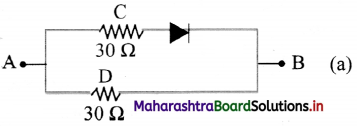
(C) JmK -1
(D) Jm-1K-1
Answer:
(B) W m-1 K-1
Hint:
Q = kA \(\left(\frac{\Delta \mathrm{T}}{\Delta \mathrm{x}}\right)\) t
Q = quantity of heat conducted.
A = area of cross section
t = time for which heat is passed
\(\left(\frac{\Delta \mathrm{T}}{\Delta \mathrm{x}}\right)\) = temperature gradient
∴ K = \(\frac{Q}{A t\left(\frac{\Delta T}{\Delta x}\right)}\)
∴ Unit of k = W m-1 K-1

Maharashtra Board Class 11 Physics Important Questions Chapter 7 Thermal Properties of Matter

Question 3.
A deep rectangular pond of surface area A, containing water (density = p, specific heat capacity = s), is located in a region where the outside air temperature is at a steady value of -26°C. The thickness of the frozen ice layer in this pond, at a certain instant is x. Taking the thermal conductivity of ice as K, and its specific latent heat of fusion as L, the rate of increase of the thickness of ice layer, at this instant, would be given by
(A) 26K/ρx(L + 4s)
(B) 26K/ρx(L – 4s)
(C) 26K/(ρx2 L)
(D) 26K/(ρxL)
Answer:
(D) 26K/(ρxL)
Maharashtra Board Class 11 Physics Important Questions Chapter 7 Thermal Properties of Matter 43

Question 4.
An object kept in a large room having air temperature of 25°C takes 12 minutes to cool from 80°C to 70°C. The time taken to cool for the same object from 70°C to 60°C would be nearly.
(A) 15 min
(B) 10mm
(C) 12mm
(D) 20mm
Answer:
(A) 15 min
Hint:
By Newton’s law of cooling,
Maharashtra Board Class 11 Physics Important Questions Chapter 7 Thermal Properties of Matter 44

Question 5.
A thermally insulated vessel contains 150 g of water at 0 °C. Then the air from the vessel ispumped out adiabatically. A fraction of water turns into ice and the rest evaporates at 0 °C itself. The mass of evaporated water will be closest to :
(Latent heat of vaporization of water = 2.10 × 10⁶ J kg-1 and Latent heat of Fusion of water = 3.36 × 10⁵ J kg-1)
(A) 150g
(B) 20g
(C) 130g
(D) 35g
Answer:
(B) 20g
Hint:
m= 150 g = 0.15 kg
The heat required to evaporate ‘m’ grams of water,
∆Qrequired = mLv ………. ( 1)
(015 – m) is the amount of mass that converts into ice
∴ ∆Qreleased = (0.15 – m) Lf …………. (2)
Now, amount of heat required = amount of heat released
∴ From (1) and (2),
mLv = (0.15 – m)Lf
∴ m(Lf + Lv) = 0.15 Lf
∴ m = \(\frac{0.15 \mathrm{~L}_{\mathrm{f}}}{\mathrm{L}_{\mathrm{f}}+\mathrm{L}_{\mathrm{v}}}\)
∴ m = \(\frac{0.15 \times 3.36 \times 10^{5}}{2.10 \times 10^{6}+3.36 \times 10^{5}}\)
∴ m=0.0206kg ≈ 20g

Question 6.
A copper ball of mass 100 g is at a temperature T. It is dropped in a copper calorimeter of mass 100 g, filled with 170 g of water at room temperature. Subsequently, thetemperature of the system is found to be 75 °C. T is given by: (Given: room temperature = 30°C, specific heat of copper 0.1 cal/g °C)
(A) 1250°C
(B) 825°C
(C) 800°C
(D) 885°C
Answer:
(D) 885°C
Hint:
Heat lost by copper ball = Heat gained by calorimeter and water
∴mbsc∆T1 = mccc∆T2 + mwsw∆T2
∴ (100)(0.1)(T – 75) = (100)(0.1)(75 – 30) + (170)(1)(75 – 30)
10(T – 75) = 450 + 7650 = 8100
T – 75 = 810
T = 885 °C

Maharashtra Board Class 11 Physics Important Questions Chapter 7 Thermal Properties of Matter

Question 7.
Coefficient of linear expansion of brass and steel rods are α1 and α2. Lengths of brass and steel rods are l1 and l2 respectively. If (l2 – l1) is maintained same at all temperatures, which one of the following relations holds good?
(A) α12l2 = α22l1
(B) α1l1 = α2l2
(C) α1l2 = α2l1
(D) α1l22 = α2l12
Answer:
(B) α1l1 = α2l2
Hint:
∆L = L(1 + α∆t)
i.e. ∆l2 = l2(1 + α2∆t)
and ∆l1 =11(1 + α1∆t)
It is given,
l2– l1 = ∆tl2 – ∆ll1
∴ l2 – l1 = l2 (1 + α2∆t) – l1 (1+ α1∆t)
= l2 + l2α2∆t – l1 – l1α1∆t
∴ – l2 + l2 + l2α2∆t = -l1 + l1 + l1α1∆t
∴ l2α2∆t = l1α1∆t
i.e., l2α2 = l1α1

Question 8.
A pendulum clock loses 12 s a day if the temperature is 40 °C and gains 4 s a day if the temperature is 20 °C. The temperature at which the clock will show correct time, and the coefficient of linear expansion (a) of the metal of the pendulum shaft are respectively:
(A) 60 πC, a = 1.85 × 10⁻⁴/πC
(B) 30 πC, a = 1.85 × 10⁻³/πC
(C) 55 πC, a = 1.85 × 10⁻²/πC
(D) 25 πC, a = 1.85 × 10⁻⁵/πC
Answer:
(D) 25 πC, a = 1.85 × 10⁻⁵/πC
Hint:
Period of pendulum, T = 2π\(\sqrt{\frac{\mathrm{L}}{\mathrm{g}}}\)
∴ T ∝ \(\sqrt{\mathrm{L}}\)
But, L = L0 (1 + α∆t)
∴ T ∝ \(\sqrt{\mathrm{L}_{0}(1+\alpha \Delta \mathrm{t})}\)
As L0 is constant,
⇒ T ∝ (1 + α ∆t)
Calculating fractional change in time period of pendulum, \(\frac{\Delta \mathrm{T}}{\mathrm{T}}=\frac{1}{2}(\alpha \Delta \mathrm{t})\)
For the given pendulum,
T = 24 × 60 × 60 = 864000 s
When t1 = 40 °C, ∆T = 12 s,
Maharashtra Board Class 11 Physics Important Questions Chapter 7 Thermal Properties of Matter 45

Question 9.
A piece of ice falls from a height h so that it melts completely. Only one — quarter of the heat produced is absorbed by the ice and all energy of ice gets converted into heat during its fall. The value of h is [Latent heat of ice is 3.4 × 10⁵ J/kg and g = 10 N/kg]
(A) 136 km
(B) 68km
(C) 34km
(D) 544km
Answer:
(A) 136 km
Hint:
When the piece of ice falls from the height h, it possesses potential energy, mgh.
This P.E. is converted to heat energy.
∴ Q = mgh
But only \(\frac{1^{\text {th }}}{4}\) of it is absorbed by ice which is used to change the state.
∴ \(\frac{\mathrm{mgh}}{4}\) = mL
∴ \(\frac{10 \times \mathrm{h}}{4}\) = 3.4 × 10⁵
∴ h = 13.6 × 10⁴ m = 136km

Maharashtra Board Class 11 Physics Important Questions Chapter 7 Thermal Properties of Matter

Question 10.
A body cools from a temperature 3T to 2T in 10 minutes. The room temperature is T. Assume that Newton’s law of cooling is applicable. The temperature of the body at the end of next 10 minutes will be
(A) T
(B) \(\frac{7}{4}\) T
(C) \(\frac{3}{2}\) T
(D) \(\frac{4}{3}\) T
Answer:
(C) \(\frac{3}{2}\) T
Hint:
By Newton’s law of cooling,
Maharashtra Board Class 11 Physics Important Questions Chapter 7 Thermal Properties of Matter 46