Practice Set 35 Class 7 Answers Chapter 8 Algebraic Expressions and Operations on them Maharashtra Board

Balbharti Maharashtra State Board Class 7 Maths Solutions covers the 7th Std Maths Practice Set 35 Answers Solutions Chapter 8 Algebraic Expressions and Operations on them.

Algebraic Expressions and Operations on them Class 7 Maths Chapter 8 Practice Set 35 Solutions Maharashtra Board

Std 7 Maths Practice Set 35 Solutions Answers

Question 1.
Multiply:
i. 16xy × 18xy
ii. 23xy² × 4yz²
iii. (12a + 17b) × 4c
iv. (4x + 5y) × (9x + 7y)
Solution:
i. 16xy × 18xy
= 16 × 18 × xy × xy
= 288x²y²

ii. 23xy² × 4yz²
= 23 × 4 × xy² × yz²
= 92xy³z²

iii. (12a + 17b) × 4c = 12a × 4c + 17b × 4c
= 48ac + 68bc

iv. (4x + 5y) × (9x + 7y)
= 4x × (9x + 7y) + 5y × (9x + 7y)
= (4x × 9x) + (4x × 7y) + (5y × 9x) + (5y × 7y)
= 36x² + 28xy + 45xy + 35y²
= 36x² + 73xy + 35y²

Question 2.
A rectangle is (8x + 5) cm long and (5x + 3) cm broad. Find its area. Solution:
Length of the rectangle = (8x + 5) cm
Breadth of the rectangle = (5x + 3) cm
∴ Area of the rectangle = length × breadth
= (8x + 5) × (5x + 3)
= 8x × (5x + 3) + 5 × (5x + 3)
= (8x × 5x) + (8x × 3) + (5 × 5x) + (5 × 3)
= 40x² + 24x + 25x + 15
= 40x² + 49x + 15
∴ The area of the rectangle is (40x² + 49x + 15) sq. cm.

Std 7 Maths Digest

Practice Set 36 Class 7 Answers Chapter 8 Algebraic Expressions and Operations on them Maharashtra Board

Balbharti Maharashtra State Board Class 7 Maths Solutions covers the 7th Std Maths Practice Set 36 Answers Solutions Chapter 8 Algebraic Expressions and Operations on them.

Algebraic Expressions and Operations on them Class 7 Maths Chapter 8 Practice Set 36 Solutions Maharashtra Board

Std 7 Maths Practice Set 36 Solutions Answers

Question 1.
Simplify (3x – 11y) – (17x + 13y) and choose the right answer.
(A) 7x – 12y
(B) -14x – 54y
(C) -3(5x + 4y)
(D) -2(7x + 12y)
Solution:
(D) -2(7x + 12y)

Hints:
(3x – 11y) – (17x + 13y) = 3x – 11y – 17x – 13y
= – 14x – 24y
= – 2 × 7x – 2 × 12y
= – 2(7x + 12y)

Question 2.
The product of (23x²y³z) and (-15x³yz²) is __
(A) -34x5y4z3
(B) 34x2y3z5
(C) 145x3y2z
(D) 170x3y2z3
Solution:
(A) -34x5y4z3

Question 3.
Solve the following equations:
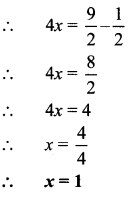
i. \(4 x+\frac{1}{2}=\frac{9}{2}\)
ii. 10 = 2y + 5
iii. 5m – 4 = 1
iv. 6x – 1 = 3x + 8
v. 2(x – 4) = 4x + 2
vi. 5(x + 1) = 74
Solution:
i. \(4 x+\frac{1}{2}=\frac{9}{2}\)
Maharashtra Board Class 7 Maths Solutions Chapter 8 Algebraic Expressions and Operations on them Practice Set 36 1

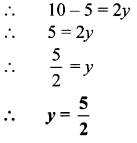
ii. 10 = 2y + 5
Maharashtra Board Class 7 Maths Solutions Chapter 8 Algebraic Expressions and Operations on them Practice Set 36 2

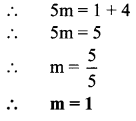
iii. 5m – 4 = 1
Maharashtra Board Class 7 Maths Solutions Chapter 8 Algebraic Expressions and Operations on them Practice Set 36 3

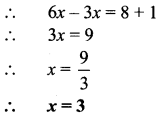
iv. 6x – 1 = 3x + 8
Maharashtra Board Class 7 Maths Solutions Chapter 8 Algebraic Expressions and Operations on them Practice Set 36 4

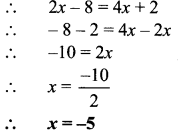
v. 2(x – 4) = 4x + 2
Maharashtra Board Class 7 Maths Solutions Chapter 8 Algebraic Expressions and Operations on them Practice Set 36 5

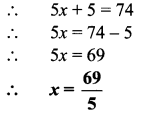
vi. 5(x + 1) = 74
Maharashtra Board Class 7 Maths Solutions Chapter 8 Algebraic Expressions and Operations on them Practice Set 36 6

Question 4.
Rakesh’s age is less than Sania’s age by 5 years. The sum of their ages is 27 years. How old are they?
Solution:
Let the age of Rakesh be x years.
∴ Sania’s age = (x + 5) years.
According to the given condition,
x + (x + 5) = 27
∴ 2x + 5 = 27
∴ 2x = 27 – 5
∴ 2x = 22
∴ \(x=\frac { 22 }{ 2 }=11\)
Sania’s age = x + 5 = 11 + 5 = 16 years
∴ The ages of Rakesh and Sania are 11 years and 16 years respectively.

Question 5.
When planting a forest, the number of jambhul trees planted was greater than the number of ashoka trees by 60. If there are altogether 200 trees of these two types, how many jambhul trees were planted?
Solution:
Let the number of jambhul trees planted be x.
∴ Number of ashoka trees = x – 60
According to the given condition, x + x – 60 = 200
∴ 2x = 200 + 60
∴ 2x = 260
∴ \(x=\frac { 260 }{ 2 }=130\)
∴ 130 jambhul trees were planted.

Question 6.
Shubhangi has twice as many 20-rupee notes as she has 50-rupee notes. Altogether, she has 2700 rupees. How many 50-rupee notes does she have?
Solution:
Let the number of 50-rupee notes with shubhangi be x.
∴ Number of 20-rupee notes = 2x
∴ Total amount with Shubhangi = Number of 50-rupee notes × 50 + Number of 20-rupee notes × 20
= x × 50 + 2x × 20
= 50x + 40x
= 90x
According to the given condition,
90x = 2700
∴ \(x=\frac { 2700 }{ 90 }=30\)
∴ Shubhangi has 30 notes of 50 rupees.

Question 7.
virat made twice as many runs as Rohit. The total of their scores is 2 less than a double century. How many runs did each of them make?
Solution:
Let the runs made by Rohit be x.
∴ Runs made by Virat = 2x
According to the given condition,
x + 2x = 200 – 2
∴ 3x = 198
∴ \(x=\frac { 198 }{ 3 }=66\)
∴ Runs made by Virat = 2x = 2 × 66 = 132
∴ The runs made by Virat and Rohit are 132 and 66 respectively.

Maharashtra Board Class 7 Maths Chapter 8 Algebraic Expressions and Operations on them Practice Set 36 Intext Questions and Activities

Question 1.
Solve the following equations. (Textbook pg. no. 59)
i. x + 7 = 4
ii. 4p = 12
iii. m – 5 = 4
iv. \(\frac { t }{ 3 }=6\)
Solution:
i. x + 7 = 4
∴ x + 7 – 7 = 4 – 7 ….(Subtracting 7 from both sides)
∴ x + 0 = -3
∴ x = -3

ii. 4p = 12
∴ \(\frac{4 p}{4}=\frac{12}{4}\) ….(Dividing both sides by 4)
∴ p = 3

iii. m – 5 = 4
∴ m – 5 + 5 = 4 + 5
…. (Adding 5 to both sides)
∴ m + 0 = 9
∴ m = 9

iv. \(\frac { t }{ 3 }=6\)
∴ \(\frac { t }{ 3 }\) × 3 = 6 × 3 …. (Multiplying both sides by 3)
∴ t = 18

Std 7 Maths Digest

Practice Set 34 Class 7 Answers Chapter 8 Algebraic Expressions and Operations on them Maharashtra Board

Balbharti Maharashtra State Board Class 7 Maths Solutions covers the 7th Std Maths Practice Set 34 Answers Solutions Chapter 8 Algebraic Expressions and Operations on them.

Algebraic Expressions and Operations on them Class 7 Maths Chapter 8 Practice Set 34 Solutions Maharashtra Board

Std 7 Maths Practice Set 34 Solutions Answers

Question 1.
Subtract the second expression from the first.
i. (4xy – 9z); (3xy – 16z)
ii. (5x + 4y + 7z); (x + 2y + 3z)
iii. (14x² + 8xy + 3y²); (26x² – 8xy – 17y²)
iv. (6x² + 7xy + 16y²); (16x² – 17xy)
v. (4x + 16z); (19y – 14z + 16x)
Solution:
i. (4xy – 9z) – (3xy – 16z)
= 4xy – 9z – 3xy + 16z
= (4xy – 3xy) + (16z – 9z)
= xy + 7z

ii. (5x + 4y + 7z) – (x + 2y + 3z)
= 5x + 4y + 7z – x – 2y – 3z
= (5x – x) + (4y – 2y) + (7z – 3z)
= 4x + 2y + 4z

iii. (14x² + 8xy + 3y²) – (26x² – 8xy – 17y²)
= 14x² + 8xy + 3y² – 26x² + 8xy + 17y²
= (14x² – 26x²) + (8xy + 8xy) + (3y² + 17y²)
= -12x² + 16xy + 20y²

iv. (6x² + 7xy + 16y²) – (16x² – 17xy)
= 6x² + 7xy + 16y² – 16x² + 17xy
= (6x² – 16x²) + (7xy + 17xy) + 16y²
= -10x² + 24xy + 16y²

v. (4x + 16z) – (19y— 14z + 16x)
= 4x + 16z – 19y + 14z – 16x
= (4x – 16x) – 19y + (16z + 14z)
= -12x – 19y + 30z

Std 7 Maths Digest

Practice Set 32 Class 7 Answers Chapter 8 Algebraic Expressions and Operations on them Maharashtra Board

Balbharti Maharashtra State Board Class 7 Maths Solutions covers the 7th Std Maths Practice Set 32  Answers Solutions Chapter 8 Algebraic Expressions and Operations on them.

Algebraic Expressions and Operations on them Class 7 Maths Chapter 8 Practice Set 32 Solutions Maharashtra Board

Std 7 Maths Practice Set 32 Solutions Answers

Question 1.
Classify the following algebraic expressions as monomials, binomials, trinomials or polynomials.
i. 7x
ii. 5y – 7z
iii. 3x³ – 5x² – 11
iv. 1 – 8a – 7a² – 7a³
v. 5m – 3
vi. a
vii. 4
viii. 3y² – 7y + 5
Solution:
i. Monomial
ii. Binomial
iii. Trinomial
iv. Polynomial
v. Binomial
vi. Monomial
vii. Monomial
viii. Trinomial

Std 7 Maths Digest

Practice Set 33 Class 7 Answers Chapter 8 Algebraic Expressions and Operations on them Maharashtra Board

Balbharti Maharashtra State Board Class 7 Maths Solutions covers the 7th Std Maths Practice Set 33 Answers Solutions Chapter 8 Algebraic Expressions and Operations on them.

Algebraic Expressions and Operations on them Class 7 Maths Chapter 8 Practice Set 33 Solutions Maharashtra Board

Std 7 Maths Practice Set 33 Solutions Answers

Question 1.
Add:
i. 9p + 16q; 13p + 2q
ii. 2a + 6b + 8c; 16a + 13c + 18b
iii. 13x² – 12y²; 6x² – 8y²
iv. 17a²b² + 16c; 28c – 28a²b²
v. 3y² – 10y + 16; 2y – 7
vi. – 3y² + 10y – 16; 7y² + 8
Solution:
i. (9p + 16q) + (13p + 2q)
= (9p + 13p) + (16q + 2q)
= 22p + 18q

ii. (2a + 6b + 8c) + (16a + 13c + 18b)
= (2a + 16a) + (6b + 18b) + (8c + 13c)
= 18a + 24b + 21c

iii. (13x² – 12y²) + (6x² – 8y²)
= (13x² + 6x²) + [(-12y²) + (-8y²)]
= 19x² + (-20y²)
= 19x² – 20y²

iv. (17a²b² + 16c) + (28c – 28a²b²)
= [17a²b² + (-28a²b²)] + (16c + 28c)
= -11a²b² + 44c

v. (3y² – 10y + 16) + (2y – 7)
= 3y² + (-10y + 2y) + (16 – 7)
= 3y² – 8y + 9

vi. (-3y² + 10y – 16) + (7y² + 8)
= (-3y² + 7y²) + (10y) + (-16 + 8)
= 4y² + 10y – 8

Maharashtra Board Class 7 Maths Chapter 8 Algebraic Expressions and Operations on them Practice Set 33 Intext Questions and Activities

Question 1.
Answer the following questions. (Textbook pg. no. 57)

  1. 3x + 4y = How many?
  2. 3 guavas + 4 mangoes = 7 guavas.
  3. 7m – 2n = 5m.

Solution:

  1. 3x and 4y are unlike terms. Hence, they cannot be added, further to get a single term.
  2. No. Guava and mango are different fruits. Hence, 3 guavas + 4 mangoes & 7 guavas.
  3. No. 7m and 2n are unlike terms. Hence, 7m – 2n ≠ 5m.

Std 7 Maths Digest

Practice Set 30 Class 7 Answers Chapter 6 Indices Maharashtra Board

Balbharti Maharashtra State Board Class 7 Maths Solutions covers the 7th Std Maths Practice Set 30 Answers Solutions Chapter 6 Indices.

Indices Class 7 Maths Chapter 6 Practice Set 30 Solutions Maharashtra Board

Std 7 Maths Practice Set 30 Solutions Answers

Question 1.
Find the square root:
i. 625
ii. 1225
iii. 289
iv. 4096
v. 1089
Solution:
i. 625
Maharashtra Board Class 7 Maths Solutions Chapter 6 Indices Practice Set 30 1
∴ 625 = 5 x 5 x 5 x 5
∴ √625 = 5 x 5 = 25

ii. 1225
Maharashtra Board Class 7 Maths Solutions Chapter 6 Indices Practice Set 30 2
∴ 1225 = 5 x 5 x 7 x 7
∴ √1225 = 5 x 7 = 35

iii. 289
Maharashtra Board Class 7 Maths Solutions Chapter 6 Indices Practice Set 30 3
∴ 289 = 17 x 17
∴ √289 = 17

iv. 4096
Maharashtra Board Class 7 Maths Solutions Chapter 6 Indices Practice Set 30 4
∴ 4096 = 2 x 2 x 2 x 2 x 2 x 2 x 2 x 2 x 2 x 2 x 2 x 2
∴ √4096 = 2 x 2 x 2 x 2 x 2 x 2
= 64

v. 1089
Maharashtra Board Class 7 Maths Solutions Chapter 6 Indices Practice Set 30 5
∴ 1089 = 3 x 3 x 11 x 11
∴ √1089 = 3 x 11
= 33

Maharashtra Board Class 7 Maths Chapter 6 Indices Practice Set 30 Intext Questions and Activities

Question 1.
Try to write the following numbers in the standard form. (Textbook pg. no. 48)
i. The diameter of Sun is 1400000000 m.
ii. The velocity of light is 300000000 m/sec.
Solution:
i. 1400000000 m = 1.4 x 10⁹ m
ii. 300000000 m/s = 3.0 x 10⁸ m/sec.

Question 2.
The box alongside shows the number called Googol. Try to write it as a power of 10. (Textbook pg. no. 48)
Maharashtra Board Class 7 Maths Solutions Chapter 6 Indices Practice Set 30 6
Solution:
1 x 10100

Std 7 Maths Digest

Practice Set 7 Class 6 Answers Maths Chapter 3 Integers Maharashtra Board

Balbharti Maharashtra State Board Class 6 Maths Solutions covers the Std 6 Maths Chapter 3 Integers Class 6 Practice Set 7 Answers Solutions.

Integers Class 6 Maths Chapter 3 Practice Set 7 Solutions Maharashtra Board

Std 6 Maths Practice Set 7 Solutions Answers

Question 1.
Write the proper signs >, < or = in the boxes below:

  1. -4 __ 5
  2. 8 __ -10
  3. +9 __ +9
  4. -6 __ 0
  5. 7 __ 4
  6. 3 __ 0
  7. -7 __ 7
  8. -12 __ 5
  9. -2 __ -8
  10. -1 __ -2
  11. 6 __ -3
  12. -14 __ -14

Solution:

  1. -4 < 5
  2. 8 > -10
  3. +9 = +9
  4. -6 < 0
  5. 7 > 4
  6. 3 > 0
  7. -7 < 7
  8. -12 < 5
  9. -2 > -8
  10. -1 > -2
  11. 6 > -3
  12. -14 = -14

Std 6 Maths Digest

Maharashtra Board Class 11 Physics Important Questions Chapter 10 Electrostatics

Balbharti Maharashtra State Board 11th Physics Important Questions Chapter 10 Electrostatics Important Questions and Answers.

Maharashtra State Board 11th Physics Important Questions Chapter 10 Electrostatics

Question 1.
Explain: Atoms are electrically neutral.
Answer:

  1. Matter is made up of atoms which in turn consists of elementary particles proton, neutron and electron.
  2. A proton is considered to be positively charged and electron to be negatively charged.
  3. Neutron is electrically neutral i.e., it has no charge.
  4. An atomic nucleus is made up of protons and neutrons and hence is positively charged.
  5. Negatively charged electrons surround the nucleus so as to make an atom electrically neutral.

Question 2.
What does the below diagrams show?
Maharashtra Board Class 11 Physics Important Questions Chapter 10 Electrostatics 1
Answer:

  1. Figure (a) shows insulated conductor.
  2. Figure (b) shows that positive charge is neutralized by electron from Earth.
  3. Figure (c) shows that earthing is removed, negative charge still stays in conductor due to positive charged rod.
  4. Figure (d) shows that when rod is removed, negative charge is distributed over the surface of the conductor.

Maharashtra Board Class 11 Physics Important Questions Chapter 10 Electrostatics

Question 3.
Explain concept of charging by conduction.
Answer:

  1. When certain dissimilar substances, like fur and amber or comb and dry hair, are rubbed against each other, electrons get transferred to the other substance making them charged.
  2. The substance receiving electrons develops a negative charge while the other is left with an equal amount of positive charge.
  3. This can be called charging by conduction as charges are transferred from one body to another.

Question 4.
Explain concept of charging by induction.
Answer:

  1. If an uncharged conductor is brought near a charged body, (not in physical contact) the nearer side of the conductor develops opposite charge to that on the charged body and the far side of the conductor develops charge similar to that on the charged body. This is called induction.
  2. This happens because the electrons in a conductor are free and can move easily in presence of charged body.
  3. A charged body attracts or repels electrons in a conductor depending on whether the charge on the body is positive or negative respectively.
  4. Positive and negative charges are redistributed and are accumulated at the ends of the conductor near and away from the charged body.
  5. In induction, there is no transfer of charges between the charged body and the conductor. So when the charged body is moved away from the conductor, the charges in the conductor are free again.

Question 5.
Explain the concept of additive nature of charge.
Answer:

  1. Electric charge is additive, similar to mass. The total electric charge on an object is equal to the algebraic sum of all the electric charges distributed on different parts of the object.
  2. It may be pointed out that while taking the algebraic sum, the sign (positive or negative) of the electric charges must be taken into account.
  3. Thus, if two bodies have equal and opposite charges, the net charge on the system of the two bodies is zero.
  4. This is similar to that in case of atoms where the nucleus is positively charged and this charge is equal to the negative charge of the electrons making the atoms electrically neutral.

Question 6.
State the analogy between the additive property of charge with that of mass.
Answer:

  1. The masses of the particles constituting an object are always positive, whereas the charges distributed on different parts of the object may be positive or negative.
  2. The total mass of an object is always positive whereas, the total charge on the object may be positive, zero or negative.

Question 7.
What is quantization of charge?
Answer:

  1. Protons (+ve) and electrons (-ve) are the charged particles constituting matter, hence the charge on an object must be an integral multiple of ± e i.e., q = ± ne, where n is an integer.
  2. Charge on an object can be increased or decreased in multiples of e.
  3. It is because, during the charging process an integral number of electrons can be transferred from one body to the other body. This is known as quantization of charge or discrete nature of charge.

Question 8.
Explain with an example why quantization of charge is not observed practically.
Answer:
i. The magnitude of the elementary electric charge (e), is extremely small. Due to this, the number of elementary charges involved in charging an object becomes extremely large.

ii. For example, when a glass rod is rubbed with silk, a charge of the order of one µC (10-6 C) appears on the glass rod or silk. Since elementary charge e = 1.6 × 10⁻¹⁹ C. the number of elementary charges on the glass rod (or silk) is given by
n = \(\frac {10^{-6}C}{1.6×10^{-19}C}\) = 6.25 × 10¹²
Since, it is tremendously large number, the quantization of charge is not observed and one usually observes a continuous variation of charge.

Question 9.
The total charge of an isolated system is always conserved. Explain with an example.
Answer:

  1. When a glass rod is rubbed with silk, it becomes positively charged and silk becomes negatively charged.
  2. The amount of positive charge on glass rod is found to be exactly the same as negative charge on silk.
  3. Thus, the systems of glass rod and silk together possesses zero net charge after rubbing.
    Hence, the total charge of an isolated system is always conserved.

Question 10.
Explain the conclusion when charges are brought close to each other.
Answer:

  1. Unlike charges attract each other.
  2. Like charges repel each other.

Question 11.
How much positive and negative charge is present in 1 g of water? How many electrons are present in it?
(Given: molecular mass of water is 18.0 g)
Answer:
Molecular mass of water is 18 gram, that means the number of molecules in 18 gram of water is 6.02 × 10²³
∴ Number of molecules in lgm of water = \(\frac {6.02×10^{23}}{18}\)
One molecule of water (H2O) contains two hydrogen atoms and one oxygen atom. Thus, the number of electrons in ILO is sum of the number of electrons in H2 and oxygen. There are 2 electrons in H2 and 8 electrons in oxygen.
∴ Number of electrons in H2O = 2 + 8 = 10
Total number of protons / electrons in one gram of water
= \(\frac {6.02×10^{23}}{18}\) × 10 = 3.344 × 10²³
Total positive charge
= 3.344 × 10²³ × charge on a proton
= 3.344 × 1023 × 1.6 × 10-19C
= 5.35 × 10⁴ C
This positive charge is balanced by equal amount of negative charge so that the water molecule is electrically neutral.
∴ Total negative charge = 5.35 × 10⁴C

Question 12.
Define point charge. Which law explains the interaction between charges at rest?
Answer:

  1. A point charge is a charge whose dimensions are negligibly small compared to its distance from another bodies.
  2. Coulomb’s law explains the interaction between charges at rest.

Maharashtra Board Class 11 Physics Important Questions Chapter 10 Electrostatics

Question 13.
State and explain Coulomb’s law of electric charge in scalar form.
Answer:
Coulomb’s law:
The force of attraction or repulsion between two point charges at rest is directly proportional to the product of the magnitude of the charges and inversely proportional to the square of the distance between them. This force acts along the line joining the two charges.
Explanation:
i. Let q1 and q2 be the two point charges at rest with each other and separated by a distance r. F is the magnitude of electrostatic force of attraction or repulsion between them.

ii. According to Coulomb’s law.
F ∝ \(\frac {q_1q_2}{r^2}\)
∴ F = K\(\frac {q_1q_2}{r^2}\)
where, K is the constant of proportionality which depends upon the units of F, q1, q2, r and medium in which charges are placed.

Question 14.
State conditions for electrostatic force to be attractive or repulsive.
Answer:

  1. The force between the two charges will be attractive, if the charges are unlike (one positive and one negative).
  2. The force between the two charges will be repulsive, if the charges are similar (both positive or both negative).

Question 15.
Prove that relative permittivity is the ratio of the force between two point charges placed a certain distance apart in free space or vacuum to the force between the same two point charges when placed at the same distance in the given medium.
Answer:
i. The force between the two charges placed in a medium is given by,
Fmed = \(\frac {1}{4πε}\) (\(\frac {q_1q_2}{r^2}\)) …………. (1)
where, ε is called the absolute permittivity of the medium.

ii. The force between the same two charges placed in free space or vacuum at distance r is given by,
Fvac = \(\frac {1}{4πε_0}\) (\(\frac {q_1q_2}{r^2}\)) …………. (1)
Dividing equation (2) by equation (1),
Maharashtra Board Class 11 Physics Important Questions Chapter 10 Electrostatics 2
Hence, relative permittivity is the ratio of the force between two point charges placed a certain distance apart in free space or vacuum to the force between the same two point charges when placed at the same distance in the given medium.

Question 16.
If relative permittivity of water is 80 then derive the relation between Fwater and Fvacuum. What can be concluded from it?
Answer:
i. The force between two point charges q1 and q2 placed at a distance r in a medium of relative permittivity εr, is given by
Fmed = \(\frac{1}{4 \pi \varepsilon_{0} \varepsilon_{r}} \frac{\mathrm{q}_{1} \mathrm{q}_{2}}{\mathrm{r}^{2}}\) …………. (1)
If the medium is vacuum,
Fvac = \(\frac{1}{4 \pi \varepsilon_{0}} \frac{\mathrm{q}_{1} \mathrm{q}_{2}}{\mathrm{r}^{2}}\) …………. (2)

ii. Dividing equation (2) by equation (1),
\(\frac{\mathrm{F}_{\mathrm{vac}}}{\mathrm{F}_{\text {med }}}\) = εr
For water, εr = 80 ……….. (given)
∴ Fwater = \(\frac {F_{vac}}{80}\)

iii. This means that when two point charges are placed some distance apart in water, the force between them is reduced to (\(\frac {1}{80}\))th of the force between the same two charges placed at the same distance in vacuum.

iv. Thus, it is concluded that a material medium reduces the force between charges by a factor of er, its relative permittivity.

Question 17.
Give conversions of micro-coulomb, nano-coulomb and pico-coulomb to coulomb.
Answer:
1 microcoulomb (µC) = 10-6 C
1 nanocoulomb (nC) = 10-9 C
1 picocoulomb (pC) = 10-12 C

Question 18.
Explain Coulomb’s law in vector form.
Answer:
i. Let q1 and q2 be the two similar point charges situated at points A and B and let \(\vec{r}\)12 be the distance of separation between them.

ii. The force \(\vec{F}\)21 exerted on q2 by q1 is given by,
\(\overrightarrow{\mathrm{F}}_{21}=\frac{1}{4 \pi \varepsilon_{0}} \frac{\mathrm{q}_{1} \mathrm{q}_{2}}{\left|\mathrm{r}_{12}\right|^{2}} \times \hat{\mathrm{r}}_{12}\)
where, \(\hat{r}\)12 is the unit vector from A to B.
\(\vec{F}\)21 acts on q2 at B and is directed along BA, away from B.
Maharashtra Board Class 11 Physics Important Questions Chapter 10 Electrostatics 3

iii. Similarly, the force \(\vec{F}\)12 exerted on q1 by q2 is given by, \(\vec{F}\)12 = \(\frac{1}{4 \pi \varepsilon_{0}} \frac{\mathrm{q}_{1} \mathrm{q}_{2}}{\left|\mathrm{r}_{12}\right|^{2}} \times \hat{\mathrm{r}_{21}}\)
where, \(\hat{r}\)21 is the unit vector from B to A. \(\vec{F}\)12 acts on q1 at A and is directed along BA, away from A.

iv. The unit vectors \(\hat{r}\)12 and \(\hat{r}\)21 are oppositely directed i.e., \(\hat{r}\)12 = –\(\hat{r}\)21
Hence, \(\vec{F}\)21 = –\(\vec{F}\)12
Thus, the two charges experience force of equal magnitude and opposite in direction.

v. These two forces form an action-reaction pair.

vi. As \(\vec{F}\)21 and \(\vec{F}\)12 act along the line joining the two charges, the electrostatic force is a central force.

Question 19.
State similarities and differences of gravitational and electrostatic forces.
Answer:
i. Similarities:
a. Both forces obey inverse square law:
F ∝ \(\frac{1}{r^2}\)
b. Both are central forces and they act along the line joining the two objects.

ii. Differences:
a. Gravitational force between two objects is always attractive while electrostatic force between two charges can be either attractive or repulsive depending on the nature of charges.
b. Gravitational force is about 36 orders of magnitude weaker than the electrostatic force.

Question 20.
Charge on an electron is 1.6 × 10⁻¹⁹ C. How many electrons are required to accumulate a charge of one coulomb?
Answer:
1 electron = 1.6 × 10⁻¹⁹ C
∴ 1 C = \(\frac{1}{1.6 \times 10^{-19}}\) electrons
= 0.625 × 10¹⁹ electrons
……. (Taking reciprocal from log table)
= 6.25 × 10¹⁸ electrons
Hence, 6.25 × 10¹⁸ electrons are required to accumulate a charge of one coulomb.

Question 21.
What is the force between two small charge spheres having charges of 2 × 10⁻⁷ C and 3 × 10⁻⁷ C placed 30 cm apart in air?
Answer:
Given: q1 = 2 × 10⁻⁷ C, q2 = 3 × 10⁻⁷ C
r = 30 cm = \(\frac {30}{100}\) m = 0.3 m
To find: Force (F)
Formula: F = \(\frac {1}{4πε_0}\) \(\frac {q_1q_2}{r^2}\)
Calculation: From formula,
F = \(\frac{9 \times 10^{9} \times 2 \times 10^{-7} \times 3 \times 10^{-7}}{(0.3)^{2}}\)
∴ F = 6 × 10⁻³ N

Question 22.
The electrostatic force on a small sphere of charge 0.4 µC due to another small sphere of charge -0.8 µC in air is 0.2 N. (i) What is the distance between the two spheres? (ii) What is the force on the second sphere due to the first?
Answer:
i. Given: q1 = 0.4 µC = 0.4 × 10⁻⁶ C,
q2 = -0.8 µC = -0.8 × 10⁻⁶ C, F = 0.2 N
To find: i. Distance (r)
ii. Force on second sphere (F)
Formula: F = \(\frac {1}{4πε_0}\) \(\frac {q_1q_2}{r^2}\)
Calculation:
i. From formula,
r² = \(\frac {1}{4πε_0}\) \(\frac {q_1q_2}{F}\)
r² = \(\frac{9 \times 10^{9} \times 0.4 \times 10^{-6} \times 0.8 \times 10^{-6}}{0.2}\)
= 0.0144
∴ r = \(\sqrt{0.0144}\) = 0.12 m
∴ r = 12 cm

ii. The force on the second sphere due to the first is also 0.2 N and is attractive in nature.

Question 23.
i. Two insulated charged copper spheres A and B have their centres separated by a distance of 50 cm. What is the mutual force of electrostatic repulsion, if the charge on each is 6.5 × 10⁻⁷ C? The radii of A and B are negligible compared to the distance of separation,
ii. What is the force of repulsion if each sphere is charged double the above amount and the distance between them is halved?
Answer:
Given: q1 = 6.5 × 10⁻⁷ C q2 = 6.5 × 10⁻⁷ C
r = 50 cm = 0.50 m
To find: Force of repulsion (F)
Formula: F = \(\frac {1}{4πε_0}\) \(\frac {q_1q_2}{r^2}\)
Calculation:
From formula,
F = \(\frac{9 \times 10^{9} \times 6.5 \times 10^{-7} \times 6.5 \times 10^{-7}}{(0.50)^{2}}\)
F = 1.52 × 10⁻² N

ii. When each charge is doubled and the distance between them is reduced to half, then
F = \(\frac{1}{4 \pi \varepsilon_{0}} \frac{\left(2 q_{1}\right)\left(2 q_{2}\right)}{(r / 2)^{2}}\)
= 16 × \(\frac {1}{4πε_0}\) \(\frac {q_1q_2}{r^2}\) = 16 × 1.52 × 10-2
∴ F = 0.24 N

Maharashtra Board Class 11 Physics Important Questions Chapter 10 Electrostatics

Question 24.
Calculate and compare the electrostatic and gravitational forces between two protons which are 10-15 m apart. Value of G = 6.674 × 10⁻¹¹ m³ kg-1 s-2 and mass of the porton is 1.67 × 10⁻²⁷ kg.
Answer:
Given: G = 6.674 × 10⁻¹¹ m³ kg-1 s-2
mp = 1.67 × 10⁻²⁷ kg.
qp = 1.67 × 10⁻¹⁹ C, r = 10-15
To find:
i. Electrostatic Force (FE)
ii. Gravitational Force (FG)
Formula: i. FE = \(\frac {1}{4πε_0}\) \(\frac {q_1q_2}{r^2}\)
ii. FE = \(\frac {Gm_1m_2}{r^2}\)
Calculation:
From formula (i),
\(\mathrm{F}_{\mathrm{E}}=9 \times 10^{9} \times \frac{1.6 \times 10^{-19} \times 1.6 \times 10^{-19}}{\left(10^{-15}\right)^{2}}\)
= 9 × 1.6 × 1.6 × 10
= 90 × 1.6 × 1.6
= antilog [log 90 + log 1.6 + log 1.6]
= antilog [1.9542 + 0.2041 + 0.2041]
= antilog [2.3624]
= 2.303 × 10² N
From formula (ii),
\(\mathrm{F}_{\mathrm{G}}=6.674 \times 10^{-11} \times \frac{1.67 \times 10^{-27} \times 1.67 \times 10^{-27}}{\left(10^{-15}\right)^{2}}\)
= 6.674 × 1.67 × 1.67 × 10-35
= {antilog [log 6.674 + log 1.67 + log 1.67]} × 10-35
= {antilog [0.8244 + 0.2227 + 0.2227]} × 10-35
= {antilog [1.2698]} × 10-35
= 1.861 × 101 × 10-35
= 1.861 × 10⁻³⁴ N
Now,
\(\frac{\mathrm{F}_{\mathrm{E}}}{\mathrm{F}_{\mathrm{G}}}=\frac{2.303 \times 10^{2}}{1.861 \times 10^{-34}}\)
= {antilog [log 2.303 – log 1.861]} × 1036
= {antilog [0.3623 – 0.2697]} × 1036
= {antilog [0.0926]}
= 1.238 × 1036
∴ FE ≈ 1036 × FG

Question 25.
State and explain principle of superposition.
Answer:
Statement: When a number of charges are interacting, the resultant force on a particular charge is given by the vector sum of the forces exerted by individual charges.
Explanation:
i. Consider a number of point charges q1, q2, q3 ……………… kept at points A1, A2, A3 ………….. as shown in figure.
Maharashtra Board Class 11 Physics Important Questions Chapter 10 Electrostatics 4

ii. The force exerted on the charge q1 by q2 is \(\vec{F}\)12 The value of \(\vec{F}\)12 is calculated by ignoring the presence of other charges. Similarly, force \(\vec{F}\)13, \(\vec{F}\)14 can be found, using the Coulomb’s law.

iii. Total force \(\vec{F}\)1 on charge qi is the vector sum of all such forces.
\(\vec{F}\)1 = \(\vec{F}\)12 + \(\vec{F}\)13 + \(\vec{F}\)14 + …………..
\( =\frac{1}{4 \pi \varepsilon_{0}}\left[\frac{\mathrm{q}_{1} \mathrm{q}_{2}}{\left|\mathrm{r}_{21}\right|^{2}} \times \hat{\mathrm{r}}_{21}+\frac{\mathrm{q}_{1} \mathrm{q}_{3}}{\left|\mathrm{r}_{31}\right|^{2}} \times \hat{\mathrm{r}}_{31}+\ldots .\right]\)

where \(\hat{r}\)21, \(\hat{r}\)31 are unit vectors directed to q1 from q2, q3 respectively and r21, r31, r41 are the distances from q1 to q2, q3 respectively.

iv. If q1, q2, q3 ……., qn are the point charges then the force \(\vec{F}\) exerted by these charges on a test charge q0 is given by,
\(\vec{F}\)test = \(\vec{F}\)1 = \(\vec{F}\)2 + \(\vec{F}\)3 + …. + \(\vec{F}\)n
= \(\sum_{\mathrm{n}=1}^{\mathrm{n}} \mathrm{F}_{\mathrm{n}}=\frac{1}{4 \pi \varepsilon_{0}} \sum_{\mathrm{n}=1}^{\mathrm{n}} \frac{\mathrm{q}_{0} \mathrm{q}_{\mathrm{n}}}{\mathrm{r}_{\mathrm{n}}^{2}} \hat{\mathrm{r}}_{\mathrm{n}}\)
Where, \(\hat{r}\)n, is a unit vector directed from the nth charge to the test charge q0 and r2 is the
separation between them, \(\vec{r}\)n = rn \(\hat{r}\)n

Question 26.
Three charges of 2 µC, 3 µC and 4 µC are placed at points A, B and C respectively, as shown in the figure. Determine the force on A due to other charges.
(Given: AB = 4 cm, BC = 3 cm)
Maharashtra Board Class 11 Physics Important Questions Chapter 10 Electrostatics 5
Answer:
Maharashtra Board Class 11 Physics Important Questions Chapter 10 Electrostatics 6
Using pythagoras theorem
AC = \(\sqrt {AB^2+BC^2}\)
= \(\sqrt {4^2+3^2}\)
AC = 5 cm
Magnitude of force \(\vec{F}\)AB on A due to B is,
Maharashtra Board Class 11 Physics Important Questions Chapter 10 Electrostatics 7
In ∆ABC 4
cos θ = \(\frac {4}{5}\)
θ = cos-1 (\(\frac {4}{5}\)) = 36.87°
Forces acting points A are
Maharashtra Board Class 11 Physics Important Questions Chapter 10 Electrostatics 8
= 59.36 N
Direction of resultant force is 36.87° (north of west)
Maharashtra Board Class 11 Physics Important Questions Chapter 10 Electrostatics 9
[Note: The question given above is modified considering minimum requirement of data needed to solve the problem.]

Question 27.
There are three charges of magnitude 3 pC, 2 pC and 3 pC located at three corners A, B and C of a square ABCD of each side measuring 2 m. Determine the net force on 2 pC charge.
Answer:
Given: q1 = 3 µC, q2 = 2 µC, q3 = 3 µC, r = 2 m
To find: Net force on q2 (R)
Formula: F = \(\frac {1}{4πε_0}\) \(\frac {q_1q_2}{r^2}\)
Calculation:
Maharashtra Board Class 11 Physics Important Questions Chapter 10 Electrostatics 10
From the formula,
Force on q2 because of q1
Maharashtra Board Class 11 Physics Important Questions Chapter 10 Electrostatics 11
Net force on q2 is the resultant force of \(\vec{F}\)21 and \(\vec{F}\)23 which is given by,
R = \(\sqrt{\mathrm{F}_{21}^{2}+\mathrm{F}_{23}^{2}}\)
= \(\sqrt{\left(1.35 \times 10^{-2}\right)^{2}+\left(1.35 \times 10^{-2}\right)^{2}}\)
∴ R = 1.91 × 10⁻² N

Question 28.
Explain the concept of electric field.
Answer:

  1. The space around a charge gets modified when a test charge is brought in that region, it experiences a coulomb force. The region around a charged object in which coulomb force is experienced by another charge is called electric field.
  2. Mathematically, electric field is defined as the force experienced per unit charge.
  3. The coulomb force acts across an empty space (vacuum) and does not need any intervening medium for its transmission.
  4. The electric field exists around a charge irrespective of the presence of other charges.
  5. Since the coulomb force is a vector, the electric field of a charge is also a vector and is directed along the direction of the coulomb force, experienced by a test charge.

Maharashtra Board Class 11 Physics Important Questions Chapter 10 Electrostatics

Question 29.
Define electric field. State its SI unit and dimensions.
Answer:

  1. Electric field is the force experienced by a test charge in presence of the given charge at the given distance from it.
    \(\vec{E}\) = \(\lim _{q \rightarrow 0} \frac{\vec{F}}{q}\)
  2. SI unit: newton per coulomb (N/C) or volt per metre (V/m).
  3. Dimensions: [L M T-3 A-1]

Question 30.
Establish relation between electric field intensity and electrostatic force.
Answer:
i. Let Q and q be two charges separated by a distance r.
The coulomb force between them is given by \(\vec{F}\) = \(\frac {1}{4πε_0}\) \(\frac {Qq}{r^2}\) \(\hat{r}\)
where, \(\hat{r}\) is the unit vector along the line joining Q to q.

ii. Therefore, electric field due to charge Q is given \(\vec{F}\) = \(\frac{\vec{F}}{\mathrm{q}}=\frac{1}{4 \pi \varepsilon_{0}} \frac{\mathrm{Q}}{\mathrm{r}^{2}} \hat{\mathrm{r}}\)

iii. Electric field at a point is useful to estimate the force experienced by a charge at that point.

Question 31.
State an expression for electric field on the surface of the sphere due to a positive point charge placed at its centre.
Answer:
The magnitude of electric field at a distance r from a point charge Q is same at all points on the surface of a sphere of radius r as shown in figure.
Maharashtra Board Class 11 Physics Important Questions Chapter 10 Electrostatics 12
ii. Magnitude of electric field is given by,
E = \(\frac {1}{4πε_0}\) \(\frac {Q}{r^2}\)
iii. Its direction is along the radius of the sphere, pointing away from its centre if the charge is positive.

Question 32.
Derive expression for electric field intensity due to a point charge in a material medium.
Answer:
i. Consider a point charge q placed at point O in a medium of dielectric constant K as shown in figure.
Maharashtra Board Class 11 Physics Important Questions Chapter 10 Electrostatics 13

ii. Consider the point P in the electric field of point charge at distance r from q. A test charge q0 placed at the point P will experience a force which is given by the Coulomb’s law,
\(\vec{F}\) = \(\frac{1}{4 \pi \varepsilon_{0} \mathrm{~K}} \frac{\mathrm{qq}_{0}}{\mathrm{r}^{2}} \hat{\mathrm{r}}\)
where \(\hat{r}\) is the unit vector in the direction of force i.e., along OP.

iii. By the definition of electric field intensity,
\(\vec{F}\) = \(\frac{\vec{F}}{\mathrm{q}_{0}}=\frac{1}{4 \pi \varepsilon_{0} \mathrm{~K}} \frac{\mathrm{q}}{\mathrm{r}^{2}} \hat{\mathrm{r}}\)
The direction of \(\vec{E}\) will be along OP when q is positive and along PO when q is negative.

iv. The magnitude of electric field intensity in a medium is given by, E = \(\frac{1}{4 \pi \varepsilon_{0} \mathrm{~K}} \frac{\mathrm{q}}{\mathrm{r}^{2}}\)

v. For air or vacuum, K = 1 then
E = \(\frac{1}{4 \pi \varepsilon_{0}} \frac{\mathrm{q}}{\mathrm{r}^{2}}\)

Question 33.
Show graphical representation of variation of coulomb force and electric field due to point charge with distance.
Answer:
Electrostatic force: F = \(\frac{1}{4 \pi \varepsilon_{0}} \frac{\mathrm{q}_{1} \mathrm{q}_{2}}{\mathrm{r}^{2}}\)
Electric field: E : \(\frac{1}{4 \pi \varepsilon_{0}} \frac{\mathrm{q}}{\mathrm{r}^{2}}\)
The coulomb force (F) between two charges and electric field (E) due to a charge both follow the inverse square law.
(F ∝ 1/r², E ∝ 1/r²)
Maharashtra Board Class 11 Physics Important Questions Chapter 10 Electrostatics 14

Question 34.
What is non-uniform electric field?
Answer:
A field whose magnitude and direction is not the same at all points.
For example, field due to a point charge. In this case, the magnitude of field is same at distance r from the point charge in any direction but the direction of the field is not same.
Maharashtra Board Class 11 Physics Important Questions Chapter 10 Electrostatics 15

Question 35.
Derive relation between electric field (E) and electric potential (V).
Answer:
i. A pair of parallel plates is connected as shown in the figure. The electric field between them is uniform
Maharashtra Board Class 11 Physics Important Questions Chapter 10 Electrostatics 16

ii. A potential difference V is applied between two parallel plates separated by a distance ‘d’.

iii. The electric field between them is directed from plate A to plate B.

iv. A charge +q placed between the plates experiences a force F due to the electric field.

v. If the charge is moved against the direction of field, i.e., towards the positive plate, some amount of work is done on it.

vi. If the charge is moved +q from the negative plate B to the positive plate A, then the work done against the field is W = Fd; where ‘d’ is the separation between the plates.

vii. The potential difference V between the two plates is given by W = Vq,
but W = Fd
∴ Vq = Fd
∴ \(\frac {F}{q}\) = \(\frac {V}{d}\) = E
∴ Electric field can be defined as E = V/d.

Maharashtra Board Class 11 Physics Important Questions Chapter 10 Electrostatics

Question 36.
What are electric lines of force?
Answer:
i. An electric line of force is an imaginary curve drawn in such a way that the tangent at any given point on this curve gives the direction of the electric field at that point.

ii. If a test charge is placed in an electric field it would be acted upon by a force at every point in the field and will move along a path.

iii. The path along which the unit positive charge moves is called a line of force.
Maharashtra Board Class 11 Physics Important Questions Chapter 10 Electrostatics 17

iv. A line of force is defined as a curve such that the tangent at any point to this curve gives the direction of the electric field at that point.

v. The density of field lines indicates the strength of electric fields at the given point in space.
Maharashtra Board Class 11 Physics Important Questions Chapter 10 Electrostatics 18

Question 37.
State the characteristics of electric lines of force.
Answer:

  1. The lines of force originate from a positively charged object and end on a negatively charged object.
  2. The lines of force neither intersect nor meet each other, as it will mean that electric field has two directions at a single point.
  3. The lines of force leave or terminate on a conductor normally.
  4. The lines of force do not pass through conductor i.e., electric field inside a conductor is always zero, but they pass through insulators.
  5. Magnitude of the electric field intensity is proportional to the number of lines of force per unit area of the surface held perpendicular to the field.
  6. Electric lines of force are crowded in a region where electric intensity is large.
  7. Electric lines of force are widely separated from each other in a region where electric intensity is small
  8. The lines of force of an uniform electric field are parallel to each other and are equally spaced.

Question 38.
Find the distance from a charge of 4 µC placed in air which produces electric field of intensity 9 × 10³ N/C.
Answer:
Given: K = 1, E = 9 × 10³ N/C
q = 4 µC = 4 × 10⁻⁶
To Find: Distance (r)
Formula: E = \(\frac{1}{4 \pi \varepsilon_{0} K} \frac{q}{r^{2}}\)
Calculation from formula
9 × 10³ = \(\frac{1}{4 \pi \varepsilon_{0}} \frac{4 \times 10^{-6}}{r^{2}}\)
∴ 9 × 10³ = 9 × 10⁹ \(\frac{4 \times 10^{-6}}{\mathrm{r}^{2}}\)
∴ r² = 4
∴ r = 2 m

Question 39.
What is the magnitude of a point charge chosen so that the electric field 50 cm away has magnitude 2.0 N/C?
Answer:
Given: r = 50 cm – 0.5 m, E = 2 N/C,
To find: Magnitude of charge (q)
Formula: E = \(\frac{1}{4 \pi \varepsilon_{0}} \frac{q}{r^{2}}\)
Calculation from formula
Maharashtra Board Class 11 Physics Important Questions Chapter 10 Electrostatics 19

Question 40.
Three point charges are placed at the vertices of a right angled isosceles triangle as shown in the given figure. What is the magnitude and direction of the resultant electric field at point P which is the mid point of its hypotenuse?
Maharashtra Board Class 11 Physics Important Questions Chapter 10 Electrostatics 20
Answer:
Electric field at P due to the charges at A, B and C are shown in the figure.
Maharashtra Board Class 11 Physics Important Questions Chapter 10 Electrostatics 21
Let \(\vec{E}\)A be the field at P due to charge at A and \(\vec{E}\)c be the field at P due to charge at C.
Since P is the midpoint of AC and the fields at A and C are equal in magnitudes and are opposite in direction, EA = – EC .
i.e., \(\vec{E}\)A + \(\vec{E}\)C = 0.
Thus, the field at P is only to the charge at B and is given by,
Maharashtra Board Class 11 Physics Important Questions Chapter 10 Electrostatics 22

Question 41.
A simplified model of hydrogen atom consists of an electron revolving about a proton at a distance of 5.3 × 10⁻¹¹ m. The charge on a proton is +1.6 × 10⁻¹⁹ C. Calculate the intensity of the electric field due to proton at this distance. Also find the force between electron and proton.
Answer:
Given: r = 5.3 × 10⁻¹¹ m
q = 1.6 × 10⁻¹⁹ C
To Find: i. Intensity of electric field (E)
ii. Force (F)
Formula: i. E = \(\frac{1}{4 \pi \varepsilon_{0}} \times \frac{\mathrm{q}}{\mathrm{r}^{2}}\)
ii. E = \(\frac {F}{q}\)
Calculation from formula (i)
E = 9 × 10⁹ × \(\frac{1.6 \times 10^{-19}}{\left(5.3 \times 10^{-11}\right)^{2}}\)
= 5.126 × 10¹¹ N/C
Force between electron and proton,
F = E × qe ….[From formula (ii)]
= 5.126 × 10⁻¹¹ × -1.6 × 10-19
= -8.201 × 10⁸ N

Question 42.
The force exerted by an electric field on a charge of +10 µC at a point is 16 × 10-4 N. What is the intensity of the electric field at the point?
Answer:
Given: q = 10 µC= 10 × 10-6 C, F = 16 × 10-4 N
To find: Electric field intensity (E)
Formula: E = \(\frac {F}{q}\)
Calculation: From formula,
E = \(\frac {16×10^{-4}}{10×10^{-6}}\) = 160 N/C

Question 43.
What is the force experienced by a test charge of 0.20 µC placed in an electric field of 3.2 × 10⁶ N/C?
Answer:
Given: q0 = 0.20 µC = 0.2 × 10⁶ C,
E = 3.2 × 10⁶ N/C
To find: Force (F)
Formula: E = \(\frac {F}{q_0}\)
Calculation: From formula,
F = Eq0
∴ F = 3.2 × 106 × 0.2 × 10-6 = 0.64 N

Question 44.
Gap between two electrodes of the spark-plug used in an automobile engine is 1.25 mm. If the potential of 20 V is applied across the gap, what will be the magnitude of electric field between the electrodes?
Answer:
Given: V = 20 V
d = 1.25 mm = 1.25 × 10⁻³ m
To Find: Magnitude of electric field (E)
Formula: E = \(\frac {V}{d}\)
Calculation: From formula,
E = \(\frac {20}{1.25×10^{-3}}\)
= 1.6 × 10⁴ V/m

Question 45.
If 100 joules of work must be done to move electric charge equal to 4 C from a place, where potential is -10 volt to another place where potential is V volt, find the value of V.
Answer:
Given: q0 = 4 C,
VA = -10 volt,
VB = V volt,
WAB = 100 J
To Find: Potential (V)
Formula: VB – VA = \(\frac {W_{AB}}{q_0}\)
Calculation: From formula,
V – (-10) = \(\frac {100}{4}\) = 25
∴ V + 10 = 25
∴ V = 15 volt

Maharashtra Board Class 11 Physics Important Questions Chapter 10 Electrostatics

Question 46.
Find the work done when a point charge of 2.0 pC is moved from a point at a potential of -10 V to a point at which the potential is zero.
Answer:
VA = -10V,
VB = 0,
q = 2 × 10⁻⁶ C
To Find: Work done (W)
Formula: VBA = \(\frac {W}{q}\)
Calculation: From formula,
W = VBA × q
= (VB – VA) × q
= (0 + 10) × 2 × 10-6
= 20 × 10-6 J
∴ W = 2 × 10⁻⁵ J

Question 47.
Explain the term: Electric flux
Answer:
i. The number of lines of force per unit area is the intensity of the electric field \(\vec{E}\).
Maharashtra Board Class 11 Physics Important Questions Chapter 10 Electrostatics 23

ii. When the area is inclined at an angle θ with the direction of electric field, the electric flux can be calculated as follows.
Let the angle between electric field \(\vec{E}\), and area vector \(\vec{dS}\) be θ, then the electric flux passing through are dS is given by
dø = (component of dS along \(\vec{E}\)) × (area of \(\vec{dS}\))
dø = EdS cos θ
dø = \(\vec{E}\) .\(\vec{dS}\)
Total flux through the entire surface .
ø = ∫dø = \( \int_{S} \vec{E} \cdot d \vec{S}=\vec{E} \cdot \vec{S}\)

iii. The SI unit of electric flux can be calculated using,
ø = \(\vec{E}\). \(\vec{S}\) = (V/m) m² = V m
[Note: Area vector is a vector whose magnitude is equal to area and is directed normal to its surface]

Question 48.
The electric flux through a plane surface of area 200 cm² in a region of uniform electric field 20 N/C is 0.2 N m²/C. Find the angle between electric field and normal to the surface.
Answer:
Given: ds = 200 cm² = 2 × 10⁻² m², E = 20 N/C,
ø = 0.2 N m²/C
To find: Angle between electric field and normal (θ)
Formula: ø = Eds cos θ
Calculation:
From formula,
cos θ = \(\frac {ø}{Eds}\) = \(\frac {0.2}{20×2×10^{-2}}\) = \(\frac {1}{2}\)
∴ θ = cos-1 (\(\frac {1}{2}\))
∴ θ = 60°

Question 49.
A charge of 5.0 C is kept at the centre of a sphere of radius 1 m. What is the flux passing through the sphere? How will this value change if the radius of the sphere is doubled?
Answer:
Given: q = 5C, r = 1 m
To find: Flux (ø)
Formulae: i. E = \(\frac{1}{4 \pi \varepsilon_{0}} \times \frac{\mathrm{q}}{\mathrm{r}^{2}}\)
ii. ø = E × A = E (4πr²)
Calculation: From formula (i),
E = 9 × 10⁹ × \(\frac {5}{1^2}\)
= 4.5 × 10¹⁰ N/C
From formula (ii),
ø = E × 4 π r²
= 4.5 × 1010 × 4 × 3.14 × 1²
ø = 5.65 × 10¹¹ Vm
This value of flux will not change if radius of sphere is doubled. Though radius of sphere will increase, increased distance will reduce the electric field intensity. As E ∝ \(\frac {1}{r^2}\) and A × r² net variation in total flux will not be observed.

Question 50.
State and prove Gauss’ law of electrostatics.
Answer:
Statement:
The flux of the net electric field through a closed surface equals the net charge enclosed by the surface divided by Eo.
\(\int \vec{E} \cdot \overrightarrow{\mathrm{dS}}=\frac{\mathrm{Q}}{\varepsilon_{0}}\)
where Q is the total charge within the surface.

Proof:
i. Consider a closed surface of any shape which encloses number of positive electric charges.

ii. Imagine a small charge +q present at a point O inside closed surface. Imagine an infinitesimal area dS of the given irregular closed surface.
Maharashtra Board Class 11 Physics Important Questions Chapter 10 Electrostatics 24

iii. The magnitude of electric field intensity at point P on dS due to charge +q at point O is, E = \(\frac{1}{4 \pi \varepsilon_{0}}\left(\frac{\mathrm{q}}{\mathrm{r}^{2}}\right)\) ………… (1)

iv. The direction of E is away from point O. Let θ be the angle subtended by normal drawn to area dS and the direction of E

v. Electric flux passing through area (dø)
= Ecosθ dS
= \(\frac{\mathrm{q}}{4 \pi \varepsilon_{0} \mathrm{r}^{2}}\) cosθ dS ………….. (from 1)
= \(\left(\frac{\mathrm{q}}{4 \pi \varepsilon_{0}}\right)\left(\frac{\mathrm{d} \mathrm{S} \cos \theta}{\mathrm{r}^{2}}\right)\)
But, dω = \(\frac {dS cos θ}{r^2}\)
where, dco is the solid angle subtended by area dS at a point O.
∴ dø = \(\left(\frac{\mathrm{q}}{4 \pi \varepsilon_{0}}\right)\) dω …………. (2)

vi. Total electric flux crossing the given closed surface can be obtained by integrating equation (2) over the total area.
\(\phi_{\mathrm{E}}=\int_{\mathrm{s}} \mathrm{d} \phi=\int_{\mathrm{s}} \overrightarrow{\mathrm{E}} \cdot \overrightarrow{\mathrm{dS}}=\int \frac{\mathrm{q}}{4 \pi \varepsilon_{0}} \mathrm{~d} \omega=\frac{\mathrm{q}}{4 \pi \varepsilon_{0}} \int \mathrm{d} \omega\)

vii. But ∫dω = 4π = solid angle subtended by entire closed surface at point O.
Total Flux = \(\frac {q}{4πε_0}\) (4π)
∴ øE = \(\int_{\mathrm{s}} \overrightarrow{\mathrm{E}} \cdot \overrightarrow{\mathrm{dS}}=\frac{+\mathrm{q}}{\varepsilon_{0}}\)

viii. This is true for every electric charge enclosed by a given closed surface.
Total flux due to charge q1, over the given closed surface = + \(\frac {q_1}{ε_0}\)
Total flux due to charge q2, over the given closed surface = + \(\frac {q_2}{ε_0}\)
Total flux due to charge qn, over the given closed surface = +\(\frac {q_n}{ε_0}\)

ix. According to the superposition principle, the total flux c|> due to all charges enclosed within the given closed surface is
\(\phi_{\mathrm{E}}=\frac{\mathrm{q}_{1}}{\varepsilon_{0}}+\frac{\mathrm{q}_{2}}{\varepsilon_{0}}+\frac{\mathrm{q}_{3}}{\varepsilon_{0}}+\ldots+\frac{\mathrm{q}_{\mathrm{n}}}{\varepsilon_{0}}=\sum_{\mathrm{i}=1}^{\mathrm{i}=\mathrm{n}} \frac{\mathrm{q}_{\mathrm{i}}}{\varepsilon_{0}}=\frac{\mathrm{Q}}{\varepsilon_{0}}\)

Maharashtra Board Class 11 Physics Important Questions Chapter 10 Electrostatics

Question 51.
With a help of diagram, state the direction of flux due to positive charge, negative charge and charge outside a closed surface.
Answer:
Maharashtra Board Class 11 Physics Important Questions Chapter 10 Electrostatics 25
Positive sign indicates that the flux is directed outwards, away from the charge.
Maharashtra Board Class 11 Physics Important Questions Chapter 10 Electrostatics 26
If the charge is negative, the flux will be is directed inwards.
Maharashtra Board Class 11 Physics Important Questions Chapter 10 Electrostatics 27
If a charge is outside the closed surface, the net flux through it will be zero.

Question 52.
Explain: Electric flux is independent of shape and size of closed surface.
Answer:
i. The net flux crossing an enclosed surface is equal to \(\frac {q}{ε_0}\) where q is the net charge inside the closed surface.

ii. Consider a charge +q at the centre of concentric circles as shown in figure below.
Maharashtra Board Class 11 Physics Important Questions Chapter 10 Electrostatics 28
As the charge inside the sphere is unchanged, the flux passing through a sphere of any radius is the same.

iii. Thus, if the radius of the sphere is increased by a factor of 2, the flux passing through is surface remains unchanged.

iv. As shown in figure same number of lines of force cross both the surfaces.
Hence, total flux is independent of shape of the closed surface radius of the sphere and size of closed surface.

Question 53.
Define the following terms with the help of a diagram.
i. Electric dipole
ii. Dipole axis
iii. Axial line
iv. Equatorial line
Answer:
i. Electric dipole: A pair of equal and opposite charges separated by a finite distance is called an electric dipole.

ii. Dipole axis: Line joining the two charges is called the dipole axis.

iii. Axial line: A line passing through the dipole axis is called axial line.

iv. Equatorial line: A line passing through the centre of the dipole and perpendicular to the axial line is called the equatorial line.
Maharashtra Board Class 11 Physics Important Questions Chapter 10 Electrostatics 29
AB : Electric dipole Line joining
AB: Dipole axis
X-Y : Axial line
P-Q : Equatorial line

Question 54.
What are polar molecules? Explain with examples.
Answer:

  1. Polar molecules are the molecules in which the centre of positive charge and the negative charge is naturally separated.
  2. Molecules of water, ammonia, sulphur dioxide, sodium chloride etc. have an inherent separation of centres of positive and negative charges. Such molecules are called polar molecules.

Question 55.
What are non-polar molecules? Explain with examples.
Answer:
i. Non-polar molecules are the molecules in which the centre of positive charge and the negative charge is one and the same. They do not have a permanent electric dipole. When an external electric field is applied to such molecules, the centre of positive and negative charge are displaced and a dipole is induced.

ii. Molecules such as H2, CI2, CO2, CH4, etc., have their positive and negative charges effectively centred at the same point and are called non-polar molecules.

Question 56.
Derive expression for couple acting on an electric dipole in a uniform electric field.
Answer:
i. Consider an electric dipole placed in a uniform electric field E. The axis of electric dipole makes an angle θ with the direction of electric field.
Maharashtra Board Class 11 Physics Important Questions Chapter 10 Electrostatics 30

ii. The force acting on charge – q at A is \(\vec{F}\)A = -q\(\vec{E}\) in the direction of\(\vec{E}\) and the force acting on charge +q at B is \(\vec{F}\)B = + q \(\vec{E}\) in the direction opposite to \(\vec{E}\).

iii. Since \(\vec{F}\)A = –\(\vec{F}\)B, the two equal and opposite forces separated by a distance form a couple.

iv. Moment of the couple is called torque and is defined by \(\vec{τ}\) = \(\vec{d}\) × \(\vec{F}\) where, d is the perpendicular distance between the two equal and opposite forces.

v. Magnitude of Torque = Magnitude of force × Perpendicular distance
∴ Torque on the dipole (\(\vec{τ}\)) = \(\vec{BA}\) × q\(\vec{E}\)
= 2lqE sin θ
but p = q2l
∴ τ = pEsin θ
∴ In vector form \(\vec{τ}\) = \(\vec{d}\) × \(\vec{E}\)

vi. If θ = 90° sin θ = 1, then τ = pE
When the axis of electric dipole is perpendicular to uniform electric field, torque of the couple acting on the electric dipole is maximum, i.e., τ = pE.

vii. If θ = 0 then τ = 0, this is the minimum torque on the dipole. Torque tends to align its axis along the direction of electric field.

Question 57.
Derive expression for electric intensity at a point on the axis of an electric dipole.
Answer:
i. Consider an electric dipole consisting of two charges -q and +q separated by a distance 2l.
Maharashtra Board Class 11 Physics Important Questions Chapter 10 Electrostatics 31

ii. Let P be a point at a distance r from the centre C of the dipole.

iii. The electric intensity \(\vec{E}\)a at P due to the dipole is the vector sum of the field due to the charge -q at A and +q at B.

iv. Electric field intensity at P due to the charge -q at A = \(\vec{E}\)A = \(\frac{1}{4 \pi \varepsilon_{0}} \frac{(-q)}{(r+l)^{2}} \hat{\mathrm{u}}_{\mathrm{pD}}\),
where, \(\hat{u}\)PD is unit vector directed along \(\vec{PD}\)

v. Electric intensity at P due to charge +q at B
\(\vec{E}\)B = \(\frac{1}{4 \pi \varepsilon_{0}} \frac{\mathrm{q}}{(\mathrm{r}-l)^{2}} \hat{\mathrm{u}}_{\mathrm{PQ}}\)
where, \(\hat{u}\)PQ is a unit vector directed along \(\vec{PQ}\)
The magnitude of \(\vec{E}\)B is greater than that of \(\vec{E}\)A since BP < AP

vi. Resultant field \(\vec{E}\)a at P on the axis, due to the dipole is
\(\vec{E}\)a = \(\vec{E}\)B + E\(\vec{E}\)A

vii. The magnitude of \(\vec{E}\)a is given by
Maharashtra Board Class 11 Physics Important Questions Chapter 10 Electrostatics 32

ix. |\(\vec{E}\)a| is directed along PQ, which is the direction of the dipole moment \(\vec{p}\) i.e., from the negative to the positive charge, parallel to the axis.

x. If r >> l, l² can be neglected compared to r²,
|\(\vec{E}\)a| = \(\frac{1}{4 \pi \varepsilon_{0}} \frac{2 p}{r^{3}}\)

The field will be along the direction of the dipole moment \(\vec{p}\).

Question 58.
Drive expression for electric intensity at a point on the equator of an electric dipole.
Answer:
i. Electric field at point P due to charge -q at A is \(\vec{E}\)A = \(\frac{1}{4 \pi \varepsilon_{0}} \frac{(-\mathrm{q})}{(\mathrm{AP})^{2}} \hat{\mathrm{u}}_{\mathrm{PA}}\)
where, \(\hat{u}\)PA is a unit vector directed along \(\vec{PA}\)
Maharashtra Board Class 11 Physics Important Questions Chapter 10 Electrostatics 33

ii. Similarly, electric field at P due to charge +q at B is
\(\vec{E}\)A = \(\frac{1}{4 \pi \varepsilon_{0}} \frac{\mathrm{q}}{(\mathrm{BP})^{2}} \hat{\mathrm{u}}_{\mathrm{BP}}\)
where \(\hat{u}\)BP is a unit vector directed along \(\vec{BP}\)

iii. Electric field at P is the sum of EA and EB
∴ \(\vec{E}\)eq = \(\vec{E}\)A + \(\vec{E}\)B

iv. Consider ∆ACP
(AP)² = (PC)² + (AC)² = r² + l² = (BP)²
Maharashtra Board Class 11 Physics Important Questions Chapter 10 Electrostatics 34

v. The resultant of fields \(\vec{E}\)A and \(\vec{E}\)B acting at point P can be calculated by resolving these vectors E\(\vec{E}\)A and E\(\vec{E}\)B along the equatorial line and along a direction perpendicular to it.
Maharashtra Board Class 11 Physics Important Questions Chapter 10 Electrostatics 35

vi. Let the Y-axis coincide with the equator of the dipole X-axis will be parallel to dipole axis and the origin is at point P as shown.

vii. The Y-components of EA and EB are EAsin θ and EB sin θ respectively. They are equal in magnitude but opposite in direction and cancel each other. There is no contribution from them towards the resultant.

viii. The X-components of EA and EB are EAcos θ and EBcos θ respectively. They are of equal magnitude and are in the same direction.
∴ |\(\vec{E}\)eq| = EA cos θ + EB cos θ From equation (3),
|\(\vec{E}\)eq| = 2EA cos θ
Maharashtra Board Class 11 Physics Important Questions Chapter 10 Electrostatics 36

x. The direction of this field is along –\(\vec{P}\) (anti-parallel to \(\vec{P}\)).
Maharashtra Board Class 11 Physics Important Questions Chapter 10 Electrostatics 37

Maharashtra Board Class 11 Physics Important Questions Chapter 10 Electrostatics

Question 59.
An electric dipole of length 2.0 cm is placed with its axis making an angle of 30° with a uniform electric field of 105 N/C as shown in figure. If it experiences a torque of 10√3 N m, calculate the magnitude of charge on dipole.
Maharashtra Board Class 11 Physics Important Questions Chapter 10 Electrostatics 38
Answer:
Given: 2l = 2 cm = 2 × 10² m
E = 105 N/C, τ = 10√3 Nm, θ = 30°
To find: Charge (q)
Formula: τ = q E 2 l sin θ
Calculation: From Formula.
q = \(\frac{τ}{\mathrm{E} \times 2 l \times \sin \theta}\)
= \(\frac{10 \sqrt{3}}{10^{5} \times 2 \times 10^{-2} \times \sin 30^{\circ}}\)
= 1.732 × 10⁻² C

Question 60.
Explain the concept of continuous charge distribution.
Answer:
i. A system of charges can be considered as a continuous charge distribution, if the charges are located very close together, compared to their distances from the point where the intensity of electric field is to be found out.

ii. Thus, the charge distribution is said to be continuous for a system of closely spaced charges. It is treated equivalent to a total charge which is continuously distributed along a line or a surface or a volume.

Question 61.
Explain linear charge density.
Answer:
Consider charge q uniformly distributed along a linear conductor of length l, then the linear charge density (λ) is given as,
λ = \(\frac {q}{l}\)
For example, charge distributed uniformly on a straight thin rod or a thin nylon thread. If the charge is not distributed uniformly over the length of thin conductor then charge dq on small element of length dl can be written as dq = λ dl.
Maharashtra Board Class 11 Physics Important Questions Chapter 10 Electrostatics 39

Question 62.
Explain surface charge density.
Answer:
i. Consider a charge q uniformly distributed over a surface of area A then the surface charge density c is given as
σ = \(\frac {q}{A}\)
For example, charge distributed uniformly on a thin disc or a synthetic cloth. If the charge is not distributed uniformly over the surface of a conductor, then charge dq on small area element dA can be written as dq = σ dA.
Maharashtra Board Class 11 Physics Important Questions Chapter 10 Electrostatics 40

ii. SI unit of σ is (C / m²)

Question 63.
Explain volume charge density.
Answer:
i. Consider a charge q uniformly distributed throughout a volume V, then the volume charge density ρ is given as
ρ = \(\frac {q}{V}\)
For example, charge on a plastic sphere or a plastic cube. If the charge is not distributed uniformly over the volume of a material, then charge dq over small volume element dV can be written as dq = ρ dV.
Maharashtra Board Class 11 Physics Important Questions Chapter 10 Electrostatics 41

ii. S.I. unit of p is (C/m³)
[Note: Electric field due to a continuous charge distribution can be calculated by adding electric fields due to all these small charges.]

Question 64.
Explain the concept of static charge.
Answer:

  1. Static charges can be created whenever there is a friction between an insulator and other object.
  2. For example, when an insulator like rubber or ebonite is rubbed against a cloth, the friction between them causes electrons to be transferred from one to the other.
  3. This property of insulators is used in many applications such as photocopier, inkjet printer, painting metal panels, electrostatic precipitation/separators etc.

Question 65.
Explain the disadvantage of static charge.
Answer:

  1. When charge transferred from one body to other is very large, sparking can take place. For example, lightning in sky.
  2. Sparking can be dangerous while refuelling your vehicle.
  3. One can get static shock, if charge transferred is large.
  4. Dust or dirt particles gathered on computer or TV screens can catch static charges and can be troublesome.

Question 66.
State the precautions against static charge.
Answer:

  1. Home appliances should be grounded.
  2. Avoid using rubber soled footwear.
  3. Keep your surroundings humid (dry air can retain static charges).

Question 67.
Two charged particles having charge 3 × 10⁻⁸ C each are joined by an insulating string of length 2 m. Find the tension in the string when the system is kept on a smooth horizontal table.
Answer:
Tension (T) in the string is the force of repulsion (F) between the two charges.
According to Coulomb’s law,
F = \(\frac{\mathrm{q}_{1} \mathrm{q}_{2}}{4 \pi \varepsilon_{0} \mathrm{r}^{2}}\)
= \(\frac{9 \times 10^{9} \times 3 \times 10^{-8} \times 3 \times 10^{-8}}{2^{2}}\)
F = 2.025 × 10⁻⁶ N
Hence, tension in the string is 2.025 × 10⁻⁶ N.

Question 68.
A free pith ball of mass 5 gram carries a positive charge of 0.6 × 10⁻⁷ C. What is the nature and magnitude of charge that should be given to second ball fixed 6 cm vertically below the former pith ball so that the upper pith bath is stationary?
Answer:
Let +q2 be the charge on lower pith ball.
Now, the upper pith ball become stationary only when its weight acting downward is balanced by the upward force of repulsion between two pith balls,
i.e., FE = mg
∴ \(\frac{1}{4 \pi \varepsilon_{0}} \frac{\mathrm{q}_{1} \mathrm{q}_{2}}{\mathrm{r}^{2}}\) = mg
∴ \(\frac{9 \times 10^{9} \times 0.6 \times 10^{-7} \times \mathrm{q}_{2}}{\left(6 \times 10^{-2}\right)^{2}}\) = 5 × 10-3 × 9.8
∴ q2 = 3.27 × 10⁻⁷C
Hence, the second pith ball carries a positive charge of 3.27 × 10⁻⁷C.

Maharashtra Board Class 11 Physics Important Questions Chapter 10 Electrostatics

Question 69.
A water drop of mass 11.0 mg and having a charge of 1.6 × 10⁻⁶ C stays suspended in a room. What will be the magnitude and direction of electric Held in the room?
Answer:
As the drop is suspended,
Force (F) due to electric field balances the weight of the drop.
∴ F = mg ………….. (1)
Here, m = 11.0 mg
= 11 × 10-6 kg,
q = 1.6 × 10⁻⁶ C
Electric field is given by,
E = \(\frac {F}{q}\)
= \(\frac {mg}{q}\)
= \(\frac {11×10^{-6}×9.8}{1.6×10^{-6}}\)
E = 67.4 N/C
As upward force balances the weight, hence direction of electric field must be vertically upwards.

Question 70.
A charged metallic sphere A is suspended by a nylon thread. Another charged metallic sphere B held by an insulating handle is brought close to A such that the distance between their centres is 10 cm, as shown in figure (a). The resulting repulsion of A is noted (for example, by shining a beam of light and measuring the deflection of its shadow on a screen.) Spheres A and B are touched by uncharged spheres C and D respectively, as shown in figure (b). C and D are then removed and B is brought closer to A to a distance of 5.0 cm between their centres, as shown in figure (c). What is the expected repulsion of A on the basis of Coulomb’s law? Spheres A and C and spheres B and D have identical sizes. Ignore the sizes of A and B comparison to the separation between their centres.
Maharashtra Board Class 11 Physics Important Questions Chapter 10 Electrostatics 42
Answer:
Let the original charge on sphere A be q and that on B be q’. At a distance r between their centres, the magnitude of the electrostatic force on each is given by
F = \(\frac{1}{4 \pi \varepsilon_{0}} \frac{\mathrm{qq}^{\prime}}{\mathrm{r}^{2}}\)

Neglecting the sizes of spheres, A and B in comparison to r. When an identical but uncharged sphere C touches A, the charges redistribute on A and C and, by symmetry, each sphere carries a charge q/2. Similarly, after D touches B, the redistributed charge on each is q’/2. Now, if the separation between A and B is halved, the magnitude of the electrostatic force on each is
F’ = \(\frac{1}{4 \pi \varepsilon_{0}} \frac{(\mathrm{q} / 2)\left(\mathrm{q}^{\prime} / 2\right)}{(\mathrm{r} / 2)^{2}}=\frac{1}{4 \pi \varepsilon_{0}} \frac{\left(\mathrm{qq}^{\prime}\right)}{\mathrm{r}^{2}}\) = F

Thus, the electrostatic force on A, due to B, remains unaltered.

Multiple Choice Questions

Question 1.
Force between two charges separated by a certain distance in air is F. If each charge is doubled and the distance between them is also doubled, force would be
(A) F
(B) 2 F
(O’ 4 F
(D) F/4
Answer:
(A) F

Question 2.
For what order of distance is Coulomb7 s law true?
(A) For all distances.
(B) Distances greater than 10-13 m.
(C) Distances less than 10-13 m.
(D) Distance equal to 10-13 m.
Answer:
(B) Distances greater than 10-13 m.

Question 3.
The permittivity of medium is 26.55 × 10⁻¹² C²/Nm². The dielectric constant of the medium will be
(A) 2
(B) 3
(C) 4
(D) 5
Answer:
(B) 3

Question 4.
A glass rod when rubbed with a piece of fur acquires a charge of magnitude 3.2 µC. The number of electrons transferred is
(A) 2 × 10-13 from fur to glass
(B) 5 × 10¹² from glass to fur
(C) 2 × 10¹³ from glass to fur
(D) 5 × 10¹² from fur to glass
Answer:
(A) 2 × 10-13 from fur to glass

Question 5.
Choose the correct answer.
(A) Total charge present in the universe is constant.
(B) Total positive charge present in the universe is constant.
(C) Total negative charge present in the universe is constant.
(D) Total number of charged particles present in the universe is constant.
Answer:
(A) Total charge present in the universe is constant.

Maharashtra Board Class 11 Physics Important Questions Chapter 10 Electrostatics

Question 6.
If a charge is moved against the Coulomb force of an electric field,
(A) work is done by the electric field
(B) energy is used from some outside source
(C) the strength of the field is decreased
(D) the energy of the system is decreased
Answer:
(B) energy is used from some outside source

Question 7.
Two point charges +4 µC and +2 µC repel each other with a force of 8 N. If a charge of -4 µC is added to each of these charges, the force would be
(A) zero
(B) 8 N
(C) 4 N
(D) 12 N
Answer:
(A) zero

Question 8.
The electric field intensity at a point 2 m from an isolated point charge is 500 N/C. The electric potential at the point is
(A) 0 V
(B) 2.5 V
(C) 250 V
(D) 1000 V
Answer:
(D) 1000 V

Question 9.
The dimensional formula of electric field intensity is
(A) [M1E1T-2A-1]
(B) [M1L1T-3A-1]
(C) [M-1L2T-3A-1]
(D) [M1L2T-3A-2]
Answer:
(B) [M1L1T-3A-1]

Question 10.
A force of 2.25 N acts on a charge of 15 × 10-4C. Calculate the intensity of electric field at that point.
(A) 1500 NC-1
(B) 150 NC-1
(C) 15000NC-1
(D) 2500 NC-1
Answer:
(A) 1500 NC-1

Question 11.
A point charge q produces an electric field of magnitude 2 N C-1 at a point distant 0.25 m from it. What is the value of charge?
(A) 1.39 × 10⁻¹¹ C
(B) 1.39 × 10¹¹ C
(C) 13.9 × 10⁻¹¹ C
(D) 13.9 × 10¹¹ C
Answer:
(A) 1.39 × 10⁻¹¹ C

Question 12.
The electric intensity in air at a point 20 cm from a point charge Q coulombs is 4.5 × 10⁵ N/ C. The magnitude of Q is
(A) 20 µC
(B) 200 µC
(C) 10 µC
(D) 2 µC
Answer:
(D) 2 µC

Question 13.
The charge on the electron is 1.6 × 10⁻¹⁹ C. The number of electrons need to be removed from a metal sphere of 0.05 m radius so as to acquire a charge of 4 × 10-15 C is
(A) 1.25 × 10⁴
(B) 1.25 × 10³
(C) 2.5 × 10³
(D) 2.5 × 10⁴
Answer:
(D) 2.5 × 10⁴

Question 14.
Electric lines of force about a positive point charge and negative point charge are respectively .
(A) circular, clockwise
(B) radially outward, radially inward
(C) radially inward, radially outward
(D) circular, anticlockwise
Answer:
(B) radially outward, radially inward

Question 15.
Which of the following is NOT the property of equipotential surfaces?
(A) They do not intersect each other.
(B) They are concentric spheres for uniform electric field.
(C) Potential at all points on the surface has constant value.
(D) Separation of equipotential surfaces increases with decrease in electric field.
Answer:
(B) They are concentric spheres for uniform electric field.

Question 16.
In a uniform electric field, a charge of 3 C experiences a force of 3000 N. The potential difference between two points 1 cm apart along the electric lines of force will be
(A) 10 V
(B) 3 V
(C) 0.1 V
(D) 20 V
Answer:
(A) 10 V

Question 17.
Gauss’ law helps in
(A) determination of electric field due to symmetric charge distribution.
(B) determination of electric potential due to symmetric charge distribution.
(C) determination of electric flux.
(D) situations where Coulomb’s law fails.
Answer:
(A) determination of electric field due to symmetric charge distribution.

Question 18.
The electric flux over a sphere of radius 1.0 m is ø. If the radius of the sphere is doubled without changing the charge, the flux will be
(A) 4ø
(B) 2ø
(C) ø
(D) 8ø
Answer:
(C) ø

Question 19.
Gauss’ theorem states that total normal electric induction over a closed surface in an electric field is equal to
(A) \( \frac{1}{\varepsilon} \sum \mathrm{q}_{\mathrm{n}}\)
(B) εΣ qn
(C) Σ qn
(D) q1 × q2 × q3 × ……… qn
Answer:
(C) Σ qn

Maharashtra Board Class 11 Physics Important Questions Chapter 10 Electrostatics

Question 20.
Number of lines of induction starting from a conductor holding + q charge surrounded by a medium of permittivity ε is
(A) q and they leave the surface in normal direction.
(B) q and they leave the surface in any direction.
(C) q/ε and they leave the surface normally at every point.
(D) q/ε and they leave the surface in any direction.
Answer:
(C) q/ε and they leave the surface normally at every point.

Question 21.
An electric dipole of moment p is placed in the position of stable equilibrium in a uniform electric field of intensity E. The torque required to rotate, when the dipole makes an angle 0 with the initial position is
(A) pE cosθ
(B) pE sinθ
(C) pE tanθ
(D) pE cotθ
Answer:
(B) pE sinθ

Question 22.
Four coulomb charge is uniformly distributed on 2 km long wire. Its linear charge density is
(A) 2 C/m
(B) 4 C/m
(C) 4 × 10³ C/m
(D) 2 × 10⁻³ C/m
Answer:
(D) 2 × 10⁻³ C/m

Maharashtra Board Class 11 Physics Important Questions Chapter 12 Magnetism

Balbharti Maharashtra State Board 11th Physics Important Questions Chapter 12 Magnetism Important Questions and Answers.

Maharashtra State Board 11th Physics Important Questions Chapter 12 Magnetism

Question 1.
What are some commonly known facts about magnetism?
Answer:
Some commonly known facts about magnetism:

  1. Every magnet regardless of its size and shape has two poles called north pole and south pole.
  2. Isolated magnetic monopoles do not exist. If a magnet is broken into two or more pieces then each piece behaves like an independent magnet with some what weaker magnetic field.
  3. Like magnetic poles repel each other, whereas unlike poles attract each other.
  4. When a bar magnet/ magnetic needle is suspended freely or is pivoted, it aligns itself in geographically north-south direction.

Question 2.
What are some properties of magnetic lines of force?
Answer:

  1. Magnetic lines of force originate from the north pole and end at the south pole.
  2. The magnetic lines of force of a magnet or a solenoid form closed loops. This is in contrast to the case of an electric dipole, where the electric lines of force originate from the positive charge and end on the negative charge.
  3. The direction of the net magnetic field \(\vec{B}\) at a point is given by the tangent to the magnetic line of force at that point.
  4. The number of lines of force crossing per unit area decides the magnitude of magnetic field \(\vec{B}\).
  5. The magnetic lines of force do not intersect. This is because had they intersected, the direction of magnetic field would not be unique at that point.

Maharashtra Board Class 11 Physics Important Questions Chapter 12 Magnetism

Question 3.
What is magnetic flux? What is unit of magnetic flux in SI system?
Answer:

  1. The number of lines of force per unit area is called magnetic flux (ø).
  2. SI unit of magnetic flux (ø) is weber (Wb).

Question 4.
How do we determine strength of magnetic field at a given point due to a magnet? Write down units of magnetic field in SI and CGS system and their interconversion.
Answer:
i. Density of lines of force i.e., the number of lines of force per unit area around a particular point determines the strength of the magnetic field at that point.

ii. The magnitude of magnetic field strength B at a point in a magnetic field is given by,
Magnetic Field = \(\frac {magnetic flux}{area}\)
i.e., B = \(\frac {ø}{A}\)

iii. SI unit of magnetic field (B) is expressed as weber/m² or Tesla.

iv. 1 Tesla = 10⁴ Gauss

Question 5.
What is the unit of magnetic intensity?
Answer:
SI unit: weber/m² or Tesla.

Question 6.
Explain the pole strength and magnetic dipole moment of a bar magnet.
Answer:
i. The bar magnet said to have pole strength +qm and -qm near the north and south poles respectively.

ii. As bar magnet has two poles with equal and opposite pole strength, it is called as a magnetic dipole.

iii. The two poles are separated by a distance equal to 2l.

iv. The product of pole strength and the magnetic length is called as magnetic dipole moment.
∴ \(\vec{m}\) = qm (2\(\vec{l}\))
where, 2\(\vec{l}\) is a vector from south pole to north pole.

Question 7.
State the SI units of pole strength and magnetic dipole moment.
Answer:

  1. SI unit of pole strength (qm) is Am.
  2. SI unit of magnetic dipole moment (m) is Am².

Question 8.
Draw neat labelled diagram for a bar magnet.
Answer:
Maharashtra Board Class 11 Physics Important Questions Chapter 12 Magnetism 1

Question 9.
Define and explain the following terms in case of a bar magnet:
i. Axis
ii. Equator
iii. Magnetic length
Answer:
i. Axis: It is the line passing through both the poles of a bar magnet. There is only one axis for a given bar magnet.

ii. Equator:

  • A line passing through the centre of a magnet and perpendicular to its axis is called magnetic equator.
  • The plane containing all equators is called the equatorial plane.
  • The locus of points, on the equatorial plane, which are equidistant from the centre of the magnet is called the equatorial circle.
  • The popularly known ‘equator’ of the planet is actually an ‘equatorial circle’. Such a circle with any diameter is an equator.

iii. Magnetic length (2l)
It is the distance between the two poles of a magnet.
Magnetic length (2l) = \(\frac {5}{6}\) × Geometric length.

Maharashtra Board Class 11 Physics Important Questions Chapter 12 Magnetism

Question 10.
State the expression for magnetic induction at a point due to a very short bar magnet along its axis.
Answer:
For very short bar magnet, the magnetic induction at point on the axis is given as,
\(\overrightarrow{\mathrm{B}}_{\mathrm{axis}}=\frac{\mu_{0}}{4 \pi} \frac{2 \overrightarrow{\mathrm{m}}}{\mathrm{r}^{3}}\)

Question 11.
State the expression for the magnetic induction at any point along the equator of a very short bar magnet.
Answer:
For very short bar magnet, the magnetic induction at point on the equator is given as,
\(\overrightarrow{\mathrm{B}}_{\text {equator }}=-\frac{\mu_{0}}{4 \pi} \frac{\overrightarrow{\mathrm{m}}}{\mathrm{r}^{3}}\)

Question 12.
Show that the magnitude of magnetic induction at a point on the axis of a short bar magnet is twice the magnitude of magnetic induction at a point on the equator at the same distance.
Answer:
i. Magnitude of magnetic induction at a point along the axis of a short magnet is given by,
\(\mathrm{B}_{\mathrm{axis}}=\frac{\mu_{0}}{4 \pi} \frac{2 \mathrm{~m}}{\mathrm{r}^{3}}\) ………….. (1)

ii. Magnitude of magnetic induction at a point on equatorial line is given by
\(\mathrm{B}_{\text {equator }}=\frac{\mu_{0}}{4 \pi} \frac{\mathrm{m}}{\mathrm{r}^{3}}\) …………… (2)

iii. Dividing equation (1) by (2), we get,
\(\frac{\mathrm{B}_{\mathrm{axis}}}{\mathrm{B}_{\mathrm{eq}}}=\frac{\frac{\mu_{0}}{4 \pi} \frac{2 \mathrm{~m}}{\mathrm{r}^{3}}}{\frac{\mu_{0}}{4 \pi} \frac{\mathrm{m}}{\mathrm{r}^{3}}}\)
∴ \(\frac{B_{\text {axis }}}{B_{e q}}\) = 2
∴ Baxis = 2Beq

Question 13.
Derive an expression for the magnetic field due to a bar magnet at an arbitrary point.
Answer:
i. Consider a bar magnet of magnetic moment \(\vec{m}\) with centre at O as shown in figure and let P be any point in its magnetic field.
Maharashtra Board Class 11 Physics Important Questions Chapter 12 Magnetism 2

ii. Magnetic moment \(\vec{m}\) is resolved into components along \(\vec{r}\) and perpendicular to \(\vec{r}\).

iii. For the component m cos θ along \(\vec{r}\), the point P is an axial point.

iv. For the component m sinθ perpendicular to \(\vec{r}\), the point P is an equatorial point at the same distance \(\vec{r}\).

v. For a point on the axis, Ba = \(\frac{\mu_{0}}{4 \pi} \frac{2 m}{\mathrm{r}^{3}}\)
Here
Ba = \(\frac{\mu_{0}}{4 \pi} \frac{2 m \cos \theta}{r^{3}}\) ………….. (1)
directed along m cosθ.

vi. For point on equator,
Ba = \(\frac{\mu_{o}}{4 \pi} \frac{m \sin \theta}{r^{3}}\) …………. (2)
directed opposite to m sin θ

vii. Thus, the magnitude of the resultant magnetic field B, at point P is given by
Maharashtra Board Class 11 Physics Important Questions Chapter 12 Magnetism 3

viii. Let a be the angle made by the direction of \(\vec{B}\) with \(\vec{r}\). Then, by using equation (1) and equation (2),
tan α = \(\frac {B_{eq}}{B_a}\) = \(\frac {1}{2}\) (tan θ)
The angle between directions of \(\vec{B}\) and \(\vec{m}\) is then (θ + a).

Question 14.
A bar magnet of magnetic moment 5.0 Am² has the poles 20 cm apart. Calculate the pole strength.
Solution:
Given: m = 5.0 Am², 2l = 20 cm = 0.20 m
To find: Pole strength (qm)
Formula: qm = \(\frac {m}{2l}\)
Calculation:
From formula.
qm = \(\frac {5.0}{0.20}\) = 25 Am

Question 15.
A bar magnet has magnetic moment 3.6 Am² and pole strength 10.8 Am. Determine its magnetic length and geometric length.
Answer:
Given: m = 3.6 Am², qm = 10.8 Am
To find:
i. Magnetic length
ii. Geometric length
Formulae:
i. Magnetic length = \(\frac {m}{q_m}\)
ii. Geometric length = \(\frac {6}{5}\) × magnetic length.
Calculation: From formula (i),
Magnetic length = \(\frac {3.6}{10.8}\) = 0.33 m
From formula (ii),
Geometric length = \(\frac {6}{5}\) × 0.33
= 0.396 m ≈ 0.4 m

Maharashtra Board Class 11 Physics Important Questions Chapter 12 Magnetism

Question 16.
A short magnetic dipole has magnetic moment 0.5 A m². Calculate its magnetic field at a distance of 20 cm from the centre of magnetic dipole on (i) the axis (ii) the equatorial line (Given µ0 = 4π × 10-7 SI units)
Answer:
Given: m = 0.5 Am², r = 20 cm = 20 × 10-2 m
To Find: i. Magnetic field on the axial point (Ba)
ii. Magnetic field on the equatorial point (Beq)
Formulae:
i. Ba = \(\frac{\mu_{0}}{4 \pi} \frac{2 m}{r^{3}}\)
ii. Ba = 2Beq
Calculation: From formula (i),
Ba = 10-7 × \(\frac{2 \times 0.5}{(0.2)^{3}}\)
= \(\frac{10^{-7}}{8 \times 10^{-3}}\)
= 0.125 × 10⁻⁴
∴ Ba = 1.25 × 10⁻⁵ Wb/m²
From formula (ii),
Beq = \(\frac {B_a}{2}\) = \(\frac {1.25×10^{-5}}{2}\)
= 0.625 × 10⁻⁵ Wb/m²

Question 17.
A short bar magnet has a magnetic moment of 0.48 JT-1. Give the direction and magnitude of the magnetic field produced by the magnet at a distance of 10 cm from the centre of the magnet on (i) the axis (ii) the equatorial lines (normal bisector) of the magnet.
Answer:
Given: m = 0.48 JT-1, r = 10 cm = 0.1 m
To find:
i. Magnetic induction along axis (Ba)
ii. Magnetic induction along equator (Beq)
Formulae:
i. Ba = \(\frac {µ_0}{4π}\) \(\frac {2m}{r^3}\)
ii. Ba = 2 Beq
Calculation: From formula (i),
Ba = 10-7 × \(\frac {2×0.48}{10^{-3}}\)
∴ Ba = 0.96 × 10⁻⁴ T along S-N direction
From formula (ii),
Beq = \(\frac {0.96×10⁶{-4}}{2}\)
∴ Beq = 0.48 × 10⁻⁴ T along N-S direction

Question 18.
Define the following magnetic parameters.
i. Magnetic axis
ii. Magnetic equator
iii. Magnetic Meridian
Answer:
i. Magnetic axis: The Earth is considered to be a huge magnetic dipole. The straight line joining the two poles is called the magnetic axis.

ii. Magnetic equator: A great circle in the plane perpendicular to magnetic axis is magnetic equatorial circle.

iii. Magnetic Meridian: A plane perpendicular to surface of the Earth (Vertical plane) and passing through the magnetic axis is magnetic meridian. Direction of resultant magnetic field of the Earth is always along or parallel to magnetic meridian.

Question 19.
Draw neat labelled diagram representing the Earth as a magnet.
Answer:
Maharashtra Board Class 11 Physics Important Questions Chapter 12 Magnetism 4

Question 20.
Define magnetic declination.
Answer:
Angle between the geographic and the magnetic meridian at a place is called magnetic declination (α).

Question 21.
Draw a neat labelled diagram showing the magnetic declination at a place.
Answer:
Maharashtra Board Class 11 Physics Important Questions Chapter 12 Magnetism 5

Question 22.
Draw a neat labelled diagram for angle of dip.
Answer:
Maharashtra Board Class 11 Physics Important Questions Chapter 12 Magnetism 6

Write a short note on Earth’s magnetic field. Mention the extreme values of magnetic field at magnetic poles and magnetic equator.
Ans:
i. Magnetic force experienced per unit pole strength is magnetic field \(\vec{B}\) at that place.

ii. This field can be resolved in components along the horizontal (\(\vec{B}_H\)) and along vertical (\(\vec{B}_v\)).

iii. The two components are related with the angle of dip (ø) as, BH = B cos ø, Bv = B sin ø
\(\frac {B_v}{B_H}\) = tan ø
B² = B\(_v^2\) + B\(_H^2\)
∴ B = \( \sqrt{\mathrm{B}_{\mathrm{V}}^{2}+\mathrm{B}_{\mathrm{H}}^{2}}\)

iv. At the magnetic North pole: \(\vec{B}\) = \(\vec{B}\)v, directed upward, \(\vec{B}\)H = 0 and ø = 90°.

v. At the magnetic south pole: \(\vec{B}\) = \(\vec{B}\)v, directed downward, \(\vec{B}\)H = 0 and ø = 270°.

vi. Anywhere on the magnetic equator (magnetic great circle): B = BH along South to North, \(\vec{B}\)v = 0 and ø = 0

Maharashtra Board Class 11 Physics Important Questions Chapter 12 Magnetism

Question 23.
What are magnetic maps?
Answer:
Magnetic elements of the Earth (BH, α and ø) vary from place to place and also with time. The maps providing these values at different locations are called magnetic maps.

Question 24.
Define following terms in case of magnetic maps:
i. Isomagnetic charts
ii. Isodynamic lines
iii. Isogonic lines
iv. Aclinic lines
Answer:
i. Isomagnetic charts: Magnetic maps drawn by joining places with the same value of a particular element are called isomagnetic charts.
ii. Isodynamic lines: Lines joining the places of equal horizontal components (BH) on magnetic maps are known as isodynamic lines.
iii. Isogonic lines: Lines joining the places of equal declination (α) on magnetic maps are called isogonic lines.
iv. Aclinic lines: Lines joining the places of equal inclination or dip (ø) on magnetic maps are called aclinic lines.

Question 25.
Magnetic equator and geographical equator of the earth are same. Is this true or false?
Answer:
False. Magnetic equator and geographical equator of the earth are not same. By definition, they are different. Magnetic declination is the angle between magnetic equator and geographical equator of the earth.

Question 26.
Earth’s magnetic field at the equator is approximately 4 × 10⁻⁵ T. Calculate Earth’s dipole moment. (Radius of Earth = 6.4 × 10⁶ m, µ0 = 4π × 10-7 SI units)
Answer:
Consider earth’s magnetic field as due to a bar magnet at the centre of earth, held along the polar axis of earth.
∴ Beq = \(\frac {µ_0}{4π}\) \(\frac {m}{r^3}\) ……….. (where, R = radius of earth)
∴ m = \(\frac{\mathrm{B}_{\mathrm{eq}} \times \mathrm{R}^{3}}{\mu_{0} / 4 \pi}\) = \(\frac{4 \times 10^{-5} \times\left(6.4 \times 10^{6}\right)^{3}}{10^{-7}}\)
= 4 × (6.4)³ × 1020
= 1048 × 1020
∴ M = 1.048 × 10²³ Am²

Question 27.
At a given place on the Earth, a bar magnet of magnetic moment \(\vec{m}\) is kept horizontal in the East-West direction. P and Q are the two neutral points due to magnetic field of this magnet and \(\vec{B}\)H is the horizontal component of the Earth’s magnetic field.
i. Calculate the angles between position vectors of P and Q with the direction of \(\vec{m}\).
ii. Points P and Q are 1 m from the centre of the bar magnet and BH = 3.5 × 10⁻⁵ T. Calculate magnetic dipole moment of the bar magnet.
Neutral point is that point where the resultant magnetic field is zero.
Answer:
i. The direction of magnetic field \(\vec{B}\) due to the bar magnet is opposite to \(\vec{B}\)H at the neutral points P and Q such that (θ + α) = 90° at P and (θ + α) = 270° at Question
∴ tan α = \(\frac {1}{2}\) tan θ
∴ tan θ = 2 tan α
= 2 tan (90 – θ) and 2 tan (270 – θ)
∴ tan θ = ± 2 cot θ
∴ tan²θ = 2 …….. (1)
∴ tanθ = ±√2
∴ θ = tan-1 (±√2)
∴ θ = 54°44′ and 180° – 54° 44° = 125°16′

ii. For magnetic dipole moment of the bar magnet:
From equation (2), tan² θ = 2
∴ sec² θ = 1 + tan² θ = 1 + 2 = 3
∴ cos² θ = \(\frac {1}{3}\)
r = 1 m and B = BH = 3.5 × 10⁻⁵ T ……. (Given)
we have,
Maharashtra Board Class 11 Physics Important Questions Chapter 12 Magnetism 7

Question 28.
A bar magnet is cut into two equal parts vertically and half part of bar magnet is kept on the other such that opposite poles align each other. Calculate the magnetic moment of the combination, if m is the magnetic moment of the original magnet.
Answer:
When bar magnet is cut into two equal parts, then magnetic moment of each part becomes half of the original directed from S to N pole.
∴ Magnetic moment of the combination = \(\frac {m}{2}\) – \(\frac {m}{2}\) = 0
∴ The net magnetic moment of the combination is zero.

Question 29.
Answer the following questions regarding earth’s magnetism:
i. Which direction would a compass needlepoint to, if located right on the geomagnetic north or south pole?
ii. Geologists claim that besides the main magnetic N-S poles, there are several local poles on the earth’s surface oriented in different directions. How is such a thing possible at all?
Answer:
i. At the poles, earth’s magnetic field is exactly vertical. As the compass needle is free to rotate in a horizontal plane only, it may point out in any direction.
ii. The earth’s magnetic field is only approximately a dipole field. Hence the local N-S poles may lie oriented in different directions. This is possible due to deposits of magnetised minerals in the earth’s crust.

Choose the correct option.

Question 1.
The ratio of magnetic induction along the axis to magnetic induction along the equator of a magnet is
(A) 1 : 1
(B) 1 : 2
(C) 2 : 1
(D) 4 : 1
Answer:
(C) 2 : 1

Maharashtra Board Class 11 Physics Important Questions Chapter 12 Magnetism

Question 2.
Magnetic field lines
(A) do not intersect each other.
(B) intersect each other at 45°.
(C) intersect each other at 90°.
(D) intersect each other at 60°.
Answer:
(A) do not intersect each other.

Question 3.
The points A and B are situated perpendicular to the axis of 2 cm long bar magnet at large distances x and 3 x from the centre on opposite sides. The ratio of magnetic fields at A and B will be approximately equal to
(A) 27 : 1
(B) 1 : 27
(C) 9 : 1
(D) 1 : 9
Answer:
(A) 27 : 1

Question 4.
A compass needle is placed at the magnetic pole. It
(A) points N – S.
(B) points E – W.
(C) becomes vertical.
(D) may stay in any direction.
Answer:
(D) may stay in any direction.

Question 5.
Magnetic lines of force originate from …………… pole and end at …………….. pole outside the magnet.
(A) north, north
(B) north, south
(C) south, north
(D) south, south
Answer:
(B) north, south

Question 6.
Two isolated point poles of strength 30 A-m and 60 A-m are placed at a distance of 0.3 m. The force of repulsion between them is
(A) 2 × 10⁻³ N
(B) 2 × 10⁻⁴ N
(C) 2 × 10⁵ N
(D) 2 × 10⁻⁵ N
Answer:
(A) 2 × 10⁻³ N

Question 7.
The magnetic dipole moment has dimensions of
(A) current × length.
(B) charge × time × length.
(C) current × area.
(D) \(\frac {current}{area}\)
Answer:
(C) current × area.

Question 8.
A large magnet is broken into two pieces so that their lengths are in the ratio 2:1. The pole strengths of the two pieces will have the ratio
(A) 2 : 1
(B) 1 :2
(C) 4 : 1
(D) 1 : 1
Answer:
(A) 2 : 1

Question 9.
The magnetic induction B and the force F on a pole of strength m are related by
(A) B = m F
(B) F = nIABm
(C) F = m B
(D) F = \(\frac {m}{B}\)
Answer:
(C) F = m B

Question 10.
A magnetic dipole has magnetic length 10 cm and pole strength 100 Am. Its magnetic dipole moment is ………………. Am².
(A) 1000
(B) 500
(C) 10
(D) 5
Answer:
(C) 10

Question 11.
The geometric length of a bar magnet having half magnetic length 5 cm is …………… cm.
(A) 12
(B) 10
(C) 6
(D) 4.2
Answer:
(A) 12

Question 12.
The angle of dip at the equator is
(A) 90°
(B) 45°
(C) 30°
(D) 0°
Answer:
(D) 0°

Maharashtra Board Class 11 Physics Important Questions Chapter 12 Magnetism

Question 13.
The angle of dip at the magnetic poles of the earth is
(A) 90°
(B) 45°
(C) 30°
(D) 0°
Answer:
(A) 90°

Maharashtra Board Class 11 Physics Important Questions Chapter 11 Electric Current Through Conductors

Balbharti Maharashtra State Board 11th Physics Important Questions Chapter 11 Electric Current Through Conductors Important Questions and Answers.

Maharashtra State Board 11th Physics Important Questions Chapter 11 Electric Current Through Conductors

Question 1.
Define current. State its formula and SI unit.
Answer:

  1. Current is defined as the rate of flow of electric charge.
  2. Formula: I = \(\frac {q}{t}\)
  3. SI unit: ampere (A)

Question 2.
Derive an expression for a current generated due to flow of charged particles
Answer:
i. Consider an imaginary gas of both negatively and positively charged particles moving randomly in various directions across a plane P.
Maharashtra Board Class 11 Physics Important Questions Chapter 11 Electric Current Through Conductors 1

ii. In a time interval t, let the amount of positive charge flowing in the forward direction be q+ and the amount of negative charge flowing in the forward direction be q. Thus, the net charge flowing in the forward direction is q = q+ – q

Maharashtra Board Class 11 Physics Important Questions Chapter 11 Electric Current Through Conductors

iii. Let I be the current varying with time. Let ∆q be the amount of net charge flowing across the plane P from time t to t + At, i.e. during the time interval ∆t.

iv. Then the current is given by
I(t) = \(\lim _{\Delta t \rightarrow 0} \frac{\Delta \mathrm{q}}{\Delta \mathrm{t}}\)
Flere, the current is expressed as the limit of the ratio (∆q/∆t) as ∆t tends to zero.

Question 3.
Match the amount of current generated A given in column – II with the sources given in column -I.

Column I Column II
1. Lightening a. Few amperes
2. House hold circuits b. 10000 A
c. Order of µA

Answer:

Column I Column II
1. Lightening b. 10000 A
2. House hold circuits a. Few amperes

Question 4.
Which are the most common units of current used in semiconductor devices?
Answer:

  1. milliampere (mA)
  2. microampere (µA)
  3. nanoampere (nA)

Question 5.
Six ampere current flows through a bulb. Find the number of electrons that should flow through the bulb in a time of 4 hrs.
Answer:
Given: I = 6 A, t = 4 hrs = 4 × 60 × 60 s
To find: Number of electrons (N)
Formula: I = \(\frac {q}{t}\) = \(\frac {Ne}{t}\)
Calculation: As we know, e = 1.6 × 10⁻¹⁹ C
From formula,
N = \(\frac {It}{e}\) = \(\frac {6×4×60×60}{1.6×10^{-19}}\) 6x4x60x60 = 5.4 × 10²³

Question 6.
Explain flow of current in different conductor.
Answer:

  1. A current can be generated by positively or negatively charged particles.
  2. In an electrolyte, both positively and negatively charged particles take part in the conduction.
  3.  In a metal, the free electrons are responsible for conduction. These electrons flow and generate a net current under the action of an applied electric field.
  4. As long as a steady field exists, the electrons continue to flow in the form of a steady current.
  5. Such steady electric fields are generated by cells and batteries.

Question 7.
State the sign convention used to show the flow of electric current in a circuit.
Answer:
The direction of the current in a circuit is drawn in the direction in which positively charged particles would move, even if the current is constituted by the negatively charged particles, (electrons), which move in the direction opposite to that the electric field.

Question 8.
Explain the concept of drift velocity with neat diagrams.
Answer:
i. When no current flows through a copper rod, the free electrons move in random motion. Therefore, there is no net motion of these electrons in any direction.
Maharashtra Board Class 11 Physics Important Questions Chapter 11 Electric Current Through Conductors 2

ii. If an electric field is applied along the length of the copper rod, a current is set up in the rod. The electrons inside rod still move randomly, but tend to ‘drift’ in a particular direction.

iii. Their direction is opposite to that of the applied electric field.

iv. The electrons under the action of the applied electric field drift with a drift speed vd.
Maharashtra Board Class 11 Physics Important Questions Chapter 11 Electric Current Through Conductors 3

Question 9.
What is current density? State its SI unit.
Answer:
i. Current density at a point in a conductor is the amount of current flowing per unit area of the conductor.
Current density, J = \(\frac {I}{A}\)
where, I = Current
A = Area of cross-section

ii. SI unit: A/m²

Question 10.
A metallic wire of diameter 0.02 m contains 10 free electrons per cubic metre. Find the drift velocity for free electrons, having an electric current of 100 amperes flowing through the wire.
(Given: charge on electron = 1.6 × 10⁻¹⁹C)
Answer:
Given: e = 1.6 × 10⁻¹⁹ C, n = 1028 electrons/m³,
D = 0.02 m, r = D/2 = 0.01 m,
I = 100 A
To find: Drift velocity (vd)
Formula: vd = \(\frac {I}{nAe}\)
Calculation: From formula,
vd = \(\frac {I}{nπr^2e}\)
∴ vd = \(\frac {100}{10^{28}×3.142×10^{-4}×1.6×10^{-19}}\)
= \(\frac {10^{-3}}{3.142×1.6}\)
= 1.989 × 10⁻⁴ m/s

Question 11.
A copper wire of radius 0.6 mm carries a current of 1 A. Assuming the current to be uniformly distributed over a cross sectional area, find the magnitude of current density. Answer:
Given: r = 0.6 mm = 0.6 × 10⁻³ m, I = 1 A
To find: Current density (J)
Formula: J = \(\frac {I}{A}\)
Calculation: From formula,
J = \(\frac {1}{3.142×(0.6)^2×10^{-6}}\)
= 0.884 × 10⁶ A/m²

Question 12.
A metal wire of radius 0.4 mm carries a current of 2 A. Find the magnitude of current density if the current is assumed to be uniformly distributed over a cross sectional area.
Answer:
Given: r = 0.4 mm = 0.4 × 10⁻³ m, I = 2 A
To find: Current density (J)
Formula: J = \(\frac {I}{A}\)
Calculation: From formula,
J = \(\frac {2}{3.142×(0.4)^2×10^{-6}}\)
= 3.978 × 10⁶ A/m²

Question 13.
State and explain ohm’s law.
Answer:
Statement: The current I through a conductor is directly proportional to the potential difference V applied across its two ends provided the physical state of the conductor is unchanged.
Explanation:
According to ohm’s law,
I ∝ V
∴ V = IR or R = \(\frac {V}{I}\)
where, R is proportionality constant and is called the resistance of the conductor.

Maharashtra Board Class 11 Physics Important Questions Chapter 11 Electric Current Through Conductors

Question 14.
Draw a graph showing the I-V curve for a good conductor and ideal conductor.
Answer:
Maharashtra Board Class 11 Physics Important Questions Chapter 11 Electric Current Through Conductors 4

Question 15.
Define one ohm.
Answer:
If potential difference of 1 volt across a conductor produces a current of 1 ampere through it, then the resistance of the conductor is one ohm.

Question 16.
Define conductance. State its SI unit.
Answer:

  1. Reciprocal of resistance is called conductance.
    C = \(\frac {I}{R}\)
  2. S.I unit statement or Ω-1

Question 17.
Explain the concept of electrical conduction in a conductor.
Answer:

  1. Electrical conduction in a conductor is due to mobile charge carriers (electrons).
  2. These conduction electrons are free to move inside the volume of the conductor.
  3. During their random motion, electrons collide with the ion cores within the conductor. Assuming that electrons do not collide with each other these random motions average out to zero.
  4. On application of an electric field E, the motion of the electron is a combination of the random motion of electrons due to collisions and that due to the electric field \(\vec{E}\).
  5. The electrons drift under the action of the field \(\vec{E}\) and move in a direction opposite to the direction of the field \(\vec{E}\). In this way electrons in a conductor conduct electricity.

Question 18.
Derive expression for electric field when an electron of mass m is subjected to an electric field (E).
Answer:
i. Consider an electron of mass m subjected to an electric field E. The force experienced by the electron will be \(\vec{F}\) = e\(\vec{E}\).

ii. The acceleration experienced by the electron will then be
\(\vec{a}\) = \(\frac {e\vec{E}}{m}\) …………. (1)

iii. The drift velocities attained by electrons before and after collisions are not related to each other.

iv. After the collision, the electron will move in random direction, but will still drift in the direction opposite to \(\vec{E}\).

v. Let τ be the average time between two successive collisions.

vi. Thus, at any given instant of time, the average drift speed of the electron will be,
vd = a τ = \(\frac {eEτ}{m}\) ………………(From 1)
vd = \(\frac {eEτ}{m}\) = \(\frac {J}{ne}\) ……………(2) [∵ vd = \(\frac {J}{ne}\)]

vii. Electric field is given by,
E = (\(\frac {m}{e^2nτ}\))J ………… (from 2)
= ρJ = [∵ ρ = \(\frac {m}{ne^2τ}\)]
where, ρ is resistivity of the material.

Question 19.
A Flashlight uses two 1.5 V batteries to provide a steady current of 0.5 A in the filament. Determine the resistance of the glowing filament.
Answer:
Given: For each battery, V1 = V2 = 1.5 volt,
I = 0.5 A
To find: Resistance (R)
Formula: V = IR
Calculation: Total voltage, V = V1 + V2 = 3 volt
From formula,
R = \(\frac {V}{I}\) = \(\frac {3}{0.5}\) = 6.0 Ω

Question 20.
State an expression for resistance of non-ohmic devices and draw I-V curve for such devices.
Answer:
i. Resistance (R) of a non-ohmic device at a particular value of the potential difference V is given by,
R = \(\lim _{\Delta I \rightarrow 0} \frac{\Delta V}{\Delta I}=\frac{d V}{d I}\)
where, ∆V = potential difference between the
two values of potential V – \(\frac {∆V}{2}\) to V + \(\frac {∆V}{2}\),
and ∆I = corresponding change in the current.
Maharashtra Board Class 11 Physics Important Questions Chapter 11 Electric Current Through Conductors 5

Question 21.
Derive an expression for decrease in potential energy when a charge flows through an external resistance in a circuit.
Answer:
i. Consider a resistor AB connected to a cell in a circuit with current flowing from A to B.
Maharashtra Board Class 11 Physics Important Questions Chapter 11 Electric Current Through Conductors 6

ii. The cell maintains a potential difference V between the two terminals of the resistor, higher potential at A and lower at B.

iii. Let Q be the charge flowing in time ∆t through the resistor from A to B.

iv. The potential difference V between the two points A and B, is equal to the amount of work (W) done to carry a unit positive charge from A to B.
∴ V = \(\frac {W}{Q}\)

v. The cell provides this energy through the charge Q, to the resistor AB where the work is performed.

vi. When the charge Q flows from the higher potential point A to the lower potential point B, there is decrease in its potential energy by an amount
∆U = QV = I∆tV
where I is current due to the charge Q flowing in time ∆t.

Question 22.
Prove that power dissipated across a resistor is responsible for heating up the resistor. Give an example for it.
OR
Derive an expression for the power dissipated across a resistor in terms of its resistance R.
Answer:
i. When a charge Q flows from the higher potential point to the lower potential point, its potential energy decreases by an amount,
∆U = QV = I∆tV
where I is current due to the charge Q flowing in time ∆t.

ii. By the principle of conservation of energy, this energy is converted into some other form of energy.

iii. In the limit as ∆t → 0, \(\frac {dU}{dt}\) = IV
Here, \(\frac {dU}{dt}\) is power, the rate of transfer of energy ans is given by p = \(\frac {dU}{dt}\) = IV
Hence, power is transferred by the cell to the resistor or any other device in place of the resistor, such as a motor, a rechargeable battery etc.

iv. Due to the presence of an electric field, the free electrons move across a resistor and their kinetic energy increases as they move.

v. When these electrons collide with the ion cores, the energy gained by them is shared among the ion cores. Consequently, vibrations of the ions increase, resulting in heating up of the resistor.

vi. Thus, some amount of energy is dissipated in the form of heat in a resistor.

vii. The energy dissipated per unit time is actually the power dissipated which is given by,
P = \(\frac {V^2}{R}\) = I²R
Hence, it is the power dissipation across a resistor which is responsible for heating it up.

viii. For example, the filament of an electric bulb heats upto incandescence, radiating out heat and light.

Question 23.
Calculate the current flowing through a heater rated at 2 kW when connected to a 300 V d. c. supply.
Answer:
Given: P = 2 kW = 2000 W, V = 300 V
To find: Current (I)
Formula: P = IV
Calculation: From formula,
I = \(\frac {P}{V}\) = \(\frac {2000}{300}\) = 6.67 A

Question 24.
An electric heater takes 6 A current from a 230 V supply line, calculate the power of the heater and electric energy consumed by it in 5 hours.
Answer:
Given: I = 6 A, V = 230 V, t = 5 hours
To find: Power (P), Energy consumed
Formulae: i. P = IV
ii. Energy consumed = power × time
Calculation: From formula (i),
P = 6 × 230
= 1380 W = 1.38 kW
From formula (ii),
Energy consumed = 1.38 × 5 = 6.9 kWh
= 6.9 units

Maharashtra Board Class 11 Physics Important Questions Chapter 11 Electric Current Through Conductors

Question 25.
When supplied a voltage of 220 V, an electric heater takes 6 A current. Calculate the power of heater and electric energy consumed by its in 2 hours?
Answer:
Given: I = 6 A, V = 220 volt, t = 2 hour
To find: i. Power of heater (P)
ii. Electric energy consumed (E)
Formulae: i. P = IV
ii. Electric energy consumed
= Power × time
Calculation: From formula (i),
P = 6 × 220 = 1320 W = 1.32 kW
From formula (ii),
Electric energy consumed
= 1.32 × 2 = 2.64 kWh = 2.64 units

Question 26.
Explain the colour code system for resistors with an example.
Answer:
i. In colour code system, resistors has 4 bands on it.
Maharashtra Board Class 11 Physics Important Questions Chapter 11 Electric Current Through Conductors 7

ii. In the four band resistor, the colour code of the first two bands indicate two numbers and third band often called decimal multiplier.

iii. The fourth band separated by a space from the three value bands, indicates tolerance of the resistor.

iv. Following table represents the colour code of carbon resistor.
Maharashtra Board Class 11 Physics Important Questions Chapter 11 Electric Current Through Conductors 8

v. Example:
Let the colours of the rings of a resistor starting from one end be brown, red and orange and gold at the other end. To determine resistance of resistor we have,
x = 1, y = 2, z = 3 (From colour code table)
∴ Resistance = xy × 10z Ω ± tolerance
= 12 × 10³ Ω ± 5%
= 12 kΩ ± 5%
[Note: To remember the colours in order learn the Mnemonics: B.B. ROY of Great Britain had Very Good Wife]

Question 27.
Explain the concept of rheostat.
Answer:

  1. A rheostat is an adjustable resistor used in applications that require adjustment of current or resistance in an electric circuit.
  2. The rheostat can be used to adjust potential difference between two points in a circuit, change the intensity of lights and control the speed of motors, etc.
  3. Its resistive element can be a metal wire or a ribbon, carbon films or a conducting liquid, depending upon the application.
  4. In hi-fi equipment, rheostats are used for volume control.

Question 28.
Explain series combination of resistors.
Answer:
i. In series combination, resistors are connected in single electrical path. Hence, the same electric current flows through each resistor in a series combination.

ii. Whereas, in series combination, the supply voltage between two resistors R1 and R2 is divided into V1 and V2 respectively.
Maharashtra Board Class 11 Physics Important Questions Chapter 11 Electric Current Through Conductors 9

iii. According to Ohm’s law,
R1 = \(\frac {V_1}{I}\), R2 = \(\frac {v_2}{I}\)
Total Voltage, V = V1 + V2
= I(R1 + R2)
∴ V = I Rs
Thus, the equivalent resistance of the series circuit is, Rs = R1 + R2

iv. When a number of resistors are connected in series, the equivalent resistance is equal to the sum of individual resistances.
For ‘n’ number of resistors,
Rs = R1 + R2 + R2 + ………….. + Rn = \(\sum_{i=1}^{i=n} R_{i}\)

Question 29.
Explain parallel combination of resistors.
Answer:
i. In parallel combination, the resistors are connected in such a way that the same voltage is applied across each resistor.

ii. A number of resistors are said to be connected in parallel if all of them are connected between the same two electrical points each having individual path.

iii. In parallel combination, the total current I is divided into I, and I2 as shown in the circuit diagram.
Maharashtra Board Class 11 Physics Important Questions Chapter 11 Electric Current Through Conductors 10

iv. Since voltage V across them remains the same,
I = I1 + I2
where I1 is current flowing through R1 and I2 is current flowing through R2.

v. When Ohm’s law is applied to R1,
V = I1R1
i.e. I1 = \(\frac {V}{R_1}\) ………(1)
When Ohm’s law applied to R2,
V = I2R2
i.e., I2 = \(\frac {V}{R_2}\) …………(2)

vi. Total current is given by,
I = I1 + I2
∴ I = \(\frac {V}{R_1}\) + \(\frac {V}{R_2}\) ………[From (1) and (2)]
Since, I = \(\frac {V}{R_p}\)
∴ \(\frac {V}{R_p}\) = \(\frac {V}{R_1}\) + \(\frac {V}{R_2}\)
∴ \(\frac {1}{R_p}\) = \(\frac {1}{R_1}\) + \(\frac {1}{R_2}\)
Where, Rp is the equivalent resistance in parallel combination.

vii. If ‘n’ number of resistors R1, R2, R3, ………….. Rn are connected in parallel, the equivalent resistance of the combination is given by
\(\frac {1}{R_p}\) = \(\frac {1}{R_1}\) + \(\frac {1}{R_2}\) + \(\frac {1}{R_3}\) ……….. + \(\frac {1}{R_n}\) = \(\sum_{i=1}^{\mathrm{i}=\mathrm{n}} \frac{1}{\mathrm{R}}\)
Thus, when a number of resistors are connected in parallel, the reciprocal of the equivalent resistance is equal to the sum of the reciprocals of individual resistances.

Question 30.
Colour code of resistor is Yellow-Violet- Orange-Gold. Find its value.
Answer:

Yellow (x) Violet (y) Orange (z) Gold (T%)
Value 4 7 3 ± 5

Value of resistance: xy × 10z Ω ± tolerance
∴ Value of resistance = 47 × 10³ Ω ± 5%
= 47 kΩ ± 5%

Maharashtra Board Class 11 Physics Important Questions Chapter 11 Electric Current Through Conductors

Question 31.
From the given value of resistor, find the colour bands of this resistor.
Value of resistor: 330 Ω
Answer:
Value = 330 Ω = 33 × 101 Ω = xy × 10z Ω

Value 3 3 1
Colour Orange (x) Orange (y) Broen(z)

ii. Given: Green – Blue – Red – Gold

Question 32.
Evaluate resistance for the following colour-coded resistors:
i. Yellow – Violet – Black – Silver
ii. Green – Blue – Red – Gold
ill. Brown – Black – Orange – Gold
Answer:
i. Given: Yellow – Violet – Black – Silver
To find: Value of resistance
Formula: Value of resistance
= (xy × 10z ± T%)Ω

Colour Yellow (x) Violet (y) Black (z) Sliver (T%)
Code 4 7 0 ±10

Hence x = 4, y = 7, z = 0, T = 10%
Value of resistance = (xy ×10z ± T%) Ω
= (47 × 10° ± 10%) Ω
Value of resistance = 47 Ω ± 10%

To find: Value of resistance
Formula: Value of resistance
= (xy × 10z ± T%) Ω
Calculation:

Colour Green (x) Blue (y) Red (z) Gold (T%)
Code 5 6 2 ±5

Hence x = 5, y = 6, z = 2, T = 5%
Value of resistance = (xy × 10z ± T%) Q
= 56 × 102 Ω ± 5%
= 5.6 k Ω ± 5%

iii. Given: Brown – Black – Orange – Gold
To find: Value of the resistance
Formula: Value of the resistance
= (xy × 10z ± T%) Ω
Calculation:

Colour Brown (x) Black (y) Orange (z) Gold (T%)
Code 1 0 3 ±5

Hence x = 1, y = 0, z = 3, T = 5%
Value of resistance = (xy × 10z ± T%) Ω
= 10 × 10³ Ω ± 5%
= 10 kΩ ± 5%

Question 33.
Calculate
i. total resistance and
ii. total current in the following circuit.
R1 = 3 Ω, R2 = 6 Ω, R3 = 5 Ω, V = 14 V
Maharashtra Board Class 11 Physics Important Questions Chapter 11 Electric Current Through Conductors 11
Answer:
i. R1 and R2 are connected in parallel. This combination (Rp) is connected in series with R3.
∴ Total resistance, RT = Rp + R3
Rp = \(\frac {R_1R_2}{R_1+R_2}\) = \(\frac {3×6}{3+6}\) = 2 Ω
∴ RT = 2+ 5 = 7 Ω

ii. Total current: I = \(\frac {V}{R_T}\) = \(\frac {14}{7}\) = 2 A

Question 34.
State the factors affecting resistance of a conductor.
Answer:
Factors affecting resistance of a conductor:

  1. Length of conductor
  2. Area of cross-section
  3. Nature of material

Question 35.
Derive expression for specific resistance of a material.
Answer:
At a particular temperature, the resistance (R) of a conductor of uniform cross section is
i. directly proportional to its length (l),
i.e., R ∝ l ……….. (1)

ii. inversely proportional to its area of cross section (A),
R ∝ \(\frac {1}{A}\) ……….. (1)
From equations (1) and (2),
R = ρ\(\frac {l}{A}\)
where ρ is a constant of proportionality and it is called specific resistance or resistivity of the material of the conductor at a given temperature.

iii. Thus, resistivity is given by,
ρ = \(\frac {RA}{l}\)

Question 36.
State SI unit of resistivity.
Answer:
SI unit of resistivity is ohm-metre (Ω m).

Question 37.
What is conductivity? State its SI unit.
Answer:
i. Reciprocal of resistivity is called as conductivity of a material.
Formula: σ = \(\frac {1}{ρ}\)
ii. SI unit: (\(\frac {1}{ohm m}\)) or siemens/metre

Question 38.
Explain the similarities between R = \(\frac {V}{I}\) and ρ = \(\frac {E}{J}\)
Answer:

  1. Resistivity (ρ) is a property of a material, while the resistance (R) refers to a particular object.
  2. The electric field \(\vec{E}\) at a point is specified in a material with the potential difference across the resistance and the current density \(\vec{J}\) in a material is specified instead of current I in the resistor.
  3. For an isotropic material, resistivity is given by ρ = \(\frac {E}{J}\)
    For a particular resistor, the resistance R given by, R = \(\frac {V}{I}\)

Question 39.
State expression for current density in terms of conductivity.
Answer:
Current density, \(\vec{J}\) = \(\frac {1}{ρ}\) \(\vec{E}\) = σ \(\vec{E}\)
where, ρ = resistivity of the material
E = electric field intensity
σ = conductivity of the material

Question 40.
Calculate the resistance per metre, at room temperature, of a constantan (alloy) wire of diameter 1.25 mm. The resistivity of constantan at room temperature is 5.0 × 10⁻⁷ Ωm.
Answer:
Given: ρ = 5.0 × 10⁻⁷ Ω m, d = 1.25 × 10⁻³ m,
∴ r = 0.625 × 10⁻³ m
To find: Resistance per metre (\(\frac {R}{l}\))
Formula: ρ = \(\frac {RA}{l}\)
Calculation:
From formula,
\(\frac{\mathrm{R}}{l}=\frac{\rho}{\mathrm{A}}=\frac{\rho}{\pi \mathrm{r}^{2}}\)
= \(\frac{5 \times 10^{-7}}{3.142 \times\left(0.625 \times 10^{-3}\right)^{2}}\)
= \(\frac{5}{3.142 \times 0.625^{2}} \times 10^{-1}\)
= { antilog [log 5 – log 3.142 -2 log 0.625]} × 10-1
= {antilog [ 0.6990 – 0.4972 -2(1.7959)]} × 10-1
= {antilog [0.2018- 1.5918]} × 10-1
= {antilog [0.6100]} × 10-1
= 4.074 × 10⁻¹
∴ \(\frac {R}{l}\) ≈ 0.41 Ω m-1

Question 41.
A negligibly small current is passed through a wire of length 15 m and uniform cross-section 6 × 10⁻⁷ m², and its resistance is measured to be 5 Ω. What is the resistivity of the material at the temperature of the experiment?
Answer:
Given: l = 15 m, A = 6.0 × 10⁻⁷ m², R = 5 Ω
To find: Resistivity (ρ)
Formula: ρ = \(\frac {RA}{l}\)
Calculation: From formula,
ρ = \(\frac {5×6×10^{-7}}{15}\)
∴ ρ = 2 × 10⁻⁷ Ω m

Question 42.
A constantan wire of length 50 cm and 0.4 mm diameter is used in making a resistor. If the resistivity of constantan is 5 × 10⁻⁷m, calculate the value of the resistor.
Answer:
Given: l = 50 cm = 0.5 m,
d = 0.4 mm = 0.4 × 10⁻³ m,
r = 0.2 × 10⁻³ m, p = 5 × 10⁻⁷ Ωm
To Find: Value of resistor (R)
Formula: ρ = \(\frac {RA}{l}\)
Calculation: from formula,
Maharashtra Board Class 11 Physics Important Questions Chapter 11 Electric Current Through Conductors 12

Question 43.
The resistivity of nichrome is 10-6 Ωm. What length of a uniform wire of this material and of 0.2 mm diameter will have a resistance of 200 ohm?
Answer:
Given: ρ = 10-6 Ω m, d = 0.2 mm,
∴ r = 0.1 mm = 0.1 × 10⁻³ m, R = 200 Ω
To find: Length (l)
Formula: R = \(\frac {ρl}{A}\) = \(\frac {ρl}{πr^2}\)
Calculation: From formula,
l = \(\frac {πr^2}{ρ}\)
∴ l = \(\frac{200 \times 3.142 \times\left(0.1 \times 10^{-3}\right)^{2}}{10^{-6}}\) = 6 284 m

Maharashtra Board Class 11 Physics Important Questions Chapter 11 Electric Current Through Conductors

Question 44.
A wire of circular cross-section and 30 ohm resistance is uniformly stretched until its new length is three times its original length. Find its resistance.
Answer:
Given: R1 = 30 ohm,
l1 = original length, A1 = original area,
l2 = new length, A2 = new area
l2= 3l1
To find: Resistance (R2)
Formula: R= ρ\(\frac {l}{A}\)
Calculation: From formula,
Maharashtra Board Class 11 Physics Important Questions Chapter 11 Electric Current Through Conductors 13
The volume of wire remains the same in two cases, we have
Maharashtra Board Class 11 Physics Important Questions Chapter 11 Electric Current Through Conductors 14

Question 45.
Define temperature coefficient of resistivity. State its SI unit.
Answer:
i. The temperature coefficient of resistivity is defined as the increase in resistance per unit original resistance at the chosen reference temperature, per degree rise in temperature.
α = \(\frac{\rho-\rho_{0}}{\rho_{0}\left(T-T_{0}\right)}\)
= \(\frac{\mathrm{R}-\mathrm{R}_{0}}{\mathrm{R}_{0}\left(\mathrm{~T}-\mathrm{T}_{0}\right)}\)
For small difference in temperatures,
α = \(\frac {1}{R_0}\) \(\frac {dR}{dT}\)

ii. SI unit: °C-1 (per degree Celsius) or K-1 (per kelvin).

Question 46.
Give expressions for variation of resistivity and resistance with temperature. Represent graphically the temperature dependence of resistivity of copper.
Answer:
i. Resistivity is given by,
ρ = ρ0 [1 + α (T – T0)] where,
T0 = chosen reference temperature
ρ0 = resistivity at the chosen temperature
α = temperature coefficient of resistivity
T = final temperature

ii. Resistance is given by,
R = R0 [1+ α (T – T0)]
Where,
T0 = chosen reference temperature
R0 = resistance at the chosen temperature
α = temperature coefficient of resistance
T = final temperature

iii. For example, for copper, the temperature dependence of resistivity can be plotted as shown:
Maharashtra Board Class 11 Physics Important Questions Chapter 11 Electric Current Through Conductors 15

Question 47.
What is super conductivity?
Answer:

  1. The resistivity of a metal decreases as the temperature decreases.
  2. In case of some metals and metal alloys, the resistivity suddenly drops to zero at a particular temperature (Tc), this temperature is called critical temperature.
  3. Super conductivity is the phenomenon where resistivity of a material becomes zero at particular temperature.
  4. For example, mercury loses its resistance completely to zero at 4.2 K.

Question 48.
A piece of platinum wire has resistance of 2.5 Ω at 0 °C. If its temperature coefficient of resistance is 4 × 10⁻³/°C. Find the resistance of the wire at 80 °C.
Answer:
Given: R0 = 2.5 Ω
α = 4 × 10⁻³/°C = 0.004/°C
T = 80 °C
To find: Resistance at 80 °C (RT)
Formula: RT = R0(l + α T)
Calculation: From formula,
RT = 2.5 [1+ (0.004 × 80)]
= 2.5(1 + 0.32)
RT = 2.5 × 1.32
RT = 3.3 Ω

Question 49.
The resistance of a tungsten filament at 150 °C is 133 ohm. What will be its resistance at 500 °C? The temperature coefficient of resistance of tungsten is 0.0045 per °C.
Answer:
Given: Let resistance at 150 °C be R1 and resistance at 500 °C be R2
Thus,
R1= 133 Ω, α = 0.0045 °C-1
To find: Resistance (R2)
Formula: RT = R0 (1 + α∆T)
Calculation:
From formula,
R1 = R0 (1 + α × 150)
∴ 133 = R0(1 + 0.0045 × 150) ……….(i)
R2 = R0 (1 + α × 500)
∴ R2 = R0(1 + 0.0045 × 500) ………(ii)
Dividing equation (ii) by (i), we get
\(\frac{\mathrm{R}_{2}}{133}=\frac{1+(0.0045 \times 500)}{1+(0.0045 \times 150)}=\frac{3.25}{1.675}\)
∴ R2 = \(\frac {3.25}{1.675}\) × 133 = 258 Ω

Question 50.
A silver wire has resistance of 2.1 Ω at 27.5 °C. If temperature coefficient of silver is 3.94 × 10⁻³/°C, find the silver wire resistance at 100 °C.
Answer:
Given: R1 = 2.1 Ω, T1 = 27.5 °C,
α = 3.94 × 10⁻³/°C, T2 = 100 °C
To find: Resistance (R2)
Formula: RT = Ro (1 + αT)
Calculation:
From the formula,
R1 = R0(1 + α × 27.5) ……….. (i)
R2 = R0(l + α × 100) ………….. (ii)
Dividing equation (i) by (ii), we get,
\(\frac{\mathrm{R}_{1}}{\mathrm{R}_{2}}=\frac{1+\left(3.94 \times 10^{-3} \times 27.5\right)}{1+\left(3.94 \times 10^{-3} \times 100\right)}\)
\(\frac{\mathrm{R}_{1}}{\mathrm{R}_{2}}=\frac{1.10835}{1.394}\) = 0.795
∴ R2 = \(\frac{\mathrm{R}_{1}}{0.795}=\frac{2.1}{0.795}\) = 2.641 Ω

Question 51.
At what temperature would the resistance of a copper conductor be double its resistance at 0 °C?
(a for copper = 3.9 × 10⁻³/°C)
Answer:
Given: Let the resistance of the conductor at 0°C be R0
R1 = R0 at T1 = 0°C
R2 = 2R0 at T2 = T
To find: Final temperature (T)
Formula: α = \(\frac {R_2-R_1}{R_1(T_2-T_1)}\)
Calculation: From formula,
α = \(\frac {2R_0-R_0}{R_1(T_2-T_1)}\) = \(\frac {1}{T}\)
∴ T = \(\frac {1}{α}\) = \(\frac {1}{3.9×10^{-3}}\) ≈ 256 °C

Question 52.
A conductor has resistance of 15 Ω at 10 °C and 18 Ω at 400 °C. Find the temperature coefficient of resistance of the material.
Answer:
Given: R1 = 15 Ω, T1 = 10 °C, R2 = 18 Ω,
T2 = 400 °C
To find: Temperature coefficient of resistance (α)
Formula: RT = R0 (1 + αT)
Calculation:
From formula,
R1 = R0 (1 + α × 10) ……..(i)
R2 = R0 (1 + α × 400) …….(ii)
Dividing equation (i) by (ii), we get,
\(\frac{\mathrm{R}_{1}}{\mathrm{R}_{2}}=\frac{1+(\alpha \times 10)}{1+(\alpha \times 400)}\)
∴ \(\frac{15}{18}=\frac{1+10 \alpha}{1+400 \alpha}\)
∴ 18 + 180 α = 15 + 6000 α
∴ 5820 α = 3
∴ α = \(\frac {3}{5820}\) = 5.155 × 10⁻⁴/°C

Question 53.
Write short note on e.m.f. devices.
Answer:

  1. When charges flow through a conductor, a potential difference get established between the two ends of the conductor.
  2. For a steady flow of charges, this potential difference is required to be maintained across the two ends of the conductor.
  3. There is a device that does so by doing work on the charges, thereby maintaining the potential difference. Such a device is called an emf device and it provides the emf E.
  4. The charges move in the conductor due to the energy provided by the emf device. This energy is supplied by the e.m.f. device on account of its work done.
  5. Power cells, batteries, Solar cells, fuel cells, and even generators, are some examples of emf devices.

Maharashtra Board Class 11 Physics Important Questions Chapter 11 Electric Current Through Conductors

Question 54.
Explain working of a circuit when connected to emf device.
Answer:
i. A circuit is formed with connecting an emf device and a resistor R. Flere, the emf device keeps the positive terminal (+) at a higher electric potential than the negative terminal (-)
Maharashtra Board Class 11 Physics Important Questions Chapter 11 Electric Current Through Conductors 16
ii. The emf is represented by an arrow from the negative terminal to the positive terminal.

iii. When the circuit is open, there is no net flow of charge carriers within the device.

iv. When connected in a circuit, the positive charge carriers move towards the positive terminal which acts as cathode inside the emf device.

v. Thus, the positive charge carriers move from the region of lower potential energy, to the region of higher potential energy.

vi. Consider a charge dq flowing through the cross section of the circuit in time dt.

vii. Since, same amount of charge dq flows throughout the circuit, including the emf device. Hence, the device must do work dW on the charge dq, so that the charge enters the negative terminal (low potential terminal) and leaves the positive terminal (higher potential terminal).

viii. Therefore, e.m.f. of the emf device is,
E = \(\frac {dW}{dq}\)
The SI unit of emf is joule/coulomb (J/C).

Question 55.
What is an ideal e.m.f. device?
Answer:

  1. In an ideal e.m.f. device, there is no internal resistance to the motion of charge carriers.
  2. The emf of the device is then equal to the potential difference across the two terminals of the device.

Question 56.
What is a real e.m.f. device?
Answer:

  1. In a real emf device, there is an internal resistance to the motion of charge carriers.
  2. If such a device is not connected in a circuit, there is no current through it.

Question 57.
Derive an expression for current flowing through a circuit when an external resistance is connected to a real e.m.f. device.
Answer:
Maharashtra Board Class 11 Physics Important Questions Chapter 11 Electric Current Through Conductors 17
i. If a current (I) flows through an emf device, there is an internal resistance (r) and the emf (E) differs from the potential difference across its two terminals (V).
V = E – Ir ……… (1)

ii. The negative sign is due to the fact that the current I flows through the emf device from the negative terminal to the positive terminal.

iii. By the application of Ohm’s law,
V = IR …….(2)
From equations (1) and (2),
IR = E – Ir
∴ \(\frac {E}{R+r}\)

Question 58.
Explain the conditions for maximum current.
Answer:

  1. Current in a circuit is given by, I = \(\frac {E}{R+r}\)
  2. Maximum current can be drawn from the emf device, only when R = 0, i.e.
    Imax = \(\frac {E}{R}\)
  3. Imax is the maximum allowed current from an emf device (or a cell) which decides the maximum current rating of a cell or a battery.

Question 59.
A network of resistors is connected to a 14 V battery with internal resistance 1 Q as shown in the circuit diagram.
i. Calculate the equivalent resistance,
ii. Current in each resistor,
iii. Voltage drops VAB, VBC and VDC.
Maharashtra Board Class 11 Physics Important Questions Chapter 11 Electric Current Through Conductors 18
Answer:
Maharashtra Board Class 11 Physics Important Questions Chapter 11 Electric Current Through Conductors 19
For equivalent resistance (Req):
RAB is given as,
\(\frac{1}{\mathrm{R}_{\mathrm{AB}}}=\frac{1}{\mathrm{R}_{1}}+\frac{1}{\mathrm{R}_{2}}=\frac{1}{4}+\frac{1}{4}=\frac{2}{4}\)
∴ RAB = 2 Ω
RBC = R3 = 1 Ω
Also, RCD is given as,
\(\frac{1}{\mathrm{R}_{\mathrm{CD}}}=\frac{1}{\mathrm{R}_{4}}+\frac{1}{\mathrm{R}_{5}}=\frac{1}{6}+\frac{1}{6}=\frac{2}{6}\)
∴ RCD = 3 Ω
∴ Req = RAB + RBC + RCD
= 2 + 1 + 3 = 6Ω

ii. Current through each resistor:
Total current, I = \(\frac{\mathrm{E}}{\mathrm{R}_{\mathrm{eq}}+\mathrm{r}}\) = \(\frac {14}{6+1}\) = 2 A
Across AB, as, R1 = R2
V1 = V2
∴I1 × 4 = I2 × 4
∴ I1 = I2
But, I1 + I2 = I
∴ 2I1 = I
∴ I1 = I2 =1 A ….(∵I = 2 A)
Similarly, as R4 = R5
I3 = I4 = 1 A
Current through resistor BC is same as I.
∴ IBC = 2 A

iii. Voltage drops across AB, BC and CD:
VAB = IRAB = 2 × 2 = 4 V
VBC = IRBC = 2 × 1 = 2 V
VCD = IRCD = 2 × 3 = 6 V

Question 60.
i. Three resistors 2 Ω, 4 Ω and 5 Ω are combined in parallel. What is the total resistance of the combination?
ii. If the combination is connected to a battery of e.m.f. 20 V and negligible internal resistance, determine the current through each resistor and the total current drawn from the battery.
Answer:
Given: R1 = 2Ω, R2 = 4 Ω, R3 = 5 Ω,
V = 20 V
To Find: i. Total resistance (R)
ii. Current through each resistor (I1, I2, I3 respectively)
iii. Total current (I)
Formulae:
i. \(\frac{1}{\mathrm{R}}=\frac{1}{\mathrm{R}_{1}}+\frac{1}{\mathrm{R}_{2}}+\frac{1}{\mathrm{R}_{3}}\)
ii. V = IR
iii. Total current, I = I1 +I2 + I3
Calculation
From formula (i):
\(\frac{1}{R}=\frac{1}{2}+\frac{1}{4}+\frac{1}{5}=\frac{19}{20}\)
∴ R = \(\frac {20}{19}\) Ω
From formula (ii):
Maharashtra Board Class 11 Physics Important Questions Chapter 11 Electric Current Through Conductors 20
From formula (iii):
I = 10 + 5 + 4
∴ I = 19 A

Question 61.
i. Three resistors 1 Ω, 2 Ω and 3 Ω are combined in series. What is the total resistance of the combination?
ii. If the combination is connected to a battery of e.m.f. 12 V and negligible internal resistance, obtain the potential drop across each resistor.
Answer:
Given: R1 = 1Ω, R2 = 2 Ω, R3 = 3 Ω,
V = 12 V
To Find: i. Total resistance (R)
ii. P.D Across R1, R2, R3 (V1, V2, V3 respectively)
Formulae:
i. Rs = R1 + R2 + R3
ii. V = IR
Calculation
From formula (i):
Rs = l + 2 + 3 = 6 Ω
From formula (ii),
1 = \(\frac {V}{R}\) = \(\frac {12}{6}\) = 2A
∴ V1 = IR1 = 2 × 1 = 2 V
∴ V2 = IR2 = 2 × 2 = 4 V
∴ V3 = IR3 = 2 × 3 = 6 V

Maharashtra Board Class 11 Physics Important Questions Chapter 11 Electric Current Through Conductors

Question 62.
A voltmeter is connected across a battery of emf 12 V and internal resistance of 10 Ω. If the voltmeter resistance is 230 Ω, what reading will be shown by the voltmeter? Answer:
Given: E = 12 volt, r = 10 Ω, R = 230 Ω
To find: Reading shown by voltmeter (V)
Formula: i. I = \(\frac {E}{R+r}\)
ii. V = E – Ir
Calculation
From formula (i),
I = \(\frac{12}{230+10}=\frac{12}{240}=\frac{1}{20} \mathrm{~A}\)
From formula (ii),
V= 12 – \(\frac {1}{20}\) × 10 = 12 – 0.5
= 11.5 volt

Question 63.
A battery of e.m.f. 10 V and internal resistance 3 Ω is connected to a resistor. If the current in the circuit is 0.5 A, what is the resistance of the resistor? What is the terminal voltage of the battery when the circuit is closed?
Answer:
Given: E = 10 V, r = 3 Ω, I = 0.5 A
To find: i. Resistance of resistor (R)
ii. Terminal voltage of battery (V)
Formula: I = \(\frac {E}{R+r}\)
Calculation: From formula, R = \(\frac {E}{I}\) – r
∴ R = \(\frac {10}{0.5}\)– 3 = 17 Ω
∴ V = IR = 0.5 × 17 = 8.5 volt

Question 64.
How many cells each of 1.5 V/500 mA rating would be required in series-parallel combination to provide 1500 mA at 3 V?
Answer:
21 = ………… = 1.5 V (given)
I1 = I2 = …………… = 500 mA (given)
1500 mA at 3 V is required.
To determine required number of cells:
For series V = V1 + V2 + ………….., and current remains same.
For parallel I = I1 + I2 + ………, and voltage remains same.
To achieve battery output of 3V, the cells should be connected in series.
If n are the number of cells connected in series, then
V = V1 + V2 + …………. + Vn
∴ V = nV1
∴ 3 = n × 1.5
∴ n = 2 cells in series
The series combination of two cells in series will give a current 500 mA.
To achieve output of 1500 mA, the number of batteries (n) connected in parallel, each one having output 3V is,
I = I1 + I2 + ………. + In
∴ I = nI1
∴ 1500 = n × 500
∴ n = 3 batteries each of two cells
∴ No of cells required are 2 × 3 = 6 .
∴ Number of cells = 6
The six cells must be connected as shown
Maharashtra Board Class 11 Physics Important Questions Chapter 11 Electric Current Through Conductors 21

Question 65.
Explain the concept of series combination of cells.
Answer:
i. In a series combination, cells are connected in single electrical path, such that the positive terminal of one cell is connected to the negative terminal of the next cell, and so on.

ii. The terminal voltage of batteiy/cell is equal to the sum of voltages of individual cells in series. Example: Given figure shows two 1.5 V cells connected in series. This combination provides total voltage,
V = 1.5 V + 1.5 V = 3 V.
Maharashtra Board Class 11 Physics Important Questions Chapter 11 Electric Current Through Conductors 22

iii. The equivalent emf of n number of cells in series combination is the algebraic sum of their individual emf.
\(\sum_{i} \mathrm{E}_{\mathrm{i}}\) = E1 + E2 + E2+ …….. + En

iv. The equivalent internal resistance of n cells in a series combination is the sum of their individual internal resistance.
\(\sum_{i} \mathrm{r}_{\mathrm{i}}\) = r1 + r2 + r3 + ……… + rn

Question 66.
State advantages of cells in series.
Answer:

  1. The cells connected in series produce a larger resultant voltage.
  2. Cells which are damaged can be easily identified, hence can be easily replaced.

Question 67.
Explain combination of cells in parallel. Ans:
Answer:
i. Consider two cells which are connected in parallel. Here, positive terminals of all the cells are connected together and the negative terminals of all the cells are connected together.

ii. In parallel connection, the current is divided among the branches i.e. I1 and I2 as shown in figure.
Maharashtra Board Class 11 Physics Important Questions Chapter 11 Electric Current Through Conductors 23

iii. Consider points A and B having potentials VA and VB, respectively.

iv. For the first cell the potential difference across its terminals is, V = VA – VB = E1 – I1 r1
∴ I1 = \(\frac {E_1V}{r_1}\) ………. (1)

v. Point A and B are connected exactly similarly to the second cell.
Hence, considering the second cell,
V = VA – VB = E2 – I2r2
∴ I2 = \(\frac {E_2V}{r_2}\) ………. (2)

vi. Since, I = I1 + I2 ………….. (3)
Combining equations (1), (2) and (3),
Maharashtra Board Class 11 Physics Important Questions Chapter 11 Electric Current Through Conductors 24

viii. If we replace the cells by a single cell connected between points A and B with the emf Eeq and the internal resistance req then,
V = Eeq– Ireq
From equations (4) and (5),
Maharashtra Board Class 11 Physics Important Questions Chapter 11 Electric Current Through Conductors 25

ix. For n number of cells connected in parallel with emf E1, E2, E3, ………….., En and internal resistance r1, r2, r3, …………, rn
\(\frac{1}{\mathrm{r}_{\mathrm{rq}}}=\frac{1}{\mathrm{r}_{1}}+\frac{1}{\mathrm{r}_{2}}+\frac{1}{\mathrm{r}_{3}}+\ldots \ldots \ldots+\frac{1}{\mathrm{r}_{\mathrm{n}}}\)
and \(\frac{\mathrm{E}_{\mathrm{eq}}}{\mathrm{r}_{\mathrm{rq}}}=\frac{\mathrm{E}_{1}}{\mathrm{r}_{1}}+\frac{\mathrm{E}_{2}}{\mathrm{r}_{2}}+\ldots \ldots \ldots+\frac{\mathrm{E}_{\mathrm{n}}}{\mathrm{r}_{\mathrm{n}}}\)

Question 68.
State advantages and disadvantages of cells in parallel.
Answer:
Advantages:
For cells connected in parallel in a circuit, the circuit will not break open even if a cell gets damaged or open.

Disadvantages:
The voltage developed by the cells in parallel connection cannot be increased by increasing number of cells present in circuit.

Question 69.
State the basic categories of electrical cells.
Answer:
Electrical cells can be divided into several categories like primary cell, secondary cell, fuel cell, etc.

Question 70.
Write short note on primary cell.
Answer:

  1. A primary cell cannot be charged again. It can be used only once.
  2. Dry cells, alkaline cells are different examples of primary cells.
  3. Primary cells are low cost and can be used easily. But these are not suitable for heavy loads.

Maharashtra Board Class 11 Physics Important Questions Chapter 11 Electric Current Through Conductors

Question 71.
Write short note on secondary cell.
Answer:

  1. The secondary cells are rechargeable and can be reused.
  2. The chemical reaction in a secondary cell is reversible.
  3. Lead acid cell and fuel cell are some examples of secondary cells.
  4. Lead acid battery is used widely in vehicles and other applications which require high load currents.
  5. Solar cells are secondary cells that convert solar energy into electrical energy.

Question 72.
Write short note on fuel cells vehicles.
Answer:

  1. Fuel cells vehicles (FCVs) are electric vehicles that use fuel cells instead of lead acid batteries to power the vehicles.
  2. Hydrogen is used as a fuel in fuel cells. The by product after its burning is water.
  3. This is important in terms of reducing emission of greenhouse gases produced by traditional gasoline fuelled vehicles.
  4. The hydrogen fuel cell vehicles are thus more environment friendly.

Question 73.
What can be concluded from the following observations on a resistor made up of certain material? Calculate the power drawn in each case.

Case Current (A) Voltage (V)
A 0.2 1.6
B 0.4 3.2
C 0.6 4.8
d 0.8 6.4

Answer:
i. As the ratio of voltage and current different readings are same, hence ohm’s is valid i.e., V = IR.

ii. Electric power is given by, P = IV
∴ (a) P1 = 0.2 × 1.6 = 0.32 watt
(b) P2 = 0.4 × 3.2 = 1.28 watt
(c) P3 = 0.6 × 4.8 = 2.88 watt
(d) P4 = 0.8 × 6.4 = 5.12 watt

Question 74.
Answer the following questions from the circuit given below. [S1, S2, S3, S4, S5 ⇒ Switches]. Calculate the current (I) flowing in the following cases:
i. S1, S4 → open; S2, S3, S5 → closed.
ii. S2, S5 → open; S1, S3, S4 → closed.
iii. S3 → open; S1, S2, S4, S5 → closed.
Maharashtra Board Class 11 Physics Important Questions Chapter 11 Electric Current Through Conductors 26
Answer:
i. Here, the circuit can be represented as,
Maharashtra Board Class 11 Physics Important Questions Chapter 11 Electric Current Through Conductors 27

ii. Here, the circuit can be represented as,
Maharashtra Board Class 11 Physics Important Questions Chapter 11 Electric Current Through Conductors 28

iii. Here, the circuit can be represented as,
Maharashtra Board Class 11 Physics Important Questions Chapter 11 Electric Current Through Conductors 29
∴ As switch S3 is open, no current will flow in the circuit.

Question 75.
An electric circuit with a carton resistor and an electric bulb (60 watt, 300 Ω) are connected in series with a 230 V source.
Maharashtra Board Class 11 Physics Important Questions Chapter 11 Electric Current Through Conductors 30
i. Calculate the current flowing through the circuit.
ii. If the electric bulb of 60 watt is replaced by an electric bulb (80 watt, 300 Ω), will it glow? Justify your answer.
Answer:
Resistance of carbon resistor (R1)
= 16 × 10 Ω = 160 Ω ….(using colour code)
Resistance of bulb (R2) = 300 Ω
∴ Current through the circuit = \(\frac{V}{R_{1}+R_{2}}\)
∴ I = \(\frac{230}{(160+300)}=\frac{230}{460}\) = 0.5 A

ii. Power drawn through electric bulb
= I²R2 = (0.5)² × 300 = 75 watt
Hence, if the bulb is replaced by 80 watt bulb, it will not glow.

Question 76.
From the graph given below, which of the two temperatures is higher for a metallic wire? Justify your answer.
Maharashtra Board Class 11 Physics Important Questions Chapter 11 Electric Current Through Conductors 31
Answer:
As R = \(\frac {V}{I}\)
Maharashtra Board Class 11 Physics Important Questions Chapter 11 Electric Current Through Conductors 32
For constant V,
I2 > I1
∴ R1 > R2
Now, for metallic wire,
R ∝ T
∴ T1 > T2
T1 is greater than T2.

Question 77.
If n identical cells, each of emf E and internal resistance r, are connected in series, write an expression for the terminal p.d. of the combination and hence show that this is nearly n times that of a single cell.
Answer:
i. Let n identical cells, each of emf E and internal resistance r, be connected in series. Let the current supplied by this combination to an external resistance R be I.

ii. The equivalent emf of the combination,
Eeq = E + E + …….. (n times) = nE

iii. The equivalent internal resistance of the combination,
req= r + r + … (n times)
= nr

iv. The terminal p.d. of the combination is
V = Eeq – Ireq = nE – Inr = n (E – Ir)
∴ V = n × terminal p.d. of a single cell
Thus, the terminal p.d. of the series combination is n times that of a single cell.

Maharashtra Board Class 11 Physics Important Questions Chapter 11 Electric Current Through Conductors

Question 78.
If n identical cells, each of emf E and internal resistance r, are connected in parallel, derive an expression for the current supplied by this combination to external resistance R. Prove that the combination supplies current almost n times the current supplied by a single cell, when the external resistance R is much smaller than the internal resistance of the parallel combination of the cells.
Answer:
i. Consider n identical cells, each of emf E and internal resistance r, connected in parallel.

ii. Let the current supplied by the combination to the external resistance R be I.
In this case, the equivalent emf of the combination is E.

iii. The equivalent internal resistance r’ of the combination is,
\(\frac{1}{\mathrm{r}^{\prime}}=\frac{1}{\mathrm{r}}+\frac{1}{\mathrm{r}}\) + …………. (n terms)
∴ \(\frac{1}{\mathrm{r}^{\prime}}=\frac{\mathrm{n}}{\mathrm{r}} \Rightarrow \mathrm{r}^{\prime} \frac{\mathrm{n}}{\mathrm{r}}\)

iv. But V = IR is the terminal p.d. across each cell.

v. Hence, the current supplied by each cell,
I = \(\frac {E-V}{r}\)

vi. This gives the current supplied by the combination to the external resistance as
I = \(\frac {E-V}{r}\) + \(\frac {E-V}{r}\) + …….. (n terms) = n(\(\frac {E-V}{r}\))
Thus, current I = n × current supplied by a single cell
This proves that, the current supplied by the combination is n times the current supplied by a single cell.

Multiple Choice Questions

Question 1.
The drift velocity of the free electrons in a conductor is independent of
(A) length of the conductor.
(B) cross-sectional area of conductor.
(C) current.
(D) electric charge.
Answer:
(A) length of the conductor.

Question 2.
The direction of drift velocity in a conductor is
(A) opposite to that of applied electric field.
(B) opposite to the flow of positive charge.
(C) in the direction of the flow of electrons,
(D) all of these.
Answer:
(D) all of these.

Question 3.
The drift velocity of free electrons in a conductor is vd, when the current is flowing in it. If both the radius and current are doubled, the drift velocity will be
(A) \(\frac {v_d}{8}\)
(B) \(\frac {v_d}{4}\)
(C) \(\frac {v_d}{2}\)
(D) vd
Answer:
(C) \(\frac {v_d}{2}\)

Question 4.
The drift velocity vd of electrons varies with electric field strength E as
(A) vd ∝ E
(B) vd ∝ \(\frac {1}{E}\)
(C) vd ∝ E1/2
(D) vd × E\(\frac {1}{1/2}\)
Answer:
(A) vd ∝ E

Question 5.
When a current I is set up in a wire of radius r, the drift speed is vd. If the same current is set up through a wire of radius 2r, then the drift speed will be
(A) vd/4
(B) vd/2
(C) 2vd
(D) 4vd
Answer:
(A) vd/4

Question 6.
When potential difference is applied across an electrolyte, then Ohm’s law is obeyed at
(A) zero potential
(B) very low potential
(C) negative potential
(D) high potential.
Answer:
(D) high potential.

Question 7.
A current of 1.6 A is passed through an electric lamp for half a minute. If the charge on the electron is 1.6 × 10⁻¹⁹ C, the number of electrons passing through it is
(A) 1 × 10¹⁹
(B) 1.5 × 10²⁰
(C) 3 × 10¹⁹
(D) 3 × 10²⁰
Answer:
(D) 3 × 10²⁰

Question 8.
The SI unit of the emf of a cell is
(A) V/m
(B) V/C
(C) J/C
(D) C/J
Answer:
(C) J/C

Question 9.
The unit of specific resistance is
(A) Ω m-1
(B) Ω-1 m-1
(C) Ω m
(D) Ω m-2
Answer:
(C) Ω m

Maharashtra Board Class 11 Physics Important Questions Chapter 11 Electric Current Through Conductors

Question 10.
If the length of a conductor is halved, then its conductivity will be
(A) doubled
(B) halved
(C) quadrupled
(D) unchanged
Answer:
(D) unchanged

Question 11.
The resistance of a metal conductor increases with temperature due to
(A) change in current carriers.
(B) change in the dimensions of the conductor.
(C) increase in the number of collisions among the current carriers.
(D) increase in the rate of collisions between the current carriers and the vibrating atoms of the conductor.
Answer:
(D) increase in the rate of collisions between the current carriers and the vibrating atoms of the conductor.

Question 12.
The resistivity of Nichrome is 10-6 Ω-m. The wire of this material has radius of 0.1 mm with resistance 100 Ω, then the length will be
(A) 3.142 m
(B) 0.3142 m
(C) 3.142 cm
(D) 31.42 m
Answer:
(A) 3.142 m

Question 13.
Given a current carrying wire of non-uniform cross-section. Which of the following is constant throughout the length of the wire?
(A) Current, electric field and drift speed
(B) Drift speed only
(C) Current and drift speed
(D) Current only
Answer:
(D) Current only

Question 14.
A cell of emf E and internal resistance r is connected across an external resistance R (R >> r). The p.d. across R is A 1
(A) \(\frac {E}{R+r}\)
(B) E(I – \(\frac {r}{R}\))
(C) E(I + \(\frac {r}{R}\))
(D) E (R + r)
Answer:
(B) E(I – \(\frac {r}{R}\))

Question 15.
The e.m.f. of a cell of negligible internal resistance is 2 V. It is connected to the series combination of 2 Ω, 3 Ω and 5 Ω resistances. The potential difference across 3 Ω resistance will be
(A) 0.6 V
(B) 10 V
(C) 3 V
(D) 6 V
Answer:
(A) 0.6 V

Question 16.
A P.D. of 20 V is applied across a conductance of 8 mho. The current in the conductor is
(A) 2.5 A
(B) 28 A
(C) 160 A
(D) 45 A
Answer:
(C) 160 A

Question 17.
If an increase in length of copper wire is 0.5% due to stretching, the percentage increase in its resistance will be
(A) 0.1%
(B) 0.2%
(C) 1 %
(D) 2 %
Answer:
(C) 1 %

Question 18.
If a certain piece of copper is to be shaped into a conductor of minimum resistance, its length (L) and cross-sectional area A shall be respectively
(A) L/3 and 4 A
(B) L/2 and 2 A
(C) 2L and A2
(D) L and A
Answer:
(A) L/3 and 4 A

Question 19.
A given resistor has the following colour scheme of the various strips on it: Brown, black, green and silver. Its value in ohm is
(A) 1.0 × 10⁴ ± 10%
(B) 1.0 × 10⁵ ± 10%
(C) 1.0 × 10⁶ + 10%
(D) 1.0 × 10⁷ ± 10%
Answer:
(C) 1.0 × 10⁶ + 10%

Question 20.
A given carbon resistor has the following colour code of the various strips: Orange, red, yellow and gold. The value of resistance in ohm is
(A) 32 × 104 ± 5%
(B) 32 × 104 ± 10%
(C) 23 × 105 ± 5%
(D) 23 × 105 ± 10%
Answer:
(A) 32 × 104 ± 5%

Question 21.
A typical thermistor can easily measure a change in temperature of the order of
(A) 10-3 °C
(B) 10-2 °C
(C) 10² °C
(D) 10³ °C
Answer:
(A) 10-3 °C

Question 22.
Thermistors are usually prepared from
(A) non-metals
(B) metals
(C) oxides of non-metals
(D) oxides of metals
Answer:
(D) oxides of metals

Maharashtra Board Class 11 Physics Important Questions Chapter 11 Electric Current Through Conductors

Question 23.
On increasing the temperature of a conductor, its resistance increases because
(A) relaxation time decreases.
(B) mass of the electron increases.
(C) electron density decreases.
(D) all of the above.
Answer:
(A) relaxation time decreases.

Question 24.
Which of the following is used for the formation of thermistor?
(A) copper oxide
(B) nickel oxide
(C) iron oxide
(D) all of the above
Answer:
(D) all of the above

Question 25.
Emf of a cell is 2.2 volt. When resistance R = 5 Ω is connected in series, potential drop across the cell becomes 1.8 volt. Value of internal resistance of the cell is
(A) 10/9 Ω
(B) 7/12 Ω
(C) 9/10 Ω
(D) 12/7 Ω
Answer:
(A) 10/9 Ω

Question 26.
A strip of copper, another of germanium are cooled from room temperature to 80 K. The resistance of
(A) copper strip decreases germanium decreases. and that of
(B) copper strip decreases germanium increases. and that of
(C) Both the strip increases.
(D) copper strip increases germanium decreases. and that of
Answer:
(B) copper strip decreases germanium increases. and that of

Question 27.
The terminal voltage of a cell of emf E on short circuiting will be
(A) E
(B) \(\frac {E}{2}\)
(C) 2E
(D) zero
Answer:
(D) zero

Question 28.
If a battery of emf 2 V with internal resistance one ohm is connected to an external circuit of resistance R across it, then the terminal p.d. becomes 1.5 V. The value of R is
(A) 1 Ω
(B) 1.5 Ω
(C) 2 Ω
(D) 3 Ω
Answer:
(D) 3 Ω

Question 29.
A hall is used 5 hours a day for 25 days in a month. It has 6 lamps of 100 W each and 4 fans of 150 W. The total energy consumed for the month is
(A) 1500 kWh
(B) 150 kWh
(C) 15 kWh
(D) 1.5 kWh
Answer:
(B) 150 kWh

Question 30.
The internal resistance of a cell of emf 2 V is 0.1 Ω. It is connected to a resistance of 3.9 Ω. The voltage across the cell will be
(A) 0.5 V
(B) 1.5 V
(C) 1.95 V
(D) 2 V
Answer:
(C) 1.95 V

Question 31.
The emf of a cell is 12 V. When it sends a current of 1 A through an external resistance, the p.d. across the terminals reduces to 10 V. The internal resistance of the cell is
(A) 0.1 Ω
(B) 0.5 Ω
(C) 1 Ω
(D) 2 Ω
Answer:
(D) 2 Ω

Question 32.
Three resistors, 8 Ω, 4 Ω and 10 Ω connected in parallel as shown in figure, the equivalent resistance is
Maharashtra Board Class 11 Physics Important Questions Chapter 11 Electric Current Through Conductors 33
(A) \(\frac {19}{40}\) Ω
(B) \(\frac {40}{19}\) Ω
(C) \(\frac {80}{19}\) Ω
(D) \(\frac {34}{23}\) Ω
Answer:
(B) \(\frac {40}{19}\) Ω

Question 33.
A potential difference of 20 V is applied across the ends of a coil. The amount of heat generated in it is 800 cal/s. The value of resistance of the coil will be
(A) 12 Ω
(B) 1.2 Ω
(C) 0.12 Ω
(D) 0.012 Ω
Answer:
(C) 0.12 Ω

Question 34.
In a series combination of cells, the effective internal resistance will
(A) remain the same.
(B) decrease.
(C) increase.
(D) be half that of the 1st cell.
Answer:
(C) increase.

Maharashtra Board Class 11 Physics Important Questions Chapter 11 Electric Current Through Conductors

Question 35.
The terminal voltage across a cell is more than its e.m.f., if another cell of
(A) higher e.m.f. is connected parallel to it.
(B) less e.m.f. is connected parallel to it.
(C) less e.m.f. is connected in series with it.
(D) higher e.m.f. is connected in series with it.
Answer:
(A) higher e.m.f. is connected parallel to it.

Question 36.
A 100 W, 200 V bulb is connected to a 160 volt supply. The actual’ power consumption would be
(A) 64 W
(B) 125 W
(C) 100 W
(D) 80 W
Answer:
(A) 64 W