Maharashtra Board Class 11 Geography Important Questions Chapter 8 Biomes

Balbharti Maharashtra State Board Class 11 Geography Important Questions Chapter 8 Biomes Important Questions and Answers.

Maharashtra State Board 11th Geography Important Questions Chapter 8 Biomes

Complete the chain.

Question 1.

A B C
(1) Tropical Rainforest (1) 10° to 20° N and S (1) Khejari, acacia, century plant, cactus
(2) Tropical Deciduous (2) 20° to 30° N and S (2) Elephant grass, few shrubs, trees
(3) Savannah Grassland (3) 0° to 10° N and S (3) Teak, sal, sandalwood, bamboos
(4) Tropical Desert (4) 5° to 30° N and S (4) Mahogany, ebony, rosewood

Answer:

A B C
(1) Tropical Rainforest (1) 0° to 10° N and S (1) Mahogany, ebony, rosewood
(2) Tropical Deciduous (2) 5° to 30° N and S (2) Teak, sal, sandalwood, bamboos
(3) Savannah Grassland (3) 10° to 20° N and S (3) Elephant grass, few shrubs, trees
(4) Tropical Desert (4) 20° to 30s N and S (4) Khejari, acacia, century plant, cactus

Maharashtra Board Class 11 Geography Important Questions Chapter 8 Biomes

Question 2.

A B C
(1) the Mediterranean (1) 40° to 50° N and S (1) Maple, elm, walnut, deodar
(2) Temperate Deciduous (2) 40° to 55° N and S (2) Willow, alder, poplar, various species of grasses
(3) Temperate Grassland (3) 30° to 40° N and S (3) Pine, oak, cedar, rosemary

Answer:

A B C
(1) Mediterranean (1) 30° to 40° N and S (1) Pine, oak, cedar, rosemary
(2) Temperate Deciduous (2) 40° to 50° N and S (2) Maple, elm, walnut, deodar
(3) Temperate Grassland (3) 40° to 55° N and S (3) Willow, elder, poplar, various species of grasses

Choose the correct option by identifying the correct correlation in the sentences.

Question 1.
Teak is the main tree in …………….. Biome.
(a) Tropical Rainforest
(b) Tropical Deciduous
(c) Savannah Grassland
(d) Tropical Desert
Answer:
(b) Tropical Deciduous

Question 2.
The ………………. Biome was known as ‘The Heaven for Hunting’.
(a) Savannah Grassland
(b) Tropical Desert
(c) Mediterranean
(d) Tropical Deciduous
Answer:
(a) Savannah Grassland

Question 3.
The ………………… Biome has been ideal for the development of cinema industry.
(a) Temperate Deciduous
(b) Temperate Grassland
(c) Taiga
(c) Mediterranean
Answer:
(c) Mediterranean

Question 4.
One type of tree species is the characteristic of ……………….. Biome.
(a) Taiga
(b) Tundra
(c) Mountain
(d) Tropical Rainforest
Answer:
(a) Taiga

Question 5.
The ……………… Biome is the coldest of the Biomes.
(a) Mediterranean
(b) Temperate Deciduous
(c) Temperate Grasslands
(d) Tundra
Answer:
(d) Tundra

Question 6.
In the grassland areas of Africa, ………………..
(a) various tribal communities inhabit
(b) Masais live along with their cattle
(c) Bedouin tribe lives by trade
(d) human life has flourished very well
Answer:
(b) Masais live along with their cattle

Maharashtra Board Class 11 Geography Important Questions Chapter 8 Biomes

Question 7.
The Sherpas, Bakarwals, Lepchas, Bhutiyas, etc., are communities living in the …………………. mountain biome.
(a) Rockies
(b) Himalayan
(c) Alps
(d) Andes
Answer:
(b) Himalayan

Question 8.
The layer of the marine biome where the animals are adapted to survive on detritus under even greater pressure is ………………..
(a) the darkest and deepest layer
(b) the Euphotic layer
(c) the Disphotic layer
(d) the Aphotic layer
Answer:
(a) the darkest and deepest layer

Question 9.
The various species of grass that include purple needle grass, blue grama, buffalo grass, and galleta are found in ………………….
(a) Savannah Grassland Biome
(b) Temperate Grasslands Biome
(c) Tundra Biome
(d) Highland Biome
Answer:
(b) Temperate Grasslands Biome

Identify the correct correlation.

A : Assertion
R : Reasoning

Question 1.
A – The climate includes conditions like rainfall, temperature, humidity, soil conditions etc.
R – The boundaries of different biomes land are determined mainly by climate.
(a) Only A is correct.
(b) Only R is correct.
(c) Both A and R are correct and R is the correct explanation of A.
(d) Both A and R are correct but R is not the correct explanation of A.
Answer:
Both A and R are correct and R is the correct explanation of A.

Question 2.
A – Different biomes have different animals and plants on the same trophic levels.
R – There can be many ecosystems within a biome.
(a) Only A is correct.
(b) Only R is correct.
(c) Both A and R are correct and R is the correct explanation of A.
(d) Both A and R are correct but R is not the correct explanation of A.
Answer:
(d) Both A and R are correct but R is not the correct explanation of A.

Question 3.
A – There is degradation in the biome of tropical rainforest biome.
R – There is increasing industrialization and agriculture in the biome of tropical rainforest.
(a) Only A is correct.
(b) Only R is correct.
(c) Both A and R are correct and R is the correct explanation of A.
(d) Both A and R are correct but R is not the correct explanation of A.
Answer:
(c) Both A and R are correct and R is the correct explanation of A.

Question 4.
A – The elephant grass grows in Savanah Grassland biome.
R – There are many grass eating animals therefore carnivores are large in number in Savannah Grassland biome.
(a) Only A is correct.
(b) Only R is correct.
(c) Both A and R are correct and R is the correct explanation of A.
(d) Both A and R are correct but R is not the correct explanation of A.
Answer:
(c) Both A and R are correct and R is the correct explanation of A.

Maharashtra Board Class 11 Geography Important Questions Chapter 8 Biomes

Question 5.
A – The animals in tropical desert region are small and tend to burrow.
R – There are mainly herbivores in tropical desert region.
(a) Only A is correct.
(b) Only R is correct.
(c) Both A and R are correct and R is the correct explanation of A.
(d) Both A and R are correct but R is not the correct explanation of A.
Answer:
(a) Only A is correct.

Question 6.
A – In the aquatic biome top layer is called aphotic layer.
R – In the aquatic biome the middle layer is called disphotic layer.
(a) Only A is correct.
(b) Only R is correct.
(c) Both A and R are correct and R is the correct explanation of A.
(d) Both A and R are correct but R is not the correct explanation of A.
Answer:
(b) Only R is correct.

Question 7.
A – The subdivision of aquatic biome is based on salt content of water and the aquatic plants live there.
R – In marine biome there are three layers in water.
(a) Only A is correct.
(b) Only R is correct.
(c) Both A and R are correct and R is the correct explanation of A.
(d) Both A and R are correct but R is not the correct explanation of A.
Answer:
(d) Both A and R are correct but R is not the correct explanation of A.

Question 8.
A – Tourism has developed in mountain or highland biome.
R – People come here for paragliding, trekking and to get relief from heat.
(a) Only A is correct.
(b) Only R is correct.
(c) Both A and R are correct and R is the correct explanation of A.
(d) Both A and R are correct but R is not the correct explanation of A.
Answer:
(c) Both A and R are correct and R is the correct explanation of A.

Question 9.
A – Tundra is the coldest of the biome.
R – Animal life is very scarce here.
(a) Only A is correct.
(b) Only R is correct.
(c) Both A and R are correct and R is the correct explanation of A.
(d) Both A and R are correct but R is not the correct explanation of A.
Answer:
(c) Both A and R are correct and R is the correct explanation of A.

Question 10.
A – Many fruits and flowers are grown in the Mediterranean region.
R – Many heavy industries are developed in the Mediterranean region.
(a) Only A is correct.
(b) Only R is correct.
(c) Both A and R are correct and R is the correct explanation of A.
(d) Both A and R are correct but R is not the correct explanation of A.
Answer:
(a) Only A is correct.

Identify the incorrect factor.

Question 1.
The abiotic factors are-
(a) Soil
(b) Bacteria
(c) Water
(d) Sunlight
Answer:
(b) Bacteria

Maharashtra Board Class 11 Geography Important Questions Chapter 8 Biomes

Question 2.
Herbivores found in the Tundra biome are-
(a) Reindeer
(b) Caribou
(c) Bears
(d) Wild horse
Answer:
(d) Wild horse

Question 3.
Tropical rainforest biome is in-
(a) Congo basin
(b) Amazon basin
(c) Andaman and Nicobar Islands
(d) Thailand
Answer:
(d) Thailand

Question 4.
Following birds are observed in the tropical desert biome-
(a) Vulture
(b) Bustard
(c) Barn owls
(d) Desert eagle owls
Answer:
(a) Vulture

Question 5.
The abiotic factors in an ecosystem include …………………
(a) air
(b) sunlight
(c) temperature
(d) animals
Answer:
(d) animals

Question 6.
The climatic conditions that determine the boundaries of different biomes on the land are ……………….
(a) rainfall
(b) temperature
(c) humidity
(d) relief
Answer:
(d) relief

Identify the correct correlations.

Question 1.

Tribes Locations
(i) Pygmies (a) Grassland areas of Africa
(ii) Masais (b) Andaman and Nicobar Islands
(iii) Sentinels (c) Himalayan Mountain biome
(iv) Sherpa (d) Congo
(e) Alaska

Answer:

Tribes Locations
(i) Pygmies (d) Congo
(ii) Masais (a) Grassland areas of Africa
(iii) Sentinels (b) Andaman and Nicobar Islands
(iv) Sherpa (c) Himalayan Mountain biome

Maharashtra Board Class 11 Geography Important Questions Chapter 8 Biomes

Question 2.

Trees Biomes
(i) Ebony (a) Tropical Deciduous
(ii) Sandalwood (b) Tropical Desert
(iii) Khejari (c) Tropical Rain forest
(iv) Willow (d) Tropical Desert
(e) Temperate Deciduous

Answer:

Trees Biomes
(i) Ebony (c) Tropical Rain forest
(ii) Sandalwood (a) Tropical Deciduous
(iii) Khejari (b) Tropical Desert
(iv) Willow (e) Temperate Deciduous

Question 3.

Birds Locations
(i) Pale crag martin (a) Savannah Grassland Biome
(ii) Ostriches (b) Temperate Deciduous Biome
(iii) Peregrine (c) Tundra Biome
(iv) Ptarmigan (d) Tropical Deciduous Biome
(e) Tropical Desert Biome

Answer:

Birds Locations
(i) Pale crag martin (e) Tropical Desert Biome
(ii) Ostriches (a) Savannah Grassland Biome
(iii) Peregrine (b) Temperate Deciduous Biome
(iv) Ptarmigan (c) Tundra Biome

Arrange the given statements as per given instructions.

Question 1.
Arrange the following Marine Biomes from the lowest to the uppermost level.
(a) Aphotic layer
(b) Darkest layer
(c) Euphotic layer
(d) Disphotic layer
Answer:
(c). (d), (a), (b)

Give geographical reasons.

Question 1.
Human life is not very easy in the Tropical Rainforest biome.
Answer:
Human life is not very easy in the tropical rainforest biome because-

  1. Tropical Rainforest is present between 0° to 10° N and S.
  2. There is no dry season – all months have an average precipitation of at least 60 cm.
  3. The ground is marshy and covered with thick undergrowth.
  4. The forest is very dense and impenetrable and inaccessible.
  5. The rivers are infested with crocodiles, snakes and insects like mosquitoes and flies.
  6. The conditions in the Tropical Rainforest are not favourable for human habitation. The indigenous humans in these parts are still in their primitive stage. They are engaged in primary occupations, such as gathering forest products, hunting, etc.

Maharashtra Board Class 11 Geography Important Questions Chapter 8 Biomes

Question 2.
There is a degradation in the Tropical Rainforest biome.
Answer:

  1. There is an increase in agriculture and industrialisation in this biome. Therefore, deforestation is on a large scale.
  2. The biodiversity found in this biome is getting destroyed.
  3. Golden lion tamarin, gorilla, orangutan, harpy – eagle, chimpanzee, poison dart frogs are threatened.
    Hence, there is a degradation in the tropical rainforest biome.

Question 3.
In Tropical and Sub-Tropical biomes, a large diversity exists in fauna.
Answer:

  1. The biodiversity found in Tropical and Sub-Tropical biomes ranks second in the world,
  2. In tropical region trees have a three-tier system, therefore every bird and animal have its own niche in the areas from the ground to the top of the tree.
  3. Therefore, from microscopic organisms to large elephants, hippopotamus, rhinos, tiger, lion, gaur, monkeys, reptiles, etc., are found in huge numbers.
  4. Birds like greater coucal, hornbills, Asian koel, peacock, vultures, falcon, pigeons, sparrows, etc., are found here.
  5. Similarly, ants, butterflies, insects and worms are also found in plenty.
  6. In grassland region, grass eating animals are more, therefore carnivores who are dependent on them are also high.
  7. Thus, in Tropical and suh-tropical biomes, a large diversity exists in fauna.

Question 4.
The forests in Tropical Deciduous biomes are in danger.
Answer:

  1. There is large scale deforestation and also wildfires.
  2. Extensive use of fertilizers by humans and spray of insecticides has threatened many wild species.
  3. Due to increasing population there is encroachment on forest areas for human settlements. Hence, the forests in Tropical Deciduous biomes are in danger.
  4. The Temperate Grasslands biome is getting degraded.
  5. The extent of commercial agriculture is increasing in this biome.
  6. Industries are also increasing.
  7. Meadows and pastures are reducing because of overgrazing.
  8. Hence, the Temperate Grasslands biome is being degraded.
  9. Life of Eskimos has changed In the Tundra biome.
  10. In the Tundra biome, human settlements are very sparse.
  11. Lapps, Samoyeds and Eskimos live in adverse climate.
  12. Life of Eskimos has changed after they have come in contact with westernizers.
  13. As they have started getting advanced instruments, their life and fishing methods have changed.
  14. Thus, they have started exploitation of fish with the help of modern methods at a higher speed in this biome.
  15. This biome is seeing development due to increased transportation and means of communication.
  16. The standard of life has improved and this has affected the protected factors of this biome.

Differentiate between

Question 1.
Vegetation in Tundra and Mountain Biome.
Answer:

Vegetation in the Tundra Biome Vegetation in the Mountain Biome
(i) The tundra is the coldest of the biomes. (i) The temperatures are low and it decreases with increase in height.
(ii) The ground is frozen for 8 months of the year. There is a layer of permanently frozen ground below the surface, called permafrost. (ii) Climate depends on altitude, location on leeward or windward side, orographic rainfall and snowfall on upper slopes of mountains.
(iii) Vegetation has adapted to the cold and the short growing season. (iii) The vegetation has range from deciduous to tundra varj-ing according to altitude.
(iv) Mosses and lichens are common, while few trees grow here. (iv) Rhododendron plants grow on most mountains. Oak, laurel and chestnut trees are also found up to 2000 m above sea-level. Pine trees are found up to 4000 m.
(v) The trees that do manage to grow stay close to the ground so they are insulated by snow during the cold winters. (v) Above 4000 m altitude only lichens, grass and moss can be found.

Question 2.
Vegetation in Mediterranean and Temperate Deciduous Biome.
Answer:

Vegetation in the Mediterranean Biome Vegetation in the Temperate Deciduous Biome
(i) The height of the trees is less. (i) The vegetation has adapted to the cold climate.
(ii) The vegetation is mixed type, evergreen and deciduous. (ii) They are found in three layers. Tall growing trees (18 m to 30 m), short trees and shrubs such as laurel and berries grows
(iii) The leaves of the trees are waxy and thick. (iii) The trees have broad leaves.
(iv) The evaporation is less and they can sustain longer in tough conditions. (iv) In this biome, hardwood and deciduous trees are found.
(v) Rosemary, cork, oak, olive, eucalyptus, peach, pine, sweet chestnut, cedar, Cyprus, etc., are found. (v) Beech, elm, chestnut, oak, willow, cherry, maple, pine, walnut, deodar, etc., are found.

Maharashtra Board Class 11 Geography Important Questions Chapter 8 Biomes

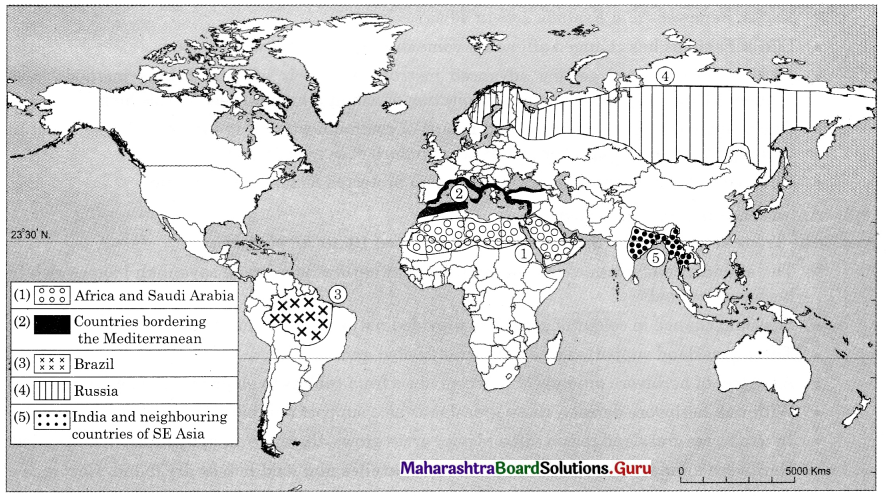
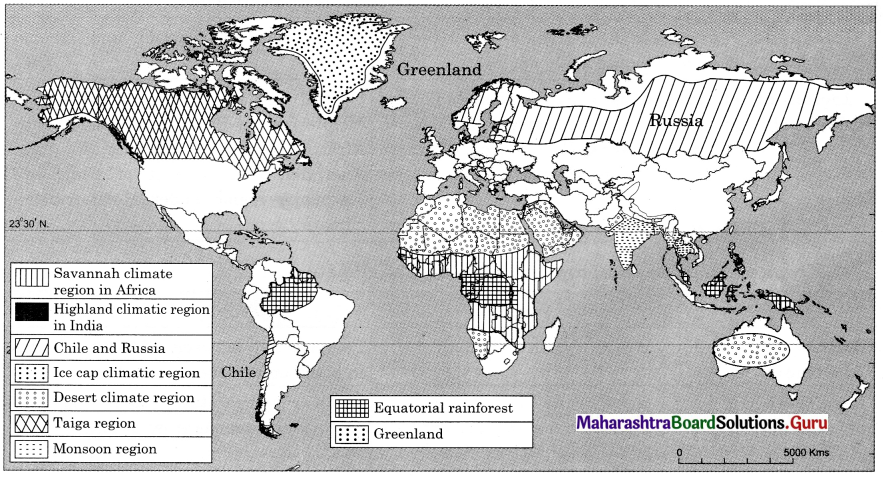
Answer the following question by using the given map.

Maharashtra Board Class 11 Geography Important Questions Chapter 8 Biomes 1
Question 1.
Name the biome in Africa and Saudi Arabia.
Answer:
Tropical Desert biome

Question 2.
The continuous belt of which biome do you see in Russia?
Answer:
Taiga biome

Question 3.
Name the biome shown in Brazil in South America.
Answer:
Tropical Rainforest biome

Question 4.
Which biome is marked in the countries bordering the Mediterranean Sea?
Answer:
Mediterranean biome

Question 5.
Name the biome shown in India and its neighboring countries of SE Asia.
Answer:
Tropical Deciduous biome

Answer in detail.

Question 1.
Describe the Aquatic Biomes.
Answer:

  1. Approximately, 70% of the earth’s surface is covered by oceans. Besides oceans, there are rivers, lakes, etc., which are freshwater sources.
  2. Biomes are found in water, too. Here, the plants and animals have adapted themselves to the existing climatic conditions.
  3. The aquatic biomes consist of any part of the earth that is covered with water, including fresh water and saltwater.
  4. The aquatic biome can be further divided into freshwater biomes, marine biomes, wetland biomes, coral reef biomes, estuaries, etc., based on the salt content of the water and the aquatic plants that live there.

Maharashtra Board Class 11 Geography Important Questions Chapter 8 Biomes

In the marine biomes, there are three layers:
(i) Euphotic Layer: It is found till a depth of 200 m and sunlight can reach here. It houses many fishes, sea turtles, jellyfish, seals, corals, zooplankton, and mangroves.

(ii) Disphotic Layer: It is the middle layer. Here, some light penetrates to the bottom part. It is around 1000 m deep from the mean sea level. Except for a few phytoplankton that has sunk from the upper layer, plants are not found here. Squid, cuttlefish, wolfish, swordfish, eels, sea dragons, etc., are found. These creatures are adapted to darkness, cold water, and high pressure.

(iii) Aphotic Layer: It is the third and the deepest layer that ranges from 1000 m to 4000 m depth. No light penetrates here. There is no living plant life. Inhabitants of this cold dark environment include elusive giant squid, bioluminescent jellyfish, angler fish, hatchet fish, etc. Sperm whales enter this zone to hunt but return to the upper layers.

Beyond this layer, lies the darkest and deepest zone extending up to the seafloor. Here, the animals are adapted to survive on detritus under even greater pressure.

Maharashtra Board Class 11 Geography Important Questions Chapter 7 Indian Ocean – Relief and Strategic Importance

Balbharti Maharashtra State Board Class 11 Geography Important Questions Chapter 7 Indian Ocean – Relief and Strategic Importance Important Questions and Answers.

Maharashtra State Board 11th Geography Important Questions Chapter 7 Indian Ocean – Relief and Strategic Importance

Complete the chain.

Question 1.

A B C
(1) Continental shelf (1) Archipelagos formed by coral atolls (1) Very wide on the western side of India
(2) Mid-Oceanic Ridges (2) Portion of continent submerged underwater (2) Ashmore
(3) Oceanic Plateaus (3) Submerged mountain ranges that separate deep portions of the ocean floor (3) the Ninety East Ridge
(4) Islands (4) Deep flat areas on the ocean bottom (4) Chagos

Answer:

A B C
(1) Continental shelf (1) Portion of continents submerged underwater (1) Very wide on the western side of India
(2) Mid-Oceanic Ridges (2) Submerged mountain ranges that separate deep portions of the ocean floor (2) Ninety East Ridge
(3) Oceanic Plateaus (3) Deep flat areas on the ocean bottom (3) Chagos
(4) Islands (4) Archipelagos formed by coral atolls (4) Ashmore

Maharashtra Board Class 11 Geography Important Questions Chapter 7 Indian Ocean – Relief and Strategic Importance

Complete the table.

Question 1.
The Indian Ocean bordered by

Sr. No Direction Continents / Oceans
(1) West —–
(2) North and East —–
(3) East —–
(4) South —–

Answer:

Sr. No Direction Continents / Oceans
(1) West Africa
(2) North and East Asia
(3) East Australia
(4) South Southern Ocean

Question 2.
Bottom Relief of the Indian Ocean

Sr. No Features Comprise of
(1) Continental Shelf —–
(2) Mid-oceanic Ridges —–
(3) Ocean Basins —–
(4) Oceanic Deeps —–
(5) Islands —–

Answer:

Sr. No Features Comprise of
(1) Continental Shelf Gulf, seas, bays and straits
(2) Mid-oceanic Ridges Submerged mountain ranges and plateaus
(3) Ocean Basins Terminal destinations for the sediments brought from the continents and from the oceanic part itself.
(4) Oceanic Deeps Deep, narrow and steeply sloping depressions found on the ocean floor
(5) Islands Coral atolls and volcanic islands

Question 3.
Islands of Indian Ocean

Sr. No Islands of Indian Ocean:
(1) Islands in the Arabian Sea ———
(2) Islands of Bay of Bengal ———
(3) Islands along Australian Coast ———

Answer:

Sr. No Islands of Indian Ocean:
(1) Islands in the Arabian Sea Madagascar, Comoros, Bassas de India, Europa Island, Reunion, Maldives, Chagos, Mauritius, Seychelles, Island of Socotra, Lakshadweep, Bundle Island, Kish, Hendorabi, Lavan, Siri, etc.
(2) Islands of Bay of Bengal Sri Lanka, Andaman and Nicobar, Sumatra Island
(3) Islands along Australian Coast Ashmore, Christmas and Cocos (or Keeling) Island.

Choose the correct option by identifying the correct correlation in the sentences.

Question 1.
Most of the trenches of the Indian Ocean are located towards its ………………… boundary.
(a) northern
(b) southern
(c) eastern
(d) western
Answer:
(c) eastern

Question 2.
The Bundle Island is located near the coast of …………………….
(a) Sri Lanka
(b) Pakistan
(c) Bangladesh
(d) Myanmar
Answer:
(b) Pakistan

Maharashtra Board Class 11 Geography Important Questions Chapter 7 Indian Ocean – Relief and Strategic Importance

Question 3.
To the east of …………………. lie the islands like Reunion, Mauritius, Seychelles, Socotra.
(a) Madagascar
(b) Australia
(c) Indonesia
(d) Sri Lanka
Answer:
(a) Madagascar

Question 4.
Diego Garcia is an atoll which was first discovered by the Europeans and named by the ……………………
(a) Portuguese
(b) French
(c) Dutch
(d) Germans
Answer:
(a) Portuguese

Question 5.
The salinity of the oceans is generally …………………. around the Somali Peninsula and closer to the Saudi Arabian Coast.
(a) high
(b) low
(c) moderate
(d) very high
Answer:
(a) high

Question 6.
The South Equatorial current flows from / in the ……………………
(a) west to east
(b) east to west
(c) clockwise direction
(d) anticlockwise direction
Answer:
(b) east to west

Identify the correct correlation.

A : Assertion
R : Reasoning

Question 1.
A – There is a complete blockage of the Indian Ocean towards its north.
R – Unlike the Pacific Ocean and the Atlantic Ocean the Indian Ocean does not extend northwards to the Arctic Ocean.
(a) Only A is correct.
(b) Only R is correct.
(c) Both A and R are correct and R is the correct explanation of A.
(d) Both A and R are correct but R is not the correct explanation of A.
Answer:
(c) Both A and R are correct and R is the correct explanation of A.

Maharashtra Board Class 11 Geography Important Questions Chapter 7 Indian Ocean – Relief and Strategic Importance

Question 2.
A – It is believed by most of the geologists that Madagascar was a part of African Continent in the geological past.
R – It has undergone two separations such as first separation from Africa and later from the Indo-Australian Plate.
(a) Only A is correct.
(b) Only R is correct.
(c) Both A and R are correct and R is the correct explanation of A.
(d) Both A and R are correct but R is not the correct explanation of A.
Answer:
(c) Both A and R are correct and R is the correct explanation of A.

Question 3.
A – In the case of Bay of Bengal, the Peninsular rivers lead to the lowering of salinity in this area.
R – The salinity is less during the period of South West Monsoon.
(a) Only A is correct.
(b) Only R is correct.
(c) Both A and R are correct and R is the correct explanation of A.
(d) Both A and R are correct but R is not the correct explanation of A.
Answer:
(d) Both A and R are correct but R is not the correct explanation of A.

Question 4.
A – The Indian market has emerged as one of the largest importers of South East Asian goods.
R – The recently concluded Free Trade Agreements with countries like Thailand and Singapore are set to contribute to this trend.
(a) Only A is correct.
(b) Only R is correct.
(c) Both A and R are correct and R is the correct explanation of A.
(d) Both A and R are correct but R is not the correct explanation of A.
Answer:
(d) Both A and R are correct but R is not the correct explanation of A.

Identify the incorrect factor.

Question 1.
The islands in Bay of Bengal are-
(a) Andaman and Nicobar
(b) Sri Lanka
(c) Sumatra
(d) Madagascar
Answer:
(d) Madagascar

Question 2.
The islands in the Arabian Sea are-
(a) Sumatra
(b) Mauritius
(c) Seychelles
(d) Chagos
Answer:
(a) Sumatra

Maharashtra Board Class 11 Geography Important Questions Chapter 7 Indian Ocean – Relief and Strategic Importance

Question 3.
The islands along the Australian coast are-
(a) Maldives
(b) Ashmore
(c) Christmas
(d) Cocos
Answer:
(a) Maldives

Question 4.
Islands in the Arabian Sea along the Persian Gulf-
(a) Kish
(b) Siri
(c) Lavan
(d) Bundle
Answer:
(d) Bundle

Question 5.
Ocean basins in the Indian Ocean are-
(a) Andaman basin
(b) Somali basin
(c) Oman basin
(d) Mauritius basin
Answer:
(a) Andaman basin

Question 6.
The Ocean currents in southern part of the Indian Ocean are-
(a) South equatorial current
(b) West wind drift
(c) Northeast current
(d) Mozambique-Agulhas currents
Answer:
(c) Northeast current

Question 7.
Islands to the east of Madagascar island are-
(a) Mauritius
(b) Lavan
(c) Reunion
(d) Seychelles
Answer:
(b) Lavan

Question 8.
The islands in the Arabian Sea are-
(a) Comoros
(b) Bassas de India
(c) Europa island
(d) Sri Lanka
Answer:
(d) Sri Lanka

Question 9.
The busiest straits in the Indian Ocean are-
(a) Hormuz
(b) Malacca
(c) Bab-el-Mandeb
(d) Palk
Answer:
(d) Palk

Maharashtra Board Class 11 Geography Important Questions Chapter 7 Indian Ocean – Relief and Strategic Importance

Give geographical reasons.

Question 1.
Monsoon climate has developed in the Indian sub-continent.
Answer:
Monsoon climate has developed in the Indian sub-continent because-

  1. The Indian Ocean spreads between Africa in the west, Asia in the north and east, Australia in the east and Southern Ocean in the south.
  2. The Indian Ocean does not extend northwards to the Arctic Ocean like the Atlantic Ocean and the Pacific Ocean.
  3. This has resulted in complete blockage of the Indian Ocean towards its north.
  4. This peculiar arrangement of the ocean and the continental portion contributes a lot to the development of the monsoon climate of the Indian sub-continent.
  5. During summer solstice, sun shines vertically on tropic of cancer, so there is summer season over the Indian sub-continent.
  6. Due to continuous heating, low pressure area is created, moisture laden south west monsoon winds give rainfall on the Indian sub-continent, that is rainy season.
  7. During winter solstice, due to slanting sunrays, the temperature goes down, that is winter season.
  8. Thus, there is monsoon climate with three distinctive seasons.

Question 2.
The study of temperature of the ocean is essential.
Answer:
The study of temperature of the ocean is essential because-

  1. The temperature of the ocean provides information on the global climate system.
  2. It is also important for the study of marine ecosystems.
  3. The temperature of the ocean water is responsible for the movement in the oceanic water.
  4. Rising temperatures cause coral bleaching and loss of breeding grounds for marine fishes and mammals.
  5. The study of temperature of the ocean can help in establishing marine protected areas and forming precautionary limits to prevent overfishing, protecting ocean ecosystems and shield humans from the effects of ocean warming.

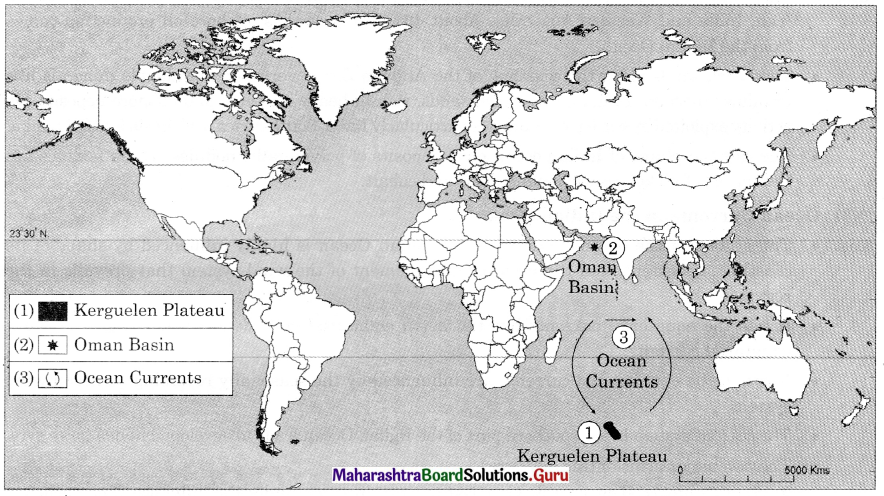
Answer the following question by using the given map.

Maharashtra Board Class 11 Geography Important Questions Chapter 7 Indian Ocean – Relief and Strategic Importance 1
Question 1.
Name the plateau in South Indian Ocean.
Answer:
Kerguelen Plateau

Question 2.
Name the ocean basin in North Arabian Sea.
Answer:
Oman Basin

Maharashtra Board Class 11 Geography Important Questions Chapter 7 Indian Ocean – Relief and Strategic Importance

Question 3.
Name the ocean current near the equator in the Indian Ocean.
Answer:
Counter Equator Current

Question 4.
Name the ocean current in Western Indian Ocean.
Answer:
Agulhas Current

Question 5.
Name the ocean current in Eastern Indian Ocean.
Answer:
Australian Current

Write short notes on.

Question 1.
Challenges in the Indian Ocean
Answer:

  1. India occupies a central and strategic location in the Indian Ocean.
  2. Keeping the Indian Ocean as a Zone of Peace free from superpower rivalry is a major challenge in the Indian Ocean.
  3. Most of the conflicts since the end of the Cold War have taken place in or around the Indian Ocean region. As a result, almost all the world’s major powers have deployed substantial military forces in the Indian Ocean region.
  4. Expanding markets and larger import flows imply vulnerability at sea. Hence, the incidence of piracy, armed robbery and maritime terrorism are on the rise and has placed a premium on the complexity of Sea lane defence.

Question 2.
Islands in Indian Ocean
Answer:

  1. There are 39 islands in the Indian Ocean. Most of them are away from the coastline. They are deep sea islands.
  2. The islands of the Indian Ocean are a varied collection, including many smallest territories and some large islands like Sri Lanka, Australia and Madagascar.

The islands in the Indian Ocean are grouped into-

  1. Islands of Arabian sea
  2. Islands along Bay of Bengal
  3. Islands along the Australian coast

Islands in Indian Ocean-

  1. Islands of the Arabian Sea can be sub grouped such as islands close to the African coast and islands along the Lakshadweep – Chagos Ridge.
  2. The largest island close to the African coast is Madagascar island. It is separated from Africa, and later from the Indo-Australian plate. It is one of the seismologically active provinces.
  3. There are many islands between the eastern coast of Africa and Madagascar island, such as Comoros, Europa and Bassas de India, etc. To the east of Madagascar are Mauritius, Reunion and Seychelles, etc.
  4. The group of islands along Lakshadweep-Chagos Ridge are Maldives, Chagos and Lakshadweep.
  5. Apart from these islands, other islands are the Bundle island near the coast of Pakistan and Siri, Lavan, Kish, Hendorabi, etc., along the Persian Gulf part of Iran.
  6. The islands in Bay of Bengal are associated with the converging plate boundary. These islands are the peaks of submerged mountains. The islands of Bay of Bengal are Sri Lanka, Andaman and Nicobar group, and chain of islands along the western coast of Sumatra island of Indonesia.
  7. Most of these islands are volcanic islands. Sri Lanka is the largest island of this group.
  8. There are very few islands along the coastline of Australia such as Cacos, Christmas, Ashmore, etc.

Maharashtra Board Class 11 Geography Important Questions Chapter 7 Indian Ocean – Relief and Strategic Importance

Answer in detail.

Question 1.
Describe the continental shelf of the Indian Ocean.
Answer:

  1. The continental shelf is the portion of continents submerged under oceanic water.
  2. It is normally occupied by different gulfs, seas, bays and straits.
  3. There is a wide range of variation in the continental shelves of the Indian Ocean.
  4. There are quite extensive shelves along the Indian coasts.
  5. The eastern coast of Africa and Madagascar record relatively narrow width of continental shelves, and along the Indonesian coast, it is very narrow (160 km).
  6. The continental shelves are very wide in the west of India whereas these are narrow along the eastern coast.
  7. Continental shelves are veneered with deposits brought down by terrestrial agents of erosion.
  8. Some of the sedimentary deposits are received from over thousand years.
  9. As they remain deposited for a long time, sedimentary rocks are formed.
  10. Some of them are a potential source of fossil fuel.

Question 2.
Describe the Mid-Oceanic Ridges of the Indian Ocean.
Answer:

  1. Mid-oceanic ridges are submerged mountain ranges that separate deep portion of the sea (Ocean) floor.
  2. The Indian Ocean has a Mid Ocean ridge called as a Mid Indian Oceanic Ridge.
  3. It originates from the Gulf of Eden near the Peninsula of Somalia.
  4. It further extends toward the south and on the eastern side of Madagascar, it divides into two branches.
  5. One branch diverts towards southwest and extends up to Prince Edward Island. It is known as Southwest Indian Ocean Ridge.
  6. The second branch extends south eastwards up to Amsterdam and St. Paul Island. It is known as Mid Indian Ocean Ridge.
  7. Mid Indian Oceanic Ridge has many parallel ridges. This ridge is not continuous due to many fracture Zones in it. e.g. Owen Fracture Zone. Amsterdam Fracture Zone, etc.

Maharashtra Board Class 11 Geography Important Questions Chapter 7 Indian Ocean – Relief and Strategic Importance

Question 3.
Explain in detail the importance of Indian Ocean to India.
Answer:
India has the control and strategic location in the Indian Ocean. Therefore, India’s economic and national interests are linked with the Indian Ocean.

From economic point of view, India’s trade with neighbouring countries is dependent on the Indian Ocean. Indian Ocean provides major sea route connecting Middle East, Africa and East Asia with Europe and America. India’s import of mineral oil mainly comes from Gulf countries.

The sand on the beaches along the Arabian Sea is rich in valuable minerals like uranium. India has offshore deposits of mineral oil at Bombay High in the Arabian Sea. Abyssal plains of the Indian Ocean have deposit of polymetallic nodules. These nodules are source of nickel, copper, manganese and cobalt.

India has developed very good trade relations with countries of east due to its location along the Arabian Sea. Trade volumes with ASEAN countries are increasing every year. The Indian market has emerged as one of the largest importers of South East Asian goods. India also has Free Trade Agreements with Singapore and Thailand.

The northern area of the Indian Ocean is the area of great significance in economic and strategic terms. With expansion of India’s export and import, India is forecasted to become one of the three fastest growing economics in the world.

Due to heavy trade, through Indian Ocean, the incidences of piracy, armed robbery and maritime terrorism are on the rise and therefore, defence work in the Indian Ocean have increased.

To keep the Indian Ocean as a zone of peace, free from superpower rivalry and increasing cooperation among littoral countries in the region has always been India’s foreign policy goal. For example, Indian Ocean Rim Association for Regional Cooperation, Ganga-Mekong Cooperation, etc.

Maharashtra Board Class 11 Geography Important Questions Chapter 6 Ocean Resources

Balbharti Maharashtra State Board Class 11 Geography Important Questions Chapter 6 Ocean Resources Important Questions and Answers.

Maharashtra State Board 11th Geography Important Questions Chapter 6 Ocean Resources

Complete the chain.

Question 1.

A B C
(1) Continental Shelf (1) Mariana Trench (1) Methane Hydrate
(2) Continental Slope (2) Mumbai High (2) Coral Island
(3) Oceanic Ridges and Plateau (3) Krishna-Godavari Basin (3) Deepest Part
(4) Oceanic Trenches (4) Aldabra (4) Oil and Gas

Answer:

A B C
(1) Continental Shelf (1) Mumbai High (1) Oil and Gas
(2) Continental Slope (2) Krishna-Godavari Basin (2) Methane Hydrate
(3) Oceanic Ridges and Plateau (3) Aldabra (3) Coral Island
(4) Oceanic Trenches (4) Mariana Trench (4) Deepest Part

Choose the correct option by identifying the correct correlation in the sentences.

Question 1.
The phenomenon of tides releases ………………..
(a) large amounts of energy
(b) large amounts of sediments
(c) large amounts of forces
(d) large amounts of resources
Answer:
(a) large amounts of energy

Question 2.
Desalination process ………………..
(a) is the removal of oil from sea water
(b) is the removal of petroleum from sea water
(c) is the removal of salt from sea water
(d) is the removal of seaweeds from sea water
Answer:
(c) is the removal of salt from sea water

Question 3.
The gradient of slope of continental slope region can be ………………….
(a) around 2° to 5°
(b) between 12° to 15°
(c) around 2° to 4°
(d) between 2° to 5°
Answer:
(d) between 2° to 5°

Question 4.
The oceanic trenches generally occur along plate boundaries and are associated with …………………
(a) active volcanoes and strong earthquakes
(b) folds and fault
(c) sedimentation
(d) deep sea movements
Answer:
(a) active volcanoes and strong earthquakes

Question 5.
Limestones are formed extensively in the tropical oceans of the world as a result of ………………….
(a) volcanic heat
(b) precipitate material by corals and plants
(c) sediments brought by the rivers
(d) evaporation of sea water
Answer:
(b) precipitate material by corals and plants

Question 6.
On tropical coasts, ………………….. vegetation is found abundantly.
(a) evergreen
(b) mangrove
(c) deciduous
(d) coniferous
Answer:
(b) mangrove

Question 7.
The ……………….. Ocean route is the most important and busiest ocean route in the world.
(a) Atlantic
(b) Pacific
(c) Indian
(d) Arctic
Answer:
(a) Atlantic

Question 8.
The deposition of sediments is limited in ………………….
(a) Continental shelf
(b) Continental slope
(c) Abyssal plains
(d) Oceanic deeps
Answer:
(b) Continental slope

Question 9.
The submerged ……………….. on the ocean floor are called oceanic ridges.
(a) mountains
(b) Islands
(c) deeps
(d) plateaus
Answer:
(a) mountains

Question 10.
The ………………… are isolated habitats that have evolved slowly over millions of years to support communities.
(a) ridges
(b) mountains
(c) plateaus
(d) seamounts
Answer:
(d) seamounts

Identify the correct correlation.

A : Assertion
R : Reasoning

Question 1.
A – The oceanic trenches are the deepest parts of the oceans.
R – These trenches can be thousands of metres deep.
(a) Only A is correct.
(b) Only R is correct.
(c) Both A and R are correct and R is the correct explanation of A.
(d) Both A and R are correct but R is not the correct explanation of A.
Answer:
(c) Both A and R are correct and R is the correct explanation of A.

Identify the incorrect factor.

Question 1.
Continental Islands in India are-
(a) Minicoy
(b) Seven Islands of Bombay
(c) Amindivi
(d) Andaman
Answer:
(d) Andaman

Question 2.
The relief of ocean floor contain-
(a) depression
(b) continental shelf
(c) abyssal plain
(d) ocean trench
Answer:
(a) depression

Question 3.
The biotic resources on ocean floor are-
(a) plankton
(b) seaweeds
(c) minerals
(d) fish
Answer:
(c) minerals

Question 4.
The abiotic resources on ocean floor are-
(a) limestone
(b) mollusc
(c) gypsum
(d) mineral oils
Answer:
(b) mollusc

Question 5.
The biotic resources on ocean floor are-
(a) whale
(b) corals
(c) sodium chloride
(d) seahorse
Answer:
(c) sodium chloride

Question 6.
Abiotic resources on ocean floor are-
(a) shrimp
(b) potassium
(c) sodium chloride
(d) natural gas
Answer:
(a) shrimp

Question 7.
Marine pollution occurs due to-
(a) industrial effluents
(b) disposal of solid waste
(c) leakage of oil from oil exporting ships
(d) burning of waste
Answer:
(d) burning of waste

Question 8.
The richest Ashing grounds in the world are-
(a) Dogger bank
(b) Konkan coast
(c) Grand bank
(d) Georges bank
Answer:
(b) Konkan coast

Give geographical reasons.

Question 1.
The very existence of marine life is threatened.
Answer:
The very existence of marine life is threatened because-

  1. Due to human activities, the ocean is polluted on a large scale.
  2. The leakages of oil from oil transporting ships, oil extraction from coastal areas, disposal of solid waste containing radioactive matter, atomic tests etc., are causing large scale pollution of oceanic waters.
  3. The effluents brought by river discharges, the disposal of waste from coastal cities, the waste from industries and many other similar factors are polluting the oceanic waters.

Question 2.
The seas and oceans are the most convenient natural medium of transport.
Answer:
The seas and oceans are the most convenient natural media of transport because-

  1. Sea or ocean transport is used for both passengers and goods transport.
  2. The most important aspect of sea and ocean transport is that it is the cheapest mode of transport than any other modes of transport.
  3. The heavy goods, machinery, vehicles etc., can be carried by ocean transport conveniently and at cheaper rate.
  4. The transport of goods and passengers between the countries is not possible by rail and road transport, air transport has limitations; therefore, sea or ocean transport is useful and convenient for international trade.
  5. For example, Suez Canal connects the Mediterranean Sea to the Indian Ocean via. the Red Sea, making it the shortest maritime route to Asia from Europe.

Question 3.
Ocean tourism is becoming popular.
Answer:
Ocean tourism is becoming popular because-

  1. Ocean tourism is developed along the coastal areas of seas and oceans.
  2. Generally, water sports activities such as scuba diving, surfing, water skiing, etc., are developed along the coastline. For example, sport activities along the coast of Goa.
  3. There is a beautiful scenery along the coastline due to greenery of trees.
  4. Along the coast we find huge water bodies of seas and oceans, clean air and coolness due to nearness to water. Therefore, many resorts, hotels, marina, etc., are developed and coastal areas have become popular for tourism.
  5. The cruise tourism is also increasing.

Differentiate between.

Question 1.
Continental Shelf and Continental Slope.
Answer:

Continental Shelf Continental Slope
(i) The portion of the continents that is submerged under water and borders the coastal areas is known as a continental shelf. (i) After the extent of continental shelf is over, there is a sharp drop in the ocean floor. This is called continental slope.
(ii) They are broad, shallow and gently-sloping plains covered by water. (ii) The slope is steep and stretches over limited area.
(iii) The depth of the continental shelf from the sea level is about 180 to 200 m. (iii) The depth of the continental slope is from 200 m to 4000 m from the sea level.
(iv) Sunlight reaches up to the bottom of the continental shelf and hence fishing is done on a large scale in this region. (iv) Sunlight does not reach the bottom of the continental slope and moreover due to the steep slope fishing cannot be done in this region.
(v) The continental shelves contain the world’s largest reservoirs of natural oil and gas. Besides oil and gas, minerals are also found here. Diamonds, chromite, ilmenite, magnetite, platinum, gold and phosphorite deposits are also found here. Sand, gravel aggregates and industrial silica sand are the most important of hard minerals now extracted in the near offshore zone. (v) Methane hydrate, a compound of water and methane, is present on the continental slopes. On the slope, we find many traces of submarine landslide activity, ocean canyons and huge avalanche fans.

Question 2.
Oceanic Deeps and Oceanic Trenches.
Answer:

Oceanic Deeps Oceanic Trenches
(i) At places, deep, narrow and steeply sloping depressions are found on the ocean floor. The shallow depressions are called deeps. (i) At places, deep, narrow and steeply sloping depressions are found on the ocean floor. The deeper depressions are called ocean trenches.
(ii) Active volcanoes and earthquakes are not seen in oceanic deeps. (ii) Trenches are formed at convergent plate boundaries. Active volcanoes and earthquakes generally occur along the plate boundaries of oceanic trenches.
(iii) The Romanche Trench in the Atlantic Ocean close to the equator. (iii) The Mariana Trench in the Pacific Ocean is 11 kms deep.

Answer the following question by using the given map.

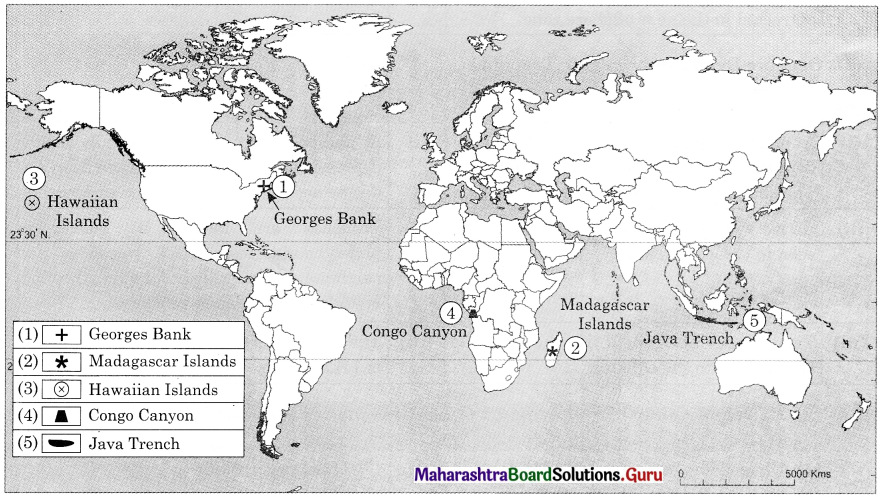
Maharashtra Board Class 11 Geography Important Questions Chapter 6 Ocean Resources 1
Question 1.
In which ocean are the Madagascar islands located?
Answer:
Madagascar islands are located in the Indian Ocean.

Question 2.
Mention the location of Georges Bank.
Answer:
Georges Bank is located along the north eastern coastline of U.S.A.

Question 3.
Where is the Congo Canyon located?
Answer:
The Congo Canyon is located along the western coastline of South Africa.

Question 4.
Name the group of islands located in the Pacific Ocean.
Answer:
The Hawaiian Islands are located in the Pacific Ocean.

Question 5.
Name the deepest trench in the Indian ocean.
Answer:
The deepest trench in the Indian Ocean is the Java Trench.

Write short notes on.

Question 1.
Causes of climate change
Answer:
The portion of the continents that are submerged under water and borders the coastal areas is known as a continental shelf.

They are broad, shallow and gently-sloping plains covered by water.

The continental shelf does not extend into the ocean uniformly. Near some coasts, it is narrow while in some parts it may extend for hundreds of kilometres. For example, they are almost absent or very narrow along the coasts of Chile, Sumatra etc., while the Siberian coast near the Arctic Ocean is around 1500 km in width.

Generally, its depth from the sea level is about 180 m to 200 m.

As the sunlight reaches this part of the ocean bed, it is rich in plankton. These millions of microscopic organisms found in sea water are an important food for fish. Millions of fishes thrive here. The shelf has some of the richest fishing grounds in the world, such as the Grand Banks and Georges Bank in North America.

The continental shelves contain the world’s largest reservoirs of natural oil and gas. For example, the Mumbai High in Arabian sea. Besides oil and gas, minerals are also found here.

Diamonds, chromite, ilmenite, magnetite, platinum, gold and phosphorite deposits are common. Sand, gravel aggregates and industrial silica sand are the most important of hard minerals now extracted in the near offshore zone.

Question 2.
Desalination
Answer:

  1. Sea water contains lot of salt, so it is not useful for drinking or irrigation purpose. Therefore, it is necessary to convert the sea water into fresh water.
  2. Desalination is the process of removal of salt from sea water and converting sea water into fresh water.
  3. Desalination is done by heating water or freezing water or by electrical processes.
  4. The desalination process is very expensive, therefore it is used where there is acute shortage of water.
  5. The Minjur Desalination Plant is the largest in India, located at Kattupalli village, a northern suburb of Chennai on the coast of the Bay of Bengal that supplies water to the city of Chennai.
  6. These desalination plants are more used in developing countries since the cost for processing is high. Desalination plants are located in Saudi Arabia, Oman, Cyprus, Algeria, Spain and UAE.
  7. Desalination plants have adverse effect on the coastal environment. Small sea organisms like plankton and baby fish may be killed. Their food chain is disturbed.
  8. It is still used in some countries to get fresh water.

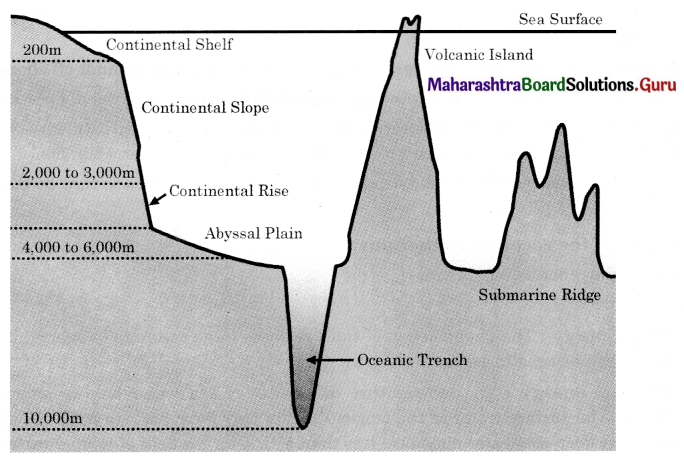
Draw a neat and labelled diagram of the ocean floor.

Answer:
Maharashtra Board Class 11 Geography Important Questions Chapter 6 Ocean Resources 2

Answer in detail.

Question 1.
Explain uses of the oceans for other purposes.
Answer:
Following are the other uses of oceans:
For energy:

  1. Tidal Energy : The phenomenon of tides releases large amounts of energy. Thus, tidal energy can be used to generate electricity.
  2. Thermal energy : The temperature differences of sea water help in generating the energy. The surface water of the tropical region may have 25°C to 30°C of temperature while the deep-sea water may have less than 5°C. This gradient of temperature is used to run a generator to produce electricity.

For drinking water : Due to high salt content in sea water, it is not suitable for drinking or for irrigation directly. But sea water can be converted into fresh water.

Trade and transport : Maritime transport is the transport of people or cargo by water. Transportation by water is cheaper than any other modes of transport. The seas and oceans are the most convenient natural medium for transport. For example, Suez Canal connects the Mediterranean Sea to the Indian Ocean via. the Red Sea, making it the shortest maritime route to Asia from Europe.

Tourism : Ocean tourism comes in many forms like cruises, scuba-diving, fishing, beach tourism, etc. Such activities are increasingly becoming popular. In many areas, massive new tourist developments have been built which include resorts and marinas. These activities, in turn, affect the ocean habitats and environment.

Question 2.
Explain the biotic resources on the ocean floor.
Answer:

  1. The biotic resources on the ocean floor bottom include plants and animals.
  2. The oceans provide habitat to thousands of species of marine plants and animals which are food for many organisms.
  3. There are many marine animals like fish, crabs, mollusks tortoises, prawns, etc.
  4. There are many plant varieties such as seaweeds, mangroves, medicinal plants, and many more marine plants.
  5. Many sea animals provide oil, leather, cattle feed, glue, and some other products. Seaweeds are also used as food. Seaweeds added in fertilizers and skincare ointments, etc.
  6. Mangrove forests provide wood for fuel, furniture, and various products useful for man. Mangroves provide food and shelter to marine life.
  7. There are also micro-organisms that produce organic material, they are called plankton. Plankton is one of the favourite fish foods. Marine life depends upon plankton.
  8. Coral reefs are a major part of the ocean ecosystem. Tourism develops in the areas where corals are found. For example, the Great Barrier Reef in Australia attracts tourists from all around the world.

Thus, biotic resources on the ocean floor are valuable.

Question 3.
Explain the importance of abiotic resources on the ocean floor.
Answer:

  1. There are many abiotic resources on the ocean floor and most of them are not exploited yet.
  2. The most common resources are sodium chloride, gypsum, limestone, etc. Sodium chloride is a common salt.
  3. Gypsum deposits are collected from the ocean floor. Gypsum is used in making Plaster of Paris.
  4. The material which precipitates from the body of corals results in the formation of limestone. The metamorphic form of limestone is a marble.
  5. A large number of metallic and non-metallic minerals are found on the ocean floor. These are rich deposits of copper, manganese, zinc, cobalt, platinum, etc.
  6. The most important mineral related to our day-to-day life is extracted from the seafloor, that is mineral oil and natural gas. For example, Bombay High – is an oil mining area in the Arabian Sea.
  7. When we obtain non-biotic resources from the ocean floor, it may cause a disturbance in ecological balance. The drilling machines may disturb marine organisms. Therefore, care should be taken to maintain the ecological balance of the ocean environment.

Maharashtra Board Class 11 Geography Important Questions Chapter 5 Global Climate Change

Balbharti Maharashtra State Board Class 11 Geography Important Questions Chapter 5 Global Climate Change Important Questions and Answers.

Maharashtra State Board 11th Geography Important Questions Chapter 5 Global Climate Change

Complete the chain

Question 1.

A B C
(1) Different density of corals in summer and winter (1) Ice cores (1) Understanding of past environmental conditions
(2) Variation in environmental conditions (2) Goldilocks Zone (2) Summer snow different from winter snow
(3) Samples of ice from inner sides of the ice sheets (3) Creates seasonal growth rings on corals (3) Earth was cooler when it was located in the outer reaches of this zone
(4) Habitable zone in which the Earth lies (4) Tree rings (4) Determines the temperature of water and season in which coral grew

Answer:

A B C
(1) Different density of corals in summer and winter (1) Creates seasonal growth rings on corals (1) Determines the temperature of water and season in which coral grew
(2) Variation in environmental conditions (2) Tree rings (2) Understanding ofpast environmental condition
(3) Samples of ice from inner sides of the ice sheets (3) Ice cores (3) Summer snow different from winter snow
(4) Habitable zone in which the Earth lies (4) Goldilocks Zone (4) Earth was cooler when it was located in the outer reaches of this zone

Maharashtra Board Class 11 Geography Important Questions Chapter 5 Global Climate Change

Choose the correct option by identifying the correct correlation in the sentences.

Question 1.
Urban areas heat up more readily because …………………..
(a) of presence of deserts
(b) of paved surfaces and concrete constructions
(c) they have many industries
(d) they are in plain regions
Answer:
(b) of paved surfaces and concrete constructions

Question 2.
Global sea level rise is apparently being caused because of …………………….
(a) increased melting of ice such as glaciers and ice sheets
(b) frequent flooding of coastal areas
(c) increase in precipitation
(d) flash floods
Answer:
(a) increased melting of ice such as glaciers and ice sheets

Question 3.
Around the world the jellyfish seem to be reproducing heavily and congregating in places because of ………………
(a) melting of ice sheets
(b) global warming
(c) sea water is rising
(d) warmer waters and changes in the acidity level of the oceans.
Answer:
(d) warmer waters and changes in the acidity level of the oceans.

Question 4.
These has been an increase in number of flash floods and also the duration of floods because of ……………….
(a) increased deforestation
(b) melting of glaciers
(c) very high precipitation in one day
(d) increase of volume of water in rivers
Answer:
(c) very high precipitation in one day

Question 5.
It has been observed that with more CO<sub>2</sub>, in the air, crop yield has …………………
(a) increased
(b) decreased
(c) remained constant
(d) changed
Answer:
(a) increased

Question 6.
The average temperature of earth is around …………………
(a) 10°C
(b) 12°C
(c) 14°C
(d) 16°C
Answer:
(c) 14°C

Maharashtra Board Class 11 Geography Important Questions Chapter 5 Global Climate Change

Question 7.
Receding glaciers as a symptom of global climate change has been observed in the glaciers near ………………. in Africa.
(a) Mt. Kilimanjaro
(b) Mt. Kenya
(c) Mt. Meru
(d) Mt. Toubkal
Answer:
(a) Mt. Kilimanjaro

Question 8.
An increase of 1° – 2°C in ocean temperatures for a long time can lead to …………………. of corals.
(a) growth
(b) bleaching
(c) death
(d) congregation
Answer:
(b) bleaching

Question 9.
The roots of both flooding and drought lie in the physical process known as …………………
(a) erosion
(b) transportation
(c) deposition
(d) evaporation
Answer:
(d) evaporation

Question 10.
The ………………… in the trees provide clues about wet and dry periods.
(a) branches
(b) wood
(c) rings
(d) leaves
Answer:
(c) rings

Identify the correct correlation.

A : Assertion
R : Reasoning

Question 1.
A – India has high vulnerabilities to climate change.
R – India has peculiar economy and geography.
(a) Only A is correct.
(b) Only R is correct.
(c) Both A and R are correct and R is the correct explanation of A.
(d) Both A and R are correct but R is not the correct explanation of A.
Answer:
(d) Both A and R are correct but R is not the correct explanation of A.

Question 2.
A – More than one-fifth of the coral reefs are already lost.
R – Coral bleaching leads to death of large amount of corals.
(a) Only A is correct.
(b) Only R is correct.
(c) Both A and R are correct and R is the correct explanation of A.
(d) Both A and R are correct but R is not the correct explanation of A.
Answer:
(d) Both A and R are correct but R is not the correct explanation of A.

Question 3.
A – Coral formed in the summer has a different density than coral formed in the winter.
R – Summer snow differs from winters snow.
(a) Only A is correct.
(b) Only R is correct.
(c) Both A and R are correct and R is the correct explanation of A.
(d) Both A and R are correct but R is not the correct explanation of A.
Answer:
(d) Both A and R are correct but R is not the correct explanation of A.

Maharashtra Board Class 11 Geography Important Questions Chapter 5 Global Climate Change

Question 4.
A – Volcanism is considered as a cause of climate change.
R – The winds spread aerosols around the world reducing sun’s radiation to reach on earth’s surface.
(a) Only A is correct.
(b) Only R is correct.
(c) Both A and R are correct and R is the correct explanation of A.
(d) Both A and R are correct but R is not the correct explanation of A.
Answer:
(d) Both A and R are correct but R is not the correct explanation of A.

Question 5.
A – Higher sea levels may lead to deadlier cyclones and also frequent flooding of coastal areas.
R – High precipitation leads to higher sea level.
(a) Only A is correct.
(b) Only R is correct.
(c) Both A and R are correct and R is the correct explanation of A.
(d) Both A and R are correct but R is not the correct explanation of A.
Answer:
(a) Only A is correct.

Identify the incorrect factor.

Question 1.
Causes of climate change-
(a) Melting of glaciers
(b) Amount of energy
(c) Milankovitch oscillations
(d) Volcanism
Answer:
(a) Melting of glaciers

Question 2.
Some indirect effects of warming up of earth-
(a) Spread of insects in newer region
(b) Sea level rise
(c) Bleaching of corals
(d) Heavy reproduction of jellyfish
Answer:
(b) Sea level rise

Question 3.
Effects of global warming are-
(a) Heat wave
(b) Increase in sea level
(c) Heat islands
(d) Deforestation
Answer:
(d) Deforestation

Maharashtra Board Class 11 Geography Important Questions Chapter 5 Global Climate Change

Give geographical reasons.

Question 1.
Man and his activities are the major cause of climate change.
Answer:
Man and his activities are major cause of climate change because-

  1. Besides natural causes there is an anthropogenic effect on the climate.
  2. Due to human activities many greenhouse gases mainly Carbon Dioxide (CO2) is released in the atmosphere.
  3. The emission of CO2 mainly comes from fossil fuel combustion.
  4. Large scale deforestation also increases CO2.
  5. The atmosphere takes around 20 to 25 years to adjust these high levels of CO2.

Question 2.
The change in climate is a natural and continuous process.
Answer:

  1. The change in climate is a natural and continuous process because-
  2. The earth has witnessed many variations in climate since the beginning.
  3. There are various geological records that show alteration of glacial and inter-glacial periods.
  4. The sediment deposits in glacial lakes also reveal the occurrence of warm and cold periods.
  5. The rings in the trees provide clues about wet and dry periods.
  6. Historical records describe the variations in climate.
  7. All these evidences indicate that change in climate is a natural and continuous process.

Question 3.
Rainforest play a major role in cooling the earth.
Answer:
Rainforest play a major role in cooling the earth because-

  1. Dense forest has a direct effect on the temperature of that area.
  2. In moist tropical region there is dense forest growth, they form canopy. The broad leaves of the forest help to trap moisture and allow it to evaporate, so there is natural cooling effect.
  3. When these forests are slashed and burnt over large area, hot and dry air spreads and the temperature of the area increases.
  4. When forests are burnt, large amount of carbon dioxide is added to the atmosphere and there is air pollution, which also leads to global warming.
  5. Heavy deforestation leads to decrease in the rainfall of that area and changes in rainfall pattern are observed.

Write short notes on.

Question 1.
Greenhouse gases
Answer:

  1. Greenhouse gases are the primary gases, such as, water vapour carbon dioxide, nitrous oxide, methane and ozone in the earth’s atmosphere that absorbs and traps energy from the sun.
  2. Of all greenhouse gases, carbon dioxide absorbs more heat.
  3. Without greenhouse gases, the average temperature of the earth’s surface would be about -18°C rather than the present average of 14°C.
  4. Carbon dioxide emissions comes from many human activities such as combustion of fossil fuels, oil and natural gas, with additional contributions coming from deforestation, changes in land use, soil erosion and agriculture (including live stock).

Maharashtra Board Class 11 Geography Important Questions Chapter 5 Global Climate Change

Question 2.
Causes of climate change
Answer:
Though human activities are a major cause for climate change, some natural causes are responsible for climate change. Following are some of the natural causes of climate change:
The amount of energy output by the sun is not the same always. Low energy output by sun can reduce amount of insolation received by the earth. This can lead to cooling of earth.

Another cause is the Milankovitch oscillation. Variations in the earth’s orbital characteristics around the sun and the changes in the earth’s axial tilt occur. These factors cause the earth to be closer to the sun (warmer) or farther from the sun (colder). Ice ages can occur when we are farther from the sun.

Volcanism is considered as another cause for climate change. Volcanic eruptions throw lots of particulates, and aerosols into the atmosphere. The winds spread it around the world reducing the sun’s radiation reaching the earth’s surface.

The habitable zone of the earth is called Goldilocks Zone. It means as the size of the sun increases, the zone moves outwards overtime. Such changes in zone causes earth to warm or cool.

Besides natural causes, anthropogenic activities affect the climate. The emission of CO2 from fossil fuel combustion. Large-scale deforesting also increases CO2. It takes around 20 to 25 years to adjust these high levels of CO2.

Answer in detail.

Question 1.
Explain the effects global warming.
Answer:
The average temperature of the Earth is around 14°C. As given in the earlier graph, this average temperature has increased by 0.8° C. However, the following are the effects of global warming.

Heat waves:

  1. Increase in the heat holding capacity of the atmosphere increases the temperature especially during summers.
  2. Summers can become more intense or even deadlier and could bring hot spells.

Heat islands:

  1. Global warming serves as a base from which heat waves become much worse – especially in big cities where the heat island effect comes into play.
  2. Urban areas heat up more readily because of paved surface and concrete constructions as compared to a field or forest areas.

Increase in sea level:

  1. Due to increased melting of ice such as glaciers and ice sheets, there is a global rise in the sea level every year.
  2. Higher sea levels may lead to deadlier cyclones and also frequent flooding of coastal areas.
  3. Many islands are also at risk of getting submerged.
  4. It may result in saline coastal groundwater endangered wetlands and flooding of cities and coastal communities. For example, Mumbai and parts of Konkan coastline.
  5. It also means loss of habitat for fish, birds and plants.
  6. As per the studies carried out by the Indian National Centre for Ocean Information Services, sea level may rise 9 to 90 cm between 1900 and 2100.

Melting of glaciers at high altitudes and snow in polar areas:

  1. Melting of glaciers is a natural process, but when glaciers and iceberg melt at an alarming rate, it is a cause of concern.
  2. Retreating of glaciers is considered as a symptom of global climate change. This means there is lesser ice formation each year than of melting.
  3. Over the last 25 years, Gangotri glacier has retreated more than 850 meters, with a recession of 76 meters from 1996 to 1999.

Other factors:

  1. Around the world the jellyfish seem to be reproducing heavily and congregating in places where they were never seen before.
  2. This happens because of warmer waters and changes in the acidity level of the oceans.
  3. Spread of insects in newer region apparently increases the number of mosquitoes.
  4. Bleaching of the corals take place due to increase in the ocean temperatures. Coral bleaching leads to death of large numbers of corals.

Maharashtra Board Class 11 Geography Important Questions Chapter 5 Global Climate Change

Question 2.
Explain the various tools for studying climate change.
Answer:
Scientists and meteorologists have been using instruments to measure climate and weather for the past 140 years. However, millions of years ago historical evidence called proxy data, which includes coral reefs, tree rings, ice cores, etc., were used to tell about the climate.
Coral reefs:

  1. Coral reefs are very sensitive to changes in climate.
  2. Corals form skeletons by extracting calcium carbonate from the ocean waters.
  3. When the temperature changes, densities of calcium carbonate in the skeletons also change.
  4. Coral formed in the summer has a different density than coral formed in the winter.
  5. This creates seasonal growth rings on the corals.
  6. Scientists can study these rings to determine the temperature of the water and the season in which the coral grew.

Tree rings:

  1. Variation in these rings is due to variation in the environmental conditions when they were formed.
  2. Thus, studying this variation leads to improved understanding of past environmental conditions.

Ice cores:

  1. These are samples of ice taken from the inner sides of the ice sheets.
  2. Throughput each year, layers of snow fall over the ice sheets in Greenland and Antarctica.
  3. Each layer of snow is different.
  4. Summer snow differs from winter snow.
  5. Each layer gives scientists a lot of information about the climate each year.

Maharashtra Board Class 11 Geography Important Questions Chapter 4 Climatic Regions

Balbharti Maharashtra State Board Class 11 Geography Important Questions Chapter 4 Climatic Regions Important Questions and Answers.

Maharashtra State Board 11th Geography Important Questions Chapter 4 Climatic Regions

Complete the chain.

Question 1.

A B C D
(1) Mediterranean climate (1) Interior area of Asia (1) Hot summer, very low rainfall (1) Coniferous forest
(2) Equatorial rainforest climate (2) Scandinavian countries and Siberia (2) Cool summer, bitterly cold winters (2) Scrubs and hardwood forest
(3) Tropical desert climate (3) Amazon and Congo basins (3) Moist winter and warm summer (3) Dense and evergreen hardwood forest
(4) Taiga climate (4) Central California and South Africa (4) High temperature and convectional rainfall (4) Xerophytic vegetation

Answer:

A B C D
(1) Mediterranean climate (4) Central California and South Africa (1) Moist winter and warm summer (1) Scrubs and hardwood forest
(2) Equatorial rainforest climate (3) Amazon and Congo basins (2) High temperature and convectional rainfall (2) Dense and evergreen hardwood forest
(3) Tropical desert climate (1) Interior area of Asia (3) Hot summer, very low rainfall (3) Xerophytic vegetation
(4) Taiga climate (2) Scandinavian countries and Siberia (4) Cool summer, bitterly cold winters (4) Coniferous forest

Maharashtra Board Class 11 Geography Important Questions Chapter 4 Climatic Regions

Question 2.

A B C D
(1) Tropical monsoon climate (1) Between 10° and 20° N and S (1) Summer temperatures around 35°C, rainfall averaging 250-1000 mm (1) Tundra vegetation
(2) Tundra climate (2) Between 45° to 65° N and S (2) precipitation 500 to 2500 mm (2) Tali thick grass with scattered trees
(3) Tropical savannah type of climate (3) 65° to 90° N (3) Summer temperature 27° to 32°, orographic rainfall (3) Year-round short green grass, trees shed leaves in winter
(4) West European type (4) Between 10° to 20° N and S (4) Summer temperature 10°C! and winter temperature -20°C to -30°C (4) Deciduous forest

Answer:

A B C D
(1) Tropical monsoon climate (1) Between 10° to 30° N and S (1) Summer temperature 27° to 32°, orographic rainfall (1) Deciduous forest
(2) Tundra climate (2) Between 65° to 90° N (2) Summer temperature 10°C and winter temperature -20°C to -30°C (2) Tundra vegetation
(3) Tropical Savannah type of climate (3) Between 10° to 20° N and S (3) Summer temperatures around 35°C, rainfall averaging 250-1000 mm (3) Tall thick grass with scattered trees
(4) West European type (4) Between 45° to 65° N and S (4) Mild cool summer, precipitation 500 to 2500 mm (4) Year round short green grass, trees shed leaves in winter

Choose the correct option by identifying the correct correlation in the sentences.

Question 1.
Bushmen tribe is found in ……………….
(a) Tropical deserts
(b) Highland
(c) Ice sheet
(d) Tundra
Answer:
(a) Tropical deserts

Question 2.
In Marine West European type climate …………………
(a) trees shed leaves during summers
(b) no vegetation
(c) swamps during melting of show
(d) trees shed leaves during winter
Answer:
(d) trees shed leaves during winter

Maharashtra Board Class 11 Geography Important Questions Chapter 4 Climatic Regions

Question 3.
Tundra climate is observed in the belt from ……………………
(a) near poles in both hemispheres
(b) 65° to 90° North
(c) 20° to 30° in both hemispheres
(d) 0° to 10° in both hemispheres
Answer:
(b) 65° to 90° North

Question 4.
Rainforest dense vegetation is …………………… layered vegetation.
(a) two
(b) three
(c) four
(d) one
Answer:
(b) three

Question 5.
Tropical monsoon climate is found within …………….. North and South of the equator.
(a) 10° to 30°
(b) 0° to 10°
(c) 30° to 60°
(d) 60° to 90
Answer:
(a) 10° to 30°

Question 6.
In India parts of the peninsular plateau and rain-shadow zone in Maharashtra has …………………. type of climate.
(a) Mediterranean
(b) Arid
(c) Tropical Savannah
(d) Mountain
Answer:
(c) Tropical Savannah

Question 7.
Rainfall in winter is a characteristic of …………………. climate.
(a) China type
(b) Marine West European
(c) Taiga
(d) Mediterranean
Answer:
(d) Mediterranean

Question 8.
The tribes of Greenland are ……………….
(a) Aborigines
(b) Inuits
(c) Bushmen
(d) Bedouin
Answer:
(b) Inuits

Maharashtra Board Class 11 Geography Important Questions Chapter 4 Climatic Regions

Question 9.
Terrace cultivation is a characteristic of ………………….. type of climate.
(a) mountain
(b) ice cap
(c) equatorial
(d) arid
Answer:
(a) mountain

Identify the correct correlation.

A : Assertion
R : Reasoning

Question 1.
A – In high mountains, large changes in mean temperatures occur over short distances.
R – Highland climates are governed by topography.
(a) Only A is correct.
(b) Only R is correct.
(c) Both A and R are correct and R is the correct explanation of A.
(d) Both A and R are correct but R is not the correct explanation of A.
Answer:
(c) Both A and R are correct and R is the correct explanation of A.

Question 2.
A – In ice cap climate extremely meagre precipitation in the form of snow is found.
R – Precipitation exceeds evaporation.
(a) Only A is correct.
(b) Only R is correct.
(c) Both A and R are correct and R is the correct explanation of A.
(d) Both A and R are correct but R is not the correct explanation of A.
Answer:
(d) Both A and R are correct but R is not the correct explanation of A.

Question 3.
A – In Tundra region, the winter temperature is not as severe as the Taiga.
R – The Tundra is closer to the sea while Taiga is away from any ocean body.
(a) Only A is correct.
(b) Only R is correct.
(c) Both A and R are correct and R is the correct explanation of A.
(d) Both A and R are correct but R is not the correct explanation of A.
Answer:
(c) Both A and R are correct and R is the correct explanation of A.

Question 4.
A – In southern hemisphere permanent settlements are found around Taiga region.
R – Latitudinal location plays a great role in the climate.
(a) Only A is correct.
(b) Only R is correct.
(c) Both A and R are correct and R is the correct explanation of A.
(d) Both A and R are correct but R is not the correct explanation of A.
Answer:
(b) Only R is correct.

Maharashtra Board Class 11 Geography Important Questions Chapter 4 Climatic Regions

A – Rainforest are dense.
R – Constant high temperature and heavy convectional rainfall evenly distributed over the year.
(a) Only A is correct.
(b) Only R is correct.
(c) Both A and R are correct and R is the correct explanation of A.
(d) Both A and R are correct but R is not the correct explanation of A.
Answer:
(c) Both A and R are correct and R is the correct explanation of A.

Identify the incorrect factor.

Question 1.
Equatorial rainforests are observed in-
(a) Congo and Amazon basin
(b) Indonesia
(c) Malaysia
(d) South East Asia
Answer:
(d) South East Asia

Question 2.
Tropical desert or arid type climate is observed in-
(a) Philippines
(b) Rajasthan
(c) Coastal Chile
(d) Peru
Answer:
(a) Philippines

Question 3.
In China type or humid sub-tropical climate the following crops are grown-
(a) olives
(b) citrus fruits
(c) cotton
(d) tobacco
Answer:
(a) olives

Question 4.
In ice sheet regions the characteristics of climate is-
(a) snowfall
(b) frequent anticyclones
(c) precipitation exceeds evaporation
(d) winter rainfall
Answer:
(c) precipitation exceeds evaporation

Question 5.
The characteristics of the climate in tropical desert regions are-
(a) high humidity
(b) highest diurnal range of temperature
(c) precipitation less than 200 mm
(d) windy conditions
Answer:
(a) high humidity

Maharashtra Board Class 11 Geography Important Questions Chapter 4 Climatic Regions

Question 6.
The characteristics of the Mediterranean climate regions are-
(a) mild, moist winter
(b) warm, dry summer
(c) drizzle
(d) foggy coasts
Answer:
(c) drizzle

Question 7.
The characteristics of the China type climate regions are-
(a) frost in winter
(b) windy condition
(c) summer temperature 10°C
(d) winter temperature 0°C to 18°C
Answer:
(b) windy condition

Question 8.
The Taiga type of climate is observed in-
(a) New Zealand
(b) Scandinavian countries
(c) Northern part of North America
(d) Siberia
Answer:
(a) New Zealand

Question 9.
The Marine North Western type of climate is observed in-
(a) Siberia
(b) Canada
(c) New Zealand
(d) Australia
Answer:
(a) Siberia

Question 10.
The main economic activities of people in Tundra region is-
(a) hunting and fishing
(b) lumbering
(c) animal rearing
(d) mining
Answer:
(b) lumbering

Complete the table.

Maharashtra Board Class 11 Geography Important Questions Chapter 4 Climatic Regions 1
Answer:
Maharashtra Board Class 11 Geography Important Questions Chapter 4 Climatic Regions 2

Identify the correct Group

Question 1.
Tropical Monsoon climate.
(A) Within 0° to 10° N and S of equator
High annual rainy temperature
Rainfall 250 to 2500 mm.
Saline soil

(B) Within 10° to 30° N and S of equator
High annual range of temperature
Rainfall 250 to 2500 mm.
Iron rich soil in high rainfall zones

(C) Between 10° to 20° N and S latitude
High diurnal range of temperature
Rainfall 250 to 1000 mm.
Swamps

(D) Between 20° to 30° N and S latitude
High diurnal temperature
Scanty rainfall
Sandy soil
Answer:
B

Maharashtra Board Class 11 Geography Important Questions Chapter 4 Climatic Regions

Question 2.
Mediterranean climate regions.
(A) Central California
South and South West Australia
Cape Town
Central Part of Chile

(B) Canada
Western Europe
South East Australia
New Zealand

(C) Between 10° to 20° N and S latitude
High diurnal range of temperature
Rainfall 250 to 1000 mm.
Swamps

(D) Between 20° to 30° N and S latitude
High diurnal temperature
Scanty rainfall
Sandy soil
Answer:
A

Give geographical reasons.

Question 1.
Most natural regions are homogeneous ecosystem.
Answer:

  1. A natural region is a region which has common natural factors related to geography, geology and climate such as vegetation, animal resources etc.
  2. A natural region has same flora and fauna. For example, in tropical desert region xerophytes grow everywhere due to low rainfall resulting into shortage of water supply.
  3. From ecological point of view, the naturally available flora and fauna of this region are influenced by geographical as well as geological factors such as temperature, rainfall, soil. etc.
  4. Thus, most of the natural regions are homogeneous ecosystem.

Differentiate between.

Question 1.
Tropical Monsoon and Tropical Desert type of climate.
Answer:

Tropical Monsoon Tropical Desert
Latitudinal extent Within 10° to 30° North and South. Found usually between 20° to 30° latitudes in both hemispheres.
Temperature Summer temperature is around 27°C to 32°C while winter temperature is 15°C to 24°C. Summer temperature around 30°C to 45°C, winter temperature around 20°C to 25°C.
Rainfall Rainfall is between 250 to 2500 mm, excessively wet during rainy season. Precipitation less than 200 mm.
Vegetation Tropical rainforest, ranges from jungles to thorn forest in drier boundaries. Xerophytic plants are found which can withstand extreme temperature.
Animal life Large hooved leaf eaters and large carnivores like tigers. Small, nocturnal, burrowing animals are found.
Human life Agriculture is the main occupation of people of monsoon region. Agriculture is practiced near oasis.
Regions of the world Coastal areas of South West India and South East Asia, South West Africa, North East and South East Brazil, Northern part of Australia and part of Japan come under the monsoon winds. Western coasts of all continents, large parts of Gujarat, Rajasthan and South West Haryana, Iran, interior parts of Asia, Coastal Chile, Peru, South-west Africa, interior Mexico, Baja California, North Africa, Namibia and parts of US.

Equatorial Rainforests and Savannah Climatic Regions.

Taiga region
(7) Monsoon region
(8) Greenland
(9) Equatorial region
Answer:

Maharashtra Board Class 11 Geography Important Questions Chapter 4 Climatic Regions 3

Maharashtra Board Class 11 Geography Important Questions Chapter 4 Climatic Regions

Answer the following question by using the given map.

Maharashtra Board Class 11 Geography Important Questions Chapter 4 Climatic Regions 4
Question 1.
Name the climatic region along Mediterranean Sea.
Answer:
Mediterranean type of climate region.

Question 2.
Name the climate region along NW coast of Europe.
Answer:
West European type of climate region.

Question 3.
Name the island which has Ice sheet.
Answer:
Greenland island.

Question 4.
In which part of China, Chine type of climate is found?
Answer:
South eastern part of China.

Maharashtra Board Class 11 Geography Important Questions Chapter 4 Climatic Regions

Question 5.
Name the countries where Tundra type of climate is found.
Answer:
Northern part of Russia and Northern part of Canada and Alaska.

Write short notes on.

Question 1.
Equatorial Rainforest
Answer:
Equatorial region is located between 0° to 10° in both the hemisphere, that is on either side of the equator.

The Amazon basin of South America, Congo basin of Africa, East coast of Central America, Malaysia, Indonesia, Papua New Guinea, Madagascar, Philippines are included in this region.

This region has a unique climate. Being located along the equator, sunrays are vertical throughout the year. Therefore, the temperature is constantly high throughout the year, Average

The days and nights are of equal duration. This may be the only region in the world where there is no summer or winter seasons. Throughout the year there is high temperature and heavy rainfall, thus it has hot and wet climate.

This region has heavy rainfall almost daily. The ITCZ (Inter-Tropical Convergence Zone) is an area of low pressure in this region due to high temperature and convectional currents. In ITCZ, North East and South East trade winds converge. They bring warm and humid air in this region. Due to convectional currents, moist air rises up, gets condensed and gives heavy rainfall every day. Rainfall is 2500 to 3000 mm, evenly distributed over the year.

Due to hot and wet climate, there is a luxuriant growth of the trees. Therefore, the trees are tall and forest have three layered vegetation. Due to heavy rainfall trees are evergreen. Thus, they are evergreen rainforest and they provide hardwood.

Due to dense forest growth, climbing and jumping animals like monkeys, as well as snakes, crocodiles are observed on marshy land. This region has rich biodiversity.

Due to heavy rainfall chemical weathering is more common than physical weathering, fertile elements of soil are washed away. only iron particles remain in the soil.

Tribal people live in this region with the help of hunting of birds and animals and food gathering activity. For example, pygmies in Congo basin of Africa.

Question 2.
Tundra region
Answer:

  1. In higher latitudes that is near the North pole Tundra climate region is located. It is only on the landmass of Antarctica in the Southern Hemisphere.
  2. The countries bordering Arctic Ocean, that is Northern part of North America, Greenland, Eurasia, Antarctic, Peninsula and islands in the polar region are included in this climatic region.
  3. This region has also unique climate. There is day light continuously for six months and night for six months.
  4. This region has long winters of 10 to 11 months and short summers of 1 to 2 months.
  5. This region is away from the equator, so sunrays are slanting, therefore summer temperature is around 10°C, but winters are severe, winter temperature is -20°C to -30°C. Due to low temperature there is low evaporation.
  6. There is no rainfall but there is snowfall. Average snowfall is 300 to 500 mm.
  7. Polar anticyclones, strong winds, snow storms, coastal fog are common.
  8. Due to low temperature hardly moss, lichen grow. In summer when snow melts some flowering plants grow.
  9. The main source of livelihood of people is hunting of seals, walrus, polar bear for collection of fur and meat, fishing and mining at some places. Main tribe in this region is Inuits.

Maharashtra Board Class 11 Geography Important Questions Chapter 4 Climatic Regions

Question 3.
Marine West European type climate
Answer:

  1. This region as the name suggests is located in the western part of the continent in the latitudinal belt of 45° to 65° N and S.
  2. Main countries included in this region are the countries of Western Europe, South Eastern Australia, New Zealand, Western Coastline of USA and Canada, Southern Chile, Southern Alaska.
  3. This region has mild to cool summer; average summer temperature is 20°C. Average winter temperature is 5°C. Winters are quite warm due to warm ocean current passing along the coastline.
  4. Due to nearness to sea, there is always high cloud cover and high humidity. Average rainfall is 500 to 2500 mm. Fog, frost and drizzle are common.
  5. Temperate deciduous trees grow, they shed leaves in winter. Coniferous trees grow on mountain slopes, short green grass grows throughout the year.
  6. Fishing, agriculture and animal rearing is the main occupation of the people.

Question 4.
Tropical monsoon climate
Answer:

  1. This region extends between 10° and 30° N and S latitudes.
  2. This region includes the countries of South East Asia, South West Africa, as well as coastal areas of South West India, North East and South East Brazil, Northern part of Australia and parts of Japan.
  3. This region has three distinctive seasons, summer, winter and rainy season, due to seasonal winds called monsoon winds.
  4. The summer temperature is 27°C to 32°C, winter temperature is 15°C to 24°C. Annual range of temperature is high.
  5. The average rainfall is 250 to 2500 mm. Most of the places receive orographic rainfall. The rainfall is mainly by South West monsoon winds.
  6. The climate is controlled by summer onshore and winter offshore wind movements related to shifting of ITCZ.
  7. Due to seasonal rainfall, deciduous forest grows, trees shed their leaves in summer. Heavy rainfall areas have equatorial forest, less rainfall areas have thorny vegetation. Herbivores and carnivores live in these forests.
  8. Main occupation of people is agriculture due to sufficient temperature, rainfall and fertile soil.

Answer in detail.

Question 1.
Write in brief about China type of climate.
Answer:

  1. China type of climate or humid sub-tropical climate is found along East coastal areas between 20° and 40° N and S.
  2. The countries of South East USA, South East part of South America, as well as Eastern Australia, South Africa, South china to South Japan and Easter Island in Chile.
  3. Summers are mild with temperature 10°C. Winters are cold. The temperature varies between 0°C to 18°C. There is frost in winter.
  4. Since these regions are located along the coastline, onshore humid air gives rainfall almost throughout the year. Cyclonic storms are in winter.
  5. Due to rainfall throughout the year, there is mixed forest growth. Coniferous forests grow on mountain slopes. Lower slopes of mountains are covered with grass.
  6. Agriculture is the main occupation of the people. Main crops grown are rice, wheat, corn, sugarcane, tobacco, cotton, and citrus fruits.

Maharashtra Board Class 11 Geography Important Questions Chapter 4 Climatic Regions

Question 2.
Explain the Highland or Mountain type climate.
Answer:

  1. This type of climate is found in all latitudes where there are mountains or highlands.
  2. The main areas are mountainous area of Asia, Central Europe, Western North and South America and highlands of Africa.
  3. Climate of these regions depend upon the altitude of mountains, highlands, their location on forward and windward slope, their slopes facing the sun etc.
  4. In general, mountain/highland region has low temperature since temperature decreases with increase in height.
  5. Most of the mountains receive orographic rainfall specially if they are near the coastline. For example, Western Ghats in India receive orographic rainfall by South West monsoon winds.
  6. In general, there is snowfall on higher part or slopes of mountains. There is permanent snow cover on the top of mountain. For example, Himalayas are snow covered in their upper part.
  7. Generally coniferous forests grow on the upper slopes of mountains that is below snow line. The lower slopes are covered with evergreen or deciduous forests depending on amount of rainfall.
  8. Main occupation is animal rearing with the help of pastures on mountain slopes. Due to beautiful scenery of the region tourism is developed in most of the mountainous areas. Agriculture is practiced on terraces slopes.

Maharashtra Board Class 11 Geography Important Questions Chapter 3 Agents of Erosion

Balbharti Maharashtra State Board Class 11 Geography Important Questions Chapter 3 Agents of Erosion Important Questions and Answers.

Maharashtra State Board 11th Geography Important Questions Chapter 3 Agents of Erosion

Complete the chain.

Question 1.

Agent Processes Erosional / Deposition features
(1) River (1) Plucking (1) Hollows
(2) Wind (2) Solution (2) Potholes
(3) Glacier (3) Deflation (3) Sinkholes
(4) Groundwater (4) Drilling (4) Roche moutonnees

Answer:

Agent Processes Erosional / Deposition features
(1) River (1) Drilling (1) Potholes
(2) Wind (2) Deflation (2) Hollows
(3) Glacier (3) Plucking (3) Roche moutonnees
(4) Ground water (4) Solution (4) Sink holes

Maharashtra Board Class 11 Geography Important Questions Chapter 3 Agents of Erosion

Question 2.

Agent Erosional features Depositional features
(1) River (1) Gorge (1) Moraine
(2) Sea waves (2) Cirque (2) Barchan
(3) Wind (3) Sea cliff (3) Sand bars
(4) Glaciers (4) Mushroom rock (4) Food plains

Answer:

Agent Erosional features Depositional features
(1) River (1) Gorge (1) Food plains
(2) Sea waves (2) Sea cliff (2) Sand bars
(3) Wind (3) Mushroom rock (3) Barchan
(4) Glaciers (4) Cirque (4) Moraine

Question 3.

Agent Erosional features Deposition features
(1) Ground water (1) Wave cut platforms (1) Loess
(2) Wind (2) Horn (2) Beach
(3) Glacier (3) Sink holes (3) Stalactites
(4) Sea waves (4) Yardang (4) Eskers

Answer:

Agent Erosional features Deposition features
(1) Ground water (1) Sink holes (1) Stalactites
(2) Wind (2) Yardang (2) Loess
(3) Glacier (3) Horn (3) Eskers
(4) Sea waves (4) Wave cut platforms (4) Beach

Choose the correct option by identifying the correct correlation in the sentences.

Question 1.
In mountainous areas river flows at a higher speed. Here, …………………
(a) bed gets more eroded than banks
(b) banks get more eroded than bed
(c) both bed and bank get eroded
(d) none of the above
Answer:
(a) bed gets more eroded than banks

Question 2.
The particles of sand are blown away by the wind. After removal the portion from where sand blown off appears as depression. These are called ……………….
(a) Potholes
(b) Barchans
(c) Sand dunes
(d) Deflation hallows
Answer:
(d) Deflation hallows

Question 3.
Landforms developed by underground water anywhere in the world are called ……………….
(a) Deltas
(b) Karst
(c) Aeolian
(d) None of the above
Answer:
(b) Karst

Question 4.
Where two tributary glaciers join together, their lateral moraines merge underneath …………………
(a) to form terminal moraines
(b) to form medial moraines
(c) to form lateral moraines
(d) to form ground moraines
Answer:
(b) to form medial moraines

Maharashtra Board Class 11 Geography Important Questions Chapter 3 Agents of Erosion

Question 5.
In this process of transportation, the material acquired by the agents is transported by rolling, pushing and dragging along the surface. The material consists of boulders and big rocks.
(a) Abrasion
(b) Attrition
(c) Traction
(d) Saltation
Answer:
(c) Traction

Question 6.
The process by which moving ice exerts pressure on majority portion of rocks on bed or along the bank is known as ………………..
(a) Abrasion
(b) Plucking
(c) Attrition
(d) Solution
Answer:
(b) Plucking

Question 7.
When rocks and pebbles bump into each other and break up into smaller fragments it is called ………………
(a) Attrition
(b) Abrasion
(c) Drilling
(d) Deflation
Answer:
(a) Attrition

Question 8.
Drumlins are formed by deposition by …………………..
(a) Rivers
(b) Sea waves
(c) Glaciers
(d) Wind
Answer:
(c) Glaciers

Question 9.
Sometimes, waves can erode the softer part and make it hollow enough to be called a ………………..
(a) Cave
(b) Beach
(c) Headland
(d) Sea cliff
Answer:
(a) Cave

Question 10.
………………….. beach at Chennai is the longest beach in India.
(a) Diveagar
(b) Guhagar
(c) Harihareshwar
(d) Marina
Answer:
(d) Marina

Question 11.
The ………………… Lake in Orissa becomes a fresh water lagoon during monsoons.
(a) Dal
(b) Wular
(c) Chilika
(d) Periyar
Answer:
(c) Chilika

Identify the correct correlation.

A : Assertion
R : Reasoning

Question 1.
A – In river beds, gravels and pebbles are often rounded.
R – The rock materials carried in the flow tumble and bounce against one another.
(a) Only A is correct.
(b) Only R is correct.
(c) Both A and R are correct and R is the correct explanation of A.
(d) Both A and R are correct but R is not the correct explanation of A.
Answer:
(c) Both A and R are correct and R is the correct explanation of A.

Maharashtra Board Class 11 Geography Important Questions Chapter 3 Agents of Erosion

Question 2.
A – The alluvial fans are formed at the foothills.
R – When the river enters the plains, there is change in slope and the velocity of the river increases abruptly.
(a) Only A is correct.
(b) Only R is correct.
(c) Both A and R are correct and R is the correct explanation of A.
(d) Both A and R are correct but R is not the correct explanation of A.
Answer:
(a) Only A is correct.

Question 3.
A – Some rivers may not form deltas.
R – They do not have huge load of sediment.
(a) Only A is correct.
(b) Only R is correct.
(c) Both A and R are correct and R is the correct explanation of A.
(d) Both A and R are correct but R is not the correct explanation of A.
Answer:
(c) Both A and R are correct and R is the correct explanation of A.

Question 4.
A – Large waves do not get generated in lagoons as they get separated from the sea.
R – The lagoons becomes fresh water lagoon during monsoon.
(a) Only A is correct.
(b) Only R is correct.
(c) Both A and R are correct and R is the correct explanation of A.
(d) Both A and R are correct but R is not the correct explanation of A.
Answer:
(d) Both A and R are correct but R is not the correct explanation of A.

Question 5.
A – In arid areas, the eroded portion of softer rocks appear like elongated ridges and harder rocks appear as elevated portions.
R – Softer rocks get more eroded faster.
(a) Only A is correct.
(b) Only R is correct.
(c) Both A and R are correct and R is the correct explanation of A.
(d) Both A and R are correct but R is not the correct explanation of A.
Answer:
(c) Both A and R are correct and R is the correct explanation of A.

Identify the incorrect factor.

Question 1.
In the following agent’s abrasion process is used in erosion.
(a) Wind
(b) Sea waves
(c) Glacier
(d) Ground water
Answer:
(d) Ground water

Question 2.
In the following agent’s attrition process is used in erosion,
(a) Ground water
(b) Wind
(c) River
(d) Sea waves
Answer:
(a) Ground water

Maharashtra Board Class 11 Geography Important Questions Chapter 3 Agents of Erosion

Question 3.
Solution process of erosion is used in the following agents.
(a) Ground water
(b) Glacier
(c) River
(d) Sea waves
Answer:
(b) Glacier

Question 4.
Lateral erosion process is found in the following agents.
(a) River
(b) Sea waves
(c) Wind
(d) Glacier
Answer:
(c) Wind

Question 5.
Suspension is the process of transportation used by following agents.
(a) Ground water
(b) River
(c) Wind
(d) Sea waves
Answer:
(a) Ground water

Question 6.
Saltation process of transportation is used by following agents.
(a) River
(b) Sea waves
(c) Glacier
(d) Wind
Answer:
(c) Glacier

Question 7.
The erosional landforms of glaciers are.
(a) Cirque
(b) Horn
(c) Moraine
(d) Arete
Answer:
(c) Moraine

Question 8.
The depositional landforms of glaciers are.
(a) Eskers
(b) Drumlin
(c) Erratic rock
(d) Barchan
Answer:
(d) Barchan

Question 9.
The depositional features of ground water are.
(a) Stalactite
(b) Sea stack
(c) Pillar
(d) Stalagmite
Answer:
(b) Sea stack

Question 10.
The erosional features of wind are.
(a) Loess
(b) Ventifacts
(c) Deflation hollows
(d) Yardang
Answer:
(a) Loess

Maharashtra Board Class 11 Geography Important Questions Chapter 3 Agents of Erosion

Question 11.
The depositional features of wind are.
(a) Longitudinal dunes
(b) Loess
(c) Barchan
(d) Flood plains
Answer:
(d) Flood plains

Question 12.
The erosional features of sea waves are.
(a) Sea arch
(b) Sea caves
(c) Sink holes
(d) Wave cut platforms
Answer:
(c) Sink holes

Question 13.
The depositional features of sea waves are.
(a) Beaches
(b) Sand bars
(c) Lagoon
(d) Delta
Answer:
(d) Delta

Question 14.
The erosional features of rivers are.
(a) U-Shaped valley
(b) Gorge
(c) Waterfall
(d) Potholes
Answer:
(a) U-Shaped valley

Question 15.
The depositional features of rivers are.
(a) Oxbow lake
(b) Flood plains
(c) Moraines
(d) Meanders
Answer:
(c) Moraines

Complete the table.

Question 1.

Agent Erosional landforms Deposition landforms
(1) River
(2) Wind
(3) Sea Waves
(4) Groundwater
(5) Glacier

Answer:

Agent Erosional landforms Deposition landforms
(1) River Gorges, V-shaped valleys, canyons, waterfalls, potholes Alluvial fans, meanders, flood plains, natural levees, deltas
(2) Wind deflation hollows, ventifacts mushroom rock, yardang Sand dunes, loess, barchans
(3) Sea Waves Sea cliffs, cave, sea stack, sea arches, wave cut platform Beach, sand bar, lagoon, sand pits
(4) Groundwater Sink holes, caves Stalactite, stalagmites, pillars
(5) Glacier Roche mountonnees, cirque, arete, horn, U-shaped valley, hanging valley Drumlins, eskers, erratic rock, lateral moraines, end moraines, terminal moraines, medial moraines

Question 2.

Agent Process of erosion Process of deposition
(1) River
(2) Wind
(3) Sea Waves
(4) Groundwater
(5) Glacier

Answer:

Agent Process of erosion Process of deposition
(1) River attrition, solution, drilling, downcutting, headward erosion, lateral erosion traction, saltation, suspension
(2) Wind abrasion, attrition, deflation traction, saltation, suspension
(3) Sea Waves abrasion, attrition, solution, lateral erosion traction, saltation, suspension
(4) Groundwater solution solution
(5) Glacier plucking, abrasion, downcutting, headward erosion, lateral erosion traction

Give geographical reasons.

Question 1.
The coastal zone management warrants serious attention.
Answer:
The coastal zone management warrants serious attention because-

  1. Compared to the other agents of erosion the work of sea waves goes on ceaselessly.
  2. Erosion in some part and deposition in the adjoining part keeps on taking place constantly. The beaches and bars which are formed due to deposition are also eroded.
  3. Coastal regions are always vulnerable to the risk of getting submerged due to increase in sea level.
  4. Coastal regions are also the regions of high population density.

Maharashtra Board Class 11 Geography Important Questions Chapter 3 Agents of Erosion

Question 2.
Mushroom rocks have broad tops.
Answer:
Mushroom rocks have broad tops because-

  1. The high rising rocks in the path of the wind are attacked by the sand that moves with the wind.
  2. Winds and the particles they carry, attack the base of an individual rock.
  3. The larger top part is not eroded as much as the basal part since, the particles carried by the wind being heavy are not uplifted up to the top portion of the rock.
  4. The particles at medium height are smaller but their velocities are high. Hence, their impact is more.
  5. As a result, the portion of rock at medium height is eroded more and the rock as a whole gets the shape of a mushroom.

Question 3.
All rivers do not form delta.
Answer:
All rivers do not form delta because –

  1. Delta is a place near the seashore where the sediments brough down by a river are deposited in triangular form.
  2. Most of the rivers finally join to the sea but every river does not form delta because they do not have the huge load of sediments.
  3. If the rivers are travelling from a long distance, they join many tributaries and they deposit the sediment into the main river. Such long and sluggish rivers can deposit sediment at the river mouth and form delta. For example, The River Ganga has formed a huge delta.
  4. Some rivers are short and swift. They do not receive more tributaries, so such rivers have less sediments. These rivers flow very swiftly so they deposit sediments in the sea water. Therefore, they do not form delta.

Differentiate between.

Question 1.
Headward erosion and Lateral erosion.
Answer:

Headward erosion Lateral erosion
(i) Headward erosion is the backward erosion by river in the source region. (i) Lateral erosion is the erosion that occurs on the sides of valleys of a river or glacier.
(ii) This is carried away by the river. (ii) The valley slopes are eroded by tributary streams.
(iii) Headward erosion causes the river to move backward, because erosion takes place in the opposite direction of the follow of river. (iii) Lateral erosion causes widening of valley, because lateral erosion occurs in the valley sides.

Question 2.
Plucking and Abrasion.
Answer:

Plucking Abrasion
(i) Plucking is the process by which moving ice exerts pressure on rocks on bed or along the bank. (i) Abrasion involves the scratching and polishing of the surface or bedrock by the particles moving on it.
(ii) The pressure on the rock causes uprooting of rock portion that is exposed to the flow. (ii) The rock particles involved in abrasion rub against rock and wear away the surface.
(iii) The eroded bedrock will have rugged surface. (iii) The eroded bedrock will have smooth surface.

Question 3.
Barchan and Longitudinal dunes.
Answer:

Barchan Longitudinal dunes
(i) When there is an obstacle in the path of wind, or due to low velocity of wind, the sand gets dropped at some places. Thus, barchans are formed. (i) When sand is deposited parallel to the direction of wind, longitudinal dunes are formed.
(ii) Barchans are crescent-shaped dunes. The slope that faces the wind is gentle whereas the opposite slope is steep. (ii) They appear parallel to the wind direction. Sometimes they are 100km long.
(iii) Barchans migrate from one place to another. (iii) Longitudinal dunes do not migrate but extend in the wind direction.
(iv) They are seen in the Great Indian Desert of Rajasthan. (iv) They are seen in Rub-al-Khali desert of Saudi Arabia.

Write short notes on.

Question 1.
Plucking
Answer:

  1. It is the process by which moving ice exerts pressure on majority portion of rocks on bed or along the bank.
  2. The pressure on the rock causes uprooting of rock portion that is exposed to the flow. This uprooting of particles is called plucking.
  3. The eroded bedrock will have a rugged surface.
  4. Plucking at the base of a glacier lead to formation of Roche moutonnees.

Question 2.
Drilling
Answer:

  1. Bedload moves along the running water.
  2. As and when this flow encounters an obstacle due to relief on the bed or joints in the bed, the flow tends to develop a circular pattern.
  3. This circular system becomes stable, though the water continues to flow in downstream direction.
  4. This leads to development of a whirl.
  5. The trapped sediments also follow the similar circular motion.
  6. The continuous action of these trapped sediments and the whirl deepens the bed of the river at a given point.
  7. Eventually, it develops into a larger depression assuming a shape of a pot.
  8. Potholes are the features formed by this process. For example, they are found in River Indrayani at Bhegadewadi in Pune district.

Maharashtra Board Class 11 Geography Important Questions Chapter 3 Agents of Erosion

Question 3.
The Process of deposition
Answer:

  1. The velocity at which the agent is moving has a great impact on deposition.
  2. If the stream or wind slows down, the carrying capacity and the particle sizes carried and deposited will decrease.
  3. If a stream flows faster, say during floods or when the river is in the mountains, then the carrying power of the stream and the sizes of particles deposited will increase.
  4. If there is a change in the slope of land or in the direction of flow, deposition may occur there.
  5. The slopes are absent in the plain region. Therefore, the rivers are unable to carry the sediments further and they start depositing.
  6. Due to gravity, small particles settle more slowly than the larger particles. Smaller particles are carried away by the river or wind till the end and their deposition occurs in the later stage.
  7. If an obstacle comes in between the flow of the agent it causes the particles to settle and thus deposition takes place.

Question 4.
Moraine
Answer:

  1. Moraine is a depositional feature of a glacier.
  2. Glaciers generally deposit load of sediments along the side and front of the ice. These deposits are called moraines.
  3. There are four types of moraines depending upon the location where sediments are deposited. They are lateral moraines, medial moraines, terminal moraines and end moraines.
  4. The moraines deposited at the sides of the wall are called lateral moraine.
  5. When two tributary glaciers join together, their lateral moraines merge underneath to form medial moraines..
  6. At the foot of the glacier, sediments are deposited like a heap of all grain sizes forming a curved depositional ridge called end moraines. It contains grains of all sizes.
  7. When sediments are deposited at the snout of glacier, when it melts, it is called terminal moraine.

Draw a neat and labelled diagram for.

Question 1.
Yardangs
Answer:
Maharashtra Board Class 11 Geography Important Questions Chapter 3 Agents of Erosion 1

Question 2.
Sea arch
Answer:
Maharashtra Board Class 11 Geography Important Questions Chapter 3 Agents of Erosion 2

Question 3.
Sea stack
Answer:
Maharashtra Board Class 11 Geography Important Questions Chapter 3 Agents of Erosion 3

Question 4.
Pothole drilling
Answer:
Maharashtra Board Class 11 Geography Important Questions Chapter 3 Agents of Erosion 4

Question 5.
Groundwater
Answer:
Maharashtra Board Class 11 Geography Important Questions Chapter 3 Agents of Erosion 5

Maharashtra Board Class 11 Geography Important Questions Chapter 3 Agents of Erosion

Answer in detail.

Question 1.
Write in detail about the depositional features formed by glaciers.
Answer:
Following are the depositional features formed by glaciers.
Drumlin:

  1. Coarse Material that moves with glaciers gets deposited at different places in the form of heaps.
  2. They appear to have egg like shape. Such heaps are called drumlins.
  3. At times, large number of drumlins get deposited in an area. From a higher elevation, it- appears like a basket of eggs. It is also referred to as ‘basket of eggs topography’.

Eskers:
When the coarse material, moving with the glaciers is deposited in linear and zigzag manner, it is called an esker.

Erratic rock:

  1. In the areas under the influence of glaciers generally at high latitudes, huge rock pieces are found to have been deposited in the area where the local rocks are of different formation.
  2. Such rock appears as erratic ones to the area in which they are deposited.
  3. These can be considered as guest rocks.

Moraines:

  1. Generally, glaciers deposit load of sediments along the side and front of the ice. These deposits are called moraines.
  2. The moraines deposited at the sides of the wall are called lateral moraines.
  3. At the toe or foot of the glacier, sediment is deposited in a jumbled heap of all grain sizes forming a curved depositional ridge called end moraines.
  4. End moraines, that mark the farthest advance of a glacier called terminal moraines.
  5. When two tributary glaciers join together, their lateral moraines merge underneath to form medial moraines.

Question 2.
Explain the types of sand dunes.
Answer:
Barchans:

  1. These are crescent-shaped dunes.
  2. They form where supply of sand is minimum.
  3. Due to an obstacle in the path of the wind or due to the lowering of its velocity, the sand moving with it gets dropped at some places.
  4. The barchan slope that faces the wind is gentle whereas, the opposite slope is steep.
  5. Such barchans are seen in large numbers in the Sahara Desert of Africa or in the Great Indian Desert in Rajasthan.

Longitudinal Dunes:

  1. These are long dunes deposited is the direction of the wind.
  2. They appear parallel to the wind direction.
  3. They do not migrate like the barchans.
  4. They are also called seif dunes.
  5. They are sometimes hundreds of kilometres long. Such dunes can be seen in Rub-al- Khali desert in Saudi Arabia.

Maharashtra Board Class 11 Geography Important Questions Chapter 3 Agents of Erosion

Question 3.
Write about the erosional features formed by river.
Answer:
A river, which is flowing water, erodes rock materials, transports them to newer places and deposits them. In this process, it creates many erosional and depositional landforms. Let us study in details about erosional landforms:

George:

  1. In mountainous areas, river flows at a higher speed.
  2. Here, the bed gets more eroded than its banks. Gorges are formed with steep banks and a narrow bed. For example, gorges of river Ulhas and river Narmada. Deeper gorges are called canyons.

V-shaped Valleys:

  1. Over a period of time, the bed of the river is less eroded.
  2. Erosion along the banks and the slope of the valley increases.
  3. The vertical sides of the valley become wide resembling letter V’. These are V-shaped valleys.

Waterfalls:
When a river runs over alternating layers of hard and soft rock, rapids and waterfalls are formed. Jog falls on the Sharavati river.

Potholes:

  1. They generally originate below waterfalls on where rocks are structurally weak.
  2. Swirling whirlpool motions of the river water causes stones at the bottom to grind the bedrock and enlarge the potholes by drilling while finer sediments are carried away in the current.
  3. Potholes may range from a few centimetres to many meters in diameter and depth. For example, large potholes can be seen in the beds of river Kukadi at Nighoj in Ahmednagar district.

Maharashtra Board Class 11 Geography Important Questions Chapter 2 Weathering and Mass Wasting

Balbharti Maharashtra State Board Class 11 Geography Important Questions Chapter 2 Weathering and Mass Wasting Important Questions and Answers.

Maharashtra State Board 11th Geography Important Questions Chapter 2 Weathering and Mass Wasting

Complete the chain

Question 1.

Types of Mass Wasting Characteristics Regions
(1) Creep (1) Rapid fall (1) Periglacial or alpine region
(2) Rockfall (2) Slowest moving (2) Hillsides in a humid region
(3) Earth flow (3) Slow downhill creep (3) Rocky areas
(4) Solifluction (4) Rapid or slow (4) Tops and basal portions of hills

Answer:

Types of Mass Wasting Characteristics Regions
(1) Creep (1) Slowest moving (1) Tops and basal portions of hills
(2) Rock fall (2) Rapid fall (2) Rocky areas
(3) Earth flow (3) Rapid or slow (3) Hill sides in humid region
(4) Solifluction (4) Slow downhill creep (4) Periglacial or alpine region

Maharashtra Board Class 11 Geography Important Questions Chapter 2 Weathering and Mass Wasting

Question 2.

Types of weathering Factors Resultant
(1) Physical (1) Heat (1) Oxidation
(2) Chemical (2) Explosion (2) Granular weathering
(3) Anthropological (3) Water (H2O) (3) Exfoliation
(4) Pressure (4) Mining

Answer:

Types of weathering Factors Resultant
(1) Physical (1) Heat Pressure (1) Exfoliation, Granular weathering
(2) Chemical (2) Water (H2O) (2) Oxidation
(3) Anthropological (3) Explosion (3) Mining

Choose the correct option by identifying the correct correlation in the sentences.

Question 1.
Rocks can break because of …………….
(a) water, pressure, heat, etc.
(b) gravity
(c) deposition
(d) sedimentation
Answer:
(a) water, pressure, heat, etc.

Question 2.
In rocks such as granite which have joints, heat can cause weathering ………………….
(a) by breaking the rock into two halves
(b) by breaking the rock along the joints into blocks
(c) by breaking the rock into pieces
(d) by shattering
Answer:
(b) by breaking the rock along the joints into blocks

Question 3.
Chemical weathering is effective and rapid in …………………
(a) cold climate
(b) hot climate
(c) humid climate
(d) dry climate
Answer:
(c) humid climate

Maharashtra Board Class 11 Geography Important Questions Chapter 2 Weathering and Mass Wasting

Question 4.
Erosion involves the application of ………………
(a) kinetic energy to the surface along which the material moves
(b) gravitational force to the surface along which the material moves
(c) tensional force to the surface along which the material moves
(d) compressional force to the surface along which the material moves
Answer:
(a) kinetic energy to the surface along which the material moves

Question 5.
The salts of calcium, sodium etc., present in rocks have a tendency to expand, this leads to ………………..
(a) breaking of rocks
(b) dissolving the salts
(c) formation of cracks in rocks
(d) crystallization of salts
Answer:
(d) crystallization of salts

Question 6.
Water molecules react with minerals present in the rocks. This process is called ………………..
(a) solution
(b) hydrolysis
(c) oxidation
(d) carbonation
Answer:
(b) hydrolysis

Question 7.
The calcium present in ………………. reacts with the water and air to form carbonic acid.
(a) limestone
(b) marble
(c) granite
(d) slate
Answer:
(a) limestone

Question 8.
During ………………., the calcium and carbonate in limestone detach from each other, thereby decomposing the limestone.
(a) oxidation
(b) solution
(c) desilication
(d) carbonation
Answer:
(d) carbonation

Question 9.
When rocks break along joints due to heat, it is called ……………….
(a) block disintegration
(b) cracks
(c) shattering
(d) granular weathering
Answer:
(a) block disintegration

Question 10.
Mining, blasting of hills and ridges is a type of …………….. weathering.
(a) physical
(b) chemical
(c) biological
(d) anthropogenic
Answer:
(d) anthropogenic

Question 11.
Mass movements occur continuously on all …………………
(a) plains
(b) plateau
(c) slopes
(d) rivers
Answer:
(c) slopes

Maharashtra Board Class 11 Geography Important Questions Chapter 2 Weathering and Mass Wasting

Question 12.
The ……………….. plays a big role in stabilizing slopes.
(a) gravity
(b) water
(c) slope
(d) vegetation
Answer:
(d) vegetation

Question 13.
Slow downhill creep of soil in periglacial or alpine regions is known as ………………..
(a) rock fall
(b) solifluction
(c) earth flow
(d) landslide
Answer:
(b) solifluction

Identify the correct correlation

Question 1.
A – Mass wasting is effective on slopes that are made up of clay and shale.
R – Mass wasting determines the material of the slope.
(a) Only A is correct.
(b) Only R is correct.
(c) Both A and R are correct and R is the correct explanation of A.
(d) Both A and R are correct but R is not the correct explanation of A.
Answer:
(c) Both A and R are correct and R is the correct explanation of A.

Question 2.
A – Microscopic organisms like algae, moss, lichens cause biological weathering.
R – They produce chemicals on the outer layer of the rocks.
(a) Only A is correct.
(b) Only R is correct.
(c) Both A and R are correct and R is the correct explanation of A.
(d) Both A and R are correct but R is not the correct explanation of A.
Answer:
(c) Both A and R are correct and R is the correct explanation of A.

Question 3.
A – Quartzite, a metamorphic rock, is harder than steel.
R – It does not easily react physically but is easily fractured by chemical weathering.
(a) Only A is correct.
(b) Only R is correct.
(c) Both A and R are correct and R is the correct explanation of A.
(d) Both A and R are correct but R is not the correct explanation of A.
Answer:
(d) Both A and R are correct but R is not the correct explanation of A..

Question 4.
A – In mass movements, the materials come down the slope without the aid of a transporting medium like running water, ice or wind.
R – Anthropogenic weathering is responsible for mass movement.
(a) Only A is correct.
(b) Only R is correct.
(c) Both A and R are correct and R is the correct explanation of A.
(d) Both A and R are correct but R is not the correct explanation of A.
Answer:
(a) Only A is correct

Question 5.
A – Steeper slope will also have higher possibility of slow mass movement.
R – Gentle slopes will have slow mass movement.
(a) Only A is correct.
(b) Only R is correct.
(c) Both A and R are correct and R is the correct explanation of A.
(d) Both A and R are correct but R is not the correct explanation of A.
Answer:
(b) Only R is correct.

Maharashtra Board Class 11 Geography Important Questions Chapter 2 Weathering and Mass Wasting

Question 6.
A – Mass movement is based on how quickly the rock and weathered material moves due to friction, gravity, load of material.
R – The rock and material move because of running water.
(a) Only A is correct.
(b) Only R is correct.
(c) Both A and R are correct and R is the correct explanation of A.
(d) Both A and R are correct but R is not the correct explanation of A.
Answer:
(d) Both A and R are correct but R is not the correct explanation of A.

Identify the incorrect factor.

Question 1.
The factors that affect mechanical weathering.
(a) Water
(b) Heat
(c) Pressure
(d) Microscopic organism
Answer:
(d) Microscopic organism

Question 2.
The factors that affect biological weathering.
(a) Mining
(b) Microscopic organism
(c) Barrowing animals
(d) Roots of trees
Answer:
(a) Mining

Question 3.
The reasons for anthropogenic weathering.
(a) Mining
(b) Pressure
(c) Road construction
(d) Quarrying for building material
Answer:
(b) Pressure

Question 4.
The factors responsible for mass movements.
(a) Gravity
(b) Water
(c) Heat
(d) Relief and slope
Answer:
(c) Heat

Question 5.
The mass movements can be divided into four main classes.
(a) Creep
(b) Fall or topple
(c) Flows
(d) Weak material and structure
Answer:
(d) Weak material and structure

Maharashtra Board Class 11 Geography Important Questions Chapter 2 Weathering and Mass Wasting

Question 6.
The types of mass wasting.
(a) Fall or topple
(b) Landslide
(c) Solifluction
(d) Rock fall
Answer:
(a) Fall or topple

Identify the correct group

Question 1.

A B C D
(1) Algae (1) Rock fall (1) Relief and slope (1) Shattering
(2) Roots and plants (2) Landslide (2) Gravity (2) Block disintegration
(3) Lichens (3) Earth flow (3) Water (3) Exfoliation
(4) Moss (4) Exfoliation (4) Vegetation (4) Burrowing

Answer:
A

Give geographical reasons

Question 1.
Many times, rocks break.
Answer:
Rocks break because-

  1. Rocks which are exposed are affected by the climate of that region in various ways.
  2. Rocks can break because of water, pressure, heat, etc. in various ways.
  3. Those rocks which have joints or layers, break easily than rocks which are homogeneous.
  4. The rocks which have vertical strata are easily loosened and break, due to changes in temperature, water, wind or frost action.
  5. If there are larger grains in the rocks, there is ample space in the rocks for water to enter and they get weathered easily and break.
  6. Some rocks are very hard and resistant to chemical weathering but they are easily fractured by physical weathering.
  7. Generally, sedimentary rocks break easily than igneous rocks and metamorphic rocks.

Question 2.
Water plays an important role in weathering.
Answer:
Water plays an important role in weathering because-

  1. In areas where diurnal range of temperature is high, water inside the crack’s freezes. During daytime, it again becomes water.
  2. When water freezes, its volume increases due to the pressure exerted on the walls of the rock, the cracks in the rocks widen and finally rock breaks down due to freeze and thaw weathering.
  3. Water also breaks down the rocks chemically. The water molecules react with minerals present in the rocks. This is called hydrolysis.
  4. Another way by which water can cause chemical weathering is by solution. Minerals like calcium, magnesium dissolves in water.
  5. Oxygen present in air and water reacts with iron or aluminium present in rock and as a result rock rusts and ultimately breaks.

Question 3.
Biological weathering is the disintegration of rocks as a result of action by living organisms.
Answer:
Biological weathering is the disintegration of rocks as a result of action by living organisms because-

  1. Roots of trees and other plants penetrate into the soil and grow in size. Thus, they exert pressure on rocks and make the cracks wider and deeper.
  2. Some plants grow within fissures and lead to disintegration.
  3. Microscopic organisms such as algae, moss, lichens and bacteria grow on rock surface and produce chemicals, they react on outer layers the rocks and break them.
  4. Man known for his economic and technological development becomes the most powerful weathering and erosion agent. Mining, blasting, construction of roads, railways etc., result in fast disintegration of rocks.
  5. There are some barrowing animals like rats, when they barrow, rocks are broken.

Question 4.
Vegetation plays a big role in stabilizing slopes.
Answer:
Vegetation plays a big role in stabilizing slopes because-

  1. The strong root system of trees and other plants help to hold the soil in place.
  2. When these trees are removed, the soil becomes loose and can be easily washed away.
  3. This is why, when there is dense forest cover there is stabilization of slopes but deforested areas are likely to be sites of mass wasting.

Maharashtra Board Class 11 Geography Important Questions Chapter 2 Weathering and Mass Wasting

Differentiate between.

Question 1.
Physical weathering ad Chemical weathering.
Answer:

Physical weathering Chemical weathering
(i) Physical weathering may be defined as the disintegration or breaking of rocks without changing the properties of the rock. (i) Chemical weathering is the process by which the internal structures of a mineral is altered by the addition or renewal of elements.
(ii) This type of weathering occurs mainly by temperature and pressure changes. (ii) This type of weathering occurs when water activates several types of chemical reactions within the rocks.
(iii) In general, cold dry climate accelerates physical weathering. (iii) Hot wet climate accelerates chemical weathering.
(iv) E.g. Exfoliation (iv) E.g. Oxidation

Question 2.
Landslides and Earth flow.
Answer:

Landslides Earth flow
(i) All types of mass movements of rock, debris, including soils and ice are collectively called landslides. (i) Diagonal down slope movement of rock fragments and fine-grained material along sliding plane with enough water is called earth flow.
(ii) Landslides occur on steep or gentle slope gradient, from mountain range to coastal cliffs. (ii) Earth flow is more common or hillsides or valley sides having rich minerals.
(iii) Gravity is primary force for the landslide to occur, others are slope stability, heavy rainfall or earthquake. (iii) The primary reason for Earth flow is continuous heavy rainfall which saturates the ground and increases the pour water pressure, and earth flow starts.

Question 3.
Rockfall and Solifluction.
Answer:

Rockfall Solifluction
(i) Rapid fall of rock material down or rock travel downwards bouncing and rolling is termed as rock fall. (i) Solifluction is the name for the slow downhill creep of soil.
(ii) Rockfalls occur mainly in rocky areas. (ii) Solifluction occurs mainly in periglacial or alpine regions.
(iii) The size of rockfall blocks can range from one cubic centimetre to ten thousand cubic meters. (iii) The size of material in solifluction is very small since it contains particles of soil.

Write short notes on

Question 1.
Types of Mass Wasting
Answer:
Mass wasting or mass movement is the down slope movement of loose mixture of soil, land and rock particles by force of gravity.
Following are different types of mass wasting:
Creep:

  1. Very slow imperceptible down slope movement of materials is called creep.
  2. It occurs along top and basal portions of hills.

Rock fall:

  1. Rock falls are relatively small landslides confined to the removal of individual and superficial blocks down a cliff base.
  2. It mainly occurs in rocky areas.

Earth flow:

  1. Earth flow is promoted by excessive water received mostly through rainfall so that the materials are oversaturated.
  2. It typically occurs on hill sides in humid regions.

Solifluction:

  1. Solifluction is the name for the slow downhill creep of soil, which occurs in a variety of climatic conditions.
  2. It occurs in periglacial or alpine regions.
  3. It occurs very slowly, so it is measured in millimetres or centimetres.
  4. As permafrost is impermeable to water, soil overlying may become oversaturated and the slides slope down under the pull of gravity.

Landslide:

  1. It may be mentioned that generally all types of mass movements of rock wastes including soils and ice are collectively called landslides.
  2. It occurs on moderately steep slopes.
  3. Gravity is primary force for the landslide to occur, others are slope stability, heavy rainfall or earthquake.

Maharashtra Board Class 11 Geography Important Questions Chapter 2 Weathering and Mass Wasting

Question 2.
Biological Weathering:
Answer:
Flora : Roots of trees penetrate into the soil in search of minerals. Sometimes the plants grow within the fissures in the rock leading to widening of the fissures and eventually rocks disintegrate.

Fauna : Microscopic organisms such as algae, moss, lichens and bacteria grow on rock surface and produce chemicals, which react with the rock surface and create weathering. Burrowing animals like moles, mice, rats, reptiles, like snakes etc., dig holes in the soil and speed up disintegration.

Draw a neat diagram and labelled for:

Question 1.
Exfoliation
Answer:
Maharashtra Board Class 11 Geography Important Questions Chapter 2 Weathering and Mass Wasting 1

Answer in Details

Question 1.
Explain different types of mass wasting.
Answer:
Mass wasting is the down slope movement of loose mixture of soil, land and rock particles by force of gravity.
Following are different types of mass wasting:

Creep:

  1. Very slow imperceptible down slope movements of materials is called creep.
  2. It occurs along tops and basal portions of hills.

Rock fall:

  1. Rock falls are relatively small landslides confined to the removal of individual and superficial blocks from cliff base.
  2. It mainly occurs in rocky areas.

Earth flow:

  1. Earth flow is promoted by excessive water received mostly through rainfall so that the materials are oversaturated.
  2. It typically occurs on hill slides in humid regions.

Solifluction:

  1. Solifluction is the name for the slow downhill creep of soil, which occurs in variety of climatic conditions.
  2. It occurs in periglacial or alpine regions.
  3. As permafrost is impermeable to water, soil overlying may become oversaturated and slide slope down under the pull of gravity.

Landslide:

  1. It may be mentioned that generally all types of mass movements of rock wastes including soils and ice are collectively called landslides.
  2. It occurs on moderately steep slopes.

Question 2.
What is weathering? Explain different types of weathering.
Answer:
Weathering refers to the break down or disintegration and decomposition of rocks in situ through mechanical and chemical changes in the rocks and their minerals affected by water temperature, wind, different atmospheric gases and organisms. Following are the types of weathering-
Maharashtra Board Class 11 Geography Important Questions Chapter 2 Weathering and Mass Wasting 2
Let us study the types in details:
Physical Weathering:
(i) Water:

  1. In areas where diurnal temperature range is high, water inside the crack’s freezes during night and melts during daytime.
  2. Due to this continuous freezing and thawing, the cracks widen and disintegration of rocks takes place. This is called freeze and thaw weathering.

(ii) Heat:

  1. In hot deserts the temperature increases during the day. The minerals present in the rock react differently to the increased temperature.
  2. The minerals within the rock expand leading to stress and the rock breaks into individual mineral grains. This is called as granular disintegration.
  3. In the similar process, in the deserts during day time the rock surface gets heated and shatters. It may produce a breaking sound. This is called shattering.
  4. In rocks such as granite which have joints, heat can cause weathering by breaking the rocks along the joints into blocks. This is called block disintegration.

Pressure:

  1. Due to overlying rocks, the rocks beneath the surface experience a lot of pressure.
  2. When the underlying rock gets exposed to the surface, they are subjected to low pressure. As a result of pressure differences, the rock mass expands outwards.
  3. The expansion causes outer layer to separate from lower layer. It is called dislodgement which happens due to pressure release. It is mainly observed in igneous rocks which are more homogeneous. The continuous removal of outer layer of the rock is called exfoliation.

Chemical Weathering:

  1. Oxidation: When oxygen from air and water reacts with iron or bauxite present in the rocks, iron and aluminium oxides are formed. The colour of the rock changes and it is called rusting.
  2. Carbonation: When carbon-dioxide reacts with the minerals in the soil, carbonation takes place. The decomposition of dead produces C02, which reacts with minerals in the rocks.
  3. Solution: When some minerals in the rocks reacts with water in the rock or moisture in the air and gets dissolved, it is called solution. For example, chalk dissolves in water.
  4. Salt: The salts of calcium, sodium, magnesium, potassium etc., present in the rocks have a tendency to expand due to their thermal properties. This leads to crystallization of salts and individual grains spilt from main rocks and fall off at the end.

Biological Weathering:
Flora : Roots of trees penetrate into the soil in search of minerals. Sometimes the plants grow within the fissures in the rock leading to widening of the fissures and eventually disintegrating.

Fauna : Microscopic organisms such as algae, moss, lichens and bacteria grow on rock surface and produce chemicals, which react with the rock surface and create weathering. Burrowing animals like moles, mice, rats, reptiles, like snakes etc., dig holes in the soil and speeds up disintegration.

Anthropogenic weathering:
Man is responsible for weathering as he constructs roads, railways, do mining etc.

  1. Man being a biological agent affects weathering.
  2. With economic and technological development, man has become the most powerful weathering and erosion agent.
  3. Mining, blasting of hills and ridges for road and dam construction, quarrying for industrial and building materials, etc result in a fast rate of disintegration of rocks.
  4. This may be accomplished by natural weathering processes in thousands to millions of years.
  5. Man accelerates the rate of weathering on hill slopes through activities like deforestation.

Maharashtra Board Class 11 Geography Important Questions Chapter 2 Weathering and Mass Wasting

Question 3.
Classify and explain mass movement on basis of weathered material.
Answer:
Maharashtra Board Class 11 Geography Important Questions Chapter 2 Weathering and Mass Wasting 3

  1. Fall or topple: It happens when rocks have a free fall and land at the bottom of a slope.
  2. Flows: A mixture of water, rock and weathered material. They move very quickly. Large flows can bury an entire village. Small flows can block roads.
  3. Slide: A slide happens when section of soil or rock suddenly gives way and moves down a slope. The material moves as a single mass along a slippery zone.
  4. Creep: It is a very slow mass movement that goes on for years or even centuries.

Question 4.
What are the factors affecting mass movement?
Answer:
The factors responsible for mass movement are:
Relief and slope:

  1. There should be considerable elevation in an area for down slope movement to occur.
  2. Such movements will not occur in plain areas.
  3. Hilly, mountainous and plateau areas are more vulnerable to such movements.
  4. The steeper the slope, higher are the chances of occurrence of mass movements. Gentle slopes will have slow movements while steep slopes will have rapid movements.

Gravity:

  1. It is the main force responsible for mass movements.
  2. It is a force that acts everywhere on the surface of the earth, pulling everything down.

Water:

  1. Although water is not always directly involved as transporting medium but it plays an important role.
  2. Addition of water from rainfall or snowfall or melting of snow makes the material on the slope heavier.
  3. Water can reduce the friction along a sliding surface.

Weak material and structures:

  1. Some rocks are weaker than others. Rocks which have joints break easily.
  2. In particular, rocks containing calcium or clay minerals tend to have a low strength.
  3. Such areas will be more susceptible to mass wasting.

Maharashtra Board Class 11 Geography Important Questions Chapter 2 Weathering and Mass Wasting

Question 5.
Complete the following flow chart.
Maharashtra Board Class 11 Geography Important Questions Chapter 2 Weathering and Mass Wasting 4
Answer:
Maharashtra Board Class 11 Geography Important Questions Chapter 2 Weathering and Mass Wasting 5

Maharashtra Board Class 11 Geography Important Questions Chapter 1 Earth Movements

Balbharti Maharashtra State Board Class 11 Geography Important Questions Chapter 1 Earth Movements Important Questions and Answers.

Maharashtra State Board 11th Geography Important Questions Chapter 1 Earth Movements

Complete the chain.

Question 1.

A B C
(1) P-waves (1) Ring of Fire (1) Indonesia
(2) Volcanic eruption (2) Shadow zone (2) Italy
(3) Cinder cone (3) Smoke (3) Cauliflower cloud
(4) Tectonic movements (4) Mt. Nuovo (4) Cotopaxi
(5) Circum pacific belt (5) Convergent and divergent margin (5) Between 105° and 140°

Answer:

A B C
(1) P-waves (1) Shadow zone (1) Between 105° and 140°
(2) Volcanic eruption (2) Smoke (2) Cauliflower cloud
(3) Cinder cone (3) Mt. Nuovo (3) Italy
(4) Tectonic movements (4) Convergent and divergent margin (4) Indonesia
(5) Circum pacific belt (5) Ring of Fire (5) Cotopaxi

Maharashtra Board Class 11 Geography Important Questions Chapter 1 Earth Movements

Choose the correct option by identifying the correct correlation in the sentences.

Question 1.
Formation of mountains and distribution of continents are related to ……………
(a) sudden movements
(b) slow movements
(c) vertical movements
(d) horizontal movements
Answer:
(b) slow movements

Question 2.
A fold where one limb lies over the other in horizontal direction is ………………
(a) symmetrical fold
(b) overturned fold
(c) recumbent fold
(d) isoclinal fold
Answer:
(c) recumbent fold

Question 3.
Young fold mountains are of ………………… age.
(a) 10 to 25 million years
(b) over 200 million years
(c) 25 to 40 million years
(d) 30 to 45 million years
Answer:
(a) 10 to 25 million years

Question 4.
The tensional forces may cause subsidence in the central portion of the crust between two adjacent faults forming …………………
(a) rift valleys
(b) lava domes
(c) fold mountain
(d) volcanic mountain
Answer:
(a) rift valleys

Question 5.
P-waves can pass through ………………….
(a) only solid medium
(b) only liquid medium
(c) all mediums
(d) air
Answer:
(c) all mediums

Question 6.
When the lava solidifies in the volcanic neck, it forms …………….
(a) caldera
(b) cinder cone
(c) crater
(d) volcanic plug
Answer:
(d) volcanic plug

Maharashtra Board Class 11 Geography Important Questions Chapter 1 Earth Movements

Question 7.
When a portion of landslides down along the fault plane and when the exposed portion of the plane faces the sky ………….. is formed.
(a) reverse fault
(b) normal fault
(c) thrust fault
(d) tear fault
Answer:
(b) normal fault

Question 8.
Faulting results in the formation of ……………….
(a) volcanic mountains
(b) block mountains
(c) fold mountains
(d) volcanic plateaus
Answer:
(b) block mountains

Question 9.
A specific area where the seismic waves are not reported is called a ……………….
(a) shadow zone
(b) epicentre
(c) focus
(d) fracture zone
Answer:
(a) shadow zone

Question 10.
The describes the intensity of an earthquake based on its observed effects.
(a) Richter scale
(b) Mercalli scale
(c) seismogram
(d) seismograph
Answer:
(b) Mercalli scale

Question 11.
Sometimes, the lava material thrown into the air solidifies into small fragments before falling on the surface; it is called ………………
(a) crock fragments
(b) ash
(c) volcanic dust
(d) volcanic bombs
Answer:
(d) volcanic bombs

Question 12.
The …………….. are symmetrical in shape.
(a) cinder cone
(b) lava domes
(c) volcanic plateau
(d) composite cone
Answer:
(d) composite cone

Question 13.
Earthquakes are recorded with the help of ………………. instrument.
(a) seismogram
(b) seismograph
(c) Richter scale
(d) Mercalli scale
Answer:
(b) seismograph

Maharashtra Board Class 11 Geography Important Questions Chapter 1 Earth Movements

Identify the correct correlation.

Question 1.
A – The origin of Himalayas is due to the collision of the Indian subcontinent with Eurasian landmass.
R – The convergence of plates is often associated with mountain building.
(a) Only A is correct.
(b) Only R is correct.
(c) Both A and R are correct and R is the correct explanation of A.
(d) Both A and R are correct but R is not the correct explanation of A.
Answer:
(c) Both A and R are correct and R is the correct explanation of A.

Question 2.
A – The structure of the interior of the earth is decided with the help of seismic waves.
R – The S-waves travel in solid, liquid and gaseous medium while P-waves travel only through solid medium.
(a) Only A is correct.
(b) Only R is correct.
(c) Both A and R are correct and R is the correct explanation of A.
(d) Both A and R are correct but R is not the correct explanation of A.
Answer:
(a) Only A is correct.

Question 3.
A – Volcanic activity coincides with seismic activity of the world.
R – The seismic cone coincides with plate boundaries.
(a) Only A is correct.
(b) Only R is correct.
(c) Both A and R are correct and R is the correct explanation of A.
(d) Both A and R are correct but R is not the correct explanation of A.
Answer:
(d) Both A and R are correct but R is not the correct explanation of A.

Question 4.
A – Basic lava contains less percentage of silica.
R – It has high melting point.
(a) Only A is correct.
(b) Only R is correct.
(c) Both A and R are correct and R is the correct explanation of A.
(d) Both A and R are correct but R is not the correct explanation of A.
Answer:
(a) Only A is correct.

Identify the incorrect factor.

Question 1.
The types of fold are-
(a) symmetrical
(b) recumbent
(c) Isoclinal
(d) Reverse
Answer:
(d) Reverse

Maharashtra Board Class 11 Geography Important Questions Chapter 1 Earth Movements

Question 2.
The types of fault are-
(a) overturned
(b) reverse
(c) Thrust
(d) Tear
Answer:
(a) overturned

Question 3.
Causes of earthquake are-
(a) tectonic movements
(b) anthropogenic causes
(c) landslides
(d) Volcanicity
Answer:
(c) landslides

Question 4.
The solid material thro wn out of volcano consists of-
(a) soil
(b) volcanic bomb
(c) breccias
(d) Ash
Answer:
(a) soil

Question 5.
The material thrown out in formation of cinder cone are-
(a) ash
(b) cinder
(c) breccias
(d) Dust
Answer:
(d) Dust

Question 6.
Three major belts of earthquake and volcanoes are-
(a) Mid-Atlantic belt
(b) Mid-continental belt
(c) Circum-Pacific belt
(d) Indian Ocean belt
Answer:
(d) Indian Ocean belt

Question 7.
Three types of seismic waves are-
(a) P-waves
(b) S-waves
(c) F-waves
(d) longitudinal waves
Answer:
(c) F-waves

Question 8.
Examples of block mountain are-
(a) Black Forest Mountains in Germany
(b) Satpuras in Maharashtra
(c) Vosges in France
(d) Himalayas in India
Answer:
(d) Himalayas in India

Identify the correct group.

Question 1.

A B C D
(1) Mt. Fujiyama (1) Normal Fault (1) Rock Fragments (1) Crater Lake
(2) Mt. St. Helens (2) Reverse Fault (2) Volcanic Dust (2) Caldera
(3) Pinatubo (3) Tear Fault (3) Inflammable gases (3) Volcanic Plug
(4) Mayon (4) Overturned fold (4) Biotic Material (4) Volcanic Plateau

Answer:
C

Question 2.

A B C D
(1) Asymmetrical Fold (1) Normal Fault (1) Zone I – Very high intensity (1) Limb
(2) Overturned Fold (2) Thrust Fault (2) Zone II – High intensity (2) Anticline
(3) Isoseismal Lines (3) Reverse Fault (3) Zone III – Moderate intensity (3) Syncline
(4) Symmetrical Folds (4) Tear Fault (4) Zone IV – Low intensity (4) Trough

Answer:
C

Maharashtra Board Class 11 Geography Important Questions Chapter 1 Earth Movements

Give geographical reasons.

Question 1.
Faulting results in formation of block mountains.
Answer:
Faulting results in formation of block mountains because-

  1. Earth movements generate tensional forces that tend to pull the crust apart and faults are developed.
  2. If the block enclosed by the faults rises above or the land on either side subsides, the upstanding portion becomes the block mountain.
  3. The Black forest mountain in Germany, Vosges in France, Satpuras in Maharashtra are examples of block mountains.

Question 2.
The crust of the earth shakes.
Answer:
The crust of the earth shakes because –

  1. Movements occurring in the crust of the earth produce a lot of stress in the rock strata.
  2. When this stress accumulates beyond a limit, it tends to get released in the crust.
  3. Release of stress causes release of energy.
  4. The release of energy produces energy waves and this makes the earth’s crust to shake.

Question 3.
A zone between 105° and 140° from the epicentre is identified as the shadow zone for P and S waves.
Answer:
A zone between 105° and 140° from the epicentre is identified as the shadow zone for P and S waves because-

  1. Generally, seismographs located at any distance within 105° from the epicentre, record the arrival of both P-waves and S-waves.
  2. However, the seismographs located beyond 140° from the epicentre; record the arrival of P-waves but not that of S-waves.
  3. The shadow zone results from S-waves being stopped entirely by the liquid core and P-waves being bent (refracted) by the liquid core.

Question 4.
Volcanic eruptions can cause earthquakes.
Answer:
Volcanic eruptions can cause earthquakes because-

  1. Most of the earthquakes are along the edges of tectonic plates. This is where most volcanoes are too.
  2. Most earthquakes directly beneath a volcano are caused by the movement of magma.
  3. The magma exerts pressure on the rocks until it cracks the rock.
  4. Then the magma flows out into the cracks building pressure again. Every time the rock cracks it makes a small earthquake.

Maharashtra Board Class 11 Geography Important Questions Chapter 1 Earth Movements

Question 5.
Most of the volcanoes are found along plate boundaries.
Answer:
Most of the volcanoes are found along plate boundaries because-

  1. Volcanoes are common along convergent and divergent plate boundaries.
  2. They are also associated with meeting zones of continents and oceans.
  3. Volcanoes erupt because mantle rock melts, due to extremely high temperatures, and pressure.
  4. Along the subduction plate boundaries, the crust heats up as it sinks into the mantle, resulting into upwelling of lava.

Differentiate between.

Question 1.
Volcanoes and Earthquakes.
Answer:

Volcanoes Earthquakes
(i) Volcanoes form at the earth’s surface. (i) Earthquakes originate from deeper within the crust.
(ii) Volcanoes are formed by release of gases and magma. (ii) Earthquakes are caused by movement along a fault.
(iii) Volcanoes lead to formation of new landforms like domes, plateaus, cones, caldera etc (iii) Earthquakes simply cause waves which disturb rocks they do not form any landforms.
(iv) It directly produces ash and other volcanic debris. (iv) Earthquake events does not directly produce debris. But debris results by destruction due to the earthquake.
(v) It is possible to predict a volcanic eruption a few weeks to a few days in advance, though the exact time of eruption can’t be predicted with any accuracy. (v) The likelihood of an earthquake can be predicted but it is not possible to determine any time frame of when the earthquake will take place, or how likely it is to happen at some point in future.

Question 2.
Acid lava and Basic lava.
Answer:

Acid lava Basic lava
(i) It contains high percentage of silica. (i) It contains less percentage of silica.
(ii) It has got high melting point. (ii) It has low melting point.
(iii) It is thick, fluid and moves slowly. (iii) It is more fluid and can flow over long distance.

Mark and name the following on the outline map of the world with suitable index.

(1) Ring of Fire
(2) Indo-Australian plate
(3) Eurasian Plate
(4) Pacific Plate
(5) Mt. Cotopaxi
Answer:
Maharashtra Board Class 11 Geography Important Questions Chapter 1 Earth Movements 1

Answer the following Questions by using the given map

Maharashtra Board Class 11 Geography Important Questions Chapter 1 Earth Movements 2

Question 1.
Name the volcanic mountain in Africa.
Answer:
Kilimanjaro

Question 2.
Name the volcanic mountain in Pacific Ocean.
Answer:
Mauna Loa

Question 3.
Name the volcanic mountain in Japan.
Answer:
Fuji

Question 4.
Name volcanic mountain in Europe.
Answer:
Stromboli

Maharashtra Board Class 11 Geography Important Questions Chapter 1 Earth Movements

Question 5.
Name the volcanic mountain along the north eastern coastline of North America.
Answer:
St. Helens

Write short notes on.

Question 1.
Folding
Answer:

  1. Folding occurs when compressional forces are applied to rocks that are ductile or flexible.
  2. Rocks that lie deep within the crust and are therefore under high pressure are generally ductile and particularly susceptible to folding without breaking.
  3. As a result, rocks deep within the crust typically fold rather than break.
  4. Folding is also likely to occurs where compressional forces are applied slowly.
  5. Folding results into formation of fold mountains e.g., the Himalayas, the Alps etc.
  6. There are different parts of folds – limbs, axis of fold, Anticline, syncline, axial plane.
  7. There are different types of fold formed on basis of inclination of limbs – symmetrical fold, asymmetrical fold, overturned fold, recumbent fold and isoclinal fold.
  8. The nature of fold depends on several factors like, the nature of rocks, the nature and intensity of compressive forces, duration of the operation of compressive forces, etc.

Question 2.
Faulting:
Answer:

  1. In the earth’s crust, the forces operating in opposite direction lead to tension.
  2. As a result, rocks develop cracks or fissure.
  3. In the regions where cracks develop rocks get displaced, such displacement can occur in upward downward or horizontal direction.
  4. Faulting can be classified according to displacement of rocks.
  5. Rock layers that are near the earth’s surface and not under high confining pressures are too rigid to bend into folds.
  6. If the tectonics force is large enough, these rocks will break rather than bend. Such breaks may also be called fracture, ruptures or faults.
  7. Faulting results in formation of block mountains and rift valleys.
  8. There are different types of faults – normal faults, reverse faults, tear fault and thrust fault.

Question 3.
Types of faults
Answer:
A fault is a fracture in the crustal rock, formed when the crustal rocks are displaced due to tensional movement caused by endogenic forces. The displacement of rock can occur in upward, downward different or horizontal direction.
The types of faults determined by the direction of motion are:

  1. Normal fault: It results when portion of land slides down along the fault plane and when the exposed portion of the plane faces the sky.
  2. Reverse fault: It results when a portion of the land is thrown upward relative to other side of the land. In such situation, the fault plane faces the ground.
  3. Tear fault : At times, the rock strata on either side of the fault plane do not have vertical displacement. Instead, movement occurs along the plane in horizontal direction.
  4. Thrust fault: When the portion of the land on one side of the fault plane gets detached and moves over the land on the other side. The angle of fault plane is generally less than 45°.

Question 4.
Types of folds
Answer:
Folding occurs when compressional forces are applied to rocks, that are ductile or flexible.
The different types of folds are:
Symmetrical folds:

  1. The axial plane is vertical.
  2. The limbs are inclined at the same angle.

Asymmetrical folds:

  1. The axial plane is inclined.
  2. The limbs are inclined at different angles.

Overturned fold:

  1. One limb lies above the other limb.
  2. Limbs slope unequally in the same direction.

Recumbent fold:

  1. Axial plane is almost horizontal.
  2. One limb lies over the other in horizontal direction.

Isoclinal fold:

  1. The limbs slope in the same direction with same amount.
  2. The axial plane may be vertical, inclined or horizontal.
  3. Slope of some portion of limbs is near vertical.

Maharashtra Board Class 11 Geography Important Questions Chapter 1 Earth Movements

Question 5.
Volcanic landforms
Answer:
A number of landforms are formed due to cooling and solidification of magma. Some important landforms are as follows :
Lava Domes :

  1. Domes are developed when magma comes out and solidifies around its mouth.
  2. The shape of the dome depends upon the fluidity of lava.
  3. High dome with steep slope is developed by acidic lava.
  4. Due to basic lava, broad-based low domes are developed.

Lava Plateaus:

  1. Due to spread of lava in huge quantity from fissure volcano, it covers large areas and plateaus are formed.
  2. The Deccan Trap in India has developed from volcanic eruptions millions of years ago.

Caldera:

  1. At times, the eruption of volcano brings about large quantity of material and relieves lot of pressure.
  2. After the eruption, a large and deep depression remains in that area. This large depression is called caldera.
  3. These can be around 10 km wide and hundreds of metres deep.
  4. They may later turn into lakes. Smaller calderas are known as craters.

Crater Lake:

  1. When the funnel shaped crater of an extinct volcano gets filled with rain water, it forms a crater lake.

Volcanic Plug:

  1. It is formed when the lava solidifies in the volcanic neck.
  2. The surrounding rock material is removed by different agents of erosion; the vent stands predominantly. It is called as volcanic plug.
  3. The diameter of a plug varies between 300 and 600 metres.
  4. The Devil’s Tower in Wyoming, United State of America is the best example.

Cinder Cone:

  1. Solid material is ejected in large quantity.
  2. This material consists of ash, cinder and breccias.
  3. Cinders are half burnt pieces of solid material.
  4. The solid material is deposited around the mouth until a conical hill with steep slopes is formed.
  5. For example, cone of Mt. Nuovo in Italy.

Composite Cone:

  1. Composite cones are built up of alternate layers of lava and cinder.
  2. This cone is composed of two materials and therefore it is called a composite cone.
  3. It is symmetrical in shape.
  4. For example, Mt. St. Helens, USA.

Question 6.
Volcanic Materials
Answer:
There are three main types of material which come out in volcanic eruptions namely liquid, solid and gaseous form.
Liquid material:

  1. It is the molten rock material. When the molten rock material is below the earth’s surface, it is called ‘Magma’.
  2. When it appears on the surface it is called ‘lava’. On the basic of percentage of silica, it is classified as:

Acidic lava:

  1. It contains higher percentage of silica.
  2. It has high melting point.
  3. It is thick, fluid and moves slowly.

Basic lava:

  1. It contains less percentage of silica.
  2. It has low melting point.
  3. It’s thicker, fluid and can flow over longer distance.

Solid material:

  1. It consists of dust particles and rock fragments.
  2. When the material is very fine, it is called volcanic dust.
  3. The small sized solid particles are called ash.
  4. The solid angular fragments are known breccias.
  5. Sometimes, the lava material thrown into the air solidifies into small fragments before falling on the earth’s surface; it is called volcanic bombs.

Gaseous material:

  1. At the time of volcanic eruption, a dark cloud of smoke can be seen over the crater.
  2. On the basis of shape, cloud is called cauliflower cloud.
  3. Various inflammable gases are found in these clouds.
  4. These gases produce flames.

Question 7.
Shadow Cone
Answer:

  1. The waves which are caused by earthquake are called seismic waves. There are three types of waves: P-waves, S-waves and longitudinal waves.
  2. P- waves can pass through all the mediums while S-waves can pass only through solid medium.
  3. Even though P-waves pass through all mediums, they experience refraction as they pass from one medium to the other.
  4. However, there exist some specific areas where the waves of that earthquake are not reported. Such zones are called ‘shadow zones’.
  5. Generally, seismographs located at any distance within 105° from the epicentre, record both P-waves and S-waves. However, beyond 140° P-waves are recorded but not S-waves.
  6. Thus, the zone between 105° and 140° is identified as the shadow zone for both types of waves.
  7. The entire zone beyond 105° does not receive S-waves. The shadow zone of S-waves is much larger than that of P-waves.
  8. The shadow zone of P-waves appears as a band around the earth between 105° and 140° away from the epicentre.

Draw a neat and labelled diagram for

Question 1.
Parts of fold
Answer:
Maharashtra Board Class 11 Geography Important Questions Chapter 1 Earth Movements 3

Maharashtra Board Class 11 Geography Important Questions Chapter 1 Earth Movements

Question 2.
Block Mountain
Answer:
Maharashtra Board Class 11 Geography Important Questions Chapter 1 Earth Movements 4

Question 3.
Rift Valley
Answer:
Maharashtra Board Class 11 Geography Important Questions Chapter 1 Earth Movements 5

Answer in detail.

Question 1.
Give the distribution of earthquakes and volcanic belts in the world.
Answer:
There are three major belts or zones of earthquakes and volcanoes on the earth.
Circum-Pacific belt:

  1. This belt is also called as ‘Ring of Fire’ as it has maximum number of active volcanoes.
  2. It includes the volcanoes of eastern and western coastal areas of the Pacific Ocean.
  3. This belt contains most of the world-famous volcanic mountains and volcanic cones.
  4. The highest volcanic mountain of the world Cotopaxi is located in this belt.
  5. Fujiyama (Japan) Mt. St. Helens (Washington, USA) Pinatubo and Mayon (Philippines) are other significant volcanoes in this belt.

Mid-Atlantic belt:

  1. This belt covers the volcanoes mainly along the Mid-Atlantic ridge.
  2. The most active volcanic area in Mid-Atlantic ridge is Iceland.

Mid-Continental belt:

  1. This belt includes the volcanoes of Alpine mountain chains, the Mediterranean Sea and volcanoes of fault zone of Eastern Africa.
  2. The famous volcanoes in this belt are Stromboli and Mt. Etna.

Question 2.
Explain different types of folds.
Answer:
Folding occurs when compressional forces are applied to rocks which are ductile or flexible. The different types of folds are.
Symmetrical folds:

  1. The axial plane is vertical.
  2. The limbs are inclined at the same angle.

Asymmetrical folds:

  1. The axial plane is inclined.
  2. The limbs are inclined at different angles.

Overturned fold:

  1. One limb lies above the other limb.
  2. Limbs slope unequally in the same direction.

Recumbent fold:

  1. One Axial plane is almost horizontal.
  2. One limb lies over the other in horizontal direction.

Isoclinal fold:

  1. The limbs slope in the same direction with same amount.
  2. The axial plane may be vertical, inclined or horizontal.
  3. Slope of some portion of limbs is near vertical.

Maharashtra Board Class 11 Geography Important Questions Chapter 1 Earth Movements

Question 3.
Explain different types of slow movements.
Answer:
Slow movement can be classified as:
Vertical or Epeirogenic Movements:

  1. Slow movements keep on taking place either towards the centre of the earth or away from it towards the crust.
  2. Due to such movements, an extensive portion of the crust is either raised up or it subsides.
  3. When a portion of the crust is raised up above sea level, it leads to formation of continents. Hence, they are also called ‘continent-building movements.’
  4. Such movement can also form extensive plateaus.
  5. These movements are not related to development of tensions or pressure in the earth’s crust.

Horizontal or Orogenic Movements:

  1. These movements work in horizontal direction.
  2. These movements produce compression or tension in the rock strata.
  3. These movements lead to either folds or cracks in the surface of the earth. These movements give rise to mountains.
  4. Their speed is more than ‘continental-building’ movements.
  5. These movements either produce folds or faults. Consequently, either fold mountains or block mountains are formed.

Maharashtra Board Class 12 Chemistry Important Questions Chapter 14 Biomolecules

Balbharti Maharashtra State Board 12th Chemistry Important Questions Chapter 14 Biomolecules Important Questions and Answers.

Maharashtra State Board 12th Chemistry Important Questions Chapter 14 Biomolecules

Question 1.
What are biomolecules? Give examples of biomolecules.
Answer:
Biomolecules: The lifeless, complex organic molecules which combine in a specific manner to produce life or control biological reactions are called biomolecules.

Examples: Carbohydrates, lipids (fats and oils), nucleic acids, enzymes.

Maharashtra Board Class 12 Chemistry Important Questions Chapter 14 Biomolecules

Question 2.
What is the importance of biomolecules?
Answer:
Biomolecules are organic molecules which combine in a particular fashion to give complex substances which help to sustain life and produce identical daughter cells and play an important role in the actions of an organism.

  • Carbohydrates are the major constituents of food and source of energy.
  • Proteins help in proper functioning of living beings. They are important constituents of skin, hair, muscles. Enzymes which catalyse chemical reactions that take place in cells are proteins.
  • Lipids (fats and oils) function as the storehouses of energy.
  • Nucleic acids, the ribonucleic acid (RNA), and deoxyribonucleic acid (DNA) are responsible for genetic characteristics and synthesis of proteins.

Question 3.
What are carbohydrates?
OR
Define the term : Carbohydrates.
Answer:
Carbohydrates : Carbohydrates are optically active polyhydroxy aldehydes or polyhydroxy ketones, or the compounds which on hydrolysis produce polyhydroxy aldehydes or polyhydroxy ketones.

Examples : Glucose, sucrose, fructose.

Question 4.
What is monosaccharide?
Answer:
The basic unit of all carbohydrates which is a simple carbohydrate and cannot be hydrolysed further is known as monosaccharide. The monosaccharide is crystalline and soluble in water. E.g. Glucose, fructose, ribose.

Question 5.
Mention the names of monosaccharides or simple carbohydrates.
Answer:
Monosaccharides are (1) glucose (2) fructose (3) ribose.

Question 6.
State the basic unit of all carbohydrates.
Answer:
The basic unit of all carbohydrates which is a simple carbohydrate and cannot be hydrolysed further is known as monosaccharide.

Question 7.
How are carbohydrates classified?
OR
Classification of carbohydrates with examples.
Answer:
Carbohydrates are classified as monosaccharides oligosaccharides and polysaccharides.
(1) Monosaccharides : These carbohydrates cannot be further hydrolysed into smaller units. They are basic units of all carbohydrates, and are called monosaccharides.

Examples : Glucose, fructose, ribose

(2) Oligosaccharides : An oligosaccharide is a carbohydrate (sugar) which on hydrolysis gives two to ten monosaccharide units.
Depending on the number of monosaccharides produced on hydrolysis, oligosaccharides are further classified as :
Maharashtra Board Class 12 Chemistry Solutions Chapter 14 Biomolecules 1

Oligosaccharide is homogeneous. In this, each molecule of oligosaccharide contains the same number of monosaccharide units joined together in the same order as every other molecule of the same oligosaccharide.

(3) Polysaccharides : These are carbohydrates which on hydrolysis give a large number of monosaccharides.

Polysaccharides are tasteless, amorphous, insoluble in water. They are long chain, naturally αcurring polymers of carbohydrates.

Example : Cellulose, starch, glycogen.

Maharashtra Board Class 12 Chemistry Important Questions Chapter 14 Biomolecules

Question 8.
Classify the following carbohydrates into Monosaccharide, Disaccharide, Oligosaccharide, Polysaccharide.
(1) Glucose
(2) Starch
(3) Sucrose
(4) Maltose
(5) Galactose
(6) Lactose
(7) Ribose.
Answer:

Carbohydrates Class
(1) Glucose Monosaccharide
(2) Starch Polysaccharide
(3) Sucrose Disaccharide
(4) Maltose Disaccharide
(5) Galactose Monosaccharide
(6) Lactose Disaccharide
(7) Ribose Monosaccharide

Question 9.
Classify the following carbohydrates.
(1) Cellulose,
(2) Maltose,
(3) Raffinose,
(4) Fructose.
Answer:

Carbohydrates Class
(1)     Cellulose

(2)     Maltose

(3)     Raffinose

(4)     Fructose

Polysaccharide

Disaccharide

Trisaccharide

Monosaccharide

Question 10.
Classify the following into monosaccharides, oligosaccharides and polysaccharides.
(1) Starch
(2) Glucose
(3) Stachyose
(4) Maltose
(5) Raffinose
(6) Cellulose
(7) Sucrose
(8) Lactose.
Answer:

Monosaccharides Glucose
Oligosaccharides Stachyose, maltose, raffinose, sucrose, lactose
Polysaccharides Starch, cellulose

Question 11.
Classify the following into monosaccharides and disaccharides.
Ribose, maltose, galactose, fructose and lactose (~2 mark each)
Answer:

Monosaccharides Ribose, galactose, fructose
Disaccharides Maltose, lactose

Maharashtra Board Class 12 Chemistry Important Questions Chapter 14 Biomolecules

Question 12.
Give the preparation of glucose from sucrose or cane sugar.
OR
Describe the laboratory method of preparation of glucose.
Answer:
Preparation of glucose from sucrose (cane sugar) : Laboratory method.

Glucose is prepared in the laboratory by hydrolysis of sucrose by boiling it with dilute hydrαhloric acid or dilute sulphuric acid for about two hours. On hydrolysis, sucrose gives one molecule of glucose and one molecule of fructose.

Maharashtra Board Class 12 Chemistry Solutions Chapter 14 Biomolecules 5
Alcohol is added during cooling to separate glucose and fructose since, glucose is almost insoluble in alcohol, hence it crystallizes out first. Fructose remains in the solution as it is more soluble than glucose.

Crystals of glucose are separated out by filtration and purified by recrystallization.

Question 13.
Give the preparation of glucose from starch.
OR
How is glucose prepared on commercial scale?
Answer:
Commercially, on a large scale, glucose is prepared by hydrolysis of starch with dilute sulphuric acid. Starchy material is mixed with water and dilute sulphuric acid and heated at 393 K under 2 to 3-atm pressure. Starch is hydrolysed to give glucose.

Maharashtra Board Class 12 Chemistry Solutions Chapter 14 Biomolecules 6

Question 14.
Explain the structure of glucose.
Answer:
Molecular formula of glucose is C6H12O6.
Maharashtra Board Class 12 Chemistry Solutions Chapter 14 Biomolecules 7
Glucose has an aldohexose structure. In other words, glucose molecule contains one aldehydic, that is, formyl group and the remaining five carbons carry one hydroxyl group (-OH) each. The six carbons in glucose form one straight chain.

Question 15.
Describe the action of following reagents on glucose :
(1) HI
(2) Hydroxyl amine (NH2OH)
(3) Hydrogen cyanide
(4) Bromine water
(5) dil. Nitric acid
(6) Acetic anhydride.
Answer:
(1) Action of HI : Glucose on prolonged heating with HI gives n-hexane, indicates that all the six carbon atoms are linked in straight chain.
Maharashtra Board Class 12 Chemistry Solutions Chapter 14 Biomolecules 8

(2) Action of hydroxyl amine : Glucose reacts with hydroxyl amine in an aqueous solution to form glucose oxime. This indicates the presence of CHO group in glucose.
Maharashtra Board Class 12 Chemistry Solutions Chapter 14 Biomolecules 9

(3) Action of hydrogen cyanide : Glucose reacts with hydrogen cyanide to form glucose cyanohydrin.
Maharashtra Board Class 12 Chemistry Solutions Chapter 14 Biomolecules 10

(4) Action of bromine water : Glucose on oxidation with mild oxidising agent like bromine water gives gluconic acid, which shows that the carbonyl group in glucose is aldehyde group.
Maharashtra Board Class 12 Chemistry Solutions Chapter 14 Biomolecules 11

(5) Action of dll. nitric acid : Glucose on oxidation with dilute nitric acid forms dicarboxylic acid, saccharic acid. This indicates the presence of a primary alcoholic group (-CH2OH) in glucose.

Maharashtra Board Class 12 Chemistry Solutions Chapter 14 Biomolecules 12

(6) Action of acetic anhydride : When glucose is heated with acetic anhydride in the presence of catalyst pyridine, glucose penta acetate is formed. It indicates that glucose is a stable compound and contains five hydroxyl groups.
Maharashtra Board Class 12 Chemistry Solutions Chapter 14 Biomolecules 13

Maharashtra Board Class 12 Chemistry Important Questions Chapter 14 Biomolecules

Question 16.
Write Fischer projection formulae for
(1) Glucose
(2) Gluconic acid
(3) Saccharic acid.
Answer:
Fischer projection formulae of glucose, gluconic acid and saccharic acid :
Maharashtra Board Class 12 Chemistry Solutions Chapter 14 Biomolecules 17

Question 17.
Explain D and L configuration in sugars.
Answer:
The simplest carbohydrates glyceraldehyde is chosen as the standard, to assign D and L configuration to monosaccharides. Glyceraldehyde contains one asymmetric carbon atom and exist in two enantiomeric forms
Maharashtra Board Class 12 Chemistry Solutions Chapter 14 Biomolecules 18

The dextro entantiomer is represented as (+) glyceraldehyde and it is referred as D-configuration i.e., D-glyceraldehyde. The laevo enantiomer of glyceraldehyde is represented as ( -) glyceraldehyde and it corelated as L-configuration i.e., L-glyceraldehyde.

In Fischer projection formula, a monosaccharide is assigned D-configuration if the (- OH) hydroxyl group at the last chiral carbon and lies towards right hand side. On the other hand it is assigned L-configuration if the – OH group on the last chiral carbon atom and lies on the left hand side. In monosaccharides, the most oxidised carbon (i.e., -CHO) is at the top.

Examples :
Maharashtra Board Class 12 Chemistry Solutions Chapter 14 Biomolecules 19

Question 18.
Write Fischer projection formulae for (a) L-( + )-erythrose (b) L-( +) ribulose.
Answer:
Maharashtra Board Class 12 Chemistry Solutions Chapter 14 Biomolecules 23

Maharashtra Board Class 12 Chemistry Important Questions Chapter 14 Biomolecules

Question 19.
Is the following sugar, D-sugar or L-sugar?
Maharashtra Board Class 12 Chemistry Solutions Chapter 14 Biomolecules 24
Answer:
The compound is L-sugar.

Question 20.
Assign D/L configuration to the following monosaccharides.
Maharashtra Board Class 12 Chemistry Solutions Chapter 14 Biomolecules 25
Maharashtra Board Class 12 Chemistry Solutions Chapter 14 Biomolecules 26
Answer:
Maharashtra Board Class 12 Chemistry Solutions Chapter 14 Biomolecules 27

Question 21.
Explain ring structure of glucose.
Answer:
Maharashtra Board Class 12 Chemistry Solutions Chapter 14 Biomolecules 28
Glucose has two cyclic structures (II and III) which are in equilibrium with each other through the open chain structure (I) in aqueous solution.

Maharashtra Board Class 12 Chemistry Important Questions Chapter 14 Biomolecules

The ring structure of glucose is formed by reaction between the formyl ( – CHO) group and the alcoholic (- OH) group at C – 5. Thus, the ring structure is called a hemiacetal. The two hemiacetal structures (II and III) differ only in the configuration of C – I (Fig.), the additional chiral centre resulting from ring closure. The two ring structures are called α- and β- anomers of glucose and C-l is called the anomeric carbon. The ring of the cyclic structure of glucose contains five carbons and one oxygen. Thus, it is a six membered ring. It is called pyranose structure, in analogy with the six membered heterαyclic compound pyran (IV). Hence glucose is also called glucopyranose.

Question 22.
Write the structures of α-D-( + )-glucopyranose and β-D-( +) glucopyranose.
Answer:
Maharashtra Board Class 12 Chemistry Solutions Chapter 14 Biomolecules 29

Question 23.
Explain Haworth formula of glycopyranose.
Answer:
Maharashtra Board Class 12 Chemistry Solutions Chapter 14 Biomolecules 30
In the Haworth formula the pyranose ring is considered to be in a perpendicular plane with respect to the plane of paper. The carbons and oxygen in the ring are in the places as they appear in figure. The lower side of the ring is called α-side and the upper side is the β-side. The α-anomer has its anomeric hydroxyl (- OH) group (at C-l) on the α-side, whereas the β-anomer has its anomeric hydroxyl (- OH) group (at C-l) on the β-side. The groups which appear on right side in the Fischer projection formula appear on α-side in the Haworth formula, and the groups which appear on left side in the fischer projection formula appear on a β-side in the Haworth formula.

Question 24.
Explain the structure of fructose.
Answer:
Fructose has molecular formula C6H12O6. It contains ketonic functional group at carbon number 2 and six carbon atoms in straight chain. It belongs to D-series and is a laevo rotatory compound. It is written as D-( – )-fructose. Being an α-hydroxy keto compound fructose is a reducing sugar.
Maharashtra Board Class 12 Chemistry Solutions Chapter 14 Biomolecules 31

Maharashtra Board Class 12 Chemistry Important Questions Chapter 14 Biomolecules

Question 25.
Draw mirror images of glucose and fructose.
Answer:
(1) Glucose
Maharashtra Board Class 12 Chemistry Solutions Chapter 14 Biomolecules 32
(2) Fructose
Maharashtra Board Class 12 Chemistry Solutions Chapter 14 Biomolecules 33

Question 26.
Write the two cyclic structures of α-D-( – )-fructofuranose and β-D-( – )-fructofuranose exist in equilibrium with open chain structure.
Answer:
Maharashtra Board Class 12 Chemistry Solutions Chapter 14 Biomolecules 34

Question 27.
Write the Haworth projection formulae for α -D-( -) – Fructofuranose and β – D – ( -) – Fructo- furanose.
Answer:
Maharashtra Board Class 12 Chemistry Solutions Chapter 14 Biomolecules 35

Question 28.
Explain the structure of sucrose.
Answer:
Sucrose is a hexasaccharide and has molecular formula C12H22O11. The structure of shcrose contains glycosidic linkage between C – 1 of α-glucose and C – 2 of β-fructose. Since aldehyde and ketone groups of both monosaccharide units are involved in the formation of glycosidic bond, sucrose is a nonreducing sugar.

Sucrose is dextrorotatory, on hydrolysis with dilute acid or an enzyme invertase gives equimolar mixture of dextrorotatory glucose and laevorotatory fructose.

Maharashtra Board Class 12 Chemistry Solutions Chapter 14 Biomolecules 36
The solution is laevorotatory because laevo rotation of fructose (- 92.4°) is more than dextrorotation of glucose ( + 52.50), hence the sign of rotation is changed from (+) to (-) after hydrolysis, the product is called invert sugar.
Maharashtra Board Class 12 Chemistry Solutions Chapter 14 Biomolecules 37

Maharashtra Board Class 12 Chemistry Important Questions Chapter 14 Biomolecules

Question 29.
Explain the structure of maltose.
Answer:
Maltose is another disaccharide obtained by partial hydrolysis of starch or made of two units of D-glucose. In maltose, C-l of one α-D-glucose is linked to C-4 of another α-D-glucose molecule by glycosidic linkage. The glucose ring which uses its hydroxyl group at C-1 is α – 1 → 4 glycosidic linkage. It is a reducing sugar because a free aldehyde group can be produced at C1 of second glucose molecule. Maltose on hydrolysis with dilute acids gives glucose.
Maharashtra Board Class 12 Chemistry Solutions Chapter 14 Biomolecules 38

Question 30.
Draw a neat diagram for Haworth formula of maltose.

Question 31.
Explain the structure of lactose.
Answer:
Maharashtra Board Class 12 Chemistry Solutions Chapter 14 Biomolecules 39
Lactose (C12H22O11) is a disaccharide. It is found in milk, therefore, it is also known as milk sugar. It is formed from two monosaccharide units, namely D – galactose and D – glucose. The glycosidic linkage is formed between C-l of β-D-galactose and C -4 of glucose. Therefore the linkage in lactose is called β – 1,4 – glycosidic linkage. The hemiacetal group at C-l of the glucose unit is not involved in glycosidic linkage but is free. Hence lactose is a reducing sugar. The above figure shows Haworth formula of lactose.

Question 32.
What are the hydrolysis products of (1) lactose (2) sucrose?
Answer:
(1) Lactose on hydrolysis in presence of an acid or enzyme lactase gives one molecule each of glucose and galactose

Maharashtra Board Class 12 Chemistry Solutions Chapter 14 Biomolecules 40
(2) Sucrose on hydrolysis in the presence of dii. acid or the enzyme invertase gives one molecule each of glucose and fructose.

Maharashtra Board Class 12 Chemistry Solutions Chapter 14 Biomolecules 41

Question 33.
Explain the structure of starch.
Answer:
Starch is found in cereal grains, roots, tubers, potatoes, etc. It is a polymer of α-D-glucose and consists of two components, amylose and amylopectin.

Maharashtra Board Class 12 Chemistry Important Questions Chapter 14 Biomolecules

Amylose is water soluble component forms blue coloured complex with iodine. It constitutes about 20 % of starch. Amylose contains 200 to 1000 α-D-glucose units linked together by glycosidic linkage between C-l of one unit and C-4 of another unit. i.e. α-1, 4 glycosidic linkages.
Maharashtra Board Class 12 Chemistry Solutions Chapter 14 Biomolecules 43
Amylopectin is insoluble in water and constitutes about 80 % starch which forms blue-violet coloured complex with iodine. It is a branched chain polymer. In amylopectin, α-D-glucose molecules are linked together by glycosidic linkage between C1 – of one unit and C-4 of another unit to form long chain and branching αcurs by glycosidic linkage between C-l and C6 glycosidic linkage.
Maharashtra Board Class 12 Chemistry Solutions Chapter 14 Biomolecules 44

Question 34.
What are polysaccharides?
Answer:
A large number of same or different monosaccharides are joined together by glycosidic linkages are called polysaccharides. They have general formula (C6H10O5)n.

Question 35.
Explain the structure of cellulose.
Answer:
Maharashtra Board Class 12 Chemistry Solutions Chapter 14 Biomolecules 45
Cellulose mainly αcurs in plants. Cell wall of plant cells is made up of cellulose. It is a long chain polymer. In cellulose, β-D-glucose units are linked by glycosidic linkage between C1-of one unit of glucose and C4 of another glucose unit. Thus cellulose contains 1 → 4β glycosidic linkages like those in cellobiose.

Question 36.
Explain the structure of glycogen.
Answer:
The glucose is stored in animal body in the form of glycogen. It is also known as animal starch because its structure is similar to amylopectin. Glycogen is highly branched. Whenever the body is required glucose, enzymes breaks the glycogen to glucose.

Maharashtra Board Class 12 Chemistry Important Questions Chapter 14 Biomolecules

Question 37.
How is glycogen different from starch?
Answer:
Starch is the main storage molecules of plants whereas glycogen is the main storage molecule of animals. Starch is found in cereals, roots, tubers, etc. Glycogen is present in liver, muscles and brain.

Question 38.
What do you understand by the term glycosidic linkage?
Answer:
The linkage between two monosaccharide units through oxygen atom is called glycosidic linkage.
Maharashtra Board Class 12 Chemistry Solutions Chapter 14 Biomolecules 46

Question 39.
What is the basic structural difference between starch and cellulose?
Answer:
Starch is a polymer of a-glucose and consists of two components-amylose and amylopectin. In amylose α-D-D-( + )-glucose units held by C,-C4 glycosidic linkage and in amylopectin, α-D-glucose units held by C1-C4 glycosidic linkage whereas branching αcurs by C1-C6 glycosidic linkage. [Refer Question 35 (i) (ii) Fig.] Cellulose is a straight chain polysaccharide composed only of β-D-glucose units held by C1-C4 glycosidic linkage. (Refer Question 37 Fig.)

Question 40.
Define the term : Protein OR What are proteins?
Answer:
Chemically proteins are polyamides which are high molecular weight polymers of the monomer units i.e. α-amino acids. OR It can also be defined as Proteins are the biopolymers of a large number of a-amino acids and they are naturally occurring polymeric nitrogenous organic compounds containing 16% nitrogen and peptide linkages (-CO-NH-).

Question 41.
Write the common sources of protein.
Answer:
Common sources of proteins are milk, pulses, peanuts, eggs, fishes, cheese, cereals, etc. They are also the principal materials of muscle, nerves, tendons, skin, blood, enzymes, many hormones and antibiotics.

Question 42.
What are the products of hydrolysis of proteins?
Answer:
On hydrolysis, proteins give a mixture of α-anlino acids.
Maharashtra Board Class 12 Chemistry Solutions Chapter 14 Biomolecules 47
The α-carbon in α-amino acids ohtained by hydrolysis of proteins has ‘L’ configuration.

Question 43.
What are the a-amino acids?
Answer:
α-Amino acids are carboxylic acids having an amino (- NH2) group bonded to the α-carbon, i.e. the carbon next to the carboxyl (- COOH) group.
Maharashtra Board Class 12 Chemistry Solutions Chapter 14 Biomolecules 48
α-amino acids are derivatives of carboxylic acids, obtained by replacing – H atom by amino group. They are bifunctional compounds containing acidic Maharashtra Board Class 12 Chemistry Solutions Chapter 14 Biomolecules 49 and basic – NH2 groups.
Example : Maharashtra Board Class 12 Chemistry Solutions Chapter 14 Biomolecules 50 (where R is an alkyl group or aryl group).

The amino acids are colourless, crystalline, water soluble, high melting solids. These acids in their aqueous solutions behave like salts due to presence of both acidic, Maharashtra Board Class 12 Chemistry Solutions Chapter 14 Biomolecules 51 and basic. (- NH2) groups in the same molecule.

Such a doubly charged ion is known as zwitter ion. Example : Maharashtra Board Class 12 Chemistry Solutions Chapter 14 Biomolecules 52
Maharashtra Board Class 12 Chemistry Solutions Chapter 14 Biomolecules 53

Maharashtra Board Class 12 Chemistry Important Questions Chapter 14 Biomolecules

Question 44.
What are the final products of hydrolysis of proteins?
Answer:
Proteins on hydrolysis with dilute solution of acids, alkalies or enzymes give a mixture of large number of a-amino acids as final products.

For example :
Maharashtra Board Class 12 Chemistry Solutions Chapter 14 Biomolecules 54

Question 45.
Write the classification of amino acids, giving examples.
Answer:
The amino acids are of three types : acidic, basic and neutral. The symbol ‘R’ in the structure of a-amino acids represents side chain and may contain additional functional groups.

(1) Acidic amino acids : If ‘R’ contains a carboxyl (- COOH) group the amino acid is acidic amino acid, i.e. If carboxyl groups are more in number than amino groups, then amino acids are acidic in nature.

Examples : Glutamic acid HOOC-CH2-CH2-; Aspartic acid HOO-CH2

(2) Basic amino acids : If ‘R’ contains an amino (1°, 2°, or 3°) group, it is called basic amino acid i.e. If amino groups are more in number than carboxyl groups then amino acids are basic in nature.

Examples : Arginine Maharashtra Board Class 12 Chemistry Solutions Chapter 14 Biomolecules 55

(3) Neutral amino acids : The other amino acids having neutral or no functional group in ‘R’ are called neutral amino acids, i.e. The amino acids having equal number of amino and carboxyl groups are neutral amino acids.

Examples : Alanine CH3-; Valine (CH3)2-CH

Question 46.
What are essential and non-essential amino acids? Give two examples of each.
Answer:
The amino acids, which cannot be synthesised in the body and are supplied through diet are called essential amino acids. Examples : Lysine H2N-(CH2)4-; Valine (CH3)2CH- The amino acids which are synthesized in the body are called non-essential amino acids.

Examples : Glutamic acid HOO-CH2-CH2-; Serine HO-CH2

Question 47.
What is meant by Zwitter ion?
Answer:
An a-amino acid molecule contains both acidic carboxyl ( – COOH) group as well as basic amino (- NH2) group. Proton transfer from acidic group to basic group of amino acid forms a salt, which is a dipolar ion called a zwitterion.
Maharashtra Board Class 12 Chemistry Solutions Chapter 14 Biomolecules 61

Question 48.
Draw zwitter ion of alanine and other two forms.
Answer:
Maharashtra Board Class 12 Chemistry Solutions Chapter 14 Biomolecules 62

Maharashtra Board Class 12 Chemistry Important Questions Chapter 14 Biomolecules

Question 49.
What is a peptide bond (peptide linkage)?
OR
Define peptide bond.
Answer:
Proteins are the polymers of a-amino acids and they are connected to each other. The bond that connects a-amino acids to each other is called peptide bond (peptide linkage, – CONH -).

Question 50.
How is peptide linkage (dipeptide linkage) formed in proteins? How is tripeptide formed?
Answer:
Peptide linkage is formed by condensation of acidic Maharashtra Board Class 12 Chemistry Solutions Chapter 14 Biomolecules 63 group of one molecule of a-amino acid and basic -NH2 group of other molecule of α-amino acid with elimination of water.
Maharashtra Board Class 12 Chemistry Solutions Chapter 14 Biomolecules 64

When one more molecule of amino acid combines with dipeptide, it forms tripeptide.
Maharashtra Board Class 12 Chemistry Solutions Chapter 14 Biomolecules 65
Thus, it forms tetra, penta and finally a polypeptide chain i.e. proteins. Hence, proteins are basically polypeptides.

Question 51.
Write the structures of all possible dipeptides which can be obtained from glycine and alanine.
Answer:
(1) Dipeptide from glycine :
Carboxylic group of glycine reacting with amino group another molecule of glycine to form dipeptide

Maharashtra Board Class 12 Chemistry Solutions Chapter 14 Biomolecules 73
(2) Dipeptide from alanine :
Carboxylic goup of alanine reaction with amino goup of another molecule of alamine to form dipeptide

Maharashtra Board Class 12 Chemistry Solutions Chapter 14 Biomolecules 74
(3) Dipeptide from glycine and alanine :
Carboxylic group of glycine reacting with amino group another molecule of alanine to form dipeptide

Maharashtra Board Class 12 Chemistry Solutions Chapter 14 Biomolecules 75

Maharashtra Board Class 12 Chemistry Important Questions Chapter 14 Biomolecules

Question 52.
How are proteins classified on the basis of molecular shapes?
Answer:
On the basis of their molecular shapes proteins are classified as :
(1) Fibrous proteins : The proteins in which the polypeptide chains lie parallel (side by side) to form fibre-like structure, are called fibrous proteins. The polypeptide chains held together by hydrogen bonds. These proteins are insoluble in water.

The fibrous proteins are tough and insoluble in water, and dilute acids or bases.

Example : myαin (in muscles), keratin (in hair, nails, skin), fibroin (in silk), collagen (in tendons), etc.

(2) Globular proteins : The proteins have spherical shape. This shape results from coiling around of the polypeptide chain of protein, and have intramolecular hydrogen bonding are called globular proteins.

They are soluble in water and dilute acids or bases.

Example : Haemoglobin (in blood), albumin (in eggs), insulin (in pancreas), etc.

Question 53.
Distinguish between globular and fibrous proteins.
Answer:

Globular proteins Fibrous proteins
(1) The chains of polypeptides of protein coil around to give a spherical shape.
(2) Globular proteins are soluble in water.
(3) They are sensitive to small changes of temperature and pH.
(4) They possess biological activity.
(1) The proteins in which the polypeptide chains lie parallel to form fibre like structure.
(2) Fibrous proteins are insoluble in water.
(3) They are stable to moderate changes of temperature and pH.
(4) They do not possess biological activity.

Question 54.
Draw a neat labelled diagram for the secondary structure of protein.
Answer:
Secondary structure of proteins : The three-dimensional arrangement of lαalized regions of a long polypeptide chain is called the secondary structure of protein. Hydrogen bonding between N-H proton of one amide linkage and C = O oxygen of another gives rise to the secondary structure. There are two different types of secondary structures i.e. α-helix and β-pleated sheet.

α-Helix : In a-helix structure, a polypeptide chain gets coiled by twisting into a right handed or clαkwise spiral known as a-helixn. The characteristic features of α-helical structure of protein are :
Maharashtra Board Class 12 Chemistry Solutions Chapter 14 Biomolecules 78
(1) Each turn of the helix has 3.6 amino acids.
(2) A C = O group of one amino acid is hydrogen bonded to N – H group of the fourth amino acid along the chain.
(3) Hydrogen bonds are parallel to the axis of helix while R groups extend outward from the helix core.
Myosin in muscle and a-keratin in hair are proteins with almost entire a-helical secondary structure.

Maharashtra Board Class 12 Chemistry Important Questions Chapter 14 Biomolecules

β-Pleated sheet : In secondary structure, when two or more polypeptide chains (strands) line up side-by-side is called β-pleated sheets. The β-picate sheet structure of protein consists of extended strands of polypeptide chains held together by intermolecular hydrogen bonding. The characteristics of β-pleated sheet structure are :
Maharashtra Board Class 12 Chemistry Solutions Chapter 14 Biomolecules 79

  • The C = O and N – H bonds lie in the planes of the sheet.
  • Hydrogen bonding occurs between the N – H and C = O groups of nearby amino acid residues in the neighbouring chains.
  • The R groups are oriented above and below the plane of the sheet.

The β-pleated sheet arrangement is favoured by amino acids with small R groups.

Question 55.
What is denaturation of proteins? How is denaturation brought about?
OR
What is the effect of denaturation on the structure of proteins?
Answer:
The prαess by which the molecular shape of protein changes without breaking the amide / peptide bonds that form the primary structure is called denaturation. OR Proteins gets easily precipitated. It is an irreversible change and the prαess is called denaturation of proteins.

Denaturation uncoils the protein and destroys the shape and thus loses their characteristic biological activity. Denaturation is brought about by heating the protein with alcohol, concentrated inorganic acids or by salts of heavy metals. During denaturation secondary and tertiary and quternary structures are destroyed but primary structure remains intact.

Example : Boiling of egg to coagulate egg white, conversion of milk to curd.

Question 56.
Define : Enzymes
Answer:
All biological reactions are catalysed by bio-catalyst in living organisms called enzymes.

Question 57.
What are enzymes? Explain with suitable example.
Answer:
All biological or bio-catalysts which catalyse the reactions in living organisms are called enzymes. Chemically all enzymes are proteins. They are required in very small quantities as they are catalyst also they reduce the activation energy for a particular reaction.

Example : Enzyme maltase converts maltose to glucose.
Maharashtra Board Class 12 Chemistry Solutions Chapter 14 Biomolecules 84

Maharashtra Board Class 12 Chemistry Important Questions Chapter 14 Biomolecules

Question 58.
Explain the catalytic action of enzymes.
Maharashtra Board Class 12 Chemistry Solutions Chapter 14 Biomolecules 85
Answer:
Mechanism of enzyme catalysis : Action of an enzyme on a substrate is known as lock-and-key mechanism.

Accordingly, the enzyme has active site on its surface. A substrate molecule can attach to this active site only if it has the right size and shape. Once in the active site, the substrate is held in the correct orientation, enzymes provide functional group which will attack the substrate and forms the products of reaction. The products leave the active site and the enzyme is ready to act as catalyst again.

Question 59.
Give examples of industrial application of enzyme catalysis.
Answer:

  • Glucose Isomerase (enzyme) is used in conversion of glucose to sweet-tasting fructose.
  • New antibiotics are manufactured using penicillin acylase (enzyme).
  • Laundry detergentts are manufactured using proteases (enzyme).
  • Esters used in cosmetics are manufactured using genetically engineered enzyme.

Question 60.
Draw a neat diagram for enzyme catalysis.
Answer:
Maharashtra Board Class 12 Chemistry Solutions Chapter 14 Biomolecules 85

Question 61.
State the main functions of enzymes.
Answer:
Enzymes are biological catalyst and they are highly specific in nature. The two main functions are as follows :
(1) They lower the requirement of activation energy.
(2) They speed up the rate of reaction.
E.g. Enzyme maltase catalyses maltose to glucose.
\(\mathrm{C}_{12} \mathrm{H}_{22} \mathrm{O}_{11}+\mathrm{H}_{2} \mathrm{O} \stackrel{\text { Maltase }}{\longrightarrow} 2 \mathrm{C}_{6} \mathrm{H}_{12} \mathrm{O}_{6}\)

Maharashtra Board Class 12 Chemistry Important Questions Chapter 14 Biomolecules

Question 62.
What are nucleic acids?
Answer:
Nucleic acids are unbranched polymers of repeating monomers i.e. nucleotides. In other words, nucleic acids have a polynucleotide structure which in turn consists of a base, a pentose sugar and phosphate moiety.

Nucleic acids are biomolecules which are found in the nuclei of all living cells in the form of nucleoproteins or chromosomes.

(Nucleoproteins = Proteins + Nucleic acid)
(prosthetic group)

Question 63.
State the types of nucleic acids.
Answer:
The types of nucleic acids are : Ribonucleic acid (RNA) and deoxy ribonucleic acid (DNA). DNA molecules contain several million nucleotides while RNA molecules contain a few thousand nucleotides.

Question 64.
Explain chemical composition of nucleic acids.
Answer:
Nucleic acids have a polynucleotide structure. Nucleic acids (RNA and DNA) consists of three components :
(1) monosaccharide (sugar)
(2) nitrogen containing base and
(3) phosphate group.

(1) Monosaccharides : Nucleotides of both RNA consist of five membered monosaccharide ring (furanose), called as simply sugar component.
Maharashtra Board Class 12 Chemistry Solutions Chapter 14 Biomolecules 86
In RNA, the sugar component of nucleotide units is D-ribose and in DNA 2-deoxy-D-ribose.
2 – deoxy means no – OH group at C2 position.

(2) Nitrogen containing base : Total five nitrogen – containing bases are present in nucleic acids. Three bases with one ring (cytosine, uracil and thymine) are derived from the parent compound pyrimidine. Two bases with two rings (adenine and guanine) are derived from the parent compound purine. Each base in designated by a one-letter symbol. Uracil (U) αcurs only in RNA while thymine (T) ocurs only in DNA.
Maharashtra Board Class 12 Chemistry Solutions Chapter 14 Biomolecules 87

(3) Phosphate group : The sugar units are joined to phosphate through C3 and C5 hydroxyl groups.

Maharashtra Board Class 12 Chemistry Important Questions Chapter 14 Biomolecules

Question 65.
What is meant by nucleosides?
OR
Write the structure of nucleoside. Give examples.
Answer:
Maharashtra Board Class 12 Chemistry Solutions Chapter 14 Biomolecules 89
A nucleoside contains two basic components of nucleic acids i.e. a pentose sugar and a nitrogenous base.

A nucleoside is formed when 1 -position of a pyrimidine (cytosine, thymine or uracil) or 9-position of guanine or adenine base is attached to C- l of sugar by β-linkage.

Examples: Formation of nucleoside:
Maharashtra Board Class 12 Chemistry Solutions Chapter 14 Biomolecules 90

Question 66.
What is meant by nucleotide?
OR
Write the structure of nucleotide. Give example.
Answer:
Maharashtra Board Class 12 Chemistry Solutions Chapter 14 Biomolecules 91
A nucleotide contains all three basic components of nucleic acids i.e., a pentose sugar, a phosphoric acid and a nitrogenous base. These are obtained by esterification of \(\mathrm{C}_{5}^{1}-\mathrm{OH}\) group of the pentose sugar by phosphoric acid. Nucleotides are joined together through phosphate ester linkage. Thus, nucleotides are monophosphates of nucleosides. Abridged names of some nucleotides are AMP, dAMP, UMP, dTMP and so on. Here, the first capital letter is derived from the corresponding base. MP stands for monophosphate. Small letter ‘d’ in the beginning indicates deoxyribose in the nucleotide.

Maharashtra Board Class 12 Chemistry Important Questions Chapter 14 Biomolecules

Example :
Maharashtra Board Class 12 Chemistry Solutions Chapter 14 Biomolecules 92


Question 67.
Write the structure of nucleic acids.
Maharashtra Board Class 12 Chemistry Solutions Chapter 14 Biomolecules 95
Answer:
Nucleic acids, both DNA and RNA, are polymers of nucleotides, formed by joining the 3′ – OH group of one nucleotide with 5′ – phosphate of another nucleotide. Two ends of polynucleotide chain are distinct from each other. One end having free phosphate group of 5′ position is called 5′ end. The other end is 3′ end and has free OH – group at 3′ position.

Question 68.
Draw a schematic representation of polynucleotide structure of nucleic acids.
Answer:
Maharashtra Board Class 12 Chemistry Solutions Chapter 14 Biomolecules 96

Maharashtra Board Class 12 Chemistry Important Questions Chapter 14 Biomolecules

Question 69.
Explain double helix.
OR
State the salient features of the Watson and Crick mode of DNA.
Answer:
Maharashtra Board Class 12 Chemistry Solutions Chapter 14 Biomolecules 98
The Salient features are :

  1. DNA is made of two polynucleotide strands that wind into a right-handed double helix.
  2. The two strands run in opposite directions: one from the Y end to the 3’ end, while the other from the 3’ end to the Y end.
  3. Pcrpcndicular to the axis of the helix, the sugar – phosphate backbone lies on the outside of the helix and the bases lic on the inside.
  4. The hydrogen bonding between the hases of the two DNA strands stabilizes the double helix. This gives rise to a ladder-like structure of DNA double helix.
  5. Adenine always forms two hydrogen bonds with thymine and guanine forms three hydrogen bonds with cytosinc. Thus A – T arid C – G arc complementary hase pairs and the Two strands of the double helix arc complementary to each other.

Question 70.
Give scientific reasons :
1. In the preparation of glucose from sucrose, ethyl alcohol is added at the time of cooling.
Answer:
Hydrolysis of sucrose with dilute hydrαhloric acid gives glucose along with fructose.

Ethyl alcohol is added at the time of cooling in the preparation of glucose, to separate glucose from fructose. Glucose being insoluble in alcohol, crystallizes out first, while fructose being more soluble in alcohol, remains in the solution.

Question 71.
Answer in one sentence :

(1) How is glucose stored in the animal body?
Answer:
Glucose is stored in the form of glycogen in the animal body.

(2) Write other term used for carbohydrates.
Answer:
Carbohydrates are often termed as saccharides or sugars.

(3) How many moles of acetic anhydride will be required to form glucose penta acetate from 1 mole of glucose?
Answer:
10 moles of acetic anhydride.

(4) What are reducing sugars?
Answer:
Reducing sugars : Carbohydrates which reduce Fehling solution to red ppt of Cu20 or Tollen’s reagent to shining metallic silver are called reducing sugars. All monosaccharides and oligosaccharides except sucrose are reducing sugars.

Maharashtra Board Class 12 Chemistry Important Questions Chapter 14 Biomolecules

(5) What are non-reducing sugars?
Answer:
Non-reducing sugars : Carbohydrates which do not reduce Fehling solution and Tollen’s reagent are called non-reducing sugars. E.g. sucrose.

(6) Give an example each of reducing and non-reducing sugars.
Answer:
Reducing sugars : Maltose or lactose
Non-reducing sugars : Sucrose.

(7) Name the linkage which joins two monosaccharide units through oxygen atom.
Answer:
The linkage which joins two monosaccharide units through oxygen atom is called glycosidic linkage.

(8) Name the sugar present in DNA.
Answer:
The sugar present in DNA is deoxyribose.

(9) A nucleotide from DNA containing thymine is hydrolysed. What are the products formed?
Answer:
When nucleotide from DNA containing thymine is hydrolysed, 2-deoxy-D-ribose, thymine and phosphoric acid is obtained.

(10) How is zwitterion formed?
Answer:
In aqueous solution, the carboxyl group loses a proton while the amino group accepts it, as a result, a dipolar or zwitter ion is formed.

(11) Name the amino acids which are synthesized in the body.
Answer:
The amino acids which are synthesized in the body are called non-essential amino acids. Examples : Glutamic acid, serine.

(12) Name the four bases present in DNA which of these is not present in RNA.
Answer:
Purines-adenine (A) and guanine (G); Pyrimidines-thymine (T) and cytosine (C), these four bases are present in DNA. Out of these, thymine (T) is not present in RNA.

(13) What are different types of RNA which are found in the cell?
Answer:
There are three different types of RNA found in the cell. (1) The messenger RNA which carries the message to the ribosome (2) Ribosomal RNA where synthesis of protein takes place (3) The transport RNA.

(14) State the functions of RNA and DNA.
Answer:
RNA and DNA are responsible for generic characteristics : DNA preserves the information and uses it by producing duplicate identical DNA molecules. RNA carries messages and transports them.

Multiple Choice Questions

Question 72.
Select and write the most appropriate answer from the given alternatives for each subquestion :

1. Which of the following is not sugar?
(a) Sucrose
(b) Starch
(c) Fructose
(d) Glucose
Answer:
(b) Starch

2. Which of the following is the example of disaccharide?
(a) Glucose
(b) Raffinose
(c) Cellulose
(d) Sucrose
Answer:
(d) Sucrose

3. Fructose is
(a) aldopentose
(b) aldohexose
(c) ketopentose
(d) ketohexose
Answer:
(d) ketohexose

4. Oxidation product of glucose with bromine water is
(a) sorbitol
(b) gluconic acid
(c) glutamic acid
(d) saccharic acid
Answer:
(b) gluconic acid

Maharashtra Board Class 12 Chemistry Important Questions Chapter 14 Biomolecules

5. The general formula of carbohydrates is
(a) C(H2O)
(b) Cx(H2O)y
(c) Cx(H2O)
(d) Cx(H2O)x
Answer:
(b) Cx(H2O)y

6. Monosaccharides containing aldehyde group are called
(a) aldoses
(b) ketoses
(c) polysaccharides
(d) disaccharides
Answer:
(a) aldoses

7. Which of the following sugars can be used to prepare glucose on a large scale?
(a) Cellulose
(b) Cane sugar
(c) Galactose
(d) Starch
Answer:
(d) Starch

8. Which of the following carbohydrates cannot undergo hydrolysis?
(a) Glucose
(b) Sucrose
(c) Cellulose
(d) Maltose
Answer:
(a) Glucose

9. Glucose differs from fructose in
(a) the functional group
(b) the number of chiral carbon atoms
(c) the number of carbon atoms
(d) both (a) and (b)
Answer:
(d) both (a) and (b)

10. The example of aldopentose is
(a) arabinose
(b) glucose
(c) fructose
(d) sucrose
Answer:
(a) arabinose

11. Dextrose, grape sugar and blood sugar αcurs in
(a) fructose
(b) glucose
(c) sucrose
(d) starch
Answer:
(b) glucose

12. The example of ketopentose is
(a) galactose
(b) ribose
(c) raffinose
(d) maltose
Answer:
(b) ribose

Maharashtra Board Class 12 Chemistry Important Questions Chapter 14 Biomolecules

13. Cane sugar on hydrolysis gives
(a) glucose and maltose
(b) glucose and lactose
(c) glucose and fructose
(d) only glucose
Answer:
(c) glucose and fructose

14. On commerical scale, glucose is prepared from
(a) starch
(b) potato pulp
(c) sucrose
(d) both (a) and (b)
Answer:
(d) both (a) and (b)

15. The number of monosaccharide units formed on hydrolysis of glucose are
(a) zero
(b) one
(c) two
(d) three
Answer:
(a) zero

16. Which of the following is NOT TRUE about glucose?
(a) It is monosaccharide
(b) It is a polyhydroxy aldehyde
(c) It is polyhydroxy ketone
(d) It contains six carbon atoms
Answer:
(c) It is polyhydroxy ketone

17. Final hydrolysis product of simple protein is
(a) carboxylic acid
(b) α-amino acid
(c) mineral acid
(d) acetic acid
Answer:
(b) α-amino acid

18. Haemoglobin is the example of-
(a) simple protein
(b) derived protein
(c) fibrous protein
(d) conjugated protein
Answer:
(d) conjugated protein

19. Protein are also called
(a) polysaccharides
(b) polypeptides
(c) polyglycerides
(d) polyster
Answer:
(b) polypeptides

20. The simplest amino acid is
(a) glycine
(b) oxalic acid
(c) adipic acid
(d) caprolactam
Answer:
(a) glycine

Maharashtra Board Class 12 Chemistry Important Questions Chapter 14 Biomolecules

21. Amino acids usually exist in the form of zwitter ion which consist of
(a) the basic group-NH2 and the acidic group -COOH
(b) the acidic group -N+H3 and the basic group COO
(c) the acidic group -COO+ and the acidic group NH3-
(d) acidic or basic group
Answer:
(b) the acidic group -N+H3 and the basic group COO-

22. The water insoluble protein is
(a) casein of milk
(b) albumin
(c) serum albumin
(d) keratin of hair
Answer:
(d) keratin of hair

23. The main structural feature of a protein molecule is the presence of
(a) an ester linkage
(b) an ether linkage
(c) a peptide linkage
(d) all of these
Answer:
(c) a peptide linkage

24. Milk sugar is
(a) sucrose
(b) lactose
(c) maltose
(d) glucose
Answer:
(b) lactose

25. The carbohydrates used for silvering of mirror is
(a) fructose
(b) starch
(c) glucose
(d) cellulose
Answer:
(c) glucose

26. Which one of the following is NOT produced by human body?
(a) DNA
(b) Hormones
(c) Enzymes
(d) Vitamins
Answer:
(c) Enzymes

27. A biological catalyst is essentially
(a) an amino acid
(b) an enzyme
(c) a nitrogen molecule
(d) a carbohydrate
Answer:
(d) a carbohydrate

28. Which one of the following is not a constituent of RNA?
(a) Ribose
(b) Uracil
(c) Thymine
(d) Phosphate
Answer:
(b) Uracil

Maharashtra Board Class 12 Chemistry Important Questions Chapter 14 Biomolecules

29. DNA is a polymer of units of
(a) sugars
(b) ribose
(c) amino acids
(d) nucleotides
Answer:
(c) amino acids

30. Which one of the following molecules will form zwitter ion?
(a) CH3COOH
(b) CH3CH2NH2
(c) CCl3NO2
(d) NH2CH2COOH
Answer:
(d) NH2CH2COOH

31. In metabolic prαess the maximum energy is given by
(a) carbohydrates
(b) proteins
(c) vitamins
(d) fats
Answer:
(d) fats

32. DNA has a structure of helix was reported by
(a) Herman Fischer
(b) Fedrick Sauger
(c) Andreas Marggraf
(d) Watson and Crick
Answer:
(d) Watson and Crick

33. The secondary structure of a protein is determined by
(a) co-ordinate bond
(b) covalent bond
(c) ionic bond
(d) hydrogen bond
Answer:
(d) hydrogen bond

34. In maltose, glycosidic linkage is present between the two glucose units at positions
(a) 1, 2
(b) 1, 1
(c) 1, 3
(d) 1, 4
Answer:
(d) 1, 4

35. Which of the following amino acids is basic in nature?
(a) Valine
(b) Tyrosine
(c) Arginine
(d) Luecine
Answer:
(c) Arginine

Maharashtra Board Class 12 Chemistry Important Questions Chapter 14 Biomolecules

36. Sucrose molecules consists of
(a) a glucofuranose and a fructopyranose
(b) a glucofuranose and a fructofuranose
(c) a glucopyranose and a fructopyranose
(d) a glucopyranose and a’ fructofuranose
Answer:
(d) a glucopyranose and a’ fructofuranose

37. Which one of the following statements is not correct about DNA molecule?
(a) It has double helix structure
(b) It serves as hereditary material
(c) The two DNA strands are exactly similar
(d) Its replication is called semi-conservative mode of replication
Answer:
(c) The two DNA strands are exactly similar

38. Glycine on heating forms
Maharashtra Board Class 12 Chemistry Solutions Chapter 14 Biomolecules 107
Maharashtra Board Class 12 Chemistry Solutions Chapter 14 Biomolecules 108
Answer:
(a)

39. Acidic amino acid is
(a) Glutamine
(b) Glutamic acid
(c) Tyrosine
(d) Lysine
Answer:
(b) Glutamic acid

40. Basic amino acid is
(a) Lysine
(b) Glycine
(c) Cystine
(d) Alanine
Answer:
(a) Lysine

41. Precipitation of protein is referred to as
(a) destruction of proteins
(b) separation of proteins
(c) denaturation of proteins
(d) fragmentation of proteins
Answer:
(c) denaturation of proteins

42. An amino acid containing sulphur is
(a) serine
(b) cysteine
(c) valine
(d) asparagine
Answer:
(b) cysteine

Maharashtra Board Class 12 Chemistry Important Questions Chapter 14 Biomolecules

43. Rhamnose is a
(a) carbohydrate
(b) protein
(c) lipid
(d) vitamin
Answer:
(a) carbohydrate

44. Lactose on hydrolysis gives
(a) glucose + glucose
(b) glucose + fructose
(c) glucose + galactose
(d) fructose + galactose
Answer:
(c) glucose + galactose

45. Raffinose on hydrolysis gives
(a) glucose + glucose + galactose
(b) glucose + fructose + galactose
(c) glucose + galactose + galactose
(d) fructose + galactose + galactose
Answer:
(b) glucose + fructose + galactose

46. Naturally αcurring glucose is
(a) dextro rotatory
(b) laevo rotatory
(c) racemic mixture
(d) all of these
Answer:
(a) dextro rotatory

47. Amylopectin is
(a) soluble in water and constitutes about 80% of starch
(b) insoluble in water and constitutes about 80% of starch
(c) Soluble in alcohol and constitutes about 60% of starch
(d) in soluble in alcohol and constitutes about 60% of starch
Answer:
(b) insoluble in water and constitutes about 80% of starch

48. Insulin contains
(a) 51 amino acids
(b) 151 amino acids
(c) 15 amino acids
(d) 115 amino acids
Answer:
(a) 51 amino acids

49. Pyranose structure of glucose is
(a) an open chain structure of glucose
(b) a structure of reduction product of glucose
(c) a cyclic six-membered structure of glucose
(d) a four-membered cyclic form of glucose
Answer:
(c) a cyclic six-membered structure of glucose

50. The number of – OH groups present in ribulose is
(a) 3
(b) 4
(c) 6
(d) 5
Answer:
(b) 4

Maharashtra Board Class 12 Chemistry Important Questions Chapter 14 Biomolecules

51. Peptide linkage is
Maharashtra Board Class 12 Chemistry Solutions Chapter 14 Biomolecules 109
Answer:
(d)

52. Stachyose is an example of
(a) monosaccharides
(b) disaccharides
(c) trisaccharides
(d) tetrasaccharides
Answer:
(d) tetrasaccharides

53. How many moles of (CH3CO)2O will be required to form glucose pentaacetate form 2 moles of glucose?
(a) 2
(b) 5
(c) 10
(d) 2.5
Answer:
(c) 10

54. Which of the following NOT present in DNA?
(a) Adenine
(b) Guanine
(c) Thymine
(d) Uracil
Answer:
(d) Uracil

Maharashtra Board Class 12 Chemistry Important Questions Chapter 14 Biomolecules

55. Maltose is a
(a) polysaccharide
(b) disaccharide
(c) trisaccharide
(d) monosaccharide
Answer:
(b) disaccharide

12th Chemistry Chapter 4 Exercise Chemical Thermodynamics Solutions Maharashtra Board

Class 12 Chemistry Chapter 4

Balbharti Maharashtra State Board 12th Chemistry Textbook Solutions Chapter 4 Chemical Thermodynamics Textbook Exercise Questions and Answers.

Chemical Thermodynamics Class 12 Exercise Question Answers Solutions Maharashtra Board

Class 12 Chemistry Chapter 4 Exercise Solutions Maharashtra Board

Chemistry Class 12 Chapter 4 Exercise Solutions

1. Select the most apropriate option.

Question 1.
The correct thermodynamic conditions for the spontaneous reaction at all temperatures are
(a) ΔH < 0 and ΔS > 0
(b) ΔH > 0 and ΔS < 0
(c) ΔH < 0 and ΔS < 0
(d) ΔH < 0 and ΔS = 0
Answer:
(a) ΔH < 0 and ΔS > 0

Question ii.
A gas is allowed to expand in a well-insulated container against a constant external pressure of 2.5 bar from an initial volume of 2.5 L to a final volume of 4.5 L. The change in internal energy, ΔU of the gas will be
(a) -500 J
(b) +500J
(c) -1013 J
(d) +1013 J
Answer:
(a) -500 J

Question iii.
In which of the following, entropy of the system decreases ?
(a) Crystallisation of liquid into solid
(b) Temperature of crystalline solid is increased from 0 K to 115 K
(c) H2(g) → 2H(g)
(d) 2NaHCO3(s) → Na2CO3(s) + CO2(g) + H2O(g)
Answer:
(a) Crystallisation of liquid into solid

Question iv.
The enthalpy of formation for all elements in their standard states is
(a) unity
(b) zero
(c) less than zero
(d) different elements
Answer:
(b) zero

Maharashtra Board Class 12 Chemistry Solutions Chapter 4 Chemical Thermodynamics

Question v.
Which of the following reactions is exothermic ?
(a) H2(g) → 2H(g)
(b) C(s) → C(g)
(c) 2Cl(g) → Cl2(g)
(d) H2O(s) → H2O(l)
Answer:
(c) 2Cl(g) → Cl2(g)

Question vi.
6.24 g of ethanol are vaporized by supplying 5.89 kJ of heat. Enthalpy of vaporization of ethanol will be
(a) 43.4 kJ mol-1
(b) 60.2 kJ mol-1
(c) 38.9 kJ mol-1
(d) 20.4 kJ mol-1
Answer:
(a) 43.4 kJ mol-1

Question vii.
If the standard enthalpy of formation of methanol is -238.9 kJ mol-1 then entropy change of the surroundings will be
(a) -801.7 JK-1
(b) 801.7 JK-1
(c) 0.8017 JK-1
(d) -0.8017 JK-1
Answer:
(b) 801.7 JK-1

Question viii.
Which of the following are not state functions ?
1. Q + W 2. Q 3. W 4. H-TS
(a) 1, 2 and 3
(b) 2 and 3
(c) 1 and 4
(d) 2, 3 and 4
Answer:
(b) 2 and 3

Question ix.
For vaporization of water at 1 bar, ΔH = 40.63 kJ mol-1 and ΔS =108.8 JK-1 mol-1. At what temperature, ΔG = 0?
(a) 273.4 K
(b) 393.4 K
(c) 373.4 K
(d) 293.4 K
Answer:
(c) 373.4 K

Question x.
Bond enthalpies of H – H, Cl – Cl and H – Cl bonds are 434 kJ mol-1, 242 kJ mol-2 and 431 kJ mol-1, respectively. Enthalpy of formation of HCl is
(a) 245 kJ mol-1
(b) -93 kJ mol-1
(c) -245 kJ mol-1
(d) 93 kJ mol-1
Answer:
(b) -93 kJ mol-1

Maharashtra Board Class 12 Chemistry Solutions Chapter 4 Chemical Thermodynamics

2. Answer the following in one or two sentences.

Question i.
Comment on the statement: No work is involved in an expansion of a gas in vacuum.
Answer:
(1) When a gas expands against an external pressure Pex, changing the volume from V1 to V2, the work obtained is given by
W = -Pex (V2 – V1).
(2) Hence the work is performed by the system when it experiences the opposing force or pressure.
(3) Greater the opposing force, more is the work.
(4) In free expansion, the gas expands in vaccum where it does not experience opposing force, (P = 0). Since external pressure is zero, no work is obtained.
∴ W = -Pex (V2 – V1)
= -0 × (V2 – V1)
= 0
(5) Since during expansion in vacuum no energy is expended, it is called free expansion.

Question ii.
State the first law of thermodynamics.
Answer:
The first law of thermodynamics is based on the principle of conservation of energy and can be stated in different ways as follows :

  1. Energy can neither be created nor destroyed, however, it may be converted from one form into another.
  2. Whenever, a quantity of one kind of energy is consumed or disappears, an equivalent amount of another kind of energy appears.
  3. The total mass and energy of an isolated system remain constant, although there may be interconservation of energy from one form to another.
  4. The total energy of the universe remains constant.

Question iii.
What is enthalpy of fusion?
Answer:
Enthalpy of fusion (ΔfusH) : The enthalpy change that accompanies the fusion of one mole of a solid into a liquid at constant temperature and pressure is called enthalpy of fusion.
For example,
Maharashtra Board Class 12 Chemistry Solutions Chapter 4 Chemical Thermodynamics 1
This equation describes that when one mole of ice melts (fuses) at 0 °C (273 K) and 1 atmosphere, 6.1 kJ of heat will be absorbed.

Question iv.
What is standard state of a substance?
Answer:
The thermodynamic standard state of a substance (compound) is the most stable physical state of it at 298 K and 1 atmosphere (or 1 bar). The enthalpy of the substance in the standard state is represented as ΔfH0.

Maharashtra Board Class 12 Chemistry Solutions Chapter 4 Chemical Thermodynamics

Question v.
State whether ∆S is positive, negative or zero for the reaction 2H(g) → H2(g). Explain.
Answer:
(i) The given reaction, 2H(g) → H2(g) is the formation of H2(g) from free atoms.
(ii) Since two H atoms form one H2 molecule, ∆n = 1 – 2= -1 and disorder is decreased. Hence entropy change ∆S < 0 (or negative).

Question vi.
State second law of thermodynamics in terms of entropy.
Answer:
The second law of thermodynamics states that the total entropy of the system and its surroundings (universe) increases in a spontaneous process.
OR
Since all the natural processes are spontaneous, the entropy of the universe increases.
It is expressed mathematically as
∆ STotal = ∆ Ssystem + ∆Ssurr > 0
∆ SUniverse = ∆ Ssystem + ∆ Ssurr > 0

Question vii.
If the enthalpy change of a reaction is ∆H how will you calculate entropy of surroundings?
Answer:
(i) For endothermic reaction, ∆H > 0. This shows the system absorbs heat from surroundings.
∴ ∆surr H < 0.
∵ Entropy change = ∆surr S = \(\frac{-\Delta_{\text {surr }} H}{T}\)
There is decrease in entropy of surroundings.
(ii) For exothermic reaction, ∆H < 0, hence for surroundings, ∆surr H > 0

∴ ∆surr > 0.

Question viii.
Comment on spontaneity of reactions for which ∆H is positive and ∆S is negative.
Answer:
Since ∆H is +ve and ∆S is -ve, ∆G will be +ve at all temperatures. Hence reactions will be non-spontaneous at all temperatures.

Maharashtra Board Class 12 Chemistry Solutions Chapter 4 Chemical Thermodynamics

3. Answer in brief.

Question i.
Obtain the relationship between ∆G° of a reaction and the equilibrium constant.
Answer:
Consider following reversible reaction, aA + bB ⇌ cC + dD
The reaction quotient Q is,
Q = \(\frac{[\mathrm{C}]^{c} \times[\mathrm{D}]^{d}}{[\mathrm{~A}]^{a} \times[\mathrm{B}]^{b}}\)
The free energy change ∆G for the reaction is ∆G = ∆G° + RT in Q
Where ∆G° is the standard free energy change.
At equilibrium
Q = \(\frac{[\mathrm{C}]_{e}^{c} \times[\mathrm{D}]_{e}^{d}}{[\mathrm{~A}]_{e}^{a} \times[\mathrm{B}]_{e}^{b}}=\mathrm{K}\)
∴ ∆G = ∆G° + RT In K
∵ at equilibrium ∆G = 0
∴ 0 = AG° + RT In K
∴ ∆G° = -RT In K
∴ ∆G°= -2.303 RT log10K.

Question ii.
What is entropy? Give its units.
Answer:
(i) Entropy : Being a state function and thermodynamic function it is defined as entropy change (∆S) of a system in a process which is equal to the amount of heat transferred in a reversible manner (Qrev) divided by the absolute temperature (T), at which the heat is absorbed. Thus,
Maharashtra Board Class 12 Chemistry Solutions Chapter 4 Chemical Thermodynamics 2
(ii) Units of entropy are JK-1 in SI unit and cal K-1 in c.g.s. units. It is also expressed in terms of entropy unit (e.u.). Hence 1 e.u. = 1 JK-1.
(iii) Entropy is a measure of disorder in the system. Higher the disorder, more is entropy of the system.

Question iii.
How will you calculate reaction enthalpy from data on bond enthalpies?
Answer:
(i) In chemical reactions, bonds are broken in the reactant molecules and bonds are formed in the product molecules.
(ii) Energy is always required to break a chemical bond while energy is always released in the formation of the bond.
(iii) The enthalpy change of a gaseous reactions (ΔfH0) involving substances with covalent bonds can be calculated with the help of bond enthalpies of reactants and products. (In case of solids we need lattice energy or heat of sublimation while in case of liquids we need heat of evaporation.)
Maharashtra Board Class 12 Chemistry Solutions Chapter 4 Chemical Thermodynamics 3
If the energy required to break the bonds of reacting molecules is more than the energy released in the bond formation of the products, then the reaction will be endothermic and ∆H0 reaction will be positive. On the other hand if the energy released in the bond formation of the products is more than the energy required to break the bonds of reacting molecules then the reaction will be exothermic and ∆H0 reaction will be negative.

Question iv.
What is the standard enthalpy of combustion ? Give an example.
Answer:
Standard enthalpy of combustion or standard heat of combustion : it is defined as the enthalpy change when one mole of a substance in the standard state undergoes complete combustion in a sufficient amount of oxygen at constant temperature (298 K) and pressure (1 atmosphere or 1 bar). It is denoted by ∆cH0.
E.g. CH3OH(l) + \(\frac {3}{2}\) O2(g) = CO2(g) + 2H2O
cH0= -726 kJ mol-1
(∆cH0 is always negative.)
[Note : Calorific value : It is the enthalpy change or amount of heat liberated when one gram of a substance undergoes combustion.
Maharashtra Board Class 12 Chemistry Solutions Chapter 4 Chemical Thermodynamics 4

Maharashtra Board Class 12 Chemistry Solutions Chapter 4 Chemical Thermodynamics

Question v.
What is the enthalpy of atomization? Give an example.
Answer:
Enthalpy of atomisation (∆atomH) : it is the enthalpy change accompanying the dissociation of one mole of gaseous substance into its atoms at constant temperature and pressure.
For example : CH4(g) → C(g) + 4H(g)atomH = 1660 kJ mol-1

Question vi.
Obtain the expression for work done in chemical reaction.
Answer:
Consider n1 moles of gaseous reactants A of volume V1 change to n2 moles of gaseous products B of volume V2 at temperature T and pressure P.
Maharashtra Board Class 12 Chemistry Solutions Chapter 4 Chemical Thermodynamics 5
In the initial state, PV1 = n1RT
In the final state, PV2 = n2RT
PV2 – PV1 = n2RT – n1RT = (n2 – n1)RT = ∆nRT
where ∆n is the change in number of moles of gaseous products and gaseous reactants.
Due to net changes in gaseous moles, there arises change in volume against constant pressure resulting in mechanical work, -P∆V.
∴ W = -P∆V = -P(V2 – V1) = – ∆nRT
(i) If n1 – n2, ∆n = 0, W = 0. No work is performed.
(ii) If n2 > n1, ∆n > 0, there is a work of expansion by the system and W is negative.
(iii) If n2 < n1, ∆n < 0, there is a work of compression, hence work is done on the system and W is positive.

Question vii.
Derive the expression for PV work.
Answer:
Consider a certain amount of an ideal gas enclosed in an ideal cylinder fitted with massless, frictionless rigid movable piston at pressure P, occupying volume V1 at temperature T.
Maharashtra Board Class 12 Chemistry Solutions Chapter 4 Chemical Thermodynamics 6
Fig. 4.8 : Work of expansion
As the gas expands, it pushes the piston upward through a distance d against external force F, pushing the surroundings.
The work done by the gas is,
W = opposing force × distance = -F × d
-ve sign indicates the lowering of energy of the system during expansion.
If a is the cross section area of the cylinder or piston, then,
W = \(-\frac{F}{a}\) × d × a
Now the pressure is Pex = \(\frac{F}{a}\)
while volume change is, ΔV = d × a
∴ W = -Pex × ΔV
If during the expansion, the volume changes from V1 and V2 then, ΔV = V2 – V1
∴ W= -Pex(V2 – V1)
During compression, the work W is +ve, since the energy of the system is increased,
W = +Pex(V2 – V1)

Question viii.
What are intensive properties? Explain why density is intensive property.
Answer:
(A) Intensive property : It is defined as a property of a system whose magnitude is independent of the amount of matter present in the system.

Explanation :

  1. Intensive property is characteristic of the system, e.g., refractive index, density, viscosity, temperature, pressure, boiling point, melting point, freezing point of a pure liquid, surface tension, etc.
  2. The intensive properties are not additive.

(B) Density is a ratio of two extensive properties namely, mass and volume. Since the ratio of two extensive properties represents an intensive property, density is an intensive property. It does not depend on the amount of a substance.

Question ix.
How much heat is evolved when 12 g of CO reacts with NO2 ? The reaction is :
4 CO(g) + 2 NO2(g) → 4CO2(g) + N2(g), ∆H0 = -1200 kJ

Maharashtra Board Class 12 Chemistry Solutions Chapter 4 Chemical Thermodynamics

4. Answer the following questions.

Question i.
Derive the expression for the maximum work.
Answer:
Maharashtra Board Class 12 Chemistry Solutions Chapter 4 Chemical Thermodynamics 7
Consider n moles of an ideal gas enclosed in an ideal cylinder fitted with a massless and frictionless movable rigid piston. Let V be the volume of the gas at a pressure P and a temperature T.
If in an infinitesimal change pressure changes from P to P – dP and volume increases from V to V + dV. Then the work obtained is, dW = -(P-dP) dV
= -PdV + dPdV
Since dP.dV is negligibly small relative to PdV
dW= -PdV
Let the state of the system change from A(P1, L1) to B (P2, V2) isothermally and reversibly, at temperature T involving number of infinitesimal steps.
Maharashtra Board Class 12 Chemistry Solutions Chapter 4 Chemical Thermodynamics 8
Then the total work or maximum work in the process is obtained by integrating above equation.
Maharashtra Board Class 12 Chemistry Solutions Chapter 4 Chemical Thermodynamics 9
At constant temperature,
Maharashtra Board Class 12 Chemistry Solutions Chapter 4 Chemical Thermodynamics 10
where n, P, V and T represent number of moles, pressure, volume and temperature respectively. For the process,
ΔU = 0, ΔH = 0.
The heat absorbed in reversible manner
Qrev, is completely converted into work.
Qrev = -Wmax.
Hence work obtained is maximum.

Question ii.
Obtain the relatioship between ∆H and ∆U for gas phase reactions.
Answer:
Consider a reaction in which n1 moles of gaseous reactant in initial state change to n2 moles of gaseous product in the final state.
Let H1, U1, P1, V1 and H2, U2, P2, V2 represent enthalpies, internal energies, pressures and volumes in the initial and final states respectively then,
Maharashtra Board Class 12 Chemistry Solutions Chapter 4 Chemical Thermodynamics 11
The heat of reaction is given by enthalpy change ΔH as,
ΔH = H2 – H1
By definition, H = U + PV
∴ H1 = U1 + P1V1 and H2 = U2+ P2V2
∴ ΔH = (U2 + P2V2) – (U1 + P1V1)
= (U2 – U1) + (P2V2 – P1V1)
Now, ΔU = U2 – U1
Since PV = nRT,
For initial state, P1V1= n1RT
For final state, P2V2 = n2RT
∴ P2V2 – P1V1 = n2RT – n1RT
= (n2 – n1) RT
= ΔnRT
where Δn
Maharashtra Board Class 12 Chemistry Solutions Chapter 4 Chemical Thermodynamics 12
∴ ΔH = ΔU + ΔnRT
If QP and QV are the heats involved in the reaction at constant pressure and constant volume respectively, then since QP = ΔH and QV = ΔU.
∴ QP = QV = ΔnRT

Question iii.
State Hess’s law of constant heat summation. Illustrate with an example. State its applications.
Answer:
Statement of law of constant heat summation : It states that, the heat of a reaction or the enthalpy change in a chemical reaction depends upon initial state of reactants and final state of products and independent of the path by which the reaction is brought about (i.e. in single step or in series of steps).
OR
Heat of reaction is same whether it is carried out in one step or in several steps.
Explanation :
Consider the formation of CO2(g).
Maharashtra Board Class 12 Chemistry Solutions Chapter 4 Chemical Thermodynamics 13
Hess’s law treats thermochemical equations mathematically i.e., they can be added, subtracted or multiplied by numerical factors like algebraic equations.

Applications : Hess’s law is used for :

  1. To calculate heat of formation, combustion, neutralisation, ionization, etc.
  2. To calculate the heat of reactions which may not take place normally or directly.
  3. To calculate heats of extremely slow or fast reactions.
  4. To calculate enthalpies of reactants and products.

Maharashtra Board Class 12 Chemistry Solutions Chapter 4 Chemical Thermodynamics

Question iv.
Although ∆S for the formation of two moles of water from H2 and O2 is -327 JK-1, it is spontaneous. Explain. (Given ∆H for the reaction is -572 kJ).
Answer:
Given : ΔS= -327 JK-1; ΔH = -572 kJ
ΔG = ΔH – TΔS, and ΔH << ΔS
∴ ΔG < 0, and hence the formation of H2O(l) is spontaneous.

Question v.
Obtain the relation between ∆G and ∆STotal. Comment on spontaneity of the reaction.
Answer:
(i) Gibbs free energy, G is defined as,
G = H – TS
where H is the enthalpy, S is the entropy of the system at absolute temperature T.
Since H, T and S are state functions, G is a state function and a thermodynamic function.

(ii) At constant temperature and pressure, change in free energy ΔG for the system is represented as, ∆G = ∆H – T∆S
Maharashtra Board Class 12 Chemistry Solutions Chapter 4 Chemical Thermodynamics 14
This is called Gibbs free energy equation for ∆G. In this ∆S is total entropy change, i.e., ∆STotal.

(iii) The SI units of ∆G are J or kJ (or Jmol-1 or kJmol-1).
The c.g.s. units of ∆G are cal or kcal (or cal mol-1 or kcal mol-1.)

The second law explains the conditions of spontaneity as below :
(i) ∆Stotal > 0 and ∆G < 0, the process is spontaneous.
(ii) ∆Stotal < 0 and ∆G > 0, the process is nonspontaneous.
(iii) ∆Stotal = 0 and ∆G = 0, the process is at equilibrium.

Question vi.
One mole of an ideal gas is compressed from 500 cm3 against a constant external pressure of 1.2 × 10⁵ Pa. The work involved in the process is 36.0 J. Calculate the final volume.
Answer:
Given : V1 = 500 cm3 = 0.5 dm3;
Pex = 1.2 × 10⁵ Pa = 1.2 bar; W= 36 J;
1 dm3 bar = 100 J; V2 = ?
W = -Pex (V2 – V1)
36 J = – 1.2 (V2 – 0.5) dm3 bar
= -1.2 × 100 (V2 – 0.5) J
∴ V2 – 0.5 = \(\frac{-36}{1.2 \times 100}=-0.3\)
∴ V2 = 0.5 -0.3 = 0.2 dm3 = 200 cm3
Ans. Final volume = 200 cm3.

Question vii.
Calculate the maximum work when 24g of O2 are expanded isothermally and reversibly from the pressure of 1.6 bar to 1 bar at 298 K.
Answer:
Given : W02 = 24 g, P1 = 1.6 bar, P2 = 1 bar
T = 298 K, Wmax = ?
Maharashtra Board Class 12 Chemistry Solutions Chapter 4 Chemical Thermodynamics 15

Question viii.
Calculate the work done in the decomposition of 132 g of NH4NO3 at 100 °C.
NH4NO3(s) → N2O(g) + 2 H2O(g)
State whether work is done on the system or by the system.
Answer:
NH44NO3(s) → N2O(g) + 2 H2O(g)
mNH4NO3 = 132 g; MNH4NO3 = 80 g mol-1
T = 273 + 100 = 373 K; Δn = ?
For the reaction,
Δn = Σn2 gaseous products – Σn1 gaseous reactants
= 3 – 0 = 3 mol
Since there is an increase in number of gaseous moles, the work is done by the system.
nNH4NO3 = \(\frac{m_{\mathrm{NH}_{4} \mathrm{NO}_{3}}}{M_{\mathrm{NH}_{4} \mathrm{NO}_{3}}}\)
= \(\frac{132}{80}\)
= 1.65 mol
For 1 mol NH4NO3(s) Δn = 3 mol
∴ For 1.65 mol NH4NO3(s) Δn = 3 × 1.65 = 4.95 mol
W = -ΔnRT = -4.95 × 8.314 × 373
= – 15350 J
= – 15.35 kJ
Ans. Work is done by the system.
Work done = – 15.35 kJ

Maharashtra Board Class 12 Chemistry Solutions Chapter 4 Chemical Thermodynamics

Question ix.
Calculate standard enthalpy of reaction,
Fe2O3(s) + 3CO(g) → 2 Fe(s) + 3CO2(g),
from the following data.
fH0(Fe2O3) = -824 kJ/mol,
fH0(CO) = -110 kJ/mol,
fH0(CO2) = -393 kJ/mol
Answer:
Given : ∆fH0Fe2O3 = -824 kJ/mol-1;
fH0(CO) = – 110 kJ mol-1
fH0(CO2) = – 393 kJ/mol-1; ∆fH0 = ?
Required equation,
Fe2O3(s) + 3CO(g) → 2Fe(s) + 3CO2(g)
∆H1 = ? – (I)
Given equations :
Maharashtra Board Class 12 Chemistry Solutions Chapter 4 Chemical Thermodynamics 16
= -(-824) -3 (-110) + 3(-393)
= 824 + 330 – 1179
fH0 = -25 kJ
Ans. ∆fH0 = -25 kJ

Question x.
For a certain reaction ∆H0 =219 kJ and ∆S0 = -21 J/K. Determine whether the reaction is spontaneous or nonspontaneous.
Answer:
Given : ∆H0 = 219 kJ; ∆S0 = -21 J/K, ∆G0 = ?
For standard state, T = 298 K
∆G0 = ∆H0 – T∆S0
= 219 – 298 × (-21) × 10-3
= 219 + 6.258
= 225.3 kJ
Since ∆S < 0 and ∆G0 > 0, the reaction is non-spontaneous.

Question xi.
Determine whether the following reaction is spontaneous under standard state conditions.
2 H2O(l) + O2(g) → 2H2O2(l)
if ∆H0 = 196 kJ, ∆S0 = -126 J/K
Does it have a cross-over temperature?
Answer:
Given : 2H2O(l) + O2(g) → 2H2O2(l)
∆H0 = +196 kJ
∆S0 = -126 JK-1 =0.126 kj K-1
T= 298 K
∆G0 = ?
Cross over temperature = T = ?
∆G0 = ∆H0 – T∆S0
= 196 – 298 (-0.126)
= 196 + 37.55
= + 233.55 kJ
∵ ∆G0 > 0, the reaction is non-spontaneous.
∆H0 > 0, ∆S0 < 0,
Since at all temperatures, ∆G0 > 0, there is no cross over temperature.
Ans. The reaction is non-spontaneous.
There is no cross-over temperature for the reaction.

Question xii.
Calculate ∆U at 298 K for the reaction,
C2H4(g) + HCl(g) → C2H5Cl(g), ∆H = -72.3 kJ
How much PV work is done?
Answer:
Given : C2H4(g) + HCl(g) → C2H5Cl(g)
T = 298 K; ∆H = -72.3 kJ; PV = ?;
∆U = ?
∆n = Σn2gaseous products – Σn1gaseous reactants
= 1 – (1 + 1)= -1 mol
For PV work :
W = -∆nRT
= – (- 1) × 8.314 × 298
= 2478 J = 2.478 kJ
∆H = ∆U + ∆nRT
∴ ∆U = ∆H – ∆nRT
= – 72.3 – (-2.478)
= – 69.82 kJ
Ans. PV work = 2.478 kJ
∆U = -69.82 kJ

Question xiii.
Calculate the work done during synthesis of NH3 in which volume changes from 8.0 dm3 to 4.0 dm3 at a constant external pressure of 43 bar. In what direction the work energy flows?
Answer:
Given : V1 = 8.0 dm3; V2 = 4.0 dm3; Pex = 43 bar
W = ? What direction work energy flows ?
W = -Pex(V2 – V1)
= -43 (4 – 8)
= 172 dm3 bar
= 172 × 100 J
= 17200 J
= 17.2 kJ
In this compression process, the work is done on the system and work energy flows into the system.

Maharashtra Board Class 12 Chemistry Solutions Chapter 4 Chemical Thermodynamics

Question xiv.
Calculate the amount of work done in the
(a) oxidation of 1 mole HCl(g) at 200 °C according to reaction.
4HCl(g) + O2(g) → 2 Cl2(g) + 2 H2O(g)
(b) decomposition of one mole of NO at 300 °C for the reaction
2 NO(g) → N2(g) + O2
Answer:
Given :
(a) 4HCl(g) + O2(g) → 2Cl2(g) + 2H2O(g)
nHCl = 1 mol; T = 273 + 200 = 473 K, W = ?
For 4 mol HCl ∆n = (2 + 2) – (4 + 1) = – 1 mol
∴ For 1 mol HCl ∆n = –\(\frac {1}{4}\) = -0.25 mol
W = -∆nRT = – (-0.25) × 8.314 × 473 = 983.11
(b) ∆n = (1 + 1) – 2 = 0 mol
W = -∆nRT = -(0) × 8.314 × 473 = 0
Ans. (a) W = 983.1 J
(b) W = 0.0 J

Question xv.
When 6.0 g of O2 reacts with CIF as per
2CIF(g) + O2(g) → Cl2O(g) + OF2(g)
The enthalpy change is 38.55 kJ. What is standard enthalpy of the reaction ?
Answer:
Given : The given reaction is for 1 mol O2 or 32 g O2.
∵ For 6.0 g O2
∆ H0 = 38.55 kJ
∴ For 32 g O2
∆ H0 = \(\frac{32 \times 38.55}{6}\)
= 205.6 kJ
Ans. ∆H0 = 205.6 kJ

Question xvi.
Calculate the standard enthalpy of formation of CH3OH(l) from the following data:
i. CH3OH(l) + \(\frac {3}{2}\) O2(g) → CO2(g) + 2H2O(l), ∆H0 = -726 kJ mol-1
ii. C (Graphite) + O2(g) → CO2(g), ∆cH0 = -393 kJ mol-1
iii. H2(g) + \(\frac {1}{2}\) O2(g) → H2O(l), ∆fH0 = -286 kJ mol-1
Answer:
Maharashtra Board Class 12 Chemistry Solutions Chapter 4 Chemical Thermodynamics 17
Maharashtra Board Class 12 Chemistry Solutions Chapter 4 Chemical Thermodynamics 18
∴ ∆H0
= –\(\Delta H_{2}^{0}\) + \(\Delta H_{3}^{0}\) + 2∆\(\Delta H_{4}^{0}\)
= – (- 726) + (- 393) + 2(- 286)
= 726 – 393 – 572
= – 239 kJ mol-1
Ans. Standard enthalpy of formation = ∆fH0= -239 kJ mol-1

Maharashtra Board Class 12 Chemistry Solutions Chapter 4 Chemical Thermodynamics

Question xvii.
Calculate ∆H0 for the following reaction at 298 K
H2B4O7(s) + H2O(l) → 4HBO2(aq)
i. 2H3BO3(aq) → B2O3(s) + 3H2O(l), ∆H0 = 14.4 kJ mol-1
ii. H3BO3(aq) → HBO2(aq) + H2O(l), ∆H0 = -0.02 kJ mol-1
iii. H2B4O7(s) → 2B2O3(s) + H2O(l), ∆H0 = 17.3 kJ mol-1
Answer:
Given equations :
i. 2H3BO3(aq) → B2O3(s) + 3H2O(l), ……….(i)
∆H0 = 14.4 kJ mol-1
ii. H3BO3(aq) → HBO2(aq) + H2O(l) ……….(ii)
∆H0 = -0.02 kJ mol-1
iii. H2B4O7(s) → 2B2O3(s) + H2O(l), ……….(iii)
∆H0 = 17.3 kJ mol-1
Required equation :
(iv) H2B4O7(s) + H2O(l) → 4HBO2(aq) ……. (iv)
\(\Delta H_{4}^{0}=?\)
To obtain eq. (iv) add 4 times equation (ii) and eq.
(iii) and subtract 2 times equation (i).
∴ eq. (iv) = 4 eq. (ii) + eq. (iii) – 2eq. (i)
∴ \(\Delta H_{4}^{0}=4 \Delta H_{2}^{0}+\Delta H_{3}^{0}-2 \Delta H_{1}^{0}\)
= 4(-0.02) + 17.3 – 2(14.4)
= -0.08 + 17.3 – 28.8
= -11.58 kJ
∴ Enthalpy change for the reaction
= ∆rH0 = -11.58 kJ
Ans. ∆rH0 for the given reaction = -11.58 kJ

Question xviii.
Calculate the total heat required (a) to melt 180 g of ice at 0 °C, (b) heat it to 100 °C and then (c) vapourise it at that temperature. Given ∆fusH(ice) = 6.01 kJ mol-1 at 0 °C, ∆vapH(H2O) = 40.7 kJ mol-1 at 100 °C specific heat of water is 4.18 J g-1 K-1.
Answer:
Given : Mass of ice = m = 180 g
T1 = 273 + 0 °C = 273 K
T2 = 273 + 100 °C = 373 K
fusH(ice) = ∆fusH(H2O)(s) = 6.01 kJ mol-1
vapHH2O(l) = 40.7 kJ mol-1
Specific heat of water = C = 4.18 J g-1 K-1
For converting 180 g ice into vapour, ∆ HTotal = ?
Number of moles of H2O = \(\frac {180}{18}\) = 10 mol
The total process can be represented as,
Maharashtra Board Class 12 Chemistry Solutions Chapter 4 Chemical Thermodynamics 19
(i) ∆H1 = ∆fusH = 10 mol × 6.01 kJ mol-1
= 60.1 kJ
(ii) When the temperature of water is raised from 0 °C to 100 °C (i.e., 273 K to 373 K), then
∆ H2 = m × C × ∆T
= m × C × (T2 – T1)
= 180 g × 4.18 Jg-1K-1 × (373 – 273) × 10-3 kJ = 75.24 kJ
∆ H3 = ∆vapH = 10 mol × 40.7 kJ mol-1 = 407 kJ
Hence total enthalpy change,
∆ HTotal = ∆H1 + ∆H2 + ∆H3
= 60.1 + 75.24 + 407
= 542.34 kJ
Ans. Total heat required = 542.34 kJ

Question xix.
The enthalpy change for the reaction,
C2H4(g) + H2(g) → C2H6(g)
is -620 J when 100 ml of ethylene and 100 mL of H2 react at 1 bar pressure. Calculate the pressure volume type of work and ∆U for the reaction.
Answer:
Given :
\(\begin{aligned}
&\mathrm{C}_{2} \mathrm{H}_{4(\mathrm{~g})}+\mathrm{H}_{2(\mathrm{~g})} \longrightarrow \mathrm{C}_{2} \mathrm{H}_{6(\mathrm{~g})} \\
&100 \mathrm{~mL} \quad 100 \mathrm{ml} \quad 100 \mathrm{ml}
\end{aligned}\)
∆H = – 620 J; VC2H4 = 100 mL; VH2 = 100 mL
Pex= 1 bar; W=?; ∆U = ?
∆V = 100 – (100 + 100) = -100 mL = -0.1 dm3
W = -Pex(V2 – V1)
= -Pex × ∆V
= -1 × (-0.1)
= 0.1 dm3 bar
= 0.1 × 100 J
= +10 J
∆H = ∆U + P∆V
∴ ∆U = ∆H – P∆V = -620 – (+10) = -610 J
Ans. W = +10 J; ∆U = -610 J

Question xx.
Calculate the work done and comment on whether work is done on or by the system for the decomposition of 2 moles of NH4NO3 at 100 °C
NH4NO3(s) → N2O(g) + 2H2O(g)
Answer:
Given : NH4NO3(s) → N2O(g) + 2H2O(g)
nNH4NO3 = 2 mol; T = 273 + 100 = 373 K
W = ? Comment on work = ?
∆nreaction = (1 + 2) – 0 = 3 mol
∵ For 1 mol of NH4NO3 ∆nreaction = 3 mol
∴ For 2 mol of NH4NO3 ∆nreaction = 6 mol
Due to 6 moles of gaseous products from 2 mol NH4NO3, there is work of expansion, hence work is done by the system.
W = -∆nRT
= – 6 × 8.314 × 373 = -18606 J
= -18.606 kJ
Ans. Work is done by the system.
W= -18.606 kJ

Maharashtra Board Class 12 Chemistry Solutions Chapter 4 Chemical Thermodynamics

12th Chemistry Digest Chapter 4 Chemical Thermodynamics Intext Questions and Answers

(Textbook page No. 73)

Question 1.
Under what conditions ∆H = ∆U ?
Answer:
(a) ∆H = ∆U + P∆V
when ∆V = 0, ∆H = ∆U
(b) ∆H = ∆U + ∆nRT
when ∆n = 0, ∆H = ∆U

Try this… (Textbook page No. 71)

Question 1.
25 kJ of work is done on the system and it releases 10 kJ of heat. What is ∆U?
Answer:
W = 25 kJ; Q= -10 kJ
∆U = Q + W = -10 + 25
∆U = + 15 kJ

Try this… (Textbook page No. 75)

Question 1.
For KCl, ∆LH = 699 kJ/mol-1 and ∆hydH = -681.8 kJ/mol-1. What will be its enthalpy of solution?
Answer:
Enthalpy of solution :
solnH = ∆LH + ∆hydH
= 699 + (-681.8)
solnH = +17.2 kJ mol-1

Maharashtra Board Class 12 Chemistry Solutions Chapter 4 Chemical Thermodynamics

Try this… (Textbook page No. 76)

Question 1.
Given the thermochemical equation,
C2H2(g) + \(\frac {5}{2}\) O2(g) → 2CO2(g)+ H2O(l), ∆rH0 = -1300 kJ
Write thermochemical equations when
i. Coefficients of substances are multiplied by 2.
ii. equation is reversed.
Answer:
(i) 2C2H2(g) + 5O2(g) → 4CO2(g) + 2H2O(l)
rH0 = -2 × 1300 kJ
= – 2600 kJ
(ii) 2CO2(g) + H2O(l) → C2H2(g) + \(\frac {5}{2}\)O2(g)
rH0 = +1300 KJ

Try this… (Textbook page No. 78)

Question 1.
(i) Write thermochemical equation for complete oxidation of one mole of H2(g). Standard enthalpy change of the reaction is -286 kJ.
(ii) Is the value -286 kJ, enthalpy of formation or enthalpy of combustion or both? Explain.
Answer:
(i) H2(g) + \(\frac {1}{2}\)O2(g) → H2O(l) ∆cH0 = -286 KJ mol-1
(ii) The value -286 kJ is the standard enthalpy of formation of H2O(l) or standard enthalpy of combustion of H2(g).

Question 2.
Write equation for bond enthalpy of Cl-Cl bond in Cl2 molecule ∆rH0 for dissociation of Cl2 molecule is 242.7 kJ.
Answer:
Equation for bond enthalpy :
Cl2(g) → 2Cl(g)rH0 = 242.7 kJ mol-1
∴ Bond enthalpy of Cl2 = 242.7 kJ mol-1

Maharashtra Board Class 12 Chemistry Solutions Chapter 4 Chemical Thermodynamics

Try this… (Textbook page No. 82)

Question 1.
State whether ∆S is positive, negative or zero for the following reactions.
i. 2H2(g) + O2(g) → 2H2O(l)
ii. CaCO3(s) → CaO(s) + CO2(g)
Answer:
(i) 2H2(g) + O2(g) → 2H2O(l)
Since the system is converted from gaseous state to a liquid state, the disorder is decreased, hence ∆S < O (negative).

(ii) CaCO3(s) → CaO(s) + CO2(g)
Since molecules of solid CaCO3 break giving gaseous CO2, disorder is increased hence ∆S > O (positive).

12th Std Chemistry Questions And Answers: