Maharashtra Board Class 5 Hindi Solutions पुनरावर्तन ४

Balbharti Maharashtra State Board Class 5 Hindi Solutions Sulabhbharati पुनरावर्तन ४ Notes, Textbook Exercise Important Questions and Answers.

Maharashtra State Board Class 5 Hindi Sulabhbharati Solutions पुनरावर्तन ४

5th Standard Hindi Digest पुनरावर्तन ४ Textbook Questions and Answers

1. सुनो, और दोहराओ:

प्रश्न 1.
सुनो, और दोहराओ:
Maharashtra Board Class 5 Hindi Solutions पुनरावर्तन ४ 1
उत्तर:
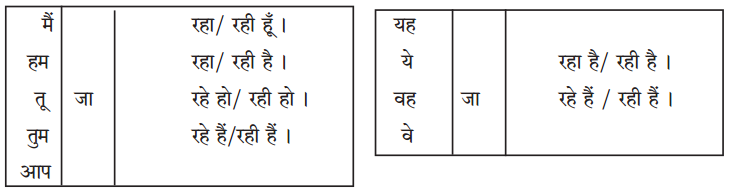
(अ) 1. मैं जा रह्य / रही हूँ।
2. हम जा रहे हैं / रही हैं।
3. तू जा रहा है / रही है।
4. तुम जा रहे हो / रही हो।
5. आप जा रहे हैं। रही हैं।

(ब) 1. यह जा रहा है। रही है।
2. ये जा रहे हैं / रही हैं।
3. वह जा रहा है / रही है।
4. वे जा रहे हैं / रही हैं।

Maharashtra Board Class 5 Hindi Solutions पुनरावर्तन ४

2. तुम्हारे मित्र के पास कॉपी खरीदने के लिए पैसे नहीं हैं । तुम्हारी माँ ने मेला देखने के लिए तुम्हें तीस रुपये दिए हैं। इस स्थिति में तुम्हारे मन में कौन से भाव जागते हैं ? बताओ।

प्रश्न 1.
तुम्हारे मित्र के पास कॉपी खरीदने के लिए पैसे नहीं हैं । तुम्हारी माँ ने मेला देखने के लिए तुम्हें तीस रुपये दिए हैं। इस स्थिति में तुम्हारे मन में कौन से भाव जागते हैं ? बताओ।
उत्तर:
उन तीस रुपयों में से अपने मित्र को कॉपी खरीदकर दूंगा तथा बचे हुए पैसों से मेला घूम लूँगा।

3. पढ़ो, और समझो:

प्रश्न 1.
पढ़ो, और समझो:
उत्तर:

  1. जहाँ विद्यार्थी पढ़ते हैं – विद्यालय
  2. जादू दिखाने वाला – जादूगर
  3. खेल खेलने वाला – खिलाड़ी
  4. सच बोलनेवाला – सत्यवादी
  5. चित्र बनाने वाला – चित्रकार
  6. मूर्तियाँ बनाने वाला – मूर्तिकार
  7. सोने के गहने बनाने वाला – सुनार
  8. जो कभी न हारा हो – अजेय
  9. जो साग-सब्ज़ी खाता हो – शाकाहारी
  10. जहाँ अनाथ रहते हैं – अनाथालय
  11. जो रोगियों का इलाज करता है – डॉक्टर
  12. जो लकड़ी का काम करता है – बढ़ई
  13. जो मिट्टी के बरतन बनाता है – कुम्हार
  14. जो जूते सिलता है – मोची
  15. जो कपड़े सिलता है – दर्जी

Maharashtra Board Class 5 Hindi Solutions पुनरावर्तन ४

4. सड़क पार करते समय तुम क्या सावधानी बरतते हो? लिखो।

प्रश्न 1.
सड़क पार करते समय तुम क्या सावधानी बरतते हो? लिखो।
Maharashtra Board Class 5 Hindi Solutions पुनरावर्तन ४ 2
उत्तर:
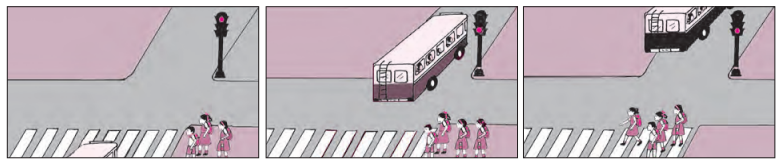
सड़क पार करते समय जेब्रा क्रॉसिंग पर से जाना चाहिए।

5. पढ़ाई करने के बाद भी तुम्हें परीक्षा से डर लग रहा है, तो तुम क्या करोगे? बताओ।

प्रश्न 1.
पढ़ाई करने के बाद भी तुम्हें परीक्षा से डर लग रहा है, तो तुम क्या करोगे? बताओ।
(क) बड़ों से बातचीत करोगे ।
(ख) खेलने जाओगे।
(ग) गाना सुनोगे अथवा गाओगे ।
(घ) आराम करोगे ।
उत्तर:
(क) बड़ों से बातचीत करेंगे।

Maharashtra Board Class 5 Hindi Solutions पुनरावर्तन ४

Hindi Sulabhbharati Class 5 Solutions पुनरावर्तन ४ Additional Important Questions and Answers

प्रश्न 1.
चित्रों को देखकर नीचे दी गई शब्द – पहेली बूझो; (एक अक्षर का एक से अधिक बार उपयोग कर सकते हैं।)
उत्तर:
फूल: कमल, हरसिंगार, गुलाब, गुड़हल, डहलिया, रजनीगंधा, बेला, सूरजमुखी, सदाबहार।
फल: केला, अमरूद, अनार, चीकू, अंगूर, सेब, पपीता, आम, अंजीर, संतरा, सीताफल, अनन्नास।
अन्य शब्द: नीम, पीला, ताला, अंदर, चीता, कान, पतला, खीर, गेंद, जल, दानी

Maharashtra Board Class 5 Hindi Solutions पुनरावर्तन ३

Balbharti Maharashtra State Board Class 5 Hindi Solutions Sulabhbharati पुनरावर्तन ३ Notes, Textbook Exercise Important Questions and Answers.

Maharashtra State Board Class 5 Hindi Sulabhbharati Solutions पुनरावर्तन ३

5th Standard Hindi Digest पुनरावर्तन ३ Textbook Questions and Answers

1. अनुस्वारवाले (-) शब्दों को सुनो, समझो और दोहराओ:

अङ्क-अंक, चञ्चल-चंचल, झण्डा-झंडा, सुन्दर-सुंदर, मुम्बई-मुंबई; टंकी, पंख, पतंग, कंघी, कंचा, पंछी, अंजीर, झंझावात, घंटी, कंठ, डंडा, पंढरपुर, संत, पंथ, बंदर, कंधा, पंप, गुंफन, कंबल, खंभा ।

Maharashtra Board Class 5 Hindi Solutions पुनरावर्तन ३

2. रास्ते में घायल पक्षी को देखकर तुम्हारे मन में कौन-से भाव आते हैं? बताओ?

प्रश्न 1.
रास्ते में घायल पक्षी को देखकर तुम्हारे मन में कौन-से भाव आते हैं? बताओ?
उत्तर:
रास्ते में घायल पक्षी को देखकर मुझे उस पर दया आ जाती है। मैं उसे उठाकर उसका उपचार करती / करता हूँ, ताकि वह फिर से आकाश में उड़ सके।

3. पढ़ो, समझो और रेखांकित शब्दों पर चर्चा करो और दोनों अक्षरों से नए वाक्य बनाओ

प्रश्न (क)
मैं पाँचवी कक्षा में पढ़ रहा हूँ।
उत्तर:
‘मैं’ का उपयोग हम अपने लिए करते हैं। ‘में’ का उपयोग किसी ओर वस्तु के बारे में करते हैं।

प्रश्न (ख)
मृणाल ने पूछा “उदय! कहाँ गए थे?” उदय ने कहा, “मैं भोपाल गया था।”
उत्तर:
कहाँ – किसी जगह के बारे में पूछते हैं।
कहा – मतलब ‘बोला’ या ‘बताया’।
(अ) तुम कहाँ जा रहे हो?
(आ) राम ने कहा, ‘मैं बीमार हूँ।

प्रश्न (ग)
रौनक बिल्ली की ओर लपका और वह भाग गई।
उत्तर:
ओर – उस तरफ (की तरफ)
और – दो शब्दों अथवा दो वाक्यों को जोड़ने वाला शब्द
(अ) सीमा पाठशाला की ओर जा रही है।
(आ) सीता और गीता जुड़वा बहनें हैं।

Maharashtra Board Class 5 Hindi Solutions पुनरावर्तन ३

प्रश्न (घ)
राजू खेल रहा है। उसके साथी बैठे हैं।
उत्तर:
है – केवल एक व्यक्ति के लिए लगता है।
हैं – बहुवचन या अनेक के लिए लगता है।
(अ) राम बाहर खड़ा है।
(आ) बच्चे खेल रहे हैं।

प्रश्न (ङ)
सोहन की बिल्ली इतनी प्यारी है कि सब उसे उठा लेते हैं।
उत्तर:
की – पहले शब्द की व्याख्या करता है।
कि – दो वाक्यों को जोड़ने का काम करता है।
(अ) राम की बहन सीता है।
(आ) पवन ने कहा कि मैं बीमार हूँ।

4. उचित शब्द बनाकर लिखो:

प्रश्न 1.
उचित शब्द बनाकर लिखो:

  1. ख ओं
  2. र पै
  3. न का
  4. ठ हों
  5. ज ग का
  6. ट ना घु
  7. र द बं
  8. त र भा
  9. ई र पा चा
  10. व ली दी पा
  11. ला शा ठ पा
  12. वा ल री फु

उत्तर:

  1. आँख
  2. पैर
  3. कान
  4. होंठ
  5. कागज
  6. घुटना
  7. बंदर
  8. भारत
  9. चारपाई
  10. दीपावली
  11. पाठशाला
  12. फुलवारी

Maharashtra Board Class 5 Hindi Solutions पुनरावर्तन ३

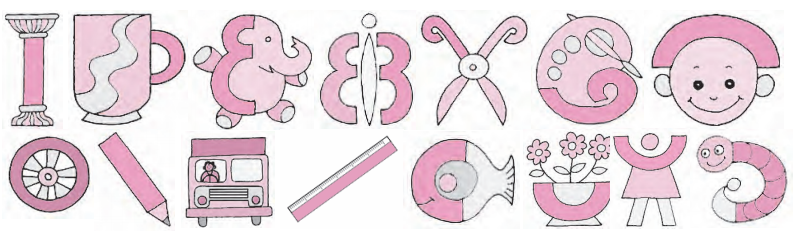
5. वर्ण के अवयवों का उपयोग करते हुए अपने मन से चित्र बनाओ।

Maharashtra Board Class 5 Hindi Solutions पुनरावर्तन ३ 1

Hindi Sulabhbharati Class 5 Solutions पुनरावर्तन ३ Additional Important Questions and Answers

प्रश्न 1.
आपकी पाठशाला में मनाए गए किसी एक कार्यक्रम पर पाँच वाक्य लिखिए:
उत्तर:

  1. हमारी पाठशाला में हिन्दी दिवस मनाया गया।
  2. सभी बच्चों ने इसमें भाग लिया।
  3. बच्चों ने भाषण, कविता, नाटक प्रस्तुत किए।
  4. पहली कक्षा की एक छात्रा ने बहुत अच्छी कहानी सुनाई।
  5. अंत में सभी को धन्यवाद दिया गया।

Maharashtra Board Class 5 Hindi Solutions पुनरावर्तन ३

Maharashtra Board Class 12 Sociology Important Questions Chapter 4 Processes of Social Change in India

Balbharti Maharashtra State Board Class 12 Sociology Important Questions Chapter 4 Processes of Social Change in India Important Questions and Answers.

Maharashtra State Board 12th Sociology Important Questions Chapter 4 Processes of Social Change in India

1A. Complete the following statements by choosing the correct alternative given in the brackets and rewrite it.

Question 1.
___________ is the process of the use of unbiotic power for the mass production of goods. (digitalisation, urbanisation, industrialisation)
Answer:
industrialization

Question 2.
Process of industrialization spread from ___________ to other regions of the world. (Asia, Europe, Australia)
Answer:
Europe

Maharashtra Board Class 12 Sociology Important Questions Chapter 4 Processes of Social Change in India

Question 3.
In the process of ___________ human society is transformed from a state pre-industrial to an industrial. (urbanisation, modernisation, industrialisation)
Answer:
industrialization

Question 4.
The development of industries led to the of workplaces. (urbanisation, digitalisation, mechanisation)
Answer:
mechanization

Question 5.
The use of precision techniques and accuracy in production is required in ___________ (mechanization, computerisation, capital)
Answer:
mechanization

Question 6.
In the process of mechanization workers led to feel ___________ from the process of production. (alienated, integrated, neutral)
Answer:
alienated

Question 7.
The high mechanization and automation of industrial processes naturally depend on ___________ resources available. (social, financial, natural)
Answer:
financial

Maharashtra Board Class 12 Sociology Important Questions Chapter 4 Processes of Social Change in India

Question 8.
Industries required skilled workforce and ___________ of apprentices at the workplace. (specific training, unskill, eatables)
Answer:
specific training

Question 9.
Early industries required skilled and unskilled ___________ workforce to complete various tasks at all levels. (animal, human, machines)
Answer:
human

Question 10.
Special institutes like ___________ are established to impart technical education and also for professional education. (management training, urbanisation, modernisation)
Answer:
management training

Question 11.
Industrialisation led to ___________ on the basis of specialisation and expertise. (capital, labour, division of labour)
Answer:
division of labour

Question 12.
Modern ___________ was a result of industrialisation. (education, facilities, urbanisation)
Answer:
urbanisation

Question 13.
___________ is a typical feature of urban living. (urbanism, rural, tribal)
Answer:
urbanism

Question 14.
Urbanisation is a ___________ way process. (two, three, four)
Answer:
two

Maharashtra Board Class 12 Sociology Important Questions Chapter 4 Processes of Social Change in India

Question 15.
Urbanisation consists of large ___________ number of people from rural to urban areas. (outward flow, overflow, inward flow)
Answer:
inward flow

Question 16.
The gradual emergence of factories led to the ___________ of people from rural and tribal areas, to the factory locations. (communication, migration, specialisation)
Answer:
migration

Question 17.
The flux of people for the purpose of employment has resulted in cities getting ___________ (overpopulated, less dense, shut down)
Answer:
overpopulated

Question 18.
Overpopulated cities are expanding and turning into ___________ such as Mumbai, Pune. (rural, metropolises, tribal)
Answer:
metropolises

Question 19.
The place of residence and one’s place of which work drift apart with the passage of time which means ___________ (a division of labour, spatial segregation, capital intensive)
Answer:
spatial segregation

Maharashtra Board Class 12 Sociology Important Questions Chapter 4 Processes of Social Change in India

Question 20.
Urbanisation led to a ___________ gathering of people of different gender, sexuality, caste, creed, class, language and so forth. (homogeneous, barriers, heterogeneous)
Answer:
heterogeneous

Question 21.
Urbanism as a ___________ of life. (solution, way, tradition)
Answer:
way

Question 22.
Secondary modes of security control in urban areas are ___________ (law, belief, morals)
Answer:
law

Question 23.
Division of labour is based on one’s ___________ and ___________ (skills and expertise, knowledge and experience, limitations and unskilled)
Answer:
skills and expertise

Question 24.
The term modernisation was coined by ___________ (Anderson, Daniel Lerner, Giddens)
Answer:
Daniel Lerner

Question 25.
___________ is the application of modern science to human affairs. (Globalisation, Digitalisation, Modernisation)
Answer:
Modernisation

Question 26.
Self-criticism, willingness to introspect critically, is also an aspect of ___________ thinking. (logical, critical, analytical)
Answer:
critical

Question 27.
___________ means the approach and ability to provide logical explanations for any phenomenon. (rationalism, science, art)
Answer:
rationalism

Maharashtra Board Class 12 Sociology Important Questions Chapter 4 Processes of Social Change in India

Question 28.
Scientific reasoning explains ___________ relationships between factors. (mortal, casual, immortal)
Answer:
Causal

Question 29.
Being ‘modern’ cannot be limited to only using modern devices or gadgets but there should be a willingness to receive ___________ ideas. (new, old, superstitious)
Answer:
new

Question 30.
The new economic policy means ___________ policy. (PNG, LPG, CNG)
Answer:
LPG

Question 31.
LPG stands for Liberalisation, Privatisation and ___________ (Googlisation, Globalisation, Geometrisation)
Answer:
Globalisation

Question 32.
Process of ___________ opened up the skies for Indian economy. (modernisation, digitalisation, globalisation)
Answer:
globalisation

Question 33.
This new economic policy brought in much ___________ and criticism. (superstitions, beliefs, skepticism)
Answer:
skepticism

Question 34.
The principle of ___________ is an integral part of globalisation as a process of change. (laissez faire, loss, profit)
Answer:
laissezfaire

Question 35.
___________ is a process where government control services are opened up for private service providers. (privatisation, marketisation, globalisation)
Answer:
privatisation

Maharashtra Board Class 12 Sociology Important Questions Chapter 4 Processes of Social Change in India

Question 36.
Privatisation has encouraged many service providers to indulge in ___________ (donation, profiteering, social service)
Answer:
profiteering

Question 37.
Privatisation is mainly oriented to ___________ (production, marketing, profits)
Answer:
profits

Question 38.
Globalisation led to increase in production, this in turn has led to large-scale ___________ (marketisation, privatisation, liberalisation)
Answer:
marketisation

Question 39.
The term ___________ was coined by Capgemini and MIT. (bhakti movement, digital transformation, laissez-faire)
Answer:
digital transformation

Question 40.
___________ has led to frequent changes in business models. (consumerism, digitalisation, materialistic)
Answer:
digitalisation

Question 41.
Now a days we use ___________ for various purposes such as production, surgery, robotics etc. (artificial intelligence (AI), machines, capital)
Answer:
artificial intelligence (AI)

Question 42.
___________ has escalated the speed of the processes with a far greater extent of accuracy. (industrialisation, modernisation, digitalisation)
Answer:
digitalisation

Maharashtra Board Class 12 Sociology Important Questions Chapter 4 Processes of Social Change in India

Question 43.
___________ is based on technology, innovation, research and development. (modernisation, urbanisation, digitalisation)
Answer:
digitalisation

Question 44.
In the field of education, we are working towards ___________ technology for the purpose of education in the 21st century. (integrating, managing, old)
Answer:
integrating

Question 45.
Industrialization with the growth of cities has caused the breakdown of the ___________ (nuclear families, joint families, marriage)
Answer:
joint families

Question 46.
India is now an integral part of the ___________ economy. (personal, social, global,)
Answer:
global

Question 47.
___________ and ___________ has opened up a range of options to the user with a click of button. (computerisation and digitalisation, modernisation and urbanisation, transportation and communication)
Answer:
computerisation and digitalisation

Question 48.
Digitization has increased ___________ networking. (cultural, economic, social)
Answer:
social

1B. Correct the incorrect pair and rewrite it.

Question 1.
(a) Growth Of industries – Industrialisation
(b) Alienated from the process of production – Mechanisation
(c) Extent of mechanization and automation depend on – Finances
(d) Skilled workforce – Capital
Answer:
(d) Skilled workforce – Specific Training

Maharashtra Board Class 12 Sociology Important Questions Chapter 4 Processes of Social Change in India

Question 2.
(a) Formation of economic classes – Industrialisation
(b) Industrial expansion – Modernisation
(c) Tasks assigned on the basis of – Division of labour
(d) Emergence of metropolis – Urbanisation
Answer:
(b) Industrial expansion – Spatial Segregation

Question 3.
(a) Metropolises – Mumbai, Pune
(b) Heterogenous gathering of people – Urbanisation
(c) Secondary modes of security control – Family
(d) A way of life – Urbanism
Answer:
(c) Secondary modes of security control – Law, city traffic signal, police, etc

Question 4.
(a) Based on one’s skills of expertise – Division of labour
(b) Modernisation – Daniel Lerner
(c) Scientific reasoning – Causal Relationships
(d) Shift to secular and rational values from spiritual values – Nationalism
Answer:
(d) Shift to secular and rational values from spiritual values – Rationalism

Question 5.
(a) Scepticism and criticism – Self-criticism
(b) Technological advancement – Industrialisation
(c) Ability to explain the constructive and destructive aspect – Critical thinking
(d) New economic policy – LPG
Answer:
(a) Scepticism and criticism – New economic policy

Question 6.
(a) Free trade and free competition – Laissez Faire
(b) Private service provider – Insurance, radio, etc.
(c) Increase production need – Distribution
(d) To make max profit – Privatisation
Answer:
(c) Increase production need – Marketisation

Question 7.
(a) Increased consumerism – Large production
(b) Sharing of resources – Nationalist movement
(c) Materialistic – Globalisation
(d) All nations interdependent – Global economy
Answer:
(b) Sharing of resources – Technological outsourcing

Maharashtra Board Class 12 Sociology Important Questions Chapter 4 Processes of Social Change in India

Question 8.
(a) Use of digital technology – Digitalisation
(b) Digital transformation – Capgemini and MIT
(c) Use of computers – Computerisation
(d) Technology-driven – Rural
Answer:
(d) Technology-driven – Digitalisation

Question 9.
(a) Migration of people from rural to urban – Westernisation
(b) Developed scientific temperament – Modernisation
(c) India is part of the global economy – Globalisation
(d) Impact of computers on various aspects of life – Digitalisation
Answer:
(a) Migration of people from rural to urban – Urbanisation

1C. Identify the appropriate term from the given options in the box and rewrite it against the given statement.

Rational Outlook, Factory System, Division of Labour, Technological Advancement, Digitalisation, Mechanisation, Labour Intensive System, Global Economy, Marketisation, Industrialisation, Capital Intensive, Industrial Growth, Law and City Police, etc., Liberal Principle, Urbanisation, Modernisation, Scientific Temperament, Critical Thinking, Laissez-Faire, Profiteering, Interdependence, Outsourcing, Capgemini of MIT, Digitalisation, Computerisation.

Question 1.
Establishment of large factories for the purpose of production.
Answer:
Factory System

Question 2.
Use of heavy machines and techniques for the production of goods and services.
Answer:
Mechanisation

Question 3.
In industrialisation extent of automation and mechanisation.
Answer:
Capital Intensive

Question 4.
The need for skilled force at the workplace.
Answer:
Labour Intensive System

Question 5.
Individuals’ qualities, skills, efficiency, education, and training are the determinants.
Answer:
Division of Labour

Question 6.
A process of migration of rural population to urban areas.
Answer:
Urbanisation

Maharashtra Board Class 12 Sociology Important Questions Chapter 4 Processes of Social Change in India

Question 7.
Advanced means of commutation are the pre-requisites.
Answer:
Industrial Growth

Question 8.
Means of secondary control.
Answer:
Law and City Police etc.

Question 9.
Daniel Lerner coined the term.
Answer:
Modernisation

Question 10.
The development of a scientific way of understanding and explaining any phenomenon.
Answer:
Scientific Temperament

Question 11.
The approach and ability to provide logical explanations for any phenomenon.
Answer:
Rational Outlook

Question 12.
Use of advanced technology in industries.
Answer:
Technological Advancement

Question 13.
Ability to explain the constructive and destructive aspects of a phenomenon.
Answer:
Critical Thinking

Maharashtra Board Class 12 Sociology Important Questions Chapter 4 Processes of Social Change in India

Question 14.
Opening up of the economy to private players.
Answer:
Liberal Principle

Question 15.
Free trade and free competition.
Answer:
Laissez-Faire

Question 16.
Privatisation has encouraged many service providers to indulge in it.
Answer:
Profiteering

Question 17.
Increase in production results in large scale of.
Answer:
Marketization

Question 18.
Parts of a product being manufactured in one country and assembled in faraway places is an example of.
Answer:
Interdependence

Question 19.
It has made all people and nations interdependent.
Answer:
Global Economy

Question 20.
People go beyond geographical borders, to perform specific tasks without moving out from their location.
Answer:
Outsourcing

Question 21.
The integration of digital technologies into everyday life.
Answer:
Digitalisation

Question 22.
The term ‘digital transformation’ was coined by.
Answer:
Capgemini of MIT

Maharashtra Board Class 12 Sociology Important Questions Chapter 4 Processes of Social Change in India

Question 23.
Expansion of the use of computers in all walks of life.
Answer:
Computerisation

1D. Correct the underlined words and complete the statement.

Question 1.
Social change means a change in social life.
Answer:
Social change means a change in social structure.

Question 2.
The domestic production system is replaced by traders.
Answer:
The domestic production system is replaced by a factory system.

Question 3.
The process of industrialisation was started in India.
Answer:
The process of industrialisation was started in Europe.

Question 4.
Industrialisation leads to agrarianism.
Answer:
Industrialisation leads to urbanisation.

Question 5.
Urbanisation is a process of migration of rural populations to tribal areas.
Answer:
Urbanisation is a process of migration of rural population to urban areas.

Question 6.
Daniel Lerner coined the term industrialisation.
Answer:
Daniel Lerner coined the term modernisation.

Question 7.
Urbanism is a way of society.
Answer:
Urbanism is a way of life.

Maharashtra Board Class 12 Sociology Important Questions Chapter 4 Processes of Social Change in India

Question 8.
Urbanisation implies controls and obligations by traditional bodies.
Answer:
Urbanisation implied controls and obligations by civil administrations.

Question 9.
Industrialisation leads to unity.
Answer:
Industrialisation leads to urbanisation.

Question 10.
Urbanisation leads to homogeneity.
Answer:
Urbanisation leads to heterogeneity.

Question 11.
Industrialisation is a process whereby human energy to produce was replaced by the social process for higher production.
Answer:
Industrialisation is a process whereby human energy to produce was replaced by mechanical processes for higher production.

Question 12.
This is the era of computerisation and modernisation.
Answer:
This is the era of computerisation and digitalisation.

Question 13.
Digitalisation is based on belief.
Answer:
Digitalisation is based on technology.

Question 14.
The main aim of digitalisation is the importance of the material.
Answer:
The main aim of digitalisation is important to customers.

Maharashtra Board Class 12 Sociology Important Questions Chapter 4 Processes of Social Change in India

Question 15.
The principle of‘Laissez-Faire’ is an integral aspect of medicines.
Answer:
The principle of ‘Laissez-Faire’ is an integral aspect of globalisation.

Question 16.
The principle of ‘Laissez-Faire’ is originally a Greek term.
Answer:
The principle of ‘Laissez-Faire’ is originally a French term.

Question 17.
Being ‘modern’ means openness to traditional ideas.
Answer:
Being ‘modern’ means openness to new ideas.

Question 18.
Self- criticism, willingness to introspect critically is also an aspect of spiritual thinking.
Answer:
Self-criticism, willingness to introspect critically is also an aspect of critical thinking.

Question 19.
Globalisation involves two processes like liberalisation and generalisation.
Answer:
Globalisation involves two processes like liberalisation and privatisation.

Question 20.
Globalisation is the process of the creation of a global city.
Answer:
Globalisation is the process of the creation of a global economy.

Question 21.
Globalisation is a process that ‘opened up the skies’ for the Japanese economy.
Answer:
Globalisation is a process that ‘opened up the skies’ for the Indian economy.

Question 22.
The flux of people from all over the country to urban areas has resulted in cities getting popular.
Answer:
The flux of people from all over the country to urban areas has resulted in cities getting overpopulated.

Question 23.
Industrialisation is the way by which people go beyond geographical borders, without moving out from their location.
Answer:
Outsourcing is the way by which people go beyond geographical borders without moving out from their location.

Maharashtra Board Class 12 Sociology Important Questions Chapter 4 Processes of Social Change in India

Question 24.
Digital transformation means radically improving knowledge.
Answer:
Digital transformation means radically improving performance.

Question 25.
Maintain individual privacy in the web world is a great challenge in urbanisation.
Answer:
Maintaining individual privacy in the web world is a great challenge in digitalisation.

Question 26.
Due to growth in newer technologies business modules get frequent repetitions.
Answer:
Due to growth in newer technologies business modules get frequent changes.

Question 27.
Cap Gemini is a Spanish data processing company.
Answer:
Cap Gemini is a French data processing company.

2. Write short notes.

Question 1.
Privatisation/Private enterprise
Answer:

  • Privatisation signifies the process wherein, the government transfers ownership, management, and control of the public sector enterprises to the private sector entities.
  • Allows the private sector to set up industries in the field earlier reserved for the public sector.
  • Privatisation has substantially reduced the role of the government in economic activities.
  • Privatisation is an allied process that accompanies globalisation.
  • Under the process of privatisation, reducing the involvement of the state in economic activities and increasing the involvement of the private sector are expected.
  • The government has been thereby trying to mobilise resources for improving the efficiency of the remaining public sector units.
  • Under the policy of globalisation, various countries have adopted the process of privatisation.

Question 2.
Liberalisation/Liberal Principle
Answer:

  • Liberalisation implies the withdrawal of restrictions on industry and business.
  • It also means opening up the economy to private players.
  • It has more reliance on ‘Laissez-Faire’ means free trade and free competition.
  • It encourages foreign trade by a reduction in the tariff rates.
  • Adopting uniform exchange rate.
  • Removal of import/export duties.
  • Duty-free access to foreign goods and services.

Maharashtra Board Class 12 Sociology Important Questions Chapter 4 Processes of Social Change in India

Question 3.
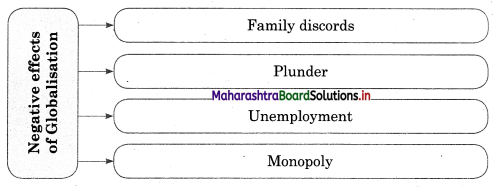
Negative Impact of globalisation
Answer:

  • There is a considerable increase in the immigration of the young technocrats to the developed countries, leaving behind aging parents.
  • There is an increase in the family arguments and break up of more and more marriages and families.
  • The role of the state has been greatly curtailed in economic activities.
  • The role of the state-owned, managed, and controlled public sector has also been curtailed by privatisation and disinvestment.
  • The state also withdrawing from essential social services like health insurance and education by means of privatisation.
  • There is the cultural invasion of western culture. The traditional value and norms of behaviour have slackened up.
  • Consumerism and the pursuit of materialist culture are increasing.
  • The conflict of traditional and modern values has threatened the traditional culture of India.

Question 4.
Modernisation
Answer:

  • It is a process of social transformation.
  • It develops new attitudes, new values, and social relationships. There is a shift to secular and rational values from spiritual-religious values.
  • It has paved a way for developing a scientific temperament. Emphasis has been set on the need for empirical evidence in support of given arguments.
  • It encompasses social, economic, political, religious, and intellectual changes. There is a willingness to receive new ideas, to examine daily events, literature, culture, art, customs, beliefs from a critical point of view.
  • Modernisation is a current term of an old process of social change.

3. Write differences.

Question 1.
Liberalisation and Globalisation
Answer:

Liberalisation Globalisation
(i) Meaning: Liberalisation refers to the removal of undue restrictions and eliminations of bureaucratic controls on productive activities and paves the way for economic development. (i) Meaning: Globalisation refers to the integration of the domestic economy with the world economy.
(ii) Liberalisation is a means to achieve globalisation.

e.g. reduction in tariff is a liberal measure.

(ii) Globalisation can be realised through external liberalisation.
e.g. if the tariff is reduced, transfer of resources, goods, etc., can be made easier.
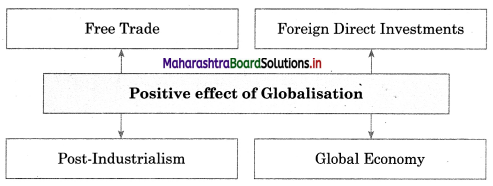
(iii) Effect: Liberalisation has given a boost to foreign trades. (iii) Effect: Globalisation has led to the increase in foreign direct investment and technical collaboration.
(iv) Manifestations: Abolishing industrial licenses, scrapping the MRTP limit, etc., are the measures adopted to liberate the Indian economy. (iv) Manifestations: Relaxing the FEAR/FEMA regulations, eliminating the trade barriers, providing tax concessions and other incentives to the foreign investors.

Question 2.
Globalisation and Privatisation
Answer:

Globalisation Privatisation
(i) Globalisation refers to “all those processes by which the people of the world are incorporated, into a single world society.” (i) Privatisation means “transferring of ownership rights from public sector to the private sector”.
(ii) Eliminating the trade barriers, relaxing the FERA/FEMA regulations, and other incentives to the foreign investors. (ii) The policy of disinvestment is adopted to privatise the public sector enterprises.
(iii) Globalisation leads to sharing of resources, goods, and capital across the country. (iii) The public sector enterprises are taken over by the private sector. It enables the country to improve the efficiency of these enterprises.
(iv) It has adversely affected agriculture and is a cause of misery in the rural area. (iv) Their policies lead to an increase in unemployment.

Question 3.
Privatisation and Liberalisation
Answer:

Privatisation Liberalisation
(i) Privatisation means reducing the involvement of the public sector and increasing the involvement of the private sector in the country’s economic activities. (i) Liberalisation means reducing or relaxing unnecessary restrictions over economic activities.
(ii) The policy of reduction investment is adopted to privatise the public sector. (ii) Automatic approval to the foreign technology, providing tax concessions and other incentives to the foreign investors, etc.
(iii) The public sector enterprises are taken over by the private sector. It enables the country to improve the efficiency of these enterprises. (iii) Liberalisation has given a boost to the industries in the private sector and given momentum to the industrial development of India.
(iv) Their policies lead to an increase in unemployment. (iv) It has encouraged the culture of consumerism.

4. Explain the following concepts with examples.

Question 1.
Industrialisation
Answer:

  • The process of industrialisation was started in England in the 17th and 18th Centuries.
  • Industrialisation means the process whereby human energy to produce was replaced by mechanical processes and machines to enable higher production.
  • The village population migrated to the industrial centres in the search of employment.
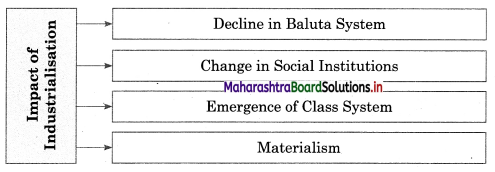
  • Industrialisation signifies the mechanisation of the production process, growth of industries, division of labour and specialisation, capital and labour intensive, etc.
  • Due to industrialisation decline in the Baluta system, the emergence of industry-oriented economy, the emergence of the class system, etc.
  • Examples:
    • Industrial hubs like Mumbai, Pune, Bangalore.
    • The transformation of an urban area into an IT hub is an example of industrialisation.

Maharashtra Board Class 12 Sociology Important Questions Chapter 4 Processes of Social Change in India

Question 2.
Modernisation
Answer:

  • The term modernisation was coined by Daniel Lerner.
  • Modernisation is the process where there is the use of scientific and rational thinking that is deep-seated.
  • Modernisation has led to changes in values, beliefs, and norms.
  • Modernisation is a process of transformation from traditional society to technological modern society.
  • It is a notion of rationalism and the ability to provide scientific and logical explanations for any phenomenon.
  • Being ‘Modern’ means not only using modern devices or gadgets but also openness to receive new ideas, examine alternatives, find new pathways, use creative ways to solve problems, do critical thinking, etc.
  • Examples:
    • Acceptance of rational scientific outlook
    • Individualism
    • Secularism.

Question 3.
Globalisation
Answer:

  • The process of globalisation in the Indian context received an impetus in 1991.
  • In India, New Economic Policy was declared in 1991 by Finance Minister Dr. Manmohan Singh.
  • Globalisation is basically an economic process. It proposes to integrate the national economy with the global economy.
  • There is free flow not only of capital, goods, and technology but also of skilled human resources and ideas across the globe.
  • It proposes to remove barriers in the free movement of human beings and broaden their mental horizons.
  • Due to globalisation, the impact of the western culture and decline of the traditional values as well as changes in the social institutions like family, marriage, etc.
  • We are beset with the positive and negative impacts of globalisation.
  • Examples: International companies such as Pepsi, Coca-Cola, McDonald’s.

Question 4.
Rational outlook
Answer:
Rational outlook refers to an approach that is based on reasoning, and the ability to provide logical explanations for any phenomenon.

Explanation:
A rational outlook is based on the idea of rationalism or reasoning. This means Here, one seeks to establish laws that link facts and which govern social life. To have a rational outlook means that one’s view of a situation or a problem or an event is understood on the basis of reason. This refers to the development of a scientific way of understanding and explaining any phenomenon. Scientific reasoning explains causal relationships between factors. There is a shift to secular and rational values from spiritual-religious values.

For example, non-rational explanation of all-natural calamities are the expressions of God’s anger.
Rational explanation: Scientific explanation for natural calamities.

Maharashtra Board Class 12 Sociology Important Questions Chapter 4 Processes of Social Change in India

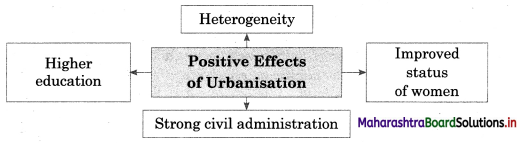
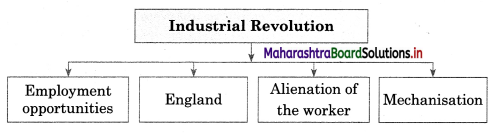
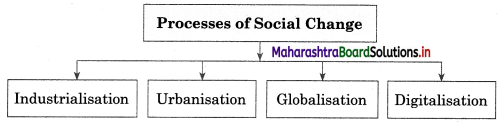
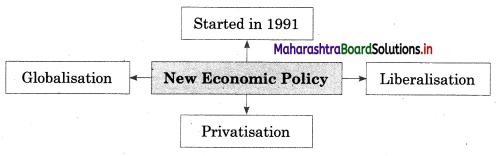
5A. Complete the concept map.

Question 1.
Maharashtra Board Class 12 Sociology Important Questions Chapter 4 Processes of Social Change in India 5A Q2
Answer:
Maharashtra Board Class 12 Sociology Important Questions Chapter 4 Processes of Social Change in India 5A Q2.1

Question 2.
Maharashtra Board Class 12 Sociology Important Questions Chapter 4 Processes of Social Change in India 5A Q3
Answer:
Maharashtra Board Class 12 Sociology Important Questions Chapter 4 Processes of Social Change in India 5A Q3.1

Question 3.
Maharashtra Board Class 12 Sociology Important Questions Chapter 4 Processes of Social Change in India 5A Q4
Answer:
Maharashtra Board Class 12 Sociology Important Questions Chapter 4 Processes of Social Change in India 5A Q4.1

Question 4.
Maharashtra Board Class 12 Sociology Important Questions Chapter 4 Processes of Social Change in India 5A Q5
Answer:
Maharashtra Board Class 12 Sociology Important Questions Chapter 4 Processes of Social Change in India 5A Q5.1

Maharashtra Board Class 12 Sociology Important Questions Chapter 4 Processes of Social Change in India

Question 5.
Maharashtra Board Class 12 Sociology Important Questions Chapter 4 Processes of Social Change in India 5A Q6
Answer:
Maharashtra Board Class 12 Sociology Important Questions Chapter 4 Processes of Social Change in India 5A Q6.1

Question 6.
Maharashtra Board Class 12 Sociology Important Questions Chapter 4 Processes of Social Change in India 5A Q7
Answer:
Maharashtra Board Class 12 Sociology Important Questions Chapter 4 Processes of Social Change in India 5A Q7.1

Question 7.
Maharashtra Board Class 12 Sociology Important Questions Chapter 4 Processes of Social Change in India 5A Q8
Answer:
Maharashtra Board Class 12 Sociology Important Questions Chapter 4 Processes of Social Change in India 5A Q8.1

Question 8.
Maharashtra Board Class 12 Sociology Important Questions Chapter 4 Processes of Social Change in India 5A Q9
Answer:
Maharashtra Board Class 12 Sociology Important Questions Chapter 4 Processes of Social Change in India 5A Q9.1

Question 9.
Maharashtra Board Class 12 Sociology Important Questions Chapter 4 Processes of Social Change in India 5A Q10
Answer:
Maharashtra Board Class 12 Sociology Important Questions Chapter 4 Processes of Social Change in India 5A Q10.1

5B. State whether the following statements are True or False with reasons.

Question 1.
In industrialisation workers feel alienated from the process of production.
Answer:
This statement is True.

  • In industries for large-scale production, purpose capitalists started automation and mechanisation of workplaces.
  • It led to mass production due to which machine-made goods were much cheaper than hand-made goods.
  • The use of machines gives more precision, techniques, and accuracy in production.
  • This leads to workers feeling less important in the work of production and they get alienated from the process of production.

Maharashtra Board Class 12 Sociology Important Questions Chapter 4 Processes of Social Change in India

Question 2.
Industrialisation leads to Urbanisation.
Answer:
This statement is True.
The process of industrial growth led to the large-scale emergence of factories. This in turn resulted in migration to places nearer the factory sites, leading to the growth of towns, which soon became cities and then metropolitan cities.
Since cities become the centres of trade, commerce, industry, education, etc, People from rural areas migrate towards urban areas for getting employment.
The process of urbanisation is the consequence of industrialisation as urbanisation is characteristic of industrialisation.

Question 3.
Urbanisation implies primary means of social control.
Answer:
This statement is False.

  • Urbanisation means a flux of people migrated from all over the country to urban areas.
  • Due to that urban centres are overpopulated. The hold of customs, traditions, religion on people’s behavior, has diminished.
  • The urban environment and way of life are more materialist, radical, commercial, individualist, and non-conforming.
  • Urbanisation implies controls and obligations that are not administered by traditional bodies such as panchayats There are secondary modes of security control, e.g., law enforcement systems such as traffic signals, city police, etc.
  • So, in urban areas, secondary means of social control are useful such as law, city police, etc.

Question 4.
Raj stays in Mumbai and has never faced any problems with commutation.
Answer:
This statement is False.

  • As per the above statement, Raj stays in Mumbai i.e., a Metropolitan city.
  • Which is overpopulated and has a shortage of means of transportation.
  • In metropolises, it is not uncommon to find people spending 3-4 hours commuting to and from the workplace.
  • So, Raj stays in Mumbai means every day he must face problems in commutation.

Question 5.
Modernisation is rational and scientific change.
Answer:
This statement is True.

  • Modernisation is the application of modern science to human affairs.
  • It is linked to the notion of rationalism; the approach and ability to provide logical explanations for any phenomenon.
  • Scientific reasoning explains causal relationships between factors. There N is a shift to secular and rational values from spiritual-religious values.
  • Persons who claim to be modern are willing to examine daily events, literature, culture, art, customs, beliefs from a critical point of view and be able to explain the constructive and destructive aspects of a phenomenon.
  • The ultimate aim of this rational and scientific perspective in modernisation is to make human life better and satisfactory.

Question 6.
In digitalisation, with one click of a button, one can open up a web world.
Answer:
This statement is True.

  • The impact of changes resulting from computerisation and digitisation. Processes have had far-reaching changes in
  • Indian society in terms of access to knowledge artificial intelligence, e-governance, e-commerce, e-learning, e-trade, e-shopping, etc., the list is endless.
  • Digitalisation has sped up the processes of data mining and data management and has made this world a global village.
  • The click of a button can open up a range of options to the user through a very simple procedure.

Question 7.
Digitisation is the use of digital technologies for handling data of various nature
Answer:
This statement is True.

  • Programming, information technology, and computer science have aided the process of computerisation, which in turn has digitised processes for several sectors, e.g., education, banking, revenue, taxation, marketing, etc.
  • Digitisation is based on technology, innovation, research, and development.
  • Digitisation had led to frequent changes in business models due to growth in newer technologies, e.g., Artificial
  • Intelligence is used for various purposes such as production, manufacturing, surgery, etc.

Maharashtra Board Class 12 Sociology Important Questions Chapter 4 Processes of Social Change in India

Question 8.
Globalisation is an eco-friendly process.
Answer:
This statement is False.

  • Due to globalisation, the environmental problem has become more serious.
  • To gain more and more profit, industrialists and multinational companies are excessively using natural resources.
  • Because of this, the intensity of environmental problems such as deforestation, pollution, rise in atmospheric temperature, etc.

6. Give your personal response.

Question 1.
Do you think, during the pandemic situation of COVID-19, people in India will accept digitalised ways for work from home? Why?
Answer:
Being a student of HSC, I feel yes most Indians will accept digitalised ways for work. Because being Indian this pandemic situation is such an eyewash situation for all. As our nation is a developing nation and if we want economic survival then most Indians will start to learn E-Content, even though this will be our first step towards standing in the market, but most Indians will accept digitalized way as this is need of the hour.

Question 2.
Being vigilant student how you will do an online awareness campaign on COVID-19.
Answer:
As COVID-19 is a pandemic and a contagious disease. I will create an online group of my friends and we will remain connected online while staying at home. United through social media groups we will jointly put posters and graffiti on social media to make the general public aware of the deadly disease.

Question 3.
Do you think in the 21st Century people prefer living in a nuclear family? Why?
Answer:
As we are in 2020, in the modern era, so I think yes people will prefer living in a nuclear family. Since the nuclear family provides them with extra space, quality of life and mainly in the nuclear family status of women are high, gender equality, the standard of living is high as the couple is working, less impact of traditional beliefs and superstitions. So, one will prefer individuality i.e. nuclear family.

7. Answer the following question in detail. (About 150-200 words)

Question 1.
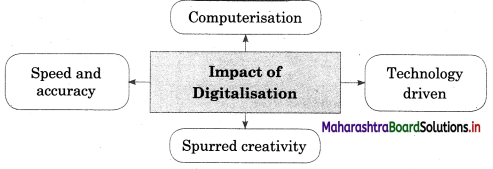
You belong to a generation that has been by and large part of digital India. Discuss how digitalisation has brought about positive and negative effects.
Answer:
(i) Positive effects of digitalisation

  • Due to digitalisation, closer cross-border ties.
  • It makes our lives better and easy. It is a most essential technology.
  • It makes people become more efficient and this leads to increased productivity.
  • Digitalisation saves time, cost and gives quick and precise service,
  • Digitalisation boosts the country to do cashless transactions.
  • For example, for filing Income Tax returns, obtaining Birth and Death Certificates from the Municipal Corporation, for online admission, for declaration of election results, etc. Nowadays all these processes make use of digitalisation and it has radically transformed the processes, compared to those used just a few decades ago.

Maharashtra Board Class 12 Sociology Important Questions Chapter 4 Processes of Social Change in India

(ii) Negative effects of digitalisation

  • The excessive use of digital technology has health hazards like affecting sleep.
  • Preventing children from engaging in physical activity that resulting in cases of obesity among children.
  • In extreme cases, there can be mental illnesses like social isolation, aggression, etc.
  • In short, it affects social, physical, and mental health.
  • Due to the acceptance of digitalisation big industries take over the smaller ones.
  • One of the major problems is individual privacy in the web world. This is always under threat.

Maharashtra Board Class 11 Secretarial Practice Important Questions Chapter 12 Correspondence with Statutory Authorities

Balbharti Maharashtra State Board Class 11 Secretarial Practice Important Questions Chapter 12 Correspondence with Statutory Authorities Important Questions and Answers.

Maharashtra State Board 11th Secretarial Practice Important Questions Chapter 12 Correspondence with Statutory Authorities

1A. Write a word or a term or a phrase that can substitute each of the following statements.

Question 1.
Headquarters of Ministry of Corporate Affairs.
Answer:
New Delhi

Question 2.
The number of Regional Directors.
Answer:
Seven

Question 3.
Total number of Registrar of Companies.
Answer:
Twenty-two

Maharashtra Board Class 11 Secretarial Practice Important Questions Chapter 12 Correspondence with Statutory Authorities

Question 4.
The number of ROC’s – cum Official liquidator.
Answer:
Nine

Question 5.
Officer appointed by High Court to look into the matter of winding up of a company.
Answer:
Official Liquidator

Question 6.
Principal Bench of NCLT.
Answer:
New Delhi

1B. State whether the following statements are True or False.

Question 1.
MCA operates with the help of 10 Regional Directors.
Answer:
False

Question 2.
NCLT works through 25 benches.
Answer:
False

Maharashtra Board Class 11 Secretarial Practice Important Questions Chapter 12 Correspondence with Statutory Authorities

Question 3.
MCA supervises the working of professional bodies like ICAI, and ICSI.
Answer:
True

1C. Complete the sentences.

Question 1.
To issue an order for seizure of books and papers, ROC has to seek _____________
Answer:
Special Court

Question 2.
MCA is concerned with administration of _____________
Answer:
The Companies Act, 2013

Question 3.
MCA supervises professional body like _____________
Answer:
Institute of Secretaries of India (ICSI)

Question 4.
The headquarter of MCA is at _____________
Answer:
New Delhi

Question 5.
An organization who act as a middleman between capital provider and capital seekers is called as _____________
Answer:
Market Intermediaries

Maharashtra Board Class 11 Secretarial Practice Important Questions Chapter 12 Correspondence with Statutory Authorities

Question 6.
Informing about difficulty in uploading e-form means _____________
Answer:
Raising a ticket

1D. Select the correct option from the bracket.

Question 1.

Group ‘A’ Group ‘B’
(1) Public Deposits ……………………….
(2) ……………………… The agent between capital provider and seeker

(Market Intermediaries, 36 Months)
Answer:

Group ‘A’ Group ‘B’
(1) Public Deposits 36 Months
(2) Market Intermediaries Agents between capital provider and seller

1E. Answer in one sentence.

Question 1.
Name the authority who supervises the working of ROC and the Official Liquidator.
Answer:
The authority who supervises the working of ROC’s and the Official Liquidator is Regional Director (RD).

Question 2.
Who can extend the period of helding the Annual General Meeting?
Answer:
Registrar of Company can extend the period of helding the Annual General Meeting.

Maharashtra Board Class 11 Secretarial Practice Important Questions Chapter 12 Correspondence with Statutory Authorities

Question 3.
Where can an appeal be made against the order of NCLAT?
Answer:
An appeal against the order of NCLAT can be made to Supreme Court within 60 days of receipt of the order of NCLAT.

Question 4.
What do you mean by Market Intermediaries?
Answer:
People or organizations who act as a middleman between the capital provider and capital seeker are called as Market Intermediaries. E.g. Stock Brokers, bankers, underwriters, etc.

1F. Correct the underlined word and rewrite the following sentences.

Question 1.
An appeal can be made against the order issued by NCLAT within 90 days.
Answer:
An appeal can be made against the order issued by NCLAT within 60 days.

Question 2.
An appeal against the order issued by NCLAT can be made to High Court.
Answer:
An appeal against the order issued by NCLAT can be made to Supreme Court.

Question 3.
MCA conducts its operations through 11 Regional Directors.
Answer:
MCA conducts its operations through 7 Regional Directors.

Maharashtra Board Class 11 Secretarial Practice Important Questions Chapter 12 Correspondence with Statutory Authorities

2. Answer in brief.

Question 1.
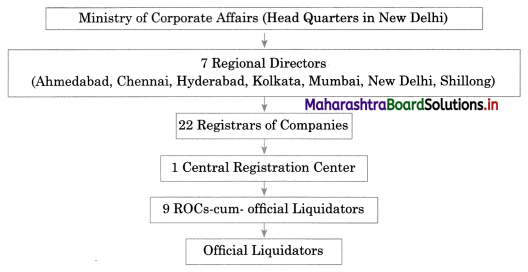
Give a flow chart to explain the organizational setup to administer the Companies Act, 2013.
Answer:
Organizational set up to administer the Companies Act, 2013.
Maharashtra Board Class 11 Secretarial Practice Important Questions Chapter 12 Correspondence with Statutory Authorities 2 Q1

3. Justify the following statements.

Question 1.
Explain the reasons for not holding Annual General Meeting by a company on time.
Answer:
Reasons for not holding Annual General Meeting on time:

  • Directors traveling abroad, so cannot attend Annual General Meeting.
  • Employees Strike in a company.
  • A raid by Income Tax Department.
  • Annual Financial statement not approved or not audited or incomplete audit or loss of financial data due to natural calamity.

Maharashtra Board Class 11 Secretarial Practice Important Questions Chapter 12 Correspondence with Statutory Authorities

Question 2.
Under what circumstances, Secretary has to correspond with Statutory authorities.
Answer:
Under the following circumstances, Secretary has to correspond with a few of the Statutory authorities:

  • To correspond with ROC for seeking extension of time for holding Annual General Meeting.
  • To correspond with MCA for ‘Ticket Raising’ or other service-related technical complaints.
  • To correspond with SEBI in reply to the complaint by the investor.
  • To correspond with NCLT seeking extension of time to repay Public deposits.

Maharashtra Board Class 12 Chemistry Important Questions Chapter 15 Introduction to Polymer Chemistry

Balbharti Maharashtra State Board 12th Chemistry Important Questions Chapter 15 Introduction to Polymer Chemistry Important Questions and Answers.

Maharashtra State Board 12th Chemistry Important Questions Chapter 15 Introduction to Polymer Chemistry

Question 1.
What are polymers?
Answer:
Polymers are high molecular mass macromolecules (103 – 107 u) and consist of repeating units of monomers.

Maharashtra Board Class 12 Chemistry Solutions Chapter 15 Introduction to Polymer Chemistry

Question 2.
Write the classification of polymers based on source. Give examples.
OR
What are natural and synthetic polymers? Give two examples of each type.
Answer:
Based on the source polymers are classified as natural, semisynthetic and synthetic polymers.

  1. Natural polymers : These polymers are obtained either from plants or animals, e.g., cellulose, jute, linene, rubber, silk.
  2. Semisynthetic polymers : The fibres obtained by giving special chemical treatment to natural fibres (cellulose) and further regenerated are called semisynthetic polymers e.g., acetate rayon, viscose rayon, cuprammonium silk.
  3. Synthetic polymers : The man made fibres prepared by polymerization of one monomer or copolymerization of
    two or more monomers are called synthetic polymers, e.g., nylon, terylene, polythene, etc.

Question 3.
Write the classification of polymers based on structure. Give examples
OR
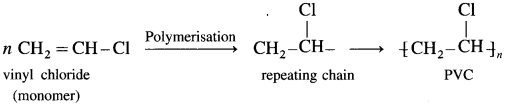
Write the reactions involved in the preparation of (1) Polyvinyl chloride (PVC) (2) Polypropylene.
Answer:
Based on structure polymers are classified as linear chain polymers, branched chain polymers and network or cross linked polymers.

(1) Linear chain polymers : When the monomer molecules are joined together in a linear arrangement, the resulting polymer is straight-chain or long-chain polymer, e.g., polythene, PVC.
Maharashtra Board Class 12 Chemistry Solutions Chapter 15 Introduction to Polymer Chemistry 4
They have high melting points; high densities and high tensile strength.
Maharashtra Board Class 12 Chemistry Solutions Chapter 15 Introduction to Polymer Chemistry 5

(2) Branched-chain polymers : These polymers consist of long and straight chain with smaller side chains give rise to branched-chain polymers. They have low density. They have lower melting points and tensile strength. Polypropylene having methyl groups as branches.
Maharashtra Board Class 12 Chemistry Solutions Chapter 15 Introduction to Polymer Chemistry 6

(3) Network or cross-linked polymers : These polymers consist of cross-linking of chains by strong covalent bonds leading to a network-like structure. Cross-linking results from polyfunctional monomers, e.g., melamine, bakelite, vulcanization of rubber. These polymers are hard rigid and brittle.
Maharashtra Board Class 12 Chemistry Solutions Chapter 15 Introduction to Polymer Chemistry 7

Question 3.
How are polymers classified on the basis of mode of polymerization?
OR
Write the classification of polymers based on mode of polymerization.
Answer:
There are three modes of polymerization depending upon the types of reactions taking place between the monomers.

  1. Addition polymerization (or chain growth polymerization)
  2. Condensation polymerization (or step growth polymerization)
  3. Ring opening polymerization
  4. Addition polymerization or chain growth polymerization : It is a process of polymers by the repeated addition of a large number of monomers is called addition polymerization (like alkenes) without loss of any small molecules.
    Example : Formation of polyethylene from ethylene is well known example of addition polymerization. It is a chain growth polymerization.
  5. Condensation polymerization or step growth polymerization : The process of formation of polymers from polyfunctional monomers with the elimination of some small molecules such as water, hydrochloric acid, methanol, ammonia is called condensation polymerization.
    Maharashtra Board Class 12 Chemistry Solutions Chapter 15 Introduction to Polymer Chemistry 9
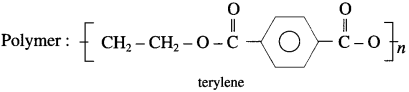
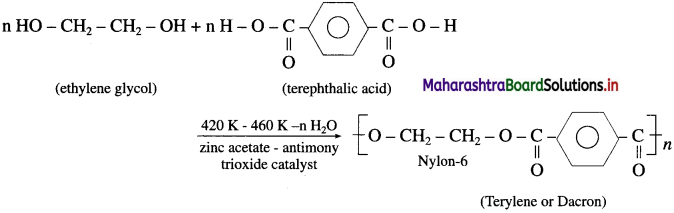
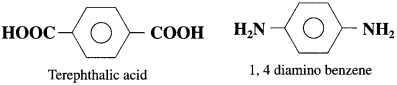
    Example : The formation of terylene, a polyester polymer, from ethylene glycol and terephthalic acid. Condensation polymerization is a step growth polymerization.
  6. Ring opening polymerization : The process of formation of polymers from cyclic compounds (like lactams, cyclic ethers, etc.) by ring opening is called ring opening polymerization.
    Example : Polymerization of e-caprolactam.
    Maharashtra Board Class 12 Chemistry Solutions Chapter 15 Introduction to Polymer Chemistry 10Ring opening polymerization proceeds by addition of a single monomer unit to the growing chain molecules. It is a step growth polymerization.

Maharashtra Board Class 12 Chemistry Solutions Chapter 15 Introduction to Polymer Chemistry

Question 4.
Classify the polymers given below as addition, condensation and ring opening polymers:
PVC, polythene, cyclic ethers, polyester, polyacrylonftrile. polystyrene.
Answer:

  • Addition polymers: PVC, polythene. polyacrylonitrile. polystyrene.
  • Condensation polymers: Polyester.
  • Ring opening polymers : Cyclic ethers

Question 5.
Write the classification of polymers based on intermolecular forces. Give examples.
OR
In which dasses, are the polymers classified on the basis of Inter molecular forces?
Answer:
Molecular forces bind the polymer chains either by hydrogen bonds or Vander Waal’s forces. These forces are called intermolecular forces. On the basis of magnitude of intcrmolccular forces, polymers are further classified as ebstomers, fibres, thermoplastic polymers. thermosetting polymers.

(1) Elastomers: Weak van der Waals type of intermolecular forces of attraction between the polymer chains are observed in cbstomcrs. When polymer is stretched, the polymer chain stretches and when the strain is relieved the chain returns to its odginal position, Thus, polymer shows elasticity and is called elastomers. Elastomers, the elastic polymers, have weak van der Waals type of intermolecular forces which permit the polymer to be stretched. Lilastorners are soft and stretchy and used in making rubber bands. E.g.. neoprene, vulcanized rubber, buna.S, buna-N.


(2) Fibres : It consists of strong intermolecular forces of’ attraction due to hydrogen bonding and strong dipole-dipole forces. These polymers possess high tensile strength. Due to these strong intermolecular forces the fibres are crystalline in nature. They are used in textile industries, strung tyres. etc.. e.g., nylon, terylene.

(3) Thermoplastic polymers: These polymer possess moderately strong intermolecular forces of attraction between those of elastomers and fibres. These polymers arc called thermoplastic because they become soft on heating and hard on cooling. They are either linear or branched chain polymers. They can be remoulded and recycled. E.g. polyethenc, PVC, polystyrene.

(4) Thermosetting polymers: These polymers are cross linked or branched molecules and are rigid polymers. During their formation they have property of being shaped on heating. but they get hardened while hot. Once hardened these become infusible, cannot be softened by heating and therefore, cannot be remoulded and recycled.
This shows extensive cross linking by covalent bonds formed in the moulds during hardening/setting process while hot. E.g. Bakelite, urea formaldehyde resin.

Question 6.
What is meant by the term homopolymer?
Answer:
A polymer made from only one type of repeating units is called homopolymer. in some cases the repeating unit is formed by condensation of two distinct monomers. Examples. Polythene, PVC. Nylon-6.

Question 7.
What is meant by the term copolymer?
Answer:
A polymer made from two or more types of repeating units is called a copolymer. The different monomer units are randomly sequenced in the copolymer, e.g., Terylene, Nylon-6, 6, Buna-S, Buna-N.

Question 8.
Write the classification of polymers on the basis of biodegradability?
OR
(1) What are biodegradable polymers?
(2) What are nonbiodegradable polymers?
Answer:
Based un biodegradability, polymers are classified as biodegradable polymer and nonbiodegradable polymers.

(1) Biodegradable polymers: Polymers that are affected by microbes or disintegrate by themselves afler a certain period of time due to environmental degradation are called biodegradable polymers.

Examples: PHBV i.e., Polyhydroxy butyrate-CO-β-hydroxy valerate Dextron. Nylon-2-nylon-6.

(2) Non biodegradable polymers: Synthetic polymers do not disintegrate by themselves after a certain period or not affected by microbes, are called nonbiodegradhle polymers.

Examples: Bakelite, Nylon, Terylene.

Question 9.
Explain the following terms :
Answer:

  1. Branched chain polymer : The polymer consists of long and straight chain with smaller side chains give rise to branched chain polymers, e.g. Polypropylene
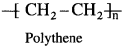
  2. Addition polymer : The polymer formed by the repeated addition of a large number of monomers (like alkenes) without loss of any small molecules are called addition polymers, e.g. polythene -[-CH2 – CH2-]n. It is a chain growth polymerization.
  3. Condensation polymer : The polymers formed by the repeated condensation reaction between polyfunctional monomers with the elimination of some molecules such as water, hydrochloric acid, methanol, ammonia are called condensation polymers, e.g. Nylon-6, 6.
  4. Elastomers : Polymers in which the intermolecular forces of attraction between the polymer chains are the weakest. When polymer is stretched, it has ability to stretch and when the strain is relieved it returns to its original position. Thus, polymer shows elasticity and is called elastomers, e.g. natural rubber, neoprene, vulcanized rubber.
  5. Homopolymer : A polymer made from only one type of repeating unit of one monomer is called homopolymer e.g. Polythene, PVC, etc.
  6. Biodegradable polymer : Polymers which are affected by microbes or disintegrate by themselves after a certain period of time due to environmental degradation are called biodegradable polymers.
    Example : PHSV i.e. Polyhydroxy butyrate -CO-β-hydroxy valerate Dextron.

Maharashtra Board Class 12 Chemistry Solutions Chapter 15 Introduction to Polymer Chemistry

Question 10.
What is natural rubber?
Answer:
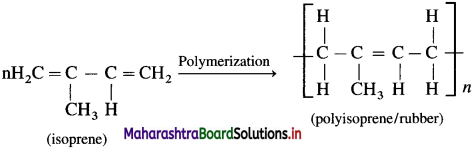
Natural rubber is a high molecular mass linear polymer of isoprene (2-methyl-1, 3-butadiene).
Maharashtra Board Class 12 Chemistry Solutions Chapter 15 Introduction to Polymer Chemistry 12

Question 11.
Write a note on natural rubber.
Answer:
Natural rubber is manufactured from rubber latex obtained from the rubber tree in the form of colloidal suspension. Reaction involved in the formation of natural rubber by the process of addition polymerization is as follows :
Maharashtra Board Class 12 Chemistry Solutions Chapter 15 Introduction to Polymer Chemistry 13

Natural rubber is -1, 4- polyisoprene. It exhibits elastic properties.

Question 12.
State properties of natural rubber.
Answer:

  1. Polyisoprene molecule has cis configuration of the C = C double bond. It consists of various chains held together by weak van der Waals forces and has coiled structure.
  2. It can be stretched like a spring and exhibits elastic property.
  3. Its molecular mass varies from 130,000 u to 340,000 u.

Question 13.
Write a note on vulcanization of rubber. OR Discuss the main purpose of vulcanization of rubber.
Answer:
The tensile strength, toughness and elasticity of natural rubber can be increased by adding 3 to 5% sulphur and heating at 100-150°C, resulting in cross linking of cis-1, 4-polypropene chains through disulphide bonds, (-S-S-). This process is known as vulcanization of rubber. The physical properties of rubber can be changed by controlling the amount of sulphur in the vulcanization process. Rubber made with 20-30% sulphur is hard, 3 to 10% sulphur is little harder and is used in making tyres and 1 to 3% sulphur is used in making rubber bands.

Question 14.
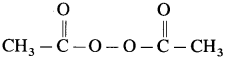
Write the name and structure of one of the initiators used in free radical polymerisation.
Answer:
The initiator used in free radical polymerisation is acetyl peroxide.
Maharashtra Board Class 12 Chemistry Solutions Chapter 15 Introduction to Polymer Chemistry 19

Question 15.
What is LDP? How is it prepared? Give its properties and uses.
Answer:
LDP means low-density polyethene. LDP is obtained by polymerization of ethylene under high pressure (1000 – 2000 atm) and temperature (350 – 570 K) in presence of traces of O2 or peroxide as initiator.
Maharashtra Board Class 12 Chemistry Solutions Chapter 15 Introduction to Polymer Chemistry 20

The mechanism of this reaction involves free radical addition and H-atom abstraction. The latter results in branching. As a result the chains are loosely held and the polymer has low density.

Properties of LDP :

  • LDP films are extremely flexible, but tough chemically inert and moisture resistant.
  • It is poor conductor of electricity with melting point 110 °C.

Uses of LDP :

  • LDP is mainly used in preparation of pipes for agriculture, irrigation, domestic water line connections as well as insulation to electric cables.
  • It is also used in submarine cable insulation.
  • It is used in producing extruded films, sheets, mainly for packaging and household uses like in preparation of squeeze bottles, attractive containers, etc.

Maharashtra Board Class 12 Chemistry Solutions Chapter 15 Introduction to Polymer Chemistry

Question 16.
Whatis HDP ? How is it prepared ? Give its properties and uses ?
Answer:
HDP means high density polyethylene. It is a linear polymer with high density due to close packing.
Maharashtra Board Class 12 Chemistry Solutions Chapter 15 Introduction to Polymer Chemistry 21

HDP is obtained by polymerization of ethene in presence of Zieglar-Natta catalyst which is a combination of triethyl aluminium with titanium tetrachloride at a temperature of 333K to 343K and a pressure of 6-7 atm.

Properties of HDP :

  • HDP is crystalline, melting point in the range of 144 – 150 °C.
  • It is much stiffer than LDP and has high tensile strength and hardness.
  • It is more resistant to chemicals than LDP.

Uses of HDP :

  • HDP is used in manufacture of toys and other household articles like buckets, dustbins, bottles, pipes, etc.
  • It is used to prepare laboratory wares and other objects where high tensile strength and stiffness is required.

Question 17.
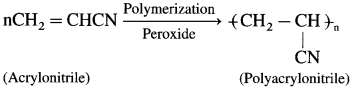
How is polyacrylonitrile (PAN) prepared? Give its uses.
Answer:
Acrylonitrile (monomer) on polymerization (addition polymerization) in the presence of peroxide initiator gives polyacrylonitrile.
Maharashtra Board Class 12 Chemistry Solutions Chapter 15 Introduction to Polymer Chemistry 23

Uses : Polyacrylonitrile resembles wool and is used as wool substitute and for making orlon or acrilan.

Question 18.
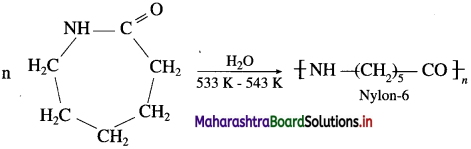
How is nylon-6 prepared?
Write the reaction for the preparation of nylon 6.
Answer:
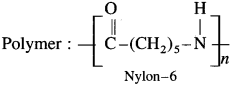
When epsilon (ε)-caprolactam is heated with water at high temperature it undergoes ring opening polymerization to form the polyamide polymer called nylon-6.
Maharashtra Board Class 12 Chemistry Solutions Chapter 15 Introduction to Polymer Chemistry 25

The name nylon-6 is given on the basis of six carbon atoms present in the monomer unit. Nylon-6 has high tensile strength and luster, nylon-6 fibres are used for manufacture of tyre cords, fabrics and ropes.

Question 19.
Draw the structures of polymers formed using the following monomers.
Maharashtra Board Class 12 Chemistry Solutions Chapter 15 Introduction to Polymer Chemistry 28

Maharashtra Board Class 12 Chemistry Solutions Chapter 15 Introduction to Polymer Chemistry 29

Maharashtra Board Class 12 Chemistry Solutions Chapter 15 Introduction to Polymer Chemistry 30
Answer:
Maharashtra Board Class 12 Chemistry Solutions Chapter 15 Introduction to Polymer Chemistry 31

Question 20.
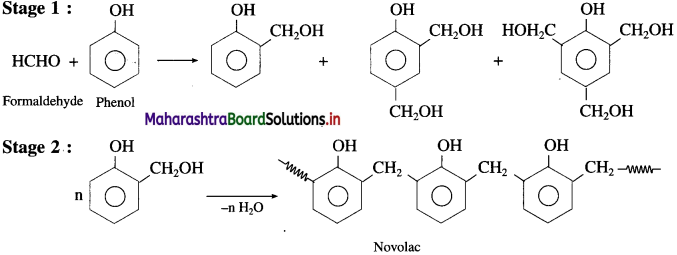
How is Novolac prepared?
OR
Write the reaction to prepare Novolac polymer.
Answer:
The monomers phenol and formaldehyde undergo polymerisation in the presence of alkali or acid as catalyst.
Maharashtra Board Class 12 Chemistry Solutions Chapter 15 Introduction to Polymer Chemistry 33
Phenol reacts with formaldehyde to form ortho or p-hydroxy methyl phenols, which further reacts with phenol to form a linear polymer called Novolac. It is used in paints.

Maharashtra Board Class 12 Chemistry Solutions Chapter 15 Introduction to Polymer Chemistry

Question 21.
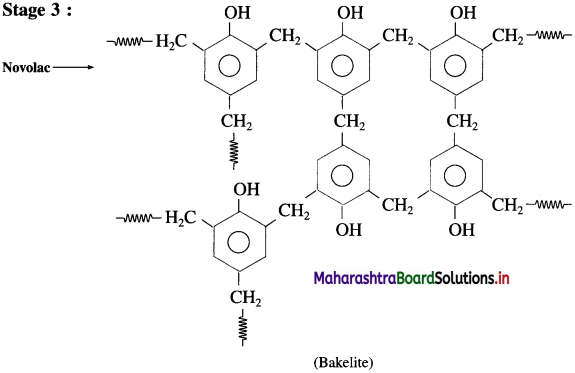
How is bakelite prepared?
Answer:
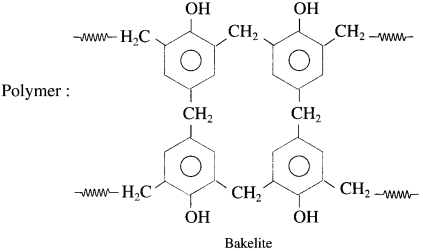
In the third stage, various articles are shaped from novolac by putting it in appropriate moulds and heating at high temperature (138 °C to 176 °C) and at high pressure forms rigid polymeric material called bakelite. Bakelite is insoluble and infusible and has high tensile strength.
Maharashtra Board Class 12 Chemistry Solutions Chapter 15 Introduction to Polymer Chemistry 34
Bakelite is used in making articles like telephone instrument, kitchenware, electric insulators frying pans, etc.

Question 22.
How is a melamine-formaldehyde polymer (melamine) prepared?
Answer:
The monomers formaldehyde and melamine undergo condensation polymerisation to form cross-linked melamine formaldehyde. It is used in making crockeries, decorative table tops like formica and plastic dinner-ware.
Maharashtra Board Class 12 Chemistry Solutions Chapter 15 Introduction to Polymer Chemistry 36

Question 23.
Write the preparation of the following synthetic rubbers and give their uses :
(1) Buna-S or styrene-butadiene rubber (SBR) (2) Neoprene rubber
Answer:
(1) Buna-S rubber : Its trade name is SBR (Styrene-butadiene rubber) Buna-S is a copolymer of styrene and 1, 3-butadiene. When 75 parts of butadiene and 25 parts of styrene subjected to addition polymerization by the action of sodium.
Maharashtra Board Class 12 Chemistry Solutions Chapter 15 Introduction to Polymer Chemistry 37

Uses : Buna-S is superior to natural rubber with regard to mechanical strength and has abrasion resistance. Hence, it is used in tyre industry.

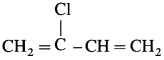
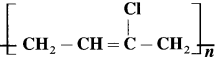
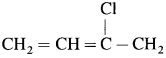
(2) Neoprene : Neoprene, a synthetic rubber, is a condensation polymer of chloroprene (2-chloro-l, 3-butadiene), Chloroprene polymerizes rapidly in presence of oxygen.
Maharashtra Board Class 12 Chemistry Solutions Chapter 15 Introduction to Polymer Chemistry 38
Vulcanization of neoprene takes place in presence of magnesium oxide.
Maharashtra Board Class 12 Chemistry Solutions Chapter 15 Introduction to Polymer Chemistry 39
Uses : Neoprene is resistant to petroleum, vegetable oils, light as well as heat. It is used in making hose pipes for transport of gasoline and making gaskets. It is used for manufacturing insulator cable, jackets, belts for power transmission and conveying.

Maharashtra Board Class 12 Chemistry Solutions Chapter 15 Introduction to Polymer Chemistry

Question 24.
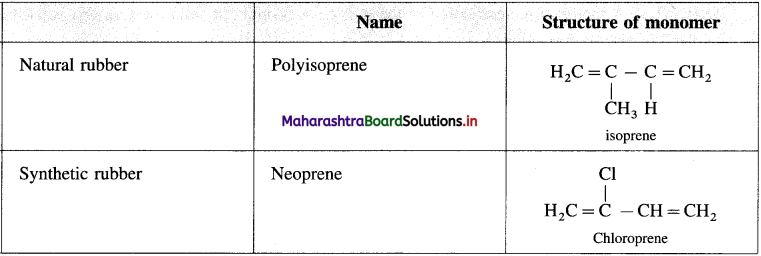
Write structure of natural rubber and neoprene rubber along with the name and structure of their monomers.
Answer:
Maharashtra Board Class 12 Chemistry Solutions Chapter 15 Introduction to Polymer Chemistry 40

Question 25.
Write the preparation of viscose rayon.
Answer:
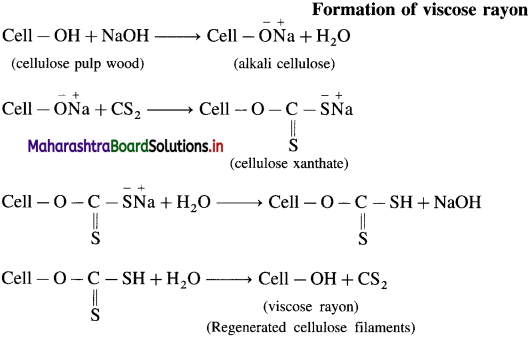
Viscose rayon is a semisynthetic fibre. It is a regenerated cellulose. The molecular formula of cellulose is (C6H10O5)n. A modified representation of the molecular formula of cellulose Cell-OH is used in the reactions involved in viscose formation.

Maharashtra Board Class 12 Chemistry Solutions Chapter 15 Introduction to Polymer Chemistry 42

Cellulose (wood pulp) is treated with the concentrated NaOH to form alkali cellulose. It is then converted to xanthate by treating with CS2. Further xanthate is mixed with dilute NaOH to form viscose solution which is extruted through spinnerates of spinning machine into acid bath, when regenerated cellulose fibres precipitate, i.e. viscose rayon.

Question 26.
How is PHBV polymer prepared?
Answer:
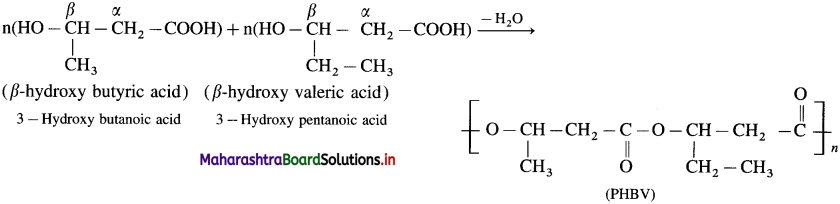
It is a copolymer. The monomers β-hydroxy butyric acid (3-hydroxy butanoic acid) and β-hydroxy valeric acid (3-hydroxy pentanoic acid) undergo polymerization to form PHBV polymer. It has an ester linkage. Hydroxyl group of one monomer forms ester link by reacting with carboxyl group of the other. Thus PHBV is an aliphatic polyester i.e. poly β-hydroxybutyrate-co-β-hydroxy valerate (PHBV). It is a biodegradable polymer.
Maharashtra Board Class 12 Chemistry Solutions Chapter 15 Introduction to Polymer Chemistry 45

Question 27.
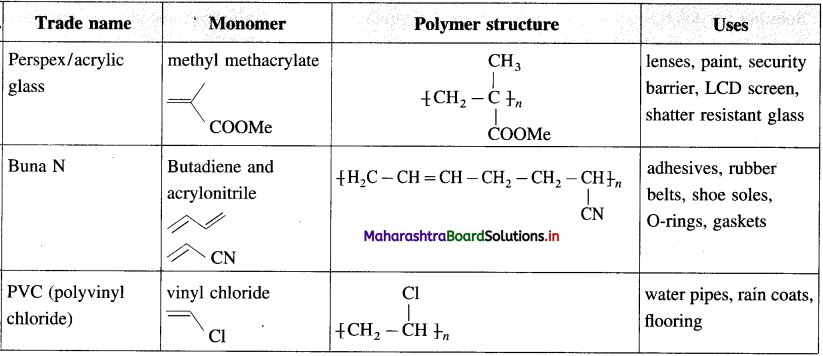
Write the name/s of monomer/s, polymer structure and one use of each of the following polymers (trade name) :
Answer:
Maharashtra Board Class 12 Chemistry Solutions Chapter 15 Introduction to Polymer Chemistry 47
Maharashtra Board Class 12 Chemistry Solutions Chapter 15 Introduction to Polymer Chemistry 48

Maharashtra Board Class 12 Chemistry Solutions Chapter 15 Introduction to Polymer Chemistry

Question 28.
Write the names of monomers used in preparing following polymers :
(1) Dacron.
Answer:
Monomers : Ethylene glycol and Dmiethyl terephthalate (DMT)
Maharashtra Board Class 12 Chemistry Solutions Chapter 15 Introduction to Polymer Chemistry 49

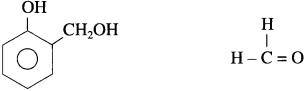
(2) Bakelite.
Answer:
Monomers : o-hydroxy methyl phenol and formaldehyde.
Maharashtra Board Class 12 Chemistry Solutions Chapter 15 Introduction to Polymer Chemistry 50

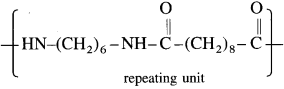
(3) Nylon-6, 8.
Answer:
Monomers : Hexamethylene diamine and Hexamethylene dicarboxylic acid.
H2N-(CH2)6-NH2 HOOC-(CH2)6-COOH

(4) Melamine.
Answer:
Monomers : Melamine and Formaldehyde
Maharashtra Board Class 12 Chemistry Solutions Chapter 15 Introduction to Polymer Chemistry 51

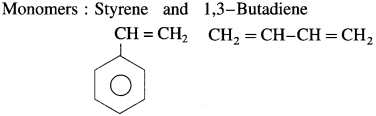
(5) Buna-S.
Answer:
Maharashtra Board Class 12 Chemistry Solutions Chapter 15 Introduction to Polymer Chemistry 52

(6) Buna-N.
Answer:
Maharashtra Board Class 12 Chemistry Solutions Chapter 15 Introduction to Polymer Chemistry 53

(7) Butyl rubber.
Answer:
Maharashtra Board Class 12 Chemistry Solutions Chapter 15 Introduction to Polymer Chemistry 54

(8) Teflon.
Answer:
Monomers : F2C = CF2 Tetrafluoroethene

(9) Natural rubber.
Answer:
Monomers : 1,3-Butadiene
CH2 = CH – CH = CH2

(10) Neoprene.
Answer:
Monomers : Chloroprene or 2-Chloro-l,3-butadiene
Maharashtra Board Class 12 Chemistry Solutions Chapter 15 Introduction to Polymer Chemistry 55

Question 29.
Write the structures of monomers used in the preparation of following polymers.
Maharashtra Board Class 12 Chemistry Solutions Chapter 15 Introduction to Polymer Chemistry 56
Answer:
The monomers used in the preparation of above polymer are :
Maharashtra Board Class 12 Chemistry Solutions Chapter 15 Introduction to Polymer Chemistry 57

Maharashtra Board Class 12 Chemistry Solutions Chapter 15 Introduction to Polymer Chemistry 58
Answer:
The monomers used in the preparation of above polymer are :
Maharashtra Board Class 12 Chemistry Solutions Chapter 15 Introduction to Polymer Chemistry 59
Answer:
The monomer used in the preparation of above polymer are :
Maharashtra Board Class 12 Chemistry Solutions Chapter 15 Introduction to Polymer Chemistry 60
Answer:
The monomer used in the preparation of above polymer is
Maharashtra Board Class 12 Chemistry Solutions Chapter 15 Introduction to Polymer Chemistry 61

Maharashtra Board Class 12 Chemistry Solutions Chapter 15 Introduction to Polymer Chemistry

Question 30.
Following monomers are used to prepare polymers. Predict the structures of polymers:

(1) Ethylene glycol.
Answer:
Ethylene glycol Maharashtra Board Class 12 Chemistry Solutions Chapter 15 Introduction to Polymer Chemistry 62 is used in the preparation of polyester (terylene or dacron).
Maharashtra Board Class 12 Chemistry Solutions Chapter 15 Introduction to Polymer Chemistry 63

Terylene is polyester fibre formed by the polymerization of terephthalic acid and ethylene glycol.

Terylene is obtained by condensation polymerization of ethylene glycol and terephthalic acid in presence of catalyst zinc acetate and antimony trioxide at high temperature.
Maharashtra Board Class 12 Chemistry Solutions Chapter 15 Introduction to Polymer Chemistry 26

Properties :

  • Terylene has relatively high melting point (265 °C)
  • It is resistant to chemicals and water.

Uses :

  • It is used for making wrinkle-free fabrics by blending with cotton (terycot) and wool (terywool), and also as glass reinforcing materials in safety helmets.
  • PET is the most common thermoplastic which is another trade name of the polyester polyethylenetereph- thalate.
  • It is used for making many articles like bottles, jams, packaging containers.

(2) ε-Caprolactam.
Answer:
ε-caprolactam is used in the preparation of nylon-6.
Maharashtra Board Class 12 Chemistry Solutions Chapter 15 Introduction to Polymer Chemistry 64

When epsilon (ε)-caprolactam is heated with water at high temperature it undergoes ring opening polymerization to form the polyamide polymer called nylon-6.
Maharashtra Board Class 12 Chemistry Solutions Chapter 15 Introduction to Polymer Chemistry 25

The name nylon-6 is given on the basis of six carbon atoms present in the monomer unit. Nylon-6 has high tensile strength and luster, nylon-6 fibres are used for manufacture of tyre cords, fabrics and ropes.

(3) Ethene.
Answer:
Ethene is used in the preparation of polythene
Polymer: Maharashtra Board Class 12 Chemistry Solutions Chapter 15 Introduction to Polymer Chemistry 65

Linear chain polymers : When the monomer molecules are joined together in a linear arrangement, the resulting polymer is straight-chain or long-chain polymer, e.g., polythene, PVC.
Maharashtra Board Class 12 Chemistry Solutions Chapter 15 Introduction to Polymer Chemistry 4
They have high melting points; high densities and high tensile strength.
Maharashtra Board Class 12 Chemistry Solutions Chapter 15 Introduction to Polymer Chemistry 5

Maharashtra Board Class 12 Chemistry Solutions Chapter 15 Introduction to Polymer Chemistry

(4) Formaldehyde.
Answer:
Formaldehye is used in the preparation of bakelite.
Maharashtra Board Class 12 Chemistry Solutions Chapter 15 Introduction to Polymer Chemistry 66

The monomers phenol and formaldehyde undergo polymerisation in the presence of alkali or acid as catalyst.
Maharashtra Board Class 12 Chemistry Solutions Chapter 15 Introduction to Polymer Chemistry 33
Phenol reacts with formaldehyde to form ortho or p-hydroxy methyl phenols, which further reacts with phenol to form a linear polymer called Novolac. It is used in paints.

In the third stage, various articles are shaped from novolac by putting it in appropriate moulds and heating at high temperature (138 °C to 176 °C) and at high pressure forms rigid polymeric material called bakelite. Bakelite is insoluble and infusible and has high tensile strength.
Maharashtra Board Class 12 Chemistry Solutions Chapter 15 Introduction to Polymer Chemistry 34
Bakelite is used in making articles like telephone instrument, kitchenware, electric insulators frying pans, etc.

Question 31.
Classify the following polymers as step growth or chain growth polymers :
(1) Nylon-6,6
(2) Terylene
(3) Polyethene (4) PVC.
Answer:
Step growth polymers : Nylon-6,6, terylene
Chain growth polymers : Polythene, PVC.

Question 32.
Classify the following as linear, branched or cross linked polymers :
(1) Bakelite
(2) Starch
(3) Polythene
(4) Nylon.
Answer:
Linear polymers : Polythene, nylon.
Cross-linked polymers : Bakelite, starch.

Question 33.
Classify the following as addition and condensation polymers :
(1) Bakelite
(2) polyvinyl chloride
(3) polythene
(4) terylene.
Answer:
Addition polymers : Polyvinyl chloride, polythene
Condensation polymers : Bakelite, terylene.

Maharashtra Board Class 12 Chemistry Solutions Chapter 15 Introduction to Polymer Chemistry

Question 34.
Arrange the polymers in increasing order of their intermolecular forces :
Nylon-6,6, Polythene, Buna-S.
Answer:
The increasing order of their intermolecular forces of attraction follows the order :
Buna-S, Polythene, Nylon-6,6.

Question 35.
Classify the following as natural, synthetic and semisynthetic polymers :
Terylene, cuprammonium silk, jute, melamine
Answer:
Natural polymers : Jute
Synthetic polymers : Terylene, melamine
Semisynthetic polymers : Cuprammonium silk

Question 36.
Complete the following statements :
(1) Chemically teflon is …………………………. .
(2) …………………………. is the catalyst used to obtain HDP by polymerisation of ethene.
(3) Viscose rayon is a …………………………. .
Answer:
(1) polytetrafluoroethylene
(2) Zieglar-Natta
(3) semisynthetic fibre (regenerated fibre).

Question 37.
Answer the following in one sentence each.

(1) Name a polymer used for making LCD screen?
Answer:
The polymer used for making LCD screen is Perspex.

(2) Which of the two is a condensation polymer? Bakelite or Polythene?
Answer:
The condensation polymer is bakelite.

(3) Which of the two is a linear polymer? Nylon or Starch.
Answer:
The linear polymer is nylon.

(4) Which of the two is a step growth polymer? Nylon-6,6 or PVC.
Answer:
The step growth polymer is Nylon-6,6.

(5) Write the use of polyacrylamide gel.
Answer:
Polyacrylamide gel is used in electrophoresis.

(6) Write the use of urea formaldehyde resin.
Answer:
Urea formaldehyde resin is used in making unbreakable dinnerware and decorative laminates.

(7) Give an example of semisynthetic polymer.
Answer:
Semisynthetic polymer : Viscose rayon, cuprammonium silk.

(8) Write the monomer unit of teflon.
Answer:
Monomer unit of teflon : Tetrafluoroethene (F2C = CF2).

(9) Write the equation for the preparation of polypropylene.
Answer:
Maharashtra Board Class 12 Chemistry Solutions Chapter 15 Introduction to Polymer Chemistry 72

(10) Name a synthetic polymer which contains amide linkage.
Answer:
Polymer that contains amide linkage : Nylon-6; Nylon 6,6.

(11) Name a synthetic polymer which contains ester linkage.
Answer:
Polymer that contains ester linkage : Terylene or Dacron.

Maharashtra Board Class 12 Chemistry Solutions Chapter 15 Introduction to Polymer Chemistry

(12) Name one thermosetting and one thermoplastic polymer.
Answer:
Thermosetting polymer : Bakelite.
Thermoplastic polymer : Polythene, polystyrene.

(13) State the uses of biodegradable polymers.
Answer:
Biodegradable polymers are used as orthopaedic devices, implants, sutures and drug release matrices.

(14) Name a copolymer which is used for making nonbreakable crockeries.
Answer:
The polymer used in making nonbreakable crockeries : Melamine formaldehyde polymer.

(15) Write the structure of monomer used in the preparation of Maharashtra Board Class 12 Chemistry Solutions Chapter 15 Introduction to Polymer Chemistry 75
Answer:
The structure of monomer : Maharashtra Board Class 12 Chemistry Solutions Chapter 15 Introduction to Polymer Chemistry 76

(16) Write the structure of melamine.
Answer:
The monomers formaldehyde and melamine undergo condensation polymerisation to form cross-linked melamine formaldehyde. It is used in making crockeries, decorative table tops like formica and plastic dinner-ware.
Maharashtra Board Class 12 Chemistry Solutions Chapter 15 Introduction to Polymer Chemistry 36

(17) What does SBR stand for?
Answer:
SBR stand for styrene(S)butadiene (B) rubber (R).

(18) Draw the structure of repeating unit in nylon-6,10.
Answer:
The structure of repeating unit in nylon-6,10 is
Maharashtra Board Class 12 Chemistry Solutions Chapter 15 Introduction to Polymer Chemistry 77

(19) What are the monomers used to prepare nylon given below?
Maharashtra Board Class 12 Chemistry Solutions Chapter 15 Introduction to Polymer Chemistry 78
Answer:
Monomers used in the preparation of nylon are
Maharashtra Board Class 12 Chemistry Solutions Chapter 15 Introduction to Polymer Chemistry 79

(20) Write the monomers used to prepare nylon given below :
Maharashtra Board Class 12 Chemistry Solutions Chapter 15 Introduction to Polymer Chemistry 80
Answer:
Monomers used in the preparation of nylon are
Maharashtra Board Class 12 Chemistry Solutions Chapter 15 Introduction to Polymer Chemistry 81

Maharashtra Board Class 12 Chemistry Solutions Chapter 15 Introduction to Polymer Chemistry

(21) Name the catalyst which is formed from titanium chloride and triethyl aluminium.
Answer:
The catalyst Zieglar Natta is formed from titanium chloride and triethyl aluminium.

(22) Define molecular mass of polymer.
Answer:
Molecular mass of a polymer is an average of the molecular masses of the constituent molecules.

(23) Which factor determines the molecular mass of polymer.
Answer:
Molecular mass of polymer depends upon the degree of polymerization (DP). DP is the number of monomer units in a polymer molecule.

Multiple Choice Questions

Question 38.
Select and write the most appropriate answer from the given alternatives for each subquestion :

1. Which one is the natural polyamide polymer?
(a) Cuprammonium silk
(b) Wool
(c) Perlon-L
(d) Jute
Answer:
(b) Wool

2. The synthetic fibres are prepared from
(a) cellulose
(b) starch
(c) chemical compounds
(d) polymers
Answer:
(c) chemical compounds

3. Which of the following is NOT a vegetable fibre?
(a) Hemp
(b) Jute
(c) Cotton
(d) Keratin
Answer:
(d) Keratin

4. Which of the following fibres are made up of polyamides?
(a) Dacron
(b) Rayon
(c) Nylon
(d) Terylene
Answer:
(c) Nylon

5. An example of natural cellulose fibre is
(a) cotton
(b) wool
(c) silk
(d) rayon
Answer:
(a) cotton

6. Cellulose is the main constituent of
(a) nylon-6
(b) cotton
(c) terylene
(d) wool
Answer:
(b) cotton

7. Of the following, which group contains two cellulosic fibres and one protein fibre?
(a) Cotton, keratin, wool
(b) Linen, keratin, wool
(c) Cotton, linen, rayon
(d) Cotton, keratin, linen
Answer:
(d) Cotton, keratin, linen

8. Which of the following is not a vegetable fibres?
(a) Hemp
(b) Jute
(c) Cotton
(d) Keratin
Answer:
(d) Keratin

Maharashtra Board Class 12 Chemistry Solutions Chapter 15 Introduction to Polymer Chemistry

9. Which of the following is polyamide?
(a) Teflon
(b) Nylon 6, 6
(c) Terylene
(d) Bakelite
Answer:
(b) Nylon 6, 6

10. The monomer of e-caprolactam is
(a) styrene
(b) amino acid
(c) aminocaproic acid
(d) adipic acid O
Answer:
(c) aminocaproic acid

11. Maharashtra Board Class 12 Chemistry Solutions Chapter 15 Introduction to Polymer Chemistry 83is the formula of _ Jn
(a) Nylon-66 salt
(b) Nylon-66
(c) DMT
(d) Nylon-6
Answer:
(d) Nylon-6

12. Nylon-6 is a
(a) polyester fibre
(b) protein fibre
(c) poly caprolactum fibre
(d) poly amine fibre
Answer:
(c) poly caprolactum fibre

13. The condensation product of e-caprolactum is
(a) teflon
(b) nylon-6
(c) nylon-66
(d) bakelite
Answer:
(b) nylon-6

14. \(\left[\overline{\mathrm{O}} \mathrm{OC}-\left(\mathrm{CH}_{2}\right)_{4}-\mathrm{COO}-\mathrm{N} \mathrm{H}_{3}-\left(\mathrm{CH}_{2}\right)_{6}-\mathrm{N} \mathrm{H}_{3}\right]\) is the formula of
(a) nylon-6
(b) nylon-6 salt
(c) nylon-66 salt
(d) nylon-66
Answer:
(b) nylon-6 salt

15. The starting material required for the preparation of Nylon-66 is
(a) glycol
(b) α-amino acid
(c) adipic acid and hexamethylene diamine
(d) dimethyl terephthalate and ethylene glycol
Answer:
(c) adipic acid and hexamethylene diamine

16. Terylene is also known as
(a) styrene
(b) butadiene
(c) dacron
(d) teflon
Answer:
(c) dacron

Maharashtra Board Class 12 Chemistry Solutions Chapter 15 Introduction to Polymer Chemistry

17. Terylene is
(a) vegetable fibre
(b) protein fibre
(c) polyester fibre
(d) polyamide fibre
Answer:
(c) polyester fibre

18. Terylene polymer is formed in
(a) the presence of nitrogen
(b) the presence of hydrogen
(c) the presence of oxygen
(d) the vacuum
Answer:
(d) the vacuum

19. The by-product formed during the preparation of terylene fibre is
(a) glycerol
(b) propylene glycol
(c) ethylene glycol
(d) ethyl alcohol
Answer:
(c) ethylene glycol

20. Nylon polymer cannot be used for making
(a) tyre cords
(b) films
(c) dress materials
(d) fishing nets
Answer:
(b) films

21. Glycol is an important constituent of
(a) nylon-6
(b) nylon-66
(c) terylene
(d) hexamethylene diammonium adipate
Answer:
(c) terylene

22. Terylene is prepared by the process of
(a) halogenation
(b) condensation
(c) esterification
(d) hydrogenation
Answer:
(b) condensation

23. What are the steps during polymerisation to form terylene?
(a) Terephthalic acid is condensed with ethylene glycol at 420 K-460 K.
(b) Ethylene glycol displaces methanol to form dihydroxy diethyl terephthalic acid
(c) Zinc acetate – antimony trioxide is used as catalyst
(d) All of these
Answer:
(d) All of these

24. During polymerisation of nylon salt to nylon-66, the conditions are
(a) room temperature and pressure
(b) temperature 503 K
(c) temperature 553 K in presence of Nitrogen
(d) heating in an autoclave at 373 K
Answer:
(c) temperature 553 K in presence of Nitrogen

25. Which one of the following is a condensation polymer?
(a) Nylon
(b) Polythene
(c) PVC
(d) Teflon
Answer:
(a) Nylon

Maharashtra Board Class 12 Chemistry Solutions Chapter 15 Introduction to Polymer Chemistry

26. Which one of the following is an addition polymer?
(a) Bakelite
(b) Nylon-6,6
(c) Polystyrene
(d) Terylene
Answer:
(c) Polystyrene

27. A polymer of butadiene and Acrylonitrile is called
(a) Buna-S
(b) Buna-N
(c) Buna-B
(d) Buna-A
Answer:
(b) Buna-N

28. Natural rubber is a polymer of
(a) Styrene
(b) Butadiene
(c) Vinyl chloride
(d) Isoprene
Answer:
(d) Isoprene

29. In which of the following pairs both are copolymers?
(a) PHBV, bakelite
(b) Polythene, terylene
(c) Polyacrylonitrile, nylon-6,6
(d) Polystyrene, melamine
Answer:
(a) PHBV, bakelite

30. The polymer used in paints is
(a) Nylon
(b) Glyptal
(c) Neoprene
(d) Terylene
Answer:
(b) Glyptal

31. Which of the following contains biodegradable polymers only?
(a) Cellulose, dextron, PHBV
(b) Starch, PHBV, PVC
(c) Bakelite, nylon-2-nylon-6, nylon-6,6
(d) Cellulose, starch, terylene
Answer:
(a) Cellulose, dextron, PHBV

32. Thermosetting polymer is
(a) Nylon-6
(b) Nylon-6,6
(c) Bakelite
(d) SBR
Answer:
(c) Bakelite

33. Nylon thread contains the polymer
(a) Polyamide
(b) Polyvinyl
(c) Polyester
(d) Polyethylene
Answer:
(a) Polyamide

34. Polythene, PVC, teflon and neoprene are all
(a) Monomers
(b) Homopolymers
(c) Copolymers
(d) Condensation polymers
Answer:
(b) Homopolymers

Maharashtra Board Class 12 Chemistry Solutions Chapter 15 Introduction to Polymer Chemistry

35. Which one of the following is NOT a biodegrad¬able polymer?
(a) Starch
(b) Cellulose
(c) Dextron
(d) Decron
Answer:
(d) Decron

36. The polymer used in making blankets (artificial wool) is
(a) Polyester
(b) Polyacrylonitrile
(c) Polythene
(d) Polystyrene
Answer:
(b) Polyacrylonitrile

37. Which one of the following is a linear polymer?
(a) Bakelite
(b) LDP
(c) Nylon
(d) Formaldehyde melamine polymer
Answer:
(c) Nylon

38. Which one of the following is a branched polymer?
(a) PVC
(b) Polyester
(c) Nylon
(d) Polypropylene
Answer:
(d) Polypropylene

39. The polymer used to make non-stick cookware is
(a) Polyethene
(b) Polystyrene
(c) Polytetrafluoroethylene
(d) Polyvinyl chloride
Answer:
(c) Polytetrafluoroethylene

40. The monomer used to prepare orlon is
(a) CH2 = CH-CN
(b) CH2 = CHCl
(c) CH2 = CH-F
(d) CH2 = CF2
Answer:
(a) CH2 = CH-CN

41. Buna-N rubber is a copolymer of
Maharashtra Board Class 12 Chemistry Solutions Chapter 15 Introduction to Polymer Chemistry 86
Answer:
(b)

42. Bakelite is a polymer of
(a) Formaldehyde and phenol
(b) Benzaldehyde and phenol
(c) Formaldehyde and benzyl alcohol
(d) Acetaldehyde and phenol
Answer:
(a) Formaldehyde and phenol

Maharashtra Board Class 12 Chemistry Solutions Chapter 15 Introduction to Polymer Chemistry

43. The process involving heating of natural rubber with sulphur is known as
(a) Sulphonation
(b) Vulcanisation
(c) Galvanisation
(d) Calcination
Answer:
(b) Vulcanisation

44. A polymer of bisphenol and phosgene is called
(a) Polyamide
(b) Glyptal
(c) Polycarbonate
(d) Polystyrene
Answer:
(c) Polycarbonate

45. Thermocol is a homopolymer of
(a) terephthalic acid
(b) acrylonitrile
(c) methyl a-cyanoacrylate
(d) styrene
Answer:
(d) styrene

46. The polymer is used to prepare shatter resistant glass is called
(a) Perspex/acrylic glass
(b) Soda glass
(c) Buna N
(d) Polyacrylamide
Answer:
(a) Perspex/acrylic glass

47. A polymer used in making shoe soles is
(a) Glyptal
(b) Buna-N
(c) Buna-S
(d) Poly carbonate
Answer:
(b) Buna-N

48. The Zieglar-Natta catalyst is used in the preparation of
(a) LDPE
(b) PHBV
(c) PAN
(d) HDPE
Answer:
(d) HDPE

49. Which of the following is natural rubber?
(a) cis-1, 4-polyisoprene
(b) neoprene
(c) Trans-1. 4-polyisoprene
(d) Butyl rubber
Answer:
(a) cis-1, 4-polyisoprene

50. Which one from the following is the Terylene polymer?
Maharashtra Board Class 12 Chemistry Solutions Chapter 15 Introduction to Polymer Chemistry 84
Answer:
(b)

Maharashtra Board Class 12 Chemistry Solutions Chapter 15 Introduction to Polymer Chemistry

51. Equivalent amount of Hexamethylene diamine and adipic acid on complete neutralization produces :
Maharashtra Board Class 12 Chemistry Solutions Chapter 15 Introduction to Polymer Chemistry 85
Answer:
(a)

52. Polyhydroxy butyrate-CO-β-hydroxy valerate represents
(a) Dextron
(b) Nylon-6, 6
(c) Nylon-2-nylon-6
(d) PHBV
Answer:
(d) PHBV

53. Among the following, the biodegradable polymer is
(a) PVC
(b) Nylon-6, 6
(c) Nylon-2-nylon-6
(d) Neoprene
Answer:
(c) Nylon-2-nylon-6

54. The monomers of Nylon-2-nylon-6 are
(a) glycine and ω-amino caproic acid
(b) lactic acid and glycolic acid
(c) glycolic acid and co-amino caproic acid
(d) isobutylene and isoprene
Answer:
(a) glycine and ω-amino caproic acid

Maharashtra Board Class 11 Secretarial Practice Important Questions Chapter 11 Correspondence with Banks

Balbharti Maharashtra State Board Class 11 Secretarial Practice Important Questions Chapter 11 Correspondence with Banks Important Questions and Answers.

Maharashtra State Board 11th Secretarial Practice Important Questions Chapter 11 Correspondence with Banks

1A. Select the correct answer from the options given below and rewrite the statements.

Question 1.
Negotiable Instrument which can be discounted with the bank _____________
(a) Cheque
(b) Bills of Exchange
(c) Bank Draft
Answer:
(b) Bills of Exchange

Question 2.
Bank overdraft is a _____________ term facility provided by bank.
(a) medium
(b) short
(c) long
Answer:
(b) short

Question 3.
A loan for a period of more than 5 years is called as _____________ loans.
(a) short term
(b) long term
(c) medium-term
Answer:
(b) long term

Maharashtra Board Class 11 Secretarial Practice Important Questions Chapter 11 Correspondence with Banks

Question 4.
Purchase and sale of securities is _____________ function of Bank.
(a) primary
(b) utility
(c) agency
Answer:
(c) agency

1B. Match the pairs.

Question 1.

Group ‘A’ Group ‘B’
(a) Current Account (1) Time Deposits
(b) Financial Arrangement (2) ATM, Credit Card and Debit Card
(c) Agency Function (3) Demand Deposits
(d) Utility Function (4) Collection of Dividend and Interest
(e) Cash Credit (5) Bank Overdraft
(f) Bill of Exchange (6) Advance against the stock of raw material
(g) Letter of Credit (7) Non-negotiable instrument
(8) Bank Draft
(9) Negotiable Instrument
(10) International trade transaction

Answer:

Group ‘A’ Group ‘B’
(a) Current Account (3) Demand Deposits
(b) Financial Arrangement (5) Bank Overdraft
(c) Agency Function (4) Collection of Dividend and Interest
(d) Utility Function (2) ATM, Credit Card, and Debit Card
(e) Cash Credit (6) Advance against the stock of raw material
(f) Bill of Exchange (9) Negotiable Instrument
(g) Letter of Credit (10) International trade transaction

1C. Write a word or a term or a phrase that can substitute each of the following statements.

Question 1.
Deposits generating saving habits among the people.
Answer:
Saving Deposits

Question 2.
Deposits are not repayable on demand.
Answer:
Time Deposits

Question 3.
Deposits repayable on demand.
Answer:
Demand Deposits

Question 4.
The loan was provided for a period of less than one year.
Answer:
Short Term Loan

Maharashtra Board Class 11 Secretarial Practice Important Questions Chapter 11 Correspondence with Banks

Question 5.
The loan is provided for a period between 1 to 5 years.
Answer:
Medium-Term Loan

Question 6.
The loan was provided for a period of more than 5 years.
Answer:
Long Term Loan

1D. State whether the following statements are True or False

Question 1.
Letter of credit is issued by banks for domestic trade transactions.
Answer:
False

Question 2.
Bill of Exchange is a negotiable instrument.
Answer:
True

Maharashtra Board Class 11 Secretarial Practice Important Questions Chapter 11 Correspondence with Banks

Question 3.
The bank acts as a trustee, attorney, and executor of the will.
Answer:
True

Question 4.
RTGS is an agency function of the Bank.
Answer:
False

Question 5.
The bank plays the role of Depository Participant (DP).
Answer:
True

1E. Find the odd one.

Question 1.
Loan, Deposit, Cash credit, Overdraft facility.
Answer:
Deposit

Question 2.
Cheque, Withdrawal slip, Pay in slip.
Answer:
Pay in slip

Question 3.
Travellers Cheque, Safe Deposit Vault, NEFT, Transfer of Money.
Answer:
Transfer of Money

Maharashtra Board Class 11 Secretarial Practice Important Questions Chapter 11 Correspondence with Banks

Question 4.
Collection of Dividend, Collection of cheque, Buying, and Selling of Securities, Payment of Electricity Bill.
Answer:
Buying and Selling of Securities

1F. Complete the sentences.

Question 1.
The appointment of bankers of a company is made by the _____________
Answer:
Board of Directors

Question 2.
Banker is a dealer in _____________
Answer:
Money

Question 3.
Bank account in which money is deposited at regular interval is a _____________
Answer:
Recurring Deposit Account

Maharashtra Board Class 11 Secretarial Practice Important Questions Chapter 11 Correspondence with Banks

Question 4.
The instrument which can be discounted with the bank is a _____________
Answer:
Bills of Exchange

Question 5.
Businessman, Companies etc, usually open a _____________ account with a bank.
Answer:
Current

Question 6.
There is no restriction on the withdrawals from _____________ account.
Answer:
Current

Question 7.
Interest is not paid on the _____________ account.
Answer:
Current

Question 8.
_____________ account is suitable for salaried people.
Answer:
Saving

Question 9.
Stop payment letter is sent, when the cheque is _____________
Answer:
lost/misplaced

Maharashtra Board Class 11 Secretarial Practice Important Questions Chapter 11 Correspondence with Banks

Question 10.
Withdrawals are not permitted from the _____________ accounts.
Answer:
Fixed Deposits

Question 11.
The facility given by the bank to draw more money than the actual balance in the credit is called _____________
Answer:
Overdraft facility

Question 12.
A deposit which is kept for a fixed period in a bank is a _____________
Answer:
Fixed Deposit

Question 13.
A type of bank account which is generally opened by a businessman for his business transactions is a _____________
Answer:
Current account

Maharashtra Board Class 11 Secretarial Practice Important Questions Chapter 11 Correspondence with Banks

Question 14.
A type of account in which the interest is paid at higher rate is a _____________
Answer:
Fixed Deposit Account

1G. Select the correct option from the bracket.

Question 1.

Group ‘A’ Group ‘B’
(1) Loans not more than one year ……………………….
(2) …………………….. Cash Credit
(3) Collection of cheques ………………………..
(4) …………………….. Letter of Credit

(Interest charged on, actual amount withdrawn, Agency function, Utility function, Short Term loans)
Answer:

Group ‘A’ Group ‘B’
(1) Loans not more than one year Short Term loans
(2) Interest charged on actual amount withdrawn Cash Credit
(3) Collection of cheques Agency function
(4) Utility function Letter of Credit

1H. Answer in one sentence.

Question 1.
What is a demand deposit?
Answer:
Deposits that are repayable on demand are called demand deposits. There are 2 types of demand deposits i.e Saving Deposits and Current Deposits.

Question 2.
What is a time deposit?
Answer:
Deposits that are repayable after a specific period of time are called time deposits. There are 2 types of time deposits i.e. Fixed Deposits and Recurring Deposits.

Question 3.
What do you mean by loan?
Answer:
Any amount granted or lent for a specific period of time against personal security, gold or silver, or other movable or immovable assets is called a loan.

Maharashtra Board Class 11 Secretarial Practice Important Questions Chapter 11 Correspondence with Banks

Question 4.
What is the Bill of Exchange?
Answer:
It is a written unconditional order by the seller to the buyer, to pay a certain sum of money on a future fixed date for payment of goods or services received.

1I. Correct the underlined word and rewrite the following sentences.

Question 1.
Short-term loans are of more than 5 years.
Answer:
Long-term loans are of more than 5 years.

Question 2.
Bills of Exchange are the non-negotiable instrument.
Answer:
Bills of exchange is a negotiable instrument.

Question 3.
The collection of cheques and bills is a utility function of the bank.
Answer:
The collection of cheques and bills is the agency function of the bank.

Question 4.
The rate of interest is high for saving deposits.
Answer:
The rate of interest is high for fixed deposits.

Maharashtra Board Class 11 Secretarial Practice Important Questions Chapter 11 Correspondence with Banks

Question 5.
Deposits that are repayable after the specific period is Demand Deposit.
Answer:
Deposits that are repayable after the specific period are Time Deposits.

2. Answer in brief.

Question 1.
Explain the types of term loans.
Answer:
A loan granted for a specific time period against personal security, gold or silver, and movable and immovable assets is called a term loan.
Types of term loans:

  • Short-term loan: A loan repayable within 1 year is called a short-term loan. It is generally taken by businessmen to meet their working capital requirements.
  • Medium-term loan: A loan repayable within 2 years to 5 years period is called a medium-term loan.
  • Long-term loan: A loan repayable after 5 years is called a long-term loan. It is taken by businessmen for the growth and development of the business.

Question 2.
Explain the types of Advances.
Answer:
Advance is a credit facility provided by the bank to its customers. Advances are for a shorter period than loans.
Type of Advances:

  • Overdraft: It is an arrangement in which a customer i.e. Current A/c holder, is allowed to overdrew money in excess of the credit balance in his account. It is allowed against collateral securities like – shares, F.D.R., Government securities, etc.
  • Cash credit: In this mode of advance, a separate bank account called ‘Cash Credit Account is opened in the name of the borrower. He can withdraw from this account as and when required. It is allowed against security like – stock of raw materials, finished goods, etc.
  • Discounting of Bills: Discounting of bills means encashing the Bills of Exchange before its due date with the banker. The bank charges a certain amount of interest for this service which is called a discounting rate.

3. Justify the following statements.

Question 1.
In cash credit, the customer’s account is credited by a bank with the sanctioned amount.
Answer:
Cash credit is another kind of credit facility given by the bank to its customers including businessmen, companies, etc.

  • A separate bank account known as a “Cash Credit Account” is required to be opened in the name of the borrower.
  • The bank credits the account as per the sanctioned cash limit from which the customer can utilize funds whenever required for cash credit.
  • Generally, the security of tangible assets like goods, finished stock is required to be kept.
  • The interest is charged only on the actual amount utilized by the customer.
  • Cash credit arrangement is for a longer period as compared to overdraft.
  • This system of lending is prevalent in India only.
  • Thus, in cash credit, the customer’s account is credited by a bank with the sanctioned amount.

Maharashtra Board Class 11 Secretarial Practice Important Questions Chapter 11 Correspondence with Banks

Question 2.
Bank correspondence should be brief and to the point.
Answer:

  • The bank is a financial institution.
  • A company secretary has to conduct bank correspondence as per the instruction of the Board.
  • Bank correspondence needs careful and cautious drafting.
  • The company secretary has to use his knowledge, skill, and experience while conducting bank correspondence,
  • The company secretary has to conduct bank correspondence promptly and accurately.
  • Mistakes and delays in bank correspondence may bring financial loss to the company.
  • Bank correspondence should be always brief, compact, and precise.
  • Unnecessary or irrelevant information should be avoided in bank correspondence.
  • Thus, bank correspondence should be brief and to the point.

Question 3.
No interest is paid by the bank on the current account.
Answer:

  • The Current account is normally opened by businessmen, firms, or companies.
  • A current account is a running account and in practice it never becomes time-barred.
  • This account is opened with a minimum deposit.
  • There is no limit on the amount or number of withdrawals.
  • Interest is not payable on this account.
  • Overdraft facility is given only to current depositors after following the prescribed bank procedure.
  • Hence, interest is paid only in the case of recurring, fixed, and saving accounts and not in the case of the current account.
  • Thus, no interest is paid by the bank on the current account.

Maharashtra Board Class 12 Chemistry Important Questions Chapter 3 Ionic Equilibria

Balbharti Maharashtra State Board 12th Chemistry Important Questions Chapter 3 Ionic Equilibria Important Questions and Answers.

Maharashtra State Board 12th Chemistry Important Questions Chapter 3 Ionic Equilibria

Question 1.
What are electrolytes?
Answer:
Electrolytes: The substances which in their aqueous solutions (or in any polar solvents) dissociate or ionize forming positively charged ions (cations) and negatively charged ions (anions) are called electrolytes. For example, NaCl, HCl, etc.

Question 2.
What is an ionic equilibrium?
Answer:
Ionic equilibrium: The equilibrium between ions and unionized molecules of an electrolyte in solution is called an ionic equilibrium.
\(\mathrm{CH}_{3} \mathrm{COOH}_{(\mathrm{aq})} \rightleftharpoons \mathrm{CH}_{3} \mathrm{COO}_{(\mathrm{aq})}^{-}+\mathrm{H}_{(\mathrm{aq})}^{+}\)

Question 3.
What are the types of electrolytes?
Answer:
There are two types of electrolytes as follows :
(a) Strong electrolyte The electrolytes which ionise completely or almost completely are called strong electrolytes. For example, NaCl, HCl, H2SO4, etc.
(b) Weak electrolytes: The electrolytes which dissociate to a less extent are called weak electrolytes. For example, CH3COOH, NH4OH, etc.

Question 4.
Define degree of dissociation.
Answer:
Degree of dissocsavIt is defined as a fraction of total number of moles of an electrolyte that dissociate into its ions at equilibrium.
It is denoted by a and represented by,
Maharashtra Board Class 12 Chemistry Important Questions Chapter 3 Ionic Equilibria 1
OR α = \(\frac{\text { Per cent dissociation }}{100}\)
∴ Per cent dissociation = α × 100

Maharashtra Board Class 12 Chemistry Important Questions Chapter 3 Ionic Equilibria

Question 5.
Define acid and base. Give examples.
Answer:
Acid : A hydrogen containing substance which gives H+ ions in aqueous solution is called an acid. For example, HCl, CH3COOH, etc.
\(\mathrm{HCl}_{(\mathrm{aq})} \longrightarrow \mathrm{H}_{(\mathrm{aq})}^{+}+\mathrm{Cl}_{(\mathrm{aq})}^{-}\)

Base : A substance that contains OH group and produces hydroxide ions (OH) in aqueous solution is called a base.
\(\mathrm{NaOH}_{(\mathrm{aq})} \longrightarrow \mathrm{Na}_{(\mathrm{aq})}^{+}+\mathrm{OH}_{(\mathrm{aq})}^{-}\)

Question 6.
What are the limitations of Arrhenius acid-base theory ?
Answer:
Limitations of Arrhenius theory :

  1. This theory is applicable only for aqueous solutions and not for non-aqueous solutions.
  2. It fails to explain the acidic nature of non-hydrogen compounds like BF3, AlCl2, FeCl3, etc.
  3. It fails to explain the basic nature of non-hydroxy compounds like NH3, amines, Na2CO3, KCN, aniline, etc. in their aqueous solutions.
  4. It does not explain role of solvent or existence of H3O+ in an aqueous solution of an acid.

Question 7.
Explain neutralisation reaction according to Arrhenius theory.
Answer:
Neutralisation reaction : According to Arrhenius theory neutralisation is a reaction between an acid and a base in their aqueous solutions produciijg salt and unionised water.
\(\mathrm{HCl}_{(\mathrm{aq})}+\mathrm{NaOH}_{(\mathrm{aq})} \rightarrow \mathrm{NaCl}_{(\mathrm{aq})}+\mathrm{H}_{2} \mathrm{O}_{(\mathrm{l})}\)
Since strong acid, strong base and salt dissociate completely, the above reaction is represented as,
Maharashtra Board Class 12 Chemistry Important Questions Chapter 3 Ionic Equilibria 2
Hence, according to Arrhenius theory neutralisation reaction is defined as a reaction between H+ ions and OH ions forming unionised water molecules.

Question 8.
Explain Bronsted-Lowry theory of acids and bases.
Answer:
Acid : According to Bronsted-Lowry theory acid is a substance that donates a proton (H+) to another substance.
Base : According to this theory base is a substance that accepts a proton (H+) from another substance. For example,
Maharashtra Board Class 12 Chemistry Important Questions Chapter 3 Ionic Equilibria 3
Since HCl donates a proton it is an acid while NH3 accepts a proton it is a base.

Question 9.
For each of the following reactions, identify the Lowry-Bronsted conjugate acid-base pairs :
Maharashtra Board Class 12 Chemistry Important Questions Chapter 3 Ionic Equilibria 4
Answer:
Maharashtra Board Class 12 Chemistry Important Questions Chapter 3 Ionic Equilibria 5
In this Acid-1 (CH3COOH) and Base-1 (CH3COO) is one acid base conjugate pair while Base-2 (NH3) and Acid-2 \(\mathrm{NH}_{4}^{+}\) is another conjugate pair.
Maharashtra Board Class 12 Chemistry Important Questions Chapter 3 Ionic Equilibria 6

Question 10.
Mention a conjugate acid and a conjugate base for each of the following :
(a) H2O (b) \(\mathrm{HSO}_{4}^{-}\) (C) Br (d) H2CO3 (e) \(\mathbf{H}_{2} \mathbf{P O}_{4}^{-}\) (f) \(\mathbf{N H}_{4}^{+}\)
Answer:

Substance Conjugate acid Conjugate base
(a) H2O H3O+ OH
(b) \(\mathrm{HSO}_{4}^{-}\) H2SO4 \(\mathrm{SO}_{4}^{-2}\)
(c) Br HBr
(d) H2CO3 \(\mathrm{HCO}_{3}^{-}\)
(e) \(\mathrm{H}_{2} \mathrm{PO}_{4}^{-}\) H3PO4 \(\mathrm{HPO}_{4}^{-2}\)
(f) \(\mathrm{NH}_{4}^{+}\) NH3

Maharashtra Board Class 12 Chemistry Important Questions Chapter 3 Ionic Equilibria

Question 11.
Identify conjugate acid-base pairs in the following :
Maharashtra Board Class 12 Chemistry Important Questions Chapter 3 Ionic Equilibria 7
Maharashtra Board Class 12 Chemistry Important Questions Chapter 3 Ionic Equilibria 8
Answer:
Maharashtra Board Class 12 Chemistry Important Questions Chapter 3 Ionic Equilibria 9

Question 12.
Define acids and bases on the basis of Lewis concept. Give examples.
Answer:
Lewis concept of an acid and a base is based on the electronic theory.
Acid : It is defined as any species (molecule or ion) that can accept a pair of electrons. E.g. BF3, AlCl3 and all electron deficient species like cations (K+, Ag+) and molecules having incomplete octet, like BeF2, BF3.

Base : It is defined as any species (molecule or ion) that can donate a pair of electrons. E.g. NH3, C2H5NH2 and all electron rich species like anions (Cl, OH) and all molecules with lone pair of electrons.

Question 13.
Explain : (A) BF3 is a Lewis acid, (B) NH3 is a Lewis base.
Answer:
(A) According to Lewis theory, an acid is a substance which can accept a pair of electrons.
In BF3 molecule, the octet of B is incomplete, hence it needs two electrons or a pair of electrons to complete its octet. Hence BF3 acts as a Lewis acid.
Maharashtra Board Class 12 Chemistry Important Questions Chapter 3 Ionic Equilibria 10
(B) According to Lewis theory, a base is a substance which can donate a pair of electrons.
In NH3 molecule, nitrogen atom has one lone pair of elctrons to donate.
Maharashtra Board Class 12 Chemistry Important Questions Chapter 3 Ionic Equilibria 11
The reaction between BF3 and NH3 can be represented as,
Maharashtra Board Class 12 Chemistry Important Questions Chapter 3 Ionic Equilibria 12

Question 14.
Classify the following into Lewis acids and bases :
CN, Cl, S2-, Cu++, H2O, OH, BF3, Ag+.
Answer:
(1) Lewis acid : Cu++, BF3, Ag+
(2) Lewis bases : CN, Cl, S2-, OH.

Question 15.
Explain amphoteric nature of water.
Answer:
(1) Since water acts as an acid as well as a base, it is amphoteric in nature.
(2) H2O has a tendency to donate a proton forming OH as well as has a tendency to accept a proton forming H3O+.
Maharashtra Board Class 12 Chemistry Important Questions Chapter 3 Ionic Equilibria 13
Maharashtra Board Class 12 Chemistry Important Questions Chapter 3 Ionic Equilibria 14
Therefore H2O is amphoteric in nature.

Maharashtra Board Class 12 Chemistry Important Questions Chapter 3 Ionic Equilibria

Question 16.
How are acids and bases classified on the basis of extent of their dissociation?
Answer:
On the basis of extent of dissociation acids and bases are classified as follows :
(1) Strong acids and strong bases : The acids and bases which dissociate to a greater extent or almost completely are called strong acids and strong bases.
\(\mathrm{HCl}_{\text {(aq) }} \longrightarrow \mathrm{H}_{\text {(aq) }}^{+}+\mathrm{Cl}_{\text {(aq) }}^{-}\)
\(\mathrm{NaOH}_{(\mathrm{aq})} \longrightarrow \mathrm{Na}_{(\mathrm{aq})}^{+}+\mathrm{OH}_{(\mathrm{aq})}^{-}\)

(2) Weak acids and weak bases : The acids and bases which dissociate partially are called weak acids and weak bases. There exists an equilibrium between undissociated molecules and ions in solution.
Maharashtra Board Class 12 Chemistry Important Questions Chapter 3 Ionic Equilibria 15

Question 17.
Give examples of (a) strong acids and strong bases, (b) weak acids and bases.
Answer:
(a) Strong acids : HCl, H2SO4
Strong bases : NaOH, KOH
(b) Weak acids : HCOOH, CH3COOH
Weak bases : NH4OH, C2H5NH2

Question 18.
Define and explain dissociation constant of a weak acid.
Answer:
Dissociation constant of a weak acid : It is defined as the equilibrium constant for dissociation equilibrium of a weak acid and denoted by Ka.
Explanation : Consider an aqueous solution of a weak acid HA.
\(\mathrm{HA}_{(\mathrm{aq})} \rightleftharpoons \mathrm{H}_{(\mathrm{aq})}^{+}+\mathrm{A}_{(\mathrm{aq})}^{-}\)
The equilibrium constant called dissociation constant Ka is represented as,
Ka = \(\frac{\left[\mathrm{H}^{+}\right] \times\left[\mathrm{A}^{-}\right]}{[\mathrm{HA}]}\)

Question 19.
Derive the expression of Ostwald’s dilution law in case of a weak acid (HA).
OR
Derive the relationship between degree of dissociation and dissociation constant of a weak acid.
Answer:
Expression of Ostwald’s dilution law in case of a weak acid : Consider the dissociation of a weak acid HA. Let V dm3 of a solution contain one mole of weak acid HA. Then the concentration of a solution is, C = \(\frac{1}{V}\) mol dm3-3. Let α be the degree of dissociation of HA.
Maharashtra Board Class 12 Chemistry Important Questions Chapter 3 Ionic Equilibria 16a
Applying the law of mass action to this dissociation equilibrium, we have,
Maharashtra Board Class 12 Chemistry Important Questions Chapter 3 Ionic Equilibria 17a
As the acid is weak, a is very small as compared to unity,
∴ (1 – α) ≈ 1.
Maharashtra Board Class 12 Chemistry Important Questions Chapter 3 Ionic Equilibria 18a
This is an expression for Ostwald’s dilution law. This shows that the degree of dissociation of a weak acid is directly proportional to the volume of solution containing one mole of acid or inversely proportional to square root of its concentration.

Question 20.
Derive the relationship between degree of dissociation and dissociation constant of a weak base.
OR
Derive the expression of Ostwald’s dilution law in case of a weak base.
Answer:
Expression of Ostwald’s dilution law in case of a weak base : Consider the dissociation of a weak base BOH. Let V dm3 of a solution contain one mole of weak base BOH. Then the concentration of a solution is, C = \(\frac{1}{V}\) mol dm-3. Let α be the degree of dissociation of BOH.
Maharashtra Board Class 12 Chemistry Important Questions Chapter 3 Ionic Equilibria 19a
Consentration at equilibrium (mol dm-3) \(\frac{(1-\alpha)}{V} \quad \frac{\alpha}{V} \quad \frac{\alpha}{V}\)
Applying the law of mass action to this dissociation equilibrium, we have,
Maharashtra Board Class 12 Chemistry Important Questions Chapter 3 Ionic Equilibria 20
This is an expression of Ostwald’s dilution law. Thus, the degree of dissociation of a weak base is directly proportional to the square root of the volume of the solution containing one mole of a base or inversely proportional to the square root of its concentration.

Maharashtra Board Class 12 Chemistry Important Questions Chapter 3 Ionic Equilibria

Solved Examples 3.4

Question 21.
Solve the following:

(1) At 298 K, 0.01 M formic acid solution is 1.2% dissociated. Calculate the dissociation constant of formic acid.
Solution :
Given : Concentration of HCOOH = C = 0.01 M
Percent dissociation = 1.2
Dissociation constant = Ka = ?
∴ Degree of dissociation = \(\frac{\text { Percent dissociation }}{100}\)
α = \(\frac{1.2}{100}\)
= 1.2 × 10⁻²
Ka = Cα2
= 0.01 × (1.2 × 10-2)2
= 1.44 × 10⁻⁶
Ans. Dissociation constant = Ka = 1.44 × 10⁻⁶

(2) The degree of dissociation of ammonium hydroxide is 0.0232 in 0.5 M solution. What will be the dissociation constant of ammonium hydroxide ?
Solution :
Given : Degree of dissociation = α = 0.0232
Concentration of NH4OH = C = 0.5 M
Dissociation constant = Kb = ?
Kb = Cα2
= 0.5 × (0.0232)2
= 2.692 × 10⁻⁴
Ans. Dissociation constant of NH4OH
= Kb = 2.692 × 10⁻⁴.

(3) Calculate the hydrogen ion concentration in 0.1 M acetic acid solution when the acetic acid is 2% dissociated in the solution.
Solution : The dissociation of acetic acid is represented below :
CH3COOH ⇌ CH3 – COO + H+
Given : Dissociation = 2%, C = 0.1 M
[H3O+] = ?
The concentration of hydrogen ion, [H+], is given by the following formula :
[H3O+] = αC
α = Degree of dissociation = \(\frac{\text { Per cent dissociation }}{100}\)
= \(\frac{2}{100}\) = 0.02
[H3O+] = Hydrogen ion concentration = ?
C = Molar concentration of acetic acid
= 0.1 M = 0.1 mol dm-3
∴ [H3O+] = C × α = 0.1 × 0.02
= 0.002 = 2.0 × 10⁻³ mol dm-3
Ans. Hydrogen ion concentration = 2.0 × 10⁻³ mol dm-3.

(4) Calculate the percentage dissociation of 0.01 M NH4OH solution. The Kb for NH4OH is 1.75 × 10⁻⁵.
Solution :
Given : Concentration of NH4OH = C = 0.01 M
Dissociation constant of NH4OH
= Kb= 1.75 × 10⁻⁵
Percentage dissociation = ?
Kb = Cα2
Maharashtra Board Class 12 Chemistry Important Questions Chapter 3 Ionic Equilibria 21
∴ Per cent dissociation = α × 100
= 4.183 × 10-2 × 100
= 4.183
Ans. Dissociation of NH4OH = 4.183%

Maharashtra Board Class 12 Chemistry Important Questions Chapter 3 Ionic Equilibria

(5) 0.01 mole of a weak base is dissolved in 8 dm3 of water. The dissociation constant of the base is 4.0 × 10⁻¹⁰. Calculate the degree of dissociation of the base in the solution.
Solution :
Given : V = 8 dm3; n = 0.01 mole; Kb = 4 × 10⁻¹⁰
α = ?
The degree of dissociation and dissociation constant of a weak base are related to each other by the following formula :
Kb = α2C OR α = \(\sqrt{\frac{K_{b}}{C}}\)
Kb = Dissociation constant of the base = 4.0 × 10⁻¹⁰
α = Degree of dissociation of the base = ?
C = Molar concentration of the base
= 0.01 mole in 8 dm3
Maharashtra Board Class 12 Chemistry Important Questions Chapter 3 Ionic Equilibria 22
Ans. Degree of dissociation of the base = 5.656 × 10⁻⁴

(6) The dissociation constant of benzoic acid (C6H5COOH) is 6.6 × 10⁻⁵. Calculate the hydrogen ion concentration of a solution containing 1.22 g of benzoic acid in 2000 mL of water.
Solution :
Given : Ka = 6.6 × 10⁻⁵; V = 2000 mL;
W = 1.22 g; [H+] = ?
Molar mass of benzoic acid (C6H5COOH) = 122
The concentration of the solution is 1.22 g benzoic acid in 2000 ml (2 dm3) of solution.
1.22 g = \(\frac{1.22}{122}\) = 0.01 mol
∴ Molar concentration of benzoic acid = \(\frac{0.01}{2}\)
= 0.005 mol dm-3
The dissociation constant and degree of dissociation of a weak acid are,
Ka = α2C OR α = \(\sqrt{\frac{K_{\mathrm{a}}}{C}}\)
α = Degree of dissociation of benzoic acid = ?
C = 0.005 mol dm-3
Maharashtra Board Class 12 Chemistry Important Questions Chapter 3 Ionic Equilibria 23
Since benzoic acid is a monobasic acid, [H+] = aC
∴ [H+] = 0.1149 × 0.005
= 5.745 × 10⁻⁴ mol dm-3
Ans. Hydrogen ion concentration
= 5.745 × 10⁻⁴ mol dm-3

(7) The degree of dissociation of acetic acid in its 0.1 M solution is 0.0132 at 25 °C. Calculate the degree of dissociation in its 0.01 M solution.
Solution :
Given : C = 0.1 M, α = 0.0132, C’ = 0.01 M,
α = 0.0132, α’= ?
Ka = α2C
C = Molar concentration of acetic acid = 0.1 M
α = Degree of dissociation in 0.1 M solution = 0.0132
∴ α = \(\sqrt{\frac{K_{\mathrm{a}}}{C}}\)
If the concentration is C’, α’ = \(\sqrt{\frac{K_{\mathrm{a}}}{C^{\prime}}}\)
Maharashtra Board Class 12 Chemistry Important Questions Chapter 3 Ionic Equilibria 24
Ans. Degree of dissociation in 0.01 M solution = 4.175 × 10⁻²

Question 22.
Explain autoionisation of water. Derive a relation for ionic product of water.
Answer:
Pure water ionises to a very less extent. The ionisation equilibrium is represented as follows,
\(\mathrm{H}_{2} \mathrm{O}_{(\mathrm{l})}+\mathrm{H}_{2} \mathrm{O}_{(\mathrm{l})} \rightleftharpoons \mathrm{H}_{3} \mathrm{O}_{(\mathrm{aq})}^{+}+\mathrm{OH}_{(\mathrm{aq})}^{-}\)
The equilibrium constant K for the above equilibrium is represented as,
K = \(\frac{\left[\mathrm{H}_{3} \mathrm{O}^{+}\right]\left[\mathrm{OH}^{-}\right]}{\left[\mathrm{H}_{2} \mathrm{O}\right]^{2}}\)
∴ K × [H2O]2 = [H3O+] × [OH]
Since K and active mass of pure water [H2O] are constant we can write,
K × [H2O] = Kw,
∴ Kw= [H3O+] × [OH]
where Kw is called ionic product of water. At 25 °C,
Kw= 1 × 10-14.

Question 23.
Define ionic product of water.
Answer:
Ionic product of water : It is defined as the product of molar concentrations of hydronium ions (or hydrogen ions) and hydroxyl ions at equilibrium in pure water at constant temperature.
It is represented as,
Kw = [H3O+] × [OH]
At 25 °C, Kw= 1 × 10-14.

Maharashtra Board Class 12 Chemistry Important Questions Chapter 3 Ionic Equilibria

Question 24.
Define the following :
(i) pH (2) pOH. (2 marks)
Ans.
(1) pH : The negative logarithm, to the base 10, of the molar concentration of hydrogen ions, H+ is known as the pH of a solution.
PH = -log10 [H+]
(2) pOH : The negative logarithm, to the base 10, of the molar concentration of hydroxyl ions, OH is known as the pOH of a solution.
pOH = -log10 [OH]

Question 25.
What are approximate concentrations of H3O+ and OH in, (a) pure water or neutral solution, (b) acidic solution and (c) basic solution ? Also mention pH values.
Answer:
Maharashtra Board Class 12 Chemistry Important Questions Chapter 3 Ionic Equilibria 25

Question 26.
Write a note on pH scale.
Answer:
Most of the chemical reactions and industrial processes are carried out in aqueous solutions, hence there is a need to know concentration of H+ and OH ions in the solution.
Sorensen developed a convenient scale to represent the acidic, basic or neutral nature of the solution.
The pH scale is used to express the concentration of H+ and OH along with pH and pOH of the solution.
According to Sorensen,
pH = -log10 [H+], pOH = -log10 [OH]
pH + pOH = 14.
Maharashtra Board Class 12 Chemistry Important Questions Chapter 3 Ionic Equilibria 26
Acids, basic and neutral solutions.

Question 27.
Solve the following :

(1) At 50 °C the value of ionic product of water is 5.5 × 10⁻¹⁴. What are the concentrations of [H3O+] and OH in a neutral solution at 50°C temperature ?
Solution :
Given : at 50 °C
Ionic product of water = Kw = 5.5 × 10⁻¹⁴
[H3O+] = ? OH = ?
Water at any temperature will be neutral.
Hence, [H3O+] = [OH] = x mol dm-3
[H3O+] × [OH] = Kw
x × x = 5.5 × 10⁻¹⁴
∴ x = 2.345 × 10⁻⁷
∴ [H+] = [OH] = 2.345 × 10⁻⁷ M
Ans. Concentrations : [H3O+] = [OH]
= 2.345 × 10⁻⁷ M

(2) The concentration of H+ ion in lemon juice is 2.5 × 10⁻³ M. Calculate the OH ion concentration and classify the solution as acidic, basic or neutral.
Solution :
Given : [H3O+] = 2.5 × 10⁻³ M, Kw = 1 × 10⁻⁴
[OH] = ?
By ionic product of water,
[H3O+] × [OH] = Kw
∴ [OH] = \(\frac{K_{\mathrm{w}}}{\left[\mathrm{H}_{3} \mathrm{O}^{+}\right]}\)
= \(\frac{1 \times 10^{-14}}{2.5 \times 10^{-3}}\)
Ans. Concentration of OH
= [OH] = 4 × 10-12 M
Hence the solution of lemon juice is acidic.

(3) Calculate pH and pOH of 0.02 M HCl solution.
Solution :
Given : C = 6.02 M HCl; pH = ? pOH = ?
\(\begin{aligned}
\mathrm{HCl}_{(\mathrm{aq})} \longrightarrow & \mathrm{H}_{(\mathrm{aq})}^{+}+\mathrm{Cl}_{(\mathrm{aq})}^{-} \\
& 0.02 \mathrm{M}
\end{aligned}\)
[H+] = [H3O+] = 0.02 M
PH= -log10 [H3O+]
= -log10 0.02
= -(\(\overline{2} .3010\))
= 2 – 0.3010 = 1.699
pH + pOH = 14
∴ pOH = 14 – pH
= 14 – 1.699
= 12.3010
Ans. pH = 1.6990; pOH = 12.3010.

Maharashtra Board Class 12 Chemistry Important Questions Chapter 3 Ionic Equilibria

(4) The pH of a solution is 6.06. Calculate its [H3O+] ion concentration.
Solution :
Given : pH = 6.06, [H3O+] = ?
PH = -log10 [H3O+]
∴ log10 [H3O+] = -pH
∴ [H3O+] = Antilog – pH
= Antilog – 6.06
= Antilog \(\overline{7} .94\)
= 8.714 × 10⁻⁷ M
Ans. [H3O+] = 8.714 × 10⁻⁷ M.

(5) Calculate number H+ ions present in 1 mL of 0.01 M H2SO4 solution.
Solution :
Given : C = 0.01 M H2SO4; Y = 1 mL
Number of H+ ions = ?
\(\begin{aligned}
\mathrm{H}_{2} \mathrm{SO}_{4(\mathrm{aq})} \longrightarrow & 2 \mathrm{H}_{(\mathrm{aq})}^{+}+\mathrm{SO}_{4(\mathrm{aq})}^{2-} \\
& 0.01 \times 2 \mathrm{M}
\end{aligned}\)
∵ 1000 mL solution contains 0.02 mol H+
∴ 1 mL solution contains \(\frac{0.02}{1000}\) mol
= 2 × 10⁻⁵ mol H+
∴ Number of H+ ions = 2 × 10-5 × 6.022 × 1023
= 1.204 × 10¹⁹
Ans. Number of H+ ions = 1.204 × 10¹⁹

(6) The pH of a 0.1 M monoacidic base is 11.11. What is the percent dissociation of base ?
Solution :
Given : pH = 11.11; per cent Dissociation of base = ?
c = 0.1 M
\(\begin{gathered}
\mathrm{BOH}_{(\mathrm{aq})} \rightleftharpoons \mathrm{B}_{(\mathrm{aq})}^{+}+\mathrm{OH}_{(\mathrm{aq})}^{-} \\
c(l-\alpha) \quad c \alpha \quad c \alpha
\end{gathered}\)
pH + pOH = 14
∴ pOH = 14 – pH= 14 – 11.11 = 2.89
POH = -log10 [OH]
∴ [OH] = Antilog – pOH
= Antilog – 2.89
= Antilog \(\overline{3} .11\)
= 1.29 × 10⁻³ M
∵ [OH] = cα
∴ α = \(\frac{\left[\mathrm{OH}^{-}\right]}{c}=\frac{1.29 \times 10^{-3}}{0.1}\) = 1.29 × 10⁻²
∴ Per cent dissociation = α × 100
= 1.29 × 10-2 × 100 = 1.29
Ans. Per cent dissociation = 1.29.

(7) Calculate the pH of dedmolar solution of sulphuric add aqueous solution. Assuming complete Ionization of sulphuric add.
Solution:
Given : Concentration of H2SO4 = decimolar
= 0.1 M
H2SO4 → 2H+ + \(\mathrm{SO}_{4}^{-2}\)
∴ [H+] = 2 × 0.1
= 0.2 M
PH = -log10 [H+]
= -log10 0.2 M
= \(-[\overline{1} .3010]\)
= 1 – 0.3010 = 0.6990
Ans. pH of H2SO4 solution = 0.6990.

(8) The pH of a 0.2 M solution of ammonia is 10.78. Calculate (i) OH ions concentration (ii) the degree of dissociation (iii) the dissociation constant.
Solution :
Given: pH = 10.78, C = 0.02 M, [OH] = ? Kb = ?
As NH3 is a base,
pOH = 14 – pH
pH = 10.78
∴ pOH = 14 – 10.78 = 3.22
pOH = -log10 [OH]
∴ 3.22 = -log10 [OH]
∴ -3.22 = log10 [OH]
[OH] = antilog (-3.22)
∴ [OH] = antilog \((\overline{4} .78)\)
= 6.026 × 10⁻⁴ M
As NH4OH is a monoacidic base, [OH]
Maharashtra Board Class 12 Chemistry Important Questions Chapter 3 Ionic Equilibria 27

(9) NH4OH is 4.3% ionised at 298 K in 0.01 M solution. Calculate the ionization constant and pH of NH4OH.
Solution :
Given : Per cent dissociation = 4.3,
C = 0.01 M, Kb = ?, pH = ?
The degree of dissociation and dissociation constant of NH4OH are related to each other by the formula :
Kb = α2C
Kb = Dissociation constant of NH4OH = ?
α = Degree of dissociation of NH4OH = 4.3%
= 4.3 × 10⁻²
C = Molar concentration of NH4OH = 0.01 M
∴ Kb = (4.3 × 10⁻²)2 × 0.01
= 18.49 × 10-4 × 10-2
∴ Kb = 1.849 × 10⁻⁵
Since NH4OH is a monoacidic base,
[OH] = αC
= 4.3 × 10-2 × 0.01
= 4.3 × 10⁻⁴ mol dm-3
pOH = -log10 [OH-]
= -log10 4.3 × 10-4
= -[0.6335 – 4] = 3.3665
pH + pOH = 14
pH = 14 – 3.3665 = 10.6335
Ans. Kb = 1.849 × 10⁻⁵, pH = 10.6335

Maharashtra Board Class 12 Chemistry Important Questions Chapter 3 Ionic Equilibria

Question 28.
Define hydrolysis.
Answer:
Hydrolysis : A reaction in which the cations or anions or both the ions of a salt react with water to produce acidity or basicity or sometimes neutrality is called hydrolysis.

Question 29.
What are the types of the salts? Give examples.
Answer:
A salt is formed by the reaction between equivalent amounts of an acid and a base. According to the nature of an acid and a base, there are four types of the salts as follows :
(1) Salt of a strong acid and a strong base :
Maharashtra Board Class 12 Chemistry Important Questions Chapter 3 Ionic Equilibria 28
Maharashtra Board Class 12 Chemistry Important Questions Chapter 3 Ionic Equilibria 29

(2 ) Salt of a weak acid and a strong base :
Maharashtra Board Class 12 Chemistry Important Questions Chapter 3 Ionic Equilibria 30

(3) Salt of a strong acid and a weak base :
Maharashtra Board Class 12 Chemistry Important Questions Chapter 3 Ionic Equilibria 31

(4) Salt of a weak acid and a weak base : CH3COONH4 :
Maharashtra Board Class 12 Chemistry Important Questions Chapter 3 Ionic Equilibria 32

Question 30.
A salt of strong acid and strong base does not undergo hydrolysis. Explain.
OR
An aqueous solution of sodium chloride is neutral. Explain.
Answer:
(1) Sodium chloride is a salt of strong acid HCl and strong base NaOH.
(2) In water, it reacts forming HCl and NaOH.
(3) As both are strong, they dissociate almost completely to liberate H+ and OH ions, respectively.
(4) H+ and OH ions combine together to form weakly dissociating H2O. As there are no free H+ ions and OH ions, the solution is neutral and the salt does not undergo hydrolysis.
NaCl + H2O ⇌ NaOH + HCl
Ionic equation :
Na+ + Cl +H2O ⇌ Na+ + OH + H+ + Cl
H2O ⇌ H+ + OH
Since the solution contains equal number of H+ and OH ions, it is neutral.
Hence the salt of strong acid and strong base does not undergo hydrolysis.

Question 31.
Explain the hydrolysis of the salt of strong acid and weak base.
OR
A solution of CuSO4 reacts acidic. Explain.
Answer:
(1) Consider a salt of strong acid and weak base, like CuSO4 obtained from strong acid H2SO4 and weak base Cu(OH)2.
(2) When it is dissolved in water it undergoes hydrolysis as follows :
Maharashtra Board Class 12 Chemistry Important Questions Chapter 3 Ionic Equilibria 33
(3) Since [H3O+] > [OH], the solution is acidic in nature.

Question 32.
Explain the hydrolysis of a salt of weak acid and strong base.
OR
A solution of sodium acetate, CH3COONa reacts basic explain.
Answer:
(1) Consider a salt of weak acid and strong base like CH3COONa. In aqueous solution it undergoes hydrolysis as follows :
Maharashtra Board Class 12 Chemistry Important Questions Chapter 3 Ionic Equilibria 34
(2) Since the base NaOH is strong, it dissociates completely while acid CH3COOH being weak dissociates partially.
(3) Hence [OH] > [H3O+] in the solution and the solution reacts basic.

Maharashtra Board Class 12 Chemistry Important Questions Chapter 3 Ionic Equilibria

Question 33.
Explain the hydrolysis of the salt of weak acid and weak base.
Answer:
(1) Consider a salt BA of weak acid (HA) and weak base (BOH).
(2) In aqueous solution it undergoes hydrolysis as follows :
Maharashtra Board Class 12 Chemistry Important Questions Chapter 3 Ionic Equilibria 35
(3) The nature of the solution will depend upon relative strength of weak acid and weak base, hence will depend upon their dissociation constants Ka and Kb.

(i) A salt of weak acid and weak base for which Ka > Kb :
Consider hydrolysis of NH4F.
Maharashtra Board Class 12 Chemistry Important Questions Chapter 3 Ionic Equilibria 36
Since Ka (7.2 × 10⁻⁴) for HF is greater than Kb (1.8 × 10⁻⁵) for NH4OH, the acid dissociates partially more than the base, hence, [H3O+] > [OH] and the solution reacts acidic after hydrolysis.

(ii) A salt of weak acid and weak base for which Ka < Kb :
Consider hydrolysis of NH4CN.
Maharashtra Board Class 12 Chemistry Important Questions Chapter 3 Ionic Equilibria 37
Since Ka (4 × 10⁻¹⁰) for HF is less than Kb (1.8 × 10⁻⁵) for NH4OH, the base dissociates more than acid and hence [H3O+] < [OH] and the solution reacts basic after hydrolysis.

(iii) A salt of weak acid and weak base for which Ka = Kb:
Consider hydrolysis of CH3COONH4.
Maharashtra Board Class 12 Chemistry Important Questions Chapter 3 Ionic Equilibria 38
Since Ka = Kb, the weak acid CH3COOH and weak base NH4OH dissociate to the same extent, hence, [H3O+] = [OH] and the solution reacts neutral after hydrolysis.

Question 34.
Define buffer solution.
OR
What is buffer solution?
Answer:
Buffer solution : It is defined as a solution which resists the change in pH even after the addition of a small amount of a strong acid or a strong base or on dilution or on addition of water.

Question 35.
What are the types of buffer solutions ?
Answer:
These are two types of buffer solutions :
(A) Acidic buffer solution : it is a solution containing a weak acid e.g. (CH3COOH) and its salt of a strong base. e.g. (CH3COONa).
pH of an acidic buffer is given by following Henderson Hasselbalch equation,
pH = \(\mathrm{p} K_{\mathrm{a}}+\log _{10} \frac{[\text { Salt }]}{[\text { Acid }]}\)
where pKa = -log10 Ka
and Ka is the dissociation constant of weak acid.

(B) Basic buffer solutions : It is a solution containing a weak base (e.g. NH4OH) and its salt of strong acid, (e.g. NH4Cl).
pOH of a basic buffer is given by Henderson Hassebalch equation,
pOH = \(\mathrm{p} K_{\mathrm{b}}+\log _{10} \frac{[\text { Salt }]}{[\text { Base }]}\)
where pKb = -log10 Kb
and Kb is the dissociation constant of a weak base.

Question 36.
Explain a buffer action of an acidic buffer.
Answer:
Mechanism of action of an acidic buffer :
(1) An acidic buffer is a mixture of a weak acid and its salt with a strong base. The weak acid dissociates feebly, but the salt dissociates almost completely. Moreover, due to the common ions, largely supplied by the salt, dissociation of the weak acid is further suppressed.
(CH3COOH + CH3COONa) :
CH3COONa(aq) → CH3COO(aq) + \(\mathrm{Na}_{(\mathrm{aq})}^{+}\) (Complete)

(2) When a small quantity of strong acid (H+) is added to this mixture, hydrogen ions combine with acetate ions to form undissociated acetic acid. Thus, addition of an acid does not change the pH of the buffer.
\(\mathrm{H}_{(\mathrm{aq})}^{+}+\mathrm{CH}_{3} \mathrm{COO}_{(\mathrm{aq})}^{-} \rightleftharpoons \mathrm{CH}_{3}-\mathrm{COOH}_{(\mathrm{aq})}\)
This removal of added H+ is called reserved basicity.

(3) When a small quantity of a strong base (OH) is added, the hydroxide ions react with the acid producing the corresponding anions and water. Thus, the concentrations of H+ and OH in the solution do not change and the pH remains constant.
\(\mathrm{CH}_{3} \mathrm{COOH}_{(\mathrm{aq})}+\mathrm{OH}_{(\mathrm{aq})}^{-} \rightleftharpoons \mathrm{CH}_{3} \mathrm{COO}_{(\mathrm{aq})}^{-}+\mathrm{H}_{2} \mathrm{O}_{(\mathrm{l})}\)
This removal of added OH is called reserved acidity.

Question 37.
Explain a buffer action of a basic buffer.
Answer:
Mechanism of action of a basic buffer :
(1) A basic buffer solution is a solution containing a weak base and its salt with a strong acid. The weak base dissociates feebly, but the salt dissociates completely. Moreover, due to the presence of the common ion, largely supplied by the salt, the dissociation of the base is further suppressed. (NH4OH + NH4Cl) :
\(\mathrm{NH}_{4} \mathrm{Cl}_{(\mathrm{aq})} \rightarrow \mathrm{NH}_{4(\mathrm{aq})}^{+}+\mathrm{Cl}_{(\mathrm{aq})}^{-}\) (Complete)

(2) When a small quantity of a strong acid is added to the solution, the hydrogen ions combine with the base producing corresponding cations and water. Thus, the addition of an acid does not change the pH of the buffer.
\(\mathrm{H}_{(\mathrm{aq})}^{+}+\mathrm{NH}_{4} \mathrm{OH}_{(\mathrm{aq})} \rightleftharpoons \mathrm{NH}_{4(\mathrm{aq})}^{+}+\mathrm{H}_{2} \mathrm{O}_{(\mathrm{l})}\)
This removal of added H+ is called reserved basicity.

(3) When a small quantity of a strong base is added, the hydroxide ions combine with \(\mathrm{NH}_{4}^{+}\) ions to form undissociated NH4OH. As a result, the hydrogen or hydroxyl ion concentration does not change. Thus, the pH of the solution does not change.
\(\mathrm{OH}_{(\mathrm{aq})}^{-}+\mathrm{NH}_{4}^{+} \rightleftharpoons \mathrm{NH}_{4} \mathrm{OH}_{(\mathrm{aq})}\)
This removal of added OH is called reserved acidity.

Maharashtra Board Class 12 Chemistry Important Questions Chapter 3 Ionic Equilibria

Question 38.
What are properties of a buffer solution ?
OR
What are the advantages of a buffer solution ?
Answer:
Properties (or advantages) of a buffer solution :

  1. The pH of a buffer solution is maintained appreciably constant.
  2. By addition of a small amount of an acid or a base pH does not change.
  3. On dilution with water, pH of the solution doesn’t change.

Question 39.
What are the applications of a buffer solution ?
Answer:
Buffer solutions have many applications as follows :
(1) In a biochemical system : Blood in our body has pH 7.36 – 7.42 due to (\(\mathrm{HCO}_{3}^{-}+\mathrm{H}_{2} \mathrm{CO}_{3}\)) and little change of 0.2 pH unit may be fatal. For example, saline solution used in intravenous injection contains a buffer solution maintaining pH of the blood in the required range.

(2) Agriculture : The properties of soil depend upon its pH. The salts present in soil such as phosphates, carbonates, bicarbonates and organic acids impart definite pH to the soil. Depending on pH the fertilizers are selected.

(3) Industry : In many industries, buffer solutions are used to carry out chemical processes very effectively, such as the industries of paper, dye, paints, drugs, ink, etc.

(4) Medicines : Many medicines particularly in the liquid state have a good stability and optimum activity at a definite pH, for which buffer solutions are used. For example penciline preparations are carried out in the presence of a buffer of sodium citrate. A buffer solution of magnesium citrate is prepared by adding citric acid to Mg(OH)2.

(5) Analytical chemistry : In a qualitative analysis, the precipitation of groups, the chemical tests for detection of ions, etc. are carried out at a definite pH. For example, precipitation of cations of IIIA are carried in the presence of a basic buffer of pH 8 – 10 obtained by using NH4OH and NH4Cl.

Solved Examples 3.8

Question 40.
Solve the following :

(1) Calculate the pH of a buffer solution containing 0.1 M CH3COOH and 0.05 M CH3COONa. Dissociation constant of CH3COOH is 1.8 × 10⁻⁵ at 25 °C.
Solution :
Given : [CH3COOH] = 0.1 M,
[CH3COONa] = 0.05 M; Ka = 1.8 × 10⁻⁵; pH = ?
pKa = -log10 Ka
= -log10 1.8 × 10-5
= -(\(\overline{5} \cdot 2553\))
= 5 – 0.2553
= 4.7447
pH = \(\mathrm{p} K_{\mathrm{a}}+\log _{10} \frac{\left[\mathrm{CH}_{3} \mathrm{COONa}\right]}{\left[\mathrm{CH}_{3} \mathrm{COOH}\right]}\)
= \(4.7447+\log _{10} \frac{0.05}{0.1}\)
= 4.7447 + \((\overline{1} .6990)\)
= 4.7447 + (-1 + 0.6990)
= 4.7447 – 0.3010
= 4.4437
Ans. pH = 4.4437

(2) A buffer solution contains 0.3 M NH4OH and 0.4 M NH4Cl. If Kb for NH4OH is 1.8 × 10⁻⁵, calculate pH of the solution.
Solution :
Given : [NH4OH] = 0.3 M; [NH4Cl] = 0.4 M
Kb =1.8 × 10⁻⁵; pH = ?
pKb = -log10 Kb
= -log10 1.8 × 10-5
= \(-(\overline{5} .2553)\)
= 4.7447
pOH = \(\mathrm{p} K_{\mathrm{b}}+\log _{10} \frac{[\text { Salt }]}{[\mathrm{Base}]}\)
= \(4.7447+\log _{10} \frac{0.4}{0.3}\)
= 4.7447 + log10 1.333
= 4.7447 + 0.1248
= 4.8695
∵ pH + pOH = 14
∴ pH = 14 – pOH
= 14 – 4.8695
= 9.1305
Ans. pH = 9.1305.

(3) 0.2 dm3 acidic buffer solution contains 1.18 g acetic acid and 2.46 g sodium acetate. If Ka for acetic acid is 1.8 × 10⁻⁵ at 25 °C, find pH of the solution.
Solution :
Maharashtra Board Class 12 Chemistry Important Questions Chapter 3 Ionic Equilibria 39
Maharashtra Board Class 12 Chemistry Important Questions Chapter 3 Ionic Equilibria 40

(4) A basic buffer solution contains 0.3 M NH4OH and 0.2 M (NH4)2SO4. If Kb for NH4OH at a certain temperature is 2 × 10⁻⁵, what is the pH of the solution ?
Solution :
Given : [NH4OH] = 0.3 M
[NH4+ ] = 2 × 0.2 = 0.4 M
Maharashtra Board Class 12 Chemistry Important Questions Chapter 3 Ionic Equilibria 41
pH + pOH = 14
∴ pH = 14 – pOH = 14 – 4.8239 = 9.1761
Ans. pH = 9.1761

Maharashtra Board Class 12 Chemistry Important Questions Chapter 3 Ionic Equilibria

Question 41.
Define solubility. How is it expressed ?
Answer:
Solubility : It is defined as the maximum amount of a substance in moles, that can be dissolved at constant temperature to give one litre of its saturated solution.
It is expressed in moles per litre or moles per decimeter cube of a saturated solution at given temperature.
Maharashtra Board Class 12 Chemistry Important Questions Chapter 3 Ionic Equilibria 42

Question 42.
Derive a relationship between solubility and solubility product.
Answer:
Consider a saturated solution of a spraingly soluble electrolyte (or salt) AxBy at a given constant temperature. Let S mol dm-3 be the solubility of AxBy.
A following heterogeneous ionic equilibrium exists.
Maharashtra Board Class 12 Chemistry Important Questions Chapter 3 Ionic Equilibria 43
By a law of mass action, the equilibrium constant K will be represented as,
Maharashtra Board Class 12 Chemistry Important Questions Chapter 3 Ionic Equilibria 44
Since the active mass (concentration) of pure solid, AxBy(s) is treated as constant, [AxBy(s)] = K’
K × [AxBy(s)] = K × K’ = K(sp)
Therefore, Ksp = [Ay+]x × [Bx-]y
where Ksp is called solubility product of AxBy.
At equilibrium the concentrations are,
[Ay+] = xS mol dm-3
[Bx-]y = yS mol dm-3
∴ Ksp = [Ay+]x × [Bx-]y
= (xS)x × (yS)y
∴ Ksp = xx.yy.(S)x+y ……….(1)
Hence solubility S is given by,
S = \(\left(\frac{K_{(\mathrm{sp})}}{x^{x} \cdot y^{y}}\right)^{\frac{1}{x+y}} \mathrm{~mol} \mathrm{dm}^{-3}\) …………(2)
The above equations, (1) and (2) give the relationship between solubility and solubility product.
Here x and y represent number of cations and anions respectively from the electrolyte.

Question 43.
Write expression for solubility and solubility product of following sparingly soluble salts : (1) AgBr (2) PbI2 (3) Al(OH)3
Answer:
In general, for a sparingly soluble salt AxBy,
Ksp = xx.yy.(S)x+y
Maharashtra Board Class 12 Chemistry Important Questions Chapter 3 Ionic Equilibria 45
Maharashtra Board Class 12 Chemistry Important Questions Chapter 3 Ionic Equilibria 46

Question 44.
What is ionic product?
Answer:
Ionic product (IP) : It is defined as the product of concentrations in mol dm-3 of ions of an electrolyte in the solution and denoted by IP.
In a saturated solution,
IP = Ksp where Ksp is the solubility product of the electrolyte.

Maharashtra Board Class 12 Chemistry Important Questions Chapter 3 Ionic Equilibria

Solved Examples 3.9

Question 45.
Solve the following :

(1) The solubility of AgBr in water is 1.28 × 10⁻⁵ mol/dm3 at 298 K. Calculate the solubility product of AgBr at the same temperature.
Solution :
Given : S = 1.28 × 10⁻⁵ mol dm-3; Ksp = ?
AgBr dissociates as,
\(\mathrm{AgBr} \rightleftharpoons \mathrm{Ag}_{(\mathrm{aq})}^{+}+\mathrm{Br}_{(\mathrm{aq})}^{-}\)
Ksp = [Ag+] [Br]
As the solubility of AgBr in water is 1.28 × 10⁻⁵ moles/dm3,
[Ag+] = [Br] = 1.28 × 10⁻⁵ mol dm3
∴ Ksp = [1.28 × 10⁻⁵] [1.28 × 10⁻⁵]
= 1.638 × 10⁻¹⁰
Ans. Solubility product of AgBr = 1.638 × 10⁻¹⁰.

(2) The solubility of lead sulphate is 3.03 × 10⁻⁵ kg/dm3. Calculate its solubility product. [Molecular mass of PbSO4 = 303]
Solution :
Given : S = 3.03 × 10⁻⁵ kg dm-3, Ksp = ?
Lead sulphate dissociates as
\(\begin{aligned}
&\mathrm{PbSO}_{4} \rightleftharpoons \mathrm{Pb}^{2+}+\mathrm{SO}_{4}^{2-} \\
&\text { (solid) } \quad \text { (aq) } \quad \text { (aq) }
\end{aligned}\)
Molecular weight of PbSO4 = 303
= 303 × 10-3 kg
The solubility of PbSO4 is 3.03 × 10⁻⁵ kg/dm3.
Solubility in mol dm-3
Weight of PbSO4 per dm3 Molecular weight 3.03 × 10⁻⁵
Maharashtra Board Class 12 Chemistry Important Questions Chapter 3 Ionic Equilibria 47

(3) The solubility product of AgBr is 3.3 × 10⁻¹² at 298 K. What concentration of Br ion is needed to precipitate AgBr from solution of 0.01 M Ag+?
Solution :
Given : Ksp = 3.3 × 10; [Ag+] = 1 × 10⁻² M;
[Br] = ?
AgBr dissociates as
\(\begin{aligned}
&\mathrm{AgBr} \rightleftharpoons \mathrm{Ag}^{+}+\mathrm{Br}^{-} \\
&\text {(solid) } \quad \text { (aq) } \quad \text { (aq) }
\end{aligned}\)
Ksp = [Ag+] [Br]
Ksp = Solubility product = 3.3 × 10⁻¹²
[Ag+] = Concentration of Ag+
= 0.01 = 1.0 × 10⁻² M
[Br] = Concentration of Br = ?
∴ 3.3 × 10-12 = 1.0 × 10⁻² × [Br]
∴ [Br] = 3.3 × 10⁻¹⁰ mol/dm3
Ans. The concentration of Br required for precipitation of AgBr should be greater than 3.3 × 10⁻¹⁰ mol/dm3.

(4) The solubility product of magnesium hydroxide is 1.4 × 10⁻¹¹. Calculate the solubility of magnesium hydroxide.
Solution :
Given : Ksp =1.4 × 10⁻¹¹; S = ?
Magnesium hydroxide dissociates as shown below :
Mg(OH)2 ⇌ Mg2+ + 2(OH)
Ksp = [Mg2+] [OH]2
Let the solubility of Mg(OH)2 be S mol dm-3.
∴ [Mg2+] = Concentration of Mg2+ ions
= S mol dm-3
∴ [OH] = Concentration of OH ions
= 2S mol dm-3
∴ Ksp = S × (25)2 = 4S3
Ksp = 1.4 × 10⁻¹¹
∴ 1.4 × 10-11 =4S3
1.4 × 10-11 = 4S3.
Maharashtra Board Class 12 Chemistry Important Questions Chapter 3 Ionic Equilibria 48
S = 1.518 × 10⁻⁴ mol dm-3
Ans. Solubility of Mg(OH)2
= 1.518 × 10⁻⁴ mol dm-3

Maharashtra Board Class 12 Chemistry Important Questions Chapter 3 Ionic Equilibria

(5) The solubility of silver chloride is 1.562 × 10⁻¹⁰ mol dm-3 at 298 K. Find its solubility in g dm-3 at the same temperature.
Solution :
Given :
Solubility of AgCl = S = 1.562 × 10⁻¹⁰ mol dm-3
Solubility of AgCl in g dm-3 = ?
Molar mass of AgCl = M = 143.5 g mol-1
Solubility in gram per dm3
= solubility in mol dm-3 × molar mass
= 1.562 × 10-10 × 143.5
= 2.241 × 10⁻⁵ g dm-3
Ans. Solubility of AgCl = 2.241 × 10⁻⁸ g dm-3

(6) The solubility of PbSO4 in water is 0.038 g dm-3 at room temperature. Calculate its solubility and solubility product at the same temperature. (Atomic weights : Pb = 207.3, S = 32, O = 16)
Solution :
Given : Solubility of PbSO4 = 0.038 g/dm-3
Molar mass of PbSO4 = 303.3 g mol-1
Solubility in mol dm-3 = ?
Ksp =?
Solubility in mol dm-3 = \(\frac{0.038}{303.3}\)
= 1.253 × 10⁻⁴ mol dm-3
Maharashtra Board Class 12 Chemistry Important Questions Chapter 3 Ionic Equilibria 49
Ans. S = 1.253 × 10⁻⁴ mol dm-3;
Ksp = 1.57 × 10⁻⁸

(7) The solubility product of PbS at 298 K is 4.2 × 10⁻²⁸, The concentration of Pb++ ion is 0.001 M. Calculate S2- ion concentration at which PbS just gets precipitated.
Solution :
Given :
Solubility product of PbS = Ksp = 4.2 × 10⁻²⁸
Concentration of Pb++ = [Pb++] = 0.001 M
Concentration of S = [S] = ?
For PbS,
\(\mathrm{PbS}_{(\mathrm{s})} \rightleftharpoons \mathrm{Pb}^{++}+\mathrm{S}^{–}\)
∴ Ksp = [Pb++] × [S]
∴ [S–] = \(\frac{K_{\mathrm{sp}}}{\left[\mathrm{Pb}^{++}\right]}\)
= \(\frac{4.2 \times 10^{-28}}{0.001}\)
= 4.2 × 10⁻²⁵ M
To precipitate Pb++ as PbS, ionic product must be greater than 4.2 × 10⁻²⁸.
Hence, [S] > 4.2 × 10⁻²⁵ M.
Ans. Concentration of S required > 4.2 × 10⁻²⁵ M

(8) At 298 K, the solubility of silver sulphate is 1.85 × 10⁻² mol dm-3. Calculate the solubility product of silver sulphate.
Solution :
Given : Silver sulphate dissociates as follows :
Maharashtra Board Class 12 Chemistry Important Questions Chapter 3 Ionic Equilibria 50
Solubility of Ag2SO4 = 1.85 × 10⁻² mol dm-3
Ksp = Solubility product of Ag2SO4 = ?
[Ag+] = Concentration of Ag+ ion
= 2 × 1.85 × 10-2 = 3.70 × 10⁻² mol dm-3
[latex]\mathrm{SO}_{4}^{2-}[/latex] = Concentration of \(\mathrm{SO}_{4}^{2-}\)
= 1.85 × 10⁻² mol dm-3
∴ Ksp = (3.70 × 10⁻²)2 × (1.85 × 10-2)
= 13.69 × 10-4 × 1.85 × 10-2
= 25.33 × 10-6
= 2.533 × 10⁻⁵
Ans. Solubility product of Ag2SO4
= 2.533 × 10⁻⁵

Question 46.
What is common ion?
Answer:
Common ion : An ion common to two electrolytes is called common ion. This is generally applicable to a mixture of a strong and a weak electrolyte. For example, a solution containing weak electrolyte CH3COOH and strong electrolyte salt CH3COONa.
CH3COONa → CH3COO + Na+;
CH3COOH ⇌ CH3COO + H+
Hence CH3COOH and CH3COONa have a common ion CH3COO.

Question 47.
Define the term common ion effect.
Answer:
Common ion effect : The suppression of the degree of dissociation of a weak electrolyte by the addition of a strong electrolyte having an ion in common with the weak electrolyte is called common ion effect. For example, CH3COOH and CH3COONa have common ion CH3COO.

Maharashtra Board Class 12 Chemistry Important Questions Chapter 3 Ionic Equilibria

Question 48.
Explain common ion effect with suitable example.
Answer:
A weak electrolyte dissociates partially in aqueous solution to produce cations and anions. Equilibrium exists between ions thus formed and the undissociated molecules.
BA ⇌ B+ +A
For such an equilibrium, the dissociation constant K is defined as
K = \(\frac{\left[\mathrm{B}^{+}\right] \times\left[\mathrm{A}^{-}\right]}{[\mathrm{BA}]}\)
K is constant for the weak electrolyte at a given temperature.
Now, if another electrolyte BC or DA is added to the solution BA, having a common ion either B+ or A, then the concentration of either B+ or A is increased. However, as K is always constant, the increase in the concentration of any one of the ions shifts the equilibrium to left. In other words, the dissociation of BA is suppressed. This is called common ion effect. For example, the dissociation of a weak acid CH3COOH is suppressed by adding CH3COONa having common ion CH3COO.
CH3COOH ⇌ CH3COO + H+
CH3COONa → CH3COO + Na+

Question 49.
Explain the common ion effect on dissociation of a weak acid.
Answer:
(1) Consider the dissociation or ionisation of a weak acid, CH3COOH in its solution.
\(\mathrm{CH}_{3} \mathrm{COOH}_{(\mathrm{aq})} \rightleftharpoons \mathrm{CH}_{3} \mathrm{COO}_{(\mathrm{aq})}^{-}+\mathrm{H}_{(\mathrm{aq})}^{+}\)
The dissociation constant Ka for CH3COOH will be,
Ka = \(\frac{\left[\mathrm{CH}_{3} \mathrm{COO}^{-}\right] \times\left[\mathrm{H}^{+}\right]}{\left[\mathrm{CH}_{3} \mathrm{COOH}\right]}\)
Ka is constant for CH3COOH at constant temperature.

(2) If a strong electrolyte like salt CH3COONa is added to the solution of CH3COOH, then on dissociation it gives a common ion CH3COO.
CH3COONa → CH3COO + Na+

(3) Due to common ion CH3COO, overall concentration of CH3COO in the solution is increased, which increases the ratio,
\(\frac{\left[\mathrm{CH}_{3} \mathrm{COO}^{-}\right] \times\left[\mathrm{H}^{+}\right]}{\left[\mathrm{CH}_{3} \mathrm{COOH}\right]}\). In order to keep this ratio constant, the concentration of H+ is decreased, by shifting the equilibrium to the left hand side according to Le Chatelier’s principle.

(4) Thus the ionisation of a weak acid is suppressed by a common ion.

Question 50.
Explain the effect of common ion on the dissociation of weak base.
Answer:
(1) Consider the dissociation or ionisation of a weak base, NH4OH in its dilute solution. \(\mathrm{NH}_{4} \mathrm{OH}_{(\mathrm{aq})} \rightleftharpoons \mathrm{NH}_{4(\mathrm{aq})}^{+}+\mathrm{OH}_{(\mathrm{aq})}^{-}\)
The dissociation constant Kb for NH4OH will be,
\(K_{\mathrm{b}}=\frac{\left[\mathrm{NH}_{4}^{+}\right] \times\left[\mathrm{OH}^{-}\right]}{\left[\mathrm{NH}_{4} \mathrm{OH}\right]}\)

(2) If a strong electrolyte like salt NH4Cl is added to the solution of NH4OH, then it gives common ion \(\mathrm{NH}_{4}^{+}\).
NH4Cl → \(\mathrm{NH}_{4}^{+}\) + Cl

(3) Due to common ion \(\mathrm{NH}_{4}^{+}\), overall concentration of \(\mathrm{NH}_{4}^{+}\) is increased, which increases the ratio \(\left[\mathrm{NH}_{4}^{+}\right]\) × [OH]/[NH4OH],
In order to keep this ratio constant, the equilibrium is shifted to the left hand side which satisfies Le Chatelier’s principle.

(4) Thus the ionisation of a weak base is suppressed by a common ion.

Multiple Choice Questions

Question 51.
Select and write the most appropriate answer from the given alternatives for each subquestion :

1. According to Lowry-Bronsted concept, base is a substance which acts as –
(a) a proton donor
(b) an electron donor
(c) a proton acceptor
(d) an electron acceptor
Answer:
(c) a proton acceptor

2. BF3 is a
(a) Lewis acid
(b) Lewis base
(c) amphoteric compound
(d) Electrolyte only
Answer:
(a) Lewis acid

Maharashtra Board Class 12 Chemistry Important Questions Chapter 3 Ionic Equilibria

3. Which of the following is a conjugate acid-base pair ?
(a) HCl, NaOH
(b) KCN, HCN
(c) NH4Cl, NH4OH
(d) H2SO4, \(\mathrm{HSO}_{4}^{-}\)
Answer:
(d) H2SO4, \(\mathrm{HSO}_{4}^{-}\)

4. The conjugate acid of \(\mathrm{NH}_{2}^{-}\) is
(a) NH3
(b) NH2OH
(c) \(\mathrm{NH}_{4}^{+}\)
(d) N2H4
Answer:
(a) NH3

5. Which of the following molecules is not a Lewis base?
(a) H2O
(b) BF3
(c) NH3
(d) CO
Answer:
(b) BF3

6. In the following reaction
\(\mathrm{HC}_{2} \mathrm{O}_{4(\mathrm{aq})}^{-}+\mathrm{PO}_{4}^{3-} \rightleftharpoons \mathrm{HPO}_{4}^{2-}+\mathrm{C}_{2} \mathrm{CO}_{4}^{2-}\) Which of two are Lowry-Bronsted bases ?
(a) \(\mathrm{HC}_{2} \mathrm{C}_{4}^{-} \text {and } \mathrm{PO}_{4}^{3-}\)
(b) \(\mathrm{HPO}_{4}^{2-} \text { and } \mathrm{C}_{2} \mathrm{O}_{4}^{2-}\)
(c) \(\mathrm{HC}_{2} \mathrm{O}_{4}^{-} \text {and } \mathrm{HPO}_{4}^{2-}\)
(d) \(\mathrm{PO}_{4}^{3-} \text { and } \mathrm{C}_{2} \mathrm{O}_{4}^{2-}\)
Answer:
(d) \(\mathrm{PO}_{4}^{3-} \text { and } \mathrm{C}_{2} \mathrm{O}_{4}^{2-}\)

7. According to the Arrhenius theory,
(a) an acid is a proton donor
(b) an acid is an electron pair acceptor
(c) a hydrogen ion exists freely in an aqueous solution
(d) a hydrogen ion is always hydrated to form a hydrogen ion
Answer:
(c) a hydrogen ion exists freely in an aqueous solution

8. The species which will behave both as a conjugate acid and base is
(a) NH4OH
(b) \(\mathrm{CO}_{3}^{–}\)
(c) \(\mathrm{HSO}_{4}^{-}\)
(d) H2SO4
Answer:
(c) \(\mathrm{HSO}_{4}^{-}\)

Maharashtra Board Class 12 Chemistry Important Questions Chapter 3 Ionic Equilibria

9. According to the Lewis theory, an acid is
(a) nucleophile
(b) an electrophile
(c) a proton acceptor
(d) an electron donor
Answer:
(b) an electrophile

10. If a 0.1 M solution of HCN is 0.01% dissociated, the dissociation constant for HCN is,
(a) 10-3
(b) 10+3
(c) 10-7
(d) 10-9
Answer:
(d) 10-9

11. The pH of decimolar solution KOH is
(a) 1
(b) 4
(c) 10
(d) 13
Answer:
(d) 13

12. Ostwald’s dilution law is applicable in case of dilute solution of
(a) HCl
(b) H2SO4
(c) NaOH
(d) CH3COOH
Answer:
(d) CH3COOH

13. The degree of dissociation of a 0.1 M monobasic acid is 0.4%. Its dissociation constant is
(a) 0.4 × 10⁻⁴
(b) 4.0 × 10⁻⁴
(c) 1.6 × 10⁻⁶
(d) 0.8 × 10⁻⁵
Answer:
(c) 1.6 × 10⁻⁶

14. The ionic product of water will increase, if
(a) Pressure is decreased
(b) H+ ions are added
(c) OH ions are added
(d) Temperature is increased
Answer:
(d) Temperature is increased

15. The [OH] for a weak base of dissociation constant Kb and concentration C is nearly equal to
(a) \(\sqrt{\frac{K_{\mathrm{b}}}{C}}\)
(b) KbC
(c) \(\sqrt{K_{\mathrm{b}} C}\)
(d) \(\frac{C}{K_{\mathrm{b}}}\)
Answer:
(c) \(\sqrt{K_{\mathrm{b}} C}\)

Maharashtra Board Class 12 Chemistry Important Questions Chapter 3 Ionic Equilibria

16. The [H+] for a weak acid of dissociation constant Ka and concentration C is nearly equal to
(a) \(\sqrt{\frac{K_{\mathrm{a}}}{C}}\)
(b) \(\sqrt{K_{\mathrm{a}} C}\)
(c) \(\frac{K_{\mathrm{a}}}{\sqrt{c}}\)
(d) \(\frac{c}{K_{\mathrm{a}}}\)
Answer:
(b) \(\sqrt{K_{\mathrm{a}} C}\)

17. Which of the following solution with same concentration will have highest pH
(a) Al(OH)3
(b) K2CO3
(c) NH4OH
(d) NaOH
Answer:
(d) NaOH

18. 10 ml of 0.1 M H2SO4 is mixed with 20 ml of 0.1 M KOH, the pH of resulting solution will be
(a) 0
(b) 7
(c) 2
(d) 9
Answer:
(b) 7

19. The gastric juice in our stomach contains enough hydrochloric acid to make the hydrogen ion concentration 0.01 mol/dm3. The pH of gastric juice is-
(a) 0.01
(b) 1
(c) 2
(d) 14
Answer:
(c) 2

20. If the hydrogen ion concentration of an acid is decreased ten times, its pH will be
(a) increased by one
(b) decreased by one
(c) remains unchanged
(d) increase by 10
Answer:
(a) increased by one

21. Which of the following metal sulphide is precipitated in an acidic medium ?
(a) NiS
(b) CoS
(c) CuS
(d) MnS
Answer:
(c) CuS

22. The relationship between the solubility and solubility product for silver carbonate is
(a) Ksp = s2
(b) \(\sqrt{K_{\mathrm{sp}}}\) = 4s2
(c) Ksp = 27S4
(d) Ksp = 4s3
Answer:
(d) Ksp = 4s3

23. If ‘S’ is solubility in mol dm-3 and Ksp is solubility product of BA2 type of salt, then relation between them is
(a) S = \(\sqrt{K_{\mathrm{sp}}}\)
(b) Ksp = 4S3
(c) Ksp = S3
(d) S = Ksp
Answer:
(b) Ksp = 4S3

Maharashtra Board Class 12 Chemistry Important Questions Chapter 3 Ionic Equilibria

24. The addition of solid sodium carbonate to pure water results in
(a) an increase in H+ ion concentration
(b) an increase in pH
(c) no change in pH
(d) a decrease in OH concentration
Answer:
(b) an increase in pH

25. Which of the following salt, when dissolved in water will hydrolyse ?
(a) NaCl
(b) NH4Cl
(c) KCl
(d) Na2SO4
Answer:
(b) NH4Cl

26. A solution of blue vitriol is acidic in nature because
(a) CuSO4 reacts with water
(b) Cu2+ ions reacts with water
(c) SO42- ions reacts with water
(d) CuSO4 removes OH ions from water
Answer:
(a) CuSO4 reacts with water

27. What is the nature of the solution of salt FeCl3 ?
(a) Acidic
(b) Basic
(c) Neutral
(d) Amphoteric
Answer:
(a) Acidic

28. Which of the following salts does not hydrolyse in water ?
(a) Sodium acetate
(b) Sodium carbonate
(c) Sodium nitrate
(d) Sodium cyanide
Answer:
(c) Sodium nitrate

29. An aqueous solution of magnesium chloride changes blue litmus red due to
(a) the formation of Cl ions
(b) the formation Mg2+ ions
(c) reaction of Cl ions with water
(d) hydrolysis of the salt
Answer:
(d) hydrolysis of the salt

30. An aqueous solution of which of the following salts is basic ?
(a) CH3COONa
(b) NH4Cl
(c) KNO3
(d) CuSO4
Answer:
(a) CH3COONa

31. The number of moles of hydroxide ions (OH) produced from 2 moles of Na2CO3 is
(a) 1
(b) 2
(c) 3
(d) 4
Answer:
(d) 4

Maharashtra Board Class 12 Chemistry Important Questions Chapter 3 Ionic Equilibria

32. The POH value for solution is 4, its hydrogen ion concentration will be
(a) 10-4
(b) 10-10
(c) 1010
(d) 104
Answer:
(b) 10-10

33. If an acid is diluted
(a) pH increases
(b) pH decreases
(c) no change occurs
(d) can vary depending on an acid
Answer:
(a) pH increases

34. pH of a solution is 13. H+ ions present in 1 cm3 of the solution is
(a) 6.023 × 10¹⁰
(b) 6.023 × 10⁷
(c) 6.023 × 10⁻¹⁰
(d) 6.023 × 10⁻⁷
Answer:
(b) 6.023 × 10⁷

35. pH of blood is maintained constant by mechanism of
(a) common ion effect
(b) buffer
(c) solubility
(d) all of these
Answer:
(b) buffer

36. The pH of 0.05 M solution of dibasic acid is
(a) +1
(b) -1
(c) +2
(d) -2
Answer:
(a) +1

37. The pH of a 0.63% nitric acid solution is (Equivalent weight of nitric acid is 63)
(a) 6
(b) 7
(c) 1
(d) 9
Answer:
(c) 1

38. 100 ml of 0.01 M solution of NaOH is diluted to 1 dm3. What is the pH of the dilute solution?
(a) 12
(b) 11
(c) 2
(d) 3
Answer:
(b) 11

39. If the H+ ion concentration in a solution is 0.01 M, the pOH of the solution is
(a) 12
(b) 10-10
(c) 2
(d) 14
Answer:
(a) 12

Maharashtra Board Class 12 Chemistry Important Questions Chapter 3 Ionic Equilibria

40. If the pH value of a solution is zero, the solution is
(a) a strong acid
(b) a very weak acid
(c) neutral
(d) a base
Answer:
(a) a strong acid

41. The pH of a solution is 5, when the hydroxyl ion concentration is
(a) 10-5 mol/dm3
(b) 10-7 mol/dm3
(c) 10-9 mol/dm3
(d) 10-14 mol/dm3
Answer:
(c) 10-9 mol/dm3

42. The pH of human blood in a normal person is approximately
(a) 4.7
(b) 6.04
(c) 7.40
(d) 8.74
Answer:
(c) 7.40

43. If molarity of NaOH is 3.162 × 10⁻³ M, its pH is
(a) 8.5
(b) 9.5
(c) 10.5
(d) 11.5
Answer:
(d) 11.5

44. The common ion effect is based on
(a) Sorensen’s principle
(b) Le Chatelier’s principle
(c) Heisenberg’s principle
(d) Freundlich’s principle
Answer:
(b) Le Chatelier’s principle

45. The ion that cannot be precipitated by both HCl and H2S is
(a) Pb2+
(b) Cu2+
(c) Ag+
(d) Ca2+
Answer:
(d) Ca2+

46. The correct representation for solubility product of SnS2 is
(a) [Sn4+] [S2-]2
(b) [Sn4+] [S2-]
(c) [Sn4+] [2S2-]
(d) [Sn4+] [2S2-]
Answer:
(a) [Sn4+] [S2-]2

Maharashtra Board Class 12 Chemistry Important Questions Chapter 3 Ionic Equilibria

47. The solubility product of a salt BA at room temperature is 1.21 × 10⁻⁶. Its molar solubility is
(a) 1.21 × 10⁻³ M
(b) 1.1 × 10⁻⁴ M
(c) 1.1 × 10⁻³ M
(d) 1.21 × 10⁻² M
Answer:
(c) 1.1 × 10⁻³ M

48. Among the following hydroxides, the one which has the lowest value of solubility product at temperature 298 K is,
(a) Mg(OH)2
(b) Ca(OH)2
(c) Ba(OH)2
(d) Be(OH)2
Answer:
(d) Be(OH)2

49. A solution becomes unsaturated when
(a) ionic product = solubility product
(b) ionic product < solubility product
(c) ionic product > solubility product
(d) ionic product ≥ solubility product
Answer:
(b) ionic product < solubility product

50. The solubility product of Fe(OH)3 is
(a) [latex]\mathrm{F}_{\mathrm{e}}^{2+}[/latex] [OH]3
(b) [latex]\mathrm{F}_{\mathrm{e}}^{3+}[/latex] [OH]2
(c) [latex]\mathrm{F}_{\mathrm{e}}^{3+}[/latex] [OH]3
(d) [latex]\mathrm{F}_{\mathrm{e}}^{3+}[/latex]3 [OH]3
Answer:
(c) [latex]\mathrm{F}_{\mathrm{e}}^{3+}[/latex] [OH]3

51. The solubility product of PbS in 4.2 × 10⁻²⁸ at 300 K. The sulphide ions concentration required to precipitate PbS from a solution containing 0.001 M of lead ion is
(a) ≥ 2.1 × 10⁻¹⁴ mol/dm3
(b) ≥ 4.2 × 10⁻¹⁴ mol/dm3
(c) ≥ 4.2 × 10⁻²⁵ mol/dm3
(d) ≤ 4.2 × 10⁻²⁸ mol/dm3
Answer:
(c) ≥ 4.2 × 10⁻²⁵ mol/dm3

52. 0.025 M CH3COOH is dissociated 9.5%. Hence the pH of the solution is
(a) 2.6244
(b) 3.128
(c) 2.988
(d) 2.267
Answer:
(a) 2.6244

53. 0.1 M HCN is dissociated 0.01%. The dissociation constant of HCN is
(a) 1.1 × 10⁻⁶
(b) 1 × 10⁻⁸
(c) 1 × 10⁻⁹
(d) 1 × 10⁻⁷
Answer:
(c) 1 × 10⁻⁹

Maharashtra Board Class 12 Chemistry Important Questions Chapter 3 Ionic Equilibria

54. The solubility of product of a sparingly soluble salt AB2 is 3.2 × 10⁻¹¹. If solubility in mol dm-3 is
(a) 4 × 10⁻⁴
(b) 3.2 × 10⁻⁴
(c) 1 × 10⁻⁵
(d) 2 × 10⁻⁴
Answer:
(d) 2 × 10⁻⁴

Maharashtra Board Class 11 Biology Important Questions Chapter 3 Kingdom Plantae

Balbharti Maharashtra State Board 11th Biology Important Questions Chapter 3 Kingdom Plantae Important Questions and Answers.

Maharashtra State Board 11th Biology Important Questions Chapter 3 Kingdom Plantae

Question 1.
What is the basis of classification of kingdom Plantae?
Answer:
Kingdom plantae is classified on the basis of characteristics like absence or presence of seeds, vascular tissues, differentiation of plant body, etc.

Maharashtra Board Class 11 Biology Important Questions Chapter 3 Kingdom Plantae

Question 2.
What are Phanerogams and Cryptogams?
Answer:
1. Phanerogams are seed producing plants. These plants produce special reproductive structures that are visible.
2. Cryptogams are spore producing plants. These plants do not produce seed and flowers. They reproduce sexually by gametes, however their sex organs are concealed.

Question 3.
Write a short note on Chlorophyceae.
Answer:

  1. Chlorophyceae includes green algae.
  2. These are mostly fresh water (few brackish water and marine).
  3. Plant body is unicellular, colonial or filamentous.
  4. Cell wall contains cellulose.
  5. Chloroplasts are of various shapes like discoid, plate-like, reticulate, cup-shaped, ribbon-shaped or spiral with chlorophyll a and b.
  6. Reserved food is in the form of starch.
  7. Pyrenoids are located in the chloroplast.
  8. Green algae like Chlorella are rich in protein, hence used as food even by space travelers, e.g. Chlamydomonas, Spirogyra, Chara, Volvox, Ulothrix, etc.

Question 4.
Observe the given figure of Chara and identify the parts labelledas.
Maharashtra Board Class 11 Biology Important Questions Chapter 3 Kingdom Plantae 1
Answer:
X: Oogonium (contains egg)
Y: Antheridium (contains sperms)

Maharashtra Board Class 11 Biology Important Questions Chapter 3 Kingdom Plantae

Question 5.
Internet my friend (Textbook page no. 20)
Make a list of green algae with their characteristic shape of chloroplast.
Answer:
Green algae with their characteristic shapes of chloroplast:

  1. Chlamydomonas – Cup-shaped
  2. Spirogyra – Spiral or ribbon-shaped
  3. Oedogonium – Reticulate
  4. Zygnema – Stellate or Star-shaped

[Students are expected to search for more information regarding green algae with their characteristic shape of chloroplast from internet.]

Question 6.
Write the characteristics of Phaeophyceae.
Answer:
Characteristics of Phaeophyceae (Brown algae):

  1. These algae are mostly marine, rarely fresh water.
  2. Plant body is simple branched, filamentous (e.g. Ectocarpus) or profusely branched (e.g. Petalonia).
  3. Cell wall has cellulose, fucans and algin.
  4. Photosynthetic pigments like chlorophyll-a, chlorophyll-c and fucoxanthin are present.
  5. Mannitol, laminarin are stored food materials. Body is usually differentiated into holdfast, stalk called stipe and leaf-like photosynthetic organ called frond.
  6. Many species of marine algae are used as food. e.g. Laminaria, Sargassum.
  7. Some species are used for the production of hydrocolloids (water holding substances), e.g. Ectocarpus, Fucus, etc.

Question 7.
Identify the given figure of a algae and explain the characteristics of its class with the help of following points:
Habitat, Plant body, photosynthetic pigments, cell wall, stored food
Maharashtra Board Class 11 Biology Important Questions Chapter 3 Kingdom Plantae 2
Answer:
The given figure is of Gracillaria. It belongs to class Rhodophyceae (Red algae).
Characteristics of Rhodophyceae:

  1. Habitat: These are found in marine as well as fresh water on the surface, deep sea and brackish water.
  2. Plant body: Plant body is thalloid.
  3. Photosynthetic pigments: Cells contain chlorophyll-a, chlorophyll-d and phycoerythrin.
  4. Cell wall: Cell wall is made up of cellulose and pectin glued with other carbohydrates.
  5. Stored food: Stored food is in the form of Floridean starch.

Maharashtra Board Class 11 Biology Important Questions Chapter 3 Kingdom Plantae

Question 8.
What is the commercial use of red algae?
Answer:
Red algae like Gelidium and Gracilaria are used to obtain agar-agar which is used as solidifying agent in tissue culture medium.

Question 9.
Differentiate between red algae and brown algae.
Answer:
1. Photosynthetic pigments are chlorophyll-a, chlorophyll-d and phycoerythrin. Photosynthetic pigments are chlorophyll – a, chlorophyll-c and fucoxanthin.
2. Reserve food is Floridean starch. Reserve food is mannitol and laminarin.
e.g. Porphyra, Gracilaria, Gelidium, Polysiphonia, etc. Ectocarpus, Sargassum, Fucus, Laminaria, etc.

Question 10.
How rhizoids in liverworts differ from that of mosses?
Answer:
Rhizoids are unicellular in liverworts while they are multicellular in mosses.

Question 11.
Explain the thallus structure in lower members of Bryophyta. Give its two examples.
Answer:
1. Liverworts (Hepaticeae) are known as lower members of Bryophyta.
2. Gametophyte possesses flat plant body called thallus.
The thallus is green, dorsiventral, prostrate with unicellular rhizoids.
Examples: Riccia, Marchantia.

Question 12.
What are Hornworts? Give one example.
Answer:
Hornworts (Anthocerotae) are bryophytes which have flattened thallus that produces hornlike structures called as sporophytes. e.g. Anthoceros. In liverworts, asexual reproduction occurs by fragmentation of thalli or with the help of specialized structures called as gemmae. These are green, multicellular, asexual buds which grow in receptacles called gemma cup located on thalli. These gemmae detach from the thallus and germinate to form new individual.

Maharashtra Board Class 11 Biology Important Questions Chapter 3 Kingdom Plantae

Question 13.
Explain alternation of generation in life cycle of Bryophyta.
Answer:

  1. Life cycle of Bryophytes shows sporophytic and gametophytic stages.
  2. They alternate with each other to complete their life cycle.
  3. Gametophyte is haploid, thalloid or leafy and dominant, (photosynthetic, independent thalloid or erect phase)
  4. Sporophyte is short lived, multicellular and depends totally or partially on gametophyte for nutrition and anchorage.

Question 14.
Explain in detail the two stages of gametophytic phase in life cycle of Mosses.
Answer:

  1. Gametophytic phase of the life cycle of Mosses (Musci) includes two stages namely; protonema stage and leafy stage.
  2. The protonema is prostrate green, branched and filamentous (it is also called juvenile gametophyte). It bears many buds.
  3. Leafy stage is produced from each bud.
  4. Vegetative reproduction takes place by fragmentation and budding in secondary protonema.
  5. The leafy stage has erected, slender stem like (Cauloid) main axis bearing spiral leaf like structures (Phylloid).
  6. It is fixed in soil by multicellular branched rhizoids.
  7. Leafy stage bears sex organs.

Question 15.
1. Name the two groups of Bryophytes.
2. Give the role of rhizoids in Bryophytes.
Answer:
1. Liverworts and mosses
2. Rhizoids absorb water and minerals and also help in fixation of thallus to the substratum.

Question 16.
Write economic importance of Bryophytes.
Answer:
Economic importance of Bryophytes:

  1. Some mosses provide food for herbivorous mammals, birds, etc.
  2. Species of Sphagnum, a moss; provides peat used as fuel.
  3. Mosses are also used as packing material for transport of living materials because they have significant water holding capacity.
  4. Mosses along with lichens are the first living beings to grow on rocks. They decompose rocks to form soil and make them suitable for growth of higher plants.
  5. Dense layers of mosses help in prevention of soil erosion, thus act as soil binders.

Maharashtra Board Class 11 Biology Important Questions Chapter 3 Kingdom Plantae

Question 17.
Which group of plant is known as first vascular and true land plants? Write their characteristics in detail.
Answer:

  1. Pteridophytes are known as first vascular and true land plants.
  2. Habitat: Pteridophytes grow in moist and shady places, e.g. Ferns, Horsetail. Some are aquatic (Azolla, Marsilea), xerophytic (Equisetum) and epiphytic (Lycopodium).
  3. Plant body: It is differentiated into root, stem and leaves.
  4. Primary root: The primary root is short lived and is soon replaced by adventitious roots.
  5. Stem: The stem may be aerial or underground.
  6. Leaves: This group contains plants with pinnate (feather – like) leaves. Leaves may be scaly (e.g. Equisetum), simple and sessile (e.g. Lycopodium), small (microphylls e.g. Selaginella) or large (macrophylls) and pinnately compound (e.g. Nephrolepis l Ferns).
  7. Vascular tissues: In these members xylem consists of only tracheids and phloem consists of only sieve cells.
  8. Secondary growth: Secondary growth is not seen in pteridophytes due to absence of cambium.
  9. Alternation of generations: Pteriodphytes show heteromorphic alternation of generations in which the sporophyte is diploid, dominant, autotrophic and independent. Gametophyte is haploid multicellular, generally autotrophic and short lived.

Question 18.
Match the columns.

Column I Column II
1. Psilopsida (a) Selaginella
2. Lycopsida (b) Equisetum
3. Sphenopsida (c) Adiantum
(d) Psilotum

Answer:

Column I Column II
1. Psilopsida (d) Psilotum
2. Lycopsida (a) Selaginella
3.Sphenopsida (b) Equisetum

Question 19.
Write economic importance of Pteridophytes.
Answer:
1. Pteridophytes are used for medicinal purpose and as soil binders.
2. Many varieties are grown as ornamental plants.

Maharashtra Board Class 11 Biology Important Questions Chapter 3 Kingdom Plantae

Question 20.
Compare the gametophyte and sporophyte of Bryophytes with that of Pteridophytes.
Answer:

Bryophytes Pteridophytes
Gametophyte It is haploid, dominant, photosynthetic, independent, thalloid or erect. It is haploid, multicellular, generally autotrophic and short lived.
Sporophyte It is short lived, multicellular and depends totally or partially on gametophyte for nutrition and anchorage. It is dominant, independent and | vascular plant body.    i

Question 21.
Explain the given figure.
Maharashtra Board Class 11 Biology Important Questions Chapter 3 Kingdom Plantae 3
Answer:
1. The given figure represents megasporophyll of Cycas.
2. Megasporophyll of Cycas:
Megasporophylls are usually arranged in compact structures called female cones or female strobili. Megasporophyll contains megasporangia (ovule) which produce megaspores.
[Students are expected to collect more information about coralloid roots, scale leaf and megasporophyll of Cycas.]

Question 22.
Give the economic importance of Cycas and Pinus.
Answer:
1. Cycas is grown as an ornamental plant.
2. Pinus is used as source of pine wood, turpentine oil and pine resin.

Maharashtra Board Class 11 Biology Important Questions Chapter 3 Kingdom Plantae

Question 23.
Name the following:

Question 1.
Smallest gymnosperm
Answer:
Zamiapygmaea

Question 2.
The plant known as the ‘Coast red wood of California’.
Answer:
Sequoia sempervirens

Question 24.
Ginlcgo biloba is called as living fossil. Why?
Answer:
Ginkgo biloba is called as living fossil, because this plant is found in living as well as fossil form and the number of fossil forms is much more than the living forms.

Question 25.
Which of the following nuts will not be enclosed in fruits?
Betel nut/ Areca nut, pine nut, walnut, almond, cashew nut, nutmeg.
Answer:
1. Pine nuts are edible seeds of pines which are not enclosed in a fruit. It belongs to class gymnospermae thus, seeds are not enclosed within the fruit.
2. Nuts like betel nut/ areca nut, walnut, almond, cashew nut, nutmeg will be enclosed in fruits. It is because these plants belong to class angiospermae in which seeds are enclosed within the fruit.

Question 26.
Name various groups of vascular plants. Give one characteristic feature of each group.
Answer:
There are 3 groups of vascular plants:
1. Pteridophytes
2. Gymnosperms
3. Angiosperms
Characteristics of Pteridophytes: Pteridophytes are the only cryptogams with vascular tissue. Characteristics of Gymnosperms: Gymnosperms are the plants which possess naked seeds and also known as phanerogams without ovary.
Characteristics of Angiosperms: Angiosperms are the flowering plants in which the seeds remain enclosed within the fruits. Double fertilization is the unique feature of angiosperms. [Any one feature]

Maharashtra Board Class 11 Biology Important Questions Chapter 3 Kingdom Plantae

Question 27.
Classify the given plants into their respective groups and complete the given table.
Equisetum, Chara, Marchantia, Ginkgo biloba, Riccia, Spirogyra, Adiantum, Sorghum
Answer:

Chlorophyceae Liverworts Pteridophyta Gymnosperms Monocotyledonae
Chara, Spirogyra Riccia, Marchantia Equisetum, Adiantum Ginkgo biloba Sorghum

Question 28.
Match the columns.

Column I Column II
1. Bryophyta (a) 70 genera and 1000 living species
2. Pteridophyta (b) 32 genera and 80 species
3. Gymnospermae (c) 960 genera and 25000 species
(d) 400 genera and 11000 species

Answer:

Column I Column II
1. Bryophyta (c) 960 genera and 25000 species
2. Pteridophyta (d) 400 genera and 11000 species
3. Gymnospermae (a) 70 genera and 1000 living species

[Source: Textbook of Biology, standard XI, First Edition; 2019, page no. 21,22,23.]

Maharashtra Board Class 11 Biology Important Questions Chapter 3 Kingdom Plantae

Question 29.
Identify the plants in the given figure and match the columns.
Maharashtra Board Class 11 Biology Important Questions Chapter 3 Kingdom Plantae 4
Maharashtra Board Class 11 Biology Important Questions Chapter 3 Kingdom Plantae 5
Answer:
1. c – 1
2. d – 2
3. a – 4
4. b – 3

Question 30.
Write a short note on Haplontic life cycle.
Answer:
1. In haplontic life cycle mitosis occurs in haploid cells.
2. It results in the formation of a single celled haploid or a multicellular haploid organism.
3. These forms produce the gametes through mitosis.
4. Zygote is formed after fertilization. This cell is the only diploid cell in the entire life cycle of the organism.
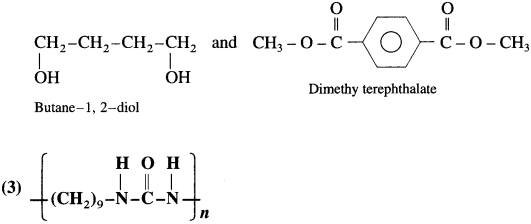
5. Thus, the same zygotic cell later undergoes meiosis.
6. This type of life cycle observed in some algae and fungi.
[Note: Haplontic life cycle is observed in many algae]

Maharashtra Board Class 11 Biology Important Questions Chapter 3 Kingdom Plantae

Question 31.
Observe the given figure and explain in detail.
Maharashtra Board Class 11 Biology Important Questions Chapter 3 Kingdom Plantae 6
Answer:

  1. The given figure indicates diplontic life cycle.
  2. Here, mitotic division occurs only in diploid cells.
  3. Gametes formed through meiosis are haploid in nature.
  4. The diploid zygote formed after fertilization divides mitotically.
  5. In this process, production of multicellular diploid organism or the production of many diploid single cells takes place.
  6. Animals show diplontic life cycle.

[Note: Diplontic type of life cycle is commonly observed in animals and all seed-bearing plants i.e. gymnosperms and angiosperms.]

Question 32.
Explain the term: Haplo-diplontic life cycle.
Answer:
1. In haplo-diplontic life cycle, mitosis occur in both diploid and haploid cells.
2. These organisms undergo through a phase in which they are multicellular and haploid (the gametophyte), and a phase in which they are multicellular and diploid (the sporophyte).
3. It is observed in land plants and in many algae.
[Note: It is commonly observed in bryophytes and pteridophytes.]

Question 33.
Fill in the blanks.
1. In haplo-diplontic life cycle, mitosis occurs in cells.
2. In diplontic life cycle, mitosis occurs in cells.
3. In haplontic life cycle, mitosis occurs in cells.
Answer:
1. diploid and haploid cells
2. diploid cells
3. haploid cells

Maharashtra Board Class 11 Biology Important Questions Chapter 3 Kingdom Plantae

Question 34.
Practical/Project:

Question 1.
Visit any nursery or botanical garden. Observe some older leaves of fern plant. You can observe some brown spots on back side of the leaflets as shown in the picture given below. Collect more information about it.
Answer:
1. The brown spots on the back side of older leaves of fern are sori.
2. They reproduce asexually by spores produced within sporangia, which are present in sori. These sori are located along the posterior surface of leaflets.

Question 35.
Read the given points.
1. A plant shows thalloid body.
2. A plant shows presence of rhizoids instead of true roots.
3. A plant needs external water for fertilization.
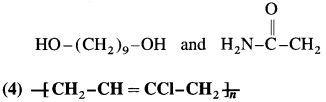
4. Vascular tissues are absent.
Identify the division of the plant described above.
Answer:
The plant belongs to division Bryophyta.

Question 36.
If a person wants to obtain agar for tissue culture, which plant group he should search?
Answer:
A person should search Rhodophyceae. It is because, ‘agar’ which is used as solidifying agent in tissue culture is obtained from red algae-Gelidium and Gracilaria.

Question 37.
Vinaya while playing in garden observed a pond with a green coloured covering which was floating on the surface of water? Next day she asked her teacher about the same. What her teacher must have told her?
Answer:
Vinaya’s teacher must have told her that the green coloured covering floating on the surface of pond water can be green algae like Spirogyra, Chlorella, Chlamydomonas, etc.

Question 38.
Identify the following:

  1. These plants belong to thallophyta and grow upto 100 meters in height.
  2. Plants used to obtain a product which is used a solidifying agent in preparation of ice-creams and jellies.
  3. Gymnosperm which has girth of about 125 feet.
  4. Xerophytic fern which belongs to sphenopsida.
  5. Unicellular motile alga which belongs to Chlorophyceae and shows cup-shaped chloroplast.

Answer:

  1. Kelps
  2. Gelidium, Gracilaria
  3. Taxodium mucronatum
  4. Equisetum
  5. Chlamydomonas

Maharashtra Board Class 11 Biology Important Questions Chapter 3 Kingdom Plantae

Question 39.
Quick Review:

Maharashtra Board Class 11 Biology Important Questions Chapter 3 Kingdom Plantae 7

Question 40.
Exercise:

Question 1.
Name the group of spores producing plants in
which sex organs are concealed.
Answer:
Cryptogams are spore producing plants. These plants do not produce seed and flowers. They reproduce sexually by gametes, however their sex organs are concealed.

Question 2.
Name the two divisions of phanerogams.
Answer:
v – phanerogamae

Question 3.
Complete the given flow chart.
Answer:
Quick Review

Maharashtra Board Class 11 Biology Important Questions Chapter 3 Kingdom Plantae

Question 4.
Define phanerogams.
Answer:
Phanerogams are seed producing plants. These plants produce special reproductive structures that are visible.

Question 5.
Write any two examples of phaeophyceae.
Answer:
Examples of phaeophyceae

Question 6.
Enlist the accessory pigments of algae.
Answer:
Various types of photosynthetic pigments are found in algae.
1. The accessory pigments are chlorophyll-b, chlorophyll-c, chlorophyll-d, carotenes, xanthophylls and phycobilins. Phycobilins are of two types, i.e. phycocyanin and phycoerythrin.
[Students are expected to collect more information about pigments found in algae from internet.]

Question 7.
Bryophytes are the amphibians of the plant kingdom. Justify
Answer:
Members of Bryophyta are mostly terrestrial plants which depend on water for fertilization and completion of their life cycle. Hence, they are called ‘amphibians of Plant Kingdom’.

Question 8.
Distinguish between Rhodophyceae and phaeophyceae with respect to photosynthetic pigments and reserve food.
Answer:
1. Photosynthetic pigments are chlorophyll-a, chlorophyll-d and phycoerythrin. Photosynthetic pigments are chlorophyll-a, chlorophyll-c and fucoxanthin.
2. Reserve food is Floridean starch. Reserve food is mannitol and laminarin.
e.g. Porphyra, Gracilaria, Gelidium, Polysiphonia, etc. Ectocarpus, Sargassum, Fucus, Laminaria, etc.

Question 9.
Write the characteristics of division that includes members like Chlamydomonas, Fucus, Gelidium, etc.
Answer:
Algae belongs to division Thallophyta.
Salient features of algae:

  1. Habitat: Algae are mostly aquatic, few grow on other plants as epiphytes and some grow symbiotically. Some algae are epizoic i.e. growing or living non-parasitically on the exterior of living organisms.
    Aquatic algae grow in marine or fresh water. Most of them are free-living while some are symbiotic.
  2. Structure: Plant body is thalloid i.e. undifferentiated into root, stem and leaves. They may be small, unicellular, microscopic like Cblorella (non-motile), Chlamydomonas (motile). They can be multicellular, unbranched, filamentous like Spirogyra or branched and filamentous like Chara. Sargassum is a huge macroscopic sea weed which measures more than 60 meters in length.
  3. Cell wall: The algal cell wall contains either polysaccharides like cellulose / glucose or a variety of proteins or both. Reserve food material: Reserve food is in the form of starch and its other forms.
  4. Photosynthetic pigments: Photosynthetic pigments like chlorophyll – a, chlorophyll – b, chlorophyll – c, chlorophyll – d, carotenes, xanthophylls, phycobilins are found in algae.
  5. Reproduction: Reproduction takes place by vegetative, asexual and sexual method.
  6. Life cycle: The life cycle shows phenomenon of alternation of generation, dominant haploid and reduced diploid phases.

Maharashtra Board Class 11 Biology Important Questions Chapter 3 Kingdom Plantae

Question 10.
Name the two algae from which agar is obtained.
Answer:
Red algae like Gelidium and Gracilaria are used to obtain agar-agar which is used as solidifying agent in tissue culture medium.

Question 11.
Identify the incorrectly labelled part in the figure of Funaria.
Answer:
Maharashtra Board Class 11 Biology Important Questions Chapter 3 Kingdom Plantae 8

Question 12.
Which are the first terrestrial plants to possess xylem and phloem?
Answer:
Pteridophytes are known as first vascular and true land plants.

Question 13.
Explain in detail three classes of algae.
Answer:

  1. Chlorophyceae includes green algae.
  2. These are mostly fresh water (few brackish water and marine).
  3. Plant body is unicellular, colonial or filamentous.
  4. Cell wall contains cellulose.
  5. Chloroplasts are of various shapes like discoid, plate-like, reticulate, cup-shaped, ribbon-shaped or spiral with chlorophyll a and b.
  6. Reserved food is in the form of starch.
  7. Pyrenoids are located in the chloroplast.
  8. Green algae like Chlorella are rich in protein, hence used as food even by space travelers, e.g. Chlamydomonas, Spirogyra, Chara, Volvox, Ulothrix, etc.

Characteristics of Phaeophyceae (Brown algae):

  1. These algae are mostly marine, rarely fresh water.
  2. Plant body is simple branched, filamentous (e.g. Ectocarpus) or profusely branched (e.g. Petalonia).
  3. Cell wall has cellulose, fucans and algin.
  4. Photosynthetic pigments like chlorophyll-a, chlorophyll-c and fucoxanthin are present.
  5. Mannitol, laminarin are stored food materials. Body is usually differentiated into holdfast, stalk called stipe and leaf-like photosynthetic organ called frond.
  6. Many species of marine algae are used as food. e.g. Laminaria, Sargassum.
  7. Some species are used for the production of hydrocolloids (water holding substances), e.g. Ectocarpus, Fucus, etc.

Maharashtra Board Class 11 Biology Important Questions Chapter 3 Kingdom Plantae

Question 14.
Write ecological importance of Bryophytes.
Answer:
Economic importance of Bryophytes:
1. Some mosses provide food for herbivorous mammals, birds, etc.
2. Mosses along with lichens are the first living beings to grow on rocks. They decompose rocks to form soil and make them suitable for growth of higher plants.
3. Dense layers of mosses help in prevention of soil erosion, thus act as soil binders.

Question 15.
Mention one example each of aquatic and xerophytic pteridophytes.
Answer:
Habitat: Pteridophytes grow in moist and shady places, e.g. Ferns, Horsetail. Some are aquatic (Azolla, Marsilea), xerophytic (Equisetum) and epiphytic (Lycopodium).

Question 16.
State the uses of algae.
Answer:
(a) Many species of algae are used as food. For e.g. Chlorella (rich in cell proteins hence used as food supplement, even by space travelers), Sargassum, Laminaria, Porphyra, etc.
(b) Alginic acid is produced commercially from Kelps.
(c) Hydrocolloids like algin and carrageen are obtained from brown algae and red algae respectively.
(d) ‘Agar’ which is used as solidifying agent in tissue culture is obtained from red algae like Gelidium and Gracilaria.
(e) Brown algae like sea weeds are used a fodder for sheep, goat, etc.
[Students are expected to collect more information about the economic importance of algae.]
(f) Role of algae in environment.
Answer:
(a) Being photosynthetic, algae help in increasing the level of dissolved oxygen in their immediate environment.
(b) Algae are primary producers of energy rich compounds which forms the basis of food cycles in aquatic animals.
[Students are expected to find out more information about the role of algae in environment on internet.]

Question 17.
Mosses are used as packing material during transport of living material. Give reason.
Answer:
Mosses are also used as packing material for transport of living materials because they have significant water holding capacity.

Maharashtra Board Class 11 Biology Important Questions Chapter 3 Kingdom Plantae

Question 18.
Write the important characteristics of gymnosperms with respect to following points:
1. Vascular tissues
2. Roots
3. Spores
4. Leaves
Answer:
(b) Vascular tissues: They are vascular plants having xylem with tracheids and phloem with sieve cells.
(e) Roots: The root system is tap root type. In some gymnosperms, the roots form symbiotic association with other life forms. Coralloid roots of Cycas show association with blue green algae and roots of Pinus show association with endophytic fungi called mycorrhizae.
(g) Leaves: The leaves are dimorphic. The foliage leaves are green, simple needle like or pinnately compound, whereas scale leaves are small, membranous and brown.
(h) Spores: Spores are produced by microsporophyll (Male) and megasporophyll (Female).

Question 19.
What are the essential and accessory whorls in flower?
Answer:
Flower: Besides the essential whorls of microsporophylls (androecium) and megasporophylls (gynoecium), there are accessory whorls namely, calyx (sepals) and corolla (petals) arranged together to form flowers.

Question 20.
Write the characteristics of the class which includes Helianthus annuus.
Answer:
Habitat: Angiosperms is a group of highly evolved plants, primarily adapted to terrestrial habitat.

Maharashtra Board Class 11 Biology Important Questions Chapter 3 Kingdom Plantae

Question 21.
Secondary growth is absent in monocotyledonous plants. Justify.
Answer:
(a) In dicots, vascular bundles are conjoint, collateral and open type. Cambium is present between xylem and phloem for secondary growth.
(b) Whereas in monocots, vascular bundles are conjoint, collateral and closed type. Thus, due to absence of cambium, secondary growth does not occur in majority of monocots.

Question 22.
State characteristic of class monocotyledonae.
Answer:
b. Monocotyledonae:

  1. These plants have single cotyledon in their embryo.
  2. They have adventitious root system and stem is rarely branched.
  3. Leaves generally have sheathing leaf base and parallel venation.
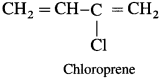
  4. Flowers show trimerous symmetry.
  5. The vascular bundles are conjoint, collateral and closed type.
  6. Cambium is absent between xylem and phloem.
  7. In Monocots, except few plants secondary growth is absent, e.g. Zea mays (Maize)

Question 23.
Draw a neat labelled diagram of:
1. Helianthus annuus (sunflower) plant.
2. Maize Plant.
Answer:
Two classes of Angiosperms are Dicotyledonae and Monocotyledonae.
а. Dicotyledonae:

  1. These plants have two cotyledons in their embryo.
  2. They have a tap root system and the stem is branched.
  3. Leaves show reticulate venation.
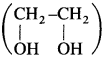
  4. Flowers show tetramerous or pentamerous symmetry.
  5. Vascular bundles are conjoint, collateral and open type.
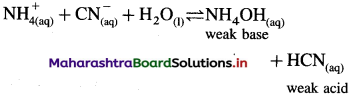
  6. Cambium is present between xylem and phloem for secondary growth.
  7. In dicots, secondary growth is commonly found.
    e. g. Helianthus annuus (Sunflower)

b. Monocotyledonae:

  1. These plants have single cotyledon in their embryo.
  2. They have adventitious root system and stem is rarely branched.
  3. Leaves generally have sheathing leaf base and parallel venation.
  4. Flowers show trimerous symmetry.
  5. The vascular bundles are conjoint, collateral and closed type.
  6. Cambium is absent between xylem and phloem.
  7. In Monocots, except few plants secondary growth is absent, e.g. Zea mays (Maize)

Question 24.
Which is the diploid phase in life cycle of a plant?
Answer:
The life cycle of a plant includes two generations, sporophytic (diploid = 2n) and gametophytic (haploid = n)

Maharashtra Board Class 11 Biology Important Questions Chapter 3 Kingdom Plantae

Question 25.
Multiple Choice Questions:

Question 1.
Which of the following is not included in sub-kingdom Cryptogamae?
(A) Thallophyta
(B) Dicotyledonae
(C) Pteridophyta
(D) Bryophyta
Answer:
(B) Dicotyledonae

Question 2.
Unicellular, non-motile alga is
(A) Chara
(B) Chlorella
(C) Funaria
(D) Chlamydomonas
Answer:
(B) Chlorella

Question 3.
Which of the following is a brown algae?
(A) Laminaria
(B) Pteris
(C) Ulothrix
(D) Gelidium
Answer:
(A) Laminaria

Question 4.
Agar is obtained from group of algae.
(A) Rhodophyceae
(B) Chlorophyceae
(C) Phaeophyceae
(D) Both (A) and (C)
Answer:
(A) Rhodophyceae

Question 5.
In Chlamydomonas, pyrenoid is located in
(A) nucleus
(B) mitochondria
(C) chloroplast
(D) flagella
Answer:
(C) chloroplast

Question 6.
In bryophytes, represents sporophytic
generation.
(A) rhizoids
(B) thalloid
(C) capsule
(D) leafy plant body
Answer:
(C) capsule

Maharashtra Board Class 11 Biology Important Questions Chapter 3 Kingdom Plantae

Question 7.
Which of the following is an example of liverwort?
(A) Funaria
(B) Marchantia
(C) Polytrichum
(D) Sphagnum
Answer:
(B) Marchantia

Question 8.
The late Paleozoic era is regarded as the age of ______ .
(A) Thallophytes
(B) Gymnosperms
(C) Pteridophytes
(D) Angiosperms
Answer:
(C) Pteridophytes

Question 9.
Which of the following is an epiphytic pteridophyte?
(A) Azolla
(B) Equisetum
(C) Marsilea
(D) Lycopodium
Answer:
(D) Lycopodium

Question 10.
Complete the given analogy:
Lycopsida: _______:: Pteropsida: Pteris
(A) Adiantum
(B) Selaginella
(C) Equisetum
(D) Psilotum
Answer:
(B) Selaginella

Question 11.
Bryophytes differ from Pteridophytes in being
(A) vascular
(B) seeded
(C) non-vascular
(D) sporophytic
Answer:
(C) non-vascular

Maharashtra Board Class 11 Biology Important Questions Chapter 3 Kingdom Plantae

Question 12.
Endophytic fungi or mycorrhizae are found in the roots of
(A) Cycas
(B) Pinus
(C) Equisetum
(D) Hibiscus
Answer:
(B) Pinus

Question 13.
Gymnosperms are characterized by the absence of
(A) tracheids in xylem
(B) sieve cells in phloem
(C) heterosporous condition
(D) fruit formation
Answer:
(D) fruit formation

Question 14.
Complete the given analogy:
Tallest angiosperm : Eucalyptus :: Smallest angiosperm : _________ .
(A) Zanta pygmaea
(B) Sequoia sempervirens
(C) Taxodium mucronatum
(D) Wolffia
Answer:
(D) Wolffia

Maharashtra Board Class 11 Biology Important Questions Chapter 3 Kingdom Plantae

Question 15.
Select the INCORRECT statement with respect to angiosperms.
(A) Seeds are enclosed within a fruit.
(B) These plants show heteromorphic alternation of generation.
(C) Megaspores are borne on highly specialized microsporophyll.
(D) They are most advanced group of flowering plants.
Answer:
(C) Megaspores are borne on highly specialized microsporophyll.

Question 16.
Parallel venation is a characteristic feature of
(A) Monocotyledons
(B) Dicotyledons
(C) Pteridophytes
(D) Bryophytes
Answer:
(A) Monocotyledons

Question 17.
In gymnosperms and angiosperms _______ is much reduced.
(A) gametophyte
(B) root
(C) sporophyte
(D) vascular bundle
Answer:
(A) gametophyte

Question 18.
Presence of rhizoids in place of true roots is a characteristic of
(A) Gymnosperms
(B) Bryophyta
(C) Pteridophyta
(D) Angiosperms
Answer:
(B) Bryophyta

Question 19.
Competitive Corner:

Question 1.
Which one of the following statements is wrong?
(A) Laminaria and Sargassum are used as food.
(B) Algae increase the level of dissolved oxygen in the immediate environment.
(C) Algin is obtained from red algae, and carrageen from brown algae.
(D) Agar-agar is obtained from Gelidium and Gracilaria.
Hint: Algin is obtained from brown algae and carrageenan from red algae.
Answer:
(C) Algin is obtained from red algae, and carrageen from brown algae.

Question 2.
Select the CORRECT statement.
(A) Sequoia is one of the tallest trees.
(B) The leaves of gymnosperms are not well adapted to extremes of climate.
(C) Gymnosperms are both homosporous and heterosporous.
(D) Salvinia, Ginkgo and Pinus all are gymnosperms.
Hint: The leaves of gymnosperms are well adapted to withstand extremes of climate. Gymnosperms are heterosporous. Salvinia is a Pteridophyte.
Answer:
(A) Sequoia is one of the tallest trees.

Maharashtra Board Class 11 Biology Important Questions Chapter 3 Kingdom Plantae

Question 3.
In bryophytes and pteridophytes, transport of male gametes requires
(A) Birds
(B) Water
(C) Wind
(D) Insects
Answer:
(B) Water

Maharashtra Board Class 12 Chemistry Important Questions Chapter 12 Aldehydes, Ketones and Carboxylic Acids

Balbharti Maharashtra State Board 12th Chemistry Important Questions Chapter 12 Aldehydes, Ketones and Carboxylic Acids Important Questions and Answers.

Maharashtra State Board 12th Chemistry Important Questions Chapter 12 Aldehydes, Ketones and Carboxylic Acids

Question 1.
What is a carbonyl group?
Answer:
Carbonyl group : A functional group in which a carbon atom is attached to an oxygen atom by a double bond and remaining two valencies of carbon atom are free is called a carbonyl group and represented as Maharashtra Board Class 12 Chemistry Solutions Chapter 12 Aldehydes, Ketones and Carboxylic Acids 7. Carbonyl group is present in aldehydes and ketones.

Maharashtra Board Class 12 Chemistry Important Questions Chapter 12 Aldehydes, Ketones and Carboxylic Acids

Question 2.
What are carbonyl compounds?
Answer:
The organic compounds containing a carbonyl group Maharashtra Board Class 12 Chemistry Solutions Chapter 12 Aldehydes, Ketones and Carboxylic Acids 7 are called carbonyl compounds. For example, acetaldehyde, Maharashtra Board Class 12 Chemistry Solutions Chapter 12 Aldehydes, Ketones and Carboxylic Acids 8, acetone, Maharashtra Board Class 12 Chemistry Solutions Chapter 12 Aldehydes, Ketones and Carboxylic Acids 9. As carbonyl group is common in aldehydes and ketones, their methods of preparation and properties show similarities.

Question 3.
What are carboxylic compounds?
Answer:
The compounds in which the functional group is – COOH are known as carboxylic compounds. Due to the – OH group bonded to Maharashtra Board Class 12 Chemistry Solutions Chapter 12 Aldehydes, Ketones and Carboxylic Acids 10 group, carboxylic acids are distinct from aldehydes and ketones.

Question 4.
How are carbonyl compounds classified ?
OR
Name the compounds containing carbonyl group.
Answer:
The carbonyl compounds contain a group Maharashtra Board Class 12 Chemistry Solutions Chapter 12 Aldehydes, Ketones and Carboxylic Acids 11. They are classified as follows :
Maharashtra Board Class 12 Chemistry Solutions Chapter 12 Aldehydes, Ketones and Carboxylic Acids 12

Question 5.
What are aliphatic aldehydes?
Answer:
The compounds in which the – CHO group (formyl group or aldehyde group) is attached directly to sp3 hybridized carbon atom that is saturated carbon atom are called aliphatic aldehydes. (Exception : Formaldehyde, H – CHO is also classified as aliphatic aldehyde though – CHO group is not attached to any carbon).

For example :
Maharashtra Board Class 12 Chemistry Solutions Chapter 12 Aldehydes, Ketones and Carboxylic Acids 13

Maharashtra Board Class 12 Chemistry Important Questions Chapter 12 Aldehydes, Ketones and Carboxylic Acids

Question 6.
What are aromatic aldehydes ?
Answer:
The compounds in which – CHO group is attached directly to an aromatic ring are called aromatic aldehydes.

For example :
Maharashtra Board Class 12 Chemistry Solutions Chapter 12 Aldehydes, Ketones and Carboxylic Acids 14

Question 7.
Explain the structure of carbonyl functional group.
Answer:

  • In the carbonyl functional group, carbon atom is attached to an oxygen atom by a double bond and remaining two valencies of carbon atom are free, and it is represented as Maharashtra Board Class 12 Chemistry Solutions Chapter 12 Aldehydes, Ketones and Carboxylic Acids 15.
    Maharashtra Board Class 12 Chemistry Solutions Chapter 12 Aldehydes, Ketones and Carboxylic Acids 16
  • The carbonyl carbon atom is sp2-hybridised forming coplanar three sigma (σ) bonds with the bond angle 120°.
  • One sigma bond is formed with oxygen atom while other two sigma (σ) bonds are formed with hydrogen or carbon atoms.
  • The remaining unhybridised 2pz orbital of carbon atom overlaps with p orbital of oxygen atom colaterally forming a pi (π) bond. Hence, carbon atom is joined to oxygen atom by a double bond of which one is sigma and another is n.
  • The oxygen atom in the carbonyl group has two lone pairs of electrons.
  • The carbonyl bond is strong, short and polarized.
  • The polarity of the carbonyl group is explained on the basis of resonance involving neutral and dipolar structures as shown below :
    Maharashtra Board Class 12 Chemistry Solutions Chapter 12 Aldehydes, Ketones and Carboxylic Acids 17

Question 8.
What are aliphatic ketones? How are they classified?
Answer:
Aliphatic ketones : The compounds in which Maharashtra Board Class 12 Chemistry Solutions Chapter 12 Aldehydes, Ketones and Carboxylic Acids 15 group is attached to two alkyl groups are called aliphatic ketones.
Maharashtra Board Class 12 Chemistry Solutions Chapter 12 Aldehydes, Ketones and Carboxylic Acids 20
Ketones are classified into two types :

  1. Simple or symmetrical ketones and
  2. mixed or unsymmetrical ketones.

1. Simple or symmetrical ketone : The ketone in which the carbonyl carbon is attached to two identical alkyl groups is called a simple or symmetrical ketone.
Maharashtra Board Class 12 Chemistry Solutions Chapter 12 Aldehydes, Ketones and Carboxylic Acids 21
2. Mixed or unsymmetrical ketone : The ketone in which the carbonyl carbon is attached to two different alkyl groups is called a mixed or unsymmetrical ketone.
Maharashtra Board Class 12 Chemistry Solutions Chapter 12 Aldehydes, Ketones and Carboxylic Acids 22

Question 9.
What are aliphatic carboxylic acids? Give their general formula.
Answer:
The organic compounds in which carboxyl (- COOH) group is bonded to an alkyl group are called aliphatic carboxylic acids or fatty acids. (Exception : Formic acid, H-COOH is also classified as aliphatic carboxylic acid though-COOH group is not attached to any carbon).

For example :
Maharashtra Board Class 12 Chemistry Solutions Chapter 12 Aldehydes, Ketones and Carboxylic Acids 330

Maharashtra Board Class 12 Chemistry Important Questions Chapter 12 Aldehydes, Ketones and Carboxylic Acids

Question 10.
How are carboxylic acids classified ? Give examples. (3 marks)
Answer:
Carboxylic acids are classified according to the presence of number of carboxyl groups into mono-, di-, tri- and polycarboxylic acids.

  • Monocarboxylic acids : These carboxylic acids contain one carboxyl group.
    Example : Maharashtra Board Class 12 Chemistry Solutions Chapter 12 Aldehydes, Ketones and Carboxylic Acids 331
  • Dicarboxylic acids : These contain two carboxyl groups
    Example : Maharashtra Board Class 12 Chemistry Solutions Chapter 12 Aldehydes, Ketones and Carboxylic Acids 332
  • Tricarboxylic acid : These contain three carboxyl groups
    Maharashtra Board Class 12 Chemistry Solutions Chapter 12 Aldehydes, Ketones and Carboxylic Acids 333

Question 11.
What are aromatic carboxylic acids ? Give examples.
Answer:
Aromatic carboxylic acids : These are the compounds in which one or more carboxyl groups (- COOH) are attached directly to the aromatic ring.

For example :
Maharashtra Board Class 12 Chemistry Solutions Chapter 12 Aldehydes, Ketones and Carboxylic Acids 334

Question 12.
Give examples of common carboxylic acids which are used in daily life.
Answer:
Common carboxylic acids are widely distributed in nature, they are found in both the plants and animals.

  • Acetic acid is main constituent of vinegar.
  • Butyric acid of butter which is responsible for odour of rancid butter.
  • L-lactic acid is present in curd.
  • Citric acid is found in citrus fruits.
  • Higher carboxylic acids such as palmitic acid, stearic acid and oleic acid are the components of animal fats and vegetable oils.

Nomenclature of Aldehydes :

(A) Common System :

  • The names of aldehydes are derived from the common names of acids.
  • The suffix ‘-ic acid’ of an acid is replaced by ‘aldehyde’.
  • The positions of the substituents in the molecule are indicated by Greek letters α, β, γ, etc.
  • starting from the carbon atom attached to the carbonyl group. E.g.
    Maharashtra Board Class 12 Chemistry Solutions Chapter 12 Aldehydes, Ketones and Carboxylic Acids 26

(B) I UP AC System :

  • The longest carbon atoms chain containing aldehyde carbon atom is selected as a parent hydrocarbon.
  • ‘e’ of the alkane is replaced by ‘al’. Alkane → Alkanal
  • The position (locant) of aldehyde group need not be mentioned since it is always at the end position.
  • The substituents in the alkyl group are prefixed in an alphabetical order by appropriate locants.
  • When two – CHO groups are present at the two ends of the chain the ending ‘e’ of alkane is retained and the suffix  ‘-dial’ is added to the name of parent aldehyde.
  • In IUPAC nomenclature an alicyclic compound -in which – CHO group is attached directly to the ring is named as a carbaldeliyde. The suffix ‘carbaldehyde’ is added after the full name of parent cycloalkane structure.

Maharashtra Board Class 12 Chemistry Important Questions Chapter 12 Aldehydes, Ketones and Carboxylic Acids

(C) Common or trivial names :

(1) The common name of a carboxylic acid is derived from the source from which it was first isolated.
The following table gives common names and the source or origin of name.
Maharashtra Board Class 12 Chemistry Solutions Chapter 12 Aldehydes, Ketones and Carboxylic Acids 27

(2) In branched carboxylic acids, the position of substituents are indicated by Greek alphabet.

For example : Maharashtra Board Class 12 Chemistry Solutions Chapter 12 Aldehydes, Ketones and Carboxylic Acids 28

(D) IUPAC system of nomenclature :

  • The longest continuous cha in of carbon atoms including the carbon atom of – COOH group ¡s selected.
  • The carboxvlic acid is conside red (IS a derivative of the corresponding parent a/kane.
  • The carbon atom of the – COOH group is always at terminal position, hence need not to be indicated while writing IUPAC name.
  • The position of the other substitutents are indicated by the appropriate locants in alphabetical order.
  • In case of dicarboxylic acids, ‘dioic acid’ is added to parent alkane.
  • In an alicyclic compound having a carboxyl group directly attached to alicyclic ring is named as cycloalkane carboxylic acid.

Trivial and IUPAC names of carboxylic acids and aldhydes
Maharashtra Board Class 12 Chemistry Solutions Chapter 12 Aldehydes, Ketones and Carboxylic Acids 29
Maharashtra Board Class 12 Chemistry Solutions Chapter 12 Aldehydes, Ketones and Carboxylic Acids 30

Maharashtra Board Class 12 Chemistry Important Questions Chapter 12 Aldehydes, Ketones and Carboxylic Acids

Question 13.
Give the common names and IUPAC names of the Miowing aldehydes :
Answer:
Maharashtra Board Class 12 Chemistry Solutions Chapter 12 Aldehydes, Ketones and Carboxylic Acids 31
Maharashtra Board Class 12 Chemistry Solutions Chapter 12 Aldehydes, Ketones and Carboxylic Acids 32

Question 14.
Write the structures of the following compounds :
Answer:
Maharashtra Board Class 12 Chemistry Solutions Chapter 12 Aldehydes, Ketones and Carboxylic Acids 33

Maharashtra Board Class 12 Chemistry Important Questions Chapter 12 Aldehydes, Ketones and Carboxylic Acids

Question 15.
What is the IUPAC name of the following compound?
Maharashtra Board Class 12 Chemistry Solutions Chapter 12 Aldehydes, Ketones and Carboxylic Acids 34
Answer:
IUPAC name : 2-Amino butanoic acid

Question 16.
Write IUPAC name of
Maharashtra Board Class 12 Chemistry Solutions Chapter 12 Aldehydes, Ketones and Carboxylic Acids 335
Answer:
IUPAC name : Ethanedioic acid

Question 17.
Write the structure and give IUPAC names of following carboxylic acid.
Maharashtra Board Class 12 Chemistry Solutions Chapter 12 Aldehydes, Ketones and Carboxylic Acids 35
Answer:
Maharashtra Board Class 12 Chemistry Solutions Chapter 12 Aldehydes, Ketones and Carboxylic Acids 36

Question 18.
Draw the structures of the following compounds :
Answer:
Maharashtra Board Class 12 Chemistry Solutions Chapter 12 Aldehydes, Ketones and Carboxylic Acids 37

Question 19.
Give IUPAC names of the following carboxylic acids.
Answer:
Maharashtra Board Class 12 Chemistry Solutions Chapter 12 Aldehydes, Ketones and Carboxylic Acids 38

Maharashtra Board Class 12 Chemistry Important Questions Chapter 12 Aldehydes, Ketones and Carboxylic Acids

Question 20.
Write the structures and IUPAC names of all isomers of carboxylic acids having molecular formula C5H10O2. HOW many of them are chiral?
Answer:
Maharashtra Board Class 12 Chemistry Solutions Chapter 12 Aldehydes, Ketones and Carboxylic Acids 39

Nomenclature of ketones :

(A) Common System :

  • Ketones are named according to the alkyl groups attached to the carbonyl carbon atom followed by the word ketone.
  • The substituents in the alkyl groups are indicated by Greek letters a, f, y, etc. starting from the carbon atom attached to the carbonyl group.

(B) IUPAC System :

  • The longest continuous chain containing carbonyl carbon atom is selected as a parent hydrocarbon.
  • ‘e’ of the alkane is replaced by ‘one’. Alkane → Alkanone
  • The position of carbonyl group is represented by the lowest locant.
  • The substituents in the alkyl groups are prefixed in the alphabetical order along with their positions by appropriate locants.
  • When two C = O groups are present, then ending ‘e ’ of alkane is retained and the suffix – ‘dione ’ is added to the name of parent ketone indicating the locants of ketonic carbonyl groups.
  • In case of polyfunctional ketones, higher priority group is given lower number.
  • When ketonic carbonyl is a lower priority group it is named as ‘oxo’, preceded by the locant. In alicyclic ketones, carbonyl carbon is numbered as 1.

Question 21.
Give the common and IUPAC names of the following ketones :
Answer:
Maharashtra Board Class 12 Chemistry Solutions Chapter 12 Aldehydes, Ketones and Carboxylic Acids 40
Maharashtra Board Class 12 Chemistry Solutions Chapter 12 Aldehydes, Ketones and Carboxylic Acids 41

Maharashtra Board Class 12 Chemistry Important Questions Chapter 12 Aldehydes, Ketones and Carboxylic Acids

Question 22.
Give the structures of the following compounds :
Answer:
Maharashtra Board Class 12 Chemistry Solutions Chapter 12 Aldehydes, Ketones and Carboxylic Acids 42
Maharashtra Board Class 12 Chemistry Solutions Chapter 12 Aldehydes, Ketones and Carboxylic Acids 43

Question 23.
Give IUPAC names of the following compounds :
Answer:
Maharashtra Board Class 12 Chemistry Solutions Chapter 12 Aldehydes, Ketones and Carboxylic Acids 44

Maharashtra Board Class 12 Chemistry Important Questions Chapter 12 Aldehydes, Ketones and Carboxylic Acids

Question 24.
Write the structures and give common names and IUPAC names of the carbonyl compounds represented by formula C5H10O.
Answer:
Maharashtra Board Class 12 Chemistry Solutions Chapter 12 Aldehydes, Ketones and Carboxylic Acids 45

Question 25.
Write the structure and give IUPAC names of the following compounds :
Answer:
Maharashtra Board Class 12 Chemistry Solutions Chapter 12 Aldehydes, Ketones and Carboxylic Acids 46
Maharashtra Board Class 12 Chemistry Solutions Chapter 12 Aldehydes, Ketones and Carboxylic Acids 47

Maharashtra Board Class 12 Chemistry Important Questions Chapter 12 Aldehydes, Ketones and Carboxylic Acids

Question 26.
Write the structure of the following compounds :
Answer:
Maharashtra Board Class 12 Chemistry Solutions Chapter 12 Aldehydes, Ketones and Carboxylic Acids 48

Question 27.
How is an aldehyde obtained from an alcohol ?
Answer:
When a primary alcohol is oxidized with potassium dichromate and dil. H2SO4 under controlled conditions, an aldehyde is obtained.
Maharashtra Board Class 12 Chemistry Solutions Chapter 12 Aldehydes, Ketones and Carboxylic Acids 51
For example, when ethanol is oxidized with potassium dichromate and dil. H2SO4 under controlled conditions, acetaldehyde (ethanal) is obtained.
Maharashtra Board Class 12 Chemistry Solutions Chapter 12 Aldehydes, Ketones and Carboxylic Acids 52

Question 28.
How is ketone obtained from an alcohol?
Answer:
When a secondary alcohol is oxidized with potassium dichromate and dii. H2SO4 under controlled conditions, a ketone is obtained.
Maharashtra Board Class 12 Chemistry Solutions Chapter 12 Aldehydes, Ketones and Carboxylic Acids 53
For example. when 2-propanol is oxidized with potassium dichromate and dii, H2SO4 under controlled conditions, accIone (propanone) is obtained.
Maharashtra Board Class 12 Chemistry Solutions Chapter 12 Aldehydes, Ketones and Carboxylic Acids 54

Maharashtra Board Class 12 Chemistry Important Questions Chapter 12 Aldehydes, Ketones and Carboxylic Acids

Question 29.
How are the following compounds obtained from alcohol:
(1) Methanal
(2) Propanal
(3) BuLanal
(4) 3-Methylpentanal?
Answer:

  1. Mehanol on controlled oxidation with K2Cr2O7 and dilute H2SO4 forms methanal.
    Maharashtra Board Class 12 Chemistry Solutions Chapter 12 Aldehydes, Ketones and Carboxylic Acids 55
  2. Propan-1-ol on controlled oxidation with K,Cr20 and dilute H2SO4 forms propanal.
    Maharashtra Board Class 12 Chemistry Solutions Chapter 12 Aldehydes, Ketones and Carboxylic Acids 56
  3. Butan..l-ol on controlled oxidation with K2Cr2O7 and dilute H2SO4 forms butanal.
    Maharashtra Board Class 12 Chemistry Solutions Chapter 12 Aldehydes, Ketones and Carboxylic Acids 57
  4. 3-Mcthylpcntan.1-ol on controlled oxidation with K2Cr2O7 and dilute H2SO4 gives 3-Methylpentanal.
    Maharashtra Board Class 12 Chemistry Solutions Chapter 12 Aldehydes, Ketones and Carboxylic Acids 58

Question 30.
How are the following compounds prepared from alcohol :
(1) Butanone
(2) Pentan-3-one
(3) 2,2-Dimethylpropanal?
Answer:

  1. Butan-2-ol on controlled oxidation with K2Cr2O7 and dilute H2SO4 forms butanone.
    Maharashtra Board Class 12 Chemistry Solutions Chapter 12 Aldehydes, Ketones and Carboxylic Acids 59
  2. Pentan-3-ol on oxidation with K2Cr2O7 and dilute H2SO4 forms Pentan-3-one.
    Maharashtra Board Class 12 Chemistry Solutions Chapter 12 Aldehydes, Ketones and Carboxylic Acids 60
  3. 2,2-Dimethylpropan- I -ol on oxidation with K2Cr2O7 or KMnO4 and dilute H2SO4 forms 2,2-Dimethyipropanal.
    Maharashtra Board Class 12 Chemistry Solutions Chapter 12 Aldehydes, Ketones and Carboxylic Acids 61

Question 31.
How is an aldehyde obtained from primary alcohol ?
Answer:
When vapours of primary alcohol is passed over heated copper at 573 K, dehydrogenation takes place, an aldehyde is formed.
Maharashtra Board Class 12 Chemistry Solutions Chapter 12 Aldehydes, Ketones and Carboxylic Acids 62
For example : When vapours of isopropyl alcohol is passed over heated copper at 573 K, acetone (propanone) is obtained.
Maharashtra Board Class 12 Chemistry Solutions Chapter 12 Aldehydes, Ketones and Carboxylic Acids 63

Maharashtra Board Class 12 Chemistry Important Questions Chapter 12 Aldehydes, Ketones and Carboxylic Acids

Question 32.
How is ketone obtained from secondary alcohol?
Answer:
When vapours of secondary alcohol is passed over heated copper at 573 K. dehydrogenation takes place, a ketone is obtained.
Maharashtra Board Class 12 Chemistry Solutions Chapter 12 Aldehydes, Ketones and Carboxylic Acids 64
For example : When vapours of isopropyl alcohol is passed over heated copper at 573 K. acetone (propanone) is obtained.
Maharashtra Board Class 12 Chemistry Solutions Chapter 12 Aldehydes, Ketones and Carboxylic Acids 65

Question 33.
How are the following compounds obtained from alkene :
(1) Formaldehyde
(2) Acetaldehyde and
(3) Acetone ?
Answer:
When a stream of ozonised oxygen is passed through a solution of an alkene, in organic solvent, an unstable addition cyclocompound, ozonide is formed which on reduction with zinc dust and water forms an aldehyde or a ketone or a mixture of both.

  1. Formaldehyde : Under these conditions ethylene gives formaldehyde.
    Maharashtra Board Class 12 Chemistry Solutions Chapter 12 Aldehydes, Ketones and Carboxylic Acids 66
  2. AcetuIdeh&: Symmetrically disubstituted alkene like but-2-ene gives acetaldehyde.
    Maharashtra Board Class 12 Chemistry Solutions Chapter 12 Aldehydes, Ketones and Carboxylic Acids 67
  3. scctnne: Tetrasubshtwed alkene like 2,3-dimethyl but-2-ene gives acetone.
    Maharashtra Board Class 12 Chemistry Solutions Chapter 12 Aldehydes, Ketones and Carboxylic Acids 68

Question 34.
Write ozonolysis reaction for
(1) Propylene and
(2) Isobutylene.
Answer:
(1) Propylene on reaction with ozonised oxygen in the organic solvent forms propylene ozonide which on reduction with zinc dust and water forms acetaldehyde and formaldehyde.
Maharashtra Board Class 12 Chemistry Solutions Chapter 12 Aldehydes, Ketones and Carboxylic Acids 69
Maharashtra Board Class 12 Chemistry Solutions Chapter 12 Aldehydes, Ketones and Carboxylic Acids 70

Question 35.
How are the following compounds obtained from alkynes :
(1) Acetaldehyde
(2) Acetone?
Answer:

  1. Acetaldehyde : On passing acetylene through warm 40% H2SO4 in the presence of 1 % HgSO4, vinyl alcohol is obtained which tautomerises and forms acetaldehyde. It is a hydration reaction.
    Maharashtra Board Class 12 Chemistry Solutions Chapter 12 Aldehydes, Ketones and Carboxylic Acids 71
  2. Acetone : On passing propyne through warm 40 % H2SO4 in the presence of 1 % HgSO4, alkenol is obtained which on tautomerisation form acetone.
    Maharashtra Board Class 12 Chemistry Solutions Chapter 12 Aldehydes, Ketones and Carboxylic Acids 72

Maharashtra Board Class 12 Chemistry Important Questions Chapter 12 Aldehydes, Ketones and Carboxylic Acids

Question 36.
Predict the products when
(1) dimethyl acetylene
(2) ethyl acetylene and
(3) diethyl acetylene are treated with mercuric sulphate in dilute sulphuric acid.
Answer:
(1) Dimethyl acetylene with 40% H2SO4 in the presence of mercuric sulphate (HgSO4) forms ethyl methyl ketone by tautomerisation.
Maharashtra Board Class 12 Chemistry Solutions Chapter 12 Aldehydes, Ketones and Carboxylic Acids 73

(2) Ethyl acetylene with 40% H2SO4 in the presence of mercuric sulphate (HgSO4) forms Butan-2-one by tautomerisation.
Maharashtra Board Class 12 Chemistry Solutions Chapter 12 Aldehydes, Ketones and Carboxylic Acids 74

(3) Diethyl acetylene with 40% H2SO4 in the presence of mercuric sulphate (HgSO4) forms hexan-3-one.
Maharashtra Board Class 12 Chemistry Solutions Chapter 12 Aldehydes, Ketones and Carboxylic Acids 75
Maharashtra Board Class 12 Chemistry Solutions Chapter 12 Aldehydes, Ketones and Carboxylic Acids 76

Question 37.
Write the structures of aldehydes and ketones obtained by ozonolysis.
Maharashtra Board Class 12 Chemistry Solutions Chapter 12 Aldehydes, Ketones and Carboxylic Acids 77
Answer:
Maharashtra Board Class 12 Chemistry Solutions Chapter 12 Aldehydes, Ketones and Carboxylic Acids 78

Maharashtra Board Class 12 Chemistry Solutions Chapter 12 Aldehydes, Ketones and Carboxylic Acids 79
Answer:
Maharashtra Board Class 12 Chemistry Solutions Chapter 12 Aldehydes, Ketones and Carboxylic Acids 80

Question 38.
Predict the structures of ketones produced by hydration of but-l-yne and but-2-yne.
Answer:
Maharashtra Board Class 12 Chemistry Solutions Chapter 12 Aldehydes, Ketones and Carboxylic Acids 81

Maharashtra Board Class 12 Chemistry Important Questions Chapter 12 Aldehydes, Ketones and Carboxylic Acids

Question 39.
How is acetaldehyde prepared from acetyl chloride?
Answer:
Acetyl chloride is reduced to acetaldehyde by hydrogen in presence of Pd catalyst poisoned with BaSO4. This reaction is called Rosenmund reduction.
Maharashtra Board Class 12 Chemistry Solutions Chapter 12 Aldehydes, Ketones and Carboxylic Acids 82

Question 40.
How is benzaldehyde obtained from benzoyl chloride?
OR
Write chemical equation for Rosenmund reduction.
Answer:
When benzoyl chloride is hydrogenated in the presence palladium on barium sulphate (Pd/BaSO4), benzaldehyde is obtained. This reaction is called Rosenmund reduction.
Maharashtra Board Class 12 Chemistry Solutions Chapter 12 Aldehydes, Ketones and Carboxylic Acids 83

Question 41.
How will you prepare acetophenone from benzene? (Friedel – Crafts acylation).
Answer:
When benzene is treated with acetyl chloride in the prcscncc of anhydrous aluminium chloride, acetophenonc is obtained. This reaction is known as Friedel – Crafts acylation.
Maharashtra Board Class 12 Chemistry Solutions Chapter 12 Aldehydes, Ketones and Carboxylic Acids 86

Question 42.
How will you convert benzene into 1-phenylethanone?
Answer:
Maharashtra Board Class 12 Chemistry Solutions Chapter 12 Aldehydes, Ketones and Carboxylic Acids 87

Question 43.
How will you obtain 4-Nitrobenzaldehyde from 4-Nitrotoluene ? (Friedel- Crafts reaction).
Answer:
When 4-nitrotoluene is treated with chromium oxide in acetic anhydride, a diacetate derivative is obtained which on acid hydrolysis produces 4-nitrobenzaldehyde.
Maharashtra Board Class 12 Chemistry Solutions Chapter 12 Aldehydes, Ketones and Carboxylic Acids 88

Question 44.
How will you prepare Propanone (acetone) from Grignard reagent?
Answer:
Grignard reagent (methyl magnesium iodide) reacts with cadmium chloride to give dimethyl cadmium. When acetyl chloride reacts with dimethyl cadmium, propanone (acetone) is obtained.
Maharashtra Board Class 12 Chemistry Solutions Chapter 12 Aldehydes, Ketones and Carboxylic Acids 89

Question 45.
How is acetophenone obtained from Grignard reagent ?
Answer:
Grignard reagent (methyl magnesium iodide) reacts with cadmium chloride to give dimethyl cadmium. When benzoyl chloride reacts with dimethyl cadmium, acetophenone is obtained.
Maharashtra Board Class 12 Chemistry Solutions Chapter 12 Aldehydes, Ketones and Carboxylic Acids 90

Maharashtra Board Class 12 Chemistry Important Questions Chapter 12 Aldehydes, Ketones and Carboxylic Acids

Question 46.
How is benzyl methyl ketone obtained from Grignard reagent ?
OR
Convert: Acetyl chloride to benzyl methyl ketone.
Answer:
Grignard reagent (Benzyl magnesium chloride) reacts with cadmium chloride to give diphenyl cadmium. When acetyl chloride reacts with dibenzyl cadmium, benzyl methyl ketone is obtained.
Maharashtra Board Class 12 Chemistry Solutions Chapter 12 Aldehydes, Ketones and Carboxylic Acids 91

Question 47.
How is an aldehyde obtained from alkyl nitrile ?
OR
What is Stephen reaction ?
OR
Write a note on Stephen reaction.
Answer:
(1) An ethereal solution of a nitrile is reduced to imine hydrochloride by SnCl2 in the presence of HCl gas. Further, imine hydrochloride on acid hydrolysis gives aldehyde. This reaction is called Stephen reaction.
Maharashtra Board Class 12 Chemistry Solutions Chapter 12 Aldehydes, Ketones and Carboxylic Acids 92
Maharashtra Board Class 12 Chemistry Solutions Chapter 12 Aldehydes, Ketones and Carboxylic Acids 93
(2) Alternatively, nitriles are selectively reduced by diisobi.ityl aluminium hydride (DIBAI-H) lo imines which on acid hydrolysis to aldehydes.
Maharashtra Board Class 12 Chemistry Solutions Chapter 12 Aldehydes, Ketones and Carboxylic Acids 94

Question 48.
How are following compounds prepared using Gngnard reagent
(1) Acetone
(2) Benzophenone?
Answer:
(1) Acetone: Acetoniti-ile (ethanenitrile) reacts with methyl magnesium iodide in presence of dry ether to give imine complex which on hydrolysis gives acctonc. During reaction acetonitrile and methyl magnesium iodide should be
taken in equimolecular proportion.
Maharashtra Board Class 12 Chemistry Solutions Chapter 12 Aldehydes, Ketones and Carboxylic Acids 95
(2) Benzophenone: Benzonitrile reacts with phenyl magnesium bromide in presence of dry ether to give an imine complex which on acid hydrolysis gives a benzophenone. During reaction bcnzonitrile and phenyl magnesium bromide should be aken in equimolecular proportion.
Maharashtra Board Class 12 Chemistry Solutions Chapter 12 Aldehydes, Ketones and Carboxylic Acids 96

Maharashtra Board Class 12 Chemistry Important Questions Chapter 12 Aldehydes, Ketones and Carboxylic Acids

Question 49.
Write the structures and IUPAC names of ketones produced by Friedel-Crafts acylation of benzene with
(i) C2H5COCl
(ii) C6H5COCl.
Answer:
Maharashtra Board Class 12 Chemistry Solutions Chapter 12 Aldehydes, Ketones and Carboxylic Acids 97

Question 50.
Predict the products of the following conversions.
Answer:
Maharashtra Board Class 12 Chemistry Solutions Chapter 12 Aldehydes, Ketones and Carboxylic Acids 98

Question 51.
How are the following preparations carried out ?

(1) Benzaldehyde from toluene. (Etard oxidation)
Answer:
When toluene is treated with solution of chromyl chloride (CrO2Cl2) in Cs2, brown chromium complex is obtained, which on acid hydrolysis gives benzaldehyde. This reaction is called Etard reaction.
Maharashtra Board Class 12 Chemistry Solutions Chapter 12 Aldehydes, Ketones and Carboxylic Acids 99

(2) Benzaldehyde from methyl arene.
Answer:
Methylarene is converted into a benzyllidene diacetate on treatment with chromium oxide in acetic anhydride at 273-278 K. The diacetate derivative on acid hydrolysis gives benzaldehyde.
Maharashtra Board Class 12 Chemistry Solutions Chapter 12 Aldehydes, Ketones and Carboxylic Acids 100

(3) Benzaldehyde from toluene (commerical method).
Answer:
Side chain chlorination of toluene gives benzal chloride which on hydrolysis gives benzaldehyde.
Maharashtra Board Class 12 Chemistry Solutions Chapter 12 Aldehydes, Ketones and Carboxylic Acids 101

(4) Benzaldehyde from benzene (Gattermann-Koch synthesis).
OR
Write chemical equation for Gatter- mann-Koch formylation.
Answer:
When benzene is treated with vapours of carbon monoxide and hydrogen chloride in the presence of a catalyst mixture of A1Cl3 and CuCl under high pressure, benzaldehyde is obtained. This reaction is called Gattermann- Koch synthesis.
Maharashtra Board Class 12 Chemistry Solutions Chapter 12 Aldehydes, Ketones and Carboxylic Acids 102
Preparation of aromatic ketones from hydrocarbons

Maharashtra Board Class 12 Chemistry Important Questions Chapter 12 Aldehydes, Ketones and Carboxylic Acids

Question 52.
Explain Friedel-Craft’s acylation reaction.
Answer:
The reaction in which hydrogen atom of benzene is replaced by an acyl group Maharashtra Board Class 12 Chemistry Solutions Chapter 12 Aldehydes, Ketones and Carboxylic Acids 103 I in the presence of anhydrous AlCl3 is called Friedel-Craft’s acylation. When benzene is heated with an acetyl chloride or acetic anhydride in the presence of anhydrous AlCl3, forms acetophenone (1-Phenyl ethanone).

Electrophile : R – C + = O acylium ion Formation of the electrophile :
Maharashtra Board Class 12 Chemistry Solutions Chapter 12 Aldehydes, Ketones and Carboxylic Acids 104
Maharashtra Board Class 12 Chemistry Solutions Chapter 12 Aldehydes, Ketones and Carboxylic Acids 105

Question 53.
Give the preparation of acetophenone from benzene using
(i) acetyl chloride
(ii) acetic anhydride.
Answer:

The reaction in which hydrogen atom of benzene is replaced by an acyl group Maharashtra Board Class 12 Chemistry Solutions Chapter 12 Aldehydes, Ketones and Carboxylic Acids 103 I in the presence of anhydrous AlCl3 is called Friedel-Craft’s acylation. When benzene is heated with an acetyl chloride or acetic anhydride in the presence of anhydrous AlCl3, forms acetophenone (1-Phenyl ethanone).

Electrophile : R – C + = O acylium ion Formation of the electrophile :
Maharashtra Board Class 12 Chemistry Solutions Chapter 12 Aldehydes, Ketones and Carboxylic Acids 104
Maharashtra Board Class 12 Chemistry Solutions Chapter 12 Aldehydes, Ketones and Carboxylic Acids 105

Maharashtra Board Class 12 Chemistry Important Questions Chapter 12 Aldehydes, Ketones and Carboxylic Acids

Question 54.
How will you prepare propionaldehyde from ethyl propionate?
Answer:
When ethyl propionate is reduced in presence of diisobutyl aluminium hydride (DIBAI-H), propionaldehyde is obtained.
Maharashtra Board Class 12 Chemistry Solutions Chapter 12 Aldehydes, Ketones and Carboxylic Acids 107

Question 55.
Explain the structure of carboxyl group.
Answer:
In carboxyl group, the carboxyl carbon is sp2-hybridised and the bonds to the carboxyl carbon lie in one plane. The C-C = O and O = C-O bond angles are 120°. The carboxylic carbon is less electrophilic than carbonyl carbon because of the resonance structures shown below :
Maharashtra Board Class 12 Chemistry Solutions Chapter 12 Aldehydes, Ketones and Carboxylic Acids 110

Question 56.
How is carboxylic acid obtained by the acid hydrolysis of an alkyl cyanide ?
Answer:
Alkyl cyanides or alkyl nitriles on acid or alkaline hydrolysis give corresponding carboxylic acids.

Acid Hydrolysis of Alkyl ankle: When alkyl cyanide is boiled wiLh dilute mineral acid, it gives corresponding carboxylic acid. In this, acid amide is obtained as the intermediate product.
Maharashtra Board Class 12 Chemistry Solutions Chapter 12 Aldehydes, Ketones and Carboxylic Acids 111

Question 57.
How is ethanoic add obtained from methyl cyanide by acid hydrolysis?
Answer:
When methyl cyanide is heated with dilutc hydrochloric acid or dilute sulphuric acid. ethanoic acid is obtained.
Maharashtra Board Class 12 Chemistry Solutions Chapter 12 Aldehydes, Ketones and Carboxylic Acids 112

Question 58.
How Is proplonlc acid obtained from an alkyl nitrile?
Answer:
When ethyl cyanide (propionitrile) is boiled with dilute HCI or dilute H2SO4, propionic acid is obtained.
Maharashtra Board Class 12 Chemistry Solutions Chapter 12 Aldehydes, Ketones and Carboxylic Acids 113

Question 59.
How Is benzoic acid obtained from bcnzamide?
Answer:
When benzarnide is heated with dil. HCl. benzoic acid is obtained.
Maharashtra Board Class 12 Chemistry Solutions Chapter 12 Aldehydes, Ketones and Carboxylic Acids 114

Question 60.
How is carboxylic acid obtained from acyl chlorides and acid anhydrides?
Answer:
When acyl chloride is hydrolysed with water, carboxylic acid is obtained. The reaction is carried out in presence of a base pyridine or NaOH to remove HCl generated.
Maharashtra Board Class 12 Chemistry Solutions Chapter 12 Aldehydes, Ketones and Carboxylic Acids 118
Acetyl chloride reacts with water almost explosively while benzoyl chloride very slowly.
Maharashtra Board Class 12 Chemistry Solutions Chapter 12 Aldehydes, Ketones and Carboxylic Acids 119
Acid anhydrides react with water to give carboxylic acid.
Maharashtra Board Class 12 Chemistry Solutions Chapter 12 Aldehydes, Ketones and Carboxylic Acids 120
Maharashtra Board Class 12 Chemistry Solutions Chapter 12 Aldehydes, Ketones and Carboxylic Acids 121

Maharashtra Board Class 12 Chemistry Important Questions Chapter 12 Aldehydes, Ketones and Carboxylic Acids

Question 61.
How is benzoic acid obtained from
(i) ethyl benzoate
(ii) styrene?
Answer:
(i) Benzoic acid from ethyl benzoate : When an ethyl benzoate is heated with dil. H2SO4, undergoes hydrolysis to form benzoic acid and ethyl alcohol.
Maharashtra Board Class 12 Chemistry Solutions Chapter 12 Aldehydes, Ketones and Carboxylic Acids 122

(ii) Benzoic acid from styrene:
Maharashtra Board Class 12 Chemistry Solutions Chapter 12 Aldehydes, Ketones and Carboxylic Acids 123

Question 62.
How is propanoic acid obtained from phenyl propanoate?
Answer:
When phenyl propanoate is heated with dil. NaOH, sodium salt is obtained, which on hydrolysis gives propanoic- acid.
Maharashtra Board Class 12 Chemistry Solutions Chapter 12 Aldehydes, Ketones and Carboxylic Acids 124

Question 63.
How is propanoic acid obtained from methyl propanoate ?
OR
When methyl propanoate is heated with dil. NaOH, sodium, salt is obtained, which on hydrolysis gives propanoic acid.
Answer:
Maharashtra Board Class 12 Chemistry Solutions Chapter 12 Aldehydes, Ketones and Carboxylic Acids 125

Question 64.
How is benzoic acid obtained from phenyl ethene?
Answer:
When phenyl ethene is heated with strong oxidising agents like acidic KMnO4 or acidic K2Cr2O7, benzoic acid is obtained.
Maharashtra Board Class 12 Chemistry Solutions Chapter 12 Aldehydes, Ketones and Carboxylic Acids 126

Question 65.
How is adipic acid obtained from cyclohexene?
Answer:
When cyclohexene is heated with acidified KMnO4, adipic acid (Hexane-1, 6-dioic acid) is obtained.
Maharashtra Board Class 12 Chemistry Solutions Chapter 12 Aldehydes, Ketones and Carboxylic Acids 127

Maharashtra Board Class 12 Chemistry Important Questions Chapter 12 Aldehydes, Ketones and Carboxylic Acids

Question 66.
What is carbonation of Grignard reagent ? How is acetic acid prepared by this reaction ? How is ethanoic acid pepared from dry ice?
Answer:
Addition reaction of carbon dioxide (0 = C = 0) to Grignard reagent, forming a complex and further formation of carboxylic acid is called carbonation of Grignard reagent.
Maharashtra Board Class 12 Chemistry Solutions Chapter 12 Aldehydes, Ketones and Carboxylic Acids 128
Example : When methyl magnesium iodide is added to solid carbon dioxide, a complex is formed which on acid hydrolysis forms acetic acid.
Maharashtra Board Class 12 Chemistry Solutions Chapter 12 Aldehydes, Ketones and Carboxylic Acids 129

Question 67.
How is benzoic acid prepared from Grignard reagent?
OR
Write the preparation of benzoic acid from dry ice.
Answer:
When phenyl magnesium bromide is treated with dry ice (solid carbon dioxide) in the presence dry ether, complex is obtained which on acidification gives benzoic acid.
Maharashtra Board Class 12 Chemistry Solutions Chapter 12 Aldehydes, Ketones and Carboxylic Acids 130

Question 68.
What are soaps ? How are they prepared ?
Answer:
The sodium or potassium salts of higher fatty acids are known as soaps. Soaps contain more than twelve carbon atoms.

When fat or oil is hydrolysed using sodium or potassium hydroxide solution, soap obtained remains in colloidal form. Soap and glycerol are separated by adding sodium chloride. Soap precipitates out due to common ion effect, and glycerol remains in the solution can be recovered by fractional distillation.
Maharashtra Board Class 12 Chemistry Solutions Chapter 12 Aldehydes, Ketones and Carboxylic Acids 131

Question 69.
How is benzoic acid prepared from alkyl benzenes ?
OR
How will you convert the following :
(1) n-butyl benzene to benzoic acid.
(2) Toluene to benzoic acid.
(3) Cumene to benzoic acid ?
Answer:
When an alkyl benzene is heated with strong oxidizing agents like acidic or alkaline KMnO4 or acidified K2Cr2O7 etc. gives aromatic carboxylic acid. The alkyl side chain gets oxidised to -COOH group irrespective of the size of the chain.
Maharashtra Board Class 12 Chemistry Solutions Chapter 12 Aldehydes, Ketones and Carboxylic Acids 132

Maharashtra Board Class 12 Chemistry Important Questions Chapter 12 Aldehydes, Ketones and Carboxylic Acids

Question 70.
Lower aldehydes and ketones are water soluble whereas higher homologues are insoluble. Explain, why.
Answer:
(1) The oxygen atom of Maharashtra Board Class 12 Chemistry Solutions Chapter 12 Aldehydes, Ketones and Carboxylic Acids 135 shows hydrogen bonding with water molecule.
Maharashtra Board Class 12 Chemistry Solutions Chapter 12 Aldehydes, Ketones and Carboxylic Acids 136
(2) As a result of this, the lower aldehydes and ketones are water soluble (example – acetaldehyde, acetone). As the molecular mass increases, the proportion of hydrocarbon part of the molecule increases which cannot form hydrogen bonding with water and the solubility of higher homologues in water decreases.

Question 71.
Carboxylic acids have higher boiling points than those of alcohols, aldehydes, ketones, ethers, hydrocarbons of comparable molecular masses. Explain, why.
Answer:
(1) Carboxylic group (-COOH) in acids is highly polar. in liquid state, pair of carboxylic acid molecules is held together by two intermolecular hydrogen bonds, have higher aggregations and in the vapour.
Maharashtra Board Class 12 Chemistry Solutions Chapter 12 Aldehydes, Ketones and Carboxylic Acids 137
(2) Intermolecular hydrogen bonding in carboxylic acids state most of the carboxylic acid.s exist as dimmers in which two molecules are held by two hydrogen R – R bonds. Acidic hydrogen of one molecule forms hydrogen bond with carbonyl oxygen of the other molecule. This doubles the size of the molecule resulting in increase in o – intermolecular van der Waals forces, which in turn results in high boiling points. Therefore, carboxylic acids possess higher boiling points than those of alcohols, aldehydes, ketones. ether, hydrocarbons of comparable molecular masses.

Question 72.
Lower aliphatic carboxylic acids are miscible with water while higher carboxylic acids are immiscible.
Answer:
(1) Lower aliphatic carboxylic acids are miscible with water due to the formation of hydrogen bonding with water molecules.
Maharashtra Board Class 12 Chemistry Solutions Chapter 12 Aldehydes, Ketones and Carboxylic Acids 138
(2) Hydrogen bonding between acid and water. As the molecular mass increases (he solubility of carboxylic acids in water decreases. The insolubility of carboxylic acids is due to increased hydrophobic interaction of hydrocarbon parts with water.

Question 73.
Explain why carboxylic acids are much weaker acids than mineral acids.
Answer:
Carboxylic acids are the organic compounds which are acidic in nature. However, compared to mineral acids like HCI or H2SO4. the carboxylic acids are weaker acids.

The strength of acidity depends upon their ability to release H+ ions. Greater the ease with which they release H+ ions, stronger is the acid.

Carboxylic acids when dissolved in water, pcoduce H+ due to its dissociation. (it does not dissociate completely.)
Maharashtra Board Class 12 Chemistry Solutions Chapter 12 Aldehydes, Ketones and Carboxylic Acids 139
The mineral acid-s like HCI, H2SO4 release H+ ion to a larger extent as they dissociatc almost complctcly in aqueous solution for e.g. HCl → H+ Cl thus carboxylic acids are weaker than mineral acids. The equilibrium exists in aqueous solution of carboxylic acid as
Maharashtra Board Class 12 Chemistry Solutions Chapter 12 Aldehydes, Ketones and Carboxylic Acids 140
Since concentration of water practically remains constant
Maharashtra Board Class 12 Chemistry Solutions Chapter 12 Aldehydes, Ketones and Carboxylic Acids 141

where Ka is acidity constant
Larger the value Ka greater is the extent of ionization and stronger is the acid. But strength of acids is expressed in ternis of their pKa values. Smaller the value of pKa. the stronger is the carboxylic acid. Here pKa value of carboxylic acids is higher than mineral acids. Hence, carboxylic acids arc weaker than mineral acids.

Maharashtra Board Class 12 Chemistry Important Questions Chapter 12 Aldehydes, Ketones and Carboxylic Acids

Question 74.
Carboxylic acids are more acidic than phenols and alcohols. Explain. Why?
Answer:
(1) Carboxylic acid loses a proton as compared to phenol. Consider the ionization of carboxylic acid and phenol
Maharashtra Board Class 12 Chemistry Solutions Chapter 12 Aldehydes, Ketones and Carboxylic Acids 142
Due to delocalization the negative charge over the ortho and para positions of aromatic ring, phenoxide anion is more stable than phenol. Thus phenol easily undergoes ionization
Maharashtra Board Class 12 Chemistry Solutions Chapter 12 Aldehydes, Ketones and Carboxylic Acids 143
However, alcohol and alkoxide ion are single structures. In an alkoxide anion the negative charge is localized on a single oxygen atom. Hence, phenols are more acidic than alcohols.

(2) Carboxylic acid has two resonance hybride non equivalent structures (I & II) while carboxylate anion has two resonance hybrid equivalent structures (III & IV). The carboxylate ion is more stable than carboxylic acid and equilibrium is shifted towards the direction of increased ionization.
Maharashtra Board Class 12 Chemistry Solutions Chapter 12 Aldehydes, Ketones and Carboxylic Acids 144
(3) Carboxylate ion has two equivalent resonance structures with nejative charge is delocalized over two electro negative oxygen atoms. Phenoxide anion has non-equivalent resonance structures in which negative charge is
delocalized over one oxygen atom and less electronegative carbon atom. As a result carboxylate anion is more stable than phenoxide ion. Hence carboxylic acids ionize to the greater extent than phenol furnishing higher concentration of H+ ions. Therefore, carboxylic acids are more acidic than phenols and alcohols.

Question 75.
Trichloro acetic acid is a stronger acid than acetic acid. ExplaIn.
Answer:
(1) The acidic nature of carboxylic acid is due to the ability to release H ions. Greater the ease with which they release H+ ions, stronger is the acid. Any factor that stabilizes the carboxylate ion would help the release of H+
ions and thus increase the strength of the acid. The electron-withdrawing group attached to -carbon atom increases the strength of the acid. In trichloroacetic acid, three chloro substituents on s-carbon atom of acetic acid makes the electrons withdrawing effect more pronounced and the negative charge of carboxylate ion formed gets dispersed.

Thus, increases the stability of carboxylate ion.
Maharashtra Board Class 12 Chemistry Solutions Chapter 12 Aldehydes, Ketones and Carboxylic Acids 336

(2) The acetate ion formed gets destabilised due to the electron releasing effect of a methyl group (+ I effect). As a result, acetic acid dissociates to a lesser extent.
Maharashtra Board Class 12 Chemistry Solutions Chapter 12 Aldehydes, Ketones and Carboxylic Acids 145

(3) The trichloro acetate ion formed gels stabilised due to electron-withdrawing effect of three 3Cl atoms (- I effect). As a result. trichloro acetic acid dissociates to a greater extent. Trichioro acetic acid having lower pKa value than acetic acid. Hence. trichloro acetic acid is a stronger acid than acetic acid.

Maharashtra Board Class 12 Chemistry Important Questions Chapter 12 Aldehydes, Ketones and Carboxylic Acids

Question 76.
Which is the stronger acid in each of the following pairs ?
(1) CH3-COOH and CH2 = CH-COOH
Answer:
CH2 = CH-COOH is the stronger acid than CH3-COOH

(2) C6H5-COOH and C6H5-CH2-COOH
Answer:
C6H5-COOH is the stronger acid than C6H5-CH2-COOH

Maharashtra Board Class 12 Chemistry Solutions Chapter 12 Aldehydes, Ketones and Carboxylic Acids 148
Answer:
Maharashtra Board Class 12 Chemistry Solutions Chapter 12 Aldehydes, Ketones and Carboxylic Acids 149

(4) CH3-CH2-COOH and NC-CH2-COOH
Answer:
NC-CH2-COOH is the stronger acid than CH3-CH2-COOH

(5) (CH2)2CH-CH2-COOH and (CH3)2NH-CH2-COOH
Answer:
(CH3)2NH-CH2-COOH is the stronger acid than (CH3)2CH-CH2-COOH

(6) O2N-CH2-C00H and Cl-CH2-COOH
Answer:
NO2-CH2-COOH is the stronger acid than Cl-CH2-COOH.

Question 77.
Arrange the following acids in their increasing order of acidic strength.

(1) Acetic acid, chloroacetic acid, propionic acid, formic acid.
Answer:
Propionic acid < acetic acid < formic acid < chloroacetic acid

(2) Bromoacetic acid, chloroacetic acid, fluoroacetic acid, iodoacetic acid.
Answer:
Iodoacetic acid < bromoacetic acid < chloroacetic acid < fluoroacetic acid.

(3) Acetic acid, chloroacetic acid, dichloroacetic acid, trichloroacetic acid.
Answer:
Acetic acid < chloroacetic acid < dichloroacetic acid < trichloroacetic acid.

(4) n-butyric acid, 3-chlorobutyric acid, 2-chlorobutyric acid, 3-chlorobutyric acid.
Answer:
n-Butyric acid < 3-chlorobutyric acid < 2-chlorobutyric acid < 1-chlorobutyric acid.

(5) Acetic acid, benzoic acid, p-methoxy benzoic acid, p-nitrobenzoic acid.
Answer:
Acetic acid < benzoic acid < p-methoxy benzoic acid < p-nitrobenzoic acid.

(6) Acetic acid, phenyl acetic acid, p-nitro phenyl acetic acid.
Answer:
Acetic acid < phenyl acetic acid < p-nitro phenyl acetic acid.

(7) Benzoic acid, p-toluic acid, p-chlorobenzoic acid.
Answer:
p-toluic acid < benzoic acid < p-chlorobenzoic acid.
Maharashtra Board Class 12 Chemistry Solutions Chapter 12 Aldehydes, Ketones and Carboxylic Acids 157

Question 78.
Arrange the following carboxylic acids in order of increasing acidity : m-Nitrobenzoic acid, Trichloroacetic acid, benzoic acid, a-Chlorobutyric acid.
Answer:
Acidity in the increasing order : Benzoic acid, m-nitrobenzoic acid, a-chlorobutyric acid, trichloroacetic acid.

Maharashtra Board Class 12 Chemistry Important Questions Chapter 12 Aldehydes, Ketones and Carboxylic Acids

Question 79.
Arrange the following carboxylic acids with increasing order of their acidic strength and justify your answer.
Maharashtra Board Class 12 Chemistry Solutions Chapter 12 Aldehydes, Ketones and Carboxylic Acids 158

Question 80.
Explain polarity of carbonyl group.
Answer:
The polarity of a carbonyl group is duc to higher electronegativity of oxygen compared to carbon. It is explained on the basis of resonance involving neutral and dipolar structures.
Maharashtra Board Class 12 Chemistry Solutions Chapter 12 Aldehydes, Ketones and Carboxylic Acids 159
The carbonyl carbon has positive polarity (see structures (A) and (D)). Therefore, it is electron deficient. As a result, this carbon atom is electrophilic (electron loving) and is susceptible to attack by a nucleophile (Nu : ).

Question 81.
Explain SchifPs reagent test.
OR
What is a SchifPs reagent ? How is it used to detect aldehydes ?
Answer:

  • Schiff’s reagent is prepared by dissolving pink p-rosaniline hydrochloride (dye Fuchsin) in water and passing SO2 gas till the pink solution is decolourised.
  • Schiff s reagent is an oxidising agent.
  • When an aldehyde is added to Schiff s reagent, the colourless solution turns pink or in magenta colour and aldehyde is oxidised to a carboxylic acid.
  • This test is not given by ketones, hence, used to distinguish between aldehyde and ketone.

Question 82.
Which colour is obtained when SchifFs reagent is treated with acetaldehyde?
Answer:
When Schiff s reagent is treated with acetaldehyde, pink colour is obtained.

Question 83.
What is Tollen’s reagent?
Answer:

  • Tollen’s reagent is an ammoniacal silver nitrate, [Ag(NH3)2]+ OH.
  • It is prepared by adding NH4OH solution to silver nitrate solution.
    Maharashtra Board Class 12 Chemistry Solutions Chapter 12 Aldehydes, Ketones and Carboxylic Acids 162
  • It is a stronger oxidising agent than Fehling solution. Aldehyde when heated with Tollen’s reagent, silver mirror is deposited.

Question 84.
Explain Tollen’s reagent test.
OR
Explain silver mirror test.
Answer:

  • Tollen’s reagent is an (ammoniacal silver nitrate) [Ag(NH3)2]+ OH.
  • When an aldehyde, like acetaldehyde is heated with Tollen’s reagent, it is oxidised to acetic acid and silver ions Ag+ in Tollen’s reagent complex are reduced to silver Ag giving greyish black precipitate or deposition of silver on inner surface of the test tube which shines like a mirror. Hence this test is also called silver mirror test.
    Maharashtra Board Class 12 Chemistry Solutions Chapter 12 Aldehydes, Ketones and Carboxylic Acids 163
  • This test is not given by ketones.
  • Hence Tollen’s reagent is used to distinguish between aldehydes and ketones.

Maharashtra Board Class 12 Chemistry Important Questions Chapter 12 Aldehydes, Ketones and Carboxylic Acids

Question 85.
What is Fehling’s solution? How is it prepared?
Answer:

  • Fehling’s solution is a complex of cupric ions with tartaric acid.
  • It is a mild oxidising agent.
  • It is prepared by mixing equal amount of Fehling’s solution ‘A’ containing CuSO4 solution and Fehling’s solution ‘B’ containing sodium potassium tartrate (Rochelle salt) in caustic soda (NaOH) solution.
  • It is used to detect aldehydes that decolourise deep blue colour of the solution and give red precipitate of Cu2O.

Question 86.
Explain Fehling’s solution test.
Answer:

  • Fehling’s solution is a mixture of Fehling’s solution ‘A’ containing CuSO4 solution and Fehling’s solution ‘B’ containing sodium potassium tartrate (Rochella salt) in caustic soda (NaOH) solution.
  • When an aldehyde is heated with Fehling’s solution, the deep blue colour of the solution disappears and Cu+2 (cupric ion) is reduced to Cu+ ion a red precipitate of cuprous oxide, Cu2O is obtained while aldehyde is oxidised to a carboxylate ion.
  • For example,
    Maharashtra Board Class 12 Chemistry Solutions Chapter 12 Aldehydes, Ketones and Carboxylic Acids 164
  • This test is not given by ketones, since they cannot be oxidised by Fehling solution.
  • Aromatic aldehydes are not oxidised by Fehling solution.
  • Hence this test is used to distinguish between aldehydes and ketones.

Question 87.
What is the action of the following reagents on ethanal :
(1) Fehling’s solution,
(2) Tollen’s reagent or Ammonical silver nitrate ?
Answer:

  1. When ethanal is heated with Fehling’s solution, the deep blue colour of the solution disappears and a red precipitate of Cu2O is obtained.
    Maharashtra Board Class 12 Chemistry Solutions Chapter 12 Aldehydes, Ketones and Carboxylic Acids 165
  2. When ethanal is heated with Tollen’s reagent a greyish black precipitate or deposition of silver is obtained.
    Maharashtra Board Class 12 Chemistry Solutions Chapter 12 Aldehydes, Ketones and Carboxylic Acids 166

Question 88.
Why is benzaldehyde NOT oxidized by Fehling solution ?
Answer:
When benzaldehyde is treated with Fehling solution, it does not reduce cupric ion (Cu+2). Fehling solution does not oxidise benzaldehyde. Thus, Fehling test cannot be used for aromatic aldehyde.

Question 89.
Explain laboratory test for ketonic group or sodium nitroprusside test.
Answer:
Laboratory test for ketonic group : Sodium nitroprusside test : When a freshly prepared sodium nitroprusside solution is added to a ketone, mixture is shaken well and basified by adding sodium hydroxide solution drop by drop, red colour appears in the solution, which indicates the presence of ketonic (> C = O) group.
Maharashtra Board Class 12 Chemistry Solutions Chapter 12 Aldehydes, Ketones and Carboxylic Acids 170
The anion of ketone formed by alkali reacts with nitroprusside ion to form a red coloured complex which indicates the presence of the ketonic group.

Question 90.
What is the action of hydrogen cyanide on the following :
(1) Acetaldehyde
(2) Acetone
(3) Benzaldehyde?
Answer:
(1) Action of HCN on acetaldehyde : When acetaldehyde is treated with hydrogen cyanide, acetaldehyde cyanohydrin is formed.
Maharashtra Board Class 12 Chemistry Solutions Chapter 12 Aldehydes, Ketones and Carboxylic Acids 171

(2) Action of HCN on acetone : When acetone is treated with hydrogen cyanide, acetone cyanohydrin is formed.
Maharashtra Board Class 12 Chemistry Solutions Chapter 12 Aldehydes, Ketones and Carboxylic Acids 172

(3) Action of HCN on benzaldehyde : When benzaldehyde is treated with hydrogen cyanide, benzaldehyde cyanohydrin is formed.
Maharashtra Board Class 12 Chemistry Solutions Chapter 12 Aldehydes, Ketones and Carboxylic Acids 173

Maharashtra Board Class 12 Chemistry Important Questions Chapter 12 Aldehydes, Ketones and Carboxylic Acids

Question 91.
What is the action of hydrogen cyanide in basic medium on (1) butanone (2) 2,4-dichlorobenzaldehyde?
Answer:
(1) Action of hydrogen cyanide on butanone : When butanone is treated with hydrogen cyanide, butanone cyanohydrin is obtained.
Maharashtra Board Class 12 Chemistry Solutions Chapter 12 Aldehydes, Ketones and Carboxylic Acids 174

(2) Action of hydrogen cyanide on 2,4-dichlorobenzaldehyde : When 2, 4-dichloro benzaldehyde is treated with hydrogen cyanide, cyanohydrin of 2,4-dichloro benzaldehyde is obtained.
Maharashtra Board Class 12 Chemistry Solutions Chapter 12 Aldehydes, Ketones and Carboxylic Acids 175

Question 92.
What is the action of sodium bisulphite on :
(1) Acetaldehyde
(2) Acetone (propanone)?
Answer:
(1) Acetaldehyde reacts with saturated aqueous solution of sodium bisulphite (NaHSO3) and forms crystalline acetaldehyde sodium bisulphite. It is water soluble crystalline solid.
Maharashtra Board Class 12 Chemistry Solutions Chapter 12 Aldehydes, Ketones and Carboxylic Acids 176

(2) Acetone reacts with saturated aqueous solution of sodium bisuiphite (NaHSO3) and forms crystalline acetone sodium bisuiphite. It is water soluble crystalline solid.
Maharashtra Board Class 12 Chemistry Solutions Chapter 12 Aldehydes, Ketones and Carboxylic Acids 177

Question 93.
A carbonyl compound ‘A’ having molecular formula C5H10O forms crystalline precipitate with sodium bisulphite and gives positive iodoform test but does not reduce Fehling solution. Write the structure of carbonyl compound.
Answer:
A carbonyl compound C5H10O has two structures.
Maharashtra Board Class 12 Chemistry Solutions Chapter 12 Aldehydes, Ketones and Carboxylic Acids 178
Pentan-2-one forms crystalline precipitate with sodium bisulphite and gives positive iodoform test. But does not reduce Fehling solution.

Pentan-3-one does not react with iodine and NaOH because it does not contain Maharashtra Board Class 12 Chemistry Solutions Chapter 12 Aldehydes, Ketones and Carboxylic Acids 180 group.

Maharashtra Board Class 12 Chemistry Important Questions Chapter 12 Aldehydes, Ketones and Carboxylic Acids

Question 94.
How does alcohols react with aldehydes and ketones?
Answer:
Aldehyde reacts with one molecule of anhydrous monohydric alcohol in presence of dry hydrogen chloride to give alkoxyalcohol known as hemiacetal, which further reacts with one more molecule of anhydrous monohydric alcohol to give a geminaldialkoxy compound known as acetal as shown in the reaction.
Maharashtra Board Class 12 Chemistry Solutions Chapter 12 Aldehydes, Ketones and Carboxylic Acids 181
Ketones react with 1, 2 – or 1, 3 – diols in presence of dry hydrogen chloride to give five or six-membered cyclic ketals.
Maharashtra Board Class 12 Chemistry Solutions Chapter 12 Aldehydes, Ketones and Carboxylic Acids 182

Question 95.
What is the action of ethanol on acetaldehyde ? What is the action of ethylene glycol on acetone ?
Answer:
Acetaldehyde reacts with one equivalent of monohydric alcohol in the presence of dry hydrogen chloride to form an intermediate known as hemiacetal, which further adds another molecule of alcohol to form a gem-dialkoxy compound known as acetal. Acetone reacts with ethylene glycol under similar conditions to form cyclic products known as ethylene glycol ketals.
Maharashtra Board Class 12 Chemistry Solutions Chapter 12 Aldehydes, Ketones and Carboxylic Acids 183

Question 96.
Write the structure of product in the following reactions:
Maharashtra Board Class 12 Chemistry Solutions Chapter 12 Aldehydes, Ketones and Carboxylic Acids 187
Answer:
Maharashtra Board Class 12 Chemistry Solutions Chapter 12 Aldehydes, Ketones and Carboxylic Acids 188

Maharashtra Board Class 12 Chemistry Solutions Chapter 12 Aldehydes, Ketones and Carboxylic Acids 189
Answer:
Maharashtra Board Class 12 Chemistry Solutions Chapter 12 Aldehydes, Ketones and Carboxylic Acids 190

Question 97.
How does Grignard reagent react with the carbonyl compounds (or aldehydes and ketones)?
Answer:
The carbonyl compounds like aldehydes and ketones react with Grignard reagent (R – Mg – X) in dry ether and form a complex which on further hydrolysis with acid forms the corresponding alcohol.
Maharashtra Board Class 12 Chemistry Solutions Chapter 12 Aldehydes, Ketones and Carboxylic Acids 191

Maharashtra Board Class 12 Chemistry Important Questions Chapter 12 Aldehydes, Ketones and Carboxylic Acids

Question 98.
What is the action of Grignard reagent, CH3 – Mg – I on : (1) formaldehyde (2) acetone?
Answer:
(1) Grignard reagent with formaldehyde gives a primary alcohol.
Formaldehyde on reaction with Grignard reagent, CH3 – Mg – I in dry ether forms a complex which on hydrolysis with dilute HCl forms ethyl alcohol.
Maharashtra Board Class 12 Chemistry Solutions Chapter 12 Aldehydes, Ketones and Carboxylic Acids 192

(2) Acetone on reaction with Grignard reagent, CH3 – Mg – I in dry ether forms a complex which on hydrolysis with dilute HC1 forms tert-butyl alcohol.
Maharashtra Board Class 12 Chemistry Solutions Chapter 12 Aldehydes, Ketones and Carboxylic Acids 193

Question 99.
Explain the mechanism of addition reactions of ammonia derivatives H2N-Z with carbonyl compounds (aldehydes or ketones).
Answer:
Derivatives of ammonia H2N-Z reacts with carbonyl compounds (aldehydes or ketones) in weakly acidic medium to give addition products, which loses a water molecule to give a final product imine derivatives. A substituted imine is called a Schiff base. Schiff bases are solids and have sharp melting points.

General reaction :
Maharashtra Board Class 12 Chemistry Solutions Chapter 12 Aldehydes, Ketones and Carboxylic Acids 194

Question 100.
What Is the action of ethylamine on :
(1) acetaldehyde
(2) acetone ?
Answer:
(1) Acetaldehyde on reaction with ethyl amine forms imine (Schiff base).
Maharashtra Board Class 12 Chemistry Solutions Chapter 12 Aldehydes, Ketones and Carboxylic Acids 195
(2) Acetone on reaction with ethyl amine forms imine (Schiff base).
Maharashtra Board Class 12 Chemistry Solutions Chapter 12 Aldehydes, Ketones and Carboxylic Acids 196

Maharashtra Board Class 12 Chemistry Important Questions Chapter 12 Aldehydes, Ketones and Carboxylic Acids

Question 101.
What are oximes? Which functional group do they contain?
Answer:
Oximes : These are the compounds obtained by the reactions of carbonyl compounds namely aldehydes and ketones with hydroxyl amine NH2OH.
Maharashtra Board Class 12 Chemistry Solutions Chapter 12 Aldehydes, Ketones and Carboxylic Acids 197

Question 102.
What is the action of hydroxyl amine (NH2OH) on (1) acetaldehyde (2) acetone?
Answer:
(1) Acetaldehyde on reaction with hydroxyl amine (in weakly acidic medium) forms crystalline acetaldoxime.
Maharashtra Board Class 12 Chemistry Solutions Chapter 12 Aldehydes, Ketones and Carboxylic Acids 198
(2) Acetone on reaction with hydroxyl amine (in weakly acidic medium) forms crystalline acetoxime.
Maharashtra Board Class 12 Chemistry Solutions Chapter 12 Aldehydes, Ketones and Carboxylic Acids 199

Question 103.
What are hydrazones?
Answer:
Carbonyl compounds like aldehydes and ketones react with hydrazine forming compounds like hydrazones. For example, acetaldehyde on reaction with hydrazine gives acetaldehyde hydrazone.
Maharashtra Board Class 12 Chemistry Solutions Chapter 12 Aldehydes, Ketones and Carboxylic Acids 200

Question 104.
Which compound can convert Maharashtra Board Class 12 Chemistry Solutions Chapter 12 Aldehydes, Ketones and Carboxylic Acids 201
Answer:
The compound which can convertMaharashtra Board Class 12 Chemistry Solutions Chapter 12 Aldehydes, Ketones and Carboxylic Acids 202.

Question 105.
What is the action of hydrazine on (1) formaldehyde (2) acetone ?
Answer:
(1) Formaldehyde on reaction with hydrazine forms formaldehyde hydrazone.
Maharashtra Board Class 12 Chemistry Solutions Chapter 12 Aldehydes, Ketones and Carboxylic Acids 203
(2) Acetone with hydrazine forms acetone hydrazone.
Maharashtra Board Class 12 Chemistry Solutions Chapter 12 Aldehydes, Ketones and Carboxylic Acids 204

Question 106.
What are phenylhydrazones?
Answer:
The carbonyl compounds like aldehydes and ketones on reaction with phenylhydrazine form hydrazones. For example, acetaldehyde on reaction with phenylhydrazine forms acetaldehydephenylhydrazone.
Maharashtra Board Class 12 Chemistry Solutions Chapter 12 Aldehydes, Ketones and Carboxylic Acids 205

Question 107.
What is the action of phenylhydrazine on (1) formaldehyde (2) acetone (propanone) ?
Answer:
(1) Formaldehyde on reaction with phenylhydrazine forms formaldehydephenylhydrazone.
Maharashtra Board Class 12 Chemistry Solutions Chapter 12 Aldehydes, Ketones and Carboxylic Acids 206
(2) Acetone on reaction with phenylhydrazine forms acetone phenylhydrazone.
Maharashtra Board Class 12 Chemistry Solutions Chapter 12 Aldehydes, Ketones and Carboxylic Acids 207

Maharashtra Board Class 12 Chemistry Important Questions Chapter 12 Aldehydes, Ketones and Carboxylic Acids

Question 108.
What is the action of 2,4-Dinitrophenylhydrazine on
(1) Acetaldehyde
(2) Acetone
(3) Butanone
(4) Benzaldehyde ?
OR
Complete and rewrite the balanced chemical equation : Butanone + 2, 4-Dinitrophenylhydrazine.
Answer:
(1) Acetaldehyde on reaction with 2,4-Dinitrophenylhydrazine forms 2,4-Dinitrophenylhydrazone.
Maharashtra Board Class 12 Chemistry Solutions Chapter 12 Aldehydes, Ketones and Carboxylic Acids 208
(2) Acetone on reaction with 2,4-Dinitrophenylhydrazine forms 2,4-Dinitrophenylhydrazone.
Maharashtra Board Class 12 Chemistry Solutions Chapter 12 Aldehydes, Ketones and Carboxylic Acids 209
(3) Butanone on reaction with 2,4-Dinitrophenylhydrazine forms 2,4-Dinitrophenylhydrazone.
Maharashtra Board Class 12 Chemistry Solutions Chapter 12 Aldehydes, Ketones and Carboxylic Acids 210

Question 109.
What is the action of semi carbazide on (1) Acetaldehyde (2) Acetone?
Ans.
(1) Acetaldehyde on reaction with semicarbazide forms scrnicarbazone derivative.
Maharashtra Board Class 12 Chemistry Solutions Chapter 12 Aldehydes, Ketones and Carboxylic Acids 211
(2) Acetone on reaction with sernicarbazide forms semicarbazone derivative.
Maharashtra Board Class 12 Chemistry Solutions Chapter 12 Aldehydes, Ketones and Carboxylic Acids 212

Question 120.
Write the structures of carbonyl compounds and ammonia derivatives that combine to give following imines.
Answer:
Maharashtra Board Class 12 Chemistry Solutions Chapter 12 Aldehydes, Ketones and Carboxylic Acids 213

Maharashtra Board Class 12 Chemistry Important Questions Chapter 12 Aldehydes, Ketones and Carboxylic Acids

Question 121.
Write the structure of the products obtained from the following ketones by action of hydrazine in presence of (1) slightly acidic medium (2) strong base KOH.
Maharashtra Board Class 12 Chemistry Solutions Chapter 12 Aldehydes, Ketones and Carboxylic Acids 214
Answer:
(1) In slightly acidic medium
Maharashtra Board Class 12 Chemistry Solutions Chapter 12 Aldehydes, Ketones and Carboxylic Acids 215
(2) In the presence of a strong base KOH
Maharashtra Board Class 12 Chemistry Solutions Chapter 12 Aldehydes, Ketones and Carboxylic Acids 216

Question 122.
Explain haloform reaction.
Answer:
A ketone containing -COCH3 group is oxidised by sodium hypohalite a mixture of (sodium hydroxide and halogen) results in the formation of sodium salt of carboxylic acid having one carbon atom less than that of ketone and methyl group is converted to haloform.
Maharashtra Board Class 12 Chemistry Solutions Chapter 12 Aldehydes, Ketones and Carboxylic Acids 220
Acetaldehyde is the only aldehyde which gives haloform reaction. In this reaction, R may be hydrogen, methyl group or aryl group and X may be Cl, Br or I. The reaction is given by all methyl ketones (CH3 – CO – R) and all alcohols containing CH3 – (CHOH) group.

When a methyl ketone is warmed with iodine and sodium hydroxide, a yellow precipitate of iodoform is obtained. The iodoform reaction is used as a qualitative test for detection of CH3CO-group in a organic compound.
Maharashtra Board Class 12 Chemistry Solutions Chapter 12 Aldehydes, Ketones and Carboxylic Acids 221

Question 128.
Identify the compounds, amongst the following, that give positive iodoform test.
(CH3)2CHOH, (CH3)3COH, CH3COCH2CH2CH3, CH3CH2CHO, CH3CH2CH(OH)CH2CH3, CH3CH2OH, C6H5COCH2CH3, CH3CHO, C6H5CH2CH2OH and CH3CH(OH)CH2CH2CH3.
Answer:
For an iodoform test, the carbonyl compound must have Maharashtra Board Class 12 Chemistry Solutions Chapter 12 Aldehydes, Ketones and Carboxylic Acids 222 group.
The compounds that give positive iodoform test :
Maharashtra Board Class 12 Chemistry Solutions Chapter 12 Aldehydes, Ketones and Carboxylic Acids 223

Maharashtra Board Class 12 Chemistry Important Questions Chapter 12 Aldehydes, Ketones and Carboxylic Acids

Question 129.
Explain cross aldol condensation.
Answer:
(1) An aldol condensation between two different carbonyl compounds (aldehydes and or ketones) takes place even though one of the two carbonyl compounds molecules does not contain a-hydrogen atom e.g. HCHO and C6H5CHO.

(2) If both aldehydes or ketones contain two a-hydrogen atoms each, then a mixture of four products, is formed. For example, a mixture of ethanal and propanal on reaction with dilute alkali followed by heating gives a mixture of four products.

Self aldol condensation:
Maharashtra Board Class 12 Chemistry Solutions Chapter 12 Aldehydes, Ketones and Carboxylic Acids 232
Cross aldol condensation:
Maharashtra Board Class 12 Chemistry Solutions Chapter 12 Aldehydes, Ketones and Carboxylic Acids 233

Question 130.
Write the structure of the major product of the following crossed aldol condensation.
Answer:
(1) Formaldehyde and propionaldehyde :
Maharashtra Board Class 12 Chemistry Solutions Chapter 12 Aldehydes, Ketones and Carboxylic Acids 236
(2) Benzaldehyde with acetone:
Maharashtra Board Class 12 Chemistry Solutions Chapter 12 Aldehydes, Ketones and Carboxylic Acids 237

Question 131.
Explain aldol condensation reaction of propionaldehyde.
Answer:
Since propionaldehyde has an a-hydrogen atom it undergoes aldol condensation with alkali Ba(OH)2, forming 3-Hydroxy-2-methylpentanal.
Maharashtra Board Class 12 Chemistry Solutions Chapter 12 Aldehydes, Ketones and Carboxylic Acids 238
3-Hydroxy-2-methylpentanal on heating undergoes dehydration and forms 2-Methylpent-2-enal.
Maharashtra Board Class 12 Chemistry Solutions Chapter 12 Aldehydes, Ketones and Carboxylic Acids 239

Maharashtra Board Class 12 Chemistry Important Questions Chapter 12 Aldehydes, Ketones and Carboxylic Acids

Question 132.
If a mixture of formaldehyde and acetaldehyde is subjected to aldol condensation, predict the products formed and draw their structures.
Answer:
Since formaldehyde, Maharashtra Board Class 12 Chemistry Solutions Chapter 12 Aldehydes, Ketones and Carboxylic Acids 240 does not have α-hydrogen atom it will not undergo self aldol condensation. Since acetaldehydeMaharashtra Board Class 12 Chemistry Solutions Chapter 12 Aldehydes, Ketones and Carboxylic Acids 241has a-hydrogen atom, it will undergo self aldol condensation.
Maharashtra Board Class 12 Chemistry Solutions Chapter 12 Aldehydes, Ketones and Carboxylic Acids 242
Formaldehyde and acetaldehyde undergo cross aldol condensation.
Maharashtra Board Class 12 Chemistry Solutions Chapter 12 Aldehydes, Ketones and Carboxylic Acids 243
Hence two aldol condensation products will be obtained.

Question 133.
Indicate by equations, what happens when a mixture of acetaldehyde and acetone are treated with alkali.
Answer:
When a mixture of acetaldehyde and acetone is treated with alkali, Ba(OH)2, they undergo self aldol condensation and cross aldol condensation.
(1) Self aldol condensation acetaldehyde :
Maharashtra Board Class 12 Chemistry Solutions Chapter 12 Aldehydes, Ketones and Carboxylic Acids 244
(2) Self aldol condensation of acetone:
Maharashtra Board Class 12 Chemistry Solutions Chapter 12 Aldehydes, Ketones and Carboxylic Acids 245
(3) Cro5s aldol condensation:
Maharashtra Board Class 12 Chemistry Solutions Chapter 12 Aldehydes, Ketones and Carboxylic Acids 246

Question 134.
Explain Cannizzaro reaction.
OR
Write a note on Cannizzaro reaction.
OR
Write a note on self oxidation-reduction reaction of aldehyde with suitable example.
Answer:

  • Aldehydes which do not have a-hydrogen atom, on heating with concentrated alkali (50% aqueous or ethanolic solution of NaOH or KOH) undergo self oxidation and reduction reaction or redox reaction.
  • This self redox reaction or disproportionation reaction is called Cannizzaro reaction.
  • In this reaction one molecule of the aldehyde is oxidised to carboxylic acid while the second molecule of the aldehyde is reduced to alcohol (carboxylic acid formed, reacts with alkali, NaOH and forms a salt R – COONa).
  • When formaldehyde (methanal) is heated with 50% NaOH solution, methanol (reduction product) and sodium formate (oxidation product) are formed.
    Maharashtra Board Class 12 Chemistry Solutions Chapter 12 Aldehydes, Ketones and Carboxylic Acids 248.
  • Ketones and aldehydes like acetaldehyde, propionaldehyde, etc. having a – H atom do not give Cannizzaro reaction.

Maharashtra Board Class 12 Chemistry Important Questions Chapter 12 Aldehydes, Ketones and Carboxylic Acids

Question 135.
Explain cross Cannizzaro reaction with example.
OR
Write the reaction for the action of 50 % NaOH on a mixture of formaldehyde and benzaldehyde.
Answer:
The reaction between two different aldehydes, not having a-hydrogen atoms is called cross Cannizzaro reaction. These two aldehydes undergo disproportionation in presence of concentrated alkali to give four products. However, if one of the aldehydes is formaldehyde, the reaction yields exclusively formate and alcohol to corresponding aldehyde.

Formaldehyde and benzaldehyde since do not have a-hydrogen atom, will undergo Cannizzaro (redox) reactions.

(1) Self Cannizzaro (redox) reaction :
Maharashtra Board Class 12 Chemistry Solutions Chapter 12 Aldehydes, Ketones and Carboxylic Acids 249
(2) Cmss Cannizzaro (redox) reaction:
Maharashtra Board Class 12 Chemistry Solutions Chapter 12 Aldehydes, Ketones and Carboxylic Acids 250

Question 136.
What is the action of cone, potassium hydroxide on benzaldehyde?
Answer:
When benzaldehyde is heated with concentrated potassium hydroxide in presence of methanol, a mixture of potassium benzoate and phenyl methanol (benzyl alcohol) is obtained.
Maharashtra Board Class 12 Chemistry Solutions Chapter 12 Aldehydes, Ketones and Carboxylic Acids 251

Question 137.
Differentiate between Cannizzaro reaction and Aldol reaction.
Answer:

Cannizzaro reaction Aldol reaction
1. It is given by aldehydes not having alpha hydrogen atom.
2.  In this reaction an aldehyde is converted to the corres­ponding acid and an alcohol.
3.  It is a disproportionate ion reaction.
4.  It requires concentrated alkali as a catalyst.
1. It is given by aldehydes and ketones possessing alpha hydrogen atom.
2.  In this reaction aldehydes and ketones are converted into aldol and ketols, respectively.
3.  It is an addition reaction.
4.  It requires dilute alkali as a catalyst.

Question 138.
Write the chemical equations for aldol condensation or Cannizzaro reaction that the following compounds undergo :
(1) Propanal
(2) 2-Methyl propanal (isobutyraldehyde)
(3) Pentanal
(4) 3-Methylbutanal
(5) Acetophenone
(6) p-Methoxybenzaldehyde
(7) 2-Methyl cyclohexanone
(8) Chloral
(9) Cyclopentanone
(10) Phenyl acetaldehyde
(11) 1-Phenyl propan-l-one.
Answer:
(1) Propanal (Aldol condensation) : Propanal contains α-H atom. Two molecules of propanal undergo self condensation in presence of dil. alkali to form 3-Hydroxy-2-methyl pentanal.
Maharashtra Board Class 12 Chemistry Solutions Chapter 12 Aldehydes, Ketones and Carboxylic Acids 253

(2) 2-NIethvl propanal (Canniuaro reaction) : Two molecules of them undergo cannizzaro reaction in the presence of 50% alkali to form sodium isobutyrate and isohutyl alcohol.
Maharashtra Board Class 12 Chemistry Solutions Chapter 12 Aldehydes, Ketones and Carboxylic Acids 254

(3) Pentanal (Aldol condensation) : Pentanal contains a-H atom. Two molecules of them undergo self condensation in the presence of dil. alkali to form 3-Hydroxy-2-propyl heptanal.
Maharashtra Board Class 12 Chemistry Solutions Chapter 12 Aldehydes, Ketones and Carboxylic Acids 255

(4) 3-Methyl butanal (Aldol condensation) : 3-Methyl butanal contains a-H atom. Two molecules of them undergo self condensation in the presence of dil. alkali to form 3-Hydroxy-2-isopropyl-5-methyl hexanol.
Maharashtra Board Class 12 Chemistry Solutions Chapter 12 Aldehydes, Ketones and Carboxylic Acids 256

(5) Acetophenone (Aldol condensation) : Acetophenone contains a-H atom. Two molecules of them undergo self condensation in the presence of base to form 3-Hydroxy-1, 3-diphenyl but-l-one.
Maharashtra Board Class 12 Chemistry Solutions Chapter 12 Aldehydes, Ketones and Carboxylic Acids 257

(6) p-Methoxybenzaldehyde (Cannizzaro reaction) :
Maharashtra Board Class 12 Chemistry Solutions Chapter 12 Aldehydes, Ketones and Carboxylic Acids 258

(7) 2-Methyl cyclohexanone
Maharashtra Board Class 12 Chemistry Solutions Chapter 12 Aldehydes, Ketones and Carboxylic Acids 259

(8) Chloral (Cannizzaro’s reaction) : There is no α-H atom CCl3CHO, therefore it undergoes Cannizzaro’s reaction.
Maharashtra Board Class 12 Chemistry Solutions Chapter 12 Aldehydes, Ketones and Carboxylic Acids 260

(9) Cyclopentanone (Aldol condensation) : Cyclopentanone contains a-H atom. Two molecules of them undergo self-condensation in the presence of base to form 2-(l-Hydroxy-1 cyclopentyl) cyclo pentane-l-one.
Maharashtra Board Class 12 Chemistry Solutions Chapter 12 Aldehydes, Ketones and Carboxylic Acids 261

(10) Phenyl acetaldehyde (Aldol condensation) : Phenyl acetaldehyde contains a-H atom. Two molecules of them undergo self-condensation in the presence of base to form 3-Hydroxy-2, 4-diphenylbutanal.
Maharashtra Board Class 12 Chemistry Solutions Chapter 12 Aldehydes, Ketones and Carboxylic Acids 262

(11) 1-phenyl propan-l-one (Aldol condensation) : 1-phenyl propan-l-one contains a-H atom. Two molecules of them undergo self-condensation in the presence of base to form 3-Hydroxy-2-methyl-l, 3-diphenyl pentan-l-one
3-Hydroy-2-methyl-1, 3-diphenyl pentan-l-one
Maharashtra Board Class 12 Chemistry Solutions Chapter 12 Aldehydes, Ketones and Carboxylic Acids 263

Maharashtra Board Class 12 Chemistry Important Questions Chapter 12 Aldehydes, Ketones and Carboxylic Acids

Question 139.
Write a note on Clemmensen reduction.
OR
Explain Clemmeusen’s reduction.
OR
Explain the reduction of carbonyl group into methylene group.
Answer:

  • The carbonyl groupMaharashtra Board Class 12 Chemistry Solutions Chapter 12 Aldehydes, Ketones and Carboxylic Acids 264on reduciion with zinc amalgam (Zn – Hg) in concentrated hydrochloric acid is converted into methylene group ( – CH2 -).
    Maharashtra Board Class 12 Chemistry Solutions Chapter 12 Aldehydes, Ketones and Carboxylic Acids 265
  • Aldehydes and kctoncs on reaction with Zn – Hg in concentrated HCl forms corresponding alkanes. ibis reduction is called Clemmensen reduction.
    Maharashtra Board Class 12 Chemistry Solutions Chapter 12 Aldehydes, Ketones and Carboxylic Acids 266
  • Acetaldehyde on reduction with Zn – Hg in concentrated HCl forms ethane.
    Maharashtra Board Class 12 Chemistry Solutions Chapter 12 Aldehydes, Ketones and Carboxylic Acids 267
  • Acetone on reduction with Zn – Hg in concentrated HCl forms propane.
    Maharashtra Board Class 12 Chemistry Solutions Chapter 12 Aldehydes, Ketones and Carboxylic Acids 268

Question 140.
Explain Wolff-Kishner reduction.
Answer:
Hydrazine (NH2-NH2) reduces carbonyl groupMaharashtra Board Class 12 Chemistry Solutions Chapter 12 Aldehydes, Ketones and Carboxylic Acids 269of aldehydes or ketones to metylene group Maharashtra Board Class 12 Chemistry Solutions Chapter 12 Aldehydes, Ketones and Carboxylic Acids 270 When aldehyde or ketone is heated with hydrazine in the presence of base such as potassium hydroxide and ethylene glycol, an alkane is obtained due to reduction of carbonyl compound.
Maharashtra Board Class 12 Chemistry Solutions Chapter 12 Aldehydes, Ketones and Carboxylic Acids 271

Question 141.
Compound A (C5H10O) form a phenyl hydrazone and gives a negative Tollen’s reagent test and iodoform test. On reduction with Zn-Hg/HCl, compound A gives n-pentane. Write the structure of ‘A’.
Answer:
Since A (C5H10O) forms a phenyl hydrozone, it is a carbonyl compound. Since it gives negative Tollen’s reagent test, it is not an aldehyde but it must be a ketone.

Since it doesn’t give iodoform test, it doesn’t have Maharashtra Board Class 12 Chemistry Solutions Chapter 12 Aldehydes, Ketones and Carboxylic Acids 272group.
Hence the structure of ‘A’ will be,
Maharashtra Board Class 12 Chemistry Solutions Chapter 12 Aldehydes, Ketones and Carboxylic Acids 273

Maharashtra Board Class 12 Chemistry Important Questions Chapter 12 Aldehydes, Ketones and Carboxylic Acids

Question 142.
Identify A and B in the following reactions :
Maharashtra Board Class 12 Chemistry Solutions Chapter 12 Aldehydes, Ketones and Carboxylic Acids 274
Answer:
Maharashtra Board Class 12 Chemistry Solutions Chapter 12 Aldehydes, Ketones and Carboxylic Acids 275


Maharashtra Board Class 12 Chemistry Solutions Chapter 12 Aldehydes, Ketones and Carboxylic Acids 276
Answer:
Maharashtra Board Class 12 Chemistry Solutions Chapter 12 Aldehydes, Ketones and Carboxylic Acids 277


Maharashtra Board Class 12 Chemistry Solutions Chapter 12 Aldehydes, Ketones and Carboxylic Acids 278
Answer:
Maharashtra Board Class 12 Chemistry Solutions Chapter 12 Aldehydes, Ketones and Carboxylic Acids 279


Maharashtra Board Class 12 Chemistry Solutions Chapter 12 Aldehydes, Ketones and Carboxylic Acids 280
Answer:
Maharashtra Board Class 12 Chemistry Solutions Chapter 12 Aldehydes, Ketones and Carboxylic Acids 281

Question 143.
What is the action of concentrated nitric acid on (1) Benzaldehyde (2) Benzophenone?
Answer:

  1. Benzaldehyde on reaction with concentrated nitric acid in presence of cone. H2SO4 forms m-nitrobenzaldehyde
    Maharashtra Board Class 12 Chemistry Solutions Chapter 12 Aldehydes, Ketones and Carboxylic Acids 282
  2. Benzophenone on reaction with concentrated nitric acid in presence of cone. H2SO4 forms m-nitrobenzophenone
    Maharashtra Board Class 12 Chemistry Solutions Chapter 12 Aldehydes, Ketones and Carboxylic Acids 283

Question 144.
Explain laboratory tests for carboxyl (- COOH) group.
Answer:
The presence of – COOH group in carboxylic acids is identified by the following tests :

(1) Litmus test : (valid for water soluble substances)
Aqueous solution of Organic compound containing – COOH group turns blue litmus red which indicates the presence of acidic functional group.

(2) Sodium bicarbonate test : When sodium bicarbonate is added to an organic compound containing – COOH group, a brisk effervescence of carbon dioxide gas is evolved. Water insoluble acid goes in solution and gives precipitate an acidification with cone. HCl. This indicates the presence of -COOH group.
Maharashtra Board Class 12 Chemistry Solutions Chapter 12 Aldehydes, Ketones and Carboxylic Acids 284

(3) Ester test : One drop of concentrated sulfuric acid is added to a mixture of given organic compound containing – COOH group and one mL of ethanol, the reaction mixture is heated for 5 minutes in hot water bath. After this, hot solution is poured in a beaker containing water, fruity smell of ester confirms the presence of carboxylic acid.
Maharashtra Board Class 12 Chemistry Solutions Chapter 12 Aldehydes, Ketones and Carboxylic Acids 285

Maharashtra Board Class 12 Chemistry Important Questions Chapter 12 Aldehydes, Ketones and Carboxylic Acids

Question 145.
How is acid chloride obtained from carboxylic acid?
Answer:
Carboxylic acid on heating with thionyl chloride (SOCl2), phosphorus trichloride (PCl3) or phosphorus pentachloride (PCl5) give corresponding acid chlorides. In this reaction – OH of carboxyl group is replaced by -Cl.

The reactions are :
(1) Action on SOCl2 on carboxylic acid :
Maharashtra Board Class 12 Chemistry Solutions Chapter 12 Aldehydes, Ketones and Carboxylic Acids 286
Example : Acetic acid reacts with thionyl chloride to give acetyl chloride.
Maharashtra Board Class 12 Chemistry Solutions Chapter 12 Aldehydes, Ketones and Carboxylic Acids 287

(2) Action of PCl3 on carboxylic acid (ethanoic acid) :
Maharashtra Board Class 12 Chemistry Solutions Chapter 12 Aldehydes, Ketones and Carboxylic Acids 288
Example : Action of phosphorus trichloride on acetic acid gives acetyl chloride.
Maharashtra Board Class 12 Chemistry Solutions Chapter 12 Aldehydes, Ketones and Carboxylic Acids 289

(3) Action of PCI5 on carboxIic acid :
Maharashtra Board Class 12 Chemistry Solutions Chapter 12 Aldehydes, Ketones and Carboxylic Acids 290

Question 146.
How will you convert 3,5-Dinitrobenzoic acid to 3,5-Dinitrobenzoyl chloride?
Answer:
When 3,5-Dinitrobenzoic acid is heated with phosphorus pentachloride, 3,5-Dinitrobenzoyl chloride is obtained.
Maharashtra Board Class 12 Chemistry Solutions Chapter 12 Aldehydes, Ketones and Carboxylic Acids 291

Question 147.
How is acid amide obtained from carboxylic acid?
Answer:
Carboxylic acid or acid chloride with ammonia salts, which on further strong heating at high temperature decompose to give amides.
Maharashtra Board Class 12 Chemistry Solutions Chapter 12 Aldehydes, Ketones and Carboxylic Acids 292
When acetic acid is treated with ammonia, ammonium acetate is obtained. Ammonium acetate on strong heating decomposes to form acetamide.
Maharashtra Board Class 12 Chemistry Solutions Chapter 12 Aldehydes, Ketones and Carboxylic Acids 293
When acetyl chloride is treated with ammonia, acetamide is obtained
Maharashtra Board Class 12 Chemistry Solutions Chapter 12 Aldehydes, Ketones and Carboxylic Acids 294

Maharashtra Board Class 12 Chemistry Important Questions Chapter 12 Aldehydes, Ketones and Carboxylic Acids

Question 148.
How is acid anhydride obtained from carboxylic acid?
Answer:
When carboxylic acid is heated with strong dehydrating agent like phosphorus pentoxide or concentrated sulphuric acid, an acid anhydride is obtained,
Maharashtra Board Class 12 Chemistry Solutions Chapter 12 Aldehydes, Ketones and Carboxylic Acids 295

The reaction is reversible and anhydride is hydrolysed back to acid.

Alternatively, when sodium acetate is heated with acetyl chloride, acetic anhydride is obtained. This reaction is irreversible.
Maharashtra Board Class 12 Chemistry Solutions Chapter 12 Aldehydes, Ketones and Carboxylic Acids 296

Question 149.
What is decarboxylation of an acid ? How is it done?
OR
What happens when sodium acetate is heated with soda lime ?
Answer:
Removal of a carboxylic group from acid is called decarboxylation. Decarboxylation of an acid is carried out by heating anhydrous sodium salts of carboxylic acids with soda lime (NaOH + CaO). The product hydrocarbons obtained contain one carbon atom less than the carboxylic acid.

Maharashtra Board Class 12 Chemistry Solutions Chapter 12 Aldehydes, Ketones and Carboxylic Acids 297
When sodium acetate is heated with soda lime, methane is obtained.
Maharashtra Board Class 12 Chemistry Solutions Chapter 12 Aldehydes, Ketones and Carboxylic Acids 298

Question 150.
How is alcohol obtained from carboxylic acid ?
OR
What is the action of LiAlH4/H3O+on ethanoic acid? Write balanced equation for the conversion :
Cyclopropane carboxylic acid to Cyclopropylmethanol.
Answer:
Carboxylic acids are reduced to primary alcohols using powerful reducing agent lithium aluminium hydride.

(i) When ethanoic acid is reduced in the presence of LiAlH4 in dry ether, forms ethanol.
Maharashtra Board Class 12 Chemistry Solutions Chapter 12 Aldehydes, Ketones and Carboxylic Acids 299
(ii) When cyclopropane carboxylic acid is reduced in the presence of lithium aluminium hydride in dry ether, forms cyclopropyl methanol.
Maharashtra Board Class 12 Chemistry Solutions Chapter 12 Aldehydes, Ketones and Carboxylic Acids 300
Maharashtra Board Class 12 Chemistry Solutions Chapter 12 Aldehydes, Ketones and Carboxylic Acids 301

Maharashtra Board Class 12 Chemistry Important Questions Chapter 12 Aldehydes, Ketones and Carboxylic Acids

Question 151.
What is the action 9f following compounds on cyclohexanone in presence of dry hydrogen chloride?
(1) Ethyl alcohol
(2) Ethylene glycol
Answer:
(1) With Ethyl alcohol : Cyclohcxanonc reacts with one equivalent of monohydric ethyl alcohol lo form hemi ketal, which further adds another molecule of alcohol to form a gem-dialkox compound known as ketal.
Maharashtra Board Class 12 Chemistry Solutions Chapter 12 Aldehydes, Ketones and Carboxylic Acids 309
(2) With Ethylene glycol : cyclohexanone reaCts with ethylene glycol to form cyclic ketal.
Maharashtra Board Class 12 Chemistry Solutions Chapter 12 Aldehydes, Ketones and Carboxylic Acids 310

Question 152.
Answer the following in one sentence.

1. Name the compound which reacts with formaldehyde to produce ethyl alcohol.
Answer:
The compound which reacts with formaldehyde to produce ethyl alcohol is methyl magnesium iodide.

2. What are imines ?
Answer:
These are the compounds obtained by the reactions of carbonyl compounds namely aldehydes and ketones with primary amine.
Maharashtra Board Class 12 Chemistry Solutions Chapter 12 Aldehydes, Ketones and Carboxylic Acids 317

3. Why does skin have burning sensation, when an ant bites ?
Answer:
When an ant bites, formic acid is released from an ant which gives burning sensation as the acid comes in contact with the skin.

4. What is the percentage of acetic acid in vinegar?
Answer:
The percentage of acetic acid in vinegar is 6 to 8%.

5. Which reagent is used to distinguish formic acid and acetic acid?
Answer:
The reagent used to distinguish formic acid and acetic acid is ammoniacal silver nitrate.

6. What happens when acetyl chloride is treated with dibenzyl cadmium ? Give reaction.
Answer:
Maharashtra Board Class 12 Chemistry Solutions Chapter 12 Aldehydes, Ketones and Carboxylic Acids 318

7. Complete the following reaction :
Maharashtra Board Class 12 Chemistry Solutions Chapter 12 Aldehydes, Ketones and Carboxylic Acids 319
Answer:
Maharashtra Board Class 12 Chemistry Solutions Chapter 12 Aldehydes, Ketones and Carboxylic Acids 320

8. Give reason : Aromatic carboxylic acids do not undergo Friedel-Crafts reaction.
Answer:
Aromatic carboxylic acids do not undergo Friedel-Crafts reaction because the catalyst aluminium chloride (Lewis acid) gets bonded to carboxyl group.

9. Write the name of two compounds which do not contain carbonyl group but show iodoform test.
Answer:
The name of two compounds which do not contain carbonyl group but show iodoform test are ethanol
Maharashtra Board Class 12 Chemistry Solutions Chapter 12 Aldehydes, Ketones and Carboxylic Acids 321

10. Give reason : In semicarbazide, – NH2 group bonded to carbonyl group is not involved in the formation of semicarbazone.
Answer:
NH2 group attached to – NH group in semicarbonide is more active than NH2 group attached to carbonyl group due to electron density difference.

Maharashtra Board Class 12 Chemistry Important Questions Chapter 12 Aldehydes, Ketones and Carboxylic Acids

11. Fehling solution does not oxidise benzaldehyde but Tollen’s reagent oxidises benzaldehyde. Give reason.
Answer:
When benzaldehyde is heated with Fehling solution, there is no change in colour of the solution, Cu2+ ion is not reduced, hence Fehling solution does not oxidise benzaldehyde. However, Tollen’s reagent oxidises benzaldehyde to give silver mirror test.

12. Give reason : Direct attachment of vinyl group to carboxylic group increases the acidity of corresponding acids.
Answer:
Direct attachment of vinyl group to carboxylic group increases the acidity of corresponding acids due to greater electronegativity of sp2-hybridised carbon to which carboxyl carbon is attached.
Maharashtra Board Class 12 Chemistry Solutions Chapter 12 Aldehydes, Ketones and Carboxylic Acids 322

Multiple Choice Questions

Question 153.
Select and write the most appropriate answer from the given alternatives for each sub-question :

1. IUPAC name of
Maharashtra Board Class 12 Chemistry Solutions Chapter 12 Aldehydes, Ketones and Carboxylic Acids 337
(a) l-Phenylhexan-2-one
(b) 6-Phenylhexan-5-one
(c) l-Benzylhexan-2-one
(d) Dodecan-5-one
Answer:
(a) l-Phenylhexan-2-one

2. The general formula of carbonyl compounds is
(a) CnH2n+1OH
(b) CnH2nO
(c) CnH2nO2
(d) CnH2n+1O
Answer:
(b) CnH2nO

3. Aldehydes and ketones are
(a) chain isomers
(b) functional isomers
(c) geometrical isomers
(d) position isomers
Answer:
(b) functional isomers

4. Identify ‘C’ in the following reaction,
\(\mathrm{C}_{2} \mathrm{H}_{5} \mathrm{Br} \stackrel{\mathrm{KCN}}{\longrightarrow} \mathrm{A} \stackrel{\mathrm{H}^{+} \mathrm{H}_{2} \mathrm{O}}{\longrightarrow} \mathrm{B} \stackrel{\mathrm{LiAlH}_{4}}{\longrightarrow} \mathrm{C}\)
(a) Propan – 1 – ol
(b) Propanone
(c) 2-Ethyl-3-pentanone
(d) Propanal
Answer:
(d) Propanal

5. Grignard reagent when reacted with alkyl cyanide followed by hydrolysis gives
(a) an aldehyde
(b) a ketone
(c) a primary alcohol
(d) a secondary alcohol
Answer:
(b) a ketone

Maharashtra Board Class 12 Chemistry Important Questions Chapter 12 Aldehydes, Ketones and Carboxylic Acids

6. Identify ‘ B ’ in the following reaction :
\(\mathrm{CH}_{3}-\mathrm{C}=\mathrm{N} \stackrel{\mathrm{CH}_{3} \mathrm{MgI}}{\longrightarrow} \mathrm{A} \underset{\mathrm{HCl}}{\stackrel{2 \mathrm{HOH}}{\longrightarrow}} \mathrm{B}+\mathrm{NH}_{3}+\mathrm{MgIOH}\)
(a) Magnesium intermediate
(b) Ethanol
(c) Propanal
(d) Propanone
Answer:
(d) Propanone

7. \(\mathrm{A}+\mathrm{B} \stackrel{\text { dry ether }}{\longrightarrow} \mathrm{Col}\) Complex \(\mathrm{H}_{2} \mathrm{O} / \mathrm{H}^{+}\) Ethyl Methyl Ketone. In the above reaction, A and B are
(a) Formonitrile, Propyl magnesium bromide
(b) Ethyl cyanide, Ethyl magnesium bromide
(c) Hydrogen cyanide, Ethyl magnesium bromide
(d) Acetonitrile, Ethyl magnesium bromide
Answer:
(d) Acetonitrile, Ethyl magnesium bromide

8. A dilute solution of p-rosaniline hydrochloride in water whose pink colour has been discharged by passing sulphur dioxide, does not restore its colour by
(a) HCHO
(b) CH2CHO
(c) (CH3)2COCH3
(d) CCl3CHO
Answer:
(c) (CH3)2COCH3

9. The reagent with which both acetaldehyde and acetone reacts easily is –
(a) Fehling’s solution
(b) Tollen’s reagent
(c) Grignard reagent
(d) Schiff s reagent
Answer:
(c) Grignard reagent

10. Isopropyl methyl ketone when treated with Zn-Hg and concentrated hydrochloric acid give
(a) iso-butane
(b) iso-pentane
(c) n-pentane
(d) neo-pentane
Answer:
(b) iso-pentane

11. The formation of acetone cyanohydrin from acetone is an example of
(a) Nucleophilic addition
(b) Nucleophilic substitution
(c) Electrophilic addition
(d) Electrophilic substitution
Answer:
(a) Nucleophilic addition

12. Which of the following is Fehling solution ‘A’?
(a) CuSO4 solution
(b) CaSO4 solution
(c) NaOH solution
(d) Sodium potassium tartarate solution
Answer:
(a) CuSO4 solution

13. The compound ‘X’ upon alkaline hydrolysis gives a product which reacts with phenylhydrazine but does not reduce ammoniacal silver nitrate solution. A possible structure for ‘X’ is
(a) CH3CHCl CH2Cl
(b) CH3CCl2CH3
(c) CH3CH2CH2Cl
(d) CH3CH2CHCl2
Answer:
(b) CH3CCl2CH3

Maharashtra Board Class 12 Chemistry Important Questions Chapter 12 Aldehydes, Ketones and Carboxylic Acids

14. Which of the following is the correct statement with respect to aldehyde and ketones ?
(a) Ketones are reducing agents
(b) Aldehydes are good reducing agents
(c) Cannizzaro reaction is an addition reaction
(d) Ketones do not react with Grignard reagent
Answer:
(b) Aldehydes are good reducing agents

15. Acetaldehyde acts as
(a) a catalyst
(b) a reducing agent
(c) an oxidizing agent
(d) a mordant
Answer:
(b) a reducing agent

16. An organic compound (A) C3H80 on oxidation gives (B) C3H6O2. The compound A may be
(a) an ester
(b) an alcohol
(c) an aldehyde
(d) a ketone
Answer:
(b) an alcohol

17. Identify ‘B’ from the following reaction :
\(\mathrm{C}_{2} \mathrm{H}_{5} \mathrm{CHO}+\mathrm{NH}_{2} \mathrm{OH} \rightarrow \mathrm{A} \stackrel{\mathrm{Na} / \mathrm{C}_{2} \mathrm{H}_{5} \mathrm{OH}}{\Delta} \mathrm{B}\)
(a) Propan-1-amine
(b) Propan-2-amine
(c) Isopropylamine
(d) Dimethylamine
Answer:
(a) Propan-1-amine

18. Sodium borohydride does not reduce
(a) – COOH group
(b) – NO2 group
(c) – X atom
(d) – CHO group
Answer:
(a) – COOH group

19. An aldehyde when warmed with Zn/Hg and cone. HCl gives
(a) alcohol
(b) hydrocarbon
(c) carboxylic acid
(d) ketone
Answer:
(b) hydrocarbon

20. Acetaldol is
(a) 3-hydroxy butanol
(b) 3-hydroxy butanal
(c) 2-hydroxy propanal
(d) 3-hydroxy pentanal
Answer:
(b) 3-hydroxy butanal

21. Acetone can be reduced to propane, the reduction is called
(a) Clemmensen’s reduction
(b) catalytic reduction
(c) Rosenmund’s reduction
(d) partial reduction
Answer:
(a) Clemmensen’s reduction

Maharashtra Board Class 12 Chemistry Important Questions Chapter 12 Aldehydes, Ketones and Carboxylic Acids

22. Which of the following reagents can react with acetaldehyde to give water soluble white crystal-line solid?
(a) NaHSO4
(b) NaHSO3
(c) Na2SO3
(d) Na2SO4
Answer:
(b) NaHSO3

23. Which of the following compounds does NOT undergo aldol condensation?
Maharashtra Board Class 12 Chemistry Solutions Chapter 12 Aldehydes, Ketones and Carboxylic Acids 326
Answer:
(a)

24. Formalin is 40% aqueous solution of :
(a) Methanal
(b) Methanoic acid
(c) Methanol
(d) Methanamine
Answer:
(a) Methanal

25. Which of the following compounds do not produce pink colour with Schiff s reagent?
(a) Formaldehyde
(b) 2-propanone
(c) 3-pentanone
(d) Both (b) and (c)
Answer:
(d) Both (b) and (c)

26. Both aldehydes and ketones can react with
(a) Tollen’s reagent
(b) the Grignard reagent
(c) Fehling’s solution
(d) Schiffs reagent
Answer:
(b) the Grignard reagent

27. Aldol reaction is.
(a) an addition reaction
(b) an elimination reaction
(c) a self-reduction reaction
(d) a disproportionate ion reaction
Answer:
(a) an addition reaction

28. The reaction in which two molecules combine to form a new molecule with the elimination of a small molecule like water is called
(a) an oxidation reaction
(b) a condensation reaction
(c) a hydrolysis reaction
(d) a redox reaction
Answer:
(b) a condensation reaction

29. Benzaldehyde undergoes Cannizzaro’s reaction to give
(a) sodium benzoate and methyl alcohol
(b) sodium benzoate and benzyl alcohol
(c) benzyllic acid and benzyl alcohol
(d) phenol and benzoic acid
Answer:
(b) sodium benzoate and benzyl alcohol

Maharashtra Board Class 12 Chemistry Important Questions Chapter 12 Aldehydes, Ketones and Carboxylic Acids

30. Identify ‘X’ in the following reaction :
CH3-CHO + X → CH3-CH = N-NH-C6H5 + H2O
(a) C6H5-NH2
(b) C6H5-NH-NH2
(c) C6H5-N = NH
(d) C6H5-NH-NH-CH3
Answer:
(b) C6H5-NH-NH2

31. What happens when propanal is treated with zinc amalgam and conc.HCl ?
(a) Propan-l-ol
(b) Propan-2-ol
(c) Propane
(d) Propanone
Answer:
(c) Propane

32. Identify ‘ B ’ in the following reaction :
\(2 \mathrm{CH}_{3}-\mathrm{CHO} \frac{\text { dil. base or acid }}{300 \mathrm{~K}} \mathrm{~A} \underset{\text { dehydration }}{\text { dehy }} \mathrm{B}+\mathrm{H}_{2} \mathrm{O}\)
(a) CH3-CH(OH)-CH2-CHO
(b) CH3-CH2-CH(OH)-CHO
(c) CH3-CH = CH-CHO
(d) CH3-CO-CH3
Answer:
(c) CH3-CH = CH-CHO

33. The blue colour of Fehling’s solution is due to
(a) Cu2O
(b) CuCO3
(c) CuO
(d) Cu++ ions
Answer:
(d) Cu++ ions

34. How is Schiff s reagent prepared?
(a) By passing CO2 through p-rosaniline solution
(b) By passing NO2 through p-rosaniline solution
(c) By passing SO2 through p-rosaniline solution
(d) By passing NH3 through silver nitrate solution
Answer:
(c) By passing SO2 through p-rosaniline solution

35. Benzaldehyde when treated with cone. HNO3 gives
(a) o-nitrobenzaldehyde
(b) p-nitrobenzaldehyde
(c) m-nitrobenzaldehyde
(d) a mixture of -o and -p-nitrobenzaldehyde
Answer:
(c) m-nitrobenzaldehyde

36. Which of the following carbonyl compounds undergoes aldol condensation ?
(a) Benzaldehyde
(b) Benzophenone
(c) Acetophenone
(d) tert-Butyl phenyl ketone
Answer:
(c) Acetophenone

37. Which of the following carbonyl compounds undergoes self redox reaction in presence of concentrated base ?
(a) 3-Methylpentanal
(b) 2-Chlorobutanal
(c) 2,2-Dimethylpropanal
(d) tert-Butyl methyl ketone
Answer:
(c) 2,2-Dimethylpropanal

Maharashtra Board Class 12 Chemistry Important Questions Chapter 12 Aldehydes, Ketones and Carboxylic Acids

38. The smell of bitter almond is given by the compound.
(a) Benzoic acid
(b) Benzaldehyde
(c) Vanillin
(d) Cinnamaldehyde
Answer:
(b) Benzaldehyde

39. Which of the following will not give yellow precipitate when treated with NaOH and H?
(a) 3-Methylbutan-2-one
(b) 2-methylpentan-3-one
(c) Propanone
(d) Hexan-2-one
Answer:
(b) 2-methylpentan-3-one

40. A β-hydroxyl carbonyl compound is obtained by the action of NaOH on
(a) HCHO
(b) C6H5CHO
(c) CR3CHO
(d) CH3CHO
Answer:
(d) CH3CHO

41. Decarboxylation of sodium propionate gives
(a) methane
(b) ethane
(c) propane
(d) ethene
Answer:
(b) ethane

42. Ester on hydrolysis with dil HCl gives
(a) RCOOH + ROH
(b) RCOR + ROH
(c) ROH + ROH
(d) RCOR + RCOOH
Answer:
(a) RCOOH + ROH

43. \(\mathrm{CH}_{3}-\mathrm{CO}-\mathrm{CH}_{3} \stackrel{\mathrm{CrO}_{3}}{\longrightarrow} \mathrm{A}\) The compound A is
(a) acetic acid
(b) propionic acid
(c) formic acid
(d) benzoic acid
Answer:
(a) acetic acid

44. The reaction of C6H5CH = CHCHO with LiAlH4 gives
(a) C6H5CH2CH2CH2OH
(b) C6H5CH2CH2CHO
(c) C6H5CH = CHCH2OH
(d) C6H5CH2CHOHCH3
Answer:
(a) C6H5CH2CH2CH2OH

45. A mixture of sodium benzoate and sodalime on heating yields
(a) methane
(b) benzene
(c) sodium benzoate
(d) calcium benzoate
Answer:
(b) benzene

46. Which is the strongest acid?
(a) CH3COOH
(b) CH3CH2COOH
(c) (CH3)3CCOOH
(d) CICH2COOH
Answer:
(d) CICH2COOH

Maharashtra Board Class 12 Chemistry Important Questions Chapter 12 Aldehydes, Ketones and Carboxylic Acids

47. Benzaldehyde when treated with alkaline KMnO4 yields
(a) Benzyl alcohol
(b) Benzoic acid
(c) CO2 and H2O
(d) Salicylic acid
Answer:
(a) Benzyl alcohol

48. Acetonitrile on acidic hydrolysis gives
(a) HCOOH
(b) CH3NC
(c) CH3COONa
(d) CH3COOH
Answer:
(d) CH3COOH

49. The organic compounds A and B reacts with sodium metal and liberates hydrogen gas. A and B reacts together to give ethyl acetate. The A and B are
(a) CH3COOH & C2H5OH
(b) HCOOH & C2H5OH
(c) CH3COOH & HCOOH
(d) CH3COOH & CH3OH
Answer:
(a) CH3COOH & C2H5OH

50. Which one of the following undergoes reaction with 50% NaOH to give to corresponding alcohol and acid?
(a) Phenol
(b) Benzoic acid
(c) Benzaldehyde
(d) Butanal
Answer:
(c) Benzaldehyde

51. Identify the reactant in the following reaction.
Maharashtra Board Class 12 Chemistry Solutions Chapter 12 Aldehydes, Ketones and Carboxylic Acids 327
Answer:
(c) CO

52. The strongest acid is
Maharashtra Board Class 12 Chemistry Solutions Chapter 12 Aldehydes, Ketones and Carboxylic Acids 328
Answer:
(c)

53. Predict the product in the following reaction
Maharashtra Board Class 12 Chemistry Solutions Chapter 12 Aldehydes, Ketones and Carboxylic Acids 338
The compound A is
(a) butane
(b) propane
(c) ethane
(d) propene
Answer:
(b) propane

Maharashtra Board Class 12 Chemistry Important Questions Chapter 12 Aldehydes, Ketones and Carboxylic Acids

54. Ethyl benzoate when heated with dil H2SO4 gives
(a) acetic acid
(b) benzoic acid
(c) ethanoic acid
(d) phenyl methanol
Answer:
(b) benzoic acid

55. Margarine contains
(a) acetaldehyde
(b) propionaldehyde
(c) butyraldehyde
(d) formaldehyde
Answer:
(c) butyraldehyde

56. Monocarboxylic acids have the general formula
(a) CnH2n+1O2
(b) CnH2nO2
(c) CnH2nO
(d) CnH2n-1O2
Answer:
(b) CnH2nO2

57. Formic acid is obtained from
(a) vinegar
(b) red ants
(c) butter
(d) oil
Answer:
(b) red ants

58. Butter contains
(a) lactic acid
(b) butyric acid
(c) citric acid
(d) acetic acid
Answer:
(b) butyric acid

59. Glacial acetic acid is
(a) HCOOH
(b) CH3COOH
(c) CH3CH2COOH
(d) C3H7COOH
Answer:
(b) CH3COOH

60. Which of the following acids is optically active?
(a) Oxalic acid
(b) Salicylic acid
(c) Acetic acid
(d) Lactic acid
Answer:
(d) Lactic acid

Maharashtra Board Class 12 Chemistry Important Questions Chapter 12 Aldehydes, Ketones and Carboxylic Acids

61. Lactic acid is
(a) propionic acid
(b) α-hydroxy propionic acid
(c) p-hydroxy benzoic acid
(d) butyric acid
Answer:
(b) α-hydroxy propionic acid

62. The carbon atom of the carboxylic group is
(a) sp3-hybridized
(b) sp2-hybridized
(c) sp-hybridized
(d) unhybridized
Answer:
(b) sp2-hybridized

63. The common name of carboxylic fatty acids is derived from
(a) the name of parent alkanes
(b) the name of corresponding aldehydes
(c) from their original sources
(d) the name of alkyl group present in them
Answer:
(c) from their original sources

64. The IUPAC name of a-methylpropionic acid is
(a) Propanoic acid
(b) Butanoic acid
(c) 2-Methylpropanoic acid
(d) 2-Methylbutanoic acid
Answer:
(c) 2-Methylpropanoic acid

65. For the nomenclature of carboxylic acids, the suffix used is
(a) -ane
(b) -oic
(c) -al
(d) -ol
Answer:
(b) -oic

66. Propionic acid can be prepared by the
(a) action of propyl magnesium chloride on dry ice
(b) alkaline hydrolysis of propyl cyanide
(c) acid hydrolysis of ethyl cyanide
(d) oxidation of Propanone
Answer:
(c) acid hydrolysis of ethyl cyanide

67. The intermediate compound formed during hy-drolysis of acetonitrile to acetic acid is
(a) acetone
(b) acetamide
(c) ammonium acetate
(d) ethyl ammonium chloride
Answer:
(b) acetamide

68. Carbonation of CH3MgI gives organic compound. The same compound can also be obtained by
(a) oxidation of Methanol
(b) oxidation of Methanal
(c) acid hydrolysis of acetonitrile
(d) alkaline hydrolysis of ethyl cyanide
Answer:
(c) acid hydrolysis of acetonitrile

69. The acid that cannot be prepared by the action of Grignard reagent on dry ice is
(a) methanoic acid
(b) ethanoic acid
(c) propanoic acid
(d) butanoic acid
Answer:
(a) methanoic acid

70. The compound which on acid hydrolysis followed by oxidation gives acetic acid is
(a) CH3I
(b) CH2Cl2
(c) ClCH2CH2C1
(d) CH3CHCl2
Answer:
(d) CH3CHCl2

Maharashtra Board Class 12 Chemistry Important Questions Chapter 12 Aldehydes, Ketones and Carboxylic Acids

71. The hydrolysis product of alkyl cyanide is
(a) primary amine
(b) amides
(c) aldehyde
(d) carboxylic acid
Answer:
(d) carboxylic acid

72. To prepare acetic acid,
(a) methyl alcohol is oxidized with KMnO4
(b) calcium acetate is distilled with calcium for-mate under dry conditions
(c) acetaldehyde is oxidized in the presence of K2Cr2O7 and dil. H2SO4
(d) glycerol is heated with H2SO4
Answer:
(c) acetaldehyde is oxidized in the presence of K2Cr2O7 and dil. H2SO4

73. Solid carbon dioxide when treated with etheral solution of C2H5MgBr followed by acid hydrolyzis gives
(a) propanoic acid
(b) ethanoic acid
(c) propionic acid
(d) both (a) and (c)
Answer:
(d) both (a) and (c)

74. Which of the following compound does not give acetic acid on oxidation ?
(a) Ethanol
(b) Propan-l-ol
(c) Propan-2-ol
(d) 2-Methyl propan-2-ol
Answer:
(b) Propan-l-ol

75. A carboxylic acid resembles an alcohol with respect to its reaction with
(a) acidified K2Cr2O7
(b) washing soda
(c) caustic soda
(d) sodium metal
Answer:
(d) sodium metal

76. Acetic acid can be converted into acetic anhydride on heating with
(a) POCl3
(b) PCl3
(c) PCI5
(d) P2O5
Answer:
(d) P2O5

Maharashtra Board Class 12 Chemistry Important Questions Chapter 12 Aldehydes, Ketones and Carboxylic Acids

77. Acetyl chloride reacts with ammonia to give
(a) ammonium acetate
(b) ethylammonium chloride
(c) ethylamine
(d) acetamide
Answer:
(d) acetamide

78. The reagent that reacts with acetic acid to give sodium acetate with liberation of carbon dioxide gas is
(a) sodium metal
(b) caustic soda
(c) caustic potash
(d) baking soda
Answer:
(d) baking soda

79. An alkene on hydration gives a compound, which reacts with propionic acid to produce isopropyl propionate. The alkene is
(a) CH2 = CH2
(b) CH3-CH = CH2
(c) CH3 – CH2 – CH = CH2
(d) CH3 – CH = CH – CH3
Answer:
(b) CH3-CH = CH2

80. Both the compounds ‘A’ and ‘B’ react with sodium metal to liberate hydrogen gas and react with each other to give Methylethanoate. The compounds ‘A’ and ‘B’ are
(a) C2H5 – COOH and CH3 – OH
(b) C2H5 – COOH and C2H5 – OH
(c) CH3 – COOH and C2H5 – OH
(d) CH3 – COOH and CH3 – OH
Answer:
(d) CH3 – COOH and CH3 – OH

81. Identify the product ‘D’ in the following series of reactions.
Maharashtra Board Class 12 Chemistry Solutions Chapter 12 Aldehydes, Ketones and Carboxylic Acids 339
(a) CH3COOCH3
(b) CH3COOC2H5
(c) C2H5COOCH3
(d) C2H5COOC2H5
Answer:
(b) CH3COOC2H5

82. Acetyl chloride on heating with sodium acetate gives
(a) ethyl acetate
(b) acetamide
(c) acetic anhydride
(d) acetaldehyde
Answer:
(c) acetic anhydride

83. Carboxylic acids are acidic in nature because
(a) it dissociates to give H+ ions
(b) it donates proton
(c) it reacts with active metal and liberates hydro-gen gas
(d) all of these
Answer:
(d) all of these

84. Carboxylic acids on heating with P2O5 give
(a) acid chlorides
(b) alkyl halides
(c) acid amides
(d) acid anhydrides
Answer:
(d) acid anhydrides

Maharashtra Board Class 12 Chemistry Important Questions Chapter 12 Aldehydes, Ketones and Carboxylic Acids

85.
Maharashtra Board Class 12 Chemistry Solutions Chapter 12 Aldehydes, Ketones and Carboxylic Acids 329
Answer:
(c)

86. The compound having general formula is called
Maharashtra Board Class 12 Chemistry Solutions Chapter 12 Aldehydes, Ketones and Carboxylic Acids 340
(a) diester
(b) acid anhydride
(c) hemiacetal
(d) acetal
Answer:
(d) acetal

87. Identify the strongest acid amongst the following :
(a) Chloroacetic acid
(b) Acetic acid
(c) Trichloroacetic acid
(d) Dichloroacetic acid
Answer:
(c) Trichloroacetic acid

88. Acetaldehyde, when treated with which among the following reagents does ‘not’ undergo addition reaction?
(a) ammonia
(b) hydroxyl amine
(c) ammoniacal silver nitrate
(d) semicarbazide
Answer:
(c) ammoniacal silver nitrate

89. Popcorn has butter flavour which contains
(a) butan-l-one
(b) butane-2, 3-dione
(c) butan-2-one
(d) butyric acid
Answer:
(b) butane-2, 3-dione

Maharashtra Board Class 12 Chemistry Important Questions Chapter 12 Aldehydes, Ketones and Carboxylic Acids

90. On acid hydrolysis, propane nitrile gives
(a) propanal
(b) acetic acid
(c) propionamide
(d) propanoic acid
Answer:
(d) propanoic acid

Maharashtra Board Class 11 Secretarial Practice Important Questions Chapter 9 Business Communication Skills of a Secretary

Balbharti Maharashtra State Board Class 11 Secretarial Practice Important Questions Chapter 9 Business Communication Skills of a Secretary Important Questions and Answers.

Maharashtra State Board 11th Secretarial Practice Important Questions Chapter 9 Business Communication Skills of a Secretary

1A. Select the correct answer from the options given below and rewrite the statements.

Question 1.
Lay out of a letter means ____________
(a) physical appearance
(b) arrangement of its parts
(c) body
Answer:
(b) arrangement of its parts

Question 2.
Written communication is called ____________
(a) compliments
(b) consideration
(c) correspondence
Answer:
(c) correspondence

Maharashtra Board Class 11 Secretarial Practice Important Questions Chapter 9 Business Communication Skills of a Secretary

Question 3.
Communication that takes place internally between various departments of an organization ____________
(a) external communication
(b) internal communication
(c) verbal communication
Answer:
(b) internal communication

Question 4.
Communication that takes place between business organization and outsiders like bank, suppliers, creditors, etc ____________
(a) internal communication
(b) external communication
(c) verbal communication
Answer:
(b) external communication

Question 5.
Communication conveying message in spoken form is called ____________
(a) Non-verbal communication
(b) Verbal communication
(c) Internal communication
Answer:
(b) Verbal communication

Question 6.
Facial expression is a form of ____________ communication.
(a) Verbal communication
(b) Non-verbal communication
(c) Internal communication
Answer:
(b) Non-verbal communication

Question 7.
Information or ideas in written form is ____________
(a) oral communication
(b) written communication
(c) body language
Answer:
(b) written communication

Maharashtra Board Class 11 Secretarial Practice Important Questions Chapter 9 Business Communication Skills of a Secretary

Question 8.
A website for publishing informal online articles is called ____________
(a) blog
(b) cellular phone
(c) video conferencing
Answer:
(a) blog

Question 9.
Two-way personalised webscam based communication is called as ____________
(a) website
(b) blog
(c) video conferencing
Answer:
(c) video conferencing

Question 10.
____________ is a skill of being able to understand the feelings of another person.
(a) Empathy
(b) Sympathy
(c) Body language
Answer:
(a) Empathy

Question 11.
A ____________ introduces the firm.
(a) inside
(b) address, heading
(c) reference number
Answer:
(b) address, heading

Question 12.
Language of business letter should be ____________
(a) simple
(b) hard
(c) flowery
Answer:
(a) simple

1B. Match the pairs.

Question 1.

Group ‘A’ Group ‘B’
(a) Correspondence (1) Greeting to the recipient of the letter
(b) Salutation (2) Message not included in the body of the letter
(c) Postscript (3) Non-verbal communication
(d) Hand gestures (4) Introduction of the sender
(e) Conciseness (5) Written communication
(6) Inside address
(7) Brief matter
(8) Other documents attached
(9) Verbal communication
(10) Heading

Answer:

Group ‘A’ Group ‘B’
(a) Correspondence (5) Written communication
(b) Salutation (1) Greeting to the recipient of the letter
(c) Postscript (2) Message not included in the body of the letter
(d) Hand gestures (3) Non-verbal communication
(e) Conciseness (7) Brief matter

1C. Write a word or a term or a phrase that can substitute each of the following statements.

Question 1.
Branch of general communication concerned with business activities.
Answer:
Business communication

Question 2.
Communication that takes place internally between departments.
Answer:
Internal communication

Maharashtra Board Class 11 Secretarial Practice Important Questions Chapter 9 Business Communication Skills of a Secretary

Question 3.
Communication that takes place between organization and outsider.
Answer:
External communication

Question 4.
An electronic mail sending messages using electronic devices through the internet.
Answer:
E-mail

Question 5.
A website for publishing informal articles.
Answer:
Blog

Question 6.
Online interactive groups using advanced mobile and web-based technologies.
Answer:
Social media network

Question 7.
The gesture of a dancer.
Answer:
Non-verbal communication

Question 8.
Skill to understand and share the feelings of another person.
Answer:
Empathy

Question 9.
The name and address of the letter writer.
Answer:
Heading

Question 10.
A matter wrote after completing the letter.
Answer:
Postscript

Question 11.
Copies were sent along with the letter.
Answer:
Enclosure

Maharashtra Board Class 11 Secretarial Practice Important Questions Chapter 9 Business Communication Skills of a Secretary

Question 12.
The final part of the letter.
Answer:
Signature

1D. State whether the following statements are True or False.

Question 1.
A report is a systematic presentation of facts, figures, and conclusions about a topic.
Answer:
True

Question 2.
A notice is a written summary of transactions conducted at the meeting.
Answer:
False

Question 3.
Minutes give precise information regarding an important event that is about to take place.
Answer:
False

Question 4.
Letterhead includes the name and address of the sender.
Answer:
True

Question 5.
A letter written in a logical sequence is coherence.
Answer:
True

Question 6.
“You’ attitude means writing the word you many times in a letter.
Answer:
False

Maharashtra Board Class 11 Secretarial Practice Important Questions Chapter 9 Business Communication Skills of a Secretary

Question 7.
Harsh and rude words should be avoided in a letter.
Answer:
True

Question 8.
Minimum words should be used in a letter.
Answer:
True

Question 9.
The additional information written after the letter is completed is Postscript.
Answer:
True

Question 10.
The letter sent to other people at the same time is ‘Carbon Copy Notation’.
Answer:
True

Question 11.
Salutation includes documents, cheques, etc. attached with the letter.
Answer:
False

Question 12.
A complimentary close is written below the body of the letter in a polite manner.
Answer:
True

1E. Find the odd one.

Question 1.
Twitter, Youtube, Facebook, Written communication
Answer:
Written communication

Question 2.
E-mail, website, blog, completeness
Answer:
Completeness

Question 3.
Notice, Reports, Minutes, Non-verbal communication
Answer:
Non-verbal communication

Maharashtra Board Class 11 Secretarial Practice Important Questions Chapter 9 Business Communication Skills of a Secretary

Question 4.
Coherence, Consideration, Cheerfulness, Margin
Answer:
Margin

1F. Complete the sentences.

Question 1.
The process of communication conveying a message in spoken form is called as ____________
Answer:
verbal communication

Question 2.
Communication which is neither written or spoken is known as ____________
Answer:
Non-verbal communication

Question 3.
The participants are able to see and hear each other and also display visual data models etc. under ____________
Answer:
video conferencing

Question 4.
Communication that involves hearing and understanding what a person says to you is ____________
Answer:
active listening

Question 5.
Proper arrangement of various parts of the letter is called as ____________
Answer:
layout

Maharashtra Board Class 11 Secretarial Practice Important Questions Chapter 9 Business Communication Skills of a Secretary

Question 6.
The number written on the left-hand side below the heading to give a quick reference to the matter concerned is called ____________
Answer:
Reference Number

Question 7.
The reader gets the idea of the matter of the letter without reading the letter completely by reading ____________
Answer:
Subject

1G. Select the correct option from the bracket.

Question 1.

Group ‘A’ Group ‘B’
(1) Written summary ……………………….
(2) Spirit of hopeness ………………………..
(3) Logical sequence ……………………….
(4) ………………………. Your’s faithfully

(Coherence, Minutes, Cheerfulness, Complimentary close)
Answer:

Group ‘A’ Group ‘B’
(1) Written summary Minutes
(2) Spirit of hopeness Cheerfulness
(3) Logical sequence Coherence
(4) Your’s faithfully Your’s faithfully

1H. Answer in one sentence.

Question 1.
Name the Electronic device in which mails can be sent.
Answer:
Mails can be through E-mail (Internet).

Question 2.
Name the device that provides a short message service.
Answer:
Mobile/Cellular phone provides short message service.

Question 3.
What is the final part of the letter called?
Answer:
The final part of the letter is called ‘Signature’.

1I. Correct the underlined word and rewrite the following sentences.

Question 1.
Written communication includes body language, facial expression, etc.
Answer:
Non Verbal communication includes body language, facial expression, etc.

Question 2.
Internal communication takes place between business organizations and outsiders.
Answer:
External communication takes place between business organizations and outsiders.

Question 3.
Coherence is also called the use of ‘You attitude’.
Answer:
Consideration is also called the use of ‘You attitude’.

Maharashtra Board Class 11 Secretarial Practice Important Questions Chapter 9 Business Communication Skills of a Secretary

Question 4.
A written summary of a business transacted at the meeting is called Notice.
Answer:
A written summary of a business transacted at the meeting is called Minutes.

Question 5.
Oral Communication is a permanent record.
Answer:
Written Communication is a permanent record.

Question 6.
The skill of understanding the feelings of another person is called Sympathy.
Answer:
The skill of understanding the feelings of another person is called Empathy.

Question 7.
A letter without clarity is invalid.
Answer:
A letter without a signature is invalid.

2. Explain the following terms/concepts.

Question 1.
Non-Verbal Communication
Answer:

  • Communication that does not involve written or spoken words is called non-verbal communication.
  • It takes place by using body language, facial expression, eye contact, silence, symbols, signs, gestures, etc.

Question 2.
Notice
Answer:

  • It is an intimation by the company to the concerned persons or members or directors about the day, date, time, place, and business to a transacted at the meeting.
  • It is to be sent to all the concerned persons through registered post.
  • It should also include the agenda which is going to be discussed at the meeting.

3. Answer in brief.

Question 1.
Explain any four modes of Electronic devices.
Answer:
Modes of electronic device:
(a) E-mail:
It means sending messages through the internet. An E-mail has made businesses come closer to their customers. It also saves time for writing letters, posting a letter, etc.

(b) Websites:
It is a set of interconnected web pages which are located on a single web. It contains the information provided by the owner of the website. It can be accessed through the internet or through a private local area network. Each website has a unique internet address called “Uniform Resource Locator”(URL).

Maharashtra Board Class 11 Secretarial Practice Important Questions Chapter 9 Business Communication Skills of a Secretary

(c) Social media network:
It is a very popular online interactive group created by using mobile and web-based technologies. It helps the business organization to interact with the consumers and communicate about their products and services.

(d) Video-conferencing:
It can be done through computers by providing a video link between two or more people. The participants can see and hear each other while communicating and can also display visual data also.

4. Justify the following statements.

Question 1.
The letterhead introduces the firm.
Answer:

  • The letterhead (or the head address) consists of the name of the company sending out the letter, its registered address, its emblem or logo, telephone number, fax number, telegraphic address, telex number, website, and e-mail address, and same times a brief line describing the nature of business of the company.
  • The letterhead is usually printed at the top center of the page.
  • When the addressee of the letter receives the letter, his attention first goes to the letterhead.
  • On seeing the letterhead, he knows about the sender’s firm.
  • The layout of the letterhead, it’s printing, and its style help to create an image of the company.
  • An attractive letterhead creates a good impression.
  • The letterhead speaks a lot of the sender’s organization.
  • Thus, the letterhead introduces the firm.

Question 2.
Postscript should not be used in business letters.
Answer:

  • Postscript means ‘written afterward’. It is like a footnote added to the letter.
  • It means additional matter not written in the main body of the letter but added after completing the letter.
  • It is necessary if some information is received late and is required to be conveyed along with the original letter.
  • To have a postscript in the letter is not a good practice and hence should be avoided.
  • It indicates the possible carelessness of the writer.
  • It should be used only for communicating an urgent message.
  • Thus, postscript should not be used in business letters.

Question 3.
Courtesy is one of the requisites of a good business letter.
Answer:

  • Every business letter must be courteously worded.
  • The language used should be polite, pleasing, and convincing.
  • Courtesy and polite tone are possible by using terms like ‘please’, ‘thank you, ‘very kind of you’ etc.
  • It is specifically necessary for letters sent to the employees.
  • It includes polite manners, kindness, and consideration for others.
  • A courteous letter builds goodwill for the organization.
  • Lack of courtesy may prove to be costly and troublesome to a business unit.
  • A business letter and serves as a ‘silent salesman’ or ‘silent ambassador’ only when it is courteous in meaning and language.
  • Courtesy facilitates the expansion of business activities.
  • Thus, courtesy is one of the requisites of a good business letter.

Maharashtra Board Class 11 Secretarial Practice Important Questions Chapter 9 Business Communication Skills of a Secretary

Question 4.
A business letter is a silent salesman.
Answer:

  • In modern times, the scale of the business has increased to such an extent that direct and personal dealing with the customers is difficult except in case of retail trade.
  • Correspondence is, thus, necessary to widen the boundaries of markets and expand the scale of business.
  • Effectively drafted and neatly typed letters play the role of a salesman in creating and expanding the market for goods and services.
  • When letters are courteous it creates a good impression.
  • Letters convince the prospects of the novelty, specialty, and utility of the products and induce them to place orders.
  • Thus, a business letter is a silent salesman.

Question 5.
A letter without a date is incomplete.
Answer:

  • The date is an important part of a business letter.
  • The date includes the day, month, and year on which the letter is sent to the addressee.
  • The reference of data is useful for the fulfillment of business transactions on a particular date.
  • A letter with a date can serve as evidence in a court of law.
  • The date on the letter facilitates quick reference to old letters and filing of letters in chronological order.
  • A letter without a date is incomplete and legally invalid. It is like a body without ahead.
  • Thus, a letter without a date is incomplete.

Question 6.
The margin on all sides is a waste of paper.
Answer:

  • In order to make a letter appear systematic and attractive, it is better to maintain margins on both sides of the letter.
  • Proper margin makes the letter attractive.
  • Proper margin must be kept on the left-hand side and right-hand side.
  • Proper space must be left at the bottom of the letter.
  • Thus, the margin on all sides is a waste of paper.

Maharashtra Board Class 11 Secretarial Practice Important Questions Chapter 9 Business Communication Skills of a Secretary

Question 7.
The signature provides legal value to the letter.
Answer:

  • It usually consists of the name of the writer, his official designation, if any, and the department he is concerned with.
  • It is placed directly below the complimentary close.
  • The signature must be handwritten in ink and placed two or three line spaces below the complimentary close.
  • Business letters, today, carry the typed name and also the designation of the signatory below the signature.
  • This helps the reader to identify the person by his name and his official position in the company.
  • A letter without a date is invalid, likewise, a letter without a signature is also invalid.
  • The unsigned letter has no significance.
  • Thus, a signature provides legal value to the letter.

5. Answer the following questions.

Question 1.
Explain the physical appearance of a letter.
Answer:
‘Physical appearance’ simply means ‘The look’ of the letter. How it should appear or present itself to the receiver of the letter, what impression should it create? All these depend on the ‘Look’ or ‘Outer appearance’ of the letter. Therefore to make the letter look attractive, attention should be given to the following points.

(a) Paper:
A paper of superior quality should be used. The high cost of such paper is a sort of investment and not an expenditure. A paper of good quality always creates a good impression. Proper colour of the paper must be selected (generally white colour). A quality paper is useful to keep records for long period.

(b) Typing:
The typed letters are more attractive and legible than handwritten letters. However, the typing must be neat, accurate, and clean. Spelling must be checked for its correctness. Electronic typewriters or computers with printers must be used.

(c) Margin:
The proper margin on both sides gives the letter a presentable appearance. The size of the margin depends upon the size of the paper. It is also necessary to leave space at the bottom of the letter.

(d) Spacing:
Proper and enough space between the lines should be left. Spacing should be uniform. Proper spacing between the paragraphs increases the attractiveness of letter writing.

(e) Letterhead:
The design of the letterhead should be simple but attractive and impressive. It should include all necessary details like address, telephone number, E-mail, Fax No. etc. The letterhead has advertising value. It introduces the sender to the receiver of the letter.

Maharashtra Board Class 11 Secretarial Practice Important Questions Chapter 9 Business Communication Skills of a Secretary

(f) Folding:
Though the folding of a letter is a simple matter but not an unimportant one. Folds should be minimum. The number of folds depends on the size of paper used for writing a letter and the size of the envelope used for sending it.

(g) Envelope:
The envelope used for sending a letter should be of the proper size, color, and quality. A right-sized envelope should be used. In simple words, the envelope should neither be too small nor too big. If a window envelope is used, to save time and labour then the letter must be folded in such a way that the inside address shall appear exactly on the window (of the envelope).
It Must Be Noted That – “There Are No Exact Rules for Physical Appearance of A Business Letter. It Depends on Circumstances.”