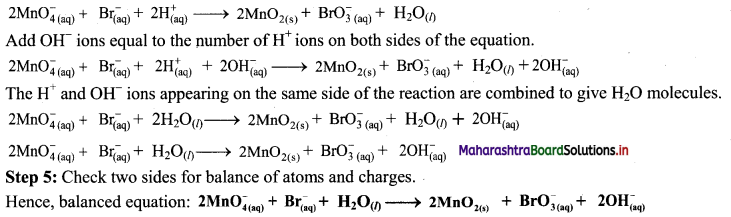
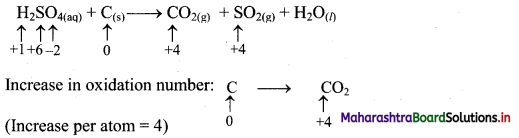
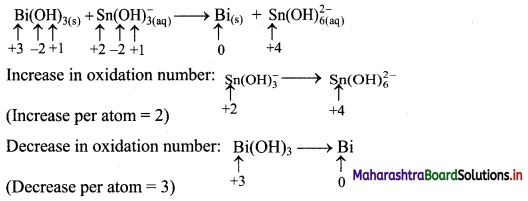
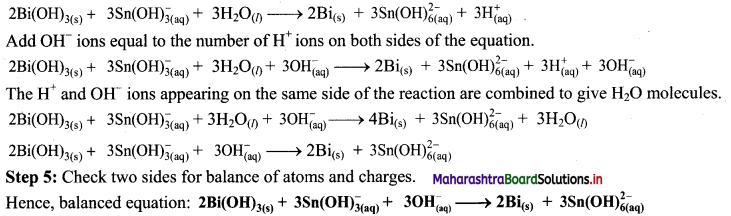
11th Chemistry Chapter 16 Exercise Chemistry in Everyday Life Solutions Maharashtra Board

Class 11 Chemistry Chapter 16

Balbharti Maharashtra State Board 11th Chemistry Textbook Solutions Chapter 16 Chemistry in Everyday Life Textbook Exercise Questions and Answers.

Chemistry in Everyday Life Class 11 Exercise Question Answers Solutions Maharashtra Board

Class 11 Chemistry Chapter 16 Exercise Solutions Maharashtra Board

Chemistry Class 11 Chapter 16 Exercise Solutions

1. Choose correct option

Question A.
Oxidative Rancidity is …………….. reaction
a. addition
b. subtitution
c. Free radical
d. combination
Answer:
c. Free radical

Question B.
Saponification is carried out by ……………..
a. oxidation
b. alkaline hydrolysis
c. polymarisation
d. Free radical formation
Answer:
b. alkaline hydrolysis

Question C.
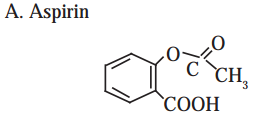
Aspirin is chemically named as ……………..
a. Salicylic acid
b. acetyl salicylic acid
c. chloroxylenol
d. thymol
Answer:
b. acetyl salicylic acid

Question D.
Find odd one out from the following
a. dettol
b. chloroxylenol
c. paracetamol
d. trichlorophenol
Answer:
c. paracetamol

Question E.
Arsenic based antibiotic is
a. Azodye
b. prontosil
c. salvarsan
d. sulphapyridine
Answer:
c. salvarsan

Maharashtra Board Class 11 Chemistry Solutions Chapter 16 Chemistry in Everyday Life

Question F.
The chemical used to slow down the browning action of cut fruit is
a. SO3
b. SO2
c. H2SO4
d. Na2CO3
Answer:
b. SO2

Question G.
The chemical is responsible for the rancid flavour of fats is
a. Butyric acid
b. Glycerol
c. Protein
d. Saturated fat
Answer:
a. Butyric acid

Question H.
Health benefits are obtained by consumption of
a. Saturated fats
b. trans fats
c. monounsaturated fats
d. all of these
Answer:
c. monounsaturated fats

2. Explain the following :

Question A.
Cooking makes food easy to digest.
Answer:

  • During the cooking process, high polymers of carbohydrates or proteins are hydrolysed to smaller polymeric units.
  • The uncooked food mixture is a heterogeneous suspension which becomes a colloidal matter on cooking.
  • As a result, the constituent nutrient molecules present in cooked food are smaller in size and hence, easier to digest, than the uncooked food.

Hence, cooking makes food easy to digest.

Maharashtra Board Class 11 Chemistry Solutions Chapter 16 Chemistry in Everyday Life

Question B.
On cutting some fruits and vegetables turn brown.
Answer:
i. Cutting of fruits and vegetables damage the cells, resulting in release of chemicals.
ii. Depending on the pH of fruits/vegetables, polyphenols are released.
iii. Due to the action of an enzyme, these polyphenols react with oxygen present in the air and get oxidised to form quinones.
Maharashtra Board Class 11 Chemistry Solutions Chapter 16 Chemistry in Everyday Life 1
iv. Quinones further undergo reactions including polymerization, which results in the formation of brown coloured products called as tannins.
Thus, on cutting, some fruits and vegetables turn brown.

Question C.
Vitmin E is added to packed edible oil.
Answer:

  • Vitamin E is a very effective natural antioxidant.
  • The phenolic – OH group present in the structure of vitamin E is responsible for its antioxidant activity.
  • Also, the long chain of saturated carbon atoms makes it fat soluble.

Therefore, when vitamin E is added to packed edible oil, it prevents the oxidative rancidity of the oil.

Question D.
Browning of cut apple can be prolonged by applying lemon juice.
Answer:

  • Browning of cut apple is due to the oxidation of polyphenols at a particular pH to quinones, which further undergoes polymerization to form brown coloured tannins.
  • This browning reaction can be prolonged or slowed down by using reducing agents or by changing the pH.
  • Applying lemon juice (i.e., citric acid) on the cut apple, lowers the pH at the surface of the apple. This prevents the oxidation reaction. Thus, browning of cut apple can be prolonged by applying lemon juice.

Question E.
A diluted solution (4.8 % w/v) of 2,4,6-trichlorophenol is employed as antiseptic.
Answer:

  • 2,4,6-Trichlorophenol (TCP) is more potent antiseptic than phenol.
  • It has low corrosive effects as compared to phenol, if used in lower concentrations.

Hence, diluted solution (4.8% w/v) of 2,4,6-trichlorophenol is used as antiseptic.

Maharashtra Board Class 11 Chemistry Solutions Chapter 16 Chemistry in Everyday Life

Question F.
Turmeric powder can be used as antiseptic.
Answer:

  • Turmeric powder contains an active ingredient called curcumin.
  • Curcumin has antiseptic properties; thus, it is used for wound healing or applied on bruise.

Hence, turmeric powder can be used as antiseptic.

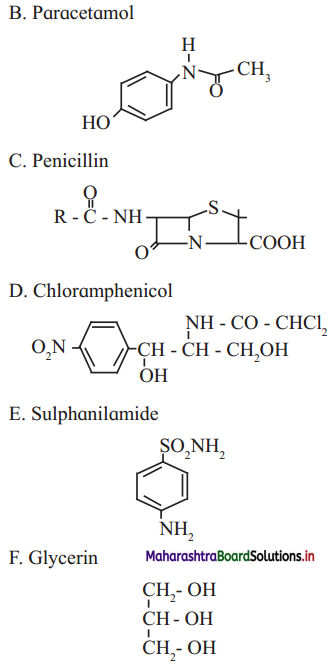
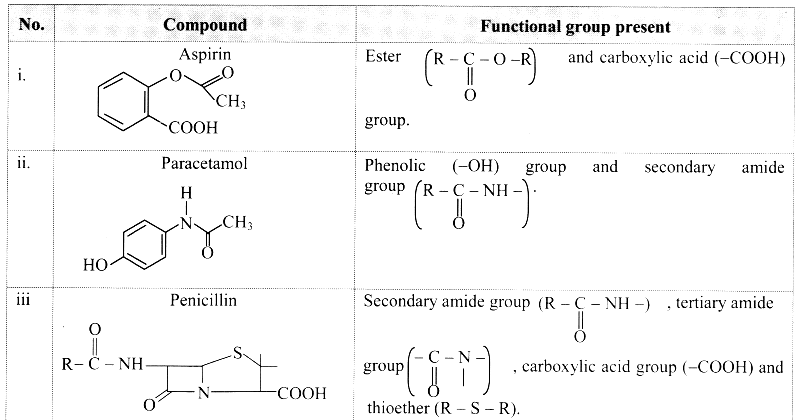
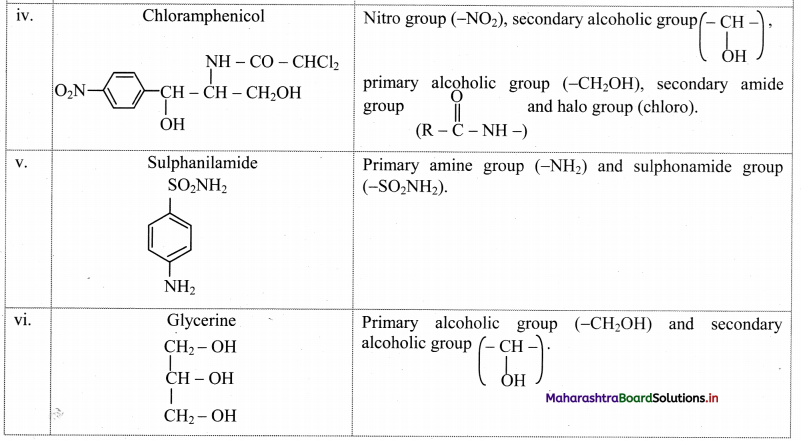
3. Identify the functional groups in the following molecule :

Maharashtra Board Class 11 Chemistry Solutions Chapter 16 Chemistry in Everyday Life 2
Maharashtra Board Class 11 Chemistry Solutions Chapter 16 Chemistry in Everyday Life 3
Answer:
Maharashtra Board Class 11 Chemistry Solutions Chapter 16 Chemistry in Everyday Life 4
Maharashtra Board Class 11 Chemistry Solutions Chapter 16 Chemistry in Everyday Life 5

4. Give two differences between the following

Question A.
Disinfectant and antiseptic
Answer:

Disinfectant Antiseptic
1. Disinfectants are applied on non-living surfaces like floors, instruments, sanitary ware, etc. to kill wide range of microorganisms. 1. Antiseptics are applied on the surface of living tissues in order to sterilise them.
2. Disinfectants cannot be applied on wounds. 2. Antiseptics can be directly applied on wounds.
3. p-chloro-o-benzyl phenol 3. Iodine, boric acid, iodoform, dettol, etc.

Maharashtra Board Class 11 Chemistry Solutions Chapter 16 Chemistry in Everyday Life

Question B.
Soap and synthetic detergent
Answer:

Soap Synthetic detergent
1. Soaps can be broadly classified into two types, i.e., toilet soaps (prepared using KOH) and laundry soaps (prepared using NaOH). 1. Synthetic detergents are of three types, i.e., anionic, cationic and nonionic detergents.
2. Soaps cannot be used in hard water. 2. Synthetic detergents can be used in soft water as well as in hard water.

Question C.
Saturated and unsaturated fats
Answer:

Saturated fats Unsaturated fats
1. In saturated fat, long chains of tetrahedral carbon atoms in the fatty acid get closely packed together. 1. In unsaturated fats, the presence of one or more C = C bond in long chains of fatty acids, prevent molecules from packing closely together.
2. In saturated fats, the van der Waals forces between long saturated chains are strong. Hence, their melting points are higher than unsaturated fats. 2. In unsaturated fats, the van der Waals forces between long unsaturated chains are weak. Hence, their melting points are lower than saturated fats.

Question D.
Rice flour and cooked rice
Answer:

Rice flour Cooked rice
1. Rice flour can be stored for a long period of time. It has a long shelf life. 1. Cooked rice cannot be stored for a longer period of time. It has very short shelf life.
2. Rice flour is uncooked food and hence, it is difficult to digest. 2. Cooked rice is easier to digest.

5. Match the pairs.

A group B group
A. Paracetamol a. Antibiotic
B. Chloramphenicol b. Synthetic detergent
C. BHT c. Soap
D. Sodium stearate d. Antioxidant
e. Analgesic

Answer:
A – e,
B – a,
C – d,
D – c

Maharashtra Board Class 11 Chemistry Solutions Chapter 16 Chemistry in Everyday Life

6. Name two drugs which reduce body pain.
Answer:
Aspirin and paracetamol are the two drugs that reduce body pain.

7. Explain with examples

Question A.
Antiseptics
Answer:
i. Antiseptics are used to sterilise surfaces of living tissue when the risk of infection is very high, such as during surgery or on wounds.
ii. Commonly used antiseptics include inorganics like iodine and boric acid or organics like iodoform and some phenolic compounds.

e.g.

  • Tincture of iodine (2-3% solution of iodine in alcohol-water mixture) and iodoform serve as powerful antiseptics and is used to apply on wounds.
  • A dilute aqueous solution of boric acid is a weak antiseptic used for eyes.
  • Various phenols are used as antiseptics. A dilute aqueous solution of phenol (carbolic acid) is used as antiseptic; however, phenol is found to be corrosive in nature. Many chloro derivatives of phenols are more potent antiseptics than the phenol itself. They can be used with much lower concentrations, which reduce their corrosive effects.
  • Two of the most common phenol derivatives in use are trichlorophenol (TCP) and chloroxylenol (which is an active ingredient of antiseptic dettol).
  • Thymol obtained from oil of thyme (a spice plant) has excellent non-toxic antiseptic properties.

Question B.
Disinfectant
Answer:

  • Disinfectants are non-selective antimicrobials.
  • They kill a wide range of microorganisms including bacteria.
  • They are used on non-living surfaces for example, floors, instruments, sanitary ware, etc.
  • Various phenols can be used as disinfectants.
    e.g. p-Chloro-o-benzyl phenol is used as a disinfectant in all-purpose cleaners.

Question C.
Cationic detergents
Answer:
Cationic detergents: These are quaternary ammonium salts having one long chain alkyl group.
e.g. Ethyltrimethylammonium bromide: [CH3(CH2)15 – N+(CH3)3]Br

Question D.
Anionic detergents
Answer:
Anionic detergents: These are sodium salts of long chain alkyl sulphonic acids or long chain alkyl substituted benzene sulphonic acids.
e.g. Sodium lauryl sulphate: CH3(CH2)10CH3O\(\mathrm{SO}_{3}^{-}\)Na+

Question E.
Non-ionic detergents
Answer:
Nonionic detergents: These are ethers of polyethylene glycol with alkyl phenol or esters of polyethylene glycol with long chain fatty acid.
e.g. a. Nonionic detergent containing ether linkage:
Maharashtra Board Class 11 Chemistry Solutions Chapter 16 Chemistry in Everyday Life 6
b. Nonionic detergent containing ester linkage: CH3(CH2)16 – COO(CH2CH2O)nCH2CH2OH

Maharashtra Board Class 11 Chemistry Solutions Chapter 16 Chemistry in Everyday Life

8. Explain : mechnism of cleansing Action of soap with flow chart.
Answer:
The following flow chart shows mechanism of cleansing action of soap:
Maharashtra Board Class 11 Chemistry Solutions Chapter 16 Chemistry in Everyday Life 7

9. What is meant by broad spectrum antibiotic and narrow spectrum antibiotics?
Answer:
Antibiotics which are effective against wide range of bacteria are known as broad spectrum antibiotics, while antibiotics which are effective against one group of bacteria are known as narrow spectrum antibiotics.

10. Answer in one senetence

Question A.
Name the painkiller obtained from acetylation of salicyclic acid.
Answer:
Aspirin is the pain killer obtained from acetylation of salicylic acid.

Question B.
Name the class of drug often called as painkiller.
Answer:
Analgesics are the class of drug often called as painkiller.

Question C.
Who discovered penicillin?
Answer:
Alexander Fleming discovered penicillin.

Maharashtra Board Class 11 Chemistry Solutions Chapter 16 Chemistry in Everyday Life

Question D.
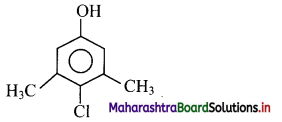
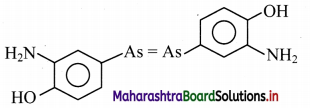
Draw the structure of chloroxylenol and salvarsan.
Answer:
Structure of chloroxylenol:
Maharashtra Board Class 11 Chemistry Solutions Chapter 16 Chemistry in Everyday Life 8

Structure of salvarsan:
Maharashtra Board Class 11 Chemistry Solutions Chapter 16 Chemistry in Everyday Life 9

Question E.
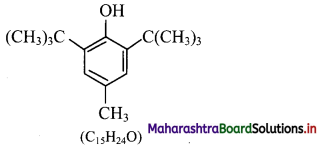
Write molecular formula of Butylated hydroxy toulene.
Answer:
Molecular formula of butylated hydroxytoluene is C15H24O.

Question F.
What is the tincture of iodine ?
Answer:
Tincture of iodine is a 2-3% solution of iodine in alcohol-water mixture.

Question G.
Draw the structure of BHT.
Answer:
Maharashtra Board Class 11 Chemistry Solutions Chapter 16 Chemistry in Everyday Life 10

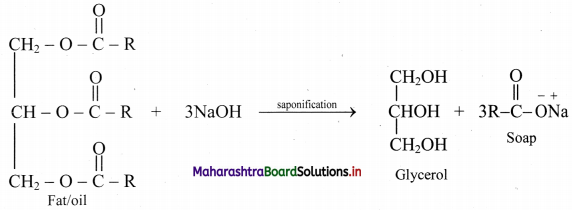
Question I.
Write a chemical equation for saponification.
Answer:
Maharashtra Board Class 11 Chemistry Solutions Chapter 16 Chemistry in Everyday Life 11

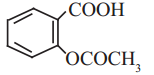
Question J.
Write the molecular formula and name of
Maharashtra Board Class 11 Chemistry Solutions Chapter 16 Chemistry in Everyday Life 12
Answer:
Molecular formula: C9H8O4
Name: Aspirin

Maharashtra Board Class 11 Chemistry Solutions Chapter 16 Chemistry in Everyday Life

11. Answer the following

Question A.
Write two examples of the following.
a. Analgesics
c. Antiseptics
d. Antibiotics
e. Disinfectant
Answer:

No. Drug type Examples
i. Analgesics Aspirin, paracetamol
ii. Antiseptics Dettol, thymol
iii. Antibiotics Penicillin, sulphapyridine
iv. Disinfectant Phenol, p-Chloro-o-benzyl phenol

Question B.
What do you understand by antioxidant ?
Answer:

  • An antioxidant is a substance that delays the onset of oxidant or slows down the rate of oxidation of foodstuff.
  • It is used to extend the shelf life of food.
  • Antioxidants react with oxygen-containing free radicals and thereby prevent oxidative rancidity.
    e.g. Vitamin E is a very effective natural antioxidant.

Activity :

Collect information about different chemical compounds as per their applications in day-to-day life.
Answer:

No. Chemical compound Applications
i. Vinegar(CH3COOH) Preservation of food, salad dressing, sauces, etc.
ii. Magnesium hydroxide [Mg(OH)2] Common component of antacids (used to relieve heartburn, acid indigestion and stomach upset.)
iii. Baking soda (NaHCO3) Cooking, antacid, toothpaste, etc.
iv. Sodium benzoate (C6H5COONa) Used as food preservative

[Note: Students can use the above information as reference and collect additional information on their own.]

Maharashtra Board Class 11 Chemistry Solutions Chapter 16 Chemistry in Everyday Life

11th Chemistry Digest Chapter 16 Chemistry in Everyday Life Intext Questions and Answers

Can you recall? (Textbook Page No. 261)

Question i.
What are the components of balanced diet?
Answer:
Carbohydrates, proteins, lipids (fats and oil), vitamins, minerals and water are the components of balanced diet.

Question ii.
Why is food cooked? What is the difference in the physical states of uncooked and cooked food?
Answer:

  • Food is cooked in order to make it easy to digest.
  • Also, the raw or uncooked food may contain harmful microorganisms which may cause illness. Cooking of food at high temperature kills most of these microorganisms.
  • Raw/uncooked food materials like dried pulses, vegetables, meat, etc. are hard and thus, not easily chewable while cooked food is soft and tender, therefore, easily chewable.

Question iii.
What are the chemicals that we come across in everyday life?
Answer:
Detergents, shampoos, medicines, various food flavours, food colours, etc. are different types of chemicals that we come across in everyday life.

Just think (Textbook Page No. 261)

Question i.
Why is food stored for a long time?
Answer:
Food (like various cereals, pulses, pickles) is stored for a long time to make it available in all seasons.

Question ii.
What methods are used for preservation of food?
Answer:
Various physical and chemical methods are used for preservations of food.

  • Physical methods like, addition of heat, removal of heat, removal of water, irradiation, etc., are used in order to preserve food.
  • Chemical methods like, addition of sugar, salt, vinegar, etc. are employed for preservation of food.

Question iii.
What is meant by quality of food?
Answer:
Food quality can be described in terms of parameters such as flavour, smell, texture, colour and microbial spoilage.

Can you recall? (Textbook Page No. 263)

Question i.
How is Vanaspati ghee made?
Answer:
Vanaspati ghee is prepared by hydrogenation of oils. Hydrogen gas is passed through the oils at about 450 K in the presence of nickel catalyst to form solid edible fats like vanaspati ghee.
Maharashtra Board Class 11 Chemistry Solutions Chapter 16 Chemistry in Everyday Life 13

Question ii.
What are the physical states of peanut oil, butter, animal fat, Vanaspati ghee at room temperature?
Answer:

Example Physical state
Peanut oil Liquid
Butter Semi-solid
Animal fat Solid/semi-solid
Vanaspati ghee Solid/semi-solid

Maharashtra Board Class 11 Chemistry Solutions Chapter 16 Chemistry in Everyday Life

Can you tell? (Textbook Page No. 264)

Question 1.
When is an antipyretic drug used?
Answer:
An antipyretic drug is used to reduce fever (that is, it lowers body temperature when a fever is present).

Question 2.
What type of medicine is applied to a bruise?
Answer:
Antiseptic such as tincture of iodine is applied on a bruise in order to prevent the exposed living tissue from getting infected.

Question 3.
What is meant by a broad spectrum antibiotic?
Answer:
Antibiotics which are effective against wide range of bacteria are known as broad spectrum antibiotic.

Question 4.
What is the active principle ingredient of cinnamon bark?
Answer:
Cinnamaldehyde is the principle active ingredient of cinnamon bark.

Can you tell? (Textbook Page No. 268)

Question i.
Can we use the same soap for bathing as well as cleaning utensils or washing clothes? Why?
Answer:
No, we cannot use the same soap for bathing as well as cleaning utensils or washing clothes due to the following reasons:

  • Chemical composition of each type of soap or cleansing material is different.
  • Nature, acidity, texture, reactivity towards water (i.e., hard water or soft water), reactivity towards microorganisms, stains are different for each type of soap.
  • Depending on these qualities, soaps are classified and used accordingly.
    e.g. pH of soaps used for bathing purpose is different than that of the soap which is used for cleaning utensils.

Thus, we cannot use the same soap for bathing as well as cleaning utensils or washing clothes.

Question ii.
How will you differentiate between soaps and synthetic detergent using borewell water?
Answer:
Borewell water is hard water. Soaps and synthetic detergents react differently with hard water.

  1. Soap: Soaps are insoluble in hard water. Borewell water (hard water) contains Ca2+ and Mg2+ ions. Soaps react with these ions to form insoluble magnesium and calcium salts of fatty acids. These salts precipitate out as gummy substance or form scum.
  2. Synthetic detergents: Synthetic detergents can be used in hard water as well. They contain molecules (components) which form soluble calcium and magnesium salts.

Thus, soaps will form scum in borewell water but synthetic detergents will not.

11th Std Chemistry Questions And Answers:

11th Chemistry Chapter 2 Exercise Introduction to Analytical Chemistry Solutions Maharashtra Board

Class 11 Chemistry Chapter 2

Balbharti Maharashtra State Board 11th Chemistry Textbook Solutions Chapter 2 Introduction to Analytical Chemistry Textbook Exercise Questions and Answers.

Introduction to Analytical Chemistry Class 11 Exercise Question Answers Solutions Maharashtra Board

Class 11 Chemistry Chapter 2 Exercise Solutions Maharashtra Board

Chemistry Class 11 Chapter 2 Exercise Solutions

1. Choose correct option

Question A.
The branch of chemistry which deals with study of separation, identification, and quantitaive determination of the composition of different substances is called as ………………..
a. Physical chemistry
b. Inorganic chemistry
c. Organic chemistry
d. Analytical chemistry
Answer:
d. Analytical chemistry

Question B.
Which one of the following property of matter is Not quantitative in nature ?
a. Mass
b. Length
c. Colour
d. Volume
Answer:
c. Colour

Question C.
SI unit of mass is ……..
a. kg
b. mol
c. pound
d. m3
Answer:
a. kg

Question D.
The number of significant figures in 1.50 × 10⁴ g is ………..
a. 2
b. 3
c. 4
d. 6
Answer:
b. 3

Maharashtra Board Class 11 Chemistry Solutions Chapter 2 Introduction to Analytical Chemistry

Question E.
In Avogadro’s constant 6.022 × 10²³ mol-1, the number of significant figures is ……….
a. 3
b. 4
c. 5
d. 6
Answer:
b. 4

Question F.
By decomposition of 25 g of CaCO3, the amount of CaO produced will be ……………….
a. 2.8 g
b. 8.4 g
c. 14.0 g
d. 28.0 g
Answer:
c. 14.0 g

Question G.
How many grams of water will be produced by complete combustion of 12g of methane gas
a. 16
b. 27
c. 36
d. 56
Answer:
b. 27

Question H.
Two elements A (At. mass 75) and B (At. mass 16) combine to give a compound having 75.8 % of A. The formula of the compound is
a. AB
b. A2B
c. AB2
d. A2B3
Answer:
d. A2B3

Question I.
The hydrocarbon contains 79.87 % carbon and 20.13 % of hydrogen. What is its empirical formula ?
a. CH
b. CH2
c. CH3
d. C2H5
Answer:
c. CH3

Maharashtra Board Class 11 Chemistry Solutions Chapter 2 Introduction to Analytical Chemistry

Question J.
How many grams of oxygen will be required to react completely with 27 g of Al? (Atomic mass : Al = 27, O = 16)
a. 8
b. 16
c. 24
d. 32
Answer:
c. 24

Question K.
In CuSO4.5H2O the percentage of water is ……
(Cu = 63.5, S = 32, O = 16, H = 1)
a. 10 %
b. 36 %
c. 60 %
d. 72 %
Answer:
b. 36 %

Question L.
When two properties of a system are mathematically related to each other, the relation can be deduced by
a. Working out mean deviation
b. Plotting a graph
c. Calculating relative error
d. all the above three
Answer:
b. Plotting a graph

2. Answer the following questions

Question A.
Define : Least count
Answer:
The smallest quantity that can be measured by the measuring equipment is called least count.

Question B.
What do you mean by significant figures? State the rules for deciding significant figures.
Answer:
i. The significant figures in a measurement or result are the number of digits known with certainty plus one uncertain digit.
ii. Rules for deciding significant figures:
a. All non-zero digits are significant.
e.g. 127.34 g contains five significant figures which are 1, 2, 7, 3 and 4.
b. All zeros between two non-zero digits are significant, e.g. 120.007 m contains six significant figures.
c. Zeros on the left of the first non-zero digit are not significant. Such a zero indicates the position of the decimal point.
e.g. 0.025 has two significant figures, 0.005 has one significant figure.
d. Zeros at the end of a number are significant if they are on the right side of the decimal point,
e. g. 0.400 g has three significant figures and 400 g has one significant figure.
e. In numbers written is scientific notation, all digits are significant.
e.g. 2.035 × 10² has four significant figures and 3.25 × 10⁻⁵ has three significant figures.

Maharashtra Board Class 11 Chemistry Solutions Chapter 2 Introduction to Analytical Chemistry

Question C.
Distinguish between accuracy and precision.
Answer:
Accuracy:

  1. Accuracy refers to nearness of the measured value to the true value.
  2. Accuracy represents the correctness of the measurement.
  3. Accuracy is expressed in terms of absolute error and relative error.
  4. Accuracy takes into account the true or accepted value.
  5. Accuracy can be determined by a single measurement.
  6. High accuracy implies smaller error.

Precision:

  1. Precision refers to closeness of multiple readings of the same quantity.
  2. Precision represents the agreement between two or more measured values.
  3. Precision is expressed in terms of absolute deviation and relative deviation.
  4. Precision does not take into account the true or accepted value.
  5. Several measurements are required to determine precision.
  6. High precision implies reproducibility of the readings.

Question D.
Explain the terms percentage composition, empirical formula and molecular formula.
Answer:
Percentage Composition:

  • The percentage composition of a compound is the percentage by weight of each element present in the compound.
  • Quantitative determination of the constituent elements by suitable methods provides the percent elemental composition of a compound.
  • If the percent total is not 100, the difference is considered as percent oxygen.
  • From the percentage composition, the ratio of the atoms of the constituent elements in the molecule is calculated.

Empirical Formula:
The simplest ratio of atoms of the constituent elements in a molecule is called the empirical formula of that compound.
e.g. The empirical formula of benzene is CH.

Molecular Formula:
1. Molecular formula of a compound is the formula which indicates the actual number of atoms of the constituent elements in a molecule.
e.g. The molecular formula of benzene is C6H6.
2. It can be obtained from the experimentally determined values of percent elemental composition and molar mass of that compound.
3. Molecular formula can be obtained from the empirical formula if the molar mass is known.
Molecular formula = r × Empirical formula

Question E.
What is a limiting reagent ? Explain.
Answer:
Limiting reagent:

  • The reactant which gets consumed and limits the amount of product formed is called the limiting reagent.
  • When a chemist carries out a reaction, the reactants are not usually present in exact stoichiometric amounts, that is, in the proportions indicated by the balanced equation.
  • This is because the goal of a reaction is to produce the maximum quantity of a useful compound from the starting materials. Frequently, a large excess of one reactant is supplied to ensure that the more expensive reactant is completely converted into the desired product.
  • The reactant which is present in lesser amount gets consumed after some time and subsequently, no further reaction takes place, whatever be the amount left of the other reactant present.

Hence, limiting reagent is the reactant that gets consumed entirely and limits the reaction.

Question F.
What do you mean by SI units ? What is the SI unit of mass ?
Answer:
i. In 1960, the general conference of weights and measures proposed revised metric system, called International system of Units i.e. SI units, abbreviated from its French name.
ii. The SI unit of mass is kilogram (kg).

Question G.
Explain the following terms
(a) Mole fraction
(b) Molarity
(c) Molality
Answer:
(a) Mole fraction: Mole fraction is the ratio of number of moles of a particular component of a solution to the total number of moles of the solution.

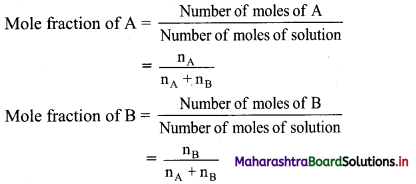
If a substance ‘A’ dissolves in substance ‘B’ and their number of moles are nA and nB, respectively, then the mole fraction of A and B are given as:
Maharashtra Board Class 11 Chemistry Solutions Chapter 2 Introduction to Analytical Chemistry 1

(b) Molarity: Molarity is defined as the number of moles of the solute present in 1 litre of the solution. It is the most widely used unit and is denoted by M.
Molarity is expressed as follows:
Molarity (M) = \(\frac{\text { Number of moles of solute }}{\text { Volume of solution in litres }}\)

Molality: Molality is the number of moles of solute present in 1 kg of solvent. It is denoted by m. Molality is expressed as follows:
Molality (m) = \(\frac{\text { Number of moles of solute }}{\text { Mass of solvent in kilograms }}\)

Maharashtra Board Class 11 Chemistry Solutions Chapter 2 Introduction to Analytical Chemistry

Question H.
Define : Stoichiometry
Answer:
The study of quantitative relations between the amount of reactants and/or products is called stoichiometry.

Question I.
Why there is a need of rounding off figures during calculation ?
Answer:

  • When performing calculations with measured quantities, the rule is that the accuracy of the final result is limited to the accuracy of the least accurate measurement.
  • In other words, the final result cannot be more accurate than the least accurate number involved in the calculation.
  • Sometimes, the final result of a calculation often contains figures that are not significant.
  • When this occurs, the final result is rounded off.

Question J.
Why does molarity of a solution depend upon temperature ?
Answer:

  • Molarity is the number of moles of the solute present in 1 litre of the solution. Therefore, molarity depends on the volume of the solution.
  • Volume of the solution varies with the change in temperature.

Hence, molarity of a solution depends upon temperature.

Question M.
Define Analytical chemistry. Why is accurate measurement crucial in science?
Answer:
The branch of chemistry which deals with the study of separation, identification, qualitative and quantitative determination of the compositions of different substances, is called analytical chemistry.

1. The accuracy of measurement is of great concern in analytical chemistry. This is because faulty equipment, poor data processing, or human error can lead to inaccurate measurements. Also, there can be intrinsic errors in analytical measurement.
2. When measurements are not accurate, this provides incorrect data that can lead to wrong conclusions. For example, if a laboratory experiment requires a specific amount of a chemical, then measuring the wrong amount may result in an unsafe or unexpected outcome.
3. Hence, the numerical data obtained experimentally are treated mathematically to reach some quantitative conclusion.
4. Also, an analytical chemist has to know how to report the quantitative analytical data, indicating the extent of the accuracy of measurement, perform the mathematical operation, and properly express the quantitative error in the result.

Maharashtra Board Class 11 Chemistry Solutions Chapter 2 Introduction to Analytical Chemistry

3. Solve the following questions

Question A.
How many significant figures are in each of the following quantities ?
a. 45.26 ft
b. 0.109 in
c. 0.00025 kg
d. 2.3659 × 10⁻⁸ cm
e. 52.0 cm3
f. 0.00020 kg
g. 8.50 × 104 mm
h. 300.0 cg
Answer:
a. 4
b. 3
c. 2
d. 5
e. 3
f. 2
g. 3
h. 4

Question B.
Round off each of the following quantities to two significant figures :
a. 25.55 mL
b. 0.00254 m
c. 1.491 × 10⁵ mg
d. 199 g
Answer:
a. 26 mL
b. 0.0025 m
c. 1.5 × 10⁵ mg
d. 2.0 × 10² g

Question C.
Round off each of the following quantities to three significant figures :
a. 1.43 cm3
b. 458 × 102 cm
c. 643 cm2
d. 0.039 m
e. 6.398 × 10⁻³ km
f. 0.0179 g
g. 79,000 m
h. 42,150
i. 649.85
j. 23,642,000 mm
k. 0.0041962 kg
Answer:
a. 43 cm3
b. 4.58 × 104 cm
c. 643 cm2 (or 6.43 × 102 cm2)
d. 0.0390 m (or 3.90 × 10⁻² m)
e. 6.40 × 10⁻³ km
f. 0.0179 g (or 1.79 × 10⁻² m)
g. 7.90 × 10⁴ m
h. 4.22 × 10⁴ (or 42,200)
i. 6.50 × 10²
j. 2.36 × 107 mm
k. 0.00420 kg (or 4.20 × 10⁻³ kg)

Question D.
Express the following sum to appropriate number of significant figures :
a. 2.3 × 10³ mL + 4.22 × 10⁴ mL + 9.04 × 10³ mL + 8.71 × 10⁵ mL;
b. 319.5 g – 20460 g – 0.0639 g – 45.642 g – 4.173 g
Answer:
To perform addition/subtraction operation, first the numbers are written in such a way that they have the same exponent. The coefficients are then added/subtracted.
a. (0.23 × 10⁴ mL) + (4.22 × 10⁴ mL) +(0.904 × 10⁴ mL) + (87.1 × 10⁴ mL)
= (0.23 + 4.22 + 0.904 + 87.1) × 104 mL
= 92.454 × 10⁴ mL
= 9.2454 × 105
= 9.2 × 10⁵ mL
b. 319.5 g – 20460 g – 0.0639 g – 45.642 g – 4.173 g
= – 20190.3789 g
= – 20190 g
Ans: Sum to appropriate number of significant figures = 9.2 × 10⁵ mL
ii. Sum to appropriate number of significant figures = – 20190 g
[Note: In addition and subtraction, the final answer is rounded to the minimum number of decimal point of the number taking part in calculation. If there is no decimal point, then the final answer will have no decimal point.]

Maharashtra Board Class 11 Chemistry Solutions Chapter 2 Introduction to Analytical Chemistry

4. Solve the following problems

Question A.
Express the following quantities in exponential terms.
a. 0.0003498
b. 235.4678
c. 70000.0
d. 1569.00
Answer:
a. 0.0003498 = 3.498 × 10⁻⁴
b. 235.4678 = 2.354678 × 10²
c. 70000.0 = 7.00000 × 10⁴
d. 1569.00 = 1.56900 × 10³

Question B.
Give the number of significant figures in each of the following
a. 1.230 × 10⁴
b. 0.002030
c. 1.23 × 10⁴
d. 1.89 × 10⁻⁴
Answer:
a. 4
b. 4
c. 3
d. 3

Question C.
Express the quantities in above (B) with or without exponents as the case may be.
Answer:
a. 12300
b. 2.030 × 10⁻³
c. 12300
d. 0.000189

Question D.
Find out the molar masses of the following compounds :
a. Copper sulphate crystal (CuSO4.5H2O)
b. Sodium carbonate, decahydrate (Na2CO3.10H2O)
c. Mohr’s salt [FeSO4(NH4)2SO4.6H2O]
(At. mass : Cu = 63.5; S = 32; O = 16; H = 1; Na = 23; C = 12; Fe = 56; N = 14)
Answer:
a. Molar mass of CuSO4.5H2O
= (1 × At. mass Cu) + (1 × At. mass S) + (9 × At. mass O) + (10 × At. mass H)
= (1 × 63.5) + (1 × 32) + (9 × 16) + (10 × 1)
= 63.5 + 32 + 144 + 10
= 249.5 g mol-1
Molar mass of CuSO4.5H2O = 249.5 g mol-1

b. Molar mass of Na2CO3.10H2O
= (2 × At. mass Na) + (1 × At. mass C) + (13 × At. mass O) + (20 × At. mass H)
= (2 × 23) + (1 × 12) + (13 × 16) + (20 × 1)
= 46 + 12 + 208 + 20
= 286 g mol-1
Molar mass of Na2CO3.10H2O = 286 g mol-1

c. Molar mass of [FeSO4(NH4)2SO4.6H2O]
= (1 × At. mass Fe) + (2 × At. mass S) + (2 × At. mass N) + (14 × At. mass O) + (20 × At. mass H)
= (1 × 56) + (2 × 32) + (2 × 14) + (14 × 16) + (20 × 1)
= 56 + 64 + 28 + 224 + 20
= 392 g mol-1
Molar mass of [FeSO4(NH4)2SO4.6H2O] = 392 g mol-1

Maharashtra Board Class 11 Chemistry Solutions Chapter 2 Introduction to Analytical Chemistry

Question E.
Work out the percentage composition of constituents elements in the following compounds :
a. Lead phosphate [Pb3(PO4)2],
b. Potassium dichromate (K2Cr2O7),
c. Macrocosmic salt – Sodium ammonium hydrogen phosphate, tetrahydrate (NaNH4HPO4.4H2O)
(At. mass : Pb = 207; P = 31; O = 16; K = 39; Cr = 52; Na = 23; N = 14)
Answer:
Given: Atomic mass: Pb = 207; P = 31; O = 16; K = 39; Cr = 52; Na = 23; N = 14
To find: The percentage composition of constituent elements
Formula:
Maharashtra Board Class 11 Chemistry Solutions Chapter 2 Introduction to Analytical Chemistry 2
Calculation:
i. Lead phosphate [Pb3(PO4)2]
Molar mass of Pb3(PO4)2 = 3 × (207) + 2 × (31) + 8 × (16) = 621 + 62 + 128 = 811 g mol-1
Percentage of Pb = \(\frac {621}{811}\) × 100 = 76.57%
Percentage of P = \(\frac {621}{811}\) × 100 = 7.64%
Percentage of O = \(\frac {128}{811}\) × 100 = 15.78%

ii. Potassium dichromate (K2Cr2O7)
Molar mass of K2Cr2O7 = 2 × (39) + 2 × (52) + 7 × (16) = 78 + 104 + 112 = 294 g mol-1
Percentage of K = \(\frac {78}{294}\) × 100 = 26.53%
Percentage of Cr = \(\frac {104}{294}\) × 100 = 35.37%
Percentage of O = \(\frac {112}{294}\) × 100 = 38.10%

iii. Microcosmic salt – Sodium ammonium hydrogen phosphate, tetrahydrate (NaNH4HPO4.4H2O)
Molar mass of NaNH4HPO4.4H2O = 1 × (23) + 1 × (14) + 1 × (31) + 13 × (1) + 8 × (16)
= 23 + 14 + 31 + 13 + 128 = 209 g mol-1
Percentage of Na = \(\frac {23}{209}\) × 100 = 11.00%
Percentage of N = \(\frac {14}{209}\) × 100 = 6.70%
Percentage of P = \(\frac {31}{209}\) × 100 = 14.83%
Percentage of H = \(\frac {13}{209}\) × 100 = 6.22%
Percentage of O = \(\frac {128}{209}\) × 100 = 61.24%
Ans: i. Mass percentage of Pb, P and O in lead phosphate [Pb3(PO4)2] are 76.57%, 7.64% and 15.78% respectively.
ii. Mass percentage of K, Cr and O in potassium dichromate (K2Cr2O7) are 26.53%, 35.37% and 38.10% respectively.
iii. Mass percentage of Na, N, P, H and O in NaNH4HPO4.4H2O are 11.00%, 6.70%, 14.83%, 6.22% and 61.24% respectively.

Question F.
Find the percentage composition of constituent green vitriol crystals (FeSO4.7H2O). Also find out the mass of iron and the water of crystallisation in 4.54 kg of the crystals. (At. mass : Fe = 56; S = 32; O = 16)
Answer:
Given: i. Atomic mass: Fe = 56; S = 32; O = 16
ii. Mass of crystal = 4.54 kg
To find: i. Mass percentage of Fe, S, H and O
ii. Mass of iron and water of crystallisation in 4.54 kg of crystal
Formula:
Maharashtra Board Class 11 Chemistry Solutions Chapter 2 Introduction to Analytical Chemistry 3
i. Molar mass of FeSO4.7H2O = 1 × (56) + 1 × (32) + 14 × (1) + 11 × (16)
= 56 + 32 + 14+ 176
= 278 g mol-1
Percentage of Fe = \(\frac {56}{278}\) × 100 = 20.14%
Percentage of S = \(\frac {32}{278}\) × 100 = 11.51%
Percentage of H = \(\frac {14}{278}\) × 100 = 5.04%
Percentage of O = \(\frac {176}{278}\) × 100 = 63.31%

ii. 278 kg green vitriol = 56 kg iron
∴ 4.54 kg green vitriol = x
∴ x = \(\frac{56 \times 4.54}{278}\)
Mass of 7H2O in 278 kg green vitriol = 7 × 18 = 126 kg
∴ 4.54 kg green vitriol = y
∴ y = \(\frac{126 \times 4.54}{278}\)
Ans: i. Mass percentage of Fe, S, H and O in FeSO4.7H2O are 20.14%, 11.51%, 5.04% and 63.31% respectively.
ii. Mass of iron in 4.54 kg green vitriol = 0.915 kg
Mass of water of crystallisation in 4.54 kg green vitriol = 2.058 kg

Question G.
The red colour of blood is due to a compound called “haemoglobin”. It contains 0.335 % of iron. Four atoms of iron are present in one molecule of haemoglobin. What is its molecular weight ? (At. mass : Fe = 55.84)
Answer:
Given: Iron percentage in haemoglobin = 0.335%
To find: Molecular weight of haemoglobin
Calculation: There are four atoms of iron in a molecule of haemoglobin. Four atoms of iron contribute 0.335% mass to a molecule of haemoglobin.
Mass of one Fe atom = 55.84 u
∴ Mass of 4 Fe atoms = 55.84 × 4 = 223.36 u = 0.335%
Let molecular weight of haemoglobin be x.
Hence,
\(\frac{223.36}{x}\) × 100 = 0.335%
∴ x = \(\frac{223.36}{0.335}\) × 100 = 66674.6 g mol-1
Ans: Molecular weight of haemoglobin = 66674.6 g mol-1

Maharashtra Board Class 11 Chemistry Solutions Chapter 2 Introduction to Analytical Chemistry

Question H.
A substance, on analysis, gave the following percent composition:
Na = 43.4 %, C = 11.3 % and O = 45.3 %. Calculate the empirical formula. (At. mass Na = 23 u, C = 12 u, O = 16 u).
Answer:
Given: Atomic mass of Na = 23 u, C = 12 u, and O = 16 u
Percentage of Na, C and O = 43.4%, 11.3% and 45.3% respectively.
To find: The empirical formula of the compound
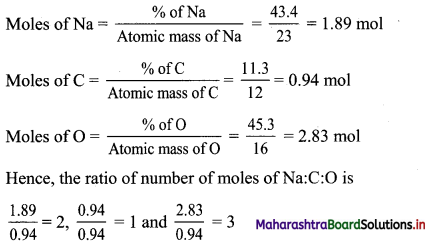
Calculation:
Maharashtra Board Class 11 Chemistry Solutions Chapter 2 Introduction to Analytical Chemistry 4
Hence, empirical formula is Na2CO3.
Ans: Empirical formula of the compound = Na2CO3

Question I.
Assuming the atomic weight of a metal M to be 56, find the empirical formula of its oxide containing 70.0% of M.
Answer:
Given: Atomic mass of M = 56
Percentage of M = 70.0%
To find: The empirical formula of the compound
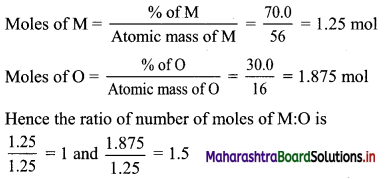
Calculation: % M = 70.0%
Hence, % O = 30.0%, Atomic mass of O = 16 u
Maharashtra Board Class 11 Chemistry Solutions Chapter 2 Introduction to Analytical Chemistry 5
Convert the ratio into whole number by multiplying by the suitable coefficient, i.e., 2.
Therefore, the ratio of number of moles of M : O is 2 : 3.
Hence, the empirical formula is M2O3.
Ans: Empirical formula of the compound = M2O3

Question J.
1.00 g of a hydrated salt contains 0.2014 g of iron, 0.1153 g of sulfur, 0.2301 g of oxygen and 0.4532 g of water of crystallisation. Find the empirical formula. (At. wt. : Fe = 56; S = 32; O = 16)
Answer:
Given: Atomic mass of Fe = 56, S = 32, and O = 16
Mass of iron, sulphur, oxygen and water = 0.2014 g, 0.1153 g, 0.2301 g and 0.4532 respectively.
To find: The empirical formula of the compound
Calculation: Since the mass of crystal is 1 g, the % iron, sulphur, oxygen and water = 20.14%, 11.53%, 23.01% and 4.32 % respectively.
Maharashtra Board Class 11 Chemistry Solutions Chapter 2 Introduction to Analytical Chemistry 6
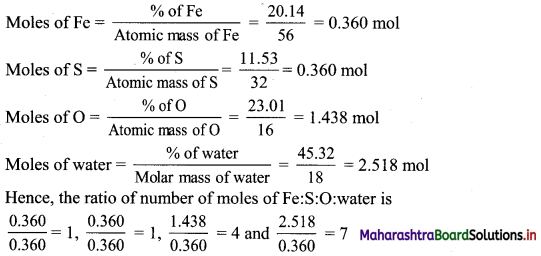
Hence, empirical formula is FeSO4.7H2O.
Ans: Empirical formula of the compound = FeSO4.7H2O.

Question K.
An organic compound containing oxygen, carbon, hydrogen and nitrogen contains 20 % carbon, 6.7 % hydrogen and 46.67 % nitrogen. Its molecular mass was found to be 60. Find the molecular formula of the compound.
Answer:
Given: Percentage of carbon, hydrogen, nitrogen = 20%, 6.7%, 46.67% respectively.
Molar mass of the compound = 60 g mol-1
To find: The molecular formula of the compound
Calculation: % carbon + % hydrogen + % nitrogen = 20 + 6.7 + 46.67 = 73.37%
This is less than 100%. Hence, compound contains adequate oxygen so that the total percentage of elements is 100%.
Hence, % of oxygen = 100 – 73.37 = 26.63%
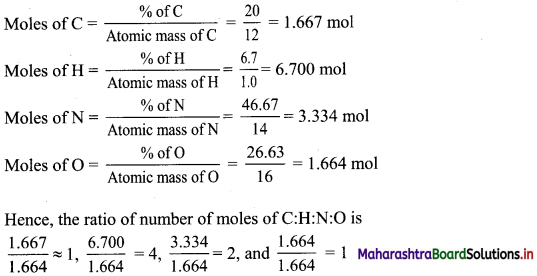
Maharashtra Board Class 11 Chemistry Solutions Chapter 2 Introduction to Analytical Chemistry 7
Hence, empirical formula is CH4N2O.
Empirical formula mass = 12 + 4 + 28 + 16 = 60 g mol-1
Hence,
Molar mass = Empirical formula mass
∴ Molecular formula = Empirical formula = CH4N2O
Ans: Molecular formula of the compound = CH4N2O

Maharashtra Board Class 11 Chemistry Solutions Chapter 2 Introduction to Analytical Chemistry

Question L.
A compound on analysis gave the following percentage composition by mass : H = 9.09; O = 36.36; C = 54.55. Mol mass of compound is 88. Find its molecular formula.
Answer:
Given: Percentage of H, O, C = 9.09%, 36.36%, 54.55% respectively.
Molar mass of the compound = 88 g mol-1
To find: The molecular formula of the compound
Calculation:
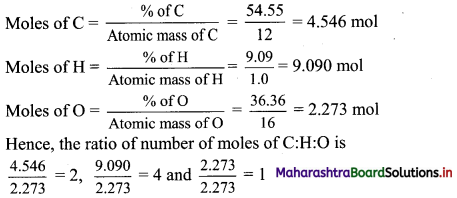
Maharashtra Board Class 11 Chemistry Solutions Chapter 2 Introduction to Analytical Chemistry 8
Hence, empirical formula is C2H4O.
Empirical formula mass = 24 + 4 + 16 = 44 g mol-1
Hence,
Maharashtra Board Class 11 Chemistry Solutions Chapter 2 Introduction to Analytical Chemistry 9
Molecular formula = r × empirical formula
Molecular formula = 2 × C2H2O = C4H8O2
Ans: Molecular formula of the compound = C4H8O2

Question M.
Carbohydrates are compounds containing only carbon, hydrogen and oxygen. When heated in the absence of air, these compounds decompose to form carbon and water. If 310 g of a carbohydrate leave a residue of 124 g of carbon on heating in absence of air, what is the empirical formula of the carbohydrate ?
Answer:
Given: Mass of carbon residue = 124 g, mass of carbohydrate = 310 g
To find: Empirical formula of the carbohydrate
Calculation: Since the 310 g of compound decomposes to carbon and water and the mass of carbon produced is 124 g, the remaining mass would be of water.
∴ Molar mass of water = 310 – 124 = 186 g
Maharashtra Board Class 11 Chemistry Solutions Chapter 2 Introduction to Analytical Chemistry 10
The ratio of number of moles of C : water = C : H2O = 1 : 1
Hence, empirical formula = CH2O
Ans: Empirical formula of the carbohydrate = CH2O

Question N.
Write each of the following in exponential notation :
a. 3,672,199
b. 0.000098
c. 0.00461
d. 198.75
Answer:
a. 3,672,199 = 3.672199 × 10⁶
b. 0.000098 = 9.8 × 10⁻⁵
c. 0.00461 = 4.61 × 10⁻³
d. 198.75 = 1.9875 × 10²

Question O.
Write each of the following numbers in ordinary decimal form :
a. 3.49 × 10⁻¹¹
b. 3.75 × 10⁻¹
c. 5.16 × 10⁴
d. 43.71 × 10⁻⁴
e. 0.011 × 10⁻³
f. 14.3 × 10⁻²
g. 0.00477 × 10⁵
h. 5.00858585
Answer:
a. 3.49 × 10-11 = 0.0000000000349
b. 3.75 × 10-1 = 0.375
c. 5.16 × 104 = 51,600
d. 43.71 × 10-4 = 0.004371
e. 0.011 × 10-3 = 0.000011
f. 14.3 × 10-2 = 0.143
g. 0.00477 × 105 = 477
h. 5.00858585 = 5.00858585

Maharashtra Board Class 11 Chemistry Solutions Chapter 2 Introduction to Analytical Chemistry

Question P.
Perform each of the following calculations. Round off your answers to two digits.
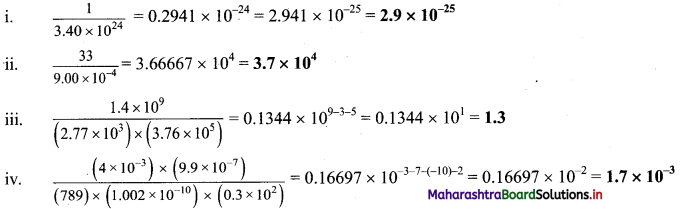
Maharashtra Board Class 11 Chemistry Solutions Chapter 2 Introduction to Analytical Chemistry 11
Answer:
Maharashtra Board Class 11 Chemistry Solutions Chapter 2 Introduction to Analytical Chemistry 12

Question Q.
Perform each of the following calculations. Round off your answers to three digits.
a. (3.26 × 10⁴) (1.54 × 10⁶)
b. (8.39 × 10⁷) (4.53 × 10⁹)
c. \(\frac{8.94 \times 10^{6}}{4.35 \times 10^{4}}\)
d. \(\frac{\left(9.28 \times 10^{9}\right) \times\left(9.9 \times 10^{-7}\right)}{(511) \times\left(2.98 \times 10^{-6}\right)}\)
Answer:
i. (3.26 × 10⁴) (1.54 × 10⁶) = 5.0204 × 10⁴+6 = 5.02 × 10¹⁰
ii. (8.39 × 10⁷) (4.53 × 10⁹) = 38.0067 × 10⁷+9 = 38.0067 × 1016 = 3.80 x 10¹⁷
Maharashtra Board Class 11 Chemistry Solutions Chapter 2 Introduction to Analytical Chemistry 13

Question R.
Perform the following operations :
a. 3.971 × 10⁷ + 1.98 × 10⁴;
b. 1.05 × 10⁻⁴ – 9.7 × 10⁻⁵;
c. 4.11 × 10⁻³ + 8.1 × 10⁻⁴;
d. 2.12 × 10⁶ – 3.5 × 10⁵.
Answer:
Solution:
To perform addition/subtraction operation, first the numbers are written in such a way that they have the same exponent. The coefficients are then added/subtracted.
a. 3.971 × 10⁷ + 1.98 × 104 = 3.971 × 10⁷ + 0.00198 × 107 = (3.971 + 0.00198) × 107
= 3.97298 × 10⁷
b. 1.05 × 10⁻⁴ – 9.7 × 10-5 = 10.5 × 10⁻⁵ – 9.7 × 10-5 = (10.5 – 9.7) × 10-5 = 0.80 × 10-5
= 8.0× 10⁻⁶
c. 4.11 × 10⁻³ + 8.1 × 10-4 = 41.1 × 10⁻⁴ + 8.1 × 10-4 = (41.1 + 8.1) × 10-4 = 49.2 × 10-4
= 4.92 × 10⁻³
d. 2.12 × 10⁶ – 3.5 × 105 = 21.2 × 10⁵ – 3.5 × 105 = (21.2 – 3.5) × 105 = 17.7 × 105
= 1.77 × 10⁶

Maharashtra Board Class 11 Chemistry Solutions Chapter 2 Introduction to Analytical Chemistry

Question S.
A 1.000 mL sample of acetone, a common solvent used as a paint remover, was placed in a small bottle whose mass was known to be 38.0015 g. The following values were obtained when the acetone – filled bottle was weighed : 38.7798 g, 38.7795 g and 38.7801 g. How would you characterise the precision and accuracy of these measurements if the actual mass of the acetone was 0.7791 g ?
Answer:
Precision:

Measurement Mass of acetone observed (g)
1 38.7798 – 38.0015 = 0.7783
2 38.7795 – 38.0015 = 0.7780
3 38.7801 – 38.0015 = 0.7786

Mean = \(\frac{0.7783+0.7780+0.7786}{3}\) = 0.7783 g

Measurement Mass of acetone observed (g)

Absolute deviation (g) =
| Observed value – Mean |

1 0.7783 0
2 0.7780 0.0003
3 0.7786 0.0003

Mean absolute deviation = \(\frac{0+0.0003+0.0003}{3}\) = 0.0002
∴ Mean absolute deviation = ±0.0002 g
Maharashtra Board Class 11 Chemistry Solutions Chapter 2 Introduction to Analytical Chemistry 14

ii. Accuracy:
Actual mass of acetone = 0.7791 g
Observed value (average) = 0.7783 g
a. Absolute error = Observed value – True value
= 0.7783 – 0.7791
= – 0.0008 g
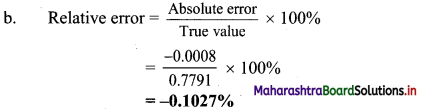
Maharashtra Board Class 11 Chemistry Solutions Chapter 2 Introduction to Analytical Chemistry 15
Ans: These observed values are close to each other and are also close to the actual mass. Therefore, the results are precise and as well accurate.
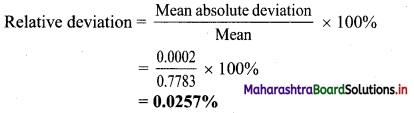
i. Relative deviation = 0.0257%
ii. Relative error = 0.1027%
[Note: i. As per the method given in textbook, the calculated value of relative deviation is 0.0257%.
ii. The negative sign in -0.1027% indicates that the experimental result is lower than the true value.]

Question T.
Your laboratory partner was given the task of measuring the length of a box (approx 5 in) as accurately as possible, using a metre stick graduated in milimeters. He supplied you with the following measurements: 12.65 cm, 12.6 cm, 12.65 cm, 12.655 cm, 126.55 mm, 12 cm.
a. State which of the measurements you would accept, giving the reason.
b. Give your reason for rejecting each of the others.
Answer:
a. The metre stick is graduated in millimetres i.e. 1 mm to 1000 mm, and 1 mm = 0.1 cm. Therefore, if length is measured in centimetres, the least count of metre stick is 0.1 cm. The results 12.6 cm has the least count of 0.1 cm and is acceptable result.

b. Since, the least count of metre stick is 0.1 cm or 1mm, the results such as 12.65 cm, 12.655 cm, 126.55 mm cannot be measured using this stick and hence, these results are rejected. The result, 12 cm doesn’t include the least count and is rejected.

Question U.
What weight of calcium oxide will be formed on heating 19.3 g of calcium carbonate ?
(At. wt. : Ca = 40; C = 12; O = 16)
Answer:
Given: Mass of CaCO3 consumed in reaction = 19.3 g
To find: Mass of CaO formed
Calculation: Calcium carbonate decomposes according to the balanced equation,
Maharashtra Board Class 11 Chemistry Solutions Chapter 2 Introduction to Analytical Chemistry 16
So, 100 g of CaCO3 produce 56 g of CaO.
Maharashtra Board Class 11 Chemistry Solutions Chapter 2 Introduction to Analytical Chemistry 17
Ans: Mass of CaO formed = 10.81 g

[Calculation using log table:
56 × 0.193
= Antilog10 [log10 (56) + log10 (0.193)]
= Antilog10 [1.7482 + \(\overline{1} .2856\)]
= Antilog10 [1.0338] = 10.81]

Maharashtra Board Class 11 Chemistry Solutions Chapter 2 Introduction to Analytical Chemistry

Question V.
The hourly energy requirements of an astronaut can be satisfied by the energy released when 34 grams of sucrose are “burnt” in his body. How many grams of oxygen would be needed to be carried in space capsule to meet his requirement for one day ?
Answer:
34 g of sucrose provides energy for an hour.
Hence, for a day, the mass of sucrose needed = 34 × 24 = 816g
The balanced equation is,
Maharashtra Board Class 11 Chemistry Solutions Chapter 2 Introduction to Analytical Chemistry 18
Thus, 342 g of sucrose require 384 g of oxygen.
∴ 816 g of sucrose will require = \(\frac{816}{342}\) × 384 = 916 g of O2
Ans: Astronaut needs to carry 916 g of O2.

11th Std Chemistry Questions And Answers:

11th Biology Chapter 5 Exercise Cell Structure and Organization Solutions Maharashtra Board

Class 11 Biology Chapter 5

Balbharti Maharashtra State Board 11th Biology Textbook Solutions Chapter 5 Cell Structure and Organization Textbook Exercise Questions and Answers.

Cell Structure and Organization Class 11 Exercise Question Answers Solutions Maharashtra Board

Class 11 Biology Chapter 5 Exercise Solutions Maharashtra Board

Biology Class 11 Chapter 5 Exercise Solutions

1. Choose correct option

Question (A)
Growth of cell wall during cell elongation take place by ………….
(a) Apposition
(b) Intussusception
(c) Both a & b
(d) Super position

Maharashtra Board Class 11 Biology Solutions Chapter 5 Cell Structure and Organization

Question (B)
Cell Membrane is composed of
(a) Proteins and cellulose
(b) Proteins and Phospholipid
(c) Proteins and carbohydrates
(d) Proteins, Phospholipid and some carbohydrates
Answer:
(d) Proteins, Phospholipid and some carbohydrates

Question (C)
Plasma membrane is Fluid structure due to presence of
(A) Carbohydrates
(B) Lipid
(C) Glycoprotein
(D) Polysaccharide
Answer:
(B) Lipid

Question (D)
Cell Wall is present in
(a) Plant cell
(b) Prokaryotic cell
(c) Algal cell
(d) All of the above
Answer:
(d) All of the above

Question (E)
Plasma membrane is
(a) Selectively permeable
(b) Permeable
(c) Impermeable
(d) Semipermeable
Answer:
(a) Selectively permeable

Maharashtra Board Class 11 Biology Solutions Chapter 5 Cell Structure and Organization

Question (F)
Mitochondria DNA is
(a) Naked
(b) Circular
(c) Double stranded
(d) All of the above
Answer:
(d) All of the above

Question (G)
Which of the following set of organelles contain DNA?
(a) Mitochondria, Peroxysome
(b) Plasma membrane, ribosome
(c) Mitochondria, chloroplast
(d) Chloroplast, dictyosome
Answer:
(c) Mitochondria, chloroplast

2. Answer the following questions

Question (A)
Plants have no circulatory system? Then how cells manage intercellular transport?
Answer:
1. Plant cells show presence of plasmodesmata which are cytoplasmic bridges between neighbouring cells.
2. This open channel through the cell wall connects the cytoplasm of adjacent plant cells and allows water, small solutes, and some larger molecules to pass between the cells.
In this way, though plants have no circulatory system, plant cells manage intercellular transport.

Maharashtra Board Class 11 Biology Solutions Chapter 5 Cell Structure and Organization

Question (B)
Is nucleolus covered by membrane?
Answer:
A nucleolus is specialized structure present in the nucleus which is not covered by the membrane.

Question (C)
Fluid mosaic model proposed by Singer and Nicolson replaced Sandwich model proposed by Danielli and Davson? Why?
Answer:

  1. The Davson-Danielli model of the plasma membrane of a cell, was proposed in 1935 by Hugh Davson and James Danielli.
  2. The model describes a phospholipid bilayer that lies between two layers of globular proteins.
  3. This model was also known as a Tipo-protein sandwich’, as the lipid layer was sandwiched between two protein layers.
  4. But through experimental studies membrane proteins were discovered to be insoluble in water (representing hydrophobic surfaces) and varied in size. Such type of proteins would not be able to form an even and continuous layer around the outer surface of a cell membrane.
  5. In case of Fluid-mosaic model, the experimental evidence from research supports every major hypothesis proposed by Singer and Nicolson.

This hypothesis stated that membrane lipids are arranged in a bilayer; the lipid bilayer is fluid; proteins are suspended individually in the bilayer; and the arrangement of both membrane lipids and proteins is asymmetric. Therefore, Fluid mosaic model proposed by Singer and Nicolson replaced Sandwich model proposed by Danielli and Davson.

Question (D)
The RBC surface normally shows glycoprotein molecules. When determining blood group do they
play any role?
Answer:

  1. Glycoproteins are protein molecules modified within the Golgi complex by having a short sugar chain (polysaccharide) attached to them.
  2. The polysaccharide part of glycoproteins located on the surfaces of red blood cells acts as the antigen responsible for determining the blood group of an individual.
  3. Different polysaccharide part of glycoproteins act as different type of antigens that determine the blood groups.
  4. Four types of blood groups A, B, AB, and O are recognized on the basis of presence or absence of these antigens.

Maharashtra Board Class 11 Biology Solutions Chapter 5 Cell Structure and Organization

Question (E)
How cytoplasm differs from nucleoplasm in chemical composition?
Answer:

  1. A thick liquid enclosed by cell membrane which surrounds the central nucleus in eukaryotes or nucleoid region in prokaryotes is known as cytoplasm.
  2. The cytoplasm shows presence of minerals, sugars, amino acids, t-RNA, nucleotides, vitamins, proteins and enzymes.
  3. The liquid or semiliquid substance within the nucleus is called the nucleoplasm.
  4. Nucleoplasm shows presence of various substances like nucleic acid, protein molecules, minerals and salts.

3. Answer the following questions

Question (A)
Distinguish between smooth and rough endoplasmic reticulum.
Answer:
Smooth endoplasmic reticulum (SER):
1. Depending on cell type, it helps in synthesis of lipids for e.g. Steroid secreting cells of cortical region of adrenal gland, testes and ovaries.
2. Smooth endoplasmic reticulum plays a role in detoxification in the liver and storage of calcium ions (muscle cells).

Rough Endoplasmic Reticulum (RER):

  1. Rough ER is primarily involved in protein synthesis. For e.g. Pancreatic cells synthesize the protein insulin in the ER.
  2. These proteins are secreted by ribosomes attached to rough ER and are called secretory proteins. These proteins get wrapped in membrane that buds off from transitional region of ER. Such membrane bound proteins depart from ER as transport vesicles.
  3. Rough ER is also involved in formation of membrane for the cell.

The ER membrane grows in place by addition of membrane proteins and phospholipids to its own membrane. Portions of this expanded membrane are transferred to other components of endomembrane system.

Question (B)
Why do we call mitochondria as power house of cell? Explain in detail.
(Hint: Refer chapter Cellular Respiration.)
OR
Mitochondria are power house of the cell. Give reasons.
Answer:
a. Mitochondria possess oxysomes on its inner membrane. These oxysomes take active part in synthesis of ATP molecules.
b. During cellular respiration, ATP molecules are produced and get accumulated in the mitochondria. They play an important role in cellular activities.
c. only mitochondria can convert pyruvic acid to carbon dioxide and water during cell respiration. Therefore, mitochondria are called ‘power house of the cell’.

Maharashtra Board Class 11 Biology Solutions Chapter 5 Cell Structure and Organization

Question (C)
What are the types of plastids?
Answer:
1. Plastids are classified according to the pigments present in it. Three main types of plastids are – leucoplasts, chromoplasts and chloroplasts.
2. Leucoplasts do not contain any photosynthetic pigments they are of various shapes and sizes. These are meant for storage of nutrients:
a. Amyloplasts store starch.
b. Elaioplasts store oils.
c. Aleuroplasts store proteins.

3. Chromoplasts contain pigments like carotene and xanthophyll etc.
a. They impart yellow, orange or red colour to flowers and fruits.
b. These plastids are found in the coloured parts of flowers and fruits.

4. Chloroplasts are plastids containing green pigment chlorophyll along with other enzymes that help in production of sugar by photosynthesis. They are present in plants, algae and few protists like Euglena.

Question 4.
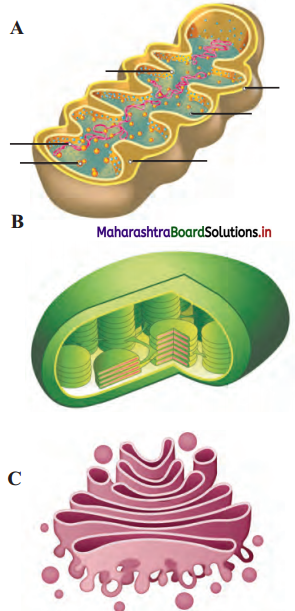
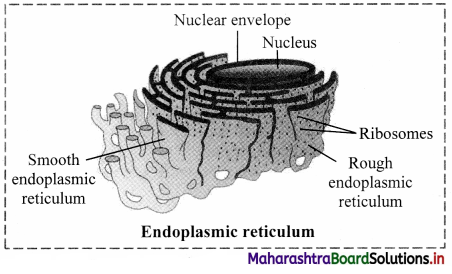
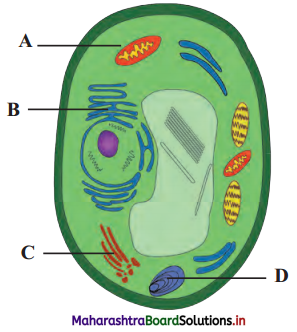
Label the diagrams and write down the details of concept in your words.
Maharashtra Board Class 11 Biology Solutions Chapter 5 Cell Structure and Organization 1
Maharashtra Board Class 11 Biology Solutions Chapter 5 Cell Structure and Organization 2
Answer:
A.
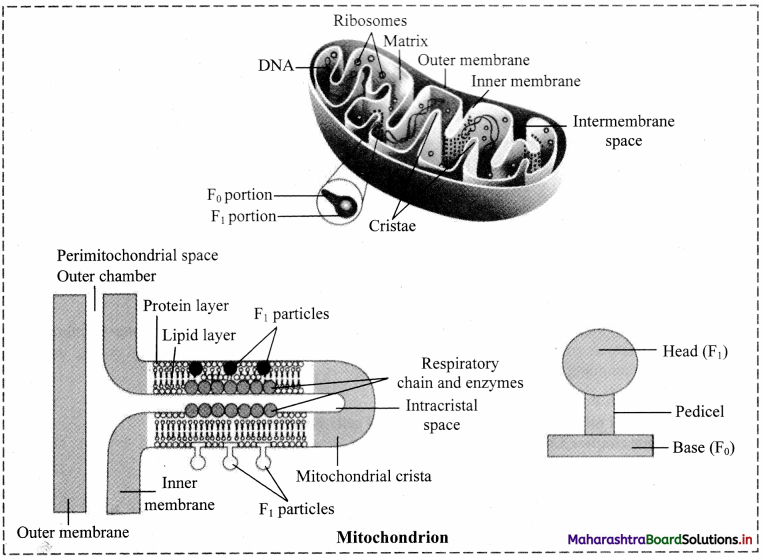
Maharashtra Board Class 11 Biology Solutions Chapter 5 Cell Structure and Organization 3

B.
Maharashtra Board Class 11 Biology Solutions Chapter 5 Cell Structure and Organization 4

Maharashtra Board Class 11 Biology Solutions Chapter 5 Cell Structure and Organization

C.
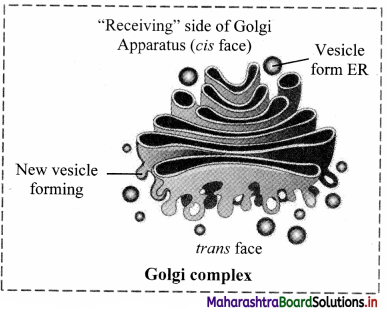
Maharashtra Board Class 11 Biology Solutions Chapter 5 Cell Structure and Organization 5

D.
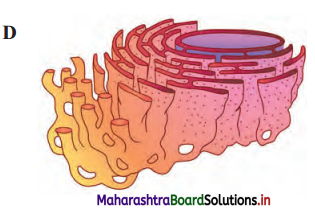
Maharashtra Board Class 11 Biology Solutions Chapter 5 Cell Structure and Organization 6
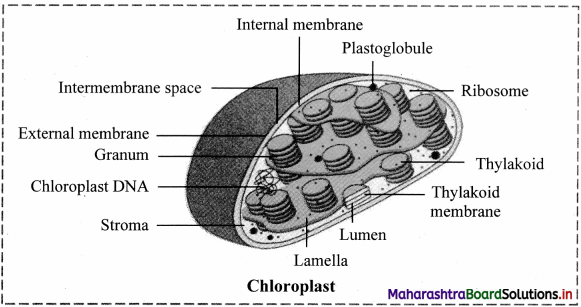
Structure of chloroplast:

  1. In plants, chloroplast is found mainly in mesophyll of leaf.
  2. Chloroplast is lens shaped but it can also be oval, spherical, discoid or ribbon like.
  3. A cell may contain single large chloroplast as in Chlamydomonas or there can be 20 to 40 chloroplasts per cell as seen in mesophyll cells.
  4. Chloroplasts contain green pigment called chlorophyll along with other enzymes that help in production of sugar by photosynthesis.
  5. Inner membrane of double membraned chloroplast is comparatively less permeable.
  6. Inside the cavity of inner membrane, there is another set of membranous sacs called thylakoids.
  7. Thylakoids are arranged in the form of stacks called grana (singular: granum).
  8. The grana are connected to each other by means of membranous tubules called stroma lamellae.
  9. Space outside thylakoids is filled with stroma.
  10. The stroma and the space inside thylakoids contain various enzymes essential for photosynthesis.
  11. Stroma of chloroplast contains DNA and ribosomes (70S).

Question 5.
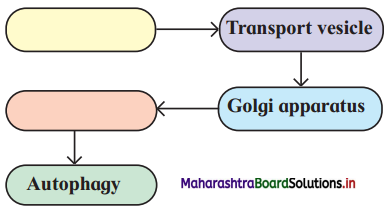
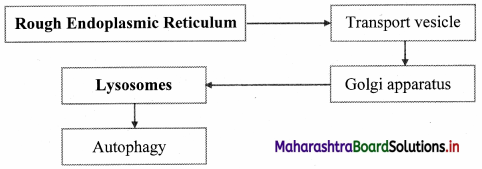
Complete the flow chart.
Maharashtra Board Class 11 Biology Solutions Chapter 5 Cell Structure and Organization 7
Answer:
Maharashtra Board Class 11 Biology Solutions Chapter 5 Cell Structure and Organization 8

Maharashtra Board Class 11 Biology Solutions Chapter 5 Cell Structure and Organization

Question 6.
Identify labels A, B, C in the given diagram. Explain how lysosomes perform intracellular and extracellular digestion.
Maharashtra Board Class 11 Biology Solutions Chapter 5 Cell Structure and Organization 9
Answer:
1. A: Food vacuole
B: Golgi complex
C: Lysosome

2. Intracellular digestion:
The intracellular digestion is brought about by autophagic vesicle or secondary lysosomes which contain foreign materials brought in by processes like phagocytosis. E.g. Food vacuole in amoeba or macrophages in human blood that engulf and destroy harmful microbes that enter the body.

3. Extracellular digestion:
Extracellular digestion is brought about by release of lysosomal enzymes outside the cell. E.g. acrosome, a cap like structure in human sperm is a modified lysosome which contain various enzymes like Hyaluronidase. These enzymes bring about fertilization by dissolving protective layers of ovum.

Question 7.
Identify each cell structures or organelle from its description below.

  1. Manufactures ribosomes
  2. Carries out photosynthesis
  3. Manufactures ATP in animal and plant cells.
  4. Selectively permeable.

Answer:

  1. Nucleolus
  2. Chloroplast
  3. Mitochondria
  4. Plasma membrane

Maharashtra Board Class 11 Biology Solutions Chapter 5 Cell Structure and Organization

Question 8.
Onion cells have no chloroplast. How can we tell they are plants?
Answer:

  1. The bulb of an onion is a modified form of leaves.
  2. While photosynthesis takes place in the leaves (present above the ground) of an onion containing chloroplast, the little glucose that is produced from this process is converted in to starch (starch granules) and stored in the bulb.
  3. Starch act as reserved food material in plants.
  4. Using an iodine solution, we can test for the presence of starch in onion cells. If starch is present, the iodine changes from brown to blue-black or purple. Hence, we can say that though onion cells have no chloroplast they are considered as plants.

Project/ Practical:

Question 1.
Observe the cells of onion root tip under microscope.
Answer:
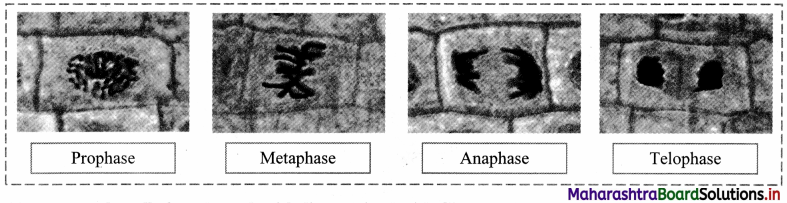
The cells of onion root tip will show various stages of cell division when observed under micrscope.
Maharashtra Board Class 11 Biology Solutions Chapter 5 Cell Structure and Organization 10

Question 2.
Observe the cells from buccal epithelium stained with Giemsa under microscope.
Answer:
The following observations are made when cells from buccal epithelium stained with Giemsa:
1. Cheek cells are flat and irregular in shape.
2. These cells lack cell wall. A distinct blue nucleus can be observed on viewing the cells under the microscope after Geimsa staining.

11th Biology Digest Chapter 5 Cell Structure and Organization Intext Questions and Answers

Can You Recall? (Textbook Page No. 44)

(i) Who observed cells under the microscope for the first time?
Answer:
Robert Hooke observed cells under the microscope for the first time.
[Note. Cell walls were first observed by Robert Hooke (1665) as he looked through a microscope at dead cells from the bark of an oak tree. But Anton van Leeuwenhoek was first to visualize living cells using a single-lens microscope of his own construction.]

Maharashtra Board Class 11 Biology Solutions Chapter 5 Cell Structure and Organization

(ii) Who made the first microscope?
Answer:
The first microscope was made by two Dutch spectacle makers Hans and Zacharias Janssen.
[Note: The Dutch scientist Anton van Leeuwenhoek made microscopes capable of magnifying single-celled organisms in a drop of pond water.]

Find Out (Textbook Page No. 44)

(i) How do a combination of lenses help in higher magnification?
Answer:
a. In a light microscope, visible light is passed through the specimen and then through two glass lenses.
b. The first lens focuses the magnified image of the object on the second lens, which magnifies it again and focuses it on the back of the eye.
c. The glass lenses bend (refract) the light in such a way that the image of the specimen is magnified.
In this way, a combination of lenses helps in higher magnification.

(ii) When do we use plane and concave mirror and diaphragm?
Answer:
a. Concave mirror is used when low-power objective lenses (useful for examining large specimens or many smaller specimens) or high-power objective lenses (useful for observing fine detail) are used, whereas plane mirror is used when oil immersion objective lens is used.
b. The amount of light passing on to the specimen from the condenser (which concentrates and controls the light that passes through the specimen) is regulated by using iris diaphragm.
c. Light is reduced by closing the diaphragm partially for use with dry objectives.
d. Oil immersion objectives require maximum light and this can be achieved by keeping the iris diaphragm fully open.

(iii) What is the difference between magnification and resolution?
Answer:
a. Magnification is the ratio of an object’s image size to its actual size.
b. Resolution is a measure of the clarity of the image; it is the minimum distance two points can be
separated and still be distinguished as separate points.

Can You Recall? (Textbook Page No. 44)

(i) Why bacterial nucleus is said to be primitive?

Maharashtra Board Class 11 Biology Solutions Chapter 5 Cell Structure and Organization

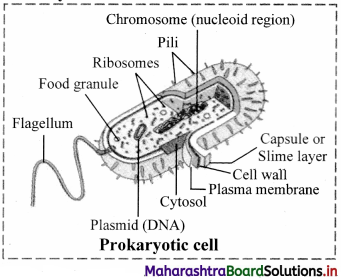
(ii) Draw neat and labelled diagram of Prokaryotic cell.
Answer:
1. The DNA-containing central region of bacterial nucleus (prokaryotic cells) i.e. nucleoid, has no nuclear membrane separating it from the cytoplasm. Therefore, bacterial nucleus is said to be primitive.
2. Prokaryotic cell:
Maharashtra Board Class 11 Biology Solutions Chapter 5 Cell Structure and Organization 11

Find Out (Textbook Page No. 46)

Why do basal body of bacterial flagella considered as smallest motor in the world?
Answer:
1. The bacterial flagellum is an organelle for motility made up of three parts:
a. The basal body that spans the cell envelope and works as a rotary motor;
b. The helical fdament that acts as a propeller;
c. The hook that acts as a universal joint connecting these two to transmit motor torque to the propeller.
2. The motor i.e. basal body drives the rotation of the long, helical filamentous propeller at hundreds of hertz to produce thrust that allows bacteria to swim in liquid environments.
Therefore, basal body of bacterial flagella considered as smallest motor in the world.

Use your Brainpower (Textbook Page No. 46)

Describe major differences between prokaryotic and eukaryotic cells.
Answer:

Prokaryotic cell Eukaryotic cell
1. It is a primitive type of cell. It is an evolved type of cell.
2. Nuclear membrane is absent. Nuclear membrane is present.
3. Genetic material is in the form of circular coil of DNA without histone proteins. Genetic material is in the form of a double helix DNA with histone proteins.
4. Membrane-bound cell organelles are absent. Membrane-bound cell organelles are present.
5. Plasmids are many in number. Plasmids are absent.
6. Cytoplasm does not show streaming movement. Cytoplasm shows streaming movement.
7. Ribosomes are smaller and of 70S type. Ribosomes are larger and of 80S type.
8. Respiratory enzymes are present on the infoldings of the plasma membrane called mesosomes. Respiratory enzymes are present within mitochondria.
e.g Cyanobacteria (Blue-green algae) and bacteria. Algae, fungi, plants and animals.

Maharashtra Board Class 11 Biology Solutions Chapter 5 Cell Structure and Organization

Use Your Brain Power! (Textbook Page No. 52)

Are mitochondria present in all eukaryotic cells?
Answer:
a. Mitochondria are found in nearly all eukaryotic cells, including plants, animals, fungi, and most unicellular eukaryotes.
b. Some of the cells have a single large mitochondrion, but frequently a cell has hundreds of mitochondria.
c. The number of mitochondria correlates with the cell’s level of metabolic activity. For e.g. cells that move or contract have proportionally more mitochondria than metabolically less active cells.
d. However, mature red blood cells in humans lack mitochondria.

Can You Recall? (Textbook Page No. 54)

(i) Consider the following cells and comment about the position, shape and number of nuclei in a eukaryotic cell. Add more examples from your previous knowledge about cell and nucleus. Cuboidal epithelial cell, different types of blood corpuscles, skeletal muscle fibre, adipocyte.
Answer:

Type of cells Position of nucleus Shape of Nucleus Number of nuclei
Cuboidal epithelial cell Central Round or spherical 1
Neutrophils Central Multilobed/Segmented 1
Basophils Central S Shaped / Twisted 1
Eosinophils Central Bilobed 1
Monocytes Central Kidney Shaped 1
Lymphocytes Central Spherical 1
Skeletal Muscle Fibre Peripheral Oval Multinucleate
Adipocytes Shifted towards periphery Eccentric 1
Simple squamous epithelium Central Flat 1
Ciliated simple columnar epithelium Near base Oval 1

(ii) Why nucleus is considered as control unit of a cell?
Answer:
a. Nucleus contains the genetic material of an organism.
b. This genetic material is present in the form of Deoxyribonucleic Acid (DNA) which is responsible for synthesis of various proteins and enzymes.
c. These proteins and enzymes in turn regulate metabolic activities of the cells.
Therefore, nucleus is considered as control unit of a cell.

Maharashtra Board Class 11 Biology Solutions Chapter 5 Cell Structure and Organization

(iii) Can cells like Xylem or mature human RBCs called living?
Answer:
a. Xylem is a complex tissue consists of tracheids, vessels, xylem parenchyma and xylem fibres. From these components of xylem, tracheids are dead cells and xylem parenchyma is the only living tissue,
b. RBCs do not possess nuclei once they reach maturity as they have to accommodate haemoglobin in them. They do not require a nucleus to function as they do not reproduce but only serve as a vehicle for the transport of oxygen and carbon dioxide in the blood.

(iv) What is a syncytium and coenocyte?
Answer:
Syncytium: It refers to mass of cells formed by fusion of multiple uninuclear cells and followed by dissolution of the cell membrane.
Coenocyte: It is a multinucleate cell resulted from multiple nuclear divisions without undergoing cytokinesis.

Maharashtra Board Class 11 Biology Solutions Chapter 5 Cell Structure and Organization

Can You Recall? (Textbook Page No. 44)

How do onion peel cells and our body cells differ?
Answer:
1 – (a, b, d, e,f g)

11th Std Biology Questions And Answers:

11th Chemistry Chapter 13 Exercise Nuclear Chemistry and Radioactivity Solutions Maharashtra Board

Class 11 Chemistry Chapter 13

Balbharti Maharashtra State Board 11th Chemistry Textbook Solutions Chapter 13 Nuclear Chemistry and Radioactivity Textbook Exercise Questions and Answers.

Nuclear Chemistry and Radioactivity Class 11 Exercise Question Answers Solutions Maharashtra Board

Class 11 Chemistry Chapter 13 Exercise Solutions Maharashtra Board

Chemistry Class 11 Chapter 13 Exercise Solutions

1. Choose correct option.

Question A.
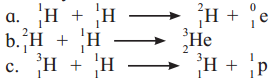
Identify nuclear fusion reaction
Maharashtra Board Class 11 Chemistry Solutions Chapter 13 Nuclear Chemistry and Radioactivity 1
Answer:
Among the given options, reactions (i) and (ii) represent nuclear fusion reaction wherein lighter nuclei combine to form a heavy nucleus.

Question B.
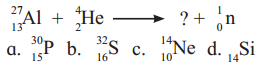
The missing particle from the nuclear reaction is
Maharashtra Board Class 11 Chemistry Solutions Chapter 13 Nuclear Chemistry and Radioactivity 2
Answer:
(A) \({ }_{15}^{30} \mathrm{P}\)

Question C.
\({ }_{27}^{60} \mathrm{CO}\) decays with half-life of 5.27 years to produce \({ }_{28}^{60} \mathrm{Ni}\). What is the decay constant for such radioactive disintegration ?
a. 0.132 y-1
b. 0.138
c. 29.6 y
d. 13.8%
Answer:
a. 0.132 y-1

Question D.
The radioactive isotope used in the treatment of Leukemia is
a. 60Co
b. 226Ra
c. 32P
d. 131I
Answer:
c. 32P

Question E.
The process by which nuclei having low masses are united to form nuclei with large masses is
a. chemical reaction
b. nuclear fission
c. nuclear fusion
d. chain reaction
Answer:
c. nuclear fusion

Maharashtra Board Class 11 Chemistry Solutions Chapter 13 Nuclear Chemistry and Radioactivity

2. Explain

Question A.
On the basis of even-odd of protons and neutrons, what type of nuclides are most stable ?
Answer:

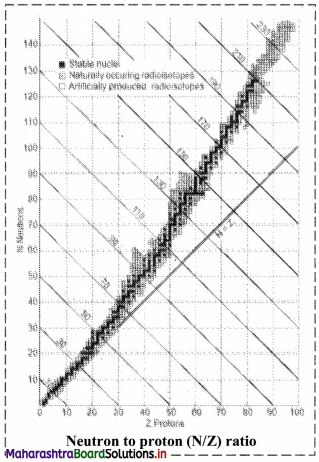
  • Nuclides with even number of protons (Z) and even number of neutrons (N) are most stable.
  • These nuclides tend to form proton-proton and neutron-neutron pairs.
  • This impart stability to the nucleus.

Question B.
Explain in brief, nuclear fission.
Answer:
i. Nuclear fission: It is a process which involves splitting of the heavy nucleus of an atom into two nearly equal fragments accompanied by release of the large amount of energy.
e.g. Nuclear fission of 235U

ii. When a uranium nucleus absorbs neutron, it breaks into two lighter fragments and releases energy (heat), more neutrons, and other radiation. This can be given as,
Maharashtra Board Class 11 Chemistry Solutions Chapter 13 Nuclear Chemistry and Radioactivity 3

iii. Characteristics of nuclear fission reactions:

  • The mass of the fission products is less than the parent nucleus. A large amount of energy corresponding to the mass loss is released in each fission.
  • When one uranium 235 nucleus undergoes fission, three neutrons are emitted, which subsequently disintegrate three more uranium nuclei and thereby produce nine neutrons. Such a chain continues by itself.
  • In a very short time enormous amount of energy is liberated, which can be utilized for destructive or peaceful purposes.
  • Energy released per fission is approximately 200 MeV.

Note:

  • Each fission may lead to different products.
  • There is no unique way for fission of 235U that produces Ba and Kr. There are 400 ways for fission of 235U leading to 800 fission products.
  • Many of these fission products are radioactive which undergo spontaneous disintegrations giving rise to new elements in the periodic table.

Question C.
The nuclides with odd number of both protons and neutrons are the least stable. Why ?
Answer:

  • The nuclides with odd number of both protons and neutrons are the least stable because, odd number of protons and neutrons results in the presence of two unpaired nucleons.
  • These unpaired nucleons result in instability. Hence, such nuclides are the least stable.

Question D.
Referring the stabilty belt of stable nuclides, which nuclides are β and β+ emitters ? Why ?
Answer:

  • Beta decay occurs when an unstable nucleus emits a beta particle and energy. A beta particle is either an electron or a positron. An electron is a negatively charged particle, and a positron is a positively charged electron (or anti-electron).
  • When the beta particle is an electron, the decay is called beta-minus (β) decay. In beta-minus decay, a neutron breaks down to a proton and an electron, and the electron is emitted from the nucleus.
  • When the beta particle is a positron, the decay is called beta-plus (β+) decay. In beta-plus decay, a proton breaks down to a neutron and a positron, and the positron is emitted from the nucleus.
  • Thus, beta-minus decay occurs when a nucleus has too many neutrons relative to protons (i.e., N/Z > 1) and beta-plus decay occurs when a nucleus has too few neutrons relative to protons (i.e., N/Z < 1).
  • By referring the stability belt of stable nuclides, nuclides with N/Z > 1 are to the left of the stability zone. Such nuclides are beta-minus emitters as they become stable when a neutron converts to a proton.
  • Nuclides with N/Z < 1 are to the right of the stability zone. Such nuclides are beta-plus emitters as they become stable when a proton converts to a neutron.

Maharashtra Board Class 11 Chemistry Solutions Chapter 13 Nuclear Chemistry and Radioactivity

Question E.
Explain with an example each nuclear transmutation and artifiacial radioactivity. What is the difference between them ?
Answer:
i. Nuclear transmutation: It involves transformation of a stable nucleus into another nucleus takes place which can be either stable or unstable.
ii. Artificial (induced) radioactivity: It is nuclear transmutation where the product nucleus is radioactive. The product nucleus decays spontaneously with emission of radiation and particles.
Maharashtra Board Class 11 Chemistry Solutions Chapter 13 Nuclear Chemistry and Radioactivity 4
Step-I can be considered as nuclear transmutation as it produces a new nuclide \({ }_{7}^{13} \mathrm{~N}\).
However, the new nuclide is unstable (radioactive). Hence, step-I involves artificial (induced) radioactivity. Thus, in artificial transmutation, a stable element is collided with high speed particles to form another radioactive element.

Question F.
What is binding energy per nucleon ? Explain with the help of diagram how binding energy per nucleon affects nuclear stability ?
Answer:
Maharashtra Board Class 11 Chemistry Solutions Chapter 13 Nuclear Chemistry and Radioactivity 5
i. Binding energy per nucleon (\(\overline{\mathrm{B}}\)), for nucleus containing (A) nucleons with binding energy (B.E.) is given as,
\(\overline{\mathrm{B}}\) = B.E./A
ii. Mean binding energy per nucleon (\(\overline{\mathrm{B}}\)) for the most stable isotopes as a function of mass number is shown above. This plot leads to the following inferences:
a. Light nuclides: (A < 30)
The peaks with A values in multiples of 4. For example, \({ }_{2}^{4} \mathrm{He},{ }_{6}^{12} \mathrm{C},{ }_{8}^{16} \mathrm{O}\) are more stable.
b. Medium mass nuclides: (30 < A < 90)
\(\overline{\mathrm{B}}\) increases typically from 8 MeV for A = 16 to nearly 8.3 MeV for A between 28 and 32 and it remains nearly constant 8.5 MeV beyond this and shows a broad maximum. The nuclides falling on the maximum are most stable which turns possess high values. 56Fe with \(\overline{\mathrm{B}}\) value of 8.79 MeV is the most stable.
c. Heavy nuclides (A > 90)
\(\overline{\mathrm{B}}\) decreases from maximum 8.79 MeV to 7.7 MeV for A ≅ 210, 209Bi is the stable nuclide. Beyond this, all nuclides are radioactive (α-emitters).

Question G.
Explain with example α-decay.
Answer:
i. The emission of α-particle from the nuclei of an radioelement is called α-decay.
ii. The charge on an α-particle is +2 with a mass of 4 u.
It is identical with helium nucleus and hence an α-particle is designated as \({ }_{2}^{4} \mathrm{He}\).
iii. In the α-decay process, the parent nucleus \({ }_{\mathrm{z}}^{\mathrm{A}} \mathrm{X}\) emits an α-particle and produces daughter nucleus Y. The parent nucleus thus loses two protons (charge +2) and two neutrons. The total mass lost is 4 u. The daughter nucleus will therefore, have mass 4 units less and charge 2 units less than its parent.
iv. General equation for α-decay process can be given as:
Maharashtra Board Class 11 Chemistry Solutions Chapter 13 Nuclear Chemistry and Radioactivity 6
In α-decay process of radium, radon (daughter nuclei) is formed with loses of two protons (charge +2) and two neutrons. The total mass lost is 4 u.
Thus, radon has a mass of 4 units less and charge 2 units less than its parent radium.

Question H.
Energy produced in nuclear fusion is much larger than that produced in nuclear fission. Why is it difficult to use fusion to produce energy ?
Answer:

  • Nuclear fusion involves the fusion of lighter nuclei to form a heavy nucleus which is accompanied by an enormous amount of energy (heat).
  • Fusion reaction requires extremely high temperature typically of the order of 108 K.

Maharashtra Board Class 11 Chemistry Solutions Chapter 13 Nuclear Chemistry and Radioactivity

Question I.
How does N/Z ratio affect the nuclear stability ? Explain with a suitable diagram.
Answer:

  • When the graph of number of neutrons (N) against protons (Z) is drawn, and all the stable isotopes are plotted on it, there is quite a clear correlation between N and Z. This graph is shown in the adjacent figure.
  • A large number of elements have several stable isotopes and hence, the curve appears as a belt or zone called stability zone. All stable nuclides fall with this zone and the nuclei that are to the left or to the right of the stability zone are unstable and exhibit radioactivity. Below the belt, a straight line which represents the ratio N/Z to be nearly unity (i.e., N = Z) is shown.
  • For nuclei lighter than \({ }_{20}^{40} \mathrm{Ca}\), the straight line (N = Z) passes through the belt. The lighter nuclides are therefore stable (N/Z being 1).
  • The N/Z ratio for the stable nuclides heavier than calcium gives a curved appearance to the belt with gradual increase of N/Z (> 1). The heavier nuclides therefore, need more number of neutrons than protons to attain stability. The heavier nuclides with increasing number of protons render large coulombic repulsions. With increased number of neutrons, the protons within the nuclei get more separated, which renders them stable.
  • Thus, nuclear stability is linked to the number of nucleons (neutrons and protons). In general, the lighter stable nuclei have equal numbers of protons and neutrons while heavier stable nuclei have increasingly more neutrons than protons.

Maharashtra Board Class 11 Chemistry Solutions Chapter 13 Nuclear Chemistry and Radioactivity 7
[Note: Atoms with unstable nuclei are radioactive (exhibit radioactivity). To become more stable, the nuclei undergo radioactive decay.]

Question J.
You are given a very old sample of wood. How will you determine its age ?
Answer:
The age of the wood sample can be determined by radiocarbon dating as 14C becomes a part of a plant due to the photosynthesis reaction (i.e., absorption of [14CO2 + 12CO2]).
i. The activity (N) of given wood sample and that of fresh sample of live plant (N0) is measured, where, N0 denotes the activity of the given sample at the time of death.
ii. The age of the given wood sample. can be determined by applying following Formulae:
Maharashtra Board Class 11 Chemistry Solutions Chapter 13 Nuclear Chemistry and Radioactivity 8
Note: The oldest rock found so far in Northern Canada is 3.96 billion years old.

3. Answer the following question

Question A.
Give example of mirror nuclei.
Answer:
Example of mirror nuclei: \({ }_{1}^{3} \mathrm{H}\) and \({ }_{2}^{3} \mathrm{He}\)

Question B.
Balance the nuclear reaction:
Maharashtra Board Class 11 Chemistry Solutions Chapter 13 Nuclear Chemistry and Radioactivity 9
Answer:
Maharashtra Board Class 11 Chemistry Solutions Chapter 13 Nuclear Chemistry and Radioactivity 10

Maharashtra Board Class 11 Chemistry Solutions Chapter 13 Nuclear Chemistry and Radioactivity

Question C.
Name the most stable nuclide known. Write two factors responsible for its stability.
Answer:
The most stable nuclide known is lead (\({ }_{82}^{208} \mathrm{~Pb}\)).
Two factors responsible for its stability are as follows:

  • It is a nuclide with even number of both protons (Z) and neutrons (N).
  • It has two magic numbers i.e., 82 (for protons) and 126 (for neutrons).

Question D.
Write relation between decay constant of a radioelement and its half life.
Answer:
Relation between decay constant of a radioelement and its half-life is given as, λ = \(\frac{0.693}{\mathrm{t}_{1 / 2}}\)
Where, λ = Decay constant, t1/2 = Half-life of a radioelement

Question E.
What is the difference between an α-particle and helium atom ?
Answer:

  • Helium atom is composed of 2 protons and 2 neutrons (or 1 neutron) along with 2 electrons in the outer shell.
  • On the other hand, α-particle constitutes 2 protons and 2 neutrons bound together to form a particle which is similar to helium (except presence of electrons).
  • Helium is one of the inert gas which is stable (duplet complete) whereas α-particle is unstable and highly reactive.

Question F.
Write one point that differentiates nuclear reations from chemical reactions.
Answer:
Chemical reactions:

  • Rearrangement of atoms by breaking and forming of chemical bonds.
  • Different isotopes of an element have same behaviour.

Nuclear reactions:

  • Elements or isotopes of one element are converted into another element in a nuclear reaction.
  • Isotopes of an element behave differently.

Question G.
Write pairs of isotones and one pair of mirror nuclei from the following :
Maharashtra Board Class 11 Chemistry Solutions Chapter 13 Nuclear Chemistry and Radioactivity 11
Answer:
Isotones: i. \({ }_{5}^{10} \mathrm{~B} \text { and }{ }_{6}^{11} \mathrm{C}\)
ii. \({ }_{13}^{27} \mathrm{Al} \text { and }{ }_{14}^{28} \mathrm{~S}\)
Mirror nuclei: Since there are no isobars the given set of nuclides does not contain a pair of mirror nuclei.

Maharashtra Board Class 11 Chemistry Solutions Chapter 13 Nuclear Chemistry and Radioactivity

Question H.
Derive the relationship between half life and decay constant of a radioelement.
Answer:
Equation for the decay constant is given as,
λ = \(\frac{2.303}{t} \log _{10} \frac{\mathrm{N}_{0}}{\mathrm{~N}}\) …(i)
Where, λ = Decay constant
N = Number of nuclei (atoms) present at time t
At t = 0, N = N0.
Hence, at t = t1/2, N = N0/2
Substitution of these values of N and t in equation (i) gives,
Maharashtra Board Class 11 Chemistry Solutions Chapter 13 Nuclear Chemistry and Radioactivity 12

Question I.
Represent graphically log10 (activity /dps) versus t/s. What is its slope ?
Answer:
Equation for a decay constant (λ) is given as,
Maharashtra Board Class 11 Chemistry Solutions Chapter 13 Nuclear Chemistry and Radioactivity 13
Hence, instead if log10N versus t, log10 \(\left(\frac{-\mathrm{d} \mathrm{N}}{\mathrm{dt}}\right)\) which is log10 (activity) is plotted.
The graph of log10 (activity/dps) versus t/s gives a straight line which can be represented as follows:
Maharashtra Board Class 11 Chemistry Solutions Chapter 13 Nuclear Chemistry and Radioactivity 14

Question J.
Write two units of radioactivity. How are they interrelated ?
Answer:
The unit of radioactivity is curie (Ci).
1 Ci = 3.7 × 10¹⁰ dps
ii. Other unit of radioactivity is Becquerel (Bq).
1 Bq = 1 dps
Thus, 1 Ci = 3.7 × 10¹⁰ dps = 3.7 × 10¹⁰ Bq

Question K.
Half life of 24Na is 900 minutes. What is its decay constant?
Answer:
Maharashtra Board Class 11 Chemistry Solutions Chapter 13 Nuclear Chemistry and Radioactivity 15

Question L.
Decay constant of 197Hg is 0.017 h-1. What is its half life ?
Answer:
Maharashtra Board Class 11 Chemistry Solutions Chapter 13 Nuclear Chemistry and Radioactivity 16

Question M.
The total binding energy of 58Ni is 508 MeV. What is its binding energy per nucleon ?
Answer:
Given: B.E. of 58Ni = 508 MeV,
A = 58
To find: Binding energy per nucleon \(\bar{B}\)
Maharashtra Board Class 11 Chemistry Solutions Chapter 13 Nuclear Chemistry and Radioactivity 17

Question N.
Atomic mass of \({ }_{16}^{32} \mathrm{~S}\) is 31.97 u. If masses of neutron and H atom are 1.0087 u and 1.0078 u respectively. What is the mass defect ?
Answer:
Given: m = 31.97 u, Z = 16, A = 32
mn = 1.0087 u
mH = 1.0078 u
To find: Δm
Formula: Δm = ZmH + (A – Z)mn – m
Calculation: Δm = ZmH + (A – Z)mn – m
= 16 × 1.0078 + (16 × 1.0087) – 31.97
= [16.1248 + 16.1392] – 31.97
= 0.294 u
Ans: The mass defect is 0.294 u.

Maharashtra Board Class 11 Chemistry Solutions Chapter 13 Nuclear Chemistry and Radioactivity

Question O.
Write the fusion reactions occuring in the Sun and stars.
Answer:
Fusion reactions occurring in the Sun and stars are can be represented as,
Maharashtra Board Class 11 Chemistry Solutions Chapter 13 Nuclear Chemistry and Radioactivity 18

Question P.
How many α and β – particles are emitted in the trasmutation
\({ }_{90}^{232} \mathrm{Th} \longrightarrow{ }_{82}^{208} \mathrm{~Pb}\)
Answer:
\({ }_{90}^{232} \mathrm{Th} \longrightarrow{ }_{82}^{208} \mathrm{~Pb}\)
The emission of one α-particle decreases the mass number by 4 whereas the emission of β-particles has no effect on mass number.
Net decrease in mass number = 232 – 208 = 24.
This decrease is only due to α-particles. Hence, number of α-particles emitted = \(\frac {24}{4}\) = 6
Now, the emission of one α-particle decrease the atomic number by 2 and one β-particle emission increases it by 1.
The net decrease in atomic number = 90 – 82 = 8
The emission of 6 α-particles causes decrease in atomic number by 12. However, the actual decrease is only 8. Thus, atomic number increases by 4. This increase is due to emission of 4 β-particles.
Thus, 6 α and 4 β-particles are emitted.

Question Q.
A produces B by α- emission. If B is in the group 16 of periodic table, what is the group of A ?
Answer:
Maharashtra Board Class 11 Chemistry Solutions Chapter 13 Nuclear Chemistry and Radioactivity 19
When α-emission occurs, atomic number decreases by 2 and atomic mass number by 4.
Thus, if ‘B’ belongs to group 16 of periodic table, that means outermost orbit will contain 6 electrons.
Thus, ‘A’ will have 8 electrons in its valence shell and it will belong to group 18 of the periodic table.

Question R.
Find the number of α and β- particles emitted in the process
\({ }_{86}^{222} \mathrm{Rn} \longrightarrow{ }_{84}^{214} \mathrm{PO}\)
Answer:
The emission of one α-particle decreases the mass number by 4 whereas the emission of β-particles has no effect on mass number.
Net decrease in mass number = 222 – 214 = 8. This decrease is only due to α-particle. Hence, number of α-particle emitted = 8/4 = 2
Now, the emission of one α-particle decreases the atomic number by 2 and one β-particle emission increases it by 1.
The net decrease in atomic number = 86 – 84 = 2
The emission of 2 α-particles causes decrease in atomic number by 4. However, the actual decrease is only 2. It means atomic number increases by 2. This increase is due to emission of 2 β-particles.
Thus, 2 α and 2 β-particles are emitted.

[Note: The above question is modified to include the final decay product so as to determine the number of α-particles and β-particles emitted in the process. Here, the final decay product is assumed to be Po-214.]

Maharashtra Board Class 11 Chemistry Solutions Chapter 13 Nuclear Chemistry and Radioactivity

4. Solve the problems

Question A.
Half life of 18F is 110 minutes. What fraction of 18F sample decays in 20 minutes ?
Answer:
Given: t1/2 = 110 min
t = 20 min
To find: Fraction of 18F simple that decays
Maharashtra Board Class 11 Chemistry Solutions Chapter 13 Nuclear Chemistry and Radioactivity 20
Maharashtra Board Class 11 Chemistry Solutions Chapter 13 Nuclear Chemistry and Radioactivity 21
∴ Fraction of 18F sample that decays = 1 – 0.882 = 0.118
Ans: Fraction of 18F sample that decays in 20 minutes is 0.118.

Question B.
Half life of 35S is 87.8 d. What percentage of 35S sample remains after 180 d ?
Answer:
Given: t1/2 = 87.8 d,
N0 = 100,
t = 180 d
To find: % of 35S that remains after 180 days
Maharashtra Board Class 11 Chemistry Solutions Chapter 13 Nuclear Chemistry and Radioactivity 22

Question C.
Half life 67Ga is 78 h. How long will it take to decay 12% of sample of Ga ?
Answer:
Given: t1/2 = 78 h,
N0 = 100,
N = 100 – 12 = 88
To find: t
Maharashtra Board Class 11 Chemistry Solutions Chapter 13 Nuclear Chemistry and Radioactivity 23
Maharashtra Board Class 11 Chemistry Solutions Chapter 13 Nuclear Chemistry and Radioactivity 24

Question D.
0.5 g Sample of 201Tl decays to 0.0788 g in 8 days. What is its half life ?
Answer:
Given: N0 = 0.5 g,
N = 0.0788 g,
t = 8 days
To find: t1/2
Maharashtra Board Class 11 Chemistry Solutions Chapter 13 Nuclear Chemistry and Radioactivity 25

Maharashtra Board Class 11 Chemistry Solutions Chapter 13 Nuclear Chemistry and Radioactivity

Question E.
65% of 111In sample decays in 4.2 d. What is its half life ?
Answer:
Given: N0 = 100,
N = 100 – 65 = 35,
t = 4.2d
To find: t1/2
Maharashtra Board Class 11 Chemistry Solutions Chapter 13 Nuclear Chemistry and Radioactivity 26
Maharashtra Board Class 11 Chemistry Solutions Chapter 13 Nuclear Chemistry and Radioactivity 27

Question F.
Calculate the binding energy per nucleon of \({ }_{36}^{84} \mathrm{Kr}\) whose atomic mass is 83.913 u. (Mass of neutron is 1.0087 u and that of H atom is 1.0078 u).
Answer:
Given: A = 84, Z = 36,
m = 83.913 u
mn = 1.0087 u
mH = 1.0078 u
To find: Binding energy per nucleon \((\bar{B})\)
Maharashtra Board Class 11 Chemistry Solutions Chapter 13 Nuclear Chemistry and Radioactivity 28

Question G.
Calculate the energy in Mev released in the nuclear reaction
\({ }_{77}^{174} \mathrm{Ir} \longrightarrow{ }_{75}^{170} \mathrm{Re}+{ }_{2}^{4} \mathrm{He}\)
Atomic masses : Ir = 173.97 u,
Re = 169.96 u and
He = 4.0026 u
Answer:
Given: mIr= 173.97 u
mRe = 169.96 u
mHe = 4.0026 u
To find: Energy released
Formulae: i. Δm = (mass of 174Ir) – (mass of 170Re + mass of 4He)
ii. E = Δm × 931.4 MeV
Calculation:i. Δm = (mass of 174Ir) – (mass of 170Re + mass of 4He)
= 173.97 – (169.96 + 4.0026)
= 7.4 × 10⁻³ u
ii. E = Δm × 931.4
= 7.4 × 10-3 × 931.4
= 6.89236 MeV ≈ 6.892 MeV
Ans: The energy released in given nuclear reaction is 6.892 MeV.

Question H.
A 3/4 of the original amount of radioisotope decays in 60 minutes. What is its half life ?
Answer:
Maharashtra Board Class 11 Chemistry Solutions Chapter 13 Nuclear Chemistry and Radioactivity 29

Question I.
How many – particles are emitted by 0.1 g of 226Ra in one year?
Answer:
Given: t = 1 y,
Amount of sample = 0.1 g
To find: Number of particles emitted
Maharashtra Board Class 11 Chemistry Solutions Chapter 13 Nuclear Chemistry and Radioactivity 30
Activity = \(\frac{-\mathrm{d} \mathrm{N}}{\mathrm{dt}}\) = λN
= 4.28 × 10-4 × 2.665 × 1020 atoms
= 1.141 × 10¹⁷ particles/year
Ans: Particles emitted by 0.1 g of 226Ra in one year = 1.141 × 10¹⁷ particles/year.
[Note: The half-life of radium is 1620 years. In order to apply appropriate textual concept, we have used this value in calculation.]

Maharashtra Board Class 11 Chemistry Solutions Chapter 13 Nuclear Chemistry and Radioactivity

Question J.
A sample of 32P initially shows activity of one Curie. After 303 days the activity falls to 1.5× 10⁴ dps. What is the half life of 32P ?
Answer:
Maharashtra Board Class 11 Chemistry Solutions Chapter 13 Nuclear Chemistry and Radioactivity 31

Question K.
Half life of radon is 3.82 d. By what time would 99.9 % of radon will be decayed.
Answer:
Given: t1/2 = 3.82 d,
N0 = 100
N = 100 – 99.9 = 0.1
To find: t
Maharashtra Board Class 11 Chemistry Solutions Chapter 13 Nuclear Chemistry and Radioactivity 32

Question L.
It has been found that the Sun’s mass loss is 4.34 × 10⁹ kg per second. How much energy per second would be radiated into space by the Sun ?
Answer:
Given: Sun’s mass loss = 4.34 × 10⁹ kg per second
To find: Energy radiated per second into space by Sun
calculation: Δm = 4.34 × 10⁹ kg per second
Now, 1.66 × 10⁻²⁷ kg = 1u
∴ Δm = \(\frac{4.34 \times 10^{9}}{1.66 \times 10^{-27}}\) u per second
= 2.614 × 1036 u per second
Now, 1 u = 931.4 MeV
2.614 × 1036 u per second = 2.614 × 1036 × 931.4
= 2.435 × 1039 MeV/s
Now, 1 MeV = 1.6022 × 10⁻¹⁹ J and 1 eV = 1 × 10⁻⁶ MeV
1 MeV = 1.6022 × 10⁻¹³ J
= 1.6022 × 10⁻¹⁶ LJ
E = 2.435 × 1039 MeV/s × 1.6022 × 10⁻¹⁶ kJ/MeV
= 3.901 × 10²³ kJ/s
Ans: Energy radiated per second into space by Sun is 3.901 × 10²³ kJ/s.

Question M.
A sample of old wood shows 7.0 dps/g. If the fresh sample of tree shows 16.0 dps/g, How old is the given sample of wood ? Half life of 14C 5730 y.
Answer:
Maharashtra Board Class 11 Chemistry Solutions Chapter 13 Nuclear Chemistry and Radioactivity 33

Activity :

1. Discuss five applications of radioactivity for peaceful purpose.
Answer:

  • Development in earth sciences: Like to understand various geographical changes occurring on earth.
  • Development in space technology: To study nuclear reactions in stars which may lead to new discoveries.
  • Development in medical sciences: Diagnosis and treatment of various diseases.
  • Development in industries: As a potent source of electricity or a power generator.
  • Development in agriculture: To study or monitor changes in soil like uptake of nutrients from the soil etc.

[Note: Students can use above points are reference to discuss topic in class].

2. Organize a trip to Bhabha Atomic Reasearch Centre, Mumbai to learn about nuclear reactor. This will have to be organized through your college.
Answer:
Students are expected to visit the place to understand more about nuclear reactors.

Maharashtra Board Class 11 Chemistry Solutions Chapter 13 Nuclear Chemistry and Radioactivity

11th Chemistry Digest Chapter 13 Nuclear Chemistry and Radioactivity Intext Questions and Answers

Do you know? (Textbook Page no. 190)

Question 1.
How small is the nucleus in comparison to the rest of the atom?
Answer:
The radius of nucleus is of the order of 10-15 m whereas that of the outer sphere is of the order of 10-10 m. The size of outer sphere, is 105 times larger than the nucleus i.e., if we consider the atom of size of football stadium then its nucleus will be the size of a pea.

(Textbook Page no. 191)

Question 1.
Identify the following nuclides as: isotopes, isobars and isotones.
Maharashtra Board Class 11 Chemistry Solutions Chapter 13 Nuclear Chemistry and Radioactivity 34
Answer:
Maharashtra Board Class 11 Chemistry Solutions Chapter 13 Nuclear Chemistry and Radioactivity 35

(Textbook Page No. 194)

Question 1.
i. What do you understand by the term rate of decay and give its mathematical expression.
ii. Why is minus sign required in the expression of decay rate?
Answer:
i. Rate of decay of a radioelement denotes the number of nuclei of its atoms which decay in unit time. It is also called activity of radioelement.
Rate of decay at any time t can be expressed as follows:
Rate of decay (activity) = \(-\frac{\mathrm{d} \mathrm{N}}{\mathrm{dt}}\)
where, dN is the number of nuclei that decay within time interval dt.
ii. Minus sign in the expression indicates that the number of nuclei decreases with time. Therefore, dN is a negative quantity. But, the rate of decay is a positive quantity. The negative sign is introduced in the rate expression to make the rate positive.

Try this. (Textbook Page No. 194)

Question 1.
Prepare a chart of comparative properties of the above three types of radiations.
Answer:
Maharashtra Board Class 11 Chemistry Solutions Chapter 13 Nuclear Chemistry and Radioactivity 36

Maharashtra Board Class 11 Chemistry Solutions Chapter 13 Nuclear Chemistry and Radioactivity

Just think (Textbook Page No. 195)

Question 1.
Does half-life increase, decrease or remain constant? Explain.
Answer:
Half-life of a particular radioelement remains constant at a given instant. A radioactive half-life refers to the amount of time it takes for half of the original isotope to decay. It is related to decay constant by the expression: t1/2 = 0.693 / λ

From the expression, it is evident that half-life of a radio isotope is dependent only on the decay constant and is independent of the initial amount of the radio isotope. Each successive half-life in which the amount of radio isotope decreases to its half value is the same.
Maharashtra Board Class 11 Chemistry Solutions Chapter 13 Nuclear Chemistry and Radioactivity 37
Thus, half-life remains constant.

Try this (Textbook Page No. 198)

Question 1.
24Mg and 27Al, both undergo (α, n) reactions and the products are radioactive. These emit β particles having positive charge (called positrons). Write balanced nuclear reactions in both.
Answer:
Maharashtra Board Class 11 Chemistry Solutions Chapter 13 Nuclear Chemistry and Radioactivity 38

Do you know? (Textbook Page No. 198)

Question 1.
What is the critical mass of 235U?
Answer:
i. The critical mass is the minimum mass of uranium-235 required to achieve a self-sustaining fission chain reaction under stated conditions.
ii. The chain reaction in fission of U-235 becomes self-sustaining when the critical mass of uranium-235 is about 50 kilograms.

Maharashtra Board Class 11 Chemistry Solutions Chapter 13 Nuclear Chemistry and Radioactivity

Activity (Textbook Page No. 200)

Question 1.
You have learnt in Std. 9th, medical, industrial and agricultural applications of radioisotopes. Write at least two applications each.
Answer:
i. The uses of radioactive isotopes in the field of medicine:
a. Polycythaemia: The red blood cell count increases in the disease polycythaemia. Phosphorus-32 is used in its treatment.
b. Bone cancer: Strontium-89, strontium-90, samarium-153 and radium-223 are used in the treatment of bone cancer.

ii. The uses of radioactive isotopes in the industrial field:
a. Luminescent paint and radioluminescence: The radioactive substances radium, promethium, tritium with some phosphorus are used to make certain objects visible in the dark.
e.g. Hands of a clock, krypton-85 is used in HID (High Intensity Discharge) lamps.
b. Use in ceramic articles:
1. Luminous colours are used to decorate ceramic tiles, utensils, plates, etc.
2. Uranium oxide was earlier used to colour ceramics.

iii. The uses of radioactive isotopes in the agriculture field:
a. The genes and chromosomes that give seeds its properties like fast growth, higher productivity, etc., can be modified by means of radiation.
b. Onions and potatoes are irradiated with gamma rays from cobalt-60 to prevent their sprouting.

11th Std Chemistry Questions And Answers:

11th Chemistry Chapter 6 Exercise Redox Reactions Solutions Maharashtra Board

Class 11 Chemistry Chapter 6

Balbharti Maharashtra State Board 11th Chemistry Textbook Solutions Chapter 6 Redox Reactions Textbook Exercise Questions and Answers.

Redox Reactions Class 11 Exercise Question Answers Solutions Maharashtra Board

Class 11 Chemistry Chapter 6 Exercise Solutions Maharashtra Board

Chemistry Class 11 Chapter 6 Exercise Solutions

1. Choose the most correct option

Question A.
Oxidction numbers of Cl atoms marked as Cla and Clb in CaOCl2 (bleaching powder) are
Maharashtra Board Class 11 Chemistry Solutions Chapter 6 Redox Reactions 1
a. zero in each
b. -1 in Cla and +1 in Clb
c. +1 in Cla and -1 in Clb
d. 1 in each
Answer:
b. -1 in Cla and +1 in Clb

Question B.
Which of the following is not an example of redox reacton ?
a. CuO + H2 → Cu + H2O
b. Fe2O3 + 3CO2 → 2Fe + 3CO2
c. 2K + F2 → 2KF
d. BaCl2 + H2SO4 → BaSO4 + 2HCl
Answer:
d. BaCl2 + H2SO4 → BaSO4 + 2HCl

Question C.
A compound contains atoms of three elements A, B and C. If the oxidation state of A is +2, B is +5 and that of C is -2, the compound is possibly represented by
a. A2(BC3)2
b. A3(BC4)2
c. A3(B4C)2
d. ABC2
Answer:
b. A3(BC4)2

Question D.
The coefficients p, q, r, s in the reaction
\(\mathrm{pCr}_{2} \mathrm{O}_{7}^{2-}\) + q Fe2⊕ → r Cr3⊕ + s Fe3⊕ + H2O respectively are :
a. 1, 2, 6, 6
b. 6, 1, 2, 4
c. 1, 6, 2, 6
d. 1, 2, 4, 6
Answer:
c. 1, 6, 2, 6

Maharashtra Board Class 11 Chemistry Solutions Chapter 6 Redox Reactions

Question E.
For the following redox reactions, find the correct statement.
Sn2⊕ + 2Fe3⊕ → Sn4⊕ + 2Fe2⊕
a. Sn2⊕ is undergoing oxidation
b. Fe3⊕ is undergoing oxidation
c. It is not a redox reaction
d. Both Sn2⊕ and Fe3⊕ are oxidised
Answer:
a. Sn2⊕ is undergoing oxidation

Question F.
Oxidation number of carbon in H2CO3 is
a. +1
b. +2
c. +3
d. +4
Answer:
d. +4

Question G.
Which is the correct stock notation for magenese dioxide ?
a. Mn(I)O2
b. Mn(II)O2
c. Mn(III)O2
d. Mn(IV)O2
Answer:
d. Mn(IV)O2

Question I.
Oxidation number of oxygen in superoxide is
a. -2
b. -1
c. –\(\frac {1}{2}\)
d. 0
Answer:
c. –\(\frac {1}{2}\)

Maharashtra Board Class 11 Chemistry Solutions Chapter 6 Redox Reactions

Question J.
Which of the following halogens does always show oxidation state -1 ?
a. F
b. Cl
c. Br
d. I
Answer:
a. F

Question K.
The process SO2 → S2Cl2 is
a. Reduction
b. Oxidation
c. Neither oxidation nor reduction
d. Oxidation and reduction.
Answer:
a. Reduction

2. Write the formula for the following compounds :
A. Mercury(II) chloride
B. Thallium(I) sulphate
C. Tin(IV) oxide
D. Chromium(III) oxide
Answer:
i. HgCl2
ii. Tl2SO4
iii. SnO2
iv. Cr2O3

Maharashtra Board Class 11 Chemistry Solutions Chapter 6 Redox Reactions

3. Answer the following questions

Question A.
In which chemical reaction does carbon exibit variation of oxidation state from -4 to +4 ? Write balanced chemical reaction.
Answer:
In combustion of methane, carbon exhibits variation from -4 to +4. The reaction is as follows:
CH4 + 2O2 → CO2 + 2H2O
In CH4, the oxidation state of carbon is -4 while in CO2, the oxidation state of carbon is +4.

Question B.
In which reaction does nitrogen exhibit variation of oxidation state from -3 to +5 ?
Answer:
Maharashtra Board Class 11 Chemistry Solutions Chapter 6 Redox Reactions 2

C. Calculate the oxidation number of underlined atoms.
a. H2SO4
b. HNO3
c. H3PO3
d. K2C2O4
e. H2S4O6
f. Cr2O72-
g. NaH2PO4
Answer:
i. H2SO4
Oxidation number of H = +1
Oxidation number of O = -2
H2SO4 is a neutral molecule.
∴ Sum of the oxidation numbers of all atoms of H2SO4 = 0
∴ 2 × (Oxidation number of H) + (Oxidation number of S) + 4 × (Oxidation number of O) = 0
∴ 2 × (+1) + (Oxidation number of S) + 4 × (-2) = 0
∴ Oxidation number of S + 2 – 8 = 0
∴ Oxidation number of S in H2SO4 = +6

ii. HNO3
Oxidation number of H = +1
Oxidation number of O = -2
HNO3 is a neutral molecule.
∴ Sum of the oxidation numbers of all atoms of HNO3 = 0
∴ (Oxidation number of H) + (Oxidation number of N) + 3 × (Oxidation number of O) = 0
∴ (+1) + (Oxidation number of N) + 3 × (-2) = 0
∴ Oxidation number of N + 1 – 6 = 0
∴ Oxidation number of N in HNO3 = +5

iii. H3PO3
Oxidation number of O = -2
Oxidation number of H = +1
H3PO3 is a neutral molecule.
∴ Sum of the oxidation numbers of all atoms = 0
∴ 3 × (Oxidation number of H) + (Oxidation number of P) + 3 × (Oxidation number of O) = 0
∴ 3 × (+1) + (Oxidation number of P) + 3 × (-2) = 0
∴ Oxidation number of P + 3 – 6 = 0
Oxidation number of P is H3PO3 = +3

iv. K2C2O4
Oxidation number of K = +1
Oxidation number of O = -2
K2C2O4 is a neutral molecule.
∴ Sum of the oxidation number of all atoms = 0
∴ 2 × (Oxidation number of K) + 2 × (Oxidation number of C) + 4 × (Oxidation number of O) = 0
∴ 2 × (+1) + 2 × (Oxidation number of C) + 4 × (-2) = 0
∴ 2 × (Oxidation number of C) + 2 – 8 = 0
∴ 2 × (Oxidation number of C) = + 6
∴ Oxidation number of C = +\(\frac {6}{2}\)
∴ Oxidation number of C in K2C2O4 = +3

v. H2S4O6
Oxidation number of H = +1
Oxidation number of O = -2
H2S4O6 is a neutral molecule.
∴ Sum of the oxidation numbers of all atoms = 0
∴ 2 × (Oxidation number of H) + 4 × (Oxidation number of S) + 6 × (Oxidation number of O) = 0
∴ 2 × (+1) + 4 × (Oxidation number of S) + 6 × (-2) = 0
∴ 4 × (Oxidation number of S) + 2 – 12 = 0
∴ 4 × (Oxidation number of S) = + 10
∴ Oxidation number of S = +\(\frac {10}{4}\)
∴ Oxidation number of S in H2S4O6 = +2.5

vi. Cr2O72-
Oxidation of O = -2
Cr2O72- is an ionic species.
∴ Sum of the oxidation numbers of all atoms = – 2
∴ 2 × (Oxidation number of Cr) + 7 × (Oxidation number of O) = -2
∴ 2 × (Oxidation number of Cr) + 7 × (-2) = – 2
∴ 2 × (Oxidation number of Cr) – 14 = – 2
∴ 2 × (Oxidation number of Cr) = – 2 + 14
∴ Oxidation number of Cr = +\(\frac {12}{2}\)
∴ Oxidation number of Cr in Cr2O72- = +6

vii. NaH2PO4
Oxidation number of Na = +1
Oxidation number of H = +1
Oxidation number of O = -2
NaH2PO4 is a neutral molecule
Sum of the oxidation numbers of all atoms = 0
(Oxidation number of Na) + 2 × (Oxidation number of H) + (Oxidation number of P) + 4 × (Oxidation number of O) = 0
(+1) + 2 × (+1) + (Oxidation number of P) + 4 × (-2) = 0
(Oxidation number of P) + 3 – 8 = 0
Oxidation number of P in NaH2PO4 = +5

Maharashtra Board Class 11 Chemistry Solutions Chapter 6 Redox Reactions

Question D.
Justify that the following reactions are redox reaction; identify the species oxidized/reduced, which acts as an oxidant and which act as a reductant.
a. 2Cu2O(s) + Cu2S(s) → 6Cu(s) + SO2(g)
b. HF(aq) + OH(aq) → H2O(l) + F(aq)
c. I2(aq) + 2 S2O32-(aq) → S4O62-(aq) + 2I(aq)
Answer:
i. 2Cu2O(s) + Cu2S(s) → 6Cu(s) + SO2(g)
a. Write oxidation number of all the atoms of reactants and products.
Maharashtra Board Class 11 Chemistry Solutions Chapter 6 Redox Reactions 3
b. Identify the species that undergoes change in oxidation number.
Maharashtra Board Class 11 Chemistry Solutions Chapter 6 Redox Reactions 4
c. The oxidation number of S increases from -2 to +4 and that of Cu decreases from +1 to 0. Because oxidation number of one species increases and that of the other decreases, the reaction is a redox reaction.
d. The oxidation number of S increases by loss of electrons and therefore, S is a reducing agent and it itself is oxidised. On the other hand, the oxidation number of Cu decreases by gain of electrons and therefore, Cu is an oxidising agent and itself is reduced.

Result:

  1. The given reaction is a redox reaction.
  2. Oxidant/oxidising agents (Reduced species): Cu2O/ Cu2S
  3. Reductant/reducing agent (Oxidised species): Cu2S

[Note: Cu in both Cu2O and Cu2S undergoes reduction. Hence, both Cu2O and Cu2S can be termed as oxidising agents in the given reaction.]

ii. HF(aq) + OH(aq) → H2O(l) + F(aq)
a. Write oxidation number of all the atoms of reactants and products.
Maharashtra Board Class 11 Chemistry Solutions Chapter 6 Redox Reactions 5
b. Since, the oxidation numbers of all the species remain same, this is NOT a redox reaction. Result:
The given reaction is NOT a redox reaction.

iii. I2(aq) + 2 S2O32-(aq) → S4O62-(aq) + 2I(aq)
a. Write oxidation number of all the atoms of reactants and products.
Maharashtra Board Class 11 Chemistry Solutions Chapter 6 Redox Reactions 6
b. Identify the species that undergoes change in oxidation number.
Maharashtra Board Class 11 Chemistry Solutions Chapter 6 Redox Reactions 7
c. The oxidation number of S increases from +2 to +2.5 and that of I decreases from 0 to -1. Because oxidation number of one species increases and that of the other decreases, the reaction is a redox reaction.
d. The oxidation number of S increases by loss of electrons and therefore, S is a reducing agent and itself is oxidised. On the other hand, the oxidation number of I decreases by gain of electrons and therefore, I is an oxidising agent and itself is reduced.

Result:

  1. The given reaction is a redox reaction.
  2. Oxidant/oxidising agent (Reduced species): I2
  3. Reductant/reducing agent (Oxidised species): S2O32-

Question E.
What is oxidation? Which one of the following pairs of species is in its oxidized state ?
a. Mg / Mg2+
b. Cu / Cu2+
c. O2 / O2-
d. Cl2 / Cl
Answer:
a. Mg / Mg2+
Here, Mg loses two electrons to form Mg2+ ion.
\(\mathrm{Mg}_{(\mathrm{s})} \longrightarrow \mathrm{Mg}_{(\mathrm{aq})}^{2+}+2 \mathrm{e}^{-}\)
Hence, Mg / Mg2+ is an oxidized state.

b. Cu/Cu2+
Here, Cu loses two electrons to form Cu2+ ion.
\(\mathrm{Cu}_{(\mathrm{s})} \longrightarrow \mathrm{Cu}_{(\mathrm{aq})}^{2+}+2 \mathrm{e}^{-}\)
Hence, Cu/Cu2+ is in an oxidized state.

c. O2 / O2-
Here, each O gains two electrons to form O2- ion.
\(\mathrm{O}_{2(\mathrm{~g})}+4 \mathrm{e}^{-} \longrightarrow 2 \mathrm{O}_{(\mathrm{aq})}^{2-}\)
Hence, O2 / O2- is in a reduced state.

d. Cl2 / Cl
Here, each Cl gains one electron to form Cl ion.
\(\mathrm{Cl}_{2(\mathrm{~g})}+2 \mathrm{e}^{-} \longrightarrow 2 \mathrm{Cl}_{(\mathrm{aq})}^{-}\)
Hence, Cl2 / Cl is in a reduced state.

Maharashtra Board Class 11 Chemistry Solutions Chapter 6 Redox Reactions

Question F.
Justify the following reaction as redox reaction.
2 Na2(s) + S(s) → Na2S(s)
Find out the oxidizing and reducing agents.
Answer:
i. Redox reaction can be described as electron transfer as shown below:
2Na(s) + S(s) → 2Na+ + S2-
ii. Charge development suggests that each sodium atom loses one electron to form Na+ and sulphur atom gains two electrons to form S2-. This can be represented as follows:
Maharashtra Board Class 11 Chemistry Solutions Chapter 6 Redox Reactions 8
iii. When Na is oxidised to Na2S, the neutral Na atom loses electrons to form Na+ in Na2S while the elemental sulphur gains electrons and forms S2- in Na2S.
iv. Each of the above steps represents a half reaction which involves electron transfer (loss or gain).
v. Sum of these two half reactions or the overall reaction is a redox reaction.
vi. Oxidising agent is an electron acceptor and hence, S is an oxidising agent. Reducing agent is an electron donor and hence, Na is a reducing agent.

Question G.
Provide the stock notation for the following compounds : HAuCl4, Tl2O, FeO, Fe2O3, MnO and CuO.
Answer:
Maharashtra Board Class 11 Chemistry Solutions Chapter 6 Redox Reactions 9

Question H.
Assign oxidation number to each atom in the following species.
a. Cr(OH)4
b. Na2S2O3
c. H3BO3
Answer:
i. Cr(OH)4
Oxidation number of O = -2
Oxidation number of H = +1
Cr(OH)4 is an ionic species.
∴ Sum of the oxidation numbers of all atoms = – 1
∴ Oxidation number of Cr + 4 × (Oxidation number of O) + 4 × (Oxidation number of H) = – 1
∴ Oxidation number of Cr + 4 × (-2) + 4 × (+1) = – 1
∴ Oxidation number of Cr – 8 + 4 = – 1
∴ Oxidation number of Cr – 4 = – 1 –
∴ Oxidation number of Cr = – 1 + 4
∴ Oxidation number of Cr in Cr(OH)4 = +3

ii. Na2S2O3
Oxidation number of Na = +1
Oxidation number of O = -2
Na2S2O3 is a neutral molecule.
∴ Sum of the oxidation numbers of all atoms = 0
∴ 2 × (Oxidation number of Na) + 2 × (Oxidation number of S) + 3 × (Oxidation number of O) = 0
∴ 2 × (+1) + 2 × (Oxidation number of S) + 3 × (-2) = 0
∴ 2 × (Oxidation number of S) + 2 – 6 = 0
∴ 2 × (Oxidation number of S) = + 4
∴ Oxidation number of S = +\(\frac {4}{2}\)
∴ Oxidation number of S in Na2S2O3 = +2

iii. H3BO3
Oxidation number of H = +1
Oxidation number of O = -2
H3BO3 is a neutral molecule.
∴ Sum of the oxidation numbers of all atoms = 0
∴ 3 × (Oxidation number of H) + (Oxidation number of B) + 3 × (Oxidation number of O) = 0
∴ 3 × (+1) + (Oxidation number of B) + 3 × (-2) = 0
∴ Oxidation number of B + 3 – 6 = 0
∴ Oxidation number of B in H3BO3 = +3

Question I.
Which of the following redox couple is stronger oxidizing agent ?
a. Cl2 (E0 = 1.36 V) and Br2 (E0 = 1.09 V)
b. \(\mathrm{MnO}_{4}^{\Theta}\) (E0 = 1.51 V) and \(\mathrm{Cr}_{2} \mathrm{O}_{7}^{2 \Theta}\) (E0 = 1.33 V)
Answer:
a. Cl2 has a larger positive value of E0 than Br2. Thus, Cl2 is a stronger oxidizing agent than Br2.
b. \(\mathrm{MnO}_{4}^{\Theta}\) has larger positive value of E0 than \(\mathrm{Cr}_{2} \mathrm{O}_{7}^{2 \Theta}\). Thus, \(\mathrm{MnO}_{4}^{\Theta}\) is stronger oxidizing agent than \(\mathrm{Cr}_{2} \mathrm{O}_{7}^{2 \Theta}\)

Question J.
Which of the following redox couple is stronger reducing agent ?
a. Li (E0 = – 3.05 V) and Mg(E0 = – 2.36 V)
b. Zn(E0 = – 0.76 V) and Fe(E0 = – 0.44 V)
Answer:
a. Li has a larger negative value of E0 than Mg. Thus, Li is a stronger reducing agent than Mg.
b. Zn has a larger negative value of E0 than Fe. Thus, Zn is a stronger reducing agent than Fe.

Maharashtra Board Class 11 Chemistry Solutions Chapter 6 Redox Reactions

4. Balance the reactions/equations :

Question A.
Balance the following reactions by oxidation number method
Maharashtra Board Class 11 Chemistry Solutions Chapter 6 Redox Reactions 10
Answer:
i. \(\mathrm{Cr}_{2} \mathrm{O}_{7(\mathrm{aq})}^{2-}+\mathrm{SO}_{3(\mathrm{aq})}^{2-} \longrightarrow \mathrm{Cr}_{(\mathrm{aq})}^{3+}+\mathrm{SO}_{4(\mathrm{aq})}^{2-} \quad(\text { acidic })\)
Step 1: Write skeletal equation and balance the elements other than O and H.
\(\mathrm{Cr}_{2} \mathrm{O}_{7(a q)}^{2-}+\mathrm{SO}_{3(a)}^{2-} \longrightarrow 2 \mathrm{Cr}_{(\mathrm{aq})}^{3+}+\mathrm{SO}_{4(\mathrm{aq})}^{2-}\)
Step 2: Assign oxidation number to Cr and S. Calculate the increase and decrease in the oxidation number and make them equal.
Maharashtra Board Class 11 Chemistry Solutions Chapter 6 Redox Reactions 11
To make the net increase and decrease equal, we must take 3 atoms of S and 2 atoms of Cr. (There are already 2 Cr atoms.)
Step 3: Balance ‘O’ atoms by adding 4H2O to the right-hand side.
\(\mathrm{Cr}_{2} \mathrm{O}_{7(\mathrm{aq})}^{2-}+3 \mathrm{SO}_{3(\mathrm{aq})}^{2-} \longrightarrow 2 \mathrm{Cr}_{(\mathrm{aq})}^{3+}+3 \mathrm{SO}_{4(\mathrm{aq})}^{2-}+4 \mathrm{H}_{2} \mathrm{O}_{(l)}\)
Step 4: The medium is acidic. To make the charges and hydrogen atoms on the two sides equal, add 8H on the left-hand side.
\(\mathrm{Cr}_{2} \mathrm{O}_{7(\mathrm{aq})}^{2-}+3 \mathrm{SO}_{3(\mathrm{aq})}^{2-}+8 \mathrm{H}_{(\mathrm{aq})}^{+} \longrightarrow 2 \mathrm{Cr}_{(\mathrm{aq})}^{3+}+3 \mathrm{SO}_{4(\mathrm{aq})}^{2-}+4 \mathrm{H}_{2} \mathrm{O}_{(l)}\)
Step 5: Check two sides for balance of atoms and charges.
Hence, balanced equation:
Maharashtra Board Class 11 Chemistry Solutions Chapter 6 Redox Reactions 12

ii. \(\mathrm{MnO}_{4(\mathrm{aq})}^{-}+\mathrm{Br}_{(\mathrm{aq})}^{-} \longrightarrow \mathrm{MnO}_{2(\mathrm{~s})}+\mathrm{BrO}_{3}^{-}{(a q)} \quad \text { (basic) }\)
Step 1: Write skeletal equation and balance the elements other than O and H.
\(\mathrm{MnO}_{4(\mathrm{aq})}^{-}+\mathrm{Br}_{(\mathrm{aq})}^{-} \longrightarrow \mathrm{MnO}_{2(\mathrm{~s})}+\mathrm{BrO}_{3}^{-}{ }_{(\mathrm{aq})}\)
Step 2: Assign oxidation number to Mn and Br. Calculate the increase and decrease in the oxidation number and make them equal.
Maharashtra Board Class 11 Chemistry Solutions Chapter 6 Redox Reactions 13
To make the net increase and decrease equal, we must take 2 atoms of Mn.
\(2 \mathrm{MnO}_{4(\mathrm{aq})}^{-}+\mathrm{Br}_{(\mathrm{aq})}^{-} \longrightarrow 2 \mathrm{MnO}_{2(\mathrm{~s})}+\mathrm{BrO}_{3(\mathrm{aq})}^{-}\)
Step 3: Balance ‘O’ atoms by adding H2O to the right-hand side.
\(2 \mathrm{MnO}_{4(a q)}^{-}+\mathrm{Br}_{(2 q)}^{-} \longrightarrow 2 \mathrm{MnO}_{2(\mathrm{~s})}+\mathrm{BrO}_{3 \text { (aq) }}^{-}+\mathrm{H}_{2} \mathrm{O}_{(l)}\)
Step 4: The medium is basic. To make the charges and hydrogen atoms on the two sides equal, add 2H+ on the left-hand side.
Maharashtra Board Class 11 Chemistry Solutions Chapter 6 Redox Reactions 14

iii. H2SO4(aq) + C(s) → CO2(g) + SO2(g) + H2O(l) (acidic)
Step 1: Write skeletal equation and balance the elements other than O and H.
H2SO4(aq) + C(s) → CO2(g) + SO2(g) + H2O(l)
Step 2: Assign oxidation number to S and C. Calculate the increase and decrease in the oxidation number and make them equal.
Maharashtra Board Class 11 Chemistry Solutions Chapter 6 Redox Reactions 15
Maharashtra Board Class 11 Chemistry Solutions Chapter 6 Redox Reactions 16
To make the net increase and decrease equal, we must take 2 atoms of S.
2H2SO4(aq) + C(s) → CO2(g) + 2SO2(g) + H2O(l)
Step 3: Balance ‘O’ atoms by adding H2O to the right-hand side.
2H2SO4(aq) + C(s) → CO2(g) + 2SO2(g) + H2O(l) + H2O(l)
Step 4: The medium is acidic. There is no charge on either side. Hydrogen atoms are equal on both side.
2H2SO4(aq) + C(s) → CO2 + 2SO2(g) + H2O(l)
Step 5: Check two sides for balance of atoms and charges.
Hence, balanced equation: 2H2SO4(aq) + C(s) → CO2(g) + 2SO2(g) + H2O(l)

iv. \(\mathrm{Bi}(\mathrm{OH})_{3(\mathrm{~s})}+\mathrm{Sn}(\mathrm{OH})_{3(\mathrm{aq})}^{-} \longrightarrow \mathrm{Bi}_{(\mathrm{s})}+\mathrm{Sn}(\mathrm{OH})_{6(\mathrm{aq})}^{2-}\) (basic)
Step 1: Write skeletal equation and balance the elements other than O and H.
\(\mathrm{Bi}(\mathrm{OH})_{3(\mathrm{~s})}+\mathrm{Sn}(\mathrm{OH})_{3(\mathrm{aq})}^{-} \longrightarrow \mathrm{Bi}_{(\mathrm{s})}+\mathrm{Sn}(\mathrm{OH})_{6(\mathrm{aq})}^{2-}\)
Step 2: Assign oxidation numbers to Bi and Sn. Calculate the increase and decrease in the oxidation number and make them equal.
Maharashtra Board Class 11 Chemistry Solutions Chapter 6 Redox Reactions 17
To make the net increase and decrease equal, we must take 3 atoms of Sn and 2 atoms of Bi.
Maharashtra Board Class 11 Chemistry Solutions Chapter 6 Redox Reactions 18

Step 4: The medium is basic. To make hydrogen atoms on the two sides equal, add 3W on the right-hand side.
Maharashtra Board Class 11 Chemistry Solutions Chapter 6 Redox Reactions 19

Maharashtra Board Class 11 Chemistry Solutions Chapter 6 Redox Reactions

Question B.
Balance the following redox equation by half reaction method
Maharashtra Board Class 11 Chemistry Solutions Chapter 6 Redox Reactions 20
Answer:
i. H2C2O4(aq) + \(\mathrm{MnO}_{4(a q)}^{-}\) → CO2(g) + \(\mathrm{Mn}_{(\mathrm{aq})}^{2+}\)
Step 1: Write unbalanced equation for the redox reaction. Assign oxidation number to all the atoms in reactants and products. Divide the equation into two half equations.
Maharashtra Board Class 11 Chemistry Solutions Chapter 6 Redox Reactions 21

Step 2: Balance the atoms except O and H in each half equation. Balance half equation for O atoms by adding 4H2O to the right side of reduction half equation.
Maharashtra Board Class 11 Chemistry Solutions Chapter 6 Redox Reactions 22

Step 3: Balance H atoms by adding H+ ions to the side with less H. Hence, add 2H+ ions to the right side of oxidation half equation and 8H+ ions to the left side of reduction half equation.
Maharashtra Board Class 11 Chemistry Solutions Chapter 6 Redox Reactions 23

Step 4: Now add 2 electrons to the right side of oxidation half equation and 5 electrons to the left side of reduction half equation to balance the charges.
Maharashtra Board Class 11 Chemistry Solutions Chapter 6 Redox Reactions 24

Step 5: Multiply oxidation half equation by 5 and reduction half equation by 2 to equalize number of electrons in two half equations. Then add two half equation.
Maharashtra Board Class 11 Chemistry Solutions Chapter 6 Redox Reactions 25

ii. \(\mathrm{Bi}(\mathrm{OH})_{3(\mathrm{~s})}+\mathrm{SnO}_{2(\mathrm{aq})}^{2-} \longrightarrow \mathrm{SnO}_{3(\mathrm{aq})}^{2-}+\mathrm{Bi}_{(\mathrm{s})}\)
Step 1: Write unbalanced equation for the redox reaction. Assign oxidation number to all the atoms in reactants and products. Divide the equation into two half equations.
Maharashtra Board Class 11 Chemistry Solutions Chapter 6 Redox Reactions 26
Step 2: Balance half equations for O atoms by adding H2O to the side with less O atoms. Add 1H2O to left side of oxidation half equation and 3H2O to the right side of reduction half equation.
Maharashtra Board Class 11 Chemistry Solutions Chapter 6 Redox Reactions 27
Step 3: Balance H atoms by adding H+ ions to the side with less H. Hence, add 2H+ ions to the right side of oxidation half equation and 3H+ ions to the left side of reduction half equation.
Maharashtra Board Class 11 Chemistry Solutions Chapter 6 Redox Reactions 28
Step 4: Now add 2 electrons to the right side of oxidation half equation and 3 electrons to the left side of reduction half equation to balance the charges.
Maharashtra Board Class 11 Chemistry Solutions Chapter 6 Redox Reactions 29
Step 5: Multiply oxidation half equation by 3 reduction half equation by 2 to equalize number of electrons in two half equations. Then add two half equation.
Maharashtra Board Class 11 Chemistry Solutions Chapter 6 Redox Reactions 30
Reaction occurs in basic medium. However, H+ ions cancel out and the reaction is balanced. Hence, no need to add OH ions. The equation is balanced in terms of number of atoms and the charges.
Hence, balanced equation:
Maharashtra Board Class 11 Chemistry Solutions Chapter 6 Redox Reactions 31

Maharashtra Board Class 11 Chemistry Solutions Chapter 6 Redox Reactions

5. Complete the following table :

Assign oxidation number to the underlined species and write Stock notation of compound

Compound Oxidation number Stock notation
AuCl3 ……………..  ……………..
SnCl2  ……………..  ……………..
\(\underline{\mathrm{V}}_{2} \mathrm{O}_{7}^{4-}\)  ……………..  ……………..
\(\underline{\mathrm{Pt}} \mathrm{Cl}_{6}^{2-}\)  ……………..  ……………..
H3AsO3  ……………..  ……………..

Answer:

Compound Oxidation number Stock notation
AuCl3 +3 Au(III)Cl3
SnCl2 +2 Sn(II)Cl2
\(\underline{\mathrm{V}}_{2} \mathrm{O}_{7}^{4-}\) +5 V2(V)\(\mathrm{O}_{7}^{4-}\)
\(\underline{\mathrm{Pt}} \mathrm{Cl}_{6}^{2-}\) +4 Pt(IV)\(\mathrm{Cl}_{6}^{2-}\)
H3AsO3 +3 H3As(III)O3

11th Chemistry Digest Chapter 6 Redox Reactions Intext Questions and Answers

Can you tell? (Textbook Page No. 81)

Question i.
Why does cut apple turn brown when exposed to air?
Answer:
Cut apple turns brown when exposed to air because polyphenols are released. These polyphenols undergo oxidation in the presence of air and impart brown colour.

Question ii.
Why does old car bumper change colour?
Answer:
Car bumper is made of iron which undergoes rusting over a period of time. Hence, old car bumper changes colour.

Question iii.
Why do new batteries become useless after some days?
Answer:
Batteries generate electricity by redox reactions. Once the chemicals taking part in redox reaction are used up, the battery cannot generate power. Hence, new batteries become useless after some days.

Maharashtra Board Class 11 Chemistry Solutions Chapter 6 Redox Reactions

Can you recall? (Textbook Page No. 81)

Question i.
What is combustion reaction?
Answer:
Combustion is a process in which a substance combines with oxygen.

Question ii.
Write an equation for combustion of methane.
Answer:
Combustion of methane: CH4 + 2O2 → CO2 + 2H2O + Heat + Light

Question iii.
What is the driving force behind reactions of elements?
Answer:
The ability of element to combine with other element or the ability of element to replace other element in compound is the driving force behind the reactions. This may involve formation of precipitates, formation of water, release of gas, etc.

Try this. (Textbook Page No. 82)

Question 1.
Complete the following table of displacement reactions. Identify oxidising and reducing agents involved.

Reactants Products
Zn(s) + ————(aq) ————-(aq) + Cu(s)
Cu(s) + 2Ag+(aq) —————– + ————–
———– + ————- \( \mathrm{Co}_{(\mathrm{aq})}^{2+}\) + Ni(s)

Answer:
Maharashtra Board Class 11 Chemistry Solutions Chapter 6 Redox Reactions 32

Maharashtra Board Class 11 Chemistry Solutions Chapter 6 Redox Reactions

Try this (Textbook Page No. 88)

Question 1.
Classify the following unbalanced half equations as oxidation and reduction.
Maharashtra Board Class 11 Chemistry Solutions Chapter 6 Redox Reactions 33
Answer:
Maharashtra Board Class 11 Chemistry Solutions Chapter 6 Redox Reactions 34

11th Std Chemistry Questions And Answers:

Chemical Reactions and Equations Class 10 Questions And Answers Maharashtra Board

Class 10 Science Part 1 Chapter 3

Balbharti Maharashtra State Board Class 10 Science Solutions Part 1 Chapter 3 Chemical Reactions and Equations Notes, Textbook Exercise Important Questions and Answers.

Std 10 Science Part 1 Chapter 3 Chemical Reactions and Equations Question Answer Maharashtra Board

Class 10 Science Part 1 Chapter 3 Chemical Reactions and Equations Question Answer Maharashtra Board

Question 1.
Choose the correct option from the bracket and explain the statement giving reasons :
(Oxidation, displacement, electrolysis, reduction, zinc, copper, double diplacement, decomposition)

a. To prevent rusting, a laver of ……… metal is applied on iron sheets.
Answer:
To prevent rusting, a layer of zinc metal is applied on iron sheets.
The rusting of iron is an oxidation process. Due to corrosion of an iron a deposit of reddish substance (Fe2O3.H2O) is formed on it. This substance is called rust. To prevent corrosion, a layer of zinc metal (galvanisation) is applied on iron sheets.

b. The conversion or ferrous sulphate to ferric sulphate is …….. reaction.
Answer:
The conversion of ferrous sulphate to ferric sulphate is an oxidation reaction.
When ferric ion is formed. from ferrous ion, the positive charge is increased by one unit. while this happens the rerrous ion loses one electron. A process in which a metal or its ion loses one or more electrons is called an oxidation.
2FeSO4 → Fe2(SO4)3
Fe2 + SO42- → 2Fe3+ + SO42-

Maharashtra Board Class 10 Science Solutions Part 1 Chapter 3 Chemical Reactions and Equations 1

c. When electric current is passed through acidulated water …….. of water takes place.
Answer:
when electric current is passed through acidulated water decomposition of water takes place. In this reaction. hydrogen and oxygen gas are formed.

This decomposition takes place with the help of an electric current, it is also called electrolytic decomposition.

Maharashtra Board Class 10 Science Solutions Part 1 Chapter 3 Chemical Reactions and Equations 2

d. Addition of an aqueous solution of ZnSO4 to an aqueous solution of BaCl2 is an example of ……… reaction.
Answer:
Addition of an aqueous solution of ZnSO4 to an aqueous solution or BaCl2 is an example or double displacement reaction.

Maharashtra Board Class 10 Science Solutions Part 1 Chapter 3 Chemical Reactions and Equations 3
Barium chloride reacts with zinc sulphate to form a white precipitate of barium sulphate. white precipitate is formed by exchange of ions Ba++ and SO4 between the reactants.

Question 2.
a. What is the reaction called when oxidation and reduction take place simultaneously? Explain with one example.
Answer:
The reaction which involves simultaneous oxidation and reduction is called an oxidation-reduction or redox reaction.
In a redox reaction, one reactant gets oxidised while the other gets reduced during a reaction.
Redox reaction = Reduction + Oxidation

In redox reaction, the reductant is oxidized by the oxidant and the oxidant is reduced by the
reductant.
Example:CuO(s) + H2(g) → Cu(s) + H2O
In this reaction, oxygen is removed from copper oxide therefore it is a reduction of CuO, while hydrogen accepts oxygen to form water that means oxidation of hydrogen takes place. Thus oxidation and reduction reactions occur simultaneously.

Other examples of redox reactions:
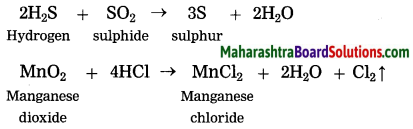
Maharashtra Board Class 10 Science Solutions Part 1 Chapter 3 Chemical Reactions and Equations 4

b. How can the rate of the chemical reaction, namely, decomposition of hydrogen peroxide be increased?
Answer:
At room temperature, the decomposition of hydrogen peroxide into water and oxygen takes place slowly. However, the same reaction occurs at a faster rate on adding manganese dioxide (MnO2),
powder in it.

c. Explain the term reactant product giving examples.
Answer:

  1. The substance which undergoes bond breaking while taking part in a chemical reaction is called reactant.
  2. The substance formed as a result of a chemical reaction by formation of new bonds is called product.
  3. Example: In a chemical reaction, the formation of carbon dioxide gas takes place by combustion of coal in air. In this reaction, coal (carbon) and oxygen (from air) are the reactants while carbon dioxide is the product.

d. Explain the types of reactions with reference to oxygen and hydrogen. Illustrate with examples.
Answer:
With reference to oxygen and hydrogen, there are two types of reaction

  1. Oxidation reaction
  2. Reduction reaction.

1. Oxidation reaction:
Examples:
(1) When carbon burns in air, it forms carbon dioxide. In this reaction carbon accepts oxygen, therefore, this is an oxidation reaction.
C(s) + O2(g) → CO2(g)

(2) When sodium reacts with ethyl alcohol, sodium ethoxide and hydrogen gas is formed. In this reaction, hydrogen is removed from ethyl alcohol, therefore this is an oxidation reaction.

Maharashtra Board Class 10 Science Solutions Part 1 Chapter 3 Chemical Reactions and Equations 5

(3) Acidified potassium dichromate (K2Cr2O7 / H2SO4) oxidises ethly alcohol to acetic acid.

Maharashtra Board Class 10 Science Solutions Part 1 Chapter 3 Chemical Reactions and Equations 6

2. Reduction reaction:
Examples:
(1) When hydrogen gas is passed over black copper oxide a reddish coloured layer of copper is
formed.
In this reaction an oxygen atom removed from CuO to form copper, hence, this is reduction.

Maharashtra Board Class 10 Science Solutions Part 1 Chapter 3 Chemical Reactions and Equations 7

(2) when hydrogen gas is passed over red hot coke, methane is obtained.
Here, hydrogen is added to coke (carbon). Hence, this is reduction.

Maharashtra Board Class 10 Science Solutions Part 1 Chapter 3 Chemical Reactions and Equations 8

e. Explain the similarity and difference in two events, namely adding NaOH to water and adding CaO to water.
Answer:
Similarity : Both NaOH and CaO, when dissolved separately in water, solid NaOH dissolves releasing heat, resulting in rise in temperature. This reaction is exothermic reaction. When solid CaO dissolves in water, Ca(OH)2 is formed, large amount of heat is evolved. This reaction is also exothermic reaction. Both reactions are combination reactions and single product is obtained.
NaOH(s) + H2O → NaOH(aq) + Heat
CaO(s) + H2O → Ca(OH)2(aq) + Heat
Difference:

  1. Aqueous solution of NaOH is considered as a strong alkali.
  2. Aqueous solution of Ca(OH)2 is considered as a weak alkali.

Maharashtra Board Class 10 Science Solutions Part 1 Chapter 3 Chemical Reactions and Equations

Question 3.
Explain the following terms with examples.
a. Endothermic reaction
Answer:
Endothermic reaction: The reaction in which heat is absorbed is called an endothermic
reaction.
when KNO3(s) dissolves in water, there is absorption of heat during the reaction and the temperature of the solution falls.
KNO2(s) + H2O(l) + Heat → KNO3(aq)

b. Combination reaction
Answer:
When two or more reactants combine in a reaction to form a single product, it is called a combination reaction.
Examples:
1. The ammonia gas reacts with hydrogen chloride gas to form the salt in gaseous state, immediately it condenses at room temperature and gets transformed into the solid state.

Maharashtra Board Class 10 Science Solutions Part 1 Chapter 3 Chemical Reactions and Equations 10

2. Magnesium burns in air to form white powder of magnesium oxide as a single product.
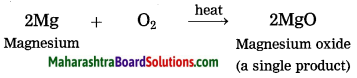
Maharashtra Board Class 10 Science Solutions Part 1 Chapter 3 Chemical Reactions and Equations 11

3. Iron reacts with sulphur to form iron sulphide.

Maharashtra Board Class 10 Science Solutions Part 1 Chapter 3 Chemical Reactions and Equations 12

c. Balanced equation
Answer:
In a chemical reaction, the number of atoms of the elements in the reactants is same as the number or atoms of those elements in the product, such an equation is called a balanced equation.
Example: AgNO3 + NaCl → AgCl + NaNO3
In the above reaction, the number of atoms of the elements in the reactants is same as the number of atoms of elements in the products.

d. Displacement reaction
Answer:
The reaction in which the place of the ion of a less reactive element in a compound is taken by another more reactive element by the formation of its own ions is called displacement reaction.

When zinc granules are added to the blue coloured copper sulphate solution, the zinc ions formed from zinc atoms take the place of Cu2+ ions in CuSO4, and copper atoms, formed from Cu2+ ions comes out i.e. the more reactive zinc displaces the less reactive Cu from copper sulphate.

Maharashtra Board Class 10 Science Solutions Part 1 Chapter 3 Chemical Reactions and Equations 9

4. Give scientific reason:
a. When the gas formed on heating lime stone is passed through freshly prepared lime water, the lime water turns milky.
Answer:
when lime stone is heated, calcium oxide and carbon dioxide are formed. This carbon dioxide gas is passed through freshly prepared lime water, insoluble calcium carbonate and water are formed. In this reaction, lime water turns milky.
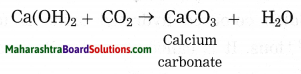
Maharashtra Board Class 10 Science Solutions Part 1 Chapter 3 Chemical Reactions and Equations 13

b. It takes time for pieces of Shahabud tile to disappear in HCl, but its powder disappears rapidly.
Answer:
The rate of a reaction depends upon the size of the particles of the reactants taking part in the reaction. The smaller the size of the reactants particles, the more is their total surface area and the faster is the rate of reaction.

In the reaction of dil. HCl with pieces of Shahabad tile, CO2 effervescence is formed amid the tile disappears slowly. On the other hand. CO2 effervescence forms at faster rate with Shahabad tile powder and it disappears rapidly.

c. While preparing dilute sulphuric acid from concentrated sulphuric acid in the laboratory, the concentrated sulphuric acid is added slowly to water with constant stirring.
Answer:
(1) The preparation of dilute sulphuric acid falls in the category of extreme exothermic process.

(2) During the preparation of dilute sulphuric acid. large amount of water is taken in a glass container which is surrounded by ice. Cool it for twenty minutes, Now small quantity of conc. H2SO4 is added slowly with stirring. Therefore, only a small amount of heat is liberated at a time. In this way dilute sulphuric acid is prepared.

(3) On the other hand, in the process of dilution or conc. sulphuric acid with water, very large amount of heat is liberated. As a result, water gets evaported instantaneously, if it is poured in to conc. H2SO4 which may cause an accident.

d. It is recommended to use air tight container for storing oil for long time.
Answer:

  1. If edible oil is allowed to stand for a long time, it undergoes air oxidation, it becomes rancid and its smell and taste changes.
  2. Rancidity in the rood stuff cooked in oil or ghee is prevented by using antioxidants. The process of oxidation reaction of food stuff can also be slowed down by storing it in air tight container.

Maharashtra Board Class 10 Science Solutions Part 1 Chapter 3 Chemical Reactions and Equations

Question 5.
Observe the following picture a write down the chemical reaction with explanation.
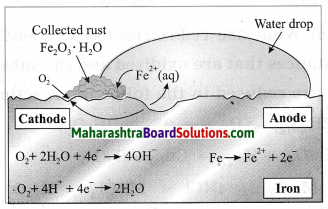
Maharashtra Board Class 10 Science Solutions Part 1 Chapter 3 Chemical Reactions and Equations 14
Answer:
The rusting of iron is an oxidation process. The rust on iron does not form by a simple reaction between oxygen and iron surface. The rust is formed by an electrochemical reaction. Fe oxidises to Fe2O3. H2O on one part of iron surface while oxygen gets reduced to H2O on another part or surface, Different regions on the surface of iron become anode and cathode.
(1) Fe is oxidised to Fe2+ in the anode region.
Fe(s) → Fe2+ (aq) + 2e
(2) O2 is reduced to form water in the cathode region.
O2(g) + 4H+ (aq) + 4e— → 2H2O(l)

When Fe2+ ions migrate from the anode region they react with water and futher get oxidised to form Fe3+ ions.
A reddish coloured hydrated oxide is formed from Fe3+ ions. It is called rust. It collects on the
surface.
2Fe3+ (aq) + 4H2O(l) → Fe2O3. H2O(s) + 6H+ (aq)
Because of various components in the atmosphere, oxidation of metals takes place, consequently resulting in their damage. This is called ‘corrosion’. Iron rusts and a reddish coloured layer is formed on it. This is corrosion of iron.

Question 6.
Identify from the following reactions the reactants that undergo oxidation and reduction.
a. Fe + S → FeS
Answer:
Fe + S → FeS
In this reaction, Iron (Fe) undergoes oxidation
and sulphur. (S) undergoes reduction.

b. 2Ag2O → 4Ag + O2
Answer:
2Ag2O → 4Ag + O2
In this reaction, reduction of Ag2O takes place.

c. 2Mg + O2 → 2MgO
Answer:
2Mg + O2 → 2MgO
In this reaction, oxidation of Mg takes place.

d. NiO + H2 → Ni + H2O
Answer:
NiO + H2 → Ni + H2O
In this reaction, reduction of NiO takes place and oxidation of H2 takes place.

Maharashtra Board Class 10 Science Solutions Part 1 Chapter 3 Chemical Reactions and Equations

Question 7.
Balance the following equation stepwise.
a. H2S2O7(l) + H2O(l) → H2SO4(l)
Answer:
Step 1: Rewrite the given equation as it is
H2S2O7(l) + H2O(l) → H2SO4(l)
Step 2: write the number or atoms of each element in the unbalanced equation on both sides of equations.

Element Number of atoms in reactant (left side) Number of atoms in products (right side)
H 4 2
S 2 1
O 8 4

Step 3: To equalise the number of hydrogen atoms, sulphur atoms and oxygen atoms we use 2 as the coemficient or factor in the product.

Element Number of atoms in reactant (left side) Number of atoms in products (right side)
H 4 2 × 2
S 2 1 × 2
O 8 4 × 2
Total 14 14

Now the equation becomes H2S2O7 + H2O → 2H2SO4
Now, count the atoms of each element on both sides of the equation. The number of atoms on both sides are equal. Hence, the balanced equation is
H2S2O7 + H2O → 2H2SO4
Now indicate the physical states of the reactants and products.
H2S2O7(l) + H2O(l) → 2H2SO4(l)

b. SO2(g) + H2S(aq) → S(s) + H2O(l)
Answer:
Step 1:
Rewrite the given equation as it is
SO2(g) + H2S(aq) → S(s) + H2O(l)

Step 2:
Write the number of atoms of each element in the unbalanced equation on both sides of equations.

Element Number of atoms in reactants (left side) Number of atoms in products (right side)
S 2 1
O 2 1
H 2 2

The number of hydrogen atoms on both sides of the equation is same, therefore, equalise the number of sulphur atoms and oxygen atoms.

Step 3: To balance the number of sulphur atoms:

Number of atoms of sulphur In reactants In products
S2O H2S (S)
Initially 1 1 1
To balance 1 1 1 × 2

To equalise the number of sulphur atoms, we use 2 as the factor in the product, now the equation becomes
SO2 + H2S → 2S + H2O

Step 4:
To equalise the number of oxygen atoms in the unbalanced equation.

Number of atoms of oxygen In reactants (SO2) In products H2O
Initially 2 1
To balance 2 1 × 2

To equalise the number of sulphur atoms, we use 2 as the factor in the product i.e. H2O, now the unbalanced equation becomes
SO2 + H2S → 2S + 2H2O

Step 5:
To equalise the number of hydrogen atoms in unbalanced equation:

Number of atoms of hydrogen In reactants (H2S) In products (H2O)
Initially 2 4
To balance 2 × 2 4

To equalise the number of hydrogen atoms we use 2 as the factor in the reactant i.e, H2S, now the unbalanced equation become
SO2 + 2H2S → 2S + 2H2O
Now, count the atoms of each element on both sides of the equation, there are less number of sulphur atoms in the product. Now equalise the sulphur atoms, the balanced equation becomes,
SO2 + 2H2S → 3S + 2H2O
Now indicate the physical states of reactants and products.
SO2(g) + 2H2S(aq) → 3S(s) + 2H2O(l)

c. Ag(s) + HCl(l) → AgCl ↓ + H2
Answer:
Step 1:
Rewrite the given equation as it is
Ag(s) + HCl(l) → AgCl ↓ + H2

Step 2:
write the number of atoms or each element in the unbalanced equation on both sides of equations.

Element Number of atoms in reactants (left side) Number of atoms in products (right side)
Ag 1 1
H 1 2
Cl 1 1

The number of silver and chlorine atoms on both sides of the equation are same, therefore, equalise the number of hydrogen atoms.

Step 3:
To balance the number of hydrogen atoms.

Number of atoms of hydrogen In reactants HCl In products H2
Initially 1 2
To balance 1 × 2 2

To equalise the number of hydrogen atoms, we use 2 as the factor in the product HCl, now the unbalanced equation become
Ag(s) + 2HCl → AgCl + H2

Step 4:
To balance the number of chlorine atoms:

Number of atoms of chlorine In reactants (2HCl) In products (AgCl)
Initially 2 1
To balance  2 2 ×1

To equalise the number of chlorine atoms, we use 2 as the factor in the product AgCl. now the unbalanced equation becomes
Ag + 2HCl → 2AgCl + H2
Now count the atoms of each element on both sides of the equation, there are less number of silver atoms in the reactant. Now equalise the silver atoms, the balanced equation becomes
2Ag + 2HCl → 2AgCl + H2
Now indicate the physical states of the reactunts and products
2Ag(s) + 2HCl(l) → 2AgCl ↓ + H2

d. H2SO4(aq) + NaOH(aq) → Na2SO4(aq) + H2O(l)
Answer:
Step 1:
Rewrite the given equation as it is
H2SO4(aq) + NaOH(aq) → Na2SO4(aq) + H2O(l)

Step 2:
write the number of atoms of each element in the unbalanced equation on both sides of the equation.

Element Number of atoms in reactants Number of atoms in products
Na 1 2
S 1 1
O 5 5
H 3 2

The number of oxygen atoms involved in different compounds on both sides (reactants and products) are equal. Therefore, balance the number of atoms of the second element, sodium.

Step 3:
To balance the number of sodium atoms:

Number of atoms of sodium In reactants In products
To begin with 1 (in NaOH) 2 (in Na2SO4)
To balance  1 × 2 2

To equalise the number of sodium atoms, we use 2 as the factor of NaOH in the reactants. Now, the partly balanced equation becomes as follows
H2SO4 + 2NaOH → Na2SO4 + H2O

Step 4:
Now, balance the number of hydrogen atoms:

Number of atoms of hydrogen In reactants In products
To begin with (in H2SO4)
2 (in NaOH)
2 (in H2O)
To balance  4 2 × 2

To equalise the number of hydrogen atoms, we use 2 as the factor or H2O in the products. The equation then becomes
H2SO4 + 2NaOH → Na2SO4 + H2O
Now, count the atoms of each element on both sides of the equation. The number of atoms on both sides are equal. Hence, the balanced equation is
H2SO4 + 2NaOH → Na2SO4 + 2H2O
Now indicate the physical states of the reactants and the products.
H2SO4(aq) + 2NaOH(aq) → Na2SO4(aq) + 2H2O(l)

Question 8.
Identify the endothermic and exothermic reaction.
a. HCl + NaOH → NaCl + H2O + heat
Answer:
Exothermic reaction.

b. \(2 \mathrm{KClO}_{3}(\mathrm{s}) \stackrel{\Delta}{\longrightarrow} 2 \mathrm{KCl}(\mathrm{s})+3 \mathrm{O}_{2} \uparrow\)
Answer:
Exothermic reaction.

c. CaO + H2O → Ca(OH)2 + heat
Answer:
Exothermic reaction.

d. \(\mathrm{CaCO}_{3}(\mathrm{s}) \stackrel{\Delta}{\longrightarrow} \mathrm{CaO}(\mathrm{s})+\mathrm{CO}_{2} \uparrow\)
Answer:
Exothermic reaction.

Maharashtra Board Class 10 Science Solutions Part 1 Chapter 3 Chemical Reactions and Equations

Question 9.
Match the column in the following table:

Reactants products Type of chemical reaction
BaCl2(aq) + ZnSO4(aq) H2CO3(aq) Displacement
2 AgCl(s) FeSO4(aq) + Cu(s) Combination
CuSO4(aq) + Fe(s) BaSO4↓ + ZnCl2(aq) Decomposition
H2O(l) + CO2(g) 2Ag(s) + Cl2(g) Double displacement

Answer:

Reactants products Type of chemical reaction
BaCl2(aq) + ZnSO4(aq) BaSO4↓ + ZnCl2(aq) Double displacement
2 AgCl(s) 2Ag(s) + Cl2(g) Decomposition
CuSO4(aq) + Fe(s) FeSO4(aq) + Cu(s) Displacement
H2O(l) + CO2(g) H2CO3(aq) Combination

Project:
Do it your self:
1. Prepare aqueous solutions or various solid salts available in the laboratory. Observe what happens when aqueous solution of sodium hydroxide is added to these. Prepare a chart of double displacement reactions based on these observation.

2. Observe and note the physical and chemical changes experienced in various incidents in your day to day 1ife.

Can you recall? (Text Book Page No.16)

Question 1.
what are the types of molecules of elements and compounds?
Answer:
Elements are divided into three classes i.e. metals, nonmetals and metalloids. When two or more elements combine chemically in a fixed proportion by weight, a compound is formed. The properties of a compound are altogether different from those of the constitutional elements.

Question 2.
what is meant by valency of element?
Answer:
The number of electrons that an atom of an element gives away or takes up while forming an ionic bond, is called the valency or that element.

Question 3.
What is the requirement for writing molecular formulae of different compounds?
How are the molecular formulae of the compounds written?
Answer:
while writing the molecular formulae of different compounds, the symbol of the radicals and their valence should be known.
The number of the ions is written as subscript on the right of the symbol or the ion. By cross multiplication of valenceies chemical formula is obtained.

Find out (Text Book Page No. 44)
Question1.
How are the blackened silver utensils and patinated (greenish) brass utensils cleaned?
Answer:
The blackened silver utensils and patinated (greenish) brass utensils are cleaned using baking soda, vinegar and lemon mix.

Use your brain power! (Text Book Page No. 35)

Question 1.
write down the physical states of reactants and products in the reaction
SO2 + 2H2S → 3S + 2H2O
Answer:
Reactants : SO2(g), 2H2S(g)
Products : 3S(s), 2H2O(l).

Question 2.
write down the physical states of reactants and products in the reaction
2Ag + 2HCl → 2AgCl + H2
Answer:
Reactants: 2Ag(s), 2HCl(l)
Products: 2AgCl ↓, H2

Question 3.
Identify the reactants and products of the following equation.

Maharashtra Board Class 10 Science Solutions Part 1 Chapter 3 Chemical Reactions and Equations 15
Answer:
Reactants: vegetable oil, H2(g)
Product: Vanaspathi ghee

Use your brain power! (Text Book Page No. 42)

Question 1.
Which is the oxidant used for purification of drinking water?
Answer:
The chlorine based oxidants are used in the purification of drinking water.

Maharashtra Board Class 10 Science Solutions Part 1 Chapter 3 Chemical Reactions and Equations

Question 2.
Why is potassium permanganate used during cleaning water tanks?
Answer:
Potassium permanganate is an oxidising agent. It oxidises dissolved iron, manganese and hydrogen sulphide into solid particles that are filtered out of the water tank. It is used to control iron bacteria growth in tank.

Can you tell? (Text Book Page No. 43)

Question 1.
what is the type of this reaction, in which Vanaspathi ghee is formed from vegetable oil?
Answer:

Maharashtra Board Class 10 Science Solutions Part 1 Chapter 3 Chemical Reactions and Equations 16
In the preparation of vanaspathi ghee from vegetable oil hydrogen gas is used. This process is known as hydrogenation. This is reduction reaction.

Find out (Text Book page No. 33)

What are the other uses of silver nitrate in every day life?
Answer:
Silver nitrate is used in the voters-ink. It is used as reactant in the laboratory. Silver nitrate is used to prevent infection in wounds and skin burns.

Use your brain power! (Text Book Page No. 35)

Question 1.
N2(g) + H2(g) ⇌ NH3(g)
Answer:
Step 1:
Rewrite the given equation as it is
N2(g) + H2(g) ⇌ NH3(g)

Step 2:
Write the number of atoms of each element in the unbalanced equation on both sides of equations

Element Number of atoms in reactants Number of atoms in products
N 2 1
H 2 3

Step 3:
In the given equation. NH3 is a compound and it contains hydrogen element. On the left hand side there are two H atoms and on the right side 3H atoms. Equalise H atoms on both sides.

Hydrogen atoms In reactants In products
Initially 2 3
To balance 3 × 2 2 × 3

To equalise the number of hydrogen atoms, we use 3 as the factor in the reactant and 2 as the factor in the products. Now the equation becomes
N2 + 3H2 → 2NH3
Now, count the atoms of each element on both sides of the equation. The number of atoms on both sides are equal. Hence, the balanced equation is
N2 + 3H2 → 2NH3
Now indicate the physical states of the reactants and products
N2(g) + 3H2(g) ⇌ 2NH3(g)

Question 2.
Calcium chloride + Sulphuric acid → Calcium sulphate + Hydrogen chloride.
Answer:
Step 1:
Write the chemical equation from the given word equation.
CaCl2 + H2SO4 → CaSO4 + HCl

Step 2:
Write the number of atoms of each element in the unbalanced on both sides of equation.

Element Number of atoms in reactants Number of atoms in products
Ca 1 1
Cl 2 1
H 2 1
S 1 1
O 4 4

Step 3:
In the given equation H2SO4 is a compound and it contains hygrogen element. On the left hand side there are two hydrogen atoms and on the right side one hydrogen atom. Equalise H atoms on both sides.

Hydrogen atoms In reactants (H2SO4) In products (HCl)
Initially 2 1
To balance 2 2  × 1

To equalise the number of hydrogen atoms we use 2 as the factor in the product so that the number of H atoms on both sides are equal. Therefore, the equation becomes
CaCl2 + H2SO4 → CaSO4 + 2 HCl
Now, count the atoms of each element on both sides of the equation. The number of atoms on both sides are equal hence, the balanced equation is
CaCl2 + H2SO4 → CaSO4 + 2 HCl
Now, indicate the physical state of the reactants and products.
CaCl2(s) + H2SO4(l) → CaSO4(s) + HCl(l)

Can you tell? (Text Book Page No. 39)

Take into account the time required for following processes. Classify them into two groups and give titles to the groups.
(1) Cooking gas starts burning on ignition.
(2) Iron article undergoes rusting.
(3) Erosion of rocks takes place to form soil.
(4) Alcohol is formed on mixing yeast in glucose solution under proper condition.
(5) Effervescence is formed on adding baking soda into a test tube containing dilute acid.
(6) A white precipitate is formed on adding dilute sulphuric acid to barium chloride solution.
Answer:
The above processes are classified into two groups (a) slow speed reactions (b) fast speed reactions.
Slow speed reactions: (2), (3) and (4).
Fast speed reactions: (1),(5) and (6).

Maharashtra Board Solutions

Use your brain power! (Text Book Page No. 43)

Question 1.
Some more examples of redox reaction are as follows. Identify the reductants and oxidants from them.
(1) 2H2S + SO2 → 3S↓ + 2H2O
(2) MnO2 + 4HCl → MnCl2 + 2H2O + Cl2
Answer:
Oxidants: SO2, MnO2
Reductants: H2S, HCl

Question 2.
If oxidation means losing electrons, what is meant by reduction.
Answer:
Reduction means gaining one or more electrons.

Question 3.
Write the reaction of formation of Fe2+ by reduction Fe3+ by making use of the symbol (e).
Answer:
Fe3+ + e → Fe2+ (reduction)

Think about it (Text Book Page No. 43)

Question 1.
The luster of the surface of the aluminium utensils in the house is lost after a few days. Why does this happen?
Answer:
The aluminium utensils when kept in the house for a few days, oxidation of aluminium takes place, a thin laver aluminium oxide (Al2O3) is deposited on the surface. Hence, aluminium utensils lose their lustre in a few days.

Question 3.
How many products are formed in each of the above reactions?
Answer:
A single product is formed in each of the above reaction.

Use your brain power! (Text Book Page No. 39)

Question 1.
What is the difference in the process of dissolution and a chemical reaction.
Answer:
In the process of dissolution, new substance is not necessarily formed. Whereas in a chemical reaction a new substance is definitely formed.

Question 2.
Does a new substance form when a solute dissolves in a solvent?
Answer:
It is not necessary that a new substance is always formed.

Fill in the blanks:

Question 1.
Organic waste is decomposed by micro-organism and as a result manure and……..are formed.
Answer:
Organic waste is decomposed by micro-organism and as a result manure and bio gas are formed.

Question 2.
……….is formed on mixing yeast in glucose solution under proper condition.
Answer:
Alcohol is formed on mixing yeast in glucose solution under proper condition.

Question 3.
The chemical reaction during which H2(g) is lost is termed as………
Answer:
The chemical reaction during which H2(g) s lost is termed as oxidation.

Question 4.
Corrosion can be prevented by using………
Answer:
Corrosion can be prevented by using antirust solution.

Question 5.
The chemical reactions in which heat is liberated are called………..reactions.
Answer:
The chemical reactions in which heat is liberated are called exothermic reactions.

Question 6.
The chemical formula of rust is………
Answer:
The chemical formula of rust is Fe2O3.H2O.

Question 7.
A reaction in which heat is absorbed is called………reaction.
Answer:
A reaction in which heat is absorbed is called endothermic reaction.

Question 8.
The process of rusting or iron is………process.
Answer:
The process of rusting of iron is oxidation process.

Question 9.
when oil and fats are oxidised or even allowed to stand in air for a long time, they become ……….
Answer:
when oil and fats are oxidised or even allowed to stand in air for a long time, they become rancid.

Question 10.
……… are used to prevent oxidation of food.
Answer:
Antioxidants are used to prevent oxidation of food.

Question 11.
Carbon dioxide is passed through water. The reaction is a………reaction.
Answer:
Carbon dioxide is passed through water. The reaction is a combination reaction.

Question 12.
Calcium carbonate is heated. The reaction is a………..reaction.
Answer:
Calcium carbonate is heated. The reaction is a decomposition reaction.

Question 13.
Zinc strip is dipped in a CuSO4 solution. The reaction is a……….reaction.
Answer:
Zinc strip is dipped in a CuSO4 solution. The reaction is a displacement reaction.

Question 14.
Silver nitrate solution is added to NaCl solution. The reaction is a……….reaction.
Answer:
Silver nitrate solution is added to NaCl solution. The reaction is a double displacement reaction.

Maharashtra Board Class 10 Science Solutions Part 1 Chapter 3 Chemical Reactions and Equations

Question 15.
The slow process of decay or destruction of a metal due to effect of air, moisture and acids on it is known as……….
Answer:
The slow process of decay or destruction of a metal due to effect of air, moisture and acids on it is known as corrosion.

Rewrite the following statements by selecting the correct options:

Question 1.
The reaction of iron nail with copper sulphate solution is………reaction. (March 2019)
(a) double displacement
(b) displacement
(c) combination
(d) decomposition
Answer:
(b) displacement

Question 2.
Reddish brown deposit formed on iron nails kept in a solution of copper sulphate is
(a) Cu2O
(b) Cu
(c) CuO
(d) CuS
Answer:
(b) Cu

Question 3.
The reaction CuSO4(aq) + Zn(s) → ZnSO4(aq) + Cu(s) is a……..reaction.
(a) displacement
(b) double displacement
(c) decomposition
(d) combination
Answer:
(a) displacement

Question 4.
………is a combination reaction.
(a) Cu + H2SO4 → CuSO4 + H2
(b) H2 + Cl2 → 2HCl
(c) \(2 \mathrm{HgO} \stackrel{\Delta}{\longrightarrow} 2 \mathrm{Hg}+\mathrm{O}_{2}\)
(d) \(\mathrm{CaCO}_{3} \stackrel{\Delta}{\longrightarrow} \mathrm{CaO}+\mathrm{CO}_{2}\)
Answer:
(b) H2 + Cl2 → 2HCl

Question 5.
………..a decomposition reaction.
(a) \(\mathrm{CaCO}_{3} \stackrel{\Delta}{\longrightarrow} \mathrm{CaO}+\mathrm{CO}_{2}\)
(b) H2O + CO2 → H2CO3
(c) CaS + 2HCl → CaCl2 + H2S
(d) 2H2 + O2 → 2H2O
Answer:
(a) \(\mathrm{CaCO}_{3} \stackrel{\Delta}{\longrightarrow} \mathrm{CaO}+\mathrm{CO}_{2}\)

Question 6.
In a chemical equation the……….are written on the left hand side.
(a) products
(b) reactants
(c) catalysts
(d) elements
Answer:
(b) reactants

Question 7.
The Δ sign written above the arrow indicates………..of the reaction.
(a) reactant
(b) product
(c) heat
(d) direction of the reaction
Answer:
(c) heat

Question 8.
The reaction KNO3(S) + H2O(l) + Heat → KNO3(aq) is a/an……….reaction.
(a) exothermic
(b) endothermic
(c) oxidation
(d) reduction
Answer:
(b) endothermic

Question 9.
The reaction NaOH(S) + H2O(l) → NaOH(aq) is a/an……..reaction.
(a) exothermic
(b) endothermic
(c) oxidation
(d) reduction
Answer:
(a) exothermic

Question 10.
A solution of Al2(SO4)3 in water is……….
(a) blue
(b) pink
(c) green
(d) colourless
Answer:
(d) colourless

Question 11.
Carbon dioxide………..
(a) turns lime water milky
(b) is odourless
(c) is colourless
(d) All the three (a), (b) and (c) are correct
Answer:
(d) All the three (a), (b) and (c) are correct

Question 12.
……….is the correct set up to pass CO2 through lime water.
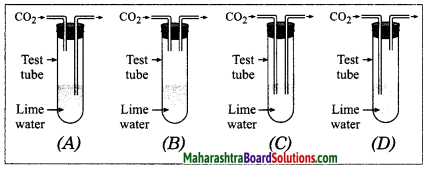
Maharashtra Board Class 10 Science Solutions Part 1 Chapter 3 Chemical Reactions and Equations 17
Answer:
Correct set up D.

Maharashtra Board Class 10 Science Solutions Part 1 Chapter 3 Chemical Reactions and Equations

Question 13.
when……..is passed through fresh lime water, it turns milky.
(a) H2
(b) CO
(c) CO2
(d) SO2
Answer:
(c) CO2

Question 14.
Magnesium reacts with con. HCl to form………..salt.
(a) copper chloride
(b) ferrous chloride
(c) calcium chloride
(d) magnesium chloride
Answer:
(d) magnesium chloride

Question 15.
Zinc reacts with hydrochloric acid. The reaction is a reaction.
(a) combination
(b) decomposition
(c) displacement
(d) double decomposition
Answer:
(c) displacement

Question 16.
In a double displacement reaction,………… (Practice Activity Sheet – 1)
(a) ions remain at rest
(b) ions get liberated
(c) ions are exchanged
(d) ions are not created
Answer:
(c) ions are exchanged

State whether the following statements are True or False:

Question 1.
Rusting of iron is a fast reaction.
Answer:
False. (Rusting of iron is a slow reaction.)

Question 2.
Milk is set into curd is a chemical change.
Answer:
True.

Question 3.
The reaction between salt and water is an example of exothermic reaction.
Answer:
False. (The reaction between salt and water is an example of endothermic reaction.)

Question 4.
The speed of a chemical reaction depends on the catalyst used in the chemical reaction.
Answer:
True.

Maharashtra Board Solutions

Question 5.
The simple form of representation of a chemical reaction in words is known as word reaction.
Answer:
True.

Question 6.
Nascent oxygen is always denoted by showing the symbol of oxygen.
Answer:
False. (Nascent oxygen is always denoted by showing symbol of oxygen [0] in square brackets.)

Question 7.
Antioxidants are used to prevent oxidation or food containing fats and oils.
Answer:
True.

Maharashtra Board Class 10 Science Solutions Part 1 Chapter 3 Chemical Reactions and Equations

Question 8.
When oils and fats are allowed to stand for a long time, they become rancid.
Answer:
True.

Question 9.
The chemical formula of rust is Fe3O4 .xH2O.
Answer:
False. (The chemical formula or rust is Fe2O3 .xH2O.)

Question 10.
Glucose combines with oxygen in our body and provides energy. The reaction is an endothermic reaction.
Answer:
False. (Glucose combines with oxygen in our body and provides energy. The reaction is an exothermic reaction.)

Question 11.
Chemical reactions in which reactants gain oxygen are reduction reactions.
Answer:
False. (Chemical reactions in which reactants gain oxygen are oxidation reactions.)

Question 12.
CuSO4(aq) + Znl(s) → ZnlSO4(aq) + Cu(s) is an example of decomposition reaction.
Answer:
False. (It is an example of displacement reaction.)

Question 13.
The chemical reactions in which heat is liberated are called endothermic reactions.
Answer:
False. (The chemical reactions in which heat is liberated are called exothermic reactions.)

Question 14.
The product or insoluble solid in chemical reaction is indicated by an arrow pointing upwards.
Answer:
False. (The product or insoluble solid in chemical reaction is indicated by an arrow ↑ pointing downwards.)

Question 15.
The rate of a reaction increases on increasing the temperature.
Answer:
True.

Question 16.
The digestion of food is a chemical decomposition process.
Answer:
True.

Question 17.
The reaction between sodium hydroxide and hydrochloric acid is a slow reaction.
Answer:
False (The reaction between sodium hydroxide and hydrochloric acid is a fast reaction.)

Question 18.
When calcium carbonate is heated, it decomposes into calcium oxide and oxygen gas.
Answer:
False (when calcium carbonate is heated. it decomposes into calcium oxide and carbon dioxide gas.

Question 19.
The rate of a chemical reaction changes in presence of catalyst.
Answer:
True.

Maharashtra Board Class 10 Science Solutions Part 1 Chapter 3 Chemical Reactions and Equations

Question 20.
Chlorines is an oxidant.
Answer:
True.

Taking into consideration the relationship in the first pair, complete the second pair. (OR) Complete the following:

Question 1.
2H2 + O2 → 2H2O Combination reaction :: 2HgO → 2Hg + O2 :……….
Answer:
Decomposition reaction

Question 2.
NH3 + HCl → NH4Cl : Combination reaction :: Fe + CuSO4 → FeSO4 + Cu :……..
Answer:
Displacement reaction

Question 3.
2C2H5OH + 2Na → 2C2H5ONa + H2 : Oxidation :: CuO + H2 → Cu + H2O :……….
Answer:
Reduction

Question 4.
CuCl2 + 2KI → CuI2 + 2KCl : Double displacement :: Zn + 2HCl → ZnCl2 + H2 :……….
Answer:
Displacement reaction

Question 5.

Maharashtra Board Class 10 Science Solutions Part 1 Chapter 3 Chemical Reactions and Equations 18
Answer:
Combination reaction

Question 6.
CuI2 : Brown :: AgCl :……….
Answer:
White.

Match the column in the following table:

Question 1.

Reactants products Type of chemical reaction
Fe + S NaCl + H2O Oxidation
CuSO4 + Zn 2CuO Neutralization
2Cu + O2 ZnSO4 + Cu Displacement
HCl + NaOH FeS Combination

Answer:

Reactants products Type of chemical reaction
Fe + S FeS Combination
CuSO4 + Zn ZnSO4 + Cu Displacement
2Cu + O2 2CuO Oxidation
HCl + NaOH NaCl + H2O Neutralization

Maharashtra Board Class 10 Science Solutions Part 1 Chapter 3 Chemical Reactions and Equations

Rewrite the second column so as to match the item from first column or Match the following:

Question 1.

Column I Column II
1. Reduction (a) Type of a chemical reaction
2. Oxidation (b) Combination with hydrogen
3. Double displacement (c) Losing hydrogen
4. Displacement (d) Exchange of ions

Answer:
(1) Reduction – Combination with hydrogen
(2) Oxidation – Losing hydrogen
(3) Double displacement – Exchange of ions
(4) Displacement – Type of chemical reaction.

Question 2.

Column I Column II
1. Oils and fats are allowed to stand in air for a long time (a) Slow  reaction
2. NaOH dissolves in water (b) Rancid
3. Zinc is added to CuSO4 solution (c) Exothermic reaction
4. Rusting of water (d) Colourless Solution

Answer:
(1) Oils and fats are allowed to stand in air for a long time – Rancid
(2) NaOH dissolves in water – Exothermic reaction
(3) Zinc is added to CuSO2 solution – Colourless solution
(4) Rusting of iron – Slow reaction.

Question 3.
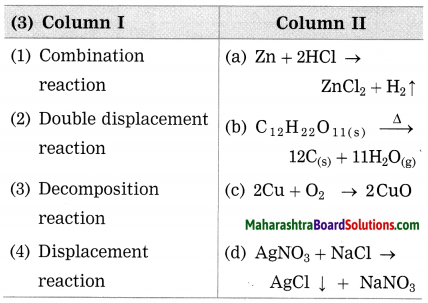
Maharashtra Board Class 10 Science Solutions Part 1 Chapter 3 Chemical Reactions and Equations 77
Answer:
(1) Combination reaction – 2Cu +O4 → 2CuO
(2) Double displacement reaction – AgNO3 + NaCl → AgCl ↓ + NaNO3
(3) Decomposition reaction – \(\mathrm{C}_{12} \mathrm{H}_{22} \mathrm{O}_{11(\mathrm{s})} \stackrel{\Delta}{\longrightarrow} 12 \mathrm{C}_{(\mathrm{s})}+11 \mathrm{H}_{2} \mathrm{O}_{(\mathrm{g})}\)
(4) Displacement reaction – Zn+ 2HCl → ZnCl2 + H2

Classify each of the following reactions as combination, decomposition, displacement or double displacement reactions:
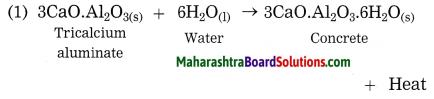
Maharashtra Board Class 10 Science Solutions Part 1 Chapter 3 Chemical Reactions and Equations 19
Answer:
Combination reaction

Maharashtra Board Class 10 Science Solutions Part 1 Chapter 3 Chemical Reactions and Equations 20
Answer:
Decomposition reaction

Maharashtra Board Class 10 Science Solutions Part 1 Chapter 3 Chemical Reactions and Equations 21
Answer:
Displacement reaction

Maharashtra Board Class 10 Science Solutions Part 1 Chapter 3 Chemical Reactions and Equations 22
Answer:
double displacement reaction

Maharashtra Board Class 10 Science Solutions Part 1 Chapter 3 Chemical Reactions and Equations 23
Answer:
Combination reaction

Maharashtra Board Class 10 Science Solutions Part 1 Chapter 3 Chemical Reactions and Equations 24
Answer:
double displacement reaction

Name the following:

Question 1.
The product formed in the thermal decomposition of sugar.
Answer:
Carbon is formed in the thermal decomposition of sugar.

Question 2.
The gas evolved when sorghum metal reacts with ethanol.
Answer:
Hydrogen (H2) gas is evolved when sodium metal reacts with ethanol.

Question 3.
The precipitate formed when barium sulphide reacts with zinc sulphate.
Answer:
When barium sulphide reacts with zinc sulphide, a precipitate of barium sulphate is formed.
\(\mathrm{BaS}+\mathrm{ZnSO}_{4} \longrightarrow \underset{\text { precipitate }}{\mathrm{BaSO}_{4}}+\mathrm{ZnS}\)

Question 4.
The reducing agent used for the reduction of copper oxide.
Answer:
Hydrogen is used for the reduction of copper oxide.

Maharashtra Board Class 10 Science Solutions Part 1 Chapter 3 Chemical Reactions and Equations

Question 5.
The catalyst used to accelerate the rate of decomposition of hydrogen peroxide.
Answer:
Manganese dioxide (MnO2) is used as a catalyst to accelerate the rate of decomposition of hydrogen peroxide.

Question 6.
which oxidising agent is used to oxidise ferrous sulphate.
Answer:
Potassium permanganate (KMnO4) is used as an oxidising agent to oxidise ferrous sulphate.

Question 7.
The product formed in the oxidation of ethyl alcohol.
Answer:
Acetic acid is formed in the oxidation of ethyl alcohol.

Answer the following questions in one sentence each:

Question 1.
what is meant by a chemical equation?
Answer:
The simple representation or a chemical reaction in a condensed form with the help of chemical formulae is called a chemical equation.

Question 2.
what is meant by a word equation?
Answer:
The simple form or representation or a chemical reaction in words is known as word equation.

Question 3.
what happens in a combination reaction?
Answer:
A single compound (product) is formed from two or more substances during a combination reaction.

Question 4.
what happens in a displacement reaction?
Answer:
In a displacement reaction. a more reactive element displaces another element, having less reactivity, from its compound.

Question 5.
what happens in a decomposition reaction?
Answer:
A single substance is broken down and two or more substances are formed during a decomposition reaction.

Question 6.
what happens in a double displacement reaction?
Answer:
A precipitate is formed by exchange of ions between the reactants during a double displacement reaction.

Question 7.
IdentIry the type of following reaction:
\(\mathrm{C}_{12} \mathrm{H}_{22} \mathrm{O}_{11} \stackrel{\Delta}{\longrightarrow} 12 \mathrm{C}+11 \mathrm{H}_{2} \mathrm{O}\) (Practice Activity Sheet – 2)
Answer:
The above reaction is a decomposition reaction.

Question 8.
what happens in an endothermic reaction?
Answer:
In an endothermic reaction, the reactants absorb heat to form products.

Question 9.
State the use of antioxidants in food containing fats and oils.
Answer:
Antioxidants are used to prevent oxidation of food containing fats and oils.

Question 10.
What are edible oils?
Answer:
Edible oils are compounds of alcohols and organic acids (carboxylic acids). The compounds formed are known as esters of carboxylic acids.

Question 11.
Is rancidity a phenomenon of oxidation or reduction?
Answer:
Rancidity is a phenomenon of oxidation.

Answer the following questions:

Question 1.
What do you understand by a physical change?
OR
Define physical change.
Answer:
The change in which only the physical state of a substance is changed; no new substance is formed. This change is temporary. During this change the composition of the substance does not change.

Question 2.
Explain giving two examples or physical change.
Answer:
(1) Conversion of ice into water is a physical change. On heating, ice melts into water. when the water is cooled, it freezes into ice. Thus, we get ice from water by a simple method and no new substance is formed. Hence, conversion of ice into water is a physical change.

(2) Magnetization of iron nail is a physical change. An iron nail magnetized by induction loses its magnetism as soon as it is detached from the magnet which induces magnetism in it. An iron nail magnetized by some other methods can also be demagnetized by simple means such as hammering or heating it. Thus, the magnetization of an iron nail can be easily reversed to get original nail. Hence, it is a physical change.
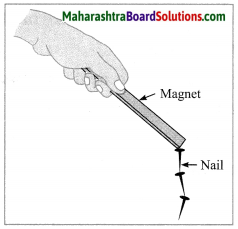
Maharashtra Board Class 10 Science Solutions Part 1 Chapter 3 Chemical Reactions and Equations 25

Question 3.
what do you understand by a chemical change?
OR
Define Chemical change.
Answer:
The change in which a substance or substances are converted into a new substance or substances, possessing properties altogether different from the original ones, is called a chemcial change. During this change, the original substance cannot be recovered by any simple means. This change is permanent.

Maharashtra Board Class 10 Science Solutions Part 1 Chapter 3 Chemical Reactions and Equations

Question 4.
Explain giving two examples of chemical change.
Answer:
(1) When carbon is burnt, carbon dioxide is formed. In this process carbon combines with oxygen, therefore carbon and oxygen are reactants, while curbon dioxide is a product. This change is permanent.
\(\mathrm{C}_{(\mathrm{s})}+\mathrm{O}_{2(\mathrm{g})} \stackrel{\text { Heat }}{\longrightarrow} \mathrm{CO}_{2(\mathrm{g})}\)

(2) When a magnesium wire is burnt in air, a white powder of magnesium oxide is formed. We cannot obtain magnesium from magnesium oxide by simple methods. Properties of magnesium oxide are altogether different from those of magnesium. A new substance MgO is formed in the reaction. Hence, this change is a chemical change.
\(\begin{array}{c}
2 \mathrm{Mg} \\
\text { Magnesium }
\end{array}+\mathrm{O}_{2} \stackrel{\Delta}{\longrightarrow} \begin{array}{c}
2 \mathrm{MgO} \\
\text { Magnesium oxide }
\end{array}\)
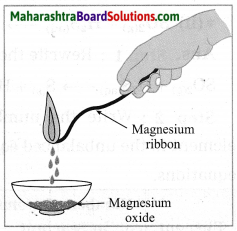
Maharashtra Board Class 10 Science Solutions Part 1 Chapter 3 Chemical Reactions and Equations 26

Question 5.
What is meant by a chemical reaction?
Answer:
A process in which some substances undergo bond breaking and are transformed into new substances by formation of new bonds is called a chemical reaction.

Question 6.
What is the importance of a chemical equation?
Answer:

  1. Reactants are converted into products.
  2. Mass is conserved.
  3. Atoms are conserved.
  4. The properties and compositions of the products of a chemical reaction are different from those of its reactants.
  5. Generally, energy is either absorbed or evolved.

Question 7.
What are the conventions used in writing a chemical equation?
Answer:
Conventions used in writing a chemical equation:
(1) The reactants are written on the left hand side (LHS), while the products are written on the right hand side (RHS).

(2) Whenever there are two or more reactants, a plus sign (+) is written between each two of them. Similarly, if there are two or more products, a plus sign is written between each two of them.

(3) Reactant side and product side are connected with an arrow (→) pointing from reactants to products. The arrow represents the direction of the reaction. Heat is to be given from outside to the reaction, it is indicated by the sign Δ written above the arrow.

(4) The conditions like temperature, pressure, catalyst, etc., are mentioned above the arrow (→) pointing towards the product side.

(5) The physical states of the reactants and products are also mentioned in a chemical equation. The notations g, l, s, and aq are written in brackets as a subscript along with the symbols / formulae of reactants and products. The symbols g, l, s, and aq stand for gaseous, 1iquid. solid and aqueous respectively.

If the product is gaseous, instead of (g) it can be indicated by an arrow ↑ pointing upwards. If the product formed is insoluble solid, then instead of (s) it can be indicated by an arrow ↓ pointing downwards.

(6) Special information or names of reactants/products are written below their formulae.

Write the balanced equations for the following reactions:

Question 1.
Ba(OH)2 + HBr → BaBr2 + H2O
Answer:
Step 1:
Rewrite the given equation as it is
Ba(OH)2 + HBr → BaBr2 + H2O

Step 2:
write the number of atoms of each element in the unbalanced equation on both sides of the equation.

Element Number of atoms in reactants Number of atoms in products
Ba 1 1
Br 1 2
O 2 1
H 3 2

Step 3:
To balance the number of oxygen atoms:

Number of atoms of oxygen In reactants In products
To begin with 2 [in Ba(OH)2] 1 (in H2O)
To balance 2 1 × 2

To equalise the number of oxygen atoms, we use 2 as the coefficient of H2O in the product.
Now, the partly balanced equation become as follows
Ba(OH)2 + HBr → BaBr2 + 2H2O

Step 4:
Now, balance the number of hydrogen atoms.
In the partly balanced equation:

Number of atoms of hydrogen In reactants In products
To begin with 2 [in Ba(OH)2]
1 (in HBr)
4 (in 2H2O)
To balance 1 × 2 + 2 4

To equalise the number of hydrogen atoms, we use 2 as the coefficient of HBr in the reactants. Now, the equation becomes
Ba(OH)2 + 2HBr → BaBr2 + 2H2O
Now, count the atoms or each element on both sides of the equation. The number of atoms on both
sides are equal. Hence, the balanced equation is
Ba(OH)2 + 2HBr → BaBr2 +2H2O
Now indicate the physical states of the reactants and products.
Ba(OH)2(aq) + 2HBr(aq) → BaBr2(aq) +2H2O(l)

Question 2.
KCN + H2SO4 → K2SO4 + HCN
Answer:
Step 1:
Rewrite the given equation as it is
KCN + H2SO4 → K2SO4 + HCN

Step 2:
Write the number of atoms of each element or group in the unbalanced equation on both sides of the equation.

Element Number of atoms in reactants Number of atoms in products
K 1 2
CN (group) 1 1
O 4 4
H 2 1
S 1 1

The number of oxygen atoms involved in different compounds on both sides (reactants and products) are equal. Therefore, balance the number of atoms of the second element, potassium.

Step 3:
To balance K atoms:

Number of atoms of Potassium In reactants In products
To begin with 2 (KCN) 2 (in K2SO4)
To balance 1 × 2 2

To equalise the number of potassium atoms, we use 2 as the coefficient of KCN in the reactants.
Now, the partly balanced equation becomes
2KCN + H2SO4 → K2SO4 + 2HCN
Now, count the atoms of each element on both sides of the equation. The number of atoms on both sides are equal. Hence, the balanced equation is
2KCN + H2SO4 → KgSO4 + 2HCN
Now indicate the physical states of the reactants and the products.
2KCN(aq) + H2SO4(aq) → K2SO4(aq) + 2HCN(g)

Maharashtra Board Class 10 Science Solutions Part 1 Chapter 3 Chemical Reactions and Equations

Question 3.
CH4 + O2 → 4CO2 + H2O
Answer:
Step 1:
Rewrite the given equation as it is
CH4 + O2 → 4CO2 + H2O

Step 2:
Write the number of atoms of each element in the unbalanced equation on both sides of the equation.

Element Number of atoms in reactants Number of atoms in products
C 1 1
O 2 3
H 4 2

Step 3:
To balance the number of oxygen atoms:

Number of atoms of oxygen In reactants In products
To begin with 2 (in O2) 1 (in H2O)
2 (in CO2)
To balance 2 × 2 1 × 2 + 2

To equalise the number of oxygen atoms, we use 2 as the coefficient of O2 in the reactants and 2 as the coefficient of H2O in the product.
Now, the partly balanced equation becomes
CH4 + 2O2 → CO2 + 2H2O
Now, count the atoms of each element on both sides of the equation. The number of atoms on both sides are equal. Hence, the balanced equation is,
CH4 + 2O2 → CO2 + 2H2O
Now, indicate the physical states of the reactants and the products.
CH4(g) + 2O2(g) → CO2(g) + 2H2O(l)

Answer the following questions:

Question 1.
what are the different types of chemical reaction?
Answer:
Types of chemical reaction

  1. Combination reaction
  2. Decomposition reaction
  3. Displacement reaction
  4. Double displacement reaction.

Question 2.
What is meant by a combination reaction?
OR
Define: combination reaction.
Answer:
When two or more reactants combine in a reaction to form a single product, it is called a combination reaction.

Question 3.
Give two examples of combination reaction.
Answer:
Examples of combination reaction :
(1) The ammonia gas reacts with hydrogen chloride gas to form the salt in gaseous state, immediately it condenses at room temperature and gets transformed into the solid state.

Maharashtra Board Class 10 Science Solutions Part 1 Chapter 3 Chemical Reactions and Equations 27

(2) Magnesium burns in air to form white powder of magnesium oxide as a single product.
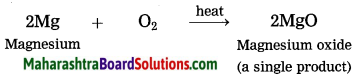
Maharashtra Board Class 10 Science Solutions Part 1 Chapter 3 Chemical Reactions and Equations 28

(3) Iron reacts with sulphur to form iron sulphide.

Maharashtra Board Class 10 Science Solutions Part 1 Chapter 3 Chemical Reactions and Equations 29

Question 4.
What Is meant by a decomposition reaction?
Answer:
The chemical reaction in which two or more products are formed from a single reactant is called decomposition reaction.

Maharashtra Board Class 10 Science Solutions Part 1 Chapter 3 Chemical Reactions and Equations

Question 5.
what is meant by a thermal decomposition?
Answer:
The reaction in which a compound is decomposed by heating it to a high temperature is called thermal decomposition.

Question 6.
What is meant by a electrolytic decomposition?
Answer:
The reaction in which a compound is decomposed by passing an electric current through its solution or molten mass is called an electrolytic decomposition.

Question 7.
Give two examples of thermal decomposition.
Answer:
(1) At high temperature, calcium carbonate decomposes into calcium oxide and carbon dioxide.

Maharashtra Board Class 10 Science Solutions Part 1 Chapter 3 Chemical Reactions and Equations 30

(2) At high temperature sugar decomposes into black mass of carbon and water vapour.

Maharashtra Board Class 10 Science Solutions Part 1 Chapter 3 Chemical Reactions and Equations 31

Question 8.
Give an example of electrolytic decomposition.
Answer:
When an electric current is passed through acidified water, it is electrolysed giving hydrogen
and oxygen.

Maharashtra Board Class 10 Science Solutions Part 1 Chapter 3 Chemical Reactions and Equations 32

Question 9.
Study the following reaction and answer the questions asked.

Maharashtra Board Class 10 Science Solutions Part 1 Chapter 3 Chemical Reactions and Equations 33
(a) State the type of reaction.
(b) Define this reaction. (Practice Activity Sheet – 1)
Answer:
(a) The type of reaction is electrolytic decomposition reaction.
(b) The reaction in which a compound is decomposed by passing an electric current through its solution or molten mass is called an electrolytic decomposition.

Question 10.
what is meant by a displacement reaction?
Answer:
The reaction in which the place of the ion of a less reactive element in a compound is taken by another more reactive element by formation of its own ions, is called displacement reaction.

Maharashtra Board Solutions

Question 11.
Give an example of displacement reaction.
Answer:
when zinc granules are added to the blue coloured copper sulphate solution, the zinc ions formed from zinc atoms take the place or Cu2+ ions in CuSO4, and copper atoms, formed from Cu2+ ions comes out i.e. the more reactive zinc displaces the less reactive Cu from copper sulphate.

Maharashtra Board Class 10 Science Solutions Part 1 Chapter 3 Chemical Reactions and Equations 34

Question 12.
Observe the reaction and answer the following questions.
CuSO4(aq) + Fe(s) → FeSO4(aq) + Cu(s)
(a) Identify and write the type of chemical reaction.
(b) write the definition of above reaction. (Practice Activity Sheet – 3)
Answer:
(a) When iron powder is added to the blue coloured copper sulphate solution, the iron ions formed from iron atoms take the place or Cu2+ ions in CuSO4, and copper atoms, formed from Cu2+ ions comes out i.e. the more reactive iron displaces the less reactive Cu from copper sulphate. Therefore this reaction is a displacement reaction.

(b) The reaction in which the place of the ion of a less reactive element in a compound is taken by another more reactive element by formation of its own ions, is called displacement reaction.

Question 13.
what is meant by a double displacement reaction?
Answer:
The reaction in which the ions in the reactants are exchanged to form a precipitate is called double displacement reaction.

Question 14.
Give two examples of double displacement reaction.
Answer:
(1) Solutions of sodium chloride and silver nitrate react with each other forming a precipitate of silver chloride and a solution of sodium nitrate.
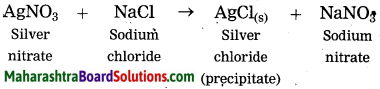
Maharashtra Board Class 10 Science Solutions Part 1 Chapter 3 Chemical Reactions and Equations 35
White precipitate of AgCl is formed by exchange of ions Ag+ and Cl between the reactants.

(2) Barium suiphide reacts with zinc sulphate to form zinc sulphide and a white precipitate of barium sulphate.

Maharashtra Board Class 10 Science Solutions Part 1 Chapter 3 Chemical Reactions and Equations 36
white precipitate is formed by exchange of ions Ba++ and SO4 between the reactants.

Question 15.
Write down what you understand from the following chemical reaction:
AgNO3(aq) + NaCl(aq) → AgCl ↓ + NaNO3(aq)
Answer:
(i) The above reaction is a double displacement reaction.
(ii) AgNO3 and NaCl are the reactants while AgCl and NaNO3 are the products.
(iii) The reactants and the product NaNO3 are in aqueous state. The product AgCl is formed in the form of precipitate.

Question 16.
Study the following chemical reaction and answer the questions given below:
AgNO3(aq) + NaCl(aq) → AgCl(s)↓ + NaNO3(aq)
(i) Identiry and write the type of chemical reaction.
(ii) write the definition of above type of chemical reaction.
(iii) Write the names of reactants and products of above reaction. (March 2019)
Answer:
(i) The type of chemical reaction: Double displacement reaction.
(ii) The reaction in which the ions in the reactants are exchanged to form a precipitate is called double displacement reaction.
(iii)

  1. The above reaction is a double displacement reaction.
  2. AgNO3 and NaCl are the reactants while AgCl and NaNO3 are the products.
  3. The reactants and the product NaNO3 are in aqueous state. The product AgCl is formed in the form of precipitate.

Question 17.
When sodium chromate solution is mixed with barium sulphate solution, a precipitate is formed.
(i) What is the colour of the precipitate formed?
(ii) Name the precipitate.
(iii) What is the type of chemical reaction?
Answer:
(i) The colour of the precipitate is yellow.
(ii) The yellow precipitate formed is barium chromate.
(iii) The type of chemical reaction is double displacement.

Question 18.
Explain the term Exothermic reaction.
Answer:
Exothermic reaction : The process in which heat is given out is called an exothermic reaction.
When NaOH(s) dissolves in water, there is evolution of heat leading to a rise in temperature.
NOH(s) + H3O(l) → NaOH(aq) + Heat

Maharashtra Board Class 10 Science Solutions Part 1 Chapter 3 Chemical Reactions and Equations

Question 19.
State whether the following reactions are exothermic or endothermic:
(i) 3CaO. Al2O3(s) + 6H2O(l) → 3CaO. Al2O3. 6H2O(s) + Heat
Answer:
Exothermic reaction

(ii) 2CaSO4. H2O + 3H2O → 2CaSO4. 2H2O + Heat
Answer:
Exothermic reaction

(iii) KNO3(aq) + H2O(l) + Heat → KNO3(aq)
Answer:
Endothermic reaction

(iv) NaOH(s) + H2O(l) → NaOH(aq) + Heat
Answer:
Exothermic reaction

(v) Transformation of ice into water.
Answer:
Endothermic reaction

(vi) Water turns into ice.
Answer:
Exothermic reaction

(vii) Cooking of food.
Answer:
Endothermic reaction

(viii) Burning candle.
Answer:
Exothermic reaction

Question 20.
What do you mean by slow speed reaction?
OR
Define: Slow speed reaction.
Answer:
The reaction which requires long time for completion i.e. occurs slowly is called slow speed reaction.

Question 21.
What do you mean by fast speed reaction?
OR
Define: Fast speed reaction.
Answer:
The reaction which is completed in short time i.e. occurs rapidly is called fast speed reaction.

Question 22.
Give two examples of slow speed reactions.
Answer:
(1) On heating potassium chlorate (KClO3) it decomposes slowly into potassium chloride and oxygen gas.

Maharashtra Board Class 10 Science Solutions Part 1 Chapter 3 Chemical Reactions and Equations 37
This reaction requires long time for completion, therefore it is slow speed reaction.

(2) Rusting of iron is a slow speed reaction. In this reaction iron reacts with oxygen from air to form iron oxide.

Maharashtra Board Class 10 Science Solutions Part 1 Chapter 3 Chemical Reactions and Equations 38

Question 23.
Give two examples of fast speed reactions.
Answer:
(1) The reaction between sodium hydroxide (NaOH) and hydrochloric acid (HCl) is a neutralization reaction and it is fast speed reaction.
NaOH2(aq) + HCl(aq) → NaCl(aq) + H2O(l)
This neutralizaton reaction is completed in short time, therefore it is fast speed reaction.

(2) Aqueous solution of sodium chloride reacts with silver nitrate solution to form white precipitate of silver chloride (NaCl) and sodium nitrate.
NaCl(aq) + AgNO3(aq) → NaNO3(aq) + AgCl ↓
This reaction is completed in short time, therefore it is fast reaction.

Question 24.
Write a short note on slow speed and fast speed reactions.
Answer:
Slow speed reaction:
The reaction which requires long time for completion i.e. occurs slowly is called slow speed reaction.
Examples:
(1) On heating potassium chlorate (KClO3) it decomposes slowly into potassium chloride and oxygen gas.

Maharashtra Board Class 10 Science Solutions Part 1 Chapter 3 Chemical Reactions and Equations 39
This reaction requires long time for completion, therefore it is slow speed reaction.

(2) Rusting of iron is a slow speed reaction. In this reaction iron reacts with oxygen from air to form iron oxide.

Maharashtra Board Class 10 Science Solutions Part 1 Chapter 3 Chemical Reactions and Equations 40
This reaction requires long time for completion.

Fast speed reaction:
The reaction which is completed in short time i.e., occurs rapidly is called fast speed reaction.
Examples:
(1) The reaction between sodium hydroxide (NaOH) and hydrochloric acid (HCl) is a neutralization reaction and it is fast speed reaction.
NaOH(aq) + HCl(aq) → NaCl(aq) + H2O(l)
This neutralizaton reaction is completed in short time, therefore it is fast speed reaction.

(2) Aqueous solution of sodium chloride reacts with silver nitrate solution to form white precipitate of silver chloride (NaCl) and sodium nitrate.

Maharashtra Board Class 10 Science Solutions Part 1 Chapter 3 Chemical Reactions and Equations 41
This reaction is completed in short time, therefore it is fast reaction.

Maharashtra Board Class 10 Science Solutions Part 1 Chapter 3 Chemical Reactions and Equations

Question 25.
State the factors which affect the speed (or rate) of a reaction.
Answer:
The factors which affect the rate of a reaction are

  1. Nature of the reactants.
  2. Size of the particles of the reactants.
  3. Concentration of the reactants.
  4. Temperature of the reaction.
  5. Catalyst.

Question 26.
How does the rate of reaction depend on the nature of the reactants? Illustrate with suitable example.
Answer:
(1) when the reactant combines with two or more other reactants then the rate of a chemical reaction depends on the nature of the reactants.

(2) Both Al and Zn reacts with dilute hydrochloric acid, H2 gas is liberated and water soluble salts of these metals are formed. However, aluminium metal reacts faster with dil. HCl as compared to zinc metal.

(3) Al is more reactive than Zn. Therefore, the rate of reaction of Al with hydrochloric acid is higher than that of Zn. Hence, the nature of the reactant affect the rate of a reaction.
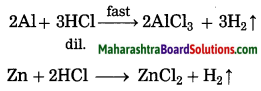
Maharashtra Board Class 10 Science Solutions Part 1 Chapter 3 Chemical Reactions and Equations 42

Question 27.
How does the rate of a reaction depend on the size of the particles of reactants?
Answer:
(1) In the reaction of dil. HCl and Shahabad tile, CO2 effervescence is formed slowly. On the other hand, C2 effervescence forms at faster speed with the powder of Shahabad tile.

(2) The above observation indicates that the rate of a reaction depends upon the size of the particles of the reactants taking part in the reaction. Smaller the size of the reactant particles taking part in a reaction faster will be the rate of reaètion.

Question 28.
How does the rate of a reaction depend upon the concentration of the reactants? Give suitable example.
Answer:
(1) A chemical reaction takes place due to collisions of the reactant molecules. Higher the concentrations of the reactants more will be the frequency of collisions and faster wifi be the rate of the reaction.

(2) In the reaction of dil. HCl and CaCO3, CaCO3 disappears slowly and CO2 also liberates slowly. On the other hand the reaction with concentrated HCl takes place rapidly and CaCO3 disappears fast.

(3) Concentrated acid reacts faster than dilute acid, that means the rate of a reaction is proportional to the concentration of reactants.

Slow reaction:
CaCO3 + dli.2HCl → CaCl2 + CO2 + H2O
Fast reaction:

Maharashtra Board Class 10 Science Solutions Part 1 Chapter 3 Chemical Reactions and Equations 43

Question 29.
How does the rate of a reaction depend upon the temperature of reactants? Give suitable example.
Answer:
(i) (1) When the temperature of the reactants is increased, the reactant molecules start moving with more velocity and their kinetic energy increases. As a result, the number collisions increases. Hence, the rate of chemical reaction increases.

(2) Lime stone on heating decomposes to give CO2, which turns 1ime water milky. On the other hand, the lime water does not turn milky before heating the lime stone: because of the zero rate of reaction. The above observation indicates that the rate of a reaction increases on increasing the temperature.

(ii) Solid CaCO3 does not decompose at room temperature when heated, it decomposes to give CaO and CO2 that means the rise in temperature increases the rate of reaction. CaCO3 room temperature No chemical reaction.

Maharashtra Board Class 10 Science Solutions Part 1 Chapter 3 Chemical Reactions and Equations 44

Question 30.
How does the rate if a reaction depend upon the catalyst? Give suitable example.
Answer:
(1) The substance in whose presence the rate of a chemical reaction changes, without causing any chemical change to it is called a catalyst.

(2) On heating potassium chlorate (KClO3) decomposes into potassium chloride and oxygen slowly.
\(2 \mathrm{KClO}_{3} \stackrel{\Delta}{\longrightarrow} 2 \mathrm{KCl}+3 \mathrm{O}_{2}\)
The rate of the above reaction neither increases by reducing the particle size nor by increasing the reaction temperature. However in the presence of manganese dioxide, KClO3 decomposes at a comparatively lower temperature and oxygen is produced more briskly. No chemical change takes place in MnO2 in this reaction. It acts as catalyst.

Maharashtra Board Solutions

Question 31.
State the Importance of rate in a chemical reaction.
Answer:

  1. The use of strong acid and strong base in a chemical reaction increases the rate of reaction.
  2. In a chemical reaction, if the smaller size of the reactant particles, the concentrated solution, high temperature and use of catalyst increases the rate of chemical reaction.
  3. The rate of chemical reaction is important with respect to environment.
  4. If the rate of chemimal reaction is fast it is profitable for the chemical factories.
  5. The ozone layer in the earth’s atmosphere protects the life of earth from the ultraviolet radiation of the sun. The process of depletion or maintenance of this layer depends upon the rate of production or destruction of ozone molecules.

Question 32.
Define Oxidation reaction.
Answer:
Oxidation: The chemical reaction in which a reactant combines with oxygen or loses hydrogen to form the product is called oxidation reaction.

Question 33.
Give examples of oxidation.
Answer:
(1) when carbon burns in air, it forms carbon dioxide. In this reaction carbon accepts oxygen, therefore, this is an oxidation reaction.
C(s) + O2(g) → CO2(g)

(2) when sodium reacts with ethyl alcohol, sodium ethoxide and hydrogen gas is formed. In this reaction, hydrogen is removed from ethyl alcohol, therefore this is an oxidation reaction.
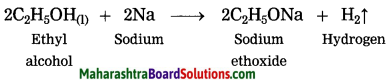
Maharashtra Board Class 10 Science Solutions Part 1 Chapter 3 Chemical Reactions and Equations 45
(3) Acidified potassium dichromate: (K2Cr2O7/H2SO4) oxidises ethly alcohol to acetic acid.

Maharashtra Board Class 10 Science Solutions Part 1 Chapter 3 Chemical Reactions and Equations 46

Question 34.
What do you mean by oxidant? Explain with suitable example.
Answer:
The chemical substances which bring about an oxidation reaction by making oxygen available are called oxidants or oxidizing agents.

  1. In the combustion of carbon, oxygen is an oxidant.
  2. In the oxidation of ethly alcohol, potassium dichromate is used as oxidant.

Maharashtra Board Solutions

Question 35.
Name the various oxidants. How nascent oxygen is liberated from these oxidants?
Answer:
K2Cr2O7/H2SO4, KMnO4/H2SO4 are the commonly used chemical oxidants. Hydrogen peroxide (H2O2) is used as a mild oxidant. Ozone (O3) is also a chemical oxidant. Nascent oxygen is generated by chemical oxidants and it is used for the oxidation reaction.
O3 → O2 + [O].
H2O2 → H2O + [O]
K2Cr2O7 + 4H2SO4 → K2SO4 + Cr2(SO4)3 + 4H2O + 3[O]
2KMnO4 + 3H2SO4 → K2SO4 + 2MnSO4 + 3H2O + 5[O]
Nascent oxygen is a state prior to the formation of the O2 molecule. It is the reactive form of oxygen and is represented by the symbol as [O]

Question 36.
Acidified potassium permanganate (KMnO4) is a chemical oxidant and explain, how acidified potassium permanganate oxidise ferrous sulphate (FeSO4). Accordingly write a new definition of oxidation and reduction.
Answer:
Acidified KMnO4 oxidises ferrous sulphate (FeSO4) to ferric sulphate Fe2(SO4)3 and in addition to above K2SO4 and MnSO4 by-products are formed.
2KMnO4 + 10 FeSO4 → 8H2SO4 → K2SO4 + 2MnSO4 + 5Fe2(SO4)3 + 8H2O
2FeSO4 → Fe2(SO4)3
Ionic reaction :
2Fe2 + 2SO42+ → 2Fe3+ + 3SO22-
Net Ionic equation Fe2+ → Fe3+ + e
When ferric ion is formed from ferrous ion the positive change is increased by one unit. While this happens the rerrous ion loses one electron.

When metal or its ion loses electron, it is called an oxidation and gain of electron is called reduction.
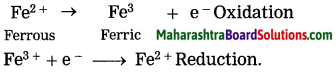
Maharashtra Board Class 10 Science Solutions Part 1 Chapter 3 Chemical Reactions and Equations 47

Question 37.
Define reduction reaction.
Answer:
The chemical reaction in which a reactant gains hydrogen and loses oxygen to form the product is called the reduction reaction.

Question 38.
Give two examples of reduction.
Answer:
(1) When hydrogen gas is passed over black copper oxide a reddish coloured layer of copper is formed.
In this reaction an oxygen atom removed from CuO to form copper, hence, this is reduction.

Maharashtra Board Class 10 Science Solutions Part 1 Chapter 3 Chemical Reactions and Equations 48

(2) When hydrogen gas is passed over red hot coke, methane is obtained.
Here, hydrogen is added to coke (carbon). Hence, this is reduction.

Maharashtra Board Class 10 Science Solutions Part 1 Chapter 3 Chemical Reactions and Equations 49

Question 39.
What do you mean by reductant? Explain with suitable example.
Answer:
The chemical substances which bring about reduction by making hydrogen available are called reductant. In the preparation of methane from carbon, hydrogen is a reductant.

Question 40.
What are redox reactions? Identify the substances that are oxidised and the substances that are reduced in the following reactions:
(1) 2H2S2(g) + SO2(g) → 3S(s) + 2H2O(l)
(2) CuO(s) + H2(g) → CU(s) + H2O(l)

Maharashtra Board Class 10 Science Solutions Part 1 Chapter 3 Chemical Reactions and Equations 50
Answer:
When oxidation and reduction take place simultaneously in a given chemical reaction, it is known as a redox reaction.
(1)
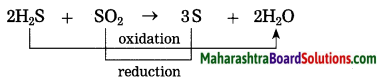
Maharashtra Board Class 10 Science Solutions Part 1 Chapter 3 Chemical Reactions and Equations 51
H2S is oxidised and SO2 is reduced.

(2)
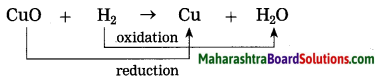
Maharashtra Board Class 10 Science Solutions Part 1 Chapter 3 Chemical Reactions and Equations 52
CuO is reduced and H2 is oxidised.

(3)
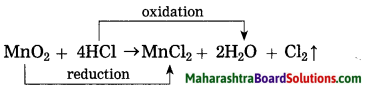
Maharashtra Board Class 10 Science Solutions Part 1 Chapter 3 Chemical Reactions and Equations 53
(1) Oxidation: H2S, H2O and HCl.
(2) Reduction: SO2, CuO and MnO2

Question 41.
Observe the following reaction and answer the questions given below:
BaSO4 + 4C → BaS + 4CO
(1) what type of reaction is it? Justify.
(2) Give one more example.
Answer:
(1) This is a redox reaction. In this reaction the reduction of BaSO4 and oxidation of carbon take place simultaneously.
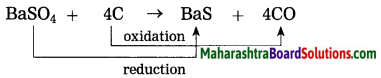
Maharashtra Board Class 10 Science Solutions Part 1 Chapter 3 Chemical Reactions and Equations 54

(2) Example
CuO+H2 → Cu + H2O
2H2S + SO2 → 3S + 2H2O

Question 42.
What is corrosion?
Answer:
The slow process of decay or oxidation of metals due to various components of atmosphere is known as corrosion.
Iron rusts and a reddish coloured layer is collected on it. This is corrosion of iron.

Maharashtra Board Class 10 Science Solutions Part 1 Chapter 3 Chemical Reactions and Equations

Question 43.
How does rusting of iron occur?
Answer:
Iron when exposed to moist air forms a reddish layer of hydrated ferric oxide.

Maharashtra Board Class 10 Science Solutions Part 1 Chapter 3 Chemical Reactions and Equations 55

Question 44.
How can corrosion be prevented?
Answer:

  1. Corrosion damages buildings, bridges, automobiles, ships, iron railings and other articles made of iron.
  2. It can be prevented by using an anti-rust solution, coating the surface by a paint, processes like galvanising and electroplating with other metals.

Question 45.
What is corrosion? Do gold ornaments corrode? Justify.
Answer:
The slow process of decay or oxidation or metal due to the effect of air, moisture and acids on
it is known as corrosion.
(1) Gold is a noble metal. There is no effect or moist air or action of acid on it at any temperature.
(2) Pure gold is a very soft metal. it breaks and gets bent easily. Hence, in gold ornaments, gold is alloyed with other metals 1ike copper or silver in appropriate proportion to make it hard and resistant to corrosion. Hence gold ornaments do not get corroded.

Question 46.
Complete the process of iron rusting by filling the blanks. Suggest a way to prohibit the process.
The iron rust is formed due to reaction. Different regions on iron surface become anode and cathode.
Reaction on anode region:
Fe(s) → Fe2+ (aq) + 2e
Reaction on cathode region:
O2(g) + 4H+ (aq) +………→ 2H2O(l)
when Fe2+ ions migrate from anode region they react with……..to fomm Fe3+ ions.
A reddish coloured hytirated oxide is formed from……….ions. It is called rust.
2Fe3+ (aq) + 4H2O(l) → +………+ 6H+ (aq)
A way to prevent rusting………..
(Practice Activity Sheer – 2)
Answer:
The iron rust is formed due to electrochemical reaction. Different regions on iron surface become unode and cathode.
Reaction on anode region:
Fe(s) → Fe2+ (aq) + 2e
Reaction on cathode region:
O2(g) + 4H+ (aq) + 4e → 2H2O(l)
when Fe2+ ions migrate from anode region they react with water to form Fe3+ ions.
A reddish coloured hydrated oxide is formed from Fe3+ ions. It is called rust.
2Fe3+ (aq) + 4H2O(l) → + Fe2O3. H2O(s) + 6H+(aq)
A way to prevent rusting by colouring with acrylic paints, Zn plating, galvanizing, anodizing, alloying, etc.

Question 17.
Deifne: Rancidity.
Answer:
When oil or fat or left over cooking oil for making food stuff undergoes oxidation ir stored for a long time and it is found to have foul odour called rancidity.

Distinguish between the following:

Question 1.
Combination reaction and Decomposition reaction.

Combination reaction Decomposition reaction
1. In a combination re­action, two or more reactants take part in the chemical reaction. 1. In a decomposition reaction there is only one reactant in the chemical reaction.
1. In the combination reaction, only one product is formed. 2. In a decomposition reaction, two or more products are formed.

Question 2.
Oxidation and reduction
Answer:

Oxidation Reduction
1. The chemical reaction in which reactants gain oxygen or lose hydrogen is called oxidation. 1. The chemical reaction in which reactants gain hydrogen or lose oxygen is called reduction.
2. A reducing agent undergoes oxidation. 2. An oxidising agent undergoes reduction.

Question 3.
Exothermic and Endothermic reaction.
Answer:

Exothermic reaction Endothermic reaction
1. The reaction in which heat is evolved is called an exothermic reaction. 1. The reaction in which heat is absorbed is called an endothermic reaction.
2. The evolution of heat leads to a rise in the temperature of the solution. 2. The absorption of heat leads to a fall in the temperature of the solution.

Give scientific reasons:

Question 1.
Grills of doors and windows are always painted before they are used.
Answer:

  • Grills of doors and windows are made from iron. Iron has a tendency to undergo corrosion.
  • Paint does not allow air or moisture to come in contact with iron surface.
    Therefore, to prevent rusting of iron. grills of doors and windows are always painted before they are used.

Maharashtra Board Class 10 Science Solutions Part 1 Chapter 3 Chemical Reactions and Equations

Question 2.
Physical states of reactants and products are mentioned while writing a chemical equation.
Answer:
(1) while writing a chemical equation, gaseous, 1iquid and solid states are symbolised as (g), (l) and (s) respectively.

(2) This is done to make it more informative and to emphasise that those reactions occur in that manner only under those conditions. Hence, physical states of reactants and products are mentioned while writing a chemical equation.

Question 3.
Iron articles rust readily whereas steel which is also mainly made of iron does not undergo corrosion.
Answer:
(1) Iron articles rust readily as iron reacts with oxygen and moisture of air to convert into its hydroxide and oxide (Fe2O3. x H2O), while steel is an alloy of iron, carbon and chromium.

(2) The properties of an alloy are different from the properties of its constituents. The added metals increase its resistance to corrosion. It is more durable and clean.

Question 4.
Concentrated hydrochloric acid reacts more vigorously with calcium carbonate than dilute hydrochloric acid.
Answer:

  1. The rate of a reaction increases with the concentration of the reactant.
  2. As concentrated hydrochloric acid contains more number of HCl molecules than those in an equal volume of dilute HCl, concentrated HCl reacts more vigorously with calcium carbonate.

Question 5.
Zinc powder reacts much faster with dil. H2SO4 than does granulated zinc of the Same mass.
Answer:
(1) In a reaction. the rate of the reaction depends upon the particle size of the solid reactant as the reaction takes place on the surface only. Smaller the particles are, the more will be their total surface area and faster will be the rate of the reaction.
(2) Hence, zinc powder reacts much faster with dil. H2SO4 than does granulated zinc.

Question 6.
When copper articles exposed to air for a long time, gets corroded.
Answer:
Copper oxidises to form black coloured laver of copper oxide. when copper oxide combines with carbon dioxide from air, copper loses its lustre due to formation of greenish layer of copper carbonate on its surface. Thus, copper articles exposed to air for a long time get corroded.

Maharashtra Board Class 10 Science Solutions Part 1 Chapter 3 Chemical Reactions and Equations

Question 7.
When silver vessels exposed to air turns blackish after sometime.
Answer:
On exposure to air, silver vessels turns blackish after sometime. This is because of the layer of silver sulphide (Ag2S) formed by the reaction or silver with hydrogen suphide in air.

Explain the following reactions giving their balanced chemical equations:

Question 1.
Calcium carbonate (Lime stone) is heated.
Answer:
When calcium carbonate (Lime stone) is heated at high temperature it decomposes to form quicklime and carbon dioxide gas.

Maharashtra Board Class 10 Science Solutions Part 1 Chapter 3 Chemical Reactions and Equations 56

Question 2.
Copper reacts with dil. nitric acid.
Answer:
When copper reacts with dil. nitric acid, nitric oxide gas is formed.

Maharashtra Board Class 10 Science Solutions Part 1 Chapter 3 Chemical Reactions and Equations 57

Question 3.
Copper reacts with conc. nitric acid.
Answer:
When copper reacts with conc. nitric acid, reddish coloured poisonous nitrogen dioxide gas is formed.

Maharashtra Board Class 10 Science Solutions Part 1 Chapter 3 Chemical Reactions and Equations 58

Question 4.
Ammonia gas reacts with hydrogen chloride gas.
Answer:
When ammonia gas reacts with hydrogen chloride gas, it forms the salt ammonium chloride in gaseous state, but immediately it got transformed into the solid state.

Maharashtra Board Class 10 Science Solutions Part 1 Chapter 3 Chemical Reactions and Equations 59

Question 5.
Magnesium strip is burnt in air.
Answer:
When magnesium strip is burnt in air, a white powder of magnesium oxide is formed.

Maharashtra Board Class 10 Science Solutions Part 1 Chapter 3 Chemical Reactions and Equations 60

Question 6.
Calcium oxide is mixed with water.
Answer:
When calcium oxide (slaked lime) is mixed with water, calcium hydroxide is formed with evolution of large amount of heat.
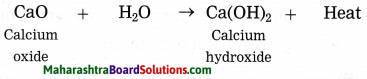
Maharashtra Board Class 10 Science Solutions Part 1 Chapter 3 Chemical Reactions and Equations 61

Maharashtra Board Class 10 Science Solutions Part 1 Chapter 3 Chemical Reactions and Equations

Question 7.
Sugar is heated.
Answer:
When sugar is heated, it decomposes to form carbon (black substance).

Maharashtra Board Class 10 Science Solutions Part 1 Chapter 3 Chemical Reactions and Equations 62

Question 8.
Electric current is passed through acidulated water.
Answer:
When an electric current is passed through acidulated water, it decomposes into hydrogen and
oxygen gas.

Maharashtra Board Class 10 Science Solutions Part 1 Chapter 3 Chemical Reactions and Equations 63

Question 9.
Zinc powder is added to copper sulphate solution.
Answer:
When zinc powder is added to copper sulphate solution, more reactive zinc displaces less reactive copper from copper sulphate solution. The colourless zinc sulphate is formed with evolution of heat.

Maharashtra Board Class 10 Science Solutions Part 1 Chapter 3 Chemical Reactions and Equations 64

Question 10.
Iron powder is added to copper sulphate solution.
Answer:
When iron powder is added to copper sulphate solution, more reactive iron displaces less reactive copper from copper sulphate. The colourless ferrous sulphate solution is formed with evolution of heat.

Maharashtra Board Class 10 Science Solutions Part 1 Chapter 3 Chemical Reactions and Equations 65

Question 11.
Lead is added to copper sulphate solution.
Answer:
When lead is added to copper sulphate solution, more reactive lead displaces less reactive copper from copper sulphate. The colourless lead sulphate solution is formed with evolution of heat.

Maharashtra Board Class 10 Science Solutions Part 1 Chapter 3 Chemical Reactions and Equations 66

Question 12.
Potassium chromate solution is added to barium sulphate solution.
Answer:
When potassium chromate solution is added to barium sulphate solution, yellow precipitate of barium chromate is formed.

Maharashtra Board Class 10 Science Solutions Part 1 Chapter 3 Chemical Reactions and Equations 67

Question 13.
Calcium chloride solution is added to sodium carbonate solution.
Answer:
When calcium chloride solution is added to sodium carbonate solution, white precipitate of calcium carbonate is formed.
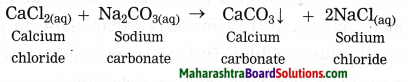
Maharashtra Board Class 10 Science Solutions Part 1 Chapter 3 Chemical Reactions and Equations 68

Question 14.
Sodium chloride solution is mixed with silver nitrate solution.
Answer:
When sodium chloride solution is mixed with silver nitrate solution, white precipitate or silver chloride is formed.
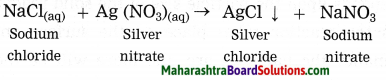
Maharashtra Board Class 10 Science Solutions Part 1 Chapter 3 Chemical Reactions and Equations 69

Question 15.
Dilute sulphuric acid is added to barium chloride solution.
Answer:
When dilute sulphuric acid is added to barium chloride solution, white precipitate of barium sulphate is rormed.

Maharashtra Board Class 10 Science Solutions Part 1 Chapter 3 Chemical Reactions and Equations 70

Question 16.
Calcium carbonate (Lime stone) is treated with dil. hydrochloric acid.
Answer:
When calcium carbonate (lime stone) is treated with dil. hydrochloric acid, carbon dioxide gas is formed.
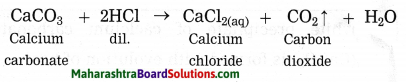
Maharashtra Board Class 10 Science Solutions Part 1 Chapter 3 Chemical Reactions and Equations 71

Maharashtra Board Class 10 Science Solutions Part 1 Chapter 3 Chemical Reactions and Equations

Question 17.
Aluminium is treated with dil. hydrochloric acid.
Answer:
When aluminium is treated with dilute hydrochloric acid, hydrogen gas is liberated.

Maharashtra Board Class 10 Science Solutions Part 1 Chapter 3 Chemical Reactions and Equations 72

Question 18.
Magnesium is treated with hydrochloric acid.
Answer:
When magnesium is treated with hydrochloric acid, hydrogen gas is liberated.

Maharashtra Board Class 10 Science Solutions Part 1 Chapter 3 Chemical Reactions and Equations 73

Question 19.
Hydrogen peroxide is decomposed in the presence of manganese dioxide (MnO2).
Answer:
When hvdrogen peroxide is decomposed in the presence of manganese dioxide (MnO2), water and oxygen are formed.
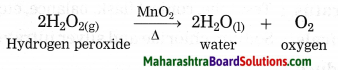
Maharashtra Board Class 10 Science Solutions Part 1 Chapter 3 Chemical Reactions and Equations 74

Question 20.
Ethyl alcohol is treated with acidified potassium dlchromate.
Answer:
When ethly alcohol is treated with acidified potassium dichromate, acetic acid is formed. This is oxidation reaction.
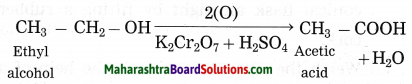
Maharashtra Board Class 10 Science Solutions Part 1 Chapter 3 Chemical Reactions and Equations 75

Question 21.
Hydrogen gas is passed over black copper oxide.
Answer:
When hydrogen gas is passed over black copper oxide, a reddish coloured layer of copper is formed.
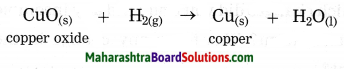
Maharashtra Board Class 10 Science Solutions Part 1 Chapter 3 Chemical Reactions and Equations 76

10th Std Science Part 1 Questions And Answers:

Transport Class 5 Questions And Answers EVS Chapter 14 Maharashtra Board

Balbharti Maharashtra State Board Class 5 Environmental Studies Solutions Chapter 14 Transport Notes, Textbook Exercise Important Questions and Answers.

5th Standard EVS 1 Lesson Number 14 Question Answer Transport Maharashtra Board

Std 5 EVS 1 Chapter 14 Question Answer

1. Write five sentences on how you have benefited from transport facilities.

Question 1.
Write five sentences on how you have benefited from transport facilities.
Answer:
Due to transport facilities:

  1. Work gets done soon.
  2. Time and effort are saved.
  3. Trade is facilitated easily.
  4. Connection to different parts of the world easily.
  5. It has improved lifestyle by education and health services.

Maharashtra Board Class 5 EVS Solutions Part 1 Chapter 14 Transport

2. List four other facilities that have become available in the local area due to transport facilities.

Question 1.
List four other facilities that have become available in the local area due to transport facilities.
Answer:
Due to transport, we are able to get vegetables and fruits. Milk is supplied on time. We are able to go to the market and malls. We are able to visit relatives and friends.

3. Suggest four solutions to reduce the burden on the local transport.

Question 1.
Suggest four solutions to reduce the burden on the local transport.
Answer:
To reduce the burden on local transport build flyovers, walk short distance, avoid unnecessary travel and go to school and work place close to our house.

4. Find the area in your locality with the least pollution. why is this the least polluted area?

5. What is the full form of CNG and LPG.

Question 1.
What is the full form of:
Answer:
1. CNG: Compressed National Gas
2. LPG: Liquidified Petroleum Gas

Maharashtra Board Class 5 EVS Solutions Part 1 Chapter 14 Transport

6.

Maharashtra Board Class 5 EVS Solutions Part 1 Chapter 14 Transport 1

Question (a)
In the above picture, which vehicle is causing pollution?
Answer:
The Bus

Question (b)
What remedy will you suggest to reduce the pollution caused by this vehicle?
Answer:
The bus should do PUC to control the smoke given out.

Can you tell?

Question 1.
(a) Walking
(b) Riding a bicycle
(c) Using a private vehicle
(d) Using a public vehicle
Which of the above options will you choose on the following occasions?
Answer:

  1. Going to study at a friend’s house who lives near by [a]
  2. Going to your school which is about one kilometre away. [b]
  3. Taking materials to a science exhibition in another town. [c]
  4. Going to a wedding in the next town. [d]

Environmental Studies Part 1 Standard 5th Solutions Chapter 14 Transport Additional Important Questions and Answers

Fill in the blanks with the correct answers from the options given below:

Question 1.
Using a vehicle saves ……………….. and ……………… .
(a) time
(b) money
(c) effort
(d) energy
Answer:
(a) time , (c) effort

Maharashtra Board Class 5 EVS Solutions Part 1 Chapter 14 Transport

Question 2.
The burning of fuel in vehicles emits ……………… and ………………… .
(a) water
(b) ash
(c) gases
(d) smoke
Answer:
(c) gas , (d) smoke

Question 3.
If there are traffic jams, ……………….. and …………………. pollution in that area increases.
(a) air
(b) water
(c) noise
(d) land
Answer:
(a) air , (c) noise

Question 4.
Indigenous trees adopt easily to the local environment and help in enhancing ……………….. .
(a) nature
(b) climate
(c) biodiversity
Answer:
(c) biodiversity

Question 5.
We use ………………… in automobiles.
(a) fuels
(b) water
(c) turbines
(d) air
Answer:
(a) fuels

Question 6.
Automobiles cause ………………… and ………………. pollution.
(a) air
(b) land
(c) noise
(d) water
Answer:
(a) air , (c) noise

Question 7.
Different parts of the world are now ………………… due to transport facilities.
(a) known
(b) connected
(c) enemies
(d) friends
Answer:
(b) connected

Maharashtra Board Class 5 EVS Solutions Part 1 Chapter 14 Transport

Question 8.
The transport of goods even on a ………………… level has become simple and easy.
(a) national
(b) state
(c) global
(d) equal
Answer:
(c) global

Question 9.
There is constant ………………. on a busy road.
(a) smoke
(b) water
(c) breeze
(d) traffic
Answer:
(d) traffic

Question 10.
When fuel is burnt in vehicles, minute particles of carbon and lead are released into the ……………………. .
(a) water
(b) air
(c) land
(d) fire
Answer:
(b) air

Question 11.
Growth and development of plants is affected adversely, due to …………………. pollution.
(a) water
(b) air
(c) land
(d) fire
Answer:
(b) air

Question 12.
Constant traffic through forest areas can ……………….. the habitat of plants and animals living there.
(a) harm
(b) protect
(c) befriend
(d) develop
Answer:
(a) harm

Maharashtra Board Class 5 EVS Solutions Part 1 Chapter 14 Transport

Question 13.
The constant sounds of vehicles create …………………… on a large scale.
(a) headache
(b) noise
(c) accidents
(d) music
Answer:
(b) noise

Question 14.
Traffic ………………. causes injuries, deaths and damage to the vehicles.
(a) accidents
(b) jam
(c) noise
(d) smoke
Answer:
(a) accidents

Question 15.
We should cultivate habits such as ………………… short distances.
(a) jogging
(b) riding
(c) flying
(d) walking
Answer:
(d) walking

Question 16.
Our environment is sensitive, that is why, ………………. has destructive effects on it.
(a) pollution
(b) solution
(c) resolution
(d) transportation
Answer:
(a) pollution

2. Match the following:

Question 1.
Match the following:

‘A’ ‘B’
1. Karanj (a) Traffic accidents
2. LPG (b) Noise
3. Headaches (c) Local variety
4. Deaths (d) Fuel

Answer:

‘A’ ‘B’
1. Karanj (c) Local variety
2. LPG (d) Fuel
3. Headaches (b) Noise
4. Deaths (a) Traffic accidents

Maharashtra Board Class 5 EVS Solutions Part 1 Chapter 14 Transport

Name the following:

Question 1.
Pollution caused by automobiles.
Answer:
Air and noise.

Question 2.
Gases emitted through burning of fuels.
Answer:
Carbon monoxide, nitrogen dioxide, suphur dioxide.

Question 3.
Indigenous variety of trees.
Answer:
Banyan, Peepul, Neem, Karanj.

Question 4.
Fuels that do not cause pollution.
Answer:
LPG and CNG.

Answer in one sentence:

Question 1.
What facilities grow due to speedier modem means of transport?
Answer:
Modem means of transport speeds up facilities of tourism, health and education.

Question 2.
What is air pollution?
Answer:
An excess of carbon and lead substances lowers the quality of air in the environment which is called air pollution.

Question 3.
What harm do traffic accidents cause?
Answer:
Traffic accidents cause injuries, deaths and damage to the vehicles.

Maharashtra Board Class 5 EVS Solutions Part 1 Chapter 14 Transport

Question 4.
What habit should we cultivate if we have to travel a short distance?
Answer:
If we have to travel a short distance, we should cultivate the habit of working.

Question 5.
What mode of transport saves time and effort?
Answer:
Using a vehicle saves time and effort.

Question 6.
What causes air and noise pollution?
Answer:
Automobiles causes air and noise pollution.

Question 7.
What do vehicles constantly emit?
Answer:
Due to burning of fuel in vehicles, they constantly emit smoke and some poisonous gases.

Question 8.
Name some poisonous gases emitted by burning of fuels.
Answer:
Some of the poisonous gases emitted by burning of fuels include carbon monoxide, nitrogen dioxide and sulphur dioxide.

Question 9.
What happens when there is constant traffic through forest areas?
Answer:
Constant traffic through forest areas can harm the habitat of plants and animals living there so, the wild animals in these forests migrate elsewhere.

Question 10.
What are the ill-effects of noise pollution to man?
Answer:
Noise pollution causes restlessness, irritability, headaches, lack of concentration, psychological disorders etc.

Maharashtra Board Class 5 EVS Solutions Part 1 Chapter 14 Transport

What are the effects of following on humans, plants and animals?

Question 1.
Air pollution on humans
Answer:
It increases trachea, lung and eye disorders, e.g. burning of the eyes

Question 2.
Air pollution on plants.
Answer:
The leaves of plants shrivel up and fall, sprouts, get scorched. The growth and development of plants is affected.

Question 3.
Air pollution on animals.
Answer:
The habitat of the animals is harmed and wild animals migrate elsewhere.

Question 4.
Sound pollution on humans.
Answer:
Sound pollution causes restlessness, irritability, headaches, lack of concentration, and psychological disorders.

Answer in brief:

Question 1.
What are sailing ships?
Answer:
In olden times, ships did not use fuel engines. They had sails which helped to use the force of wind. They were called sailing ships.

Question 2.
What options should we consider to help reduce pollution?
Answer:
We can help reduce pollution in the following ways:
1. By cultivating a habit to walk short distances.
2. By riding a bicycle for slightly longer distances.
3. By using public transport as far as possible.

Maharashtra Board Class 5 EVS Solutions Part 1 Chapter 14 Transport

Write short notes:

Question 1.
Remedies for reducing pollution.
Answer:
The following are the remedies for reducing pollution:

  1. Use fuels that cause less pollution.
  2. Maintain and repair vehicles from time to time.
  3. Use public transport mostly.
  4. Use private vehicles only when necessary.
  5. Plant indigenous trees to enhance biodiversity.
  6. Use LPG and CNG fuels which do not cause pollution.

Question 2.
Advantages of using a bicycle.
Answer:
The advantages of using a bicycle are as follows:

  1. Physical exercise
  2. Small loads can be carried
  3. Pollution free
  4. Self-reliance
  5. Saves time
  6. Can be stored in a small space
  7. Saves money
  8. Less crowding of vehicles on the streets

What’s the solution?

Question 1.
Rohan and Sania walk to school. Their school is thirty minutes away from their house. There is a cultural function at their school today. Their grandmother will accompany them to the function. But she gets tired easily because of her age. Which of the options listed below would you suggest for taking her to school?
(a) Walking
(b) Autorickshaw
(c) Bus
(d) Scooter
(e) Car
Answer:
Bus

Maharashtra Board Class 5 EVS Solutions Part 1 Chapter 14 Transport

Can you tell?

Maharashtra Board Class 5 EVS Solutions Part 1 Chapter 14 Transport 2

1. Observe the pictures and answer the following questions:

Picture: 1

Question 1.
Where have the children stopped?
Answer:
The children have stopped on the road divide.

Question 2.
Why have they stopped there?
Answer:
They have stopped there to cross the road due to heavy traffic.

Question 3.
What are the children doing?
Answer:
The children are rubbing their eyes, coughing and closing their ears.

Question 4.
What is troubling them?
Answer:
The noise and air pollution due to transport routes is troubling them.

Maharashtra Board Class 5 EVS Solutions Part 1 Chapter 14 Transport

Picture – 2:

1. State the difference between the plants close to the road and those for away from the road based on the following points:

Question (a)
Freshness of leaves.
Answer:
The leaves close to the road appear dull compared to the one’s that are far away from the road.

Question (b)
Colour of the leaves.
Answer:
The leaves near the road are brown as they are covered with a thick layer of dust and mud whereas those far away are green in colour.

Question (c)
Appearance of plants.
Answer:
The growth of plants is affected due to the pollution. The plants near the road have few leaves.

Maharashtra Board Class 5 EVS Solutions Part 1 Chapter 14 Transport

Glossary:

  1. restlessness – lacking quiet and rest
  2. irritability -the state of being irritable
  3. pyschological – problem related to the mind
  4. indigenous – occuring naturally in a particular place.
  5. shrivel – wrinkle and contract
  6. scorched – burnt
  7. migrate – move from one region to another
  8. facilitated – made easier
  9. remedies – medicine or treatment.

Class 5 Environmental Studies Questions and Answers:

Animal Classification Class 10 Questions And Answers Maharashtra Board

Class 10 Science Part 2 Chapter 6

Balbharti Maharashtra State Board Class 10 Science Solutions Part 2 Chapter 6 Animal Classification Notes, Textbook Exercise Important Questions and Answers.

Std 10 Science Part 2 Chapter 6 Animal Classification Question Answer Maharashtra Board

Class 10 Science Part 2 Chapter 6 Animal Classification Question Answer Maharashtra Board

Question 1.
a. I am diploblastic and acoelomate. Which phylum do I belong to ?
Answer:
I am from phylum Cnidaria or Coelenterata.

b. My body is radially symmetrical. Water vascular system is present in my body. I am referred as fish though I am not. What is my name?
Answer:
Starfish. I am from Echinodermata phylum.

c. I live in your small intestine. Pseudocoelom is present in my thread like body. In which phylum will you include me?
Answer:
I am Ascaris. I am included in Aschelminthes.

d. Though I am multicellular, there are no tissues in my body. What is the name of my phylum?
Answer:
Sponge, Porifera.

Maharashtra Board Class 10 Science Solutions Part 2 Chapter 6 Animal Classification

Question 2.
Write the characters of each of the following animals with the help of classification chart:
a. Bath sponge.
Answer:
Classification:
Kingdom: Animalia
Sub-kingdom: Non-chordata
Phylum: Porifera
Characters:

  • Multicellular organisms without cell wall
  • Cellular grade organization.
  • Asymmetrical body
  • Acoelomate

Bath sponge is a marine animal. Blackish in colour and round in shape having porous body. It has spongin fibres and spicules which serve as skeleton. Bath sponges have good water-holding capacity. It is sedentary animal which is fixed to some substratum in the aquatic environment. Reproduction is by budding. It also has a good regeneration capacity.

b. Grasshopper.
Answer:
Classification:
Kingdom: Animalia
Sub-kingdom: Non-chordata
Phylum: Arthropoda
Class: Insecta
Characters:

  • Multicellular organisms without cell wall
  • Organ-system grade organization
  • Bilaterally symmetrical
  • Triploblastic and Eucoelomate.

Grasshopper is an insect included under class insecta of phylum arthropoda because it has jointed appendages. There are three pairs of legs and two pairs of wings. It is a terrestrial insect which is well adapted to the surrounding environment by showing camouflage. It has chitinous exoskeleton. The respiration by tracheae.

c. Rohu.
Answer:
Classification:
Kingdom: Animalia
Phylum: Chordata
Class: Pisces
Subclass: Teleostei (Bony fish)
Characters:

  • Multicellular organisms without cell wall
  • Organ-system grade organization
  • Bilaterally symmetrical
  • Triploblastic and Eucoelomate.

Rohu is a fresh water bony fish. It is a chordate having a vertebral column, hence included under subphylum vertebrata. The body is well adapted for aquatic mode of life. The shape of the body is streamlined. The exoskeleton is of scales. The gills Eire present which are used for respiration. The endoskeleton is of bones, hence called bony fish. There are paired fins and a impaired caudal fin which is used in steering and changing the direction during swimming.

d. Penguin.
Answer:
Classification:
Kingdom: Animalia
Phylum: Chordata
Class: Aves
Characters:

  • Multicellular organisms without cell wall
  • Organ-system grade organization
  • Bilaterally symmetrical
  • Triploblastic and Eucoelomate.

Penguin is a flightless bird inhabitant of cold snow-clad regions. It has exoskeleton of feathers. The body is well adapted to survive in cold regions.

It is a warm-blooded bird. The forelimbs are modified into wings. But due. to excessive body weight, the penguins are not seen flying. It can wade in the water with modified hind limbs.

e. Frog.
Answer:
Classification:
Kingdom: Animalia
Phylum: Chordata
Class: Amphibia
Characters:

  • Multicellular organisms without cell wall
  • Organ-system grade organization
  • Bilaterally symmetrical
  • Triploblastic and Eucoelomate.

The frog is a true amphibian that can live in water as well as on land. When on land it respires with the help of lungs while in water it uses its skin for breathing. It does not have exoskeleton. The skin is soft, slimy and moist. It is suitably coloured and hence the frog can camouflage in the surroundings. Body is divisible into head and trunk. Two pairs of limbs are seen. The forelimbs are short and used for support during locomotion. The hind limbs are long and strong, used for jumping when on land and for swimming when in water.

The eyes are large and protruding. Since the neck is absent, such eyes help in looking around. The tympanum is present.

f. Lizard.
Answer:
Classification:
Kingdom: Animalia
Phylum: Chordata
Class: Reptilia
Characters:

  • Multicellular organisms without cell wall
  • Organ-system grade organization
  • Bilaterally symmetrical
  • Triploblastic and Eucoelomate.

The lizard is a cold-blooded reptile. The limbs are weak and do not support the body weight, hence lizard is seen creeping. But the feet are provided with pads and suckers due to which lizards are well- adapted to climb on the vertical walls. The exoskeleton has fine scales. The body is divisible into head, neck and trunk. The capacity to regenerate is developed in lizards, hence it can produce the lost tail or limbs. The mode of reproduction is egg laying. It feeds on insects with the help of long and sticky tongue.

g. Elephant.
f. Lizard.
Answer:
Classification:
Kingdom: Animalia
Phylum: Chordata
Class: Mammalia
Characters:

  • Multicellular organisms without cell wall
  • Organ-system grade organization
  • Bilaterally symmetrical
  • Triploblastic and Eucoelomate.

Elephant is the terrestrial, herbivorous mammal adapted to survive in hot and humid tropical forests.
It is a mammal and hence shows viviparity and milk secretion. The body is divisible into head, neck, trunk, and tail. The proboscis is a characteristic feature of the elephant which is actually modified nose.

h. Jellyfish.
Answer:
Classification:
Kingdom: Animalia
Sub-kingdom: Non-chordata
Phylum: Cnidaria or Coelenterata
Characters:

  • Multicellular organisms without cell wall
  • Tissue grade organization
  • Radially symmetrical
  • Diploplastic and Acoelomate

Jellyfish or Aurelia is a coelenterate. Its body is medusa. It appears as a transparent balloon seen floating in the marine waters. Since it has appearance like a jelly, it is known commonly as jellyfish. There are tentacles provided with cnidoblasts or stinging cells. Tentacles are used for catching the prey. Cnidoblasts are used to secrete a toxin which paralyses the prey.

Maharashtra Board Class 10 Science Solutions Part 2 Chapter 6 Animal Classification

Question 3.
Write in brief about progressive changes in animal classification.
Answer:
There were different methods of classification of animals.

  1. The first classification method was given by the Greek philosopher Aristotle. He took into account the criteria like body size, habits and habitats of the animals. This method was called artificial method of classification.
  2. The same artificial method was used by other scientists such as Theophrastus, Pliny, John Ray, Linnaeus, etc.
  3. Further due to advances in science the references were changed and there were some new methods of classification proposed.
  4. The system of classification called ‘Natural system of classification’ was then proposed. This system of classification was based on criteria such as body organization, types of cells, chromosomes, bio-chemical properties, etc.
  5. Later, Dobzhansky and Meyer gave the system of classification based on evolution.
  6. In 1977, Carl Woese has also proposed the three domain system of animal classification.

Question 4.
What is the exact difference between grades of organization and symmetry? Explain with examples.
Answer:
I. Grades of organization:
(1) The grades of organization mean the way an organism has different body formation.
(2) Unicellular organisms like amoeba have a single cell in the body and hence the organization in its body is called protoplasmic grade of organization.
(3) Some organisms have only cells in their body which is called cellular grade of organization, e.g. Poriferans.
(4) Some have tissues e.g. Coelenterates. They are said to have tissue grade organization. Some have organs, they are said to have organization-organ grade, e.g. Platyhelminthes. All other higher animals have organ-system grade organization.

II. Symmetry:
(1) Symmetry on the other hand shows the base of the body formation.
(2) The symmetry can be understood by taking an imaginary cut through the animal body.
(3) Based on the symmetry there can be three types.
(4) In asymmetric animals, there is no symmetry in any plane, e.g. Amoeba.
(5) The bilateral symmetry is the one in which an imaginary axis can pass through only one median plane to divide the body into two equal halves. Most of the animals have bilateral symmetry and hence their organs are arranged in symmetric way on both the sides.
(6) The imaginary cut passing through the central axis but any plane of body aan -give more than one equal half. The organs of such animals are arranged in a radius of an imaginary circle, e.g. Cnidarians and some echinoderms.
Both grades of organization and symmetry are the bases for classifying animals into different phyla.

Question 5.
Answer in brief.
a. Give scientific classification of shark upto class.
Answer:
Kingdom: Animalia
Phylum: Chordata
Subphylum: Vertebrata
Class: Pisces
Subclass: Elasmobranchii (Cartilaginous)
Example: Scientific name: Scoliodon sorrakowah.
Common name: Shark

b. Write four distinguishing characters of phylum – Echinodermata.
Answer:
Distinguishing characters of Echinodermata:

  1. Marine organisms with skeleton made up of calcareous spines. Calcareous material on the body hence the name is Echiodermata. Some are sedentary while some are free swimming.
  2. Body is triploblastic, eucoelomate and radially symmetrical when adult. The larvae are bilateral symmetrical.
  3. Locomotion with the help of tube-feet which are also used for capturing the prey.
  4. Echinoderms have regeneration capability. Hence they can restore their lost parts.
  5. Most of them are unisexual.
  6. Examples; Starfish, sea-urchin, brittle star, sea cucumber, etc.

c. Distinguish between butterfly and bat with the help of four distinguish properties.
Answer:
Butterfly:

  1. Butterfly is classified as Non-chordate.
  2. It is included in class Insecta of phylum Arthropoda.
  3. Butterfly has three pairs of legs and two pairs of chitinous wings.
  4. Butterfly is a diurnal (active during day) insect.
  5. Butterfly lays eggs which hatch into larva. Larva develops into pupa and pupa metamorphoses into an adult.

Bat:

  1. Bat is classified as a Chordate.
  2. It is included in class Mammalia of subphylum Vertebrata.
  3. Bat has one pair of legs and a pair of patagium which are used for flying. Patagium has bones.
  4. Bat is a nocturnal (active at night) mammal.
  5. Bat is a viviparous animal that gives birth to live young ones. Young ones are fed by milk secreted by mammary glands.

d. To which phylum does Cockroach belong? Justify your answer with scientific reasons.
Answer:
(1) Cockroach belongs to the phylum Arthropoda and class Insecta.
(2) Scientific reasons for placement of Cockroach in the phylum Arthropoda:

  • The body is covered by chitinous exoskeleton.
  • Jointed appendages present, three pairs of walking legs and two pairs of membranous wings.
  • Body is eucoelomate, triploblastic, bilaterally segmented and segmented.
  • Respiration by spiracles and tracheal tubes.

Maharashtra Board Class 10 Science Solutions Part 2 Chapter 6 Animal Classification

Question 6.
Give scientific reasons.
a. Though tortoise lives on land as well as in water, it cannot be included in class-Amphibia.
Answer:

  • When tortoise lives on the land, it respires with the help of lungs.
  • When in water, it puts out its nares (nasal openings) out of the water and breathes air.
  • It cannot take up oxygen dissolved in water. In both the habitats it respires with the help of lungs. In case of true amphibians, this is not the case.
  • They can breathe in water with the help of skin and on land with the help of lungs.
  • Tortoise also has exo-skeleton which is lacking in Amphibia. Therefore, tortoise cannot be included in class Amphibia.

b. Our body irritates if it comes in contact with jellyfish.
Answer:

  • Jellyfish is a coelenterate that has cnidoblasts bearing tentacles.
  • These cnidoblasts inject toxins to paralyse the prey at the time of feeding.
  • When jellyfish comes in contact with our body, this toxin is released causing reaction to our skin.
  • Therefore, our body gets irritation when we come in contact with jellyfish.

c. All vertebrates are chordates but all chordates are not vertebrates.
Answer:

  • All chordates possess notochord in some period of their development.
  • All vertebrates also have notochord during embryonic life, which is later replaced by vertebral column.
  • Therefore all vertebrates are chordates.
  • But some chrodate’s like Urochordata and cephalochordata do not possess vertebral column and hence they are not vertebrates.

d. Balanoglossus is connecting link between non-chordates and chordates.
Answer:

  • Balanoglossus shows some characters of non-chordates.
  • It also has notochord as in case of chordates.
  • Since it shares the characters of non-chordates and chordates, from the view point of evolution, it is called connecting link between them.

e. Body temperature of reptiles is not constant. (Board’s Model Activity Sheet)
Answer:

  1. Reptiles are cold-blooded animals.
  2. The thermoregulatory system is not there in their bodies.
  3. Their body temperatures, fluctuate as per the environmental temperatures.
  4. Therefore, the body temperature is not maintained at constant level in reptiles.

Question 7.
Answer the following questions by choosing correct option.
a. Which special cells are present in the body of sponges (Porifera)?
1. Collar cells
2. Cnidoblasts
3. Germ cells
4. Ectodermal cells
Answer:
1. Collar cells
Explanation: Porifera animals are attached to the substratum. They do not show locomotion. For gathering and catching the food, they need to produce a current in the water. For this purpose, they have characteristic collar cells in their body. Germ cells and ectodermal cells are seen in all other phyla. Cnidoblasts are characteristic feature of coelenterates.

b. Which of the following animals’ body shows bilateral symmetry?
1. Starfish
2. Jellyfish
3. Earthworm
4. Sponge
Answer:
3. Earthworm
Explanation: When an imaginary plane passing through only one axis can divide the body into two equal halves, then it is called bilateral symmetry. Such symmetry is shown only by earthworm. Sponge body is asymmetrical while starfish and jellyfish are radially symmetrical.

c. Which of the following animals can regenerate it’s broken body part?
1. Cockroach
2. Frog
3. Sparrow
4. Starfish
Answer:
4. Starfish
Explanation: Cockroach, sparrow and frog cannot perform regeneration. Only echinoderms show power of regeneration. So only starfish can regenerate its broken part.

d. Bat is included in which class?
1. Amphibia
2. Reptilia
3. Aves
4. Mammalia
Answer:
4. Mammalia
Explanation: Bat gives birth to young ones and they also possess mammary glands. Amphibia, Reptilia and Aves do not show such features. Therefore, bat is included in Mammalia.

Maharashtra Board Class 10 Science Solutions Part 2 Chapter 6 Animal Classification

Question 8.

Body cavity Germ Layer Phylum
Absent _____________ Porifera
Absent Triploblastic _____________
Pseudocoelom _____________ Aschelminthes
Present _____________ Arthropoda

Answer:

Body cavity Germ Layer Phylum
Absent Diploblastic Porifera
Absent Triploblastic Platyhelminthes
Pseudocoelom Triploblastic Aschelminthes
Present Triploblastic Arthropoda

Question 9.

Type Character Examples
Cyclostomata …………… ……………
…………… Gill respiration ……………
Amphibia …………… ……………
…………… …………… Whale, Cat, Man
…………… Poikilotherms ……………

Answer:

Type Character Examples
Cyclostomata Jawless mouth with suckers Petromyzon, Myxine
Pisces Gill respiration Pomfret, Sea horse, Shark
Amphibia Moist skin without exoskeleton Frog, Toad, Salamander
Mammalia Mammary glands Whale, Cat, Man
Reptilia Poikilotherms Tortoise, Lizard, Snake

Maharashtra Board Class 10 Science Solutions Part 2 Chapter 6 Animal Classification

Question 10.
Sketch, labell and classify.
1. Hydra.
Answer:
Maharashtra Board Class 10 Science Solutions Part 2 Chapter 6 Animal Classification 1
Classification:
Kingdom: Animalia
Division: Non-chordata
Phylum: Coelenterata
Example: Hydra

2. Jellyfish
Answer:
Maharashtra Board Class 10 Science Solutions Part 2 Chapter 6 Animal Classification 2
Classification:
Kingdom: Animalia
Division: Non-chordata
Phylum: Coelenterata
Example: Jellyfish

3. Planaria
Answer:
Maharashtra Board Class 10 Science Solutions Part 2 Chapter 6 Animal Classification 3
Classification:
Kingdom: Animalia
Division: Non-chordata
Phylum: Platyhelminthes
Example: Planaria

4. Roundworm
Answer:
Maharashtra Board Class 10 Science Solutions Part 2 Chapter 6 Animal Classification 4
Classification:
Kingdom: Animalia
Division: Non-Chordata
Phylum: Aschelminthes
Example: Ascaris (Roundworm)

5. Butterfly
Answer:
Maharashtra Board Class 10 Science Solutions Part 2 Chapter 6 Animal Classification 5
Classification:
Kingdom: Animalia
Division: Non-chordata
Phylum: Arthopoda
Class: Insecta
Example: Butterfly

6. Earthworm
Answer:
Maharashtra Board Class 10 Science Solutions Part 2 Chapter 6 Animal Classification 6
Classification:
Kingdom: Animalia
Division: Non-chordata
Phylum: Annelida
Example: Earthworm

7. Octopus
Answer:
Maharashtra Board Class 10 Science Solutions Part 2 Chapter 6 Animal Classification 7
Classification:
Kingdom: Animalia
Division: Non-chordata
Phylum: Mollusca
Example: Octopus

8. star fish
Answer:
Maharashtra Board Class 10 Science Solutions Part 2 Chapter 6 Animal Classification 8
Classification:
Kingdom: Animalia
Division: Non-chordata
Phylum: Echinodermata
Example: Star fish

9. Shark
Answer:
Maharashtra Board Class 10 Science Solutions Part 2 Chapter 6 Animal Classification 9
Classification:
Kingdom: Animalia
Phylum: Chordata
Sub Phylum: Vertebrata
Class: Pisces
Example: Scoliodon (Shark)

10. Frog
Answer:
Maharashtra Board Class 10 Science Solutions Part 2 Chapter 6 Animal Classification 10
Classification:
Kingdom: Animalia
Phylum: Chordata
Sub Phylum: Vertebrata
Class: Amphibia
Example: Frog

11. Wall Lizard
Answer:
Maharashtra Board Class 10 Science Solutions Part 2 Chapter 6 Animal Classification 11
Classification:
Kingdom: Animalia
Phylum: Chordata
Sub Phylum: Vertebrata
Class: Reptilia
Example: Wall Lizard

12. Pigeon.
Answer:
Maharashtra Board Class 10 Science Solutions Part 2 Chapter 6 Animal Classification 16
Classification:
Kingdom: Animalia
Phylum: Chordata
Sub-Phylum: Vertebrata
Class: Aves
Example: Pigeon

Question 11.
Maharashtra Board Class 10 Science Solutions Part 2 Chapter 6 Animal Classification 12
Answer:
(1) Jellyfish
(2) Nereis
(3) Flatworm/Planaria
(4) Bony fish.

Project: (Do it your self)

1. In each week, on a specific day of your convenience, observe the animals present around your school and residence. Perform this activity for six months. Keep date-wise record of your observations. After the observation period of six months, analyse your observations with respect to seasons. With the help of your teacher, classify the reported animals.

Maharashtra Board Class 10 Science Solutions Part 2 Chapter 6 Animal Classification

Can you recall? (Text Book Page No. 61)

Question 1.
Which criteria are used for classification of organisms?
Answer:
The living organisms are classified according to their basic characteristics, such as presence or absence of nucleus, unicellular body or multicellular body, presence or absence of cell wall and the mode of nutrition in them.

Question 2.
How are the plants classified?
Answer:
The plants are classified according to the following basis:

  1. Presence or absence of the organs.
  2. Presence or absence of separate

Use your brain power: (Text Book Page No. 74)

(A) Animals like gharial and crocodile live in water as well as on land. Are they amphibians or reptiles?
Answer:
Ghariyal and crocodile are reptiles. They can swim in water and crawl on land. But they can respire only with the help of lungs. Their breathing is through nostrils. Even when in water, they have to inhale and exhale by coming up to the surface of water for air. Amphibians can breathe through the skin when in water and by lungs when on land. They also have hard exoskeleton which amphibians do not have. Hence, ghariyal and crocodile are not amphibians, but they are reptiles.

(B) Animals like whale, walrus live in water (ocean). Are they included in Pisces or Mammalia?
Answer:
Whale and walrus are aquatic and marine mammals. They do not belong to class Pisces. They do not have gills to breathe in dissolved oxygen in water. Neither they have scales on the body nor can they lay eggs. Whales and walrus have mammary glands like all other mammals. They give birth to live young one. They breathe only with the help of lungs by putting their nostrils out of the water at surface. Hence they are included in Mammalia.

Choose the correct alternative and write its alphabet against the sub-question number:

Question 1.
System of classification based on evolution was brought into practice by ……….. and …………
(a) Darwin, Mendel
(b) Lamarck, De Vries
(c) Morgan, Mayor
(d) Dobzansky, Meyer
Answer:
(d) Dobzansky, Meyer

Question 2.
Artificial method of animal classification was proposed by ………….
(a) Aristotle
(b) Darwin
(c) Lamarck
(d) Whittaker
Answer:
(a) Aristotle

Question 3.
Animals attached to substratum are called ……….. animals.
(a) sessile
(b) sedentary
(c) lame
(d) motionless
Answer:
(b) sedentary

Question 4.
In coelenterates, ………… are useful for capturing the prey whereas ………. inject the toxin in the body of prey.
(a) tentacles, cnidoblast
(b) hands, legs
(c) flagella, sting
(d) cilia, sting cells
Answer:
(a) tentacles, cnidoblast

Question 5.
Body of annelidan animals is long, cylindrical and …………. segmented.
(a) annular
(b) metamerically
(c) jointed
(d) cuticular
Answer:
(b) metamerically

Question 6.
…………. is second largest phylum in animal kingdom.
(a) Mollusca
(b) Arthropoda
(c) Porifera
(d) Platyhelminthes
Answer:
(a) Mollusca

Maharashtra Board Class 10 Science Solutions Part 2 Chapter 6 Animal Classification

Question 7.
Endoskeleton of Cyclostomata animals is …………..
(a) bony
(b) bony and cartilaginous
(c) cartilaginous
(d) none of the above
Answer:
(c) cartilaginous

Question 8.
Body cavity between the body and internal organs is called ………….
(a) gastrocoel
(b) enteron
(c) coelom
(d) cave
Answer:
(c) coelom

Question 9.
Larvae of ……….. metamorphose into adults after settling down at bottom of the sea.
(a) Hemichdrdata
(b) Urochordata
(c) Cephalochordata
(d) Cyclostomata
Answer:
(b) Urochordata

Question 10.
The body organization of unicellular organisms is of …………. grade.
(a) cellular
(b) tissue
(c) protoplasmic
(d) organ
Answer:
(c) protoplasmic

Question 11.
………….. is a cold blooded animal. (March 2019)
(a) Bat
(b) Snake
(c) Rabbit
(d) Elephant
Answer:
(b) Snake

Question 12.
Calcareous spines are present on the body of ………… animal. (July 2019)
(a) fish
(b) snail
(c) sponge
(d) starfish
Answer:
(d) starfish

Question 13.
Due to which similar characteristic honey bee and cockroach are included in the same phylum?
(a) Wings
(b) Three pair of legs
(c) Jointed appendages
(d) Antenna
Answer:
(c) Jointed appendages

Write whether the following statements are true or false with proper explanation:

Question 1.
Greek philosopher Linnaeus was the first to perform the animal classification.
Answer:
False. (Greek philosopher Aristotle was the first to perform the animal classification.)

Question 2.
Heart if present in the non-chordates is on dorsal side of body.
Answer:
True.

Question 3.
Arthropoda animals bear numerous pores on their body.
Answer:
False. (Porifera animals bear numerous pores on their body.)

Question 4.
Porifera animals have special type of collar cells.
Answer:
True.

Question 5.
Aschelminthes have acoelomate and bilaterally symmetrical body.
Answer:
False. (Platyhelminthes have acoelomate and bilaterally symmetrical body. OR Aschelminthes have pseudocoelomate and bilaterally symmetrical body.

Maharashtra Board Class 10 Science Solutions Part 2 Chapter 6 Animal Classification

Question 6.
Planet Earth has highest number of animals from phylum Arthropoda.
Answer:
True.

Question 7.
Animals belonging to phylum Annelida perform locomotion with the help of tube-feet.
Answer:
False. (Animals belonging to phylum Echinodermata perform locomotion with the help of tube-feet.)

Question 8.
Herdmania has notochord in only tail region and hence it is called Urochordate.
Answer:
True.

Question 9.
Mammals breathe with the help of lungs.
Answer:
True.

Question 10.
Amphibians are warm blooded.
Answer:
False. (Amphibians are cold-blooded. OR Mammals are warm blooded.)

Match the columns:

Question 1.

Phylum Characteristics
(1) Mollusca (a) Collar cells
(2) Hemichordata (b) Mantle
(c) Trunk
(d) Cnidoblasts

Answer:
(1) Mollusca – Mantle
(2) Hemichordata – Trunk.

Question 2.

Phylum Characteristics
(1) Porifera (a) Tunic
(2) Coelenterata (b) Collar cells
(c) Tentacles bearing cnidoblasts
(d) Mantle

Answer:
(1) Porifera – Collar cells
(2) Coelenterata – Tentacles bearing cnidoblasts.

Question 3.

Subphylum/Class Characteristics
(1) Cyclostomata (a) Collar cells
(2) Urochordat (b) Sucker
(c) Tunic
(d) Chitinous exoskeleton

Answer:
(1) Cyclostomata – Sucker
(2) Urochordata – Tunic.

Maharashtra Board Class 10 Science Solutions Part 2 Chapter 6 Animal Classification

Find the odd one out:

Question 1.
Physalia, Hyalonema, Ruplectella, Spongilla
Answer:
Physalia. (Physalia belongs to Coelenterata, all the remaining are poriferans.)

Question 2.
Planaria, Liverfluke, Filarial worm, Tapeworm
Answer:
Filarial worm. (Filarial worm is Aschelminthes remaining are Platyhelminthes.)

Question 3.
Star fish, Sea-urchin, Nereis, Sea-cucumber
Answer:
Nereis. (Nereis belongs to Annelida all the remaining are Echinoderm animals.)

Question 4.
Cockroach, Butterfly, Spider, Honey bee
Answer:
Spider. (Spider is eight-legged Arachnid, remaining are insects.)

Question 5.
Amphioxus, Herdmania, Doliolum,Oikopleura
Answer:
Amphioxus. (Amphioxus is Cepholochordate all the remaining are Urochordates.)

Question 6.
Frog, Tortoise, Toad, Salamander
Answer:
Tortoise. (Tortoise is a reptile, the remaining are amphibians.)

Question 7.
Tube feet, Setae, Parapodia, Sucker
Answer:
Tube feet. (Tube feet are locomotory organs of Echinoderms, the remaining are locomotory organs of Annelids.)

Question 8.
Shark, Sting ray, Electric ray, Pomfret
Answer:
Pomfret. (Pomfret is a bony fish, all the remaining are cartilaginous fish.)

Find the correlation:

Question 1.
Annelida : Earthworm : : Platyhelminthes : …………
Answer:
Annelida : Earthworm : : Platyhelminthes : Planaria/Liverfluke

Question 2.
Horse : Mammal : : Seahorse : ………….
Answer:
Horse : Mammal : : Seahorse : Pisces

Question 3.
Parapodia : Annelida : : Tube feet : ………..
Answer:
Parapodia : Annelida : : Tube feet : Echinodermata

Maharashtra Board Class 10 Science Solutions Part 2 Chapter 6 Animal Classification

Question 4.
Frog : Amphibia : : Turtle : …………..
Answer:
Frog : Amphibia : : Turtle : Reptilia

Question 5.
Proboscis : Hemichordata : : Suctorial mouth : …………
Answer:
Proboscis : Hemichordata : : Suctorial mouth : Cyclostomata

Question 6.
Bird from very cold regions : Penguin : : Aquatic Mammal from very cold regions : ………..
Answer:
Bird from very cold regions : Penguin : : Aquatic Mammal from very cold regions : Whale.

Distinguish between:

Question 1.
Non-chordates and Chordates.
Answer:
Non-chordates

  1. Non-chordates are less evolved animals and are on the lower levels of evolution.
  2. Non-chordates do not have notochord.
  3. In non-chordates, there are no pharyngeal gill slits.
  4. Nerve cord, if present is double and solid.
  5. Nerve cord is located on the ventral side of the body.
  6. Heart if present is on the dorsal side of the body.

Chordates:

  1. Chordates are more evolved animals and are on the higher levels of evolution.
  2. Chordates have notochord at least in some stage of development.
  3. In chordates, there are pharyngeal gill slits.
  4. Nerve cord is single and hollow.
  5. Nerve cord is located on the dorsal side of the body.
  6. Heart if present is on the ventral side of the body.

Question 2.
Phylum Platyhelminthes and Phylum Aschelminthes. OR Write any two points of differences between flat worms and round worms.
Answer:
Phylum Platyhelminthes (Flat worms):

  1. Platyhelminth worms have slender and flat leaf or strip like body hence called flat worms.
  2. Platyhelminthes are triploblastic and acoelomate.
  3. Most of them are hermaphrodite or bisexual having both male and female reproductive systems in the same body.
  4. Examples: Planaria, Liver fluke, Tapeworm, etc.

Phylum Aschelminthes (Round worms):

  1. Aschelminthes have long thread-like or Cylindrical body, hence called round worms.
  2. Aschelminthes are triploblastic and pseudocoelomate.
  3. They are unisexual with male and female sexes separate. There is sexual dimorphism.
  4. Examples: Ascaris (Intestinal worm), Filarial worm, Loa loa (Eye worm), etc.

Maharashtra Board Class 10 Science Solutions Part 2 Chapter 6 Animal Classification

Question 3.
Urochordata and Cephalochordata.
Answer:
Urochordata:

  1. Urochordates have notochord in the tail region of the adult body.
  2. These animals look like small sacs.
  3. Usually urochordates are hermaphrodites.
  4. Body of urochordate is covered over by skin-like test or tunic.
  5. Examples: Herdmania, Doliolum, Oikopleura, etc.

Cephalochordata:

  1. Cephalochrodates have notochord in the entire length of the body.
  2. These animals look like small fish.
  3. Cephalochordates are unisexual.
  4. Body of cephalochordate is not covered in a test.
  5. Example: Amphioxus.

Question 4.
Cyclostomata and Pisces.
Answer:
Cyclostomata:

  1. Cyclostomata are the poorly evolved first class of vertebrate animals.
  2. Cyclostomata have circular jawless mouth with suckers.
  3. Paired appendages are absent in cyclostomates.
  4. Cyclostomes have soft skin which is without any scales.
  5. Endoskeleton is cartilaginous.
  6. Examples: Petromyzon, Myxine, etc.

Pisces:

  1. Pisces are the better evolved class of vertebrates which is well adapted for aquatic living.
  2. Pisces have mouth with upper and lower jaws. Teeth are present in the mouth.
  3. Paired and unpaired fins present in all kinds of fishes.
  4. Fishes have different types of scales on the body.
  5. Endoskeleton may be cartilaginous, or it may be bony.
  6. Examples: Shark (Scoliodoh), rays which are cartilaginous fishes and pomfret, makerel, sardines, rohu which are bony fishes.

Question 5.
Amphibia and Reptilia.
Answer:
Amphibia:

  1. Amphibians can inhabit both land and water. They can survive on both environments by breathing there.
  2. The exoskeleton is absent in amphibians. The skin is soft, slimy and moist.
  3. Body is divided into head and trunk. Neck is absent.
  4. The digits do not have claws.
  5. The respiration is by skin when in water and by lungs when on land. The larvae breathe by gills.
  6. There is external fertilization at the time of sexual reproduction.
  7. The developmental stages are eggs and tadpole. Metamorphosis is seen in amphibians.
  8. Examples : Frog, Toad, Salamander, etc.

Reptilia:

  1. Reptilians are terrestrial animals. Though turtle and sea snakes can stay in water, they cannot breathe in water.
  2. The exoskeleton in the form of scales. Some animals have plates or scutes (e.g. tortoise and crocodile).
  3. Body is divided into head, neck and trunk.
  4. The digits have claws.
  5. The respiration is only by lungs.
  6. There is internal fertilization at the time of sexual reproduction.
  7. The developmental stages are eggs and juvenile. Metamorphosis is not seen in reptiles.
  8. Examples : Tortoise, Lizard, Snake, etc.

Maharashtra Board Class 10 Science Solutions Part 2 Chapter 6 Animal Classification

Question 6.
Aves and Mammalia.
Answer:
Aves:

  1. Aves are totally adapted for the aerial mode of life.
  2. Body is spindle shaped. Body is divisible into head, neck and trunk. There are two pairs of limbs. The forelimbs are modified to form wings for flight.
  3. Digits have scales and claws.
  4. The exoskeleton is in the form of feathers.
  5. Jaws are modified into a beak.
  6. Birds are oviparous. The eggs hatch into nestlings.
  7. The incubation of eggs and feeding of nestlings is done by both parents.
  8. Examples: Crow, Sparrow, Peacock, Parrot, Pigeon, Duck, Penguin, etc.

Mammalia:

  1. Mammals are adapted for terrestrial life.
  2. Body is not spindle shaped. It is divisible into head, neck, trunk and tail. There are two pairs of limbs. They are adapted for walking or running on the ground.
  3. Digits have nails or hoofs. Few have claws.
  4. The exoskeleton is in the form of fur, hair, wool, etc.
  5. Jaws have teeth and they surround the mouth.
  6. Mammals are viviparous. They give birth to live young ones. (Exception: Platypus)
  7. Parental care is shown only by mother, who feeds, the babies with milk from mammary glands.
  8. Examples: Cat, Dog, Tiger, Lion, Elephant, Human, Kangaroo, Dolphin, Bat, etc.

Classification-based questions:

Question 1.
Identify me:
(1) I am metamerically segmented, blood sucking, ectoparasite. I have suckers. Who am I and to what phylum do I belong to? (OR) Who am I? (July 2019)
I have suckers. I am blood sucking.
Answer:
Leech, Phylum Annelida.

(2) I have chitinous exoskeleton, I have four pairs of walking appendages. I can sting you. Who am I? What phylum do I belong to?
Answer:
Scorpion. Phylum Arthropoda.

Question 2.
Characters of a phylum are given below. Read them carefully and answer the questions:
(a) Spines of calcium carbonate are present on the body, (b) These animals are exclusively marine, (c) They perform the locomotion with the help of tube feet, (d) Their skeleton is made up of calcareous plates or spicules.
(i) Animals of which phylum show the above character?
Answer:
Animals belonging to phylum Echinodermata show the above characters.

(ii) Give an example from that phylum.
Answer:
Starfish, brittlestar, sea urchin.

(iii) These animals can be classified with the help of which criteria of new system of animals classification.
Answer:
Animals are classified on the basis of criteria such as body organization, body symmetry, body cavity, etc.

Question 3.
Identify my class/phylum and give one example of it: (March 2019)
(a) I have mammary glands and exoskeleton in the form of hair.
(b) We form the highest number of animals on the planet. We have bilateral symmetry and our exoskeleton is in the form of chitin.
(c) I live in your small intestine, my body is long and thread like and pseudocoelomate.
Answer:
(a) Class: Mammalia, Example: Cat, Dog, Man.
(b) Phylum: Arthropoda, Example: Prawn, Crab.
(c) Phylum: Aschelminthes, Example: Ascaris or round worm, Filarial worm.

Maharashtra Board Class 10 Science Solutions Part 2 Chapter 6 Animal Classification

Question 4.
Tell me who am I? What is my class/ phylum?
1. My body is divided into proboscis, collar and trunk. I am marine animal.
Answer:
Balanoglossus; Phylum: Hemichordata.

2. I stay inside two shells. My body is divided into head, foot and visceral mass.
Answer:
Bivalve or Oyster; Phylum: Mollusca.

3. I am male as well as female. I am endoparasite having a coelomate and bilaterally symmetrical and flattened body.
Answer:
Liver fluke or tape worm; Phylum: Platyhelminthes.

4. I am sedentary marine animal drinking water all the time through numerous pores on the body.
Answer:
Sponge; Phylum: Porifera.

5. I am venomous, eight legged creature having chitinous exoskeleton.
Answer:
Scorpion; Phylum: Arthropoda.

6. My body is covered by tunic. As a larva I swim but as an adult I settle down.
Answer:
Doliolum or Salpa; Phylum: Chordata subphylum : Urochordata.

Question 5.
Identify the class of given animals and write one characteristic of each animal:
(1) Kangaroq (2) Penguin (3) Crocodile (4) Frog (5) Sea-horse. (July 2019)
Answer:
(1) Kangaroo: Class Mammalia. It is a marsupial animal with pouch for development of offspring. Long hind limbs for jumping.
(2) Penguin: Class Aves. It is flightless bird. Body covered with thick feathery coat. Oviparous mode.
(3) Crocodile: Class Reptilia. It is a large animal seen near water bodies. Can swim in water but cannot respire in water. Body covered with exoskeleton of scaly plates. Limbs very weak in comparison with huge bodies.
(4) Frog: Class Amphibia. Shows aquatic as well as terrestrial mode. Can breathe with lungs and skin. No exoskeleton and skin is slimy.
(5) Sea-horse: Class Pisces. Bony fish. Highly modified body structure showing brood pouch for development of offspring gills for respiration, fins for swimming.

Answer the following questions:

Question 1.
State any four benefits of animal classification. (March 2019)
Answer:

  1. Studying the different animals becomes easy when they are placed under different groups.
  2. When few representative animals of the particular group are studied then the idea about other animals belonging to that group also becomes clear.
  3. The animal evolution becomes easier to follow after studying classification.
  4. The identification of animals can be done accurately.
  5. Relationship of the different animals with each other and with other groups can be understood clearly.
  6. Habitat of each animal and its role in nature is understood by classification.
  7. Various adaptations are understood by learning classification.

Question 2.
Into which phyla is Non-chordata divided? In which three subphyla are Chordates divided?
Answer:
I. The phyla of Non-chordata:

  • Protozoa
  • Porifera
  • Coelenterata or Cnidaria
  • Platyhelminthes
  • Aschelminthes
  • Annelida
  • Arthropoda
  • Mollusca
  • Echinodermata
  • Hemichordata

II. The subphyla of Chordata:

  • Urochordata
  • Cephalochordata
  • Vertebrata

Maharashtra Board Class 10 Science Solutions Part 2 Chapter 6 Animal Classification

Question 3.
Write the characteristics of chordates.
Answer:
Characteristics of Chordates:

  1. All chordates possess notochord and pharyngeal gill slits in at least during some developmental stage.
  2. Presence of single, tubular and dorsally located spinal cord and ventrally located heart.

Question 4.
Write the characteristics of vertebrates.
Answer:
Characteristics of vertebrates:

  • In vertebrates, notochord is replaced by vertebral column.
  • Development of head is complete.
  • Well-developed cranium which protects the brain.
  • Presence of endoskeleton which is either cartilaginous or bony.
  • Presence of jaws as in Gnathostomata or absence of jaws as in Agantha.

Write short notes on:

Question 1.
(1) Benefits of classification.
Answer:

  • Studying the different animals becomes easy when they are placed under different groups.
  • When few representative animals of the particular group are studied then the idea about other animals belonging to that group also becomes clear.
  • The animal evolution becomes easier to follow after studying classification.
  • The identification of animals can be done accurately.
  • Relationship of the different animals with each other and with other groups can be understood clearly.
  • Habitat of each animal and its role in nature is understood by classification.
  • Various adaptations are understood by learning classification.

Question 2.
Germinal layers.
Answer:

  • During the initial embryonic period of any multicellular animal there is formation of germinal layers or germ layer.
  • These germ layers give rise to new tissues in the developing animal.
  • The primitive animals were diploblastic i.e. they have only two germ layers called ectoderm and endoderm.
  • The higher animals are triploblastic, having three germ layers; ectoderm, mesoderm and endoderm.
  • Cnidarians are diploblastic while all other animals are triploblastic.

Question 3.
Coelom.
Answer:

  • Coelom means body cavity. It is situated between the body wall and the internal organs of the body.
  • The coelom is formed during early embryonic life in case of multicellular animals. It is formed from either mesoderm or gut.
  • Coelom when present in the body, those animals are called eucoelomate. Phylum Annelida onwards are eucoelomate animals. They are animals with true body cavity.
  • Those animals in which coelom are absent are called acoelomate animals. Porifera, Cnidaria and Platyhelminthes are acoelomate animals.
  • When coelom is not formed from mesoderm or gut, but formed from other tissues, it is called pseudocoelom. Only Aschelminthes animals have such coelom and hence they are called pseudocoelomate.

Maharashtra Board Class 10 Science Solutions Part 2 Chapter 6 Animal Classification

Question 4.
Notochord.
Answer:

  • Notochord is an important feature of Chordates.
  • Notochord is supporting rod like structure.
  • This structure is present on the dorsal side of the animals.
  • It keeps the nervous tissue separated from the rest of the tissues.
  • In Hemichordates, the notochord is present in the proboscis.
  • In Urochordates, the notochord is present in the tail region of the free swimming larvae.
  • In Cephalochordates, the notochord lies throughout the length of the body.
  • In vertebrates, notochord is replaced by the vertebral column.

Complete the paragraph by choosing the appropriate words given in the brackets:

Question 1.
(Linnaeus, Dobzhansky, Carl Woese, Theophrastus, Artificial method, Aristotle, Natural system, Traditional system)
Time to time, different scientists have tried to classify the animals. Greek philosopher ………… was the first to perform the animal classification. Aristotle classified the animals, according to the criteria like body size, habits and habitats. Classification proposed by Aristotle is known as ………… Besides Aristotle, artificial method of classification was followed by ……….., Pliny, John Ray and ……….. Later on,’………… of classification’ was followed. Natural system of classification was based on various other criteria. By the time, system of classification based on evolution was also brought into practice. It was used by …………. and Meyer. Recently, ……….. has also proposed the animal classification.
Answer:
Time to time, different scientists have tried to classify the animals. Greek philosopher Aristotle was the first to perform the animal classification. Aristotle classified the animals, according to the criteria like body size, habits and habitats. Classification proposed by Aristotle is known as ‘Artificial method’. Besides Aristotle, artificial method of classification was followed by Theophrastus, Pliny, John Ray and Linnaeus. Later on, ‘Natural system of classification’ was followed. Natural system of classification was based on various other criteria. By the time, system of classification based on evolution was also brought into practice. It was used by Dobzansky and Meyer. Recently, Carl Woese has also proposed the animal classification.

Question 2.
(neck, lungs, skin, exoskeleton, amphibian, metamorphose, aquatic, gills)
Class Amphibia consist of animals which are strictly ……….. only during their larval stages. At that time they breathe through their …………. Tadpoles are such stages which later ………… to form adult frog. Adult frog respires with the help of ………… when in water and with when on land. Thus, it is a true …………. For performing cutaneous respiration, i.e. respiration through skin, they lack ………. in any form. The skin is also kept moist by staying near the water bodies. Amphibians do not have a ………… but eyes are bulging and prominent, this solves the problems of vision.
Answer:
Class Amphibia consist of animals which are strictly aquatic only during their larval stages. At that time they breathe through their gills. Tadpoles are such stages which later metamorphose to form adult frog. Adult frog respires with the help of skin when in water and with lungs when on land. Thus, it is a true amphibian. For performing cutaneous respiration, i.e. respiration through skin, they lack exoskeleton in any form. The skin is also kept moist by staying near the water bodies. Amphibians do not have a neck but eyes are bulging and prominent, this solves the problems of vision.

Paragraph based questions:

1. Read the paragraph and answer the questions given below:
Locomotion is considered as an important j characteristics of the animals. However, animals belonging to Porifera are said to be sedentary. Every 1 other phylum has typical locomotory organs. E.g. Nereis crawls with the help of parapodia, whereas earthworm buries in soil by setae. Spiders have four pairs of walking legs, crab has five while all insects have three pairs of walking legs. The walking legs are also called appendages. Starfish moves with the help of tube feet. Snails and bivalves use muscular foot for locomotion. Birds flying with their spread out wings and fish swimming with their fins, both have spindle-shaped body tapering at both the ends. While flying or swimming such body offers least resistance during locomotion. Mammals have two pairs of limbs while animals like snakes are limbless. Other animals belonging to the class of snakes also have very weak limbs which make them creep on the ground.

Questions and Answers:

Question 1.
What are the locomotory organs in phylum Annelida?
Answer:
Annelidans have parapodia and setae as the locomotory organs.

Question 2.
Which phylum has a characteristic of jointed appendages?
Answer:
Phylum Arthropoda has a characteristic of jointed appendages.

Question 3.
Which the locomotory organ of animals belong to Phylum Mollusca?
Answer:
Animals belonging to Phylum Mollusca have strong muscular foot which is used for locomotion.

Question 4.
Which class of animals show weak legs?
Answer:
Class Reptilia belonging to subphylum vertebrata show weak legs.

Question 5.
In which class of animals the forelimbs are modified?
Answer:
Class Aves belonging to subphylum vertebrata have wings which are modified forelimbs.

Maharashtra Board Class 10 Science Solutions Part 2 Chapter 6 Animal Classification

Diagram based questions:

Question 1.
Sketch, label and classify the following organisms:
1. Liverfluke.
Answer:
Maharashtra Board Class 10 Science Solutions Part 2 Chapter 6 Animal Classification 13
Classification:
Kingdom: Animalia
Division: Non-chordata
Phylum: Platyhelminthes
Example: Liverfluke

2. Leench.
Answer:
Maharashtra Board Class 10 Science Solutions Part 2 Chapter 6 Animal Classification 14
Classification:
Kingdom: Animalia
Division: Non-chordata
Phylum: Annelida
Example: Leech

3. Cockroach:
Answer:
Maharashtra Board Class 10 Science Solutions Part 2 Chapter 6 Animal Classification 15
Classification:
Kingdom: Animalia
Division: Non-chordata
Phylum: Arthopoda
Class: Insecta
Example: Cockroach

Question 2.
Identify the animal given in the figure and label the figure:
1.
Maharashtra Board Class 10 Science Solutions Part 2 Chapter 6 Animal Classification 17
Answer:
Balanoglossus
Maharashtra Board Class 10 Science Solutions Part 2 Chapter 6 Animal Classification 18

2.
Maharashtra Board Class 10 Science Solutions Part 2 Chapter 6 Animal Classification 19
Answer:
Herdmania.
Maharashtra Board Class 10 Science Solutions Part 2 Chapter 6 Animal Classification 20

3.
Maharashtra Board Class 10 Science Solutions Part 2 Chapter 6 Animal Classification 21
Answer:
Amphioxus
Maharashtra Board Class 10 Science Solutions Part 2 Chapter 6 Animal Classification 22

4.
Maharashtra Board Class 10 Science Solutions Part 2 Chapter 6 Animal Classification 23
Answer:
Petromyzon.
Maharashtra Board Class 10 Science Solutions Part 2 Chapter 6 Animal Classification 24

5.
Maharashtra Board Class 10 Science Solutions Part 2 Chapter 6 Animal Classification 25
Answer:
bat
Maharashtra Board Class 10 Science Solutions Part 2 Chapter 6 Animal Classification 26

Question 3.
Identify the class of the animal shown in the figure and write any two characteristics.
Answer:
(1) The animal shown in the figure is bat.
(2) It belongs to class Mammalia of Subphylum Vertebrata. Phylum Chordata.
(3) Characteristics:
(i) Body is divided into head, neck, torso and tail. Patagium present for the flying mode. Nocturnal in habit. It is warm blooded.
(ii) Gives birth to live young ones. Mammary glands present for nourishing young ones.

Maharashtra Board Class 10 Science Solutions Part 2 Chapter 6 Animal Classification

Question 4.
Observe the figure and answer the following questions.
Maharashtra Board Class 10 Science Solutions Part 2 Chapter 6 Animal Classification 27
(a) To which phylum these organisms belong?
(b) Name the substance with which their body is covered.
(c) Name their organs of locomotion.
Answer:
(a) The starfish and the sea urchin shown in the figure belong to phylum Echinodermata.
(b) The body of echinoderm animal is covered with calcareous spines or ossicles/plates.
This is the substance covering the body is mostly calcium salts and compounds.
(c) Their locomotory organs are tube feet.

Question 5.
Observe the figures given below and answer the given questions: (Board’s Model Activity Sheet)
Maharashtra Board Class 10 Science Solutions Part 2 Chapter 6 Animal Classification 28
(a) In which phylum are these animals included?
(b) Which substance forms the outer layer of their exoskeleton?
(c) What are their locomotory organs?
Answer:
(a) These animals are included in phylum Arthropoda.
(b) The outer layer of their exoskeleton is covered by chitinous substance.
(c) Their locomotory organs are jointed paired appendages.

Question 6.
Identify the phylum of the given animal and write any two characteristics of this phylum. (Board’s Model Activity Sheet)
Answer:
Maharashtra Board Class 10 Science Solutions Part 2 Chapter 6 Animal Classification 29
This animal is Sycon sponge and its phylum in Porifera.
Characteristics of phylum Porifera
(a) Asymmetrical body.
(b) Many pores on body. Large osculum and smaller ostia.

Question 7.
(a) Identify the animal given here.
(b) Write the phylum to which it belongs.
(c) Identify the pointed parts; p, q, r and s.
Maharashtra Board Class 10 Science Solutions Part 2 Chapter 6 Animal Classification 30
Answer:
(a) The given animal is Octopus.
(b) It belongs to the phylum Mollusca.
(c) p = eye, q = sucker, s = siphon and r = tentacle.

Complete the following charts:

Question 1.
Complete the chart by taking into consideration the criteria for classification: (Text Book Page No. 61)
Maharashtra Board Class 10 Science Solutions Part 2 Chapter 6 Animal Classification 31
Answer:
Maharashtra Board Class 10 Science Solutions Part 2 Chapter 6 Animal Classification 32

Question 2.
Complete the following flow-chart.
Maharashtra Board Class 10 Science Solutions Part 2 Chapter 6 Animal Classification 33
Answer:
(A) Eukaryotes
(B) Monera.

Maharashtra Board Class 10 Science Solutions Part 2 Chapter 6 Animal Classification

Activity based questions:

Question 1.
Observe: (Text Book Page No. 65)
(1) Body organization of human has been shown in the following figure. Use appropriate labels for different organs present in human body.
Maharashtra Board Class 10 Science Solutions Part 2 Chapter 6 Animal Classification 34
Answer:
There are different organs in the human body. The liver, pancreas, stomach, intestine, etc. related to the digestive system and a pair of kidney concerned with excretion is present in the abdominal cavity. The cranial cavity shows brain and sense organs. In the thoracic cavity there are lungs and heart. In addition to these organs, there are network of blood capillaries, nerve network, etc. which is spread from head to toes.

Question 2.
Why is earthworm called as friend of farmers? (Get Information: Text Book Page No. 69)
Answer:
Earthworms move through the soil in the farms and fields. They feed on the detritus in the soil. They also help in decomposition of the organic matter. When the soil is loosened due to their activities, the roots of the crops grow well. They enrich the soil by their excreta which act as fertilizers. All these facts make earthworm, a farmer’s friend.

Question 3.
In what way the leech is used in ayurvedic system of treatment? (Get Information: Text Book Page No. 69)
Answer:
Leeches are blood sucking ectoparasite. In Ayurveda leech is used to remove impure blood and blood clots. Such blood is sucked up by leeches and then the patient gets some relief. In the leech body there is. a substance called hirudine which prevent blood clotting as it sucks up the blood. This hirudine is also used for medicinal purpose.

Question 4.
What is chitin? (Find out: Text Book Page No. 70)
Answer:
Chitin is a type of polysaccharide. Its chemical formula is (C8H13O5N)n. It is a long-chain polymer of N-acetylglucosamine, which is actually a derivative of glucose. It is a primary component of cell walls in fungi, the exoskeletons of arthropods, such as crustaceans and insects. In many medicines chitin is used. The industrial processes and the biotechnological experiments also use chitin.

Question 5.
Let’s Think: (Text Book Page No. 70)
(i) What types of benefit and harm occur to human from animals of phylum-Arthropoda?
Answer:
Some insects are very useful for us. We get many products from them. e.g. Honey bee, Lac insect, Silk worm, are the insects that provide us with honey and wax, lac and silk respectively. The culture experiments are done on these insects for large scale production of these substances. Butterflies help in the pollination of crops and are thus helpful for the farmers and gardeners. Lady bug beetle is an insect which acts as a natural pest control as it attacks the other harmful insect pests.

In biological pest control methods it is widely used. Some insects, on the contrary are very harmful. Mosquito, bed bugs, lice are blood sucking parasites which can spread the diseases. Mosquito is a vector for dengue, filariasis and malaria. Some are biting insects that can cause wounds, some cause allergies of various kinds. The grains and crops are destroyed to great extent by the insects. In this way the insects belonging to the phylum Arthropods are harmful to health, wealth and peace of mind too.

(ii) Which are the animals from phylum Arthropoda those have shortest and longest life span?
Answer:
The shortest life span: May fly – About 24 hours. The longest life span : Lobster (Homarus americanus) – About 100 years.

(iii) Why has it been said that only insects directly compete with humans for food?
Answer:
The standing crop in the fields can be totally ruined by insects. The locust can damage the crops when they attack in thousands at a time. The grains are also infested by variety of insects like ants, weevils, beetles, etc. Therefore, we can say that only insects compete with humans for food.

Maharashtra Board Class 10 Science Solutions Part 2 Chapter 6 Animal Classification

Project: (Do it your self)

Project 1.
How does the infection of tapeworm in man, liver fluke in grazing animals like goat and sheep occur and what are their preventive measures? (Collect the Information, Internet is my friend: Textbook page no. 69)

Project 2.
How does the infection of round worms like Ascaris, filarial worm and plant nematodes occur and what are their preventive measures and treatment? (Collect the Information, Internet is my friend: Textbook page no. 69)

Project 3.
Books are my friend: Collect the information about pearl production from bivalves by reading appropriate books. (Textbook page no. 70)

Project 4.
Book are my friends: The Animal Kingdom: Libbie Hyman and some other similar books.
(Textbook page no. 75)

Project 5.
Use of Information Technology: (Textbook page no. 75)
Prepare the presentation of animal classification using video clips downloaded from internet.

10th Std Science Part 2 Questions And Answers:
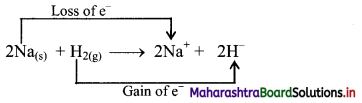
Std 8 History Chapter 12 Questions And Answers India Gains Independence Maharashtra Board

Balbharti Maharashtra State Board Class 8 History Solutions Chapter 12 India Gains Independence Notes, Textbook Exercise Important Questions and Answers.

Class 8 History Chapter 12 India Gains Independence Questions And Answers Maharashtra Board

India Gains Independence Class 8 Questions And Answers Chapter 12 Maharashtra Board

Class 8 History Chapter 12 India Gains Independence Textbook Questions and Answers

1. Rewrite the statements by choosing the appropriate options :

Question 1.
………………. was the head of the interim Government.
(a) Vallabhbhai Patel
(b) Mahatma Gandhi
(c) Pandit Jawaharlal Nehru
(d) Barrister Jinnah
Answer:
(c) Pandit Jawaharlal Nehru

Question 2.
The plan of creation of two independent nations, India and Pakistan, was made by ………………… .
(a) Lord Wavell
(b) Stafford Cripps
(c) Lord Mountbatten
(d) Pethick Lawrence
Answer:
(c) Lord Mountbatten

2. Answer the following in one sentence:

Question 1.
Which demand was advocated by Barrister Jinnah?
Answer:
The two nation theory and demand of separate Muslim nation named Pakistan was advocated by Barrister Jinnah.

Maharashtra Board Class 8 History Solutions Chapter 12 India Gains Independence

Question 2.
Write the names of the ministers participating in Cabinet Mission.
Answer:
Pethick Lawrence, Stafford Cripps and A.V. Ale ander were the ministers participating in the Cabinet Mission.

3. Explain the following statements with reasons:

Question 1
The Indian National Congress approved the partition.
Answer:

  1. Lord Mountbatten prepared a plan of creation of India and Pakistan as two independent nations.
  2. Indian National Congress opposed the plan of partition as unity of the Nation was its basic stand.
  3. However, the Muslim League remained adamant on the creation of Pakistan.
  4. So, the Indian National Congress was left with no option but to accept the partition with complete helplessness.

Question 2.
The working of Interim Government could not run smoothly.
Answer:

  1. Muslim League demanded a separate Muslim nation of Pakistan.
  2. The followers of the Muslim League resorted to violent ways.
  3. Though the Muslim League declined to participate initially, they later participated in it.
  4. However, the leaders of the Muslim League adopted the policy of obstruction and therefore the Interim Government could not run smoothly.

Maharashtra Board Class 8 History Solutions Chapter 12 India Gains Independence

Question 3.
The Wavell Plan could not succeed.
Answer:
The Wavell Plan could not succeed because

  1. Barrister Jinnah insisted that only Muslim League should have the right to suggest the names of Muslim representatives to the Viceroy’s Executive Council.
  2. The Congress opposed this and as a result, no consensus could be arrived at the meeting called by Lord Wavell.

4. Write the events on the following timeline:

Question 1.
Maharashtra Board Class 8 History Solutions Chapter 12 India Gains Independence 1
Answer:
Maharashtra Board Class 8 History Solutions Chapter 12 India Gains Independence 2

5. Answer the following questions in brief:

Question 1.
Why did the British took steps towards granting freedom to India?
Answer:

  1. The Indian freedom struggle had become very intense during the period of Second World War. The revolt of Navy and Air Force shook the foundation of the British empire.
  2. The demand for independence of India was gaining its strength.
  3. The Muslim League had demanded a separate Muslim nation.
  4. The followers of the Muslim League resorted to violence.
  5. The British government realised that it was necessary to take a serious note of it. They realised that their rule in India will not last long.

Accordingly, the British government started preparing plans for granting Independence to India.

Maharashtra Board Class 8 History Solutions Chapter 12 India Gains Independence

Question 2.
Write information about the Mountbatten Plan.
Answer:

  1. England’s Prime Minister Atlee announced the transfer of power would be before June 1948.
  2. He appointed Lord Mountbatten as the Viceroy of India who was to arrange the transfer of power.
  3. He held discussions with the leaders of India.
  4. Mountbatten prepared a plan for partition of India i.e., creation of two independent nations, India and Pakistan.
  5. The Indian National Congress opposed the plan.
  6. But, due to the adamant behaviour of the Muslim League, the Indian National Congress accepted the Plan, with complete helplessness.
  7. On the basis of Mountbatten Plan, Indian Independence Act was passed.

Question 3.
Why did Muslim League declare to observe 16 August as Direct Action Day? What were its effects?
Answer:

  1. The Muslim League was adamant on the demand of Pakistan.
  2. It was not satisfied with Cabinet Mission plan as it had no provision for a separate Muslim state.
  3. 16th August 1946 was observed as Direct Action Day. ‘
  4. The followers of Muslim League resorted to violent ways.
  5. There were Hindu-Muslim riots in various parts of the country.
  6. There were massacres in the Noakhali region in the province of Bengal.

Project:

Collect information about the response of common people after gaining independence, with the help of various reference books as well as the internet.

Class 8 History Chapter 12 India Gains Independence Additional Important Questions and Answers

Rewrite the statements by choosing the appropriate options:

Question 1.
……………… put forth the two Nation theory and demanded a separate Muslim nation.
(a) Barrister Muhammad Ali Jinnah
(b) Chaudhary Rahmat Ali
(c) Dr. Muhammad Iqbal
(d) Lord Mountbatten
Answer:
(a) Barrister Muhammad Ali Jinnah

Question 2.
……………., Prime Minister of England, declared that England would leave its dominion on India before June 194 .
(a) Winston Churchill
(b) Linlithgo
(c) Atlee
(d) Mountbatten
Answer:
(c) Atlee

Question 3.
The ……………. initially refused to participate in the Interim Government.
(a) Indian National Congress
(b) Muslim League
(c) Hindu Mahasabha
(d) Kisan Sabha
Answer:
(b) Muslim League

Question 4.
The Muslim League decided to observe 16th August as ……………. Day.
(a) Non Violence
(b) Pakistan
(c) Direct Action
(d) Independence
Answer:
(c) Direct Action

Question 5.
As per ………………, India got independence.
(a) Mountbatten Plan
(b) Wctvell Plan
(c) Indian Independence Act
(d) Cabinet Mission
Answer:
(c) Indian Independence Act

Maharashtra Board Class 8 History Solutions Chapter 12 India Gains Independence

Question 6.
Gandhiji was assassinated on ………………….. .
(a) 30 December 1947
(b) 30 January 194
(c) 30 March 194
(d) 2 October 194
Answer:
(b) 30 January 194

Name the following:

Question 1.
First person to present idea of free Muslim nation.
Answer:
Dr. Muhammad Iqbal

Question 2.
Last Viceroy of India.
Answer:
Lord Mountbatten

Question 3.
One who presented idea of Pakistan.
Answer:
Chaudhary Rahmat Ali

Question 4.
Went to Noakhali to stop violence
Answer:
Mahatma Gandhi.

Answer the following in one sentence:

Question 1.
What did Prime Minister Atlee declare in the British Parliament of England?
Answer:
Prime Minister Atlee declared in the British Parliament that England would transfer all of its government responsibility to Indians not later than June 1948.

Maharashtra Board Class 8 History Solutions Chapter 12 India Gains Independence

Question 2.
Why did the Interim Government not work smoothly?
Answer:
The Interim Government could not work smoothly because the Muslim League followed the policy of obstruction.

Answer the following questions in brief:

Question 1.
Which were the important provisions :
of the Wavell Plan?
Answer:

  1. The Wavell Plan provided a proper representation to Muslims, Dalits and minorities in the Central and Provincial Legislatures.
  2. It provided for an equal number of Hindu and Muslim members in Viceroy’s Executive Council.

Question 2.
State the provisions of the Indian Independence Act.
Answer:
The Indian Independence Act was passed on the basis of Mountbatten Plan on 18th July, 1947.
According to the plan :

  1. Two Independent nations of India and Pakistan will come into existence on 15th August, 1947.
  2. Thereafter, the British Parliament would not retain any control over them.
  3. The British supremacy over the princely states would come to an end.
  4. They would be free to join either India or Pakistan or remain independent.

Maharashtra Board Class 8 History Solutions Chapter 12 India Gains Independence

Question 3.
Write about the attainment of independence by India.
Answer:

  1. As per the Indian Independence Act, India was granted Independence on 15th August, 1947.
  2. A meeting of the Constituent Assembly was going on in the hall of Parliament House in Delhi in the midnight of 14th August.
  3. At the stroke of midnight, the Union Jack of Britain was lowered and in its place the Indian tricolour flag was unfurled.

Explain the following statements with reasons:

Question 1.
The Cabinet Mission Plan could not satisfy the political parties in India.
Answer:
The Cabinet Mission Plan could not satisfy the political parties in India because,

  1. The Indian National Congress was not happy with some of its provisions.
  2. The Muslim League was also dissatisfied with the plan as it did not provide for the creation of a separate Muslim state of Pakistan.

Question 2.
The joy of attainment of freedom was not untinted:
Answer:

  1. India attained Independence from the slavery of 150 years.
  2. But, the people were grieved due to the partition of the country and the terrible violence during that period.

So, the joy of attainment of freedom was not untinted.

Maharashtra Board Class 8 History Solutions Chapter 12 India Gains Independence

Answer the following in detail:

Question 1.
State the genesis of Pakistan.
Answer:

  1. To weaken the national movement, the British adopted the policy of ‘divide and rule’. Its consequence was the establishment of ‘Muslim League’.
  2. Famous poet, Dr. Muhammad Iqbal put forth the idea of an independent Muslim state.
  3. Later Chaudhary Rahmat Ali coined the name Pakistan.
  4. Barrister Muhammad Ali Jinnah put forth the two nation theory and demanded a separate state for the Muslims naming Pakistan.
  5. Barrister Jinnah and the Muslim League started the propaganda that Indian National Congress was only a Hindu organisation and the Muslims have no benefit of it.
  6. Since their demand was not fulfilled, they observed ‘Direct Action Day’ and resorted to violence.
  7. The nation witnessed Hindu-Muslim riots in various parts.
  8. After the consent of the Indian National Congress to the Mountbatten Plan, the Indian Independence Act provided for the partition.

Question 2.
Why do you think everyone needs freedom?
Answer:

  1. Freedom is liberation from any kind of bondage.
  2. The rights of people are denied under foreign rule.
  3. Lot of restrictions are imposed by a foreign power.
  4. Under a foreign rule or dictatorship, power is not used for the welfare of the people but for the benefit of few.
  5. All round development of the citizens take place in an independent free state.
  6. Equality, Fraternity, Justice, Humanity are values which are cherished in freedom. Therefore, everyone needs freedom.

8th Std History Questions And Answers:
Lenses Class 10 Questions And Answers Maharashtra Board

Class 10 Science Part 1 Chapter 7

Balbharti Maharashtra State Board Class 10 Science Solutions Part 1 Chapter 7 Lenses Notes, Textbook Exercise Important Questions and Answers.

Std 10 Science Part 1 Chapter 7 Lenses Question Answer Maharashtra Board

Class 10 Science Part 1 Chapter 7 Lenses Question Answer Maharashtra Board

Question 1.
Match the columns in the following table and explain them:

Column 1 Column 2 Column 3
Farsightedness Nearby object can be seen clearly Bifocal  lens
Presbyopia Faraway object can be seen clearly Concave  lens
Nearsightedness Problem of old age Convex  lens

Answer:

Column 1 Column 2 Column 3
Farsightedness Faraway object can be seen clearly Convex  lens
Presbyopia Problem of old age Bifocal  lens
Nearsightedness Nearby object can be seen clearly Concave  lens

1. Farsightedness:

Hypermetropia or farsightedness is the defect of vision in which a human eye can see distant objects clearly but is unable to see nearby objects clearly.
In this case the image of a nearby object would fall behind the retina instead of on the retina.

Possible reasons for hypermetropia:
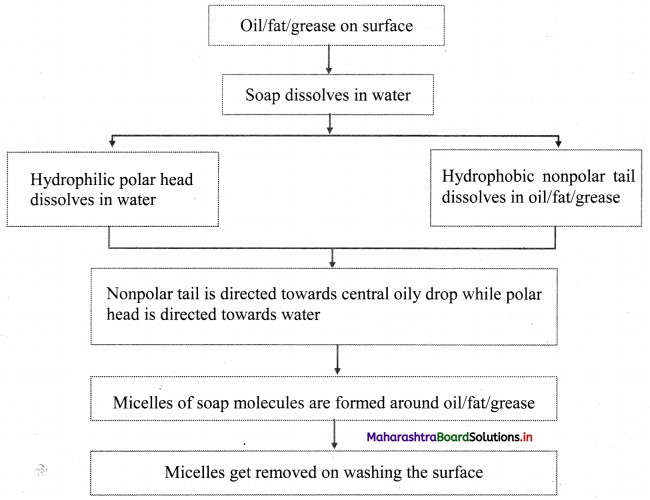
(1) Curvature of the cornea and the eye lens decreases. Hence, the converging power of the eye lens becomes less.
(2) The distance between the eye lens and retina decreases (relative to the normal eye) and the focal length of the eye lens becomes very large due to the flattening of the eyeball.
Maharashtra Board Class 10 Science Solutions Part 1 Chapter 7 Lenses 1

2. Presbyopia:
Presbyopia is the defect of vision in which aged people find it difficult to see nearby objects
comfortably and clearly without spectacles.

Reason of presbyopia: The power of accommodation of eye usually decreases with ageing. The muscles near the eye lens lose their ability to change the focal length of the lens.

Therefore, the near point of the eye lens shifts rarther from the eye, This defect is corrected using a. convex lens of appropriate power. The lens converges light rays before they fall on the eye lens such that the action of the eye lens forms the image on the retina.

3. Nearsightedness:
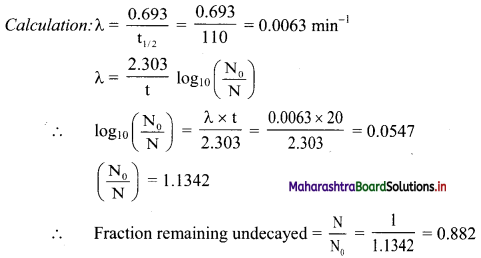
Myopia or nearsightedness is the defect of vision in which a human eye can see nearby objects distinctly but is unable to see distant objects clearly as they appear indistinct.
In this case the image of a distant object is formed in front of the retina instead of on the retina.
[Figs. 7.29 (a), 7.29 (b)]

Possible reasons for myopia:
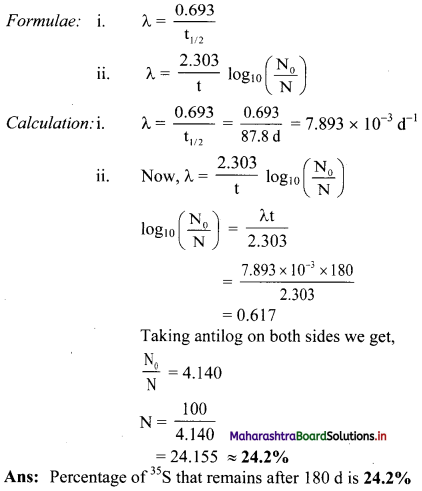
(1) The curvature of the cornea and the eye lens increases. The muscles near the lens cannot relax so that the converging power of the lens remains large. (2) The distance between the eye lens and the retina increases as the eyeball elongates.

Myopia is corrected using a suitable concave lens. Light rays are diverged by the concave lens before they strike the eye lens. A concave lens of proper focal length is chosen to produce the required divergence. Hence, after the converging action of the eye lens, the image is formed on the retina. [Fig. 7.29 (c)]
Maharashtra Board Class 10 Science Solutions Part 1 Chapter 7 Lenses 2

Maharashtra Board Class 10 Science Solutions Part 1 Chapter 7 Lenses

Question 2.
Draw a figure explaining various terms related to a lens.
Answer:
(1) Centre of curvature (C): The centres of the spheres whose parts form the surfaces of a lens are called the centres of curvature of the lens. A lens has two centres of curvature C1, and C2 for its two spherical surfaces.

(2) Radii of curvature (R1, R2): The radii of the spheres whose parts form surfaces of a lens are called the radii of curvature of the lens.

(3) Principal axis: The imaginary straight line passing through the two centres of curvature of a lens is called the principal axis of the lens.

(4) Optical centre (O): The point inside a lens on the principal axis, through which light rays pass without changing their path is called the optical centre (O) of the lens.

(5) Principal focus (F): When light rays parallel to the principal- axis are incident on a convex lens, they converge at a point on the principal axis. This point is called the principal focus (F) of the convex lens. Light rays travelling parallel to the principal axis of a concave lens diverge after refraction in such a way that they appear to be coming out of a point on the principal axis. This point is called the principal focus of the concave lens. A lens has two principal foci F1 and F2.
[Note: In this chapter, the terms focus and the principal focus are used in the same sense.]

(6) Focal length (f): The distance between the optical centre and the principal focus of a lens is called the focal length (f) of the lens.
Maharashtra Board Class 10 Science Solutions Part 1 Chapter 7 Lenses 3
C1, C2: Centres of curvature, R1, R2: Radii of curvature, O: Optical centre.
The cross sections of convex and concave lenses are shown in parts (a) and (b) of Fig. 7.4. The surface marked as 1 is part of sphere S1 while the surface marked as 2 is part of sphere S2.
Maharashtra Board Class 10 Science Solutions Part 1 Chapter 7 Lenses 4
P1, P2, P3: Incident rays of light,
Q1, Q2, Q3: Refracted rays of light, O: Optical centre
Maharashtra Board Class 10 Science Solutions Part 1 Chapter 7 Lenses 5
F1, F2: Principal foci of the lens, f: Focal length of the lens

Maharashtra Board Class 10 Science Solutions Part 1 Chapter 7 Lenses

Question 3.
At which position will you keep an object in front of a convex lens so as to get a real image of the same size as the object? Draw a figure.
Answer:
At 2F1.
Maharashtra Board Class 10 Science Solutions Part 1 Chapter 7 Lenses 6

Question 4.
Give scientific reasons:
a. A simple microscope is used for watch repairs.
Answer:
(1) when an object is placed within the focal length of a magnifying glass or simple microscope (convex lens), its larger and erect image is obtained on the same side of the lens as that of the object.

(2) By adjusting the distance between the object and the lens, the image can be obtained at the minimum distance of distinct vision. Thus, a watch repairer can see the minute parts of a watch more clearly with the aid of a magnifying glass (a simple microscope) than with the naked eye, without any stress on the eye. Hence, watch repairers use a magnifying glass (a simple microscope) while repairing the watches.

b. One can sense colours only in bright light.
Answer:
(1) The retina in the eye is made of many light sensitive cells. The rod-shaped cells respond to the intensity of light while the cone-shaped cells j respond to various colours.
(2) The cone-shaped cells do not respond to faint light. They function only in bright light. Hence, one can sense colours only in bright, light.

c. We cannot clearly see an object kept at a distance less than 25 cm from the eye.
Answer:
(1) When we try to see a nearby object, the eye lens becomes more rounded and its focal length decreases. Then a clear image of the object is formed on the retina of the eye.
(2) The focal length of the eye lens cannot be decreased beyond some limit. Therefore we cannot clearly see an object kept at a distance less than 25 cm from the eye.

Question 5.
Explain the working of an astronomical telescope using refraction of light.
Answer:
Construction of a refracting telescope: It consists of two convex lenses called the objective lens (directed towards the object) and the eyepiece (directed towards the eye). The focal length and diameter of the objective lens are respectively greater than the focal length and diameter of the eyepiece. The objective lens is fitted at one end of a long metal tube.

A metal tube of smaller diameter is fitted in this metal tube and the eyepiece is fitted at the outer end of the smaller tube. With the help of a screw it is possible to change the distance between the eyepiece and the objective lens by sliding the tube fitted with the eyepiece. The principal axes of the objective lens and the eyepiece are along the same line. A telescope is usually mounted on a stand.
Maharashtra Board Class 10 Science Solutions Part 1 Chapter 7 Lenses 7

Working: When the objective lens is pointed towards the distant object to be observed, the rays of light from the distant object, which are almost parallel to each other, pass through the objective lens. The objective lens collects maximum amount of light as it is large in size. It forms a real, inverted and diminished image in the focal plane of the objective lens. Now, the position of the eyepiece is adjusted such that this image falls just within the focal length of the eyepiece and serves as the object for the eyepiece which works as a simple microscope.

The final image is highly magnified, virtual, on the same side as that of the object and inverted with respect to the original object. The final image can be observed by keeping the eye close to the eyepiece. If the image formed by the objective lens lies in the focal plane of the eyepiece, the final image is formed at infinity.

Maharashtra Board Class 10 Science Solutions Part 1 Chapter 7 Lenses

Question 6.
Distinguish between the following:
a. Farsightedness (Hypermetropia) and Nearsightedness (Myopia).
Answer:
Farsightedness:

  1. In hypermetropia, a human eye can see distant distinctly but is unable to see nearby objects clearly.
  2. In this case, the image of a nearby object would be formed behind the retina.
  3. This defect can be corrected using a convex lens of appropriate power.

Nearsightedness:

  1. In myopia, a human eye can see near objects distinctly, but is unable to see distant objects clearly.
  2. In this case, the image of a distant object is formed in front of the retina.
  3. This defect can be corrected using a concave lens of appropriate power.

b. Concave lens and Convex lens.
Answer:
Concave lens:

  1. A concave lens has its surfaces curved inwards.
  2. It is thicker at the edges than in the middle.
  3. It can form only a virtual image.
  4. It can form only a diminished image.

Convex lens:

  1. A convex lens has its surfaces puffed up outwards.
  2. It is thicker in the middle than at the edges.
  3. It can form a real image as well as a % virtual image.
  4. It can form a magnified, diminished or the same sized image (relative to the object) depending on the position of the object.

Question 7.
What is the function of the iris and the muscles connected to the lens in the human eye?
Answer:
When the incident light is very bright, the muscles of the iris stretch to reduce the size of the pupil. When the incident light is dim, the muscles of the iris relax to increase the size of the pupil. Thus, the iris controls the size of the pupil and thereby regulates the amount of light entering the eye. (Fig. 7.26)

When a distant object is to be observed, the ciliary muscles relax so that the eye lens becomes flat. This increases the focal length of the lens. Therefore, a sharp image of the distant object is formed on the retina.
Thus, we can see a distant object clearly. (Fig. 7.27)
Maharashtra Board Class 10 Science Solutions Part 1 Chapter 7 Lenses 8
when an object closer to the eye is to be observed. the ciliary muscles contract increasing the curvature. of the eye lens. The eye lens, therefore, becomes rounded. This decreases the focal length of the lens. Therefore, a sharp image of the nearby object is formed on the retina. Thus, we can see a nearby object clearly. (Fig. 7.27)
Maharashtra Board Class 10 Science Solutions Part 1 Chapter 7 Lenses 9

Question 8.
Solve the following examples:
i. Doctor has prescribed a lens having I power + 1.5 D. What will be the focal length of the lens? What is the type of the lens and what must be the defect of vision?
Solution:
Data: P = + 1.5 D, f = ?
Focal length of the lens, f = \(\frac{1}{P}=\frac{1}{1.5 \mathrm{D}}\)
= \(\frac{10}{15}\) m = 0.6667 m = 0.67 m
P is positive. This shows that the lens is convex. The defect of vision is farsightedness (hypermetropia).

ii. 5 cm high object is placed at a distance of 25 cm from a converging lens of focal length of 10 cm. Determine the position, size and type of the image.
Solution:
Data: Converging lens, f = 10 cm
u = – 25 cm, h1 = 5 cm, v = ?, h2 = ?
Maharashtra Board Class 10 Science Solutions Part 1 Chapter 7 Lenses 10
Maharashtra Board Class 10 Science Solutions Part 1 Chapter 7 Lenses 11
The height of the image = -3.3 cm (inverted image ∴ minus sign).
(iii) The image is real, inverted and smaller than the object.

iii. Three lenses having powers 2, 2.5 and 1.7 D are kept touching in a row. What is the total power of the lens combination?
Solution:
Data: P1 = 2 D, P2 = 2.5 D, P3 = 1.7 D, P = ?
Total power of the lens combination,
P = P1 +P2 + P3
= 2 D + 2.5 D + 1.7 D
= 6.2 D.

iv. An object kept 60 cm from a lens gives a virtual image 20 cm in front of the lens. What is the focal length of the lens? Is it a converging lens or diverging lens?
Solution:
Data: u = -60 cm, v = -20 cm, f = ?
Maharashtra Board Class 10 Science Solutions Part 1 Chapter 7 Lenses 12
∴ The focal length of the lens, f = – 30 cm. As f is negative, it is a diverging lens.

Project:

Question 1.
Make a Powerpoint presentation about the construction and use of binoculars. (Do it your self)

Maharashtra Board Class 10 Science Solutions Part 1 Chapter 7 Lenses

Can you recall? (Text Book Page No. 80)

Question 1.
Indicate the following terms related to spherical mirrors in figure 7.1: pole, centre of curvature, radius of curvature, principal focus.
Maharashtra Board Class 10 Science Solutions Part 1 Chapter 7 Lenses 13
Answer:
Maharashtra Board Class 10 Science Solutions Part 1 Chapter 7 Lenses 14

Question 2.
How are concave and convex mirrors constructed?
Answer:
The given part of a hollow spherical glass can be converted into a concave mirror by (i) polishing (silvering) its inner side (inner surface or concave surface) to make it reflecting or (ii) coating its outer side with a thin layer of silver and painting it with red colour to protect the silver coating.
[Note: Case (i) corresponds to the front surface silvered concave mirror.]

The given part of a hollow spherical glass can be converted into a convex mirror by (i) polishing (silvering) its outer side (outer surface or convex surface) to make it reflecting or (ii) coating its inner side with a thin layer of silver and painting it with red colour to protect the silver coating.
[Note: Case (i) corresponds to the front surface silvered convex mirror. ]

Use your brain power! (Text Book Page No. 85)

Question 1.
From equations (1) and (2) what is the relation between h1, h2, u and v?
Answer:
M = \(\frac{h_{2}}{h_{1}}\) …….(1)
Also, M = \(\frac{v(\text { image distance })}{u \text { (object distance) }}\)……(2)
\(\frac{h_{2}}{h_{1}}\) = \(\frac{v}{u}\)

Maharashtra Board Class 10 Science Solutions Part 1 Chapter 7 Lenses

Try this (Text Book Page No. 88)

(1) Try to read a book keeping it very far from your eyes.
(2) Try to read a book keeping it very close to your eyes.
(3) Try to read a book keeping it at a distance of 25 cm from your eyes.
At which time do you see the alphabets clearly? Why?
Answer:
Minimum distance of distinct vision: Though the focal length of the eye lens is adjustable, it cannot be decreased below a certain limit. Hence, if an object is very close to the eye, it cannot be seen clearly. For a normal human eye, the minimum distance from the eye at which an object is clearly visible without stress on the eye, is called the minimum distance of distinct vision. For the normal human eye, it is 25 cm.

Use your brain power! (Text Book Page No. 89)

Question.
(1) Why do we have to bring a small object near the eyes in order to see it clearly?
(2) If we bring an object closer than 25 cm from the eyes, when can we not see it clearly even though it subtends a bigger angle at the eye?
Answer:
(1) when a small object is brought near the eyes, its apparent size increases. Therefore, it is
seen clearly.

(2) Minimum distance of distinct vision: Though the focal length of the eye lens is adjustable, it cannot be decreased below a certain limit. Hence, if an object is very close to the eye, it cannot be seen clearly. For a normal human eye, the minimum distance from the eye at which an object is clearly visible without stress on the eye, is called the minimum distance of distinct vision. For the normal human eye, it is 25 cm.

Try this (Text Book Page No. 91)

Question 1.
Take a burning incense stick in your hand and rotate it fast along a circle.
Answer:
A circle of red light is seen.

Question 2.
Draw a cage on one side of a cardboard and a bird on the other side. Hang the cardboard with the help of a thread. Twist the thread and leave It. What do you see and why?
Answer:
The bird appears to be inside the cage. This happens due to persistence of vision.
Persistence of vision: We see an object when its image is formed on the retina. The image disappears when the object is removed from our sight. But this is not instantaneous and the image remains imprinted on the retina for about \(\frac{1}{16}\) th of a second after the removal of the object. The sensation on the retina persists for a while. This effect is known as the persistence of vision.

It is due to persistence of vision that we continue to see the object in its position for about \(\frac{1}{16}\) th of a second after it is removed.
Example: When a burning stick of incense is moved fast in a circle, a circle of red light is seen.

Maharashtra Board Class 10 Science Solutions Part 1 Chapter 7 Lenses

Can you tell? (Text Book Page No. 91)

Question 1.
How do we perceive different colours?
Answer:
(1) In nature we field objects of various colours. Perception of colour means to be able to respond to colour.
(2) We can distinguish between various colours due to perception of colour.
(3) The cone-shaped cells on the retina of the eye respond to the various colours when light is bright and communicate to the brain about the colours of the image formed on the retina. This gives us the proper idea about the colours of the object.
(4) If, in the retina of a person, the cone-shaped cells responding to certain specific colours are absent, the person is unable to distinguish between the colours. As a result, he lacks perception of colour.

Fill in the blanks and rewrite the statements:

Question 1.
The focal length of a………..lens is positive.
Answer:
The focal length of a convex lens is positive.

Question 2.
The focal length of a………..lens is negative.
Answer:
The focal length of a concave lens is negative.

Question 3.
The magnification produced by a………..lens is always positive.
Answer:
The magnification produced by a concave lens is always positive.

Question 4.
The power of a………..lens is positive.
Answer:
The power of a convex lens is positive.

Question 5.
The power of a………..lens is negative.
Answer:
The power of a concave lens is negative.

Question 6.
The focal length of a lens with power 2.5 D is………..
Answer:
The focal length of a lens with power 2.5 D is 40 cm (0.4 m).

Question 7.
The power of a lens with focal length 20 cm is………..
Answer:
The power of a lens with focal length 20 cm is 5D.

Question 8.
The minimum distance of distinct vision for a normal human eye is………..
Answer:
The minimum distance of distinct vision for a normal human eye is 25 cm.

Question 9.
If two lenses with focal lengths 10 cm and 20 cm respectively are kept in contact with each other, the effective power of the combination is………..
Answer:
If two lenses with focal lengths 10 cm and 20 cm respectively are kept in contact with each other, the effective power of the combination is 15 D.

Maharashtra Board Class 10 Science Solutions Part 1 Chapter 7 Lenses

Question 10.
A………..lens is used as a simple microscope.
Answer:
A convex lens is used as a simple microscope.

Rewrite the following statements by selecting the correct options:

Question 1.
Inside water, an air bubble behaves………..
(a) like a flat plate
(b) like a concave lens
(c) like a convex lens
(d) like a concave mirror
Answer:
Inside water, an air bubble behaves like a concave lens.

Question 2.
…………represents the lens formula.
Maharashtra Board Class 10 Science Solutions Part 1 Chapter 7 Lenses 15
Answer:
(b) \(\frac{1}{v}-\frac{1}{u}=\frac{1}{f}\) represents the lens formula.

Question 3.
The power of a convex lens of focal length 25 cm is………..
(a) +4.0 D
(b) 0.25 D
(c) -4.0 D
(d) -0.4D
Answer:
The power of a convex lens of focal length 25 cm is +4.0 D

Question 4.
A lens does not produce any deviation of a ray of light passing through………..
(a) it’s centre of curvature
(b) it’s optical centre
(c) it’s principal focus
(d) an axial point at a distance 2F from its centre
Answer:
A lens does not produce any deviation of a ray of light passing through its optical centre.

Question 5.
The image formed by a concave lens is always………..
(a) virtual and erect
(b) real and erect
(c) virtual and inverted
(d) real and inverted
Answer:
The image formed by a concave lens is always virtual and erect.

Question 6.
A convex lens forms a virtual image of an object placed………..
(a) at infinity
(b) at a distance 2F from the lens
(c) at a distance F from the lens
(d) between the principal focus and the optical centre of the lens.
Answer:
A convex lens forms a virtual image of an object placed between the principal focus and the optical centre of the lens.

Question 7.
When an object is placed at 2F1 of a convex lens, its image is formed………..
(a) at F1
(b) at 2F2
(c) beyond 2F2
(d) on the same side as the object
Answer:
When an object is placed at 2F1 of a convex lens, its image is formed at 2F2

Maharashtra Board Class 10 Science Solutions Part 1 Chapter 7 Lenses

Question 8.
To obtain an image of the same size as that of an object with the help of a convex lens, the object should be placed………..
(a) at infinity
(b) beyond F1
(c) between F1 and 2F1
(d) at 2F1
Answer:
To obtain an image of the same size as that of an object with the help of a convex lens, the object should be placed at 2F1

Question 9.
When an object is placed between O and F1 in front of a convex lens, the image formed is ………..
(a) enlarged and erect
(b) diminished and erect
(c) real and enlarged
(d) diminished and inverted
Answer:
When an object is placed between O and F1 in front of a convex lens, the image formed is enlarged and erect.

Question 10.
When an object is placed at any finite distance from a concave lens, the image is formed ………..
(a) between F1 and 2F1
(b) beyond 2F1
(c) at F1
(d) between F1 and O on the same side as the object.
Answer:
When an object is placed at any finite distance from a concave lens, the image is formed between F1 and O on the same side as the object.

Question 11.
A student obtained a clear image of window grills on the screen. But the teacher told him to get the image of a tree far away, instead of the window. To get a clear image, the lens must be ……….. (Practice Activity Sheet – 2)
(a) moved towards the screen
(b) moved away from the screen
(c) moved behind the screen
(d) moved far away from the screen
Answer:
A student obtained a clear image of window grills on the screen. But the teacher told him to get the image of a tree far away, instead of the window. To get a clear image, the lens must be moved towards the screen.

Question 12.
The image obtained while finding the focal length of a convex lens is ……….. (Practice Activity Sheet – 3)
(a) real and erect
(b) virtual and erect
(c) real and inverted
(d) virtual and inverted
Answer:
The image obtained while finding the focal length of a convex lens is real and inverted.

Maharashtra Board Class 10 Science Solutions Part 1 Chapter 7 Lenses

Question 13.
Yash found out f1 and f2 of a symmetric convex lens experimentally. Then which of the following conclusions is true? (Practice Activity Sheet – 4)
(a) f1 = f2
(b) f1 > f2
(c) f1 < f2
(d) f1 ≠ f2
Answer:
(a) f1 = f2

State whether the following statements are true or false: (If a statement is false, correct it and rewrite it.)

Group (A)

Question 1.
Power of a lens, P = \(\frac{1}{f}\).
Answer:
True.

Question 2.
If the power of a lens is 2 D, its focal length = 0.5 m.
Answer:
True.

Question 3.
A concave lens is a converging lens. (March 2019)
Answer:
False. (A concave lens is a diverging lens.)

Question 4.
A convex lens is a diverging lens.
Answer:
False. (A convex lens is a converging lens.)

Question 5.
A concave lens always forms a virtual image.
Answer:
True.

Question 6.
A convex lens always forms a virtual image.
Answer:
False. (A convex lens forms a real image or a virtual image depending on the object distance.)

Maharashtra Board Class 10 Science Solutions Part 1 Chapter 7 Lenses

Question 7.
Due to the light sensitive cells in the eye, we get information about the brightness or dimness of the object and the colour of the object.
Answer:
True.

Question 8.
The focal length of a concave lens is negative.
Answer:
True.

Question 9.
The magnification produced by a concave lens is positive or negative depending on the object distance.
Answer:
False. (The magnification produced by a concave lens is always positive.)

Question 10.
The magnification produced by a convex lens is positive or negative depending on the object distance.
Answer:
True.

Question 11.
A concave lens is used as a magnifying glass.
Answer:
False. (A convex lens is used as a magnifying glass.)

Question 12.
A convex lens is used as a simple microscope.
Answer:
True.

Question 13.
A concave lens is used to correct myopia.
Answer:
True.

Maharashtra Board Class 10 Science Solutions Part 1 Chapter 7 Lenses

Question 14.
A convex lens is used to correct hypermetropia.
Answer:
True.

Group (B)

Question 1.
When red light falls on the eyes, the cells responding to red light get excited more than those responding to other colours and we get the sensation of red colour.
Answer:
True.

Question 2.
When an object is placed in front of a concave lens, its image is obtained on the opposite side of the object.
Answer:
False. (When an object is kept in front of a concave lens, its image is obtained on the same side of the lens as the object.)

Question 3.
The image formed by a concave lens is always virtual.
Answer:
True.

Question 4.
The principal focus of a convex lens is virtual.
Answer:
False. (The principal focus of a convex lens is real.)

Maharashtra Board Class 10 Science Solutions Part 1 Chapter 7 Lenses

Question 5.
An object of height 2 cm forms an image of height 3 cm when placed in front of a concave lens.
Answer:
False. (An object of height 2 cm forms an image of height less than 2 cm when placed in front of a concave lens.)

Question 6.
Absence of rod like cells results in colour blindness.
Answer:
False. (Absence of conical cells results in colour-blindness.)

Question 7.
Nearsightedness can be corrected using spectacles having convex lenses.
Answer:
False. (Nearsightedness can be corrected using spectacles having concave lenses.)

Question 8.
Farsightedness can be corrected using spectacles having convex lenses of suitable focal length.
Answer:
True.

Question 9.
As one grows old, ciliary muscles become weak.
Answer:
True.

Question 10.
In a simple microscope, the object is placed within the focal length of the convex lens.
Answer:
True.

Question 11.
A compound microscope forms an erect and real image of a small object.
Answer:
False. (A compound microscope forms an inverted and virtual image of a small object.)

Question 12.
In a compound microscope, a real image acts as an object for the eyepiece.
Answer:
True.

Maharashtra Board Class 10 Science Solutions Part 1 Chapter 7 Lenses

Question 13.
In television, we see a continuous picture due to persistence of vision.
Answer:
True.

Question 14.
The conical cells can respond differently to red, green and blue colours.
Answer:
True.

Question 15.
The rod like cells respond to colours and communicate the presence of colours in the retinal image of the brain.
Answer:
False. (The rod like cells respond to the intensity of light and communicate the degree of brightness and darkness, to the brain.)

Question 16.
The conical cells respond to the intensity of light and communicate the degree of brightness and darkness to the brain.
Answer:
False. (The conical cells respond to colours and communicate the presence of colours in the retinal image to the brain.)

Question 17.
Generally, using the same objective lens, but different eyepieces, different magnification can be obtained.
Answer:
True.

Find the odd one out and give the reason:

Question 1.
Simple microscope, Compound microscope, Telescope, Myopia.
Answer:
Myopia. It is a defect of vision; others are instruments.

Question 2.
Myopia, Presbyopia, Hypermetropia, Spectrometer.
Answer:
Spectrometer. It is an instrument; others are defects of vision.

Question 3.
Presbyopia, Retina, Nearsightedness, Farsightedness.
Answer:
Retina. It is a part of the eye; others are defects of vision.

Question 4.
Compound microscope, Kaleidoscope, Simple microscope, Astronomical telescope.
Answer:
Kaleidoscope. Others are optical instruments.

Maharashtra Board Class 10 Science Solutions Part 1 Chapter 7 Lenses

Question 5.
TV, Motion picture, Complete circle formed by a revolving burning incense stick, Colour blindness.
Answer:
Colour-blindness. Others are examples of persistence of vision.

Question 6.
Planets, Stars, Satellites, Rainbow.
Answer:
Rainbow. Others are celestial bodies.

Considering the correlation between the words of the first pair, pair the third word accordingly with proper answer:

Question 1.
Nearsightedness: Elongated eyeball :: Farsightedness:………
Answer:
Flattened eyeball

Question 2.
Convex lens : Converging :: Concave lens :………..
Answer:
Diverging

Question 3.
Object at 2F1 of a convex lens : Image at 2F2 :: Object at F1 :………..
Answer:
Image on the opposite side at infinity

Question 4.
Magnification positive : Erect image :: Magnification negative :………..
Answer:
Inverted image

Question 5.
Convex lens : Positive power of the lens :: Concave lens:
Answer:
Negative power of the lens.

Maharashtra Board Class 10 Science Solutions Part 1 Chapter 7 Lenses

Question 6.
\(\frac{1}{f(\text { in metre })}\) : Power of the lens (in dioptre) :: \(\frac{\text { Image distance }}{\text { Object distance }}\)
Answer:
Magnification.

Question 7.
Focal length : Metre :: Power of a lens :………..
Answer:
Dioptre.

Question 8.
Iris : Pupil :: Ciliary muscles :……….
Answer:
Eye lens

Question 9.
Nearsightedness : Concave lens :: Farsightedness :………..
Answer:
Convex lens

Question 10.
Nearsightedness : Image in front of the retina :: Farsightedness :………..
Answer:
Image behind the retina

Question 11.
Observation of stars and planets : Telescope :: Repairing a watch :……….
Answer:
Simple microscope

Question 12.
Cinema : Persistence of vision :: Rainbow :………
Answer:
Refraction, dispersion and internal reflection of light.

Match the following:

Question 1.

Column A Column B
(1) Conical cells (a) Intensity of light
(2) Rod like cells (b) Colour of an image
(3) Pupil (c) Iris
(4) Cornea (d) Aperture
(e) Transparent

Answer:
(1) Conical cells – Colour of an image
(2) Rod like cells – Intensity of light
(3) Pupil – Aperture
(4) Cornea – Transparent.

Maharashtra Board Class 10 Science Solutions Part 1 Chapter 7 Lenses

Question 2.

Column A Column B
(1) Magnification (a) \(\frac{1}{f}\)
(2) Power of a lens (b) \(\frac{h_{2}}{h_{1}}\)
(3) Focal length (c) f
(4) Distance of an object from a lens (d) u
(e) \(\frac{h_{1}}{h_{2}}\)

Answer:
(1) Magnification: \(\frac{h_{2}}{h_{1}}\)
(2) Power of a lens: \(\frac{1}{f}\)
(3) Focal length: f
(4) Distance of an object from a lens: u.

Question 3.
Maharashtra Board Class 10 Science Solutions Part 1 Chapter 7 Lenses 16
Answer:
(1) Lens: \(\frac{1}{f}: \frac{1}{v}-\frac{1}{u}\)
(2) Magnification: \(\frac{h_{2}}{h_{1}}\)
(3) Refractive index: \(\frac{\sin i}{\sin r}\)

Question 4.

Column A Column B
(Convex lens) (a) Image virtual, erect and enlarged
(1) Object at 2F1 (b) Image real, inverted and of the same size
(2) Object between F1 and 2F1 (c) Image real, inverted and highly diminished
(3) Object between O and F1 (d) Image real, inverted and highly enlarged
(4) Object at infinity (e) Image real, inverted and enlarged

Answer:
(1) Object at 2F1 – Image real, inverted and of the same size
(2) Object between F1 and 2F1 – Image real, inverted and enlarged
(3) Object between O and F1 – Image virtual, erect and enlarged
(4) Object at infinity – Image real, inverted and highly diminished

Question 5.

Column A Column B
(1) Nearsightedness (a) Ciliary muscles become weak
(2) Farsightedness (b) Image in front of the retina
(3) Presbyopia (c) Colour-blindness
(d) Image behind the retina

Answer:
(1) Nearsightedness – Image in front of the retina
(2) Farsightedness – Image behind the retina
(3) Presbyopia – Ciliary muscles become weak

Question 6.

Column A Column B
(1) Convex lens (a) To see small objects clearly
(2) Astronomical telescope (b) To observe minute objects
(3) Compound microscope (c) To observe astronomical objects such as stars, planets, etc.
(4) Simple microscope (d) Presbyopia
(e) Power of a lens

Answer:
(1) Convex lens – Presbyopia
(2) Astronomical telescope – To observe astronomical objects such as stars, planets, etc.
(3) Compound microscope – To observe minute objects
(4) Simple microscope – To see small objects clearly.

Maharashtra Board Class 10 Science Solutions Part 1 Chapter 7 Lenses

Question 7.

Column A Column B
(1) Persistence of vision (a) Lenses and mirrors are used
(2) Reflecting telescope (b) To see objects far away from us
(3) Telescope (c) Motion picture
(4) Compound microscope (d) To observe blood
(e) Convex lens

Answer:
(1) Persistence of vision – Motion picture
(2) Reflecting telescope – Lenses and mirrors are used
(3) Telescope – To see objects far away from us
(4) Compound microscope – To observe blood corpuscles.

Name the following:

Question 1.
Name the lens which forms a real image or a virtual image depending on the position of the object.
Answer:
A convex lens.

Question 2.
Name the lens which produces magnification always less than 1.
Answer:
A concave lens.

Question 3.
Name the lens which always forms an image virtual and smaller than the object.
Answer:
A concave lens.

Maharashtra Board Class 10 Science Solutions Part 1 Chapter 7 Lenses

Question 4.
Name the lens used to obtain the image on a screen.
Answer:
A convex lens.

Question 5.
Name the lens for which the image always lies between the object and the lens.
Answer:
A concave lens.

Question 6.
Name the instrument used to observe bacteria.
Answer:
A compound microscope.

Question 7.
Name the instrument used to observe planets.
Answer:
An astronomical telescope.

Answer the following questions in one sentence each:

Question 1.
An object is placed at 60 cm from a convex lens of focal length 20 cm. State the nature and size of the image relative to that of the object.
Answer:
The image is real, inverted and smaller than the object.

Question 2.
If an object is placed at 50 cm from a convex lens of focal length 25 cm, what will be the image distance?
Answer:
The image distance will be.50 cm.

Question 3.
An object is placed at 40 cm from a convex lens of focal length 20 cm. State the nature and the size of the image relative to that of the object.
Answer:
The image is real, inverted and of the same size as that or the object.

Maharashtra Board Class 10 Science Solutions Part 1 Chapter 7 Lenses

Question 4.
An object is placed at 30 cm from a convex lens of focal length 20 cm. State the nature and the size of the image relative to that of the object.
Answer:
The image is real, inverted and larger than the object.

Question 5.
An object is placed at 15 cm from a convex lens of focal length 25 cm. State the nature and size of the image relative to that of the object.
Answer:
The image is virtual, erect and larger than the object.

Question 6.
State the type of lens that can be used to burn paper in sunlight at noon.
Answer:
A convex lens can be used to burn paper in sunlight at noon.

Question 7.
State the type of lens used to correct myopia.
Answer:
A concave lens is used to correct myopia.

Question 8.
State the type of lens used to correct hypermetropia.
Answer:
A convex lens is used to correct hypermetropia.

Question 9.
If two lenses with focal lengths 10 cm and – 20 cm respectively are kept in contact with each other, what will be the effective power of the combination of the lenses?
Answer:
The effective power of the combination of the lenses will be + 5 D.

Question 10.
If two lenses with focal lengths – 10 cm and 40 cm respectively are kept in contact with each other, what can you say about the behaviour of the combination of the lenses?
Answer:
The combination of the lenses will behave as a concave lens.

Answer the following questions:

Question 1.
What is a lens?
Answer:
A lens is a transparent material bound by two surfaces, out of which at least one surface is spherical.
[Note: A lens is normally made of glass or plastic.]

Question 2.
In which instruments have you seen a lens?
Answer:
We have seen a lens in a microscope and a telescope.

Question 3.
How is a lens different from a mirror?
Answer:
A mirror has one reflecting surface. By reflection of light, it forms an image of the object placed in front of it. A mirror is not transparent. A lens has two surfaces that form an image by refraction of light. A lens is transparent.

Question 4.
Make a list of optical devices you know.
Answer:
Microscope, telescope, binoculars, camera, projector.

Question 5.
Do you know which is the natural optical device?
Answer:
Yes. The eye is the natural optical device.

Question 6.
What is a convex lens?
Answer:
A lens having both spherical surfaces puffed up outwards is called a convex lens or double convex lens or biconvex lens. It is thicker in the middle than at the edges.
[Note: A convex lens is also called a converging lens.]

Question 7.
What is a concave lens?
Answer:
A lens having both spherical surfaces curved inwards is called a concave lens or double concave lens or biconcave lens. It is thicker at the edges than in the middle.
[Note: A concave lens is also called a diverging lens.]

Maharashtra Board Class 10 Science Solutions Part 1 Chapter 7 Lenses

Question 8.
Draw neat labelled diagrams: Types of lenses.
Answer:
Maharashtra Board Class 10 Science Solutions Part 1 Chapter 7 Lenses 17
[Note: Positive meniscus behaves as a convex lens as it is thicker in the middle than at the edges. Negative meniscus behaves as a concave lens as it is thicker at the edges than in the middle.]

Question 9.
In general, when a ray of light passes through a lens, there occurs a change in its direction of propagation. Why?
Answer:
The working of a lens is similar to that of a triangular prism. When a ray of light passes through a lens, it is refracted twice: When entering the lens and when emerging from the lens. There is a change 5 in its direction of propagation every time and as both the changes occur in the same sense, the direction of propagation of the emergent ray is different from that of the incident ray.

Question 10.
State the rules used for drawing ray diagrams for the formation of an image by a convex lens.
Answer:
Rules used for drawing ray diagrams for the formation of an image by a convex lens:
(1) When the incident ray is parallel to the principal axis, the refracted ray passes through the principal focus.
Maharashtra Board Class 10 Science Solutions Part 1 Chapter 7 Lenses 18
(2) When the incident ray passes through the principal focus, the refracted ray is parallel to the principal axis.
Maharashtra Board Class 10 Science Solutions Part 1 Chapter 7 Lenses 19
(3) When the incident ray passes through the optical centre of the lens, it passes without changing its direction.
Maharashtra Board Class 10 Science Solutions Part 1 Chapter 7 Lenses 20

Question 11.
In the case of a convex lens, show the path of the refracted ray when the incident ray of light (1) is parallel to the principal axis of the lens (2) passes through the focus of the lens (3) passes through the optical centre of the lens.
Answer:
1.
Maharashtra Board Class 10 Science Solutions Part 1 Chapter 7 Lenses 21

2.
Maharashtra Board Class 10 Science Solutions Part 1 Chapter 7 Lenses 22

3.
Maharashtra Board Class 10 Science Solutions Part 1 Chapter 7 Lenses 23

Maharashtra Board Class 10 Science Solutions Part 1 Chapter 7 Lenses

Question 12.
Draw neat and well labelled ray diagrams for image formation by convex lens when an object is (1) at infinity (2) beyond 2F1 (3) at 2F1 (4) between F1 and 2F1 (5) at focus F1 (6) between focus F1 and optical centre O. Also, in each case, state the position, nature and size of the image relative to that of the object.
Answer:
(1) Object at infinity:
Maharashtra Board Class 10 Science Solutions Part 1 Chapter 7 Lenses 24
In this case, the image is formed at focus F2 of the convex lens. It is real, inverted and highly diminished (point-sized).

(2) Object beyond 2F1:
Maharashtra Board Class 10 Science Solutions Part 1 Chapter 7 Lenses 25
In this case, the image is formed between F2 and 2F2. It is real, inverted and diminished.

(3) Object at 2F1:
Maharashtra Board Class 10 Science Solutions Part 1 Chapter 7 Lenses 26
In this case, the image is formed at 2F2. It is real, inverted and of the same size as that of the object.

(4) Object between F1 and 2F1:
Maharashtra Board Class 10 Science Solutions Part 1 Chapter 7 Lenses 27
In this case, the image is formed beyond 2F2. It is real, inverted and magnified (enlarged).

(5) Object at focus F1:
Maharashtra Board Class 10 Science Solutions Part 1 Chapter 7 Lenses 28
In this case, the image is formed at infinity. It is real, inverted and infinitely large (highly magnified).

(6) Object between focus F1 and optical centre O:
Maharashtra Board Class 10 Science Solutions Part 1 Chapter 7 Lenses 29
In this case, the image is formed on the same side of the lens as the object. It is virtual, erect and larger than the object.
[Note: Here, the image is virtual. Hence, it is shown by a dotted line.]

Maharashtra Board Class 10 Science Solutions Part 1 Chapter 7 Lenses

Question 13.
Observe the following figure and complete the table: (March 2019)
Maharashtra Board Class 10 Science Solutions Part 1 Chapter 7 Lenses 30
Answer:

Point Answer
(i) Position of the object Between F1 and O
(ii) Position of the image On the same side of the lens as the object
(iii) Size of the image Very large
(iv) Nature of the image Virtual and erect

Question 14.
At which position will you keep an object in front of a convex lens to get a real image smaller than the object? Draw a figure.
Answer:
The object should be placed beyond 2F1.
Maharashtra Board Class 10 Science Solutions Part 1 Chapter 7 Lenses 31

Question 15.
State the rules used for drawing ray diagrams for the formation of an image by a concave lens.
Answer:

  1. When the incident ray is parallel to the principal axis, the refracted ray, when extended backwards, passes through the principal focus.
  2. When the incident ray is directed towards the principal focus F2, the refracted ray is parallel to the principal axis.
  3. When the incident ray passes through the optical centre of the lens, it passes without changing its direction.

Question 16.
State the characteristics of an image formed by a concave lens.
Answer:
The image formed by a concave lens is always virtual, erect and smaller than the object. It is on the same side of the lens as the object. Generally, it is formed between the optical centre of the lens and the principal focus F1. If the object is at infinity, the image is a point image formed at F1.

Question 17.
In the case of image formation by a concave lens, what can you say about the position, nature and size of the image relative to the size of the object?
Answer:
Image formation by a concave lens :
(1) If the object is at infinity, the image is formed at the focus of the lens, on the same side of the lens as the object. It is virtual, erect and much smaller than the object (point image).

(2) If the object is at any finite distance from the lens, the image is formed on the same side of the lens as the object and between the focus and the optical centre of the lens. It is virtual, erect and smaller than the object. The image distance is less than the object distance.

Maharashtra Board Class 10 Science Solutions Part 1 Chapter 7 Lenses

Question 18.
Draw a ray diagram to show image formation by a concave lens.
Answer:
Maharashtra Board Class 10 Science Solutions Part 1 Chapter 7 Lenses 32
PQ : Object
P’Q’ : Image (virtual, therefore shown by a dotted line),
O : Optical centre,
F1 : Principal focus,
f : Focal length of the lens
[Note: If in a Board examination, incomplete diagram (as shown below) is given, students should complete it and label its parts as shown in Figure.]
Maharashtra Board Class 10 Science Solutions Part 1 Chapter 7 Lenses 33

Question 19.
State the Cartesian sign convention for refraction of light (image formation) by a lens.
Answer:
Cartesian sign convention for refraction of light (image formation) by a lens:
In this case, the optical centre (O) of the lens is taken as the origin and the principal axis of the lens is taken as X-axis of the coordinate system.

(1) The object is always placed at the left of the lens.
All distances parallel to the principal axis are measured from the optical centre of the lens.
(2) All distances measured to the right of the origin are taken as positive while distances measured to the left of the origin are taken as negative.
(3) Distances measured perpendicular to and above the principal axis are taken as positive.
(4) Distances measured perpendicular to and below the principal axis are taken as negative.
(5) The focal length of a convex lens is positive and that of a concave lens is negative. (Fig. 7.21)
Maharashtra Board Class 10 Science Solutions Part 1 Chapter 7 Lenses 34
Maharashtra Board Class 10 Science Solutions Part 1 Chapter 7 Lenses 35

Question 20.
(i) What is a lens formula? (ii) State it.
Answer:
(i) The relationship between the object distance (u), image distance (v) and focal length (J) of a lens is called the lens formula.
(ii) It is \(\frac{1}{v}-\frac{1}{u}=\frac{1}{f}\)
[Note: The lens formula holds good for all values of u and v and is applicable to a convex lens as well as a concave lens. The sign convention for u, v and f must tie used in solving numerical examples.]

Maharashtra Board Class 10 Science Solutions Part 1 Chapter 7 Lenses

Question 21.
What is meant by the magnification produced by a lens? State the formulae for it.
Answer:
The magnification (M) produced by a lens is the ratio of the height of the image (h2) to the height of the object (h1).
M = \(\frac{h_{2}}{h_{1}}\)……….(1)
Also M = \(\frac{v(\text { image distance })}{u \text { (object distance) }}\)……………(2)

Question 22.
When is the magnification produced by a lens (1) positive (2) negative?
Answer:
The magnification produced by a lens is
(1) Positive when the image is virtual (as it is erect)
(2) Negative when the image is real (as it is inverted).

Question 23.
Express the magnification produced by a lens in terms of the focal length of the lens and (1) the object distance (2) the image distance.
Answer:
Magnification (M) produced by a lens
Maharashtra Board Class 10 Science Solutions Part 1 Chapter 7 Lenses 36
where f is the focal length of the lens:
Maharashtra Board Class 10 Science Solutions Part 1 Chapter 7 Lenses 37
(2) From eq. (2), we have
Maharashtra Board Class 10 Science Solutions Part 1 Chapter 7 Lenses 38

Question 24.
An object is kept in front of a lens of focal length + 10 cm. Describe the nature of the image in the following cases: (1) The object” distance is 25 cm. (2) The object distance is 5 cm.
Answer:
Since, the focal length of the lens ( +10 cm) is positive, it is a convex lens.
(1) If an object is kept at 25 cm from the lens, the image will be real, inverted and smaller than the object.
(2) If an object is kept at 5 cm from the lens, the image will be virtual, erect and larger than the object.

Maharashtra Board Class 10 Science Solutions Part 1 Chapter 7 Lenses

Question 25.
Anu and Anand have concave and convex lenses respectively. They took lenses in sunlight and tried to burn two pieces of paper of equal areas and temperature. State which lens will burn the paper. Give the reason. Explain with the help of a diagram, why the other paper did not burn.
Answer:
(1) The convex lens will burn the paper. See Fig. 7.22 for reference. The ray of sunlight will converge at the principal focus of the lens. Hence, if the paper is held at the focus, it will burn due to concentration of heat energy.
Maharashtra Board Class 10 Science Solutions Part 1 Chapter 7 Lenses 39
(2) The paper held in front of the concave lens, will not burn. For reference, see Fig. 7.23. The concave lens will diverge the rays of sunlight falling on it. Hence, the paper will not burn.
Maharashtra Board Class 10 Science Solutions Part 1 Chapter 7 Lenses 40

Question 26.
To obtain a magnified real image of a small film strip, which type of lens is used? Where is the film strip placed to obtain the image on the screen?
Answer:
To obtain a magnified real image of a small film strip, a convex lens is used. The film strip is placed between F1 and 2F1 and the screen is placed on the other side of the lens.

Maharashtra Board Class 10 Science Solutions Part 1 Chapter 7 Lenses

Question 27.
When an object of height 2 cm is placed in front of a convex lens, the height of the image is found to be 3 cm. State the nature and position of the image giving reason.
Answer:
When an object is placed between the optical centre and the principal focus of a convex lens, the image formed by the lens is virtual and larger than the object. When an object is placed between F1 and 2F1 the image formed by the lens is real and larger than the object.

In the above case, if the image is virtual, it will be erect and on the same side of the lens as that of the object. If the image is real, it will be inverted and beyond 2F2 on the other side of the lens with respect to the object.

Question 28.
You are given a lens which gives a virtual, erect and enlarged image. What type of lens is it?
Answer:
Since the lens gives a virtual, erect and enlarged image, it must be a convex lens.

Question 29.
When an object of height 3 cm is placed in front of a concave lens, the height of the image is found to be 6 cm. State, giving the reason, whether the given statement is true or false.
Answer:
When an object is placed in front of a concave lens, the image formed by the lens is always smaller than the object. In the statement given in the question, the height of the image is reported as greater than that of the object. Hence, the statement given in the question is false.

Question 30.
State two uses of a concave lens.
Answer:

  1. A concave lens is used to correct myopia (nearsightedness).
  2. In some optical instruments, a combination of a concave lens and a convex lens is used.

Question 31.
State two uses of a convex lens.
Answer:
A convex lens is used (1) to read words in small print (2) to correct hypermetropia (Far-sightedness).

Maharashtra Board Class 10 Science Solutions Part 1 Chapter 7 Lenses

Question 32.
An object is kept in front of a lens of j focal length – 20 cm. Describe the nature of the image when the object distance is 25 cm.
Answer:
Since the focal length of the lens (- 20 cm) is negative, it is a concave lens.
If an object is kept at 25 cm from the lens, the image will be virtual, erect and smaller than the object.
[Note: The nature of the image is independent of the object distance as it is a concave lens.]

Question 33.
An object is placed in front of a convex lens of focal length 20 cm. If the object distance is changed from 60 cm to 40 cm, what can you say about the size of the image relative to that of the object?
Answer:
In this case, the focal length (f) of the lens is 20 cm.
∴ 2f = 40 cm.
When the object distance is 60 cm (which is greater than 2f), the image will be smaller than the object. When the object distance becomes 40 cm (which is equal to 2f), the image will be of the same size as that of the object.

Question 34.
What is the power of a lens?
Answer:
The capacity of a lens to converge or diverge incident rays is called its power. The power (P) of a lens is the inverse of the focal length (f) of the lens.
P = \(\frac{1}{f}\)

Question 35.
What is the unit of power of a lens? Define it.
Answer:
The unit of power of a lens is the dioptre (D).
One dioptre is the power of a lens whose focal length is one metre.
1 dioptre (D) = \(\frac{1}{1 \text { metre }(\mathrm{m})}\)
[Note: The dioptre, the SI unit of power of a lens, is denoted by D.]

Question 36.
What is the sign of the power of (i) a convex lens (ii) a concave lens?
Answer:
The power of a convex lens is positive while that of a concave lens is negative.

Maharashtra Board Class 10 Science Solutions Part 1 Chapter 7 Lenses

Question 37.
If there is an increase or decrease in the focal length of a lens, what will be the effect on the power of the lens?
Answer:
The power of a lens is the inverse of its focal length. Hence, if there is an increase in the focal length of a lens, the power of the lens will decrease accordingly. Similarly, if there is a decrease in the focal length of a lens, the power of the lens will increase accordingly.

Question 38.
If two lenses of focal lengths f1 and f2 are kept in contact with each other, state the formula for the focal length of the combination. If P1 and P2 are the powers of these lenses, state the formula for the power of the combination.
Answer:
If two lenses of focal lengths f1 and f2 are kept in contact with each other, the focal length (f) of the combination is given by \(\frac{1}{f}=\frac{1}{f_{1}}+\frac{1}{f_{2}}\)
Maharashtra Board Class 10 Science Solutions Part 1 Chapter 7 Lenses 41
[Two lenses kept in contact with each other]
If P1 and P2 are the powers of these lenses, the power (P) of the combination is given by P = P1 + P2.
[Note: The figures are given only for reference.]

Question 39.
Draw a neat labelled diagram to show the structure of the human eye.
Answer:
Maharashtra Board Class 10 Science Solutions Part 1 Chapter 7 Lenses 42

Question 40.
What is cornea?
Answer:
The cornea is a thin and transparent cover (membrane) on the human eye through which light enters the eye. Maximum refraction of light rays entering the eye occurs at the cornea.

Maharashtra Board Class 10 Science Solutions Part 1 Chapter 7 Lenses

Question 41.
What is iris?
Answer:
The iris is a dark fleshy screen (muscular diaphragm) behind the cornea in the human eye. Its colours are different for different people.

Question 42.
What is pupil?
Answer:
The pupil is a small circular opening of changing diameter at the centre of the iris in the human eye.

Question 43.
What is the use of the pupil in the human eye?
Answer:
The pupil in the human eye is useful for controlling and regulating the amount of light entering the eye. The pupil contracts in the presence of too much light and dilates when light is insufficient, thus changing the amount of light entering the eye.

Question 44.
With reference to the functioning of the pupil in the human eye, what is adaptation?
Answer:
The tendency of the pupil in the human eye to adjust the opening for light, depending on the intensity of incident light, to control and regulate the amount of light entering the eye is called adaptation.

Question 45.
What is the shape and the size of the human eyeball?
Answer:
The human eyeball is approximately spherical in shape with a diameter of about 2.4 cm.

Question 46.
Name the part of the human eye that forms a transparent bulge on the surface of the eyeball.
Answer:
The cornea forms a transparent bulge on the surface of the eyeball.

Question 47.
Which part of the human eye is located just behind the pupil?
Answer:
A transparent biconvex crystalline lens is located just behind the pupil in the human eye.

Question 48.
What is retina?
Answer:
The retina is a light sensitive screen consisting of a delicate membrane with a large number of light sensitive cells.

Maharashtra Board Class 10 Science Solutions Part 1 Chapter 7 Lenses

Question 49.
What is the nature of the eye lens and what does the eye lens do?
Answer:
The eye lens is a double convex transparent crystalline lens, just behind the pupil. The eye lens provides small adjustment of focal length to form a real and inverted sharp image on the retina.

Question 50.
What happens when light falls on the retina?
Answer:
When light falls on the retina, light sensitive cells of the retina are activated. They generate electrical signals which are passed by optic nerves to the brain. The brain interprets the signals and processes the information such that we perceive the object as it is.

Question 51.
What are ciliary muscles?
Answer:
The muscles which hold the eye lens in its position, and bring about changes in the shape (curvature) of the eye lens, and hence of focal length are known as ciliary muscles.

Question 52.
What is the focal length of the eye lens of a normal eye in relaxed position of eye muscles?
Answer:
The focal length of the eye lens of a normal eye in relaxed position of eye muscles is about 2 cm.

Question 53.
Where does the second focal point of the eye lens of a normal eye in relaxed position of eye muscles lie?
Answer:
The second focal point of the eye lens of a normal eye in relaxed position of eye muscles lies on the retina.

Question 54.
What is meant by power of accommodation of the eye?
Answer:
The ability of the eye lens to adjust its focal length is called the power of accommodation of the eye.

Question 55.
Explain the term power of accommoda¬tion of the eye.
(OR)
Write a short note on the power of accommodation of the eye.
Answer:
Power of accommodation of the eye: The eye lens is held in its position by the ciliary muscles. When we look at a nearby object, the ciliary muscles compress the eye lens so that it becomes rounded. Hence, the focal length of the eye lens decreases. Therefore, the image is formed on the retina of the eye and hence the nearby object is seen clearly.

When we look at a distant object, the ciliary muscles relax so that the eye lens becomes flat. Hence, the focal length of the eye lens increases. Therefore, the image is formed on the retina of the eye and hence the distant object is seen clearly. This ability of the eye lens to adjust its focal length is called the power of accommodation of the eye.

Maharashtra Board Class 10 Science Solutions Part 1 Chapter 7 Lenses

Question 56.
What is meant by accommodation? How is it brought about?
Answer:
The process of focusing the eye on objects at different distances is called accommodation. It is brought about by changing the curvature of the f elastic eye lens making it thinner or thicker.

Question 57.
The human eye is very similar to a photographic camera. The figure given shows the main parts of a photographic camera. Now answer the following questions:
Maharashtra Board Class 10 Science Solutions Part 1 Chapter 7 Lenses 43
(1) Name the parts of the human eye similar to the following parts of the photographic camera :
(a) Photographic film (b) Aperture.
(2) State one difference between the human eye lens and camera lens.
(3) Name the muscles which adjust the curvature of the eye lens.
(4) Which phenomenon of light is responsible for the working of the eye?
Answer:
(1) (a) The retina in the human eye is similar to the photographic film in a camera.
(b) The pupil in the human eye is similar to the aperture in a camera.
(2) In a photographic camera, the focal length of the lens changes when the position of the lens is changed. In the human eye, the focal length of the eye lens is changed by the ciliary muscles and the distance of the image from the eye lens is fixed.
(3) The ciliary muscles adjust the curvature of the eye lens.
(4) The refraction of light is responsible for the working of the eye.

Question 58.
Have you seen a photographic camera in which a film is used? Compare the human eye with it. State similarities between them. State the points of difference between them.
Answer:
Yes, we have seen a photographic camera in which a film is used.
Cameras, in general, have various shapes and sizes. Some cameras are much bigger than the human eye while some are smaller than the human eye. Here we shall consider a simple camera.

Similarities: In the case of a camera as well as the human eye, it is possible to control the amount of incoming light with the help of a diaphragm and an aperture. Both use a convex lens for focusing. The photographic film in a camera is coated with a photosensitive material. The retina in the eye consists of a large number of light sensitive cells. The photographic film in a camera is processed using chemicals and then prints (photographs) can be obtained using the appropriate paper.

In the human eye, the electrical signals generated by light sensitive cells are passed by optic nerves to the brain which interprets them.

Differences: Cameras come in a variety of sizes and shapes unlike the human eye. Unlike the human eye, a wide variation in exposure time is possible in the case of cameras. The human eye is sensitive in the visible region (red to violet) of the electromagnetic spectrum, while a much wider range of the electromagnetic spectrum can be covered with cameras designed for specific J purposes. In comparison with the human eye, a wider view and range can be covered by a camera.

In comparison with the human eye, a wider intensity (of light) range can be covered with a camera. The retina is indispensable in the human eye, while cameras without a photographic film have been designed with the help of photosensitive materials and are in current use.

[Note: With advances in technology, improved cameras are designed all the time, and the list of differences between the human eye and a camera in general would be practically endless.]

Question 59.
What is meant by the minimum distance of distinct vision?
Answer:
The minimum distance from the normal eye, at which an object is clearly visible without stress on the eye is called the minimum distance of distinct vision.

Maharashtra Board Class 10 Science Solutions Part 1 Chapter 7 Lenses

Question 60.
Explain the term minimum distance of distinct vision.
(OR) Write a short note on distance of distinct vision.
Answer:
Minimum distance of distinct vision; Though the focal length of the eye lens is adjustable, it cannot be decreased below a certain limit. Hence, if an object is very close to the eye, it cannot be seen clearly. For a normal human eye, the minimum distance from the eye at which an object is clearly visible without stress on the eye, is called the minimum distance of distinct vision. For the normal human eye, it is 25 cm.

Question 61.
State four reasons related to problems of vision.
Answer:
Problems of vision are related to (i) weakening of ciliary muscles (ii) change in the size of the eyeball (iii) irregularities on the surface of cornea (iv) formation of a membrane over the eye lens.

Question 62.
What is myopia or nearsightedness? What are the possible reasons of myopia? How is myopia corrected? Explain with diagrams.
Answer:
Myopia or nearsightedness is the defect of vision in which a human eye can see nearby objects distinctly but is unable to see distant objects clearly as they appear indistinct.
In this case the image of a distant object is formed in front of the retina instead of on the retina. [Figs. 7.29 (a), 7.29 (b)]

Possible reasons of myopia: (1) The curvature of the cornea and the eye lens increases. The muscles near the lens cannot relax so that the converging power of the lens remains large. (2) The distance between the eye lens and the retina increases as the eyeball elongates.

Myopia is corrected using a suitable concave lens. Light rays are diverged by the concave lens before they strike the eye lens. A concave lens of proper focal length is chosen to produce the required divergence. Hence, after the converging action of the eye lens, the image is formed on the retina. [Fig. 7.29 (c)]
Maharashtra Board Class 10 Science Solutions Part 1 Chapter 7 Lenses 44

Question 63.
Observe the following diagram and answer the questions.
(a) Which eye defect is shown in this diagram?
(b) What are the possible reasons for this eye defect?
(c) How is this defect corrected? Write it in brief.
Maharashtra Board Class 10 Science Solutions Part 1 Chapter 7 Lenses 45
Answer:
(a) Myopia or Nearsightedness

(b) Possible reasons for the defect:
(i) The curvature of the cornea and the eye lens increases. The muscles near the lens cannot relax so that the converging power of the lens remains large.
(ii) The eyeball elongates so that the distance between the lens and the retina increases.

(c) Correction of the defect: This defect can be corrected using spectacles with concave lenses.
A concave lens diverges the incident rays and these diverged rays can be converged by the lens in the eye to form an image on the retina.

Question 64.
What is the sign of the power of the lens used to correct myopia?
Answer:
The power of the lens used to correct myopia is negative.
[Note: It is a concave lens. Negative focal length Negative power.]

Maharashtra Board Class 10 Science Solutions Part 1 Chapter 7 Lenses

Question 65.
In a Std. X class, out of 40 students, 10 students use spectacles, 2 students have ( positive power and 8 students have negative power of lenses in their spectacles.
Answer the following questions:
(1) What does the negative power indicate?
(2) What does the positive power indicate?
(3) Generally which type of spectacles do most of the students use?
(4) What defect of eyesight do most of the students suffer from?
(5) Give two possible reasons for the above defect.
Answer:
(1) The negative power indicates a concave lens or myopia.
(2) The positive power indicates a convex lens or hypermetropia.
(3) Generally, most of the students use spectacles with concave lenses.
(4) Most of the students suffer from myopia.
(5) Two possible reasons for myopia:

  1. The curvature of the cornea and the eye lens increases. The muscles near the lens cannot relax so that the converging power of the lens remains large.
  2. The distance between the eye lens and the retina increases as the eyeball elongates.

Question 66.
What is hypermetropia or farsightedness? What are the possible reasons of hypermetropia? How is hypermetropia corrected? Explain with figures.
Answer:
Hypermetropia or farsightedness is the defect of vision in which a human eye can see distant objects clearly but is unable to see nearby objects clearly.
In this case the image of a nearby object would fall behind the retina instead of on the retina.
[Figs. 7.31 (a), 7.31 (b)]

Possible reasons of hypermetropia:
(1) Curvature of the cornea and the eye lens decreases. Hence, the converging power of the eye lens becomes less. (2) The distance between the eye lens and retina decreases (relative to the normal eye) and the focal length of the eye lens becomes very large due to the flattening of the eyeball.
Maharashtra Board Class 10 Science Solutions Part 1 Chapter 7 Lenses 46
Hypermetropia is corrected using a suitable convex lens. Light rays are converged by the convex lens before they strike the eye lens. A convex lens of proper focal length is chosen to produce the required convergence. Hence, after the converging action of the eye lens, the image is formed on the retina. [Fig. 7.31 (c)]

Question 67.
What is the sign of the power of the lens used to correct hypermetropia?
Answer:
The power of the lens used to correct hypermetropia is positive.
[Note: It is a convex lens. Positive focal length ∴ Positive power.]

Question 68.
Given below is a diagram showing a defect of human eye.
Maharashtra Board Class 10 Science Solutions Part 1 Chapter 7 Lenses 47
Study it and answer the following questions:
(1) Name the defect shown in the figure. (Practice Activity Sheet – 3)
(2) Give two possible reasons for this defect of eye in human beings.
(3) Name the type of lens used to correct the eye defect.
(4) Draw a labelled diagram to show how the defect is rectified by using the lens.
Answer:
A lens having both spherical surfaces puffed up outwards is called a convex lens or double convex lens or biconvex lens. It is thicker in the middle than at the edges.
[Note: A convex lens is also called a converging lens.]

Maharashtra Board Class 10 Science Solutions Part 1 Chapter 7 Lenses

Question 69.
Observe the following figures and complete the table. (Practice Activity Sheet – 1)
Answer:
Maharashtra Board Class 10 Science Solutions Part 1 Chapter 7 Lenses 48

Question 70.
What is presbyopia? State the reason for this defect. How is presbyopia corrected?
Answer:
Presbyopia is the defect of vision in which aged people find it difficult to see nearby objects comfortably and clearly without spectacles.

Reason of presbyopia: The power of accommodation of eye usually decreases with ageing. The muscles near the eye lens lose their ability to change the focal length of the lens.
Therefore, the near point of the eye lens shifts farther from the eye.

This defect is corrected using a convex lens of appropriate power. The lens converges light rays before they fall on the eye lens such that the action of the eye lens forms the image on the retina.

Question 71.
What is a bifocal lens?
Answer:
A bifocal lens is a lens of which the upper part is a concave lens to correct myopia and the lower part is a convex lens to correct hypermetropia.

[Note: A person suffering from myopia as well as hypermetropia, uses a bifocal lens. Nowadays, the defects of vision such as myopia and hypermetropia can be corrected using contact lenses or by laser surgery.]

Question 72.
(A) Anil cannot see the blackboard writing clearly, but he can see nearby objects clearly.
(i) What is the eye defect he is suffering from?
(ii) How is it corrected?
(B) Anil’s uncle cannot see nearby objects clearly, but he can see distant objects clearly.
(i) What is the eye defect he is suffering from?
(ii) How is it corrected?
Answer:
(A) Anil cannot see the blackboard writing clearly, but he can see nearby objects clearly.
(i) This defect is called myopia (nearsightedness).
(ii) It is corrected using spectacles having concave lenses of appropriate power.

(B) Anil’s uncle cannot see nearby objects clearly, but he can see distant objects clearly.
(i) This defect is called hypermetropia (farsightedness).
(ii) It is corrected using, spectacles having convex lenses of appropriate power.

Question 73.
When are bifocal lenses used in spectacles?
Answer:
When a person cannot see nearby objects as well as distant objects clearly, bifocal lenses are used in spectacles.

Question 74.
Aniket from Std. X uses spectacles. The power of the lenses in his spectacles is -0.5 D. Answer the following questions:
(1) State the type of’ lenses used in his spectacles.
(2) Name the defect of vision Aniket is suffering from.
(3) Find the focal length of the lenses used in his spectacles.
Answer:
(1) Concave lenses are used in the spectacles used by Aniket.
(2) Aniket is suffering from myopia (near-sightedness).
(3) Focal length of the lenses used in his spectacles
Maharashtra Board Class 10 Science Solutions Part 1 Chapter 7 Lenses 49
= -2 m (Concave lens ∴ Minus sign)

Maharashtra Board Class 10 Science Solutions Part 1 Chapter 7 Lenses

Question 75.
Sunita from Std. X uses spectacles. Her spectacle number is -1.5 D. Answer the following questions:
(1) Name the defect of eye from which she is suffering.
(2) What type of lens is she using?
(3) Find the focal length of the lens.
Answer:
(1) Myopia.
(2) Concave.
Maharashtra Board Class 10 Science Solutions Part 1 Chapter 7 Lenses 50
(Concave lens ∴ minus sign)
This is the focal length of the lens.

Question 76.
Surabhi from Std. X uses spectacles. The power of the lenses in her spectacles is 0.5 D. Answer the following questions from the given information: (March 2019)
(i) Identify the type of lenses used in her spectacles.
(ii) Identify the defect of vision Surabhi is suffering from.
(iii) Find the focal length of the lenses used in her spectacles.
Answer:
(i) Convex lenses are used in the spectacles used by Surabhi.
(ii) Surabhi is suffering from hypermetropia (farsightedness).
(iii) Focal length of the lenses used in her spectacles
Maharashtra Board Class 10 Science Solutions Part 1 Chapter 7 Lenses 51

Question 77.
My grandfather uses a bifocal lens in his spectacles. Explain why.
Answer:
In old age, people usually suffer from both myopia and hypermetropia. Therefore, they need spectacles having bifocal lenses.

The upper part of a bifocal lens is a concave lens to correct myopia. The lower part of a bifocal lens is a convex lens to correct hypermetropia.

Question 78.
State uses of concave lens.
Answer:

  1. Concave lenses are used for proper working of medical equipment, scanner, CD player – the instruments that employ laser rays.
  2. One or more concave lenses are used in a small safety device, fitted in the peep hole in a door, due to which we can see a large area outside the door.
  3. Concave lenses are used in spectacles to correct nearsightedness (myopia).
  4. A concave lens is used to spread light emitted by the small bulb in a torch over a wide area.
  5. A concave lens is used in front of the eyepiece or inside the eyepiece fitted in a camera, telescope and microscope – the instruments employing convex lenses.

Question 79.
State uses of a convex lens.
Answer:
Convex lenses are used in a simple microscope, compound microscope, refracting telescope, camera, projector, spectroscope, spectacles for correcting farsightedness (hypermetropia) and binoculars.

Maharashtra Board Class 10 Science Solutions Part 1 Chapter 7 Lenses

Question 80.
What is meant by the apparent size of an object? With a neat and labelled diagram, explain the relation between the apparent size of an object and the angle subtended by the object at the eye.
Answer:
An object appears small or big depending upon the size of its image formed on the retina of the eye. The size of an object as perceived by the eye is called the apparent size of the object. Consider two objects of the same size, one held near the eye and the other away from the eye as shown in the following figure (Fig. 7.34). The nearby object (PQ) appears larger than the distant object (P1Q1).
Maharashtra Board Class 10 Science Solutions Part 1 Chapter 7 Lenses 52
Also, the angle a subtended by the nearby object at the eye is larger than the angle β subtended by the distant object at the eye. This shows that the apparent size of an object depends upon the angle subtended by the object at the eye. The greater the angle subtended by the object at the eye, the greater is the apparent size of the object. Similarly, the smaller the angle subtended by the object at the eye, the smaller is the apparent size of the object.

Question 81.
With a neat labelled diagram, explain the working of a simple microscope. State uses of a simple microscope.
(OR)
What does a simple microscope consist of? What is the order of magnification obtained by a simple microscope? What is a simple microscope used for?
Answer:
A simple microscope consists of a convex lens of short focal length, usually fixed in a suitable frame with a handle or mounted on a stand.
Maharashtra Board Class 10 Science Solutions Part 1 Chapter 7 Lenses 53
The object is placed in front of the convex lens of short focal length such that the object distance is less than the focal length. The image is virtual and larger than the object. It is formed on the same side of the lens as the object.

A maximum magnification of about 20 can be obtained by a simple microscope. A simple microscope is used by watch repairers to observe small parts of a watch and by jewellers to examine ornaments. A simple microscope (also called a magnifying glass) is also used to read words in small print.

Question 82.
With a neat labelled diagram, explain the construction and working of a compound microscope.
Answer:
Construction of a compound microscope:
Maharashtra Board Class 10 Science Solutions Part 1 Chapter 7 Lenses 54
(1) A compound microscope consists of a metal tube fitted with two convex lenses at the two ends. These lenses are called the objective lens (the lens directed towards the object) and the eyepiece (the lens directed towards the eye). Both the lenses are small in size, but the cross section of the objective lens is less than that of the eyepiece. The objective lens has a short focal length. The focal length of the eyepiece is more than that of the objective lens.

(2) The metal tube is mounted on a stand. The principal axes of the objective lens and the eyepiece are along the same line. The distance between the object and the objective lens can be changed with a screw. It is possible to change the distance between the objective lens and the eyepiece.

Working :
(1) The object to be observed is illuminated and placed in front of the objective lens, slightly beyond the focal length of the objective lens. Its real, inverted and enlarged image is formed by the objective lens on the other side.

(2) This intermediate image lies within the focal length of the eyepiece. It serves as an object for the eyepiece. The eyepiece works as a simple microscope. The final image is virtual, highly enlarged and inverted with respect to the original object. It can be formed at the minimum distance of distinct vision from the eyepiece. The final image is observed by keeping the eye close to the eyepiece.

Maharashtra Board Class 10 Science Solutions Part 1 Chapter 7 Lenses

Question 83.
State two uses of a compound microscope.
Answer:
Uses of a compound microscope:

  1. It is used to observe blood corpuscles, plant and animals cells, microorganisms like bacteria, etc.
  2. It is used in a pathological laboratory to observe blood, urine, etc.
  3. It is a part of a travelling microscope used for measurement of very small distance.

Question 84.
What will happen if in a compound microscope, the objective lens is large in size and has a focal length?
Answer:
If the objective lens of a compound microscope is large in size, in addition to the light coming from an object, other unwanted light will be incident on the objective lens. Hence, the image will not be seen clearly. If the objective lens has a large focal length, the magnification produced by it will be less.

Question 85.
(a) In which type of microscope do you find the lens arrangement as shown in the following diagram? (Practice Activity Sheet – 1)
Maharashtra Board Class 10 Science Solutions Part 1 Chapter 7 Lenses 55
(b) Write in brief, the working of this microscope.
(c) Where is this microscope used?
Answer:
(a) Compound microscope.

(b)
An object appears small or big depending upon the size of its image formed on the retina of the eye. The size of an object as perceived by the eye is called the apparent size of the object. Consider two objects of the same size, one held near the eye and the other away from the eye as shown in the following figure (Fig. 7.34). The nearby object (PQ) appears larger than the distant object (P1Q1).
Maharashtra Board Class 10 Science Solutions Part 1 Chapter 7 Lenses 56
Also, the angle a subtended by the nearby object at the eye is larger than the angle β subtended by the distant object at the eye. This shows that the apparent size of an object depends upon the angle subtended by the object at the eye. The greater the angle subtended by the object at the eye, the greater is the apparent size of the object. Similarly, the smaller the angle subtended by the object at the eye, the smaller is the apparent size of the object.

(c) A simple microscope is used by watch repairers to observe small parts of a watch and by jewellers to
examine ornaments. A simple microscope (also called a magnifying glass) is also used to read words in small print.

Question 86.
(i) Which type of microscope has the arrangement of lenses shown in the following figure?
Maharashtra Board Class 10 Science Solutions Part 1 Chapter 7 Lenses 57
(ii) Label the figure correctly.
(iii) Write the working of this microscope.
(iv) Where is this microscope used?
(v) Suggest a way to increase the efficiency of this microscope. (Practice Activity Sheet – 2)
Answer:
(i) Compound microscope.

(ii)
Maharashtra Board Class 10 Science Solutions Part 1 Chapter 7 Lenses 58

(iii) Working:
(1) The object to be observed is illuminated and placed in front of the objective lens, slightly beyond the focal length of the objective lens. Its real, inverted and enlarged image is formed by the objective lens on the other side.

(2) This intermediate image lies within the focal length of the eyepiece. It serves as an object for the eyepiece. The eyepiece works as a simple microscope. The final image is virtual, highly enlarged and inverted with respect to the original object. It can be formed at the minimum distance of distinct vision from the eyepiece. The final image is observed by keeping the eye close to the eyepiece.

(iv)

  1. It is used to observe blood corpuscles, plant and animals cells, microorganisms like bacteria. etc.
  2. It is used in a pathological laboratory to observe blood, urine, etc.
  3. It is a part of a travelling microscope used for measurement of very small distance.

(v) Lenses with appropriate focal lengths should be selected.

Question 87.
State the use of a telescope.
Answer:
A telescope is used to observe a distant object such as mountain, moon, planet, star in the magnified form.

Maharashtra Board Class 10 Science Solutions Part 1 Chapter 7 Lenses

Question 88.
Observe the following figure and answer the questions. (Practice Activity Sheet – 3)
(a) Which optical instrument shows arrangement of lenses as shown in the figure?
(b) Write in brief the working of this optical instrument.
Maharashtra Board Class 10 Science Solutions Part 1 Chapter 7 Lenses 59
(c) How can we get different magnifications in this optical instrument?
(d) Draw the figure again and labelled it properly.
Answer:
(a) Refracting telescope.

(b) working: When the objective lens is pointed towards the distant object to be observed, the rays
of light from the distant object, which are almost parallel to each other. pass through the objective lens. The objective lens collects maximum amount of light as it is large in size. It forms a real, inverted and diminished image in the focal plane of the objective lens. Now, the position of the eyepiece is adjusted such that this image falls just within the focal length of the eyepiece and serves as the object for the eyepiece which works as a simple microscope.

The final image is highly magnified, virtual, on the same side as that of the object and inverted with respect to the original object. The final image can be observed by keeping the eye close to the eyepiece. If the image formed by the objective lens lies in the focal plane of the eyepiece, the final image is formed at infinity.

(c) We can get different magnifications by using the eyepiece with different focal lengths.

(d)
Maharashtra Board Class 10 Science Solutions Part 1 Chapter 7 Lenses 60

Question 89.
What is persistence of vision? Give one example of persistence of vision.
Answer:
Persistence of vision: We see an object when its image is formed on the retina. The image disappears when the object is removed from our sight. But this is not instantaneous and the image
remains imprinted on the retina for about \(\frac{1}{16}\) th of a second after the removal of the object.

The sensation on the retina persists for a while. This effect is known as the persistence of vision. It is due to persistence of vision that we continue to see the object in its position for about \(\frac{1}{16}\) th of a second after it is removed.
Example: When a burning stick of incense is moved fast in a circle, a circle of red light is seen.

Question 90.
Name two devices whose working is based on the phenomenon of persistence of vision.
(OR)
Name any two applications based on persistence of vision.
Answer:
The working of a television set and motion picture is based on the phenomenon of persistence of vision.
[Note: These are the examples of persistence of vision in daily life.

Question 91.
How is the phenomenon of persistence of vision used in motion pictures?
Answer:
In motion pictures, photographs of a moving object are taken at the rate of more than sixteen pictures per second. These photographs are projected on the screen at the same rate.
Each picture is slightly different from the other. As a result of persistence of vision, we get the impression of observing the object in continuous motion.

Question 92.
Name the two types of light sensitive cells present in the retina of the human eye. What are their functions?
Answer:
(1) The retina of the human eye contains a large number of light sensitive cells. These cells are of two shapes : (i) rods and (ii) cones.
(2) The rod-like cells respond to the intensity of light.
(3) The conical cells respond to various colours of light. They respond differently to red, green and blue colours. They do not respond to faint light.

Maharashtra Board Class 10 Science Solutions Part 1 Chapter 7 Lenses

Question 93.
When do you say that a person is colour blind?
Answer:
When a person is unable to distinguish between certain colours, he is said to be colour blind.
[Note: (i) Except for being colour-blind, their eyesight is normal, (ii) Rod-shaped cell ≡ rod-like cell, cone-shaped cell = Conical cell.]

Question 94.
Explain the perception of colour in the human eye.
(OR)
Explain in short perception of colour.
(OR)
Write a note on perception of colour.
Answer:
(1) In nature we firld objects of various colours. Perception of colour means to be able to respond to colour.
(2) We can distinguish between various colours due to perception of colour.
(3) The cone-shaped cells on the retina of the eye respond to the various colours when light is bright and communicate to the brain about the colours of the image formed on the retina. This gives us the proper idea about the colours of the object.
(4) If, in the retina of a person, the cone-shaped cells responding to certain specific colours are absent, the person is unable to distinguish between the colours. As a result, he lacks perception of colour.

Question 95.
What is colour-blindness?
Answer:
(1) The retina of the human eye contains a large number of light sensitive cells. These cells are of two shapes : (i) rods and (ii) cones.
(2) The cone-shaped cells respond to various colours of light when light is bright.
(3) Thus, the perception of colour is due to the presence of the cone-shaped cells in the retina.
(4) In the retina of some persons, cone-shaped cells responding to certain specific colours are absent. Hence, these persons are unable to distinguish between certain colours, i.e., they are colour-blind. This defect is known as colour¬blindness.

Question 96.
Why are some persons colour-blind? What is the cause of this defect?
Answer:
In the retina of some persons, cone-shaped cells responding to certain specific colours are absent. Hence, these persons are unable to distinguish between certain colours, i.e., they are colour-blind.

Question 97.
What are the difficulties faced by a colour-blind person?
Answer:
(1) A colour-blind person cannot distinguish between different colours. For example, he cannot distinguish between red and green colours. Also he cannot distinguish between blue and green colours. Red and green, both appear grey. Since a colour¬blind person cannot distinguish between red and green colours, it is difficult for him to cross a road. There is a possibility of an accident while crossing a road.

(2) A colour-blind person cannot distinguish between two objects of different colours, which are otherwise identical, e.g., clothes.

(3) A colour-blind person may have an inferiority complex and hence may find it difficult to mix with other persons.

Give scientific reasons:

Question 1.
A convex lens is known as a converging lens.
Answer:
When rays of light parallel to the principal axis of a convex lens pass through the lens, they converge to a point on the principal axis. Hence, a convex lens is known as a converging lens.

Maharashtra Board Class 10 Science Solutions Part 1 Chapter 7 Lenses

Question 2.
A concave lens is called a diverging lens.
Answer:
When rays of light parallel to the principal axis of a concave lens pass through the lens, they appear to diverge from a point on the principal axis. Hence, a concave lens is called a diverging lens.

Question 3.
In old age, a bifocal lens is necessary for some persons.
Answer:
(1) Some people, in old age, suffer from myopia (nearsightedness) as well as hypermetropia (farsightedness).
(2) Myopia is corrected using a concave lens of appropriate power. Hypermetropia is corrected using a convex lens of appropriate power. Therefore, they need a bifocal lens.

Question 4.
A person suffering from myopia (nearsightedness) uses spectacles of concave lenses.
Answer:
(1) A person suffering from myopia can see nearby objects clearly as the image of a nearby object is formed on the retina, but cannot see distant objects clearly as the image of a distant object is formed in front of the retina instead of on the retina.

(2) A concave lens diverges the rays of light passing through it. When spectacles of concave lenses of appropriate power are used, the parallel rays coming from a distant object are diverged to proper extent before they are incident on the eye lens. Therefore, after the converging action of the eye lens, the image of a distant object is formed on the retina of the eye and hence the distant object can be seen clearly.

Question 5.
A person suffering from hypermetropia (farsightedness) uses spectacles of convex lenses.
Answer:
(1) A person suffering from hypermetropia can see distant objects clearly as the image of a distant object is formed on the retina, but cannot see nearby objects clearly as the image of a nearby object would be formed behind the retina instead of on the retina.

(2) A convex lens converges the rays of light passing through it. When spectacles of convex lenses of appropriate power are used, the rays of light coming from a nearby object are converged to proper extent before they are incident on the eye lens. Therefore after the converging action of the j eye lens, the image of a nearby object is formed on j the retina of the eye and hence the nearby object | can be seen clearly.

Question 6.
You cannot enjoy watching a movie from a very short distance from the screen in a cinema hall.
Answer:
(1) The less the distance between the screen in a cinema hall and the person watching the movie, the more is the intensity of light falling on the eye.
(2) This results in great contraction of the pupil of the eye causing a strain. Hence, you cannot enjoy watching a movie from a very short distance from the screen in a cinema hall.

Maharashtra Board Class 10 Science Solutions Part 1 Chapter 7 Lenses

Question 7.
The rays of light travelling through the optical centre of a lens pass without changing their path.
Answer:
The portion of a lens near the optical centre is like a very thin slab of glass. Hence, the rays of light travelling through the optical centre of a lens pass without changing their path.

Question 8.
A convex lens converges the rays of light falling on it.
Answer:

  • A convex lens can be regarded as made of a very large number of portions of triangular prisms. The bases of these prisms are towards the central thicker portion of the lens.
  • A ray of light passing through a prism bends towards its base. Hence, a convex lens converges the rays falling on it.

Question 9.
A concave lens diverges the rays of light falling on it.
Answer:

  • A concave lens can be regarded as made of a very large number of portions of triangular prisms. The bases of these prisms are towards the edges of the less, i.e, away from the central thinner portion of the lens.
  • A ray of light passing through a prism bends towards its base. Hence, a concave lens diverges the rays of light falling on it.

Question 10.
When a burning stick of incense is moved fast in a circle, a circle of red light is seen.
Answer:
The impression of the image on the retina lasts for about \(\frac{1}{16}\) th of a second after the removal of the object. If a burning stick of incense is moved at a rate of more than sixteen revolutions per second, we see a circle of red light due to persistence of vision.

Question 11.
Colour-blind persons are unable to distinguish between different colours.
Answer:
(1) The cone-shaped cells in the retina of a person respond to colours. This makes the perception of colours possible.
(2) In the retina of colour-blind persons, cone-shaped cells responding to certain specific colours are absent. Hence, they are unable to distinguish between different colours.

Question 12.
It is risky to issue a driving license to a person suffering from colour-blindness.
Answer:
A colour-blind person cannot distinguish between different colours. If a driver is colour-blind, he will not be able to distinguish between the colours of the signal and the colours on different sign boards. This will lead to an accident. Hence, it is risky to issue a driving license to a person suffering from colour-blindness.

Distinguish the following:

Question 1.
Real image and Virtual image.
Answer:
Real image:

  1. A real image is formed when the light rays starting from an object meet after reflection or refraction.
  2. It can be projected on a screen.
  3. It is inverted with respect to the object.

Virtual image:

  1. A virtual image is formed when the light rays starting from an object (when extended backward) appear to meet after reflection or refraction.
  2. It cannot be projected on a screen.
  3. It is erect with respect to the object.

Question 2.
Simple microscope and Compound microscope.
Answer:
Simple microscope:

  1. In a simple microscope, only one convex lens is used.
  2. In this case, the object is placed within the focal length of the convex lens.
  3. Its magnifying power is much less than that of a compound microscope.
  4. It is used to observe minute parts of a watch, to read words in small print, etc.

Compound microscope:

  1. In a compound microscope, two convex lenses, objective and eyepiece, are used.
  2. In this case, the object is placed beyond the focal length of the objective lens.
  3. Its magnifying power is much greater than that of a simple microscope.
  4. It is used to observe blood corpuscles, plant and animal cells, etc.

Maharashtra Board Class 10 Science Solutions Part 1 Chapter 7 Lenses

Question 3.
Compound microscope and Astronomical refracting telescope.
Answer:
Compound microscope:

  1. In a compound microscope, the focal length and cross section of the objective lens are respectively smaller than the focal length and cross section of the eyepiece.
  2. In this case, to observe the object, the distance between the object and the objective lens is adjusted.
  3. It forms a magnified image of a small object.
  4. It is used to observe blood corpuscles, plant and animal cells, etc.

Astronomical refracting telescope:

  1. In an astronomical refracting telescope, the focal length and cross section of the objective lens are respectively greater than the focal length and cross section of the eyepiece.
  2. In this case, to observe the object, the distance between the objective lens and eyepiece is adjusted.
  3. It forms a near image of a distant object.
  4. It is used to observe sateulites, planets, stars, etc.

Question 4.
Simple microscope and Astronomical refracting telescope.
Answer:
Simple microscope:

  1. In a simple microscope, only one convex lens is used.
  2. In this case, the object is placed within the focal length of the convex lens.
  3. In this case, the image is erect.
  4. It is used to observe minute parts of a watch, to read words in small print, etc.

Astronomical refracting telescope:

  1. In an astronomical refracting telescope, two convex lenses, objective lens and eyepiece are used.
  2. In this case, the object is far away from the objective lens.
  3. In this case, the image is inverted.
  4. It is used to observe satellites, planets, stars, etc.

Read the following paragraph and answer the questions given below it:

Construction of a compound microscope:
(1) A compound microscope consists of a metal tube fitted with two convex lenses at the two ends. These lenses are called the objective lens (the lens directed towards the object) and the eyepiece (the lens directed towards the eye). Both the lenses are small in size, but the cross section of the objective lens is less than that of the eyepiece. The objective lens has a short focal length. The focal length of the eyepiece is more than that of the objective lens.(2) The metal tube is mounted on a stand. The principal axes of the objective lens and the eyepiece are along the same line. The distance between the object and the objective lens can be changed with a screw. It is possible to change the distance between the objective lens and the eyepiece.
Working:
(1) The object to be observed is illuminated and placed in front of the objective lens, slightly beyond the focal length of the objective lens. Its real, inverted and enlarged image is formed by the, objective lens on the other side.
(2) This intermediate image lies within the focal length of the eyepiece. It serves as an object for the eyepiece. The eyepiece works as a simple microscope. The final image is virtual, highly enlarged and inverted with respect to the original object. It can be formed at the minimum distance of distinct vision from the eyepiece. The final image is observed by keeping the eye close to the eyepiece.
Use: This microscope is used to observe blood cells, microorganisms, etc.

Question 1.
In a compound microscope, which lens has greater focal length?
Answer:
In a compound microscope, the eyepiece has greater focal length.

Question 2.
Where do you place the object to be observed with a compound microscope?
Answer:
In a compound microscope, the object to be observed is placed in front of the objective lens, slightly beyond the focus of the objective lens.

Question 3.
State which distance is adjusted to observe the object with a compound microscope.
Answer:
To observe the object with a compound microscope, the distance between the object and objective lens is adjusted.

Question 4.
State the nature of the final image in compound microscope relative to the object.
Answer:
In a compound microscope, the final image is highly enlarged, inverted and virtual relative to the object.

Question 5.
State the use of a compound microscope.
Answer:
A compound microscope is used to observe blood cells, microorganisms, etc.

Fill in the blanks for a convex lens:

Question 1.

f (m) 0.2 —————– 0.1
P (D) ————— 2 ——————

Answer:
[P (D) = \(\frac{1}{f(\mathrm{m})}\)]

f (m) 0.2 0.5 0.1
P (D) 5 2 10

Question 2.

h1 (cm) —————- 5 10
h2 (cm) -30 -20 —————-
M -2 —————– -0.5

Answer:
[M = \(\frac{h_{2}}{h_{1}}\)]

h1 (cm) 15 5 10
h2 (cm) -30 -20 -5
M -2 -4 -0.5

Maharashtra Board Class 10 Science Solutions Part 1 Chapter 7 Lenses

Solve the following numerical problems:

Problem 1.
An object Is kept at 60 cm in front of a convex lens. Its real image is formed at 20 cm from the lens. Find the focal length or the lens.
Solution:
Data: Convex lens, u = -60 cm,
Maharashtra Board Class 10 Science Solutions Part 1 Chapter 7 Lenses 61
The focal length of the lens = 15 cm.

Problem 2.
The focal length of a convex lens is 20 cm. If an object of height 2 cm is placed at 30 cm from the lens, find (i) the position and nature of the Image (ii) the height of the image (iii) the magnification produced by the lens.
Solution:
Data: Convex lens, f = 20 cm,
u = -30 cm, h1 = 2 cm, v = ?, h2 = ?, M = ?
Maharashtra Board Class 10 Science Solutions Part 1 Chapter 7 Lenses 62
The image will be formed at 60 cm from the lens and on the other side of the lens with respect to the object. It is a real image.
Maharashtra Board Class 10 Science Solutions Part 1 Chapter 7 Lenses 63
h2 is negative. This shows that the image is inverted.
The height of the image -4 cm.
(iii) M = \(\frac{h_{2}}{h_{1}}=\frac{-4 \mathrm{cm}}{2 \mathrm{cm}}\) = -2
M is negative, indicating that the image is inverted.
The magnification produced by the lens = -2.

Problem 3.
When a pm of height 3 cm is fixed at 10 cm from a convex lens, the height or the virtual image formed is 12 cm. Find the focal length of the lens.
Solution:
Data: Convex lens, h1 =3 cm,
h2 = 12 cm (virtual image), u = -10 cm, f = ?
Maharashtra Board Class 10 Science Solutions Part 1 Chapter 7 Lenses 64
The focal length of the lens = 13.33 cm [approximately]

Maharashtra Board Class 10 Science Solutions Part 1 Chapter 7 Lenses

Problem 4.
At what distance from a convex lens of focal length 2.5 m should a boy stand so that his image is half his height?
Solution:
Data: Convex lens, f= 2.5 m,
M= –\(\frac{1}{2}\), u=?
Maharashtra Board Class 10 Science Solutions Part 1 Chapter 7 Lenses 65
∴ u = -3f = -3 × 2.5 m = -7.5 m
This is the object distance.
The boy should stand at 7.5 m from the convex lens so that his image is half his height.

Problem 5.
A convex lens forms a real image or a pencil at a distance of 40 cm from the lens. The image formed is of the same size as the object. Find the focal length and power of the lens. At what distance is the pencil placed from the lens?
Solution:
Data: Convex lens, v = 40 cm,
M = -1, f = ?, h1 = ?, u = ?
M = = -1 = \(\frac{v}{u}\)
∴ u = -v = -40 cm (object distance)
The pencil is placed at 40 cm from the convex lens.
Maharashtra Board Class 10 Science Solutions Part 1 Chapter 7 Lenses 66
The focal length of the lens 20 cm.
Maharashtra Board Class 10 Science Solutions Part 1 Chapter 7 Lenses 67
The power of the lens = 5 D.

Problem 6.
A spherical lens is used to obtain an image on a screen. The size of the image is four times the size of the object. What is the type of lens and at what distance is the screen placed from the lens?
Solution:
Data: M = -4, type of lens? v = ?
As the image formed by the lens is obtained on a screen, it is a real image. The lens is, therefore, a convex 1ens.
Maharashtra Board Class 10 Science Solutions Part 1 Chapter 7 Lenses 68
The distance of the screen from the lens = 5f.

Problem 7.
An object of height 5 cm Is held 20 cm away from a converging lens of focal length 10 cm. Find the position, nature and size of the image formed.
Solution:
Data: Converging lens (convex lens),
f = 10 cm, h1 = 5 cm, u = -20 cm, v = ?, h2 = ?
Maharashtra Board Class 10 Science Solutions Part 1 Chapter 7 Lenses 69
The image is real and inverted. it is formed at 20 cm from the lens and on the other side of the lens relative to the object.
Maharashtra Board Class 10 Science Solutions Part 1 Chapter 7 Lenses 70
The height of the image, h2 = -5 cm
Thus, it is numerically the same as the height of the object.

Maharashtra Board Class 10 Science Solutions Part 1 Chapter 7 Lenses

Problem 8.
An object is placed at 10 cm from a convex lens of focal length 12 m. Find the position and nature of the image.
Solution:
Data: Convex lens, u = -10 cm,
f = 12 cm, v = ?
Maharashtra Board Class 10 Science Solutions Part 1 Chapter 7 Lenses 71
Maharashtra Board Class 10 Science Solutions Part 1 Chapter 7 Lenses 72
∴ v = -60 cm
It is negative.
The image is formed at 60 cm from the lens and on the same side of the lens relative to the object. It is virtual, erect, and enlarged.

Problem 9.
An object of height 4 cm is placed in front of a concave lens of focal length 40 cm. If the object distance is 60 cm, find the position and height of the image.
Solution:
Data: f = -40 cm (concave lens),
u = -60 cm, h1 = 4 cm, v = ?, h2 = ?
Maharashtra Board Class 10 Science Solutions Part 1 Chapter 7 Lenses 73
The image Is formed at 24 cm from the lens.
It is on the same side as the object.
Maharashtra Board Class 10 Science Solutions Part 1 Chapter 7 Lenses 74
The height of the image is 1.6 cm.

Problem 10.
What is the power of a convex lens having focal length 0.5 m?
Solution:
Data: Convex lens, f= 0.5 m, P = ?
P = \(\frac{1}{f}=\frac{1}{0.5 \mathrm{m}}\) = 2D
The power of the lens = 2D.

Problem 11.
The power of a convex lens is 2.5 dioptres. Find its focal length.
(OR)
Calculate the focal length of a corrective lens having power +2.5 D.
Solution:
Data: Convex lens, P = +2.5 D, f = ?
P = \(\frac{1}{f}\)
∴ 2.5 D = \(\frac{1}{f}\)
∴ f = \(\frac{1}{2.5 \mathrm{D}}\) = 0.4 cm = 40 cm
The focal length of the lens = 40 cm.

Problem 12.
Two convex lenses of focal length 20 cm each are kept in contact with each other. Find the power of their combination.
Solution:
Data: f1 = 20 cm = 0.2 m,
f2 =20 cm = 0.2 m, P (combination) = ?
Maharashtra Board Class 10 Science Solutions Part 1 Chapter 7 Lenses 75
∴ Focal length of the combination or the lenses, f = 0.1 m.
P = \(\frac{1}{f}=\frac{1}{0.1 \mathrm{m}}\) = 10 D
The power of the combination of the lenses, P = 10 D.

Maharashtra Board Class 10 Science Solutions Part 1 Chapter 7 Lenses

Problem 13.
Two convex lenses of equal focal lengths are kept in contact with each other. If the power of their combination is 20 D, find the focal length of each convex lens.
Solution:
Data: Convex lens, P = 20 D, f1 = f2 = ?
The focal length (f) of the combination of the lenses is given by
Maharashtra Board Class 10 Science Solutions Part 1 Chapter 7 Lenses 76
This gives the focal length or each convex lens.

Problem 14.
If a convex lens of focal length 10 cm and a concave lens of focal length 50 cm are kept in contact with each other, (i) what will be the focal length of the combination? (ii) what wiil be the power of the combination? (iii) what will be the behaviour of the combination (behaviour as a convex lens/concave lens)?
Solution:
Data: f1 = +10 cm = +0.1 m (convex lens),
f2 = -50 cm = -0.5 m (concave lens),
f (combination) = ?, P (combination) = ?
Maharashtra Board Class 10 Science Solutions Part 1 Chapter 7 Lenses 77
The focal length or the combination of the lenses = 0.125 m = 12.5 cm.
Maharashtra Board Class 10 Science Solutions Part 1 Chapter 7 Lenses 78
The power of the combination of the lenses 8.D.
(iii) The focal length of the combination of the lenses is positive. This shows that the combination will behave as a convex lens.

Numerical problems for practice:

Problem 1.
Find the focal length of a convex lens which produces a real image at 60 cm from the lens when an object is placed at 40 cm in front of the lens.
Answer:
24 cm

Problem 2.
Find the focal length of a convex lens which produces a virtual image at 10 cm from the lens when an object is placed at 5 cm from the lens.
Answer:
10 cm

Problem 3.
A real image is obtained at 30 cm from a convex lens of focal length 7.5 cm. Find the distance of the object from the lens.
Answer:
u = -10 cm

Maharashtra Board Class 10 Science Solutions Part 1 Chapter 7 Lenses

Problem 4.
An object is kept at 20 cm in front of a convex lens and its real image is formed at 60 cm from the lens. Find (1) the focal length of the lens (2) the height or the image if the height of the object is 6 cm.
Answer:
(1) 15 cm
(2) h2 = -18 cm]

Problem 5.
An object is kept at 10 cm in front of a convex lens. Its image is formed on the screen at 15 cm from the lens. Calculate (1) the focal length of the lens (2) the magnification produced by the lens.
Answer:
(1) 6 cm
(2)M = -1.5

Problem 6.
An object is kept at 60 cm in front of a convex lens of focal length 15 cm. Find the image distance and the nature of the image. Also find the magnification produced by the lens.
Answer:
v = 20 cm. The image is real, inverted and smaller than the object. M = –\(\frac{1}{3}\)]

Problem 7.
An object of height 2 cm is kept at 30 cm from a convex lens. Its real image is formed at 60 cm from the lens. Find the focal length and power of the lens.
Answer:
f = 20 cm, P = 5 D

Problem 8.
If the power of a lens is 4 dioptres, find its focal length.
Answer:
25 cm

Problem 9.
Find the power of a convex lens of focal length 40 cm.
Answer:
2.5 D

Problem 10.
Find the power of a convex lens of focal length 12.5 cm.
Answer:
8 D

Problem 11.
If for a lens, f = – 20 cm, what is the power of the lens?
Answer:
-5 D

Maharashtra Board Class 10 Science Solutions Part 1 Chapter 7 Lenses

Problem 12.
An object of height 4 cm is kept in front of a concave lens of focal length 20 cm. If the object distance is 30 cm, find the position and the height of the image.
Answer:
v = -12 cm, h2 = 1.6 cm

Problem 13.
If two convex lenses of focal lengths 10 cm and 5 cm are kept in contact with each other, what is their combined focal length?
Answer:
\(\frac{10}{3}\) cm [approximately 3.33 cm]

Problem 14.
If a convex lens of focal length 20 cm and a concave lens of focal length 30 cm are kept in contact with each other, (i) What will be the focal length of the combination? (ii) What will be the power of the combination? (iii) What will be the behaviour of the combination?
Answer:
(i) f = 60 cm
(ii) P = \(\frac{5}{3}\) D = 1.6667 D (approximately)
(iii) The combination will behave as a convex lens.

Maharashtra Board Class 10 Science Solutions Part 1 Chapter 7 Lenses

Problem 15.
A concave lens of focal length 12 cm and a convex lens of focal length 20 cm are kept in contact with each other, (i) Find the focal length of the combination, (ii) What will be the behaviour of the combination?
Answer:
(i) f = -30 cm
(ii) The combination will behave as a concave lens.

10th Std Science Part 1 Questions And Answers: