Refraction of Light Class 10 Questions And Answers Maharashtra Board

Class 10 Science Part 1 Chapter 6

Balbharti Maharashtra State Board Class 10 Science Solutions Part 1 Chapter 6 Refraction of Light Notes, Textbook Exercise Important Questions and Answers.

Std 10 Science Part 1 Chapter 6 Refraction of Light Question Answer Maharashtra Board

Class 10 Science Part 1 Chapter 6 Refraction of Light Question Answer Maharashtra Board

Question 1.
Fill in the blanks and explain the completed statements:
a. Refractive index depends on the………….of light.
Answer:
Refractive index depends on the velocity of light.
It is an experimental fact. (There is no question of explanation.)

b. The change in…………of light rays while going from one medium to another is called refraction.
Answer:
The change in the direction of propagation of light rays while going from one medium to another is called refraction. This is definition of refraction. It is assumed that the ray of light passes obliquely from one medium to another. (There is no question of explanation.)

Maharashtra Board Class 10 Science Solutions Part 1 Chapter 6 Refraction of Light

Question 2.
Prove the following statements:
a. If the angle of incidence and angle of emergence of a light ray falling on a glass slab are i and e respectively, prove that i = e. (Practice Activity Sheet – 4)
Answer:
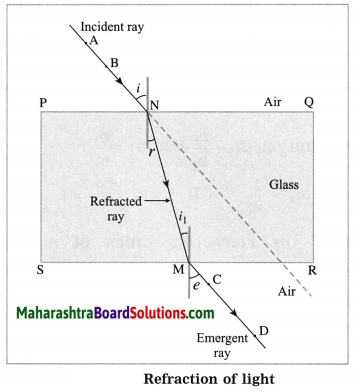
In the following figure, SR || PQ and NM is the refracted ray. Hence, r = i1.
Now gna = sin i/sin r and ang = sin i1/ sin e.
Maharashtra Board Class 10 Science Solutions Part 1 Chapter 6 Refraction of Light 1
Also gna = \(\frac{1}{{ }_{\mathrm{a}} n_{\mathrm{g}}}\)
∴ \(\frac{\sin i}{\sin r}=\frac{\sin e}{\sin i_{1}}\)
As r = i1, it follows that sin i = sin e
∴ i = e.

b. A rainbow is the combined effect (an exhibition) of the refraction, dispersion, and total internal reflection of light (taken together). (Practice Activity Sheet – 1)
(OR)
With a neat labelled diagram, explain how the formation of rainbow occurs.
Answer:
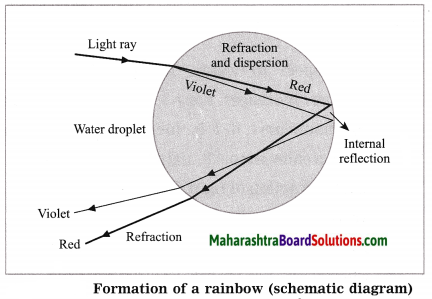
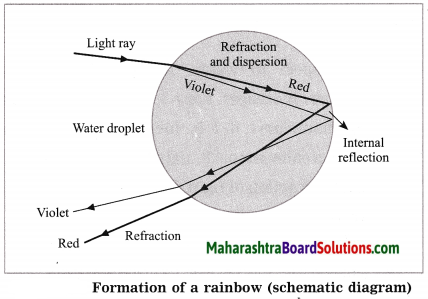
(1) The formation of a rainbow in the sky is a combined result of refraction, dispersion, internal reflection and again refraction of sunlight by water droplets present in the atmosphere after it has rained.
Maharashtra Board Class 10 Science Solutions Part 1 Chapter 6 Refraction of Light 2
Here, for simplicity only violet and red colours are shown. The remaining five colours lie between these two.

(2) The sunlight is a mixture of seven colours: violet, indigo, blue, green, yellow, orange and red. After it has stopped raining, the atmosphere contains a large number of water droplets. When sunlight is incident on a water droplet, there is (i) refraction and dispersion of light as it passes from air to water (ii) internal reflection of light inside the droplet and (iii) refraction of light as it passes from water to air.

(3) The refractive index of water is different for different colours, being maximum for violet and minimum for red. Hence, there is dispersion of light (separation into different colours) as it passes from air to water. [ See above Figure for reference.]

(4) The combined action of different water droplets, acting like tiny prisms, is to produce a rainbow with red colour at the outer side and violet colour at the inner side. The remaining five colours lie between these two.
The rainbow is seen when the sun is behind the observer and water droplets in the front.

Question 3.
Mark the correct answer in the following questions :
A. What is the reason for the twinkling of stars?
(i) Explosions occurring in stars from time to time
(ii) Absorption of light in the earth’s atmosphere
(iii) Motion of stars
(iv) Changing refractive index of the atmospheric gases
Answer:
Changing refractive index of the atmospheric gases.

B. We can see the Sun even when it is little below the horizon because of
(i) reflection of light
(ii) refraction of light
(iii) dispersion of light
(iv) absorption of light
Answer:
refraction of light

C. If the refractive index of glass with respect to air is 3/2, what is the refractive index of air with respect to glass?
(i) \(\frac{1}{2}\)
(ii) 3
(iii) \(\frac{1}{3}\)
(iv) \(\frac{2}{3}\)
Answer:
(iv) \(\frac{2}{3}\)

Maharashtra Board Class 10 Science Solutions Part 1 Chapter 6 Refraction of Light

Question 4.
Solve the following examples:
a. If the speed of light in a medium is 1.5 × 10⁸ m/s, what is the absolute refractive index of the medium? (Practice Activity Sheet – 1 and 4)
Solution:
Data: v = 1.5 × 10⁸ m/s,
c = 3 × 10⁸ m/s, n = ?
n = \(\frac{c}{v}=\frac{3 \times 10^{8} \mathrm{m} / \mathrm{s}}{1.5 \times 10^{8} \mathrm{m} / \mathrm{s}}\) = 2
This is the absolute refractive index of the medium.

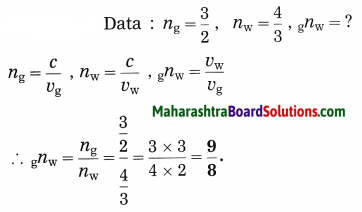
b. If the absolute refractive indices of glass and water are \(\frac{3}{2}\) and \(\frac{4}{3}\) respectively, what is the refractive index of glass with respect to water?
Solution:
Maharashtra Board Class 10 Science Solutions Part 1 Chapter 6 Refraction of Light 3
This is the refractive index of glass with respect to water.

Project:

Question 1.
Using a laser and soap water. study the refraction of light under the guidance of your teacher. (Do it your self)

Can you recall? (Text Book Page No. 73)

Question 1.
What is meant by reflection of light?
Answer:
Reflection of light: When light is incident on the surface of an object, in general, it is deflected in different directions. This process is called reflection of light.

Question 2.
What are the laws of reflection?
Answer:
Laws of reflection of light:

  1. The incident ray and the reflected ray of light are on the opposite sides of the normal to the reflecting surface at the point of incidence and all the three are in the same plane.
  2. The angle of incidence j and the angle of reflection are equal in measure.

Can you recall? (Text Book page No. 75)

Question 1.
If the refractive index of the second medium with respect to the first medium is 2n1 and that of the third medium with respect to the second medium is 3n2, what and how much is 3n1.
Answer:
3n1 is the refractive index of the third medium with respect to the first medium.
Maharashtra Board Class 10 Science Solutions Part 1 Chapter 6 Refraction of Light 4
3n1 = 2n1 × 3n2.

[Suppose medium 1 = air, medium 2 ≡ ice and medium 3 ≡ diamond. Then, 2n1 ÷ 1.31, 3n2 = 1.847
3n1 = 2n1 × 3n2 = 1.31 × 1.847 = 2.42 which is the refractive index of diamond with respect to air.]

Can you tell? (Textbook page No. 76)

Question 1.
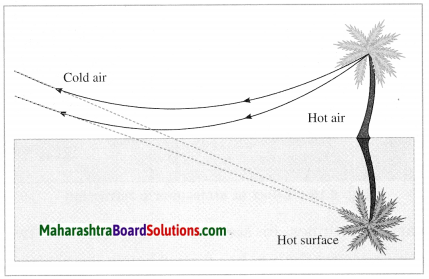
Have you seen a mirage which is an illusion of the appearance of water on a hot road or in a desert?
Answer:
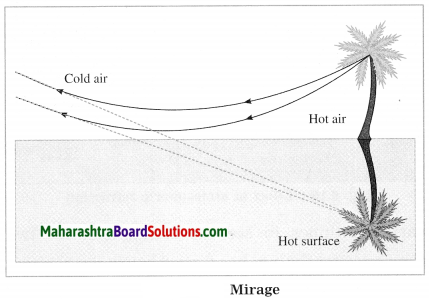
Due to the changes in refraction of light, the light rays coming from a distant object appear to be coming from the image of the object inside the ground. This is called a mirage. When the earth’s surface is heated by the sun, the temperature of air increases. This produces a layer of hot air of lower density (mass per unit volume) and lower refractive index at the surface.
Maharashtra Board Class 10 Science Solutions Part 1 Chapter 6 Refraction of Light 5
Hot air works as an optically rarer medium relative to cool air. When the temperature changes rapidly in the vertical direction, as refraction of light takes place, the angle of refraction changes continuously. The rays of light from the top of an object such as a car or tree cross the rays from the bottom of the object on their way to the observer’s eye.

Hence, an inverted image is formed below the object’s true position and downward towards the surface in the direction of air at higher temperature. In this case, some rays of light bend back up into the denser air above figure. Mirage produces an impression of water near the hot ground.

Maharashtra Board Class 10 Science Solutions Part 1 Chapter 6 Refraction of Light

Question 2.
Have you seen that objects beyond and above a holy fire appear to be shaking? Why does this happen?
Answer:
The temperature of air beyond and above a holy fire changes all the time. Hence, the density of air also changes constantly. Hence, the direction of propagation of the rays of light approaching us from the objects beyond and above the holy fire changes constantly. Therefore, those objects appear to be shaking.

Use your brain power! (Text Book Page No. 77)

Question 1.
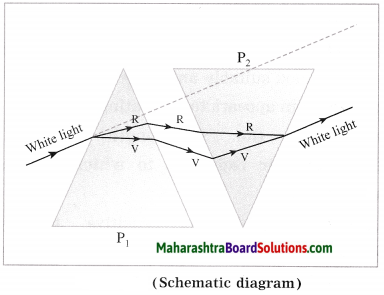
From incident white light how will you obtain white emergent light by making use of two prisms?
Answer:

  • Take a prism. Allow white light to fall on it.
  • Obtain a spectrum.
  • Take a second identical prism. Place it parallel to the first prism in an upside down position with the first prism [as shown in Figure]
  • Allow the colours of the spectrum to pass through the second prism.
  • Obtain the beam of light emerging from the other side of the second prism.

Maharashtra Board Class 10 Science Solutions Part 1 Chapter 6 Refraction of Light 6
The beam of light emerging from the other side of the second prism is a beam of white light.

Explanation: White light is made up of seven colours. The first prism produces dispersion of white light while the second prism combines light of different colours to produce white light again. The net deviation of a ray of light is zero.
[Note: This experiment is due to sir Isaac Newton. It proved that it was not the prism which added colours to the white light but a property of the white light itself.]

Question 2.
You must have seen chandeliers having glass prisms. The light from a tungsten bulb gets dispersed while passing through these prisms and we see coloured spectrum. If we use an LED light instead of a tungsten bulb, will we be able to see the same effect?
Answer:
Light emitted by LED (light-emitting-diode) does not have all wavelengths in the region 400 nm to 700 nm. Hence, its spectrum is not the same as that of light from a tungsten bulb or as that of sunlight.

Fill in the blanks and rewrite the statements:

Question 1.
The phenomenon of change in the………..of light when it passes obliquely from one transparent medium to another is called refraction.
Answer:
The phenomenon of change in the direction of propagation of light when it passes obliquely from one transparent medium to another is called refraction.

Question 2.
The refractive index depends upon the…………of propagation of light in different media.
Answer:
The refractive index depends upon the velocity of propagation of light in different media.

Maharashtra Board Class 10 Science Solutions Part 1 Chapter 6 Refraction of Light

Question 3.
The process of separation of light into its component colours while passing through a medium is called………..
Answer:
The process of separation of light into its component colours while passing through a medium is called dispersion of light.

Question 4.
When a light ray travels obliquely from air to water, it bends………the normal at the point of incidence.
Answer:
When a light ray travels obliquely from air to water, it bends towards the normal at the point of incidence.

Question 5.
When a light ray travels obliquely from benzene to air, it bends…………the normal at the point of incidence.
Answer:
When a light ray travels obliquely from benzene to air, it bends away from the normal at the point of incidence.

Question 6.
In glass, the speed of red ray is……violet ray.
Answer:
In glass, the speed of red ray is greater than that of violet ray.

Question 7.
The speed of light in glass is………in water.
Answer:
The speed of light in glass is less than that in water.

Question 8.
The speed of light in water is…………in benzene.
Answer:
The speed of light in water is greater than that in benzene.

Question 9.
Rainbow occurs due to refraction, dispersion,……….and again refraction of sunlight by water droplets.
Answer:
Rainbow occurs due to refraction, dispersion, internal reflection and again refraction of sunlight by water droplets.

Question 10.
In dispersion of sunlight by a glass prism,………..ray is deviated the least.
Answer:
In dispersion of sunlight by a glass prism, red ray is deviated the least.

Rewrite the following statements by selecting the correct options:

Question 1.
The change in the direction of propagation of light when it passes obliquely from one transparent medium to another is called………
(a) dispersion
(b) scattering
(c) refraction
(d) reflection
Answer:
(c) refraction

Question 2.
When a ray of light travels from air to glass slab and strikes the surface of separation at 90°, then it…………
(a) bends towards the normal
(b) bends away from the normal
(c) passes unbent
(d) passes in zigzag way
Answer:
(c) passes unbent

Maharashtra Board Class 10 Science Solutions Part 1 Chapter 6 Refraction of Light

Question 3.
If a ray of light passes from a denser medium to a rarer medium in a straight line, the angle of incidence must be…………
(a) 0°
(b) 30°
(c) 60°
(d) 90°
Answer:
(a) 0°

Question 4.
A ray of light strikes a glass slab at an angle of 50° with the normal to the surface of the slab. What is the angle of incidence?
(a) 50°
(b) 25°
(c) 40°
(d) 100°
Answer:
(a) 50°

Question 5.
If a ray of light propagating in air strikes a glass slab at an angle of 60° with the surface of the slab, the angle of refraction is…………
(a) more than 30 °
(b) less than 30 °
(c) 60°
(d) 30°
Answer:
(b) less than 30 °

Question 6.
A ray of light gets deviated When it passes obliquely from one medium to another medium because………..
(a) the colour of light changes
(b) the frequency of light changes
(c) the speed of light changes
(d) the intensity of light changes
Answer:
(c) the speed of light changes

Question 7.
The speed of light in turpentine oil is 2 × 10⁸ m/s. The absolute refractive index of turpentine oil is about……..[Speed of light in vacuum ≈ 3 × 10⁸ m/s]
(a) 1.5
(b) 2
(c) 1.3
(d) 0.67
Answer:
(a) 1.5

Question 8.
LASER stands for………..
(a) light amplification by stimulated emission of radiation
(b) light and sound energy radiation
(c) light and simulated energy radiation
(d) light amplification by sound energy radiation
Answer:
(a) light amplification by stimulated emission of radiation

Question 9.
Out of the following……….has the highest absolute refractive index.
(a) fused quartz
(b) diamond
(c) crown glass
(d) ruby
Answer:
(b) diamond

Question 10.
The absolute refractive index…………
(a) is expressed in dioptre
(b) is expressed in m/s
(c) of air is about \(\frac{4}{3}\)
(d) has no unit
Answer:
(d) has no unit

Question 11.
The speed of light in a medium of refractive index n is………., where c is the speed of light
in vacuum.
(a) \(\frac{c}{n}\)
(b) nc
(c) \(\frac{n}{c}\)
(d) \(\sqrt{\frac{c}{n}}\)
Answer:
(a) \(\frac{c}{n}\)

Question 12.
The speed of light in a transparent medium having absolute refractive index 1.25 is……….[Speed of light in vacuum ≈ 3 × 10⁸ m/s]
(a) 1.25 × 10⁸ m/s
(b) 2.4 × 10⁸ m/s
(c) 3.0 × 10⁸ m/s
(d) 1.5 × 10⁸ m/s
Answer:
(b) 2.4 × 10⁸ m/s

Maharashtra Board Class 10 Science Solutions Part 1 Chapter 6 Refraction of Light

Question 13.
…………light is deviated the maximum in the spectrpm of white light obtained with a glass prism.
(a) Red
(b) Yellow
(c) Violet
(d) Blue
Answer:
(c) Violet

Question 14.
………..light is deviated the least in the spectrum of white light obtained with a glass prism.
(a) Red
(b) Yellow
(c) Violet
(d) Blue
Answer:
(a) Red

Question 15.
A ray of light makes an angle of 50° with the surface S1 of the glass slab. Its angle of incidence will be………….(March 2019)
(a) 50°
(b) 40°
(c) 140°
(d) 0°
Answer:
(a) 50°

Question 16.
A glass slab is placed in the path of convergent light. The point of convergence of light:
(a) moves away from the slab
(b) moves towards the slab
(c) remains at the same point
(d) undergoes a lateral shift
Answer:
(a) moves away from the slab

Question 17.
In refraction of light through a glass slab, the directions of the incident ray and the refracted ray are………… (Practice Activity Sheet – 1)
(a) perpendicular to each other
(b) non-parallel to each other
(c) parallel to each other
(d) intersecting each other
Answer:
(c) parallel to each other

Question 18.
If we gradually increase the angle of incidence of a ray of light passing through a prism, then………….. (Practice Activity Sheet – 4)
(a) the angle of deviation goes on decreasing
(b) the angle of deviation decreases but after certain value of incident angle, deviation angle increases
(c) the angle of deviation goes on increasing
(d) the angle of deviation increases but after certain value of incident angle, deviation angle decreases
Answer:
(b) the angle of deviation decreases but after certain value of incident angle, deviation angle increases

State whether the following statements are True or False. (If a statement is false, correct it and rewrite it.):

Question 1.
The incident ray and the refracted ray of light are on the opposite sides of the normal at the point of incidence.
Answer:
True.

Question 2.
The refractive index of a medium (such as glass) does not depend on the wavelength of light.
Answer:
False. (The refractive index of a medium depends on the wavelength of light.)

Question 3.
When a light ray travels obliquely from an optically rarer medium to an optically denser medium, it bends away from the normal.
Answer:
False. (When a light ray travels obliquely from an optically rarer medium to an optically denser medium, it bends towards the normal.)

Maharashtra Board Class 10 Science Solutions Part 1 Chapter 6 Refraction of Light

Question 4.
When a light ray travels obliquely from glass to air, it bends towards the normal.
Answer:
False. (When a light ray travels obliquely from glass to air, it bends away from the normal.)

Question 5.
If the angle of incidence is 0°, the angle of refraction is 90°.
Answer:
False. (If the angle of incidence is 0°, the angle of refraction is also 0°.)

Question 6.
In dispersion of white light by a glass prism, yellow colour is deviated the least.
Answer:
False. (In dispersion of white light by a glass prism, red colour is deviated the least.)

Question 7.
In vacuum, the speed of light does not depend upon the frequency of light.
Answer:
True.

Question 8.
In glass, the speed of violet ray is less than that of red ray.
Answer:
True.

Question 9.
In a material medium, the speed of light depends on the frequency of light.
Answer:
True.

Question 10.
The velocity of light is different in different media.
Answer:
True.

Question 11.
Wavelength of red light is close to 700 nm.
Answer:
True.

Question 12.
Wavelength of orange light is greater than that of blue light.
Answer:
True.

Find the odd one out and give the reason:

Question 1.
Reflection, Neutralization, Refraction, Dispersion.
Answer:
Neutralization. It is associated with a chemical reaction between an acid and an alkali; others are phenomena associated with light.

Answer the following questions in one sentence each:

Question 1.
Mention any two phenomena in nature where refraction of light takes place.
Answer:
Mirage and twinkling of a star.

Question 2.
What is the angle of refraction when the angle of incidence is 0°?
Answer:
When the angle of incidence is 0°, the angle of refraction is also 0°.

Question 3.
In refraction of light, \(\frac{\sin i}{\sin r}\) = constant in sin a particular case. What is this constant called?
Answer:
The constant \(\frac{\sin i}{\sin r}\) (in a particular case) is called the refractive index of the second medium with respect to the first medium.

Question 4.
If the refractive index of medium 2 with respect to medium 1 is 5/3, what is the refractive index of medium 1 with respect to medium 2?
Answer:
The refractive index of medium 1 with respect to medium 2 is 0.6.

Maharashtra Board Class 10 Science Solutions Part 1 Chapter 6 Refraction of Light

Question 5.
In dispersion of sunlight by a glass prism, which colour is deviated the least?
Answer:
In dispersion of sunlight by a glass prism, red colour is deviated the least.

Question 6.
In dispersion of sunlight by a glass prism, which colour is deviated the most?
Answer:
In dispersion of sunlight by a glass prism, violet colour is deviated the most.

Question 7.
What is the wavelength of violet light?
Answer:
The wavelength of violet light is (about) 400 nm.

Question 8.
State the relation between 2n1 and critical angle.
Answer:
2n1 = sin i, where i is the critical angle.

Answer the following questions:

Question 1.
What is meant by refraction of light?
Answer:
The change in the direction of propagation of light when it passes obliquely from one transparent medium to another is called refraction of light.

Question 2.
Why is there a change in the direction of propagation of light when it passes obliquely from one transparent medium to another?
Answer:
The velocity of light is different in different media. Hence, there is a change in the direction of propagation of light when it passes obliquely from one transparent medium to another.

Question 3.
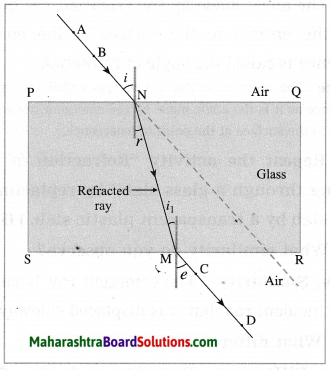
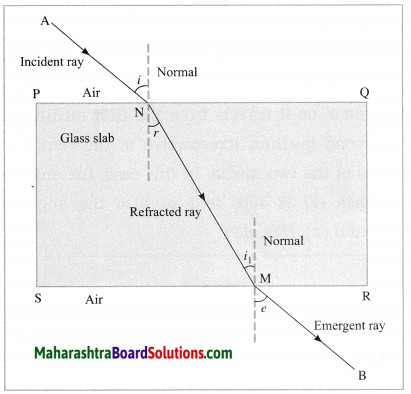
In the case of refraction of light through a glass slab, the emergent ray is parallel to the incident ray, but it is displaced sideways. Why does this happen?
Answer:
Maharashtra Board Class 10 Science Solutions Part 1 Chapter 6 Refraction of Light 7
The first refraction takes place as light passes obliquely from air to glass. In this case, the ray of light bends towards the normal at point N. The second refraction takes place as light passes obliquely from glass to air. In this case, the ray of light bends away from the normal at point M. The faces PQ and SR of the glass slab are parallel. Hence, the extent of bending of light at SR is equal in magnitude but opposite in sense relative to the bending of light at PQ. Hence, the emergent ray of light (MD) is parallel to the incident ray of light (AN), but it is displaced sideways as shown in Figure.

Question 4.
Define angle of incidence and angle of refraction.
Answer:
(1) The angle made by the incident ray of light with the normal to the surface at the point of incidence is called the angle of incidence.

(2) The angle made by the refracted ray of light with the normal to the surface at the point of incidence is called the angle of refraction.

[Note: The angle e in Fig. 6.3 is also called the angle of emergence as it is the angle made by the emergent ray with the normal to the surface at the point of emergence. ]

Maharashtra Board Class 10 Science Solutions Part 1 Chapter 6 Refraction of Light

Question 5.
Repeat the activity “Refraction of light passing through a glass sl^b” by replacing the glass slab by a transparent plastic slab.
(i) What similarity do you observe?
(ii) What difference do you notice?
Answer:
(i) Similarity: The emergent ray is parallel to the incident ray, but it is displaced sideways.
(ii) Difference: For a given angle of incidence, the extent of refraction (bending) is different (in general, less) for a transparent plastic slab relative to the glass slab.

Question 6.
State the laws of refraction of light.
Answer:
Laws of refraction of light:
(1) The incident ray and the refracted ray are on the opposite sides of the normal to the surface at the point of incidence and all the three, i.e., the incident ray, the refracted ray and the normal are in the same plane.

(2) For a given pair of media, the ratio of the sine of the angle of incidence to the sine of the angle of refraction is constant (Snell’s law). This constant is called the refractive index of the second medium with respect to the first medium.
[Note: Here, a ray means a ray of light.]

Question 7.
How is refraction of light related to refractive index?
Answer:
When a ray of light travels obliquely from an optically rarer medium (lower refractive index) to an optically denser medium (higher refractive index), the ray bends towards the normal. When a ray of light travels obliquely from an optically denser medium to an optically rarer medium, the ray bends away from the normal. For a given angle of incidence (i ≠ 0), the extent of refraction (bending) of light is different in different media.

If the refractive index of the second medium with respect to the first medium is greater than 1, the greater the refractive index, the greater is the bending of the ray of light towards the normal. If the refractive index of the second medium with respect to the first medium is less than 1, the greater the refractive index, the lesser is the bending of the ray of light away from the normal.

Question 8.
Define the refractive index of the second medium with respect to the first medium.
(OR)
What is meant by refractive index?
Answer:
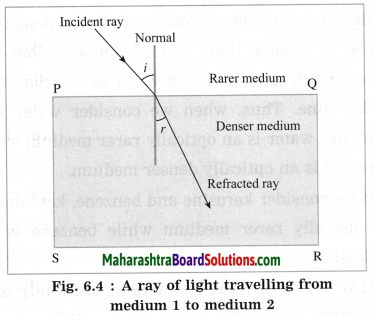
The refractive index of the second medium with respect to the first medium is defined as the ratio of the sine of the angle of incidence to the sine of the angle of refraction when the ray of light is obliquely incident at the boundary separating the
Maharashtra Board Class 10 Science Solutions Part 1 Chapter 6 Refraction of Light 8
two media and travels from the first medium to the second medium. (See Fig. 6.4.)
(OR)
The refractive index of the second medium with respect to the first medium is defined as the ratio of (the magnitude of) the velocity of light in the first medium to (the magnitude of) the velocity of light in the second medium.

[Note: Velocity is a vector, i.e., it has magnitude and direction. In definition of refractive index, we consider only the magnitude of velocity of light (speed of light). Velocity of light in a medium depends on the physical condition of the medium as well as the frequency of light. Velocity of light is different in different media. For a given medium, the refractive index depends on the colour of light (frequency of light.)]

Question 9.
State the formulae for the refractive index of the second medium with respect to the first medium.
Answer:
The refractive index of the second medium with respect to the first medium,
2n1 = \(\frac{\sin i}{\sin r}=\frac{v_{1}}{v_{2}}\)
where i is the angle of incidence, r is the angle of refraction (as the ray of light passes obliquely from the first medium to the second medium), v1 is the magnitude of the velocity (speed) of light in the first medium and v2 is the magnitude of the velocity of light in the second medium.

Maharashtra Board Class 10 Science Solutions Part 1 Chapter 6 Refraction of Light

Question 10.
Define absolute refractive index.
Answer:
The absolute refractive index of a medium is defined as the ratio of the magnitude of the velocity of light in vacuum to the magnitude of the velocity of light in the medium.

[Note: The speed of light is maximum in vacuum, about 3 × 10⁸ m/s. When light travels from one medium to another, there occurs a change in its speed and wavelength (A). But its frequency (v) remain the same.]

Question 11.
Obtain the relation between the refractive index of the second medium with respect to the first medium and the refractive index of the first medium with respect to the second medium.
Answer:
Let v1 = speed of light in the first medium, v2 = speed of light in the second medium, 2n1 = refractive index of the second medium With respect to the first medium and 1n2 = refractive index of the first medium with respect to the second medium.
By definition, 2n1 = \(\frac{v_{1}}{v_{2}}\) and 1n2 = \(\frac{v_{2}}{v_{1}}\)
Hence,
Maharashtra Board Class 10 Science Solutions Part 1 Chapter 6 Refraction of Light 9
(OR)
1n2 × 2n1 = 1.

Question 12.
If the refractive index of a certain material with respect to air is 1.5, what is the refractive index of air with respect to that material?
Answer:
As the refractive index of the given material with respect to air is 1.5, the refractive index of air with respect to the material is
\(\frac{1}{1.5}=\frac{1}{3 / 2}=\frac{2}{3}\) = 0.6667 (approximately)

Question 13.
Explain the terms optically rarer medium and optically denser medium with examples.
Answer:
When we consider two media (such as air and glass), the medium with lower refractive index is called the optically rarer medium (in the present case, air) and the medium with higher refractive index is called the optically denser medium (glass, in the present case).

The higher density does not necessarily mean higher refractive index. For example, the density of water is greater than that of kerosene, but the absolute refractive index of water is less than that of kerosine. Thus, when we consider water and kerosine, water is an optically rarer medium while kerosine is an optically denser medium.

If we consider kerosene and benzene, kerosine is an optically rarer medium while benzene is an optically denser medium.

Question 14.
A ray of light is incident obliquely at a boundary separating two media. What is its behaviour if (1) the refractive index of the second medium is greater than that of the first medium (2) the refractive index of the first medium is greater than that of the second medium? Draw the corresponding neat and labelled diagrams.
Answer:
Consider a ray of light incident obliquely at a boundary separating two media.
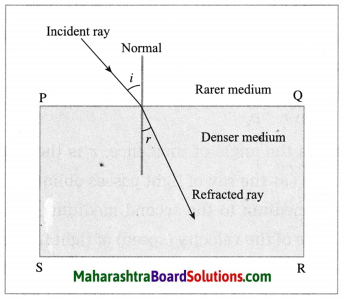
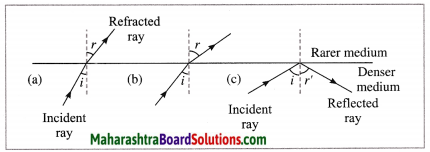
(1) If the refractive index of the second medium is greater than that of the first medium, the ray bends towards the normal at the point of incidence as it travels from the first medium (optically rarer medium) to the second medium (optically denser medium). The angle of refraction (r) is less than the angle of incidence (i). (Fig. 6.6)
Maharashtra Board Class 10 Science Solutions Part 1 Chapter 6 Refraction of Light 10
Fig. 6.6: A ray of light travelling from a rarer medium to a denser medium (Schematic diagram)
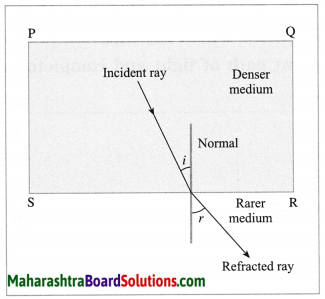
Maharashtra Board Class 10 Science Solutions Part 1 Chapter 6 Refraction of Light 11
Fig. 6.7: A ray of light travelling from a denser medium to a rarer medium (Schematic diagram)

(2) If the refractive index of the first medium is greater than that of the second medium, the ray bends away from the normal at the point of incidence as it travels from the first medium (optically denser medium), to the second medium (optically rarer medium). The angle of refraction (r) is greater than the angle of incidence (i). (Fig. 6.7)

[Note In this chapter, a rarer medium means an optically rarer medium and a denser medium means optically denser medium unless stated otherwise.]

Maharashtra Board Class 10 Science Solutions Part 1 Chapter 6 Refraction of Light

Question 15.
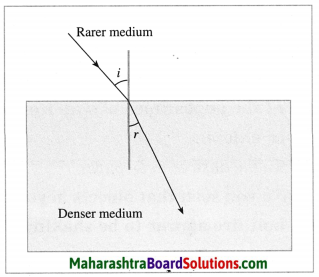
Observe the following figure and write accurate conclusion regarding refraction of light. (Practice Activity Sheet – 2)
Maharashtra Board Class 10 Science Solutions Part 1 Chapter 6 Refraction of Light 12
Answer:
When a light ray passes obliquely from a rarer medium to a denser medium, it bends towards the normal.

Question 16.
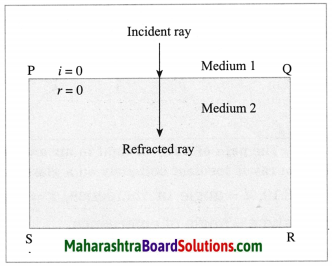
What happens when a ray of light is incident normal to the interface between two media? Draw the corresponding neat and labelled diagram.
Answer:
When a ray of light is incident normal to the interface between two media, the ray propagates undeviated as it travels from the first medium to the second medium irrespective of the refractive indices of the two media. In this case, the angle of incidence (i) is zero and so also the angle of refraction (r).
Maharashtra Board Class 10 Science Solutions Part 1 Chapter 6 Refraction of Light 13
Fig. 6.9: A ray of light incident normal to the interface between two media propagates without any change in its direction of propagation

Question 17.
Draw a neat and labelled diagram to show the path of a ray of light in air and glass when the ray is incident obliquely on a glass slab. Show the (i) incident ray (ii) refracted ray (iii) emergent ray (iv) angle of incidence (v) angle of refraction (vi) angle of emergence in the diagram.
(OR)
Draw a neat and labelled diagram to show refraction of light through a glass slab.
Answer:
Maharashtra Board Class 10 Science Solutions Part 1 Chapter 6 Refraction of Light 14
Fig. 6.10: The path of the ray of light in air and glass when the ray is incident obliquely on a glass slab
In Fig. 6.10, i = angle of incidence, r = angle of refraction and e = angle of emergence.

Question 18.
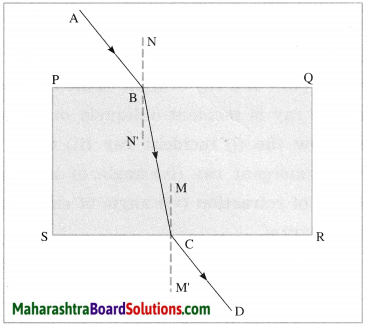
Observe the given figure and name the following rays:
Maharashtra Board Class 10 Science Solutions Part 1 Chapter 6 Refraction of Light 15
(i) ray AB
(ii) Ray BC
(iii) ray CD
Answer:
(i) The ray AB is the incident ray.
(ii) The ray BC is the refracted ray.
(iii) The ray CD is the emergent ray.

Maharashtra Board Class 10 Science Solutions Part 1 Chapter 6 Refraction of Light

Question 19.
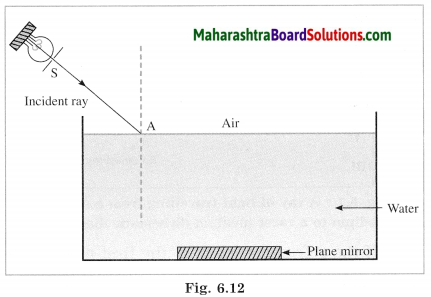
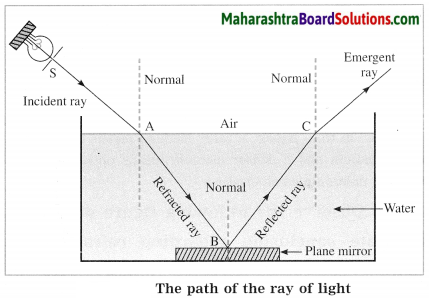
A plane mirror is kept at the bottom of a trough with water in it as shown in the following figure (Fig. 6.12). The ray of light emerging from a source at the point S outside the trough reaches the point A on the surface of water. Draw a neat ray diagram to show the subsequent path of light and complete the ray diagram.
Maharashtra Board Class 10 Science Solutions Part 1 Chapter 6 Refraction of Light 16
Answer:
Maharashtra Board Class 10 Science Solutions Part 1 Chapter 6 Refraction of Light 17

Question 20.
Give two examples of the effect of atmospheric refraction on a small scale in local environment.
Answer:

  1. The occurrence of a mirage
  2. Flickering of an object seen through a turbulent stream of hot air rising above the Holi fire are examples of the effect of atmospheric refraction on a small scale in local environment.

Question 21.
What is a mirage? With a neat labelled diagram, explain the conditions under which it is seen.
Answer:
Due to the changes in refraction of light, the light rays coming from a distant object appear to be coming from the image of the object inside the ground. This is called a mirage.
Maharashtra Board Class 10 Science Solutions Part 1 Chapter 6 Refraction of Light 18
When the earth’s surface is heated by the sun, the temperature of air increases. This produces a layer of hot air of lower density (mass per unit volume) and lower refractive index at the surface. Hot air works as an optically rarer medium relative to cool air. When the temperature changes rapidly in the vertical direction, as refraction of light takes place, the angle of refraction changes continuously.

The rays of light from the top of an object such as a car or tree cross the rays from the bottom of the object on their way to the observer’s eye. Hence, an inverted image is formed below the object’s true position and downward towards the surface in the direction of air at higher temperature. In this case, some rays of light bend back up into the denser air above figure. Mirage produces an impression of water near the hot ground.

Question 22.
Explain in brief the flickering of an object seen through a turbulent stream of hot air rising above the Holi fire.
Answer:
During the Holi fire, the temperature of the air just above the fire becomes much greater than that of the air further up. The hot air has lower density (mass per unit volume) and lower refractive index. It becomes an optically rarer medium. The cool air has higher density and higher refractive index. It is an optically denser medium relative to hot air. Hence, in refraction of light, the angle of refraction changes continuously due to a continuous variation in refractive index.

As the physical conditions of air change rapidly, the apparent position of an object fluctuates rapidly. This gives rise to the flickering of an object seen through a turbulent stream of hot air rising above the Holi fire.

Maharashtra Board Class 10 Science Solutions Part 1 Chapter 6 Refraction of Light

Question 23.
With a neat labelled diagram, explain twinkling of a star. Also explain why a planet does not twinkle.
Answer:
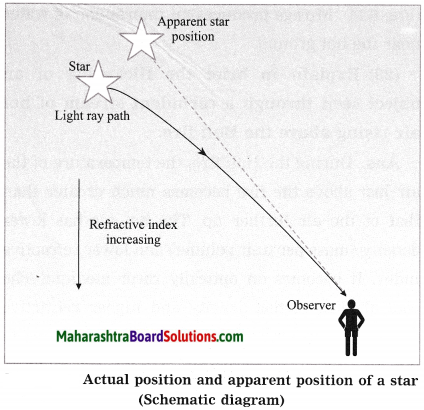
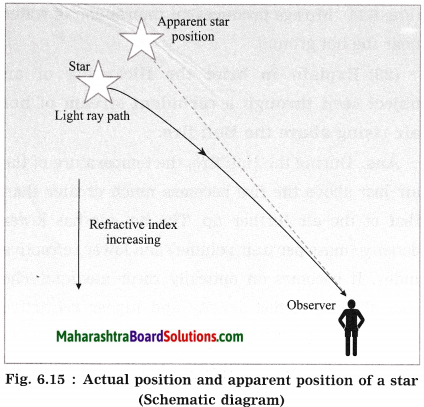
(1) As a star is far away from the earth, it appears as a point source of light. The density of air decreases with height above the earth’s surface. Hence, the refractive index of air also decreases with height. When starlight enters the earth’s atmosphere, it undergoes refraction continuously in the medium with gradually changing refractive index. The bending of starlight occurs towards the normal as it passes from the optically rarer part of the medium to the optically denser part.

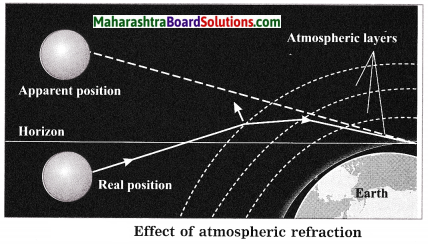
(2) Hence, when a star is observed near the horizon, its apparent position is slightly higher than the actual position (See below figure).

(3) Further, the apparent position varies with time as the medium is not stationary due to mobility of air and change in temperature. When more light is refracted towards the observer the star appears bright. When less light is refracted towards the observer, the star appears dim.
Maharashtra Board Class 10 Science Solutions Part 1 Chapter 6 Refraction of Light 19
(4) Thus there is fluctuation in the brightness of a star when observed from the earth. This is called twinkling of a star.

(5) Compared to stars, planets are relatively closer to the earth. Hence, a planet appears as a collection of a large number of point sources. Due to the changes in the refractive index of air, there is a change in the position and brightness of these point sources.

There is an increase in intensity of light coming from some point sources while there is a decrease in intensity of light coming from equal number of other point sources, on an average. The average brightness of a planet remain the same. Also, there is no change in the average position of a star. Hence, a planet does not twinkle.

Question 24.
What is the correct reason for blinking/flickering of stars? Explain it.
(a) The blasts in the stars.
(b) Absorption of star light by the atmosphere.
(c) Motion of the stars.
(d) Changing refractive index of gases in the atmosphere. (Practice Activity Sheet – 2)
Answer:
(d) Changing refractive index of the gases in the atmosphere results in blinking/flickering of stars.

Explanation:
(1) As a star is far away from the earth, it appears as a point source of light. The density of air decreases with height above the earth’s surface. Hence, the refractive index of air also decreases with height. When starlight enters the earth’s atmosphere, it undergoes refraction continuously in the medium with gradually changing refractive index. The bending of starlight occurs towards the normal as it passes from the optically rarer part of the medium to the optically denser part.

(2) Hence, when a star is observed near the horizon, its apparent position is slightly higher than the actual position (See below figure).

(3) Further, the apparent position varies with time as the medium is not stationary due to mobility of air and change in temperature. When more light is refracted towards the observer the star appears bright. When less light is refracted towards the observer, the star appears dim.
Maharashtra Board Class 10 Science Solutions Part 1 Chapter 6 Refraction of Light 20
(4) Thus there is fluctuation in the brightness of a star when observed from the earth. This is called twinkling of a star.

(5) Compared to stars, planets are relatively closer to the earth. Hence, a planet appears as a collection of a large number of point sources. Due to the changes in the refractive index of air, there is a change in the position and brightness of these point sources.

There is an increase in intensity of light coming from some point sources while there is a decrease in intensity of light coming from equal number of other point sources, on an average. The average brightness of a planet remain the same. Also, there is no change in the average position of a star. Hence, a planet does not twinkle.

Question 25.
With a neat labelled diagram, explain advanced sunrise and delayed sunset.
Answer:
(1) The sunrise (the appearance of the sun above the horizon) is advanced due to atmospheric refraction of sunlight. An observer on the earth sees the sun two minutes before the sun reaches the horizon. A ray of sunlight entering the earth’s atmosphere follows a curved path due to atmospheric refraction before reaching the earth. This happens due to a gradual variation in the refractive index of the atmosphere.

For the observer on the earth, the apparent position of the sun is slightly higher than the actual position. Hence, the sun is seen before the sun reaches the horizon.

(2) Increased atmospheric refraction of sunlight occurs also at the sunset (the sun disappearing below the horizon). In this case, the observer on the earth continues to see the setting sun for two minutes after the sun has dipped below the horizon, thus delaying the sunset.
Maharashtra Board Class 10 Science Solutions Part 1 Chapter 6 Refraction of Light 21
The advanced sunrise and delayed sunset increases the duration of day by four minutes.

Maharashtra Board Class 10 Science Solutions Part 1 Chapter 6 Refraction of Light

Question 26.
Water in a swimming pool or water tank appears shallower than its depth. Why?
Answer:
When light rays travel obliquely from an optically denser medium (water, in this case) to an optically rarer medium (air, in this case), they bend away from the normal at the point of incidence. As a result, the bottom of a swimming pool or water tank appears raised to an observer standing near the edge of the pool or the tank. Therefore, the swimming pool or water tank appears shallower than its depth.

Question 27.
Place a coin at the bottom of a glass jar containing water. Now tilt the jar suitably. When viewed at a suitable angle, the coin appears to be floating. Why?
Answer:
When light rays travel obliquely from an optically denser medium (water, in this case) to an optically rarer medium (air, in this case), they bend away from the normal at the point of incidence. As a result, the coin appears raised. Therefore, when the jar is tilted suitably and observed at a suitable angle, the coin appears to be floating.

Question 28.
State the wavelength range of electromagnetic radiation to which our eyes are sensitive.
Answer:
Our eyes are sensitive to light (electromagnetic radiation). Its wavelength range is 400 nm to 700 nm.
[Note: Wavelength (λ) goes on decreasing and frequency (ν) goes on increasing from red (λ ≃ 700 nm) → orange → yellow → green → blue → indigo → violet (A ≃ 400 nm). c = vλ, where c is the speed of light in vacuum.]

Question 29.
What do you mean by dispersion of light? What is a spectrum of light? Name the different colours of light in the proper sequence in the spectrum of white light.
(OR)
What do you mean by dispersion? Name the different colours of light in the proper sequence in the spectrum of white light.
Answer:
The process of separation of light into its component colours while passing through a medium is called dispersion of light. The band of coloured components of a light beam is called spectrum.
The different colours of light in the spectrum of white light are violet, indigo, blue, green, yellow, orange and red.

Question 30.
What is a prism?
Answer:
A prism is a transparent medium bound by two plane surfaces inclined at an angle. Normally it is made of glass and has triangular cross section.

Question 31.
With a neat labelled diagram, describe the experiment to demonstrate dispersion of sunlight (white light) by a prism.
Answer:
Experiment:
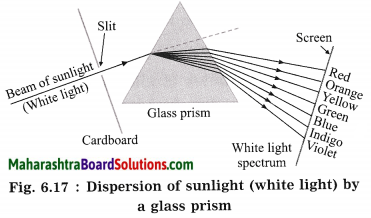
(1) Procedure: Keep a glass prism on a table in a dark room. Hold a plane mirror outside the room so that it reflects a beam of sunlight into the room. Allow this beam to pass through a narrow slit made in cardboard and then fall on the prism. Place a white screen on the other side of the prism as shown in the following figure. [Fig. 6.17]
Maharashtra Board Class 10 Science Solutions Part 1 Chapter 6 Refraction of Light 22
(2) Observations:

  1. A pattern of various colours is observed on the screen. This pattern is called the spectrum.
  2. It is found that in dispersion, the ray corresponding to violet colour deviates the most.
  3. The ray corresponding to red colour deviates the least.
  4. The deviation of rays corresponding to other colours is intermediate.

(3) Conclusion: When sunlight (white light) is incident on a prism, dispersion of light takes place, forming a spectrum.

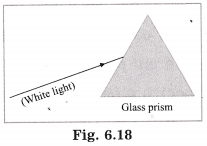
[Notes: (1) This experiment is due to Sir Isaac Newton (1642 – 1727), English physicist and mathematician. (2) If in a Board examination, incomplete diagram (as shown in Fig. 6.18) is given, students should complete it and label its parts as shown in Fig. 6.17.]
Maharashtra Board Class 10 Science Solutions Part 1 Chapter 6 Refraction of Light 23

Maharashtra Board Class 10 Science Solutions Part 1 Chapter 6 Refraction of Light

Question 32.
How does the dispersion of white light take place when it passes through a glass prism?
Answer:
When rays of light are incident on a prism, they are refracted twice, while travelling from air to glass and then from glass to air. Even when the incident rays are directed away from the base of the prism, the emergent rays bend towards the base of the prism, as the prism is triangular. Thus, the rays are deviated as they pass through the prism.

The refractive index of glass is different for different colours. Therefore, the rays corresponding to different colours are deviated to different extents. White light is a mixture of seven colours : violet, indigo, blue, green, yellow, orange and red. Hence, when white light is incident on a prism, a spectrum of seven colours is obtained.

The refractive index of glass is maximum for violet light and minimum for red light. Hence, violet light is deviated the most and red light is deviated the least. The deviation of rays corresponding to other colours is intermediate. In this manner, the dispersion of light takes place when it passes through a glass prism. [For reference, see Fig. 6.17.]

Question 33.
What is a spectrum? Why do we get a spectrum of seven colours when while light is dispersed by a prism?
(OR)
Explain how a spectrum is formed.
Answer:
A band of coloured components of a light beam is called a spectrum. When white light is incident on a prism, the rays corresponding to different colours bend through different angles on refraction.

Of the various colours in the visible region, red light bends the least and violet light bends the most. Each colour emerges through the prism along a different path and becomes, distinct. Hence, we get a spectrum of seven colours.

Question 34.
What is partial reflection of light?
Answer:
When light travels from a denser medium to a rarer medium, it is partially reflected, i.e., part of light comes back into the denser medium as per the laws of reflection. This is called partial reflection of light.

[Note: Partial reflection of light occurs even when light travels from a rarer medium to a denser medium. The rest of light is refracted.]

Question 35.
Explain the terms total internal reflection and critical angle.
Answer:
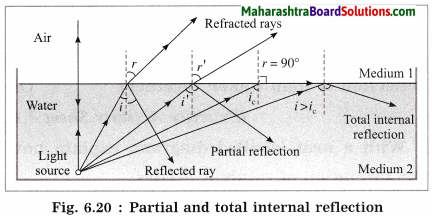
Figure 6.20 shows passage of light from water (denser medium) to air (rarer medium).
Maharashtra Board Class 10 Science Solutions Part 1 Chapter 6 Refraction of Light 24
The ray of light incident at the boundary separating the two media bends away from the normal on refraction. Here, the angle of refraction r, is greater than the angle of incidence i.
Now anw = \(\frac{\sin i}{\sin r}\) < 1. Here, anw is the refractive index of sin r air with respect to water.

As anw is constant, r increases as i increases. For r = 90°, the ray travels along the boundary. If i is increased further, as r cannot be greater than 90°, light does not enter air. There is no refraction of light and all the light enters water on reflection. This is called total internal reflection.
For r = 90°, anw = \(\frac{\sin i}{\sin 90^{\circ}}\) = sin i. This angle i is sin 90° called the critical angle.

Question 36.
Swarali has got the following observations while doing an experiment. Answer her questions with the help of observations. (Practice Activity Sheet – 2)
Swarali observed that the light bent away from the normal, while travelling from a denser medium to a rarer medium. When Swarali increased the values of the angle of incidence (i). the values of the angle of refraction (r) went on increasing. But at a certain angle of incidence, the light rays returned into the denser medium.
So, Swarali has some questions. Answer them.
(a) Name this certain value of i. What is the value of r at that time?
(b) Name this process of returning light in the denser medium. Explain the process.
Answer:
(a) Critical angle r = 90°
(b) Total internal reflection.

As light goes from a denser to rarer medium, if the value of the angle of incidence increases, then the value of the angle of refraction also increases. But after a specific angle of incidence called the critical angle, the light gets reflected back into the denser medium.

The ray of light incident at the boundary separating the two media bends away from the normal on refraction. Here, the angle of refraction r, is greater than the angle of incidence i.
Now anw = \(\frac{\sin i}{\sin r}\) < 1. Here, anw is the refractive index of sin r air with respect to water. As anw is constant, r increases as i increases. For r = 90°, the ray travels along the boundary. If i is increased further, as r cannot be greater than 90°, light does not enter air. There is no refraction of light and all the light enters water on reflection. This is called total internal reflection.

For r = 90°, anw = \(\frac{\sin i}{\sin 90^{\circ}}\) = sin i. This angle i is sin 90° called the critical angle.

Maharashtra Board Class 10 Science Solutions Part 1 Chapter 6 Refraction of Light

Question 37.
The observations made by Swarali while doing the experiment are given below. Based on these write answers to the questions:
Swarali found that the light ray travelling from the denser medium to a rarer medium goes away from the normal. If the angle of incidence (i) is raised by Swarali, the angle of refraction (r) went on increasing. However, after certain value of the angle of incidence, the light ray is seen to return back into the denser medium. (March 2019)
(i) What is the specific value of ∠i called?
(ii) What is the process of reflection of incident ray into a denser medium called?
(iii) Draw the diagrams of three observations made by Swarali.
Answer:
(i) Critical angle
(ii) Total internal reflection
(iii)
Maharashtra Board Class 10 Science Solutions Part 1 Chapter 6 Refraction of Light 25

Question 38.
Define total internal reflection of light.
Answer:
When light travels from a denser medium to a rarer medium, if the angle of incidence is greater than the critical angle, there is no refraction of light and all the light is reflected in the denser medium. This is called total internal reflection of light.

Question 39.
Define critical angle.
Answer:
When light travels from a denser medium to a rarer medium, the angle of incidence for which the angle of refraction becomes 90°, is called the critical angle.

Question 40.
If the refractive index of a rarer medium with respect to a denser medium is 0.5, what is the critical angle?
Answer:
2n1 = 0.5 = sin i
∴ Critical angle i = 30°.

Question 41.
Name the devices in which total internal reflection of light is used.
Answer:

  1. Total internal reflecting prisms are used in a camera, binoculars, periscope.
  2. Total internal reflection of light is used in optical fibres.

[Note: Total internal reflection of light plays an important role in sparkling brilliance of a diamond.]

Question 42.
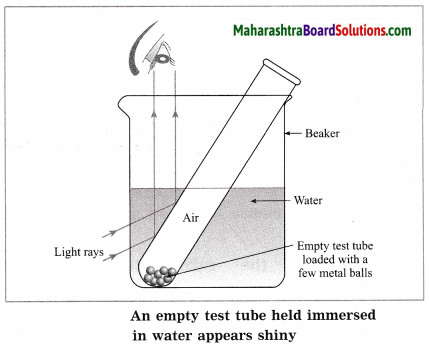
Explain why an empty test tube held obliquely in water appears shiny to an observer looking down.
Answer:
When an empty test tube is held obliquely in Water in a beaker, some light rays passing from water to air are incident at an angle greater than the critical angle. They are, thus, totally internally reflected as shown, and the surface of the test tube has a silvery shine.
Maharashtra Board Class 10 Science Solutions Part 1 Chapter 6 Refraction of Light 26

Question 43.
Observe the given figure and answer the following questions. (Practice Activity Sheet – 3)
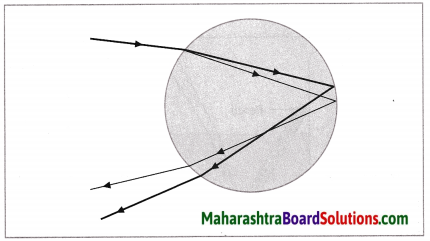
Maharashtra Board Class 10 Science Solutions Part 1 Chapter 6 Refraction of Light 27
(a) Identify and write the natural process shown in the figure.
(b) List the phenomena which are observed in this process.
(c) Redraw the diagram and show the above phenomena in it.
Answer:
(a) The natural process shown in the figure is formation of rainbow.
(b) The phenomena observed in this process are refraction, internal reflection and dispersion of light.
(c)
Maharashtra Board Class 10 Science Solutions Part 1 Chapter 6 Refraction of Light 28

Write a short note on the following:

Question 1.
Refraction observed in the atmosphere.
Answer:
When a ray of light passes obliquely from an optically rarer medium to an optically denser medium, it bends towards the normal at the point of incidence. If opposite is the case, the ray bends away from the normal.

Atmosphere is never static. Air is mobile and its density and temperature are not uniform. As a result, in general, the path of a ray of light through atmosphere of varying refractive index is a curve. The refractive index of cool air is greater than that of hot air.

Atmospheric refraction of light results in many interesting optical phenomena such as twinkling of a star, advanced sunrise and delayed sunset, mirage and flickering of an object seen through a turbulent stream of hot air rising from a fire.

Question 2.
Dispersion of light.
Answer:
The process of separation of light into its component colours while passing through a medium is called dispersion of light. When white light passes through a glass prism, it spreads out into a band of different colours (components) called the spectrum of light. The colours in the spectrum of white light are violet, indigo, blue, green, yellow, orange and red.

Formation of a rainbow is an example of dispersion of light in nature. In this case, raindrops are responsible for dispersion of sunlight.

Dispersion takes place because the refractive index of a material such as glass or water, is different for different colours. It is maximum for violet colour and minimum for red colour. Hence, in the spectrum of white light (sunlight) obtained with a prism, violet light is deviated the most while red light is deviated the least. The deviation of light corresponding to other colours lies in between.

Give scientific reasons:

Question 1.
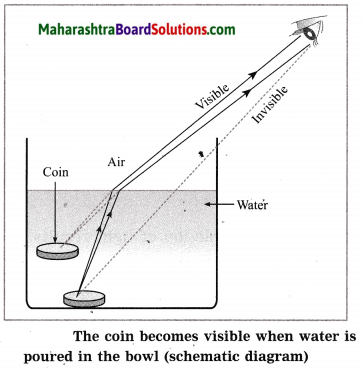
A coin kept in a bowl is not visible when seen from one side. But, when water is poured in the bowl, the coin becomes visible.
Answer:
(1) When the bowl is empty, the rays of light coming from the coin are obstructed by the side of the bowl, and hence the coin is not visible when seen from one side of the bowl.
Maharashtra Board Class 10 Science Solutions Part 1 Chapter 6 Refraction of Light 29
(2) When water is poured in the bowl, the rays of light coming from the coin travel from water (denser medium) to air (rarer medium). Hence, they bend away from the normal on refraction. Therefore, the coin appears to be raised and becomes visible when observed from one side of the bowl.

Maharashtra Board Class 10 Science Solutions Part 1 Chapter 6 Refraction of Light

Question 2.
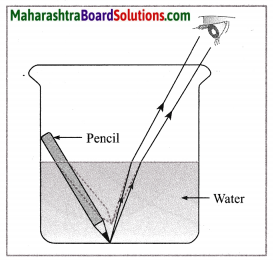
A pencil dipped in water obliquely appears bent at the surface of water.
(OR)
When a pencil is partly immersed in water and held in a slanting position, it appears to be bent at the boundary separating water and air.
Answer:
(1) When a pencil is partly immersed in water and held in a slanting position, the rays of light coming from the immersed part of the pencil emerge from water (a denser medium) and enter air (a rarer medium). During this propagation, they bend away from the normal on refraction.
Maharashtra Board Class 10 Science Solutions Part 1 Chapter 6 Refraction of Light 30
The pencil appearing bent at the boundary of water and air (schematic diagram)

(2) As a result, the immersed part of the pencil does not appear straight with respect to the part outside the water, but appears to be raised. Hence, a pencil dipped obliquely in water appears bent at the surface of the water.

Question 3.
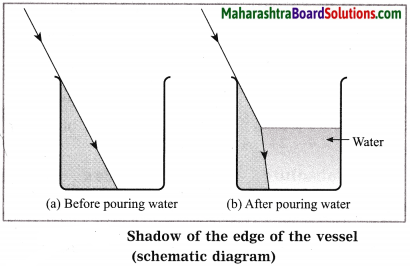
The shadow of the edge of an empty vessel is formed due to the slanting rays of the sun. When water is poured in the vessel, the shadow is shifted.
Answer:
(1) When the slanting rays of the sun are obstructed by the edge of the empty vessel, the shadow of the edge is formed.
Maharashtra Board Class 10 Science Solutions Part 1 Chapter 6 Refraction of Light 31
(2) When water is poured in the vessel, the slanting rays of the sun travel from air (rarer medium) to water (denser medium). During this propagation, they bend towards the normal on refraction. Hence, some part in the region of the shadow is now illuminated and the shadow appears to have shifted.

Question 4.
The bottom of a pond appears raised.
Answer:
(1) The rays of light coming from the bottom of a pond bend away from the normal as they travel from water (denser medium) to air (rarer medium).
Maharashtra Board Class 10 Science Solutions Part 1 Chapter 6 Refraction of Light 32
(2) Hence, they appear to come from a point above the actual point from which they come.
Therefore, the bottom of the pond appears raised.

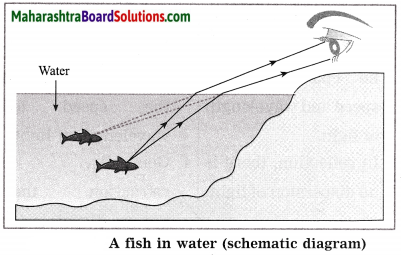
Question 5.
While shooting a fish in a lake, the gun is aimed below the apparent position of the fish.
Answer:
(1) The rays of light coming from the fish bend away from the normal as they travel from water (denser medium) to air (rarer medium).
(2) Hence, the position of the fish in water appears to be above Its real position. Therefore, while shooting a fish in a lake, the gun is aimed below the apparent position of the fish.
Maharashtra Board Class 10 Science Solutions Part 1 Chapter 6 Refraction of Light 33

Maharashtra Board Class 10 Science Solutions Part 1 Chapter 6 Refraction of Light

Question 6.
The sun is seen on the horizon a little before sunrise.
(OR)
The sun is seen on the horizon for sometime even after sunset.
Answer:
(1) The earth is surrounded by an atmosphere which is denser near the surface of the earth. When the rays of light from the sun enter the earth’s atmosphere from outer space, they travel from a rarer medium to a denser medium. Hence, they bend towards the normal on refraction.

(2) Hence, even when the sun is below the horizon while rising or setting, its rays reach us due to refraction and it appears to be on the horizon. Therefore, the sun is seen on the horizon a little before sunrise as well as for some time even after sunset.

Distinguish between:

Question 1.
Reflection of light and Refraction of light:
Answer:

Reflection of light Refraction of light
1. The rays of light, before and after reflection, travel in the same medium. 1. In refraction of light, the rays travel from one medium to another medium.
2. In reflection, the angle of incidence and the angle of reflection are equal. 2. In refraction, when the rays travel obliquely from one medium to another medium, the angle of incidence and the angle of refraction are not equal.
3. In reflection, there is no change in the speed and wavelength of light. 3. In refraction, there occurs a change in the speed and wavelength of light.
4. In reflection, there is no dispersion of light. 4. Generally, in refraction, there occurs dispersion of light.

[Note: The frequency of light remains the same in reflection and refraction.]

Complete the following or Solve and fill in the blanks :

Question 1.

Speed of light in the first medium (v1) Speed of light in the second medium (v2) Refractive index 2n1 Refractive index 2n1
3 × 10⁸ m/s 1.2 × 10⁸ m/s ————————– ————————–
————————– 2.25 × 10⁸ m/s 4/3 ————————–
2 × 10⁸ m/s ————————– ————————– 1.5

Answer:

Speed of light in the first medium (v1) Speed of light in the second medium (v2) Refractive index 2n1 Refractive index 2n1
3 × 10⁸ m/s 1.2 × 10⁸ m/s 2.5 0.4
3 × 10⁸ m/s 2.25 × 10⁸ m/s 4/3 0.75
2 × 10⁸ m/s 3 × 10⁸ m/s 2/3 1.5

Formulae:
2n1 = v1/v2, 1n2 = v2/v1

Solve the following examples/numerical problems:
c = 3 × 10⁸ m/s

Problem 1.
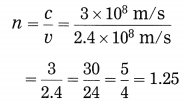
The speed of light in a transparent medium is 2.4 × 10⁸ m/s. Calculate the absolute refractive index of the medium.
Solution:
Data: c = 3 × 10⁸ m/s,
v = 2.4 × 10⁸ m/s, n = ?
Maharashtra Board Class 10 Science Solutions Part 1 Chapter 6 Refraction of Light 34
The absolute refractive index of the medium = 1.25.

Maharashtra Board Class 10 Science Solutions Part 1 Chapter 6 Refraction of Light

Problem 2.
The velocity of light in a medium is 2 × 10⁸ m/s. What is the refractive index of the medium with respect to air, if the velocity of light in air is 3 × 10⁸ m/s?
Solution:
Data: v1 = 3 × 10⁸ m/s,
v2 = 2 × 10⁸ m/s, 2n1 = ?
2n1 = \(\frac{v_{1}}{v_{2}}\)
\(=\frac{3 \times 10^{8}}{2 \times 10^{8}}\)
= 1.5
The refractive index of the medium with respect to air is 1.5.

Problem 3.
Light travels with a velocity 1.5 × 10⁸ m/s in a medium. On entering second medium its velocity becomes 0.75 × 10⁸ m/s. What is the refractive index of the second medium with respect to the first medium? (Practice Activity Sheet – 3)
Solution:
Given: Velocity of light in the first medium = v1 = 1.5 × 10⁸ m/s,
velocity of light in the second medium = v2 = 0.75 × 10⁸ m/s,
refractive index of the second medium with respect to the first medium = 2n1 = ?
2n1 = \(\frac{v_{1}}{v_{2}}\)
2n1 = \(\frac{1.5 \times 10^{8}}{0.75 \times 10^{8}}\) = 2
Hence, the refractive index of the second medium with respect to the first medium is 2.
[Note : The absolute refractive index of the second medium = \(\frac{3 \times 10^{8} \mathrm{m} / \mathrm{s}}{0.75 \times 10^{8} \mathrm{m} / \mathrm{s}}\) = 4 (greater than that of diamond, not likely).]

Problem 4.
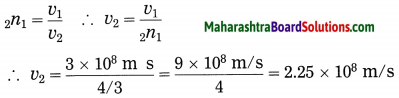
The refractive index of water is 4/3 and the speed of light in air is 3 × 10⁸ m/s. Find the speed of light in water.
Solution:
Data: 2n1 = 4/3, v1 = 3 × 10⁸ m/s, v2 = ?
Maharashtra Board Class 10 Science Solutions Part 1 Chapter 6 Refraction of Light 35
The speed of light in water = 2.25 × 10⁸ m/s.

Problem 5.
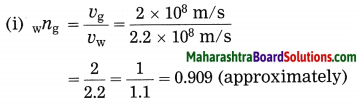
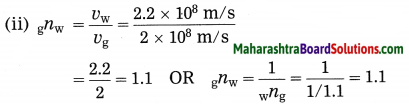
The speed of light in water and glass is 2.2 × 10⁸ m/s and 2 × 10⁸ m/s respectively. What is the refractive index of (i) water with respect to glass (ii) glass with respect to water?
Solution:
Data: uw = 2.2 × 10⁸ m/s,
vg= 2 × 10⁸ m/s, wng = ?, gnw = ?
Maharashtra Board Class 10 Science Solutions Part 1 Chapter 6 Refraction of Light 36
The refractive index of water with respect to glass = 0.909 (approximately).
Maharashtra Board Class 10 Science Solutions Part 1 Chapter 6 Refraction of Light 37
The refractive index of glass with respect to glass = 1.1 (approximately).

Numerical Problems For Practice:
(Given: C = 3 × 10⁸m/s)

Problem 1.
The speed of light in a transparent medium is 2 × 10⁸ m/s. Find the absolute refractive index of the medium.
Solution:
1.5

Problem 2
The absolute refractive index of a transparent medium is 5/3. Find the speed of light in the medium.
Solution:
1.8 × 10⁸ m/s

Problem 3.
The absolute refractive index of a transparent medium is 2.4 and the speed of light in that medium is 1.25 × 10⁸ m/s. Find the speed of light in air.
Solution:
3 × 10⁸ m/s

Problem 4.
The speed of light in water is 2.25 × 10⁸ m/s and that in glass is 2 × 10⁸ m/s. Find the refractive index of (i) the glass with respect to water (ii) water with respect to the glass.
Solution:
(i) 1.125
(ii) 0.889 (approximately)

Maharashtra Board Class 10 Science Solutions Part 1 Chapter 6 Refraction of Light

Problem 5.
If the refractive index of a certain glass with respect to water is 1.25, find the refractive index of water with respect to the glass.
Solution:
0.8

Problem 6.
If the absolute refractive index of glass is 1.5 and that of water is \(\frac{4}{3}\), find the refractive index of water with respect to glass.
Solution:
\(\frac{8}{9}\)

10th Std Science Part 1 Questions And Answers:

Std 8 History Chapter 8 Questions And Answers Civil Disobedience Movement Maharashtra Board

Balbharti Maharashtra State Board Class 8 History Solutions Chapter 8 Civil Disobedience Movement Notes, Textbook Exercise Important Questions and Answers.

Class 8 History Chapter 8 Civil Disobedience Movement Questions And Answers Maharashtra Board

Civil Disobedience Movement Class 8 Questions And Answers Chapter 8 Maharashtra Board

Class 8 History Chapter 8 Civil Disobedience Movement Textbook Questions and Answers

1. Rewrite the statements by choosing the appropriate options :

(Mahatma Gandhi, Khuda-i-Khidmatgar, [ Ramsay Mac Donald, Sarojini Naidu)

Question 1.
……………. organised the Round Table Conference in London.
Answer:
Ramsay Mac Donald

Maharashtra Board Class 8 History Solutions Chapter 8 Civil Disobedience Movement

Question 2.
Khan Abdul Gafar Khan established the organisation named …………….
Answer:
Khuda-i-Khidmatgar

Question 3.
……………. led the Dharasana Satyagraha.
Answer:
Sarojini Naidu

Question 4.
In the Second Round Table Conference ……………. participated as a representative of Indian National Congress.
Answer:
Mahatma Gandhi.

2. Explain the following statements with reasons :

Question 1.
Chandrasing Thakur was court martialled and severely punished.
Answer:

  1. Khan Abdul Gaffar Khan began Satyagraha at Peshawar on 23rd April, 1930. His organisation Khuda-i Khidmatgar led the satyagraha.
  2. They kept Peshawar town in their control for a week.
  3. The British government ordered Garhwal regiment to fire on the satyagrahis.
  4. Chandrasing Thakur an officer of the Garhwal Regiment refused to fire on the satyagrahis.

Therefore, he was court-martialled and severely punished.

Question 2.
The Government declared Martial Law at Solapur.
Answer:

  1. After the Salt Satyagraha many movements which were integral of Civil Disobedience Movement started.
  2. The mill workers in Solapur observed hartal and organised a huge procession on 6th May 1930.
  3. The District Collector ordered firing on procession. Many volunteers including Shankar Shivdare died in the firing.
  4. People got enraged and attacked railway stations, police stations, courts, municipal buildings, etc.

Therefore, Martial law was imposed in Solapur by the government.

Maharashtra Board Class 8 History Solutions Chapter 8 Civil Disobedience Movement

Question 3.
The deliberation in the First Round Table Conference proved to be meaningless.
Answer:

  1. The Civil Disobedience Movement intensified in India in 1930.
  2. The British Prime Minister, Ramsay Mac Donald organised Round Table Conference at London to discuss constitutional issues related to India.
  3. The representatives of many political parties and princely states participated in the conference. Indian National Congress did not participate in it.
  4. Without the participation of the Congress which was a body that represented the country deliberations were meaningless.

Thus, the deliberation in the First Round Table Conference proved to be meaningless.

Question 4.
Gandhiji began fast unto death in the Yerwada jail.
Answer:

  1. The Communal Award declared by the British Prime Minister Ramsay Mac Donald provided separate electorates for the Dalits.
  2. This division of the society on the basis of caste was not acceptable to Gandhiji.
  3. Therefore, to protest against the Award, Gandhiji began fast unto death in the Yerawada jail.

3. Answer the following questions in 25 to 30 words :

Question 1.
Why did Gandhiji decide to break the Salt Act to begin the Satyagraha?
Answer:
1. Before launching the Civil Disobedience Movement Gandhiji demanded cancellation of salt tax and end the monopoly of the British government to manufacture it.
2. Being an important ingredient in the food of the common people, it was unjust to impose a tax on salt.
3. Gandhiji decided to launch the Salt Satyagraha by a violation of the Salt Act, which was symbolic in breaking all unjust and oppressive laws of the British.

Maharashtra Board Class 8 History Solutions Chapter 8 Civil Disobedience Movement

Question 2.
Why did the Indian National Congress withdraw the Civil Disobedience Movement?
Answer:
1. After the failure of the First Round Table Conference, Prime Minister Ramsay Mac Donald hoped that Indian National Congress would participate in the Second Round Table Conference.
2. In order to create a conducive atmosphere Gandhiji and other political leaders were released from jail.
3. A pact was signed after discussion between Gandhiji and Viceroy Irwin.
4. According to the pact, the British Government gave an assurance of providing Responsible Government in the proposed constitution of India.
5. So, the congress agreed to suspend the Civil Disobedience Movement and participate in the Second Round Table Conference.

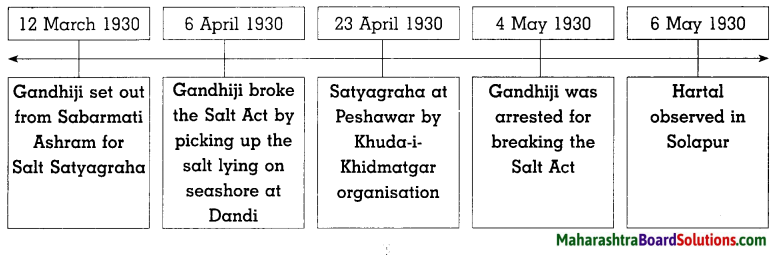
4. Complete the following timeline of Civil Disobedience Movement:

Question 1.
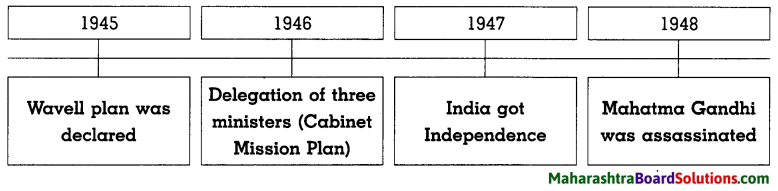
Maharashtra Board Class 8 History Solutions Chapter 8 Civil Disobedience Movement 7
Answer:
Maharashtra Board Class 8 History Solutions Chapter 8 Civil Disobedience Movement 8

Maharashtra Board Class 8 History Solutions Chapter 8 Civil Disobedience Movement

Do you Know?

Features of the Civil Disobedience Movement :
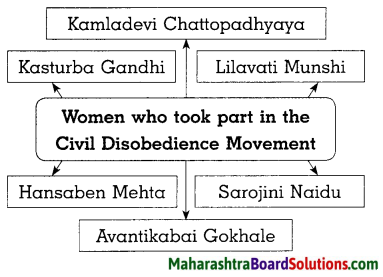
1. All the movements, till now, were limited only to urban areas. But this movement became a nationwide movement. People from rural areas registered their participation. Women also took part in large numbers. Kasturba Gandhi, Kamladevi Chattopadhyay, Ayantikaba I Gokha le, Lilavati Munshi, Hansaben Mehta led the satyagraha.

2. This movement was based on complete nonviolence. The British Government was trying to greatly suppress the movement, but the people protested unarmed. Due to this, the Indian people became fearless.

project:

Question 1.
Gather additional information along with photographs about the work of the following personalities in the Civil Disobedience Movement and exhibit it in the class. (a) Sarojini Naidu (b) Khan Abdul Gafar Khan (c) Babu Genu Said.

Maharashtra Board Class 8 History Solutions Chapter 8 Civil Disobedience Movement

Question 2.
The plot on an outline map of India, the places mentioned in the chapter where the Civil Disobedience Movement took place.

Class 8 History Chapter 8 Civil Disobedience Movement Additional Important Questions and Answers

Rewrite the statements by choosing the appropriate options :

Question 1.
After the resolution of Complete Independence was passed in Lahore session, Gandhiji decided to launch ……………. Movement.
(a) Home Rule
(b) Non-co-operation
(c) Quit India
(d) Civil Disobedience
Answer:
(d) Civil Disobedience

Question 2.
During Civil Disobedience Movement, government imposed Martial law in ……………. .
(a) Peshawar
(b) Solapur
(c) Pune
(d) Mumbai
Answer:
(b) Solapur

Question 3.
Gandhiji withdrew the Civil Disobedience Movement in ……………. .
(a) April 1934
(b) March 1930
(c) November 1932
(d) May 1933
Answer:
(a) April 1934

Maharashtra Board Class 8 History Solutions Chapter 8 Civil Disobedience Movement

Question 4.
Gandhiji broke the Salt Act at ……………. .
(a) Dandi
(b) Peshawar
(c) Dharasana
(d) Yerwada
Answer:
(a) Dandi

Question 5.
The British government gave orders to regiment in Peshawar to ……………. open fire on the satyagrahis.
(a) Garhwal
(b) Sikh
(c) Maratha
(d) Rajput
Answer:
(a) Garhwal

Name the following :

Question 1.
Follower of Gandhiji known as Frontier Gandhi.
Answer:
Khan Abdul Gafar Khan

Question 2.
Volunteer who died in firing at Solapur satyagraha.
Answer:
Shankar Shivdare

Question 3.
Laid down his life in front of the truck boycotting foreign goods in Mumbai.
Answer:
Babu Genu Said

Question 4.
Attended the Second Round Table Conference as representative of Dalits.
Answer:
Dr. Babasaheb Ambedkar.

Answer the following questions in one sentence :

Question 1.
What was the objective of Gandhiji in starting the Civil Disobedience?
Answer:
The objective of Gandhiji was to break the oppressive and unjust laws of the British Government through peace and Satyagraha.

Maharashtra Board Class 8 History Solutions Chapter 8 Civil Disobedience Movement

Question 2.
From which place and when did the Dandi March start?
Answer:
The Dandi March started from Sabarmati Ashram in Ahmedabad on 12 March, 1930.

Question 3.
Name the leaders present at the First Round Table Conference.
Answer:
Dr. Babasaheb Ambedkar, Sir Tej Bahadur Sapru, Barrister Jinnah were the leaders present at the First Round Table Conference.

Question 4.
Which issues were discussed in the First Round Table Conference?
Answer:
The issues like Responsible Government at centre and establishment of Federal State in India were discussed.

Question 5.
What decision was made in the Poona Pact?
Answer:
According to the Poona Pact, separate electorates for the Dalits was cancelled and a provision for reserved seats was made.

Do as Directed :

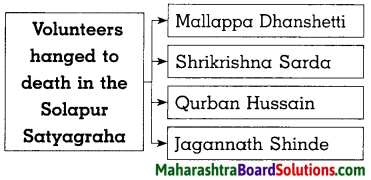
Complete the graphical presentation :

Question 1.
Maharashtra Board Class 8 History Solutions Chapter 8 Civil Disobedience Movement 1
Answer:
Maharashtra Board Class 8 History Solutions Chapter 8 Civil Disobedience Movement 2

Maharashtra Board Class 8 History Solutions Chapter 8 Civil Disobedience Movement

Question 2.
Maharashtra Board Class 8 History Solutions Chapter 8 Civil Disobedience Movement 3
Answer:
Maharashtra Board Class 8 History Solutions Chapter 8 Civil Disobedience Movement 4

Question 3.
Maharashtra Board Class 8 History Solutions Chapter 8 Civil Disobedience Movement 5
Answer:
Maharashtra Board Class 8 History Solutions Chapter 8 Civil Disobedience Movement 6

Write short notes :

Question 1.
Gandhi-Irwin Pact :
Answer:
1. On the appeal of the Prime Minister, the Viceroy released Gandhiji and other political leaders from prison.
2. In this conducive atmosphere, a pact was signed between Gandhiji and Viceroy Irwin. It is known as Gandhi-Irwin Pact.

  • According to the pact, the British Government gave an assurance of providing Responsible Government in the proposed constitution of India.
  • Congress decided to withdraw the Civil Disobedience Movement.
  • Agreed to participate in the Second Round Table Conference.

Maharashtra Board Class 8 History Solutions Chapter 8 Civil Disobedience Movement

Question 2.
Second Round Table Conference :
Answer:

  1. The Second Round Table Conference was held in 1931.
  2. Gandhiji participated as the sole representative of the Indian National Congress.
  3. Dr. Babasaheb Ambedkar represented the Dalits. The representatives of the various castes and communities, political parties and the princely states also participated.
  4. The issues of minority representation and nature of proposed federal constitution were discussed.
  5. Dr. Babasaheb Ambedkar demanded separate electorates for the Dalits.
  6. Gandhiji tried to bring unanimity but he was unsuccessful. ‘
  7. So, he was disappointed and returned to India.

Question 3.
Poona Pact :
Answer:

  1. After the Second Round Table Conference, the British Prime Minister Ramsay Mac Donald declared Communal Awards.
  2. Communal Awards granted separate electorates to the Dalits as demanded by Dr. Ambedkar.
  3. Gandhiji was against the division on the basis of caste. He started fast unto death in Yerwada jail.
  4. The leaders of Indian National Congress requested Dr. Ambedkar to reconsider his demand in the interest of the nation.
  5. So, Dr. Babasaheb Ambedkar signed the. Poona Pact with Gandhiji in 1932.
  6. It provided reserved seats instead of separate electorates for the Dalits.

Question 4.
The Round Table Conference :
Answer:

  1. The British Prime Minister, Ramsay Mac Donald wanted to discuss constitutional issues related to India.
  2. For this purpose, he organised Three Round Table Conferences at London between 1930 and 1932.
  3. Representatives of various communities, castes, political parties and princely states attended the conferences.
  4. Gandhiji attended the Second Round Table Conference as the representative of Indian National Congress.
  5. As no important decision was taken in them, all these conferences proved to be futile.

Answer the following questions in 25 to 30 words :

Question 1.
Write about the sacrifice of Babu Genu.
Answer:

  1. There was agitation against foreign goods in Mumbai.
  2. Babu Genu Said, a mill worker, was at the forefront in this Satyagraha.
  3. He threw himself in front of a truck carrying foreign goods in order to stop it.
  4. He did not budge even after the police threatened him.
  5. In the end, he was crushed under the truck.
  6. His martyrdom was a source of inspiration for the national movement.

Maharashtra Board Class 8 History Solutions Chapter 8 Civil Disobedience Movement

Question 2.
Write features of Civil Disobedience Movement.
Answer:
The Civil Disobedience Movement launched in 1930 had the following features :

  1. All the movements launched till then were limited to urban areas.
  2. But this movement became nationwide as the people from rural areas also participated.
  3. Women participated in large numbers in the movement and even led it at many places.
  4. The movement was based on non-violence. People faced the suppressive measures of the government unarmed and fearlessly.

Question 3.
What suppressive measures were adopted by the British government after the Second Round Table Conference?
Answer:

  1. Gandhiji resumed the Civil Disobedience Movement after he failed and returned from the Second Round Table Conference.
  2. The government responded by resorting to inhuman oppressive measures.
  3. Civic rights were strangled.
  4. The Indian National Congress and associated institutions were declared illegal.
  5. Restrictions were imposed on national newspapers and literature.

Explain the following statements with reasons :

Question 1.
Gandhiji was arrested on 4th May 1930.
Answer:

  1. Gandhiji started Salt Satyagraha on 6th April 1930 at Dandi by breaking the Salt act.
  2. With this the Civil Disobedience Movement started all over India.
  3. In spite of suppressive measures undertaken by the British Government, they could not suppress the movement.

The British government found itself in a difficult situation. So, Gandhiji was arrested on 4th May 1930.

Maharashtra Board Class 8 History Solutions Chapter 8 Civil Disobedience Movement

Question 2.
Gandhiji returned disappointed from the Second Round Table Conference.
Answer:

  1. The British Government raised the issue of representation of the minorities and the nature of the federal constitution.
  2. There were differences of opinion among the representatives.
  3. Moreover, the efforts of Gandhiji to arrive at a consensus did not succeed.
  4. This disappointed Gandhiji and he returned from the Second Round Table Conference.

Read the passage and answer the questions given below:

Passage:
The satyagraha at …………….
………………… Malavan and Shiroda.

Question 1.
Who led the Dharasana Satyagraha?
Answer:
Sarojini Naidu led the Dharasana Satyagraha in Gujarat.

Question 2.
At which places in Maharashtra did Salt Satyagraha take place?
Answer:
The Salt Satyagraha in Maharashtra took place at Wadala, Malvan and Shiroda.

Question 3.
Give a brief account of the Dharasana Satyagraha.
Answer:

  1. The leadership of salt satyagraha was taken over by Sarojini Naidu at Dharasana in Gujarat after the arrest of Gandhiji.
  2. The police lathi-charged the batches of the satyagrahis who came forward to break the Salt Act.
  3. They silently tolerated the blows of the lathis.
  4. The injured were provided medical aid and another batch of satyagrahis would replace them.
  5. This chain of satyagrahis continued endlessly at Dharasana.

Answer the following in detail:

Question 1.
Explain the extensive nature of Civil Disobedience Movement.
Answer:

  1. After the resolution of complete independence was passed, Mahatma Gandhi decided to launch the Civil Disobedience Movement.
  2. he Salt Satyagraha was launched on 6th April 1930 at Dandi. It was a symbolic act by Gandhiji.
  3. The main objective was to break all unjust and oppressive laws of the British through peace and Satyagraha.
  4. Salt Satyagraha took place at Dharasana in Gujarat and at Wadala, Malvan and Shiroda in Maharashtra.
  5. The mill workers were on the forefront in the Solapur Satyagraha.
  6. The forest Satyagraha was undertaken at Bilashi, Sangamner, Kalavan, Chirner and Pusad by tribals in Maharashtra.
  7. In the Northwest Frontier Province, the Satyagraha was organised under the leadership of Khan Abdul Gafar Khan.
  8. The satyagrahis in Mumbai obstructed the trucks loaded with foreign goods.
  9. Women also participated in large numbers.
  10. This movement reached urban as well as the rural areas, thus making it a national movement.

Maharashtra Board Class 8 History Solutions Chapter 8 Civil Disobedience Movement

Question 2.
Write information of Dandi March.
Answer:

  1. Gandhiji decided to launch Civil Disobedience Movement to cancel unjust tax on salt and to end the monopoly of the British Government to manufacture of salt.
  2. Salt, an important ingredient in the food of common people, was chosen by Gandhiji.
  3. On 12th March 1930 he set out from Sabarmati ashram with his 7 followers.
  4. Gandhiji delivered speeches in the villages on his way to Dandi.
  5. Due to Gandhiji’s speech the message of Civil Disobedience spread everywhere and a favorable atmosphere was created.
  6. He appealed to the people to join the movement fearlessly.
  7. Covering a distance of 35 km, Gandhiji reached Dandi, a seashore, on 5th April 1930.
  8. On 6th April, he broke the salt act by picking up the salt lying on the seashore.
  9. With this, the Civil Disobedience Movement started all over the country.

Question 3.
Do you feel Gandhiji’s Civil Disobedience technique can be used in present times?
Answer:

  1. Gandhiji opposed the unjust and oppressive laws of the British and broke them through peace and Satyagraha.
  2. I strongly feel India needs such ways in present times. Political parties and organisations call for strike or start a movement against decisions of government.
  3. They resort to unconstitutional acts such as stopping the vehicles, vandalising public property, setting objects on fire and starting riots.
  4. They destroy property of the nation by involving in all this anti-social activities. Innocent people get killed.
  5. It brings development to a halt, creates a divide in society.
  6. The feeling of unity, co-operation and tolerance remains no more. Society becomes unsafe.
  7. Therefore, I feel that even today the nation requires technique of Civil Disobedience.

8th Std History Questions And Answers:

Std 8 History Chapter 4 Questions And Answers The Freedom Struggle of 1857 Maharashtra Board

Balbharti Maharashtra State Board Class 8 History Solutions Chapter 4 The Freedom Struggle of 1857 Notes, Textbook Exercise Important Questions and Answers.

Class 8 History Chapter 4 The Freedom Struggle of 1857 Questions And Answers Maharashtra Board

The Freedom Struggle of 1857 Class 8 Questions And Answers Chapter 4 Maharashtra Board

Class 8 History Chapter 4 The Freedom Struggle of 1857 Textbook Questions and Answers

1. Rewrite the statements by choosing the appropriate options:
(Umaji Naik, War of Independence, Lord Dalhousie, Secretary of State, Tatya Tope)

Question 1.
V. D. Savarkar named the struggleof 1857 as the ………. .
Answer:
War of Independence

Question 2.
……….. united the Ramoshis to rebel against the British.
Answer:
Umaji Naik

Maharashtra Board Class 8 History Solutions Chapter 4 The Freedom Struggle of 1857

Question 3.
After the struggle of 1857, the post of …………. was created in the British Government to look after the affairs of India.
Answer:
Secretary of State

Question 4.
………… was the Governor General who annexed the princely states.
Answer:
Lord Dalhousie.

2. Explain the following statements with reasons :

Question 1.
The Paikas made armed rebellion against the British.
Answer:

  1. The Britishers conquered x Odisha in 1803.
  2. They confiscated the hereditary rent free land granted to Paikas by the kings.
  3. The life of the common man became miserable due to tax imposed on salt by the British.

This resulted in armed rebellion of the Paikas against the British in 1817.

Question 2.
There was discontent among the Hindu and Muslim sepoys.
Answer:

  1. In 1856, the British introduced long Enfield rifles.
  2. The soldiers were required to bite the greased covering of the cartridges of the rifle to open them.
  3. The news spread among the soldiers that the covering of the cartridges contained 8 the fat of cows and pigs.
  4. The religious sentiments of the Hindu and Muslim soldiers were hurt and there was discontent among them.

Question 3.
The Indian sepoys could not keep stand in front of the British army.
Answer:
The Indian sepoys could not keep stand in front of the British army because :

  1. The Indian soldiers were brave but they had no military strategies.
  2. They did not have economic strength.
  3. Indians did not have latest and enough stock of arms and experienced army generals like the British.
  4. On the other hand, the British possessed the modern means of transport and communication and were therefore swift in their movements.

This proved that the wars are not fought only on bravery but also through military strategies.

Maharashtra Board Class 8 History Solutions Chapter 4 The Freedom Struggle of 1857

Question 4.
After the struggle, Indian army was divided on the basis of caste.
Answer:
There was division of military on the basis of caste because :

  1. The British felt that if the Indians came together they would again unite and rebel against the British rule.
  2. Hence, proper care was taken by dividing them on the basis of caste to avoid future conflict.

Question 5.
The British imposed heavy taxes on Indian industries.
Answer:

  1. The British introduced new revenue system with the sole purpose to increase their income.
  2. The taxes were forcibly collected from the farmers.
  3. British goods were sold in India to gain profits.
  4. They imposed heavy taxes on the goods made by local industries.
  5. This trade policy ruined Indian handicraft and textile industries.
  6. Many artisans became unemployed. The British imposed heavy taxes on Indian industries with the sole purpose to ruin the Indian economy.

3. Answer the following questions in brief:

Question 1.
What were the social causes behind the struggle of 1857?
Answer:
The social causes behind the struggle of 1857 were :

  1. The Indians felt that Britishers interfered in their culture, traditions and customs.
  2. The British enacted Sati Prohibition Act and the Widow-Remarriage Act.
  3. These were seen as an interference in the lifestyle of the Indians.
  4. Indians resented it as it was regarded as the destruction of the way of life by the British government.

Question 2.
Why did the Indians fail in the struggle of 1857?
Answer:
There are several reasons for the failure of Indians in the struggle of 1857. They were :

  1. It did not have central leadership so lacked uniformity.
  2. The Indian soldiers who participated in the struggle did not have latest and sufficient weapons.
  3. They were brave but did not have tactics.
  4. On the other hand, the British had a unified leadership, disciplined army, latest weapons and experienced army generals.
  5. The British controlled transport and communication which made their movement swift.
  6. The majority of the rulers of the Princely States kept themselves away from the freedom struggle.
  7. The struggle was severe in Northern India. It did not take place all over India simultaneously.
  8. Rajputana, Punjab, some parts of Bengal and North west India remained aloof.

Maharashtra Board Class 8 History Solutions Chapter 4 The Freedom Struggle of 1857

Question 3.
What were the consequences of struggle of 1857?
Answer:

  1. The British government realised that there was growing dissatisfaction among the Indians due to Company’s rule.
  2. The British Parliament passed the Government of India Act in 1858 and took over the responsibility of ruling over people of India thus bringing an end to Company’s rule.
  3. The Queen issued a Declaration addressing the people of India.
  4. The Governor General was designated as the Viceroy of India.
  5. A new post of Secretary of State was created to look after the affairs of India.
  6. The British changed the composition of army and its internal policies.

Question 4.
What were the changes in British policy after the struggle of 1857?
Answer:

  1. The British accepted the policy of non-interference in social and religious aspects of Indians.
  2. They took care that Indian society did not unite on social grounds.
  3. They took care to see that conflicts on grounds of caste, religion, race, territory kept raging.
  4. They poisoned and polluted the minds of Indians by following the policy of ‘Divide and Rule’.
  5. What changes

Project:

Question 1.
Search for the book written by V. D. Savarkar entitled ‘The Indian War of Independence 1857’ and read it.

Question 2.
On an outline map of India indicate the regions  where the freedom struggle of 1857 took place.

Class 8 History Chapter 4 The Freedom Struggle of 1857 Additional Important Questions and Answers

Identify the wrong pair, correct it and rewrite:

Question 1.
Class 8 History Chapter 4 The Freedom Struggle Of 1857 Questions And Answers
Answer:
Wrong pair: Bihar – Kolis
Corrected pair: Bihar – Santhals.

Name the following:

Question 1.
Led the revolt of Paikas:
Answer:
Bakshi Jaganbandhu Bidyadhar

Question 2.
Last Mughal Emperor of Delhi:
Answer:
Bahadur Shah

Maharashtra Board Class 8 History Solutions Chapter 4 The Freedom Struggle of 1857

Question 3.
Led the revolt of Bhills in Khandesh:
Answer:
Kajarsingh

Question 4.
Led the revolt in Satpura:
Answer:
Shankarshah

Rewrite the statements by choosing the appropriate options:

Question 1.
In 1806, Indian soldiers at …………. revolted.
(a) Barrackpore
(b) Meerut
(c) Vellore
(d) Delhi
Answer:
(c) Vellore

Question 2.
Governor General …………… annexed many states through Doctrine of Lapse.
(a) Lord Warren Hastings
(b) Lord Cornwallis
(c) Lord Canning
(d) Lord Dalhousie
Answer:
(d) Lord Dalhousie

Question 3.
Bahadur Shah who led the revolt was imprisoned at …………… .
(a) Nepal
(b) Rangoon
(c) Sri Lanka
(d) Andaman
Answer:
(b) Rangoon

Question 4.
………… fought for ten months against British but was caught due to betrayal.
(a) Rango Bapuji
(b) Bakht Khan
(c) Tatya Tope
(d) Ahmedullah
Answer:
(c) Tatya Tope

Maharashtra Board Class 8 History Solutions Chapter 4 The Freedom Struggle of 1857

Answer the following questions in one sentence:

Question 1.
Why did the Indian sepoys at Meerut rebel against the British?
Answer:
When the news that Mangal Pandey was arrested and hanged reached Meerut cantonment, the entire regiment of the Indian sepoys rebelled against the British.

Question 2.
In which parts of North India did the revolt spread?
Answer:
After Delhi, the revolt spread in Lucknow, Allahabad, Kanpur, Banaras, Bareli and Jhansi.

Question 3.
Who fought the Crimean War?
Answer:
The Crimean war was fought between Britain and Russia.

Question 4.
Which policy did the British adopt to pollute the minds of Indians?
Answer:
The British adopted the policy of ‘Divide and Rule’ to pollute the minds of the Indians.

Complete the graphical presentation:

Question 1.
Maharashtra Board Class 8 History Solutions Chapter 4 The Freedom Struggle of 1857 2
Answer:
Maharashtra Board Class 8 History Solutions Chapter 4 The Freedom Struggle of 1857 3

Question 2.
Maharashtra Board Class 8 History Solutions Chapter 4 The Freedom Struggle of 1857 4
Answer:
Maharashtra Board Class 8 History Solutions Chapter 4 The Freedom Struggle of 1857 5

Question 3.
Maharashtra Board Class 8 History Solutions Chapter 4 The Freedom Struggle of 1857 6
Answer:
Maharashtra Board Class 8 History Solutions Chapter 4 The Freedom Struggle of 1857 7

Write Short Notes :

Question 1.
Paika Rebellion:
Answer:

  1. There were many independent kingdoms in Odisha in the medieval period.
  2. The kings used to have a standing army known as Paikas.
  3. The kings gave them rent free land for their cultivation and livelihood.
  4. In return, they were supposed to fight along with the king in case of any war.
  5. The English conquered Odisha in 1803 and took over the hereditary rent free lands granted to the Paikas.
  6. This resulted in armed rebellion of the Paikas against the British under the leadership of Bakshi JaganbandhuBidyadhar.

Maharashtra Board Class 8 History Solutions Chapter 4 The Freedom Struggle of 1857

Question 2.
Rebellion of Umaji Naik:
Answer:
1. Exploitation was on a large scale during the Company’s rule in India. There was rising discontent among the Indians. Sanyasis-Fakirs rebelled in the | Bengal province.
2. Umaji Naik organised the Ramoshis and the local youth and gave a strong fight to the British in Maharashtra.
3. They drafted a declaration and appealed to the people to support them in their fight against to overthrow the British government.
4. People in Ahmednagar, Satara, Pune, Nasik, Solapur and Bhor were inspired by them.
5. Umaji Naik was arrested and hanged to death in 1832 at Pune.

Explain the following statements with reasons:

Question 1.
There was discontent among the Indian soldiers.
Answer:

  1. Indian soldiers were treated with contempt.
  2. They were denied position higher than Subhedar in the army.
  3. They were given low status by the British officers.
  4. They were paid less salary than the British soldiers.
  5. Their allowances were reduced gradually.
  6. Due to all these factors there was discontent among the Indian soldiers.

Question 2.
Mangal Pandey was arrested and hanged.
Answer:

  1. The British introduced long Enfield rifles. The soldiers were required to bite the greased covering of the cartridges of the rifle to open them.
  2. The news spread among the Indian soldiers that the covering of the cartridges contained the fat of cows and pigs.
  3. The religious sentiments of the Muslim and Hindu soldiers were hurt.
  4. The angry soldiers who refused to use the cartridges were severely punished.
  5. In retaliation to this unjust practice, Mangal Pandey from Barrackpore cantonment fired at the British officer. So, he was arrested and hanged.

Maharashtra Board Class 8 History Solutions Chapter 4 The Freedom Struggle of 1857

Answer the following questions in brief :

Question 1.
What changes were made in administration of India after the struggle of 1857?
Answer:
After the struggle of 1857, the British Parliament made the following changes in the administration of India :

  1. The rule of the East India Company came to an end.
  2. The Governor General was designated as Viceroy of India. He was entrusted with powers to rule over people of India.
  3. He carried administration under the control of British Parliament.
  4. A new post called Secretary of State was created in the British Government to look after the affairs of India.

Question 2.
Write about Queen’s Proclamation.
Answer:

  1. Queen Victoria of England issued a proclamation addressed to the people of India in 1858.
  2. She declared that the people in India were her subjects and that discrimination would not be made on grounds of race, religion, caste and place of birth.
  3. Government jobs will be given strictly on the basis of merit.
  4. She promised that government will not interfere in the religious matter of the people.
  5. She promised all the treaties made with the Indian rulers will be honoured and that no state would be annexed in future.

Read the given passage and answer the questions given below :

Questions :

Question 1.
Name the leaders of the struggle who lost their lives on the battlefield.
Answer:
Rani Laxmibai, Kunwar Singh, Ahmedullah laid their lives on the battle field.

Question 2.
Who was hanged to death?
Answer:
Tatya Tope fought for ten months but was caught by betrayal and hanged to death.

Question 3.
Which leaders took shelter in Nepal?
Answer:
Nanasaheb Peshwa and Begum Hazrat Mahal took shelter in Nepal.

Maharashtra Board Class 8 History Solutions Chapter 4 The Freedom Struggle of 1857

Answer the following questions in detail :

Question 1.
Explain the reasons of the struggle of 1857 with following points :
(1) Economic
(2) Political
Answer:
The reasons of 1857 freedom struggle :
Economic :

  1. New revenue system | introduced by the British to increase their income and impoverish the peasants.
  2. The farmers had to either sell or mortgage their land to pay tax in cash.
  3. In order to sell British goods in India and earn profit they imposed heavy taxes on local industries.
  4. Many artisans lost their livelihood as 8 handicraft and textile industries ruined.

Political :

  1. The British captured many g states after winning the Battle of Plassey in 1757.
  2. Lord Dalhousie annexed many princely states on various reasons.
  3. He dethroned the Nawab of Ayodhya and annexed Ayodhya under the pretext of maladministration ?
  4. He annexed princely states of Jhansi, Nagpur and Satara through Doctrine of Lapse.
  5. Due to these policies of Lord Dalhousie the Indians had no trust in the British.

All these factors created discontent among artisans, princes and other classes f which ultimately led to the freedom struggle of 1857.

Question 2.
Write about the struggles before 1857.
Answer:
There was rising discontent among the Indians which led to many struggles before 1857 :

  1. The peasants in Bengal fought against the British from 1763 to 1857 first under the leadership of the Sanyasis and later the Fakirs.
  2. Umaji Naik in Maharashtra organised | Ramoshis and the local youths who fought against the British. The Kolis, the Bhills also fought against the British.
  3. They inspired people in Pune, Satara, Ahmednagar, Solapur, Nasik, Bhor, etc.
  4. Santhals in Bihar, Kolams in Chhota Nagpur and Gonds as well as Paikas in Odisha rebelled against the British.
  5. The Gadkaris in Kolhapur and Fond- ‘i Sawant in Konkan fought against the British.
  6. Zamindars, Princes and other classes in Gujarat, Rajasthan and South India gave a strong fight to the British.

Question 3.
How did the scope of the struggle increase?
Answer:
1. Mangal Pandey shot a British officer at Barrackpore cantonment who forced him to use cartridges greased with the fat of cows and pigs.
2. Mangal Pandey was arrested and hanged. News spread like fire to other cantonments.
3. The entire regiment of Indian soldiers at Meerut battled and marched towards Delhi.
4. On reaching Delhi, the rebels proclaimed Bahadur Shah as the Emperor of India.
5. It spread to the whole of north India. The soldiers in the cantonments from Bihar to Rajput ana participated in the revolt.
6. The revolt spread to Lucknow, Allahabad, Kanpur, Banaras, Bareli and Jhansi.
7. It spread to the whole of north India and in Nagpur, Satara, Kolhapur and Nargund, Khandesh in western India.
8. Many princely states, peasants and about 400 female Bhills participated in revolt at Khandesh to free themselves from the oppressive rule of the British.
9. The struggle was led by Bahadur Shah the Mughal Emperor, Nanasaheb Peshwa, Rani Laxmibai, Tatya Tope, Kunwar Singh of Bihar and Begum Hazrat Mahal of Ayodhya.

Maharashtra Board Class 8 History Solutions Chapter 4 The Freedom Struggle of 1857

Question 4.
Why did the struggle fail?
Answer:
The reasons for the failure are as follows :
1. The struggle remained limited to the Northern part and it did not spread all over India at the same time.
2. Its intensity was severe in North India but Rajputana, Punjab but parts of Bengal and North-west India remained aloof.
3. Many princely states remained loyal to the British which reduced its intensity.
4. The majority of the rulers of the Indian states and the educated Indians kept away from the struggle.
5. Though the soldiers were brave they did not use military tactics.
6. As there was no commonly accepted leader to fight the British, there was no uniformity of the struggle.
7. On the other hand, the British had economic strength, experienced generals, disciplined army, latest weapons and modern means of transport and communication which made movements of the British swift.
8 The naval strength of the British was vast, while rebels were isolated.

Question 5.
What lesson have we learnt from the struggle of 1857?
Answer:
We learnt the following lesson from the struggle of 1857 :
1. Any challenge in front of the nation should be faced unitedly.
2. Each and every member of the society should keep in mind that if two people or groups disagree or have difference in opinion there are chances of third party creating misunderstanding and taking advantage of it. We need to be careful with such tendencies.
3. If the means to earn livelihood is taken away it creates discontent. Therefore, all should get means to earn livelihood.
4. The division in army, government offices and business should not be based on caste, race and religion. It should be based on merit and equality.

8th Std History Questions And Answers:

Heat Class 10 Questions And Answers Maharashtra Board

Class 10 Science Part 1 Chapter 5

Balbharti Maharashtra State Board Class 10 Science Solutions Part 1 Chapter 5 Heat Notes, Textbook Exercise Important Questions and Answers.

Std 10 Science Part 1 Chapter 5 Heat Question Answer Maharashtra Board

Class 10 Science Part 1 Chapter 5 Heat Question Answer Maharashtra Board

Question 1.
Fill in the blanks and rewrite the sentences:
a. The amount of water vapour in air is determined in terms of its………..
Answer:
The amount of water vapour in air is determined in terms of its absolute humidity.

b. If objects of equal masses are given equal heat, their final temperature will be different. This is due to difference in their………….
Answer:
If objects of equal masses are given equal heat, their final temperature will be different. This is due to difference in their specific heat capacities.

c. When a liquid is getting converted into solid, the latent heat is……….  (Practical Activity Sheet – 1 and 2)
Answer:
When a liquid is getting converted into solid, the latent heat is released.

Maharashtra Board Class 10 Science Solutions Part 1 Chapter 5 Heat

Question 2.
Observe the following graph. Considering the change in volume of water as its temperature is raised from 0 °C, discuss the difference in the behaviour of water and other substances. What is this behaviour of water called?
Maharashtra Board Class 10 Science Solutions Part 1 Chapter 5 Heat 1
Answer:
If the temperature of water is raised from 0 °C to 10 °C, its volume goes on decreasing in the range 0 °C to 4 °C. It is minimum at 4 °C. The volume of water goes on increasing in the range 4 °C to 10 °C.

In general, when a substance is heated, its volume goes on increasing with temperature. Thus, in the range 0 °C to 4 °C, behaviour of water is different from other substances. It is called anomalous behaviour of water.

Question 3.
What is meant by specific heat capacity?
How will you prove experimentally that different substances have different specific heat capacities?
Answer:
The amount of heat energy required to raise the temperature of a unit mass of an object by 1 °C is called the specific heat capacity of that object.

Question 4.
While deciding the unit for heat, which temperatures interval is chosen? why?
Answer:
While deciding the unit for heat, the temperature interval chosen is 14.5 °C to 15.5 °C. For the reason, see the information given in the following box.

Maharashtra Board Class 10 Science Solutions Part 1 Chapter 5 Heat

Question 5.
Explain the following temperature vs time graph:
Maharashtra Board Class 10 Science Solutions Part 1 Chapter 5 Heat 2
(Practice Activity Sheet – 1 and 4; March 2019)
Answer:
The graph shows what happens when a mixture of ice and water is heated continuously. The temperature of the mixture remains constant (0 °C) till all the ice melts as shown by the line AB. This temperature is the melting point of ice. On further heating, the temperature rises steadily from 0 °C to 100 °C as shown by the line BC, At 100 °C water starts converting into steam. This temperature is the boiling point of water. Further heating does not change the temperature and the conversion waters steam continues as shown by the line CD.

Question 6.
Explain the following:
a. the role of anomalous behaviour of water in preserving aquatic life in regions of cold climate?
Answer:
Maharashtra Board Class 10 Science Solutions Part 1 Chapter 5 Heat 3
In cold regions, during winter, the temperature of the atmosphere falls well below 0 °C. As the temperature decreases, the water at the surfaces of lakes and ponds starts contracting. Hence, its density increases and it sinks to the bottom. This process continues till the temperature of all the water in a lake falls to 4 °C. As the water at the surface cools further, i.e., its temperature falls below 4 °C, it starts expanding instead of contracting. Therefore, its density decreases and it remains at the surface.

The temperature of the water at the surface continues to fall to 0 °C. Finally, the water at the surface is converted into ice, but the water below the layer of ice is at 4 °C. Ice is a bad conductor of heat. Hence, the layer of the ice at the surface does not allow transfer of heat from the water to the atmosphere. As the water below the layer of ice remains at 4 °C, fish and other aquatic animals and plants can survive in it.

b. How can you relate the formation of water droplets on the outer surface of a bottle taken out of a refrigerator with formation of dew?
Answer:
At a given temperature, there is a limit on how much water vapour the given volume of air can hold. The lower the temperature, the lower is the capacity of air to hold water vapour.

The temperature of a bottle kept in a refrigerator is lower than room temperature. Hence, when the bottle is taken out of the refrigerator, the temperature of the air surrounding the bottle is lowered. Therefore, the capacity of the air to hold water vapour becomes less. Hence, the excess water vapour condenses to form water droplets (like dew) on the outer surface of the bottle.

c. In cold regions in winter, the rocks crack due to anomalous expansion of water.
Answer:
Sometimes water enters into crevices of the rocks. When the temperature of the atmosphere falls below 4 °C, water expands. Even when water freezes to form ice, there is increase in its volume. As there is no room for expansion, it exerts a tremendous pressure on the rocks which crack and break up into small pieces.

Maharashtra Board Class 10 Science Solutions Part 1 Chapter 5 Heat

Question 7.
a. What is meant by latent heat? How will the state of matter transform if latent heat is given off?
Answer:
When a solid is heated, initially, its temperature increases. Here, the heat absorbed by the body (substance) is used in increasing the kinetic energy of the particles (atomic, molecules, etc.) of the body as well as for doing work against the forces of attraction between them. As the heating is continued, at a certain temperature (melting point), solid is converted into liquid. In this case, the temperature remains constant and the heat absorbed is used for weakening the bonds and conversion into liquid phase (liquid state). This heat is called the latent heat of fusion.

When a liquid is converted into the gaseous phase (gaseous state), at the boiling point, the heat absorbed is used for breaking the bonds between the atoms or molecules. This heat is called the latent heat of vaporization. Some solids, under certain conditions, are directly transformed into the gaseous phase. Here the heat is absorbed but the temperature remains constant. The absorbed heat is used for breaking the bonds between atoms or molecules. This heat is called the latent heat of sublimation.

In general, latent heat is the heat absorbed or given out by a substance during a change of state at constant temperature.
In transformations from liquid to solid, gas to liquid and gas to solid, latent heat is given out by the body (substance).
(Note: change of state = change of phase)

b. Which principle is used to measure the specific heat capacity of a substance?
Answer:
The principle of heat exchange is used to measure the specific heat capacity of a substance. This principle is as follows: If a system of two objects is isolated from the environment by keeping it inside a heat resistant box, then no energy can leave the box or enter the box. In this situation, heat energy lost by the hot object = heat energy gained by the cold object.

c. Explain the role of latent heat in the change of state of a substance.
Answer:
When a solid is heated, initially, its temperature increases. Here, the heat absorbed by the body (substance) is used in increasing the kinetic energy of the particles (atomic, molecules, etc.) of the body as well as for doing work against the forces of attraction between them. As the heating is continued, at a certain temperature (melting point), solid is converted into liquid. In this case, the temperature remains constant and the heat absorbed is used for weakening the bonds and conversion into liquid phase (liquid state). This heat is called the latent heat of fusion.

When a liquid is converted into the gaseous phase (gaseous state), at the boiling point, the heat absorbed is used for breaking the bonds between the atoms or molecules. This heat is called the latent heat of vaporization. Some solids, under certain conditions, are directly transformed into the gaseous phase. Here the heat is absorbed but the temperature remains constant. The absorbed heat is used for breaking the bonds between atoms or molecules. This heat is called the latent heat of sublimation.

In general, latent heat is the heat absorbed or given out by a substance during a change of state at constant temperature.
In transformations from liquid to solid, gas to liquid and gas to solid, latent heat is given out by the body (substance).
(Note: change of state = change of phase)

d. what basis and how will you determine whether air is saturated with vapour or not?
Answer:
Whether the air is saturated with water vapour or not is determined on the basis of the extent of water vapour present in the air. If the relative humidity is 100%, the air is saturated with water vapour. In that case, we can see the formation of water droplets on the leaves of plants/grass.
If the relative humidity is less than 100%, the air is not saturated with water vapour.

Question 8.
Read the following paragraph and answer the questions:
If heat is exchanged between a hot and cold object, the temperature of the cold object goes on increasing due to gain of energy and the temperature of the hot object goes on decreasing due to loss of energy.

The change in temperature continues till the temperatures of both the objects attain the same value. In this process, the cold object gains heat energy and the hot object loses’ heat energy. If the system of both the objects is isolated from the environment by keeping it inside a heat resistant box (meaning that the energy exchange takes place between the two objects only), then no energy can flow from inside the box or come into the box.
(1) Heat is transferred from where to where?
(2) Which principle do we learn about from this process?
(3) How will you state the principle briefly?
(4) Which property of the substance is measured using this principle?
Answer:
(1) Heat is transferred from a hot object to a cold object.
(2) This process shows the principle of heat exchange.
(3) In this process, the cold object gains heat energy and the hot object loses energy. If a system of two objects is isolated from the surroundings, heat energy lost by the hot object = heat energy gained by the cold object.
(4) This principle is used to measure the specific heat capacity of a substance.

Maharashtra Board Class 10 Science Solutions Part 1 Chapter 5 Heat

Question 9.
Solve the following problems:
a. Equal heat is given to two objects A and B of mass 1 g. The temperature of A increases by 3 °C and B by 5°C. Which object has more specific heat? And by what factor?
Solution:
Data: m = 1 g, Δ T1 = 3 °C, Δ T2 = 5 °C,
Q same
Here, Q = mc1 ΔT1 = mc2 ΔT2
Maharashtra Board Class 10 Science Solutions Part 1 Chapter 5 Heat 4
Thus, c1 > c2
The specific heat of A is more than that of B and
Maharashtra Board Class 10 Science Solutions Part 1 Chapter 5 Heat 5

b. Liquid ammonia is used in ice factory for making ice from water. If water at 20 °C is to be converted into 2 kg, ice at 0 °C, how many grams of ammonia is to be evaporated?
(Given: The latent heat of vaporization of 1 ammonia = 341 cal/g)
Solution:
Data : m1 = 2kg, ΔT1=20 °C – 0 °C
= 20 °C, c1 = 1 kcal/kg·°C, L1 (ice) = 80 kcal/kg,
L2 (vaporization of ammonia) = 341 cal/g = 341 kcal/kg, m2 =?
Q1 (heat lost by water) = m1c1 ΔT1 + m1L1
= 2kg × 1 kcal/kg·°C × 20 °C + 2 kg × 80 kcal/kg
=40 kcal + 160 kcal = 200 kcal
Q2 (heat absorbed by ammonia) = m2L2
= m2 × 34l kcal/kg
According to the principle of heat exchange, Q1 = Q2
∴ 200 kcal = m2 × 341 kcal/kg
∴ m2 = \(\frac{200}{341}\) kg = 0.5864 kg = 586.4 g
586.4 g of ammonia are to be evaporated.

c. A thermally insulated pot has 150 g ice at temperature 0 °C. How much steam of 100 °C has to he mixed to it, so that water of temperature 50 °C will be obtained?
(Given: Latent heat of melting of ice = 80 cal/g, latent heat of vaporization of water = 540 cal/g, specific heat of water = 1 cal/g °C)
Solution:
Data: m1 = 150 g, ΔT1 = 50 °C – 0 °C
= 50 °C, cw = 1 cal/g.°C, L1 = 80 cal/g, L2 = 540 cal/g,
Δ T2 = 100°C – 50 °C = 50 °C, m2 = ?
Q1 (heat absorbed by ice) = m1L1
= 150 g × 80 cal/g = 12000 cal
Q2 (heat absorbed by water formed on melting of ice) =m1 cw ΔT1
= 150 g × 1 cal/g·°C × 50 °C = 7500 cal
Q3 (heat given out by steam) = m2L2
= m2 × 540 cal/g
Q4 (heat given out by water formed on condensation of steam)
= m2 cw ΔT2 = m2 × 1 cal/g·°C × 50 °C
According to the principle of heat exchange,
Q1 + Q2 = Q3 + Q4
∴ 12000 cal + 7500 cal = m2 × 540 cal/g + m2 × 50 cal/g
∴ 19500 cal = m2 (540 + 50) cal/g
∴ m2 = \(\frac{19500}{590}\) g
33.5 g of steam is to be mixed.

d. A calorimeter has mass 100 g and specific heat 0.1 kcal/kg ·°C. It contains 250 g of liquid at 30 °C having specific heat of 0.4 kcal/kg·°C. If we drop a piece of ice of mass 10 g at 0 °C into the liquid, what will be the temperature of the mixture?
Solution:
Data: m1 = 100 g, c1 = 0.1 kcal/kg·°C,
= 0.1 cal/g·°C, T1 = 30 °C, m2 = 250 g,
c2 = 0.4 kcal/kg·°C = 0.4 cal/g·°C, T2 = 30 °C,
m3 = 10 g, T3 = 0 °C, L = 80 cal/g,
c (water) = 1 cal/g·°C, T = ?
Q1 (heat lost by calorimeter) = m1c1 (T- T1),
Q2 (heat lost by liquid) = m2c2 (T – T2),
Q3 (heat absorbed by ice) = m3 L,
Q4 (heat absorbed by water formed on melting of ice) = m3c (T – 0 °C)
According to the principle of heat exchange,
Q1 + Q2 = Q3 + Q4
∴ m1c1 (T1 – T) + m2c2 (T2 – T) = m3L + m3c (T – 0 °C)
∴ m1c1T1 – m1c1T + m2c2T2 – m2c2T = m3L + m3c (T – 0°C)
∴ m1c1T1 + m2c2T2 = m3L + (m1c1 + m2c2 + m3c)T
∴ 100g × 0.1 cal/g°C × 30 °C + 250g × 0.4 cal/g.°C × 30 °C J
= 10 g x× 80 cal/g + (100 g × 0.1 cal/g.°C + 250 g × 0.4 cal/g.°C + 10 g × 1 cal/g.°C) T
∴ (10 + 100 + 10) T = (300 + 3000 – 800)°C
∴ 120 T = 2500 °C
∴ T = \(\frac{2500}{120}\) °C = \(\frac{125}{6}\) °C = 20.83 °C
This is the temperature of the mixture.

Project:
Take help of your teachers to make a working model of Hope’s apparatus and perform the experiment. Verify the results you obtain. [Do it your self]

Maharashtra Board Class 10 Science Solutions Part 1 Chapter 5 Heat

Can you recall? (Text Book Page No. 62)

Question 1.
What is the difference between heat and temperature?
Answer:
Heat is a form of energy. Particles of matter (atoms, molecules, etc.) possess potential energy and kinetic energy. Total energy (potential energy + kinetic energy) of all particles of matter in a given sample is called it’s thermal energy. When two bodies at different temperatures are in thermal contact with each other, there is transfer of thermal energy from a body at higher temperature to a body at lower temperature. This energy in transfer is called heat. It is expressed in joule, calorie and erg.

Temperature is a quantitative measure of degree of hotness or coldness of a body. It is expressed in °C, °F or K (kelvin). Temperature determines the direction of energy transfer.

Question 2.
What are the different ways of heat transfer?
Answer:
Ways of heat transfer: conduction, convection and radiation.
[Note: heat ≡ heat energy. In the textbook, both the terms are used.]

Use your brain power! (Text Book Page No. 63)

Question 1.
Is the concept of latent heat applicable during transformation of gaseous phase to liquid phase and from liquid phase to solid phase?
Answer:
Yes.

Question 2.
Where does the latent heat go during these transformations?
Answer:
During these transformations, the latent heat is given out by the substance to the surroundings.

Maharashtra Board Class 10 Science Solutions Part 1 Chapter 5 Heat

Use your brain power! (Text Book Page No. 64)

Question 1.
In the above experiment, the wire moves through the ice slab. However, the ice slab does not break. Why?
Answer:
When the thin wire with two equal weights attached to its ends is hung over the block of ice, it exerts pressure on the ice below it. Due to this, the melting point of the ice below the wire is lowered and some ice melts. The wire passes through the water so formed.

The water above the wire is no longer under pressure and, therefore, refreezes. Once again the ice below the wire melts, and the wire passes through it, and the process continues. In this way, due to alternate melting of ice and refreezing of water, the wire cuts right through the block of ice leaving the block intact.

Question 2.
Is there any relationship of latent heat with regelation?
Answer:
Yes. when the ice melts, heat is absorbed, but the temperature does not change. Also, when water refreezes, heat is given out, but the temperature does not change. This heat absorbed or given out is the latent heat.

Question 3.
You know that as we go higher than the sea level, the boiling point of water decreases. What would be the effect on the melting point of a solid?
Answer:
As we go higher than the sea level, the melting point of solids (i) that expand on melting is lowered due to a decrease in pressure (ii) that contract on melting is raised due to a decrease in pressure.

[The wire used in the experiment is made of a metal (usually copper). Metals are good conductors of heat. Hence, exchange of heat between the portion of the ice above the wire and that below the wire takes place readily.]

Can you tell? (Text Book Page No. 64)

Question 1.
We feel that some objects are cold, and some are hot. Is this feeling related in some way to our body temperature?
Answer:
Yes. If the temperature of the object is lower than our body temperature, e.g., ice, we feel the object is cold. If the temperature of the object is higher than our body temperature, e.g., hot water, we feel the object is hot.

Use your brain power! (Text Book Page No. 66)

Question 1.
How will you explain the following statements with the help of the anomalous behaviour of water?
(1) In regions with cold climate, the aquatic plants and animals can survive even when the atmospheric temperature goes below 0 °C.
(2) In cold regions in winter the pipes for water supply break and even rocks crack.
Answer:
Maharashtra Board Class 10 Science Solutions Part 1 Chapter 5 Heat 6
In cold regions, during winter, the temperature of the atmosphere falls well below 0 °C. As the temperature decreases, the water at the surfaces of lakes and ponds starts contraeting. Hence, its density increases and it sinks to the bottom. This process continues till the temperature of all the water in a lake falls to 4 °C. As the water at the surface cools further, i.e., its temperature falls below 4 °C, it starts expanding instead of contracting. Therefore, its density decreases and it remains at the surface.

The temperature or the water at the surface continues to fall to 0 °c. Finally, the water at the surface is converted Into ice, but the water below the layer of ice is at 4 °C. Ice is a bad conductor of heat. Hence, the layer of the ice at the surface does not allow transfer of heat from the water to the atmosphere. As the water below the layer of ice remains at 4 °C, fish and other aquatic animals and plants can survive in it.

Maharashtra Board Class 10 Science Solutions Part 1 Chapter 5 Heat

(2) Sometimes water enters into crevices of the rocks. when the temperature of the atmosphere falls below 4 °C, water expands. Even when water freezes to form ice, there is increase in its volume. As there is no room for expansion, it exerts tremendous pressure on the rocks which crack and break up Into small pieces.

In cold countries, in winter, the temperature of the atmosphere falls below 0 °C. when the temperature of water falls below 4 °C, it expands. Hence, the water in pipes expands. Even if ice is rormed, there is an increase in the volume.

As there is no room for expansion, water (or ice) exerts a large pressure on the pipes. Hence, the pipelines carrying water burst.

Fill in the blanks and rewrite the sentences:

Question 1.
The amount of water vapour in air is determined in terms of its…………..
Answer:
The amount of water vapour in air is determined in terms of its absolute humidity.

Question 2.
If objects of equal masses are given equal heat, their final temperature will be different. This is due to difference in their……………
Answer:
If objects of equal masses are given equal heat, their final temperature will be different. This is due to difference in their specific heat capacities.

Question 3.
When a liquid is getting converted into solid, the latent heat is…………. (Practical Activity Sheet – 1 and 2)
Answer:
When a liquid is getting converted into solid, the latent heat is released.

Rewrite the following statements by selecting the correct options:

Question 1.
……….is used to study the anomalous behaviour of water.
(a) Calorimeter
(b) Joule’s apparatus
(c) Hope’s apparatus
(d) Thermos flask
Answer:
(c) Hope’s apparatus

Question 2.
When water boils and is converted into steam, then………..
(a) heat is taken in and temperature remains constant
(b) heat is taken in and temperatures rises
(c) heat is given out and temperature lowers
(d) heat is given out and temperature remains constant
Answer:
(a) heat is taken in and temperature remains constant

Question 3.
When steam condenses to form water,………..
(a) heat is absorbed and temperature increases
(b) heat is absorbed and temperature remains the same
(c) heat is given out and temperature decreases
(d) heat is given out and temperature remains the same
Answer:
(d) heat is given out and temperature remains the same

Maharashtra Board Class 10 Science Solutions Part 1 Chapter 5 Heat

Question 4.
The temperature of ice can be decreased below 0 °C by mixing………..in it. (Practice Activity Sheet – 3)
(a) saw dust
(b) sand
(c) salt
(d) coal
Answer:
(c) salt

Question 5.
Ice/water is a substance that………..
(a) expands on melting and contracts on freezing
(b) contracts on melting and does not undergo change in volume on freezing
(c) contracts on melting and expands on freezing
(d) does not undergo any change in volume on melting or freezing
Answer:
(c) contracts on melting and expands on freezing

Question 6.
Heat absorbed when 1 g of ice melts at 0 °C to form 1 g of water at the same temperature is………..cal.
(a) 80
(b) 800
(c) 540
(d) 54
Answer:
(a) 80

Question 7.
The latent heat of vaporization of water is………..
(a) 540 cal/g
(b) 800 cal/g
(c) 80 cal/g
(d) 54 cal/g
Answer:
(a) 540 cal/g

Question 8.
The latent heat of fusion of ice is………..
(a) 540 cal/g
(b) 80 cal/g
(c) 800 cal/g
(d) 4cal/g
Answer:
(b) 80 cal/g

Question 9.
If the temperature of water is decreased from 4 °C to 10 °C, then its………..
(a) volume decreases and density increases
(b) volume increases and density decreases
(c) volume decreases and density decreases
(d) volume increases and density increases
Answer:
(b) volume increases and density decreases

Question 10.
At 4 °C, the density of water is………..
(a) 10 g/cm3
(b) 4g/cm3
(c) 4 × 10³ kg/m3
(d) 1 × 10³ kg/m3
Answer:
(d) 1 × 10³ kg/m3

Maharashtra Board Class 10 Science Solutions Part 1 Chapter 5 Heat

Question 11.
The density of water is maximum at………..
(a) 0 °C
(b) – 4 °C
(c) 100 °C
(d) 4 °C
Answer:
(d) 4 °C

Question 12.
………..heat is needed to raise the temperature of 1 kg of water from 14.5 °C to 15.5 °C.
(a) 4180 J
(b) 103 J
(c) 1 cal
(d) 4180 cal
Answer:
(a) 4180 J

Question 13.
………..heat is needed to convert 1 g of water at 0 °C and at a pressure of one atmosphere into 1 g of steam under the same conditions.
(a) 80 cal
(b) 540 cal
(c) 89 J
(d) 540 J
Answer:
(b) 540 cal

Question 14.
Water expands on reducing its temperature below………..°C. (March 2019)
(a) 0
(b) 4
(c) 8
(d) 12
Answer:
(b) 4

State whether the following statements are true or false. (If a statement is false, correct it and rewrite it.):

Question 1.
Specific latent heat of fusion is expressed in g/cal.
Answer:
False. (Specific latent heat of fusion is expressed in cal/g.)

Question 2.
If the temperature of water is raised from 0 °C to 10 °C, its volume goes on increasing.
Answer:
False. (If the temperature of water is raised from 0 °C to 10 °C, its volume goes on decreasing in the range 0 °C to 4 °C and then goes on increasing in the range 4 °C to 10 °C.)

Maharashtra Board Class 10 Science Solutions Part 1 Chapter 5 Heat

Question 3.
At dew point relative humidity is 100%.
Answer:
True.

Question 4.
1 kcal = 4.18 joules.
Answer:
False. (1 kcal = 4180 joules.)

Question 5.
Specific heat capacity is expressed in cal/g·°C
Answer:
True.

Question 6.
Latent heat of fusion, Q = mL.
Answer:
True.

Question 7.
If the relative humidity is more than 60%, we feel that the air is humid.
Answer:
True.

Question 8.
If the relative humidity is less than 60%, we feel that the air is dry.
Answer:
True.

Question 9.
Relative humidity has no unit.
Answer:
True.

Maharashtra Board Class 10 Science Solutions Part 1 Chapter 5 Heat

Question 10.
Absolute humidity is expressed in kg/m3.
Answer:
True.

Identify the odd one and give the reason:

Question 1.
Temperature, conduction, convection, radiation.
Answer:
Temperature. It is a physical quantity. Others are modes of transfer of heat.

Question 2.
The joule, The erg, The calorie, The newton.
Answer:
The newton. It is a unit of force. Others are units of energy (as well as work.)

Question 3.
cal/g, cal/g·°C, k cal/kg·°C, erg/g·°C.
Answer:
cal/g. It is a unit of specific latent heat. Others are units of specific heat capacity.

Match the columns:

Column A Column B
1. Latent heat a. Q = mc ΔT
2. Specific heat capacity b. Q = mL
3. Heat absorbed or given out by a body when its temperature changes. c. kcal
d. cal/g·°C

Answer:
(1) Latent heat – Q = mL
(2) Specific heat capacity – cal/g·°C
(3) Heat absorbed or given out by a body when its temperature changes – Q = mc ΔT.

Answer the following questions in one sentence each:

Question 1.
State units of temperature.
Answer:
Units of temperature: °C, °F and K (kelvin).

Question 2.
State units of energy.
Answer:
Units of energy: the erg, the joule, the calorie.

Question 3.
State the relation between the joule and the calorie.
Answer:
1 calorie = 4.18 joules.

Maharashtra Board Class 10 Science Solutions Part 1 Chapter 5 Heat

Question 4.
State the relation between the erg and the joule.
Answer:
1 joule = 107 ergs.

Question 5.
State the relation between the erg and the kilocalorie.
Answer:
1 kilocalorie = 4.18 × 10¹⁰ ergs.

Question 6.
State the relation between the joule and the kilocalorie.
Answer:
1 kilocalorie = 4.18 × 10³ joules.

Question 7.
When heat energy is absorbed by an object, ΔT represents the rise in temperature. What would ΔT represent if the object loses heat energy? (Practice Activity Sheet – 4)
Answer:
If the object loses heat energy, ΔT would represent the decrease in temperature.

Answer the following questions:

Question 1.
Define latent heat of fusion.
(OR)
What is latent heat of fusion? State its units.
Answer:
When a solid is converted into liquid at constant temperature (melting point of the substance) the amount of heat absorbed by it is called the latent heat of fusion.
Heat is a form of energy. Hence, latent heat is expressed in units joule, erg, calorie or kilocalorie.

Question 2.
Define specific latent heat of fusion.
(OR)
What is specific latent heat of fusion? State its units.
Answer:
The amount of heat energy absorbed at constant temperature by unit mass of a solid to convert into liquid phase is called the specific latent heat of fusion.
It is expressed in units J/kg, erg/g, cal/g, kJ/ kg and kcal/kg.

[Note: Specific latent heat (L) = \(\frac{\text { latent heat }(Q)}{\text { mass of the substance }(m)}\)
:. SI unit of specific latent heat = SI unit of energy / SI unit of mass = J/kg]

Maharashtra Board Class 10 Science Solutions Part 1 Chapter 5 Heat

Question 3.
Explain the term latent heat of vaporization.
Answer:
When a liquid is heated continuously, initially, its temperature increases. Later, at a certain stage, its temperature does not increase even when heat is supplied to it. At this temperature, heat absorbed by the liquid is used for breaking the bonds between its atoms or molecules, i.e., for doing work against the forces of attraction between the atoms or molecules and conversion into gaseous phase.

This heat is called the latent heat of vaporization and the constant temperature at which this change of state occurs is called the boiling point of the liquid.

Question 4.
Define boiling point of a liquid.
(OR)
What is boiling point of a liquid?
Answer:
The constant temperature at which a liquid transforms into gaseous state is called the boiling point of the liquid.
[Note: On application of pressure, the boiling point of a liquid is raised. On reducting the pressure, the boiling point is lowered.]

Question 5.
Define specific latent heat of vaporization.
OR
What is specific latent heat of vaporization?
Answer:
The amount of heat energy absorbed at constant temperature by unit mass of a liquid to convert into gaseous phase is called the specific latent heat of vaporization.

Question 6.
The specific latent heat of fusion of ice is 80 cal/g. Explain this statement.
Answer:
When 1 g of ice at a pressure of one atmosphere and at a temperature 0 °C is converted into 1 g of water, heat absorbed by the ice is 80 cal.

Maharashtra Board Class 10 Science Solutions Part 1 Chapter 5 Heat

Question 7.
The specific latent heat of fusion of silver is 88.2 kJ/kg. Explain this statement.
Answer:
When 1 kg of silver at a pressure of one atmosphere and at a temperature of 962 °C (melting point of silver) is converted into 1 kg of silver in liquid phase, heat absorbed by the silver is 88.2 kJ.

Question 8.
The specific latent heat of vaporization of water is 540 cal/g. Explain this statement.
Answer:
When 1 g of water at a pressure of one atmosphere and at a temperature of 100 °C is converted into 1 g of steam, heat absorbed by the water is 540 cal.

Question 9.
Define regelation.
(OR)
What is regelation?
Answer:
The phenomenon in which the ice converts to liquid due to applied pressure and then re-converts to ice once the pressure is removed is called regelation.

Question 10.
The terms hot and cold are used in relative context. Explain.
Answer:
Maharashtra Board Class 10 Science Solutions Part 1 Chapter 5 Heat 7
(1) Take three large bowls, P, Q and R. Fill bowl P with cold water, bowl Q with lukewarm water, and bowl R with hot water.
(2) Immerse your right hand in bowl P, and left hand in bowl R for about five seconds.
(3) Now, immerse both the hands in bowl Q at the same time.
(4) You will find that the water in bowl Q appears warm to your right hand, and cold to your left hand. Thus, the hand immersed in cold water for some time finds the lukewarm water hot while the one immersed in hot water finds the same lukewarm water cold. This experiment shows that the terms hot and cold are relative.

Maharashtra Board Class 10 Science Solutions Part 1 Chapter 5 Heat

Question 11.
Draw a neat labelled diagram of Hope’s apparatus. Explain how this apparatus can be used to demonstrate anomalous behaviour of water. Draw a graph of temperature of water against time.
Answer:
Maharashtra Board Class 10 Science Solutions Part 1 Chapter 5 Heat 8
The figure shows Hope’s apparatus. Initially, the cylindrical container in Hope’s apparatus is filled with water at about 12 °C and the flat bowl is filled with a freezing mixture of ice and salt.

The temperature of water in the upper part of the container (T2) is recorded by thermometer T2 and that of water in the lower part of the container (T1) is recorded by thermometer T1. Figure shows variation of temperature of water with time.

Initially, both the thermometers show the same temperature (say, 12 °C). In a short time, the temperature shown by the lower thermometer starts decreasing, while the temperature shown by the upper thermometer does not change very much.

This process continues till the temperature shown by the lower thermometer falls to 4 °C and remains constant thereafter. This shows that in the temperature range 12 °C to 4 °C, the density of the water in the central part of the container goes on increasing and hence the water sinks to the bottom. It means that water contracts, i.e., its volume decreases as its temperature falls from 12 °C to 4 °C.

As the temperature of the water in the central part of the container becomes less than 4 °C, the temperature shown by the upper thermometer begins to fall rapidly to 0 °C. But the temperature shown by the lower thermometer remains constant (4 °C). Later, the heading shown by the lower thermometer decreases to 0 °C.

In the temperature range 4 °C to 0 °C, the water moves upward. This shows that the density of water goes on decreasing in this range. It means that water expands, i.e. its volume increases as its temperature falls from 4 °C to 0 °C.

Thus, the volume of a given mass of water is minimum at 4 °C, i.e., the density of water is maximum at 4 °C.
Maharashtra Board Class 10 Science Solutions Part 1 Chapter 5 Heat 9
In the above figure, the point of intersection of the two curves shows the temperature at which the density of water is maximum. This temperature is 4 °C.

Question 12.
A mountaineer climbing on the Everest, experienced the following facts. Explain each fact with the scientific reason : (1) He found j fishes alive below the ice (2) Time required for cooking was more as he went higher (3) He saw many times cliffs falling suddenly (4) He saw tubes carrying water broken.
Answer:
Explanation:
(1) Water expands as its temperature decreases from 4 °C to 0 °C. Water is converted into ice at 0 °C. The density of water is more than that of ice. Fishes can remain alive in the water (at 4 °C) below the ice.
(2) At high altitudes, atmospheric pressure is low and hence water boils at a temperature lower than its normal boiling point. Therefore, the time required for cooking food is more at higher altitudes.
(3) Water expands while freezing. Hence, the water present in the crevices of the rocks exerts a tremendous pressure on the rocks, while freezing. Therefore, the cliffs fall.
(4) Water expands while freezing. Hence, the water in the tube exerts a large pressure on the tube, while freezing. Therefore, the tube carrying water breaks.

Maharashtra Board Class 10 Science Solutions Part 1 Chapter 5 Heat

Question 13.
What is humidity?
Answer:
The moisture, i.e., the presence of water vapour, in the atmosphere is called humidity.

Question 14.
When is air said to be saturated with water vapour?
Answer:
When air contains maximum possible water vapour, it is said to be saturated with water vapour at that temperature.

Question 15.
What does the amount of water vapour needed to saturate air depend on?
Answer:
The extent of water vapour needed to saturate air depends on the temperature. The greater the temperature, the greater is the amount of water vapour needed to saturate air.

Question 16.
When is air said to be unsaturated with water vapour?
Answer:
When air contains water vapour less than its capacity to hold water vapour at that temperature, it is said to be unsaturated with water’vapour.

Question 17.
What is dew point temperature?
(OR)
Define dew point temperature.
Answer:
If the temperature of unsaturated air is decreased, a temperature is reached at which the air becomes saturated with water vapour. This temperature is called the dew point temperature.

Question 18.
Name the physical quantity used to express the amount of water vapour present in air.
Answer:
Absolute humidity.

Maharashtra Board Class 10 Science Solutions Part 1 Chapter 5 Heat

Question 19.
Define absolute humidity.
(OR)
What is absolute humidity? State its unit.
Answer:
The mass of water vapour present in a unit volume of air is called absolute humidity. Generally it is expressed in kg/m3.

Question 20.
Define relative humidity.
(OR)
What is relative humidity? Write the formula for % relative humidity.
Answer:
The ratio of the actual mass of water vapour content in the air for a given volume and temperature to that required to make the same volume of air saturated with water vapour at the same temperature is called the relative humidity.

% Relative humidity = [the actual mass of water vapour content in the air for a given volume and temperature ÷ the mass of water vapour required to make the same volume of air saturated with water vapour at the same temperature] × 100%.

Question 21.
What is the value of relative humidity at the dew point temperature?
Answer:
At the dew point temperature, relative humidity is 100%.

Question 22.
The mass of water vapour in air enclosed in a certain space is 60 g and the mass of water vapour needed to saturate the same air with water vapour under the same conditions is 100 g. What is the corresponding % relative humidity?
Answer:
Here, % relative humidity = (\(\frac{60 \mathrm{g}}{100 \mathrm{g}}\)) × 100% = 60%

Question 23.
During winter, sometimes we see a white trail at the back of a flying aeroplane in a clear sky. Explain why.
Answer:
In winter, air temperature is low. Hence, when an aeroplane flies, the vapour released by its engine condenses and forms white clouds. If the relative humidity of the air surrounding the plane is high, we see this white trail at the back of the plane for a long time before it disappears. If.the relative humidity is low, the white trail is short and disappears quickly. If the relative humidity is very low, there is no formation of the white trail.

Maharashtra Board Class 10 Science Solutions Part 1 Chapter 5 Heat

Question 24.
State two effects of humidity present in atmosphere.
Answer:
Effects of humidity present in atmosphere: When the temperature of air falls below the dew point, dew and fog are formed.

Question 25.
Explain how dew and fog are formed.
(OR)
Write a short note on formation of dew and fog.
Answer:
At a particular temperature, a given volume of air can contain a certain maximum amount of water vapour. Normally, the temperature of air during the day is such that air is not saturated with water vapour present in it.

As the temperature falls, the capacity of air to hold water vapour becomes less. During a cold night, the temperature of air may fall to the dew point, or even below the dew point. If the temperature falls below the dew point, the excess of water vapour in air condenses on the surfaces of cold bodies and dew is formed. If the water vapour condenses on the fine dust particles present in the atmosphere, mist or fog is formed.

Question 26.
State the units of heat.
Answer:
Units of heat: joule, erg, calorie, kilocalorie.

Question 27.
Define the kilocalorie.
Answer:
The amount of heat necessary to raise the temperature of 1 kg of water by 1 °C from 14.5 °C to 15.5 °C is called one kilocalorie.

Question 28.
Define the calorie.
Answer:
The amount of heat necessary to raise the temperature of 1 g of water by 1 °C from 14.5 °C to 15.5 °C is called one calorie.

Question 29.
State the relation between the kilocalorie and the calorie.
Answer:
1 kilocalorie = 103 calories.

Maharashtra Board Class 10 Science Solutions Part 1 Chapter 5 Heat

Question 30.
Study the following procedure and answer the questions below:  (Practice Activity Sheet – 2)
1. Take 3 spheres of iron, copper and lead of equal mass.
2. Put all the 3 spheres in boiling water in a beaker for some time.
3. Take 3 spheres out of the water. Put them immediately on a thick slab of wax.
4. Note the depth that each sphere goes into the wax.
(i) Which property of a substance can be studied with this procedure?
(ii) Describe that property in minimum words.
(iii) Explain the rule of heat exchange with this property.
Answer:
(i) Specific heat.
(ii) Specific heat: The amount of heat energy required to raise the temperature of a unit mass of an object by 1 °C.
(iii) According to the rule/principle of heat exchange, heat energy lost by the hot object = heat energy gained by the cold object.

In this activity, heat absorbed by the iron sphere is transmitted more in the wax, hence the sphere goes deepest into the wax, while the lead sphere absorbs less heat, resulting in less transmission of heat in the wax, hence, the sphere goes the least depth into the wax.

Question 31.
Write the symbol for specific heat capacity. State the units of specific heat capacity.
Answer:
Symbol for specific heat capacity: c.
Units of specific heat capacity: J/kg·°C,
erg/g·°C, cal/g·°C, kcal/kg·°C.
[ Notes: (1) Specific heat capacity
Maharashtra Board Class 10 Science Solutions Part 1 Chapter 5 Heat 10
In SI, heat is expressed in joule (J), mass in kg and temperature in kelvin(K).
∴ SI unit of specific heat capacity = \(\frac{\mathrm{J}}{\mathrm{kg} \cdot \mathrm{K}}\). (2) The specific heat capacity of a substance depends upon its constituent particles (atoms, molecules, etc.), interaction between them, structure of the substance (atomic/molecular arrangement), temperature of the substance, etc.]

Question 32.
Explain the principle of heat exchange. Ans. Suppose two objects A and B at different temperature T1 and T2 respectively are enclosed in a box of heat resistant material as shown in figure.
Maharashtra Board Class 10 Science Solutions Part 1 Chapter 5 Heat 11
Let m1 = mass of A, m2 = mass of B, c1 = specific heat capacity of A, c2 = specific heat capacity of B and T = common temperature attained by A and B after the heat exchange between A and B. Here, no heat leaves the box or enters the box from outside. Hence, if T1 > T2, heat energy lost by A (Q1) = heat energy gained by B (Q2).
∴ m1c1 (T1 – T) = m2c2 (T – T2)
[Note: If m1, c1, T1, T, m2 and T2 are known, c2 can be determined.]

Maharashtra Board Class 10 Science Solutions Part 1 Chapter 5 Heat

Question 33.
The specific heat capacity of silver is 0.056 kcal/kg·°C. Explain this statement.
Answer:
The amount of heat needed to raise the temperature of 1 kg of silver by 1 °C is 0.056 kcal.

Question 34.
Explain how the specific heat capacity of a solid can be determined (measured) by the method of mixture.
Answer:
A hot solid is put in water in a calorimeter. The mixture is stirred continuously and the maximum temperature of the mixture is measured with a thermometer. Heat exchange between the hot solid, water and calorimeter results in sill bodies attaining the same temperature after some time. Hence, according to the principle of heat exchange, heat lost by the solid = heat gained by the water in the calorimeter + heat gained by the calorimeter.

Now, heat lost by the solid (Q) = mass of the solid × its specific heat capacity × decrease in its temperature, heat gained by the water (Q1) = mass of the water × its specific heat capacity × increase in its temperature and heat gained by the calorimeter (Q2) = mass of the calorimeter × its specific heat capacity × increase in its temperature.

Heat lost by the hot object = heat gained by the calorimeter + heat gained by the water. Q = Q2 + Q1
Using this equation, the specific heat capacity of the solid can be determined (measured) when the other quantities are known.

Give scientific reasons:

Question 1.
Even though heat is supplied to boiling water, there is no increase in its temperature.
Answer:
Once water starts boiling, all the heat supplied to it is used in conversion of water into steam at the boiling point of water. Hence, there is no rise in its temperature.

Question 2.
Burns from steam are worse those from boiling water at the same temperature.
Answer:
1. A given quantity of steam contains more heat than the same quantity of boiling water at the same temperature.
2. When steam comes in contact with one’s body, it releases extra heat of 540 calories per gram and causes a more serious burn than that caused by boiling water.

Maharashtra Board Class 10 Science Solutions Part 1 Chapter 5 Heat

Question 3.
In winter, the pipelines carrying water burst in cold countries.
Answer:
1. In cold countries, in winter, the temperature of the atmosphere falls below 0 °C. When the temperature of water falls below 4 °C, it expands. Hence, the water in pipes expands. Even if ice is formed, there is an increase in the volume.

2. As there is no room for expansion, water (or ice) exerts a large pressure on the pipes. Hence, the pipelines carrying water burst.

Question 4.
If crushed ice is pressed and then the pressure is released, a lump of ice is formed.
Answer:
1. When crushed ice is pressed, its melting point is lowered and some ice melts to form water.
2. When pressure is released, the melting point becomes normal and the water freezes to form ice forming a lump.

Question 5.
In cold countries, in winter, even when the water of lakes freezes, aquatic animals and plants can survive.
Answer:
1. In cold countries, in winter, a layer of ice is formed on the surface of lakes when the atmospheric temperature falls below 0 °C. However, below this layer, there is water at 4 °C.
2. Ice, being a bad conductor of heat, does not allow transfer of heat from this water to the atmosphere. Hence, aquatic animals and plants can survive in this water.

Question 6.
Water droplets are seen on’ the outer surface of a cold drink bottle.
Answer:
1. The temperature of the outer surface of a cold drink bottle is less than that of the atmosphere.
2. Therefore, the excess of water vapour from the air condenses to form droplets on the outer surface of the cold drink bottle.

Question 7.
During cold nights, sometimes dew is formed.
Answer:
1. During a cold night, the temperature of air may fall to the dew point, or even below the dew point. 2. If the temperature falls below the dew point, the excess of water vapour in air condenses on the surfaces of cold bodies and dew is formed.

Maharashtra Board Class 10 Science Solutions Part 1 Chapter 5 Heat

Question 8.
When you enter a warm room after being outside on a frosty early morning, your spectacles ‘steam up’.
Answer:
1. On a frosty early morning, the temperature of air outside a warm room is lower than the dew point.
2. Hence, when you enter the room from outside, some water vapour in the room condenses on the glass of your spectacles, i.e., the spectacles ‘steam up’.

Question 9.
A plastic bottle, completely filled with water, when kept in a freezer, is likely to break.
Answer:
The temperature of air in the freezer (deep freeze) compartment of a refrigerator is less than 0 °C. 2. When a plastic bottle, completely filled with water, is kept in this compartment, the temperature of water falls below 4 °C and the water expands. Even when water freezes and ice is formed, there is an increase in the volume. It exerts a large pressure on the sides of the bottle and hence the bottle is likely to break.

Question 10.
The outer surface of a beaker containing ice cubes becomes wet in a short while.
Answer:
1. When ice cubes are placed in a beaker, ice starts melting. The heat required for melting is absorbed from the surrounding air and also from the beaker to some extent.
Hence, the temperature of the air and beaker falls.

2. The capacity of air to hold water vapour depends upon the temperature of the air, and this capacity decreases as the temperature decreases. At a certain low temperature, the surrounding air becomes saturated with water vapour present in it. As the temperature falls further, the air is unable to hold all the water vapour.

Hence, the extra water vapour starts condensing on the cold outer surface of the beaker in the form of minute drops. Therefore, the outer surface of the beaker containing ice cubes becomes wet in a short while.

Distinguish between the following:

Question 1.
Absolute humidity and Relative humidity.
Answer:
Absolute humidity:

  1. Absolute humidity is the mass of water vapour present in a unit volume of air.
  2. It is commonly expressed in kg/m3.

Relative humidity:

  1. Relative humidity is the ratio of the mass of water vapour in a given volume of air at a given temperature to the mass of water vapour required to saturate the same volume of air at the same temperature.
  2. It does not have unit.

Solve the following examples/Numerical problems:
[Use the data given in the Tables on pages 130 and 131.]

Problem 1.
Calculate the amount of heat required to convert 5 g of ice of 0 °C into water at 0 °C. (Specific latent heat of fusion of ice = 80 cal/g)
Solution: Here, m = 5 g, L = 80 cal/g; Q = ?
Amount of heat required, Q = mL
= 5 g × 80 cal/g
= 400 calories.

Problem 2.
Find the amount of heat required to convert 10 g of water at 100 °C into steam. (Specific latent heat of vaporization of water = 540 cal/g)
Solution: Here, m = 10 g, L = 540 cal/g; Q = ?
Amount of heat required, Q = mL
= 10 g × 540 cal/g
= 5400 calories.

Maharashtra Board Class 10 Science Solutions Part 1 Chapter 5 Heat

Problem 3.
Calculate the amount of heat required to convert 15 g of water at 100 °C into steam. (Specific latent heat of vaporization of water = 540 cal/g)
Solution:
m = 15 g, L = 540 cal/g; Q = ?
Amount of heat required, Q = mL
= 15 g × 540 cal/g
= 8100 calories.

Problem 4.
How many calories of heat will be absorbed when 3 kg of ice at 0 °C melts?
Solution:
m = 3 kg = 3000 g; L = 80 cal/g; Q = ?
Quantity of heat absorbed, Q = mL
= 3000 g × 80 cal/g
∴ Q = 240000 calories.

Problem 5.
Calculate the amount of heat required to convert 10 g of water at 30 °C into steam at 100 °C. (Specific latent heat of vaporization of water = 540 cal/g)
Solution:
Here, m = 10 g; c = 1 cal/g·°C
T2 – T1 = 100 °C – 30 °C = 70 °C; L = 540 cal/g; Q = ?
Amount of heat required, Q = mc (T2 – T1) + mL
= 10 g × 1 cal/g·°C × 70 °C + 10 g × 540 cal/g
= 700 cal + 5400 cal
∴ Q = 6100 calories.

Problem 6.
If water of mass 80 g and temperature 45 °C is mixed with water of mass 20 g and temperature 30 °C, what will be the maximum temperature of the mixture?
Solution:
Data : m1 = 80 g, T1 = 45 °C, m2 = 20 g,
T2 = 30 °C, T = ?
According to the principle of heat exchange, heat lost by hot water = heat gained by cold water
∴ m1c (T1 – T) = m2c (T – T2)
∴ m1T1 – m1T = m2T – m2T2
∴ m1T1 + m2T2 = (m1 + m2)T
∴ Maximum temperature of the mixture,
Maharashtra Board Class 10 Science Solutions Part 1 Chapter 5 Heat 12
= (36 + 6) °C
= 42°C.

Problem 7.
When water of mass 70 g and temperature 50 °C is added to water of mass 30 g, the maximum temperature of the mixture is found to be 41 °C. Find the temperature of water of mass 30 g before hot water was added to it.
Solution:
Data : m1 = 70 g, T1 = 50 °C, m2 = 30 g, T = 41 °C, T2 = ?
According to the principle of heat exchange, heat lost by hot water = heat gained by cold water
∴ m1c (T1 – T) = m2c (T – T2)
∴ m1T1 – m1T = m2T – m2T2
∴ m2T2 = (m1 + m2) T – m1T1
Maharashtra Board Class 10 Science Solutions Part 1 Chapter 5 Heat 13
This is the required temperature.

Maharashtra Board Class 10 Science Solutions Part 1 Chapter 5 Heat

Problem 8.
Find the heat needed to raise the temperature of a silver container of mass 100 g by 10 °C. (c = 0.056 cal/g.°C)
Solution:
Data: m = 100 g, ΔT = 10 °C, c = 0.056 cal/g·°C
Heat needed to raise the temperature of the container = mc ΔT
= 100 g × 0.056 cal/g·°C × 10 °C .
= 56 calories.

Problem 9.
If steam of mass 100 g and temperature 100 °C is released on an ice slab of temperature 0 °C, how much ice will melt?
Solution:
Data: m1 = 100 g, L1 = 540 cal/g,
T1 = 100 °C, mass of ice, m = ?, L2 = 80 cal/g, c (water) = 1 cal/g·°C
According to the principle of heat exchange, heat lost by hot body = heat gained by cold body. Conversion of steam into water:
Q1 = m1L1 = 100 g × 540 cal/g = 54000 cal
Decrease in the temperature of this water to 0 °C:
Q2 = m1c × (T1 – 0 °C) = 100 g × 1 cal/g·°C × (100 °C – 0 °C) = 10000 Cal
Melting of ice: Q3 = mL2
= m × 80 cal/g
Now, Q1 + Q2 = Q3
∴ (54000 + 10000) cal = m × 80 cal/g
∴ m = \(\frac{64000}{80}\) = 800 g
800 g of ice will melt.

Numerical problems for practice:

Problem 1.
Calculate the amount of heat required to convert 80 g of ice at 0 °C into water at the same temperature. (Specific latent heat of fusion of ice = 80 cal/g)
Solution:
6400 cal

Maharashtra Board Class 10 Science Solutions Part 1 Chapter 5 Heat

Problem 2.
Find the heat required to convert 20 g of ice at 0 °C into water at the same temperature. (Specific latent heat of fusion of ice = 80 cal/g)
Solution:
1600 cal

Problem 3.
Calculate the quantity of heat released during the conversion of 10 g of ice cold water (temperature 0 °C) into ice at the same temperature. (Specific latent heat of freezing of water = 80 cal/g)
Solution:
800 cal

Problem 4.
How many calories of heat will be absorbed when 2 kg of ice at 0 °C melts? (Specific latent heat of fusion of ice = 80 cal/g)
Solution:
160000 cal

Problem 5.
How much heat will be required to convert 20 g of water at 100 °C into steam at 100 °C? (Specific latent heat of vaporization of water = 540 cal/g)
Solution:
10800 cal

Problem 6.
Find the heat absorbed by 25 g of water at 100 °C to convert into steam at the same temperature. (Specific latent heat of vaporization of water = 540 cal/g.)
Solution:
13500 cal

Problem 7.
If water of mass 60 g and temperature 50 °C is mixed with water of mass 40 g and temperature 30 °C, what will be the maximum temperature of the mixture?
Solution:
42 °C

Problem 8.
If water of mass 60 g and temperature 60 °C is mixed with water of mass 60 g and temperature 40 °C, what will be the maximum temperature of the mixture?
Solution:
50 °C

Problem 9.
Find the heat needed to raise the temperature of a piece of iron of mass 500 g by 20 °C. (c = 0.110 cal/g·°C)
Solution:
1100 cal

Problem 10.
Water of mass 200 g and temperature 30 °C is taken in a copper calorimeter of mass 50 g and temperature 30 °C. A copper sphere of mass 100 g and temperature 100 °C is released into it. What will be the maximum temperature of the mixture? [c (water) = 1 cal/g·°C, c (copper) =0.1 cal/g·°C]
Solution:
33.26 °C

Maharashtra Board Class 10 Science Solutions Part 1 Chapter 5 Heat

Problem 11.
A copper calorimeter of mass 100 g and temperature 30 °C contains water of mass 200 g and temperature 30 °C. If a piece of ice of mass 40 g and temperature 0 °C is added to it, what will be the maximum temperature of the mixture? [c (copper) = 0.1 cal/g·°C, c (water) = 1 cal/g·°C, L = 80 cal/g]
Solution:
12.4 °C

10th Std Science Part 1 Questions And Answers:

Carbon Compounds Class 10 Questions And Answers Maharashtra Board

Class 10 Science Part 1 Chapter 9

Balbharti Maharashtra State Board Class 10 Science Solutions Part 1 Chapter 9 Carbon Compounds Notes, Textbook Exercise Important Questions and Answers.

Std 10 Science Part 1 Chapter 9 Carbon Compounds Question Answer Maharashtra Board

Class 10 Science Part 1 Chapter 9 Carbon Compounds Question Answer Maharashtra Board

Question 1.
Match the pairs.

Group A Group B
a. C2H6 1. Unsaturated hydrocarbon
b. C2H2 2. Molecular formula of an alcohol
c. CH4O 3. Saturated hydrocarbon
d. C3H6 4. Triple bond

Question 2.
Draw an electron dot structure of the following molecules. (Without showing the circles)
a. Methane.
Answer:
Molecular formula: CH4
Maharashtra Board Class 10 Science Solutions Part 1 Chapter 9 Carbon Compounds 1

b. Ethene.
Answer:
Molecular formula: H2C = CH2
Maharashtra Board Class 10 Science Solutions Part 1 Chapter 9 Carbon Compounds 2

c. Methanol.
Answer:
Molecular formula: H3C – OH
Maharashtra Board Class 10 Science Solutions Part 1 Chapter 9 Carbon Compounds 3

d. Water.
Answer:
Molecular formula: H2O
Maharashtra Board Class 10 Science Solutions Part 1 Chapter 9 Carbon Compounds 4

Maharashtra Board Class 10 Science Solutions Part 1 Chapter 9 Carbon Compounds

Question 3.
Draw all possible structural formulae of compounds from their molecular formula given below.
a. C3H8
b. C4H10
c. C3H4
Answer:
a. C3H8 Propane:
Maharashtra Board Class 10 Science Solutions Part 1 Chapter 9 Carbon Compounds 5

b. C4H10 Butane:
Maharashtra Board Class 10 Science Solutions Part 1 Chapter 9 Carbon Compounds 6

c. C3H4 Propyne:
Maharashtra Board Class 10 Science Solutions Part 1 Chapter 9 Carbon Compounds 7

Question 4.
Explain the following terms with example.
a. Structural isomerism.
Answer:
The phenomenon in which compounds having different structural formulae have the same molecular formula is called structural isomerism. Butane is represented by two different compounds as their structural formulae are different. The first compound is a straight chain compound and the second compound is a branched chain compound. These two different structural formulae have the same molecular formula i.e. C4H10.
Maharashtra Board Class 10 Science Solutions Part 1 Chapter 9 Carbon Compounds 8

b. Covalent bond.
Answer:
The chemical bond formed by sharing of two valence electrons between the two atoms is called covalent bond.
Example:
1. Hydrogen molecule formation: The atomic number of hydrogen is 1, its atom contains 1 electron in K shell. It requires one more electron to complete the K shell and attain the configuration of helium (He). To meet this requirement two hydrogen atoms share their electrons with each other to form H2 molecule. One covalent bond, i.e. a single bond is formed between two hydrogen atoms by sharing of two electrons.
Maharashtra Board Class 10 Science Solutions Part 1 Chapter 9 Carbon Compounds 9

2. Formation of oxygen molecule:
(1) The atomic number of oxygen is 8. The electronic configuration of oxygen is (2, 6). Oxygen has 6 electrons in the outermost shell.
(2) It requires 2 electrons to complete the L shell and attain the configuration of neon (Ne).
(3) Each oxygen atom shares its valence electron with the valence electron of another oxygen atom to give two shared pairs of electrons which results in the formation of oxygen molecule.
(4) Thus, two electron pairs are shared between two oxygen atoms, forming double covalent bond (=).
Maharashtra Board Class 10 Science Solutions Part 1 Chapter 9 Carbon Compounds 10

c. Hetero atom in a carbon compound.
Answer:
Carbon compounds are formed by formation of bonds of carbon with other elements such as halogens, oxygen, nitrogen, sulfur. The atoms of these elements substitute one or more hydrogen atoms in the hydrocarbon chain and thereby the tetravalency of carbon is satisfied. The atom of the element which is substitute for hydrogen is referred to as a heteroatom. Sometimes hetero atoms are not alone but exist in the form of certain groups of atoms.
Maharashtra Board Class 10 Science Solutions Part 1 Chapter 9 Carbon Compounds 11

Maharashtra Board Class 10 Science Solutions Part 1 Chapter 9 Carbon Compounds

d. Functional group.
Answer:
The compound acquire specific chemical properties due to these hetero atoms or the groups of atoms that contain hetero atoms, irrespective of length and nature of the carbon chain in that compound. Therefore these hetero atoms or groups of atoms containing hetero atoms are called the functional groups.

e. Alkane.
Answer:
In hydrocarbon, the four valencies of carbon atom are satisfied only by the single bonds, such compounds are called alkane.
Example: In methane, four hydrogen atoms are bonded to carbon atom by four single covalent bonds.
Maharashtra Board Class 10 Science Solutions Part 1 Chapter 9 Carbon Compounds 12

f. Unsaturated hydrocarbons.
Answer:
The carbon compounds having a double bond or triple bond between two carbon atoms are called unsaturated hydrocarbons. The unsaturated hydrocarbons containing a carbon-carbon double bond are called alkenes.
e.g. Ethene (CH2 = CH2), Propene (CH3 – CH = CH2).
The unsaturated hydrocarbons containing a carbon-carbon triple bond are called alkynes e.g. Ethyne (CH ≡ CH).

g. Homopolymer.
Answer:
The polymers formed by repetition of single monomer are called homopolymer. e.g. polyethylene (CH2 – CH2)n.

h. Monomer.
Answer:
The small unit that repeats regularly to form a polymer is called monomer.
Example: Ethylene.

i. Reduction.
Answer:
In a chemical reaction, removal of oxygen from a compound or addition of hydrogen to a compound is called a reduction.

j. Oxidant.
Answer:
An oxidant is a reactant that oxidizes or removes electrons from other reactants during a redox reaction. An oxidant may also be called an oxidizer or oxidizing agent. When the oxidant includes oxygen, it may be called an oxygenation reagent or oxygen-atom transfer (OT) agent.
Examples of oxidants include:

  1. Hydrogen peroxide
  2. Ozone
  3. Nitric acid
  4. Sulfuric acid

Maharashtra Board Class 10 Science Solutions Part 1 Chapter 9 Carbon Compounds

Question 5.
Write the IUPAC names of the following structural formulae.
a. CH3 – CH2 – CH2 – CH3
Answer:
The number of carbon atopic in the longest chain: 4
Parent alkane: Butane IUPAC name: n-Butane

b. CH3 – CHOH – CH3 (Practice Activity Sheet – 3)
Answer:
The number of carbon atoms in the longest chain: 3
Maharashtra Board Class 10 Science Solutions Part 1 Chapter 9 Carbon Compounds 13
Parent alkane: Propane
Functional group: -OH (ol)
Assign the number: 2
The carbon atom to which the -OH group is attached is numbered as C2. If the carbon chain of the compound contains a -OH group then change the ending of the parent name, i.e., ‘e’ of propane is replaced by ‘ol’. (ol stands for alcohol)
Parent suffix: Propan-2-ol
IUPAC name: Propan-2-ol

c. CH3 – CH2 – COOH (Practice Activity Sheet – 3)
Answer:
The number of carbon atoms in the longest chain: 3
Parent alkane: Propane
Functional group: -COOH (-oic acid)
If the carbon chain of the compound contains a -COOH group then change the ending of the parent name, i.e., ‘e’ of propane is replaced by ‘oic acid’.
Parent suffix: Propanoic acid
IUPAC name: Propanoic acid

d. CH3 – CH2 – NH2
Answer:
Number of carbon atoms: 2
Parent alkane: Ethane
Functional group: -NH2 (amine)
If the carbon chain of the compound contains a -NH2 group, then change the ending of the parent name, i.e., ‘e’ of ethane is replaced by ‘amine’.
Parent suffix: Ethanamine
IUPAC name: Ethanamine.

e. CH3 – CHO
Answer:
Number of carbon atoms: 2
Parent alkane: Ethane
Functional group: -CHO (al)
If the carbon chain of the compound contains a -CHO group, then change the ending of the parent name, i.e., ‘e’ of ethane is replaced by ‘al’.
Parent suffix: Ethanal
IUPAC name: Ethanal

f. CH3 – CO – CH2 – CH3
Answer:
Number of carbon atoms in the longest chain: 4
Parent alkane: Butane Functional group: -CO- (one)
Assign the number:
Maharashtra Board Class 10 Science Solutions Part 1 Chapter 9 Carbon Compounds 14
In the longest chain, the numbering of carbon atom starts from the carbon atom nearest to the function group.
If the carbon chain of the compound contains a (-CO-) group, then change the ending of the parent name, i.e., ‘e’ of butane is replaced by ‘one’.
Parent suffix: Butan-2-one
IUPAC name: Butan-2-one

Maharashtra Board Class 10 Science Solutions Part 1 Chapter 9 Carbon Compounds

Question 6.
Identify the type of the following reaction of carbon compounds.
1. CH3 – CH2 – CH2 – OH + (O) → CH3 – CH2 – COOH
2. CH3 – CH2 – CH3 + O2 → 3CO2 + 4H2O
3. CH3 – CH = CH – CH3 + Br2 → CH3 – CHBr – CHBr – CH3
4. CH3 – CH3 + Cl2 → CH3 – CH2 – Cl + HCl
5. CH3 – CH2 – CH2 – CH2 – OH → CH3 – CH2 – CH = CH2 + H2O
6. CH3 – CH2 – COOH + NaOH → CH3 – CH2 – COONa+ + H2O
7. CH3 – COOH + CH3 – OH → CH3 – COO – CH3 + H2O
Answer:
Maharashtra Board Class 10 Science Solutions Part 1 Chapter 9 Carbon Compounds 15
Maharashtra Board Class 10 Science Solutions Part 1 Chapter 9 Carbon Compounds 16

Question 7.
Write the structural formulae for the following IUPAC names:
a. Pent-2-one
Answer:
Pent-2-one.
(1) Pent stands for 5 carbon atoms in a chain.
Number the carbon atoms in a chain as 1, 2, 3,…..
Maharashtra Board Class 10 Science Solutions Part 1 Chapter 9 Carbon Compounds 17
(2) ‘one’ stands for functional group
Maharashtra Board Class 10 Science Solutions Part 1 Chapter 9 Carbon Compounds 18
ketone. The number assigned for the ketone group is 2. Show the ketone group at C2.
Maharashtra Board Class 10 Science Solutions Part 1 Chapter 9 Carbon Compounds 19
(3) Now satisfy the valencies of each carbon atom
Maharashtra Board Class 10 Science Solutions Part 1 Chapter 9 Carbon Compounds 20

b. 2-Chlorobutane
Answer:
(1) In 2-chlorobutane, butane is parent alkane stands for 4 carbon atoms and number the carbon atoms in a chain as 1, 2, 3,….
Maharashtra Board Class 10 Science Solutions Part 1 Chapter 9 Carbon Compounds 21
(2) Chloro (Halo) is the prefix and the number assigned for prefix (chloro) is 2. Show the chloro atom at C2
Maharashtra Board Class 10 Science Solutions Part 1 Chapter 9 Carbon Compounds 22
(3) Now satisfy the valencies of each carbon atom
Maharashtra Board Class 10 Science Solutions Part 1 Chapter 9 Carbon Compounds 23

c. Propan-2-ol
Answer:
(1) Propan stands for 3 carbon atoms in a chain. Number the carbon atom in a chain as 1, 2, 3.
Maharashtra Board Class 10 Science Solutions Part 1 Chapter 9 Carbon Compounds 24
(2) ‘-ol’ stands for (-OH) hydroxyl group. The number assigned for the hydroxyl group is 2. Show the -OH group at C2.
Maharashtra Board Class 10 Science Solutions Part 1 Chapter 9 Carbon Compounds 25
(3) Now satisfy the valencies of each carbon atom
Maharashtra Board Class 10 Science Solutions Part 1 Chapter 9 Carbon Compounds 26

d. Methanal
Answer:
(1) Meth – stands for one carbon atom and assigned the number ‘1’ to carbon in the functional group -CHO.
(2) ‘-al’ stands for functional group (-CHO) aldehyde.
(3) Now satisfy the valencies of carbon in -CHO.
Maharashtra Board Class 10 Science Solutions Part 1 Chapter 9 Carbon Compounds 27

e. Butanoic acid
Answer:
(1) But stands for 4 carbon atoms in a chain. Number the carbon atoms in a chain as 1, 2, 3,….
Maharashtra Board Class 10 Science Solutions Part 1 Chapter 9 Carbon Compounds 28
‘-oic acid’ stands for functional group -COOH. Assign the number 1 to carbon in the functional group -COOH.
Maharashtra Board Class 10 Science Solutions Part 1 Chapter 9 Carbon Compounds 29
Now satisfy the valencies of each carbon atom
Maharashtra Board Class 10 Science Solutions Part 1 Chapter 9 Carbon Compounds 30

Maharashtra Board Class 10 Science Solutions Part 1 Chapter 9 Carbon Compounds

f. 1-Bromopropane.
Answer:
(1) In 1-bromopropane, propane is parent alkane stands for 3 carbon atoms and number the carbon atoms in a chain as 1, 2, 3…….
Maharashtra Board Class 10 Science Solutions Part 1 Chapter 9 Carbon Compounds 31
(2) Bromo (Halo) is the prefix and the number assigned for prefix (bromo) is 1, show the bromine atom at C1.
Maharashtra Board Class 10 Science Solutions Part 1 Chapter 9 Carbon Compounds 32
(3) Now satisfy the valencies of each carbon atom
Maharashtra Board Class 10 Science Solutions Part 1 Chapter 9 Carbon Compounds 33

g. Ethanamine
Answer:
(1) Eth stands for 2 carbon atoms in a chain and the parent alkane is ethane.
– C – C –
(2) ‘amine’ stands for (- NH2) amino group. Show the amino (-NH2) at any carbon atom.
– C – C – NH2
(3) Now satisfy the valencies of each carbon atom
Maharashtra Board Class 10 Science Solutions Part 1 Chapter 9 Carbon Compounds 34

h. Butanone.
Answer:
(1) But stands for 4 carbon atoms in a chain and the parent alkane is butane. Number the carbon atoms in a chain 1, 2, 3,….
Maharashtra Board Class 10 Science Solutions Part 1 Chapter 9 Carbon Compounds 35
(2) ‘one’ stands for functional group
Maharashtra Board Class 10 Science Solutions Part 1 Chapter 9 Carbon Compounds 36
ketone. The number assigned for the ketone group is 2. Show the ketone group at C2.
Maharashtra Board Class 10 Science Solutions Part 1 Chapter 9 Carbon Compounds 37
(3) Now satisfy the valencies of each carbon atom
Maharashtra Board Class 10 Science Solutions Part 1 Chapter 9 Carbon Compounds 38

Question 8.
a. What causes the existance of very large number of carbon compound?
Answer:
(1) Carbon has a unique ability to form strong covalent bonds with other carbon atoms; this results in formation of big molecules. This property of carbon is called catenation power. The carbon compounds contain open chains or closed chains of carbon atoms. An open chain can be a straight chain or a branched chain. A closed chain is a ring structure. The covalent bond between two carbon atoms is strong and therefore stable. Carbon is bestowed with catenation power due to the strong and stable covalent bonds.

(2) One, two or three covalent bonds can bond together two carbon atoms. These bonds are called single covalent bond, double covalent bond and triple covalent bond respectively. Due to the ability of carbon atoms to form multiple bonds as well as single bonds, the number of carbon compounds increases. For example, there are three compounds, namely, ethane (CH3 – CH3), ethene (CH2 = CH2) and ethyne (CH = CH) which contain two carbon atoms.

(3) Carbon being tetravalent, one carbon atom can form bonds with four other atoms (carbon or any other). This results in formation of many compounds. These compounds possess different properties as per the atoms to which carbon is bonded. For example, five different compounds are formed using one carbon atom and two monovalent elements hydrogen and chlorine: CH4, CH3Cl, CH2Cl2, CHCl3, CCl4. Similarly carbon atoms form covalent bonds with atoms of elements like O, N, S, halogen and P to form different types of carbon compounds in large number.

(4) Isomerism is one more characteristic of carbon compound which is responsible for large number of carbon compounds.

Maharashtra Board Class 10 Science Solutions Part 1 Chapter 9 Carbon Compounds

b. Saturated hydrocarbons are classified into three types. Write these names giving one example each.
Answer:
In hydrocarbon, the four valencies of carbon atom are satisfied only by the single bonds, such compounds are called saturated hydrocarbons. Methane molecule contains only one carbon atom. In methane, four hydrogen atoms are bonded to carbon atom by four covalent bonds.
Maharashtra Board Class 10 Science Solutions Part 1 Chapter 9 Carbon Compounds 39

c. Give any four functional groups containing oxygen as the heteroatom in it. write name and structural formula of one example each.
Answer:

Maharashtra Board Class 10 Science Solutions Part 1 Chapter 9 Carbon Compounds 40

d. Give names of three functional groups containing three different heteroatoms. Write name and structural formula of one example each.
Answer:
Maharashtra Board Class 10 Science Solutions Part 1 Chapter 9 Carbon Compounds 41

e. Give names of three natural polymers. write the place of their occurance and names of monomers from which they are formed.
Answer:

  1. Poly saccharide is a natural polymer. It occurs in starch/carbohydrates. It is formed from monomer glucose.
  2. Protein is a natural polymer. It occurs in muscles, hair, enzymes, skin, egg. It is formed from alpha amino acids.
  3. Rubber is a natural polymer. It occurs in latex of rubber tree. It is formed from monomer isoprene.

f. What is meant by vinegar and gasohol? What are their uses?
Answer:
(1) Vinegar is a 5 – 8% aqueous solution of acetic acid. It is used as preservative in pickles. It is used to cook meat. 1t is used as a salad dressing.
(2) To increase the efficiency of petrol, it is mixed with 10% anhydrous ethanol, such a fuel is called gasohol. It is used as a fuel in cars and other vehicles.

g. what is a catalyst ? write any one reaction which is brought about by use of catalyst?
Answer:
Catalyst is a substance, which changes the rate of reaction, without causing any disturbance to it. Vegetable oil (unsaturated compound) undergoes addition reaction with hydrogen in the presence of nickel catalyst to form vanaspati ghee (saturated compound).

Project:
Prepare a chart giving detailed information of carbon compounds in everyday use. Display it in the cluss and discuss.

Maharashtra Board Class 10 Science Solutions Part 1 Chapter 9 Carbon Compounds

Can you recall? (Text Book Page No. 110)

Question 1.
What are the types of compounds?
Answer:
Organic and inorganic compounds are the two important types of compounds.

Question 2.
Objects in everyday use such as foodstuff, fibres, paper, medicines, wood, fuels are made of various compounds. Which constituent elements are common in these compounds?
Answer:
The constituent elements common in these compounds are carbon (C), hydrogen (H) and oxygen (O).

Question 3.
To which group in the periodic table does the element carbon belongs? Write down the electronic configuration of carbon and deduce the valency of carbon.
Answer:
The element carbon belongs to group 14 and its electronic configuration is 2, 4. The valency of carbon is 4.

Use your brain Power! (Text Book Page No. 115)

Question 1.
The molecular formula of ethyne is C2H2. From this draw its structural formula and electron-dot structure.
Answer:
Ethyne: Molecular formula: C2H2
Maharashtra Board Class 10 Science Solutions Part 1 Chapter 9 Carbon Compounds 42

Question 2.
How many bonds have to be there in between the carbon atoms in ethyne so as to satisfy their tetra valency?
Answer:
To satisfy their tetravalency, three double bonds have to be there in between two carbon atoms in ethyne.

Use your brain power! (Text Book Page No. 116)

Question 1.
Draw the electron-dot structure of cyclohexane.
Answer:
Cyclohexane: Molecular formula: C6H12
Maharashtra Board Class 10 Science Solutions Part 1 Chapter 9 Carbon Compounds 43

Use your brain power! (Text Book Page No. 112)

Question 1.
Atomic number of chlorine is 17. What is the number of electrons in the valence shell of the chlorine?
Answer:
There are seven electrons in the valence shell of the chlorine.

Maharashtra Board Class 10 Science Solutions Part 1 Chapter 9 Carbon Compounds

Question 2.
Molecular formula of chlorine is Cl2. Draw electron-dot and line structure of a chlorine molecule.
Answer:
Maharashtra Board Class 10 Science Solutions Part 1 Chapter 9 Carbon Compounds 44

Question 3.
The molecular formula of water is H2O. Draw electron-dot and line structures for triatomic molecule. (Use dots for electron of oxygen atom and crosses for electrons of hydrogen atoms.)
Answer:
Maharashtra Board Class 10 Science Solutions Part 1 Chapter 9 Carbon Compounds 45

Question 4.
The molecular formula of ammonia is NH3. Draw electron-dot and line structures for ammonia molecule.
Answer:
Maharashtra Board Class 10 Science Solutions Part 1 Chapter 9 Carbon Compounds 46

Question 5.
The molecular formula of carbon dioxide is CO2. Draw the electron-dot structure (without showing circle) and line structure for CO2.
Answer:
Maharashtra Board Class 10 Science Solutions Part 1 Chapter 9 Carbon Compounds 47

Question 6.
With which bond C atom in CO2 is bonded to each of the O atoms ?
Answer:
In CO2, carbon atom is bonded to each of the O atoms by double bond.

Question 7.
The molecular formula of sulfur is S8 in which eight sulphur atoms are bonded to each other to form one ring. Draw electron-dot structure for S8 without showing the circles.
Answer:
Maharashtra Board Class 10 Science Solutions Part 1 Chapter 9 Carbon Compounds 48
The above S8 molecule of sulphur has crown shaped structure. One molecule of sulpur is made up of eight atoms of sulphur.

Use your brain power! (Text Book Page No. 113)

Question 1.
Hydrogen peroxide decomposes of its own by the following reaction:
2H – O – O – H → 2H – O – H + O2
From this, what will be your inference about the strength O – O covalent bond ?
Tell from the above example whether oxygen has catenation power or not.
Answer:
In hydrogen peroxide (H2O2), the O – O covalent bond is not strong as oxygen has no catenation power.

Name Molecular
formula
Condensed Structural formula Number of carbon atoms Number of
-CH2– units
Boiling point ° C
Ethene C2H4 CH2 = CH2 2 0 -102
Propone C3H6 CH3 – CH = CH2 3 1 -48
1-Butene C4H8 CH3 – CH2 – CH = CH2 -6.5
1-Pentene C5H10 CH3 – CH2 – CH2 – CH = CH2 30

Maharashtra Board Class 10 Science Solutions Part 1 Chapter 9 Carbon Compounds

Use your brain power! (Text Book Page No. 120)

Question 1.
The above table shows the homologous series of alkenes. Inspect the molecular formulae of the members of this series. Do you find any relationship, in the number of carbon atoms and the number of hydrogen atoms in the molecular formulae?
Answer:
In the above homologous series, if we observe the molecular formulae of alkenes then the number of carbon atoms are half the number of hydrogen atoms.

Question 2.
If the number of carbon atoms in the molecular formulae of alkenes is denoted by ‘n’ what will be the number of hydrogen atoms?
Answer:
If the number of carbon atoms in the molecular formulae of alkenes is denoted by ‘n’ then the number of hydrogen atoms would be 2n.

Question 3.
What would be the general formula for the molecular formulae of the members of the homologous series of alkanes? What would be the value of ‘n’ for the first member of this series?
Answer:
The general formula for the homologous series of alkane is CnH2n + 2. The value of ‘n’ for the first member of homologous series is 1.
CnH2n+2 = C1H2 × 1 + 2 = CH4

Question 4.
The general molecular formula for the homologous series of alkynes is CnH2n – 2. Write down the individual molecular formulae of the first, second and third members by substituting the values 2, 3 and 4 respectively for ‘n’ in this formula.
Answer:
The general molecular formula for the homologous series of alkynes is CnH2n – 2
n = 2 C2H2 × 2 – 2 = C2H2 Ethyne
n = 3 C3H2 × 3 – 2 = C3H4 Propyne
n = 4 C4H2 × 4 – 2 = C4H6 Butyne

Maharashtra Board Class 10 Science Solutions Part 1 Chapter 9 Carbon Compounds

Question 5.
Write down structural formulae of the first four members of the various homologous series formed by making use of the functional groups.
Answer:

Functional group Halo – X (Cl, Br, -I) Functional group
Aldehyde – CHO
Functional group
Carboxylic acid – COOH
Functional group
Amine -NH2
CH3Cl
Chloromethane
HCHO
Methanal
HCOOH
Methanoic acid
CH3NH2
Methenamine
CH3 – CH2 – Cl
Chloroethane
CH3CHO
Ethanal
CH3COOH
Ethanoic acid
CH3CH2NH2
Ethanamine
CH3 – CH2 – CH2 – Cl
1-Chloropropane
CH3CH2CHO
Propanal
CH3CH2COOH
Propanoic acid
CH3CH2CH2NH2
Propanamine
CH3 – CH2 – CH2 CH2 – Cl
1-Chlorobutane
CH3CH2CH2 CHO
Butanal
CH3CH2CH2COOH
Butanoic acid
CH3CH2CH2CH2NH2
Butanamine

Question 6.
General formula of the homologous series of alkanes is CnH2n + 2. Write down the molecular formula of the 8th and 12th member using this.
Answer:
General formula of alkanes is CnH2n + 2
n = 8 C8H2 × 8 + 2 = C6H18 Octane
n = 12 C12H2 × 12 + 2 = C12H26 Dodecane

Use your brain power! (Text Book Page No. 121)

Question 1.
Draw three structural formulae having molecular formula C5H12. Give the names n-pentane, i-pentane and neo-pentane to the above structural formulae.
Answer:
Maharashtra Board Class 10 Science Solutions Part 1 Chapter 9 Carbon Compounds 49

Question 2.
Draw all possible structural formulae having molecular formula C6H14. Give names to all the isomers.
Answer:
Maharashtra Board Class 10 Science Solutions Part 1 Chapter 9 Carbon Compounds 50
Maharashtra Board Class 10 Science Solutions Part 1 Chapter 9 Carbon Compounds 51

Maharashtra Board Class 10 Science Solutions Part 1 Chapter 9 Carbon Compounds

Try This! (Text Book Page No. 124)

Question 1.
Light a bunsen burner. Open and close the air hole at the bottom of the burner by means of the movable ring around it. When do you get yellow sooty flame? When do you get blue flame?
Answer:
When the air hole at the bottom of the burner is open, sufficient oxygen is mixed gaseous fuel for complete combustion and a clean blue flame is obtained. When the air hole is partially blocked by means of the movable ring around it, the air supply is limited which results in incomplete combustion. Hence, yellow sooty flame is produced.

(Text Book Page No. 126)

Question 1.
The names of four fatty acids separated from vegetable oils are given in the table. Identify the number of carbon – carbon double bonds from their structure and molecular formula from the below fatty acids which one when reacts with iodine will make the colour of iodine disappear.
Answer:

Name Molecular Formula Number of C = C double bonds Will it decolorise I2?
Stearic acid C17H35COOH ———————– yes/no
Oleic acid C17H33COOH One double bond yes/no
Plamitic acid C15H31COOH ———————– yes/no
Linoleic acid C17H31COOH Two double bonds yes/no

Use your brain power! (Text Book Page No. 128)

Question 1.
Explain by writing a reaction, what will happen when pieces of sodium metal are put in n-propyl alcohol.
Answer:
n-Propyl alcohol reacts with pieces of sodium metal, sodium propoxide and hydrogen gas are obtained.
Maharashtra Board Class 10 Science Solutions Part 1 Chapter 9 Carbon Compounds 52

Question 2.
Explain by writing a reaction, which product will be formed on heating n-butyl alcohol with concentrated sulphuric acid.
Answer:
When n-butyl alcohol is heated with concentrated sulphuric acid, one molecule of water is removed from its molecule to form 1-butene.
Maharashtra Board Class 10 Science Solutions Part 1 Chapter 9 Carbon Compounds 53

Use your brain power! (Text Book Page No. 129)

Question 1.
Which one of ethanoic acid and hydrochloric acid is stronger?
Answer:
Hydrochloric acid is stronger acid.

Question 2.
Which indicator paper out of blue litmus paper and pH paper is useful to distinguish between ethanoic acid and hydrochloric acid ?
Answer:
pH paper is useful to distinguish between ethanoic acid and hydrochloric acid.

Maharashtra Board Class 10 Science Solutions Part 1 Chapter 9 Carbon Compounds

Use your brain power! (Text Book Page No. 130)

Question 1.
Explain why does the lime water turns milky in the reaction of acetic acid with sodium carbonate.
Answer:
In the reaction of acetic acid with sodium carbonate, carbon dioxide gas is evolved which turns lime water milky resulting in the formation of insoluble calcium carbonate.
Maharashtra Board Class 10 Science Solutions Part 1 Chapter 9 Carbon Compounds 54

Question 2.
Explain the reaction that would take place when a piece of sodium metal is dropped in ethanoic acid.
Answer:
When a piece of sodium metal is dropped in ethanoic acid, sodium acetate and hydrogen gas is formed.
Maharashtra Board Class 10 Science Solutions Part 1 Chapter 9 Carbon Compounds 55

Question 3.
Two test tubes contain two colourless liquids ethanol and ethanoic acid. Explain by writing reaction which chemical test you would perform to tell which substance is present in which test tube.
Answer:
Ethanol does not react with sodium bicarbonate, while ethanoic acid reacts with sodium bicarbonate to form carbon dioxide gas.
Maharashtra Board Class 10 Science Solutions Part 1 Chapter 9 Carbon Compounds 56

Use your brain power! (Text Book Page No. 131)

Question 1.
When fat is heated with sodium hydroxide solution, soap and glycerin are formed. Which functional groups might be present in fat and glycerin? What do you think?
Answer:
The functional group carboxylic acid (-COOH) is present in fat whereas the functioned group hydroxyl group (-OH) is present in glycerin.

Can you tell? (Text Book Page No. 131)

Question 1.
What are the chemical names of the nutrients that we get from the foodstuff, namely, cereals, pulses and meat?
Answer:
The nutrients that we get from the foodstuff, namely cereals, pulses and meat are alpha amino acids.

Question 2.
What are the chemical substances that make cloth, furniture and elastic objects?
Answer:
The chemical substances that make cloth, furniture and elastic objects are cellulose and rubber.

Use your brain power! (Text Book Page No. 133)

Question 1.
Structural formulae of some monomers are given below. Write the structural formula of the homopolymer formed from them.
Maharashtra Board Class 10 Science Solutions Part 1 Chapter 9 Carbon Compounds 57
Answer:
Maharashtra Board Class 10 Science Solutions Part 1 Chapter 9 Carbon Compounds 58

Question 2.
From the given structural formula of polyvinyl acetate, that is used in paints and glues, deduce the name and structural formula of the corresponding monomer.
Maharashtra Board Class 10 Science Solutions Part 1 Chapter 9 Carbon Compounds 59
Answer:
Maharashtra Board Class 10 Science Solutions Part 1 Chapter 9 Carbon Compounds 60

(Text Book Page No. 133)

Question 1.
Complete the following table by writing their Structural formulae and Molecular formulae.
Answer:
(Answer is given directly in bold letters.)
Maharashtra Board Class 10 Science Solutions Part 1 Chapter 9 Carbon Compounds 61
Maharashtra Board Class 10 Science Solutions Part 1 Chapter 9 Carbon Compounds 62

Maharashtra Board Class 10 Science Solutions Part 1 Chapter 9 Carbon Compounds

Fill in the gaps in the table: (Text Book Page No. 119)
(Answer is given directly in bold letters.)
a. Homologous series of alkanes.
Answer:
Maharashtra Board Class 10 Science Solutions Part 1 Chapter 9 Carbon Compounds 63

b. Homologous series of alcohol.
Answer:
Maharashtra Board Class 10 Science Solutions Part 1 Chapter 9 Carbon Compounds 64

c. Homologous series of alkenes.
Answer:
Maharashtra Board Class 10 Science Solutions Part 1 Chapter 9 Carbon Compounds 65

(Text Book Page No. 123)

Question 1.
Complete the table by writing the IUPAC names in the third column.
(Answer is directly given with underline.)
Answer:

Common name Structural formula IUPAC name
Ethylene CH2 = CH2 Ethene
Acetylene HC = CH Ethyne
Acetic acid CH3 -COOH Ethanoic acid
Methyl alcohol CH3 – OH Methanol
Ethyl alcohol CH3 – CH2 – OH Ethanol

Use your brain power! (Text Book Page No. 119)

Question 1.
By how many -CH2– (methylene) units do the formulae of the first two members of homologous series of alkanes, methane (CH4) and ethane (C2H6) differ? Similarly, by how many -CH2– units do the neighbouring members ethane (C2H6) and propane (C3H8) differ from each other?
Answer:
The first two members of homologous series of alkanes, methane (CH4) and ethane (C2H6) differed by one -CH2– unit. Similarly, ethane (C2H6) and propane (C3H8) differed by -CH2– unit.

Question 2.
How many methylene units are extra in the formula of the fourth member than the third member of the homologous series of alcohols?
Answer:
There is only one, methylene unit extra in the formula of the fourth member and the third member of the homologous series of alcohols.

Question 3.
How many methylene units are less in the formula of the second member than the third member of the homologous series of alkenes?
Answer:
There is only one methylene unit less in the formula of the second member of and the third member of the homologous series of alkenes.

Maharashtra Board Class 10 Science Solutions Part 1 Chapter 9 Carbon Compounds

Fill in the blanks and rewrite the completed statements:

Question 1.
The organic compounds having double or triple bonds in them are termed as …………
Answer:
The organic compounds having double or triple bonds in them are termed as unsaturated hydrocarbons.

Question 2.
The general formula of alkane is ……………
Answer:
The general formula of alkane is CnH2n + 2.

Question 3.
The compounds of homologous series have the same ………….. group.
Answer:
The compounds of homologous series have the same functional group.

Question 4.
A double bond is formed between carbon atoms by ………… pairs of electrons.
Answer:
A double bond is formed between carbon atoms by two pairs of electrons.

Question 5.
The compounds having different structural formulae having the same molecular formula is called ……….
Answer:
The compounds having different structural formulae having the same molecular formula is called structural isomerism.

Question 6.
The functional group of ether is …………..
Answer:
The functional group of ether is -O-.

Question 7.
The general formula of alkene is …………
Answer:
The general formula of alkene is CnH2n.

Question 8.
The bond between two atoms of nitrogen is a ………… bond.
Answer:
The bond between two atoms of nitrogen is a triple bond.

Question 9.
Benzene ring is made up of ………….. carbon atoms.
Answer:
Benzene ring is made up of six carbon atoms.

Question 10.
Due to …………., vegetable oil is converted into vanaspati ghee.
Answer:
Due to hydrogenation, vegetable oil is converted into vanatspati ghee.

Question 11.
………….. control the heredity at molecular level.
Answer:
Nucleic acids control the heredity at molecular level.

Question 12.
The regular repetition of a small unit is called …………..
Answer:
The regular repetition of a small unit is called polymer.

Maharashtra Board Class 10 Science Solutions Part 1 Chapter 9 Carbon Compounds

Question 13.
The structural formula of polypropylene is ……………….
Answer:
The structural formula of polypropylene is
Maharashtra Board Class 10 Science Solutions Part 1 Chapter 9 Carbon Compounds 66

Question 14.
The monomers of proteins are ……………..
Answer:
The monomers of proteins are alpha amino acids.

Question 15.
The monomer of cellulose is …………
Answer:
The monomer of cellulose is glucose.

Question 16.
…………. have sweet odour.
Answer:
Esters have sweet odour.

Choose the correct alternative and rewrite the statement:

Question 1.
The property of direct bonding between atoms of the same element to form a chain is called ………..
(a) catenation
(b) isomerism
(c) dehydration
(d) polymerization
Answer:
The property of direct bonding between atoms of the same element to form a chain is called catenation.

Question 2.
The molecular weight of two adjacent members in homologous series of an alkane differ by ………. units.
(a) 16
(b) 20
(c) 14
(d) 12
Answer:
The molecular weight of two adjacent members in homologous series of an alkane differ by 14 units.

Question 3.
Consecutive members of a homologous series differ by ………. group.
(a) -CH
(b) -CH2
(C) -CH3
(d) -CH4
Answer:
Consecutive members of a homologous series differ by CH2 group.

Question 4.
……….. is used to prepare carbon black.
(a) Methane
(b) Ethene
(c) Propane
(d) Butane
Answer:
Methane is used to prepare carbon black.

Question 5.
……….. is the general formula of alkene.
(a) CnH2n
(b) CnH2n + 2
(c) CnH2n – 2
(d) CnHn – 2
Answer:
CnH2n is the general formula of alkene.

Question 6.
The reaction of methane with chlorine in the presence of sunlight is called ………..
(a) pyrolysis
(b) an elimination reaction
(c) a substitution reaction
(d) an addition reaction
Answer:
The reaction of methane with chlorine in the presence of sunlight is called a substitution reaction.

Question 7.
The general formula for alkynes is ………….
(a) CnH2n
(b) CnH2n + 2
(c) CnH2n – 2
(d) CnH2n – 1
Answer:
The general formula for alkynes is CnH2n – 2

Question 8.
The reaction of ………… with ethanol is a fast reaction.
(a) calcium
(b) magnesium
(c) sodium
(d) aluminum
Answer:
The reaction of sodium with ethanol is a fast reaction.

Maharashtra Board Class 10 Science Solutions Part 1 Chapter 9 Carbon Compounds

Question 9.
Ethylene has …………. bond between two carbon atoms.
(a) a single
(b) a double
(c) a triple
(d) an ionic
Answer:
Ethylene has a double bond between two carbon atoms.

Question 10.
The saturated hydrocarbons are those in which carbon atom are linked by ………….
(a) a single bond
(b) a double bond
(c) a triple bond
(d) an ionic bond
Answer:
The saturated hydrocarbons are those in which carbon atom are linked by a single bond.

Question 11.
C7H16 is ………….
(a) hexane
(b) octane
(c) methane
(d) heptane
Answer:
C7H16 is heptane.

Question 12.
Maharashtra Board Class 10 Science Solutions Part 1 Chapter 9 Carbon Compounds 67
(a) carboxylic acid group
(b) aldehyde group
(c) ketonic group
(d) alcohol group
Answer:
(a) carboxylic acid group

Question 13.
The possible isomers for C5H12 are ……………
(a) 2
(b) 4
(c) 1
(d) 3
Answer:
The possible isomers for C5H12 are 3.

Question 14.
………. contains alcoholic functional group.
Maharashtra Board Class 10 Science Solutions Part 1 Chapter 9 Carbon Compounds 68
Answer:
(d) all of these

Question 15.
Oxygen molecule has ………… bond between two oxygen atoms.
(a) a double
(b) a single
(c) a triple
(d) an ionic
Answer:
Oxygen molecule has a double bond between two oxygen atoms.

Question 16.
Some acetic acid is treated with solid NaHCO3. The resulting solution will be ………..
(a) colourless
(b) blue
(c) green
(d) yellow
Answer:
Some acetic acid is treated with solid NaHCO3. The resulting solution will be colourless.

Question 17.
Ethanoic acid has a ……… odour.
(a) rotten eggs
(b) pungent
(c) mild
(d) vinegar-like
Answer:
Ethanoic acid has a vinegar-like odour.

Maharashtra Board Class 10 Science Solutions Part 1 Chapter 9 Carbon Compounds

Question 18.
Acetic acid ………..
(a) turns red litmus blue
(b) has pungent odour
(c) is red in colour
(d) is odourless
Answer:
Acetic acid has pungent odour.

Question 19.
When acetic acid reacts with sodium metal ……….. gas is formed.
(a) oxygen
(b) hydrogen
(c) chlorine
(d) nitrogen
Answer:
When acetic acid reacts with sodium metal hydrogen gas is formed.

Question 20.
The molecular formula of acetic acid (ethanoic acid) is …………
(a) HCOOH
(b) CH3COOH
(c) C2H5COOH
(d) C3H7COOH
Answer:
The molecular formula of acetic acid (ethanoic acid) is CH3COOH.

Question 21.
When sodium bicarbonate solution is added to dilute acetic acid …………
(a) a gas is evolved
(b) a solid settles at the bottom
(c) the mixture becomes warm
(d) the colour of the mixture becomes yellow
Answer:
When sodium bicarbonate solution is added to dilute acetic acid a gas-is evolved.

Question 22.
2 ml of ethanoic acid was taken in each of test tubes A, B, C and 2 ml, 4 ml, 6 ml of water was added respectively to them. A clear solution is obtained in ………..
(a) test tube A
(b) test tube B
(c) test tube C
(d) all the test tubes
Answer:
2 ml of ethanoic acid was taken in each of test tubes A, B, C and 2 ml, 4 ml, 6 ml of water was added respectively to them. A clear solution is obtained in all the test tubes.

Question 23.
In the presence of acid catalyst, ethanoic acid reacts with ethanol and ……….. ester is produced.
(a) ethanol
(b) ethanoic
(c) ethyl ethanoate
(d) ethyl ethanol (Practice Activity Sheet – 1)
Answer:
In the presence of acid catalyst, ethanoic acid reacts with ethanol and ethyl ethanoate ester is produced.

Question 24.
The following structural formula belongs to which carbon compound?
Maharashtra Board Class 10 Science Solutions Part 1 Chapter 9 Carbon Compounds 69
(a) Camphor
(b) Benzene
(c) Starch
(d) Glucose (Practical activity sheet- 2)
Answer:
(b) Benzene

Question 25.
What type of reaction is shown below?
\(\mathrm{CH}_{4}+\mathrm{Cl}_{2} \stackrel{\text { Sunlight }}{\longrightarrow} \mathrm{CH}_{3}-\mathrm{Cl}+\mathrm{HCl}\)
(a) Addition
(b) Substitution
(c) Decomposition
(d) Reduction (Practice Activity Sheet – 3)
Answer:
(b) substitution

Question 26.
The carbon compound is used in daily life is ………..
(a) edible oil
(b) salt
(c) carbon dioxide
(d) baking soda (March 2019)
Answer:
The carbon compound is used in daily life is edible oil

State whether the following statements are true or false. (If a statement is false, correct it and rewrite it.):

Question 1.
Generally the melting and boiling points of carbon compounds are high.
Answer:
False. (Generally the melting and boiling points of carbon compounds are low.)

Question 2.
Till now the number of known carbon compounds is about 10 million.
Answer:
True.

Question 3.
Unsaturated hydrocarbons are less reactive than saturated hydrocarbons.
Answer:
False. (Unsatured hydrocarbons are more reactive than saturated hydrocarbons.)

Maharashtra Board Class 10 Science Solutions Part 1 Chapter 9 Carbon Compounds

Question 4.
Benzene is an aromatic compound.
Answer:
True.

Question 5.
The carbon-carbon double and triple bonds are also recognised as functional groups.
Answer:
True.

Question 6.
The general formula of alkyne is CnH2n.
Answer:
False. (The general formula of alkyne is CnH2n – 2)

Question 7.
Naphthalene burns with a yellow flame.
Answer:
True.

Question 8.
When vegetable oil and tincture iodine react, the color of iodine does not change.
Answer:
False. (When vegetable oil and tincture iodine react, the colour of iodine changes.)

Question 9.
Saturated fats are healthy.
Answer:
False. (Saturated fats are harmful to health.)

Question 10.
Aqueous solution of ethanol is found to be neutral.
Answer:
True.

Question 11.
Denatured ethanol is used as industrial solvent.
Answer:
True.

Question 12.
Vinegar is a 12-15 % aqueous solution of acetic acid.
Answer:
False. (Vinegar is a 5-8 % aqueous solution of acetic acid.)

Question 13.
The functional group of ethanoic acid is a carboxylic group.
Answer:
True.

Question 14.
Sodium hydroxide is used in the preparation of soap from fats and oils.
Answer:
True.

Question 15.
Rubber is a manmade macromolecule.
Answer:
False. (Rubber is a natural macromolecule.)

Question 16.
Polyvinyl chloride is used in the manufacture of P.V.C. pipes and bags.
Answer:
True.

Maharashtra Board Class 10 Science Solutions Part 1 Chapter 9 Carbon Compounds

Question 17.
Polyethylene is a homopolymer.
Answer:
True.

Question 18.
The chemical bonds in carbon compounds do not produce ions.
Answer:
True.

Find the odd one out:

Question 1.
Propane, methane, ethene, pentane
Answer:
Ethene. (Others are saturated hydrocarbons.)

Question 2.
Methane, butane, benzene, sodium chloride
Answer:
Sodium chloride. (Others are organic compounds.)

Question 3.
CH4, C2H6, C3H8, CaCO3
Answer:
CaCO3. (Others are organic compounds.)

Question 4.
C2H2, C3H8, C2H6, CH4
Answer:
C2H2. (Others are saturated hydrocarbons.)

Question 5.
C2H4, C4H10, C3H8, CH4
Answer:
C2H4. (Others are saturated hydrocarbons.)

Question 6.
Polyethylene, Polysaccharide, Polystyrene, Polypropylene
Answer:
Polysaccharide (Others are manmade polymers.)

Question 7.
-NH2, -COOH,-SO4, -Br
Answer:
-SO4 (Others are functional groups.)

Question 8.
Methane, Ethane, Propene, Propane, Butane
Answer:
Propene (Others are members of homologous series of alkanes.)

Match the columns:

Question 1.

Column I Column II
(1) CH4 (a) CH2 = CH2
(2) Ethane (b) CnH2n – 2
(3) Alkene (c) Methane
(4) Alkyne (d) C2H6
(e) C3H8

Answer:
(1) CH4 – Methane
(2) Ethane – C2H6
(3) Alkene – CH2 = CH2
(4) Alkyne – CnH2n – 2.

Maharashtra Board Class 10 Science Solutions Part 1 Chapter 9 Carbon Compounds

Question 2.

Column I Column II
(1) Aromatic hydrocarbon (a) Propyne
(2) Alkane (b) Benzene
(3) Alkyne (c) Saturated hydrocarbon
(4) Alkene (d) CnH2n
(e) C n H2n – 1 OH

Answer:
(1) Aromatic hydrocarbon – Benzene
(2) Alkane – Saturated hydrocarbon
(3) Alkyne – Propyne
(4) Alkene – CnH2n.

Question 3.

Column I Column II
(1) Cyclohexane (a) CH3COOH
(2) Methanol (b) CH3Cl
(3) Acetaldehyde (c) CH2Cl2
(4) Ethanoic acid (d) CH3OH
(e) C6H12
(f) CH3CHO

Answer:
(1) Cyclohexane – C6H12
(2) Methanol – CH3OH
(3) Acetaldehyde – CH3CHO
(4) Ethanoic acid – CH3COOH.

Question 4.
Maharashtra Board Class 10 Science Solutions Part 1 Chapter 9 Carbon Compounds 70
Answer:
(1) (-OH) – Alcohol
(2) (-COOH) – Carboxylic acid
(3) (-CHO) – Aldehyde
Maharashtra Board Class 10 Science Solutions Part 1 Chapter 9 Carbon Compounds 71

Question 5.

Column I Column II
(1) Ethyne (a) C2H6
(2) Ethene (b) C2H2
(3) Ethane (c) C3H6
(4) Propyne (d) C2H4
(e) C3H4

Answer:
(1) Ethyne – C2H2
(2) Ethene – C2H4
(3) Ethane – C2H6
(4) Propyne – C3H4.

Maharashtra Board Class 10 Science Solutions Part 1 Chapter 9 Carbon Compounds

Question 6.

Column I Column II
(1) Cellulose (a) P.V.C. pipes, bags
(2) R.N.A (b) Blankets
(3) Polyacrylonitrile (c) Wood
(4) Polyvinyl chloride (d) Chromosomes of plants

Answer:
(1) Cellulose – Wood
(2) R.N.A. – Chromosomes of plants
(3) Polyacrylonitrile – Blankets
(4) Polyvinyl chloride – P.V.C. pipes, bags.

Consider the relation between Column I and II. Fill in Column IV to match Column III.

Column I Column II Column III Column IV
(1) Ethylene Polyethylene Tetrafluoroethylene —————–
(2) Poly­propylene Propylene Polystyrene —————–
(3) Poly­saccharide Glucose Proteins —————–
(4) Rubber Isoprene D.N.A. —————–
(5) Wood Cellulose Chromosomes of plants —————–

Answer:
(1) Teflon
(2) Styrene
(3) Alpha aminoacid
(4) Nucleotide
(5) R.N.A.

Define the following:

Question 1.
Define Alkane
Answer:
Alkane: In hydrocarbon, the four valencies of carbon atom are satisfied only by the single bonds, such compounds are called alkane.
Example: Methane (CH4), Ethane (C2H6)

Question 2.
Define Alkene.
Answer:
Alkene: The unsaturated hydrocarbons containing a carbon-carbon double bond are called alkenes.
Example : Ethene (CH2 = CH2)

Question 3.
Define Alkyne.
Answer:
Alkyne: The unsaturated hydrocarbons containing a carbon-carbon triple bond are called alkynes.
Example: Ethyne C2H2 (CH ≡ CH).

Maharashtra Board Class 10 Science Solutions Part 1 Chapter 9 Carbon Compounds

Question 4.
Define Addition reaction.
Answer:
Addition reaction: When a carbon compound combines with another compound to form a product that contains all the atoms in both the reactants; it is called an addition reaction.
Maharashtra Board Class 10 Science Solutions Part 1 Chapter 9 Carbon Compounds 72

Question 5.
Define Substitution reaction.
Answer:
Substitution reaction: The reaction in which the place of one type of atom/group in a reactant is taken by another atom/group of atoms, is called substitution reaction.
Maharashtra Board Class 10 Science Solutions Part 1 Chapter 9 Carbon Compounds 73

Question 6.
Define Esterification.
Answer:
Esterification: A carboxylic acid reacts with an alcohol in presence of an acid catalyst, an ester is formed. The reaction is known as esterification.
Maharashtra Board Class 10 Science Solutions Part 1 Chapter 9 Carbon Compounds 74

Question 7.
Define Saponification.
Answer:
Saponification: When an ester reacts with the alkali, i.e. sodium hydroxide, the corresponding alcohol and sodium salt of carboxylic acid are obtained. This reaction is called saponification reaction. It is used in the preparation of soap.
Ester + Sodium hydroxide → Sodium salt of carboxylic acid + Alcohol.

Question 8.
Define Polymerization.
Answer:
Polymerization: The reaction by which monomer molecules are converted into a polymer is called polymerization.
Maharashtra Board Class 10 Science Solutions Part 1 Chapter 9 Carbon Compounds 75

Name the following:

Question 1.
The higher homologue of hexane.
Answer:
Keptane.

Question 2.
The number of double bonds in benzene.
Answer:
Three.

Question 3.
The functional group in ether and halogen.
Answer:
Functional groups:
Ether: – O –
Halogen: – X (-Cl, -Br, -I).

Maharashtra Board Class 10 Science Solutions Part 1 Chapter 9 Carbon Compounds

Question 4.
Polymer of tetrafluoroethylene.
Answer:
Teflon.

Question 5.
The monomer of polysaccharide.
Answer:
Glucose.

Question 6.
The Polymer of nucleotide.
Answer:
D.N.A./R.N.A.

Question 7.
The Monomer of rubber.
Answer:
Isoprene.

Question 8.
Two oxidising compounds.
Answer:
Potassium permanganate, Potassium dichromate.

Question 9.
IUPAC name of sodium acetate.
Answer:
Sodium ethanoate.

Question 10.
The main component of natural gas.
Answer:
Methane.

Question 11.
Two isomers of butane.
Answer:
n-butane and i-butane.

Question 12.
A nomenclature system based on the structure of the compounds and it was accepted all over the world.
Answer:
International Union of Pure and Applied Chemistry (IUPAC).

Answer the following questions in one sentence each:

Question 1.
State the atomic number and electronic configuration of carbon.
Answer:
The atomic number of carbon is 6 and the electronic configuration of carbon is (2, 4).

Question 2.
State number of electrons in the outermost orbit of carbon and valency of carbon.
Answer:
Four electrons are present in the outermost orbit of carbon and the valency of carbon is 4.

Question 3.
What are hydrocarbons? Give one example.
Answer:
The compounds containing only carbon and hydrogen are called hydrocarbons. These compounds are known as organic compounds. E.g. Methane, Ethane.

Question 4.
What is the molecular formula and structural of methane?
Answer:
The molecular formula of methane is CH4.
Maharashtra Board Class 10 Science Solutions Part 1 Chapter 9 Carbon Compounds 76

Question 5.
How many atoms of carbon and hydrogen are present in methane?
Answer:
The molecule of methane has one carbon atom and four hydrogen atoms.

Question 6.
State the general formula of alkane.
Answer:
The general formula of an alkane is CnH2n + 2.

Maharashtra Board Class 10 Science Solutions Part 1 Chapter 9 Carbon Compounds

Question 7.
Give two examples of alkanes.
Answer:
Methane (CH4) and ethane (C2H6) are alkanes.

Question 8.
Give two examples of alkenes.
Answer:
Ethene (CH2 = CH2) and propene (CH3 – CH = CH2) are alkenes.

Question 9.
Give two examples of alkynes.
Answer:
Ethyne (HC ≡ CH) and propyne (CH3 – C ≡ CH) are alkynes.

Question 10.
Write the name and molecular formula of a higher homologue of propane.
Answer:
Butane (C4H10) is a higher homologue of propane.

Question 11.
Write the structure and molecular formula of ethane.
Answer:
Structure of ethane:
Maharashtra Board Class 10 Science Solutions Part 1 Chapter 9 Carbon Compounds 77
Molecular formula of ethane: C2H6

Question 12.
What is meant by catenation power?
Answer:
Carbon has a unique ability to form strong covalent bonds with other carbon atoms, this result in formation of big molecules. This property of carbon is called catenation power.

Question 13.
State the structural and molecular formula of benzene.
Answer:
Maharashtra Board Class 10 Science Solutions Part 1 Chapter 9 Carbon Compounds 78

Question 14.
Which functional groups are present in aldehyde and ketone?
Answer:
The functional group -CHO is present in aldehyde and the functional group
Maharashtra Board Class 10 Science Solutions Part 1 Chapter 9 Carbon Compounds 79
is present in ketone.

Question 15.
Which functional group is present in
Maharashtra Board Class 10 Science Solutions Part 1 Chapter 9 Carbon Compounds 80
Answer:
Maharashtra Board Class 10 Science Solutions Part 1 Chapter 9 Carbon Compounds 81

Question 16.
Compare: The proportions of carbon atoms in ethanol (C2H5OH) and naphthalene (C10H8).
Answer:
Ethanol contains two carbon atoms while naphthalene contains 10 carbon atoms. Ethanol is a saturated hydrocarbon and naphthalene is an unsaturated hydrocarbon.

Question 17.
What are the products of combustion of methane?
Answer:
Carbon dioxide (CO2) and water (H2O) are the products of combustion of methane.

Question 18.
Which gas is evolved when ethanol reacts with sodium?
Answer:
Hydrogen gas (H2) is evolved when ethanol reacts with sodium.

Maharashtra Board Class 10 Science Solutions Part 1 Chapter 9 Carbon Compounds

Question 19.
Compare: How is the transformation of ethanol into ethanoic acid on oxidation reaction?
Answer:
The transformation of ethanol into ethanoic acid is an oxidation process, in which ethanol accepts oxygen.

Question 20.
Complete the following:
Maharashtra Board Class 10 Science Solutions Part 1 Chapter 9 Carbon Compounds 82
Answer:
Maharashtra Board Class 10 Science Solutions Part 1 Chapter 9 Carbon Compounds 83

Question 21.
Which of the following hydrocarbons undergo addition reactions:
C2H6, C3H8, C2H4, C3H8?
Answer:
C2H4 (ethene) and C3H6 (propene) undergo addition reactions.

Question 22.
How many covalent bonds are there in a molecule of cyclohexane?
Answer:
A molecule of cyclohexane contains 18 covalent bonds.

Question 23.
Give the IUPAC name for CH3COOH.
Answer:
The IUPAC name for CH3COOH is ethanoic acid.

Question 24.
Write the IUPAC name of CH3COONa.
Answer:
IUPAC name of CH3COONa is sodium ethanoate.

Question 25.
What is meant by denatured alcohol?
Answer:
Ethanol is the important commercial solvent. To prevent the misuse of this solvent, it is mixed with the poisonous methanol. Such ethanol is called denatured spirit.

Question 26.
What is meant by glacial acetic acid ?
Answer:
The melting point of pure acetic acid is 17 °C. Therefore, during winter in old countries acetic acid freezes at room temperature itself and looks like ice. Therefore it is named glacial acetic acid.

Question 26.
Which useful components of hydro¬carbon are obtained by fractional distillation of crude oil?
Answer:
Various useful components of hydrocarbon such as CNG, LPG, petrol (gasoline), rockel, diesel, engine oil, lubricant, etc. are obtained by separation of crude oil using fractional distillation.

Maharashtra Board Class 10 Science Solutions Part 1 Chapter 9 Carbon Compounds

Question 28.
Which functional groups are present in ester and amine?
Answer:
Ester: -COO-
Amine: -NH2

Question 29.
Give two examples of natural macromolecules.
Answer:
Examples: Polysaccharide, protein and nucleic acid.

Question 30.
Write the structure of polystyrene and give its uses.
Answer:
Structure:
Maharashtra Board Class 10 Science Solutions Part 1 Chapter 9 Carbon Compounds 84
Polystyrene is used to make thermocoal articles.

Question 31.
Write the name and the structure of monomer of polyacrylonitrile.
Answer:
The name and structure of monomer: Acrylonitrile CH2 = CH – CN

Question 32.
Write the name and the structure of monomer of teflon and its uses.
Answer:
The name and structure of monomer: Tetrafluro ethylene CF2 = CF2
Teflon is used to make nonstick cookware.

Question 33.
What is meant by copolymers?
Answer:
The polymers formed from two or more monomers are called copolymers.
Examples: Poly ethylene terephthalate.

Answer the following questions:

Question 1.
How is hydrogen molecule formed?
Answer:
Maharashtra Board Class 10 Science Solutions Part 1 Chapter 9 Carbon Compounds 85
The atomic number of hydrogen is 1, its atom contains 1 electron in K shell. It requires one more electron to complete the K shell and attain the configuration of helium (He). To meet this requirement two hydrogen atoms share their electrons with each other to form H2 molecule. One covalent bond, i.e. a single bond is formed between two hydrogen atoms by sharing of two electrons.

Question 2.
Describe the formation of oxygen molecule (O2).
Answer:
Maharashtra Board Class 10 Science Solutions Part 1 Chapter 9 Carbon Compounds 86
(1) The atomic number of oxygen is 8. The electronic configuration of oxygen is (2, 6). Oxygen has 6 electrons in the outermost shell.
(2) It requires 2 electrons to complete the L shell and attain the configuration of neon (Ne).
(3) Each oxygen atom shares its valence electron with the valence electron of another oxygen atom to give two shared pairs of electrons which results in the formation of oxygen molecule.
(4) Thus, two electron pairs are shared between two oxygen atoms, forming double covalent bond (=).

Maharashtra Board Class 10 Science Solutions Part 1 Chapter 9 Carbon Compounds

Question 3.
Describe the formation of nitrogen molecule.
Answer:
Maharashtra Board Class 10 Science Solutions Part 1 Chapter 9 Carbon Compounds 87
(1) The atomic number of nitrogen is 7. The electronic configuration of nitrogen is (2, 5). Nitrogen has 5 electrons in the outermost shell.
(2) It requires three more electrons to complete the L shell and attain the configuration of neon (Ne).
Maharashtra Board Class 10 Science Solutions Part 1 Chapter 9 Carbon Compounds 88
(3) Two nitrogen atoms come close together and share three pairs of electrons with each other, resulting in the formation of a triple bond.
(4) Thus, two nitrogen atoms are bound with a triple bond (=) to form a nitrogen molecule.

Question 4.
How is the methane molecule formed?
Answer:
(1) The electronic configuration of carbon is (2, 4). Carbon has four electrons in the outermost shell, hence it is tetravalent.
(2) The electronic configuration of hydrogen is 1, hence it is monovalent.
(3) Carbon needs four electrons to complete the L shell and attain the configuration of neon (Ne).
(4) Four atoms of hydrogen share 1 electron each with 4 electrons of carbon.
(5) A single covalent bond is formed by sharing of two electrons.
Maharashtra Board Class 10 Science Solutions Part 1 Chapter 9 Carbon Compounds 89
Thus, the methane molecule contains four single bonds between the carbon and hydrogen atoms.

Question 5.
State the various compounds and its formulae formed by a single atom of carbon with monovalent hydrogen and chlorine.
Answer:

Compounds Names
CH4 Methane
CH3Cl Methyl chloride
CH2Cl2 Methylene dichloride
CHCl3 Methylene trichloride
CCl4 Carbon tetrachloride

Maharashtra Board Class 10 Science Solutions Part 1 Chapter 9 Carbon Compounds

Question 6.
Observe the straight chain hydrocarbons given below and answer the following questions:
Maharashtra Board Class 10 Science Solutions Part 1 Chapter 9 Carbon Compounds 90
(i) Which of the straight chain compounds from A and B is saturated and unsaturated straight chains?
(ii) Name these straight chains.
(iii) Write their chemical formulae and number of -CH2 units. (Practice Activity Sheet – 2)
Answer:
(i) A is a saturated hydrocarbon, B is an unsaturated hydrocarbon.
(ii) A = Propane, B = Propene
(iii) The chemical formula of A = C3H8 and number of -CH2 units are 3.
The chemical formula of B = C3H6 and number of -CH2 unit is 1.

Question 7.
Draw electron-dot and line structure of an ethane molecule.
Answer:
The molecular formula of ethane is C2H6.
Maharashtra Board Class 10 Science Solutions Part 1 Chapter 9 Carbon Compounds 91

Question 8.
The molecular formula of propane is C3H8. From this draw its structural formula. (Practice Activity Sheet – 3)
Answer:
The structural formula of propane:
Maharashtra Board Class 10 Science Solutions Part 1 Chapter 9 Carbon Compounds 92

Question 9.
Draw the structure and carbon skeleton for cyclohexane.
Answer:
Maharashtra Board Class 10 Science Solutions Part 1 Chapter 9 Carbon Compounds 93

Question 10.
Classify into saturated and unsaturated hydrocarbons: (1) Methane (2) Ethene (3) Ethane (4) Ethyne (5) Propene (6) Propyne (7) Butane (8) Cyclohexene (9) Cyclopentane (10) Heptane.
Answer:
(i) Saturated hydrocarbons: (1) Methane (2) Ethane (3) Butane (4) Cyclopentane (5) Heptane.
(ii) Unsaturated hydrocarbons: (1) Ethene (2) Ethyne (3) Propene (4) Propyne (5) Cyclohexene.

Question 11.
Classify into alkanes, alkenes and alkynes: (1) Ethane (2) Ethene (3) Methane (4) Propene (5) Ethyne (6) Propyne (7) Butane (8) Pentane.
Answer:
Alkanes: (1) Ethane (2) Methane (3) Butane. (4) Pentane
Alkenes: (1) Ethene (2) Propene
Alkynes: (1) Ethyne (2) Propyne

Maharashtra Board Class 10 Science Solutions Part 1 Chapter 9 Carbon Compounds

Question 12.
Classify into straight chain carbon compounds, branched chain carbon compounds and ring carbon compounds:
(1) Propene (2) Butane (3) Iso-butane (4) Cyclopentane (5) Benzene (6) Isobutylene.
Answer:
Straight chain carbon compounds:

  1. Propene
  2. Butane.

Branched chain carbon compounds:

  1. Iso-butane
  2. Isobutylene.

Ring carbon compounds:

  1. Cyclopentane
  2. Benzene.

Question 13.
Draw chain and ring structures of organic compound having six carbon atoms in it.
Answer:
Chain structures of an organic compound having six carbon atoms:
Maharashtra Board Class 10 Science Solutions Part 1 Chapter 9 Carbon Compounds 94
Ring structures of an organic compound having six carbon atoms:
Maharashtra Board Class 10 Science Solutions Part 1 Chapter 9 Carbon Compounds 95

Question 14.
Explain the structure of benzene.
Answer:
The molecular formula of benzene is C6H6. It is a cyclic unsaturated hydrocarbon. Benzene ring is made of six carbon atoms. In benzene, each carbon atom is linked to two other carbon atoms, on one side by a single bond and on the other side by a double bond, i.e. three alternate single bonds and double bonds in the six membered ring structure of benzene. The compound having this characteristic unit in their structure are called aromatic compounds.
Maharashtra Board Class 10 Science Solutions Part 1 Chapter 9 Carbon Compounds 96

Question 15.
Draw the structures of isomers of pentane (C5H12).
Answer:
Maharashtra Board Class 10 Science Solutions Part 1 Chapter 9 Carbon Compounds 97

Maharashtra Board Class 10 Science Solutions Part 1 Chapter 9 Carbon Compounds

Question 16.
Recognize the carbon chain type for each of the following:
Maharashtra Board Class 10 Science Solutions Part 1 Chapter 9 Carbon Compounds 98
(Practice Activity Sheet – 1)
Answer:
In the reaction of acetic acid with sodium carbonate, carbon dioxide gas is evolved which turns lime water milky resulting in the formation of insoluble calcium carbonate.
Maharashtra Board Class 10 Science Solutions Part 1 Chapter 9 Carbon Compounds 99

Question 17.
What is meant by functional group? Give examples.
(OR)
Explain the term functional group with example.
Answer:
The compound acquire specific chemical properties due to these hetero atoms or the groups of atoms that contain hetero atoms, irrespective of length and nature of the carbon chain in that compound. Therefore these hetero atoms or groups of atoms containing hetero atoms are called the functional groups.
Example: Methyl alcohol, acetic acid.

In methane (CH4), when one hydrogen atom is replaced by an -OH group, methyl alcohol (CH3OH), is formed. The -OH is known as the alcoholic functional group.
Similarly, from methane (CH4) when one hydrogen atom is replaced by -COOH group, acetic acid (CH3COOH) is formed. The -COOH group is known as the carboxylic acid functional group.

Question 18.
Define functional group and complete the following table:

Functional group Compound Formula
——————– Ethyl alcohol ——————–
——————– Acetaldehyde ——————–

Answer:
The compound acquire specific chemical properties due to these hetero atoms or the groups of atoms that contain hetero atoms, irrespective of length and nature of the carbon chain in that compound. Therefore these hetero atoms or groups of atoms containing hetero atoms are called the
functional groups.

Functional group Compound Formula
-OH Ethyl alcohol C2H5OH
-CHO Acetaldehyde CH3CHO

Maharashtra Board Class 10 Science Solutions Part 1 Chapter 9 Carbon Compounds

Question 19.
What is meant by homologous series?
Answer:
The length of the carbon chains in carbon compounds is different their chemical properties are very much similar due to the presence of the same functional group in them. The series of compounds formed by joining the same functional group in place of a particular hydrogen atom on the chains having sequentially increasing length is called homologous series. Two adjacent members of the series differ by only one -CH2– (methylene) unit and their mass differ by 14 units.

The homologous series of straight chain alkanes can be represented by the general formula CnH2n + 2. The members of this series are as follows:

Methane – CH4
Ethane – C2H6
– These differ by – CH2 units
Ethane – C2H6
Propane – C3H8
– These differ by – CH2 units
Butane – C4H10
Pentane – C5H12
– These differ by – CH2 units

Question 20.
State the four characteristics of homologous series.
Answer:
Characteristics of Homologous series:
(1) In homologous series while going in an increasing order of the length of carbon chain
(a) one methylene unit ( -CH2– ) gets added
(b) molecular mass increases by 14 u (c) number of carbon atoms increases by one.
(2) Chemical properties of members of a homologous series show similarity due to the presence of the same functional group in them.
(3) Each member of the homologous series can be represented by the same general molecular formula.
(4) While going in an increasing order of the length there is gradation in the physical properties i.e. the boiling and melting points.

Question 21.
Write names of first four homologous series of alcohols: (March 2019)
Maharashtra Board Class 10 Science Solutions Part 1 Chapter 9 Carbon Compounds 100
Answer:
First four homologous series of alcohols are

  1. Methanol CH3 – OH
  2. Ethanol C2H5 – OH
  3. Propanol C3H7 – OH
  4. Butanol C4H9 – OH

Maharashtra Board Class 10 Science Solutions Part 1 Chapter 9 Carbon Compounds

Question 22.
Describe the IUPAC rules of naming organic compounds.
Answer:
IUPAC nomenclature system: International Union for Pure and Applied Chemistry (IUPAC) put forth a nomenclature system based on the structure of the compounds and it was accepted all over the world. There are three units in the IUPAC name of any carbon compound: parent, suffix and prefix. These are arranged in the name as follows:

Prefix-parent-suffix:
An IUPAC name is given to a compound on the basis of the name of its parent alkane. The name of the compound is constructed by attaching appropriate suffix and prefix to the name of the parent-alkane. The steps in the IUPAC nomenclature of straight chain compounds are as follows:

Step 1: Draw the structural formula of the straight chain compound and count the number of carbon atoms in it. The alkane with the same number of carbon atoms is the parent alkane of the concerned compound. Write the name of this alkane.

In case the carbon chain of concerned compound contains a double bond, change the ending of the parent name from ‘ane’ to ‘ene’. If the carbon chain in the concerned compound contains a triple bond, change the ending of the parent name from ‘ane’ to ‘yne’.

Sr. No.

Structural formula Straight chain

Parent name

1. CH3 – CH2 – CH3 C – C – C propane
2. CH3 – CH2 – OH C – C ethane
3. CH3 – CH2 – COOH C – C – C propane
4. CH3 – CH2 – CH2 – CHO C – C – C – C butane
5. CH3 – CH = CH2 C – C = C propene
6. CH3 – C ≡ CH C – C ≡ C propyne

Step 2: If the structural formula contains a functional group, replace the last letter ‘e’ from the parent name by the condensed name of the functional group as the suffix. (Exception: The condensed name of the functional group ‘halogen’ is always attached as the prefix.)

Step 3: Number the carbon atoms in the carbon chain from one end to the other. Assign the number T to carbon in the functional group -CHO or -COOH, if present. Otherwise, the chain can be numbered in two directions. Accept that numbering which gives smaller number to the carbon carrying the functional group. In the final name, a digit (number) and a character (letter) should be separated by a small horizontal line.

Question 23.
Write the IUPAC names of the following structural formulae.
a. CH3 – CH2 – CH = CH2
Answer:
Number of carbon atoms in the longest chain: 4
Parent alkane: Butene
Functional group: double bond
Assign the number:
Maharashtra Board Class 10 Science Solutions Part 1 Chapter 9 Carbon Compounds 101

In the longest chain, the numbering of carbon atom starts from the carbon atom nearest to the double bond and the other c-atoms are numbered accordingly.
Parent suffix: But-1-ene
IUPAC name: But-1-ene

b. CH3 – C ≡ C – H
Answer:
Number of carbon atoms in the longest chain: 3
Parent alkane: Propyne
Functional group: triple bond
Parent suffix: Propyne
IUPAC name: Propyne

c.
Maharashtra Board Class 10 Science Solutions Part 1 Chapter 9 Carbon Compounds 102
Answer:
The number of carbon atoms in the longest chain: 5
Parent alkane: Pentane
Prefix functional group: Chloro
Assign the number: 2
Maharashtra Board Class 10 Science Solutions Part 1 Chapter 9 Carbon Compounds 103
The carbon atom to which the -Cl atom is attached is numbered as C2 and the other C atoms are numbered accordingly.
Prefix parent: 2-Chloropentane
IUPAC name: 2-Chloropentane

Maharashtra Board Class 10 Science Solutions Part 1 Chapter 9 Carbon Compounds

d. CH3 – CH2 – CH2 – Br
Answer:
The number of carbon atoms in the longest chain: 3
Parent alkane : Propane Prefix functional group: Bromo
Assign the number:
Maharashtra Board Class 10 Science Solutions Part 1 Chapter 9 Carbon Compounds 104
The carbon atom to which the -Br atom is attached is numbered as C1 and the other C atoms are numbered accordingly.
Prefix parent: 1-Bromopropane
IUPAC name: 1-Bromopropane

e.
Maharashtra Board Class 10 Science Solutions Part 1 Chapter 9 Carbon Compounds 105
Answer:
The number of carbon atoms in the longest chain: 4
Parent alkane: Butane Functional group: -OH (ol)
Assign the number:
Maharashtra Board Class 10 Science Solutions Part 1 Chapter 9 Carbon Compounds 106
The carbon atom to which the -OH group is attached is numbered as C2.
If the carbon chain of the compound contains a -OH group, then change the ending ‘e’ of the parent name, i.e. ,‘e’ of butane is replaced by ‘ol’ (ol for alcohol).
Parent suffix: Butan-2-ol
IUPAC name: Butan-2-ol

f.
Maharashtra Board Class 10 Science Solutions Part 1 Chapter 9 Carbon Compounds 107
The number of carbon atoms: 3
Parent alkane: Propane
Functional group: -NH2 (amine)
Assign the number:
Maharashtra Board Class 10 Science Solutions Part 1 Chapter 9 Carbon Compounds 108
If the carbon chain of the compound contains a -NH2 group then change the ending of the parent name, i.e. ‘e’ of propane is replaced by ‘amine’.
Parent suffix: 2-Propanamine
IUPAC name: 2-Propanamine

g. HCOOH
Answer:
The number of carbon atoms: 1
Parent alkane: Methane
Functional group: -COOH (-oic cid)
If the carbon chain of the compound contains a -COOH group, then change the ending of the parent name, i.e. ‘e’ of methane is replaced by ‘-oic acid’.
Parent suffix: Methanoic acid
IUPAC name: Methanoic acid

h. CH3 – CH2 – CH2 – CHO
Answer:
The number of carbon atoms in the longest chain: 4
Parent alkane : Butane Functional group: -CHO (al)
Assign the number: 1
Assign the number ‘1’ to carbon in the functional group
Maharashtra Board Class 10 Science Solutions Part 1 Chapter 9 Carbon Compounds 109
If the carbon chain of the compound contains a -CHO group then change the ending of the parent name, i.e. ‘e’ of the butane is replaced by ‘al’.
Parent suffix: Butanal
IUPAC name: Butanal

i.
Maharashtra Board Class 10 Science Solutions Part 1 Chapter 9 Carbon Compounds 110
Answer:
The number of carbon atoms in the longest chain: 5
Parent alkane: Pentane
Functional group:
Maharashtra Board Class 10 Science Solutions Part 1 Chapter 9 Carbon Compounds 111
Assign the numbering:
Maharashtra Board Class 10 Science Solutions Part 1 Chapter 9 Carbon Compounds 112
In the longest chain, the numbering of carbon atom starts from the carbon nearest to the functional group (both the numbering equivalent).
If the carbon chain of compound contains a
Maharashtra Board Class 10 Science Solutions Part 1 Chapter 9 Carbon Compounds 113
group, then change the ending of the parent name i.e. ‘e’ of pentane is replaced by ‘one’.
Parent suffix: Pentan-3-one
IUPAC name: Pentan-3-one.

Maharashtra Board Class 10 Science Solutions Part 1 Chapter 9 Carbon Compounds

Question 24.
What happens when methane is burnt in air? Write the balanced chemical equation for the same.
Answer:
When methane burns in air, carbon dioxide and water are formed. The reaction is exothermic with release of large amount of heat and light.
Maharashtra Board Class 10 Science Solutions Part 1 Chapter 9 Carbon Compounds 114

Question 25.
What happens when ethanol is burnt in air?
Answer:
When ethanol is burnt in air, it burns with a clean blue flame, carbon dioxide and water are formed. In this reaction, release of large amount of heat and light takes place.
Maharashtra Board Class 10 Science Solutions Part 1 Chapter 9 Carbon Compounds 115

Question 26.
What happens when ethanol is treated with alkaline potassium permanganate? Write the balanced chemical equation for the same.
Answer:
When ethanol is treated with alkaline potassium permanganate, ethanol gets oxidised by alkaline potassium permanganate to’ form ethanoic acid.
Maharashtra Board Class 10 Science Solutions Part 1 Chapter 9 Carbon Compounds 116

Question 27.
What happens when vegetable oil is hydrogenated? Write the balanced chemical equation.
Answer:
When vegetable oil (unsaturated compound) is hydrogenated in the presence of nickel catalyst, vanaspati ghee (saturated) compound is formed.
Maharashtra Board Class 10 Science Solutions Part 1 Chapter 9 Carbon Compounds 117

Question 28.
What happens when chlorine is treated with methane?
(OR)
Describe the action of chlorine on methane.
(OR)
Write a note on chlorination of methane.
Answer:
Methane reacts rapidly with chlorine in the presence of sunlight to form four products. In this reaction, chlorine atoms replace, one by one, all the hydrogen atoms in the methane.
Maharashtra Board Class 10 Science Solutions Part 1 Chapter 9 Carbon Compounds 118
The reaction in which the place of one type of atom/group in a reactant is taken by another atom/group of atoms is called substitution reaction. Chlorination of methane is a substitution reaction.

Question 29.
What happens when ethanol is reacted with sodium?
Answer:
When ethanol is reacted with sodium at room temperature, sodium ethoxide is formed and hydrogen gas is liberated.
Maharashtra Board Class 10 Science Solutions Part 1 Chapter 9 Carbon Compounds 119

Question 30.
What happens when ethanol is heated at 170 °C with excess of conc. sulphuric acid?
Answer:
When ethanol is heated at 170 °C with excess of conc. sulphuric acid, one molecule of water is removed from its molecule to form ethene (unsaturated compound).
Maharashtra Board Class 10 Science Solutions Part 1 Chapter 9 Carbon Compounds 120

Question 31.
What happens when ethanoic acid is treated with sodium hydroxide? Write the balanced equation for the same.
Answer:
When ethanoic acid is treated with sodium hydroxide, neutralization takes place to form sodium acetate (sodium ethanoate) and water.
Maharashtra Board Class 10 Science Solutions Part 1 Chapter 9 Carbon Compounds 121

Question 32.
What happens when ethanoic acid is treated with sodium carbonate?
Answer:
When ethanoic acid is treated with sodium carbonate, sodium ethanoate, carbon dioxide and water is formed.
Maharashtra Board Class 10 Science Solutions Part 1 Chapter 9 Carbon Compounds 112

Maharashtra Board Class 10 Science Solutions Part 1 Chapter 9 Carbon Compounds

Question 33.
What happens when ethanoic acid is treated with sodium bicarbonate?
Answer:
When ethanoic acid is treated with sodium bicarbonate, sodium ethanoate, water and carbon dioxide is formed.
Maharashtra Board Class 10 Science Solutions Part 1 Chapter 9 Carbon Compounds 123

Question 34.
What happens when ethanoic acid is treated with ethanol? Write the balanced equation for the same.
Answer:
When ethanoic acid is treated with ethanol in the presence of an acid catalyst, an ester, i.e., ethyl ethanoate is formed.
Maharashtra Board Class 10 Science Solutions Part 1 Chapter 9 Carbon Compounds 124

Question 35.
What happens when ethylene gas is heated at high pressure and high temperature in the presence of suitable catalyst?
Ans. When ethylene gas is heated at high pressure and high temperature in the presence of suitable catalyst, it polymerizes to form polyethylene or polythene (plastic).
Maharashtra Board Class 10 Science Solutions Part 1 Chapter 9 Carbon Compounds 125

Question 36.
State the physical properties of ethyl alcohol ethanol.
Answer:

  1. Ethanol is a colourless liquid and it is soluble in water in all proportions and has pleasant odour.
  2. The boiling point of ethanol is 78 °C and the freezing point is -114 °C.
  3. It is combustible and burns with a blue flame.
  4. An aqueous solution of ethanol is neutral to litmus paper.

Question 37.
State the properties of ethanoic acid.
Answer:

  1. Ethanoic acid is a colourless liquid with boiling point 118 °C and melting point 17 °C. It has a pungent odour.
  2. Its aqueous solution is acidic and turns blue litmus red.
  3. A 5-8% aqueous solution of acetic acid is used as vinegar.
  4. It is a weak acid.

Write short notes:

Question 1.
Catenation power.
Answer:
(1) Carbon has a unique ability to form strong covalent bonds with other carbon atoms; this results in formation of big molecules. This property of carbon is called catenation power.

(2) Carbon shows catenation. Two or more carbon atoms can share their valence electrons and bond with each other. Thus, carbon chains can be straight or branched or closed chain ring structure forming large molecules. The covalent bond between two carbon atoms is strong and therefore stable. Carbon is bestowed with catenation power due to the strong and stable covalent bonds.

(3) Hence, carbon atoms can form an unlimited number of compounds.
Maharashtra Board Class 10 Science Solutions Part 1 Chapter 9 Carbon Compounds 126

Maharashtra Board Class 10 Science Solutions Part 1 Chapter 9 Carbon Compounds

Question 2.
Characteristics of Carbon.
Answer:
(1) Carbon has a unique ability to form strong covalent bonds with other carbon atoms: this results in formation of big molecules. This property of carbon is called catenation power. The carbon compounds contain open chains or closed chains of carbon atoms. An open chain can be a straight chain or a branched chain. A closed chain is a ring structure. The covalent bond between two carbon atoms is strong and therefore stable. Carbon is bestowed with catenation power due to the strong and stable covalent bonds.

Question 3.
Functional group.
Answer:
(1) The compound acquire specific chemical properties due to these hetero atoms or the groups of atoms that contain hetero atoms, irrespective of the length and nature of the carbon chain in that compound. Therefore these hetero atoms or the groups of atoms containing hetero atoms are called functional groups.

All organic compounds are derivatives of hydrocarbons. The derivatives are formed by replacing one or more H-atom/atoms of hydrocarbon by some other hetero atom or groups of atoms containing hetero atoms. After replacement, a new compound is formed which has properties different from the parent hydrocarbon.

Examples: For methane, if one hydrogen atom is replaced by an – OH group, then a compound is methyl alcohol (CH3OH). The -OH group is known as the alcoholic functional group.
Functional group is organic compound:
1. Alcohol: – OH (hydroxy group)
Maharashtra Board Class 10 Science Solutions Part 1 Chapter 9 Carbon Compounds 127
4. Carboxylic acid : -COOH

Question 4.
Homologous series.
Answer:
The length of the carbon chains in carbon compounds is different their chemical properties are very much similar due to the presence of the same functional group in them. The series of compounds formed by joining the same functional group in place of a particular hydrogen atom on the chains having sequentially increasing length is called homologous series. Two adjacent members of the series differ by only one -CH2– (methylene) unit and their mass differ by 14 units.

The homologous series of straight chain alkanes can be represented by the general formula CnH2n + 2
The members of this series are as follows:

Methane – CH4
Ethane – C2H6
– These differ by – CH2 units
Ethane – C2H6
Propane – C3H8
– These differ by – CH2 units
Butane – C4H10
Pentane – C5H12
– These differ by – CH2 units

Characteristics:
(1) In homologous series while going in an increasing order of the length of carbon chain
(a) one methylene unit (-CH2-) gets added
(b) molecular mass increases by 14 u
(c) number of carbon atoms increases by one.
(2) Chemical properties of members of a homologous series show similarity due to the presence of the same functional group in them.
(3) Each member of the homologous series can be represented by the same general molecular formula.
(4) while going in an increasing order of the length there is gradation in the physical properties i.e., the boiling and melting points.

Maharashtra Board Class 10 Science Solutions Part 1 Chapter 9 Carbon Compounds

Question 5.
Polymerization.
Answer:
(1) The reaction by which monomer molecules are converted into a polymer is called polymerization. A macromolecule formed by regular repetition of a small unit is called polymer. The small unit that repeats regularly to form a polymer is called monomer. The important method of polymerization is to make a polymer by joining alkene type of monomers.

(2) When ethylene gas is heated at high pressure and high temperature in the presence of suitable catalyst, it polymerizes to form polyethylene or polythene (plastic).
Maharashtra Board Class 10 Science Solutions Part 1 Chapter 9 Carbon Compounds 128

(3) The polymer polystyrene is used to make thermocoal articles. The polymer polyvinyl chloride is used to make P.V.C. pipes, doormats, etc. The polymer teflon is used to make nonstick cookware. The polymer polypropylene is used to make injection syringe, furniture, etc.

Give scientific reasons:

Question 1.
Carbon atoms are capable of forming an unlimited number of compounds.
Answer:

  1. Carbon has the property of catenation. Two or more carbon atoms can share some of their valence electrons to form (single, double and triple) bonds.
  2. The straight chains or branched chains or rings may have different shapes and sizes. This results in formation of many compounds. Hence, carbon atoms are capable of forming an unlimited number of compounds.

Question 2.
Ethylene is an unsaturated hydrocarbon.
Answer:
(1) Ethylene (CH2 = CH2) contains a double bond between carbon atoms.
(2) Thus, the valencies of the two carbon atoms are not fully satisfied by single covalent bonds. Hence, ethylene is an unsaturated hydrocarbon.

Question 3.
Naphthalene burns with a yellow flame.
Answer:
(1) Naphthalene is an unsaturated compound. In unsaturated hydrocarbon the proportion of carbon is larger than that of saturated hydrocarbon. As a result, some unburnt carbon particles are also formed during combustion of unsaturated compounds.

(2) In the flame. these unburnt hot carbon particles emit yellow light and therefore the flame appears yellow. Hence, naphthalene burns with a yellow flame.

Question 4.
The colour of iodine disappears in the reaction between vegetable oil and iodine.
Answer:
(1) Vegetable oils (unsaturated compound) contains a multiple bond as their functional group. They undergo addition reaction to form a saturated compound as the product.
(2) The addition reaction of vegetable oil with iodine takes place instantaneously at room temperature. The colour of iodine disappears in this reaction. This iodine test indicates the presence of a multiple bond in vegetable oil.

Question 5.
The hydrogenation of vegetable oil in the presence of nickel catalyst forms vanaspati ghee.
Answer:
(1) The molecules of vegetable oil contain long and unsaturated carbon chains. These unsaturated hydrocarbons contain a multiple bond as their functional group. They undergo addition reaction to form a saturated compound as the product.

(2) When vegetable oil (unsaturated compound) is hydrogenated in the presence of nickel catalyst, the addition reaction takes place, vanaspati ghee (saturated compound) is formed.

Maharashtra Board Class 10 Science Solutions Part 1 Chapter 9 Carbon Compounds

Distinguish between the following:

Question 1.
Saturated hydrocarbons and Unsaturated hydrocarbons.
Answer:
Saturated hydrocarbons:

  1. In saturated hydrocarbons, the carbon atoms are linked to each other only by single covalent bonds.
  2. They contain only a single bond.
  3. They are chemically less reactive.
  4. Substitution reaction is a characteristic property of these hydrocarbons.
  5. Their general formula is CnH2n + 2.

Unsaturated hydrocarbons:

  1. In unsaturated hydrocarbons, the valencies of carbon atoms are not fully satisfied by single covalent bonds.
  2. They contain carbon to carbon double or triple bonds.
  3. They are chemically more reactive.
  4. Addition reaction is a characteristic property of these hydrocarbons.
  5. Their general formula is CnH2n or CnH2n – 2

Question 2.
Open chain hydrocarbons and closed chain hydrocarbons.
Answer:
Open chain hydrocarbons:

  1. A hydrocarbon in which the chain of carbon atoms is not cyclic is called an open chain hydrocarbon.
  2. All aliphatic hydrocarbons contain open chains.

Closed chain hydrocarbons:

  1. A hydrocarbon in which the chain of carbon atoms is present in a cyclic form or ring form is called a closed chain hydrocarbon.
  2. All aromatic hydrocarbons contain closed chains.

Question 3.
Alkane and Alkene.
Answer:
Alkane

  1. Alkanes in which the carbon atoms are linked to each other only by single bonds.
  2. The general formula of an alkane is CnH2n + 2
  3. They are chemically less reactive.

Alkene:

  1. Alkenes in which carbon atoms are linked to each other by double bonds.
  2. The general formula of an alkene is CnH2n.
  3. They are chemically more reactive.

Maharashtra Board Class 10 Science Solutions Part 1 Chapter 9 Carbon Compounds

Project:

Question 1.
Prepare a list of carbon compounds which occur in nature and discuss their uses in daily life.

10th Std Science Part 1 Questions And Answers:

Std 8 History Chapter 11 Questions And Answers Struggle for Equality Maharashtra Board

Balbharti Maharashtra State Board Class 8 History Solutions Chapter 11 Struggle for Equality Notes, Textbook Exercise Important Questions and Answers.

Class 8 History Chapter 11 Struggle for Equality Questions And Answers Maharashtra Board

Struggle for Equality Class 8 Questions And Answers Chapter 11 Maharashtra Board

Class 8 History Chapter 11 Struggle for Equality Textbook Questions and Answers

1. Rewrite the statements by- choosing the appropriate options:
(Lala Lajpat Rai, Sane Guruji, Dr. Rakhmabai Janardan Save, Deenbandhu Mitra, Babasaheb Bole)

Question 1.
…………….. founded the Red Cross Society at Rajkot.
Answer:
Dr. Rakhmabai Janardan Save

Question 2.
…………….. was the president of mill workers union at Ammalner.
Answer:
Sane Guruji

Question 3.
The president of the first session of AITUC was ……………..
Answer:
Lala Lajpat Rai

2. Write short notes:

Question 1.
Social Work of Maharshi Vitthal Ramji Shinde :
Answer:

  1. The goal of Maharshi Vitthal Ramji Shinde was to make the Dalits self respectful, well educated and engaged in work.
  2. He worked to destroy the delusive ideas regarding Dalits in the minds of the upper caste.
  3. He founded the ‘Depressed Classes Mission’ for the progress of Dalits in 1906.
  4. To achieve this, he started Marathi schools and work schools in parts of Parel, Deonar in Mumbai.
  5. He actively took part in various movement which were related to the welfare of the Dalits like Satyagraha for entry in Parvati temple at Pune, Shetkari Parishad of Dalits and Federal Electorates.

Maharashtra Board Class 8 History Solutions Chapter 11 Struggle for Equality

Question 2.
Reforms of Rajarshi Shahu Maharaj in the state of Kolhapur :
Answer:

  1. Rajarshi Shahu Maharaj worked for abolishing of caste discrimination.
  2. He made revolutionary declaration for reservation in the state of Kolhapur.
  3. He made law for free and compulsory primary education.
  4. He worked to remove restrictions on inter dining, intermarriage and change of occupation in the caste system.
  5. He passed the Act of inter-caste marriage and made it legal in state.
  6. He abolished ‘Balutedari System’, by publishing a declaration in the Government Gazette of the state of Kolhapur on 22 February, 1918.
  7. This allowed people to practice any occupation and freed them from type of social slavery.

3. Explain the following statements with reasons:

Question 1.
The Government decided to crush down the Communist movement.
Answer:

  1. The Communist Party was formed in India in 1925.
  2. The young communist leaders started building militant organisations of workers and peasants.
  3. The British government started feeling the danger of Communist movement and hence decide to crush it.

Question 2.
Dr. Babasaheb Ambedkar started newspapers like ‘Muknayak’, ‘Bahishkrut Bharat’, etc.
Answer:

  1. Dr. Babasaheb Ambedkar wanted to establish a society based on principles of Liberty, Equality and Fraternity.
  2. He intended to carry out movement to establish self-respect and social equality for Dalits.
  3. It was necessary to create awakening in society in this respect and to voice their grief.
  4. The newspaper was an integral part of Dr. Babasaheb Ambedkar’s movement.
  5. Hence, he started many newspapers so that his ideas and thoughts reach the society.

Maharashtra Board Class 8 History Solutions Chapter 11 Struggle for Equality

Question 3.
There aroused a need of a nationwide workers union.
Answer:

  1. In the later half of the 19th century, textile mills, railway companies and such other industries were started in India.
  2. The workers group were not aroused on large scale.
  3. As there were no unions, the workers were not organised.
  4. After the First World War, there was rise of worker class in India due to industrialisation.

Therefore, a necessity was felt for a nationwide worker union.

4. Answer the following questions in brief:

Question 1.
Why was the struggle for equality important in the making of Modern India?
Answer:

  1. India achieved freedom because of freedom struggle.
  2. The scope of this struggle was not limited to achieve political freedom but emancipation of man from all types of bondages.
  3. Therefore in the course of this struggle, there was opposition to feudalism, social inequality and economic exploitation.
  4. The principle of equality was given equal importance.
  5. Various groups such as farmers, workers, women and Dalits came forward and started movements in order to get justice and bring about reforms.

This proves that the struggle for equality has great significance in the making of Modern India.

Question 2.
Write about the work of Sane Guruji in eastern Khandesh.
Answer:

  1. In 1938, due to heavy rains crops were destroyed in eastern Khandesh.
  2. He organised the farmers who were in miserable state.
  3. Sane Guruji organised meetings and processions at many places in eastern Khandesh to have land revenue waived for the farmers.
  4. He took out marches on the Collector office.
  5. He tried to create a strong centre of workers union at Dhule-Ammalner.

Maharashtra Board Class 8 History Solutions Chapter 11 Struggle for Equality

Question 3.
How was the struggle built up by the workers decisive for the national movement?
Answer:

  1. The beginning of the 19th century witnessed the emergence of working-class due to industrialisation. They made efforts to solve their problems.
  2. During the anti-partition movement, workers carried out strikes from time to time to pressurise the British government.
  3. The tea plantation workers in Assam launched an agitation against their wretched condition.
  4. During the anti-partition movement, workers carried out strikes from time to time in support of Swadeshi.
  5. In 1928, the Mill Workers Union went on strike for six months. Many such strikes were organised by the Railway workers, jute mill workers, etc.

Question 4.
Discuss the nature of reform movement related to women.
Answer:

  1. Women had a secondary position in the Indian social system.
  2. They were subjected to many injustices because of evil practices.
  3. In the 20th century, many reforms were initiated for the betterment of women.
  4. The reform movement was led by women and institutions formed by them.
  5. They fought for issues such as the right to inheritance, right to vote through the medium of these institutions.
  6. The involvement of women went on increasing. They played an active role in the national movement and in the revolutionary movement.
  7. Due to the reform movement, women were included in the Provincial Ministries.

Do you Know?

Narayan Meghaji Lokhande:

Maharashtra Board Class 8 History Solutions Chapter 11 Struggle for Equality 1

The native place of Narayan Meghaji Lokhande was Kanhesar near Saswad in Pune district.

  1. He formed the mill workers un ion known as ‘Bombay Mill Hands Association’ in 1890.
  2. This workers union is believed to be the beginning of organised movement in India.
  3. He was also the chairman of Mumbai branch of Satyashodhak Samaj founded by Mahatma Phule.
  4. Due to his efforts, from 10 June 1890, the workers started getting weekly holiday on Sunday.

Maharashtra Board Class 8 History Solutions Chapter 11 Struggle for Equality

Dr. Anandibai Joshi:

Maharashtra Board Class 8 History Solutions Chapter 11 Struggle for Equality 2

  1. She was the first Indian Female Doctor.
  2. The death of her 10 days old son inspired her to study medicine and acquired M. D. degree in 1886.
  3. She died of tuberculosis on February 1887 at Pune.

Project:

Question 1.
Read the biography of Dr. Anandibai Joshi.

Question 2.
Read the biography of Rajarshi Shahu Maharaj.

Class 8 History Chapter 11 Struggle for Equality Additional Important Questions and Answers

Rewrite the statements by- choosing the appropriate options :

Question 1.
……………. got a bill passed in the Bombay Provincial Assembly for the public water reservoirs to be opened to the untouchable.
Answer:
Babasaheb Bole

Question 2.
Neel Darpan written by …………….. brought to notice of the society wretched conditions of the peasants.
Answer:
Deenbandhu Mitra.

Name the following:

Question 1.
Through the magazine ‘Somavanshiya Mitra’ raised voice regarding issues of Muralis and Jogtins.
Answer:
Shivram Janbci Kamble

Question 2.
Chairman of Mumbai branch of Satyashodhak Samaj.
Answer:
Narayan Meghaji Lokhande

Question 3.
Movement of eradication of untouchability in Tamil Nadu
Answer:
Perriyar Ramaswamy

Question 4.
Active in international Communist Movement.
Answer:
Manavendranath Roy

Maharashtra Board Class 8 History Solutions Chapter 11 Struggle for Equality

Question 5.
Baba Ramachandra.
Answer:
Baba Ramchandra.

Rewrite the statements by choosing the appropriate options:

Question 1.
…………….. was the president of ‘Akhil Bharatiya Kisan Sabha’
(a) Sane Guruji
(b) Swami Sahajananda Saraswati
(c) Maharshi Vitthal Ramji Shinde
(d) Manavendranath Roy
Answer:
(b) Swami Sahajananda Saraswati

Question 2.
The session of the Congress was held in the rural part of …………… in Maharashtra.
(a) Nagpur
(b) Baramati
(c) Faizpur
(d) Miraj
Answer:
(c) Faizpur

Question 3.
……………… went on fast unto death to open the doors of Vitthal temple at Pandharpur for the Dalits,
(a) Sane Guruji
(b) Dr. Babasaheb Ambedkar
(c) Karmaveer Dadasaheb Gaikwad
(d) Babasaheb Bole
Answer:
(a) Sane Guruji

Maharashtra Board Class 8 History Solutions Chapter 11 Struggle for Equality

Question 4.
Due to efforts of …………….., the workers started getting weekly holiday on Sunday from 10 June, 1890.
(a) Shripad Amrut Dange
(b) Shashipad Banerjee
(c) Lala Lajpat Rai
(d) Narayan Meghaji Lokhande
Answer:
(d) Narayan Meghaji Lokhande

Question 5.
In 1881, …………….. wrote an article on Marx.
(a) Dr. Rammanohar Lohia
(b) Lokmanya Tilak
(c) Mahatma Gandhi
(d) Shripad Amrut Dange
Answer:
(b) Lokmanya Tilak

Question 6.
Condemned untouchability through his book ‘Vital Vidhwansan’
(a) Gopal Baba Walangkar
(b) Shivram Janba Kamble
(c) Thakkar Bappa
(d) Appasaheb Patwardhan
Answer:
(a) Gopal Baba Walangkar

Question 7.
Karmaveer Dadasaheb Gaikwad led Satyagraha for entry of Dalits in
(a) Kalaram temple
(b) Vitthal temple
(c) Parvati temple
(d) Bhavani temple
Answer:
(a) Kalaram temple

Maharashtra Board Class 8 History Solutions Chapter 11 Struggle for Equality

Question 8.
…………….. passed the Act of inter-caste marriage and gave it a legal acceptance in the state of Kolhapur.
(a) Mahatma Jyotirao Phule
(b) Rajarshi Shahu Maharaj
(c) Rajaram Maharaj
(d) Maharshi Vitthal Ramji Shinde
Answer:
(b) Rajarshi Shahu Maharaj

Answer the following questions in one sentence:

Question 1.
State the significance of ‘Neel Darpan’
Answer:
Deenbandhu Mitra in his play ‘Neel Darpan’ brought to the notice of the society the wretched conditions of the peasants who were forced to cultivate indigo.

Question 2.
What was the important work done by ‘Akhil Bharatiya Kisan Sabha’?
Answer:
The Akhil Bharatiya Kisan Sabha’ presented a declaration of peasants’ rights to the Indian National Congress.

Question 3.
What message did Lala Lajpat Rai give to the workers in the first session of AITUC?
Answer:
At the first session of AITUC Lala Lajpat Rai asked the workers to actively participate in the national movement.

Question 4.
Why did Dr. Ambedkar and his followers embrace Buddhism?
Answer:
Dr. Ambedkar and his followers embraced Buddhism as it advocated humanity and equality. ‘

Question 5.
Which institutions were founded by Pandita Ramabai?
Answer:
Pandita Ramabai had founded the ‘Arya Mahila Samaj’ and ‘Sharda Sadan’.

Maharashtra Board Class 8 History Solutions Chapter 11 Struggle for Equality

Question 6.
What message did Dr. Babasaheb Ambedkar give his followers?
Answer:
Dr. Babasaheb Ambedkar gave the inspirational message,’Be Educated, Be Organised and Be Agitated’ to his followers.

Do as Directed:

Complete the Concept Map:

Question 1.
Maharashtra Board Class 8 History Solutions Chapter 11 Struggle for Equality 3
Answer:
Maharashtra Board Class 8 History Solutions Chapter 11 Struggle for Equality 4

Question 2.
Maharashtra Board Class 8 History Solutions Chapter 11 Struggle for Equality 5
Answer:
Maharashtra Board Class 8 History Solutions Chapter 11 Struggle for Equality 6

Question 3.
Maharashtra Board Class 8 History Solutions Chapter 11 Struggle for Equality 7
Answer:
Maharashtra Board Class 8 History Solutions Chapter 11 Struggle for Equality 8

Complete the following table:

Question 1.

Founder Organisation/ Institution
1. Maharshi Vitthal Ramji Shinde …………………………………………
2. ………………………………. Akhil Bharatiya Kisan Sabha
3. Ramabai Ranade …………………………………………
4. ……………………………….. Independent Labour Party

Answer:

Founder Organisation/ Institution
1. Maharshi Vitthal Ramji Shinde Depressed Classes Mission
2. Prof. N.G. Ranga Akhil Bharatiya Kisan Sabha
3. Ramabai Ranade Seva Sadan institution
4. Dr. Babasaheb Ambedkar Independent Labour Party

Write short notes:

Question 1.
The Meerut Conspiracy Case:
Answer:

  1. The young communist leaders built militant organisations of workers and peasants.
  2. The growing influence of Communism on Indian youth became a matter of concern for the British and they felt it was a danger.
  3. The communist leaders Shripad Amrut Dange, Muzaffar Ahmed, Keshav Neelkanth Joglekar, etc. were arrested.
  4. They were falsely charged with planning of a conspiracy to overthrow the British rule.
  5. The trial took place at Meerut. So it was called as ‘Meerut Conspiracy Case’.
  6. They were given different punishments.

Maharashtra Board Class 8 History Solutions Chapter 11 Struggle for Equality

Question 2.
Work of Rakhmabai Janardan Save:
Answer:

  1. Dr. Rakhmabai Janardhan Save was the first practicing woman doctor in India.
  2. She delivered lectures on health related issues of women.
  3. She opened a branch of Red Cross Society at Rajkot.

Explain the following statements with reasons:

Question 1.
Narayan Meghaji Lokhande is described as ‘Father of Indian Workers Movement’.
Answer:

  1. Industrialisation of India had started during the second half of the 19th century.
  2. Shashipad Banerjee and Narayan Meghaji Lokhande organised workers at local level and made efforts to solve their problems.
  3. Narayan Meghaji Lokhande formed the mill workers union known as ‘Bombay Mill Hands Association’ in 1890.
  4. Due to his efforts, the workers started getting weekly holiday on Sunday from 10 June, 1890.
  5. This was the beginning of organised movement in India.

Thus, his contribution to the working-class movement was so valuable that he is described as ‘Father of Indian Workers Movement’.

Question 2.
The Congress Socialist Party was formed in 1934.
Answer:

  1. Many young activists of the Indian National Congress believed that the society should be built on the principles of economic and social equality.
  2. Due to this, there was spread of socialist ideas and thoughts.
  3. They believed that to protect interests of the people it was necessary to overthrow the British rule.
  4. So, they decided to set up a Socialist Party within the Congress fold while they were in Nashik jail. Accordingly, the Congress Socialist Party was formed in 1934.

Answer the following questions in brief:

Question 1.
Write about the work of Rajarshi Shahu Maharaj for abolition of caste distinction.
Answer:
The following work was done by Rajarshi Shahu Maharaj in his state of Kolhapur for abolition of caste distinction:

  1. He made revolutionary declaration for reservation in state of Kolhapur.
  2. There were three restrictions in the caste system: inter dining, inter marriage and change of occupation.
  3. Shahu Maharaj ate food from the hands of Dalit people and overthrew the restriction on inter dining.
  4. He passed the Act of inter caste marriage and gave it a legal acceptance in his state.
  5. He abolished ‘Balutedari System’ on 22 February, 1918 and granted permission to practice any occupation by anyone.

Maharashtra Board Class 8 History Solutions Chapter 11 Struggle for Equality

Question 2.
Explain the objectives of Dr. Babasaheb Ambedkar in launching the Dalit movement.
Answer:
The objectives of Dr. Babasaheb Ambedkar in launching the Dalit movement 5 is as follows:

  1. Dr. Babasaheb Ambedkar aimed at building a society on the principles of Liberty, Equality and Fraternity.
  2. He was of the view that unless the caste system is completely uprooted, the x injustice to the Dalits and inequality would x not end.
  3. According to him, social equality is the right of Dalits.
  4. He intended to carry out the movement based on self-respect.

Question 3.
Write about the work done by Mahatma Gandhi for eradication of untouchability.
Answer:

  1. Mahatma Gandhi took up the issue of eradication of untouchability in his hands and put it up on the platform of Indian National Congress.
  2. When in Yerwada jail, he debated with rigid Hindu Pandits stating that the religious texts of the Hindus do not support untouchability.
  3. He gave inspiration to Harijan Sevak Sangh.
  4. Many took inspiration from him and dedicated themselves to the work for 8 eradication of untouchability.

Answer the following in detail:

Question 1.
Give a brief account of the peasant’s movement during the pre-independence movement.
Answer:

  1. The economic policies of the British protected the landlords and the moneylenders and adversely affected the farmers. The peasants revolted against the injustice in different parts of India.
  2. The peasants in Bengal formed union and revolted against the compulsion to cultivate indigo.
  3. The peasants in Maharashtra revolted in 1875 against the atrocities of the landlords and moneylenders.
  4. In 1918, ‘Kisan Sabha’ was formed by the farmers in Uttar Pradesh.
  5. The Mopla peasants in Kerala rose in great revolt.
  6. With the initiative of Prof N.G. Ranga Akhil Bharatiya Kisan Sabha’ was established.
  7. It presented a declaration of peasants rights to the Indian National Congress.
  8. Thousands of peasants attended the session of Indian National Congress which was held in rural part of Faizpur.
  9. In 1938, due to heavy rains crops were destroyed in eastern Khandesh. Sane Guruji organised the farmers who were in a miserable state and took out procession.
  10. The peasants participated in large numbers in the revolutionary period of 1942.

Maharashtra Board Class 8 History Solutions Chapter 11 Struggle for Equality

Question 2.
Write information about the workers’ movement in the pre-independence movement.
Answer:

  1. The beginning of the 19th century witnessed the emergence of the working-class due to industrialisation. They made efforts to solve their problems.
  2. Shashipad Banerjee and Narayan Meghaji Lokhande organised workers at local level and made efforts to solve their problems.
  3. Narayan Meghaji Lokhande described as ‘Father of Indian Workers Movement’ formed ‘Bombay Mill Hands Association’ in 1890. This was the beginning of organised movement in India.
  4. The workers on the tea plantations in Assam launched an agitation against their wretched conditions.
  5. In 1899, the workers of the Great Indian Peninsular Railway (GIP) called for a strike for their demands.
  6. During the anti-partition movement, workers carried out strikes from time to time in support of Swadeshi.
  7. In 1920, ‘All India Trade Union Congress’ (AITUC) was established.
  8. In 1928, the Mumbai Mill workers went on strike for six months.
  9. Many such strikes were carried out: by the railway workers, jute mill workers, etc.

Question 3.
Write about the development in the Dalit movement.
Answer:

  1. The Dalit movement was launched to remove the injustice done to Dalits due to Indian social structure.
  2. Mahatma Phule and Narayan Guru brought about awakening among the people regarding social inequality.
  3. Gopal Baba Walangkar condemned untouchability through his book ‘Vital Vidhwansan’.
  4. Periyar Ramaswamy started a movement for the eradication of untouchability in Tamil Nadu.
  5. Maharshi Vitthal Ramji Shinde founded the ‘Depressed Classes Mission’ for the progress of the Dalits.
  6. Rajarshi Shahu Maharaj worked to remove restrictions on inter dining, intermarriage and change of occupation.
  7. Mahatma Gandhi presented the issue of untouchability before the Indian National Congress.
  8. Dr. Babasaheb Ambedkar dedicated his entire life for the Dalit movement and gave it broader perspective.

Question 4.
What work was done for development of workers and Dalits by Dr. Babasaheb Ambedkar?
Answer:
The following work was done by Dr. Babasaheb Ambedkar for the development of workers and Dalits:

  1. He founded the ‘Bahishkrut Hitkarni Sabha’ to establish social equality.
  2. He led the Chavdar Lake Satyagraha in Mahad to make the water reservoir accessible to Dalits.
  3. He burnt ‘Manusmriti’ that advocated social inequality.
  4. In 1930, he started Satyagraha for the entry of Dalits in the Kalaram temple at Nashik.
  5. He started periodicals such as ‘Muknayak’, ‘Bahishkrut Bharat’, Janata’, ‘Samata’ etc. to voice the grievances of the Dalits.
  6. He established ‘All India Scheduled Caste Federation’ to put forth issues of the Dalits in effective manner.
  7. He established ‘Independent Labour Party’ to oppose the laws that went against the interest of the workers.
  8. Through the Constitution of India he made a significant contribution to the creation of a social structure based on equality in Modern India.

Maharashtra Board Class 8 History Solutions Chapter 11 Struggle for Equality

Question 5.
Identify the given incident depicted in the picture and write information on it.
image
Answer:

  1. This picture is of the Satyagraha carried out by Dr. Babasaheb Ambedkar and his followers at Chavdar Lake in Mahad.
  2. Though the bill regarding opening of public water reservoirs to the Dalits was passed they were denied access.
  3. He believed that social equality was the right of Dalits.
  4. Dr. Babasaheb Ambedkar and his 8 followers went to Chavdar lake and started a Satyagraha to make the lake water accessible to Dalits.

Question 6.
Why do you feel the structure of the society should be based on equality?
Answer:

  1. I believe that it is the right of every human being to have society based on equality.
  2. Due to inequality, rights of some groups are denied. They do not get opportunities for their development.
  3. They face injustice in several forms. They do not get self-respect.
  4. Farmers, workers, women and Dalits suffer due to inequality. So, it is important to have structure of the society based on equality.

8th Std History Questions And Answers:

Std 8 History Chapter 5 Questions And Answers Social and Religious Reforms Maharashtra Board

Balbharti Maharashtra State Board Class 8 History Solutions Chapter 5 Social and Religious Reforms Notes, Textbook Exercise Important Questions and Answers.

Class 8 History Chapter 5 Social and Religious Reforms Questions And Answers Maharashtra Board

Social and Religious Reforms Class 8 Questions And Answers Chapter 5 Maharashtra Board

Class 8 History Chapter 5 Social and Religious Reforms Textbook Questions and Answers

1. Rewrite the statements by choosing the appropriate options:
(Sir Sayyad Ahmad Khan, Maharshi Dhondo Karve, Abdul Latif, Swami Vivekananda, Maharshi Vitthal Ramji Shinde)

Question 1.
………….. established the Ramkrishna Mission.
Answer:
Swami Vivekananda

Question 2.
The Anglo-Mohammedan Oriental College was established by………….. .
Answer:
Sir Sayyad Ahmad Khan

Maharashtra Board Class 8 History Solutions Chapter 5 Social and Religious Reforms

Question 3.
The Depressed Classes Mission was founded by ……………. .
Answer:
Maharshi Vitthal Ramji Shinde

2. Complete the following table:

Question 1.
Maharashtra Board Class 8 History Solutions Chapter 5 Social and Religious Reforms 1
Answer:
Maharashtra Board Class 8 History Solutions Chapter 5 Social and Religious Reforms 2

3. Explain the following statements with reasons:

Question 1.
The social and religious reform movement began in India.
Answer:

  1. With the spread of English education in India, there was spread of new ideas, new thoughts, new philosophy.
  2. Indians got introduced to western thoughts and culture.
  3. They wanted to create a society based on principles of Humanity, Equality and Fraternity.
  4. They realised that the flaws like superstitions, casteism, old customs, class system and lack of critical outlook is responsible for the backwardness of India.
  5. This association was responsible for social and religious reform in India.

Question 2.
Mahatma Phule conducted a strike of Barbers.
Answer:

  1. There was a custom of Keshavapan, i.e. shaving head of widows in India.
  2. In order to oppose this unjust custom, Mahatma Phule conducted a strike of Barbers.

4. Write short note:

Question 1.
Ramkrishna Mission :
Answer:

  1. Swami Vivekananda, a close disciple of Ramkrishna Paramhansa, founded the Ramkrishna Mission in 1897.
  2. The mission carried out social work like providing help to famine-stricken people, patients and gave medical help to the poor and worked for female education.
  3. It taught people service to humanity is a true religion and worked towards spiritual progress of the people.

Maharashtra Board Class 8 History Solutions Chapter 5 Social and Religious Reforms

Question 2.
Reforms for women by Savitribai Phule:
Answer:

  1. Savitribai Phule, wife of Mahatma Phule, advocated women’s education along with him.
  2. She supported her husband in his efforts to start first school for girls at Bhide Wada in Pune.
  3. She continued her work in the field of education though she faced severe criticism from the society.
  4. She put great efforts in women reform movement which resulted in putting an end to many unjust practices.

Do you know?

Renaissance in other fields/areas :

Sr. No. Field/ Area Changes/Progress
1. Literature 1) Stories and novels dealt with the themes related with social reforms. Writing by women authors.
2) Newspapers and magazines became the carriers of social reform and political awakening.
2. Art 1) Music became people-oriented.
2) Traditional Indian style of painting was combined with western techniques.
3. Science 1) Writing of books on science emphasized scientific outlook.
2) People realised the importance of experimentation and scientific outlook for progress.

Project:

Question 1.
Organise an essay competition on the topic ‘Education of women’.

Question 2.
Collect the paragraphs of social reformers.

Class 8 History Chapter 5 Social and Religious Reforms Additional Important Questions and Answers

Rewrite the statements by choosing the appropriate options:
(Sir Sayyad Ahmad Khan, Maharshi Dhondo Karve, Abdul Latif, Swami Vivekananda, Maharshi Vitthal Ramji Shinde)

Question 1.
Through the efforts of ……….. first women’s university was set up in the 20th century.
Answer:
Maharshi Dhondo Karve

Question 2.
………….. established The Mohammedan Literary Society in Bengal.
Answer:
Abdul Latif.

Maharashtra Board Class 8 History Solutions Chapter 5 Social and Religious Reforms

Name the following :

Question 1.
He founded Hindu College at Kolkata.
Answer:
Raja Rammohan Roy

Question 2.
First president of Prarthana Samaj.
Answer:
Dr. Atmaram Pandurang Tarkhadkar

Question 3.
‘Go Back to the Vedas’ was the slogan of this Institution.
Answer:
Arya Samaj

Question 4.
He represented Hinduism at the Parliament of Religions at Chicago in 1893.
Answer:
Swami Vivekananda.

Identify the wrong pair:

Maharashtra Board Class 8 History Solutions Chapter 5 Social and Religious Reforms 1
Answer:
Wrong pair: Dr. Keshav Baliram
Hedgewar – Founded Hindu Mahasabha
Corrected pair: Dr. Keshav Baliram
Hedgewar – founded Rashtriya
Swayam- Sevak Sangh.

Rewrite the statements by choosing the appropriate options:

Question 1.
Raja Rammohan Roy helped Governor General ……… to pass the Sati Prohibition Act.
(a) Lord Wellesley
(b) Lord Bentinck
(c) Robert Clive
(d) Lord Cornwallis
Answer:
Lord Bentinck

Maharashtra Board Class 8 History Solutions Chapter 5 Social and Religious Reforms

Question 2.
Gopal Ganesh Agarkar gave his staunch opinion about child marriage, law of consent in his newspaper ………… .
(a) Maratha
(b) Darpan
(c) Sudharak
(d) Dnyanoday
Answer:
Sudharak

Question 3.
……….. started the Nursing Course for Women through Seva Sadan Institute.
(a) Tarabai Shinde
(b) Ramabai Ranade
(c) Savitribai Phule
(d) Pandita Ramabai
Answer:
Ramabai Ranade

Question 4.
………… continued tradition of reformation in Sikh religion.
(a) Singh Sabha
(b) Akali movement
(c) Arya Samaj
(d) Prarthana Samaj
Answer:
Akali movement

Question 5.
Lokhitwadi advocated gender equality through his writings in ………… .
(a) Sudharak
(b) Kesari
(c) Shatpatre
(d) Darpan
Answer:
(c) Shatpatre

Maharashtra Board Class 8 History Solutions Chapter 5 Social and Religious Reforms

Do as Directed:

Complete the concept map:
Question 1.
Maharashtra Board Class 8 History Solutions Chapter 5 Social and Religious Reforms 2
Answer:
Maharashtra Board Class 8 History Solutions Chapter 5 Social and Religious Reforms 3

Question 2.
Maharashtra Board Class 8 History Solutions Chapter 5 Social and Religious Reforms 4
Answer:
Maharashtra Board Class 8 History Solutions Chapter 5 Social and Religious Reforms 5

Question 3.
Maharashtra Board Class 8 History Solutions Chapter 5 Social and Religious Reforms 6
Answer:
Maharashtra Board Class 8 History Solutions Chapter 5 Social and Religious Reforms 7

2. Complete the timeline:

Maharashtra Board Class 8 History Solutions Chapter 5 Social and Religious Reforms 8
Answer:
Maharashtra Board Class 8 History Solutions Chapter 5 Social and Religious Reforms 9

Answer the following in one sentence each :

Question 1.
What message was given by Swami Vivekanand to the Indian youth?
Answer:
‘Arise, Awake and stop not till the goal is achieved’ was the message given by Swami Vivekanand to the Indian youth.

Maharashtra Board Class 8 History Solutions Chapter 5 Social and Religious Reforms

Question 2.
Write about the work of Singh Sabha.
Answer:
The Singh Sabha worked to achieve reforms, to spread education among the Sikh community and bring in modernisation among them

Question 3.
What were the principles of Prarthana Samaj?
Answer:
The opposition to idol worship, monotheism and opposition to rituals were the principles of Prarthana Samaj.

Question 4.
Which social reformers worked for the cause of widow remarriage?
Answer:
Pandit Ishwarchandra Vidyasagar, Vishnushastri Pandit and Vireshlingam Pantalu worked for the cause of widow remarriage.

Maharashtra Board Class 8 History Solutions Chapter 5 Social and Religious Reforms

Question 5.
Who started ‘Anath Balikashram’?
Answer:
Maharshi Dhondo Keshav Karve started Anath Balikashram, an orphanage for girls, to give education to all women so that they become independent.

Question 6.
Who received the Nobel Prize and in which field?
Answer:
Rabindranath Tagore received Nobel in the field of literature and C. V. Raman for Science.

Maharashtra Board Class 8 History Solutions Chapter 5 Social and Religious Reforms

Question 7.
What was The Mohammedan Anglo Oriental College later known as?
Answer:
The Mohammedan Anglo Oriental College was later known as the Aligarh Muslim University.

Write short note:

Question 1.
Prarthana Samaj :
Answer:
(1) Paramhansa Sabha was dissolved and some of its members formed Prarthana Samaj.
(2) Dr. Atmaram Pandurang was its first President.
(3) They opposed idol worship, monotheism and advocated prayers and devotional songs instead of rituals in place of worship of God.
(4) The important contribution of Prarthana Samaj in reforming the society was that it started orphanages, women’s education institutes, night schools for workers and society for Dalits.
(5) The prestige of Prarthana Samaj rose immensely due to the enrollment of young graduates from Mumbai University.
(6) Justice Ranade, Dr. R. G. Bhandarkar carried the work of Prarthana Samaj forward.

Maharashtra Board Class 8 History Solutions Chapter 5 Social and Religious Reforms

Question 2.
Sir Sayyad Ahmed Khan :
Answer:

  1.  Sir Sayyad Ahmad Khan worked for the cause of Muslims.
  2. He believed that the Muslims would not make progress without acquiring western education and science.
  3. He founded ‘The Mohammedan Anglo Oriental College’ which later became Aligarh Muslim University.

Answer the following in 25 to 30 words:

Question 1.
Write about the contribution of Maharshi Vitthal Ramji Shinde.
Answer:

  1. Maharshi Vitthal Ramji Shinde was member of Prarthana Samaj, contributed in reforming society.
  2. He started the ‘Depressed Class Mission’.
  3. He tried to solve problems in society through this mission.
  4. He organised conference against the practice of Devdasi in Mumbai.

Question 2.
Write about the efforts taken to unite Hindu Society.
Answer:

  1. Hindu Mahasabha was formed in 1915 to achieve respectful position of Hindu community and protect it.
  2. Pandit Madan Mohan Malviya founded the ‘Banaras Hindu University’.
  3. Dr. Keshav Baliram Hedgewar established Rashtriya Swayamsevak Sangh in 1925 at Nagpur to set up a disciplinary and virtuous organisation of Hindu youth.
  4. Patit Pawan Temple built by V. D. Savarkar at Ratnagiri was open to all castes of Hindu religion. He also organized common dining programmes.

Maharashtra Board Class 8 History Solutions Chapter 5 Social and Religious Reforms

Question 3.
Give a brief account of the work of women social reformers for the emancipation of women.
Answer:
The women reformers contributed in the following way to improve the condition of women :

  1. Savitribai Phule faced severe criticism of society but continued her work in the field of education.
  2. Tarabai Shinde wrote the book ‘Stri Purush Tulana’ in which she fiercely put her views about the rights of women.
  3. Pandita Ramabai founded the Sharada Sadan and took care of disabled women and children.
  4. Ramabai Ranade founded the Seva Sadan Institute. She started the Nursing course for women as well as demanded the right to vote for them.

Question 4.
State the outcome of women reform movement.
Answer:

  1. The women’s reforms movement resulted in putting an end to many unjust practices in the society.
  2. They voiced their problems and made efforts to find solution to them.
  3. The women got opportunities to prove their capabilities in different fields.
  4. Women started expressing their ideas, thoughts through writing.
  5. Their performance flourished in every sphere of life due to education.

Question 5.
What changes came about in the field of Science, Art and Literature during Indian Renaissance?
Answer:
The following changes were seen in the field of Science, Art and Literature during Indian Renaissance :
(A) Science :

  1. C. V. Raman received the Nobel Prize in Science.
  2. Many books were written on science which emphasized scientific outlook.
  3. People realised the importance of experimentation and scientific outlook for progress of the country.

(B) Art :

  1. Music became more popular and people-oriented.
  2. A new school of painting combining traditional Indian style of painting with the western techniques emerged.

(C) Literature :

  1. Rabindranath Tagore received the Nobel Prize in literature.
  2. Stories and novels gave inspiration in gaining independence and expressed thoughts on social reforms.
  3. Women took to writing.
  4. New magazines and newspapers became sources of inspiration and political awakening.

Maharashtra Board Class 8 History Solutions Chapter 5 Social and Religious Reforms

Write short note :

Question 1.
The condition of women was miserable in the beginning of nineteenth century.
Answer:
The condition of women during the British period was very miserable in India, because :

  1. They had no right to education.
  2. There was no equality between men and women.
  3. Women were victims of child marriage, dowry system, sati, Keshavapan, opposition to widow remarriage.

Answer the following in detail :

Question 1.
Write briefly about Indian Renaissance.
Answer:
1. The modern educated Indians realised that the unhealthy social conditions and customs like casteism, superstitions, old customs, class system and lack of critical outlook had arrested the progress of India.
2. Rise in the spread of new ideas, new thoughts, new philosophy marked the beginning of modern age.
3. It was necessary to eradicate the flaws and undesirable tendencies in order to create a new society based on principles of Humanity, Equality and Fraternity.
4. They started finding new ways for development of society and country. Educated thinkers started social awareness through writings.
5. This intellectual awakening in the contemporary society in India is called the Indian Renaissance.

Maharashtra Board Class 8 History Solutions Chapter 5 Social and Religious Reforms

Question 2.
Give a brief account of the work of social reformers for the betterment of women.
Answer:

  1. Raja Rammohan Roy launched agitations against practice of Sati.
  2. It led to the enactment of the Sati Prohibition Act in 1829.
  3. He advocated widow remarriage and female education and opposed Purdah system.
  4. Gopal Hari Deshmukh (Lokhitwadi) criticized the unjust social customs related to women and advocated equality of men and women through his writings in ‘Shatapatre’.
  5. Mahatma Phule gave importance to 2 girl’s education. He started first school for i girls at Bhide Wada in Pune.
  6. Through his writings Babasaheb Ambedkar exposed injustice inflicted on women.
  7. Mahatma Gandhi advocated education for women.
  8. Ishwar Chandra Vidyasagar, Vishnushastri Pandit and Vireshlingam Pantalu strove for the recognition of the right to remarriage for the widows.
  9. Gopal Ganesh Agarkar gave his staunch opinion about child marriage and j law of consent in his newspaper ‘Sudharak’.
  10. Maharshi Vitthal Ramji Shinde organised a conference to oppose practice of Devdasi.
  11. Maharshi Dhondo Keshav Karve founded the Anath Balikashram for orphan girls and later the first Women’s University.

Maharashtra Board Class 8 History Solutions Chapter 5 Social and Religious Reforms

Question 3.
What would have happened if social reformers had not taken initiative for women education?
Answer:
We have seen many social reformers in the last 100-150 years. They not only insisted on women education but also took efforts to make it reality.
If they had not taken efforts towards women education then:

  1. Women would have still remained illiterate and would have easily fallen prey to superstitions.
  2. They would have to carry burden of age old customs and traditions.
  3. Illiterate women could not contribute to the development of family, society and nation.
  4. Today they work hand in hand with their male counterparts because they are educated.

Question 4.
What changes have been made in the life of women due to education?
Answer:
Education has brought lot of changes in the life of women.

  1. Women started taking jobs, doing business which made them financially independent.
  2. They are working and competing along with men in every field.
  3. Educated women freed themselves from the clutches of superstitions.
  4. Educated women have become strong enough to face the injustice of society.
  5. The principle of equality is put into practice because of their education.
  6. As woman got educated she contributed for development of her family and country.

Maharashtra Board Class 8 History Solutions Chapter 5 Social and Religious Reforms

Question 5.
Do you still feel there is need to make efforts for women’s education? If yes, then what efforts need to be made?
Answer:

  1. I feel we still need to make efforts on girls’ education because among illiterates and less educated the number of women is more.
  2. The number of illiterate girls in rural and tribal areas is more.
  3. It is important to explain importance of girls’ education. Reforms are still required.
  4. To make people understand the benefit of girls’ education, documentaries and advertisements should be made.
  5. We need to take help of modern technology to achieve it.

8th Std History Questions And Answers:

Cell Biology and Biotechnology Class 10 Questions And Answers Maharashtra Board

Class 10 Science Part 2 Chapter 8

Balbharti Maharashtra State Board Class 10 Science Solutions Part 2 Chapter 8 Cell Biology and Biotechnology Notes, Textbook Exercise Important Questions and Answers.

Std 10 Science Part 2 Chapter 8 Cell Biology and Biotechnology Question Answer Maharashtra Board

Class 10 Science Part 2 Chapter 8 Cell Biology and Biotechnology Question Answer Maharashtra Board

Question 1.
Fill in the blanks and complete the statements.
a. Methods like artificial insemination and embryo transplant are mainly used for ………..
(a) animal husbandry
(b) wild life
(c) pet animals
(d) for infertile women
Answer:
(a) animal husbandry

b. ……….. is the revolutionary event in biotechnology after cloning.
(a) Human genome project
(b) DNA discovery
(c) Stem cell research
(d) All the above
Answer:
(c) Stem cell research

c. The disease related with the synthesis of insulin is …………..
(a) cancer
(b) arthritis
(c) cardiac problems
(d) diabetes
Answer:
(d) diabetes

d. Government of India has encouraged the ……….. for improving the productivity by launching NKM-16.
(a) aquaculture
(b) poultry
(c) piggery
(d) apiculture
Answer:
(a) aquaculture

Maharashtra Board Class 10 Science Solutions Part 2 Chapter 8 Cell Biology and Biotechnology

Question 2.
Match the pairs.

Column ‘A’ Column ‘B’
(1) Interferon (a) Diabetes
(2) Factor VIII * (b) Dwarfness
(3) Somatostatin (c) Viral infection
(4) Interleukin (d) Cancer
(e) Haemophilia

[Note: In examination match the column question will have 2 components in Column A’ with 4 alternatives in Column B’.]
Answer:
(1) Interferon – Viral infection
(2) Factor VIII – Haemophilia
(3) Somatostatin – Dwarfness
(4) Interleukin – Cancer
[Note: Factor VIII* is an important protein factor and it should not be just factor as given in the textbook.]

Question 3.
Rewrite the following wrong statements after corrections:
a. Changes in genes of the cells are brought about in non-genetic technique.
Answer:
Non-genetic biotechnology involves use of either cell or tissue.

b. Gene from Bacillus thuringiensis is introduced into soyabean.
Answer:
Gene from Bacillus thuringiensis is introduced with gene of cotton.

Maharashtra Board Class 10 Science Solutions Part 2 Chapter 8 Cell Biology and Biotechnology

Question 4.
Write short notes.
a. Biotechnology: Professional uses. (Commercial uses)
Answer:
(1) Biotechnology can be used in the following professional fields, viz. crop biotechnology, animal husbandry, human health, etc.

(2) In crop biotechnology, improvement in the yield and variety of agricultural field is done. The hybrid seeds, genetically modified crops, herbicide tolerant plants are some of the areas in which lot of biotechnological research is being done. By such research, high yielding and disease resistant varieties and varieties which can tolerate stresses such as alkalinity, weeds, cold and drought etc. are produced. BT cotton, BT Brinjal and golden rice are some GMO plants which have become popular in India.

Due to herbicide tolerant plants, the weeds are now selectively destroyed. By using biofertilizers, the use of chemical fertilizers is reduced. Use of bacteria such as Rhizobium, Azotobacter, Nostoc, Anaixiena and plants like Azolla the nitrogen fixation and phosphate solubilization abilities of the plants are improved.

(3) Animal husbandry is now using the methods of artificial insemination and embryo transfer by which the breeds of cattle are improved.

(4) To improve and to manage the human health, diagnosis ahd treatment of diseases have to be focussed. Diagnosis of diabetes, heart diseases and infectious diseases such as AIDS and dengue can be done rapidly due to biotechnology.

(5) The treatment and prevention of diseases need hormones, interferons, antibiotics and different vaccine which are now manufactured through biotechnology. Gene therapy is also used to treat hereditary disorders.

(6) Industrial products and clean technology to combat environmental pollution uses biotechnology practices.

(7) DNA fingerprinting has revolutionized the profession of forensic science.

b. Importance of medicinal plants.
Answer:

  • In Ayurveda practices, the natural remedies were used. Since India had great biodiversity and traditional knowledge of herbal medicinal uses, therefore, people depended on such medicinal plants.
  • In olden days, such herbs were collected by roaming in the jungles.
  • Such important medicinal herbs are now cultivated with care.
  • In entire world people have understood the importance of holy basil (tulsi), Adulsa, Jyesthmadh, etc.
  • In some of the allopathy medicines too, the plant extracts are used.
  • Medicines made from harmful chemicals have side effects and are not safe to be used unless there is medical supervision. Therefore, world-wide herbal remedies are gaining more popularity.

Question 5.
Answer the following questions in your own words.
a. Which products produced through biotechnology do you use in your daily life?
Answer:

  • The simplest use of biotechnology that we practice at home is making curd and buttermilk.
  • The primary type of biotechnology is used in the process of fermentation while making food stuffs, like bread, idli-dosa, dhokla, etc.
  • Nowadays, different types of cheese, paneer, yoghurt, energy drinks, etc. are produced with the help of biotechnology. We are consuming these in our daily life.
  • Seedless grapes, papaya, and watermelons are available in the market these days.
  • Violet cabbage, yellow capsicum and exotic vegetables used for salad are also biotechnology products.
  • The vaccines, antibiotics and the injections of human insulin are in regular use in many house-holds.

b. Which precautions will you take during spraying of pesticides?
Answer:

  • Pesticides are toxic chemicals. By using them indiscriminately, they contaminate the water, soil and also crops.
  • The D.D.T., chloropyriphos and malathion are very dangerous. They spread through the food chain causing biomagnification.
  • Therefore, we shall not use such insecticides and pesticides. We shall use organic pesticides. Excessive use will be avoided.
  • At the time of spraying, nose, eyes and skin will be covered and protected.
  • Care will be taken not to allow children or domestic animals to come in, contact with a pesticide.

c. Why some of the organs in human body are most valuable?
Answer:

  • The body can be in best health,if all the vital organs of the body are also in the best condition.
  • Brain, kidney, heart, liver, etc. are some such vital organs which are most essential for proper metabolism and functioning of the body. The sense organs of the body are also of utmost importance, especially eyes.
  • One cannot survive if any of these vital organs are not functioning properly. Some of the organs like brain will never regenerate too.
  • Some of the organs can be brought back to functionality by performing surgeries. However, any problem with these vital organs make life miserable, therefore, they are said to be valuable.

d. Explain the importance of fruit processing in human life?
Answer:
(1) Fruits are perishable food stuff. They are spoilt soon if not consumed immediately. Hence for storage and usage for a long term, their preservation is absolutely essential.
(2) For year-long use of the fruits they are dried, salted, packed in air tight containers, used for preparing jams and jellies or condensed into pulps or syrups. Beverages, pickles, sauce, and various other products made from the fruits are largely used by us.
(3) The preserved products also fetch financial benefits.
(4) In national and international markets, Indian fruits like mangoes are in great demand. We can get foreign currency through exports of fruits and fruit products. The local horticulturists get good benefit from their orchards.
(5) Processed fruit products also give vitamins and minerals that help in maintaining good health. Thus fruit processing is important for human life.

e. Explain the meaning of vaccination.
Answer:

  • Vaccination is the administering of vaccine. Vaccine is the ‘antigen’, given to a person or even to animals for acquiring immunity against particular pathogens or diseases.
  • In olden days, vaccipes were prepared with the help of completely or partially killed pathogens. But this method causes some inconvenience. Some persons were allergic to such raw vaccines or they contracted the same disease through such vaccines.
  • Hence in recent times the vaccines are produced by using biotechnology. These vaccines are artificial which are synthesised in the laboratories.
  • The antigen is produced with the help of gene of the pathogen. Such vaccine becomes safe for administering.
  • These antigenic proteins are injected to people to make their immune systems strong. This process of vaccination is absolutely safe. The vaccines are more thermostable and active for a long period of time.

Maharashtra Board Class 10 Science Solutions Part 2 Chapter 8 Cell Biology and Biotechnology

Question 6.
Complete the following chart.
Maharashtra Board Class 10 Science Solutions Part 2 Chapter 8 Cell Biology and Biotechnology 1
Answer:
Maharashtra Board Class 10 Science Solutions Part 2 Chapter 8 Cell Biology and Biotechnology 2

Question 7.
Write the correct answer in blank boxes.
Maharashtra Board Class 10 Science Solutions Part 2 Chapter 8 Cell Biology and Biotechnology 3
Answer:
Maharashtra Board Class 10 Science Solutions Part 2 Chapter 8 Cell Biology and Biotechnology 4

Question 8.
Identify and complete the following correlations:
a. Insulin : Diabetes : : Interleukin : …………….
Answer:
Insulin : Diabetes : : Interleukin : Cancer

b. Interferon : ………. : : Erythropoietin : Anaemia.
Answer:
Interferon : Viral infection : : Erythropoietin : Anaemia.

c. ……….. : Dwarfness : : Factor VIII : Haemophilia.
Answer:
Somatostatin : Dwarfness : : Factor VIII : Haemophilia.

d. White revolution : Dairy : : Blue revolution : ………
Answer:
White revolution : Dairy : : Blue revolution : Fishery

Question 9.
Write a comparative note on usefulness and harmfulness of biotechnology.
(OR)
“Biotechnology is not only beneficial but it has some harmful effects too”. Express your opinion about this statement.
Answer:
(1) Biotechnology has proved to be useful in the field of agriculture, medicine, clean technology and industrial products.
(2) Due to various biotechnological experiments, the food production is increased substantially. The milk and milk products are now freely available. People no longer die of hunger due to abundant food supply.
(3) The sophisticated vaccines have stopped the spread of epidemics.
(4) The diseases like diabetes can be controlled due to human insulin injections that can be manufactured by biotechnology.
(5) The problems of pollution control, solid waste management and fuels are partially tackled by biotechnological alternatives.
(6) Though all such positive aspects are there, the biotechnology also poses some problems. The genetic changes are breaking the principles of nature. By inserting human genes in bacteria or virus, the products that are needed only for humans are produced.
(7) Human cloning is also a debatable issue. It will cause social and ethical problems. The new generations formed by cloning will have mothers but no fathers. If man tries to manipulate the genomes of other living organisms, it will cause disturbances in the natural balance. The long ternT effects of all such genetic manipulations can be disastrous. Thus, according to some views, biotechnology can be dangerous too.

Projects: (Do it your self)

Project 1.
Visit the organic manuring projects nearby your place and collect more information.

Project 2.
What will you do to increase public awareness about organ donation in your area?

Project 3.
Collect information about ‘green corridor’. Make a news-collection about it.

Maharashtra Board Class 10 Science Solutions Part 2 Chapter 8 Cell Biology and Biotechnology

Can you recall? (Text Book Page No. 88)

Question 1.
What is cell?
Answer:
The structural and functional unit of the body is called a cell.

Question 2.
What is tissue? What are the functions of tissue?
Answer:
Tissue is a group of cells that performs a similar and definite function. E.g. The muscular tissues in the body perform contraction and extensions thereby helping in locomotion. The conducting tissues of the plants like xylem and phloem transport the water and food respectively.

Question 3.
Which technique in relation to tissues have you studied in earlier classes?
Answer:
The technique of tissue culture and genetic engineering has been studied last year. Tissue culture is ‘Ex vivo growth of cells or tissues in an aseptic and nutrient-rich medium’. Genetic engineering and its use has also been studied under, ‘Introduction to biotechnology’.

Question 4.
Which are the various processes in tissue culture?
Answer:
Various step-wise processes are done while performing the-tissue culture. These processes are primary treatment, reproduction/cell division/multiplication, shooting or rooting, primary hardening, secondary hardening, etc.

Observe: (Text Book Page No. 88)

Question 1.
Assign names in the figure given below. Explain the various stages those are kept blank:
Maharashtra Board Class 10 Science Solutions Part 2 Chapter 8 Cell Biology and Biotechnology 5
Answer:
Maharashtra Board Class 10 Science Solutions Part 2 Chapter 8 Cell Biology and Biotechnology 6
Tissue Culture: Tissue culture is the technique in which ‘ex vivo growth of cells or tissues in an aseptic and nutrient-rich medium’ is done. While performing experiments of tissue culture, a liquid, solid or gel-like ” medium prepared from agar, is used. Such medium supplies nutrients and energy necessary for tissue culture technique. Different processes are to be done while performing tissue culture, viz. primary treatment, reproduction or multiplication, shooting and rooting, primary hardening, secondary hardening, etc. From the source plant, required tissues are taken out and all the processes are carried in an aseptic medium in laboratory.

Maharashtra Board Class 10 Science Solutions Part 2 Chapter 8 Cell Biology and Biotechnology

(Use your brain power. (Text Book Page No. 89)

Question 1.
Just like the grafting in plants, is the organ transplantation possible in humans?
Answer:
The grafting as done in case of plants, cannot be done in human beings. But the transplantation of certain organs can be done. Liver, kidney, heart, eyes, etc. can be transplanted. But for these transplantations the donor and the recipient should match with each other in respect of their bloodr groups, age, disease condition, etc. In future, the stem cell research can bring about certain changes in the field of transplantations.

(Text Book Page No. 94)

Question 1.
What will happen if the transgenic potatoes are cooked before consumption?
Answer:
Some types of transgenic potatotes that contain edible vaccine against Hepatitis can be cooked. The cooking does not destroy the antigen incorporated into these transgenic potatoes. But according to some scientists, transgenic potatoes with enterotoxin vaccine, if cooked shows denaturation of vaccine.

Choose the correct alternative and write its alphabet against the sub-question number:

Question 1.
The property of stem cells is called ………….
(a) diversity
(b) equality
(c) differentiation
(d) pluripotency
Answer:
(d) pluripotency

Question 2.
Cell ……….. starts from 14th day of conception.
(a) development
(b) specialization
(c) growth
(d) differentiation
Answer:
(d) differentiation

Question 3.
Availability of ………… is an important requirement in organ transplantation.
(a) doctor
(b) clinic
(c) donor
(d) ambulance
Answer:
(c) donor

Question 4.
The toxin which is lethal for ……….. was produced in leaves and bolls of BT cotton.
(a) bollworm
(b) locust
(c) birds
(d) frogs
Answer:
(a) bollworm

Question 5.
Transgenic raw potatoes generate the immunity against ………… disease.
(a) plague
(b) cholera
(c) leprosy
(d) TB
Answer:
(b) cholera

Rewrite the following wrong statements after corrections:

Question 1.
High-class varieties of crops have been developed through the technique of transplantation.
Answer:
High-class varieties of crops have been developed through the technique of tissue-culture.

Question 2.
Earlier, insulin was being collected from, the pancreas of pigs.
Answer:
Earlier, insulin was being collected from the- pancreas of horses.

Maharashtra Board Class 10 Science Solutions Part 2 Chapter 8 Cell Biology and Biotechnology

Question 3.
Malaria arises due to genetic changes in hepatocytes.
Answer:
Phenylketonuria (PKT) arises due to genetic changes in hepatocytes.

Question 4.
The E.coli bacteria are useful for cleaning the hydrocarbon and oil pollutants from soil and water.
Answer:
The Pseudomonas bacteria are useful for cleaning the hydrocarbon and oil pollutants from soil and water.

Question 5.
Various essential elements like N, P, K are removed and hence become unavailable to the crops due to earthworms and fungi.
Answer:
Various essential elements like N, P, K become available to crops due to earthworms and fungi.

Question 6.
We do not have any tradition that cures the diseases with the help of natural resources.
Answer:
We have a great tradition of ayurveda that cures the diseases with the help of natural resources.

Match the pairs:

Question 1.

Scientist Contribution
(1) Dr. Anand Mohan Chakravarti (a) Wheat production in America
(2) Dr. M. S. Swaminathan (b) White revolution
(c) Green revolution in India
(d) Cleaning the oil spill

Answer:
(1) Dr. Anand Mohan Chakravarti – Cleaning the oil spill
(2) Dr. M.S. Swaminathan – Green revolution in India

Question 2.

Organism Substance that is absorbed
(1) Pseudomonas (a) Uranium and arsenic
(2) Pteris vitata (b) Selenium
(c) Arsenic
(d) Hydrocarbons

Answer:
(1) Pseudomonas – Hydrocarbons
(2) Pteris vitata – Arsenic

Find the odd man out:

Question 1.
Green revolution, Industrial revolution, White revolution, Blue revolution
Answer:
Industrial revolution. (All others are concerned with food.)

Question 2.
DDT, malathion, chloropyriphos, Humus
Answer:
Humus. (All others are insecticides.)

Question 3.
Sodium, Aluminium, Potassium, Phosphorus
Answer:
Aluminium. (All others are essential elements for plant growth.)

Question 4.
Diabetes, Anaemia, Leukaemia, Thalassemia
Answer:
Diabetes. (All other diseases involve reduction in the number of blood cells.)

Question 5.
Drying, Salting, Cooking, Soaking with sugar
Answer:
Cooking. (All others are food preservative methods.)

Identify and complete the following correlations:

Question 1.
White revolution : Increase in dairy production : : Green revolution : ………. (March 2019)
Answer:
White revolution : Increase in dairy production : : Green revolution : Increase in agricultural production or crop yield

Question 2.
Nostoc, Anabaena : Biofertilizers : : Alfalfa : ………..
Answer:
Nostoc, Anabaena : Biofertilizers : : Alfalfa : Phytoremediation.

Give definition/Give meanings:

Question 1.
Stem cell or what are stem cells?
Answer:
The special cells having pluripotency and ability to divide and differentiate into new cells are called stem cells. They are present in multicellular living beings.

Question 2.
Biotechnology.
Answer:
Technology that brings about artificial genetic changes and hybridization in organisms for human welfare is called biotechnology.

Question 3.
Genetically modified crops.
Answer:
Crops having desired characters are developed by integrating foreign gene with their genome, such crops have modified genome and are known as genetically modified crops.

Question 4.
Golden rice.
Answer:
Biotechnologically developed variety of rice in which gene synthesizing the vitamin A (Beta carotene) has been incorporated and which contains 23 times more amount of beta carotene than that of the normal variety is called golden rice. It was developed in 2005.

Question 5.
Vaccine.
Answer:
The ‘antigen’ containing material given to a person or animal to acquire either permanent or temporary immunity against a specific pathogen or disease is called a vaccine.

Question 6.
Cloning.
Answer:
Production of replica of any cell or organ or entire organism through biotechnological process is called cloning.

Maharashtra Board Class 10 Science Solutions Part 2 Chapter 8 Cell Biology and Biotechnology

Question 7.
DNA fingerprint.
Answer:
The nucleotide sequence present on the DNA of each person is unique just like the fingerprint, thus for establishing the identity of any person DNA can be analysed, this technique is known as DNA fingerprinting.

Question 8.
Green revolution.
Answer:
All the methods applied for harvesting maximum yield from minimum land are collectively referred to as green revolution.

Question 9.
White revolution.
Answer:
Achieving the self-sufficiency in dairy business, by performing various experiments for quality control, bringing about newer dairy products and their preservation and thus raising economic standards is called white revolution.

Question 10.
Blue revolution.
Answer:
The aquaculture practices to increase the yield of edible aquatic organisms is called blue revolution.

Name the following:

Question 1.
Research institutes involved with cell science.
Answer:

  • National Centre of Cell Science, Pune
  • Instem, Bengaluru.

Question 2.
Sources of stem cells.
Answer:

  • Umbilical cord
  • Embryonic cells
  • Redbone marrow
  • Adipose connective tissue and blood of adult human being.

Question 3.
Types of Stem cells.
Answer:

  • Embryonic stem cells
  • Adult stem cells.

Question 4.
Organs that can be donated.
Answer:
Eyes, heart, pancreas, liver, kidneys, skin, J bones, lungs.

Question 5.
Organisms used as biofertilizers.
Answer:
Rhizobium, Azotobacter, Nostoc, Anabaena, Azolla.

Question 6.
Two main methods used in animal husbandry.
Answer:

  1. Artificial insemination
  2. Embryo transfer.

Question 7.
Two important aspects of human health management.
Answer:

  1. Diagnosis
  2. Treatment of diseases.

Question 8.
Place where DNA fingerprinting research is done in India.
Answer:
Centre of DNA fingerprinting and Diagnostics, Hyderabad.

Question 9.
One benefit of biotechnology to the agriculture.
Answer:
Expenses on the pesticides are reduced.

scientific reasons:

Question 1.
Nowadays, safer vaccines are being produced.
Answer:

  • Before the advent of biotechnology, the vaccines were made from inactive or dead pathogens of that disease.
  • But now the vaccine is made artificially using biotechnological processes.
  • Such vaccines produced some disease symptoms in some cases.
  • The antigen of the disease is researched upon and its genetic code is found out.
  • A similar antigen is made in the laboratories which is used as a vaccine.
  • Such vaccines are more thermostable and remain active for longer duration. Therefore, the vaccines are now safer.

Question 2.
Awareness about organ donation after death is increasing.
Answer:

  • Due to accidents or illness, some of the vital organs may get damaged and may not work to fullest capacity.
  • In such cases, if organ transplantation is done, it will be very helpful for that needy patient.
  • The dead person’s organs can be used for organ transplantation and a life can be saved.
  • Many government and social organizations are spreading awareness about such donations. Therefore, gradually the awareness about organ transplantation is increasing.

Answer the following questions:

Question 1.
Write two uses of biotechnology related to human health. (Board’s Model Activity Sheet)
Answer:

  1. Biotechnology is used to manufacture vaccines for controlling diseases.
  2. Different hormones such as insulin, somatotropin and somatostatin can be prepared in laboratories by using new biotechnological processes. The clotting factors are also manufactured through such techniques.

Question 2.
Answer the following questions:
(a) What is biotechnology?
(b) Explain any two commercial applications of it. (March 2019)
Answer:
(a) Biotechnology: Technology that brings about artificial genetic changes and hybridization in organisms for human welfare is called biotechnology.

(b)

  • The treatment and prevention of diseases need hormones, interferons, antibiotics and different vaccine which are now manufactured through biotechnology. Gene therapy is also used to treat hereditary disorders.
  • Industrial products and clean technology to combat environmental pollution uses biotechnology practices.
  • DNA fingerprinting has revolutionized the profession of forensic science.

Maharashtra Board Class 10 Science Solutions Part 2 Chapter 8 Cell Biology and Biotechnology

Question 3.
What is mainly included under biotechnology?
Answer:
Biotechnology includes the following main areas:

  • Abilities of microbes are used in producing yoghurt from milk and making alcohol from molasses.
  • Production of antibiotics and vaccines, etc. is carried out by with the help of specific cells using their productivity.
  • Bio-molecules like DNA and proteins are used for human welfare.
  • By performing gene manipulation, plants, animals and products of desired quality are produced. Genetically modified bacteria are used to produce human hormones such as Human Growth Hormone and insulin.
  • Tissue culture is a non-genetic technique which is used for production of new cells or tissues. Hybrid seeds are also produced in a similar way.

Question 4.
What are edible vaccines?
Answer:

  • Edible vaccines are those which are given as a food by incorporating them into the food-stuff.
  • Such edible vaccines are produced through biotechnology.
  • Transgenic potatoes are produced with the help of biotechnology which contain vaccine that act against bacteria like Vibrio cholera, Escherichiatoli.
  • If raw potatoes are consumed, then the immunity is generated in the body of a person. However, eating only raw potatoes generates the immunity against cholera and the disease caused due to E. coli.

Question 5.
What is DNA fingerprinting? Explain it in brief. Where is this technique used? Give any two examples. (Board’s Model Activity Sheet)
Answer:

  • As the fingerprints are unique for every individual, similarly the nucleotide sequence in the DNA molecule is also unique.
  • By knowing this sequence, one can find out the identity of any person. Such technique to establish the identity of a person by taking into consideration the nucleotide sequence is called DNA fingerprinting.
  • Its main use is in forensic sciences to confirm the identity of the criminal.
  • Similarly, identity of parents in case of disputed parentage for any child can be understood by taking DNA fingerprints of both the parents and a child.

Write short notes on:

Question 1.
Uses of stem cells.
Answer:
Stem cells are used for following purposes:

  • In regenerative therapy stem cells are used.
  • In case of diseased conditions like diabetes, myocardial infarction, Alzheimer’s disease, Parkinson’s disease, etc., stem cells can be used to replace the damaged or functionless cells.
  • In conditions such as anaemia, thalassaemia, leukaemia, etc. there is always the need of newer blood cells. Here, stem cells can be used to restore the number of blood cells.
  • In techniques of organ transplantation stem cells can be used and they can help in the transplantation of new organs such as kidney and liver The defective organs can be replaced by those that are produced with the help of stem cells and transplanted.

Question 2.
Cloning.
Answer:

  • Cloning is the modern technique in which there is production of replica of any cell or organ or entire organism is done.
  • There are two types of cloning, viz. (i) Reproductive cloning and (ii) Therapeutic cloning.
  • Reproductive cloning: In reproductive cloning, a clone is produced by fusion of a nucleus of diploid somatic cell with the enucleated ovum of anybody. In the process, the sperm or male gamete is not needed.
  • Therapeutic cloning: This technique is largely used for treatment purpose. Stem cells are derived from the cell formed in laboratory by the union of somatic cell nucleus with the enucleated egg cell.
  • This technique is used for therapy of various diseases.
  • Gene cloning can also be done to form millions of copies of same gene. Such genes are used for gene therapy and other purposes.
  • Due to cloning technique, the inheritance of hereditary diseases can be controlled, continuation of generations can be achieved and certain characteristic genes can be enhanced.
  • However, for human cloning, there is world-wide opposition due to ethical reasons.

Question 3.
Dolly.
Answer:

  • Dolly was the first mammalian cloned sheep.
  • Dolly was born on 5th July 1996 in Scotland by the process of cloning.
  • The Finn Dorset sheep was chosen and her diploid nucleus from the udder cell was introduced into the ovum whose haploid nucleus was removed. This enucleated ovum was of Scottish sheep.
  • The egg was then introduced into uterus of another Scottish sheep and it grew into Dolly.
  • Dolly resembled exactly like Finn Dorset sheep whose diploid nucleus was used. None of the characters of Scottish sheep were seen in Dolly.
  • In this way, Dolly had three mothers but no father.
  • Dolly gave birth to many young ones. She died on 14th February 2003 due to cancer of the lungs.

Maharashtra Board Class 10 Science Solutions Part 2 Chapter 8 Cell Biology and Biotechnology

Question 4.
Green revolution.
Answer:

  • In agriculture, different methods used to harvest maximum yield from minimum land, these methods are collectively called green revolution.
  • Dr. M.S. Swaminathan is called father of Green Revolution in India while Dr. Norman Borlaug has done the similar efforts in the U.S.
  • Before the Green Revolution in India, there was always the dearth of the food grains. The overflowing Indian population was badly affected due to poor quality and quantity of food.
  • But due to the Green Revolution in India, attention was focussed on the agricultural research.
  • Improvised dwarf varieties of wheat and rice, proper use of fertilizers and pesticides and water management were the proper methods that increased production of food grains.
  • This created abundance of the grains for Indian population.

Question 5.
White revolution.
Answer:

  • Few years back, there was scarcity of milk in various parts of India. At some places, milk and milk products were abundant but they did not reach all the consumers.
  • Dr. Verghese Kurien ^ho was then the founder director of Anand Milk Union Limited (AMUL) started thecooperative movement in the direction to produce “operation flood”, i.e. abundance of milk everywhere.
  • The use of biotechnology was also done to increase the milk production.
  • Dr. Kurien’s efforts have reached all-time high status as India is now self-sufficient in dairy business.
  • This is popularly known as White Revolution. Different experiments were performed for quality control, newer dairy products were thought off and preservation methods were improved.
  • This created White Revolution. AMUL from Anand has now reached international standards.

Question 6.
Blue Revolution.
Answer:

  • Utilization of aquaculture practices for obtaining edible and commercial aquatic organisms is called blue revolution.
  • In East Asian countries where water bodies and fish population is abundant, the aquaculture was started.
  • On similar lines, in India, the aquaculture of different fresh water and marine organisms is being done with the help of fishery scientists.
  • Government of India has vowed to increase the aquaculture production by encouraging the people for aquaculture by launching the program ‘Nil- Kranti Mission-2016’ (NKM-16).
  • Pisciculutre is culturing of fish, mariculture is culture of marine organisms such as prawns/shrimps and lobsters. Sea weeds, oysters, clams are also cultured.
  • For carrying out aquaculture, 50% to 100% subsidies are offered by the Government.
  • Fresh water fishes like rohu, catla and other edible varieties like shrimp and lobsters are being cultured on a large scale which can bring about Blue Revolution.

Complete the paragraph by choosing the appropriate words given in the bracket:

Question 1.
(degenerated, red bone marrow, adipose connective tissue, blastocyst, umbilical cord, Differentiation)
………… of stem cells form can form various tissues, in the body. Stem cells are present in the ………….. by which the foetus is joined to the uterus of the mother. Stem cells are also present in the ……….. stage of embryonic development. Stem cells are present in ……….. and ………… of adult human beings. It has become possible to produce different types of tissues and the ……… part of any organ with the help of these stem cells.
Answer:
Differentiation of stem cells form can form various tissues in the body. Stem cells are present in the umbilical cord by which the foetus is joined to the uterus of the mother. Stem cells are also present in the blastocyst stage of embryonic development. Stem cells are present in red bone marrow and adipose connective tissue of adult human beings. It has become possible to produce different types of tissues and the degenerated part of any organ with the help of these stem cells.

Paragraph-based questions :

1. Green corridor refers to a special road route that enables harvested organs meant for transplants to reach the destined hospital. A 45-year-old woman, a victim of a railway accident, was declared brain dead, her husband and children agreed to donate her kidneys, liver and heart. One of her kidneys was transplanted to a patient in MGM Hospital and the second kidney helped a patient in Jaslok hospital. Her liver helped the transplant of a patient in Wockhardt Hospital. And her heart was sent to Fortis to the patient on a super urgent priority list, transported via a green corridor covering 18km in less than 16 minutes. This was possible due to Green corridor.
Questions and Answers :

Question 1.
What is Green corridor?
Answer:
Green corridor is a special road route that enables harvested organs meant for transplants to reach the destined hospital

Question 2.
Which organs of brain-dead lady were transplanted?
Answer:
Two kidneys, liver and heart of the brain- dead lady were transplanted.

Question 3.
How many lives were saved from organs of one lady?
Answer:
Four patients lives were saved due to organ donation of one lady.

Question 4.
How was distance of 18km covered in 16 minutes? Why?
Answer:
The distance was covered because the concept of Green corridor was applied. The heart was sent from one hospital to another, where the recipient was kept ready. The quick transportation is necessary to keep heart in living condition.

Question 5.
Who takes the decision to donate the organs?
Answer:
The close relatives of deceased person take the decision to donate the organs.

Maharashtra Board Class 10 Science Solutions Part 2 Chapter 8 Cell Biology and Biotechnology

2. Read the following extract and answer the questions that follow: (March 2019)
A liberal view behind the concept of organ and body donation is that after death our body should be useful to other needful persons so that their miserable life would become comfortable. Awareness about these concepts is. increasing in our country and people are voluntarily donating their bodies.

Life of many people can be saved by organ and body donation. Blinds can regain their vision. Life of many people can be rendered comfortable by donation of organs like liver, kidneys, heart, heart valves, skin, etc. Similarly, body can be made available for research in medical studies. Many government and social organizations are working towards increasing the awareness about body donation.
Questions and Answers :

Question 1.
What is the liberal view behind the organ and body donation?
Answer:
By body donation, research in medical studies is possible. The needy persons can get vital organs which can save their lives.

Question 2.
Name any four organs that can be donated.
Answer:
Liver, Kidneys, heart, eyes, skin, etc. can be donated.

Complete the following table:

Question 1.

Plant/Microbes Functions
(1) Pteris vitata ______________________________
(2) Pseudomonas ______________________________
(3) ______________________________ Absorption of uranium and arsenic
(4) ______________________________ Absorption of radiations of nuclear waste

Answer:

Plant/Microbes Functions
(1) Pteris vitata Absorbs arsenic from soil.
(2) Pseudomonas Separates hydrocarbon and oil from water and soil
(3) Sunflower Absorption of uranium and arsenic
(4) Deinococcus radiodurans Absorption of radiations of nuclear waste

Diagram/chart based questions:

Question 1.
Maharashtra Board Class 10 Science Solutions Part 2 Chapter 8 Cell Biology and Biotechnology 7
(A) Which process is shown in the above figure? *
Answer:
The figure shows process to make transgenic

(B) Describe in brief the steps I, II, III and IV.
Answer:
Maharashtra Board Class 10 Science Solutions Part 2 Chapter 8 Cell Biology and Biotechnology 8

Question 2.
Draw well labelled diagram of Stem cell therapy.
Answer:
Maharashtra Board Class 10 Science Solutions Part 2 Chapter 8 Cell Biology and Biotechnology 9

Maharashtra Board Class 10 Science Solutions Part 2 Chapter 8 Cell Biology and Biotechnology

Question 3.
Label the following diagram :
(i) Stem cells and organ transplantation,
Answer:
Maharashtra Board Class 10 Science Solutions Part 2 Chapter 8 Cell Biology and Biotechnology 10

(ii) Organs that can be donated:
Answer:
Maharashtra Board Class 10 Science Solutions Part 2 Chapter 8 Cell Biology and Biotechnology 11

Question 4.
(i) Which therapy is shown in the Fig. 8.5?
Maharashtra Board Class 10 Science Solutions Part 2 Chapter 8 Cell Biology and Biotechnology 12
(ii) Which will be possible benefits of this therapy in organ transplantation ?
Answer:
(i) The figure 8.5 shows the ‘regenerative therapy’ using stem cells. Also called stem cell therapy.
(ii) With the help of above therapy organs like liver, kidney from stem cells can be redeveloped to replace the failed ones.

Activity based questions:

Question 1.
Bring a packet of ‘Balghuti’ from ayurveda shop. Learn the information about each component in it. Collect information about various other medicines and prepare the chart as shown below. (Try this: Textbook page no. 99)
Answer:
Maharashtra Board Class 10 Science Solutions Part 2 Chapter 8 Cell Biology and Biotechnology 13

Maharashtra Board Class 10 Science Solutions Part 2 Chapter 8 Cell Biology and Biotechnology

Question 2.
Give five examples of each of the fruiting and flowering plants developed through tissue culture and mention their benefits. (Make a list and discuss: Textbook page no. 93)
Answer:
I. Fruiting trees: Banana, Chikoo (Sapota), Tomato, Fig, Pineapple.

II. Flowering trees: Orchids, Roses, Chrysanthemum, Gerbera, Begonia, Carnation, Lili. Benefits of such plants may be varied. Mostly fruits developed are made seedless and tastier.

III. Benefits of plants produced through technique of tissue culture:

  • Techniques of tissue culture can produce more copies of same plant with better characters. ’ The plant grower likes to have bigger and more fruits from fruit trees. On the flowering trees, colourful flowers with good fragrance are favoured.
  • Plants which do not depend on particular climate and local seasonal changes are produced by tissue culture methods. This helps to rise the yield in an area which otherwise may not produce a specific crop.
  • For tissue culture, saplings and seedlings are made available throughout the year through laboratory. The limitations of getting natural seeds are not there thus planting can be done throughout the year.
  • Tissue culture techniques create the plants of uniform size, shape and yield. Since they are exactly alike, it becomes beneficial.
  • In lesser time period, the crops reach maturity.
  • The crops are pest and disease resistant.
  • Tissue culture techniques are cost effective and easy to carry out.

Question 3.
Which new species of the rice have been developed in India? (Collect Information: Textbook page no. 97)
Answer:

  1. Species in 2015-16: High zinc species (DRR Dhan 45), Pusa 1592, Punjab basmati 3, Pusa 1609, Telangana Sona.
  2. Species in 2014: CR Dhan 205, CR Dhan 306, CRR, 451.

Question 4.
Discuss about stem cells and organ transplantation in the class with the help of figures given on textbook page no. 90. (Observe: Textbook page no. 90)
Answer:
Maharashtra Board Class 10 Science Solutions Part 2 Chapter 8 Cell Biology and Biotechnology 14
Maharashtra Board Class 10 Science Solutions Part 2 Chapter 8 Cell Biology and Biotechnology 15
Organ transplantation:
Various organs in the human body either become less efficient or completely functionless due to various reasons like aging, accidents, infections, disorders, etc. Life of such person becomes difficult or even fatality may occur under such conditions. However, if a person gets the necessary organ under such conditions, its life can be saved.

Availability of donor is an important requirement in organ transplantation. Each person has a pair of kidneys. As the process of excretion can occur with the help of single kidney, person can donate another one. Similarly, skin from certain parts of the body can also be donated.

Various factors like blood group, diseases, disorders, age, etc. of the donor and recipient need to be paid attention during transplantation.

However, other organs cannot be donated during life time. Organs like liver, heart, eyes can be donated after death only. This has lead to the emergence of concepts like posthumous (after death) donation of body and organs.

Organ and Body Donation: human bodies are disposed off after death as per traditional customs. However due to progress in science, it has been realized that many organs remain functional for certain period even after death occurs under specific conditions. Concepts like organ donation and body donation have emerged recently after realization that such organs can be used to save the life of other needful persons. A liberal view behind the concept of organ and body donation is that after death, our body should be useful to other needful persons so that their miserable life would become comfortable. Awareness about these concepts is increasing in our country and people are voluntarily donating their bodies.

Life of many people can be saved by organ and body donation. Blinds can regain the vision. Life of many people can be rendered comfortable by donation of organs like liver, kidneys, heart, heart valves, skin. etc. Similarly, body can be made available for research in medical studies. Many government and social organizations are working towards increasing the awareness about body donation.

Maharashtra Board Class 10 Science Solutions Part 2 Chapter 8 Cell Biology and Biotechnology

Question 5.
Which fruits processing industries you observe in your surrounding? What is their effect? (Make a list and discuss: Textbook page no. 99)
Answer:
Maharashtra Board Class 10 Science Solutions Part 2 Chapter 8 Cell Biology and Biotechnology 16
Fruit Processing:
we are daily using various products prepared from fruits. All are consuming the products like chocolates, juices, jams and jellies. All these products can be produced by processing on fruits. Fruits are perishable agro-produce. It needs the processing in such a way that it can be used throughout the year. Fruit processing includes various methods ranging from storage in cold storage to drying, salting, air tight pucking, preparing murabba, evaporating, etc.

Projects: (Do it your self)

Project 1.
Collect information about various hybrid varieties of animals. What are their benefits? Make a presentation of various pictures and videos. (Use of ICT: Textbook page no. 93)

Project 2.
Visit the websites: http://www.who.int/transplantation/organ/en/ and www.organindia.org / approaching-the- transplant/and collect more information about ‘brain dead’, organ donation and body donation (Internet is my friend: Textbook page no. 90)

Maharashtra Board Class 10 Science Solutions Part 2 Chapter 8 Cell Biology and Biotechnology

Project 3.
Collect more information about the Human Genome Project, one of the important projects in the world.
(Internet is my friend: Textbook page no. 95)

Project 4.
Collect the information and make the chart about the work of various state and national-level institutes related with biotechnology. (Internet is my friend: Textbook page no. 97)

10th Std Science Part 2 Questions And Answers:

Effects of Electric Current Class 10 Questions And Answers Maharashtra Board

Class 10 Science Part 1 Chapter 4

Balbharti Maharashtra State Board Class 10 Science Solutions Part 1 Chapter 4 Effects of Electric Current Notes, Textbook Exercise Important Questions and Answers.

Std 10 Science Part 1 Chapter 4 Effects of Electric Current Question Answer Maharashtra Board

Class 10 Science Part 1 Chapter 4 Effects of Electric Current Question Answer Maharashtra Board

Class 10 Science 1 Chapter 4 Effects Of Electric Current Exercise Question 1.
Tell the odd one out. Give proper explanation.
a. Fuse wire, bud conductor, rubber gloves, generator.
Answer:
Generator. It converts mechanical energy into electric energy, the remaining three do not.

b. Voltmeter, Ammeter, gulvanometer, thermometer.
Answer:
Thermometer. It measures temperature, the remaining three measure electrical quantities.

c. Loud speaker, microphone, electric motor, magnet.
Answer:
Magnet. It exerts a force on a magnetic material, the remaining three convert one form of energy into another.

Maharashtra Board Class 10 Science Solutions Part 1 Chapter 4 Effects of Electric Current

4 Effects Of Electric Current Exercise Question 2.
Explain the construction and working of the following. Draw a neat diagram and label it.
a. Electric motor
Answer:
Figure shows the construction of an electric motor. Here, a rectangular loop ABCD of copper wire with resistive coating is placed between the north pole and south pole or a strong magnet, such as a horseshoe magnet, such that the branches AB and CD are perpendicular to the direction of the magnetic field. The ends of the loop are connected to the two halves, X and Y, of split rings X and Y have resistive coating on their inner surfaces and are tightly fitted on the axle. The outer conducting surfaces of X and Y are in contact with two stationary carbon brushes, E and F, respectively.
Maharashtra Board Class 10 Science Solutions Part 1 Chapter 4 Effects of Electric Current 1
Working:
1. When the circuit is completed with a plug key or switch, the current flows in the direction E → A → B → C → D → F. As the magnetic field is directed from the north pole to the south pole, the force on AB is downward and that on CD is upward by Fleming’s left hand rule. Hence, AB moves downward and CD upward. These forces are equal in magnitude and opposite in direction. Therefore, as observed from the side AD, the loop ABCD and the axle start rotating in anticlockwise direction.

2. After half a rotation, X and Y come in contact with brushes F and E respectively and the current flows in the direction EDCBAF. Hence the force on CD is downward and that on AB is upward. Therefore, the loop and the axle continue to rotate in the anticlockwise direction.

3. After every half rotation, the current in the loop is reversed and the loop and the axle continue to rotate in anti clockwise direction. When the current is switched off, the loop stops rotating after some time.

b. Electric Generator (AC)
Answer:
Figure shows the construction of an AC electric generator. Here, a coil ABCD of copper wire is kept between the pole pieces (N and S) of a strong magnet. The ends of the coil are connected to the conducting rings R1 and R2 via carbon brushes B1 and B2. The rings are fixed to the axle and there is a resistive coating in between the rings and the axle. The stationary brushes are connected to a galvanometer used to show the direction of the current in the circuit.
Maharashtra Board Class 10 Science Solutions Part 1 Chapter 4 Effects of Electric Current 2
Working:
When the axle is rotated with a machine from outside, the coil ABCD starts rotating. Suppose the coil rotates in clockwise direction, as observed from the side AD. Then as the branch AB moves upward, the branch CD moves downward. By Fleming’s right hand rule, the induced current flows in the direction A → B → C → D and in the external circuit, it flows from B2 to B, through the galvanometer. The induced current is proportional to the number of turns of the copper wire in the coil.

After half a rotation, AB and CD interchange their places. Hence, the induced current flows in the direction D → C → B → A. As AB is always in contact with B1 and CD is in contact with B2, the current in the external circuit flows from B1 to B2 through the galvanometer. Thus, the direction of the current is the external circuit is opposite to that in the previous half rotation. The process goes on repeating and alternating current is generated.

Maharashtra Board Class 10 Science Solutions Part 1 Chapter 4 Effects of Electric Current

4 Effects Of Electric Current Question 3.
Electromagnetic induction means
a. Charging of an electric conductor.
b. Production of magnetic field due to a current flowing through a coil.
c. Generation of a current in a coil due to relative motion between the coil and the magnet.
d. Motion of the coil around the axle in an electric motor.
Answer:
c. Generation of a current in a coil due to relative motion between the coil and the magnet.

Electric Current Question 4.
4. Explain the difference: AC generator and DC generator.
Answer:
AC generator:

  1. In an AC generator, the rings used are not split.
  2. The direction of the current produced reverses after equal intervals of time.

DC generator:

  1. In a DC generator, split rings are used.
  2. The current produced flows in the same direction all the time.

Question 5.
Which device is used to produce electricity? Describe with a neat diagram.
(1) Electric motor
(2) Galvanometer
(3) Electric generator (DC)
(4) Voltmeter
Answer:
Electric generator (DC).
Maharashtra Board Class 10 Science Solutions Part 1 Chapter 4 Effects of Electric Current 3
Figure shows the construction of a DC generator.
Working: The axle is rotated with a machine from outside. When the armature coil of the generator rotates in the magnetic field, electric potential difference is produced in the coil due to electromagnetic induction. This produces a current as shown by the glowing of the bulb or by a galvanometer. The direction of the current depends on the sense of rotation of the coil.

In a DC generator, one brush is always in contact with the arm of the coil moving up while the other brush is in contact with the arm of the coil moving down in the magnetic field. Hence, the flow of the current in the circuit is always in the same direction and the current flows so long as the coil continues to rotate in the magnetic field.

[Note In the case of a DC generator, the current is in the same direction during both the halves of the rotation of the coil. The magnitude of the current does vary periodically with time. In this respect, it differs from the current supplied by an electric cell.]

Question 6.
How does the short circuit form? What is its effect?
Answer:
If a bare live wire (phase wire) and a bare neutral wire touch each other (come in direct contact) or come very close to each other, the resistance of the circuit becomes very small and hence huge (very high) electric current flows through it. This condition is called a short circuit or short circuiting.

In this case, a large amount of heat is produced and the temperature of the components involved becomes very high. Hence, the circuit catches fire.

Maharashtra Board Class 10 Science Solutions Part 1 Chapter 4 Effects of Electric Current

Question 7.
Give scientific reasons:
a. Tungsten is used to make a solenoid type coil in an electric bulb.
Answer:
1. The intensity of light emitted by the filament of a bulb depends on the temperature of the filament. It increases with the temperature.

2. The melting point of the material used to make the filament of a bulb should be very high so that the filament can be heated to a high temperature by passing a current through it, without melting it. This enables us to obtain more light. The melting point of tungsten is very high.

Hence, tungsten is used to make a solenoid type coil (filament) in an electric bulb.

b. In the electric equipment producing heat e.g. iron, electric heater, boiler, toaster, etc. an alloy such as Nichrome is used, not pure metals.
Answer:
1. The working of heating devices such as a toaster and an electric iron is based on the heating effect of electric current, i.e., conversion of electric energy into heat by passage of electric current through a metallic conductor.

2. An alloy, such as Nichrome, has high resistivity and it can be heated to a high temperature without oxidation, in contrast to pure metals. Therefore, the coils in heating devices such as a toaster and an electric iron are made of an alloy, such as Nichrome, rather than a pure metal.

c. For electric power transmission, copper or aluminium wire is used.
Answer:
1. Copper and aluminium are good conductors of electricity.

2. Copper, and aluminium have very low resistivity. Hence, when an electric current flows through a wire of copper or aluminium, heat produced is comparatively low. Therefore, for electric power transmission, copper or aluminium wire is used.

d. In practice the unit kWh is used for the measurement of electric energy, rather than the joule.
Answer:
(1) If an electric device rated 230 V, 5 A is operated for one hour, electric energy used
= VIt = 230 V × 5 A × 3600 s = 4140000 joules.

(2) If this energy is expressed in kW.h, it will be \(\frac{4140000}{3.6 \times 10^{6}}\) kW·h = 1.15 kW·h (more convenient). 3.6 × 10⁶
Hence, in practice the unit kW·h is used for the measurement of electric energy, rather than the joule.

Question 8.
Which of the statements given below correctly describes the magnetic field near a long, straight current-carrying conductor?
(1) The magnetic lines of force are in a plane, perpendicular to the conductor in the form of straight lines.
(2) The magnetic lines of force are parallel to the conductor on all the sides of conductor.
(3) The magnetic lines of force are perpendicular to the conductor going radially outward.
(4) The magnetic lines of force are in concentric circles with the wire as the center, in a plane perpendicular to the conductor.
Answer:
The magnetic lines of force are in concentric circles with the wire as the centre, in a plane perpendicular to the conductor.

Maharashtra Board Class 10 Science Solutions Part 1 Chapter 4 Effects of Electric Current

Question 9.
What is a solenoid? Compare the magnetic field produced by a solenoid with the magnetic field of a bar magnet. Draw neat figures and name various components.
Answer:
When a copper wire with a resistive coating is wound in a chain of loops (like a spring), it is called a solenoid.
Maharashtra Board Class 10 Science Solutions Part 1 Chapter 4 Effects of Electric Current 4
Magnetic lines of force (magnetic field lines) due to a current carrying solenoid.
B: Battery, K: Plug key, I: Current, N: North pole, S: South pole
Maharashtra Board Class 10 Science Solutions Part 1 Chapter 4 Effects of Electric Current 5
The magnetic field lines (magnetic lines of force) due to a current-carrying solenoid are similar to those of a bar magnet. One face of the coil acts as the south pole and the other face as the north pole.

[Note: A current-carrying coil, like a magnet, can be used to magnetise the rod of a given material such as carbon steel or chromium steel. With a strong megnetic field, permanent magnetism can be produced in these materials.]

Question 10.
Name the following diagrams and explain the concept behind them.
Maharashtra Board Class 10 Science Solutions Part 1 Chapter 4 Effects of Electric Current 6
Answer:
(a) Fleming’s right hand rule:
Answer:
Stretch the thumb, the index finger and the middle finger of the right hand in such a way that they are perpendicular to each other. In this position, the thumb indicates the direction of the motion of the conductor, the index finger the direction of the magnetic field, and the middle finger shows the direction of the induced current.
Maharashtra Board Class 10 Science Solutions Part 1 Chapter 4 Effects of Electric Current 7
[Note The induced current is maximum when the direction of motion of the conductor is at right angles to the magnetic field. ]

(b) Fleming’s left hand rule: The left hand thumb, index finger, and the middle finger are stretched so as to be perpendicular to each other. If the index finger is in the direction of the magnetic field, and the middle finger points in the direction of the current, then the direction of the thumb in the direction of the force on the conductor.
Maharashtra Board Class 10 Science Solutions Part 1 Chapter 4 Effects of Electric Current 8
[Note: A magnetic field exerts a force on a current-carrying conductor. Electric current is the time rate of flow of electric charge. Thus, a magnetic field exerts a force on a moving charge. This property is used to accelerate charged particles such as protons, deuterons and alpha particles, as well as electrons, to very high energies. A machine used for this purpose is called a charged particle accelerator. It may be linear or circular in design and very big in size. Such high energy particles are used to study the structure of matter. ]

Maharashtra Board Class 10 Science Solutions Part 1 Chapter 4 Effects of Electric Current

Question 11.
Identify the figures and explain their use.
Maharashtra Board Class 10 Science Solutions Part 1 Chapter 4 Effects of Electric Current 9
Answer:
(a) Fuse:
A fuse protects electrical circuits and appliances by stopping the flow of electric current when it exceeds a specified value. For this, it is connected in series with the appliance (or circuit) to be protected. A fuse is a piece of wire made of an alloy of low melting point (e.g. an alloy of lead and tin). If a current larger than the specified value flows through the fuse, its temperature increases enough to melt it. Hence, the circuit breaks and the appliance is protected from damage.

[Note : The fuse wire is usually enclosed in a cartridge of an insulator such as glass or porcelain provided with metal caps. The current rating (such as 1 A, 2 A) may be printed on the cartridge. ]

(b) Miniature circuit breaker:
These days miniature circuit breaker (MCB) switches are used in homes. When the current in the circuit suddenly increases this switch opens and current stops. Different types of MCBs are in use. For the entire house, however the usual fuse wire is used.
Maharashtra Board Class 10 Science Solutions Part 1 Chapter 4 Effects of Electric Current 10

(c) Figure shows the construction of a DC generator.
Maharashtra Board Class 10 Science Solutions Part 1 Chapter 4 Effects of Electric Current 11
Here, an ammeter is shown instead of a bulb.
Working: The axle is rotated with a machine from outside. When the armature coil of the generator rotates in the magnetic field, electric potential difference is produced in the coil due to electromagnetic induction. This produces a current as shown by the glowing of the bulb or by a galvanometer. The direction of the current depends on the sense of rotation of the coil.

In a DC generator, one brush is always in contact with the arm of the coil moving up while the other brush is in contact with the arm of the coil moving down in the magnetic field. Hence, the flow of the current in the circuit is always in the same direction and the current flows so long as the coil continues to rotate in the magnetic field.

Maharashtra Board Class 10 Science Solutions Part 1 Chapter 4 Effects of Electric Current

Question 12.
Solve the following examples.
a. Heat energy is being produced in a resistance in a circuit at the rate of 100 W. The current of 3 A is flowing in the circuit. What must be the value of the resistance?
Solution:
Data: P = 100 W, I = 3 A, R = ?, P = I2R
∴ Resistance, R = \(\frac{P}{I^{2}}=\frac{100 \mathrm{W}}{(3 \mathrm{A})^{2}}=\frac{100}{9} \Omega\) = 11.11 Ω

b. Two tungsten bulbs of wattage 100 W and 60 W power work on 220 V potential difference. If they are connected in parallel, how much current will flow in the main conductor?
Solution:
Data : P1 = 100 W, P2 = 60 W, V = 220 V,
I = ?, ∴ I = \(\frac{P}{V}\)
P = VI
∴ I1 = \(\frac{P_{1}}{V}\) and I2 = \(\frac{P_{2}}{V}\)
Current in the main conductor, I = I1 + I2 (parallel connection)
Maharashtra Board Class 10 Science Solutions Part 1 Chapter 4 Effects of Electric Current 12

c. Who will spend more electrical energy? 500 W TV set in 30 mins, or 600 W heater in 20 mins?
Solution:
Data : P1 = 500 W, t1 = 30 min = \(\frac{30}{60}\) h
= \(\frac{1}{2}\) h, P2 = 600 W, t2 = 20 min = \(\frac{20}{60}\) h = \(\frac{1}{3}\) h
Electrical energy used = Pt
TV set : P1t1 = 500 W × \(\frac{1}{2}\) h = 250 W·h
Heater : P2t2 = 600 W × \(\frac{1}{3}\) h = 200 W·h
Thus, the TV set will spend more electrical energy than the heater.

d. An electric iron of 1100 W is operated for 2 hours daily. What will be the electrical consumption expenses for that in the month of April? (The electric company charges ₹ 5 per unit of energy.)
Solution:
Data: P = 1100 W, t = 2 × 30 = 60 h,
₹ 5 per unit of energy, expenses = ?
Maharashtra Board Class 10 Science Solutions Part 1 Chapter 4 Effects of Electric Current 13
∴ Electrical consumption expenses = 66 units × ₹ 5 per unit = ₹ 330.

Project:
Do it your self.
Project 1.
Under the guidance of your teachers, make a ‘free-energy generator’.

Can you recall? (Text Book Page No. 47)

Question 1.
How do we decide that a given material is a good conductor of electricity or is an insulator?
Answer:
A material which has very low electrical resistance is called a good conductor of electricity. Examples: silver, copper, aluminium.
A material which has extremely high electrical resistance is called an insulator of electricity. Examples: rubber, wood, glass.

Maharashtra Board Class 10 Science Solutions Part 1 Chapter 4 Effects of Electric Current

Question 2.
Iron is a conductor of electricity, but when we pick up a piece of iron resting on the ground, why don’t we get electric shock?
Answer:
When we pick up a piece of iron resting on the ground, we don’t get electric shock because that piece does not carry any electric current at that time.

Use your brain power! (Text Book Page No. 48)

Question 1.
If in the circuit, the resistor is replaced by a motor, in which form will the energy given by the cell get transformed into?
Answer:
The energy given by the cell will get transformed into the kinetic energy of the copper coil in the motor.

Use your brain power! (Text Book Page No. 60)

Question 1.
Draw the diagram of a DC generator. Then explain as to how the DC current is obtained.
Answer:
Figure shows the construction of a DC generator.
Maharashtra Board Class 10 Science Solutions Part 1 Chapter 4 Effects of Electric Current 14
Working:
The axle is rotated with a machine from outside. When the armature coil of the generator rotates in the magnetic field, electric potential difference is produced in the coil due to electromagnetic induction. This produces a current as shown by the glowing of the bulb or by a galvanometer. The direction of the current depends on the sense of rotation of the coil.

In a DC generator, one brush is always in contact with the arm of the coil moving up while the other brush is in contact with the arm of the coil moving down in the magnetic field. Hence, the flow of the current in the circuit is always in the same direction and the current flows so long as the coil continues to rotate in the magnetic field.

[Note In the case of a DC generator, the current is in the same direction during both the halves of the rotation of the coil. The magnitude of the current does vary periodically with time. In this respect, it differs from the current supplied by an electric cell.]

Fill in the blanks and rewrite the completed statements:

Question 1.
Electric power = V2/…….
Answer:
Electric power = \(\frac{V^{2}}{R}\)

Question 2.
……….= 1 joule/1 second.
Answer:
1 watt = 1 joule /1 second.

Question 3.
1 kW.h =………J.
Answer:
1 kW.h = 3.6 x 10⁶ J.

Question 4.
According to Joule’s law, quantity of heat (H) produced by an electric current =……….
Answer:
According to Joule’s law, quantity of heat (H) produced by an electric current = I2Rt or VIt or \(\frac{V^{2}}{R}\)t

Question 5.
Magnetic effect of electric current was dicovered by………..
Answer:
Magnetic effect of electric current was dicovered by Hans Christian Oersted.

Maharashtra Board Class 10 Science Solutions Part 1 Chapter 4 Effects of Electric Current

Question 6.
………..is expressed in oersted.
Answer:
Intensity of magnetic field is expressed in oersted.

Question 7.
Electromagnetic induction was discovered by………..
Answer:
Electromagnetic induction was discovered by Michael Faraday and independently by Joseph Henry.

Question 8.
A galvanometer is used for………
Answer:
A galvanometer is used for detecting the presence of current in a circuit, as well as for some electrical measurements.

Question 9.
In India, the frequency of alternating current is……….
Answer:
In India, the frequency of alternating current is 50 Hz or 50 cycles per second.

Question 10.
Electric motor converts electric energy into………energy.
Answer:
Electric motor converts electric energy into mechanical energy.

Question 11.
Electric generator converts………..energy into electric energy.
Answer:
Electric generator converts mechanical energy into electric energy.

Rewrite the following statements by selecting the correct options:

Question 1.
The device used for producing a current is called……….
(a) a voltmeter
(b) an ammeter
(c) a galvanometer
(d) a generator
Answer:
(d) a generator

Question 2.
At the time of short circuit, the current in the circuit………
(a) increases
(b) decreases
(c) remains the same
(d) increases in steps
Answer:
(a) increases

Question 3.
The direction of the magnetic field around a straight conductor carrying current is given by……
(a) the right hand thumb rule
(b) Fleming’s left hand rule
(c) Fleming’s right hand rule
(d) none of these
Answer:
(a) the right hand thumb rule

Maharashtra Board Class 10 Science Solutions Part 1 Chapter 4 Effects of Electric Current

Question 4.
The resistance of a wire is 100 Ω. If it carries a current of 1A for 10 seconds, the heat produced will be……….
(a) 1000 J
(b) 10 J
(c) 0.1 J
(d) 10000 J
Answer:
(a) 1000 J

Question 5.
If 220 V potential difference is applied across an electric bulb, a current of 0.45 A flows in the bulb. What must be the power of the bulb? (Practice Activity Sheet – 1)
(a) 99 W
(b) 70 W
(c) 45 W
(d) 22 W
Answer:
(a) 99 W

Question 6.
Electromagnetic induction means
(a) charging of an electric conductor.
(b) production of magnetic field due to a current flowing through a coil.
(c) generation of a current in a coil due to relative motion between the coil and the magnet.
(d) motion of the coil around the axle in an electric motor.
Answer:
(c) generation of a current in a coil due to relative motion between the coil and the magnet.

Question 7.
Write the correct option by observing the figures. (Practice Activity Sheet – 2)
Maharashtra Board Class 10 Science Solutions Part 1 Chapter 4 Effects of Electric Current 15
Maharashtra Board Class 10 Science Solutions Part 1 Chapter 4 Effects of Electric Current 16
(a) Magnetic field in A is stronger.
(b) Magnetic field in B is stronger.
(c) Magnetic fields in A and B are same.
(d) Magnetic fields in A and B are weaker.
Answer:
(b) Magnetic field in B is stronger.
[Explanation : The resistance in circuit B is less (parallel combination) than that in A. Hence, the current in B is more than that in A. Therefore, the magnetic field in B is stronger than that in A.]

Question 8.
Observe the following diagram and choose the correct alternative: (March 2019)
Maharashtra Board Class 10 Science Solutions Part 1 Chapter 4 Effects of Electric Current 17
Maharashtra Board Class 10 Science Solutions Part 1 Chapter 4 Effects of Electric Current 18
(a) The intensity of magnetic field in A is larger than in B.
(b) The intensity of magnetic field in B is less than in A.
(c) The intensity of magnetic field in A and B is same.
(d) The intensity of magnetic field in A is less than in B.
Answer:
(d) The intensity of magnetic field in A is less than in B.

State whether the following statements are true or false. (If a statement is false, correct it and rewrite it.) :

Question 1.
Electric power = I2R.
Answer:
True.

Question 2.
Magnetic poles exist in pairs.
Answer:
True.

Question 3.
Electromagnetism was discovered by Oersted.
Answer:
True.

Maharashtra Board Class 10 Science Solutions Part 1 Chapter 4 Effects of Electric Current

Question 4.
Magnetic field increases as we go away from a magnet.
Answer:
False. (Magnetic field decreases as we go away from a magnet.)

Question 5.
Magnetic lines of force cross each other.
Answer:
False. (Magnetic lines of force do not cross each other.)

Question 6.
Electric generator is used to generate current.
Answer:
True.

Question 7.
An electric motor converts mechanical energy into electric energy.
Answer:
False. (An electric motor converts electric energy into mechanical energy.)

Question 8.
In India, the frequency of AC is 50 Hz.
Answer:
True.

Question 9.
The electricity meter in the domestic electric circuit measures electrical energy consumption in kilowatt·hours.
Answer:
True.

Question 10.
Electric generator converts mechanical energy into electric energy.
Answer:
True.

Question 11.
Split rings are used in a DC generator and in an electric motor.
Answer:
True.

Question 12.
Electromagnetic induction was discovered by Coulomb.
Answer:
False. (Electromagnetic induction was discovered by Faraday and independently by Henry.)

Question 13.
Faraday found that electricity could produce rotational motion.
Answer:
True.

Tell the odd one out. Give proper explanation:

Quesrtion 1.
Find the odd one out and justify it.
Fuse wire, M.C.B., rubber gloves, generator. (Practice Activity Sheet – 3)
Answer:
Generator. It converts mechanical energy into electric energy. All others are related to safety measures to avoid mishap due to electricity.

Match the columns:

Column I Column II
1. The right hand thumb rule a. The direction of the force on a current-carrying conductor placed in a magnetic field.
2. Fleming’s right hand rule b. The direction of the magnetic field around a straight conductor carrying a current.
3. Fleming’s left hand rule c. The direction of induced current in a conductor.

Answer:
(1) The right hand thumb rule – The direction of the magnetic field around a straight conductor carrying a current.
(2) Fleming’s right hand rule – The direction of induced current in a conductor.
(3) Fleming’s left hand rule – The direction of the force on a current-carrying conductor placed in a magnetic field.

Maharashtra Board Class 10 Science Solutions Part 1 Chapter 4 Effects of Electric Current

Name the following:

Question 1.
The negatively charged particle considered as a free particle moving in a metallic conductor.
Answer:
Electron.

Question 2.
The quantity expressed in ampere.
Answer:
Electric current.

Question 3.
The quantity expressed in ohm.
Answer:
Electric resistance.

Question 4.
The quantity expressed in volt.
Answer:
Electric potential.

Question 5.
The quantity expressed in joule.
Answer:
Work (and energy).

Question 6.
The quantity expressed in watt.
Answer:
Power.

Question 7.
The quantity expressed in kilowatt-hour.
Answer:
Electric energy.

Question 8.
A component used to control the current.
Answer:
Resistor.

Question 9.
An instrument used to measure electric current.
Answer:
Ammeter

Question 10.
An instrument used to measure electric potential difference.
Answer:
Voltmeter.

Question 11.
The ratio of the work done to the quantity of charge transferred.
Answer:
Electric potential difference.

Question 12.
An alloy of Ni, Cr, Mn and Fe.
Answer:
Nichrome.

Question 13.
The SI unit of resistance.
Answer:
The ohm.

Question 14.
A metal used to make the filament of an electric bulb.
Answer:
Tungsten.

Question 15.
An alloy used to prepare a coil of high resistance for use in electric appliances such as an electric heater.
Answer:
Nichrome.

Question 16.
Constituents of the alloy used to make a fuse wire.
Answer:
Lead and tin.

Question 17.
The unit same as the watt·second.
Answer:
The joule.

Question 18.
A unit for intensity of magnetic field.
Answer:
The oersted.

Question 19.
The scientist in whose honour the SI unit of power is named.
Answer:
James Watt

Maharashtra Board Class 10 Science Solutions Part 1 Chapter 4 Effects of Electric Current

Question 20.
A device that converts electric energy into mechanical energy.
Answer:
Electric motor.

Question 21.
A device that converts mechanical energy into electric energy.
Answer:
Electric generator.

Answer the following questions in one sentence each :

Question 1.
What is the production of magnetism by an electric current called?
Answer:
The production of magnetism by an electric current is called electromagnetism.

Question 2.
Is magnetic field a scalar or a vector?
Answer:
Magnetic field is a vector.

Question 3.
In India, what is the time interval in which AC changes direction?
Answer:
In India, AC changes direction every \(\frac{1}{100}\) s.

Question 4.
What is the periodic time of AC in India?
Answer:
In India, the periodic time of AC \(\frac{1}{50}\) is

Answer the following questions:

Question 1.
Define electric power.
Answer:
Electric power is the electric work done per unit time.
OR
Electric power is the rate at which electric energy is used.

Question 2.
State the formula for electric power. Hence, obtain its SI unit.
Answer:
Electric power (P) =
Maharashtra Board Class 10 Science Solutions Part 1 Chapter 4 Effects of Electric Current 19
The SI unit of work is the joule and that of time is the second. Hence, the SI unit of power is the joule per second. It is given the special name: the watt (W). One watt equals one joule per second.
W = VIt = I2Rt = \(\frac{V^{2}}{R}\) t
∴ P = W/t = VI = I2R = V2/R.
Here, V is the potential difference applied across an electrical appliance, R is the resistance of the appliance and I is the current through the appliance.

[ Note The SI unit of power, the watt, is named in honour of James Watt (1736-1819), British instrument maker and engineer. ]

Maharashtra Board Class 10 Science Solutions Part 1 Chapter 4 Effects of Electric Current

Question 3.
What is the commercial unit of electric energy? Obtain the relation between this unit and the SI unit of energy.
Answer:
The commercial unit of electric energy is the kilowatt·hour (kW·h) and the SI unit of energy is the joule (J).
1 kW·h = 103 \(\frac{J}{s}\) × 3600 s s
= 3.6 × 10⁶ J
[Note: The kilowatt-hour is often called simply the unit. (See the energy bill, i.e., the electricity bill.)]

Question 4.
What is one kilowatt.hour?
Answer:
One kilowatt-hour is the electric energy used in one hour by an electrical appliance of power one kilowatt. It is equal to 3.6 × 10⁶ J.

Question 5.
What is heating effect of electric current? What is its origin?
Answer:
The production of heat in a resistance due to the electric current flowing through it when it is connected in an electrical circuit, is called the heating effect of electric current.

When a potential difference is applied across a metallic conductor, free electrons in the conductor move from the end at the lower potential to the end at the higher potential giving rise to electric current. These electrons collide with the atoms and positive ions and transfer some kinetic energy to them. This energy is converted into heat. Hence, the temperature of the conductor begins to rise i.e., the conductor becomes hot. This is the origin of the heating effect of electric current.

Question 6.
Statement 1: Electric current (flow of electrons) creates heat in a resistor.
Statement 2: Heat in the resistor is created according to the law of energy conservation.
Explain Statement 1 with the help of Statement 2. (Practice Activity Sheet – 2)
Answer:
(1) When electrons flow through a resistor (during flow of electric current) electrons possess kinetic energy.
(2) During the flow of electrons there is a decrease in the kinetic energy of the electrons due to collisions with atoms, ions and molecules.
(3) According to the law of conservation of energy, this decrease in the kinetic energy of the electrons gets converted into heat.

Question 7.
State Joule’s law about heating effect of electric current.
Answer:
Joule’s law about heating effect of electric current: The quantity of heat produced in a conductor when a current flows through it is directly proportional to (1) the square of the current (2) the resistance of the conductor (3) the time for which the current flows.

Maharashtra Board Class 10 Science Solutions Part 1 Chapter 4 Effects of Electric Current

Question 8.
Obtain the mathematical expression for the heat generated in a metallic conductor by electric current (Joule’s law).
Answer:
If V is the potential difference applied across a metallic conductor of resistance R, the current through the conductor, given by Ohm’s law, is
I = V/R ……(1)
The charge passing through the conductor in time t when the current I flows in the conductor is
Q = It…….(2)
The work done in this process is W = VQ …..(3)
From Eqs. (1), (2) and (3), we have,
W = (IR) (It) = I2Rt = VIt
= \(V\left(\frac{V}{R}\right) t=\frac{V^{2}}{R} t\)
This work is converted into heat.
When I is expressed in ampere, R in ohm, t in second and V in volt, W is expressed in joule. In that case,
W = I2Rt = VIt = \(\frac{V^{2}}{R}\) t (in joule)
Usually heat energy (H) is expressed in calorie. Using the relation 4.18 J = 1 cal, we have
Maharashtra Board Class 10 Science Solutions Part 1 Chapter 4 Effects of Electric Current 20
This is the required equation.

Question 9.
Two dissimilar bulbs are connected in series. Which bulb will be brighter? (Hint: Consider the resistance of each bulb.)
Answer:
The bulb of higher resistance will be brighter, assuming that the filaments of the two bulbs have the same length and the same area of cross section, but are made of metals with different resistivities.

[Explanation Heat produced (H) in time t = I2Rt , where I is the current through a conductor and R is the resistance of the conductor. In a series combination, the current through each conductor is the same. ∴ H ∝ R for a given t. Hence, the bulb with higher R will become more hot and hence emit more light energy per second. Here it is assumed that the filaments of the two bulbs have the same length and the same area of cross section, but are made of metals with different resistivities.]

Question 10.
Name any six domestic appliances whose working is based on the heating effect of electric current.
(OR)
State applications of heating effect of electric current.
Answer:
Domestic appliances whose working is based on the heating effect of electric current:

  1. Electric heater
  2. Electric iron
  3. Electric oven
  4. Electric toaster
  5. Electric kettle
  6. Electric geyser
  7. Fuse.

Some other applications of heating effect of electric current:

  1. Electric bulb
  2. Electric furnace
  3. In industry for soldering, welding, cutting, drilling
  4. In surgery for cutting tissues with a finely heated platinum wire.

Maharashtra Board Class 10 Science Solutions Part 1 Chapter 4 Effects of Electric Current

Question 11.
Explain the application of heating effect of electric current in an electric bulb.
Answer:
In an electric bulb, there is a filament of metal such as tungsten having high melting point. When an electric current is passed through the filament, it becomes hot and emits light. The bulbs are usually filled with chemically inactive gases such as nitrogen and argon to prevent oxidation of the filament and hence prolong their life.

Question 12.
Why is tungsten used to make solenoid type coil in an electric bulb? (Practice Activity Sheet – 3)
Answer:
Tungsten is used to make solenoid type coil in an electric bulb for the following reasons:

  1. Tungsten has high resistance and high melting point (nearly 3422° C).
  2. Using current, it can be heated to high temperature so that it emits more light.

Question 13.
Explain the application of heating effect of electric current in an electric iron.
Answer:
In an electric iron, a coil of high resistance is held between mica sheets and placed inside a heavy metal block provided with a handle made of an insulator such as plastic. When an electric current is passed through the coil, it becomes hot. Mica is a good conductor of heat. Hence, heat produced in the coil is transferred to the metal block which can then be used for ironing clothes.
Mica is a bad conductor of electricity. Hence, there is no electrical contact between the coil and the metal block. Therefore, the person using the iron does not get an electric shock even if he or she happens to touch it by chance.

Question 14.
Take any electricity bill of your home. In the bill there is one table which shows the units consumed by you for the last eleven months. Find the average consumption of electricity in your home for each season (i.e., summer, winter and rainy season). Are they the same? Why?
Answer:
The units consumed, on an average, in a home are different for each season.
The energy requirement depends very much on the temperature of the surroundings. For example, a refrigerator, electric fans, an air conditioner, etc. are used more in summer than in winter or rainy season. On the contrary, an electric heater, geyser, etc., are used more in winter than in summer. Hence, there is variation in the average consumption of electricity from season to season.

Question 15.
Name the types of wires or cables used in the electric power supply provided by the State Electricity Board for houses and factories.
Answer:
The wires or cables used in the electric power supply provided by the State Electricity Board are of three types:

  1. phase wire (or live wire, the wire that carries an electric current)
  2. Neutral wire
  3. The earth wire.

Maharashtra Board Class 10 Science Solutions Part 1 Chapter 4 Effects of Electric Current

Question 16.
In a domestic electric supply in India, what is the potential difference between the live wire and the neutral wire?
Answer:
In a domestic electric supply in India, the potential difference between the live wire and the neutral wire is 220 V.
[Note: AC is used in domestic electric supply.]

Question 17.
Name the type of wire to which the main fuse is connected.
Answer:
The main fuse is connected to the live wire (phase wire).

Question 18.
What does the electricity meter measure?
Answer:
The electricity meter measures electric energy consumption. It is expressed in ‘units’, where 1 unit means 1 kilowatt·hour ( = 3.6 × 10⁶ joules).

Question 19.
Is the electric potential difference across each appliance (in a domestic electric circuit) the same?
Answer:
Yes, the electric potential difference across each appliance (in a domestic electric circuit) is the same.

Question 20.
Name the types of wire across which an electric appliance is connected.
Answer:
An electric appliance is connected across the live wire (phase wire) and the neutral wire.

Question 21.
Electrical appliances are connected in parallel. What are the advantages of this arrangement?
Answer:
In the parallel arrangement of electric appliances, the applied potential difference is the same in each case. Further, even if one of the appliances does not work or is removed for repairing, the other appliances can still be used.

Question 22.
In a domestic electric supply, if two bulbs are connected in series instead of parallel, what will happen if the filament of one of the bulbs breaks?
Answer:
In a domestic electric supply, if two bulbs are connected in series instead of parallel, if the filament of one of the bulbs breaks, there will be no current through the other bulb as well even if the circuit is switched on. Hence the good bulb will also not glow.

Maharashtra Board Class 10 Science Solutions Part 1 Chapter 4 Effects of Electric Current

Question 23.
What is overloading? When does it occur? What does it cause? How can overloading be avoided?
Answer:
A flow of large amount of current in a circuit, beyond the permissible value of current, is called overloading.

It occurs when many electrical appliances of high power rating, such as a geyser, a heater, an oven, a motor, etc., are switched on simultaneously. This causes fire.

Overloading can be avoided by not connecting many electrical appliances of high power rating in the same circuit.

Question 24.
Explain the application of heating effect of electric current in a fuse.
Answer:
A fuse protects electrical circuits and appliances by stopping the flow of electric current when it exceeds a specified value. For this, it is connected in series with the appliance (or circuit) to be protected. A fuse is a piece of wire made of an alloy of low melting point (e.g. an alloy of lead and tin). If a current larger than the specified value flows through the fuse, its temperature increases enough to melt it. Hence, the circuit breaks and the appliance is protected from damage.

[Note: The fuse wire is usually enclosed in a cartridge of an insulator such as glass or porcelain provided with metal caps. The current rating (such as 1 A, 2 A) may be printed on the cartridge. ]

Question 25.
State the conclusions that can be drawn from Oersted’s experiment. (For reference, see the experiment described on page 51 of the textbook.)
Answer:
Conclusions that can be drawn from Oersted’s experiment:
1. An electric current produces a magnetic field around it. The moving charge in the conducting wire is a source of magnetic field.

2. The direction of the magnetic field produced by the current is the direction in which the north pole of the magnetic needle is deflected. Hence, from the experimental observations we can conclude that at any point near the current-carrying conductor, the magnetic field is perpendicular to (i) the length of the conductor and (ii) the line joining the conductor and the given point.

Maharashtra Board Class 10 Science Solutions Part 1 Chapter 4 Effects of Electric Current

Question 26.
What is the effect on the magnetic needle in Oersted’s experiment, when (1) a current is passed through the wire (2) the current through the wire is increased (3) the current through the wire is stopped (4) the current through the wire is reversed (5) the distance between the magnetic needle and the wire is increased, keeping the current through the wire constant?
Answer:
In Oersted’s experiment, when there is no current in the wire, the magnetic needle is at rest along the north-south direction.
(1) When a current is passed through the wire, the needle is deflected.
(2) When the current through the wire is increased, the deflection of the needle increases.
(3) When the current through the wire is stopped, the needle comes to rest in its original position along the north-south direction.
(4) When the current through the wire is reversed, the needle is deflected in the direction opposite to that in the first case.
(5) When the distance between the magnetic needle and the wire is increased, keeping the current through the wire constant, the deflection of the needle becomes less.

Question 27.
State the factors on which the magnitude of the magnetic field due to a current-carrying conductor depends and how it depends.
Answer:
The magnetic field at a point due to a current-carrying conductor depends on the current through the conductor and the distance of the point from the conductor.

  1. The magnitude of the magnetic field produced at a given point is directly proportional to the magnitude of the current passing through the conductor.
  2. The magnitude of the magnetic field produced by a given current in the conductor decreases as the distance from the conductor increases.

[Note If the direction of the current is reversed, the direction of the magnetic field is also reversed.]

Question 28.
State the right hand thumb rule.
Answer:
Imagine that you have held a current-carrying straight conductor in your right hand in such a way that your thumb points in the direction of the current. Then turn your fingers around the conductor. The direction of the fingers in the direction of the magnetic lines of force produced by the current.
Maharashtra Board Class 10 Science Solutions Part 1 Chapter 4 Effects of Electric Current 21

Maharashtra Board Class 10 Science Solutions Part 1 Chapter 4 Effects of Electric Current

Question 29.
With a neat labelled diagram, describe the pattern of magnetic lines of force due to a current through a circular loop. Also explain how the magnetic field depends on the number of turns (n) in the loop.
Answer:
The pattern of magnetic lines of force due to a current through a circular loop is shown in Figure
Maharashtra Board Class 10 Science Solutions Part 1 Chapter 4 Effects of Electric Current 22
(I: Current, R: Resistance, A: Ammeter)
1. It is seen that every point of the loop forms a centre of a large number of concentric magnetic lines of force forming a series. The circles are small near the wire and become large as we move away from the wire. At the centre of the loop, the arcs of these circles appear as straight lines because of very large radius of the circle.

2. The magnetic field produced by a current-carrying wire at a given point is directly proportional to the current through the wire. If the loop has n turns, the field produced is n times that produced by a single turn (assuming that all the turns have practically the same radius and are in the same plane). The reason is the current in each turn has the same direction and the field due to each turn contributes equally to the total field.

Question 30.
Write Fleming’s left hand rule.
Answer:
Fleming’s left hand rule: The left hand thumb, index finger, and the middle finger are stretched so as to be perpendicular to each other. If the index finger is in the direction of the magnetic field, and the middle finger points in the direction of the current, then the direction of the thumb in the direction of the force on the conductor.
Maharashtra Board Class 10 Science Solutions Part 1 Chapter 4 Effects of Electric Current 23

[Note: A magnetic field exerts a force on a current-carrying conductor. Electric current is the time rate of flow of electric charge. Thus, a magnetic field exerts a force on a moving charge. This property is used to accelerate charged particles such as protons, deuterons and alpha particles, as well as electrons, to very high energies. A machine used for this purpose is called a charged particle accelerator. It may be linear or circular in design and very big in size. Such high energy particles are used to study the structure of matter. ]

Question 31.
What is electric motor?
Answer:
A device that converts electric energy into mechanical energy is called an electric motor.

Question 32.
State the principle on which the working of an electric motor is based.
Answer:
An electric motor works on the principle that a current-carrying conductor placed in a magnetic field experiences a force. In this case, the forces acting on different parts of the coil of the motor produce the rotational motion of the coil.

Maharashtra Board Class 10 Science Solutions Part 1 Chapter 4 Effects of Electric Current

Question 33.
State the uses/applications of an electric motor.
Answer:
Uses/applications of an electric motor:

  1. In domestic appliances such as a mixer, a blender, a refrigerator and washing machine.
  2. In an electric fan, a hair dryer, a record player, a tape recorder and a blower.
  3. In an electric car, a rolling mill, an electric crane, an electric lift, a pump, a computer and an electric train.

Question 34.
(i) Which principle is explained in this figure?
Maharashtra Board Class 10 Science Solutions Part 1 Chapter 4 Effects of Electric Current 24
(ii) Which rule is used to find out the direction of force in this principle?
(iii) In which machine is this principle used? Draw a diagram showing the working of that machine. (Practice Activity Sheet – 2)
Answer:
(i) A force is exerted on a current-carrying conductor in the presence of a magnetic field.
(ii) Fleming’s left hand rule is used.
(iii) Electric motor.
Scientifically and technically correct figure.
Maharashtra Board Class 10 Science Solutions Part 1 Chapter 4 Effects of Electric Current 25

Question 35.
Observe the following diagram and answer the questions. (Practice Activity Sheet – 1)
(a) Construction of which equipment does the following diagram show?
Maharashtra Board Class 10 Science Solutions Part 1 Chapter 4 Effects of Electric Current 26
(b) On which principle does this equipment work?
(c) According to which law does the coil ABCD rotate?
(d) Write the law in your own words.
(e) Where is this equipment used?
Answer:
(a) Given diagram shows the construction of an electric motor.

(b) An electric motor works on the principle that a current-carrying conductor placed in a magnetic field experiences a force. In this case, the forces acting on different parts of the coil of the motor produce the rotational motion of the coil.

(c) The rotation of the coil is based on Fleming’s left hand rule.

(d) Fleming’s left hand rule: The left hand thumb, index finger, and the middle finger are stretched so as to be perpendicular to each other. If the index finger is in the direction of the magnetic field, and the middle finger points in the direction of the current, then the direction of the thumb in the direction of the force on the conductor.

(e) Uses / applications of an electric motor: (1) In domestic appliances such as a mixer, a blender, a refrigerator and washing machine. (2) In an electric fan, a hair dryer, a record player, a tape recorder and a blower. (3) In an electric car, a rolling mill, an electric crane, an electric lift, a pump, a computer and an electric train.

Maharashtra Board Class 10 Science Solutions Part 1 Chapter 4 Effects of Electric Current

Question 36.
Study the following principle and answer the questions. (Practice Activity Sheet – 4)
A force is excreted on a current-carrying conductor placed in a magnetic field. The direction of this force depends on both the direction of the current and the direction of the magnetic field. This force is maximum when the direction of the current is perpendicular to the direction of the magnetic field.
(a) By which law can we determine the direction of the force excreted on the current-carrying conductor?
(b) In which electrical equipment is this principle used?
(c) Draw a diagram representing the construction of this equipment.
(d) Write the working of this equipment in brief.
Answer:
(a) Fleming’s left hand rule.
(b) Electric motor,
(c)
Maharashtra Board Class 10 Science Solutions Part 1 Chapter 4 Effects of Electric Current 27
(d) Working:
1. When the circuit is completed with a plug key or switch, the current flows in the direction E → A → B → C → D → F. As the magnetic field is directed from the north pole to the south pole, the force on AB is downward and that on CD is upward by Fleming’s left hand rule. Hence, AB moves downward and CD upward. These forces are equal in magnitude and opposite in direction. Therefore, as observed from the side AD, the loop ABCD and the axle start rotating in anticlockwise direction.

2. After half a rotation, X and Y come in contact with brushes F and E respectively and the current flows in the direction EDCBAF. Hence the force on CD is downward and that on AB is upward. Therefore, the loop and the axle continue to rotate in the anticlockwise direction.

3. After every half rotation, the current in the loop is reversed and the loop and the axle continue to rotate in anticlockwise direction.
When the current is switched off, the loop stops rotating after some time.

Question 37.
What is a galvanometer used for? Explain in brief the working of a galvanometer.
Answer:
Galvanometer is a sensitive device used to detect the presence of current in a circuit as well as to determine the direction of the current in the circuit.

With suitable modification, it can be used to measure charge, current and voltage. Its working is based on the same principle as that of an electric motor. Here, a coil is pivoted (or suspended) between the pole pieces of a magnet and a pointer is connected to the coil. As the coil rotates when a current is passed through it, the pointer also rotates. The rotation of the coil and hence the deflection of the coil is proportional to the current. The pointer deflects on both sides of the Central zero mark depending on’ the direction of the current.

Question 38.
Take a coil AB having 10-15 turns. Connect the two ends of the coil to the galvanometer as shown in Figure. Take a strong bar magnet. (1) Move the north pole of the magnet towards the end B of the coil.
Maharashtra Board Class 10 Science Solutions Part 1 Chapter 4 Effects of Electric Current 28
Observe the deflection of the pointer in the galvanometer. Note the direction of the deflection (i.e. right or left). (2) Now repeat this with the south pole of the magnet towards the end B of the coil. Again observe the deflection. Note its direction. (3) What will happen if instead of the magnet, the coil is moved? (4) If both the coil and the magnet are kept stationary, do you observe any deflection? (5) Compare the direction of the deflection when the north pole of the magnet is moved towards the end B of the coil with that when the end B of the coil is moved away from the north pole of the magnet. (6) What conclusions do you draw from the observations?
Answer:
Observations:
The two deflections, in parts (1) and (2) of the experiment, are in the opposite directions.

(3) If instead of the magnet, the coil is moved towards the stationary magnet, the deflection of the pointer in the galvanometer is observed in one direction, while if the coil is moved away from the magnet, the deflection is observed in the opposite direction. The effect of moving the north pole of the magnet towards the coil and the effect of moving the coil towards the north pole of the magnet are the same.

(4) If both the coil and the magnet are kept stationary, no deflection is observed.

(5) The two deflections are in opposite directions.

(6) Whenever there is relative motion of the coil and the magnet, electric potential difference is induced in the circuit which gives rise to, i.e., induces, an electric current in the circuit causing the deflection of the pointer in the galvanometer. The direction of the current and hence that of the deflection of the pointer in the galvanometer depends on which pole of the magnet faces the coil as well as the direction of relative motion.

[Note: If the velocity of the magnet is increased, the induced current increases, and hence the deflection of the pointer in the galvanometer increases.]

Maharashtra Board Class 10 Science Solutions Part 1 Chapter 4 Effects of Electric Current

Question 39.
Take two coils of about 50 turns. Insert them over a nonconducting cylindrical roll as shown in Figure.
Maharashtra Board Class 10 Science Solutions Part 1 Chapter 4 Effects of Electric Current 29
(A thick paper roll can be used.) Connect coil 1 to a battery with a plug key K. Connect coil 2 to a galvanometer G. (1) Plug the key and observe the deflection in the galvanometer. (2) Unplug the key and again observe the deflection.
Note your observations. What conclusions do you draw from these observations?
Answer:
Observations :
1. When the key is plugged, the galvanometer shows a momentary deflection. When the current in coil 1 becomes steady, the galvanometer shows zero deflection, i.e., its pointer returns to the zero mark at the centre of the scale.

2. When the key is unplugged, the galvanometer shows a momentary deflection in the opposite direction relative to that in part (1) of the experiment. When the current in coil 1 becomes zero as the circuit is broken on unplugging the key, the galvanometer shows zero deflection, i.e., its pointer returns to the zero mark at the centre of the scale.

Conclusions:
As the current in coil 1 changes, the magnetic field associated with the current changes. This induces an electric potential difference in coil 2 which gives rise to an electric current and hence the deflection of the galvanometer. The direction of the induced current and hence that of the deflection of the pointer in the galvanometer depends on whether the current through coil 1 increases or decreases with time.

When there is a steady current in coil 1, there is no change in the associated magnetic field and hence no production of induced potential difference in coil 2. In that case there is no current in coil 2 and hence the galvanometer shows zero deflection.

[Note : Coil 1 is called the primary coil while coil 2 is called the secondary coil. This is because when the current through coil 1 is changed, induced current appears in coil 2.]

Question 40.
What is electromagnetic induction? Who discovered it?
Answer:
The process by which a changing magnetic field in a conductor induces a current in another conductor is called electromagnetic induction. A current can be induced in a conductor either by moving it in a magnetic field or by changing the magnetic field around the conductor. Electromagnetic induction was discovered by Michael Faraday in 1831 and independently by Joseph Henry in 1830.

[Note Michael Faraday (1792-1867), British chemist and physicist, discovered the laws of electrolysis, electromagnetic induction, and a magneto-optical effect now known as the Faraday effect. His discoveries also include benzene and the liquefaction of chlorine. Joseph Henry (1797-1878), US physicist, in addition to the dicovery of electromagnetic induction, invented and constructed the first practical electric motor.]

Question 41.
State Faraday’s law of induction.
Answer:
Whenever the number of magnetic lines of force passing through a coil changes, a current is induced in the coil.

Question 42.
State Fleming’s right hand rule.
Answer:
Stretch the thumb, the index finger and the middle finger of the right hand in such a way that they are perpendicular to each other. In this position, the thumb indicates the direction of the motion of the conductor, the index finger the direction of the magnetic field, and the middle finger shows the direction of the induced current.
Maharashtra Board Class 10 Science Solutions Part 1 Chapter 4 Effects of Electric Current 30

[Note The induced current is maximum when the direction of motion of the conductor is at right angles to the magnetic field. ]

Question 43.
Observe the following figure. If the current in the coil A is changed, will some current be induced in the coil B? Explain.
Maharashtra Board Class 10 Science Solutions Part 1 Chapter 4 Effects of Electric Current 31
Answer:
If the current in the coil A is changed, there will be some current induced in the coil B.

Explanation:
When the current in the coil A is changed, the magnetic field associated with the current changes. This induces potential difference in the coil B. This gives rise to (i.e., induces) a current in the coil B. The greater the rate at which the current in the coil A is changed with respect to time, the greater is the current induced in the coil B as can be seen from the deflection of the pointer in the galvanometer. This phenomenon is known as electromagnetic induction.

Maharashtra Board Class 10 Science Solutions Part 1 Chapter 4 Effects of Electric Current

Question 44.
What is a direct current (DC)?
Answer:
A nonoscillatory current that flows only in one direction is called a direct current (DC). It can change in magnitude, but its direction remains the same. [Fig. 4.26 (a) and (b)]
Maharashtra Board Class 10 Science Solutions Part 1 Chapter 4 Effects of Electric Current 32
Maharashtra Board Class 10 Science Solutions Part 1 Chapter 4 Effects of Electric Current 33
[Note: A direct current is obtained with an electric cell or a DC generator.]

Question 45.
What is an alternating current (AC)?
Answer:
A current that changes in magnitude and direction after equal intervals of time is called an alternating current (AC) (Fig. 4.27).
Maharashtra Board Class 10 Science Solutions Part 1 Chapter 4 Effects of Electric Current 34
Maharashtra Board Class 10 Science Solutions Part 1 Chapter 4 Effects of Electric Current 35
Electric current changes sinusoidally with time. Electric current and potential difference are shown by the symbol ~.
[Note: An alternating current is obtained with an AC generator.]

Question 45.
What is the value of frequency of AC in India?
Answer:
In India, the value of frequency of AC is 50 hertz.

Question 46.
What is the periodic time of AC in India?
Answer:
In India, the periodic time of AC is 0.02 s (=\(\frac{1}{50}\)s)

Question 47.
State one advantage of AC over DC.
Answer:
One advantage of AC over DC is that electric power can be transmitted over long distances without much loss of energy.

Maharashtra Board Class 10 Science Solutions Part 1 Chapter 4 Effects of Electric Current

Question 48.
Name two appliances/devices in which a direct current is used.
Answer:
A direct current is used in a portable electric torch and radio.
[Note A Direct current is also in an electric bell, a wall clock, to prepare an electromagnet, for electrolysis, etc. ]

Question 49.
Name two appliances/devices in which an alternating current is used.
(OR)
State any two uses of an AC generator.
Answer:
An alternating current is used in an electric heater and a refrigerator.
[Note Alternating current is also used in an electric iron, a washing machine, an electric mixer, a food processor, an air-conditioner, an electric fan, etc.]

Question 50.
What is (1) an electric generator (2) an AC generator (3) a DC generator?
Answer:
(1) A device which converts mechanical energy into electric energy is called an electric generator.
(2) A generator which converts mechanical energy into electric energy in the form of an alternating current (AC) is called an AC generator.
(3) A generator which converts mechanical energy into electric energy in the form of a direct current (DC) is called a DC generator.

Question 51.
State the principle on which the working of an electric generator is based.
Answer:
The working of an electric generator is based on the principle of electromagnetic induction. When the coil of an electric generator rotates in a magnetic field, a current is induced in the coil. This induced current then flows in the circuit connected to the coil.
[Note An external agency is needed to rotate the coil of an electric generator.]

Question 52.
Show graphically variation of AC with time. Explain the nature of the graph.
Answer:
Maharashtra Board Class 10 Science Solutions Part 1 Chapter 4 Effects of Electric Current 36
In this case, the frequency of the alternating current (AC) produced is 50 Hz. The coil completes 50 rotations every second. The time for one rotation of the coil is \(\frac{1}{50}\) second. It is called the periodic time or simply the period of AC. Positive current means the current flows in one direction and negative current means the current flows in the opposite direction in the external circuit. Here, the maximum value of AC is 5 A.

Question 53.
Observe the figure and answer the following questions.
Maharashtra Board Class 10 Science Solutions Part 1 Chapter 4 Effects of Electric Current 37
(a) Identify the machine shown in the figure.
(b) Write a use of this machine.
(c) How transformation of energy takes place in this machine. (Practice Activity Sheet – 3)
Answer:
(a) The instrument shown in the figure is generator.
(b) This machine is used to generate electricity.
(c) The generator generates electricity through following transformation:
Mechanical Energy → Electrical Energy

Maharashtra Board Class 10 Science Solutions Part 1 Chapter 4 Effects of Electric Current

Question 54.
Observe the following figure. Which bulb will fuse? (Practice Activity Sheet – 4)
Maharashtra Board Class 10 Science Solutions Part 1 Chapter 4 Effects of Electric Current 38
Answer:
Bulb A.

Give scientific reasons:

Question 1.
In an electric iron, the coil of high resistance is kept between mica sheets.
Answer:
(1) Mica is a bad conductor of electricity and good conductor of heat.
(2) In an electric iron, the coil of high resistance is kept between mica sheets so that there is no electrical contact between the coil and the heavy metal block of the iron though there is heat transfer. This protects the user from getting an electric shock.

Question 2.
The material used for fuse has low melting point.
OR
A fuse should be made of a material of low melting point.
Answer:
1. A fuse is used to protect a circuit and the appliances connected in the circuit by stopping the flow of an excessive electric current. For this, a fuse is connected in series in the circuit.

2. When the current in the circuit passes through the fuse, its temperature increases. When the current exceeds the specified value, the fuse must melt to break the circuit. For this, the material used for a fuse has low melting point.

Distinguish between the following:

Question 1.
Direct current and Alternating current.
Answer:
Direct current:

  1. Direct current flows only in one direction.
  2. It cannot be used for large scale of electricity for household purpose.

Alternating current:

  1. Alternating current reverses its direction periodically with time.
  2. It is used in household electrical appliances such as an electric heater, an electric iron, a refrigerator, etc.

Maharashtra Board Class 10 Science Solutions Part 1 Chapter 4 Effects of Electric Current

Question 2.
Electric motor and Electric generator.
Answer:
Electric motor:

  1. A battery is used in an electric motor to pass a current through the coil.
  2. In this case, a current-carrying coil is set in rotation due to the magnetic field.
  3. Split rings are used in an electric motor.
  4. In this case, electric energy is converted into mechanical energy.

Electric generator:

  1. A battery is not used in an electric generator.
  2. In this case, a potential difference and hence a current is produced when the coil is set into rotation in the magnetic field by an external agent.
  3. Rings used in an AC generator are not split.
  4. In this case, mechanical energy is converted into electric energy.

Solve the following examples/numerical problems:

Question 1.
An electric bulb is connected to a source of 250 volts. The current passing through it is 0.27 A. What is the power of the bulb?
Solution:
Data: V = 250 V, I = 0.27 A, P = ?
P = VI
= 250 V × 0.27 A
= 67.5 W
The power of the bulb = 67.5 W.

Question 2.
If a bulb of 60 W is connected across a source of 220 V, find the current drawn by it.
Solution:
Data: P = 60 W, V = 220 V, I = ?
P = VI
Maharashtra Board Class 10 Science Solutions Part 1 Chapter 4 Effects of Electric Current 39
The current drawn by the bulb
= \(\frac{3}{11}\) A = 0.2727 A

Question 3.
A bulb of 40 W is connected across a source of 220 V. Find the resistance of the bulb.
Solution:
Data: P = 40 W, V = 220 V, R = ?
Maharashtra Board Class 10 Science Solutions Part 1 Chapter 4 Effects of Electric Current 40
= 40 × 110 Ω = 1210 Ω
The resistance of the bulb = 1210 Ω

Question 4.
If the current passing through a bulb is 0.2 A and the power of the bulb is 20 W, find the voltage applied across the bulb.
Solution:
Data: I = 0.2 A, P = 20 W, V = ?
P = VI
∴ V = \(\frac{P}{I}=\frac{20 \mathrm{W}}{0.2 \mathrm{A}}\)
= 100 V
The voltage across the bulb = 100 V.

Maharashtra Board Class 10 Science Solutions Part 1 Chapter 4 Effects of Electric Current

Question 5.
Two tungsten bulbs of power 50 W and 60 W work on 220 V potential difference. If they are connected in parallel, how much current will flow in the main conductor? (March 2019)
Solution:
Data: P1 = 50 W, P2 = 60 W, V = 220 V, I = ?
Maharashtra Board Class 10 Science Solutions Part 1 Chapter 4 Effects of Electric Current 41
Current in the main conductor,
I = I1 + I2 ……….(parallel combination)
Maharashtra Board Class 10 Science Solutions Part 1 Chapter 4 Effects of Electric Current 42
= 0.5 A

Question 6.
An electric iron rated 750 W is operated for 2 hours/day. How much energy is consumed by the electric iron for 30 days?
Solution:
Data: P = 750 W, t = 2\(\frac{\text { hours }}{\text { day }}\) for 30 days
The energy consumed = Pt = 750 × 2 × 30
= 1500 × 30
= 45000 W·h
= 45 kW·h
The energy consumed by the electric iron for 30 days = 45 kW·h.

Question 7.
If a TV of rating 100 W operates for 6 hours per day, find the number of units consumed in a leap year.
Solution:
Data: P = 100 W, t = 6\(\frac{\text { hours }}{\text { day }}\) × 366 days
= 2196 hours
1 unit = 1 kW·h = 1000 W·h
Maharashtra Board Class 10 Science Solutions Part 1 Chapter 4 Effects of Electric Current 43
219.6 units are consumed in a leap year.

Question 8.
An electric appliance of rating 300 W is used 5 hours per day in the month of March. Find the number of units consumed.
Solution:
Data: P = 300 W, t = 5\(\frac{\text { hour }}{\text { day }}\) × 31 days
= 155 hours, 1 unit = 1 kW·h = 1000 W.h
Maharashtra Board Class 10 Science Solutions Part 1 Chapter 4 Effects of Electric Current 44
= 46.5 units
46.5 units are consumed in the month of March.

Question 9.
A washing machine rated 300 W operates one hour/day. If the cost of a unit is ₹ 3.00, find the cost of the energy to operate the washing machine for the month of March.
Solution:
Data: P = 300 W, ₹ 3.00 per unit,
t = 1 \(\frac{\text { hour }}{\text { day }}\) × 31 days = 31 hours, 1 unit = 1 kW·h
= 1000 W·h, cost of the energy = ?
Maharashtra Board Class 10 Science Solutions Part 1 Chapter 4 Effects of Electric Current 45
Cost = 9.3 units × ₹ 3.00 per unit = ₹ 27.9.
The cost of the energy to operate the washing machine for the month of March = ₹ 27.9.

Maharashtra Board Class 10 Science Solutions Part 1 Chapter 4 Effects of Electric Current

Question 10.
Find the heat produced in joule if a current of 0.1 A is passed through a coil of resistance 50 Ω for two minutes. Keeping other conditions the same if the length of the wire is reduced to the original length (by cutting 4 the wire), what will be the heat produced?
Solution:
Data: I = 0.1 A, R = 50 Ω, t = 2 minutes = 2 × 60 s = 120 s, H = ?
H = I2Rt = (0.1A)2 × 50 Ω × 120 s
= 0.01 × 50 × 120 J = 60 J
Heat produced = 60 joules.
In the second case, the resistance of the wire will be \(\frac{50 \Omega}{4}\)
Hence, the heat produced = \(\frac{60 \mathrm{J}}{4}\) = 15 J.

Question 11.
Calculate the heat produced in calorie when a current of 0.1 A is passed through a wire of resistance 41.8 Ω for 10 minutes.
Solution:
Data: I = 0.1 A, R = 41.8 Ω, t = 10minutes
= 10 × 60 s = 600 s, H = ?
Maharashtra Board Class 10 Science Solutions Part 1 Chapter 4 Effects of Electric Current 46
Heat produced = 60 calories.

Question 12.
A potential difference of 250 volts is applied across a resistance of 1000 Ω in an electric iron. Find (1) the current (2) the heat produced in joule in 12 seconds.
Keeping other conditions the same, if the length of the wire in the iron is reduced to half the original length (by cutting the wire), what will be the current and heat produced?
Solution:
Data: V = 250 V, R = 1000 Ω, t = 12 s,
I = ? H = ?
(1) V = IR
∴ I = \(\frac{V}{R}=\frac{250 \mathrm{V}}{1000 \Omega}\) = 0.25 A
The current through the resistance = 0.25 A.
(2) H = I2RT
= (0.25 A)2 × 1000 Ω × 12 s
= (\(\frac{1}{4}\) × 1000) × (\(\frac{1}{4}\) × 12) J
= 250 × 3J = 750 J
H = VIt = 250 V × 0.25 A × 12s = 250 × 3J = 750 J
The heat energy produced in the resistance in 12 seconds = 750 joules.

On cutting the wire, the resistance of the wire will become half the initial resistance. Hence, the current will become double the initial current as I = V/R and V is the same in both the cases. Therefore, the current in the wire will be 0.25 A × 2 = 0.5 A. (Hence, the heat produced will be VIt = 250 V × 0.5 A × 12 s = 250 × 6 J = 1500 J.)

Question 13.
A potential difference of 100 V is applied across a resistor of resistance 50 Ω for 6 minutes and 58 seconds. Find the heat produced in (i) joule (ii) calorie.
Solution:
Data: V = 100 V, R = 50 Ω, t = 6 minutes and 58 seconds = (6 × 60 + 58) s = (360 + 58)
= 418 s, H = ?
Maharashtra Board Class 10 Science Solutions Part 1 Chapter 4 Effects of Electric Current 47
Heat generated = 83600 joules.
Maharashtra Board Class 10 Science Solutions Part 1 Chapter 4 Effects of Electric Current 48
Heat produced = 2 × 10⁴ calories.

Numerical Problems For Practice:

Question 1.
When the voltage applied across a bulb is 200 V, the current passing through the bulb is 0.1 A. Find the power of the bulb.
Answer:
20 W

Question 2.
A bulb of 100 W is connected across a source of 200 V. Find the current drawn by it.
Answer:
0.5 A

Maharashtra Board Class 10 Science Solutions Part 1 Chapter 4 Effects of Electric Current

Question 3.
A bulb of 60 W is connected across a source of 240 V. Find the resistance of the bulb.
Answer:
960 Ω

Question 4.
If the current passing through a bulb is 0.15 A and the power of the bulb is 30 W, find the voltage applied across the bulb.
Answer:
200 V

Question 5.
An electric appliance of rating 800 W is used 4 hours per day in the month of December. Find the number of units consumed.
Answer:
99.2 units

Question 6.
An electric appliance rated 400 W is used 5 hours per day in the month of June. If the cost of a unit is ₹ 3.00, find the energy bill for June.
Answer:
₹ 180

Question 7.
An electric bulb rated 60 W is used 10 hours per day for 20 days. If the cost of a unit is ₹ 3.00, find the energy bill.
Answer:
₹ 36

Question 8.
Two electric bulbs rated 60 W and 40 W respectively are used 5 hours per day for 20 days. If the cost of a unit is ₹ 4.00, find the cost of the energy used.
Answer:
₹ 40

Question 9.
Find the heat produced in joule if a current of 0.1 A is passed through a coil of resistance 25 Ω for one minute.
Answer:
15 J

Question 10.
Calculate the heat produced in calorie when a current of 0.1 A is passed through a wire of resistance 41.8 Ω for 5 minutes.
Answer:
30 calories

Question 11.
Calculate the heat produced in calorie when a current of 0.2 A is passed through a wire of resistance 41.8 Ω for 10 minutes.
Answer:
240 calories

Question 12.
Find the heat produced in calorie when a current of 0.2 A is passed through a wire of resistance 20.9 Ω for 10 minutes.
Answer:
120 calories

Question 13.
A potential difference of 100 V is applied across a wire of resistance 50 Ω for one minute. Find the heat produced in joule.
Answer:
1.2 × 10⁴ joules

Question 14.
A potential difference of 100 V is applied across a wire for two minutes. If the current through the wire is 0.1 A, find the heat produced in joule.
Answer:
1200 joules

Maharashtra Board Class 10 Science Solutions Part 1 Chapter 4 Effects of Electric Current

Question 15.
A potential difference of 100 V is applied across a wire for 6 minutes and 58 seconds.
If the current through the wire is 0.1 A, find the heat produced in calorie.
Answer:
1000 calories

10th Std Science Part 1 Questions And Answers:
Std 8 History Chapter 7 Questions And Answers Non-co-operation Movement Maharashtra Board

Balbharti Maharashtra State Board Class 8 History Solutions Chapter 7 Non-co-operation Movement Notes, Textbook Exercise Important Questions and Answers.

Class 8 History Chapter 7 Non-co-operation Movement Questions And Answers Maharashtra Board

Non-co-operation Movement Class 8 Questions And Answers Chapter 7 Maharashtra Board

Class 8 History Chapter 7 Non-co-operation Movement Textbook Questions and Answers

1. Rewrite the statements by choosing the appropriate options :
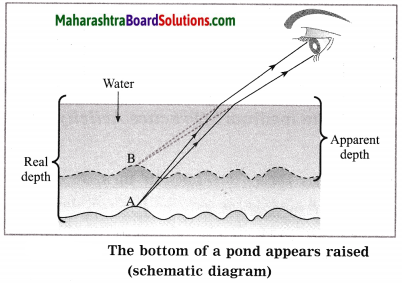
Question 1.
Gandhiji began his career from the country of …………. .
(a) India
(b) England
(c) South Africa
(d) Myanmar
Answer:
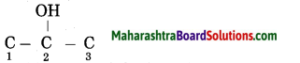
(c) South Africa

Question 2.
The farmers started the no-tax movement in the district of ………….
(a) Gorakhpur
(b) Kheda
(c) Solapur
(d) Amravati
Answer:
(b) Kheda

Maharashtra Board Class 8 History Solutions Chapter 7 Non-co-operation Movement

Question 3.
As a protest to Jallianwala Baug massacre, Rabindranath Tagore returned the title of ………… bestowed upon him by the British government.
(a) Lord
(b) Sir
(c) Raobahadur
(d) Raosaheb
Answer:
(b) Sir

2. Answer the following questions in one sentence :

Question 1.
Which restriction were put up on the Blacks in South Africa according to the declaration of 1906?
Answer:
In 1906, the government declared that the Blacks in South Africa should compulsorily carry an identity card. This was the restriction imposed on their freedom.

Question 2.
Where did Gandhiji launch the first Satyagraha in India?
Answer:
The first Satyagraha in India was launched by Gandhiji at Champaran at Bihar in 1917.

Question 3.
Which officer gave orders of firing in the Jallianwala Baug?
Answer:
General Dyer gave orders of firing in the Jallianwala Baug.

3. Answer the following questions in 25-30 words :

Question 1.
Explain the philosophy of Satyagraha.
Answer:

  1. Satyagraha, a novel technique, means insistence of truth.
  2. The aim of Satyagraha was to make the unjust person aware of truth and justice and also to transform his views.
  3. A Satyagrahi should never use violence and untruth meAnswer:

Maharashtra Board Class 8 History Solutions Chapter 7 Non-co-operation Movement

Question 2.
Why was the Swaraj Party formed?
Answer:
1. The members of the Indian National Congress like Motilal Nehru and Chittaranjan Das put an idea to contest elections and enter the Legislative Assembly and Provincial Legislative Council to obstruct the working of the government and oppose the unjust policies.
2. Therefore, they formed the Swaraj Party in 1922.

4. Explain the following statements with reasons :

Question 1.
Rowlatt Act was opposed by the people of India.
Answer:

  1. The Rowlatt Act was enacted to suppress the growing discontent among the Indians and suggest measures about it.
  2. This Act authorised the government to arrest any Indian and imprison him without trial or warrant.
  3. There was no provision for appeal against the punishment given under the Act.
  4. Due to such unjust provisions in the Rowlatt Act it was opposed by the people of India and called ‘Black Act’.

Question 2.
Gandhiji suspended the Non-co-operation Movement.
Answer:

  1. In February, 1922 the police opened fire on a peaceful procession at Chauri-Chaura in Gorakhpur district of Uttar Pradesh.
  2. In retaliation to this, the enraged mob set fire the police station in Chauri- Chaura.
  3. Twenty-two policemen including one officer were killed in this incident.
  4. Gandhiji was hurt by this incident. So he decided to suspend the Non-co-operation Movement on 12 February, 1922.

Question 3.
The Indians boycotted the Simon Commission.
Answer:

  1. The reforms introduced by Montague Chelmsford Act of 1919 was unsatisfactory.
  2. It created discontent among IndiAnswer: The British Government appointed the Simon Commission under the chairmanship of Sir John Simon in 1927.’
  3. There was not a single Indian member on the commission. In protest of this, the Congress boycotted the Simon Commission.

Maharashtra Board Class 8 History Solutions Chapter 7 Non-co-operation Movement

Question 4.
Khilafat movement was started in India.
Answer:

  1. The ruler of Turkey was regarded as the Khalifa or religious head of the Muslims all over the world.
  2. To get the support of Indian Muslims, in the First World War, the British gave false assurance of not harming the Khalifa’s empire after the war.
  3. But they did not keep their word. It caused resentment among the Indian Muslims. So, they started the Khilafat Movement.

Do you Know?
Mulshi Satyagraha (1920-1924):
Muishi Pethcz was a small viilage,with hilly terrain, approximately 40-45 kms away from Pune. The Tata Company decided to set up hydro-electricity project in this part. It was given permission by the British government. The dam would have displaced 52 villages and 11000 people. There was no consent taken from the people nor was there any programme for their rehabilitation. The farmers started their struggle against a mighty power and influential capitalists. Senapa’ti Pandurcing Mahadev Bapat led the struggle. People started caffing him Senapati Bapat. In spite of resisting it for four years, they were unsuccessful. The Satyagraha became inspirational not only in India but all over the world wherever the issue of rehabilitation came up.

Project:

Trace out the pledge of independence that was taken on 26th January 1930 and read it aloud collectively in the classroom.

Class 8 History Chapter 7 Non-co-operation Movement Additional Important Questions and Answers

Rewrite the statements by choosing the appropriate options :

Question 1.
The period between 1920-1947 in the Indian national movement is known as ………….
(a) Moderate Phase
(b) Extremist Phase
(c) Revolutionary Period
(d) Gandhian Era
Answer:
(d) Gandhian Era

Question 2.
…………. suggested Gandhiji to tour the entire nation when he returned from South Africa.
(a) Dadabhai Nowrojee
(b) Surendranath Banerjee
(c) Gopal Krishna Gokhale
(d) Lokmanya Tilak
Answer:
(c) Gopal Krishna Gokhale

Maharashtra Board Class 8 History Solutions Chapter 7 Non-co-operation Movement

Question 3.
After the death of Lokmanya Tilak in 1920, the reins of freedom movement went into the hands of ………….
(a) Lala Lajpat Rai
(b) Subash Chandra Bose
(c) Mahatma Gandhi
(d) Pandit Jawaharlal Nehru
Answer:
(c) Mahatma Gandhi

Question 4.
…………. Commission was appointed to enquire about Jallianwala Baug massacre.
(a) Hunter
(b) Simon
(c) Minto
(d) Rowlatt
Answer:
(a) Hunter

Question 5.
The Resolution of Non-co-operation Movement was put forth by Chittaranjan Das in ………. session of Indian National Congress.
(a) Lahore
(b) Nagpur
(c) Mumbai
(d) Amritsar
Answer:
(b) Nagpur

Question 6.
An officer named attacked Lalaji with a lathi at Lahore.
(a) Dyer
(b) Hunter
(c) Odwire
(d) Saunders
Answer:
(d) Saunders

Maharashtra Board Class 8 History Solutions Chapter 7 Non-co-operation Movement

Question 7.
……………., Secretary of State, criticised that Indians were incapable of drafting a constitution.
(a) Morley
(b) Minto
(c) Berkenhead
(d) Montague
Answer:
(c) Berkenhead

Identify the wrong pair and correct it:

Work – Leader

(1) President of the Lahore session of
Congress – Motilal Nehru

(2) Demonstrated against Simon
commission at Lahore – Lala Lajpat Rai

(3) Held satyagraha
in South Africa – Mahatma Gandhi

(4) Led the Mulshi
Satyagraha – Senapati Bapat
Answer:
Wrong pair : President of the Lahore session of Congress
– Motilal Nehru.
Corrected pair : President of the Lahore session of Congress
– Jawaharlal Nehru.

Name the following:

Question 1.
Leaders in other countries who were influenced by Satyagraha technique of Mahatma Gandhi.
(1) …………………………………….
(2) …………………………………….
Answer:
(1) Martin Luther King in USA
(2) Nelson Mandela in South Africa

Question 2.
Young Congress leaders who demanded Poorna Swaraj.
(1) …………………………………….
(2) …………………………………….
Answer:
(1) Pandit Jawaharlal Nehru
(2) Subash Chandra Bose

Maharashtra Board Class 8 History Solutions Chapter 7 Non-co-operation Movement

Question 3.
Eminent lawyers who boycotted court by giving up their practice
(1) …………………………………….
(2) …………………………………….
Answer:
(1) Pandit Motilal Nehru
(2) Chittaranjan Das.

Complete the graphical presentation :

Question 1.
Maharashtra Board Class 8 History Solutions Chapter 7 Non-co-operation Movement 1
Answer:
Maharashtra Board Class 8 History Solutions Chapter 7 Non-co-operation Movement 2

Question 2.
Maharashtra Board Class 8 History Solutions Chapter 7 Non-co-operation Movement 3
Answer:
Maharashtra Board Class 8 History Solutions Chapter 7 Non-co-operation Movement 4

Question 3.
Maharashtra Board Class 8 History Solutions Chapter 7 Non-co-operation Movement 5
Answer:
Maharashtra Board Class 8 History Solutions Chapter 7 Non-co-operation Movement 6

Answer the following questions in one sentence :

Question 1.
Which principles gave a new direction to the freedom movement?
Answer:
The principles of truth and non-violence gave new direction to the freedom movement.

Maharashtra Board Class 8 History Solutions Chapter 7 Non-co-operation Movement

Question 2.
How was the constructive programme beneficial?
Answer:
Due to the constructive programme, the national movement became more comprehensive in rural areas.

Question 3.
How did Lala Lajpat Rai react after he was attacked by the British officer?
Answer:
Lala Lajpat Rai said that Every blow on my body will prove a nail in the coffin of the British Empire, when he was attacked by the British officer.

Write short note :

Question 1.
Gandhiji’s work in South Africa :
Answer:

  1. In 1893, Gandhiji went to South Africa for some legal work where he began his political work.
  2. Many Indians had settled in South Africa for the purpose of trade and business.
  3. They were treated as criminals and humiliating treatment was given to them.
  4. Many restrictions were imposed on their freedom like it was compulsory for them to carry an identity card.
  5. Gandhiji adopted the path of Satyagraha and gained justice for them.

Question 2.
Champaran Satyagraha :
Answer:

  1. The farmers in Champaran region in Bihar were forced to cultivate indigo.
  2. The cultivators suffered as they received a fixed amount as price from the plantation owners.
  3. In 1917, Gandhiji went to Champaran and organized the farmers.
  4. He launched agitation by adopting the technique of Satyagraha.
  5. The farmers were given justice and thus Gandhiji was successful in his first satyagraha in India.

Maharashtra Board Class 8 History Solutions Chapter 7 Non-co-operation Movement

Question 3.
Work of Swaraj Party :
Answer:

  1. The leaders of the Swaraj Party put up an idea of contesting elections and obstructing the work of the government.
  2. They severely opposed unjust policies of the government.
  3. They demanded that a Responsible Government should be given to India.
  4. They demanded for Round Table Conference.
  5. They made a resolution in Assembly which demanded the release of political leaders taken as prisoners.
  6. Many resolutions were passed in the Central Legislative Assembly but were rejected by the government.

Question 4.
Nehru Report :
Answer:
1. Berkenhead, the Secretary of State of India, criticised that Indian leaders were incapable of drafting a unanimously accepted constitution for India.
2. This challenge was taken up by all party committee under the chairmanship of Pandit Motilal Nehru.
3. The proposals of the Nehru Report were :

  • implement Adult Franchise system in India,
  • establish self government colonies of India, and
  • division of provinces on linguistic division.

Explain the following statements with reasons :

Question 1.
No-tax campaign in Kheda district was successful.
Answer:

  1. Due to continuous famines the crops had failed in Kheda district of Gujarat.
  2. But the farmers were forced to pay land tax by the government.
  3. Gandhiji suggested to the farmers that they should refuse to pay tax.
  4. The farmers started the campaign to scrap the tax in 1918.
  5. The tax was suspended by the British Government which made the movement successful.

Maharashtra Board Class 8 History Solutions Chapter 7 Non-co-operation Movement

Question 2.
The movement started by Mill workers at Ahmedabad was successful.
Answer:

  1. During the First World War the inflation was very high.
  2. The mill workers demanded for rise in salary which was refused by the mill owners.
  3. Gandhiji advised the workers to go on hunger strike.
  4. In the end, the mill owners had to back off and the salary of workers was increased.

Question 3.
The British government passed the Rowlatt Act in 1919.
Answer:

  1. Indians extended help to the British government in the First World War.
  2. The Indians expected that after the war is over there will be a system of governance for taking decision for the well-being of the IndiAnswer:
  3. Moreover, the rising prices, increased taxes led to growing unrest among the Indians.
  4. To suppress this discontent and suggest measures about it Rowlatt Act was passed in 1919.

Answer the following questions in 25-30 words :

Question 1.
Why was the Hunter Commission appointed?
Answer:

  1. General Dyer ordered an unrestrained firing on the unarmed people who gathered for a meeting on 13th April 1919, at Jallianwala Baug.
  2. About 400 people were killed and injured. The injured did not receive any medical help.
  3. There was nationwide protest against this act.
  4. Rabindranath Tagore gave up the title of Sir given by the British government.
  5. The Indians demanded an enquiry against this massacre. So the British government appointed Hunter commission.

Maharashtra Board Class 8 History Solutions Chapter 7 Non-co-operation Movement

Question 2.
Why did Gandhiji support the Khilafat movement?
Answer:

  1. Indian Muslims started a movement to support Khalifa known as the Khilafat Movement.
  2. Gandhiji felt that if Hindus and Muslims unitedly start a national movement then the government can be brought to its senses.
  3. Therefore, Gandhiji supported the Khilafat movement.
  4. The Khilafat committee accepted Gandhiji’s proposal and extended support to the Non-co-operation movement.

Question 3.
How was Simon Commission opposed in India?
Answer:

  1. The Indian National Congress boycotted the Simon Commission because there was not a single Indian in it.
  2. In 1928, when the commission arrived in India, people strongly protested against it shouting ‘Simon go back’.
  3. The police lathi charged the demonstrators. Lala Lajpat Rai himself led the demonstrators in Lahore.
  4. He was injured in lathi charge and succumbed to his injuries.

Question 4.
Why was Gandhiji sent to six years of imprisonment?
Answer:

  1. Gandhiji was arrested in March 1922 for writing three anti-national articles in ‘Young India’.
  2. His trial was conducted in a special court set up in Ahmedabad.
  3. The charges were levied against him. He was imprisoned for six years.

Read the passage and answer the questions given below :

Maharashtra Board Class 8 History Solutions Chapter 7 Non-co-operation Movement 7

Question 1.
What was the pledge taken by Indians on 26th January 1930?
Answer:
On 26th January 1930, people all over the country took the pledge for carrying out of freedom movement with non-violent means for attainment of independence of India.

Maharashtra Board Class 8 History Solutions Chapter 7 Non-co-operation Movement

Question 2.
Why was the demand of Poorna Swaraj passed in Lahore session?
Answer:
1. The objective of Dominion Status was not acceptable to Pandit Nehru, Subash Chandra Bose and other young leaders.
2. Due to their influence, the resolution of demanding complete independence i.e. ‘Poorna Swaraj’ was passed in the Lahore session.

Question 3
Why was the Lahore session historic?
Answer:

  1. The Indian National Congress gave up the objective of Dominion Status.
  2. A resolution of complete independence was passed and it became the objective of the national movement.
  3. A resolution was passed to observe 26th January as the Independence Day.

Answer the following in detail :

Question 1.
Give an account of the Jallianwala Baug Massacre.
Answer:
Points :
(a) Preceding events
(b) Massacre
(c) Reactions

(a) Preceding events :

  1. The British government resorted to suppressive measures as the protest was more intense in Punjab province.
  2. Amritsar became the centre of this movement.
  3. Gandhiji was prohibited from entering the province of Punjab.
  4. General Dyer had banned public meetings in Amritsar.
  5. Dr. Satyapal and Dr. Kitchelu were arrested for their involvement in Amritsar Hartal case.

(b) Massacre :

  1. Despite the ban, a public meeting was held at Jallianwala Baug in Amritsar on 13th April 1919 on the occasion of Baisakhi.
  2. General Dyer deployed troops around the single gate that led to the ground. .
  3. Without giving any warning, he ordered unrestrained firing on the unarmed people who had assembled for the meeting.
  4. 1660 rounds were fired. The firing continued until the ammunition was over.
  5. About 400 men and women were killed.
  6. Curfew was announced after the firing which made it impossible for medical help to reach.

Maharashtra Board Class 8 History Solutions Chapter 7 Non-co-operation Movement

(c) Reactions :

  1. Military law was imposed in entire Punjab. Many were imprisoned.
  2. This led to discontent among the IndiAnswer:
  3. Rabindranath Tagore gave away the title of ‘Sir’ given by the British.
  4. As Indians demanded the enquiry, the British government appointed the Hunter Commission.

Question 2.
Give an account of the Non-co-operation.
Answer:

  1. According to Gandhiji, the British rule lasted in India only because of the co-operation extended by the IndiAnswer:
  2. If the Indians withdraw this co-operation and adopt complete non co-operation then the British government will collapse.
  3. With this intention, Gandhiji devised and executed Non-co-operation Movement.
  4. The Indian National Congress passed the resolution of Non-co-operation Movement at its Nagpur session in 1920.
  5. The reins of the movement was given in the hands of Gandhiji.
  6. According to this resolution there would be : (i) Boycott of government offices and courts, (ii) Boycott of government schools and colleges, (iii) Boycott of foreign goods and clothes.
  7. Boycott and bonfire of foreign clothes was seen at several places and demonstration in front of shops selling such goods.
  8. Motilal Nehru, Chittaranjan Das, etc. boycotted court by giving up their practice.
  9. Schools and colleges imparting national education were started.
  10. Elections were boycotted.
  11. The movement spread from the planters in Assam to rail workers in Bengal.

Maharashtra Board Class 8 History Solutions Chapter 7 Non-co-operation Movement

Question 3.
Do you feel that the nation still needs the constructive programme started by Mahatma Gandhi? Why?
Answer:

  • Gandhiji implemented the constructive programme along with Non¬co-operation Movement.
  • It included Hindu-Muslim unity, prohibition of alcohol, removal of untouchability, etc.
  • In spite of completion of 70 years of independence, these problems still exist.
  • Communal and religious riots take place. It causes great loss of life and property.

Therefore it is necessary to implement constructive programme in present times.

8th Std History Questions And Answers: