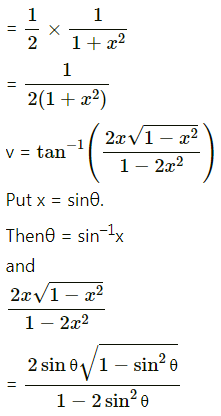
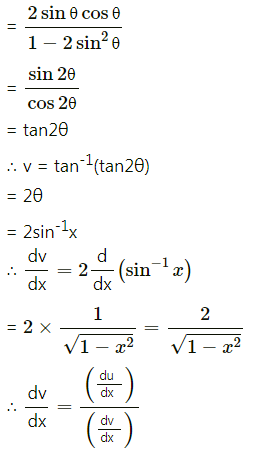
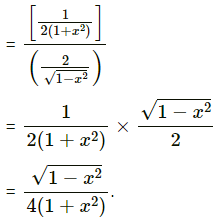
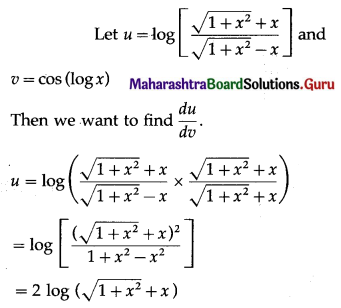
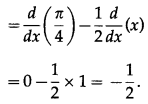
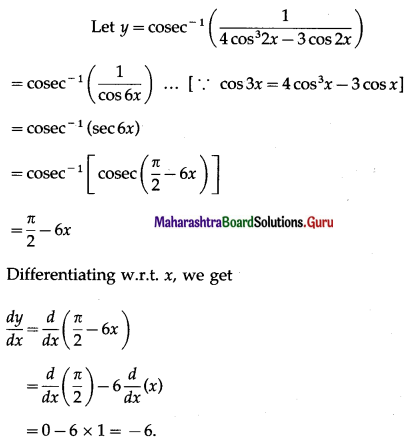
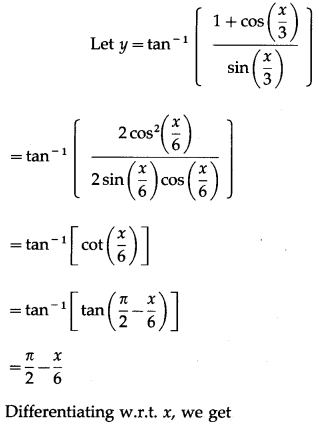
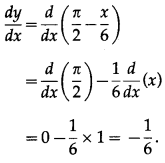
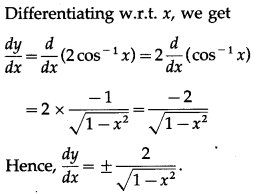
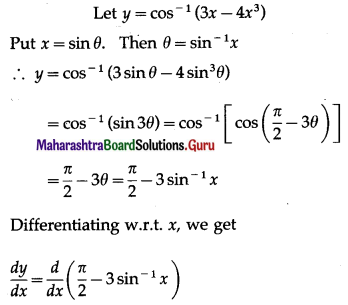
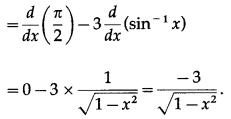
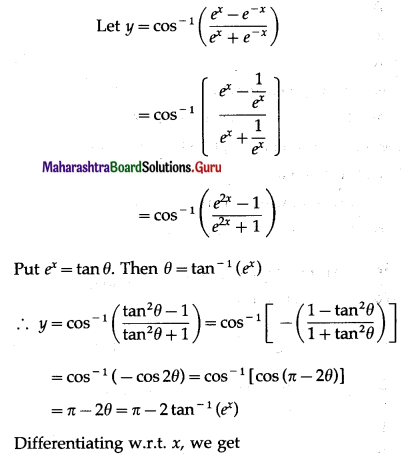
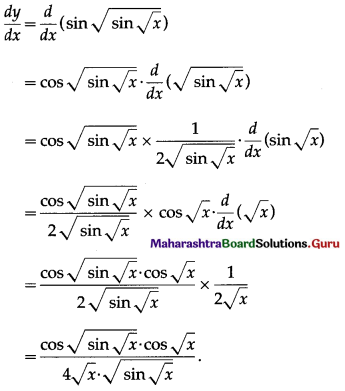
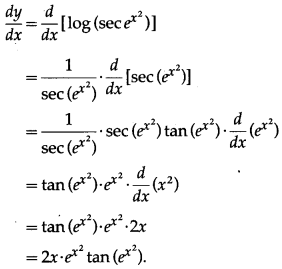
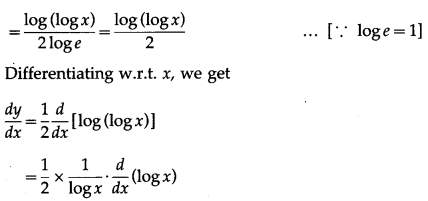
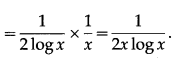
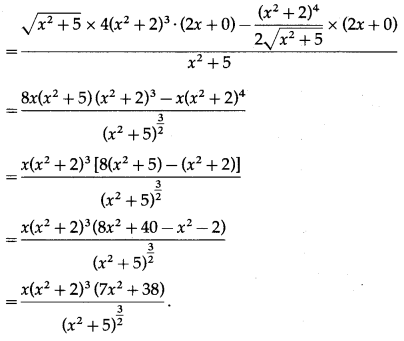
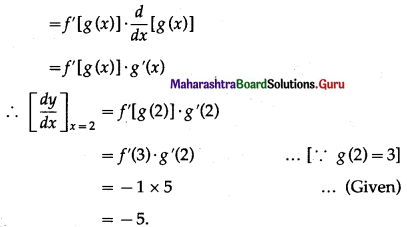
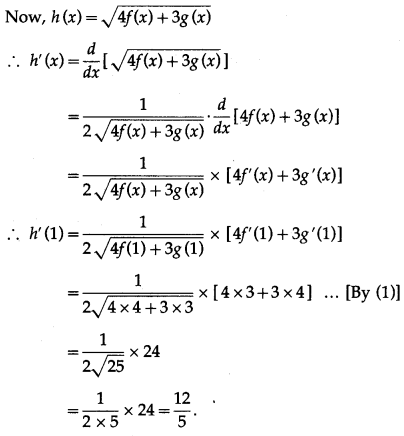
Applications of Derivatives Class 12 Maths 2 Exercise 2.1 Solutions Maharashtra Board

Balbharti 12th Maharashtra State Board Maths Solutions Book Pdf Chapter 2 Applications of Derivatives Ex 2.1 Questions and Answers.

12th Maths Part 2 Applications of Derivatives Exercise 2.1 Questions And Answers Maharashtra Board

Question 1.
Find the equations of tangents and normals to the curve at the point on it.
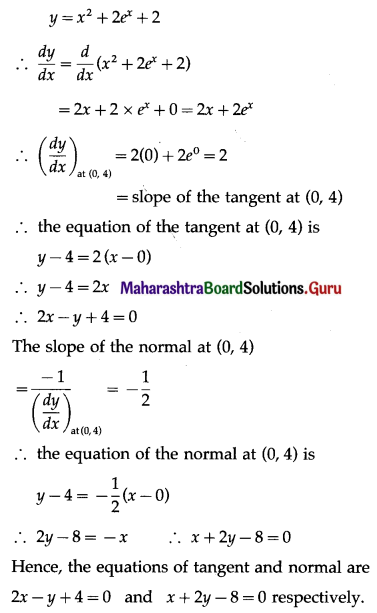
(i) y = x2 + 2ex + 2 at (0, 4)
Solution:
Maharashtra Board 12th Maths Solutions Chapter 2 Applications of Derivatives Ex 2.1 Q1 (i)

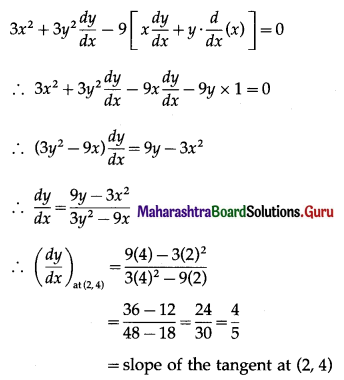
(ii) x3 + y3 – 9xy = 0 at (2, 4)
Solution:
x3 + y3 – 9xy = 0
Differentiating both sides w.r.t. x, we get
Maharashtra Board 12th Maths Solutions Chapter 2 Applications of Derivatives Ex 2.1 Q1 (ii)
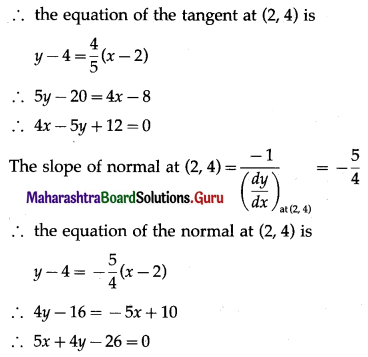
Maharashtra Board 12th Maths Solutions Chapter 2 Applications of Derivatives Ex 2.1 Q1 (ii).1
Hence, the equations of tangent and normal are 4x – 5y + 12 = 0 and 5x + 4y – 26 = 0 respectively.

Maharashtra Board 12th Maths Solutions Chapter 2 Applications of Derivatives Ex 2.1

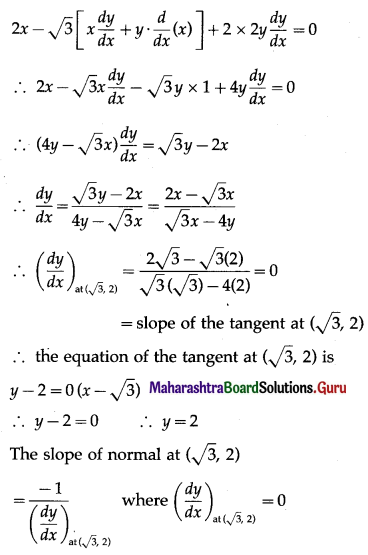
(iii) x2 – √3xy + 2y2 = 5 at (√3, 2)
Solution:
x2 – √3xy + 2y2 = 5
Differentiating both sides w.r.t. x, we get
Maharashtra Board 12th Maths Solutions Chapter 2 Applications of Derivatives Ex 2.1 Q1 (iii)
the slope of normal at (√3, 2) does not exist.
normal is parallel to Y-axis.
equation of the normal is of the form x = k
Since, it passes through the point (√3, 2), k = √3
equation of the normal is x = √3.
Hence, the equations of tangent and normal are y = 2 and x = √3 respectively.

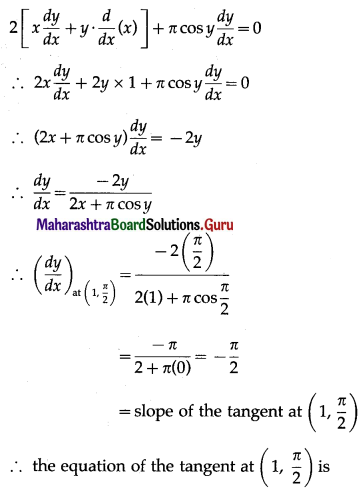
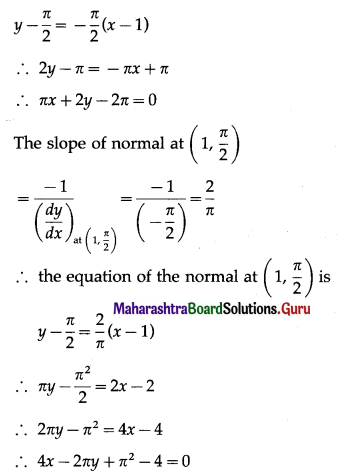
(iv) 2xy + π sin y = 2π at (1, \(\frac{\pi}{2}\))
Solution:
2xy + π sin y = 2π
Differentiating both sides w.r.t. x, we get
Maharashtra Board 12th Maths Solutions Chapter 2 Applications of Derivatives Ex 2.1 Q1 (iv)
Maharashtra Board 12th Maths Solutions Chapter 2 Applications of Derivatives Ex 2.1 Q1 (iv).1
Hence, the equations of tangent and normal are πx + 2y – 2π = 0 and 4x – 2πy + π2 – 4 = 0 respectively.

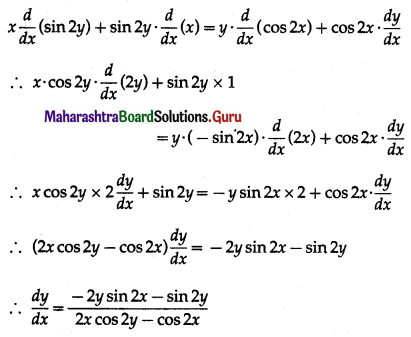
(v) x sin 2y = y cos 2x at (\(\frac{\pi}{4}\), \(\frac{\pi}{2}\))
Solution:
x sin 2y = y cos 2x
Differentiating both sides w.r.t. x, we get
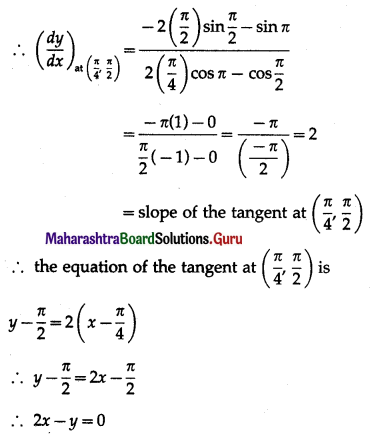
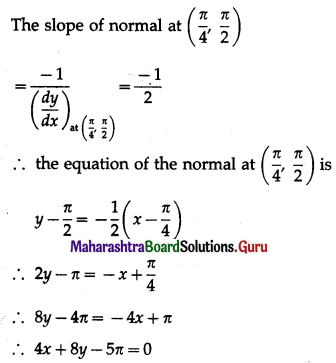
Maharashtra Board 12th Maths Solutions Chapter 2 Applications of Derivatives Ex 2.1 Q1 (v)
Maharashtra Board 12th Maths Solutions Chapter 2 Applications of Derivatives Ex 2.1 Q1 (v).1
Maharashtra Board 12th Maths Solutions Chapter 2 Applications of Derivatives Ex 2.1 Q1 (v).2
Hence, the equations of the tangent and normal are 2x – y = 0 and 4x + 8y – 5π = 0 respectively.

Maharashtra Board 12th Maths Solutions Chapter 2 Applications of Derivatives Ex 2.1

(vi) x = sin θ and y = cos 2θ at θ = \(\frac{\pi}{6}\)
Solution:
When θ = \(\frac{\pi}{6}\), x = sin\(\frac{\pi}{6}\) and y = cos\(\frac{\pi}{3}\)
∴ x = \(\frac{1}{2}\) and y = \(\frac{1}{2}\)
Hence, the point at which we want to find the equations of tangent and normal is (\(\frac{1}{2}\), \(\frac{1}{2}\))
Now, x = sin θ, y = cos 2θ
Differentiating x and y w.r.t. θ, we get
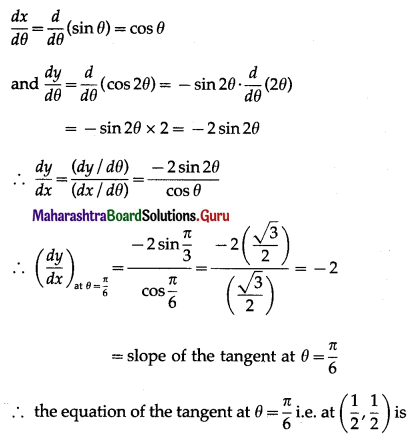
Maharashtra Board 12th Maths Solutions Chapter 2 Applications of Derivatives Ex 2.1 Q1 (vi)
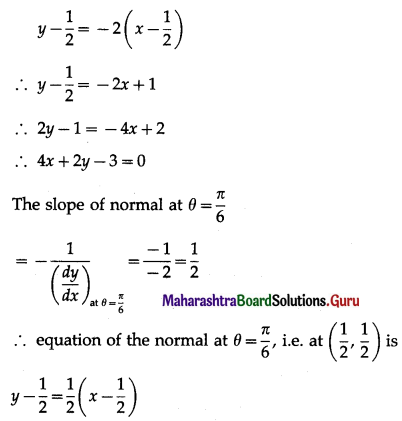
Maharashtra Board 12th Maths Solutions Chapter 2 Applications of Derivatives Ex 2.1 Q1 (vi).1
2y – 1 = x – \(\frac{1}{2}\)
4y – 2 = 2x – 1
2x – 4y + 1 = 0
Hence, equations of the tangent and normal are 4x + 2y – 3 = 0 and 2x – 4y + 1 = 0 respectively.

(vii) x = √t, y = t – \(\frac{1}{\sqrt{t}}\), at t = 4.
Solution:
When t = 4, x = √4 and y = 4 – \(\frac{1}{\sqrt{4}}\)
∴ x = 2 and y = 4 – \(\frac{1}{2}\) = \(\frac{7}{2}\)
Hence, the point at which we want to find the equations of tangent and normal is (2, \(\frac{7}{2}\)).
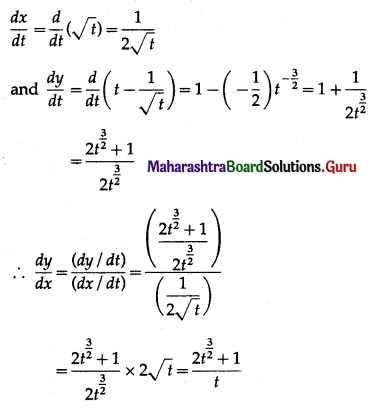
Now, x = √t, y = t – \(\frac{1}{\sqrt{t}}\)
Differentiating x and y w.r.t. t, we get
Maharashtra Board 12th Maths Solutions Chapter 2 Applications of Derivatives Ex 2.1 Q1 (vii)
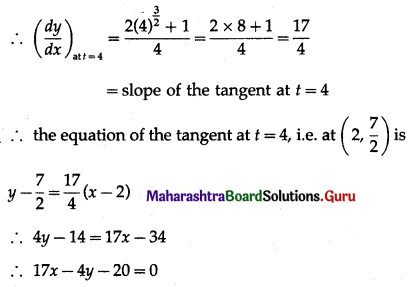
Maharashtra Board 12th Maths Solutions Chapter 2 Applications of Derivatives Ex 2.1 Q1 (vii).1
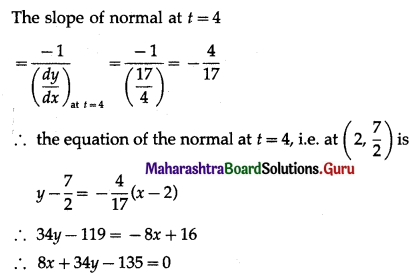
Maharashtra Board 12th Maths Solutions Chapter 2 Applications of Derivatives Ex 2.1 Q1 (vii).2
Hence, the equations of tangent and normal are 17x – 4y – 20 = 0 and 8x + 34y – 135 = 0 respectively.

Question 2.
Find the point of the curve y = \(\sqrt{x-3}\) where the tangent is perpendicular to the line 6x + 3y – 5 = 0.
Solution:
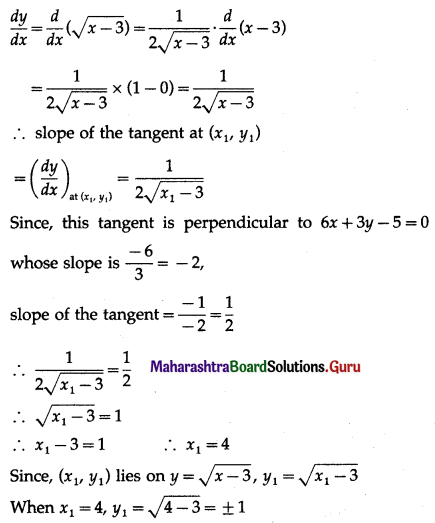
Let the required point on the curve y = \(\sqrt{x-3}\) be P(x1, y1).
Differentiating y = \(\sqrt{x-3}\) w.r.t. x, we get
Maharashtra Board 12th Maths Solutions Chapter 2 Applications of Derivatives Ex 2.1 Q2
Hence, the required points are (4, 1) and (4, -1).

Maharashtra Board 12th Maths Solutions Chapter 2 Applications of Derivatives Ex 2.1

Question 3.
Find the points on the curve y = x3 – 2x2 – x where the tangents are parallel to 3x – y + 1 = 0.
Solution:
Let the required point on the curve y = x3 – 2x2 – x be P(x1, y1).
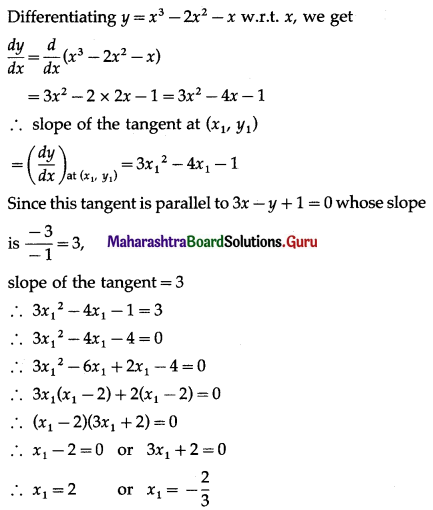
Maharashtra Board 12th Maths Solutions Chapter 2 Applications of Derivatives Ex 2.1 Q3
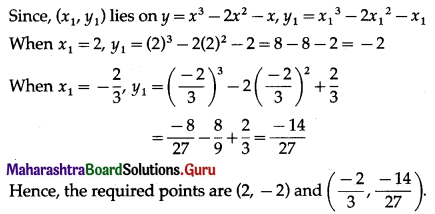
Maharashtra Board 12th Maths Solutions Chapter 2 Applications of Derivatives Ex 2.1 Q3.1

Question 4.
Find the equations of the tangents to the curve x2 + y2 – 2x – 4y + 1 = 0 which are parallel to the X-axis.
Solution:
Let P (x1, y1) be the point on the curve x2 + y2 – 2x – 4y + 1 = 0 where the tangent is parallel to X-axis.
Differentiating x2 + y2 – 2x – 4y + 1 = 0 w.r.t. x, we get
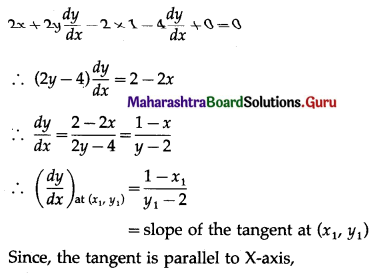
Maharashtra Board 12th Maths Solutions Chapter 2 Applications of Derivatives Ex 2.1 Q4
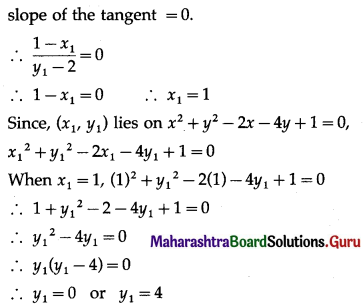
Maharashtra Board 12th Maths Solutions Chapter 2 Applications of Derivatives Ex 2.1 Q4.1
the coordinates of the points are (1, 0) or (1, 4)
Since the tangents are parallel to X-axis, their equations are of the form y = k
If it passes through the point (1, 0), k = 0, and if it passes through the point (1, 4), k = 4
Hence, the equations of the tangents are y = 0 and y = 4.

Question 5.
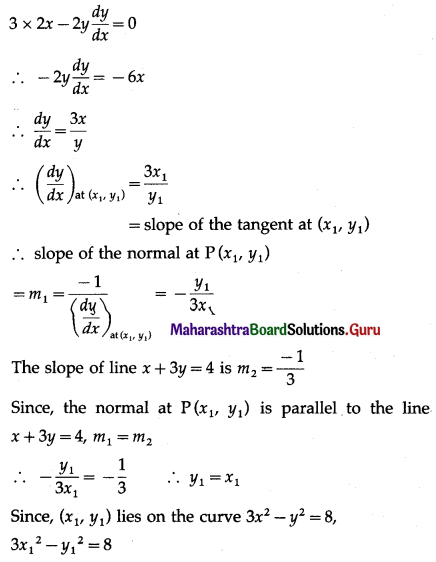
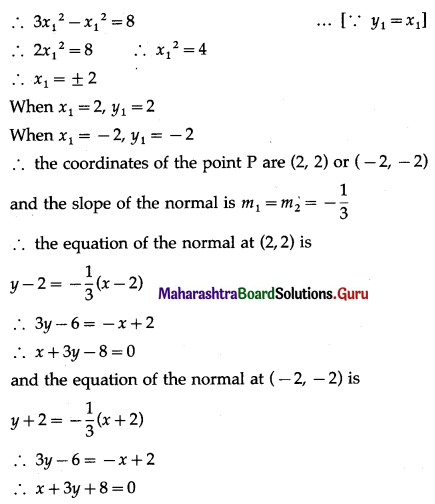
Find the equations of the normals to the curve 3x2 – y2 = 8, which are parallel to the line x + 3y = 4.
Solution:
Let P(x1, y1) be the foot of the required normal to the curve 3x2 – y2 = 8.
Differentiating 3x2 – y2 = 8 w.r.t. x, we get
Maharashtra Board 12th Maths Solutions Chapter 2 Applications of Derivatives Ex 2.1 Q5
Maharashtra Board 12th Maths Solutions Chapter 2 Applications of Derivatives Ex 2.1 Q5.1
Hence, the equations of the normals are x + 3y – 8 = 0 and x + 3y + 8 = 0.

Question 6.
If the line y = 4x – 5 touches the curve y2 = ax3 + b at the point (2, 3), find a and b.
Solution:
y2 = ax3 + b
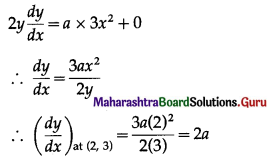
Differentiating both sides w.r.t. x, we get
Maharashtra Board 12th Maths Solutions Chapter 2 Applications of Derivatives Ex 2.1 Q6
= slope of the tangent at (2, 3)
Since, the line y = 4x – 5 touches the curve at the point (2, 3), slope of the tangent at (2, 3) is 4.
2a = 4 ⇒ a = 2
Since (2, 3) lies on the curve y2 = ax3 + b
(3)2 = a(2)3 + b
9 = 8a + b
9 = 8(2) + b …… [∵ a = 2]
b = -7
Hence, a = 2 and b = -7.

Maharashtra Board 12th Maths Solutions Chapter 2 Applications of Derivatives Ex 2.1

Question 7.
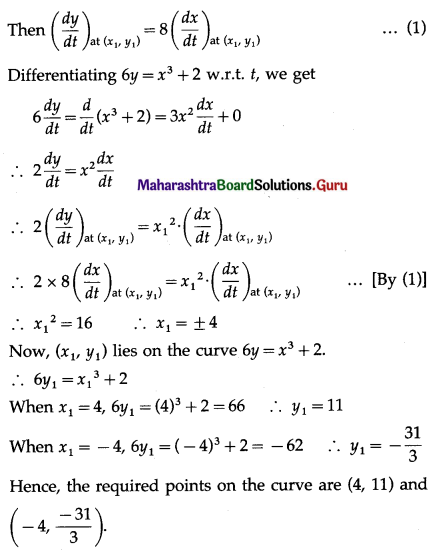
A particle moves along the curve 6y = x3 + 2. Find the points on the curve at which y-coordinate is changing 8 times as fast as the x-coordinate.
Solution:
Let P(x1, y1) be the point on the curve 6y = x3 + 2 whose y-coordinate is changing 8 times as fast as the x-coordinate.
Maharashtra Board 12th Maths Solutions Chapter 2 Applications of Derivatives Ex 2.1 Q7

Question 8.
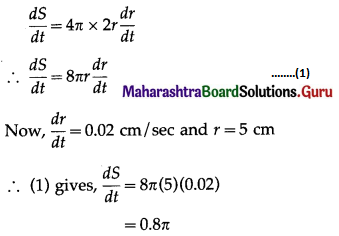
A spherical soap bubble is expanding so that its radius is increasing at the rate of 0.02 cm/sec. At what rate is the surface area increasing, when its radius is 5 cm?
Solution:
Let r be the radius and S be the surface area of the soap bubble at any time t.
Then S = 4πr2
Differentiating w.r.t. t, we get
Maharashtra Board 12th Maths Solutions Chapter 2 Applications of Derivatives Ex 2.1 Q8
Hence, the surface area of the soap bubble is increasing at the rate of 0.87c cm2 / sec.

Question 9.
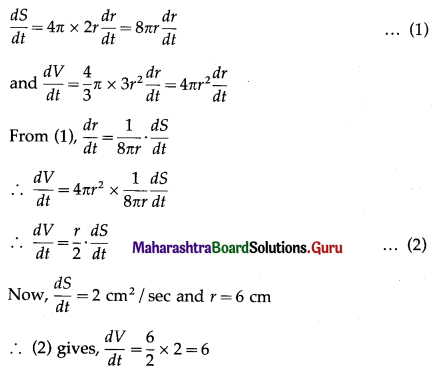
The surface area of a spherical balloon is increasing at the rate of 2 cm2/sec. At what rate is the volume of the balloon is increasing, when the radius of the balloon is 6 cm?
Solution:
Let r be the radius, S be the surface area and V be the volume of the spherical balloon at any time t.
Then S = 4πr2 and V = \(\frac{4}{3} \pi r^{3}\)
Differentiating w.r.t. t, we get
Maharashtra Board 12th Maths Solutions Chapter 2 Applications of Derivatives Ex 2.1 Q9
Hence, the volume of the spherical balloon is increasing at the rate of 6 cm3 / sec.

Question 10.
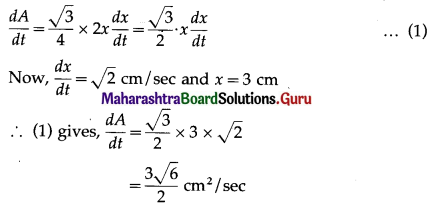
If each side of an equilateral triangle increases at the rate of √2 cm/sec, find the rate of increase of its area when its side of length is 3 cm.
Solution:
If x cm is the side of the equilateral triangle and A is its area, then \(A=\frac{\sqrt{3}}{4} x^{2}\)
Differentiating w.r.t. f, we get
Maharashtra Board 12th Maths Solutions Chapter 2 Applications of Derivatives Ex 2.1 Q10
Hence, rate of increase of the area of equilateral triangle = \(\frac{3 \sqrt{6}}{2}\) cm2 / sec.

Maharashtra Board 12th Maths Solutions Chapter 2 Applications of Derivatives Ex 2.1

Question 11.
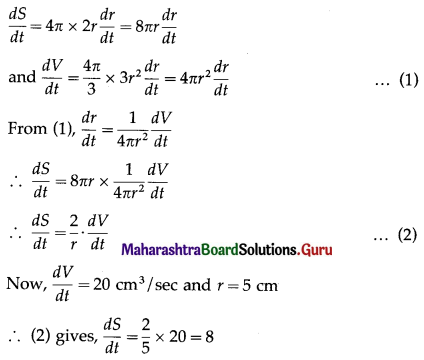
The volume of a sphere increases at the rate of 20 cm3/sec. Find the rate of change of its surface area, when its radius is 5 cm.
Solution:
Let r be the radius, S be the surface area and V be the volume of the sphere at any time t.
Then S = 4πr2 and V = \(\frac{4}{3} \pi r^{3}\)
Differentiating w.r.t. t, we get
Maharashtra Board 12th Maths Solutions Chapter 2 Applications of Derivatives Ex 2.1 Q11
Hence, the surface area of the sphere is changing at the rate of 8 cm2/sec.

Question 12.
The edge of a cube is decreasing at the rate of 0.6 cm/sec. Find the rate at which its volume is decreasing, when the edge of the cube is 2 cm.
Solution:
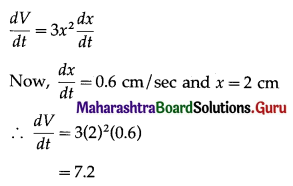
Let x be the edge of the cube and V be its volume at any time t.
Then V = x3
Differentiating both sides w.r.t. t, we get
Maharashtra Board 12th Maths Solutions Chapter 2 Applications of Derivatives Ex 2.1 Q12
Hence, the volume of the cube is decreasing at the rate of 7.2 cm3/sec.

Question 13.
A man of height 2 meters walks at a uniform speed of 6 km/hr away from a lamp post of 6 meters high. Find the rate at which the length of the shadow is increasing.
Solution:
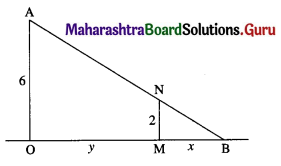
Let OA be the lamp post, MN the man, MB = x, his shadow, and OM = y, the distance of the man from the lamp post at time t.
Maharashtra Board 12th Maths Solutions Chapter 2 Applications of Derivatives Ex 2.1 Q13
Then \(\frac{d y}{d t}\) = 6 km/hr is the rate at which the man is moving at away from the lamp post.
\(\frac{d x}{d t}\) is the rate at which his shadow is increasing.
From the figure,
\(\frac{x}{2}=\frac{x+y}{6}\)
6x = 2x + 2y
4x = 2y
x = \(\frac{1}{2}\) y
\(\frac{d x}{d t}=\frac{1}{2} \frac{d y}{d t}=\frac{1}{2} \times 6=3 \mathrm{~km} / \mathrm{hr}\)
Hence, the length of the shadow is increasing at the rate of 3 km/hr.

Question 14.
A man of height 1.5 meters walks towards a lamp post of height 4.5 meters, at the rate of (\(\frac{3}{4}\)) meter/sec.
Find the rate at which
(i) his shadow is shortening
(ii) the tip of the shadow is moving.
Solution:
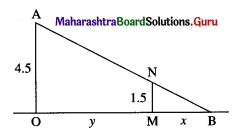
Maharashtra Board 12th Maths Solutions Chapter 2 Applications of Derivatives Ex 2.1 Q14
Let OA be the lamp post, MN the man, MB = x his shadow and OM = y the distance of the man from lamp post at time t.
Then \(\frac{d y}{d t}=\frac{3}{4}\) is the rate at which the man is moving towards the lamp post.
\(\frac{d x}{d t}\) is the rate at which his shadow is shortening.
B is the tip of the shadow and it is at a distance of x + y from the post.
\(\frac{d}{d t}(x+y)=\frac{d x}{d t}+\frac{d y}{d t}\) is the rate at which the tip of the shadow is moving.
From the figure,
\(\frac{x}{1.5}=\frac{x+y}{4.5}\)
45x = 15x + 15y
30x = 15y
x = \(\frac{1}{2}\)y
\(\frac{d x}{d t}=\frac{1}{2} \cdot \frac{d y}{d t}=\frac{1}{2}\left(\frac{3}{4}\right)=\left(\frac{3}{8}\right) \text { metre/sec }\)
and \(\frac{d x}{d t}+\frac{d y}{d t}=\frac{3}{8}+\frac{3}{4}=\left(\frac{9}{8}\right) \text { metres } / \mathrm{sec}\)
Hence (i) the shadow is shortening at the rate of (\(\frac{3}{8}\)) metre/sec, and
(ii) the tip of shadow is moving at the rate of (\(\frac{9}{8}\)) metres/sec.

Maharashtra Board 12th Maths Solutions Chapter 2 Applications of Derivatives Ex 2.1

Question 15.
A ladder 10 metres long is leaning against a vertical wall. If the bottom of the ladder is pulled horizontally away from the wall at the rate of 1.2 metres per second, find how fast the top of the ladder is sliding down the wall, when the bottom is 6 metres away from the wall.
Solution:
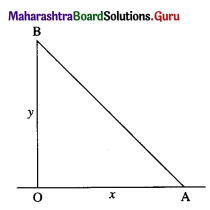
Maharashtra Board 12th Maths Solutions Chapter 2 Applications of Derivatives Ex 2.1 Q15
Let AB be the ladder, where AB = 10 metres.
Let at time t seconds, the end A of the ladder be x metres from the wall and the end B be y metres from the ground.
Since, OAB is a right angled triangle, by Pythagoras’ theorem
x2 + y2 = 102 i.e. y2 = 100 – x2
Differentiating w.r.t. t, we get
2y \(\frac{d y}{d t}\) = 0 – 2x \(\frac{d x}{d t}\)
∴ \(\frac{d y}{d t}=-\frac{x}{y} \cdot \frac{d x}{d t}\) ……..(1)
Now, \(\frac{d x}{d t}\) = 1.2 metres/sec is the rate at which the bottom at of the ladder is pulled horizontally and \(\frac{d y}{d t}\) is the rate at which the top of ladder B is sliding.
When x = 6, y2 = 100 – 36 = 64
y = 8
(1) gives \(\frac{d y}{d t}=-\frac{6}{8}(1.2)=-\frac{6}{8} \times \frac{12}{10}\)
\(=-\frac{9}{10}=-0.9\)
Hence, the top of the ladder is sliding down the wall, at the rate of 0.9 metre/sec.

Question 16.
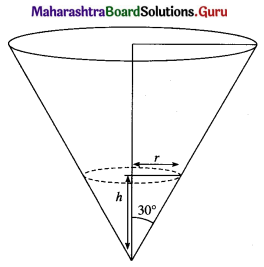
If water is poured into an inverted hollow cone whose semi-vertical angle is 30° so that its depth (measured along the axis) increases at the rate of 1 cm/sec. Find the rate at which the volume of water increases when the depth is 2 cm.
Solution:
Maharashtra Board 12th Maths Solutions Chapter 2 Applications of Derivatives Ex 2.1 Q16
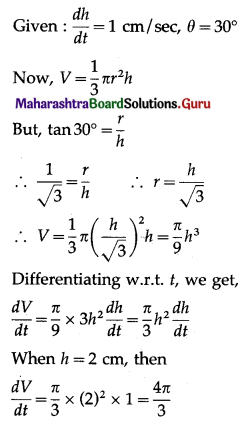
Let r be the radius, h be the height, θ be the semi-vertical angle and V be the volume of the water at any time t.
Maharashtra Board 12th Maths Solutions Chapter 2 Applications of Derivatives Ex 2.1 Q16.1
Hence, the volume of water is increasing at the rate of \(\left(\frac{4 \pi}{3}\right)\) cm3/sec.

Class 12 Maharashtra State Board Maths Solution 

Differentiation Class 12 Maths 2 Miscellaneous Exercise 1 Solutions Maharashtra Board

Balbharti 12th Maharashtra State Board Maths Solutions Book Pdf Chapter 1 Differentiation Miscellaneous Exercise 1 Questions and Answers.

12th Maths Part 2 Differentiation Miscellaneous Exercise 1 Questions And Answers Maharashtra Board

(I) Choose the correct option from the given alternatives:

Question 1.
Let f(1) = 3, f'(1) = \(-\frac{1}{3}\), g(1) = -4 and g'(1) = \(-\frac{8}{3}\). The derivative of \(\sqrt{[f(x)]^{2}+[g(x)]^{2}}\) w.r.t. x at x = 1 is
(a) \(-\frac{29}{15}\)
(b) \(\frac{7}{3}\)
(c) \(\frac{31}{15}\)
(d) \(\frac{29}{15}\)
Answer:
(d) \(\frac{29}{15}\)
Maharashtra Board 12th Maths Solutions Chapter 1 Differentiation Miscellaneous Exercise 1 I Q1

Question 2.
If y = sec(tan-1 x), then \(\frac{d y}{d x}\) at x = 1, is equal to
(a) \(\frac{1}{2}\)
(b) 1
(c) \(\frac{1}{\sqrt{2}}\)
(d) 2
Answer:
(c) \(\frac{1}{\sqrt{2}}\)
Maharashtra Board 12th Maths Solutions Chapter 1 Differentiation Miscellaneous Exercise 1 I Q2
Maharashtra Board 12th Maths Solutions Chapter 1 Differentiation Miscellaneous Exercise 1 I Q2.1

Maharashtra Board 12th Maths Solutions Chapter 1 Differentiation Miscellaneous Exercise 1

Question 3.
If f(x) = \(\sin ^{-1}\left(\frac{4^{x+\frac{1}{2}}}{1+2^{4 x}}\right)\), which of the following is not the derivative of f(x)?
(a) \(\frac{2 \cdot 4^{x} \log 4}{1+4^{2 x}}\)
(b) \(\frac{4^{x+1} \log 2}{1+4^{2 x}}\)
(c) \(\frac{4^{x+1} \log 4}{1+4^{4 x}}\)
(d) \(\frac{2^{2(x+1)} \log 2}{1+2^{4 x}}\)
Answer:
(c) \(\frac{4^{x+1} \log 4}{1+4^{4 x}}\)
Maharashtra Board 12th Maths Solutions Chapter 1 Differentiation Miscellaneous Exercise 1 I Q3

Question 4.
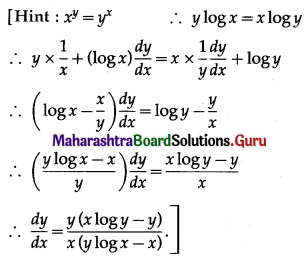
If xy = yx, then\(\frac{d y}{d x}\) = _______
(a) \(\frac{x(x \log y-y)}{y(y \log x-x)}\)
(b) \(\frac{y(y \log x-x)}{x(x \log y-y)}\)
(c) \(\frac{y^{2}(1-\log x)}{x^{2}(1-\log y)}\)
(d) \(\frac{y(1-\log x)}{x(1-\log y)}\)
Answer:
(b) \(\frac{y(y \log x-x)}{x(x \log y-y)}\)
Maharashtra Board 12th Maths Solutions Chapter 1 Differentiation Miscellaneous Exercise 1 I Q4

Question 5.
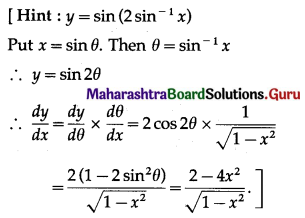
If y = sin (2 sin-1 x), then \(\frac{d y}{d x}\) = _______
(a) \(\frac{2-4 x^{2}}{\sqrt{1-x^{2}}}\)
(b) \(\frac{2+4 x^{2}}{\sqrt{1-x^{2}}}\)
(c) \(\frac{4 x^{2}-1}{\sqrt{1-x^{2}}}\)
(d) \(\frac{1-2 x^{2}}{\sqrt{1-x^{2}}}\)
Answer:
(a) \(\frac{2-4 x^{2}}{\sqrt{1-x^{2}}}\)
Maharashtra Board 12th Maths Solutions Chapter 1 Differentiation Miscellaneous Exercise 1 I Q5

Question 6.
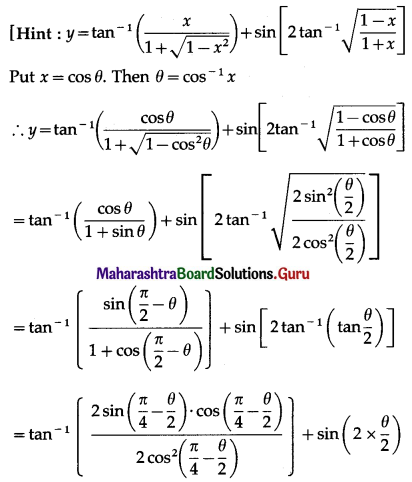
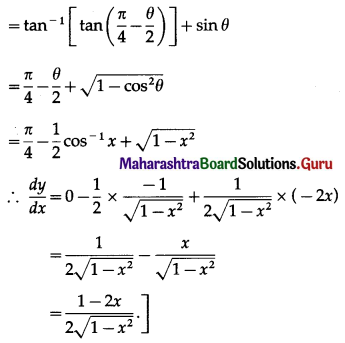
If y = \(\tan ^{-1}\left(\frac{x}{1+\sqrt{1-x^{2}}}\right)+\sin \left[2 \tan ^{-1}\left(\sqrt{\frac{1-x}{1+x}}\right)\right]\), then \(\frac{d y}{d x}\) = _______
(a) \(\frac{x}{\sqrt{1-x^{2}}}\)
(b) \(\frac{1-2 x}{\sqrt{1-x^{2}}}\)
(c) \(\frac{1-2 x}{2 \sqrt{1-x^{2}}}\)
(d) \(\frac{1-2 x^{2}}{\sqrt{1-x^{2}}}\)
Answer:
(c) \(\frac{1-2 x}{2 \sqrt{1-x^{2}}}\)
Maharashtra Board 12th Maths Solutions Chapter 1 Differentiation Miscellaneous Exercise 1 I Q6
Maharashtra Board 12th Maths Solutions Chapter 1 Differentiation Miscellaneous Exercise 1 I Q6.1

Question 7.
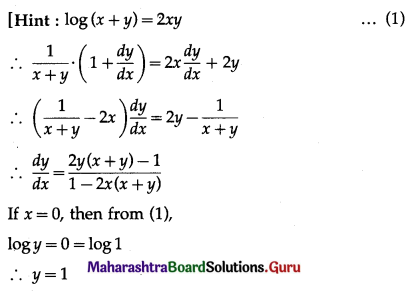
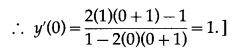
If y is a function of x and log(x + y) = 2xy, then the value of y'(0) = _______
(a) 2
(b) 0
(c) -1
(d) 1
Answer:
(d) 1
Maharashtra Board 12th Maths Solutions Chapter 1 Differentiation Miscellaneous Exercise 1 I Q7
Maharashtra Board 12th Maths Solutions Chapter 1 Differentiation Miscellaneous Exercise 1 I Q7.1

Maharashtra Board 12th Maths Solutions Chapter 1 Differentiation Miscellaneous Exercise 1

Question 8.
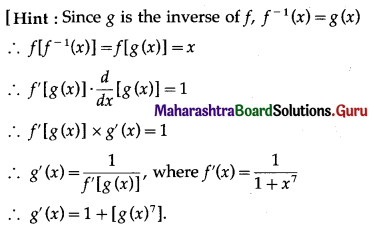
If g is the inverse of function f and f'(x) = \(\frac{1}{1+x^{7}}\), then the value of g'(x) is equal to:
(a) 1 + x7
(b) \(\frac{1}{1+[g(x)]^{7}}\)
(c) 1 + [g(x)]7
(d) 7x6
Answer:
(c) 1 + [g(x)]7
Maharashtra Board 12th Maths Solutions Chapter 1 Differentiation Miscellaneous Exercise 1 I Q8

Question 9.
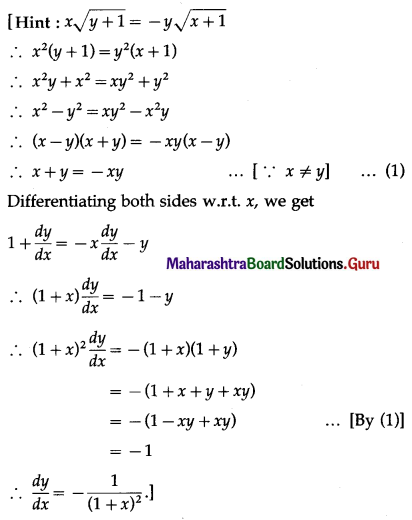
If \(x \sqrt{y+1}+y \sqrt{x+1}=0\) and x ≠ y, then \(\frac{d y}{d x}\) = _______
(a) \(\frac{1}{(1+x)^{2}}\)
(b) \(-\frac{1}{(1+x)^{2}}\)
(c) (1 + x)2
(d) \(-\frac{x}{x+1}\)
Answer:
(b) \(-\frac{1}{(1+x)^{2}}\)
Maharashtra Board 12th Maths Solutions Chapter 1 Differentiation Miscellaneous Exercise 1 I Q9

Question 10.
If y = \(\tan ^{-1}\left(\sqrt{\frac{a-x}{a+x}}\right)\), where -a < x < a, then \(\frac{d y}{d x}\) = _______
(a) \(\frac{x}{\sqrt{a^{2}-x^{2}}}\)
(b) \(\frac{a}{\sqrt{a^{2}-x^{2}}}\)
(c) \(-\frac{1}{2 \sqrt{a^{2}-x^{2}}}\)
(d) \(\frac{1}{2 \sqrt{a^{2}-x^{2}}}\)
Answer:
(c) \(-\frac{1}{2 \sqrt{a^{2}-x^{2}}}\)
[Hint: Put x = a cos θ]

Question 11.
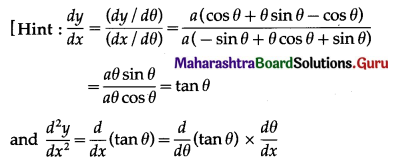
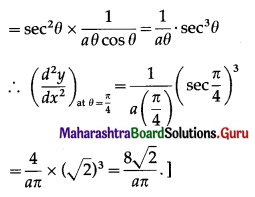
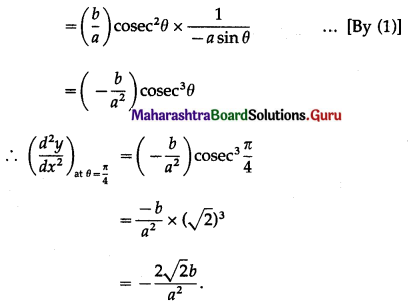
If x = a (cos θ + θ sin θ), y = a (sin θ – θ cos θ), then \(\left[\frac{d^{2} y}{d x^{2}}\right]_{\theta=\frac{\pi}{4}}\) = _______
(a) \(\frac{8 \sqrt{2}}{a \pi}\)
(b) \(-\frac{8 \sqrt{2}}{a \pi}\)
(c) \(\frac{a \pi}{8 \sqrt{2}}\)
(d) \(\frac{4 \sqrt{2}}{a \pi}\)
Answer:
(a) \(\frac{8 \sqrt{2}}{a \pi}\)
Maharashtra Board 12th Maths Solutions Chapter 1 Differentiation Miscellaneous Exercise 1 I Q11
Maharashtra Board 12th Maths Solutions Chapter 1 Differentiation Miscellaneous Exercise 1 I Q11.1

Question 12.
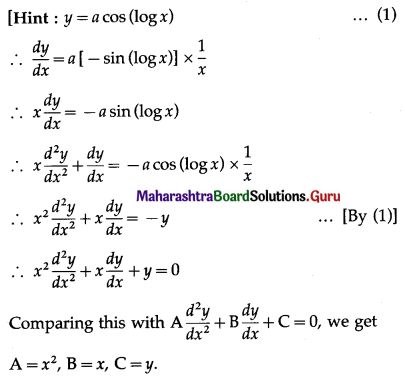
If y = a cos (log x) and \(A \frac{d^{2} y}{d x^{2}}+B \frac{d y}{d x}+C=0\), then the values of A, B, C are _______
(a) x2, -x, -y
(b) x2, x, y
(c) x2, x, -y
(d) x2, -x, y
Answer:
(b) x2, x, y
Maharashtra Board 12th Maths Solutions Chapter 1 Differentiation Miscellaneous Exercise 1 I Q12

(II) Solve the following:

Question 1.
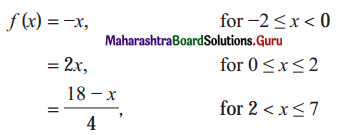
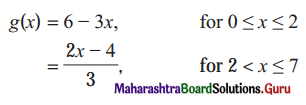
Maharashtra Board 12th Maths Solutions Chapter 1 Differentiation Miscellaneous Exercise 1 II Q1
Maharashtra Board 12th Maths Solutions Chapter 1 Differentiation Miscellaneous Exercise 1 II Q1.1
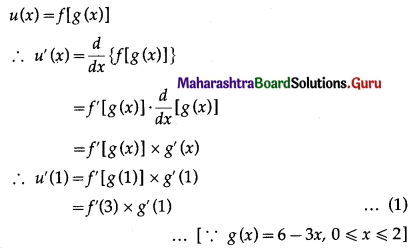
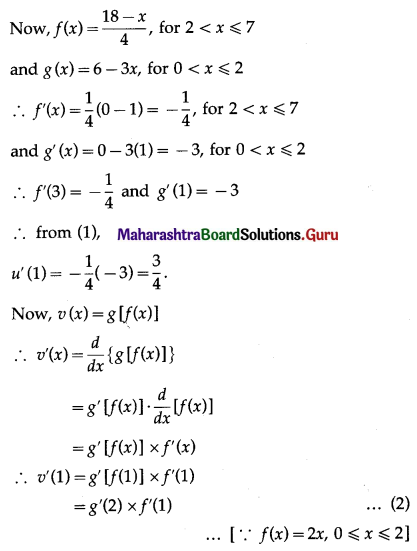
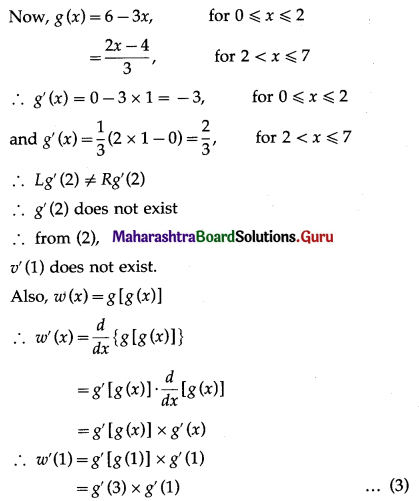
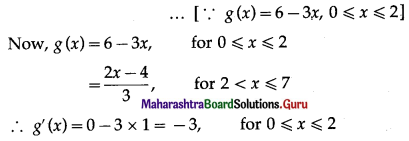
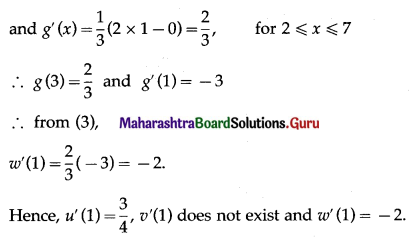
Let u(x) = f[g(x)], v(x) = g[f(x)] and w(x) = g[g(x)]. Find each derivative at x = 1, if it exists i.e. find u'(1), v'(1) and w'(1). if it doesn’t exist then explain why?
Solution:
Maharashtra Board 12th Maths Solutions Chapter 1 Differentiation Miscellaneous Exercise 1 II Q1.2
Maharashtra Board 12th Maths Solutions Chapter 1 Differentiation Miscellaneous Exercise 1 II Q1.3
Maharashtra Board 12th Maths Solutions Chapter 1 Differentiation Miscellaneous Exercise 1 II Q1.4
Maharashtra Board 12th Maths Solutions Chapter 1 Differentiation Miscellaneous Exercise 1 II Q1.5
Maharashtra Board 12th Maths Solutions Chapter 1 Differentiation Miscellaneous Exercise 1 II Q1.6

Maharashtra Board 12th Maths Solutions Chapter 1 Differentiation Miscellaneous Exercise 1

Question 2.
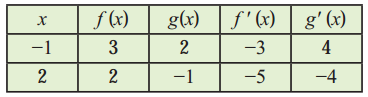
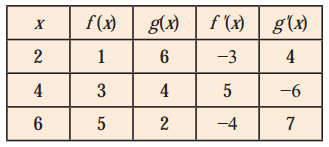
The values of f(x), g(x), f'(x) and g'(x) are given in the following table:
Maharashtra Board 12th Maths Solutions Chapter 1 Differentiation Miscellaneous Exercise 1 II Q2
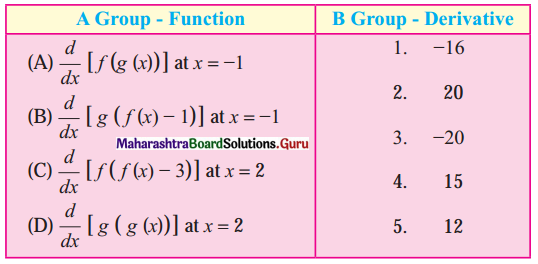
Match the following:
Maharashtra Board 12th Maths Solutions Chapter 1 Differentiation Miscellaneous Exercise 1 II Q2.1
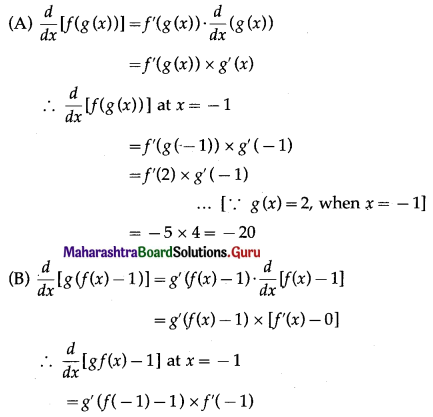
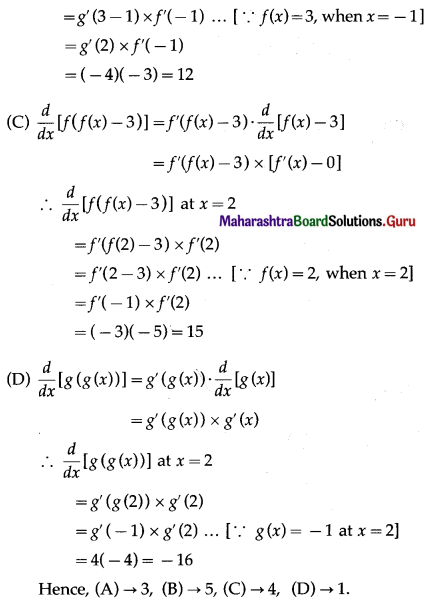
Solution:
Maharashtra Board 12th Maths Solutions Chapter 1 Differentiation Miscellaneous Exercise 1 II Q2.2
Maharashtra Board 12th Maths Solutions Chapter 1 Differentiation Miscellaneous Exercise 1 II Q2.3

Question 3.
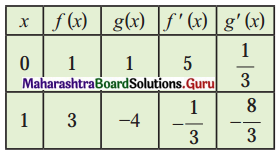
Suppose that the functions f and g and their derivatives with respect to x have the following values at x = 0 and x = 1.
Maharashtra Board 12th Maths Solutions Chapter 1 Differentiation Miscellaneous Exercise 1 II Q3
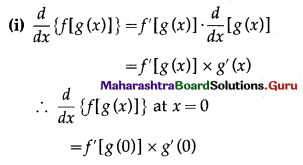
(i) The derivative of f[g(x)] w.r.t. x at x = 0 is _______
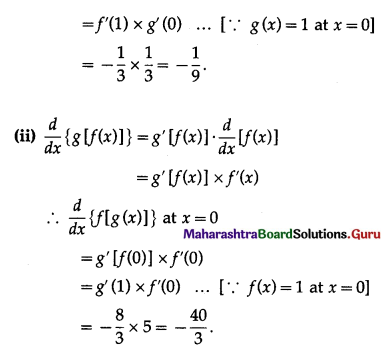
(ii) The derivative of g[f(x)] w.r.t. x at x = 0 is _______
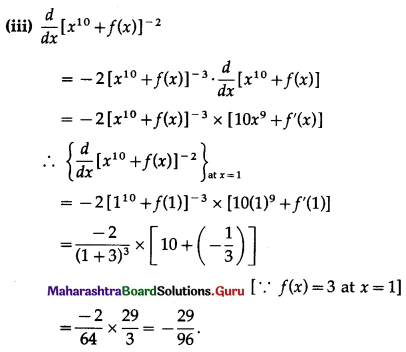
(iii) The value of \(\left[\frac{d}{d x}\left[x^{10}+f(x)\right]^{-2}\right]_{x=1}\) is _______
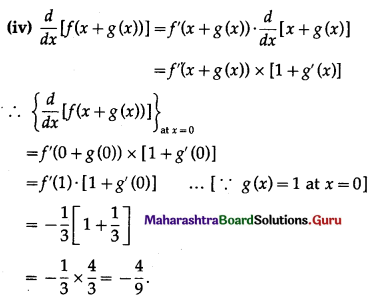
(iv) The derivative of f[(x+g(x))] w.r.t. x at x = 0 is _______
Solution:
Maharashtra Board 12th Maths Solutions Chapter 1 Differentiation Miscellaneous Exercise 1 II Q3.1
Maharashtra Board 12th Maths Solutions Chapter 1 Differentiation Miscellaneous Exercise 1 II Q3.2
Maharashtra Board 12th Maths Solutions Chapter 1 Differentiation Miscellaneous Exercise 1 II Q3.3
Maharashtra Board 12th Maths Solutions Chapter 1 Differentiation Miscellaneous Exercise 1 II Q3.4

Question 4.
Differentiate the following w.r.t. x:
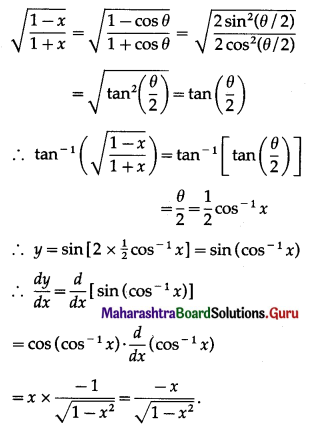
(i) \(\sin \left[2 \tan ^{-1}\left(\sqrt{\frac{1-x}{1+x}}\right)\right]\)
Solution:
Let y = \(\sin \left[2 \tan ^{-1}\left(\sqrt{\frac{1-x}{1+x}}\right)\right]\)
Put x = cos θ, Then θ = cos-1 x and
Maharashtra Board 12th Maths Solutions Chapter 1 Differentiation Miscellaneous Exercise 1 II Q4 (i)

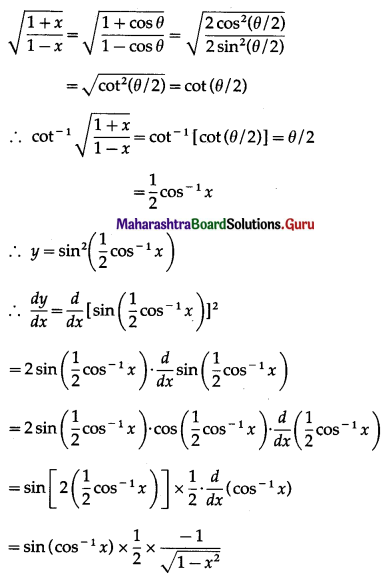
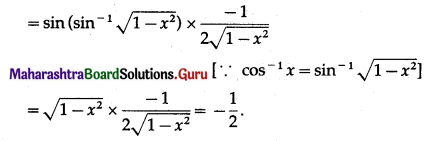
(ii) \(\sin ^{2}\left[\cot ^{-1}\left(\sqrt{\frac{1+x}{1-x}}\right)\right]\)
Solution:
Let y = \(\sin ^{2}\left[\cot ^{-1}\left(\sqrt{\frac{1+x}{1-x}}\right)\right]\)
Put x = cos θ. Then θ = cos-1 x and
Maharashtra Board 12th Maths Solutions Chapter 1 Differentiation Miscellaneous Exercise 1 II Q4 (ii)
Maharashtra Board 12th Maths Solutions Chapter 1 Differentiation Miscellaneous Exercise 1 II Q4 (ii).1

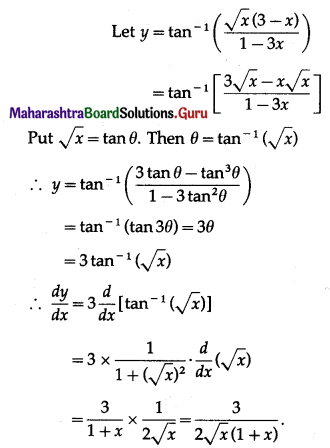
(iii) \(\tan ^{-1}\left[\frac{\sqrt{x}(3-x)}{1-3 x}\right]\)
Solution:
Maharashtra Board 12th Maths Solutions Chapter 1 Differentiation Miscellaneous Exercise 1 II Q4 (iii)

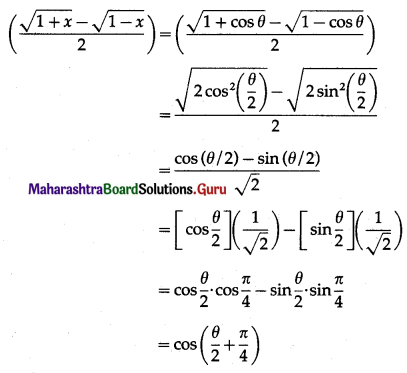
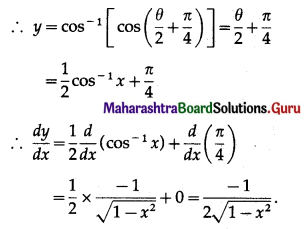
(iv) \(\cos ^{-1}\left(\frac{\sqrt{1+x}-\sqrt{1-x}}{2}\right)\)
Solution:
Let y = \(\cos ^{-1}\left(\frac{\sqrt{1+x}-\sqrt{1-x}}{2}\right)\)
Put x = cos θ. Then θ = cos-1 x and
Maharashtra Board 12th Maths Solutions Chapter 1 Differentiation Miscellaneous Exercise 1 II Q4 (iv)
Maharashtra Board 12th Maths Solutions Chapter 1 Differentiation Miscellaneous Exercise 1 II Q4 (iv).1

Maharashtra Board 12th Maths Solutions Chapter 1 Differentiation Miscellaneous Exercise 1

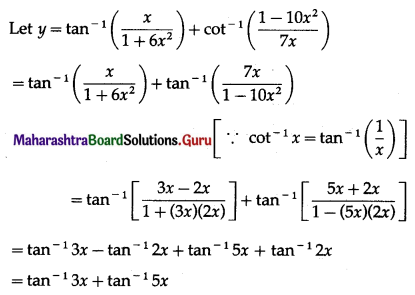
(v) \(\tan ^{-1}\left(\frac{x}{1+6 x^{2}}\right)+\cot ^{-1}\left(\frac{1-10 x^{2}}{7 x}\right)\)
Solution:
Maharashtra Board 12th Maths Solutions Chapter 1 Differentiation Miscellaneous Exercise 1 II Q4 (v)
Maharashtra Board 12th Maths Solutions Chapter 1 Differentiation Miscellaneous Exercise 1 II Q4 (v).1

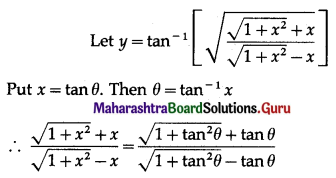
(vi) \(\tan ^{-1}\left[\sqrt{\frac{\sqrt{1+x^{2}+x}}{\sqrt{1+x^{2}}-x}}\right]\)
Solution:
Maharashtra Board 12th Maths Solutions Chapter 1 Differentiation Miscellaneous Exercise 1 II Q4 (vi)
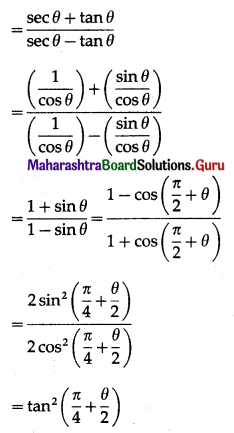
Maharashtra Board 12th Maths Solutions Chapter 1 Differentiation Miscellaneous Exercise 1 II Q4 (vi).1
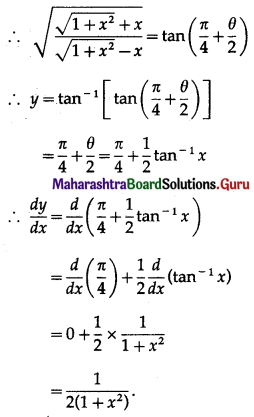
Maharashtra Board 12th Maths Solutions Chapter 1 Differentiation Miscellaneous Exercise 1 II Q4 (vi).2

Question 5.
(i) If \(\sqrt{y+x}+\sqrt{y-x}=c\), show that \(\frac{d y}{d x}=\frac{y}{x}-\sqrt{\frac{y^{2}}{x^{2}}-1}\)
Solution:
\(\sqrt{y+x}+\sqrt{y-x}=c\)
Differentiating both sides w.r.t. x, we get
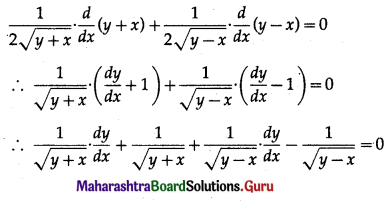
Maharashtra Board 12th Maths Solutions Chapter 1 Differentiation Miscellaneous Exercise 1 II Q5 (i)
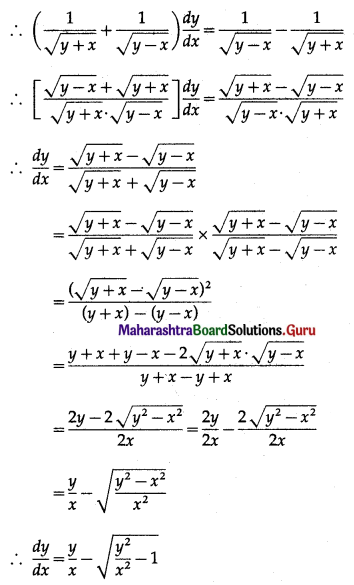
Maharashtra Board 12th Maths Solutions Chapter 1 Differentiation Miscellaneous Exercise 1 II Q5 (i).1

(ii) If \(x \sqrt{1-y^{2}}+y \sqrt{1-x^{2}}=1\), then show that \(\frac{d y}{d x}=-\sqrt{\frac{1-y^{2}}{1-x^{2}}}\)
Solution:
\(x \sqrt{1-y^{2}}+y \sqrt{1-x^{2}}=1\)
\(y \sqrt{1-x^{2}}+x \sqrt{1-y^{2}}=1\)
Differentiating both sides w.r.t. x, we get
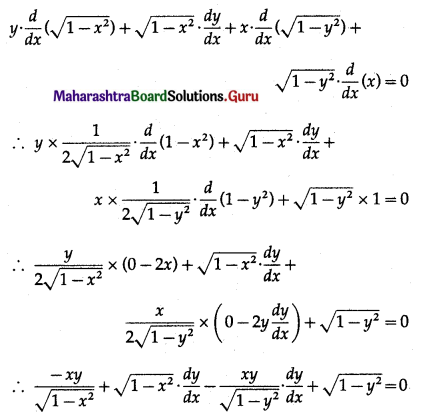
Maharashtra Board 12th Maths Solutions Chapter 1 Differentiation Miscellaneous Exercise 1 II Q5 (ii)
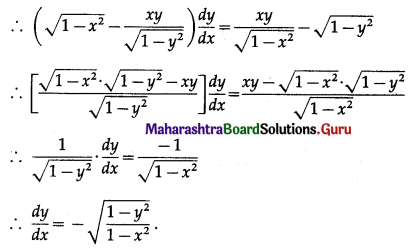
Maharashtra Board 12th Maths Solutions Chapter 1 Differentiation Miscellaneous Exercise 1 II Q5 (ii).1

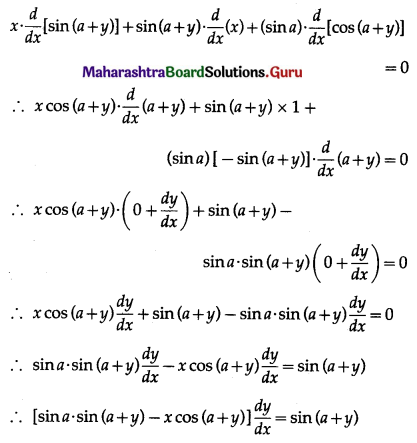
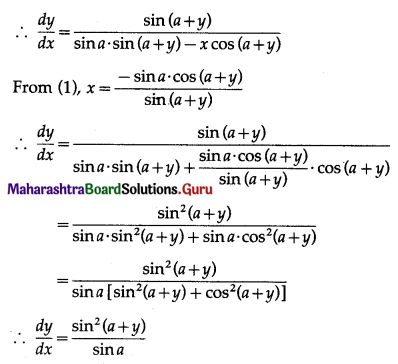
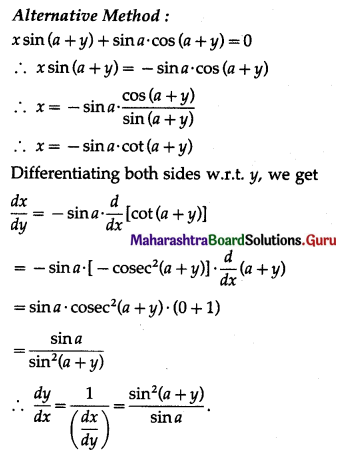
(iii) If x sin(a + y) + sin a cos(a + y) = 0, then show \(\frac{d y}{d x}=\frac{\sin ^{2}(a+y)}{\sin a}\)
Solution:
x sin(a + y) + sin a . cos (a + y) = 0 ….. (1)
Differentiating w.r.t. x, we get
Maharashtra Board 12th Maths Solutions Chapter 1 Differentiation Miscellaneous Exercise 1 II Q5 (iii)
Maharashtra Board 12th Maths Solutions Chapter 1 Differentiation Miscellaneous Exercise 1 II Q5 (iii).1
Maharashtra Board 12th Maths Solutions Chapter 1 Differentiation Miscellaneous Exercise 1 II Q5 (iii).2

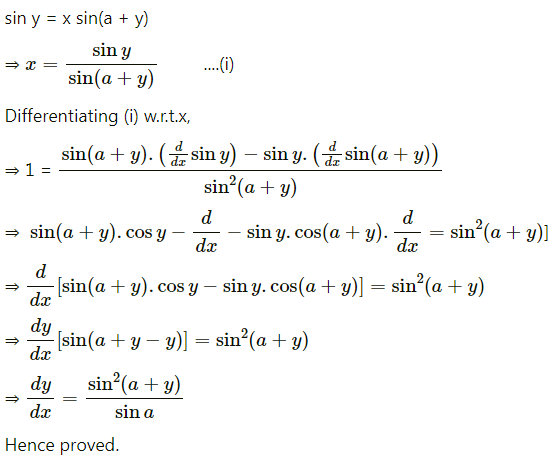
(iv) If sin y = x sin(a + y), then show that \(\frac{d y}{d x}=\frac{\sin ^{2}(a+y)}{\sin a}\)
Solution:
Maharashtra Board 12th Maths Solutions Chapter 1 Differentiation Miscellaneous Exercise 1 II Q5 (iv)

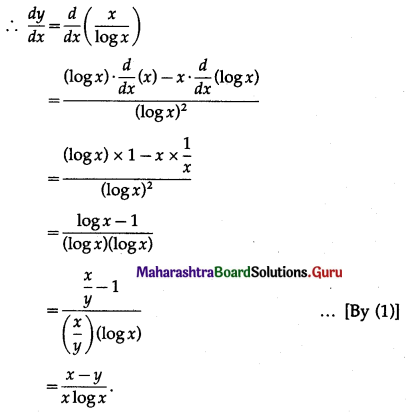
(v) If x = \(e^{\frac{x}{y}}\), then show that \(\frac{d y}{d x}=\frac{x-y}{x \log x}\)
Solution:
x = \(e^{\frac{x}{y}}\)
\(\frac{x}{y}\) = log x …..(1)
y = \(\frac{x}{\log x}\)
Maharashtra Board 12th Maths Solutions Chapter 1 Differentiation Miscellaneous Exercise 1 II Q5 (v)

Maharashtra Board 12th Maths Solutions Chapter 1 Differentiation Miscellaneous Exercise 1

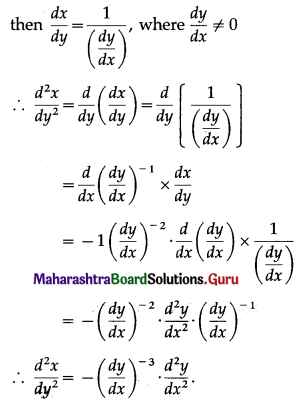
(vi) If y = f(x) is a differentiable function of x, then show that \(\frac{d^{2} x}{d y^{2}}=-\left(\frac{d y}{d x}\right)^{-3} \cdot \frac{d^{2} y}{d x^{2}}\)
Solution:
If y = f(x) is a differentiable function of x such that inverse function x = f-1(y) exists,
Maharashtra Board 12th Maths Solutions Chapter 1 Differentiation Miscellaneous Exercise 1 II Q5 (vi)

Question 6.
(i) Differentiate \(\tan ^{-1}\left(\frac{\sqrt{1+x^{2}}-1}{x}\right)\) w.r.t. \(\tan ^{-1}\left(\frac{2 x \sqrt{1-x^{2}}}{1-2 x^{2}}\right)\)
Solution:
Maharashtra Board 12th Maths Solutions Chapter 1 Differentiation Miscellaneous Exercise 1 II Q6 (i)
Maharashtra Board 12th Maths Solutions Chapter 1 Differentiation Miscellaneous Exercise 1 II Q6 (i).1
Maharashtra Board 12th Maths Solutions Chapter 1 Differentiation Miscellaneous Exercise 1 II Q6 (i).2
Maharashtra Board 12th Maths Solutions Chapter 1 Differentiation Miscellaneous Exercise 1 II Q6 (i).3
Maharashtra Board 12th Maths Solutions Chapter 1 Differentiation Miscellaneous Exercise 1 II Q6 (i).4

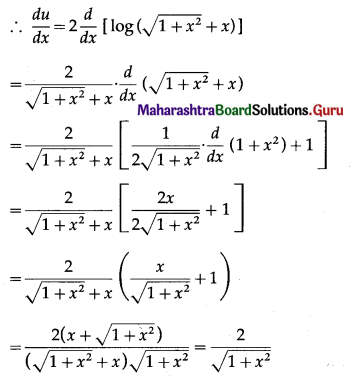
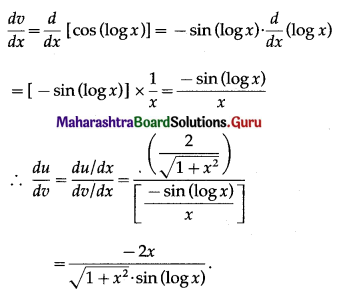
(ii) Differentiate \(\log \left[\frac{\sqrt{1+x^{2}}+x}{\sqrt{1+x^{2}}-x}\right]\) w.r.t. cos(log x)
Solution:
Maharashtra Board 12th Maths Solutions Chapter 1 Differentiation Miscellaneous Exercise 1 II Q6 (ii)
Maharashtra Board 12th Maths Solutions Chapter 1 Differentiation Miscellaneous Exercise 1 II Q6 (ii).1
Maharashtra Board 12th Maths Solutions Chapter 1 Differentiation Miscellaneous Exercise 1 II Q6 (ii).2

(iii) Differentiate \(\tan ^{-1}\left(\frac{\sqrt{1+x^{2}}-1}{x}\right)\) w.r.t. \(\cos ^{-1}\left(\sqrt{\frac{1+\sqrt{1+x^{2}}}{2 \sqrt{1+x^{2}}}}\right)\)
Solution:
Maharashtra Board 12th Maths Solutions Chapter 1 Differentiation Miscellaneous Exercise 1 II Q6 (iii)
Maharashtra Board 12th Maths Solutions Chapter 1 Differentiation Miscellaneous Exercise 1 II Q6 (iii).1
Maharashtra Board 12th Maths Solutions Chapter 1 Differentiation Miscellaneous Exercise 1 II Q6 (iii).2

Question 7.
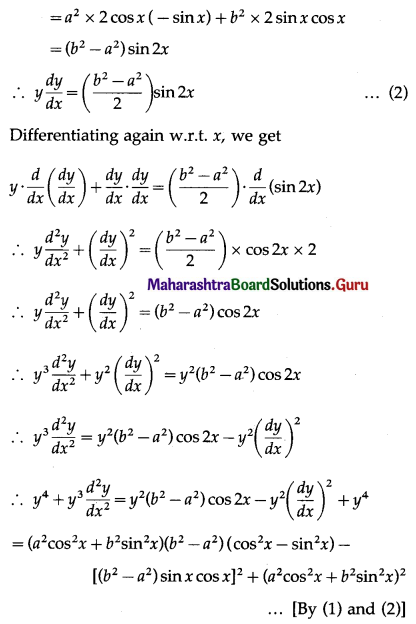
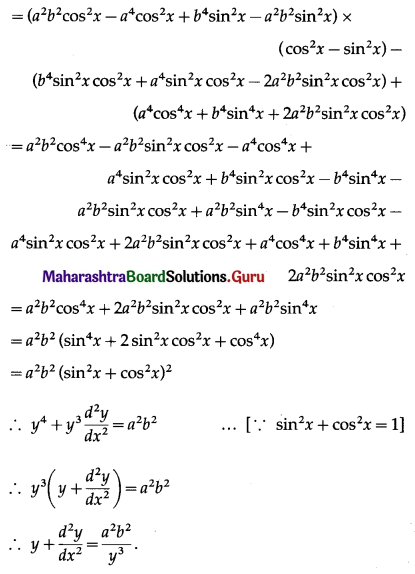
(i) If y2 = a2 cos2x + b2 sin2x, show that \(y+\frac{d^{2} y}{d x^{2}}=\frac{a^{2} b^{2}}{y^{3}}\)
Solution:
y2 = a2 cos2x + b2 sin2x …… (1)
Differentiating both sides w.r.t. x, we get
Maharashtra Board 12th Maths Solutions Chapter 1 Differentiation Miscellaneous Exercise 1 II Q7 (i)
Maharashtra Board 12th Maths Solutions Chapter 1 Differentiation Miscellaneous Exercise 1 II Q7 (i).1
Maharashtra Board 12th Maths Solutions Chapter 1 Differentiation Miscellaneous Exercise 1 II Q7 (i).2

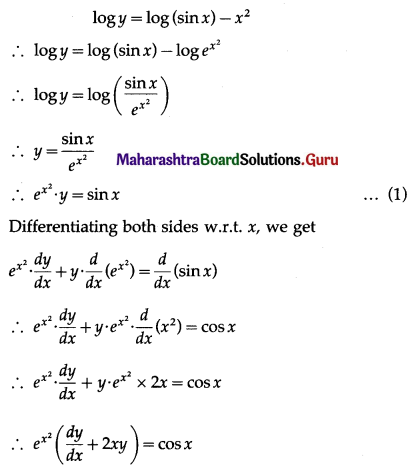
(ii) If log y = log(sin x) – x2, show that \(\frac{d^{2} y}{d x^{2}}+4 x \frac{d y}{d x}+\left(4 x^{2}+3\right) y=0\)
Solution:
Maharashtra Board 12th Maths Solutions Chapter 1 Differentiation Miscellaneous Exercise 1 II Q7 (ii)
Maharashtra Board 12th Maths Solutions Chapter 1 Differentiation Miscellaneous Exercise 1 II Q7 (ii).1

Maharashtra Board 12th Maths Solutions Chapter 1 Differentiation Miscellaneous Exercise 1

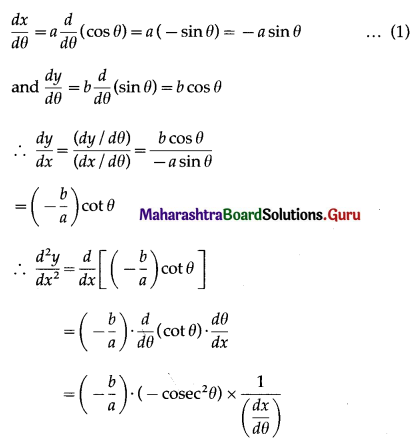
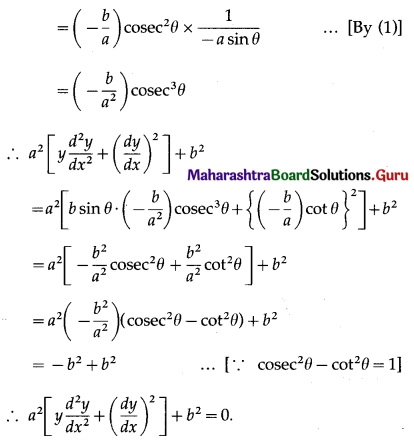
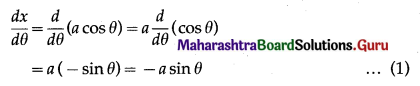
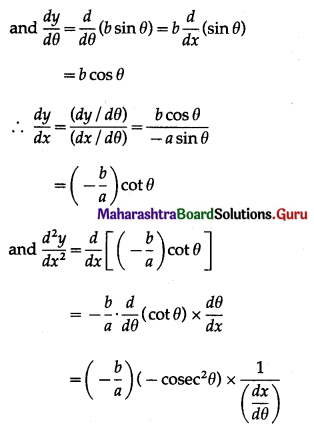
(iii) If x = a cos θ, y = b sin θ, show that \(a^{2}\left[y \frac{d^{2} y}{d x^{2}}+\left(\frac{d y}{d x}\right)^{2}\right]+b^{2}=0\)
Solution:
x = a cos θ, y = b sin θ
Differentiating x and y w.r.t. θ, we get
Maharashtra Board 12th Maths Solutions Chapter 1 Differentiation Miscellaneous Exercise 1 II Q7 (iii)
Maharashtra Board 12th Maths Solutions Chapter 1 Differentiation Miscellaneous Exercise 1 II Q7 (iii).1

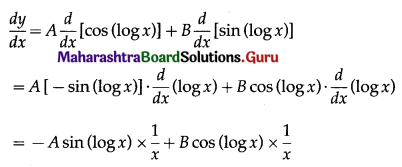
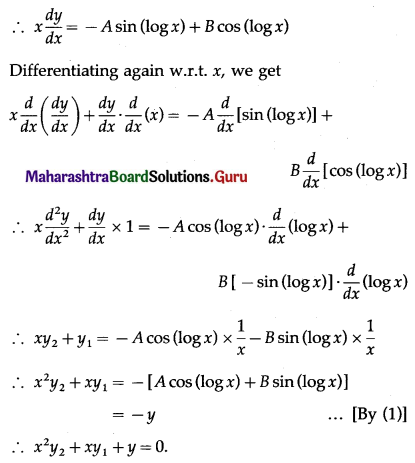
(iv) If y = A cos(log x) + B sin(log x), show that x2y2 + xy1 + y = o.
Solution:
y = A cos (log x) + B sin (log x) …… (1)
Differentiating both sides w.r.t. x, we get
Maharashtra Board 12th Maths Solutions Chapter 1 Differentiation Miscellaneous Exercise 1 II Q7 (iv)
Maharashtra Board 12th Maths Solutions Chapter 1 Differentiation Miscellaneous Exercise 1 II Q7 (iv).1

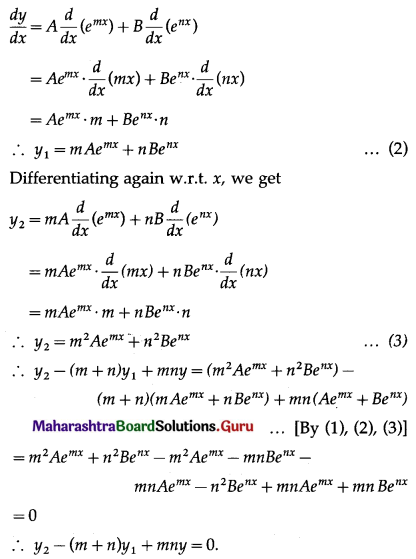
(v) If y = A emx + B enx, show that y2 – (m + n) y1 + (mn) y = 0.
Solution:
y = A emx + B enx
Differentiating w.r.t. x, we get
Maharashtra Board 12th Maths Solutions Chapter 1 Differentiation Miscellaneous Exercise 1 II Q7 (v)

Class 12 Maharashtra State Board Maths Solution 

Differentiation Class 12 Maths 2 Exercise 1.5 Solutions Maharashtra Board

Balbharti 12th Maharashtra State Board Maths Solutions Book Pdf Chapter 1 Differentiation Ex 1.5 Questions and Answers.

12th Maths Part 2 Differentiation Exercise 1.5 Questions And Answers Maharashtra Board

Question 1.
Find the second order derivatives of the following:
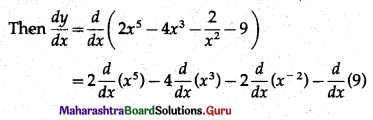
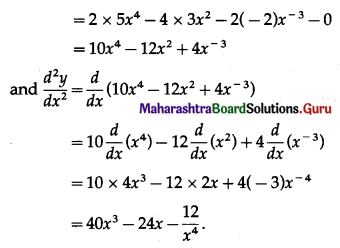
(i) 2x5 – 4x3 – \(\frac{2}{x^{2}}\) – 9
Solution:
Let y = 2x5 – 4x3 – \(\frac{2}{x^{2}}\) – 9
Maharashtra Board 12th Maths Solutions Chapter 1 Differentiation Ex 1.5 Q1 (i)
Maharashtra Board 12th Maths Solutions Chapter 1 Differentiation Ex 1.5 Q1 (i).1

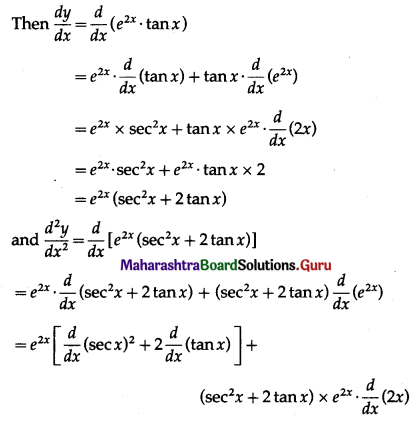
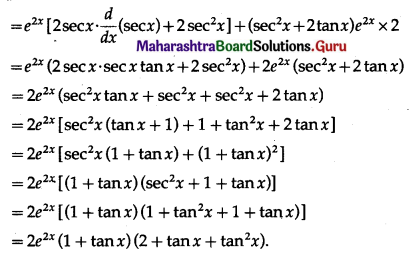
(ii) e2x . tan x
Solution:
Let y = e2x . tan x
Maharashtra Board 12th Maths Solutions Chapter 1 Differentiation Ex 1.5 Q1 (ii)
Maharashtra Board 12th Maths Solutions Chapter 1 Differentiation Ex 1.5 Q1 (ii).1

Maharashtra Board 12th Maths Solutions Chapter 1 Differentiation Ex 1.5

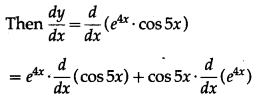
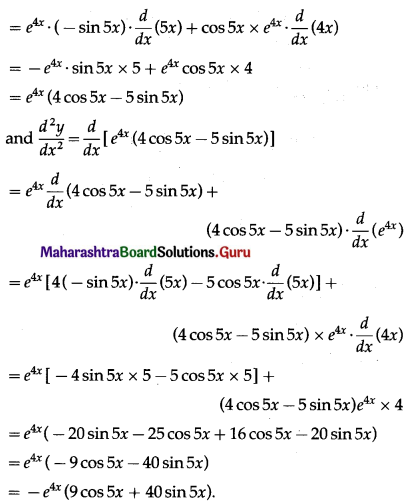
(iii) e4x . cos 5x
Solution:
Let y = e4x . cos 5x
Maharashtra Board 12th Maths Solutions Chapter 1 Differentiation Ex 1.5 Q1 (iii)
Maharashtra Board 12th Maths Solutions Chapter 1 Differentiation Ex 1.5 Q1 (iii).1

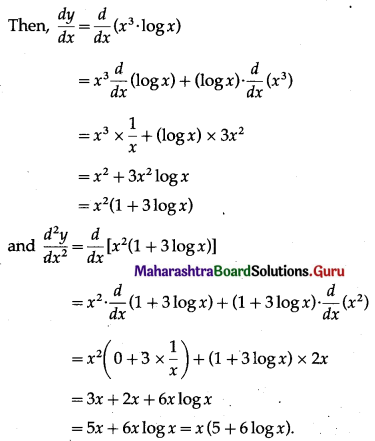
(iv) x3 . log x
Solution:
Let y = x3 . log x
Maharashtra Board 12th Maths Solutions Chapter 1 Differentiation Ex 1.5 Q1 (iv)

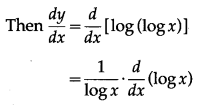
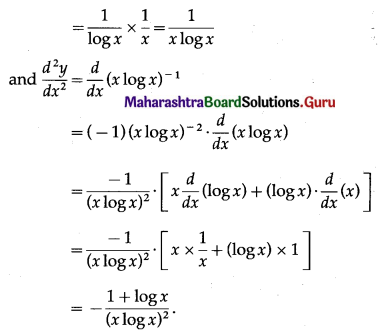
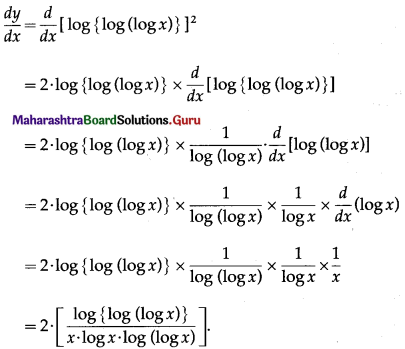
(v) log(log x)
Solution:
Let y = log(log x)
Maharashtra Board 12th Maths Solutions Chapter 1 Differentiation Ex 1.5 Q1 (v)
Maharashtra Board 12th Maths Solutions Chapter 1 Differentiation Ex 1.5 Q1 (v).1

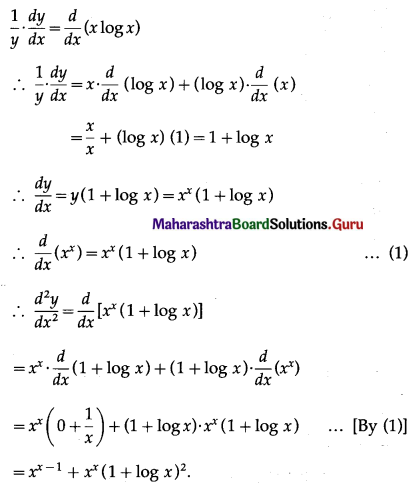
(vi) xx
Solution:
y = xx
log y = log xx = x log x
Differentiating both sides w.r.t. x, we get
Maharashtra Board 12th Maths Solutions Chapter 1 Differentiation Ex 1.5 Q1 (vi)

Question 2.
Find \(\frac{d^{2} y}{d x^{2}}\) of the following:
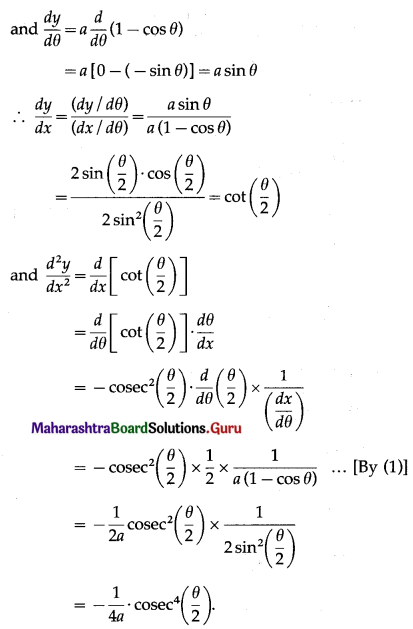
(i) x = a(θ – sin θ), y = a (1 – cos θ)
Solution:
x = a(θ – sin θ), y = a (1 – cos θ)
Differentiating x and y w.r.t. θ, we get
\(\frac{d x}{d \theta}=a \frac{d}{d \theta}(\theta-\sin \theta)\) = a(1 – cos θ) …….(1)
Maharashtra Board 12th Maths Solutions Chapter 1 Differentiation Ex 1.5 Q2 (i)

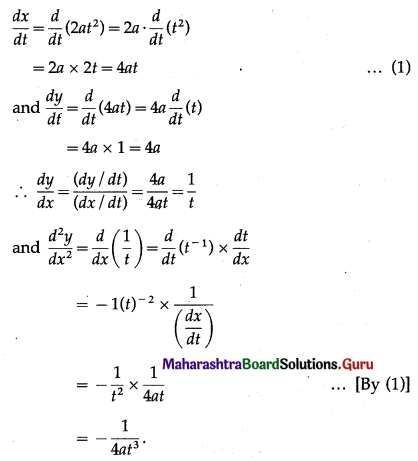
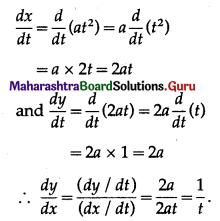
(ii) x = 2at2, y = 4at
Solution:
x = 2at2, y = 4at
Differentiating x and y w.r.t. t, we get
Maharashtra Board 12th Maths Solutions Chapter 1 Differentiation Ex 1.5 Q2 (ii)

Maharashtra Board 12th Maths Solutions Chapter 1 Differentiation Ex 1.5

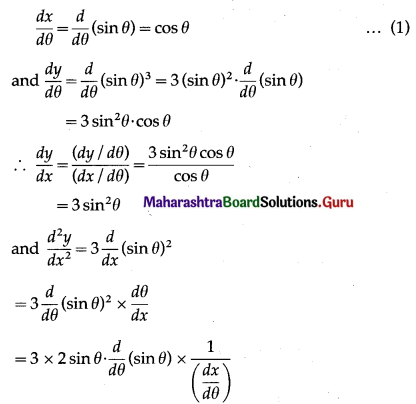
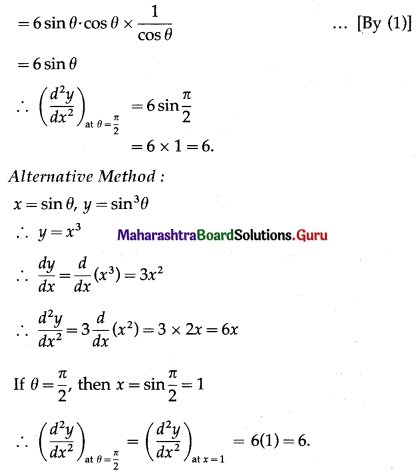
(iii) x = sin θ, y = sin3θ at θ = \(\frac{\pi}{2}\)
Solution:
x = sin θ, y = sin3θ
Differentiating x and y w.r.t. θ, we get,
Maharashtra Board 12th Maths Solutions Chapter 1 Differentiation Ex 1.5 Q2 (iii)
Maharashtra Board 12th Maths Solutions Chapter 1 Differentiation Ex 1.5 Q2 (iii).1

(iv) x = a cos θ, y = b sin θ at θ = \(\frac{\pi}{4}\)
Solution:
x = a cos θ, y = b sin θ
Differentiating x and y w.r.t. θ, we get
Maharashtra Board 12th Maths Solutions Chapter 1 Differentiation Ex 1.5 Q2 (iv)
Maharashtra Board 12th Maths Solutions Chapter 1 Differentiation Ex 1.5 Q2 (iv).1
Maharashtra Board 12th Maths Solutions Chapter 1 Differentiation Ex 1.5 Q2 (iv).2

Question 3.
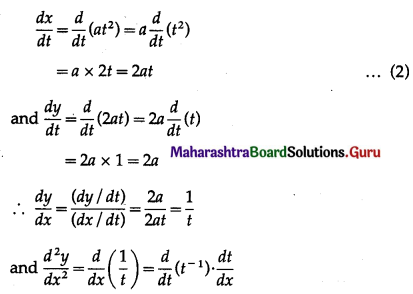
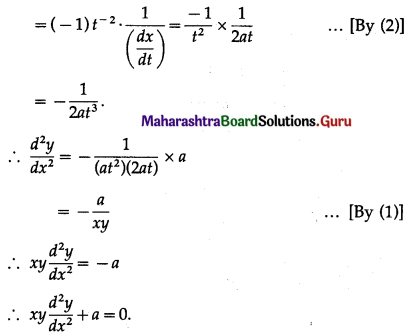
(i) If x = at2 and y = 2at, then show that \(x y \frac{d^{2} y}{d x^{2}}+a=0\)
Solution:
x = at2, y = 2at ………(1)
Differentiating x and y w.r.t. t, we get
Maharashtra Board 12th Maths Solutions Chapter 1 Differentiation Ex 1.5 Q3 (i)
Maharashtra Board 12th Maths Solutions Chapter 1 Differentiation Ex 1.5 Q3 (i).1

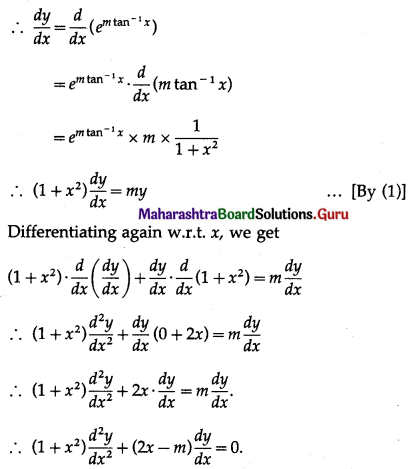
(ii) If y = \(e^{m \tan ^{-1} x}\), show that \(\left(1+x^{2}\right) \frac{d^{2} y}{d x^{2}}+(2 x-m) \frac{d y}{d x}=0\)
Solution:
y = \(e^{m \tan ^{-1} x}\) ……..(1)
Maharashtra Board 12th Maths Solutions Chapter 1 Differentiation Ex 1.5 Q3 (ii)

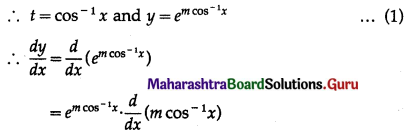
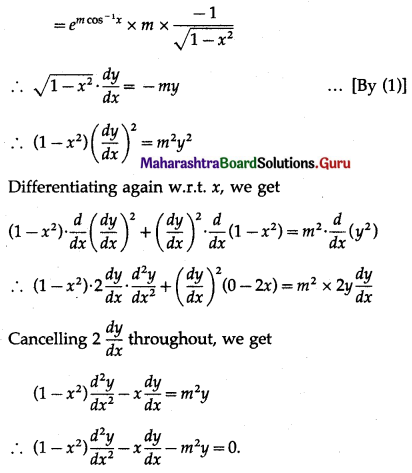
(iii) If x = cos t, y = emt, show that \(\left(1-x^{2}\right) \frac{d^{2} y}{d x^{2}}-x \frac{d y}{d x}-m^{2} y=0\)
Solution:
x = cos t, y = emt
Maharashtra Board 12th Maths Solutions Chapter 1 Differentiation Ex 1.5 Q3 (iii)
Maharashtra Board 12th Maths Solutions Chapter 1 Differentiation Ex 1.5 Q3 (iii).1

Maharashtra Board 12th Maths Solutions Chapter 1 Differentiation Ex 1.5

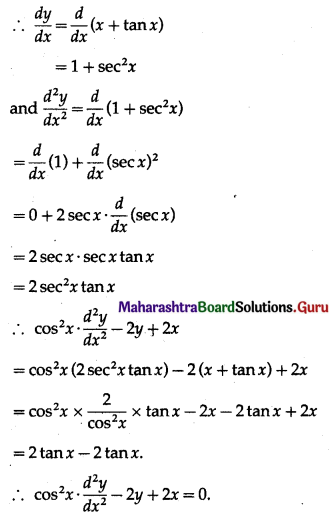
(iv) If y = x + tan x, show that \(\cos ^{2} x \cdot \frac{d^{2} y}{d x^{2}}-2 y+2 x=0\)
Solution:
y = x + tan x
Maharashtra Board 12th Maths Solutions Chapter 1 Differentiation Ex 1.5 Q3 (iv)

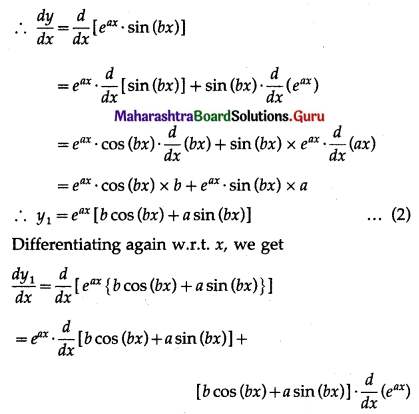
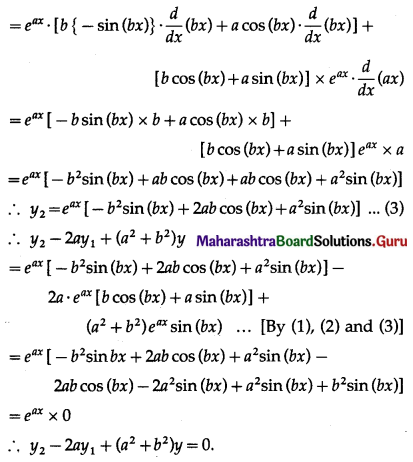
(v) If y = eax . sin (bx), show that y2 – 2ay1 + (a2 + b2)y = 0.
Solution:
y = eax . sin (bx) ………(1)
Maharashtra Board 12th Maths Solutions Chapter 1 Differentiation Ex 1.5 Q3 (v)
Maharashtra Board 12th Maths Solutions Chapter 1 Differentiation Ex 1.5 Q3 (v).1

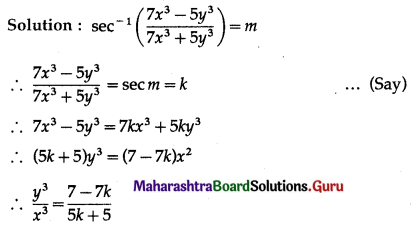
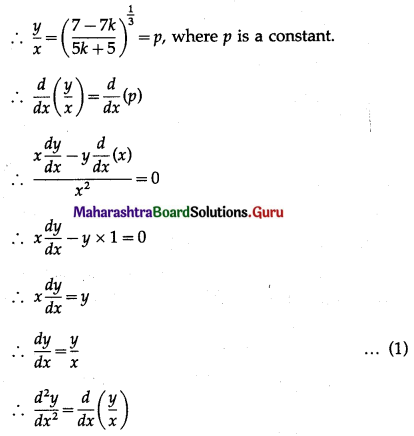
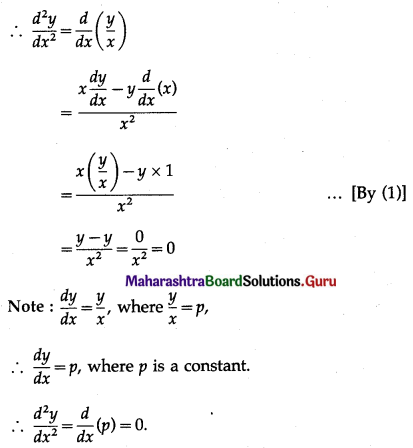
(vi) If \(\sec ^{-1}\left(\frac{7 x^{3}-5 y^{3}}{7 x^{3}+5 y^{3}}\right)=m\), show that \(\frac{d^{2} y}{d x^{2}}=0\)
Solution:
Maharashtra Board 12th Maths Solutions Chapter 1 Differentiation Ex 1.5 Q3 (vi)
Maharashtra Board 12th Maths Solutions Chapter 1 Differentiation Ex 1.5 Q3 (vi).1
Maharashtra Board 12th Maths Solutions Chapter 1 Differentiation Ex 1.5 Q3 (vi).2

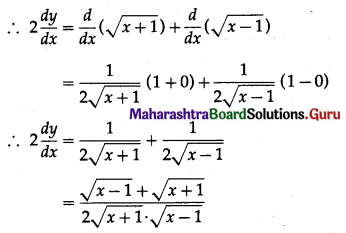
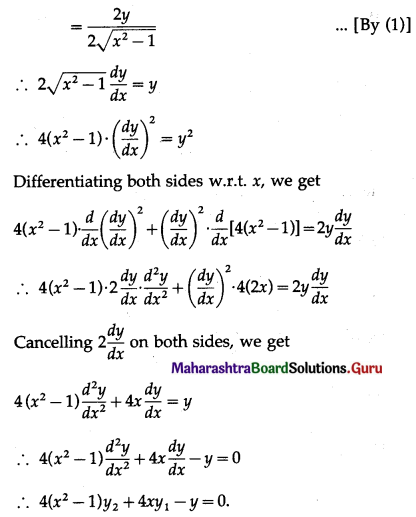
(vii) If 2y = \(\sqrt{x+1}+\sqrt{x-1}\), show that 4(x2 – 1)y2 + 4xy1 – y = 0.
Solution:
2y = \(\sqrt{x+1}+\sqrt{x-1}\) …… (1)
Differentiating both sides w.r.t. x, we get
Maharashtra Board 12th Maths Solutions Chapter 1 Differentiation Ex 1.5 Q3 (vii)
Maharashtra Board 12th Maths Solutions Chapter 1 Differentiation Ex 1.5 Q3 (vii).1

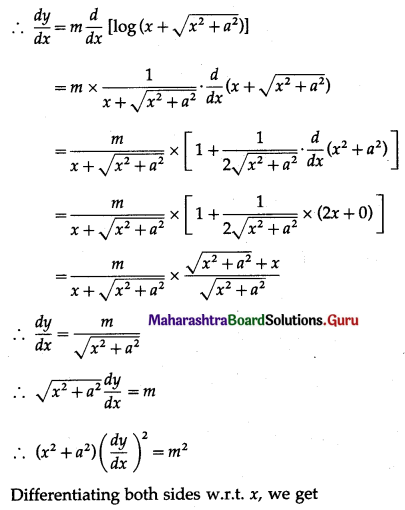
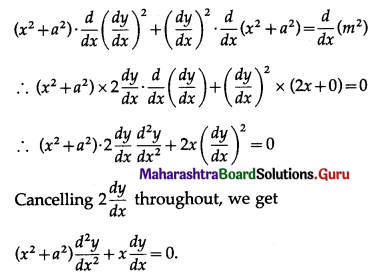
(viii) If y = \(\log \left(x+\sqrt{x^{2}+a^{2}}\right)^{m}\), show that \(\left(x^{2}+a^{2}\right) \frac{d^{2} y}{d x^{2}}+x \frac{d y}{d x}=0\)
Solution:
y = \(\log \left(x+\sqrt{x^{2}+a^{2}}\right)^{m}\) = \(m \log \left(x+\sqrt{x^{2}+a^{2}}\right)\)
Maharashtra Board 12th Maths Solutions Chapter 1 Differentiation Ex 1.5 Q3 (viii)
Maharashtra Board 12th Maths Solutions Chapter 1 Differentiation Ex 1.5 Q3 (viii).1

Maharashtra Board 12th Maths Solutions Chapter 1 Differentiation Ex 1.5

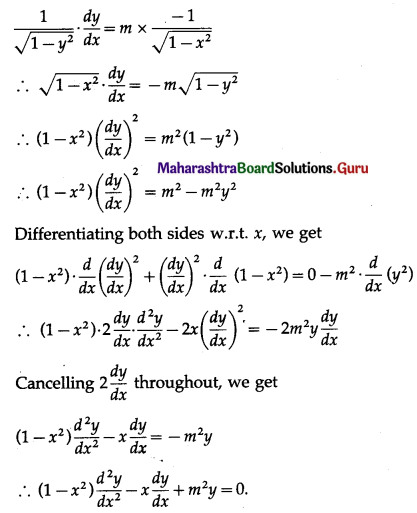
(ix) If y = sin(m cos-1x), then show that \(\left(1-x^{2}\right) \frac{d^{2} y}{d x^{2}}-x \frac{d y}{d x}+m^{2} y=0\)
Solution:
y = sin(m cos-1x)
sin-1y = m cos-1x
Differentiating both sides w.r.t. x, we get
Maharashtra Board 12th Maths Solutions Chapter 1 Differentiation Ex 1.5 Q3 (ix)

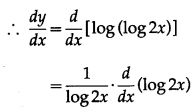
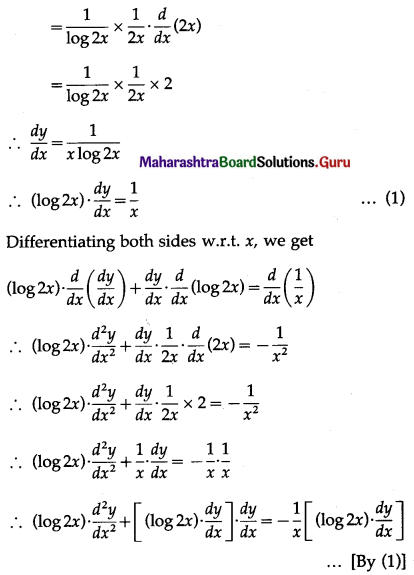
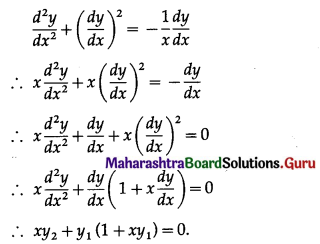
(x) If y = log(log 2x), show that xy2 + y1(1 + xy1) = 0.
Solution:
y = log(log 2x)
Maharashtra Board 12th Maths Solutions Chapter 1 Differentiation Ex 1.5 Q3 (x)
Maharashtra Board 12th Maths Solutions Chapter 1 Differentiation Ex 1.5 Q3 (x).1
Maharashtra Board 12th Maths Solutions Chapter 1 Differentiation Ex 1.5 Q3 (x).2

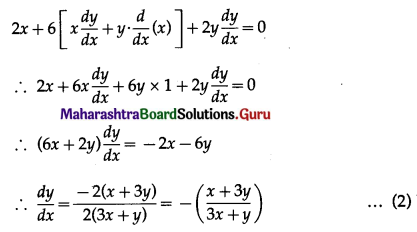
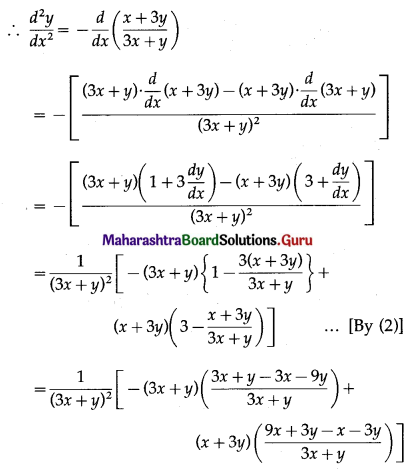
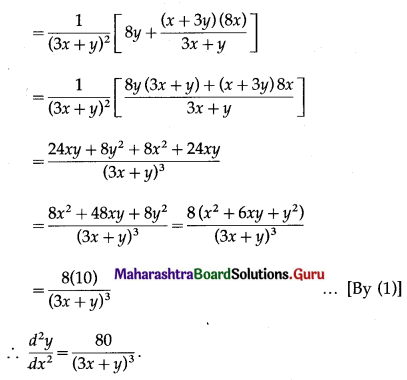
(xi) If x2 + 6xy + y2 = 10, show that \(\frac{d^{2} y}{d x^{2}}=\frac{80}{(3 x+y)^{3}}\)
Solution:
x2 + 6xy + y2 = 10 …… (1)
Differentiating both sides w.r.t. x, we get
Maharashtra Board 12th Maths Solutions Chapter 1 Differentiation Ex 1.5 Q3 (xi)
Maharashtra Board 12th Maths Solutions Chapter 1 Differentiation Ex 1.5 Q3 (xi).1
Maharashtra Board 12th Maths Solutions Chapter 1 Differentiation Ex 1.5 Q3 (xi).2

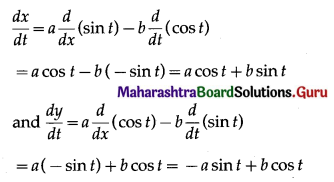
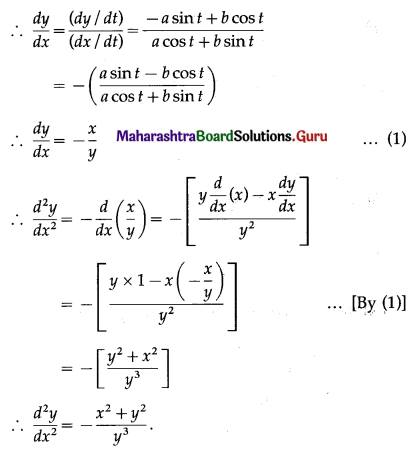
(xii) If x = a sin t – b cos t, y = a cos t + b sin t, Show that \(\frac{d^{2} y}{d x^{2}}=-\frac{x^{2}+y^{2}}{y^{3}}\)
Solution:
x = a sin t – b cos t, y = a cos t + b sin t
Differentiating x and y w.r.t. t, we get
Maharashtra Board 12th Maths Solutions Chapter 1 Differentiation Ex 1.5 Q3 (xii)
Maharashtra Board 12th Maths Solutions Chapter 1 Differentiation Ex 1.5 Q3 (xii).1

Maharashtra Board 12th Maths Solutions Chapter 1 Differentiation Ex 1.5

Question 4.
Find the nth derivative of the following:
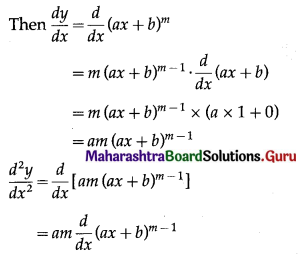
(i) (ax + b)m
Solution:
Let y = (ax + b)m
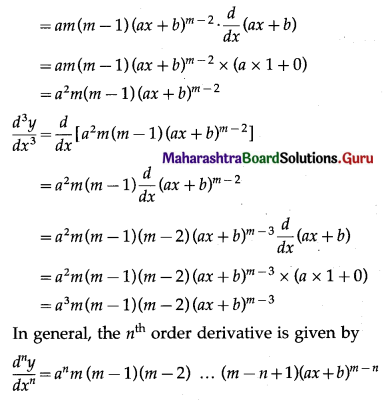
Maharashtra Board 12th Maths Solutions Chapter 1 Differentiation Ex 1.5 Q4 (i)
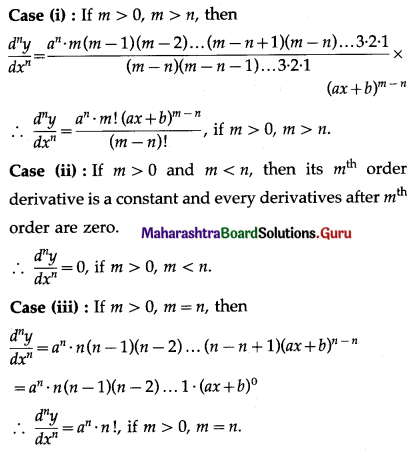
Maharashtra Board 12th Maths Solutions Chapter 1 Differentiation Ex 1.5 Q4 (i).1
Maharashtra Board 12th Maths Solutions Chapter 1 Differentiation Ex 1.5 Q4 (i).2

(ii) \(\frac{1}{x}\)
Solution:
Let y = \(\frac{1}{x}\)
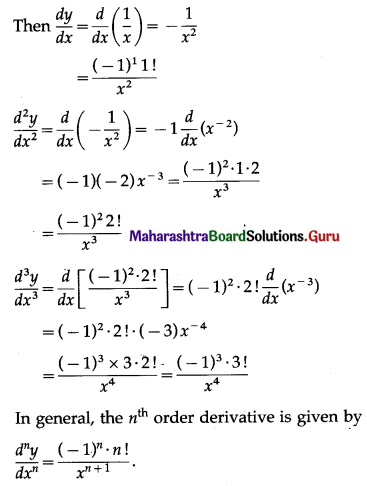
Maharashtra Board 12th Maths Solutions Chapter 1 Differentiation Ex 1.5 Q4 (ii)

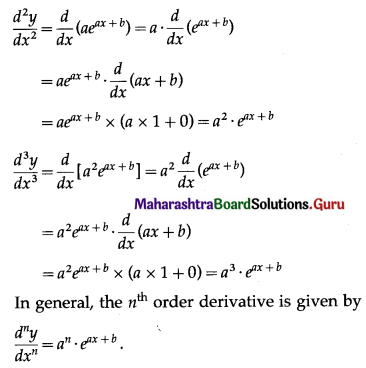
(iii) eax+b
Solution:
Let y = eax+b
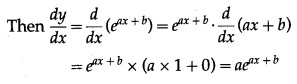
Maharashtra Board 12th Maths Solutions Chapter 1 Differentiation Ex 1.5 Q4 (iii)
Maharashtra Board 12th Maths Solutions Chapter 1 Differentiation Ex 1.5 Q4 (iii).1

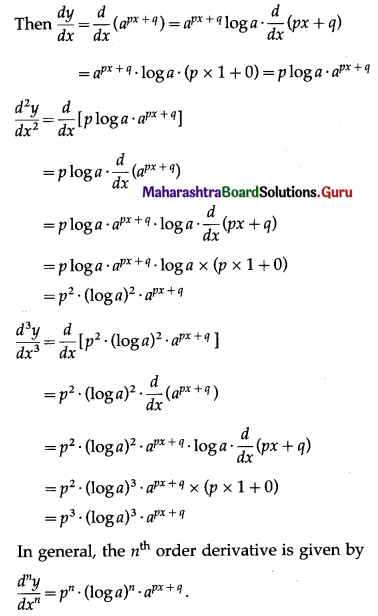
(iv) apx+q
Solution:
Let y = apx+q
Maharashtra Board 12th Maths Solutions Chapter 1 Differentiation Ex 1.5 Q4 (iv)

Maharashtra Board 12th Maths Solutions Chapter 1 Differentiation Ex 1.5

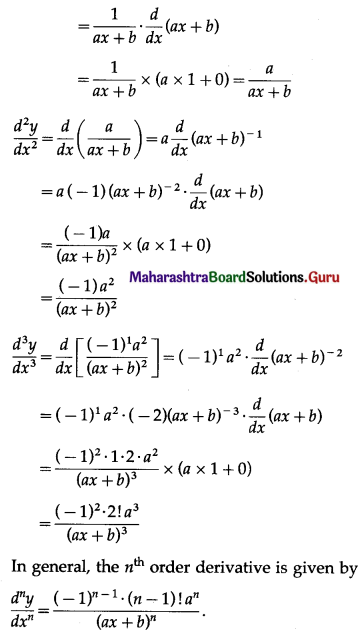
(v) log(ax + b)
Solution:
Let y = log(ax + b)
Then \(\frac{d y}{d x}=\frac{d}{d x}[\log (a x+b)]\)
Maharashtra Board 12th Maths Solutions Chapter 1 Differentiation Ex 1.5 Q4 (v)

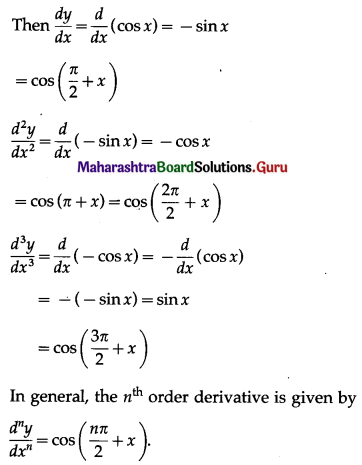
(vi) cos x
Solution:
Let y = cos x
Maharashtra Board 12th Maths Solutions Chapter 1 Differentiation Ex 1.5 Q4 (vi)

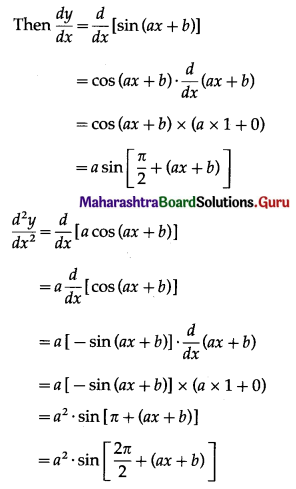
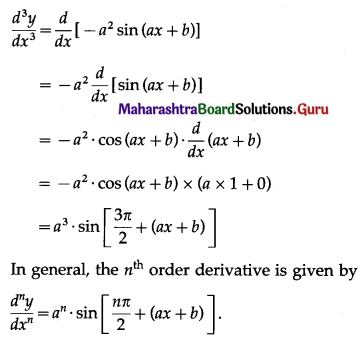
(vii) sin(ax + b)
Solution:
Let y = sin(ax + b)
Maharashtra Board 12th Maths Solutions Chapter 1 Differentiation Ex 1.5 Q4 (vii)
Maharashtra Board 12th Maths Solutions Chapter 1 Differentiation Ex 1.5 Q4 (vii).1

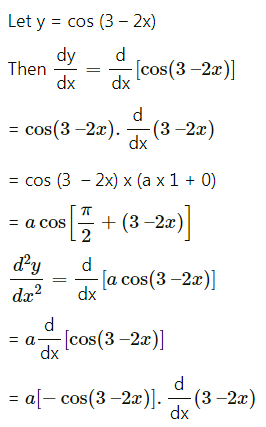
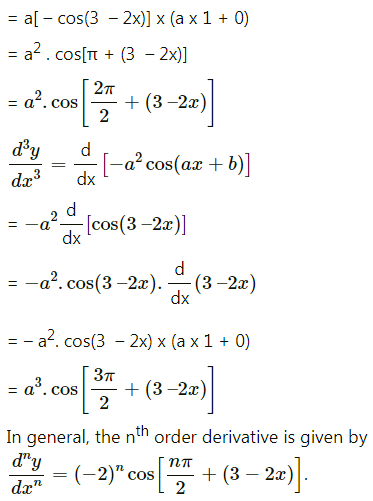
(viii) cos(3 – 2x)
Solution:
Maharashtra Board 12th Maths Solutions Chapter 1 Differentiation Ex 1.5 Q4 (viii)
Maharashtra Board 12th Maths Solutions Chapter 1 Differentiation Ex 1.5 Q4 (viii).1

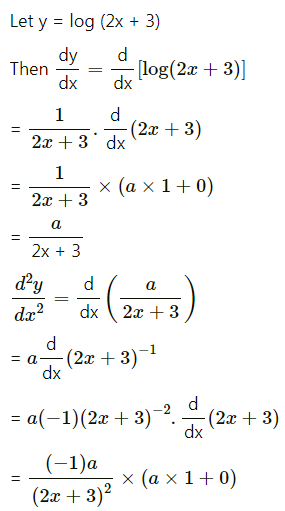
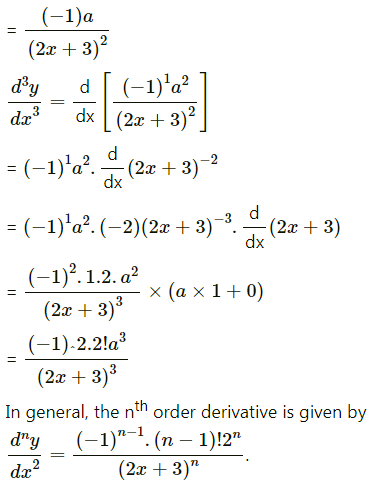
(ix) log(2x + 3)
Solution:
Maharashtra Board 12th Maths Solutions Chapter 1 Differentiation Ex 1.5 Q4 (ix)
Maharashtra Board 12th Maths Solutions Chapter 1 Differentiation Ex 1.5 Q4 (ix).1

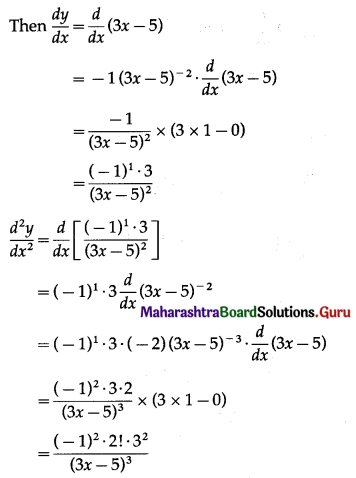
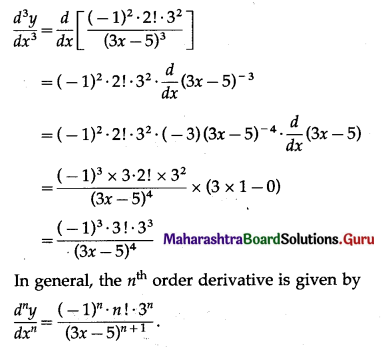
(x) \(\frac{1}{3 x-5}\)
Solution:
Let y = \(\frac{1}{3 x-5}\)
Maharashtra Board 12th Maths Solutions Chapter 1 Differentiation Ex 1.5 Q4 (x)
Maharashtra Board 12th Maths Solutions Chapter 1 Differentiation Ex 1.5 Q4 (x).1

Maharashtra Board 12th Maths Solutions Chapter 1 Differentiation Ex 1.5

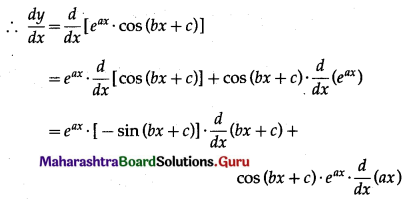
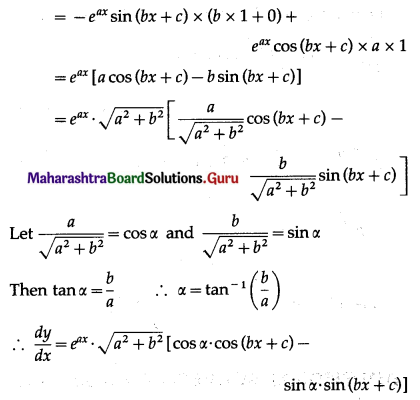
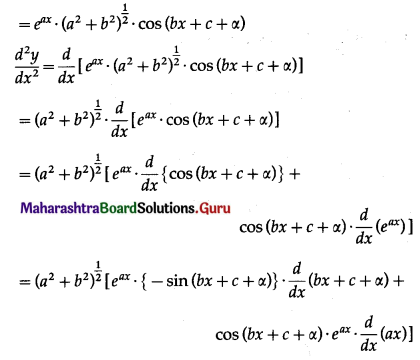
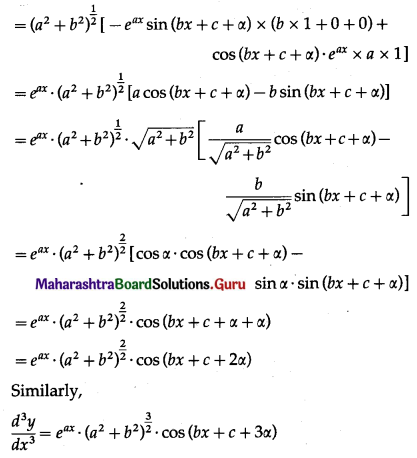
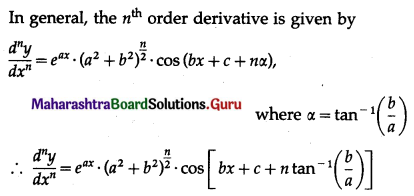
(xi) y = eax . cos (bx + c)
Solution:
y = eax . cos (bx + c)
Maharashtra Board 12th Maths Solutions Chapter 1 Differentiation Ex 1.5 Q4 (xi)
Maharashtra Board 12th Maths Solutions Chapter 1 Differentiation Ex 1.5 Q4 (xi).1
Maharashtra Board 12th Maths Solutions Chapter 1 Differentiation Ex 1.5 Q4 (xi).2
Maharashtra Board 12th Maths Solutions Chapter 1 Differentiation Ex 1.5 Q4 (xi).3
Maharashtra Board 12th Maths Solutions Chapter 1 Differentiation Ex 1.5 Q4 (xi).4

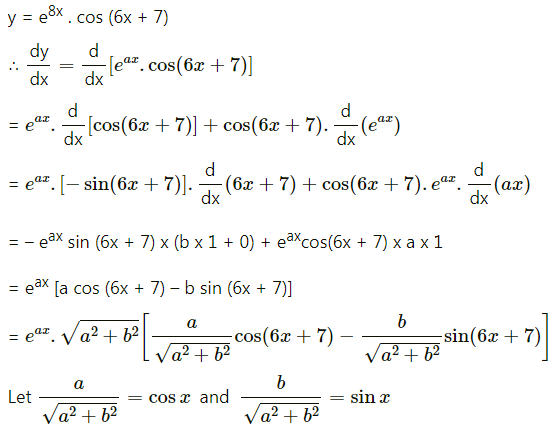
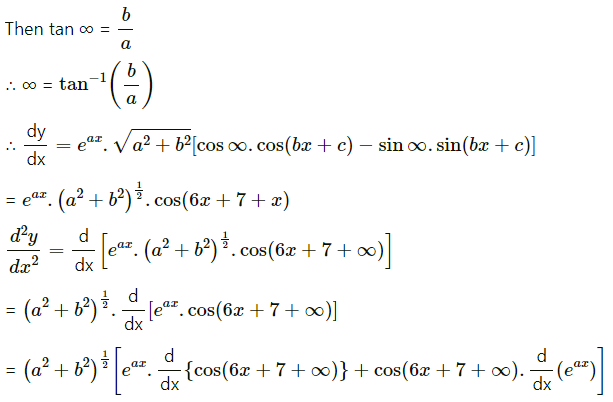
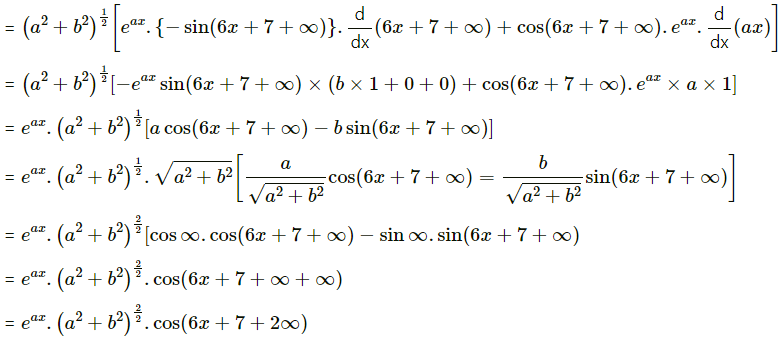
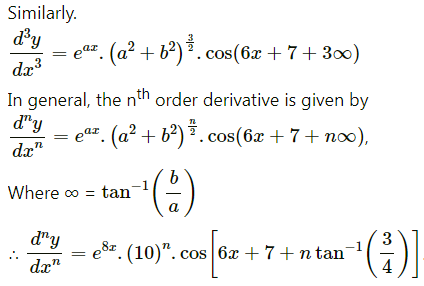
(xii) y = e8x . cos (6x + 7)
Solution:
Maharashtra Board 12th Maths Solutions Chapter 1 Differentiation Ex 1.5 Q4 (xii)
Maharashtra Board 12th Maths Solutions Chapter 1 Differentiation Ex 1.5 Q4 (xii).1
Maharashtra Board 12th Maths Solutions Chapter 1 Differentiation Ex 1.5 Q4 (xii).2
Maharashtra Board 12th Maths Solutions Chapter 1 Differentiation Ex 1.5 Q4 (xii).3

Class 12 Maharashtra State Board Maths Solution 

Differentiation Class 12 Maths 2 Exercise 1.4 Solutions Maharashtra Board

Balbharti 12th Maharashtra State Board Maths Solutions Book Pdf Chapter 1 Differentiation Ex 1.4 Questions and Answers.

12th Maths Part 2 Differentiation Exercise 1.4 Questions And Answers Maharashtra Board

Question 1.
Find \(\frac{d y}{d x}\) if
(i) x = at2, y = 2at
Solution:
x = at2, y = 2at
Differentiating x and y w.r.t. t, we get
Maharashtra Board 12th Maths Solutions Chapter 1 Differentiation Ex 1.4 Q1 (i)

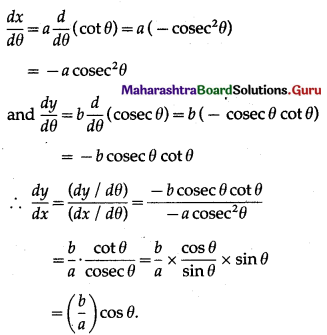
(ii) x = a cot θ, y = b cosec θ
Solution:
x = a cot θ, y = b cosec θ
Differentiating x and y w.r.t. θ, we get
Maharashtra Board 12th Maths Solutions Chapter 1 Differentiation Ex 1.4 Q1 (ii)

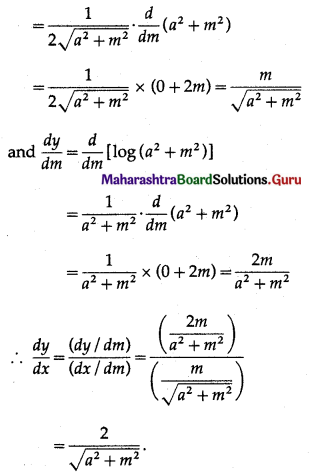
(iii) x = \(\sqrt{a^{2}+m^{2}}\), y = log (a2 + m2)
Solution:
x = \(\sqrt{a^{2}+m^{2}}\), y = log (a2 + m2)
Differentiating x and y w.r.t. m, we get
\(\frac{d x}{d m}=\frac{d}{d m}\left(\sqrt{a^{2}+m^{2}}\right)\)
Maharashtra Board 12th Maths Solutions Chapter 1 Differentiation Ex 1.4 Q1 (iii)

Maharashtra Board 12th Maths Solutions Chapter 1 Differentiation Ex 1.4

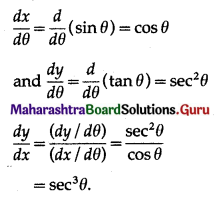
(iv) x = sin θ, y = tan θ
Solution:
x = sin θ, y = tan θ
Differentiating x and y w.r.t. θ, we get
Maharashtra Board 12th Maths Solutions Chapter 1 Differentiation Ex 1.4 Q1 (iv)

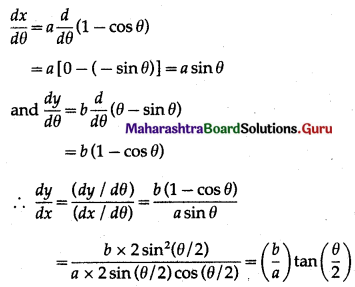
(v) x = a(1 – cos θ), y = b(θ – sin θ)
Solution:
x = a(1 – cos θ), y = b(θ – sin θ)
Differentiating x and y w.r.t. θ, we get
Maharashtra Board 12th Maths Solutions Chapter 1 Differentiation Ex 1.4 Q1 (v)

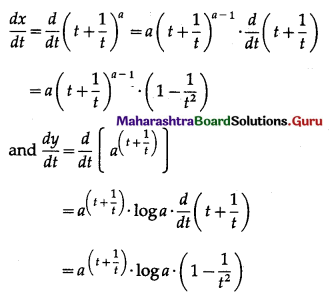
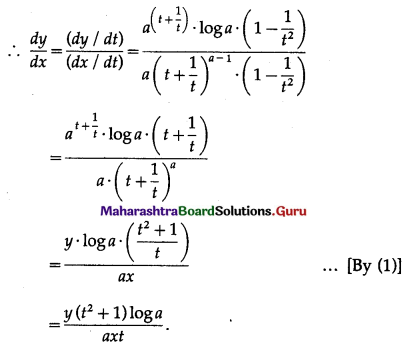
(vi) x = \(\left(t+\frac{1}{t}\right)^{a}\), y = \(a^{t+\frac{1}{t}}\), where a > 0, a ≠ 1 and t ≠ 0
Solution:
x = \(\left(t+\frac{1}{t}\right)^{a}\), y = \(a^{t+\frac{1}{t}}\) ………(1)
Differentiating x and y w.r.t. t, we get
Maharashtra Board 12th Maths Solutions Chapter 1 Differentiation Ex 1.4 Q1 (vi)
Maharashtra Board 12th Maths Solutions Chapter 1 Differentiation Ex 1.4 Q1 (vi).1

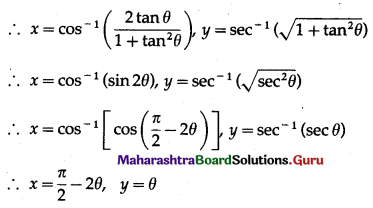
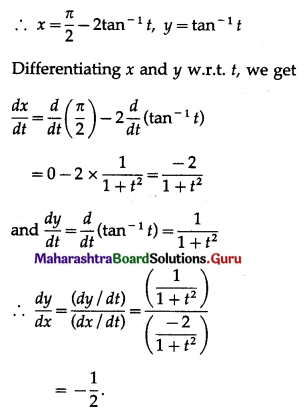
(vii) x = \(\cos ^{-1}\left(\frac{2 t}{1+t^{2}}\right)\), y = \(\sec ^{-1}\left(\sqrt{1+t^{2}}\right)\)
Solution:
x = \(\cos ^{-1}\left(\frac{2 t}{1+t^{2}}\right)\), y = \(\sec ^{-1}\left(\sqrt{1+t^{2}}\right)\)
Put t = tan θ Then θ = tan-1t
Maharashtra Board 12th Maths Solutions Chapter 1 Differentiation Ex 1.4 Q1 (vii)
Maharashtra Board 12th Maths Solutions Chapter 1 Differentiation Ex 1.4 Q1 (vii).1

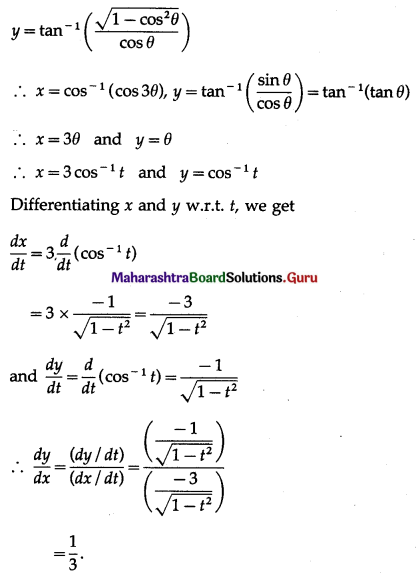
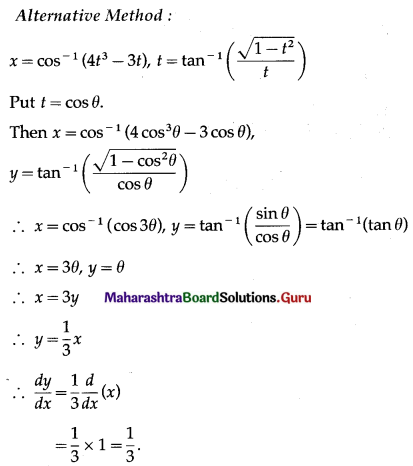
(viii) x = cos-1(4t3 – 3t), y = \(\tan ^{-1}\left(\frac{\sqrt{1-t^{2}}}{t}\right)\)
Solution:
x = cos-1(4t3 – 3t), y = \(\tan ^{-1}\left(\frac{\sqrt{1-t^{2}}}{t}\right)\)
Put t = cos θ. Then θ = cos-1t
x = cos-1(4cos3θ – 3cos θ)
Maharashtra Board 12th Maths Solutions Chapter 1 Differentiation Ex 1.4 Q1 (viii)
Maharashtra Board 12th Maths Solutions Chapter 1 Differentiation Ex 1.4 Q1 (viii).1

Question 2.
Find \(\frac{d y}{d x}\), if
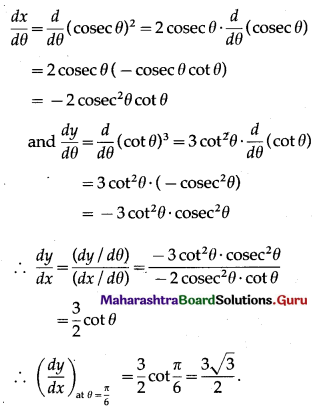
(i) x = cosec2θ, y = cot3θ at θ = \(\frac{\pi}{6}\)
Solution:
x = cosec2θ, y = cot3θ
Differentiating x and y w.r.t. θ, we get
Maharashtra Board 12th Maths Solutions Chapter 1 Differentiation Ex 1.4 Q2 (i)

Maharashtra Board 12th Maths Solutions Chapter 1 Differentiation Ex 1.4

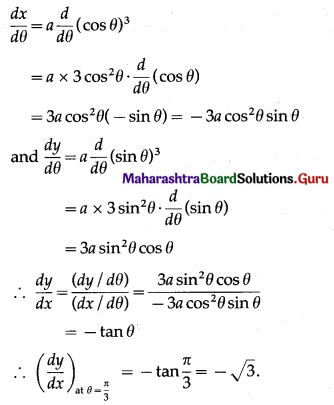
(ii) x = a cos3θ, y = a sin3θ at θ = \(\frac{\pi}{3}\)
Solution:
x = a cos3θ, y = a sin3θ
Differentiating x and y w.r.t. θ, we get
Maharashtra Board 12th Maths Solutions Chapter 1 Differentiation Ex 1.4 Q2 (ii)

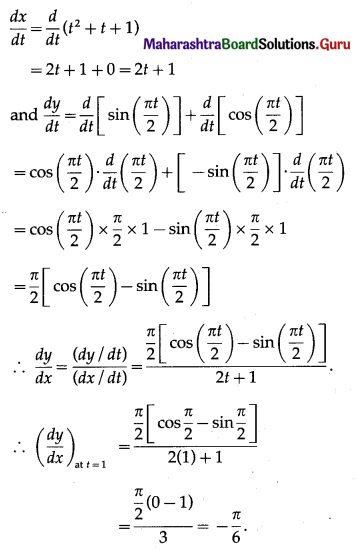
(iii) x = t2 + t + 1, y = sin(\(\frac{\pi t}{2}\)) + cos(\(\frac{\pi t}{2}\)) at t = 1
Solution:
x = t2 + t + 1, y = sin(\(\frac{\pi t}{2}\)) + cos(\(\frac{\pi t}{2}\))
Differentiating x and y w.r.t. t, we get
Maharashtra Board 12th Maths Solutions Chapter 1 Differentiation Ex 1.4 Q2 (iii)

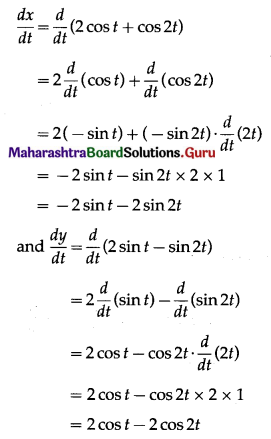
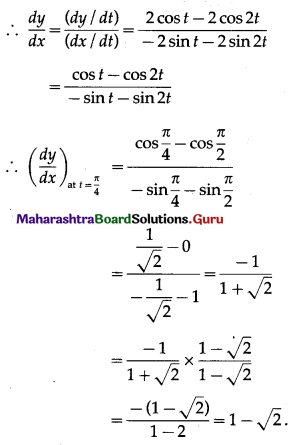
(iv) x = 2 cos t + cos 2t, y = 2 sin t – sin 2t at t = \(\frac{\pi}{4}\)
Solution:
x = 2 cos t + cos 2t, y = 2 sin t – sin 2t
Differentiating x and y w.r.t. t, we get
Maharashtra Board 12th Maths Solutions Chapter 1 Differentiation Ex 1.4 Q2 (iv)
Maharashtra Board 12th Maths Solutions Chapter 1 Differentiation Ex 1.4 Q2 (iv).1

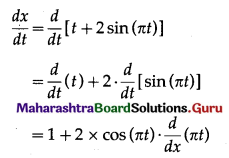
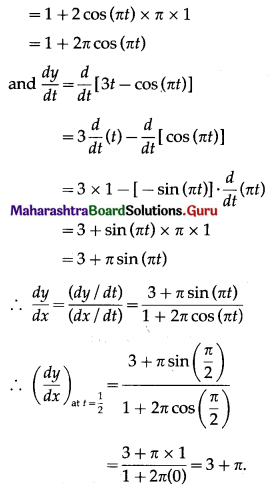
(v) x = t + 2 sin(πt), y = 3t – cos(πt) at t = \(\frac{1}{2}\)
Solution:
x = t + 2 sin(πt), y = 3t – cos(πt)
Differentiating x and y w.r.t. t, we get
Maharashtra Board 12th Maths Solutions Chapter 1 Differentiation Ex 1.4 Q2 (v)
Maharashtra Board 12th Maths Solutions Chapter 1 Differentiation Ex 1.4 Q2 (v).1

Question 3.
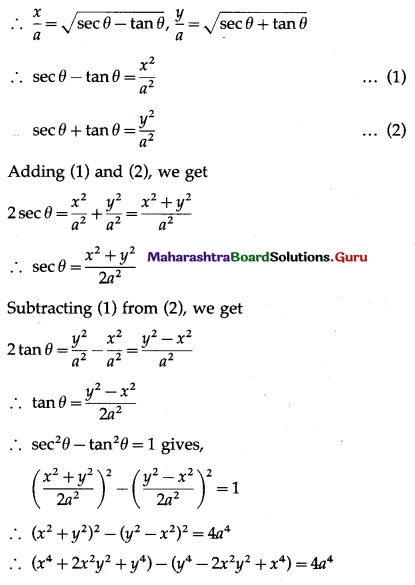
(i) If x = \(a \sqrt{\sec \theta-\tan \theta}\), y = \(a \sqrt{\sec \theta+\tan \theta}\), then show that \(\frac{d y}{d x}=-\frac{y}{x}\)
Solution:
x = \(a \sqrt{\sec \theta-\tan \theta}\), y = \(a \sqrt{\sec \theta+\tan \theta}\)
Maharashtra Board 12th Maths Solutions Chapter 1 Differentiation Ex 1.4 Q3 (i)
Maharashtra Board 12th Maths Solutions Chapter 1 Differentiation Ex 1.4 Q3 (i).1

Maharashtra Board 12th Maths Solutions Chapter 1 Differentiation Ex 1.4

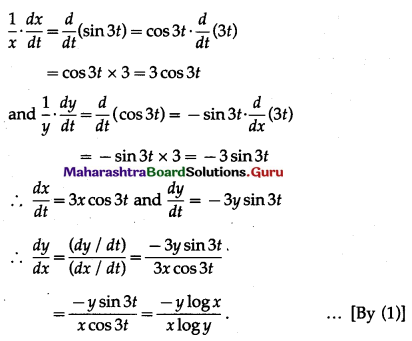
(ii) If x = \(e^{\sin 3 t}\), y = \(e^{\cos 3 t}\), then show that \(\frac{d y}{d x}=-\frac{y \log x}{x \log y}\)
Solution:
x = \(e^{\sin 3 t}\), y = \(e^{\cos 3 t}\)
log x = log \(e^{\sin 3 t}\), log y = log \(e^{\cos 3 t}\)
log x = (sin 3t)(log e), log y = (cos 3t)(log e)
log x = sin 3t, log y = cos 3t ….. (1) [∵ log e = 1]
Differentiating both sides w.r.t. t, we get
Maharashtra Board 12th Maths Solutions Chapter 1 Differentiation Ex 1.4 Q3 (ii)

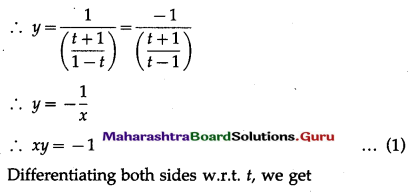
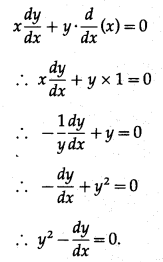
(iii) If x = \(\frac{t+1}{t-1}\), y = \(\frac{1-t}{t+1}\), then show that y2 – \(\frac{d y}{d x}\) = 0.
Solution:
x = \(\frac{t+1}{t-1}\), y = \(\frac{1-t}{t+1}\)
Maharashtra Board 12th Maths Solutions Chapter 1 Differentiation Ex 1.4 Q3 (iii)
Maharashtra Board 12th Maths Solutions Chapter 1 Differentiation Ex 1.4 Q3 (iii).1

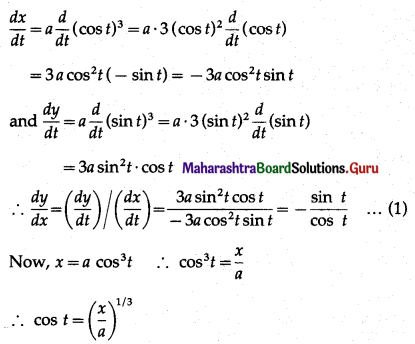
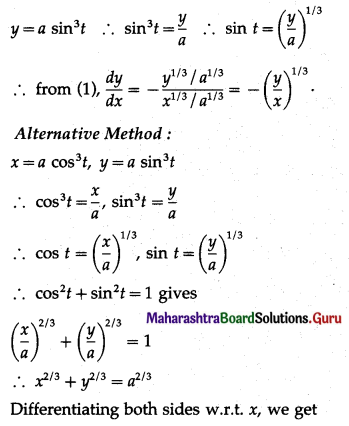
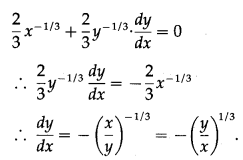
(iv) If x = a cos3t, y = a sin3t, then show that \(\frac{d y}{d x}=-\left(\frac{y}{x}\right)^{\frac{1}{3}}\)
Solution:
x = a cos3t, y = a sin3t
Differentiating x and y w.r.t. t, we get
Maharashtra Board 12th Maths Solutions Chapter 1 Differentiation Ex 1.4 Q3 (iv)
Maharashtra Board 12th Maths Solutions Chapter 1 Differentiation Ex 1.4 Q3 (iv).1
Maharashtra Board 12th Maths Solutions Chapter 1 Differentiation Ex 1.4 Q3 (iv).2

Maharashtra Board 12th Maths Solutions Chapter 1 Differentiation Ex 1.4

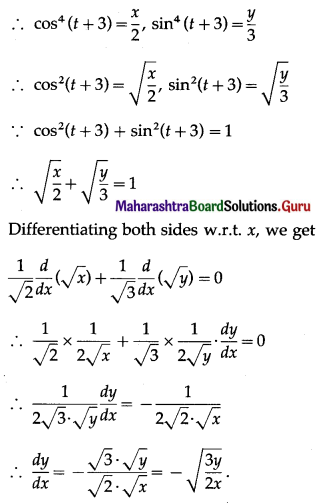
(v) If x = 2 cos4(t + 3), y = 3 sin4(t + 3), show that \(\frac{d y}{d x}=-\sqrt{\frac{3 y}{2 x}}\)
Solution:
x = 2 cos4(t + 3), y = 3 sin4(t + 3)
Maharashtra Board 12th Maths Solutions Chapter 1 Differentiation Ex 1.4 Q3 (v)

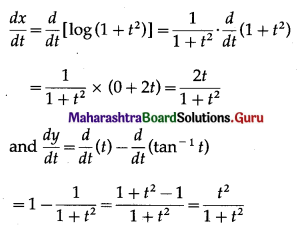
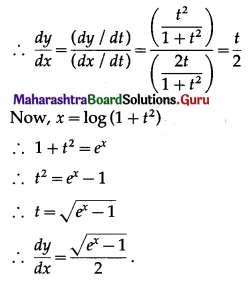
(vi) If x = log (1 + t2), y = t – tan-1t, show that \(\frac{d y}{d x}=\frac{\sqrt{e^{x}-1}}{2}\)
Solution:
x = log (1 + t2), y = t – tan-1t
Differentiating x and y w.r.t. t, we get
Maharashtra Board 12th Maths Solutions Chapter 1 Differentiation Ex 1.4 Q3 (vi)
Maharashtra Board 12th Maths Solutions Chapter 1 Differentiation Ex 1.4 Q3 (vi).1

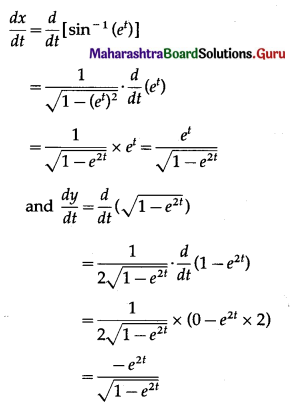
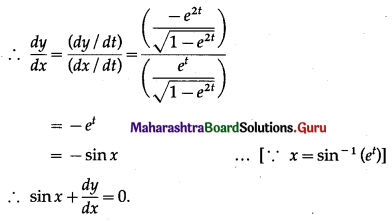
(vii) If x = \(\sin ^{-1}\left(e^{t}\right)\), y = \(\sqrt{1-e^{2 t}}\), show that sin x + \(\frac{d y}{d x}\) = 0
Solution:
x = \(\sin ^{-1}\left(e^{t}\right)\), y = \(\sqrt{1-e^{2 t}}\)
Differentiating x and y w.r.t. t, we get
Maharashtra Board 12th Maths Solutions Chapter 1 Differentiation Ex 1.4 Q3 (vii)
Maharashtra Board 12th Maths Solutions Chapter 1 Differentiation Ex 1.4 Q3 (vii).1

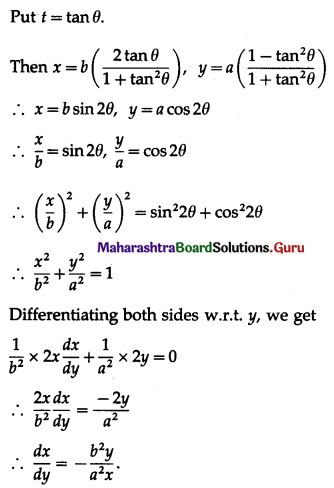
(viii) If x = \(\frac{2 b t}{1+t^{2}}\), y = \(a\left(\frac{1-t^{2}}{1+t^{2}}\right)\), show that \(\frac{d x}{d y}=-\frac{b^{2} y}{a^{2} x}\)
Solution:
x = \(\frac{2 b t}{1+t^{2}}\), y = \(a\left(\frac{1-t^{2}}{1+t^{2}}\right)\)
Maharashtra Board 12th Maths Solutions Chapter 1 Differentiation Ex 1.4 Q3 (viii)

Question 4.
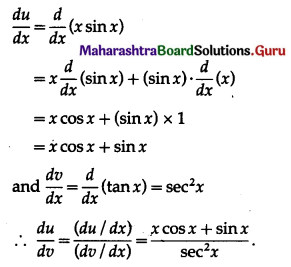
(i) Differentiate x sin x w.r.t tan x.
Solution:
Let u = x sinx and v = tan x
Then we want to find \(\frac{d u}{d v}\)
Differentiating u and v w.r.t. x, we get
Maharashtra Board 12th Maths Solutions Chapter 1 Differentiation Ex 1.4 Q4 (i)

Maharashtra Board 12th Maths Solutions Chapter 1 Differentiation Ex 1.4

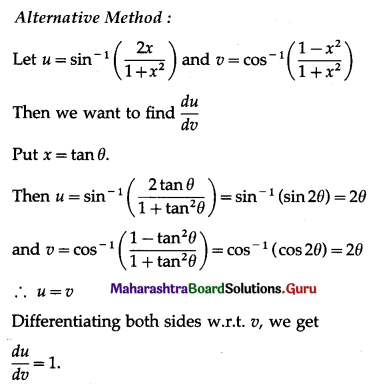
(ii) Differentiate \(\sin ^{-1}\left(\frac{2 x}{1+x^{2}}\right)\) w.r.t \(\cos ^{-1}\left(\frac{1-x^{2}}{1+x^{2}}\right)\)
Solution:
Let u = \(\sin ^{-1}\left(\frac{2 x}{1+x^{2}}\right)\) and v = \(\cos ^{-1}\left(\frac{1-x^{2}}{1+x^{2}}\right)\)
Then we want to find \(\frac{d u}{d v}\)
Maharashtra Board 12th Maths Solutions Chapter 1 Differentiation Ex 1.4 Q4 (ii)
Maharashtra Board 12th Maths Solutions Chapter 1 Differentiation Ex 1.4 Q4 (ii).1

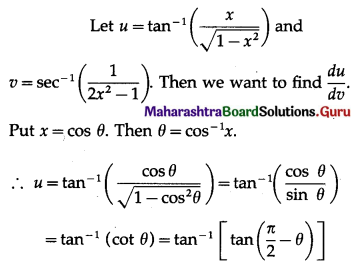
(iii) Differentiate \(\tan ^{-1}\left(\frac{x}{\sqrt{1-x^{2}}}\right)\) w.r.t \(\sec ^{-1}\left(\frac{1}{2 x^{2}-1}\right)\)
Solution:
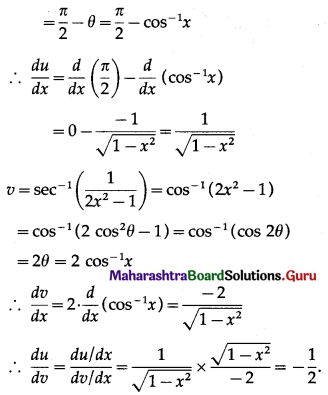
Maharashtra Board 12th Maths Solutions Chapter 1 Differentiation Ex 1.4 Q4 (iii)
Maharashtra Board 12th Maths Solutions Chapter 1 Differentiation Ex 1.4 Q4 (iii).1

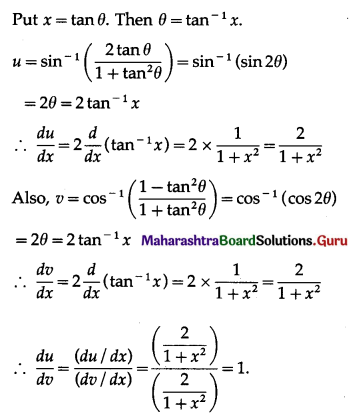
(iv) Differentiate \(\cos ^{-1}\left(\frac{1-x^{2}}{1+x^{2}}\right)\) w.r.t. tan-1x
Solution:
Let u = \(\cos ^{-1}\left(\frac{1-x^{2}}{1+x^{2}}\right)\) and v = tan-1x
Then we want to find \(\frac{d u}{d v}\)
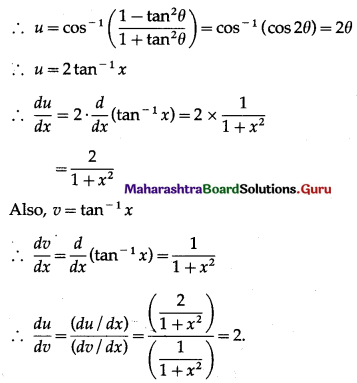
Put x = tan θ. Then θ = tan-1x.
Maharashtra Board 12th Maths Solutions Chapter 1 Differentiation Ex 1.4 Q4 (iv)

(v) Differentiate 3x w.r.t. logx3.
Solution:
Let u = 3x and v = logx3.
Then we want to find \(\frac{d u}{d v}\)
Differentiating u and v w.r.t. x, we get
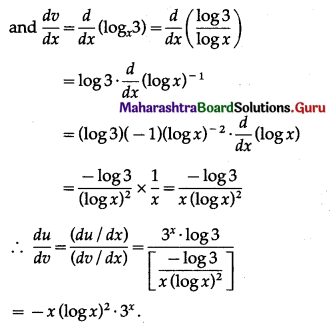
\(\frac{d u}{d x}=\frac{d}{d x}\left(3^{x}\right)=3^{x} \cdot \log 3\)
Maharashtra Board 12th Maths Solutions Chapter 1 Differentiation Ex 1.4 Q4 (v)

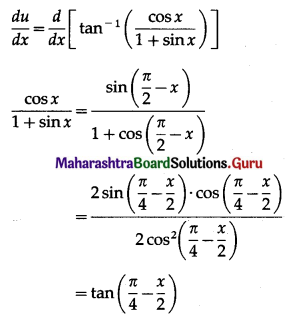
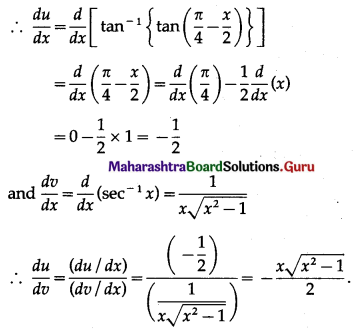
(vi) Differentiate \(\tan ^{-1}\left(\frac{\cos x}{1+\sin x}\right)\) w.r.t. sec-1x.
Solution:
Let u = \(\tan ^{-1}\left(\frac{\cos x}{1+\sin x}\right)\) and v = sec-1x
Then we want to find \(\frac{d u}{d v}\).
Differentiating u and v w.r.t. x, we get
Maharashtra Board 12th Maths Solutions Chapter 1 Differentiation Ex 1.4 Q4 (vi)
Maharashtra Board 12th Maths Solutions Chapter 1 Differentiation Ex 1.4 Q4 (vi).1

Maharashtra Board 12th Maths Solutions Chapter 1 Differentiation Ex 1.4

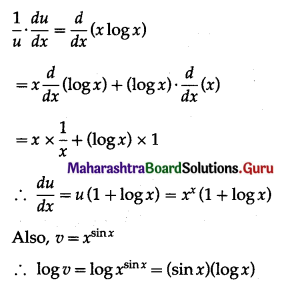
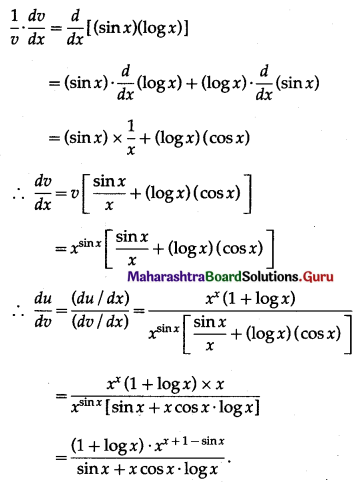
(vii) Differentiate xx w.r.t. xsin x.
Solution:
Let u = xx and v = xsin x
Then we want to find \(\frac{d u}{d x}\).
Take, u = xx
log u = log xx = x log x
Differentiating both sides w.r.t. x, we get
Maharashtra Board 12th Maths Solutions Chapter 1 Differentiation Ex 1.4 Q4 (vii)
Maharashtra Board 12th Maths Solutions Chapter 1 Differentiation Ex 1.4 Q4 (vii).1

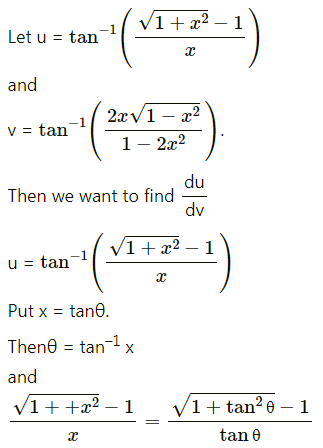
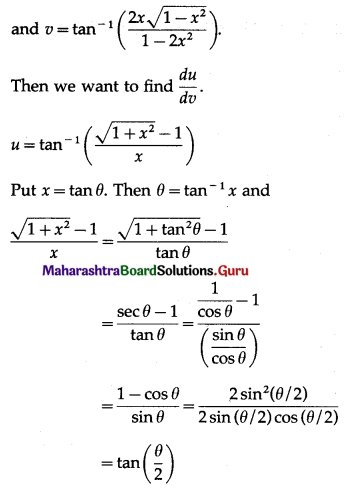
(viii) Differentiate \(\tan ^{-1}\left(\frac{\sqrt{1+x^{2}}-1}{x}\right)\) w.r.t. \(\tan ^{-1}\left(\frac{2 x \sqrt{1-x^{2}}}{1-2 x^{2}}\right)\)
Solution:
Let u = \(\tan ^{-1}\left(\frac{\sqrt{1+x^{2}}-1}{x}\right)\) and v = \(\tan ^{-1}\left(\frac{2 x \sqrt{1-x^{2}}}{1-2 x^{2}}\right)\)
Then we want to find \(\frac{d u}{d v}\)
u = \(\tan ^{-1}\left(\frac{\sqrt{1+x^{2}}-1}{x}\right)\)
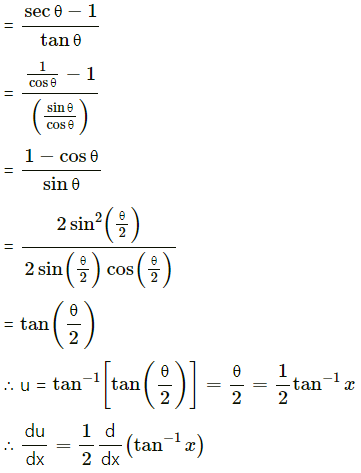
Put x = tan θ. Then θ = tan-1x and
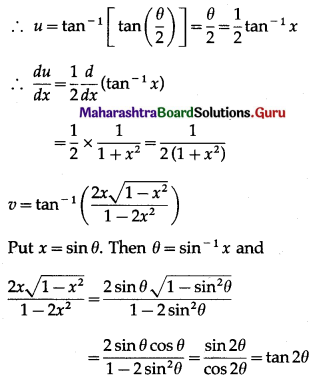
Maharashtra Board 12th Maths Solutions Chapter 1 Differentiation Ex 1.4 Q4 (viii)
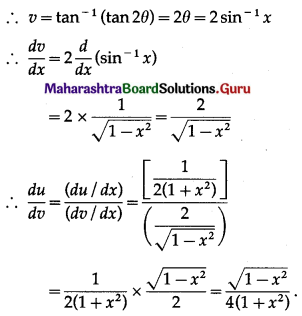
Maharashtra Board 12th Maths Solutions Chapter 1 Differentiation Ex 1.4 Q4 (viii).1
Maharashtra Board 12th Maths Solutions Chapter 1 Differentiation Ex 1.4 Q4 (viii).2

Class 12 Maharashtra State Board Maths Solution 

Differentiation Class 12 Maths 2 Exercise 1.3 Solutions Maharashtra Board

Balbharti 12th Maharashtra State Board Maths Solutions Book Pdf Chapter 1 Differentiation Ex 1.3 Questions and Answers.

12th Maths Part 2 Differentiation Exercise 1.3 Questions And Answers Maharashtra Board

Question 1.
Differentiate the following w.r.t. x:
(i) \(\frac{(x+1)^{2}}{(x+2)^{3}(x+3)^{4}}\)
Solution:
Let y = \(\frac{(x+1)^{2}}{(x+2)^{3}(x+3)^{4}}\)
Then, log y = log [latex]\frac{(x+1)^{2}}{(x+2)^{3}(x+3)^{4}}[/latex]
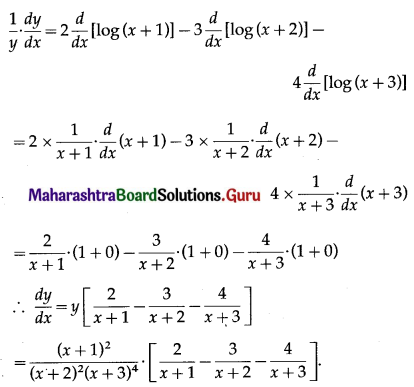
= log (x + 1)2 – log (x + 2)3 – log (x + 3)4
= 2 log (x +1) – 3 log (x + 2) – 4 log (x + 3)
Differentiating both sides w.r.t. x, we get
Maharashtra Board 12th Maths Solutions Chapter 1 Differentiation Ex 1.3 Q1 (i)

(ii) \(\sqrt[3]{\frac{4 x-1}{(2 x+3)(5-2 x)^{2}}}\)
Solution:
Let y = \(\sqrt[3]{\frac{4 x-1}{(2 x+3)(5-2 x)^{2}}}\)
Then log y = log [latex]\sqrt[3]{\frac{4 x-1}{(2 x+3)(5-2 x)^{2}}}[/latex]
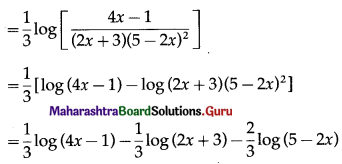
Maharashtra Board 12th Maths Solutions Chapter 1 Differentiation Ex 1.3 Q1 (ii)
Differentiating both sides w.r.t. x, we get
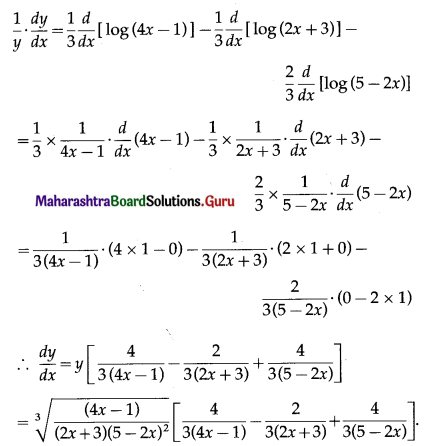
Maharashtra Board 12th Maths Solutions Chapter 1 Differentiation Ex 1.3 Q1 (ii).1

Maharashtra Board 12th Maths Solutions Chapter 1 Differentiation Ex 1.3

(iii) \(\left(x^{2}+3\right)^{\frac{3}{2}} \cdot \sin ^{3} 2 x \cdot 2^{x^{2}}\)
Solution:
Let y = \(\left(x^{2}+3\right)^{\frac{3}{2}} \cdot \sin ^{3} 2 x \cdot 2^{x^{2}}\)
Then log y = log [latex]\left(x^{2}+3\right)^{\frac{3}{2}} \cdot \sin ^{3} 2 x \cdot 2^{x^{2}}[/latex]
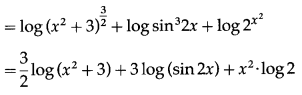
Maharashtra Board 12th Maths Solutions Chapter 1 Differentiation Ex 1.3 Q1 (iii)
Differentiating both sides w.r.t. x, we get
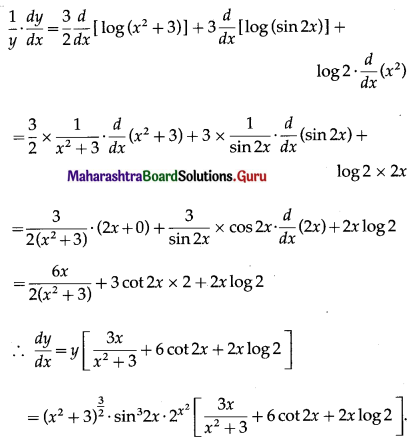
Maharashtra Board 12th Maths Solutions Chapter 1 Differentiation Ex 1.3 Q1 (iii).1

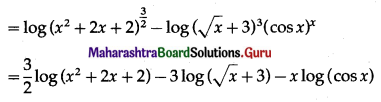
(iv) \(\frac{\left(x^{2}+2 x+2\right)^{\frac{3}{2}}}{(\sqrt{x}+3)^{3}(\cos x)^{x}}\)
Solution:
Let y = \(\frac{\left(x^{2}+2 x+2\right)^{\frac{3}{2}}}{(\sqrt{x}+3)^{3}(\cos x)^{x}}\)
Then log y = log [latex]\frac{\left(x^{2}+2 x+2\right)^{\frac{3}{2}}}{(\sqrt{x}+3)^{3}(\cos x)^{x}}[/latex]
Maharashtra Board 12th Maths Solutions Chapter 1 Differentiation Ex 1.3 Q1 (iv)
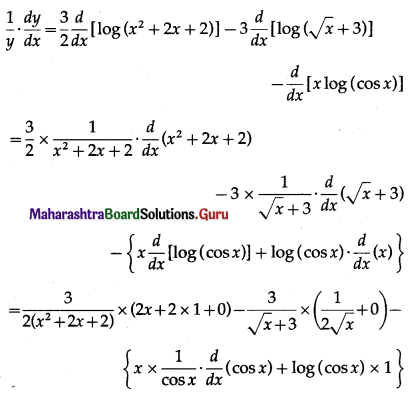
Differentiating both sides w.r.t. x, we get
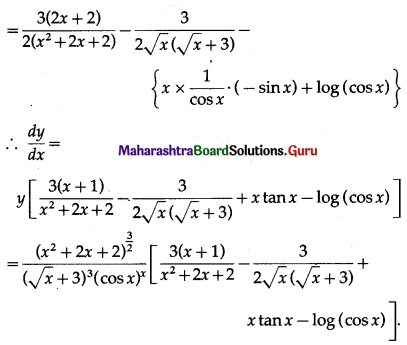
Maharashtra Board 12th Maths Solutions Chapter 1 Differentiation Ex 1.3 Q1 (iv).1
Maharashtra Board 12th Maths Solutions Chapter 1 Differentiation Ex 1.3 Q1 (iv).2

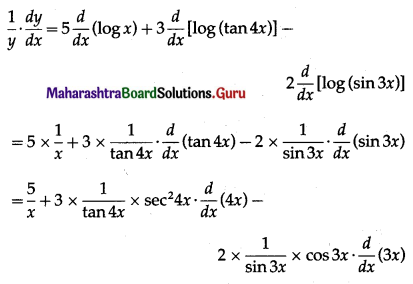
(v) \(\frac{x^{5} \cdot \tan ^{3} 4 x}{\sin ^{2} 3 x}\)
Solution:
Let y = \(\frac{x^{5} \cdot \tan ^{3} 4 x}{\sin ^{2} 3 x}\)
Then log y = log [latex]\frac{x^{5} \cdot \tan ^{3} 4 x}{\sin ^{2} 3 x}[/latex]
= log x5 + log tan34x – log sin23x
= 5 log x+ 3 log (tan 4x) – 2 log (sin 3x)
Differentiating both sides w.r.t. x, we get
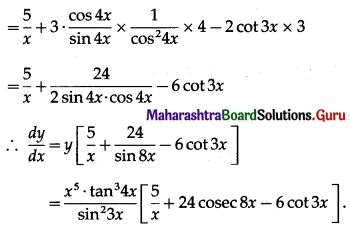
Maharashtra Board 12th Maths Solutions Chapter 1 Differentiation Ex 1.3 Q1 (v)
Maharashtra Board 12th Maths Solutions Chapter 1 Differentiation Ex 1.3 Q1 (v).1

(vi) \(x^{\tan ^{-1} x}\)
Solution:
Let y = \(x^{\tan ^{-1} x}\)
Then log y = log (\(x^{\tan ^{-1} x}\)) = (tan-1 x)(log x)
Differentiating both sides w.r.t. x, we get
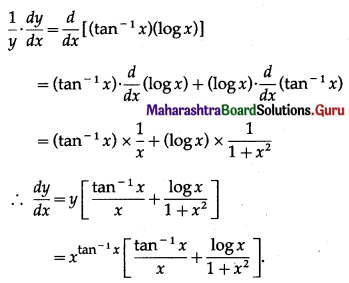
Maharashtra Board 12th Maths Solutions Chapter 1 Differentiation Ex 1.3 Q1 (vi)

(vii) (sin x)x
Solution:
Let y = (sin x)x
Then log y = log (sin x)x = x . log (sin x)
Differentiating both sides w.r.t. x, we get
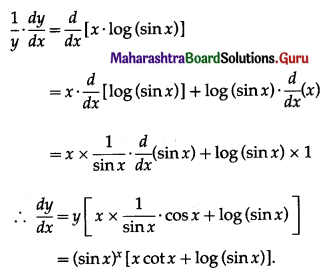
Maharashtra Board 12th Maths Solutions Chapter 1 Differentiation Ex 1.3 Q1 (vii)

(viii) sin xx
Solution:
Let y = (sin xx)
Then \(\frac{d y}{d x}=\frac{d}{d x}\left[\left(\sin x^{x}\right)\right]\)
\(\frac{d y}{d x}=\cos \left(x^{x}\right) \cdot \frac{d}{d x}\left(x^{x}\right)\) ……. (1)
Let u = xx
Then log u = log xx = x . log x
Differentiating both sides w.r.t. x, we get
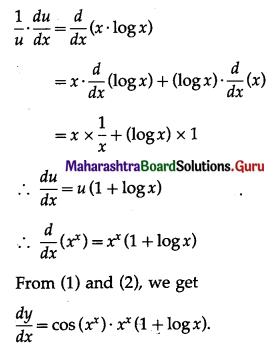
Maharashtra Board 12th Maths Solutions Chapter 1 Differentiation Ex 1.3 Q1 (viii)

Maharashtra Board 12th Maths Solutions Chapter 1 Differentiation Ex 1.3

Question 2.
Differentiate the following w.r.t. x:
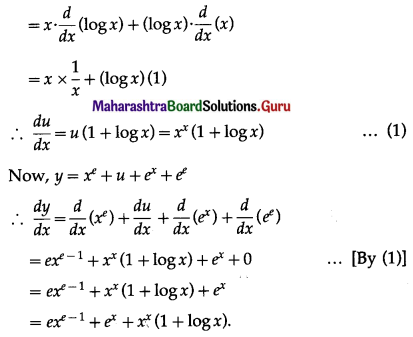
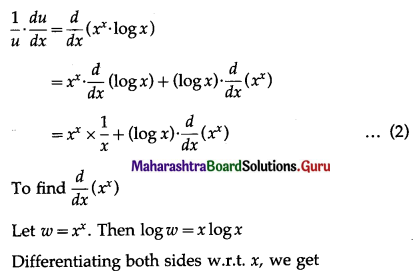
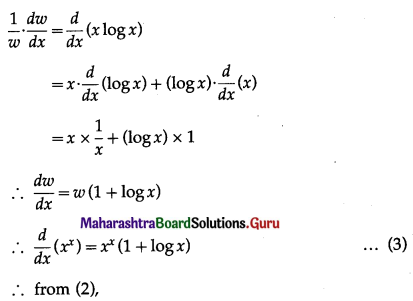
(i) xe + xx + ex + ee
Solution:
Let y = xe + xx + ex + ee
Let u = xx
Then log u = log xx = x log x
Differentiating both sides w.r.t. x, we get
\(\frac{1}{u} \cdot \frac{d u}{d x}=\frac{d}{d x}(x \log x)\)
Maharashtra Board 12th Maths Solutions Chapter 1 Differentiation Ex 1.3 Q2 (i)

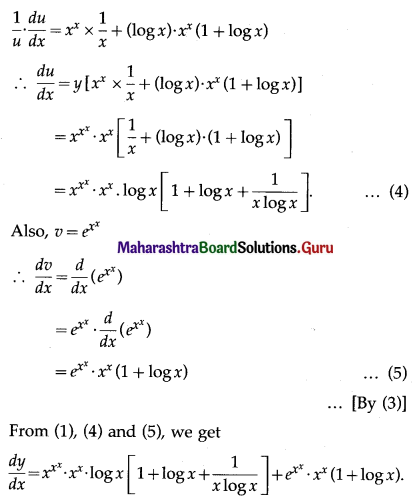
(ii) \(x^{x^{x}}+e^{x^{x}}\)
Solution:
Let y = \(x^{x^{x}}+e^{x^{x}}\)
Put u = \(x^{x^{x}}\) and v = \(e^{x^{x}}\)
Then y = u + v
∴ \(\frac{d y}{d x}=\frac{d u}{d x}+\frac{d v}{d x}\)
Take u = \(x^{x^{x}}\)
log u = log \(x^{x^{x}}\) = xx . log x
Differentiating both sides w.r.t. x, we get
Maharashtra Board 12th Maths Solutions Chapter 1 Differentiation Ex 1.3 Q2 (ii)
Maharashtra Board 12th Maths Solutions Chapter 1 Differentiation Ex 1.3 Q2 (ii).1
Maharashtra Board 12th Maths Solutions Chapter 1 Differentiation Ex 1.3 Q2 (ii).2

(iii) (log x)x – (cos x)cot x
Solution:
Let y = (log x)x – (cos x)cot x
Put u = (log x)x and v = (cos x)cot x
Then y = u – v
∴ \(\frac{d y}{d x}=\frac{d u}{d x}-\frac{d v}{d x}\) ……..(1)
Take u = (log x)x
∴ log u = log (log x)x = x . log (log x)
Differentiating both sides w.r.t. x, we get
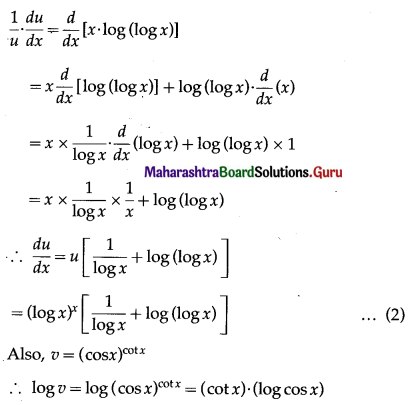
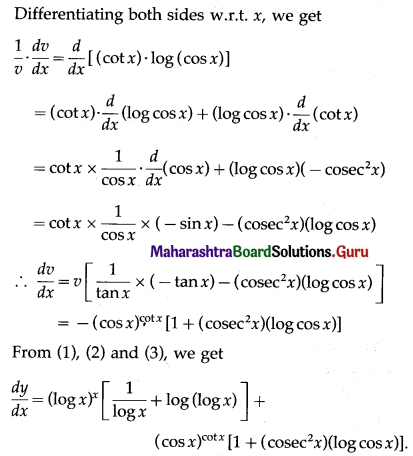
Maharashtra Board 12th Maths Solutions Chapter 1 Differentiation Ex 1.3 Q2 (iii)
Maharashtra Board 12th Maths Solutions Chapter 1 Differentiation Ex 1.3 Q2 (iii).1

(iv) \(x^{e^{x}}+(\log x)^{\sin x}\)
Solution:
Let y = \(x^{e^{x}}+(\log x)^{\sin x}\)
Put u = \(x^{e^{x}}\) and v = (log x)sin x
Then y = u + v
∴ \(\frac{d y}{d x}=\frac{d u}{d x}+\frac{d v}{d x}\) ……….(1)
Take u = \(x^{e^{x}}\)
∴ log u = log \(x^{e^{x}}\) = ex . log x
Differentiating both sides w.r.t. x, we get
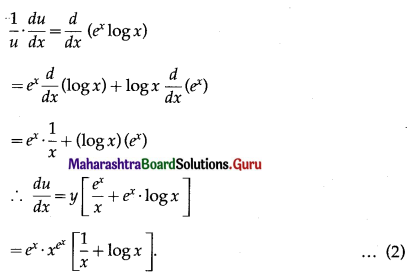
Maharashtra Board 12th Maths Solutions Chapter 1 Differentiation Ex 1.3 Q2 (iv)
Also, v = (log x)sin x
∴ log v = log (log x)sin x = (sin x) . (log log x)
Differentiating both sides w.r.t. x, we get
\(\frac{1}{v} \cdot \frac{d v}{d x}=\frac{d}{d x}[(\sin x) \cdot(\log \log x)]\)
= \((\sin x) \cdot \frac{d}{d x}\left[(\log \log x)+(\log \log x) \cdot \frac{d}{d x}(\sin x)\right]\)
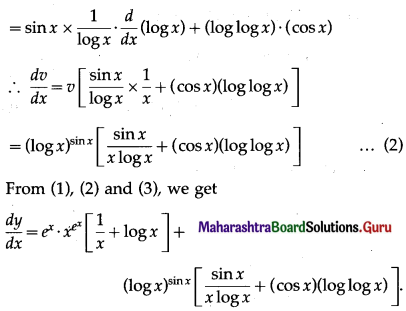
Maharashtra Board 12th Maths Solutions Chapter 1 Differentiation Ex 1.3 Q2 (iv).1

Maharashtra Board 12th Maths Solutions Chapter 1 Differentiation Ex 1.3

(v) \(e^{\tan x}+(\log x)^{\tan x}\)
Solution:
Let y = \(e^{\tan x}+(\log x)^{\tan x}\)
Put u = (log x)tan x
∴ log u =log(log x)tan x = (tan x).(log log x)
Differentiating both sides w.r.t. x, we get
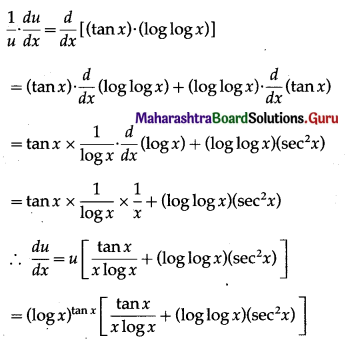
Maharashtra Board 12th Maths Solutions Chapter 1 Differentiation Ex 1.3 Q2 (v)
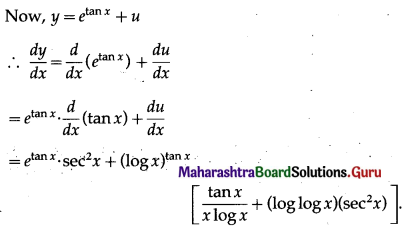
Maharashtra Board 12th Maths Solutions Chapter 1 Differentiation Ex 1.3 Q2 (v).1

(vi) (sin x)tan x + (cos x)cot x
Solution:
Let y = (sin x)tan x + (cos x)cot x
Put u = (sin x)tan x and v = (cos x)cot x
Then y = u + v
∴ \(\frac{d y}{d x}=\frac{d u}{d x}+\frac{d v}{d x}\) ………(1)
Take u = (sin x)tan x
∴ log u = log (sin x)tan x = (tan x) . (log sin x)
Differentiating both sides w.r.t. x, we get
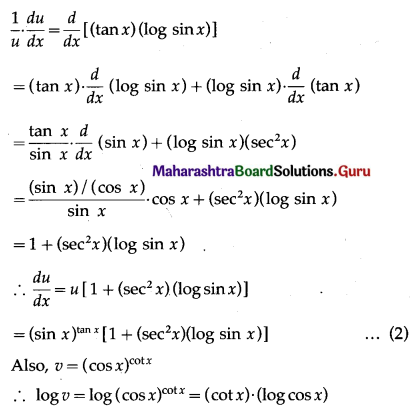
Maharashtra Board 12th Maths Solutions Chapter 1 Differentiation Ex 1.3 Q2 (vi)
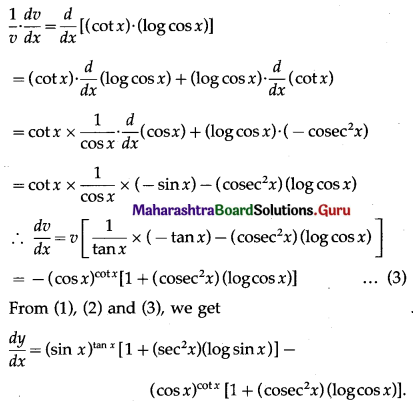
Maharashtra Board 12th Maths Solutions Chapter 1 Differentiation Ex 1.3 Q2 (vi).1

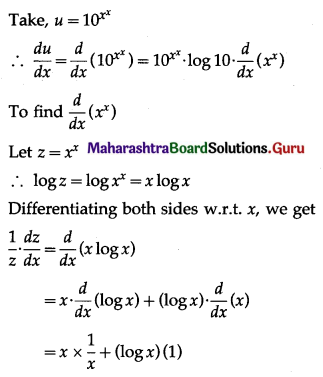
(vii) \(10^{x^{x}}+x^{x^{10}}+x^{10^{x}}\)
Solution:
Let y = \(10^{x^{x}}+x^{x^{10}}+x^{10^{x}}\)
Put u = \(10^{x^{x}}\), v = \(x^{x^{10}}\) and w = \(x^{10^{x}}\)
Then y = u + v + w
∴ \(\frac{d y}{d x}=\frac{d u}{d x}+\frac{d v}{d x}+\frac{d w}{d x}\) ………(1)
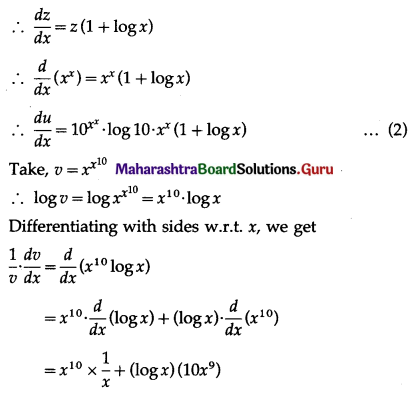
Maharashtra Board 12th Maths Solutions Chapter 1 Differentiation Ex 1.3 Q2 (vii)
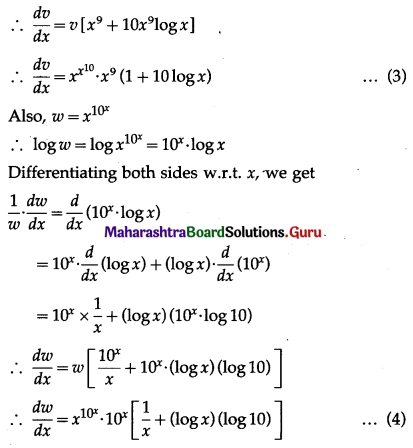
Maharashtra Board 12th Maths Solutions Chapter 1 Differentiation Ex 1.3 Q2 (vii).1
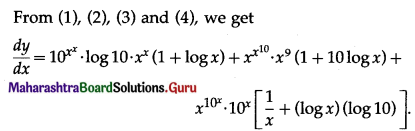
Maharashtra Board 12th Maths Solutions Chapter 1 Differentiation Ex 1.3 Q2 (vii).2
Maharashtra Board 12th Maths Solutions Chapter 1 Differentiation Ex 1.3 Q2 (vii).3

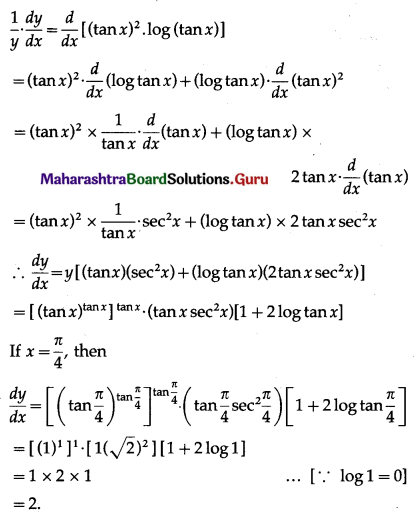
(viii) \(\left[(\tan x)^{\tan x}\right]^{\tan x}\) at x = \(\frac{\pi}{4}\)
Solution:
Let y = \(\left[(\tan x)^{\tan x}\right]^{\tan x}\)
∴ log y = log [latex]\left[(\tan x)^{\tan x}\right]^{\tan x}[/latex]
= tan x . log(tan x)tan x
= tan x . tan x log (tan x)
= (tan x)2 . log (tan x)
Differentiating both sides w.r.t. x, we get
Maharashtra Board 12th Maths Solutions Chapter 1 Differentiation Ex 1.3 Q2 (viii)

Question 3.
Find \(\frac{d y}{d x}\) if
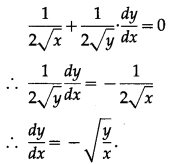
(i) √x + √y = √a
Solution:
√x + √y = √a
Differentiating both sides w.r.t. x, we get
Maharashtra Board 12th Maths Solutions Chapter 1 Differentiation Ex 1.3 Q3 (i)

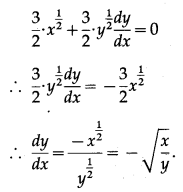
(ii) x√x + y√y = a√a
Solution:
x√x + y√y = a√a
∴ \(x^{\frac{3}{2}}+y^{\frac{3}{2}}=a^{\frac{3}{2}}\)
Differentiating both sides w.r.t. x, we get
Maharashtra Board 12th Maths Solutions Chapter 1 Differentiation Ex 1.3 Q3 (ii)

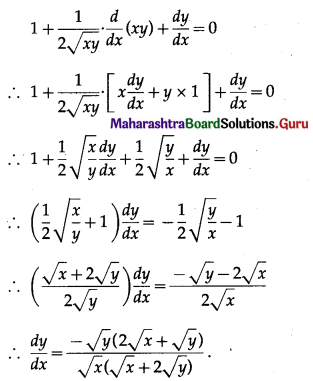
(iii) x + √xy + y = 1
Solution:
x + √xy + y = 1
Differentiating both sides w.r.t. x, we get
Maharashtra Board 12th Maths Solutions Chapter 1 Differentiation Ex 1.3 Q3 (iii)

Maharashtra Board 12th Maths Solutions Chapter 1 Differentiation Ex 1.3

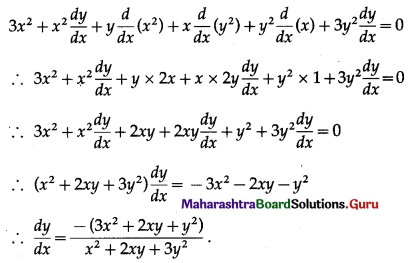
(iv) x3 + x2y + xy2 + y3 = 81
Solution:
x3 + x2y + xy2 + y3 = 81
Differentiating both sides w.r.t. x, we get
Maharashtra Board 12th Maths Solutions Chapter 1 Differentiation Ex 1.3 Q3 (iv)

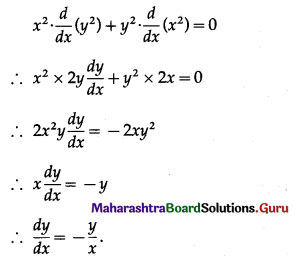
(v) x2y2 – tan-1(\(\sqrt{x^{2}+y^{2}}\)) = cot-1(\(\sqrt{x^{2}+y^{2}}\))
Solution:
x2y2 – tan-1(\(\sqrt{x^{2}+y^{2}}\)) = cot-1(\(\sqrt{x^{2}+y^{2}}\))
∴ x2y2 = tan-1(\(\sqrt{x^{2}+y^{2}}\)) + cot-1(\(\sqrt{x^{2}+y^{2}}\))
∴ x2y2 = \(\frac{\pi}{2}\) …….[∵ \(\tan ^{-1} x+\cot ^{-1} x=\frac{\pi}{2}\)]
Differentiating both sides w.r.t. x, we get
Maharashtra Board 12th Maths Solutions Chapter 1 Differentiation Ex 1.3 Q3 (v)

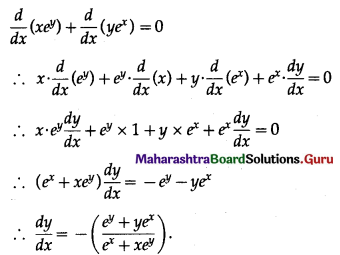
(vi) xey + yex = 1
Solution:
xey + yex = 1
Differentiating both sides w.r.t. x, we get
Maharashtra Board 12th Maths Solutions Chapter 1 Differentiation Ex 1.3 Q3 (vi)

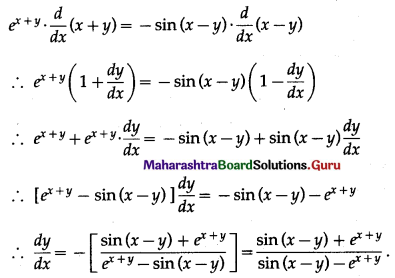
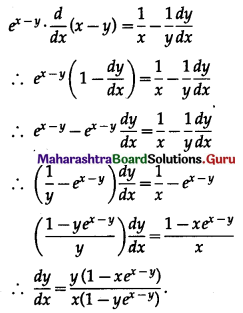
(vii) ex+y = cos (x – y)
Solution:
ex+y = cos (x – y)
Differentiating both sides w.r.t. x, we get
Maharashtra Board 12th Maths Solutions Chapter 1 Differentiation Ex 1.3 Q3 (vii)

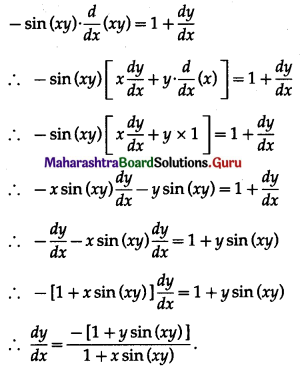
(viii) cos (xy) = x + y
Solution:
cos (xy) = x + y
Differentiating both sides w.r.t. x, we get
Maharashtra Board 12th Maths Solutions Chapter 1 Differentiation Ex 1.3 Q3 (viii)

(ix) \(e^{e^{x-y}}=\frac{x}{y}\)
Solution:
\(e^{e^{x-y}}=\frac{x}{y}\)
∴ ex-y = log(\(\frac{x}{y}\)) …….[ex = y ⇒ x = log y]
∴ ex-y = log x – log y
Differentiating both sides w.r.t. x, we get
Maharashtra Board 12th Maths Solutions Chapter 1 Differentiation Ex 1.3 Q3 (ix)

Question 4.
Show that \(\frac{d y}{d x}=\frac{y}{x}\) in the following, where a and p are constants.
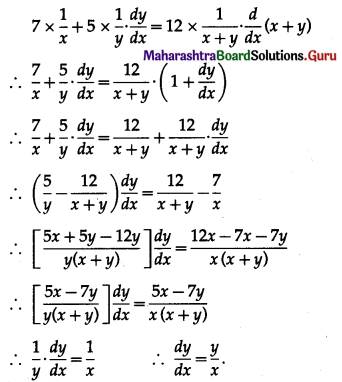
(i) x7y5 = (x + y)12
Solution:
x7y5 = (x + y)12
(log x7y5) = log(x + y)12
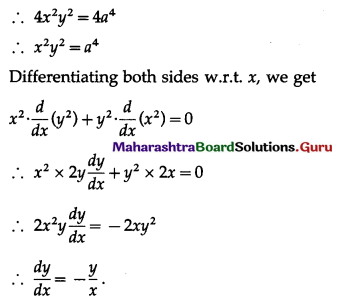
log x7 + log y5 = log(x + y)12
7 log x + 5 log y = 12 log (x + y)
Differentiating both sides w.r.t. x, we get
Maharashtra Board 12th Maths Solutions Chapter 1 Differentiation Ex 1.3 Q4 (i)

Maharashtra Board 12th Maths Solutions Chapter 1 Differentiation Ex 1.3

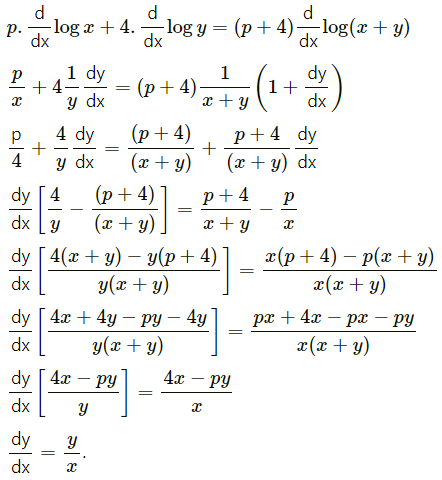
(ii) xpy4 = (x + y)p+4, p∈N
Solution:
xpy4 = (x + y)p+4
Taking log
log (xpy4) = log(x + y)p+4
log xp + log y4 = (p + 4) log(x + y)
p log x + 4 log y = (p + 4) log(x + y)
Differentiating both sides w.r.t. x, we get
Maharashtra Board 12th Maths Solutions Chapter 1 Differentiation Ex 1.3 Q4 (ii)

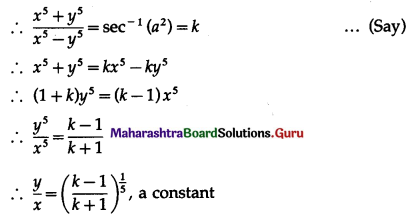
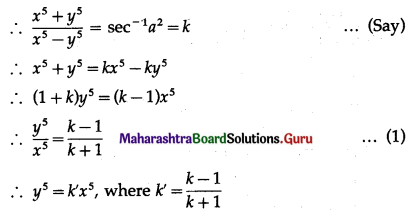
(iii) \(\sec \left(\frac{x^{5}+y^{5}}{x^{5}-y^{5}}\right)=a^{2}\)
Solution:
\(\sec \left(\frac{x^{5}+y^{5}}{x^{5}-y^{5}}\right)=a^{2}\)
Maharashtra Board 12th Maths Solutions Chapter 1 Differentiation Ex 1.3 Q4 (iii)
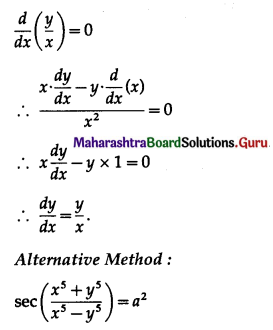
Differentiating both sides w.r.t. x, we get
Maharashtra Board 12th Maths Solutions Chapter 1 Differentiation Ex 1.3 Q4 (iii).1
Maharashtra Board 12th Maths Solutions Chapter 1 Differentiation Ex 1.3 Q4 (iii).2
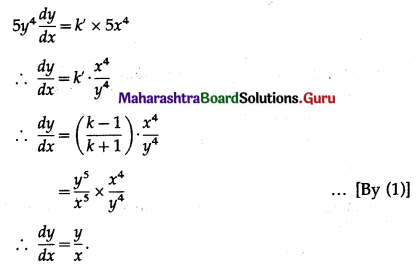
Differentiating both sides w.r.t. x, we get
Maharashtra Board 12th Maths Solutions Chapter 1 Differentiation Ex 1.3 Q4 (iii).3

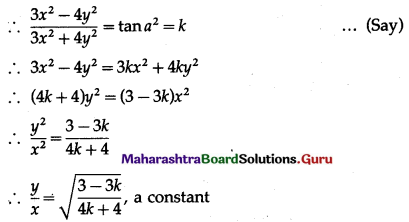
(iv) \(\tan ^{-1}\left(\frac{3 x^{2}-4 y^{2}}{3 x^{2}+4 y^{2}}\right)=a^{2}\)
Solution:
\(\tan ^{-1}\left(\frac{3 x^{2}-4 y^{2}}{3 x^{2}+4 y^{2}}\right)=a^{2}\)
Maharashtra Board 12th Maths Solutions Chapter 1 Differentiation Ex 1.3 Q4 (iv)
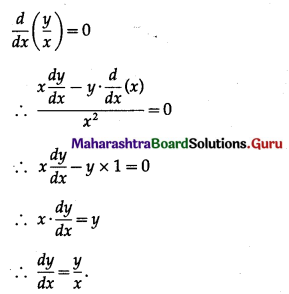
Differentiating both sides w.r.t. x, we get
Maharashtra Board 12th Maths Solutions Chapter 1 Differentiation Ex 1.3 Q4 (iv).1

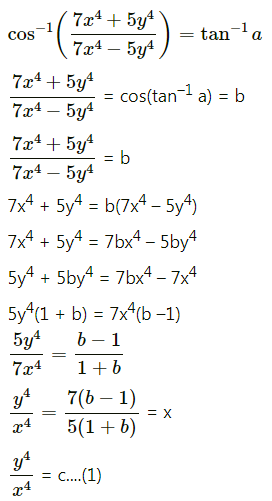
(v) \(\cos ^{-1}\left(\frac{7 x^{4}+5 y^{4}}{7 x^{4}-5 y^{4}}\right)=\tan ^{-1} a\)
Solution:
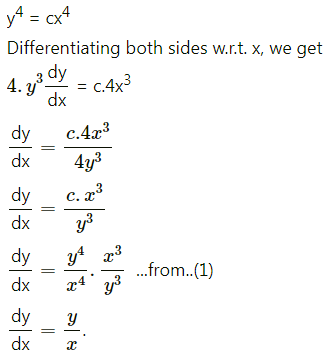
Maharashtra Board 12th Maths Solutions Chapter 1 Differentiation Ex 1.3 Q4 (v)
Maharashtra Board 12th Maths Solutions Chapter 1 Differentiation Ex 1.3 Q4 (v).1

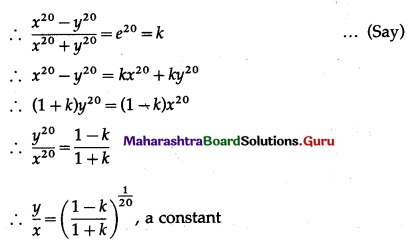
(vi) \(\log \left(\frac{x^{20}-y^{20}}{x^{20}+y^{20}}\right)=20\)
Solution:
\(\log \left(\frac{x^{20}-y^{20}}{x^{20}+y^{20}}\right)=20\)
Maharashtra Board 12th Maths Solutions Chapter 1 Differentiation Ex 1.3 Q4 (vi)
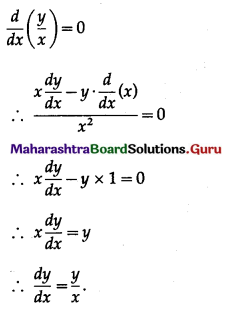
Differentiating both sides w.r.t. x, we get
Maharashtra Board 12th Maths Solutions Chapter 1 Differentiation Ex 1.3 Q4 (vi).1

Maharashtra Board 12th Maths Solutions Chapter 1 Differentiation Ex 1.3

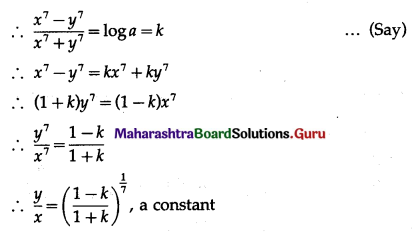
(vii) \(e^{\frac{x^{7}-y^{7}}{x^{7}+y^{7}}}=a\)
Solution:
\(e^{\frac{x^{7}-y^{7}}{x^{7}+y^{7}}}=a\)
Maharashtra Board 12th Maths Solutions Chapter 1 Differentiation Ex 1.3 Q4 (vii)
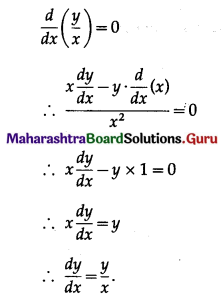
Differentiating both sides w.r.t. x, we get
Maharashtra Board 12th Maths Solutions Chapter 1 Differentiation Ex 1.3 Q4 (vii).1

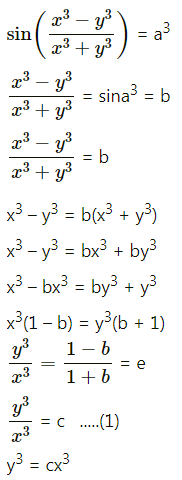
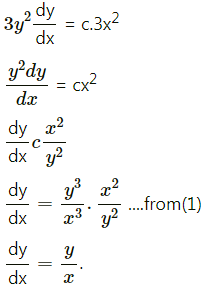
(viii) \(\sin \left(\frac{x^{3}-y^{3}}{x^{3}+y^{3}}\right)=a^{3}\)
Solution:
Maharashtra Board 12th Maths Solutions Chapter 1 Differentiation Ex 1.3 Q4 (viii)
Differentiating both sides w.r.t. x, we get
Maharashtra Board 12th Maths Solutions Chapter 1 Differentiation Ex 1.3 Q4 (viii).1

Question 5.
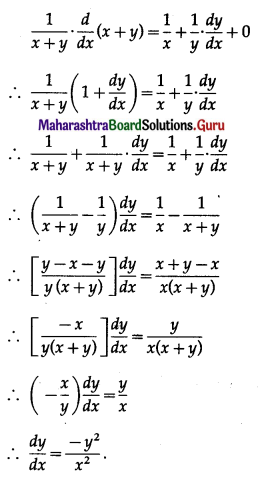
(i) If log (x + y) = log (xy) + p, where p is a constant, then prove that \(\frac{d y}{d x}=-\frac{y^{2}}{x^{2}}\).
Solution:
log (x + y) = log (xy) + p
∴ log (x + y) = log x + log y + p
Differentiating both sides w.r.t. x, we get
Maharashtra Board 12th Maths Solutions Chapter 1 Differentiation Ex 1.3 Q5 (i)

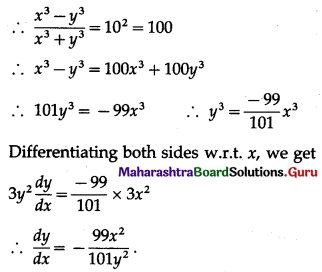
(ii) If \(\log _{10}\left(\frac{x^{3}-y^{3}}{x^{3}+y^{3}}\right)=2\), show that \(\frac{d y}{d x}=-\frac{99 x^{2}}{101 y^{2}}\)
Solution:
\(\log _{10}\left(\frac{x^{3}-y^{3}}{x^{3}+y^{3}}\right)=2\)
Maharashtra Board 12th Maths Solutions Chapter 1 Differentiation Ex 1.3 Q5 (ii)

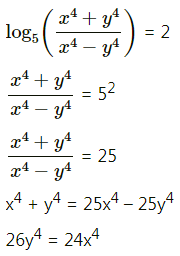
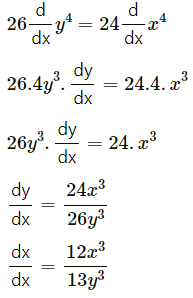
(iii) If \(\log _{5}\left(\frac{x^{4}+y^{4}}{x^{4}-y^{4}}\right)=2\), show that \(\frac{d y}{d x}=-\frac{12 x^{3}}{13 y^{3}}\)
Solution:
Maharashtra Board 12th Maths Solutions Chapter 1 Differentiation Ex 1.3 Q5 (iii)
Differentiating both sides w.r.t. x, we get
Maharashtra Board 12th Maths Solutions Chapter 1 Differentiation Ex 1.3 Q5 (iii).1

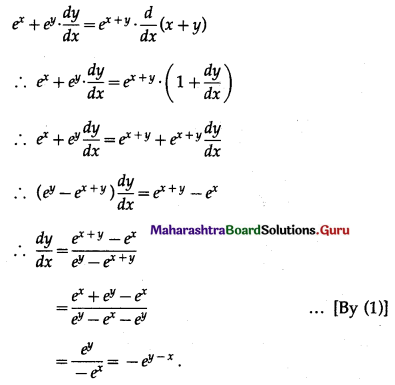
(iv) If ex + ey = ex+y, then show that \(\frac{d y}{d x}=-e^{y-x}\)
Solution:
ex + ey = ex+y ……(1)
Differentiating both sides w.r.t. x, we get
Maharashtra Board 12th Maths Solutions Chapter 1 Differentiation Ex 1.3 Q5 (iv)

Maharashtra Board 12th Maths Solutions Chapter 1 Differentiation Ex 1.3

(v) If \(\sin ^{-1}\left(\frac{x^{5}-y^{5}}{x^{5}+y^{5}}\right)=\frac{\pi}{6}\), show that \(\frac{d y}{d x}=\frac{x^{4}}{3 y^{4}}\)
Solution:
\(\sin ^{-1}\left(\frac{x^{5}-y^{5}}{x^{5}+y^{5}}\right)=\frac{\pi}{6}\)
\(\frac{x^{5}-y^{5}}{x^{5}+y^{5}}=\sin \frac{\pi}{6}=\frac{1}{2}\)
2x5 – 2y5 = x5 + y5
3y5 = x5
Differentiating both sides w.r.t. x, we get
\(3 \times 5 y^{4} \frac{d y}{d x}=5 x^{4}\)
∴ \(\frac{d y}{d x}=\frac{x^{4}}{3 y^{4}}\)

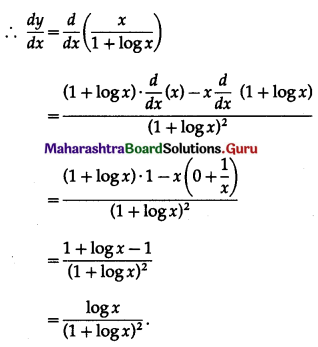
(vi) If xy = ex-y, then show that \(\frac{d y}{d x}=\frac{\log x}{(1+\log x)^{2}}\)
Solution:
xy = ex-y
log xy = log ex-y
y log x = (x – y) log e
y log x = (x – y) ….. [∵ log e = 1]
y + y log x = x – y
y + y log x = x
y(1 + log x) = x
y = \(\frac{x}{1+\log x}\)
Maharashtra Board 12th Maths Solutions Chapter 1 Differentiation Ex 1.3 Q5 (vi)

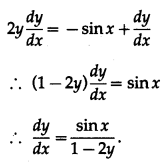
(vii) If \(y=\sqrt{\cos x+\sqrt{\cos x+\sqrt{\cos x+\ldots \infty}}}\), then show that \(\frac{d y}{d x}=\frac{\sin x}{1-2 y}\)
Solution:
\(y=\sqrt{\cos x+\sqrt{\cos x+\sqrt{\cos x+\ldots \infty}}}\)
y2 = cos x + \(\sqrt{\cos x+\sqrt{\cos x+\ldots \infty}}\)
y2 = cos x + y
Differentiating both sides w.r.t. x, we get
Maharashtra Board 12th Maths Solutions Chapter 1 Differentiation Ex 1.3 Q5 (vii)

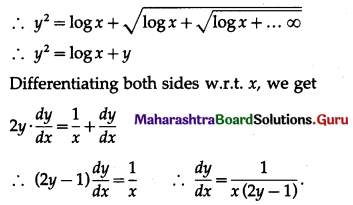
(viii) If \(y=\sqrt{\log x+\sqrt{\log x+\sqrt{\log x+\ldots \infty}}}\), then show that \(\frac{d y}{d x}=\frac{1}{x(2 y-1)}\)
Solution:
\(y=\sqrt{\log x+\sqrt{\log x+\sqrt{\log x+\ldots \infty}}}\)
Maharashtra Board 12th Maths Solutions Chapter 1 Differentiation Ex 1.3 Q5 (viii)

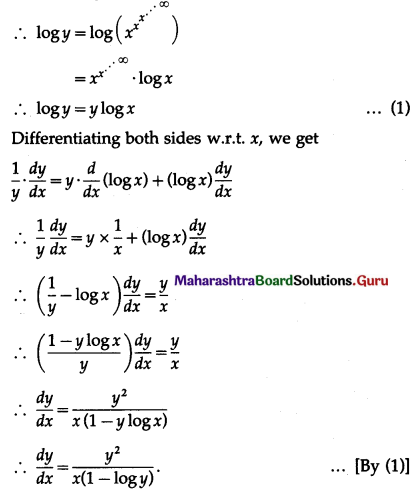
(ix) If \(y=x^{x^{x^{-\infty}}}\), then show that \(\frac{d y}{d x}=\frac{y^{2}}{x(1-\log y)}\)
Solution:
\(y=x^{x^{x^{-\infty}}}\)
Maharashtra Board 12th Maths Solutions Chapter 1 Differentiation Ex 1.3 Q5 (ix)

Maharashtra Board 12th Maths Solutions Chapter 1 Differentiation Ex 1.3

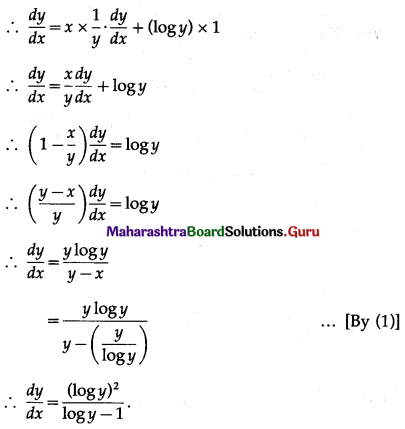
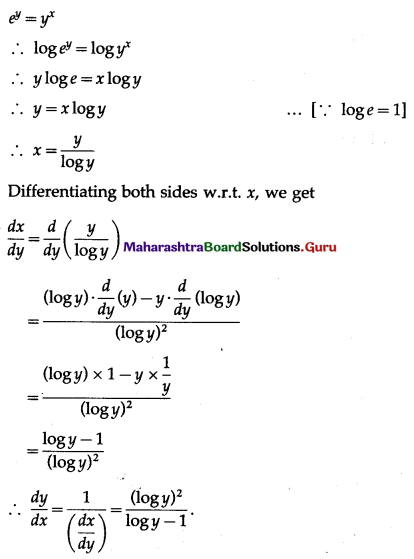
(x) If ey = yx, then show that \(\frac{d y}{d x}=\frac{(\log y)^{2}}{\log y-1}\)
Solution:
ey = yx
log ey = log yx
y log e = x log y
y = x log y …… [∵log e = 1] ……….(1)
Differentiating both sides w.r.t. x, we get
\(\frac{d y}{d x}=x \frac{d}{d x}(\log y)+(\log y) \cdot \frac{d}{d x}(x)\)
Maharashtra Board 12th Maths Solutions Chapter 1 Differentiation Ex 1.3 Q5 (x)
Maharashtra Board 12th Maths Solutions Chapter 1 Differentiation Ex 1.3 Q5 (x).1

Class 12 Maharashtra State Board Maths Solution 

Differentiation Class 12 Maths 2 Exercise 1.2 Solutions Maharashtra Board

Balbharti 12th Maharashtra State Board Maths Solutions Book Pdf Chapter 1 Differentiation Ex 1.2 Questions and Answers.

12th Maths Part 2 Differentiation Exercise 1.2 Questions And Answers Maharashtra Board

Question 1.
Find the derivative of the function y = f(x) using the derivative of the inverse function x = f-1( y) in the following
(i) y = \(\sqrt {x}\)
Solution:
y = \(\sqrt {x}\) … (1)
We have to find the inverse function of y = f(x), i.e. x in terms of y.
From (1),
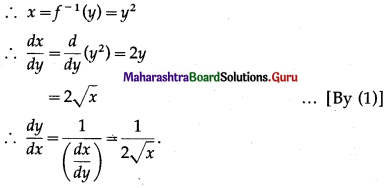
y2 = x ∴ x = y2
Maharashtra Board 12th Maths Solutions Chapter 1 Differentiation Ex 1.2 1

(ii) y = \(\sqrt{2-\sqrt{x}}\)
Solution:
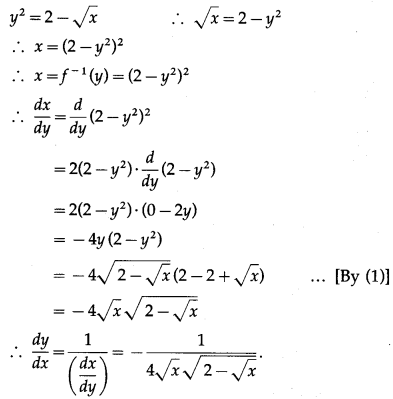
y = \(\sqrt{2-\sqrt{x}}\) …(1)
We have to find the inverse function of y = f(x), i.e. x in terms of y.
From (1),
Maharashtra Board 12th Maths Solutions Chapter 1 Differentiation Ex 1.2 2

(iii) y = \(\sqrt[3]{x-2}\)
Solution:
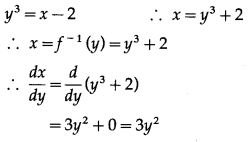
y = \(\sqrt[3]{x-2}\) ….(1)
We have to find the inverse function of y = f(x), i.e. x in terms of y.
From (1),
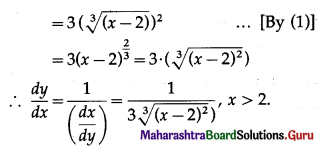
Maharashtra Board 12th Maths Solutions Chapter 1 Differentiation Ex 1.2 3
Maharashtra Board 12th Maths Solutions Chapter 1 Differentiation Ex 1.2 4

Maharashtra Board 12th Maths Solutions Chapter 1 Mathematical Logic Ex 1.1

(iv) y = log (2x – 1)
Solution:
y = log (2x – 1) …(1)
We have to find the inverse function of y = f(x), i.e. x in terms of y.
From (1),
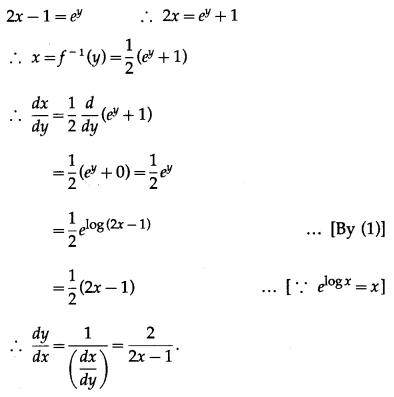
Maharashtra Board 12th Maths Solutions Chapter 1 Differentiation Ex 1.2 5

(v) y = 2x + 3
Solution:
y = 2x + 3 ….(1)
We have to find the inverse function of y = f(x), i.e. x in terms of y.
From (1),
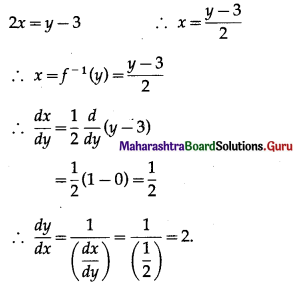
Maharashtra Board 12th Maths Solutions Chapter 1 Differentiation Ex 1.2 6

(vi) y = ex – 3
Solution:
y = ex – 3 ….(1)
We have to find the inverse function of y = f(x), i.e. x in terms of y.
From (1),
ex = y + 3
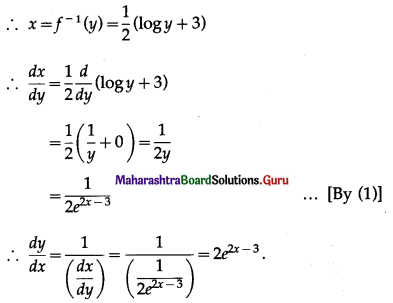
∴ x = log(y + 3)
∴ x = f-1(y) = log(y + 3)
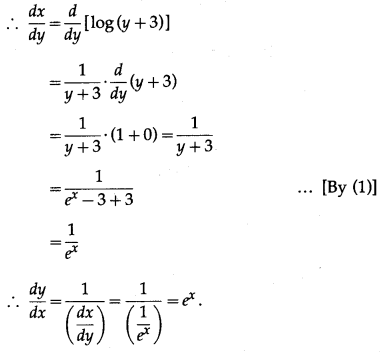
Maharashtra Board 12th Maths Solutions Chapter 1 Differentiation Ex 1.2 7

Maharashtra Board 12th Maths Solutions Chapter 1 Mathematical Logic Ex 1.1

(vii) y = e2x – 3
Solution:
y = e2x – 3 ….(1)
We have to find the inverse function of y = f(x), i.e. x in terms of y.
From (1),
2x – 3 = log y ∴ 2x = log y + 3
Maharashtra Board 12th Maths Solutions Chapter 1 Differentiation Ex 1.2 8

(viii) y = log2\(\left(\frac{x}{2}\right)\)
Solution:
y = log2\(\left(\frac{x}{2}\right)\) …(1)
We have to find the inverse function of y = f(x), i.e. x in terms of y.
From (1),
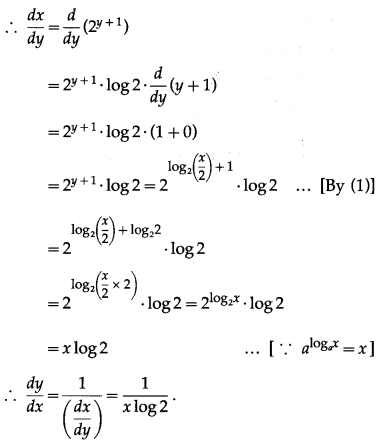
\(\frac{x}{2}\) = 2y ∴ x = 2∙2y = 2y+1
∴ x = f-1(y) = 2y+1
Maharashtra Board 12th Maths Solutions Chapter 1 Differentiation Ex 1.2 9

Question 2.
Find the derivative of the inverse function of
the following
(i) y = x2·ex
Solution:
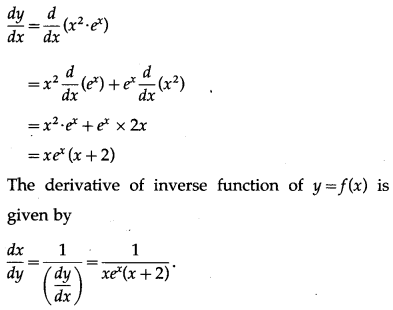
y = x2·ex
Differentiating w.r.t. x, we get
Maharashtra Board 12th Maths Solutions Chapter 1 Differentiation Ex 1.2 10

Maharashtra Board 12th Maths Solutions Chapter 1 Mathematical Logic Ex 1.1

(ii) y = x cos x
Solution:
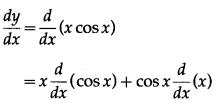
y = x cos x
Differentiating w.r.t. x, we get
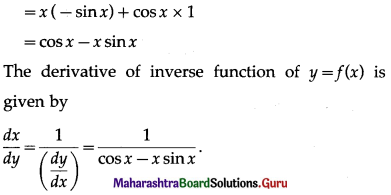
Maharashtra Board 12th Maths Solutions Chapter 1 Differentiation Ex 1.2 11
Maharashtra Board 12th Maths Solutions Chapter 1 Differentiation Ex 1.2 12

(iii) y = x·7x
Solution:
y = x·7x
Differentiating w.r.t. x, we get
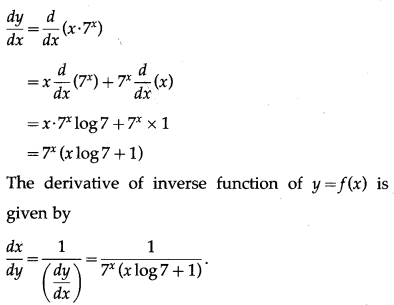
Maharashtra Board 12th Maths Solutions Chapter 1 Differentiation Ex 1.2 13

(iv) y = x2 + logx
Solution:
y = x2 + logx
Differentiating w.r.t. x, we get
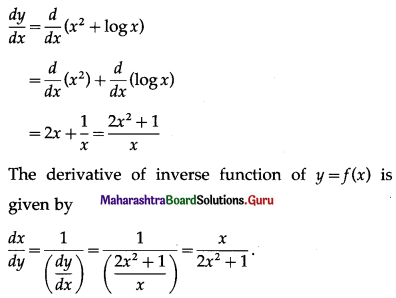
Maharashtra Board 12th Maths Solutions Chapter 1 Differentiation Ex 1.2 14

Maharashtra Board 12th Maths Solutions Chapter 1 Mathematical Logic Ex 1.1

(v) y = x logx
Solution:
y = x logx
Differentiating w.r.t. x, we get
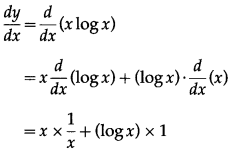
Maharashtra Board 12th Maths Solutions Chapter 1 Differentiation Ex 1.2 15
Maharashtra Board 12th Maths Solutions Chapter 1 Differentiation Ex 1.2 16

Question 3.
Find the derivative of the inverse of the following functions, and also fid their value at the points indicated against them.
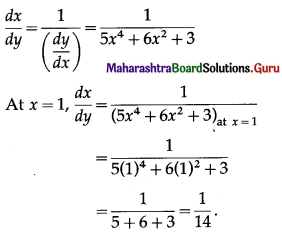
(i) y = x5 + 2x3 + 3x, at x = 1
Solution:
y = x5 + 2x3 + 3x
Differentiating w.r.t. x, we get
\(\frac{d y}{d x}\) = \(\frac{d}{d x}\)(x5 + 2x3 + 3x)
= 5x4 + 2 × 3x2 + 3 × 1
= 5x4 + 6x2 + 3
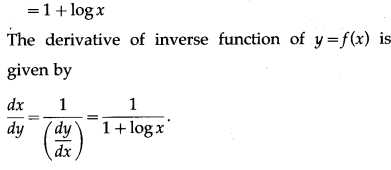
The derivative of inverse function of y = f(x) is given by
Maharashtra Board 12th Maths Solutions Chapter 1 Differentiation Ex 1.2 17

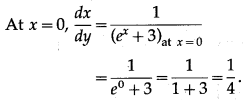
(ii) y = ex + 3x + 2, at x = 0
Solution:
y = ex + 3x + 2
Differentiating w.r.t. x, we get
\(\frac{d y}{d x}\) = \(\frac{d}{d x}\)(ex + 3x + 2)
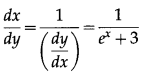
The derivative of inverse function of y = f(x) is given by
Maharashtra Board 12th Maths Solutions Chapter 1 Differentiation Ex 1.2 18
Maharashtra Board 12th Maths Solutions Chapter 1 Differentiation Ex 1.2 19

Maharashtra Board 12th Maths Solutions Chapter 1 Mathematical Logic Ex 1.1

(iii) y = 3x2 + 2 log x3, at x = 1
Solution:
y = 3x2 + 2 log x3
= 3x2 + 6 log x
Differentiating w.r.t. x, we get
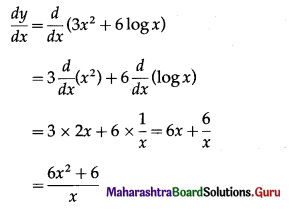
Maharashtra Board 12th Maths Solutions Chapter 1 Differentiation Ex 1.2 20
The derivative of inverse function of y = f(x) is given by
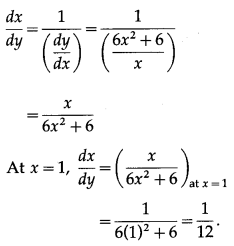
Maharashtra Board 12th Maths Solutions Chapter 1 Differentiation Ex 1.2 21

(iv) y = sin (x – 2) + x2, at x = 2
Solution:
y = sin (x – 2) + x2
Differentiating w.r.t. x, we get
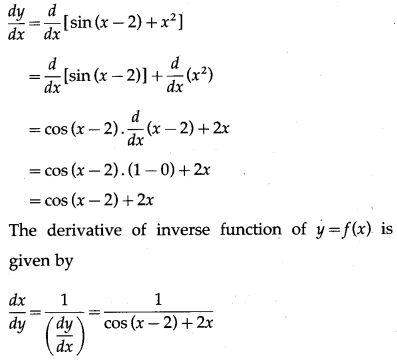
Maharashtra Board 12th Maths Solutions Chapter 1 Differentiation Ex 1.2 22
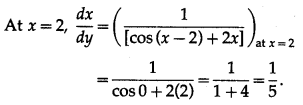
Maharashtra Board 12th Maths Solutions Chapter 1 Differentiation Ex 1.2 23

Question 4.
If f(x) = x3 + x – 2, find (f-1)’ (0).
Question is modified.
If f(x) = x3 + x – 2, find (f-1)’ (-2).
Solution:
f(x) = x3 + x – 2 ….(1)
Differentiating w.r.t. x, we get
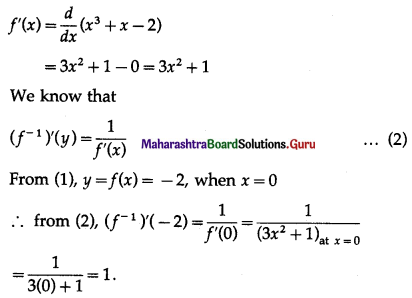
Maharashtra Board 12th Maths Solutions Chapter 1 Differentiation Ex 1.2 24

Maharashtra Board 12th Maths Solutions Chapter 1 Mathematical Logic Ex 1.1

Question 5.
Using derivative prove
(i) tan-1x + cot-1x = \(\frac{\pi}{2}\)
Solution:
let f(x) = tan-1x + cot-1x
Differentiating w.r.t. x, we get
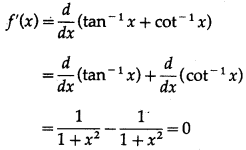
Maharashtra Board 12th Maths Solutions Chapter 1 Differentiation Ex 1.2 25
Since, f'(x) = 0, f(x) is a constant function.
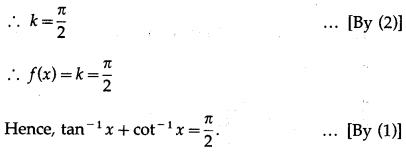
Let f(x) = k.
For any value of x, f(x) = k
Let x = 0.
Then f(0) = k ….(2)
From (1), f(0) = tan-1(0) + cot-1(0)
= 0 + \(\frac{\pi}{2}=\frac{\pi}{2}\)
Maharashtra Board 12th Maths Solutions Chapter 1 Differentiation Ex 1.2 26

(ii) sec-1x + cosec-1x = \(\frac{\pi}{2}\) . . . [for |x| ≥ 1]
Solution:
Let f(x) = sec-1x + cosec-1x for |x| ≥ 1 ….(1)
Differentiating w.r.t. x, we get
Maharashtra Board 12th Maths Solutions Chapter 1 Differentiation Ex 1.2 27
Since, f'(x) = 0, f(x) is a constant function.
Let f(x) = k.
For any value of x, f(x) = k, where |x| > 1
Let x = 2.
Then, f(2) = k ……(2)
Maharashtra Board 12th Maths Solutions Chapter 1 Differentiation Ex 1.2 28

Maharashtra Board 12th Maths Solutions Chapter 1 Mathematical Logic Ex 1.1

Question 6.
Diffrentiate the following w. r. t. x.
(i) tan-1(log x)
Solution:
Let y = tan-1(log x)
Differentiating w.r.t. x, we get
Maharashtra Board 12th Maths Solutions Chapter 1 Differentiation Ex 1.2 29

(ii) cosec-1(e-x)
Solution:
Let y = cosec-1(e-x)
Differentiating w.r.t. x, we get
Maharashtra Board 12th Maths Solutions Chapter 1 Differentiation Ex 1.2 104

(iii) cot-1(x3)
Solution:
Let y = cot-1(x3)
Differentiating w.r.t. x, we get
Maharashtra Board 12th Maths Solutions Chapter 1 Differentiation Ex 1.2 105

Maharashtra Board 12th Maths Solutions Chapter 1 Mathematical Logic Ex 1.1

(iv) cot-1(4x
Solution:
Let y = cot-1(4x
Differentiating w.r.t. x, we get
Maharashtra Board 12th Maths Solutions Chapter 1 Differentiation Ex 1.2 106

(v) tan-1(\(\sqrt {x}\))
Solution:
Let y = tan-1(\(\sqrt {x}\))
Differentiating w.r.t. x, we get
Maharashtra Board 12th Maths Solutions Chapter 1 Differentiation Ex 1.2 107

(vi) sin-1\(\left(\sqrt{\frac{1+x^{2}}{2}}\right)\)
Solution:
Let y = sin-1\(\left(\sqrt{\frac{1+x^{2}}{2}}\right)\)
Differentiating w.r.t. x, we get
Maharashtra Board 12th Maths Solutions Chapter 1 Differentiation Ex 1.2 108

Maharashtra Board 12th Maths Solutions Chapter 1 Mathematical Logic Ex 1.1

(vii) cos-1(1 – x2)
Solution:
Let y = cos-1(1 – x2)
Differentiating w.r.t. x, we get
Maharashtra Board 12th Maths Solutions Chapter 1 Differentiation Ex 1.2 109
Maharashtra Board 12th Maths Solutions Chapter 1 Differentiation Ex 1.2 30

(viii) sin-1\(\left(x^{\frac{3}{2}}\right)\)
Solution:
Let y = sin-1\(\left(x^{\frac{3}{2}}\right)\)
Differentiating w.r.t. x, we get
Maharashtra Board 12th Maths Solutions Chapter 1 Differentiation Ex 1.2 31

Maharashtra Board 12th Maths Solutions Chapter 1 Mathematical Logic Ex 1.1

(ix) cos3[cos-1(x3)]
Solution:
Let y = cos3[cos-1(x3)]
= [cos(cos-1x3)]3
= (x3)3 = x9
Differentiating w.r.t. x, we get
\(\frac{d y}{d x}\) = \(\frac{d}{d x}\)(x9) = 9x8.

(x) sin4[sin-1(\(\sqrt {x}\))]
Solution:
Let y = sin4[sin-1(\(\sqrt {x}\))]
= {sin[sin-1(\(\sqrt {x}\))]}8
= (\(\sqrt {x}\))4 = x2
Differentiating w.r.t. x, we get
\(\frac{d y}{d x}\) = \(\frac{d}{d x}\)(x2) = 2x.

Question 7.
Diffrentiate the following w. r. t. x.
(i) cot-1[cot (ex2)]
Solution:
Let y = cot-1[cot (ex2)] = ex2
Maharashtra Board 12th Maths Solutions Chapter 1 Differentiation Ex 1.2 32

Maharashtra Board 12th Maths Solutions Chapter 1 Mathematical Logic Ex 1.1

(ii) cosec-1\(\left(\frac{1}{\cos \left(5^{x}\right)}\right)\)
Solution:
Maharashtra Board 12th Maths Solutions Chapter 1 Differentiation Ex 1.2 33

(iii) cos-1\(\left(\sqrt{\frac{1+\cos x}{2}}\right)\)
Solution:
Maharashtra Board 12th Maths Solutions Chapter 1 Differentiation Ex 1.2 34

(iv) cos-1\(\left(\sqrt{\frac{1-\cos \left(x^{2}\right)}{2}}\right)\)
Solution:
Maharashtra Board 12th Maths Solutions Chapter 1 Differentiation Ex 1.2 35
Maharashtra Board 12th Maths Solutions Chapter 1 Differentiation Ex 1.2 36

(v) tan-1\(\left(\frac{1-\tan \left(\frac{x}{2}\right)}{1+\tan \left(\frac{x}{2}\right)}\right)\)
Solution:
Maharashtra Board 12th Maths Solutions Chapter 1 Differentiation Ex 1.2 37
Maharashtra Board 12th Maths Solutions Chapter 1 Differentiation Ex 1.2 38

Maharashtra Board 12th Maths Solutions Chapter 1 Mathematical Logic Ex 1.1

(vi) cosec-1\(\left(\frac{1}{4 \cos ^{3} 2 x-3 \cos 2 x}\right)\)
Solution:
Maharashtra Board 12th Maths Solutions Chapter 1 Differentiation Ex 1.2 39

(vii) tan-1\(\left(\frac{1+\cos \left(\frac{x}{3}\right)}{\sin \left(\frac{x}{3}\right)}\right)\)
Solution:
Maharashtra Board 12th Maths Solutions Chapter 1 Differentiation Ex 1.2 40
Maharashtra Board 12th Maths Solutions Chapter 1 Differentiation Ex 1.2 41

(viii) cot-1\(\left(\frac{\sin 3 x}{1+\cos 3 x}\right)\)
Solution:
Let y = cot-1\(\left(\frac{\sin 3 x}{1+\cos 3 x}\right)\)
Maharashtra Board 12th Maths Solutions Chapter 1 Differentiation Ex 1.2 42

Maharashtra Board 12th Maths Solutions Chapter 1 Mathematical Logic Ex 1.1

(ix) tan-1\(\left(\frac{\cos 7 x}{1+\sin 7 x}\right)\)
Solution:
Maharashtra Board 12th Maths Solutions Chapter 1 Differentiation Ex 1.2 43
Maharashtra Board 12th Maths Solutions Chapter 1 Differentiation Ex 1.2 44

(x) tan-1\(\left(\sqrt{\frac{1+\cos x}{1-\cos x}}\right)\)
Solution:
Let y = tan-1\(\left(\sqrt{\frac{1+\cos x}{1-\cos x}}\right)\)
Maharashtra Board 12th Maths Solutions Chapter 1 Differentiation Ex 1.2 45

(xi) tan-1(cosec x + cot x)
Solution:
Let y = tan-1(cosec x + cot x)
Maharashtra Board 12th Maths Solutions Chapter 1 Differentiation Ex 1.2 46
Maharashtra Board 12th Maths Solutions Chapter 1 Differentiation Ex 1.2 47

Maharashtra Board 12th Maths Solutions Chapter 1 Mathematical Logic Ex 1.1

(xii) cot-1\(\left(\frac{\sqrt{1+\sin \left(\frac{4 x}{3}\right)}+\sqrt{1-\sin \left(\frac{4 x}{3}\right)}}{\sqrt{1+\sin \left(\frac{4 x}{3}\right)}-\sqrt{1-\sin \left(\frac{4 x}{3}\right)}}\right)\)
Solution:
Maharashtra Board 12th Maths Solutions Chapter 1 Differentiation Ex 1.2 48
Maharashtra Board 12th Maths Solutions Chapter 1 Differentiation Ex 1.2 49
Maharashtra Board 12th Maths Solutions Chapter 1 Differentiation Ex 1.2 50
Maharashtra Board 12th Maths Solutions Chapter 1 Differentiation Ex 1.2 51

Question 8.
(i) Maharashtra Board 12th Maths Solutions Chapter 1 Differentiation Ex 1.2 60
Solution:
Maharashtra Board 12th Maths Solutions Chapter 1 Differentiation Ex 1.2 52
Maharashtra Board 12th Maths Solutions Chapter 1 Differentiation Ex 1.2 53

(ii) Maharashtra Board 12th Maths Solutions Chapter 1 Differentiation Ex 1.2 61
Solution:
Maharashtra Board 12th Maths Solutions Chapter 1 Differentiation Ex 1.2 54
Maharashtra Board 12th Maths Solutions Chapter 1 Differentiation Ex 1.2 55

Maharashtra Board 12th Maths Solutions Chapter 1 Mathematical Logic Ex 1.1

(iii) Maharashtra Board 12th Maths Solutions Chapter 1 Differentiation Ex 1.2 62
Solution:
Maharashtra Board 12th Maths Solutions Chapter 1 Differentiation Ex 1.2 56
Maharashtra Board 12th Maths Solutions Chapter 1 Differentiation Ex 1.2 57

(iv) Maharashtra Board 12th Maths Solutions Chapter 1 Differentiation Ex 1.2 63
Solution:
Maharashtra Board 12th Maths Solutions Chapter 1 Differentiation Ex 1.2 58
Maharashtra Board 12th Maths Solutions Chapter 1 Differentiation Ex 1.2 59

(v) Maharashtra Board 12th Maths Solutions Chapter 1 Differentiation Ex 1.2 64
Solution:
Maharashtra Board 12th Maths Solutions Chapter 1 Differentiation Ex 1.2 65
Maharashtra Board 12th Maths Solutions Chapter 1 Differentiation Ex 1.2 66
= ex.

Maharashtra Board 12th Maths Solutions Chapter 1 Mathematical Logic Ex 1.1

(vi) Maharashtra Board 12th Maths Solutions Chapter 1 Differentiation Ex 1.2 67
Solution:
Maharashtra Board 12th Maths Solutions Chapter 1 Differentiation Ex 1.2 68
y = sin-1[sin(2x)∙cosα – cos(2x)∙sinα]
= sin[sin(2x – α)]
= 2x – α, where α is a constant
Differentiating w.r.t. x, we get
\(\frac{d y}{d x}\) = \(\frac{d}{d x}\)(2x – α)
= \(\frac{d}{d x}\)(2x) – \(\frac{d}{d x}\)(α)
= 2x∙log2 – 0
= 2x∙log2

Question 9.
Diffrentiate the following w. r. t. x.
(i) cos-1\(\left(\frac{1-x^{2}}{1+x^{2}}\right)\)
Solution:
Maharashtra Board 12th Maths Solutions Chapter 1 Differentiation Ex 1.2 69

(ii) tan-1\(\left(\frac{2 x}{1-x^{2}}\right)\)
Solution:
Maharashtra Board 12th Maths Solutions Chapter 1 Differentiation Ex 1.2 70

Maharashtra Board 12th Maths Solutions Chapter 1 Mathematical Logic Ex 1.1

(iii) sin-1\(\left(\frac{1-x^{2}}{1+x^{2}}\right)\)
Solution:
Maharashtra Board 12th Maths Solutions Chapter 1 Differentiation Ex 1.2 71
Maharashtra Board 12th Maths Solutions Chapter 1 Differentiation Ex 1.2 72

(iv) sin-1(2x\(\sqrt{1-x^{2}}\))
Solution:
Maharashtra Board 12th Maths Solutions Chapter 1 Differentiation Ex 1.2 73
Maharashtra Board 12th Maths Solutions Chapter 1 Differentiation Ex 1.2 74

(v) cos-1(3x – 4x3)
Solution:
Maharashtra Board 12th Maths Solutions Chapter 1 Differentiation Ex 1.2 75
Maharashtra Board 12th Maths Solutions Chapter 1 Differentiation Ex 1.2 76

(vi) cos-1\(\left(\frac{e^{x}-e^{-x}}{e^{x}+e^{-x}}\right)\)
Solution:
Maharashtra Board 12th Maths Solutions Chapter 1 Differentiation Ex 1.2 77
Maharashtra Board 12th Maths Solutions Chapter 1 Differentiation Ex 1.2 78

Maharashtra Board 12th Maths Solutions Chapter 1 Mathematical Logic Ex 1.1

(vii) cos-1\(\left(\frac{1-9^{x}}{1+9^{x}}\right)\)
Solution:
Maharashtra Board 12th Maths Solutions Chapter 1 Differentiation Ex 1.2 79
Maharashtra Board 12th Maths Solutions Chapter 1 Differentiation Ex 1.2 80

(viii) sin-1\(\left(\frac{4^{x+\frac{1}{2}}}{1+2^{4 x}}\right)\)
Solution:
Maharashtra Board 12th Maths Solutions Chapter 1 Differentiation Ex 1.2 81
Maharashtra Board 12th Maths Solutions Chapter 1 Differentiation Ex 1.2 82

(ix) sin-1\(\left(\frac{1-25 x^{2}}{1+25 x^{2}}\right)\)
Solution:
Maharashtra Board 12th Maths Solutions Chapter 1 Differentiation Ex 1.2 83
Maharashtra Board 12th Maths Solutions Chapter 1 Differentiation Ex 1.2 84

(x) sin-1\(\left(\frac{1-x^{3}}{1+x^{3}}\right)\)
Solution:
Maharashtra Board 12th Maths Solutions Chapter 1 Differentiation Ex 1.2 85
Maharashtra Board 12th Maths Solutions Chapter 1 Differentiation Ex 1.2 86

Maharashtra Board 12th Maths Solutions Chapter 1 Mathematical Logic Ex 1.1

(xi) tan-1\(\left(\frac{2 x^{\frac{5}{2}}}{1-x^{5}}\right)\)
Maharashtra Board 12th Maths Solutions Chapter 1 Differentiation Ex 1.2 87
Maharashtra Board 12th Maths Solutions Chapter 1 Differentiation Ex 1.2 88

(xii) cot-1\(\left(\frac{1-\sqrt{x}}{1+\sqrt{x}}\right)\)
Solution:
Let y = cot-1\(\left(\frac{1-\sqrt{x}}{1+\sqrt{x}}\right)\)
Maharashtra Board 12th Maths Solutions Chapter 1 Differentiation Ex 1.2 89
Maharashtra Board 12th Maths Solutions Chapter 1 Differentiation Ex 1.2 90

Question 10.
Diffrentiate the following w. r. t. x.
(i) tan-1\(\left(\frac{8 x}{1-15 x^{2}}\right)\)
Solution:
Let y = tan-1\(\left(\frac{8 x}{1-15 x^{2}}\right)\)
Maharashtra Board 12th Maths Solutions Chapter 1 Differentiation Ex 1.2 91

Maharashtra Board 12th Maths Solutions Chapter 1 Mathematical Logic Ex 1.1

(ii) cot-1\(\left(\frac{1+35 x^{2}}{2 x}\right)\)
Solution:
Let y = cot-1\(\left(\frac{1+35 x^{2}}{2 x}\right)\)
Maharashtra Board 12th Maths Solutions Chapter 1 Differentiation Ex 1.2 92
Maharashtra Board 12th Maths Solutions Chapter 1 Differentiation Ex 1.2 93

(iii) tan-1\(\left(\frac{2 \sqrt{x}}{1+3 x}\right)\)
Solution:
Let y = tan-1\(\left(\frac{2 \sqrt{x}}{1+3 x}\right)\)
Maharashtra Board 12th Maths Solutions Chapter 1 Differentiation Ex 1.2 94

(iv) tan-1\(\left(\frac{2^{x+2}}{1-3\left(4^{x}\right)}\right)\)
Solution:
Let y = tan-1\(\left(\frac{2^{x+2}}{1-3\left(4^{x}\right)}\right)\)
Maharashtra Board 12th Maths Solutions Chapter 1 Differentiation Ex 1.2 95
Maharashtra Board 12th Maths Solutions Chapter 1 Differentiation Ex 1.2 96

Maharashtra Board 12th Maths Solutions Chapter 1 Mathematical Logic Ex 1.1

(v) tan-1\(\left(\frac{2^{x}}{1+2^{2 x+1}}\right)\)
Solution:
Let y = tan-1\(\left(\frac{2^{x}}{1+2^{2 x+1}}\right)\)
Maharashtra Board 12th Maths Solutions Chapter 1 Differentiation Ex 1.2 97

(vi) cot-1\(\left(\frac{a^{2}-6 x^{2}}{5 a x}\right)\)
Solution:
Let y = cot-1\(\left(\frac{a^{2}-6 x^{2}}{5 a x}\right)\)
Maharashtra Board 12th Maths Solutions Chapter 1 Differentiation Ex 1.2 98
Maharashtra Board 12th Maths Solutions Chapter 1 Differentiation Ex 1.2 99

(vii) tan-1\(\left(\frac{a+b \tan x}{b-a \tan x}\right)\)
Solution:
Let y = tan-1\(\left(\frac{a+b \tan x}{b-a \tan x}\right)\)
Maharashtra Board 12th Maths Solutions Chapter 1 Differentiation Ex 1.2 100

Maharashtra Board 12th Maths Solutions Chapter 1 Mathematical Logic Ex 1.1

(viii) tan-1\(\left(\frac{5-x}{6 x^{2}-5 x-3}\right)\)
Solution:
Let y = tan-1\(\left(\frac{5-x}{6 x^{2}-5 x-3}\right)\)
= tan-1\(\left[\frac{5-x}{1+\left(6 x^{2}-5 x-4\right)}\right]\)
Maharashtra Board 12th Maths Solutions Chapter 1 Differentiation Ex 1.2 101

(ix) cot-1\(\left(\frac{4-x-2 x^{2}}{3 x+2}\right)\)
Solution:
Let y = cot-1\(\left(\frac{4-x-2 x^{2}}{3 x+2}\right)\)
Maharashtra Board 12th Maths Solutions Chapter 1 Differentiation Ex 1.2 102
Maharashtra Board 12th Maths Solutions Chapter 1 Differentiation Ex 1.2 103

Class 12 Maharashtra State Board Maths Solution 

Differentiation Class 12 Maths 2 Exercise 1.1 Solutions Maharashtra Board

Balbharti 12th Maharashtra State Board Maths Solutions Book Pdf Chapter 1 Differentiation Ex 1.1 Questions and Answers.

12th Maths Part 2 Differentiation Exercise 1.1 Questions And Answers Maharashtra Board

Question 1.
Differentiate the following w.r.t. x :
(i) (x3 – 2x – 1)5
Solution:
Method 1:
Let y = (x3 – 2x – 1)5
Put u = x3 – 2x – 1. Then y = u5
Maharashtra Board 12th Maths Solutions Chapter 1 Differentiation Ex 1.1 1
Method 2:
Let y = (x3 – 2x – 1)5
Differentiating w.r.t. x, we get
Maharashtra Board 12th Maths Solutions Chapter 1 Differentiation Ex 1.1 2

(ii) \(\left(2 x^{\frac{3}{2}}-3 x^{\frac{4}{3}}-5\right)^{\frac{5}{2}}\)
Solution:
Let y = \(\left(2 x^{\frac{3}{2}}-3 x^{\frac{4}{3}}-5\right)^{\frac{5}{2}}\)
Differentiating w.r.t. x, we get
Maharashtra Board 12th Maths Solutions Chapter 1 Differentiation Ex 1.1 3

(iii) \(\sqrt{x^{2}+4 x-7}\)
Solution:
Maharashtra Board 12th Maths Solutions Chapter 1 Differentiation Ex 1.1 4

Maharashtra Board 12th Maths Solutions Chapter 1 Mathematical Logic Ex 1.1

(iv) \(\sqrt{x^{2}+\sqrt{x^{2}+1}}\)
Solution:
Let y = \(\sqrt{x^{2}+\sqrt{x^{2}+1}}\)
Differentiating w.r.t. x, we get
Maharashtra Board 12th Maths Solutions Chapter 1 Differentiation Ex 1.1 5
Maharashtra Board 12th Maths Solutions Chapter 1 Differentiation Ex 1.1 6

(v) \(\frac{3}{5 \sqrt[3]{\left(2 x^{2}-7 x-5\right)^{5}}}\)
Solution:
Let y = \(\frac{3}{5 \sqrt[3]{\left(2 x^{2}-7 x-5\right)^{5}}}\)
Differentiating w.r.t. x, we get
Maharashtra Board 12th Maths Solutions Chapter 1 Differentiation Ex 1.1 7

(vi) \(\left(\sqrt{3 x-5}-\frac{1}{\sqrt{3 x-5}}\right)^{5}\)
Solution:
Let y = \(\left(\sqrt{3 x-5}-\frac{1}{\sqrt{3 x-5}}\right)^{5}\)
Differentiating w.r.t. x, we get
Maharashtra Board 12th Maths Solutions Chapter 1 Differentiation Ex 1.1 8
Maharashtra Board 12th Maths Solutions Chapter 1 Differentiation Ex 1.1 9

Maharashtra Board 12th Maths Solutions Chapter 1 Mathematical Logic Ex 1.1

Question 2.
Diffrentiate the following w.r.t. x
(i) cos(x2 + a2)
Solution:
Let y = cos(x2 + a2)
Differentiating w.r.t. x, we get
\(\frac{d y}{d x}\) = \(\frac{d}{d x}\)[cos(x2 + a2)]
= -sin(x2 + a2)∙\(\frac{d}{d x}\)x2 + a2)
= -sin(x2 + a2)∙(2x + 0)
= -2xsin(x2 + a2)

(ii) \(\sqrt{e^{(3 x+2)}+5}\)
Solution:
Let y = \(\sqrt{e^{(3 x+2)}+5}\)
Differentiating w.r.t. x, we get
Maharashtra Board 12th Maths Solutions Chapter 1 Differentiation Ex 1.1 10

(iii) log[tan(\(\frac{x}{2}\))]
Solution:
Let y = log[tan(\(\frac{x}{2}\))]
Differentiating w.r.t. x, we get
Maharashtra Board 12th Maths Solutions Chapter 1 Differentiation Ex 1.1 11

Maharashtra Board 12th Maths Solutions Chapter 1 Mathematical Logic Ex 1.1

(iv) \(\sqrt{\tan \sqrt{x}}\)
Solution:
Let y = \(\sqrt{\tan \sqrt{x}}\)
Differentiating w.r.t. x, we get
Maharashtra Board 12th Maths Solutions Chapter 1 Differentiation Ex 1.1 12

(v) cot3[log (x3)]
Solution:
Let y = cot3[log (x3)]
Differentiating w.r.t. x, we get
Maharashtra Board 12th Maths Solutions Chapter 1 Differentiation Ex 1.1 13

(vi) 5sin3x+ 3
Solution:
Let y = 5sin3x+ 3
Differentiating w.r.t. x, we get
Maharashtra Board 12th Maths Solutions Chapter 1 Differentiation Ex 1.1 14

Maharashtra Board 12th Maths Solutions Chapter 1 Mathematical Logic Ex 1.1

(vii) cosec (\(\sqrt{\cos X}\))
Solution:
Let y = cosec (\(\sqrt{\cos X}\))
Differentiating w.r.t. x, we get
Maharashtra Board 12th Maths Solutions Chapter 1 Differentiation Ex 1.1 15

(viii) log[cos (x3 – 5)]
Solution:
Let y = log[cos (x3 – 5)]
Differentiating w.r.t. x, we get
Maharashtra Board 12th Maths Solutions Chapter 1 Differentiation Ex 1.1 16

(ix) e3 sin2x – 2 cos2x
Solution:
Let y = e3 sin2x – 2 cos2x
Differentiating w.r.t. x, we get
Maharashtra Board 12th Maths Solutions Chapter 1 Differentiation Ex 1.1 17

Maharashtra Board 12th Maths Solutions Chapter 1 Mathematical Logic Ex 1.1

(x) cos2[log (x2+ 7)]
Solution:
Let y = cos2[log (x2+ 7)]
Differentiating w.r.t. x, we get
Maharashtra Board 12th Maths Solutions Chapter 1 Differentiation Ex 1.1 18
Maharashtra Board 12th Maths Solutions Chapter 1 Differentiation Ex 1.1 19

(xi) tan[cos (sinx)]
Solution:
Let y = tan[cos (sinx)]
Differentiating w.r.t. x, we get
Maharashtra Board 12th Maths Solutions Chapter 1 Differentiation Ex 1.1 20

(xii) sec[tan (x4 + 4)]
Solution:
Let y = sec[tan (x4 + 4)]
Differentiating w.r.t. x, we get
Maharashtra Board 12th Maths Solutions Chapter 1 Differentiation Ex 1.1 21
= sec[tan(x4 + 4)]∙tan[tan(x4 + 4)]∙sec2(x4 + 4)(4x3 + 0)
= 4x3sec2(x4 + 4)∙sec[tan(x4 + 4)]∙tan[tan(x4 + 4)].

(xiii) elog[(logx)2 – logx2]
Solution:
Let y = elog[(logx)2 – logx2]
= (log x)2 – log x2 …[∵ elog x = x]
Differentiating w.r.t. x, we get
Maharashtra Board 12th Maths Solutions Chapter 1 Differentiation Ex 1.1 22

Maharashtra Board 12th Maths Solutions Chapter 1 Mathematical Logic Ex 1.1

(xiv) sin\(\sqrt{\sin \sqrt{x}}\)
Solution:
Let y = sin\(\sqrt{\sin \sqrt{x}}\)
Differentiating w.r.t. x, we get
Maharashtra Board 12th Maths Solutions Chapter 1 Differentiation Ex 1.1 23

(xv) log[sec(ex2)]
Solution:
Let y = log[sec(ex2)]
Differentiating w.r.t. x, we get
Maharashtra Board 12th Maths Solutions Chapter 1 Differentiation Ex 1.1 24

(xvi) loge2(logx)
Solution:
Let y = loge2(logx) = \(\frac{\log (\log x)}{\log e^{2}}\)
Maharashtra Board 12th Maths Solutions Chapter 1 Differentiation Ex 1.1 25
Maharashtra Board 12th Maths Solutions Chapter 1 Differentiation Ex 1.1 26

(xvii) [log{log(logx)}]2
Solution:
let y = [log{log(logx)}]2
Differentiating w.r.t. x, we get
Maharashtra Board 12th Maths Solutions Chapter 1 Differentiation Ex 1.1 27

Maharashtra Board 12th Maths Solutions Chapter 1 Mathematical Logic Ex 1.1

(xviii) sin2x2 – cos2x2
Solution:
Let y = sin2x2 – cos2x2
Differentiating w.r.t. x, we get
Maharashtra Board 12th Maths Solutions Chapter 1 Differentiation Ex 1.1 28
= 2sinx2∙cosx2 × 2x + 2sinx2∙cosx2 × 2x
= 4x(2sinx2∙cosx2)
= 4xsin(2x2).

Question 3.
Diffrentiate the following w.r.t. x
(i) (x2 + 4x + 1)3 + (x3 – 5x – 2)4
Solution:
Let y = (x2 + 4x + 1)3 + (x3 – 5x – 2)4
Differentiating w.r.t. x, we get
\(\frac{d y}{d x}\) = \(\frac{d}{d x}\)[(x2 + 4x + 1)3 + (x3 – 5x – 2)4]
= \(\frac{d}{d x}\) = (x2 + 4x + 1)3 + \(\frac{d}{d x}\)(x3 – 5x – 2)4
= 3(x2 + 4x + 1)2∙\(\frac{d}{d x}\)(x2 + 4x + 1) + 4(x3 – 5x – 2)4∙\(\frac{d}{d x}\)(x3 – 5x – 2)
= 3(x2 + 4x + 1)3∙(2x + 4 × 1 + 0) + 4(x3 – 5x – 2)3∙(3x2 – 5 × 1 – 0)
= 6 (x + 2)(x2 + 4x + 1)2 + 4 (3x2 – 5)(x3 – 5x – 2)3.
(ii) (1 + 4x)5(3 + x − x2)8
Solution:
Let y = (1 + 4x)5(3 + x − x2)8
Differentiating w.r.t. x, we get
Maharashtra Board 12th Maths Solutions Chapter 1 Differentiation Ex 1.1 29
= 8 (1 + 4x)5 (3 + x – x2)7∙(0 + 1 – 2x) + 5 (1 + 4x)4 (3 + x – x2)8∙(0 + 4 × 1)
= 8 (1 – 2x)(1 + 4x)5(3 + x – x2)7 + 20(1 + 4x)4(3 + x – x2)8.

(iii) \(\frac{x}{\sqrt{7-3 x}}\)
Solution:
Let y = \(\frac{x}{\sqrt{7-3 x}}\)
Differentiating w.r.t. x, we get
Maharashtra Board 12th Maths Solutions Chapter 1 Differentiation Ex 1.1 30

Maharashtra Board 12th Maths Solutions Chapter 1 Mathematical Logic Ex 1.1

(iv) \(\frac{\left(x^{3}-5\right)^{5}}{\left(x^{3}+3\right)^{3}}\)
Solution:
Let y = \(\frac{\left(x^{3}-5\right)^{5}}{\left(x^{3}+3\right)^{3}}\)
Differentiating w.r.t. x, we get
\(\frac{d y}{d x}\) = \(\frac{d}{d x}\left[\frac{\left(x^{3}-5\right)^{5}}{\left(x^{3}+3\right)^{3}}\right]\)
Maharashtra Board 12th Maths Solutions Chapter 1 Differentiation Ex 1.1 31

(v) (1 + sin2x)2(1 + cos2x)3
Solution:
Let y = (1 + sin2x)2(1 + cos2x)3
Differentiating w.r.t. x, we get
Maharashtra Board 12th Maths Solutions Chapter 1 Differentiation Ex 1.1 32
= 3(1 + sin2x)2 (1 + cos2x)2∙[2cosx(-sinx)] + 2 (1 + sin2x)(1 + cos2x)3∙[2sinx-cosx]
= 3 (1 + sin2x)2 (1 + cos2x)2 (-sin 2x) + 2(1 + sin2x)(1 + cos2x)3(sin 2x)
= sin2x (1 + sin2x) (1 + cos2x)2 [-3(1 + sin2x) + 2(1 + cos2x)]
= sin2x (1 + sin2x)(1 + cos2x)2(-3 – 3sin2x + 2 + 2cos2x)
= sin2x (1 + sin2x)(1 + cos2x)2 [-1 – 3 sin2x + 2 (1 – sin2x)]
= sin 2x(1 + sin2x)(1 + cos2x)2 (-1 – 3 sin2x + 2 – 2 sin2x)
= sin2x (1 + sin2x)(1 + cos2x)2(1 – 5 sin2x).

(vi) \(\sqrt{\cos x}+\sqrt{\cos \sqrt{x}}\)
Solution:
Let y = \(\sqrt{\cos x}+\sqrt{\cos \sqrt{x}}\)
Differentiating w.r.t. x, we get
\(\frac{d y}{d x}\) = \(\frac{d}{d x}[\sqrt{\cos x}+\sqrt{\cos \sqrt{x}}]\)
Maharashtra Board 12th Maths Solutions Chapter 1 Differentiation Ex 1.1 33

(vii) log(sec 3x+ tan 3x)
Solution:
Let y = log(sec 3x+ tan 3x)
Differentiating w.r.t. x, we get
Maharashtra Board 12th Maths Solutions Chapter 1 Differentiation Ex 1.1 34

(viii) \(\frac{1+\sin x^{\circ}}{1-\sin x^{\circ}}\)
Solution:
Maharashtra Board 12th Maths Solutions Chapter 1 Differentiation Ex 1.1 35
Maharashtra Board 12th Maths Solutions Chapter 1 Differentiation Ex 1.1 36

Maharashtra Board 12th Maths Solutions Chapter 1 Mathematical Logic Ex 1.1

(ix) cot\(\left(\frac{\log x}{2}\right)\) – log\(\left(\frac{\cot x}{2}\right)\)
Solution:
Let y = cot\(\left(\frac{\log x}{2}\right)\) – log\(\left(\frac{\cot x}{2}\right)\)
Differentiating w.r.t. x, we get
Maharashtra Board 12th Maths Solutions Chapter 1 Differentiation Ex 1.1 37

(x) \(\frac{e^{2 x}-e^{-2 x}}{e^{2 x}+e^{-2 x}}\)
Solution:
Maharashtra Board 12th Maths Solutions Chapter 1 Differentiation Ex 1.1 38
Maharashtra Board 12th Maths Solutions Chapter 1 Differentiation Ex 1.1 39

(xi) \(\frac{e^{\sqrt{x}}+1}{e^{\sqrt{x}}-1}\)
Solution:
let y = \(\frac{e^{\sqrt{x}}+1}{e^{\sqrt{x}}-1}\)
Differentiating w.r.t. x, we get
Maharashtra Board 12th Maths Solutions Chapter 1 Differentiation Ex 1.1 40

(xii) log[tan3x·sin4x·(x2 + 7)7]
Solution:
Let y = log [tan3x·sin4x·(x2 + 7)7]
= log tan3x + log sin4x + log (x2 + 7)7
= 3 log tan x + 4 log sin x + 7 log (x2 + 7)
Differentiating w.r.t. x, we get
Maharashtra Board 12th Maths Solutions Chapter 1 Differentiation Ex 1.1 41
= 6cosec2x + 4 cotx + \(\frac{14 x}{x^{2}+7}\)

Maharashtra Board 12th Maths Solutions Chapter 1 Mathematical Logic Ex 1.1

(xiii) log\(\left(\sqrt{\frac{1-\cos 3 x}{1+\cos 3 x}}\right)\)
Solution:
Maharashtra Board 12th Maths Solutions Chapter 1 Differentiation Ex 1.1 42
Maharashtra Board 12th Maths Solutions Chapter 1 Differentiation Ex 1.1 43

(xiv) log\(\left(\sqrt{\left.\frac{1+\cos \left(\frac{5 x}{2}\right)}{1-\cos \left(\frac{5 x}{2}\right)}\right)}\right.\)
Solution:
Using log\(\left(\frac{a}{b}\right)\) = log a – log b
log ab = b log a
Maharashtra Board 12th Maths Solutions Chapter 1 Differentiation Ex 1.1 44
Maharashtra Board 12th Maths Solutions Chapter 1 Differentiation Ex 1.1 45
\(-\frac{5}{2}\)cosec\(\left(\frac{5 x}{2}\right)\)

(xv) log\(\left(\sqrt{\frac{1-\sin x}{1+\sin x}}\right)\)
Solution:
Maharashtra Board 12th Maths Solutions Chapter 1 Differentiation Ex 1.1 46
Maharashtra Board 12th Maths Solutions Chapter 1 Differentiation Ex 1.1 47
Maharashtra Board 12th Maths Solutions Chapter 1 Differentiation Ex 1.1 48

Maharashtra Board 12th Maths Solutions Chapter 1 Mathematical Logic Ex 1.1

(xvi) log\(\left[4^{2 x}\left(\frac{x^{2}+5}{\sqrt{2 x^{3}-4}}\right)^{\frac{3}{2}}\right]\)
Solution:
Maharashtra Board 12th Maths Solutions Chapter 1 Differentiation Ex 1.1 49
Maharashtra Board 12th Maths Solutions Chapter 1 Differentiation Ex 1.1 50

(xvii) log\(\left[\frac{e^{x^{2}}(5-4 x)^{\frac{3}{2}}}{\sqrt[3]{7-6 x}}\right]\)
Solution:
Maharashtra Board 12th Maths Solutions Chapter 1 Differentiation Ex 1.1 51
Maharashtra Board 12th Maths Solutions Chapter 1 Differentiation Ex 1.1 52

(xviii) log\(\left[\frac{a^{\cos x}}{\left(x^{2}-3\right)^{3} \log x}\right]\)
Solution:
Maharashtra Board 12th Maths Solutions Chapter 1 Differentiation Ex 1.1 53

(xix) y= (25)log5(secx) − (16)log4(tanx)
Solution:
y = (25)log5(secx) − (16)log4(tanx)
= 52log5(secx) – 42log4(tanx)
= 5log5(sec5x) – 4log4(tan2x)
= sec2x – tan2x … [∵ = x]
∴ y = 1
Differentiating w.r.t. x, we get
\(\frac{d y}{d x}\) = \(\frac{d}{d x}\)(1) = 0

(xx) \(\frac{\left(x^{2}+2\right)^{4}}{\sqrt{x^{2}+5}}\)
Solution:
Let y = \(\frac{\left(x^{2}+2\right)^{4}}{\sqrt{x^{2}+5}}\)
Differentiating w.r.t. x, we get
Maharashtra Board 12th Maths Solutions Chapter 1 Differentiation Ex 1.1 54
Maharashtra Board 12th Maths Solutions Chapter 1 Differentiation Ex 1.1 55

Maharashtra Board 12th Maths Solutions Chapter 1 Mathematical Logic Ex 1.1

Question 4.
A table of values of f, g, f ‘ and g’ is given
Maharashtra Board 12th Maths Solutions Chapter 1 Differentiation Ex 1.1 56
(i) If r(x) = f [g(x)] find r’ (2).
Solution:
r(x) = f[g(x)]
∴ r'(x) = \(\frac{d}{d x}\)f[g(x)]
= f'[g(x)]∙\(\frac{d}{d x}\)[g(x)]
= f'[g(x)∙[g'(x)]
∴ r'(2) = f'[g(2)]∙g'(2)
= f'(6)∙g'(2) … [∵ g(x) = 6, when x = 2]
= -4 × 4 … [From the table]
= -16.

(ii) If R(x) = g[3 + f(x)] find R’ (4).
Solution:
R(x) = g[3 + f(x)]
∴ R'(x) = \(\frac{d}{d x}\){g[3+f(x)]}
= g'[3 + f(x)]∙\(\frac{d}{d x}\)[3 + f(x)]
= g'[3 +f(x)]∙[0 + f'(x)]
= g'[3 + f(x)]∙f'(x)
∴ R'(4) = g'[3 + f(4)]∙f'(4)
= g'[3 + 3]∙f'(4) … [∵ f(x) = 3, when x = 4]
= g'(6)∙f'(4)
= 7 × 5 … [From the table]
= 35.

Maharashtra Board 12th Maths Solutions Chapter 1 Mathematical Logic Ex 1.1

(iii) If s(x) = f[9− f(x)] find s’ (4).
Solution:
s(x) = f[9− f(x)]
∴ s'(x) = \(\frac{d}{d x}\){f[9 – f(x)]}
= f'[9 – f(x)]∙\(\frac{d}{d x}\)[0 – f(x)]
= f'[9 – f(x)]∙[0 – f'(x)]
= -f'[9 – f(x)] – f'(x)
∴ s'(4) = -f'[9 – f(4)] – f'(4)
= -f'[9 – 3] – f'(4) … [∵ f(x) = 3, when x = 4]
= -f'(6) – f'(4)
= -(-4)(5) … [From the table]
= 20.

(iv) If S(x) = g[g(x)] find S’ (6)
Solution:
S(x) = g[g(x)]
∴ S'(x) = \(\frac{d}{d x}\)g[g(x)]
= g'[g(x)]∙\(\frac{d}{d x}\)[g(x)]
= g'[g(x)]∙g'(x)
∴ S ‘(6) = g'[g'(6)]∙g'(6)
= g'(2)∙g'(6) … [∵ g (x) = 2, when x = 6]
= 4 × 7 … [From the table]
= 28.

Maharashtra Board 12th Maths Solutions Chapter 1 Mathematical Logic Ex 1.1

Question 5.
Assume that f ‘(3) = -1, g'(2) = 5, g(2) = 3 and y = f[g(x)] then \(\left[\frac{d y}{d x}\right]_{x=2}\) = ?
Solution:
y = f[g(x)]
∴ \(\frac{d y}{d x}\) = \(\frac{d}{d x}\){[g(x)]}
Maharashtra Board 12th Maths Solutions Chapter 1 Differentiation Ex 1.1 57

Question 6.
If h(x) = \(\sqrt{4 f(x)+3 g(x)}\), f(1) = 4, g(1) = 3, f ‘(1) = 3, g'(1) = 4 find h'(1).
Solution:
Given f(1) = 4, g(1) = 3, f ‘(1) = 3, g'(1) = 4 …..(1)
Maharashtra Board 12th Maths Solutions Chapter 1 Differentiation Ex 1.1 58

Question 7.
Find the x co-ordinates of all the points on the curve y = sin 2x – 2 sin x, 0 ≤ x < 2π where \(\frac{d y}{d x}\) = 0.
Solution:
y = sin 2x – 2 sin x, 0 ≤ x < 2π
Maharashtra Board 12th Maths Solutions Chapter 1 Differentiation Ex 1.1 59
= cos2x × 2 – 2cosx
= 2 (2 cos2x – 1) – 2 cosx
= 4 cos2x – 2 – 2 cos x
= 4 cos2x – 2 cos x – 2
If \(\frac{d y}{d x}\) = 0, then 4 cos2x – 2 cos x – 2 = 0
∴ 4cos2x – 4cosx + 2cosx – 2 = 0
∴ 4 cosx (cosx – 1) + 2 (cosx – 1) = 0
∴ (cosx – 1)(4cosx + 2) = 0
∴ cosx – 1 = 0 or 4cosx + 2 = 0
∴ cos x = 1 or cos x = \(-\frac{1}{2}\)
∴ cos x = cos 0
Maharashtra Board 12th Maths Solutions Chapter 1 Differentiation Ex 1.1 60

Maharashtra Board 12th Maths Solutions Chapter 1 Mathematical Logic Ex 1.1

Question 8.
Select the appropriate hint from the hint basket and fill up the blank spaces in the following paragraph. [Activity]
“Let f (x) = x2 + 5 and g(x) = ex + 3 then
f [g(x)] = _ _ _ _ _ _ _ _ and g [f(x)] =_ _ _ _ _ _ _ _.
Now f ‘(x) = _ _ _ _ _ _ _ _ and g'(x) = _ _ _ _ _ _ _ _.
The derivative off [g (x)] w. r. t. x in terms of f and g is _ _ _ _ _ _ _ _.
Therefore \(\frac{d}{d x}\)[f[g(x)]] = _ _ _ _ _ _ _ _ _ and [\(\frac{d}{d x}\)[f[g(x)]]]x = 0 = _ _ _ _ _ _ _ _ _ _ _.
The derivative of g[f(x)] w. r. t. x in terms of f and g is _ _ _ _ _ _ __ _ _ _ _.
Therefore \(\frac{d}{d x}\)[g[f(x)]] = _ _ _ _ _ _ _ _ _ and [\(\frac{d}{d x}\)[g[f(x)]]]x = 1 = _ _ _ _ _ _ _ _ _ _ _.”
Hint basket : { f ‘[g(x)]·g'(x), 2e2x + 6ex, 8, g'[f(x)]·f ‘(x), 2xex2 + 5, -2e6, e2x + 6ex + 14, ex2 + 5 + 3, 2x, ex}
Solution:
f[g(x)] = e2x + 6ex + 14
g[f(x)] = ex2 + 5 + 3
f'(x) = 2x, g’f(x) = ex
The derivative of f[g(x)] w.r.t. x in terms of and g is f'[g(x)]∙g'(x).
∴ \(\frac{d}{d x}\){f[g(x)]} = 2e2x + 6ex and \(\frac{d}{d x}\){f[g(x)]}x = 0 = 8
The derivative of g[f(x)] w.r.t. x in terms of f and g is g’f(x)]∙f'(x).
∴ \(\frac{d}{d x}\){g[(f(x)]} = 2xex2 + 5 and
\(\frac{d}{d x}\){g[(f(x)]}x = -1 = -2e6.

Class 12 Maharashtra State Board Maths Solution 

11th Commerce Maths 1 Chapter 1 Exercise 1.1 Answers Maharashtra Board

Sets and Relations Class 11 Commerce Maths 1 Chapter 1 Exercise 1.1 Answers Maharashtra Board

Balbharati Maharashtra State Board 11th Commerce Maths Solution Book Pdf Chapter 1 Sets and Relations Ex 1.1 Questions and Answers.

Std 11 Maths 1 Exercise 1.1 Solutions Commerce Maths

Question 1.
Describe the following sets in Roster form:
(i) {x / x is a letter of the word ‘MARRIAGE’}
(ii) {x / x is an integer, –\(\frac{1}{2}\) < x < \(\frac{9}{2}\)}
(iii) {x / x = 2n, n ∈ N}
Solution:
(i) Let A = {x / x is a letter of the word ‘MARRIAGE’}
∴ A = {M, A, R, I, G, E}

(ii) Let B = {x / x is an integer, –\(\frac{1}{2}\) < x < \(\frac{9}{2}\)}
∴ B = {0, 1, 2, 3, 4}

(iii) Let C = {x / x = 2n, n ∈ N}
∴ C = {2, 4, 6, 8, ….}

Question 2.
Describe the following sets in Set-Builder form:
(i) {0}
(ii) {0, ±1, ±2, ±3}
(iii) \(\left\{\frac{1}{2}, \frac{2}{5}, \frac{3}{10}, \frac{4}{17}, \frac{5}{26}, \frac{6}{37}, \frac{7}{50}\right\}\)
Solution:
(i) Let A = {0}
0 is a whole number but it is not a natural number.
∴ A = {x / x ∈ W, x ∉ N}

(ii) Let B = {0, ±1, ±2, ±3}
B is the set of elements which belongs to Z from -3 to 3.
∴ B = {x / x ∈ Z, -3 ≤ x ≤ 3}

(iii) Let C = \(\left\{\frac{1}{2}, \frac{2}{5}, \frac{3}{10}, \frac{4}{17}, \frac{5}{26}, \frac{6}{37}, \frac{7}{50}\right\}\)
∴ C = {x / x = \(\frac{n}{n^{2}+1}\), n ∈ N, n ≤ 7}

Maharashtra Board 11th Commerce Maths Solutions Chapter 1 Sets and Relations Ex 1.1

Question 3.
If A = {x / 6x2 + x – 15 = 0}, B = {x / 2x2 – 5x – 3 = 0}, C = {x / 2x2 – x – 3 = 0}, then find (i) (A ∪ B ∪ C) (ii) (A ∩ B ∩ C)
Solution:
A = {x / 6x2 + x – 15 = o}
∴ 6x2 + x – 15 = 0
∴ 6x2 + 10x – 9x – 15 = 0
∴ 2x(3x + 5) – 3(3x + 5) = 0
∴ (3x + 5) (2x – 3) = 0
∴ 3x + 5 = 0 or 2x – 3 = 0
∴ x = \(\frac{-5}{3}\) or x = \(\frac{3}{2}\)
∴ A = \(\left\{\frac{-5}{3}, \frac{3}{2}\right\}\)

B = {x / 2x2 – 5x – 3 = 0}
∴ 2x2 – 5x – 3 = 0
∴ 2x2 – 6x + x – 3 = 0
∴ 2x(x – 3) + 1(x – 3) = 0
∴ (x – 3)(2x + 1) = 0
∴ x – 3 = 0 or 2x + 1 = 0
∴ x = 3 or x = \(\frac{-1}{2}\)
∴ B = {\(\frac{-1}{2}\), 3}

C = {x / 2x2 – x – 3 = 0}
∴ 2x2 – x – 3 = 0
∴ 2x2 – 3x + 2x – 3 = 0
∴ x(2x – 3) + 1(2x – 3) = 0
∴ (2x – 3) (x + 1) = 0
∴ 2x – 3 = 0 or x + 1 = 0
∴ x = \(\frac{3}{2}\) or x = -1
∴ C = {-1, \(\frac{3}{2}\)}

(i) A ∪ B ∪ C = \(\left\{-\frac{5}{3}, \frac{3}{2}\right\} \cup\left\{\frac{-1}{2}, 3\right\} \cup\left\{-1, \frac{3}{2}\right\}\) = \(\left\{\frac{-5}{3},-1, \frac{-1}{2}, \frac{3}{2}, 3\right\}\)

(ii) A ∩ B ∩ C = { }

Question 4.
If A, B, C are the sets for the letters in the words ‘college’, ‘marriage’ and ‘luggage’ respectively, then verify that [A – (B ∪ C)] = [(A – B) ∩ (A – C)].
Solution:
A = {c, o, l, g, e}
B = {m, a, r, i, g, e}
C = {l, u, g, a, e}
B ∪ C = {m, a, r, i, g, e, l, u}
A – (B ∪ C) = {c, o}
A – B = {c, o, l}
A – C = {c, o}
∴ [(A – B) ∩ (A – C)] = {c, o} = A – (B ∪ C)
∴ [A – (B ∪ C)] = [(A – B) ∩ (A – C)]

Maharashtra Board 11th Commerce Maths Solutions Chapter 1 Sets and Relations Ex 1.1

Question 5.
If A = {1, 2, 3, 4}, B = {3, 4, 5, 6}, C = {4, 5, 6, 7, 8} and universal set X = {1, 2, 3, 4, 5, 6, 7, 8, 9, 10}, then verify the following:
(i) A ∪ (B ∩ C) = (A ∪ B) ∩ (A ∪ C)
(ii) A ∩ (B ∪ C) = (A ∩ B) ∪ (A ∩ C)
(iii) (A ∪ B)’ = A’ ∩ B’
(iv) (A ∩ B)’ = A’ ∪ B’
(v) A = (A ∩ B) ∪ (A ∩ B’)
(vi) B = (A ∩ B) ∪ (A’ ∩ B)
(vii) n(A ∪ B) = n(A) + n(B) – n(A ∩ B)
Solution:
A = {1, 2, 3, 4}, B = {3, 4, 5, 6}, C = {4, 5, 6, 7, 8}, X = {1, 2, 3, 4, 5, 6, 7, 8, 9, 10}
(i) B ∩ C = {4, 5, 6}
∴ A ∪ (B ∩ C) = {1, 2, 3, 4, 5, 6} ……(i)
A ∪ B = {1, 2, 3, 4, 5, 6}
A ∪ C = {1, 2, 3, 4, 5, 6, 7, 8}
∴ (A ∪ B) ∩ (A ∪ C) = {1, 2, 3, 4, 5, 6} ……(ii)
From (i) and (ii), we get
A ∪ (B ∩ C) = (A ∪ B) ∩ (A ∪ C)

(ii) B ∪ C = {3, 4, 5, 6, 7, 8}
∴ A ∩ (B ∪ C) = {3, 4} …..(i)
A ∩ B = {3, 4}
A ∩ C = {4}
∴ (A ∩ B) ∪ (A ∩ C) = {3, 4} …..(ii)
From (i) and (ii), we get
A ∩ (B ∪ C) = (A ∩ B) ∪ (A ∩ C)

(iii) A ∪ B = {1, 2, 3, 4, 5, 6}
∴ (A ∪ B)’ = {7, 8, 9, 10} …….(i)
A’ = {5, 6, 7, 8, 9, 10}, B’ = {1, 2, 7, 8, 9, 10}
∴ A’ ∩ B’ = {7, 8, 9, 10} ……(ii)
From (i) and (ii), we get
(A ∪ B)’ = A’ ∩ B’

(iv) A ∩ B = {3, 4}
∴ (A ∩ B)’ = {1, 2, 5, 6, 7, 8, 9, 10} ……(i)
A’ = {5, 6, 7, 8, 9, 10}
B’ = {1, 2, 7, 8, 9, 10}
∴ A’ ∪ B’ = {1, 2, 5, 6, 7, 8, 9, 10} ……(ii)
From (i) and (ii), we get
(A ∩ B)’ = A’ ∪ B’

(v) A = {1, 2, 3, 4} …..(i)
A ∩ B = {3, 4}
B’ = {1, 2, 7, 8, 9, 10}
A ∩ B’ = {1, 2}
∴ (A ∩ B) ∪ (A ∩ B’) = {1, 2, 3, 4} ……(ii)
From (i) and (ii), we get
A = (A ∩ B) ∪ (A ∩ B’)

(vi) B = {3, 4, 5, 6} …..(i)
A ∩ B = {3, 4}
A’ = {5, 6, 7, 8, 9, 10}
A’ ∩ B = {5, 6}
∴ (A ∩ B) ∪ (A’ ∩ B) = {3, 4, 5, 6} …..(ii)
From (i) and (ii), we get
B = (A ∩ B) ∪ (A’ ∩ B)

(vii) A = {1, 2, 3, 4}, B = {3, 4, 5, 6},
A ∩ B = {3, 4}, A ∪ B = {1, 2, 3, 4, 5, 6}
∴ n(A) = 4, n(B) = 4,
n(A ∩ B) = 2,
n(A ∪ B) = 6 …..(i)
∴ n(A) + n(B) – n(A ∩ B) = 4 + 4 – 2
∴ n(A) + n(B) – n(A ∩ B) = 6 …..(ii)
From (i) and (ii), we get
n(A ∪ B) = n(A) + n(B) – n(A ∩ B)

Question 6.
If A and B are subsets of the universal set X and n(X) = 50, n(A) = 35, n(B) = 20, n(A’ ∩ B’) = 5, find
(i) n(A ∪ B)
(ii) n(A ∩ B)
(iii) n(A’ ∩ B)
(iv) n(A ∩ B’)
Solution:
n(X) = 50, n(A) = 35, n(B) = 20, n(A’ ∩ B’) = 5
(i) n(A ∪ B) = n(X) – [n(A ∪ B)’]
= n(X) – n(A’ ∩ B’)
= 50 – 5
= 45

(ii) n(A ∩ B) = n(A) + n(B) – n(A ∪ B)
= 35 + 20 – 45
= 10

(iii) n(A’ ∩ B) = n(B) – n(A ∩ B)
= 20 – 10
= 10

(iv) n(A ∩ B’) = n(A) – n(A ∩ B)
= 35 – 10
= 25

Maharashtra Board 11th Commerce Maths Solutions Chapter 1 Sets and Relations Ex 1.1

Question 7.
Out of 200 students, 35 students failed in MHT-CET, 40 in AIEEE and 40 in IIT entrance, 20 failed in MHT-CET and AIEEE, 17 in AIEEE and IIT entrance, 15 in MHT-CET and IIT entrance, and 5 failed in all three examinations. Find how many students
(i) did not fail in any examination.
(ii) failed in AIEEE or IIT entrance.
Solution:
Let A = set of students who failed in MHT-CET
B = set of students who failed in AIEEE
C = set of students who failed in IIT entrance
X = set of all students
∴ n(X) = 200, n(A) = 35, n(B) = 40, n(C) = 40,
n(A ∩ B) = 20, n(B ∩ C) = 17, n(A ∩ C) = 15, n(A ∩ B ∩ C) = 5
Maharashtra Board 11th Commerce Maths Solutions Chapter 1 Sets and Relations Ex 1.1 Ex 1.1 Q7
(i) n(A ∪ B ∪ C) = n(A) + n(B) + n(C) – n(A ∩ B) – n(B ∩ C) – n(A ∩ C) + n(A ∩ B ∩ C)
= 35 + 40 + 40 – 20 – 17 – 15 + 5
= 68
∴ No. of students who did not fail in any exam = n(X) – n(A ∪ B ∪ C)
= 200 – 68
= 132

(ii) No. of students who failed in AIEEE or IIT entrance = n(B ∪ C)
= n(B) + n(C) – n(B ∩ C)
= 40 + 40 – 17
= 63

Question 8.
From amongst 2000 literate individuals of a town, 70% read Marathi newspapers, 50% read English newspapers and 32.5% read both Marathi and English newspapers. Find the number of individuals who read
(i) at least one of the newspapers.
(ii) neither Marathi nor English newspaper.
(iii) only one of the newspapers.
Solution:
Let M = set of individuals who read Marathi newspapers
E = set of individuals who read English newspapers
X = set of all literate individuals
∴ n(X) = 2000,
n(M) = \(\frac{70}{100}\) × 2000 = 1400
n(E) = \(\frac{50}{100}\) × 2000 = 1000
n(M ∩ E) = \(\frac{32.5}{2}\) × 2000 = 650
n(M ∪ E) = n(M) + n(E) – n(M ∩ E)
= 1400 + 1000 – 650
= 1750
Maharashtra Board 11th Commerce Maths Solutions Chapter 1 Sets and Relations Ex 1.1 Ex 1.1 Q8
(i) No. of individuals who read at least one of the newspapers = n(M ∪ E) = 1750.
(ii) No. of individuals who read neither Marathi nor English newspaper = n(M’ ∩ E’)
= n(M ∪ E)’
= n(X) – n(M ∪ E)
= 2000 – 1750
= 250
(iii) No. of individuals who read only one of the newspapers = n(M ∩ E’) + n(M’ ∩ E)
= n(M ∪ E) – n(M ∩ E)
= 1750 – 650
= 1100

Maharashtra Board 11th Commerce Maths Solutions Chapter 1 Sets and Relations Ex 1.1

Question 9.
In a hostel, 25 students take tea, 20 students take coffee, 15 students take milk, 10 students take both tea and coffee, 8 students take both milk and coffee. None of them take tea and milk both and everyone takes atleast one beverage, find the number of students in the hostel.
Solution:
Let T = set of students who take tea
C = set of students who take coffee
M = set of students who take milk
∴ n(T) = 25, n(C) = 20, n(M) = 15,
n(T ∩ C) = 10, n(M ∩ C) = 8, n(T ∩ M) = 0, n(T ∩ M ∩ C) = 0
Maharashtra Board 11th Commerce Maths Solutions Chapter 1 Sets and Relations Ex 1.1 Ex 1.1 Q9
∴ Number of students in the hostel = n(T ∪ C ∪ M)
= n(T) + n(C) + n(M) – n(T ∩ C) – n(M ∩ C) – n(T ∩ M) + n(T ∩ M ∩ C)
= 25 + 20 + 15 – 10 – 8 – 0 + 0
= 42

Question 10.
There are 260 persons with skin disorders. If 150 had been exposed to the chemical A, 74 to the chemical B, and 36 to both chemicals A and B, find the number of persons exposed to
(i) Chemical A but not Chemical B
(ii) Chemical B but not Chemical A
(iii) Chemical A or Chemical B.
Solution:
Let A = set of persons exposed to chemical A
B = set of persons exposed to chemical B
X = set of all persons
∴ n(X) = 260, n(A) = 150, n(B) = 74, n(A ∩ B) = 36
Maharashtra Board 11th Commerce Maths Solutions Chapter 1 Sets and Relations Ex 1.1 Ex 1.1 Q10
(i) No. of persons exposed to chemical A but not to chemical B = n(A ∩ B’)
= n(A) – n(A ∩ B)
= 150 – 36
= 114

(ii) No. of persons exposed to chemical B but not to chemical A = n(A’ ∩ B)
= n(B) – n(A ∩ B)
= 74 – 36
= 38

(iii) No. of persons exposed to chemical A or chemical B = n(A ∪ B)
= n(A) + n(B) – n(A ∩ B)
= 150 + 74 – 36
= 188

Question 11.
If A = {1, 2, 3}, write the set of all possible subsets of A.
Solution:
A = {1, 2, 3}
∴ { }, {1}, {2}, {3}, {1, 2}, {2, 3}, {1, 3} and {1, 2, 3} are all the possible subsets of A.

Maharashtra Board 11th Commerce Maths Solutions Chapter 1 Sets and Relations Ex 1.1

Question 12.
Write the following intervals in set-builder form:
(i) (-3, 0)
(ii) [6, 12]
(iii) (6, 12)
(iv) (-23, 5)
Solution:
(i) (-3, 0) = {x / x ∈ R, -3 < x < 0}
(ii) [6, 12] = {x / x ∈ R, 6 ≤ x ≤ 12}
(iii) (6, 12) = {x / x ∈ R, 6 < x < 12}
(iv) (-23, 5) = {x / x ∈ R, -23 < x < 5}

11th Commerce Maths Digest Pdf

Linear Programming Class 12 Maths 1 Miscellaneous Exercise 7 Solutions Maharashtra Board

Balbharti 12th Maharashtra State Board Maths Solutions Book Pdf Chapter 7 Linear Programming Miscellaneous Exercise 7 Questions and Answers.

12th Maths Part 1 Linear Programming Miscellaneous Exercise 7 Questions And Answers Maharashtra Board

I) Select the appropriate alternatives for each of the following :
Question 1.
The value of objective function is maximum under linear constraints _______.
(A) at the centre of the feasible region
(B) at (0, 0)
(C) at a vertex of the feasible region
(D) the vertex which is of maximum distance from (0, 0)
Solution:
(C) at a vertex of the feasible region

Question 2.
Which of the following is correct _______.
(A) every L.P.P. has an optimal solution
(B) a L.P.P. has unique optimal solution
(C) if L.P.P. has two optimal solutions then it has an infinite number of optimal solutions
(D) the set of all feasible solutions of L.P.P. may not be a convex set
Solution:
(C) if L.P.P. has two optimal solutions then it has an infinite number of optimal solutions

Question 3.
Objective function of L.P.P. is _______.
(A) a constraint
(B) a function to be maximized or minimized
(C) a relation between the decision variables
(D) equation of a straight line
Solution:
(B) a function to be maximized or minimized

Question 4.
The maximum value of z = 5x + 3y subjected to the constraints 3x + 5y ≤ 15, 5x + 2y ≤ 10, x, y≥ 0 is _______.
(A) 235
(B) \(\frac{235}{9}\)
(C) \(\frac{235}{19}\)
(D) \(\frac{235}{3}\)
Solution:
(C) \(\frac{235}{19}\)

Maharashtra Board 12th Maths Solutions Chapter 1 Mathematical Logic Ex 1.1

Question 5.
The maximum value of z = 10x + 6y subjected to the constraints 3x + y ≤ 12, 2x + 5y ≤ 34, x ≥ 0, y≥ 0. _______.
(A) 56
(B) 65
(C) 55
(D) 66
Solution:
(A) 56

Question 6.
The point at which the maximum value of x + y subject to the constraints x + 2y ≤ 70, 2x + y ≤ 95, x ≥ 0, y ≥ 0 is obtained at _______.
(A) (30, 25)
(B) (20, 35)
(C) (35, 20)
(D) (40, 15)
Solution:
(D) (40, 15)

Question 7.
Of all the points of the feasible region, the optimal value of obtained at the point lies _______.
(A) inside the feasible region
(B) at the boundary of the feasible region
(C) at the vertex of the feasible region
(D) outside the feasible region
Solution:
(C) at the vertex of the feasible region

Maharashtra Board 12th Maths Solutions Chapter 1 Mathematical Logic Ex 1.1

Question 8.
The feasible region is the set of points that satisfy _______.
(A) the objective function
(B) all of the given constraints
(C) some of the given constraints
(D) only one constraint
Solution:
(B) all of the given constraints

Question 9.
Solution of L.P.P. to minimize z = 2x + 3y such that x ≥ 0, y ≥ 0, 1 ≤ x + 2y ≤ 10 is _______.
(A) x = 0, y = \(\frac{1}{2}\)
(B) x = \(\frac{1}{2}\), y = 0
(C) x = 1, y = 2
(D) x = \(\frac{1}{2}\), y = \(\frac{1}{2}\)
Solution:
(A) x = 0, y = \(\frac{1}{2}\)

Question 10.
The corner points of the feasible solution given by the inequation x + y ≤ 4, 2x + y ≤ 7, x ≥ 0, y ≥ 0 are _______.
(A) (0, 0), (4, 0), (7, 1), (0, 4)
(B) (0, 0), (\(\frac{7}{2}\), 0), (3, 1), (0, 4)
(C) (0, 0), (\(\frac{7}{2}\), 0), (3, 1), (0, 7)
(D) (0, 0), (4, 0), (3, 1), (0, 7)
Solution:
(B) (0, 0), (\(\frac{7}{2}\), 0), (3, 1), (0, 4)

Question 11.
The corner points of the feasible solution are (0, 0), (2, 0), (\(\frac{12}{7}\), \(\frac{3}{7}\)), (0, 1). Then z = 7x + y is maximum at _______.
(A) (0, 0)
(B) (2, 0)
(C) (\(\frac{12}{7}\), \(\frac{3}{7}\))
(D) (0, 1)
Solution:
(B) (2, 0)

Maharashtra Board 12th Maths Solutions Chapter 1 Mathematical Logic Ex 1.1

Question 12.
If the corner points of the feasible solution are (0, 0), (3, 0), (2, 1) and (0, \(\frac{7}{3}\) ), the maximum value of z = 4x + 5y is _______.
(A) 12
(B) 13
(C) 35
(D) 0
Solution:
(B) 13

Question 13.
If the corner points of the feasible solution are (0, 10), (2, 2) and (4, 0) then the point of minimum z = 3x + 2y is _______.
(A) (2, 2)
(B) (0, 10)
(C) (4, 0)
(D) (3 ,4)
Solution:
(A) (2, 2)

Question 14.
The half plane represented by 3x + 2y < 8 contains the point _______.
(A) (1, \(\frac{5}{2}\))
(B) (2, 1)
(C) (0, 0)
(D) (5, 1)
Solution:
(C) (0, 0)

Maharashtra Board 12th Maths Solutions Chapter 1 Mathematical Logic Ex 1.1

Question 15.
The half plane represented by 4x + 3y > 14 contains the point _______.
(A) (0, 0)
(B) (2, 2)
(C) (3, 4)
(D) (1, 1)
Solution:
(C) (3, 4)

II) Solve the following :
Question 1.
Solve each of the following inequations graphically using X Y plane.
(i) 4x – 18 ≥ 0
Solution:
Consider the line whose equation is 4x – 18 ≥ 0 i.e. x = \(\frac{18}{4}=\frac{9}{2}\) = 4.5
This represents a line parallel to Y-axis passing3through the point (4.5, 0)
Draw the line x = 4.5
To find the solution set we have to check the position of the origin (0, 0).
When x = 0, 4x – 18 = 4 × 0 – 18 = -18 > 0
∴ the coordinates of the origin does not satisfy thegiven inequality.
∴ the solution set consists of the line x = 4.5 and the non-origin side of the line which is shaded in the graph.
Maharashtra Board 12th Maths Solutions Chapter 7 Linear Programming Miscellaneous Exercise 7 1

(ii) -11x – 55 ≤ 0
Solution:
Consider the line whose equation is -11x – 55 ≤ 0 i.e. x = -5
This represents a line parallel to Y-axis passing3through the point (-5, 0)
Draw the line x = – 5
To find the solution set we have to check the position of the origin (0, 0).
When x = 0, -11x – 55 = – 11(0) – 55 = -55 > 0
∴ the coordinates of the origin does not satisfy thegiven inequality.
∴ the solution set consists of the line x = -5 and the non-origin side of the line which is shaded in the graph.
Maharashtra Board 12th Maths Solutions Chapter 7 Linear Programming Miscellaneous Exercise 7 2

Maharashtra Board 12th Maths Solutions Chapter 1 Mathematical Logic Ex 1.1

(iii) 5y – 12 ≥ 0
Solution:
Consider the line whose equation is 5y – 12 ≥ 0 i.e. y = \(\frac{12}{5}\)
This represents a line parallel to X-axis passing through the point (o, \(\frac{12}{5}\))
Draw the line y = \(\frac{12}{5}\)
To find the solution set, we have to check the position of the origin (0, 0).
When y = 0, 5y – 12 = 5(0) – 12 = -12 > 0
∴ the coordinates of the origin does not satisfy the given inequality.
∴ the solution set consists of the line y = \(\frac{12}{5}\) and the non-origin side of the line which is shaded in the graph.
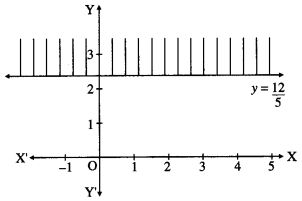
Maharashtra Board 12th Maths Solutions Chapter 7 Linear Programming Miscellaneous Exercise 7 3

(iv) y ≤ -3.5
Solution:
Consider the line whose equation is y ≤ – 3.5 i.e. y = – 3.5
This represents a line parallel to X-axis passing3through the point (0, -3.5)
Draw the line y = – 3.5
To find the solution set, we have to check the position of the origin (0, 0).
∴ the coordinates of the origin does not satisfy the given inequality.
∴ the solution set consists of the line y = – 3.5 and the non-origin side of the line which is shaded in the graph.
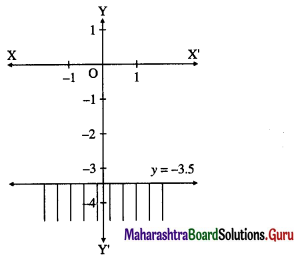
Maharashtra Board 12th Maths Solutions Chapter 7 Linear Programming Miscellaneous Exercise 7 4

Question 2.
Sketch the graph of each of following inequations in XOY co-ordinate system.
(i) x ≥ 5y
Solution:
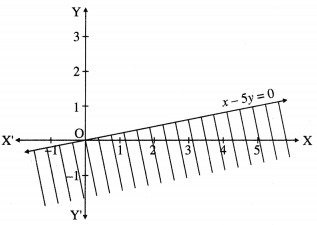
Maharashtra Board 12th Maths Solutions Chapter 7 Linear Programming Miscellaneous Exercise 7 5

Maharashtra Board 12th Maths Solutions Chapter 1 Mathematical Logic Ex 1.1

(ii) x + y≤ 0
Solution:
Maharashtra Board 12th Maths Solutions Chapter 7 Linear Programming Miscellaneous Exercise 7 6

(iii) 2y – 5x ≥ 0
Solution:
Maharashtra Board 12th Maths Solutions Chapter 7 Linear Programming Miscellaneous Exercise 7 7

(iv) |x + 5| ≤ y
Solution:
|x + 5| ≤ y
∴ -y ≤ x + 5 ≤ y
∴ -y ≤ x + 5 and x + 5 ≤ y
∴ x + y ≥ -5 and x – y ≤ -5
First we draw the lines AB and AC whose equations are
x + y= -5 and x – y = -5 respectively.
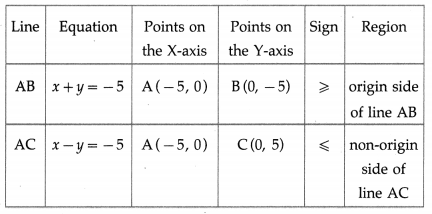
Maharashtra Board 12th Maths Solutions Chapter 7 Linear Programming Miscellaneous Exercise 7 8
The graph of |x + 5| ≤ y is as below:
Maharashtra Board 12th Maths Solutions Chapter 7 Linear Programming Miscellaneous Exercise 7 9

Maharashtra Board 12th Maths Solutions Chapter 1 Mathematical Logic Ex 1.1

Question 3.
Find graphical solution for each of the following system of linear inequation.
(i) 2x + y ≥ 2, x – y ≤ 1
Solution:
First we draw the lines AB and AC whose equations are 2x + y = 2 and x – y = 1 respectively.
Maharashtra Board 12th Maths Solutions Chapter 7 Linear Programming Miscellaneous Exercise 7 10
Maharashtra Board 12th Maths Solutions Chapter 7 Linear Programming Miscellaneous Exercise 7 11
The solution set of the given system of inequalities is shaded in the graph.

(ii) x + 2y ≥ 4, 2x – y ≤ 6
Solution:
Maharashtra Board 12th Maths Solutions Chapter 7 Linear Programming Miscellaneous Exercise 7 52

(iii) 3x + 4y ≤ 12, x – 2y ≥ 2, y ≥ -1
Solution:
First we draw the lines AB, CD and ED whose equations are 3x + 4y = 12, x – 2y = 2 and y = -1 respectively.
Maharashtra Board 12th Maths Solutions Chapter 7 Linear Programming Miscellaneous Exercise 7 12
Maharashtra Board 12th Maths Solutions Chapter 7 Linear Programming Miscellaneous Exercise 7 13
The solution set of given system of inequation is shaded in the graph.

Question 4.
Find feasible solution for each of the following system of linear inequations graphically.
(i) 2x + 3y ≤ 12, 2x + y ≤ 8, x ≥ 0, y ≥ 0
Solution:
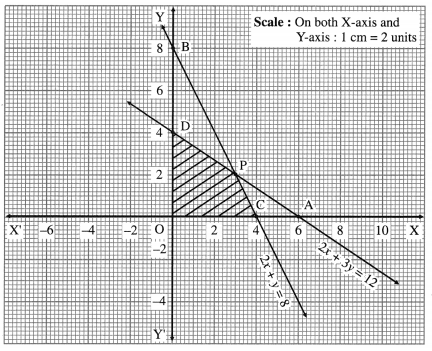
Maharashtra Board 12th Maths Solutions Chapter 7 Linear Programming Miscellaneous Exercise 7 53
The feasible solution is OCPBO.

(ii) 3x + 4y ≥ 12, 4x + 7y ≤ 28, x ≥ 0, y ≥ 0
Solution:
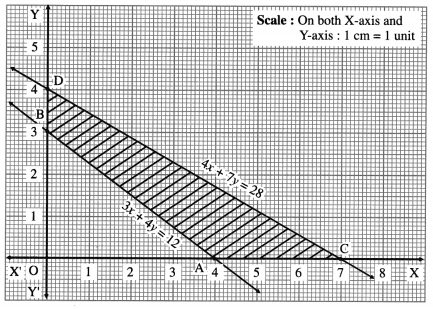
Maharashtra Board 12th Maths Solutions Chapter 7 Linear Programming Miscellaneous Exercise 7 54
The feasible solution is ACDBA.

Maharashtra Board 12th Maths Solutions Chapter 1 Mathematical Logic Ex 1.1

Question 5.
Solve each of the following L.P.P.
(i) Maximize z = 5x1 + 6x2 subject to 2x1 + 3x2 ≤ 18, 2x1 + x2 ≤ 12, x1 ≥ 0, x2 ≥ 0
Solution:
First we draw the lines AB and CD whose equations are 2x1 + 3x2 = 18 and 2x1 + x2 = 12 respectively.
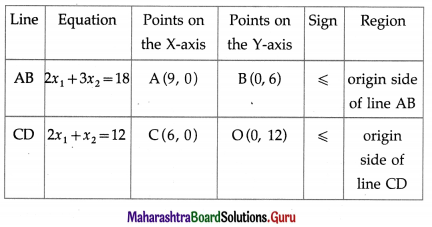
Maharashtra Board 12th Maths Solutions Chapter 7 Linear Programming Miscellaneous Exercise 7 14
Maharashtra Board 12th Maths Solutions Chapter 7 Linear Programming Miscellaneous Exercise 7 15
The feasible region is OCPBO which is shaded in the graph. The vertices of the feasible region are O(0, 0), C(6, 0), P and B (0,6).
P is the point of intersection of the lines
2x1 + 3x2 = 18 ….(1)
and 2x1 + x2 = 12
On subtracting, we get
2x2 = 6 ∴ x2 = 3
Substituting x2 = 3 in (2), we get
2x1 + 3 = 12 ∴ x2 = 9
∴ P is (\(\frac{9}{2}\), 3)
The values of objective function z = 5x1 + 6x2 at these vertices are
z(O) = 5(0) + 6(0) = 0 + 0 = 0
z(C) = 5(6) + 6(0) = 30 + 0 = 30
z(P) = 5(\(\frac{9}{2}\)) + 6(3) = \(\frac{45}{2}\) + 18 = \(\frac{45+36}{2}=\frac{81}{2}\) = 40.5
z(B) = 5(0) + 6(3) = 0 + 18 = 18
Maximum value of z is 40.5 when x1 = 9/2, y = 3.

(ii) Maximize z = 4x + 2y subject to 3x + y ≥ 27, x + y ≥ 21
Question is modified.
Maximize z = 4x + 2y subject to 3x + y ≤ 27, x + y ≤ 21, x ≥ 0, y ≥ 0
Solution:
First we draw the lines AB and CD whose equations are 3x + y = 27 and x + y = 21 respectively.
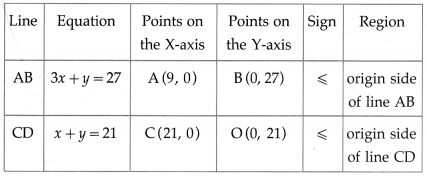
Maharashtra Board 12th Maths Solutions Chapter 7 Linear Programming Miscellaneous Exercise 7 16
Maharashtra Board 12th Maths Solutions Chapter 7 Linear Programming Miscellaneous Exercise 7 17
The feasible region is OAPDO which is shaded region in the graph. The vertices of the feasible region are 0(0, 0), A (9, 0), P and D(0, 21). P is the point of intersection of lines
3x + y = 27 … (1)
and x + y = 21 … (2)
On substracting, we get 2x = 6 ∴ x = 3
Substituting x = 3 in equation (1), we get
9 + y = 27 ∴ y = 18
∴ P = (3, 18)
The values of the objective function z = 4x + 2y at these vertices are
z(O) = 4(0) + 2(0) = 0 + 0 = 0
z(a) = 4(9) + 2(0) = 36 + 0 = 36
z(P) = 4(3) + 2(18) = 12 + 36 = 48
z (D) = 4(0) + 2(21) = 0 + 42 = 42
∴ 2 has minimum value 48 when x = 3, y = 18.

(iii) Maximize z = 6x + 10y subject to 3x + 5y ≤ 10, 5x + 3y ≤ 15, x ≥ 0, y ≥ 0
Solution:
First we draw the lines AB and CD whose equations are 3x + 5y = 10 and 5x + 3y = 15 respectively.
Maharashtra Board 12th Maths Solutions Chapter 7 Linear Programming Miscellaneous Exercise 7 18
Maharashtra Board 12th Maths Solutions Chapter 7 Linear Programming Miscellaneous Exercise 7 19
The feasible region is OCPBD which is shaded in the graph.
The vertices of the feasible region are 0(0, 0), C(3, 0), P and B (0, 2).
P is the point of intersection of the lines
3x + 5y = 10 … (1)
and 5x + 3y = 15 … (2)
Multiplying equation (1) by 5 and equation (2) by 3, we get
15x + 25y = 50
15x + 9y = 45
On subtracting, we get
16y = 5 ∴ y = \(\frac{5}{16}\)
Substituting y = \(\frac{5}{16}\) in equation (1), we get
3x + \(\frac{25}{16}\) = 10 ∴ 3x = 10 – \(\frac{25}{16}=\frac{135}{16}\)
∴ x = \(\frac{45}{16}\) ∴ P ≡ \(\left(\frac{45}{16}, \frac{5}{16}\right)\)
The values of objective function z = 6x + 10y at these vertices are
z(O) = 6(0) + 10(0) = 0 + 0 = 0
z(C) = 6(3) + 10(0) = 18 + 0 = 18
z(P) = 6\(\left(\frac{45}{16}\right)\) + 10\(\left(\frac{5}{10}\right)\) = \(\frac{270}{16}+\frac{50}{16}=\frac{320}{16}\) = 20
z(B) = 6(0) + 10(2) = 0 + 20 = 20
The maximum value of z is 20 at P\(\left(\frac{45}{16}, \frac{5}{16}\right)\) and B (0, 2) two consecutive vertices.
∴ z has maximum value 20 at each point of line segment PB where B is (0, 2) and P is \(\left(\frac{45}{16}, \frac{5}{16}\right)\).
Hence, there are infinite number of optimum solutions.

Maharashtra Board 12th Maths Solutions Chapter 1 Mathematical Logic Ex 1.1

(iv) Maximize z = 2x + 3y subject to x – y ≥ 3, x ≥ 0, y ≥ 0
Solution:
First we draw the lines AB whose equation is x – y = 3.
Maharashtra Board 12th Maths Solutions Chapter 7 Linear Programming Miscellaneous Exercise 7 20
Maharashtra Board 12th Maths Solutions Chapter 7 Linear Programming Miscellaneous Exercise 7 21
The feasible region is shaded which is unbounded.
Therefore, the value of objective function can be in- j creased indefinitely. Hence, this LPP has unbounded solution.

Question 6.
Solve each of the following L.P.P.
(i) Maximize z = 4x1 + 3x2 subject to 3x1 + x2 ≤ 15, 3x1 + 4x2 ≤ 24, x1 ≥ 0, x2 ≥ 0
Solution:
We first draw the lines AB and CD whose equations are 3x1 + x2 = 15 and 3x1 + 4x2 = 24 respectively.
Maharashtra Board 12th Maths Solutions Chapter 7 Linear Programming Miscellaneous Exercise 7 22
Maharashtra Board 12th Maths Solutions Chapter 7 Linear Programming Miscellaneous Exercise 7 23
The feasible region is OAPDO which is shaded in the graph.
The Vertices of the feasible region are 0(0, 0), A(5, 0), P and D(0, 6).
P is the point of intersection of lines.
3x1 + 4x2 = 24 … (1)
and 3x1 + x2 = 15 … (2)
On subtracting, we get
3x2 = 9 ∴ x2 = 3
Substituting x2 = 3 in (2), we get
3x1 + 3 = 15
∴ 3x1 = 12 ∴ x1 = 4 ∴ P is (4, 3)
The values of objective function z = 4x1 + 3x2 at these vertices are
z(O) = 4(0) + 3(0) = 0 + 0 = 0
z(a) = 4(5) + 3(0) = 20 + 0 = 20
z(P) = 4(4) + 3(3) = 16 + 9 = 25
z(D) = 4(0) + 3(6) = 0 + 18 = 18
∴ z has maximum value 25 when x = 4 and y = 3.

(ii) Maximize z = 60x + 50y subject to x + 2y ≤ 40, 3x + 2y ≤ 60, x ≥ 0, y ≥ 0
Solution:
We first draw the lines AB and CD whose equations are x + 2y = 40 and 3x + 2y = 60 respectively.
Maharashtra Board 12th Maths Solutions Chapter 7 Linear Programming Miscellaneous Exercise 7 24
Maharashtra Board 12th Maths Solutions Chapter 7 Linear Programming Miscellaneous Exercise 7 25
The feasible region is OCPBO which is shaded in the graph.
The vertices of the feasible region are O (0, 0), C (20, 0), P and B (0, 20).
P is the point of intersection of the lines.
3x + 2y = 60 … (1)
and x + 2y = 40 … (2)
On subtracting, we get
2x = 20 ∴ x = 10
Substituting x = 10 in (2), we get
10 + 2y = 40
∴ 2y = 30 ∴ y = 15 ∴ P is (10, 15)
The values of the objective function z = 60x + 50y at these vertices are
z(O) = 60(0) + 50(0) = 0 + 0 = 0
z(C) = 60(20) + 50(0) = 1200 + 0 = 1200
z(P) = 60(10) + 50(15) = 600 + 750 = 1350
z(B) = 60(0) + 50(20) = 0 + 1000 = 1000 .
∴ z has maximum value 1350 at x = 10, y = 15.

Maharashtra Board 12th Maths Solutions Chapter 1 Mathematical Logic Ex 1.1

(iii) Maximize z = 4x + 2y subject to 3x + y ≥ 27, x + y ≥ 21, x + 2y ≥ 30; x ≥ 0, y ≥ 0
Solution:
We first draw the lines AB, CD and EF whose equations are 3x + y = 27, x + y = 21, x + 2y = 30 respectively.
Maharashtra Board 12th Maths Solutions Chapter 7 Linear Programming Miscellaneous Exercise 7 26
Maharashtra Board 12th Maths Solutions Chapter 7 Linear Programming Miscellaneous Exercise 7 27
The feasible region is XEPQBY which is shaded in the graph.
The vertices of the feasible region are E (30,0), P, Q and B (0,27).
P is the point of intersection of the lines
x + 2y = 30 … (1)
and x + y = 21 … (2)
On subtracting, we get
y = 9
Substituting y = 9 in (2), we get
x + 9 = 21 ∴ x = 12
∴ P is (12, 9)
Q is the point of intersection of the lines
x + y = 21 … (2)
and 3x + y = 27 … (3)
On subtracting, we get
2x = 6 ∴ x = 3
Substituting x = 3 in (2), we get
3 + y = 21 ∴ y = 18
∴ Q is (3, 18).
The values of the objective function z = 4x + 2y at these vertices are
z(E) = 4(30) + 2(0) = 120 + 0 = 120
z(P) = 4(12) + 2(9) = 48 + 18 = 66
z(Q) = 4(3) + 2(18) = 12 + 36 = 48
z(B) = 4(0) + 2(27) = 0 + 54 = 54
∴ z has minimum value 48, when x = 3 and y = 18.

Question 7.
A carpenter makes chairs and tables. Profits are ₹140/- per chair and ₹ 210/- per table. Both products are processed on three machines : Assembling, Finishing and Polishing. The time required for each product in hours and availability of each machine is given by following table:

Maharashtra Board 12th Maths Solutions Chapter 7 Linear Programming Miscellaneous Exercise 7 28
Formulate the above problem as L.P.P. Solve it graphically to get maximum profit.
Solution:
Let the number of chairs and tables made by the carpenter be x and y respectively.
The profits are ₹ 140 per chair and ₹ 210 per table.
∴ total profit z = ₹ (140x + 210y) This is the objective function which is to be maximized.
The constraints are as per the following table :
Maharashtra Board 12th Maths Solutions Chapter 7 Linear Programming Miscellaneous Exercise 7 29
From the table, the constraints are
3x + 3y ≤ 36, 5x + 2y ≤ 50, 2x + 6y ≤ 60.
The number of chairs and tables cannot be negative.
∴ x ≥ 0, y ≥ 0
Hence, the mathematical formulation of given LPP is :
Maximize z = 140x + 210y, subject to
3x + 3y ≤ 36, 5x + 2y ≤ 50, 2x + 6y ≤ 60, x ≥ 0, y ≥ 0.
We first draw the lines AB, CD and EF whose equations are 3x + 3y = 36, 5x + 2y = 50 and 2x + 6y = 60 respectively.
Maharashtra Board 12th Maths Solutions Chapter 7 Linear Programming Miscellaneous Exercise 7 30
Maharashtra Board 12th Maths Solutions Chapter 7 Linear Programming Miscellaneous Exercise 7 31
The feasible region is OCPQFO which is shaded in the graph.
The vertices of the feasible region are O (0, 0), C (10, 0), P, Q and F (0, 10).
P is the point of intersection of the lines
5x + 2y = 50 … (1)
and 3x + 3y = 36 … (2)
Multiplying equation (1) by 3 and equation (2) by 2, we get
15x + 6y = 150
6x + 6y = 72
On subtracting, we get 26
9x = 78 ∴ x = \(\frac{26}{3}\)
Substituting x = \(\frac{26}{3}\) in (2), we get
3\(\left(\frac{26}{3}\right)\) + 3y = 36
3y = 1o y = \(\frac{10}{3}\)
Q is the point of intersection of the lines
3x + 3y = 36 … (2)
and 2x + 6y = 60 … (3)
Multiplying equation (2) by 2, we get
6x + 6 y = 72
Subtracting equation (3) from this equation, we get
4x = 12 ∴ x = 3
Substituting x = 3 in (2), we get
3(3) + 3y = 36
∴ 3y = 27 ∴ y = 9
∴ Q is (3, 9).
Hence, the vertices of the feasible region are O (0, 0),
C(10, 0), P\(\left(\frac{26}{3}, \frac{10}{3}\right)\), Q(3, 9) and F(0, 10).
The values of the objective function z = 140x + 210y at these vertices are
z(O) = 140(0) + 210(0) = 0 + 0 = 0
z(C) = 140 (10) + 210(0) = 1400 + 0 = 1400
z(P) = 140\(\left(\frac{26}{3}\right)\) + 210\(\left(\frac{10}{3}\right)\) = \(\frac{3640+2100}{3}=\frac{5740}{3}\) = 1913.33
z(Q) = 140(3) + 210(9) = 420 + 1890 = 2310
z(F) = 140(0) + 210(10) = 0 + 2100 = 2100
∴ z has maximum value 2310 when x = 3 and y = 9 Hence, the carpenter should make 3 chairs and 9 tables to get the maximum profit of ₹ 2310.

Maharashtra Board 12th Maths Solutions Chapter 1 Mathematical Logic Ex 1.1

Question 8.
A company manufactures bicycles and tricycles, each of which must be processed through two machines A and B. Maximum availability of Machine A and B is respectively 120 and 180 hours. Manufacturing a bicycle requires 6 hours on Machine A and 3 hours on Machine B. Manufacturing a tricycles requires 4 hours on Machine A and 10 hours on Machine B. If profits are ₹180/- for a bicycle and ₹220/- for a tricycle. Determine the number of bicycles and tricycles that should be manufactured in order to maximize the profit.
Solution:
Let x bicycles and y tricycles are to be manu¬factured. Then the total profit is z = ₹ (180x + 220y)
This is a linear function which is to be maximized. Hence, it is the objective function. The constraints are as per the following table :
Maharashtra Board 12th Maths Solutions Chapter 7 Linear Programming Miscellaneous Exercise 7 32
From the table, the constraints are
6x + 4y ≤ 120, 3x +10y ≤ 180
Also, the number of bicycles and tricycles cannot be i negative.
∴ x ≥ 0, y ≥ 0.
Hence, the mathematical formulation of given LPP is :
Maximize z = 180x + 220y, subject to
6x + 4y ≤ 120, 3x + 10y ≤ 180, x ≥ 0, y ≥ 0.
First we draw the lines AB and CD whose equations are 6x + 4y = 120 and 3x + 10y = 180 respectively.
Maharashtra Board 12th Maths Solutions Chapter 7 Linear Programming Miscellaneous Exercise 7 33
Maharashtra Board 12th Maths Solutions Chapter 7 Linear Programming Miscellaneous Exercise 7 34
The feasible region is OAPDO which is shaded in the graph.
The vertices of the feasible region are O(0, 0), A(20, 0) P and D(0, 18).
P is the point of intersection of the lines
3x + 10y = 180 … (1)
and 6x + 4y = 120 … (2)
Multiplying equation (1) by 2, we get
6x + 20y = 360
Subtracting equation (2) from this equation, we get
16y = 240 ∴ y = 15
∴ from (1), 3x + 10(15) = 180
∴ 3x = 30 ∴ x = 10
∴ P = (10, 15)
The values of the objective function z = 180x + 220y at these vertices are
z(O) = 180(0) + 220(0) = 0 + 0 = 0
z(a) = 180(20) + 220(0) = 3600 + 0 = 3600
z(P) = 180(10) + 220(15) = 1800 + 3300 = 5100
z(D) = 180(0) +220(18) = 3960
∴ the maximum value of z is 5100 at the point (10, 15).
Hence, 10 bicycles and 15 tricycles should be manufactured in order to have the maximum profit of ₹ 5100.

Question 9.
A factory produced two types of chemicals A and B. The following table gives the units of ingredients P and Q (per kg) of chemicals A and B as well as minimum requirements of P and Q and also cost per kg. chemicals A and B :
Maharashtra Board 12th Maths Solutions Chapter 7 Linear Programming Miscellaneous Exercise 7 35
Find the number of units of chemicals A and B should be produced so as to minimize the cost.
Solution:
Let the factory produce x units of chemical A and y units of chemical B. Then the total cost is z = ₹ (4x + 6y). This is the objective function which is to be minimized.
From the given table, the constraints are
x + 2y ≥ 80, 3x + y ≥ 75.
Also, the number of units x and y of chemicals A and B cannot be negative.
∴ x ≥ 0, y ≥ 0.
∴ the mathematical formulation of given LPP is
Minimize z = 4x + 6y, subject to
x + 2y ≥ 80, 3x + y ≥ 75, x ≥ 0, y ≥ 0.
First we draw the lines AB and CD whose equations are x + 2y = 80 and 3x + y = 75 respectively.
Maharashtra Board 12th Maths Solutions Chapter 7 Linear Programming Miscellaneous Exercise 7 36
Maharashtra Board 12th Maths Solutions Chapter 7 Linear Programming Miscellaneous Exercise 7 37
The feasible region is shaded in the graph.
The vertices of the feasible region are A (80, 0), P and D (0, 75).
P is the point of intersection of the lines
x + 2y = 80 … (1)
and 3x + y = 75 … (2)
Multiplying equation (2) by 2, we get
6x + 2 y = 150
Subtracting equation (1) from this equation, we get
5x = 70 ∴ x = 14
∴ from (2), 3(14) + y = 75
∴ 42 + y = 75 ∴ y = 33
∴ P = (14, 33)
The values of the objective function z = 4x + 6y at these vertices are
z(a) = 4(80)+ 6(0) =320 + 0 = 320
z(P) = 4(14)+ 6(33) = 56+ 198 = 254
z(D) = 4(0) + 6(75) = 0 + 450 = 450
∴ the minimum value of z is 254 at the point (14, 33).
Hence, 14 units of chemical A and 33 units of chemical B are to be produced in order to have the j minimum cost of ₹ 254.

Maharashtra Board 12th Maths Solutions Chapter 1 Mathematical Logic Ex 1.1

Question 10.
A company produces mixers and food processors. Profit on selling one mixer and one food processor is ₹ 2,000/- and ₹ 3,000/- respectively. Both the products are processed through three Machines A, B, C. The time required in hours by each product and total time available in hours per week on each machine are as follows :
Maharashtra Board 12th Maths Solutions Chapter 7 Linear Programming Miscellaneous Exercise 7 38
How many mixers and food processors should be produced to maximize the profit?
Solution:
Let the company produce x mixers and y food processors.
Then the total profit is z = ₹ (2000x + 3000y)
This is the objective function which is to be maximized. From the given table in the problem, the constraints are 3x + 3y ≤ 36, 5x + 2y ≤ 50, 2x + 6y ≤ 60
Also, the number of mixers and food processors cannot be negative,
∴ x ≥ 0, y ≥ 0.
∴ the mathematical formulation of given LPP is
Maximize z = 2000x + 3000y, subject to 3x + 3y ≤ 36, 5x + 2y ≤ 50, 2x + 6y ≤60, x ≥ 0, y ≥ 0.
First we draw the lines AB, CD and EF whose equations are 3x + 3y = 36, 5x + 2y = 50 and 2x + 6y = 60 respectively.
Maharashtra Board 12th Maths Solutions Chapter 7 Linear Programming Miscellaneous Exercise 7 39
Maharashtra Board 12th Maths Solutions Chapter 7 Linear Programming Miscellaneous Exercise 7 40
The feasible region is OCPQFO which is shaded in the graph.
The vertices of the feasible region are O(0, 0), C(10, 0), P, Q and F(0,10).
P is the point of intersection of the lines
3x + 3y = 36 … (1)
and 5x + 2y = 50 … (2)
Multiplying equation (1) by 2 and equation (2) by 3, we get
6x + 6y = 72
15x + 6y = 150
On subtracting, we get
9x = 78
∴ x = \(\frac{26}{3}\)
∴ from (1), 3\(\left(\frac{26}{3}\right)\) + 3y = 36
∴ 3y = 10
∴ y = \(\frac{10}{3}\)
∴ P = \(\left(\frac{26}{3}, \frac{10}{3}\right)\)
Q is the point of intersection of the lines
3x + 3y = 36 … (1)
and 2x + 6y = 60 … (3)
Multiplying equation (1) by 2, we get
6x + 6y = 72
Subtracting equation (3), from this equation, we get
4x = 12
∴ x = 3
∴ from (1), 3(3) + 3y = 36
∴ 3y = 27
∴ y = 9
∴ Q = (3, 9)
The values of the objective function z = 2000x + 3000y at these vertices are
z(O) = 2000(0) + 3000(0) = 0 + 0 = 0
z(C) = 2000(10) + 3000(0) = 20000 + 0 = 20000
z(P) = 2000\(\left(\frac{26}{3}\right)\) + 3000\(\left(\frac{10}{3}\right)\) = \(\frac{52000}{3}+\frac{30000}{3}=\frac{82000}{3}\)
z(Q) = 2000(3) + 3000(9) = 6000 + 27000 = 33000
z(F) = 2000(0) + 3000(10) = 30000 + 0 = 30000
∴ the maximum value of z is 33000 at the point (3, 9).
Hence, 3 mixers and 9 food processors should be produced in order to get the maximum profit of ₹ 33,000.

Question 11.
A chemical company produces a chemical containing three basic elements A, B, C so that it has at least 16 liters of A, 24 liters of B and 18 liters of C. This chemical is made by mixing two compounds I and II. Each unit of compound I has 4 liters of A, 12 liters of B, 2 liters of C. Each unit of compound II has 2 liters of A, 2 liters of B and 6 liters of C. The cost per unit of compound I is ₹ 800/- and that of compound II is ₹ 640/-. Formulate the problem as L.P.P. and solve it to minimize the cost.
Solution:
Let the company buy x units of compound I and y units of compound II.
Then the total cost is z = ₹(800x + 640y).
This is the objective function which is to be minimized.
The constraints are as per the following table :
Maharashtra Board 12th Maths Solutions Chapter 7 Linear Programming Miscellaneous Exercise 7 41
From the table, the constraints are
4x + 2y ≥ 16, 12x + 2y ≥ 24, 2x + 6y ≥ 18.
Also, the number of units of compound I and compound II cannot be negative.
∴ x ≥ 0, y ≥ 0.
∴ the mathematical formulation of given LPP is
Minimize z = 800x + 640y, subject to 4x + 2y ≥ 16, 12x + 2y ≥ 24, 2x + 6y ≥ 18, x ≥ 0, y ≥ 0.
First we draw the lines AB, CD and EF whose equations are 4x + 2y = 16, 12x + 2y = 24 and 2x + 6y = 18
Maharashtra Board 12th Maths Solutions Chapter 7 Linear Programming Miscellaneous Exercise 7 42
Maharashtra Board 12th Maths Solutions Chapter 7 Linear Programming Miscellaneous Exercise 7 43
The feasible region is shaded in the graph.
The vertices of the feasible region are E(9, 0), P, Q, and D(0, 12).
P is the point of intersection of the lines
2x + 6y = 18 … (1)
and 4x + 2y = 16 … (2)
Multiplying equation (1) by 2, we get 4x + 12y = 36
Subtracting equation (2) from this equation, we get
10y = 20
∴ y = 2
∴ from (1), 2x + 6(2) = 18
∴ 2x = 6
∴ x = 3
∴ P = (3, 2)
Q is the point of intersection of the lines
12x + 2y = 24 … (3)
and 4x + 2y = 16 … (2)
On subtracting, we get
8x = 8 ∴ x = 1
∴ from (2), 4(1) + 2y = 16
∴ 2y = 12 ∴ y = 6
∴ Q = (1, 6)
The values of the objective function z = 800x + 640y at these vertices are
z(E) = 800(9)+ 640(0) =7200 + 0 = 7200
z(P) = 800(3) + 640(2) = 2400 + 1280 = 3680
z(Q) = 800(1) + 640(6) =800 + 3840 =4640
z(D) = 800(0) + 640(12) = 0 + 7680 = 7680
∴ the minimum value of z is 3680 at the point (3, 2).
Hence, the company should buy 3 units of compound I and 2 units of compound II to have the minimum cost of ₹ 3680.

Maharashtra Board 12th Maths Solutions Chapter 1 Mathematical Logic Ex 1.1

Question 12.
A person makes two types of gift items A and B requires the services of a cutter and a finisher. Gift item A requires 4 hours of cutter’s time and 2 hours of finisher’s time. B requires 2 hours of cutter’s time and 4 hours of finisher’s time. The cutter and finisher have 208 hours and 152 hours available times respectively every month. The profit of one gift item of type A is ₹ 75/- and on gift item B is ₹ 125/-. Assuming that the person can sell all the gift items produced, determine how many gift items of each type should he make every month to obtain the best returns?
Solution:
Let x: number of gift item A
y: number of gift item B
As numbers of the items are never negative
x ≥ 0; y ≥ 0
Maharashtra Board 12th Maths Solutions Chapter 7 Linear Programming Miscellaneous Exercise 7 44
Total time required for the cutter = 4x + 2y
Maximum available time 208 hours
∴ 4x+ 2y ≤ 208
Total time required for the finisher 2x +4y
Maximum available time 152 hours
2x + 4y ≤ 152
Total Profit is 75x + 125y
∴ L.P.P. of the above problem is
Minimize z = 75x + 125y
Subject to 4x+ 2y ≤ 208
2x + 4y ≤ 152
x ≥ 0; y ≥ 0
Graphical solution
Maharashtra Board 12th Maths Solutions Chapter 7 Linear Programming Miscellaneous Exercise 7 45
Corner points
Now, Z at
x = (75x + 125y)
O(0, 0) = 75 × 0 + 125 × 0 = 0
A(52,0) = 75 × 52 + 125 × 0 = 3900
B(44, 16) = 75 × 44 + 125 × 16 = 5300
C(0, 38) = 75 × 0 + 125 × 38 = 4750
A person should make 44 items of type A and 16 Uems of type Band his returns are ₹ 5,300.

Question 13.
A firm manufactures two products A and B on which profit earned per unit ₹3/- and ₹4/- respectively. Each product is processed on two machines M1 and M2. The product A requires one minute of processing time on M1 and two minute of processing time on M2, B requires one minute of processing time on M1 and one minute of processing time on M2. Machine M1 is available for use for 450 minutes while M2 is available for 600 minutes during any working day. Find the number of units of product A and B to be manufactured to get the maximum profit.
Solution:
Let the firm manufactures x units of product
A and y units of product B.
The profit earned per unit of A is ₹3 and B is ₹ 4.
Hence, the total profit is z = ₹ (3x + 4y).
This is the linear function which is to be maximized.
Hence, it is the objective function.
The constraints are as per the following table :
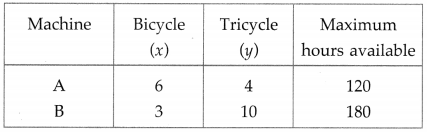
Maharashtra Board 12th Maths Solutions Chapter 7 Linear Programming Miscellaneous Exercise 7 46
From the table, the constraints are
x + y ≤ 450, 2x + y ≤ 600
Since, the number of gift items cannot be negative, x ≥ 0, y ≥ o.
∴ the mathematical formulation of LPP is,
Maximize z = 3x + 4y, subject to x + y ≤ 450, 2x + y ≤ 600, x ≥ 0, y ≥ 0.
Now, we draw the lines AB and CD whose equations are x + y = 450 and 2x + y — 600 respectively.
Maharashtra Board 12th Maths Solutions Chapter 7 Linear Programming Miscellaneous Exercise 7 47
Maharashtra Board 12th Maths Solutions Chapter 7 Linear Programming Miscellaneous Exercise 7 48
The feasible region is OCPBO which is shaded in the graph.
The vertices of the feasible region are O(0, 0), C(300, 0), P and B (0, 450).
P is the point of intersection of the lines
2x + y = 600 … (1)
and x + y = 450 … (2)
On subtracting, we get
∴ x = 150
Substituting x = 150 in equation (2), we get
150 + y = 450
∴ y = 300
∴ P = (150, 300)
The values of the objective function z = 3x + 4y at these vertices are
z(O) = 3(0) + 4(0) = 0 + 0 = 0
z(C) = 3(300) + 4(0) = 900 + 0 = 900
z(P) = 3(150) + 4(300) = 450 + 1200 = 1650
z(B) = 3(0) + 4(450) = 0 + 1800 = 1800
∴ z has the maximum value 1800 when x = 0 and y = 450 Hence, the firm gets maximum profit of ₹ 1800 if it manufactures 450 units of product B and no unit product A.

Maharashtra Board 12th Maths Solutions Chapter 1 Mathematical Logic Ex 1.1

Question 14.
A firm manufacturing two types of electrical items A and B, can make a profit of ₹ 20/- per unit of A and ₹ 30/- per unit of B. Both A and B make use of two essential components a motor and a transformer. Each unit of A requires 3 motors and 2 transformers and each units of B requires 2 motors and 4 transformers. The total supply of components per month is restricted to 210 motors and 300 transformers. How many units of A and B should the manufacture per month to maximize profit? How much is the maximum profit?
Solution:
Let the firm manufactures x units of item A and y units of item B.
Firm can make profit of ₹ 20 per unit of A and ₹ 30 per unit of B.
Hence, the total profit is z = ₹ (20x + 30y).
This is the objective function which is to be maximized. The constraints are as per the following table :
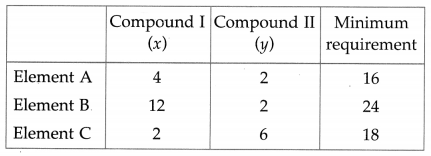
Maharashtra Board 12th Maths Solutions Chapter 7 Linear Programming Miscellaneous Exercise 7 49
From the table, the constraints are
3x + 2y ≤ 210, 2x + 4y ≤ 300
Since, number of items cannot be negative, x ≥ 0, y ≥ 0.
Hence, the mathematical formulation of given LPP is :
Maximize z = 20x + 30y, subject to 3x + 2y ≤ 210, 2x + 4y ≤ 300, x ≥ 0, y ≥ 0.
We draw the lines AB and CD whose equations are 3x + 2y = 210 and 2x + 4y = 300 respectively.
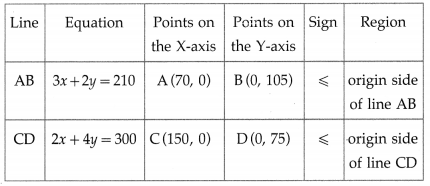
Maharashtra Board 12th Maths Solutions Chapter 7 Linear Programming Miscellaneous Exercise 7 50
The feasible region is OAPDO which is shaded in the graph.
The vertices of the feasible region are O (0, 0), A (70, 0), P and D (0, 75).
P is the point of intersection of the lines
2x + 4y = 300 … (1)
and 3x + 2y = 210 … (2)
Multiplying equation (2) by 2, we get
6x + 4y = 420
Subtracting equation (1) from this equation, we get
∴ 4x = 120 ∴ x = 30
Substituting x = 30 in (1), we get
2(30) + 4y = 300
∴ 4y = 240 ∴ y = 60
∴ P is (30, 60)
The values of the objective function z = 20x + 30y at these vertices are
z(O) = 20(0) + 30(0) = 0 + 0 = 0
z(A) = 20(70) + 30(0) = 1400 + 0 = 1400
z(P) = 20(30) + 30(60) = 600 + 1800 = 2400
z(D) = 20(0) + 30(75) = 0 + 2250 = 2250
∴ z has the maximum value 2400 when x = 30 and y = 60. Hence, the firm should manufactured 30 units of item A and 60 units of item B to get the maximum profit of ₹ 2400.

Class 12 Maharashtra State Board Maths Solution 

Linear Programming Class 12 Maths 1 Exercise 7.4 Solutions Maharashtra Board

Balbharti 12th Maharashtra State Board Maths Solutions Book Pdf Chapter 7 Linear Programming Ex 7.4 Questions and Answers.

12th Maths Part 1 Linear Programming Exercise 7.4 Questions And Answers Maharashtra Board

Question 1.
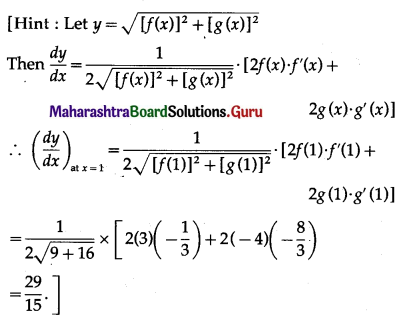
Maximize : z = 11x + 8y subject to x ≤ 4, y ≤ 6,
x + y ≤ 6, x ≥ 0, y ≥ 0.
Solution:
First we draw the lines AB, CD and ED whose equations are x = 4, y = 6 and x + y = 6 respectively.
Maharashtra Board 12th Maths Solutions Chapter 7 Linear Programming Ex 7.4 1
Maharashtra Board 12th Maths Solutions Chapter 7 Linear Programming Ex 7.4 2
The feasible region is shaded portion OAPDO in the graph.

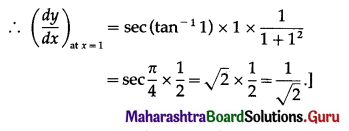
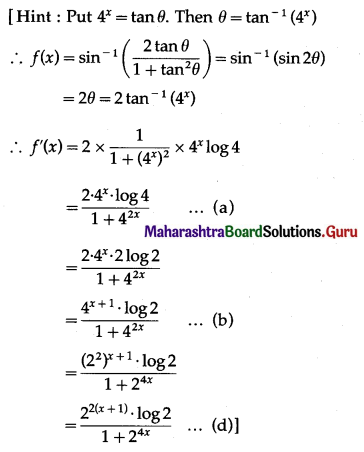
The vertices of the feasible region are O (0, 0), A (4, 0), P and D (0, 6)
P is point of intersection of lines x + y = 6 and x = 4.
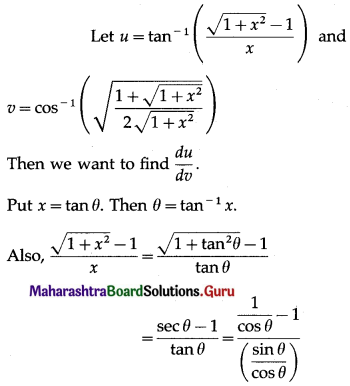
Substituting x = 4 in x + y = 6, we get
4 + y = 6 ∴ y = 2 ∴ P is (4, 2).
∴ the corner points of feasible region are O (0, 0), A (4, 0), P(4, 2) and D(0 ,6).
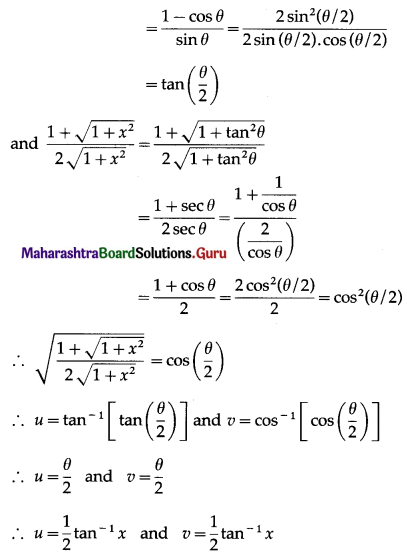
The values of the objective function z = 11x + 8y at these vertices are
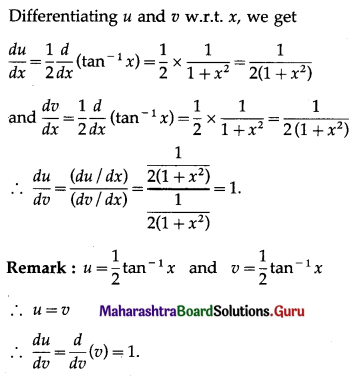
z (O) = 11(0) + 8(0) = 0 + 0 = 0
z(a) = 11(4) + 8(0) = 44 + 0 = 44
z (P) = 11(4) + 8(2) = 44 + 16 = 60
z (D) = 11(0) + 8(2) = 0 + 16 = 16
∴ z has maximum value 60, when x = 4 and y = 2.
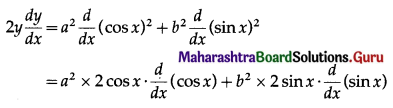
Question 2.
Maximize : z = 4x + 6y subject to 3x + 2y ≤ 12,
x + y ≥ 4, x, y ≥ 0.
Solution:
First we draw the lines AB and AC whose equations are 3x + 2y = 12 and x + y = 4 respectively.
Maharashtra Board 12th Maths Solutions Chapter 7 Linear Programming Ex 7.4 3
Maharashtra Board 12th Maths Solutions Chapter 7 Linear Programming Ex 7.4 4
The feasible region is the ∆ABC which is shaded in the graph.
The vertices of the feasible region (i.e. corner points) are A (4, 0), B (0, 6) and C (0, 4).
The values of the objective function z = 4x + 6y at these vertices are
z(a) = 4(4) + 6(0) = 16 + 0 = 16
z(B) = 4(0)+ 6(6) = 0 + 36 = 36
z(C) = 4(0) + 6(4) = 0 + 24 = 24
∴ has maximum value 36, when x = 0, y = 6.

Maharashtra Board 12th Maths Solutions Chapter 1 Mathematical Logic Ex 1.1

Question 3.
Maximize : z = 7x + 11y subject to 3x + 5y ≤ 26
5x + 3y ≤ 30, x ≥ 0, y ≥ 0.
Solution:
First we draw the lines AB and CD whose equations are 3x + 5y = 26 and 5x + 3y = 30 respectively.
Maharashtra Board 12th Maths Solutions Chapter 7 Linear Programming Ex 7.4 5
Maharashtra Board 12th Maths Solutions Chapter 7 Linear Programming Ex 7.4 6
The feasible region is OCPBO which is shaded in the graph.
The vertices of the feasible region are O (0, 0), C (6, 0), p and B(0, \(\frac{26}{5}\))
The vertex P is the point of intersection of the lines
3x + 5y = 26 … (1)
and 5x + 3y = 30 … (2)
Multiplying equation (1) by 3 and equation (2) by 5, we get
9x + 15y = 78
and 25x + 15y = 150
On subtracting, we get
16x = 72 ∴ x = \(\frac{72}{16}=\frac{9}{2}\) = 4.5
Substituting x = 4.5 in equation (2), we get
5(4.5) + 3y = 30
22.5 + 3y = 30
∴ 3y = 7.5 ∴ y = 2.5
∴ P is (4.5, 2.5)
The values of the objective function z = 7x + 11y at these corner points are
z (O) = 7(0) + 11(0) = 0 + 0 = 0
z (C) = 7(6) + 11(0) = 42 + 0 = 42
z (P) = 7(4.5) + 11 (2.5) = 31.5 + 27.5 = 59.0 = 59
z(B) = 7(0) + 11\(\left(\frac{26}{5}\right)=\frac{286}{5}\) = 57.2
∴ z has maximum value 59, when x = 4.5 and y = 2.5.

Question 4.
Maximize : z = 10x + 25y subject to 0 ≤ x ≤ 3,
0 ≤ y ≤ 3, x + y ≤ 5 also find maximum value of z.
Solution:
First we draw the lines AB, CD and EF whose equations are x = 3, y = 3 and x + y = 5 respectively.
Maharashtra Board 12th Maths Solutions Chapter 7 Linear Programming Ex 7.4 7
Maharashtra Board 12th Maths Solutions Chapter 7 Linear Programming Ex 7.4 8
The feasible region is OAPQDO which is shaded in the i graph.
The vertices of the feasible region are O (0, 0), A (3, 0), P, Q and D(0, 3).
t P is the point of intersection of the lines x + y = 5 and x = 3.
Substituting x = 3 in x + y = 5, we get
3 + y = 5 ∴ y = 2
∴ P is (3, 2)
Q is the point of intersection of the lines x + y = 5 and y = 3
Substituting y = 3 in x + y = 5, we get
x + 3 = 5 ∴ x = 2
∴ Q is (2, 3)
The values of the objective function z = 10x + 25y at these vertices are
z(O) = 10(0) + 25(0) = 0 + 0 = 0
z(a) = 10(3) + 25(0) = 30 + 0 = 30
z(P) = 10(3) + 25(2) = 30 + 50 = 80
z(Q) = 10(2) + 25(3) = 20 + 75 = 95
z(D) = 10(0)+ 25(3) = 0 + 75 = 75
∴ z has maximum value 95, when x = 2 and y = 3.

Maharashtra Board 12th Maths Solutions Chapter 1 Mathematical Logic Ex 1.1

Question 5.
Maximize : z = 3x + 5y subject to x + 4y ≤ 24, 3x + y ≤ 21,
x + y ≤ 9, x ≥ 0, y ≥ 0 also find maximum value of z.
Solution:
First we draw the lines AB, CD and EF whose equations are x + 4y = 24, 3x + y = 21 and x + y = 9 respectively.
Maharashtra Board 12th Maths Solutions Chapter 7 Linear Programming Ex 7.4 9
Maharashtra Board 12th Maths Solutions Chapter 7 Linear Programming Ex 7.4 10
The feasible region is OCPQBO which is shaded in the graph.
The vertices of the feasible region are O (0, 0), C (7, 0), P, Q and B (0, 6).
P is the point of intersection of the lines
3x + y = 21 … (1)
and x + y = 9 … (2)
On subtracting, we get 2x = 12 ∴ x = 6
Substituting x = 6 in equation (2), we get
6 + y = 9 ∴ y = 3
∴ P = (6, 3)
Q is the point of intersection of the lines
x + 4y = 24 … (3)
and x + y = 9 … (2)
On subtracting, we get
3y = 15 ∴ y = 5
Substituting y = 5 in equation (2), we get
x + 5= 9 ∴ x = 4
∴ Q = (4, 5)
∴ the corner points of the feasible region are 0(0,0), C(7, 0), P (6, 3), Q (4, 5) and B (0, 6).
The values of the objective function 2 = 3x + 5y at these corner points are
z(O) = 3(0)+ 5(0) = 0 + 0 = 0
z(C) = 3(7) + 5(0) = 21 + 0 = 21
z(P) = 3(6) + 5(3) = 18 + 15 = 33
z(Q) = 3(4) + 5(5) = 12 + 25 = 37
z(B) = 3(0)+ 5(6) = 0 + 30 = 30
∴ z has maximum value 37, when x = 4 and y = 5.

Question 6.
Minimize : z = 7x + y subject to 5x + y ≥ 5, x + y ≥ 3,
x ≥ 0, y ≥ 0.
Solution:
First we draw the lines AB and CD whose equations are 5x + y = 5 and x + y = 3 respectively.
Maharashtra Board 12th Maths Solutions Chapter 7 Linear Programming Ex 7.4 11
Maharashtra Board 12th Maths Solutions Chapter 7 Linear Programming Ex 7.4 12
The feasible region is XCPBY which is shaded in the graph.
The vertices of the feasible region are C (3, 0), P and B (0, 5).
P is the point of the intersection of the lines
5x + y = 5
and x + y = 3
On subtracting, we get
4x = 2 ∴ x = \(\frac{1}{2}\)
Substituting x = \(\frac{1}{2}\) in x + y = 3, we get
\(\frac{1}{2}\) + y = 3
∴ y = \(\frac{5}{2}\) ∴ P = \(\left(\frac{1}{2}, \frac{5}{2}\right)\)
The values of the objective function z = 7x + y at these vertices are
z(C) = 7(3) + 0 = 21
z(B) = 7(0) + 5 = 5
∴ z has minimum value 5, when x = 0 and y = 5.

Maharashtra Board 12th Maths Solutions Chapter 1 Mathematical Logic Ex 1.1

Question 7.
Minimize : z = 8x + 10y subject to 2x + y ≥ 7, 2x + 3y ≥ 15,
y ≥ 2, x ≥ 0, y ≥ 0.
Solution:
First we draw the lines AB, CD and EF whose equations are 2x + y = 7, 2x + 3y = 15 and y = 2 respectively.
Maharashtra Board 12th Maths Solutions Chapter 7 Linear Programming Ex 7.4 13
Maharashtra Board 12th Maths Solutions Chapter 7 Linear Programming Ex 7.4 14
The feasible region is EPQBY which is shaded in the graph. The vertices of the feasible region are P, Q and B(0,7). P is the point of intersection of the lines 2x + 3y = 15 and y = 2.
Substituting y – 2 in 2x + 3y = 15, we get 2x + 3(2) = 15
∴ 2x = 9 ∴ x = 4.5 ∴ P = (4.5, 2)
Q is the point of intersection of the lines
2x + 3y = 15 … (1)
and 2x + y = 7 … (2)
On subtracting, we get
2y = 8 ∴ y = 4
∴ from (2), 2x + 4 = 7
∴ 2x = 3 ∴ x = 1.5
∴ Q = (1.5, 4)
The values of the objective function z = 8x + 10y at these vertices are
z(P) = 8(4.5) + 10(2) = 36 + 20 = 56
z(Q) = 8(1.5) + 10(4) = 12 + 40 = 52
z(B) = 8(0) +10(7) = 70
∴ z has minimum value 52, when x = 1.5 and y = 4

Question 8.
Minimize : z = 6x + 21y subject to x + 2y ≥ 3, x + 4y ≥ 4,
3x + y ≥ 3, x ≥ 0, y ≥ 0.
Solution:
First we draw the lines AB, CD and EF whose equations are x + 2y = 3, x + 4y = 4 and 3x + y = 3 respectively.
Maharashtra Board 12th Maths Solutions Chapter 7 Linear Programming Ex 7.4 15
Maharashtra Board 12th Maths Solutions Chapter 7 Linear Programming Ex 7.4 16
The feasible region is XCPQFY which is shaded in the graph.
The vertices of the feasible region are C (4, 0), P, Q and F(0, 3).
P is the point of intersection of the lines x + 4y = 4 and x + 2y = 3
On subtracting, we get
2y = 1 ∴ y = \(\frac{1}{2}\)
Substituting y = \(\frac{1}{2}\) in x + 2y = 3, we get
x + 2\(\left(\frac{1}{2}\right)\) = 3
∴ x = 2
∴ P = (2, \(\frac{1}{2}\))
Q is the point of intersection of the lines
x + 2y = 3 … (1)
and 3x + y = 3 ….(2)
Multiplying equation (1) by 3, we get 3x + 6y = 9
Subtracting equation (2) from this equation, we get
5y = 6
∴ y = \(\frac{6}{5}\)
∴ from (1), x + 2\(\left(\frac{6}{5}\right)\) = 3
∴ x = 3 – \(\frac{12}{5}=\frac{3}{5}\)
Q ≡ \(\left(\frac{3}{5}, \frac{6}{5}\right)\)
The values of the objective function z = 6x + 21y at these vertices are
z(C) = 6(4) + 21(0) = 24
z(P) = 6(2) + 21\(\left(\frac{1}{2}\right)\)
= 12 + 10.5 = 22.5
z(Q)= 6\(\left(\frac{3}{5}\right)\) + 21\(\left(\frac{6}{5}\right)\)
= \(\frac{18}{5}+\frac{126}{5}=\frac{144}{5}\) = 28.8
2 (F) = 6(0) + 21(3) = 63
∴ z has minimum value 22.5, when x = 2 and y = \(\frac{1}{2}\).

Class 12 Maharashtra State Board Maths Solution