12th Chemistry Chapter 10 Exercise Halogen Derivatives Solutions Maharashtra Board

Class 12 Chemistry Chapter 10

Balbharti Maharashtra State Board 12th Chemistry Textbook Solutions Chapter 10 Halogen Derivatives Textbook Exercise Questions and Answers.

Halogen Derivatives Class 12 Exercise Question Answers Solutions Maharashtra Board

Class 12 Chemistry Chapter 10 Exercise Solutions Maharashtra Board

Chemistry Class 12 Chapter 10 Exercise Solutions

1. Choose the most correct option.

Question i.
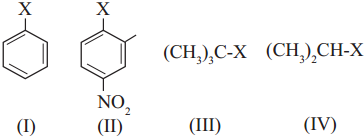
The correct order of increasing reactivity of C-X bond towards nucleophile in the following compounds is
Maharashtra Board Class 12 Chemistry Solutions Chapter 10 Halogen Derivatives 268
a. I < II < III < IV
b. II < I < III < IV
c. III < IV < II < I
d. IV < III < I < II
Answer:
(d) IV < III < I < II

Maharashtra Board Class 12 Chemistry Solutions Chapter 10 Halogen Derivatives

Question ii.
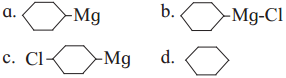
Maharashtra Board Class 12 Chemistry Solutions Chapter 10 Halogen Derivatives 269
The major product of the above reaction is,
Maharashtra Board Class 12 Chemistry Solutions Chapter 10 Halogen Derivatives 270
Answer:
(c)

Question iii.
Which of the following is likely to undergo racemization during alkaline hydrolysis?
Maharashtra Board Class 12 Chemistry Solutions Chapter 10 Halogen Derivatives 271
Answer:
(a) Only I

Question iv.
The best method for preparation of alkyl fluorides is
a. Finkelstein reaction
b. Swartz reaction
c. Free radical fluorination
d. Sandmeyer’s reaction
Answer:
b. Swartz reaction

Question v.
Identify the chiral molecule from the following.
a. 1-Bromobutane
b. 1,1- Dibromobutane
c. 2,3- Dibromobutane
d. 2-Bromobutane
Answer:
(d) 2-Bromobutane

Question vi.
An alkyl chloride on Wurtz reaction gives 2,2,5,5-tetramethylhexane. The same alkyl chloride on reduction with zinc-copper couple in alchol give hydrocarbon with molecular formula C5H12. What is the structure of alkyl chloride
Maharashtra Board Class 12 Chemistry Solutions Chapter 10 Halogen Derivatives 272
Answer:
(a)

Question vii.
Butanenitrile may be prepared by heating
a. propanol with KCN
b. butanol with KCN
c. n-butyl chloride with KCN
d. n-propyl chloride with KCN
Answer:
(d) n-propyl chloride with KCN

Question viii.
Choose the compound from the following that will react fastest by SN1 mechanism.
a. 1-iodobutane
b. 1-iodopropane
c. 2-iodo-2 methylbutane
d. 2-iodo-3-methylbutane
Answer:
(c) 2-iodo-2 methylbutane

Maharashtra Board Class 12 Chemistry Solutions Chapter 10 Halogen Derivatives

Question ix.
Maharashtra Board Class 12 Chemistry Solutions Chapter 10 Halogen Derivatives 273
The product ‘B’ in the above reaction sequence is,
Maharashtra Board Class 12 Chemistry Solutions Chapter 10 Halogen Derivatives 274
Answer:
(d)

Question x.
Which of the following is used as source of dichlorocarbene
a. tetrachloromethane
b. chloroform
c. iodoform
d. DDT
Answer:
(b) chloroform

2. Do as directed.

Question i.
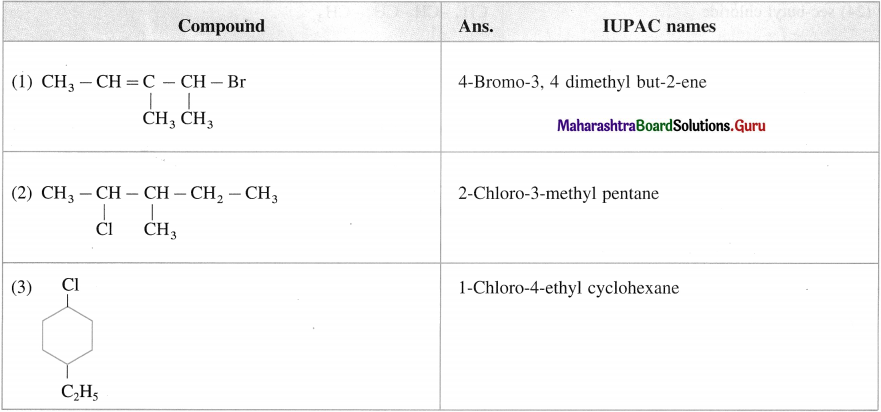
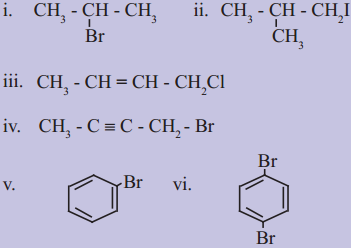
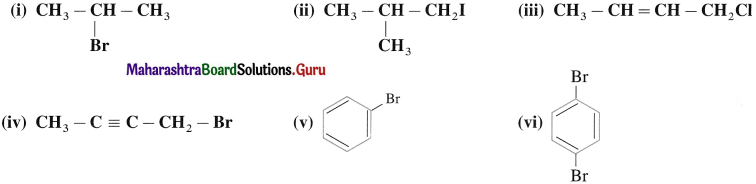
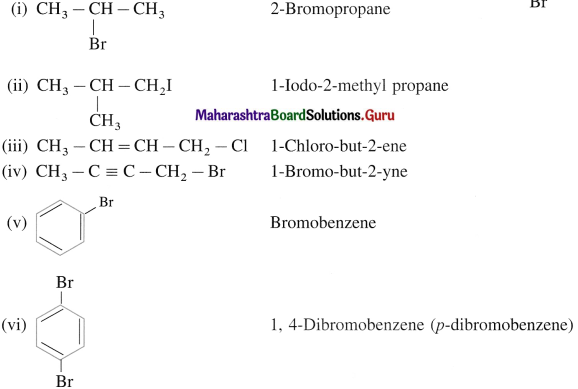
Write IUPAC name of the following compounds
Maharashtra Board Class 12 Chemistry Solutions Chapter 10 Halogen Derivatives 275
Answer:
Maharashtra Board Class 12 Chemistry Solutions Chapter 10 Halogen Derivatives 23
Maharashtra Board Class 12 Chemistry Solutions Chapter 10 Halogen Derivatives 24

Question ii.
Write structure and IUPAC name of the major product in each of the following reaction.
Maharashtra Board Class 12 Chemistry Solutions Chapter 10 Halogen Derivatives 276
Maharashtra Board Class 12 Chemistry Solutions Chapter 10 Halogen Derivatives 277
Answer:
Structure and IUPAC name
Maharashtra Board Class 12 Chemistry Solutions Chapter 10 Halogen Derivatives 126
Maharashtra Board Class 12 Chemistry Solutions Chapter 10 Halogen Derivatives 127

Maharashtra Board Class 12 Chemistry Solutions Chapter 10 Halogen Derivatives

Question iii.
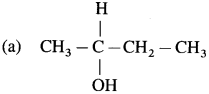
Identify chiral molecule/s from the following.
Maharashtra Board Class 12 Chemistry Solutions Chapter 10 Halogen Derivatives 278
Answer:
Chiral molecule
Maharashtra Board Class 12 Chemistry Solutions Chapter 10 Halogen Derivatives 88

Question iv.
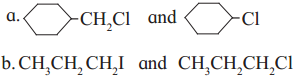
Which one compound from the following pairs would undergo SN2 faster from the?
Maharashtra Board Class 12 Chemistry Solutions Chapter 10 Halogen Derivatives 279
Answer:
(1) Sincey Maharashtra Board Class 12 Chemistry Solutions Chapter 10 Halogen Derivatives 157 is a primary halide it undergoes SN2 reaction faster than Maharashtra Board Class 12 Chemistry Solutions Chapter 10 Halogen Derivatives 158.
(2) Since iodine is a better leaving group than chloride, 1-iodo propane (CH3CH2CH2I) undergoes SN2 reaction faster than l-chloropropane (CH3CH2CH2CI).

Question v.
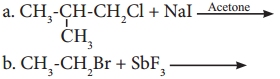
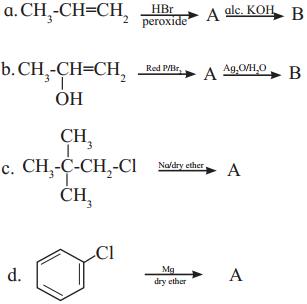
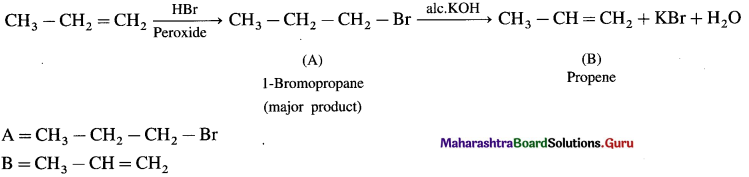
Complete the following reactions giving major product.
Maharashtra Board Class 12 Chemistry Solutions Chapter 10 Halogen Derivatives 280
Answer:
Maharashtra Board Class 12 Chemistry Solutions Chapter 10 Halogen Derivatives 214

Maharashtra Board Class 12 Chemistry Solutions Chapter 10 Halogen Derivatives 215
Answer:
Maharashtra Board Class 12 Chemistry Solutions Chapter 10 Halogen Derivatives 216

Maharashtra Board Class 12 Chemistry Solutions Chapter 10 Halogen Derivatives 217
Answer:
Maharashtra Board Class 12 Chemistry Solutions Chapter 10 Halogen Derivatives 218

Maharashtra Board Class 12 Chemistry Solutions Chapter 10 Halogen Derivatives

Maharashtra Board Class 12 Chemistry Solutions Chapter 10 Halogen Derivatives 219
Answer:
Maharashtra Board Class 12 Chemistry Solutions Chapter 10 Halogen Derivatives 266

Question vi.
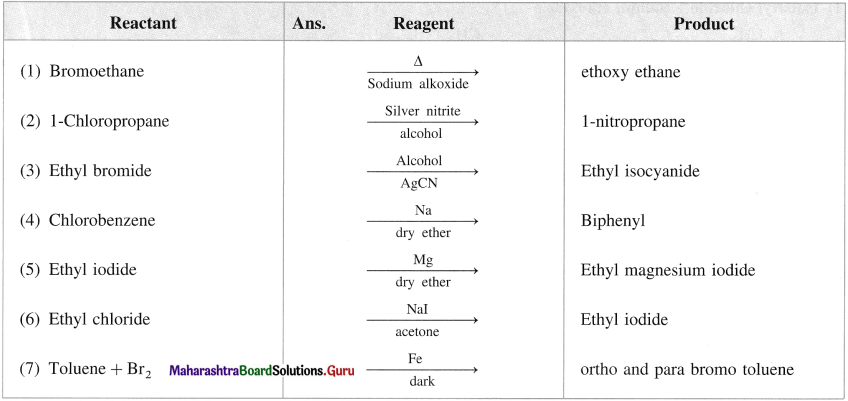
Name the reagent used to bring about the following conversions.
a. Bromoethane to ethoxyethane
b. 1-Chloropropane to 1 nitropropane
c. Ethyl bromide to ethyl isocyanide
d. Chlorobenzene to biphenyl
Answer:
Maharashtra Board Class 12 Chemistry Solutions Chapter 10 Halogen Derivatives 220

Question vii.
Arrange the following in the increase order of boiling points
a. 1-Bromopropane
b. 2- Bromopropane
c. 1- Bromobutane
d. 1-Bromo-2-methylpropane
Answer:
l-Bromo-2-methylpropane, 2-Bromopropane, 1-Bromopropane, 1-Bromo butane

Question viii.
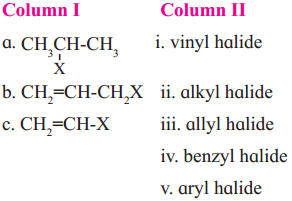
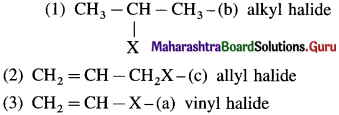
Match the pairs.
Maharashtra Board Class 12 Chemistry Solutions Chapter 10 Halogen Derivatives 283
Answer:
Maharashtra Board Class 12 Chemistry Solutions Chapter 10 Halogen Derivatives 246

Maharashtra Board Class 12 Chemistry Solutions Chapter 10 Halogen Derivatives

3. Give reasons

Question i.
Haloarenes are less reactive than haloalkanes.
Answer:
Haloarenes (Aryl halides) are less reactive than (alkyl halides) haloalkanes due to the following reasons :

(1) Resonance effect : In haloarenes, the electron pairs on halogen atom are in conjugation with 7r-electrons of the benzene ring. The delocalization of these electrons C-Cl bond acquires partial double bond character.
Maharashtra Board Class 12 Chemistry Solutions Chapter 10 Halogen Derivatives 208

Due to partial double bond character of C-Cl bond in aryl halides, the bond cleavage in haloarene is difficult and are less reactive. On the other hand, in alkyl halides, carbon is attached to chlorine by a single bond and it can be easily broken.

(2) Aryl halides are stabilized by resonance but alkyl halides are not. Hence, the energy of activation for the displacement of halogen from aryl halides is much greater than that of alkyl halides.

(3) Different hybridization state of carbon atom in C-X bond :
(i) In alkyl halides, the carbon of C-X bond is sp3-hybridized with less 5-character and greater bond length of 178 pm, which requires less energy to break the C-X bond.

(ii) In aryl halides, the carbon of C-X bond is sp3-hybridized with more 5-character and shorter bond length which requires more energy to break C-X bond. Therefore, aryl halides are less reactive than alkyl halides.

(iii) Polarity of the C-X bond : In aryl halide C-X bond is less polar than in alkyl halides. Because sp3-hybrid carbon of C-X bond has less tendency to release electrons to the halogen than a sp3-hybrid carbon in alkyl halides. Thus halogen atom in aryl halides cannot be easily displaced by nucleophile.

(2) Aryl halides are extremely less reactive towards nucleophilic substitution reactions.
Answer:
Aryl halides are extremely less reactive towards nucleophilic substitution reaction due to the following reasons : (1) Resonance effect : In haloarenes, the electron pairs on halogen atom are in conjugation with 7r-electrons of the benzene ring. The delocalization of these electrons C-Cl bond acquires partial double bond character.
Maharashtra Board Class 12 Chemistry Solutions Chapter 10 Halogen Derivatives 209

Due to partial double bond character of C-Cl bond in aryl halides, the bond cleavage in haloarene is difficult and are less reactive towards nucleophilic substitution.

(2) Sp2 hybrid state of C : Different hybridization state of carbon atom in C-X bond : In aryl halides, the carbon of C-X bond is sp2-hybridized with more 5-character and shorter bond length of 169 pm which requires more energy to break C-X bond. It is difficult to break a shorter bond than a longer bond, in alkyl chloride (bond length 178 pm) therefore, aryl halides are less reactive towards nucleophilic substitution reaction.

(3) Instability of phenyl cation : In aryl halides, the phenyl cation formed due to self ionisation will not be stabilized by resonance which rules out possibility of SN1 mechanism. Also backside attack of nucleophile is blocked by the aromatic ring which rules out SN2 mechanism. Thus cations are not formed and hence aryl halides do not undergo nucleophilic substitution reaction easily.

(4) As any halides are electron rich molecules due to the presence of re-bond, they repel electron rich nucleophilic, attack. Hence, aryl halides are less reactive towards nucleophilic substitution reactions. However, the presence of electron withdrawing groups at o/p position activates the halogen of aryl halides towards substitution.
Maharashtra Board Class 12 Chemistry Solutions Chapter 10 Halogen Derivatives 210

(3) Aryl halides undergo electrophilic substitution reactions slowly.
Answer:
Aryl halides undergo electrophilic substitution reactions slowly and it can be explained as follows :

Maharashtra Board Class 12 Chemistry Solutions Chapter 10 Halogen Derivatives

(1) Inductive effect : The strongly electronegative halogen atom withdraws the electrons from carbon, atom of the ring, hence aryl halides show reactivity towards electrophilic attack.

(2) Resonance effect : The resonating structures of aryl halides show increase in electron density at ortho and para position, hence it is o, p directing.
Maharashtra Board Class 12 Chemistry Solutions Chapter 10 Halogen Derivatives 211

The inductive effect and resonance effect compete with each other. The inductive effect is stronger than resonance effect. The reactivity of aryl halides is controlled by stronger inductive effect and o, p orientation is controlled by weaker resonating effect.
Maharashtra Board Class 12 Chemistry Solutions Chapter 10 Halogen Derivatives 212

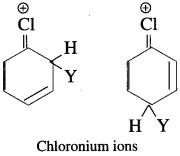
The attack of electrophile (Y) on haloarenes at ortho and para positions are more stable due to formation of chloronium ion. The chloronium ion formed is comparatively more stable than other hybrid structures of carbonium ion.

(4) Reactions involving Grignard reagent must be carried out under anhydrous condition.
Answer:
(1) Grignard reagent (R Mg X) is an organometallic compound. The carbon-magnesium bond is highly polar and magnesium halogen bond is in ionic in nature. Grignard reagent is highly reactive.

(2) The reactions of Grignard reagent are carried out in dry conditions because traces of moisture may spoil the reaction and Grignard reagent reacts with water to produce alkane. Hence, reactions involving Grignard reagent must be carried out under anhydrous condition.

(5) Alkyl halides are generally not prepared by free radical halogenation of alkane.
Answer:
(1) Free radical halogenation of alkane gives a mixture of all different possible Monohaloalkanes as well as polyhalogen alkanes.
(2) In this method, by changing the quantity of halogen the desired product can be made to predominate over the other
products. Hence, alkyl halides are generally not prepared by free radical halogenation of alkane.

Question ii.
Alkyl halides though polar are immiscible with water.
Answer:
(1) In alkyl halide, the halogen atom is more electronegative than carbon atom, the C – X bond is polar.
(2) Though alkyl halide is polar, it is insoluble in water because alkyl halide is not able to form hydrogen bonds with water. Attraction between alkyl halide molecule is stronger than attraction between alkyl halide and water.

(2) C-F bond in CH3F is the strongest bond and C-I bond in CH3I is the weakest bond. Explain.
Answer:
(1) Methyl fluoride (CH3F) is highly polar molecule and has the shortest C-F bond length (139 pm) and the strongest C-F bond due to greater overlap of orbitals of the same principal quantum number i.e., overlap of 2sp3 orbital of carbon with 2pz orbital of fluorine.
(2) Methyl iodide (CH3I) is much less polar and has the longest (C-I) bond length (214 pm) and the weakest C-I bond due to poor overlap of 2sp3 orbital carbon with 5pz orbital of iodine i.e., 2sp3 orbital of carbon cannot penetrate into larger p-orbitals.

(3) The boiling point of alkyl iodide is higher than that of alkyl fluoride.
Answer:
For a given alkyl group, the boiling point increases with increasing atomic mass of the halogen, because magnitude of van der Waals force increases with increase in size and mass of halogen. Therefore, boiling point of alkyl iodide is higher than that of alkyl fluoride.

(4) The boiling point of isopropyl bromide is lower than that of it-propyl bromide.
Answer:
For isomeric alkyl halides (isopropyl bromide and n-propyl bromide), the boiling point decreases as the branching increases, surface area decreases on branching and van der Waals forces decrease, therefore, the boiling point of isopropyl bromide is lower than that of n-propyl bromide.

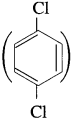
(5) p-Dichlorobenzene Maharashtra Board Class 12 Chemistry Solutions Chapter 10 Halogen Derivatives 75 has mp. higher than those of o-and rn-isomers.
Answer:
p-Dichlorobenzene has higher melting point than those of o-and m-isomers. This is because of its symmetrical structure which can easily fits in crystal lattice. As a result intermolecular forces of attraction are stronger and therefore greater energy is required to overcome its lattice energy.

Maharashtra Board Class 12 Chemistry Solutions Chapter 10 Halogen Derivatives

Question iii.
Reactions involving Grignard reagent must be carried out under anhydrous conditions.

Question iv.
Alkyl halides are generally not prepared by free radical halogenation of alkanes.
Answer:
(1) Direct fluorination of alkanes is highly exothermic, explosive and invariably leads to polyfluorination and decomposition of the alkanes. It is difficult to control the reaction.
(2) Direct iodination of alkanes is highly reversible and difficult to carry out.
(3) In direct chlorination and bromination, the reaction is not selective. It can lead to different isomeric monohalogenated alkanes (alkyl halides) as well as polyhalogenated alkanes.
Hence, halogenation of alkanes is not a good method of preparation of alkyl halides.

4. Distinguish between – SN1 and SN2 mechanism of substitution reaction ?
Answer:
Maharashtra Board Class 12 Chemistry Solutions Chapter 10 Halogen Derivatives 152

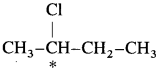
5. Explain – Optical isomerism in 2-chlorobutane.
Answer:
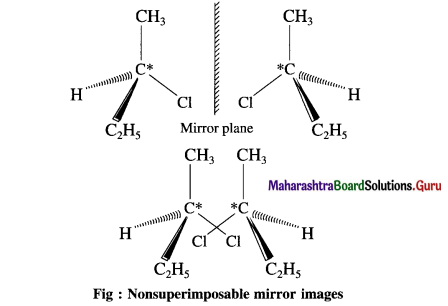
(1) 2-Chlorobutane contains an asymmetric. Maharashtra Board Class 12 Chemistry Solutions Chapter 10 Halogen Derivatives 265 carbon atom (the starred carbon atom) which is attached to four different groups, i.e., ethyl (-CH2 – CH3), methyl (CH3), chloro (Cl) and hydrogen (H) groups.
Maharashtra Board Class 12 Chemistry Solutions Chapter 10 Halogen Derivatives 83
(2) Two different arrangements of these groups around the carbon atom are possible as shown in the figure. Hence, it exists as a pair of enanti¬omers. The two enantiomers are mirror images of each other and are not superimposable.

(3) One of the enantiomers will rotate the plane of plane-polarized light to the left hand side and is called the laevorotatory isomer (/-isomer). The other enantiomer will rotate the plane of plane-polarized light to the right hand side and is called the dextrorotatory isomer (d-isomer).

(4) Equimolar mixture of the d- and the 1-isomers is optically inactive and is called the racemic mixture or the racemate (dl-mixture). The optical inactivity of the racemic mixture is due to external compensation.

Maharashtra Board Class 12 Chemistry Solutions Chapter 10 Halogen Derivatives

6. Convert the following.

Question i.
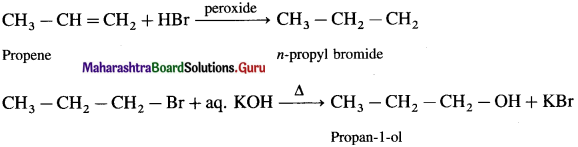
Propene to propan-1-ol
Answer:
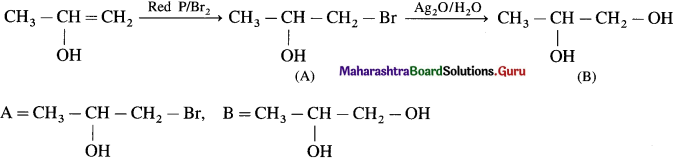
Maharashtra Board Class 12 Chemistry Solutions Chapter 10 Halogen Derivatives 177

Question ii.
Benzyl alcohol to benzyl cyanide
Answer:
Maharashtra Board Class 12 Chemistry Solutions Chapter 10 Halogen Derivatives 178

Question iii.
Ethanol to propane nitrile
Answer:
Maharashtra Board Class 12 Chemistry Solutions Chapter 10 Halogen Derivatives 179

Question iv.
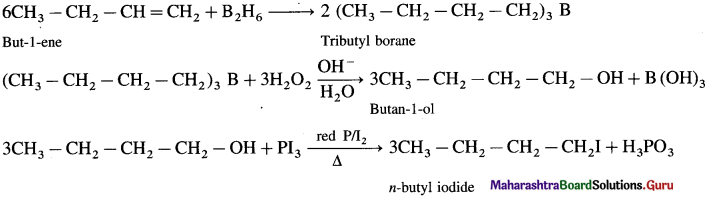
But-1-ene to n-butyl iodide
Answer:
Maharashtra Board Class 12 Chemistry Solutions Chapter 10 Halogen Derivatives 180

Question v.
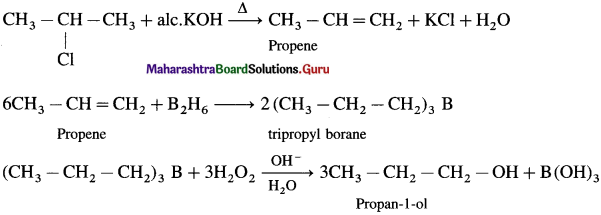
2-Chloropropane to propan-1-ol
Answer:
Maharashtra Board Class 12 Chemistry Solutions Chapter 10 Halogen Derivatives 181

Question vi.
tert-Butyl bromide to isobutyl bromide
Answer:
Maharashtra Board Class 12 Chemistry Solutions Chapter 10 Halogen Derivatives 182

Maharashtra Board Class 12 Chemistry Solutions Chapter 10 Halogen Derivatives

Question vii.
Aniline to chlorobenzene
Answer:
Maharashtra Board Class 12 Chemistry Solutions Chapter 10 Halogen Derivatives 183

Question viii.
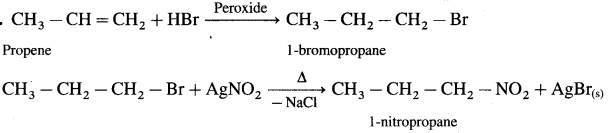
Propene to 1-nitropropane
Answer:
Maharashtra Board Class 12 Chemistry Solutions Chapter 10 Halogen Derivatives 184

7. Answer the following

Question i.
HCl is added to a hydrocarbon ‘A’ (C4H8) to give a compound ‘B’ which on hydrolysis with aqueous alkali forms tertiary alcohol ‘C’ (C4H10O). Identify ‘A’ , ‘B’ and ‘C’.
Answer:
Maharashtra Board Class 12 Chemistry Solutions Chapter 10 Halogen Derivatives 173

Question ii.
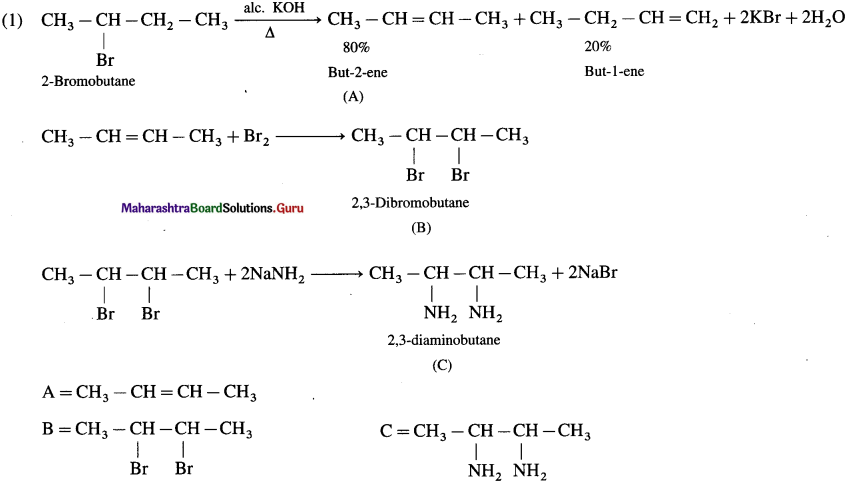
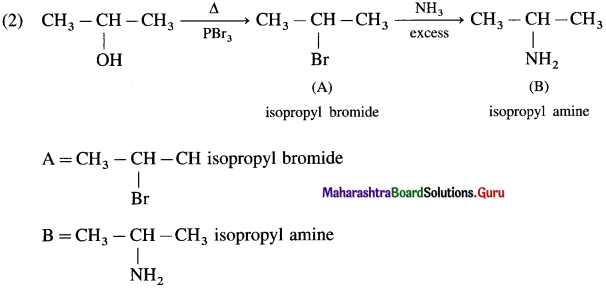
Complete the following reaction sequences by writing the structural formulae of the organic compounds ‘A’, ‘B’ and ‘C’.
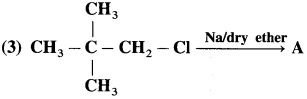
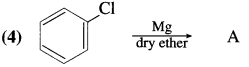
Maharashtra Board Class 12 Chemistry Solutions Chapter 10 Halogen Derivatives 281
Answer:
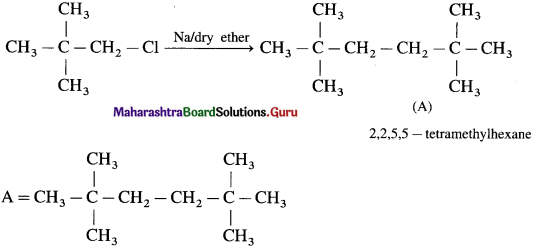
Maharashtra Board Class 12 Chemistry Solutions Chapter 10 Halogen Derivatives 175
Maharashtra Board Class 12 Chemistry Solutions Chapter 10 Halogen Derivatives 176

Maharashtra Board Class 12 Chemistry Solutions Chapter 10 Halogen Derivatives

Question iii.
Observe the following and answer the questions given below.
Maharashtra Board Class 12 Chemistry Solutions Chapter 10 Halogen Derivatives 282
a. Name the type of halogen derivative
b. Comment on the bond length of C-X bond in it
c. Can react by SN1 mechanism? Justify your answer.
Answer:
a. Vinyl halide
b. C – X bond length shorter in vinyl halide than alkyl halide. Vinyl halide has partial double bond character due to resonance.

In vinyl halide, carbon is sp hybridised. The bond is shorter and stronger and the molecule is more stable.

c. Yes, It reacts by SN1 mechanism. SN1 mechanism involves formation of carbocation intermediate. The vinylic carbocation intermediate formed is resonance stabilized, hence SN1 mechanism is favoured.

Activity :
1. Collect detailed information about Freons and their uses.
2. Collect information about DDT as a persistent pesticide.
Reference books
i. Organic chemistry by Morrison, Boyd, Bhattacharjee, 7th edition, Pearson
ii. Organic chemistry by Finar, Vol 1, 6th edition, Pearson

12th Chemistry Digest Chapter 9 Halogen Derivatives Intext Questions and Answers

Use your brain power….. (Textbook page 212)

Maharashtra Board Class 12 Chemistry Solutions Chapter 10 Halogen Derivatives 284

Question 1.
Write IUPAC names of the following:
Maharashtra Board Class 12 Chemistry Solutions Chapter 10 Halogen Derivatives 29
Answer:
Maharashtra Board Class 12 Chemistry Solutions Chapter 10 Halogen Derivatives 30

Maharashtra Board Class 12 Chemistry Solutions Chapter 10 Halogen Derivatives

Question 10.1 : (Textbook page 213)

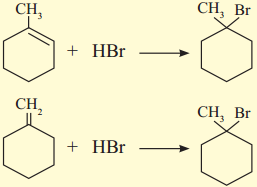
How will you obtain 1.bromo.1-methylcyclohexane from alkene? Write possible structures of alkene and the reaction involved.
Maharashtra Board Class 12 Chemistry Solutions Chapter 10 Halogen Derivatives 285
Answer:
Maharashtra Board Class 12 Chemistry Solutions Chapter 10 Halogen Derivatives 64

Use your brain power ….. (Textbook page 213)

Question 1.
Rewrite the following reaction by filling the blanks:
Maharashtra Board Class 12 Chemistry Solutions Chapter 10 Halogen Derivatives 65
Answer:
Maharashtra Board Class 12 Chemistry Solutions Chapter 10 Halogen Derivatives 66
Maharashtra Board Class 12 Chemistry Solutions Chapter 10 Halogen Derivatives 67

Maharashtra Board Class 12 Chemistry Solutions Chapter 10 Halogen Derivatives

Question 10.2 : (Textbook page 216)

Arrange the following compounds in order of increasing boiling points : bromoform, chloromethane, dibromomethane, bromomethane.
Answer:
The comparative boiling points of halogen derivatives are mainly related with van der Waals forces of attraction which depend upon the molecular size. In the present case all the compounds contain only one carbon. Thus the molecular size depends upon the size of halogen and number of halogen atoms present.

Thus increasing order of boiling point is, CH3CI < CH3Br < CH2Br2 < CHBr3

Try this ….. (Textbook page 2016)

Question 1.
(1) Make a three-dimensional model of 2-chlorobutane.
(2) Make another model which is a mirror image of the first model.
(3) Try to superimpose the two models on each other.
(4) Do they superimpose on each other exactly ?
(5) Comment on whether the two models are identical or not.
Answer:
(1) (2) and (3)
Maharashtra Board Class 12 Chemistry Solutions Chapter 10 Halogen Derivatives 76
(4) Two models are non-superimposable mir ror images of each other called enantiomers.

(5) Two enantiomers are identical. Theyhave the same physical properties (such as melting points, boiling points, densities refractive index). They also have identical chemical properties. The magnitude of their optical rotation is equal but the sign of optical rotation is opposite.

Try this ….. (Textbook page 219)

Question 1.
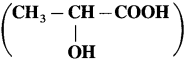
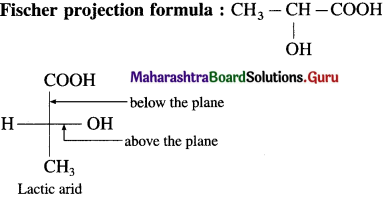
1. Draw structares of enantiomers of lactic acid Maharashtra Board Class 12 Chemistry Solutions Chapter 10 Halogen Derivatives 91 using Fischer projection formulae.
2. Draw structures of enantiomers of 2-bromobutane using wedge formula.
Answer:
(1)
Maharashtra Board Class 12 Chemistry Solutions Chapter 10 Halogen Derivatives 92

(2) Wedge formula : 2-brornobutane
Maharashtra Board Class 12 Chemistry Solutions Chapter 10 Halogen Derivatives 93

Maharashtra Board Class 12 Chemistry Solutions Chapter 10 Halogen Derivatives

Can you tell? (Textbook page 220)

Question 1.
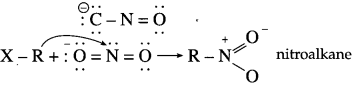
Alkyl halides, when treated with alcoholic solution of silver nitrite, give nitroalkanes whereas with sodium nitrite they give alkyl nitrites. Explain.
Answer:
Nitrite ion is an ambident nucleophile, which can attack through ‘O’ or ‘N’.
Maharashtra Board Class 12 Chemistry Solutions Chapter 10 Halogen Derivatives 124
Both nitrogen and oxygen are capable of donating electron pair. C – N bond, being stronger than N – O bond, attack occurs through C atom from alkyl halide forming nitroalkane.

However, sodium nitrite (NaNO2) is an ionic compound and oxygen is free to donate pair of electrons. Hence, attack occurs through oxygen resulting in the formation of alkyl nitrite.
Maharashtra Board Class 12 Chemistry Solutions Chapter 10 Halogen Derivatives 125

Use your brain power! (Textbook page 222)

Question 1.
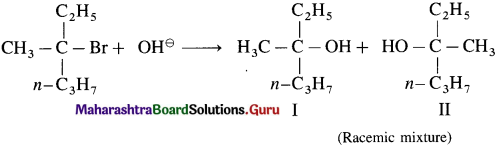
Draw the Fischer projection formulae of two products obtained when compound (A) reacts with OHe by SN1 mechanis.
Maharashtra Board Class 12 Chemistry Solutions Chapter 10 Halogen Derivatives 144
Answer:
Maharashtra Board Class 12 Chemistry Solutions Chapter 10 Halogen Derivatives 145

Question 2.
Draw the Fischer projection formula of the product formed when compound (B) reacts with OHΘ by SN2 mechanism.
Maharashtra Board Class 12 Chemistry Solutions Chapter 10 Halogen Derivatives 146
Answer:
Maharashtra Board Class 12 Chemistry Solutions Chapter 10 Halogen Derivatives 147

Question 10.4 : (Textbook page 223)

Allylic and benzylic halides show high reactivity towards the SN1 mechanism than other primary alkyl halides. Explain.
Answer:
In allylic and benzylic halide, the carbocation formed undergoes stabilization through the resonance. Hence, allylic and benzylic halides show high reactivity towards the SN1 reaction. The resonating structures are
Maharashtra Board Class 12 Chemistry Solutions Chapter 10 Halogen Derivatives 149

Resonance stabilization of allylic carbocation
Maharashtra Board Class 12 Chemistry Solutions Chapter 10 Halogen Derivatives 150
Resonance stabilization of benzylic carbocation

Maharashtra Board Class 12 Chemistry Solutions Chapter 10 Halogen Derivatives

Question 10.5 : (Textbook page 224)

Which of the following two compounds would react faster by SN2 mechanism and Why?
Maharashtra Board Class 12 Chemistry Solutions Chapter 10 Halogen Derivatives 151
Answer :
In SN2 mechanism, a pentacoordinate T.S. is involved. The order of reactivity of alkyl halides towards SN2 mechanism is.
Primary > Secondary > Tertiary, (due to increasing crowding in T.S. from primary to tertiary halides.
1- Chlorobutane being primary halide will react faster by SN2 mechanism, than the secondary halide 2- chlorobutane.)

Can you tell? (Textbook page 227)

Question 1.
Conversion of chlorobenzene to phenol by aqueous sodium hydroxide requires a high temperature of about 623K and high pressure. Explain.
Maharashtra Board Class 12 Chemistry Solutions Chapter 10 Halogen Derivatives 199
Answer:
Due to the partial double bond character in chlorobenzene, the bond cleavage in chlorobenzene is difficult and is less reactive. Hence, during the conversion of chlorobenzene to phenol by a question NaOH requires high temperature & high pressure.

12th Std Chemistry Questions And Answers:

12th Chemistry Chapter 9 Exercise Coordination Compounds Solutions Maharashtra Board

Class 12 Chemistry Chapter 9

Balbharti Maharashtra State Board 12th Chemistry Textbook Solutions Chapter 9 Coordination Compounds Textbook Exercise Questions and Answers.

Coordination Compounds Class 12 Exercise Question Answers Solutions Maharashtra Board

Class 12 Chemistry Chapter 9 Exercise Solutions Maharashtra Board

Chemistry Class 12 Chapter 9 Exercise Solutions

1. Choose the most correct option.

Question i.
The oxidation state of cobalt ion in the complex [Co(NH3)5Br]SO4 is ……………………….
a. + 2
b. + 3
c. + 1
d. + 4
Answer:
(b) + 3

Maharashtra Board Class 12 Chemistry Solutions Chapter 9 Coordination Compounds

Question ii.
IUPAC name of the complex [Pt(en)2(SCN)2]2+ is ………………………
a. bis (ethylenediamine dithiocyanatoplatinum (IV) ion
b. bis (ethylenediamine) dithiocyantoplatinate (IV) ion
c. dicyanatobis (ethylenediamine) platinate IV ion
d. bis (ethylenediammine)dithiocynato platinate (IV) ion
Answer:
(a) bis(ethylenediamine dithiocyanatoplatinum (IV) ion

Question iii.
Formula for the compound sodium hexacynoferrate (III) is
a. [NaFe(CN)6]
b. Na2[Fe(CN)6]
c. Na[Fe(CN)6]
d. Na3[Fe(CN)6]
Answer:
(d) Na3[Fe(CN)6]

Question iv.
Which of the following complexes exist as cis and trans isomers?
1. [Cr(NH2)2Cl4]
2. [Co(NH3)5Br]2⊕
3. [PtCl2Br2]2⊕ (square planar)
4. [FeCl2(NCS)2]2⊕ (tetrahedral)
a. 1 and 3
b. 2 and 3
c. 1 and 3
d. 4 only
Answer:
(a) 1 and 3

Question v.
Which of the following complexes are chiral?
1. [Co(en)2Cl2]
2. [Pt(en)Cl2]
3. [Cr(C2O4)3]3⊕
4. [Co(NH3)4CI2]
a. 1 and 3
b. 2 and 3
c. 1 and 4
d. 2 and 4
Answer:
(a) 1 and 3

Question vi.
On the basis of CFT predict the number of unpaired electrons in [CrF6]3.
a. 1
b. 2
c. 3
d. 4
Answer:
(c) 3

Question vii.
When an excess of AgNO3 is added to the complex one mole of AgCl is precipitated. The formula of the complex is ……………..
a. [CoCl2(NH3)4]Cl
b. [CoCl(NH3)4] Cl2
c. [CoCl3(NH3)3]
d. [Co(NH3)4]Cl3
Answer:
(a) [COCI3(NH3)4]CI

Question viii.
The sum of coordination number and oxidation number of M in [M(en)2C2O4]Cl is
a. 6
b. 7
c. 9
d. 8
Answer:
(c) 9

Maharashtra Board Class 12 Chemistry Solutions Chapter 9 Coordination Compounds

2. Answer the following in one or two sentences.

Question i.
Write the formula for tetraammineplatinum (II) chloride.
Answer:
Formula of tetraamineplatinum(II) chloride : [Pt(NH3)4]CI2

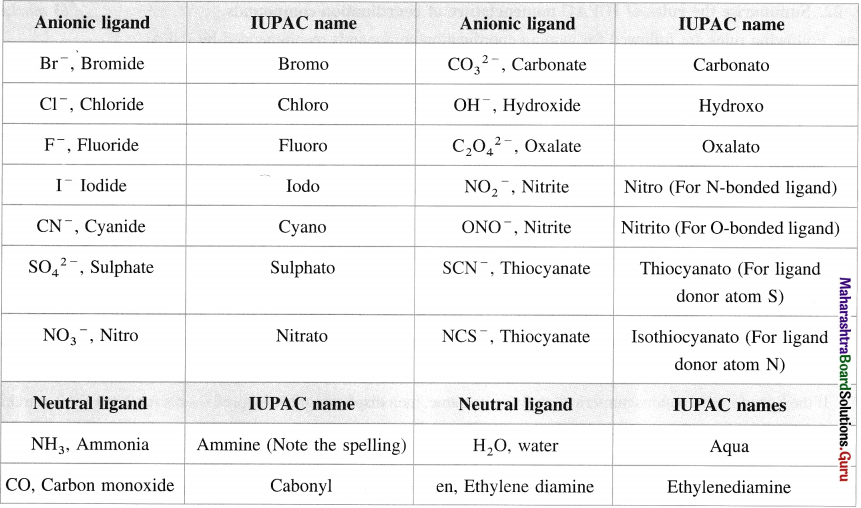
Table 9.1 : IUPAC names of anionic and neutral ligands
Maharashtra Board Class 12 Chemistry Solutions Chapter 9 Coordination Compounds 3
Table 9.2: IUPAC names of anionic complexes

Metal Name
A1
Cr
Cu
Co
Au(Gold)
Fe
Pb
Mn
Mo
Ni
Zn
Ag
Sn
Aluminate
Chromate
Cuprate
Cobaltate
Aurate
Ferrate
Plumbate
Manganate
Molybdate
Nickelate
Zincate
Argentate
Stannate

Table 9.3 : IUPAC names of some complexes

Complex IUPAC name
(i) Anionic complexes :
(a) [Ni(CN)J2-
(b) [Co(C204)3]3-
(c) [Fe(CN)6]4-
Tetracyanonickelate(II) ion Trioxalatocobaltate(III) ion
Hexacyanoferrate(II) ion
(ii) Compounds containing complex anions and metal cations :
(a) Na3[Co(N02)6]
(b) K3[A1(C204)3]
(c) Na3[AIF6]
Sodium hexanitrocobaltate(III)
Potassium trioxalatoaluminate(III)
Sodium hexafluoroaluminate(III)
(iii) Cationic complexes :
(a) [Cu(NH3)4]2+
(b) [Fe(H20)5(NCS)]2+
(c) [Pt(en)2(SCN)2]2+
Tetraamminecopper(II) ion
Pentaaquai sothiocyanatoiron(III) ionBis(ethylenediamine)dithiocyanatoplatinum(IV)
(iv) Compounds containing complex cation and anion :
(a) [PtBr2(NH3)4]Br2
(b) [Co(NH3)5C03]CI
(c) [Co(H20)(NH3)5]I3
Tetraamminedibromoplatinum(IV) bromide, Pentaamminecarbonatocobalt(III) chloride, Pentaammineaquacobalt(III) iodide
(v) Neutral complexes :
(a) Co(N02)3(NH3)3
(b) Fe(CO)5
(c) Rh(NH3) 3(SCN) 3
Triamminetrinitrocobalt(III) Pentacarbonyliron(0) Triamminetrithiocyanatorhodium(III)

Maharashtra Board Class 12 Chemistry Solutions Chapter 9 Coordination Compounds

Question ii.
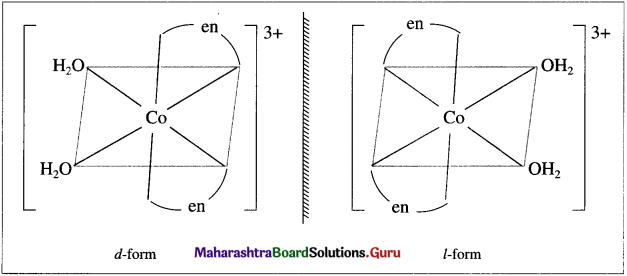
Predict whether the [Cr(en)2(H2O)2]3+ complex is chiral. Write structure of its enantiomer.
Answer:
(i) Complex is chiral.
(ii) The following are its enantiomers
Maharashtra Board Class 12 Chemistry Solutions Chapter 9 Coordination Compounds 19

Question iv.
Name the Lewis acids and bases in the complex [PtCl2(NH3)2].
Answer:
Lewis acid : Pt2+
Lewis bases : Cl and NF3

Question v.
What is the shape of a complex in which the coordination number of central metal ion is 4?
Answer:
A complex with the coordination number of central metal ion equal to 4 may be tetrahedral or square planar.

Question vi.
Is the complex [CoF6] cationic or anionic if the oxidation state of cobalt ion is +3?
Answer:
In the complex, Co carries + 3 charge while 6F carry – 6 charge. Hence the net charge on the complex is – 3.
Therefore it is an anionic complex.

Question vii.
Consider the complexes [Cu(NH3)4][PtCl4] and [Pt(NH3)4] [CuCl4]. What type of isomerism these two complexes exhibit?
Answer:
Since in these two given complexes, there is an exchange of ligands between cationic and anionic constituents, they exhibit coordination isomerism.

Question viii.
Mention two applications of coordination compounds.
Answer:
(1) In biology : Several biologically important natural compounds are metal complexes which play an important role in number of processes occurring in plants and animals.

For example, chlorophyll in plants is a complex of Mg2+ ions, haemoglobin in blood is a complex of iron, vitamin B12 is a complex of cobalt.

(2) In medicine : The complexes are used on a large scale in medicine. Many medicines in the complex form are more stable, more effective and can be assimilated easily.

For example, platinum complex [Pt(NH3)2CI2] known as cisplatin is effectively used in cancer treatment. EDTA is used to treat poisoning by heavy metals like lead.

(3) To estimate hardness of water :

  • The hardness of water is due to the presence Mg2+ and Ca2+ ion in water.
  • The strong field ligand EDTA forms stable complexes with Mg2+ and Ca2+. Hence these ions can be removed by adding EDTA to hard water.

Similarly these ions can be selectively estimated due to the difference in their stability constants.

(4) Electroplating : This involves deposition of a metal on the other metal. For smooth plating, it is necessary to supply continuously the metal ions in small amounts.
For this purpose, a solution of a coordination compound is used which dissociates to a very less extent. For example, for uniform and thin plating of silver and gold, the complexes K[Ag(CN)2] and K[Au(CN)2] are used.

3. Answer in brief.

Question i.
What are bidentate ligands? Give one example.
Answer:
Bidentate ligand : This ligand has two donor atoms in the molecule or ion. For example, ethylenediamine, H2N – (CH2)2 – NH2.

Question ii.
What is the coordination number and oxidation state of metal ion in the complex [Pt(NH3)Cl5]2?
Answer:
Coordination number = 6
Oxidation state of Pt = +4.

Maharashtra Board Class 12 Chemistry Solutions Chapter 9 Coordination Compounds

Question iii.
What is the difference between a double salt and a complex? Give an example.
Answer:

Double salt Coordination compound (complex)
(1) Double salts exist only in the solid state and dissociate into their constituent ions in the aqueous solutions. (1) Coordination compounds exist in the solid-state as well as in the aqueous or non-aqueous solutions.
(2) Double salts lose their identity in the solution. (2) They do not lose their identity completely.
(3) The properties of double salts are same as those of their constituents. (3) The properties of coordination compounds are different from their constituents.
(4) Metal ions in the double salts show their normal valence. (4) Metal ions in the coordination compounds show two valences namely primary valence and second­ary valence satisfied by anions or neutral molecules called ligands.
(5) For example in K2SO4. K2SO4. A12(SO4)3. 24H2O. The ions K+, Al3 + and SO4 show their properties. (5) In K4[Fe(CN)6], ions K+ and [Fe(CN)6]4‘~ ions show their properties.

Question iv.
Classify the following complexes as homoleptic and heteroleptic
[Cu(NH3)4]SO4, [Cu(en)2(H2O)Cl]3⊕, [Fe(H2O)5(NCS)]2⊕, tetraammine zinc (II) nitrate.
Answer:
Homoleptic complex :
(a) [Cu(NH3)4]SO4
(d) Tetraaminezinc (II) nitrate : [Zn(NH3)4](NO3)2

Heteroleptic Complex :
(b) [Cu(en)2(H2O)CI]2+
(c) [Fe(H2O)5(NCS)]2+

Question v.
Write formulae of the following complexes
a. Potassium ammine-tri chloroplatinate (II)
b. Dicyanoaurate (I) ion
Answer:
(a) Potassium amminetrichloroplatinate(II) K[Pt(NH3)CI3]
(b) Dicyanoaurate (I) ion [AU(CN)2]

Question vi.
What are ionization isomers? Give an example.
Answer:
Ionisation isomers : The coordination compounds having same molecular composition but differ in the compositions of coordination (or inner) sphere and outer sphere and produce different ions on ionisation in the solution are called ionisation isomers. For example, Pentaamminesulphatocobalt (III) bromide [Co(NH3)5SO4] Br, Pentaamminebromocobalt(III) sulphate [Co(NH3)5Br] SO4.

Question vii.
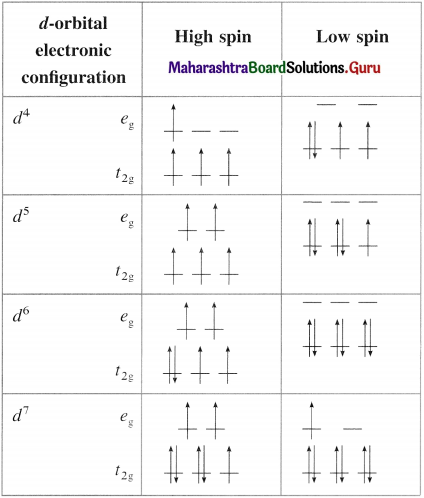
What are the high-spin and low-spin complexes?
Answer:
(1) High spin complex (HS) :

  • The complex which has greater iwmher of unpaired electrons and hence a higher value of resultant spin and magnetic moment is called high spin (or spin free) or IlS complex.
  • It is formed with weak field ligands and the complexes have lower values for crystal field splitting energy (CFSE). Δ0
  • The paramagnetism of HS complex is larger.

(2) Low spin complex (LS) :

  • The complex which has the Icasi number of unpaired electrons or all electrons paired and hence the lowest
    (or no) resultant spin or magnetic moment is called low spin (or spin paired) or LS complex.
  • It is formed with strong tickl ligands and the complexes have higher values of crystal field splitting energy (Δ0).
  • Low spin complex is diamagnetic or has low paramagnetism.

Table 9.5 : d-orbitai diagrams fir high spin and low spin complexes
Maharashtra Board Class 12 Chemistry Solutions Chapter 9 Coordination Compounds 60

(Only the electronic configurations c4 to d1 render the high spin and low spin complexes)

Maharashtra Board Class 12 Chemistry Solutions Chapter 9 Coordination Compounds

Question viii.
[CoCl4]2⊕ is a tetrahedral complex. Draw its box orbital diagram. State which orbitals participate in hybridization.
Answer:
27Co [Ar] 3d74s2
Oxidation state of Co = +2 Co2+ [Ar] 3d7 4s°
Since CI is a weak ligand, there is no pairing of electrons. Since C.N. is 4, there is sp3 hybridisation.
Maharashtra Board Class 12 Chemistry Solutions Chapter 9 Coordination Compounds 30

Question ix.
What are strong field and weak field ligands? Give one example of each.
Answer:
The ligands are then classified as (a) strong field and (b) weak field ligands. Strong field ligands are those in which donor atoms are C,N or P. Thus CN, NC, CO, HN3, EDTA, en (ethylenediammine) are considered to be strong ligands. They cause larger splitting of d orbitals and pairing of electrons is favoured. These ligands tend to form low spin complexes. Weak field ligands are those in which donor atoms are halogens, oxygen or sulphur.

For example, F, CI, Br, I, SCN, C2O42-. In case of these ligands the A0 parameter is smaller compared to the energy required for the pairing of electrons, which is called as electron pairing energy. The ligands then can be arranged in order of their increasing field strength as
I < Br < CI < S2- < F < OH < C2O42- < H2O < NCS < EDTA < NH3 < en < CN < CO.

Question x.
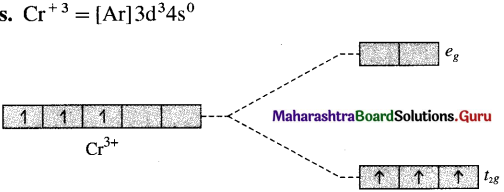
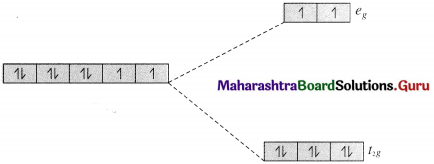
With the help of a crystal field energy-level diagram explain why the complex [Cr(en)3]3⊕ is coloured?
Answer:
Maharashtra Board Class 12 Chemistry Solutions Chapter 9 Coordination Compounds 31

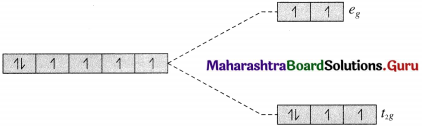
Since (en) is a strong field ligand there is pairing of electrons. The electrons occupy the t2g orbitals of lower energy. It has one unpaired electron. Due to d-d transition, it is coloured.

4. Answer the following questions.

Question i.
Give valence bond description for the hybrid orbitals are used by the metal? State the number of unpaired electrons.
Answer:
Since CI is a weak ligand, there is no pairing of electrons.
Number of unpaired electrons = 2
Type of hybridisation = sp3

Geometry of complex ion = Tetrahedral
The complex ion is paramagnetic.

Question ii.
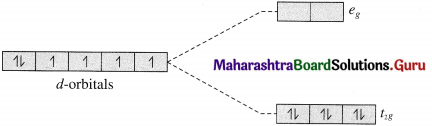
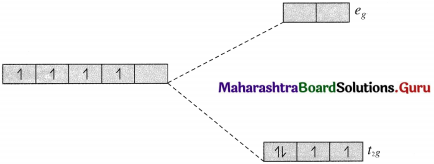
Draw a qualitatively energy-level diagram showing d-orbital splitting in the octahedral environment. Predict the number of unpaired electrons in the complex [Fe(CN)6]4⊕. Is the complex diamagnetic or paramagnetic? Is it coloured? Explain.
Answer:
(A) r-orbital splitting in the octahedral environment :
Maharashtra Board Class 12 Chemistry Solutions Chapter 9 Coordination Compounds 65
(B) [Fe (CN)6]4- is an octahedral complex.
(C) Since CN is a strong ligand, there is pairing of electrons and the complex is diamagnetic.
(D) The complex exists as lemon yellow crystals.
(In the complex all electrons in t2g are paired and requires high radiation energy for excitation.)

Question iii.
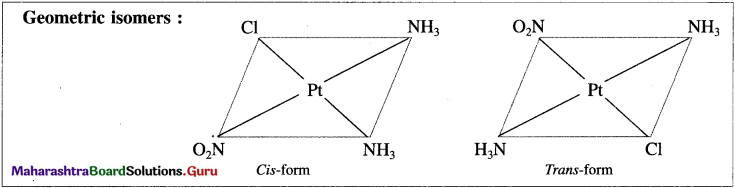
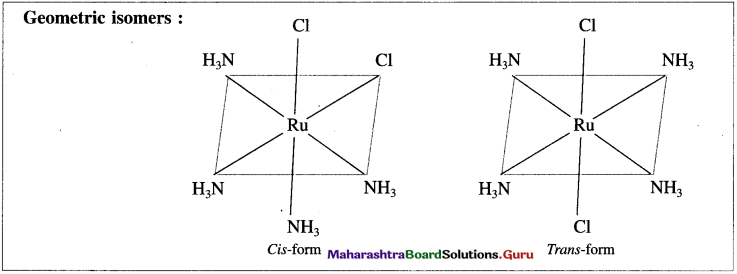
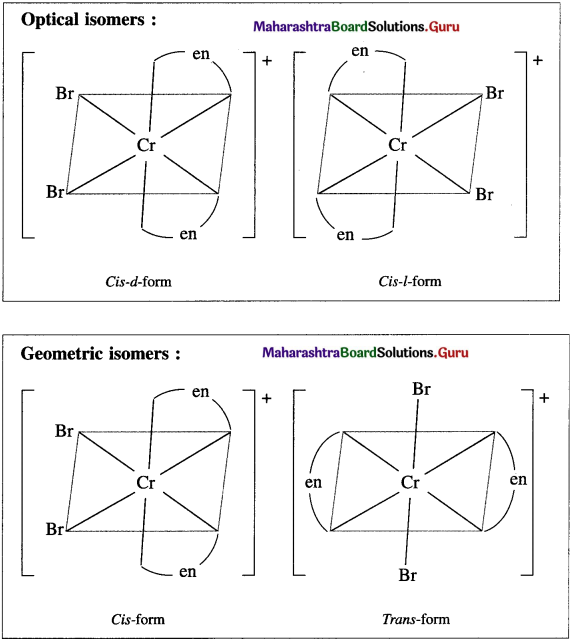
Draw isomers in each of the following
a. [Pt(NH3)2ClNO2]
b. [Ru(NH3)4Cl2]
c. [Cr(en2)Br2]
Answer:
(a) [Pt(NH3)2CINO2]
Maharashtra Board Class 12 Chemistry Solutions Chapter 9 Coordination Compounds 20
(b) [RU(NH3)4CI2]
Maharashtra Board Class 12 Chemistry Solutions Chapter 9 Coordination Compounds 21
(c) [Cr(en2)Br2]+
Maharashtra Board Class 12 Chemistry Solutions Chapter 9 Coordination Compounds 22

Maharashtra Board Class 12 Chemistry Solutions Chapter 9 Coordination Compounds

Question iv.
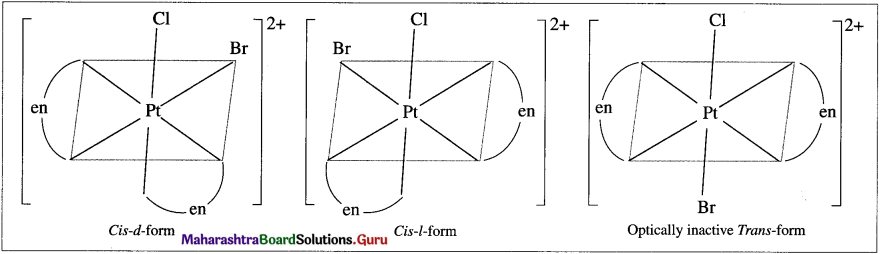
Draw geometric isomers and enantiomers of the following complexes.
a. [Pt(en)3]4⊕
b. [Pt(en)2ClBr]2⊕
Answer:
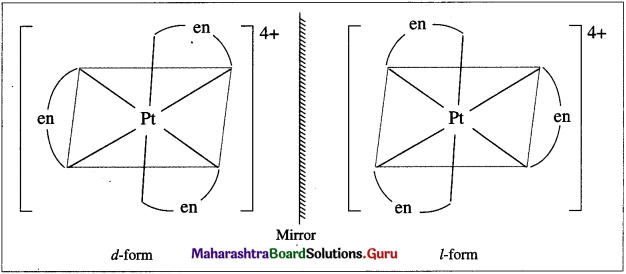
The complex [Pt(en)3]4+ has two optical isomers.

Maharashtra Board Class 12 Chemistry Solutions Chapter 9 Coordination Compounds 23
Maharashtra Board Class 12 Chemistry Solutions Chapter 9 Coordination Compounds 24

Question v.
What are ligands? What are their types? Give one example of each type.
Answer:
Ligands : The neutral molecules or negatively charged anions (or rarely positive ions) which are bonded by coordinate bonds to the central metal atom or metal ion in a coordination compound are called ligands or donor groups. For example in [Cu(CN)4]2-, four CN ions are ligands coordinated to central metal ion Cu2+. Ligands can be classified on the basis of number of electron donor atoms in the ligand i.e. denticity.

(1) Monodentate or unidentate ligand : A ligand molecule or an ion which has only one donor atom with a lone pair of electrons forming only one coordinate bond with metal atom or ion in the complex is called monodentate or unidentate ligand. For example NH3, Cl, OH, H2O, etc.

(2) Polydentate or multidentate ligand : A ligand molecule or an ion which has two or more donor atoms with the lone pairs of electrons forming two or more coordinate bonds with the central metal atom or ion in the complex is called polydentate or multidentate ligand. For example, ethylene diamine, H2N – (CH2)2 – NH2.
According to the number of donor atoms they are classified as follows :

  • Bidentate ligand : This ligand has two donor atoms in the molecule or ion. For example, ethylenediamine, H2N – (CH2)2 – NH2.
  • Tridentate ligand : This ligand molecule has three donor atoms or three sites of attachment.
    E.g. Diethelene triamine, H2N – CH2 – CH2 – NH – CH2 – CH2 – NH2. This has three N donor atoms.
  • Tetradentate (or quadridentate) ligand : This ligand molecule has four donor atoms.
    Eg. Triethylene tetraamine which has four N donor atoms.
  • Hexdentate ligand : This ligand molecule has six donor atoms. E.g. Ethylenediamine tetracetato.

(3) Ambidentate ligand : A ligand molecule or an ion which has two or more donor atoms, however in the formation of a complex, only one donor atom is attached to the metal atom or an ion is called ambidentate ligand. For example, NO2 which has two donor atoms N and O forming a coordinate bond, M ← ONO (nitrito) or M ← NO2 (nitro).

(4) Bridging ligand : A monodentate ligand having more than one lone pairs of electrons, hence can attach to two or more metal atoms or ions and hence acts as a bridge between different metal atoms is called bridging ligand. For example : OH, F, SO4-2, etc.

Question vi.
What are cationic, anionic and neutral complexes? Give one example of each.
Answer:
(1) Cationic sphere complexes : A positively charged coordination sphere or a coordination compound having a positively charged coordination sphere is called cationic sphere complex.

For example : [Zn(NH3)4]2+ and [Co(NH3)5CI] SO4 are cationic complexes. The latter has coordination sphere [Co(NH3)5CI]2+, the anion SO42+ makes it electrically neutral.

(2) Anionic sphere complexes : A negatively charged coordination sphere or a coordination compound having negatively charged coordination sphere is called anionic sphere complex. For example, [Ni(CN)4]2+ and K3[Fe(CN)6] have anionic coordination sphere; [Fe(CN)6]3- and three K+ ions make the latter electrically neutral.

(3) Neutral sphere complexes : A neutral coordination complex does not possess cationic or anionic sphere.

[Pt(NH3)2CI2] or [Ni(CO)4] are neither cation nor anion but are neutral sphere complexes.

Maharashtra Board Class 12 Chemistry Solutions Chapter 9 Coordination Compounds

Question vii.
How stability of the coordination compounds can be explained in terms of equilibrium constants?
Answer:
Stability of the coordination compounds : The stability of coordination compounds can be explained on the basis of their stability constants. The stability of coordination compounds depends on metal-ligand interactions. In the complex, metal serves as electron-pair acceptor (Lewis acid) while the ligand as Lewis base (since it is electron
donor). The metal-ligand interaction can be realized as the Lewis acid-Lewis base interaction. Stronger the interaction greater is stability of the complex.

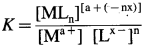
Consider the equilibrium for the metal-ligand interaction :
Ma+ + nLx- ⇌ [MLn]a+(-nx)
where a, x, [a + ( – nx)] denote the charge on the metal, ligand and the complex, respectively. Now, the equilibrium constant K is given by
Maharashtra Board Class 12 Chemistry Solutions Chapter 9 Coordination Compounds 28

Stability of the complex can be explained in terms of K. Higher the value of K larger is the thermodynamic stability of the complex hence K is called stability constant, and denoted by Kstah. The equilibria for the complex formation with the corresponding K values are given below.

Ag+ + 2CN ⇌ [Ag(CN)2] K = 5.5 x 10¹⁸
Cu2+ + 4CN ⇌ [CU(CN)4]2- K = 2.0 x 1027
Co3+ + 6NH3 ⇌ [CO(NH3)6]3+ K = 5.0 x 1033

From the above data, the stability of the complexes is [Co(NH3)6]3+ > [Cu(CN)4]2- > [Ag(CN)2].

Question viii.
Name the factors governing the equilibrium constants of the coordination compounds.
Answer:
The equilibrium constant of the complex depends on the following factors :

(a) Charge to size ratio of the metal ion : Higher the ratio greater is the stability. For the divalent metal ion complexes their stability shows the trend : Cu2+ > Ni2+ > Co2+ > Fe2+ > Mn2+ > Cd2+. The above stability order is called the Irving-William order. In the above list both Cu and Cd have the charge + 2, however, the ionic radius of Cu2 + is 69 pm and that of Cd2 + is 97 pm. The charge to size ratio of Cu2+ is greater than that of Cd2+. Therefore the Cu2+ forms stable complexes than Cd2+.

(b) Nature of the ligand : A second factor that governs stability of the complexes is related to how easily the ligand can donate its lone pair of electrons to the central metal ion that is, the basicity of the ligand. The ligands those are stronger bases tend to form more stable complexes.

Activity :
1. The reaction of chromium metal with H 2SO4 in the absence of air gives blue solution of chromium ion.
Cr(s) + 2H(aq) → Cr2⊕(aq) + H2(s)
Cr2⊕ forms octahedral complex with H2O ligands.
a. Write formula of the complex
b. Describe bonding in the complex using CFT and VBT.
Draw crystal field splitting and valence bond orbital diagrams.

2. Reaction of complex [Co(NH3)3(NO2)3 with HCl gives a complex [Co(NH3)3H2OCl2] in which two chloride ligands are trans to one another.
a. Draw possible stereoisomers of starting material
b. Assuming that NH3 groups remain in place, which of two starting isomers would give the observed product?

12th Chemistry Digest Chapter 9 Coordination Compounds Intext Questions and Answers

Use your brain power ……. (Textbook page 192)

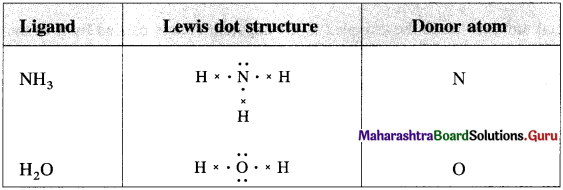
Question 1.
Draw Lewis structures of the following ligands and identify the donor atom in them :
NH3, H2O.
Answer:
Maharashtra Board Class 12 Chemistry Solutions Chapter 9 Coordination Compounds 1

Maharashtra Board Class 12 Chemistry Solutions Chapter 9 Coordination Compounds

Try this ………. (Textbook page 193)

Question 1.
Can you write ionisation of [Ni (NH3)6] CI2?
Answer:
[Ni (NH3)6] CI2 → [Ni(NH3)6]2+ + 2CI

Question 2.
Identify coordination sphere and counter ions.
Answer:
Coordination sphere : [Ni(NH3)6]2+
Counter ions : CI

Can you tell ? (Textbook page 193)

Question 1.
A complex is made of Co (III) and consists of four NH3 molecules and two CI ions as ligands. What is the charge number and formula of complexion?
Answer:
The complex ion has formula, [Co(NH3)4CI2]+.
The charge number is + 1.

Use vour brain power ……………… (Textbook page 193)

Question 1.
Coordination number used in coordination of compounds is somewhat different than that used in solid state. Explain.
Answer:

  • In a coordination compound the coordination number is the number of donor atoms of ligands directly attached to metal atom or ion.
  • In a solid state, the number of closest constituent atoms or ions in contact with a particular atom in the crystal lattice is called coordination number.
  • In a coordination compound, coordination number depends upon nature of metal atom or ion, and its electronic configuration.
  • In a solid state, the coordination number depends upon the crystalline structure of the unit cell.

Can you tell? ………………. (Textbook page 194)

Question 1.
What is the coordination number of
(a) Co in [CoCl2(en)2]+ = 6
(b) Ir in [Ir(C2O4)2Cl2]3+ and
(c) Pt in [Pt(NO2)2(NH3)2] ?
Answer:
(a) Coordination number of Co in [CoCl2(en)2]+ = 6
(b) Coordination number of Ir in [Ir(C2O4)2Cl2]3+ = 6
(c) Coordination number of Pt in [Pt(NO2)2(NH3)2] = 4

Use your brain power ……… (Textbook page 195)

Question 1.
Classify the complexes as homoleptic and heteroleptic:
(a) [Co (NH3)5CI]SO4,
(b) [CO(ONO)(NH3)5]CI2,
(c) [CoCl(NH3)(en)2]2+ and
(d) [Cu(C2O4)3]3-
Answer:
Homoleptic Complexes : (d) [Cu(C2O4)3]3-
Heteroleptic Complexes : (a) [CO(NH3)5CI]SO4
(b) [CO(ONO)(NH3)5]CI2,
(C) [CoCl(NH3)(en)2]2+

Use your brain power ……… (Textbook page 195)

Question 1.
Classify the complexes as cationic, anionic or Cr(H2O)2(C2O4)23-, PtCI2(en)2 and Cr(CO)6.
Answer:
Cationic complexes : [CO(NH3)6]CI2
Anionic complexes : Na4[Fe(CN)6], [Cr(H2O)2 (C2O4)2]3-
Neutral complexes : Cr(CO)6, Pt CI2(en)2

Try this ……. (Textbook page 197)

Question 1.
Write the representation of the following :
(i) Tricarbonatocobaltate(III) ion.
(ii) Sodium hexacyanoferrate(III).
(iii) Potassium hexacyafioferrate(II).
(iv) Aquachlorobis(ethylenediamine)cobalt(III).
(v) Tetraaquadichlorochromium(III) chloride.
(vi) Diamminedichloroplatinum(II).
Answer:
(i) [Co(C03)3]3-
(ii) Na3[Fe(CN)6]
(iii) K4[Fe(CN)6]
(iv) Co(en)2(H2O)(Cl)
(v) [Cr(H2O)4CI2]CI
(vi) Pt(NH3)2CI2

Maharashtra Board Class 12 Chemistry Solutions Chapter 9 Coordination Compounds

Try this …… (Textbook page 196)

Question 1.
Find out the EAN of
(a) [Zn(NH3)4]2+
(b) [Fe(CN)6]4+
Answer:
(a) For the complex ion, [Zn(NH3)4]2+ :
Atomic number of Zn = Z = 30
Charge on metal ion = + 2
∴ Number of electrons lost by Zn atom = X = 2 Total number of electrons donated by 4NH23
ligands = Y = 2 x 4 = 8
EAN = Z – X + Y
= 30 – 2 + 8
= 36

(Note : This is atomic number of the nearest inert element 36Kr.)

(b) For the complex ion, [Fe(CN)J4- :
For Fe, Z = 26 (Atomic number)
X = 2 (Due to + 2 charge on Fe)
Y = 12 (Due to 6 CN ligands)
∴ EAN = Z – X + Y
= 26 – 2 + 12
= 36

Use your brain power …… (Textbook page 197)

Question 1.
Do the following complexes follow the EAN rule
(a) Cr(CO)4,
(b) Ni(CO)4,
(c) Mn(CO)5,
(d) Fe(CO)5?
Answer:
(a) Cr(CO)4 : EAN = Z – X + Y
(b) Ni(C0)4 : EAN = Z – X + Y
= 24 – 0 + 8
= 28 – 0 + 8
= 32
= 36
(c) Mn(CO)5 : EAN = Z – X + Y
= 25 – 0 + 10
= 35

(d) Fe(CO)5 : EAN = Z – X + Y
= 26 – 0 + 10
= 36

Conclusion :
(a) Cr(CO)4 and (c) Mn(CO)5 do not follow EAN Rule.

Maharashtra Board Class 12 Chemistry Solutions Chapter 9 Coordination Compounds

Try this ….. (Textbook page 199)

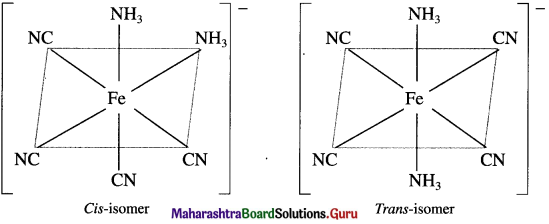
Question 1.
Draw structures of ci,c and trans isomers of [Fe(NH3)2(CN)4]
Answer:
Maharashtra Board Class 12 Chemistry Solutions Chapter 9 Coordination Compounds 9

Remember ….. (Textbook page 199)

Our hands are non-superimposable mirror images. When you hold your left hand up to a mirror the image looks like right hand.

Try this ….. (Textbook page 199)

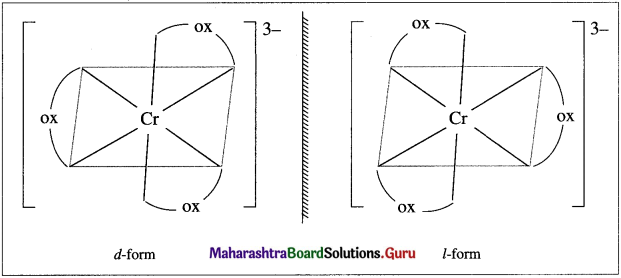
Question 1.
Draw enantiomers of [Cr(OX)2]3 where OX = C2O4 :
Answer:
Maharashtra Board Class 12 Chemistry Solutions Chapter 9 Coordination Compounds 16

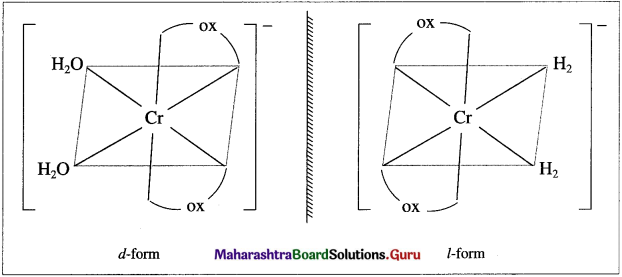
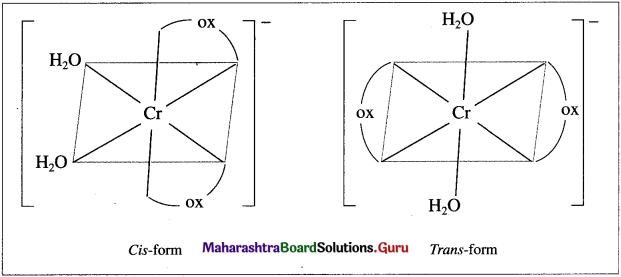
Question 2.
Draw (A) enantiomers and (B) cis and trans isomers of [Cr(H2O)2(OX)2] :
Answer:
(A) Enantiomers :
Maharashtra Board Class 12 Chemistry Solutions Chapter 9 Coordination Compounds 17

(B) as and trans isomers :
Maharashtra Board Class 12 Chemistry Solutions Chapter 9 Coordination Compounds 18

Maharashtra Board Class 12 Chemistry Solutions Chapter 9 Coordination Compounds

Can you tell ? ….. (Textbook page 200)

Question 1.
Can you write IUPAC names of isomers (I) [Co(NH3)5SO4]Br and (II) [Co(NH3)5Br]SO4?
Answer:
Maharashtra Board Class 12 Chemistry Solutions Chapter 9 Coordination Compounds 25

Question 2.
Write linkage isomers of [Fe(H2O)5SCN]+. Write their IUPAC names.
Answer:
Maharashtra Board Class 12 Chemistry Solutions Chapter 9 Coordination Compounds 26

Use your brain power …..(Textbook page 201)

Question 1.
The stability constant K of the [Ag(CN)2] is 5.5 x 10 while that for the corresponding [Ag(NH3)2]+ is 1.6 x 10⁷. Explain why [Ag(CN)2]2- is more stable.
Answer:
Stability constant of [Ag(CN)2]2- is larger than that of [Ag(NH3)2]+ and hence [Ag(CN)2]2- is more stable. Also, CN is a stronger ligand than NH3.

Remember …… (Textbook Page 202)

Question 1.
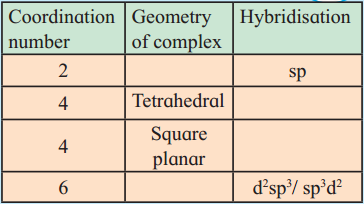
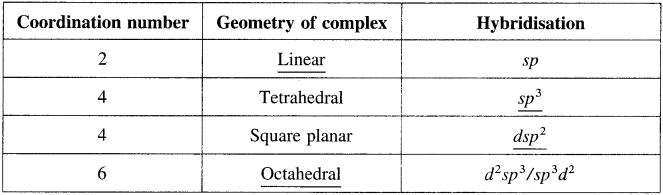
Complete the missing entries.
Maharashtra Board Class 12 Chemistry Solutions Chapter 9 Coordination Compounds 71
Maharashtra Board Class 12 Chemistry Solutions Chapter 9 Coordination Compounds 51

(Note : The missing entries are underlined.)

Table 9.3: Type of hybridisation and geometry of a complex
Maharashtra Board Class 12 Chemistry Solutions Chapter 9 Coordination Compounds 52

Try this ….. (Textbook page 204)

Question 1.
Based on the VBT predict structure and magnetic behaviour of the [Ni(NH3)6]
Answer:
28Ni [Ar] 3d8 4s2
Ni3+ [Ar] 3d7 4s°
Hybridisation : sp3d2
Geometry : Octahedral
Magnetic property : Paramagnetic

Maharashtra Board Class 12 Chemistry Solutions Chapter 9 Coordination Compounds

Try this …… (Textbook page 202)

Question 1.
Give VBT description of bonding in each of following complexes. Predict their magnetic behaviour.
(a) [ZnCI4]2+
(b) [CO(H2O)6]2- (high spin)
(c) [Pt(CN)4]2- (square planar)
(d) [CoCI4]2- (tetrahedral)
(e) [Cr(NH3)6]3+

Try this ……. (Textbook page 206)

Question 1.
Sketch qualitatively crystal field d orbital energy level diagrams for each of the following complexes :
(a) [Ni(en)3]2+ (b) [Mn(CN)6]3- (c) [Fe(H2O)6]2+
Predict whether each of the complexes is diamagnetic or paramagnetic.
Answer:
(a) The complex ion, [Ni(en)3]2+ is octahedral.
28Ni [Ar] 3d8 4s2
Ni2+ [Ar] 3d8 4s°.

Maharashtra Board Class 12 Chemistry Solutions Chapter 9 Coordination Compounds 61

Since en is a strong ligand there is pairing of electrons.
Number of unpaired electrons = n = 2 in t2g, orbitals
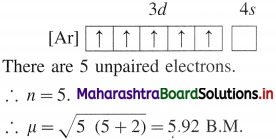
Magnetic moment = \(\mu=\sqrt{n(n+2)}\)
\(=\sqrt{2(2+2)}=2.83 \mathrm{~B} . \mathrm{M} .\)

The complex ion is paramagnetic.

(b) The complex ion [Mn(CN)6]3- is octahedral.
25Mn [Ar] 3d5 4s2
Mn3+ [Ar] 3d4 4s°

Maharashtra Board Class 12 Chemistry Solutions Chapter 9 Coordination Compounds 62

Since CN is a strong ligand there is pairing of electrons.
Number of unpaired electrons = n = 2 in t2g, orbitals
Magnetic moment = \(\mu=\sqrt{n(n+2)}\)
\(=\sqrt{2(2+2)}=2.83 \mathrm{~B} . \mathrm{M}\).

The complex ion is paramagnetic.

(c) The complex ion [Fe(H2O)6]2+ is octahedral.
26Fe [Ar] 3d6 4s2
Fe2+ [Ar] 3d6 45°

Maharashtra Board Class 12 Chemistry Solutions Chapter 9 Coordination Compounds 63

Since H2O is a weak ligand, there is no pairing of electrons.
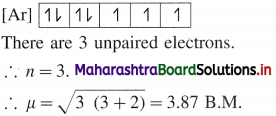
Number of unpaired electrons = n = 4 in t2g and eg orbitals.
Magnetic moment
\(\begin{aligned}
=\mu &=\sqrt{n(n+2)} \\
&=\sqrt{4(4+2)} \\
&=4.90 \mathrm{~B} . \mathrm{M} .
\end{aligned}\)
The complex ion is paramagnetic.

12th Std Chemistry Questions And Answers:

12th Chemistry Chapter 3 Exercise Ionic Equilibria Solutions Maharashtra Board

Class 12 Chemistry Chapter 3

Balbharti Maharashtra State Board 12th Chemistry Textbook Solutions Chapter 3 Ionic Equilibria Textbook Exercise Questions and Answers.

Ionic Equilibria Class 12 Exercise Question Answers Solutions Maharashtra Board

Class 12 Chemistry Chapter 3 Exercise Solutions Maharashtra Board

Chemistry Class 12 Chapter 3 Exercise Solutions

1. Choose the most correct answer:

Question i.
The pH of 10-8 M of HCl is
(a) 8
(b) 7
(c) less than 7
(d) greater than 7
Answer:
(c) less than 7

Question ii.
Which of the following solution will have pH value equal to 1.0?
(a) 50 mL of 0.1M HCl + 50mL of 0.1 M NaOH
(b) 60 mL of 0.1M HCl + 40mL of 0.1 M NaOH
(c) 20 mL of 0.1M HCl + 80mL of 0.1 M NaOH
(d) 75 mL of 0.2M HCl + 25mL of 0.2 M NaOH
Answer:
(d) 75 mL of 0.2M HCl + 25mL of 0.2 M NaOH

Question iii.
Which of the following is a buffer solution ?
(a) CH3COONa + NaCl in water
(b) CH3COOH + HCl in water
(c) CH3COOH + CH3COONa in water
(d) HCl + NH4Cl in water
Answer:
(c) CH3COOH + CH3COONa in water

Question iv.
The solubility product of a sparingly soluble salt AX is 5.2 x 10⁻¹³. Its solubility in mol dm-3 is
(a) 7.2 × 10⁻⁷
(b) 1.35 × 10⁻⁴
(c) 7.2 × 10⁻⁸
(d) 13.5 × 10⁻⁸
Answer:
(a) 7.2 × 10⁻⁷

Maharashtra Board Class 12 Chemistry Solutions Chapter 3 Ionic Equilibria

Question v.
Blood in human body is highly buffered at pH of
(a) 7.4
(b) 7.0
(c) 6.9
(d) 8.1
Answer:
(a) 7.4

Question vi.
The conjugate base of [Zn(H2O)4]2+ is
(a) [Zn(H2O)4]2+ NH3
(b) [Zn(H2O)3]2+
(c) [Zn(H2O)3OH]+
(d) [Zn(H2O)H]3+
Answer:
(c) [Zn(H2O)3OH]+

Question vii.
For pH > 7 the hydronium ion concentration would be
(a) 10-7 M
(b) < 10-7 M
(c) > 10-7 M
(d) ≥ 10-7 M
Answer:
(b) < 10-7 M

2. Answer the following in one sentence :

Question i.
Why cations are Lewis acids ?
Answer:
Since cations are deficient of electrons they accept a pair of electrons, hence they are Lewis acids.

Question ii.
Why is KCl solution neutral to litmus?
Answer:

  1. Since KCl is a salt of strong base KOH and strong acid HCl, it does not undergo hydrolysis in its aqueous solution.
  2. Due to strong acid and strong base, concentrations [H3O+] = [OH] and the solution is neutral.

Maharashtra Board Class 12 Chemistry Solutions Chapter 3 Ionic Equilibria

Question iii.
How are basic buffer solutions prepared?
Answer:

  1. Basic buffer solution is prepared by mixing aqueous solutions of a weak base like NH4OH and its salt of a strong acid like NH4Cl.
  2. A weak base is selected according to the required pH or pOH of the solution and dissociation constant of the weak base.

Question iv.
Dissociation constant of acetic acid is 1.8 × 10⁻⁵. Calculate percent dissociation of acetic acid in 0.01 M solution.
Answer:
Given : Ka = 1.8 x 10⁻⁵; C = 0.01 M
Percent dissociation = ?
Maharashtra Board Class 12 Chemistry Solutions Chapter 3 Ionic Equilibria 1
∴ Percent dissociation = α × 100
= 4.242 × 10-2 × 102
= 4.242%
Percent dissociation = 4.242%

Question v.
Write one property of a buffer solution.
Answer:
Properties (or advantages) of a buffer solution :

  • The pH of a buffer solution is maintained appreciably constant.
  • By addition of a small amount of an acid or a base pH does not change.
  • On dilution with water, pH of the solution doesn’t change.

Question vi.
The pH of a solution is 6.06. Calculate its H+ ion concentration.

Question vii.
Calculate the pH of 0.01 M sulphuric acid.
Answer:
Given : C = 0.01 M H2SO4, pH = ?
\(\mathrm{H}_{2} \mathrm{SO}_{4(\mathrm{aq})} \longrightarrow 2 \mathrm{H}_{(\mathrm{aq})}^{+}+\mathrm{SO}_{4(\mathrm{aq})}^{2-}\)
∴ [H3O+] = 2 × 0.01 = 0.02 M
PH = -log10 [H3O+]
= -log10 0.02
= –\((\overline{2} .3010)\)
= 2 – 0.3010
= 1.6990
pH = 1.6990.

Question viii.
The dissociation of H2S is suppressed in the presence of HCl. Name the phenomenon.
Answer:
The weak dibasic acid H2S is dissociated as follows :
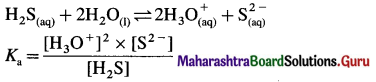
Maharashtra Board Class 12 Chemistry Solutions Chapter 3 Ionic Equilibria 2
When HCl is added, it increases the concentration of common ion H3O+.
\(\mathrm{HCl}_{(\mathrm{aq})}+\mathrm{H}_{2} \mathrm{O}_{(\mathrm{l})} \rightarrow \mathrm{H}_{3} \mathrm{O}_{(\mathrm{aq})}^{+}+\mathrm{Cl}_{(\mathrm{aq})}^{-}\)
Hence by Le Chaterlier’s principle, the equilibrium is shifted from right to left, suppressing the dissociation of weak electrolyte H2S.

Question ix.
Why is it necessary to add H2SO4 while preparing the solution of CuSO4?
Answer:
CuSO4 is a salt of strong acid H2SO4 and weak base Cu(OH)2. CuSO4 in aqueous solution undergoes hydrolysis and forms a precipitate of Cu(OH)2 and solution becomes turbid.
CuSO4 + 2H2O ⇌ CU(OH)2↓ + H2SO4
OR
CuSO4 + 4H2O ⇌ Cu(OH)2 + 2H3O+ + \(\mathrm{SO}_{4}^{2-}\)
When H2SO4 is added, the hydrolysis equilibrium is shifted to left hand side and Cu(OH)2 dissolves giving clear solution.

Maharashtra Board Class 12 Chemistry Solutions Chapter 3 Ionic Equilibria

Question x.
Classify the following buffers into different types :
a. CH3COOH + CH3COONa
b. NH4OH + NH4Cl
c. Sodium benzoate + benzoic acid
d. Cu(OH)2 + CuCl2
Answer:
(a) Acidic buffer (CH3COOH + CH3COONa)
(b) Basic buffer (NH4OH + NH4Cl)
(c) Acidic buffer (Sodium benzoate + benzoic acid)
(d) Basic buffer (Cu(OH)2 + CuCl2)
[Note : Cu(OH)2 being insoluble is not used to prepare a buffer solution.]

3. Answer the following in brief :

Question i.
What are acids and bases according to Arrhenius theory ?
Answer:
According to Arrhenius theory :
Acid : It is a substance which contains hydrogen and on dissolving in water produces hydrogen ions (H+) E.g. HCl
\(\mathrm{HCl}_{(\mathrm{aq})} \rightleftharpoons \mathrm{H}_{(\mathrm{aq})}^{+}+\mathrm{Cl}_{(\mathrm{aq})}^{-}\)

Base : It is a substance which contains OH group and on dissolving in water produces hydroxyl ions (OH). E.g. NaOH
\(\mathrm{NaOH}_{(\mathrm{aq})} \rightleftharpoons \mathrm{Na}_{(\mathrm{aq})}^{+}+\mathrm{OH}_{(\mathrm{aq})}^{-}\)

Question ii.
What is meant by conjugate acid-base pair?
Answer:
Conjugate acid-base pair : A pair of an acid and a base differing by a proton is called a conjugate acid-base pair.
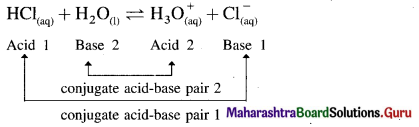
Maharashtra Board Class 12 Chemistry Solutions Chapter 3 Ionic Equilibria 3

Question iii.
Label the conjugate acid-base pair in the following reactions
a. HCl + H2O ⇌ H3O+ + Cl
b. \(\mathrm{CO}_{3}^{2-}\) + H2O ⇌ OH + \(\mathrm{HCO}_{3}^{-}\)
Answer:
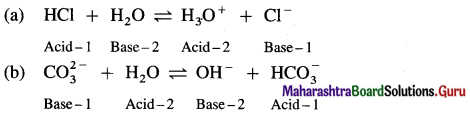
Maharashtra Board Class 12 Chemistry Solutions Chapter 3 Ionic Equilibria 4

Question iv.
Write a reaction in which water acts as a base.
Answer:
Maharashtra Board Class 12 Chemistry Solutions Chapter 3 Ionic Equilibria 5
Since water accepts a proton, it acts as a base.

Question v.
Ammonia serves as a Lewis base whereas AlCl3 is Lewis acid. Explain.
Answer:

  • Since ammonia molecule, NH3 has a lone pair of electrons to donate it acts as a Lewis base.
  • AlCl3 is a molecule with incomplete octet hence it is electron deficient and acts as a Lewis acid.

Maharashtra Board Class 12 Chemistry Solutions Chapter 3 Ionic Equilibria

Question vi.
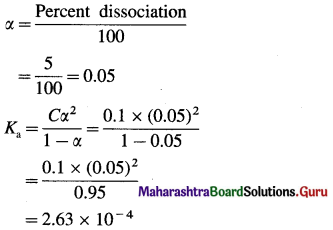
Acetic acid is 5% ionised in its decimolar solution. Calculate the dissociation constant of acid.
Answer:
Given : C = 0.1 M; Dissociation = 5%, Ka=2 Percent dissociation
Maharashtra Board Class 12 Chemistry Solutions Chapter 3 Ionic Equilibria 6
Dissociation constant of acid = Ka = 2.63 × 10⁻⁴

Question vii.
Derive the relation pH + pOH = 14.
Answer:
The ionic product of water, Kw is given by,
Kw = [H3O+] × [OH]
At 298 K, Kw = 1 × 10-14
∴ pKw = -log10Kw = log10 1 x 10-14 = 14
∵ [H3O+] × [OH] = 1 × 10-14
Taking logarithm to base 10 of both sides,
log10 [H3O+] + log10 [OH] = log10 1 x 10-14
Multiplying both the sides by -1,
-log10 [H3O+] -log10 [OH] = -log10 1 x 10-14
∵ pH = -log10 [H3O+]; pOH = -log10 [OH];
pKw = – log10 Kw
∴ pH + pOH = pKw
OR pH + pOH =14

Question viii.
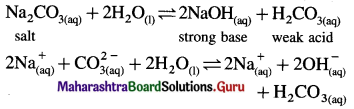
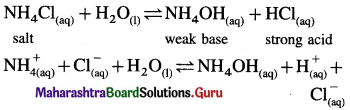
Aqueous solution of sodium carbonate is alkaline whereas aqueous solution of ammonium chloride is acidic. Explain.
Answer:
(A) (i) Sodium carbonate is a salt of weak acid and strong base.
(ii) In aqueous solution it undergoes hydrolysis.
Maharashtra Board Class 12 Chemistry Solutions Chapter 3 Ionic Equilibria 7
(iii) Strong base dissociates completely while weak acid dissociates partially since [OH] > [H3O+], the solution is basic.

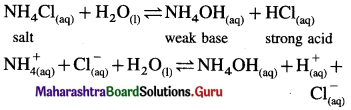
(B) (i) Ammonium chloride is a salt of strong acid and weak base.
(ii) In aqueous solution it undergoes hydrolysis
Maharashtra Board Class 12 Chemistry Solutions Chapter 3 Ionic Equilibria 8
(iii) Since [H+] or [H3O+ ] > [OH] the solution is acidic.

Question ix.
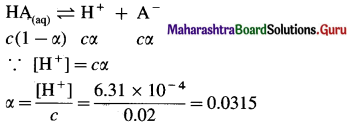
pH of a weak monobasic acid is 3.2 in its 0.02 M solution. Calculate its dissociation constant.
Answer:
Given : pH = 3.2; C = 0.02 M; Ka = ?
pH = -log10 [H+]
∴ [H+] = Antilog – pH
= Antilog – 3.2
= Antilog \(\overline{4} .8\)
= 6.31 × 10⁻⁴M
Maharashtra Board Class 12 Chemistry Solutions Chapter 3 Ionic Equilibria 9
Ka = cα2
= 0.02 × (0.0315)2
= 1.984 × 10⁻⁵
Dissociation constant = Ka = 1.984 × 10⁻⁵

Maharashtra Board Class 12 Chemistry Solutions Chapter 3 Ionic Equilibria

Question x.
In NaOH solution [OH] is 2.87 × 10⁻⁴. Calculate the pH of solution.
Answer:
Given : [OH] = 2.87 × 10⁻⁴ M, pH = ?
pOH = -log10 [OH]
= -log10 2.87 × 10-4
= –\((\overline{4} .4579)\)
= (4 – 0.4579)
= 3.5421
∵ pH + pOH = 14
∴ pH = 14 – pOH = 14 – 3.5421 = 10.4579
pH = 10.4579.

4. Answer the following :

Question i.
Define degree of dissociation. Derive Ostwald’s dilution law for the CH3COOH.
Answer:
(A) Degree of dissociation :
It is defined as a fraction of total number of moles of an electrolyte that dissociate into its ions at equilibrium.
It is denoted by a and represented by,
α = \(\frac{\text { number of moles dissociated }}{\text { total number of moles of an electrolyte }}\)
Or α = \(\frac{\text { Per cent dissociation }}{100}\)
∴ Per cent dissociation = α × 100

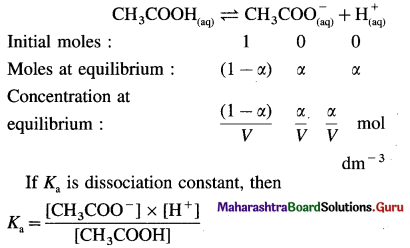
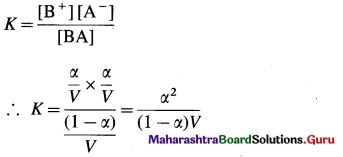
(B) Consider V dm3 of a solution containing one mole of CH3COOH. Then the concentration of acid is, C = \(\frac{1}{V}\) mol dm3. Let α be the degree of dissociation
Maharashtra Board Class 12 Chemistry Solutions Chapter 3 Ionic Equilibria 10
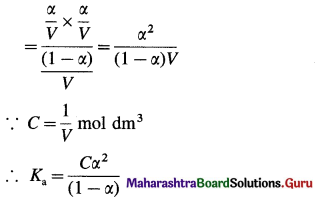
Maharashtra Board Class 12 Chemistry Solutions Chapter 3 Ionic Equilibria 11
This is Ostwald’s dilution law.

Question ii.
Define pH and pOH. Derive relationship between pH and pOH.
Answer:
(1) pH : The negative logarithm, to the base 10, of the molar concentration of hydrogen ions, H+ is known as the pH of a solution.
pH = -log10 [H+]

(2) pOH : The negative logarithm, to the base 10, of the molar concentration of hydroxyl ions, OH is known as the pOH of a solution.
pOH = -log10 [OH]

Relationship between pH and pOH:
The ionic product of water, Kw is given by,
Kw = [H3O+] × [OH]
At 298 K, Kw = 1 × 10-14
∴ pKw = -log10Kw = log10 1 x 10-14 = 14
∵ [H3O+] × [OH] = 1 × 10-14
Taking logarithm to base 10 of both sides,
log10 [H3O+] + log10 [OH] = log10 1 x 10-14
Multiplying both the sides by -1,
-log10 [H3O+] – log10 [OH] = -log10 1 x 10-14
∵ pH = -log10 [H3O+]; pOH = -log10 [OH];
pKw = – log10 Kw
∴ pH + pOH = pKw
OR pH + pOH =14

Maharashtra Board Class 12 Chemistry Solutions Chapter 3 Ionic Equilibria

Question iii.
What is meant by hydrolysis ? A solution of CH3COONH4 is neutral. why ?
Answer:
Hydrolysis : A reaction in which the cations or anions or both the ions of a salt react with water to produce acidity or basicity or sometimes neutrality is called hydrolysis.

A salt of weak acid and weak base for which Ka = Kb:
Consider hydrolysis of CH3COONH4.
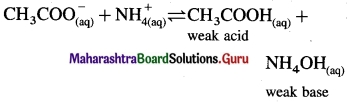
Maharashtra Board Class 12 Chemistry Solutions Chapter 3 Ionic Equilibria 12
Since Ka = Kb, the weak acid CH3COOH and weak base NH4OH dissociate to the same extent, hence, [H3O+] = [OH] and the solution reacts neutral after hydrolysis.

Question iv.
Dissociation of HCN is suppressed by the addition of HCl. Explain.
Answer:
The weak acid HCN is dissociated as follows :
\(\mathrm{HCN}_{(\mathrm{aq})}+\mathrm{H}_{2} \mathrm{O}_{(\mathrm{l})} \rightleftharpoons \mathrm{H}_{3} \mathrm{O}_{(\mathrm{aq})}^{+}+\mathrm{CN}_{(\mathrm{aq})}^{-}\)
The dissociation constant Ka is represented as,
Ka = \(\frac{\left[\mathrm{H}_{3} \mathrm{O}^{+}\right] \times\left[\mathrm{CN}^{-}\right]}{[\mathrm{HCN}]}\)
When HCl is added, it increases the concentration of H3O+, hence in order to keep the ratio constant, then by Le Chatelier’s principle, the equilibrium is shifted from right to left, suppressing the dissociation of HCN.

Question v.
Derive the relationship between degree of dissociation and dissociation constant in weak electrolytes.
Answer:
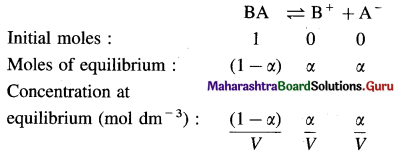
Expression of Ostwald’s dilution law in the case of a weak electrolyte : Consider the dissociation of a weak electrolyte BA. Let V dm3 of a solution contain one mole of the electrolyte. Then the concentration of a solution is, C = \(\frac{1}{V}\)mol dm-3. Let α be the degree of dissociation of the electrolyte.
Maharashtra Board Class 12 Chemistry Solutions Chapter 3 Ionic Equilibria 13
Applying the law of mass action to this dissociation equilibrium, we have,
Maharashtra Board Class 12 Chemistry Solutions Chapter 3 Ionic Equilibria 14
As the electrolyte is weak, α is very small as compared to unity, ∴ (1 – α) ≈ 1.
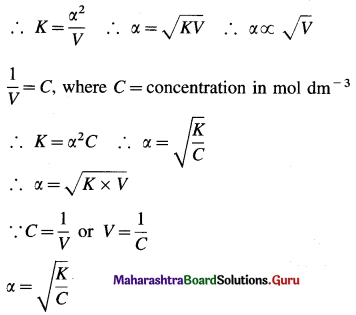
Maharashtra Board Class 12 Chemistry Solutions Chapter 3 Ionic Equilibria 15
This is the expression of Ostwald’s dilution law. Thus, the degree of dissociation of a weak electrolyte is directly proportional to the square root of the volume of the solution containing 1 mole of an electrolyte.

Question vi.
Sulfides of cation of group II are precipitated in acidic solution (H2S + HCl) whereas sulfides of cations of group IIIB are precipitated in ammoniacal solution of H2S. Comment on the relative values of solubility product of sulfides of these.
Answer:
(1) In qualitative analysis, the cations of group II are precipitated as sulphides, namely HgS, CuS, PbS, etc., while cations of group IIIB are precipitated as sulphides, namely, CoS, NiS, ZnS.

(2) The sulphides of group II have extremely low solubility product (Ksp) about 10-29 to 10-53 while the sulphides of group IIIB have slightly higher Ksp values about 10-20 to 10-23.

(3) In group II, sulphides are precipitated by adding H2S in acidic solution while in IIIB group they are precipitated in a basic solution like ammonical solution.

(4) In acidic medium due to common ion H+, H2S is dissociated to very less extent but gives sufficient S2- ion to exceed solubility product of group II sulphides of cations and precipitate them.
\(\mathrm{HCl}_{(\mathrm{aq})} \longrightarrow \mathrm{H}_{(\mathrm{aq})}^{+}+\mathrm{Cl}_{(\mathrm{aq})}^{-} ; \mathrm{H}_{2} \mathrm{~S}_{(\mathrm{aq})} \rightleftharpoons 2 \mathrm{H}_{(\mathrm{aq})}^{+}+\mathrm{S}_{(\mathrm{aq})}^{2-}\)

(5) In basic medium, H+ from H2S are removed by OH in solution, or by NH4OH, increasing the dissociation of H2S and concentration of S2-, so that IP > Ksp.
Maharashtra Board Class 12 Chemistry Solutions Chapter 3 Ionic Equilibria 16
(6) Therefore group II cations are precipitated in an acidic medium while cations of group IIIB are precipitated in ammonical solution.

Question vii.
Solubility of a sparingly soluble salt get affected in presence of a soluble salt having one common ion. Explain.
Answer:
Consider the solubility equilibrium of a sparingly soluble salt, AgCl.
\(\mathrm{AgCl}_{(\mathrm{s})} \rightleftharpoons \mathrm{Ag}_{(\mathrm{aq})}^{+}+\mathrm{Cl}_{(\mathrm{aq})}^{-}\)
The solubility product, Ksp is given by,
Ksp = [Ag+] × [Cl]
Consider addition of a strong electrolyte AgNO3 with a common ion Ag+.
\(\mathrm{AgNO}_{3(\mathrm{aq})} \longrightarrow \mathrm{Ag}_{(\mathrm{aq})}^{+}+\mathrm{NO}_{3(\mathrm{aq})}^{-}\)
The concentration Ag+ in the solution is increased, hence by Le Chatelier’s principle the equilibrium of AgCl is shifted to left hand side since the value of Ksp is constant.
Thus in the presence of a common ion, the solubility of a sparingly soluble salt is suppressed.

Maharashtra Board Class 12 Chemistry Solutions Chapter 3 Ionic Equilibria

Question viii.
The pH of rain water collected in a certain region of Maharashtra on particular day was 5.1. Calculate the H3O+ ion concentration of the rain water and its percent dissociation.
Answer:
Given : pH = 5.1, [H3O+] = ?
PH = -log10 [H3O+]
∴ log10 [H3O+] = -pH
∴ [H3O+] = Antilog – pH
= Antilog – 5.1
= Antilog \(\overline{6} .9\)
= 7.943 × 10⁻⁶ M
(H3O+ in rainwater is due to dissolved gases, CO2, SO2, etc. forming acids which dissociate giving H3O+ and acidity to rainwater.)
[H3O+] = 7.943 × 10⁻⁴ M

Question ix.
Explain the relation between ionic product and solubility product to predict whether a precipitate will form when two solutions are mixed?
Answer:
If ionic product and solubility product are indicated by IP and Ksp respectively then,
(I) When IP = Ksp, the solution is saturated.
(II) When IP > Ksp, the solution is supersaturated and hence precipitation will occur, when two solutions are mixed.
(Ill) When IP < Ksp, the solution is unsaturated and precipitation will not occur, when two solutions are mixed.

12th Chemistry Digest Chapter 3 Ionic Equilibria Intext Questions and Answers

Use your brain power (Textbook Page No. 47)

Question 1.
Which of the following is a strong electrolyte ?
HF, AgCl, CuSO4, CH3COONH4, H3PO4.
Answer:
CH3COONH4 is a strong electrolyte since in aqueous solution it dissociates completely. Sparingly soluble salts AgCl, CuSO4 are also strong electrolytes.

Use your brain power (Textbook Page No. 49)

Question 1.
All Bronsted bases are also Lewis bases, but all Bronsted acids are not Lewis acids. Explain.
Answer:
NH3 is a Bronsted base since it can accept a proton while it is also a Lewis base since it has a lone pair of electrons to donate.
Maharashtra Board Class 12 Chemistry Solutions Chapter 3 Ionic Equilibria 17
(2) HCl is a Bronsted acid since it can donate a proton but it is not a Lewis acid since it can’t accept a pair of electrons.
Maharashtra Board Class 12 Chemistry Solutions Chapter 3 Ionic Equilibria 18

Use your brain power (Textbook Page No. 53)

Question 1.
Suppose that pH of monobasic and dibasic acid is the same. Does this mean that the molar concentrations of both acids are identical ?
Answer:
Even if monobasic acid and dibasic acid give same pH, their molar concentrations are different. One mole of monobasic acid like HCl gives 1 mol of H+ while one mole of dibasic acid gives 2 mol of H+ in solution. Hence the concentration of dibasic acid will be half of the concentration of monobasic acid. For example, for same pH. [Monobasic acid] = [Dibasic acid]/2

Maharashtra Board Class 12 Chemistry Solutions Chapter 3 Ionic Equilibria

Question 2.
How does pH of pure water vary with temperature ? Explain.
Answer:
Since the increase in temperature, increases the dissociation of water, its pH decreases.

Can you tell ? (Textbook Page No. 54)

Question 1.
Why (i) an aqueous solution of NH4Cl is acidic.
(ii) while that of HCOOK basic ?
Answer:
(i) (i) Ammonium chloride is a salt of strong acid and weak base.
(ii) In aqueous solution it undergoes hydrolysis
Maharashtra Board Class 12 Chemistry Solutions Chapter 3 Ionic Equilibria 19
(iii) Since [H+] or [H3O+] > [OH] the solution is acidic.

(ii) HCOOK is a salt of weak acid HCOOH and strong base KOH. In aqueous solution it undergoes hydrolysis giving weak acid and strong base KOH which dissociates completely,
Maharashtra Board Class 12 Chemistry Solutions Chapter 3 Ionic Equilibria 20
∴ [OH] > [H3O+], and the solution reacts basic.

Can you think ? (Textbook Page No. 56)

Question 1.
Home made jams and jellies without any added chemical preservative additives spoil in a few days whereas commercial jams and jellies have a long shelf life. Explain. What role does added sodium benzoate play ?
Answer:
Sodium benzoate added to jams and jellies in commercial products maintains the pH constant and acts as a preservative. Hence jams and jellies are not spoiled for a very long time unlike homemade products.

Can you tell ? (Textbook Page No. 56)

Question 1.
It is enough to add a few mL of a buffer solution to maintain its pH. Which property of buffer is used here ?
Answer:
The important property of reserve acidity and reserve basicity of a buffer solution is used to maintain constant pH. Weak acid or weak base along with ions (cations or anions) from salt react with excess of added acid (H+) or base [OH] and maintain pH constant.

Maharashtra Board Class 12 Chemistry Solutions Chapter 3 Ionic Equilibria

Use your brain power (Textbook Page No. 59)

Question 1.
What is the relationship between molar solubility and solubility product for salts given below : (i) Ag2CrO4 (ii) Ca3(PO4)2 (iii) Cr(OH)3.
Answer:
Maharashtra Board Class 12 Chemistry Solutions Chapter 3 Ionic Equilibria 21
Maharashtra Board Class 12 Chemistry Solutions Chapter 3 Ionic Equilibria 22

Can you tell ? (Textbook Page No. 60)

Question 1.
How is the ionization of NH4OH suppressed by addition of NH4Cl to the solution of NH4OH ?
Answer:
Ionisation of NH4OH is represented as follows :
\(\mathrm{NH}_{4} \mathrm{OH}_{(\mathrm{aq})} \rightleftharpoons \mathrm{NH}_{4(\mathrm{aq})}^{+}+\mathrm{OH}_{(\mathrm{aq})}^{-}\)
It has ionisation constant,
Kb = \(\frac{\left[\mathrm{NH}^{4+}\right] \times\left[\mathrm{OH}^{-}\right]}{\left[\mathrm{NH}_{4} \mathrm{OH}\right]}\)
Kb has constant value at constant temperature. When strong electrolyte NH4Cl is added to its solution, it dissociates completely.
\(\mathrm{NH}_{4} \mathrm{Cl}_{(\mathrm{aq})} \longrightarrow \mathrm{NH}_{4(\mathrm{aq})}^{+}+\mathrm{Cl}_{(\mathrm{aq})}^{-}\)
Due to common ion \(\mathrm{NH}_{4}^{+}\), by Le Chatelier’s principle, the equilibrium is shifted from right to left, suppressing the ionisation of NH4OH.

12th Std Chemistry Questions And Answers:

12th Chemistry Chapter 2 Exercise Solutions Solutions Maharashtra Board

Class 12 Chemistry Chapter 2

Balbharti Maharashtra State Board 12th Chemistry Textbook Solutions Chapter 2 Solutions Textbook Exercise Questions and Answers.

Solutions Class 12 Exercise Question Answers Solutions Maharashtra Board

Class 12 Chemistry Chapter 2 Exercise Solutions Maharashtra Board

Chemistry Class 12 Chapter 2 Exercise Solutions

1. Choose the most correct answer.

Question i.
The vapour pressure of a solution containing 2 moles of a solute in 2 moles of water (vapour pressure of pure water = 24 mm Hg) is
(a) 24 mm Hg
(b) 32 mm Hg
(c) 48 mm Hg
(d) 12 mm Hg
Answer:
(d) 12 mm Hg

Question ii.
The colligative property of a solution is
(a) vapour pressure
(b) boiling point
(c) osmotic pressure
(d) freezing point
Answer:
(c) osmotic pressure

Question iii.
In calculating osmotic pressure the concentration of solute is expressed in
(a) molarity
(b) molality
(c) mole fraction
(d) mass per cent
Answer:
(a) molarity

Question iv.
Ebullioscopic constant is the boiling point elevation when the concentration of solution is
(a) 1 m
(b) 1 M
(c) 1 mass%
(d) 1 mole fraction of solute
Answer:
(a) 1 m

Question v.
Cryoscopic constant depends on
(a) nature of solvent
(b) nature of solute
(c) nature of solution
(d) number of solvent molecules
Answer:
(a) nature of solvent

Maharashtra Board Class 12 Chemistry Solutions Chapter 2 Solutions

Question vi.
Identify the correct statement
(a) vapour pressure of solution is higher than that of pure solvent.
(b) boiling point of solvent is lower than that of solution
(c) osmotic pressure of solution is lower than that of solvent
(d) osmosis is a colligative property.
Answer:
(b) boiling point of solvent is lower than that of solution

Question vii.
A living cell contains a solution which is isotonic with 0.3 M sugar solution. What osmotic pressure develops when the cell is placed in 0.1 M KCl solution at body temperature ?
(a) 5.08 atm
(b) 2.54 atm
(c) 4.92 atm
(d) 2.46 atm
Answer:
(c) 4.92 atm

Question viii.
The osmotic pressure of blood is 7.65 atm at 310 K. An aqueous solution of glucose isotonic with blood has the percentage (by volume)
(a) 5.41%
(b) 3.54%
(c) 4.53%
(d) 53.4%
Answer:
(a) 5.41%

Question ix.
Vapour pressure of a solution is
(a) directly proportional to the mole fraction of the solute
(b) inversely proportional to the mole fraction of the solute
(c) inversely proportional to the mole fraction of the solvent
(d) directly proportional to the mole fraction of the solvent
Answer:
(d) directly proportional to the mole fraction of the solvent

Question x.
Pressure cooker reduces cooking time for food because
(a) boiling point of water involved in cooking is increased
(b) heat is more evenly distributed in the cooking space
(c) the higher pressure inside the cooker crushes the food material
(d) cooking involves chemical changes helped by a rise in temperature
Answer:
(a) boiling point of water involved in cooking is increased

Question xi.
Henry’s law constant for a gas CH3Br is 0.159 mol dm-3 atm at 250°C. What is the solubility of CH3Br in water at 25 °C and a partial pressure of 0.164 atm?
(a) 0.0159 mol L-1
(b) 0.164 mol L-1
(c) 0.026 M
(d) 0.042 M
Answer:
(c) 0.026 M

Question xii.
Which of the following statement is NOT correct for 0.1 M urea solution and 0.05 M sucrose solution ?
(a) osmotic pressure exhibited by urea solution is higher than that exhibited by sucrose solution
(b) urea solution is hypertonic to sucrose solution
(c) they are isotonic solutions
(d) sucrose solution is hypotonic to urea solution
Answer:
(c) they are isotonic solutions

Maharashtra Board Class 12 Chemistry Solutions Chapter 2 Solutions

2. Answer the following in one or two sentences

Question i.
What is osmotic pressure ?
Answer:
(1) Definition : The osmotic pressure is defined as the excess mechanical pressure required to be applied to a solution separated by a semipermeable membrane from pure solvent or a dilute solution to prevent the osmosis or free passage of the solvent molecules at a given temperature. The osmotic pressure is a colligative property.

Maharashtra Board Class 12 Chemistry Solutions Chapter 2 Solutions 1
Osmosis and osmotic pressure

(2) Explanation : Consider an inverted thistle funnel on the mouth of which a semipermeable membrane is firmly fastened. It is filled with the experimental solution and immersed in a solvent like water. As a result, solvent molecules pass through the membrane into the solution in the funnel causing rising of level in the arm of thistle funnel. This increases the hydrostatic pressure. At a certain stage this rising level stops indicating an equilibrium between the rates of flow of solvent molecules from solvent to solution and from solution to solvent. The hydrostatic pressure at this stage represents osmotic pressure of the solution in the thistle funnel.

Question ii.
A solution concentration is expressed in molarity and not in molality while considering osmotic pressure. Why ?
Answer:

  1. While calculating osmotic pressure by equation, π = CRT, the concentration is expressed in molarity but not in molality.
  2. This is because the measurements of osmotic pressure are made at a certain constant temperature.
  3. Molarity depends upon temperature but molality is independent of temperature.
  4. Hence in osmotic pressure measurements, concentration is expressed in molarity.

Question iii.
Write the equation relating boiling point elevation to the concentration of solution.
Answer:
The elevation in the boiling point of a solution is directly proportional to the molal concentration (expressed in mol kg-1) of the solution.
Hence, if ΔTb is the elevation in the boiling point of a solution of molal concentration m then,
ΔTb ∝ m
∴ ΔTb = Kb m
where Kb is a proportionality constant.
If m = 1 molal,
ΔTb = Kb
Kb is called the ebullioscopic constant or molal elevation constant. Kb is characteristic of the solvent.

Question iv.
A 0.1 m solution of K2SO4 in water has freezing point of -0.43 °C. What is the value of van’t Hoff factor if Kf for water is 1.86 K kg mol-1?
Answer:
Given : m = 0.1 m, ΔTf = 0 – (-0.43) = 0.43 °C
Kf = 1.86 K kg mol-1, i = ?
ΔTf = i × Kf × m
∴ i = \(\frac{\Delta T_{\mathrm{f}}}{K_{\mathrm{f}} \times m}=\frac{0.43}{1.86 \times 0.1}\) = 2.312
van’t Hoff factor = i = 2.312

Maharashtra Board Class 12 Chemistry Solutions Chapter 2 Solutions

Question v.
What is van’t Hoff factor?
Answer:
Definition of the van’t Hoff factor, i : It is defined as a ratio of the observed colligative property of the solution to the theoretically calculated colligative property of the solution without considering molecular change.

The van’t Hoff factor can be represented as,
Maharashtra Board Class 12 Chemistry Solutions Chapter 2 Solutions 2

This colligative property may be the lowering of vapour pressure of a solution, the osmotic pressure, the elevation in the boiling point or the depression in the freezing point of the solution. Hence,
Maharashtra Board Class 12 Chemistry Solutions Chapter 2 Solutions 3

  • When the solute neither undergoes dissociation or association in the solution, then, i = 1
  • When the solute undergoes dissociation in the solution, then, i > 1
  • When the solute undergoes association in the solution, then i < 1

From the value of the van’t Hoff factor, the degree of dissociation of electrolytes, degree of association of nonelectrolytes can be obtained.

van’t Hoff factor gives the important information about the solute molecules in the solution and chemical bonding in them.

Question vi.
How is van’t Hoff factor related to degree of ionization?
Answer:
Consider 1 dm3 of a solution containing m moles of an electrolyte AxBy. The electrolyte on dissociation gives x number of Ay+ ions and y number of Bx- ions. Let α be the degree of dissociation.

At equilibrium,
AxBy ⇌ xAy+ + yBx-
For 1 mole of electrolyte : 1 – α,  xα,  yα
and For ‘m’ moles of an electrolyte : m(1 – α), mxα, myα are the number of particles.
Total number of moles at equilibrium, will be,
Total moles = m(1 – α) + mxα + myα
= m[(1 – α) + xα + yα]
= m[1 + xα + yα – α]
= m[1 + α(x + y – 1)]

The van’t Hoff factor i will be,
Maharashtra Board Class 12 Chemistry Solutions Chapter 2 Solutions 4
If total number of ions from one mole of electrolyte is denoted by n, then (x + y) = n
∴ i = 1 + α(n – 1)
∴ α(n – 1) = i – 1
∴ α = \(\frac{i-1}{n-1}\) ……(1)
This is a relation between van’t Hoff factor i and degree of dissociation of an electrolyte.

Question vii.
Which of the following solutions will have higher freezing point depression and why ?
a. 0.1 m NaCl b. 0.05 m Al2(SO4)3
Answer:
(1) Freezing point depression is a colligative property, hence depends on the number of particles in the solution.
(2) More the number of particles in the solution, higher is the depression in freezing point.
(3) The number of particles (ions) from electrolytes are,
Maharashtra Board Class 12 Chemistry Solutions Chapter 2 Solutions 5
(4) Therefore Al2(SO4)3 solution will have higher freezing point depression.

Question viii.
State Raoult’s law for a solution containing a nonvolatile solute.
Answer:
Statement of Raoult’s law : The law states that the vapour pressure of a solvent over the solution of a nonvolatile solute is equal to the vapour pressure of the pure solvent multiplied by mole fraction of the solvent at constant temperature.

Maharashtra Board Class 12 Chemistry Solutions Chapter 2 Solutions

Question ix.
What is the effect on the boiling point of water if 1 mole of methyl alcohol is added to 1 dm3 of water? Why?
Answer:

  • The boiling point of water (or any liquid) depends on its vapour pressure.
  • Higher the vapour pressure, lower is the boiling point.
  • When 1 mole of volatile methyl alcohol is added to 1 dm3 of water, its vapour pressure is increased decreasing the boiling point of water.

Question x.
Which of the four colligative properties is most often used for molecular mass determination? Why?
Answer:

  1. Since osmotic pressure has large values, it can be measured more precisely.
  2. The osmotic pressure can be measured at a suitable constant temperature.
  3. The molecular masses can be measured more accurately.
  4. Therefore, it is more useful to determine molecular masses of expensive substances by osmotic pressure.

3. Answer the following.

Question i.
How vapour pressure lowering is related to a rise in boiling point of solution?
Answer:
(1) The boiling point of a liquid is the temperature at which the vapour pressure of the liquid becomes equal to the external pressure, generally 1 atm (101.3 × 10³ Nm-2).

(2) When a liquid is heated, its vapour pressure rises till it becomes equal to the external pressure.
If the liquid has a low vapour pressure, it has a higher boiling point.
Maharashtra Board Class 12 Chemistry Solutions Chapter 2 Solutions 6
Vapour pressure curve showing elevation in boiling point

(3) When a nonvolatile solute is added to a solvent, its vapour pressure decreases, hence the boiling point increases.
This is explained by graphical representation of the vapour pressure and the boiling point of the pure solvent and the solution.

If T0 and T are the boiling points of a pure solvent and a solution, then the elevation in the boiling point is given by,
ΔTb = T – T0
The curve AB, represents the variation in the vapour pressure of a pure solvent with temperature while curve CD represents the variation in the vapour pressure of the solution.

(4) This elevation in the boiling point is proportional to the lowering of the vapour pressure, i.e., P0 – P, where P0 and P are the vapour pressures of the pure solvent and the solution.
[ΔTb ∝ (P0 – P) or ΔTb ∝ ΔP]

Question ii.
What are isotonic and hypertonic solutions?
Answer:
(1) Isotonic solutions : The solutions having the same osmotic pressure at a given temperature are called isotonic solutions.

Explanation : If two solutions of substances A and B contain nA and nB moles dissolved in volume V (in dm3) of the solutions, then their concentrations are,
CA = \(\frac{n_{\mathrm{A}}}{V}\) (in mol dm-3) and
CB = \(\frac{n_{\mathrm{B}}}{V}\) (in mol dm-3)

If the absolute temperature of both the solutions is T, then by the van’t Hoff equation,
πA = CART and πB = CBRT, where πA and πB are their osmotic pressures.
For the isotonic solutions,
πA = πB
∴ CA = CB
∴ \(\frac{n_{\mathrm{A}}}{V}=\frac{n_{\mathrm{B}}}{V}\)
∴ nA = nB
Hence, equal volumes of the isotonic solutions at the same temperature will contain equal number of moles (hence, equal number of molecules) of the substances.

(2) Hypertonic solutions : When two solutions have different osmotic pressures, then the solution having higher osmotic pressure is said to be a hypertonic solution with respect to the other solution.

Explanation : Consider two solutions of substances A and B having osmotic pressures πA and πB. If πB is greater than πA, then the solution B is a hypertonic solution with respect to the solution A.
Hence, if CA and CB are their concentrations, then CB > CA. Hence, for equal volume of the solutions, nB > nA.

Question iii.
A solvent and its solution containing a nonvolatile solute are separated by a semipermable membrane. Does the flow of solvent occur in both directions? Comment giving reason.
Answer:

  1. When a solvent and a solution containing a non-volatile solute are separated by a semipermeable membrane, there arises a flow of solvent molecules from solvent to solution as well as from solution to solvent.
  2. Due to higher vapour pressure of solvent than solution, the rate of flow of solvent molecules from solvent to solution is higher.
  3. As more and more solvent passes into solution due to osmosis, the solvent content increases, and the rate of backward flow increases.
  4. At a certain stage an equilibrium is reached where both the opposing rates become equal attaining an equilibrium.

Question iv.
The osmotic pressure of CaCl2 and urea solutions of the same concentration at the same temperature are respectively 0.605 atm and 0.245 atm. Calculate van’t Hoff factor for CaCl2.
Answer:
Given : πCacl2 = 0.605 atm;
πUrea = 0.245 atm
For urea solution, van’t Hoff factor, i = 1
πCacl2 = i × (CRT)Cacl2
πUrea = (CRT)Urea
Maharashtra Board Class 12 Chemistry Solutions Chapter 2 Solutions 7
van’t Hoff factor = i = 2.47

Question v.
Explain reverse osmosis.
Answer:
Reverse osmosis : The phenomenon of the passage of solvent like water under high pressure from the concentrated aqueous solution like seawater into pure water through a semipermeable membrane is called reverse osmosis.

The osmotic pressure of seawater is about 30 atmospheres. Hence when pressure more than 30 atmospheres is applied on the solution side, regular osmosis stops and reverse osmosis starts. Hence pure water from seawater enters the other side of pure water.
Maharashtra Board Class 12 Chemistry Solutions Chapter 2 Solutions 8
Purification of seawater by reverse osmosis

For this purpose of suitable semipermeable membrane is required which can withstand high pressure conditions over a long period.
This method is used successfully in Florida since 1981 producing more than 10 million litres of pure water per day.

Maharashtra Board Class 12 Chemistry Solutions Chapter 2 Solutions

Question vi.
How molar mass of a solute is determined by osmotic pressure measurement?
Answer:
Consider V dm3 (litres) of a solution containing W2 mass of a solute of molar mass M2 at a temperature T.
Number of moles of solute, n2 = \(\frac{W_{2}}{M_{2}}\)
The osmotic pressure π is given by,
π = \(\frac{W_{2} R T}{M_{2} V}\)
∴ M2 = \(\frac{W_{2} R T}{\pi V}\)
By measuring osmotic pressure of a solution, the molar mass of a solute can be calculated.
Since osmotic pressure can be measured more precisely, it is widely used to measure molar masses of the substances.

Question vii.
Why vapour pressure of a solvent is lowered by dissolving a nonvolatile solute into it?
Answer:
Lowering of vapour pressure of a solution :
When a nonvolatile solute is added to a pure solvent, the surface area is covered by the solute molecule decreasing the rate of evaporation, hence its vapour pressure decreases. This decrease in vapour pressure is called lowering of vapour pressure.

If P0 is the vapour pressure of a pure solvent (liquid) and P is the vapour pressure of the solution, where P < P0, then, (P0 – P) is the lowering of the vapour pressure.

Question viii.
Using Raoult’s law, how will you show that ∆P = \(\boldsymbol{P}_{1}^{0}\)x2 ? Where x2 is the mole fraction of solute in the solution and \(\boldsymbol{P}_{1}^{0}\) vapour pressure of pure solvent.
Answer:
If x1 and x2 are the mole fractions of solvent and solute respectively, then
x1 + x2
By Raoult’s law,
P = x1 × P0
where P0 is the vapour pressure of a pure solvent and P is the vapour pressure of the solution at given temperature.
Maharashtra Board Class 12 Chemistry Solutions Chapter 2 Solutions 9

Question ix.
While considering boiling point elevation and freezing point depression a solution concentration is expressed in molality and not in molarity. Why?
Answer:

  • Boiling point elevation and freezing point depression involve temperature changes, (ΔTb and ΔTf).
  • Since molarity depends on temperature but molality is independent of temperature we use molality and not molarity in considering boiling point elevation and freezing point depression.

Question 4.
Derive the relationship between degree of dissociation of an electrolyte and van’t Hoff factor.
Answer:
Consider 1 dm3 of a solution containing m moles of an electrolyte AxBy. The electrolyte on dissociation gives number of Ay+ ions and y number of Bx- ions. Let α be the degree of dissociation.

At equilibrium,
AxBy ⇌ xAy+ + yBx-
For 1 mole of electrolyte : 1 – α, xα, yα and
For ‘m’ moles of an electrolyte : m(1 – α), mxα, myα are the number of particles.
Total number of moles at equilibrium, will be,
Total moles = m(1 – α) + mxα + myα
= m[(1 – α) + xα + yα]
= m[1 – xα + yα – α]
= m[1 + α(x + y – 1)]
The van’t Hoff factor i will be,
Maharashtra Board Class 12 Chemistry Solutions Chapter 2 Solutions 10
If total number of ions from one mole of electrolyte is denoted by n, then (x + y) = n
∴ i = 1 + α(n – 1)
∴ α(n – 1) = i – 1
∴ α = \(\frac{i-1}{n-1}\) ……..(1)
This is a relation between van’t Hoff factor i and degree of dissociation of an electrolyte.

Maharashtra Board Class 12 Chemistry Solutions Chapter 2 Solutions

Question 5.
What is effect of temperature on solubility of solids in water? Give examples.
Answer:
The solubility of a solid solute depends upon temperature.
Maharashtra Board Class 12 Chemistry Solutions Chapter 2 Solutions 11
Variation of solubilities of some ionic solids with temperature

  • Generally rise in temperature increases the solubility. This is due to expansion of holes or empty spaces in the liquid solvent. Generally 10 °C rise in temperature, increases the solubility of solids two fold.
  • Dissolution process may be endothermic or exothermic.
  • The solubility of the substances like NaBr, NaCl, KCl, etc. changes slightly with the increase in temperature.
  • The solubility of the salts like NaNO3, KNO3, KBr, etc. increases appreciably with the increase in temperature.
  • The solubility of Na2SO4 first increases and after 30 °C decreases with the increase in temperature.

This variation in solubility with temperature can be used to separate the salts from the mixture by fractional crystallisation.

Question 6.
Obtain the relationship between freezing point depression of a solution containing nonvolatile nonelectrolyte and its molar mass.
Answer:
The freezing point depression, ΔTf of a solution is directly proportional to molality (m) of the solution.
∴ ΔTf ∝ m
∴ ΔTf = Kf m
where Kf is a molal depression constant.
The molality of a solution is given by,
Maharashtra Board Class 12 Chemistry Solutions Chapter 2 Solutions 12
If W1 grams of a solvent contain W2 grams of a solute of the molar mass M2, then the molality m of the solution is given by,
Maharashtra Board Class 12 Chemistry Solutions Chapter 2 Solutions 13
If the weights are expressed in kg then,
ΔTf = Kf × \(\frac{W_{2}}{W_{1} M_{2}}\)
The unit of Kf is K kg mol-1
Hence, from the measurement of the depression in the freezing point of the solution, the molar mass of the substance can be determined.

Question 7.
Explain with diagram the boiling point elevation in terms of vapour pressure lowering.
Answer:
(1) The boiling point of a liquid is the temperature at which the vapour pressure of the liquid becomes equal to the external pressure, generally 1 atm (101.3 × 10³ Nm-2).

(2) When a liquid is heated, its vapour pressure rises till it becomes equal to the external pressure.
If the liquid has a low vapour pressure, it has a higher boiling point.
Maharashtra Board Class 12 Chemistry Solutions Chapter 2 Solutions 14
Vapour pressure curve showing elevation in boiling point

(3) When a nonvolatile solute is added to a solvent, its vapour pressure decreases, hence the boiling point increases.
This is explained by graphical representation of the vapour pressure and the boiling point of the pure solvent and the solution.

If T0 and T are the boiling points of a pure solvent and a solution, then the elevation in the boiling point is given by,
ΔTb = T – T0
The curve AB, represents the variation in the vapour pressure of a pure solvent with temperature while curve CD represents the variation in the vapour pressure of the solution.

(4) This elevation in the boiling point is proportional to the lowering of the vapour pressure, i.e., P0 – P, where P0 and P are the vapour pressures of the pure solvent and the solution.
[ΔTb ∝ (P0 – P) or ΔTb ∝ ΔP]

Question 8.
Fish generally needs O2 concentration in water at least 3.8 mg/L for survival. What partial pressure of O2 above the water is needed for the survival of fish? Given the solubility of O2 in water at 0 °C and 1 atm partial pressure is 2.2 × 10⁻³ mol/L (0.054 atm)
Answer:
Given : Required concentration of O2
= 3.8 mg/L
= \(\frac{3.8 \times 10^{-3}}{32} \mathrm{~mol} \mathrm{~L}^{-1}\)
Solubility of O2 = 2.2 × 10⁻³ mol L-1
P = 1 atm
Partial pressure of O2 needed = Po2 = ?
Maharashtra Board Class 12 Chemistry Solutions Chapter 2 Solutions 15
Pressure needed = Po2 = 0.05397 atm.

Question 9.
The vapour pressure of water at 20 °C is 17 mm Hg. What is the vapour pressure of solution containing 2.8 g urea in 50 g of water? (16.17 mm Hg)
Answer:
Given : Vapour pressure of pure solvent (water) = P0
= 17 mm Hg
Weight of solvent = W1 = 50 g
Weight of solute (urea) = 2.8 g
Molecular weight of a solvent = M1 = 18
Molecular weight of a solute (urea) = M2
= 60 g mol-1
\(\frac{P_{0}-P}{P_{0}}=\frac{W_{2} \times M_{1}}{W_{1} \times M_{2}}\)
∴ \(\frac{17-P}{17}=\frac{2.8 \times 18}{50 \times 60}\) = 0.0168
∴ 17 – P = 17 × 0.0168
17 – P = 0.2856
∴ P= 17 – 0.2856
= 16.7144 mm Hg
Vapour pressure of solution = 16.7144 mm Hg

Maharashtra Board Class 12 Chemistry Solutions Chapter 2 Solutions

Question 10.
A 5% aqueous solution (by mass) of cane sugar (molar mass 342 g/mol) has freezing point of 271K. Calculate the freezing point of 5% aqueous glucose solution.
Answer:
Given : W2 = 5 g cane sugar; W1 = 100 – 5 = 95 g
M2 = 342 g mol-1; Tf1 = 271 K;
ΔTf1 = 273 – 271 = 2 K; Tf = ?
W2 = 5 g glucose, W’1 = 100 – 5 = 95 g,
M’2 = 180 g mol-1, ΔTf2 = ?
Maharashtra Board Class 12 Chemistry Solutions Chapter 2 Solutions 16
= 12.996 K kg mol-1
≅ 13 K kg mol-1
Maharashtra Board Class 12 Chemistry Solutions Chapter 2 Solutions 17
∴ Freezing point of solution = Tf
= 273 – 3.801 = 269.2 K
Freezing point of solution = 269.2 K.

Question 11.
A solution of citric acid C6H8O7 in 50 g of acetic acid has a boiling point elevation of 1.76 K. If Kb for acetic acid is 3.07 K kg mol-1, what is the molality of solution?
Answer:
Given : W1 = 50 g acetic acid
ΔTb = 1.76 K
Kb = 3.07 K kg mol-1
m = ?
ΔTb = Kb × m
∴ m = \(\frac{\Delta T_{\mathrm{b}}}{K_{\mathrm{b}}}\)
= \(\frac{1.76}{3.07}\)
= 0.5733 m
Molality of solution = 0.5733 m

Question 12.
An aqueous solution of a certain organic compound has a density of 1.063 gmL-1, an osmotic pressure of 12.16 atm at 25°C and a freezing point of -1.03°C. What is the molar mass of the compound? (334 g/mol)

Question 13.
A mixture of benzene and toluene contains 30% by mass of toluene. At 30°C, vapour pressure of pure toluene is 36.7 mm Hg and that of pure benzene is 118.2 mm Hg. Assuming that the two liquids form ideal solutions, calculate the total pressure and partial pressure of each constituent above the solution at 30°C.
Answer:
Given : 30% by mass of toluene (T) and 70% by mass of benzene (B).
WT = 30 g; WB = 70g
\(P_{\mathrm{T}}^{0}\) = 36.7 mm Hg; \(P_{\mathrm{B}}^{0}\) = 118.2 mm Hg
MT = 92 g mol-1; MB = 78 g mol-1
PT = ?, PB = ?, Psoln = ?
Maharashtra Board Class 12 Chemistry Solutions Chapter 2 Solutions 18
Total number of moles = nTotal = nT + nB
= 0.326 + 0.8974
= 1.2234 mol

Mole fractions :
xT = \(\frac{n_{\mathrm{T}}}{n_{\text {Total }}}=\frac{0.326}{1.2234}\) = 0.2665
xB = 1 – 0.2665 = 0.7335
Psoln = xT + \(P_{\mathrm{T}}^{0}\) + xB × \(P_{\mathrm{B}}^{0}\)
= 0.2665 × 36.7 + 0.7335 × 118.2
= 9.780 + 86.7
= 96.48 mm Hg

Partial pressures :
PT = xT × Psoln
= 0.2665 × 96.48
= 25.71 mm Hg
PB = xB × Psoln
= 0.7335 × 96.48
= 70.77 mm Hg
Total pressure Psoln = 96.48 mm Hg
Partial pressures : PToluene = 25.71 mm Hg
PBenzene = 70.77 mm Hg

Maharashtra Board Class 12 Chemistry Solutions Chapter 2 Solutions

Question 14.
At 25 °C a 0.1 molal solution of CH3COOH is 1.35% dissociated in an aqueous solution. Calculate freezing point and osmotic pressure of the solution assuming molality and molarity to be identical.
Answer:
Given : T = 273 + 25 = 298 K
C = 0.1 m ≅ 0.1 M; Kf = 1.86 K kg mol-1
Per cent dissociation = 1.35
Freezing point = tf = ?
π = ?
α = \(\frac{1.35}{100}\) = 0.0135
Maharashtra Board Class 12 Chemistry Solutions Chapter 2 Solutions 19
i = 1 – α + α + α = 1 + α = 1 + 0.0135 = 1.0135
(i) ΔTf = i × Kf × m
= 1.0135 × 1.86 × 0.1
= 0.1885 °C
∴ Freezing point of solution = 0 – 0.1885
= – 0.1885 °C

(ii) n = iCRT
= 1.035 × 0.1 × 0.08206 × 298
= 2.53 atm

(i) Freezing point of solution = – 0.1885 °C
(ii) Osmotic pressure = π = 2.53 atm

Question 15.
A 0.15 m aqueous solution of KCl freezes at -0.510 °C. Calculate i and osmotic pressure at 0 °C. Assume volume of solution equal to that of water.
Answer:
Given : c = 0.15 m KCl ≅ 0.15 M KCl
ΔTf = 0 – Tf = 0 – (-0.510) = 0.510 °C
T = 273 K; Kf = 1.86 K kg mol-1
i = ?; π = ?
ΔTf = i × Kf × m
∴ i = \(\frac{\Delta T_{\mathrm{f}}}{K_{\mathrm{f}} \times m}\)
= \(\frac{0.510}{1.86 \times 0.15}\)
= 1.828
π = iCRT
= 1.828 × 0.15 × 0.08206 × 273
= 6.143 atm
i = 1.828, Osmotic pressure = π = 6.143 atm

12th Chemistry Digest Chapter 2 Solutions Intext Questions and Answers

Can you tell ? (Textbook Page No. 29)

Question 1.
Why naphthalene dissolves in benzene but not in water ?
Answer:
Since naphthalene is a covalent nonpolar substance, it is soluble in a nonpolar solvent like benzene but insoluble in polar solvent like water.

Question 2.
Anhydrous sodium sulphate dissolves in water with the evolution of heat. What is the effect of temperature on its solubility ?
Answer:
Since the dissolution of anhydrous sodium sulphate in water is an exothermic process due to evolution of heat, according to Le Chatelier’s principle its solubility decreases with the increase in temperature.

(Textbook Page No. 42)

Question 1.
If 1.25 m sucrose solution has ΔTf of 2.32 °C, what will be the expected value of ΔTf for 1.25 m CaCl2 solution?
Answer:
Sucrose being nonelectrolyte, it has i = 1 but for CaCl2,
(CaCl2 → Ca2+ + 2Cl) the value of i = 3.
Hence
ΔTf = i × 2.32
= 3 × 2.32
= 6.92 °C
∴ ΔTf = 6.92 °C.

(Textbook Page No. 44)

Question 1.
Which of the following solutions will have maximum boiling point elevation and which have minimum freezing point depression assuming the complete dissociation? (a) 0.1m KCl (b) 0.05 m NaCl (c) 1 m AlPO4 (d) 0.1 m MgSO4.
Solution :
Boiling point elevation and freezing point depression are colligative properties that depend on number of particles in solution. The solution having more number of particles will have large boiling point elevation and that having less number of particles would show minimum freezing point depression.
Maharashtra Board Class 12 Chemistry Solutions Chapter 2 Solutions 20
AlPO4 solution contains highest moles and hence highest number particles and in turn, the maximum ΔTb. NaCl solution has minimum moles and particles, it has minimum ΔTf.

Maharashtra Board Class 12 Chemistry Solutions Chapter 2 Solutions

Question 2.
Arrange the following solutions in order of increasing osmotic pressure. Assume complete ionization. (a) 0.5 m Li2SO4 (b) 0.5 m KCl (c) 0.5 m Al2(SO4)3 (d) 0.1 m BaCl2.
Answer:
Consider 1 dm3 of each solution.
Maharashtra Board Class 12 Chemistry Solutions Chapter 2 Solutions 21
Osmotic pressure being a colligative property, it depends on number of particles in the solution.
Therefore, increasing order of osmotic pressure is,
Maharashtra Board Class 12 Chemistry Solutions Chapter 2 Solutions 22

12th Std Chemistry Questions And Answers:

12th Chemistry Chapter 1 Exercise Solid State Solutions Maharashtra Board

Class 12 Chemistry Chapter 1

Balbharti Maharashtra State Board 12th Chemistry Textbook Solutions Chapter 1 Solid State Textbook Exercise Questions and Answers.

Solid State Class 12 Exercise Question Answers Solutions Maharashtra Board

Class 12 Chemistry Chapter 1 Exercise Solutions Maharashtra Board

Chemistry Class 12 Chapter 1 Exercise Solutions

1. Choose the most correct answer.

Question i.
Molecular solids are
(a) crystalline solids
(b) amorphous solids
(c) ionic solids
(d) metallic solids
Answer:
(b) amorphous solids

Question ii.
Which of the following is an n-type semiconductor?
(a) Pure Si
(b) Si-doped with As
(c) Si-doped with Ga
(d) Ge doped with In
Answer:
(b) Si-doped with As

Question iii.
In Frenkel defect
(a) electrical neutrality of the substance is changed.
(b) density of the substance is changed.
(c) both cation and anion are missing
(d) overall electrical neutrality is preserved
Answer:
(d) overall electrical neutrality is preserved

Question iv.
In crystal lattice formed by bcc unit cell the void volume is
(a) 68%
(b) 74%
(c) 32%
(d) 26%
Answer:
(c) 32%

Maharashtra Board Class 12 Chemistry Solutions Chapter 1 Solid State

Question v.
The coordination number of atoms in bcc crystal lattice is
(a) 2
(b) 4
(c) 6
(d) 8
Answer:
(d) 8

Question vi.
Which of the following is not correct ?
(a) Four spheres are involved in the formation of tetrahedral void.
(b) The centres of spheres in octahedral voids are at the a pices of a regular tetrahedron.
(c) If the number of atoms is N the number of octahedral voids is 2N.
(d) If the number of atoms is N/2, the number of tetrahedral voids is N.
Answer:
(c) If the number of atoms is N the number of octahedral voids is 2N.

Question vii.
A compound forms hcp structure. Number of octahedral and tetrahedral voids in 0.5 mole of substance is respectively
(a) 3.011 × 10²³, 6.022 × 10²³
(b) 6.022 × 10²³, 3.011 × 10²³
(c) 4.011 × 10²³, 2.011 × 10²³
(d) 6.011 × 10²³, 12.022 × 10²³
Answer:
(a) 3.011 × 10²³, 6.022 × 10²³

Question viii.
Pb has fcc structure with edge length of unit cell 495 pm. Radius of Pb atom is
(a) 205 pm
(b) 185 pm
(c) 260 pm
(d) 175 pm
Answer:
(d) 175 pm

Maharashtra Board Class 12 Chemistry Solutions Chapter 1 Solid State

2. Answer the following in one or two sentences.

Question i.
What are the types of particles in each of the four main classes of crystalline solids?
Answer:
The smallest constituents or particles of various solids are atoms, ions or molecules.

Question ii.
Which of the three types of packing used by metals makes the most efficient use of space and which makes the least efficient use ?
Answer:
fcc has the most efficient packing of particles while scc has the least efficient packing.

Question iii.
The following pictures show population of bands for materials having different electrical properties. Classify them as insulator, semiconductor or a metal.
Maharashtra Board Class 12 Chemistry Solutions Chapter 1 Solid State 1a
Answer:
Picture A represents metal conductor,
Picture B represents insulator,
Picture C represents semiconductor.

Question iv.
What is a unit cell?
Answer:

  • Unit cell : It is the smallest repeating structural unit of a crystalline solid (or crystal lattice) which when repeated in different directions produces the crystalline solid (lattice).
  • The crystal is considered to consist of an infinite number of unit cells.
  • The unit cell possesses all the characteristics of the crystalline solid.

Maharashtra Board Class 12 Chemistry Solutions Chapter 1 Solid State

Question v.
How does electrical conductivity of a semiconductor change with temperature ? Why?
Answer:

  • Since the energy difference between valence band and conduction band in semiconductor is not large, the electrons from valence band can be promoted to conduction by heating.
  • Hence electrical conductivity of a semiconductor increases with temperature.

Question vi.
The picture represents bands of MOs for Si. Label valence band, conduction band and band gap.
Maharashtra Board Class 12 Chemistry Solutions Chapter 1 Solid State 2
Answer:
Maharashtra Board Class 12 Chemistry Solutions Chapter 1 Solid State 3

Question vii.
A solid is hard, brittle and electrically non-conductor. Its melt conducts electricity. What type of solid is it?
Answer:
A solid crystalline electrolyte like NaCl is hard, brittle and electrically nonconductor. But its melt conducts electricity.

Question viii.
Mention two properties that are common to both hep and ccp lattices.
Answer:
In hcp and ccp crystal lattices coordination number is 12 and packing efficiency is 74%.

Question ix.
Sketch a tetrahedral void.
Answer:
Maharashtra Board Class 12 Chemistry Solutions Chapter 1 Solid State 4

Maharashtra Board Class 12 Chemistry Solutions Chapter 1 Solid State

Question x.
What are ferromagnetic substances?
Answer:

  1. The substances which possess unpaired electrons and high paramagnetic character and when placed in a magnetic field are strongly attracted and show permanent magnetic moment even when the external magnetic field is removed are said to be ferromagnetic. They can be permanently magnetised.
  2. In the solid state, the metal ions of ferromagnetic substance are grouped together into small regions called domains, where each domain acts as a tiny magnet.

Maharashtra Board Class 12 Chemistry Solutions Chapter 1 Solid State 5
For example : Fe, Co, Gd, Ni, CrO2, etc.

3. Answer the following in brief.

Question i.
What are valence band and conduction band?
Answer:
There are two types of bands of molecular orbitals as follows :

  • Valence band : The atomic orbitals with filled electrons from the inner shells form valence bands, where there are no free mobile electrons since they are involved in bonding.
  • Conduction band : Atomic orbitals which are partially filled or empty on overlapping form closely placed molecular orbitals giving conduction bands where electrons are delocalised and can conduct, heat and electricity.

Question ii.
Distinguish between ionic solids and molecular solids.
Answer:

Type/ Property Ionic solids Molecular solids
1. Particles of unit cell Cations and anions Monoatomic or polyatomic molecules
2. Interparticle forces Electrostatic London, dipole-dipole forces and/or hydrogen bonds
3. Hardness Hard and brittle Soft
4. Melting points High 600 °C to 3000 °C Low (-272 °C to 400 °C)
5. Thermal and electrical conductivity Poor electrical conductors in solid state. Good conductors when melted or dissolved in water. Poor conductor of heat and electricity
6. Examples NaCl, CaF2 ice, benzoic acid

Question iii.
Calculate the number of atoms in fcc unit cell.
Answer:
Number of atoms in face-centred cubic (fcc) unit cell :
In this unit cell, there are 8 atoms at 8 corners and 6 atoms at 6 face centres. Each corner contributes 1/8th atom to the unit cell, hence due to 8 corners,
Number of atoms = \(\frac {1}{8}\) × 8 = 1.
Each face centre contributes half of the atom to the unit cell, hence due to 6 face centres,
Number of atoms = \(\frac {1}{2}\) × 6 = 3.
∴ Total number of atoms present in fee unit cell = 1 + 3 = 4.
Hence the volume of the unit cell is equal to the volume of four atoms.
Maharashtra Board Class 12 Chemistry Solutions Chapter 1 Solid State 6
Face centered unit cell

Question iv.
How are the spheres arranged in first layer of simple cubic close-packed structures? How are the successive layers of spheres placed above this layer ?
Answer:
(i) Stacking of square close packed layers :
Maharashtra Board Class 12 Chemistry Solutions Chapter 1 Solid State 7
Stacking of square close packed layers

In this arrangement, the two dimensional AAAA type square closed packed layers are placed one over the other in such a way that the crests of all spheres are in contact with successive layers in all directions. All spheres of different layers are perfectly aligned horizontally and vertically forming unit cells having primitive or simple cubic structure. Since all the layers are identical and if each layer is labelled as layer A, then whole three dimensional crystal lattice will be of AAAA… type.

Each sphere is in contact with six surrounded spheres, hence the coordination number of each sphere is six.

(ii) Stacking of two hexagonal close packed layers :
A close packed three dimensional structure can be generated by arranging hexagonal close packed layers in a particular manner.

In this the spheres of second layer are placed in the depression of the first layer.
In this if first layer is labelled as A then second layer is labelled as B since they are aligned differently.

Maharashtra Board Class 12 Chemistry Solutions Chapter 1 Solid State 8
Two layers of closed packed spheres

In this, all triangular voids of the first layers are not covered by the spheres of the second layer. The triangular voids which are covered by second layer spheres generate tetrahedral void which is surrounded by four spheres. The triangular voids in one layer have above them triangular voids of successive layers.

The overlapping triangular voids from two layers together form an octahedral void which is surrounded by six spheres.

Maharashtra Board Class 12 Chemistry Solutions Chapter 1 Solid State

Question v.
Calculate the packing efficiency of metal crystal that has simple cubic structure.
Answer:
Step 1 : Radius of sphere : In simple cubic lattice, the atoms (spheres) are present at eight corners and in contact along the edge in the unit cell.
If ‘a’ is the edge length of the unit cell and ‘r’ is the radius of the atom, then
a = 2r or r = a/2
Maharashtra Board Class 12 Chemistry Solutions Chapter 1 Solid State 9
scc structure

Step 2 : Volume of sphere :
Volume of one particle = \(\frac{4 \pi}{3}\) × r3
= \(\frac{4 \pi}{3}\) × (a/2)3 = \(\frac{\pi a^{3}}{6}\)

Step 3 : Total volume of particles : Since the unit cell contains one particle. Volume occupied by one particle in unit cell = \(\frac{\pi a^{3}}{6}\)

Step 4 : Packing efficiency :
Packing efficiency
Maharashtra Board Class 12 Chemistry Solutions Chapter 1 Solid State 10
∴ Packing efficiency = 52.36%
Percentage of void space = 100 – 52.36
= 47.64%

Question vi.
What are paramagnetic substances? Give examples.
Answer:
(1) The magnetic properties of a substance arise due to the presence of electrons.
(2) An electron while revolving around the nucleus, also spins around its own axis and generates a magnetic moment and magnetic properties.
(3) If an atom or a molecule contains one or more unpaired electrons spinning in same direction, clockwise or anticlockwise, then the substance is associated with net magnetic moment and magnetic properties. They experience a net force of attraction when placed in the magnetic field. This phenomenon is called paramagnetism and the substance is said to be paramagnetic.
For example, O2, Cu2+, Fe3+ , Cr3+ , NO, etc.

Question vii.
What are the consequences of Schottky defect?
Answer:
Consequences of Schottky defect :

  • Since the number of ions (cations and anions) decreases but volume remains unchanged, the density of a substance decreases.
  • As the number of missing cations and anions is equal, the electrical neutrality of the compound remains same.
  • This defect arises in ionic crystals like NaCl, AgBr, KCl, etc.

Question viii.
Cesium chloride crystallizes in cubic unit cell with Cl ions at the corners and Cs+ ion in the centre of the cube. How many CsCl molecules are there in the unit cell ?
Answer:
Number of Cs+ ion at body centre = 1
Number of Cl ions due to 8 comers = 8 × \(\frac {1}{8}\) = 1
Hence unit cell contains 1 CsCl molecule.

Maharashtra Board Class 12 Chemistry Solutions Chapter 1 Solid State

Question ix.
Cu crystallizes in fee unit cell with edge length of 495 pm. What is the radius of Cu atom ?
Answer:
Given : a = 495 pm
Radius, r = ?
For fee structure,
radius = r = \(\frac{a}{2 \sqrt{2}}=\frac{495}{2 \times \sqrt{2}}\) = 175 cm.
Radius of Cu atom = 175 pm

Question x.
Obtain the relationship between density of a substance and the edge length of unit cell.
Answer:
(1) Consider a cubic unit cell of edge length ‘a’.
The volume of unit cell = a3

(2) If there are ‘n’ particles per unit cell and the mass of particle is ‘m’, then
Mass of unit cell = m × n.

(3) If the density of the unit cell of the substance is p then
Density of unit cell = \(\frac{\text { Mass of unit cell }}{\text { Volume of unit cell }}\)
ρ = \(\frac{m \times n}{a^{3}}\)

Question 4.
The density of iridium is 22.4 g/cm3. The unit cell of iridium is fcc. Calculate the radius of iridium atom. Molar mass of iridium is 192.2 g/mol.
Answer:
Given : Crystal structure of iridium = fcc
Molar mass of iridium = 192.2 gmol-1
Density = ρ = 22.4 gcm-3
Radius of iridium = ?
In fcc structure, there are 8 Ir atoms at 8 comers and 6 Ir atoms at 6 face centres.
∴ Total number of Ir atoms = \(\frac {1}{8}\) × 8 + \(\frac {1}{2}\) × 6
= 1 + 3
= 4
Mass of Ir atom = \(\frac{192.2}{6.022 \times 10^{23}}\)
= 31.92 × 10⁻²³ g
∴ Mass of 4 Ir atoms = 4 × 31.92 × 10-23
= 1.277 × 10⁻²¹ g
∴ Mass of unit cell = 1.277 × 10⁻²¹ g
Density of unit cell = \(\frac{\text { Mass of unit cell }}{\text { Volume of unit cell }}\)
22.4 = \(\frac{1.277 \times 10^{-21}}{a^{3}}\)
∴ a3 = \(\frac{1.277 \times 10^{-21}}{22.4}\)
= 57 × 10-24 cm3
∴ a = (57 × 10-24)3 = 3.848 × 10⁻⁸ cm
If r is the radius of iridium atom, then for fcc structure,
r = \(\frac{a}{2 \sqrt{2}}\)
= \(\frac{3.848 \times 10^{-8}}{2 \times 1.414}\)
= 1.36 × 10⁻⁸ cm
= 136 pm
Radius of iridium atom = 136 pm

Question 5.
Aluminium crystallizes in cubic close packed structure with unit cell edge length of 353.6 pm. What is the radius of Al atom ? How many unit cells are there in 1.00 cm3 of Al ?
Answer:
Given : Structure of Al
= Cubic close packed structure
= ccp structure
Edge length of unit cell = a = 353.6 pm
= 3.536 × 10⁻⁸ cm
r = ?
Number of unit cells in 1.00 cm3 of Al = ?
Radius of Al atom = r = \(\frac{a}{2 \sqrt{2}}=\frac{353.6}{2 \sqrt{2}}\)
= \(\frac{353.6}{2 \times 1.414}\) = 125 pm
Volume of one unit cell = a3 = (3.536 × 10⁻⁸)3
= 4.421 × 10⁻²³ cm3
Number of unit cells = \(\frac{1.00}{4.421 \times 10^{-23}}\)
= 2.26 × 10²²
Radius of Al atom = 125 pm
Number of unit cells = 2.26 × 10²²

Maharashtra Board Class 12 Chemistry Solutions Chapter 1 Solid State

Question 6.
In an ionic crystalline solid atoms of element Y form hcp lattice. The atoms of element X occupy one third of tetrahedral voids. What is the formula of the compound?
Answer:
In the given hcp lattice, Y atoms are present at 12 corners and 2 face centres.
∴ Number of Y atoms = \(\frac {1}{2}\) × 12 + 2 × \(\frac {1}{2}\) = 3
There are 6 tetrahedral voids, the number of X atoms = \(\frac {1}{3}\) × 6 = 2
∴ Formula of the compound is X2Y3.

Question 7.
How are tetrahedral and octahedral voids formed?
Answer:
Tetrahedral void : The vacant space or void among four constituent particles having tetrahedral arrangement in the crystal lattice is called tetrahedral void.
Maharashtra Board Class 12 Chemistry Solutions Chapter 1 Solid State 11
The arrangement of four spheres around the void is tetrahedral. A tetrahedral void is formed when a triangular void made by three coplanar spheres is in contact with fourth sphere above or below it.

Octahedral void : The vacant space or void at the centre of six spheres (or atoms) which are placed octahedrally is called octahedral void.
Maharashtra Board Class 12 Chemistry Solutions Chapter 1 Solid State 12

Question 8.
Third layer of spheres is added to second layer so as to form hcp or ccp structure. What is the difference between the addition of third layer to form these hexagonal close-packed structures?
Answer:

  1. In the formation of hexagonal closed-packed (hcp) structure, the first one dimensional row shows depressions between neighbouring atoms.
  2. When a second row is arranged so that spheres fit in these depressions then a staggered arrangement is obtained. If the first row is A then the second row is B.
  3. When third row is placed in staggered manner in contact with second row then A type arrangement is obtained.
  4. Similarly, the spheres in fourth row can be arranged as B type layer. This results in ABAB… type setting of the layers. This gives hexagonal close packing (hcp) structure.

Maharashtra Board Class 12 Chemistry Solutions Chapter 1 Solid State 13
Hexagonal close packing (hcp)

Question 9.
An element with molar mass 27 g/mol forms cubic unit cell with edge length of 405 pm. If density of the element is 2.7 g/cm3, what is the nature of cubic unit cell ? (fcc or ccp)
Answer:
Given : Molar mass = M = 27 g mol-1
Nature of crystal = cubic unit cell
Edge length = a = 405 pm = 4.05 × 10⁻⁸ cm
Density = ρ = 2.7 g cm-3
Nature of unit cell = ?
Maharashtra Board Class 12 Chemistry Solutions Chapter 1 Solid State 14
= 3.997
≅ 4
Hence the nature of unit cell = face-centred cubic unit cell
Radius of Al atom = 125 pm
The nature of cubic unit cell is fcc.

Maharashtra Board Class 12 Chemistry Solutions Chapter 1 Solid State

Question 10.
An element has a bcc structure with unit cell edge length of 288 pm. How many unit cells and number of atoms are present in 200 g of the element? (1.16 × 1024, 2.32 × 1024)

Question 11.
Distinguish with the help of diagrams metal conductors, insulators and semiconductors from each other.
Answer:
Conductor:

  1. A substance which conducts heat and electricity to a greater extent is called conductor.
  2. In this, conduction bands and valence bands overlap or are very closely spaced.
  3. There is no energy difference or very less energy difference between valence bands and conduction bands.
  4. There are free electrons in the conduction bands.
  5. The conductance decreases with the increase in temperature.
  6. E.g., Metals, alloys.
  7. The conducting properties can’t be improved by adding third substance.

Maharashtra Board Class 12 Chemistry Solutions Chapter 1 Solid State 15 b

Insulator:

  1. A substance which cannot conduct heat and electricity under any conditions is called insulator.
  2. In this, conduction bands and valence bands are far apart.
  3. The energy difference between conduction bands and valence bands is very large.
  4. There are no free electrons in the conduction bands and electrons can’t be excited from valence bands to conduction bands due to large energy difference.
  5. No effect of temperature on conducting properties.
  6. E.g., Wood, rubber, plastics.
  7. No effect of addition of any substance.

Maharashtra Board Class 12 Chemistry Solutions Chapter 1 Solid State 24

Semiconductor:

  1. A substance that has poor electrical conductance at low temperature but higher conductance at higher temperature is called semiconductor.
  2. In this, conduction bands and valence bands are spaced closely.
  3. The energy difference between conduction bands and valence bands is small.
  4. The electrons can be easily excited from valence bands to conduction bands by heating.
  5. Conductance increases with the increase in temperature.
  6. E.g., Si, Ge
  7. By doping, conducting properties improve. E.g. n-type, p-type semiconductors.

Maharashtra Board Class 12 Chemistry Solutions Chapter 1 Solid State 25

Question 12.
What are n-type semiconductors? Why is the conductivity of doped n-type semiconductor higher than that of pure semiconductor ? Explain with diagram.
Answer:
n-type semiconductor:

  • n-type semiconductor contains increased number of electrons in the conduction band.
  • When Si semiconductor is doped with 15th group element phosphorus, P, the new atoms occupy some vacant sites in the lattice in place of Si atoms.
  • P has five valence electrons, out of which four are involved in covalent bonding with neighboring Si atoms while one electrons remains free and delocalised.
  • These free electrons increase the electrical conductivity of the semiconductor.
  • The semiconductors with extra non-bonding free electrons are called n-type semiconductors.

Maharashtra Board Class 12 Chemistry Solutions Chapter 1 Solid State 16
P atom occupying regular site of Si atom

Question 13.
Explain with diagram. Frenkel defect. What are the conditions for its formation? What is its effect on density and electrical neutrality of the crystal?
Answer:
Maharashtra Board Class 12 Chemistry Solutions Chapter 1 Solid State 17

  1. Frenkel defect : This defect arises when an ion of an ionic compound is missing from its regular site and occupies interstitial vacant position between lattice points.
  2. Cations have smaller size than anions, hence generally cations occupy the interstitial sites.
  3. This creates a vacancy defect at its original position and interstitial defect at new position.
  4. Frenkel defect is regarded as the combination of interstitial defect and vacancy defect.

Conditions for the formation of Frenkel defect :

  1. This defect arises in ionic compounds with a large difference between the sizes of cation and anion.
  2. The ionic compounds must have ions with low coordination number.

Consequences of Frenkel defect :

  1. Since there is no loss of ions from the crystal lattice, the density of the solid remains unchanged.
  2. The crystal remains electrically neutral.
  3. This defect is observed in ZnS, AgCl, AgBr, Agl, CaF2, etc.

Maharashtra Board Class 12 Chemistry Solutions Chapter 1 Solid State

Question 14.
What is an impurity defect? What are its types? Explain the formation of vacancies through aliovalent impurity with example.
Answer:
Impurity defect : This defect arises when foreign atoms, that is, atoms different from the host atoms are present in the crystal lattice.

There are two types of impurity defects namely

  1. Substitutional defects and
  2. Interstitial defects.

(1) Substitutional defects : These defects arises when foreign atoms occupy the lattice sites in place of host atoms, due to their displacements.
Examples : Solid solutions of metals (alloys). For example. Brass in which host atoms are of Cu which are replaced by impurity of Zn atoms. In this Zn atoms occupy regular sites while Cu atoms occupy substituted sites.
Maharashtra Board Class 12 Chemistry Solutions Chapter 1 Solid State 18
Brass

Vacancy through aliovalent impurity :
By addition of impurities of aliovalent ions :
Maharashtra Board Class 12 Chemistry Solutions Chapter 1 Solid State 19
Vacancy through aliovalent ion

When aliovalent ion like Sr2+ in small amount is added by additing SrCl2 to NaCl during its crystallisation, each Sr2+ ion (oxidation state 2+) removes 2 Na+ ions from their lattice points, to maintain electrical neutrality. Hence one of vacant lattice site is occupied by Sr2+ ion while other site remains vacant.

Interstitial impurity defect :
Maharashtra Board Class 12 Chemistry Solutions Chapter 1 Solid State 20
Stainless steel

A defect in solid in which the impurity atoms occupy interstitial vacant spaces of lattice structure is called interstitial impurity defect.

For example, in steel, normal lattice sites are occupied by Fe atoms but interstitial spaces are occupied by carbon atoms.

Maharashtra Board Class 12 Chemistry Solutions Chapter 1 Solid State

12th Chemistry Digest Chapter 1 Solid State Intext Questions and Answers

Try this… (Textbook Page No. 1)

Maharashtra Board Class 12 Chemistry Solutions Chapter 1 Solid State 21
Observe the above figure carefully. The two types of circles in this figure represent two types of constituent particles of a solid.

Question 1.
Will you call the arrangement of particles in this solid regular or irregular ?
Answer:
The arrangement of particles in this solid is regular.

Question 2.
Is the arrangement of constituent particles in directions \(\overrightarrow{\mathbf{A B}}\), \(\overrightarrow{\mathbf{C D}}\) and \(\overrightarrow{\mathbf{E F}}\) same or different?
Answer:
\(\overrightarrow{\mathbf{A B}}\) represents arrangement of identical particles of one type.
\(\overrightarrow{\mathbf{C D}}\) represents arrangement of identical particles of another type.
\(\overrightarrow{\mathbf{E F}}\) represents regular arrangement of two different particles in alternate positions.

Use your brain power ! (Textbook Page No. 2)

Question 1.
Identify the arrangements A and B as crystalline or amorphous.
Maharashtra Board Class 12 Chemistry Solutions Chapter 1 Solid State 22
Answer:
Arrangement in image A indicates the substance is crystalline.
Arrangement in image B indicates the substance is amorphous.

Try this… (Textbook Page No. 3)

Question 1.
Graphite is a covalent solid yet soft and good conductor of electricity. Explain.
Answer:
Maharashtra Board Class 12 Chemistry Solutions Chapter 1 Solid State 23

  1. Each carbon atom in graphite is sp2 hybridised and covalently bonded to other three sp2 hybridised carbon atoms forming σ bonds and the fourth electron in 2pz orbital of each carbon atom is used in the formation of a π bond. This results in the formation of hexagonal rings in two dimensions.
  2. In graphite, the layers consisting of hexagonal carbon network are held together by weak van der Waal’s forces imparting softness.
  3. The electrons in π bonds in the ring are delocalised and free to move in the delocalised molecular orbitals giving good electrical conductance.

Use your brain power ! (Textbook Page No. 13)

Question 1.
Which of the three lattices scc, bcc and fcc has the most efficient packing of particles ? Which one has the least efficient packing ?
Answer:
fcc has the most efficient packing of particles while see has the least efficient packing.

Can you think ? (Textbook Page No. 20)

Question 1.
When ZnO is heated it turns yellow and returns back to original white colour on cooling. What could be the reason ?
Answer:
When colourless ZnO is strongly heated, the metal atoms are deposited on crystal surface and anions O2- migrate to the surface producing vacancies at anion lattice points.

These anions combine with Zn atoms forming ZnO and release electrons.
Zn + O2- → ZnO + 2e

These released electrons diffuse into the crystal and occupy vacant sites of anions and produce F- centres. Due to these colour centres, ZnO turns yellow.

Can you tell ? (Textbook Page No. 23)

Let a small quantity of phosphorus be doped into pure silicon.

Question 1.
Will the resulting material contain the same number of total number of electrons as the original pure silicon ?
Answer:
Total number of electrons in doped silicon will be more than in original silicon.

Question 2.
Will the material be electrically neutral or charged?
Answer:
Material will be electrically neutral.

12th Std Chemistry Questions And Answers:

12th Chemistry Chapter 8 Exercise Transition and Inner Transition Elements Solutions Maharashtra Board

Class 12 Chemistry Chapter 8

Balbharti Maharashtra State Board 12th Chemistry Textbook Solutions Chapter 8 Transition and Inner Transition Elements Textbook Exercise Questions and Answers.

Transition and Inner Transition Elements Class 12 Exercise Question Answers Solutions Maharashtra Board

Class 12 Chemistry Chapter 8 Exercise Solutions Maharashtra Board

Chemistry Class 12 Chapter 8 Exercise Solutions

1. Choose the most correct option.

Question i.
Which one of the following is diamagnetic
a. Cr3⊕
b. Fe3⊕
c. Cu2⊕
d. Sc3⊕
Answer:
d. Sc3⊕

Maharashtra Board Class 12 Chemistry Solutions Chapter 8 Transition and Inner Transition Elements

Question ii.
Most stable oxidation state of Titanium is
a. +2
b. +3
c. +4
d. +5
Answer:
c. +4

Question iii.
Components of Nichrome alloy are
a. Ni, Cr, Fe
b. Ni, Cr, Fe, C
c. Ni, Cr
d. Cu, Fe
Answer:
(c) Ni, Cr

Question iv.
Most stable oxidation state of Ruthenium is
a. +2
b. +4
c. +8
d. +6
Answer:
(b) +4

Question v.
Stable oxidation states for chromium are
a. +2, +3
b. +3, +4
c. +4, +5
d. +3, +6
Answer:
d. +3, +6

Question vi.
Electronic configuration of Cu and Cu+1
a. 3d10, 4s0; 3d9, 4s0
b. 3d9, 4s1; 3d94s0
c. 3d10, 4s1; 3d10, 4s0
d. 3d8, 4s1; 3d10, 4s0
Answer:
c. 3d10, 4s1; 3d10, 4s°

Question vii.
Which of the following have d0s0 configuration
a. Sc3⊕
b. Ti4⊕
c. V5⊕
d. all of the above
Answer:
d. All of the above

Question viii.
Magnetic moment of a metal complex is 5.9 B.M. Number of unpaired electrons in the complex is
a. 2
b. 3
c. 4
d. 5
Answer:
d. 5

Question ix.
In which of the following series all the elements are radioactive in nature
a. Lanthanoids
b. Actinoids
c. d-block elements
d. s-block elements
Answer:
b. Actinides

Question x.
Which of the following sets of ions contain only paramagnetic ions
a. Sm3⊕, Ho3⊕, Lu3⊕
b. La3⊕, Ce3⊕, Sm3⊕
c. La3⊕, Eu3⊕, Gd3⊕
d. Ce3⊕, Eu3⊕, Yb3⊕
Answer:
d. Ce3⊕, Eu3⊕, Yb3⊕

Maharashtra Board Class 12 Chemistry Solutions Chapter 8 Transition and Inner Transition Elements

Question xi.
Which actinoid, other than uranium, occur in a significant amount naturally?
a. Thorium
b. Actinium
c. Protactinium
d. Plutonium
Answer:
a. Thorium

Question xii.
The flux added during extraction of Iron from hematite are its?
a. Silica
b. Calcium carbonate
c. Sodium carbonate
d. Alumina
Answer:
b. Calcium carbonate

2. Answer the following

Question i.
What is the oxidation state of Manganese in
\(\text { (i) } \mathrm{MnO}_{4}^{2-}(\mathrm{ii}) \mathrm{MnO}_{4}^{-} \text {? }\)
Answer:
Oxidation state of Manganese in
\((i) \mathrm{MnO}_{4}^{2-} is +6
(ii) \mathrm{MnO}_{4}^{-}is +7\)

*Question ii.
Give uses of KMnO4

Question iii.
Why salts of Sc3⊕, Ti4⊕, V5⊕ are colorless?
Answer:
(i) Sc3+ salts are colourless :

  • The electronic configuration of 21Sc [Ar| 3d1 4s2 and Sc3+ [Ar] d°.
  • Since there are no unpaired electrons in 3d subshell, d → d transition is not possible.
  • Therefore, Sc3+ ions do not absorb the radiations in the visible region. Hence salts of Sc3+ are colourless (or white).

(ii) Ti4+ salts are colourless :

  • The electronic configuration of 22Ti [Ar] 3d24s2 and Ti4+ : [Ar] d°
  • Since there are no unpaired electrons in 3d subshell, d-*d transition is not possible.
  • Therefore, Ti3+ ions do not absorb the radiation in visible region. Hence salts of Ti3+ are colourless.

(iii) Vs5+ salts are eolourless :

  • The electronic configuration of 23V : [Ar] 3d34s2 and V5+ : [Ar] 3d°
  • Since there are no unpaired electrons in 3d-subshell, d – d transition is not possible.
  • Therefore, V5+ ions do not absorb the radiations in the visible region. Hence, V5+ salts are colourless, a

Question iv.
Which steps are involved in the manufacture of potassium dichromate from chromite ore?
Answer:
Steps in the manufacture of potassium dichromate from chromite ore are :

  • Concentration of chromite ore.
  • Conversion of chromite ore into sodium chromate (Na2CrO4).
  • Conversion of Na2CrO4 into sodium dichromate (Na2Cr2O7).
  • Conversion of Na2Cr2O7 into K2Cr2O7.

Question v.
Balance the following equation
(i) KMnO4 + H2C2O4 + H2SO4 → MnSO4 + K2SO4 + H2O + O2
(ii) K2Cr2O7 + KI + H2SO4 → K2SO4 + Cr2(SO4)3 + 7H2O + 3I2
Answer:
(i) 2KMnO4 + 3H2SO4 + 5H2C2O4 → K2SO4 + 2MnSO4 + 8H2O + 10CO2
(ii) Acidified potassium dichromate oxidises potassium iodide (KI) to iodine (I2). Potassium dichromate is reduced to chromic sulphate. Liberated iodine turns the solution brown K2Cr2O7 + 6KI + 7H2SO4 → 4K2SO4 + Cr2(SO4)3 + 7H2O + 3I2 [Oxidation state of iodine increases from – 1 to zero]

Maharashtra Board Class 12 Chemistry Solutions Chapter 8 Transition and Inner Transition Elements

Question vi.
What are the stable oxidation states of plutonium, cerium, manganese, Europium?
Answer:
Stable oxidation states :
Plutonium + 3 to + 7
Cerium + 3, + 4
Manganese + 2, + 4, + 6, + 7
Europium +2, +3

Question vii.
Write the electronic configuration of chromium and copper.
Answer:
Chromium (24Cr) has electronic configuration,
24Cr (Expected) : Is2 2s2 2p6 3s2 3p6 3d4 4s2
(Observed) : Is2 2s2 2p6 3s2 3p6 3d5 4s1

Explanation :

  • The energy difference between 3d- and 45-orbitals is very low.
  • d-orbitals being degenerate, they acquire more stability when they are half-filled (3d5).
  • Therefore, there arises a transfer of one electron from 45-orbital to 3d-orbital in Cr giving more stable half-filled orbital. Hence, the configuration of Cr is [Ar] 3d5 4s1 and not [Ar] 3d4 4s2.

Copper (29CU) has electronic configuration,
29Cu (Expected) : Is2 2s3 2p6 3s3 3p6 3d9 4s2
(Observed) : Is2 2s2 2p6 3s2 3p6 3d10 4s1

Explanation :

  • The energy difference between 3d- and 45-orbitals is very low.
  • d-orbitals being degenerate, they acquire more stability when they are completely filled.
  • Therefore, there arises a transfer of one electron from 45-orbital to 3d-orbital in Cu giving completely filled more stable d-orbital.

Hence, the configuration of Cu is [Ar] 3d10 4s1 and not [Ar] 3d9 4s2.

Question viii.
Why nobelium is the only actinoid with +2 oxidation state?
Answer:

  • Nobelium has the electronic configuration 102NO : [Rn] 5f146d°7s2
  • No2+ : [Rn] 5f146d°
  • Since the 4f subshell is completely filled and 6d° empty, + 2 oxidation state is the stable oxidation state.
  • Other actinoids in + 2 oxidation state are not as stable due to incomplete 4f subshell.

Question ix.
Explain with the help of balanced chemical equation, why the solution of Ce(IV) is prepared in acidic medium.
Answer:
Ce4+ undergoes hydrolysis as, Ce4++ 2H2O → Ce(OH)4 + 4H+.
Due to the presence of H+ in the solution, the solution is acidic.

Question x.
What is meant by ‘shielding of electrons’ in an atom?
Answer:
The inner shell electrons in an atom screen or shield the outermost electron from the nuclear attraction. This effect is called the shielding effect.

The magnitude of the shielding effect depends upon the number of inner electrons.

Question xi.
The atomic number of an element is 90. Is this element diamagnetic or paramagnetic?
Answer:
The 90th element thorium has an electronic configuration, [Rn] 6d27s2. Since it has 2 unpaired electrons it is paramagnetic.

3. Answer the following

Question i.
Explain the trends in atomic radii of d-block elements
Answer:

  1. The atomic or ionic radii of 3-d series transition elements are smaller than those of representative elements, with the same oxidation states.
  2. For the same oxidation state, there is an increase in nuclear charge and a gradual decrease in ionic radii of 3d-series elements is observed. Thus ionic radii of ions with oxidation state + 2 decreases with increase in atomic number.
  3. There is slight increase is observed in Zn2+ ions. With the higher oxidation states, effective nuclear charge increases. Therefore ionic radii decrease with increase in oxidation state of the same element. For example, Fe2+ ion has ionic radius 77 pm whereas Fe3+ has 65 pm.

Maharashtra Board Class 12 Chemistry Solutions Chapter 8 Transition and Inner Transition Elements

Question ii.
Name different zones in the Blast furnace. Write the reactions taking place in them.
Answer:
(i) Zone of combustion : The hot air oxidises coke to CO which is an exothermic reaction, due to which the temperature of furnace rises.
C + 1/2 O2 → CO ΔH= – 220kJ
Some part of CO dissociates to give finely divided carbon and O2.
2CO → 2C + O2
The hot gases with CO rise up in the furnace and heats the charge coming down. CO acts as a fuel as well as a reducing agent.

(ii) Zone of reduction : At about 900 °C, CO reduces Fe2O3 to spongy (or porous) iron.
Fe2O3 + 3CO → 2Fe + 3CO2
Carbon also reduces partially Fe203 to Fe.
Fe2O3 + 3C → 2Fe + 3CO

(iii) Zone of slag formation : At 1200 K limestone, CaCO3 in the charge, decomposes and forms a basic flux CaO which further reacts at 1500 K with gangue (SiO2, Al2O3) and forms a slag of CaSiO3 and Ca3AlO3.
CaCO3 + CaO + CO2.
CaO + SiO2 → CaSiO3
12CaO + 2Al2O3 → 4Ca3AlO3 + 3O2

The slag is removed from the bottom of the furnace through an outlet.

(iv) Zone of fusion : The impurities in ore like MnO2 and Ca3(PO4)2 are reduced to Mn and P while SiO2 is reduced in Si. The spongy iron moving down in the furnace melts in the fusion zone and dissolves the impurities like C, Si, Mn, phosphorus and sulphure. The molten iron collects at the bottom of furnace. The lighter slag floats on the molten iron and prevents its oxidation.

The molten iron is removed and cooled in moulds. It is called pig iron or cast iron. It contains about 4% carbon.

Question iii.
What are the differences between cast iron, wrought iron and steel?
Answer:

Cast iron Wrought iron Steel
(1) Hard and brittle
(2) Contains 4% carbon.
(3) Used for making pipes, manu­facturing automotive parts, pots, pans, utensils
(1) Very soft
(2) Contains less than 0.2% carbon.
(3) Used for making pipes, bars for stay bolts, engine bolts and rivets.
(1) Neither too hard nor too soft.
(2) Contains 0.2 to 2% carbon
(3) Used in buildings infrastruc­ture, tools, ships, automobiles, weapons etc.

Question iv.
Iron exhibits +2 and +3 oxidation states. Write their electronic configuration. Which will be more stable? Why?
Answer:
The electronic configuration of Fe2 + and Fe3+ :
Fe2+ : Is2 2s2 2p6 3s2 3p6 3d6
Fe3+ : Is2 2s2 2p6 3s2 3p6 3d5

Due to loss of two electrons from the 4.v-orbital and one electron from the 3d-orbital, iron attains 3+ oxidation state. Since in Fe3+, the 3d-orbital is half-filled, it gets extra stability, hence Fe3+ is more stable than Fe2+.

Question v.
Give the similarities and differences in elements of 3d, 4d and 5d series.
Answer:
Similarity :

  • They are placed between .s-block and p-block of the periodic table.
  • All elements are metals showing metallic characters.
  • Some are paramagnetic.
  • Most of them give coloured compounds.
  • They have catalytic properties.
  • They form complexes.
  • They have variable oxidation states.

Differences :

  • In 4d and 5d series lanthanide and actinoid contraction is observed. In 3d series atomic size changes are less marked.
  • 4d and 5d elements have high coordination numbers compared to 3d elements.
  • 4d and 5d series have similar properties whereas 3d series have different properties.

Question vi.
Explain trends in ionisation enthalpies of d-block elements.
Answer:

  1. The ionisation enthalpies of transition elements are quite high and lie between those of 5-block and p-block elements. This is because the nuclear charge and atomic radii of transition elements lie between those of 5-block and p-block elements.
    Maharashtra Board Class 12 Chemistry Solutions Chapter 8 Transition and Inner Transition Elements 12
  2. As atomic number of transition elements increases along the period and along the group, first ionisation enthalpy increases even though the increase is not regular.
  3. If IE1; IE2 and IE3 are the first, second and third ionisation enthalpies of the transition elements, then IE1 < IE2 < IE3.
  4. In the transition elements, the added last differentiating electron enters into (n – 1) d-orbital and shields the valence electrons from the nuclear attraction. This gives rise to the screening effect of (n – 1) d-electrons.
  5. Due to this screening effect of (n – 1) d electrons, the ionisation enthalpy increases slowly and the increase is not very regular.

Maharashtra Board Class 12 Chemistry Solutions Chapter 8 Transition and Inner Transition Elements

Question vii.
What is meant by diamagnetic and paramagnetic metal? Give one example of diamagnetic and paramagnetic transition metal and lanthanoid metal.
Answer:

  1. Paramagnetic substances : When a magnetic field is applied, substances which are attracted towards the applied magnetic field are called paramagnetic substances. Example : Ni2+, Pr4+
  2. Diamagnetic substances : When a magnetic field is applied, substances which are repelled by the magnetic fields are called diamagnetic substances. Example : Zn2+, La3+
  3. Ferromagnetic substances : When a magnetic field is applied, substances which are attracted very strongly are called ferromagnetic substances. These substances can be magnetised. For example, Fe, Co, Ni are ferromagnetic.

Question viii.
Why the ground-state electronic configurations of gadolinium and lawrencium are different than expected?

Question ix.
Write steps involved in the metallurgical process
Answer:
The various steps and principles involved in the extraction of pure metals from their ores are as follows.:

  • Concentration of ores in which impurities (gangue) are removed.
  • Conversion of ores into oxides or other reducible compounds of metals.
  • Reduction of ores to obtain crude metals.
  • Refining of metals giving pure metals.

Question x.
Cerium and Terbium behaves as good oxidising agents in +4 oxidation state. Explain.
Answer:

  • The most stable oxidation state of lanthanoids is +3.
  • Hence, Ce4+ (cerium) and Tb4+ (terbium) tend to get + 3 oxidation state which is more stable.
  • Since they get reduced by accepting electron, they are good oxidising agents in + 4 oxidation state.

Question xi.
Europium and Ytterbium behave as good reducing agents in +2 oxidation state explain.
Answer:

  • The most stable oxidation state of lanthanoids is + 3.
  • Hence, Eu2+ and Yb2+ tend to get + 3 oxidation states by losing one electron.
  • Since they get oxidised, they are good reducing agents in + 2 oxidation state.

Activity :
Make groups and each group prepare a PowerPoint presentation on the properties and applications of one element. You can use your imagination to create some innovative ways of presenting data.

You can use pictures, images, flow charts, etc. to make the presentation easier to understand. Don’t forget to cite the reference(s) from where data for the presentation is collected (including figures and charts). Have fun!

12th Chemistry Digest Chapter 8 Transition and Inner Transition Elements Intext Questions and Answers

Do you know? (Textbook Page No 165)

Question 1.
In which block of the modern periodic table are the transition and inner transition elements placed?
Answer:
The transition elements are placed in d-block and inner transition elements are placed in f-block of the modern periodic table.

Use your brain power! (Textbook Page No 167)

Question 1.
Fill in the blanks with correct outer electronic configurations.
Answer:
Answers are given in bold.
Maharashtra Board Class 12 Chemistry Solutions Chapter 8 Transition and Inner Transition Elements 6

Maharashtra Board Class 12 Chemistry Solutions Chapter 8 Transition and Inner Transition Elements

Try this….. (Textbook Page No 168)

Question 1.
Write the electronic configuration of Cr and Cu.
Answer:
24Cr : [Ar] 3d54s1 30Cu : [Ar] 3d104s1

Can you tell? (Textbook Page No 168)

Question 1.
Which of the first transition series element shows the maximum number of oxidation states and why?
Answer:

  • 25Mn shows the maximum number of oxidation states, + 2 to +7.
  • 25Mn : [Ar] 3d54s3
  • Mn has incompletely filled J-subshell.
  • Due to small difference in energy between 3d and 4s -orbitals, Mn can lose (or share) electrons from both the orbitals.
  • Hence Mn shows oxidation states from + 2 to +7.

Question 2.
Which elements in the 4d and 5d-series will show maximum number of oxidation states?
Answer:
In 4d-series maximum number of oxidation states are for Ruthenium Ru ( + 2, +3, + 4„ +6, +7, + 8). In 5d-series, maximum number of oxidation states are for Osmium, Os ( + 2 to + 8).

Try this ….. (Textbook Page No 168)

Question 1.
Write the electronic configuration of Mn6+, Mn4+, Fe4+, Co5+, Ni2+.
Answer:

Ions Electronic configuration of valence shell
Mn6+ [Ar] 3d1
Mn4+ [Ar] 3d3
Fe4+ [Ar] 3d4
Co5+ [Ar] 3d4
Ni2+ [Ar] 3d8

Try this ….. (Textbook Page No 171)

Question 1.
Pick up the paramagnetic species from the following : Cu1+, Fe3+, Ni2+, Zn2+, Cd2+, Pd2+.
Answer:
The following ions are paramagnetic : Fe3+, Ni2+, Pd2+

Try this ….. (Textbook Page No 171)

Question 1.
What will be the magnetic moment of transition metal having 3 unpaired electrons?
(a) equal to 1.73 B.M.?
(b) less than 1.73 BM.
(c) more than 1.73 B.M.?
Answer:
By spin-only formula, \(\mu=\sqrt{n(n+2)}\) where n is number of unpaired electrons.
\(\mu=\sqrt{3(3+2)}=\sqrt{3(5)}=3.87 \mathrm{~B} . \mathrm{M}\)
Thus the value is more than 1.73 B.M.

Use your brain power! (Textbook Page No 171)

Question 1.
A metal ion from the first transition series has two unpaired electrons. Calculate the magnetic moment.
Answer:
\(\)\begin{aligned}
\mu &=\sqrt{n(n+2)} \\
&=\sqrt{2(2+2)} \\
&=\sqrt{8} \\
&=2.84 \text { B.M. }
\end{aligned}\(\)

Maharashtra Board Class 12 Chemistry Solutions Chapter 8 Transition and Inner Transition Elements

Problem (Textbook Page No 172)

Question 1.
Calculate the spin-only magnetic moment of divalent cation of a transition metal with atomic number 25.
Answer:
For element with atomic number 25. electronic configuration of its divalent cation will be : [Ar] 3d5.
Maharashtra Board Class 12 Chemistry Solutions Chapter 8 Transition and Inner Transition Elements 16

Try this….. (Textbook Page No 172)

Question 1.
Calculate the spin-only magnetic moment of a divalent cation of element Slaving atomic number 27.
Answer:
Electronic configuration of divalent ion of an element with atomic number 27 : [Ar] 3d7;
Maharashtra Board Class 12 Chemistry Solutions Chapter 8 Transition and Inner Transition Elements 17

Can you tell? (Textbook Page No 172)

Question 1.
Compounds of s and p-block elements are almost white. What could be the absorbed radiation? (uv or visible)?
Answer:
The white colour of a compound indicates the absorption of uv radiation.

Can you tell? (Textbook Page No 181)

Question 1.
Why f-block elements are called inner transition metals?
Answer:
f-block elements are called inner transition elements since f-orbital lies much inside the f-orbital in relation to the transition metals, These elements have 1 to 14 electrons in their f-orbital.

Question 2.
Are there an similarities between transition and inner transition metals?
Answer:
There are some properties similarity between transition and inner transition metals.

  • They are placed between s and p-block elements.
  • They are metals with filling of inner suhshells in their electronic configuration.
  • They show variable oxidation slates.
  •  They show magnetism.
  • They form coloured compounds.
  • They have catalytic property.

Problem (Textbook Page No 184)

Question 1.
Which of the following will have highest fourth ionisation enthalpy, La4+, Gd4+, Lu4+.
Answer:
La : 4f°5d16s2
Gd : 4f15d16s2
Lu : 4f145d16s2
Lu will have the highest fourth ionisation enthalpy since Lu3+ has the most stable configuration of 4f14.

Use your brain power! (Textbook Page No 185)

Question 1.
Do you think that lanthanoid complex would show magnetism?
Answer:
Lanthanoid complexes may show magnetism.

Question 2.
Can you calculate the spin only magnetic moment of lanthanoid complexes using the same formula that you used for transition metal complexes?
Answer:
You cannot calculate magnetic moment of lanthanoid complexes using spin only formula as you have to consider orbital momentum also.

Maharashtra Board Class 12 Chemistry Solutions Chapter 8 Transition and Inner Transition Elements

Question 3.
Calculate the spin only magnetic moment of La3+. Compare the value with that given in the table.
Answer:
La3+ ion has no unpaired electron.
Maharashtra Board Class 12 Chemistry Solutions Chapter 8 Transition and Inner Transition Elements 56
La3+ ion has zero value of magnetic moment same as given in the table.

Maharashtra Board Class 12 Chemistry Solutions Chapter 8 Transition and Inner Transition Elements 51

12th Std Chemistry Questions And Answers:

12th Chemistry Chapter 12 Exercise Aldehydes, Ketones and Carboxylic Acids Solutions Maharashtra Board

Class 12 Chemistry Chapter 12

Balbharti Maharashtra State Board 12th Chemistry Textbook Solutions Chapter 12 Aldehydes, Ketones and Carboxylic Acids Textbook Exercise Questions and Answers.

Aldehydes, Ketones and Carboxylic Acids Class 12 Exercise Question Answers Solutions Maharashtra Board

Class 12 Chemistry Chapter 12 Exercise Solutions Maharashtra Board

Chemistry Class 12 Chapter 12 Exercise Solutions

1. Choose the most correct option.

Question i.
In the following resonating structures A and B, the number of unshared electrons in valence shell present on oxygen respectively are
Maharashtra Board Class 12 Chemistry Solutions Chapter 12 Aldehydes, Ketones and Carboxylic Acids 1
Answer:
c. 4, 6

Maharashtra Board Class 12 Chemistry Solutions Chapter 12 Aldehydes, Ketones and Carboxylic Acids

Question ii.
In the Wolf -Kishner reduction, alkyl aryl ketones are reduced to alkylbenzenes. During this change, ketones are first converted into
a. acids
b. alcohols
c. hydrazones
d. alkenes
Answer:
c. hydrazones

Question iii.
Aldol condensation is
a. electrophilic substitution reaction
b. nucleophilic substitution reaction
c. elimination reaction
d. addition – elimination reaction
Answer:
d. addition-elimination reaction

Question iv.
Which one of the following has the lowest acidity?
Maharashtra Board Class 12 Chemistry Solutions Chapter 12 Aldehydes, Ketones and Carboxylic Acids 2
Maharashtra Board Class 12 Chemistry Solutions Chapter 12 Aldehydes, Ketones and Carboxylic Acids 3
Answer:
(c)

Question v.
Diborane reduces
a. ester group
b. nitro group
c. halo group
d. acid group
Answer:
d. acid group

Question vi.
Benzaldehyde does NOT show positive test with
a. Schiff reagent
b. Tollens’ ragent
c. Sodium bisulphite solution
d. Fehling solution
Answer:
d. Fehling solution

2. Answer the following in one sentence

Question i.
What are aromatic ketones?
Answer:
The compounds in which Maharashtra Board Class 12 Chemistry Solutions Chapter 12 Aldehydes, Ketones and Carboxylic Acids 23 group is attached to either two aryl groups or one aryl and one alkyl group are called aromatic ketones.

For example :
Maharashtra Board Class 12 Chemistry Solutions Chapter 12 Aldehydes, Ketones and Carboxylic Acids 24

Maharashtra Board Class 12 Chemistry Solutions Chapter 12 Aldehydes, Ketones and Carboxylic Acids

Question ii.
Is phenylacetic acid an aromatic carboxylic acid?
Answer:
Phenylacetic acid is not an aromatic carboxylic acid.

Question iii.
Write reaction showing conversion of ethanenitrile into ethanol.
Answer:
Maharashtra Board Class 12 Chemistry Solutions Chapter 12 Aldehydes, Ketones and Carboxylic Acids 311

Question iv.
Predict the product of the following reaction:
\(\mathrm{CH}_{3}-\mathrm{CH}_{2}-\mathrm{COOCH}_{3} \frac{\mathrm{i} \cdot \mathrm{AlH}(\mathrm{i}-\mathrm{Bu})_{2}}{\text { ii. } \mathrm{H}_{3} \mathrm{O}^{\oplus}}{\longrightarrow} ?\)
Answer:
Maharashtra Board Class 12 Chemistry Solutions Chapter 12 Aldehydes, Ketones and Carboxylic Acids 313

Question v.
Name the product obtained by reacting toluene with carbon monoxide and hydrogen chloride in presence of anhydrous aluminium chloride.
Answer:
Maharashtra Board Class 12 Chemistry Solutions Chapter 12 Aldehydes, Ketones and Carboxylic Acids 314

Question vi.
Write reaction showing conversion of Benzonitrile into benzoic acid.
Answer:
Maharashtra Board Class 12 Chemistry Solutions Chapter 12 Aldehydes, Ketones and Carboxylic Acids 315

Question vii.
Name the product obtained by the oxidation of 1,2,3,4-tetrahydronaphthalene with acidified potassium permanganate.
Answer:
Maharashtra Board Class 12 Chemistry Solutions Chapter 12 Aldehydes, Ketones and Carboxylic Acids 316

Question viii.
What is formalin?
Answer:
The aqueous solution of formaldehyde (40%) is known as formalin.

Question ix.
Arrange the following compounds in the increasing order of their boiling points : Formaldehyde, ethane, methyl alcohol.
Answer:
Ethane, formaldehyde, methyl alcohol.

Maharashtra Board Class 12 Chemistry Solutions Chapter 12 Aldehydes, Ketones and Carboxylic Acids

Question x.
Acetic acid is prepared from methyl magnesium bromide and dry ice in presence of dry ether. Name the compound which serves not only reagent but also as cooling agent in the reaction.
Answer:
The cooling agent used in the above reaction is dry ice (O = C = O).

3. Answer in brief.

Question i.
Observe the following equation of reaction of Tollens’ reagent with aldehyde. How do we know that a redox reaction has taken place. Explain.
\(\begin{array}{r}
\mathrm{R}-\mathrm{CHO}+2 \mathrm{Ag}\left(\mathrm{NH}_{3}\right)_{2}^{+}+\mathrm{OH}^{-} \stackrel{\Delta}{\longrightarrow} \\
\mathrm{R}-\mathrm{COO}^{-}+2 \mathrm{Ag} \downarrow+4 \mathrm{NH}_{3}+2 \mathrm{H}_{2} \mathrm{O}
\end{array}\)
Answer:
Tollen’s reagent oxidises acetaldehyde to acetic acid (carboxylate ion) and Ag in Tollen’s reagent complex are reduced to silver. In this reaction, oxidation and reduction takes place simultaneously hence, it is a redox reaction.

Question ii.
Formic acid is stronger than acetic acid. Explain.
Answer:
Maharashtra Board Class 12 Chemistry Solutions Chapter 12 Aldehydes, Ketones and Carboxylic Acids 146
In acetic acid, the methyl group is an electron-donating group. The acetate ion formed gets destabilized due to the electron releasing effect of methyl group ( +1 effect) which is higher than that of H-atom in the corresponding formic acid. As a result, acetic acid dissociates to a lesser extent. Thus decreasing the acidity of acetic acid.
Maharashtra Board Class 12 Chemistry Solutions Chapter 12 Aldehydes, Ketones and Carboxylic Acids 147
Formic acid having lower pKa value than acetic acid. Hence, formic acid is a stronger acid than acetic acid.

Question iii.
What is the action of hydrazine on cyclopentanone in presence of —. KOH in ethylene glycol?
Answer:
Maharashtra Board Class 12 Chemistry Solutions Chapter 12 Aldehydes, Ketones and Carboxylic Acids 308

Question iv.
Write reaction showing conversion of Acetaldehyde into acetaldehyde dimethyl acetal.
Answer:
Maharashtra Board Class 12 Chemistry Solutions Chapter 12 Aldehydes, Ketones and Carboxylic Acids 184

Question v.
Aldehydes are more reactive toward nucleophilic addition reactions than ketones. Explain.
Answer:
The reactivity of aldehydes and keones is due to the polarity of carbonyl group which results in electrophilicity of carbon. The reactivity is further explained on the basis of electronic effect and steric effects.

(1) Influence of electronic effects: A ketone has two electron-donating aJ.kyl groups ( + I effect) bonded to carbonyl carbon which are responsible for decreasing its positive polarity and electrophilicity. In contrast. aldehydes have only electron-donating group bonded to carbonyl carbon. This shows aldehydes are more electrophilic than ketones.

(2) Steric effects : Two bulky alkyl groups in ketone come in the way of the incoming nucleophile. This is called steric hindrance to nucleophilic attack.
Maharashtra Board Class 12 Chemistry Solutions Chapter 12 Aldehydes, Ketones and Carboxylic Acids 160
On the other hand. nucleophile can easily attack the carbonyl carbon in aldehyde because has one alkyl group and is less crowded or sterically less hindered.

Hence aldehydes are more reactive and can easily be attacked by nucleophiles.

Question vi.
Write reaction showing the action of the following reagent on propane nitrile
a. Dilute NaOH
b. Dilute HCl ?
Answer:
(1) Action of dil NaOH:
Maharashtra Board Class 12 Chemistry Solutions Chapter 12 Aldehydes, Ketones and Carboxylic Acids 115
(2) Action of dil HCl:
Maharashtra Board Class 12 Chemistry Solutions Chapter 12 Aldehydes, Ketones and Carboxylic Acids 116

Maharashtra Board Class 12 Chemistry Solutions Chapter 12 Aldehydes, Ketones and Carboxylic Acids

Question vi.
Arrange the following carboxylic acids with increasing order of their acidic strength and justify your answer.
Maharashtra Board Class 12 Chemistry Solutions Chapter 12 Aldehydes, Ketones and Carboxylic Acids 4
Answer:
The increasing order of acidity will be 1 <3 <2. Acidity depends on mainly two factors : (1) ease of proton release (2) stability of conjugate base formed. In example (3) the ether O exerts a I effect and is closer to COOH group than in 2 (1 effect diminishes). Also the conjugate base formed will be stabilized by the same – I effect by delocalization of charge.

4. Answer the following

Question i.
Write a note on
a. Cannizaro reaction
b. Stephen reaction.
Answer:
(1) The carbon atom adjacent to carbonyl carbon atom is called a-carbon atom (α – C) and the hydrogen atom attached to a-carbon atom is called α-hydrogen atom (α – H).
Maharashtra Board Class 12 Chemistry Solutions Chapter 12 Aldehydes, Ketones and Carboxylic Acids 226
(2) The α-hydrogen of aldehydes and ketones is acidic in nature due to (i) the strong-I effect of carbonyl group (ii) resonance stabilization of the carbanion.
Maharashtra Board Class 12 Chemistry Solutions Chapter 12 Aldehydes, Ketones and Carboxylic Acids 227
(3) Aldol condensation reaction is characteristic reaction of aldehydes and ketones containing active α-hydrogen atom.

(4) When aldehydes or ketones containing α – H atoms are warmed with a dilute base or dilute acid, two molecules of them undergo self condensation to give β-hydroxy aldehyde (aldol) or β-hydroxy ketone (ketol) respectively. The reaction is known as Aldol addition Reaction.

(5) In aldol condensation, the product is formed by the nucleophilic addition of α-carbon atom of a second molecule which gets attached to carbonyl carbon atom of the first molecule and α-hydrogen atom of the second molecule gets attached to carbonyl oxygen atom of the first molecule forming (- OH) group to give β-hydroxy aldehyde or ketone.

(6) This is a reversible reaction, establishing an equilibrium favouring aldol formation to a greater extent than ketol formation.

(7) For aldehyde :
Maharashtra Board Class 12 Chemistry Solutions Chapter 12 Aldehydes, Ketones and Carboxylic Acids 228
Acetaldol on heating undergoes subsequent elimination of water giving rise to α, β unsaturated aldehyde.
Maharashtra Board Class 12 Chemistry Solutions Chapter 12 Aldehydes, Ketones and Carboxylic Acids 229
The overall reaction is called aldol condensation. It is a nucleophilic addition-elimination reaction. For ketone :
Maharashtra Board Class 12 Chemistry Solutions Chapter 12 Aldehydes, Ketones and Carboxylic Acids 230
Diacetone alcohol on dehydration by heating forms α, β unsaturated ketone.
Maharashtra Board Class 12 Chemistry Solutions Chapter 12 Aldehydes, Ketones and Carboxylic Acids 231

Maharashtra Board Class 12 Chemistry Solutions Chapter 12 Aldehydes, Ketones and Carboxylic Acids

Question ii.
What is the action of the following reagents on toluene ?
a. Alkaline KMnO4, dil. HCl and heat
b. CrO2Cl2 in CS2
c. Acetyl chloride in presence of anhydrous AlCl3.
Answer:
(1) Action of alkaline KMnO4 : When toluene is heated with alkaline KMnO4. (methyl group gets oxidised to earboxy lic group) benzoic acid is obtained
Maharashtra Board Class 12 Chemistry Solutions Chapter 12 Aldehydes, Ketones and Carboxylic Acids 304

(2) Action of CrO2Cl2 in C2:
Answer:
When Loluenc is ircated with soluion of chromyl chloride (CrO2Cl2) in Cs2, brown chromium complex is obtained, which on acid hydrolysis gives benzaldehyde.
Maharashtra Board Class 12 Chemistry Solutions Chapter 12 Aldehydes, Ketones and Carboxylic Acids 305

(3) Action of acetyl chloride in presence of anhyd. AlCl3.
Answer:
When toluene is treated with acetyl chloride in presence of anhydrous AlCl3 4-methyl acetophenone is obtained.
Maharashtra Board Class 12 Chemistry Solutions Chapter 12 Aldehydes, Ketones and Carboxylic Acids 306

Question iii.
Write the IUPAC names of the following structures :
Maharashtra Board Class 12 Chemistry Solutions Chapter 12 Aldehydes, Ketones and Carboxylic Acids 5

Question iv.
Write reaction showing conversion of p- bromoisopropyl benzene into p-Isopropyl benzoic acid (3 steps).
Answer:
Maharashtra Board Class 12 Chemistry Solutions Chapter 12 Aldehydes, Ketones and Carboxylic Acids 117

Maharashtra Board Class 12 Chemistry Solutions Chapter 12 Aldehydes, Ketones and Carboxylic Acids

Question v.
Write reaction showing aldol condensation of cyclohexanone.
Answer:
Maharashtra Board Class 12 Chemistry Solutions Chapter 12 Aldehydes, Ketones and Carboxylic Acids 247

Activity :
Draw and complete the following reaction scheme which starts with acetaldehyde. In each empty box, write the structural formula of the organic compound that would be formed.
Maharashtra Board Class 12 Chemistry Solutions Chapter 12 Aldehydes, Ketones and Carboxylic Acids 323

12th Chemistry Digest Chapter 12 Aldehydes, Ketones and Carboxylic Acids Intext Questions and Answers

Use your brain power! (Textbook Page No 254)

Question 1.
Classify the following as aliphatic and aromatic aldehydes.
Maharashtra Board Class 12 Chemistry Solutions Chapter 12 Aldehydes, Ketones and Carboxylic Acids 18
Answer:
Maharashtra Board Class 12 Chemistry Solutions Chapter 12 Aldehydes, Ketones and Carboxylic Acids 19

Use your brain power! (Textbook Page No 255)

Question 1.
Classify the following as simple and mixed ketones. Benzoplienone, acetoneq hutanoneq acetophenone.

Compoun
Benzophenone ……………………………………………..
Acetone ……………………………………………..
Butanone ……………………………………………..
Acetophenone ……………………………………………..

Answer:

Compound
Benzophenone Simple ketone
Acetone Simple ketone
Butanone Mixed ketone
Acetophenone Mixed ketone

Maharashtra Board Class 12 Chemistry Solutions Chapter 12 Aldehydes, Ketones and Carboxylic Acids

Use your brain power! (Textbook Page No 264)

Write IUPAC names for the following compounds.
Maharashtra Board Class 12 Chemistry Solutions Chapter 12 Aldehydes, Ketones and Carboxylic Acids 49

Try this ….. (Textbook Page No 260)

Question 1.
Draw structures for the following :
(1) 2-Methylpentanal
(2) Hexan-2-one
Answer:
Maharashtra Board Class 12 Chemistry Solutions Chapter 12 Aldehydes, Ketones and Carboxylic Acids 50

Can you tell? (Textbook Page No 260)

Question 1.
Which is the reagent that oxidizes primary alcohols to only aldehydes and does not oxidize aldehydes further into carboxylic acid ?
Answer:
The reagent that is used to make only aldehydes is-heated Cu at 573 K.

Use your brain power! (Textbook Page No 261)

Question 1.
Write the structure of the product formed on Rosenmund reduction of ethanoyl chloride and benzoyl chloride.
Answer:
Maharashtra Board Class 12 Chemistry Solutions Chapter 12 Aldehydes, Ketones and Carboxylic Acids 84

Maharashtra Board Class 12 Chemistry Solutions Chapter 12 Aldehydes, Ketones and Carboxylic Acids

Can you think? (Textbook Page No 261)

Question 1.
What is the alcohol formed when benzoyl chloride is reduced with pure palladium as the catalyst ?
Answer:
Maharashtra Board Class 12 Chemistry Solutions Chapter 12 Aldehydes, Ketones and Carboxylic Acids 85

Use your brain power! (Textbook Page No 262)

Question 1.
Name the compounds which are used for the preparation of benzophenone by Friedel-Crafts acylation reaction. Draw their structures.
Answer:
The compounds which are used in preparation of benzophenone by Friedel – Crafts reaction are :
Maharashtra Board Class 12 Chemistry Solutions Chapter 12 Aldehydes, Ketones and Carboxylic Acids 106

Use your brain power! (Textbook Page No 263)

Identify the reagents necessary to achieve each of the following transformations:
Maharashtra Board Class 12 Chemistry Solutions Chapter 12 Aldehydes, Ketones and Carboxylic Acids 108
Answer:
Maharashtra Board Class 12 Chemistry Solutions Chapter 12 Aldehydes, Ketones and Carboxylic Acids 109

Use your brain power! (TextBook Page No 264)

Predict the products (name and structure) in the following reactions.
Maharashtra Board Class 12 Chemistry Solutions Chapter 12 Aldehydes, Ketones and Carboxylic Acids 133
Answer:
Maharashtra Board Class 12 Chemistry Solutions Chapter 12 Aldehydes, Ketones and Carboxylic Acids 134

Maharashtra Board Class 12 Chemistry Solutions Chapter 12 Aldehydes, Ketones and Carboxylic Acids

Problem 12.1 : (Textbook Page No 276)

Question 1.
Alcohols (R – OH), phenols (Ar – OH) and carboxylic acids (R – COOH) can undergo ionization of O – H bond to give away proton H+; yet they have different pKa values, which are 16, 10 and 4.5 respectively. Explain.
Solution :
pKa value is indicative of acid strength. Lower of pKa value stronger the acid. Alcohols, phenols and carboxylic acids, all involve ionization of an O – H bond. But their different pKa values indicate that their acid strengths are different. This is because the resulting conjugate bases are stabilized to different extents.
Maharashtra Board Class 12 Chemistry Solutions Chapter 12 Aldehydes, Ketones and Carboxylic Acids 150
As the conjugate base of carboxylic acid is best stabilized, among the three, carboxylic acids are strongest and have the lowest pKa value. As conjugate base of alcohols is destabilized, alcohols are weakest acids and have highest pIQ value. As conjugate base of phenols is moderately stabilized, phenols are moderately acidic and have intermediate pBQ value.

Try this….. (Textbook Page No 277)

Question 1.
Compare the following two conjugate bases and answer.
Maharashtra Board Class 12 Chemistry Solutions Chapter 12 Aldehydes, Ketones and Carboxylic Acids 151
(1) Indicate the inductive effects of CH3 – group in (a) and Cl-group in (b) by putting arrowheads in the middle of appropriate covalent bonds.
(2) Which species is stabilized by inductive effect, (a) or (b) ?
(3) Which species is destabilized by inductive effect, (a) or (b) ?
Answer:
Maharashtra Board Class 12 Chemistry Solutions Chapter 12 Aldehydes, Ketones and Carboxylic Acids 152
(2) The monochloroacetate ion formed gets stabilised due to electron-withdrawing of Cl atom (- I effect).
(3) Maharashtra Board Class 12 Chemistry Solutions Chapter 12 Aldehydes, Ketones and Carboxylic Acids 153 The acetate ion formed gets destabilised due to electron releasing effect of methyl group

Use your brain power! (Textbook Page No 277)

Question 1.
(1) Compare the pKa values and arrange the following in an increasing order of acid strength. CI3CCOOH, ClCH2COOH, CH3COOH, Cl2CHCOOH
(2) Draw structures of conjugate bases of monochloroacetic acid and dichloroacetic acid. Which one is more stabilized by – 1 effect?
Answer:
Maharashtra Board Class 12 Chemistry Solutions Chapter 12 Aldehydes, Ketones and Carboxylic Acids 154

Maharashtra Board Class 12 Chemistry Solutions Chapter 12 Aldehydes, Ketones and Carboxylic Acids 155 The dichloroacetate ion formed gets stabilised due electron-withdrawing effect of two chlorine atoms. (- 1 effect)

Maharashtra Board Class 12 Chemistry Solutions Chapter 12 Aldehydes, Ketones and Carboxylic Acids

Try this….. (Textbook Page No 277)

Question 1.
Arrange the following acids in order of their decreasing acidity.
Maharashtra Board Class 12 Chemistry Solutions Chapter 12 Aldehydes, Ketones and Carboxylic Acids 156
Answer:
Acidity in the decreasing order

Try this ….. (Textbook Page No 267)

Question 1.
Draw the structure of propanone and indicate its polarity.
Answer:
Maharashtra Board Class 12 Chemistry Solutions Chapter 12 Aldehydes, Ketones and Carboxylic Acids 161

Can you tell? (Textbook Page No 268)

Question 1.
Simple hydrocarbons, ethers, ketones and alcohols do not get oxidized by Tollen’s reagent. Explain, Why?
Answer:
(1) Due to the presence of hydrogen atom in aldehyde group Maharashtra Board Class 12 Chemistry Solutions Chapter 12 Aldehydes, Ketones and Carboxylic Acids 167, an aldehyde is oxidised to carboxylic acid Maharashtra Board Class 12 Chemistry Solutions Chapter 12 Aldehydes, Ketones and Carboxylic Acids 168 which is not possible in case of ethers, ketones, alcohols and hydrocarbons.
(2) In ketones, carbonyl atom is attached to C-atom, hence C – C bond in Maharashtra Board Class 12 Chemistry Solutions Chapter 12 Aldehydes, Ketones and Carboxylic Acids 169 can’t be broken easily.
(3) H atom attached to carbonyl carbon can be oxidised to – OH group giving carboxylic group Maharashtra Board Class 12 Chemistry Solutions Chapter 12 Aldehydes, Ketones and Carboxylic Acids 168 Therefore, aldehyde reduces Tollen’s reagent, whereas simple hydrocarbons, ethers, ketones and alcohols do not reduce Tollen’s reagent.

Use your brain power! (Textbook Page No 269)

Question 1.
Sodium bisulfite is sodium salt of sulfurous acid, write down its detailed bond structure.
Answer:
Maharashtra Board Class 12 Chemistry Solutions Chapter 12 Aldehydes, Ketones and Carboxylic Acids 179
Bond structure of sodium bisulfite

Use your brain power! (Textbook Page No 270)

Predict the product of the following reaction:
Maharashtra Board Class 12 Chemistry Solutions Chapter 12 Aldehydes, Ketones and Carboxylic Acids 185
Answer:
Maharashtra Board Class 12 Chemistry Solutions Chapter 12 Aldehydes, Ketones and Carboxylic Acids 186

Use your brain power! (Textbook Page No 271)

Question 1.
Draw the structures of
(1) The semicarbazone of cyclohexanone
(2) The imine formed in the reaction between 2-methylhexanal and ethyl amine
(3) 2, 4-dinitrophenyl hydrazone of acetaldehyde.
Answer:
(1) The semi carbazone of cyclohexanone.
Maharashtra Board Class 12 Chemistry Solutions Chapter 12 Aldehydes, Ketones and Carboxylic Acids 217
(2) The imine formed between 2-methyl hexanal and ethyl amine.
Maharashtra Board Class 12 Chemistry Solutions Chapter 12 Aldehydes, Ketones and Carboxylic Acids 218
(3) 2, 4-dinitrophenylhydrazone of acetaldehyde.
Maharashtra Board Class 12 Chemistry Solutions Chapter 12 Aldehydes, Ketones and Carboxylic Acids 219

Maharashtra Board Class 12 Chemistry Solutions Chapter 12 Aldehydes, Ketones and Carboxylic Acids

Try this….. (Textbook Page No 272)

Question 1.
Write chemical reactions taking place when propan-2-ol is treated with iodine and sodium hydroxide.
Answer:
Maharashtra Board Class 12 Chemistry Solutions Chapter 12 Aldehydes, Ketones and Carboxylic Acids 224

Question 2.
When acetaldehyde Is treated with dilute NaOH, the following reaction is observed.
Maharashtra Board Class 12 Chemistry Solutions Chapter 12 Aldehydes, Ketones and Carboxylic Acids 225
(1) What are the functional groups in the product?
(2) Can another product be formed during the same reaction? (Deduce the answer by doing atomic audit of reactant and product)
(3) Is this an addition reaction or condensation reaction?
Answer:
(1) There arc two functiona’ groups in the product: -CRO and -OH
(2) No other product can be formed in the same reaction.
(3) This is an addition reaction.

Use your brain power! (Textbook Page No 273)

Question 1.
Observe the following reaction.
Answer:
Maharashtra Board Class 12 Chemistry Solutions Chapter 12 Aldehydes, Ketones and Carboxylic Acids 234

Question 2.
Will this reaction give a mixture of products like a cross aldol reaction ?
Answer:
No, since benzaldehyde, Maharashtra Board Class 12 Chemistry Solutions Chapter 12 Aldehydes, Ketones and Carboxylic Acids 235 does not have a-hydrogen atom, it will not undergo self aldol condensation.

Use your brain power! (Textbook Page No 274)

Question 1.
Can isobutyraldehyde undergo a Cannizzaro reaction? Explain.
Answer:
Since isobutyraldehydeMaharashtra Board Class 12 Chemistry Solutions Chapter 12 Aldehydes, Ketones and Carboxylic Acids 252contains a-carbon atom, it cannot undergo Cannizzaro reaction.

Maharashtra Board Class 12 Chemistry Solutions Chapter 12 Aldehydes, Ketones and Carboxylic Acids

Can you tell? (Textbook Page No 279)

What is the term used for elimination of water molecule ?
Answer:
Dehydration.

Use your brain power! (Textbook Page No 278)

Question 1.
Fill in the blanks and rewrite the balanced equations.
Maharashtra Board Class 12 Chemistry Solutions Chapter 12 Aldehydes, Ketones and Carboxylic Acids 302
Answer:
Maharashtra Board Class 12 Chemistry Solutions Chapter 12 Aldehydes, Ketones and Carboxylic Acids 303

12th Std Chemistry Questions And Answers:

11th Biology Chapter 3 Exercise Kingdom Plantae Solutions Maharashtra Board

Class 11 Biology Chapter 3

Balbharti Maharashtra State Board 11th Biology Textbook Solutions Chapter 3 Kingdom Plantae Textbook Exercise Questions and Answers.

Kingdom Plantae Class 11 Exercise Question Answers Solutions Maharashtra Board

Class 11 Biology Chapter 3 Exercise Solutions Maharashtra Board

Biology Class 11 Chapter 3 Exercise Solutions

1. Choose the correct option.

Question (A)
Which is the dominant phase in Pteridophytes?
(a) Capsule
(b) Gametophyte
(c) Sporophyte
(d) Embryo
Answer:
(c) Sporophyte

Maharashtra Board Class 11 Biology Solutions Chapter 3 Kingdom Plantae

Question (B)
The tallest living gymnosperm among the following is
(a) Sequoia sempervirens
(b) Taxodium mucronatum
(c) Zamia pygmaea
(d) Ginkgo biloba
Answer:
(a) Sequoia sempervirens

Question (C)
In Bryophytes
(a) sporophyte and gametophyte generation are independent
(b) sporophyte is partially dependent upon gametophyte
(c) gametophyte is dependent upon sporophyte
(d) inconspicuous gametophyte
Answer:
(b) sporophyte is partially dependent upon gametophyte

Question (D)
A characteristic of Angiosperm is
(a) Collateral vascular bundles
(b) Radial vascular bundles
(c) Seed formation
(d) Double fertilization
Answer:
(d) Double fertilization

Question (E)
Angiosperms differ from gymnosperms in having
(a) Vessels in wood
(b) Mode of nutrition
(c) Siphonogamy
(d) Enclosed seed
Answer:
Both (a) Monocotyledons and (d) Enclosed seed

Maharashtra Board Class 11 Biology Solutions Chapter 3 Kingdom Plantae

Question 2.
How you place the pea, jowar and fern at its proper systematic position? Draw a flow chart.
Answer:
Maharashtra Board Class 11 Biology Solutions Chapter 3 Kingdom Plantae 1

Question 3.
Complete the following table.

Groups of algae Chlorophyceae Phaeophyccac Rhodophyceae
1. Stored food Starch
2. Cell wall Cellulose and algin
3. Major pigments Chl-a, d and phycoerythrin

Answer:

Groups of algae Chlorophyceae Phaeophyccac Rhodophyceae
1. Stored food Starch Mannitol, laminarin Floridean starch
2. Cell wall Cellulose Cellulose and algin Cellulose, pectin
3. Major pigments Chl-a, b Chl-a, c, fucoxanthin Chl-a, d and phycoerythrin

Question 4.
Differentiate between Dicotyledonae and Monocotyledonae based on the following characters:
a. Type of roots
b. Venation in the leaves
c. Symmetry of flower
Answer:

Characters Dicotyledonae Monocotyledonae
1. Type of roots Taproots Fibrous roots
2. Venation in the leaves Reticulate venation Parallel venation
3. Symmetry of flower Tetramerous or Pentamerous symmetry Trimerous symmetry

Characters Dicotyledonae Monocotyledonae
1. Type of roots Tap roots Fibrous roots
2. V enation in the leaves Reticulate venation Parallel venation
3. Symmetry of flower Tetramerous or Pentamerous symmetry Trimerous symmetry

Maharashtra Board Class 11 Biology Solutions Chapter 3 Kingdom Plantae

5. Answer the following questions.

Question (A)
We observe that land becomes barren soon after monsoon. But in the next monsoon it flourishes again with varieties we observed in season earlier. How you think it takes place?
Answer:

  1. After monsoon, plants like mosses (bryophytes), ferns (pteridophytes), small herbaceous plants, etc become dry, due to which land becomes barren.
  2. However, spores of bryophytes, pteridophytes and seeds of herbaceous plants, grass remain in barren land.
  3. During next monsoon, these spores and seeds germinate due to availability of water and other favourable conditions.
  4. Bryophytes and pteridophytes require water for reproduction. Hence they flourish during monsoon season.
  5. Along with bryophytes and pteridophytes varieties of higher plants like grasses, some seasonal herbs or shrubs grow on barren land during monsoon due to favourable conditions.

Question (B)
Fern is a vascular plant. Yet it is not considered a Phanerogams. Why?
Answer:

  1. Fern belongs to sub-kingdom Cryptogamae.
  2. Cryptogams produce spores but do not produce seeds.
  3. Also, in cryptogams the sex organs are concealed.
  4. Phanerogams are seed producing plants and their sex organs are visible.
  5. Hence, fern is a vascular plant. Yet it is not considered a Phanerogams.

Question (C)
Chlamydomonas is microscopic whereas Sargassum is macroscopic; both are algae. Which characters of these plants includes them in one group?
Answer:

  1.  Both Chlamydomonas and Sargassum belong to division Thallophyta.
  2. Members of Thallophyta range from unicellular (e.g. Chlamydomonas) to multicellular (e.g. Sargassum).
  3. Both are aquatic plants containing photosynthetic pigments.
  4. In both Chlamydomonas and Sargassum plant body is not differentiated into root, stem and leaves.
  5. The stored food is mainly in the form of starch and its other forms.
  6. Cell wall is made up of cellulose and other components. Due to these characters, both Chlamydomonas and Sargassum are included in one group i.e. Thallophyta.

Question 6.
Girth of a maize plant does not increase over a period of time. Justify.
Answer:

  1. Maize plant belongs to class monocotyledonae.
  2. In monocotyledonous plants, vascular bundles are closed type.
  3. Thus, cambium is absent between xylem and phloem, due to which secondary growth does not occur in these plants.
  4. Increase in girth of a stem occurs by secondary growth. Thus, girth of a maize plant does not increase over a period of time.

Question 7.
Radha observed a plant in rainy season on the compound wall of her school. The plant did not have true roots but root like structures were present. Vascular tissue was absent. To which group the plant may belong?
Answer:
The plant observed by Radha belongs may belong to division Bryophyta, as it shows root like structures i.e. rhizoids and absence of vascular tissue.

Maharashtra Board Class 11 Biology Solutions Chapter 3 Kingdom Plantae

8. Draw neat labelled diagrams

Question 1.
Draw neat and labelled diagram of:
(A) Spirogyra
(B) Chlamydomonas
Answer:
Maharashtra Board Class 11 Biology Solutions Chapter 3 Kingdom Plantae 2

Question (C)
Draw neat and labelled diagram of Funaria.
Answer:
Maharashtra Board Class 11 Biology Solutions Chapter 3 Kingdom Plantae 3

Question (D)
Draw neat and labelled diagram of Nephrolepis.
Answer:
Maharashtra Board Class 11 Biology Solutions Chapter 3 Kingdom Plantae 4
[Note: Frond: Fern leaf, originating from rhizome. It consists of blade and petiole, Blade: Main part of the frond which is rich in chlorophyll]

Question (E)
Draw neat and labelled diagram of Haplontic and Haplo-diplontic life cycle.
Answer:
Maharashtra Board Class 11 Biology Solutions Chapter 3 Kingdom Plantae 5

Question 9.
Identify the plant groups on the basis of following features:
A. Seed producing plants
B. Spore producing plants
C. Plant body undifferentiated into root, stem and leaves
D. Plant needs water for fertilization
E. First vascular plants
Answer:
1. Phanerogams (Angiospermae and Gymnospermae)
2. Cryptogams (Thallophyta, Bryophyta and Pteridophyta)
3. Thallophyta, Bryophyta
4. Thallophyta, Bryophyta, Pteridophyta
5. Pteridophytes

Practical/Project:

Question 1.
Study the Nephrolepis plant in detail.
Answer:

  1. Nephrolepis belongs to division pteridophyta.
  2. They grow abundantly in cool, shady, moist places.
  3. Roots are adventitious (fibrous) growing from the underground stem.
  4. Leaves are well developed on the stem (Rhizome).
  5. They show presence of well-developed conducting system for transportation of water and food.
  6. They reproduce asexually by spores produced within sporangia, which are present in sori. These sori are located along the posterior surface of leaflets.
  7. These plants have neither fruits nor flowers.
  8. Some ferms are used as food, medicine or as ornamental plants.

Maharashtra Board Class 11 Biology Solutions Chapter 3 Kingdom Plantae

Question 2.
Study the coralloid roots, scale leaf and megasporophyll of Cycas in detail.
Answer:
1. Coralloid roots of Cycas:
Coralloid roots of Cycas show association with blue green algae for nitrogen fixation.
Coralloid roots are coral-like, dichotomously branched and fleshy. They grow upward toward the surface of the soil. These roots arise from the lateral branches of normal roots.
2. Scale leaf of Cycas:
In Cycas leaves are dimorphic i.e. foliage leaves and scale leaves. Scale leaves are minute, membranous and brown. These are non- photosynthetic and provide protection to the stem apex.
3. Megasporophyll of Cycas:
Megasporophylls are usually arranged in compact structures called female cones or female strobili. Megasporophyll contains megasporangia (ovule) which produce megaspores.
[Students are expected to collect more information about coralloid roots, scale leaf and megasporophyll of Cycas.]

Question 10.
Observe the following diagram. Correct it and write the information in your words.
Maharashtra Board Class 11 Biology Solutions Chapter 3 Kingdom Plantae 6
Answer:
Maharashtra Board Class 11 Biology Solutions Chapter 3 Kingdom Plantae 7

  1. The given figure indicates alternation of generation.
  2. The life cycle of a plant includes two generations, sporophytic (diploid = 2n) and gametophytic (haploid = n)
  3. Some special diploid cells of sporophyte divide by meiosis to produce haploid cells.
  4. These haploid cells divide mitotically to produce gametophyte.
  5. On maturation, gametophyte produces male and female gametes which fuse during fertilization and produce diploid zygote.
  6. Diploid zygote divides by mitosis and forms diploid sporophyte.

11th Biology Digest Chapter 3 Kingdom Plantae Intext Questions and Answers

Can you recall? (Textbook Page No. 19)

Why do we call plants as producers on land?
Answer:
Plants can prepare their own food by the process of photosynthesis. Hence, they are called as producers on land.

Can you recall? (Textbook Page No. 19)

What are differences between sub-kingdoms cryptogamae and Phanerogamae?
Answer:

Cryptogamae Phanerogamae
1. Plants belonging to this sub-kingdom are non­flowering. Plants belonging to this sub-kingdom are flowering.
2. Sex organs are concealed. Sex organs are visible.
3. These plants do not produce seeds. These plants produce fruits and seeds.
4. An ovule is not formed. An ovule is formed.
5. It is further divided into three divisions, viz. It is further divided into two divisions, viz.
6. Thallophyta, Bryophyta and Pteridophyta. Gymnospermae and Angiospermae.

Maharashtra Board Class 11 Biology Solutions Chapter 3 Kingdom Plantae

Observe and Discuss (Textbook Page No. 19)

Collect different water samples of fresh water. Mount them on a glass slide and observe under a compound microscope. Try to identify the organisms which are visible under it.
Answer:
Micro-organisms like Paramoecium, Amoeba, blue-green algae, unicellular algae, filamentous algae can be observed under compound microscope.
[Students are expected to observe different water samples of fresh water under compound microscope and identify the organisms.]

Can you tell? (Textbook Page No. 21)

Give salient features of algae.
Answer:
Algae belongs to division Thallophyta.
Salient features of algae:
1. Habitat: Algae are mostly aquatic, few grow on other plants as epiphytes and some grow symbiotically. Some algae are epizoic i.e. growing or living non-parasitically on the exterior of living organisms.
Aquatic algae grow in marine or fresh water. Most of them are free-living while some are symbiotic.

2. Structure: Plant body is thalloid i.e. undifferentiated into root, stem and leaves. They may be small, unicellular, microscopic like Cblorella (non-motile), Chlamydomonas (motile). They can be multicellular, unbranched, filamentous like Spirogyra or branched and filamentous like Chara. Sargassum is a huge macroscopic sea weed which measures more than 60 meters in length.

3. Cell wall: The algal cell wall contains either polysaccharides like cellulose / glucose or a variety of proteins or both.
Reserve food material: Reserve food is in the form of starch and its other forms.

4. Photosynthetic pigments: Photosynthetic pigments like chlorophyll – a, chlorophyll – b, chlorophyll – c, chlorophyll – d, carotenes, xanthophylls, phycobilins are found in algae.

5. Reproduction: Reproduction takes place by vegetative, asexual and sexual method.

6. Life cycle: The life cycle shows phenomenon of alternation of generation, dominant haploid and reduced diploid phases.

Internet my friend (Textbook Page No. 20)

Write different pigments found in algae.
Answer:
Various types of photosynthetic pigments are found in algae.
1. Chlorophyll-a (Essential photosynthetic pigment) is present in all groups of algae.
2. The accessory pigments are chlorophyll-b, chlorophyll-c, chlorophyll-d, carotenes, xanthophylls and phycobilins. Phycobilins are of two types, i.e. phycocyanin and phycoerythrin.
[Students are expected to collect more information about pigments found in algae from internet.]

Can you tell? (Textbook Page No. 21)

Name the accessory pigments of algae.
Answer:
The accessory pigments are chlorophyll-b, chlorophyll-c, chlorophyll-d, carotenes, xanthophylls and phycobilins. Phycobilins are of two types, i.e. phycocyanin and phycoerythrin.
[Students are expected to collect more information about pigments found in algae from internet.]

Can you tell? (Textbook Page No. 21)

Differentiate between Chlorophyceae and Phaeophyceae.
Answer:

Chlorophyceae (Green algae) Phaeophyceae (Brown algae)
1. Photosynthetic pigments are chlorophyll-a, chlorophyll-b. Photosynthetic pigments are chlorophyll-a, chlorophyll-c and fucoxanthin.
2. Reserve food is in the form of starch. Reserve food is mannitol and laminarin.
3. e.g. Chlorella, Chlamydomonas, Spirogyra, Chara, I Volvox, Ulothrix Ectocarpus, Sargassum, Fucus, Laminaria, etc.

Maharashtra Board Class 11 Biology Solutions Chapter 3 Kingdom Plantae

Can you tell? (Textbook Page No.21)

Enlist examples of Chlorophyceae and Rhodophvceae.
Answer:
1. Examples of Chlorophyceae:
Chlorella, Chlamydomonas, Spirogyra, Char a, Volvox, Ulothrix, etc.
2. Examples of Rhodophyceae:
Chondrus, Batrachospermum, Porphyra, Gelidium, Gracillaria, Polysiphonia, etc.

Internet my friend (Textbook Page No. 21)

Different forms of green, red, brown and blue green algae.
Answer:
1. Forms of green algae:
Unicellular motile: e.g. Chlamydomonas Unicellular non-motile: E.g. Chlorella Colonial forms: e.g. Volvox Filamentous branched: e.g. Cladophora, Chara Filamentous unbranched: e.g. Ulothrix, Spirogyra

2. Forms of red algae:
The red thalli of most of the red algae are multicellular, macroscopic, e.g. Gracilaria, Gelidium, Porphyra, Polysiphonia, etc. .

3. Forms of brown algae:
Simple, branched and filamentous: Sargassum, Fucus, Ectocarpus Profusely branched: Laminaria, Dictyota, Kelps (Seaweed)

4. Forms of blue-green algae:
Unicellular, colonial or filamentous, freshwater or marine water or terrestrial algae.
[Note: Blue-green algae are cyanobacteria which are photosynthetic autotrophs.]
[Students are expected to collect more information from internet.]

Internet my friend (Textbook Page No. 20)
Enlist the forms of filamentous algae.
Answer: The forms of filamentous algae:
1. Filamentous branched: e.g. Cladophora, Chara, Ectocarpus, Dictyota, etc.
2. Filamentous unbranched: e.g. Ulothrix, Spirogyra, etc.

Internet my friend (Textbook Page No. 21)

Economic importance of algae.
Answer:
(a) Many species of algae are used as food. For e.g. Chlorella (rich in cell proteins hence used as food supplement, even by space travelers), Sargassum, Laminaria, Porphyra, etc.
(b) Alginic acid is produced commercially from Kelps.
(c) Hydrocolloids like algin and carrageen are obtained from brown algae and red algae respectively.
(d) ‘Agar’ which is used as solidifying agent in tissue culture is obtained from red algae like Gelidium and Gracilaria.
(e) Brown algae like sea weeds are used a fodder for sheep, goat, etc.
[Students are expected to collect more information about the economic importance of algae.]
(f) Role of algae in environment.
Answer:
(a) Being photosynthetic, algae help in increasing the level of dissolved oxygen in their immediate environment.
(b) Algae are primary producers of energy rich compounds which forms the basis of food cycles in aquatic animals.
[Students are expected to find out more information about the role of algae in environment on internet.]

Can you recall? (Textbook Page No. 19)

Differentiate between Thallophytes and Bryophytes.
Answer:

Thallophytes Bryophytes
1. Mostly aquatic in habitat. Mostly terrestrial, occurs on moist and shady places.
2. Thallus may be unicellular or multicellular. Thallus is multicellular.
3. Motile and non-motile forms are present. Non-motile forms present, except male gametes.
4. Rhizoids are absent. Rhizoids are present.

Maharashtra Board Class 11 Biology Solutions Chapter 3 Kingdom Plantae

Can you tell? (Textbook Page No. 23)

Why Bryophyta are called amphibians of Plant Kingdom?
Answer:
Members of Bryophyta are mostly terrestrial plants which depend on water for fertilization and completion of their life cycle. Hence, they are called ‘amphibians of Plant Kingdom’.

Observe and Discuss (Textbook Page No. 21)

You may have seen Funaria plant in rainy season. Why is it called amphibious plant?
Answer:
Funaria belongs to division Bryophyta.
It is a terrestrial plant but requires water for fertilization and completion of its life cycle. Hence, it is called as an amphibious plant.

Observe and Discuss (Textbook Page No. 23)

You may have seen the various plants which do not bear flowers, fruits and seeds but they have well developed root, stem and leaves. Discuss.
Answer:
1. The plants which do not bear flowers, fruits and seeds, but have true roots, stem and leaves belong to division Pteridophyta.
2. These plants are cryptogams as they do not produce seeds and flowers.
3. They have primitive conducting system.

Can you tell? (Textbook Page No. 23)

Pteridophytes are also known as vascular Cryptogams – Justify.
Answer:
1. The reproductive organs of pteridophytes are hidden.
2. Pteridophytes do not produce flowers, fruits and seeds. They reproduce asexually by forming spores and sexually by forming gametes, hence they belong to Cryptogamae.
3. These plants possess a primitive conducting system. Thus, conduction of water and food occurs through vascular tissue.
Hence, Pteridophytes are also known as vascular Cryptogams.

Can you tell? (Textbook Page No. 23)

Give one example of aquatic and xerophytic Pteridophytes.
Answer:
Habitat: Pteridophytes grow in moist and shady places, e.g. Ferns, Horsetail. Some are aquatic (Azolla, Marsilea), xerophytic (Equisetum) and epiphytic (Lycopodium).

Maharashtra Board Class 11 Biology Solutions Chapter 3 Kingdom Plantae

Can you recall? (Textbook Page No. 19)

Give any two examples of Pteridophyta.
Answer:
Nephrolepis, Selaginella, Azolla, Marsilea, Equisetum, Lycopodium, Psilotum, Dryopteris, Pteris, Adiantum.

Can you tell? (Textbook Page No. 25)

Give general characters of Gymnosperms and Angiosperms.
Answer:
1. General characters of Gymnosperms:
(a) Types: Most of the gymnosperms are evergreen, shrubs or woody trees.
(b) Vascular tissues: They are vascular plants having xylem with tracheids and phloem with sieve cells.
(c) Flower: These are primitive group of flowering plants producing naked seeds.
(d) Body: The plant body is sporophyte. It is differentiated into root, stem and leaves.
(e) Roots: The root system is tap root type. In some gymnosperms, the roots form symbiotic association with other life forms. Coralloid roots of Cycas show association with blue green algae and roots of Pinus show association with endophytic fungi called mycorrhizae.
(f) Stem: In gymnosperms, stem is mostly erect, aerial, solid and cylindrical. Secondary growth is seen in Gymnosperms due to the presence of cambium. In Cycas it is usually unbranched, while in conifers it is branched, (e.g. Pinus, Cedrus).
(g) Leaves: The leaves are dimorphic. The foliage leaves are green, simple needle like or pinnately compound, whereas scale leaves are small, membranous and brown.
(h) Spores: Spores are produced by microsporophyll (Male) and megasporophyll (Female).

(ii) General characters of angiosperms:
(a) Habitat: Angiosperms is a group of highly evolved plants, primarily adapted to terrestrial habitat.
(b) Alternation of generations: Angiosperms show heteromorphic alternation of generation in which the sporophyte is diploid, dominant, autotrophic and independent. The gametophytes (male or female) are haploid, reduced and concealed.
(c) Spores and Sporophylls: Angiosperms are heterosporous. Microspores (commonly called pollens) are formed in microsporangia (or anthers). They develop in highly specialized microsporophyll or stamens while megaspores are formed in megasporangia (or ovules) borne on highly specialized megasporophyll called carpel.
(d) Flower: Besides the essential whorls of microsporophylls (androecium) and megasporophylls (gynoecium), there are accessory whorls namely, calyx (sepals) and corolla (petals) arranged together to form flowers.

Observe and Discuss (Textbook Page No. 23)

Observe all garden plants like Cycas, Thuja, Pinus, Sunflower, Canna and compare them. Note similarities and dissimilarities among them.
Answer:
1. When we observe garden plants like Cycas, Thuja, Pinus, Sunflower, Canna, following similarities can be observed:
Plant body is divided into root, stem and leaves.
2. When we observe garden plants like Cycas, Thuja, Pinus, Sunflower, Canna, following dissimilarities can be observed:
(a) In Cycas, Thuja and Pinus seeds are not enclosed within a fruit, whereas in Sunflower and Canna seeds are enclosed within a fruit.
(b) Plants like Cycas, Thuja, Pinus show cones bearing microsporophylls and megasporophylls, whereas sunflower and Canna plant bear flowers.
(c) In Cycas, Thuja and Pinus green, simple needle like or pinnately compound foliage leaves and brown, membranous scaly leaves can be observed, whereas in Sunflower, Canna green foliage leaves can be observed.

Maharashtra Board Class 11 Biology Solutions Chapter 3 Kingdom Plantae

Can you recall? (Textbook Page No. 24)

What are the salient features of angiosperms?
Answer:
(ii) General characters of angiosperms:
(a) Habitat: Angiosperms is a group of highly evolved plants, primarily adapted to terrestrial habitat.
(b) Alternation of generations: Angiosperms show heteromorphic alternation of generation in which the sporophyte is diploid, dominant, autotrophic and independent. The gametophytes (male or female) are haploid, reduced and concealed.
(c) Spores and Sporophylls: Angiosperms are heterosporous. Microspores (commonly called pollens) are formed in microsporangia (or anthers). They develop in highly specialized microsporophyll or stamens while megaspores are formed in megasporangia (or ovules) borne on highly specialized megasporophyll called carpel.
(d) Flower: Besides the essential whorls of microsporophylls (androecium) and megasporophylls (gynoecium), there are accessory whorls namely, calyx (sepals) and corolla (petals) arranged together to form flowers.

Can you recall? (Textbook Page No. 24)

What is double fertilization?
Answer:
(a) Double fertilization is a characteristic feature of angiosperms.
(b) In this process one male gamete fuses with egg cell and another male gamete fuses with secondary nucleus, to form an embryo and endosperm respectively.

Can you recall? (Textbook Page No. 24)

Explain in brief the two classes of Angiosperms? Draw and label one example of each class.
Answer:
Two classes of Angiosperms are Dicotyledonae and Monocotyledonae.
а. Dicotyledonae:

  1. These plants have two cotyledons in their embryo.
  2. They have a tap root system and the stem is branched.
  3. Leaves show reticulate venation.
  4. Flowers show tetramerous or pentamerous symmetry.
  5. Vascular bundles are conjoint, collateral and open type.
  6. Cambium is present between xylem and phloem for secondary growth.
  7. In dicots, secondary growth is commonly found. e. g. Helianthus annuus (Sunflower)

b. Monocotyledonae:

  1. These plants have single cotyledon in their embryo.
  2. They have adventitious root system and stem is rarely branched.
  3. Leaves generally have sheathing leaf base and parallel venation.
  4. Flowers show trimerous symmetry.
  5. The vascular bundles are conjoint, collateral and closed type.
  6. Cambium is absent between xylem and phloem.
  7. In Monocots, except few plants secondary growth is absent, e.g. Zea mays (Maize)

Maharashtra Board Class 11 Biology Solutions Chapter 3 Kingdom Plantae

Try This (Textbook Page No. 24)

Study the leaves of Hibiscus, Peepal, Canna, Grass and Tulsi. Classify them as Monocot and Dicot.
Answer:

Monocot leaves Dicot leaves
Canna. Grass (Parallel venation) Hibiscus, Peepal, Tulsi (Reticulate venation)

Can you tell? (Textbook Page No. 25)

(i) Distinguish between Dicotyledonae and Monocotyledonae.
Answer:
Spores and Sporophylls: Angiosperms are heterosporous. Microspores (commonly called pollens) are formed in microsporangia (or anthers). They develop in highly specialized microsporophyll or stamens while megaspores are formed in megasporangia (or ovules) borne on highly specialized megasporophyll called carpel.

(ii) Why do Dicots show secondary growth while Monocots don’t?
Answer:
(a) In dicots, vascular bundles are conjoint, collateral and open type. Cambium is present between xylem and phloem for secondary growth.
(b) Whereas in monocots, vascular bundles are conjoint, collateral and closed type. Thus, due to absence of cambium, secondary growth does not occur in majority of monocots.

Observe and Discuss (Textbook Page No. 23)

Which differences did you notice between Gymnosperms and Angiosperms?
Answer:

Gymnosperms Angiosperms
1. In gymnosperms, the seeds arc naked. In angiosperms, the seeds are enclosed within the fruit.
2. Plants are evergreen, shrubs or woody trees. Plants are annual, biennial or perennial herbs, shrubs or trees, either woody or herbaceous.
3. Xylem is made up of tracheids only. Xylem is made up of vessels and tracheids.
4. Phloem is with sieve cells only. Phloem is with sieve tubes and companion cells.
5. Usually two types of leaves are present, i.e. green foliage leaves and scale leaves. Leaves are of usually one type only, such as green foliage leaves.
6. Double fertilization absent. Double fertilization occurs.

Can you tell? (Textbook Page No. 26)

What is alternation of generations?
Answer:
The sporophytic and gametophytic generations generally occur alternately in the life cycle of a plant. This phenomenon is called alternation of generations.

Maharashtra Board Class 11 Biology Solutions Chapter 3 Kingdom Plantae

Can you tell? (Textbook Page No. 26)

Which phase is dominant in the life cycle of Bryophyta and Pteridophyta?
Answer:
In the life cycle of Bryophyta, gametophyte is the dominant phase whereas in the life cycle of Pteridophyta, sporophyte is the dominant phase.

11th Std Biology Questions And Answers:

11th Chemistry Chapter 14 Exercise Basic Principles of Organic Chemistry Solutions Maharashtra Board

Class 11 Chemistry Chapter 14

Balbharti Maharashtra State Board 11th Chemistry Textbook Solutions Chapter 14 Basic Principles of Organic Chemistry Textbook Exercise Questions and Answers.

Basic Principles of Organic Chemistry Class 11 Exercise Question Answers Solutions Maharashtra Board

Class 11 Chemistry Chapter 14 Exercise Solutions Maharashtra Board

Chemistry Class 11 Chapter 14 Exercise Solutions

1. Answer the following :

Question A.
Write condensed formulae and bond line formulae for the following structures.
Maharashtra Board Class 11 Chemistry Solutions Chapter 14 Basic Principles of Organic Chemistry 1
Answer:
Maharashtra Board Class 11 Chemistry Solutions Chapter 14 Basic Principles of Organic Chemistry 2

Question B.
Write dash formulae for the following bond line formulae.

Maharashtra Board Class 11 Chemistry Solutions Chapter 14 Basic Principles of Organic Chemistry 3
Answer:
Maharashtra Board Class 11 Chemistry Solutions Chapter 14 Basic Principles of Organic Chemistry 4

Question C.
Write bond line formulae and condensed formulae for the following compounds
a. 3-methyloctane
b. hept-2-ene
c. 2, 2, 4, 4- tetramethylpentane
d. octa-1,4-diene
e. methoxyethane
Answer:
Maharashtra Board Class 11 Chemistry Solutions Chapter 14 Basic Principles of Organic Chemistry 5

Maharashtra Board Class 11 Chemistry Solutions Chapter 14 Basic Principles of Organic Chemistry

Question D.
Write the structural formulae for the following names and also write correct IUPAC names for them.
a. 5-ethyl-3-methylheptane
b. 2,4,5-trimethylthexane
c. 2,2,3-trimethylpentan-4-01
Answer:
Maharashtra Board Class 11 Chemistry Solutions Chapter 14 Basic Principles of Organic Chemistry 6

Question E.
Identify more favourable resonance structure from the following. Justify.
Maharashtra Board Class 11 Chemistry Solutions Chapter 14 Basic Principles of Organic Chemistry 7
Answer:
a.
Maharashtra Board Class 11 Chemistry Solutions Chapter 14 Basic Principles of Organic Chemistry 8
Structure (I) will be more favourable resonance structure as structure (II) involves separation of opposite charges and the electronegative oxygen atom has a positive charge.
Maharashtra Board Class 11 Chemistry Solutions Chapter 14 Basic Principles of Organic Chemistry 9
Both structures (I) and (II) involves separation of opposite charges, but structure (I) has a positive charge on the more electropositive ‘C’ and a negative charge on more electronegative ‘O’. Thus, structure (I) will be more favourable resonance structure.

Question F.
Find out all the functional groups present in the following polyfunctional compounds.
a. Dopamine a neurotransmitter that is deficient in Parkinson’s disease.
Maharashtra Board Class 11 Chemistry Solutions Chapter 14 Basic Principles of Organic Chemistry 10
b. Thyroxine the principal thyroid hormone.
Maharashtra Board Class 11 Chemistry Solutions Chapter 14 Basic Principles of Organic Chemistry 11
c. Penicillin G, a naturally occurring antibiotic
Maharashtra Board Class 11 Chemistry Solutions Chapter 14 Basic Principles of Organic Chemistry 12
Answer:
i. Functional groups: Phenolic -OH group (Ar-OH) and primary amine (-NH2) group are present in dopamine.
ii. Functional groups: Phenolic -OH group (Ar-OH), halide (-I), ether (Ar-O-Ar), primary amine (-NH2) carboxylic acid (-COOH) groups are present in thyroxine.
iii. Functional groups: Secondary amide
Maharashtra Board Class 11 Chemistry Solutions Chapter 14 Basic Principles of Organic Chemistry 13,
carboxylic acid (-COOH), tertiary amide
Maharashtra Board Class 11 Chemistry Solutions Chapter 14 Basic Principles of Organic Chemistry 14,
thioether (R-S-R) groups are present in penicillin G.

Maharashtra Board Class 11 Chemistry Solutions Chapter 14 Basic Principles of Organic Chemistry

Question G.
Find out the most stable species from the following. Justify.
Maharashtra Board Class 11 Chemistry Solutions Chapter 14 Basic Principles of Organic Chemistry 15
Answer:
a. The most stable species from the given species is \(\left(\mathrm{H}_{3} \mathrm{C}\right)_{3} \dot{\mathrm{C}}\) i.e., tert-butyl radical.
This is because it has greater number of alkyl groups attached to the C-atom having unpaired electron. More the number of the alkyl groups, the greater will be +1 inductive (electron releasing) effect, and thereby greater will be the stability of the free radical.

b. The most stable species from the given species is \(\mathrm{CBr}_{3}^{-}\).
This is because it contains 3 -Br atoms, which exhibits electron withdrawing inductive effect. Carbanions are stabilized by -I inductive (electron withdrawing) effect. Larger the number of -I groups attached to the negatively charged carbon atom, lower will be the electron density on the carbon atom and higher will be its stability.

c. The most stable species from the given species is \(\stackrel{+}{\mathbf{C}} \mathbf{H}_{3}\).
This because it does not contain Cl atom, which exhibits electron withdrawing inductive effect. Carbocations are destabilized by -I inductive (electron withdrawing) effect. When more number of-I groups are attached to the positively charged carbon atom, the positive charge on the carbon atom increases further, thus destabilizing the species. Hence, the species with no -I groups will be most stable.

Question H.
Identify the α-carbons in the following species and give the total number of α-hydrogen in each.
Maharashtra Board Class 11 Chemistry Solutions Chapter 14 Basic Principles of Organic Chemistry 16
Answer:
a.
Maharashtra Board Class 11 Chemistry Solutions Chapter 14 Basic Principles of Organic Chemistry 17
In structure (i), C-2 and C-4 are α-carbon atoms.
Hydrogen atoms(s) attached to α-C atoms is a α-H atom. Thus, structure (i) contains 4 α-H atoms.
b.
Maharashtra Board Class 11 Chemistry Solutions Chapter 14 Basic Principles of Organic Chemistry 18
In structure (ii), carbon atoms adjacent to C-2 are α-carbon atoms (as shown in the structure).
Thus, structure (ii) contains 6 α-H atoms.

c.
Maharashtra Board Class 11 Chemistry Solutions Chapter 14 Basic Principles of Organic Chemistry 19
C-3 carbon atom, that is, C-atom next to (H2C=CH-) is a α-C atom.
Thus, structure (iii) contains 2 α-H atoms.

Question I.
Identify primary, secondary, tertiary and quaternary carbon in the following compounds.
Maharashtra Board Class 11 Chemistry Solutions Chapter 14 Basic Principles of Organic Chemistry 20
Answer:
Maharashtra Board Class 11 Chemistry Solutions Chapter 14 Basic Principles of Organic Chemistry 21

2. Match the pairs

Column ‘A’ Column ‘B’
i. Inductive effect a. Delocalization of π  electrons
ii. Hyperconjugation b. Displacement of π electrons
iii. Resonance effect c. Delocalization of σ electrons
d. Displacement of σ electrons

Answer:
i – d,
ii – c,
iii – a

Maharashtra Board Class 11 Chemistry Solutions Chapter 14 Basic Principles of Organic Chemistry

3. What is meant by homologous series ? Write the first four members of homologous series that begins with
A. CH3CHO
B. H-C≡C-H
Also write down their general molecular formula.
Answer:
Homologous series: A series of compounds of the same family in which each member has the same type of carbon skeleton and functional group, and differs from the next member by a constant difference of one methylene group (-CH2-) in its molecular and structural formula is called as homologous series.
A. CH3CHO :
Maharashtra Board Class 11 Chemistry Solutions Chapter 14 Basic Principles of Organic Chemistry 22
Comparing these molecular formulae and assigning the number of carbon atoms as ‘n’, the following general formula is deduced: CnH2nO/CnH2n-1CHO (where n = 1, 2, 3, …).

B. H-C≡C-H :
Maharashtra Board Class 11 Chemistry Solutions Chapter 14 Basic Principles of Organic Chemistry 23
Comparing these molecular formulae and assigning the number of carbon atoms as ‘n’, the following general formula is deduced: CnH2n-2 (where n = 2, 3,4,….).

4. Write IUPAC names of the following
Maharashtra Board Class 11 Chemistry Solutions Chapter 14 Basic Principles of Organic Chemistry 24
Answer:
Maharashtra Board Class 11 Chemistry Solutions Chapter 14 Basic Principles of Organic Chemistry 25

5. Find out the type of isomerism exhibited by the following pairs.
Maharashtra Board Class 11 Chemistry Solutions Chapter 14 Basic Principles of Organic Chemistry 26
Maharashtra Board Class 11 Chemistry Solutions Chapter 14 Basic Principles of Organic Chemistry 27
Answer:
A. Metamerism
B. Functional group isomerism
C. Tautomerism
D. Tautomerism

Maharashtra Board Class 11 Chemistry Solutions Chapter 14 Basic Principles of Organic Chemistry

6. Draw resonance srtuctures of the following :

A. Phenol
B. Benzaldehyde
C. Buta-1,3-diene
D. Acetate ion
Answer:
A. Resonance structures for phenol:
Maharashtra Board Class 11 Chemistry Solutions Chapter 14 Basic Principles of Organic Chemistry 28

B. Resonance structures of benzaldehyde:
Maharashtra Board Class 11 Chemistry Solutions Chapter 14 Basic Principles of Organic Chemistry 29

C. Resonance structures of Buta-1,3-diene:
Maharashtra Board Class 11 Chemistry Solutions Chapter 14 Basic Principles of Organic Chemistry 30

D. Resonance structures of acetate ion:
Maharashtra Board Class 11 Chemistry Solutions Chapter 14 Basic Principles of Organic Chemistry 31

7. Distinguish :

Question A.
Inductive effect and resonance effect
Answer:
Inductive effect:

  1. Presence of polar covalent bond is required.
  2. The polarity is induced in adjacent carbon- carbon single (covalent) bond due to a presence of influencing group (more electronegative atom than carbon).
  3. Depending on the nature of influencing group it is differentiated as +I effect and -I effect.
  4. The direction of the arrow head denotes the direction of the permanent electron displacement.

Resonance effect:

  1. Presence of conjugated n electron system or species having an atom carrying p orbital attached to a multiple bond is required.
  2. The polarity is produced in the molecule by the interaction of conjugated π bonds (or that between π bond and p orbital on the adjacent atom).
  3. Depending on the nature of influencing group it is differentiated as +R and -R effect.
  4. The delocalisation of n electrons is denoted by using curved arrows.

Question B.
Electrophile and nucleophile
Answer:
Electrophile:

  1. Electrophile is an electron deficient species.
  2. It is attracted towards negative charge (electron seeking).
  3. It attacks a nucleophilic centre in the substrate and brings about an electrophilic reaction
  4. It is an electron pair acceptor. (Lewis acid)
  5. It can be a positively charged ion or a neutral species having a vacant orbital.
    e.g. H+, Br , \(\mathrm{NO}_{2}^{+}\), BF3, AlCl3, etc.

Nucleophile:

  • Nucleophile is an electron rich species.
  • It is attracted towards positive charge (nucleus seeking).
  • It attacks the electrophilic centre in the substrate and brings about a nucleophilic reaction.
  • It is an electron pair donor. (Lewis base)
  • It can be negatively charged ion or neutral species having at least one lone pair of electrons.
    Maharashtra Board Class 11 Chemistry Solutions Chapter 14 Basic Principles of Organic Chemistry 32

C. Carbocation and carbanion
Answer:
Carbocation:

  • It is a species in which carbon carries a positive charge.
  • Positively charged carbon is sp2 hybridized.
  • It is electron-deficient.
  • e.g. tert-Butyl carbocation, (CH3)3C+

Carbanion:

  • It is a species in which carbon carries a negative charge.
  • Negatively charged carbon is sp3/sp2 hybridized.
  • It is electron-rich.
  • e.g.Methyl carbanion,
    Maharashtra Board Class 11 Chemistry Solutions Chapter 14 Basic Principles of Organic Chemistry 33

D. Homolysis and heterolysis
Answer:
Maharashtra Board Class 11 Chemistry Solutions Chapter 14 Basic Principles of Organic Chemistry 34

Maharashtra Board Class 11 Chemistry Solutions Chapter 14 Basic Principles of Organic Chemistry

8. Write true or false. Correct the false stament
A. Homolytic fission involves unsymmetrical breaking of a covalent bond.
B. Heterolytic fission results in the formation of free radicals.
C. Free radicals are negatively charged species
D. Aniline is heterocyclic compound.
Answer:
A. False
Homolytic fission involves symmetrical breaking of a covalent bond.
B. False
Heterolytic fission results in the formation of charged ions like cation and anion.
C. False
Free radicals are electrically neutral/uncharged species.
D. False
Aniline is a homocyclic aromatic compound.

9. Phytane is naturally occuring alkane produced by the alga spirogyra and is a constituent of petroleum. The IUPAC name for phytane is 2, 6, 10, 14-tetramethyl hexadecane. Write zig-zag formula for phytane. How many primary, secondary, tertiary and quaternary carbons are present in this molecule.
Answer:
Zig-zag formula of phytane (2,6,10,14-tetramethyl hexadecane) is as follows:
Maharashtra Board Class 11 Chemistry Solutions Chapter 14 Basic Principles of Organic Chemistry 35
Dash formula to represent types of C-atom:
Maharashtra Board Class 11 Chemistry Solutions Chapter 14 Basic Principles of Organic Chemistry 36
In phytane, six 1° C-atoms, ten 2° C-atoms, four 3° C-atoms are present. Phytane does not contain any quaternary carbon atom in its structure.

10. Observe the following structures and answer the questions given below.
Maharashtra Board Class 11 Chemistry Solutions Chapter 14 Basic Principles of Organic Chemistry 37
a. What is the relation between (i) and (ii) ?
b. Write IUPAC name of (ii).
c. Draw the functional group isomer of (i).
Answer:
a. (a) and (b) are chain isomers of each other.
b. IUPAC name of structure (b) is 2-methylpropanal.
c. Functional group isomer of (a) is butanone.
Maharashtra Board Class 11 Chemistry Solutions Chapter 14 Basic Principles of Organic Chemistry 38

11. Observe the following and answer the questions given below
Maharashtra Board Class 11 Chemistry Solutions Chapter 14 Basic Principles of Organic Chemistry 39
a. Name the reactive intermediae produced
b. Indicate the movement of electrons by suitable arrow to produce this intermediate
c. Comment on stability of this intermediate produced.
Answer:
i. The reactive intermediates produced are methyl free radicals:
Maharashtra Board Class 11 Chemistry Solutions Chapter 14 Basic Principles of Organic Chemistry 40
ii. Stability order of alkyl free radicals is: \(\dot{\mathrm{C}} \mathrm{H}_{3}\) < 1° <2° <3°
Hence, \(\dot{\mathrm{C}} \mathrm{H}_{3}\) produced in the above reaction is least stable and highly reactive.

Maharashtra Board Class 11 Chemistry Solutions Chapter 14 Basic Principles of Organic Chemistry

12. An electronic displacement in a covalent bond is represented by following notation.
Maharashtra Board Class 11 Chemistry Solutions Chapter 14 Basic Principles of Organic Chemistry 41
A. Identify the effect
B. Is the displacement of electrons in a covalent bond temporary or permanent.
Answer:
A. The electronic displacement represented above is inductive effect (-I effect).
B. Inductive effect is a permanent electronic effect as it depends on the electronegativity of the atoms. In the given example, the displacement of electrons is permanent as Cl is more electronegative than C.

13. Draw all the no-bond resonance structures of isopropyl carbocation.
Answer:
Maharashtra Board Class 11 Chemistry Solutions Chapter 14 Basic Principles of Organic Chemistry 42

14. A covalent bond in tert-butyl bromide breaks in a suitable polat solvent to give ions.
A. Name the anion produced by this breaking of a covalent bond.
B. Indicate the type of bond breaking in this case.
C. Comment on geometry of the cation formed by such bond cleavage.
Answer:
A. The anion produced by breaking of the covalent C – Br bond is bromide
Maharashtra Board Class 11 Chemistry Solutions Chapter 14 Basic Principles of Organic Chemistry 43
B. Heterolytic cleavage/fission takes place as charged ions are produced.
C. tert-Butyl carbocation formed in the given cleavage has trigonal planar geometry.

15. Choose correct options

A. Which of the following statements are true with respect to electronic displacement in covalent bond ?
a. Inductive effect operates through π bond
b. Resonance effect operates through σ bond
c. Inductive effect operates through σ bond
d. Resonance effect operates through π bond
i. a. and b
ii. a and c
iii. c and d
iv. b and c
Answer:
iii. c and d

B. Hyperconjugation involves overlap of …………. orbitals
a. σ – σ
b. σ – p
c. p – p
d. π – π
Answer:
b. σ – p

Maharashtra Board Class 11 Chemistry Solutions Chapter 14 Basic Principles of Organic Chemistry

C. Which type of isomerism is possible in CH3CHCHCH3?
a. Position
b. Chain
c. Geometrical
d. Tautomerism
Answer:
a. Position

D. The correct IUPAC name of the compound
Maharashtra Board Class 11 Chemistry Solutions Chapter 14 Basic Principles of Organic Chemistry 44
is ……………
a. hept-3-ene
b. 2-ethylpent-2-ene
c. hex-3-ene
d. 3-methylhex-3-ene
Answer:
d. 3-methylhex-3-ene

E. The geometry of a carbocation is …………
a. linear
b. planar
c. tetrahedral
d. octahedral
Answer:
b. planar

F. The homologous series of alcohols has general molecular formula ………..
a. CnH2n+1OH
b. CnH2n+2OH
c. CnH2n-2OH
d. CnH2nOH
Answer:
a. CnH2n+1OH

G. The delocaalization of electrons due to overlap between p-orbital and sigma bond is called …………….
a. Inductive effect
b. Electronic effect
c. Hyperconjugation
d. Resonance
Answer:
c. Hyperconjugation

11th Chemistry Digest Chapter 14 Basic Principles of Organic Chemistry Intext Questions and Answers

Can you recall? (Textbook Page No. 204)

Question i.
Which is the essential element in all organic compounds?
Answer:
Carbon is the essential element in all organic compounds.

Question ii.
What is the unique property of carbon that makes organic chemistry a separate branch of chemistry?
Answer:

  • All organic compounds contain carbon.
  • Carbon atoms show catenation property in which carbon atoms combine with other carbon atoms to form long chains and rings.
  • Carbon atom can also form multiple bonds with other carbon atoms and with atoms of other elements.
  • Due to this property of self-linking of carbon, a large number of organic compounds like proteins, DNA, sugar, oils, etc., are formed.

Thus, the unique property of catenation of carbon makes organic chemistry a separate branch of chemistry.

Question iii.
Which classes of organic compounds are often used in our daily diet?
Answer:
Carbohydrates (sugars), proteins (pulses), fats (edible plant and animal oil) and vitamins are the major classes of organic compounds often used in our daily diet.

Maharashtra Board Class 11 Chemistry Solutions Chapter 14 Basic Principles of Organic Chemistry

Try this. (Textbook Page No. 204)

Question 1.
Find out the structures of glucose, vanillin, camphor and paracetamol using internet. Mark the carbon atoms present in them. Assign the hybridization state to each of the carbon and oxygen atom. Identify sigma (σ) and pi (π) bonds in these molecules.
Answer:
i. Structure of glucose:
Maharashtra Board Class 11 Chemistry Solutions Chapter 14 Basic Principles of Organic Chemistry 45
a. Hybridization of carbon: In glucose, only carbon at position C-1 is sp2 hybridized. On the other hand, carbons at C-2, C-3, C-4, C-5 and C-6 positions are sp3 hybridized.
b. Hybridization of oxygen: Oxygen atom attached to C-1 is sp2 hybridized, rest oxygen atoms attached to carbon at C-2, C-3, C-4, C-5 and C-6 are sp3 hybridized.
[Note: Here, the open chain structure of glucose is used to answer the given questions.]
Maharashtra Board Class 11 Chemistry Solutions Chapter 14 Basic Principles of Organic Chemistry 46

ii. Structure of vanillin:
Maharashtra Board Class 11 Chemistry Solutions Chapter 14 Basic Principles of Organic Chemistry 47
a. Hybridization of carbon: In vanillin, carbon atoms C-1 to C-7 are sp2 hybridized. Only C-8 carbon is sp3 hybridized.
b. Hybridization of oxygen: Oxygen atom bonded to C-7 sp2 hybridized whereas oxygen atom bonded to C-4 and C-8 are sp3 hybridized.
Maharashtra Board Class 11 Chemistry Solutions Chapter 14 Basic Principles of Organic Chemistry 48

iii. Structure of camphor:
Maharashtra Board Class 11 Chemistry Solutions Chapter 14 Basic Principles of Organic Chemistry 49
a. Hybridization of carbon: In camphor, all the carbons are sp3 hybridized except the carbonyl carbon which is sp2 hybridized.
b. Hybridization of oxygen: The carbonyl oxygen is sp2 hybridized.
Maharashtra Board Class 11 Chemistry Solutions Chapter 14 Basic Principles of Organic Chemistry 50

iv. Structure of paracetamol:
Maharashtra Board Class 11 Chemistry Solutions Chapter 14 Basic Principles of Organic Chemistry 51
a. Hybridization of carbon: In paracetamol, carbons present in the ring and carbon at C-7 position are sp2 hybridized. Only C-8 carbon is sp3 hybridized.
b. Hybridization of oxygen: Oxygen atom attached to carbon at ,C-1 position is sp3 hybridized. Oxygen atom attached to carbon at C-7 position is sp2 hybridized.
Maharashtra Board Class 11 Chemistry Solutions Chapter 14 Basic Principles of Organic Chemistry 52

Maharashtra Board Class 11 Chemistry Solutions Chapter 14 Basic Principles of Organic Chemistry

Question 2.
i. Draw the structural formula of ethane.
ii. Draw electron-dot structure of propane.
Ans:
i. Structural formula of ethane (C2H6) can be drawn as follows:
Maharashtra Board Class 11 Chemistry Solutions Chapter 14 Basic Principles of Organic Chemistry 53
ii. Electron-dot structure of propane is given as,
Maharashtra Board Class 11 Chemistry Solutions Chapter 14 Basic Principles of Organic Chemistry 54
Where ‘•’ represents valence electrons of carbon and hydrogen.

Try this (Textbook Page No. 205)

Complete the table:
Maharashtra Board Class 11 Chemistry Solutions Chapter 14 Basic Principles of Organic Chemistry 55
Answer:
Maharashtra Board Class 11 Chemistry Solutions Chapter 14 Basic Principles of Organic Chemistry 56
Maharashtra Board Class 11 Chemistry Solutions Chapter 14 Basic Principles of Organic Chemistry 57

Maharashtra Board Class 11 Chemistry Solutions Chapter 14 Basic Principles of Organic Chemistry

Try this. (Textbook Page No. 206)

Question 1.
Draw two Newman projection formulae and two Sawhorse formulae for the propane molecule.
Answer:
Structural formula of propane is:
Maharashtra Board Class 11 Chemistry Solutions Chapter 14 Basic Principles of Organic Chemistry 58
Structural formula of propane:
i. Newman projection formulae for propane molecule can be given as:
Maharashtra Board Class 11 Chemistry Solutions Chapter 14 Basic Principles of Organic Chemistry 59
ii. Sawhorse formula for propane molecule can be given as:
Maharashtra Board Class 11 Chemistry Solutions Chapter 14 Basic Principles of Organic Chemistry 60

Can you tell? (Textbook Page No. 208)

Question 1.
Consider the following reaction:
2CH3 – CH2 – CH2 – OH + 2Na → 2CH3 – CH2 – CH2 – ONa + H2
Compare the structure of the substrate propanol with that of the product sodium propoxide. Which part of the substrate, the carbon skeleton or the OH group has undergone a change during the reaction?
Answer:
In above reaction, the -OH group of the substrate molecule has undergone a change. The H-atom of hydroxyl group (-OH) is replaced by sodium forming the product.

Activity: (Textbook Page No. 219)

Maharashtra Board Class 11 Chemistry Solutions Chapter 14 Basic Principles of Organic Chemistry 61
Observe the structural formulae (a) and (b).
i. Find out their molecular formulae.

ii. What is the difference between them?
iii. What is the relation between the two compounds represented by these structural formulae?
Answer:
i. Molecular formula of both (a) and (b) are same i.e., C3H6O.
ii. Compound (a), has a ketone (-CO-) functional group (i.e., acetone) and compound (b) has an aldehyde (-CHO) functional group (i.e., propionaldehyde). Both the compounds have different functional groups.
iii. Compound (a) and (b) are isomers of each other.
[Note: Aldehydes and ketones are the functional group isomers of each other.]

Maharashtra Board Class 11 Chemistry Solutions Chapter 14 Basic Principles of Organic Chemistry

Can you tell? (Textbook Page No. 222)

Question 1.
Some bond fissions are described in the following table. For each of them, show the movement of electron/s using curved arrow notation. Classify them as homolysis or heterolysis and identify the intermediate species produced as carbocation, carbanion or free radical.
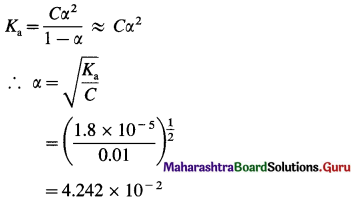
Maharashtra Board Class 11 Chemistry Solutions Chapter 14 Basic Principles of Organic Chemistry 62
Answer:
Maharashtra Board Class 11 Chemistry Solutions Chapter 14 Basic Principles of Organic Chemistry 63

Can you recall? (Textbook Page No. 223)

i. What is meant by ‘reagent’?
ii. Identify the ‘reagent’, ‘substrate’, ‘product’ and ‘byproduct’ in the following reaction.
CH3COCl + NH3 → CH3CONH2 + HCl
Answer:
i. The reactant which reacts with a substrate to form corresponding products is known reagent.
ii.
Maharashtra Board Class 11 Chemistry Solutions Chapter 14 Basic Principles of Organic Chemistry 64

Can you recall? (Textbook Page No. 224)

i. How is covalent bond formed between two atoms?
ii. Consider two covalently bonded atoms Q and R where R is more electronegative than Q. Will these atoms share the electron pair equally between them?
iii. Represent the above polar covalent bond between Q and R using fractional charges δ+ and δ.
Answer:
i. A covalent bond is formed between two atoms by mutual sharing of electrons so as to complete their octets or duplets (in case of elements having only one shell).

ii. A covalent bond is formed between Q and R having different electronegativities, that is, R is more electronegative than Q. In such a case, the atom R with a higher value of electronegativity pulls the shared pair of electrons to a greater extent towards itself as compared to the atom Q with lower value of electronegativity. As a result of this, the shared pair of electrons will get shifted towards atom R. Thus, both the atoms Q and R will not share the electron pair equally between them.

iii. Polar covalent bond between Q and R can be represented as:
\(\mathrm{Q}^{\delta+}-\mathrm{R}^{\delta-}\)

Maharashtra Board Class 11 Chemistry Solutions Chapter 14 Basic Principles of Organic Chemistry

Try this (Textbook Page No. 225)

i. Draw a bond line structure of benzene (C6H6).
ii. How many C – C and C = C bonds are there in this structure?
iii. Write down the expected values of the bond lengths of the carbon-carbon bonds in benzene (Refer chapter 5).
Answer:
i. Bond line structure of benzene:
Maharashtra Board Class 11 Chemistry Solutions Chapter 14 Basic Principles of Organic Chemistry 65
ii. In benzene, there are three alternating C – C single bonds and C = C double bonds.
[Note: In benzene, there are six C – C sigma bonds and three C – C pi bonds.]
iii. The expected values of carbon-carbon bond lengths in benzene are:

Bond Bond length
C – C 154 pm
C = C 133 pm

Can you recall? (Textbook Page No. 225)

i. Write down two Lewis structures for ozone. (Refer chapter 5)
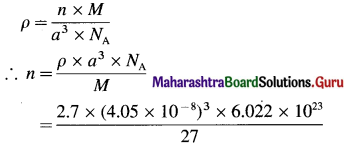
ii. How are these two Lewis structures related to each other?
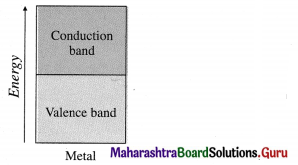
iii. What are these two Lewis structures called?
Answer:
i. Lewis structures of ozone can be shown as follows:
Maharashtra Board Class 11 Chemistry Solutions Chapter 14 Basic Principles of Organic Chemistry 66
ii. In these two Lewis structures, the position of the atoms is same but the position of pair of electrons (or formal charge) is different. These two Lewis structures are considered equivalent to each other.
iii. These two Lewis structures are called as resonating or contributing or canonical structures.

Internet my friend (Textbook Page No. 229)

i. Basic principles of organic chemistry:
https://authors.library.caltech.edu/25034
ii. Collect information about isomerism.
Answer:
i. Students are expected to refer the book provided in the above link to collect additional information on the basic principles of organic chemistry.

ii. https://www.compoundchem.com/2014/05/22/typesofisomerism/
chemdictionary.org/structural-isomers/
https://en.wikipedia.org/wiki/Structural_isomer
[Note: Students can use the above links as reference and collect additonal information about isomerism on their own.]

11th Std Chemistry Questions And Answers:

11th Biology Chapter 6 Exercise Biomolecules Solutions Maharashtra Board

Class 11 Biology Chapter 6

Balbharti Maharashtra State Board 11th Biology Textbook Solutions Chapter 6 Biomolecules Textbook Exercise Questions and Answers.

Biomolecules Class 11 Exercise Question Answers Solutions Maharashtra Board

Class 11 Biology Chapter 6 Exercise Solutions Maharashtra Board

Biology Class 11 Chapter 6 Exercise Solutions

1. Choose correct option

Question (A)
Sugar, amino acids and nucleotides unite to their respective subunits to form ________
(a) bioelements
(b) micromolecules
(c) macromolecules
(d) all of these
Answer:
(c) macromolecules

Maharashtra Board Class 11 Biology Solutions Chapter 6 Biomolecules

Question (B)
Glycosidic bond is found in __________ .
(a) Disaccharide
(b) Nucleosides
(c) Polysaccharide
(d) all of these
Answer:
(d) all of these

Question (C)
Amino acids in a polypeptide are joined by _______ bond.
(a) Disulphide
(b) glycosidic
(c) hydrogen bond
(d) none of these
Answer:
(d) none of these

Question (D)
Lipids associated with cell membrane are _________ .
(a) Sphingomyelin
(b) Isoprenoids
(c) Phospholipids
(d) Cholesterol
Answer:
(c) Phospholipids

Question (E)
Linoleic, Linolenic and ________ acids are referred as essential fatty acids since they cannot be synthesized by the body and hence must be included in daily diet.
(a) Arachidonic
(b) Oleic
(c) Steric
(d) Palmitic
Answer:
(a) Arachidonic

Maharashtra Board Class 11 Biology Solutions Chapter 6 Biomolecules

Question (F)
Hemoglobin is a type of ________ protein, which plays indispensable part in respiration.
(a) simple
(b) derived
(c) conjugated
(d) complex
Answer:
(c) conjugated

Question (G)
When inorganic ions or metallo-organic molecules bind to apoenzyme, they together form
(a) isoenzyme
(b) holoenzyme
(c) denatured enzyme
(d) none of these
Answer:
(b) holoenzyme

Question (H)
In enzyme kinetics, Km = Vmax/2. If Km value is lower, it indicates _______
(a) Enzyme has less affinity for substrate
(b) Enzyme has higher affinity towards substrate
(c) There will be no product formation
(d) All active sites of enzyme are saturated
Answer:
(b) Enzyme has higher affinity towards substrate

2. Solve the following questions

Question (A)
Observe the following figures and write the differences between them.
Maharashtra Board Class 11 Biology Solutions Chapter 6 Biomolecules 1
Answer:

Saturated fats Unsaturated fats
1. They contain single chain of carbon atoms with single bonds. They contain chain of carbon atoms with one or more double bonds.
2. They are solid at room temperature. They are liquid at room temperature.
3. They increase blood cholesterol level by depositing it in the inner wall of arteries. They lower the blood cholesterol level and have many health benefits.
4. They do not get spoiled. They get spoiled easily.
5. Saturated fats are obtained from animal fats, palm oil, etc. Unsaturated fatty acids are obtained from plant and vegetable oil, etc.

Maharashtra Board Class 11 Biology Solutions Chapter 6 Biomolecules

3. Answer the following questions

Question (A)
What are building blocks of life?
Answer:
Life is composed of four main building blocks: Carbohydrates, proteins, lipids and nucleic acids.

Question (B)
Explain the peptide bond.
Answer:
1. The covalent bond that links the two amino acids is called a peptide bond.
2. Peptide bond is formed by condensation reaction.

Question (C)
How many types of polysaccharides you know?
Answer:
There are two types of polysaccharides:
1. Homopolysaccharides: It contains same type of monosaccharides. E.g. Starch, glycogen, cellulose.
2. Heteropolysaccharides: It contains two or more different monosaccharides. E.g. Hyaluronic acid, heparin, hemicellulose.

Question (D)
Enlist the significance of carbohydrates.
Answer:
Significances of carbohydrates are as follows:

  1. Carbohydrates provide energy for metabolism.
  2. Glucose is the main substrate for ATP synthesis.
  3. Lactose, a disaccharide present in the milk provides energy to babies.
  4. Polysaccharide serves as a structural component of cell membrane, cell wall and reserved food as starch and glycogen.

Question (E)
What is reducing sugar?
Answer:
1. A sugar that serves as a reducing agent due to presence of free aldehyde or ketone group is called a reducing sugar.
2. These sugars reduce the Benedict’s reagent (Cu2+ to Cu+) since they are capable of transferring hydrogens (electrons) to other compounds, a process called reduction.
3. All monosaccharides are reducing sugars.

Maharashtra Board Class 11 Biology Solutions Chapter 6 Biomolecules

Question (F)
Enlist the examples of simple proteins and their significance.
Answer:
Examples of simple proteins are: E.g.: Albumins and histones.
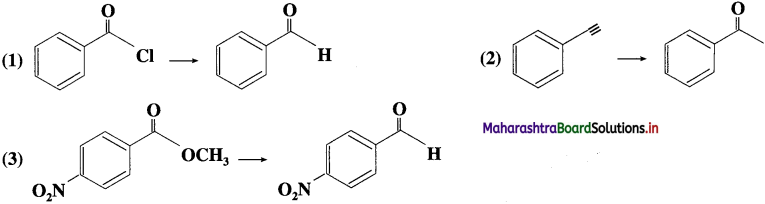
Significance:
1. Albumin:
a. % It is the main protein in the blood.
b. It maintains the pressure in the blood vessels.
c. It helps in transportation of substances like hormone and drugs in the body.
2. Histones:
a. It is the chief protein of chromatin.
b. They are involved in packaging of DNA into structural units called nucleosomes.

Question (G)
Describe the secondary structure of protein with examples.
Answer:

  1. There are two types of secondary structure of protein: a-helix and P-pleated sheets.
  2. The polypeptide chain is arranged in a spiral helix. These spiral helices are of two types: a-helix (right handed) and P-helix (left handed).
  3. This spiral configuration is held together by hydrogen bonds.
  4. The sequence of amino acids in the polypeptide chain determines the location of its bend or fold and the position of formation of hydrogen bonds between different portions of the chain or between different chains. Thus, peptide chains form an a-helix structure.
  5. Example of a-helix structure is keratin.
  6. In some proteins two or more peptide chains are linked together by intermolecular hydrogen bonds. Such structures are called P-pleated sheets.
  7. Example of P-pleated sheet is silk fibres.
  8. Due to formation of hydrogen bonds peptide chains assume a secondary structure.

Question (H)
Explain the induced fit model for mode of enzyme action.
Answer:
1. The induced fit model shows that enzymes are flexible structures in which the active site continually reshapes by its interactions with the substrate until the time the substrate is completely bound to it. It is also the point at which the final form and shape of the enzyme is determined.
2. Three-Dimensional conformation:
a. All enzymes have specific 3-dimensional conformation.
b. They have one or more active sites to which substrate (reactant) combines.
c. The points of active site where the substrate joins with the enzyme is called substrate binding site.

Question (I)
What is RNA? Enlist types of RNA.
Answer:
1. RNA stands for Ribonucleic Acid. It is a long single stranded polynucleotide chain which helps in protein synthesis, functions as a messenger and translates messages coded in DNA into protein.
2. There are three types of RNA:
mRNA (messenger RNA), rRNA (ribosomal RNA) and tRNA (transfer RNA)

Question (J)
Describe the concept of metabolic pool.
Answer:
1. Metabolic pool is the reservoir of biomolecules in the cell on which enzymes can act to produce useful products as per the need of the cell.
2. The concept of metabolic pool is significant in cell biology because it allows one type of molecule to change into another type E.g. Carbohydrates can be converted to fats and vice-versa.

Maharashtra Board Class 11 Biology Solutions Chapter 6 Biomolecules

Question (K)
How do secondary metabolites useful for mankind?
Answer:
1. Drugs developed from secondary metabolites have been used to treat infectious diseases, cancer, hypertension and inflammation.
2. Morphine, the first alkaloid isolated from Papaver somniferum is used as pain reliver and cough suppressant.
3. Secondary metabolites like alkaloids, nicotine, cocaine and the terpenes, cannabinol are widely used for recreation and stimulation.
4. Flavours of secondary metabolites improve our food preferences.
5. Tannins are added to wines and chocolate for improving astringency.
6. Since most secondary metabolites have antibiotic property, they are also used as food preservatives.
7. Glucosinolates is a secondary metabolite which is naturally present in cabbage imparts a characteristic flavour and aroma because of nitrogen and sulphur-containing chemicals. It also offers protection to these plants from many pests.

4. Solve the following questions

Question (A)
Complete the following chart.

Protein Physiological role
Collagen (i)
(ii) Responsible for muscle contraction
Immunoglobulin (iii)
(iv) Significant in Respiration
Fibrinogen (v)

Answer:

Protein Physiological role
1. Collagen Provides strength and plays structural role
2. Myosin & Actin Responsible for muscle contraction
3. Immunoglobulin Protects the body from infection
4. Haemoglobin Significant in Respiration
5. Fibrinogen Responsible for normal clotting of blood.

Maharashtra Board Class 11 Biology Solutions Chapter 6 Biomolecules

Question (B)
Answer the following with reference
Maharashtra Board Class 11 Biology Solutions Chapter 6 Biomolecules 2
i. Name the type of bond formed between two polypeptides.
ii. Which amino acid is involved in the formation of such bond?
iii. Amongst I, II, III and IV structural level of protein, which level of structure includes such bond? Answer:
i. Disulfide bond.
ii. Cysteine
iii. Tertiary structure.
[Note: Quaternary structure of protein also have disulfide bond, for stabilization of protein structure.!

Question (C)
Match the following items given in column I and II.

Column I Column 11
1. RNA (a) Induced fit model
2. Yam plant (b) Flax seeds
3. Koshland (c) Hydrolase
4. Omega – 3 – fatty acid (d) Uracil
5. Sucrase (e) Anti-fertility pills

Answer:

Column I Column 11
1. RNA (d) Uracil
2. Yam plant (e) Anti-fertility pills
3. Koshland (a) Induced fit model
4. Omega – 3 – fatty acid (b) Flax seeds
5. Sucrase (c) Hydrolase

Maharashtra Board Class 11 Biology Solutions Chapter 6 Biomolecules

5. Long answer questions

Question (A)
What are biomolecules? Explain the building blocks of life.
Answer:
Biomolecules are essential substances produced by our body which are necessary for life.
The building blocks of life are carbohydrates, lipids, proteins and nucleic acids.
1. Carbohydrates:
a. Carbohydrates are biomolecules made from carbon, hydrogen and oxygen.
b. The general formula of carbohydrates is (CH20) n.
c. They contain hydrogen and oxygen in the same ratio as in water (2:1).
d. Carbohydrates can be broken down to release energy.
e. Based on sugar units, carbohydrates are classified into three types: Monosaccharides, disaccharides and polysaccharides.

2. Lipids:
a. These are group of substances with greasy consistency with long hydrocarbon chain containing carbon, hydrogen and oxygen.
b. In lipids hydrogen to oxygen ration is greater than 2:1.
c. Lipid is a broader term used for fatty acids and their derivatives.
d. They are soluble in organic solvents (non-polar solvents).
e. Fatty acids are organic acids which are composed of hydrocarbon chain ending in carboxyl group (COOH) ….
f. These are divided into: Saturated fatty acids and unsaturated fatty acids.
g. Fatty acids are basic molecules which form different kinds of lipids.
h. Lipids are classified into three types:
Simple lipids, Compound lipids, Derived lipids.

3. Proteins:
a. Proteins are large molecules containing amino acid units ranging from 100 to 3000.
b. They have higher molecular weight.
c. In proteins, amino acids are linked together by peptide bonds which join the carboxyl group of one amino acid residue to the amino group of another residue.
d. A protein molecule consists of one or more polypeptide chains.
e. Proteins contain any or all twenty naturally occurring amino acid types.
f. Proteins have different structures like primary structure, secondary structure, tertiary structure and quaternary structure.
g. Proteins are classified into three types:
Simple proteins: Simple proteins on hydrolysis yield only amino acids. E.g. Histones and albumins. Conjugated proteins: It consists of a simple protein united with some non-protein substance. E.g. Haemoglobin.
Derived proteins: These proteins are not found in nature as such but are derived from native protein molecules on hydrolysis. E.g. Metaproteins, peptones.
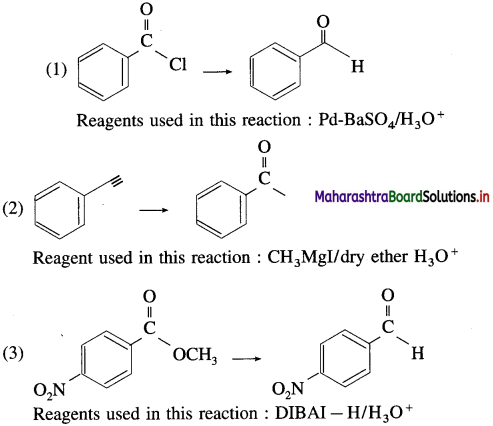
4. Nucleic Acids:
a. Nucleic acids are macromolecules composed of many small units or monomers called nucleotides.
b. Each nucleotide is formed of three components i.e. pentose sugar, a nitrogen base and a phosphate (phosphoric acid).
c. When sugar combine with nitrogenous base it forms nucleoside. Nucleotides can be called as nucleoside phosphate.
d. There are two types of nucleic acids, i.e. DNA and RNA.
DNA (Deoxyribonucleic acid) is a genetic material of a cell. It is double stranded helix. Each strand of helix is made up of deoxyribose nucleotides.
RNA (Ribonucleic Acid) is a single stranded structure having fewer nucleotides as compared to DNA. The strands may be straight or variously folded upon itself. It is made up of nucleotides.

Maharashtra Board Class 11 Biology Solutions Chapter 6 Biomolecules

Question (B)
Explain the classes of carbohydrates with examples.
Answer:
Based on number of sugar units, carbohydrates are classified into three types namely, monosaccharides, disaccharides and polysaccharides.
1. Monosaccharides:
a. Monosaccharides are the simplest sugars having crystalline structure, sweet taste and soluble in water.
b. They cannot be further hydrolyzed into smaller molecules.
c. They are the building blocks or monomers of complex carbohydrates.
d. They have the general molecular formula (CH20)n, where n can be 3, 4, 5, 6 and 7.
e. They can be classified as triose, tetrose, pentose, etc.
f. Monosaccharides containing the aldehyde (-CHO) group are classified as aldoses e.g. glucose, xylose, and those with a ketone(-C=0) group are classified as ketoses. E.g. ribulose, fructose.

2. Disaccharides:
a. Disaccharide is formed when two monosaccharide react by condensation reaction releasing a water molecule. This process requires energy.
b. A glycosidic bond forms and holds the two monosaccharide units together.
c. Sucrose, lactose and maltose are examples of disaccharides.
d. Sucrose is a nonreducing sugar since it lacks free aldehyde or ketone group.
e. Lactose and maltose are reducing sugars.
f. Lactose also exists in beta form, which is made from P-galactose and p-glucose.
g. Disaccharides are soluble in water, but they are too big to pass through the cell membrane by diffusion.

3. Polysaccharides:
a. Monosaccharides can undergo a series of condensation reactions, adding one unit after the other to the chain till a very large molecule (polysaccharide) is formed. This is called polymerization.
b. Polysaccharides are broken down by hydrolysis into monosaccharides.
c. The properties of a polysaccharide molecule depends on its length, branching, folding and coiling.
d. Examples: Starch, glycogen, cellulose.

Question (C)
Describe the types of lipids and mention their biological significance.
Answer:
Lipids are classified into three main types:
1. Simple lipids:
a. These are esters of fatty acids with various alcohols. Fats and waxes are simple lipids.
b. Fats are esters of fatty acids with glycerol (CH2OH-CHOH-CH2OH).
c. Triglycerides are three molecules of fatty acids and one molecule of glycerol.
d. Unsaturated fats are liquid at room temperature and are called oils. Unsaturated fatty acids are hydrogenated to produce fats e.g. Vanaspati ghee.

Biological significance:
a. Fats are a nutritional source with high calorific value and they act as reserved food materials.
b. In plants, fat is stored in seeds to nourish embryo during germination.
c. In animals, fat is stored in the adipocytes of the adipose tissue.
d. Fats deposited in subcutaneous tissue act as an insulator and minimize loss of body heat.
e. Fats deposited around the internal organs act as cushions to absorb mechanical shocks.
f. Wax is another example of simple lipid. They are esters of long chain fatty acids with long chain alcohols.
g. They are found in the blood, gonads and sebaceous glands of the skin.
h. Waxes are not as readily hydrolyzed as fats.
i. They are solid at ordinary temperature.
j. Waxes form water insoluble coating on hair and skin in animals, waxes form an outer coating on stems, leaves and fruits.

2. Compound lipids:
a. These are ester of fatty acids containing other groups like phosphate (Phospholipids), sugar (glycolipids), etc.
b. They contain a molecule of glycerol, two molecules of fatty acids and a phosphate group or simple sugar.
c. Some phospholipids such as lecithin also have a nitrogenous compound attached to the phosphate group.
d. Phospholipids have both hydrophilic polar groups (phosphate and nitrogenous group) and hydrophobic non-polar groups (hydrocarbon chains of fatty acids).
e. Glycolipids contain glycerol, fatty acids, simple sugars such as galactose. They are also called cerebrosides.
Biological significance:
a. Phospholipids contribute in the formation of cell membrane.
b. Large amounts of glycolipids are found in the brain white matter and myelin sheath.

3. Derived Lipids:
a. They are composed of fused hydrocarbon rings (steroid nucleus) and a long hydrocarbon side chain.
b. One of the most common sterols is cholesterol.
Biological significance:
a. It is widely distributed in all cells of the animal body, but particularly in nervous tissue.
b. Cholesterol exists either free or as cholesterol ester.
c. Adrenocorticoids, sex hormones (progesterone, testosterone) and vitamin D are synthesized from cholesterol.
d. Cholesterol is not found in plants.
e. Sterols exist as phytosterols in plants.
f. Yam Plant (Dioscorea) produces a steroid compound called diosgenin. It is used in the manufacture of antifertility pills, i.e. birth control pills.

Maharashtra Board Class 11 Biology Solutions Chapter 6 Biomolecules

Question (D)
Explain the chemical nature, structure and role of phospholipids in biological membrane.
Answer:
Chemical nature: Phospholipids are amphiphilic in nature. As they have hydrophilic head and hydrophobic tail.
Structure: It contains an alcohol, two fatty acid chains and a phosphate group.
Role: Phospholipids forms the membranes around the cells and cellular organelles. They form a lipid bilayer membrane. The phospholipids are arranged tail to tail. It serves as a barrier against movement of any ions or polar compounds into and out of the cell.

Question (E)
Describe classes of proteins with their importance.
Answer:
On the basis of structure, proteins are classified into three categories:
1. Simple proteins:
a. Simple proteins on hydrolysis yield only amino acids.
b. These are soluble in one or more solvents.
c. Simple proteins may be soluble in water.
d. Histones of nucleoproteins are soluble in water.
e. Globular molecules of histones are not coagulated by heat.
f. Albumins are also soluble in water but they get coagulated on heating.
g. Albumins are widely distributed e.g. egg albumin, serum albumin and legumelin of pulses are albumins.
Importance: They are involved in structural components; they also act as a storage kind of protein.
Some are associated with nucleic acids in nucleoproteins of cell.

2. Conjugated proteins:
a. Conjugated proteins consist of a simple protein united with some non-protein substance.
b. The non-protein group is called prosthetic group e.g. haemoglobin.
c. Globin is the protein and the iron containing pigment haem is the prosthetic group.
d. Similarly, nucleoproteins have nucleic acids.
e. Proteins are classified as glycoproteins and mucoproteins.
f. Mucoproteins are carbohydrate-protein complexes e.g. mucin of saliva and heparin of blood.
g. Lipoproteins are lipid-protein complexes e.g. conjugate protein found in brain, plasma membrane, milk etc. Importance: They are involved in structural components of cell membranes and organelles.
They also act as a transporter.
Some conjugated proteins are important in electron transport chain in respiration.

3. Derived proteins:
a. These proteins are not found in nature as such.
b. These proteins are derived from native protein molecules on hydrolysis.
c. Metaproteins, peptones are derived proteins.
Importance: They act as a precursor for many molecules which are essential for life.

Question (F)
What are enzymes? How are they classified? Mention example of each class.
Answer:
1. Enzymes are biological macromolecules which act as a catalyst and accelerates the reaction in the body.
2. Enzymes are classified into six classes:
a. Oxidoreductases: These enzymes catalyze oxidation and reduction reactions by the transfer of hydrogen and/or oxygen, e.g. alcohol dehydrogenase
Maharashtra Board Class 11 Biology Solutions Chapter 6 Biomolecules 3
b. Transferases: These enzymes catalyse the transfer of certain groups between two molecules, e.g. glucokinase
Maharashtra Board Class 11 Biology Solutions Chapter 6 Biomolecules 4
c. Hydrolases: These enzymes catalyse hydrolytic reactions. This class includes amylases, proteases, lipases etc. e.g. Sucrase
Maharashtra Board Class 11 Biology Solutions Chapter 6 Biomolecules 5
d. Lyases: These enzymes are involved in elimination reactions resulting in the removal of a group of atoms from substrate molecule to leave a double bond. It includes aldolases, decarboxylases, and dehydratases, e.g. fumarate hydratase.
Maharashtra Board Class 11 Biology Solutions Chapter 6 Biomolecules 6
e. Isomerases: These enzymes catalyze structural rearrangements within a molecule. Their nomenclature is based on the type of isomerism. Thus, these enzymes are identified as racemases, epimerases, isomerases, mutases, e.g. xylose isomerase.
Maharashtra Board Class 11 Biology Solutions Chapter 6 Biomolecules 7
f. Ligases or Synthetases: These are the enzymes which catalyze the covalent linkage of the molecules utilizing the energy obtained from hydrolysis of an energy-rich compound like ATP, GTP e.g. glutathione synthetase, Pyruvate carboxylase.
Maharashtra Board Class 11 Biology Solutions Chapter 6 Biomolecules 8

Maharashtra Board Class 11 Biology Solutions Chapter 6 Biomolecules

Question (G)
Explain the properties of enzyme? Describe the models for enzyme actions.
Answer:
1. Proteinaceous Nature:
All enzymes are basically made up of protein.

2. Three-Dimensional conformation:
a. All enzymes have specific 3-dimensional conformation.
b. They have one or more active sites to which substrate (reactant) combines.
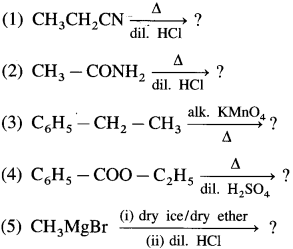
c. The points of active site where the substrate joins with the enzyme is called substrate binding site.

3. Catalytic property:
a. Enzymes are like inorganic catalysts and influence the speed of biochemical reactions but themselves remain unchanged.
b. After completion of the reaction and release of the product they remain active to catalyze again.
c. A small quantity of enzymes can catalyze the transformation of a very large quantity of the substrate
into an end product.
d. For example, sucrase can hydrolyze 100000 times of sucrose as compared with its own weight.

4. Specificity of action:
a. The ability of an enzyme to catalyze one specific reaction and essentially no other is perhaps its most significant property. Each enzyme acts upon a specific substrate or a specific group of substrates.
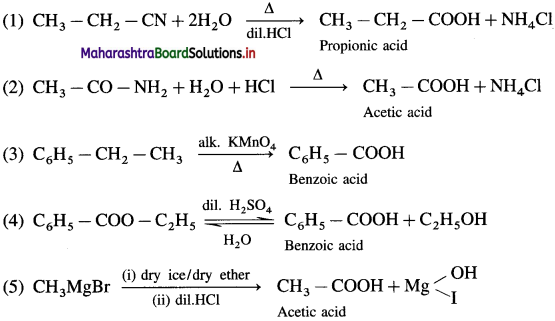
b. Enzymes are very sensitive to temperature and pH.
c. Each enzyme exhibits its highest activity at a specific pH i.e. optimum pH.
d. Any increase or decrease in pH causes decline in enzyme activity e.g. enzyme pepsin (secreted in stomach)shows highest activity at an optimum pH of 2 (acidic)

5. Temperature:
a. Enzymes are destroyed at higher temperature of 60-70°C or below, they are not destroyed but become inactive.
b. This inactive state is temporary and the enzyme can become active at suitable temperature.
c. Most of the enzymes work at an optimum temperature between 20°C and 35°C.

There are two types of models:
1. Lock and Key model:
a. Lock and Key model was first postulated in 1894 by Emil Fischer.
b. This model explains the specific action of an enzyme with a single substrate.
c. In this model, lock is the enzyme and key is the substrate.
d. The correctly sized key (substrate) fits into the key hole (active site) of the lock (enzyme).
Maharashtra Board Class 11 Biology Solutions Chapter 6 Biomolecules 9

2. Induced Fit model (Flexible Model):
a. Induced Fit model was first proposed in 1959 by Koshland.
b. This model states that approach of a substrate induces a conformational change in the enzyme.
c. It is the more accepted model to understand mode of action of enzyme.
d. The induced fit model shows that enzymes are rather flexible structures in which the active site continually reshapes by its interactions with the substrate until the time the substrate is completely bound to it.
e. It is also the point at which the final form and shape of the enzyme is determined.
[Note: Temperature is a factor affecting enzyme activity and not a property of enzyme.]
Maharashtra Board Class 11 Biology Solutions Chapter 6 Biomolecules 10

Maharashtra Board Class 11 Biology Solutions Chapter 6 Biomolecules

Question (H)
Describe the factors affecting enzyme action.
Answer:
The factors affecting the enzyme activity are as follows:
1. Concentration of substrate:
a. Increase in the substrate concentration gradually increases the velocity of enzyme activity within the limited range of substrate levels.
b. A rectangular hyperbola is obtained when velocity is plotted against the substrate concentration.
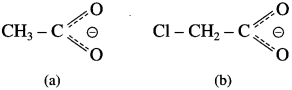
c. Three distinct phases (A, B and C) of the reaction are observed in the graph.
Where V = Measured velocity, Vmax = Maximum velocity, S = Substrate concentration,
Km = Michaelis-Menten constant.
d. Km or the Michaelis-Menten constant is defined as the substrate concentration (expressed in moles/lit) to produce half of maximum velocity in an enzyme catalyzed reaction.
e. It indicates that half of the enzyme molecules (i.e. 50%) are bound with the substrate molecules when the substrate concentration equals the Km value.
f. Km value is a constant and a characteristic feature of a given enzyme.
g. It is a representative for measuring the strength of ES complex.
h. A low Km value indicates a strong affinity between enzyme and substrate, whereas a high Km value reflects a weak affinity between them.
1. For majority of enzymes, the Km values are in the range of 10-5 to 10-2 moles.
Maharashtra Board Class 11 Biology Solutions Chapter 6 Biomolecules 11

2. Enzyme Concentration:
Maharashtra Board Class 11 Biology Solutions Chapter 6 Biomolecules 12
a. The rate of an enzymatic reaction is directly proportional to the concentration of the substrate.
b. The rate of reaction is also directly proportional to the square root of the concentration of enzymes.
c. It means that the rate of reaction also increases with the increasing concentration of enzyme and the rate of reaction can also decrease by decreasing the concentration of enzyme.

3. Temperature:
Maharashtra Board Class 11 Biology Solutions Chapter 6 Biomolecules 13
a. The temperature at which the enzymes show maximum activity is called Optimum temperature.
b. The rate of chemical reaction is increased by a rise in temperature but this is true only over a limited range of temperature.
c. Enzymes rapidly denature at temperature above 40°C.
d. The activity of enzymes is reduced at low temperature.
e. The enzymatic reaction occurs best at or around 37°C which is the average normal body temperature in homeotherms.

4. Effect of pH:
Maharashtra Board Class 11 Biology Solutions Chapter 6 Biomolecules 14
a. The pH at which an enzyme catalyzes the reaction at the maximum rate is known as optimum pH.
b. The enzyme cannot perform its function beyond the range of its pH value.

5. Other substances:
a. The enzyme action is also increased or decreased in the presence of some other substances such as co-enzymes, activators and inhibitors.
b. Most of the enzymes are combination of a co-enzyme and an apo-enzyme.
c. Activators are the inorganic substances which increase the enzyme activity.
d. Inhibitor is the substance which reduces the enzyme activity.

Maharashtra Board Class 11 Biology Solutions Chapter 6 Biomolecules

Question (I)
What are the types of RNA? Mention the role of each class of RNA.
Answer:
There are three types of cellular RNAs:
1. messenger RNA (mRNA),
2. ribosomal RNA (rRNA),
3. transfer RNA (tRNA). ‘

1. Messenger RNA (mRNA):
a. It is a linear polynucleotide.
b. It accounts 3% of cellular RNA.
c. Its molecular weight is several million. , d. mRNA molecule carrying information to form a complete polypeptide chain is called cistron.
e. Size of mRNA is related to the size of message it contains.
f. Synthesis of mRNA begins at 5’ end of DNA strand and terminates at 3’ end.

Role of messenger RNA:
It carries genetic information from DNA to ribosomes, which are the sites of protein synthesis.
Maharashtra Board Class 11 Biology Solutions Chapter 6 Biomolecules 15

2. Ribosomal RNA (rRNA):
a. rRNA was discovered by Kurland in 1960.
b. It forms 50-60% part of ribosomes.
c. It accounts 80-90% of the cellular RNA.
d. It is synthesized in nucleus.
e. It gets coiled at various places due to intrachain complementary base pairing.
Role of ribosomal RNA: It provides proper binding site for m-RNA during protein synthesis.
Maharashtra Board Class 11 Biology Solutions Chapter 6 Biomolecules 16

3. Transfer RNA (tRNA):
a. These molecules are much smaller consisting of 70-80 nucleotides.
b. Due to presence of complementary base pairing at various places, it is shaped like clover-leaf.
c. Each tRNA can pick up particular amino acid.
d. Following four parts can be recognized on tRNA
1. DHU arm (Dihydroxyuracil loop/ amino acid recognition site
2. Amino acid binding site
3. Anticodon loop / codon recognition site
4. Ribosome recognition site.
e. In the anticodon loop of tRNA, three unpaired nucleotides are present called as anticodon which pair with codon present on mRNA.
f. The specific amino acids are attached at the 3′ end in acceptor stem of clover leaf of tRNA.
Role of transfer RNA: It helps in elongation of polypeptide chain during the process called translation.
Maharashtra Board Class 11 Biology Solutions Chapter 6 Biomolecules 17

Question (J)
What is metabolism? How metabolic pool is formed in the cell.
Answer:

  1. Metabolism is the sum of the chemical reactions that take place within each cell of a living organism and provide energy for vital processes and for synthesizing new’ organic material.
  2. Metabolic pool in the cell is formed due to glycolysis and Krebs cycle.
  3. The catabolic chemical reaction of glycolysis and Krebs cycle provides ATP and biomolecules. These biomolecules form the metabolic pool of the cell.
  4. These biomolecules can be utilized for synthesis of many important cellular components.
  5. The metabolites can be added or withdrawn from the pool according to the need of the cell.

Maharashtra Board Class 11 Biology Solutions Chapter 6 Biomolecules

Question 6.
If double stranded DNA has 14% C (cytosine) what percent A (adenine), T (thymine) and G (guanine) would you expect?
Answer:
A purine always pairs with pyrimidine.
Adenine pairs with thymine and cytosine pairs with guanine.
Therefore, as per the given data If cytosine = 14% then guanine = 14%.
According to Chargaff s rule,
(C+G) = 14+ 14 = 28%
Therefore, (A+T) = 72%
So, A= 36%, T= 36%, G = 14%.

Question 7.
Name
1. The reagent used for testing for reducing sugar.
2. The form in which carbohydrate is transported in a plant.
3. The term that describes all the chemical reactions taking place in an organism.
Answer:
1. Benedict’s reagent
2. Sucrose
3. Metabolism

Practical / Project:

Question 1.
Perform an experiment to study starch granules isolated from potato.
Answer:
Isolation of starch granules from potato:

  1. Peal the potato with a clean knife.
  2. Grind the potato till the homogenous mixture is formed.
  3. Then strain the mixture through a cheese cloth into a beaker.
  4. Keep it standing for some time.
  5. Throw the supernatant and fill the beaker containing starch with water.
  6. Stir it well and again allow the starch to settle.
  7. After sometime, again through the supernatant.
  8. Repeat this for 2-3 times.
  9. Collect the white starch in the watch glass and keep it in the oven for drying.

To study the isolated starch granules:
1. Examination under microscope:
Examine starch granules under microscope by using a mixture of equal volumes of glycerol and distilled water.
Result: The potato starch granules appears transparent granules. They are irregularly shaped.
2. Using Iodine solution:
Boil a little amount of starch with water. Cool it. Add iodine solution to it.
Result: The solution changes colour to blue. This indicates the presence of starch.

Question 2.
Study the action of enzyme urease on urea.
Answer:
Urease is an enzyme which exists in a dimer form. It has two active sites which are highly specific and only bind to urea or hydroxy urea. The active sites of urease contain nickel atoms. Urease catalyzes the hydrolysis of substrate urea into carbon dioxide and ammonia. It attacks the nitrogen and carbon bond in amide compounds and forms alkaline product like ammonia.
Maharashtra Board Class 11 Biology Solutions Chapter 6 Biomolecules 18

11th Biology Digest Chapter 6 Biomolecules Intext Questions and Answers

Can you recall? (Textbook Page No. 59)

(i) Which are different cell components?
Answer:
a. The three main components of any cell are: Cell membrane, Cytoplasm, Nucleus.
b. The components present in both plant and animal cells are: Endoplasmic reticulum, ribosomes, golgi apparatus, lysosomes, mitochondria, vacuoles.
c. The components present in plant cell and not in animal cell: Cell wall and plastids.
d. The components present in animal cell and not in plant cell: Cilia and flagella.

Maharashtra Board Class 11 Biology Solutions Chapter 6 Biomolecules

(ii) What is the role of each component of cell?
Answer:
The role of each component of a cell is as follows:
a. Cell membrane: Cell membrane separates the cytoplasmic contents from external environment.
b. Cytoplasm: Site for metabolic activities and organelles.
c. Nucleus: It is the control center of the cell. Genetic material is present in the nucleus.
d. Endoplasmic reticulum: It produces, processes and transports proteins and lipids.
e. Ribosomes: Ribosome is the site for protein synthesis.
f. Golgi apparatus: It is involved in modifying, sorting and packing of proteins for secretion. It also transports lipids around the cell.
g. Lysosomes: It is involved in digestion of worn out organelles and waste removal.
h. Mitochondria: It is responsible for production of energy.
i. Vacuoles: It has various functions like storage, waste disposal, protection and growth.
j. Cell wall: It provides strength and support to the cell.
k. Plastids: They are responsible for production and storage of food. It also contains photosynthetic pigments (Chloroplasts).
l. Cilia and flagella: Help in motility.

Can you tell? (Textbook Page No. 62)

What are carbohydrates?
Answer:

  1. The word carbohydrates mean ‘hydrates of carbon’.
  2. They are also called saccharides.
  3. They are biomolecules made from just three elements: carbon, hydrogen and oxygen with the general formula Cx(H20)y.
  4. They contain hydrogen and oxygen in the same ratio as in water (2:1).
  5. Carbohydrates can be broken down (oxidized) to release energy.

Can you tell? (Textbook Page No. 62)

(i) Enlist the natural sources, structural units and functions of the following polysaccharides.
a. Starch
b. Cellulose
c. Glycogen
Answer:
a. Starch:
1. Natural Sources: Cereals (wheat, maize, rice), root vegetables (potato, cassava etc.)
2. Structural units: Starch consist of two types of molecules – Amylose and amylopectin.
3. Functions: It acts as a reserve food and supply energy.

b. Cellulose:
1. Natural sources: Plant fibers (cotton, flax, hemp, jute, etc.), wood.
2. Structural units: It is made from p glucose molecules.
3. Functions: It in a major component of cell wall. It provides structural support.

c. Glycogen:
1. Natural sources: Fruits, starchy vegetables, whole grain foods.
2. Structural units: It consists of linear chains of glucose residues. The glucose is linked linearly by a (1 → 4) glycosidic bonds and branches are linked to the linear chain by a (1 → 6) glycosidic bonds.
3. Functions: It is stored in liver and muscles and it readily provides energy when the blood glucose level decreases.

Maharashtra Board Class 11 Biology Solutions Chapter 6 Biomolecules

(ii) The exoskeleton of insects is made up of chitin. This is a ________.
(A) mucoprotein
(B) lipid
(C) lipoprotein
(D) polysaccharide
Answer:
polysaccharide

(iii) List names of structural polysaccharides.
Answer:
Arabinoxylans, cellulose, chitin, pectin.

(iv) Write a note on oligosaccharide and glycosidic bond.
Answer:
Oligosaccharides:
a. A carbohydrate polymer comprising of two to six monosaccharide molecules is called oligosaccharide.
b. They are linked together by glycosidic bond.
c. They are classified on the basis of monosaccharide units:
Disaccharides: These are the sugars containing two monosaccharide units and can be further hydrolysed into smaller components. E.g.: Sucrose, maltose, lactose, etc.
Trisaccharides: These contain three monomers. E.g. Raffmose.
Tetrasaccharides: These contain four monomers. E.g.: Stachyose.

Glycosidic bond:
a. Glycosidic bond is a covalent bond that forms a linkage between two monosaccharides by a dehydration reaction.
b. It is formed when a hydroxyl group of one sugar reacts with the anomeric carbon of the other.
c. Glycosidic bonds are readily hydrolyzed by acid but resist cleavage by base.
d. There are two types of glycosidic bonds: a-glycosidic bond and P-glycosidic bond.

Can you tell? (Textbook Page No. 63)

What are lipids? Classify them and give at least one example of each.
Answer:
Lipids:
Lipids are a group of heterogeneous compounds like fats, oils, steroids, waxes, etc.
They are macro-biomolecules.
These are group of substances with greasy consistency with long hydrocarbon chain containing carbon, hydrogen and oxygen.

Lipids are classified into:
1. Saturated fatty acids: They contain single chain of carbon atoms with single bonds.
E.g. Palmitic acid, stearic acid
2. Unsaturated fatty acids: They contain one or more double bonds between the carbon atoms of the hydrocarbon chain.
a. Simple lipids: These are esters of fatty acids with various alcohols.
E.g. Fats, wax.
b. Compound lipids: These are ester of fatty acids containing other groups like phosphate (Phospholipids), sugar (glycolipids), etc.
E.g. Lecithin
c. Sterols: They are derived lipids. They are composed of fused hydrocarbon rings (steroid nucleus) and a long hydrocarbon side chain.
E.g. Cholesterol, phytosterols.

Maharashtra Board Class 11 Biology Solutions Chapter 6 Biomolecules

Find out (Textbook Page No. 63)

(i) Why do high cholesterol level in the blood cause heart diseases?
Answer:
a. When there is high level of cholesterol in the blood, the cholesterol builds up on the walls of arteries causing a condition called atherosclerosis (a form of heart disease).
b. Because of this the arteries are narrowed and the blood flow to the heart is slowed down.
c. The blood carries oxygen to the heart, but because of this condition enough blood and oxygen does not reach to the heart and causes heart diseases.
d. If the condition increases, the supply of oxygen and blood is completely cut off to the heart and this can lead to heart attack.

(ii) Polyunsaturated fatty acids are believed to decrease blood cholesterol level. How?
Answer:
a. The liver converts polyunsaturated fatty acids into ketones instead of cholesterol.
b. Therefore, polyunsaturated fatty acids are transported directly to tissues for oxidation without leaving behind any lipoprotein in the form of cholesterol as it is seen in the case of saturated fatty acids.
c. Thus, polyunsaturated fatty acids are believed to decrease blood cholesterol level.

Can you tell? (Textbook Page No. 64)

Which of the following is a simple protein?
(A) nucleoprotein
(B) mucoprotein
(C) chromoprotein
(D) globulin
Answer:
Globulin

Can you tell? Textbook Page No. 64)

What are conjugated proteins? How do they differ from simple ones? Give one example of each.
Answer:
1. Conjugated proteins consist of a simple protein attached with some non-protein substance. The non-protein group is called prosthetic group.
2. The conjugated protein functions in interaction with other chemical group whereas simple proteins contain only amino acids and no other chemical group attached to it.
3. Example of conjugated protein is haemoglobin. Globin is the protein and iron containing pigment and haem is the prosthetic group.

Can you tell? (Textbook Page No. 64)

All Proteins are made up of the same amino acids; then how proteins found in human beings and animals may be different from those of other?
Answer:
The proteins found in human beings and animals may be different from those of others because the ratio of amino acids present in the protein differs.

Maharashtra Board Class 11 Biology Solutions Chapter 6 Biomolecules

Can you tell? (Textbook Page No. 67)

What is a nucleotide? How is it formed? Mention the names of all nucleotides.
Answer:
1. Nucleotide is a unit which consists of a sugar, phosphate and a base. Nucleotides are basic units of nucleic acids.
2. The nitrogen base and a sugar form a nucleoside. In a nucleoside, nitrogenous base is attached to the first carbon atom (C-1) of the sugar and when a phosphate group gets attached with that of the carbon (C-5) atom of the sugar molecule a nucleotide molecule is formed.
3. The names of all nucleotides are:

Base Nucleotides of RNA Nucleotides of DNA
Adenine Adenylate Deoxydenylate
Guanine Guanylate Deoxyguanylate
Cytosine Cytidylate Deoxy cytidylate
Thymine Deoxythymidylate
Uracil Uridylate

Can you tell? (Textbook Page No. 67)

Describe the structure of DNA molecule as proposed by Watson and Crick.
Answer:

  1. According to Watson and Crick, DNA molecule consists of two strands twisted around each other in the form of a double helix.
  2. The two strands i.e. polynucleotide chains are supposed to be in opposite direction so end of one chain having 3′ lies beside the 5′ end of the other.
  3. One turn of the double helix of the DNA measures about 34A.
  4. It consists paired nucleotides and the distance between two neighboring pair nucleotides is 3.4A.
  5. The diameter of the DNA molecule has been found be 20A.

Can you tell (Textbook Page No. 70)

Name the chemical found in the living cell which has necessary message for the production of all enzymes required by it.
Answer:
DNA found in the nucleus of a living cell has necessary message for the production of all enzymes required by it. DNA forms mRNA through the process of transcription. This mRNA through the process of translation forms proteins.

Maharashtra Board Class 11 Biology Solutions Chapter 6 Biomolecules

Can you tell? (Textbook Page No. 67)

Difference between DNA and RNA is because of
(A) sugar and base
(B) sugar and phosphate
(C) phosphate and base
(D) sugar only
Answer:
Sugar and base

Can you tell? (Textbook Page No. 67)

Differentiate between DNA and RNA.
Answer:

DNA RNA
1. It is a genetic material of majority of the organisms. It is a genetic material only of some viruses.
2. It is double stranded. It is single stranded.
3. Deoxyribose sugar is present. Ribose sugar is present.
4. Nitrogen bases like Adenine, Guanine, Cytosine, Thymine are present. Nitrogen bases like Adenine, Guanine, Cytosine, Uracil are present.
5. Specific base pairing is observed. Nitrogen bases do not form pair.
6. Total number of purines is equal to total number of pyrimidine. Thus, purine to pyrimidine ratio is 1:1. Amount of purine and pyrimidine may or may not be equal.
7. It is present in nucleus. It is present in nucleus and cytoplasm.
8 It is responsible for determining hereditary characters and for formation of RNA. It takes part in protein synthesis.

Can you tell? (Textbook Page No. 70)

Co-enzyme is ________
(A) often a metal
(B) often a vitamin
(C) always as organic molecule
(D) always an inorganic molecule
Answer:
Always as organic molecule

Maharashtra Board Class 11 Biology Solutions Chapter 6 Biomolecules

Can you tell? (Textbook Page No. 70)

(i) Which enzyme is needed to digest food reserve in castor seed?
(A) Amylase
(B) Diastase
(C) Lipase
(D) Protease
Answer:
Lipase

(ii) List the important properties of enzymes.
Answer:
a. Proteinaceous Nature
b. Three-Dimensional conformation
c. Catalytic property
d. Specificity of action
e. Temperature

Try this: (Textbook Page No. 70)

To demonstrate the effect of heat on the activities of inorganic catalysts and enzymes.
Answer:
1. Using MnO2 and Enzymes without any heat treatment:
Mn02 and cellular enzymes (catalase/peroxidase) causes breakdown of H202 and evolution of oxygen.
2. Using Mn02 and Enzymes after heat treatment:
Oxygen evolves in the H202 solution containing boiled and cooled Mn02. But oxygen does not evolve in the tube containing the enzyme.
3. This confirms that heat affects the enzyme and inactivates it whereas heat does not have any effect on inorganic catalyst.

11th Std Biology Questions And Answers: