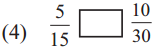
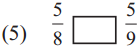
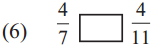
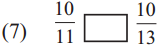
Problem Set 27 Class 5 Maths Chapter 6 Angles Question Answer Maharashtra Board

Angles Class 5 Problem Set 27 Question Answer Maharashtra Board

Balbharti Maharashtra Board Class 5 Maths Solutions Chapter 6 Angles Problem Set 27 Textbook Exercise Important Questions and Answers.

Std 5 Maths Chapter 6 Angles

Question 1.
Give two examples of parallel lines you can see in your environment.
Answer:
(i) Bars on the window.
(ii) Horizontal lines in the notebook are the examples of parallel lines.

Maharashtra Board Class 5 Maths Solutions Chapter 6 Angles Problem Set 27

Question 2.
Give two examples of perpendicular lines you can see in your environment.
Answer:
(i) The angles formed by a pole and its shadow on the ground.
(ii) The adjacent sides of a notebook.

Question 3.
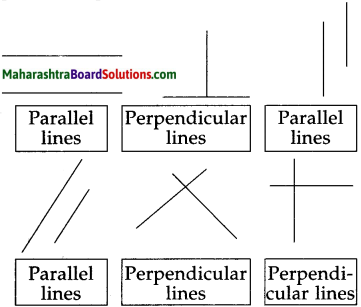
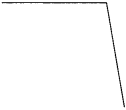
Look at the pictures given below. Decide whether the lines given in each picture are parallel or perpendicular to each other and write the answer in the box.

Maharashtra Board Class 5 Maths Solutions Chapter 5 Fractions Problem Set 25 18
Answer:
Maharashtra Board Class 5 Maths Solutions Chapter 5 Fractions Problem Set 25 1

Angles Problem Set 27 Additional Important Questions and Answers

Question 1.
Give some examples of perpendicular lines from capital letters of the English alphabet.
Answer:

Maharashtra Board Class 5 Maths Solutions Chapter 5 Fractions Problem Set 25 2

Maharashtra Board Class 5 Maths Solutions Chapter 6 Angles Problem Set 27

Question 2.
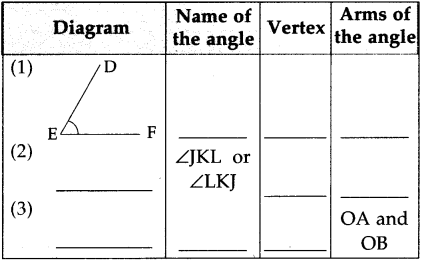
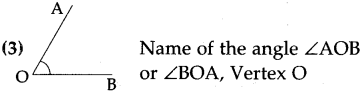
Complete the following:
Maharashtra Board Class 5 Maths Solutions Chapter 5 Fractions Problem Set 25 3
Answer:
(1) ZDEF or ZFED, Vertex E, arms are ED
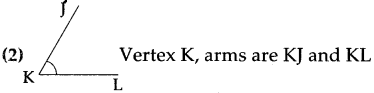
Maharashtra Board Class 5 Maths Solutions Chapter 5 Fractions Problem Set 25 16
Maharashtra Board Class 5 Maths Solutions Chapter 5 Fractions Problem Set 25 17

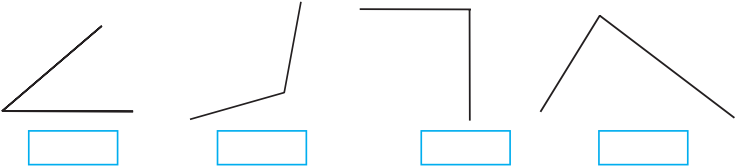
Question 3.
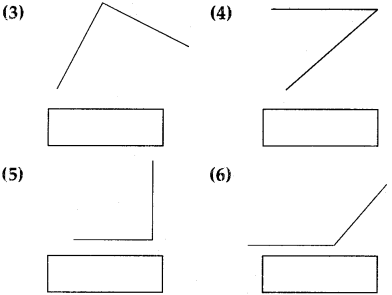
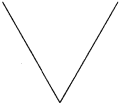
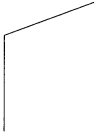
Which of the following figures show angle?
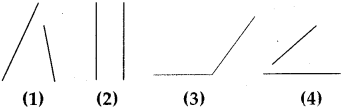
Maharashtra Board Class 5 Maths Solutions Chapter 5 Fractions Problem Set 25 4
Answer:
Figure 3

Maharashtra Board Class 5 Maths Solutions Chapter 6 Angles Problem Set 27

Question 4.
(A) Measure the angles given below and write the measure in the given boxes:
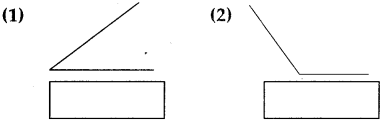
Maharashtra Board Class 5 Maths Solutions Chapter 5 Fractions Problem Set 25 5
Maharashtra Board Class 5 Maths Solutions Chapter 5 Fractions Problem Set 25 6
Answer:
(1) 30°
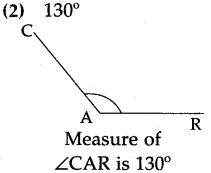
(2) 135°
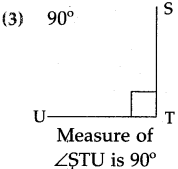
(3) 90°
(4) 50°
(5) 90°
(6) 150°

Maharashtra Board Class 5 Maths Solutions Chapter 6 Angles Problem Set 27

B) Classify the above figures according to types of the angles.
Answer:
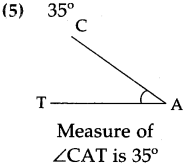
Acute angles: (1) and (4),
Right angles: (3) and (5),
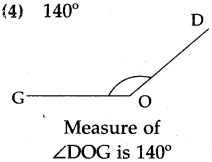
Obtuse angles: (2) and (6)

Question 5.
Draw and name the following angles with the help of a protractor:
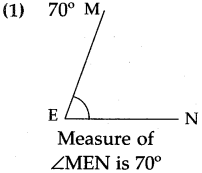
Maharashtra Board Class 5 Maths Solutions Chapter 5 Fractions Problem Set 25 7
Maharashtra Board Class 5 Maths Solutions Chapter 5 Fractions Problem Set 25 8
Maharashtra Board Class 5 Maths Solutions Chapter 5 Fractions Problem Set 25 9
Maharashtra Board Class 5 Maths Solutions Chapter 5 Fractions Problem Set 25 10
Maharashtra Board Class 5 Maths Solutions Chapter 5 Fractions Problem Set 25 11
Maharashtra Board Class 5 Maths Solutions Chapter 5 Fractions Problem Set 25 12
Maharashtra Board Class 5 Maths Solutions Chapter 5 Fractions Problem Set 25 13
Maharashtra Board Class 5 Maths Solutions Chapter 5 Fractions Problem Set 25 14
Answer:
Students to draw angles.

Maharashtra Board Class 5 Maths Solutions Chapter 6 Angles Problem Set 27

Question 6.
Look at the pictures given below. Decide whether the lines given in each picture are parallel or perpendicular to each other and write the answer in the box:
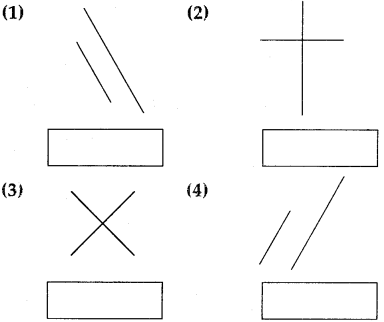
Maharashtra Board Class 5 Maths Solutions Chapter 5 Fractions Problem Set 25 15
Answer:
(1) Parallel lines
(2) Perpendicular lines
(3) Perpendicular lines
(4) Parallel lines

Maharashtra Board Class 5 Maths Solutions Chapter 6 Angles Problem Set 27

Question 7.
Say, true or false of the following:
(1) Parallel lines do not intersect each other.
(2) Pole and its shadow on the ground makes a cute angle.
(3) Angle between two parallel lines is 90°.
(4) Angle between two intersecting lines may or may not be 90°.
Answer:
(1) True
(2) False
(3) False
(4) True

Class 5 Maths Solution Maharashtra Board

Problem Set 1 Class 5 Maths Chapter 1 Roman Numerals Question Answer Maharashtra Board

Roman Numerals Class 5 Problem Set 1 Question Answer Maharashtra Board

Balbharti Maharashtra Board Class 5 Maths Solutions Chapter 1 Roman Numerals Problem Set 1 Textbook Exercise Important Questions and Answers.

Std 5 Maths Chapter 1 Roman Numerals

Question 1.
Write all the numbers from 1 to 20 using Roman numerals.
Answer:
Maharashtra Board Class 5 Maths Solutions Chapter 1 Roman Numerals Problem Set 1 4

Maharashtra Board Class 5 Maths Solutions Chapter 1 Roman Numerals Problem Set 1

Question 2.
Write the following numbers using international numerals.
(1) V
(2) VII
(3) X
(4) XIII
(5) XIV
(6) XVI
(7) XVIII
(8) IX
Answer:
(1) 5
(2) 7
(3) 10
(4) 13
(5) 14
(6) 16
(7) 18
(8) 9

Question 3.
Fill in the empty boxes.
Maharashtra Board Class 5 Maths Solutions Chapter 1 Roman Numerals Problem Set 1 1
Answer:
Maharashtra Board Class 5 Maths Solutions Chapter 1 Roman Numerals Problem Set 1 11

Maharashtra Board Class 5 Maths Solutions Chapter 1 Roman Numerals Problem Set 1

Question 4.
Write the numbers using Roman numerals.
(1) 9
(2) 2
(3) 17
(4) 4
(5) 11
(6) 18
Answer:
(1) IX
(2) II
(3) XVII
(4) IV
(5) XI
(6) XVIII

Question 5.
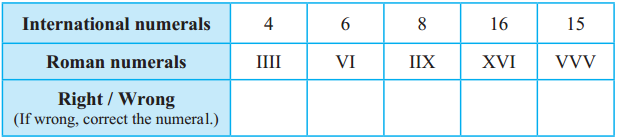
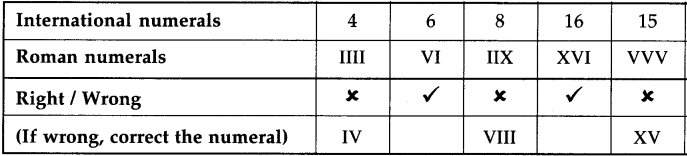
In the table below, each given number is written in international numerals and then again in Roman numerals. If it is written correctly in Roman numerals, put ‘/’ in the box under it. If not, put ‘X’ and correct it.
Maharashtra Board Class 5 Maths Solutions Chapter 1 Roman Numerals Problem Set 1 2
Answer:
Maharashtra Board Class 5 Maths Solutions Chapter 1 Roman Numerals Problem Set 1 12

Something more : L, C, D and M are also used as Roman numerals.
Maharashtra Board Class 5 Maths Solutions Chapter 1 Roman Numerals Problem Set 1 3
Activity : Apart from clocks and watches, where else do we see Roman numerals?

Maharashtra Board Class 5 Maths Solutions Chapter 1 Roman Numerals Problem Set 1

The decimal system of writing numbers
It is not easy to read or write numbers using Roman numerals. It also makes calculations difficult. You have learnt to write numbers using the ten digits, 0 to 9. In that system, the value of a digit depends upon its place in the number. This system of writing numbers is called the ‘decimal system’.

Mathematicians of ancient India invented the decimal system of writing numbers and began to use it. Later, this system was accepted in all parts of the world because it was simple and convenient.

Roman Numerals Problem Set 1 Additional Important Questions and Answers

Question 1.
Write all the numbers from 21 to 30 using roman numerals.
Answer:
Maharashtra Board Class 5 Maths Solutions Chapter 1 Roman Numerals Problem Set 1 5

Question 2.
Write the following numbers using international numerals.
(1) XXV
(2) XXIX.
Answer:
(1) 25
(2) 29

Question 3.
Fill in the empty boxes:
Answer:
Maharashtra Board Class 5 Maths Solutions Chapter 1 Roman Numerals Problem Set 1 6

Maharashtra Board Class 5 Maths Solutions Chapter 1 Roman Numerals Problem Set 1

Question 4.
Write the numbers using Roman Numerals:
(1) 1
(2) 21
(3) 10
Answer:
(1) I
(2) XXI
(3) X

Question 5.
In the table below, each given number is written in international numerals and then again in Roman numerals. If it is written correctly in Roman numerals put ‘S’ in the box under it. if not, put ‘x’ and correct it.
Answer:
Maharashtra Board Class 5 Maths Solutions Chapter 1 Roman Numerals Problem Set 1 7

Question 6.
Write all the numbers from 31 to 40 using Roman numerals.
Answer:
Maharashtra Board Class 5 Maths Solutions Chapter 1 Roman Numerals Problem Set 1 10

Maharashtra Board Class 5 Maths Solutions Chapter 1 Roman Numerals Problem Set 1

Question 7.
Write the following numbers using international numerals.
(1) VI
(2) XI
(3) XIV
(4) XVII
Answer:
(1) 6
(2) 11
(3) 14
(4) 17

Question 8.
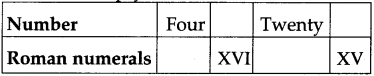
Fill in the empty boxes:
Maharashtra Board Class 5 Maths Solutions Chapter 1 Roman Numerals Problem Set 1 8
Answer:
Four = IV, 16 = XVI, Twenty = XX, XV =15

Question 9.
Write the numbers using Roman numerals in the given boxes.
(1) 3 [ ]
(2) 8 [ ]
(3) 13 [ ]
(4) 16 [ ]
Answer:
(1) III
(2) VIII
(3) XIII
(4) XVI

Question 10.
State true or false of the following. If the statement is false then correct it in Roman numerals.
(1) 3 is written as IIV
(2) 14 is written as XIV
(3) 16 is written as XVI
(4) 19 is written as IXX
Answer:
(1) False (III)
(2) True
(3) True
(4) False (XIX)

Maharashtra Board Class 5 Maths Solutions Chapter 1 Roman Numerals Problem Set 1

Question 11.
Write the answers Roman numerals.
(1) III + IV = [ ]
(2) IV + V = [ ]
(3) IX – X = [ ]
(4) VI + X = [ ]
(5) III + II = [ ]
(6) V + V = [ ]
(7) XXX + XX = [ ]
(8) L + L = [ ]
Answer:
(1) VII
(2) IX
(3) XIX
(4) XVI
(5) V
(6) X
(7) L
(8) C

Question 12.
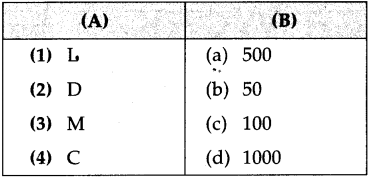
Match the columns:
Maharashtra Board Class 5 Maths Solutions Chapter 1 Roman Numerals Problem Set 1 9
Answer:
(1 – b),
(2 – a),
(3 – d),
(4 – c)

Maharashtra Board Class 5 Maths Solutions Chapter 1 Roman Numerals Problem Set 1

Question 13.
Circle the correct international numeral of the following:
(1) XXIV
(a) 14
(b) 20
(c) 24
Answer:
(c) 24

(2) VIII
(a) 8
(b) 207
(c) 19
Answer:
(a) 8

(3) XXIX
(a) 31
(b) 29
(c) 20
Answer:
(b) 29

(4) XXVII
(a) 27
(b) 28
(c) 26
Answer:
(a) 27

Maharashtra Board Class 5 Maths Solutions Chapter 1 Roman Numerals Problem Set 1

Question 14.
Circle the correct Roman numeral of the following:
(1) 36
(a) XXVI
(b) XXXVI
(c) XXXXVI
Answers:
(b) XXXVI

(2) 27
(a) XXXVI
(b) XXVII
(c) XXVI
Answers:
(c) XXVII

(3) 18
(a) XVIII
(b) XVI
(c) XVII
Answers:
(a) XVIII

(4) 605
(a)DCV
(b)CDV
(c) XXXXXV
Answers:
(a) DCV

Maharashtra Board Class 5 Maths Solutions Chapter 1 Roman Numerals Problem Set 1

Question 15.
Put >, < or = in the box.
(1) CVI [          ] CLX
(2) CLXIX [          ] CLXXI
(3) XLIX [          ] XXXIX
(4) MMXVI [          ] MMXXVI
(5) LXX VII [          ] LVIII
(6) MCMXL [          ] MCMXLV
Answers:
(1) <
(2) <
(3) >
(4) <
(5) >
(6) <

Class 5 Maths Solution Maharashtra Board

Problem Set 19 Class 5 Maths Chapter 5 Fractions Question Answer Maharashtra Board

Fractions Class 5 Problem Set 19 Question Answer Maharashtra Board

Balbharti Maharashtra Board Class 5 Maths Solutions Chapter 5 Fractions Problem Set 19 Textbook Exercise Important Questions and Answers.

Std 5 Maths Chapter 5 Fractions

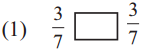
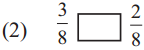
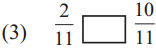
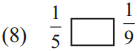
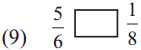
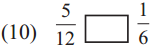
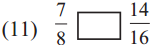
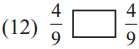
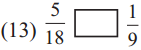
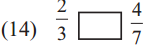
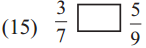
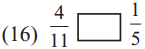
Write the proper symbol from < , > , or = in the box.

Maharashtra Board Class 5 Maths Solutions Chapter 5 Fractions Problem Set 19 1
Answer:
=

Maharashtra Board Class 5 Maths Solutions Chapter 5 Fractions Problem Set 19

Maharashtra Board Class 5 Maths Solutions Chapter 5 Fractions Problem Set 19 2
Answer:
>

Maharashtra Board Class 5 Maths Solutions Chapter 5 Fractions Problem Set 19 3
Answer:
<

Maharashtra Board Class 5 Maths Solutions Chapter 5 Fractions Problem Set 19 4
Answer:
=

Maharashtra Board Class 5 Maths Solutions Chapter 5 Fractions Problem Set 19 5
Answer:
>

Maharashtra Board Class 5 Maths Solutions Chapter 5 Fractions Problem Set 19 6
Answer:
>

Maharashtra Board Class 5 Maths Solutions Chapter 5 Fractions Problem Set 19

Maharashtra Board Class 5 Maths Solutions Chapter 5 Fractions Problem Set 19 7
Answer:
>

Maharashtra Board Class 5 Maths Solutions Chapter 5 Fractions Problem Set 19 8
Answer:
>

Maharashtra Board Class 5 Maths Solutions Chapter 5 Fractions Problem Set 19 9
Answer:
>

Maharashtra Board Class 5 Maths Solutions Chapter 5 Fractions Problem Set 19 10
Answer:
>

Maharashtra Board Class 5 Maths Solutions Chapter 5 Fractions Problem Set 19 11
Answer:
=

Maharashtra Board Class 5 Maths Solutions Chapter 5 Fractions Problem Set 19

Maharashtra Board Class 5 Maths Solutions Chapter 5 Fractions Problem Set 19 12
Answer:
=

Maharashtra Board Class 5 Maths Solutions Chapter 5 Fractions Problem Set 19 13
Answer:
>

Maharashtra Board Class 5 Maths Solutions Chapter 5 Fractions Problem Set 19 14
Answer:
>

Maharashtra Board Class 5 Maths Solutions Chapter 5 Fractions Problem Set 19 15
Answer:
<

Maharashtra Board Class 5 Maths Solutions Chapter 5 Fractions Problem Set 19 16
Answer:
>

Addition of like fractions
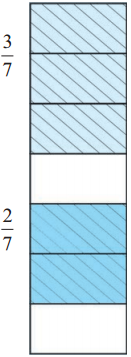
Example (1) 3/7 + 2/7 = ?
Let us divide a strip into 7 equal parts. We shall colour 3 parts with one colour and 2 parts with another.
The part with one colour is 3/7, and that with the other colour is 2/7.
The total coloured part is shown by the fraction 5/7.
It means that, \(\frac{3}{7}+\frac{2}{7}=\frac{3+2}{7}=\frac{5}{7}\)
Maharashtra Board Class 5 Maths Solutions Chapter 5 Fractions Problem Set 19 17

Maharashtra Board Class 5 Maths Solutions Chapter 5 Fractions Problem Set 19

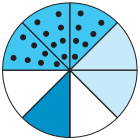
Example (2) Add : \(\frac{3}{8}+\frac{2}{8}+\frac{1}{8}\)
The total coloured part is \(\frac{3}{8}+\frac{2}{8}+\frac{1}{8}=\frac{3+2+1}{8}=\frac{6}{8}\)
Maharashtra Board Class 5 Maths Solutions Chapter 5 Fractions Problem Set 19 18

When adding like fractions, we add the numerators of the two fractions and write the denominator as it is.
Example (3) Add : 2/6 + 4/6 \(\frac{2}{6}+\frac{4}{6}=\frac{2+4}{6}=\frac{6}{6}\)
However, we know that 6/6 means that all 6 of the 6 equal parts are taken. That is, 1 whole figure is taken. Therefore, 6/6 = 1.

Note that:
If the numerator and denominator of a fraction are equal, the fraction is equal to one.
That is why, \(\frac{7}{7}=1 ; \frac{10}{10}=1 ; \frac{2}{5}+\frac{3}{5}=\frac{2+3}{5}=\frac{5}{5}=1\)
Remember that, if we do not divide a figure into parts, but keep it whole, it can also be written as 1.
This tells us that \(1=\frac{1}{1}=\frac{2}{2}=\frac{3}{3}\) and so on.
You also know that if the numerator and denominator of a fraction have a common divisor, then the fraction obtained by dividing them by that divisor is equivalent to the given fraction.
\(\frac{5}{5}=\frac{5 \div 5}{5 \div 5}=\frac{1}{1}=1\)

Maharashtra Board Class 5 Maths Solutions Chapter 5 Fractions Problem Set 19

Fractions Problem Set 19 Additional Important Questions and Answers

Question 1.
Maharashtra Board Class 5 Maths Solutions Chapter 5 Fractions Problem Set 19 19
Answer:
>

Question 2.
Maharashtra Board Class 5 Maths Solutions Chapter 5 Fractions Problem Set 19 20
Answer:
=

Class 5 Maths Solution Maharashtra Board

Problem Set 51 Class 5 Maths Chapter 13 Three Dimensional Objects and Nets Question Answer Maharashtra Board

Three Dimensional Objects and Nets Class 5 Problem Set 51 Question Answer Maharashtra Board

Balbharti Maharashtra Board Class 5 Maths Solutions Chapter 13 Three Dimensional Objects and Nets Problem Set 51 Textbook Exercise Important Questions and Answers.

Std 5 Maths Chapter 13 Three Dimensional Objects and Nets

Question 1.
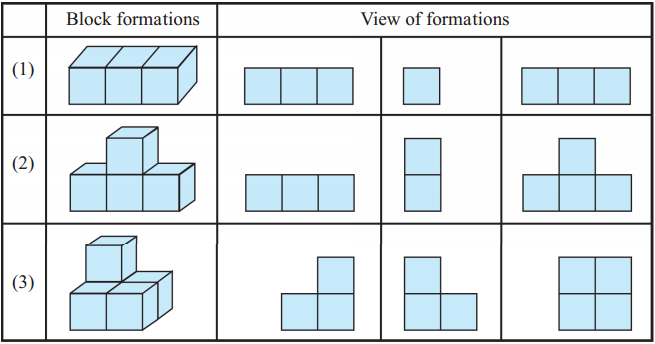
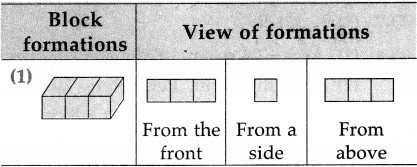
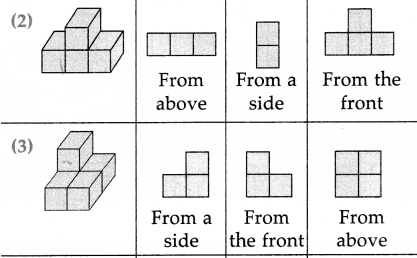
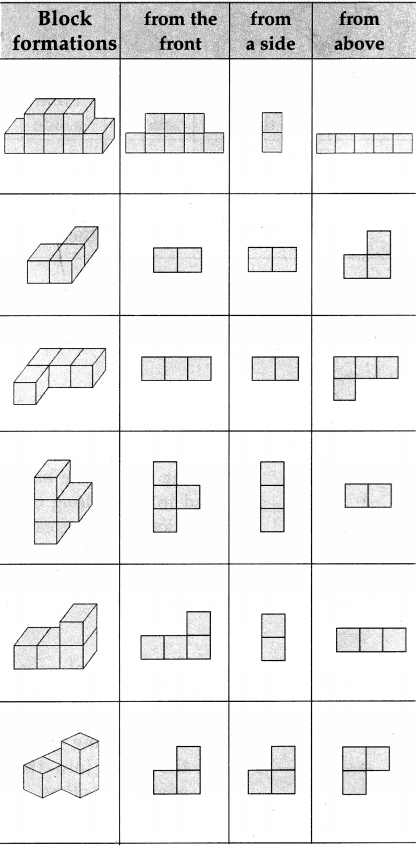
The first column shows a structure made of blocks. The other columns show different views of the structure in two dimensions. Say whether each view is from the front, from a side or from above.
Maharashtra Board Class 5 Maths Solutions Chapter 13 Three Dimensional Objects and Nets Problem Set 51 1
Answer:
Maharashtra Board Class 5 Maths Solutions Chapter 13 Three Dimensional Objects and Nets Problem Set 51 10
Maharashtra Board Class 5 Maths Solutions Chapter 13 Three Dimensional Objects and Nets Problem Set 51 18

Maharashtra Board Class 5 Maths Solutions Chapter 13 Three Dimensional Objects and Nets Problem Set 51

Question 2.
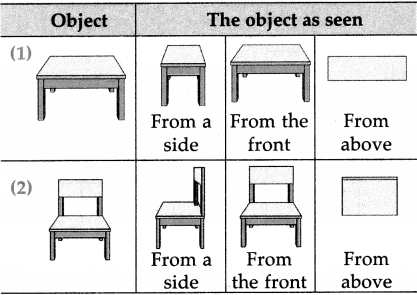
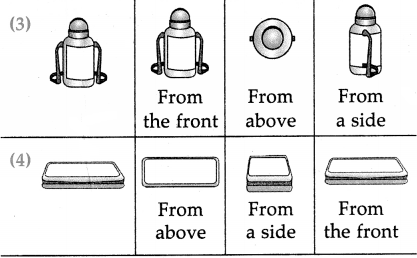
Draw three pictures of each of these three-dimensional objects – a table, a chair and a water bottle as viewed from the front, from a side and from above.
Answer:
Maharashtra Board Class 5 Maths Solutions Chapter 13 Three Dimensional Objects and Nets Problem Set 51 12
Maharashtra Board Class 5 Maths Solutions Chapter 13 Three Dimensional Objects and Nets Problem Set 51 13

Maharashtra Board Class 5 Maths Solutions Chapter 13 Three Dimensional Objects and Nets Problem Set 51

Nets
Last year we saw that cutting some edges of a box and laying it out flat gives us the net from which it was made.
The two dimensional shape from which a three dimensional object can be made by folding is called the ‘net’ of that object.

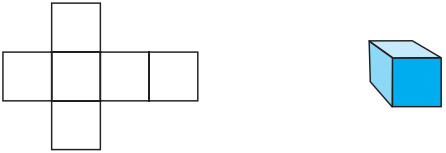
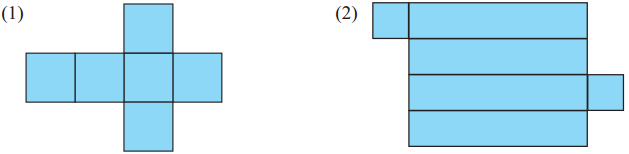
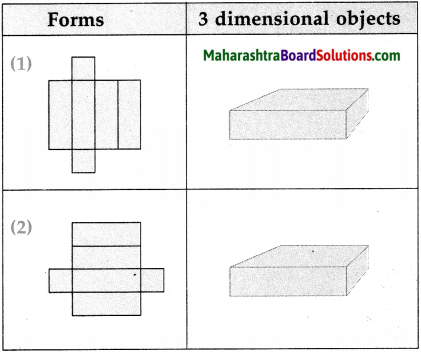
  1. By folding the cardboard shown below, along the lines shown in it, we get a three dimensional object (box). In this shape, all surfaces are square.
    An object of this shape is called a cube.
    Maharashtra Board Class 5 Maths Solutions Chapter 13 Three Dimensional Objects and Nets Problem Set 51 2
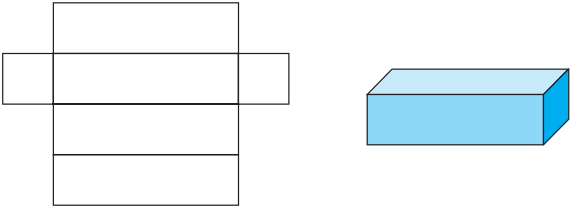
  2. The net of another cardboard box is shown in the figure below. By folding along the lines in this net and joining the edges to each other, we can see that a three dimensional box is formed. The surfaces of this box are rectangular in shape.
    An object of this shape is called a cuboid.
    Maharashtra Board Class 5 Maths Solutions Chapter 13 Three Dimensional Objects and Nets Problem Set 51 3

Maharashtra Board Class 5 Maths Solutions Chapter 13 Three Dimensional Objects and Nets Problem Set 51

Activity :
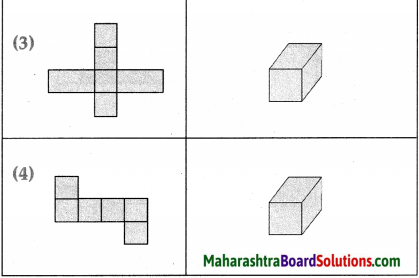
Draw the nets shown below on card sheet. Cut out the shapes and find out the shapes of the boxes they form.
Maharashtra Board Class 5 Maths Solutions Chapter 13 Three Dimensional Objects and Nets Problem Set 51 4

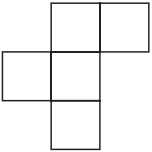
A five-square net (Pentomino)

In the figure alongside, five squares of the same size are placed together with their sides joined.
Maharashtra Board Class 5 Maths Solutions Chapter 13 Three Dimensional Objects and Nets Problem Set 51 5
Such an arrangement of five squares is called a ‘five-square net’ or a ‘pentomino’.

By folding along the edges of such a five-square net, an open box is formed.

Maharashtra Board Class 5 Maths Solutions Chapter 13 Three Dimensional Objects and Nets Problem Set 51 6

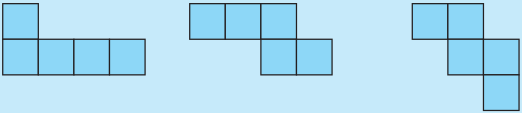
Activity :
Some five-square nets are given below. Draw these nets on a card sheet. Make open boxes from these nets.
Maharashtra Board Class 5 Maths Solutions Chapter 13 Three Dimensional Objects and Nets Problem Set 51 7
Try to find out other five-square nets that can be used to make open boxes.

Maharashtra Board Class 5 Maths Solutions Chapter 13 Three Dimensional Objects and Nets Problem Set 51

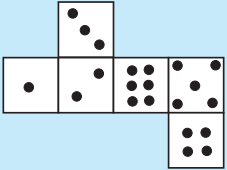
A riddle
Maharashtra Board Class 5 Maths Solutions Chapter 13 Three Dimensional Objects and Nets Problem Set 51 8
The net of a cube-shaped dice is given alongside. If a dice is made of this net, which of the following shapes will it definitely not resemble?
Maharashtra Board Class 5 Maths Solutions Chapter 13 Three Dimensional Objects and Nets Problem Set 51 9

Chapter 12 Perimeter and Area Problem Set 49 Additional Important Questions and Answers

Question 1.
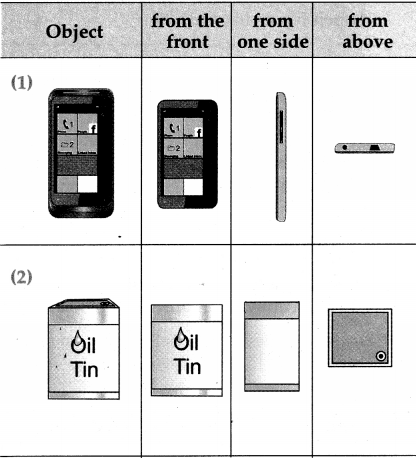
Draw the pictures of each of these three dimensional objects – Mobile, Oil tin as viewed from the front, from a side and from above.
Answer:
Maharashtra Board Class 5 Maths Solutions Chapter 13 Three Dimensional Objects and Nets Problem Set 51 16

Maharashtra Board Class 5 Maths Solutions Chapter 13 Three Dimensional Objects and Nets Problem Set 51

Question 2.
The three dimensional figure of block formation is shown in the figure along side. Draw as view from the front, from a side and from above (fig. drawn in answer part)
Answer:
Maharashtra Board Class 5 Maths Solutions Chapter 13 Three Dimensional Objects and Nets Problem Set 51 17

Maharashtra Board Class 5 Maths Solutions Chapter 13 Three Dimensional Objects and Nets Problem Set 51

Question 3.
Draw the nets shown below on card sheet. Cut out the shapes and find out the shapes of the boxes they form.
Answer:
Maharashtra Board Class 5 Maths Solutions Chapter 13 Three Dimensional Objects and Nets Problem Set 51 14
Maharashtra Board Class 5 Maths Solutions Chapter 13 Three Dimensional Objects and Nets Problem Set 51 15

Class 5 Maths Solution Maharashtra Board
Problem Set 38 Class 5 Maths Chapter 9 Decimal Fractions Question Answer Maharashtra Board

Decimal Fractions Class 5 Problem Set 38 Question Answer Maharashtra Board

Balbharti Maharashtra Board Class 5 Maths Solutions Chapter 9 Decimal Fractions Problem Set 38 Textbook Exercise Important Questions and Answers.

Std 5 Maths Chapter 9 Decimal Fractions

Read the decimal fraction and write down the place value of each digit.

(1) 6.13
Answer:
Six point one three.
Here 6 is in the units place. Hence, its place value is 6 x 1 = 6
1 is in tenths place. Hence, its place value is
\(1 \times \frac{1}{10}=0.1\)
3 is in the hundredths place. Its place value is 3 x \(\frac{1}{100}\) = 0.03 100

Maharashtra Board Class 5 Maths Solutions Chapter 9 Decimal Fractions Problem Set 38

(2) 48.84
Answer:
Fourty eight point eight four
Place value of 4 is 4 x 10 = 40 and of 8, it is 8 x 1 = 8
Place value of 8 is 8 x \(\frac{1}{10}=\frac{8}{10}\) = 0.8 and
Place value of 4 is 4 x \(\frac{1}{100}=\frac{4}{100}\) = 0.04

(3) 72.05
Answer:
Seventy two point zero five
Place value of 7 is 7 x 10 = 70 and of 2 is, it is 2 x 1 = 2
Place value of 5 is 5 x \(\frac{1}{100}=\frac{5}{100}\) = 0.05

(4) 3.4
Answer:
Three point four.
Place value of 3 is 3 x 1 = 3
Place value of 4 is 4 x \(\frac{1}{10}\) = 0.4

Maharashtra Board Class 5 Maths Solutions Chapter 9 Decimal Fractions Problem Set 38

(5) 0.59
Answer:
Zero point five nine.
Place value of 5 is 5 x \(\frac{1}{10}=\frac{5}{10}\) = 0.5 and
Place value of 9 is 9 x \(\frac{1}{100}=\frac{9}{100}\) = 0.09

Use of decimal fractions

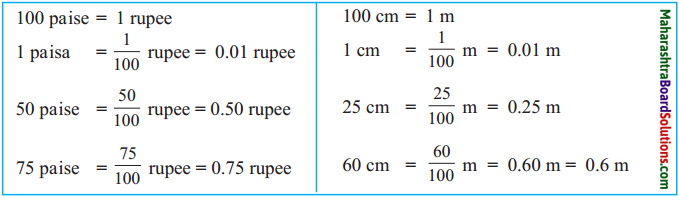
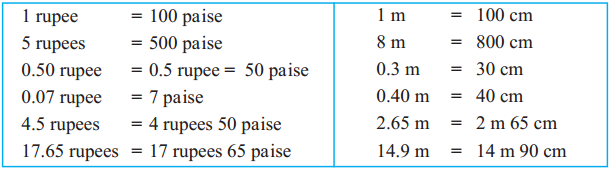
Sir : Now we will see how 24.50 equals 24 rupees and 50 paise. How many rupees is one paisa?
Sumit : 100 paise make one rupee, therefore, 1 paisa is one-hundredth of a rupee or 0.01 rupee.
Sir : And 50 paise are?
Sumit : 50 hundredths of a rupee, or 0.50 rupees, so 24.50 rupees is 24 rupees and 50 paise.
Sir : When a large unit of a certain quantity is divided into 10 or 100 parts to make smaller units, it is more convenient to write them in decimal form. As we just saw, 100 paise = 1 rupee. Similarly, 100 cm = 1 metre, so 75 cm = 0.75 m. 10 mm = 1 cm, so 1 mm = 0.1cm. 3 mm are 0.3 cm. 6.3 cm are 6 cm and 3 mm.

Now study the following table.

Maharashtra Board Class 5 Maths Solutions Chapter 9 Decimal Fractions Problem Set 38 1 Maharashtra Board Class 5 Maths Solutions Chapter 9 Decimal Fractions Problem Set 38 2

Decimal Fractions Problem Set 38 Additional Important Questions and Answers

(1) 12.34
Answer:
Twelve point three four.
Place value of 1 is 1 x 10 = 10
Place value of 2 is 2 x 1 = 2
Place value of 3 is 3 x \(\frac{1}{10}\) = 0.3
Place value of 4 is 4 x \(\frac{1}{100}\) = 0.04

Maharashtra Board Class 5 Maths Solutions Chapter 9 Decimal Fractions Problem Set 38

(2) 369,58
Answer:
Three hundred sixty nine point five eight. Place value of 3, which is in the hundreds place is 3 x 100 = 300
Place value of 6, which is in the tens place is 6 x 10 = 60
Place value of 9, which is in the units place is 9 x 1 = 9
Place value of 5, which is in the tenths place is 5 x \(\frac{1}{10}\) = 0.5
Place value of 8, which is in the hundredths place is 8 x \(\frac{1}{100}\) = 0.08

(3) 5.5
Answer:
Five point five.
Place value of 5, which is in the units place is 5 x 1 = 5
Place value of 5, which is in the tenths place is 5 x \(\frac{1}{10}\) = 0.5

Class 5 Maths Solution Maharashtra Board
Problem Set 7 Class 5 Maths Chapter 3 Addition and Subtraction Question Answer Maharashtra Board

Addition and Subtraction Class 5 Problem Set 7 Question Answer Maharashtra Board

Balbharti Maharashtra Board Class 5 Maths Solutions Chapter 3 Addition and Subtraction Problem Set 7 Textbook Exercise Important Questions and Answers.

Std 5 Maths Chapter 3 Addition and Subtraction

Question 1.
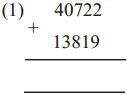
Add the following

Maharashtra Board Class 5 Maths Solutions Chapter 3 Addition and Subtraction Problem Set 7 1
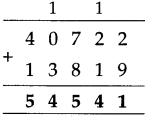
Answer:
Maharashtra Board Class 5 Maths Solutions Chapter 3 Addition and Subtraction Problem Set 7 9

Maharashtra Board Class 5 Maths Solutions Chapter 3 Addition and Subtraction Problem Set 7

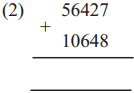
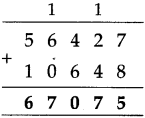
Maharashtra Board Class 5 Maths Solutions Chapter 3 Addition and Subtraction Problem Set 7 2.
Answer:
Maharashtra Board Class 5 Maths Solutions Chapter 3 Addition and Subtraction Problem Set 7 10

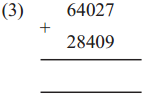
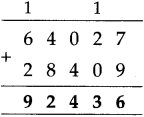
Maharashtra Board Class 5 Maths Solutions Chapter 3 Addition and Subtraction Problem Set 7 3
Answer:
Maharashtra Board Class 5 Maths Solutions Chapter 3 Addition and Subtraction Problem Set 7 11

Maharashtra Board Class 5 Maths Solutions Chapter 3 Addition and Subtraction Problem Set 7 4
Answer:
Maharashtra Board Class 5 Maths Solutions Chapter 3 Addition and Subtraction Problem Set 7 12

Maharashtra Board Class 5 Maths Solutions Chapter 3 Addition and Subtraction Problem Set 7

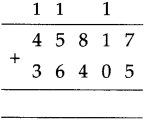
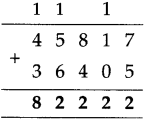
Addition of six-digit and seven-digit numbers

Last year, you have learned to add five-digit numbers. Six-and seven-digit numbers can
be added using the same method.

Study the following examples.

Add :
Example (1)
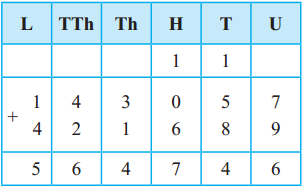
1,43,057 + 4,21,689
Maharashtra Board Class 5 Maths Solutions Chapter 3 Addition and Subtraction Problem Set 7 6

Example (2)
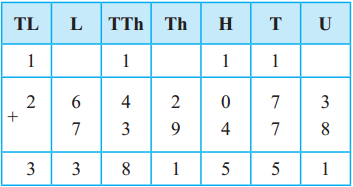
26,42,073 + 7,39,478
Maharashtra Board Class 5 Maths Solutions Chapter 3 Addition and Subtraction Problem Set 7 5

Maharashtra Board Class 5 Maths Solutions Chapter 3 Addition and Subtraction Problem Set 7

Example (3)
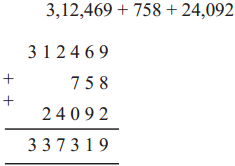
3,12,469 + 758 + 24,092
3 1 2 4 6 9
+ 7 5 8
+ 2 4 0 9 2
____________
3 3 7 3 1 9
____________

Example (4)
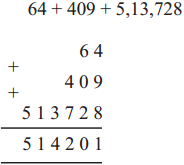
64 + 409 + 5,13,728
6 4
+ 4 0 9
+ 5 1 3 7 2 8
_____________
5 1 4 2 0 1
_____________

Maharashtra Board Class 5 Maths Solutions Chapter 3 Addition and Subtraction Problem Set 7

In the examples 3 and 4, the numbers are carried over mentally.

Question 2.
(1)
Maharashtra Board Class 5 Maths Solutions Chapter 3 Addition and Subtraction Problem Set 7 15
Answer:
Maharashtra Board Class 5 Maths Solutions Chapter 3 Addition and Subtraction Problem Set 7 13

(2)
Maharashtra Board Class 5 Maths Solutions Chapter 3 Addition and Subtraction Problem Set 7 16
Answer:
Maharashtra Board Class 5 Maths Solutions Chapter 3 Addition and Subtraction Problem Set 7 14

Class 5 Maths Solution Maharashtra Board

Problem Set 48 Class 5 Maths Chapter 12 Perimeter and Area Question Answer Maharashtra Board

Perimeter and Area Class 5 Problem Set 48 Question Answer Maharashtra Board

Balbharti Maharashtra Board Class 5 Maths Solutions Chapter 12 Perimeter and Area Problem Set 48 Textbook Exercise Important Questions and Answers.

Std 5 Maths Chapter 12 Perimeter and Area

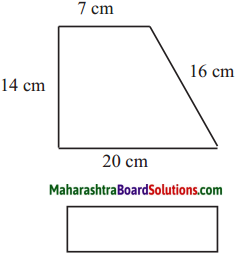
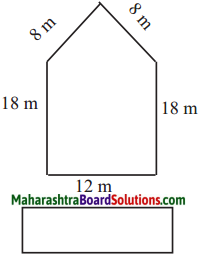
Question 1.
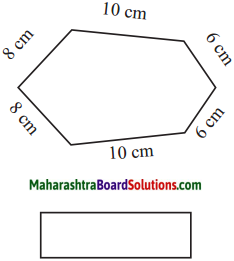
Write the perimeter of each figure in the box given below it.

(1)
Maharashtra Board Class 5 Maths Solutions Chapter 12 Perimeter and Area Problem Set 48 1
Solution:
Perimeter [ ] DABCD
= 20 + 16 + 7 + 14
= 57 cm

∴ 57 cm

Maharashtra Board Class 5 Maths Solutions Chapter 12 Perimeter and Area Problem Set 48

(2)
Maharashtra Board Class 5 Maths Solutions Chapter 12 Perimeter and Area Problem Set 48 3
Solution:
Perimeter of the figure
= 12 + 18 + 8 + 8 + 18
= 64m

∴ 64m

(3)
Maharashtra Board Class 5 Maths Solutions Chapter 12 Perimeter and Area Problem Set 48 2
Solution:
Perimeter of the figure
= 10 + 6 + 6 + 10 + 8 + 8
= 48 cm

∴ 48 cm

Maharashtra Board Class 5 Maths Solutions Chapter 12 Perimeter and Area Problem Set 48

Question 2.
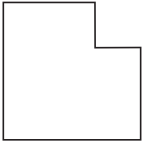
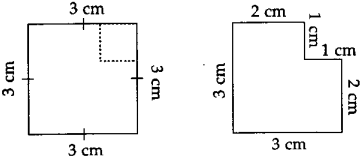
If a square of side 1 cm is cut out of the corner of a larger square with side 3 cm (see the figure), what will be the perimeter of the remaining shape?
Maharashtra Board Class 5 Maths Solutions Chapter 12 Perimeter and Area Problem Set 48 4Maharashtra Board Class 5 Maths Solutions Chapter 12 Perimeter and Area Problem Set 48 5
Solution:
Maharashtra Board Class 5 Maths Solutions Chapter 12 Perimeter and Area Problem Set 48 13
Perimeter
= 2 + 3 + 3 + 2 + 1 + 1
= 12 cm

∴ 12 cm

Formula for the perimeter of a rectangle

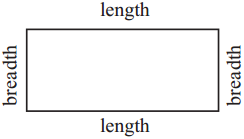
Maharashtra Board Class 5 Maths Solutions Chapter 12 Perimeter and Area Problem Set 48 6
Perimeter = length + breadth + length + breadth Opposite sides of a rectangle are of the same length.
So, the perimeter of a rectangle
= twice the length + twice the breadth
= 2 × length + 2 × breadth

Maharashtra Board Class 5 Maths Solutions Chapter 12 Perimeter and Area Problem Set 48

Perimeter of a rectangle = 2 × length + 2 × breadth

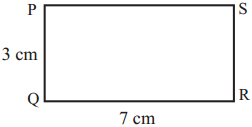
Example : The length of the rectangle below is 7 cm and its breadth, 3 cm. Let us find its perimeter.
Maharashtra Board Class 5 Maths Solutions Chapter 12 Perimeter and Area Problem Set 48 7

Perimeter of rectangle PQRS = 2 × length + 2 × breadth
= 2 × 7 + 2 × 3
= 14 + 6
= 20
Therefore, the perimeter of the rectangle is 20 cm.

Formula for the perimeter of a square

Maharashtra Board Class 5 Maths Solutions Chapter 12 Perimeter and Area Problem Set 48 8 The lengths of all the sides of a square are equal. Therefore, the perimeter of a square = four times the length of one of its sides.

Perimeter of a square = 4 × the length of one side

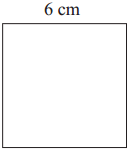
Example : The length of one side of a square is 6 cm. Find its perimeter. The perimeter of a square is four times the length of one side.
Maharashtra Board Class 5 Maths Solutions Chapter 12 Perimeter and Area Problem Set 48 9
Perimeter of a square = 4 × length of one side
= 4 × 6
= 24

Maharashtra Board Class 5 Maths Solutions Chapter 12 Perimeter and Area Problem Set 48

Therefore, the perimeter of the square is 24 cm.

Word problems

Example (1) The length of a rectangular park is 100 m, while its width is 80 m. What is its perimeter?

Perimeter of the rectangle = 2 × length + 2 × breadth
= 2 × 100 + 2 × 80
= 200 + 160
= 360

The perimeter of the rectangular park is 360 m.

Example (2) How much wire will be needed to put a triple fence around a square plot with side 30 m? What will be the total cost of the wire at ₹ 70 per metre ?

To put a single fence around the square plot, we need to find its perimeter.

Perimeter of a square = 4 × length of one side = 4 × 30 = 120

The perimeter of the square plot is 120 metres. Since the fence is to be a triple fence, we must triple the perimeter.

120 × 3 = 360 m of wire will be needed.

Now let us find out how much the wire will cost. One metre of wire costs ₹ 70.

Therefore, the cost of 360 m of wire will be 360 × 70 = 25, 200.

Maharashtra Board Class 5 Maths Solutions Chapter 12 Perimeter and Area Problem Set 48

The total cost of wire for putting a triple fence around the plot will be ₹ 25, 200.

Perimeter and Area Problem Set 48 Additional Important Questions and Answers

Question 1.
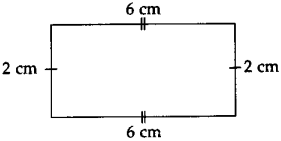
Maharashtra Board Class 5 Maths Solutions Chapter 12 Perimeter and Area Problem Set 48 10
Solution:
Perimeter of the figure
= 2 + 6 + 2 + 6
= 16 cm

∴ 16 cm

Question 2.
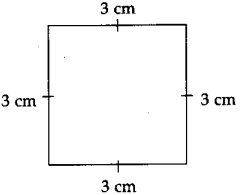
Maharashtra Board Class 5 Maths Solutions Chapter 12 Perimeter and Area Problem Set 48 11
Solution:
Perimeter of the figure
= 3 + 3 + 3 + 3
= 12 cm

∴ 12 cm

Maharashtra Board Class 5 Maths Solutions Chapter 12 Perimeter and Area Problem Set 48

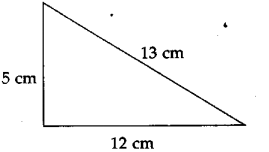
Question 3.
Maharashtra Board Class 5 Maths Solutions Chapter 12 Perimeter and Area Problem Set 48 12
Solution:
Perimeter of the figure
= 12 + 13 + 5
= 30 cm

∴ 30 cm

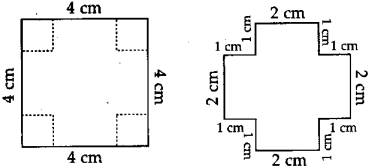
Question 4.
If four squares of side 1 cm ¡s cut out of all the corners of a larger square with side 4 cm (see the figure), what will be the perimeter of the remaining shape?

Maharashtra Board Class 5 Maths Solutions Chapter 12 Perimeter and Area Problem Set 48 14
Solution:
Perimeter
= 2 + 1 + 1 + 2 + 1 + 1 + 2 + 1 + 1 + 2 + 1 + 1
= 16 cm

∴ 16 cm

Class 5 Maths Solution Maharashtra Board

Problem Set 25 Class 5 Maths Chapter 6 Angles Question Answer Maharashtra Board

Angles Class 5 Problem Set 25 Question Answer Maharashtra Board

Balbharti Maharashtra Board Class 5 Maths Solutions Chapter 6 Angles Problem Set 25 Textbook Exercise Important Questions and Answers.

Std 5 Maths Chapter 6 Angles

Measure the angles given below and write the measure in the given boxes.
Maharashtra Board Class 5 Maths Solutions Chapter 6 Angles Problem Set 25 1
Answer:
(1) 40°
(2) 120°
(3) 90°
(4) 85°

Maharashtra Board Class 5 Maths Solutions Chapter 6 Angles Problem Set 25

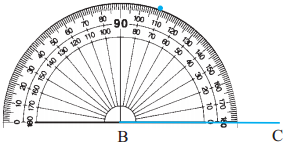
Drawing an angle of the given measure
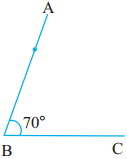
Example Draw ∠ABC of measure 70°.
B is the vertex of∠ABC and BA and BC are its arms.

1. First draw arm BC with a ruler.
Maharashtra Board Class 5 Maths Solutions Chapter 6 Angles Problem Set 25 2

2. Since B is the vertex, we must draw a 70° angle at that point.
Maharashtra Board Class 5 Maths Solutions Chapter 6 Angles Problem Set 25 3

Put the centre of the protractor on B. Place the protractor so that the baseline lies on arm BC. Count the divisions starting from the 0 near point C. Mark a point with your pencil at the division that shows 70°. Lift the protractor.

Draw a line from vertex B through the point marking the 70° angle. Name the other end of the line A.
Maharashtra Board Class 5 Maths Solutions Chapter 6 Angles Problem Set 25 4

∠ABC is an angle of measure 700.
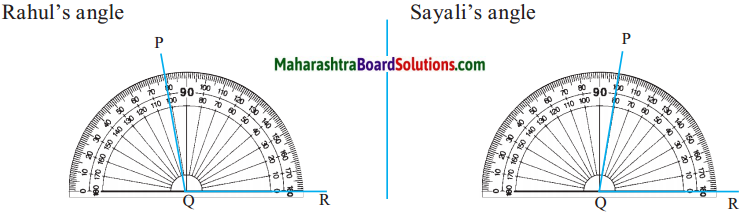
Rahul and Sayali drew ∠PQR of measure 800 as shown below.
Maharashtra Board Class 5 Maths Solutions Chapter 6 Angles Problem Set 25 5

Maharashtra Board Class 5 Maths Solutions Chapter 6 Angles Problem Set 25

Teacher : Have Rahul and Sayali drawn the angles correctly?
Shalaka : Sir, Rahul’s angle is wrong. Sayali’s angle is correct.
Teacher : Why is Rahul’s angle wrong?
Rahul : I counted 10, 20, 30…from the left and drew the angle at 80.
Teacher : Rahul measured the angle from the left. Under the baseline on the left of Q, there is nothing. The arm of the angle is on the right of Q. Therefore, the point should have been marked 80° counting from the right side, that is, on the side on which point R lies.

Angles Problem Set 25 Additional Important Questions and Answers

Maharashtra Board Class 5 Maths Solutions Chapter 6 Angles Problem Set 25 6
Answer:
60°

Maharashtra Board Class 5 Maths Solutions Chapter 6 Angles Problem Set 25 7
Answer:
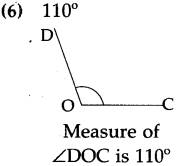
110°

Maharashtra Board Class 5 Maths Solutions Chapter 6 Angles Problem Set 25 8
Answer:
100°

Maharashtra Board Class 5 Maths Solutions Chapter 6 Angles Problem Set 25

Maharashtra Board Class 5 Maths Solutions Chapter 6 Angles Problem Set 25 9
Answer:
90°

Class 5 Maths Solution Maharashtra Board

Problem Set 56 Class 5 Maths Chapter 16 Preparation for Algebra Question Answer Maharashtra Board

Preparation for Algebra Class 5 Problem Set 56 Question Answer Maharashtra Board

Balbharti Maharashtra Board Class 5 Maths Solutions Chapter 16 Preparation for Algebra Problem Set 56 Textbook Exercise Important Questions and Answers.

Std 5 Maths Chapter 16 Preparation for Algebra

Question 1.
Use a letter for ‘any number’ and write the following properties in short.

(1) The sum of any number and zero is the number itself.
Answer:
a + 0 = a

Maharashtra Board Class 5 Maths Solutions Chapter 16 Preparation for Algebra Problem Set 56

(2) The product of any two numbers and the product obtained after changing the order of those numbers is the same.
Answer:
a x b = b x a

(3) The product of any number and zero is zero.
Answer:
a x 0 = 0

Question 2.
Write the following properties in words :

(1) m – 0 = m
Answer:
Subtracting zero from any number, gives the number itself.

(2) n ÷ 1 = n
Answer:
Dividing any number by 1, gives the number itself.

Preparation for Algebra Problem Set 56 Additional Important Questions and Answers

Use a letter for any number and write the following properties in short.

Question 1.
The product of any number and 1 is the number itself.
Answer:
a x 1 = a

Maharashtra Board Class 5 Maths Solutions Chapter 16 Preparation for Algebra Problem Set 56

Question 2.
The division of any two different numbers and the divisions obtained after changing the order of those numbers is not the same.
Answer:
a ÷ b ≠ b + a

Write the following properties in words:

Question 1.
p x 0 = 0
Answer:
The product of any number and zero is zero.

(4) a + b = b + a
Answer:
The sum of any two numbers and the sum obtained after changing the order of these numbers is the same.

Using brackets write three pairs of numbers whose

(1) Sum is 9
Answer:
5 + 4 = 9,
7 + 2 = 9,
8 + 1 = 9

Maharashtra Board Class 5 Maths Solutions Chapter 16 Preparation for Algebra Problem Set 56

(2) difference is 9
Answer:
12 – 3 = 9,
11 – 2 = 9,
10 – 1 = 9

(3) multiplication is 16 and
Answer:
4 x 4 = 16,
8 x 2 = 16,
16 x 1 = 16

(4) division is 16.
Answer:
32 ÷ 2 = 16,
48 ÷ 3 = 16,
64 ÷ 4 = 16,

Fill in the blanks.

(1) 4 + 2 = 7 – ……….
(2) 4 + 2 = 3 x ……….
(3) 4 + 2 = 12 ÷ ……….
Answer:
(1) 1
(2) 2
(3) 2

Maharashtra Board Class 5 Maths Solutions Chapter 16 Preparation for Algebra Problem Set 56

Match the columns:

(A)

A B
(i) 8 + 6 (a) 6 x 2
(2) 9 + 3 (b) 6 + 2
(3) 5 + 1 (c) 16 – 2
(4) 10 – 2 (d) 12 + 2

Answer:
(1 – c),
(2 – a),
(3-d),
(4-b)

(B)

A B
(1) a – b and b – a (a) 0
(2) a x b and b x a (b) 1
(3) a x 0 (c) =
(4) a + a (d) ≠

Answer:
(1-d),
(2 – c),
(3 – a),
(4 – b)

Maharashtra Board Class 5 Maths Solutions Chapter 16 Preparation for Algebra Problem Set 56

Say whether right or wrong.

(1) (6 + 5) = (5 + 6)
(2) (8 + 5) > 10
(3) (8 + 5) < 10
(4) 108 > 108
(5) 108 = 108
(6) 108 < 108
(7) (6 x 3) = (20 – 2)
(8) 40 + 8 > 5
(9) (3 x 7) = (7 x 3)
(10) (5 + 0) = (5 x 1)
(11) (6 + 5) = 10
(12) (30 + 5) < (30 – 25)
Answer:
Right : (1), (2), (5), (7), (9), (10)
Wrong : (3), (4), (6), (8), (11), (12)

Fill in the blanks with the right symbol from <, > or =

(1) (24 ÷ 5) ……… (9 – 5)
(2) (4 + 2) ……… (5 x 1)
(3) (7 x 3) ……… (20 + 2)
(4) (8 x 2) (5 x 3)
(5) (5 x 6) ……… (25 + 5)
(6) (6 x 7) (9 x 5)
Answer:
(1) =
(2) >
(3) <
(4) >
(5) =
(6) <

Maharashtra Board Class 5 Maths Solutions Chapter 16 Preparation for Algebra Problem Set 56

Fill in the blanks in the expressions with the proper numbers.

(1) (4 x 4) = (………. x 2)
(2) (2 x 7) > (4 x ……….)
(3) (30 + 5) < ( x 3)
(4) (5 + 0)> (4 x ……….)
(5) (36 +3) = ( + )
(6) (9 – ……….) < (4 + 1)
(7) (8 + 9) < (3 x ……….)
(8) (0 + 3) > (4 x ……….)
(9) (28 ÷ 2) = (7 x ……….)
Answer:
(1) 8
(2) 3
(3) 9
(4) 1
(5) 7 + 5
(6) 5,
(7) 6
(8) 0
(9) 2

Use a letter for any number and write the following properties in short:

(1) Dividing zero by any non zero number is zero.
Answer:
0 + a = 0

Maharashtra Board Class 5 Maths Solutions Chapter 16 Preparation for Algebra Problem Set 56

(2) The difference of any two different numbers and the difference obtained after changing the order of those numbers is not same.
Answer:
a – b ≠ b – a

(3) Dividing non zero number by itself gives us 1.
Answer:
a ÷ a = 1

Write the followîng properties in words:

(1) a x 1 = a
Answer:
The product of any number and 1 is the number itself.

(2) a – a = 0
Answer:
Difference of the same two numbers is zero.

Class 5 Maths Solution Maharashtra Board

Problem Set 16 Class 5 Maths Chapter 4 Multiplication and Division Question Answer Maharashtra Board
Multiplication and Division Class 5 Problem Set 16 Question Answer Maharashtra Board
Balbharti Maharashtra Board Class 5 Maths Solutions Chapter 4 Multiplication and Division Problem Set 16 Textbook Exercise Important Questions and Answers.
Std 5 Maths Chapter 4 Multiplication and Division

Question 1.
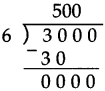
From a total of 10,000 rupees, Anna donated 7,000 rupees to a school. The remaining amount was to be divided equally among six students as the ‘all-round student’ prize. What was the amount of each prize?
Solution:
1 0 0 0 0 Total rupees

7 0 0 0 rupees donated
_______
3 0 0 0 remained
_______
This amount was divided among 6 students 500
Maharashtra Board Class 5 Maths Solutions Chapter 4 Multiplication and Division Problem Set 16 1
Answer:
Amount of the prize is ₹ 500.

Question 2.
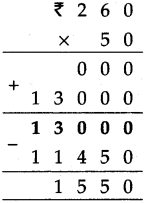
An amount of 260 rupees each was collected from 50 students for a picnic. If 11,450 rupees were spent for the picnic, what is the amount left over?
Solution:
₹ 2 6 0 Collected from 1 student
x
5 0 No. of students
0 0 0
+
1 3 0 0 0
1 3 0 0 0 Rupees, collected amount

1 1 4 5 0 Rupees spent
1 5 5 0 Rupees left over
Maharashtra Board Class 5 Maths Solutions Chapter 4 Multiplication and Division Problem Set 16 2
Answer:
1,550 Rupees leftover

Question 3.
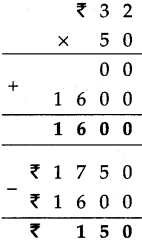
A shopkeeper bought a sack of 50kg of sugar for 1750 rupees. As the price of sugar fell, he had to sell it at the rate of 32 rupees per kilo. How much less money did he get than he had spent?
Solution:
₹ 3 2 Sale price of 1 kg
x
5 0 kg sold
0 0
+
1 6 0 0
1 6 0 0 Amount received
₹ 1 7 5 0 Purchased price

₹ 1 6 0 0 Obtained price
₹ 1 5 0 Lesshegot
Maharashtra Board Class 5 Maths Solutions Chapter 4 Multiplication and Division Problem Set 16 3
Answer:
₹ 150 less he got than he had spent

Question 4.
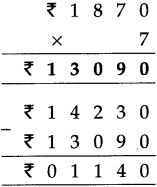
A shopkeeper bought 7 pressure cookers at the rate of 1870 rupees per cooker. He sold them all for a total of 14,230 rupees. Did he get less or more money than he had spent?
Solution:
₹ 1 8 7 0 Purchase price of 1 cooker
x
7 No. of cookers
₹ 1 3 0 9 0 Purchase price
₹ 1 4 2 3 0 Sell price

₹ 1 3 0 9 0 Purchase price
₹ 0 1 1 4 0 he got more
Maharashtra Board Class 5 Maths Solutions Chapter 4 Multiplication and Division Problem Set 16 4
Answer:
₹ 1,140 he got more

Question 5.
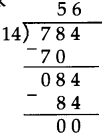
Fourteen families in a Society together bought 8 sacks of wheat, each weighing 98 kilos. If they shared all the wheat equally, what was the share of each family?
Solution:
9 8 Kilo weight of 1 sack
x
8 No. of sacks
7 8 4 Kilo
Maharashtra Board Class 5 Maths Solutions Chapter 4 Multiplication and Division Problem Set 16 5
Answer:
Share of each family = 56 kilo

Question 6.
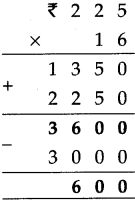
The capacity of an overhead water tank is 3000 litres. There are 16 families living in this building. If each family uses 225 litres every day, will the tank filled to capacity be enough for all the families? If not, what will the daily shortfall be?
Solution:
₹ 2 2 5 Litres uses 1 family
x 1 6 No. of families
1 3 5 0
+
2 2 5 0
3 6 0 0 Litres required

3 0 0 0 Litres capacity
6 0 0 Litres daily shortfall
Maharashtra Board Class 5 Maths Solutions Chapter 4 Multiplication and Division Problem Set 16 6
Answer:
600 litres is daily shortfall

Multiplication and Division Problem Set 16 Additional Important Questions and Answers

Solve the following word problems:

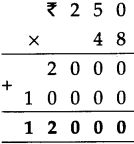
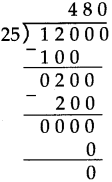
(1) A farmer brought 250 trays of tomatoes seedlings. Each tray had 48 seedlings. He planted all the seedlings in his field, putting 25 in a row. How many rows of tomatoes did he plant?
Solution:
₹ 2 5 0 Tray of tomatoes seedlings
x
4 8 Seedlings in 1 tray
2 0 0 0
+
1 0 0 0 0
1 2 0 0 0 Total no. of seedlings
Maharashtra Board Class 5 Maths Solutions Chapter 4 Multiplication and Division Problem Set 16 7
Maharashtra Board Class 5 Maths Solutions Chapter 4 Multiplication and Division Problem Set 16 8
Answer:
The number of rows is 480.

Q.l. Solve the following :
Multiply :
(1) 438 x 76
(2) 594 x 208
(3) 3467 x 926
(4) 3581 x 87
(5) 425 x 87
(6) 579 x 49
Answer:
(1) 33,288
(2) 1,23,552
(3) 32,10,442
(4) 3,11,547
(5) 36,975
(6) 28,371

Solve the following and write the quotient and remainder:

(1) 1345 ÷ 37
(2) 9682 ÷ 83
(3) 6371 ÷ 42
(4) 72534 ÷ 23
(5) 1284 ÷ 32
(6) 63240 ÷ 37
Answer:
(1) Quotient 36, Remainder 13
(2) Quotient 116, Remainder 54
(3) Quotient 151, Remainder 29
(4) Quotient 3153, Remainder 15
(5) Quotient 40, Remainder 4
(6) Quotient 1709, Remainder 7

Fill in the blanks :

(1) 88 x 17; 17 is called …………………………. and 88 is called
(2) Product of the greatest three-digit number and smaller two-digit number is ………………………… .
(3) Multiplicand and multiplier are interchanged the product remains the ………………………… .
(4) While multiplying by tens digit, we have to put in the units place ………………………… .
Answer:
(1) multiplier, multiplicand
(2) 99,900
(3) same
(4) zero

Class 5 Maths Solution Maharashtra Board