A Lark Poem Questions And Answers Class 5 English Chapter 29 Maharashtra Board

Std 5 English Lesson No 29 A Lark Question Answer Maharashtra Board

Balbharti Maharashtra State Board Class 5 English Solutions Chapter 29 A Lark Notes, Textbook Exercise Important Questions and Answers.

5th Std English Poem A Lark Question Answer

English Balbharati Std 5 Digest Chapter 29 A Lark Textbook Questions and Answers

1. Guess the meaning of:

Question 1.
Guess the meaning of:

  1. weary
  2. dreary
  3. on the wing

Answer:

  1. weary – very tired
  2. dreary – dull and gloomy
  3. on the wing – flying

Maharashtra Board Class 5 English Solutions Chapter 29 A Lark

2. Answer the following questions.

Question 1.
Write what the lark does.
Answer:
The lark soars high in the sky.

Question 2.
Write what the goldfish does.
Answer:
The goldfish dives deep in the sea.

Maharashtra Board Class 5 English Solutions Chapter 29 A Lark

Question 3.
What does the poet want to know from the lark?
Answer:
The poet wants to know from the lark if it is not tired of soaring high to the empty sky and if it doesn’t find the experience dull and boring. He further asks the lark if it doesn’t long to be a silent goldfish in the sea.

Question 4.
What does the poet want to know from the goldfish?
Answer:
The poet wants to know from the Goldfish whether it is not sad when it feels the cold waves moving slowly and quietly over it. He further enquires if the Goldfish sometimes long to be like a lark bird flying in the sky.

3. Recite the poem.

Question 1.
Recite the poem.
Answer:
Do it yourself.

Maharashtra Board Class 5 English Solutions Chapter 29 A Lark

4. Do you long to be something else? Write about your longing.

Question 1.
Do you long to be something else? Write about your longing.
Answer:
Yes, I long to be a bird! If I were a bird….. the high flight and exploring the beauty of this wonderful world would be such a great feeling. Humming sweet songs, building, nests so beautiful atop the tree, living in the green forests, Wouldn’t that be wonderful?

English Balbharati Std 5 Answers Chapter 29 A Lark Additional Important Questions and Answers

Spot the words

Question 1.

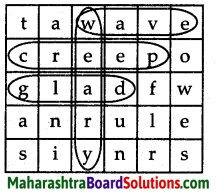
  1. very tired
  2. a moving strip of water
  3. move slowly and quietly
  4. pleased and joyful

Maharashtra Board Class 5 English Solutions Chapter 29 A Lark 1

Answer:

  1. weary
  2. wave
  3. creep
  4. glad

Maharashtra Board Class 5 English Solutions Chapter 29 A Lark

Language Study :

Question 1.
Complete the list of describing words from the extract:

  1. empty
  2. silent
  3. cold
  4. sad

Answer:

  1. sky
  2. goldfish
  3. waves
  4. clouds

Match the rhyming words :

Question 1.

1. high a. dreary
2. weary b. creep
3. be c. sky
4. deep d. wing
5. sing e. sea

Answer:

1. high c. sky
2. weary a. dreary
3. be e. sea
4. deep b. creep
5. sing d. wing

Maharashtra Board Class 5 English Solutions Chapter 29 A Lark

Reading Skills :

Read the following extract and answer the question given below:

Question 1.
Choose the correct alternative and complete the following. Don’t you sometimes long to be a in the sea.
i. a silent mermaid
ii. a silent goldfish
Answer:
a silent goldfish

Question 2.
Goldfish, goldfish ………….. are you never sad.
i. dancing is glee
ii. diving deep
Answer:
i. diving deep

Maharashtra Board Class 5 English Solutions Chapter 29 A Lark

Question 3.
What does the poem deal with?
Answer:
The poem deals with one’s longing to be someone or something else.

Question 4.
Which are the two characters the poet has addressed in the poem?
Answer:
The poet has addressed the lark bird and the goldfish in the poem.

Question 5.
Explain the line:
‘Don’t you sometimes long to be
A silent goldfish in the sea
Answer:
The poet wants to know whether the lark is not weary and tired of the life it leads and whether it doesn’t long to be like a goldfish in the sea.

Maharashtra Board Class 5 English Solutions Chapter 29 A Lark

A Lark Summary in English

Summary :

‘A Lark’ written by Lawrance Alma Tadema is a poem which throws light on how we are not happy in the situation we are in, and long to be someone or something beyond what we are. There are times when we intensely wish to be something we are not. As the proverb goes The grass is always greener on the other side’. The poet has beautifully illustrated this through this poem where he asks both the Lark bird and Goldfish if they were really happy and not weary of the life they lead. Addressing the lark bird flying high in the sky, the poet asks the lark if he is not tired when he reaches the empty sky amidst the gloomy cloud.

The poet wants to know from the lark if there are times when he longs to be a silent gold fish in the sea The poet asks the goldfish diving deep in the sea that when the cold waves slowly and quietly creep over it, is it really enjoyable? The poet enquires whether he doesn’t long to sing and lead the life like a lark bird soaring high in the sky. A simple poem with beautiful illustrations i.e. examples, the poet has conveyed a simple truth of life.

Maharashtra Board Class 5 English Solutions Chapter 29 A Lark

Meanings :

lark (n) – A small brown singing bird
soaring (u) – Fly or rise high into the air
weary (u) – Very tired
dreary (adj.) – dull and gloomy
diving (u) – plunge head first into water with arms raised over one’s head.
creep (v) – move slowly and quietly

English Balbharati Std 5 Answers Unit 4

Three Sacks of Rice Poem Questions And Answers Class 5 English Chapter 10 Maharashtra Board

Std 5 English Lesson No 10 Three Sacks of Rice Question Answer Maharashtra Board

Balbharti Maharashtra State Board Class 5 English Solutions Chapter 10 Three Sacks of Rice Notes, Textbook Exercise Important Questions and Answers.

5th Std English Poem Three Sacks of Rice Question Answer

English Balbharati Std 5 Digest Chapter 10 Three Sacks of Rice Textbook Questions and Answers

1. Find the opposites of the following words from the lesson.

Question 1.
Find the opposites of the following words from the lesson.

  1. begun
  2. bought
  3. reject
  4. eldest
  5. lent
  6. earned
  7. narrow

Answer:

  1. begun – cease
  2. bought – buy
  3. reject – accept
  4. eldest – youngest
  5. lent – borrow
  6. earned – spent
  7. narrow – broad

Maharashtra Board Class 5 English Solutions Chapter 10 Three Sacks of Rice

2. Answer the following questions.

Question 1.
What common qualities did the three brothers have?
Answer:
The three brothers had the common qualities of honesty, kindness and willingness to work hard.

Question 2.
What was the businessman looking for? Why?
Answer:
The businessman was getting old. He was looking for a son-in-law who would not only be a good husband to his daughter but also would handle his business well.

Question 3.
How did the middle brother use the rice?
Answer:
The middle brother distributed the rice among the poor in the name of the businessman.

Maharashtra Board Class 5 English Solutions Chapter 10 Three Sacks of Rice

Question 4.
Was it right for the youngest brother to ask for a share in the money? Why?
Answer:
There was a lot of hard work, effort and money involved in sowing the seeds and harvesting the crop. The youngest brother was therefore justified in asking for a share in the money.

3. Language Study (See pages 84-88.)

1. Read the highlighted words.

Question 1.
All three of them were honest, kind and hardworking.
You are such an honest person.
The highlighted words are adjectives Now find at least five other adjectives from the lesson.
Answer:

Nouns Adjectives
story small
brothers honest
town kind
hard hardworking

Maharashtra Board Class 5 English Solutions Chapter 10 Three Sacks of Rice

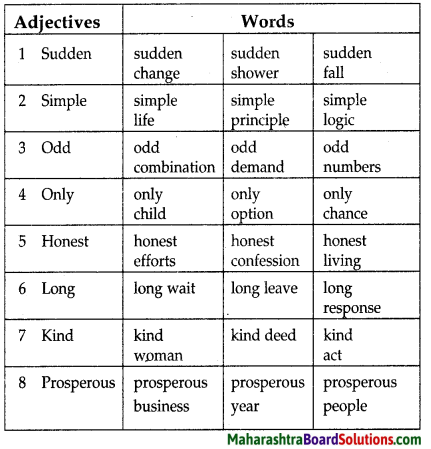
2. List as many words as you can that will go with the given adjective (At least 3 each.) Example: sudden – sudden change, sudden shower, sudden fall.

Question 1.
List as many words as you can that will go with the given adjective (At least 3 each.) Example: sudden – sudden change, sudden shower, sudden fall
1. simple
2. odd
3. only
4. honest
5. long
Answer:
Maharashtra Board Class 5 English Solutions Chapter 10 Three Sacks of Rice 2

4. Activities :

Question 1.
Imagine you are one of the three brothers. Write in short what you did with the rice.
Answer:
After the businessman left the rice with me, I waited for long for him to come back to take his possession. Alas! He showed no sign of returning. I feared that it may get spoilt and become useless. I thought and thought what I should do with the same and finally thought of a plan.

I met my friend Sohan, a farmer and offered him the sack, but on one condition. ‘He would return the same quantity after the harvest and the rest he would distribute among the poor and the needy’.

I insisted that Sohan too should take a share for his effort In this way, I made the most of precious resource I had in hand. What did I earn? Happiness that my thoughtful gesture helped bring a few smiles on the hungry faces and appreciation from my father’s friend for my act of service.

Question 2.
Find any other story of three brothers or three sisters and rewrite it in your own words.

Maharashtra Board Class 5 English Solutions Chapter 10 Three Sacks of Rice

Question 3.
Find out how rice is cultivated. Describe the process with the help of pictures or diagrams.
Answer:
Maharashtra Board Class 5 English Solutions Chapter 10 Three Sacks of Rice 1

5. Group Work :

Question 1.
Form a group of 4 or 5. Make a ‘storyboard for the story “Three Sacks of Rice’. Arrange the story in the form of a sequence of pictures. Decide what you will show in each picture, what words/lines you will write with each picture to explain what happens in it. You can also add ‘speech balloons’ for the people in the pictures.
Maharashtra Board Class 5 English Solutions Chapter 10 Three Sacks of Rice 3


Maharashtra Board Class 5 English Solutions Chapter 10 Three Sacks of Rice

English Balbharati Std 5 Answers Chapter 10 Three Sacks of Rice Additional Important Questions and Answers

Answer the following questions:

Question 1.
What did the three brothers do for a living?
Answer:
The elder one ran a shop, the middle one was a priest and the youngest who had just finished his education, took up odd jobs to earn some money.

Maharashtra Board Class 5 English Solutions Chapter 10 Three Sacks of Rice

Question 2.
Write in brief about the mother in the story.
Answer:
The mother had worked hard to bring up her sons after the sudden death of their father and all her sons were fond of her.

Question 3.
What work did the friend assign to the three brothers?
Answer:
The friend gave each brother a sack of rice and requested them to look after them till he returned after a few months.

Question 4.
Why did the eldest brother sell the rice which was left with him by the businessman, their father’s friend?
Answer:
The eldest brother was worried that it would get spoilt so he sold it to his customers.

Question 5.
Why did the businessman say that the middle brother had acted wisely and kindly?
Answer:
The middle brother was worried that the rice would get spoilt, and so he distributed the rice amongst the poor in the name of the businessman who in turn blessed him for satisfying their hunger. On hearing this, the businessman said that the middle brother had acted wisely and kindly.

Maharashtra Board Class 5 English Solutions Chapter 10 Three Sacks of Rice

Question 6.
What confession did the youngest brother make?
Answer:
The youngest brother confessed that since the sack of rice was lying with him for a long time, he sowed it in the unused plot of land. He added that fortunately the crop had grown well and yielded twenty-five sacks of rice. He had kept five of the sacks and sold the rest.

Activity

Complete the web diagram with words / adjectives from the story describing the three brothers.
Answer:
Maharashtra Board Class 5 English Solutions Chapter 10 Three Sacks of Rice 1

Do as directed:

Question 1.
I often go to the neighbouring farm to help with the work. (Pick out the articles)
Answer:
Articles: a, the

Maharashtra Board Class 5 English Solutions Chapter 10 Three Sacks of Rice

Question 2.
The crop grew well. (Pick out the verb and state its tense)
Answer:
grew – simple past tense

Read the following passage and answer the following questions:

Question 1.
Arrange the following in chronological order: (Order in which they occurred) Put the correct number in the box:

  1. The youngest son borrowed an unused plot of land. [ ]
  2. The crop grew well and yielded twenty-five sacks of rice. [ ]
  3. The sack was lying with the youngest son for a long time. [ ]
  4. Sowed the rice. [ ]

Answer:

  1. The youngest son borrowed an unused plot of land. [2]
  2. The crop grew well and yielded twenty-five sacks of rice. [4]
  3. The sack was lying with the youngest son for a long time. [1]
  4. Sowed the rice. [3]

Question 2.
Complete the table
Answer:

Singular plural
1. story stories
2. customer customers
3. blessing blessings

Maharashtra Board Class 5 English Solutions Chapter 10 Three Sacks of Rice

Question 3.
What does the extract deal with?
Answer:
The extract deals with how the middle brother and the youngest brother used the rice which the businessman had left with them.

Question 4.
How did the middle brother use the rice?
Answer:
The middle brother distributed the rice among the poor in the name of the businessman.

Question 5.
Why did the businessman refuse to take the money which was offered by the middle
brother?
Answer:
The businessman was satisfied with the blessings that he got from the poor people. So he refused to take the money which was offered by the middle brother.

Question 6.
Pick out a sentence from the passage to prove the following:
Answer:
The businessman was welcomed warmly by the youngest brother. When the friend went to visit the youngest son, he, too welcomed him with love and respect.

Question 7.
Pick out a compound word from the extract.
Answer:
Twenty-five

Maharashtra Board Class 5 English Solutions Chapter 10 Three Sacks of Rice

Question 8.
Pick out two abstract nouns from the extract
Answer:
1. love
2. affection.

Question 9.
Pick out the noun form from the extract for the following words.
Answer:
laborious : labour
monetary : money

Question 10.
Fortunately, the crop grew well. State the part of speech of the underlined word.
Answer:
crop – noun

Question 11.
Here’s the money (Rewrite the sentence without contraction)
Answer:
Here is the money.

Maharashtra Board Class 5 English Solutions Chapter 10 Three Sacks of Rice

Question 12.
Why do you think a wide smile spread on the friend’s face?
Answer:
The friend was impressed by the youngest brother’s wise act. He had proved himself to be not only hard working but also wise and foresighted. These qualities were suitable to become a good husband to the friend’s daughter and also to handle his business well. So a wide smile spread on the friend’s face.

Three Sacks of Rice Summary in English

Summary :

‘Three Sacks of Rice’ is a thought provoking story of three brothers – All three of them were honest, kind and hardworking. They were fond of their mother, a widow who worked hard to bring up the three of them. The elder one ran a shop, the middle one was a priest while the youngest who had just finished his education had started taking up odd jobs to earn money and learn a trade.

One day, their father’s friend visited them as he was on the lookout for a son-in-law. He wanted someone who would not only be a good husband to his daughter but also handle his business well. He liked all the three brothers but wanted to choose the best for his daughter.

He discussed a plan with their mother who readily agreed. As a part of the plan, the friend went to each of the three brothers and gave them a sack of rice to be looked after, till he returned a few months later. Nearly after an year, he came back and visited each one of them to collect the sack of rice.

He learnt that all the three brothers had used the bag of rice to the best of their abilities. But he found the youngest to be the wisest and foresighted. Thus his mission of searching a son-in-law was fulfilled.

Maharashtra Board Class 5 English Solutions Chapter 10 Three Sacks of Rice

Meanings :

  1. clever (adj) – one who is quick at learning and understanding
  2. honest (adj) – truthful or trustworthy
  3. priest (n) – one who is authorized to perform certain religious rites
  4. fond (v) – liking someone
  5. sudden (adj) – quick
  6. prosperous (adj) – financially successful.
  7. business (n) – trading activities
  8. son-in-law (n) – daughter’s husband
  9. permit (v) – allow
  10. plan(n) – a proposal to achieve something
  11. necessary (adj) – important (here)
  12. eldest (adj) – oldest
  13. spoilt (adj) – unfit for eating
  14. customers (n) – those who buy goods and services
  15. greeted (v) – address someone politely on meeting
  16. joy (n) – something causing delight
  17. affection (n) – love
  18. hunger (n) – lack of food
  19. permission (n): consent
  20. wise (adj) : sensible person with knowledge, experience and sound judgement
  21. kind (adj) : gentle
  22. respect (V) : regard for others
  23. neighbouring (adj) : situated nearby
  24. fortunately (adv): luckily
  25. share (n): a part given to a person out of something
  26. labour (n): hard work

English Balbharati Workbook Std 5 Answers Unit 2

Peer Profile Poem Questions And Answers Class 5 English Chapter 8 Maharashtra Board

Std 5 English Lesson No 8 Peer Profile Question Answer Maharashtra Board

Balbharti Maharashtra State Board Class 5 English Solutions Chapter 8 Peer Profile Notes, Textbook Exercise Important Questions and Answers.

5th Std English Poem Peer Profile Question Answer

English Balbharati Std 5 Digest Chapter 8 Peer Profile Textbook Questions and Answers

Let us see how to do this activity.

Question 1.
Let us see how to do this activity.
Get about 10 friends from your class. Distribute the sheets prepared by you to the 10 chosen friends. The sheet given is to get information about the person, such as their likes, dislikes, worries, fear …..and so on. Let them fill the sheets. Collect the sheets and find out similarity in likes and dislikes, fears, etc. You might find that many of your friends have the same likes, dislikes, fear, etc. Few may vary. On the basis of the information, make a report without any personal remarks. Read it out in the class. Make the report humorous so that everyone enjoys and no one is hurt. Let us see how best you can do it.
Answer:
Ten of my friends have created beautiful profiles about themselves. On the basis of the information, I would like to say a few things about two of them. (I name them as Abhay and Sacchi) who are a total contrast to their names.

Abhay is afraid of the dark. The most fearful thing is a cockroach. He jumps onto the bed or the sofa when he sees a cockroach. But he is a wrestler, ready to pin down his opponent …… oh ……. but cannot kill a cockroach! Sachhi can spin yarns of stories and make people believe her! How she can move someone to tears! She tells proudly that she never tells a lie, but is the biggest liar on the earth.

But, one thing to be appreciated about her, is that, she is a genuine helper. She is ready to help anyone and at anytime. I really love her for that. The rest many of them have common likes and dislikes but these two are amazing.

Maharashtra Board Class 5 English Solutions Chapter 8 Peer Profile

Peer Profile Summary in English

Summary :

This chapter shows you an excellent way to improve your writing skills and will surely add to your vocabulary too. This chapter helps you to write a report. We will be writing a ort on peer profile. A report on Peer Profile’ means a systematic, well organized presentation of information got especially of friends/students of your age.

The chapter helps you to understand that a report has to be written to the point without too much of description. It (Report) helps to summarize what is written. The presentation of a report can be oral or written.

While preparing a peer profile, students automatically acquire language skills like speaking in a polite manner, gathering information, putting it together in a relevant manner and preparing a brief report in an interesting way. . Dos and Don’ts while preparing a report on peer profile.

Sentences should be to the point and precise. Too much of description is not required. Presentation should be clear. What is not mentioned should be pointed out. Personal remarks should be avoided. Statements and emotions should not be hurt. Interesting points should be mentioned at the end.

Maharashtra Board Class 5 English Solutions Chapter 8 Peer Profile

Meanings :

  1. peer (n) – someone who is of your age
  2. profile (n) – collection of information especially about a person
  3. personality (n) – celebrity, qualities that make a person different from the others
  4. summary (n) – presentation which is brief and to the point
  5. relevant (adj.) – directly related to
  6. briefly (adu) – in a few words, short
  7. politely (ado) – well mannered
  8. hurt one’s feelings (ph) – to cause someone pain

Balbharti English Textbook Std 5 Pdf Free Download Unit 1

The Earth and its Living World Class 5 Questions And Answers EVS Chapter 3 Maharashtra Board

Balbharti Maharashtra State Board Class 5 Environmental Studies Solutions Chapter 3 The Earth and its Living World Notes, Textbook Exercise Important Questions and Answers.

5th Standard EVS 1 Lesson Number 3 Question Answer The Earth and its Living World Maharashtra Board

Std 5 EVS 1 Chapter 3 Question Answer

1. What is the solution?

Question 1.
Dark patches appear on the skin after exposure to the sun.
Answer:
Dark patches due to sun’s rays are called sunspots which can be taken care in a natural way by applying slices of fresh lemon on it for 10-15 minutes or by applying aloe vera gel twice a day.

Maharashtra Board Class 5 EVS Solutions Part 1 Chapter 3 The Earth and its Living World

2. Use your brainpower!

Question (a)
Why are microorganisms important?
Answer:
Microorganisms live in the soil and do the work of decomposing the dead plants and animals. If there were no microorganisms then the dead plants and animals would not get decomposed, they would have got accumulated and the soil would not become fertile.

Question (b)
Think about all the foodstuffs obtained from the sea. Find more information and write ten lines about them.
Answer:
Question Personal response.

3. Answer the following in one sentence:

Question (a)
What are clouds made of?
Answer:
Clouds are made up of very fine droplets of water which are small and light.

Question (b)
What is meant by biosphere?
Answer:
Living things occupy parts of the lithosphere, hydrosphere, and atmosphere. Living things and all the parts they occupy are together called the biosphere.

Maharashtra Board Class 5 EVS Solutions Part 1 Chapter 3 The Earth and its Living World

Question (c)
Make a list of the land forms you see in your surroundings and give a description of any two of them.
Answer:
(Personal response) Landforms e.g. mountain, hill, hillock, valley, plains, plateaus, river etc. (Students are supposed to write their own answers)

4. In the following sentences, underline the words that refer to landforms.

Question 1.
In the following sentences, underline the words that refer to landforms.
Answer:
(a) Anil lives at the foot of a hill.
(b) Ria lives in the plateau region.

5. Write a note about the following:

Question (a)
Evaporation:
Answer:
Due to the heat of the sun, the water from the earth’s surface goes into vapour state forming fine droplets of water which are small and light. This process is called evaporation.

Question (b)
Condensation:
Answer:
The process when vapour turns into water on cooling to form drops of water it is called as condensation.

Question (c)
The water cycle:
Answer:

  1. Evaporation of water from the earth due to the heat of the sun, forms water vapour.
  2. This vapour is light and moves up in the atmosphere and forms clouds.
  3. When these droplets join together and form bigger drops they become heavy and falls down on the earth in the form of rain.
  4. This process of evaporation, condensation and rainfall go on in a continuous cycle.
  5. This is known as nature’s water cycle.

Maharashtra Board Class 5 EVS Solutions Part 1 Chapter 3 The Earth and its Living World

6. Give two examples of each:

Question (a)
Weather-related events
Answer:
Clouds, rain

Question (b)
Sources of water
Answer:
River, lake

7. Draw a labelled diagram showing the:

Question 1.
Water cycle
Answer:
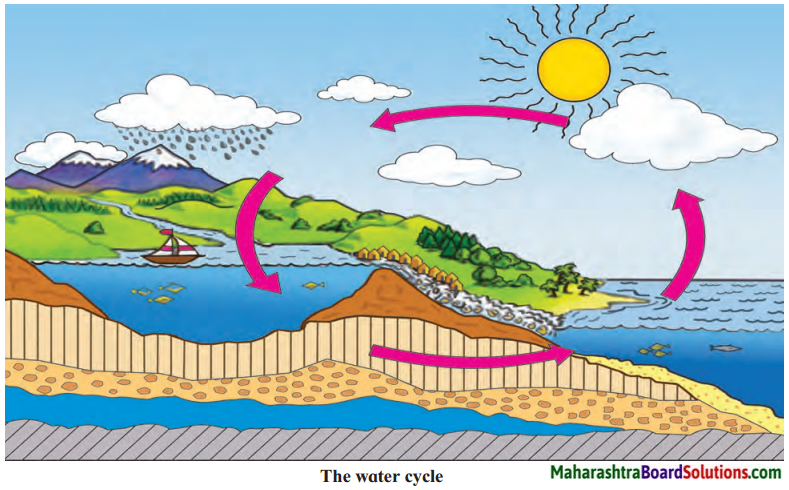
Maharashtra Board Class 5 EVS Solutions Part 1 Chapter 3 The Earth and its Living World 1

Question 2.
The earth’s atmosphere
Answer:
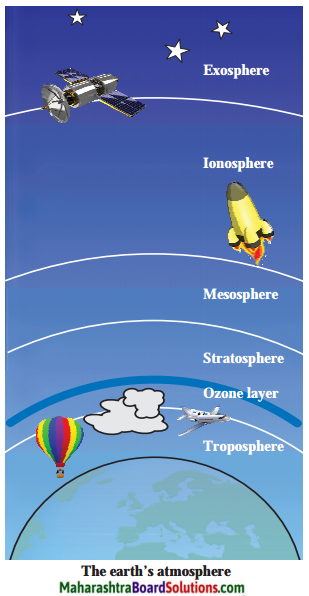
Maharashtra Board Class 5 EVS Solutions Part 1 Chapter 3 The Earth and its Living World 2

Question 3.
The spheres of the earth
Answer:
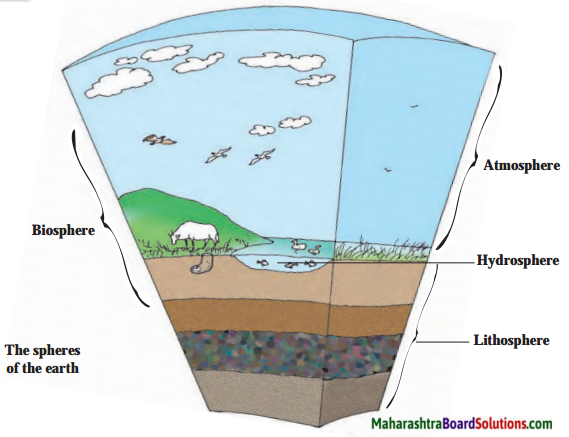
Maharashtra Board Class 5 EVS Solutions Part 1 Chapter 3 The Earth and its Living World 3

Environmental Studies Part 1 Standard 5th Solutions Chapter 3 The Earth and its Living World Additional Important Questions and Answers

Fill in the blanks with the correct answers from the options given below:

Question 1.
The earth’s crust is mainly made up of …………….. .
(a) soil
(b) rock
(c) animals
Answer:
(b) rock

Question 2.
The earth’s crust and a small hard portion of the layer under it is called the ………………. .
(a) hydrosphere
(b) atmosphere
(c) lithosphere
Answer:
(c) lithosphere

Maharashtra Board Class 5 EVS Solutions Part 1 Chapter 3 The Earth and its Living World

Question 3.
About ……………….. of the earth’s surface is covered by land while about ………………… is covered with water.
(a) one third
(b) one fourth, two third
(c) three fourth
Answer:
(b) one fourth, two third

Question 4.
The envelope of air around the earth is called the ……………… .
(a) lithosphere
(b) atmosphere
(c) biosphere
Answer:
(b) atmosphere

Question 5.
There are huge blocks of ice floating in the sea called ……………….. .
(a) glacier
(b) blockice
(c) iceberg
Answer:
(c) iceberg

Question 6.
The earth is surrounded by the …………………. .
(a) atmosphere
(b) lithosphere
(c) hydrosphere
Answer:
(a) atmosphere

Question 7.
There are ………………. things on land, air and water.
(a) non-living
(b) living
(c) rocks
Answer:
(b) living

Question 8.
The ……………….. is the cause of many natural processes on the earth.
(a) moon
(b) planets
(c) sun
Answer:
(c) sun

Maharashtra Board Class 5 EVS Solutions Part 1 Chapter 3 The Earth and its Living World

Question 9.
The ……………… spreads in all the other three spheres.
(a) biosphere
(b) atmosphere
(c) lithosphere
Answer:
(a) biosphere

Question 10.
The earth’s crust is ………………….. .
(a) soft
(b) marshy
(c) hard
Answer:
(c) hard

Question 11.
A vast continuous stretch of land is called a ………………… .
(a) sea
(b) ocean
(c) continent
Answer:
(c) continent

Question 12.
The land on earth is divided into ………………… continents.
(a) one
(b) two
(c) seven
Answer:
(c) seven

Question 13.
………………….. is the largest continent.
(a) Africa
(b) Asia
(c) Australia
Answer:
(b) Asia

Question 14.
…………….. is the smallest continent.
(a) Africa
(b) Asia
(c) Australia
Answer:
(c) Australia

Question 15.
Ocean water is …………………. .
(a) salty
(b) sweet
(c) bitter
Answer:
(a) salty

Question 16.
There are ……………….. oceans.
(a) one
(b) five
(c) seven
Answer:
(b) five

Question 17.
The land along the margins of an ocean is called the ……………….. region.
(a) coastal
(b) rainy
(c) mountainous
Answer:
(a) coastal

Maharashtra Board Class 5 EVS Solutions Part 1 Chapter 3 The Earth and its Living World

Question 18.
Stream water is ……………….. and not salty.
(a) bitter
(b) fresh
(c) salty
Answer:
(b) fresh

Question 19.
……………….. are smallest forms of water streams.
(a) Rills
(b) Brooks
(c) Rivers
Answer:
(a) Rills

Question 20.
……………… are biggest forms of water streams.
(a) Rills
(b) Brooks
(c) Rivers
Answer:
(c) Rivers

Question 21.
A river cascades down a sudden drop to form a ……………….. .
(a) lake
(b) waterfall
(c) glacier
Answer:
(b) waterfall

Question 22.
All rivers eventually flow into the …………………. .
(a) lake
(b) waterfall
(c) ocean
Answer:
(c) ocean

Question 23.
A water body formed by water collecting naturally in a low-lying area of land is called a …………… .
(a) ocean
(b) lake
(c) river
Answer:
(b) lake

Question 24.
Many lakes and wells get water from underground …………………. .
(a) lakes
(b) springs
(c) mines
Answer:
(b) springs

Question 25.
As we go higher from the earth’s surface, the air in the atmosphere becomes ………………. .
(a) rarer
(b) thicker
(c) solid
Answer:
(a) rarer

Question 26.
The atmosphere consists of a mixture of ……………….. .
(a) liquid
(b) solid
(c) gases
Answer:
(c) gases

Question 27.
As we go higher in the troposphere, it becomes ……………….. .
(a) hotter
(b) humid
(c) cooler
Answer:
(c) cooler

Maharashtra Board Class 5 EVS Solutions Part 1 Chapter 3 The Earth and its Living World

Question 28.
Almost all the water vapour in the atmosphere is contained in the ………………. .
(a) troposphere
(b) stratosphere
(c) mesosphere
Answer:
(a) troposphere

Question 29.
In the lower part of the stratosphere, there is a layer of a gas called ……………….. .
(a) oxygen
(b) ozone
(c) nitrogen
Answer:
(b) ozone

Question 30.
…………………….. rays coming from the sun are harmful for living things.
(a) Ultraviolet
(b) Infrared
(c) Electric bulb
Answer:
(a) Ultraviolet

Question 31.
Water on the earth ……………………….. continuously due to the heat of the sun.
(a) condenses
(b) evaporates
(c) melts
Answer:
(b) evaporates

Question 32.
Water vapour is ………………. than air, it rises up into the atmosphere.
(a) lighter
(b) heavier
(c) bigger
Answer:
(a) lighter

Question 33.
The polar bear is seen only in the …………………. polar regions.
(a) rain bound
(b) windblown
(c) snowbound
Answer:
(c) snowbound

Question 34.
Zebras are found in ………………….. .
(a) Africa
(b) India
(c) Australia
Answer:
(a) Africa

Question 35.
Kangaroos are found only in …………………… .
(a) Africa
(b) India
(c) Australia
Answer:
(c) Australia

Question 36.
This ………………… world constitutes the biosphere.
(a) living
(b) non-living
(c) material
Answer:
(a) living

Give two examples of each:

Question 1.
Continents
Answer:
Asia, Africa

Question 2.
Oceans
Answer:
The Atlantic, Pacific Ocean

Question 3.
Part of the ocean
Answer:
Sea, Gulf

Question 4.
Animals found in regions of hot climates
Answer:
Elephant, Lions

Maharashtra Board Class 5 EVS Solutions Part 1 Chapter 3 The Earth and its Living World

Question 5.
Answer in one word:
Answer:

  1. The cause of many natural processes on the earth.
  2. Largest Continent
  3. Smallest Continent
  4. Uneven land in different places.
  5. Smallest streams
  6. Biggest Streams
  7. Place where river cascades
  8. Layer of gas in the stratosphere.
  9. Animals found only in Australia.

Answer:

  1. Sun
  2. Asia
  3. Australia
  4. Landforms
  5. Rills
  6. Rivers
  7. Waterfall
  8. Ozone
  9. Kangaroos

Question 4.
In the following sentences, underline the words that refer to landforms.
Answer:

  1. Ganga is India’s longest river.
  2. Esselworld is situated near the sea shore.
  3. Andaman and Nicobar are beautiful islands.
  4. Agriculture is the main occupation in the plains.

Answer the following in one sentence:

Question 1.
What is a coastal region?
Answer:
The land along the margins of an ocean is called a coastal region.

Maharashtra Board Class 5 EVS Solutions Part 1 Chapter 3 The Earth and its Living World

Question 2.
What is a lake?
Answer:
A water body formed by water collecting naturally in a low lying area of land is called a lake.

Question 3.
What is meant by hydrosphere?
Answer:
The water or ice that occupies the earth’s surface, groundwater and the water vapour in the atmosphere together form the earth’s hydrosphere.

Question 4.
Name the layers of the atmosphere.
Answer:
The layers of the atmosphere are troposphere, stratosphere, mesosphere, ionosphere and exosphere.

Question 5.
What is the atmosphere made up of?
Answer:
The atmosphere mainly consists of a mixture of gases, namely nitrogen, oxygen, water vapour and carbon dioxide.

Question 6.
Which three spheres envelope the earth?
Answer:
The hydrosphere, lithosphere and atmosphere envelope the earth.

Question 7.
Which sphere is present in all the three spheres?
Answer:
The biosphere spreads in all the three spheres.

Question 8.
What portion of the earth is land?
Answer:
About a third of the surface of the earth consists of land.

Maharashtra Board Class 5 EVS Solutions Part 1 Chapter 3 The Earth and its Living World

Question 9.
What is a continent?
Answer:
A vast continuous stretch of land is called a continent.

Question 10.
Into how many continents is the land on earth divided?
Answer:
Land on earth is divided into seven continents.

Question 11.
Name the seven continents of the earth?
Answer:
The seven continents are Asia, Europe, Africa, North America, South America, Antarctica and Australia.

Question 12.
Which is the largest and the smallest continent?
Answer:
Asia is the largest continent and Australia is the smallest continent.

Question 13.
Name the five oceans of the earth.
Answer:
The five oceans are the Atlantic, Pacific, Artie, the Southern Ocean and the Indian Ocean.

Question 14.
Name some water bodies that form along the coastal region.
Answer:
Sea, bay, gulf, strait7, creek8 etc. are some water bodies formed along the coastal region.

Question 15.
How are rivers formed?
Answer:
Rills, brooks9, streams join each other to form rivers.

Question 16.
What is a waterfall?
Answer:
In some places, a river cascades down a sudden drop. This forms a waterfall.

Question 17.
Where do rivers end?
Answer:
All rivers eventually flow into the ocean.

Maharashtra Board Class 5 EVS Solutions Part 1 Chapter 3 The Earth and its Living World

Question 18.
What is snow?
Answer:
Water particles in the cloud freeze and in the cold regions, they come down in the form of snow.

Question 19.
What are icebergs?
Answer:
Huge blocks or mass of ice floating in the sea are called icebergs.

Question 20.
What is ground water?
Answer:
There is a lot of water stored in the underground layers of rock. This water is called ground water.

Question 21.
What is hydrosphere?
Answer:
The water or ice that occupies the earth’s surface, ground water and the water vapour in the atmosphere together form the earth’s hydrosphere.

Question 22.
What is atmosphere?
Answer:
The envelope of air around the earth is called the atmosphere.

Question 23.
Which layer of the atmosphere is closest to the surface of the earth?
Answer:
The troposphere is closest to the surface of the earth.

Question 24.
What happens to the air as we go higher in the troposphere?
Answer:
As we go higher in the troposphere the air becomes rarer and cooler.

Maharashtra Board Class 5 EVS Solutions Part 1 Chapter 3 The Earth and its Living World

Question 25.
What is the ozone layer?
Answer:
In the lower part of the stratosphere, there is a layer of a gas called ozone.

Question 26.
How is ozone layer useful for the living things on earth?
Answer:
Ultraviolet rays coming from the sun are harmful for living things, but the ozone layer absorbs them and protects the living world from those rays.

Question 27.
In which region are elephants and lions found?
Answer:
Elephants and lions are found in regions of hot climate.

Question 28.
Where are kangaroos found?
Answer:
Kangaroos are found only in Australia.

Question 29.
Where are polar bears found?
Answer:
Polar bears are seen only in the snowbound polar regions.

Give geographical reasons:

Question 1.
As we go higher in the troposphere it becomes cooler.
Answer:
1. The surface of the earth gets heated due to the heat of the sun.
2. So, the air near the surface is the hottest.
3. Therefore as we go higher in the troposphere it becomes cooler.

Maharashtra Board Class 5 EVS Solutions Part 1 Chapter 3 The Earth and its Living World

Question 2.
All weather-related phenomena take place in the troposphere.
Answer:
1. Almost all water vapour in the atmosphere is present in the troposphere.
2. Therefore, all weather related phenomena take place in the troposphere.

Question 3.
Mountaineers carry oxygen in cylinders when they climb mountains that are more than 5000 m high.
Answer:
1. As we go higher from the surface of the earth, the air in the atmosphere becomes rarer.
2. Therefore, mountaineers carry oxygen in cylinders when they climb mountains that are more than 5000 m high to get sufficient supply of oxygen.

Answer briefly:

Question 1.
What is a glacier?
Answer:

  1. In cold regions, when layers of snow pile up on the ground, they form ice.
  2. When such layers of ice pileup in a low lying area, they become enormous in size.
  3. This huge mass slips down a slope at a very slow speed.
  4. This is called a glacier.

Question 2.
What is groundwater? How can we obtain it?
Answer:

  1. There is a lot of water stored in the underground layers of rock.
  2. It is called groundwater.
  3. We can obtain it by means of dug wells and bore wells.
  4. Many lakes and wells get water from underground springs.

Question 3.
Explain ‘troposphere’.
Answer:

  1. The layer of air that extends from the earth’s surface to a height of about 13 km is called the troposphere.
  2. The conditions in the troposphere change continuously. As this layer touches the surface of the earth, the living world gets greatly affected.
  3. As we go higher in the troposphere, the air gets cooler and rarer.
  4. Almost all the water vapour in the atmosphere is contained in the troposphere. That is why, all weather-related phenomena such as formation of clouds, rain, fog, winds and storms takes place in troposphere.

Maharashtra Board Class 5 EVS Solutions Part 1 Chapter 3 The Earth and its Living World

Question 4.
How do we get rain?
Answer:

  1. As the water vapour is lighter than air, it rises high up into the atmosphere.
  2. As it goes higher, it cools and condenses into fine droplets of water.
  3. These droplets are so small and light that they float in the atmosphere forming clouds.
  4. These small droplets join together and form bigger drops that are heavy.
  5. These heavy drops of water cannot float, so they fall down on the earth in the form of ‘rain’.

Write a note about the following:

Question 4.
Stratosphere:
Answer:

  1. Beyond the troposphere, up to a height of about 50 km from the earth is the layer called the stratosphere.
  2. In the lower part of the stratosphere, there is a layer of gas called ozone.
  3. Ultraviolet rays coming from the sun are harmful for living things.
  4. But the ozone layer absorbs them and protects the living world from those rays.

Use your brain power!

Question 1.
In which layer of the atmosphere do we see the rainbow?
Answer:
We see the rainbow in the troposphere.

Can you tell?

Question 1.
Where do you get water from?
Answer:
Rain

Maharashtra Board Class 5 EVS Solutions Part 1 Chapter 3 The Earth and its Living World

Question 2.
Where do we lay the foundation of buildings?
Answer:
Lithosphere

Question 3.
Which need is met through breathing?
Answer:
Breathing helps us to keep us alive. We take in oxygen from the air and give out carbon dioxide.

Question 4.
From where does the earth get light and heat?
Answer:
Sun

Question 5.
Make as long a list as you can of all the living things you see in the lithosphere, hydrosphere and atmosphere.
Answer:

Lithosphere Hydrosphere Atmosphere
1. Trees 1. Fishes 1. Birds
2. Rabbit 2. Whales 2. Butterflies

Maharashtra Board Class 5 EVS Solutions Part 1 Chapter 3 The Earth and its Living World

Glossary:

  1. vast – immense
  2. margins – the edge or border of something.
  3. phenomena – situation or fact
  4. snowbound – covered in snow
  5. crust – the tough, outer part.
  6. cascades – pour ownwards rapidly.
  7. strait – a narrow passage of water connecting two seas
  8. creek – a stream or minor tributary of water
  9. brook – a C small stream.
  10. float – move and honer on the surface of water
  11. evaporation – process of liquid changing into a gas.
  12. decomposing – decaying
  13. accumulated – gathered together.

Class 5 Environmental Studies Questions and Answers:

Getting to Know India Class 5 Questions And Answers EVS Chapter 10 Maharashtra Board

Balbharti Maharashtra State Board Class 5 Environmental Studies Solutions Chapter 10 Getting to Know India Notes, Textbook Exercise Important Questions and Answers.

5th Standard EVS 1 Lesson Number 10 Question Answer Getting to Know India Maharashtra Board

Std 5 EVS 1 Chapter 10 Question Answer

1. Correct the following statements and write the answer:

Question (a)
There are coffee plantations in Himachal Pradesh.
Answer:
There are coffee plantations in Kerala.

Maharashtra Board Class 5 EVS Solutions Part 1 Chapter 10 Getting to Know India

Question (b)
Konkan lies in the eastern part of India.
Answer:
Konkan lies in the western part of India.

Question (c)
Jaipur is the smallest state in India.
Answer:
Goa is the smallest state in India.

Question (d)
The Sabarmati river flows through Madhya Pradesh.
Answer:
The Sabarmati river flows through Gujarat.

Question (e)
The Sahyadri mountains are located in Andhra Pradesh.
Answer:
The Sahyadri mountains are located in Maharashtra.

2. Make a chart of the states and the rivers flowing through/in them.

Question 1.
Make a chart of the states and the rivers flowing through/in them.

Environmental Studies Part 1 Standard 5th Solutions Chapter 10 Getting to Know India Additional Important Questions and Answers

Fill in the blanks with the correct answers from the options given below:

Question 1.
India’s …………………. border is defined by the lofty Himalaya ranges.
(a) eastern
(b) northern
(c) western
Answer:
(b) northern

Maharashtra Board Class 5 EVS Solutions Part 1 Chapter 10 Getting to Know India

Question 2.
…………………… is produced on a large scale in central India.
(a) jowar
(b) Wheat
(c) Rice
Answer:
(a) jowar

Question 3.
………………… is the largest state in India.
(a) Maharashtra
(b) Madhya Pradesh
(c) Rajasthan
Answer:
(c) Rajasthan

Question 4.
Telangana state was formed in the year ……………. .
(a) 2013
(b) 2014
(c) 2015
Answer:
(b) 2014

Question 5.
We see several forts along the ………………… coast.
(a) Kerala
(b) Konkan
(c) Karnataka
Answer:
(b) Konkan

Question 6.
Our ……………………. comprises of various rivers, mountains, plateaus, plains, islands etc.
(a) country
(b) nation
(c) state
Answer:
(a) country

Question 7.
The expanse of our country is ………………….. .
(a) small
(b) miniature
(c) large
Answer:
languages

Question 8.
…………………… is a primary crop in the north.
(a) Rice
(b) Wheat
(c) Jowar
Answer:
(b) Wheat

Maharashtra Board Class 5 EVS Solutions Part 1 Chapter 10 Getting to Know India

Question 9.
…………………… is a primary crop in the north.
(a) Rice
(b) Wheat
(c) Jowar
Answer:
(a) Rice

Question 10.
People of many ……………………. castes, tribes and religions live in our country.
(a) different
(b) similar
(c) difficult
Answer:
(a) different

Question 11.
Many different …………………… are spoken in our country.
(a) dress
(b) cuisine
(c) languages
Answer:
(c) languages

Question 12.
India is a democratic ……………………. .
(a) communist
(b) dictator
(c) republic
Answer:
(c) republic

Question 13.
The capital of India is …………………. .
(a) Agra
(b) Maharashtra
(c) New Delhi
Answer:
(c) New Delhi

Question 14.
…………………….. is the second largest state in India.
(a) Andhra Pradesh
(b) Himachal Pradesh
(c) Madhya Pradesh
Answer:
(c) Madhya Pradesh

Maharashtra Board Class 5 EVS Solutions Part 1 Chapter 10 Getting to Know India

Question 15.
…………………… is the third largest state in India.
(a) Tamil nadu
(b) Kerala
(c) Maharashtra
Answer:
(c) Maharashtra

Question 16.
…………………….. is the smallest state in India.
(a) Assam
(b) Goa
(c) Jammu
Answer:
(b) Goa

Match the following:

Question 1.
Match the following:

‘A’ ‘B’
1. Lakshadweep islands (a) Bay of Bengal
2. Andaman & Nicobar (b) Indian mainland
3. Coastal Islands (c) Arabian sea

Answer:

‘A’ ‘B’
1. Lakshadweep islands (c) Arabian sea
2. Andaman & Nicobar (a) Bay of Bengal
3. Coastal Islands (b) Indian mainland

Maharashtra Board Class 5 EVS Solutions Part 1 Chapter 10 Getting to Know India

Answer in one word:

Question 1.
Answer in one word:

  1. A primary crop in the north.
  2. A primary crop in the south.
  3. Capital of India
  4. Second longest state of India.

Answer:

  1. Wheat
  2. Rice
  3. New Delhi
  4. Madhya Pradesh.

Write in one sentence:

Question 1.
Which part of India is called the Indian peninsula?
Answer:
The Indian subcontinent is surrounded by water on three sides and tapers towards the south. This part is called the Indian peninsula.

Question 2.
How does natural diversity affect human beings?
Answer:
Natural diversity affect our lifestyle, customs, traditions and culture.

Question 3.
What diversity is found with regards to people in our country?
Answer:
People of different castes, tribes, religion and speaking different languages live in our country.

Question 4.
What does our country comprise of?
Answer:
Our country comprises of various rivers, mountains, plateau, plains, islands etc.

Maharashtra Board Class 5 EVS Solutions Part 1 Chapter 10 Getting to Know India

Question 5.
What covers our northern border?
Answer:
Our northern border is defined by the lofty Himalayan ranges.

Question 6.
What is the height of India’s land?
Answer:
The height above sea-level goes beyond 8000 metres.

Question 7.
Which is the primary crop grown in north India?
Answer:
Wheat is the primary crop grown in north India.

Question 8.
Which is the primary crop grown in south India?
Answer:
Rice is the primary crop grown in south India.

Question 9.
Which crop is grown on a large scale in central India?
Answer:
Jowar is grown on a large scale in central India.

Question 10.
What makes the islands in the Arabian Sea, Bay of Bengal very important?
Answer:
These islands have strategic location from defence point of view.

Question 11.
What are sea forts?
Answer:
Sea forts are forts built on an island off the coast to safeguard* the coast.

Give geographical reasons:

Question 1.
In India, the weather conditions change from region to region.
Answer:
1. The expanse of our country is large.
2. The height above sea level varies and goes up even beyond 8000 metres.
3. Therefore, the weather conditions change from region to region.

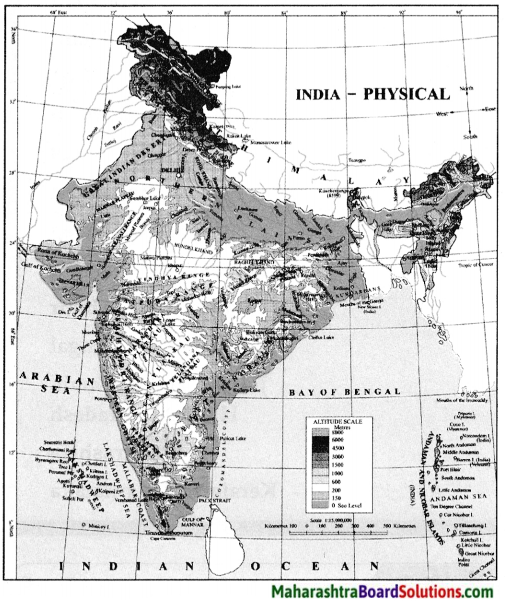
Study the physical map of India carefully and answer the questions:

Question 1.
Find the mountains and name them.
Answer:
The Himalayas, The Sahyadris, The Satpuda, The Vindhya range, Aravalli range.

Question 2.
Name the hills shown on the map.
Answer:
Nallamala hills, Mahedragiri, Malaygiri.

Maharashtra Board Class 5 EVS Solutions Part 1 Chapter 10 Getting to Know India

Question 3.
Find and name the plateaus in the map.
Answer:
Deccan Plateau, Telangana, Chotta Nagpur Plateau, Karnataka Plateau, Malwa Plateau.

Question 4.
Which rivers originate in the Himalayas and join the Indus? Consider the height and write the direction of their flow.
Answer:
River Jhelum, River Ravi, River Chenab and River Satluj join River Indus. They flow to the south.

Question 5.
Write the names of the major rivers which flow into the Coromandel Coast.
Answer:
River Kaveri and River Krishna.

Question 6.
Study the course of the Ganga, Narmada, Vainganga, Godavari and Kaveri rivers. Note the slope of the land in each basin and write the direction of the slope.
Answer:
River Ganga flows eastwards, River Narmada flows westwards, Vinganga flows southwards, Godavari and Kaveri flow eastwards.

Question 7.
Find the lakes on the map and name them.
Answer:
Wular, Dal, Chilka, Kolleru, Lonar and Pulicat Lake.

Question 8.
Find and name the gulfs and the direction in which they are located with respect to India.
Answer:
Gulf of Kachchh and Gulf of Khambhat in Gujarat (west), Gulf of Mannar in the south.

Maharashtra Board Class 5 EVS Solutions Part 1 Chapter 10 Getting to Know India

Question 9.
Study the water bodies on the three sides of India. Find their names and write the direction in which they are located.
Answer:
Arabian sea to the west, Bay of Bengal to the east and Indian ocean to the south.

Question 10.
Find the Lakshadweep, Andaman and Nicobar Island groups and write the names of some of the islands.
Answer:
In the Lakshadweep lies Chettlon, Andron, Kalpeni, Tree island. In the Andaman and Nicobar Islands lie Car Nicobar, South Andaman, Coco Island, North Andaman and Middle Andaman.

Question 11.
Which river basin is located in the northern plain of India?
Answer:
To the North of India lies the river basin of Ganga.

Study the political map of India given below and answer the questions:

Maharashtra Board Class 5 EVS Solutions Part 1 Chapter 10 Getting to Know India 1

Question 1.
Find our State. Colour it with your favourite colour and write the name of its capital.
Answer:
Maharashtra (Capital is Mumbai) colour it in red.

Maharashtra Board Class 5 EVS Solutions Part 1 Chapter 10 Getting to Know India

Question 2.
Which is the northernmost State?
Answer:
Jammu and Kashmir

Question 3.
Which is the southernmost State?
Answer:
Tamil Nadu

Question 4.
Colour the States to the north-east in different colours. Write their names and the names of their capitals.
Answer:

Name of State Capital Colour
(a) Arunachal Pradesh Itanagar Blue
(b) Assam Dispur Green
(c) Meghalaya Shillong Yellow
(d) Nagaland Kohima Pink
(e) Manipur Imphal Purple
(f) Mizoram Aizawl Black
(g) Tripura Agartala Orange

Question 5.
Colour the largest State in yellow and circle its capital.
Answer:
Colour Rajasthan in yellow and circle its capital Jaipur.

Question 6.
What do the names in red letters show?
Answer:
Names in red letters show Union territories.

Maharashtra Board Class 5 EVS Solutions Part 1 Chapter 10 Getting to Know India

Use your brain power!

Question 1.
Which is the State next to us which was formed in 2014?
Answer:
Telangana State

Question 2.
How many States are there in India?
Answer:
29 states

Question 3.
In which State is the Great Indian Desert mainly located?
Answer:
Rajasthan

Answer the questions given below with the help of map.

Question 1.
From where will we obtain saffron? Trace the most convenient route.
Answer:
We obtain saffron from Jammu and Kashmir. (Route from Srinagar – Chandigarh – New Delhi – Gujarat – Maharashtra)

Question 2.
In which States is tea grown?
Answer:
West Bengal and Assam

Maharashtra Board Class 5 EVS Solutions Part 1 Chapter 10 Getting to Know India

Question 3.
Find the route taken to bring cloves into our State and trace it.
Answer:
Cloves can be brought from Kerala – Karnataka – Goa – Maharashtra

Question 4.
Find the States in which apples are grown. Circle their names.
Answer:
Jammu and Kashmir and Himachal Pradesh.

Question 5.
Find the route to deliver oranges from Nagpur to Bikaner and trace it.
Answer:
Nagpur – Madhya Pradesh – Bikaner

Question 6.
Find a route to deliver coffee and mangoes to West Bengal and trace it.
Answer:
Coffee from Kerala – Chennai – Andhra Pradesh – Odisha – West Bengal.
Mangoes from Maharashtra
Nagpur – Chattisgarh – Odisha – West Bengal.

Maharashtra Board Class 5 EVS Solutions Part 1 Chapter 10 Getting to Know India

Question 7.
How will you send onions from Maharashtra to Arunachal Pradesh?
Answer:
Nashik – Nagpur – Chhatisgarh – Odisha – West Bengal – Assam – Arunachal Pradesh.

What’s the solution?

Question 1.
Harsh and Tanishka live in Mumbai. They want to see the Andaman and Nicobar islands. First they are going to see their uncle in Chennai. After that, they will visit the islands. To make this trip, which of the routes on the map on page 49 will they have to take? Will you help them by tracing this route on the map?
Answer:
Harsh and Tanishka can travel to Andaman and Nicobar by seaways as shown in the map with black dotted lines or by airways shown with green dash line. They can reach Port Blair.

Maharashtra Board Class 5 EVS Solutions Part 1 Chapter 10 Getting to Know India

Glossary:

1. tapers – diminish or reduce in thickness at one end.
2. lofty – of imposing height.
3. Cuisine – style or method of cooking.

Class 5 Environmental Studies Questions and Answers:
Our Emotional World Class 5 Questions And Answers EVS Chapter 20 Maharashtra Board

Balbharti Maharashtra State Board Class 5 Environmental Studies Solutions Chapter 20 Our Emotional World Notes, Textbook Exercise Important Questions and Answers.

5th Standard EVS 1 Lesson Number 20 Question Answer Our Emotional World Maharashtra Board

Std 5 EVS 1 Chapter 20 Question Answer

1. Fill in the blanks with the correct answers from the options given below:

Question (a)
Just as man is able to think, he is also …………….. .
(a) emotional
(b) sensational
(c) fascinating
Answer:
(a) emotional

Question (b)
We must always think about the …………………. in our friends first.
(a) vices
(b) virtues
(c) abnormalities
Answer:
(b) virtues

2. Answer in one sentence.

Question (a)
How does a balanced personality develop?
Answer:
A balanced personality develops, when we learn to cope with our emotions.

Question (b)
Why does our attitude of co-operation and understanding decrease?
Answer:
Our attitude of co-operation and understanding decreases when we become short tempered and stubborn.

Question (c)
What must we do after we have found the flaws in our nature?
Answer:
After we have found the flaws in our nature, we must try to correct them ourselves.

3. Answer in short.

Question (a)
What is meant by ‘coping with emotions’?
Answer:

  1. If someone does something wrong, we get angry.
  2. We must not lose our temper.
  3. We must be able to keep a balance between our thoughts and emotions.
  4. If we think properly, we can control or cope with our emotions.

Question (b)
What are the harmful effects of anger?
Answer:
The harmful effects of anger are:

  1. It affects our body and mind.
  2. We become short tempered and stubborn.
  3. Our attitude of co-operation and understanding decreases.
  4. We hurt others.
  5. We face consequence such as headaches, loss of sleep and dullness.

Question (c)
Why must we know our flaws?
Answer:
We must know our flaws so that
(a) We can improve upon them.
(b) Just because we are unable to do something, it does not mean that we stop trying to excel at what we can do.

Write how you will react:

Question (a)
Your teacher does not listen to you.
Answer:
I will be patient and wait for an opportunity to speak to my teacher.

Question (b)
Your parents ask for your opinion while making decisions.
Answer:
I will think on the matter and try to give my opinion.

Question (c)
Your friend got a big prize.
Answer:
I will be happy and congratulate him for his success.

Question (d)
Your classmates praise you.
Answer:
I will thank my friends.

Question (e)
Rohan insulted you in class.
Answer:
I will feel sad. But wait for the correct opportunity to speak to him about his behaviour.

What will you do in this situation?

Question (a)
Rohini won a prize in an essay competition.
Answer:
I will be happy and congratulate her for her good work.

Question (b)
Kavita refuses to eat her tiffin because she was angry.
Answer:
I will speak to her and tell her to control her anger and eat her tiffin.

Question (c)
Veena keeps herself to herself at school.
Answer:
I will try befriend her and make her involve in school activities.

Question (d)
Makarand says, “I can’t help it if I have a stubborn personality.”
Answer:
I will make Makarand understand that being stubborn leads to misunderstanding and hurting others.

Environmental Studies Part 1 Standard 5th Solutions Chapter 20 Our Emotional World Additional Important Questions and Answers

Fill in the blanks with the correct answers from the options given below:

Question 1.
……………… adjustments involves coping with your emotions, controlling and impressing them in a reasonable manner.
(a) Psychological
(b) Physical
(c) Emotional
Answer:
(c) Emotional

Question 2.
………………… is an emotion just like happiness
or sadness.
(a) Happiness
(b) Anger
(c) Sadness
Answer:
(b) Anger

Question 3.
If we speak about our flaws as openly as we speak about our talents, it will be to our ……………… .
(a) disadvantage
(b) advantage
(c) control
Answer:
(b) advantage

Question 4.
Human nature has many ………………….. aspects.
(a) similar
(b) different
(c) equal
Answer:
(b) different

Question 5.
Anger, joy, sorrow, jealousy, disappointment, fear etc. are all …………….. .
(a) emotions
(b) motions
(c) demotions
Answer:
(a) emotions

Question 6.
We should be able to strike a ……………….. between our thoughts and emotions.
(a) difference
(b) match
(c) balance
Answer:
(c) balance

Question 7.
If someone does something wrong, we get …………………. .
(a) angry
(b) happy
(c) sad
Answer:
(a) angry

Question 8.
It is natural to desire something but we must not be ………………… for it.
(a) hungry
(b) greedy
(c) emotional
Answer:
(b) greedy

Question 9.
If we think properly we can control our ………………….. .
(a) emotions
(b) hunger
(c) thirst
Answer:
(a) emotions

Question 10.
We get angry if we see someone being
(a) angry
(b) cursing
(c) ill-treating
Answer:
(c) ill-treating

Question 11.
We may be good at some subject, art or sport and just as ……………….. at another.
(a) good
(b) bad
(c) ugly
Answer:
(b) bad

Question 12.
Just because we are unable to do something it does not mean that we stop trying to ……………… at what we can do.
(a) learn
(b) excel
(c) diminish
Answer:
(b) excel

Question 13.
We must help each other to get rid of our ……………… .
(a) flaws
(b) friendship
(c) goodness
Answer:
(a) flaws

Question 14.
Once we know the flaws in our nature, we must try to …………………. them ourselves.
(a) try
(b) improve
(c) correct
Answer:
(c) correct

Answer in one sentence:

Question 1.
What is the adverse effect of anger?
Answer:
If anger cannot be controlled it will have adverse effect on our body and mind.

Question 2.
Name some human emotions.
Answer:
Anger, joy, sorrow, jealousy, disappointment, fear are some of human emotions.

Question 3.
What is emotional adjustment?
Answer:
Emotional adjustment is coping with our emotions, being able to control them and expressing them in a reasonable manner.

Question 4.
When do we become free from faults such as blaming other unneccessarily?
Answer:
When we learn to cope with our emotions, our personality becomes balanced, we are able to understand others and overcome difficult situations. It is then that we become free from faults such as blaming others unnecessarily.

Question 5.
Why is it necessary to know our flaws and talents?
Answer:
We must know our flaws and talents so that we can improve upon them.

Question 6.
How must we always think about our friends?
Answer:
We must always think about the good qualities or virtues in our friends.

Question 7.
Why must we know our flaws?
Answer:
Once we know the flaws in our nature, we can then try to correct them ourselves.

Question 8.
Why should the aspects of our nature that bothers us and others be changed?
Answer:
We must try hard to change this aspect as it may take the shape of flaws in our personality.

Can you tell?

Question (A)
Are the following persons coping well with their emotions? Put (✓) if they are, put (✗) if they aren’t.
Answer:
1. Ramesh told Suresh that Amit had said something bad about him. Suresh decided to react only after confirming the facts. (✓)
2. Chhaya and Meena usually make equal progress in their studies. The teacher praised Chhaya’s essay. This made Meena angry and she decided not to speak to Chhaya. (✗)
3. Dinesh took Manoj’s pen and pencil from his bag and hid them. Later, he said, ‘Sorry’ to Manoj and promised not to do it again. (✓)
4. Sunita wanted to go to the market with her mother, but for some reason, her mother had to leave early. Sunita was angry with her mother. But later, she asked her mother the reason why she had to leave early. Her anger subsided when she learnt the reason. (✗)

(B)

Question 1.
Manoj says, “I’m going to school!” and instead goes to the playground to play. Is this correct?
Answer:
No, what Manoj has done is incorrect.

Question 2.
What will you tell a friend who has a habit of borrowing things and not returning them on time?
Answer:
I will tell my friend that borrowing things from friends is not a good habit and even if any thing is borrowed it must be returned otherwise it is just like robbing.

What would you do?

Question 1.
Ranjit and Abhay are fighting over who gets to sit on the first bench. They are both very angry. They are close to throwing each other’s bags.
Answer:
I will try to make them understand that they can take turns to sit on the first bench instead
of fighting.

Question 2.
Hemant wants to take part in the kabbadi competition, but he is shy. He is nervous about telling it to the teacher.
Answer:
I would take Hemant to our sports teacher and tell him about Hemant’s desire to join the Kabaddi team.

Question 3.
Rekha accidently took Nisha’s notebook home.
Answer:
Rekha can call Nisha and inform her that the book is with her and promise to bring it the next day to school.

Glossary:

1. short-tempered – to get angry quickly
2. flaws – weakness.

Class 5 Environmental Studies Questions and Answers:
Substances, Objects and Energy Class 5 Questions And Answers EVS Chapter 24 Maharashtra Board

Balbharti Maharashtra State Board Class 5 Environmental Studies Solutions Chapter 24 Substances, Objects and Energy Notes, Textbook Exercise Important Questions and Answers.

5th Standard EVS 1 Lesson Number 24 Question Answer Substances, Objects and Energy Maharashtra Board

Std 5 EVS 1 Chapter 24 Question Answer

1. What’s the solution?

Question a.
We need to make a sherbet quickly for some guests. But we only have sugar candy in the house.
Answer:
We can pound sugar candy into a fine powder. When the powder is fine, it will quickly dissolve in water. Therefore we can make sherbet quickly.

Maharashtra Board Class 5 EVS Solutions Part 1 Chapter 24 Substances, Objects and Energy

Question b.
We need to rub salt on a corncob but only salt crystals are available.
Answer:
We can pound salt crystals. Either we can use mortar pestle or we can also crush the crystals of salt in a grinder. Such powdered salt can be easily applied on the corncob.

2. Use your brain power!

Question a.
Why do tablets of camphor decrease in size day by day ?
Answer:
Tablets of Camphor are in solid state. Camphor has a property to turn into gaseous state directly from a solid state. Therefore, camphor decreases in size gradually. One can also notice the fragrance of camphor as it turns into vapour.

Maharashtra Board Class 5 EVS Solutions Part 1 Chapter 24 Substances, Objects and Energy

Question b.
How do we save fuel by using public transport ?
Answer:
Each automobile vehicle needs fuel either in the form of petrol, diesel, or CNG. If all the people use a separate vehicle, the amount of fuel consumed would be much more. If many people start using public transport, fuel consumption would be reduced. A single bus or a train can carry many people and thus it can save lots of fuel.

3. Answer the following questions.

Question a.
When and why do clothes smell of naphthalene?
Answer:
The naphthalene balls are continuously converted into small particles in the gaseous state. These particles settle down on the clothes in which they are kept. Therefore if naphthalene balls are kept for a long time in the clothes, they smell of naphthalene due to these particles.

Question b.
In which states is water found in nature?
Answer:
Water is found in all three states in nature, solid, liquid and gaseous state. Ice is the solid state of water. Water in lakes, sea etc. are in liquid state and steam or vapour is the gaseous state of water.

Maharashtra Board Class 5 EVS Solutions Part 1 Chapter 24 Substances, Objects and Energy

Question c.
What is the difference between the solid, liquid and gaseous states of a substance?
Answer:
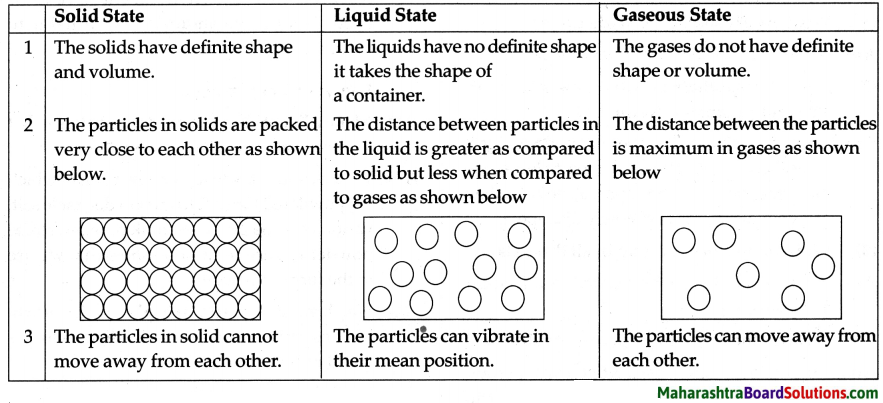
The differences in the solid, liquid and gaseous state of substances is given in the table below:
Maharashtra Board Class 5 EVS Solutions Part 1 Chapter 24 Substances, Objects and Energy 1

Question d.
What is meant by energy?
Answer:
The capacity to do the work is called energy.

Activities :

Question 1.
Make different kinds of articles from clay.

Maharashtra Board Class 5 EVS Solutions Part 1 Chapter 24 Substances, Objects and Energy

Question 2.
Visit a wood workshop and observe the work being done there.

Question 3.
Obtain some information about the power generation plants in Maharashtra and present it in the classroom.

Environmental Studies Part 1 Standard 5th Solutions Chapter 24 Substances, Objects and Energy Additional Important Questions and Answers

Fill in the blank with the correct answers from the options given below:

Question 1.
All substances we see around us are made up of very tiny ………
(a) dust
(b) particles
(c) mud
Answer:
(b) particles

Question 2.
…………….. of particles of any substance must come together to form a particle that can be visible to our eyes.
(a) Lakhs
(b) Thousands
(c) Hundreds
Answer:
(a) Lakhs

Maharashtra Board Class 5 EVS Solutions Part 1 Chapter 24 Substances, Objects and Energy

Question 3.
Naphthalene balls which are kept open are continuously converted to small particles in the …… state.
(a) liquid
(b) solid
(c) gaseous
Answer:
(c) gaseous

Question 4.
Different substances have different …………..
(a) material
(b) properties
(c) code
Answer:
(b) properties

Question 5.
…………… is required to do work.
(a) Energy
(b) Strength
(c) Health
Answer:
(a) Energy

Question 6.
When something burns energy is released in the form of …………..
(a) heat
(b) rain
(c) cold
Answer:
(a) heat

Question 7.
Energy in the form of motion is called ……… energy.
(a) Kinesthetic
(b) Kinetic
(c) Solar
Answer:
(b) Kinetic

Question 8.
Stores of …………….. and ……. which are used as fuels, on earth are limited.
(a) mineral oil
(b) uranium
(c) coal
Answer:
(a) mineral oil, (c) coal

Maharashtra Board Class 5 EVS Solutions Part 1 Chapter 24 Substances, Objects and Energy

Question 9.
Energy obtained from sun is called …………… energy
(a) lunar
(b) solar
(c) tidal
Answer:
(b) solar

Question 10.
Energy obtained by breaking the tiniest particle of a substance is called …
(a) solar
(b) atomic
(c) kinetic
Answer:
(b) atomic

Question 11.
Sunlight, wind and water are ……………. sources of energy
(a) exhaustible?
(b) depleting
(c) non-exhaustible
Answer:
(c) non-exhaustible

Question 12.
When iron or copper is made smooth with a file, we get …………….. of iron or copper.
(a) particles
(b) soil
(c) saudust
Answer:
(a) particles

Question 13.
Liquids are also made of small…….
(a) droplets
(b) particles
(c) dust
Answer:
(b) particles

Maharashtra Board Class 5 EVS Solutions Part 1 Chapter 24 Substances, Objects and Energy

Question 14.
…………… is found in three states – solid, liquid and gaseous.
(a) Mineral oil
(b) Carbon
(c) Water
Answer:
(c) Water

Question 15.
In nature, every substance occurs in a………… state.
(a) special
(b) specific
(c) partial
Answer:
(b) specific

Question 16.
Aluminium and coal are is. ………. state.
(a) solid
(b) liquid
(c) gaseous
Answer:
(a) solid

Question 17.
Kerosene and petrol are in ……
(a) solid
(b) liquid
(c) gaseous
Answer:
(b) liquid

Maharashtra Board Class 5 EVS Solutions Part 1 Chapter 24 Substances, Objects and Energy

Question 18.
Nitrogen and Oxygen are in … ………….state.
(a) solid
(b) liquid
(c) gaseous
Answer:
(c) gaseous

Question 19.
The capacity of a body to do work is called
(a) work out
(b) energy
(c) exercise
Answer:
(b) energy

Question 20.
When petrol or diesel burns in a motor vehicle, …………… gets released.
(a) fire
(b) fuel
(c) energy
Answer:
(c) energy

Question 21.
Machines can be run using ……………….
(a) energy
(b) fuels
(c) water
Answer:
(b) fuels

Maharashtra Board Class 5 EVS Solutions Part 1 Chapter 24 Substances, Objects and Energy

Question 22.
Coal, diesel, CNG, LPG, petrol are all substances from which energy is obtained in form of
(a) heat
(b) rain
(c) cold
Answer:
(a) heat

Question 23.
When a person or vehicle moves, heat energy gets converted into …….
(a) electricity
(b) rain
(c) motion
Answer:
(c) motion

Question 24.
Electricity is also a form of ………….
(a) machine
(b) energy
(c) heat
Answer:
(b) energy

Question 25.
We use ……………. to run the T.V.
(a) wires
(b) plugs
(c) electricity
Answer:
(c) electricity

Maharashtra Board Class 5 EVS Solutions Part 1 Chapter 24 Substances, Objects and Energy

Question 26.
In a solar cooker …………………. energy is used.
(a) solar
(b) electricity
(c) L.P.G.
Answer:
(a) solar

Question 27.
Plants use……. to prepare their food.
(a) LPG
(b) induction
(c) sunlight
Answer:
(c) sunlight

Question 28.
When we burn substances like coal or mineral oil, the …………………. energy, they contain is converted into heat energy.
(a) solar
(b) stored
(c) lunar
Answer:
(b) stored

Question 29.
Stores of coal and mineral oil on earth are
(a) unlimited
(b) limited
(c) plenty
Answer:
(b) limited

Maharashtra Board Class 5 EVS Solutions Part 1 Chapter 24 Substances, Objects and Energy

Question 30.
………… batteries produce electricity using sunlight
(a) Water
(b) Solar
(c) Tidal
Answer:
(b) Solar

Name the following:

Question 1.
Any three substances found in solid state.
Answer:
Iron, copper, aluminium, wood

Question 2.
Three substances found in liquid state.
Answer:
Water, milk, cough syrup.

Question 3.
Three substances found in gaseous state.
Answer:
Naphthalene balls, iodine crystals

Maharashtra Board Class 5 EVS Solutions Part 1 Chapter 24 Substances, Objects and Energy

Question 4.
Substances which goes into gaseous state directly from solid state.
Answer:
Naphthalene balls

Question 5.
Properties of substances.
Answer:
Transparency, hardness, colour, smell, solubility in water.

Question 6.
Fuels used for running machines.
Answer:
LPG, CNG, coal, diesel, petrol.

Question 7.
Examples of kinetic energy.
Answer:
Moving wind mill, sailing boats, running water, moving car etc.

Question 8.
Forms of energy.
Answer:
Sound, heat, light, electricity.

Question 9.
Main source of energy used by us.
Answer:
Electricity

Maharashtra Board Class 5 EVS Solutions Part 1 Chapter 24 Substances, Objects and Energy

Question 10.
Energy sources which do not cause pollution
Answer:
Wind energy, solar energy.

Answer in one sentence :

Question 1.
What are all subtances made up of?
Answer:
All substances are made up of fine particles.

Question 2.
Why do naphthalene balls grow smaller in size and gradually disappear?
Answer:
Naphthalene when left open continuously gets converted into small gaseous particles, so, as these particles leave the naphthalene balls, they grow smaller is size and slowly disappear.

Question 3.
Which substance is found in all three states?
Answer:
Water is found in all three states – solid, liquid and gaseous.

Question 4.
What are the different properties of substance?
Answer:
Different substances have different properties, like hardness, transparency, colour, smell, solubility in water etc.

Maharashtra Board Class 5 EVS Solutions Part 1 Chapter 24 Substances, Objects and Energy

Question 5.
What is ‘energy?
Answer:
The capacity of a body to do work is called energy

Question 6.
How is energy released?
Answer:
When petrol or diesel burns in a motor vehicle, energy gets released.

Question 7.
Name some substance from which energy is obtained.
Answer:
Coal, diesel, CNG, LPG, petrol are all substances from which energy is obtained.

Question 8.
What is Kinetic energy?
Answer:
Energy in the form of motion is called Kinetic energy.

Question 9.
Why should we find alternate sources of energy?
Answer:
Stores of coal and mineral oil on earth are very limited and fast depleting therefore we must find alternate sources of energy.

Maharashtra Board Class 5 EVS Solutions Part 1 Chapter 24 Substances, Objects and Energy

Question 10.
What are solar batteries?
Answer:
Batteries which produce electricity using sunlight are called solar batteries.

Question 11.
Why should we make a habit of using minimum amount of electricity?
Answer:
In any method of electricity generation, resources from the environment have to be used. Hence, we should make a habit to conserve electricity

Use your brain power!

Question 1.
What uses of heat energy do we see in our daily life?
Answer:
We use heat energy to cook food, to heat water, to press our clothes, to keep us warm during cold winters in areas where temperature is very low, etc.

Question 2.
Why do tablets of camphor decrease in size day by day?
Answer:
Camphor particles present in the tablets escape by getting converted directly to gaseous state. Therefore the tablets of camphor decrease in size day by day.

Maharashtra Board Class 5 EVS Solutions Part 1 Chapter 24 Substances, Objects and Energy

Question 3.
How do we save fuel by using public transport?
Answer:
If people drive car instead of using public transport while going to work, more fuel will be burnt, as each car will burn the fuel to release energy and work. However if public transport is used. We need to use fuel, only for one transport vehicle. Hence it will save a lot of fuel if people use the public transport.

Answer the following questions:

Question 1.
What is meant by energy? Name the sources of energy
Answer:
The capacity of a body to do work is called energy. Energy is obtained by burning fuel is in the form of heat. This heat is used to do work. The sources of energy are the sun, coal, diesel, CNG, LPG, petrol, wind, moving water and electricity

Question 2.
What is the original source of energy for the electricity produced at a thermal power station? How is electricity generated?
Answer:
In a thermal power station coal is the original source of energy. Here coal is burnt to release heat. The heat generated is utilised to convert water to steam. Then steam is used to rotate the turbines. As the turbine rotates electricity is produced.

Maharashtra Board Class 5 EVS Solutions Part 1 Chapter 24 Substances, Objects and Energy

Can you tell?

1. Write a few lines on the black board with a chalk. Now observe the chalk.

Question a.
What change do you see in the chalk?
Answer:
The chalk becomes smaller in size, after writing.

Question b.
Why did the chalk become smaller in size after writing on the board?
Answer:
When we wrote on the board the pieces of chalk stick to board, therefore the chalk became smaller in size.

2. Wipe the board with a duster and then tap the duster against the table.

Question a.
What do you see?
Answer:
A fine white particles of chalk fell of the duster when we tapped it against the table.

Question b.
From where did these white particles come?
Answer:
When we rubbed the board, the chalk particles from the board stuck to the duster and when we tapped the duster these chalk particles fell.

Question c.
If there is a sudden shower, we take shelter under a roof on the road side. Even though the rain does not fall on us directly we get wet to some extent why?
Answer:
The raindrops slow down the roof and fall on the ground. They break into fine droplets when they fall and bounce off the ground. These droplets make us wet. Hence though the rain does not fall on us directly we get wet to some extent.

Maharashtra Board Class 5 EVS Solutions Part 1 Chapter 24 Substances, Objects and Energy

Question d.
Asmita went to buy an earthen pot. There she saw many things kept for sale. How did she identify what she needed? From what substance had the potter made all the things?
Answer:
Asmita identified the things kept from their shape and colour. The potter had made all the things using clay.

Question e.
What is the difference between a substance and an object?
Answer:
Difference between substance and object is given below:

Substance Object
1. Substances are made up of tiny particles. 1. Objects are made using substances.
2. Substances may or may not have definite shape. They occur in a specific state. 2. Objects have definite shape. Their parts are put together in a particular way.
3. Wood, aluminium, coal, iron etc are examples of substances. 3. Table, chair, flower pots, lamp etc. are examples of objects.

Question f.
There is a car. Its tank is full of fuel, but it does not move. Why is that?
Answer:
The energy has to be released from the fuel to make the car move. The energy is released when the petrol burns. The petrol starts burning only after we turn on the car engine. Since the engine is not on, the car does not move even when its tank is full of fuel.

Question g.
When we have run a long distance, we feel tired. We have to stop. Why is that?
Answer:
We need energy to run. Hence when we run a long distance, the food present in the body is continuously burn to release energy. This energy is used to do the work of running. After running a long distance the food gets exhausted and the energy released decreases and therefore we feel tired and we stop.

Maharashtra Board Class 5 EVS Solutions Part 1 Chapter 24 Substances, Objects and Energy

Glossary :

  1. fossil fuel – fuel formed in the earth o from plant or animal remains
  2. exhaustible – the resources which can not be renewed or recycled
  3. depleting – reduction in quantity
  4. corncob – core of Indian com.

Class 5 Environmental Studies Questions and Answers:
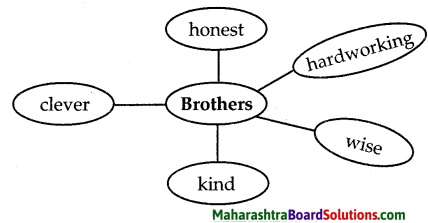
Maps – Our Companions Class 5 Questions And Answers EVS Chapter 9 Maharashtra Board

Balbharti Maharashtra State Board Class 5 Environmental Studies Solutions Chapter 9 Maps – Our Companions Notes, Textbook Exercise Important Questions and Answers.

5th Standard EVS 1 Lesson Number 9 Question Answer Maps – Our Companions Maharashtra Board

Std 5 EVS 1 Chapter 9 Question Answer

1. Make a list of the various landforms in your surroundings. Draw one of the landforms in your notebook using one of the methods of showing landforms.

Maharashtra Board Class 5 EVS Solutions Part 1 Chapter 9 Maps - Our Companions 1

2. In the following sentences, underline the words that represent landform and prepare signs or symbols for them.

Question (a)
Sonali lives just beyond Mount Takmak.
Answer:
Mount (Δ)

Maharashtra Board Class 5 EVS Solutions Part 1 Chapter 9 Maps - Our Companions

Question (b)
Nilesh has gone on a trip to Gharapuri Island.
Answer:
Island

3. Prepare signs and symbols for the following components:

Question 1.
Prepare signs and symbols for the following components:
House, hospital, factory, park, playground, road, hill, river.
Answer:
Maharashtra Board Class 5 EVS Solutions Part 1 Chapter 9 Maps - Our Companions 2

4. The given map shows height through the use of colours. However, one colour representation is wrong. Write which colour would be correct in its place.

Question 1.
The given map shows height through the use of colours. However, one colour representation is wrong. Write which colour would be correct in its place.
Answer:
In place of blue the colour for low elevation to be used should have been green.

Maharashtra Board Class 5 EVS Solutions Part 1 Chapter 9 Maps - Our Companions

Use your brain power!

Question 1.
will you help them by writing the meanings of each sign and symbol?
Answer:
Maharashtra Board Class 5 EVS Solutions Part 1 Chapter 9 Maps - Our Companions 3
Maharashtra Board Class 5 EVS Solutions Part 1 Chapter 9 Maps - Our Companions 4

Environmental Studies Part 1 Standard 5th Solutions Chapter 9 Maps – Our Companions Additional Important Questions and Answers

Fill in the blanks with the correct answers from the options given below:

Question 1.
In ancient times, maps were mainly used for ……………… .
(a) weather forecast
(b) wars
(c) tourism
Answer:
(b) wars

Question 2.
The ………………. colour is used to indicate water bodies on a map.
(a) grey
(b) green
(c) blue
Answer:
(c) blue

Maharashtra Board Class 5 EVS Solutions Part 1 Chapter 9 Maps - Our Companions

Question 3.
The most modem method of indicating height on a map is …………….. method.
(a) contour line
(b) digital elevation
(c) layer tinting
Answer:
(b) digital elevation

Question 4.
The foremost mapmaking institute in India is ………………. .
(a) Survey of India
(b) Mapping of India
(c) Survey of Map
Answer:
(a) Survey of India

Question 5.
The Survey of India headquarters are in
(a) Shimla
(b) Dehradun
(c) Delhi
Answer:
(b) Dehradun

Question 6.
The Survey of India was established in
(a) 1867
(b) 1967
(c) 1767
Answer:
(c) 1767

Question 7.
The land in our environment is not of the same everywhere.
(a) length
(b) height
(c) breadth
Answer:
(b) height

Question 8.
The univemess of land gives rise to various land shapes creating different …………….. .
(a) land forms
(b) strategy
(c) maps
Answer:
(a) land forms

Question 9.
There are different ……………….. of showing land forms on a map.
(a) knowledge
(b) questions
(c) methods
Answer:
(c) methods

Maharashtra Board Class 5 EVS Solutions Part 1 Chapter 9 Maps - Our Companions

Question 10.
The ………………. and ………………. of land cannot be shown easily on a piece of paper.
(a) depth
(b) width
(c) height
Answer:
(a) depth & (c) height

Question 11.
The height of the land is measured from
(a) ground-level
(b) snow-line
(c) sea-level
Answer:
(c) sea-level

Question 12.
When there is less distance between the contour lines, the slope is ………………… .
(a) steep
(b) gentle
(c) level
Answer:
(a) steep

Question 13.
When the distance between the contour lines is great, the slope is
(a) steep
(b) gentle
(c) level
Answer:
(b) gentle

Question 14.
In layer tinting method, each colour indicates a specific ……………….. .
(a) weight
(b) depth
(c) height
Answer:
(c) height

Question 15.
In digital elevation method, the ………………… is obtained through man-made satellites.
(a) information
(b) technology
(c) height
Answer:
(a) information

Question 16.
Using computers, we can find the height of each point on a ……………………… map.
(a) plain
(b) digital
(c) military
Answer:
(b) digital

Maharashtra Board Class 5 EVS Solutions Part 1 Chapter 9 Maps - Our Companions

Question 17.
Standard signs and symbols are used to make the ………………….. easy to read.
(a) road
(b) board
(c) map
Answer:
(c) map

Question 18.
……………….. are miniature drawings of the respective objects.
(a) symbols
(b) signs
(c) maps
Answer:
(a) symbols

Maharashtra Board Class 5 EVS Solutions Part 1 Chapter 9 Maps - Our Companions

2. Match the following:

Question 1.
Match the following:
Maharashtra Board Class 5 EVS Solutions Part 1 Chapter 9 Maps - Our Companions 4.1
Answer:
1 – c, 2 – e, 3 – a, 4 – b, 5 – d

Answer in one sentence:

Question 1.
What are different ways of showing elevation of land on a map?
Answer:
The different ways of showing elevation of land on a map are contour line method, layer tinting method and digital elevation method.

Question 2.
What are contour lines?
Answer:
Lines on a map joining places having same height are called contour lines.

Question 3.
How are digital elevation model prepared?
Answer:
Digital elevation model is prepared with the information obtained through manmade satellites and help of computers.

Question 4.
What are physical maps used for?
Answer:
Physical maps are used in military operations, tourism, drawing up mountaineering routes, in making regional development projects etc.

Maharashtra Board Class 5 EVS Solutions Part 1 Chapter 9 Maps - Our Companions

Question 5.
How are conventional signs drawn?
Answer:
Conventional signs are down in the form of letters or geometrical shapes, for example, lines, circle, triangle, dots etc.

Question 6.
How are conventional symbols drawn?
Answer:
Conventional symbols are miniature drawings of the respective objects for eg, temples, mosque, forts etc.

Question 7.
Name some land forms.
Answer:
Mountains, valleys, plateaus, plains and islands are different land forms.

Question 8.
How were maps used during ancient times?
Answer:
During ancient times, maps were mainly used in wars.

Question 9.
From where is the height of land measured?
Answer:
The height of land is measured from sea-level.

Question 10.
How does contour line method help?
Answer:
Contour line method helps us to understand the slope of the land and the height of different places.

Maharashtra Board Class 5 EVS Solutions Part 1 Chapter 9 Maps - Our Companions

Question 11.
In layer tinting method, what do colours indicates?
Answer:
In layer tinting method, each colour indicates a specific height.

Question 12.
Why are signs and symbols used in maps?
Answer:
Standard signs and symbols are used to make the map easy to read.

Question 13.
Which is the foremost map making institute in India?
Answer:
The ‘Survey of India’ is the foremost mapmaking institute in India.

Question 14.
What are the topographic maps made by ‘Survery of India’ known for all over the world?
Answer:
The topographic maps made by ‘Survey of India’ are known all over the world for their accuracy.

Maharashtra Board Class 5 EVS Solutions Part 1 Chapter 9 Maps - Our Companions

Give geographical reasons:

Question 1.
Standard signs and symbols are used to make the map easy to read.
Answer:

  1. Many people make use of maps.
  2. Maps show various components.
  3. If these components are shown on different maps in different ways, it will be difficult to understand them.
  4. Therefore, standard signs and symbols are used to make the map easy to read.

Answer in brief:

Question 1.
Explain – Layer tinting method.
Answer:

  1. Layer tinting method is based on contour lines.
  2. The space between the contour lines is filled with colour.
  3. Each colour indicates a specific height.
  4. For example, water bodies – blue colour, high elevated land yellow.

Question 2.
Write a note on the ‘Survey of India’.
Answer:

  1. The ‘Survey of India’ is the foremost map-making institute in India.
  2. It was established in 1767.
  3. It makes a large number of topographic maps of the Indian subcontinent on various scales by conducting field surveys.
  4. These maps are accurate maps.
  5. Its headquarters are in Dehradun in Uttarakhand.

Use your brain power!

Question 1.
Join the dots that show places of the same height. What method of showing the landforms on a map have you used here?
Maharashtra Board Class 5 EVS Solutions Part 1 Chapter 9 Maps - Our Companions 5
Answer:
Contour line method.

Maharashtra Board Class 5 EVS Solutions Part 1 Chapter 9 Maps - Our Companions

Question 2.
A map made by the layer tinting method is given in another chapter. Find the map and write its caption in the blank box below:
Answer:
Maharashtra Board Class 5 EVS Solutions Part 1 Chapter 9 Maps - Our Companions 6

Can you tell?

Question 1.
In map A, how has the height of the land ban shown?
Answer:
Lines which are called contours.

Question 2.
Why have colours been used in map B?
Answer:
The colours between the contour lines shows the difference in the physical set up.

Question 3.
How is map C different from the other two maps?
Answer:
In map C we can directly observe the differences in the height of landforms.

Question 4.
In which direction is the highest point in map A, B, C?
Answer:
South East

Maharashtra Board Class 5 EVS Solutions Part 1 Chapter 9 Maps - Our Companions

Question 5.
In which map can the landforms be seen more clearly?
Answer:
Map B.

Question 6.
Can you tell?
Identify the following sign and symbols and write their names in the boxes.
Answer:
Maharashtra Board Class 5 EVS Solutions Part 1 Chapter 9 Maps - Our Companions 7

Glossary:

  1. elevation – fact of raising or being raised
  2. contour – an outline representing the shape of form
  3. foremost – most prominent.
  4. conventional – based on what is generals done or believed

Class 5 Environmental Studies Questions and Answers:

Food for All Class 5 Questions And Answers EVS Chapter 12 Maharashtra Board

Balbharti Maharashtra State Board Class 5 Environmental Studies Solutions Chapter 12 Food for All Notes, Textbook Exercise Important Questions and Answers.

5th Standard EVS 1 Lesson Number 12 Question Answer Food for All Maharashtra Board

Std 5 EVS 1 Chapter 12 Question Answer

1. What’s the solution?

Question 1.
The plant in the pot is not growing well.
Answer:
Pesticides must be sprayed and manure should be added to the soil, then the plant in the pot will grow.

Maharashtra Board Class 5 EVS Solutions Part 1 Chapter 12 Food for all

2. Use your brainpower!

Question 1.
What is the purpose of storing foodgrain in our house?
Answer:
We store food in our house so that we have food to suffice when food is not available or there is a shortage, or during difficult times like floods, famine or earthquakes.

3. Find and correct the incorrect statements:

Question (a)
There is only one method of farming.
Answer:
Incorrect, lot of improvised methods are brought about through research.

Question (b)
India is an agricultural country.
Answer:
Correct.

Question (c)
Use of improved seeds does not lead to higher yields.
Answer:
Incorrect, use of improved seeds leads to higher yield.

4. Answer the following:

Question (a)
What are the advantages of using improved seeds?
Answer:
1. Nowadays, improved seeds are developed through research.
2. These seeds have a higher yield and can resist pest attacks.
3. Some varieties of these seeds become ripe for harvesting in a shorter period while some give a higher yield even with a low supply of water.

Question (b)
Which are the modem methods of irrigation? What are their advantages?
Answer:
1. Drip irrigation and sprinkle irrigation are the two modem methods of irrigation.
2. These methods ensure that the required amount of water drips only near the plants.
3. Thus, full use is made of the available water and there is no wastage.

Maharashtra Board Class 5 EVS Solutions Part 1 Chapter 12 Food for all

Question (c)
Describe the ‘Drip irrigation’ method.
Answer:
1. The ‘Drip irrigation’ method makes use of pipes with holes.
2. This ensures that the required amount of water drips only near the plants.
3. This method makes full use of the water available without wasting it.

Question (d)
What are the reasons due to which growing crops are damaged?
Answer:
Diseases and pest attacks are the reasons due to which growing crops are damaged.

Question (e)
What is done to avoid the damage to crops?
Answer:
As a remedy, insecticides and pesticides are sprayed on crops or certain chemicals are rubbed on the seeds before sowing to avoid damage to crops.

Question (f)
What causes the fertility of the soil to diminish?
Answer:
1. Overwatering makes the land saline and fallow.
2. Overuse of chemical fertilisers leads to accumulation of excessive chemicals in the soil.
3. This reduces the fertility of the soil and reduces the productivity.

Question (g)
What changes has modern technology brought about in the methods of farming?
Answer:

  1. Improve seeds having better yield.
  2. Modem methods of irrigation.
  3. Availability of fertilizers to improve productivity.
  4. These modern technological methods have brought about tremendous improvement in the methods of farming.

Question (h)
What methods are used to preserve food- grains?
Answer:
1. To prevent damage by pests, chemicals are sprayed at the place of storage or all around it.
2. Neem leaves or some protective chemicals are mixed in the grain as their smell repels insects.
3. Storage places are kept dry and airy to prevent fungus formation.

Maharashtra Board Class 5 EVS Solutions Part 1 Chapter 12 Food for all

Question (i)
How is water made available for farming?
Answer:
1. Huge quantities of water are stored by building dams and bunds on rivers to obstruct the flow of water downstream.
2. Improved methods of irrigation are used which provide enough water to the plants and at the same time, help to save a lot of water.

5. Match the following:

Question 1.
Match the following:

‘A’ ‘B’
1. Grain stored in a damp place (a) Prevents growth of fungus on the grain
2. Grain stored in dry air (b) Prevents insect infestation
3. Adding proper chemicals to the stored grain (c) Fungus attach

Answer:

‘A’ ‘B’
1. Grain stored in a damp place (c) Fungus attach
2. Grain stored in dry air (a) Prevents growth of fungus on the grain
3. Adding proper chemicals to the stored grain (b) Prevents insect infestation

Environmental Studies Part 1 Standard 5th Solutions Chapter 12 Food for All Additional Important Questions and Answers

Fill in the blanks with the correct answers from the options given below:

Question 1.
We get food from ……………… .
(a) shops
(b) plants
(c) school
Answer:
(b) plants

Maharashtra Board Class 5 EVS Solutions Part 1 Chapter 12 Food for all

Question 2.
To get food, we sow grains in fields and plant ……………….. trees in ochards.
(a) fruit
(b) jowar
(c) sweet potatoes
Answer:
(a) fruit

Question 3.
About …………………. of the land of our country is used for agriculture.
(a) 50%
(b) 60%
(c) 70%
Answer:
(b) 60%

Question 4.
The agricultural season from June to October is called the ……………… season.
(a) kharif
(b) rabi
(c) summer
Answer:
(a) kharif

Question 5.
The agricultural season from October to March is called the ………………….. season.
(a) kharif
(b) rabi
(c) summer
Answer:
(b) rabi

Question 6.
The crops grown from March to June are called ………………….. crops.
(a) winter
(b) monsoon
(c) summer
Answer:
(c) summer

Question 7.
Every farmer wishes to get a good ……………… .
(a) holiday
(b) harvest
(c) sleep
Answer:
(b) harvest

Maharashtra Board Class 5 EVS Solutions Part 1 Chapter 12 Food for all

Question 8.
A good harvest provides the farmer a ……………. income.
(a) good
(b) bad
(c) ugly
Answer:
(a) good

Question 9.
The harvested crop must be ………………. safely.
(a) protected
(b) collected
(c) stored
Answer:
(c) stored

Question 10.
The population of our country is ………………. .
(a) increasing
(b) decreasing
(c) diminishing
Answer:
(a) increasing

Question 11.
In the traditional methods of agriculture ploughing was carried out with the help of
(a) oxen
(b) cow
(c) buffalo
Answer:
(a) oxen

Question 12.
A ‘mot’ driven with the help of …………………… was used to draw water from the well.
(a) cow
(b) dogs
(c) oxen
Answer:
(c) oxen

Maharashtra Board Class 5 EVS Solutions Part 1 Chapter 12 Food for all

Question 13.
Farmers now carry out all their tasks with the help of ………………… .
(a) machines
(b) oxens
(c) bullocks
Answer:
(a) machines

Question 14.
Improved seeds are developed through ………………… .
(a) ploughing
(b) studying
(c) research
Answer:
(c) research

Question 15.
Improved seeds have a higher ………………. .
(a) yield
(b) field
(c) goals
Answer:
(a) yield

Question 16.
Crops grow well if they are ………………. at the right time.
(a) poltered
(b) tilled
(c) watered
Answer:
(c) watered

Question 17.
Dams and bunds help to raise the levels of …………….. .
(a) well water
(b) ground water
(c) rain water
Answer:
(b) ground water

Question 18.
Crops were traditionally watered through
(a) canals
(b) streams
(c) rivers
Answer:
(a) canals

Question 19.
Drip and sprinkle irrigation are …………………. methods of irrigation.
(a) urban
(b) rural
(c) modern
Answer:
(c) modern

Question 20.
If the same crops are grown frequently in a field, the ………………. of the soil decreases.
(a) fertility
(b) water
(c) manure
Answer:
(a) fertility

Maharashtra Board Class 5 EVS Solutions Part 1 Chapter 12 Food for all

Question 21.
We have to add fertilizers to the soil to restore its ……………… .
(a) irrigation
(b) productivity
(c) yield
Answer:
(b) productivity

Question 22.
Fertilizers provide the required ………………. substance to the crop.
(a) productive
(b) nutritive
(c) chemical
Answer:
(b) nutritive

Question 23.
Natural fertilizers are called
(a) manures
(b) chemicals
(c) pesticides
Answer:
(a) manures

Question 24.
…………………. makes the land saline and fallow.
(a) Manure
(b) Pesticides
(c) Overwatering
Answer:
(c) Overwatering

Question 25.
Disease and pest attacks can ………………… crops in the field.
(a) damage
(b) restore
(c) revive
Answer:
(a) damage

Question 26.
The grain is dried well in the sun and filled in
(a) pots
(b) tanks
(c) sacks
Answer:
(c) sacks

Question 27.
Storage places are always kept dry and airy to prevent ………………… formation.
(a) colour
(b) fungus
(c) insect
Answer:
(b) fungus

Question 28.
All the time, plants are busy ………………… the food they need.
(a) producing
(b) mincing
(c) cooking
Answer:
(a) producing

Question 29.
Plants ……………….. food in their stems or roots.
(a) eat
(b) produce
(c) store
Answer:
(c) store

Maharashtra Board Class 5 EVS Solutions Part 1 Chapter 12 Food for all

Question 30.
In India, due to the improved methods of cultivation, we now produce plenty of ………………….. .
(a) grass
(b) plants
(c) foodgrains
Answer:
(c) foodgrains

Question 31.
The surplus foodgrain is stored in huge ……………………. .
(a) godowns
(b) house
(c) warehouse
Answer:
(c) warehouse

Question 32.
Today our country is ………………… as far as production of foodgrains is concerned.
(a) self-reliant
(b) self-help
(c) self-study
Answer:
(a) self-reliant

Question 33.
………………… was responsible to bring about the Green Revolution in India.
(a) Dr. M. S. Swaminathan
(b) Tukdoji Maharaj
(c) Sant Gadgebaba
Answer:
(a) Dr. M. S. Swaminathan

Question 34.
In ……………. our country too enacted a food security law.
(a) 2013
(b) 2014
(c) 2015
Answer:
(a) 2013

Question 35.
Agricultural schools have also been started for
(а) scholars
(b) students
(c) farmers
Answer:
(c) farmers

Answer in one sentence:

Question 1.
What percent of land is used for agriculture in our country?
Answer:
About 60% of the land in our country is used for agriculture.

Question 2.
Name the two main agricultural seasons in our country.
Answer:
The Kharif and the Rabi seasons are the two main agricultural seasons.

Maharashtra Board Class 5 EVS Solutions Part 1 Chapter 12 Food for all

Question 3.
What is Kharif season?
Answer:
The season from June to October when crops are watered mainly by rain, it is called Kharif season.

Question 4.
What is Rabi season?
Answer:
The season from October to March when the rain soaked soil, retreating monsoon and dew water the crops, it is Rabi season.

Question 5.
What are summer crops?
Answer:
Crops grown from March to June are called summer crops.

Question 6.
What is essential for a good harvest?
Answer:
Fertile land, good quality seeds and fertilizers and availability of water are essential for a good harvest.

Question 7.
How has it been possible to fulfill the needs of all the people?
Answer:
Though the population of the country is increasing, the needs of the people are fulfilled because of the modern improved methods of agriculture.

Question 8.
How did the oxen help the fanner, in the traditional methods of agriculture?
Answer:
In the traditional method of agriculture, ploughing, tilling, harvesting, threshing as well as drawing water from the well was all done with the help of an oxen.

Question 9.
What helps farmers to do all their work?
Answer:
The farmer carries out all his tasks with the help of machines.

Maharashtra Board Class 5 EVS Solutions Part 1 Chapter 12 Food for all

Question 10.
Traditionally how were crops watered?
Answer:
Crops were traditionally watered through canals.

Question 11.
Which are the modem methods of irrigation?
Answer:
Drip irrigation and sprinkle irrigation are the two modem methods of irrigation.

Question 12.
What is sprinkle irrigation?
Answer:
Sprinkle irrigation makes use of sprinklers of different sizes that spray water directly on plants.

Question 13.
What happens when the same crops are grown frequently in a field?
Answer:
If the same crops are grown frequently in a field, the fertility of the soil decreases.

Question 14.
What do fertilizers do to the soil?
Answer:
Fertilizers provide the required nutritive substances to the crop and restores its productivity.

Question 15.
Which are the two types of fertilizers?
Answer:
Natural and chemical are the two types of fertilizers.

Question 16.
How is manure obtained?
Answer:
Manure is obtained from materials available in nature like green waste and animal dung.

Maharashtra Board Class 5 EVS Solutions Part 1 Chapter 12 Food for all

Question 17.
How are chemical fertilizers made?
Answer:
Chemical or artificial fertilizers are mixtures of different chemical substances in specific proportions, useful for agriculture.

Question 18.
What happens to soil when it is over-watered?
Answer:
Overwatering makes the land saline and fallow.

Question 19.
Where do plants store their food?
Answer:
Plants store their food in their stems or roots.

Question 20.
What is done to the surplus foodgrain, in India?
Answer:
In India, the surplus foodgrain is stored in huge warehouses.

Question 21.
Who gets credit for the research that led to ‘Green Revolution’?
Answer:
Dr. M. S. Swaminathan gets credit for the research that led to ‘Green Revolution’.

Maharashtra Board Class 5 EVS Solutions Part 1 Chapter 12 Food for all

Question 22.
What is ‘Green Revolution’?
Answer:
Improved quality of seeds of wheat and rice that led to tremendous increase in the production of these foodgrains is called ‘Green Revolution’.

Question 23.
What are ‘Food Security laws’?
Answer:
Laws to ensure that every person gets sufficient food according to his need are ‘Food Security laws’.

Question 24.
What is Organic farming?
Answer:
Farming that relies on natural materials is called organic farming.

Maharashtra Board Class 5 EVS Solutions Part 1 Chapter 12 Food for all

What are the benefits of ‘Organic farming’?

Question 1.
What are the benefits of ‘Organic farming’?
Answer:
1. In ‘Organic farming’, the nutritive substances in the soil are retained.
2. The organic pesticides used in this method have no harmful effects on those who eat the produce.
3. The grain grown by this method is nutritious and also good to taste. That is why farmers have begun to opt for organic farming methods.

Class 5 Environmental Studies Questions and Answers:
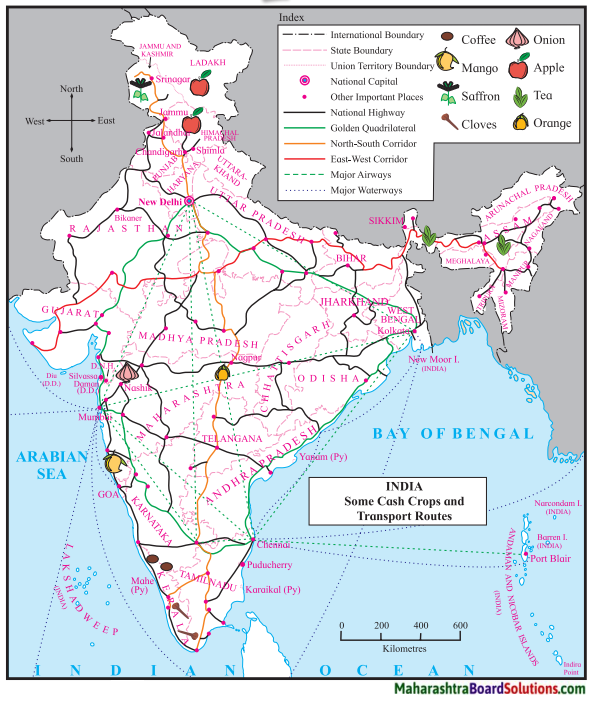
Communication and Mass Media Class 5 Questions And Answers EVS Chapter 15 Maharashtra Board

Balbharti Maharashtra State Board Class 5 Environmental Studies Solutions Chapter 15 Communication and Mass Media Notes, Textbook Exercise Important Questions and Answers.

5th Standard EVS 1 Lesson Number 15 Question Answer Communication and Mass Media Maharashtra Board

Std 5 EVS 1 Chapter 15 Question Answer

1. Write down the educational uses of mass media.

Question 1.
Write down the educational uses of mass media.
Answer:
Mass media helps us in the following ways :

  1. Awareness about issues such as environmental balance, gender equality and cleanliness.
  2. Forewarn about natural disasters like storms, tsunamis, flood, etc.
  3. Awareness about health, educational facilities, good things happening in society, etc.
  4. Awareness about basic needs related to food, clothing, shelter, education and health.
  5. Helps in the expansion of trade and industry.

Maharashtra Board Class 5 EVS Solutions Part 1 Chapter 15 Communication and Mass Media

2. How were messages communicated before we began to use the telephone?

Question 1.
How were messages communicated before we began to use the telephone?
Answer:
Messages were earlier
1. Sent by pigeons who were trained
2. Men on horseback with messages
3. Letters sent through postal services.

3. What difference has the computer made to your life?

Question 1.
What difference has the computer made to your life?
Answer:
With the help of computers, I am able to get information with the help of internet connection and also able to do work faster and save time and efforts.

Environmental Studies Part 1 Standard 5th Solutions Chapter 15 Communication and Mass Media Additional Important Questions and Answers

Fill in the blanks with the correct answers from the options given below:

Question 1.
The exchange of information is called ……………… .
(a) gossip
(b) noise
(c) communication
Answer:
(c) communication

Maharashtra Board Class 5 EVS Solutions Part 1 Chapter 15 Communication and Mass Media

Question 2.
………………. are used in modem methods of communication.
(a) Artificial satellites
(b) Mobile
(c) Computer
Answer:
(a) Artificial satellites

Question 3.
Indian Satellites used for communication are called ……………… .
(a) AGNI
(b) INSAT
(c) Chandrayaan
Answer:
(b) INSAT

Question 4.
Artificial satellites are launched into space by means of ……………………. .
(a) NASA
(b) rockets
(c) ISRO
Answer:
(b) rockets

Question 5.
The ………………… on a person’s face and other gestures communicate a message to us.
(a) expression
(b) glow
(c) lines
Answer:
(a) expression

Question 6.
Information ………………….. is also a part of communication.
(a) telecast
(b) broadcast
(c) technology
Answer:
(b) broadcast

Maharashtra Board Class 5 EVS Solutions Part 1 Chapter 15 Communication and Mass Media

Question 7.
Information is useful for constructing …………………. .
(a) structures
(b) maps
(c) knowledge
Answer:
(c) knowledge

Question 8.
Through telecommunication, we can easily ………………… people far away from us.
(a) contact
(b) warn
(c) party with
Answer:
(a) contact

Question 9.
Through telecommunication, people can be ………………… about natural disasters like storms, tsunamis, floods etc.
(a) endangered
(b) forewarned
(c) assured
Answer:
(b) forewarned

Question 10.
Mass media helps in successful implementation of ………………. schemes launched for the benefit of people.
(a) public
(b) private
(c) government
Answer:
(c) government

Question 11.
………………. media helps in the expansion of trade and industry.
(a) public
(b) individual
(c) mass
Answer:
(c) mass

Maharashtra Board Class 5 EVS Solutions Part 1 Chapter 15 Communication and Mass Media

Question 12.
We get all sorts of ……………….. through television channels and the internet.
(a) information
(b) transformation
(c) industrialization
Answer:
(a) information

Question 13.
Time spent on watching ………………… leads to the neglect of outdoor sports and physical fitness.
(a) telephone
(b) television
(c) mobile
Answer:
(b) television

Question 14.
Telecommunication devices should be used properly and ……………….. .
(a) honesty
(b) sensibly
(c) truthfully
Answer:
(b) sensibly

Question 15.
We must be careful not to use telecommunication
(a) excessively
(b) severely
(c) seriously
Answer:
(a) excessively

Question 16.
New communication technology has now made this possible on a mobile phone, to ……………….. the person we are talking to.
(a) touch
(b) see
(c) smell
Answer:
(b) see

Maharashtra Board Class 5 EVS Solutions Part 1 Chapter 15 Communication and Mass Media

Answer in detail:

Question 1.
What are the disadvantages of tele-communication devices?
Answer:
The disadvantages of telecommunication devices are:

  1. Excessive use of the television, computer or mobile phones cause disorders of the eye, ears and back.
  2. Psychological disorders and isolation are also possible.
  3. Information through television and the internet disturbs peace and order in society.
  4. Excessive TV watching neglect the outdoor sports and physical fitness.
  5. Adverse effect on physical health.

Question 2.
What are the uses of artificial satellites?
Answer:
The uses of artificial satellites are as follows:
1. Live telecast of events happening in the world.
2. With the help of phones, we can directly talk to people in other countries.
3. The President or Prime Minister can address the entire nation at the same time over the radio or TV.

Question 3.
What are audio visual communication?
Answer:
With the help of audio visual communication we can see the person whom we are talking to on a mobile phone.

Can you tell?

Question 1.
We watch TV programmes on many different channels. Where do they come from?
Answer:
Artificial Satellites

Question 2.
We talk to others on our mobile phones. What makes communication on a mobile phone possible?
Answer:
Artificial Satellite

Maharashtra Board Class 5 EVS Solutions Part 1 Chapter 15 Communication and Mass Media

3.

Question (a)
Study the pictures given below. Write the name of the emotions that you see in each face in the box below it:
Answer:
Maharashtra Board Class 5 EVS Solutions Part 1 Chapter 15 Communication and Mass Media 1

Question (b)
Write the names of the means of communication that are used?
Answer:
The expression on the face is used to communicate.

Question 4.
What information do you obtain from a newspaper?
Answer:
Political, Educational, Social, Cultural, Economic and Entertainment.

What’s the solution?

When Amod, who is in the fifth standard, comes home after school, he visits several websites on his computer. He never misses his favourite TV shows. He plays games on his mother’s mobile phone all the time. He is always sitting at home. Lately, his appetite has decreased. He is drowsy6 and has put on weight. Amod’s mother is worried about him. When will she feel better?
Answer:
Amod’s mother will feel better when Amod start going out and play with his friends and be physically fit.

Maharashtra Board Class 5 EVS Solutions Part 1 Chapter 15 Communication and Mass Media

Glossary:

  1. neglect – fail to care properly
  2. forewarned – inform of a possible danger or problem.
  3. implementation – process of putting a plan into effect
  4. isolation – process of being isolated
  5. adverse – harmful.
  6. drowsy – sleepy and lazy.

Class 5 Environmental Studies Questions and Answers: