Maharashtra Board Class 12 Economics Important Questions Chapter 8 Public Finance in India

Balbharti Maharashtra State Board Class 12 Economics Important Questions Chapter 8 Public Finance in India Important Questions and Answers.
Maharashtra State Board 12th Economics Important Questions Chapter 8 Public Finance in India

1. A. Choose the correct option:

Question 1.
Optional functions of Government.
(a) Protection from external attack.
(b) Provision of education and health services.
(c) Provision of social security measures.
(d) Collection of tax.
Options :
(1) b and c
(2) a, b and c
(3) b,c and d
(4) All of the above
Answer:
(1) b and c

Maharashtra Board Class 12 Economics Important Questions Chapter 8 Public Finance in India

Question 2.
Public finance is……………..
(a) one of the old branches of economics, which highlights the role of government
(b) a study of the principles of income and expenditure of the government
(c) also a part of the study of political science
(d) less elastic in supply
Options :
(1) a and b
(2) a, b and c
(3) a and d
(4) b, c and d
Answer:
(2) a, b and c

Question 3.
Non tax revenue includes
(a) Prices of public goods and services
(b) Gifts, Grants and Donations
(c) Goods and Service Tax (GST)
(d) Fines and penalties
Options :
(1) a, b and d
(2) a, b and c
(3) b and d
(4) a and c
Answer:
(1) a, b and d

Question 4.
The examples of revenue expenditure …………..
(a) administration cost of the government
(b) huge investments in different developmental projects
(c) salaries, allowances and pensions of government employees
(d) medical and public health services
Options :
(1) a, b and c
(2) a and b
(3) c and d
(4) a, c and d
Answer:
(4) a, c and d

Question 5.
Reasons for growth in public expenditure.
(a) increase in the activities of the government
(b) rapid increase in population
(c) spread of democracy
(d) industrial development
Options :
(1) a, b and c
(2) b, c and d
(3) a, c and d
(4) a, b, c and d
Answer:
(4) a, b, c and d

(B) Complete the Correlation .

(1) Direct Tax : Wealth Tax :: …………….. : Excise Duty
(2) High degree of credit: Public finance:: Limited Credit: ……………..
(3) Expenditure on education : Developmental expenditure :: War expenditure :……………..
(4) Internal debt : Government borrows from its citizens :: …………….. : Government borrows from World Bank
(5) Surplus budget : Government Receipts Government Expenditure:: ……………..: Government Receipts Government Expenditure
(6) Optional function : Provision of social security :: ……………..: Protection from external attacks
(7) Progressive Tax : Tax rate increases with . increase in income :: ………………. : Tax rate decreases with rise in income :
(8) Old age pension : Revenue expenditure :: Investment in machines : ……………….
Answers:

  1. indirect tax
  2. Private finance
  3. Non-developmental expenditure
  4. External debt
  5. Deficit budget
  6. Obligatory function
  7. Regressive Tax
  8. Capital expenditure

(C) Give economic terms.

(1) The expenditure which is incurred by the public authority for promoting social and economic welfare.
Answer:
Public Expenditure

(2) A financial statement showing the expected receipts and proposed expenditure of the government in a financial year.
Answer:
Budget

(3) A compulsory contribution to the government by a person without receiving any direct or proportionate benefit in return.
Answer:
Tax

(4) Borrowings of the government from financial institutions within the country.
Answer:
Internal Debt

(5) The financial policy implemented by the government which deals with public expenditure, public revenue and public debt.
Answer:
Fiscal Policy

(6) The type of budget where estimated revenue and expenditure of the government are equal.
Answer:
Balanced Budget

(7) The aggregate collection of income with the government through various sources.
Answer:
Public revenue

(8) It is paid by the tax payer on his income and property.
Answer:
Direct Tax

(9) It is a category of tax which is levied at the same and constant rate on all income.
Answer:
Proportionate tax

(10) Revenue received by the government administration, other than taxes.
Answer:
Non Tax Revenue

(D) Find the odd word out.

(1) Fees, Fines and penalties, Excise duty, Special levy.
Answer:
Excise duty

(2) Revenue expenditure, Capital expenditure, Labour expenditure, Developmental expenditure
Answer:
Labour expenditure

(3) Public expenditure, Public park, Public revenue, Public debt.
Answer:
Public park

(4) Service tax, Entry tax, Entertainment tax, Wealth tax
Answer:
Wealth tax

(5) R.B.I, Foreign Banks, IMF, World Bank
Answer:
R.B.I.

(6) Deficit budget, Zero budget, Balanced budget, Surplus budget
Answer:
Zero budget

(7) Inflation, Depression, Rising prices, Reduce purchasing power
Answer:
Depression

(8) Earthquakes, Floods, Cyclones, Social unrest
Answer:
Social unrest

(9) Public health, Social welfare, Spread of education, Donations
Answer:
Donations

(10) Defence, Infrastructure, Registration fees, Health care
Answer:
Registration fees

(E) Complete the sentences .

Question 1.
Obligatory function of the government includes …………..
(a) provision of education and health services ?
(b) maintaining internal law and order
(c) provision of social security
(d) construction of public park and garden
Answer:
(b) maintaining internal law and order

Question 2.
There is a continuous growth in public expenditure
(a) only because of growing population
(b) only because of increase in defence expenditure
(c) only due to inflation
(d) due to all the above mentioned factors
Answer:
(d) due to all the above mentioned factors

Question 3.
Capital expenditure of the government is ……………
(a) pensions of government employees
(b) administration cost of the government
(c) investment in different developmental projects
(d) war expenditure
Answer:
(c) investment in different developmental projects

Question 4.
The expenditure which results in generation of employment is
(a) development expenditure
(b) non-development expenditure
(c) revenue expenditure
(d) capital expenditure
Answer:
(a) development expenditure

Question 5.
Tax is paid by a tax payer because .
(a) he gets good benefits of it
(b) it is owner’s pride and neighbour’s envy
(c) it is a compulsory contribution to the government
(d) he gets good publicity
Answer:
(c) it is a compulsory contribution to the government

Question 6.
Direct tax is paid by the tax-payer .
(a) on sale and purchase of a commodity
(b) on his income and property
(c) which is levied on goods and services
(d) and shifted to other person
Answer:
(b) on his income and property

Question 7.
In case of regressive tax, the larger the income of a tax-payer.
(a) smaller is the proportion of tax levied
(b) tax is levied at the constant rate
(c) greater is the proportion of tax levied
(d) zero tax is levied
Answer:
(a) smaller is the proportion of tax levied

Question 8.
Special assessment, fines and penalties are examples of
(a) direct tax
(b) indirect tax
(c) non-tax revenue
(d) tax revenue
Answer:
(c) non-tax revenue

Question 9.
External debt of the government means
(a) loans from IMF, World bank, etc.
(b) borrowings from the citizens of a country
(c) borrowings from financial institutions in a country
(d) borrowings from Reserve Bank of India
Answer:
(a) loans from IMF, World bank, etc.

Question 10.
The capital budget consists of
(a) capital receipts and revenue receipts
(b) tax revenue and non-tax revenue
(c) revenue receipts and revenue expenditure
(d) capital receipts and capital payments
Answer:
(d) capital receipts and capital payments

(F) Choose the wrong pair :

I.

Group ‘A’ Group ‘B’
1. Direct Tax  (a) Wealth tax
2. Hugh Dalton (b) Definition of public finance
3. GST (c) Non-tax revenue
4. External Debt (d) Foreign Government

Answer:
(3) – c

II.

Group ‘A’ Group ‘B’
1. Revenue expenditure (a) Administration cost of Government
2. Capital expenditure (b) Repayment of Government loan
3. Development expenditure (c) Expenditure on education
4. Non- developmental expenditure (d) Expenditure on social welfare

Answer:
(4) – d

III.

Group ‘A’ Group ‘B’
1. Balanced budget (a) Advocated by Adam Smith
2. Public revenue (b) expenditure of the government
3. A deficit budget (c) useful in depression period
4. Surplus budget (d) Receipts  > Expenditure

Answer:
(2) – b

Maharashtra Board Class 12 Economics Important Questions Chapter 8 Public Finance in India

(F) Choose the right group of pairs :

I.

Group ‘A’ Group ‘B’
1. Budget (a) Simplifying tax system
2. Financial administration (b) Use of foreign currency
3. External debt (c) Annual financial statement
4. GST (d) Implementation of revenue

Options :
(a) (1) – d, (2) – c, (3) – b, (4) – a
(b) (1) – c, (2) – d, (3) – a, (4) – b
(c) (1) – d, (2) – c, (3) – a, (4) – b
(d) (1) – d, (2) – b, (3) – c, (4)-a
Answer:
(c) (1) – d, (2) – c, (3) – a, (4) – b

II.

Group ‘A’ Group ‘B’
1. Fines and Penalties (a) Use of domestic currency
2. Tax (b) Violation of the law
3. internal debt (c) French word
4. Bougette (d) Major source of government revenue

Options : (a) (1) – c, (2) – b, (3) – d, (4) – a
(b) (1) – b, (2) – d, (3) – a, (4) – c
(c) (1) – b, (2) – c, (3) – d, (4) – a
(d) (1) – d, (2) – c, (3) – a, (4) – b
Answer:
(b) (1) – b, (2) – d, (3) – a, (4) – c

III.

Group ‘A’ Group ‘B’
(1) Budget (a) Simplifying tax system
(2) Financial administration (b) Use of foreign currency
(3) External debt (c) Annual financial statement
(4) GST (d) Implementation of revenue

Options :
(a) (1) – c, (2) – d, (3) – b, (4) – a
(b) (1) – c, (2) – b, (3) – a, (4) – d
(c) (1) – b, (2) – c, (3) – d, (4) – a
(d) (1) – d, (2) – c, (3) – b, (4)-a
Answer:
(a) (1) – c, (2) – d, (3) – b, (4) – a

2.[A] Identify and explain the concept from given illustrations.

Question 1.
internal law and order to avoid social unrest.
Answer:
Concept: Obligatory Function.
Explanation : Obligatory functions are those functions which must be performed by government for socio-economic welfare and to avoid social unrest and to establish social justice in a country.

Question 2.
Sanjay paid charges to traffic police for jumping signal.
Answer:
Concept: Fine and penalty
Explanation : The government imposes fines and penalties on those who violate the laws of a country.
Traffic police charges fine and collects money for violating traffic rule.
The objective of taking fine is to discourage the citizens from violating the laws framed by government.

Question 3.
Government of India takes loan from World Bank for Mumbai Metro Train.
Answer:
Concept: External Debt
Explanation : When the government borrows from foreign government or international organisations like IMF, World Bank, etc., it is known as external debt.
Government needs to raise loan for investing in developmental project of a country.
Mumbai Metro Train is a project which require huge investment.
So, Government of India takes loan from World Bank.

Question 4.
Prachi can spend only ₹ 80,000/- though her income is one lakh per month.
Answer:
Concept: Disposable Income
Explanation : Disposable income refers to income which remains with a person after deducting income tax from total personal income.
So, Disposable Income = Total Personal Income – Direct Taxes (income tax)
It indicates actual spending capacity of a person.
Every person is legally bound to pay income tax because it is compulsory to the government.

Question 5.
Government of India borrowed from nationalized bank for construction of bridge.
Answer:
Concept: Internal debt
Explanation : When the government borrows from its citizens or nationalized banks, it is called internal debt.
It means borrowing within a country, for development of infrastructure facilities in a country.
Provision of infrastructure like roads, bridge energy supply, etc., require huge investment.
So, government borrows money in form of internal debt from RBI, nationalized banks or citizens of a country.

Question 6.
Jyoti purchased furniture from mall and paid tax on it.
Answer:
Concept: GST (Goods and Service Tax)
Explanation : GST is a comprehensive tax base with nationwide coverage of goods and services.
It came into effect in India from 1st July, 2017.
It is a tax on goods and services. GST simplified the tax system in a country.

(B) Distinguish between

Question 1.
Deficit Budget and Balanced Budget.
Answer:
Deficit Budget:

  1. When the government revenue is less than government expenditure, it is called a Deficit Budget.
  2. Deficit Budget would lead to increase in aggregate demand.
  3. Deficit Budget leads to flow of money from the government to the economy.
  4. It is suitable for government when the economy suffers from depression.
  5. The policy of deficit budget would lead to increase in employment, investment, etc.

Balanced Budget:

  1. When the government revenue is equal to government expenditure, it is called a Balanced Budget.
  2. Balanced Budget would not affect the aggregate demand in the economy.
  3. The flow revenue of the government is equal to meet the expenditure of the government.
  4. It is not possible to introduce a balanced budget under present circumstances.
  5. The balanced budget policy is called “Sound Finance” where the government performs only minimum functions.

Question 2.
Government Revenue (income) and Government Expenditure.
Answer:
Government Revenue (income):

  1. Government income refers to the revenue of the government from different sources including tax revenue, non-tax revenue, administrative revenue etc.
  2. E.g. Tax revenue including Direct and Indirect Tax.
  3. Non-tax revenue include profit from government enterprise administrative revenue like fees, fines, penalties.
  4. Generally government income results in transfer of purchasing power from people to government.
  5. Surplus income with government indicates sound financial background.

Government Expenditure:

  1. Government expenditure refers to the expenditure by government to perform various functions and duties.
  2. E.g. Revenue expenditure on health, education, defence and administration.
  3. Capital expenditure on roads, railways, dams, machinery and public enterprise.
  4. Government expenditure leads to transfer of purchasing power from government to people.
  5. Massive expenditure indicates more welfare to people.

Maharashtra Board Class 12 Economics Important Questions Chapter 8 Public Finance in India

Question 3.
Revenue Budget and Capital Budget.
Answer:
Revenue Budget:

  1. Revenue Budget consists of
    (1) Revenue Receipts
    (2) Revenue Expenditure
  2. It explains how revenue is generated by government and how it is allocated among various expenditure heads.
  3. Revenue receipts consists of
    (1) Tax Revenue
    (2) Non-Tax Revenue
  4. Revenue expenditure includes developmental and non – developmental expenditure of Central Government.
  5. Revenue Receipts do not create any liability of the government.
  6. Revenue expenditure does not lead to the creation of assets.

Capital Budget:

  1. Capital Budget consists of
    (1) Capital Receipts
    (2) Capital Expenditure
  2. It deals with the capital aspect.
  3. Capital receipts consists of
    (1) Borrowing
    (2) Recovery of loans
    (3) Disinvestment, small savings
  4. Capital expenditure includes expenditure on land and building machinery, investment in shares, loans granted by Central Government to State.
  5. Capital receipt create a liability of the government.
  6. Capital expenditure leads to the creation of assets.

Question 4.
Surplus Budget and Balanced Budget.
Answer:
Surplus Budget:

  1. A Surplus Budget is that type of budget in which the estimated revenue is greater than the estimated expenditure.
  2. Government raises tax revenue which is more than what is required for meeting the expenditure.
  3. Surplus budget would lead to reduction in aggregate demand.
  4. It is suitable for families and not favoured for government.
  5. The policy of Surplus Budget would lead to unemployment and recession in the economy. ‘

Balanced Budget:

  1. Balanced Budget is a type of budget in which the estimated revenue of the government is equal to estimated expenditure of the government.
  2. Government raises revenue to such an extent which is just sufficient to meet the expenditure.
  3. Balanced budget would not affect the aggregate demand in the economy.
  4. It is not possible to introduce a balanced budget under present circumstances.
  5. The balanced budget policy is called ‘Sound Finance’ where the government performs only minimum function.

Question 5.
Deficit Budget and Surplus Budget.
Answer:
Deficit Budget:

  1. A deficit budget is one in which estimated expenditure exceeds estimated revenue.
  2. It leads to flow of money from government to the economy and increases aggregate demand.
  3. It is suitable for governments especially when the economy suffers from depression.
  4. The policy of deficit budget would lead to employment and revival of economic activities.
  5. Deficit budget is not desirable during inflation.

Surplus Budget:

  1. A surplus budget is a budget in which estimated revenue are greater than estimated expenditures.
  2. It leads to flow of money from economy to government and lead to decrease in aggregate demand.
  3. It is suitable for individuals and families but not favoured for government.
  4. The policy of surplus budget would lead to unemployment and recession due to low investment.
  5. Surplus budget is advocated during inflation to reduce demand and prices by imposing high taxes.

Question 6.
Revenue Expenditure (Budget) and Capital Expenditure (Budget).
Answer:
Revenue Expenditure (Budget):

  1. Revenue expenditure of the government refers to expenses incurred on day-to-day functioning of the government.
  2. It is recurring in nature as it is incurred regularly.
  3. E.g. administration cost, salary, allowances, pensions of the government employees, etc.
  4. It does not create any asset to government.

Capital Expenditure (Budget):

  1. Capital expense of the government refers to expenses incurred for the development of a country.
  2. It is not recurring in nature as it does not incur regularly.
  3. E.g. investment in different developmental projects, loans granted to state government, repayment of loan, etc.
  4. It makes addition to the assets of the economy.

Question 7.
Obligatory functions of Government and Optional functions of Government.
Answer:
Obligatory functions of Government

  1. Obligatory functions are those functions which must be performed by government, by making adequate provision of resources.
  2. Obligatory functions are given first priority, as they are compulsory functions.
  3. Obligatory functions are mainly performed by public authority for the protection of their citizen.

Optional functions of Government:

  1. Optional functions of government are those functions which may be undertaken by government if funds permit.
  2. Optional functions are given second priority, as they are called discretionary functions.
  3. Optional functions are performed by central, state and local government for promoting economic activities and social welfare.

Maharashtra Board Class 12 Economics Important Questions Chapter 8 Public Finance in India

Question 8.
Tax revenue and Non-tax revenue.
Answer:
Tax revenue:

  1. Tax revenue refers to revenue received by the government through various taxes.
  2. Tax revenue comes from direct tax, i,e. income tax, wealth tax and indirect tax, i.e,, G.S.T.
  3. Tax is a major source of revenue to the government.
  4. Tax revenue particularly direct tax is collected to reduce economic inequality.

Non-tax revenue:

  1. Non-tax revenue refers to revenue received by the government from various sources, other than taxes.
  2. Non-tax revenue comes from fines and penalties, fees, gifts, grants, donations, borrowings, special levy, etc.
  3. Non- tax revenue is not a major source of revenue to the government.
  4. Non-tax revenue, particularly special levy, fines and penalties, etc. are collected to discourage the citizens from violating the law.

3. Answer the following questions:

Question 1.
Explain non-tax sources of revenue of the government.
Answer:
Non-tax revenue refers to the revenue received by the government from various , sources other than taxes.
The sources of non-tax revenue are as follows:

1. Fees : It refers to charges paid, in return for certain specific services rendered by the government. E.g. fees paid for registration of house, car, education fees, etc.

2. Prices of Public Goods and Services : Various types of goods and services are produced, supplied and sold by modern government to the citizens. It; is added to public revenue when people s purchase them and pay their prices.

3. Special Assessment : It is special kind of tax, which is levied by local government on the residents of a particular area. In exchange of it, government provides some special facilities to them.

4. Fines and Penalties : It is imposed by government on those who violate the laws of the country.

E.g. a traffic police charges fine and collects money if someone violates traffic rule. The objective behind collection of fines and penalties is not to earn money but to discourage the people from violating the laws framed by the government It is small source of income.

5. Gifts, Grants and Donations : The government receives gifts from its citizens and others. It is included in public revenue. The government may also get grants from foreign government and institutions for general and specific purposes.
Foreign aid is also an important form of public revenue for developing country like India. However, this source of revenue is uncertain in nature.

6. Special Levies : It refers to the charges levied by government on those commodities, whose consumption is harmful to human health.
Special levies are paid for using commodities like wine, opium and other intoxicants. Special levy is imposed, not to earn income, but to discourage the people from using harmful products.

7. Borrowings: Government borrows to raise fund because government expenditure generally exceeds government revenue, in a welfare state.
When government borrows from foreign government or international organisations, it is known as external debt. It is more popular source of public revenue for investment in development of projects. Thus, public revenue in form of non-tax sources play very important role in socio economic development of a country.

Question 2.
Explain the classification of public expenditure.
OR
Explain the budget expenditure of the government.
Answer:
Public expenditure is an important aspect which is incurred by the public authority (central, state and local government). Public expenditure is required for the protection of the citizens of a country, for satisfying social needs or collective needs and for promoting social and economic welfare of the people in a country.

Classification of public expenditure is as under:
(1) Revenue expenditure : It is the expenditure of the government to carry out day-to-day functions. It is recurring in nature. It does not create any assets to government It consists of administrative expenditure, interest payment, pensions and salaries to government employees, etc.

(2) Capital expenditure : It refers to the expenditure of the government for the development of a country.
It consists of huge investment in different developmental projects, repayment of government loans, investment on land, building, machines, etc.
It is non-recurring in nature

(3) Developmental expenditure : The expenditure which results in generation of employment and price stability, it is known as developmental expenditure.

It consists of expenditure on education, social welfare, industrial development, etc. It leads to an increase in production. It is s productive in nature.

(4) Non-developmental expenditure : It is that government expenditure which does not yield any direct productive impact on the economy. It is mainly in form of expenses on administration costs, war expenses, etc. It is unproductive in nature. It is observed that, since last 30 years, there is a tremendous growth in the total public expenditure of a country because modern government performs many functions for the social and economic development of a country.

Question 3.
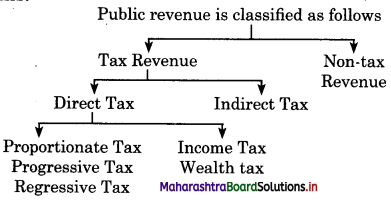
Explain the structure of Tax-revenue of the government.
Answer:
Maharashtra Board Class 12 Economics Important Questions Chapter 8 Public Finance in India 1
Tax is a major source of revenue to the Government
According to Prof. Taussig, “The essence of a tax as distinguished from other charges by government is the absence of a direct ‘quid pro quo’ (benefit) between the tax payer and the public authority. ”
Prof. Seligman states that, “a tax is a compulsory contribution from a person to the government, without reference to special benefits confessed. ”
Thus, every citizen of a country is legally bound to pay tax.
Tax is imposed on income, property or commodities and services.

Types of Taxes :

(1) Direct Tax : It is paid by the tax payer on his income and property. A tax-payer cannot transfer the burden of direct tax to others.
Impact and incidence of direct tax falls on the same person. E.g. Income tax, wealth tax, etc.
Direct taxes are further classified into three categories.
(i) Proportionate tax (ii) Progressive tax (iii) Regressive tax

(2) Indirect Tax : It is levied on goods and services. It is paid at the time of production or sale and purchase of a commodity or a service.
The burden of indirect tax can be shifted by the tax-payer (producers) to other persons. Hence, impact and incidence of tax are on others. E.g. GST.
Thus, major share of public revenue is the contribution by tax revenue in India.

Question 4.
Explain GST (Goods and Service Tax) in detail.
Answer:
The GST (Goods and Service Tax) came into effect in India on 1st July, 2017.
It was proposed by the Kelkar Task Force on Implementation of the Fiscal Responsibility and Budget Management (FRBM) Act in July, 2004.
GST is an indirect tax used in India on the supply of goods and services.
GST is comprehensive because it has replaced almost all indirect taxes like excise duty, entertainment tax, entry tax, etc.

GST is classified as follows :

  • Central Goods and Service Tax (CGST) : It is a tax levied on interstate supplies of both goods and services by the central government which will be governed l by CGST Act.
  • State Goods and Service Tax (SGST): It is received by the state in which the goods and services are consumed and not by the state where they are manufactured.
  • Integrated Goods and Service Tax (IGST) : It is a tax levied on all interstate supplies of goods and services which will be governed by the IGST Act.

Benefits of GST :

  • Comprehensive tax base with nation wide coverage of goods and services.
  • Boost to foreign investments and export.
  • Encouragement to manufacturing ‘Make in India’ campaign.
  • Improvement in investment atmosphere in a country.
  • Tax system in a country simplified.
  • Generating more employment and poverty eradication.

Question 5.
Explain the term public debt with its types.
Answer:
Public debt policy of the government plays an important role in public finance.
Public debt refers to borrowings of the government Raising debt loan is the most common activity of a government because in a welfare state, government expenditure generally exceeds government revenue.

Public debt is classified into two types : –
(1) Internal debt : It refers to borrowings of  the government to raise fund within the economy. In case of internal debt, domestic currency is used. It is less complex to manage internal debt. E.g. borrowings from RBI, nationalized banks and business organisations within a country.

(2) External debt : It refers to borrowings of the government to raise fund outside the economy. In case of external debt, foreign currency is used. It is more complex to manage external debt. E.g. borrowings from foreign government and international organisation like IMF, World Bank, etc. Government requires fund for investing in production as well as for making provision of infrastructure facilities.

Thus, public debt is more popular source of revenue for the government in the modern times.

Maharashtra Board Class 12 Economics Important Questions Chapter 8 Public Finance in India

Question 6.
Explain the developmental and non-developmental expenditures of the government.
Answer:
Developmental expenditure : The expenditure which results in generation of employment and price stability, it is known as developmental expenditure.

It consists of expenditure on education, social welfare, industrial development, etc. It leads to an increase in production. It is s productive in nature.

Non-developmental expenditure : It is that government expenditure which does not yield any direct productive impact on the economy. It is mainly in form of expenses on administration costs, war expenses, etc. It is unproductive in nature. It is observed that, since last 30 years, there is a tremendous growth in the total public expenditure of a country because modern government performs many functions for the social and economic development of a country.

Question 7.
Explain the importance of budget.
Answer:
Importance of Budget:
Budget is important in number of ways.

  • Tax rates presented in the budget indicates disposable income of the tax payer. It also determines the development of business and individuals.
  • Government expenditure is also a part of budget. This public expenditure on defence, administration, infrastructure, education, health care, etc. affects the lives of the citizens and overall economy.
  • Government uses budget as a medium for implementing economy policies in the country.
  • Budgetary actions of the government affect production size and distribution of income, utilization of human and material resources of the country.
    Thus, implementing suitable budgetary policy is very important for overall development of the economy.

4. State with reasons whether you agree or disagree with the following statements:

Question 1.
Tax is a major source of government revenue.
Ans. Yes, I agree with this statement.
One of the important and major source of public revenue is the tax revenue. A tax is a compulsory payment made by the citizens of the country to the government without any direct quid pro-quo. It implies that a tax has to be paid by all people and it does not involve any corresponding obligation on the part of the government i.e., government need not repay anything. Taxes are of two types (1) Direct Tax (2) Indirect Tax.

Question 2.
In Surplus budget, government revenue is greater than government expense.
Ans. Yes, I agree with this statement.
Surplus budget implies that government’s expected revenue is greater than government’s proposed expenditure.
When there is too much inflation, the government can adopt the policy of surplus budget.
In order to curb inflation, government increases revenue by levying taxes on people.
This reduces the disposable income of people and also consumption.
Since governments spending will be less than its income, aggregate demand will decrease and which will help to reduce the price and control inflation.

Question 3.
For the period of depression, deficit budget is prepared.
Answer:
Yes, I agree with this statement.
Deficit budget is one where the estimated government expenditure is more than the l expected revenue.
Normally developing countries have deficit budget.
During depression, it is used as a stabilizing tool to control economic fluctuation.
Recession occurs mainly due to lack of effective demand.
So increase in government expenditure tends to increase the income of people.
As a result, the aggregate demand increases, which will help in reducing unemployment and expanding the economic activities in the economy.
Therefore, for the period of depression deficit budget is prepared. s

Question 4.
The surplus budget creates inflationary pressure in the economy.
Answer:
No, I do not agree with this statement.
The deficit budget creates inflationary pressure in the economy.
Deficit Budget is one where the estimated government expenditure is more than expected revenue.
In order to meet the deficit, the government generally resorts to (a) borrowings from Central Bank (b) borrowings from
Commercial Banks (c) issue of new currency of the government.
This leads to increased supply of money.
As the government spend this money, there is excess supply of money without corresponding increase in the production of goods and services in short period.
As a result the prices of goods and services begin to rise.
Thus, the deficit budget creates inflationary pressure in the economy.

Question 5.
Revenue receipts and revenue expenses are known as revenue budget.
Answer:
Yes, I agree with this statement.
Revenue Budget explains how revenue is generated by the government and how it is allocated among various expenditure heads. Revenue receipts of government refers to income, which is received by government from all sources i.e., tax and non-tax revenue. These receipts do not create a liability. Revenue expenditure is the expenditure incurred for the normal running of government departments and various services.
They neither create any asset nor cause reduction in any liability of the government. E.g. expenditure on defence, police, medical public health, education, transport, etc.

Question 6.
Public finance and Private finance are same.
No, I do not agree with this statement.
There is a difference between public finance and private finance.
Public Finance : Public finance refers to income an expenditure of public authorities. The objective of public finance is to offer maximum social advantage. More credit is available in the market to increase public finance. The supply of public finance is more elastic. In case of public finance, government first determines the volume and different ways of it’s expenditure.

Private Finance : Private finance refers to income and expenditure of individual and private sector organisations. The objective of private finance is to fulfil private interest. Credit availability is limited to increase private finance. The supply of private finance is less elastic. In case of private finance, an individual considers income first and then determines the volume of expenditure.

Question 7.
There is a continuous growth in public expense in India.
Answer:
Yes, I agree with this statement.
In a developing country like India, public expense is continuously increasing.
The modern government has to perform many obligatory as well as optional functions for the social and economy development of a country.

These functions include spread of education, public health, public works, infrastructure facilities, public recreation, social welfare schemes, protection of a country, industrial development, etc.
Old functions are being performed more efficiently and new functions are added i continuously.
In addition to this, many natural and man made calamities occur frequently. So, government has to spend a huge amount for ; disaster management.
So, there is a continuous growth in the public expense in India.

Question 8.
During the period of inflation, surplus budget is advisable.
Answer:
Yes, I agree with this statement.
During inflationary period, price of commodities rises rapidly.
This rise in price can be controlled by lowering the level of effective demand in the economy.
This can be done by increasing taxes which will automatically reduce the purchasing power of the people, which will result in fall of aggregate demand.
The fall in aggregate demand will lead producers and sellers to reduce the price of l their products to increase their sale.
Thus, inflationary pressure is controlled by adopting surplus budget.

Maharashtra Board Class 12 Economics Important Questions Chapter 8 Public Finance in India

5. Study the following table figures passages and answer the following :

1.

Trends in Public Expense
Sr. No. Year Total Expense (Rs. in crores)
1 1991-92 72,317
2 2001-02 3,62,450
3 2005-06 5,06,123
4 2009-10 10,24,487
5 2015-16 11,95,025
6 2016-17 13,74,203
7 2017-18 14,35,233
8 2018-19 17,29,682

Question 1.
What was the total public expense in the year 2009-10?
Answer:
In the year 2009-10, the total public expense was ? 10,24,487 crores.

Question 2.
Calculate the difference between public expense of 1991-92 to 2001-02.
Ans. The difference between public expense of 1991-92 and 2001-02 is ? 2,90,133 crore (3,62,450 – 72,317).

Question 3.
Observe the trends in public expense from 2015 to 2019.
Ans. The year 2018-19 shows greater trend in public expense.

Question 4.
What is the tendency of trends in public expense, shown in the given table?
Ans. The given table shows that, there is a tremendous growth in the total public expense of the country over the period of time.

(2) Read the given passage and answer the questions :

“The conventional notion of social security is that the government would make periodic payments to look after people in their old age, ill-health, disability and poverty. This idea should itself change from writing a cheque for the beneficiary to institutional arrangements to care for beneficiaries, including by enabling them to look after themselves, to a large extent.
The write-a-cheque model of social security is a legacy from the rich world at the optimal phase of its demographic transition, when the working population was numerals enough and earning enough to generate the taxes to pay for the care of those not working. This model is ill-suited for less, well-off India with growing life expectancy, increasing urbanization and resultant migration. Social security under urbanization will be different from social security in a static society.

Question 1.
State the conventional notion of social security.
Answer:
The conventional notion of social security is that the government would make periodic payments to look after people in their old age, ill-health, disability and poverty.

Question 2.
What kind of conceptual change is suggested in the given paragraph?
Answer:
The given paragraph suggests that, the idea should change from writing a cheque for the beneficiary to institutional arrangement to care for beneficiaries.
It will enable them to look after themselves to a large extent.

Question 3.
WTiat is a legacy of social security from the rich world?
Answer:
The write-a-cheque model of social security i is a legacy from the rich world.

Question 4.
Which features of India make the traditional model of social security illsuited for the economy?
Answer:
Growing life expectancy, increasing urbanization and resultant migration are the features of India that make the traditional model of social security ill suited for the economy.

6. Answer in detail:

Question 1.
Explain the various types of Government budget (Union budget).
Answer:
There are three types of government budget:
(1) Balanced Budget, (2) Surplus Budget and (3) Deficit Budget.
(1) Balanced Budget : Balanced budget is a situation in which estimated revenue of the government during the year is equal to its anticipated expenditure.

For individuals and families, it is always advisable to have a balanced budget, s Classical economist advocated Balanced
Budget, which was based on the policy of “live-with-in means”. According to them i government’s revenue should not fall short of expenditure.

They favoured balanced budget because they believed that government should not interfere in economic activities and should just concentrate on the maintenance of internal and external security and provision of basic economic and social overheads.

Till 1930 generally accepted norm was that of ‘Sound Finance’ which implied that public authority should balance its budget. But the great depression of 1930’s proved that Balanced Budget was not a guarantee of stability and full employment. It was then realised that the government can play an effective role in recovery of the economy. This is because if governments expenditure exceeds its revenue, it will generate additional demand which will accelerate the pace of economic growth. It was Keynes who gave a new approach to the budgetary policy, he replaced the norm of Balanced Budget with the norm of functional finance.

(2) Surplus Budget: A surplus budget implies when the expected government revenue is greater than proposed government expenditure.
Surplus budget shows the financial soundness of the government. When there is too much inflation, the government can adopt the policy of surplus budget as it reduces aggregate demand by spending less than its income.
In periods of inflation, although there is greater employment, there is also a tendency for prices to rise rapidly. This can be checked. The inflationary gap can be corrected by lowering the level of effective demand in the economy. It can be corrected by increasing taxes. This will reduce the purchasing power of the people but increase the revenue of the government. Thus aggregate demand will fall. The inflationary gap can be corrected by lowering the level of public expenditure.

When Government reduces its expenditure the revenue with government is in excess of its expenditure.
In modern times, governments responsibilities have increased. Surplus budget will mean that the government instead of spending for the welfare of the people is busy earning and accumulating wealth. Hence, surplus budget practically is non-existing.

3. Deficit Budget: Deficit budget is one where the estimated government expenditure is more than expected revenue. Today almost all the countries of the world follow deficit budget instead of surplus or balanced budget.
Deficit Budget solves the problem of recession and depression which occurs mainly due to lack of effective demand. Increase in total expenditure of the government, increases employment and income of the people. As a result, the aggregate demand for consumer goods increases. Increase in total expenditure tends to expand aggregate economic activity in the economy.

Question 2.
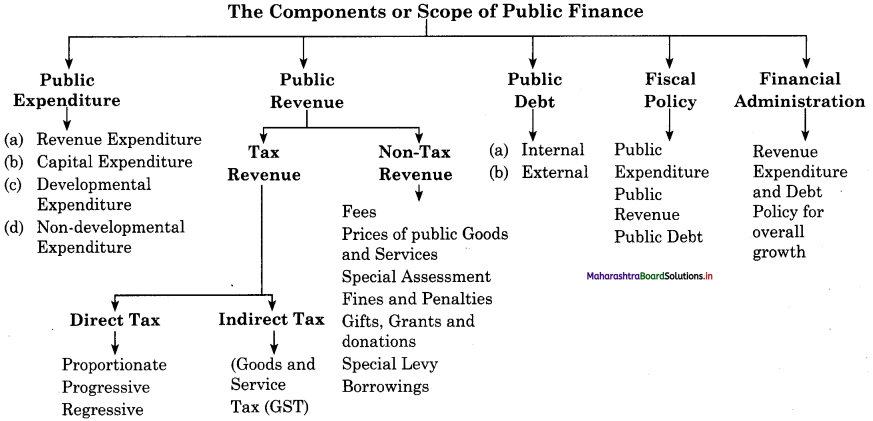
Explain components or scope of public finance in India.
OR
Explain the main components of budget.
Answer:
Public finance is one of the most important branches of economy. It highlights the role and functions of the government Government has to perform various functions like protection from external attack, generation of employment, protection of property, maintaining law and order, provision of collective needs, etc.

To perform these functions efficiently, any government needs finance which can be received from various sources.
Public finance deals with the study of principles of income and expense of the government.
The structure of public finance can be explained as follows:
Maharashtra Board Class 12 Economics Important Questions Chapter 8 Public Finance in India 2
The Components or Scope of Public Finance

(A) Public Expenditure : It refers to that expenditure which is incurred by the public authority (Central, State and Local Government) for promoting economic and social welfare of a country.
Public expenditure is classified as follows:

(a) Public Expenditure : It refers to expenditure on day-to-day functioning of the government. E.g. administration cost, salary allowances and pensions of government employees, etc.
It is incurred regularly but it does not create any assets to government.

(b) Capital Expenditure : It refers to the expenditure for the development of a country. E.g. investment by government in projects, provision of infrastructure, repayment of loan, etc. It does not incur regularly but it makes addition to the assets of the economy.

(c) Developmental Expenditure : It refers to that expenditure of the government, which gives productive impact to the economy.
It results into generation of employment, increase in production, etc.

(d) Non-developmental Expenditure : It refers to that government expenditure which does not yield any direct productive impact on the economy. E.g. war expenditure.
It is unproductive in nature.

Maharashtra Board Class 12 Economics Important Questions Chapter 8 Public Finance in India

(B) Public Revenue : It refers to aggregate collection of income with the government through various sources. They are classified as:
(a) Tax Revenue
(b) Non-tax Revenue

(a) Tax Revenue : There are two types of taxes collected by the government. They are as follows:

Direct tax : Direct tax is that tax which is paid by a person on whom it is legally s imposed. E.g. income tax, wealth tax, etc.
Direct tax can be proportionate – (constant rate of tax on all incomes), progressive (rate of tax increases with an increase in income) or regressive (rate of tax declines ) with rise in income. In India, we have progressive tax rate system.

Indirect tax : Indirect tax is that tax which ( is imposed on one person but can be paid by the other, e.g. GST.

A taxpayer cannot shift the burden of direct tax to others, however, in case of indirect tax, tax burden can be shifted to others.

(b) Non-tax Revenue : Non-tax revenue refers to the revenue received by the government from various sources other than taxes.

Public expenditure is an important aspect which is incurred by the public authority (central, state and local government). Public expenditure is required for the protection of the citizens of a country, for satisfying social needs or collective needs and for promoting social and economic welfare of the people in a country.

Classification of public expenditure is as under:
(1) Revenue expenditure : It is the expenditure of the government to carry out day-to-day functions. It is recurring in nature. It does not create any assets to government It consists of administrative expenditure, interest payment, pensions and salaries to government employees, etc.

(2) Capital expenditure : It refers to the expenditure of the government for the) development of a country.
It consists of huge investment in different developmental projects, repayment of government loans, investment on land, building, machines, etc.
It is non-recurring in nature

(3) Developmental expenditure : The expenditure which results in generation of employment and price stability, it is known as developmental expenditure.

It consists of expenditure on education, social welfare, industrial development, etc. It leads to an increase in production. It is s productive in nature.

(4) Non-developmental expenditure : It is that government expenditure which does not yield any direct productive impact on the economy. It is mainly in form of expenses on administration costs, war expenses, etc. It is unproductive in nature. It is observed that, since last 30 years, there is a tremendous growth in the total public expenditure of a country because modern government performs many functions for the social and economic development of a country.

(C) Public Debt:
Maharashtra Board Class 12 Economics Important Questions Chapter 8 Public Finance in India 1
Tax is a major source of revenue to the Government
According to Prof. Taussig, “The essence of a tax as distinguished from other charges by government is the absence of a direct ‘quid pro quo’ (benefit) between the tax payer and the public authority. ”
Prof. Seligman states that, “a tax is a compulsory contribution from a person to the government, without reference to special benefits confessed. ”
Thus, every citizen of a country is legally bound to pay tax.
Tax is imposed on income, property or commodities and services.

Types of Taxes :

(1) Direct Tax : It is paid by the tax payer on his income and property. A tax-payer cannot transfer the burden of direct tax to others.
Impact and incidence of direct tax falls on the same person. E.g. Income tax, wealth tax, etc.
Direct taxes are further classified into three categories.
(i) Proportionate tax (ii) Progressive tax (iii) Regressive tax

(2) Indirect Tax : It is levied on goods and services. It is paid at the time of production or sale and purchase of a commodity or a service.
The burden of indirect tax can be shifted by the tax-payer (producers) to other persons. Hence, impact and incidence of tax are on others. E.g. GST.
Thus, major share of public revenue is the contribution by tax revenue in India.

(D) Fiscal Policy : It is the means through s which government adjusts its spending’s c and tax rates. It helps to monitor and influence nation’s economy. It deals with public expenditure, public revenue and l public debt.
Thus, it is the financial policy implemented by the government.

(E) Financial Administration : It implies I an efficient implementation of revenue, external and debt policy of the government. It includes preparation and implementation of the government budget along with overall economic growth of a country.


Maharashtra Board Class 12 Economics Important Questions Chapter 8 Public Finance in India

Budgetary actions of the government affect production, size and distribution of income and utilization of material and human resources of a country. Thus, the scope of public finance is important in a modern economy.

Maharashtra Board Class 12 History Important Questions Chapter 1 Renaissance in Europe and Development of Science

Balbharti Maharashtra State Board Class 12 History Important Questions Chapter 1 Renaissance in Europe and Development of Science Important Questions and Answers.

Maharashtra State Board 12th History Important Questions Chapter 1 Renaissance in Europe and Development of Science

1A. Choose the correct alternative and rewrite the statement.

Question 1.
__________ means ‘Rebirth’.
(a) Reformation
(b) Renaissance
(c) Revival
(d) Rejuvenation
Answer:
(b) Renaissance

Question 2.
The first crusade began in the year __________
(a) 1096
(b) 1097
(c) 1098
(d) 1099
Answer:
(a) 1096

Maharashtra Board Class 12 History Important Questions Chapter 1 Renaissance in Europe and Development of Science

Question 3.
__________ is said to have mentioned the sunspots (Tamas Kilakas) in his treatise ‘Brihatsamhita’.
(a) Ibn Batuta
(b) Varahamihir
(c) Alberuni
(d) Arya Bhatt
Answer:
(b) Varahamihir

Question 4.
Edmund Cartwright invented the __________
(a) telescope
(b) printing press
(c) steam engine
(d) power loom
Answer:
(d) power loom

Question 5.
__________ invented the steam engine.
(a) James Watt
(b) Thomas Bell
(c) Robert Fulton
(d) George Stephenson
Answer:
(a) James Watt

Question 6.
__________ landed at the port of Calicut in 1498.
(a) Ferdinand Magellan
(b) Vasco da Gama
(c) Capt. James Cook
(d) Mungo Park
Answer:
(b) Vasco da Gama

Maharashtra Board Class 12 History Important Questions Chapter 1 Renaissance in Europe and Development of Science

Question 7.
__________ is considered to be the father of ‘Hydraulics’.
(a) Ibn Batuta
(b) Amir Khushrow
(c) Alberuni
(d) Abul Fazl
Answer:
(c) Alberuni

1B. Find the incorrect pair from group ‘B’ and write the corrected one.

Question 1.

Group ‘A’ Group ‘B’
(a) Galileo Telephone
(b) Thomas Bell Cylinder for printing
(c) Robert Fulton Steamboat
(d) George Stephenson Steam engine for transport

Answer:
Galileo – Telescope

Question 2.

Group ‘A’ Group ‘B’
(a) Marco Polo India
(b) Amerigo Vespucci Venezuela
(c) Samuel de Champlain Quebec
(d) Mungo Park Western Africa expedition

Answer:
Marco Polo – China

2A. Write the names of historical places/persons/events.

Question 1.
Two cities considered holy by Jews, Christians, and Muslims
Answer:
Jerusalem and Bethlehem

Question 2.
Sultan of Egypt who defeated the crusaders by conquering Jerusalem
Answer:
Sultan Saladin

Maharashtra Board Class 12 History Important Questions Chapter 1 Renaissance in Europe and Development of Science

Question 3.
The highest authority of the Catholic Church
Answer:
The Pope

Question 4.
The first printing press was started by
Answer:
Johannes Gutenberg

Question 5.
Author of the epics ‘Iliad’ and ‘Odyssey’
Answer:
Homer

Question 6.
The King who gave trading permission to Vasco da Gama
Answer:
Zamorin

Question 7.
The book written by Louis Antony da Bougainvillea
Answer:
Voyages Around the World

Question 8.
The methodology used in Zoology to classify animals is called
Answer:
Taxonomy

2B. Choose the correct reason from those given below and complete the sentence.

Question 1.
The ‘Medieval’ Period is called ‘Renaissance’ because __________
(a) it saw advances in various fields of life
(b) people wanted change
(c) the rulers imposed restrictions on their thinking
(d) people were tired of fighting wars
Answer:
(a) it saw advances in various fields of life

Maharashtra Board Class 12 History Important Questions Chapter 1 Renaissance in Europe and Development of Science

Question 2.
The ‘Crusades’ was a failure because __________
(a) the Pope and the rulers initiated the wars for their own vested interests
(b) common people losing faith
(c) there was a rift between the Pope and the European rulers
(d) of all of the above reasons
Answer:
(d) of all of the above reasons

Question 3.
The European colonies in the African continent increased because __________
(a) Europeans wanted to settle in Africa
(b) it was rich in diamonds, gold, and copper
(c) the cold climate of Europe made them migrate to Africa
(d) Human labour was very expensive in Europe
Answer:
(b) it was rich in diamonds, gold, and copper

Question 4.
Industrial revolution took place in England because __________
(a) the atmosphere was suitable for the industrial revolution in England
(b) the other nations were weak to compete with England
(c) mechanized production did not take place in the other nations
(d) England wanted to prove her superiority
Answer:
(a) the atmosphere was suitable for the industrial revolution in England

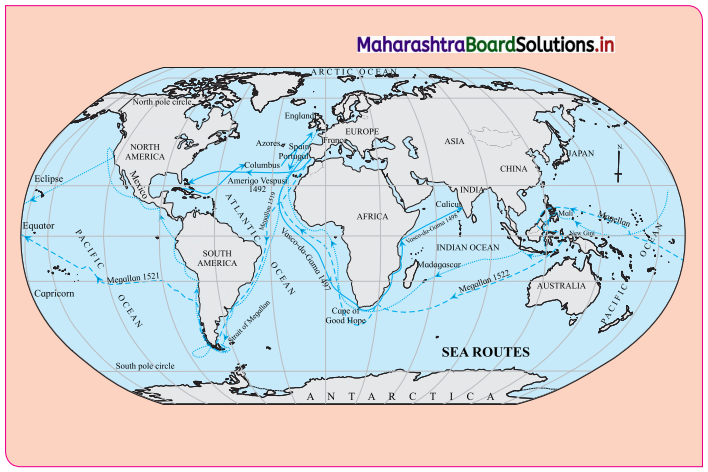
3A. Observe the map on textbook page 05 and answer the questions based on it.

Maharashtra Board Class 12 History Important Questions Chapter 1 Renaissance in Europe and Development of Science 3A

Question 1. Name the ocean that lies in the northern hemisphere.
Answer:
The Arctic

Question 2.
Name the ocean that lies in the southern hemisphere.
Answer:
The Antarctic

Maharashtra Board Class 12 History Important Questions Chapter 1 Renaissance in Europe and Development of Science

Question 3.
Who circumnavigated the earth?
Answer:
Ferdinand Magellan

Question 4.
In which continent lies the Cape of Good Hope?
Answer:
Africa

Question 5.
Where did Vasco da Gama land in India in 1498?
Answer:
Calicut (Kozhikode)

Question 6.
After whom is ‘America’ named?
Answer:
Amerigo Vespucci

3B. Complete the following concept map.

Question 1.

Inventors Inventions
Galileo …………………………….
………………………. Power Loom
James Watt ……………………………
………………………. Spinning Mule

Answer:

Inventors Inventions
Galileo Telescope
Edmund Cartwright Power Loom
James Watt Steam Engine
Samuel Crompton Spinning Mule

Question 2.
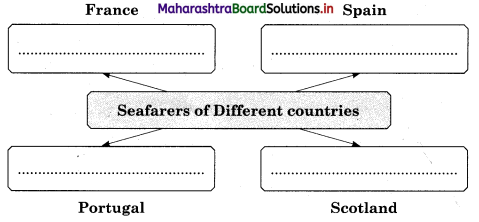
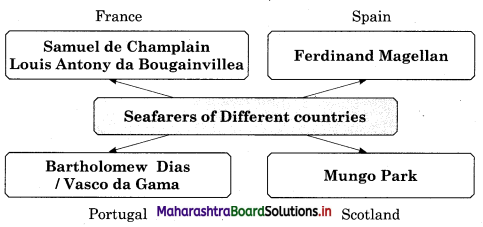
Maharashtra Board Class 12 History Important Questions Chapter 1 Renaissance in Europe and Development of Science 3B Q2
Answer:
Maharashtra Board Class 12 History Important Questions Chapter 1 Renaissance in Europe and Development of Science 3B Q2.1

4. Write Short Notes.

Question 1.
Inventions and Discoveries during the Renaissance period.
Answer:

  • In 1543 C.E., Nicolaus Copernicus told the world that the centre of our planetary system is the ‘Sun’ and not the ‘Earth’.
  • In 1609, Galileo prepared a sophisticated telescope that supported the theories propounded by Copernicus and Kepler.
  • This facilitated research in physical sciences.
  • Inventions of gunpowder and printing brought about changes in the techniques of warfare and dissemination of knowledge.
  • In the world of printing, the first printing press was started by Johannes Gutenberg in 1440 and the first printing press started in Italy in 1451.

Maharashtra Board Class 12 History Important Questions Chapter 1 Renaissance in Europe and Development of Science

Question 2.
Roman Church.
Answer:

  1. In the pre-renaissance period, the Roman church not only controlled the religious life of the people but also the individual life.
  2. It exploited the common people in the following ways-
    • By issuing mandates for payments of fees.
    • Put restrictions on free-thinking and its circulation.
    • Anyone who dared to interpret Bible was sentenced to death.
  3. The humanist philosophy was instrumental in making a ground for resistance against the powerful church.

Question 3.
Ibn Batuta.
Answer:

  • He was a sailor and a famous medieval traveler.
  • Ibn Batuta visited several countries like India, Maldives, Sumatra, China, Spain, Sardinia, East, and West Africa.

Question 4.
Alberuni.
Answer:

  • accompanied Sultan Mahmud of Ghazni during his visit to India.
  • tried to estimate the diameter of the earth.
  • determined the latitudes and longitudes accurately.
  • prepared a map of the earth indicating its round shape.
  • considered as the father of ‘Hydraulics’.

5. Explain the following statements with reasons.

Question 1.
The rise of ‘Economic Nationalism’ was an outcome of the industrial revolution.
Answer:

  • Arresting the growth of rival nations along with pursuing the growth of one’s own nation became important.
  • Putting economic restrictions on rival nations by devising ways.
  • For e.g. Prohibiting the import-export transactions of other countries, levying heavy toll duties on their goods, establishing colonies mainly in Asia and Africa, and fighting with the natives were part of the economic nationalism.
  • Thus, economic nationalism led to imperialism.

Question 2.
The number of European colonies in the African continent increased.
Answer:

  • The continent was rich in diamonds, gold, and copper.
  • It was also rich in fertile land, timber, and forests.
  • Later the Portuguese captured them and sold them as slaves.
  • Cheap human labour was the need of the Europeans.
  • This increased the demand for African slaves and helped them to expand the slave trade.

Maharashtra Board Class 12 History Important Questions Chapter 1 Renaissance in Europe and Development of Science

Question 3.
Galileo is known as the ‘Father of Empirical Sciences’.
Answer:

  • Galileo established the rational method of empirical observation and forming a theory based on those observations.
  • He proved that the speed of objects of different weights falling down is equal by carrying out actual demonstrations from the heights of the tower of Pisa in Italy.
  • He triggered a revolution with his modified telescope which benefited the seafarers to a large extent.
  • With his telescope, he discovered four major satellites of the planet Jupiter.
  • He proved that there are mountains and valleys on the moon and the light emitted from it are actually the rays of the sun.
  • He also calculated that the sun takes 27 days to complete one cycle around itself.
  • He was also the first scientist to observe spots on the sun.
  • Hence, Galileo is known as the ‘Father of Empirical Sciences’.

6. State your opinion.

Question 1.
Scientific inventions in various fields.
Answer:

  • The compass, the barometer, telescope, and the thermometer were invented during this period.
  • Microscopes were invented to observe various types of micro-organisms.
  • Robert Boyle, an alchemist discovered that that the absolute pressure and the volume of a gas are inversely proportional.
  • The research in physics was more focused on heat and sound.
  • In zoology, a methodology known as ‘Taxonomy’ was developed to classify animals.
  • Benjamin Franklin’s research was on lightning and electricity. He coined many technical terms which are used in science even today.

Question 2.
Galileo is known as the ‘Father of Empirical Sciences’.
Answer:

  • Galileo established the rational method of empirical observation and forming a theory based on those observations.
  • He proved that the speed of objects of different weights falling down is equal by carrying out actual demonstrations from the heights of the tower of Pisa in Italy.
  • He triggered a revolution with his modified telescope which benefited the seafarers to a large extent.
  • With his telescope, he discovered four major satellites of the planet Jupiter.
  • He proved that there are mountains and valleys on the moon and the light emitted from it are actually the rays of the sun.
  • He also calculated that the sun takes 27 days to complete one cycle around itself.
  • He was also the first scientist to observe spots on the sun.
  • Hence, Galileo is known as the ‘Father of Empirical Sciences’.

Maharashtra Board Class 12 History Important Questions Chapter 1 Renaissance in Europe and Development of Science

Question 3.
In the pre-renaissance period, the Roman Church controlled both the religious as well as the individual life of the people.
Answer:

  1. In the pre-renaissance period, the Roman church not only controlled the religious life of the people but also the individual life.
  2. It exploited the common people in the following ways-
    • By issuing mandates for payments of fees.
    • Put restrictions on free-thinking and its circulation.
    • Anyone who dared to interpret Bible was sentenced to death.
  3. The humanist philosophy was instrumental in making a ground for resistance against the powerful church.

7. Answer the following questions in detail.

Question 1.
Write a detailed note on the industrial revolution in England.
Answer:
‘Industrial Revolution’ indicates the transition from manual production to mechanized production.

  • In England, the atmosphere was suitable for the industrial revolution.
  • Large amounts of iron ore and coal were available.
  • The humid climate of England was suitable for producing yarn.
  • These conditions proved to be favourable for the textile industry in England.
  • England had also established a large number of colonies by then so England could obtain raw material at cheap rates from these colonies.
  • England could also export the processed goods and sell them in their colonies with large profit margins using their navy.
  • The availability of cheap labour made it possible for them to maintain an optimum level of costs.
  • These factors prepared the ground for the industrial revolution in England thus giving a boost to its economy.
  • Because of the above reasons Industrial revolution first began in England.

8. Answer the following questions with the help of given points.

Question 1.
Discuss the scientific inventions that took place in the following fields.
(a) Textile Industry
(b) Metallurgy
Answer:
(a) Textile industry:

  • In the year 1738, John Kay made and patented the ‘flying shuttle’ which increased the speed of weaving.
  • The ‘spinning jenny’, a spinning frame with multiple spindles were made by James Hargreaves in England. It reduced the amount of labour and time of production.
  • In the year 1769, Richard Arkwright made a more advanced spinning frame. It could produce yarns much faster.
  • Samuel Crompton invented the ‘spinning mule’ in 1779 C. E..This machine increased the speed of producing cloth two hundred times.
  • In 1785, Edmund Cartwright invented the power loom.
  • In 1793, a machine called the ‘cotton gin’ was introduced. This machine separated cotton seeds from cotton fibres at a greater speed.

(b) Metallurgy:

  • England had a number of iron mines.
  • Therefore, it was necessary to advance the technique of smelting iron to acquire purified iron from it.
  • The fuel for iron furnaces was replaced from wood to coal.
  • Special machines were made to keep the furnaces at a set temperature and to maintain their aeration.
  • In 1865, the process of producing steel from molten iron was invented and the nature of the iron industry underwent a major transformation.
  • At about the same time, a method was adopted to pour the molten metal into casts for making iron bars (e.g. rails).

Maharashtra Board Class 12 History Important Questions Chapter 1 Renaissance in Europe and Development of Science

Question 2.
Give an account of the geographical discoveries made by the following explorers
(a) Marco Polo
(b) Henry the Navigator
(c) Bartholomew Dias
(d) Christopher Columbus
Answer:
(a) Marco Polo: An Italian traveller who introduced China and other Asian countries to Europe. He stayed at the royal court of Kublai Khan where he studied Mongolian and Chinese languages.

(b) Henry the Navigator: He was the prince of Portugal in the 15th century. He encouraged people to carry out expeditions which resulted in the discovery of ‘Madeira’ and ‘Azores’, two archipelagos near Africa. These are the autonomous regions of Portugal. The Portuguese transported the African people to Portugal and sold them as slaves. The Portuguese also brought African gold with them.

(c) Bartholomew Dias: Dias began his expeditions on the orders of the king of Portugal, John II. He reached the southern tip of Africa which he named the Cape of Storms. Later on, the name was changed to ‘Cape of Good Hope. He was the first to circumnavigate the African continent.

(d) Christopher Columbus: The eastern sea route was closed to the Europeans and it became necessary to search for an alternative trade route to reach Asia. With the help of King Ferdinand and Queen Isabel of Spain, Christopher Columbus, an Italian explorer set sail in search of India. He, however, reached the islands near America instead of India.

Maharashtra Board Class 12 Sociology Important Questions Chapter 1 Introduction to Indian Society

Balbharti Maharashtra State Board Class 12 Sociology Important Questions Chapter 1 Introduction to Indian Society Important Questions and Answers.

Maharashtra State Board 12th Sociology Important Questions Chapter 1 Introduction to Indian Society

1A. Complete the following statements by choosing the correct alternative given in the brackets and rewrite it.

Question 1.
Law of _________ is also known as the law of cause and effect. (artha, dharma, karma)
Answer:
karma

Question 2.
_________ is the ultimate goal of salvation according to Hinduism. (Moksha, Artha, karma)
Answer:
Moksha

Maharashtra Board Class 12 Sociology Important Questions Chapter 1 Introduction to Indian Society

Question 3.
_________ refers to the acquisition of wealth through the path of righteousness through hard work. (Moksha, Artha, karma)
Answer:
Artha

Question 4.
Ahimsa and tapas are integral components of the _________ way of life. (Jain, Hindu, Buddhist)
Answer:
Jain

Question 5.
The society in the _________ Vedic period was less rigid with respect to occupation-based divisions. (Later, Early, Medieval)
Answer:
Early

Question 6.
_________ advocated an austere and strict lifestyle based on penance. (Jainism, Buddhism, Hinduism)
Answer:
Jainism

Question 7.
_________ is the sacred literature of Buddhism. (Puranas, Tripitkas, Vedas)
Answer:
Tripitkas

Question 8.
_________ promoted the spread of Buddhism across ancient Asia. (Akbar, Harshvardhan, Ashoka)
Answer:
Ashoka

Maharashtra Board Class 12 Sociology Important Questions Chapter 1 Introduction to Indian Society

Question 9.
The _________ period is the period of history of ancient peninsular India. (Ancient, Sangham, Vedic)
Answer:
Sangham

Question 10.
_________ do not permit proselytisation. (Zoroastrianism, Judaism, Islam)
Answer:
Zoroastrianism

Question 11.
The _________ movement brought religious reform in Hinduism during the medieval period. (Peasant, Tribal, Bhakti)
Answer:
Bhakti

Question 12.
Some important exponents of _________ are Kabir, Rahim and Guru Nanak. (Jainism, Sufism, Buddhism)
Answer:
Sufism

Question 13.
During the early Vedic period, those women who pursued their education until they were married were known as _________ (Sadyavadhu, Brahmavadinis, Sola Sati)
Answer:
Sadyavadhu

Question 14.
In the _________ Vedic period, the caste system became entrenched. (Early, Later, Medieval)
Answer:
Later

Question 15.
The _________ Vedic period witnessed a decline in the status of women in society. (Early, Later, Medieval)
Answer:
Later

Question 16.
_________ Jains believe that the principle of nudity is an essential element in the path of liberation. (Digambara, Swetambara, Hinayana)
Answer:
Digambara

Question 17.
The _________ learnt the art of warfare and administration. (Shudras, Kshatriyas, Brahmins)
Answer:
Kshatriyas

Maharashtra Board Class 12 Sociology Important Questions Chapter 1 Introduction to Indian Society

Question 18.
Education during the medieval period is centred on the _________ (Vedas, Bible, Quran)
Answer:
Quran

Question 19.
_________ included comprehensive study of the Quran. (Maktabs, Madrasas, Khanqahs)
Answer:
Madrasas

Question 20.
_________ literature makes reference to tribes and traditional castes. (Sangham, Vedic, Puranic)
Answer:
Sangham

Question 21.
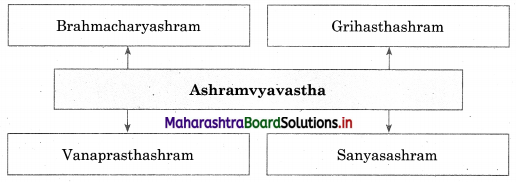
_________ referred to the four stages in the life of a Hindu. (Purusharthas, Ashramvyavastha, Varna)
Answer:
Ashramvyavastha

Question 22.
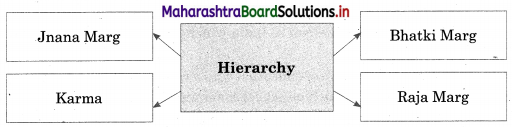
Path of knowledge is _________ marg. (Bhatki, Jnana, Raja)
Answer:
Juana

Question 23.
Sadhus are people who choose the path of _________ (Bhatki, Jnana, Asceticism)
Answer:
Asceticism

Question 24.
The _________ Dynasty believed to be the “Golden Age”. (Maurya, Gupta, Kushan)
Answer:
Gupta

Question 25.
_________ wrote on astronomy and astrology during the classical period. (Aryabhatta, Varahamihira, Dhanvantri)
Answer:
Varahamihira

Maharashtra Board Class 12 Sociology Important Questions Chapter 1 Introduction to Indian Society

Question 26.
_________ wrote on medicine during the classical period. (Aryabhatta, Varahamihira, Dhanvantri)
Answer:
Dhanvantri

Question 27.
_________ wrote on geometry and cosmology. (Aryabhatta, Varahamihira, Dhanvantri)
Answer:
Aryabhatta

Question 28.
During the _________ society experienced a synthesis of Indian and Islamic culture. (Maurya dynasty, Gupta dynasty, Delhi Sultanate)
Answer:
Delhi Sultanate

Question 29.
_________ gave India a strong and stable political administration. (Akbar, Ashoka, Chandragupta Maurya)
Answer:
Akbar

Question 30.
_________ is referred to as first urbanisation. (Harappa, Mesopotamia, Malwa)
Answer:
Harappa

Question 31.
The small Indo-Aryan chieftaincies are called _________ (Mahajanpadas, Janapadas, Republics)
Answer:
Janapadas

Question 32.
In the year _________ the Suez Canal was opened to promote trade interests. (1869, 1969, 1828)
Answer:
1869

Question 33.
The _________ century saw the emergence of the Indian National Congress. (18th, 19th, 20th)
Answer:
19th

Question 34.
The abrogation of Article _________ in August 2019 gave special status to Jammu and Kashmir. (371, 370, 374)
Answer:
370

Maharashtra Board Class 12 Sociology Important Questions Chapter 1 Introduction to Indian Society

Question 35.
The Juvenile Justice Act was passed in the year _________ (2019, 2015, 2005)
Answer:
2015

Question 36.
The Transgender Persons Act was passed in the year _________ (2019, 2015, 2005)
Answer:
2019

1B. Correct the incorrect pair and rewrite it.

Question 1.
(a) Doing one’s duties – Dharma
(b) Sensuous pleasure – Kama
(c) Acquisition of wealth – Dharma
(d) Ultimate goal of salvation – Moksha
Answer:
(c) Acquisition of wealth – Artha

Question 2.
(a) Priests, teachers, intellectuals – Brahmin
(b) Rulers and warriors – Jajman
(c) Menial work – Shudra
(d) Traders, farmers – Vaishya
Answer:
(b) Rulers and warriors – Kshatriya

Question 3.
(a) Studenthood and celibacy – Brahmacharyaashram
(b) Householder – Grihasthashram
(c) Hermithood and retirement – Dharmashastras
(d) Renunciation – Sanyasashram
Answer:
(c) Hermithood and retirement – Vanaprasthashram

Question 4.
(a) Path of Knowledge – Moksha Marg
(b) Path of Devotion – Bhakti Marg
(c) Path of Meditation – Raja Marg
(d) Path of Action – Karma
Answer:
(a) Path of Knowledge – Jnana Marg

Maharashtra Board Class 12 Sociology Important Questions Chapter 1 Introduction to Indian Society

Question 5.
(a) Skyclad – Digambaras
(b) White clad – Shvetambaras
(c) Lesser vehicle – Hinayana
(d) Greater vehicle – Vajarayan
Answer:
(d) Greater vehicle – Mahayana

Question 6.
(a) Advisory and supervisory powers – Sangham priests
(b) Nomadic ballad singers – Khema
(c) Hunter and highway robbers – Vedars
(d) Warrior section – Marrakudi
Answer:
(b) Nomadic ballad singers – The Bards

Question 7.
(a) Sultans and their relatives – Aristocrats and nobles
(b) Ulemas and Brahmin – Peasants
(c) Urban wealthy merchants, traders – Townspeople
(d) Rural agriculturalists – Peasants
Answer:
(b) Ulemas and Brahmin – Priests

Question 8.
(a) Brahmo Samaj – Raja Rammohan Roy
(b) Arya Samaj – Swami Dayanand Saraswati
(c) Prathana Samaj – Mahatma Jyotirao Phule
(d) Harijan Sevak Sangh – Mahatma Gandhi
Answer:
(c) Prathana Samaj – Aatmaram Pandurang

Question 9.
(a) The Sati Prohibition Act – 1829
(b) The Indian Slavery Act – 1843
(c) The Caste Disabilities Removal Act – 1850
(d) The Hindu Widow Remarriage Act – 1870
Answer:
(c) The Hindu Widow Remarriage Act – 1856

1C. Identify the appropriate term from the given options in the box and rewrite it against the given statement.

Puranas, Purusharthas, Jati System, Vardhaman Mahavir, Sola Sati, Ardhamagadhi, Jainism, Holy Sabbath, Din-i-Ilahi, Langar, Brahmo Samaj, Social Legislations, Dr. B. R. Ambedkar, Viharas, Buddhism, Animism, Guru Granth Sahib, Lopamudra

Question 1.
Tribal belief system.
Answer:
Animism

Question 2.
Code of Conduct based on the Law of Karma.
Answer:
Puranas

Maharashtra Board Class 12 Sociology Important Questions Chapter 1 Introduction to Indian Society

Question 3.
The four aims of Hindu life.
Answer:
Purusharthas

Question 4.
It is based on the principle of “purity and pollution”.
Answer:
Jati system

Question 5.
24th Tirthankar of Jainism.
Answer:
Vardhaman Mahavir

Question 6.
The language of teachings of Mahavir.
Answer:
Ardhamagadhi

Question 7.
It advocated an austere and strict lifestyle based on penance.
Answer:
Jainism

Question 8.
It spread because of the patronage of the Mauryan emperor, Ashoka.
Answer:
Buddhism

Question 9.
A sacred observance of Jews.
Answer:
Holy Sabbath

Question 10.
A religion started by Akbar.
Answer:
Din-i-Ilahi

Question 11.
The sacred literature of Sikhs.
Answer:
Guru Granth Sahib

Question 12.
The Punjabi term for a community kitchen.
Answer:
Langar

Maharashtra Board Class 12 Sociology Important Questions Chapter 1 Introduction to Indian Society

Question 13.
One of the notable Vedic and Upanishadic woman scholars.
Answer:
Lopamudra

Question 14.
It highlights exemplary religious qualities which are emulated as role models by Jain women.
Answer:
‘Sola Sati’

Question 15.
Buddhist monasteries.
Answer:
Viharas

Question 16.
It refers to laws passed to promote social justice.
Answer:
Social Legislation

1D. Correct underlined words and complete the statement.

Question 1.
Widow remarriage was permitted in the Later Vedic period.
Answer:
Widow remarriage was permitted in the Early Vedic period.

Question 2.
The Yajur Veda states that “all classes have an equal right to study the Veda”.
Answer:
The Atharva Veda states that “all classes have an equal right to study the Veda”.

Question 3.
Those who never married and continued studying and imparting education throughout their lives were known as Sadyavadhu.
Answer:
Those who never married and continued studying and imparting education throughout their lives were known as Brahmavadinis.

Question 4.
Puducherry had gained prominence and formed the base of the Mauryan Empire.
Answer:
Magadha had gained prominence and formed the base of the Mauryan Empire.

Question 5.
The drainage system is one indicator of the collective life of the Harrapan people.
Answer:
The Great Bath is one indicator of the collective life of the Harrapan people.

Maharashtra Board Class 12 Sociology Important Questions Chapter 1 Introduction to Indian Society

Question 6.
Great Traditions include folk art, folklore, and the religious traditions of the local people.
Answer:
Little Traditions include folk art, folklore, and the religious traditions of the local people.

Question 7.
The period c.500 BCE to c.200 BCE is considered the period of First urbanization’.
Answer:
The period c.500 BCE to c.200 BCE is considered the period of Second urbanization’.

Question 8.
The Portuguese entered India for trade in the 17th century CE.
Answer:
The Portuguese entered India for trade in the 16th century CE.

Question 9.
The implementation of the Judiciary system during the time of the British was carried out on a traditional basis.
Answer:
The implementation of the Judiciary system during the time of the British was carried out on a secular basis.

Question 10.
The Wahabi Movement was the Initiative of Behramji Malabari.
Answer:
The Wahabi Movement was the Initiative of Syed Waliullah.

Question 11.
The Constituent Assembly of India was founded on 6th December 1947.
Answer:
The Constituent Assembly of India was founded on 6th December 1946.

Question 12.
The Female Infanticide Prevention Act was passed in the year 1870.
Answer:
The Female Infanticide Prevention Act was passed in the year 1872.

Question 13.
The Narcotic Drugs and Psychotropic Substances Act was enacted in the year 1920.
Answer:
The Narcotic Drugs and Psychotropic Substances Act was enacted in the year 1985.

Question 14.
The economic growth of India until recently was guided by Planned Development, through ten Five-Year Plans till 2017.
Answer:
The economic growth of India until recently was guided by Planned Development, through twelve Five-Year Plans till 2017.

2. Write short notes.

Question 1.
Education during the Later Vedic period.
Answer:
During the Later Vedic period, women were denied access to the Upanayana ceremony, which then denied them access to learning. There was an emphasis on the institution of sacrifice and this led to the growth of large amounts of literature related to sacrifice. The first millennium CE saw the disintegration of tribal units and chieftains were overthrown. In this situation of hopelessness emerges asceticism as a means for salvation from worldly life which was now preached by the Upanishads.

In eastern parts of India, there was the rise of free speculation and the emergence of humanitarian and theistic movements, which in turn led to new centers of spiritual leadership – the ascetics and wanderers (Sramanas or Parivrayakas) who rejected the authority of the Vedas and of Vedic priests. They criticized blood sacrifices which became a part of Brahminic ritual and gave importance to the practice of ahimsa or non-injury of living beings.

Maharashtra Board Class 12 Sociology Important Questions Chapter 1 Introduction to Indian Society

After Mahavir became a Kevalin (omniscient), a Jina (conqueror), and Mahavir (a great hero), he now became part of the sect called Nirgranthas, which came to be referred to as Jainas (following of Jina). Mahavir was a religious teacher for three decades.

Buddha borrowed and adapted from the popular beliefs of the region. The Buddhist system of education was conducted through Buddhist monasteries (viharas). The center of the Buddhist system of learning revolved around the Order (Sangh) of monks (bhikkus); later Buddha permitted the entry of women as nuns (bhikkhunis). Religious instruction was imparted in the viharas and like the Brahmanical system of education, there was a special relationship between the learner and teacher; the student had to live with the teacher (Upajjhaya or Acharya) and serve him.

Just as Vedic culture centred on sacrifices, Buddhist education and learning revolved around monasteries. Education in the Sangham period was a widespread social activity. It was a secular factor and not the privilege of any one community. Works on grammar, poetry, mathematics, astronomy, and fine arts (music, dance, drama, painting, sculpture), and architecture were the specializations.

The decline of Buddhist Viharas resulted in the decline of an organized system of education.

Question 2.
Nature of education during Medieval Period.
Answer:
Education during the Medieval Period is centred on the Quran. Without the ability to read and write, it would have been impossible to study the Quran, the Hadith, and other sciences. The Prophet Mohammed exhorts all people of faith to acquire knowledge.

However, unlike the previous systems of learning, there was no requirement for the strictness associated with Vedic schools nor renunciation (rejection) of the world. The Islamic system of education is open to all followers of the faith irrespective of one’s status.

Education was imparted in three ways:

  • Maktab (for elementary education)
  • Madrasa (for higher learning and generally attached to a mosque)
  • Khanqah (theological training)

Maktabs had an age of admission around four years, which was marked by a religious ceremony. Early training focused on the R’s of learning – reading, recitation, writing, and arithmetic. The study of the Quran would start from around age seven.

Madrasas included a comprehensive study of the Quran and its commentary by established theologians alongside practical subjects like agriculture, accountancy, astrology, astronomy history, geography, mathematics, Islamic law and jurisprudence and statecraft i.e., the art of administration) and languages such as Arabic and Persian. Akbar enabled the study of Sanskrit and Upanishads for Hindu students who wished to learn at the Madrasa. The education was based upon the political, social and economic needs of the community at large. Students had the freedom to choose subjects according to one’s interests and their aims in life.

Maharashtra Board Class 12 Sociology Important Questions Chapter 1 Introduction to Indian Society

Post-madrasa training could be followed up by engaging the services of a learned teacher (for example, Abdul Qadir Badaoni, Abul Fazl, Faizi). Madrasas provided facilities for residence for both, students and teachers. In this regard, they were similar to Buddhist Viharas and temple colleges of South India from after the 7th century CE. Khanqahs can be linked to monasteries of Medieval Europe and they were often linked to the tombs of celebrated, much loved, and respected saints. These came to be regarded as Dargahs.

In the course of time, the arts themselves came to be influenced by the tast.es, ideas, and interests of the patrons, namely, Muslim rulers in Medieval India.

During the Medieval Period, education suffered a setback due to changed political circumstances. Educational work was carried out in the villages and towns by private individuals and institutions. The mediums of instruction were Sanskrit, Arabic, and Persian. Education, however, was made available to only a small section of people e.g., the elite and the ulema, the Brahmins, and a few upper caste groups. The education of girls was perceived as being a personal matter to be decided by their fathers or guardians. Women from the Muslim nobility were permitted to receive education in their homes at the hands of teachers who were presented with expensive gifts. Since, only a relatively small number of people belonging to the upper strata of society, it is reasonable to assume that the education of girls and women during the Medieval period was bleak.

Question 3.
Urbanisation during the ancient and medieval periods.
Answer:
The archaeological evidence from the Harappan civilization suggests that Harappa was indeed a well-planned town with a ‘way of life that can be referred to as ‘first urbanisation’. The city had a covered drainage system and a well-developed drainage system underground. The social conditions were well-advanced like other contemporary civilizations.

Towards the end of the Later Vedic period, after the pastoral and nomadic Indo-Aryans spread from Punjab to the Gangetic Plain; they deforested large areas of land to pave way for agriculture.

The period c.500 BCE to c.200 BCE is considered the period of ‘second urbanisation’ which brought a large-scale beginning of town life in the middle Gangetic basin. Magadha had gained prominence and formed the base of the Mauryan Empire.

Sixteen monarchies and “republics” known as Mahajanpadas, stretched across the Indo- Gangetic Plain from modern-day Afghanistan to Bengal and Maharashtra.

This period saw the second major rise of urbanism in India after the Harappan civilisation. Evidence for it comes through archaeological excavations, especially those of the Northern Black Polished Ware (NBPW) culture. Jain, Buddhist, and Sutra literature are among the important sources of information about cities and socio-political life of this period.

The beginning of coinage (metallic coins) started in this period. These cities became the centres of administration as well as of trade and commerce. This led to the emergence of city-based artisan and merchant guilds. A network of routes for internal and distant trade developed in both eastern and western regions. The position of ‘king’ gained much strength and respect the king was assisted by ministers and officials, who often came from the Brahmin and Kshatriya caste.

Question 4.
Religious beliefs and practices during the ancient and medieval periods.
Answer:
The impact of three ancient indigenous religions – Hinduism, Jainism, and Buddhism are significant especially up to the end of the Later Vedic period. The Vedic period is usually divided into – Early Vedic Period (c.1500 BCE to c.1000 BCE) and the Later Vedic Period (c.1000 BCE to c.500 BCE).

Maharashtra Board Class 12 Sociology Important Questions Chapter 1 Introduction to Indian Society

For Hindus, the Puranas and Dharmashastras laid out a Code of Conduct based on the Law of Karma (Action) rebirth, until it can attain moksha (salvation). The four aims of Hindu life (Purusharthas) are:

  • Dharma
  • Kama
  • Artha
  • Moksha

Jainism is said to have been revealed by 24 Tirthankaras of which Vardhaman Mahavir was the last. Similar to the Hindu Doctrine of Karma, Jain teachings are also based on the Theory of Karma. However, ahimsa (non-harming) and tapas (penance) are important and integral components of the Jain way of life. Buddha, with his teachings, advocated the middle path based on the Four Noble Truths and the Eightfold Path.

The Medieval Period (c. 650 CE – c. 1500 CE), saw several religions come to India from outside. These include Judaism, Christianity, Islam, and much later Zoroastrianism. The Sangham Period (6th century BCE to 3rd century CE) is the period of the history of ancient peninsular India.

The roots of Zoroastrianism are found in the Middle East region. People of the Jewish faith are believed to be one of the early foreign religions to come to India. It is in the 1st century CE that Saint Thomas, an Apostle of Jesus Christ, brought Christianity to the shores of Malabar in South India the essential foundation of the Christian faith is the principle of love and all Christians believe in the Death and Resurrection of Jesus Christ, their Saviour.

Islam first came to India in the 8th century CE, the impact and influence of the religion is seen only much later. Like Judaism and Christianity, Islam also preaches monotheism, and the faith centers on the Holy Quran. Muslims believe in the Five Pillars of Faith.

Sikhism emerged in the late 15th century CE and was founded by Guru Nanak (1469 CE – 1539 CE). Like Hinduism, Jainism, and Buddhism, Sikhism too preached the Karma theory.

The Bhakti Movement emerged with the need to bring religious reform in Hinduism during the medieval period.

Question 5.
The Islamic system of education.
Answer:
The Islamic system of education is open to all followers of the faith irrespective of one’s status.

Education was imparted in three ways:

  • Maktab (for elementary education)
  • Madrasa (for higher learning and generally attached to a mosque), and
  • Khanqah (theological training)

Maktabs had an age of admission around four years, which was marked by a rite of entry. Early training focused on the R’s of learning – reading, recitation, writing, and arithmetic.

Maharashtra Board Class 12 Sociology Important Questions Chapter 1 Introduction to Indian Society

Several hours were spent on developing the art of writing. The study of the Quran would start from around age seven.

Madrasas included a comprehensive study of the Quran and its commentary by established theologians alongside practical subjects like agriculture, accountancy, astrology, astronomy, history, geography, mathematics, Islamic law and jurisprudence and statecraft (i.e., the art of administration) and languages such as Arabic and Persian (which were languages also taught elsewhere in the contemporary Islamic world). Noted scholar Abul Fazl informs us that Akbar enabled the study of Sanskrit and Upanishads for Hindu students who wished to learn at the Madrasa. The education was based upon the political, social and economic needs of the community at large students had the freedom to choose subjects according to one’s interests and their aims in life.

Khanqahs can be likened to monasteries of Medieval Europe and they were often linked to the tombs of celebrated, much loved, and respected saints. These came to be regarded as Dargahs.

Education of women: Muslim rulers at the imperial capitals at Delhi and Agra did not do anything remarkable for the promotion of the education of women.

The education of girls was perceived as being a personal matter to be decided by their fathers or guardians. Women from the Muslim nobility were permitted to receive education in their homes at the hands of teachers who were presented with expensive gifts.

Art: In the course of time, the arts themselves came to be influenced by the tastes, ideas, and interests of the patrons, namely, Muslim rulers in Medieval India. The mediums of instruction were Sanskrit, Arabic, and Persian. Education, however, was made available to only a small section of people e.g., the elite and the ulema, the Brahmins, and a few upper caste groups.

Question 6.
Zoroastrianism.
Answer:
The roots of Zoroastrianism are found in the Middle East region. Persecution of the people of this faith brought them to the Western coast of India, near present-day Gujarat, into which they culturally assimilated.

Zoroastrianism is the only outside religious community that still practices endogamy; it did not permit proselytization i.e., conversions into their faith. Fire temples are their place of worship and entry into their Fire temples is restricted to members of the community.

It is one of the world’s oldest and continuously practiced religions. It is centered on a dualistic cosmology of good and evil (Heaven and Hell).

Their sacred scripture is Avesta in which it is stated that the supreme creator is Ahura Mazda, from whom Asha (cosmic order) originates. Fire and clean water are agents of ritual purity. The Holy Flame was brought by priests from Persia to Navsari in Gujarat (c. 9th century CE).

While maintaining their strong sense of identity and culture, despite their diminishing numerical strength, Parsis has contributed in all walks of life.

Maharashtra Board Class 12 Sociology Important Questions Chapter 1 Introduction to Indian Society

Question 7.
Social life during the ancient and medieval periods.
Answer:
Harappan civilisation was known for its well-planned towns covered drainage system, its granary which was used for storing and trading surplus grain. The Great Bath is one indicator of the collective life of the people. Thus, there were peasants, artisans, traders, fishermen, priests, administrators, artists, weavers, etc.

Sangham literature makes reference to tribes and traditional castes. This indicates their coexistence. Though the Brahmins constituted a numerical minority, they played an important role in the development of Tamilian culture. Sangham priests though not dominating were in the process of assuming advisory and supervisory powers. The Bards (nomadic ballad singers) were a special class. Vedars (hunter and highway robbers) were much feared. The Marrakudi was a separate warrior section that had its own traditions and beliefs. Then, there were the fishermen, salt manufacturers, weavers, agriculturalists, shepherds, and cowherds who were also important.

The Varna System during the Vedic period referred to the social order or class of people. There was flexibility and fluidity with respect to occupation. It was only towards the end of the Vedic period that Varna turned into a rigid jati (caste) hierarchy based on the ideology of purity and pollution.

  • Brahmin – priests, teachers, intellectuals
  • Kshatriya – rulers, and warriors
  • Vaishya – merchants, traders, farmers
  • Shudra – menial work

The first three varnas began to call themselves the upper varnas. They became the ‘twice-born (dvija) because they were entitled to the initiation ceremony (upanayana).

Ashramvyavastha was prescribed for the so-called twice-born castes. This referred to the four stages in the life of a Hindu.

  • Brahmacharyashram – Student hood, single status, and celibacy
  • Grihasthashram – Householder
  • Vanaprasthashram – hermithood and retirement.
  • Sanyasashram – renunciation

The Classical Period (i.e. the period of the Gupta Dynasty) believed to be the ‘Golden Age, is when Indian society grew and thrived, setting the foundations in arts, science, politics, religion, philosophy, and economics that define Indian culture to this day. It became a global trade center arid an epicenter of artistic and intellectual achievement. Eventually, the smaller kingdoms broke away. This allowed the Huns of Central Asia to invade and defeat the Gupta dynasty around 550 CE and finally, the classical period declined by 650 CE.

Many texts (Nitishastras and Dharmashastras) were written during a period of ‘second urbanisation’, which elaborated on socio-political laws.

Maharashtra Board Class 12 Sociology Important Questions Chapter 1 Introduction to Indian Society

The Medieval Period of India witnessed the Muslim invasion of India’s material resources. During the Delhi Sultanate, society experienced a synthesis of Indian and Islamic culture Amir Khusro, used a form of Hindustani, which he called Hindavi. At the same time, the Delhi Sultanate was also responsible for the large-scale destruction and desecration of temples.

During this period also, a rigid caste system was followed. Efforts of Emperor Akbar gave India a strong and stable political administration.

The Medieval Period is often stated to be the darkest period in the history of India however, there emerged several changes that transformed Indian society also. Performing arts, architecture and sculpture flourished alongside internal and foreign trade and commerce. The establishment of Din-I-Ilahi by Akbar was a new religion based on ethical rationalism. Towards the 19th century CE there emerged a widening gap between liberals and orthodox groups from various faiths.

3. Write differences.

Question 1.
Status of women in the Early Vedic period and medieval period.
Answer:

Status of women in the Early Vedic period Status of women in the Medieval period
(i) Status: Indian women enjoyed a high status during the early Vedic period. (i) Status: The status of women deteriorated in Medieval India.
(ii) Education: Women during the Early Vedic period had access to Vedic education. (ii) Education: Only women from upper castes and aristocracy were given education in private.
(iii) Access of Knowledge: There were qualified women and some notable Vedic and Upanishadic women scholars during the early Vedic period. (iii) Access of Knowledge: Knowledge of the scriptures and literacy was denied to Women and her status was reduced to being dependent on men.
(iv) Widow Remarriage: Widow remarriage was permitted in the Vedic period. (iv) Widow Remarriage: Widow remarriage was considered taboo.
(v) Marriage: The main form of marriage was Monogamy and women in early Vedic marriage could marry late or decide not to marry. (v) Marriage: Practices of child marriage, sati, and devadasi system, the customs of polygamy, and early marriage made women the objects of exploitation.
(vi) Freedom: Women were considered as useful and productive members of society and they were given the freedom to choose their life partners for marriage. (vi) Freedom: Freedom of women was curtailed and was reduced to being dependent on men throughout her lifetime.

Question 2.
Buddhism and Jainism.
Answer:

Buddhism Jainism
(i) Founder: The founder of Buddhism is Gautama Buddha. (i) Founder: The founder of Jainism is Vardhaman Mahavir.
(ii) Teaching: The teachings of Gautam Buddha were in the language of the common people, Pali. (ii) Teaching: The teachings of Mahavira were in the language of the common people, Ardhamagadhi.
(iii) Sacred books: The Sacred book of Buddhists is Tipitaka. (iii) Sacred books: The Sacred books of Jains is Agamas.
(iv) Principles: Buddhism advocated the middle path based on the Four Noble Truths and the Eightfold Path. (iv) Principles: Jainism preached (1) Ahimsa (2) Satya (3) Asteya (4) Aparigraha.

4. Explain the following concepts with examples.

Question 1.
Social Reform Movements
Answer:
It was the educated Indians, often from the upper social strata, who campaigned the agenda for change at the micro-socio levels. The 19th century is witness to the emergence of many social and religious reform movements.

All these groups struggled to bring about changes at the local level in which they operated. They aimed in solving social problems which were socio-religious-cultural in nature.

They worked towards reforming obsolete, repressive, and regressive religious practices. The urge for reform was generated largely as a result of their interaction with the West.

Maharashtra Board Class 12 Sociology Important Questions Chapter 1 Introduction to Indian Society

Many groups worked to promote education among the ‘weaker sections – especially women and so-called lower castes. Organisations like the Arya Samaj aimed at restoring Vedic traditions and integrating Vedic knowledge with the modern curriculum.

Examples of some movements of social reforms:

  • Brahmo Samaj – Raja Rammohan Roy
  • Arya Samaj – Swami Dayanand Saraswati
  • Prathana Samaj – Aatmaram Pandurang
  • Harijan Sevak Sangh – Mahatma Gandhi
  • Theosophical Society – Annie Besant

Question 2.
Westernisation
Answer:
Many of the educated elite took to the lifestyle of the British with respect to food habits, dressing, customs, mannerisms, attitudes, beliefs, language, sports, and entertainment, etc. Eminent Indian sociologist, M. N. Srinivas referred to this process of imitation of the British, as ‘Westerisation’.

The impact of Western culture has been classified into four types by Alatas. They are :

  • eliminative changes (i.e., fading out of cultural elements)
  • additive changes (i.e., new cultural additions)
  • supportive changes (i.e., changes that support existing cultural traits)
  • synthetic changes (i.e., the synthesis of old and new culture)

Examples: Drinking tea and coffee, changes in eating habits, using the dining table, crockery, and cutlery, hugging and kissing as a form was adopted universally, western sports like cricket, became popular.

5A. Complete the concept map.

Question 1.
Maharashtra Board Class 12 Sociology Important Questions Chapter 1 Introduction to Indian Society 5 Q1
Answer:
Maharashtra Board Class 12 Sociology Important Questions Chapter 1 Introduction to Indian Society 5 Q1.1

Question 2.
Maharashtra Board Class 12 Sociology Important Questions Chapter 1 Introduction to Indian Society 5 Q2
Answer:
Maharashtra Board Class 12 Sociology Important Questions Chapter 1 Introduction to Indian Society 5 Q2.1

Question 3.
Maharashtra Board Class 12 Sociology Important Questions Chapter 1 Introduction to Indian Society 5 Q3
Answer:
Maharashtra Board Class 12 Sociology Important Questions Chapter 1 Introduction to Indian Society 5 Q3.1

Question 4.
Maharashtra Board Class 12 Sociology Important Questions Chapter 1 Introduction to Indian Society 5 Q4
Answer:
Maharashtra Board Class 12 Sociology Important Questions Chapter 1 Introduction to Indian Society 5 Q4.1

Maharashtra Board Class 12 Sociology Important Questions Chapter 1 Introduction to Indian Society

Question 5.
Maharashtra Board Class 12 Sociology Important Questions Chapter 1 Introduction to Indian Society 5 Q5
Answer:
Maharashtra Board Class 12 Sociology Important Questions Chapter 1 Introduction to Indian Society 5 Q5.1

Question 6.
Maharashtra Board Class 12 Sociology Important Questions Chapter 1 Introduction to Indian Society 5 Q6
Answer:
Maharashtra Board Class 12 Sociology Important Questions Chapter 1 Introduction to Indian Society 5 Q6.1

5B. State whether the following statements are True or False with reasons.

Question 1.
The Bhakti Movement brought religious reform to Hinduism during the medieval period.
Answer:
This statement is True.

The Bhakti Movement rejected the caste system. It criticized excessive ritualism and advocated simplicity in worship. It professed that all human beings were equal in the eyes of God. The focus was on devotional singing and the repetition of his name.

Sufism also preached the unity of humanity and believed in the equality of all human beings in the eyes of God. Some important exponents of this are Kabir, Rahim, and Guru Nanak. Kabir and Rahim denounced external observances of religion such as rituals, superstitious practices, idolatry. Guru Nanak decried the caste system, ritualism, and idol worship.

Bhakti Movement in Maharashtra began in the 13th century CE with Dnyaneshwar. Namdev was his contemporary who criticized fasts, pilgrimages, and all other external forms of religious practices.

Question 2.
After Independence, the goals and programmes of the country have not seen many changes.
Answer:
This statement is False.

After Independence, the goals and programmes of the country have seen numerous changes. Some significant factors that have affected India after 1947.

Constitution of India:

  • The Constitution of India was framed by the Constituent Assembly which was founded on 6th December 1946 to write the Constitution of India.
  • The head of the Drafting Committee of the Constitution was Dr. B. R. Ambedkar.
  • It is a document based on the strengths of the diversity of Indian society. It cherishes the goals of liberty, equality, and fraternity. It supports secularism.
  • There have been numerous amendments to the Indian Constitution. A recent change has been the abrogation of Article 370 in August 2019 which gave special status to Jammu and Kashmir.

Economy: The economic growth of India recently was guided by Planned Development, through twelve Five-Year Plans till 2017. Each plan period has had its own objectives. It was in 1991, globalisation was introduced in India which has its share of positives and negative sides.

Maharashtra Board Class 12 Sociology Important Questions Chapter 1 Introduction to Indian Society

Since 2014, changes such as demonetization, single taxation policy under GST, welfare schemes, borderless trade practices, Swachh Bharat drives, promoting entrepreneurship, etc. have been key points.

Education: There has been a significant expansion of the number of anganwadis, schools, universities, deemed universities, autonomous institutions, IITs (Indian Institute of Technology), IIMs (Indian Institute of Management), IIITs (Indian Institute of Information Technology), NITs (National Institute of Technology), vocational programmes, open learning, online education, self-learning opportunities and so on.

  • Enrolment numbers have been swelling beyond control in several cases.
  • The number of teachers has also risen.
  • The Draft New Education Policy has been formulated in 2019.

Question 3.
India is the most populous democracy in the world. –
Answer:
This statement is True.

In Post-Independent India, we have taken on a system of governance based on the principle of democracy. The three arms of government are the Executive, Assembly Legislature as well as Judiciary. We have the principle of democratic decentralization where power percolates down to the grassroots level.

The Indian political system no longer recognizes the former statuses of prince, nawab, raja or rani. All citizens are equal in the eyes of law. Modern India has embraced the principles and practice of free and fair elections. Voting rights are given to all citizens of India, on the attainment of age 18. India also has a multi-party system – and parties may be national, state or regional in character. Individuals also have the right to contest in elections. We also have a federal system of governance – Centre, and State/Union Territory.

The goals, policies, and agenda of each government are guided by its own principles or ideologies. There are differences and multiple views (for example, Left, Right, and Centre). The role of the opposition is the responsibility of keeping a check on the government in power. Consensus is an important value in a democratic society. Thus, India is the most populous democracy in the world.

Maharashtra Board Class 12 Sociology Important Questions Chapter 1 Introduction to Indian Society

6. Give your personal response.

Question 1.
India is a melting pot of culture.
Answer:

  • India is a melting pot of many cultures and traditions, It is endowed with rich traditions of art, craft, culture, and cuisine, We have assimilated cultures of all civilizations that have come to our shores.
  • Indian society is formed by the incorporation of culture followed by Indians since ancient times.
  • Undoubtedly, Indian culture is one of the oldest existing cultures in the world. With each passing decade, it’s evolving.
  • Western culture has also influenced Indian society. It has led to a few advancements, but at the same time, has caused Indians to disconnect from their roots rapidly.

7. Answer the following question in detail in about 150-200 words.

Question 1.
Discuss with relevant examples, consequences of Colonialism in India with respect to the following factors.
(i) Introduction of the new education system
(ii) Introduction of new administration system
(iii) Introduction of new7 economic system
(iv) Introduction of Transport and Communication
(v) Nationalist Movement
Answer:
(i) Introduction of the new education system: The British set up a system of education that had a far-reaching impact on Indian society. The medium of instruction in high school now became English. It became the common language of communication among the learned people. Schools and colleges were open to all individuals, irrespective of caste, creed, gender, etc.

The Indian Universities Act, 1856, enabled the establishment of the first universities in Calcutta, Bombay, and Madras. The content of education was secular – which included subjects like Mathematics, Science, Philosophy, Sociology, History, etc. This led to the rise of a new class of intelligentsia, who were of Indian origin but trained in ‘Western’ values customs, and practices. Some of them played a significant role in the reform movements. New values like rationality, equality, social justice, secular approach, and individualism gained firmer ground.

(ii) Introduction of new administration system: The British set in place new systems of administration. They started the system of services like the Economic Service, Education Service, Revenue Service, and Administrative Service. A new judiciary system was created, which took into consideration the earlier legal traditions of the Indian communities.

However, its implementation was carried out on a secular basis; each individual was judged on an equal basis, irrespective of one’s caste and creed. The authority of feudal lords and zamindars was abolished.
The Indian Councils Act, The Indian High Court Act, and The Indian Civil Service Act of 1861 all led to major changes in the Executive, Legislative and Judicial administration of India.

(iii) Introduction of new economic system: The economic system got transformed by industrial growth and its twin process of urbanization. Caste-based skills and occupations and, social relationships were gradually changing due to the impact of a changing economy and the rise of factories. The emergence of economic and educated classes was on the rise. New Revenue systems were started by the British in different parts of India which affected the peasants adversely.

Maharashtra Board Class 12 Sociology Important Questions Chapter 1 Introduction to Indian Society

(iv) Introduction of Transport and Communication: Systems of railways and roadways, and, Post and Telegraph offices were set up through the length and breadth of the country. These were ways in which it became possible to reach people in all parts of the country and access resources. In 1869, the Suez Canal was opened to promote trade interests. Development of transportation and communication led to an increase in market outlets for Indian raw materials.

(v) Nationalist Movement: Use of English as a common language of communication among. the educated elite played a significant role in networking, the nationalist movement received momentum. The awakening among the Indian masses against alien rule resulted in the call for the expulsion of the British from India and to fight for independence. The 19th century saw the emergence of the Indian National Congress and Mahatma Gandhi as the key figure in the call for independence.

Maharashtra Board Class 12 Economics Important Questions Chapter 1 Introduction to Micro and Macro Economics

Balbharti Maharashtra State Board Class 12 Economics Important Questions Chapter 1 Introduction to Micro and Macro Economics Important Questions and Answers.

Maharashtra State Board 12th Economics Important Questions Chapter 1 Introduction to Micro and Macro Economics

1. A. Choose the correct option:

Question 1.
The term ‘Micro’ is derived from the Greek word.
(a) Makros
(b) Maikros
(c) Mikros
(d) Mikrosoft
Options:
(1) a
(2) b
(3) c
(4) d
Answer:
(3) c

Question 2.
The term ‘micro’ and ‘macro’ economics were first coined and used by Norwegian Economist.
(a) Adam Smith
(b) Ragnar Frisch
(c) Dr. Marshall
(d) Prof. Ricardo
Options :
(1) a
(2) b
(3) d
(4) c
Answer:
(2) b

Maharashtra Board Class 12 Economics Important Questions Chapter 1 Introduction to Micro and Macro Economics Important Questions

Question 3.
Statements related to features of Micro economics.
(a) The study of individual unit
(b) It deals with income theory
(c) It splits the whole economy
(d) It suggests suitable economic policies to promote economic growth
Options :
(1) a, b, c and d
(2) a and b
(3) a, c and d
(4) b and d
Answer:
(3) a, c and d

Question 4.
Scope of Micro economics.
(a) Theory of factor pricing
(b) Theory of general price level
(c) Theory of product pricing
(d) Theory of economic welfare
Options :
(1) a, b, c and d
(2) a and b
(3) a, c and d
(4) b and d
Answer:
(3) a, c and d

Question 5.
Theory of Economic Welfare.
(a) Efficiency in production
(b) Efficiency in consumption
(c) Overall economic efficiency
(d) Efficiency in social activities
Options :
(1) c and d
(2) a, b and d
(3) a, b and c
(4) b, c and d
Answer:
(3) a, b and c

Question 6.
Main features of macro economics.
(a) Income theory
(b) Lumping method
(c) Price theory
(d) Study of aggregates
Options :
(1) a, b and c
(2) b, c and d
(3) a, b and d
(4) Only b
Answer:
(3) a, b and d

Question 7.
Importance of Micro Economics.
(a) Free market economy
(b) Functioning of an economy
(c) Basis of welfare economy
(d) Foreign Trade
Options :
(1) a, b, c and d
(2) a, b and c
(3) a, b and d
(4) a, c and d
Answer:
(4) a, c and d

Maharashtra Board Class 12 Economics Important Questions Chapter 1 Introduction to Micro and Macro Economics Important Questions

Question 8.
Micro Economic is based on certain assumption.
(a) Perfect competition
(b) Pure capitalism
(c) Full employment
(d) Fluctuations in the national income
Options :
(1) b, c and d
(2) c and d
(3) a, b and c
(4) a, c and d
Answer:
(3) a, b and c

Question 9.
Importance of Macro-economics.
(a) National Income
(b) Economic development
(c) Price determination
(d) General level of employment
Options :
(1) b, c and d
(2) a, b and d
(3) a, b, c and d
(4) None of these
Answer:
(2) a, b and d

Question 10.
Scope of Macro economics.
(a) Theory of Income and employment
(b) Theory of General Price level and inflation
(c) Theory of Economic growth and development
(d) Theory of Factor Pricing
Options :
(1) a and b
(2) a, b and c
(3) a, c and d
(4) a, b, c and d
Answer:
(2) a, b and c

Question 11.
Factors of Production which make contribution in production process.
(a) Land
(b) Profit
(c) Labour
(d) Transport
Options :
(1) a, b and c
(2) a and c
(3) b, c and d
(4) All of above
Answer:
(2) a and c

B. Complete the correlation:

1. Macro economic theory : Income and employment:: Micro economics : ………………
2. General equilibrium : Macro economics :: ……………… : Micro economic
3. Macro Economics : Large :: Micro Economics : ………………
4. Classical Economist: ……………… :: Neo-classical Economist: Prof. Alfred Marshall J
5. Prof. Alfred Marshall : Principles of Economics :: ……………… : General theory of Employment, Interest and Money
6. Study of Individual unit: ……………… :: Study of aggregates : Macro economics
7. Theory of Economic welfare : Scope of Micro economics :: ……………… : Scope of Macro economics
8. Land: Rent:: ……………… : Wages
9. Capital: ……………… :: Entrepreneur : Profit
10. ……………… : Demand and Supply Analysis :: Theory of Income and employment : Consumption and Investment function
11. Macro economics : Entire economy :: Micro economics: ………………
12. Study of the whole economy : Lumping ’ method :: Study of small individual unit : ………………
Answers:

  1. Price theory
  2. Partial equilibrium
  3. Small
  4. Adam Smith
  5. Maynard Keynes
  6. Micro economics
  7. Theory of Economic growth and development
  8. Labour
  9. Interest
  10. Theory of Product Pricing
  11. Small part of economy
  12. Slicing method

(C) Give economic terms.

(1) Micro economics derived from the Greek word.
(2) Macro economics derived from the Greek word.
(3) Study of large economic unit.
(4) Study of small or millionth part of economic unit.
(5) Price determination of individual commodity by forces of demand and supply.
(6) Price determination of factor of production for contributing to the production process.
(7) Maximum satisfaction of people due to efficiency in the allocation of resources.
(8) Determination of the prices of goods and services as well as factors of production.
(9) Equal distribution of produce goods and services to the society for consumption.
(10) Production of most desired goods and services.
(11) Equilibrium position of an individual economic unit.
(12) Assumption of Micro economics i.e. other things remaining constant.
(13) Micro economics does not deal with macro problems.
(14) Economic decisions are taken at individual levels without intervention of government.
(15) Explanation of effects of tariffs, exchange rate, etc.
(16) Micro economics explain various complex economic situation with the help of economic models.
(17) Equilibrium position of whole economy.
Answer:
(1) Mikros
(2) Makros
(3) Macro economics
(4) Micro economics
(5) Theory of Product Pricing
(6) Theory of Factor Pricing
(7) Theory of Economic Welfare
(8) Price Theory
(9) Efficiency in Consumption
(10) Overall Economic Efficiency
(11) Partial equilibrium
(12) Ceteris Paribus
(13) Limited scope
(14) Free Market economy
(15) Foreign Trade
(16) Economic Model building
(17) General Equilibrium Analysis

Maharashtra Board Class 12 Economics Important Questions Chapter 1 Introduction to Micro and Macro Economics Important Questions

(D) Find the odd word out:

(1) Prof. Pigou, Prof. Samuelson, Adam Smith, J. R. Hicks.
(2) Individual consumer, Individual producer, Particular commodity, Total savings.
(3) Product pricing, Investment function, Factor pricing, Economic welfare.
(4) Efficiency in social activities, Efficiency in production, Efficiency in consumption, Overall economic efficiency.
(5) Price theory, Slicing method, Limited scope, Lumping method.
(6) Aggregate demand, Aggregate supply, Personal income, National income.
(7) National income, National output, National employment, National anthem.
(8) Keynes, Malthus, Fisher, Marshall.
(9) Theory of Economic welfare, Theory of income and employment, Theory of General price level, Theory of Economic growth.
(10) National Income, National Product, Per Capita Income, Gross Salary.
(11) Big, Large, Vast, Tiny.
(12) Microscopic, Massive, Small, Minimum.
(13) Rent, Wages, Capital, Profit.
(14) Land, Labour, Interest, Entrepreneur.
(15) Railways, Reliance, K.E.M. Hospital,
Answer:
(1) Adam Smith
(2) Total savings
(3) Investment
(4) Efficiency in
function social activities
(5) Lumping
(6) Personal income method
(7) National
(8) Marshall anthem
(9) Theory of Economic Income
Welfare
(10) Per Capita
(11) Tiny
(12) Massive
(13) Capital
(14) Interest
(15) Reliance

(E) Complete the following statements.

(1) The term Macro Economics is derived from the Greek word ‘Makros’ which means …………….
(2) The terms ‘Micro economics’ and ‘Macro economics’ were coined by Norwegian Economist …………….
(3) According to Maurice Dobb, Micro economics is in fact a ……………..
(4) The price of all commodity is determined by the forces of …………….
(5) Four main factors contributing to the production process, are …………….
(6) Micro economics deals with the study of behaviour of …………….
(7) Micro economics is based on ‘Ceteris Paribus’ assumptions which means …………….
(8) Micro economics is useful to government in framing …………….
(9) According to Keynes, macro economics is a …………….
(10) Macro economics is known as theory of Income …………….
(11) Macro economics examines the forest …………….
Answer:
(i) study of large unit
(2) Ragnar Frisch
(3) microscopic study of the economy
(4) demand and supply
(5) land, labour, capital and entrepreneur
(6) small individual unit
(7) other things remaining constant
(8) economic policies
(9) policy oriented science
(10) and employment
(11) not a single tree

[F] Choose the wrong pair :

Group ‘A’ Group ‘B’
(1)Macro Individual unit
(2) Factor pricing Rent, wages, interest and profit
(3) Ceteris paribus Other things being constant
(4) Micro Price theory

Answer:
Wrong pair : Macro – Individual unit

II.

Group ‘A’ Group ‘B’
(1) Slicing method Micro economics
(2) Economic welfare Overall economic efficiency
(3)Macro economics Income theory
(4) Maynard Keynes Microscopic study of economy

Answer:
Wrong pair : Maynard Keynes Microscopic study of economy

III.

Group ‘A’ Group ‘B’
(1) Lumping method Macro economics
(2) Product Pricing Forces of demand and supply
(3) Micro economics General equilibrium
(4) National income Study of aggregate

Answer:
Wrong pair : Micro economics – General equilibrium

IV.

Group ‘A’ Group ‘B’
(1) Maynard Keynes Macro economic approach
(2) Micro Mikros
(3) Adam Smith Classical economist
(4) Census Limited scope

Answer:
Wrong pair : Census – Limited scope

V.

Group ‘A’ Group ‘B’
(1) Macro (a) Makros
(2) Prof. Alfred Marshall (b) Neo-classical economist
(3) Lumping method  (c) Splits the whole economy
(4) Partial equilibrium  (d) Micro economics

Answer:
Wrong pair : Lumping method – Splits the whole economy

Maharashtra Board Class 12 Economics Important Questions Chapter 1 Introduction to Micro and Macro Economics Important Questions

(G) Assertion and Reasoning

Question 1.
Assertion (A) – Micro of a small part of the national economy.
Reasoning (R) – Micro economics divides the economy into small units.
(1) (A) is true but (R) is false.
(ii) (A) is false but (R) is true.
(iii) Both (A) and (R) are true and (R) is the correct explanation of (A).
(iv) Both (A) and (R) are true and (R) is not the correct explanation of (A).
Answer:
(iii) Both (A) and (R) are true and (R) is the correct explanation of (A).

Question 2.
Assertion (A) – Micro economics is known as Price theory.
Reasoning (R) – Macro economics is known as Income theory.
(i) (A) is true but (R) is false.
(ii) (A) is false but (R) is true.
(iii) Both (A) and (R) are true and (R) is the correct explanation of (A).
(iv) Both (A) and (R) are true and (R) is not the correct explanation of (A).
Answer:
(iv) Both (A) and (R) are true and (R) is not the correct explanation of (A).

Question 3.
Assertion (A) – Macro economics studies overall conditions in the economy.
Reasoning (R) – Micro economics deals with National income and employment.
(i) (A) is true but (R) is false.
(ii) (A) is false but (R) is true.
(iii) Both (A) and (R) are true and (R) is the correct explanation of (A).
(iv) Both (A) and (R) are true and (R) is not the correct explanation of (A).
Answer:
(i) (A) is true but (R) is false.

Question 4.
Assertion (A) – General equilibrium deals with the behaviour of individual price of commodity.
Reasoning (R) – Lumping method is the study of aggregates.
(i) (A) is true but (R) is false.
(ii) (A) is false but (R) is true.
(iii) Both (A) and (R) are true and (R) is the correct explanation of (A).
(iv) Both (A) and (R) are true and (R) is not the correct explanation of (A).
Answer:
(ii) (A) is false but (R) is true.

Question 5.
Assertion (A) – Macro economic analyses shows how the general price level is determined.
Reasoning (R) – The study of general price level is important on account of the problems created by inflation and deflation.
(i) (A) is true but (R) is false.
(ii) (A) is false but (R) is true.
(iii) Both (A) and (R) are true and (R) is the correct explanation of (A).
(iv) Both (A) and (R) are true and (R) is not the correct explanation of (A).
Answer:
(iii) Both (A) and (R) are true and (R) is the correct explanation of (A).

Maharashtra Board Class 12 Economics Important Questions Chapter 1 Introduction to Micro and Macro Economics Important Questions

Question 6.
Assertion (A) – In Micro economics decision regarding production of goods can be taken by individual.
Reasoning (R) – Study of macro economics help to understand the problems of developing countries and suggest important steps to achieve economic development.
(i) (A) is true but (R) is false.
(ii) (A) is false but (R) is true.
(iii) Both (A) and (R) are true and (R) is the correct explanation of (A).
(iv) Both (A) and (R) are true and (R) is not the correct explanation of (A).
Answer:
(iv) Both (A) and (R) are true and (R) is not the correct explanation of (A).

Question 7.
Assertion (A) – Micro economics is based on assumption of ‘Ceteris paribus’.
Reasoning (R) – Macro economics consists of the story of economic growth and development.
(i) (A) is true but (R) is false.
(ii) (A) is false but (R) is true.
(iii) Both (A) and (R) are true and (R) is the correct explanation of (A).
(iv) Both (A) and (R) are true and (R) is not the correct explanation of (A).
Answer:
(iv) Both (A) and (R) are true and (R) is not the correct explanation of (A).

Question 8.
Assertion (A) – Micro economics help to analyse the general level of employment of out put in an economy.
Reasoning (R) – Macro economics helps us to analyse the performance of an economy.
(i) (A) is true but (R) is false.
(ii) (A) is false but (R) is true.
(iii) Both (A) and (R) are true and (R) is the correct explanation of (A).
(iv) Both (A) and (R) are true and (R) is not the correct explanation of (A).
Answer:
(ii) (A) is false but (R) is true.

(H) Choose the correct pair :

Group ‘A’ Group ‘B’
(1)Macro (a) Slicing method
(2) Micro (b) Classical economist
(3) Adam Smith (c) Neo-classical economist
(4) Prof. Marshall (d) Inflation
(e)Lumping method

Answer:
(1)-(e), (2)-(a), (3)-(b), (4) – (c).

II.

Group ‘A’ Group ‘B’
(1) Factor of Production (a) Other things being equal
(2) Ceteris Paribus (b) Land
(3) Price theory (c) Micro economics
(4) Lumping method (d) Profit
(e)Whole economy

Answer:
(1)-(b), (2) – (a), (3) -(c), (4) -(e).

III.

Group ‘A’ Group ‘B’
(1) National Income (a) Rent, wages, interest, etc.
(2) Factor Pricing (b) Mikros
(3) Micro (c) Study of aggregate
(4) Slicing method (d) Makros
(e)Splits the whole economy

Answer:
(1)-(c), (2)-(a), (3)-(b), (4)-(e).

IV.

Group ‘A’ Group ‘B’
(1) Micro economics (a) Theory of investment
(2) Macro economics (b) Key tool of micro economics
(3) Marginalism (c) Price theory
(4) Aggregate study (d) Forest
Income and employment theory

Answer:
(1) – (c), (2) – (e). (3) – (b). (4) – (d).

V.

Group ‘A’ Group ‘B’
(1) Maurice Dobb (a) Principles of Economics
(2) Ragnar Frisch (b) Policy oriented science
(3) Alfred Marshall (c) Microscopic study
(4) Adam Smith (d) Oslo University
(e) Classical economist

Answer:
(1)-(c), (2)-(d), (3)-(a), (4)-(e).

Maharashtra Board Class 12 Economics Important Questions Chapter 1 Introduction to Micro and Macro Economics Important Questions

2.[A] Identify and explain the concept from given illustrations.

Question 1.
Through public distribution system rationing shops distribute goods to poor people.
Answer:
Concept: Efficiency in consumption.
Explanation : Efficiency in consumption means distribution of produced goods and services to the people for consumption for having maximum satisfaction.
Public distribution system is developed specially to help economically weaker section of society to satisfy their consumption.
Rationing shops provide subsidized food and non food items to below poverty line people.

Question 2.
Mukesh divided his departmental J store into two separate divisions i.e. S food grains and garments to find actual profitability separately.
Answer:
Concept: Slicing method.
Explanation : Micro economics splits or divides the whole economy into small individual units and then studies each unit separately in detail.
Mukesh has divided its business into two separate divisions to understand thedetail cost of operations and profitability separately for food business as well as garment business.
Government collect whole information about population through census.
Concept : Lumping method / Macro economics.
Explanation : Macro economics use lumping method to study the whole economy rather than its part.

Question 6.
Government collect whole information about population through census.
Answer:
Concept : Lumping method / Macro economics.
Explanation : Macro economics use lumping method to study the whole economy rather than its part.
Govern ment collects data through census which gives them details about population such as sex ratio, literacy rate, unemployment rate, age composition, etc.

Question 7.
Reliance industries has created more employment opportunities through its biggest oil refinery in Jamnagar and improved the standard of living of its employee.
Answer:
Concept: Economic development. Explanation : Macro economics help to understand the problems of developing countries and suggest important steps to achieve economic development.
Economic development is a growth of the standard of living of people from low income to high income.
Through developing oil refinery Reliance has created numbers of job opportunities and hence improved the standard of living. Amul has fixed price of ₹ 44 per litre of milk after considering the cost such as machinery cost, labour cost, transportation cost, etc.
Concept: Price determination.
Explanation : Micro economics is known as price theory because it deals with determination of the prices of goods and services as well as factors of production. After considering cost of operations such as machinery cost, raw material cost, labour cost, transportation cost, etc. Amul has fixed price of its product (milk).

B. Distinhbish between

Question 1.
Micro Economics and Macro Economics.
Answer:

Micro Economics Macro Economics
(a) Micro economics deals with the economic behaviour of small units like particular firm, particular household, individual prices, wages, etc. (a) Macro economics deals with the economic behaviour of large units or entire economy such as National Income, aggregate demand, aggregate supply, etc.
(b) It studies each unit in depth by using slicing method. (b) It studies the economy as a whole using lumping method.
(c) It is based on partial equilibrium analysis based on assumptions. (c) It is based on a general equilibrium analysis.
(d) Micro economic analysis is also called as ‘Price theory.’ (d) Macro economic analysis is also called as ‘Income theory.’
(e) Most of the theories are given by Dr. Alfred Marshall. (e) Theories are profounded by Lord J. M. Keynes.

Maharashtra Board Class 12 Economics Important Questions Chapter 1 Introduction to Micro and Macro Economics Important Questions

Question 2.
Micro Variables and Macro Variables.
Answer:

Micro Variables Macro Variables
(a) Micro variables refer to individual demand, market demand, individual supply, price of a commodity, etc. (a) Macro variables refer to inflation rate, aggregate demand, aggregate supply, employment.
(b) Micro variables are mostly independent. It does not affect the whole economy, as they are based on assumptions. (b) Macro Variables are inter related and inter dependent. It affects the working of the economy as a whole.
(c) E.g., Price and Quantity demanded are universally related. This will hold true only if the income of the consumer, taste, fashion, etc., remain constant. (c) Change in aggregate demand, aggregate supply will affect income, employment, etc. in the economy.

Question 3.
Partial Equilibrium and General Equilibrium.
Answer:

Partial Equilibrium General Equilibrium
(a) Micro economics uses Partial Equilibrium analysis based on the assumption, other things remaining constant. (a) Macro economics uses general equilibrium. It is not based on assumption.
(b) Partial Equilibrium studies the equilibrium of a consumer, a firm, an industry or a market. (b) It deals with the Equilibrium position of the economy as a whole.
(c) It deals with one or two variables at a time. So it is a simple method. It is independent. (c) It deals with all the variables of the Economic System simultaneously. So it is sophisticated. There is inter dependence.
(d) Partial Equilibrium is regarded as a worm’s eye-view. (d) General Equilibrium is a bird’s eye-view.

Question 4.
Micro Theory of Distribution and Macro Theory of Distribution.
Answer:

Micro Theory of Distribution Macro Theory of Distribution.
(a) Micro Theory of distribution refers to distribution of Factor Income to individual factor owners for their contribution to the production of a commodity or service. (a) Macro theory of distribution refers to distribution of National Income to factors like wages to the labourers, rent to landlords and interest to capitalist.
(b) It is determined by the market forces of demand and supply. (b) It is determined by the Aggregate demand and Aggregate supply and Employment level in the country.

Question 5.
Slicing Method and Lumping Method.
Answer:

Slicing Method Lumping Method
(a) In slicing method the entire economy is cut into individual slices and each unit is studied in depth. (a) In lumping method, we study the economy as a whole without slicing it.
(b) Micro Economics uses the slicing method. (b) Macro Economics uses the Lumping Method.
(c) In slicing method, in depth study of the behaviour of an individual unit like a household, a firm, a product, a factor is done. (c) In lumping method, it deals with the behaviour of large aggregates like National Income, aggregate demand, aggregate supply, employment and their functional relationship is studied.
(d) It relates to the in-depth study of a tree and not the study of forest as a whole. (d) It relates to the study of the forest as a whole and not a particular tree.
(e) Here we achieve a worm’s eye view. (e) It gives a bird’s eye view of the whole economy.

3. State with reasons whether you agree or disagree with the following statements:

Question 1.
Micro economics is the study of aggregate.
Answer:
No, I do not agree with this statement.
OR Micro economics studies individual economic units.
Yes, I agree with this statement.

  • Micro economics is the microscopic study of individual economic units in great detail.
  • It deals with individual firms, individual demand and supply, prices of individual, firms, etc.
  • But macro-economics deals with economic behaviour of the whole economy with respect to national income, aggregate demand and supply, general price level, etc.
  • Hence, micro economics is the study of individual economic units whereas macro economics is the study of aggregates.

Question 2.
Macro economics is a partial equilibrium analysis.
Answer:
No, I do not agree with this statement.
OR
Macro Economics deals with the whole s economy.
Yes, I agree with this statement.

  • Macro economics deals with entire economy.
  • Macro economics follow general equilibrium analysis. On the other hand, micro economics follow partial equilibrium analysis.
  • Macro economics studies the behaviour of number of aggregate economic variables.
  • Macro economics follows general equilibrium. It assumes “everything depends on every thing else.”
  • General equilibrium deals with the behaviour of demand, supply and prices in the whole economy.
  • Therefore, macro economics is not a partial equilibrium analysis but it is a general equilibrium analysis.

Question 8.
Micro economics is useful to the Government.
Answer:
Yes, I agree with this statement.
Useful to Government : It is useful in formulating and evaluating economic policies including pricing and distribution policies that promote economic welfare. It is useful in determining tax policy, public, expenditure policy, etc.

Question 9.
The scope of macro economics is wide.
Answer:
Yes, I agree with this statement.
(A) Theory of Income and Employment : It ?
explains which factors determine the level of National Income and employment and what causes fluctuations in the level of income, output and employment.
To understand how the level of employment is determined, we have to study the consumption function. It includes theory of business cycles.

(B) Theory of General Price Level and Inflation: Macro economics analyses shows how the general price level is determined and the causes for fluctuations in it. This study is important for understanding the problems created by inflation and deflation.

(C) Theory of Economic Growth and Development : Macro economics studies the causes of under development and poverty in poor countries and suggests strategies for accelerating growth and development in the country.

(D) Macro theory of Distribution : Macro theory of distribution deals with the relative share of rent, wages, interest and profit in the total national income of various classes.

Question 10.
Theories of micro economics are based on certain assumptions.
Answer:
Yes, I agree with this statement.
Based on certain ssumption : Micro economics is based on ‘ceteris paribus’ assumption i.e., other things remaining constant like full employment, laissez faire policy, perfect competition, pure capitalism, etc.

Question 11.
Macro economics is also known as income and employment theory.
Answer:
Yes, I agree with this statement.
Theory of Income and Employment : It ?
explains which factors determine the level of National Income and employment and what causes fluctuations in the level of income, output and employment.
To understand how the level of employment is determined, we have to study the consumption function. It includes theory of business cycles.

Maharashtra Board Class 12 Economics Important Questions Chapter 1 Introduction to Micro and Macro Economics Important Questions

4. Study the following table / figures / passages and answer :

Question 1.
Read the passage and answer the following questions.
The census of 1991 was the fifth census of independent India and conducted as usual from 9th to 28th February, 2001 to present census data as on sunrise of 1st March 2001, the reference date. The two phases were continued in the same way like previous two censuses.

In the first phase a house list was canvassed to collect the information on housing data and also amenities available to the households. The scope of house list was enlarged and for the first time a question regarding type of fuel used for cooking was canvassed. In 1981 the question on availability of toilet facility was canvassed for urban areas only. However, in 1991, it was canvassed for rural area also.
During 2nd phase following two schedules were canvassed, (a) Household schedule and (b) Individual slip

1. Between which dates the census for 2001 was conducted.
Answer:
The census for 2001 was conducted between 9th to 28th February 2001.

2. What information was collected in the first phase of census?
Answer:
In the first phase of census a house list was canvassed for collecting information about housing data and amenities available.

3. Which question was canvassed in 1991?
Answer:
In 1991 question on availability of toilet were canvassed – (a) household schedule and facility was canvassed for rural area. I 03) Individual slip.

4. Which two schedule were canvassed in IInd phase?
Answer:
During IInd phase below two schedules were canvassed –
(a) household schedule and
(b) Individual slip.

Question 2.
Go through the following chart and answer the questions.
Answer:
Maharashtra Board Class 12 Economics Important Questions Chapter 1 Introduction to Micro and Macro Economics Important Questions 1

1. Which are the two main sectors in Indian education system?
Answer:
The two main sectors in Indian education system are (a) Public sector (b) Private sector.

2. What does public sector education system includes?
Answer:
Public sector education system includes public schools, central government funded institutions, state government funded institutions and higher education institutions.

3. Where are multimedia schools positioned in Indian education system?
Answer:
Multimedia school comes under non-formal setup of private sector in Indian education system.

4. What are the setups in private sector educational system?
Answer:
There are two setups in private sector educational system i.e. formal setup and non-formal setup.

Question 3.
Study the below table and answer the given questions.
Maharashtra Board Class 12 Economics Important Questions Chapter 1 Introduction to Micro and Macro Economics Important Questions 2

(1) Which state has the highest literacy [ rate?
Answer:
Kerala has the highest literacy rate of 90.92%.

(2) What is the male literacy rate for1 Maharashtra?
Answer:
For Maharashtra the male literacy rate is 86.27%.

(3) What is difference of female literacy rate between Delhi and Rajasthan?
Answer:
There is a difference of 30-66% as a whole in female literacy rate between Delhi and Rajasthan.

(4) Which states has highest male literacy and lowest female literacy rate?
Answer:
Kerala has the highest male literacy rate of 94.20% and Uttar Pradesh has the lowest female literacy rate of 42.98%.

Maharashtra Board Class 12 Economics Important Questions Chapter 1 Introduction to Micro and Macro Economics Important Questions

5. Answer in detail:

Question 1.
Explain the scope of Micro economics.
OR
Explain the subject matter of micro economics.
Answer:
Maharashtra Board Class 12 Economics Important Questions Chapter 1 Introduction to Micro and Macro Economics Important Questions 3

(a) Theory of Product Pricing : The price of each commodity is determined by the forces of demand and supply. Micro economics is a study of demand analysis i.e. individual consumer behaviour and supply analysis i.e. individual producer behaviour.
(b) Theory of Factor Pricing : There are four main factors contributing to the production process which are land, labour, capital and entrepreneur. Micro economics helps in determining the factor rewards like land gets rent, labour gets wages, capital gets interest and entrepreneur gets profit.
(c) Theory of Economic Welfare : This theory deals with efficiency in allocation of resources which aim at maximum satisfaction of people. Three economic efficiencies are as follows :

  • Efficiency in production: It mean producing the maximum amount of goods and services from a given amount of goods and j services from a given amount of resources.
  • Efficiency in consumption: It means distribution of produce goods and services to the society for consumption in such a way to have maximum total satisfaction of people.
  • Overall economics efficiency: It means to produce those goods and services which are most desired by the people.

Maharashtra Board Class 12 History Important Questions Chapter 5 India: Social and Religious Reforms

Balbharti Maharashtra State Board Class 12 History Important Questions Chapter 5 India: Social and Religious Reforms Important Questions and Answers.

Maharashtra State Board 12th History Important Questions Chapter 5 India: Social and Religious Reforms

1A. Choose the correct alternative and rewrite the statement.

Question 1.
The practice of Sati was abolished by a law passed in the year __________
(a) 1829
(b) 1830
(c) 1831
(d) 1832
Answer:
(a) 1829

Question 2.
Raja Ram Mohan Roy started a philosophical discussion circle named ‘ __________’.
(a) Prarthana Samaj
(b) Arya Samaj
(c) Satyashodhak Samaj
(d) Atmiya Sabha
Answer:
(d) Atmiya Sabha

Maharashtra Board Class 12 History Important Questions Chapter 5 India: Social and Religious Reforms

Question 3.
The Brahmo Samaj was founded in the year __________
(a) 1826
(b) 1827
(c) 1828
(d) 1829
Answer:
(c) 1828

Question 4.
The Mughal emperor of India conferred the title of ‘____________’ on Ram Mohan Roy.
(a) Pandit
(b) Raja
(c) Alamgir
(d) Badshah
Answer:
(b) Raja

Question 5.
__________ has its origins in Paramhamsa Sabha.
(a) Prarthana Samaj
(b) Arya Samaj
(c) Brahmo Samaj
(d) Satyashodhak Samaj
Answer:
(a) Prarthana Samaj

Question 6.
__________ established ‘Scientific Society’ for Muslims.
(a) Mahatma Phule
(b) Sir Sayyad Ahmad
(c) Swami Dayanand
(d) Tarabai Shinde
Answer:
(b) Sir Sayyad Ahmad

Question 7.
__________ participated in the Vykom Satyagraha in Travancore against untouchability.
(a) Ramaswamy Naikar
(b) Kamaladevi Chattopadhyay
(c) Dr. Ambedkar
(d) Swami Vivekananda
Answer:
(a) Ramaswamy Naikar

Maharashtra Board Class 12 History Important Questions Chapter 5 India: Social and Religious Reforms

Question 8.
Rajarshi Shahu Maharaj was strongly opposed to __________
(a) Bajubandi
(b) Setubandi
(c) Rajbandi
(d) Rotibandi
Answer:
(d) Rotibandi

1B. Find the incorrect pair from group ‘B’ and write the corrected one.

Question 1.

Group ‘A’ Group ‘B’
(a) Sati Act 1829
(b) Restriction of Press 1830
(c) Arya Samaj 1875
(d) Ramkrishna Mission 1897

Answer:
Restriction of Press – 1824

2A. Write the names of historical places/persons/events.

Question 1.
Governor-General who abolished Sati in 1829 –
Answer:
Lord William Bentinck

Question 2.
The company that put restrictions on the freedom of the press –
Answer:
The British East India Company

Question 3.
The social reformer who severely criticized untouchability in his book ‘Vital Vidhwamsan’ –
Answer:
Gopalbaba Walangkar

Maharashtra Board Class 12 History Important Questions Chapter 5 India: Social and Religious Reforms

Question 4.
Editor of ‘Ain-i-Akbari’ written by Abul Fazl –
Answer:
Sir Sayyad Ahmad Khan

Question 5.
The movement led by Dr. Babasaheb Ambedkar at Mahad –
Answer:
Satyagraha of Chavadar Tank

Question 6.
Founder of ‘Independent Labour Party –
Answer:
Dr. Babasaheb Ambedkar

Question 7.
The ruler who organised‘Sahabhoj for all castes –
Answer:
Maharaja Sayajirao Gaikwad

Question 8.
The ruler who opposed ‘Vyavasaybandi’ –
Answer:
Rajarshi Shahu Maharaj

2B. Choose the correct reason from those given below and complete the sentence.

Question 1.
The progress of Indian society was stunted because of __________
(a) superstitions
(b) the orthodox way of life
(c) caste discriminations
(d) all of the above
Answer:
(d) all of the above

Maharashtra Board Class 12 History Important Questions Chapter 5 India: Social and Religious Reforms

Question 2.
Sati was abolished in 1829 because __________
(a) a law was passed by Lord William Bentinck abolishing this inhuman practice
(b) the people of India wanted this custom to be abolished
(c) the Brahmin class wanted Sati to be abolished
(d) women wanted to put an end to this custom
Answer:
(a) a law was passed by Lord William Bentinck abolishing this inhuman practice

Question 3.
The Mughal emperor conferred the title of‘Raja’ on Ram Mohan Roy because __________
(a) Ram Mohan Roy was the emperor’s favourite
(b) Ram Mohan Roy had gone to England to plead the case of the Mughal emperor
(c) Ram Mohan Roy was an efficient lawyer
(d) Ram Mohan Roy visited England
Answer:
(b) Ram Mohan Roy had gone to England to plead the case of the Mughal emperor

Question 4.
Swami Vivekanand established the Ramkrishna Mission because __________
(a) he was asked by his Guru to do so
(b) he wanted to compete with other organisations
(c) he wanted to serve the needy people
(d) so that many people join his Mission
Answer:
(c) he wanted to serve the needy people

3. Complete the following concept map.

Question 1.
Maharashtra Board Class 12 History Important Questions Chapter 5 India - Social and Religious Reforms 3B Q1
Answer:
Maharashtra Board Class 12 History Important Questions Chapter 5 India - Social and Religious Reforms 3B Q1.1

Question 2.

Social Reformers Participated in Movements
1. Maharshi V.R.Shinde ………………………………..
2. ………………………………… Kala Ram Temple, Nasik
3. Ramaswamy Naikar ………………………………..
4. Kamaladevi Chattopadhyay ………………………………..
5. ……………………………….. Non-Brahmanical Movement, Kolhapur

Answer:

Social Reformers Participated in Movements
1. Maharshi V. R. Shinde Parvati Temple, Pune
2. Dr. B. R. Ambedkar Kala Ram Temple, Nasik
3. Ramaswamy Naikar Vykom Satyagraha, Travancore
4. Kamaladevi Chattopadhyay Quit India Movement
5. Rajarshi Shahu Maharaj Non-Brahminical Movement, Kolhapur

4A. Write short notes.

Question 1.
Arya Samaj.
Answer:
Arya Samaj:

  • Founded by Swami Dayanand Saraswati in 1875.
  • Regarded Vedas as holy.
  • Rejected discrimination based on caste differences.
  • Encouraged education of women, widow remarriage, and inter-caste marriage.

Maharashtra Board Class 12 History Important Questions Chapter 5 India: Social and Religious Reforms

Question 2.
Tarabai Shinde.
Answer:
Tarabai Shinde:

  • Born in 1839.
  • She demanded gender equality.
  • She was the first woman to challenge the patriarchal system.
  • She was of the opinion that religious systems suppress women because religions are created by men.

4B. Explain the following statements with reasons.

Question 1.
The British wanted to bring progress to Indian society.
Answer:
The progress of Indian society was stunted because of superstitions, an orthodox way of life, caste discriminations, false social notions, lack of curiosity, and rationality that prevailed on a large scale. The British felt the need to create a new society that was based on the values of ‘Freedom, Equality, Fraternity, and Humanism’.

Question 2.
Raja Ram Mohan Roy was the first Indian to oppose the custom of Sati.
Answer:
Raja Ram Mohan Roy witnessed his brother’s wife commit Sati and this disturbed him deeply. He pointed out that none of the religious texts mentioned the practice of Sati as a prescribed religious obligation. It is because of his efforts that a law was passed by Governor-General Lord William Bentinck abolishing the practice of Sati in 1829.

Question 3.
Dr. Babasaheb Ambedkar used print media to create public awareness.
Answer:
Dr. B. R. Ambedkar knew the importance of print media. For him, it was the best instrument to create awareness and to build the movement for social equality. Therefore, he began to publish his own newspapers namely ‘Mooknayak’, ‘Bahishkrut Bharat’, ‘Janata’ and ‘Samata’.

5. State your opinion.

Question 1.
Tarabai Shinde was the first Indian woman to challenge the patriarchal system.
Answer:
Tarabai Shinde was of the opinion that religious systems suppress women because religious systems are created by men. Therefore, she took a brave step in expressing her thoughts in a brave manner in her essay on women’s rights. In this essay, she not only discussed reforms like widow remarriage, women’s education, abolition of Sati but demanded greater gender equality.

Maharashtra Board Class 12 History Important Questions Chapter 5 India: Social and Religious Reforms

Question 2.
Arya Samaj was founded by Swami Dayanand Saraswati in 1875.
Answer:
Arya Samaj:

  • Founded by Swami Dayanand Saraswati in 1875.
  • Regarded Vedas as holy.
  • Rejected discrimination based on caste differences.
  • Encouraged education of women, widow remarriage, and inter-caste marriage.

6. Answer the following question with the help of the given points.

Question 1.
Discuss the role played by Religious Reform Organisations in the field of religious awakening.
(a) Prarthana Samaj
(b) Satyashodhak Samaj
(c) Arya Samaj
(d) Ramkrishna Mission
Answer:
(a) Prarthana Samaj:

  • Had its origins in Paramhamsa Sabha.
  • Founded by Dadoba Pandurang Tarkhadkar.
  • Founding members like Dr. Atmaram Pandurang, Justice M. G. Ranade, Dr. R. G. Bhandarkar opposed idol worship and emphasized monotheism.
  • Opened schools for girls, orphanages, and night schools for workers.
  • Focussed on gender equality, wiping outcaste discriminations, and appreciating the values of mundane life.

(b) Satyashodhak Samaj:

  • Founded in 1873 by Mahatma Jotirao Phule in Pune.
  • Cracked a whip on the social customs and practices which pushed the Indian masses into a miserable state.
  • Showed a new path to artisans, workers, and other downtrodden people.
  • Characteristics of Satyashodhak Samaj included monotheism, rejection of the authority of Vedas and Puranas, acceptance of rationality, opposition to the dominance of priests and idol worship, etc.
  • Mahatma Phule and his wife Savitribai Phule started a school for girls.
  • His work was continued by Gopalbaba Walangkar who criticized untouchability in his book ‘Vital Vidhwamsan’.
  • Shivram Janba drew attention to the problems of deprived women like Murali, Jagatini, and Devdasi.

(c) Arya Samaj:

  • Founded by Swami Dayanand Saraswati in 1875.
  • Regarded Vedas as holy.
  • Rejected discrimination based on caste differences.
  • Encouraged education of women, widow remarriage, and inter-caste marriage.

(d) Ramkrishna Mission:

  • Swami Vivekananda founded the Ramkrishna Mission in 1897.
  • Focussed on serving needy people, working for people affected by famine, health care for the sick people, education for women, etc.
  • It also gave a message to the Indian youth to get up to awaken and keep moving until the goal is achieved.

Maharashtra Board Class 12 History Important Questions Chapter 5 India: Social and Religious Reforms

Question 2.
What role did the following social reformers play in bringing about social change?
(a) Sir Sayyad Ahmad Khan
(b) Tarabai Shinde
(c) Maharshi Vitthal Ramji Shinde
(d) Kamaladevi Chattopadhyay.
(e) Ramaswamy Naikar
Answer:
(a) Sir Sayyad Ahmad Khan:

  • Was born in 1817 in Delhi.
  • Fluent in Urdu, Persian, Arabic, and English.
  • Established ‘Scientific Society’ for Muslims.
  • After returning from England he founded the Mohammadan Anglo-Oriental College in 1875 which later developed into ‘Aligarh Muslim University.
  • Started a periodical entitled ‘Mohammadan Social Reformer’.
  • Worked for the propagation of modern education, science, and technology.

(b) Tarabai Shinde:

  • Born in 1839.
  • She demanded gender equality.
  • She was the first woman to challenge the patriarchal system.
  • She was of the opinion that religious systems suppress women because religions are created by men.

(c) Maharshi Vitthal Ramji Shinde:

  • Opened Marathi schools and schools for technical training in Parel, Deonar in Mumbai under the umbrella of ‘Depressed Classes Mission’ that was established by him.
  • Worked to create public awareness about the issues affecting the depressed classes like entry into temples (for example, protestations for the right of entry in Parvati temple in Pune), agricultural conference, and joint electorate system of depressed classes.

(d) Kamaladevi Chattopadhyay:

  • Was an active volunteer of Congress.
  • She convinced Mahatma Gandhi to let women participate in salt satyagraha, and she participated in the satyagraha.
  • She worked for women’s rights.
  • Organized demonstrations to draw attention to the problems of workers and farmers.
  • Emphasized justice to female agricultural labourers.
  • Insisted that women working in factories should have the necessary facilities.
  • Followed up the issue of maternity leave to women.
  • Imprisoned by the British for one year for participating in the Quit India Movement.

Maharashtra Board Class 12 History Important Questions Chapter 5 India: Social and Religious Reforms

(e) Ramaswamy Naikar:

  • Born in ‘Erode’ in Tamil Nadu in 1879.
  • He became a follower of Mahatma Gandhi’s philosophy and worked for propagating the use of ‘Swadeshi’.
  • He participated in the Vykom Satyagraha in Travancore against untouchability.
  • Started the ‘Swabhiman Andolan’ in Tamil Nadu.
  • Fought against the varna system and child marriage.
  • He was addressed as ‘Periyar’ or Great Soul because of his magnanimous work.
  • Was a great speaker and author.
  • Took a radical position on issues like women’s rights and family planning.

Maharashtra Board Class 12 Economics Important Questions Chapter 3A Demand Analysis

Balbharti Maharashtra State Board Class 12 Economics Important Questions Chapter 3A Demand Analysis Important Questions and Answers.

Maharashtra State Board 12th Economics Important Questions Chapter 3A Demand Analysis

1. A. Choose the correct option:

Question 1.
The demand curve slopes downward.
(a) Inverse relationship between price quantity demanded
(b) from left to right
(c) from right to left
(d) Direct relationship quantity demanded
Options :
(1) a,b and c
(2) a, b, c and d
(3) a and b
(4) a and d
Answer:
(3) a and b

Question 2.
Demand for a commodity from an individual consumer.
(a) Direct demand
(b) Market demand
(c) Individual demand
(d) Increase in demand
Options:
(1) a
(2) b
(3) c
(4) d
Answer:
(3) c

Maharashtra Board Class 12 Economics Important Questions Chapter 3A Demand Analysis

Question 3.
Demand for a commodity from different consumer at different prices.
(a) Decrease in demand
(b) Contraction in demand
(c) Individual demand
(d) Market demand
Options:
(1) c
(2) b
(3) a
(4) d
Answer:
(4) d

Question 4.
Direct demand.
(a) Vegetable
(b) Milk
(c) Land
(d) Cloth
Options :
(1) a,b and c
(2) a, b and d
(3) b, c and d
(4) c
Answer:
(2) a, b and d

Question 5.
Indirect demand.
(a) Machinery
(b) Sugar
(c) Labour
(d) Capital
Options :
(1) a, b, c and d
(2) a, b and c
(3) a, b and d
(4) a, c and d
Answer:
(4) a, c and d

Question 6.
Joint demand for i tea.
(a) Sugar
(b) Milk
(c) Tea powder
(d) Rice
Options :
(1) a,b and c
(2) b and d
(3) a,b and d
(4) b, c and d
Answer:
(1) a,b and c

Maharashtra Board Class 12 Economics Important Questions Chapter 3A Demand Analysis

Question 7.
Determinant of Demand.
(a) Price
(b) Population
(c) Income
(d) Advertisement
Options :
(1) a and d
(2) a, c and d
(3) a, b, c and d
(4) c and d
Answer:
(3) a, b, c and d

Question 8.
Composite demand.
(a) Electricity
(b) Water
(c) Steel
(d) Xerox machine
Answer:
(1) a, b and d
(2) a, b and c
(3) a, b and d
(4) a and d
Answer:
(2) a, b and c

Question 9.
Competitive demand.
(a) Thums-up
(b) Pepsi
(c) Buttermilk
(d) Coco-cola
Options:
(1) a, b and c
(2) a, c and d
(3) a, b and d
(4) c and d
Answer:
(3) a, b and d

Question 10.
The law of demand was introduced by neo-classical economist.
(a) Alfred Marshall
(b) Adam Smith
(c) Ragnar Frisch
(d) Samuelson
Options:
(1) e
(2) b
(3) d
(4) a
Answer:
(4) a

Question 11.
Assumptions for the law of Demand.
(a) Constant Income
(b) No change in taxation policy
(c) Change in tradition
(d) Stable population
Options :
(1) a, b and d
(2) a, b and c
(3) a and d
(4) only d
Answer:
(1) a, b and d

Maharashtra Board Class 12 Economics Important Questions Chapter 3A Demand Analysis

Question 12.
Exceptions to the law of Demand.
(a) Inferior goods
(b) Jewellery
(c) Habitual goods
(d) Price of substitute goods
Options :
(1) a, b and d
(2) a, b and c
(3) only d
(4) a, c and d
Answer:
(2) a, b and c

Question 13.
Variation in Demand.
(a) Change in Price
(b) Change in quantity demanded
(c) Change in other factors
(d) No change in other factors
Options :
(1) a, b and c
(2) a, b and d
(3) c and d
(4) only a and b
Answer:
(2) a, b and d

Question 14.
Expansion of Demand.
(a) Fall in price
(b) Rise in quantity demanded
(c) No change in income
(d) Change in population
Options :
(1) only c
(2) a, b and c
(3) a, b and d
(4) b, c, and d
Answer:
(2) a, b and c

Question 15.
Change in Demand.
(a) Constant price
(b) Change in demand
(c) Changes in other factors
(d) Increase and Decrease in demand
Options :
(1) a and b
(2) c and d
(3) a, b, c and d
(4) None of these
Answer:
(3) a, b, c and d

Question 16.
Individual demand.
(a) Micro economics
(b) Slicing method
(c) Lumping method
(d) Study of individual unit
Options :
(1) a, b and d
(2) b and c
(3) b, c and d
(4) only a
Answer:
(1) a, b and d

Question 17.
Market demand.
(a) Aggregate demand
(b) Macro economics
(c) Micro economics
(d) Lumping method
Options :
(1) a, b and d
(2) b, c and d
(3) b and c
(4) only c
Answer:
(1) a, b and d

Maharashtra Board Class 12 Economics Important Questions Chapter 3A Demand Analysis

Question 18.
Decrease in demand.
(a) Favourable changes in other factors
(b) Unfavourable changes in other factors
(c) Decrease in quantity demanded
(d) Changes in income of the consumer
Options :
(1) b, c and d
(2) a, b and c
(3) a and b
(4) a, c and d
Answer:
(1) b, c and d

(B) Complete the Correlation.

(1) Individual consumer ……………… :: Total of all the individual: Market demand
(2) Labour : Indirect demand:: Clothes : ………………
(3) Joint demand : Pencil and Paper :: ……………… Electricity
(4) Complementary demand : Car and Petrol:: ………………: Pepsi and Coke
(5) Constant level of Income : Assumption : : Prestige goods : ………………
(6) Expansion in demand : Downward movement on the demand curve :: ………………: Upward movement on the demand curve
(7) Change in demand : Increase in Demand :: ………………: Extension in demand
(8) Increase in demand : Favourable changes in other factors :: Decrease in demand : ………………
(9) Fall in Price : ……………… :: Rise in Price : Quantity demanded falls
(10) ……………… : Tea :: Composite demand : Milk
Answer:
(1) Individual demand
(2) Direct demand
(3) Composite demand
(4) Competitive demand
(5) Exception
(6) Contraction in demand
(7) Variation in demand
(8) Unfavourable changes in other factors
(9) Quantity demanded rises
(10) Joint demand

(C) Give economic terms.

(6) Desire + willingness to purchase + Ability to pay.
(7) The demand by a single consumer in a market.
(8) The demand by all consumer in a market.
(9) Other factors remaining constant, a fall in demand due to a rise in price.
(10) Other factors remaining constant, a rise in demand due to a fall in price.
(11) To satisfying a want of sewing, needle and thread is required.
(12) A rise in demand due to changes in other factors, price remaining constant.
(13) Fall in demand due to changes in other factors, price remaining constant.
(14) Goods of low quality are considered as inferior goods.
(15) The demand for commodities to satisfy the human wants directly.
(16) The demand for factors of production like land, labour, etc.
(17) Two or more goods are demanded at a time to satisfy one want.
Answer:
(6) Demand
(7) Individual Demand
(8) Market Demand
(9) Contraction in Demand
(10) Expansion in Demand
(11) Complementary or Joint Demand
(12) Increase in Demand
(13) Decrease in Demand
(14) Giffen’s Goods
(15) Direct Demand
(16) Indirect Demand
(17) Joint or Complementary Demand

(D) Find the o’dd word out.

(1) Desire, Ability to pay, Uselessness, \ Willingness to purchase
(2) Pepsi, Limca, Coffee, Coke
(3) Cloth, Sugar, Fertilizer, Milk
(4) Land, Capital, Raw material, Flowers
(5) Tea and Sugar, Pen and Pencil, Car and Petrol, Mobile phones and Sim cards
(6) Indirect demand, Individual demand, Composite demand, Competitive demand
(7) Consumer demand, Complementary demand, Composite demand, Competitive demand
(8) Tea – Coffee, Car – Fuel, Thums-up – Pepsi, Rice – Wheat
(9) Coffee powder, Chilli powder, Milk, Sug >r
(10) Gold, Diamond, Platinum, Aluminium
(11) Sony, Samsung, Onida, Karbonn
Answer:
(1) Uselessness
(2) Coffee
(3) Fertilizer
(4) Flowers
(5) Pen and Pencil
(6) Individual demand
(7) Consumer demand
(8) Car – Fuel
(9) Chilli powder
(10) Aluminium
(11) Karbonn

Maharashtra Board Class 12 Economics Important Questions Chapter 3A Demand Analysis

(E) Complete the following statements.

(1) The willingness to have something is called …………….
(2) Desire, willingness to purchase and ability to pay are the three necessary conditions for …………….
(3) The total quantities of a commodity demanded by a particular buyer is ……………..
(4) The sum of the total quantities of a commodity demanded by all buyers in a market is ……………..
(5) Commodities and services satisfying the human wants directly is known as ……………..
(6) The purchasing power of the consumer depends on ……………..
(7) One commodity can be put to several uses, it is known as ……………..
(8) Marshall’s law of demand describes the functional relationship between ……………..
(9) Inferior goods like cheap bread, vegetable ghee, etc., is known as ……………..
(10) Expensive goods such as diamonds, luxury cars are known as ……………..
(11) When demand changes due to changes in price, it is known as ………………
(12) A rise in demand caused by favourable changes in other factors at same price is called ………………
Answer:
(1) desire
(2) demand
(3) individual demand
(4) market demand
(5) direct demand
(6) ability to pay
(7) composite demand
(8) Demand and Price
(9) Giffen goods
(10) Prestige goods
(11) variation in demand
(12) increase in demand

(F) Choose the wrong pair :

I.

Group ‘A’ Group ‘B’
(1) Individual demand Particular consumer
(2) Complementary demand Pen – Ink
(3) Competitive demand Milk – Sugar
(4) Indirect demand Labour

Answer:
Wrong pair : Competitive demand – Milk- 5 Sugar

II.

Group ‘A’ Group ‘B’
(1) Expansion of demand Other factors remaining constant
(2) Law of demand Slopes downwards from left to right
(3) Market demand Demand of all consumers
(4) Direct demand Factors of production

Answer:
Wrong pair : Direct demand – Factors production

III.

Group ‘A’ Group ‘B’
(i) Inferior goods Giffen goods
(2) Prestige goods Luxury goods
(3) Expanasion of demand Fall in price
(4) Increase in demand Unfavourable changes in other factors

Answer:
Wrong pair : Increase in demand Unfavourable changes in other factors

IV.

Group ‘A’ Group ‘B’
(1) Sir Robert Giffen England
(2) Increase in real income Decrease in demand
(3) Inferior goods Bread
(4) Superior goods Meat

Answer:
Wrong pair : Increase in real income Decrease in demand

V.

Group ‘A’ Group ‘B’
(1) Individual demand Individual consumer
(2) Joint demand Tea-coffee
(3) Variation in demand Other factors remaining constant
(4) Decrease in demand Price remains constant

Answer:
(2) Joint demand Tea-coffee

(G) Assertion and Reasoning

Question 1.
Assertion (A) – Individual demand refers to the quantity of a commodity demanded by particular consumer.
Reasoning (R) – Market demand refers to the total demand for commodity from all the consumers.
(i) (A) is true but (R) is false.
(ii) (A) is false but (R) is true. .
(iii) Both (A) and (R) is true and (R) is the correct explanation of (A).
(iv) Both (A) and (R) is true but (R) is not the correct explanation of (A).
Answer:
(iv) Both (A) and (R) is true but (R) is not the correct explanation of (A).

Question 2.
Assertion (A) – Marginal utility goes on diminishing with an increase in the stock of ) a commodity. I
Reasoning (R) – Purchasing power of a consumer increases when the price of a commodity increases. 5-
(i) (A) is true but (R) is false.
(ii) (A) is false but (R) is true.
(iii) Both (A) and (R) is true and (R) is the correct l explanation of (A).
(iv) Both (A) and (R) is true but (R) is not the ( correct explanation of (A).
Answer:
(i) (A) is true but (R) is false.

Question 3.
Assertion (A) – Indirect demand refers to the demand for goods and services which are needed for further production.
Reasoning (R) – All factors of production have indirect or derived demand.
(i) (A) is true but (R) is false.
(ii) (A) is false but (R) is true.
(iii) Both (A) and (R) is true and (R) is the correct explanation of (A).
(iv) Both (A) and (R) is true but (R) is not the correct explanation of (A).
Answer:
(iii) Both (A) and (R) is true and (R) is the correct explanation of (A).

Question 4.
Assertion (A) – When the population size is larger, demand for commodity will be less.
Reasoning (R) – Change in the price of one commodity would also affect the demand of substitute goods.
(i) (A) is true but (R) is false.
(ii) (A) is false but (R) is true.
(iii) Both (A) and (R) is true and (R) is the correct explanation of (A).
(iv) Both (A) and (R) is true but (R) is not the correct explanation of (A).
Answer:
(ii) (A) is false but (R) is true.

Maharashtra Board Class 12 Economics Important Questions Chapter 3A Demand Analysis

Question 5.
Assertion (A) – Demand curve slopes downwards from left to right.
Reasoning (R) – The price of a commodity falls, quantity demanded rises and when S price of commodity rises, quantity demanded falls.
(i) (A) is true but (R) is false.
(ii) (A) is false but (R) is true.
(iii) Both (A) and (R) is true and (R) is the correct explanation of (A).
(iv) Both (A) and (R) is True but (R) is not the correct explanation of (A).
Answer:
(iii) Both (A) and (R) is true and (R) is the correct explanation of (A).

Question 6.
Assertion (A) – If consumer can anticipate the future price of a commodity then it will affect the present demand of a commodity.
Reasoning (R) – Ram buy’s less mangoes in anticipation of getting it at cheaper rate in further date.
(i) (A) is true but (R) is false.
(ii) (A) is false but (R) is true.
(iii) Both (A) and (R) is true and (R) is the correct explanation of (A).
(iv) Both (A) and (R) is true but (R) is not the correct explanation of (A).
Answer:
(iii) Both (A) and (R) is true and (R) is the correct explanation of (A).

Question 7.
Assertion (A) – Variations in demand refers to change in quantity demanded due to change in price alone and other factors remain constant.
Reasoning (R) – Increase in demand and decrease in demand are the types of variations in demand.
(i) (A) is true but (R) is false.
(ii) (A) is false but (R) is true.
(iii) Both (A) and (R) is true and (R) is the correct explanation of (A).
(iv) Both (A) and (R) is true but (R) is not the correct explanation of (A).
Answer:
(i) (A) is true but (R) is false.

Question 8.
Assertion (A) – Increase in demand refers rise in quantity demanded due to favourable changes in other factors and price remains constant.
Reasoning (R) – Decrease in demand refers to fall in quantity demand due to unfavourable changes in other factors and price remains constant.
(i) (A) is true but (R) is false.
(ii) (A) is false but (R) is true.
(iii) Both (A) and (R) is true and (R) is the correct explanation of (A).
(iv) Both (A) and (R) is True but (R) is not the ) correct explanation of (A).
Answer:
(iii) Both (A) and (R) is true and (R) is the correct explanation of (A).

(H) Choose the correct pair :

I.

Group ‘A’ Group ‘B’
 (1) Joint Demand (a) Luxury car
(2) Demand and price (b) Exception to the law of demand
(3) Giffen’s goods (c) Inverse relationship
(4) Prestige goods (d) Several commodities
(e) Vegetables

Answer:
(1)-(d), (2)-(c), (3)-(b), (4)-(a).

II.

Group ‘A’ Group ‘B’
(1) Factors of production (a) Change in price alone
(2) Inferior goods (b) Change in other factors
(3) Pen and Pencil (c) Substitute goods
(4) Change in Demand (d) Giffen’s goods
(e) Indirect demand

Answer:
(1) – (e), (2) – (d), (3) – (c), (4) – (b).

III.

Group ‘A’ Group ‘B’
(1) Contraction in demand (a) Less is demanded at a same price
(2) Decrease in demand (b) Complementary goods
(3) Demand curve (c) Substitute goods
(4) Tea and Coffee (d) Less is demanded at a higher price
(e) Slopes downwards from left to right

Answer:
(1)-(d), (2)-(a), (3)-(e), (4) – (c).

Maharashtra Board Class 12 Economics Important Questions Chapter 3A Demand Analysis

IV.

Group ‘A’ Group ‘B’
(1) Demand (a) A new demand curve
(2) Variation in Demand (b) Same demand curve
(3) Extension of demand (c) Ability and willingness to pay
(4) Increase in demand (d) Change in price alone
(e) Distribution of income

Answer:
(1)-(c), (2)-(d), (3)-(b), (4)-(a).

V.

Group ‘A’ Group ‘B’
(1) Demand (a) Exceptional demand
(2) Prestige goods (b) Prof. Marshall
(3) Joint demand (c) Demand curve shift to right
(4) Demand increases (d) Complementary demand
(e) A higher price

Answer:
(1)-(b), (2)-(a), (3)-(d), (4)-(c).

2.[A] Identify and explain the concept from given illustrations.

Question 1.
Ramesh has bought 1kg of Tea powder instead of expensive coffee powder.
Answer:
Concept: Competitive Demand
Explanation : Competitive Demand refers to demand for those goods which substitute for each other.
Change in the price of one commodity can affect the demand for substitute goods. Ramesh has found price of coffee at very high level, thus he bought tea powder.

Question 2.
Since Manoj’s salary has increased he has bought 5 kgs of rice instead of 3 kgs rice which he buys normally.
Answer:
Concept: Increase in demand
Explanation : Increase in demand refers to change in quantity demanded due to favourable changes in other factors like tastes, income, etc., and price remains constant.
Manoj has got increment this month and hence he has bought more quantity of rice at same price.

Question 3.
Due to increase in population of Mumbai, demand for electricity is rising day by day.
Answer:
Concept: Composite demand
Explanation : Composite demand refers to the demand for a commodity which can be put to several uses.
Demand for electricity is rising due to more industries, increase in household consumption etc.
Due to urbanization and industrialization many people are getting migrated to Mumbai and thus the consumption of electricity in increasing day by day.

Question 4.
Pari has bought most desirable Apple iphone 11 pro.
Answer:
Concept: Demand
Explanation : In economics demand means a desire which is backed by willingness and ability to pay.
It was Part’s most favourite phone, thus she spend whatever price for it was and bought the phone.

Question 5.
Whenever there is decrease in price of gold, demand for gold rises.
Answer:
Concept : Expansion or Extension of Demand
Explanation : Expansion of Demand refers to rise in quantity demanded due to fall in price alone while other factors like tastes, income, etc., remain unchanged.
There is general tendency of consumer to buy more whenever price falls.
Gold is most preferred investment of general public thus it is most demanded with fall in price.

(B) Distinguish between.

Question 1.
Individual Demand and Market Demand.
Answer:
Individual Demand:

  1. Individual demand refers to total quantities of a commodity demanded by an individual or household at a given price during a period of time.
  2. It is basically micro or narrow concept and not very useful in framing business, production and price policies.
  3. Individual demand depend on the price of goods, disposable income credit facilities, taste, preference, etc.
  4. It can be presented with the help of individual demand schedule and individual demand curve.

Market Demand :

  1. Market demand refers to the total quantities of a commodity demanded by all the individuals in the market at a given price, during a given period of time.
  2. It is a macro or broader concept and is very useful in framing, business, production and price policies. Even the law of demand is based on market demand.
  3. Market demand depends on size of population, social customs, distribution of income, etc.
  4. It can be presented with the help of market demand schedule and market demand curve.

Question 4.
Inferior Goods or Giffen’s Goods and Normal Goods.
Answer:
Inferior Goods or Giffen’s Goods:

  1. Giffen’s goods refers to inferior goods like cheap quality rice, vegetable ghee, bread, etc. purchased by poor people.
  2. The demand for inferior goods falls when prices falls.
  3. The demand curve for Giffen’s goods is upward sloping from left to right as shown below.
    Maharashtra Board Class 12 Economics Important Questions Chapter 3A Demand Analysis 1
  4. Giffen’s goods are exceptions to the law of demand. As price and demand are directly related.

Normal Goods:

  1. Normal goods are those goods which are better in quality and purchased by higher income group like rice, sugar, clothes.
  2. The demand for normal goods falls when price rises.
  3. The demand curve for normal goods is downwards sloping from left to right as shown below.
    Maharashtra Board Class 12 Economics Important Questions Chapter 3A Demand Analysis 2
  4. Normal goods represent the law of demand.
    As price and demand are inversely related.

Maharashtra Board Class 12 Economics Important Questions Chapter 3A Demand Analysis

Question 5.
Normal Demand Curve and Exceptional Demand Curve.
Answer:
Normal Demand Curve:

  1. Normal demand curve represents the law of demand, which states that demand is inversely related to price.
  2. The normal demand curve slopes downwards from left to right.
  3. Normal goods like rice, wheat, clothes have normal demand curve.
    Maharashtra Board Class 12 Economics Important Questions Chapter 3A Demand Analysis 3

Exceptional Demand Curve:

  1. Exceptional demand curve goes against the law of demand. It represents a direct relationship between price and demand.
  2. Exceptional demand curve slopes upwards from left to right.
  3. Giffen’s goods, prestige goods, branded goods, habituated goods, like cigarette have exceptional demand curve.
    Maharashtra Board Class 12 Economics Important Questions Chapter 3A Demand Analysis 4

Question 6.
Direct Demand and Derived Demand / Indirect Demand
Answer:
Direct Demand:

  1. Demand for consumer goods is direct because it satisfies our wants directly.
  2. Demand for consumers goods are directly for consumption.
  3. Direct demand comes from consumers or household sector.
  4. Direct demand depends on price, income, taste, habits, etc. of consumers.
  5. E.g. all consumer goods like books, furniture, T.V., tea, etc. have direct demand.

Derived Demand / Indirect Demand:

  1. Demand for factors of production like land, labour, capital is derived as they satisfy our wants indirectly
  2. Demand for factors of production are for further production.
  3. Derived demand comes from producers or firms.
  4. Derived demand depends on demand for final goods and services.
  5. E.g. when demand for cotton shirt will increase, demand for raw cotton increases.

Question 7.
Extension I Expansion of Demand and Increase in Demand.
Answer:
Extension / Expansion of Demand:

  1. Extension of demand refers to a rise in demand due to fall in price. Other factors remaining constant.
  2. It is a case of variation in demand.
  3. Extension in demand takes place due to a fall in price, other things remaining constant.
  4. When there is extension in demand the demand curve moves downward on the same demand curve.
    Maharashtra Board Class 12 Economics Important Questions Chapter 3A Demand Analysis 4

Increase in Demand:

  1. Increase in demand takes place when more quantity is demanded at the same price.
  2. It is a case of changes in demand.
  3. Increase in demand takes place due to change in other factors, price remaining constant such as change in income, taste, habits, population, etc.
  4. When there is a increase in demand the demand curve shifts to the right of the otiginal demand curve.
    Maharashtra Board Class 12 Economics Important Questions Chapter 3A Demand Analysis 5

Question 8.
Contraction of Demand and Decrease in Demand
Answer:
Contraction of Demand

  1. Contraction of demand means fall in demand due to a rise in price alone, other factors remaining constant.
  2. Contraction of demand is a case of variation of demand.
  3. Contraction in demand takes place due to rise in price alone.
  4. It is shown by an upward movement along the same demand curve.
    Maharashtra Board Class 12 Economics Important Questions Chapter 3A Demand Analysis 6

Decrease in Demand

  1. Decrease in demand means when less is demanded at the same price or same quantity demanded at a lower price.
  2. Decrease in demand is a case of changes in demand.
  3. Decrease in demand is due to –
    (a) decrease in income
    (b) decrease in price of substitute
    (c) increase in price of complementary goods
    (d) decrease in population, etc.
  4. A decrease in demand is shown by a shift in demand curve to the left of the original demand curve.
    Maharashtra Board Class 12 Economics Important Questions Chapter 3A Demand Analysis 7

Maharashtra Board Class 12 Economics Important Questions Chapter 3A Demand Analysis

Question 9.
Variation in Demand and Chañges in Di
Answer:
Variation in Demand :

  1. Variation in demand refers to changes in quantity demanded due to changes in price, other things remaining constant.
  2. There are two types of variation in demand –
    (a) Expansion or Extension in demand.
    (b) Contraction in demand.
  3. When price rises, quantity demanded falls, it is known as contraction and when price falls quantity demanded rises, it is known as expansion.
  4. Variation in demand are shown by a movement along the same demand curve. Upward movement indicates contraction and downward movement indicates expansion.
    Maharashtra Board Class 12 Economics Important Questions Chapter 3A Demand Analysis 7

Changes in Demand:

  1. Changes in demand refers to changes in quantity demanded due to changes in factor other than price like change in income of consumer, size of population, change in fashion, change in price of substitute, etc.
  2. There are two types of changes in demand –
    (a) Increase in demand
    (b) Decrease in demand
  3. Increase in demand means when more quantity is demanded at the same price and decrease in demand means when less quantity is demanded at a same price.
  4. Changes in demand are shown by shift in demand curve. Increase in demand is shown by a shift in demand curve to right side and decrease in demand is shown by a shift to the left side.
    Maharashtra Board Class 12 Economics Important Questions Chapter 3A Demand Analysis 9

Question 10.
Joint Demand and Composite Demand.
Answer:
Joint Demand:

  1. When two or more goods are demanded jointly to satisfy a single want, it is called joint or complementary demand.
  2. E.g. of joint demand are car and petrol, ink cartridge and printers, mobile and sim card.
  3. A rise in demand for one product will lead to a rise in the demand for other and vice versa.
  4. In case of joint demand an increase in price of one good will reduce the demand for its joint product i.e. a rise in price of petrol will reduce the demand for car.
  5. The demand for joint products is inelastic.

Composite Demand:

  1. When goods are demanded for several uses, it is the case of composite demand.
  2. E.g. of composite demand are for electricity, coal, steel, sugar, etc.
  3. A change in demand for one use will affect the supply in other use.
  4. In case of composite demand, an increase in the price of product will reduce its demand for different uses. Electricity / coal will be put to only important uses when its price rises.
  5. The demand for composite commodities is elastic.

Question 11.
Complementary Demand or Joint Demand and Competitive Demand.
Answer:
Complementary Demand or Joint Demand:

  1. When two or more goods are demanded jointly to satisfy one want, it is called complementary or joint demand.
  2. E.g. bread and butter, car and petrol, mobile and sim card.
  3. A rise in demand for one product will lead to a rise in the demand for the other and vice versa.
  4. The cross elasticity of demand is negative.
  5. When price of one commodity rises the demand for the other commodity i.e. its joint product falls. When price of car falls the demand for petrol rises.
  6. The demand curve has a negative slope.
    Maharashtra Board Class 12 Economics Important Questions Chapter 3A Demand Analysis 10

Competitive Demand Demand:

  1. When two goods are close substitutes i.e. the demand for one competes with that of the other it is a case of competitive demand.
  2. E.g. tea or coffee, pepsi or coke, petrol or diesel, Lux or Dove.
  3. Rise in demand for one product will lead to a fall in the demand for other and vice versa.
  4. The cross elasticity of demand is positive.
  5. When the price of one commodity rises, the demand for the substitute commodity rises. When price of tea rise, the demand for coffee increases.
  6. The demand curve has a positive slope.
    Maharashtra Board Class 12 Economics Important Questions Chapter 3A Demand Analysis 11

Question 12.
Demand and Aggregate Demand.
Answer:
Demand:

  1. Demand is a micro concept.
  2. It refers to that quantity of a commodity which a person is ready to buy at a particular price and during a specific period of time.

Aggregate Demand:

  1. Aggregate demand is a macro concept.
  2. It refers to the total amount of sales proceeds which an entrepreneur actually expects from the sale of output produced at a given level of employment during the year.

3. Answer the following questions.

Question 1.
Write short notes on types of demand.
Answer:
Types of Demand:

  1. Direct Demand : When a commodity satisfies the want of a consumer directly, it is said to have direct demand. Demand for consumer goods like food, clothes, sugar, vegetables, milk, etc.
  2. Indirect Demand : It refers to demand for goods which are required for further production. It is also called as derived demand. Demand for factors of production like land, labour, capital, etc.
  3. Joint or Complementary Demand : When two or more goods are demanded at a same time to satisfy single want, it is known as Joint or Complementary Demand. E.g. car and fuel, pen and ink, mobile phone and sim card, etc.
  4. Composite Demand : When one commodity can be utilize for several needs or multiple uses, it is known as composite demand. E.g. electricity, steel, coal, etc.
  5. Competitive Demand : It is demand for those goods which are substitute for each other. E.g. tea or coffee, sugar or jaggery, pepsi or Thumsup, etc.

Maharashtra Board Class 12 Economics Important Questions Chapter 3A Demand Analysis

Question 2.
Explain Market Demand schedule with a suitable diagram.
Answer:
It refers to total demand for a commodity from all the consumers. It is total quantity of commodity demanded by different consumers at different prices during a given period of time.
Market Demand Schedule is a tabular representation of various quantities of a commodity demanded by different consumers at different prices during a given period of time.
This can be explained with the help of following schedule-
Maharashtra Board Class 12 Economics Important Questions Chapter 3A Demand Analysis 12
The above market demand schedule shows an inverse relationship between price and market demanded of commodity ‘X’. At a high price of ₹10 per kg of commodity ‘X’, the market demand is only 30 kg and at a lower price of market demand rises to 90 kg of commodity ‘X’.

Market Demand Curve.
It is a graphical representation of market demand schedule X-axis represents quantity demanded (Market Demand) and Y-axis represents the price of the commodity. When the above market demand schedule is plotted on the graph, we derive the market demand curve ‘DD’, which slopes downward from left to right indicating inverse relationship between price and quantity demanded.
Maharashtra Board Class 12 Economics Important Questions Chapter 3A Demand Analysis 13

Question 3.
Explain the concept of change in j demand.
Answer:
Change in demand refers to change in s quantity demanded due to change in other factors of demand and price remains constant.
There are two types of changes in demand. They are : (1) Increase in demand (2) Decrease in demand.

(1) Increase in demand : It refers to rise in quantity demanded due to favourable changes in other factors like tastes, income, etc. and price remains constant.
Demand curve shifts to the right hand side of the original demand curve.
Maharashtra Board Class 12 Economics Important Questions Chapter 3A Demand Analysis 14
In the above diagram, DD is the demand curve which is showing downward movement on the same demand curve from point ‘b’ to point ‘c’ which indicates an expansion of demand.

(2) Decrease in demand : It refers to fall in quantity demanded due to unfavourable changes in other factors like tastes, income, etc. and price remains constant. Demand curve shift to the left hand side of the original demand curve.
Maharashtra Board Class 12 Economics Important Questions Chapter 3A Demand Analysis 15

In the above diagram DD is the original demand curve. D2 D2 demand curve indicates, decrease in demand by shifting towards the left hand side of original demand curve from point ‘b’ to point ‘a’.

Question 4.
Explain the assumptions to the Law of Demand.
Answer:
Assumptions to the Law of Demand:

  • Prices of Substitute goods remain constant : The price of substitute goods should remain unchanged, as change in the price will affect the demand for the commodity.
  • Prices of Complementary goods remains constant : A change in the price of one good will affect the demand for other, thus the prices of complementary goods should remain unchanged.
  • No Expectation about future changes in prices : The consumers do not expect any significance rise or fall in the future prices.
  • No change in size of Population : The size of population, gender ratio and age composition are assumed to remain constant. As such changes are sure to affect demand.
  • No change in Taxation Policy : The level of direct and indirect tax imposed by the government on the income and goods should remain constant.
  • Constant Level of Income : Consumer’s income must remain unchanged because if income increases, consumer may buy more even at a higher price not following the law of demand.
  • No Change in Tastes, Habits,
    Preference, Fashions, etc. : If the taste changes then the consumers preference will also change which will affect the demand. When commodities are out of fashion, then demand will be low even at a lower price.

Maharashtra Board Class 12 Economics Important Questions Chapter 3A Demand Analysis

Question 5.
What is meant by extension and contraction of demand?
Answer:
Variations in demand refers to change in quantity demanded for a commodity due to change in price alone and other factors remaining constant.
There are two types of variations in demand.
They are (1) Expansion or Extension of demand (2) Contraction of Demand.

(1) Expansion or Extension of demand : It refers to rise in quantity demanded due to fall in price alone and other factors like tastes, income, etc. remaining unchanged. It is shown by a downward movement on the same demand curve.
Maharashtra Board Class 12 Economics Important Questions Chapter 3A Demand Analysis 16
In the above diagram, DD is the demand curve which is showing downward movement on the same demand curve from point ‘b’ to point ‘c’ which indicates an expansion of demand.

(2) Contraction of demand : It refers to fall in quantity demanded due to rise in price alone and other factors like tastes, income, population, etc. remaining unchanged. It is shown by a upward movement on the same demand curve.
Maharashtra Board Class 12 Economics Important Questions Chapter 3A Demand Analysis 17
In the above diagram, DD is the demand curve which is showing upward movement on the same demand curve from point ‘e’ to point ‘b’ and indicates contraction of demand.

Question 6.
Explain the concept of Giffen Paradox
Answer:
Giffen Paradox:

  1. Giffen good are low quality or inferior goods like jowar, palm oil, etc.
  2. Demand for low quality goods and inferior goods decrease even if there prices falls.
  3. This behaviour of consumer was observed by Sit Robert Giffen in england.
  4. Sir Robert Giffen observed that when price of bread (inferior good)declined, people did not buy more of it, because with increased real income they preferred to buy superior goods like meat.
  5. In this case, demand curve slopes upward from left to right, showing exception to the law of demand.
    Maharashtra Board Class 12 Economics Important Questions Chapter 3A Demand Analysis 18

4. State with reasons whether you agree or disagree with the following statements:

Question 1.
There are no exceptions to the Law of Demand.
Answer:
No, I do not agree with this statement.
There are some important cases in which the demand for the commodity is greater when price rises and smaller when price falls. Such cases are called exceptions to the law of Demand. In such case, demand curve slopes upwards from left to right and it has a positive slope.

  • Prestige Goods : Rich people buy more expensive goods like gold, diamonds, etc., even when there prices are high to maintain their status.
  • Giffen Paradox : Demand for low quality goods and inferior goods decrease even if there prices falls.
    According to Sir Robert Giffen when price of bread declined, people did not buy more because of increase in their real income and they prefer to buy superior goods like meat.
  • Speculation : People are tend to buy more commodities if they expect prices to rise further. E.g. prices of oil, sugar. etc., are expected to rise before Diwali, so people buy more of these commodities even at higher price.
  • Habitual goods : Due to habit of consumption, certain goods like tea is purchased in required quantities even at higher price.
  • Ignorance : Sometimes people completely ignore the price of commodity and buy more of that commodity ignoring higher price.
  • Price Illusion : Consumer feels that good at higher price are of better quality, therefore demand for such goods are higher even at rise in their prices.
    Maharashtra Board Class 12 Economics Important Questions Chapter 3A Demand Analysis 19

Question 2.
Various factors influence the demand for a commodity.
Answer:
Yes, I agree with this statement.

Meaning of Demand : Demand refers to a desire or want for goods. Desire is the willingness to have some commodity which is backed by willingness and ability to pay.
Definition : According to Benham, “The demand for anything at a given price is the amount of it, which will be bought per unit of time at that price.

Features of Demand :

  1. Demand is a relative concept.
  2. Demand is essentially expressed with reference to time and price. ?

Determinants of Demand :

  1. Price of Complementary Goods : Demand changes with changes in price of complementary goods like car and petrol, etc.
  2. Advertisement : Effective advertisement and sales promotion will lead to greater demand of product. E.g. cosmetics, toothbrush, etc.
  3. Price : Demand for a commodity is mainly influenced by its price. Normally at a higher price the demand is less and at a lower price it is more. Thus, demand varies inversely with price of a commodity.
  4. Taste, Habits and Fashions : Habits influence market demand. If people habituated to the consumption of certain goods they will not give up such habits easily. E.g. demand for liquor, cigarettes, etc. Sometimes fashion change attitude and preference of people which in turn changes market demand.
  5. Income: Income determines the purchasing power. Rise in income will lead to a rise in demand of a commodity and fall in income will lead to a fall in demand of a commodity.
  6. Other Factors : (a) Climatic condition, (b) Changes in technology, (c) Government policy, (d) Customs and traditions, etc.
  7. Nature of Product: Under necessary and unavailable circumstances the demand of a commodity will continue to be same irrespective of the corresponding price. E.g. medicine to control blood-pressure.
  8. Level of Taxation : There would be increase in price of goods and services due to high rates of taxes which results in a decrease in demand and vice-versa.
  9. Expectation about the Future Prices : If the consumer expect a rise in price in the near future they will demand more at present price. Similarly, when they expect price to fall, then they will buy less at present prices.
  10. Price of Substitute Goods : Demand for cheaper substitute goods will rise when there is fall in price of such goods. E.g. when sugar price rises, then the demand for jaggery will rise.
  11. Size of Population: Demand for commodity depends upon size and composition of population like age structure, gender ratio which influence demand for certain goods. E.g. larger the child population, more will be the demand for toys, chocolates, etc.

Question 3.
The demand curve slopes upwards from left to right.
Answer:
No, I do not agree with this statement.
OR
Demand curve slopes downward from left to right.
Answer:
Yes, I agree with this statement.
Reasons justifying downwards sloping demand curve are as follows:

  • The law ofDiminishing Marginal Utility: Marginal utility goes on diminishing when there is increase in the stock of commodity and consumer tends to buy more when price falls and vice-versa.
  • Income Effects : Whenever there is a fall in price of a commodity, purchasing power of a consumer gets increased, which enables him to buy more of that commodity.
  • Substitution Effect : When price of commodity rises consumer tends to buy more of cheaper substitute goods and less of the commodity whose price has increased.
  • Multi-purpose Uses : When a commodity can be used for satisfying multiple needs, its demand will rise with a fall in its price and vice-versa.
  • New Consumers : When there is fall in price of a commodity, a new consumer class buy the commodity as they can afford it.
    Thus total demand for commodity increases with fall in price.

Question 4.
The law of Demand is based on assumptions.
Answer:
Yes, I agree with this statement.

Assumptions to the Law of Demand:

  • Prices of Substitute goods remain constant : The price of substitute goods should remain unchanged, as change in the price will affect the demand for the commodity.
  • Prices of Complementary goods remains constant : A change in the price of one good will affect the demand for other, thus the prices of complementary goods should remain unchanged.
  • No Expectation about future changes in prices : The consumers do not expect any significance rise or fall in the future prices.
  • No change in size of Population : The size of population, gender ratio and age composition are assumed to remain constant. As such changes are sure to affect demand.
  • No change in Taxation Policy : The level of direct and indirect tax imposed by the government on the income and goods should remain constant.
  • Constant Level of Income : Consumer’s income must remain unchanged because if income increases, consumer may buy more even at a higher price not following the law of demand.
  • No Change in Tastes, Habits,
    Preference, Fashions, etc. : If the taste changes then the consumers preference will also change which will affect the demand. When commodities are out of fashion, then demand will be low even at a lower price.

Question 5.
Price is the only determinant of demand.
OR
Price is the only factor that affects demand for a commodity.
Answer:
No, I do not agree with this statement.
There are many other determinants of demand beside price, like –

  1. Income: Income determines the purchasing power. Rise in income will lead to a rise in demand of a commodity and fall in income will lead to a fall in demand of a commodity.
  2. Price of Substitute Goods : Demand for cheaper substitute goods will rise when there is fall in price of such goods. E.g. when sugar price rises, then the demand for jaggery will rise.
  3. Price : Demand for a commodity is mainly influenced by its price. Normally at a higher price the demand is less and at a lower price it is more. Thus, demand varies inversely with price of a commodity.
  4. Nature of Product: Under necessary and unavailable circumstances the demand of a commodity will continue to be same irrespective of the corresponding price. E.g. medicine to control blood-pressure.
  5. Size of Population: Demand for commodity depends upon size and composition of population like age structure, gender ratio which influence demand for certain goods. E.g. larger the child population, more will be the demand for toys, chocolates, etc.

Question 6.
All desires are not demand.
Answer:
Yes, I agree with this statement.

  • Desire means an individual’s wish to acquire a commodity.
  • In economics, demand means desire which is backed by willingness and ability to pay.
  • Symbolically, Demand = Desire + Ability to pay + Willingness to pay
  • All desires may not be backed by ability to pay and willingness to pay.
  • Therefore, all desires are not demand.

Maharashtra Board Class 12 Economics Important Questions Chapter 3A Demand Analysis

Question 7.
Population is the only determinant or factors of demand. (Mar. ‘15)
Answer:
No, I do not agree with this statement.

Determinants of Demand :

  1. Price of Complementary Goods : Demand changes with changes in price of complementary goods like car and petrol, etc.
  2. Advertisement : Effective advertisement and sales promotion will lead to greater demand of product. E.g. cosmetics, toothbrush, etc.
  3. Price : Demand for a commodity is mainly influenced by its price. Normally at a higher price the demand is less and at a lower price it is more. Thus, demand varies inversely with price of a commodity.
  4. Taste, Habits and Fashions : Habits influence market demand. If people habituated to the consumption of certain goods they will not give up such habits easily. E.g. demand for liquor, cigarettes, etc. Sometimes fashion change attitude and preference of people which in turn changes market demand.
  5. Income: Income determines the purchasing power. Rise in income will lead to a rise in demand of a commodity and fall in income will lead to a fall in demand of a commodity.
  6. Other Factors : (a) Climatic condition, (b) Changes in technology, (c) Government policy, (d) Customs and traditions, etc.

Question 8.
There are many types of demand.
Answer:
Yes, I agree with this statement.

  1. Direct Demand : When a commodity satisfies the want of a consumer directly, it is said to have direct demand. Demand for consumer goods like food, clothes, sugar, vegetables, milk, etc.
  2. Indirect Demand : It refers to demand for goods which are required for further production. It is also called as derived demand. Demand for factors of production like land, labour, capital, etc.
  3. Joint or Complementary Demand : When two or more goods are demanded at a same time to satisfy single want, it is known as Joint or Complementary Demand. E.g. car and fuel, pen and ink, mobile phone and sim card, etc.
  4. Composite Demand : When one commodity can be utilize for several needs or multiple uses, it is known as composite demand. E.g. electricity, steel, coal, etc.
  5. Competitive Demand : It is demand for those goods which are substitute for each other. E.g. tea or coffee, sugar or jaggery, pepsi or Thumsup, etc.

5. Answer in detail:

Question 1.
State and explain the law of Demand with assumptions.
Answer:
(A) Introduction : The law of demand is one of the important law of consumption which explain the functional relationship between price and quantity demanded of a commodity. Prof. Alfred Marshall in his book ‘Principle of Economics’ which was published in 1890, has explained the consumer’s behaviour as follows:

(B) Statement of the Law : According to Prof. Alfred Marshall, “Other things being equal, higher the price of a commodity, smaller is the quantity demanded and lower the price of a commodity, larger is the quantity demanded.
In other words, other things remaining constant, demand varies inversely with price. Marshall’s law of demand describes the functional relationship between demand and price. It can be presented as:
Dx = f(Px)
where D = Demand for Commodity
x = Commodity
f = function
Px = Price of a commodity
(C) Assumption :

  • Prices of Substitute goods remain constant : The price of substitute goods should remain unchanged, as change in the price will affect the demand for the commodity.
  • Prices of Complementary goods s remains constant : A change in the price j of one good will affect the demand for other,  thus the prices of complementary goods  should remain unchanged.
  • No Expectation about future changes jj in prices: The consumers do not expect any \ significance rise or fall in the future prices.
  • No change in Taxation Policy : The level of direct and indirect tax imposed by the government on the income and goods should remain constant.
  • Constant Level of Income : Consumer’s income must remain unchanged because if income increases, consumer may buy more even at a higher price not following the law of demand.
  • No Change in Tastes, Habits, Preference, Fashions, etc. : If the taste changes then the consumers preference will also change which will affect the demand. When commodities are out of fashion, then demand will be low even at a lower price.

(D) Explanation of the law of Demand :
The law of demand is explained with the help of the following demand schedule and diagram:
Demand Schedule

Price of Commodity ‘X’ (in Rs.)

Quantity Demanded of Commodity ‘X’ (in kgs)

50 1
40 2
30 3
20 4
10 5

From the above demand schedule we observe that at higher price of ₹ 50 per kg, quantity demanded is 1 kg. When price fall from ₹ 50 to ₹ 40, quantity demanded rises from 1 kg to 2 kg. Similarly, at price ₹ 30 quantity demanded is 3kg and when price falls from ₹ 20 to ₹ 10 quantity demanded rises from 4 kg to 5 kg. This shows an inverse relationship between price and demand.
Maharashtra Board Class 12 Economics Important Questions Chapter 3A Demand Analysis 20
In the above diagram X-axis represent quantity demanded and Y-axis represent the price of the commodity. The demand curve DD slopes downwards from left to right ] showing an inverse relationship between price and demand. It has a negative slope.

Maharashtra Board Class 12 Sociology Important Questions Chapter 3 Diversity and Unity in Indian Society

Balbharti Maharashtra State Board Class 12 Sociology Important Questions Chapter 3 Diversity and Unity in Indian Society Important Questions and Answers.

Maharashtra State Board 12th Sociology Important Questions Chapter 3 Diversity and Unity in Indian Society

1A. Complete the following statements by choosing the correct alternative given in the brackets and rewrite it.

Question 1.
India is a ___________ country. (homogenous, secular, non-religious)
Answer:
secular

Question 2.
Dr. B.S. Guha classifies the population of India into ___________ main racial groups. (four, five, six)
Answer:
six

Question 3.
___________ tends to bring together people of the faith to celebrate commonly cherished festivals and
events. (Race, Religion, Caste)
Answer:
Religion

Maharashtra Board Class 12 Sociology Important Questions Chapter 3 Diversity and Unity in Indian Society

Question 4.
In ___________ Indian States were organized on a linguistic basis. (1947, 1971, 1956)
Answer:
1956

Question 5.
The Constitution of India has approved ___________ Official languages. (20, 27, 22)
Answer:
22

Question 6.
21st February 2017 was declared as an International ___________ Language Day by the United Nation. (Mother, Father, Spiritual)
Answer:
Mother

Question 7.
___________ refers to territorial entities found within the country. (Religion, Language, Region)
Answer:
Region

Question 8.
Sharing of natural resources gives the people a sense of ___________ unity. (religious, cultural, geographical)
Answer:
geographical

Question 9.
___________ examines the role of religion in social integration as a binding force among individuals and groups. (M. N. Srinivas, Iravati Karve, G. S. Ghurye)
Answer:
M. N. Srinivas

Question 10.
___________ refers mainly to loyalty to one’s own religion before the nation. (Casteism, Communalism, Regionalism)
Answer:
Communalism

Question 11.
Indian States have been divided on a ___________ basis. (religious, caste, linguistic)
Answer:
linguistic

Maharashtra Board Class 12 Sociology Important Questions Chapter 3 Diversity and Unity in Indian Society

Question 12.
___________ is built into the fabric of society and passed down from one generation to the next. (Equality, Inequality, democracy)
Answer:
inequality

Question 13.
The spirit of tolerance promotes ___________ (economic growth, national integration, diversity)
Answer:
national integration

Question 14.
Economic disparity means ___________ distribution of wealth. (normal, uneven, even)
Answer:
uneven

Question 15.
India is federal Union comprising of ___________ states with seven union territories. (29, 30, 28)
Answer:
29

Question 16.
Language plays an important role of ___________ in an organisation. (interest, communication, transport)
Answer:
communication

Question 17.
Caste an example of ___________ (equality, inequality, none)
Answer:
inequality

Question 18.
___________ refers to loyalty to one’s own religion before nation. (Casteism, Communalism, Linguism)
Answer:
Communalism

Question 19.
Unity implies a sense of oneness meaning ___________ (uniformity, integration, identity)
Answer:
integration

Question 20.
After independence India has adopted ___________ system. (presidential, federal, dictatorship)
Answer:
federal

Question 21.
In the constitution of India there are ___________ fundamental rights. (six, seven, eight)
Answer:
six

Question 22.
State were formed on the linguistic basis in the year ___________ (1956, 1951, 1947)
Answer:
1956

Maharashtra Board Class 12 Sociology Important Questions Chapter 3 Diversity and Unity in Indian Society

Question 23.
___________ is a multi-religious Country. (India, Bangladesh, China)
Answer:
India

Question 24.
India has always ___________ different cultures. (assimilated, diversified, obstructed)
Answer:
assimilated

Question 25.
Thrissurpuram is the festival held which state ___________ (Tamil Nadu, Kerala, Karnataka)
Answer:
Kerala

Question 26.
A large section of the tribal population of India live in ___________ State. (North eastern, southern, western)
Answer:
Noth eastern

Question 27.
Gender expression is linked to gender ___________ (culture, biology, socialisation)
Answer:
socialisation

Question 28.
___________ implies respect and tolerance for people of all faiths. (communalism, secularism, casteism)
Answer:
secularism

Question 29.
The Constitution of India, allows affirmative action through ___________ in education and employment. (discrimination, reservation, tolerance)
Answer:
reservation

B. Correct the incorrect pair and rewrite it.

Question 1.
(a) Kerala – Onam
(b) Tamil Nadu – Pongal
(c) Punjab – Baisakhi
(d) Assam – Makar Sankranti
Answer:
(d) Assam – Bihu

Question 2.
(a) North – Badrainarayan
(b) South – Rameshwaram
(c) East – Golden Temple
(d) West – Dwarka
Answer:
(c) East – Puri

Maharashtra Board Class 12 Sociology Important Questions Chapter 3 Diversity and Unity in Indian Society

Question 3.
(a) Hindus – Diwali
(b) Muslims – Muharram
(c) Christians – Christmas
(d) Parsi – Easter
Answer:
(d) Parsi – Pateti

Question 4.
(a) Secularism – Sarvadharmasamabhav
(b) Linguism – Language patriotism
(c) Communalism – Religious patriotism
(d) Religionism – Excessive attachment of one’s own caste
Answer:
(d) Religionism – Excessive attachment of one’s own state

Question 5.
(a) Kaveri water dispute – Linguism
(b) Babari – Masjid demolition – Communalism
(c) Unequal distribution of wealth – Economic inequalities
(d) Caste-based vote banks – Casteism
Answer:
(a) Kaveri water dispute – Regionalism

Question 6.
(a) Sanskrit, Kashmiri, Hindi, Bengali – Indo-Aryan
(b) Telugu, Kurukh, Oraon, Maler – Dravidian
(c) Himalayan and Bhutia Languages – Austro-Asiatic
(d) Aka – Jeru, Ongan and Sentinelese – Andamanese
Answer:
(c) Himalayan and Bhutia Languages – Sino-Tibetan

Question 7.
(a) The Three Language Formula – Religious unity
(b) The rule of law – Political unity
(c) Celebration of festivals – Cultural unity
(d) Sharing of natural resources – Geographical unity
Answer:
(a) The Three Language Formula – Linguistic unity

Maharashtra Board Class 12 Sociology Important Questions Chapter 3 Diversity and Unity in Indian Society

Question 8.
(a) ‘Below Poverty Line’ – Private property
(b) Private school differences – Educational differences
(c) The mall culture – Social environment
(d) Capacities and capabilities – Individual differences
Answer:
(a) ‘Below Poverty Line’ – Family influence

1C. Identify the appropriate term from the given options in the box and rewrite it against the given statement.

Unity, Language, Race, Regionalism, Class, Gender fluidity, North East, Jajmani, Sexuality, Culture, Egalitarian society, Secularism, Kannada, Northeast, Ethnocentrism, Totalitarianism.

Question 1.
The state of togetherness and oneness.
Answer:
Unity

Question 2.
A classical language of India.
Answer:
Kannada

Question 3.
A group of people with set distinctive physical features.
Answer:
Race

Question 4.
The region comprises seven sisters.
Answer:
East North

Question 5.
Relating to another person physically, emotionally and/or sexually.
Answer:
Sexuality

Question 6.
Those who do not limit themselves within the binary.
Answer:
Gender fluidity

Question 7.
The exchange of goods and services between various jatis.
Answer:
Jajmani

Maharashtra Board Class 12 Sociology Important Questions Chapter 3 Diversity and Unity in Indian Society

Question 8.
People belonging to different religious feel that their religion is superior.
Answer:
Ethnocentrism

Question 9.
Respect and tolerance for people of all faith.
Answer:
Secularism

Question 10.
Loyalty to one’s own state or region before one’s nation.
Answer:
Regionalism

Question 11.
It is based on the principle of cultural integration.
Answer:
National Anthem

Question 12.
It is caused by Religious fundamentalism.
Answer:
Terrorism

Question 13.
Malnutrition deaths of infants.
Answer:
Below Poverty Line

1D. Correct underlined words and complete the statement.

Question 1.
In Kolkata, the festival of lights (Diwali) is celebrated along with the Parsis Festival of Lights (Hannukah).
Answer:
In Kolkata, the festival of lights (Diwali) is celebrated along with the Jewish Festival of Lights (Hannukah).

Question 2.
700 jatis are classified under the Scheduled Caste communities.
Answer:
750 jatis are classified under the Scheduled Caste communities.

Maharashtra Board Class 12 Sociology Important Questions Chapter 3 Diversity and Unity in Indian Society

Question 3.
Religion has become a means for competing for access to resources and power in modern India.
Answer:
Caste has become a means for competing for access to resources and power in modern India.

Question 4.
Communalism leads to Inter-State rivalries.
Answer:
Regionalism leads to Inter-State rivalries.

Question 5.
In all societies, we see economic equality.
Answer:
In all societies, we see economic inequality.

Question 6.
When people are identified on the basis of wealth, education and job is caste.
Answer:
When people are identified on the basis of wealth, education and job is class.

Question 7.
In traditional Indian society, importance was given to achieved status.
Answer:
In traditional Indian society, importance was given to ascribed status.

Question 8.
Due to racial discrimination, women are denied many rights privileges and opportunities that they deserve.
Answer:
Due to gender discrimination, women are denied many rights privileges, and opportunities that they deserve.

Question 9.
Class diversity is observed in various fields like costumes tradition, food, habits, norms, values, festivals, and lifestyle.
Answer:
Cultural diversity is observed in various fields like costumes tradition, food, habits, norms, values, festivals, and lifestyle.

Maharashtra Board Class 12 Sociology Important Questions Chapter 3 Diversity and Unity in Indian Society

Question 10.
Indians have faith in dictatorships.
Answer:
Indians have faith in democracy.

Question 11.
Regional fundamentalism can lead to acts of terrorism.
Answer:
Religious fundamentalism can lead to acts of terrorism.

Question 12.
Disputes created among the racists are the distribution of river water, constructions, dams, demand separate states, etc.
Answer:
Disputes created among the regions/states are the distribution of river water, constructions, dams, demand for separate state etc.

Question 13.
Many regions of south India disapprove of the acceptance of English as an official language.
Answer:
Many regions of south India disapprove of the acceptance of Hindi as an official language.

Question 14.
Religion participation is required to conserve language diversity.
Answer:
Community participation is required to conserve language diversity.

Question 15.
The role and significance of Chhatrapati Shivaji Maharaj are well-established in Gujarat.
Answer:
The role and significance of Chhatrapati Shivaji Maharaj are well-established in Maharashtra.

2. Write short notes.

Question 1.
Secularism
Answer:
Given the nature of our religious plurality, the concept of secularism in India fosters a modern outlook showing religious tolerance. In India, secularism implies respect and tolerance for people of all faiths, beautifully encapsulated in the term, ‘Sarva dharma samabhav’.

India has been and continues to be a land with multiple faith systems. This necessarily includes acceptance of people who do not subscribe to any religious identity, custom or practice, but who may express their loyalty and commitment to secular values such as scientific endeavor, humanitarianism, humanism, and so forth.

Maharashtra Board Class 12 Sociology Important Questions Chapter 3 Diversity and Unity in Indian Society

The term secularism implies respect and tolerance for people of all faith. The concept of secularism dates back to 2300 years ago by emperor Ashoka the term ‘Sarva Dharma Samabhav’ is one of the most cherished Indian values it is one of the biggest achievements of a democratic country. Secularism is a simple word that refers to an ideology that provides people with the right to follow any religion. It means separate religion from political, economic, social, and cultural aspects of life.

The constitution of India gives the right of freedom to all religions, protects the belief patterns and values of their religion. It permits the state with the responsibility to maintain neutrality in matters of religion. Secularism states that no one shall be subject to discrimination by any state or any social institution on grounds of religion or belief patterns.

Living in a secular state brings faith and acceptance of people from different religious backgrounds. In this way, secularism fosters a modern outlook showing religious tolerance, humanity and promotes the integration of all people in society.

Question 2.
Linguistic Unity
Answer:
Linguistic Unity means that every language in the country whether regional or national language must be treated equally. The Indian State recognizes linguistic diversities and makes special provisions to protect and support some of the languages and dialects that are on the verge of extinction.

People speaking different languages have been living harmoniously without any conflicts. The three-language formula followed by all State Education Boards enables the inculcation of Hindi and English as languages to connect with the Union, English to connect with the outside world, and the regional/local language for communication within the State.

As per the policy the three languages recommended were:

  • 1st language: Regional Language or Mother Tongue.
  • 2nd language: English or Modern Indian Language (in Hindi speaking States) Hindi or English (in non-Hindi speaking States)
  • 3rd language: English or Modern Indian Language (in Hindi speaking States)

Classical languages and languages of linguistic minorities have also found a place in the educational curriculum

Many educational bodies offer learners the option of answering their examinations in a range of mediums (e.g. Marathi, Hindi, Urdu, Gujarati, Kannada, English). Doordarshan and Akashwani have programmes in multiple Indian languages that reach out to millions of persons. These are measures that promote a sense of linguistic unity among multi-lingual people of the land.

Maharashtra Board Class 12 Sociology Important Questions Chapter 3 Diversity and Unity in Indian Society

Question 3.
Process of Unity in India
Answer:
At the root of all the co-existing diversities, there exists an underlying unity. This has created a composite culture decisively pan-Indian in nature. In India, secularism implies respect and tolerance for people of all faiths. India has been and continues to be a land with multiple faith systems

Following are the unifying factors in India:
Geographical unity: one would find unity in the agrarian cycles such as the sowing season and the harvest season. Sharing of natural resources gives people a sense of oneness. Festivals such as Onam in Kerala, Makar Sankrant in Western and South India, Pongal in Tamil Nadu, Baisakhi in Punjab, and Bihu in Assam revolve around the harvest season.

Religious Unity: Although various religious groups in India present external differences, there are some commonly shared elements. India is a land of diverse religious faiths. Religious unity in India finds its expression through places of worship scattered all over the country.

Political Unity: National unity and integrity have been maintained even though sharp economic and social inequalities have obstructed the emergence of an egalitarian society. The Five-Year Plans and several developmental schemes were geared towards uplifting the poor and weaker sections of society. The Constitution of India has established the “rule of law” throughout the country. All citizens are equal and subject to the same authority.

Linguistic diversity: The Indian State recognizes linguistic diversities and makes special provisions to protect and support some of the languages and dialects that are on the verge of extinction. The three-language formula followed by all State Education Boards enables the inculcation of Hindi and English as languages to connect with the Union, English to connect with the outside world, and the regional/local language for communication within the States.

3. Write differences.

Question 1.
Religious diversity and Caste diversity
Answer:

Religious diversity Caste diversity
(i) Meaning: Religious diversity means people practicing different religions living together Religions like Hinduism, Jainism, Buddhism, Christianity, Islam, Zoroastrianism, and Sikhism have flourished in India. (i) Meaning: There is caste diversity in India with four varnas or caste groups Caste diversity means people belonging to different castes living together.
(ii) Sub Division: Each major religion is subdivided along the lines of religious doctrines, sects, and cults. (ii) Sub Division: There are thousands of castes and subcastes in India.
(iii) Features: Each religion has its own philosophy, ideology, and rituals. (iii) Features: Each caste has its own lifestyle, rituals, festivals, and deities.
(iv) Impact: This diversity leads to communalism i.e. loyalty to one’s own religion leads. (iv) Impact: This diversity creates a negative and conservative attitudes and leads to casteism i.e. extreme loyalty to one’s own caste.
(v) Result: It creates a feeling of insecurity and gives rise to communal tensions. (v) Result: It breaks up the solidarity and creates disunity.
(vi) Function: Religion tends to bring together people of the faith to celebrate commonly cherished festivals and events. (vi) Function: The different castes functioned in an interdependent barter relationship which was the basis of the agrarian economy.

Question 2.
Gender Binary and Gender Diversity
Answer:

Gender Binary Gender Diversity
(i) Meaning: Gender binary is the classification of gender into two distinct, opposite forms of masculine and feminine, due to the social system. (i) Meaning: Gender diversity go beyond gender binaries of female-male, masculine and feminine, etc
(ii) Socialization: It results in Gender stereotypes determining people’s beliefs about the characteristics of males and females. (ii) Socialization: It results in gender plurality which seeks to identify all gender identities or expressions in addition to the binary.
(iii) Approach: It excludes non-conformists, and supports patriarchal values. (iii) Approach: It has an inclusive approach and promotes Constitutional gender equality.
(iv) Effect: It results in the dominance of heteronormativity in society and in all its institutions. (iv) Effect: It results in acceptance of gender fluidity.

4. Explain the following concepts with examples.

Question 1.
Regionalism
Answer:
Regionalism refers to loyalty to one’s own State or region before one’s nation. This interferes with national integration to a great extent. The history of a particular region is glorified and often it is misused to stress divisive forces, thus ignoring the common cultural legacy and heritage.

Regionalism emerges due to the desire of people speaking one language to have one State. There is also a strong urge to give priority to the economic development of one’s own region. This leads to Inter-State rivalries. So long as this Inter-State rivalry is economic and social (e.g. for funds and welfare schemes), it is healthy.

Maharashtra Board Class 12 Sociology Important Questions Chapter 3 Diversity and Unity in Indian Society

But when this rivalry takes political overtones, it becomes very dangerous. Political parties give more importance and weightage to local and regional matters and problems rather than the nation. Regionalism thus strengthens sectarian biases by political parties. Inter-regional tensions escalate over economic, political, and such issues. This has led to regional movements for State rights and militant movements for separatism.

Example: The Jammu and Kashmir issue, the Punjab problem, Assam issue, etc. All this, if unchecked, can strike at the very root of democracy.

Question 2.
Linguistic Unity
Answer:
Linguistic unity means that every language in the country, whether regional or national language, must be treated equally. The Indian State recognizes linguistic diversities and also makes special provisions to protect and support some of the languages and dialects that are on the verge of extinction.

Classical languages and languages of linguistic minorities have also found a place in educational curricula. Many educational bodies offer learners the option of answering their examinations in a range of mediums (e.g., Marathi, Hindi, Urdu, Gujarati, Kannada, and English). Doordarshan and Akashwani have programmes in multiple Indian languages that reach out to millions of persons who tune in to them. These are measures that promote a sense of linguistic unity among multi-lingual people of the land.

Example: The three-language formula followed by all State Education Boards enables the inculcation of Hindi and English as languages to connect with the Union, English to connect with the outside world, and the regional/local language for communication within the State.

5A. Complete the concept map.

Question 1.
Maharashtra Board Class 12 Sociology Important Questions Chapter 3 Diversity and Unity in Indian Society 5A Q1
Answer:
Maharashtra Board Class 12 Sociology Important Questions Chapter 3 Diversity and Unity in Indian Society 5A Q1.1

Question 2.
Maharashtra Board Class 12 Sociology Important Questions Chapter 3 Diversity and Unity in Indian Society 5A Q2
Answer:
Maharashtra Board Class 12 Sociology Important Questions Chapter 3 Diversity and Unity in Indian Society 5A Q2.1

Maharashtra Board Class 12 Sociology Important Questions Chapter 3 Diversity and Unity in Indian Society

Question 3.
Maharashtra Board Class 12 Sociology Important Questions Chapter 3 Diversity and Unity in Indian Society 5A Q3
Answer:
Maharashtra Board Class 12 Sociology Important Questions Chapter 3 Diversity and Unity in Indian Society 5A Q3.1

Question 4.
Maharashtra Board Class 12 Sociology Important Questions Chapter 3 Diversity and Unity in Indian Society 5A Q4
Answer:
Maharashtra Board Class 12 Sociology Important Questions Chapter 3 Diversity and Unity in Indian Society 5A Q4.1

Question 5.
Maharashtra Board Class 12 Sociology Important Questions Chapter 3 Diversity and Unity in Indian Society 5A Q5
Answer:
Maharashtra Board Class 12 Sociology Important Questions Chapter 3 Diversity and Unity in Indian Society 5A Q5.1

Question 6.
Maharashtra Board Class 12 Sociology Important Questions Chapter 3 Diversity and Unity in Indian Society 5A Q6
Answer:
Maharashtra Board Class 12 Sociology Important Questions Chapter 3 Diversity and Unity in Indian Society 5A Q6.1

Question 7.
Maharashtra Board Class 12 Sociology Important Questions Chapter 3 Diversity and Unity in Indian Society 5A Q7
Answer:
Maharashtra Board Class 12 Sociology Important Questions Chapter 3 Diversity and Unity in Indian Society 5A Q7.1

5B. State whether the following statements are True or False with reasons.

Question 1.
Discrimination based on caste is a major hurdle for national integration.
Answer:
This statement is True.

Casteism refers to loyalty to one’s own caste before loyalty to the nation. Caste ties are so strong that people are inclined to think in terms of caste before the nation. This may lead to caste members protecting their own caste group through social service, education, medical, and other welfare schemes. Caste members take with them their biases and prejudices into politics. They then begin to express their sectarian interests in various ways. People are influenced by them and vote for their own caste members. Those castes having numerical strength rise up through politics. Those who win the elections then favour their caste groups in various ways. In view of all this, the problem of national integration becomes very serious.

Maharashtra Board Class 12 Sociology Important Questions Chapter 3 Diversity and Unity in Indian Society

Despite laws, urbanization, industrialization, and education, the caste system continues in the mindsets of many people. Caste has become a means for competing for access to resources and power in modern India. Discrimination based on caste is a major hurdle for national integration. People engaged in weakening the unity of the country tried desperately to create divisions and rifts in the name of caste, creed, and culture. The feeling of social neglect among scheduled castes due to suppression by upper castes has disturbed the sense of ‘we feeling’ and unity which has resulted in caste atrocities and caste prejudices. Excessive caste-based loyalty is particularly evident at the time of elections, with political parties wooing members of their own caste for the sake of votes.

Question 2.
India is a diversified country
Answer:
This statement is True.

India is a land of variety, there is so much diversity along the lines of regions, language, religion, caste, etc. Here, we see various places of religious worship, a celebration of festivals, values of equality, secularism, humanity, etc., are nourished.

Some of the diversifying factors are:
(i) Religious diversity: Religion is one of the key facts of diversity in Indian society. Although India is a multi-religious and multi-cultural country, the Constitution of India ensures that the secular fabric of society is maintained. The Right to Freedom of Religion is also declared as a Fundamental Right by the Indian Constitution. Religion tends to bring together people of the faith to celebrate commonly cherished festivals and events.

(ii) Linguistic diversity: India is a land of many languages. The Constitution of India has approved 22 official languages. Among these, three languages have been recognized as classical languages viz. Sanskrit, Tamil, and Kannada. The Language Policy of India guarantees protection to linguistic minorities. A unique feature of India is the concept of protecting the interest of children to get basic education in their mother tongues (i.e., home language).

Maharashtra Board Class 12 Sociology Important Questions Chapter 3 Diversity and Unity in Indian Society

(iii) Caste diversity: Caste is a major source of diversity in Indian society. That there are about 3500 jatis found in India, out of which 751 are classified under the Scheduled Caste communities. The caste system provided the basis of social structure. The practice of the caste system is not confined to Hindus. Caste-like divisions are seen among Muslims, Christians, and Sikhs as well.

Maharashtra Board Class 12 History Important Questions Chapter 4 Colonialism and the Marathas

Balbharti Maharashtra State Board Class 12 History Important Questions Chapter 4 Colonialism and the Marathas Important Questions and Answers.

Maharashtra State Board 12th History Important Questions Chapter 4 Colonialism and the Marathas

1A. Choose the correct alternative and rewrite the statement.

Question 1.
In __________ Chhatrapati Shivaji Maharaj attacked the region of Bardesh.
(a) 1667
(b) 1668
(c) 1669
(d) 1670
Answer:
(a) 1667

Question 2.
In 1668, the __________ established their factory at Rajapur.
(a) British
(b) Dutch
(c) French
(d) Portuguese
Answer:
(c) French

Maharashtra Board Class 12 History Important Questions Chapter 4 Colonialism and the Marathas

Question 3.
The __________ fort was under siege laid by Adilshah’s army.
(a) Panhala
(b) Raigad
(c) Raj gad
(d) Simhagad
Answer:
(a) Panhala

Question 4.
__________ was offered asylum by the British.
(a) Madhavrao Peshwa
(b) Narayanrao Peshwa
(c) Raghunathrao
(d) Vishwasrao
Answer:
(c) Raghunathrao

Question 5.
The third Anglo-Maratha War was fought in __________
(a) 1815
(b) 1816
(c) 1817
(d) 1818
Answer:
(c) 1817

Question 6.
The __________ arrived from Abyssinia.
(a) British
(b) French
(c) Dutch
(d) Siddis
Answer:
(d) Siddis

1B. Find the incorrect pair from group ‘B’ and write the corrected one.

Question 1.

Group ‘A’ Group ‘B’
(a) Ibrahim Khan Gardi Mercenary
(b) Fazal Khan Brother of Afzal Khan
(c) Abdul Karim Subhedar of Rajapur
(d) Henry Oxenden British agent

Answer:
Fazal Khan – son of Afzal Khan

2A. Write the names of historical places/persons/events.

Question 1.
A book was written by Cosme da Guarda-
Answer:
Vide de Celehro Sevagy (Life of the Celebrated Shivaji)

Maharashtra Board Class 12 History Important Questions Chapter 4 Colonialism and the Marathas

Question 2.
The Portuguese emissary who met Chhatrapati Shivaji Maharaj-
Answer:
Gonsalo Martez

Question 3.
A type of revenue collected by the Maratha rulers-
Answer:
Chauthai

Question 4.
The younger brother of Peshwa Bajirao I-
Answer:
Chimajiappa

Question 5.
Treaty signed by the British and Peshwa Bajirao II-
Answer:
Treaty of Vasai

Question 6.
The battle fought between the Marathas and Ahmadshah Abdali in 1761-
Answer:
The Third Battle of Panipat

Question 7.
The northern region of Goa was known as-
Answer:
Bardish

2B. Choose the correct reason from those given below and complete the sentence.

Question 1.
The Portuguese were alarmed because __________
(a) Chhatrapati Shivaji Maharaj built a strong navy
(b) Chhatrapati Shivaji Maharaj had a strong army
(c) Chhatrapati Shivaji Maharaj had the support of other European powers
(d) Chhatrapati Shivaji Maharaj had a good network of spies
Answer:
(a) Chhatrapati Shivaji Maharaj built a strong navy

Maharashtra Board Class 12 History Important Questions Chapter 4 Colonialism and the Marathas

Question 2.
Chhatrapati Shivaji Maharaj was determined to humble the Portuguese __________
(a) The Portuguese opposing the construction work by the Marathas in Chaul
(b) Forcing their subjects in Goa for religious conversion
(c) Pillaging of the trading ships
(d) All of the above
Answer:
(d) All of the above

3A. Observe the map on textbook page 29 and answer the questions based on it.

Maharashtra Board Class 12 History Important Questions Chapter 4 Colonialism and the Marathas 3A

Question 1.
Who was in charge of Indore?
Answer:
The Holkars were in charge of Indore.

Question 2.
Where was the seat of the Mughal empire?
Answer:
The seat of the Mughal empire was in Delhi.

Question 3.
Where were the centers of the Maratha empire?
Answer:
Dhar, Indore, Gwalior, Nagpur, and Vadodara were centers of the Maratha empire.

Maharashtra Board Class 12 History Important Questions Chapter 4 Colonialism and the Marathas

Question 4.
Under whose command was Goa?
Answer:
Goa was under the command of Portuguese.

Question 5.
Name the places that were under British rule.
Answer:
Mumbai (Bombay) and Chennai (Madras) were under the rule of the British.

Question 6.
What is the old name of Kolkata?
Answer:
The old name of Kolkata is Calcutta.

Question 7.
Who captured Janjira?
Answer:
The Siddis captured Janjira.

3B. Complete the following concept map.

Question 1.
Maharashtra Board Class 12 History Important Questions Chapter 4 Colonialism and the Marathas 3B Q1
Answer:
Maharashtra Board Class 12 History Important Questions Chapter 4 Colonialism and the Marathas 3B Q1.1

4A. Write short notes.

Question 1.
Vide de Celebre Sevagy
Answer:
A book written by Cosme da Guarda, a Portuguese historian, is a very important source of the history of Maharashtra. This book is entitled Vide de Celebre Sevagy (Life of the Celebrated Shivaji). He was the first European author to write a biography of Chhatrapati Shivaji Maharaj.

Maharashtra Board Class 12 History Important Questions Chapter 4 Colonialism and the Marathas

Question 2.
Dutch and the Maratha Empire
Answer:
The Dutch established a factory at Vengurla in 1649. Their trade flourished there. However, their trade was severely affected when Chhatrapati Shivaji Maharaj attacked Kudal. In 1665, the Mughal subedar of Surat asked for help for destroying the Maratha naval force. However, the Dutch offered no help. Chhatrapati Shivaji Maharaj had allowed them to build a factory at Dabhol. The political relations between the Dutch and the Marathas kept changing to suit the need of the time.

The Marathas did not harm the Dutch factory at Surat. Also, during the Karnataka campaign, the Marathas ensured the safety of the Dutch factory and also issued them trading permits. For these favours the Dutch paid tributes to Chhatrapati Shivaji Maharaj. The Dutch factories at Porto Novo/Parangipettai and Tegnapattam/ Devanapattinam were unharmed by Chhatrapati Shivaji Maharaj.

4B. Explain the following statements with reasons.

Question 1.
Chhatrapati Shivaji Maharaj adopted a strong policy against the European colonisers.
Answer:
Chhatrapati Shivaji Maharaj had foreseen the ulterior motives of the foreigners and their ways of infiltration. He built strategies to arrest their advances in India. He took immediate measures by creating a strong naval force. He levied octroi on British trade salt as a measure to protect the local salt trade. Thus, Chhatrapati Shivaji Maharaj adopted a strong policy against the European colonisers.

Maharashtra Board Class 12 History Important Questions Chapter 4 Colonialism and the Marathas

Question 2.
Another Anglo-Maratha War took place in 1803.
Answer:
The relations between Holkar and Peshwa Bajirao II turned bitter. As a result, Yashwantrao Holkar attacked Pune. Bajirao Peshwa II panicked and sought asylum from the British. A treaty was signed by the British and the Peshwa is known as the ‘Treaty of Vasai’. However, this treaty was not acceptable to Shinde and Holkar. Hence, there was another Anglo-Maratha War in 1803.

5. State your opinion.

Question 1.
Ibrahim Khan Gardi was hired by the Marathas.
Answer:
Ibrahim Khan Gardi was a mercenary who had trained under the French. He was hired by Sadashivraobhau Peshwa as the chief of artillery. In the Third Battle of Panipat, Mahadji Shinde had observed Ibrahim Khan’s skills. Inspired by it, he built a trained army with the help of de Boigne, a French military trainer, and also established well-equipped artillery.

Maharashtra Board Class 12 Economics Important Questions Chapter 6 Index Numbers

Balbharti Maharashtra State Board Class 12 Economics Important Questions Chapter 6 Index Numbers Important Questions and Answers.

Maharashtra State Board 12th Economics Important Questions Chapter 6 Index Numbers

1. A. Choose the correct option:

Question 1.
Index Numbers are used –
(a) to determine production
(b) to determine the level of employment
(c) to revise dearness allowance
(d) to revise cost of living
Options :
(1) a, b and c
(2) b, c and d
(3) c and d
(4) only d
Answer:
(3) c and d

Maharashtra Board Class 12 Economics Important Questions Chapter 6 Index Numbers

Question 2.
Statements related to features of Index Numbers.
These are specialised form of averages. These help to determine price index.
These are not the barometers of economic activity.
Base year is taken as 100.
Options :
(1) a, b and d
(2) b, c and d
(3) b and c
(4) All of these
Answer:
(1) a, b and d

Question 3.
How does purchasing power changes with the increase in price level?
(a) Remains unchanged
(b) Increases
(c) Decreases
(d) None of these
Options :
(1) a, b and c
(2) b, c and d
(3) only c
(4) only b
Answer:
(3) only c

Question 4.
What do Index numbers measure?
(a) Value of money
(b) Relative prices
(c) Relative change in prices
(d) All of these
Options :
(1) b, c and d
(2) only b
(3) only c
(2) a, b and c
Answer:
(3) only c

(B) Complete the Correlation.

  1. Base year quantity : …………….. :: Current year quantity : 125
  2. Present period : Current period :: Past period : ……………..
  3. All commodities with equal importance : …………….. :: All commodities with different importance :: Weighted Index
  4. Dearness Allowance : Consumer Price Index :: Standard of Living : ……………..
  5. P01 = \(\frac{\Sigma p_{1} q_{0}}{\Sigma p_{0} q_{0}}\) x 100 : Laspeyre’s Index ::
    P01 = \(\frac{\Sigma p_{1} q_{1}}{\Sigma p_{0} q_{1}}\) x 100 = ……………..

Answers:

  1. 100
  2. Base period
  3. Simple Index
  4. Cost of Living Index
  5. Paasche’s Index

Maharashtra Board Class 12 Economics Important Questions Chapter 6 Index Numbers

(C) Give economic terms.

(1) Index number calculated from a single variate.
(2) Index number calculated from a group of variable.
(3) The year for which Index number is being prepared.
(4) The year from which the changes are measured.
(5) Barometer of economic activity.
(6) Index which measures price level of goods traded in whole sale market.
(7) Average of quantity of commodities produced in different sectors of the economy.
(8) Index which measures price level of goods in retail market.
(9) Base year index number.
(10) Purchasing power of money is measured by.
(11) Quantity Index number is also called.
(12) Index which helps in determining the depreciation cost of durable goods.
(13) Base year is also known as.
(14) Laspeyre uses period quantity as weights.
(15) Paasche uses period quantity as weights.
Answer:
(1) Unvariate index
(2) Composite index
(3) Current year
(4) Base year
(5) Index numbers
(6) Wholesale Price index
(7) Quantity Index number
(8) Retail Price Index number
(9) 100
(10) Cost of Living Index
(11) Volume Index number
(12) Price Index
(13) Reference year
(14) Base
(15) Current

(D) Complete the following sentences.

(1) Index numbers are ………….. averages.
(2) Index number is an ………….. barometer.
(3) A base year should be a………….. year.
(4) The ratio of current year price to the base year price multiplied by 100 is called ………….. index number.
(5) ………….. index number is the average of all quantity of commodities produced in different sectors.
(6) ………….. index number is a simple average of the index numbers of individual goods.
(7) ………….. Index number gives equal importance to all items.
(8) Purchasing power of money can be measured by………….. index number.
(9) To know the changes in production………….. index number is more useful.
(10) Index number for the base year is …………..
(11) ………….. refer to the relative importance of different items in the construction of Index Number.
Answers:

  1. specialised
  2. economic
  3. recent
  4. Price
  5. Quantity
  6. Simple
  7. Simple
  8. cost of living
  9. quantity
  10. 100
  11. Weights

Maharashtra Board Class 12 Economics Important Questions Chapter 6 Index Numbers

(E) Choose the correct pair :

I.
Maharashtra Board Class 12 Economics Important Questions Chapter 6 Index Numbers 22
Answer:
Options :
(1) (1) – d, (2) – c, (3) – a, (4) – b
(2) (1) – d, (2) – a, (3) – b, (4) – c
(3) (1) – b, (2) – c, (3) – d, (4) – a
(4) (1) – c, (2) – d, (3) – a, (4) – b
Answer:
(2) (1) – d, (2) – a, (3) – b, (4) – c

II.

Group ‘A’ Group ‘B’
(1) Index Number (a) Cost of living
(2) Dearness Allowance (b) Economic Barometer
(3) Base year (c) Wholesale Price Index
(4) Whole sale market goods (d) 100

Options :
(1) (1) – b, (2) – a, (3) – d, (4) – c
(2) (1)- c, (2) – d, (3)- a, (4) – b
(3) (1)- d, (2) c, (3)- b, (4) – a
(4) (1)- a, (2) b, (3) c, (4) – d
Answer:
(1) (1) – b, (2) – a, (3) – d, (4) – c

2. Answer the following :

Question 1.
What are the different methods of constructing Index numbers?
Answer:
Following chart helps to know different methods of constructing Index Numbers:
Maharashtra Board Class 12 Economics Important Questions Chapter 6 Index Numbers 1
(A) Simple Index Number : A Simple Index Number is constructed when all the items like food, clothing, transport, housing, etc. are given equal importance. There are three methods of constructing it.

1. Price Index Number : It is calculated using the following formula:
P01 = \(\frac{\Sigma p_{1}}{\Sigma p_{0}}\) x 100
where – P01 = Price Index Number
Σp1 = Total of the current year price of various commodities.
Σp0 = Total of base year prices of various commodities.

2. Quantity Index Number : It is calculated by using the following formula :
Quality Index Number Q01 = \(\frac{\Sigma q_{1}}{\Sigma q_{0}}\) x 100
where, Σq1 = Sum total of current year quantities of all commodities
Σq0 = Sum total of base year quantities of all commodities

3. Value Index Number : It is calculated by using the following formula:
Value Index Number V01 = \(\frac{\Sigma p_{1} q_{1}}{\Sigma p_{0} q_{0}}\) x 100
where, Σp1q1 = Sum total of the product of the prices and quantities of the current year
Σp0q0 = Sum total of the product of the prices and quantities of the base year.

Maharashtra Board Class 12 Economics Important Questions Chapter 6 Index Numbers

(B) Weighted Index Number : Under this method, physical quantities are used as weights, therefore prices themselves are weighted by quantities. We can take either the base year quantities or current year quantities as weights or the average of the two.
These index numbers are the simple aggregative type with the fundamental difference that weights are assigned to the various items included in the index.
There are two methods of constructing it.
(1) Laspeyre’s Method
(2) Paasche’s Method

(1) Laspeyre’s Method : This method was devised by Laspeyre’s, a German economist in 1871. In this method the weights are determined by quantities in the base year.
P01 = \(\frac{\Sigma p_{1} q_{0}}{\Sigma p_{0} q_{0}}\) x 100
where, P01 = Price Index Number.
p0 = Prices of the base year.
q0 = Quantities of the base year,
p1 = Prices of the current year.
Σ p1q0 = Sum of all the products of p, and q0.
Σ p0q0 = Sum of all the products of p0 and q0.

(2) Paasche’s Method : This method was devised by a German economist known as Hermann Paasche in 1874. The weights of current year are used as base year in constructing the Index Number.

P01 = \(\frac{\Sigma p_{1} q_{1}}{\Sigma p_{0} q_{1}}\) x 100
where, P01 = Price Index Number.
p1 = Prices of the current year.
q1 = Quantities of the current year.
p0 = Prices of the base year.
Σp1q1 = Sum of all the products of p1 and q1,
Σp0q1 = Sum of all the products of p0 and q1

Question 2.
Explain the features of Index Numbers. ?
Answer:
Features of Index Numbers :

  • Index numbers are a specialised form of averages.
  • They are expressed in percentage form without using a percentage sign.
  • The year for which index number is being prepared is the current year.
  • The year from which index number is being prepared is called the base year which is always taken as 100.
  • They are used in measuring the changes in magnitudes which cannot be measured directly.
  • The formula used for Price Index Number = \(\frac { Total price of the current year }{ Total price of the base year }\) x 100
  • They are considered as barometer of economic activity.
  • Index number which is calculated from a single variable is called “univariate • index” and which is constructed from a group of variables is called a “composite index”.

Question 3.
Explain the steps involved in the construction of index numbers.
Answer:
Steps involved in the construction of index numbers are as follows :

  • Purpose of an Index Number : Before constructing an index number, one must know the purpose for which the index number is constructed. E.g. for the whole c sale price or retail price or for agricultural output, etc.
  • Selection of a Base Year : It is important to select a base year against which comparisons are made. So base year or reference year should be a recent year and not a distant past. it should be normal and free from natural calamities, war, etc.
  • Selection of Commodities: When the cost c of living index number of the middle class families is to be constructed, the items that are used by middle class families in everyday life should be included and items like big cars, AC’s, etc. should not be included.
  • Selection of Prices : Prices differ from city ‘I to city and even from shop to shop in the same city. Hence, we should take a few standard shops from where middle class families buy goods and take the average of the prices of goods sold by them. Otherwise index number constructed may be misleading.
  • Selection of suitable Average : An ; index number is a special kind of average, Generally arithmetic mean is commonly ? used for construction of index number as it is simple to calculate.
  • Selection of Formula : Number of formulae can be used for construction, of index numbers. Economists have to decide which formula to use for the construction of a particular index number.
  • Assigning proper Weights : Weights refer to the relative importance of different items in the construction of an index number. Weights may either be quantity weights (q) or value weights (p). All weights may not be equally important. Therefore, by s assigning specific weights better result can be obtained.

3. State with reasons whether you agree or disagree with the following statements:

Question 1.
Index Numbers can be constructed without the base year.
Answer:
No, I do not agree with this statement.
Index numbers can be constructed without the base year because :

  • Index Numbers are the tools for measuring the changes in the magnitude of a variable or a group of variables over time with respect to a chosen year.
  • Prices of some goods may increase and of other may decrease during the two periods. Index numbers solves this problem by taking the average change.
  • For example, to know cost of living of people in general in India, Government chooses a base year 2010 which is taken as 100. Then cost of living is calculated in 2019 which may be 140.
  • This difference of 40(140-100) shows that cost of living in India has increased by 40% since 2010.
    Hence, Index Numbers cannot be constructed – without the base year.

Maharashtra Board Class 12 Economics Important Questions Chapter 6 Index Numbers

Question 2.
Any year can be taken as a base year for index number.
Answer:
No, I do not agree with this statement.

  • In preparing index number the first step is c to select a year which serves as a reference)period.
  • The prices in any other year are compared to the prices in the base year.
  • The base year should be a recent year.
  • If the base year is in the distant past, the result will not be meaningful. E.g. if the index number of the cost of living is calculated for the current year and compared with adistant past of 1970 as a base year it will not be meaningful.
  • Base year should also be a year when the prices are regarded as normal prices.
    Hence, any year cannot be taken as a base year for index number.

Question 3.
Index numbers are very useful in economics and business.
OR
Index numbers are economic barometer.
Answer:
Yes, I do agree with this statement. Index numbers are very useful in economics and business and are used as powerful tools to measure the changes in various phenomena over a period of time like; measuring changes in the cost of living, wholesale prices, industrial production, exports, etc.
Uses of Index Numbers are :

  • They help in the study of trends.
  • They act as an economic barometer.
  • They measure the purchasing power of money.
  • They help to adjust national income.
  • They provide guidelines for formulating policies and arriving at decisions.
    Hence, Index numbers are very useful in economics and business.

4. Answer in detail

Question 1.
Define index number. What are its main features?
Answer:
(A) Definition:
Different economists define index numbers in different ways.

  • According to Spiegel, index number is, “a statistical measure to show changes in variable or a group of related variables with reference to time, geographical location and other characteristics such as income, profession, etc.”
  • Croxton and Cowden defines index numbers as, “a device for measuring difference in the magnitude of a group of related variables.”
  • According to Bewley, “Index Numbers are used to measure the changes in some quantity which cannot be observed directly. ”

(B) Meaning:
An index number is a specialised average which measures percentage changes in a variable (or a group of variables) over a specified time. When we say that the index of the whole sale price for the year 2018 is 125, taking the base year as 2015, it means that there is an increase of the wholesale price by 25%. Hence, index numbers are used to measure general changes in price, cost of living, wages, production, stock market, etc. Therefore, they are called “economic barometer”.

(C) Features of Index Numbers :

  • Index numbers are a specialised form of averages.
  • They are expressed in percentage form without using a percentage sign.
  • The year for which index number is being prepared is the current year.
  • The year from which index number is being prepared is called the base year which is always taken as 100.
  • They are used in measuring the changes in magnitudes which cannot be measured directly.
  • The formula used for Price Index Number = \(\frac { Total price of the current year }{ Total price of the base year }\) x 100
  • They are considered as barometer of economic activity.
  • Index number which is calculated from a single variable is called “univariate • index” and which is constructed from a group of variables is called a “composite index”.

Question 2.
What are the different types of Index Numbers?
Answer:
Index numbers may be of following types.
(A) Price Index Number It may be further classified into:

  • Retail Price Index Number
  • Wholesale Price Index Number
  • Cost of Living Index Number

(B) Quantity Index Number
(C) Special Purpose Index Number
(D) Value Index Number

(A) Price Index Number : A price index number measures the changes in the prices of an entire group of related commodities over a period of time. It may be of following three types.

(i) Retail Price Index Number : These are ; complied to measure the changes in the retail price of various commodities eg. index number of consumer prices, bonds, etc.

(ii) Wholesale Price Index Number : This measures price level of goods traded in the wholesale market. They indicate general changes in the purchasing power of money.

(iii) Cost of Living Index Number: It is special type of retail price index which shows the price variations in a group of commodities consumed by different classes of people over a period of time. This index number aims ‘ to measure the changes in cost of living of different classes of people over a period of time e.g. cost of living index number of middle class people, rich class people, etc.

(B) Quantity Index Number: It is the average of the quantity of commodities produced in different sectors of the economy. It helps us to know whether the level of production in the country is rising or falling as compared to the production in previous years. It is also called volume index number.

(C) Special Purpose Index Number : Special purpose index numbers are constructed to know the index of productivity of labour, exports and imports, shares on stock market, etc.

(D) Value Index Number : It measures the relative changes in the total value of items like retail sales, profit, etc. as compared to their level in the base year. It is obtained by multiplying the price of an item with its quantity (P x Q).

Maharashtra Board Class 12 Economics Important Questions Chapter 6 Index Numbers

Question 3.
Explain the significance / uses of index numbers in economics?
Answer:
Index numbers are significant tools of economic analysis in the following ways:
(1) Help in formulating Policies : Index numbers help the government and business organisations in framing their suitable economic policies for agriculture and industrial sector, wage and dearness allowance policies, etc.

(2) Help in the study of Trends and Tendencies : Index numbers study the relative changes in the level of phenomenon of different periods of time, so they can be used to predict future events. The economists can study the general trends of changes in price levels, agricultural and industrial production, export, imports, etc.

(3) Economic Barometer : Just as barometer is used to measure atmospheric pressure, index numbers measure the level of economic and business behaviour. They are very important for an economist, businessman, planners, policy makers, etc.

(4) Helps in Measurement of Inflation :
It helps the government to take measures against inflation by giving additional D.A. to the employees on the basis of Dearness Index.

(5) Help to adjust National Income : By comparing current year’s national product prices with the base year’s prices, the Domestic Product (GDP) produced. Hence, this shows changes in real national income.

(6) To present Financial Data in Real Income : Index numbers are used to adjust price change, wage change, etc. Thus deflating helps to present the financial data at constant prices.
(Note: Deflating means to make adj ustments / in the original data)

(7) Helps in determining Depreciation Cost: The price index helps in determining the depreciation cost of durable goods. At the time of inflation, it is useful to know the ) original cost of the commodities.

Question 4.
What are the limitation of Index Numbers?
Answer:
Although index numbers are very useful to business and industry, they suffer from the ) following limitations: ;

(1) Bias in the Data : Index numbers are constructed on the basis of various types of data. If the data is not collected properly, we may not get proper index numbers.

(2) Misuse of Index Numbers: Index numbers can be misused. We compare the index numbers with the base year. Hence a person may choose a base year which is suitable forhis purpose. A businessman may use a base year in which profits are high and show that his profits are falling now.

(3) Based on Samples : Index numbers are based on samples so it cannot include all the items in the consideration of index numbers. Hence index numbers are not free from sampling errors.

(4) Defects in the Formulae : There are number of formulae, but every formula suffers from some defects. Index number is an average , so index number may have the same limitations which an average may have.

(5) Changes in the Economy : In the long run, habits, tastes and expectations of people change, so it is difficult to incorporate all these changes in index numbers. For a good index number items should remain the same price wise over a period of time. But this is practically not possible.

(6) Neglecting Qualitative Change : The index number of price (or) production (or) quantity may ignore the change in quality of the commodities which may be significant at any point of time. A better quality commodity will cost more than an inferior commodity. So a rise in the price index may be due to an improvement in the quality and not due to a rise in prices.

(7) Arbitrary Weights : The weights (relative importance) assigned to different commodities may be random.

(8) Limited Scope : An index number is useful for the purpose for which it is designed. So its use is limited only to that phenomenon and not for another purpose.

5. Solved Examples Construction of Index Numbers

Question 1.
Calculate the price index number based for the following data.
Maharashtra Board Class 12 Economics Important Questions Chapter 6 Index Numbers 2
Solution:
Calculate the price index number
Maharashtra Board Class 12 Economics Important Questions Chapter 6 Index Numbers 3

where, P01 = Price Index
Σp1 = Sum total of current year prices of all commodities
Σp0 = Sum total of base year prices of all commodities
p01 = \(\frac{\Sigma p_{1}}{\Sigma p_{0}}\) x 100
= \(=\frac{400}{310}\) x 100
= 129.03 g
Hence, P01 = 129.03 g

Maharashtra Board Class 12 Economics Important Questions Chapter 6 Index Numbers

Question 2.
Calculate a Quantity Index number of g the given data.
Maharashtra Board Class 12 Economics Important Questions Chapter 6 Index Numbers 4
Solution :
Maharashtra Board Class 12 Economics Important Questions Chapter 6 Index Numbers 5
where, Σq0 = Sum total of all the commodities of the base year
Σq1 Sum total of all the commodities of the current year
Quantity Index Number Q01 = \(\frac{\Sigma q_{1}}{\Sigma q_{0}}\) x 100
= \(\frac{300}{200}\) x 100
= 150
Hence, Q01 = 150

Question 3.
Calculate Value Index number using a simple method of the following data:
Maharashtra Board Class 12 Economics Important Questions Chapter 6 Index Numbers 6
Solution:
Maharashtra Board Class 12 Economics Important Questions Chapter 6 Index Numbers 7
Maharashtra Board Class 12 Economics Important Questions Chapter 6 Index Numbers 8
Steps : Σp0q0 = Sum total of product of the p0 and q0 of base year
Σp1q1 = Sum total of product of the p1 and q1 of current year
Value Index Number V01 = \(\frac{\Sigma p_{1} q_{1}}{\Sigma p_{0} q_{0}}\) x 100
= \(\frac{4,200}{290}\) x 100
= 1,448
Hence, V01 = 1,448

Question 4.
Given below are the price quantity data with price quoted in Rs. per kg and production in quintals. Construct index number by Laspeyre’s method.
Maharashtra Board Class 12 Economics Important Questions Chapter 6 Index Numbers 9
Solution:
Maharashtra Board Class 12 Economics Important Questions Chapter 6 Index Numbers 10
Steps: Σp1q0 = Sum total of product p1 and q0
Σp0q0 = Sum total of product p0 and q0
P01 = \(\frac{\Sigma p_{1} q_{0}}{\Sigma p_{0} q_{0}}\) x 100
= \(\frac{34,370}{28,020}\) x 100
= 122.66
Hence P01 = 122.66

Maharashtra Board Class 12 Economics Important Questions Chapter 6 Index Numbers

Question 5.
Construct the index number by Paasche’s method.
Maharashtra Board Class 12 Economics Important Questions Chapter 6 Index Numbers 11
Solution :
Maharashtra Board Class 12 Economics Important Questions Chapter 6 Index Numbers 12
Steps : Σp1q1 = Sum total of product of the P1 and q1
Σp1q1= Sum total of product P0 and q1
p01 = \(\frac{\Sigma p_{1} q_{1}}{\Sigma p_{0} q_{1}}\) x 100
= \(\frac{38,720}{31,520}\) x 100
= 122.84
Hence P01 = 122.84

Question 6.
Calculate Laspeyre’s and Paasche’s Index from the given data.
Maharashtra Board Class 12 Economics Important Questions Chapter 6 Index Numbers 13
Answer:
(A) Calculation of Laspeyre’s Index Number:
Maharashtra Board Class 12 Economics Important Questions Chapter 6 Index Numbers 14
Laspeyre’s Index P01 = \(\frac{\Sigma p_{1} q_{0}}{\Sigma p_{0} q_{0}}\) x 100
= \(\frac{1,200}{660}\) x 100
= 181.81

Maharashtra Board Class 12 Economics Important Questions Chapter 6 Index Numbers

(B) Paasche’s Index Number :
Maharashtra Board Class 12 Economics Important Questions Chapter 6 Index Numbers 15
Paasche’s Index Number
P01 = \(\) x 100
= \(\) x 100
= 172.22
Laspeyre’s Index = 181.81
Paasche’s Index = 172.22

Question 7.
Construct Price Index Number from the given data.
Maharashtra Board Class 12 Economics Important Questions Chapter 6 Index Numbers 16
Answer:
Maharashtra Board Class 12 Economics Important Questions Chapter 6 Index Numbers 17
Price Index P01 = \(\) x 100
= \(\frac{42}{40}\) x 100
= 105
Hence, P01 = 105

Question 8.
Construct Value Index Number of the following data.
Maharashtra Board Class 12 Economics Important Questions Chapter 6 Index Numbers 18
Answer:
Maharashtra Board Class 12 Economics Important Questions Chapter 6 Index Numbers 19
V01 = \(\) x 100
= \(\) x 100
= 138.18
Hence V01 = 138.18

Question 9.
Calculate Laspeyre’s and Paasche’s Price Index numbers from the given data.
Maharashtra Board Class 12 Economics Important Questions Chapter 6 Index Numbers 20
Answer:
Construction of Laspeyre’s and Paasche’s Price index Numbers.
Maharashtra Board Class 12 Economics Important Questions Chapter 6 Index Numbers 21
(A) Laspeyre’s Price Index Number:
P01 = \(\frac{\Sigma p_{1} q_{0}}{\Sigma p_{0} q_{0}}\) x 100
= \(\frac{200}{110}\) x 100
= 181.81

Maharashtra Board Class 12 Economics Important Questions Chapter 6 Index Numbers

(B) Paasche’s Price Index Number:
P01 = \(\frac{\Sigma p_{1} q_{1}}{\Sigma p_{0} q_{1}}\) x 100
= \(\frac{187}{97}\) x 100
= 192.78
(A) Laspeyre’s P01 = 181.81
(B) Paasche’s P01 = 192.78

Maharashtra Board Class 12 History Important Questions Chapter 8 World Wars and India

Balbharti Maharashtra State Board Class 12 History Important Questions Chapter 8 World Wars and India Important Questions and Answers.

Maharashtra State Board 12th History Important Questions Chapter 8 World Wars and India

1A. Choose the correct alternative and rewrite the statement.

Question 1.
The Austrian prince __________ and his wife assassinated in Serbia.
(a) King George II
(b) Kaiser William II
(c) Prince William
(d) Archduke Franz Ferdinand
Answer:
(d) Archduke Franz Ferdinand

Question 2.
Austria and Hungary were trying to suppress __________
(a) England
(b) America
(c) Germany
(d) Serbia
Answer:
(d) Serbia

Maharashtra Board Class 12 History Important Questions Chapter 8 World Wars and India

Question 3.
During the First World War __________ stood up with Belgium and called a war against Germany.
(a) Bulgaria
(b) England
(c) Serbia
(d) Austria
Answer:
(b) England

Question 4.
After the end of the First World War, the treaty of __________ was signed.
(a) Brazil
(b) Tokyo
(c) Versailles
(d) Holland
Answer:
(c) Versailles

Question 5.
An organisation known as __________ was established after World War I to maintain peace in the
world.
(a) World Health Organisation
(b) League of Nations
(c) United Nation Organisation
(d) North Atlantic Treaty Organisation
Answer:
(b) League of Nations

Question 6.
After the end of the First World War, the Nazis under the leadership of __________ grabbed the power
in Germany.
(a) Woodrow Wilson
(b) Hitler
(c) Benito Mussolini
(d) Linlithgow
Answer:
(b) Hitler

Question 7.
In 1938, Hitler won __________ province in Czechoslovakia.
(a) Sudeten
(b) Prague
(c) Bratislava
(d) Bohemia
Answer:
(a) Sudeten

Maharashtra Board Class 12 History Important Questions Chapter 8 World Wars and India

Question 8.
During the Second World War, Prime Minister of England __________ resigned from the post.
(a) Ramsay MacDonald
(b) Woodrow Wilson
(c) David Lloyd George
(d) Neville Chamberlain
Answer:
(d) Neville Chamberlain

Question 9.
__________ was the leader of Azad Hind Sena.
(a) Pandit Nehru
(b) Lokmanya Tilak
(c) Netaji Subhash Chandra Bose
(d) Mahatma Gandhi
Answer:
(c) Netaji Subhash Chandra Bose

Question 10.
__________ was appointed as the first Field Marshall of independent India.
(a) Sam Manekshaw
(b) Lord Mountbatten
(c) Pandit Nehru
(d) Dr. Dwarkanath Kotnis
Answer:
(a) Sam Manekshaw

1B. Find the incorrect pair from group ‘B’ and write the corrected one.

Question 1.

Group ‘A’ Group ‘B’
(a) Russia Communism
(b) Italy Fascism
(c) Germany Socialism
(d) England Imperialism

Answer:
Germany – Nazism

2A. Write the names of historical places/persons/events.

Question 1.
Germany’s attack on this country directly provoked Britain to go to war –
Answer:
Belgium

Question 2.
Governor-General of India during First World War –
Answer:
Lord Chelmsford

Maharashtra Board Class 12 History Important Questions Chapter 8 World Wars and India

Question 3.
Secretary of State of India in 1917 –
Answer:
Edwin Samuel Montagu

Question 4.
The leader of Indian migrants on Kamagata Maru steamship –
Answer:
Baba Gurudit Singh

Question 5.
The port where 30 passengers of Kamagata Maru steamship died due to firing of British officers –
Answer:
Bajbaj

Question 6.
A place where a naval war was fought between Germany and England and England defeated the German navy –
Answer:
Jutland in the North Sea

Question 7.
The American President who took a lead for the establishment of the League of Nations –
Answer:
Woodrow Wilson

Question 8.
Prime Minister of England after the resignation of Neville Chamberlain during World War II –
Answer:
Winston Churchill

Question 9.
The Viceroy of India who announced India’s participation in World War II –
Answer:
Lord Linlithgow

Maharashtra Board Class 12 History Important Questions Chapter 8 World Wars and India

Question 10.
Dictator of Russia during World War II –
Answer:
Stalin

Question 11.
Daughter of Pandit Jawaharlal Nehru –
Answer:
Indira Gandhi

Question 12.
An international organization formed after World War II to maintain peace in the world –
Answer:
United Nations

Question 13.
The leader of the Soviet Russian army who defeated Germany during Second World War –
Answer:
Marshal Georgy Zhukov

2B. Choose the correct reason from those given below and complete the sentence.

Question 1.
The main responsibility of the United Nations __________
(a) to avoid war
(b) independence of colonies
(c) improving the economies of different countries
(d) disarmament
Answer:
(a) to avoid war

Question 2.
America declared war against Japan in 1941 because __________
(a) Japan attacked Pearl Harbour and destroyed the American naval base
(b) Japan conquered the Maldives
(c) Japan violated the treaty of Brest-Litovsk
(d) Japan entered into the North Sea
Answer:
(a) Japan attacked Pearl Harbour and destroyed the American naval base

Maharashtra Board Class 12 History Important Questions Chapter 8 World Wars and India

Question 3.
Japan surrendered on 15th August 1945 because __________
(a) Japan was against the war
(b) they lacked financial help
(c) Germany convinced Japan to surrender
(d) America launched aerial attacks on Hiroshima and Nagasaki with atom bombs
Answer:
(d) America launched aerial attacks on Hiroshima and Nagasaki with atom bombs

Question 4.
Imperialistic European nations began to search for newer lands __________
(a) for more raw material and more markets to sell their surplus products
(b) to help other nations financially
(c) to maintain peace in the world
(d) to enhance the industrial production of these nations
Answer:
(a) for more raw material and more markets to sell their surplus products

3. Complete the following concept map.

Question 1.
Maharashtra Board Class 12 History Important Questions Chapter 8 World Wars and India 3
Answer:
Maharashtra Board Class 12 History Important Questions Chapter 8 World Wars and India 3.1

Question 2.

Points First World War Second World War
1. Period ………………………… 1939 – 1945
2. Involved nations Allied Nations: Britain, France, Russia, Italy, America
Central Powers: ……………….
Allied Nations: ………………
Axis powers: Germany, Japan, Italy

Answer:

Points First World War Second World War
1. Period 1914 – 1918 1939 – 1945
2. Involved nations Allied Nations: Britain, France, Russia, Italy, America
Central Powers: Germany, Austria-Hungary, Turkey, Bulgaria
Allied Nations: Britain, France, Soviet Union, America
Axis powers: Germany, Japan, Italy

4A. Write short notes.

Question 1.
Fascism
Answer:

  • Fascism is derived from the Latin word ‘Fasces’ which suggests ‘strength through unity.
  • An Italian leader and former Prime Minister of Italy Benito Mussolini built this movement.
  • The major characteristics of Fascism are as follows:
    • Opposition to democratic institutions-It is a political ideology that does not believe in democracy, liberalism, individual freedom, and equality.
    • In Fascism, the greater focus is on the action, absolute political authority, centralization of political power, justification of war, and violence.
    • Aggressive nationalism, Militarism, and Anti-Communism.

Maharashtra Board Class 12 History Important Questions Chapter 8 World Wars and India

Question 2.
Nazism
Answer:

  • Nazism is a set of political beliefs associated with the Nazi party of Germany.
  • Nazism is in a way slightly diverse form of fascism. Nazism gave more importance to racism.
  • It was an extremely aggressive and corrupt manifestation of fascism.
  • The genocide (the murder of all the people of a particular race, religion, etc.) of European Jews in Germany by Hitler had its roots in racism.

Question 3.
The ‘Kamagata Maru’ incidence.
Answer:

  • During the time of the Second World War Indian people began to migrate to Canada and America.
  • The government of Canada was heavily under the influence of the British government.
  • It rejected the entry of Indian migrants. It did not allow ‘Kamagata Maru’ a steamship with Indian migrants aboard under the leadership of Baba Gurudit Singh, to anchor in the Canadian port of Vancouver.
  • People on this ship returned to India. On their return journey, Kamagata Maru reached the port of ‘Bajbaj’ near Kolkata. There the British officers ordered Indian passengers to return immediately to their own towns and villages.
  • But the Indians did not follow the orders so the British officers began to shoot and 30 Indian passengers died in it.
  • This incidence of cruelty on the part of British officers created public outcry throughout India.

Question 4.
Azad Hind Sena
Answer:

  • Netaji Subhash Chandra Bose was a great freedom fighter. He officially took charge of the Azad Hind Sena also known as Indian National Army in 1943.
  • During the Second World War when the Japanese army reached the eastern border of India several volunteers joined this army. They were the patriotic members of Azad Hind Sena.
  • Netaji’s policy was to take advantage of the situation to move the Indians for the intense opposition to the British, while the Britishers were engaged in war.
  • He felt that even the enemy of the British may be approached for help if the need be.
  • Azad Hind Sena fought fiercely for attaining its goal of independence of India and contributed to India’s freedom struggle.

Maharashtra Board Class 12 History Important Questions Chapter 8 World Wars and India

Question 5.
Congress and Defence Policy
Answer:
Indian National Congress had formed a number of policies related to the defense issues of the country. It included:

  • There should be a defense academy in India.
  • The British Government should share part of the defense expenditure meant for India’s protection from its treasury.
  • The official expenditure on defense should be curbed.
  • Indian citizens should be provided facilities of education and training to make themselves capable of self-defense and defense of the nation.
  • Indian men should be recruited in the regional units of the army.
  • Home Guards and a group of volunteers should be established.
  • By the ‘Queen’s Proclamation’, Indian people should be appointed on the posts of higher grades.

Question 6.
First World War and TISCO.
Answer:

  • There is a very close relationship between First World War and Tata Iron and Steel Company.
  • During First World War England required good railway tracks in Europe and military logistics in the province of Iraq.
  • The company took great efforts and manufactured 1500 miles long tracks.
  • In 1919, after the end of the First World War, Viceroy Lord Chelmsford visited the TISCO factory. In his speech, he attributed their victory to the railway track supplied by India.

Question 7.
Field Marshall Sam Manekshaw.
Answer:

  • During World War II Sam Manekshaw was sent under the 17th Infantry Division to prevent Japanese attacks in Burma.
  • He was appointed as the acting Commander. The army attacked the Sittang Bridge under his leadership. The enemy attacked him.
  • He was hit by nine bullets fired from the Japanese machine guns. Maj. Gen. David Cowan, a senior commanding officer witnessed Manekshaw’s unmatched valour and pinned his own Military Cross ribbon on Manekshaw.
  • A Military Cross could be awarded only to a soldier who is alive. He was appointed as the first Field Marshall of independent India.

Maharashtra Board Class 12 History Important Questions Chapter 8 World Wars and India

Question 8.
Second World War and India.
Answer:

  • In the period of war, England required manpower and money. So, they enforced the recruitment of army personnel from India.
  • Extra taxes levied on Indians and taxes on trade and industries increased to raise funds needed for war.
  • Due to inflation, prices of essential items increased and Indians have also been affected by an increase in unemployment.
  • England exploited India and its resources to achieve victory in this war. India was a British colony and they took it in their right to use it as a source of supplying industrial products, cloth, and other commodities of daily use to their allied nations.
  • Due to exploitation by the Britishers, a large number of Indians, from various societies, workers, and farmers joined the national movement against the British.
  • India was pulled forcibly into this war by the British Government. India did not gain anything from this war.

4B. Explain the following statements with reasons.

Question 1.
Japan surrendered in August 1945 and Second World War came to an end.
Answer:

  • The Second World War was fought between Allied powers and Axis powers.
  • Japan entered this war in support of Germany. In 1941, Japan attacked Pearl Harbour and destroyed an American naval base. This resulted in America declared war against Japan.
  • Later Japan went on capturing the regions of the Philippines, Myanmar, Malaya, Singapore and even marched up to Assam, Arakan, and Imphal.
  • This drove the British to act against Japan’s aggression. America launched aerial attacks on two Japanese cities with atom bombs, first on Hiroshima and then on Nagasaki. So, finally, Japan surrendered on 15 August 1945. This put an end to the Second World War.

5. State your opinion.

Question 1.
World War II witnessed the rise of nationalism throughout the world but there is a difference between Indian nationalism and German nationalism.
Answer:
Nationalism means love, loyalty, and devotion to a nation. The differences between German nationalism and Indian nationalism were as follows:

  • Germany is a country which, nourished nationalism. India was also greatly influenced by nationalism. But there is a difference between Indian nationalism and German nationalism.
  • Germans were out to conquer other countries in order to make their country the most powerful and biggest in the world whereas the nationalism of the Indians was making them fight for regaining their independence.
  • Indian nationalism was based on a broader perspective of the spread of Democracy all over the world including India.
  • Germany was strongly influenced by racism. Hitler killed many European Jews. However, in India people of varied religions, races and castes were staying together for ages. These are the characteristics of Indian nationalism, which confirms its magnanimity.

Maharashtra Board Class 12 History Important Questions Chapter 8 World Wars and India

6. Answer the following questions in detail.

Question 1.
Explain the impact of World War II on India.
Answer:
Lord Linlithgow’s announcement of India joining the war:

  • The Second World War was started in September 1939. In the Second World War England and France fought against Italy and Germany.
  • England declared war against Germany. At the same time, Viceroy of India Lord Linlithgow declared that India would also join the war in support of England.

Protest of Indian National Congress:

  • Indian National Congress was against the aggressive dictatorship of Germany and Italy. Congress did not support colonialism so they protested against the viceroy’s announcement.
  • England claimed that it was fighting for the protection of democracy in Europe. Indian National Congress now demanded the freedom of India from British domination.

The decision of the Indian National Congress:

  • Indian National Congress gave assurance to England that India as an independent nation would support England in World War II. They also announced that Indians will not help the British if the British continued with their imperialist administration in India.
  • Lord Linlithgow announced that British Government will not look upon any issues related to India till the end of the war, reacting to this Indian National Congress decided not to participate in the war.

Contribution of Azad Hind Sena:

  • When the Japanese army reached the eastern border of India several volunteers of Azad Hind Sena joined this army under the leadership of Netaji Subash Chandra Bose against the British.
  • Netaji thought that even the enemy of the British may be approached for help if needed. Azad Hind Sena fought bravely to attain its goal of freedom of India and in this way contributed a lot to India’s Freedom Struggle.

Question 2.
Explain the impact of the First World War on India.
Answer:
(i) The British Government of India compelled India, one of their colonies, to participate in the World War.

(ii) India became the source of procuring help in the form of money, food, clothing, and other war supplies. During 1919-20, the British Government in India provided help to England worth Rs.19 billion. India also contributed one hundred and fifty crores of rupees to the war expenses.

(iii) Seventeen of the Indian soldiers were honoured and decorated with ‘Victoria Cross’, a medal, given for gallantry.

(iv) War left a significant impact on various fields including production of war supplies, civil industries, trade, economic policies, farming and agricultural production, etc. This war boosted India’s industrial growth, especially in the Iron and steel industry. Considerable growth was also seen in motor transportation and motor vehicles.

Maharashtra Board Class 12 History Important Questions Chapter 8 World Wars and India

(v) During the wartime and post-war period there was a decrease in export. The prices of agricultural products reduced but the prices of industrial products increased. Indian food grains were exported to allied nations. It caused a shortage of food and increasing prices of food grains for the Indians.

(vi) Due to war experience Indians realized that India could be considered backward in the matters of aircraft, mechanized war instruments, medical facilities. In 1917, Montagu- Chelmsford administrative reforms were introduced in India. India became extremely poor due to war.

7. Answer the following question with the help of the given points.

Question 1.
Explain the causes of the First World War.
(i) Increase in production
(ii) Imperialism
(iii) Division of Europe into two hostile groups
(iv) Immediate cause
Answer:
The First World War was fought between allied nations and central powers. The First World War
began in 1914 C.E. The causes of the war were:
(i) Increase in production: Due to the industrial revolution machines came into use for the various production processes. It also led to increasing in production because of mechanization.

(ii) Imperialism: The European countries needed more raw material to match the quantitative increase in production and more markets to sell their surplus products. Imperialistic European nations began to search for newer lands to meet these needs.

(iii) Growing Militarisation: The search for newer lands and colonies would often create warlike situations among them. Keeping this in view more powerful nations in Europe felt the need to continuously increase their military power and armory.

(iv) Division of Europe into two hostile groups: Germany, England, Russia, France, Austria, Hungary where the nations of primary importance. Among them, rival groups were formed. Because of the rivalry, every nation began to enhance its military and naval strength, There was a competition to produce more and more destructive weapons.

(v) Immediate cause: The Austrian Prince Archduke Franz Ferdinand and his wife were assassinated by a Serbian maniac. In Austria, people believed that this whole act was maneuvered by the Serbian Kingdom. Hence, Austria called a war against Serbia. Russia came to help Serbia. Two distinct groups were formed, one group supporting Austria (Germany, Turkey, Bulgaria) known as central powers and another supporting Serbia (England, France, Russia) known as allied nations.

Maharashtra Board Class 12 History Important Questions Chapter 8 World Wars and India

Question 3.
Explain the impacts of the World Wars on India.
(i) Awareness against the exploitative rule of the British and participation of masses in the Indian freedom struggle
(ii) Protest of Indian National Congress
(iii) Contribution of Azad Hind Sena
(iv) India got independence
Answer:
India was forced into both the World Wars started by the British Imperial rule. The impacts of wars on India were as follows:
(i) Awareness against the exploitative rule of the British and participation of masses in the Indian freedom struggle: During wartime, the British Government started recruiting army personnel from India. Extra taxes were levied on Indians for raising funds. The prices of essential commodities went up. Indians suffered from the problems of inflation, unemployment. Indians from all strata of society, workers, farmers, middle class, and women joined in the Indian national movement against British rule.

(ii) Protest of Indian National Congress: The Indian National Congress protested against the Viceroy’s announcement of India’s participation in the war. The Congress demanded India’s freedom in return to India’s help to England in war. However, Lord Linlithgow turned the demand of the Congress so Congress decided not to participate in World War II.

(iii) Contribution of Azad Hind Sena: Azad Hind Sena under the leadership of Netaji Subhash Chandra Bose joined Japanese forces against the British and fought fiercely for attaining independence of India.

(iv) India got independence: After the end of the Second World War British realized that India was not going to be the perennial source of profit for them as it used to be. They decided to return home and India got Independence.