Maharashtra Board Class 12 Economics Important Questions Chapter 7 National Income

Balbharti Maharashtra State Board Class 12 Economics Important Questions Chapter 7 National Income Important Questions and Answers.

Maharashtra State Board 12th Economics Important Questions Chapter 7 National Income

1. A. Choose the correct option:

Question 1.
At present National Income estimation is done by …………………
(a) Central Statistical Organization
(b) Finance Department
(c) National Income Committee
(d) Reserve Bank of India
Options :
(1) a, b and c
(2) c and d
(3) a and b
(4) only a
Answer:
(4) only a

Maharashtra Board Class 12 Economics Important Questions Chapter 7 National Income

Question 2.
National Income is the subject matter of ……………… economics.
(a) Micro
(b) Marco
(c) Managerial
(d) Business
Options:
(1) a and b
(2) only b
(3) only c
(4) None of these
Answer:
(2) only b

Question 3.
National income is a …………… concept
(a) static
(b) final
(c) flow
(d) reserve
Answer:
(a) static

Question 4.
The members of National Income Committee in 1949 were —
(a) Prof. P.C. Mahalanobis and Prof. D.R.Gadgil
(b) Prof. P.C. Mahalanobis and Kaushik Basu
(c) Abhijit Banerjee and Amartaya Sen
(d) Prof. P.C. Mahalanobis, D. R. Gadgil and Dr. V.KR.V. Rao
Answer:
(d) Prof. P.C. Mahalanobis, D. R. Gadgil and Dr. V.KR.V. Rao

Question 5.
According to National Income Committee, NI is ………………….
(a) volume of goods and services
(b) produce in one year
(c) goods and services counted without duplication
(d) all of these
Options :
(1) a and b
(2) a and c
(3) only a
(4) d
Answer:
(4) d

Question 6.
Statements incorrect with reference to A.C. Pigou definition –
(a) National income means national dividend
(b) Objective income of the community
(c) Income from abroad does not include
(d) Income from abroad in money term
Options :
(1) b and c
(2) only a
(3) only c
(4) all of these
Answer:
(3) only c

Maharashtra Board Class 12 Economics Important Questions Chapter 7 National Income

Question 7.
While measuring National Income value of ……………….
(a) all goods and services are considered
(b) final goods and services are considered
(c) only intermediate goods are considered
(d) none of these
Options :
(1) a and c
(2) only b
(3) a and b
(4) only d
Answer:
(2) only b

Question 8.
Net income from abroad includes
(a) Difference between export value and import value (X-M)
(b) Difference between receipts and payments made abroad (R-P)
(c) Difference between value of raw material and final goods
(d) None of these
Options :
(1) a and b
(2) b and c
(3) a and c
(4) only c
Answer:
(1) a and b

Question 9.
Three sector economy consists of ……………..
(a) households, business firms and industries
(b) households, business firms and government sector
(c) households, government and foreign sector
(d) all of these
Options :
(1) only a
(2) only b
(3) only c
(4) only d
Answer:
(2) only b

Question 10.
Which of the following is included in j four sector economy?
(a) Households, firms, industries and government
(b) Household, government, firms and organisation foreign sector
Options :
(1) only a
(2) c and d
(3) only d
(4) a and
Answer:
(3) only d

Maharashtra Board Class 12 Economics Important Questions Chapter 7 National Income

Question 11.
GDP (Gross Domestic Product) =
(a) C +1 + G + (X-M)
(d) GNP – depreciation
(c) GDP – depreciation
(b) C + I + G + (R-P)
Options :
(1) a
(2) b
(3) c
(4) d
Answer:
(1) a

Question 12.
GNP = C +1 + G + (X-M) + (R-P), R and P represents …………….
(b) R – receipts from abroad
(c) P – payments made abroad
(d) P – payments to government
Options :
(1) a and c
(2) b and c
(3) c and d
(4) a and d
Answer:
(2) b and c

Question 13.
Green Gross National Product (GNP) includes –
(a) Sustainable economic development
(b) Equitable distribution of benefits
(c) Promotes economic welfare
(d) All of these
Options :
(1) a and b
(2) b and c
(3) only c
(4) only d
Answer:
(4) only d

Question 14.
Value added approach is the difference between the value of ……………….
(a) Export and import
(b) Receipts and payment
(c) Inputs and final output
(d) None of these
Options :
(1) a and b
(2) b and c
(3) only c
(4) d
Answer:
(3) only c

Question 15.
Income method of measuring national income is the sum of …………………..
(a) Rent and profit
(b) Rent + Wages + Interest + Profit + MI + (X-M)
(c) C + I + G + (X-M)
(d) Interest + Wages
Options :
(1) a and d
(2) only b
(3) c and d
(4) b and c
Answer:
(2) only b

Maharashtra Board Class 12 Economics Important Questions Chapter 7 National Income

Question 16.
Transfer income includes ………………
(a) pension and scholarships
(b) gifts and donations
(c) donations and unemployment allowance
(d) all of these
Options :
(1) a and b
(2) b and c
(3) a and c
(4) d
Answer:
(4) d

Question 17.
WThile estimating National Income by income method the following precautions should be taken –
(a) transfer income should be ignored
(b) all unpaid services should be ignored
(c) income from sale of second hand goods should be ignored
(d) undistributed profits should be ignored
Options :
(1) a and b
(2) c and d
(3) a, b and c
(4) only d
Answer:
(3) a, b and c

Question 18.
In advance countries like USA and UK the ……………….. method of measuring NI is popular.
(a) Output Method / Product Method
(b) Income Method / Factor Cost Method
(c) Expenditure Method / Outlay Method
(d) None of these
Options :
(1) a and b
(2) only b
(3) b and c
(4) d
Answer:
(2) only b

Question 19.
Mixed Income (MI) refers to the income of ………………….
(a) Private and public sector
(b) Self-employed persons
(c) Sale of second hand goods
(d) All of these
Options :
(1) a
(2) b
(3) c
(4) d
Answer:
(2) b

Question 20.
There are many theoretical difficulties in the measurement of NI like –
(a) Transfer Payment
(b) Illegal Income
(c) Unpaid services
(d) All of these
Options :
(1) a and b
(2) b and c
(3) a and c
(4) d
Answer:
(4) d

Question 21.
There are many practical difficulties in the measurement of NI like –
(a) problem of double counting
(b) existence of non-monetize sector
(c) inadequate and unreliable data
(d) none of these
Options :
(1) a and b
(2) b and c
(3) a, b and c
(4) only d
Answer:
(3) a, b and c

Maharashtra Board Class 12 Economics Important Questions Chapter 7 National Income

Question 22.
National income is extremely useful for ……………..
(a) formulating national policies on employment, industry, etc.
(b) economic planning
(c) distribution of income
(d) all of these
Options
(1) a and b
(2) b and c
(3) a and c
(4) d
Answer:
(4) d

(B) Complete the correlation

  1. Personal income : Micro economics :: National Income : …………….
  2. Two sector economy : Household and business firms :: ……………. : Households, Business firms, Government and Foreign sector
  3. Three sector economy :Y=C + I + G:: Four sector economy : …………….
  4. (X-M) : ……………. :: (R-P) : difference between receipts and payment from abroad
  5. …………….: GDP – Depreciation :: NNP : GNP – Depreciation
  6. GNP : C + I + G + (X-M) + (R-P) :: ……………. : GNP – (net fall in stock of natural capital + pollution load)
  7. ……………. : Value of final goods and service ::
    Value added approach : Difference between value of output and input
  8. Output Method : Product Method :: ……………. Outlay Method
  9. ……………. : Unpaid services :: Practical difficulty : Problem of double counting

Answer:

  1. Marco economics
  2. Four sector economy
  3. Y = C + I + G + (X-M)
  4. Difference between value of export and import
  5. NDP
  6. Green GNP
  7. Final goods approach
  8. Expenditure Method
  9. Theoretical difficulty

[C] Give economic terms.

1. The gross market value of all final goods and services produced within a country in a year.
2. When depreciation is deducted from Gross National Product (GNP).
3. When the flow of income is circulated between households and business firms.
4. When value of total production of goods and services in a year is expressed in money term.
5. It is difference between export value and ) import value.
6. Organisation doing estimation of National Income.
7. In this approach value of final goods and services is considered.
8. In this approach value is added at each stage of the production process.
9. It is also known as factor cost method.
10. It is a sum/ total of income received by all ) factors of production.
11. In this method national income is R + W + I + P + MI + (X – M)
12. It is a method in which the total expenditure incurred by the society in a particular year is added together.
13. To avoid double counting these goods and services not considered while counting NI.
Answers:

  1. Gross Domestic Product (GDP)
  2. Net National Product (NNP)
  3. Two sector economy
  4. National Income (NI)
  5. Net income from abroad (X – M)
  6. Central Statistical Organization (CSO)
  7. Final Goods Approach
  8. Value Added Approach
  9. Income method
  10. Income method
  11. Income method
  12. Expenditure Method
  13. Intermediate goods

(D) Find the odd word out.

1. Members of NIC (National Income Committee) :
Prof. P.C. Mahalanobis, Prof.D.R. Gadgil, Dr .V.K.R.V. Rao, Kaushik Basu.
Answer:
Kaushik Basu2. Features of NI:
Marco economic concept, Money value, Static concept, Flow concept.
Answer:
Static concept3. Three sector economy :
Foreign sectors, Household, Business Firms, Government sector.
Answer:
Foreign sector

4. Concepts of NI:
GDP, NDP, NIC, GNP.
Answer:
NIC

5. Concept of Green GNP :
Sustainable economic development, equitable distribution of benefits, Promotes economic welfare, environmental degradation.
Answer:
Environmental degradation

6. Methods of measurement of NI:
Output method, Point method, Income method, Expenditure method.
Answer:
Point Method

7. In India output is applied to :
agriculture, mining and manufacturing, transport, handicrafts.
Answer:
transport

8. In India output is not applied for :
agriculture, transport, commerce, communication.
Answer:
agriculture

9. Income method excludes :
transfer income, unpaid services, revenue from direct taxes, imputed value of production kept for self-consumption.
Answer:
imputed value of production kept for self-consumption

10. Expenditure method consist of: Consumption expenditure, Investment expenditure, Government expenditure, Expenditure on raw material.
Answer:
Expenditure on raw material

11. Income method is used in :
USA, UK, Germany, India.
Answer:
India

12. Theoretical Difficulties :
Income of foreign firms, Valuation of inventories, Valuation of government services, Transfer income.
Answer:
Valuation of inventories

Maharashtra Board Class 12 Economics Important Questions Chapter 7 National Income

13. Practical difficulties :
Capital gain/loss, Depreciation, Problem of double counting, Illegal income.
Answer:
Illegal income

14. To obtain NI, these should be excluded : Sales tax, Direct tax, Subsidies, Indirect tax
Answer:
Subsidies

15. Transfer income is :
Pension, Gifts, Rent, Unemployment ( allowance.
Rent

(E) Complete the following statements.

1. National income is the net aggregate value which does not include …………….
Answer:
depreciation

2. In India, the financial year from 1st April to 31st March is used to express …………….
Answer:
National Income

3. Inclusion of value of intermediate goods leads to …………….
Answer:
double counting

4. Services of housewives are known as …………….
Answer:
unpaid services

5. In India, the calculation of NI is done by …………….
Answer:
Central Statistical Organisation

6. ……………. method is rarely used to calculate NI.
Answer:
Expenditure Method

7. National income is studied by ……………..
Answer:
Macro economists

8. ……………. refers to wear and tear of capital assets.
Answer:
Depreciation

9. In NI value of unpaid services are …………….
Answer:
ignored / excluded

10. ……………. approach is used to avoid double counting.
Answer:
Value added approach

11. The value of only final goods and services produced in primary, secondary and tertiary sector are included in …………….
Answer:
Final goods approach

12. ……………. sector includes exchange activities without the use of money.
Answer:
Non monetised sector

13. Due to lack of occupational specialization, the calculation of national income becomes difficult by ……………. method.
Answer:
the Output Method

14. Estimating the exact national income due to changing price level is ……………. difficulty.
Answer:
(17) theoretical difficulty

15. The expenditure incurred on law and order, defence, education, etc. is called as …………….
Answer:
Government Consumption expenditure

16. While estimating NI, expenditure on final goods and services, subsidies should be …………….
Answer:
(19) included

17. ……………. leads to overestimation of the national income.
Answer:
Double counting

(F) Choose the wrong pair :

I.

Group ‘A’ Group ‘B’
Transfer income pension/ gifts
National Income flow concept
Gross Domestic Product (GDP) C + I + G + (X – M) + (R-P)
CSO Estimation of NI

Answer:
Wrong pair : Gross Domestic Product C+I+G+(X-M) +(R-P)

II.

Group ‘A’ Group ‘B’
National Income Money value of goods and services
Unemployment allowances Transfer payment
NNP GNP – Depreciation
Income Method Output method

Answer:
Wrong pair method : Income Method – Output

III.

Group ‘A’ Group ‘B’
The Output method Product method
India used Expenditure method
USA, UK Income method
Illegal Income Theoretical difficulty

Answer:
Wrong pair : India used – Expenditure method

Maharashtra Board Class 12 Economics Important Questions Chapter 7 National Income

(G) Choose the correct pair

I.

Group ‘A’ Group ‘B’
Three sector economy Households, business firms, foreign sector
National income Money value of final goods and services
Output method Income method
NNP GDP – Depreciation

Answer:
(2) National Income – Money value of final goods and services.

II.

Group ‘A’ Group ‘B’
Expenditure Method Inventory method
GDP C + I + G + (X-M) + (R-P)
National income Micro economic concept
Unpaid services Services of housewife

Answer:
(4) Unpaid services – Services of housewife

III.

Group ‘A’ Group ‘B’
Output method The final goods approach
Income method Product method
Expenditure method NI = C + I + G
Illegal income income from taxes

Answer:
(1) Output method The final goods approach.

IV.

Group ‘A’ Group ‘B’
National Income Committee 1956
Financial year 1st April to 31st March
Income Method NI = Rent + Wages + Interest + Profit + MI + (X-M)
Expenditure Method NI + C + I + G + (X – M)

Answer:
(3) Income Method – NI = Rent + Wages + Interest + Profit + MI + (X – M)

(H) Assertion and Reasoning

Question 1.
Assertion (A) – National dividend is that part of objective income of the community including of course income derived from abroad which can be measured in money. Reasoning (R) – This is given by Prof. A. C. Pigou.
(1) Both (A) and (R) are true and (R) is the correct explanation of (A).
(ii) Both (A) and (R) are true but (R) is not the correct explanation of (A).
(iii) (A) is true but (R) is false.
(iv) (A) and (R) both are false.
Answer:
(i) Both (A) and (R) are true and (R) is the correct explanation of (A).

Question 2.
Assertion (A) – National income is the micro economic concept.
Reasoning (R) – Micro economics deals with aggregate.
(i) Both (A) and (R) are true and (R) is the correct explanation of (A).
(ii) Both (A) and (R) are true but (R) is not the correct explanation of (A).
(iii) (A) is true but (R) is false.
(iv) (A) and (R) both are false.
Answer:
(iv) (A) and (R) both are false.

Question 3.
Assertion (A) – National income is the flow concept.
Reasoning (R) – It considers the production of goods and services in the economy during a year.
(i) Both (A) and (R) are true and (R) is the correct explanation of (A).
(ii) Both (A) and (R) are true but (R) is not the correct explanation of (A).
(iii) (A) is true but (R) is false.
(iv) (A) and (R) both are false.
Answer:
(i) Both (A) and (R) are true and (R) is the correct explanation of (A).

Question 4.
Assertion (A) – In two sector model money flows from the firms to the households in the form of rent, wages, interest.
Reasoning (R) – Households purchase goods and services from firms by using this money.
(i) Both (A) and (R) are true and (R) is the correct explanation of (A).
(ii) Both (A) and (R) are true but (R) is not the correct explanation of (A).
(iii) (A) is true but (R) is false.
(iv) (A) and (R) both are false.
Answer:
(i) Both (A) and (R) are true and (R) is the correct explanation of (A).

Question 5.
Assertion (A) – NDP = GDP – Deprecation
Reasoning (R) – To get exact value of goods and services depreciation is deducted.
(i) Both (A) and (R) are true and (R) is the correct explanation of (A).
(ii) Both (A) and (R) are true but (R) is not the correct explanation of (A).
(iii) (A) is true but (R) is false.
(iv) (A) and (R) both are false.
Answer:
(i) Both (A) and (R) are true and (R) is the correct explanation of (A).

Question 6.
Assertion (A) – In output method value of final goods and services is considered.
Reasoning (R) – In output method value of intermediate goods also considered.
(i) Both (A) and (R) are true and (R) is the correct explanation of (A).
(ii) Both (A) and (R) are true but (R) is not the correct explanation of (A).
(iii) (A) is true but (R) is false.
(iv) (A) and (R) both are false.
Answer:
(iii) (A) is true but (R) is false.

Question 7.
Assertion (A) – Value added approach is the difference between the value of final output and inputs at each stage of production.
Reasoning (R) – To avoid double counting value added approach is used.
(i) Both (A) and (R) are true and (R) is the correct explanation of (A).
(ii) Both (A) and (R) are true but (R) is not the correct explanation of (A).
(iii) (A) is true but (R) is false.
(iv) (A) and (R) both are false.
Answer:
(i) Both (A) and (R) are true and (R) is the correct explanation of (A).

Question 8.
Assertion (A) – While estimating NI indirect taxes included in the market prices are to be deducted.
Reasoning (R) – Indirect taxes are deducted to get accurate estimation of NI.
(i) Both (A) and (R) are true and (R) is the correct explanation of (A).
(ii) Both (A) and (R) are true but (R) is not the correct explanation of (A).
(iii) (A) is true but (R) is false.
(iv) (A) and (R) both are false.
Answer:
(i) Both (A) and (R) are true and (R) is the correct explanation of (A).

Question 9.
Assertion (A) – Output method is more reliable.
Reasoning (R) – It is used in all developed countries.
(i) Both (A) and (R) are true and (R) is the correct explanation of (A).
(ii) Both (A) and (R) are true but (R) is not the } correct explanation of (A).
(iii) (A) is true but (R) is false.
(iv) (A) and (R) both are false.
Answer:
(iv) (A) and (R) both are false.

Maharashtra Board Class 12 Economics Important Questions Chapter 7 National Income

Question 10.
Assertion (A) – All unpaid services are ) excluded from NI.
Reasoning (R) – It’s difficult to get exact) value of unpaid services.
(i) Both (A) and (R) are true and (R) is the l correct explanation of (A).
(ii) Both (A) and (R) are true but (R) is not the correct explanation of (A).
(iii) (A) is true but (R) is false.
(iv) (A) and (R) both are false.
Answer:
(i) Both (A) and (R) are true and (R) is the l correct explanation of (A).

Question 11.
Assertion (A) – There are no uniform, common standard rates of depreciation
applicable to the various capital assets.
Reasoning (R) – It is easy to make correct deduction for deprecation.
(i) Both (A) and (R) are true and (R) is the correct explanation of (A).
(ii) Both (A) and (R) are true but correct explanation of (A).
(iii) (A) is true but (R) is false.
(iv) (A) and (R) both are false.
Answer:
(iii) (A) is true but (R) is false.

Question 12.
Assertion (A) – The small producers do not keep an account of their production. Reasoning (R) – Most of the small producers are ignorant and illiterate.
(i) Both (A) and (R) are true and (R) is the correct explanation of (A).
(ii) Both (A) and (R) are true but (R) is not the correct explanation of (A).
(iii) (A) is true but (R) is false.
(iv) (A) and (R) both are false.
Answer:
(i) Both (A) and (R) are true and (R) is the correct explanation of (A).

2 [A]. Identify and Explain the following concepts:

Question 1.
Suman is a math teacher by profession She also taught her son math at home.
Answer:
Concept: Unpaid services
Explanation : The services provided out of love, affection, mercy, sympathy and charity ( are not included in NI as they are not paid { (12) for. The value of unpaid services is not counted in NI.
Thus, Suman teaching math to her son is treated as unpaid service.

Question 2.
Renu paid ₹ 500 for her chest *X’ ray in $ private hospital and for the same ‘X’ ray she paid ₹ 50 in government hospital.
Answer:
Concept: Valuation of government services.
Explanation : The government provides various services lower than market price. So it is difficult to get real value of these while estimating NI.

Question 3.
Anil is a graduate but he is unemployed and receives ₹ 600 from the government.
Answer:
Concept: Unemployment Allowances. Explanation : It is considered as a transfer payment which is not included in NI.

Question 4.
Reena studies in government medical college and pays annual fees of ₹ 80,000 per year and Meena who studies in private medical college and pays annual fees of ₹ 8,00,000.
Answer:
Concept: Valuation of government services.
Explanation : The government provides various services lower than market price. It is difficult to get real value of such services while estimating NI.

Question 5.
Pooja, a cook earns ₹ 8,000 per month and she also cooks food in her house.
Answer:
Concept: Unpaid services.
Explanation : The services provided out of love, affection, mercy, sympathy and charity are not included in NI as they are not paid for. The value of unpaid services is not counted in NI.

Question 6.
Suresh regularly purchases sanitizer for ₹ 60, owing to the ‘Corona virus’ outbreak, it disappeared from the market and after few days it was sold at ₹ 100.
Answer:
Concept: Illegal income (Black Marketing)
Explanation: Illegal income is not included in NI. There will be underestimation of NI as income from illegal activities are not included.

Question 7.
To increases the production, Ambhuja cement recently purchased the machinery worth ₹ 2000 crores.
Answer:
Concept: Private Investment expenditure (I).
Explanation : It is the investment made by private businessman on capital goods like machinery, technology, plants, etc.

Question 8.
Rahul bought a car on June, 2020 from his friend Rajesh for 1 1,20,000 which is manufactured in
Answer:
Concept: Second hand goods.
Explanation : Expenditure on second hand goods should be excluded from NI. Such goods were accounted for in the year when it was produced and sold.

Maharashtra Board Class 12 Economics Important Questions Chapter 7 National Income

Question 9.
India incurred ₹ 40,000 crores to purchase missile systems S-400 from Russia.
Answer:
Concept : The Government’s Consumption expenditure.
Explanation : Government Consumption expenditure refers to the expenditure incurred by the government on various administrative services like, law and order, defence, education, health, etc.
Such government expenditures are included while calculating National Income by expenditure method.

Question 10.
The government of India is incurring ₹ 1600 crore on Delhi-Mumbai expressway which will complete by 2023 of the economy.
Answer:
Concept : The Governments Investments expenditure.
Explanation : Government Investment expenditure refers to the expenditure incurred by the government on creating infrastructural facilities like construction of roads, railways, bridges, dams, canals, etc. Such government expenditures are included while calculating National Income by expenditure method.

(B) Distinguish between

Question 1.
Gross National Product (GNP) and Gross Domestic Product (GDP).
Answer:
Gross National Product (GNP):

  1. Gross National Product refers to gross money value of all final goods and services produced in the country during one accounting year, including net income from abroad.
  2. GNP = C + I + G + (X – M) + (R – P)
  3. GNP includes income earned by Indian Nationals within or outside the country.

Gross Domestic Product (GDP):

  1. Gross Domestic Product refers to gross money value of all final goods and services produced within the domestic boundaries of a country during one accounting year.
  2. GDP = C + I + G + (X-M)
  3. GDP does not include income earned by Indian national outside the country.

Question 2.
Net National Product (NNP) and Net Domestic Product (NDP).
Answer:
Net National Product (NNP):

  1. NNP is the net value of all final goods and services produced in an economy for one accounting year. It includes income from abroad.
  2. It includes income earned by Indian Nationals within and outside the country.
  3. NNP = C + I + G + (X – M) + (R – P) – Depreciation
  4. NNP will be greater than NDP if (R – P) is positive.

Net Domestic Product (NDP):

  1. NDP is net value of all final goods and services produced within the domestic boundaries of the country.
  2. It does not include income earned by the Indian Nationals outside the country.
  3. NDP = C + I + G + (X-M)- Depreciation
  4. NDP will be less than NNP if (R – P) is positive and it can be more than NNP if (R – P) is negative.

Question 3.
Output Method Or Product Method and Income Method Or Factor Cost.
Answer:
Output Method Or Product Method:

  1. According to the product or output method, National Income is estimated by adding up the value of all final goods and services produced in the country during one year.
  2. NI = C+I+G+(X-M)+(R – P) – Depreciation – Income Tax + Subsidies
  3. In India, this method is applied to agriculture, mining and manufacturing.
  4. Here we look at National Income from production side.
  5. In this method we deduct indirect tax and then add subsidies to arrive at National Income at Factor Cost from Market Price.

Income Method Or Factor Cost:

  1. According to Income method the National Income is estimated by adding the factor Incomes that accrue to factors of production by way of rent, wages, interest and profit.
  2. NI = R + W + I + P + MI + (X-M) + (R-P) – Depreciation – Transfer Income.
  3. In India this method is used by National Income Committee in trade, transport, professionals, liberal arts, public administration.
  4. Here we look at National Income from distribution side.
  5. This method is a direct method as we arrive at National Income at factor cost.

Question 4.
Gross National Product (GNP) and Net National Product (NNP). (Feb. ‘16; Oct. ‘15)
Answer:
Gross National Product (GNP):

  1. Gross National Product refers to gross money value of all final goods and services produced in an economy during a year. It includes net income from abroad.
  2. Depreciation cost of capital assets are included.
  3. GNP = C + I + G + (X-M) + (R-P)Or GNP = NNP + Depreciation
  4. GNP value does not give us a true picture of the net increase in the production of the economy.
  5. It is a wider concept. It includes NNP.
  6. GNP will be greater than NNP.

Net National Product (NNP)

  1. Net National Product refers to the net money value of all goods and services produced in an economy during a year. It includes net income from abroad.
  2. Depreciation cost of capital assets are not included.
  3. NNP = GNP – Depreciation Or
    NNP = C + I + G + (X-M) + (R – P) –  Depreciation
  4. NNP is a better measure of National Income. It is a better index of judging the progress of the economy at any time.
  5. It is narrow concept. It is a part of GNP.
  6. NNP will be less than GNP.

Maharashtra Board Class 12 Economics Important Questions Chapter 7 National Income

Question 5.
Illegal Income and Transfer Income.
Answer:
Illegal Income:

  1. Illegal income means income which is earn from illegal activities.
  2. E.g. Income from gambling, black marketing, theft, smuggling, etc.

Transfer Income:

  1. Transfer income means money from the government in the form of benefits.
  2. E.g. income from pension, gift, unemployment allowance, etc.

Question 6.
Two Sector economy and Three Sector economy.
Answer:
Two Sector economy:

  • In this economy flow of goods and money is circulated in households and business firms.
  • Symbolically – Y = C + I

Three Sector economy:

  • In this economy flow of goods and money is circulated in households, business firms and government sector.
  • Symbolically – Y= C + I + G.

Question 7.
Three Sector economy and Four Sector economy.
Answer:
Three Sector economy:

  1. In this economy, flow of goods and money is circulated in households, business firms and government sector.
  2. Symbolically – Y = C + I + G

Four Sector economy:

  1. In this economy, flow of goods and money is circulated in households, business firms, government sector and foreign sector.
  2. Symbolically – Y= C + I + G + (X-M)

Question 8.
Income Method and Expenditure Method.
Answer:
Income Method:

  1. It is the sum of income earn by all factors of production in a year.
  2. In this method, national income is estimated from the distribution side
  3. Symbolically – NI = R + W + I + MI + (X-M)
  4. This method is extremely popular in developed countries.

Expenditure Method:

  1. It is the sum of expenditure incurred by private sector and government on consumption and investment in a year.
  2. In this method, national income is estimated from the expenditure side.
  3. Symbolically -NI = C + I + G + (X-M) + (R-P)
  4. This method is very rarely used by any country.

Question 9.
Closed Economy and Open Economy.
Answer:
Closed Economy:

  1. It is an economy which is not open to international trade and foreign investment.
  2. In a closed economy only the values of goods and services produced within the country are considered in the N.I. estimate.
  3. Net exports and net factor income from abroad are not included.
  4. GNP = GDP + C + I + G.

Open Economy:

  1. It is an economy which is open to international trade and foreign investment.
  2. In an open economy the values of goods and services produced within the country as well as net exports and net factor income from abroad are also considered in N.I. estimate.
  3. Net exports and net factor income from abroad are included.
  4. GDP(MP) = C + I + G + (X – M)
    GNP(MP) = GDP + (R – P)
    = C + I + 0 + (X – M) + (R – P)

Question 10.
Product / Output Method and Expenditure Method.
Answer:

Output Method Or Product Method:

  1. According to the product or output method, National Income is estimated by adding up the value of all final goods and services produced in the country during one year.
  2. NI = C+I+G+(X-M)+(R – P) – Depreciation – Income Tax + Subsidies
  3. In India, this method is applied to agriculture, mining and manufacturing.
  4. Here we look at National Income from production side.
  5. In this method we deduct indirect tax and then add subsidies to arrive at National Income at Factor Cost from Market Price.

Expenditure Method:

  1. It is the sum of expenditure incurred by private sector and government on consumption and investment in a year.
  2. In this method, national income is estimated from the expenditure side.
  3. Symbolically -NI = C + I + G + (X-M) + (R-P)
  4. This method is very rarely used by any country.

Maharashtra Board Class 12 Economics Important Questions Chapter 7 National Income

3. Answer the following questions:

Question 1.
Explain the income method of measuring National Income.
Answer:
Meaning:
In general sense of the term ‘National Income’ refers to the total money value of all final goods and services produced in the country during a period, usually one year. It includes net income from abroad. But does not include depreciation.

Definitions:

  • Prof. AC. Pigou: ‘The national dividend is that part of the objective income of the community including of course income derived from abroad, which can be measured in money.”
  • Prof. Irving Fisher: “National dividend or income consists solely of services as received by ultimate consumers whether from their material or from their human environments.”
  • National Income Committee: “A National Income estimate measures the volume of commodities and services turned out during a given period counted without duplication.” Here, the National Income is calculated without double counting.

Question 2.
Explain the expenditure method of measuring National Income.
Answer:

(B) Expenditure Method :
This method also known as outlay method. NI = C + I + G + (X – M) + (R – P)
National Income can also be calculated by adding up the expenditure incurred on purchase of final goods and services. We can get National Income by summing up all consumption expenditure, investment expenditure made by all individuals, firms as well as the government of a country during a year.

  • Consumption Expenditure (C) : It includes all expenditure incurred on goods and services by households during the year. It includes expenditure mostly on durable and non-durable goods, which are consumed by the consumers. E.g. food, medical care, clothing, car, computer and services, etc.
  • Investment Expenditure (I) : It refers to the investment made by private businessman on capital goods like machinery, plants, factories, warehouses, etc.
  • Government Expenditure on goods and services (G) : Government expenditure refers to expenditure on consumption and investment –
    • Consumption expenditure : It refers to expenditure incurred on various administrative services like law and order, defence education, generation and distribution of electricity.
    • Investment expenditure : It refers to expenditure incurred by government on construction of roads, railways, dams, canals, etc.
  • Net Exports (X – M): It refers to difference between exports and imports of the country. If the exports are more than imports then net exports will be positive, it is called Trade Surplus and if imports are greater than exports, the net exports will be negative, it is called as Trade Deficit.
  • Net Receipts (R-P) : It is the difference between expenditure incurred by foreigners in the country (R) and expenditure incurred abroad by Nationals (P). Net Receipts can also be Positive or Negative.
    Net National Expenditure = NNE = C + I + G + (X – M) + (R – P) – Depreciation. NNPFC or NI = C + I + G + (X -M) + (R -P) “Depreciation “ Indirect Tax + Subsidies.

Precautions :
The following precautions should be taken while estimating National Income.

  • To avoid double counting take the expenditure incurred only on final goods and services.
  • Government expenditure on transfer payments to be excluded like unemployment allowances, old age pension etc.
  • Expenditure on second hand goods like furniture, house, land and financial assets { like shares, bonds, etc. should be excluded.
  • Exclude expenditure incurred on purchase of financial assets such as shares, bonds, etc.
  • Deduct indirect tax and add subsidies. Out of these methods, output method and income method are extensively used. Expenditure method is rarely used because of its practical difficulties.
    In India, the Central Statistical Organisation (CSO) adopts a combination of output method and income method to estimate N.I. of India.

Question 3.
Give the definitions of National Income.
Answer:
Meaning:
In general sense of the term ‘National Income’ refers to the total money value of all final goods and services produced in the country during a period, usually one year. It includes net income from abroad. But does not include depreciation.

Definitions:

  • Prof. AC. Pigou: ‘The national dividend is that part of the objective income of the community including of course income derived from abroad, which can be measured in money.”
  • Prof. Irving Fisher: “National dividend or income consists solely of services as received by ultimate consumers whether from their material or from their human environments.”
  • National Income Committee: “A National Income estimate measures the volume of commodities and services turned out during a given period counted without duplication.” Here, the National Income is calculated without double counting.

4. State with reasons whether you agree or disagree with the following statements:

Question 1.
National Income is important to formulate only economic policies.
Answer:
No, I do not agree with this statement.
National Income data is important for many other purposes, like –

  • For the Economy : National Income data are very important for marco economic analysis and performance of the economy.
  • Economic Planning: The data of National Income is very important tools for long term and short term economic planning.
  • Economic Research: The data of National [ Income is very useful to the research students to study aggregate consumption expenditure, investment expenditure, etc.
  • Speed of Economic Growth : National Income makes it possible to know the trends or speed of the economic growth of our ( country in relation to previous years.

Maharashtra Board Class 12 Economics Important Questions Chapter 7 National Income

Question 2.
Income from second hand sale of goods is excluded from National Income.
Answer:
Yes, I agree with this statement.

  • National Income includes only the money value of final goods and services produced in ( the current year.
  • Income from sale and purchase of second hand goods is not included in National Income because these goods are not a part of current years production. Their value was included in the National Income of that year in which they were produced.
  • As the wealth of the country remains the same if they are included in the current years National Income it will lead to double counting.
  • So, National Income figures will get inflated due to over estimation.

Question 3.
National Income at factor cost includes subsidy.
Answer:
Yes, I agree with this statement.

  • National Income at factor cost is the income earned by the factor owners (landlord, labourer, capitalist) in the course of contributing to the country’s output.
  • NI(FC) = C + I + G + (X – M)+ (R – P) – Depreciation – Indirect Tax + Subsidies
  • Subsidies is a negative tax. It is a sought of concession or discount given by the government to the consumers and producers.
  • Subsidies are paid by the government to the firms / producers.
  • Also the goods are sold at a price lower than their cost.
  • Subsidies reduce the price of product below the factor cost. So to arrive at N.I. at factor cost we add subsidies.

Question 4.
National Income estimates are not accurate in India.
Answer:
Yes, I agree with this statement.
There are many statistical difficulties faced in the estimation of National Income due to which N.I. estimates are not accurate. They are as follows :

  • There is the danger of double counting by including the value of intermediate goods.
  • Inadequate and unreliable information regarding income and expenditure leads to inaccuracy in estimating N.I.
  • In India, people are illiterate and ignorant, so they do not maintain proper accounts.
  • To evade tax people do not reveal their exact income.
  • The sources from which data are obtained are not absolutely reliable.
  • Statistical staff are untrained and inefficient.

Question 5.
Old age pension is transfer income.
Answer:
Yes, I agree with this statement.

  • Transfer Income are income received by individuals without contributing anything to the current years production of goods and services. It is a flow of money without a reverse flow of goods or services.
  • Old age pension is received by a person after he retires from work.
  • To get this income tlje person actually does not contribute anything to production of goods and services during that period.
  • Old age pension is income transferred from the government.
  • So it is a government expenditure.
  • Transfer income are included in personal income. But they are not included in National Income because such payments do not result in any addition to the total production of goods.

Question 6.
Paid services are included in National Income.
OR Unpaid services are not included in National Income. (Mar. ‘15; Oct. ‘15)
Answer:
Yes, I agree with this statement.

  • In economic sense paid services refer to economic production which means they are production of those goods and services which are meant for sale and have market value.
  • Paid services are marketable. They have exchange value. We can determine its price and so it can be included in National Income.
  • Unpaid services cannot be marketed so they cannot be included in National Income. Although these services contribute to human welfare.
  • E.g. service of housewife. It is non-economic production, which is not marketable.
  • National Income is the sum of money value of all goods and services produced during the year by the resources of a country.

Question 7.
National Income is an important tool to measure the overall performance of the economy.
OR
The concept of National Income has an important place in Economic development.
Answer:
Yes, I agree with this statement.

  • National Income is one of the important indicators of economic growth and development.
  • National Income is a macro variable that represents the economy as a whole.
  • When there is an increase in National Income it indicates that the country’s production of goods and services have increased, employment increases, trade with rest of the world increases.
  • When National Income of a country increases at a higher rate than the rate of increase in population, it leads to improvement in the standard of living and welfare of the people.
  • The Per Capita Income also increases when  National Income increases.
  • Therefore, National Income is an important tool to measure the overall performance of the economy.

Question 8.
The services of housewife (unpaid services) is included in National Income.
Answer:
No, I do not agree with this statement.
OR
Services of housewives are excluded from National Income.
Answer:
Yes, I agree with this statement.

  • The National Income is the sum of money value of all goods and services produced during the year by the resources of a country.
  • But the goods and services which do not have exchange value or market value are not included in National Income as they are non-economic production.
  • Service of housewife is not considered an economic activity as it is non – economic production and so it does not have exchange value or market value.
  • Housewife is not paid by family members.
  • Therefore, the service of housewife is not included in National Income but the service of a maid servant is included.

Question 9.
Illegal income is not included in National Income.
Answer:
Yes, I agree with this statement.

  • The existence of a parallel or black economy is a common feature of most of the economies.
  • Productive activities in this sector are either concealed or under reported and as a result the income generated remain unreported. It is rather difficult to estimate this income correctly. So they are not included in National Income.
  • For example income originating from activities as smuggling, black-marketing, gambling, selling harmful drugs, etc. are excluded from National,Income.
  • Many rich people, businessmen and landlords hide their property and wealth. No authorised registration is available for the income received so they are not included.

Question 10.
Transfer income is included in National Income.
Answer:
No, I do not agree with this statement.
OR
Transfer Income cannot be included in National Income.
Answer:
Yes, I agree with this statement.

  • Transfer income is income received by individuals without contributing to the current years production of goods and services.
  • Transfer income received by people in the form of old age pension, gifts, lottery prize etc. are not included in National Income.
  • These incomes are included in Personal Income but not in National Income.
  • All transfer income are actually earned by some other people, by contributing to production originally and then transferred to another.
  • If such incomes are counted at both places two times, there will be a double counting.
  • Therefore, to avoid double counting and to get accurate estimation, transfer incomes are not included in National Income.
    National Income includes only income from production of goods and services.

Maharashtra Board Class 12 Economics Important Questions Chapter 7 National Income

Question 11.
National Income is a stock / reserve concept.
Answer:
No, I do not agree with this statement.
OR
National Income is not a stock. It is a flow concept.
Answer:
Yes, I agree with this statement.

  • National income is a flow concept.
  • National income is expressed per year.
  • National income refers to money value of all goods and services produced by the economy in a year.
  • It considers the production of current year and not previous year.

5. Study the following table / figures / passages and answers :

1. Subdivided Bar Diagram
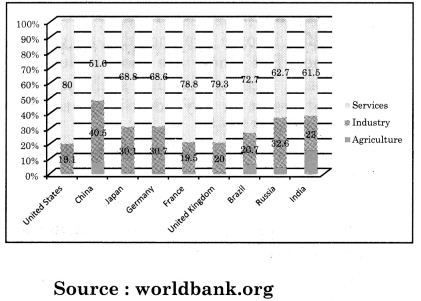
Diagram 1 : Share of GDP by Sector for Selected Nations (2017)
Maharashtra Board Class 12 Economics Important Questions Chapter 7 National Income 1

Question 1.
Which are the sectors contributing in National Income / GDP?
Answer:
There are three sectors contributing in GDP – agriculture, industry and tertiary (services) sector.

Question 2.
In the United States GDP, which sectors contribution is maximum and how much percent?
Answer:
The service (tertiary) sector’s contribution is maximum in United States GDP. It was 80%.

Question 3.
In which country, contribution of primary ‘ sector (agriculture) is lowest in GDP?
Answer:
UK (United Kingdom) and Germany’s; contribution of primary sector is lowest in GDP.

Question 4.
How much is the share of agriculture in India’s National Income in the year 2017?
Answer:
In the year 2017, the share of agriculture was 15.5%.

Question 5.
In which country, the share of industry is maximum and how much percent?
Answer:
In China, the share of industry is maximum. It is 40.5%.

Question 6.
Give your opinion on sectorwise contribution in India’s GDP.
Answer:
In India, share of agriculture sector is quite high as compared to developed countries. There is need to reduce the share of agriculture in GDP. The industry and service sector should be developed so their contribution in the GDP will rise.

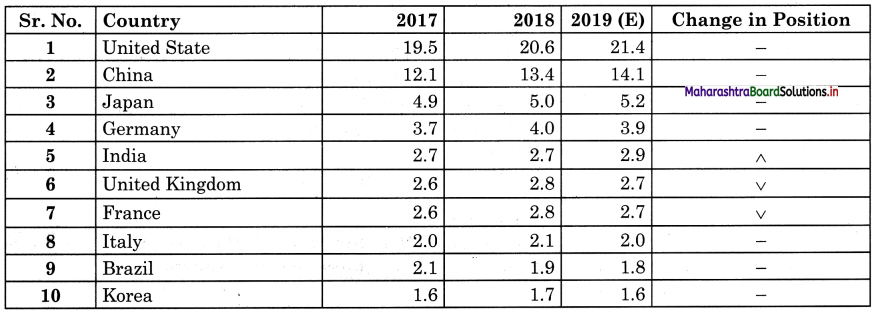
2. Top 10 Economies in the world in terms of GDP at current US $ trillion.
Maharashtra Board Class 12 Economics Important Questions Chapter 7 National Income 2
Data Source : World Economic Outlook, October 2019 database

Note : IMF’s estimate, A indicates improvement in rank, v indicates drop in rank and – indicates unchanged rank

Question 1.
Which country has highest GDP in the world?
Answer:
United State of America has the highest GDP in the world.

Question 2.
Which country has the least GDP in the world?
Answer:
Korea has the least GDP in the world.

Question 3.
At what position does India stand with respect to GDP rates?
Answer:
India stands at 5th position with respect to ) GDP rates.

Question 4.
Find out the difference in China’s GDP in the year 2017 and 2018.
Answer:
The China’s GDP has increased by 1.3 US $ trillion in the year 2018 as compared to the year 2017.

Question 5.
By how much India’s GDP has increased in the year 2017-2018.
Answer:
There is no increase in India’s GDP in the year 2017-18. India’s GDP is constant.

Question 6.
Given your opinion on India’s GDP.
Answer:
India’s is a developing economy, but it still stands at the 5th position in the worlds GDP’s.

India should focus on increasing the production of goods and services specially
from secondary and tertiary sector which will help to increase the GDP.

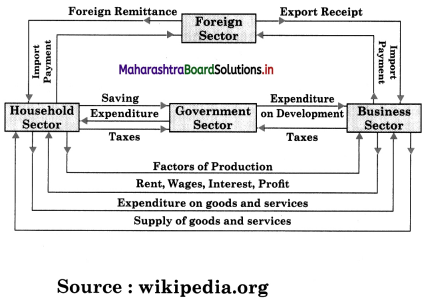
(3) Circular Flow of Income.
Maharashtra Board Class 12 Economics Important Questions Chapter 7 National Income 3

Question 1.
What does this diagram represent?
Answer:
This diagram represents model of four sector economy.

Question 2.
Which sectors are included in this type of economy?
Answer:
It includes households, firms, government and foreign sector.

Question 3.
What role does the government play in this economy?
Answer:
The government is playing very important ) role by incurring expenditure on consumption and investment. The government is also S collecting tax from household, business firm and through import.

Question 4.
Give your opinion on overseas or foreign sector.
Answer:
In four sector economy, foreign sector is playing important role. This is known as open economy which helps to earn foreign exchange, promote economic development, availability of imported goods, etc.

Maharashtra Board Class 12 Economics Important Questions Chapter 7 National Income

6. Answer in detail;

Question 1.
What is national income? Explain theoretical conceptual difficulties in the calculation of national income.
Answer:
National income means money value of goods and services produced in the country in a year.
According to National Income committee:
“A national income estimate, measures the volume of goods and services turned out during a given period without duplication. There are many practical difficulties in the measurement of NI.

  • Transfer payment: If it included in national income then there will be overestimation of NI. E.g. pension, gifts, unemployment allowances, etc. are excluded.
  • Unpaid services : The value of unpaid services are not included in national income as they are not paid for. E.g. services of housewife.
  • Illegal income : The income from illegal activities are not included in NI. E.g. black marketing, smuggling.
  • Production for self-consumption: It is very difficult to get data and value of goods kept for self-consumption as they do not enter market.
  • Income of foreign firms : Income of foreign firm should be included in the national income of the country where the firm undertakes production work. But the profit earn by these firms are transferred to their home own country.

Question 2.
Explain the difficulties in measuring National Income.
Answer:
National income means money value of goods and services produced in the country in a year.
According to National Income committee:
“A national income estimate, measures the volume of goods and services turned out during a given period without duplication. There are many practical difficulties in the measurement of NI.

(A) Theoretical difficulties

  • Transfer payment: If it included in national income then there will be overestimation of NI. E.g. pension, gifts, unemployment allowances, etc. are excluded.
  • Unpaid services : The value of unpaid services are not included in national income as they are not paid for. E.g. services of housewife.
  • Illegal income : The income from illegal activities are not included in NI. E.g. black marketing, smuggling.
  • Production for self-consumption: It is very difficult to get data and value of goods kept for self-consumption as they do not enter market.
  • Income of foreign firms : Income of foreign firm should be included in the national income of the country where the firm undertakes production work. But the profit earn by these firms are transferred to their home own country.

(B) Practical Difficulties or Statistical Difficulties:

  • Problem of double counting: In case of certain goods it is difficult to distinguish properly between final goods and intermediate goods. That’s why problem of double counting arises e.g. flour is final goods for housewife, but it is intermediate goods for the bakery.
  • Existence of non-monetised sector: In India large non-monetised sector exists in rural area specially in agriculture. In agriculture, many places goods and services are exchanged with goods that’s why it is difficult to count in national income.
  • Inadequate and unreliable data: Because of illiteracy it is difficult to get adequate and reliable data from unorganised sector, small enterprises, agriculture, etc.
  • Depreciation: Its difficult to measure exact value of depreciation. There are no uniform common accepted standard rates of depreciation applicable to the various capital assets.
  • Capital gain or loss: Due to capital gain there is overestimation and due to capital loss there is underestimation of national income.
  • Illiteracy and ignorance: Majority of small producer in developing counties are illiterate and ignorant and are not able to keep accounts of their productive activities.
  • Lack of systematic, occupational classification: There is lack of systematic occupational classification, which makes the calculation of national income difficult. Especially in rural areas where many villagers work on farms for some time and also take some other job during offseason.
  • Untrained and incompetent staff: Due to untrained and incompetent staff, accurate and timely, information cannot be obtained.

Question 3.
What is National Income? Explain the Output method of measuring National Income.
Answer:
Product Method or Output Method: This method is also called as Inventory Method.
According to this method economy is divided into various sectors like agriculture, mining, manufacturing, small enterprises, commerce, transport, communication, etc.

National income by this method can be calculated by either valuing all final goods and services
produced during a year at their market price or by adding up all values at each higher stage of
production, until these products are turned into final products.

In output method there are two approaches to measure national income.

(1) Final Goods Approach I Final Product Approach : According to this approach, value of all final goods and services produced in primary, secondary and tertiary sector are included and the value of all intermediate transactions are ignored.

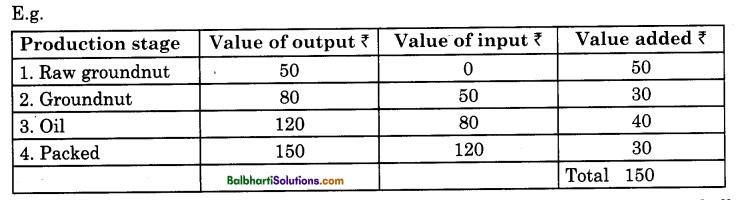
2. Value Added Approach I Value Added Method: To avoid double-counting, the value-added approach is used to estimate the National Income. According to this method, it is necessary to obtain the total of value-added at each stage in the manufacture of a commodity to arrive at Gross National Product. The value-added method can be explained by means of a simple example.
Maharashtra Board Class 12 Economics Important Questions Chapter 7 National Income 4
(a) In the above example, value of groundnut with shell is 50, after removing shells value of groundnut is 80, after crushing groundnut the value is 120 and when oil is packed in the packets its value is 150.
To avoid double-counting either the value of final output or the value – added should be taken in estimation of National Income.

The output method is widely used in the underdeveloped countries. In India, this method is applied in agriculture, mining and manufacturing sector.

Precautions:

  • Avoid Double Counting: The value of only final goods and services must be considered and not the value of raw – materials or intermediary goods, etc.
  • Self Consumption Goods: Goods used for self-consumption by farmers should be included in National Income.
  • Price Level Changes to be considered: The values of national output must be expressed in terms of prices in some base year to know the national output in real terms i.e. N.I. at constant price.
  • Net Income from Abroad: Care should be taken to include net income from abroad in National Income.
  • Depreciation: Depreciation of capital assets should be deducted from the value of gross investment during the year.
  • Indirect Taxes and Subsidies: To get National Income, deduct the indirect tax from the market price and add subsidies.
  • Second-Hand Goods: Sale and purchase of second-hand goods should be ignored as it is not a part of current production.

Question 4.
Explain the various method of measuring National Income. ?
Answer:
National Income is macro economic concept. National Income means money value of goods and services produced in the country in a year. There are three methods to measure national income.
(1) The Output Method,
(2) The Income Method,
(3) The Expenditure Method.

(A) The Income Method : This method is also known as factor cost method. According to this method national income is the sum of income received by all factors of production in a year. So national income is the income received by all the citizens of the country in a year. In income method national income studied from the distribution side. According to income method national income or GNP is
NI = R + W + I + P + MI + (X – M)

  • Rent (R) : Rent and Royalty is usually treated as the payment for the land, building, machines that are rented.
  • Wages (W) : It includes wages and salaries earned by labour as well as it includes commission, bonus, social security payments, fringe benefits, etc.
  • Interest (I) : Interest is the payment for using the services of capital. It includes interest paid by banks, insurance companies etc.
  • Profit (P) : It includes the profit of private and public sector companies.
  • Mixed Income (MI) : It is the income which is earned by self-employed. They earn income through various sources like wages for effort put, rent on own property, interest on own capital, etc.
  • Net Exports (X – M) : It is the difference between export and imports.

Precautions :

  • Transfer payment : It should not be included in national income. E.g. pension, gifts, unemployment allowances, lottery prize, etc.
  • Unpaid services : It should not be included in national income. E.g. services of housewife, teacher teaching her own child, etc.
  • Second hand goods : The income from sale of second hand goods should not be included.
  • Financial asset : The income from sale of shares and bonds should not be included in national income.
  • Tax revenue : The revenue of government through taxes should not be included in national income.
  • Undistributed profits of companies, income from government property and profits from public enterprise should be included.
  • Imputed value of production kept for self consumption and rental value of owner occupied houses should be included in national income.

(B) Expenditure Method :
This method also known as outlay method. NI = C + I + G + (X – M) + (R – P)
National Income can also be calculated by adding up the expenditure incurred on purchase of final goods and services. We can get National Income by summing up all consumption expenditure, investment expenditure made by all individuals, firms as well as the government of a country during a year.

  • Consumption Expenditure (C) : It includes all expenditure incurred on goods and services by households during the year. It includes expenditure mostly on durable and non-durable goods, which are consumed by the consumers. E.g. food, medical care, clothing, car, computer and services, etc.
  • Investment Expenditure (I) : It refers to the investment made by private businessman on capital goods like machinery, plants, factories, warehouses, etc.
  • Government Expenditure on goods and services (G) : Government expenditure refers to expenditure on consumption and investment –
    • Consumption expenditure : It refers to expenditure incurred on various administrative services like law and order, defence education, generation and distribution of electricity.
    • Investment expenditure : It refers to expenditure incurred by government on construction of roads, railways, dams, canals, etc.
  • Net Exports (X – M): It refers to difference between exports and imports of the country. If the exports are more than imports then net exports will be positive, it is called Trade Surplus and if imports are greater than exports, the net exports will be negative, it is called as Trade Deficit.
  • Net Receipts (R-P) : It is the difference between expenditure incurred by foreigners in the country (R) and expenditure incurred abroad by Nationals (P). Net Receipts can also be Positive or Negative.
    Net National Expenditure = NNE = C + I + G + (X – M) + (R – P) – Depreciation. NNPFC or NI = C + I + G + (X -M) + (R -P) “Depreciation “ Indirect Tax + Subsidies.

Precautions :
The following precautions should be taken while estimating National Income.

  • To avoid double counting take the expenditure incurred only on final goods and services.
  • Government expenditure on transfer payments to be excluded like unemployment allowances, old age pension etc.
  • Expenditure on second hand goods like furniture, house, land and financial assets { like shares, bonds, etc. should be excluded.
  • Exclude expenditure incurred on purchase of financial assets such as shares, bonds, etc.
  • Deduct indirect tax and add subsidies. Out of these methods, output method and income method are extensively used. Expenditure method is rarely used because of its practical difficulties.
    In India, the Central Statistical Organisation (CSO) adopts a combination of output method and income method to estimate N.I. of India.

Product Method or Output Method: This method is also called as Inventory Method.
According to this method economy is divided into various sectors like agriculture, mining, manufacturing, small enterprises, commerce, transport, communication, etc.

National income by this method can be calculated by either valuing all final goods and services
produced during a year at their market price or by adding up all values at each higher stage of
production, until these products are turned into final products.

In output method there are two approaches to measure national income.

(1) Final Goods Approach I Final Product Approach : According to this approach, value of all final goods and services produced in primary, secondary and tertiary sector are included and the value of all intermediate transactions are ignored.

2. Value Added Approach I Value Added Method: To avoid double-counting, the value-added approach is used to estimate the National Income. According to this method, it is necessary to obtain the total of value-added at each stage in the manufacture of a commodity to arrive at Gross National Product. The value-added method can be explained by means of a simple example.
Maharashtra Board Class 12 Economics Important Questions Chapter 7 National Income 4
(a) In the above example, value of groundnut with shell is 50, after removing shells value of groundnut is 80, after crushing groundnut the value is 120 and when oil is packed in the packets its value is 150.
To avoid double-counting either the value of final output or the value – added should be taken in estimation of National Income.

Maharashtra Board Class 12 Economics Important Questions Chapter 7 National Income

The output method is widely used in the underdeveloped countries. In India, this method is applied in agriculture, mining and manufacturing sector.

Precautions:

  • Avoid Double Counting: The value of only final goods and services must be considered and not the value of raw – materials or intermediary goods, etc.
  • Self Consumption Goods: Goods used for self-consumption by farmers should be included in National Income.
  • Price Level Changes to be considered: The values of national output must be expressed in terms of prices in some base year to know the national output in real terms i.e. N.I. at constant price.
  • Net Income from Abroad: Care should be taken to include net income from abroad in National Income.
  • Depreciation: Depreciation of capital assets should be deducted from the value of gross investment during the year.
  • Indirect Taxes and Subsidies: To get National Income, deduct the indirect tax from the market price and add subsidies.
  • Second-Hand Goods: Sale and purchase of second-hand goods should be ignored as it is not a part of current production.

Maharashtra Board Class 12 History Important Questions Chapter 2 European Colonialism

Balbharti Maharashtra State Board Class 12 History Important Questions Chapter 2 European Colonialism Important Questions and Answers.

Maharashtra State Board 12th History Important Questions Chapter 2 European Colonialism

1A. Choose the correct alternative and rewrite the statement.

Question 1.
__________ was a result of Industrial Revolution.
(a) Communism
(b) Colonialism
(c) Capitalism
(d) Imperialism
Answer:
(b) Colonialism

Question 2.
The King of __________ was the supreme authority.
(a) England
(b) Portugal
(c) Russia
(d) Spain
Answer:
(d) Spain

Maharashtra Board Class 12 History Important Questions Chapter 2 European Colonialism

Question 3.
In 1496, __________ was granted permission to establish colonies on American land.
(a) John Abbot
(b) George Washington
(c) Thomas Jefferson
(d) Ferdinand Magellan
Answer:
(a) John Abbot

Question 4.
The Boston Tea Party took place in the year __________
(a) 1771
(b) 1772
(c) 1773
(d) 1774
Answer:
(c) 1773

Question 5.
__________ was earlier known as ‘Brahmadesh’ (Burma).
(a) Cambodia
(b) Vietnam
(c) Thailand
(d) Myanmar
Answer:
(d) Myanmar

Question 6.
The __________ war was fought in the year 1885 C.E.
(a) Third Anglo-Burmese war
(b) Second Anglo-Burmese war
(c) First Anglo Burmese war
(d) Anglo-Nepalese war
Answer:
(a) Third Anglo-Burmese war

Maharashtra Board Class 12 History Important Questions Chapter 2 European Colonialism

Question 7.
The British imprisoned __________ after his defeat.
(a) George Washington
(b) King Thibaw
(c) Thomas Jefferson
(d) John
Answer:
(b) King Thibaw

Question 8.
__________ is the capital of Tibet.
(a) Leh
(b) Ladakh
(c) Lhasa
(d) Laos
Answer:
(c) Lhasa

1B. Find the incorrect pair from group ‘B’ and write the corrected one.

Question 1.

Group ‘A’ Group ‘B’
(a) The Boston Tea Party 1770
(b) Declaration of Independence 1774
(c) The Stamp Act 1765
(d) American Independence 1780

Answer:
The Boston Tea Party – 1773

Question 2.

Group ‘A’ Group ‘B’
(a) Queen of England Queen Elizabeth I
(b) King of Myanmar King Thibaw
(c) King of Belgium Louis XVI
(d) Chancellor of Germany Bismarck

Answer:
King of Belgium – Leopold II

2A. Write the names of historical places/persons/events.

Question 1.
The people of Asia and Africa were economically exploited by the-
Answer:
Europeans

Question 2.
In 1607 the British built a colony on the banks of the river ‘James’-
Answer:
Jamestown

Maharashtra Board Class 12 History Important Questions Chapter 2 European Colonialism

Question 3.
The country which was earlier known as ‘Brahmadesh’-
Answer:
Myanmar

Question 4.
Governor-General of India who declared war against Myanmar-
Answer:
Lord Amherst

Question 5.
The American revolt of independence is also known as-
Answer:
American Revolution

Question 6.
The book written by Lokmanya Tilak in Mandalay jail-
Answer:
Geetarahasva

Question 7.
Venue of the geographical conference in 1876-
Answer:
Brussels

Maharashtra Board Class 12 History Important Questions Chapter 2 European Colonialism

Question 8.
The Chancellor of Germany who established the first German colony in West Africa in 1883-
Answer:
Bismarck

2B. Choose the correct reason from those given below and complete the sentence.

Question 1.
The American colonies declared boycott on British goods because __________
(a) restrictions were imposed on them and autonomy
(b) British goods were of poor quality
(c) heavy taxes were levied on British goods
(d) American goods were of superior quality
Answer:
(a) restrictions were imposed on them and autonomy.

Question 2.
The British imprisoned King Thibaw because __________
(a) he was an outlaw
(b) he refused to obey the British
(c) he was a cruel king
(d) the British wanted to ensure that he would not be able to rise against the British or have any contact with his subjects
Answer:
(d) the British wanted to ensure that he would not be able to rise against the British or have any contact with his subjects.

Question 3.
The British wanted to bring Bhutan under their control because __________
(a) Bhutan was a beautiful country
(b) Bhutan was a rich kingdom
(c) Bhutan helped to open the trade route from Bengal to Tibet for the British
(d) Bhutan was militarily weak
Answer:
(c) Bhutan helped to open the trade route from Bengal to Tibet for the British.

Maharashtra Board Class 12 History Important Questions Chapter 2 European Colonialism

Question 4.
Sudan was important for England because __________
(a) the Nile, the lifeline of Egypt originates in Sudan
(b) Sudan was rich in minerals
(c) Sudan had a strong army
(d) England had an ulterior motive
Answer:
(a) the Nile, the lifeline of Egypt originates in Sudan.

3A. Observe the map on textbook page 12 and answer the questions based on it.

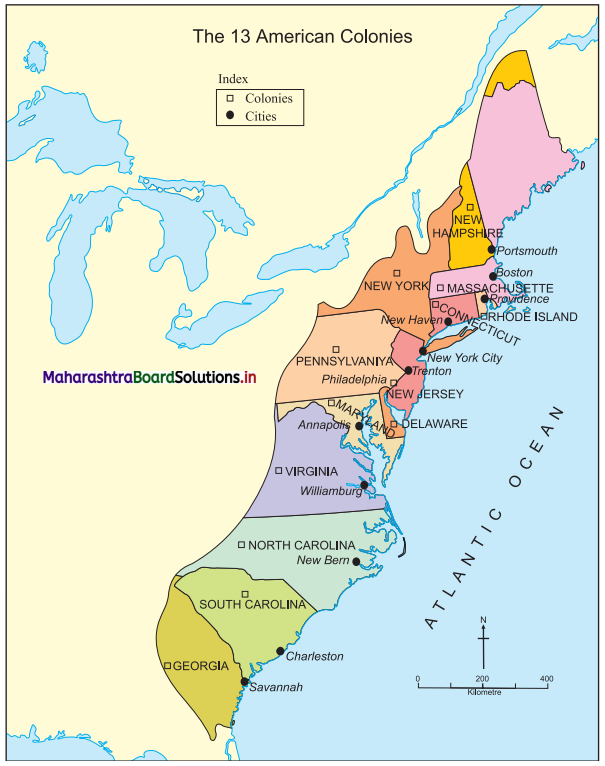
Maharashtra Board Class 12 History Important Questions Chapter 2 European Colonialism 3A

Question 1.
Write the names of the thirteen colonies.
Answer:
New Hampshire, New York, Massachusetts, Connecticut, Rhode Island, Pennsylvania, New Jersey, Delaware, Maryland, Virginia, North Carolina, South Carolina, and Georgia.

Question 2.
Name some of the cities in the colonies.
Answer:
Portsmouth, Boston, New York City, Trenton, etc.

Question 3.
What is the name of the ocean that lies to the east of the colonies?
Answer:
The Atlantic Ocean lies to the east of the colonies.

3B. Complete the following concept map.

Question 1.
Important Events Dates
The Stamp Act ……………………..
……………………….. 1773
Declaration of Independence ………………………
………………………. 1780

Answer:

Important Events Dates
The Stamp Act 1765
The Boston Tea Party 1773
Declaration of Independence 1774
American Independence 1780

Question 2.
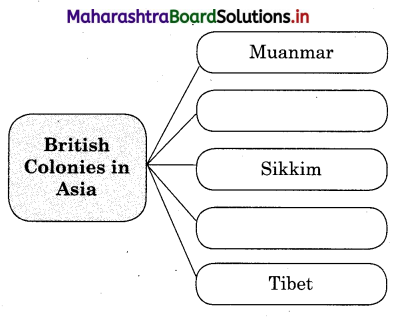
Maharashtra Board Class 12 History Important Questions Chapter 2 European Colonialism 3B Q2
Answer:
Maharashtra Board Class 12 History Important Questions Chapter 2 European Colonialism 3B Q2.1

Question 3.
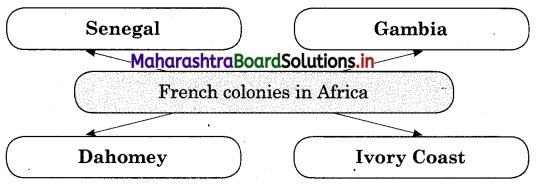
Maharashtra Board Class 12 History Important Questions Chapter 2 European Colonialism 3B Q3
Answer:
Maharashtra Board Class 12 History Important Questions Chapter 2 European Colonialism 3B Q3.1

4A. Write short notes.

Question 1.
The Stamp Act (1765).
Answer:

  • The Stamp Act was passed in the year 1765. This act made it obligatory to purchase special stamps for important documents.
  • British colonies in America like Virginia, Massachusetts put up resistance against the Stamp Act and also other restrictions on the colonies.

Maharashtra Board Class 12 History Important Questions Chapter 2 European Colonialism

Question 2.
The Boston Tea Party (1773).
Answer:

  • The British Parliament had granted a monopoly to the East India Company to import and sell tea to the colonies.
  • People in the colonies were demanded the removal of restrictions imposed on them and autonomy. The British Government refused to yield to the demands of the colonies and in retaliation America decided to boycott British goods.
  • In 1773, as an act of resistance, the local residents of Boston dumped the boxes of tea in the sea belonging to the East India Company. This event is known as the ‘Boston Tea Party.’

Question 3.
‘Declaration of Independence (1774).
Answer:
Thirteen colonies in America came together and declared independence from Great Britain. On 4th July in the meeting known as the ‘Second Continental Congress,’ a document is known as the ‘Declaration of Independence was adopted. This document was drafted by Thomas Jefferson. The crucial part of this document announced that the 13 American colonies were independent sovereign states. The key point of this document is the statement about three basic human rights namely ‘Life, Liberty, and Pursuit of Happiness. It was stated that these three are the natural rights of all humans which nobody can be deprived of.

4B. Explain the following statements with reasons.

Question 1.
Sudan was important for England.
Answer:
Sudan was a vassal state of England. Sudan was important for England because the Nile which was the lifeline of Egypt originates in Sudan. England without paying heed to local opposition established its supremacy over Sudan. To facilitate the moving of the British army in Sudan, the British began to build a railway track from Uganda to Sudan.

5. State your opinion.

Question 1.
The Boston Tea party took place in 1773.
Answer:

  • The British Parliament had granted a monopoly to the East India Company to import and sell tea to the colonies.
  • People in the colonies were demanded the removal of restrictions imposed on them and autonomy. The British Government refused to yield to the demands of the colonies and in retaliation America decided to boycott British goods.
  • In 1773, as an act of resistance, the local residents of Boston dumped the boxes of tea in the sea belonging to the East India Company. This event is known as the ‘Boston Tea Party.’

Question 2.
‘Declaration of Independence was adopted.
Answer:
Thirteen colonies in America came together and declared independence from Great Britain. On 4th July in the meeting known as the ‘Second Continental Congress’ a document known as ‘Declaration of Independence was adopted. This document was drafted by Thomas Jefferson. The crucial part of this document announced that the 13 American colonies were independent sovereign states. The key point of this document is the statement about three basic human rights namely ‘Life, Liberty, and Pursuit of Happiness. It was stated that these three are the natural rights of all humans which nobody can be deprived of.

Maharashtra Board Class 12 History Important Questions Chapter 2 European Colonialism

Question 3.
The British imprisoned King Thibaw of Myanmar.
Answer:
King Thibaw of Myanmar tried to strike a pact with Italy and Germany. These reasons were enough for the British to feel alarmed. They declared war against King Thibaw when he levied a fine on the Bombay-Burma Trading Corporation, a British company. This led to a war being declared against Burma. King Thibaw surrendered and was imprisoned by the British to ensure that he would not be able to rise against the British or have any contact with his subjects.

Question 4.
The First Anglo-Burmese War was fought.
Answer:
Burma was rich in natural wealth and was also a potential market. The royal dynasty had successfully consolidated the country under their rule. It conquered Manipur in 1813 and in 1822 they attacked Assam. The British were alarmed by these attacks. Hence, Lord Amherst, the Governor-General of India declared war against Myanmar. The war continued for two years. This was the First Anglo-Burmese War. The British navy conquered the port of Rangoon (Yangon) in this war. This war ended with a treaty between the British and the Burmese king.

6. Answer the following questions in detail.

Question 1.
Write a note on England’s role in Australia.
Answer:

  • England first colonised Australia in the 18th century when the first colony of prisoners was deported from England.
  • Later in the 19th century, other regions in Australia were colonised.
  • The British also established their colonies in the island of Tasmania and New Zealand.
  • In the year 1900, the island of Tasmania and the Republic of Australia was created as an integral nation of the British Empire.
  • A bicameral parliament was established and a Governor-General was appointed in Australia by the British king as the viceregal representative.
  • Only European immigrants were allowed to enter Australia.

Question 2.
Explain Britain’s interest in conquering Tibet.
Answer:

  • Tibet was under the influence of the Dalai Lama.
  • The British wanted to gain control over Tibet by arresting Russian advances and increase their own trade.
  • The British military had reached Lhasa, the capital of Tibet.
  • In 1907 as per the treaty between England and Russia, China’s political rule in Tibet was acknowledged.
  • It gave leeway to China to claim Tibet as an integral part of China.

Maharashtra Board Class 12 History Important Questions Chapter 2 European Colonialism

Question 3.
Discuss the consequences of Colonialism.
Answer:
The people in Asia and Africa were economically exploited by the Europeans. People in the colonies lost their independence. Their economic exploitation pushed them into poverty. A new awareness emerged in the political, social, economic, and educational fields. Common people became conscious of democratic systems and their inherent modern values like liberty, equality, and fraternity. People were introduced to principles like administration based on a fundamental legal system, judicial system, availability of education to all.

7. Answer the following question with the help of the given points.

Question 1.
Explain the causes for the rise of Colonialism.
(a) Industrial Consequences
(b) Requirements of Raw Material
(c) Sources of Minerals
(d) Feeling of Racial Superiority
Answer:
(a) Industrial Consequences:
Colonialism was a result of the industrial revolution. Production increased enormously because of the new machines. However, the rate of local consumption was much less compared to the surplus rate of production. Hence, the immediate need of the Europeans was to find new markets for selling their products. It was also necessary that these markets be dependable and easy to dominate.

(b) Requirements of Raw Material:
The desire to create a monopoly in the market and the need to procure raw material at cheaper rates were two major factors that made European nations compete with one another for clear Supremacy.

(c) Sources of Minerals:
The countries in Asia and Africa were rich in minerals like gold, diamonds, silver, coal, etc. This attracted the European nations to Asia and Africa.

(d) Feeling of Racial Superiority:
The Europeans felt it was their responsibility to civilise the people of Asia and Africa. This led to the conversion of Asian and African people to Christianity. It also helped the growth of colonialism.

Question 2.
Write a note on the events that led to the American Revolution.
(a) The Stamp Act of 1765
(b) The Boston Tea Party of 1773
(c) Declaration of Independence in 1774
(d) War at Saratoga
Answer:
(a) The Stamp Act (1765):

  • The Stamp Act was passed in the year 1765. This act made it obligatory to purchase special stamps for important documents.
  • British colonies in America like Virginia, Massachusetts put up resistance against the Stamp Act and also other restrictions on the colonies.

Maharashtra Board Class 12 History Important Questions Chapter 2 European Colonialism

(b) The Boston Tea Party (1773):

  • The British Parliament had granted a monopoly to the East India Company to import and sell tea to the colonies.
  • People in the colonies were demanded the removal of restrictions imposed on them and autonomy. The British Government refused to yield to the demands of the colonies and in retaliation America decided to boycott British goods.
  • In 1773, as an act of resistance, the local residents of Boston dumped the boxes of tea in the sea belonging to the East India Company. This event is known as the ‘Boston Tea Party.’

(c) ‘Declaration of Independence (1774):
Thirteen colonies in America came together and declared independence from Great Britain. On 4th July in the meeting known as the ‘Second Continental Congress,’ a document is known as ‘Declaration of Independence was adopted. This document was drafted by Thomas Jefferson. The crucial part of this document announced that the 13 American colonies were independent sovereign states. The key point of this document is the statement about three basic human rights namely ‘Life, Liberty, and Pursuit of Happiness. It was stated that these three are the natural rights of all humans which nobody can be deprived of.

(d) American War of Independence:
The colonies got into several battles with the British army even after gaining independence. The colonies finally at Saratoga got a decisive victory over the British army. This victory proved to be a turning point for the colonies as the French agreed to support them in their conflict against the British. Eventually, Spain also joined the conflicts in their struggle for independence.

Maharashtra Board Class 12 History Important Questions Chapter 2 European Colonialism

On 7th October 1780, George Washington defeated the British army. On 19th October, British General Lord Cornwallis surrendered and America became independent. The American revolt for independence is also known as the ‘American Revolution’. America proved to the world that the subjects have a right to fight their rulers who deny them their natural rights.

Maharashtra Board Class 12 Economics Important Questions Chapter 9 Money Market and Capital Market in India

Balbharti Maharashtra State Board Class 12 Economics Important Questions Chapter 9 Money Market and Capital Market in India Important Questions and Answers.

Maharashtra State Board 12th Economics Important Questions Chapter 9 Money Market and Capital Market in India

1. A. Choose the correct option:

Question 1.
Money Market is a market for lending and borrowing of ………….. funds.
(a) long term
(b) medium-term
(c) short term
(d) all of these
Answer:
(c) short term

Maharashtra Board Class 12 Economics Important Questions Chapter 9 Money Market and Capital Market in India

Question 2.
The financial system of the country is responsible for ………….. of funds.
(a) mobilization and allocation
(b) distribution of investment
(c) optimum resources
(d) all of these
Answer:
(a) mobilization and allocation

Question 3.
………….. is the only active money market centre in India.
(a) Nagpur
(b) Madras
(c) Mumbai
(d) Kolkata
Answer:
(c) Mumbai

Question 4.
Central Bank has the ………….. of cash reserve of commercial Bank in the country.
(a) monopsony
(b) monopoly
(c) oligopoly
(d) autopsony
Answer:
(b) monopoly

Question 5.
The Central Bank acts as a ………….. of cash reserve of Commercial Bank in the country,
(a) head
(b) leader
(c) custodian
(d) protector
Answer:

Question 6.
………….. is the apex body of the monetary and banking system of Commercial Banks in the country.
(a) Commercial Bank
(b) Central Bank
(c) Government
(d) Co-operative Bank
Answer:
(b) Central Bank

Maharashtra Board Class 12 Economics Important Questions Chapter 9 Money Market and Capital Market in India

Question 7.
Bank rate is ………….. measure of credit control.
(a) quantitative
(b) qualitative
(c) selective
(d) effective
Answer:
(a) quantitative

Question 8.
Reserve Bank of India was established in …………..
(a) 1937
(b) 1936
(c) 1935
(d) 1934
Answer:
(c) 1935

Question 9.
The operation of direct buying and selling of securities by central bank in the money market is called …………..
(a) open market operation
(b) credit creation
(c) moral suasion
(d) closed market operation
Answer:
(a) open market operation

Question 10.
………….. account is opened by businessmen, corporate bodies, etc.
(a) Saving
(b) Current
(c) Fixed
(d) Recurring
Answer:
(b) Current

Question 11.
………….. is a primary function of commercial banks.
(a) Safe deposit vault
(b) Letter of credit
(c) Accepting deposits
(d) Transfer of funds
Answer:
(c) Accepting deposits

Maharashtra Board Class 12 Economics Important Questions Chapter 9 Money Market and Capital Market in India

Question 12.
Every loan creates .
(a) deposits
(b) credit
(c) profit
(d) debit
Answer:
(a) deposits

Question 13.
Enactment of the Co-operative Credit Societies Act .
(a) 1903
(b) 1904
(c) 1905
(d) 1906
Answer:
(b) 1904

Question 14.
was the 1st Development Financial Institution to be established in 1948.
(a) IFCI
(b) IDBI
(c) ICICI
(d) HSCBI
Answer:
(a) IFCI

Question 15.
DFHI was set up on the recommendation of the committee.
(a) Narsimhan
(b) Vaghul
(c) Vaghale
(d) Tandon
Answer:
(b) Vaghul

Question 16.
The activities of unorganized money market are largely confined to the areas.
(a) city
(b) urban
(c) rural
(d) none of these
Answer:
(c) rural

Question 17.
important source of funds in unbanked areas which provide loans directly to agriculture, trade and industry.
(a) Indigenous bankers
(b) EXIM Bank
(c) IDBL
(d) HSCB Bank
Answer:
(a) Indigenous bankers

Question 18.
charge high rate of interest to the people.
(a) RBI
(b) Commercial Bank
(c) Money lenders
(d) LIC
Answer:
(c) Money lenders

Question 19.
………………. short term instruments issued by the RBI on behalf of the government to meet temporary liquidity shortfalls.
(a) Commercial papers
(b) Call money market
(c) Treasury Bills
(d) Commercial Bills
Answer:
(c) Treasury Bills

(B) Complete the Correlation 

  1. RBI was set up : Hilton Young Commission :: DFHI was set up : ………………..
  2. Open market operation : ……………….. :: Moral suasion : Qualitative method
  3. Deposits that are repayable after a certain period of time : Time deposits :: Deposits that are withdrawable on demand : ………………..
  4. Commercial Banks : Credit creation :: ……………….. : Controller of credit
  5. SEBI : 1998 :: NSE : ………….

Answer:

  1. Vaghul committee
  2. Quantitative method
  3. Demand deposits
  4. RBI
  5. 1992

Maharashtra Board Class 12 Economics Important Questions Chapter 9 Money Market and Capital Market in India

(C) Suggest the economic terms for the given statements.

(1) Account that are operated by salaried class and small traders.
(2) Accounts is opened by businessmen, corporation or trust.
(3) Source of funds in unbanked areas which provide loans directly to agriculture, trade and industry.
(4) It is unsecured negotiable instrument in bearer form issued by Commercial banks and Development Finance Institutions.
(5) It is also known as the gilt-edged market.
(6) Market deals with securities already issued by companies.
(7) It act as a link between the investors and the borrower to meet the financial objectives of both the parties.
(8) It deals with the shares and debentures issued by old and new companies.
(9) Market for long term funds.
(10) Fund to promote investors awareness.
Answer:

  1. Saving A/c
  2. Current A/c
  3. Indigenous bankers
  4. Certificates of deposits
  5. Government Securities
  6. Secondary Market
  7. Financial intermediaries
  8. Industrial Securities Market
  9. Capital Market
  10. IEPF

(D) Find the odd word

(1) Financial Instruments :
Bonds, Demand, Equity Shares, Derivatives.
Answer:
Demand

(2) Unorganised Sector :
Indigenous Bankers, Money lenders, Unregulated Non-Bank Financial Intermediaries, Co-operative Banks.
Answer:
Co-operative Banks

(3) Functions of RBI:
Collection and Publication of Data, Controller of Credit, Credit Creation, Bankers Bank.
Answer:
Credit Creation

(4) Functions of Commercial Bank :
Acceptance of Deposits, Lending loans and advances, Credit Creation, Banker’s Bank.
Answer:
Banker’s Bank

(5) Co-operative Credit Structure : State level, District level, Secondary level, Primary level
Answer:
Secondary Level

(6) Money Market Instruments :
Treasury Bills, Certificate of Deposits, Commercial Bills, Discount and Finance House of India.
Answer:
Discount and Finance House of India

(E) Complete the following statements.

(1) Method of withdrawing money without going to the bank is by
Answer:
ATM

(2) The Account in which certain amount of money is deposited every month regularly for a fixed duration is .
Answer:
Recurring A/c

(3) Credit creation is an important function of Bank.
Answer:
Commercial

(4) Saving Bank Account is suitable for people
Answer:
salaried

(5) Higher rate of interest is paid on deposits.
Answer:
Fixed

(6) Currency rate of India to other currency means
Answer:
exchange rate

Maharashtra Board Class 12 Economics Important Questions Chapter 9 Money Market and Capital Market in India

(7) system economies the use of cash.
Answer:
Clearing House

(8) The works as friend, philosopher and guide to Commercial Bank.
Answer:
Central Bank

(9) Bank grants loans to government.
Answer:
Central

(10) When money is borrowed or lent for a day, it is known as
Answer:
Call / Notice money

(11) A well-developed money market ensures successful implementation of the policy.
Answer:
monetary

(F) Choose the wrong pair :

I.

Group ‘A’ Group ‘B’
1. Central Bank Apex Banking Institution
2. Clearing House system Specialised institution for agriculture
3. Credit Control Quantitative measure
4. Money Market Short term fund

Answer:
Wrong pair : Clearing House system Specialised institution for agriculture

II.

Group ‘A’ Group ‘B’
1. Commercial Bank Acceptance of Deposit
2. IFCI 1948
3. Co-operative Credit Society Act 1904
4 Discount and Finance House of India 1980

Answer:
Wrong pair : Discount and Finance House of India – 1980

(G) Assertion and Reasoning.

Question 1.
Assertion (A) : Illegal practices have also affected the smooth functioning of capital market. :
Reasoning (R) : Price manipulation or ( price rigging on the other hand means to simply raise the prices of shares through ) buying and selling of shares within certain individual themselves for personal gains. ;
(i) (A) is true, but (R) is false
(ii) (A) is false but (R) is true
(iii) Both (A) and (R) are true and (R) is the correct explanation of (A)
(iv) Both (A) and (R) are true and (R) is not the correct explanation of (A)
Answer:
(iv) Both (A) and (R) are true and (R) is the correct explanation

(H) Choose the correct pair :

I.

Group ‘A’ Group ‘B’
Demat Account (a) Commercial Bank
Overdraft (b)Ancillary function
Credit creation (c) 1949
Banking Regulation Act (d) 1935
(e) Amount withdrawn above the actual balance

Ans.
(1)-(b), (2)-(e), (3)-(a), (4) – (c)

II.

Group ‘A’ Group ‘B’
Local area Banks (a) RBI
Liquidity Adjustment Facility (LAF) (b) Primary and Secondary markets
Industrial Securities market (c) Money Market
Stock Exchange (d) Capital Market
(e) August, 1996

Answer:
(1)-(e), (2)-(a), (3)-(b), (4) – (d)

Q.2.[A] Identify and explain the concept from given illustrations.

Question 1.
Santosh invested money in share market and the broker does fraud in company.
Answer:
Concept: Financial Scams
Explanation : Financial scams are the frauds and manipulations done by the stock brokers for their personal benefits. Increasing number of financial frauds have resulted in irreparable loss for the capital market.
It also leads to public distrust and loss of confidence among the individual investors.

Question 2.
XYZ Bank Provides cash credit, overdraft facility and loan to its customer.
Answer:
Concept: Providing loans and advances by Commercial Bank
Explanation : Commercial Bank mobilize savings and lend these funds to institutions and individuals for various purposes.
Based on tenures, loans include call loans, short term, medium term and long term loans.
Longer the duration of the loans, greater will be the rate of interest.
Beside this bank also provide cash credit, overdraft facility as well as discounting of bills of exchange.

Maharashtra Board Class 12 Economics Important Questions Chapter 9 Money Market and Capital Market in India

(B) Distinguish between:

Question 1.
Central Bank and Commercial Bank.
Answer:
Central Bank:

  1. The central bank is the apex banking institution whose main function is to control, regulate and stabilise the monetary system of the country in the national interest.
  2. The main function of central bank is to control, regulate and stabilise the banking and monetary system of the country.
  3. It does not deal with public directly. It acts as the banker to government and bankers bank.
  4. It enjoys the monopoly right to print and issue currency notes.
  5. Central Bank controls the credit.
  6. There is only one Central Bank in India. R.B.I. is owned by Government.

Commercial Bank:

  1. A commercial bank is abusiness organisation which basically accepts deposits from public and lends to others who need fund and create credit.
  2. The main function commercial bank is to accept deposits and lend loans and advances.
  3. It deals with the public directly. They are banker to general public.
  4. Commercial banks do not possess such rights.
  5. Commercial banks create credit.
  6. Owned by private or government. There are several commercial banks like State Bank of India, ICICI Bank, Canara Bank, etc.

Question 2.
Quantitative Credit Control and Qualitative Credit Control. (Mar. ’18)
Answer:
Quantitative Credit Control:

  1. This method aims at controlling credit by expanding or contracting the volume of credit in the banking system.
  2. The important quantitative measures to control credit are
    (1) Bank Rate
    (2) Open Market Operation
    (3) Varying Cash Reserve ratio.
  3. During inflation quantitative measures adopt the strategy of contracting the volume of credit so as to reduce money supply. During inflation such methods are applied to encourage expansion of credit and expand money supply.
  4. They are macro economic in nature and influence the whole economy.

Qualitative Credit Control:

  1. It aims at controlling credit by checking the purpose or use of the credit.
  2. Selective control measures include the following:
    (1) Changing the market.
    (2) Regulation of consumer credit
    (3) Issue of directives
    (4) Rationing of credit
    (5) Moral suasion.
  3. The main strategy of selective credit control measures is to ensure that credit money does not reach undesirable and non – productive channels.
  4. They are micro in nature and do not influence the whole economy.

Question 3.
Current Account and Saving Account.
Answer:
Current Account:

  1. This account is usually opened by businessmen, industrial enterprises, public bodies, etc.
  2. This account facilitates regular business transactions.
  3. There is no interest paid on current account.
  4. There is no restriction on withdrawals.

Saving Account:

  1. This account is held by the households, salaried class, small traders, etc.
  2. The main purpose of saving account is to encourage saving habits among people.
  3. The saving account earns a nominal rate of interest.
  4. Withdrawals are allowed subject to certain restrictions.

Question 4.
Fixed Deposits and Saving Deposits.
Answer:
Fixed Deposits:

  1. Fixed Deposits are time bound deposits, where money is deposited for a specific period of time.
  2. The main objective is to earn high interest and to get lumpsum amount on maturity.
  3. It cannot be withdrawn before maturity but one can close the account before maturity with loss of interest.
  4. The rate of interest is high. It can be 6% to 10% depending upon the period of deposit.

Saving Deposits:

  1. Saving deposits are a kind of demand deposits, which is held by households or individuals for the purpose of savings.
  2. Safety is the major objective of saving accounts.
  3. Withdrawals are allowed subject to certain restrictions.
  4. The saving account earns nominal rate of interest. At present it is about 4 to 4.5% per annum.

Question 5.
Current Deposits and Recurring Deposits.
Answer:
Current Deposits:

  1. It is a kind of demand deposit which is mostly held by companies, institutions, government and individual for the sake of business transactions.
  2. It is suitable for business firms for the purpose of transactions.
  3. There are no restrictions on withdrawals.
  4. There is no interest paid.

Recurring Deposits:

  1. These are deposits under which people pay a specified amount at a regular interval of time for a given period of time.
  2. It is suitable for the salaried, poor and lower middle class who can save a certain amount of money regularly every month.
  3. The amount can be withdrawn after a specific period of time.
  4. The interest rate is higher.

Maharashtra Board Class 12 Economics Important Questions Chapter 9 Money Market and Capital Market in India

Question 6.
Current Deposits and Fixed Deposits,
Answer:
Current Deposits:

  1. It is a kind of demand deposit which is usually held by companies, institutions, government and individuals for the sake of business transactions.
  2. There are no restriction on withdrawals.
  3. No interest is paid to current account or deposits.
  4. The main purpose of current account is to facilitate regular transactions.

Fixed Deposits:

  1. Fixed deposits are a kind of time deposits which is deposited for a specific period.
  2. The amount deposited cannot be withdrawn before maturity period.
  3. The rate of interest paid is high.
  4. The main purpose is to get a lumpsum amount on the maturity of the deposit.

3. Answer the following questions :

Question 1.
Explain the reforms introduced in the capital market.
Answer:
Reforms introduced in the Capital Market are as follows :

  • SEBI was established in 1988 and given statutory power in 1992 to protect interest of investors.
  • NSE, the leading stock exchange in India was established in 1992.
  • Introduction of Computerised Screen Based Trading System (SBTS).
  • Introduction of Demat A/c in 1996 to facilitate easy purchase and sale of securities.
  • Increased access to global funds, Indian companies was permitted through ADRs and GDRs.
  • Investors Education and Protection Fund (IEPF) was created in 2001 to promote awareness among investors and protecting the interest of the investors.

Question 5.
What are the reforms introduced in the money market?
Answer:
Following are the reforms introduced in the Money Market:

  • Introduction of New Money Market Instruments : In order to widen and diversify the Indian money market, RBI has introduced many new money market instruments such as 182 Days treasury bills, 364 day treasury bills, CDs and CPs. Through these instruments, the government, commercial banks, financial institutions and corporates can raise funds through the money market.
  • Liquidity Adjustment Facility (LAF) : RBI has introduced LAF for adjusting liquidity through repos and reverse repos to stabilise the short-term interest rates or call rates.
  • Deregulation of Interest Rates : Ceiling on interest rates on the call money and inter bank short term deposits was removed and the rates were permitted to be determined by the market forces.
  • National Electronic Fund Transfer (NEFT) and Real Time Gross Settlement (RTGS) were introduced as an improved payment infrastructure.
  • Electronic dealing system was introduced.

4. State with reasons whether you : agree or disagree with the following statements :

Question 1.
There is four tier co-operative credit l bank structure in India.
Answer:
No, I do not agree with this statement.
There are three tier of credit co- operative bank structure i.e. at –
Primary Level – Primary Co operative Credit Societies.
District Level – District Central Co operative Banks.
State Level – State Co operative Banks.
Maharashtra Board Class 12 Economics Important Questions Chapter 9 Money Market and Capital Market in India 1

Question 2.
Moneymarket consist only unorganised sector in India.
Answer:
No, I do not agree with this statement.
Money market consist organized as well as unorganized sector in India
The organized sector of money market consist of the RBI, Commercial Banks Co-operative Banks, Development Financial Institutions (DFIs) and Discount and Finance House of India (DFHI) and the unorganized sector of money market consist of Indigenous Bankers, Money lenders and Unregulated Non-Bank Financial Intermediaries.

Question 3.
Unit Trust of India was the first development financial institution in India.
Answer:
No, I do not agree with this statement.
Development Financial Institution are agencies that provide medium and long term financial assistance.
They help in the development of industry, agriculture and other key sectors.
In includes many financial institutions, like – ICICI, IDBI, IIBI and UTI.
IFCI was the first development financial institution established in 1948.

Question 4.
Compared to advanced countries, the Indian money market is less developed.
Answer:
Yes, I do agree with this statement.
Indian money market is relatively underdeveloped, when compared to advanced markets like London and New York money markets.
Its main weaknesses are explained as below:

Following are the problems of money market in India:
(a) Shortages of Funds : Generally, there is shortage of funds in Indian Money Market on account of various factors like inadequate banking facilities, low savings, lack of banking habits, existence of parallel economy,- etc. have also been responsible for the paucity of funds in the money market.

(b) Existence of Unorganised Money Market : This is one of the major defects of Indian Money Market. It does distinguish between short term and long term finance, and also between the purposes of finance. Since it is outside the control and supervision of RBI. It limits the RBI’s control over money market.

(c) Delays in technological up-gradation: Use of advanced technology is a pre requisite for the development and smooth functioning of financial markets. Delays in up-gradation of technology hampers the working of the money market.

(d) Absence of Well Organized Banking Sector : Branch expansion was very slow before bank nationalization in 1969. Even now the banks are largely concentrated in large towns and small cities. There is lack of movement of funds. Indian banking system is not yet a well organized sector.

(e) No Uniformity in the rates of interest:
There exists too many rates of interest in the Indian Money Market such as the borrowing rate of government, deposits and lending rates of co-operatives and commercial banks, lending rates of financial institutions, etc. This is due to lack of mobility of funds from one section of the money market to another.

Maharashtra Board Class 12 Economics Important Questions Chapter 9 Money Market and Capital Market in India

5. Answer in detail:

Question 1.
Explain the role of money market in India ?
Answer:
(A) Meaning:
Money market is a market for lending and borrowing short term funds.
It is a market for near money.
It deals in short term instruments like trade bills, government securities, promissory notes, etc.
Money market centres are located at Mumbai, Delhi and Kolkata. Money market consists of organised as well as unorganised sector.

Role of Money Market in India :
1. Portfolio Management : Money market deals with different types of financial instruments which are designed to suit the ( risk and return preferences of the investors. This enables the investors to hold a portfolio of different financial assets which in turn, helps in minimizing risk and maximizing returns.

2. Implementation of monetary policy :
Various monetary policies are implemented by the Central Bank, with an aim to manage the quantity of money, to meet the requirements of different sectors of the economy and to increase the pace of economic growth. Money market ensures successful implementation of these monetary policies. It also guides the central bank in developing an appropriate interest policy.

3. Growth of Commerce, Industry and Trade : Money market facilitates discounting bills of exchange to local and international traders who are in urgent need of short-term funds. It also provides working capital for agriculture and small scale industries.

4. Financial requirements of the Government : Money market helps the Government to fulfil its short term financial requirements on the basis of Treasury Bills.

5. Economizes the use of cash : Money market deals with various financial instruments that are close substitutes of money and not actual money. Thus, it economizes the use of cash.

6. Equilibrating mechanism : Money market helps to establish equilibrium between the demand for and supply of short term funds by allocating rationally the available resources and thus mobilizing the savings of public into fruitful investment channels.

7. Liquidity Management : Money Market, through the monetary authorities facilitates better management of liquidity and money in the economy. This, in turn, leads to economic stability and development of the country.

8. Short-term requirements of borrowers :
Money market provides short-term financial needs of the borrowers at reasonable prices.

Question 4.
Write note on Recent Developments in banking sector.
Answer:
Recent developments in banking sector :

(a) Small Finance Banks : The main aim of small finance banks is to promote financial assistance to small business units, small and marginal farmers, micro and small industries and other unorganised sectors of the economy.
It also assists with high technology at low cost of operations.

(b) Payments Banks : Payment banks are like other banks only, but they operate on a smaller scale without involving any credit risk.
It can carry almost all banking operations but cannot advance loans or issue credit cards.
It can accept deposits upto ₹ one lakh.
It can offer following services to its customers – remittance services, mobile payments, ATM facility, Debit cards, net banking, etc.

(c) Universal Banks : Universal banks refer to those banks that offer a wide range of financial services like commercial banking and investment banking and also offer other services, especially insurance service. It is a multipurpose and multi-functional financial supermarket providing both banking and financial services through a single window.

(d) Local Area Banks : Local area bank scheme was introduced in August, 1996. It was established to mobilize rural savings by private local banks and make them available for investments in the local areas. This helps to bridge the gap in credit availability and strengthens the institutional credit system in the rural and semi-urban areas.

Maharashtra Board Class 12 Sociology Important Questions Chapter 5 Social Movements in India

Balbharti Maharashtra State Board Class 12 Sociology Important Questions Chapter 5 Social Movements in India Important Questions and Answers.

Maharashtra State Board 12th Sociology Important Questions Chapter 5 Social Movements in India

1A. Complete the following statements by choosing the correct alternative given in the brackets and rewrite it.

Question 1.
___________ led the famous home rule movement in India. (Lala Lajpat Rai, Annie Besant, Mahatma Gandhi)
Answer:
Annie Besant

Question 2.
The Quit India Resolution was passed in the year ___________ (1944, 1942, 1956)
Answer:
1942

Maharashtra Board Class 12 Sociology Important Questions Chapter 5 Social Movements in India

Question 3.
The Feminist Network, ___________ was published to bring women’s issues to the forefront. (Kesari, Gulamgiri, Manushi)
Answer:
Manushi

Question 4.
___________ is recognised as the Father of the Indian Workers’ Movement. (Lala Lajpat Rai, Meghaji Lokhande, Mahatma Gandhi)
Answer:
Meghaji lokhande

Question 5.
All India Trade Union Congress (AITUC) was established under the chairmanship of ___________ (Lala Lajpat Rai, Mahatma Gandhi, Shahapuri Bengalee)
Answer:
Lala Lajpat Rai

Question 6.
The Bombay Textile Labour Union was under the leadership of ___________ (Narayan Meghaji Lokhnde, N. M. Joshi, S. A. Dange)
Answer:
N. M. Joshi

Question 7.
In the year 1947, ___________ was formed. (National Trade Union Federation, The Indian National Trade Union Congress, Hind Mazdoor Sabha)
Answer:
The Indian National Trade Union Congress

Question 8.
The Kisan Sabha movement started in Bihar under the leadership of ___________ (P. N. Dhanagare, Raja Mahendra Pratap, Swami Sahajanand Saraswati)
Answer:
Swami Sahajanand Saraswati

Question 9.
The Chipko Movement began in the year ___________ (1983, 1973, 1992)
Answer:
1973

Question 10.
22nd April is celebrated as ___________ all over the world. (Child Labour Day, Earth Day, Environmental Day)
Answer:
Earth Day

Maharashtra Board Class 12 Sociology Important Questions Chapter 5 Social Movements in India

Question 11.
One of the prominent federations in the country which represents labour at a national level is the ___________ (Central Trade Union organisation, All Indian Kisan Sabha, Self-employed Women’s Association)
Answer:
Central trade union organisation

Question 12.
___________ is a major weapon in the hands of labour. (Strike, Dispute, Conciliation)
Answer:
Strike

Question 13.
___________ established the Women Indian Association in Madras. (Aruna Asaf Ali, Margaret Cousins, Sarala Devi)
Answer:
Margaret Cousins

Question 14.
___________ are the collective actions to change the existing Social System. (Social relationships, social pattern, Social Movement)
Answer:
Social Movement

Question 15.
The ___________ of 1947, allowed the usage of mechanisms like conciliation, arbitration, and adjudication to mitigate the conflict between workers and management. (Factories Act, Industrial Disputes Act, Trade Union)
Answer:
Industrial Disputes Act

Question 16.
The ___________ economy was primarily based on agriculture and forest produce. (mixed, subsistence, market)
Answer:
subsistence

Maharashtra Board Class 12 Sociology Important Questions Chapter 5 Social Movements in India

Question 17.
___________ led the struggle of poor farmers against the British government in Kheda. (Datta Samant, Mahatma Gandhi, Charan Singh)
Answer:
Mahatma Gandhi

Question 18.
___________ may imply rapid change in values, ideas and expectations in society. (Cultural diffusion, Cultural drift, Cultural lag)
Answer:
Cultural drift

Question 19.
The term Social Movement was introduced by the German Sociologist ___________ (Lorenz Von Stein, Auguste Comte, Durkheim)
Answer:
Lorenz Von Stein

Question 20.
Organised social movements for reform started since the ___________ century. (20th, 19th, 17th)
Answer:
19th

Question 21.
___________ strived for the progress of women and eradication of illiteracy. (Swami Dayanand Saraswati, Mahatma Gandhi, Raja Rammohan Roy)
Answer:
Swami Dayanand Saraswati

Question 22.
The Female Infanticide (Prevention) Act was enacted in ___________ (1856, 1891, 1870)
Answer:
1870

Question 23.
___________ worked for Women’s Suffrage. (Sarojini Naidu, Kasturba Gandhi, Vijayalakshmi Pandit)
Answer:
Sarojini Naidu

Question 24.
The ‘Bombay Mill Hands Association’ was started under the guidance of ___________ (Narayan Meghaji Lokhande, Shapurji Bengalee, Shripad Amrut Dange)
Answer:
Narayan Meghaji Lokhande

Maharashtra Board Class 12 Sociology Important Questions Chapter 5 Social Movements in India

Question 25.
The ‘Great Depression adversely affected the ___________ Movement in India. (Women’s, Worker’s, Tribals)
Answer:
Workers

Question 26.
The Indian National Trade Union Congress (INTUC) was formed in the year ___________ (1948, 1947, 1950)
Answer:
1947

Question 27.
Chipko Movement was started by ___________ (Amrita Devi, Medha Patkar, Sunderlal Bahuguna)
Answer:
Amrita Devi

Question 28.
In 1985, the Narmada Bachao Andolan emerged as one of the powerful movements under the leadership of ___________ (Medha Patkar, Amrita Devi, Sunderlal Bahuguna)
Answer:
Medha Patkar

1B. Correct the incorrect pair and rewrite it.

Question 1.
(a) The Sati Prohibition Act – 1817
(b) The Widow Remarriage Act – 1856
(c) The Female Infanticide (Prevention) Act – 1870
(d) The Age of Consent at Marriage Act – 1891
Answer:
(a) The Sati Prohibition Act – 1829

Question 2.
(a) Narmada Bachao Andolan – Medha Patkar
(b) Chipko Movement – Sunderlal Bahuguna
(c) The Indian Workers’ Movement – Narayan Meghaji Lokhande
(d) Farmers’ Movement in Punjab – Charan Singh
Answer:
(d) Farmers’ Movement in Punjab – Raja Mahendra Pratap

Question 3.
(a) The ‘Bombay Mill Hands Association’ – Meghaji Lokhande
(b) All India Trade Union Congress – Lala Lajpat Rai
(c) The Bombay Textile Labour Union – Charan Singh
(d) The Great Bombay Textile Act – Datta Samant
Answer:
(c) The Bombay Textile Labour Union – N. M. Joshi

Maharashtra Board Class 12 Sociology Important Questions Chapter 5 Social Movements in India

Question 4.
(a) The threats to ecological balance – Environmental Movement
(b) The practice of discriminatory customs – Women’s Movement
(c) The exploitation of workers – Tribal Movement
(d) The unrest and of peasant – Farmers’ Movement
Answer:
(c) The exploitation of workers – Workers’ Movement

Question 5.
(a) The Brahmo Samaj – Raja Rammohan Roy
(b) The Arya Samaj – Maharshi Karve
(c) The Satya Shodhak Samaj – Jyotirao Phule
(d) The Depressed Classes Education Society – Dr. B. R. Ambedkar
Answer:
(b) The Arya Samaj – Swami Dayanand Saraswati

Question 6.
(a) “Educate, organise, and agitate” – Dr. B. R. Ambedkar
(b) The SNDT Women’s University – Rajarshi Shahu Maharaj
(c) The abolition of Sati 1929 – Raja Rammohan Roy
(d) Swaraj (self-rule) – Mahatma Gandhi
Answer:
(b) The SNDT Women’s University – Maharshi Karve

1C. Identify the appropriate term from the given options in the box and rewrite it against the given statement.

S. A. Dange, Sarala Devi, Medha Patkar, Greater depression, Forest conservation, Women Movement, Raja Mahendra Pratap, Bharatiya Mazdoor Sangh, Charansingh, Datta Samant, Mahatma Gandhi, Cultural drift, Vishaka Guidelines, Chipko Movement.

Question 1.
A rapid change in values, ideas, and expectations in society.
Answer:
Cultural Drift

Question 2.
It ensures a safe and healthy work environment for women.
Answer:
Vishaka Guidelines

Maharashtra Board Class 12 Sociology Important Questions Chapter 5 Social Movements in India

Question 3.
Shapurji Bengaleeis recongnised as the Father of the Indian Workers’ Movement.
Answer:
Meghaji Lokhande

Question 4.
It is marked by the Gandhian principle of non-violence.
Answer:
Chipko Movement

Question 5.
The Great Bombay Textile Strike 1982 under the leadership.
Answer:
Datta Samant

Question 6.
The world economic crisis is known as.
Answer:
Great Depression

Question 7.
Participated in the non-violence movement.
Answer:
Sarala Devi

Question 8.
The movement that thrives to achieve equality for women.
Answer:
Women’s Movement

Question 9.
The farmer’s movement in Punjab was under the leadership of.
Answer:
Raja Mahendra Pratap

Question 10.
Answer:
Forest Conservation

Maharashtra Board Class 12 Sociology Important Questions Chapter 5 Social Movements in India

Question 11.
The largest trade union in India.
Answer:
Bharatiya Mazdoor Sangh

Question 12.
Gram Swarajya was based on the principles of
Answer:
Mahatma Gandhi

Question 13.
The leader opposed industrialisation and championed low capital investment in agriculture.
Answer:
Charan Singh

1D. Correct underlined words and complete the statement.

Question 1.
Chipko stands for chop the trees.
Answer:
Chipko stands for Hug the trees.

Question 2.
Radical Marxism views environmental degradation as rooted in the equalities in society.
Answer:
Radical Marxism views environmental degradation as rooted in the inequalities in society.

Question 3.
The Blue Movement in Germany north America plays an important role in the proceeding and preserving the Earth.
Answer:
The Green Movement in Germany north America plays an important role in the proceeding and preserving the Earth.
Question 4
Maharshi Karve’s mission was to end untouchability and achieve swaraj.
Answer:
Mahatma Gandhi’s mission was to end untouchability and achieve swaraj.

Question 5.
All India Women’s Conference was established in the year 1936.
Answer:
All India Women’s Conference was established in the year 1926.

Maharashtra Board Class 12 Sociology Important Questions Chapter 5 Social Movements in India

Question 6.
Mahatma Gandhi referred to dams as ‘Temples of Modern India’.
Answer:
Jawaharlal Nehru referred to dams as ‘Temples of Modern India’.

Question 7.
The historical Great Bombay Textile Strike started in August 1960.
Answer:
The historical Great Bombay Textile Strike started in January 1982.

Question 8.
A social movement is individual in nature.
Answer:
A social movement is collective in nature.

2. Write short notes.

Question 1.
Factors or Causes of Social Movements
Answer:
There are various factors of social unrest that lead to a social movement, they are as follows:
Cultural drift: A cultural drift may imply a rapid change in values, ideas, and expectations in society. When the gap between what is expected and what is accepted widens beyond the permissible range in a given society, conflict emerges, resulting in the possibility of a social movement. In the course of cultural drift, the people develop new ideas. To get these ideas operative in society they organize movements.
Example: Development of democratic society, the emancipation of women, removal of the caste system.

Social disorganisation: A changing society is to some extent disorganised because changes in different parts of society don’t take place simultaneously. One part changes and the other is left behind. Industrialisation and urbanisation brought uneven and inequitable growth in society which in turn caused a number of social problems in the already existing norms. New norms clash with the already established norms, which brings confusion and uncertainty.

Perceived social injustice: When a group of people develops a sense of dissatisfaction and discontent towards certain decisions taken by the authority, they feel frustrated and unhappy. Such a feeling can result in a sense of social injustice, eventually developing into a movement. Frustration and alienation can result in social movement, e.g., workers’ movement.

Rigidity in the normative structure: Social norms are set behaviour pattern that is seen every society to maintain order and stability. However, in certain cases, these norms lose their flexibility and thus do not match the expectations of the masses. Behaviour Patterns have to match with the normative structure of the society. Rigidity in the normative structure demands transformation in the social system, thus social movements arise where ever there is discontent and social unrest in the society.

Maharashtra Board Class 12 Sociology Important Questions Chapter 5 Social Movements in India

Question 2.
Chipko Movement
Answer:
It was started by Amrita Devi, marked by the Gandhian principle of non-violence, and is known for the active participation of women in it. Chipko stands for ‘hug-the-tree’. The movement was started in 1973, in Chamoli district, under the leadership of Sunderlal Bahuguna.

It is said that the villagers hugged or embraced or stuck to the trees in the forest to prevent them from being cut by the contractors. The livelihood of inhabitants residing there is closely linked to the forests. However, demographic and economic factors led to indiscriminate use of forests resulting in deforestation.

Processes of industrialisation and development led to improvement in the means of transport and communication. People involved in developmental projects challenged the established claim of local people on forests. Loss of means of livelihood affected and angered people leading to the emergence of the movement.

In April 1973, when the contractors along with the workers reached Mandal village to cut trees and to clear jungles spaces allotted to them by the State government, the inhabitants resisted this action of the government, and to mark their protest they hugged the trees. The action happened at a mass level, as a result of which the authorities had to retreat. The women of the village also participated in the protest. This incident boosted the morale of several other groups facing similar problems to get together and to protest against deforestation.

Later on, the government set up a committee to look into the matter which eventually ruled in favour of the villagers, here Chipko Movement became a turning point in the history of eco-development struggles in the region and around the world.

Question 3.
Workers’ Movement in India
Answer:
With the advent of the factory system, there emerged two classes in society namely, the industrialists and the labourers. Since modern industry thrives on profit maximisation, the exploitation of workers in terms of extraction of work, minimisation of wages, long hours of work, delays in promotion, reduced wages, poor work conditions, became a feature of industrialising societies. Such situations prompted workers to get together to protest against the system in India.

The course of the industrial working-class movement can broadly be divided into four phases.
(i) Emergence of the Workers’ Movement (1850 to 1918)
The first phase of protests was by groups of workers without prior planning and organisation.

Maharashtra Board Class 12 Sociology Important Questions Chapter 5 Social Movements in India

In March 1875 Shapurji Bengalee revolted against the bad conditions of labour, which resulted in the enactment of the First Factories Act in 1881.

The first workers’ organisation in India, the ‘Bombay Mill Hands Association’ was started on 23rd September 1884 under the guidance of Narayan Meghaji Lokhande who is recognised as the Father of the Indian Workers’ Movement.

He organised a conference of mill workers in the Bombay Presidency to consolidate the demands and problems of workers and passed resolutions to improve the conditions.

The second phase was marked by a conscious understanding of the issues and problems faced by workers which led to the formation of Trade Unions. According to many scholars, it was more like a movement for workers, than a movement by workers

(ii) Rise of Pressure Groups (1918 to 1947)
After World War I, several changes in the economy and industry took place. However, the wages and work conditions for workers did not improve. This resulted in mass discontent and unrest.

Several strikes from the period 1918 to 1920 made workers’ dissatisfaction intense.

The emergence of Trade Unions as a pressure group can be said to be a very important development in the Workers’ movement. All India Trade Union Congress (AITUC) was established under the chairmanship of Lala Lajpat Rai. Inl926, the government passed the Indian Trade Union Act whereby all registered unions were granted constitutional recognition. The Bombay Textile Labour Union which operated under the leadership of N. M. Joshi was the first union to get its recognition under the Act in 1926.

The period also witnessed the emergence of the Leftist ideology with a prominent influence of Marxian thought in the Workers’ Movement. The world economic crisis is known as the ‘Great Depression’ adversely affected. The strikes increased and leaders like Muzaffer Ahmed and Shripad Amrut Dange played an important role in intensifying workers’ struggle. The Trade Unions diversified according to different ideological orientations. In order to bring in coordination, the National Trade Union Federation (NTUF) was established.

(iii) Role of INTUC (1948 to 1960)
In the year 1947, the Indian National Trade Union Congress (INTUC) was formed. In1948 a separate organisation, independent of political affiliation, to safeguard and promote the rights of workers was established. It was known as Hind Mazdoor Sabha (HMS). Those who did not agree with the principles of HMS consequently established a parallel body called United Trade Union Congress UTUC) in 1949. The Bharatiya Mazdoor Sangh (BMS) was established in the yearl955. When Congress came to power inl947 the activities of Trade Unions were scrutinised and even criticised.

In the subsequent years strike continued to be used as a mechanism by workers, against industrialists. In thel960s the grievances among the workers were pertaining to wages, bonuses, overtime – which consequently changed to suspension from work, unfair dismissal, and workers’ rights. Every established political party developed its own Trade Union wing with the purpose of having an element of control on workers and expanding its vote bank.

Similarly, a split in a party resulted in the division of unions. For example, when the Communist wing split into CPI and CPM, the Union was taken over by CPI and the latter established a separate body called the Centre for Indian Trade Unions (CITU).

Maharashtra Board Class 12 Sociology Important Questions Chapter 5 Social Movements in India

(iv) Consolidation and Diversification of the Movement (after 1960)
The 1960s witnessed a lull in economic growth and expansion. The Industrial Disputes Act 1947, was passed to ensure industrial peace and harmony by providing a mechanism and procedure for the investigation and settlement of industrial disputes. The Workers’ Movement lost its momentum after the 1970s.

The historical Great Bombay Textile Strike started in January 1982, by the mill workers in Mumbai, under the Union leader Datta Samant. In all 65 textile mills, which implied 250,000 workers, stopped working. Along with the demand for a wage hike, Datta Samant also demanded scrapping of the Bombay Industrial Act of 1947. The then, the government firmly rejected the demand of the workers’ unions. The strike continued for years, resulting in a major loss for the industry and extreme pauperisation among workers.

As per the Report of Labour Bureau of the Ministry of Labour, Government of India, 2012, there were approximately 16,154 Trade Unions in India. Bharatiya Mazdoor Sangh continues to be the largest Trade Union in India Certain prominent Central Trade Union Organisations recognized by the Ministry of Labour, Government of India are AITUC (All India Trade Union Congress), INTUC (Indian National Trade Union Congress), and SEWA (Self Employed Women’s Association). The trade unions are often affiliated with larger federations.

Question 4.
Significant Environmental Movements in India
Answer:
The environmental movement surrounds issues related to ecology, health, human rights, tribal rights eco-feminism, etc. Harsh Sethi has presented five prominent categories of struggles associated with environmentalism, namely

  • forest and forest resources
  • land use
  • water
  • anti-dam
  • against different types of pollution and marine resources.

Some significant environmental movements are mentioned below:
(i) Chipko Movement
It was started by Amrita Devi, marked by the Gandhian principle of non-violence, and is known for the active participation of women in it. Chipko stands for ‘hug-the-tree’. The movement was started in 1973 in Chamoli district, under the leadership of Sunderlal Bahuguna.

The livelihood of inhabitants residing there is closely linked to the forests. However, demographic and economic factors led to indiscriminate use of forests resulting in deforestation.

Processes of industrialisation and development led to improvement in the means of transport and communication.

People involved in developmental projects challenged the established claim of local people on forests. Loss of means of livelihood affected and angered people leading to the emergence of the movement.

Maharashtra Board Class 12 Sociology Important Questions Chapter 5 Social Movements in India

In April 1973, when the contractors along with the workers reached Mandal village to cut trees and to clear jungles spaces allotted to them by the State government, the inhabitants resisted this action of the government, and to mark their protest they hugged the trees. The action happened at a mass level, as a result of which the authorities had to retreat. The women of the village also participated in the protest. This incident boosted the morale of several other groups facing similar problems to get together and to protest against deforestation.

(ii) Narmada Bachao Andolan
In the post-Independence period, several large-scale dam projects were sanctioned. The impact of building dams in most cases is displacement, which leads to loss of livelihood for tribal and local people.

Narmada is the largest West-flowing river supporting the habitat, which includes tribal and rural pockets also. The construction of the Sardar Sarovar Dam on the river Narmada would have generated huge revenue for the government. The supporters claimed that it would have been a source of power and drinking water to the neighbouring settlement, villages, and towns.

When it was realised that the building of a dam would deprive local inhabitants of their livelihood and displace them, the need to mobilise and protest against such a venture was felt. In 1985, the Narmada Bachao Andolan (NBA) emerged as one of the powerful resistance movements under the leadership of Medha Patkar.

It became an international movement and thousands of_ activists from India and abroad joined hands against the construction of this dam. In October 1994, Medha Patkar went on an indefinite dharna to pressurise the three State governments.

The movement suggested the use of alternative methods for the generation of electricity and adequate rehabilitation of the displaced.

The Narmada Bachao Andolan has brought issues of sustainable development to the forefront. It has questioned the validity of policy decisions about development and the utility of the same.

3. Write differences.

Question 1.
Social change and Social movement
Answer:

Social change Social movement
(i) Meaning: A social change is a change in social structure and social relationships. (i) Meaning: A social movement is a collectivity or a collective enterprise to establish a new order of life.
(ii) Feature: Social change is a continuous and ongoing process. (ii) Feature: Social movements are directed towards some specific goals.
(iii) Direction: Social change does not follow any sequence. (iii) Direction: A social movement has a life cycle – it emerges, operates for the specified cause, and declines.
(iv) Planned/Unplanned: Social change is embedded in society, it may not always be a deliberate and conscious struggle. (iv) Planned/Unplanned: A social movement is an organized and planned activity.
(v) Universality: Social change is universal and inevitable in society. (v) Universality: Social movements cannot be said that they are universally present all the time in all societies.
(vi) Effects: Social change effects are seen in all social, economic, political, and cultural aspects of society. (vi) Effects: Social movement’s effects are seen in certain specific aspects of society.

4. Explain the following concepts with examples.

Question 1.
Women’s Empowerment
Answer:

  • Women’s Empowerment includes the action of raising the status of women through education, raising awareness, literacy, and training.
  • Women’s empowerment is equipping and allowing women to make life-determining decisions through the different problems in society.
  • The basic objectives of women’s empowerment is equal rights for women elimination of discriminatory practices, realisation, and actualisation of women’s potential to empower themselves.
  • Example – Women from different professions like journalism, academics, medicines, and corporates have enthusiastically joined in the mission of empowering women.

Maharashtra Board Class 12 Sociology Important Questions Chapter 5 Social Movements in India

5A. Complete the concept map.

Question 1.
Maharashtra Board Class 12 Sociology Important Questions Chapter 5 Social Movements in India 5A Q1
Answer:
Maharashtra Board Class 12 Sociology Important Questions Chapter 5 Social Movements in India 5A Q1.1

Question 2.
Maharashtra Board Class 12 Sociology Important Questions Chapter 5 Social Movements in India 5A Q2
Answer:
Maharashtra Board Class 12 Sociology Important Questions Chapter 5 Social Movements in India 5A Q2.1

Question 3.
Maharashtra Board Class 12 Sociology Important Questions Chapter 5 Social Movements in India 5A Q3
Answer:
Maharashtra Board Class 12 Sociology Important Questions Chapter 5 Social Movements in India 5A Q3.1

Question 4.
Maharashtra Board Class 12 Sociology Important Questions Chapter 5 Social Movements in India 5A Q4
Answer:
Maharashtra Board Class 12 Sociology Important Questions Chapter 5 Social Movements in India 5A Q4.1

Maharashtra Board Class 12 Sociology Important Questions Chapter 5 Social Movements in India

Question 5.
Maharashtra Board Class 12 Sociology Important Questions Chapter 5 Social Movements in India 5A Q5
Answer:
Maharashtra Board Class 12 Sociology Important Questions Chapter 5 Social Movements in India 5A Q5.1

5B. State whether the following statements are True or False with reasons.

Question 1.
Social movements are individual actions.
Answer:
This statement is False.

Social movements are not an individual action it involves collective action. Social movements take place when a large group of people comes together to achieve a common goal to promote or resist change in society.

A single individual cannot demonstrate or struggle alone to change the social system. It is a type of group, of action that involves the collective action of individuals or organisation.

When a group of people develops a sense of dissatisfaction and discontent towards certain decisions taken by the authority, they feel frustrated and unhappy. Such a feeling can result in a sense of social injustice, eventually culminating in a movement.

For example, the roots of the Women’s Movement can roughly be traced to the beginning of the 19th century, when small groups of women and a few enlightened (progressive) men addressed the issue of the unequal status of women in India. Thus, a social movement is a collective effort.

Question 2.
A social movement is oriented toward bringing about social change.
Answer:
This statement is True.

Social movements and social change are interconnected. This implies that every social movement aims to alter society and thus is instrumental in bringing about change.

The social movement demands change. Social movements when takes place it aims to alter society.

The social change may be to establish a new order of life or it resists change initiated by authorities thus social movement’s promises to bring about social change. It takes decades to bring about change in the way things have always been done or sometimes to prevent such a change from coming about.

Maharashtra Board Class 12 Sociology Important Questions Chapter 5 Social Movements in India

The Women’s Movement started in the British period with social reforms, brought about changes for women The Workers’ Movement focuses on sees the emergence of trade unions to protect the rights of the workers in an industrializing society.

These are examples of social movements establishing a new order of life. The Environmental Movement has concentrated on the various issues affecting the environment is an example of resisting change.

Question 3.
The national movement witnessed decreased participation of women.
Answer:
This statement is False.

The Nationalist Movement witnessed increased participation of women. The impact of Gandhiji on the thought and participation of women was manifold. Women became aware of their rights and mobilised to fight for political independence. Women participated in large numbers in protests and agitations during the independence struggle. When men freedom fighters were imprisoned their women counterparts handled the difficult and challenging circumstances.

Women activities participated in the national movement, women leaders like Kasturba Gandhi, Yijayalakshmi Pandit, Annie Besant, and Sarojini Naidu and many more participated in various movements like Civil Disobedience Movement, Women Suffrage, (right to vote) Home Rule Movement, etc. In addition, Muthulaxmi Reddy, Rajkumari Amrit Kaur, Sarala Devi, Sucheta Kriplani, Aruna Asaf Ali participated in the Non-violence Movement. The Quit India Resolution passed in the year 1942, addressed women as ‘Disciplined Soldiers of Indian Freedom.

Mahatma Gandhi was an instrumental force in bringing women into the fold of the national movement. His thoughts influenced women to fight for political independence thus participation of women in various freedom struggles made them speak up for their rights and the importance of living life as conscious human beings.

Question 4.
The scope of the environmental movement is limited in bringing about changes in society.
Answer:
This statement is False.

The scope of the movement is wide and inclusive in the sense it has incorporated within its folds, categories that are marginalized for different reasons, like tribal, farmers, and women. The movement has utilized non-violent yet, assertive means to present its agenda of preservation of the environment.

Environmentalism is a broad philosophy. It is centered on a genuine concern for the conservation and improvement of the habitat around us, more specifically the environment and civilization. Several direct and indirect threats to the well-being of human life are perceived as an inevitable consequence of modernisation and industrialisation.

Thus, the scope of environmental movements is not limited, as it covers a wide range of issues.
The Movement stressed on protection of the environment, save forest life, ecology, health, and human rights issues, etc.

Maharashtra Board Class 12 Sociology Important Questions Chapter 5 Social Movements in India

This movement inspired many activists from different backgrounds and villagers. They came together to fight for their rights and save the environment.

The spatial scope of various environmental movements ranges from being local to almost global level bringing about drastic changes in the society.

Question 5.
Several revolts by peasants and farmers took place during the early part of British rule.
Answer:
This statement is True.

The early part of British rule was marked by an exploitative revenue system. The farmers and peasants had to rely on money-lenders to pay Lagaan (Taxes) to the British authorities. During this phase, the Zamindari system became prevalent, through which landlords could snatch away land from poor farmers when the farmers were unable to pay taxes.

Many small cultivators lost their rights over their hereditary land and resources. The problem was further compounded by famines and natural calamities during this period. Indebtedness increased and exploitation multiplied.

This led to massive discontent among farmers. Several revolts took place during this period. To name a few, the Deccan riots against money lenders, the upsurge by Bengal tenants against Zamindari, the Punjab Kisan struggles against money lenders, etc. During 1917-18 two peasant struggles led by the National Congress are important, namely, the Champaran Struggle in Bihar against indigo planters and the Satyagraha Movement of the peasants in Kaira against the collection of land revenue in a situation of crop failure. The Congress formed Peasant Committees to take note of the unrest and demands of peasant grievances.

Question 6.
The Post-Independence period witnessed a slowing down of the Women’s Movement.
Answer:
This statement is True.

The Post- Independence period witnessed a slowing down of the Women’s Movement because political independence overshadowed its focus and purpose. The Constitution of India incorporated several clauses highlighting equality and justice to the Indian citizens, men, and women alike.

Several issues like tribal unrest, economic crisis, and student agitation led to collective struggles and protests, thus taking away the singular focus of the women’s movement.

A committee was formed to study the status ‘Towards Equality’ addressed issues of invisibility of women, patriarchy, and violence against women.

Maharashtra Board Class 12 Sociology Important Questions Chapter 5 Social Movements in India

The committee published its report in the year 1974. The findings of the report proved to be of pivotal importance because they brought to the forefront the discriminatory and exploitative practices against women in Post-Independent India.

This phase of the Women’s Movement focused more on violence against women, sex stereotyping, and further legislative demands for the equality of women.

6. Answer the following question in detail in about 150 words.

Question 1.
“Farmers continue to suffer in India”.
With reference to this statement, Discuss the Farmers’ struggle in India is documented with reference to the following important phases and comment on how the movement has affected them
(i) Emergence of Kisan Sabhas
(ii) Post-Independence period
Answer:
India is predominantly an agricultural country. A majority of the Indian population follows agriculture-related occupations. Farmers are a geographically scattered category.

Unequal distribution of land, the uncertainty of rainfall, shortage of quality seeds, pesticides, etc., lead to less yield and is the root cause of farmers’ poor situation, it seems due to industrialisation, urbanisation, and globalisation primary sector is neglected and farmers are forced to commit suicide. However, instances of the consolidation of their power as a response to unrest and suppression are documented in Indian history.

(i) Emergence of Kisan Sabhas (1922 to 1946)
The initiative by the Congress party to support the interests of landlords and Zamindars triggered a protest among the farmers. The Congress supporting the capitalists did not go down well with a section of struggling farmers.

In 1926-27 many Kisan Sabhas were organised in Bengal, Punjab, and Uttar Pradesh with revolutionary plans in mind. The Kisan Sabha movement started in Bihar under the leadership of Swami Sahajanand Saraswati, with the purpose of -raising voices against the Zamindari system. The representatives of the Kisan Sabhas from Bihar and Uttar Pradesh, presented a memorandum in the All-Party Conference, covering the major demands.

Two struggles of the peasantry of Bardoli district (Gujarat) broke out in succession; the first in 1928-29 and the second in 1930-31. The movement gathered momentum in the 1930s. In 1935, the first Kisan Congress was held which was successful in putting forth the unrest and agony of farmers. This resulted in the formation of the All India Kisan Sabha.

The struggle spread to the other parts of India as well. In Punjab, the farmers’ movement erupted under the leadership of Raja Mahendra Pratap. The Ghadar party played a very important role in mobilising farmers and peasants of Punjab together. In Gujarat, Mahatma Gandhi led the struggle of poor farmers against the British government in Kheda. In the Southern belt (e.g. in Andhra Pradesh), the struggle erupted against the Forest Law. This phase is also characterised by the worsening of peasant position, consequently culminating in a series of revolts and rebellious actions.

Maharashtra Board Class 12 Sociology Important Questions Chapter 5 Social Movements in India

(ii) Post-Independence period
Political independence did not translate into the improvement of the conditions for peasants and farmers. The emergence of the farmers’ movement in the Post-Independence era can be located somewhere in the 1970s. Understandably the unrest was felt in the States that was agriculturally, commercially developed States, in their economic orientation. E.g. Punjab, Haryana, Uttar Pradesh, Maharashtra, Gujarat, Karnataka, and Tamil Nadu. New Ideological perspectives influenced the course of the movement in the Post¬Independence era.

In the 1960s and 70s, the movement became more organised. Charan Singh became a very important name in the farmers’ struggle. He opposed heavy mechanisation and industrialisation; and championed low capital investment in agriculture. He formed the Bharatiya Kranti Dal (BKD) and the Bhartiya Lok Dal (BLD) in 1974.

By the 1970s farmers started forming their groups, without the backing of any political organisation. In 1973 a convention of farmers was held in New Delhi; it was followed by yet another convention in 1978. It presented a 20-point charter of demands to the government. Demands like representation of farmers on decision-making bodies, bridging the imbalance between agriculture and industry, etc., were included during this time.

Tamil Nadu and Punjab witnessed the emergence of strong farmers’ organizations. In 1980, the formation of the Shetkari Sangatana under the leadership of Sharad Joshi a d Karnataka Rajya Ryot Sangh under the leadership of M. D. Nanjundaswamy are milestones in the Farmers’ movement in India.

With the processes of industrialisation and globalisation, conditions have changed rapidly for farmers. With seasonal fluctuations apathy of the government and negligence by the masses, farmers continue to suffer in India. Farmer’s suicide has become a common affair. In March 2018 thousands of farmers from different parts of Maharashtra got together to march to Azad Maidan (Mumbai), to convey to the government their grievances and frustrations.

Maharashtra Board Class 12 Sociology Important Questions Chapter 5 Social Movements in India

For the first time ever, the term ‘Farmers’ Strike’ was used by media personnel, when farmers ignored the market in disgust, throwing agricultural produce on roads. A radically new chapter was added to the farmers’ movement in India.

Maharashtra Board Class 12 Economics Important Questions Chapter 4 Supply Analysis

Balbharti Maharashtra State Board Class 12 Economics Important Questions Chapter 4 Supply Analysis Important Questions and Answers.

Maharashtra State Board 12th Economics Important Questions Chapter 4 Supply Analysis

1.[A] Choose the correct option.

Question 1.
Net addition made to the total revenue by selling an extra unit of a commodity is
(a) total revenue
(b) marginal revenue
(c) average revenue
(d) marginal cost
Answer:
(b) marginal revenue

Question 2.
Determinants of supply are …………………..
(a) cost of production
(b) short period
(c) constant price
(d) local market
Answer:
(a) cost of production

Maharashtra Board Class 12 Economics Important Questions Chapter 4 Supply Analysis

Question 3.
Statement related to reservation price are
(a) maximum price
(b) constant price
(c) same for all seller
(d) differ from seller to seller
Answer:
(d) differ from seller to seller

Question 4.
Exceptions to the law of supply are
(a) need for cash
(b) upward sloping supply curve
(c) factory products
(d) future expectation of high price
Answer:
(a) need for cash

Question 5.
Average Revenue is obtained when .
(a) price is multiplied with quantity
(b) last unit is sold
(c) total revenue is divided by quantity sold
(d) all of these
Answer:
(c) total revenue is divided by quantity sold

Question 6.
Increase in supply is shown by
(a) price change only
(b) movement on the same supply curve
(c) shift of supply curve to the left
(d) shift of supply curve to the right
Answer:
(d) shift of supply curve to the right

(B) Complete Correlation

  1. Rare goods : Exception to Law of Supply :: Assumption of Law of Supply : ……………….
  2. ………………. : Individual supply :: Macro concept: Total supply
  3. Marginal Revenue : TRn – TRn-1 :: ……………….: TR/TQ
  4. Single seller : Individual Supply :: All sellers : ……………….
  5. Movement on same supply curve : ……………….:: Shift of supply curve: Change in supply.

Answers:

  1. No change in Government Policy
  2. Micro concept
  3. Average Revenue
  4. Market Supply
  5. Variation in supply

(C) Give economic terms.

  1. Creation of utility.
  2. Outcome of the process of production.
  3. Total quantity available with the producer for sale at time.
  4. Sum total of individual supply.
  5. Cost incurred on fixed factors like land, machinery etc.
  6. Minimum price below which a seller will not sell a single unit.
  7. Expansion and contraction of supply due to change in price.
  8. Rise in supply due to fall in taxes.
  9. Fall in supply due to fall in taxes.
  10. Cost incurred on variable factor like raw material.
  11. Net revenue earned by selling an additional unit.

Answer:

  1. Production
  2. Output
  3. Stock
  4. Market Supply
  5. Fixed Cost
  6. Reservation Price
  7. Variation in Supply
  8. Increase in Supply
  9. Decrease in Supply
  10. Variable Cost
  11. Marginal Revenue

Maharashtra Board Class 12 Economics Important Questions Chapter 4 Supply Analysis

(D) Find the odd word out:

(1) Land, Labour, Capital, Rent.
(2) Rent, Wages, Profit, Capital.
(3) AC, TC, TFC, AR.
(4) Samuelson, Marshall, Robbins, Abdul Kalam.
(5) [ncrease in supply, Decrease in supply, Extension in supply, Market supply.
Answer:

  1. Rent
  2. Capital
  3. AR
  4. Abdul Kalam
  5. Market supply

(E) Complete the following statements.

  1. Production consists of various processes through which ………………
  2. Stock determines ………………
  3. Stock and supply are same in case of ………………
  4. Sum total of individual supply is called ………………
  5. Graphical representation of market supply schedule is called ………………
  6. When quantity supplied rises due to an increase in price of a commodity, it is called ………………
  7. When more quantity is supplied at the same price of a commodity, it is called ………………
  8. Per unit cost of production is called ………………
  9. Total expenditure incurred by a firm on factors of production for the production of goods and services is called ………………
  10. An addition made to TR by selling one additional unit of a commodity is called ………………

Answer:

  1. utility is created
  2. potential supply
  3. perishable goods
  4. market supply
  5. market supply curve
  6. extension or expansion in supply
  7. increases in supply
  8. Average Cost
  9. Total Cost
  10. Marginal Revenue

(F) Choose the wrong pair:

I.

Group ‘A’ Group ‘B’
1. Total Output Sum of quantity produced
2. Stock Reservation Price
3. Supply Quantity offered for sale

Answer:
Wrong pair : Stock – Reservation price

II.

Group ‘A’ Group ‘B’
1. Extension in supply More supply at higher price
2. Contraction in supply Less supply at lower price
3. Increases in supply Part of variation in supply

Answer:
Wrong pair : Increase in supply – Part of variation in supply

III.

Group ‘A’ Group ‘B’
1. Total Revenue Price x Quantity
2. Total Cost TFC + TVC
3. Average Cost TR x TQ

Wrong pair : Average Cost – TR x TQ

Maharashtra Board Class 12 Economics Important Questions Chapter 4 Supply Analysis

(G) Choose the correct pair:

I.

Group ‘A’ Group ‘B’
1. Increase in supply Technology up gradation
2. Exception to law of supply More supply at higher price
3. Determination of law of supply Perishable Goods

Answer:
Correct pair : Increases in supply – Technology up gradation

II.

Group ‘A’ Group ‘B’
1. Individual supply Potential supply
2. Determinants of law of supply Infrastructural
facilities
3. Assumption of the law of supply Change in government policy

Answer:
Correct pair : Determinations of the law of supply – Infrastructural facility

III.

Group ‘A’ Group ‘B’
1. MCn TCn – TCn-1
2. TR Q/P
3. AR TR x TQ

Answer:
Correct pair : MCn – TCn – TCn-1

2.[A] Identify and explain the concept from given illustration.

Question 1.
All the seller of a similar product are willing to sell their product at a particular price in a given time.
Answer:
Concept: Market Supply
Explanation : Market supply refer to the quantity that all the producers are willing to produce and offer for sale at a particular price in a given time.
As all sellers are ready to sell their product at a particular price, each seller is price taker.
Thus, this concept is of market supply.

Question 2.
Price of old coins, antiques increases as demand increases, but supply cannot be increased.
Answer:
Concept: Exception to the law of supply
Explanation : As per the law of supply, when the price of a product rises, supply increases, but in this case supply cannot be increased.
So, this is an exception to the law and its supply curve is a vertical straight line instead of upward sloping. Thus, this is an exception to the law.

Question 3.
A seller is in urgent need for cash. Therefore, he sell more at lower price.
Answer:
Concept: Exception to the law of supply
Explanation : As per the law of supply, at higher price more is offered for sale.
In this case a seller is selling more at lower price because he is an urgent need for cash.

Question 4.
Due to the improvement in technology, supply of cell phones have increased even though price remains same.
Answer:
Concept: Increase in supply Explanation : Increase in supply is a situation when producers are willing to supply a larger quantity of a commodity at the same price.
Due to improvement in the technology of cell phone, producers cost of production falls and they can sell more in the market at the same price.
This is shown with graph.
Maharashtra Board Class 12 Economics Important Questions Chapter 4 Supply Analysis 1

At the same price OP, quantity supplied increases from 0Q to 0Q1
Thus, this is a case of increase in supply.

Maharashtra Board Class 12 Economics Important Questions Chapter 4 Supply Analysis

Question 5.
Mr. Kriplani produced 2000 bales of cloth during the year 2018-19.
Answer:
Concept: Total Output.
Explanation : Total Output is the sum total of the commodity produced at a given period of time.
So, total output of Mr. Kriplani is taken as total output for the year 2918-19.

Question 6.
Mr. Kriplani had 200 apples in hand. He bought 500 apples from wholesaler.
Answer:
Concept: Stock
Explanation : Stock is the total quantity of commodity available for sale with a seller at a particular point of time.
Now in our case, Mr. Kriplani has total stock of 700 apples (200+500) which he can offer for sale at particular price.

Question 7.
Mr. Chaturvedi has 5000 kg rice at his disposal. He offered 2000 kg rice in market at Rs. 25 per kg.
Answer:
Concept: Stock and Supply
Explanation : Supply means the various quantities of a commodity offered for sale by
producer during a given period of time at a particular price.
In above case, total stock is 5000 kg rice and total supply is 2000 kg rice.

Question 8.
At price Rs. 30 per kg Rameshbhai ( supplied 100 kg of wheat, Bhaveshbhai i supplied 150 kg of wheat and Dharmesh bhai supplied 200 kg of rice. ;
Answer:
Concept : Individual Supply and Market Supply.
Explanation : Individual supply means quantity offer by a single seller at a given price while market supply means total quantity supplied by all the seller in the market a given price.
In above case, 100kg, 150kg and 200 kg is called as individual supply while 450kg is called as market supply.

Question 9.
A seller has go to village urgently. So, he sells his product at low price even if other seller are selling similar product at higher price. Given economic reason in what way it is related to the law of supply.
Answer:
This is an exception to the law of supply. As per the law, more is sold at higher price and less at lower price. In this case an individual seller is in need of cash, as he has to go to village urgently, so he has to sell his product at lower price.

(B) Distinguish between:

Question 1.
Output and Supply
Answer:

Output Supply
1. Output refers to the total quantity of a commodity that a producer produces with the help of factors of production using a particular technology during a given period of time. (a) Supply refers to the quantity of a commodity which producers are willing to offer for sale at a given price during a given period of time.
2. Output is a function of input. So, O = f (Inputs) (b) Supply is a function of stock. So, S =f (Stock)
3. Output depends upon the level of investment, technique of production, cost of production, availability of factors and natural resources, etc. (c) Supply depends on the stock and price.
4. Output forms the basis of stock. (d) Stock forms the basis of supply.

Question 2.
Individual Supply and Market Supply
Answer:
Individual Supply:
(a) Individual Supply schedule refers to various quantities of a commodity that an individual seller is willing to sell in the market at different prices during given period of time.
(b) Individual Supply is a narrow concept. It is a part of market_supply.
(c) Schedule:
Maharashtra Board Class 12 Economics Important Questions Chapter 4 Supply Analysis 2
(d) As price rises, a seller likes to sell more.

Market Supply:
(a) Market Supply schedule refers to various quantities of a commodity that all sellers are willing to sell in the market at different prices during given period of time.
(b) Market Supply is a broader concept. It is sum total of individual supply.
(c) Schedule:
Maharashtra Board Class 12 Economics Important Questions Chapter 4 Supply Analysis 3
(d) As price rises total quantity supplied in the market increases.

Maharashtra Board Class 12 Economics Important Questions Chapter 4 Supply Analysis

Question 3.
Individual Supply Curve and Market Supply Curve
Answer:
Individual Supply Curve:

  1. Individual Supply Curve An individual supply curve is a graphical representation of various quantities of a commodity offered for sale by an individual seller at different prices during a given period of time.
  2. It is a narrow concept, as it is a part of market supply.
    Maharashtra Board Class 12 Economics Important Questions Chapter 4 Supply Analysis 4
  3. The above supply curve shows that as price rises quantity supplied increases to 10, 20, 30 kg.

Market Supply Curve:

  1. Market supply curve is the graphical representation of the various quantities of a commodity offered for sale by all the sellers at different prices during a given period of time.
  2. It is a broader concept, as it sum total of individual supply.
    Maharashtra Board Class 12 Economics Important Questions Chapter 4 Supply Analysis 5
  3. The above supply curve shows that as price rises, total supply in the market rises to a greater extent to 100, 200, 300 kg.

Question 4.
Extension of Supply and Contraction of Supply.
Answer:
Extension of Supply:

  1. When the supply of a commodity rises only due to increase in the price of that commodity, then it is said to be extension of supply.
  2. Extension in supply is shown by an upward movement to right on the same supply curve.
    Maharashtra Board Class 12 Economics Important Questions Chapter 4 Supply Analysis 6
  3. When price rises from OP to 0P1, Supply extends from 0Q to 0Q1.

Contraction of Supply :

  1. When supply of a commodity falls only due to fall in the price of that commodity, then it is said to be contraction of supply.
  2. Contraction is shown by the downward movement to left on the same supply curve.
    Maharashtra Board Class 12 Economics Important Questions Chapter 4 Supply Analysis 7
  3. When prices falls from 0P to 0P2, Supply contracts from 0Q to 0Q2.

Question 5.
Variation in supply and Changes in Supply.
Answer:
Variation in Supply:

  1. Variation in supply refers to expansion and contraction of supply which takes place due to change in price.
  2. Expansion means more quantity is supplied at a high price while contraction means less quantity is supplied at a lower price.
  3. Variation in supply is caused by change in price.
  4. Variation is shown by a upward or downward movement on the same supply curve.

Maharashtra Board Class 12 Economics Important Questions Chapter 4 Supply Analysis 8

Changes in Supply:

  1. Changes in supply refers to increase and decrease in supply which takes place due to changes in factors other than price.
  2. Increase in supply means more quantity is supplied at same price and decrease means less quantity supplied at the same price.
  3. Changes in supply occurs due to change in factors like.
    (1) change in cost of production
    (2) change in techniques of production
    (3) change in government policy.
    (4) change in goal of producer.
    (5) change in climatic condition etc.
  4. Changes in supply is shown by a shift in supply curve to the right or left of the original supply curve.
    Maharashtra Board Class 12 Economics Important Questions Chapter 4 Supply Analysis 9

Question 6.
Total Cost (TC) and Total Revenue (TR).
Answer:
Total Cost (TC) :

  1. TC is the total expenditure incurred by a firm on the factors of production required for production of goods and services.
  2. TC is sum total of Total Fixed Cost (TFC) and Total Variable Cost (TVC). TC=TFC+TVC
  3. TC increases with the increase in output.
  4. TC depends on factors like cost of raw material, cost of factors like labour, land, capital, technology, cost of advertisement, management, etc.
  5. When TC > TR firm faces loss.

Total Revenue (TR) :

  1. TR refers to the amount received (income earned) by a firm from the sale of given quantity of a commodity at different price.
  2. TR is calculated by multiplying price with the quantity sold. TR = Price X Total Quantity
  3. TR increases with increase in sale.
  4. Total Revenue (TR) depends on the price of product, demand for the product, etc.
  5. When TR > TC firm earns profit.

Maharashtra Board Class 12 Economics Important Questions Chapter 4 Supply Analysis

Question 7.
Demand Curve and Supply Curve.
Answer:
Demand Curve:

  1. Demand curve is the graphical representation of a given demand schedule.
  2. The demand curve slopes downward from left to right.
  3. The demand curve has a negative slope as price and demand are inversely related.
  4. The demand curve indicates the consumer’s behaviour in response to change in its price.

Maharashtra Board Class 12 Economics Important Questions Chapter 4 Supply Analysis 10

Supply Curve:

  1. Supply curve is a graphical representation of a given supply schedule.
  2. The supply curve slopes upward from left to right.
  3. The supply curve has a positive slope as price and supply are directly related.
  4. The supply curve indicates the seller’s behaviour in response to change in its price.

Maharashtra Board Class 12 Economics Important Questions Chapter 4 Supply Analysis 11

Question 8.
Increase in Supply and Decrease in Supply.
Answer:
Increase in Supply :

  1. The supply is said to increase if at the same price more is supplied.
  2. Increase in supply is a case of changes in supply.
  3. Supply increases due to
    (1) fall in cost of production
    (2) improvement in transport facility
    (3) introduction of modern technology
    (4) government subsidies
    (5) more imports etc.
  4. When there is an increase in supply, the supply curve shifts to the right of original supply curve.

Maharashtra Board Class 12 Economics Important Questions Chapter 4 Supply Analysis 31

Decrease in Supply

  1. Decrease in supply occurs when less quantity is supplied at the same price.
  2. It is a case of changes in supply.
  3. Supply decreases due to –
    (1) increase in cost of production
    (2) transport strike
    (3) outdated technique
    (4) heavy taxes imposed by government.
    (5) more exports etc.
  4. When there is curve shifts to curve.
    Maharashtra Board Class 12 Economics Important Questions Chapter 4 Supply Analysis 32

Question 9.
Demand and Supply.
Answer:
Demand:

  1. Demand is a desire backed by ability and willingness to pay.
  2. Demand is inversely related to price.
  3. Demand curve has negative slope.

Supply:

  1. Supply means the various quantities offered for sale by a producer at a given price and at a given period of time.
  2. Supply is directly related to price.
  3. Supply curve has positive slope.

3. Answer the following questions.

Question 1.
What are the exceptions of the law of supply?
Answer:
There are some exceptions to the law of s supply. Following are such cases when supply may fall with the rises in price or rise with the fall in price.

(1) Labour supply : Supply of labour in the terms of hours of work is an important exception pointed out by economists. Generally when wages rise, workers work more, but after a certain point if wages continue to rise, supply of labour falls i.e. workers wish to earn more by work in for less hours and supply curve of labour would bend backwards as shown below :
Maharashtra Board Class 12 Economics Important Questions Chapter 4 Supply Analysis 12
In this figure as wage rate rises up to 0W, ;i supply of labor also rises up to ON, but when wage rate rises to 0W1, labour supply falls from ON to 0N1 Hence an exception.

(2) Saving : In case of savings generally it is observed that as the rate of interest rises, savings also rises but some people want to have a fixed regular income by way of interest. They may save less at a higher rate ( of interest and save more at a lower rate of interest. For example : suppose a person is interested in earning a fixed income of ? 800 p.a. then he saves ₹ 10,000/- at 8% rate of interest but when rate of interest increases to 10%, he will save only ₹ 8,000/-.

(3) Future Expectations: If the seller expects a fall in price in future, then he will supply more today even at a low price. But if he expects the prices to rise further in future he will withhold the supply today to supply more in future at a high price.

(4) Need for Cash : When the sellers are in urgent need of liquid cash, then even at a lower price they will offer more goods for sale.

(5) Rare Goods : In case of rare collections such as rare painting, old coins, antique, the law is not applicable as the supply remains fixed. The supply curve is a vertical straight line parallel to Y axis.

(6) Agricultural Goods: Supply of agricultural product is influenced by natural factors like climatic conditions, rainfall etc., which cannot be controlled by man. So in bad weather condition, even at a higher price the supply of agricultural commodities will not increase.

Maharashtra Board Class 12 Economics Important Questions Chapter 4 Supply Analysis

Question 2.
Explain in detail labour supply as an exception to the law of supply.
Answer:
Labour Supply : An interesting exception to the law of supply is provided by the supply curve of labour. In case of supply of labour we come across an unusual phenomenon of the backward bending supply curve. In the beginning, the supply curve of labour slopes upwards as usual from left to right because at higher wage, the units of labour are tempted to offer more hours of work. This continues till the time wage rates have risen sufficiently. When wage rate goes beyond a particular level the worker prefers to substitute work by leisure and cut short the supply of labour. Hence, beyond a certain wage rate the supply curve of labour slopes backwards. This is called the backward bending supply curve of labour and is an exception to the law of supply as shown in the diagram.
Maharashtra Board Class 12 Economics Important Questions Chapter 4 Supply Analysis 13

In the above schedule, the supply of labour rises from 8 hours to 10 to 12 hours as the wage rate rises from ₹5 per hour to ₹7 to ₹10 per hours. But thereafter when wage rate – becomes ₹12 per hour the supply of labour ; falls to 10 hours. So the supply curve has a backward bend from point ‘A’. Initially, it slopes upwards i.e., SA then A to S1 upto it has a backward slope.
Maharashtra Board Class 12 Economics Important Questions Chapter 4 Supply Analysis 14

Question 3.
Explain variation in supply with the help of diagram.
Answer:
When quantity supplied of a commodity changes due to change in its price, other factors remaining constant, it is known as variation in supply. Variation in supply can be of two types :
(A) Expansion (or Extension) of Supply
(B) Contraction of Supply

(A) Expansion (or Extension) of Supply : It refers to a rise in the quantity supplied due to an increase in price of a commodity, other factors remaining constant. Extension of supply leads to an upward movement on the same supply curve due to a rise in price as shown in the diagram :
Maharashtra Board Class 12 Economics Important Questions Chapter 4 Supply Analysis 15

In the above diagram, when price increases from P to P1, the quantity supplied rises or expands from Q to Q1 resulting in an upward movement from point A to point B along the same supply curve. It is known as extension of supply.

(B) Contraction of Supply : It refers to fall in quantity supplied due to fall in price, other things remaining constant. Contraction of supply leads to a downward movement on the same supply curve due to a fall in price as shown in the diagram.
Maharashtra Board Class 12 Economics Important Questions Chapter 4 Supply Analysis 16

In the diagram when price falls from P2 to P1, the quantity supplied falls or contracts from Q2 to Q1 resulting in a downward movement from point B to A along the same supply curve. It is known as contraction of supply.

Question 4.
Explain change in supply with the help of diagram.
OR
Explain increase in supply and decrease in supply.
Changes in supply occurs when the quantity supplied changes due to changes in factors other than price.
Changes in Supply are of two types :
(A) Increase in Supply
(B) Decrease in Supply

(A) Increase in Supply : It means when more quantity is supplied at the same price. Increase in supply occurs due to changes in factors other than change in price. It takes place when –

1. There is decrease in price of inputs
2. There is technological upgradation
3. Imports are more
4. There is decrease in tax, etc.

Increase in supply is shown by a shift in i the supply curve to the right of the original; supply curve.
Maharashtra Board Class 12 Economics Important Questions Chapter 4 Supply Analysis 17

In the diagram, at OP price when quantity supplied rises from OQ to OQ1 it indicates) an increase in supply. This is shown by a c shift in supply curve from SS to S1S1 to the right.

(B) Decrease in Supply : It means when less quantity is supplied at the same price.
Decrease in supply occurs due to change in factors other than change in price. It takes place when –

1. there is increase in price of inputs,
2. technological degradation or out dated technology used.
3. exports are more.
4. there is increase in taxes etc.

Decrease in supply is shown by a shift in the supply curve to the left of the original supply curve.
Maharashtra Board Class 12 Economics Important Questions Chapter 4 Supply Analysis 18
At OP price when quantity supplied falls from OQ to OQ2, it indicates a decrease in supply. This is shown by a shift in supply curve from SS to S2S2 to the left.

Question 5.
Explain concept of TC, AC and MC.
Answer:
Cost of production is an important factor in governing the supply of a product. Following are the three main types of costs :

(A) Total Cost (TC): It is the total expenditure incurred by a fir m on the factors of production required for the production of goods and services. Total cost is the sum of Total Fixed Cost (TFC) and Total Variable Cost (TVC). Total Fixed Cost is the cost incurred on fixed factors of production like land, factory, building, capital, etc. These factors cannot be changed in the short period. They remain constant. Total Variable Cost is the cost incurred on variable factors such as raw – materials, labour, etc. These factors can be varied or changed according to the change in output level. So the variable cost varies. Total Cost = Total Fixed Cost + Total Variable Cost i.e., TC = TFC + TVC
TC increases as the level of output increases.

(B) Average Cost (AC) : Refers to per unit total cost of production. The average cost is obtained by dividing Total Cost of production by the number of units of that commodity produced
i.e. AC = \(\frac{\mathrm{TC}}{\text { Total Output }}\)
Suppose the total cost of producing 100 units of commodity X is ₹ 1000. Then the average cost is
AC = \(\frac{\mathrm{TC}}{\text { Total Output }}=\frac{1000}{100}\) = 10
∴ AC = ₹ 10

(C) Marginal Cost (MC) : It is net addition made to the total cost (TC) by producing one ( more unit of output.
Suppose the total cost of producing 2 units is ₹ 200 and TC of producing 3 unit is ₹ 240.
MCn = TCn – TCn-1 = ₹ 240 – ₹ 200 = ₹ 40
Where,
n = Number of unit produced ?
MCn = Marginal Cost of the nth unit ?
TCn = Total Cost of n unit

Maharashtra Board Class 12 Economics Important Questions Chapter 4 Supply Analysis

Question 6.
Explain the concepts of TR, AR, and MR.
Answer:
Revenue refers to the income earned by a firm from the sale of given quantity of a commodity in the market at different prices. Following are the three main types.

(A) Total Revenue (TR) : Total Revenue (Income) refers to total receipts of the firm from its sales of commodity. It is obtained i by multiplying the price per unit of the commodity with the total number of units!; of commodity sold to the consumers. Thus, Total Revenue = Price per unit x Total Number of units of commodity sold.
TR = Price x Quantity Sold

Example : If the firm sells 10 units of) a commodity at ₹100 per unit then total?
revenue will be TR = 100 x 10. TR = ₹1000

(B) Average Revenue (AR): Average Revenue refers to the revenue (income) per unit of the commodity sold. It can be easily calculated by dividing Total Revenue (TR) by the number of units sold to the consumers. Thus, Average Revenue = Total Revenue + Number of units sold.
i.e., AR = \(\frac{\mathrm{TC}}{\text { Total Quantity Sold }}\)

For example : If the Total Revenue from? the sale of 10 units of commodity is ₹ 1000; then Average Revenue will be
AR = \(\frac{\mathrm{TR}}{\mathrm{Q}}=\frac{1000}{10}\) = ₹100

(C) Marginal Revenue (MR) : Marginal Revenue is the net addition made to TR by selling an additional unit of the commodity. In other words, marginal revenue is the addition made to the total revenue by selling one more unit of a commodity.

Example : If the total revenue from the sale of 10 units is ?1000 and that from the sale of 11th unit the total revenue is 1020 then the MR of 11th unit will be
MRn = TRn – TRn-1 = 1020 – 1000 = 20
Or we can also calculate Marginal Revenue as –
MR = \(\frac{\text { Change in Total Revenue }}{\text { Change in total number of units sold }}\)
MR = \(\frac{\Delta \mathrm{TR}}{\Delta \mathrm{T} Q}=\frac{20}{1}\) = 20
MR = 20

Question 7.
What are the assumptions to the law of supply?
Answer:
Assumptions of the Law of Supply : The law of supply is conditional. It is based on certain assumptions. They are as follows:

  1. No change in Cost of Production: The law will hold true only if the cost of production remains constant.
  2. No change in Technique of Production : It is assumed that there is no change in the method of production. If there is any improvement in the technique of production then supply will increase at the same price.
  3. 3. No change in Weather condition : Changes in weather and climatic condition would affect supply especially of agricultural products, so it is assumed to remain constant.
  4. No change in Government Policies : Any change in government policies will affect the supply, so it is assumed that there is no change in government tax policies, subsidies or industrial policy.
  5. No Speculations about Future Prices : It is assumed that the producers do not speculate about future changes in price.
  6. No change in Transport Cost : It is assumed that there is no change in transport facility and transport cost.
  7. Prices of Other Goods : It is assumed that the prices of competitive goods remain constant. If the price of competitive goods rises then it is quite likely that producer may transfer his resource to the production of those goods, whose price has arisen.
  8. No change in the quantity of goods kept for Self – consumption : If sellers keep more goods for their personal use then supply cannot be increased even at a high price.
  9. Constant Scale of Production : It is assumed that the scale of production remains constant during the given period of time.

4. State with resons whether you agree or disagree with the following statements.

Question 1.
Supply is directly related to price.
Answer:
Yes, I agree with this statement.
Maharashtra Board Class 12 Economics Important Questions Chapter 4 Supply Analysis 19

  • According to the Law of Supply, other things being equal, the supply varies directly with its price.
  • More quantity is offered for sale at a higher price and less is offered for sale at a lower price.
  • So supply is directly related to its price.
  • In order to earn a reasonable profit, the sellers tries to sells more at a higher price and less at a lower price.
    So the supply curve slopes upwards. It has a positive slope.
  • Thus, the supply is directly related to price.

Question 2.
Stock can exceed supply.
OR
Supply cannot exceed stock.
Answer:
Yes, I agree with this statement.
Maharashtra Board Class 12 Economics Important Questions Chapter 4 Supply Analysis 20

  • Stock is the entire quantity of a commodity, which is in the custody of the seller.
  • Supply refers to that part of stock of a commodity which is offered for sale at prevailing market price during a period of time.
  • Thus supply is a part of stock. c
  • Stock is the potential supply. It is a fund or reservoir from which supply flows.
  • Stock determines the ability of seller to supply.
    Thus, stock exceeds supply.

Question 3.
When price rises supply expands.
Answer:
Yes, I agree with this statement.
Maharashtra Board Class 12 Economics Important Questions Chapter 4 Supply Analysis 21

  • According to the Law of Supply “Other things remaining constant more is supplied < at a higher price and less at a lower price.”
  • The rise in price causes an expansion in supply because (i) the existing sellers will supply more than before in order to get larger profit and (ii) new suppliers with high reservation price will also now enter S the market.
  • So supply expands when price rises.

Question 4.
The supply curve has a positive slope..
OR
The supply curve slopes upwards from left to right.
OR
The relationship between price and supply is positive.
OR
There is direct relation between price and quantity supplied.
Answer:
Yes, I agree with this statement.
OR The supply curve slopes downward from left to right.
Answer:
No, I do not agree with this statement.

  • According to the Law of Supply “Other things remaining constant supply varies directly with price i.e., more quantity will be offered for sale at a higher price and less at a lower price. So there is a positive relationship between price and supply.”
    S = f(P)
  • The supply curve which is a graphical representation of supply schedule slopes upward from left to right indicating a positive slope.
  • In order to earn reasonable profit, the sellers try to sell more at higher prices and less at lower prices.
  • The sellers earn more profit when market price is greater than their reservation price.
  • Thus, the above statement is true.

Question 5.
Agricultural products are exceptions to the law of supply.
Answer:
Yes, I agree with this statement.

  • The law of supply states that the supply of a commodity varies directly with its price.
  • But in case of agricultural goods supply does not vary directly with price.
  • Agricultural product being perishable in nature cannot be stored for long time. The sellers cannot wait for price to rise. They have to sell off the whole stock even at a low price. Here supply coincides with stock.
  • Also agricultural production depends on unforeseen changes in weather. So even at higher price supply cannot be increased during drought or flood situation.
  • So, the above statement is true.

Question 6.
Due to speedy transport supply falls.
Answer:
No, I do not agree with this statement.

  • Transport facilities are one of the important determinants of supply.
  • Modern speedy transport facilities in widening r the market.
  • It increases the mobility of goods and helps in creating place utility for goods and services.
  • Speedy transport helps in domestic as well; as international trade of goods and services.
  • Thus, the above statement is false.

Question 7.
Reservation price is very low in respect of perishable commodities.
Answer:
Yes, I agree with this statement. ;

  • Reservation price is sellers minimum price, below which the seller will not supply any unit of the commodity.
  • Whether the sellers reservation price will be high or low depends upon number of factors. One of them is the durability of the commodity.
  • If the commodity is durable like TV set, car etc., then sellers reservation price will be high.
  • But if the commodity is perishable like fish, flowers, vegetables, milk etc., then reservation price will be low.
  • As perishable commodities cannot be stored for long, it can become stale and useless.
    Therefore, sellers are forced to clear stock as early as possible.
    So the reservation price is low.

Question 8.
Supply depends on many factors.
OR
Market Supply depends on many factors.
Answer:
Yes, I agree with this statement.
OR
Price is the only determinant of Supply.
Answer:
No, I do not agree with this statement.
Supply depends on many factors. Price is the main factor. There is a direct relationship between price and supply. Besides price there are many other factors such as

  • Cost of production and supply are indirectly related. Higher the cost, lesser will be the supply.
  • State of technology i.e., advanced technology increases supply.
  • Government policy like subsidies encourage production and increases supply, whereas heavy taxation decreases supply.
  • Natural conditions like favourable weather condition increases supply.
  • Exports decreases supply and imports increases supply.
    Better infrastructure facility increases supply.
  • Nature of market like competitive market increases supply.
    Thus, the above statement is true.

Question 9.
Total cost includes Total Fixed Cost and Total Variable Cost.
Answer:
Yes, I agree with this statement.

  • Total cost is the total cost incurred by a firm on the factors of production required for production of goods and services. Total cost is the sum total of fixed cost and variable cost.
  • Total fixed cost includes cost incurred on fixed factors like factory building, plant size, machinery etc. Fixed cost remains fixed in the short run but changes in the long period. Total variable cost includes cost on variable factors like raw materials, fuel, labour etc., which changes according to the output in the short period also. So while calculating Total Cost we include Total Fixed Cost (TFC) and Total Variable Cost (TVC). So, TC = TFC + TVC. Thus, the above statement is true.

Question 10.
Supply of perishable goods is equal to its production.
OR
There is no difference between stock and supply of perishable goods.
Answer:
Yes, I agree with this statement.

  • The stock of perishable goods like vegetables, flowers, fruits, milk, etc., is equal to supply.
  • This is because perishable goods cannot be stored for long time. They become stale.
  • They need to be sold within a short period of time irrespective of the price.
  • Also the cost of storage is high.
  • So, the above statement is true.

Question 11.
The supply curve of labour is backward bending.
Answer:
Yes, I agree with this statement.
Maharashtra Board Class 12 Economics Important Questions Chapter 4 Supply Analysis 22

  • When the wage rate in the industry rises, the supply of labour (i.e., hours of work) rises upto a certain limit.
  • Beyond certain limit with further rise in wages, supply of labour tends to fall.
  • This is because the labour prefers leisure to work i.e., he substitutes work with leisure,
  • With the increased wage rate he is able to satisfy his needs.
  • So the supply curve instead of rising upwards
    starts sloping backward as he reduces the hours of work.

Question 12.
AR is always more than TR.
Answer:
No, I do not agree with this statement.

  • TR or Total Revenue refers to total income earned by a firm from the sale of a given quantity of a commodity in the market of different price. It is derived by Price x l Quantity sold.
  • AR or Average Revenue refers to the income earned per unit of a commodity sold. It is derived by TR Quantity sold.
  • Hence, TR will always be greater than AR.
    Hence, the above statement is false.

Maharashtra Board Class 12 Economics Important Questions Chapter 4 Supply Analysis

Question 13.
Demand and Supply are opposite forces.
Answer:
Yes, I agree with this statement.
Both demand and supply are opposite forces.

  • Demand explains the consumer’s behaviour with respect to change in price of a commodity. Supply explains the producer’s behaviour with respect to change in price of a commodity.
  • Demand is inversely related to price of a commodity i.e., when price of a commodity rises the demand for it falls and when price falls the demand rises. Supply is directly related to the price i.e., when price rises, supply expands and when price falls, supply falls or contracts.
  • The demand curve slopes downwards. It has a negative slope. The supply curve slopes upwards from left to right. It has a positive slope. Both opposite forces together determine the equilibrium price.
  • A consumer aims at maximum satisfaction with his limited income. So he demands more at a lower price and less at a higher price. Whereas a producer aims at maximum profit so he supplies more at a higher price and less at a lower price.
  • Thus, the above statement is true.

Question 14.
There is difference between stock and supply.
Answer:
Yes, I agree with this statement.
OR
There is no difference between stock and supply.
Answer:
No, I do not agree with this statement.

Stock Supply
(a) Stock refers to the total quantity of commodity available with producer for sale. (a)Supply is that part of stock which the seller is willing to offer for sale at a given price.
(b) It is outcome of production. If production increases, stock will also increase. (b) It is outcome of stock. Stock is the basis of supply.
(c) It is a fund or reservoir and a static concept (inelastic). (c) It is a flow concept. It changes according to change in price (elastic).
(d) It can exceed supply. (d) It cannot exceed stock.

Question 15.
There are no exceptions to law of supply.
Answer:
No, I do not agree with this statement.
There are some exceptions to the law of s supply. Following are such cases when supply may fall with the rises in price or rise with the fall in price.

(1) Labour supply : Supply of labour in the terms of hours of work is an important exception pointed out by economists. Generally when wages rise, workers work more, but after a certain point if wages continue to rise, supply of labour falls i.e. workers wish to earn more by work in for less hours and supply curve of labour would bend backwards as shown below :
Maharashtra Board Class 12 Economics Important Questions Chapter 4 Supply Analysis 12
In this figure as wage rate rises up to 0W, ;i supply of labor also rises up to ON, but when wage rate rises to 0W1, labour supply falls from ON to 0N1 Hence an exception.

(2) Saving : In case of savings generally it is observed that as the rate of interest rises, savings also rises but some people want to have a fixed regular income by way of interest. They may save less at a higher rate ( of interest and save more at a lower rate of interest. For example : suppose a person is interested in earning a fixed income of ? 800 p.a. then he saves ₹ 10,000/- at 8% rate of interest but when rate of interest increases to 10%, he will save only ₹ 8,000/-.

(3) Future Expectations: If the seller expects a fall in price in future, then he will supply more today even at a low price. But if he expects the prices to rise further in future he will withhold the supply today to supply more in future at a high price.

(4) Need for Cash : When the sellers are in urgent need of liquid cash, then even at a lower price they will offer more goods for sale.

(5) Rare Goods : In case of rare collections such as rare painting, old coins, antique, the law is not applicable as the supply remains fixed. The supply curve is a vertical straight line parallel to Y axis.

(6) Agricultural Goods: Supply of agricultural product is influenced by natural factors like climatic conditions, rainfall etc., which cannot be controlled by man. So in bad weather condition, even at a higher price the supply of agricultural commodities will not increase.

Question 16.
Price is the only determinant of supply.
Answer:
No, I do not agree with this statement.

  1. Cost of Production : Changes in the price of factors of production like rent, wages, interest affects the cost of production. When cost of production increases, supply decreases.
  2. Price of Other Goods : The supply of a given commodity depends on the price of other commodity. E.g. if the price of wheat rises and that of rice remains the constant, then the producer will think of producing more of wheat. This will affect the supply of rice.
  3. price of the Commodity : Price is an important factor influencing the supply. More is supplied at a higher price and less at a lower price. So price and supply are 5 directly related.
  4. Climatic Conditions : The supply of commodity is also influenced by the forces
  5. Government Policy : Government policies like taxation, subsidies, industrial policies etc., may encourage or discourage production and supply. A tax on the commodity will raise the cost of production and reduce the supply while a subsidy on the other hand will provide an incentive to increase production and supply.
  6. Exports and Imports : When the
    government resort to imports, supply expands, at the same time heavy exports would reduce the supply in the domestic market.
  7. Nature of Market : In a competitive market, the supply would be more but in a monopoly market the seller may create artificial scarcity to raise the price.
  8. Future Expectation : If future trends indicate a rise in price, the supply decreases at present. On the other hand if the sellers expect the future price to fall, supply would increase in the current period.
  9. Technique of Production : Improvement in the technique of production will lead to increase in supply. Application of advanced technology enables the producer to produce goods on large scale at a lower cost and lesser price.
  10. Infrastructure Facility : If means of transport and communication are well developed, the extent of market would be wide. i.e. supply will increase.
  11. Natural and Man-made Calamities : Natural calamities like earthquake, cyclone, flood etc., will affect the supply in the market. Even man-made calamities like a bomb-blast, affects supply. Even a strike call can affect supply in the market.

Maharashtra Board Class 12 Economics Important Questions Chapter 4 Supply Analysis

5. Study the following table / figures and answer the questions :

Question 1.
TFC (Total Fixed Cost) of a commodity ‘x’ of a firm is ₹ 20 Calculate (a) TVC and (b) TC from the following data.
Maharashtra Board Class 12 Economics Important Questions Chapter 4 Supply Analysis 23
Answer:
Maharashtra Board Class 12 Economics Important Questions Chapter 4 Supply Analysis 24

Question 2.
Find TR of a firm if it sells 500 units of £ commodity ‘X? at 25 ₹ per unit.
Answer:
TR is the revenue derived by a firm by multiplying total units sold by its price.
Hence, TR = P x Q
= 25 x 500
= 12, 500₹

Question 3.
Calculate MC at each level of output of the following data.
Maharashtra Board Class 12 Economics Important Questions Chapter 4 Supply Analysis 25
Answer:
Maharashtra Board Class 12 Economics Important Questions Chapter 4 Supply Analysis 26

Question 4.
Workout : Price of oranges is ₹ 200 per dozen. During festival time at the same price 2 dozen, oranges are offered for sale. On the basis of this answer the following

1. Draw the figure for this.
Answer:
Maharashtra Board Class 12 Economics Important Questions Chapter 4 Supply Analysis 27

2. Is it the case of variation or change in supply. Give reason.
Answer:
It is a case of change in supply, as here the price remains the same at ? 200, while quantity increases from 1 dozen to 2 dozen. So, here supply changes due to festival season and due to change in price.

Maharashtra Board Class 12 Economics Important Questions Chapter 4 Supply Analysis

Question 5.
Demand in world market for Indian antique goods have increased but supply of these are fixed even though buyers are ready to pay high price for it. On the basis of this answer the following :

1. Draw figure for this.
Answer:
Maharashtra Board Class 12 Economics Important Questions Chapter 4 Supply Analysis 28

Question 6.
Does this justify the law of supply? Give reason for your answer.
Answer:
No, it does not justify the law of supply. As per law of supply, as the price increases, supply of a commodity should increase. But in above case even though the price is increasing supply remains the same. So it is an exception to the law of supply.

6. Answer in detail:

Question 1.
State and explain the law of supply. What are its assumptions?
Answer:
Law of Supply :
(A) Introduction : The law of supply was introduced by Dr. Alfred Marshall in his book “Principles of Economics” published in 1890. The law establishes a functional relationship between the price of a commodity and quantity supplied of that commodity. It explains the general tendency of the sellers in offering more goods for sale at a higher price than at a lower price.

(B) Statement of the Law : According to Prof. Alfred Marshall “Other things remaining constant, the higher the price of the commodity, greater is the quantity supplied and lower the price of the commodity, smaller is the quantity supplied.”In other words, quantity supplied of a commodity varies directly with price i.e., with a fall in price supply contract and with a rise in price supply expands.
S = f (P) [S = Supply, P = Price, f = Function of
The law can be better understood with the help of a market supply schedule and market supply curve.

(C) Market Supply Schedule : Market supply schedule is a tabular representation of various quantities of a commodity offered for sale by all the sellers in the market at different prices during a given period of time. The schedule is a hypothetical one except one price rest are imaginary prices.

Maharashtra Board Class 12 Economics Important Questions Chapter 4 Supply Analysis 29

The above schedule clearly shows that sellers in general want to sell more at high prices and less at low price. E.g., at a low price of ₹10 per unit the seller supplies only 100 units per day and at high price of ₹ 50 the supply rises to 500 units of ‘X’ per day.

(D) Market Supply Curve : It is graphical representation of the above market supply schedule. Price is measured on ‘Y’ axis and quantity supplied on ‘X’ axis and above schedule is plotted. We derive a supply curve SS. ’

Maharashtra Board Class 12 Economics Important Questions Chapter 4 Supply Analysis 30

In the diagram, supply curve SS is a linear supply curve (straight – line). It slopes upwards from left to right. It has a positive slope indicating direct relationship between price and quantity supplied.

(E) Assumptions of the Law of Supply : The law of supply is conditional. It is based on certain assumptions. They are as follows:

  • No change in Cost of Production: The law will hold true only if the cost of production remains constant.
  • No change in Technique of Production : It is assumed that there is no change in the method of production. If there is any improvement in the technique of production then supply will increase at the same price.
  • No change in Weather condition : Changes in weather and climatic condition would affect supply especially of agricultural products, so it is assumed to remain constant.
  • No change in Government Policies : Any change in government policies will affect the supply, so it is assumed that there is no change in government tax policies, subsidies or industrial policy.
  • No Speculations about Future Prices : It is assumed that the producers do not speculate about future changes in price.
  • No change in Transport Cost : It is assumed that there is no change in transport facility and transport cost.
  • Prices of Other Goods : It is assumed that the prices of competitive goods remain constant. If the price of competitive goods rises then it is quite likely that producer may transfer his resource to the production of those goods, whose price has arisen.
  • change in the quantity of goods kept for Self – consumption : If sellers keep more goods for their personal use then supply cannot be increased even at a high price.
  • Constant Scale of Production : It is assumed that the scale of production remains constant during the given period of time.

Question 2.
State and explain the law of supply with exceptions.
Answer:
Law of Supply :
(A) Introduction : The law of supply was introduced by Dr. Alfred Marshall in his book “Principles of Economics” published in 1890. The law establishes a functional relationship between the price of a commodity and quantity supplied of that commodity. It explains the general tendency of the sellers in offering more goods for sale at a higher price than at a lower price.

(B) Statement of the Law : According to Prof. Alfred Marshall “Other things remaining constant, the higher the price of the commodity, greater is the quantity supplied and lower the price of the commodity, smaller is the quantity supplied.”In other words, quantity supplied of a commodity varies directly with price i.e., with a fall in price supply contract and with a rise in price supply expands.
S = f (P) [S = Supply, P = Price, f = Function of]
The law can be better understood with the help of a market supply schedule and market supply curve.

(C) Market Supply Schedule : Market supply schedule is a tabular representation of various quantities of a commodity offered for sale by all the sellers in the market at different prices during a given period of time. The schedule is a hypothetical one except one price rest are imaginary prices.

Maharashtra Board Class 12 Economics Important Questions Chapter 4 Supply Analysis 29

The above schedule clearly shows that sellers in general want to sell more at high prices and less at low price. E.g., at a low price of Rs. 10 per unit the seller supplies only 100 units per day and at high price of Rs. 50 the supply rises to 500 units of ‘X’ per day.

(D) Market Supply Curve : It is graphical representation of the above market supply schedule. Price is measured on ‘Y’ axis and quantity supplied on ‘X’ axis and above schedule is plotted. We derive a supply curve SS. ’

Maharashtra Board Class 12 Economics Important Questions Chapter 4 Supply Analysis 30

In the diagram, supply curve SS is a linear supply curve (straight – line). It slopes upwards from left to right. It has a positive slope indicating direct relationship between price and quantity supplied.

There are some exceptions to the law of s supply. Following are such cases when supply may fall with the rises in price or rise with the fall in price.

(1) Labour supply : Supply of labour in the terms of hours of work is an important exception pointed out by economists. Generally when wages rise, workers work more, but after a certain point if wages continue to rise, supply of labour falls i.e. workers wish to earn more by work in for less hours and supply curve of labour would bend backwards as shown below :
Maharashtra Board Class 12 Economics Important Questions Chapter 4 Supply Analysis 12
In this figure as wage rate rises up to 0W, ;i supply of labor also rises up to ON, but when wage rate rises to 0W1, labour supply falls from ON to 0N1 Hence an exception.

(2) Saving : In case of savings generally it is observed that as the rate of interest rises, savings also rises but some people want to have a fixed regular income by way of interest. They may save less at a higher rate ( of interest and save more at a lower rate of interest. For example : suppose a person is interested in earning a fixed income of ? 800 p.a. then he saves ₹ 10,000/- at 8% rate of interest but when rate of interest increases to 10%, he will save only ₹ 8,000/-.

(3) Future Expectations: If the seller expects a fall in price in future, then he will supply more today even at a low price. But if he expects the prices to rise further in future he will withhold the supply today to supply more in future at a high price.

(4) Need for Cash : When the sellers are in urgent need of liquid cash, then even at a lower price they will offer more goods for sale.

(5) Rare Goods : In case of rare collections such as rare painting, old coins, antique, the law is not applicable as the supply remains fixed. The supply curve is a vertical straight line parallel to Y axis.

(6) Agricultural Goods: Supply of agricultural product is influenced by natural factors like climatic conditions, rainfall etc., which cannot be controlled by man. So in bad weather condition, even at a higher price the supply of agricultural commodities will not increase.

Maharashtra Board Class 12 Economics Important Questions Chapter 4 Supply Analysis

Question 3.
What is meant by Supply? State its determinants.
Answer:
Law of Supply :
(A) Introduction : The law of supply was introduced by Dr. Alfred Marshall in his book “Principles of Economics” published in 1890. The law establishes a functional relationship between the price of a commodity and quantity supplied of that commodity. It explains the general tendency of the sellers in offering more goods for sale at a higher price than at a lower price.

(B) Statement of the Law : According to Prof. Alfred Marshall “Other things remaining constant, the higher the price of the commodity, greater is the quantity supplied and lower the price of the commodity, smaller is the quantity supplied.”In other words, quantity supplied of a commodity varies directly with price i.e., with a fall in price supply contract and with a rise in price supply expands.
S = f (P) [S = Supply, P = Price, f = Function of]
The law can be better understood with the help of a market supply schedule and market supply curve.

(C) Market Supply Schedule : Market supply schedule is a tabular representation of various quantities of a commodity offered for sale by all the sellers in the market at different prices during a given period of time. The schedule is a hypothetical one except one price rest are imaginary prices.

Maharashtra Board Class 12 Economics Important Questions Chapter 4 Supply Analysis 29

The above schedule clearly shows that sellers in general want to sell more at high prices and less at low price. E.g., at a low price of Rs. 10 per unit the seller supplies only 100 units per day and at high price of Rs. 50 the supply rises to 500 units of ‘X’ per day.

(D) Market Supply Curve : It is graphical representation of the above market supply schedule. Price is measured on ‘Y’ axis and quantity supplied on ‘X’ axis and above schedule is plotted. We derive a supply curve SS. ’

Maharashtra Board Class 12 Economics Important Questions Chapter 4 Supply Analysis 30

In the diagram, supply curve SS is a linear supply curve (straight – line). It slopes upwards from left to right. It has a positive slope indicating direct relationship between price and quantity supplied.

  1. Cost of Production : Changes in the price of factors of production like rent, wages, interest affects the cost of production. When cost of production increases, supply decreases.
  2. Price of Other Goods : The supply of a given commodity depends on the price of other commodity. E.g. if the price of wheat rises and that of rice remains the constant, then the producer will think of producing J more of wheat. This will affect the supply of rice.
  3. price of the Commodity : Price is an important factor influencing the supply. More is supplied at a higher price and less at a lower price. So price and supply are 5 directly related.
  4. Climatic Conditions : The supply of commodity is also influenced by the forces
  5. Government Policy : Government policies like taxation, subsidies, industrial policies etc., may encourage or discourage production and supply. A tax on the commodity will raise the cost of production and reduce the supply while a subsidy on the other hand will provide an incentive to increase production and supply.
  6. Exports and Imports : When the
    government resort to imports, supply expands, at the same time heavy exports would reduce the supply in the domestic market.
  7. Nature of Market : In a competitive market, the supply would be more but in a monopoly market the seller may create artificial scarcity to raise the price.
  8. Future Expectation : If future trends indicate a rise in price, the supply decreases at present. On the other hand if the sellers expect the future price to fall, supply would increase in the current period.
  9. Technique of Production : Improvement in the technique of production will lead to increase in supply. Application of advanced technology enables the producer to produce goods on large scale at a lower cost and lesser price.
  10. Infrastructure Facility : If means of transport and communication are well developed, the extent of market would be wide. i.e. supply will increase.
  11. Natural and Man-made Calamities : Natural calamities like earthquake, cyclone, flood etc., will affect the supply in the market. Even man-made calamities like a bomb-blast, affects supply. Even a strike call can affect supply in the market.

Maharashtra Board Class 12 History Important Questions Chapter 9 World: Decolonisation

Balbharti Maharashtra State Board Class 12 History Important Questions Chapter 9 World: Decolonisation Important Questions and Answers.

Maharashtra State Board 12th History Important Questions Chapter 9 World: Decolonisation

1A. Choose the correct alternative and rewrite the statement.

Question 1.
___________ was largely responsible for facilitating the process of decolonisation after Second
World War.
(a) League of Nations
(b) World Health Organisation
(c) United Nations
(d) World Trade Organisation
Answer:
(c) United Nations

Question 2.
The British developed ___________ in Sri Lanka as international port city.
(a) Colombo
(b) Madurai
(c) Kandy
(d) Galle
Answer:
(a) Colombo

Maharashtra Board Class 12 History Important Questions Chapter 9 World: Decolonisation

Question 3.
The British appointed ___________ as Vice President of Myanmar.
(a) Mahatma Gandhi
(b) Pandit Nehru
(c) Aung San
(d) Mao Tse Tung
Answer:
(c) Aung San

Question 4.
The first conference of Asian and African countries held in 1955 was known as ___________ conference.
(a) Paris
(b) Versailles
(c) Myanmar
(d) Bandung
Answer:
(d) Bandung

Question 5.
H.S. Williams formed ___________ organisation in London for African unity.
(a) Asian Unity
(b) Free State
(c) Pan-African Association
(d) Nationalist Association
Answer:
(c) Pan-African Association

Question 6.
The end of the Second World War created an environment in which the process of ___________ gained momentum.
(a) Industrialisation
(b) decolonisation
(c) mechanisation
(d) urbanisation
Answer:
(b) decolonisation

Maharashtra Board Class 12 History Important Questions Chapter 9 World: Decolonisation

Question 7.
In 1964 Tanganyika and Zanzibar were amalgamated and the independent state of ___________ came into existence.
(a) South Africa
(b) Ethiopia
(c) The United Republic of Tanzania
(d) Soviet Russia
Answer:
(c) The United Republic of Tanzania

Question 8.
The process of decolonisation is supposed to have received momentum mainly because of the document known as ___________
(a) Paris Peace Conference
(b) Atlantic Charter
(c) Treaty of Versailles
(d) Queen’s Proclamation
Answer:
(b) Atlantic Charter

1B. Find the incorrect pair from group ‘B’ and write the corrected one.

Question 1.

Group ‘A’ Group ‘B’
(a) the Maldives 26th July 1965
(b) Sri Lanka 1948
(c) Myanmar (Brahmadesh) 4th January 1948
(d) India 2nd October 1945

Answer:
India – 15th August 1947

2A. Write the names of historical places/persons/events.

Question 1.
The leader of the Indian National Movement –
Answer:
Mahatma Gandhi

Question 2.
An organisation responsible for facilitating the process of decolonisation after World War II –
Answer:
United Nations

Question 3.
The Sultan who ended Portuguese rule from the Maldives –
Answer:
Muhammad Thakuruphanu Al Azam

Maharashtra Board Class 12 History Important Questions Chapter 9 World: Decolonisation

Question 4.
An organisation created by the people of Myanmar under the leadership of Aung San in 1937 –
Answer:
‘Burma Independence Army’

Question 5.
The country that called the first conference of Asian countries –
Answer:
India

Question 6.
The place where the fifth Pan-African Congress was held in 1945 –
Answer:
Manchester

Question 7.
An American sociologist of African origin was present at the first conference of ‘Pan-American Association’. –
Answer:
W.E.B.Du Bois

Question 8.
The name of the German General who attacked the British empire in Africa –
Answer:
General Erwin Rommel

2B. Choose the correct reason from those given below and complete the sentence.

Question 1.
The ‘League of Nations’ introduced the system of trustees ___________
(a) to manage the administration of the colonies which were under the control of Germany and Turkey
(b) to introduce western education in French colonies
(c) to give the compensation to axis powers
(d) to conduct a plebiscite in the defeated countries
Answer:
(a) to manage the administration of the colonies which were under the control of Germany and Turkey

Maharashtra Board Class 12 History Important Questions Chapter 9 World: Decolonisation

Question 2.
The British empire in Africa was in danger because ___________
(a) people participated in the election process
(b) people decided to take part in the war
(c) of the aggression of Italy and the German
(d) of the calamity of 1920
Answer:
(c) of the aggression of Italy and the German

3. Complete the following concept map.

Question 1.

Name of the country Continent Colony Year of Decolonisation (independence)
1. Ivory Coast …………….. French 7th August 1960
2. South Africa Africa …………….. 1920
3. Sri Lanka …………….. British ……………..
4. India Asia …………….. ……………..

Answer:

Name of the country Continent Colony Year of Decolonisation (independence)
1. Ivory Coast Africa French 7th August 1960
2. South Africa Africa British 1920
3. Sri Lanka Asia British 1948
4. India Asia British 15th August 1947

4A. Write short notes.

Question 1.
Atlantic Charter.
Answer:
The Atlantic Charter was a pivotal policy statement issued on August 14, 1941, that defined goals for the post-war world. The Atlantic Charter was drafted by British Prime Minister Winston Churchill and U.S. President F.D. Roosevelt at the Atlantic Conference in Newfoundland. All the allies of World War II later confirmed it.

4B. Explain the following statements with reasons.

Question 1.
After the Second World War independence movements strengthened in the African countries.
OR
How western education created the spirit of Nationalism among the African people.
Answer:

  • During the 15 year period of 1950-1965 people in the European colonies in Africa freed themselves from the foreign rule.
  • The education system imposed by the Europeans was alien to them. Ironically, African leaders were trained in this alien educational system.
  • Their education had introduced them to American Independence Struggle, French Revolution, and Nationalism.
  • The African people became aware of nationalism and national pride.
  • After Second World War England and France gradually began to grant more rights to the Africans in their colonies.
  • This strengthened the independence movements in African nations.

Maharashtra Board Class 12 History Important Questions Chapter 9 World: Decolonisation

5. State your opinion.

Question 1.
Italy and Germany had to lose their colonies in Africa at the end of the Second World War in 1945.
Answer:

  • The African battlefield in the Second World War had spread from Morocco and Libya in the north to Ethiopia and Somali Land on the eastern border of Africa.
  • The British empire in Africa was in danger because of the aggressions of Italy and the German General Erwin Rommel.
  • Indian soldiers in the British army fought with great resilience. With their help, the British could compel the combined armies of Italy and Germany and they had to lose their colonies in Africa at the end of the Second World War in 1945.

6. Answer the following questions in detail.

Question 1.
Explain the decolonisation of the African continent.
Answer:

  • An introduction of western education created awareness and feelings of nationalism among the African people.
  • European colonies in Africa were involved in First World War. After the defeat of Germany in the war, allied nations began to compete with each other for occupying German colonies in Africa.
  • On the advice of American President Woodrow Wilson, the ‘League of Nations decided with the mutual understanding that England, France, and Belgium should divide the colonies among themselves.
  • The four British colonies namely Cape Colony, Natal, Orange Free State, and Transvaal were amalgamated and the state of South Africa was created in 1920.
  • Egypt got its independence before the end of the Second World War. Following it Libya, Tunisia, Morocco, Algeria, and Ghana became independent one after another.
  • In the middle of the 20th century in all the 12 French colonies, such as Ivory Coast, Madagascar, Mali in central Africa became independent. Somalia, Cameroon, and other European colonies under the care of ‘League of Nations became independent one by one.
  • Algeria became independent by conducting a plebiscite in 1962. In 1964 Tanganyika and Zanzibar were amalgamated and ‘The United Republic of Tanzania’ came into existence.
  • At the end of the Second World War Italy and Germany had to lose their colonies in Africa.

Maharashtra Board Class 12 History Important Questions Chapter 9 World: Decolonisation

7. Answer the following question with the help of the given points.

Question 1.
Explain decolonisation of Asian continents.
(a) the Maldives
(b) Sri Lanka
(c) Myanmar
Answer:
By the end of the 20th-century colonialism came to an end and the process of decolonisation was completed.
(a) Maldives:

  • Portuguese entered the Maldives in 1529. Since then Maldives began to pay tribute to the Portuguese in Goa.
  • Sultan Muhammad Thakuruphanu A1 Azam from Malabar ended the Portuguese rule and signed a treaty with the Dutch and gave them administrative responsibility of Maldives.
  • the Later Maldives was taken over by the British. They built naval bases and radio transmission centers in the Maldives. They also took Indian labourers to work in the paddy fields in the Maldives.
  • the Maldives became independent on 26th July 1965, by a treaty signed at Colombo.

(b) Sri Lanka:

  • The British ruled Sri Lanka (Ceylon) from 1798 to 1948. They defeated the Portuguese and Dutch.
  • There were uprisings in Sri Lanka against British rule. The British plantation owners had taken many labourers from Tamil Nadu to work in coffee plantations.
  • In Sri Lanka, the British dominated the production of coffee, tea, rubber, and coconut. They developed Colombo as an international port city.
  • They established colleges and universities in Sri Lanka and encouraged Buddhist studies. Sri Lanka became independent in 1948.

Maharashtra Board Class 12 History Important Questions Chapter 9 World: Decolonisation

(c) Myanmar:

  • In 1599, the Portuguese annexed Myanmar, however, in 1611 Portuguese were defeated and United Myanmar was formed. Now Myanmar followed expansionist policy and attacked the British territories of Assam and Manipur in India.
  • This situation caused three wars between Myanmar and the British also known as Anglo- Burmese war. The British won the third war and got the control of entire Myanmar.
  • Till 1935 it was a part of province of British India. In 1935 it was separated from India and granted autonomy. After 1937 the people of Myanmar formed an organization called ‘Burma Independence Army’ under the leadership of Aung San.
  • The British granted independence to Myanmar on 4th January 1948 and appointed Aung San as Vice President.

Maharashtra Board Class 12 History Important Questions Chapter 12 India Transformed Part 2

Balbharti Maharashtra State Board Class 12 History Important Questions Chapter 12 India Transformed Part 2 Important Questions and Answers.

Maharashtra State Board 12th History Important Questions Chapter 12 India Transformed Part 2

1A. Choose the correct alternative and rewrite the statement.

Question 1.
Sundarlal Bahuguna started ___________ movement.
(a) Civil Disobedience
(b) Right to Information
(c) Chipko
(d) Water conservation
Answer:
(c) Chipko

Question 2.
Rahibai Popere is popularly known as ___________
(a) Beejmata (seed mother)
(b) Adimata
(c) Narishakti
(d) Strishakti
Answer:
(a) Beejmata (seed mother)

Maharashtra Board Class 12 History Important Questions Chapter 12 India Transformed Part 2

Question 3.
As a result of work of ‘Sahyadri Nisarga Mitra’ ___________ were included in schedule I of the ‘Wildlife Protection Act – 1972.’
(a) Indian Blackege
(b) Sherpalite
(c) Indian Turtlelets
(d) Indian Swiftlets
Answer:
(d) Indian swiftlets

Question 4.
“Lets’s all learn, Let’s all progress” was the motto of ___________ programme.
(a) Khelo India
(b) Sarva Shiksha Abhiyan – SSA
(c) Padhega India
(d) Mid-day Meal
Answer:
(b) Sarva Shiksha Abhiyan – SSA

Question 5.
Indian wrestler ___________ earned fame in international wrestling.
(a) Kling Chang
(b) Muhammad Ali
(c) Bruce Lee
(d) Khashaba Jadhav
Answer:
(d) Khashaba Jadhav

Question 6.
Sachin Tendulkar was awarded the highest award of ___________
(a) Paramveer Chakra
(b) Bharat Ratna
(c) Dronacharya
(d) Padmacharya
Answer:
(b) Bharat Ratna

Maharashtra Board Class 12 History Important Questions Chapter 12 India Transformed Part 2

Question 7.
In 2011, Government of India announced a scheme named as ___________
(a) Play and music
(b) Play and chat
(c) Come and play
(d) run for India
Answer:
(c) Come and play

Question 8.
The Government of India established National Sports University at ___________ in 2018.
(a) Delhi
(b) Manipur
(c) Pune
(d) Kolkata
Answer:
(b) Manipur

Question 9.
___________ was an advertisement campaign designed to boost tourism.
(a) Mahan Bharat
(b) Atulya Bharat
(c) Enriched India
(d) The Indian Charisma
Answer:
(b) Atulya Bharat

Question 10.
On 6th July 2019, ___________ city in Rajasthan was inscribed as ‘World Heritage’ by UNESCO.
(a) Bikaner
(b) Jaipur
(c) Aajamghad
(d) Kotta
Answer:
(b) Jaipur

Maharashtra Board Class 12 History Important Questions Chapter 12 India Transformed Part 2

1B. Find the incorrect pair from group ‘B’ and write the corrected one.

Question 1.

Group ‘A’ Group ‘B’
(a) Sahyadri Nisarg Mitra Institute for conservation of turtles
(b) Department of Ayurveda, Yoga and Naturopathy, Unani Medicine, Siddha and Homeopathy AYUR
(c) Federation of Association in Indian Tourism and Hospitality (FAITH) Organised Indian Tourism Mart – 2018
(d) National Education Policy (NEP) Emphasised on universalisation of education

Answer:
Department of Ayurveda, Yoga, and Naturopathy, Unani Medicine, Siddha, and Homeopathy – AYUSH

Question 2.

Group ‘A’ Group ‘B’
(a) Medha Patkar Narmada Bachao Movement
(b) Sundarlal Bahuguna Chipko Movement
(c) Dr. Rajendra Singh Soil conservation
(d) Premsagar Mestri SEESCAP

Answer:
Dr. Rajendra Singh – Water Conservation

Question 3.

Group ‘A’ Group ‘B’
(a) (DPEP) District Primary Education Programme Providing access to Primary Education
(b) Mid-day Meal to provide mid-day meals to children in Primary Schools
(c) Sarva Shiksha Abhiyan – SSA The right to free education was granted to children
(d) Sakharshala Night Schools

Answer:
Sakharshala – Schools for the seasonal workers harvesting sugarcane

2A. Write the names of historical places/persons/events.

Question 1.
This programme was launched by the State Government of Maharashtra to save girl child –
Answer:
Lek Ladki

Question 2.
The fuel which is used for vehicles to overcome pollution problem –
Answer:
CNG – Compressed Natural Gas

Question 3.
Rahibai Popere was felicitated by the President of India by this award on 8th March 2018 –
Answer:
Nari Shakti Award

Maharashtra Board Class 12 History Important Questions Chapter 12 India Transformed Part 2

Question 4.
The annual event celebrated by ‘Sahyadri Nisarg Mitra’ every year –
Answer:
Turtle Festival

Question 5.
To achieve universalisation of education in India, this satellite was launched in 2004 –
Answer:
EDUSAT (GSAT-3)

Question 6.
The travel show was released on the discovery channel to boost tourism to places of unique nature and culture in the northeastern states of India –
Answer:
GO NORTHEAST

Question 7.
The founder of ‘Muslim Satyashodhak Samaj’ –
Answer:
Hamid Dalwai

Question 8.
The act which was formed to provide protection to women from domestic violence in 2005 –
Answer:
Domestic Violence Act

Question 9.
The movement started by Sunadarlal Bahuguna for the protection of the environment –
Answer:
Chipko Movement

Maharashtra Board Class 12 History Important Questions Chapter 12 India Transformed Part 2

Question 10.
The person who started first night school in Maharashtra –
Answer:
Mahatma Jotiba Phule

Question 11.
The schools started by the government for the children of seasonal workers harvesting sugarcane –
Answer:
Sakharshala

Question 12.
The programme is specially meant to benefit the students who work in the daytime –
Answer:
Ratrashala

Question 13.
The motto of Sarva Shiksha Abhiyan – SSA –
Answer:
“Let’s all learn, Let’s all progress”

Question 14.
The satellite launched in 2004 to achieve universalisation of education –
Answer:
EDUSAT (GSAT-3)

Question 15.
An institution established in Delhi, in 1984 which is working for heritage conservation –
Answer:
INTACH – Indian National Trust for Art and Cultural Heritage

Maharashtra Board Class 12 History Important Questions Chapter 12 India Transformed Part 2

Question 16.
The fund which was established for the development of sports in India –
Answer:
The ‘National Sports Development Fund’

Question 17.
The scheme launched by the Ministry of Tourism of the Indian government to chalk out tours to the pilgrim and spiritual centers –
Answer:
‘Swadesh Darshan’ or ‘Prasad’

Question 18.
The Samiti in which Rahibai Popere worked for the conservation of seeds –
Answer:
Kalasubai Parisar Biyanee Samvardhan Samiti

Question 19.
Bhau Katdare and his associates work for the conservation of nature through this institute –
Answer:
Sahyadri Nisarg Mitra

Question 20.
A non-governmental organisation in which Premsagar Mestri and his associates work for the conservation of vultures –
Answer:
SEESCAP ‘Society for Eco Endangered Species Conservation and Protection’.

2B. Choose the correct reason from those given below and complete the sentence.

Question 1.
The main objective of National Human Rights Commission is ___________
(a) to protect the girl child
(b) to protect fundamental human rights
(c) to provide shelter to all middle-class people
(d) to establish committee far environment conservation
Answer:
(b) to protect fundamental human rights

Maharashtra Board Class 12 History Important Questions Chapter 12 India Transformed Part 2

Question 2.
The pollution of water and food is increasing because ___________
(a) of artificial and non-biodegradable materials like plastic and pesticides
(b) increasing air pollution
(c) using oil for making food
(d) use of natural ingredients for the preparation of food
Answer:
(a) of artificial and non-biodegradable materials like plastic and pesticides

3. Complete the following concept map.

Question 1.

Plan Year of Objective
1. (DPEP) District Primary Education Programme ………………………. To provide access to primary education to all.
2. …………………………. 13th August 1995 To provide mid-day meals to children in primary school
3. Sarva Shiksha Abhiyan (SSA) ……………………….. The right to free education was granted to children in the age group of 6 – 14 years.

Answer:

Plan Year of Objective
1. (DPEP) District Primary Education Programme 1994 To provide access to primary education to all.
2. Mid-day Meal (Shaley Poshan Ahar) 13th August 1995 To provide mid-day meals to children in primary school
3. Sarva Shiksha Abhiyan (SSA) 2001 The right to free education was granted to children in the age group of 6 – 14 years.

4A. Write short notes.

Question 1.
AYUSH
Answer:

  • For developing alternate medicine a new department was established by the ‘Ministry of Health and Family Welfare of the Government of India.
  • In 2009, this department was renamed as ‘Department of Ayurveda, Yoga, and Naturopathy, Unani Medicine, Siddha and Homeopathy (AYUSH).
  • This department is also working for the development of syllabi and education of these branches of medicine, advanced research, standardisation of medicine, etc.

Question 2.
Hamid Dalwai.
Answer:

  • Hamid Dalwai was a social reformer inspired by the work and thoughts of Mahatma Jotiba Phule.
  • He founded ‘Muslim Satyashodhak Samaj’ in 1970. His main concern was the rights of Muslim women.
  • He opposed the custom of ‘Triple Talaq’. The law passed by the Indian Parliament in 2019, has declared this custom illegal.
  • He was of the opinion that in Secular India uniform civil code should be applicable to all.

Maharashtra Board Class 12 History Important Questions Chapter 12 India Transformed Part 2

4B. Explain the following statements with reasons.

Question 1.
The Indian government launched a new scheme named ‘Khelo India’.
Answer:

  • The Indian government launched a new scheme named ‘Khelo India’ by combining some old schemes with some new objectives.
  • The main objective of this scheme was to establish excellence in sports by creating a larger popular platform.
  • The scheme also aimed at creating interest among the students about sports from early days in schools and to increase girl’s participation in sports.
  • For the development of sports, the ‘National Development Fund’ was established and donation to this fund is eligible for 100% exemption of income tax.
  • The Indian Government gives various awards for different sports each year. Some of them are the ‘Arjun Award’, ‘Rajiv Gandhi Khel Ratna award, Lifetime Achievement Award, Dronacharya’, etc.
  • ₹ 75,00,000 was given to the player who wins the gold medal in Olympics. Similarly visually impaired are given a good amount of rewards and jobs.
  • There is a provision of pension for a retired sportsperson. A winner of the Olympics is given a pension of ₹ 20,000 since 2018 and the winner of the Asian games gets ₹ 12,000 per month.
  • In this way, the Indian government launched various schemes for making the youth aware of sports as a life career.

Question 2.
The Government of Maharashtra decided to teach English from the 1st standard.
Answer:

  • The Government of Maharashtra decided to teach English from 1st standard so that the children could master the English language along with their mother tongue.
  • Emphasis was given on listening, speaking, reading, and writing skills with the emphasis on children enjoying the learning of English as a language.
  • Following the syllabus, the Maharashtra State Textbook Bureau (Balbharati) took up the responsibility of preparing best-illustrated textbooks. The initiative was appreciated by the national knowledge commission.

5. Answer the following question with the help of the given points.

Question 1.
Explain different policies implemented by the Indian Government in the field of education.
(a) Primary Education
(b) Mid-day Meal
(c) Sarva Shiksha Abhiyan
Answer:
The transformation of India is seen in the field of education as well. 1990 was declared as the ‘International Year of Literacy.’ During this year Kerala became the first state in India to achieve a 100% literacy rate. The government of India has started different innovative programmes to educate people:
(a) Primary Education:

  • District Primary Education Programme (DPEP) was started in 1994 aiming at providing access to primary education to all.
  • This programme was financially supported by the world bank and started in seven states including Maharashtra, Madhya Pradesh, Karnataka, Tamil Nadu, Kerala, Haryana, and Assam.
  • The main objective of this programme was to achieve 100% registration and attendance of children in primary schools and bringing down the number of drop-outs.

(b) Mid-day Meal (Shaley Poshan Ahar):

  • A programme was implemented by the government on 15th August 1995, to provide mid-day meals to children in primary schools.
  • If the facility to cook the food in schools was not available then food grains were distributed to each child to ensure his/her attendance in school.

Maharashtra Board Class 12 History Important Questions Chapter 12 India Transformed Part 2

(c) Sarva Shiksha Abhiyan:

  • This programme was launched in 2001. The motto of this programme was “Let’s all learn, Let’s all progress”.
  • By the 86th Amendment in the Constitution of India, the right to free education was granted to children in the age group of 6-14.
  • This programme was launched by combining the earlier programme of ‘Khadu-Phala Yojana’ and ‘Mid-day Meal’.
  • The programme gives special attention to the education of girl children and children with special needs (Divyang).

Question 2.
Explain the contribution of the following environment activists in the context of conservation and preservation of the environment with special reference to Maharashtra:
(a) Rahibai Popere
(b) Bhau Katdare
(c) Premsagar Mestri
Answer:
Efforts of a number of environmental activists have contributed to environmental conservation and preservation. In Maharashtra, the following three people worked tirelessly to further the goal of environmental conservation and to protect endangered animal species.
(a) Rahibai Popere:

  • She was facilitated by the ‘Nari Shakti Award’ by the President of India on 8th March 2018.
  • She is popularly known as ‘Beejmata’ (seed mother) for her work in ‘Kalasubai Parisar Biyanee Samvardhan Samiti.’
  • She has worked relentlessly to preserve seeds of native cultivars for the future generation.
  • The food made with hybrid varieties of food grains and vegetables caused many problems in the human body so thought to preserve native varieties of food grains to overcome the problems.
  • She began to cultivate native varieties of food grains and store the seeds of those landraces. She did not confine her efforts to only to her family, but through micro banking groups (bachat gat) she spread this movement into other villages.
  • This movement was supported by ‘Bharatiya Agro Industries Foundation (BAIF)’.
  • She preserves these seeds in an earthen pot which is covered by the plaster of soil and cow dung in order to save the seeds from ants and insects.
  • She has a collection of more than 50 landraces of food grains and 30 landraces of vegetables.
  • She is one of the three Indian women selected as ‘Women of the year 2018’ by BBC among 100 women from various countries.

Maharashtra Board Class 12 History Important Questions Chapter 12 India Transformed Part 2

(b) Bhau Katdare:

  • Bhau Katdare and his associates worked to save an endangered species of ‘White-breasted Sea Eagle’ through an institute called ‘Sahyadri Nisarg Mitra’.
  • He created public awareness to save and conserve this bird by trekking the sea coast of Ratnagiri district.
  • The nests of this bird were smuggled out and sold in foreign countries. Due to the efforts of Bhau Katdare and his associate’s Indian swiftlets were included in schedule ‘I’ of the ‘Wildlife Protection Act’ – 1972, which was a remarkable contribution of ‘Sahyadri Nisarg Mitra’.
  • Through his institution, he also worked to save Olive Ridley turtles. In the first year, they successfully protected 50 nests and 2734 baby turtles. From these 50 nests were released back into the sea. Hundreds of tourists come every year to watch the ‘Turtle festival’ to watch the occasion of baby turtles returning to sea.
  • To accommodate them, facilities of ‘Home Stay’ were developed and the peasants were trained in this.
  • Now, they started the protection of the endangered ‘Pangolin’ (anteater / Khavalya Manjar)

(c) Premsagar Mestri:

  • Prem Sagar Mestri and his associates are working for the protection of two species of vultures, ‘Long-billed vultures’ and ‘White back vultures’ which are observed in the region around Raigad.
  • They are also working for increasing the number of these species of vultures and to make available safe food for them through ‘Society for Eco Endangered Species Conservation and Protection – SEESCAP a non-governmental organisation.
  • The number of vultures is decreasing because of the painkillers given to animals which have proved to be toxic for these scavengers. Besides the dearth of trees with adequate height, scarcity of food, etc., are the causes responsible for the decrease in the vulture population. People working for SEESCAP are successful in saving the vultures of this vicinity.

Question 3.
Explain in detail India’s transformation in the social domain.
(a) Human Rights Protection Act-1993
(b) Establishment of Human Rights Commission
(c) The ‘Domestic Violence Act of 2005
(d) Low sex ratio of girls
(e) Government schemes to overcome this problem
Answer:
A lot of changes have been taken place in the field of the social domain. These changes are as follows:
(a) Human Rights Protection Act 1993: The government is trying hard to reduce the social disparity and to bring all the classes of people in the society into the mainstream of economic development. Human Rights Protection Act was passed in 1993.

(b) Establishment of Human Rights Commission: National Human Rights Commission was established under this act. The main objective of this act is to protect fundamental human rights like the right to life, equality, etc., and to see that nobody is deprived of these rights. According to this act, the commission can act on the basis of a report of a case of deprivation of fundamental rights, published in a newspaper or other media (‘Sui Moto cognizance’). A complaint can be lodged by a social activist or a social institute on behalf of the victim.

(c) The ‘Domestic Violence Act of 2005: The domestic violence act was passed in 2005 to provide protection to women from domestic violence. The most important provision of this act is the right of a woman to the house where she has been residing even if she doesn’t own the house.

(d) Low sex ratio of girls: According to the 2011 census, the sex ratio of girls in India is very low. In the age group of 0-6 years, the number of girls is 914 against 1000 boys. This is really an alarming situation and several women organizations raised a voice expressing their concern over this matter.

(e) Government schemes to overcome this problem: The state government of Maharashtra implemented different schemes to overcome the problem of the low sex ratio of girls. The Maharashtra state government banned sex/gender prediction tests of a fetus and launched a programme called ‘Lek Ladki’. After all these programmes, awareness has been created among the people and the social loathing for the birth of a girl is diminishing.

Maharashtra Board Class 12 History Important Questions Chapter 12 India Transformed Part 2

Question 4.
Explain the changes that took place in the field of education with special reference to Maharashtra.
(a) Need for modification in the school syllabi
(b) The guidelines for the new syllabi
(c) Recommendation of ‘Acharya Ram Murti committee
(d) Objectives of ‘Sarva Shiksha Abhiyan’
(e) Establishment of central schools with uniform syllabi
(f) The programs of ‘Ratrashala’ and ‘Sakharshala’
Answer:
Different positive changes that took place in the education field are as follows:
(a) Need for modification in the school syllabi: The National Council of Educational Research and Training, Delhi suggested some modifications in the school syllabi and the structure of school textbooks.

(b) The guidelines for the new syllabi: The guidelines in the new syllabi were based on democratic principles, social justice, awareness of duties and responsibilities, gender equality, protection of the environment, eradication of superstition, population education as also norms of individual behaviour. The syllabi were also formed for creating awareness among the students regarding unity in diversity. Several training programs are arranged for teachers all over Maharashtra for intensifying the effects to fulfill the objectives of the new syllabi. It helped to create awareness regarding the state-level training and school textbooks, comparable to the awareness created at the time of the ‘National Literacy Mission’.

(c) Recommendation of‘Acharya Ram Murti Committee: In 1990, the report of‘Acharya Ram Murti Committee was received by the Government of India. The committee examined the National Educational Policy (NEP). This committee emphasised on universalisation of education, education for women and backward classes, and educational democracy. The most important recommendation of this committee was to include education in fundamental rights and to raise the government funds allotted to education. The directives were issued related to the weight of school bags of children which leads to a reduction in the weight of a school bag. The practices of interviewing children before school admission were banned.

(d) Objectives of ‘Sarva Shiksha Abhiyan’:

  • To enroll every child in school to raise the standard of education.
  • To eliminate gender discrimination in education.
  • To achieve 100% attendance in school by 2010.

(e) Establishment of Central Schools with uniform syllabi: Central schools with uniform syllabi were created throughout the country so that the wards of Central Government’s and Armed forces employee may not have to suffer. The central schools focus on sports and extracurricular activities along with the academic syllabi.

Maharashtra Board Class 12 History Important Questions Chapter 12 India Transformed Part 2

(f) The programmes of ‘Ratrashala’ and ‘Sakharshala’: The Government started the programmes like ‘Ratrashala’ and ‘Sakharshala’. Mahatma Jotirao Phule started first night school in Maharashtra in the 19th century. A number of night schools are opened in Maharashtra inspired by Mahatma Phule’s work. This programme is specially meant to benefit the students who work in the daytime. In the season of sugarcane harvesting, many labourers migrate temporarily to the sites of various sugar factories. To facilitate the education of their children special schools known as ‘Sakharshala’ were started. The State Government also take help of voluntary organization to increase literacy rate. This has helped in increasing the literacy rate. The districts of Sindhudurg and Wardha achieved a 100% literacy rate. It provided an impetus to adult education. The government provided books to school children for supplementary reading.

Renaissance in Europe and Development of Science Question Answer Class 12 History Chapter 1 Maharashtra Board

Balbharti Maharashtra State Board Class 12 History Solutions Chapter 12 India Transformed Part 2 Textbook Exercise Questions and Answers.

Std 12 History Chapter 1 Question Answer Renaissance in Europe and Development of Science Maharashtra Board

Class 12 History Chapter 1 Renaissance in Europe and Development of Science Question Answer Maharashtra Board

History Class 12 Chapter 1 Question Answer Maharashtra Board

1A. Choose the correct alternative and rewrite the statement.

Question 1.
In 1995, the health department of the Indian government launched the campaign, dubbed as __________
(a) Measles-Rubella
(b) Pulse Polio
(c) B.C.G.
(d) Triple vaccine
Answer:
(b) Pulse Polio

Maharashtra Board Class 12 History Solutions Chapter 12 India Transformed Part 2

Question 2.
The first district in __________ to become completely literate was Ernakulum.
(a) Gujrat
(b) Kerala
(c) Karnataka
(d) Tamil Nadu
Answer:
(b) Kerala

1B. Find the incorrect pair from group ‘B’ and write the corrected one.

Question 1.

Group ‘A’ Group ‘B’
(a) National Human Rights Commission Protection of Human Rights
(b) Centre for Science and Environment Study of Pollution in Delhi
(c) SEESCAP Institute for conservation of turtles
(d) INTACH Organisation creating awareness for conservation of heritage

Answer:
SEESCAP – Institute for conservation of long-billed vultures

2. Write the names of historical places/persons/events.

Question 1.
Commission established vide Human Right Protection Act –
Answer:
National Human Rights Commission

Question 2.
The player who was awarded the highest title, ‘Bharat Ratna’ –
Answer:
Mr. Sachin Tendulkar

3. Complete the following concept map.

Question 1.
Maharashtra Board Class 12 History Solutions Chapter 12 India Transformed Part 2 Q3
Answer:
Maharashtra Board Class 12 History Solutions Chapter 12 India Transformed Part 2 Q3.1

4. Write short notes.

Question 1.
Speed Post
Answer:

  • The Indian postal department started the service of speed post in 1986 which changed the nature of post service.
  • This service was used by the majority of Indians, more than three crore letters and parcels were delivered from this service.
  • The customer will get the message of successful delivery of their items.
  • The postal department now offers courier services like passport delivery, business parcels, cash-on-delivery, logistics posts, and air freights.
  • The post office even offers a packaging service. Over one lakh and fifty thousand post offices are offering the services like paying bills, sending festive cards and other objects.
  • Since 2016, the postal department has started service of delivering Ganges water from Rishikesh and Gangotri at personal addresses.
  • Buying personalised postage stamps with personal photographs and special schemes for philatelists are also available at ‘Post Shops’ opened at 80 post offices.

Maharashtra Board Class 12 History Solutions Chapter 12 India Transformed Part 2

Question 2.
Air Pollution
Answer:

  • The entire world, nowadays, is facing the problem of air pollution which is mainly done by vehicles.
  • All most every state in India is facing the problem of air pollution.
  • The ‘Centre for Science and Environment’, studied and proved that the increasing number of automobiles and vehicles of poor maintenance are the causes of air pollution in Delhi.
  • The institution recommended the following suggestions to curb air pollution:
    • Use of CNG (Compressed Natural Gas) as fuel.
    • It was decided that vehicles without a ‘PUC’ certificate will not qualify for insurance and renewal of insurance.
  • In this way, we can curb air pollution and make our environment clean and pure.

Question 3.
Eradication of Polio.
Answer:

  • The government of India launched a campaign for the eradication of polio from India.
  • The health department of the Indian government launched the campaign known as ‘Pulse Polio’ which was started with the joint sponsorship of‘World Health Organisation – WHO, Rotary International, UNICEF, and Indian Government.’
  • The objective of the campaign was not to leave a single child under the age of five years without administering the polio vaccine.
  • Awareness camps, home visits, and extensive advertising made this campaign successful.

5. Answer the following questions in detail.

Question 1.
Explain the sports policy of the Government of India.
Answer:
India is home to a diverse population playing and showing their talent in a variety of different sports. Every nation needs a well-knit sports policy.

  • In 2001, the Government of India announced its sports policy. The main objective of this policy is:
    • To take sports to all parts of India.
    • To help the players to develop special skills.
    • To build supportive and fundamental sports facilities.
    • To help the National Sports Federation of India and associated institutions to search for sports talent.
    • To initiate co-operation from industries, corporate and private institutions for the cause of sports.
    • To create awareness of the importance of sports and interest in sports among people.
  • In 2011, the Indian government announced a novel scheme for sports named ‘Come and Play’.
  • Sports Authority of India gave permission to use five sports complexes in Delhi to local youths.
  • They were also provided an opportunity to train under Sports Authority of India (SAI) coaches.
  • The National Sports University was founded in Manipur in 2018.
  • This university offers different courses from Bachelor and Masters to M.Phil. and Ph.D. Apart from this, sports universities also offer courses in sports, education, sports management, sports psychology, coaching, etc. Research in sports is also encouraged in the sports university.
  • Khelo India.

Maharashtra Board Class 12 History Solutions Chapter 12 India Transformed Part 2

Question 2.
Which programmes and facilities are created by the Ministry of Tourism of the Indian government to attract tourists?
Answer:
India has a rich cultural heritage. Several tourists visit India each year to see its cultural heritage, monuments, etc. The tourism industry is a continuously growing industry which also gives foreign exchange to the country. The Indian Government has adopted different policies to attract tourists. They are as follows:

  • The government provides different facilities to the tourists who visit India. The three ministries of home affairs, tourism, and foreign affairs together created the facility of e-visa which included e-business visas, e-medical visas, and e-visa.
  • A facility of giving information to tourists on mobile in Hindi and 10 other foreign languages, for 24 hours throughout the week was started.
  • To avail of this facility, tourists have to dial 1363. The information regarding cruise tours, health, and sports tourism, eco-friendly tourism, adventurous sports tourism, film festivals are given through this service.
  • Hotels with amenities and premium quality accommodation including luxurious services are available to the tourists.
  • The Institutes which offer training courses in ‘Hospitality and Hotel Management’ have been established in major cities of India.
  • An advertisement campaign called ‘Atulya Bharat’ was designed to attract tourists.
  • A travel show entitled ‘GONORTHEAST’ was released on the Discovery channel to boost the tourism of beautiful places in the northeastern states of India.
  • The government took the help of electronic and digital media channels like Discovery, BBC, History is showcasing various programs introducing India’s historical and cultural heritage.
  • Swadesh’ and ‘Prasad’ schemes were launched by the Ministry of Tourism of Government of India to encourage visits to 95 pilgrimage and spiritual centers in India.
  • The Ministry of Tourism, Government of India, and Federation of Associations in Indian Tourism and Hospitality (FAITH) organized Indian Tourism Mart – 2018. This was the first event based on the model of International Tourism Marts in other countries.

6. State your opinion.

Question 1.
Joint military practice sessions are beneficial for both participant countries.
Answer:

  • Such sessions are extremely helpful for both countries because of the technological exchange that happens on these occasions.
  • It also helps the armies of both the countries to know, learn and practice new methods of resolving problems.
  • The process of modernization of arms gives impetus to further research.
  • Due to the development of science and technology, there is increasing scope for the exchange of the latest technology to fight terrorism, to augment our own competencies, and optimum use of modern technology for the end of terrorism.
  • The Indian army carried out exercises with different countries e.g., exercise with Oman army at Bakloh, there were combined exercises of Mangolian army and Jammu and Kashmir Rifles.

Question 2.
All of us have the responsibility of taking care of our heritage places.
Answer:

  • India has an extraordinary and vast cultural heritage. It is in the form of ancient monuments, buildings, and other archaeological sites and remains.
  • These monuments are the living witnesses of our golden historic era.
  • It is our duty to preserve the monuments for the next generations. A little initiate from our side can save our heritage.
  • The tourism industry generated foreign exchange on a large scale. Tourists come to India every year to see its cultural heritage. Therefore, it is our duty to preserve and protect our heritage.
  • As a citizen of India, we should spread awareness among the people about the importance of the preservation of monuments. A little effort on our side can create desirable changes which will make past, present, and future generations of the country and the entire world proud of us.

Class 12 History Chapter 12 India Transformed Part 2 Intext Questions and Answers

Try to do this: (Textbook Page No. 100)

NRHM – Make a list of the benefits of the National Rural Health Mission to people.
Answer:

  • The Indian government launched National Rural Health Mission (NRHM) in April 2005 with an aim to strengthen the health systems in rural and urban areas. The list of the benefits of the NRHM are as follows:
  • It aims to provide equitable, affordable, and quality healthcare services.
  • It has strengthened the healthcare infrastructure.
  • It has brought down the maternal mortality rate among poor pregnant women.
  • The prevalence of tobacco use and the number of tobacco users have been reduced.
  • The Janani Shishu Suraksha Karyakram entitles pregnant women to give birth in public health institutions at no expense.
  • The government launched different schemes for community participation under NRHM. Rogi Kalyan Samiti is responsible for maintaining the facilities and ensuring the provision of better facilities for the patients in the hospital.
  • Established the Global Knowledge Hub for smokeless tobacco. It also issued an advisory to ban Electronic Nicotine Delivery Systems.
  • After the implementation of various initiates under NHRM many states have shown improved progress in healthcare facilities.

Maharashtra Board Class 12 History Solutions Chapter 12 India Transformed Part 2

Try to do this: (Textbook Page No. 100)

Make a list of solutions to reduce the levels of air pollution.
Answer:
Air pollution is the biggest threat to the environment and to all living species. Following are some of the solutions to reduce the level of air pollution:

  • Public Transport: Encourage greater use of public transport i.e. the use of railways, bus services or metros, etc. Instead of using private vehicles, people should encourage to use public transport.
  • Use of CNG Vehicles: Citizens should also be encouraged to use CNG vehicles as it is a much cleaner fuel than petrol or diesel. New registration should be discouraged by increasing registration charges of vehicles.
  • Use bicycles: Using bicycles is the best way to reduce air pollution. The government should mark out bicycle lanes in residential colonies as well as on roads.
  • Plant and care for trees: Trees filter pollutants and absorb carbon dioxide. Trees release oxygen into the atmosphere. The practice of planting trees provides more benefits to the environment.
  • Use less energy: Use energy-efficient appliances. Turn off electrical appliances when not in use. Get an energy audit done and follow the advice.
  • Avoid the use of crackers: Avoid the use of crackers during festivals and weddings as it creates a lot of air pollution and is harmful to birds and animals including human beings.
  • Reuse, Reduce and Recycle: The three ‘Rs’ are the best way to reduce air pollution.
  • Avoid using chemical products: Avoid using chemical products like paint, perfumes, sprays, etc as they contain harmful products. Try to use products with less chemical content.
  • Prevention of forest fires and burning of garbage: Don’t burn garbage or leaves because it releases harmful smoke in the air which decreases the quality of air.

Try to do this: (Textbook Page No. 102)

1990 was the ‘International Year of Literacy’. Make a list of similarly declared international years for special causes and campaigns launched on the occasion.
Answer:
The following are the international years currently observed by the United Nations.
2024:

  • International Year of Camelids

2022:

  • International Year of Artisanal Fisheries and Aquaculture

2021:

  • International Year of Peace and Trust
  • International Year of Creative Economy for Sustainable Development
  • International Year of Fruits and Vegetables
  • International Year of Eliminations of Child Labour

Maharashtra Board Class 12 History Solutions Chapter 12 India Transformed Part 2

2020:

  • International Year of Planet Health
  • International Year of the Nurse and Midwife

2019:

  • International Year of Indigenous Languages
  • International Year of Moderation
  • International Year of Periodic Table of Chemical Elements

2017:

  • International Year of Sustainable Tourism for Development.

2016:

  • International Year of Pulses

2015:

  • International Year of Light and Light-based Technologies
  • International Year of Soils

2014:

  • International Year of Solidarity with the Palestinian People
  • International Year of Small Island Developing States
  • International Year of Crystallography
  • International Year of Family Farming

2013:

  • International Year of Water cooperation
  • International Year of Quinoa

2012:

  • International Year of Cooperatives
  • International Year of Sustainable Energy for All

2011:

  • International Year of Forest
  • International Year of Chemistry
  • The International Year of African Descent

2010:

  • The International Year of Biodiversity
  • The International Year for the Rapprochement of cultures
  • The International Year of Youth

Maharashtra Board Class 12 History Solutions Chapter 12 India Transformed Part 2

2009:

  • The International Year of Astronomy
  • The International Year of Human Rights Learning
  • The International Year of Natural Fibres
  • The International Year of Reconciliation

2008:

  • The International Year of Languages
  • The International Year of Planet Earth
  • The International Year of the Potato
  • The International Year of Sanitation

2007-08:

  • International Polar Year

2006:

  • International Year of Deserts and Desertification

2005:

  • International Year of Physics
  • International Year of Sport and Physical Education
  • International Year of Microcredit

2004:

  • International Year of Rice
  • International Year to Commemorate the Struggle against Slavery and its Abolition

2003:

  • International Year of Freshwater
  • Year of Kyrgyz Statehood

2002:

  • International Year of Mountains
  • International Year of Eco-tourism
  • United Nations Year for Cultural Heritage

2001:

  • International Year of Volunteers
  • International Year of Mobilisation against Racism, Racial Discrimination, Xenophobia, and Related Intolerance
  • United Nations Year of Dialogue among Civilisation

Maharashtra Board Class 12 History Solutions Chapter 12 India Transformed Part 2

2000:

  • International Year of Thanksgiving
  • International Year for the Culture of Peace

Find out and tell us (Textbook Page No. 106)

Make a list of employment opportunities generated by the tourism industry.
Answer:
The travel and tourism industry in India is growing rapidly so many opportunities are available in the coming years in this field. Some of the opportunities that are available in the tourism industry are as follows:
(i) Hotels: Many job perspectives are available in the hotel industry. Some fields of hotel industries are

  • Manager
  • Operations
  • Housekeeping
  • Food and Beverage
  • Front office
  • Gardener
  • Security officer/personnel etc.

(ii) Airlines: One can take up the following job in airlines

  • Pilot
  • Ground staff (Traffic Assistant, Counter staff, Booking, and Reservation)
  • Flight Attendant

(iii) Tourism Department:

  • Tour guides
  • Tour planner
  • Information assistants
  • Reservation and counter staffs
  • Sales and Marketing
  • Interpreters
  • Translators

(iv) Transportation Industry:
This is an ever-growing industry where one can have many job opportunities. Job opportunities are available in all types of transportation i.e.

  • Railway service
  • Bus service
  • Cruise service or ferry service
  • Private transportation – Cars, Rickshaws, Horse riding, etc.

Maharashtra Board Class 12 History Solutions Chapter 12 India Transformed Part 2

(v) The employment opportunities are also available in the management of adventure sports, theme parks, amusement parks, water sports, mountaineering, children’s fantasy land, etc.

(vi) The other job opportunities in this field include Destination Manager, Itinerary Planner, Travel Agent, Foreign Exchange, Counselor, etc.

Find out and tell us (Textbook Page No. 106)

Suggest ways and means to enhance the heritage and historical tourism in India.
Answer:
Heritage and historical tourism tend to attract many tourists. Different ways and means to enhance, this type of tourism are as follows:

  • Build better roads and access points to the heritage sites, packaged train travel, proper bus connections should be provided to the tourists.
  • Aggressive tourism and marketing strategies are also necessary whether it is broadcasting the ‘Incredible India’ campaign abroad, holding different seminars, or offering Indian locations with facilities to promote foreign film productions in the country are some of the strategies.
  • The Government of India has already started making a lot of improvements in this area. We need to capitalize on India as a destination. The government should make a documentary based on the heritage of India. One can even design a promotional campaign to enhance historical tourism.
  • The historical places always have a story to tell. They offer amazing aesthetics and attract people from all over the world. If tourism is accompanied by mind-blowing hotels, resorts, good public transportation facilities, and delectable cuisine then it becomes an added advantage to the tourist.

Project (Textbook Page No. 108)

Make a list of various business opportunities available at tourist destinations.
Answer:
Introduction: Tourism is a continuously growing industry. By the early 21st century, international tourism had become one of the world’s most important activities. Various business opportunities are available at the tourist destinations and they are as follows:
(i) Travel Agency: Everyone needs a platform where customers can come to and take advice about tour packages of different places which travel agency provides. The travel agency helps tourists in planning their travel for which they charge their commission.

(ii) Hotel: Hotel business is the best opportunity from which you can gain a high rate of return as well as expand your chain of hotels in the future.

(iii) Online Travel Business: In the modern era, the way of doing business is changing. Now everything is available online. With the change in technology, the way of doing business has also changed. One can start an online business portal where customers have easy access to everything online.

Maharashtra Board Class 12 History Solutions Chapter 12 India Transformed Part 2

(iv) Photography: Tourists always want to save the memories of the places they visit and a photographer helps them to restore their memories through their art of photography. There is a huge demand for photographers.

(v) Vehicle Renting: Some tourists like to plan their tours according to their own wishes. They don’t want any unknown person to be a part of their travel for safety reasons. Such tourists search for a vehicle that they can get on rent and go in the direction that they want. To invest in this business is profitable.

(vi) Tour Guide: A Tourist guide is a person who guides visitors in the language of their choice and interprets the cultural and natural history of the particular place. This is a challenging field with an increase in tours and travels.

(vii) Executive Chef: The executive chef is in charge of a restaurant’s kitchen and is responsible for managing the kitchen staff, planning the menu, and making sure that food hygiene is maintained. This is a well suitable job for people who are passionate about cooking.

12th Std History Questions And Answers:

Maharashtra Board Class 12 Economics Important Questions Chapter 5 Forms of Market

Balbharti Maharashtra State Board Class 12 Economics Important Questions Chapter 5 Forms of Market Important Questions and Answers.

Maharashtra State Board 12th Economics Important Questions Chapter 5 Forms of Market

1. A. Choose the correct option:

Question 1.
Features of Perfect Competition are –
(a) Large number of buyers
(b) Large number of sellers
(c) Different prices
(d) Perfect mobility
Options :
(1) a, b and c
(2) a, b and d
(3) b, c and d
(4) c and d
Answer:
(2) a, b and d

Question 2.
Features of monopoly are –
(a) Single seller
(b) No close substitutes
(c) Control over supply
(d) Price taker
Options :
(1) a, b and d
(2) a, b, c and d
(3) c and d
(4) a, b and c
Answer:
(4) a, b and c

Question 3.
Features of Monopolistic Competition are –
(a) Homogeneous product
(b) Selling cost
(c) Downward sloping demand curve
(d) Few buyers
Options :
(1) b and c
(2) a, b and d
(3) c and d
(4) a, b and c
Answer:
(1) b and c

Question 4.
Legal monopoly is recognized by –
(a) Legal provision
(b) Trade Mark
(c) License
(d) Copyright
Options :
(1) a, b, c and d
(2) a, b and d
(3) a, b and c
(4) a and c
Answer:
(1) a, b, c and d

Question 5.
Examples of discriminating monopoly are –
(a) Doctors
(b) Lawyers
(c) Consultants
(d) All of the above
Options :
(1) a and d
(2) a, b and d
(3) a, b and c
(4) a, b, c and d
Answer:
(4) a, b, c and d

Question 6.
Types of imperfect market are –
(a) Monopoly
(b) Oligopoly
(c) Monopolistic Competition
(d) Perfect Competition
Options :
(1) b and c
(2) a, b and c
(3) only d
(4) all of these
Answer:
(2) a, b and c

(B) Complete the Correlation.

(1) Tata group : Private monopoly :: Indian Railways : ………………..
(2) Few sellers : Oligopoly :: Many sellers : ………………..
(3) Less than one year : Short period :: More than five years : ………………..
(4) Perfect competition : No selling cost :: Monopolistic competition : ………………..
(5) Natural monopoly : Wheat from Punjab :: ……………….. : Copy right
(6) Perfect competition : Homogeneous :: ……………….. : Differentiated products
(7). Theory of Monopolistic competition : Prof. Chamberlin :: Perfect competition : ………………..
(8) Perishable goods : Local market :: Non-perishable goods : ……………….
(9) OPEC : Group Monopoly :: RIL : ………………..
(10) Petroleum : ……………….. :: Scooter : National market.
Answers:

  1. Public monopoly
  2. Perfect competition
  3. Very long period
  4. Selling cost
  5. Legal monopoly
  6. Imperfect competition
  7. Mrs. Joan Robinson
  8. National Market
  9. Private monopoly
  10. International market

(C) Give economic terms.

  1. A monopoly recognised by law.
  2. The cost that can add to the price of the product in a distant market.
  3. A market in which laissez faire policy is adopted by the government.
  4. A network of dealings between buyers and sellers.
  5. A market in which a firm and industry are same.
  6. A monopoly that arises when a particular type of natural resources are located in a particular region.
  7. A price that is determined by intersection of demand and supply.
  8. Welfare oriented monopoly. Railways, Courier services, Water supply,
  9. A practice of charging different prices for the same product.
  10. A monopoly formed by an organisation of Petroleum Exporting countries.
  11. When there is no difference between the firm and industry.

Answer:

  1. Legal monopoly
  2. Transport cost
  3. Perfect competition
  4. Market
  5. Monopoly
  6. Natural monopoly
  7. Equilibrium price
  8. Public monopoly
  9. Price discrimination
  10. Voluntary monopoly
  11. Monopsony

(D) Find the odd word out

(1) Market structure on the basis of place :
Local, National, Oligopoly, International.
(2) Peculiarities of Perfect competition :
Many buyers, Few sellers, Price taker, No transport cost.
(3) Examples of Public Monopoly :
Railways, Courier services, Water supply, Electricity.
(4) Features of Monopoly :
Many sellers, Many buyers, Entry barriers to sellers, Firm coincides with industry.
(5) Natural Monopoly depends upon :
Climate, Rainfall, Specific location, Many sellers.
(6) Private monopoly :
Tata group, OPEC, Adani power, Post office.
(7) Imperfect competition :
Price discrimination, Uniform price, Barriers to entry, Price maker.
Answer:

  1. Oligopoly
  2. Few sellers
  3. Courier services
  4. Many sellers
  5. Many sellers
  6. Post office
  7. Uniform price

(E) Complete the following statements.

(1) Equilibrium price is that level of price where ………………
(2) A seller is price maker in ………………
(3) A welfare oriented monopoly is called ………………
(4) A Market in which sellers sell and buyers buy the product in the region in which it is produced is called ………………
(5) A market in which buyers and sellers trade in goods and services across the national borders is called ………………
(6) A classification of market on the basis of place are local, national and ………………
(7) A market on the basis of competition which is ideal and imaginary concept is called………………
(8) A market showing some but not all the features of a competitive market is called………………
(9) When a private body controls a monopoly firm, it is called ………………
(10) When the production is totally controlled and operated by the government it is known as………………
(11) Tea cultivation in Assam is an example of………………
(12) A firm which charges different prices to different buyers for the same product, it is called………………
(13) When some monopolists come together voluntarily to form a group of monopolists, it is called ………………
(14) Different brands of washing powders, liquid cleaners are examples of………………
(15) Selling cost is an important feature of………………
(16) Mobile service providers and cement companies are examples of ………………
(17) A period of production is so long that all inputs are variable is called ………………
(18) A market in which supply is fixed is called ………………
(19) A book “Theory of Monopolistic Competition is written by ………………
(20) The objective of the seller in monopoly market is ………………
(21) Under monopoly there is existence of ………………
Answer:

  1. market demand is equal to market supply
  2. monopoly .
  3. public monopoly
  4. local market
  5. international market
  6. international
  7. perfect competition
  8. imperfect market
  9. private monopoly
  10. public monopoly
  11. natural monopoly
  12. discriminating monopoly
  13. voluntary monopoly
  14. monopolistic competition
  15. monopolistic competition
  16. oligopoly market
  17. very long period market
  18. very short period market
  19. Prof. E. H. Chamberlin
  20. profit maximisation
  21. single seller

[F] Choose the wrong pair ;

I.

Group ‘A’ Group ‘B’
1. Perfect competition Many buyers and sellers
2. Oligopoly Many buyers and few sellers
3. Imperfect market Monopoly, International market

Answer:
3.

II.

Group ‘A’ Group ‘B’
1. Market on the basis of place Local, National, International
2. Market on the basis of competition Perfect competition, International
3. Market on the basis of time Very short, short, long, Very long

Answer:
2

III.

Group ‘A’ Group ‘B’
1. Public Monopoly Wheat from Punjab
2. Natural Monopoly Tea from Assam
3. Private Monopoly Reliance Group

Answer:
1

(G) Choose the correct pair

I.

Group ‘A’ Group ‘B’
1. Very short period (a) More than 5 years
2. Short period (b) Less than 1 year
3. Long period (c)Few days or weeks
4. Very long period (d) Upto 5 years

Answer:
(1)-(c), (2)-(b), (3)-(d), (4)-(a).

II.

Group A Group B
1. Perfect Competition (a) Product Differentiation
2. Monopoly (b) Uniform Price
3. Monopolistic Competition (c) Few Sellers
4. Oligopoly (d) Single Seller

Answer:
(1)-(b), (2)-(d), (3)-(a), (4)-(c).

2.[A] Identify and explain the concept from given illustrations.

Question 1.

Output sold in units Price of ‘X’ in ₹ Price of ‘Y‘ in ₹
100 50 50
200 50 40
300 50 30

Identify the type of market of two goods X’ and ‘Y’ Give reason for your answer.
Answer:
Concept : Market for good ‘X’ is perfect competition.
Explanation : At the same price ? 50 sellers are ready to sell more and more in the market.
Concept : Market for good ‘Y’ is
monopolistic competition.
Explanation : As price of ‘Y’ falls, more and more sellers enter the market to sell their product.

Question 2.

Client Elec, per unit by Government Lawyer fee in ₹
A 10 1000
B 10 2000
C 10 3000

(1) Identify the type of monopoly by the government and Lawyer. Give reason for your answer.

Answer:
Concept: Electricity charges by government – Public Monopoly.
Explanation : Public monopoly is welfare oriented monopoly and is owned by the government. Therefore, their price per unit remains uniform.
Answer:
Concept : Lawyer fee – Discriminating Monopoly.
Explanation : In case of lawyer, being a private practitioner, he can charge different fee from different customers. Hence, it is called discriminating monopoly.

Question 3.
A washing powder seller incurs extra cost in order to give free samples to the customers as a sales strategy.
Answre:
Concept : Monopolistic Competition (Selling Cost).
Explanation : In this type of market, there are many sellers who sell the product which are close substitutes of each other.
As there are many variety of washing powders available in the market, he distributes free samples to attract the customers to buy his product.

Question 4.
“A monopoly firm can exercise considerable influence on the supply of his commodity and thereby its price.”
Answre:
Concept : Price Maker (Feature of Monopoly).
Explanation : A monopolist is a single seller in the market for his product and has control over the supply and can determine the price for his product.
There are no close substitutes available for his product in the market.
So, he is a price maker.

[B] Distinguish between :

(1) Perfect Competition and Monopoly.
Answer:
Perfect Competition:

  1. Perfect competition is a type of market where there are large number of firms producing homogeneous product.
  2. The product sold are homogeneous and so they are perfect substitutes.
  3. The firm is a price taker so the demand curve is a horizontal demand curve.
  4. There is free entry and free exit.
  5. Single price prevails in the whole market.
  6. Maharashtra Board Class 12 Economics Important Questions Chapter 5 Forms of Market 1

Monopoly:

  1. Monopoly is a type of market where there is only one firm producing a product which has no substitute.
  2. The product has no substitute.
  3. The firm is a price maker. Thus firm has a downward sloping demand curve.
  4. There are strong entry barriers.
  5. Price discrimination is possible because seller has complete hold in the market.
  6. Maharashtra Board Class 12 Economics Important Questions Chapter 5 Forms of Market 2

Question 2.
Perfect Competition and Monopolistic Competition.
Answer:
Perfect Competition:

  1. It is a market situation in which there are large number of buyers and large number of sellers selling homogeneous product.
  2. Products are perfect substitute for another as they are identical.
  3. Uniform price prevails in the whole market. There is no selling cost.
  4. Firms are price takers. Thus the firm has a horizontal demand curve.
  5. It is an unrealistic market.

Monopolistic Competition:

  1. It is a market situation in which there are many buyers and many sellers selling differentiated products.
  2. Products are similar but not identical. They are close substitutes.
  3. Individual price policy is followed and huge selling cost is incurred on sales promotions.
  4. The firms are price makers. Thus the firms have a downward sloping demand curve.
  5. It is a realistic market.

Question 3.
Natural Monopoly and Social Monopoly.
Answer:
Natural Monopoly:

  1. The monopoly power is acquired by a firm due to natural advantages such as good location, control over scarce resources, natural skill, talent, etc.
  2. Natural monopoly is determined by the availability of natural resources or natural talents and skills.
  3. Normally the monopolist would charge higher prices for the goods.
  4. Main objective is to maximise profit.
  5. Gulf countries monopolies in production of oil. India’s monopoly in production of jute and cotton. Lata Mangeshkar monopolised as a professional singer once upon a time.

Social Monopoly / Public Monopoly:

  1. When government nationalises an industry and acquires complete control over its market that monopoly is called as social monopoly.
  2. Social monopoly is determined by economic aims and objectives of the government.
  3. Government may not charge higher prices keeping in mind the welfare aspect.
  4. The main objective is to provide social welfare.
  5. Public utility services like water supply, railway services etc., are examples of public monopoly.

Question 4.
Natural Monopoly and Legal Monopoly.
Answer:
Natural Monopoly:

  1. The monopoly power acquired by a firm due to natural advantages such as good location, control over scarce resources or natural skill, etc.
  2. The main objective of a natural monopolist is to maximise profits.
  3. Monopoly due to location or may be old establishment like the TATA products or Godrej Locks, Cupboards etc., or an actor like Amir Khan.

Legal Monopoly:

  1. It arises due to legal protection given to the producers by the government authorities.
  2. The objective is to prevent the competitors from producing identical products.
  3. Monopoly due to legal rights, conferred by the government such as patent right, copy right, trade marks etc.

Question 5.
Monopoly and Monopolistic Competition.
Answer:
Monopoly:

  1. Monopoly is a market structure in which there is a single seller of a product which has no close substitute.
  2. There is no competition.
  3. There are strong barriers to entry.
  4. The demand for the product is less elastic as there are no close substitute.
  5. There is no selling cost incurred.
  6. Firm and industry are identical.
  7. Pure monopoly is an inelastic market.

Monopolistic Competition:

  1. It is a market structure in which large number of firms produce and sell products that are differentiated but close substitutes.
  2. There is competition among the firms producing very close substitutes.
  3. There is free entry and exit for the firms.
  4. Demand of the product is elastic as there are close substitutes for the product.
  5. Selling cost has an important role in Monopolistic Market.
  6. Under monopolistic competition firm and industry are not identical. They are a group.
  7. It is a realistic market.

Question 6.
Perfect Competition and Imperfect Competition.
Answer:
Perfect Competition:

  1. Perfect competition is a type of market where there are large number of firms producing homogeneous product.
  2. Each seller is price taker.
  3. Each individual firm controls only a small portion of the total supply.
  4. Each seller and buyer has perfect knowledge about the market situation.
  5. There are no types in perfect competitive market.

Imperfect Competition:

  1. Imperfect competition is a type of market where the product produced by the sellers may be similar or differentiated.
  2. Each seller is price maker.
  3. Each seller may control more or less portion of the total supply.
  4. Each seller and buyer may not have perfect knowledge about the market situation.
  5. Examples of imperfect market are monopoly, oligopoly, monopolistic competition, etc.

Question 7.
Local Market and National Market.
Answer:
Local Market:

  1. Local market is one in which goods are produced and sold mostly in local areas.
  2. Generally, perishable goods like milk, vegetables and bulky goods like sand have local market.
  3. Demand is limited in local market.
  4. Less variety is available in this market.

National Market:

  1. National Market is a domestic market in which goods are produced and sold within the country.
  2. Generally goods demanded by common man like wheat, rice, soaps have national market.
  3. Demand is very high in national market.
  4. Huge variety is available in this market.

Question 8.
Short Period and Long Period.
Answer:
Short Period:

  1. A short period is one during which the stock of a commodity can be changed to some extent.
  2. This is done by changing the quantity of variable factors like labour and raw material.
  3. Supply can be slightly adjusted to the change in demand.
  4. Demand plays more important role in determining the price.
  5. This period is usually upto 8-10 months.

Long Period:

  1. A long period is one during which the stock of a commodity can be fully changed.
  2. This is done by changing the size of the plant because all factors are variable.
  3. Supply can be fully adjusted to the change in demand.
  4. Supply plays more important role in determining the price.
  5. This period is usually form 1 year to 4-5 years.

3. Answer the following questions;

Question 1.
Define market.
Answer:
In economics, ‘Market’ refers to an arrangement through which buyers and sellers come in close contact with each other directly or indirectly for exchange of goods at a particular price. Thus, market is a network of dealings between buyers and sellers.
According to Augustin Cournot, “Economist understand by the term market, not any particular market place in which things are bought and sold, but the whole of any region in which buyers and sellers are in such close contact with one another that prices of the same goods tend to equality, easily and quickly.”

Thus, market is said to exist when –

  1. there are many buyers and sellers.
  2. they may be spread either to a place, region, country or world.
  3. goods are bought and sold at a price.
  4. people have the knowledge about market price.
  5. there is freedom of entry and exit of firms.

Question 2.
Classify the market on basis of place and explain.
Answer:
On the basis of place, market can be classified as follows :

1. Local Market : When the goods are produced and sold in the local area mainly due to the high transport cost are called local markets. For example bricks, stone, etc. Also perishable goods like fish, milk, etc. have local market.

2. National Market : Market confined to a domestic market in a country is called national market. E.g. cars, scooters, TV sets. These goods can be easily transported within the country.

3. International Market : Goods which can be sold in any part of the world have international market. E.g. Tea, cotton, petroleum. Such goods can be exported and imported at a low transport cost.

Question 3.
Classify the market on the basis of time and explain.
Answer:
On the basis of time market can be classified into following four types :

1. Very short period market: A very short period market is one during which supply of a commodity is fixed as it is already produced. This market is for a few days or maximum a week. So the price of the product is determined by demand. Eg. During festival time supply of fruits can be increased, so price rises.

2. Short period market : A short period market is said be a market upto one year. In this market supply of goods can be increased by increasing the variable factors like labour and raw material with the given fixed factors like machinery.

3. Long period market : A long period market is a market upto five years. In this J supply of a commodity can fully increased on demand as all factors of production can j be changed.

4. Very long period market : A very long period market is for more than five years. In this period there can be full adjustment of supply to demand.

Question 4.
Classify the market on the basis of competition and explain.
On the basis of competition, market can be { classified into two main types :
1. Perfect competition
2. Imperfect competition : It is further classified into.
(A) Monopoly
(B) Oligopoly
(C) Monopolistic Competition

According to Mrs. Joan Robinson, “Perfect competition prevails when the demand for the output of each producer is perfectly elastic. ” Hence, it is a market where there are large number of buyers and sellers engaged in buying and selling a homogeneous product at a single price in the market.
Imperfect competition:

(A) Monopoly: According to E. H. Chamberlin, “A monopoly refers to a single firm which has control over the supply of a product which has no close substitutes.” Hence, he can charge different prices from different buyers on the basis of demand.

(B) Oligopoly : An oligopoly is a market situation in which there are few sellers and a large number of buyers. Sellers may sell similar or different products which are close substitutes of each other.

(C) Monopolistic Competition : According to E. H. Chamberlin, “Monopolistic competition refers to competition among a large number of sellers producing close but not perfect substitutes.” Hence, this is a market which has features of both monopoly and perfect competition. E.g. for soaps, washing powders, etc.

Question 5.
What are the main features of Monopoly?
Answer:
Features of Monopoly:

1. Single Seller and Many Buyers : In
Monopoly market, there is only one seller or producer and many buyers. Monopoly firm does not have a rival in the market. So there is no competition.

2. No Close Substitute : The commodity produced by the monopolist does not have close substitutes. Hence they do not face any competition.

3. Entry Barriers : The fact that there is only one firm under monopoly means that other firms are restricted from entering the market. The entry barriers may be natural, legal or financial in nature.

4. Firm Coincides with Industry : In monopoly market, the firm and industry are one and the same. In other words, there is no distinction between firm and industry.

5. Price Maker : In monopoly the seller is a Trice Maker’. Since the monopolist has control over the supply he can determine the price of his product.

6. Profit Maximisation (super normal profit) : A monopolist earns super normal profit. His decision regarding the price and the level of output are guided by profit maximisation motive.

7. Control Over Supply : The monopolisthas a complete hold over market supply as he is the sole producer.
Price discrimination : This implies charging different prices for the same l product to different buyers.

Question 6.
What are the different types of monopoly?
Answer:
There are different types of monopoly as analysed below:

1. Natural Monopoly : A natural monopoly arises when a particular type of natural resource is located in a particular region like petrol or crude oil in Gulf countries. Also natural advantages such as good location, business reputation, age – old establishment s etc., confer natural monopoly. Similarly, many professional skills, natural talents give monopoly power. E.g. A singer or actor has monopoly of his skill, talent.

2. Legal Monopoly : Legal monopolies are those monopolies which are recognised by law. Legal protection granted by the Government in the form of trade mark, copy rights, license etc., give monopoly power to the firms. Here the potential competitors are not allowed to copy the product registered under the given brand names, patents or trade marks according to the law.

3. Joint Monopoly or Voluntary
Monopoly : This monopoly arises through mutual agreement and business combinations like the formation of cartels, syndicate, trust etc. For e.g. Oil producing nations have come together and formed a Cartel OPEC (Organisation of Petroleum Exporting Countries).

4. Simple Monopoly : A simple monopoly firm charges a uniform price for its product to all the buyers.

5. Discriminating Monopoly : A discriminating monopoly firm charges different prices for the same product to different buyers. E.g. a doctor, a teacher, a lawyer, etc., charges different fees from the people. The practice of charging different prices from different buyers is called “Price discrimination.”

6. Private Monopoly : When an individual or a private firm enjoys the monopoly of manufacturing and supplying a particular product, it is called private monopoly. The main aim of private monopolist is profit maximisation.

7. Public Monopoly : When a field of production is solely owned, controlled and operated by the government, it is regarded as public monopoly. Eg. Public utility service like Railways, Electricity, Water Supply etc. Since these monopolies are service motivated and welfare oriented they are also called welfare monopolies.

Question 7.
What are the features of Oligopoly?
Answer:
The term Oligopoly is derived from the Greek words ‘Oligo’ which means few and ‘Poly’ which means sellers. Hence, following are its features –

1. Many buyers and few sellers : There are many buyers and a few sellers or firms (may be five or six) who dominate the market and have major control over the price of a product.

2. Interdependence : Since the number of firms are less, any change in price, output, product etc. by one firm will affect the rival firms and will force them to change their price, output, etc. E.g. In case of Coke and Pepsi in soft drink market.

3. Selling cost or advertising : Each firm in order to sell more of its product takes aggressive steps to advertise or through free samples. This helps them to capture larger sales.

4. Barrier to entry : The firm can easily exit from the industry whenever it wants, but to enter a new industry it has certain entry barriers like government license, patent right, etc.

5. Uncertainty : There is a great uncertainty in this market if the rival firms join hands and may try to fight each other.

6. Lack of Uniformity : The firms may produce either homogeneous or differentiated products. Eg. In automobile industry, Maruti, Indica are examples of differentiated product but cooking gas of Bharat Petroleum and Hindustan Petroleum are examples of homogeneous product or pure oligopoly.

4. State with reasons whether you agree or disagree with the following statements:

Question 1.
Single price prevails in perfect competition.
Answer:
Yes, I agree with this statement.
Single price prevails under perfect competition because.

  1. In perfect competition there are large number of buyers and sellers. A single seller nor a single buyer can influence the supply nor the demand and the price.
  2. In perfect competitive market price is determined by the interaction of the forces of demand and supply.
  3. Hence sellers and buyers are ‘Price takers’ only.
  4. Products sold in perfectly competitive market are homogeneous, and hence uniform or single price rules throughout the market for that product and also there is no selling cost incurred.
  5. There is perfect knowledge on the part of buyers and sellers about market conditions, which prevents price – discrimination, so single price prevails.
  6. Transport costs are ignored under perfect competition. If transport costs are involved then the prices of homogeneous goods would tend to differ.

Question 2.
Price discrimination is possible under monopoly.
Answer:
Yes, I agree with this statement.
Price discrimination is possible under Monopoly because :

  1. Monopoly is a market situation where there is only one seller who has complete control over the supply of commodity.
  2. So he is the price maker and also there is no close substitute for his product.
  3. Therefore, the buyer has no alternative but to buy the product from the monopolist or go without it.
  4. So a monopolist can charge different prices from different buyers for the same product.
  5. Generally he charges higher price from rich and lower price frpm poor.
  6. E.g. a doctor in a village may charge less fees from poor and high fees from rich.

Question 3.
Selling cost is incurred by a firm in Monopolistic Competition.
OR
In Monopolistic market, the selling cost is must.
Answer:
Yes, I agree with this statement.
Selling cost is incurred by a firm in Monopolistic Competition because –

  1. Monopolistic competition is a market where there are many sellers selling differentiated products which are substitutes for each other.
  2. So there is an element of ‘Monopoly’ and ‘Competition.’
  3. There is keen competition among group of monopolists producing same, though not identical product. So selling costs are incurred to increase the demand for the product.
  4. Selling costs are those costs which are incurred by the firms to create demand and increase the demand for its product through advertisements, publicity, salesmanship, etc.
  5. The main purpose of selling cost is to push up the sales of the product.
  6. The buyers in this market buy the product not by chance but by choice and preference. The advertisements, salesmanship etc can change the preference of the consumer towards their product.

Question 4.
A monopolist cannot control the supply of goods.
OR
Monopolist is price maker.
Answer:
No, I do not agree with this statement. A monopolist can control the supply of goods because –

  1. Monopoly is a market situation in which there is a single producer or seller of a product, which has no substitute.
  2. It means the entire production and supply of a particular product is in the hands of a single firm. Thus monopoly firm does not have a rival in the market. So he controls the supply.
  3. There is no distinction between a firm and an industry under monopoly.
  4. He is a price maker and normally fixes a higher price for profit maximisation.

Question 5.
Sellers and buyers are the price takers j in Perfect Competition.
Answer:
Yes, I agree with this statement.

  1. In perfect competition, there are large number of sellers.
  2. Individual seller contributes only a fraction of the total market supply.
  3. Similarly, there are large number of buyers.
  4. The individual buyers contribute only a fraction of the total market demand.
  5. Thus, a single seller or single buyer cannot influence the market price.
  6. The market price is determined by an interaction of market demand and market supply, which has to be accepted by the buyers and sellers.
  7. Therefore, a large number of sellers and buyers in a perfect competition are the price – takers.

Question 6.
The existence of Perfect Competition is an unrealistic concept. (Oct.’05)
Answer:
Yes, I agree with this statement.

  1. Perfect competition is based on certain fundamental assumptions, which are hard to realise because such ideal conditions are not found in real life.
  2. In real economic world, products are not homogeneous. Products are differentiated due to influence of advertisement, difference in quality, design, packing etc.
  3. Due to ignorance the buyers and sellers do not possess perfect knowledge of market conditions.
  4. This leads to imperfect competition and discriminatory price for identical product.
  5. Customs and sentiments, also curtail the freedom of buyers and sellers.
  6. Also due to social and moral constraints factors of production particularly labour is imperfectly mobile.
  7. For all these reasons perfect competition is a myth. It is an unrealistic market.

Question 7.
Monopolistic Competition is not found in real life.
OR
Monopolistic Competition does not enjoys practical existence. (Mar., ’09)
Answer:
No, I do not agree with this statement.
OR In reality, there is monopolistic competition.
Answer:
Yes, I agree with this statement.

  1. In real world we find a market in which the characteristics of both Monopoly and Competition are interwoven.
  2. For instance we find in the market many producers producing same product ‘Soap’ but it is not homogeneous.
  3. The soap for example produced by Hindustan Lever and ITC and Proctor & Gamble is slightly different in shape, size, fragrance etc., like Lux is different from Dove and Vivel.
  4. Each producer is the monopolist in a way of his own brand value but has to face competition from his rival.
  5. All these producers compete with each other in selling soaps.
  6. Thus monopolistic competition is found in real life.

Question 8.
A seller is a price maker in monopoly.
Answer:
Yes, I agree with this statement.

  1. In monopoly market there is a single seller of a product. The aim of the monopolist is to earn maximum profit.
  2. Being a single seller, the monopolist has complete control over the market supply.
  3. The monopolist can thus have control over the price. He is, thus, a price maker.

Question 9.
Public Monopoly is welfare oriented.
Answer:
Yes, I agree with this statement.

  • Public Monopoly is solely owned, operated and controlled by the Government.
  • Government owned firm provide utility service. It does not aim at profit but welfare maximisation.
  • Utility services like the Railways, banks, water supply etc., if left to the private firms will lead to exploitation.
  • This is because such services have inelastic demand, so if it is left to private firm they will charge high prices.

Question 10.
Perishable goods have local market.
Answer:
Yes, I agree with this statement.
Perishable goods have local market because:

  • Market confined to a particular area or locality like a village or town is called local market.
  • Perishable goods are those goods which last for 2-3 days e.g. Goods like fish, milk, fruits, vegetables, flowers, etc. usually have local market.
  • Since, such goods are get destroyed soon and if transported to far off markets places, transport cost would also be high, increasing the cost of goods.
    Hence, perishable goods usually have local market.

Question 11.
Market in Economic is a place where goods are bought and sold.
Answre:
No, I do not agree with this statement.

  1. In common language, the term market is generally understood as a place buyers and sellers meet to buy and sell the commodities.
  2. For market to exist, there should be arrangement through which buyers and sellers come in close contact with each other directly or indirectly for exchange of goods and services.
  3. This exchange may be by way of telephone, tele-marketing, internet all over the world.

5. Answer in detail:

Question 1.
What are the features / characteristics / conditions / assumptions / peculiarities of perfect competition?
Answer:
Maharashtra Board Class 12 Economics Important Questions Chapter 5 Forms of Market 3

(1) Perfect Mobility of Factors of Production : Factors of production that is land, labour, capital are perfectly free to move from one firm to another or from one industry to another from one region to another or from one occupation to another. This ensures freedom of entry and exit for individuals and firms.

(2) Single / Uniform Price : There exists a single price for homogeneous product in the entire market at a given point of time. The price is determined by forces of demand and supply.

(3) Large Numbers of ellers : There are many sellers in this market. The number of sellers (firms) are so large that a single seller cannot influence the market price nor the total output in the market (Industry). The contribution of one seller is insignificant and microscopic. The price in the market is determined by the forces of market demand and market supply. Hence, a firm or seller is a ‘price taker’ and not a ‘price maker.’
Maharashtra Board Class 12 Economics Important Questions Chapter 5 Forms of Market 4 Maharashtra Board Class 12 Economics Important Questions Chapter 5 Forms of Market 5
(4) Homogeneous Product : The products produced by all the firms in the industry are identical and are perfect substitute to each other. The products are identical in shape, size, colour, etc. and hence uniform price rules the market for the product.

(5) Large Number of Buyers : There are large number of buyers in the market. One individual buyer’s demand is only a small fraction of total market demand so he is not in a position to influence the price. He is a price taker.

(6) No Government Intervention : It is assumed that the government does not interfere with the working of market economy. There are no tariffs, subsidies, licensing policy or other government interventions. This non – intervention of government is necessary to permit free entry of firms and automatic adjustment of demand and supply. In short, laissez faire policy prevails under perfect

(7) Perfect Knowledge : There is perfect knowledge on the part of buyers and sellers regarding the market conditions especially regarding market price. As a result no buyer will pay a higher price than the market price and no seller will charge a lower price than the market price. So a single price would prevail for a commodity in the entire market.

(8) Free Entry and Free Exit : There is freedom for new firms or sellers to enter the industry or market. There are no legal, j economic or any other type of restrictions or; barriers for new firms to enter the industry or an existing firms to quit the industry, Entry of new firm usually takes place j when existing firms enjoy abnormal profit. Similarly, existing firms quit the industry when they face losses.

(9) No Transport Cost: It is assumed that all firms are close to the market and hence there  is no transport cost. If the transport cost are added to the price of product then the homogeneous commodity will have different prices depending upon the distance from the place of supply to the market

Question 2.
How is the equilibrium price determined under perfect competition?
Answre:
Under perfect competition price is determined by the two forces of Demand and Supply. The interaction of demand and supply determines the equilibrium price of a commodity in the market. Equilibrium price is that price at which quantity demanded is equal to the quantity supplied. According to Marshall, demand and supply are like two blades of a pair of scissors. Just as the cutting of cloth is not possible without the use of both the blades, the equilibrium price of a commodity cannot be determined either by the force of demand or supply alone. Both together determine the price. This can be explained with the help of a table and a graph.
Maharashtra Board Class 12 Economics Important Questions Chapter 5 Forms of Market 6

From the above table, we see that at price of ₹50 and ₹40 per unit, the supply is more than demand. This is because more sellers want to supply at higher prices due to greater profit margin but buyer’s demand is less at a higher price, so there is excess supply (i.e. S >D). Here the number of sellers are more than buyers, the competition among sellers will put a downward pressure on price. The price will fall to ₹30 as a result supply will contract and demand will expand. Now at ?30, the demand becomes equal to supply (D = S). So ₹30 is called the equilibrium price.

Now suppose the market price is ₹10, or ₹20 per unit, which is less than the equilibrium price, the demand is greater i.e. 500 and 400 units than supply which is 100 and 200 units (D > S). There is excess of demand because buyers want to buy more at a lower price but sellers want to sell less as the profit margin is less. Hence there will be shortage of supply. Now, since the buyers are more the competition among buyers will put a upward pressure on the price, so the price rises to ₹30.

Here, some of the sellers will exit the market due to the high cost of production and low market price, which lowers the profit margin. But there will be entry of new buyers with low marginal utility. So demand rises and becomes equal to supply. ₹30 will prevail in the market as long as demand and supply conditions remain the same. It is a stable price where quantity demanded and supplied is 300 units.

When the above demand and supply) schedule is represented graphically, we get S demand curve DD sloping downward and supply curve SS sloping upward.
Maharashtra Board Class 12 Economics Important Questions Chapter 5 Forms of Market 7

The demand curve DD intersects the; supply curve SS at point E at which the c equilibrium price determined is OP and OQ is equilibrium quantity demanded and supplied.

If the price is OP1 which is higher than the equilibrium price OP there is excess s supply i.e. ab. This will force the prices to ( fall downward from seller side. If the price ) falls to OP2 below the equilibrium price OP there is excess demand i.e. cd. This willforce the price to rise upward. In this way the equilibrium price OP is determined by forces of demand and supply. At equilibrium price quantity demanded is equal to quantity supplied i.e. OQ.

Question 3.
What are features of monopolistic competition?
Answer:
Features of Monopolistic Competition
Maharashtra Board Class 12 Economics Important Questions Chapter 5 Forms of Market 8
(1) Fairly large number of Sellers : There are large number of sellers selling closely related, but not identical products. There is tough competition among sellers. An individual seller supply is just a small part of the total supply, so he has limited degree l of control over market supply and price. Each firm (seller) can formulate its own price and output policy independently.

(2) Fairly large number of Buyers: There are large numbers of buyers in a monopolistic competition market. Each buyer enjoys his preference over a particular brand and chooses to buy a specific brand of product. Hence, the buying is by choice and not by chance.

(3) Product Differentiation : The most distinguishing feature of monopolistic competition is that the product produced by different firms are not identical, they are slightly different from each other but they are close substitutes. The product differentiation can be done in different ways like may be in the form of brand names say Raymonds. It can be differentiated in terms of colour, size, design, etc., say soap, mobiles etc., or through sales technique. For e.g. cars, two wheelers, air conditioners, etc.

(4) Free Entry of Firms: A firm is free to enter the market as there are no entry barriers. Similarly there are no restrictions if the firm wants to quit the market. Freedom of entry leads to occurrence of only normal profit in the long run.

(5) Selling Cost : One of the special features of monopolistic competition is the selling cost. Selling costs are those costs, which are incurred by firms to create more and more demand for its products through advertisement, salesmanship, free samples, exhibitions, etc.

(6) Downward Sloping Elastic Demand Curve : The demand curve faced by each firm is downward sloping and comparatively more elastic. It implies that an individual firm can sell more only by reducing the price.
Maharashtra Board Class 12 Economics Important Questions Chapter 5 Forms of Market 9

(7) Concept of Group : Under monopolistic competition, Prof. E. H. Chamberlin introduced the concept of group in place of Marshallian concept of industry. Industry means a number of firms producing identical products. A group means a number of firms producing differentiated product, which are close substitutes.

Question 4.
What is monopoly? Explain the features of monopoly.
Answer:
Monopoly: According to E. H. Chamberlin, “A monopoly refers to a single firm which has control over the supply of a product which has no close substitutes.” Hence, he can charge different prices from different buyers on the basis of demand.

Features of Monopoly:

1. Single Seller and Many Buyers : In
Monopoly market, there is only one seller or producer and many buyers. Monopoly firm does not have a rival in the market. So there is no competition.

2. No Close Substitute : The commodity produced by the monopolist does not have close substitutes. Hence they do not face any competition.

3. Entry Barriers : The fact that there is only one firm under monopoly means that other firms are restricted from entering the market. The entry barriers may be natural, legal or financial in nature.

4. Firm Coincides with Industry : In monopoly market, the firm and industry are one and the same. In other words, there is no distinction between firm and industry.

5. Price Maker : In monopoly the seller is a Trice Maker’. Since the monopolist has control over the supply he can determine the price of his product.

6. Profit Maximisation (super normal profit) : A monopolist earns super normal profit. His decision regarding the price and the level of output are guided by profit maximisation motive.

7. Control Over Supply : The monopolisthas a complete hold over market supply as he is the sole producer.
Price discrimination : This implies charging different prices for the same l product to different buyers.

Question 5.
Define perfect competition and explain price determination under perfect competition.
Answer:
According to Mrs. Joan Robinson, “Perfect competition prevails when the demand for the output of each producer is perfectly elastic. ” Hence, it is a market where there are large number of buyers and sellers engaged in buying and selling a homogeneous product at a single price in the market.
Imperfect competition:

Under perfect competition price is determined by the two forces of Demand and Supply. The interaction of demand and supply determines the equilibrium price of a commodity in the market. Equilibrium price is that price at which quantity demanded is equal to the quantity supplied. According to Marshall, demand and supply are like two blades of a pair of scissors. Just as the cutting of cloth is not possible without the use of both the blades, the equilibrium price of a commodity cannot be determined either by the force of demand or supply alone. Both together determine the price. This can be explained with the help of a table and a graph.
Maharashtra Board Class 12 Economics Important Questions Chapter 5 Forms of Market 6

From the above table, we see that at price of ₹50 and ₹40 per unit, the supply is more than demand. This is because more sellers want to supply at higher prices due to greater profit margin but buyer’s demand is less at a higher price, so there is excess supply (i.e. S >D). Here the number of sellers are more than buyers, the competition among sellers will put a downward pressure on price. The price will fall to ₹30 as a result supply will contract and demand will expand. Now at ?30, the demand becomes equal to supply (D = S). So ₹30 is called the equilibrium price.

Now suppose the market price is ₹10, or ₹20 per unit, which is less than the equilibrium price, the demand is greater i.e. 500 and 400 units than supply which is 100 and 200 units (D > S). There is excess of demand because buyers want to buy more at a lower price but sellers want to sell less as the profit margin is less. Hence there will be shortage of supply. Now, since the buyers are more the competition among buyers will put a upward pressure on the price, so the price rises to ₹30.

Here, some of the sellers will exit the market due to the high cost of production and low market price, which lowers the profit margin. But there will be entry of new buyers with low marginal utility. So demand rises and becomes equal to supply. ₹30 will prevail in the market as long as demand and supply conditions remain the same. It is a stable price where quantity demanded and supplied is 300 units.

When the above demand and supply) schedule is represented graphically, we get S demand curve DD sloping downward and supply curve SS sloping upward.
Maharashtra Board Class 12 Economics Important Questions Chapter 5 Forms of Market 7

The demand curve DD intersects the; supply curve SS at point E at which the c equilibrium price determined is OP and OQ is equilibrium quantity demanded and supplied.

If the price is OP1 which is higher than the equilibrium price OP there is excess s supply i.e. ab. This will force the prices to ( fall downward from seller side. If the price ) falls to OP2 below the equilibrium price OP there is excess demand i.e. cd. This willforce the price to rise upward. In this way the equilibrium price OP is determined by forces of demand and supply. At equilibrium price quantity demanded is equal to quantity supplied i.e. OQ.

Maharashtra Board Class 12 Sociology Important Questions Chapter 6 Social Problems in India

Balbharti Maharashtra State Board Class 12 Sociology Important Questions Chapter 6 Social Problems in India Important Questions and Answers.

Maharashtra State Board 12th Sociology Important Questions Chapter 6 Social Problems in India

1A. Complete the following statements by choosing the correct alternative given in the brackets and rewrite it.

Question 1.
Several social movements emerged to solve __________ problems. (social, legal, political)
Answer:
social

Question 2.
The problems are a __________ process. (singular, mono, two-way)
Answer:
two-way

Maharashtra Board Class 12 Sociology Important Questions Chapter 6 Social Problems in India

Question 3.
An individual problem __________ may rest with the individual. (cause, solution, depth)
Answer:
cause

Question 4.
Lack of education or skills is __________ problem. (group, individual, normal)
Answer:
individual

Question 5.
A social problem is __________ than an individual problem. (same, old, different,)
Answer:
different

Question 6.
People feel the need for collection action to solve the __________ problem. (individual, social, legal)
Answer:
social

Question 7.
__________ is an inevitable and irreversible biological process of life. (Ageing, Workplace, Family)
Answer:
Ageing

Question 8.
The commonest criterion for measuring the process of ageing in an individual is one’s __________ age. (death, chronological, birth)
Answer:
chronological

Question 9.
In India, the age of __________ has been adopted by the Census of India for classifying and categorising ageing population. (50, 60, 70)
Answer:
60

Maharashtra Board Class 12 Sociology Important Questions Chapter 6 Social Problems in India

Question 10.
Many ages persons are fully or partially dependent for __________ support on their families. (government, financial, NGOs)
Answer:
financial

Question 11.
The National Policy on older persons was announced in __________ (Jan 1997, Jan 1998, Jan 1999)
Answer:
Jan 1999

Question 12.
__________ are helping to solve the problem of the aged in India. (NGOs, Family, Society)
Answer:
NGOs

Question 13.
Nowadays there are __________ communities which gives support to older persons. (dance, online, sports)
Answer:
online

Question 14.
Many __________ are lacking basic amenities and are impersonal in their care of the inhabitants. (old age homes, family, NGOs)
Answer:
old age homes

Question 15.
The term __________ means, “People who are jobless, actively seeking work and available to take a job”. (Job, Work, Unemployment)
Answer:
Unemployment

Question 16.
According to NSSO, an unemployed person is one who puts in less than __________ hours of paid work in a week. (14, 16, 20)
Answer:
14

Question 17.
Advances in technology have rendered numerous workers unemployed as their __________ has become redundant today. (skill sets, habits, experience)
Answer:
skillsets

Question 18.
When individuals are __________ jobs, there is a period of no employment between one job and the next. (joining, switching, enjoying)
Answer:
switching

Maharashtra Board Class 12 Sociology Important Questions Chapter 6 Social Problems in India

Question 19.
During the __________ periods, there are greater chances of workers to lose theirs in the construction sector. (important, boom, lull)
Answer:
lull

Question 20.
__________ of people to urban areas has an effect on urban unemployment. (Demand, Poverty, Seasonal migration)
Answer:
Seasonal migration

Question 21.
As per the Census of India definition, the productive category refers to people within the ages of __________ years. (11-49, 15-59, 20-60)
Answer:
15-59

Question 22.
An unemployed __________ population unable to add value to the economy becomes a burden on the working population. (adult, minor, aged)
Answer:
adult

Question 23.
Lack of __________ may drive people to engage in anti-social activities. (obstacles, jobs, opportunities)
Answer:
opportunities

Question 24.
__________ need to develop mindsets that are open to change. (Ageing, Academics, Addiction)
Answer:
Academics

Question 25.
The __________ programmes must be on choice-based, need-based and learner-centred. (educational, occupational, family)
Answer:
educational

Question 26.
The __________ has laid emphasis on vocational training from the secondary stage upwards. (RUSA, New Pension Policy, New Educational Policy)
Answer:
New Educational Policy

Question 27.
__________ is one measure to minimise the extent of unemployment. (Self-employment, Jobs, Shifts)
Answer:
Self-employment

Question 28.
__________ are a significant percentage of the agrarian workforce. (Farmers, Monsoon, Technology)
Answer:
Farmers

Maharashtra Board Class 12 Sociology Important Questions Chapter 6 Social Problems in India

Question 29.
Human intervention has led to increased __________ (problem, pollution, solution)
Answer:
pollution

Question 30.
The emission of greenhouse gases has caused depletion of the __________ layer. (Methane, Butane, Ozone)
Answer:
Ozone

Question 31.
Failure of the crops forces impoverished farmers to live a life in __________ (fun, bury, debt)
Answer:
debt

Question 32.
The psychological burden of being indebted passes on the __________ (next generation, neighbours, relatives)
Answer:
next generation

Question 33.
The __________ are farmers with large landholdings. (Zamindars, Deshmukh, Peasants)
Answer:
Zamindars

Question 34.
In rural India, the custom of __________ has wreaked havoc for farmers. (dowry, debt, ageing)
Answer:
dowry

Question 35.
Farmer’s suicide can dampen the spirit of __________ (trading, domestic work, farming)
Answer:
Farming

Question 36.
__________ insurance should be provided to farmers against crop failure. (Crop, Health, Mediclaim)
Answer:
Crop

Question 37.
Water harvesting and water management will help to channelise the use of __________ resources with great discretion. (natural, water, air)
Answer:
water

Question 38.
To stop the exploitation of farmers removal of the system of __________ is necessary. (debt, insurance, middlemen)
Answer:
middlemen

Maharashtra Board Class 12 Sociology Important Questions Chapter 6 Social Problems in India

Question 39.
__________ is an alternative to monoculture. (multi-cropping, water harvesting, domestication)
Answer:
multi-cropping

Question 40.
Domestic violence means within the family. (abuse, suicide, policy)
Answer:
abuse

Question 41.
Victims of domestic violence may need __________ (support, intensive counselling, medicines)
Answer:
intensive counselling

Question 42.
__________ plays an effective role to sensitize the public about domestic violence. (family, peers, media)
Answer:
media

Question 43.
NGOs are backed with services of __________ and __________ departments. (social and moral, fun and fair, legal and police)
Answer:
legal and police

Question 44.
__________ is a situation of psychological or physical dependence on alcohol, drugs, the internet, or mobiles. (Addiction, Ageing, Unemployment)
Answer:
Addiction

Question 45.
Addiction can also lead to __________ behaviour. (social and happy, anti-social and depression, moral and value)
Answer:
anti-social and depression

Question 46.
The addictive element in tobacco is __________ which impacts the brain. (amphetamine, nicotine, cocaine)
Answer:
nicotine

Maharashtra Board Class 12 Sociology Important Questions Chapter 6 Social Problems in India

Question 47.
The deadly effects of __________ addiction are mouth, throat and lung cancer. (tobacco, alcohol, cocaine)
Answer:
tobacco

Question 48.
__________ are types of drugs that have the potential to be addictive. (Narcotics, hookah, dhumti)
Answer:
Narcotics

Question 49.
__________ is chewing tobacco known as a carcinogen and is highly addictive. (Pan, Gutka, Chaini)
Answer:
Gutka

Question 50.
__________ addiction is on the rise among teenagers in India. (Smoking, Snacks, Whitener,)
Answer:
Whitener

Question 51.
__________ products are abused throughout the country. (Cannabis, Form, International)
Answer:
Cannabis

Question 52.
According to the present __________, smoking in public places is banned. (Friendly Smoking law, Anti-Smoking Law, Peer Smoking law)
Answer:
Anti-Smoking Law

Question 53.
The minimum age of buying tobacco products is __________ years of age. (14, 16, 18)
Answer:
18

1B. Correct the incorrect pair and rewrite it.

Question 1.
(a) Unacceptable behaviour by several persons – Social problem
(b) Degenerative process – Ageing
(c) Single, without a child, isolated people face the problem of – Loneliness
(d) Due to mechanical lifestyle – Weaker section
Answer:
(d) Due to mechanical lifestyle – Lack of empathy

Maharashtra Board Class 12 Sociology Important Questions Chapter 6 Social Problems in India

Question 2.
(a) Role of government – Educational stagnation
(b) Old age homes – Lack of basic amenities
(c) Weaker sections – Women, LGBT
(d) Exploitation – If dependent on others
Answer:
(a) Role of government – To care of the aged

Question 3.
(a) Unemployment – Jobless people
(b) Seasonal shift – Family
(c) Rural unemployment – 5.3%
(d) Urban unemployment – 7.8%
Answer:
(b) Seasonal shift – Agriculture

Question 4.
(a) Switching jobs – Influx of people migration in urban areas
(b) Changing economy – Face lull and the boom period
(c) Gap in demand and supply – Unemployment crisis
(d) Productive age group – 12-70 years
Answer:
(d) Productive of age group – 15 to 59 years

Question 5.
(a) Unutilised human resources – Adult employment
(b) Educational stagnation – Educated but skill-deficient
(c) Anti-Social activities – School
(d) Underemployment – Person with Ph.D. degree works as a clerk
Answer:
(c) Anti-social activities – Lack of opportunities

Question 6.
(a) Industry-Education symbiosis – Farmers
(b) Impact on mental health – Disappointed with life
(c) Academics need to change – learner-centered
(d) New educational policy – Vocational training
Answer:
(a) Industry-Education symbiosis – Industry-University

Maharashtra Board Class 12 Sociology Important Questions Chapter 6 Social Problems in India

Question 7.
(a) Entrepreneurship and self-employment – Start-ups
(b) Depletion of the ozone layer – Flood
(c) Farmers – Agrarian workforce
(d) Exploitation of natural resources – Environmental degradation
Answer:
(b) Depletion of the ozone layer – Greenhouse gases

Question 8.
(a) Impoverished farmers – Indebtedness
(b) Unaware of new technologies and method farming – Ignorance
(c) Landless – Labourers
(d) Indebted – Zamindars
Answer:
(d) Large landholdings – Zamindars

Question 9.
(a) Wreaked havoc in farmers life – Dowry system
(b) Criminal offense – Social evil dowry
(c) Health status – Life and Crop insurance
(d) Vidarbha and Marathwada regions – Farmer’s suicide
Answer:
(c) For distressed farmers and crop failure – Life and Crop insurance

Question 10.
(a) Multi-cropping – Monoculture
(b) Middlemen – Operator between farmer and markets
(c) Water harvesting – Use of water resources
(d) Role of Banks – Set the system as farmer-friendly
Answer:
(a) Multi-cropping – Polyculture

Question 11.
(a) Sensitise the public and create awareness – Role of media
(b) Support women, children – Role of NGOs
(c) Empowering LGBT – Role of law
(d) Enforcing law – Personal empowerment
Answer:
(d) Enforcing law – Role of Police

Question 12.
(a) Dysfunctional relationships – Snide remarks, bickering
(b) Traditional and religious outlook – The supremacy of man over women
(c) Gender binary – Family
(d) Heteronormativity – Heterosexism
Answer:
(c) Gender binary – Female and male

Question 13.
(a) Vulnerability – Lack of power, control, and finance.
(b) Victims of domestic violence – Psychological trauma
(c) Psycho-somatic disorder – Bedwetting, irregular menstrual cycle
(d) Section 377 – Role of NGO
Answer:
(d) Section 377 – Empowering LGBT persons

Maharashtra Board Class 12 Sociology Important Questions Chapter 6 Social Problems in India

1C. Identify the appropriate term from the given options in the box and rewrite it against the given statement.

Rashtriya Uchchatar Shiksha Abhiyan, Internet addiction, Unemployment crises, Narcotic drugs, Verbal spats, and physical assault, Switching job, Environmental deterioration, Peer pressure, Mobile phone, Cannabis, heroin, Gender discrimination, Educational change, Mobile addiction, Chronological age, Domestic violence, Multi cropping, Seva Dhan Foundation, Mumbai, Individual Problem, Inadequate Skills, Higher longevity, Substance addiction, 15-59 years, Startup, Nicotine, NGOs, Internet, NPCP, Domestic violence, Unutilised human resources.

Question 1.
One’s own habit is the root cause of the problem.
Answer:
Individual problem

Question 2.
Collective action is required to solve the problem.
Answer:
Social problem

Question 3.
The size of ageing population is continuously increasing.
Answer:
Higher longevity

Question 4.
The commonest criterion for measuring the process of ageing.
Answer:
Chronological age

Question 5.
In January 1999 a policy was announced for the matter of well-being of older persons.
Answer:
NPCP

Question 6.
Advances in technology have rendered many workers unemployed.
Answer:
Inadequate Skills

Maharashtra Board Class 12 Sociology Important Questions Chapter 6 Social Problems in India

Question 7.
It leads to an influx of people in urban areas.
Answer:
Switching job

Question 8.
More job applications and fewer vacancies.
Answer:
Unemployment crises

Question 9.
As per the census of India, the productive age group.
Answer:
15-59 years

Question 10.
The adult population is unemployed.
Answer:
Unutilised human resources

Question 11.
A young company founded by one or more entrepreneurs to develop a unique product and bring it to the market.
Answer:
Startup

Question 12.
Academics need to develop mindsets that are open to change.
Answer:
Educational change

Question 13.
The salient feature of which is to enable institutions of higher education for capacity building in different fields of employment.
Answer:
Rashtriya Uchchatar Shiksha Abhiyan

Maharashtra Board Class 12 Sociology Important Questions Chapter 6 Social Problems in India

Question 14.
Farmers find it difficult to engage in gainful agricultural activity.
Answer:
Environmental deterioration

Question 15.
The practice of growing two or more crops on the same price of land in the same growing season.
Answer:
Multi cropping

Question 16.
It finds in almost all classes, ages, categories, sexes, and genders.
Answer:
Domestic violence

Question 17.
Dysfunctional relationships between different members within the family can lead to.
Answer:
Verbal spats and physical assault

Question 18.
Not acceptable in the 21st century.
Answer:
Domestic violence

Question 19.
They provide legal and professional support to deal with domestic violence cases.
Answer:
NGOs

Question 20.
It’s an outcome of physical and biological dependence on chemical substances.
Answer:
Substance addiction

Question 21.
The addictive element in tobacco impacts the brain.
Answer:
Nicotine

Question 22.
The most frequently abused drugs in India.
Answer:
Cannabis, heroin

Maharashtra Board Class 12 Sociology Important Questions Chapter 6 Social Problems in India

Question 23.
It is a means to an entire virtual world and the world of social media.
Answer:
Internet

Question 24.
A constant need to access sites for gaming, adult sites, social media, entertainment and stimulation.
Answer:
Internet addiction

Question 25.
The need to almost constantly be on call.
Answer:
Mobile addiction

Question 26.
One of the reasons for the habit of smoking or doing weed among friends.
Answer:
Peer pressure

Question 27.
De-addiction centres in Maharashtra.
Answer:
Seva Dhan Foundation, Mumbai

Question 28.
Nowadays, it’s a status symbol in society.
Answer:
Mobile phone

1D. Correct underlined words and complete the statement.

Question 1.
Smoking in public places is permissible.
Answer:
Smoking in public places is banned.

Question 2.
The minimum age of buying tobacco products is 14 years of age.
Answer:
The minimum age of buying tobacco products is 18 years of age.

Question 3.
Alcohol is a drink that contains ozone.
Answer:
Alcohol is a drink that contains ethanol.

Maharashtra Board Class 12 Sociology Important Questions Chapter 6 Social Problems in India

Question 4.
An addict will try to access the car or vehicle at any cost to which he/she is addicted.
Answer:
An addict will try to access the substance or object at any cost to which he/she is addicted.

Question 5.
Games can also lead to anti-social behaviour and depression.
Answer:
Addiction can also lead to anti-social behaviour and depression.

Question 6.
Tobacco addiction refers to habituated tobacco drinking or swallowing.
Answer:
Tobacco addiction refers to habituated tobacco chewing or smoking.

Question 7.
The deadly effects of mobile addiction are mouth, throat, and lung cancer.
Answer:
The deadly effects of tobacco addiction are mouth, throat, and lung cancer.

Question 8.
Alcohol is a type of drug that has the potential to be addictive.
Answer:
Narcotics are types of drugs that have the potential to be addictive.

Question 9.
Codeine-based tablets continue to be diverted from the domestic market for drug abuse.
Answer:
Codeine-based cough syrups continue to be diverted from the domestic market for drug abuse.

Question 10.
Excessive use of garments diminishes the value of interpersonal relationships.
Answer:
Excessive use of the internet diminishes the value of interpersonal relationships.

Question 11.
Addiction is open Pandora’s box of possibilities.
Answer:
Internet/mobile phones are open Pandora’s box of possibilities.

Question 12.
Domestic violence refers to cooperation within the family.
Answer:
Domestic violence refers to abuse within the family.

Maharashtra Board Class 12 Sociology Important Questions Chapter 6 Social Problems in India

Question 13.
In a matriarchal context; there is the unwritten acceptance of male authority.
Answer:
In a patriarchal context; there is the unwritten acceptance of male authority.

Question 14.
Industrialists are a significant percentage of the agrarian workforce.
Answer:
Farmers are a significant percentage of the agrarian workforce.

Question 15.
Farmer’s rebirth is a serious social problem.
Answer:
Farmer’s suicide is a serious social problem.

Question 16.
Animal intervention has led to an increased population.
Answer:
Human intervention has led to an increased population.

Question 17.
The impoverished farmers live a life steeped in money.
Answer:
The impoverished farmers live a life steeped in debt.

Question 18.
The psychological burden at farmers being indebted passes on to the villagers.
Answer:
The psychological burden of farmers being indebted passes on to the next generation.

Maharashtra Board Class 12 Sociology Important Questions Chapter 6 Social Problems in India

Question 19.
Bt cotton seeds are cheaper.
Answer:
Bt cotton seeds are more expensive.

Question 20.
The seeds obtained from corn crops cannot be used for the next sowing.
Answer:
The seeds obtained from BT crops cannot be used for the next sowing.

Question 21.
Dowry is a social wealth.
Answer:
Dowry is a social evil.

Question 22.
Employed means “people who are jobless.”
Answer:
Unemployed means “people who are jobless.”

Question 23.
The periodic industrial boom is one of the causes of unemployment.
Answer:
The periodic industrial recession is one of the causes of unemployment.

Question 24.
Typing skills on the age-old manual printer has very limited use in present times.
Answer:
Typing skills on the age-old manual typewriter have very limited use in present times.

Question 25.
Addiction is intrinsic to the organism.
Answer:
Ageing is intrinsic to the organism.

Question 26.
Higher longevity and lower mortality have resulted in a decrease in the ageing population in India.
Answer:
Higher longevity and lower mortality have resulted in an increase in the ageing population in India.

Maharashtra Board Class 12 Sociology Important Questions Chapter 6 Social Problems in India

Question 27.
The loss of a spouse or loved one can cause much crowded.
Answer:
The loss of a spouse or loved one can cause much loneliness.

Question 28.
Anxiety and depression are significant among youngsters.
Answer:
Anxiety and depression are significant among the aged.

Question 29.
MGOs have contributed significantly towards helping the problem of the aged in India.
Answer:
NGOs have contributed significantly towards helping the problem of the aged in India.

Question 30.
Social problem is experienced by an individual.
Answer:
Individual problem is experienced by an individual.

Question 31.
The problems are one-way processes.
Answer:
The problems are a two-way process.

2. Write short notes.

Question 1.
Factors responsible for unemployment
Answer:
Unemployment means people who are jobless and actively seeking work and are available to take a job.
There are various factors responsible for employment they are as follows.
Inadequate skills – Advancement in technology has made many workers unemployed as their skill-sets have become redundant today. In short lack adequate skills many people face unemployment.

The frequent shift in jobs – Frequently switching jobs, creates a period of no employment between one job and the next. For example, a farmer may remain unemployed after the harvest season and may have to search for other odd jobs in urban areas.

Maharashtra Board Class 12 Sociology Important Questions Chapter 6 Social Problems in India

Changing economy – The world economy has ups and downs that affect the opportunities for employment. For example, the construction and real estate sector is well-known for periods of huge economic activity and lull periods In the lull periods there are greater chances of workers losing their jobs.

Seasonal shift – especially in agricultural fields, banking and shipping industry has an effect on urban unemployment.

The gap in demand and supply – Job aspirants are more but job opportunities are less, which creates unemployment crises. The number of individuals who fit a job is far higher than the openings available.
Above are the factors which are responsible for unemployment.

Question 2.
Effects of unemployment
Answer:
Unemployment means “people who are jobless and actively seeking work and available to take a job.”
The effects of unemployment are as follows:
Unutilised human resources – All individuals are valuable human resources whether they are skilled or unskilled but unutilized human resources become a burden on the working population.

Educational stagnation – Educational stagnation means their training has failed to equip them adequately for the world of work. The government spends crores of rupees on education and yet the educated output is largely skill-deficient or unemployable.

Underemployment – There are many examples of persons who are trained in one field but who work in a totally unrelated area are cases of unemployment. A person with a professional degree or Ph.D. may work as a clerk in absence of suitable employment.

Anti-social activities – Increase in anti-social activities due to lack of opportunities.

Impact on mental health – Those who end up being disappointed with life, studies or trapped in boredom. May become frustrated, develop a negative outlook on life; and even fee-lonely, depressed and suicidal.

Question 3.
Causes of Farmers’ suicide
Answer:
Impact of environmental deterioration – Due to environmental deterioration, farmers face many problems such as crops get completely destroyed and it creates adverse conditions wherein farmers find it difficult to engage in gainful agricultural activity. In India, we have in recent times seen instances of flooding and drought.

Impact of globalization – Dumping of agricultural products in India due to globalization’s free trade policy has adversely affected the pricing of local products.

Maharashtra Board Class 12 Sociology Important Questions Chapter 6 Social Problems in India

Indebtedness – Farmers who take loans from government agencies, private individuals or organisations, are often unable to repay loans and their interest if the crops fail for one or more seasons. The impoverished farmers live a life in debt.

The disparity of land holdings – Landless agricultural are the largest section of farmers who depend on others’ land for survival. Hence most farmers in India have small and marginal landholding. Their economic resources are inadequate which compel them to suicide. Most farmers in India have small and marginal landholding. Their economic resources are inadequate.

Dowry system – Farmers take money from institutions or money lenders on the pretext of agricultural needs, but end up utilizing the loans for personal purposes such as giving into dowry demands. This has been seen in the case of suicides in the Vidarbha and Marathwada regions of Maharashtra.

Thus, inability to repay the loans to avoid humiliation and out of depression, a large number of Indian farmers are committing suicide.

Question 4.
Causes of domestic violence
Answer:
Patriarchal system – Patriarchal family is the root cause of domestic violence. There is a huge imbalance of power between men and others in our society. There is the unwritten acceptance of male authority.

Insecurity – Insecurity of one partner, especially of men can lead to feelings of suspicion, the threat to one’s ego, one’s authority, notions of infidelity, etc. which are reasons enough to cause violence and abuse.

Heteronormativity – It refers to the social expectation that human behavior must fit into the gender binary. There are numerous instances of gender discrimination not merely against women, but also transgender persons, and gender non-conforming family members.

Maharashtra Board Class 12 Sociology Important Questions Chapter 6 Social Problems in India

Dysfunctional relationships – There are various factors responsible for strains in relationships between different members within the family, which can trigger snide remarks, bickering, labelling, verbal spats, and physical assault.

Question 5.
Measures to tackle addiction problems
Answer:
Creating awareness – The very first measure is to create awareness about various kinds of addiction, via educational programs and camps.

Counselling – It is necessary to recommend people with addiction problems to professionals such as counsellors or psychologists for professional intervention.

De-addiction Clinics – Are professional clinics that work as centres to help addicts through de-addiction which works as a support system for the addicts.

Laws – Legislative provisions for those drug peddlers who upload messages or data which are anti-social, dangerous, life-threatening, and so forth.

Mass media – Mass media is an effective tool to do societal awareness about awareness can be created. Through the World Wide Web.

The above listed are the few measures that we can utilize to tackle the addiction problems.

Question 6.
Social problem
Answer:
A social problem is a condition affecting a significant number of people in ways considered undesirable, able which it is felt that something can be done through collective social action.

Social problems are types of behavior seen as unacceptable by several persons and groups. Such behavior is problematic as it goes against existing social norms or the aspirations of people. People feel the need for collective action to solve the problem.

For example, some of the specific social problems which are widespread in 21st century India are ageing, domestic violence, addiction, gender inequality.

Maharashtra Board Class 12 Sociology Important Questions Chapter 6 Social Problems in India

The social problem means a violation of the established norm. It gives rise to stress, strain, tension, and conflicts. The social problem is a universal phenomenon. Although social problems are universal their nature differs from society to society.

3. Write differences.

Question 1.
Mobile/smartphones addiction and Internet addiction
Answer:

Mobile addiction Internet addiction
(i) Nature: It refers to obsession to mobile phone for various reasons ,and a desire to constantly upgrade one’s mobile phone. (i) Nature: It refers to a compelling need on the part of an individual to have to continuously access to specific internet sites for personal needs orobsessions.
(ii) Impact: Mobile addiction may cause injuries and deaths due to careless behaviours like speaking on the phone while driving, dangerously posing for selfies, anxiety caused by loss of one’s phone and contacts. (ii) Impact: Internet addiction increases stress or anxiety in the individual. It affects one’s physical health, interpersonal relationships, personal neglect and access to inaccurate, prejudiced, and exploitative data.
(iii) Nature of problem: Mobile addiction is a problem as it leads to the need to almost constantly be on call, taking selfies or photos, the need to post all images of oneself, forwarding messages etc. (iii) Nature of problem: Internet addiction is a problem because one constantly needs to access sites for gaming, adult sites, social media, entertainment and stimulation.
(iv) Solution: Self-assessment and social involvement in hobby, sports, games can help overcome mobile addiction. (iv) Solution: Laws to prevent cyber bullying, counselling, group activity can help overcome the problem of internet addiction.
(v) Effects: Smart phone addiction is often fueled by an overuse of internet. (v) Effects: Internet addiction results to mobile addiction as it give access to Connectivity, social media networking, gaming, web world etc.

4. Explain the following concepts with examples.

Question 1.
Dowry System
Answer:

  • Dowry is any property or valuable security given directly or indirectly to a man by his bride or brides family at the time of her marriage is the exploitation of the women by her in laws. Not only the women (bride) but also her family is held to ransom by demanding dowry.
  • The ill-treatment makes the life of the women so miserable that she may take recourse to suicide.
  • No consideration is paid to the economic conditions of the bride’s parents who may become bankrupt under the burden of the Dowry Prohibition Act-1961 abolishes practice of dowry.
  • Examples: Evil system deeply rooted in people give or take dowry for improving their social prestige.

Question 2.
Substance addiction
Answer:

  • Substance Addiction: refers to a physical and biological dependence on chemical substances which leads to unpleasant symptoms when the person stops using the substance.
  • Most common addictions involve the use of alcohol, tobacco, other legal and illegal drugs and other mood-altering substances. The use of these may be physically, biologically and psychologically harmful to the user and others. It can also lead to anti-social behaviour and depression.
  • The epidemic of substance abuse in the younger generations has assumed alarming dimensions in India. Causes for this are changing values, increasing economic stress and dwindling supportive bonds.
  • Example: Abuse of substances such as alcohol, marijuana, cocaine, tobacco, gutka, etc. can cause serious problems with family, friends, the workplace and the law.

Maharashtra Board Class 12 Sociology Important Questions Chapter 6 Social Problems in India

Question 3.
Mass Media
Answer:

  • Mass media communication is an effective tool to raise societal awareness about addiction.
  • The mass media has played a significant role in formulating and influencing public opinion on social issues by disseminating information.
  • The world wide web has numerous platforms such as FAQs answered, help lines, help groups etc., through which social awareness can be related.
  • Examples: Newspaper, T.V., Radio, Internet

Question 4.
Heteronormativity
Answer:

  • Heteronormativity refers to the social expectations of human behaviour; that it must necessarily fit into the ‘gender binary’.
  • The ‘gender binary’ is the division of gender into boy/man and girl/woman. Heteronormativity implies that boys/men and girls/women are expected to behave differently, according to the sex as male or female. Thus, their behaviour is understood to fall into two categories:
    • behaviour expected from boys and men
    • behaviour expected from girls and women.
  • Those who do not follow these expectations are criticized, made fun of, teased, harassed or even punished. However, today, heteronormativity and its related gender stereotypes are questioned or challenged.
  • Example: Examples of heteronormative expectations that are found in society are:
    • boys are strong and courageous
    • Teaching or nursing is a girl’s profession, they can be good caretakers.

Question 5.
Ageing
Answer:
According to Hess ageing is “An inevitable and irreversible biological process of life.”

Ageing is universal, it occurs in all members of the population, unlike disease. Ageing is progressive; it is a continuous process. Ageing is intrinsic to the organism. Ageing is degenerative. In India the size of ageing population is continuously increasing. Higher longevity andl ower mortality have resulted in the increase in the number of ageing population in India.

As one ages, there is a tendency for various parts of the physical body to begin deteriorating. There is a sense of being neglected by others in the family, or even in the neighbourhood leading to loneliness.Many aged are fully or partially dependent for financial support on their families.they may not have access to health care of any kind – for physical or psychological ailments.

Example: The youth, younger adults and care givers may also fail to understand the problems of the aged give rise to the problem of ageing

Maharashtra Board Class 12 Sociology Important Questions Chapter 6 Social Problems in India

Question 6.
Start-ups
Answer:

  • A Start-up is a young company founded by one or more entrepreneurs to develop a unique product or service and bring it to the market.
  • It can get its funding from incubators, they help start-ups get started and running.
  • The IT field has given a significant boost to start-ups in India.
  • Examples: OLA, Flipkart, Makemy Trip, Shop Clues, Trazoo

Question 7.
Patriarchy
Answer:

  • A family wherein the authority rests within the eldest male or in his absence, with the eldest son is called patriarchal family.
  • Descent is traced to paternal line. After marriage the woman lives in her husband’s house.
  • Property is transferred through the father and only the sons inherit it.
  • Patriarchal family is universal.
  • Examples: In India majority of families are patriarchal based.

5A. Complete the concept map.

Question 1.
Maharashtra Board Class 12 Sociology Important Questions Chapter 6 Social Problems in India 5A Q1
Answer:
Maharashtra Board Class 12 Sociology Important Questions Chapter 6 Social Problems in India 5A Q1.1

Question 2.
Maharashtra Board Class 12 Sociology Important Questions Chapter 6 Social Problems in India 5A Q2
Answer:
Maharashtra Board Class 12 Sociology Important Questions Chapter 6 Social Problems in India 5A Q2.1

Question 3.
Maharashtra Board Class 12 Sociology Important Questions Chapter 6 Social Problems in India 5A Q3
Answer:
Maharashtra Board Class 12 Sociology Important Questions Chapter 6 Social Problems in India 5A Q3.1

Maharashtra Board Class 12 Sociology Important Questions Chapter 6 Social Problems in India

Question 4.
Maharashtra Board Class 12 Sociology Important Questions Chapter 6 Social Problems in India 5A Q4
Answer:
Maharashtra Board Class 12 Sociology Important Questions Chapter 6 Social Problems in India 5A Q4.1

Question 5.
Maharashtra Board Class 12 Sociology Important Questions Chapter 6 Social Problems in India 5A Q5
Answer:
Maharashtra Board Class 12 Sociology Important Questions Chapter 6 Social Problems in India 5A Q5.1

Question 6.
Maharashtra Board Class 12 Sociology Important Questions Chapter 6 Social Problems in India 5A Q6
Answer:
Maharashtra Board Class 12 Sociology Important Questions Chapter 6 Social Problems in India 5A Q6.1

Question 7.
Maharashtra Board Class 12 Sociology Important Questions Chapter 6 Social Problems in India 5A Q7
Answer:
Maharashtra Board Class 12 Sociology Important Questions Chapter 6 Social Problems in India 5A Q7.1

Question 8.
Maharashtra Board Class 12 Sociology Important Questions Chapter 6 Social Problems in India 5A Q8
Answer:
Maharashtra Board Class 12 Sociology Important Questions Chapter 6 Social Problems in India 5A Q8.1

Question 9.
Maharashtra Board Class 12 Sociology Important Questions Chapter 6 Social Problems in India 5A Q9
Answer:
Maharashtra Board Class 12 Sociology Important Questions Chapter 6 Social Problems in India 5A Q9.1

Maharashtra Board Class 12 Sociology Important Questions Chapter 6 Social Problems in India

Question 10.
Maharashtra Board Class 12 Sociology Important Questions Chapter 6 Social Problems in India 5A Q10
Answer:
Maharashtra Board Class 12 Sociology Important Questions Chapter 6 Social Problems in India 5A Q10.1

Question 11.
Maharashtra Board Class 12 Sociology Important Questions Chapter 6 Social Problems in India 5A Q11
Answer:
Maharashtra Board Class 12 Sociology Important Questions Chapter 6 Social Problems in India 5A Q11.1

Question 12.
Maharashtra Board Class 12 Sociology Important Questions Chapter 6 Social Problems in India 5A Q12
Answer:
Maharashtra Board Class 12 Sociology Important Questions Chapter 6 Social Problems in India 5A Q12.1

Question 13.
Maharashtra Board Class 12 Sociology Important Questions Chapter 6 Social Problems in India 5A Q13
Answer:
Maharashtra Board Class 12 Sociology Important Questions Chapter 6 Social Problems in India 5A Q13.1

Question 14.
Maharashtra Board Class 12 Sociology Important Questions Chapter 6 Social Problems in India 5A Q14
Answer:
Maharashtra Board Class 12 Sociology Important Questions Chapter 6 Social Problems in India 5A Q14.1

Maharashtra Board Class 12 Sociology Important Questions Chapter 6 Social Problems in India

5B. State whether the following statements are True or False with reasons.

Question 1.
Problems are a two-way process.
Answer:
This statement is True.

  • Problems are of two types individual problem and social problem.
  • Individual problem are interconnected with social problem.
  • Individuals don’t live in isolation but are part of a larger group, e.g., an individual may have a personal of loneliness. This could be rooted in the fact that the people around her/him have’ isolated her/him due to some reason.
  • On the other hand, this same individual may feel lonely because of one’s own peculiar personality traits which the larger group disapproves of. e.g., having excess pride due to one’s self-image.
  • Hence problems are a two way process.

Question 2.
Ageing is an artificial and reversible process.
Answer:
This statement is False.

  • Ageing is an inevitable and irreversible biological process of life.lt is regular changes that occur in mature genetically representative organisms living under representative environmental conditions as they advance in chronological age.
  • Ageing is universal, it occurs in all members of the population, unlike disease. It is progressive; and a continuous process.
  • Ageing implies changes in the body and mind of a person along with it’s gradual impact on social life and life style.
  • Ageing is intrinsic to the organism and degenerative.

Question 3.
The problems of the ageing leads to social, physical and mental health issues.
Answer:
This statement is True.

  • Health concerns – Health includes physical, mental and emotional wellness. As one ages, there is a tendency for various parts of the physical body to begin deteriorating Problems can relate to any physiological/biological problem, such as dental, bones, stomach, heart, hearing, vision etc.
  • In addition to physical problems, there are mental health issues revolving around feelings of alienation, conflict, dissatisfaction, disappointment, anxiety, loneliness.
  • Psychological problems – Loss of a spouse or loved one can cause loneliness. Inability to do things which one was capable of previously can add to the sense of loneliness. Which is a psychological problem, ageing may also lead to Anxiety and depression accompanied by a sense of guilt; a tendency to feel that one is a burden to one’s family, friends and relatives.
  • Social concerns – The aged are forced to do all kinds of work and also subjected to cruelty, abuse, mockery, harassment – from within the family as well as from outside. Elderly/Aged persons may become victims of exploitation especially when they become increasingly dependent on others for all kinds of services.
  • Thus, the problems of the ageing leads to social, physical and mental health issues.

Maharashtra Board Class 12 Sociology Important Questions Chapter 6 Social Problems in India

Question 4.
Changes made in the content of educational courses will help overcome the problem of unemployment.
Answer:
This statement is True.

  • If educational programmes are relevant to community needs, local needs, industrial needs, they will help to develop useful human resources for needs in a changing world.
  • There is a need to cultivate skills through education especially those which are employment worthy or those which can promote self-employment, and develop entrepreneurial potential of the learners.
  • Vocationalisation will provide options for learner to branch into vocational programmes of study and industry.
  • Education symbiosis is encouraged in several institutions in areas of science, engineering, pharmacy, medicine, technology, media studies, fashion designing and management it provides employment opportunities.

Question 5.
Training of many individuals has failed to equip them adequately for the world of work.
Answer:
This statement is True.

  • There are many individuals who receive formal training and who continue to remain unemployed. Perhaps their training has failed to equip them adequately for the world of work.
  • It is true that many educational are out of touch with the needs of the outside world. Much of what is learnt is knowledge-centric. While the role of knowledge is invaluable, there is a desperate need to also cultivate skills, especially those which can promote self-employment, and develop entrepreneurial potential of the learners.
  • The government spends crores of rupees on education and yet the educated output is largely skill-deficient or unemployable.

Question 6.
Lack of employment opportunities may drive people to engage in social activities and a negative impact on national development.
Answer:
This statement is False.

  • Lack of employment opportunities may drive people to engage in anti-social activities.
  • Several children every year drop out from school system and find themselves engaged in anti-social activities. They do this to make quick and easy money.
  • An adult population which is unemployed are unable to add value to the economy but become dependent on others for satisfaction of their needs. They become a burden on the working population.
  • Youth and young adults make up the future of our society. Unemployment among them can have a negative effect on national development.

Question 7.
In 21st century a mobile phone is a status symbol.
Answer:
This statement is True.

  • It is a fact that sale of mobile phones are even increasing.
  • The market is flooded with all kinds of advance mobile phones.
  • Advertisements have trapping/encouraging the masses to purchase more sophisticated models, with large memories, battery life, camera and many more.
  • Above all proves that now mobile phones is not just a communication gadget but status quo.

Maharashtra Board Class 12 Sociology Important Questions Chapter 6 Social Problems in India

Question 8.
Internet and mobile addiction is not a serious problem.
Answer:
This statement is False.

  • The impact of mobile addiction is similar to the consequences of internet addiction, both have adverse impact on individuals overusing it.
  • A teenager or young adult may spend hours on gaming; an older adult could be obsessed with sex sites.
  • Internet addiction becomes a problem when it increases stress or anxiety in the individual affects one’s physical health, diminishes the value of interpersonal relationships, leads to personal neglect, leads individuals to data that is inaccurate, prejudiced, titillating, unreliable and exploitative.
  • Similarly, mobile addiction is a problem again, like in the case of internet addiction, it leads to a certain type of behaviour. It may create a need to almost constantly be on call, to almost continuously take selfies or photos of any and everything, an urge to post all images of oneself immediately on social media, the need to keep forwarding messages mindlessly to numerous people and so on.
  • Mobile phones and internet can be used for destructive, negative and vested purposes.
  • There are many accounts of injuries and deaths due to careless behaviours like speaking on the phone while driving, dangerously posing for selfies, being overemotional in a public space; checking one’s messages during sleep. The consequences take a toll on mental and physical well-being.
  • Hence, we can conclude mobile and internet have created serious problems.

6. Give your personal response.

Question 1.
Do you think de-addiction centres play a vital role in the life of addicts. Explain it.
Answer:

  • Yes, de-addiction centres play a vital rule in the life of addicts.
  • De-addiction centres treats the addicts carefully and monitoring their health. As per the requirement of addicts they give them moderate dosages of drugs for to recovery and to face withdrawal syndrome.
  • De-addiction centres make a support system for it to help addicts.

Question 2.
A farmer named Lahanu Tatya Khabale and his joint family have been living in Vidharbha region, Marathwada, Maharashtra for almost five generations. But last year all of a sudden, his grandfather committed suicide. Give possible reasons behind his suicide.
Answer:
As per the latest study of Vidharbha regions many farmers suicide focuses majorly on:

  • Crop failure, due to this, many farmers in Vidharbha region are switching to use BT cotton seeds.
  • BT cotton seeds provide higher yield but are expensive and require good irrigational facilities, which are not available in
  • Lahanu Khabale’s land and on top of that irregular monsoons leads to crop failure.
  • Besides this, BT seeds obtained from BT crops cannot be used for the next sowing.
  • Due to that Lahanu Khabale was deeply rooted in debt.
  • He was also in further debt to private money lenders because he had borrowed money for his daughters dowry.
  • Above mentioned economic burdens and social stigma provoked Lahanu Khabale’s grandfather to commit suicide.

Maharashtra Board Class 12 Sociology Important Questions Chapter 6 Social Problems in India

Question 3.
Youngsters nowadays pick up various forms of addictions even though they were not exposed to these addictions in their family. Explain how this happens.
Answer:

  • Today’s youth have access to a vast array of knowledge i.e., internet.
  • Many youngsters get exposed to different forms of addiction on the internet.
  • Due to a lack of reliable information they become vulnerable to various forms of addiction i.e., drugs.
  • Mostly youngsters aren’t introduced to these addictions through their families, but rather through they’re peers with whom they are closer due to the internet.
  • It is mostly these peers who provoke them towards addiction.
  • Peer pressure and social acceptance are the main driving forces behind addiction in the youth of today.

7. Answer the following question in detail. (About 150-200 words)

Question 1.
Discuss why domestic violence occur suggest remedial measures to prevent domestic violence.
Answer:
Domestic violence happen across all classes, age, categories, sexes and gender. Domestic violence means abuse within the family. Violence means abuse within the family. Violence implies psychological, emotional, verbal and physical torture.

Domestic violence occur because of various reasons such as

  • Patriarchy which demands unwritten acceptance of male authority.
  • Insecurity of one partner, can lead to feelings of suspicion causing domestic violence.
  • Dysfunctional relationships : strains a relationship .
  • Traditional and religious outlook.

Following are some of the measures to prevent domestic violence:

  • Creating awareness: It is necessary to create awareness that domestic violence is not acceptable in 21st century society.
  • Personal empowerment: Especially weaker section like women, child, transgender who are most vulnerable for abuse. It is necessary for them to empower themselves through Self-Help Groups (SHGs), NGOs, age-mates, social workers and so on.
  • Role of media: Various types of media can help for creating awareness and can help to dispel ignorance about domestic violence.
  • Role of NGOs: Non-governmental organisations play a vital role for dealing with domestic violence cases. NGOs are backed up with police department, legal professionals all together they can help victims to get justice.
  • Role of law: Only laws cannot make changes in the society but legal and constitutional provisions make remarkable changes for empowering individuals.
  • Role of police: It is very important that police staff become sensitive and serious about the cases of domestic violence. Today there are women police staff specially assigned to handle issues regarding violence towards women.

Maharashtra Board Class 12 Sociology Important Questions Chapter 6 Social Problems in India

Question 2.
“Social problem is universal”, discuss this statement with regards to factors responsible for ‘unemployment’.
Answer:
Social problem is when a society traditional or modern, faces some problems. When people feel the need for collective action to solve the problem, that problem is refer as social problem.
Now we will discuss about unemployment a social problem and factors affecting to it:

  • Lack of skills or inadequate skills: Due to technology advancement in industry the workers are lacking with required skills. So, such people face unemployment.
  • Switching of jobs: When individual switch the job that time, there is a period of no employment between one job and the next e.g., a farmer who is able to work during the monsoons, may remain unemployed after the harvest season.
  • Changing economy: The world economy has its up and downs e.g., real estate sector. Due to global economy industry face lull period and boom period and during lull period there are chances of workers to losing their jobs.
  • Seasonal shift: Like the season cycle, in certain sectors employment are facing seasonal period. This is seen in agriculture, banking sectors and shipping industry.
  • Gap in demand and supply: India is facing unemployment crisis means number of job vacancies are very less as compare to number of applicants.