Maharashtra Board Class 11 Secretarial Practice Important Questions Chapter 10 Correspondence with Directors

Balbharti Maharashtra State Board Class 11 Secretarial Practice Important Questions Chapter 10 Correspondence with Directors Important Questions and Answers.

Maharashtra State Board 11th Secretarial Practice Important Questions Chapter 10 Correspondence with Directors

1A. Select the correct answer from the options given below and rewrite the statements.

Question 1.
Secretary is ____________ to Directors.
(a) owner
(b) servant
(c) member
Answer:
(b) servant

Question 2.
Directors are the ____________
(a) owners
(b) representative of shareholders
(c) creditors of the company
Answer:
(b) representative of shareholders

Maharashtra Board Class 11 Secretarial Practice Important Questions Chapter 10 Correspondence with Directors

Question 3.
The provision regarding qualification shares of a director is contained in the ____________
(a) Articles of Association
(b) Memorandum of Association
(c) Prospectus
Answer:
(a) Articles of Association

1B. Write a word or a term or a phrase that can substitute each of the following statements.

Question 1.
A person is elected by the shareholders of a company.
Answer:
Director

Question 2.
Maximum information in minimum words.
Answer:
Brevity

1C. Complete the sentences.

Question 1.
The Directors are ____________ of shareholders.
Answer:
representative

Question 2.
The Directors are responsible for making ____________
Answer:
decision, plans and policies

Maharashtra Board Class 11 Secretarial Practice Important Questions Chapter 10 Correspondence with Directors

Question 3.
The report prepared by the directors at the end of every Financial Year is called ____________
Answer:
Directors report

Question 4.
The gap between two consecutive Board meetings should not be more than ____________
Answer:
120 days

1D. Select the correct option from the bracket.

Question 1.

Group ‘A’ Group ‘B’
(1) ……………………… The link between members and the directors
(2) Brevity ……………………………..

(Secretary, Concise and compact information)
Answer:

Group ‘A’ Group ‘B’
(1) Secretary The link between members and the directors
(2) Brevity Concise and compact information

1E. Correct the underlined word and rewrite the following sentences.

Question 1.
Brevity means not using harsh words while writing a letter.
Answer:
Politeness means not using harsh words while writing a letter.

Question 2.
The First Board meeting should be held with 60 days from the date of its incorporation.
Answer:
The First Board meeting should be held with 30 days from the date of its incorporation.

Maharashtra Board Class 11 Secretarial Practice Important Questions Chapter 10 Correspondence with Directors

Question 3.
Accuracy means avoiding unnecessary details and irrelevant information in a letter.
Answer:
Brevity means avoiding unnecessary details and irrelevant information in a letter.

Maharashtra Board Class 12 Chemistry Important Questions Chapter 2 Solutions

Balbharti Maharashtra State Board 12th Chemistry Important Questions Chapter 2 Solutions Important Questions and Answers.

Maharashtra State Board 12th Chemistry Important Questions Chapter 2 Solutions

Question 1.
What is solution?
Answer:
The solution is a homogeneous mixture of two or more components or pure substances. When the size of particles of the components is of the order of 10-10 m, then the solution is called a true solution. E.g. An aqueous solution of sugar.

Question 2.
Explain : (1) Homogeneous solution
(2) Heterogeneous solution.
Answer:
(1) Homogeneous solution : A solution in which solute and solvent form uniform homogeneous one phase due to attraction between their molecules/particles is called homogeneous solution.
E.g. A solution of NaCl or sugar.

(2) Heterogeneous solution : A solution consisting of two or more phases is called a heterogeneous solution. E.g. A colloidal solution of starch.

Question 3.
Define : (1) Solvent (2) Solute.
Answer:
(1) Solvent : The component in which solution formation takes place and which constitutes larger proportion of a solution is called solvent. For example, in an aqueous solution of sugar, water is the solvent.

(2) Solute : In a solution the component which dissolves and constitutes smaller proportion of a solution is called a solute. For example, in a sugar solution, sugar is the solute.

Question 4.
What are the different types of solutions?
Answer:
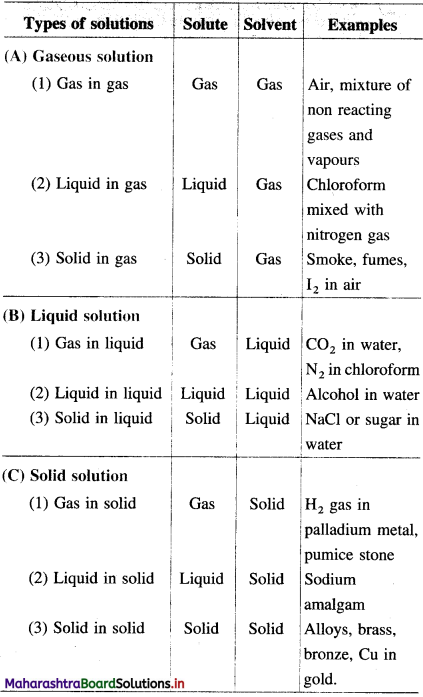
A solution consists of a solvent and a solute. Since the physical states of a solvent and a solute may be gaseous, liquid or a solid, there are nine types of solutions.
Maharashtra Board Class 12 Chemistry Important Questions Chapter 2 Solutions 1

Question 5.
Mention the solvent and solute in the following :
(1) Smoke
(2) Moisture
(3) Alloy
(4) Soda water.
Answer:

Substance Solvent Solute
1. Smoke Gas Solid
2. Moisture Gas Liquid
3. Alloy Solid Solid
4. Soda water Liquid Gas

Maharashtra Board Class 12 Chemistry Important Questions Chapter 2 Solutions

Question 6.
What is a saturated solution?
Answer:
A solution which contains the maximum amount of dissolved solute and further the solute can’t be dissolved is called a saturated solution.

There exists a dynamic equilibrium which is represented as,
Maharashtra Board Class 12 Chemistry Important Questions Chapter 2 Solutions 2

Question 7.
What is a supersaturated solution?
Answer:
A solution containing a solute more than that required to form a saturated solution at equilibrium is called a supersaturated solution.

When a tiny crystal of a solute is added to supersaturated solution, the excess solute separates out and forms saturated solution.

Question 8.
What is solubility of a solute ?
Answer:
Solubility : It is defined as amount of a solute present per unit volume in its saturated solution at a specific temperature.
It is expressed in mol L-1 or mol dm-3.

Question 9.
Explain the factors on which the solubility of a substance (solute) depends.
Answer:
The extent of dissolution of a substance (solute) depends upon the following factors :
(1) Nature of a solute : A solute may be crystalline, amorphous, ionic or covalent. Hence accordingly its tendency to dissolve changes. The substances having similar intermolecular forces tend to dissolve in each other.

(2) Nature of solvents : Solvents are classified as polar and nonpolar. Polar solutes dissolve in polar solvents. For example, ionic compounds dissolve in polar solvent like water. A solvent other than water is called a nonaqueous solvent. For example, C6H6, CCl4, etc. Solutions in these solvents are called nonaqueous solutions.
The solvent may be a gas, a liquid or a solid.

(3) Amount of a solvent : More amount of a solvent, will dissolve more quantity of the solute.

(4) Temperature : Depending on the nature of a solvent and a solute the solubility changes with termperature. The effect depends on the heat of solution, hydration energy, etc. Generally as the temperature increases, solubility of solid increases and that of gases decreases.

(5) Pressure :

  • Pressure has no effect on the solubilities of solids and liquids since they are incompressible.
  • The effect of pressure is important only for solutions which involve gases as solutes. With the increase in pressure and decrease in temperature, the solubility of gases increases.

Question 10.
Explain with the help of Le Chatelier’s principle the effect of temperature on solubility.
Answer:

  1. The effect of temperature on solubility depends on enthalpy of solution.
  2. For example, dissolution of KCl in water is an endothermic process since heat is absorbed during dissolution. In according to Le Chatelier’s principle by increasing temperature the solubility of KCl increases.
  3. Dissolution of CaCl2, Li2SO4, H2O in water is an exothermic process since heat is evolved during dissolution. In this, according to Le Chatelier’s principle by increasing the temperature the solubility decreases.

Question 11.
Explain the solubility of gases in liquids.
Answer:

  • Gases are soluble in water and other liquids and their solubility depends upon the nature of the gas.
  • Non-polar gases like O2, have less solubility in polar solvents.
  • Polar gases like CO2, NH3, HCl, etc. are more soluble in polar solvent like water. CO2 forms H2CO3, while NH3 forms NH4OH in aqueous solutions.
  • The solubility of gases in liquids increases with the increase in pressure and the decrease in temperature.

Maharashtra Board Class 12 Chemistry Important Questions Chapter 2 Solutions

Question 12.
Why does the solubility of a gas decrease with increase in temperature ?
OR
How does solubility of a gas in water varies with temperature ?
Answer:

  • The gases are soluble in water and other liquids.
  • According to Charles’ law, the volume of a given mass of a gas increases with the increase in temperature at constant pressure.
  • Hence, the volume of the dissolved gas increases with the increase in temperature.
  • This enormous increase in volume of the gases cannot be accommodated by the solvent molecules, hence excess of the gases escape out in the form of bubbles.

Therefore, the solubility of gases in liquids decreases with temperature.

Question 13.
Explain the effect of pressure on the solubility of the gases.
OR
State and explain Henry’s law.
Answer:
(1) Since the gases are compressible, their solubility in the liquids is influenced by external pressure of the gas. The solubility of gases increases with the increase in pressure.

(2) Henry’s law : It states that the solubility of a gas. in a liquid at constant temperature is proportional to the pressure of the gas above the solution.
(i) If S is the solubility of a gas in mol dm-3 at a pressure P and constant temperature then by Henry’s law,
S ∝ P or S = KH × P
where KH is called Henry’s law constant.
(ii) If P = 1 atm, then S = KH.
(iii) If several gases are present, then the solubility of any gas in the mixture is proportional to its partial pressure at given temperature.

(3) Illustration of Henry’s law : In case of aerated or carbonated drink beverage, the bottle is filled by dissolving CO2 gas at high pressure and then sealed.
Above the liquid surface there is air and undissolved CO2. Due to high pressure, the amount of dissolved CO2 is large.

When the cap of the aerated bottle is removed, the pressure on the solution is lowered, hence excess of CO2 and air escape out in the form of effervescence. Thus by decreasing the pressure, solubility of CO2 is decreased.

Question 14.
What are the exceptions to Henry’s law? Why ?
Answer:
(1) The gases like NH3 and CO2 do not obey Henry’s law.
(2) This is because, these gases react with water,
\(\mathrm{NH}_{3(\mathrm{~g})}+\mathrm{H}_{2} \mathrm{O}_{(\mathrm{l})} \longrightarrow \mathrm{NH}_{4 \text { (aq) }}^{+}+\mathrm{OH}_{(\text {aq })}^{-}\)
CO2(g) + H2O(l) → H2CO3(aq)
(3) Due to reactions of the gases like NH3, CO2(g), they have higher solubilities than expected by Henry’s law.

Question 15.
Oxygen gas is slightly soluble in water but it is highly soluble in blood. Explain.
Answer:
The vital constituent of blood, namely haemoglobin reacts with oxygen increasing the solubility of oxygen.
Haemoglobin + 4O2(g) → Haemoglobin O8
This oxygenated blood is circulated to the various parts of body, for the supply of oxygen.

Question 16.
Obtain the units of Henry’s law constant.
Answer:
By Henry’s law, S = KH × P, where S is solubility of the gas in mol dm-3, P is the pressure of the gas in atmosphere (or in bar) and KH is Henry’s law constant.
∴ KH = \(\frac{S^{\left(\mathrm{mol} \mathrm{dm}^{-3}\right)}}{P_{(\mathrm{atm})}}\) mol dm-3 atm-1 or mol dm-3 bar-1
Hence the units of Henry’s law constant KH are mol dm-3atm-1.

Maharashtra Board Class 12 Chemistry Important Questions Chapter 2 Solutions

Solved Examples 2.4

Question 17.
Solve the following :
(1) For a gas, the Henry’s law constant is 1.25 × 10⁻³ mol dm-3 atm-1 at 25 °C. Calculate the solubility of the given gas at 2.5 atm and 25 °C.
Solution :
Given : Henry’s law constant = KH
= 1.25 × 10⁻³ mol dm-3 atm-1
Pressure of the gas = P = 2.5 atm
Solubility of the gas = S = ?
By Henry’s law
S = KH × P
= 1.25 × 10⁻³ mol dm-3 atm-1 × 2.5 atm
= 3.125 × 10⁻³ mol dm-3
Ans. Solubility of gas = 3.125 × 10⁻³ mol dm-3

(2) The solubility of dissolved oxygen to 27 °C is 2.6 × 10⁻³ mol dm-3 at 2 atm. Find its solubility at 8.4 atm and 27 °C.
Solution :
Given : Solubility of O2
= S1 = 2.6 × 10⁻³ mol dm-3
Initial pressure of O2 = P1 = 2 atm
Final pressure of O2 = P2 = 8.4 atm
Solubility of O2 = S2 = ?
(i) By Henry’s law,
S1 = KH × P1
∴ Henry’s law constant KH is,
KH = \(\frac{S_{1}}{P_{1}}=\frac{2.6 \times 10^{-3}}{2}\)
= 1.3 × 10⁻³ mol dm-3 atm-1
(ii) Now, S2 = KH × P2 = 1.3 × 10-3 × 8.4
= 10.92 × 10-3
= 1.092 × 10⁻² mol dm-3
Ans. Solubility of O2 = 1.092 × 10⁻² mol dm-3

(3) Henry’s law constant for the solubility of methane in benzene is 4.27 × 10⁻⁵ mm-1 Hg mold dm-3 at constant temperature. Calculate the solubility of methane at 760 mm Hg pressure at same temperature.
Solution :
Given : Henry’s law constant = KH
= 4.27 × 10⁻⁵mm-1 Hg mol dm-3
Pressure of the gas = P = 760 mm Hg
KH = 4.27 × 10⁻⁵ mm-1 mol dm-3
= 4.27 × 10-5 × 760 atm-1 mol dm-3
= 3245 × 10-5 atm-1 mol dm-3
= 3.245 × 10⁻² atm-1 mol dm-3
P = 760 mm = \(\frac{760}{760}\) atm = 1 atm
By Henry’s law,
S = KH × P = 3.245 × 10⁻² atm-1 mol dm-3 × 1 atm
= 3.245 × 10⁻² mol dm-3
Ans. Solubility of methane = 3.245 × 10⁻² mol dm-3

(4) The solubility of ethane at 25 °C is 0.92 × 10⁻³ g dm-3 at 1000 mm Hg pressure. Calculate Henry’s law constant.
Solution :
Given : Solubility of ethane
= S = 0.92 × 10⁻⁵ g dm-3
Pressure of ethane = P = 1000 mm Hg
Molar mass of ethane (C2H6) = 30 g mol-1
Henry’s law constant = KH = ?
S = 0.92 × 10⁻³ g dm-3
= \(\frac{0.92}{30}\) × 10-3
= 3.067 × 10⁻⁵ mol dm-3
P = 1000 mm = \(\frac{1000}{760}\)atm = 1.316 atm
By Henry’s law,
S = KH × P
∴ KH = \(\frac{S}{P}=\frac{3.067 \times 10^{-5}}{1.316}\)
= 2.33 × 10⁻⁵ mol dm-3 atm-1
Ans. Henry’s law constant = KH
= 2.33 × 10⁻⁵ mol dm-3 atm-1

Maharashtra Board Class 12 Chemistry Important Questions Chapter 2 Solutions

(5) The solubility of nitrogen at 30 °C is 2.5 × 10⁻³ g dm-3 at 760 mm pressure. What will be its solubility in mol dm-3 at 20,000 mm and same temperature?
Solution :
Given : Initial solubility of N2 = S1 =2.5 × 10⁻³ g dm-3
Initial pressure = P1 = 760 mm
Final pressure = P2 = 20,000 mm
Final solubility = S2 in mol dm-3 = ?
Molar mass of N2 gas = 28 g mol-1
S1 = 2.33 × 10⁻⁵ mol dm-3
= \(\frac{2.5 \times 10^{-3}}{28}\) mol dm-3
= 8.93 × 10⁻⁵ mol dm-3
P1 = \(\frac{760}{760}\) = 1 atm
P2 = \(\frac{20,000}{760}\) = 26.32 atm
By Henry’s law,
S1 = KH × P1
∴ KH = \(\frac{S_{1}}{P_{1}}=\frac{8.93 \times 10^{-5}}{1}\)
= 8.93 × 10⁻⁵ mol dm-3 atm-1
S2 = KH × P2 = 8.93 × 10-5 × 26.32
= 2.35 × 10⁻³ mol dm-3
Ans. Solubility of N2 gas
= 2.35 × 10⁻³ mol dm-3.

[Alternative method:
S1 = KHP1 and S2 = KHP2
∴ \(\frac{S_{2}}{S_{1}}=\frac{K_{\mathrm{H}} P_{2}}{K_{\mathrm{H}} P_{1}}=\frac{P_{2}}{P_{1}}\)
∴ S2 = S1 × \(\frac{P_{2}}{P_{1}}\) = 8.93 × 10⁻⁵ × \(\frac{20,000}{760}\)
= 2.35 × 10⁻³ mol dm-3]

Question 18.
Marine life like fish prefers to stay at lower level in water. Explain.
OR
Explain, why do aquatic animals prefer to stay at lower level of water during summer?
Answer:

  1. The solubility of oxygen gas decreases with the increase in temperature.
  2. In sea or lake water, the temperature of upper level is higher than the lower level.
  3. Therefore the dissolved oxygen content in water is more at lower level than at higher level required for the marine life.

Hence marine life like fish prefers to stay at lower level than upper level of water.

Question 19.
State and explain Raoult’s law.
Answer:
Statement of Raoult’s law : The law states that, at constant temperature, the partial vapour pressure of any volatile component of a solution is equal to the product of vapour pressure of the pure component and the mole fraction of that component in the solution.

Let P0 and P be the respective vapour pressures of a pure volatile component and a solution. If x1 is the mole fraction of a solvent then by Raoult’s law,
P = x1 × P0.

Explanation : Consider a solution containing two volatile components A and B having mole fractions x1 and x2 respectively.
Let \(P_{1}^{0}\) and \(P_{2}^{0}\) be the vapour pressures of pure components (or liquids) A and B respectively.
Then by Raoult’s law, vapour pressure of component A = P1 = X1 × \(P_{1}^{0}\), vapour pressure of component B = P2 = x2 × \(P_{2}^{0}\).
Here P1 and P2 represent partial vapour pressures of the two liquid components in the solution.
Hence the total vapour pressure, PT of the solution will be,
PT = P1 + P2
∴ PT = x1\(P_{1}^{0}\) + x2\(P_{2}^{0}\)
∵ x1 + x2 = 1
∴ x1 = 1 – x2
∴ PT = (1 – x2)\(P_{1}^{0}\) + x2\(P_{2}^{0}\)
= \(P_{1}^{0}\) – x2\(P_{1}^{0}\) + x2\(P_{2}^{0}\)
= (\(P_{2}^{0}\) – \(P_{1}^{0}\))x2 + \(P_{1}^{0}\)
With the help of above equation, the vapour pressures of solutions having different concentrations (or mole fractions) can be calculated.

Question 20.
Explain the variation of vapour pressure with mole fraction of a solute in a liquid mixture.
Answer:
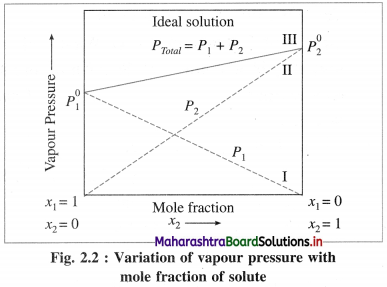
Consider a liquid mixture of two liquid components A and B having vapour pressures \(P_{1}^{0}\) and \(P_{2}^{0}\) and mole fractions x1 and x2 respectively.
By Raoult’s law, the vapour pressures P1 and P2 are,
P1 = x1\(P_{1}^{0}\) and P2 = x2\(P_{2}^{0}\)
The vapour pressure of the solution is,
PT = P1 +P2 = x1\(P_{1}^{0}\) + x2\(P_{2}^{0}\)
Maharashtra Board Class 12 Chemistry Important Questions Chapter 2 Solutions 3
∴ PT = (\(P_{2}^{0}\) – \(P_{1}^{0}\))x2 + \(P_{1}^{0}\)
The plot of PT versus x2 is a straight line. The plots of P1 versus x1, and P2 versus x2 are straight lines passing through the origin.
When x1 = 1, x2 = 0, PT = \(P_{1}^{0}\) and when x1 = 0, x2 = 1, PT = \(P_{2}^{0}\) as shown by lines I and II in Fig. 2.2

Maharashtra Board Class 12 Chemistry Important Questions Chapter 2 Solutions

Question 21.
Explain the composition of vapour phase above a liquid mixture.
Answer:
Consider a liquid mixture of two liquids A and B having vapour pressures \(P_{\mathrm{A}}^{0}\) and \(P_{\mathrm{B}}^{0}\) and mole fractions x1 and x2 respectively in the liquid phase.
By Raoult’s law, the vapour pressures of two liquids will be,
PA = x1\(P_{\mathrm{A}}^{0}\) and PB = x2\(P_{\mathrm{B}}^{0}\)
The total vapour pressure of this liquid mixture is,
PT = PA + PB
PT = x1\(P_{\mathrm{A}}^{0}\) + x2\(P_{\mathrm{B}}^{0}\)
The vapour above liquid surface contains A and B. If y1 and y2 are the mole fractions of A and B components respectively in the vapour phase, then by Dalton’s law of partial pressures,
PA = y1PT and PB = y2PT
and total vapour pressure is,
PT = y1PT + y2PT.

Question 22.
What are ideal and nonideal solutions ?
Answer:

  • Ideal solutions : These are solutions which obey Raoult’s law over an entire range of concentrations at constant temperature.
  • Nonideal solutions : These are solutions which do not obey Raoult’s law over the entire range of concentrations.

Question 23.
What are the characteristics of ideal solutions ?
Answer:

  • The ideal solutions obey Raoult’s law over entire range of concentrations at constant temperature.
  • In the formation of an ideal solution, heat is neither evolved nor absorbed and enthalpy change for mixing is zero, i.e. Δmix H = 0.
  • In the formation of an ideal solution, there is no volume change on mixing two liquid components and the volume of solution is equal to the sum of volumes of two liquid components. Δmix V = 0
  • In the ideal solution, solvent-solvent, solute-solute and solvent-solute interactions are comparable.
  • The vapour pressure of an ideal solution lies between vapour pressures of two pure components.

Question 24.
Give an example of an ideal solution.
Answer:
A liquid mixture of benzene and toluene which have nearly identical physical properties and inter molecular forces forms an ideal solution.

Question 25.
What are the characteristics of nonideal solutions.
Answer:

  • Nonideal solutions do not obey Raoult’s law over the entire range of concentrations.
  • The vapour pressures of these solutions may be higher or lower than ideal solutions.
  • These solutions exhibit two types of deviations from Raoult’s law namely (a) positive deviation and (b) negative deviation.
  • These solutions give azeotropic mixtures.

Question 26.
Explain solutions with positive deviations from Raoult’s law.
Answer:
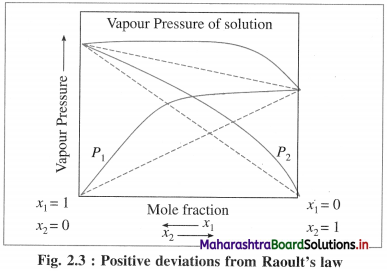
(i) A solution or a liquid mixture which has higher vapour pressure than theoretically calculated by Raoult’s law or higher than those of pure components is called a nonideal solution with positive deviation.
Maharashtra Board Class 12 Chemistry Important Questions Chapter 2 Solutions 4
(ii) In these solutions, solute-solvent intermolecular attractions are weaker than those between solvent-solvent and solute-solute interactions.
(iii) For example, solutions of acetone and ethanol, carbon disulphide and acetone, etc.

Maharashtra Board Class 12 Chemistry Important Questions Chapter 2 Solutions

Question 27.
Explain solutions with negative deviations from Raoult’s law.
Answer:
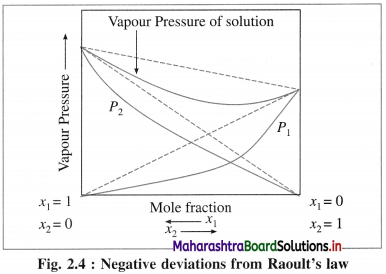
(1) A solution or a liquid mixture which has lower vapour pressure than theoretically calculated by Raoult’s law or lower than those of pure components is called a nonideal solution with negative deviation.
Maharashtra Board Class 12 Chemistry Important Questions Chapter 2 Solutions 5
(2) In these solutions, the intermolecular interactions between solvent and solute molecules are stronger than solvent-solvent or solute-solute interactions.
(3) For example, solutions of phenol and aniline, chloroform and acetone, etc.

Solved Examples 2.5

Question 28.
Solve the following :

(1) The vapour pressures of two liquids A and B are 400 mm Hg and 600 mm Hg respectively at 47 °C. A solution is prepared by dissolving 10 g of A of molar mass 60 g mol-1 in 80 g of B of molar mass 40 g mol-1. Find the vapour pressure of the solution.
Solution :
Given : \(P_{\mathrm{A}}^{0}\) = 400 mm Hg; \(P_{\mathrm{B}}^{0}\) = 650 mm Hg.
WA = 10 g and WB = 80 g.
MA = 60 g mol-1; MB = 40 g mol-1, Psoln = ?
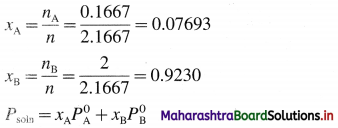
nA = \(\frac{W_{\mathrm{A}}}{M_{\mathrm{A}}}=\frac{10}{60}\) = 0.1667 mol
nB = \(\frac{W_{\mathrm{B}}}{M_{\mathrm{B}}}=\frac{80}{40}\) = 2 mol
Total number of moles = n = nA + nB
= 0.1667 + 2
= 2.1667 mol
Maharashtra Board Class 12 Chemistry Important Questions Chapter 2 Solutions 6
= 0.07693 × 400 + 0.9230 × 600
= 30.772 + 553.8
= 584.572 mm Hg
Ans. Vapour pressure of solution
= Psoln = 584.572 mm Hg

(2) 2.5 mol of a liquid A is mixed with 4.5 mol of liquid B at 25 °C. If the vapour pressures of A and B at 25 °C are 160 mm Hg and 230 mm Hg respectively, calculate the vapour pressure of the liquid mixture.
Solution :
Given : nA = 2.5 mol; nB = 4.5 mol,
\(P_{\mathrm{A}}^{0}\) = 160 mm Hg; \(P_{\mathrm{B}}^{0}\) = 230 mm Hg, Psoln = ?
Total number of moles = n = nA + nB
= 2.5 + 4.5
= 7.0 mol
Mole fraction of A = xA = \(\frac{n_{\mathrm{A}}}{n}=\frac{2.5}{7}\) = 0.3571
Mole fraction of B = 1 – xA = 1 – 0.3571
= 0.6429
\(P_{\text {soln }}=x_{\mathrm{A}} P_{\mathrm{A}}^{0}+x_{\mathrm{B}} P_{\mathrm{B}}^{0}\)
= 0.3571 × 160 + 0.6429 × 230
= 57.136 + 147.9
= 205 mm Hg
Ans. Psoln = 205 mm Hg

Maharashtra Board Class 12 Chemistry Important Questions Chapter 2 Solutions

(3) The vapour pressures of pure liquids A and B are 400 mm Hg and 650 mm Hg respectively at 330 K. Find the composition of liquid and vapour if total vapour pressure of solution is 600 mm Hg.
Solution :
Given : \(P_{\mathrm{A}}^{0}\) = 400 mm Hg; \(P_{\mathrm{B}}^{0}\) = 650 mm Hg,
PT = 600 mm Hg, T = 330 K; xA = ? xB = ?, y1 = ? y2 = ?
(x is mole fraction in liquid phase while y is mole fraction in vapour phase.)
PT = (\(P_{\mathrm{A}}^{0}\) – \(P_{\mathrm{B}}^{0}\))xB + \(P_{\mathrm{A}}^{0}\)
600 = (650 – 400)xB + 400
= 250xB + 400
∴ xB = \(\frac{600-400}{250}\) = 0.8
∵ xA + xB = 1
∴ xA = 1 – xB = 1 – 0.8 = 0.2
The composition of A and B in liquid mixture is, xA = 0.2 and xB = 0.8.
If P1 and P2 are vapour pressures (or partial pressures) of A and B in vapour phase then by Raoult’s law,
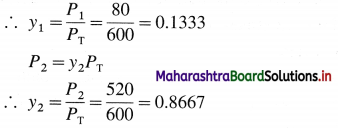
P1 = xA × \(P_{\mathrm{A}}^{0}\) = 0.2 × 400 = 80 mm Hg
P2 = xB × \(P_{\mathrm{B}}^{0}\) = 0.8 × 650 = 520 mm Hg
If y1 and y2 are mole fractions of A and B respectively in vapour phase then, by Dalton’s law,
P1 = y1PT
Maharashtra Board Class 12 Chemistry Important Questions Chapter 2 Solutions 7
(or y2 = 1 – y1 = 1 – 0.1333 = 0.8667)
Ans. Composition of liquid : xA = 0.2 and xB = 0.8
Composition of vapour: yA = 0.1333 and yB = 0.8667

(4) A mixture of two liquids A and B have vapour pressures 3.4 × 10⁴ Nm-2 and 5.2 × 10 Nm-2. If the mole fractions of A is 0.85, find the vapour pressure of the solution.
Solution:
Given : Vapour pressure of pure liquid A
= \(P_{\mathrm{A}}^{0}\) = 3.4 × 10⁴ Nm-2
Vapour pressure of pure liquid B
= \(P_{\mathrm{B}}^{0}\) = 5.2 × 10⁴ Nm-2
Mole fraction of A = xA = 0.85
Mole fraction of B = xB = 1 – xA
= 1 – 0.85
= 0.15
The vapour solution is given by
\(P_{\text {soln }}=X_{A} P_{A}^{0}+X_{B} P_{B}^{0}\)
= 0.85 × 3.4 × 10 + 0.15 × 5.2 × 104
=2.89 × 10⁴ + 0.78 × 104
=(2.89 + 0.78) × 104
Psoln = 3.67 × 10⁴ Nm-2
Ans. Vapour pressure of a solution = 3.67 × 10⁴ Nm-2

Question 29.
Define the term colligative property. Give examples.
Answer:
(1) Colligative Property : The property of a solution which depends on the total number of particles of the solute (molecules, ions) present in the solution and does not depend on the nature or chemical composition of solute particles is called colligative property of the solution.

(2) Examples of colligative properties : (a) lowering or relative lowering of vapour pressure of a solution (b) elevation in the boiling point (c) depression in the freezing point (d) osmotic pressure.

Question 30.
Explain and define the term vapour pressure of a liquid.
OR
What is vapour pressure of a liquid?
Answer:
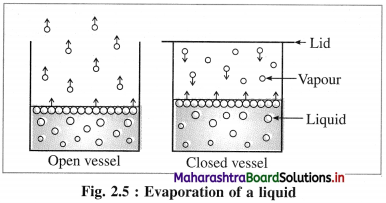
Maharashtra Board Class 12 Chemistry Important Questions Chapter 2 Solutions 8
(1) If a volatile liquid is placed in an open vessel, the liquid molecules have a tendency to escape in a gaseous state forming vapour and diffuse into surroundings. Hence evaporation takes place continuously, and no equilibrium is attained.

(2) If a liquid is placed in a closed vessel, the vapour molecules get accumulated on its surface. These vapour molecules are in continuous random motion. They collide with each other, with walls of a container and surface of the liquid, and return to the liquid state. This reverse phenomenon is called condensation.

(3) After some time, rates of evaporation and condensation become equal and an equilibrium is established between liquid and vapour phases. At this stage the vapour exerts a constant pressure called vapour pressure on liquid surface at constant temperature.

(4) Vapour pressure : The pressure exerted by the vapour of a liquid (or solid) when it is in equilibrium with the liquid (or solid) phase at a constant temperature is called the vapour pressure of the liquid (or solid).

(5) The vapour pressure of a liquid increases with the increase in temperature.

Question 31.
Explain the following terms :
(1) Relative vapour pressure of a solution
(2) Lowering of vapour pressure of a solution
(3) Relative lowering of vapour pressure.
Answer:
(1) Relative vapour pressure of a solution : If Po is the vapour pressure of a pure liquid (solvent) and P is the vapour pressure of a solution after adding a nonvolatile solute, then, relative vapour pressure = \(\frac{P}{P_{0}}\).

(2) Lowering of vapour pressure of a solution :
When a nonvolatile solute is added to a pure solvent, the surface area is covered by the solute molecule decreasing the rate of evaporation, hence its vapour pressure decreases. This decrease in vapour pressure is called lowering of vapour pressure.
If P0 is the vapour pressure of a pure solvent (liquid) and P is the vapour pressure of the solution, where P < P0, then, (P0 – P) is the lowering of the vapour pressure.

(3) Relative lowering of vapour pressure : If P0 and P are the respective vapour pressures of a pure liquid (solvent) and the solution containing a non-volatile solute then P < P0. Hence, P0 – P represents the lowering of the vapour pressure due to addition of a nonvolatile solute.
∴ Relative lowering of vapour pressure = \(\frac{P_{0}-P}{P_{0}}=\frac{\Delta P}{P_{0}}\)

Maharashtra Board Class 12 Chemistry Important Questions Chapter 2 Solutions

Question 32.
State and explain Raoult’s law for solutions of nonvolatile solutes.
Answer:
(a) Statement of Raoult’s law : The law states that the vapour pressure of a solvent over the solution of a nonvolatile solute is equal to the vapour pressure of the pure solvent multiplied by mole fraction of the solvent at constant temperature.

(b) Explanation : Let P0 and P be the vapour pressures of a pure solvent and a solution respectively. If x1 is the mole fraction of the solvent then Raoult’s law can be represented as,
P = x1P0
For a binary solution containing one solute, if x1 and x2 are mole fractions of a solvent and a solute respectively then,
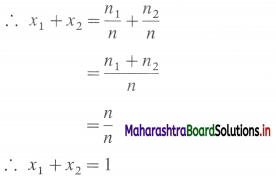
x1 + x2 = 1
∴ x1 = 1 – x2
∴ P = x1P0
= (1 – x2) P0
= P0 – x2P0
= P0 – P = x2P0
∴ P0 – P = x2P0
∴ x2 = \(\frac{P_{0}-P}{P_{0}}\)
P0 – P = ΔP is the lowering of vapour pressure
∴ x2 = \(\frac{\Delta P}{P_{0}}\)
In the equation, P0 – P/P0 is called relative lowering of vapour pressure.
Hence Raoult’s law can also be stated as the relative lowering of vapour pressure is equal to mole fraction of the solute.

Question 33.
Show that relative lowering of vapour pressure is a colligative property.
Answer:
Consider a binary solution containing a nonvolatile solute. If P0 and P are vapour pressures of a pure solvent and the solution respectively then, Lowering of vapour pressure = ΔP = P0 – P
Relative lowering of vapour pressure = \(\frac{P_{0}-P}{P_{0}}\)
By Raoult’s law,
\(\frac{P_{0}-P}{P_{0}}=x_{2}\)
where x2 is mole fraction of the solute. Therefore the relative lowering of vapour pressure is a colligative property.

Question 34.
Explain the variation of vapour pressure with mole fraction of a solvent in solution.
OR
Explain the variation of vapour pressure with the concentration of a solution.
Answer:
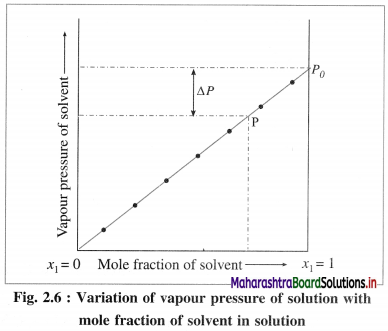
The vapour pressure of a pure solvent decreases when a nonvolatile solute is dissolved in it. Consider a pure solvent with vapour pressure P0 and mole fraction x1. For a solution containing a non-volatile solute, if x1 and x2 are the mole fractions of a solvent and a solute respectively, then x1 + x2 = 1 and x1 < 1.
Maharashtra Board Class 12 Chemistry Important Questions Chapter 2 Solutions 9
By Raoult’s law, P = x1 × P0. As the mole fraction of a solvent in the solution increases the vapour pressure increases as shown in the above figure 2.5. When x1 becomes equal to 1, the vapour pressure becomes P0, i.e. the vapour pressure of a pure solvent.

If at any mole fraction of a solvent, the vapour of the solution is P, then the lowering of vapour pressure will be, ΔP = P0 – P.

Question 35.
Derive a relation between relative lowering of vapour pressure and molar mass of non-volatile solute.
Answer:
Consider a solution in which W1 gram of a solvent of molar mass (or molecular weight) M2 contains W2 gram of a solute of molar mass M2. Then
number of moles of a solvent = n1 = \(\frac{W_{1}}{M_{1}}\)
Number of moles of a solute = n2 = \(\frac{W_{2}}{M_{2}}\)
∴ Total number of moles = n = n1 + n2
Mole fraction of the solvent = x1 = \(\frac{n_{1}}{n}\)
Mole fraction of the solute = x2 = \(\frac{n_{2}}{n}\)
Maharashtra Board Class 12 Chemistry Important Questions Chapter 2 Solutions 10
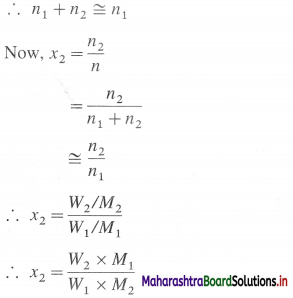
In the case of an ideal solution which is a dilute solution, the concentration and the number of moles of the solute are very low, i.e. n2 << n1
Maharashtra Board Class 12 Chemistry Important Questions Chapter 2 Solutions 11
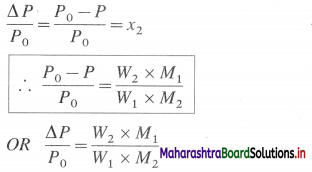
If P0 and P are the vapour pressures of a pure solvent and a solution respectively, then relative lowering of vapour pressure = \(\frac{P_{0}-P}{P_{0}}\)
By Raoult’s law
Maharashtra Board Class 12 Chemistry Important Questions Chapter 2 Solutions 12
Hence by measuring the vapour pressure of a pure solvent and a solution, the molar mass of the dissolved nonvolatile substances can be determined.

Maharashtra Board Class 12 Chemistry Important Questions Chapter 2 Solutions

Solved Examples 2.6 – 2.7

Question 36.
Solve the following :

(1) The vapour pressure of a pure liquid at 298 K is 4 × 10⁴ Nm-2. When a nonvolatile solute is dissolved the vapour pressure becomes 3.65 × 10⁴ Nm-2. Calculate (A) relative vapour pressure, (B) lowering of vapour pressure and (C) relative lowering of vapour pressure.
Solution :
Given : P0 = 4 × 10⁴ Nm-2
P = 3.65 × 10⁴ Nm-2
(A) Relative vapour pressure = \(\frac{P}{P_{0}}\)
= \(\frac{3.65 \times 10^{4}}{4 \times 10^{4}}\)
= 0.9125

(B) Lowering of vapour pressure = ΔP = P0 – P
= 4 × 10⁴ – 3.65 × 104
= (4 – 3.65) × 104
= 0.35 × 10⁴ Nm-2 = 3.5 × 10³ Nm-2

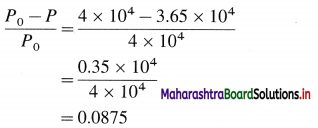
(C) Relative lowering of vapour pressure is given by,
Maharashtra Board Class 12 Chemistry Important Questions Chapter 2 Solutions 13
Ans. (A) 0.9125 (B) 3.5 × 10³ Nm-2 (C) 0.0875

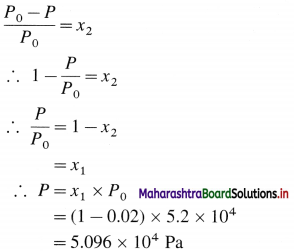
(2) A pure liquid has vapour pressure 5.2 × 10⁴ Pa at 298 K. When a solute is dissolved, the mole fraction of it is 0.02 in the solution. Find the vapour pressure of the solution.
Solution :
Given : P0 = 5.2 × 104 Pa
x2 = 0.02
P = ?
Maharashtra Board Class 12 Chemistry Important Questions Chapter 2 Solutions 14
Ans. Vapour pressure of the solution
= 5.096 × 10⁴ Pa

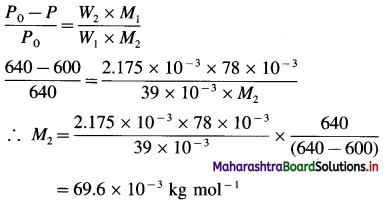
(3) The vapour pressure of pure benzene is 640 mm of Hg. 2.175 × 10⁻³ kg of nonvolatile solute is added to 39 gram of benzene, the vapour pressure of solution is 600 mm of Hg. Calculate molar mass of solute (C = 12, H = 1).
Solution :
Given : P0 = 640 mm Hg
W1 = 39 g benzene = 39 × 10-3 kg
W2 = 2.175 × 10⁻³ kg
P = 600 mm Hg
M1 = 78 × 10-3 kg, M2 = ?
Maharashtra Board Class 12 Chemistry Important Questions Chapter 2 Solutions 15
Ans. Molar mass of a solute = 69.6 × 10⁻³ kg mol-1

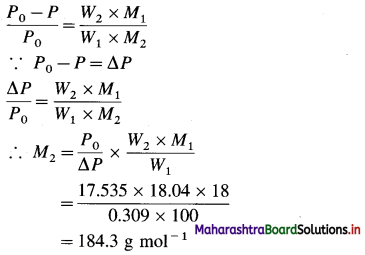
(4) In an experiment, 18.04 g of mannitol were dissolved in 100 g of water. The vapour pressure of water was lowered by 0.309 mm Hg from 17.535 mm Hg. Calculate the molar mass of mannitol.
Solution :
Given : Mass of a solute (mannitol)
= W2 = 18.04 g
Mass of a solvent (water) = W1 = 100 g
Vapour pressure of a solvent (water)
= P0
= 17.535 mm Hg
Lowering of vapour pressure = ΔP = 0.309 mm Hg
Molar mass of H2O = M1 = 18 g mol-1
Molar mass of solute (mannitol) = M2 = ?
Maharashtra Board Class 12 Chemistry Important Questions Chapter 2 Solutions 16
Ans. Molar mass of mannitol = 184.3 g mol-1

Maharashtra Board Class 12 Chemistry Important Questions Chapter 2 Solutions

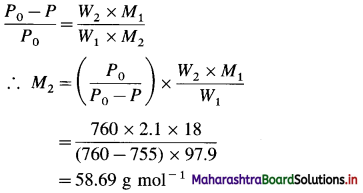
(5) The vapour pressure of 2.1% solution of a non-electrolyte in water at 100 °C is 755 mm Hg. Calculate the molar mass of the solute.
Solution :
Given : At 100 °C, vapour pressure of water = P0 = 760 mm Hg
Vapour pressure of the solution = P = 755 mm Hg
Since the solution is 2.1 % by mass,
Mass of solute (nonelectrolyte) = W2 = 2.1 g
Mass of water = W1 = 100 – 2.1 = 97.9 g
Molar mass of water = M1 = 18 g mol-1
Molar mass of nonelectrolyte = M2 = ?
Maharashtra Board Class 12 Chemistry Important Questions Chapter 2 Solutions 17
Ans. Molar mass of nonelectrolyte = 58.69 g mol-1

(6) Calculate the mass of a nonvolatile solute (molar mass 40 × 10-3 kg/mol) which is dissolved in 114 × 10-3 kg octane to reduce its vapour pressure to 80%.
Solution :
Given : Molar mass of solute = M2 =40 × 10-3 kg mol-1
Mass of solvent (octane) = W1 = 114 × 10-3 kg
If vapour pressure of octane = P0 = 100
Vapour pressure of solution = P = 80
Molar mass of octane (C8H18) = 114 × 10-3 kg mol-1
Mass of solute = W2 = ?
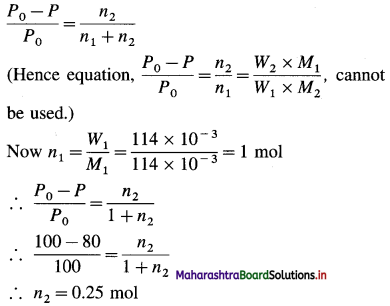
In this solution, since the vapour pressure is decreased by greater extent, 100 – 80 = 20% the solution must be concentrated and number of moles of solute must be large so that n1 + n2 ≠ n1
Hence Raoult’s law must be represented as,
Maharashtra Board Class 12 Chemistry Important Questions Chapter 2 Solutions 18
∴ Mass of solute dissolved = W
= moles × molar mass = 0.25 × 40 × 10-3
= 0.01 kg
Ans. Mass of solute dissolved = 0.01 kg

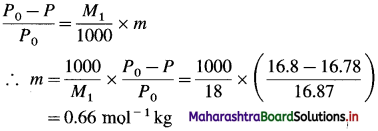
(7) The vapour pressure of water is 16.8 mm Hg at a certain temperature. If the vapour pressure of the solution is 16.78 mm, find the molality of the solution.
Solution :
Given : P0 = 16.8 mm Hg; P = 16.78 mm Hg
Molar mass of water = M1 = 18 g mol-1
Molality of the solution = m = ?
Maharashtra Board Class 12 Chemistry Important Questions Chapter 2 Solutions 19
Ans. Molality of the solution = 0.66 m

Question 37.
Explain the effect of temperature on the vapour pressure of a liquid.
Answer:
The vapour pressure of a liquid is the pressure of the vapour in equilibrium with the liquid at a given temperature. The evaporation of a liquid requires thermal energy. Hence, as temperature rises, the vapour pressure rises until it becomes equal to the external pressure, generally the atmospheric pressure, 101.3 kNm-2 (1 atm). This temperature is called the normal boiling point of the liquid.

Question 38.
What is boiling point of liquid?
OR
Define boiling point.
Answer:
The boiling point of a liquid is defined as the temperature at which the vapour pressure of the liquid becomes equal to the external pressure, i.e., the atmospheric pressure (1 atm), e.g., the boiling point of water at 1 atm is 373 K. m

Question 39.
Explain the elevation in the boiling point of a solution.
Answer:
The elevation in the boiling point of a solution is defined as the difference between the boiling points of the solution and the pure solvents at a given pressure, e.g. If T0 and T are the boiling points of a pure solvent and a solution, then the elevation in boiling point, ΔTb = T – T0. It is a colligative property.

Question 40.
What are the units of molal elevation constant?
Answer:
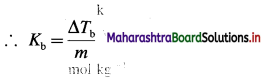
Boiling point elevation, ΔTb is given by,
ΔTb = Kb × m
where m is molality in mol kg-1 and Kb is molal elevation constant or abullioscopic constant.
Maharashtra Board Class 12 Chemistry Important Questions Chapter 2 Solutions 20
∴ Kb has units K kg mol-1 (or °C kg mol-1)
Therefore, molal elevation constant is the elevation in boiling point produced by 1 molal solution of a nonvolatile solute.

Maharashtra Board Class 12 Chemistry Important Questions Chapter 2 Solutions

Question 41.
Derive the relation between molar mass of the solute and boiling point elevation.
Answer:
The boiling point elevation, ΔTb of a solution is directly proportional to molality (m) of the solution.
∴ ΔTb ∝ m
ΔTb = Kb m
where Kb is a proportionality constant
If m = 1 molal, then
ΔTb = Kb
where Kb is called molal elevation constant.
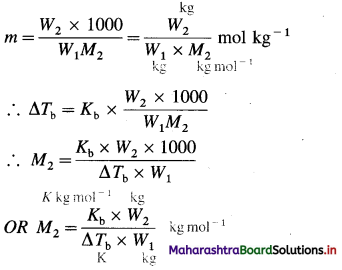
The molality of the solution is given by,
Number of moles of the solute, m = \(\frac{\text { Number of moles of the solute }}{\text { Weight of the solvent in } \mathrm{kg}}\)
Let W1 = Weight (in gram) of a solvent,
W2 = Weight (in gram) of a solute
M2 = Molecular weight of the solute
Then the molality (m) of the solution is given by
Maharashtra Board Class 12 Chemistry Important Questions Chapter 2 Solutions 21
If the weights and molecular weight are expressed in kg, then,
\(\Delta T_{\mathrm{b}}=K_{\mathrm{b}} \times \frac{W_{2}}{W_{1} M_{2}}\)

Question 42.
Define molal elevation constant (Ebullioscopic constant)? Does it depend on the nature of a solute ? What are its units ?
Answer:
(1) Molal elevation constant (Ebullioscopic constant) : It is defined as the elevation in boiling point, produced by dissolving one mole of a solute in 1 kg (or 1000 gram) of a solvent (i.e. 1 molal solution).
The elevation in the boiling point,
ΔTb is given by ΔTb = Kb × m
where Kb is molal elevation constant and m is molality of the solution.
∴ When m = 1, ΔTb = Kb
(2) Kb depends only on the nature of the solvent.
(3) Kb does not depend on the nature of the solute.
(4) It does not depend on concentration of the solution.
(5) The units of molal elevation constant are :
(A) K kg mol-1 and (B) Km-1.

Solved Examples 2.8

Question 43.
Solve the following :

(1) Calculate the (i) elevation in the boiling point and (ii) the boiling point of 0.05 m aqueous solution of glucose. (Kb = 0.52 Km-1)
Solution :
Given : Concentration of the solution = m = 0.05 m
Molal elevation constant = Kb = 1.86 K kg mol-1
Boiling point of pure water = T0 = 373 K
Elevation in the boiling point = ΔTb = ?
Boiling point of solution = Tb = ?

(i) ΔTb = Kb × m
= 0.52 × 0.05
= 0.026K

(ii) The elevation in the boiling point is given by,
ΔTb = Tb – T0
∴ Boiling point of a solution,
Tb = T0 + ΔTb
= 373 + 0.026
= 373.026 K
Ans. ΔTb = 0.026 K, Tb = 373.026 K

(2) 0.18 molal aqueous solution of a substance boils at 373.25 K. Calculate the molal elevation constant of water. (Boiling point of water is 373.15 K)
Solution :
Given : Concentration of solution = m = 0.18 m
Boiling point of water = T0 = 373.15 K
Boiling of the solution = Tb = 373.25
Molal elevation constant = Kb = ?
Elevation in boiling point = ΔTb
= Tb – T0
= 373.25 – 373.15
= 0.1 K
ΔTb = Kb × m
∴ Kb = \(\frac{\Delta T_{\mathrm{b}}}{m}=\frac{0.1}{0.18}\) = 0.5556 K kg mol-1
Ans. Molal elevation constant of water
= 0.5556 K kg mol-1

Maharashtra Board Class 12 Chemistry Important Questions Chapter 2 Solutions

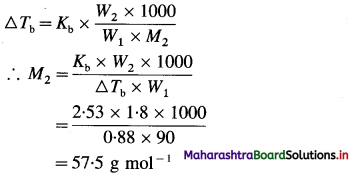
(3) The boiling point of benzene is 353.23 K. When 1.80 gram of non-volatile solute was dissolved in 90 gram of benzene, the boiling point is raised to 354.11 K. Calculate the molar mass of solute. [Kb for benzene = 2.53 K kg mol-1]
Solution :
Given : \(T_{b}^{0}\) = 353.23 K; Tb = 354.11 K
W1 = 90 g; W2 = 1.8 g; Kb = 2.53 K kg mol-1
Molar mass = M2 = ?
ΔTb = Tb – \(T_{b}^{0}\) = 354.11 – 353.23 = 0.88 K
Maharashtra Board Class 12 Chemistry Important Questions Chapter 2 Solutions 22
Ans. Molar mass = M2 = 57.5 g mol-1

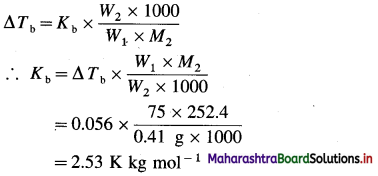
(4) Boiling point of a solvent is 80.2°C. When 0.419 g of the solute of molar mass 252.4 g mol-1 is dissolved in 75 g of the above solvent, the boiling point of the solution is found to be 80.256 °C. Find the molal elevation constant.
Solution :
Given : T0 = (273 + 80.2) K
Tb = 273 + 80.256 (K)
W1 = 75g
W2 = 0.419 g
M2 = 252.4 g mol-1
Kb = ?
ΔTb = Tb – T0
= (273 + 80.256) – (273 + 80.2)
= 0.056 K
Maharashtra Board Class 12 Chemistry Important Questions Chapter 2 Solutions 23
Ans. Kb = 2.53 K kg mol-1

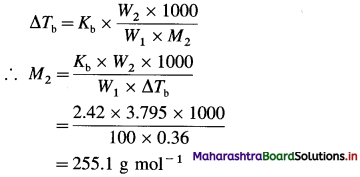
(5) 3.795 g of sulphur is dissolved in 100 g of CS2. This solution boils at 319.81 K. What is the molecular formula of sulphur in solution? Theboiling point of CS2 is 319.45 K.
(Given that Kb for CS2 =2.42 K kg mol-1 and atomic mass of S = 32.)
Solution :
Given : W2 = 3.795 g; W1 = 100 g CS2
Tb = 319.81 K; T0 = 319.45 K
Kb = 2.42 K kg mol-1 M2 = ?
ΔTb = Tb – T0 = 319.81 – 319.45 = 0.36 K
Maharashtra Board Class 12 Chemistry Important Questions Chapter 2 Solutions 24
Number of S atoms in molecule = \(\frac{255.1}{32}\)
= 7.972
≅ 8
Ans. Formula of sulphur in CS2 solution = S8

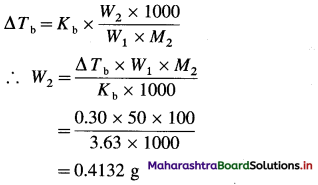
(6) Calculate the mass in grams of an impurity of molar mass 100 g mol-1 which would be required to raise the boiling point of 50 g of chloroform by 0.30°C. (Kb for chloroform = 3.63 K kg mol-1)
Solution :
Given : M2 = 100 g mol-1
W1 = 50 g chloroform
W2 = ?
ΔTb = 0.30°C.
Kb = 3.63 K kg mol-1
Maharashtra Board Class 12 Chemistry Important Questions Chapter 2 Solutions 25
Ans. Weight of impurity = 0.4132 g

Maharashtra Board Class 12 Chemistry Important Questions Chapter 2 Solutions

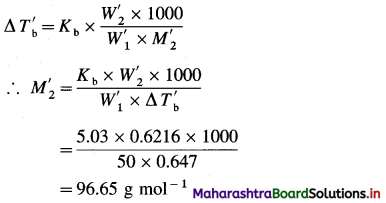
(7) A solution containing 0.5126 g of naphthalene (molar mass = 128.17 g mol-1) in 50.0 g of CCl4 gives a boiling point elevation of 0.402 °C. While a solution of 0.6216 g of unknown solute in the same mass of the solvent gives a boiling point elevation of 0.647 °C. Find the molar mass of the unknown solute. (Kb for CCl4 = 5.03 K kg mol-1 of solvent)
Solution:
Given : For naphthalene solution :
W2 = 0.5126 g
W1 = 50 g
M2 = 128.17 g mol-1
Kb = 5.03 K kg mol-1
ΔTb = 0.402°C
For unknown solute :
W’1 = 50g
W’2 = 0.6216 g
ΔT’b = 0.647°C
M’2 = ?
For the solution of unknown substance,
Maharashtra Board Class 12 Chemistry Important Questions Chapter 2 Solutions 26
Ans. Molecular weight of unknown substance = 96.65 g mol-1

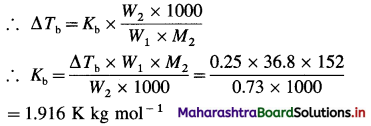
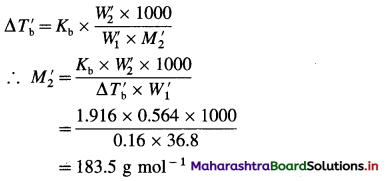
(8) A solution containing 0.73 g of camphor (molar mass 152 g mol-1) in 36.8 g of acetone (boiling point 56.3°C) boils at 56.55°C. A solution of 0.564 g of unknown compound in the same weight of acetone boils at 56.46°C. Calculate the molar mass of the unknown compound.
Solution:
Given : Mass of solute = W2 = 0.73 g camphor
Mass of solvent = W1 = 36.8 g
Molar Mass of solute = M2 = 152 g mol-1
Boiling point of acetone = T0 = (273 + 56.3) K
Mass of unknown solute = W’2 = 0.564 g
Mass of solvent = W’1 = 36.8 g
Boiling point of solution of camphor = Tb = (273 + 56.55) K
Boiling point solution of unknown compound = T’b = (273 + 56.46) K
Molar mass of unknown compound = M’2 = ?

For camphor solution,
∴ ΔTb = Tb – T0
= (273 + 56.55) – (273 + 56.3)
= 0.25 K
Maharashtra Board Class 12 Chemistry Important Questions Chapter 2 Solutions 27
For a solution of unknown compound
ΔT’b = ΔT’b – T0
= (273 + 56.46) – (273 + 56.3)
= 0.16 K
Maharashtra Board Class 12 Chemistry Important Questions Chapter 2 Solutions 28
Ans. Molar mass of the compound = 183.5 g mol-1

(9) 0.12 molal solution of a substance boils at 373.21°K. Calculate molal elevation constant of the solvent.
Solution :
Given : Concentration of solution = m = 0.12
Boiling point of the solution = Tb = 373.21 K
For solvent (water) T0 = 373.15 K
Molal elevation constant, Kb = ?
ΔTb = Tb – T0
= 373.21 – 373.15
= 0.06 K
ΔTb = Kb × m
∴ Kb = \(\frac{\Delta T_{\mathrm{b}}}{m}\)
= \(\frac{0.06}{0.12}\)
=0.5 K kg mol-1
Ans. Molal elevation constant = Kb = 0.5 K kg mol-1

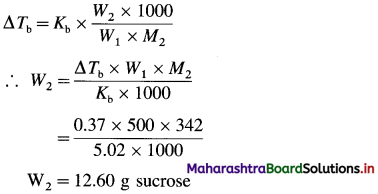
(10) Boiling point of water at 750 mm of Hg is 99.63 °C. How much sucrose must be added to 500 g of water so that it boils at 100 °C? (Kb = 5.02 K kg mol-1)
Solution :
Given : Boiling point of water = T0 = 273 + 99.63
= 372.63 K
Boiling point of a solution = Tb = 273 + 100 = 373 K
Mass of a solvent (water) = W1 = 500 g
Molar mass of sucrose (C12H22O11) = M2
= 342 g mol-1
Kb = 5.02 K kg mol-1
Mass of solute (sucrose) = W2 = ?
ΔTb = Tb – T0
= 373 – 372.63
= 0.37 K
Maharashtra Board Class 12 Chemistry Important Questions Chapter 2 Solutions 29
Ans. Mass of sucrose required to be added = 12.60 g

Maharashtra Board Class 12 Chemistry Important Questions Chapter 2 Solutions

(11) A solution of phosphorus prepared by dissolving 0.0175 kg of phosphorus in 0.08 kg of CS2 has a boiling point 319.87 K. If Kb for CS2 is 2.4 K kg mol-1 and atomic mass of phosphorus is 31 × 10-3 kg mol-1, find the formula of phos-phorus. (Boiling point of CS2 = 319.45 K)
Solution :
Given : Mass of solvent (CS2) = W1 = 0.08 kg
Mass of phosphorus = W2 = 0.0175 kg
Boiling point of CS2 = T0 = 319.45 K
Boiling point of solution = Tb = 319.87 K
Molal elevation constant = Kb = 2.4 K kg mol-1
Atomic mass of phosphorus = 31 × 10-3 kg mol-1
Molecular formula of phosphorus = ?
ΔTb = Tb – T0 = 319.87 – 319.45 = 0.42 K
Maharashtra Board Class 12 Chemistry Important Questions Chapter 2 Solutions 30
∴ Number of atoms in a molecule of phosphorus = \(\frac{\text { molar mass of phosphorus }}{\text { atomic mass of phosphorus }}\)
= \(\frac {125}{31}\)
= 4.032
≅ 4
Hence the molecular formula of phosphorus is P4 in CS2.
Ans. Molecular formula of phosphorus = P4

(12) Boiling point of water at 750 mm of Hg is 99.63 °C. How much sucrose must be added to 500 g of water so that it boils at 100 °C? (Kb = 0.52 K kg mol-1)
Solution :
Given : Pressure = P = 750 mm Hg
T0 = 273 + 99.63 = 372.63 K
Tb = 273 + 100 = 373 K
Kb = 0.52 K kg mol-1
Molar mass of sucrose (C12H22O11) = 342 × 10-3 kg mol-1
W1 = 500 g = 0.5 kg
Mass of sucrose to be added = W2 = ?
ΔTb = Tb – T0 = 373 – 372.63 = 0.37 K
Maharashtra Board Class 12 Chemistry Important Questions Chapter 2 Solutions 31
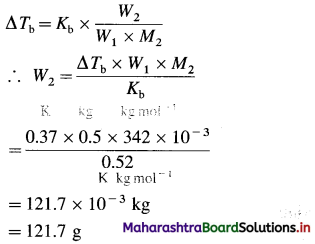
Ans. Mass of sucrose to be added = 121.7 × 10⁻³ kg
= 121.7 g

(13) 35 % (W/W) solution of ethylene glycol in water, an anti-freezer used in automobiles in radiators as a coolant. It lowers freezing point of water to -17.6 °C. Calculate the mole fraction of the components.
Solution :
35% (W/W) means 100 g solution contains 35 g ethylene glycol (CH2OH-CH2OH) and 65 g H2O.
Molar mass of water = 18 g mol-1
Molar mass of ethylene glycol (CH2OH-CH2OH) = 62 g mol-1
Number of moles of water = n1 = \(\frac{65}{18}\) = 3.611 mol
Number of moles of ethylene glycol = n2 = \(\frac{35}{62}\)
= 0.5645 mol
Total moles = n = n1 + n2 = 3.611 + 0.5645
= 4.1755 mol
Mole fraction of ethylene glycol = x2
\(=\frac{n_{2}}{n_{1}}=\frac{0.5645}{4.1755}\) = 0.1352
∴ Mole fraction of water = 1 – x2 = 1 – 0.1352
= 0.8648
Ans. Mole fraction of water = 0.8648
Mole fraction of ethylene glycol = 0.1352

Question 44.
Define freezing point of a liquid.
Answer:
The freezing point of a liquid is defined as the temperature at which the solid coexists in the equilibrium with the liquid and the vapour pressure of the liquid and the solid are equal.

Question 45.
Explain the depression in the freezing point of a solution.
Answer:
The depression in the freezing point of a solution is defined as the difference between the freezing points of a pure solvent and that of the solution.
If T0 and T are the respective freezing points of a pure solvent and a solution, then the depression in the freezing point ΔTf is given by,
ΔTf = T0 – T (T < T0)
The depression in the freezing point (ΔTf) is a colligative property.

Question 46.
What causes depression in freezing point ?
OR
Explain, freezing point depression as a consequence of vapour pressure lowering.
Answer:
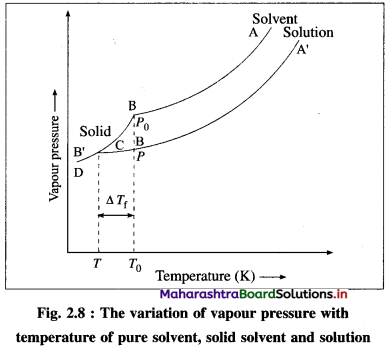
The freezing point of a liquid is the temperature at which the liquid and the solid have the same vapour pressure.

Addition of a nonvolatile solute to a liquid decreases the freezing point, i.e., the freezing point of the solution is less than that of the pure solvent. This is due to the lowering of the vapour pressure of the solvent by the addition of the nonvolatile solute.

When a liquid is cooled from the point A, its vapour pressure decreases and at the point B, it freezes (solidifies).
Maharashtra Board Class 12 Chemistry Important Questions Chapter 2 Solutions 32
In case of a solution, since the vapour pressure is lowered, the freezing point decreases. Hence, if the solution is cooled from the point A’, it freezes at lower temperature B’, than the pure liquid. This is also due to separation of solvent molecules due to solute molecules decreasing their intermolecular attraction.

If T0 and T are the freezing points of a pure solvent and the solution, then, the depression in the freezing point is given by,
ΔTf = T0 – T.
This depression ΔTf depends on the lowering of the vapour pressure (P0 – P). ΔTf ∝ (P0 – P), where P0 and P are the vapour pressures of the pure liquid and the solution.

Maharashtra Board Class 12 Chemistry Important Questions Chapter 2 Solutions

Question 47.
What is a relationship between freezing point depression and concentration of solute (or solution)?
Answer:
It is observed experimentally that as the concentration of a solution increases, the freezing point of the solution decreases and hence the depression in the freezing point (ΔTf) increases.

The depression in the freezing point of a solution is directly proportional to the molal concentration (expressed in mol kg-1) of the solution.
Thus,
ΔTf ∝ m
where m is the molality of the solution.
∴ ΔTf = Kfm, where Kf is a constant of proportionality. If m = 1 molal,
ΔTf = Kf. Hence Kf is called the cryoscopic constant or molal depression constant. Kf is characteristic of the solvent.

Question 48.
What are the units of molal depression constant or cryoscopic constant?
Answer:
The freezing point depression, ΔTf is given by,
ΔTf = Kf × m
where m is molality in mol kg-1 and Kf is molal depression constant or cryoscopic constant.
Maharashtra Board Class 12 Chemistry Important Questions Chapter 2 Solutions 33
∴ Kf has unit K kg mol-1 (or °C kg mol-1)
Therefore cryoscopic constant is the depression in freezing point produced by 1 molal solution of a nonvolatile solute.

Question 49.
Write the formula to determine molar mass of a solute using freezing point depression method.
Answer:
M2 = \(\frac{K_{\mathrm{f}} \times W_{2} \times 1000}{W_{1} \times \Delta T_{\mathrm{f}}}\)
where
Kf = Molal depression constant
ΔTf = Depression in freezing point
W1 = Mass of a solvent
W2 = Mass of a solute.
M2 = Molar mass of solute

Question 50.
Define cryoscopic constant (or molal depression constant).
Answer:
Molal depression constant : It is defined as the depression in freezing point, produced by dissolving one mole of a solute in 1 kg (or 1000 g) of a solvent (i.e. 1 molal solution).

Solved Examples 2.9

Question 51.
Solve the following :

(1) 1.35 g of a substance when dissolved in 55 g acetic acid produced a depression of 0.618°C in a freezing point. Calculate the molar mass of the dissolved substance. (Kf = 3.865 K kg mol-1)
Solution :
Given : Mass of a solvent = W1 = 55 g
Mass of a solute = W2 = 1.35 g
Depression in freezing point = ΔTf = 0.618 °C
Molal depression constant = Kf = 3.865 K kg mol-1
Molar mass of a solute = M2 = ?
Maharashtra Board Class 12 Chemistry Important Questions Chapter 2 Solutions 34
Ans. Molar mass of the substance = 153.5 g mol-1

(2) When certain amount of sucrose is dissolved in 1 kg of water, the freezing point of the solution is found to be 272.8 K. If the molecular mass of sucrose is 342 g mol-1 and Kf for water is 1.86 K kg mol-1, calculate the amount of sucrose present in the solution.
Solution :
Given : W1 = Mass of the solvent = 1 kg
T0 = Freezing point of pure water = 273 K
Tf = Freezing point of the solution = 272.8 K
ΔTf = T0 – Tf = Depression in freezing point
= 273 K – 272.8 K
= 0.2 K
M2 = Molecular mass of the solute
= 342 × 10-3 kg mol-1
Kf = Molal freezing point depression constant for water
= 1.86 K kg mol-1
W2 = Mass of the solute = ?
ΔTf = T0 – Tf
Maharashtra Board Class 12 Chemistry Important Questions Chapter 2 Solutions 35
Ans. Mass of sucrose = 36.78 × 10⁻³ kg

(3) The freezing point of a pure solvent is 315 K. On addition of 0.5 mole of urea in 1 kg of the solvent, the freezing point decreases by 3 K. Calculate the molal depression constant for the solvent.
Solution :
Given :
m = Molality of urea = 0.5 m
ΔTf = Depression in the freezing point = 3 K
Kf = Molal depression constant for the solvent = ?
ΔTf = Kf × m
∴ Kf = \(\frac{\Delta T_{\mathrm{f}}}{m}\)
= \(\frac{3}{0.5}\)
= 6 K kg mol-1
Ans. Molal depression constant = 6 K kg mol-1

Maharashtra Board Class 12 Chemistry Important Questions Chapter 2 Solutions

(4) The freezing point of pure benzene is 278.4 K. Calculate the freezing point of the solution when 2g of a solute having molecular weight 100 is added to 100 g of benzene. (Kf for benzene = 5.12 K kg mol-1)
Solution :
Given : Kf for benzene = 5.12 K kg mol-1
T0 = Freezing point of the solvent = 278.4 K
W1 = Mass of the solvent = 100 g = 0.1 kg
W2 = Mass of the solute = 2g = 2 × 10⁻³ kg
M2 = Molecular mass of the solute = 100 g mol-1
= 100 × 10-3 kg mol-1
T = Freezing point of the solution = ?
Maharashtra Board Class 12 Chemistry Important Questions Chapter 2 Solutions 36
Ans. Freezing point of the solution = 277.376 K

(5) 0.635 × 10⁻³ kg of a substance of molar mass 190 × 10-3 kg mol-1 was dissolved in 30.5 × 10⁻³ kg of a solvent. If the depression in the freezing point is 0.62 °C, find the molal depression constant of the solvent.
Solution :
Given : Mass of solvent = W1 = 30.5 × 10⁻³ kg
Mass of solute = W2 = 0.635 × 10⁻³ kg
Depression in freezing point = ΔTf = 0.62 °C (or K)
Molar mass of the substance = M2 = 190 × 10-3 kg mol-1
Molal depression constant = Kf = ?
Maharashtra Board Class 12 Chemistry Important Questions Chapter 2 Solutions 37
Ans. Molal depression constant = Kf
= 5.66 K kg mol-1

(6) The boiling point of an aqueous solution is 100.18 °C. Find the freezing point of the solution. (Given : Kb = 0.52 K kg mol-1, Kf = 1.86 K kg mol-1)
Solution :
Given : Tb = 100.18 °C + 273 = 373.18 K
Kb = 0.52 K kg mol-1; Kf = 1.86 K kg mol-1
Boiling point of water = T0 = 373 K
Tf = ?
ΔTb = Tb – T0 = 373.18 – 373 = 0.18 K
If m is the molality of the solution, then
ΔTb = Kb × m and ΔTf = Kf × m
Maharashtra Board Class 12 Chemistry Important Questions Chapter 2 Solutions 38
Freezing point of water = T0 = 273 K
ΔTf = T0 – Tf
Hence the freezing point of the solution is,
Tf = T0 – ΔTf = 273 – 0.6438 = 272.3562 K
OR Freezing point of solution is -0.6438 °C.
Ans. Freezing point of the solution
= 272.3562 K
= -0.6438 °C

(7) 1.0 × 10⁻³ kg of urea when dissolved in 0.0985 kg of a solvent, decreases freezing point of the solvent by 0.211 K. 1.6 × 10⁻³ kg of another nonelectrolyte solute when dissolved in 0.086 kg of the same solvent depresses the freezing point by 0.34 K. Calculate the molar mass of the another solute. (Given molar mass of urea = 60)
Solution :
Given : Mass of Urea = W2 = 1 × 10⁻³ kg
Mass of solvent = W1 = 0.0985 kg
Depression in freezing point = ΔTf = 0.211 K
Molar mass of urea = M2 = 60 g mol-1
= 60 × 10-3 kg mol-1
Mass of another solute = W’2 = 1.6 × 10⁻³ kg
Mass of solvent = W’1 = 0.086 kg
Depression in freezing point = ΔT’f = 0.34 K
Molar mass of another solute = 60 × 10-3 kg mol-1

From urea solution:
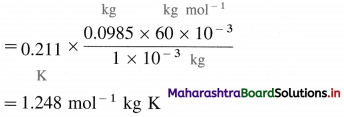
Maharashtra Board Class 12 Chemistry Important Questions Chapter 2 Solutions 39
Maharashtra Board Class 12 Chemistry Important Questions Chapter 2 Solutions 40
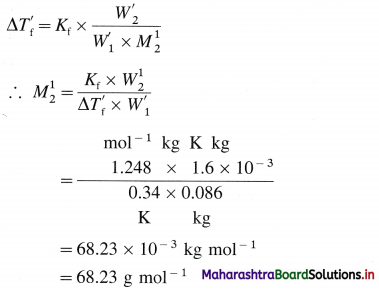
For solution of another solute :
Maharashtra Board Class 12 Chemistry Important Questions Chapter 2 Solutions 41
Ans. Molar mass of solute = 68.23 g mol-1.

Maharashtra Board Class 12 Chemistry Important Questions Chapter 2 Solutions

Question 52.
What do you understand by the terms :
(1) permeable membrane
(2) semipermeable membrane?
Answer:
(1) Permeable membrane : A membrane which allows free transfer of the solute molecules from a solution of a higher concentration to a solution of a lower concentration through it is called a permeable membrane and the transfer is called diffusion, e.g., a membrane of a paper.

(2) Semipermeable membrane : A membrane which allows free passage of only the solvent molecules but not the large solute molecules or ions of large molecular mass from a solution of a lower concentration (or a pure solvent) to a solution of higher concentration through it, is called a semi-permeable membrane, e.g., parchment paper, complex like Cu2[Fe(CN)6], etc.

Question 53.
Define and explain osmosis.
Answer:
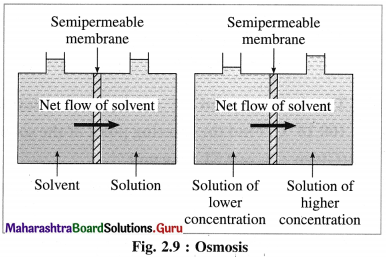
(1) Definition : It is defined as a spontaneous uni-directional flow of the solvent molecules from a pure solvent or a dilute solution to the more concentrated solution through a semipermeable membrane.

Example : A flow of water molecules from a dilute solution into a concentrated glucose solution through a parchment paper.
Maharashtra Board Class 12 Chemistry Important Questions Chapter 2 Solutions 42

(2) Explanation : Consider a vessel divided into two compartments by a semipermeable membrane. When one compartment is filled with a pure solvent or a dilute solution and another by concentrated solution, there is a spontaneous of solvent molecules to the concentrated solution. This arises due to higher vapour pressure of a pure solvent or dilute solution than concentrated solution.

Question 54.
Explain the relation between osmotic pressure and concentration of solution.
Ans.
(1) Consider V dm3 of a solution in which n1 moles of a solvent contains n2 moles of a nonvolatile solute at absolute temperature T.

(2) The osmotic pressure, n of a solution is given by,
π = \(\frac{n R T}{V}\)
R is gas constant having value 0.08206 dm3 atm K-1 mol-1 (OR L atm K-1 mol-1). Since concentration, C of a solution is in mol dm-3 or molarity is,
C = \(\frac{n}{V}\) mol dm-3 or M
∴ π = CRT
(If concentration C is expressed in mol m-3 and R = 8.314 J K-1mol-1, then π will be in SI units, pascals or Nm-2.)

Question 55.
Explain the terms :
(1) Isotonic solutions
(2) Hypotonic solutions
(3) Hypertonic solutions.
Answer:
(1) Isotonic solutions : The solutions having the same osmotic pressure at a given temperature are called isotonic solutions.

Explanation : If two solutions of substances A and B contain nA and nB moles dissolved in volume V (in dm3) of the solutions, then their concentrations are,
CA = \(\frac{n_{\mathrm{A}}}{V}\) (in mol dm-3) and
CB = \(\frac{n_{\mathrm{B}}}{V}\) (in mol dm-3)
If the absolute temperature of both the solutions is T, then by the van’t Hoff equation,
πA = CARTand πB = CBRT where πA and πB are their osmotic pressures.
For the isotonic solutions,
πA = πB
∴ CA = CB
∴ \(\frac{n_{\mathrm{A}}}{V}=\frac{n_{\mathrm{B}}}{V}\)
∴ nA = nB
Hence, equal volumes of the isotonic solutions at the same temperature will contain equal number of moles (hence, equal number of molecules) of the substances.

(2) Hypotonic solutions : When two solutions have different osmotic pressures, then the solution having lower osmotic pressure is said to be a hypotonic solution with respect to the other solution.
Explanation : Consider two solutions of the substances A and B having osmotic pressures πA and πB. If πB is less than πA, then the solution B is a hypotonic solution with respect to the solution A.
Hence, if CA and CB are their concentrations, then, CB < CA. Hence, for equal volumes of the solutions, nA < nA.

(3) Hypertonic solutions : When two solutions have different osmotic pressures, then the solution having higher osmotic pressure is said to be a hypertonic solution with respect to the other solution.
Explanation : Consider two solutions of substances A and B having osmotic pressures πA and πB. If πB is greater than πA, then the solution B is a hypertonic solution with respect to the solution A.
Hence, if CA and CB are their concentrations, then CB > CA. Hence, for equal volume of the solutions, nB > nA.

Question 56.
Explain colligative properties of electrolytes.
Answer:

  • The electrolytic solutions do not exhibit colligative properties similar to nonelectrolytes.
  • The colligative properties of electrolytes are higher than those shown by equimolar solutions of nonelectrolytes.
  • The molar masses of electrolytes determined by colligative properties are found to be considerably lower than their actual molar masses.

Question 57.
Why are the colligative properties of electrolytic solutions greater than those for non-electrolytic solutions with same concentration ?
Answer:

  • The electrolytes in polar solvents or aqueous solutions dissociate into two or more ions whereas nonelectrolytes do not dissociate.
  • Consequently the number of particles in electrolytic solutions are considerably higher than equimolar nonelectrolytic solutions.
  • Therefore the colligative properties of electrolytes are greater than nonelectrolytes with same concentration in solution.

Maharashtra Board Class 12 Chemistry Important Questions Chapter 2 Solutions

Question 58.
What is abnormal colligative property? Explain the reasons.
Answer:
Abnormal colligative property : When the experimentally measured colligative property of a solution is different from that calculated theoretically by the van’t Hoff equation or by the laws of osmosis, then the solution is said to have abnormal colligative property.

Explanation : The colligative property depends on the number of solute particles in the solution but it is independent of their nature. Abnormal values of them arise when the dissolved solute undergoes a molecular change like dissociation or association in the solution.
The observed colligative property (or abnormal colligative property ) may be higher or lower than the theoretical value.

(i) Dissociation of the solute molecules : When a solute like an electrolyte is dissolved in a polar solvent like water, it undergoes dissociation, which results in the increase in the number of particles in the solution.

Hence, the observed value of the colligative property becomes higher than the theoretical value, e.g., when one mole of KCl is dissolved in the solution then due to dissociation, KCl → K+ + Cl, the number of particles increases, hence, the colligative properties like osmotic pressure elevation in the boiling point, etc. increase.

(ii) Association of the solute molecules : When a solute like a nonelectrolyte is dissolved in a nonpolar solvent like benzene, it undergoes association forming molecules of higher molecular mass. Hence, the number of the particles in the solution decreases. Therefore the colligative properties like osmotic pressure, elevation in the boiling point, etc., are lower than the theoretical value, e.g., nA → An.
2CH3COOH → (CH3COOH)2
2C6H5COOH → (C6H5COOH)2

Question 59.
Explain abnormal osmotic pressure.
Answer:

  • When the experimentally observed osmotic pressure is different than theoretically calculated value by van’t Hoffs equation then it is called abnormal osmotic pressure.
  • This arises when the dissolved solute undergoes a molecular change like association or dissociation.

Question 60.
Explain abnormal molecular masses.
Answer:
When the observed molecular masses obtained from their colligative properties of the substances are different (higher or lower) than the theoretical or normal values calculated from their molecular formulae, then they are called abnormal molecular masses.

Question 61.
How is van’t Hoff factor related to molecular mass of the substance ?
Answer:
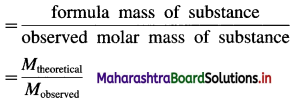
The van’t Hoff factor is also defined as,
actual moles of particles in solution after
Maharashtra Board Class 12 Chemistry Important Questions Chapter 2 Solutions 43
Maharashtra Board Class 12 Chemistry Important Questions Chapter 2 Solutions 44
In case of nonelectrolytes, i < 1.
In case of electrolytes, i > 1. For example for KNO3 and NaCl, i = 2, for Na2SO4, CaCl2, i = 3, etc.

Question 62.
Write modification of expressions of colligative properties with the help of van’t Hoff factor.
Answer:
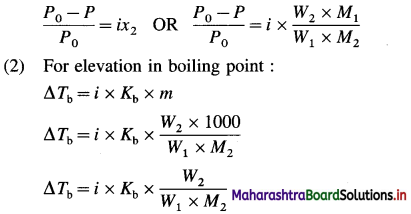
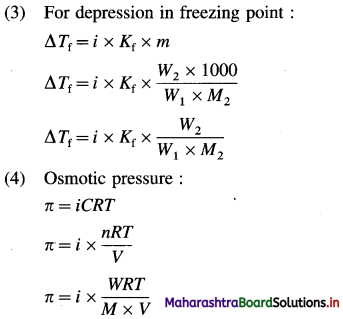
The modified expressions of colligative properties with the help of van’t Hoff factor i are as follows :
(1) By Raoult’s law :
Maharashtra Board Class 12 Chemistry Important Questions Chapter 2 Solutions 45
Maharashtra Board Class 12 Chemistry Important Questions Chapter 2 Solutions 46

Question 63.
Obtain a relation between degree of dissociation and molar mass for an electrolyte.
Answer:
Consider an electrolyte AxBy.
Maharashtra Board Class 12 Chemistry Important Questions Chapter 2 Solutions 47
If i is van’t Hoff factor and n is total number of ions produced from dissociation of one mole of electrolyte then, the degree of dissociation α is given by,
α = \(\frac{i-1}{n-1}\)
Now if Mth and Mob are theoretical arid observed molecular (or molar) masses respectively, then,
i = \(\frac{M_{\mathrm{th}}}{M_{\mathrm{ob}}}\)
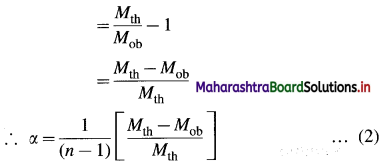
∵ α(n – 1) = i – 1
Maharashtra Board Class 12 Chemistry Important Questions Chapter 2 Solutions 48
This is a relation between degree of dissociation and molecular masses of the dissolved electrolyte AxBy.

Maharashtra Board Class 12 Chemistry Important Questions Chapter 2 Solutions

Question 64.
Solve the following :

(1) 300 mL solution at 27 °C contains 0.2 mol of a nonvolatile solute. Calculate osmotic pressure of the solution.
Solution :
Given : V= 300 ml = 0.3 dm3 ;
T= 273 + 27 = 300 K
π = 0.2 mol, π = ?
π = \(\frac{n R T}{V}\)
= \(\frac{0.2 \times 0.08206 \times 300}{0.3}\)
= 16.41 atm
Ans. Osmotic pressure = π = 16.41 atm.

(2) 200 mL solution at 27 °C contains 10 g of a nonvolatile solute of molar mass 65 g mol-1. What is osmotic pressure of the solution ?
Solution :
Given : V = 200 mL = 0.2 dm3; W = 10 g
M = 65 g mol-1; T= 273 + 27 = 300 K; π = ?
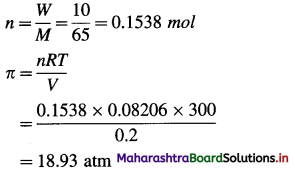
Maharashtra Board Class 12 Chemistry Important Questions Chapter 2 Solutions 49
Ans. Osmotic pressure = π = 18.93 atm.

(3) Calculate the osmotic pressure of 0.2 M glucose solution at 300 K. (R = 8.314 J mol-1 K-1)
Solution :
Given : Concentration of the solution
= C = 0.2 M
= 0.2 mol dm-3
= 0.2 × 10³ mol m-3
Temperature = T= 300 K
= 8.314 J mol-1 K-1
The osmotic pressure, π is given by,
π = CRT
= 0.2 × 103 × 8.314 × 300
= 4.988 × 10⁵ Nm-2 (or Pa)
Ans. Osmotic Pressure = 4.988 × 10⁵ Nm-2

(4) A solution of cane sugar containing 18 g L-1 has an osmotic pressure 1.25 atm. Calculate the temperature of the solution. (Molar mass of cane sugar = 342, R = 0.082 lit atm mol-1 K-1)
Solution:
Given : Amount of cane sugar = W = 18 g L-1
Osmotic pressure = π = 1.25 atm
Molar mass of cane sugar = M = 342 g mol-1
Temperature = T = ?
Number of moles of cane sugar
= \(\frac{W}{M}\)
= \(\frac{18}{342}\)
= 0.05263 mol
∴ Concentration of solution = C
= \(\frac{n}{V}\)
= \(\frac{0.05263}{1}\)
= 0.05263 mol lit-1
π = CRT
∴ T = \(\frac{\pi}{\mathcal{C R}}\)
= \(\frac{1.25}{0.05263 \times 0.08206}\)
= 289.4 K
Ans. Temperature of solution = 289.4 K

(5) Equal volumes of two solutions, one containing glucose and another urea have osmotic pressures 12.6 atm and 23.8 atm at 25 °C. Calculate the ratio of number of moles of urea to glucose.
Solution :
Given : Osmotic pressure of glucose solution = π1
= 12.6 atm
Osmotic pressure of urea solution = π2
= 23.8 atm
Number of moles of glucose = n1
Number of moles of urea = n2
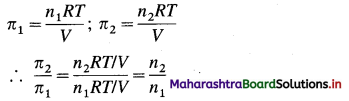
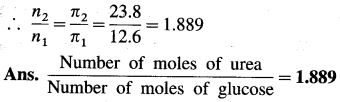
Maharashtra Board Class 12 Chemistry Important Questions Chapter 2 Solutions 50
Maharashtra Board Class 12 Chemistry Important Questions Chapter 2 Solutions 51

Maharashtra Board Class 12 Chemistry Important Questions Chapter 2 Solutions

(6) One litre of a solution containing 25 g glucose has osmotic pressure 3.4 atm at 300 K. If by diluting the solution the osmotic pressure becomes 2.0 atm at the same temperature, what would be its concentration ? (Molar mass of glucose = 180)
Solution :
Given : Mass of solute (glucose) = 25 g
Volume of solution = 1.0 L
Osmotic pressure = π1 = 3.4 atm
After dilution osmotic pressure = π2 = 2 atm
Final concentration = c2 = ?
The number of moles of glucose = n = \(\frac{25}{180}\)
= 0.1389 mol
Initial concentration = c1 = \(\frac{n}{V}\)
= \(\frac{0.1389}{1}\)
At constant temperature, by van’t Hoff-Boyle’s law,
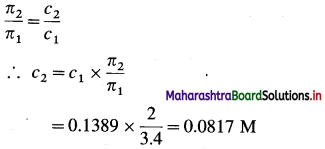
Maharashtra Board Class 12 Chemistry Important Questions Chapter 2 Solutions 52
Ans. Concentration of solution = 0.0817 mol L-1

(7) A solution of a substance having mass 1.8 × 10⁻³ kg has the osmotic pressure of 0.52 atm at 280 K. Calculate the molar mass of the substance used.
[Volume = 1 dm3, R = 8.314 JK-1 mol-1]
Solution :
Given : W= 1.8 × 10⁻³ kg = 1.8 g
π = 0.52 atm; V = 1 dm3
T = 280 K;
Molar mass = M = ?
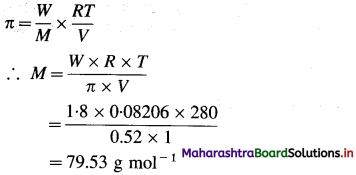
Maharashtra Board Class 12 Chemistry Important Questions Chapter 2 Solutions 53
Ans. Molar mass = M = 79.53 g mol-1

(8) An organic substance (M = 169 gram mol-1) is dissolved in 2000 cm3 of water. Its osmotic pressure at 12 °C was found to be 0.54 atm. If R = 0.0821 L atm K-1 mol-1, calculate the mass of the solute.
Solution :
Given : M = 169 g mol-1
V = 200 cm3 = 0.2 dm3
T = 273 + 125 = 285 K
π = 0.54 atm
R = 0.0821 L atm K-1 mol-1; W = ?
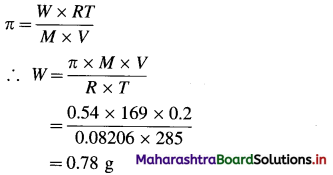
Maharashtra Board Class 12 Chemistry Important Questions Chapter 2 Solutions 54
Ans. Mass of solute = 0.78 g

(9) A solution containing 10 g glucose has osmotic pressure 3.84 atm. If 10 g more glucose is added to the same solution, what will be its osmotic pressure. (Temperature remains constant)
Solution :
Given : Mass of glucose = W1 = 10 g
Mass of more glucose added = W2 = 10 g
Initial osmotic pressure = π1 = 3.84 atm
Final osmotic pressure = π2 = ?
Total mass of glucose in final solution = W1 + W2
W’ = 10 + 10
= 20 g
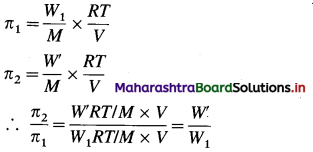
Maharashtra Board Class 12 Chemistry Important Questions Chapter 2 Solutions 55
∴ π2 = \(\pi_{1} \times \frac{W^{\prime}}{W_{1}}\)
= \(3.84 \times \frac{20}{10}\) = 7.68 atm
Ans. Osmotic pressure of the solution = 7.68 atm

(10) A 0.1 m solution of K2SO4 in water has freezing point of -0.43 °C. What is the value of van’t Hoff factor if Kf for water is 1.86 K kg mol-1?
Solution :
Given : m = 0.1 m, ΔTf = 0 – (-0.43) = 0.43 °C
Kf = 1.86 K kg mol-1, i = ?
ΔTf = i × Kf × m
∴ i = \(\frac{\Delta T_{\mathrm{f}}}{K_{\mathrm{f}} \times m}=\frac{0.43}{1.86 \times 0.1}=2.312\)
Ans. van’t Hoff factor = i = 2.312

Maharashtra Board Class 12 Chemistry Important Questions Chapter 2 Solutions

Multiple Choice Questions

Question 65.
Select and write the most appropriate answer from the given alternatives for each subquestion :

1. A molal solution is one that contains one mole of solute in
(a) one litre of the solvent
(b) 1000 g of the solvent
(c) one litre of the solution
(d) 22.4 litre of solution
Answer:
(b) 1000 g of the solvent

2. 10.0 grams of caustic soda when dissolved in 250 cm3 of water, the resultant molarity of solution is
(a) 0.25 M
(b) 0.5 M
(c) 1.0 M
(d) 0.1 M
Answer:
(c) 1.0 M

3. 5 × 10⁻³ kg of urea is dissolved in 2 × 10⁻² kg of water. The percentage by weight of urea is
(a) 15%
(b) 20%
(c) 25%
(d) 30%
Answer:
(b) 20%

4. Vapour pressure of solution of a nonvolatile solute is always
(a) equal to the vapour pressure of pure solvent
(b) higher than vapour pressure of pure solvent
(c) lower than vapour pressure of pure solvent
(d) constant
Answer:
(c) lower than vapour pressure of pure solvent

5. According to the Raoult’s law, the relative lowering of vapour pressure is equal to the
(a) mole fraction of solvent
(b) mole fraction of solute
(c) independent of mole fraction of solute
(d) molality of solution
Answer:
(b) mole fraction of solute

Maharashtra Board Class 12 Chemistry Important Questions Chapter 2 Solutions

6. Partial pressure of solvent in solution of non-volatile solute is given by equation,
(a) P = x2P0
(b) P0 = xP
(c) P = x1P0
(d) P0 = x1P
Answer:
(c) P = x1P0

7. When partial pressure of solvent in solution of nonvolatile solute is plotted against its mole fraction, nature of graph is
(a) a straight line passing through origin
(b) a straight line parallel to mole fraction of solvent
(c) a straight line parallel to vapour pressure of solvent
(d) a straight line intersecting vapour pressure axis
Answer:
(a) a straight line passing through origin

8. Colligative property depends only on ………………. in a solution.
(a) Number of solute particles
(b) Number of solvent particles
(c) Nature of solute particles
(d) Nature of solvent particles
Answer:
(a) Number of solute particles

9. Lowering of vapour pressure of solution
(a) is a property of solute
(b) is a property of solute as well as solvent
(c) is a property of solvent
(d) is a colligative property
Answer:
(d) is a colligative property

10. Raoult’s law is not applicable to
(a) solutions of volatile solutes
(b) solutions of electrolytes
(c) dilute solutions
(d) concentrated solutions
Answer:
(d) concentrated solutions

11. The relative lowering of vapour pressure of a solution is proportional to the
(a) mole fraction of the solvent
(b) mole fraction of the solute
(c) amount of the substance
(d) volume of the solvent
Answer:
(b) mole fraction of the solute

12. The vapour pressure of an aqueous solution of glucose at 100 °C is 710 mm Hg. Hence the molality of the solution is
(a) 2.83 m
(b) 3.65 m
(c) 16.47 m
(d) 12.5 m
Answer:
(b) 3.65 m

Maharashtra Board Class 12 Chemistry Important Questions Chapter 2 Solutions

13. Relative vapour pressure lowering depends only on
(a) Mole fraction of solute
(b) Nature of solvent
(c) Nature of solute
(d) Nature of solute and solvent
Answer:
(a) Mole fraction of solute

14. A solution having mole fraction of a solute equal to 0.05 has vapour pressure 20 × 103 Nm-2. Hence the vapour pressure of a pure solvent is
(a) 21.05 × 10³ Nm-2
(b) 4 × 10⁵ Nm-2
(c) 1 × 10³ Nm-2
(d) 2 × 10⁴ Nm-2
Answer:
(a) 21.05 × 10³ Nm-2

15. The addition of the nonvolatile solute into the pure solvent ……………..
(a) increases the vapour pressure of solvent
(b) decreases the boiling point of solvent
(c) decreases the freezing point of solvent
(d) increases the freezing point of solvent
Answer:
(c) decreases the freezing point of solvent

16. A solution having the highest vapour pressure is
(a) 1 M Al2(SO4)3
(b) 0.1 M NaNO3
(c) 1 M BaCl2
(d) 1 M Ca(NO3)2
Answer:
(b) 0.1 M NaNO3

17. Molal elevation constant is elevation in boiling point produced by
(a) 1 g of solute in 100 g of solvent
(b) 100 g of solute in 1000 g of solvent
(c) 1 mole of solute in one litre of solvent
(d) 1 mole of solute in one kg of solvent
Answer:
(d) 1 mole of solute in one kg of solvent

18. The determination of molar mass from elevation in boiling point is called
(a) cryoscopy
(b) osmometry
(c) ebullioscopy
(d) spectroscopy
Answer:
(c) ebullioscopy

19. Which of the following aqueous solutions will have minimum elevation in boiling point ?
(a) 0.1 M KCl
(b) 0.05 M NaCl
(c) 1 M AIPO4
(d) 0.1 M MgSO4
Answer:
(b) 0.05 M NaCl

20. Which of the following solutions shows maximum depression in freezing point ?
(a) 0.5 M Li2SO4
(b) 1 M NaCl
(c) 0.5 M Al2 (SO4)3
(d) 0.5 M BaCl2
Answer:
(c) 0.5 M Al2 (SO4)3

Maharashtra Board Class 12 Chemistry Important Questions Chapter 2 Solutions

21. If the freezing point of 0.1 m solution is 272.814 K, then the freezing point of 0.2 m solution will be
(a) 545.628 K
(b) 265.64 K
(c) 272.628 K
(d) 0.482 K
Answer:
(c) 272.628 K

22. At a freezing point,
(a) Vapour pressure of a solution = Vapour pressure of a solid
(b) Vapour pressure of a liquid = Vapour pressure of a solid
(c) Vapour pressure of a liquid > Vapour pressure of a solid
(d) Vapour pressure of a solid > Vapour pressure of a liquid
Answer:
(b) Vapour pressure of a liquid = Vapour pressure of a solid

23. In osmosis
(a) solvent molecules pass from high concentration of solute to low concentration
(b) solvent molecules pass from a solution of low concentration of solute to a solution of high concentration of solute
(c) solute molecules pass from low concentration to high concentration
(d) solute molecules pass from high concentration to low concentration
Answer:
(b) solvent molecules pass from a solution of low concentration of solute to a solution of high concentration of solute

24. As temperature increases
(a) Osmotic pressure and vapour pressure decrease
(b) Vapour pressure and osmotic pressure increase
(c) Vapour pressure increases but osmotic pressure decreases
(d) Osmotic pressure increases but vapour pressure decreases
Answer:
(b) Vapour pressure and osmotic pressure increase

25. A mango kept in a salt solution shrinks. Hence the liquid content in mango with respect to the salt solution is
(a) isotonic
(b) hypertonic
(c) hypotonic
(d) equimolar
Answer:
(c) hypotonic

26. The osmotic pressure of 5% glucose solution at 300 K is
(a) 6.93 × 10⁵ Nm-2
(b) 6.93 × 10² Nm-2
(c) 6.83 Pa
(d) 6.00 × 10³ Pa
Answer:
(a) 6.93 × 10⁵ Nm-2

27. 0.1 M solution of A has osmotic pressure xNm-2 at 300 K. If 200 ml of A and 100 ml of 0.2 M solution of nonreactive solute B are mixed then the osmotic pressure will be
(a) 3x
(b) 0.05 x
(c) 1.33 x
(d) 0.75 x
Answer:
(c) 1.33 x

Maharashtra Board Class 12 Chemistry Important Questions Chapter 2 Solutions

28. The solution A is twice hypertonic to the solution B at a given temperature. If the solution A contains 8.6 × 10²² molecules, then the number of molecules present in B are,
(a) 8.6 × 10²²
(b) 1.73 × 10²³
(c) 3.24 × 10²²
(d) 4.3 × 10²²
Answer:
(d) 4.3 × 10²²

29. Isotonic solutions are the solutions having the same
(a) surface tension
(b) vapour pressure
(c) osmotic pressure
(d) viscosity
Answer:
(c) osmotic pressure

30. If Kb for water is 0.52 Km-1, the boiling point of 0.2 m solution of a nonvolatile solute will be
(a) 371.96 K
(b) 373.104 K
(c) 373.52 K
(d) 374.0 K
Answer:
(b) 373.104 K

31. The vapour pressure of water is 15.5 mm at 20 °C. The lowering of vapour pressure of 0.02 m K Br solution will be
(a) 0.0112 mm Hg
(b) 0.0056 mm Hg
(c) 0.056 mm Hg
(d) 0.31 mm Hg
Answer:
(a) 0.0112 mm Hg

32. Which of the following 0.1 M aqueous solutions will exert highest osmotic pressure ?
(a) Al2(SO4)3
(b) Na2SO4
(c) MgCl2
(d) KCl
Answer:
(a) Al2(SO4)3

33. If equimolar solutions of urea, NaCl, sucrose and BaCl2 have boiling points A, B, C and D, then
(a) A = C < B < D
(b) A = D < B < C
(c) A > B > C < D
(d) A < B < C < D
Answer:
(a) A = C < B < D

Maharashtra Board Class 12 Chemistry Important Questions Chapter 2 Solutions

34. The molar mass of acetic acid obtained by measuring depression in freezing point is 115.8 gmol-1. Hence the degree of association is
(a) 0.482
(b) 0.964
(c) 0.883
(d) 1.12
Answer:
(b) 0.964

35. Δ Tb/m for NaBr solution will have value (Kb = 0.52 K kg mol-1)
(a) 0.52 K mol-1
(b) 0.104 K kg mol-1
(c) 1.24 kg mol-1
(d) 1.04 K kg mol-1
Answer:
(d) 1.04 K kg mol-1

36. 0.2 M urea solution can be isotonic with
(a) 0.1 M KBr solution
(b) 0.1 M glucose solution
(c) 0.15 m NaCl solution
(d) 0.2 M KBr solution
Answer:
(a) 0.1 M KBr solution

37. The osmotic pressure of 0.1 M HCl solution at 27 °C will be
(a) 2.46 atm
(b) 0.164 atm
(c) 4.92 atm
(d) 0.0082 atm
Answer:
(c) 4.92 atm

38. If a, b, c and d are the van’t Hoff factors for Na2SO4, glucose and K4[Fe(CN)6] then
(a) a > b > c
(b) a < b < c
(c) b < a < c
(d) c < a < b
Answer:
(c) b < a < c

39. The osmotic pressure of 0.2 M KCl solution at 310 K is
(a) 10.17 atm
(b) 5.084 atm
(c) 8.36 atm
(d) 12.2 atm
Answer:
(a) 10.17 atm

40. A temperature at which 0.1 M KCl solution will have osmotic pressure 10 atm will be
(a) 408 °C
(b) 263 °C
(c) 310 °C
(d) 337 °C
Answer:
(d) 337 °C

41. 5 % solution of glucose is isotonic with a solution of urea (M = 60). Hence the weight of urea present in the solution is
(a) 1.67 g
(b) 6.0 g
(c) 18.6 g
(d) 1.2 g
Answer:
(a) 1.67 g

42. Abnormal molar mass is produced by
(a) association of solute
(b) dissociation of solute
(c) both association and dissociation of solute
(d) separation by semipermeable membrane
Answer:
(c) both association and dissociation of solute

Maharashtra Board Class 12 Chemistry Important Questions Chapter 2 Solutions

43. The van’t Hoff factor for an aqueous solution of an electrolyte is
(a) less than 1
(b) zero
(c) greater than 1
(d) equal to 1
Answer:
(c) greater than 1

44. The value of van’t Hoff factor will be minimum for
(a) 0.05 M AlCl3
(b) 0.2 M NaNO3
(c) 5.0 M glucose
(d) 0.1 M H2SO4
Answer:
(c) 5.0 M glucose

45. van’t Haff factor for K4[FeC(N)6] dissociated 10% is
(a) 1.1
(b) 1.4
(c) 0.86
(d) 1.6
Answer:
(b) 1.4

Maharashtra Board Class 11 Secretarial Practice Important Questions Chapter 8 Company Meetings – II

Balbharti Maharashtra State Board Class 11 Secretarial Practice Important Questions Chapter 8 Company Meetings – II Important Questions and Answers.

Maharashtra State Board 11th Secretarial Practice Important Questions Chapter 8 Company Meetings – II

1A. Select the correct answer from the options given below and rewrite the statements.

Question 1.
Annual General Meeting is held _________ in a year.
(a) once
(b) twice
(c) thrice
Answer:
(a) once

Question 2.
Annual General Meeting is convened by _________
(a) Creditors
(b) Board of Directors
(c) Committee
Answer:
(b) Board of Directors

Maharashtra Board Class 11 Secretarial Practice Important Questions Chapter 8 Company Meetings – II

Question 3.
First Annual General Meeting shall be held within _________ months of the closing of the financial year.
(a) 6
(b) 9
(c) 15
Answer:
(b) 9

Question 4.
The quorum for the Annual General Meeting of a public company with 10,000 shareholders is _________ members.
(a) 5
(b) 30
(c) 15
Answer:
(b) 30

Question 5.
First Board Meeting is held within _________ days of the date of its incorporation.
(a) 30
(b) 15
(c) 45
Answer:
(a) 30

Question 6.
The Gap between two Board Meetings should not be more than _________ days.
(a) 30
(b) 60
(c) 120
Answer:
(c) 120

Question 7.
With the help of technology _________ meeting is held for Board of Directors.
(a) Visual
(b) Virtual
(c) Audio
Answer:
(b) Virtual

Maharashtra Board Class 11 Secretarial Practice Important Questions Chapter 8 Company Meetings – II

Question 8.
The Secretary has to get the signatures of the members present at the meeting in _________ ‘Attendance Book’.
(a) Directors
(b) Members
(c) Creditors
Answer:
(b) Members

1B. Match the pairs.

Question 1.

Group ‘A’ Group ‘B’
(a) Directors (1) 21 days
(b) Annual General Meeting (2) Statutory Report
(c) Auditor (3) Preference shareholders
(d) Notice – Board Meeting (4) Extra-Ordinary General Meeting
(e) Class Meeting (5) General Meeting
(6) 7 days
(7) Annual Report
(8) Debenture holders
(9) Annual General Meeting
(10) Committee Meeting

Answer:

Group ‘A’ Group ‘B’
(a) Directors (10) Committee Meeting
(b) Annual General Meeting (7) Annual Report
(c) Auditor (9) Annual General Meeting
(d) Notice – Board Meeting (6) 7 days
(e) Class Meeting (3) Preference shareholders

1C. Write a word or a term or a phrase that can substitute each of the following statements.

Question 1.
A meeting in which Directors are elected.
Answer:
Annual General Meeting

Question 2.
A meeting of Shareholders is held after the financial year is over.
Answer:
Annual General Meeting

Question 3.
A meeting of the Board of Directors was held with the help of technology.
Answer:
Virtual Meeting

Question 4.
The quorum for Annual General Meeting of a public company with 4000 shareholders.
Answer:
15 Members

Question 5.
The Gap between two Annual General Meetings should not be more than.
Answer:
15 months

Maharashtra Board Class 11 Secretarial Practice Important Questions Chapter 8 Company Meetings – II

Question 6.
The quorum for Board Meetings.
Answer:
1/3rd rd or 2 directors (whichever is higher)

Question 7.
The Gap between the two Board Meetings should not be more than.
Answer:
120 days

1D. State whether the following statements are True or False.

Question 1.
30 clear days’ notice should be given in case of the Annual General meeting.
Answer:
False

Question 2.
Shareholders can appoint a proxy to attend and vote at the meeting on their behalf.
Answer:
True

Question 3.
Board Meetings are called once a year.
Answer:
False

Question 4.
Debenture holders are the owners of the company.
Answer:
False

Question 5.
Directors have to perform duties related to Annual General Meeting.
Answer:
False

Question 6.
Quorum is just before the commencement of the meeting.
Answer:
True

Maharashtra Board Class 11 Secretarial Practice Important Questions Chapter 8 Company Meetings – II

Question 7.
Secretary takes down the notes of the proceedings of the meeting.
Answer:
True

1E. Find the odd one.

Question 1.
Shareholders Meeting, Directors Meeting, Committee Meeting.
Answer:
Shareholders meeting

Question 2.
Board Meeting, Committee Meeting, Class Meeting.
Answer:
Class Meeting

Question 3.
AGM, EOGM, Committee Meeting.
Answer:
Committee Meeting

Question 4.
General Meeting, Class Meeting, Creditors Meeting.
Answer:
Creditors Meeting

Question 5.
Debenture holders Meeting, Creditors Meeting, Class Meeting.
Answer:
Class Meeting

1F. Complete the sentences.

Question 1.
Auditor is appointed in _________
Answer:
Annual General Meeting

Maharashtra Board Class 11 Secretarial Practice Important Questions Chapter 8 Company Meetings – II

Question 2.
An Extra-Ordinary General Meeting is held _________
Answer:
under special circumstances

Question 3.
Minutes of the meeting is the duty of _________
Answer:
Secretary

Question 4.
Directors are appointed in _________
Answer:
Annual General Meeting

Question 5.
Minutes of the meeting has to be drafted by the secretary in _________
Answer:
15 days

Question 6.
Auditor is appointed for a period of _________
Answer:
1 year

1G. Select the correct option from the bracket.

Question 1.

Group ‘A’ Group ‘B’
(1) …………………….. Annual General Meeting
(2) Proxy ……………………….
(3) ……………………. Annual Report
(4) Minutes ……………………….
(5) …………………… Notes of the proceedings of a meeting
(6) Notice of Board Meeting ……………………….

(Shareholder, 15 days, Secretary, 7 days, Auditor, Annual General Meeting)
Answer:

Group ‘A’ Group ‘B’
(1) Auditor Annual General Meeting
(2) Proxy Shareholder
(3) Annual General Meeting Annual Report
(4) Minutes 15 days
(5) Secretary Notes of the proceedings of a meeting
(6) Notice of Board Meeting 7 days

1H. Correct the underlined word and rewrite the following sentences.

Question 1.
In a Partnership Firm, there is the separation of ownership and management.
Answer:
In a Joint Stock Company, there is the separation of ownership and management.

Question 2.
The interval between 2 Annual General Meetings should be no more than 12 months.
Answer:
The interval between 2 Annual General Meetings should be no more than 15 months.

Question 3.
Annual General Meeting is called to transact “special business.”
Answer:
Extra Ordinary General Meeting is called to transact “special business.”

Maharashtra Board Class 11 Secretarial Practice Important Questions Chapter 8 Company Meetings – II

Question 4.
Meetings of debenture holders, depositors, etc. are called Shareholders Meeting.
Answer:
Meetings of debenture holders, depositors, etc. are called Creditor’s Meeting.

2. Explain the following terms/concepts.

Question 1.
Class Meeting
Answer:
A Meeting of a particular class of shareholders, held to make changes in their rights and duties, is called a class meeting. It is held to get their consent for the changes affecting their interest.

Question 2.
Annual General Meeting (AGM)
Answer:
Meeting of equity shareholders which are held once every year is called AGM. It is held to review and discuss the progress made by the company during the financial year. It is held to take decisions like:

  • to adopt Annual a/c, Director’s Report, and Auditor’s Report
  • to declare dividend
  • to elect directors
  • to appoint auditors and fix their remuneration.

Question 3.
Extra Ordinary General Meeting
Answer:
A meeting held to discuss and decide special or urgent matters like alteration in MOA or AOA, removal of directors or auditor before expiry of his term, voluntary winding up of company, etc is called an extraordinary general meeting. Such meetings can be called by the Board of Directors or by BOD on the requisition of members or by Requisitionist themselves or by National Company Law Tribunal (NCLT) or Government.

Maharashtra Board Class 11 Secretarial Practice Important Questions Chapter 8 Company Meetings – II

Question 4.
Director’s Meeting
Answer:
The meeting which is held to discuss the policy matters of the company is called as Director’s meeting. Such meetings are classified into Board meetings and Committee meetings. The First Board meeting is to be called within 30 days from the date of incorporation.

3. Answer in brief.

Question 1.
State any four legal provisions relating to Extra-Ordinary General Meeting.
Answer:
Legal Provisions relating to Extra-Ordinary General Meeting:
(i) Time for holding a meeting:
Extra-Ordinary General Meeting is between two Annual General Meetings under special circumstances. It can be held at any time as per the requirements of the company.

(ii) Authority to Convene:

  • The Board of Directors has the right to call an Extra-Ordinary General Meeting by sending a proper notice to the shareholders.
  • Extra-Ordinary General Meeting can be called by the members holding at least 1/10th of the paid-up capital or 1/10th of voting power in the company. Board must call Extra-Ordinary General Meeting within 45 days of receiving the requisition from the members.
  • If the Board fails to call such a meeting then the requisitionists themselves call this meeting within 3 months from the date of deposit of the requisition. The company shall pay all the expenses incurred for holding Extra-ordinary General Meeting.
  • National Company Law Tribunal (NCLT) can order such meetings on its own or at the request of a director or any members having voting rights.

(iii) Notice:
The notice must be given to all those who are entitled to receive it, at least 21 clear days in advance of the meeting. It is sent to the members at their registered address by post or through electronic mode like Email, etc.

(iv) Quorum:
According to the Companies Act, 2013, the quorum for Extra-Ordinary General Meeting of a public company is as follows:

No. of Shareholders Quorum
Upto 1000 5 Members
1000 – 5000 15 Members
More than 5000 30 Members

For a private company minimum of two members should be present in person.

Maharashtra Board Class 11 Secretarial Practice Important Questions Chapter 8 Company Meetings – II

4. Answer the following questions.

Question 1.
Explain the functions of a secretary related to the Extra-Ordinary General Meeting.
Answer:
Functions (duties) of a secretary related to Extra Ordinary General Meeting:
Duties Before the Meeting:

  • Board Meeting: The secretary has to convene a board meeting in consultation with the Chairman. The board has to decide the day, date, time, and place of the meeting.
  • Notice: The secretary drafts the notice, agenda, and other required documents. He gets it approved by the chairman. Then he sends 21 clear days’ notice and other documents to the members before the meeting.
  • Public Notice: He has to publish notice of the extraordinary general meetings in leading newspapers for the information of the general public.
  • Arrangement: The secretary has to make arrangements such as booking the hall, refreshments, documents, etc.

Duties During the Meeting:

  • Quorum: The secretary checks the quorum at the beginning of the meeting and informs the same of the chairman.
  • Attendance: The secretary has to get signatures of members present at the meeting in ‘Members Attendance Book’.
  • Reading Notice: The secretary reads out the notice and agenda of the meeting as per the direction of the chairman.
  • Assist Chairman: The secretary assists the chairman by providing necessary information, records, document, etc.
  • Notes of Proceedings: The secretary should take down the notes of the proceedings of the meeting. He has to draft the minutes on the basis of these notes.
  • Poll: The secretary has to make necessary arrangements for taking poll if it is demanded.

Maharashtra Board Class 11 Secretarial Practice Important Questions Chapter 8 Company Meetings – II

Duties After the Meeting:

  • Drafting Minutes: The secretary drafts the minutes of the meeting on the basis of the notes taken down during the proceedings of the meeting.
  • Implementation of Decisions: The secretary instructs the concerned department for implementing the decisions taken at the meeting.
  • Filing Resolutions: The secretary has to file the certified copy of resolutions passed at the meeting to the Registrar of Companies.

Maharashtra Board Class 11 Biology Important Questions Chapter 2 Systematics of Living Organisms

Balbharti Maharashtra State Board 11th Biology Important Questions Chapter 2 Systematics of Living Organisms Important Questions and Answers.

Maharashtra State Board 11th Biology Important Questions Chapter 2 Systematics of Living Organisms

Question 1.
Write the definition of systematics given by G. Simpson in 1961.
Answer:
Systematics is the study of kinds and diversity of organisms and their comparative and evolutionary relationship.

Maharashtra Board Class 11 Biology Important Questions Chapter 2 Systematics of Living Organisms

Quesiton 2.
Explain the term taxonomy.
Answer:

  1. Taxonomy means classification following certain rules or principles.
  2. The word taxonomy comes from two Greek words, taxis meaning arrangement and nomous meaning law or rule.
  3. The term taxonomy was coined by A.P. de Candolle (Swiss Botanist) [1778-1841].

Question 3.
Who coined the term taxonomy?
Answer:
The term taxonomy was coined by A.P. de Candolle (Swiss Botanist) [1778-1841].

Question 4.
Define the term classification. What is the basis of classification?
Answer:
1. Classification is the arrangement of organisms or groups of organisms in distinct categories in accordance with a particular and well-established plan.
2. It is based on the similarities and differences among the organisms.

Maharashtra Board Class 11 Biology Important Questions Chapter 2 Systematics of Living Organisms

Question 5.
What are the three types of classification systems?
Answer:
The three types of classification systems are:
(i) Artificial system:
(a) It is based on few visible, easily observable characters, which are non-evolutionary such as habit, colour, form, etc.
(b) It does not consider the affinities (relationships) among different organisms.
E.g. Linnaeus system of classification.

(ii) Natural system:
It is based on objectively significant characters with respect to their affinities with other organisms.
E.g. Bentham and Hooker’s system of classification.

(iii) Phylogenetic system:
It is based on the phylogenetic relationship between different organisms with respect to common evolutionary descent (ancestor).
E.g. Engler and Prantl’s classification.

Question 6.
What is domain? Name the three domains of life.
Answer:
1. Domain is a unit larger than Kingdom in the system of classification.
2. Three domains of life are Archaea, Bacteria and Eukarya.

Maharashtra Board Class 11 Biology Important Questions Chapter 2 Systematics of Living Organisms

Question 7.
Who proposed the three-domain system?
Answer:
Carl Woese proposed the three-domain system.

Question 8.
State one similarity and difference between archaea and bacteria?
Answer:
Both archaea and bacteria are prokaryotic. They differ in their cell wall structures.

Question 9.
Which domain has eukaryotic cells?
Answer:
Domain Eukarya has eukaryotic cells.

Question 10.
what is chemotaxonomy? Explain with example.
Answer:

  1. It is method of biological classification based on the similarities and differences in structure of certain chemical compounds present among the organisms being classified.
  2. Thus, it is a classification based on chemical constituents of organisms.
  3. For e.g. Cell wall with peptidoglycan is present in Bacteria while it is absent in Archaea. Among Eukarya, fungi have chitinous cell wall, while plants have cellulosic cell wall.

Question 11.
Write a short note on numerical taxonomy.
Answer:
Numerical taxonomy:

  1. It is based on quantification of characters and develops an algorithm for classification.
  2. The aim of this was to create a taxonomy using numeric algorithms like cluster analysis rather than using subjective evaluation of their properties.
  3. It was proposed by Sokel and Sneath in 1963.

Maharashtra Board Class 11 Biology Important Questions Chapter 2 Systematics of Living Organisms

Question 12.
What is cladogram? Give a diagrammatic representation of three domains of life with the help of cladogram.
Answer:
1. It is a representation of hypothetical relationship denoting a comparison of organisms and their common ancestors.
2. It has a typical branching pattern.

Question 13.
Write in detail about the Phylogeny.
Answer:
Phylogeny:

  1. It is the evolutionary relationship of organism.
  2. It is an important tool in classification as it considers not merely the morphological status but also the relationship of one group of organisms with other groups of life.
  3. The system helps to understand the evolution and also focuses on the similarities of their metabolic functioning.
  4. Woese’s three domain concept as well as Whittaker’s five kingdom system are examples of phylogenetic relationship.

Question 14.
What is the use of DNA barcoding?
Answer:
DNA barcoding helps to study newly identified species as well as understanding ecological and evolutionary relationships between living organisms.

Question 15.
What are the steps involved in the process of DNA barcoding?
Answer:
The process of DNA barcoding includes two basic steps:
1. Collecting DNA barcode data of known species.
2. Matching the barcode sequence of the unknown sample against the barcode library for identification.

Question 16.
What are the applications of DNA barcoding?
Answer:
The applications of DNA barcoding are as follows:

  1. It helps to protect endangered species.
  2. It plays an important role in preservation of natural resources.
  3. It is also used for pest control in agriculture.
  4. It is used for identification of disease vectors.
  5. It is used for authentication of natural health products.
  6. It is also used for identification of medicinal plants.

Maharashtra Board Class 11 Biology Important Questions Chapter 2 Systematics of Living Organisms

Question 17.
What is taxonomic category?
Answer:

  1. Category is a rank or level in the hierarchial classification of organisms.
  2. Each category is referred to as a unit of classification.
  3. Category is a part of taxonomic arrangements hence, called taxonomic category.
  4. All categories together constitute the taxonomic hierarchy.

Question 18.
What are the compulsory taxonomic categories?
Answer:
Kingdom, division, class, order, family, genus, species are the compulsory categories.

Question 19.
What are the facultative taxonomic categories?
Answer:
Sub-order, sub-family, etc. are the facultative categories which are used when required.

Question 20.
Define taxonomic hierarchy.
Answer:
The manner of scientific grouping of different taxonomic categories in a descending order on the basis of their ranks or positions in classification is called taxonomic hierarchy.

Question 21.
Define the term Taxon. Give some examples of taxa at different hierarchical levels.
Answer:
1. Taxon is a group of living organisms of any rank in the system of classification.
2. In plant kingdom, each taxonomic group such as angiospermae, dicotyledonae, polypetalae, malvaceae represents a taxon.

Question 22.
Write the classification of:
Answer:
1. China Rose
2. Cobra

Maharashtra Board Class 11 Biology Important Questions Chapter 2 Systematics of Living Organisms

Question 23.
Explain the following terms:

  1. Species
  2. Genus
  3. Family
  4. Order
  5. Class
  6. Division/Phylum
  7. Sub kingdom
  8. Kingdom

Answer:
(i) Species:
(a) Species is the principal natural taxonomic unit, ranking below a genus.
(b) It is a group of organisms that can interbreed under natural condition to produce fertile offspring.
(c) It was thought to be an indivisible, stable and static unit.
(d) However, in the modem taxonomy, subdivision of species such as sub-species, varities and populations are seen and given more importance.

(ii) Genus:

(a) Genus is a taxonomic rank or category larger than species used in the biological classification of living and fossil organisms.
(b) Genus is a group of species bearing close resemblance to one another in their morphological characters but they do not interbreed.
(c) For e.g. Tiger, Leopard, Lion all three belong to same genus Panthera. They have common characters yet are different from each other because their genus is same but species is different.
(d) Another example is genus Solarium. Brinjal and potato both belong to this genus.

(iii) Family:

(a) It is one of the major hierarchial taxonomic rank.
(b) A family represents a group of closely related genera.
(c) For e.g. genera like Hibiscus, Gossypium, Sida, Bombax are included in same family Malvaceae.
(d) Although, there are many similarities between cat and dog, cat belongs to the family of leopards, tigers and lions, i.e. family Felidae and dog belongs to different family i.e. Canidae.

(iv) Cohort/Order:

(a) It is taxonomic rank used in the classification of organisms and recognised by nomenclature codes.
(b) An order is a group of closely related families showing definite affinities.
(c) Members belonging to same order but different families may show very few dissimilarities.
(d) For e.g. family Papaveraceae, Brassicaceae, Capparidaceae, etc with parietal placentation are grouped in order Parietales.
(e) Families of dogs and cats though are different, they belong to same order Carnivora.

(v) Class:

(a) The class is the distinct taxonomic rank of biological classification having its own distinctive name.
(b) Class is the assemblage of closely allied orders.
(c) For e.g. Orders Carnivora and order Primates belong to class Mammalia. Thus monkeys, gorillas, gibbons (Primates) and dogs, cats, tigers (Carnivora) belong to same class.

(vi) Division/ Phylum:

(a) The division is a category composed of related classes.
(b) For e.g. division Angiospermae includes two classes Dicotyledonae and Monocotyledonae.
(c) In animal classification, instead of division, the category Phylum is used.

(vii) Sub-kingdom:

(a) Different divisions having some similarities form sub-kingdom.
(b) The divisions Angiospermae and Gymnospermae forms the sub-kingdom Phanerogams or Spermatophyta (all seed producing plants).

(viii) Kingdom:

(a) It is the highest taxonomic category composed of different sub-kingdoms.
(b) For e.g. sub-kingdom Phanerogams and Cryptogams form the Plant kingdom or Plantae which includes all the plants, while all animals are included in kingdom Animalia.

Maharashtra Board Class 11 Biology Important Questions Chapter 2 Systematics of Living Organisms

Question 24.
Define nomenclature.
Answer:
The art of giving name to the organism is called nomenclature.

Question 25.
What is meant by vernacular name?
Answer:
Vernacular names are the names which are given to organisms in a particular region and language by local people.

Question 26.
What are the disadvantages of vernacular names of organisms?
Answer:
Disadvantages of vernacular names/ local names/ common names:

  1. Vernacular names do not indicate the necessary information about the organism.
  2. It does not indicate proper relationship of the organisms.
  3. Vernacular names are not universal, e.g. Pansy (Viola tricolor L.) grown in most European and American gardens has about 50 common english names. In Ayurveda, mango (Mangifera indica L.) is known by over 50 different names which are in Sanskrit language.
  4. Vernacular names have limited usage.
  5. Local names are different and confusing.

Question 27.
Who proposed binomial system of nomenclature?
Answer:
Swedish naturalist Carl Linnaeus proposed binomial system of nomenclature.

Maharashtra Board Class 11 Biology Important Questions Chapter 2 Systematics of Living Organisms

Question 28.
What is binomial nomenclature? Give the rules for binomial nomenclature.
Answer:
1. A system of nomenclature of plants and animals in which the scientific name consists of two words or parts or epithets is called binomial nomenclature.
2. This system of nomenclature was developed by Carl Linnaeus. He gave certain principles for this nomenclature in his book ‘Species Plantarum’.

Rules of binomial nomenclature:

  1. The name of the organism is composed of two Latin or Greek words.
  2. Generic epithet is a simple noun which should come first and always begin with a capital letter.
  3. Specific epithet is the descriptive adjective which should come later and begin with a small letter.
  4. The generic and specific epithet must be underlined separately if hand written or in italics when printed.
  5. The generic as well as specific epithet should not have less than three letters and more than thirteen letters.
  6. Usually the name of the author who names a plant or animal is also written in full or abbreviated form after scientific name. e.g. Mangifera indica L. Where L stands for Linnaeus.

Question 29.
In Mangifera indica L., what does letter ‘L’ indicate?
Answer:
In Mangifera indica L., letter L indicates author’s name i.e. Linnaeus.

Question 30.
Which kingdoms were included in two kingdom system of classification? Who introduced it?
Answer:
The two-kingdom system of classification included Kingdom plantae and Kingdom animalia. This system was introduced by Carl Linnaeus.

Question 31.
What was the drawback of two kingdom system of classification?
Answer:
Two kingdom system was found inadequate for classification of some organisms like bacteria, fungi, Euglena, etc.

Question 32.
Who suggested five kingdom system of classification?
Answer:
R.H. Whittaker suggested five kingdom system of classification.

Question 33.
Match the following.

Column I Column II
1. Vibrio a. Rod-shaped
2. Bacillus b. Spherical
3. Spirillum c. Spiral shaped
d. Comma or kidney-shaped

Answer:

Column I Column II
1. Vibrio d. Comma or kidney-shaped
2. Bacillus a. Rod-shaped
3. Spirillum c. Spiral shaped

Maharashtra Board Class 11 Biology Important Questions Chapter 2 Systematics of Living Organisms

Question 34.
Identify the different shapes of bacterial cells shown in the given figures:
Maharashtra Board Class 11 Biology Important Questions Chapter 2 Systematics of Living Organisms 1
Answer:
Figure a: Coccus;
Figure b: Coccobacillus;
Figure c: Vibrio
Figure d: Bacillus;
Figure e: Spirillum; Figure f: Spirochete

Question 35.
What are Archaebacteria?
Answer:

  1. These are the most primitive type of bacteria.
  2. They are differentiated from other bacteria on the basis of their different cellular features.
  3. These bacteria are mostly found in the extreme environmental conditions, hence called extremophiles.
  4. Bacteria that can withstand high salinities are called halophiles, while those that withstand extreme temperature are known as thermophiles.
  5. Methanogenic bacteria found in gut of ruminants (cows and buffaloes) help in production of methane in biogas plants.

Question 36.
Why are archaebacteria called extremophiles?
Answer:

  • These bacteria are mostly found in the extreme environments, hence called extremophiles.
  • They have capacity to survive in very severe conditions.
  • They are found in a variety of places from volcanic craters to salty lakes and hot springs.

Question 37.
Write in detail about Eubacteria.
Answer:
Eubaceria:

  1. These are commonly referred as true bacteria.
  2. They have cell wall made up of peptidoglycan.
  3. Eubacteria are mostly heterotrophic, few are autotrophic.
  4. The autotrophs can be photosynthetic like Chlorobium (Green sulphur bacteria) and Chromatium or chemosynthetic like sulphur bacteria.
  5. These are mostly multicellular filamentous forms living in fresh water.
  6. Filaments show heterocyst which helps in nitrogen fixation.
  7. The body is covered by mucilaginous sheath.
  8. The genetic material is typical prokaryotic.
  9. The photosynthetic pigments include Chl-a, Chl-b, carotenes and xanthophylls.
  10. Most of them are decomposers that help in breaking down large molecules in simple molecules or minerals.

Question 38.
Write a short note on useful and harmful bacteria.
Answer:
(i) Useful bacteria:
Most of the bacteria act as a decomposer. They breakdown large molecules in simple molecules or minerals. Examples of some useful bacteria:
Lactobacillus’. It helps in curdling of milk.
Azotobacter. It helps to fix nitrogen for plants.
Streptomyces: It is used in antibiotic production such as streptomycin.
Methanogens: These are used for production of methane (biogas) gas from dung.
Pseudomonas spp. and Alcanovorax borkumensis: These bacteria have the ability to destroy the pyridines and other chemicals. Hence, used to clear the oil spills.

(ii)Harmful bacteria:
This includes disease causing bacteria. They cause various diseases like typhoid, cholera, tuberculosis, tetanus, etc. Examples of some harmful bacteria:
Salmonella typhi: It is a causative organism of typhoid.
Vibrio cholerae: It causes cholera.
Mycobacterium tuberculosis’. It causes tuberculosis.
Clostridium tetani: It causes tetanus.
Clostridium spp.: It causes food poisoning.
Many forms of mycoplasma are pathogenic.
Agrobacterium , Erwinia, etc are the pathogenic bacteria causing plant diseases.
Animals and pets also suffer from bacterial infections caused by Brucella, Pastrurella, etc.

Maharashtra Board Class 11 Biology Important Questions Chapter 2 Systematics of Living Organisms

Question 39.
Identify label X and Y in the given figure of Cyanobacteria (Nostoc).
Answer:
Maharashtra Board Class 11 Biology Important Questions Chapter 2 Systematics of Living Organisms 2

Question 40.
what is Mycoplasma?
Answer:

  1. These are the smallest living cells known.
  2. They lack cell wall.
  3. Many forms are pathogenic.
  4. They are resistant to common antibiotics because they lack cell wall.

Question 41.
Identify the following diagram, label it and write detail information in your words.
Answer:
The given figure represents Paramoecium.
Characteristics:

  1. It belongs to kingdom Protista. It is further classified as animal like protist.
  2. It lacks cell wall.
  3. It shows heterotrophic and holozoic nutrition.
  4. It is a ciliated protozoan where locomotion is due to cilia.
  5. It has gullet (a cavity) which opens on the cell surface.

Question 42.
Which kingdom shows link with all eukaryotic members?
Answer:
Kingdom Protista shows link with all eukaryotic kingdoms such as kingdom plantae, fungi and animalia.

Question 43.
Unicellular eukaryotic organisms are included in which kingdom?
Answer:
Unicellular eukaryotic organisms are included in kingdom Protista.

Maharashtra Board Class 11 Biology Important Questions Chapter 2 Systematics of Living Organisms


Question 44.
Give different types of Protists with examples.
Answer:
Protists are of different types:
(i) Plant like protists (Photosynthetic protists):
(a) They are termed as phytoplanktons, also known as Chrysophytes.
(b) They are autotrophic (photosynthetic) in nature and form major producers of ocean ecosystem.
(c)Most of them are referred as Diatoms because they have body wall made up of two soap-box like fitting silica covers. E.g. Diatoms.

1. Dinoflagellates:
(i) They are aquatic (mostly marine) and autotrophic (photosynthetic).
(ii) They have wide range of photosynthetic pigments which can be yellow, green, brown, blue and red.
(iii) The cell wall is made up of cellulosic stiff plates.
(iv) A pair of flagella is present, hence they are motile.
(v) They are responsible for famous ‘red tide’. E.g. Gonyaulax. It makes sea appear red.

2. Euglenoids:
(i) They lack cell wall but have a tough covering of proteinaceous pellicle.
(ii) Pellicle covering provides flexibility and contractibility to Euglena.
(iii) They possess two flagella, one short and other long.
(iv) They behave as heterotrophs in absence of light but possess pigments, similar to that of higher plants, for photosynthesis.

(ii) Animal like protists (Consumer protists):
(a) They are the primitive animal forms.
(b) They are also termed as protozoans.
(c) These are heterotrophic and lack cell wall.
(d) Amoeboid protozoans have pseudopodia as locomotory organs. E.g. Amoeba, Entamoeba.
Amoeba is free living form, but Entamoeba is endoparasite and causes amoebic dysentery.
(e) Flagellated protozoans have flagella as locomotory organ. E.g. Trypanosoma.
(f) Cilliated protozoans have cilia for locomotion. E.g. Paramoecium.
(g) Plasmodium is a Sporozoan protozoa. It causes malaria. It forms spores in one of its life stages.

(iii) Fungi like protists (Consumer decomposer protists):
(a) They form a group called Myxomycetes.
(b) They are saprophytic in nature, found on decaying leaves.
(c) Their cells aggregate to form a large cell mass called plasmodium.
(d) The spores of plasmodium are very tough and survive extreme conditions, e.g. Slime molds.

Question 45.
Why diatoms are used in filtration and polishing?
Answer:
Diatoms forms a substance called Diatomaceous earth. These are the shells of diatoms containing silica that left behind for many years. Diatomaceous earth is granular; hence it is used in polishing and filtration.

Maharashtra Board Class 11 Biology Important Questions Chapter 2 Systematics of Living Organisms

Question 46.
Label the given figures representing ventral and dorsal view of Gonyaulax.
Maharashtra Board Class 11 Biology Important Questions Chapter 2 Systematics of Living Organisms 3
Answer:
Maharashtra Board Class 11 Biology Important Questions Chapter 2 Systematics of Living Organisms 4

Question 47.
Identify the following diagram, label it and write detail information in your words.
Answer:
The given figure represents Euglena.
Characteristics:
(i) It belongs to kingdom Protista. It is further classified into euglenoids.

1. Dinoflagellates:

  1. They are aquatic (mostly marine) and autotrophic (photosynthetic).
  2. They have wide range of photosynthetic pigments which can be yellow, green, brown, blue and red.
  3. The cell wall is made up of cellulosic stiff plates.
  4. A pair of flagella is present, hence they are motile.
  5. They are responsible for famous ‘red tide’. E.g. Gonyaulax. It makes sea appear red.

2. Euglenoids:

  1. They lack cell wall but have a tough covering of proteinaceous pellicle.
  2. Pellicle covering provides flexibility and contractibility to Euglena.
  3. They possess two flagella, one short and other long.
  4. They behave as heterotrophs in absence of light but possess pigments, similar to that of higher plants, for photosynthesis.

Maharashtra Board Class 11 Biology Important Questions Chapter 2 Systematics of Living Organisms

Question 48.
Write the characteristics of Kingdom plantae.
Answer:
Characteristics of Kingdom plantae:

  1. Kingdom plantae is dominated by autotrophs.
  2. Some members are insectivorous plants. E.g. Venus fly trap, pitcher plant, bladderwort, while some are heterotrophic parasitic members like Cuscuta.
  3. Members of this kingdom are eukaryotic, multicellular, having eukaryotic cells containing chlorophyll.
  4. Their cell wall is mostly made up of cellulose.
  5. They exhibit alternation of generation i.e. life cycle has two distinct phases.
  6. It is divided into two major groups Cryptogams and Phanerogams.

Question 49.
Give the general characters of Kingdom Fungi with examples.
Answer:
General characters of Kingdom Fungi:
1. Type of organisms: It is a unique kingdom of eukaryotic heterotrophic organisms, showing extracellular digestion. They may be unicellular or multicellular and filamentous. These are commonly found in warm and humid places.
2. Nucleus: The cells may be multinucleate or uninucleate.
3. Body: Multicellular organisms consist of a body called mycelium in which a number of thread or fibre-like structures called hyphae are present. The hyphae may be with septa (septate) or without septa (aseptate). The non-septate multinucleated hyphae are called coenocytic hyphae.
4. Cell wall: The cell wall in fungi is composed of chitin or fungal cellulose.
5. Cell organelles: The fungi contain well organized membrane bound cell organelles except the chloroplasts.
6. Nutrition: The fungi exhibit heterotrophic mode of nutrition and most of the members are saprophytes and absorb food which is decomposed (digested) outside. Some are parasitic or predators.
7. Reproduction: They reproduce both sexually as well as asexually. Asexual reproduction takes place by fragmentation, fission and budding.
8. Some fungi are symbiotic. These fungi either live with algae as lichens or as mycorrhiza in association with roots of higher plants.

Question 50.
Identify the following diagram, label it and write detail information in your words.
Answer:
The given figure represents Mucor.
Characteristics:

  1. It belongs to class phycomycetes of kingdom fungi.
  2. Mycelium is made up of aseptate coenocytic hyphae.
  3. It commonly grows on decaying fruits,vegetables, in soil, on various food- stuff-like bread, jellies, jams, etc.
  4. In favourable conditions mucor reproduces asexually by formation of spores within sporangia. It can also reproduce by sexual means.

Question 51.
Identify the following diagram, label it and write detail information in your words.
Answer:
The given figure represents Aspergillus.
Characteristics:

  1. It belongs to class ascomycetes of kingdom Fungi.
  2. It is multicellular.
  3. The hyphae are branched and septate.
  4. Aspergillus grows well in soil, decaying vegetation, hay, dung, on
  5. plants, etc.
  6. Asexual reproduction takes place by spores called conidia which are produced at the tip of hyphae called conidiophores.

Maharashtra Board Class 11 Biology Important Questions Chapter 2 Systematics of Living Organisms

Question 52.
Identify the following diagram, label it and write detail information in your words.
Answer:
The given figure represents Agaricus (Mushroom).
Characteristics:

  1. It belongs to class basidiomycetes of kingdom Fungi.
  2. It has branched septate hyphae.
  3. It grows in soil, on rotten wood, etc.
  4. It is edible and rich in proteins.
  5. Vegetative reproduction takes place by fragmentation.

Question 53.
Explain how fungi exhibit heteromorphic mode of nutrition?
Answer:

  1. Most of the members of kingdom fungi are saprophytes.
  2. They absorb food which is decomposed (digested) outside.
  3. Some are parasites or predators and some are symbiotic.
  4. In fungi, chloroplast is absent, thus they cannot synthesize their own food by photosynthesis. Due to this, fungi exhibit heteromorphic mode of nutrition.

Quesiton 54.
Identify the given picture and explain in detail.
Answer:
The given picture represents Lichens.

  1. Lichen is an association of an alga and fungus.
  2. It is the best example of symbiosis or mutualism.
  3. They are found in extreme environments like snow clad poles.
  4. The algal component of lichen is phycobiont, mostly belongs to cyanobacteria (blue-green algae) or green algae and fungal component is mycobiont.
  5. Algae prepares the food and supplies it to the fungal component, while fungal component provides shelter to algae and also absorbs water and minerals for algae.
  6. The association is intense and it is difficult to identify them as separate living beings.
  7. They are very sensitive to pollutions, hence not found in polluted areas.
  8. They are used as pollution indicators.
  9. They play an important role in soil formation by using specific acid productions.
    [Note: Lichens cannot be categorized as acellular organisms]

Question 55.
Write the general characters of Kingdom Animalia with examples.
Answer:
General characters of Kingdom Animalia:

  1. Types of organisms: The organisms are multicellular and eukaryotic.
  2. Habitat: The organisms may be aquatic, terrestrial, amphibious or aerial in habitat.
  3. Cell organelles: The organisms do not possess cell wall, plastids and central vacuole.
  4. Locomotion: Majority of the animals are motile. However, few like sponges are sedentary.
  5. Sense orgAnswer: They possess sense organs, nervous system and respond to stimuli by exhibiting certain behaviour.
  6. Reproduction: They mostly reproduce sexually by producing gametes, while some can reproduce asexually.
  7. Nutrition: They are heterotrophic, mostly holozoic, sometimes parasitic.
  8. Growth: It is determinate, (follow definite pattern)

Maharashtra Board Class 11 Biology Important Questions Chapter 2 Systematics of Living Organisms

Question 56.
Observe and discuss:
Complete the following table on the basis of previous knowledge.

Characters Monera Protista Fungi Plantae Animalia
Cell type Prokaryotic Eukaryotic Eukaryotic Eukaryotic Eukaryotic
Cell wall Present in some organisms Present (cellulose)
Nuclear membrane Absent Present Present Present
Body organization Unicellular Multicellular/ loose tissue Tissue /organ Tissue            /organ system
Mode of nutrition Autotrophic Photosynthetic, Heterotrophic Autotrophic (Photosynthetic)
Ecological role Decomposers Decomposers Consumers

Answer:

Characters Monera Protista Fungi Plantae Animalia
Cell type Prokaryotic Eukaryotic Eukaryotic Eukaryotic Eukaryotic
Cell wall Present (Peptidoglycan) Present in some organisms Present (chitin) Present (cellulose) Absent
Nuclear

membrane

Absent Present Present Present Present
Body organization Unicellular Unicellular Multicellular/ loose tissue Tissue /organ Tissue  /organ system
Mode of nutrition Heterotrophic (saprophytic/ parasitic)

Autotrophic (Photoautotrophic/ Chemoautotrophic)

Autotrophic Photosynthetic, Heterotrophic Heterotrophic (saprophytic/ parasitic) Autotrophic (Photosynthetic) Heterotrophic (holozoic)
Ecological role Decomposers Producers and consumers Decomposers Producers Consumers

Question 57.
Who referred virus as ‘contagium vivum fluidum’?
Answer:
M. W. Beijerinck referred virus as ‘contagium vivum fluidum (infectious living fluid).’

Question 58.
Who demonstrated that viruses are inert outside the host cell and can be crystallised?
Answer:
Stanley demonstrated that viruses are inert and can be crystallised.
[Note: Students can scan the adjacent QR code for detail classification of given tree diagram.]

Maharashtra Board Class 11 Biology Important Questions Chapter 2 Systematics of Living Organisms

Question 59.
What is the structure of virus?
Answer:

  1. Viruses are acellular and ultramicroscopic.
  2. The genetic material in viruses is either single or double-stranded RNA or double-stranded DNA.
  3. Their genetic material is protected by a protein coat called capsid.
  4. Capsid is made up of smaller units called capsomeres.
  5. Capsomeres are arranged in polyhedral or helical forms thus, imparting that particular shape to the virus.

Question 60.
Give examples of:
1. Diseases caused by viruses in plants:
2. Diseases caused by viruses in animals:
Answer:
1. Diseases caused by viruses in plants: Leaf curling, yellowing, mosaic formation, etc.
2. Diseases caused by viruses in animals: Swine flu, Small pox, mumps, herpes, common cold, AIDS, etc.

Question 61.
Write a short note on viroids.
Answer:
Viroids:

  1. These are mainly plant pathogens.
  2. Viroids were discovered by Theodor Diener.
  3. The first viroid discovered was PSTV (Potato spindle tuber viroid) which causes a disease in potato.
  4. Viroids are very small, circular, single stranded RNA which are without any protein coat.
  5. Viroids are smaller in size than viruses.

Question 62.
Apply Your Knowledge:

Question 1.
In your laboratory you accidentally discover an old permanent slide without a label. You are curious to identify it, and you place the slide under the microscope. You observe the following features:
1. Well-organized nucleus
2. Unicellular
3. Biflagellate – one placed longitudinally and the other transversely.
Answer:
All unicellular eukaryotes form a connecting link between prokaryotic Kingdom Monera and complex eukaryotic Kingdoms Plantae, Fungi and Animalia. Since the specimen shows the presence of two flagella, one placed longitudinally and the other transversely, the given organism can be dinoflagellate and has to be placed under Kingdom Protista.

Maharashtra Board Class 11 Biology Important Questions Chapter 2 Systematics of Living Organisms

Question 2.
Name the following:
1. The kingdom which includes the smallest living forms.
2. The protists which behave as heterotroph in absence of light but performs photosynthesis in presence of light
3. These are infectious single stranded RNA, smaller than virus
Answer:
1. Kingdom Monera
2. Euglena
3. Viroids

Question 63.
Quick Review
Answer:
Taxonomic Hierarchy

Kingdom → Sub-kingdom → Division/phylum → Class → Cohort /order → Family → Genus → Species

Maharashtra Board Class 11 Biology Important Questions Chapter 2 Systematics of Living Organisms 5

Question 64.
Exercise

Question 1.
Define Systematics.
Answer:
Systematics is the study of kinds and diversity of organisms and their comparative and evolutionary relationship.

Question 2.
What is classification?
Answer:
Classification is the arrangement of organisms or groups of organisms in distinct categories in accordance with a particular and well-established plan.

Maharashtra Board Class 11 Biology Important Questions Chapter 2 Systematics of Living Organisms

Question 3.
Explain different methods of classification.
Answer:
The three types of classification systems are:
(i) Artificial system:
(a) It is based on few visible, easily observable characters, which are non-evolutionary such as habit, colour, form, etc.
(b) It does not consider the affinities (relationships) among different organisms.
E.g. Linnaeus system of classification.

(ii) Natural system:
It is based on objectively significant characters with respect to their affinities with other organisms.
E.g. Bentham and Hooker’s system of classification.

(iii) Phylogenetic system:
It is based on the phylogenetic relationship between different organisms with respect to common evolutionary descent (ancestor).
E.g. Engler and Prantl’s classification.

Question 4.
Domain eukarya has which cells?
Answer:
Domain Eukarya has eukaryotic cells.

Question 5.
Name three domains of life.
Answer:
Three domains of life are Archaea, Bacteria and Eukarya.

Maharashtra Board Class 11 Biology Important Questions Chapter 2 Systematics of Living Organisms

Question 6.
Write a short note on chemotaxonomy.
Answer:
1. It is method of biological classification based on the similarities and differences in structure of certain chemical compounds present among the organisms being classified.
2. Thus, it is a classification based on chemical constituents of organisms.
3. For e.g. Cell wall with peptidoglycan is present in Bacteria while it is absent in Archaea.
Among Eukarya, fungi have chitinous cell wall, while plants have cellulosic cell wall.

Question 7.
What is numerical taxonomy? Who proposed it?
Answer:
Numerical taxonomy:

  1. It is based on quantification of characters and develops an algorithm for classification.
  2. The aim of this was to create a taxonomy using numeric algorithms like cluster analysis rather than using subjective evaluation of their properties.
  3. It was proposed by Sokel and Sneath in 1963.

Question 8.
Write a note on cladogram?
Answer:
1. It is a representation of hypothetical relationship denoting a comparison of organisms and their common ancestors.
2. It has a typical branching pattern.

Question 9.
Write a short note on phylogeny.
Answer:
Phylogeny:

  1. It is the evolutionary relationship of organism.
  2. It is an important tool in classification as it considers not merely the morphological status but also the relationship of one group of organisms with other groups of life.
  3. The system helps to understand the evolution and also focuses on the similarities of their metabolic functioning.
  4. Woese’s three domain concept, as well as Whittaker’s five-kingdom system, are examples of phylogenetic relationship.

Question 10.
Explain DNA barcoding.
Answer:
DNA barcoding is a new method for identification of any species based on its DNA sequence, which is obtained from a tiny tissue sample of the organism under study.
DNA barcoding helps to study newly identified species as well as understanding ecological and evolutionary relationships between living organisms.
The process of DNA barcoding includes two basic steps:
(i) Collecting DNA barcode data of known species.
(ii) Matching the barcode sequence of the unknown sample against the barcode library for identification.

The applications of DNA barcoding are as follows:

  1. It helps to protect endangered species.
  2. It plays an important role in preservation of natural resources.
  3. It is also used for pest control in agriculture.
  4. It is used for identification of disease vectors.
  5. It is used for authentication of natural health products.
  6. It is also used for identification of medicinal plants.

Maharashtra Board Class 11 Biology Important Questions Chapter 2 Systematics of Living Organisms

Question 11.
Explain the term taxonomic category.
Answer:

  1. Category is a rank or level in the hierarchial classification of organisms.
  2. Each category is referred to as a unit of classification.
  3. Category is a part of taxonomic arrangements hence, called taxonomic category.
  4. All categories together constitute the taxonomic hierarchy.

Question 12.
Give the classification of cobra.
Answer:
Cobra

Question 13.
Give the classification of china-rose.
Answer:
China Rose

Question 14.
What is taxon? Give any one example of it.
Answer:
1. Taxon is a group of living organisms of any rank in the system of classification.
2. In plant kingdom, each taxonomic group such as angiospermae, dicotyledonae, polypetalae, malvaceae represents a taxon.

Maharashtra Board Class 11 Biology Important Questions Chapter 2 Systematics of Living Organisms

Question 15.
Which are the units of classification?
Answer:
(i) Species:
(a) Species is the principal natural taxonomic unit, ranking below a genus.
(b) It is a group of organisms that can interbreed under natural condition to produce fertile offspring.
(c) It was thought to be an indivisible, stable and static unit.
(d) However, in the modem taxonomy, subdivision of species such as sub-species, varities and populations are seen and given more importance.

(ii) Genus:

(a) Genus is a taxonomic rank or category larger than species used in the biological classification of living and fossil organisms.
(b) Genus is a group of species bearing close resemblance to one another in their morphological characters but they do not interbreed.
(c) For e.g. Tiger, Leopard, Lion all three belong to same genus Panthera. They have common characters yet are different from each other because their genus is same but species is different.
(d) Another example is genus Solarium. Brinjal and potato both belong to this genus.

(iii) Family:

(a) It is one of the major hierarchial taxonomic rank.
(b) A family represents a group of closely related genera.
(c) For e.g. genera like Hibiscus, Gossypium, Sida, Bombax are included in same family Malvaceae.
(d) Although, there are many similarities between cat and dog, cat belongs to the family of leopards, tigers and lions, i.e. family Felidae and dog belongs to different family i.e. Canidae.

(iv) Cohort/Order:

(a) It is taxonomic rank used in the classification of organisms and recognised by nomenclature codes.
(b) An order is a group of closely related families showing definite affinities.
(c) Members belonging to same order but different families may show very few dissimilarities.
(d) For e.g. family Papaveraceae, Brassicaceae, Capparidaceae, etc with parietal placentation are grouped in order Parietales.
(e) Families of dogs and cats though are different, they belong to same order Carnivora.

(v) Class:

(a) The class is the distinct taxonomic rank of biological classification having its own distinctive name.
(b) Class is the assemblage of closely allied orders.
(c) For e.g. Orders Carnivora and order Primates belong to class Mammalia. Thus monkeys, gorillas, gibbons (Primates) and dogs, cats, tigers (Carnivora) belong to same class.

(vi) Division/ Phylum:

(a) The division is a category composed of related classes.
(b) For e.g. division Angiospermae includes two classes Dicotyledonae and Monocotyledonae.
(c) In animal classification, instead of division, the category Phylum is used.

(vii) Sub-kingdom:

(a) Different divisions having some similarities form sub-kingdom.
(b) The divisions Angiospermae and Gymnospermae forms the sub-kingdom Phanerogams or Spermatophyta (all seed producing plants).

(viii) Kingdom:

(a) It is the highest taxonomic category composed of different sub-kingdoms.
(b) For e.g. sub-kingdom Phanerogams and Cryptogams form the Plant kingdom or Plantae which includes all the plants, while all animals are included in kingdom Animalia.

Maharashtra Board Class 11 Biology Important Questions Chapter 2 Systematics of Living Organisms

Question 16.
Explain the following terms by giving one example of each:
1. Sub-kingdom
2. Genus
3. Order
Answer:
1. Sub-kingdom:

(a) Different divisions having some similarities form sub-kingdom.
(b) The divisions Angiospermae and Gymnospermae forms the sub-kingdom Phanerogams or Spermatophyta (all seed producing plants).

2. Genus:

(a) Genus is a taxonomic rank or category larger than species used in the biological classification of living and fossil organisms.
(b) Genus is a group of species bearing close resemblance to one another in their morphological characters but they do not interbreed.
(c) For e.g. Tiger, Leopard, Lion all three belong to same genus Panthera. They have common characters yet are different from each other because their genus is same but species is different.
(d) Another example is genus Solarium. Brinjal and potato both belong to this genus.

3. Cohort/Order:

(a) It is taxonomic rank used in the classification of organisms and recognised by nomenclature codes.
(b) An order is a group of closely related families showing definite affinities.
(c) Members belonging to same order but different families may show very few dissimilarities.
(d) For e.g. family Papaveraceae, Brassicaceae, Capparidaceae, etc with parietal placentation are grouped in order Parietales.
(e) Families of dogs and cats though are different, they belong to same order Carnivora.

Question 17.
‘A family represents a group of closely related genera’. Give one example to justify the statement.
Answer:
(c) For e.g. genera like Hibiscus, Gossypium, Sida, Bombax are included in same family Malvaceae.

Maharashtra Board Class 11 Biology Important Questions Chapter 2 Systematics of Living Organisms

Question 18.
What does letter ‘L’ indicates in Man gif era indica L., ?
Answer:
In Mangifera indica L., letter L indicates author’s name i.e. Linnaeus.

Question 19.
1. Define binomial nomenclature system.
2. Who proposed it?
3. Why a unique name for a particular individual is essential in a multilingual country like India?
Answer:
1. The name of the organism is composed of two Latin or Greek words.
2. Generic epithet is a simple noun which should come first and always begin with a capital letter.
3. The generic and specific epithet must be underlined separately if hand written or in italics when printed.

Question 20.
Why is binomial nomenclature useful for classification of organisms?
Answer:
Binomial nomenclature is important because:

  1. The binomials are simple, meaningful and precise.
  2. They are standard since they do not change from place to place.
  3. These names avoid confusion and uncertainty created by local or vernacular names. The organisms are known by the same name throughout the world.
  4. The binomials are easy to understand and remember.
  5. It indicates phylogeny (evolutionary history) of organisms.
  6. It helps to understand inter-relationship between organisms.

Question 21.
Which are the two kingdoms of organisms given by Carl Linnaeus? What was the drawback of this system?
Answer:
The two-kingdom system of classification included Kingdom plantae and Kingdom animalia. This system was introduced by Carl Linnaeus. Two kingdom system was found inadequate for classification of some organisms like bacteria, fungi, Euglena, etc.

Maharashtra Board Class 11 Biology Important Questions Chapter 2 Systematics of Living Organisms

Question 22.
Name the five kingdoms given by Whittaker?
Answer:
Five kingdom system of classification was proposed by R.H. Whittaker in 1969. This system shows the phylogenetic relationship between the organisms.
The five kingdoms are:

  1. Kingdom Monera
  2. Kingdom Protista
  3. Kingdom Plantae
  4. Kingdom Fungi
  5. Kingdom Animalia

Question 23.
Unicellular prokaryotic organisms are included in which kingdom?
Answer:
(i) Size: The organisms included in this kingdom are microscopic, unicellular and prokaryotic.

Question 24.
Explain kingdom Monera with the help of given points:
i. Nucleus
ii. Reproduction
iii. Nutrition
Answer:
(i) Nucleus: These organisms do not have well defined nucleus. DNA exists as a simple double stranded circular single chromosome called as nucleoid. Apart from the nucleoid they often show presence of extrachromosomal DNA which is small circular called plasmids.
(ii) Reproduction: The mode of reproduction is asexual or with the help of binary fission or budding. Very rarely, sexual reproduction occurs by conjugation method.
(iii) Nutrition: Majority are heterotrophic, parasitic or saprophytic in nutrition. Few are autotrophic that can be either photoautotrophs or chemoautotrophs.

Question 25.
Give examples of archaebacteria and eubacteria.
Answer:
Examples:
Archaebacteria: e.g. Methanobacillus, Thiobacillus, etc.
Eubacteria: e.g. Chlorobium, Chromatium, and Cyanobacteria e.g. Nostoc, Azotobacter, etc.

Question 26.
What is mycoplasma?
Answer:
1. These are the smallest living cells known.
2. They lack cell wall.
3. Many forms are pathogenic.
4. They are resistant to common antibiotics because they lack cell wall.

Maharashtra Board Class 11 Biology Important Questions Chapter 2 Systematics of Living Organisms

Question 27.
Enlist different types of protozoa.
Answer:
(ii) Animal like protists (Consumer protists):
(a) They are the primitive animal forms.
(b) They are also termed as protozoans.
(c) These are heterotrophic and lack cell wall.
(d) Amoeboid protozoans have pseudopodia as locomotory organs. E.g. Amoeba, Entamoeba.
Amoeba is free living form, but Entamoeba is endoparasite and causes amoebic dysentery.
(e) Flagellated protozoans have flagella as locomotory organ. E.g. Trypanosoma.
(f) Cilliated protozoans have cilia for locomotion. E.g. Paramoecium.
(g) Plasmodium is a Sporozoan protozoa. It causes malaria. It forms spores in one of its life stages.

Question 28.
Which are the different types of protists?
Answer:
Protists are of different types:
(i) Plant like protists (Photosynthetic protists):
(a) They are termed as phytoplanktons, also known as Chrysophytes.
(b) They are autotrophic (photosynthetic) in nature and form major producers of ocean ecosystem.
(c)Most of them are referred as Diatoms because they have body wall made up of two soap-box like fitting silica covers. E.g. Diatoms.

1. Dinoflagellates:
(i) They are aquatic (mostly marine) and autotrophic (photosynthetic).
(ii) They have wide range of photosynthetic pigments which can be yellow, green, brown, blue and red.
(iii) The cell wall is made up of cellulosic stiff plates.
(iv) A pair of flagella is present, hence they are motile.
(v) They are responsible for famous ‘red tide’. E.g. Gonyaulax. It makes sea appear red.

2. Euglenoids:
(i) They lack cell wall but have a tough covering of proteinaceous pellicle.
(ii) Pellicle covering provides flexibility and contractibility to Euglena.
(iii) They possess two flagella, one short and other long.
(iv) They behave as heterotrophs in absence of light but possess pigments, similar to that of higher plants, for photosynthesis.

(ii) Animal like protists (Consumer protists):
(a) They are the primitive animal forms.
(b) They are also termed as protozoans.
(c) These are heterotrophic and lack cell wall.
(d) Amoeboid protozoans have pseudopodia as locomotory organs. E.g. Amoeba, Entamoeba.
Amoeba is free living form, but Entamoeba is endoparasite and causes amoebic dysentery.
(e) Flagellated protozoans have flagella as locomotory organ. E.g. Trypanosoma.
(f) Cilliated protozoans have cilia for locomotion. E.g. Paramoecium.
(g) Plasmodium is a Sporozoan protozoa. It causes malaria. It forms spores in one of its life stages.

(iii) Fungi like protists (Consumer decomposer protists):
(a) They form a group called Myxomycetes.
(b) They are saprophytic in nature, found on decaying leaves.
(c) Their cells aggregate to form a large cell mass called plasmodium.
(d) The spores of plasmodium are very tough and survive extreme conditions, e.g. Slime molds.

Question 29.
What are dinoflagellates?
Answer:
Protists are of different types:
(i) Plant like protists (Photosynthetic protists):
(a) They are termed as phytoplanktons, also known as Chrysophytes.
(b) They are autotrophic (photosynthetic) in nature and form major producers of ocean ecosystem.
(c)Most of them are referred as Diatoms because they have body wall made up of two soap-box like fitting silica covers. E.g. Diatoms.

1. Dinoflagellates:
(i) They are aquatic (mostly marine) and autotrophic (photosynthetic).
(ii) They have wide range of photosynthetic pigments which can be yellow, green, brown, blue and red.
(iii) The cell wall is made up of cellulosic stiff plates.
(iv) A pair of flagella is present, hence they are motile.
(v) They are responsible for famous ‘red tide’. E.g. Gonyaulax. It makes sea appear red.

Question 30.
Explain animal like protists.
Answer:
(ii) Animal like protists (Consumer protists):
(a) They are the primitive animal forms.
(b) They are also termed as protozoans.
(c) These are heterotrophic and lack cell wall.
(d) Amoeboid protozoans have pseudopodia as locomotory organs. E.g. Amoeba, Entamoeba.
Amoeba is free living form, but Entamoeba is endoparasite and causes amoebic dysentery.
(e) Flagellated protozoans have flagella as locomotory organ. E.g. Trypanosoma.
(f) Cilliated protozoans have cilia for locomotion. E.g. Paramoecium.
(g) Plasmodium is a Sporozoan protozoa. It causes malaria. It forms spores in one of its life stages.

Question 31.
Give examples of insectivorous plants.
Answer:
(ii) Some members are insectivorous plants. E.g. Venus fly trap, pitcher plant, bladderwort, while some are heterotrophic parasitic members like Cuscuta.

Question 32.
What are the two major group in which kingdom plantae is divided?
Answer:
(vi) It is divided into two major groups Cryptogams and Phanerogams.

Maharashtra Board Class 11 Biology Important Questions Chapter 2 Systematics of Living Organisms

Question 33.
Explain fungi like protist.
Answer:
(iii) Fungi like protists (Consumer decomposer protists):
(a) They form a group called Myxomycetes.
(b) They are saprophytic in nature, found on decaying leaves.
(c) Their cells aggregate to form a large cell mass called plasmodium.
(d) The spores of plasmodium are very tough and survive extreme conditions, e.g. Slime molds.

Question 34.
What are the characteristics of euglenoids?
Answer:
Euglenoids:

  1. They lack cell wall but have a tough covering of proteinaceous pellicle.
  2. Pellicle covering provides flexibility and contractibility to Euglena.
  3. They possess two flagella, one short and other long.
  4. They behave as heterotrophs in absence of light but possess pigments, similar to that of higher plants, for photosynthesis.

Question 35.
Explain in detail general characters of Kingdom Fungi.
Answer:
Euglenoids:

  1. They lack cell wall but have a tough covering of proteinaceous pellicle.
  2. Pellicle covering provides flexibility and contractibility to Euglena.
  3. They possess two flagella, one short and other long.
  4. They behave as heterotrophs in absence of light but possess pigments, similar to that of higher plants, for photosynthesis.

Question 36.
Why do fungi exhibit heterotrophic mode of nutrition?
Answer:
Nutrition: The fungi exhibit heterotrophic mode of nutrition and most of the members are saprophytes and absorb food which is decomposed (digested) outside. Some are parasitic or predators.

Question 37.
Name the four classes of kingdom fungi.
Answer:
Fungi are classified into four types on the basis of their structure, mode of spore formation and fruiting bodies as follows:
1. Phycomycetes:
Members of this class are commonly called as algal fungi.
These are consisting of aseptate coenocytic hyphae.
They grow well in moist and damp places on decaying organic matter as well as in aquatic habitats or as parasites on plants.
e.g. Mucor, Rhizopus (bread mold), Albugo (parasitic fungus on mustard).

2. Ascomycetes:
These are commonly called as sac fungi.
These are multicellular. Rarely they are unicellular (e.g. Yeast).
Hyphae are branched and septate.
They can be decomposers, parasites or coprophilous (grow on dung).
Some varieties of this class are consumed as delicacies such as morels and truffles.
Neurospora is useful in genetic and biochemical assays.
e.g. Aspergillus, Penicillium, Neurospora, Claviceps, Saccharomyces (unicellular ascomycetes).

3. Basidiomycetes:
These are commonly called as club fungi.
They have branched septate hyphae.
e.g. Agaricus (mushrooms), Ganoderma (bracket fungi), Ustilago (smuts), Puccinia (rusts), etc.

4. Deuteromycetes:
It is a group of fungi which are known to reproduce only asexually.
They are commonly called imperfect fungi.
They are mainly decomposers, while few are parasitic, e.g. Alternaria.

Maharashtra Board Class 11 Biology Important Questions Chapter 2 Systematics of Living Organisms

Question 38.
Explain in detail the class of kingdom fungi which includes yeast.
Answer:
Ascomycetes:

  1. These are commonly called as sac fungi.
  2. These are multicellular. Rarely they are unicellular (e.g. Yeast).
  3. Hyphae are branched and septate.
  4. They can be decomposers, parasites or coprophilous (grow on dung).
  5. Some varieties of this class are consumed as delicacies such as morels and truffles.
  6. Neurospora is useful in genetic and biochemical assays.
    e.g. Aspergillus, Penicillium, Neurospora, Claviceps, Saccharomyces (unicellular ascomycetes).

Question 39.
Why deuteromycetes are called imperfect fungi?
Answer:
Deuteromycetes:

  • It is a group of fungi which are known to reproduce only asexually.
  • They are commonly called imperfect fungi.
  • They are mainly decomposers, while few are parasitic, e.g. Alternaria.

Question 40.
What are lichens?
Answer:
The given picture represents Lichens.

  1. Lichen is an association of an alga and fungus.
  2. It is the best example of symbiosis or mutualism.
  3. They are found in extreme environments like snow clad poles.
  4. The algal component of lichen is phycobiont, mostly belongs to cyanobacteria (blue-green algae) or green algae and fungal component is mycobiont.
  5. Algae prepares the food and supplies it to the fungal component, while fungal component provides shelter to algae and also absorbs water and minerals for algae.
  6. The association is intense and it is difficult to identify them as separate living beings.
  7. They are very sensitive to pollutions, hence not found in polluted areas.
  8. They are used as pollution indicators.
  9. They play an important role in soil formation by using specific acid productions.
    [Note: Lichens cannot be categorized as acellular organisms]

Maharashtra Board Class 11 Biology Important Questions Chapter 2 Systematics of Living Organisms

Question 41.
What is the fungal partner in lichen called?
Answer:
The algal component of lichen is phycobiont, mostly belongs to cyanobacteria (blue-green algae) or green algae and fungal component is mycobiont.

Question 42.
What is the algal partner in lichen called?
Answer:
The algal component of lichen is phycobiont, mostly belongs to cyanobacteria (blue-green algae) or green algae and fungal component is mycobiont.

Question 43.
Why lichens are considered as pollution indicators?
Answer:
They are very sensitive to pollutions, hence not found in polluted areas.

Question 44.
Holozoic mode of nutrition is observed in which kingdom?
Answer:
Nutrition: They are heterotrophic, mostly holozoic, sometimes parasitic.

Question 45.
Who coined the name contagium vivum fluidum?
Answer:
M. W. Beijerinck referred virus as ‘contagium vivum fluidum (infectious living fluid).’

Question 46.
What is the genetic material in viruses?
Answer:
Viruses possess their own genetic material in the form of either DNA or RNA, but never both. The genetic material in viruses is covered by a protein coat (capsid), hence called nucleoprotein.

Question 47.
What are bacteriophages?
Answer:
Bacteriophage:
(a) They have tadpole-like shape.
(b) They infect bacteria and hence are called as bacteriophage.
(c) Bacteriophages were discovered by Twort.
(d) Bacteriophages have double stranded DNA as the genetic material.
(e) Its body consists of head, collar and tail.

Question 48.
Give example of viral disease caused in humans.
Answer:
Diseases caused by viruses in animals: Swine flu, Small pox, mumps, herpes, common cold, AIDS, etc.

Question 49.
Who discovered viroids?
Answer:
Viroids were discovered by Theodor Diener.

Question 50.
What is the genetic material in viroids?
Answer:
Viroids are very small, circular, single stranded RNA which are without any protein coat.

Maharashtra Board Class 11 Biology Important Questions Chapter 2 Systematics of Living Organisms

Question 51.
Multiplechoice Questions:

Question 1.
The term ‘Taxonomy’ was coined by
(A) Carl Linnaeus
(B) A.P. de Candolle
(C) Carl Woese
(D) R.H Whittaker
Answer:
(B) A.P. de Candolle

Question 2.
Arrangement of organisms into distinct categories is called
(A) Taxonomy
(B) Taxon
(C) Nomenclature
(D) Classification
Answer:
(D) Classification

Question 3.
The domain known for its survival in very extreme condition like high temperature, salinity, etc. is
(A) Eukarya
(B) Archaea
(C) Bacteria
(D) Cyanobacteria
Answer:
(B) Archaea

Question 4.
Kingdom Protista, Fungi, Plantae and Animalia are included under domain
(A) Eukarya
(B) Archaea
(C) Bacteria
(D) Cyanobacteria
Answer:
(A) Eukarya

Question 5.
Which system of classification was based upon easily observable characters?
(A) Natural
(B) Phylogenetic
(C) Artificial
(D) DNA barcoding
Answer:
(C) Artificial

Question 6.
System based upon chemical constituents of organisms is
(A) Cladogram
(B) Phylogeny
(C) DNA barcoding
(D) chemotaxonomy
Answer:
(D) chemotaxonomy

Maharashtra Board Class 11 Biology Important Questions Chapter 2 Systematics of Living Organisms

Question 7.
Woese’s three domain and Whittaker’s five kingdom concept is based upon
(A) Visible characters
(B) Phylogenetic relationship
(C) Numerical taxonomy
(D) DNA barcoding
Answer:
(B) Phylogenetic relationship

Question 8.
A taxonomic group of any rank is called
(A) grade
(B) category
(C) variety
(D) taxon

Question 9.
One of the following has correct descending sequence hierarchy
(A) class, division, order, family
(B) division, class, order, family
(C) order, family, class, division
(D) family, order, class, genus
Answer:
(B) division, class, order, family

Question 10.
Which among the following is an order?
(A) Malvales
(B) Polypetalae
(C) Angiospermae
(D) Hibiscus
Answer:
(A) Malvales

Question 11.
The basic unit of classification
(A) genus
(B) species
(C) kingdom
(D) family
Answer:
(B) species

Maharashtra Board Class 11 Biology Important Questions Chapter 2 Systematics of Living Organisms

Question 12.
As we go higher in taxonomical ladder i.e. from species to kingdom, the number of common characters
(A) remains constant
(B) goes on increasing
(C) goes on decreasing
(D) increases till class and then starts decreasing
Answer:
(C) goes on decreasing

Question 13.
Group of species which resemble closely in morphological characters but do not interbreed is called
(A) genus
(B) species
(C) family
(D) order
Answer:
(A) genus

Question 14.
Highest category of taxonomy is
(A) species
(B) class
(C) order
(D) kingdom
Answer:
(D) kingdom

Question 15.
Carl Linnaeus introduced binomial system of nomenclature in his book
(A) Species Plantarum
(B) ICBN
(C) Plantarum Linnaeus
(D) Species Linnaeus
Answer:
(A) Species Plantarum

Question 16.
Before 2011, scientific names were confirmed by
(A) ICBN
(B) IBC
(C) ICZN
(D) IBA
Answer:
(A) ICBN

Maharashtra Board Class 11 Biology Important Questions Chapter 2 Systematics of Living Organisms

Question 17.
Which code is also known as “Shenzhen code”?
(A) ICBN
(B) IBC
(C) ICZN
(D) IBA
Answer:
(B) IBC

Question 18.
In Helianthus annuus, ‘annuus ’ indicates
(A) genus
(B) species
(C) family
(D) class
Answer:
(B) species

Question 19.
In five kingdom classification, unicellular prokaryotes are included in kingdom
(A) Protista
(B) Fungi
(C) Monera
(D) Animalia
Answer:
(C) Monera

Question 20.
The bacteria that can withstand high salinities are called
(A) Saltophiles
(B) Thermophiles
(C) Halophiles
(D) Psychrophiles
Answer:
(C) Halophiles

Question 21.
The bacteria that can withstand extreme temperature are known as
(A) Saltophiles
(B) thermophiles
(C) Halophiles
(D) both (A) and (C)
Answer:
(B) thermophiles

Question 22.
Bacillus is
(A) comma shaped
(B) rod shaped
(C) kidney shaped
(D) spiral
Answer:
(B) rod shaped

Maharashtra Board Class 11 Biology Important Questions Chapter 2 Systematics of Living Organisms

Question 23.
Which organism belongs Monera?
(A) Cyanobacteria
(B) Mushroom
(C) Euglena
(D) Moss
Answer:
(A) Cyanobacteria

Question 24.
_________ is an example of plant like protists.
(A) Diatoms
(B) Ustilago
(C) Entamoeba
(D) Euglena
Answer:
(A) Diatoms

Question 25.
Fungi like protist are also called as ________.
(A) Myxomycetes
(B) Mycomycetes
(C) Mycoplasm
(D) Yeast
Answer:
(A) Myxomycetes

Quesiton 26.
The body of a fungus is made up of
(A) hyphae
(B) sporangium
(C) rhizoid
(D) fruiting body
Answer:
(A) hyphae

Question 27.
Agaricus belongs to class
(A) Deuteromycetes
(B) Phycomycetes
(C) Basidiomycetes
(D) Ascomycetes
Answer:
(C) Basidiomycetes

Maharashtra Board Class 11 Biology Important Questions Chapter 2 Systematics of Living Organisms

Question 28.
Which of the following is harmful fungus that causes diseases in plants?
(A) Puccinia
(B) Mushroom
(C) Yeast
(D) Streptomyces
Answer:
(A) Puccinia

Question 29.
Which of the following is NOT true about kingdom animalia?
(A) Members are heterotrophs.
(B) They lack chlorophyll as well as cell wall.
(C) Growth is indeterminate.
(D) Most of the members have capacity of locomotion.
Answer:
(C) Growth is indeterminate.

Question 30.
Which of the following are virus free varieties of banana produced by tissue culture technique?
(A) Shrimanti
(B) Basarai
(C) G-9
(D) All of these
Answer:
(D) All of these

Question 31.
The fungal component of lichen is called
(A) phycobiont
(B) photobiont
(C) mycobiont
(D) symbiont
Answer:
(C) mycobiont

Maharashtra Board Class 11 Biology Important Questions Chapter 2 Systematics of Living Organisms

Question 52.
Competitive Corner:

Question 1.
Which of the following is against the rules of ICBN?
(A) Generic and specific names should be written starting with small letters.
(B) Hand written scientific names should be underlined.
(C) Every species should have a generic name and a specific epithet.
(D) Scientific names are in Latin and should be italized.
Hint: The generic name should start with a capital letter while the species name should start with small letter.
Answer:
(A) Generic and specific names should be written starting with small letters.

Question 2.
Select the correctly written scientific name of Mango which was first described by Carolus Linnaeus: [NEET Odisha 2019]
(A) Mangifera indica
(B) Mangifera Indica
(C) Mangifera indica Car. Linn.
(D) Mangifera indica Linn
Hint: The author’s name appears after the specific epithet i.e. at the end of the biological name in this manner – Mangifera indica Linn.
Answer:
(D) Mangifera indica Linn

Question 3.
Match the organisms in Column I with habitats in Column II.

Column I Column II
1. Halophiles (a) Hot springs
2. Thermoacidophiles (b) Aquatic environment
3. Methanogens (c) Guts of ruminants
4. Cyanobacteria (d) Salty areas

Select the correct answer from the options given below:
(A) i – b, ii – d, iii – c, iv – a
(B) i – d, ii – a, iii – c, iv – b
(C) i – a, ii – b, iii – c, iv – d
(D) i – c, ii – d, iii – b, iv – a
Answer:
(B) i – d, ii – a, iii – c, iv – b

Maharashtra Board Class 11 Biology Important Questions Chapter 2 Systematics of Living Organisms

Question 4.
Which of the following statements is CORRECT?
(A) Lichens are not good pollution indicators.
(B) Lichens do not grow in polluted areas.
(C) Algal component of lichens is called mycobiont.,
(D) Fungal component of lichens is called phycobiont.
Hint: Lichens bare good pollution indicators as they do not grow in polluted areas.
Answer:
(B) Lichens do not grow in polluted areas.

Question 5.
Match Column – I with Column – II. Choose the correct answer from the options given below:

Column – I Column – II
1. Saprophyte (a) Symbiotic association of fungi with plants roots
2. Parasite (b) Decomposition of dead
3. Lichens (c) Living on living plants or animals
4. Mycorrhiza (d) Symbiotic association of algae and fungi

(A) i – q, ii – p, iii – r, iv – s
(B) i – q, ii – r, iii – s, iv – p
(C) i – p, ii – q, iii – r, iv – s
(D) i – r, ii – q, iii – p, iv – s
Answer:
(B) i – q, ii – r, iii – s, iv – p

Question 6.
Lowest category in the hierarchial system of classification is
(A) species
(B) order
(C) kingdom
(D) genus
Answer:
(A) species

Maharashtra Board Class 11 Biology Important Questions Chapter 2 Systematics of Living Organisms

Question 7.
Which group of fungi is called imperfect fungi?
(A) Ascomycetes
(B) Phycomycetes
(C) Deuteromycetes
(D) Basidiomycetes
Answer:
(C) Deuteromycetes

Question 8.
Which one of the following is an Incorrect pair?
(A) Three kingdom system of classification → Haeckel
(B) Three domain system of classification → Adolf Mayr
(C) Five Kingdom system of classification → R.H.Whittaker
(D) Two kingdom system of classification → Carolus Linnaeus
Hint: Three domain system of classification → Carl Woese
Answer:
(B) Three domain system of classification → Adolf Mayr

Question 9.
In the system of classification, which one of the following is NOT a category?
(A) Kingdom
(B) Series
(C) Angiospermae
(D) Genus
Hint: Angiospermae is a taxon.
Answer:
(C) Angiospermae

Question 10.
Which one of the following characteristics is NOT shown by a virus?
(A) They are acellular.
(B) They can be crystallised.
(C) Active outside the host’s body.
(D) Have genetic material.
Hint: Viruses are inert outside the host cell.
Answer:
(C) Active outside the host’s body.

Question 11.
Select the WRONG statement.
(A) Pseudopodia are locomotory and feeding structures in Sporozoans.
(B) Mushrooms belong to Basidiomycetes.
(C) Cell wall is present in members of Fungi and Plantae.
(D) Mitochondria are the powerhouse of the cell in all kingdoms except Monera.
Hint: Pseudopodia are locomotory and feeding structures in Protozoans.
Answer:
(A) Pseudopodia are locomotory and feeding structures in Sporozoans.

Maharashtra Board Class 11 Biology Important Questions Chapter 2 Systematics of Living Organisms

Question 12.
Which of the following are found in extreme saline conditions?
(A) Archaebacteria
(B) Eubacteria
(C) Cyanobacteria
(D) Mycobacteria
Hint: Bacteria found in extremely saline conditions are called halophiles. Archaebacteria includes bacteria that survive in most harsh habitats such as extreme salty area, hot springs and marshy area.
Answer:
(A) Archaebacteria

Question 13.
Which among the following are the smallest living cells, known without a definite cell wall, pathogenic to plants as well as animals and can survive without oxygen?
(A) Bacillus
(B) Pseudomonas
(C) Mycoplasma
(D) Nostoc

Question 14.
Viroids differ from viruses in having
(A) DNA molecules with protein coat
(B) DNA molecules without protein coat
(C) RNA molecules with protein coat
(D) RNA molecules without protein coat
Hint: Viroids are smaller than viruses. They are regarded as sub-viral agents or free RNA, without protein coat (usually found in viruses). They are infectious RNA. e.g. Potato spindle tuber disease.
Answer:
(D) RNA molecules without protein coat

Maharashtra Board Class 11 Secretarial Practice Important Questions Chapter 7 Company Meetings – I

Balbharti Maharashtra State Board Class 11 Secretarial Practice Important Questions Chapter 7 Company Meetings – I Important Questions and Answers.

Maharashtra State Board 11th Secretarial Practice Important Questions Chapter 7 Company Meetings – I

1A. Select the correct answer from the options given below and rewrite the statements.

Question 1.
The business to be transacted at the meeting is called _____________
(a) Agenda
(b) Minutes
(c) Notice
Answer:
(a) Agenda

Question 2.
A proxy form must be deposited in the registered office of the company at least _____________ hours before the meeting.
(a) 48
(b) 24
(c) 12
Answer:
(a) 48

Question 3.
A copy of the special resolution must be filed with the registrar within _____________ days of the passing resolution.
(a) 30
(b) 60
(c) 90
Answer:
(a) 30

Question 4.
Quorum for a private company is _____________ members.
(a) 15
(b) 5
(c) 2
Answer:
(c) 2

Question 5.
Point of order can be raised by _____________
(a) Chairman
(b) Secretary
(c) Member
Answer:
(c) Member

Question 6.
One share one vote’ is a voting method following under _____________
(a) voting by show of hands
(b) voting by ballot
(c) voting by-poll
Answer:
(c) voting by-poll

Question 7.
A motion which is changed due to an amendment is called _____________ motion.
(a) Formal
(b) Substantive
(c) Closure
Answer:
(b) Substantive

1B. Match the pairs.

Question 1.

Group ‘A’ Group ‘B’
(a) Agenda (1) Alteration in the original motion
(b) Amendment (2) Extra vote for chairman
(c) Point of Order (3) Rejected a motion
(d) Casting Vote (4) Objection raised by a member in the meeting
(e) Resolution (5) List of items to be transacted at the meeting
(6) Alteration in a Resolution
(7) Suggestion given by the member in the meeting
(8) Accepted Motion
(9) Only important items to be discussed at the meeting
(10) Extra vote for Directors

Answer:

Group ‘A’ Group ‘B’
(a) Agenda (5) List of items to be transacted at the meeting
(b) Amendment (1) Alteration in the original motion
(c) Point of Order (4) Objection raised by a member in the meeting
(d) Casting Vote (2) Extra vote for chairman
(e) Resolution (8) Accepted Motion

1C. Write a word or a term or a phrase that can substitute each of the following statements.

Question 1.
A list of items to be transacted at the meeting.
Answer:
Agenda

Question 2.
The minimum number of members to be present for a valid meeting.
Answer:
Quorum

Question 3.
The person who presides over the meeting.
Answer:
Chairman

Question 4.
A proposal is put before the meeting for discussion and decision.
Answer:
Motion

Question 5.
A motion finally passed at the meeting.
Answer:
Resolution

Question 6.
An alteration was proposed to the original motion.
Answer:
Amendment

Question 7.
A motion which brings to the notice of the Chairman the irregularities at the meeting.
Answer:
Point of Order

Question 8.
A person appointed by a member to attend and vote at the meeting.
Answer:
Proxy

Question 9.
An extra vote for the Chairman in case of tie-in votes.
Answer:
Casting vote

1D. State whether the following statements are True or False.

Question 1.
A proxy can vote under the poll method.
Answer:
True

Question 2.
Notice of the meeting must be given 14 days in advance.
Answer:
False

Question 3.
An agenda is sent along with the notice.
Answer:
True

Question 4.
Secretary has to sign the minutes book.
Answer:
False

Question 5.
Motion is a final decision of the meeting.
Answer:
False

Question 6.
Alteration can be done only by adding some new words.
Answer:
False

Question 7.
Point of Order is an objection raised by a member.
Answer:
True

Question 8.
Chairman can exercise casting votes in case of tie-in votes.
Answer:
True

Question 9.
A proxy cannot speak at the meeting.
Answer:
True

Question 10.
Secrecy can be maintained under voting by the show of hands method.
Answer:
False

Question 11.
A proxy need not be a member of the company.
Answer:
True

1E. Find the odd one.

Question 1.
Ordinary, Resolution, Special Resolution, Formal Motion.
Answer:
Formal Motion

Question 2.
Voting by voice, Voting by Ballot, Casting vote.
Answer:
Casting vote

Question 3.
Formal Motion, Substantive Motion, Resolution.
Answer:
Resolution

Question 4.
Voting by Poll, Voting by show of hands, Virtual voting.
Answer:
Virtual voting

Question 5.
Bare Statement Agenda, Draft Minutes Agenda, Minutes.
Answer:
Minutes

1F. Complete the sentences.

Question 1.
A person who presides over the meeting is known as _____________
Answer:
Chairman

Question 2.
Agenda is sent along with _____________
Answer:
Notice

Question 3.
Quorum for a private company is _____________
Answer:
2 members

Question 4.
A person responsible for proper conduct and to maintain order in the meeting is _____________
Answer:
Chairman

Question 5.
A motion which is changed due to amendment is called _____________
Answer:
Substantive motion

Question 6.
A resolution passed by simple majority is called _____________
Answer:
Ordinary Resolution

Question 7.
A special resolution, within 30 days of its passing must be filed with _____________
Answer:
Registrar of Companies

Question 8.
A representative of a member in a meeting is called _____________
Answer:
Proxy

1G. Select the correct option from the bracket.

Question 1.

Group ‘A’ Group ‘B’
(1) Voting by voice ……………………..
(2) ………………… 21 clear days
(3) Up to 1000 shareholders  ……………………
(4) …………………….. 15 days
(5) More than 5000 shareholders …………………….
(6) …………………… Writing
(7) Voting by Poll …………………….
(8) …………………… Objection
(9) Resolution by circulation ……………………
(10) ………………… Chairman

(Casting vote, Point of order, Directors, Motion, Secret method, Quorum is 5 members, Notice, Yes or No, Quorum is 30 members, Minutes)
Answer:

Group ‘A’ Group ‘B’
(1) Voting by voice Yes or No
(2) Notice 21 clear days
(3) Up to 1000 shareholders Quorum is 5 members
(4) Minutes 15 days
(5) More than 5000 shareholders Quorum is 30 members
(6) Motion Writing
(7) Voting by-poll Secret method
(8) Point of order Objection
(9) Resolution by circulation Directors
(10) Casting vote Chairman

1H. Answer in one sentence.

Question 1.
What is a quorum?
Answer:
Quorum is the minimum number of members required to be present for a valid meeting.

Question 2.
What is a proxy?
Answer:
A proxy is a person, who can attend and vote at the meeting on behalf of an absent member.

Question 3.
What is motion?
Answer:
A motion is a proposal put before the meeting for discussion and decision.

Question 4.
What is Resolution?
Answer:
A motion accepted in a meeting is called Resolution.

1I. Correct the underlined word and rewrite the following sentences.

Question 1.
The minimum number of members required to be present at a meeting’s called proxy.
Answer:
The minimum number of members required to be present at a meeting’s called Quorum.

Question 2.
Director draft s the minutes of a meeting.
Answer:
Secretary draft s the minutes of a meeting.

Question 3.
Voting by show of hands is a capitalistic method.
Answer:
Voting by show of hands is a democratic method.

Question 4.
The ordinary resolution requires a 75% majority of votes.
Answer:
A special resolution requires a 75% majority of votes.

Question 5.
Agenda is a record of business transacted at the meeting.
Answer:
Minutes is a record of business transacted at the meeting.

Question 6.
A notice period of general meeting needs 7 clear days.
Answer:
A notice period of general meeting needs 21 clear days.

1J. Arrange in proper order.

Question 1.
(a) Chairman
(b) Agenda
(c) Amendment
Answer:
(a) Agenda
(b) Chairman
(c) Amendment

Question 2.
(a) Point of order
(b) Quorum
(c) Motion
Answer:
(a) Quorum
(b) Motion
(c) Point of order

2. Distinguish between the following.

Question 1.
Motion and Amendment
Answer:

Basis Motion Amendment
1. Meaning Motion is a written proposal placed before the meeting for decision and discussion. An amendment is an alteration or modification proposed to the original motion.
2. Purpose The main purpose of the motion is to discuss and to make proper decisions. The main purpose of an amendment is to revise or modify the main motion.
3. Right to speak Every member can speak only once either in favour or against the motion. Only those members who have not spoken on the original motion can speak on an amendment.
4. Effect When a motion is accepted by the majority in the meeting, it becomes a resolution. When an amendment is approved by the majority, it becomes a part of the resolution.
5. Mover Mover of the motion can speak twice on his own motions. Mover of the amendment can speak only once on his own amendment.

Question 2.
Ordinary Resolution and Special Resolution
Answer:

Basis Ordinary Resolution Special Resolution
1. Meaning The resolution which is passed by a simple majority of votes is called Ordinary resolution. The resolution which is passed by 3/4th majority of votes is called a Special resolution.
2. Majority It requires more than 50% of the majority. It requires at least a 75% majority of votes.
3. Filing It is not filed with the Registrar of companies. It is filed with the Registrar of companies within 30 days of passing the resolution.
4. Business transacted It is necessary for routine and ordinary business. It is necessary for special business.
5. Examples Appointment of auditors, declaration of dividend, the election of directors, etc. Change in the name of the company, alteration in object clause, reduction in spare capital, etc.

3. Answer in brief.

Question 1.
State the importance of the Agenda.
Answer:
Agenda is a list of items to be discussed or things to be done or the business to be transacted at the meeting. It is sent along with the notice. A secretary prepares the agenda in consultation with the Chairman.
Importance of Agenda:

  • Members come to know about the matter to be discussed at the meeting.
  • Members can come well prepared for the meeting, as the agenda is sent along with notice (21 clear days) before the meeting.
  • The agenda helps the chairman to conduct the meeting efficiently.
  • Items can be discussed as per the order mentioned in the agenda.
  • All items are discussed at the meeting. Routine matters are discussed first, followed by special matters.

Question 2.
State the provisions regarding Quorum.
Answer:
Quorum is the minimum number of members required to be present for transacting a valid business. Without a quorum, the proceeding of the meeting becomes invalid. The quorum should be present throughout the meeting i.e. from beginning till the end of the meeting. Secretary must check the quorum before the commencement of the meeting.

Provision relating to Quorum (Companies Act, 2013)
(i) Quorum for General Meeting:

In the case of a Public Company: Quorum depends on a number of shareholders.

No. of shareholders Quorum
Up to 1000 5 members
1000 – 5000 15 members
More than 5000 30 members

In the case of a Private Company: Two members personally present shall be the quorum for the meeting.

(ii) Quorum for Board Meeting:
According to the provision in the Companies Act, a quorum for the board meeting is l/3rd of its total directors or two directors whichever is higher. Any fraction should be rounded to one.

4. Justify the following statements.

Question 1.
Resolution cannot be amended
Answer:
(i) When a motion is accepted in a meeting it becomes a resolution.
(ii) When a motion is under discussion it can be amended.
(iii) Resolution is a final decision, it cannot be changed.
(iv) Motion is passed in the meeting after a required discussion on a particular matter.
(v) A resolution cannot be amended as it is a final decision taken in the meeting.
Thus, the resolution cannot be amended.

Question 2.
Quorum is required throughout the meeting.
Answer:

  • a minimum number of members required for a valid meeting is a quorum.
  • Members present in the beginning should be present during the entire period of the meeting.
  • If the quorum is not present, the meeting stands adjourned for the next week same day, same time, and same place.
  • In the absence of a quorum, if any meeting is conducted it is considered an invalid meeting.
  • If any resolution is passed in the absence of a quorum, then such resolution is considered an invalid and illegal resolution.
  • Thus, a quorum is required throughout the meeting.

Question 3.
The chairman has the right of casting vote.
Answer:

  • A casting vote is a special type of vote given only by the Chairman of the meeting.
  • It is an additional vote given to the Chairman in case of equality of votes in favour and against a motion.
  • The chairman can use his vote only in the case of a tie.
  • This means when the votes cast for and against the resolution are equal.
  • It is a decisive vote as the final decision depends on the manner in which it is used by the Chairman.
  • The purpose of the casting vote is to have some definite decision on the matter for discussion before the meeting.
  • As per the provision in the Articles of Association, this vote can be exercised only by the chairman of the meeting.
  • Hence, the chairman has the right of casting vote.
  • Thus, the chairman has the right of casting vote.

Question 4.
Minutes of a meeting, once approved cannot be changed.
Answer:

  • Minutes are the factual and official records of the proceedings of the meeting in the form of decisions and resolutions.
  • Minutes are the legal evidence of the proceedings conducted in a meeting.
  • They cannot be changed once they are finalized and confirmed by the Chairman.
  • If any rectification is to be done and is necessary, it is carried out by passing a resolution in the next meeting and recording the same in the minute’s book.
  • Thus, the minutes of a meeting, once approved cannot be changed.

Question 5.
The agenda is useful to the chairman of the meeting.
Answer:

  • Agenda means a list of items to be done at the meeting.
  • It is a programme of the meeting.
  • It is prepared by the secretary in consultation with the chairman.
  • It is a guideline to the chairman of the meeting.
  • It enables the chairman to conduct the business of the meeting in an orderly manner.
  • Routine matters which can be discussed and decided in fewer times are arranged first in the serial order, after that special business or time-consuming matters.
  • This makes it easy for the chairman to go through it and discuss the matters.
  • Thus, the agenda is useful to the chairman of the meeting.

5. Answer the following questions.

Question 1.
Explain the kind of motion.
Answer:
A motion is a proposal put before the meeting for discussion and decision. A person who proposes a motion is called a proposer or a mover of a motion.
Kinds of Motion:

  • Formal Motion
  • Substantive Motion

(i) Formal Motion:
Formal motions are moved for the purpose of preventing or delaying or speeding up discussion on a motion.
Types of Formal Motion:
(a) Closure Motion:
This motion is moved when sufficient time is spent on the discussion of a particular motion. Any member can propose that ‘The question be now put’ to vote. This is a closure motion. The main object of this motion is to avoid waste of time and to arrive at a quick decision. If this motion is put to vote and if the majority approves, no further discussion is permitted.

(b) Previous Question Motion:
The main purpose of this motion is to prevent discussion on the main motion. When a member feels that it is unwise to consider the main motion, they may move the previous question. The wording of this motion is ‘The question be not now put’. If it is carried, the discussion on the main motion is dropped. If the previous question is lost, the original motion is put to vote.

(c) Next Business Motion:
The purpose of the motion is similar to the previous question motion. The wording of the motion is ‘The meeting to proceed to next business. Such a motion is moved when a member feels that the main motion under discussion is of little importance and other items of importance remain to be transacted. If it is carried, the original motion is dropped at once and the meeting proceeds to the next business.

(d) Adjournment of Debate Motion:
The main aim of this motion is to postpone the debate. The wordings of this motion are ‘The debate on the subject is adjourned’. The mover of the motion feels that some extra information is needed for further discussion and the discussion should be delayed for some time. If this motion is carried, the debate will be adjourned. If it is lost, the debate continues.

(e) Adjournment of Meeting:
The main aim of this motion is to postpone the meeting for a particular period or indefinite period. The wording of this motion is ‘The meeting be now adjourned’. If it is carried the meeting is postponed to a future date. If it is lost, the meeting continues.

(ii) Substantive Motion:
A motion that is changed due to an amendment is called a substantive motion. When an amendment is passed, it is incorporated in the original motion and the substantive motion is put to vote. If it is passed, it becomes a resolution.

Question 2.
Explain the essentials of notice of a meeting.
Answer:
Notice is an advance intimation given by the company informing the day, date, time, and place of meeting and business to be transacted at the meeting. It is given in writing to all those who are entitled to receive it.
(i) Essentials of the notice of a meeting:

  • Nature and type of meeting.
  • The exact day, date, time, and place of the meeting.
  • The agenda of the meeting.
  • A statement of a member entitled to attend the meeting and appoint a proxy.
  • Any intention to pass a special resolution must be mentioned in the notice.
  • Statutory note and explanation, if any special business is to be transacted.

(ii) Proper authority to send notice:
The Board of Directors is the proper authority to send the notice. Under exceptional circumstances, members of the National Company Law Tribunal or Central Government may send a notice for the meeting.

(iii) Proper authority to receive notice:

  • All shareholders in case of the shareholders meeting.
  • Auditors, in case of Annual General Meeting.
  • The legal representative of the deceased or insolvent person.
  • First name in Register of members, in case of joint holders.
  • All directors in case of Board Meeting and General Meeting.

(iv) Period of Notice:
In the case of a general meeting, notice must be sent 21 clear days before the actual meeting (day of sending and day of meeting are excluded). In the case of a Board meeting, 7 days’ notice is required.

(v) Modes of serving notice:

  • It can be sent either personally or by ordinary post at the registered address of the member in India.
  • If no registered address in India, then it can be sent to the address, given by the members.
  • It can be sent by registered post if requested by the member. Charges for the same are to be paid in advance.
  • It is to be advertised in all leading newspapers, (English and regional language) where the registered office is situated.
  • It can also be sent through electronic mode i.e. email.

(vi) A statement to be sent along with notice:
In case any special business is to be transacted in the general meeting, an explanatory statement to that effect is to be annexed to the notice.

(vii) Omission to give notice:
If notice is not served to one or more members deliberately, the meeting stands invalid.

Maharashtra Board Class 11 Secretarial Practice Important Questions Chapter 6 Directors and Key Managerial Personnel of a Company

Balbharti Maharashtra State Board Class 11 Secretarial Practice Important Questions Chapter 6 Directors and Key Managerial Personnel of a Company Important Questions and Answers.

Maharashtra State Board 11th Secretarial Practice Important Questions Chapter 6 Directors and Key Managerial Personnel of a Company

1A. Select the correct answer from the options given below and rewrite the statements.

Question 1.
DIN means __________
(a) Director Identification Number
(b) Secretary Identification Number
(c) Doctor Identification Number
Answer:
(a) Director Identification Number

Question 2.
Private company requires __________ Directors.
(a) 3
(b) 2
(c) 1
Answer:
(b) 2

Maharashtra Board Class 11 Secretarial Practice Important Questions Chapter 6 Directors and Key Managerial Personnel of a Company

Question 3.
COO means __________
(a) Chief Operating Officer
(b) Chief Financial Officer
(c) Chief Organization Officer
Answer:
(a) Chief Operating Officer

Question 4.
CS means __________
(a) Company Secretary
(b) Company Standard
(c) Chief Store Manager
Answer:
(a) Company Secretary

1B. Match the pairs.

Question 1.

Group ‘A’ Group ‘B’
(a) DIN (1) Whole-time Director
(b) Executive Director (2) Chief Executive Officer
(c) Key Managerial Personnel (3) Alternate Director
(d) Company Secretary (4) Director Identification Number
(e) Chief Financial Officer (5) Member of ICWA
(6) Officer responsible for Company’s finance
(7) Member of ICSI
(8) Officer responsible for Company’s Management

Answer:

Group ‘A’ Group ‘B’
(a) DIN (4) Director Identification Number
(b) Executive Director (1) Whole-time Director
(c) Key Managerial Personnel (2) Chief Executive Officer
(d) Company Secretary (7) Member of ICSI
(e) Chief Financial Officer (6) Officer responsible for Company’s finance

1C. Write a word or a term or a phrase that can substitute each of the following statements.

Question 1.
DIN means.
Answer:
Director Identification Number

Question 2.
This is an audit that checks the compliance of the company.
Answer:
Secretarial Audit

Question 3.
It aims to achieve and integrate corporate practices to all companies.
Answer:
Secretarial Standard

Maharashtra Board Class 11 Secretarial Practice Important Questions Chapter 6 Directors and Key Managerial Personnel of a Company

Question 4.
As a principal officer of the company.
Answer:
Secretary

Question 5.
A Director who is in Whole Time Employment of the company.
Answer:
Whole Time Director

Question 6.
A first secretary appointed by the promoter.
Answer:
Pro-tem Secretary

Question 7.
Written proceeding of the meeting.
Answer:
Minutes

Question 8.
A person holding shares of nominal value ₹ 20,000.
Answer:
Small shareholders

Question 9.
Shares are required to be bought by the directors.
Answer:
Qualification shares

Question 10.
The person nominated on the Board by a dominant shareholder.
Answer:
Nominee Director

Maharashtra Board Class 11 Secretarial Practice Important Questions Chapter 6 Directors and Key Managerial Personnel of a Company

Question 11.
The director is in full-time employment with the company.
Answer:
Executive Director or Whole Time Director

Question 12.
Director designated as ‘Outside Director’.
Answer:
Nonexecutive Director

Question 13.
Fees paid to Directors for attending a Board meeting
Answer:
Sitting fees

1D. State whether the following statements are True or False.

Question 1.
A Directors include whole-time employment of company is called WTD.
Answer:
True

Question 2.
DIN is required for Directorship.
Answer:
True

Question 3.
Secretarial audit checks the compliance of the company.
Answer:
True

Maharashtra Board Class 11 Secretarial Practice Important Questions Chapter 6 Directors and Key Managerial Personnel of a Company

Question 4.
Secretary is not the principal officer of the company.
Answer:
False

Question 5.
Not providing guidance to the Board of Directors of the company is a general duty of the secretary.
Answer:
False

1E. Find the odd one.

Question 1.
Directors as Agents, as managing partners, As a company secretary.
Answer:
As a company secretary

Question 2.
First Directors, Casual vacancy, Audit.
Answer:
Audit

Question 3.
Chief Executive Officer, Chief Financial Officer, Promoter.
Answer:
Promoter

1F. Complete the sentences.

Question 1.
Statutory duties of secretary is to make all meetings __________
Answer:
minutes

Maharashtra Board Class 11 Secretarial Practice Important Questions Chapter 6 Directors and Key Managerial Personnel of a Company

Question 2.
There is no prohibition on having more than one in a company __________
Answer:
Managing Director

Question 3.
CFO is __________
Answer:
Chief Financial Officer

Question 4.
WTD means __________
Answer:
Whole Time Director

Question 5.
KMP is __________
Answer:
Key Managerial Personnel

1G. Select the correct option from the bracket.

Question 1.

Group ‘A’ Group ‘B’
(1) Managing Director …………………………..
(2) ……………………. ICSI passed
(3) Manager …………………………..
(4) Secretarial Audit Checks the Legislations

(Substantial powers, Fulltime employee, Secretary, Checks the legislations)
Answer:

Group ‘A’ Group ‘B’
(1) Managing Director Substantial powers
(2) Secretary ICSI passed
(3) Manager Full-time employee
(4) Secretarial Audit Checks the Legislations

Question 2.

Group ‘A’ Group ‘B’
(1) First Director ……………………….
(2) ……………………. Key Managerial Personnel
(3) Pro-tem Secretary ……………………….
(4) Secretarial Standards ……………………….

(First Secretary, Appointed by the Promoter, Formulated by ICSI, Whole Time Director)
Answer:

Group ‘A’ Group ‘B’
(1) First Director Appointed by the Promoter
(2) Whole Time Director Key Managerial Personnel
(3) Pro-tem Secretary First Secretary
(4) Secretarial Standards Formulated by ICSI

1H. Answer in one sentence.

Question 1.
What do you mean by Nominee Director?
Answer:
The person nominated on the board by a major/dominant shareholder is known as the nominee director.

Maharashtra Board Class 11 Secretarial Practice Important Questions Chapter 6 Directors and Key Managerial Personnel of a Company

Question 2.
What do you mean by Independent Director?
Answer:
Independent Director is a director other than managing director, whole-time director, or a nominee director.

Question 3.
Which Companies have to appoint a Woman Director?
Answer:
Every listed company and the public company has a paid-up share capital of Rs. 100 crores or more and whose turnover is Rs. 300 crores or more, have to appoint a Woman Director.

Question 4.
What do you mean by Alternate Director?
Answer:
It means a director who is nominated by the board to act in the place of a director in his absence.

Question 5.
Who is in full-time employment with the company?
Answer:
The executive director (WTD) is in full-time employment with the company.

Question 6.
What do you mean by Qualification shares?
Answer:
Qualification shares are those shares that are to be bought by the intending director, so as to become a director of a company.

1I. Correct the underlined word and rewrite the following sentences.

Question 1.
RIN is the unique identification number of the director.
Answer:
DIN is the unique identification number of the director.

Question 2.
Whole-time Director is not involved in the day-to-day management of the company.
Answer:
Non-Executive Director is not involved in the day-to-day management of the company.

Maharashtra Board Class 11 Secretarial Practice Important Questions Chapter 6 Directors and Key Managerial Personnel of a Company

Question 3.
A company having paid-up share capital of ₹ 10 crores or more has to appoint a Woman Director.
Answer:
A company having paid-up share capital of ₹ 100 crores or more has to appoint a Woman Director.

Question 4.
Big Shareholder’s Directors is not a mandatory appointment.
Answer:
Small Shareholder’s Directors is not a mandatory appointment.

Question 5.
Directors are regarded as an employee of the company.
Answer:
Directors are regarded as an elected representatives of shareholders of the company.

Question 6.
A small shareholder is a person holding shares of a maximum of ₹ 50,000.
Answer:
A small shareholder is a person holding shares of a maximum of ₹ 20,000.

Question 7.
The manager needs to be the director of the company.
Answer:
The managing director needs to be the director of the company.

2. Explain the following Terms/Concepts.

Question 1.
Pro-tem Secretary
Answer:
The first secretary appointed by the promoters of the company is termed as Pro-tem Secretary. He may or may not be appointed as a regular secretary by the Board.

Question 2.
Sitting Fees
Answer:
Fees paid to the director for attending Board or Committee meeting is called as Sitting fees. It may extend up to Rs. one lakh also.

3. Answer in brief.

Question 1.
State the importance of DIN.
Answer:
Importance of DIN:

  • It helps the investors to take accurate and appropriate decisions, as through DIN they get to know the composition of top management of the company.
  • It helps to handle the problems arising due to the company creating fraud after raising capital from the investors.
  • It helps to detect and handle offenses committed by a particular Director.

Maharashtra Board Class 11 Secretarial Practice Important Questions Chapter 6 Directors and Key Managerial Personnel of a Company

Question 2.
What are the general duties of a Company Secretary?
Answer:
General duties depend on the size and nature of the business.
Some of the general duties are as follows:

  • To provide guidance to the Board and Director with respect to their duties, responsibilities, and powers.
  • To represent before different regulators and authorities and discharge different duties under the Act.
  • To assist the Board in the conduct of the affairs of the company.
  • To assist and advise the Board in ensuring good corporate governance.
  • To perform all the duties that may be assigned by the Board from time to time.

Question 3.
State the rights of a Company Secretary.
Answer:
Rights of a Company Secretary: Rights are given to the Secretary by the Companies Act, Board of Directors, and the Shareholders.
The rights of the Company Secretary are given below:

  • Right to control and supervise the working of his department.
  • Right to be indemnified by the company if any loss is suffered by Secretary while performing or discharging his duties.
  • Right to sign a document requiring authentication.
  • Right to get remuneration as an employee of the company.

Maharashtra Board Class 11 Secretarial Practice Important Questions Chapter 6 Directors and Key Managerial Personnel of a Company

Question 4.
State the importance of Secretarial Audit?
Answer:
Importance of Secretarial Audit:

  • It provides a mechanism that monitors the compliance requirements.
  • It detects errors and mistakes in compliance with companies’ rules and regulations mechanism.
  • It prevents the company from the risk and losses due to non-compliance.
  • It builds the confidence of regulators, management, and stakeholders.
  • Investors feel relaxed that the company is following a disciplined approach towards management.

Maharashtra Board Class 12 Chemistry Important Questions Chapter 11 Alcohols, Phenols and Ethers

Balbharti Maharashtra State Board 12th Chemistry Important Questions Chapter 11 Alcohols, Phenols and Ethers Important Questions and Answers.

Maharashtra State Board 12th Chemistry Important Questions Chapter 11 Alcohols, Phenols and Ethers

Question 1.
What are alcohols? How are they classified?
Answer:
Alcohols are the hydroxy derivatives of hydrocarbons in which one or more hydrogen atoms are replaced by hydroxyl group.

Examples : CH3 – OH methyl alcohol, CH3 – CH2 – OH ethyl alcohol. Depending on the basis of hydroxyl groups present in a molecule, alcohols are classified into monohydric, dihydric, trihydric and polyhydric alcohols.

Maharashtra Board Class 12 Chemistry Solutions Chapter 11 Alcohols, Phenols and Ethers 1

Maharashtra Board Class 12 Chemistry Important Questions Chapter 11 Alcohols, Phenols and Ethers

Question 2.
What are monohydric alcohols? How are they classified?
Answer:
Alcohols having only one hydroxyl group in their molecules are called monohydric alcohols. Monohydric alcohols are classified according to the type of hybridization of the carbon atom to which the hydroxyl group is attached.

(1) Alcohols containing Csp3 – OH bond : In these alcohols -OH group is attached to a sp3 – hybridised carbon atom of alkyl group. These alcohols are represented as R-OH. They are further classified as primary, secondary and tertiary alcohols in which – OH group is attached to primary, secondary and tertiary carbon atoms respectively.

Maharashtra Board Class 12 Chemistry Solutions Chapter 11 Alcohols, Phenols and Ethers 2

(a) Allylic alcohols : In these alcohols -OH group is attached to a sp3 -hybridised carbon atom next to the carbon-carbon double bond i.e., to allylic carbon. Allylic alcohols may be primary, secondary and tertiary alcohols.

Maharashtra Board Class 12 Chemistry Solutions Chapter 11 Alcohols, Phenols and Ethers 3

(b) Benzylic alcohols : In these alcohols -OH group is attached to a sp3 -hybridised carbon atom next to an aromatic ring. Benzylic alcohols may be primary, secondary and tertiary alcohols.

Maharashtra Board Class 12 Chemistry Solutions Chapter 11 Alcohols, Phenols and Ethers 4

(2) Alcohols containing Csp3 – OH bond: In these alcohols -OH group is attached to a sp2 – hybridised carbon atom,
i.e., vinylic carbon. These alcohols are also called vinylic alcohols.
e.g., CH2 = CH – OH vinyl alcohol.

Question 3.
What are phenols (carbolic acids)?
Answer:
Hydroxy derivatives of aromatic hydrocarbons in which the hydroxyl group is directly attached to the aromatic ring are called phenols.
Examples:
Maharashtra Board Class 12 Chemistry Solutions Chapter 11 Alcohols, Phenols and Ethers 5

Question 4.
What is phenol? OR Define carbolic acid.
Answer:
The hydroxy derivative of benzene in which the OH group is directly attached to benzene ring is called phenol.
Maharashtra Board Class 12 Chemistry Solutions Chapter 11 Alcohols, Phenols and Ethers 6

Question 5.
How are phenols classified? Give suitable examples.
Answer:
Phenols are classified on the basis of number of hydroxyl (- OH) groups present in a molecule of phenol.
(1) Monohydric phenols : Phenols contain one hydroxyl group in their molecule.
Maharashtra Board Class 12 Chemistry Solutions Chapter 11 Alcohols, Phenols and Ethers 8

(2) Dihydric Phenols : Phenols contain two hydroxyl groups in their molecule.
Maharashtra Board Class 12 Chemistry Solutions Chapter 11 Alcohols, Phenols and Ethers 9

(3) Trihydric phenols : Phenols contain three hydroxyl groups in their molecule.
Maharashtra Board Class 12 Chemistry Solutions Chapter 11 Alcohols, Phenols and Ethers 10

Maharashtra Board Class 12 Chemistry Important Questions Chapter 11 Alcohols, Phenols and Ethers

Question 6.
What are ethers? How are ethers classified?
Answer:
They are alkoxy derivatives of alkanes in which a hydrogen atom of alkane (R – H) is replaced by alkoxy group ( – O – R) and divalent oxygen atom is attached to two alkyl groups or two aryl groups or one alkyl and one aryl group. Ethers are organic oxides R – O – Ar, Ar – O – Ar.
E.g. R – O – R or C2H5 – O – C2H5.

Ethers are classified into two groups as follows :
(1) Simple or symmetrical ether : The ethers in which both alkyl (or aryl) groups attached to the oxygen atom are same are called simple ethers.
E.g. (R – O – R), CH3 – O – CH3, dimethyl ether; C6H5 – O -C6H5 diphenyl ether.

(2) Mixed or unsymmetrical ethers : The ethers in which the two alkyl (or aryl) groups attached to the oxygen atom are different are called mixed ethers.
E.g. (R – O – R), CH3 – O – C2H5 ethyl methyl ether; C2H5 – O – C6H5 ethyl phenyl ether.

Question 7.
What is the general formula of ethers?
Answer:
The general formula of ethers is CnH2n + 2 O. For example, dimethyl ether CH3 – O – CH3 has molecular formula C2H6O.

Common nomenclature system :
(1) In this system, monohydric alcohols (R — OH) are named as alkyl alcohols.
(2) According to the attachment of hydroxyl group to a carbon atom they are named with prefixes as n-(normal or primary) alcohol, sec-(secondary) alcohol, tert-(tertiary) alcohol.
(3) Alcohols with two hydroxyl groups are named as glycols.
Maharashtra Board Class 12 Chemistry Solutions Chapter 11 Alcohols, Phenols and Ethers 12

Carbinol system : In this system alcohols are considered as derivatives of methyl alcohol which is called carbinol. The alkyl group attached to the carbon carrying – OH group are named in alphabetical order. Then the suffix carbinol is added.

For example :Maharashtra Board Class 12 Chemistry Solutions Chapter 11 Alcohols, Phenols and Ethers 13

IUPAC system of nomenclature :

  • In this system, alcohols are named as alkanols.
  • A longest continuous chain of carbon atoms containing – OH group is chosen as a parent hydrocarbon and alcohol is considered as a hydroxy derivative of this alkane.
  • The carbon atoms are numbered from a terminal carbon atom nearest to a carbon atom attached to – OH group so that the position of – OH group is indicated by the lowest locant.
  • ‘e’ of an alkane is preplaced by ‘oT, giving alkanol. The number of OH groups is indicated by prefix, di, tri, etc. before ‘oT. The positions of -OH groups are indicated by appropriate locants.
  • The different substituents are arranged in the alphabetical order, and their positions are indicated by proper numbers.
  • Their names are hyphened on either sides except the last substituent.
  • For cyclic alcohols are named by using prefix cyclo to the parent alkane considering – OH group attached to carbon atom C – 1.

Question 8.
Give common and IUPAC names for the following :
Answer:
Maharashtra Board Class 12 Chemistry Solutions Chapter 11 Alcohols, Phenols and Ethers 14
Maharashtra Board Class 12 Chemistry Solutions Chapter 11 Alcohols, Phenols and Ethers 15

Maharashtra Board Class 12 Chemistry Important Questions Chapter 11 Alcohols, Phenols and Ethers

Question 9.
Classify the following alcohols as primary, secondary and tertiary and write their IUPAC names.
Answer:
Maharashtra Board Class 12 Chemistry Solutions Chapter 11 Alcohols, Phenols and Ethers 16

Question 10.
Give the structures of the following :
(1) Ethanol
(2) Propan-l-ol
(3) 2-Methylbutan-l-ol
(4) Pentan-3-ol
(5) Butan-2-ol
(6) 3-Methylbutan-2-ol
(7) Hexan-l-ol
(8) 3-Methylpentan-3-ol
(9) 2-Methylpropan-2-ol
(10) Butan-l-ol (H-Butyl alcohol)
(11) 2-Methylpropan-l-ol
(12) 2,3-Dimethylbutan-l-ol
(13) 2, 3-Dimethylbutan-2-oI
(14) 2-MethyIhexan-l-ol
(15) 2,2,3-Trimethylpentan-3-ol
(16) 2,3,3-Trimethylbutan-2-ol
(17) 3-EthyI-4-methylpentan-l-ol.
Answer:
Maharashtra Board Class 12 Chemistry Solutions Chapter 11 Alcohols, Phenols and Ethers 17
Maharashtra Board Class 12 Chemistry Solutions Chapter 11 Alcohols, Phenols and Ethers 18

Maharashtra Board Class 12 Chemistry Important Questions Chapter 11 Alcohols, Phenols and Ethers

Question 11.
Give the IUPAC names of the following alcohols. Classify them as primary (1°), secondary (2°) and tertiary (3°) alcohols. Identify allylic and benzylic alcohols amongst them.
Answer:
Maharashtra Board Class 12 Chemistry Solutions Chapter 11 Alcohols, Phenols and Ethers 19
Maharashtra Board Class 12 Chemistry Solutions Chapter 11 Alcohols, Phenols and Ethers 20

Question 12.
Write all the possible structural isomers of alcohol having molecular formula C6H140. Give their IUPAC names. Classify them as primary, secondary and tertiary alcohols. Identify optically active alcohols amongst them.
Answer:
Maharashtra Board Class 12 Chemistry Solutions Chapter 11 Alcohols, Phenols and Ethers 21
Maharashtra Board Class 12 Chemistry Solutions Chapter 11 Alcohols, Phenols and Ethers 22

The optical isomers of C6H14O are (2), (3), (6), (7), (12).

Maharashtra Board Class 12 Chemistry Important Questions Chapter 11 Alcohols, Phenols and Ethers

Question 13.
Give the IUPAC names of the following compounds :
Answer:
Maharashtra Board Class 12 Chemistry Solutions Chapter 11 Alcohols, Phenols and Ethers 23

Question 14.
Write IUPAC names of following alcohols :
Answer:
Maharashtra Board Class 12 Chemistry Solutions Chapter 11 Alcohols, Phenols and Ethers 24

Question 15.
Write the structures of following alcohols : (1 mark each)
Answer:
Maharashtra Board Class 12 Chemistry Solutions Chapter 11 Alcohols, Phenols and Ethers 25

The IUPAC system name of phenol is benzenol. The common name phenol is also accepted by IUPAC. The common names have prefixes ortho, meta and para in substituted phenols. IUPAC system uses the locant 2-, 3-, 4-, etc. to indicate the positions of substituents.

Maharashtra Board Class 12 Chemistry Important Questions Chapter 11 Alcohols, Phenols and Ethers

Question 16.
Write the IUPAC names of the following compounds :
Answer:
Maharashtra Board Class 12 Chemistry Solutions Chapter 11 Alcohols, Phenols and Ethers 26
Maharashtra Board Class 12 Chemistry Solutions Chapter 11 Alcohols, Phenols and Ethers 27

Question 17.
Write IUPAC name of the following compounds :
Answer:
Maharashtra Board Class 12 Chemistry Solutions Chapter 11 Alcohols, Phenols and Ethers 28

Maharashtra Board Class 12 Chemistry Important Questions Chapter 11 Alcohols, Phenols and Ethers

Question 18.
Give the structures and IUPAC names of isomeric phenols represented by the molecular formula C8H10O.
Answer:
Maharashtra Board Class 12 Chemistry Solutions Chapter 11 Alcohols, Phenols and Ethers 29

Common and IUPAC system of nomenclature of ethers

In the common system of nomenclature, the ethers are named by writing names of the alkyl groups attached to the oxygen atom in alphabetical order and word ether is added. If two alkyl groups are same, prefix di- is used. According too the IUPAC system of nomenclature, ethers are named as alkoxyalkanes. The larger alkyl group is considered to be parent alkane. The name of the smaller alkane is prefixed by the name of alkoxy group and its locant.

Question 19.
Give common name and JUPAC name for the I11owing ethers :
Answer:
Maharashtra Board Class 12 Chemistry Solutions Chapter 11 Alcohols, Phenols and Ethers 30

Question 20.
Give the IUPAC name of the following ethers.
Answer:
Maharashtra Board Class 12 Chemistry Solutions Chapter 11 Alcohols, Phenols and Ethers 31

Question 23.
Give the structures and IUPAC names of all metameric ethers represented by formula C5H12O.
Answer:
Maharashtra Board Class 12 Chemistry Solutions Chapter 11 Alcohols, Phenols and Ethers 38

Maharashtra Board Class 12 Chemistry Important Questions Chapter 11 Alcohols, Phenols and Ethers

Question 24.
How many isomeric compounds can be represented by formula C4H10O?
Answer:
A compound with the molecular formula C4H10O can show two functional isomers as a monohydric alcohol and ether.

Isomers of C4H10O as alcohol :
Maharashtra Board Class 12 Chemistry Solutions Chapter 11 Alcohols, Phenols and Ethers 39
Isomers of C4H10O as ether :
Maharashtra Board Class 12 Chemistry Solutions Chapter 11 Alcohols, Phenols and Ethers 40

Hence, the total number of isomers of C4H10O are seven

Question 25.
Write the structural formula and IUPAC names of all possible isomers of the compound with molecular formula C3H8O.
Answer:
Possible isomers of C3H8O with structural formulae and IUPAC names :
Maharashtra Board Class 12 Chemistry Solutions Chapter 11 Alcohols, Phenols and Ethers 41

Question 26.
Write structures of alcoholic and ether isomers of a compound having molecular formula C7H8O.
Answer:
Maharashtra Board Class 12 Chemistry Solutions Chapter 11 Alcohols, Phenols and Ethers 42

Question 27.
How is alkyl halide converted into alcohol by using
(1) Aqueous NaOH (or KOH),
(2) Moist silver oxide?
Answer:
(1) When an alkyl halide (R – X), is boiled with aqueous NaOH (or KOH) an alcohol is obtained,
Maharashtra Board Class 12 Chemistry Solutions Chapter 11 Alcohols, Phenols and Ethers 43
(2) Alkyl halide when heated with moist Ag2O, undergoes hydrolysis and forms an alcohol.
Maharashtra Board Class 12 Chemistry Solutions Chapter 11 Alcohols, Phenols and Ethers 44

Question 28.
How are following compounds prepared by hydrolysis of alkyl halides
(1) Ethanol
(2) Isopropyl alcohol
(3) tert-butyl alcohol
(4) methyl alcohol
(5) butan-2-ol?
Answer:
(1) Ethanol When ethyl bromide (bromoethane) is refluxed with aqueous potassium hydroxide, ethyl alcohol is formed. The reaction is called a hydrolysis reaction.
Maharashtra Board Class 12 Chemistry Solutions Chapter 11 Alcohols, Phenols and Ethers 45

(2) Isopropyl alcohol : When isopropyl bromide (2-bromopropane) is boiled with aqueous potassium hydroxide, isopropyl alcohol is formed.
Maharashtra Board Class 12 Chemistry Solutions Chapter 11 Alcohols, Phenols and Ethers 46

(3) Tert-butyl alcohol : When tert-butyl chloride is refluxed with aqueous potassium hydroxide, tert-butyl alcohol is formed.
Maharashtra Board Class 12 Chemistry Solutions Chapter 11 Alcohols, Phenols and Ethers 47

(4) Methyl alcohol : When methyl bromide (bromomethane) is heated with aq KOH, it is hydrolysed to methyl alcohol (methanol).
Maharashtra Board Class 12 Chemistry Solutions Chapter 11 Alcohols, Phenols and Ethers 48

(5) Butan-2-ol : When 2-Chlorobutane is boiled with aqueous KOH, Butan-2-ol is obtained.
Maharashtra Board Class 12 Chemistry Solutions Chapter 11 Alcohols, Phenols and Ethers 49

Maharashtra Board Class 12 Chemistry Important Questions Chapter 11 Alcohols, Phenols and Ethers

Question 29.
How are following compounds prepared from alkyl halides using moist silver oxide?
(1) Ethanol
(2) Propan-2-ol.
Answer: ‘
(1) Bromoethane (C2H5Br) when boiled with moist Ag2O undergoes hydrolysis and forms C2H5OH.
Maharashtra Board Class 12 Chemistry Solutions Chapter 11 Alcohols, Phenols and Ethers 50

(2) When 2-chloropropane is boiled with moist Ag20, propan-2-ol is formed.
Maharashtra Board Class 12 Chemistry Solutions Chapter 11 Alcohols, Phenols and Ethers 51

Question 30.
What is hydration of alkenes or olefins? How is it carried out? Explain with an example.
OR
How are alcohols prepared from alkenes?
Answer:
The addition of a water molecule across the double bond in an alkene is called hydration of alkenes or olefins.
Maharashtra Board Class 12 Chemistry Solutions Chapter 11 Alcohols, Phenols and Ethers 52

Hydration does not take place directly. It is carried out by passing an alkene through cold and concentrated H2SO4 which forms deliquescent solid, alkyl hydrogen sulphate, which when boiled with water forms an alcohol.
Maharashtra Board Class 12 Chemistry Solutions Chapter 11 Alcohols, Phenols and Ethers 53

Question 31.
How are the following compounds obtained by hydration of alkenes :
(1) Ethyl alcohol
(2) Isopropyl alcohol
(3) Tert-butyl alcohol?
Answer:
(1) When ethene is passed through cold 98 % H2SO4, ethyl hydrogen sulphate is formed, which on heating with water gives ethanol.
Maharashtra Board Class 12 Chemistry Solutions Chapter 11 Alcohols, Phenols and Ethers 54

(2) Propene with cold 80% H2SO4 gives isopropyl hydrogen sulphate which further on boiling with water gives isopropyl alcohol.
Maharashtra Board Class 12 Chemistry Solutions Chapter 11 Alcohols, Phenols and Ethers 55

(3) 2-Methylpropene (isobutylene) directly reacts with 50 % H2SO4 giving tert-butyl hydrogen sulphate, which when heated with water gives tert-butyl alcohol.
Maharashtra Board Class 12 Chemistry Solutions Chapter 11 Alcohols, Phenols and Ethers 56

Question 32.
Identify C in the following reaction.
Maharashtra Board Class 12 Chemistry Solutions Chapter 11 Alcohols, Phenols and Ethers 57
Answer:
Maharashtra Board Class 12 Chemistry Solutions Chapter 11 Alcohols, Phenols and Ethers 58

Maharashtra Board Class 12 Chemistry Important Questions Chapter 11 Alcohols, Phenols and Ethers

Question 33.
Explain hydroboration-oxidation of alkene.
Answer:
When diborane is treated with alkene in the presence of tetrahydrofuran (THF) solvent, an addition product trialkyl borane is formed. Trialkyl borane is then oxidised with alkaline peroxide forms primary alcohol.
Maharashtra Board Class 12 Chemistry Solutions Chapter 11 Alcohols, Phenols and Ethers 62

The addition of diborane to the double bond takes place in such a way that the boron gots attached to the less substituted carbon. The overall reaction gives Anti-Markovnikov’s product from unsymmetrical alkenes.

Question 34.
How is propan-l-ol prepared using diborane?
Answer:
When diborane is treated with propene, in the presence of THF an addition product tripropyl borane is formed. Tripropyl borane is then oxidised to propan-l-ol using hydrogen peroxide in the presence of dil NaOH.
Maharashtra Board Class 12 Chemistry Solutions Chapter 11 Alcohols, Phenols and Ethers 63
The addition of diborane to the double bond takes place in such a way that the boron gets attached to the less substituted carbon. The alcohol formed by the addition of water to the alkene in a way opposite to the Markovnikov’s rule.

Question 35.
How is ethanol prepared using diborane?
Answer:
When diborane is treated with ethene in the presence of THF an addition product triethylborane is formed.Triethylborane is then oxidised with hydrogen peroxide to form ethyl alcohol.
Maharashtra Board Class 12 Chemistry Solutions Chapter 11 Alcohols, Phenols and Ethers 64

Question 36.
Predict the major product when 2-methylbut-2-ene is converted into an alcohol in each of the following methods :
(1) acid catalysed hydration
(2) hydroboration by BH3 – THF complex.
Answer:
(1) Acid catalysed hydration :
Maharashtra Board Class 12 Chemistry Solutions Chapter 11 Alcohols, Phenols and Ethers 66
(2) Hydroboration by BH3 – THF complex :
Maharashtra Board Class 12 Chemistry Solutions Chapter 11 Alcohols, Phenols and Ethers 67

Question 37.
How are alcohols prepared from aldehydes and ketones?
OR
How are the following compounds obtained using Ni as catalyst and at high temperature
(1) Ethanol
(2) Propan-2-ol?
Answer:
Aldehyde and ketones are carbonyl compounds containing a carbonyl group  C = O. The reduction of the carbonyl group gives an alcohol.

(1) Primary alcohols are prepared by the reduction of aldehydes.
Maharashtra Board Class 12 Chemistry Solutions Chapter 11 Alcohols, Phenols and Ethers 68

Example : When acetaldehyde is reduced with hydrogen in the presence of nickel as catalyst and at high temperature, ethyl alcohol (ethanol) is obtained.
Maharashtra Board Class 12 Chemistry Solutions Chapter 11 Alcohols, Phenols and Ethers 69

(2) Secondary alcohols are prepared by the reduction of ketones.
Maharashtra Board Class 12 Chemistry Solutions Chapter 11 Alcohols, Phenols and Ethers 70

Example : When acetone is reduced with hydrogen in the presence of nickel as catalyst and at high temperature, isopropyl alcohol (propan-2-ol) is obtained.
Maharashtra Board Class 12 Chemistry Solutions Chapter 11 Alcohols, Phenols and Ethers 71

Maharashtra Board Class 12 Chemistry Important Questions Chapter 11 Alcohols, Phenols and Ethers

Question 38.
How will you convert carboxylic acids and esters to primary alcohols? Explain with suitable examples.
Answer:
Carboxylic acids and esters are not easily reduced by catalytic hydrogenation or by NaBH4. However, relatively more reactive and an expensive LiAlH4 is used to convert carboxylic acids and esters to primary alcohols. When acetic acid is reduced in the presence of LiAlH4 and followed by their acid hydrolysis, ethyl alcohol is obtained.
Maharashtra Board Class 12 Chemistry Solutions Chapter 11 Alcohols, Phenols and Ethers 72

When ethyl acetate is reduced in the presence of LiA1H4 and followed by their acid hydrolysis. n-propyl alcohol and ethyl alcohol is obtained.
Maharashtra Board Class 12 Chemistry Solutions Chapter 11 Alcohols, Phenols and Ethers 73

[Since LiA1H4 is an expensive reagent. commercially acids are reduced to alcohol by converting them to esters, followed by their reduction. (catalytic hydrogenation)
Maharashtra Board Class 12 Chemistry Solutions Chapter 11 Alcohols, Phenols and Ethers 74

Question 39.
How is Crotoflyl alcohol obtained from crotonaldehyde?
Answer:
When crotonaldehyde is reduced in the presence of lithium aluminium hydride, the produc obtained is hydrolysed to give crotonyl alcohol. Here. LiA1H4 does not reduce carbon-carbon double bond.
Maharashtra Board Class 12 Chemistry Solutions Chapter 11 Alcohols, Phenols and Ethers 75

Question 40.
WrIte the structure of aldehyde that yields
Maharashtra Board Class 12 Chemistry Solutions Chapter 11 Alcohols, Phenols and Ethers 79
Answer:
The structure of aldehyde:
Maharashtra Board Class 12 Chemistry Solutions Chapter 11 Alcohols, Phenols and Ethers 80

Question 41.
How are the following compounds prepared using Grignard reagent
(1) Ethanol
(2) Propan-l-ol
(3) Propan-2-ol
(4) 2-Methyl propan-2-ol?|
Answer:
(1) Ethanol : Formaldehyde on reaction with Grignard reagent, CH3 – Mg – I in dry ether forms a complex which on further hydrolysis with dilute HCl forms ethanol.
Maharashtra Board Class 12 Chemistry Solutions Chapter 11 Alcohols, Phenols and Ethers 81

(2) Propanol-l-ol : Formaldehyde on reaction with Grignard reagent, C2H5 – Mg – I in dry ether forms a complex which on further hydrolysis with dilute HC1 forms Propan-l-ol.
Maharashtra Board Class 12 Chemistry Solutions Chapter 11 Alcohols, Phenols and Ethers 82

(3) Propan-2-ol : An acetaldehyde on reaction with Grignard reagent in dry ether forms a complex which on further hydrolysis with dilute acid HC1, forms propan-2-ol.
Maharashtra Board Class 12 Chemistry Solutions Chapter 11 Alcohols, Phenols and Ethers 83
Maharashtra Board Class 12 Chemistry Solutions Chapter 11 Alcohols, Phenols and Ethers 84

(4) 2-Methyl propan-2-ol : Acetone on reaction with Grignard reagent in dry ether forms a complex which on further hydrolysis with dilute acid HCl, forms a tertiary butyl alcohol.
Maharashtra Board Class 12 Chemistry Solutions Chapter 11 Alcohols, Phenols and Ethers 85

Maharashtra Board Class 12 Chemistry Important Questions Chapter 11 Alcohols, Phenols and Ethers

Question 42.
Give a mechanism of following reaction.
Maharashtra Board Class 12 Chemistry Solutions Chapter 11 Alcohols, Phenols and Ethers 86
Answer:
Grignand reagent reacts with aldehyde or ketone to form an adduct which on hydrolysis with dil. acid gives the corresponding alcohol.

In the first step, the nucleophilic addition of Grigard reagent to the carbonyl group resulting in the formation of an adduct, which on hydrolysis yields an alcohol.
Maharashtra Board Class 12 Chemistry Solutions Chapter 11 Alcohols, Phenols and Ethers 87

Question 43.
Write the structure of carbonyl compounds that can be converted by reduction methods into following alcohols :
Maharashtra Board Class 12 Chemistry Solutions Chapter 11 Alcohols, Phenols and Ethers 89
Maharashtra Board Class 12 Chemistry Solutions Chapter 11 Alcohols, Phenols and Ethers 90
Answer:
Maharashtra Board Class 12 Chemistry Solutions Chapter 11 Alcohols, Phenols and Ethers 91

Maharashtra Board Class 12 Chemistry Solutions Chapter 11 Alcohols, Phenols and Ethers 92
Answer:
Maharashtra Board Class 12 Chemistry Solutions Chapter 11 Alcohols, Phenols and Ethers 93

Question 44.
Using Grignard reagent, suggest synthesis of following alcohols from aldehydes or ketones. Wherever possible, suggest more than one combination.
Maharashtra Board Class 12 Chemistry Solutions Chapter 11 Alcohols, Phenols and Ethers 94
Answer:
Maharashtra Board Class 12 Chemistry Solutions Chapter 11 Alcohols, Phenols and Ethers 95
(b) Synthesis of propan- 1-01:
Maharashtra Board Class 12 Chemistry Solutions Chapter 11 Alcohols, Phenols and Ethers 96
(c) Synthesis of butan-2-ol:
Maharashtra Board Class 12 Chemistry Solutions Chapter 11 Alcohols, Phenols and Ethers 97
(d) Synthesis of 2-methylhexan-2-oI:
Maharashtra Board Class 12 Chemistry Solutions Chapter 11 Alcohols, Phenols and Ethers 98

Maharashtra Board Class 12 Chemistry Important Questions Chapter 11 Alcohols, Phenols and Ethers

Question 45.
How will you obtain butan-2-ol from
(1) Propanal
(2) butan-2-one
(3) but-2-ene?
Answer:
(1) Propanal : When propanal is treated with methyl magnesium iodide in the presence of dry ether, a complex is formed, which on acid hydrolysis butan 2-ol is obtained.
Maharashtra Board Class 12 Chemistry Solutions Chapter 11 Alcohols, Phenols and Ethers 99
(2) Butan-2-one: When butan-2-one is hydrogenated at 413 K in the presence of catalyst finely divided nickel butan-2-ol is obtained.
Maharashtra Board Class 12 Chemistry Solutions Chapter 11 Alcohols, Phenols and Ethers 100
(3) But-2-ene : When but-2-ene is passed through cold concentrated sulphuric acid, isobutyl hydrogen sulphate is formed. Isobutyl hydrogen sulphate on heating with water gives butan-2-ol.
Maharashtra Board Class 12 Chemistry Solutions Chapter 11 Alcohols, Phenols and Ethers 101

Question 46.
Write the structure of aldehyde, carboxylic acid and ester that yield the following alcohol.
Maharashtra Board Class 12 Chemistry Solutions Chapter 11 Alcohols, Phenols and Ethers 102
Answer:
Maharashtra Board Class 12 Chemistry Solutions Chapter 11 Alcohols, Phenols and Ethers 103

Question 47.
How will you prepare?
(1) 2-Ntethylbutan-1-oI from an alkene.
Answer:
Maharashtra Board Class 12 Chemistry Solutions Chapter 11 Alcohols, Phenols and Ethers 104

(2) CycIoheyImethanoI from a Grignard reagent.
Answer:
Maharashtra Board Class 12 Chemistry Solutions Chapter 11 Alcohols, Phenols and Ethers 105

(3) 1-Phenyl ethanol from acelaldehyde.
Answer:
Maharashtra Board Class 12 Chemistry Solutions Chapter 11 Alcohols, Phenols and Ethers 106

Maharashtra Board Class 12 Chemistry Important Questions Chapter 11 Alcohols, Phenols and Ethers

Question 48.
How are following conversions brought about?
(1) Benzyl chloride to benzyl alcohol. (NCERT)
OR
How is benzyl alcohol prepared from benzyl chloride?
Answer:
Maharashtra Board Class 12 Chemistry Solutions Chapter 11 Alcohols, Phenols and Ethers 107

(2) Benzyl alcohol to Benzoic acid.
Answer:
Maharashtra Board Class 12 Chemistry Solutions Chapter 11 Alcohols, Phenols and Ethers 108

(3) 1-Ethyl cyclohexanol from cyclohexanone.
Answer:
Maharashtra Board Class 12 Chemistry Solutions Chapter 11 Alcohols, Phenols and Ethers 109

Question 49.
How is phenol (carbolic acid) prepared from chlorobenzene (Dow’s process)? OR
Write chemical reaction for the preparation of phenol from chlorobenzene.
Answer:
Preparation of phenol from chlorobenzene (Dow’s process) : Chlorobenzene is fused with NaOH at about 623 K under a pressure of about 150 atmospheres (1.5 x 10⁷ Nm-2), when sodium phenoxide is formed. Sodium phenoxide is acidified with dil.HCl to obtain phenol.
Maharashtra Board Class 12 Chemistry Solutions Chapter 11 Alcohols, Phenols and Ethers 110

Question 51.
How is phenol (carbolic acid) prepared from benzene sulphonic acid?
Answer:
Preparation of phenol from benzene sulphonic acid : Benzene sulphonic acid is neutralized with the requisite quantity of soda ash (Na2CO3) or NaOH and the solution is evaporated to obtain sodium benzene sulphonate salt. Dry sodium benzene sulphonate is fused with an excess of caustic soda (NaOH) at about 573 K when sodium phenoxide is formed. The fused mass of sodium phenoxide on treatment with dilute HC1 gives phenol.
Maharashtra Board Class 12 Chemistry Solutions Chapter 11 Alcohols, Phenols and Ethers 112

Maharashtra Board Class 12 Chemistry Important Questions Chapter 11 Alcohols, Phenols and Ethers

Question 52.
How is phenol (carbolic acid) prepared from aniline (diazotization)?
OR
How is carbolic acid prepared from amino benzene?
Answer:
Preparation of phenol from aniline (diazotization) : When aniline is treated with sodium nitrite and hydrochloric acid (NaNO2 + HC1) at low temperature (0°C – 5°C), benzene diazonium chloride is formed. This reaction is called diazotization. An aqueous solution of benzene diazonium chloride on warming with water or dil. H2S04 gives phenol.
Maharashtra Board Class 12 Chemistry Solutions Chapter 11 Alcohols, Phenols and Ethers 113

Question 54.
Describe the physical properties of alcohols and phenols.
Answer:
The properties of alcohols and phenols are mainly due to the hydroxyl group.

(1) Nature of intermolecular forces : Due to presence of – OH groups, alcohols and phenols are polar molecules. The polar – OH groups are held together by the strong intermolecular forces i.e. hydrogen bonding.
Maharashtra Board Class 12 Chemistry Solutions Chapter 11 Alcohols, Phenols and Ethers 114

(2) Physical State : Lower alcohols are colourless, toxic liquids having characteristic alcoholic odour. Pure phenol is colourless, toxic, low melting solid having characteristic carbolic or phenolic odour.

(3) Boiling Points : The boiling points of alcohols and phenols increase with increase in their molecular mass.
Methyl alcohol – 65 °C
Phenol -182° C
n-Butyl alcohol-118 °C
o-nitrophenol-217 °C

(4) Solubility : Solubility of alcohols and phenols in water due to their ability to form intermolecular hydrogen bonding.

Question 55.
Arrange the following compounds in order of their increasing boiling points.
Butan-2-ol, ethanol, pentan-l-ol, butan -l-ol, propan-l-ol, methanol.
Answer:
Methanol, ethanol, propan:l-ol, butan-2-ol, butan-1 -ol pentan-l-ol.

Question 56.
Explain the following :
(1) Ethanol has higher boiling point than ethane.
Answer:
(1) The hydroxyl group in alcohols is highly polar. The H-atom has partial positive charge and the oxygen atom has partial -ve charge. The hydroxyl group in ethanol is extensively hydrogen bonded.

(2) Large number of ethanol molecules associated together by intermolecular hydrogen bonding. The energy required to separate the molecules by breaking hydrogen bond into vapour state is higher. This results in increasing the boiling point of ethanol.
Maharashtra Board Class 12 Chemistry Solutions Chapter 11 Alcohols, Phenols and Ethers 116

(3) On the other hand, in ethane (alkane) there is no hydrogen bonding between the molecules. The molecules of ethane are held together by weak van der Waals forces of attraction. Hence, these molecules can be easily separated. Thus, ethanol has higher boiling point than that of ethane.

Maharashtra Board Class 12 Chemistry Important Questions Chapter 11 Alcohols, Phenols and Ethers

(2) Methanol is more soluble in water than propan-l-ol.
Answer:
(1) Methanol being lower members of alcohols is more soluble in water, but as the size of an alkyl group or molecular weight of alcohol increases the solubility decreases.

(2) The solubility of methanol in water is due to polar characters of alcohols (R – O -H ) and water (H – O – H).

(3) The solubility of methanol is due to the formation of intermolecular hydrogen bonding between polar molecules of methyl alcohol and water. Hence, methyl alcohol is a associated liquid.

(4) In methyl alcohol, size of methyl group being very small, -OH group constitutes major part of the molecule giving more solubility. As size of alkyl group increases, the non-polar character increases the solubility decreases. Hence, methanol is more soluble in water than propan-l-ol.

Question 57.
Which of the following pair is more acidic and why?
Maharashtra Board Class 12 Chemistry Solutions Chapter 11 Alcohols, Phenols and Ethers 270
Answer:
Due to high electronegativity of sp2-hybridized carbon, electron density on oxygen in phenol (I) decreases. This increases the polarity of O – H bond and results in more ionization of phenol than that of cyclohexyl alcohol (II). Therefore, phenol is more acidic than cyclohexyl alcohol.

Maharashtra Board Class 12 Chemistry Solutions Chapter 11 Alcohols, Phenols and Ethers 120
Answer:
In p-nitrophenol, nitro group (N02) is an electron-withdrawing group present at ortho position which enhances the acidic strength (- I effect). The O – H bond is under strain and release of proton (H+) becomes easily. Hence, o-nitrophenol is more acidic than phenol.

Question 58.
Draw intramolecular hydrogen bonding structures in the following compounds :
(a) o-nitrophenol
(b) o-hydroxy benzoic acid.
Answer:
(a) o-nitrophenol :
Maharashtra Board Class 12 Chemistry Solutions Chapter 11 Alcohols, Phenols and Ethers 121
(b) o-hydroxy benzoic acid :

Question 59.
Explain laboratory test of alcohols and phenols.
Answer:
Laboratory test : Aqueous solution of alcohols and phenols can be tested with litmus paper. Aqueous solution of alcohols is neutral to litmus (neither blue nor red litmus change colour). Aqueous solutions of phenols turn blue litmus red. Thus, phenols have acidic character.

Question 62.
Write the action of aq NaOH on phenol and the product obtained is acidified.
Answer:
Phenols dissolve in aqueous NaOH by forming water soluble sodium phenoxide and are reprecipitated/ regenerated as phenols on acidification with HC1.
Maharashtra Board Class 12 Chemistry Solutions Chapter 11 Alcohols, Phenols and Ethers 124

Question 63.
Explain the action of sodium on ethanol.
Answer:
When cthanol is treated with sodium metal, sodium ethoxide is formed and hydrogen gas is liberated.
Maharashtra Board Class 12 Chemistry Solutions Chapter 11 Alcohols, Phenols and Ethers 125
Liberation of H2 gas is used to detect the presence of alcoholic -OH group of a molecule.

Maharashtra Board Class 12 Chemistry Important Questions Chapter 11 Alcohols, Phenols and Ethers

Question 64.
How are the following compounds obtained from alcohols using HCI:
(1) C2H5CI
(2) Isopropyl chloride
(3) tert-butyl chloride?
Answer:
(1) Ethyl alcohol, C2H5OH in the presence of Lucas reagent (ZnCl2 + HCI conc.) forms ethyl chloride.
Maharashtra Board Class 12 Chemistry Solutions Chapter 11 Alcohols, Phenols and Ethers 126

(2) Isopropyl alcohol reacts with Lucas reagent forms isopropyl chloride.
Maharashtra Board Class 12 Chemistry Solutions Chapter 11 Alcohols, Phenols and Ethers 127

(3) Tert-butyl alcohol reacts with Lucas reagent forms tert-butyl chloride
Maharashtra Board Class 12 Chemistry Solutions Chapter 11 Alcohols, Phenols and Ethers 128

Question 65.
What is Lucas reagent? What are its uses?
Answer:
Lucas reagent is composed of a mixture of concentrated HCl and Lewis acid. anhydrous ZnCI2.

It is used to prepare alkyl chlorides and distinguish between 10, 2° and 3° alcohols.
Maharashtra Board Class 12 Chemistry Solutions Chapter 11 Alcohols, Phenols and Ethers 129

Question 66.
How can alcohols be distinguished with the help of Lucas reagent?
Answer:
Lucas reagent is a mixture of concentrated HCI and anhydrous ZnCl2. It is used to distinguish between primary, secondary and tertiary alcohols.
Alcohol with Lucas reagent forms an alkyl chloride, R -Cl which is insoluble and gives cloudiness and forms separate layer.

The time required for cloudiness to appear is based on the type of the alcohol and its reactivity :

(1) Primary alcohol : It reacts with the Lucas reagent very slowly and on heating forms alkyl chloride. The cloudiness and separation of a layer takes place after a long time on heating.
Maharashtra Board Class 12 Chemistry Solutions Chapter 11 Alcohols, Phenols and Ethers 130

(2) Secondary alcohol : It reacts with the Lucas reagent much faster to form alkyl chloride. The cloudiness and separation of layer takes place slowly.
Maharashtra Board Class 12 Chemistry Solutions Chapter 11 Alcohols, Phenols and Ethers 131

(3) Tertiary alcohol : It reacts immediately with the Lucas reagent at room temperature to form alkyl chloride. The cloudiness and separation of layer takes place instantaneously.
Maharashtra Board Class 12 Chemistry Solutions Chapter 11 Alcohols, Phenols and Ethers 132

Question 67.
What is esterificatlon? how Is an ester obtained from alcohol or phenol?
Answer:
(1) When an alcohol or phenol is heated with a carboxylic acid in the presence of conc.sulphuric acid an ester is obtained. The reaction is called esterification. This is reversible reaction and the formation of an ester is favoured
using excess of alcohol in the presence of conc. H2SO4.
Maharashtra Board Class 12 Chemistry Solutions Chapter 11 Alcohols, Phenols and Ethers 138

(2) Alcohols and phenols react with acid anhydrides in presence of acid catalyst to form eser.
Maharashtra Board Class 12 Chemistry Solutions Chapter 11 Alcohols, Phenols and Ethers 139

(3) The reaction of alcohol and phenols with acid chloride is carried out in the presence of pyridine (base), which neutralizes HCl.
Maharashtra Board Class 12 Chemistry Solutions Chapter 11 Alcohols, Phenols and Ethers 140

Maharashtra Board Class 12 Chemistry Important Questions Chapter 11 Alcohols, Phenols and Ethers

Question 68.
Explain the action of the following on ethanol :
(1) Acetic acid
(2) Acetic anhydride
(3) Acetyl chloride.
Answer:
(1) Acetic acid : When ethanol is treated with acetic acid in the presence of cone, sulphuric acid, ethyl acetate (ester) is formed.
Maharashtra Board Class 12 Chemistry Solutions Chapter 11 Alcohols, Phenols and Ethers 141

(2) Acetic anhydride : When ethanol is treated with acetic anhydride in the presence of cone, sulphuric acid, ethyl acetate (ester) is formed.
Maharashtra Board Class 12 Chemistry Solutions Chapter 11 Alcohols, Phenols and Ethers 142

(3) Acetyl chloride : When ethanol is treated with acetyl chloride in the presence of pyridine, ethyl acetate (ester) is formed.
Maharashtra Board Class 12 Chemistry Solutions Chapter 11 Alcohols, Phenols and Ethers 143

(Pyridine neutralises HC1 formed during reaction)

Question 69.
Explain the action of the following phenol :
(1) Acetic acid
(2) Acetic anhydride
(3) Acetyl chloride
Answer:
(1) Acetic acid : When phenol is treated with acetic acid in the presence of cone, sulphuric acid, (ester) is formed.
Maharashtra Board Class 12 Chemistry Solutions Chapter 11 Alcohols, Phenols and Ethers 144
(2) Acetic anhydride : When phenol is treated with acetic anhydride in the presence of cone, sulphuric acid, (ester) is formed.
Maharashtra Board Class 12 Chemistry Solutions Chapter 11 Alcohols, Phenols and Ethers 145
(3) Acetyl chloride : When phenol is treated with acetyl chloride in the presence of cone, sulphuric acid, (ester) is formed.
Maharashtra Board Class 12 Chemistry Solutions Chapter 11 Alcohols, Phenols and Ethers 146
(Pyridine neutralizes HC1 formed during reaction.)

Question 70.
What is the action of acetic anhydride on salicyclic acid?
Answer:
When acetic anhydride is treated with salicyclic acid in presence of glacial acetic acid, acetyl salicyclic acid (aspirin) is obtained.
Maharashtra Board Class 12 Chemistry Solutions Chapter 11 Alcohols, Phenols and Ethers 147
Aspirin is a common analgesic, antipyretic drug. Reactions involving breaking of C – O bond of alcohol :

Question 71.
How are the following compounds prepared by using HBr from corresponding alcohols :
(1) Ethyl bromide
(2) Isopropyl bromide
(3) Tert-butyl bromide (2-Methyl-propan-2-ol)?
Answer:
(1) When ethyl alcohol is heated with HBr, ethyl bromide is formed. (HBr is prepared in situ by adding NaBr to HCl or H2SO4)
Maharashtra Board Class 12 Chemistry Solutions Chapter 11 Alcohols, Phenols and Ethers 148

(2) Isopropyl alcohol on heating with HBr forms isopropyl bromide.
Maharashtra Board Class 12 Chemistry Solutions Chapter 11 Alcohols, Phenols and Ethers 149

(3) Tert-butyl alcohol on heating with HBr forms tert-butyl bromide.
Maharashtra Board Class 12 Chemistry Solutions Chapter 11 Alcohols, Phenols and Ethers 150

Maharashtra Board Class 12 Chemistry Important Questions Chapter 11 Alcohols, Phenols and Ethers

Question 72.
Explain the action of hydroiodic acid on the following :
(1) Propan-2-ol
(2) 3-Methyl butan-2-ol.
Answer:
(1) Propan-2-ol : When propan-2-ol is heated with hydroiodic acid, 2-iodopropane is formed.
Maharashtra Board Class 12 Chemistry Solutions Chapter 11 Alcohols, Phenols and Ethers 151

(2) 3-Methyl butan-2-ol : When 3-Methyl butan-2-ol is heated with hydroiodic acid, 2-Iodo-2-methyl butane is obtained. Here, secondary alcohol is converted into a tertiary alkyl halide.
Maharashtra Board Class 12 Chemistry Solutions Chapter 11 Alcohols, Phenols and Ethers 152

Question 73.
Describe the action of PCl3 on
(1) ethanol
(2) Propan-l-ol
(3) Propan-2-ol.
Answer:
(1) Ethanol : When ethanol is treated with PCl3, ethyl chloride is obtained.
Maharashtra Board Class 12 Chemistry Solutions Chapter 11 Alcohols, Phenols and Ethers 153

(2) Propan-l-ol : When propan-l-ol is treated with PCl3, n-propyl chloride is obtained.
Maharashtra Board Class 12 Chemistry Solutions Chapter 11 Alcohols, Phenols and Ethers 154

(3) Propan-2-ol : When Propan-2-ol is treated with PCl3, 2-Chloropropane is obtained.
Maharashtra Board Class 12 Chemistry Solutions Chapter 11 Alcohols, Phenols and Ethers 155

Question 74.
Describe the action of PCl5 on
(1) ethanol
(2) propan-2-ol.
Answer:
(1) Ethanol : When ethanol is treated with PCl5, ethyl chloride is obtained.
Maharashtra Board Class 12 Chemistry Solutions Chapter 11 Alcohols, Phenols and Ethers 156

(2) Propan-2-ol : When propan-2-ol is treated with PCl5, 2-chloropropane is obtained.
Maharashtra Board Class 12 Chemistry Solutions Chapter 11 Alcohols, Phenols and Ethers 157

Question 75.
Describe the action of SOCl2 on
(1) ethanol
(2) propan-l-ol.
Answer:
(1) Ethanol : When ethanol is treated with SOCl2 in the presence of pyridine, ethyl chloride is obtained.
Maharashtra Board Class 12 Chemistry Solutions Chapter 11 Alcohols, Phenols and Ethers 158

(2) Propan-l-ol : When propan-l-ol is treated with SOCl2 in the presence of pyridine, w-propyl chloride is obtained.
Maharashtra Board Class 12 Chemistry Solutions Chapter 11 Alcohols, Phenols and Ethers 159

Question 76.
Explain dehydration of alcohols.
OR
What is dehydration of alcohols? Give the chemical reactions showing dehydration of primary (1°), secondary (2°) and tertiary (3°) alcohols.
Answer:
Removal of water from an alcohol is called dehydration of alcohol. Alcohols having a /i-hydrogen is heated with dehydrating agents like concentrated H2SO4 (or H3PO4 or P2O5 or Al2O3). The ease of dehydration of alcohols is in the following order : tert-alcohol (3°) > secondary (2°) > primary (1°)
(1) Primary (1°) alcohol is dehydrated by heating it with 95% H2SO4 at 453 K.
Maharashtra Board Class 12 Chemistry Solutions Chapter 11 Alcohols, Phenols and Ethers 160
(2) Secondary alcohol (2°) is dehydrated by heating with 60% H2SO4 at 373 K.
Maharashtra Board Class 12 Chemistry Solutions Chapter 11 Alcohols, Phenols and Ethers 161
(3) A ternary alcohol can be easily dehydrated by heating with 20% H2SO4 at 363 K.
Maharashtra Board Class 12 Chemistry Solutions Chapter 11 Alcohols, Phenols and Ethers 162

An alcohol can be dehydrated by passing vapours alcohols over heated alumina (Al2O3).
Maharashtra Board Class 12 Chemistry Solutions Chapter 11 Alcohols, Phenols and Ethers 163

Maharashtra Board Class 12 Chemistry Important Questions Chapter 11 Alcohols, Phenols and Ethers

Question 77.
Explain oxidation of primary and secondary alcohols.
Answer:
(1) Primary alcohol on oxidation with CrO3 forms aldehyde. However, a better reagent to bring about this oxidation is PCC (pyridinium chlorochromate).
Maharashtra Board Class 12 Chemistry Solutions Chapter 11 Alcohols, Phenols and Ethers 169

(2) Secondary alcohol on oxidation with chromic anhydride (CrO3) forms ketone.
Maharashtra Board Class 12 Chemistry Solutions Chapter 11 Alcohols, Phenols and Ethers 170

Question 78.
What is the action of acidified K2Cr2O7 on the following :
Maharashtra Board Class 12 Chemistry Solutions Chapter 11 Alcohols, Phenols and Ethers 171
How are following alcohols distinguished :
(1) ethyl alcohol
(2) isopropyl alcohol
(3) tert-butyl alcohol?
OR
How will you distinguish primary, secondary and tertiary alcohols by oxidation process?
Answer:
Primary, secondary and tertiary alcohols are distinguished on the basis of their oxidation products, when their oxidation is carried out using K2Cr2O7 and dil. H2SO4. Acidified potassium dichromate, K2Cr2O7 is an oxidising agent.
Maharashtra Board Class 12 Chemistry Solutions Chapter 11 Alcohols, Phenols and Ethers 172

(1) Ethyl alcohol is a primary alcohol and on oxidation, it first forms acetaldehyde, which on further oxidation forms acetic acid. In this both, aldehyde and acid have same number of carbon atoms.
Maharashtra Board Class 12 Chemistry Solutions Chapter 11 Alcohols, Phenols and Ethers 173

(2) Isopropyl alcohol is a secondary alcohol and on oxidation it gives a ketone, acetone with the same number of carbon atoms. Acetone resists further oxidation as it involves breaking of C-C bond.
Maharashtra Board Class 12 Chemistry Solutions Chapter 11 Alcohols, Phenols and Ethers 174

(3) The oxidation of tert-butyl alcohol is difficult, since it does not have a-hydrogen atom. It is oxidised by using acidic and stronger oxidising agents like KMn04, CrO3 at high temperature, which dehydrate tertiary alcohol to alkene and then oxidise it to a ketone, acetone with less number of carbon atoms.
Maharashtra Board Class 12 Chemistry Solutions Chapter 11 Alcohols, Phenols and Ethers 175

Question 79.
What happens when vapours of primary, secondary and tertiary alcohols are passed over heated copper at 573 K?
Answer:
When vapours of primary, secondary and tertiary alcohols are passed over heated copper at 573 K, dehydrogena¬tion of primary and secondary alcohol takes place while tertiary alcohols undergo dehydrogenation to given an alkene.

Primary alcohol :
Maharashtra Board Class 12 Chemistry Solutions Chapter 11 Alcohols, Phenols and Ethers 176

Secondary alcohol :
Maharashtra Board Class 12 Chemistry Solutions Chapter 11 Alcohols, Phenols and Ethers 177

Maharashtra Board Class 12 Chemistry Important Questions Chapter 11 Alcohols, Phenols and Ethers

Reactions of phenols :

Question 80.
(1) Explain the action of bromine in carbon disulphide (CS2) on phenol (carbolic acid). OR Give equation of the reaction of bromine in CS2 with phenol.
Answer:
When phenol is stirred at a low temperature with bromine dissolved in a polar solvent such as carbon disulphide or CCl4 at (273 K), a mixture of o-bromophenol and p-bromophenol is formed, p-bromophenol is the major product.
Maharashtra Board Class 12 Chemistry Solutions Chapter 11 Alcohols, Phenols and Ethers 179

Question 81.
Explain the action of bromine water on phenol (carbolic acid).
OR
Name the reagent used in the bromiriation of phenol to 2, 4, 6 tribromophenol.
Answer:
When phenol is treated with bromine water, a yellowish white precipitate of 2, 4, 6 – tribromophenol is formed.
Maharashtra Board Class 12 Chemistry Solutions Chapter 11 Alcohols, Phenols and Ethers 180

Question 82.
Explain the action of dilute nitric acid on phenol (carbolic acid).
OR
Give equation of the reaction of dilute HNO3 with phenol.
Answer:
When phenol is treated with dilute nitric acid, a mixture of o-nitrophenol and p-nitrophenol is formed. In this reaction, p-nitrophenol is formed as the major product.
Maharashtra Board Class 12 Chemistry Solutions Chapter 11 Alcohols, Phenols and Ethers 181

Question 83.
Explain the action of cone, nitric acid (nitrating mixture) on phenol (carbolic acid).
OR
How is phenol converted into picric acid?
Answer:
When phenol is warmed with a mixture of cone, nitric acid and cone, sulphuric acid (a nitrating mixture or the mixed acid), 2, 4, 6 – trinitrophenol, commonly called picric acid, is formed.
Maharashtra Board Class 12 Chemistry Solutions Chapter 11 Alcohols, Phenols and Ethers 182

Question 84.
Explain the action of concentrated sulphuric acid on phenol at different temperatures.
Answer:
(a) At room temperature : When phenol is treated with cone. H2SO4 at room temperature (about 300 K), o-phenol sulphonic acid is formed.
Maharashtra Board Class 12 Chemistry Solutions Chapter 11 Alcohols, Phenols and Ethers 183
(b) At 373 K : When phenol is treated with cone. H2SO4 at about 373 K, p-phenol sulphonic acid is formed.
Maharashtra Board Class 12 Chemistry Solutions Chapter 11 Alcohols, Phenols and Ethers 184

Question 85.
Explain (1) Kolbe’s reaction (2) Reimer-Tiemann reaction.
Answer:
(1) Kolbe’s reaction : When phenol reacts with sodium hydroxide, sodium phenoxide is obtained. Phenoxide ion being more reactive than phenol towards electrophilic substitution. Phenoxide undergoes electrophilic substitution with carbon dioxide at 398 K under pressure of 6 atm (a weak electrophile) forms salicylic acid as major product.

Maharashtra Board Class 12 Chemistry Solutions Chapter 11 Alcohols, Phenols and Ethers 185

(2) Reimer-Tiemann reaction : Phenol is heated with chloroform along with aqueous NaOH, this is followed by acidification with dil. HC1 when salicyladehyde (2-hydroxy benzaldehyde) is formed as the major product, which can be separated from p-isomer by steam distillation. The stability of o-isomer is due to intramolecular hydrogen bonding.

Maharashtra Board Class 12 Chemistry Solutions Chapter 11 Alcohols, Phenols and Ethers 186

Maharashtra Board Class 12 Chemistry Important Questions Chapter 11 Alcohols, Phenols and Ethers

Question 86.
Explain the action of zinc dust on phenol.
OR
How is phenol converted into benzene?
Answer:
When phenol is heated with zinc dust, benzene is obtained.
Maharashtra Board Class 12 Chemistry Solutions Chapter 11 Alcohols, Phenols and Ethers 187

Question 87.
Explain the action of chromic acid on phenol.
OR
How is phenol converted into benzoquinone?
Answer:
When phenol is oxidised by chromic acid, a diketone, p-benzoquinone is formed. It is a conjugated diketone.
Maharashtra Board Class 12 Chemistry Solutions Chapter 11 Alcohols, Phenols and Ethers 188

Question 88.
Explain catalytic hydrogenation of phenol.
Answer:
When a mixture of vapours of phenol and hydrogen is passed over nickel catalyst at 433 K., cyclohexanol is obtained.
Maharashtra Board Class 12 Chemistry Solutions Chapter 11 Alcohols, Phenols and Ethers 189

Question 89.
How is diethyl ether (ethoxyethane) obtained from alcohol?
Answer:
When excess of ethyl alcohol is distilled with concentrated sulphuric acid (H2SO4) at 413 K, diethyl ether is formed.
Maharashtra Board Class 12 Chemistry Solutions Chapter 11 Alcohols, Phenols and Ethers 190

Question 91.
Write a note on Williamson’s synthesis.
OR
How are ethers prepared from Alkyl halides?
OR
How are simple ethers and mixed ethers prepared by Williamson’s synthesis?
Answer:
Williamson’s synthesis : When an alkyl halide (R – X) is heated with sodium alkoxide (R – O – Na), an ether is obtained, this reaction is known as Williamson’s synthesis. This method is used to prepare simple (or symmetrical) ethers and mixed (unsymmetrical) ethers.

Sodium alkoxide is obtained by a reaction of sodium with an alcohol.
Maharashtra Board Class 12 Chemistry Solutions Chapter 11 Alcohols, Phenols and Ethers 194

(A) Simple (Symmetrical) ether : When an alkyl halide and sodium alkoxide having similar alkyl groups are heated, symmetrical ether is obtained.
Maharashtra Board Class 12 Chemistry Solutions Chapter 11 Alcohols, Phenols and Ethers 195
Sodium ethoxide on heating with ethyl bromide gives diethyl ether.
Maharashtra Board Class 12 Chemistry Solutions Chapter 11 Alcohols, Phenols and Ethers 196

(B) Mixed (Unsymmetrical) ether : When an alkyl halide and sodium alkoxide or sodium phenoxide having different alkyl groups are heated, unsymmetrical ether (dialkyl ethers or alkyl aryl ether) is obtained.
Maharashtra Board Class 12 Chemistry Solutions Chapter 11 Alcohols, Phenols and Ethers 197
Sodium ethoxide on heating with methyl bromide gives ethyl methyl ether.
Maharashtra Board Class 12 Chemistry Solutions Chapter 11 Alcohols, Phenols and Ethers 198
Sodium phenoxide on heating with ethyl bromide gives ethyl phenyl ether.
Maharashtra Board Class 12 Chemistry Solutions Chapter 11 Alcohols, Phenols and Ethers 199

Maharashtra Board Class 12 Chemistry Important Questions Chapter 11 Alcohols, Phenols and Ethers

Question 92.
How is anisole obtained from phenol?
OR
How is methoxy benzene prepared from carbolic acid?
Answer:
Phenol reacts with sodium hydroxide, sodium phenoxide is formed. When sodium phenoxide is heated with methyl iodide, anisole is obtained.
Maharashtra Board Class 12 Chemistry Solutions Chapter 11 Alcohols, Phenols and Ethers 200

Question 93.
Explain the limitations for the preparation of unsymmetrical ethers.
OR
What care is to be taken in the preparation of unsymmetrical ethers by Williamson’s synthesis? Explain.
OR
Illustrate with examples the limitations of Williamson’s synthesis for the preparation of certain types of ethers.
Answer:
(1) In the preparation of unsymmetrical ethers by Williamson’s synthesis, the proper choice of the reactants namely alkyl halide and sodium alkoxide is necessary.

(2) The best yield of unsymmetrical ether is obtained when primary alkyl halide and tertiary alkoxide are heated, since primary alkyl halides are more susceptible to SN2 reaction.

(3) Secondary or tertiary alkyl halide undergo a and fi (halogen and hydrogen) elimination reaction giving an alkene instead of an ether since a carbon atom is sterically hindered by bulky alkyl groups.

(4) For example : t-butyl methyl ether can be synthesised by reaction of methyl bromide with sodium t-butoxide.
Maharashtra Board Class 12 Chemistry Solutions Chapter 11 Alcohols, Phenols and Ethers 201

Question 94.
State physical properties of ethers.
Answer:
(1) Dimethyl ether and ethyl methyl ether are gases. Other ethers are colourless liquids with pleasant odour.
(2) Lower ethers are highly volatile and highly inflammable substances.
(3) Boiling points of ethers show gradual increase with the increase in molecular mass.
Maharashtra Board Class 12 Chemistry Solutions Chapter 11 Alcohols, Phenols and Ethers 205
(4) The solubility/miscibility of ethers in water is similar to that of alcohols of comparable molecular mass.

Question 95.
Explain, ethers posses a small net dipole moment.
Answer:
In ethers, Maharashtra Board Class 12 Chemistry Solutions Chapter 11 Alcohols, Phenols and Ethers 206 bond angle is 110° and not 180°, bond dipole moments of the two C – O bonds do not cancel each other, therefore, ethers possess a smal net dipole moment, (for example, dipole moment of diethyl ether is 1.18 D)
Maharashtra Board Class 12 Chemistry Solutions Chapter 11 Alcohols, Phenols and Ethers 207

Question 96.
Explain, the solubility/miscibility of ethers in water is similar to that of alcohols of comparable molecular mass.
Answer:
The solubility/miscibility of ethers in water is similar to that of alcohols of comparable molecular mass. This is because ethers can form hydrogen bonds with water through ethereal oxygen.
Maharashtra Board Class 12 Chemistry Solutions Chapter 11 Alcohols, Phenols and Ethers 208

For example, diethyl ether and n-butyl alcohol have respective miscibilities of 7.5 and 9 g per 100 g of water.

Maharashtra Board Class 12 Chemistry Important Questions Chapter 11 Alcohols, Phenols and Ethers

Question 97.
Explain laboratory test for ethers.
Answer:
Ethers are neutral compounds in aqueous medium. Ethers do not react with bases, cold dilute acids, reducing agents, oxidizing agents and active metals. However, ethers dissolve in cold concentrated H2SO4 due to formation of oxonium salts.
Maharashtra Board Class 12 Chemistry Solutions Chapter 11 Alcohols, Phenols and Ethers 209
This property distinguishes ethers from hydrocarbons.

Question 98.
What is the action of atmospheric oxygen on diethyl ether?
Answer:
When atmospheric oxygen combines with diethyl ether, peroxide of diethyl ether is obtained.
Maharashtra Board Class 12 Chemistry Solutions Chapter 11 Alcohols, Phenols and Ethers 210

Question 99.
What is the action of dilute sulphuric acid on
(1) Dimethyl ether
(2) Diethyl ether
(3) Ethyl methyl ether?
(4) Anisole?
OR
Explain hydrolysis of ethers.
Answer:
Simple ethers on heating with dilute sulphuric acid under pressure undergoes hydrolysis to give alcohol.
Maharashtra Board Class 12 Chemistry Solutions Chapter 11 Alcohols, Phenols and Ethers 211
(1) Dimethyl hydrolysis on hydrolysis give methanol.
Maharashtra Board Class 12 Chemistry Solutions Chapter 11 Alcohols, Phenols and Ethers 212
(2) Diethyl ether on hydrolysis give ethanol.
Maharashtra Board Class 12 Chemistry Solutions Chapter 11 Alcohols, Phenols and Ethers 213
(3) A mixed ether on heating with dii. H2SO4 under pressure undergoes hydrolysis to give mixture of two different alcohols.
Maharashtra Board Class 12 Chemistry Solutions Chapter 11 Alcohols, Phenols and Ethers 214
Ethyl methyl ether on hydrolysis give a mixture of ethanol and methanol.
Maharashtra Board Class 12 Chemistry Solutions Chapter 11 Alcohols, Phenols and Ethers 215
(4) Anisole on hydrolysis give a mixture of phenol and methanol.
Maharashtra Board Class 12 Chemistry Solutions Chapter 11 Alcohols, Phenols and Ethers 216

Question 100.
State the combustion products of diethyl ether.
Answer:
The combustion products of diethyl ether are CO2 and H2O.

Question 101.
What is the action of phosphorus pentachloride on
(1) Diethyl ether
(2) Ethyl methyl ether
(3) Methyl phenyl ether (anisole)?
Answer:
(1) Diethyl ether : When diethyl ether is heated with ethyl methyl ether, ethyl chloride is formed.
Maharashtra Board Class 12 Chemistry Solutions Chapter 11 Alcohols, Phenols and Ethers 217
(2) Ethyl methyl ether : When ethyl methyl ether is heated with phosphorus pentachloride, a mixture of ethyl chloride and methyl chloride is formed.
Maharashtra Board Class 12 Chemistry Solutions Chapter 11 Alcohols, Phenols and Ethers 218
(3) Methyl phenyl ether (Anisole) : When methyl phenyl ether is heated with phosphorus pentachloride, a mixture of methyl chloride, chlorobenzene is formed.
Maharashtra Board Class 12 Chemistry Solutions Chapter 11 Alcohols, Phenols and Ethers 219

Maharashtra Board Class 12 Chemistry Important Questions Chapter 11 Alcohols, Phenols and Ethers

Question 102.
Describe the action of hot concentrated HI on
(i) Dialkyl ether
(ii) Alkyl aryl ether.
Answer:
Ether reacts with excess of hot concentrated hydrogen halide to give two alkyl halide molecules.
R – O – R + HX → RX + R – OH
R – OH + HX → RX + H20
Alkyl aryl ether reacts with hot concentrated hydrogen halide to give phenol and alkyl halide.
Maharashtra Board Class 12 Chemistry Solutions Chapter 11 Alcohols, Phenols and Ethers 220
Ethers with two different alkyl groups react with hot.conc. HI to give alkyl halides.
R – O – R’+ 2H – X → R – X + R’ – X + H2O
The order of reactivity of HX is HI > HBr > HC1

Question 103.
What is the action of hot HI on isopropyl methyl ether?
Answer:
When isopropyl methyl ether is treated with excess of hot hydroiodic acid, a mixture of isopropyl iodide and methyl iodide is formed.
Maharashtra Board Class 12 Chemistry Solutions Chapter 11 Alcohols, Phenols and Ethers 221

Question 104.
Describe the action of hydroiodic acid on the following :
(1) Diethyl ether.
Answer:
When diethyl ether (ethoxy ethane) is treated with hydroiodic acid, a mixture of ethanol and ethyl iodide is formed.
Maharashtra Board Class 12 Chemistry Solutions Chapter 11 Alcohols, Phenols and Ethers 222

If excess of hydroiodic acid is available, then ethyl alcohol further reacts with hydroiodic acid at higher temperature to form ethyl iodide and water.
Maharashtra Board Class 12 Chemistry Solutions Chapter 11 Alcohols, Phenols and Ethers 223

(2) Ethyl methyl ether.
Answer:
When ethyl methyl (methoxy ethane) is treated with hydroiodic acid, a mixture of ethyl alcohol and methyl iodide is formed.
Maharashtra Board Class 12 Chemistry Solutions Chapter 11 Alcohols, Phenols and Ethers 224

If excess of hydroiodic acid is available, then ethyl alcohol further reacts with hydroiodic acid at higher temperature to form ethyl iodide and water.
Maharashtra Board Class 12 Chemistry Solutions Chapter 11 Alcohols, Phenols and Ethers 225

(3) Methyl n-propyl ether.
Answer:
When methyl n-propyl ether (1-Methoxy propane) is treated with hydroiodic acid, a mixture of n-propyl alcohol and methyl iodide is formed.
Maharashtra Board Class 12 Chemistry Solutions Chapter 11 Alcohols, Phenols and Ethers 226

If excess of hydroiodic acid is available then n-propyl alcohol further reacts with hydroiodic acid at higher temperature to form n-propyl iodide and water.
Maharashtra Board Class 12 Chemistry Solutions Chapter 11 Alcohols, Phenols and Ethers 227

(4) Methyl phenyl ether (anisole).
Answer:
When methyl phenyl ether (anisole) is treated with hydroiodic acid, phenol and methyl iodide is formed. Here, phenol does not react further with HI because – OH group is attached to sp2-hybridised carbon atom and it cannot be replaced by iodide (nucleophile).
Maharashtra Board Class 12 Chemistry Solutions Chapter 11 Alcohols, Phenols and Ethers 228

Maharashtra Board Class 12 Chemistry Important Questions Chapter 11 Alcohols, Phenols and Ethers

Question 105.
Draw the resonance structures of aromatic ethers.
Answer:
The alkoxy group in aromatic ether is a ring activating and ortho-, paradirecting group toward electrophilic aromatic substitution.

Resonance structures :
Maharashtra Board Class 12 Chemistry Solutions Chapter 11 Alcohols, Phenols and Ethers 234
+ R Effect of – OR group results in increased electron density at the para- and two ortho-posotions (see resonance structures II, III and IV).

Question 106.
Describe the action of bromine in acetic acid on anisole.
OR
Write the equation of the reaction of bromination of anisole in ethanoic acid medium.
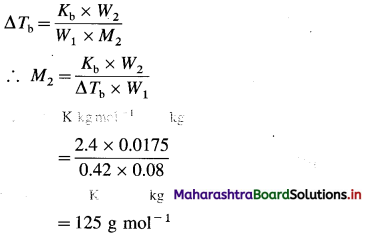
Answer:
When anisole is treated with bromine in acetic acid, /i-bromoanisole (major product) is obtained.
Maharashtra Board Class 12 Chemistry Solutions Chapter 11 Alcohols, Phenols and Ethers 235

Question 107.
Describe the action of methyl chloride on anisole (Friedel-Crafts reaction).
OR
Write the equation of Friedel-Crafts reaction-alkylation of anisole.
Answer:
When anisole is treated with alkyl halide in the presence of anhydrous aluminium chloride (a Lewis acid) as catalyst, 4-Methoxy toluene is formed as major product. The alkyl groups are introduced at -ortho and -para positions in anisole, the reaction is known as Friedel-Crafts alkylation reaction.
Maharashtra Board Class 12 Chemistry Solutions Chapter 11 Alcohols, Phenols and Ethers 236

Question 108.
Describe the action of Acetyl chloride on anisole (Friedel-Crafts acylation).
OR
Write the equation of the reaction Friedel-Crafts acylation of anisole.
OR
Write a note on Friedel-Crafts acylation.
Answer:
When anisole is treated with acetyl chloride in the presence of anhydrous aluminium chloride (a Lewis acid), 4-Methoxy acetophenone (major product) is obtained. The acetyl groups are introduced at -ortho and -para positions in anisole, the reaction is known as Friedel Craft’s acylation reaction.
Maharashtra Board Class 12 Chemistry Solutions Chapter 11 Alcohols, Phenols and Ethers 237

Question 109.
Describe the action of cone. HNO3 on anisole.
OR
Write the equation of nitration of anisole.
Answer:
When anisole is reacted with nitrating mixture (cone. HNO3 + cone. Fl2SO4), a mixture of p-nitroanisole and o-nitroanisole is obtained.
Maharashtra Board Class 12 Chemistry Solutions Chapter 11 Alcohols, Phenols and Ethers 238

Maharashtra Board Class 12 Chemistry Important Questions Chapter 11 Alcohols, Phenols and Ethers

Question 110.
An organic compound with the formula C4H10O3 shows properties of ether and alcohol. When treated with an excess of HBr yields only one compound 1,2 dibromomethane. Write structural formula of ether and that of alcohol.
Answer:
When C4H10O3 is treated with excess of HBr, a single compound 1,2-dibromoethane is formed.
Maharashtra Board Class 12 Chemistry Solutions Chapter 11 Alcohols, Phenols and Ethers 239

Question 111.
An organic compound ‘A’ having molecular formula C4H10O does not react with sodium metal. On hydrolysis with dilute H2SO4 it gives only one organic compound ‘B’ The compound B on heating with red phosphorus and iodine gives compound ‘C’. The compound C can also be obtained from compound ‘A’ on heating with excess HI. Identify the compounds A, B and C.
Answer:
(1) The organic compound ‘A’ with molecular formula C4H10O may be an alcohol or ether.
Maharashtra Board Class 12 Chemistry Solutions Chapter 11 Alcohols, Phenols and Ethers 240
(2) Since ‘A’ does not react with sodium (Na), it is not an alcohol. Hence ‘A’ may be an ether.
(3) Since an ether ‘A’ on hydrolysis with dilute H2SO4 gives only one compound ‘B’, the compound ‘A’ must be a symmetrical (simple) ether. Hence compound ‘A’ may be, C2H5 – O – C2H5Maharashtra Board Class 12 Chemistry Solutions Chapter 11 Alcohols, Phenols and Ethers 241

Question 112.
How will you affect the following two-step conversions? Diethyl ether into n-butane :
Answer:
Maharashtra Board Class 12 Chemistry Solutions Chapter 11 Alcohols, Phenols and Ethers 242

Question 114.
Answer in one sentence/word.

(1) Name the alcohol that is used to make propan-2-one.
Answer:
The alcohol used to make propan-2-one is iso-propyl alcohol.

(2) Which is the first oxidation product of secondary alcohol?
Answer:
The first oxidation product of secondary alcohol is ketone.

(3) Name the alcohol that is used to make acetic acid.
Answer:
The alcohol that is used to make acetic acid is ethyl alcohol.
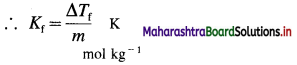
(4) Write the structure of cyclohexane-1, 4-diol.
Answer:
Maharashtra Board Class 12 Chemistry Solutions Chapter 11 Alcohols, Phenols and Ethers 246

Maharashtra Board Class 12 Chemistry Important Questions Chapter 11 Alcohols, Phenols and Ethers

(9) Which of the following isomers is more volatile : o-nitrophenol or p-nitrophenol?
Answer:
The isomer o-nitrophenol with lower boiling point is more volatile.

(10) Identify the product of the following reaction.
Maharashtra Board Class 12 Chemistry Solutions Chapter 11 Alcohols, Phenols and Ethers 247
Answer:
Maharashtra Board Class 12 Chemistry Solutions Chapter 11 Alcohols, Phenols and Ethers 248

(11) Identify the product obtained by industrial synthesis of carboxylation of phenoxide ion followed by acidification.
Answer:
The product is phenol
Maharashtra Board Class 12 Chemistry Solutions Chapter 11 Alcohols, Phenols and Ethers 249

(12) What is the product A obtained in the following reaction?
Maharashtra Board Class 12 Chemistry Solutions Chapter 11 Alcohols, Phenols and Ethers 250
Answer:
The product is phenolMaharashtra Board Class 12 Chemistry Solutions Chapter 11 Alcohols, Phenols and Ethers 251

(13) Which positions are occupied by – NO2 group during nitration of carbolic acid?
Answer:
– o – (ortho) and – p – (para) positions are occupied by – NO2 group during nitration of carbolic acid.

(14) Write the name of reactants used for the preparation of ethyl-tert-butyl ether.
Answer:
Maharashtra Board Class 12 Chemistry Solutions Chapter 11 Alcohols, Phenols and Ethers 252
are used for the preparation of ethyl-tert-butyl ether.

(15) The product formed in the reaction of reverse of dehydration of alcohol is
Answer:
The product formed in the reaction of reverse of dehydration of alcohol is alkene.

(16) Which rule is obeyed by hydroboration oxidation process?
Answer:
The rule obeyed by hydroboration oxidation process is opposite to the Markovnikov’s rule.

(17) Name the reagents for the complete hydroboration-oxidation reaction in step 1 and step 2.
Answer:
Step 1 : Diborane
Step 2 : Hydrogen peroxide and dil. NaOH.

(18) Write the name of the test by which methanol can be distinguished from ethanol.
Answer:
Iodoform test by which methanol can be distinguished from ethanol.

(19) Write the name of reactant used for preparation of phenol, which gives byproduct used as solvent.
Answer:
Reactant used in the preparation of phenol :
Maharashtra Board Class 12 Chemistry Solutions Chapter 11 Alcohols, Phenols and Ethers 253

(20) Ether is a good solvent for Grignard reagent. Which property makes it a good solvent?
Answer:
Ether has a low polarity, this property makes it a good solvent.

(21) The C – O – C bond angle in dimethyl ether is
Answer:
The C – O – C bond angle in dimethyl ether is 110°.

Maharashtra Board Class 12 Chemistry Important Questions Chapter 11 Alcohols, Phenols and Ethers

Question 115.
State the uses of methyl alcohol.
Answer:
(1) Methyl alcohol is used as an industrial solvent for dissolving oils, fats, gums, etc.
(2) It is used for dry cleaning and preparation of perfumes and varnishes.
(3) It is used as antifreeze agent for automobile radiators at low temperature.
(4) It is used in the preparation of methyl chloride, dimethyl sulphate and formaldehyde.
(5) It is used to denature ethyl alcohol.

Question 116.
State the uses of ethyl alcohol. OR Write two uses of ethyl alcohol.
Answer:
(1) Ethyl alcohol is used as solvent for dyes, oils, perfumes, cosmetics and drugs.
(2) A mixture of 10-20% ethyl alcohol with petrol is used as motor fuel.
(3) A mixture of ethyl alcohol and calcium acetate in gel form is used as solid fuel.
(4) It is widely used in beverages.
(5) Since ethyl alcohol has low freezing point, it is used in thermometer.
(6) It is an effective tropical antiseptic therefore it is used in many mouth washes.
(7) It kills micro-organisms on wound surface and in the mouth but its low toxicity does not kill the cells of the skin or mouth tissues.
(8) It is used in the preparation of chloroform, iodoform, acetic acid and ethers.
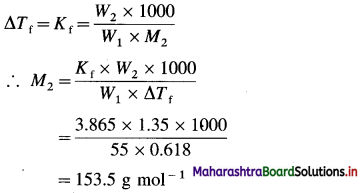
(9) It is used as fuel.

Question 117.
Give the important uses of phenol.
OR
Write two uses of phenol.
Answer:
(1) Phenol is used in the preparation of phenol-formaldehyde polymer which is used in a plastic bakelite.
(2) It is used in the preparation of phenol-phthalein-an indicator and in certain dyes.
(3) It is used in the preparation of drugs such as salol, aspirin, etc.
(4) It is used in the preparation of dettol, which is an antiseptic.
(5) It is used in the preparation of 2,4-dichlorophenoxy acetic acid which is used as selective weed killer.
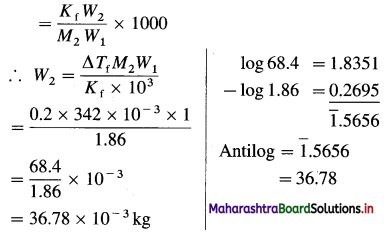
(6) It is used to prepare picric acid which is used as explosive.
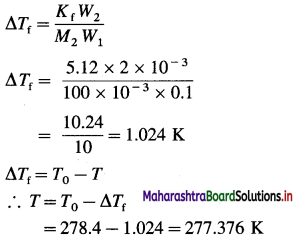
Multiple Choice Questions

Question 118.
Select and write the most appropriate answer from the given alternatives for each sub-question:

1. Which one of the following is a tertiary alcohol?
(a) Pentan-l-ol
(b) Pentan-2-ol
(c) 2-Methylpentan-2-ol
(d) 3-Methylpentan-2-ol
Answer:
(c) 2-Methylpentan-2-ol

2. Which of the following is a primary alcohol?
(a) 3-ethyl-3-hexanol
(b) 2-butanol
(c) 3-methyl-l-butanol
(d) 1-hexanol
Answer:
(d) 1-hexanol

3. The molecular formula C4H10O represents
(a) aldehydes
(b) alcohols
(c) ethers
(d) both (b) and (c)
Answer:
(d) both (b) and (c)

4. The general formula of primary, secondary and tertiary alcohols is
(a) CnH2nOH
(b) CnH2n-1OH
(c) CnH2n+1OH
(d) CnHn+1OH
Answer:
(c) CnH2n+1OH

Maharashtra Board Class 12 Chemistry Important Questions Chapter 11 Alcohols, Phenols and Ethers

5. Which of the following alcohols cannot be prepared by hydration of the corresponding alkene?
(a) Ethanol
(b) Propan- l-ol
(c) Propan-2-ol
(d) 2-Methylpropan-2-ol
Answer:
(b) Propan- l-ol

6. Which of the following compounds when treated with CH3MgI in dry ether followed by the hydroly¬sis, will give Propan-2-ol?
(a) HCHO
(b) CH3CHO
(c) CH3CH2OH
(d) CH3COCH3
Answer:
(b) CH3CHO

7. To prepare 3-Ethylpentan-3-ol, the reagents needed are
(a) CH3CH2MgBr + CH3COCH2CH3
(b) CH3MgBr + CH3CH2CH2COCH2CH3
(c) CH3CH2MgBr + CH3CH2COCH2CH3
(d) CH3CH2CH2MgBr + CH3COCH2CH3
Answer:
(c) CH3CH2MgBr + CH3CH2COCH2CH3

8. How is 1-propanol obtained?
(a) Using propanal
(b) Using propanone
(c) Using propene
(d) All of these
Answer:
(a) Using propanal

9.
Maharashtra Board Class 12 Chemistry Solutions Chapter 11 Alcohols, Phenols and Ethers 260
Answer:
(a)

10. Ketone on reduction gives
(a) 1° alcohol
(b) 2° alcohol
(c) 3° alcohol
(d) all of these
Answer:
(b) 2° alcohol

11. Primary alcohols are prepared by catalytic hydro-genation of aldehydes in presence of ……………………………… as a catalyst
(a) aluminium bromide
(b) fluoroboric acid
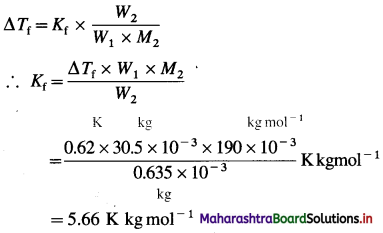
(c) dry ether
(d) palladium
Answer:
(d) palladium

12. Lower member of alcohols are
(a) insoluble in water
(b) soluble in water
(c) insoluble in acetaldehyde
(d) insoluble in petrol
Answer:
(b) soluble in water

13. Which of the following compounds contain hydro¬gen bonds?
(a) Ethane
(b) Ethanol
(c) Methoxymethane
(d) Ethylene
Answer:
(b) Ethanol

Maharashtra Board Class 12 Chemistry Important Questions Chapter 11 Alcohols, Phenols and Ethers

14. Which of the following is a trihydric alcohol?
(a) n-propyl alcohol
(b) Glycerol
(c) Glycol
(d) Glycine
Answer:
(b) Glycerol

15. Aldehydes are first oxidation products of
(a) primary alcohols
(b) secondary alcohols
(c) tertiary alcohols
(d) carboxylic acids
Answer:
(a) primary alcohols

16. The oxidation product of alcohol depends on
(a) – OH group of an alcohol
(b) number of carbon atoms in alcohol
(c) number of hydrogen atoms attached to hydroxyl bearing carbon
(d) all of these
Answer:
(c) number of hydrogen atoms attached to hydroxyl bearing carbon

17. The order of ease of oxidation is
(a) primary > secondary > tertiary
(b) primary < secondary < tertiary
(c) primary > tertiary > secondary
(d) secondary > tertiary > primary
Answer:
(b) primary < secondary < tertiary

18. Ethyl alcohol \(\frac{\text { conc. } \mathrm{H}_{2} \mathrm{SO}_{4}}{443 \mathrm{~K}} \mathrm{~A} \stackrel{\mathrm{HBr}}{\longrightarrow}\) Ethyl bromide. Identify A.
(a) Ethyl hydrogen sulphate
(b) Ethylene
(c) Isopropyl hydrogen sulphate
(d) Acetic acid
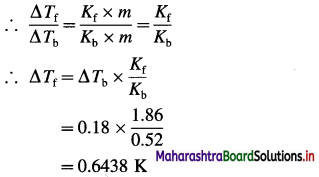
Answer:
(b) Ethylene

19. One mole of PCl5 reacts with one mole of ethyl alcohol to give
(a) 1 mole Cl2
(b) 1/2 mole Cl2
(c) 1 mole HCl
(d) 1/2 mole HCl
Answer:
(c) 1 mole HCl

20. When ethyl alcohol is reacted with sodium metal and the compound so formed is treated with ethyl bromide, the product formed is
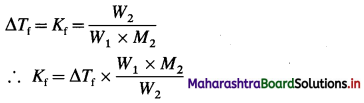
(a) an acid
(b) an alkane
(c) an ether
(d) an ester
Answer:
(c) an ether

21. Dehydration occurs at the lowest temperature and concentration for
(a) methyl alcohol
(b) n-propyl alcohol
(c) iso-propyl alcohol
(d) tert-butyl alcohol
Answer:
(d) tert-butyl alcohol

22. One mole of sodium when reacts with one mole of methyl alcohol, gives
(a) one mole of oxygen
(b) one mole of hydrogen
(c) half mole of hydrogen
(d) half mole of oxygen
Answer:
(c) half mole of hydrogen

Maharashtra Board Class 12 Chemistry Important Questions Chapter 11 Alcohols, Phenols and Ethers

23. A compound ‘X’(C3H8O) on oxidation gives com-pound ‘ Y’(C3H6O2), hence compound ‘X’ must be
(a) a ketone
(b) an aldehyde
(c) a primary alcohol
(d) a secondary alcohol
Answer:
(c) a primary alcohol

24. The toxicity of alcohols
(a) increases with an increase in their molecular weight
(b) decreases with an increase in their molecular weight
(c) increases with a decrease in their molecular weight
(d) does not depend on their molecular weight
Answer:
(a) increases with an increase in their molecular weight

25. The structural formula of 2-phenyl ethanol is
Maharashtra Board Class 12 Chemistry Solutions Chapter 11 Alcohols, Phenols and Ethers 261
Answer:
(c)

26. Compound that fails to give effervescence with NaHCO3 is
(a) C6H5COO
(b) CH3COOH
(c) C6H5OH
(d) Picric acid
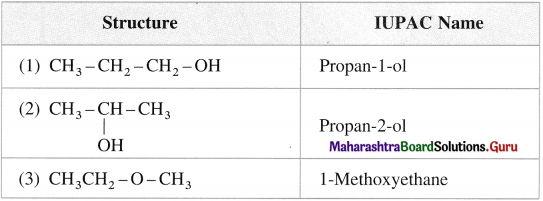
Answer:
(c)

27. Phenol is a bifunctional compound because
(a) it gives reactions of hydroxyl group (-OH) as well as aromatic ring
(b) it is a strong acid
(c) it is insoluble in NaOH
(d) it is readily soluble in water
Answer:
(a) it gives reactions of hydroxyl group (-OH) as well as aromatic ring

28. Phenol gives characteristic colour with
(a) iodine solution
(b) bromine water
(c) ammonium hydroxide
(d) aqueous ferric chloride solution
Answer:
(d) aqueous ferric chloride solution

29. Ethanol and phenol are distinguished from each other by the action of
(a) neutral ferrous chloride
(b) neutral ferric chloride
(c) ferric hydroxide
(d) ferrous hydroxide
Answer:
(b) neutral ferric chloride

30. Which of the following compounds is used to prepare bakelite resin?
(a) Acetaldehyde
(b) Ethanol
(c) Phenol
(d) Methyl amine
Answer:
(d) Methyl amine

31. Increasing order of acid strength among p-methoxy-phenol, p-methyl phenol and p-nitro- phenol is as
(a) p-nitrophenol > p-methoxyphenol > p-methylphenol
(b) p-methylphenol > p-methoxyphenol > p-nitrophenol
(c) p-nitrophenol > p-methylphenol > p-methoxyphenol
(d) p-methoxyphenol > p-methylphenol > p-nitrophenol
Answer:
(d) p-methoxyphenol > p-methylphenol > p-nitrophenol

Maharashtra Board Class 12 Chemistry Important Questions Chapter 11 Alcohols, Phenols and Ethers

32. The IUPAC name of the compound is Maharashtra Board Class 12 Chemistry Solutions Chapter 11 Alcohols, Phenols and Ethers 262
(a) 3,3-dimethyl-l-hydroxy cyclohexane
(b) l,l-dimethyl-3-cyclohexanol
(c) 3,3-dimethyl-1-cyclohexanol
(d) l,l-dimethyl-3-hydroxy cyclohexane
Answer:
(c) 3,3-dimethyl-1-cyclohexanol

33. Which of the following is the most reactive towards electrophilic attack?
Maharashtra Board Class 12 Chemistry Solutions Chapter 11 Alcohols, Phenols and Ethers 263
Answer:
(a)

34. In the following reaction, Ethanol \(\stackrel{\mathrm{PBr}_{3}}{\longrightarrow} \mathrm{A}\)\(\stackrel{\text { Alc-KOH }}{\longrightarrow} \text { B } \frac{\text { (i) } \mathrm{H}_{2} \mathrm{SO}_{4} \text {, room temp. }}{\text { (ii) } \mathrm{H}_{2} \mathrm{O}, \text { heat }} \mathrm{C} \text {. }\). The product C is
(a) CH3 – CH2 – O – CH2 – CH3
(b) CH3 – CH2 – OSO3H
(c) CH3CH2OH
(d) CH2 = CH2
Answer:
(c) CH3CH2OH

35. What is the general formula of ethers?
(a) CnH2nO
(b) CnH2n+2O
(c) CnH2n-1O
(d) CnH2n-2O
Answer:
(b) CnH2n+2O

36. The Maharashtra Board Class 12 Chemistry Solutions Chapter 11 Alcohols, Phenols and Ethers 264 linkage is present in
(a) proteins
(b) ketones
(c) ethers
(d) aldehydes
Answer:
(c) ethers

37. Methoxy ethane is the functional isomer of
(a) CH3CHOHCH3
(b) CH3CH2CH2OH
(c) CH3 – O – CH3
(d) both (a) and (b)
Answer:
(d) both (a) and (b)

38. An oxygen atom in ether is
(a) sp2-hybridized
(b) sp3-hybridized
(c) sp-hybridized
(d) sp2-d-hybridized
Answer:
(b) sp3-hybridized

Maharashtra Board Class 12 Chemistry Important Questions Chapter 11 Alcohols, Phenols and Ethers

39. C5H12O represents
(a) only an alcohol
(b) only an aldehyde
(c) only an ether
(d) an alcohol and an ether
Answer:
(d) an alcohol and an ether

40. Ether molecules are
(a) tetrahedral
(b) angular
(c) pyramidal
(d) diagonal
Answer:
(b) angular

41. Which one of the following compounds is not isomeric with Ethoxypropane?
(a) 1-Methoxypropane
(b) 2-Methoxypropane
(c) 2-Methylpropane-2-ol
(d) 2-Methylbutan-2-ol
Answer:
(d) 2-Methylbutan-2-ol

42. The IUPAC name of C2H5 – O – CH2 – CH(CH3)2 is
(a) 1-Ethoxy-1-butane
(b) 2-Ethoxy-2-butane
(c) l-Ethoxy-2-methylpropane
(d) 3-Ethoxy-2-methylpropane
Answer:
(c) l-Ethoxy-2-methylpropane

43. The IUPAC name of CH3OC6H5 is
(a) methoxy phenyl ether
(b) phenoxy methane
(c) methoxy benzene
(d) methyl phenyl ether
Answer:
(c) methoxy benzene

44. In CH3(CH2)3 – O -CH3, the parent hydrocarbon of large alkyl group is
(a) n-butane
(b) butane
(c) pentane
(d) n-pentane
Answer:
(a) n-butane

45. Which one of the following alkyl halide gives best yield in Williamson’s synthesis?
(a) CH3 – Br
(b) CH3 – CH(Br) – CH3
(c) CH2 – CH(Br) – CH3 – CH3
(d) (CH3)3 C – Br
Answer:
(a) CH3 – Br

46. Which one of the following ethers cannot be pre¬pared by using diazomethane?
(a) Dimethyl ether
(b) Diethyl ether
(c) Ethyl methyl ether
(d) t-Butyl methyl ether
Answer:
(b) Diethyl ether

Maharashtra Board Class 12 Chemistry Important Questions Chapter 11 Alcohols, Phenols and Ethers

47. The continuous etherification is carried out at
(a) 473 K
(b) 413 K
(c) 498 K
(d) 403 K
Answer:
(b) 413 K

48. Williamson’s synthesis is used for the preparation of
(a) only unsymmetrical ethers
(b) only symmetrical ethers
(c) both symmetrical and unsymmetrical ethers
(d) only methyl ethers
Answer:
(c) both symmetrical and unsymmetrical ethers

49. Which of the following ethers on hydrolysis gives two different products that are successive members of a homologous series?
(a) Methoxymethane
(b) Ethoxythane
(c) Methoxyethane
(d) 2-Methoxypropane
Answer:
(c) Methoxyethane

50. Which one of the following compounds dissolves in hot dilute sulphuric acid but does not react with sodium metal?
(a) Ethyl bromide
(b) Acetic acid
(c) Ethyl alcohol
(d) Diethyl ether
Answer:
(d) Diethyl ether

51. Identify ‘A’ in the following reaction :
Maharashtra Board Class 12 Chemistry Solutions Chapter 11 Alcohols, Phenols and Ethers 271
Answer:
(c)

52. The C-O-C bond angle in an ether is
(a) 180
(b) 90°
(c) 104.5°
(d) 109.5°
Answer:
(d) 109.5°

53. Ether free from moisture and alcohol is known as ,
(a) dry ether
(b) absolute ether
(c) pure ether
(d) spirit ether
Answer:
(b) absolute ether

54. The geometry of ether is similar to
(a) ammonia
(b) methane
(c) water
(d) ethyne
Answer:
(c) water

55. Sodium metal does not react with
Answer:
C2H5 – O – C2H3

Maharashtra Board Class 12 Chemistry Important Questions Chapter 11 Alcohols, Phenols and Ethers

56. Ethers have boiling points
(a) lower than those of alkanes of comparable molecular masses
(b) higher than those of isomeric alcohols
(c) lower than those of isomeric alcohols
(d) higher than those of alkanes of comparable molecular masses
Answer:

57. Ether on hydrolysis gives
(a) aldehyde
(b) alcohol
(c) acid
(d) ester
Answer:
(c) acid

58. Which of the following reactions represent Williamson’s reaction?
(a) R – O – R’ + HI →
\(\text { (b) } \mathrm{R}^{\prime}-\mathrm{OH}+\stackrel{\mathrm{H}_{2} \mathrm{SO}_{4}}{\longrightarrow}\)

(d) R – O – Na + R’X →
Answer:
(c)

59. Which of the following reactions represent the continuous etherification process?
Maharashtra Board Class 12 Chemistry Solutions Chapter 11 Alcohols, Phenols and Ethers 265
Answer:
(b)

60. Ethers on complete combustion produce
(a) an alcohol and water
(b) an alkene and water
(c) an alkane and an alkene
(d) carbon dioxide and water
Answer:
(d) carbon dioxide and water

61. Diethyl ether is used as a solvent in many organic reactions because it
(a) is liquid at room temperature

(b) has lower boiling point
(c) contains divalent oxygen atom
(d) is inert in nature
Answer:
(d) is inert in nature

62. Which of the following reagents can be prepared using ether as a solvent?
(a) Tollen’s reagent
(b) Grignard’s reagent
(c) Schiff’s reagent
(d) Millon’s reagent
Answer:
(b) Grignard’s reagent

63. Diethyl ether is used as
(a) a hypnotic
(b) an antiseptic
(c) an anaesthetic
(d) an antipyretic
Answer:
(c) an anaesthetic

64. To obtain fuel, diethyl ether is mixed with
(a) ester
(b) ethanal
(c) ethanol
(d) 2-propanone
Answer:
(c) ethanol

Maharashtra Board Class 12 Chemistry Important Questions Chapter 11 Alcohols, Phenols and Ethers

65. Which of the following alcohols is prepared by acid catalyzed hydration of alkenes?
(a) Butan-l-ol
(b) Propan-l-ol
(c) Ethanol
(d) Methanol
Answer:
(c) Ethanol

66. Which of the following alcohols can be prepared by direct hydration of corresponding alkene in presence of 50 % sulphuric acid?
(a) Butan-l-ol
(b) Butan-2-ol
(c) 2-Methylpropan-1 -ol
(d) 2-Methylpropan-2-ol
Answer:
(d) 2-Methylpropan-2-ol

67. Which of the following alcohols cannot be prepared by reduction of carbonyl compounds?
(a) Pentan-l-ol
(b) Pentan-2-ol
(c) 2-Methylpentan-2-ol
(d) 3-Methylpentan-2-ol
Answer:
(c) 2-Methylpentan-2-ol

68. Which of the following conversions explains the acidic nature of alcohols?
Maharashtra Board Class 12 Chemistry Solutions Chapter 11 Alcohols, Phenols and Ethers 268
Answer:
(b)

69. Which of the following compounds gives 3-ethyl- pentan-3-ol by the action of ethyl magnesium iodide followed by acid hydrolysis?
(a) Propanone
(b) Butanone
(c) Pentan-2-one
(d) Pentan-3-one
Answer:
(d) Pentan-3-one

70. Benzyl phenyl ether reacts with hydrogen bromide to give
(a) benzyl bromide and phenol
(b) benzyl alcohol and bromobenzene
(c) benzyl bromide and bromobenzene
(d) benzyl alcohol and phenol
Answer:
(a) benzyl bromide and phenol

71. Ethers are considered as
(a) monoalkyl derivatives of water
(b) divalent oxygen atom is attached to two alkyl groups
(c) alkyl derivatives of fatty acids
(d) condensation products of acid and alcohol
Answer:
(b) divalent oxygen atom is attached to two alkyl groups

72. Which of the following compounds is not isomeric with ethoxyethane?
(a) 1-methoxypropane
(b) 2-methoxypropane
(c) 2-methylpropan-2-ol
(d) 2-methylbutan-2-ol
Answer:
(d) 2-methylbutan-2-ol

73. Which of the following compounds dissolves in hot dilute sulphuric acid but does not reacts with sodium metal?
(a) Ethyl bromide
(b) Acetic acid
(c) Ethyl alcohol
(d) Diethyl ether
Answer:
(d) Diethyl ether

Maharashtra Board Class 12 Chemistry Important Questions Chapter 11 Alcohols, Phenols and Ethers

74. Which of the following alcohol will have the fastest rate of dehydration?
Maharashtra Board Class 12 Chemistry Solutions Chapter 11 Alcohols, Phenols and Ethers 266
Answer:
(c)

75. The phenol having lowest acidity is
Maharashtra Board Class 12 Chemistry Solutions Chapter 11 Alcohols, Phenols and Ethers 267
Answer:
(b)

76. Which of the following reagents is best for the following conversion?
Maharashtra Board Class 12 Chemistry Solutions Chapter 11 Alcohols, Phenols and Ethers 269
Answer:
(a)

77. 3-Methyl butane-2-ol on heating with HI gives
(a) 2 -iodo-3-methyl butane
(b) 2-iodo-2-methyl butane
(c) l-iodo-3-methyl butane
(d) l-iodo-2-methyl butane
Answer:
(b) 2-iodo-2-methyl butane

78. In phenol carbon atom attached to -OH group undergoes –
(a) sp3-hybridisation
(b) sp-hybridisation
(c) sp2-hybridisation
(d) No hybridisation
Answer:
(c) sp2-hybridisation

79. Which among the following reducing agents is ‘not’ used to reduce acetaldehyde to ethyl alcohol?
(a) Na-Hg and water
(b) Zn-Hg and cone. HCl
(c) H2-Raney Ni
(d) Li-A1H4/H+
Answer:
(b) Zn-Hg and cone. HCl

80. Identify the weakest acidic compound amongst the following :
(a) p-nitrophenol
(b) p-chlorophenol
(c) p-cresol
(d) p-aminophenol
Answer:
(d) p-aminophenol

Maharashtra Board Class 12 Chemistry Important Questions Chapter 11 Alcohols, Phenols and Ethers

81. Natalite is a mixture of
(a) diethyl ether and methanol
(b) diethyl ether and ethanol
(c) dimethyl ether and methanol
(d) dimethyl ether and ethanol
Answer:
(b) diethyl ether and ethanol

82. The alcohol used in thermometers is
(a) methanol
(b) ethanol
(c) propanol
(d) butanol
Answer:
(b) ethanol

83. Which of the following is the first oxidation product of secondary alcohol?
(a) Alkene
(b) Aldehyde
(c) Ketone
(d) Carboxylic acid
Answer:
(c) Ketone

84. When phenol is heated with cone. HNO3 in presence of cone. H2SO4 it yields
(a) o-nitrophenol
(b) p-nitrophenol
(c) 2, 4, 6-trinitrophenol
(d) m-nitrophenol
Answer:
(c) 2, 4, 6-trinitrophenol

Maharashtra Board Class 12 Chemistry Important Questions Chapter 1 Solid State

Balbharti Maharashtra State Board 12th Chemistry Important Questions Chapter 1 Solid State Important Questions and Answers.

Maharashtra State Board 12th Chemistry Important Questions Chapter 1 Solid State

Question 1.
What are the physical states of matter? How can they be changed into one another?
Answer:

  • There are three physical states of matter namely solid, liquid and gas.
  • They differ in intermolecular or interatomic or interionic forces which are strongest in the solid-state.
  • By raising the temperature of solids to their melting point, solids are converted into liquids while heating liquids to their boiling points, they can be converted into vapour or gaseous state.
  • On the contrary, by cooling the gases to very low temperature and subjecting to high pressure they can be transformed into liquid which on further cooling can be transformed into solid-state.

The equilibrium existing between three states of matter may be represented as,
Maharashtra Board Class 12 Chemistry Important Questions Chapter 1 Solid State 1

Question 2.
What are the constituents of solids?
Answer:
The smallest constituent particles of various solids are atoms, ions or molecules. All such small constituents are referred to as ‘particles’.

Question 3.
What are the characteristic properties of solids?
Answer:

  • The solid state of matter is characterised by strong interparticle forces of attraction.
  • There is regularity and periodicity in the arrangement of constituent particles of solid.
  • Generally solids are hard, incompressible and rigid except some solids like Na, K, P which are soft.
  • The constituent particles of solids like molecules, atoms or ions have fixed stationary positions in solid and can only oscillate about their equilibrium or mean positions. Hence, they have fixed shape and cannot be poured like liquids.
  • Crystalline solids have sharp melting points and they melt at a definite temperature. Amorphous solids do not have sharp melting points.
  • They are anisotropic or isotropic.

Question 4.
Give classification of solids.
Answer:
Depending on orderly arrangement of the constituent particles, the solids are classified into two types :

  • Crystalline solids. For example, diamond, NaCl, K2SO4, etc.
  • Amorphous solids or non-crystalline solids. For example, tar, glass, plastics, rubber, butter, etc.

Maharashtra Board Class 12 Chemistry Important Questions Chapter 1 Solid State

Question 5.
Define :
(1) Crystalline solid.
(2) Amorphous solid.
Answer:
(1) Crystalline solid : A homogeneous solid in which the constituent particles like atoms, ions or molecules are arranged in a definite repeating pattern throughout the solid is called crystalline solid. For example, NaCl, KNO3, etc.

(2) Amorphous solid : A substance which appears like solid but does not have perfectly ordered crystalline structure and no regular arrangement of constituent particles in structure is called amorphous solid. For example, glass, rubber, plastics, etc.

Question 6.
Define the term anisotropy.
OR
Define and explain the term anisotropy.
Answer:
Anisotropy : The ability of crystalline solids to change their physical properties when measured in different directions is called anisotropy.

Explanation : This property is due to different arrangement of constituents in different directions. Different types of particles fall on the way of measurements in different directions. Hence the composition of crystalline solid changes with directions changing their physical properties.
Maharashtra Board Class 12 Chemistry Important Questions Chapter 1 Solid State 2
Fig. 1.1 : Anisotropy in crystals : Different arrangements of constituent particles about different directions, AB, CD and EF.

Question 7.
Define and explain isotropy.
Answer:
Isotropy : The ability of amorphous solids to exhibit identical physical properties even though measured in different directions is called isotropy.

Explanation : This property arises because there is no long range order of regular pattern of arrangement in them and hence the arrangement is irregular along all the directions. Therefore the magnitude of any physical property would be identical along all directions.

Question 8.
Why does crystalline solid show different refractive indices in different directions ?
Answer:

  1. Crystalline solid has long range order of regular pattern of arrangement which repeats periodically over entire crystal.
  2. Within the given pattern, the arrangements of different atoms or ions or molecules is different in different directions. Hence the properties like refractive indices in the different directions are different.

This shows that the crystalline solids are anisotropic in nature.

Question 9.
Explain the properties of amorphous solids.
Answer:

  1. The constituent particles in amorphous solids are arranged randomly.
  2. They have short range ordered structure.
  3. Amorphous solids are called supercooled liquids having very high viscosity.
  4. They do not have sharp melting points and they melt gradually over a temperature interval.
  5. Amorphous substances appear like solids but they do not have perfectly ordered crystalline structure, hence they are not real solids. Therefore they are pseudo solids.
  6. They are isotropic and exhibit the same magnitude of any property in every direction.

Maharashtra Board Class 12 Chemistry Important Questions Chapter 1 Solid State

Question 10.
What is isomorphism ?
Answer:
Isomorphism : A phenomenon in which two or more crystalline substances show same crystalline structure is called isomorphism and the crystals are said to be isomorphous. For example, NaNO3 and CaCO3. They have atomic ratios 1 : 1 : 3.

Question 11.
What is isomorphous?
Answer:
Isomorphous : When two or more crystalline substances have the same crystalline structure, they are said to be isomorphous. For example, NaF and MgO, NaNO3 and CaCO3.

Question 12.
What is polymorphism ?
Answer:
Polymorphism : A phenomenon in which when a single substance crystallises in two or more forms under different conditions of solidification is called polymorphism and the substance is called polymorphous. For example, calcite and oragonite are two forms of CaCO3.

Question 13.
What is polymorphous ?
Answer:
Polymorphous: A single substance which crystallises in two or more forms under different conditions of solidification is called polymorphous. Polymorphic forms of an element are called allotropic forms or allotropes. For example, carbon exists as diamond and graphite, or sulphur exists in rhombic and monoclinic allotropic forms.

Question 14.
Identify isomorphous and polymorphous substances in the following :
K2SO4, graphite, β-quartz, Na2SeO4, CaCO3, diamond, cristobalite, CsNO3.
Answer:

Isomorphous Polymorphous
K2SO4, Na2SeO4

CaCO3, CsNO3

Graphite, diamond

Β-quartz, cristobalite

Question 15.
Why does a crystalline solid has a sharp melting point ?
Answer:

  1. Crystalline solid is a homogeneous solid and it has long range order of regular pattern of arrangement which repeats periodically over entire crystal.
  2. The interatomic or intermolecular forces are identical, hence the thermal energy required to break the regular structure by overcoming the intermolecular forces is uniform throughout.
  3. Hence the heat and temperature needed to melt the solid are same, and therefore solids have sharp melting points.

Question 16.
Amorphous solids do not have sharp melting points. Explain.
Answer:

  1. Amorphous solids do not have perfectly ordered crystalline structure.
  2. They have short range order of regular pattern hence periodically repeating regular pattern is over a short distance.
  3. The thermal energy required to break the structure and separate constituent particles is not uniform.
  4. Hence the temperature needed to melt the solid is not same, therefore amorphous solids do not have sharp melting points but melt over a range of temperature.

Maharashtra Board Class 12 Chemistry Important Questions Chapter 1 Solid State

Question 17.
Give examples of (1) crystalline solids and (2) amorphous solids.
Answer:
(1) Crystalline solids : Metallic solids (Cu, Fe, etc.) crystalline salts (NaCl, K2SO4, etc.)
(2) Amorphous solids : Glass, plastics, rubber, etc.

Question 18.
Distinguish between crystalline solids and amorphous solids.
Answer:
Crystalline solids:

  1. They have definite characteristic geometrical shape.
  2. They have long range order of regular pattern of arrangement of constituent particles.
  3. They are true solids.
  4. They have sharp melting points.
  5. They are anisotropic in nature.
  6. They have definite heat of fusion.

Amorphous solids:

  1. They have irregular shape.
  2. They have short range order of regular pattern of arrangement of constituent particles.
  3. They are pseudo solids or supercooled liquids.
  4. They do not have sharp melting points.
  5. They are isotropic in nature.
  6. They do not have definite heat of fusion.

Question 19.
How are crystalline solids classified ?
Answer:
Crystalline solids are classified as follows :

  1. Ionic crystals
  2. Covalent network crystals
  3. Molecular crystals
  4. Metallic crystals

Question 20.
What are crystalline solids?
Answer:
The solids in which the constituent particles are charged ions namely cations and anions held together by electrostatic force of attraction are called crystalline solids.

Question 21.
What are the characteristics of ionic crystals ?
Answer:
The characteristics of ionic crystals are as follows :

  1. The constituents of ionic crystals are charged ions namely cations and anions. They differ in ionic size.
  2. The ions in these crystals are held by strong electrostatic force of attraction.
  3. Ionic crystals have high melting points and they are hard and brittle.
  4. In solid state they are nonconductors of electricity but they are good conductors when melted or dissolved in water.
  5. In aqueous solution they dissociate forming ions.
  6. Example : NaCl, KCl. CaF2, K2SO4, etc.

Question 22.
Explain why ionic solids are hard and brittle.
Answer:

  1. In ionic crystalline solids, constituent particles are positively charged cations and negatively charged anions placed at alternate lattice points.
  2. The ions are held by strong coulombic electrostatic forces of attraction compensating opposite forces. Hence they are hard.
  3. Since there are no free electrons, they are not malleable and on applying a shearing force, ionic crystals break into small units. Hence they are brittle.

Maharashtra Board Class 12 Chemistry Important Questions Chapter 1 Solid State

Question 23.
What are covalent network crystals ?
Answer:
The crystals in which the constituent particles are atoms linked by covalent bonds forming a continuous network are called covalent network crystals. For example, diamond, quartz.

Question 24.
What are the characteristics of covalent network crystals ?
Answer:
The characteristics of covalent network crystals are as follows :

  • The constituent particles in these solids are atoms.
  • The atoms in these crystals are held by covalent bonds forming a rigid three dimensional network which gives a giant molecule. Hence, the entire crystal is a single molecule.
  • These crystals are very hard (or hardest) and most incompressible.
  • They have high melting points and boiling points.
  • Since the electrons are localised they are poor conductors of heat and electricity.
  • Example : Quartz (SiO2), diamond.

Question 25.
Give the examples of network solids.
Answer:
The examples of covalent network solids are as follows :
Quartz (SiO2), diamond, boron nitride carborundum.

Question 26.
What are allotropes ?
Answer:
Allotropes : When a substance exists in two or more forms then they are called allotropes. They are polymorphous. For example, carbon has allotropes diamond and graphite.

Question 27.
What are molecular crystals ?
Answer:
The crystals in which the constituent particles are molecules (or unbonded single atoms) of the same substance held together by intermolecular forces of attraction. For example solidified Cl2, CO2, etc.

Question 28.
What are the characteristics of molecular crystals ?
Answer:
The characteristics of molecular crystals are as follows :

  1. The constituent particles of these solids are molecules (or unbonded single atoms) of the same substance.
  2. The atoms within the molecules are bonded by covalent bonds.
  3. The molecules are held together by intermolecular forces of attraction.

Maharashtra Board Class 12 Chemistry Important Questions Chapter 1 Solid State

Question 29.
What are intermolecular forces of attraction involved in molecular crystals ?
Answer:
The intermolecular forces involved in molecular crystals are as follows :
(1) Weak dipole-dipole interactions :
The solids constituting polar molecules like HCl, H2O, SO2, etc. which possess permanent dipole moment involve weak dipole-dipole interactions.

(2) Very weak dispersion or London forces :
The solids consisting of nonpolar molecules like CH4, H2, etc. involve weak dispersion forces. They are also involved in monoatomic solids like Ar, Ne.

(3) Intermolecular Hydrogen bonds :

  • In this crystalline solids, the constituent particles are the molecules which contain hydrogen atom linked to highly electronegative atom like F, O or N.
  • In these, molecules are held by hydrogen bonds in which H atom of one molecule is bonded to electronegative atom (like F, N or O) of another molecule.
  • Since hydrogen bonding is weak, these solids have very low melting points and generally at room temperature they exist in the liquid or gaseous state.
  • They are non-conductors of electricity.

Question 30.
What are metallic crystals ?
Answer:
These are crystalline solids formed by atoms of the same metallic element held together by metallic bonds.

Question 31.
What are the characteristics of metallic crystals ?
Answer:

  1. Metallic crystals are solids formed by atoms of the same metallic element held together by metallic bonds.
  2. Metallic crystals have high melting point and boiling point.
  3. Metals are malleable and can be hammered into thin sheets.
  4. Metals are ductile and can be drawn into thin wires.
  5. Metals are good conductors of heat and electricity.
  6. Examples are Cu, Ag, Au, Ni, etc.

Question 32.
Classify the following solids into different types :
(i) Plastic (ii) P4 molecule (iii) S8 molecule (iv) Iodine molecule (v) Tetra phosphorus decoxide (vi) Ammonium phosphate (vii) Brass (viii) Rubidium (ix) Graphite (x) Diamond (xi) NaCl (xii) Silicon.
Answer:

Solid Type
(i) Plastic Covalent network crystal
(ii) P4 molecule Covalent network crystal
(iii) S8 molecule Covalent network crystal
(iv) Iodine molecule Covalent network crystal
(v) Tetra phosphorus decoxide Covalent network crystal
(vi) Ammonium phosphate Ionic crystal
(vii) Brass Metalic crystal
(viii) Rubidium Metalic crystal
(ix) Graphite Covalent crystal
(x) Diamond Covalent crystal
(xi) NaCl Ionic crystal
(xii) Silicon Covalent crystal

Question 33.
Mention the types of the following solids :
(i) CaF2 (ii) SiC (iii) Ice (iv) SO2 (v) CaCO3 (vi) ZnS (vii) HCl (viii) CO2
Answer:

Solid Type
(i) CaF2 Ionic crystal
(ii) SiC Covalent crystal
(iii) Ice Hydrogen bonded molecular crystal
(iv) SO2 Molecular crystal
(v) CaCO3 Ionic crystal
(vi) ZnS Ionic crystal
(vii) HCl Polar molecular crystal
(viii) CO2 Non-polar molecular crystal

Maharashtra Board Class 12 Chemistry Important Questions Chapter 1 Solid State

Question 34.
What is a giant solid ?
Answer:
Covalent solid formed by covalent bonds between neighbouring constituent atoms of non-metallic solid is called a giant solid. For example, graphite.

Question 35.
What is lattice ?
Answer:
Lattice is a geometrical arrangement of points in a three dimensional periodic array.

Question 36.
What is crystal lattice (space lattice) ?
Answer:
Crystal lattice (space lattice) : A regular arrangement of the constituent particles (atoms, ions or molecules) of a crystalline solid having similar environment in three dimensional space is called crystal lattice or space lattice.

Question 37.
What is a lattice point?
Answer:
Lattice point : A position occupied by a crystal constituent particle like an atom, ion or a molecule in the crystal lattice is called lattice point or lattice site.
OR
Any point at the intersection of the lines in the unit cell occupied by a constituent particle like an atom, an ion or a molecule in the crystalline solid is called a lattice point.

Maharashtra Board Class 12 Chemistry Important Questions Chapter 1 Solid State

Question 38.
What are the parameters of a unit cell ?
Answer:
A unit cell is characterised by following parameters :
(1) Edges or edge lengths : The intersection of two faces of crystal lattice is called as edge. The three edges denoted by a, b and c represent the dimensions (lengths) of the unit cell along three axes. These edges may or may not be mutually perpendicular.
Maharashtra Board Class 12 Chemistry Important Questions Chapter 1 Solid State 3

(2) Angles between the edges (or planes) : There are three angles between the edges of the unit cell represented as α, β and γ.

  • The angle α is between edges b and c.
  • The angle β is between edges a and c.
  • The angle γ is between edges a and b.

The crystal is defined with the help of these parameters of its unit cell.

Question 39.
Represent space lattice and unit cell diagrammatically.
Answer:
Maharashtra Board Class 12 Chemistry Important Questions Chapter 1 Solid State 4

Question 40.
What do you understand by the basis of crystal lattice ?
Answer:

  • A crystal structure is formed by attaching a constituent particle to lattice points.
  • The constituent particles attached to the lattice points form the basis of the crystal lattice.
  • The crystal structure is obtained by attaching a basis to each of the lattice points.

This is represented by the following schematic equation :
Maharashtra Board Class 12 Chemistry Important Questions Chapter 1 Solid State 5

Question 41.
What are the types of unit cells?
Answer:
Basically unit cells are of two types as follows :

  1. Primitive unit cells : The unit cells in which the constituent particles like atoms, ions or molecules are present only at the corners of the unit cell are called primitive unit cells or simple unit cells.
  2. Body-centred unit cell : A unit cell in which the constituent particles are present at the corners as well as at its body-centre is called body-centred unit cell.
  3. Face-centred unit cell : A unit cell in which the constituent particles are present at the corners as well as at the centre of each face is called face-centred unit cell or cubic close packed (CCP) unit cell.
  4. Base-centred unit cell : A unit cell in which the constituent particles are present at the corners as well as at the centres of two opposite faces is called end-centred unit cell.

Question 42.
Explain briefly crystal systems.
Answer:
(1) The constituent particles like atoms, ions or molecules of the crystal can be arranged in seven different ways changing edges (a, b, c) and angles (α, β, γ) and accordingly they form seven systems or types of the crystal.

(2) These seven crystal system are named as :
(a) Cubic system, (b) Tetragonal system (c) Orthorhombic system (d) Rhombohedral system (e) Monoclinic system (f) Triclinic system (g) Hexagonal system.

Maharashtra Board Class 12 Chemistry Important Questions Chapter 1 Solid State

Question 43.
What are Bravais lattices ?
Answer:

  1. There are seven crystal systems according to the edges (a. b, c) and angles (α, β, γ).
  2. The constituents of the crystal may be present at corners, face centres, body centres, edge centres and voids.
  3. By mathematical analysis, it has been proved that only fourteen different kinds of space lattices are possible.
  4. Hence there are fourteen different ways of arrangement of the lattice basis.
  5. These fourteen lattices of seven crystal systems are called Bravais lattices.

Question 44.
Explain Bravais lattices of a cubic system.
OR
Explain unit cells of a cubic system.
Answer:
Cubic lattice : For this, edges are a = b = c and angles are α = β = γ = 90°. In this cubic system, there are three Bravais lattices.
(1) Simple (or primitive) cubic unit cell (SCC) : In this unit cell, atoms are present only at 8 corners of the cube.
Maharashtra Board Class 12 Chemistry Important Questions Chapter 1 Solid State 6

(2) Body-centred cubic unit cell (BCC) : In this, atoms are present at 8 corners along with one additional atom at the body-centre of the cube.
Maharashtra Board Class 12 Chemistry Important Questions Chapter 1 Solid State 7

(3) Face-centred cubic unit cell (FCC) : In this unit cell, atoms are present at 8 comers and at 6 face centres.
Maharashtra Board Class 12 Chemistry Important Questions Chapter 1 Solid State 8

Question 45.
Give the number of lattice points in one unit cell of the following crystal structures :
(1) Simple cubic
(2) Face-centred cubic
(3) Body-centred cubic.
Answer:
Lattice points in one unit cell represent the positions of atoms, ions or molecules in the unit cell.
(1) Simple cubic unit cell : In this primitive unit cell, the lattice points are at 8 corners of the unit cell. Hence there are 8 lattice points.
(2) Face-centred cubic unit cell : In this unit cell, the lattice points are at 8 comers and 6 face centres.
(In cubic close packing unit cell, the lattice points are also at edge centres and body centre.)
(3) Body-centred cubic unit cell : In this, the lattice points are at 8 comers and one at body centre.

Question 46.
Find the number of atoms per unit cell in the following crystal structures.
(1) Simple cubic unit cell
(2) Body-centred cubic unit cell
(3) Face-centred cubic cell.
Answer:
(1) Number of atoms in primitive simple cubic (scc) unit cell :
Maharashtra Board Class 12 Chemistry Important Questions Chapter 1 Solid State 9
In simple or primitive cubic unit cell, there are 8 atoms at 8 corners. Each corner contributes 1/8th atom to the unit cell.
∴ Number of atoms present in the unit cell = \(\frac {1}{8}\) × 8 = 1
Hence the volume of the unit cell is equal to the volume of one atom.

(2) Number of atoms in body-centred cubic (bcc) unit cell:
Maharashtra Board Class 12 Chemistry Important Questions Chapter 1 Solid State 58
In this unit cell, there are 8 atoms at 8 corners and one additional atom at the body centre. Each corner contributes 1/8th atom, to the unit cell, hence due to 8 corners.
Number of atoms = 8 × \(\frac {1}{8}\)
= 1 atom.
An atom at the body centre wholly belongs to the unit cell.
∴ Total number of atoms present in bcc unit cell = 1 + 1 = 2.
Hence the volume of unit cell is equal to the volume of two atoms.

(3) Number of atoms in face-centred cubic (fcc) unit cell :
Maharashtra Board Class 12 Chemistry Important Questions Chapter 1 Solid State 10
In this unit cell, there are 8 atoms at 8 comers and 6 atoms at 6 face centres. Each corner contributes 1/8th atom to the unit cell, hence due to 8 corners,
Number of atoms = \(\frac {1}{8}\) × 8 = 1.
Each face centre contributes half of the atom to the unit cell, hence due to 6 face centres,
Number of atoms = \(\frac {1}{2}\) × 6 = 3.
∴ Total number of atoms present in fee unit cell = 1 + 3 = 4.
Hence the volume of the unit cell is equal to the volume of four atoms.

Maharashtra Board Class 12 Chemistry Important Questions Chapter 1 Solid State

Question 47.
Obtain a relation for the density of the unit cell and radius of atom or sphere for the following :
(1) Simple cubic (scc) crystal
(2) Body centred cubic (bcc) crystal
(3) Face centred cubic (fcc) crystal.
Answer:
(1) Consider a unit cell of a simple cubic crystal. It has 8 atoms at 8 corners of the unit cell.
∴ Total number of atoms in unit cell = \(\frac {1}{8}\) × 8 = 1
If a is the length of edge of cubic unit cell and r is the radius of the atom, then r = a/2 or a = 2r.
Volume of the unit cell = a3 = (2r)3 = 8r3
If M is atomic mass of the element, then mass of one atom is M/NA where NA is Avogadro number. If there are V atoms in one unit cell then,
Mass of unit cell = n × Mass of one atom = n × \(\frac{M}{N_{\mathrm{A}}}\)
Maharashtra Board Class 12 Chemistry Important Questions Chapter 1 Solid State 11
Since there is one atom present in one unit cell,
ρ = \(\frac{M}{N_{\mathrm{A}} \times a^{3}}\)

(2) Consider a unit cell of body centred cubic (bcc) crystal. It has 8 atoms at 8 comers and one additional atom at the centre of body of unit cell.
Number of atoms due to 8 corners = \(\frac {1}{8}\) × 8 = 1
Body centred atom, wholly belong to the unit cell. Hence total number of atoms in the unit cell is two. If M is atomic mass of an element then M/NA is mass of one atom where NA is Avogadro number.
Mass of unit cell = Mass of 2 atoms in unit cell = 2 M/NA
If a is the edge length or lattice parameter then,
Volume of cubic unit cell = a3
Maharashtra Board Class 12 Chemistry Important Questions Chapter 1 Solid State 12

(3) Consider a unit cell of face centred cubic (fcc) crystal.
It has 8 atoms at 8 comers and 6 atoms at 6 face centres.
∴ Total number of atoms in unit cell = \(\frac {1}{8}\) × 8 + \(\frac {1}{2}\) × 6 = 1 + 3= 4
If M is the atomic mass of an element, then mass of one atom is M/NA, where NA is Avogadro number. Mass of unit cell = Mass of 4 atoms
= \(4 \times \frac{M}{N_{\mathrm{A}}}\)
If a is the edge length of this cubic unit cell then,
volume of unit cell = a3
Maharashtra Board Class 12 Chemistry Important Questions Chapter 1 Solid State 13

Question 48.
What is coordination number? What is its significance?
Answer:
(1) Coordination number : The number of the closest neighbouring constituent particles like atoms, ions or molecules which are in contact with a particular particle or an atom in the crystal lattice is called coordination number of that particle.
(In the crystal lattice, all atoms may have same or different coordination numbers.)

(2) The magnitude of the coordination number is a measure of compactness of spheres in close-packed structures.

(3) The higher the coordination number, the closer are the spheres to each other.

Question 49.
Explain linear packing in one direction.
OR
Explain close packing in one dimension.
Answer:
Linear packing in one direction or close packing in one dimension :
The constituent particles of the crystal may be of varying shapes but for better understanding we consider particles as hard spheres of equal size.
Maharashtra Board Class 12 Chemistry Important Questions Chapter 1 Solid State 14
There is only one way of arranging or packing spheres placed in a horizontal row touching one another. Since one sphere is in contact with two neighbouring spheres except the end atoms, the coordination number in this arrangement is two. This packing may be in any one direction x, y or z.

Question 50.
Explain the following :
Planar packing arrangement of spheres.
OR
Close packing in two dimensions.
OR
AAAA type and ABAB type of two dimensional arrangement.
OR
(i) Square close packing
(ii) Hexagonal close packing.
Answer:
Two dimensional close packing crystal structure can be generated by placing one dimensional linear crystal structure over another to form multiple layers. This staking of linear rows may be taking place in two different ways giving two different two dimensional structures as follows :

(i) AAAA type two dimensional close packing or square close packing :
In this arrangement, various one dimensional rows are placed on one over other so that each sphere in one row is over the another sphere of another row forming planar structure. In this, spheres have horizontal as well as vertical alignment. All the rows of spheres are identical in planar structure. All crests as well as all the depressions or troughs formed by the arrangement are also aligned.
Maharashtra Board Class 12 Chemistry Important Questions Chapter 1 Solid State 15

If the first row is labelled as A type, then second and all subsequent rows are also identical, hence are of A type. Therefore this planar two dimensional close packing is called AAAA type packing.

In this arrangement, each sphere is in contact with (or touching) four other spheres around it, hence the coordination number of each sphere is four and the packing is called two dimensional or planar square close packing. In this, packing efficiency is 52.4%.

(ii) ABAB type two dimensional packing or hexag-onal close packing :
Maharashtra Board Class 12 Chemistry Important Questions Chapter 1 Solid State 16

In this arrangement, crests of the spheres of one row are placed into the depressions or troughs formed between adjacent spheres of next row. This arrangement is repeated consecutively throughout.

In this arrangement, crests of the spheres of one row are in contact with depressions or troughs of next row.

If one row of spheres is labelled as A then the next row will be B, third row will again be A, fourth row B and so on. Hence this planar or two dimensional close packing is called ABAB… type packing.

In this arrangement, each sphere is in contact with six other spheres around it hence the coordination number of each sphere is six and the packing is called two dimensional or planar hexagonal close packing. In this, the packing efficiency is 60.4% which is more than linear close packing.

Question 51.
Explain close packing in three dimensions.
Answer:
Close packing in three dimensions :
Three dimensional crystal structures are obtained by stacking of two dimensional layers. Simple cubic lattice is obtained by stacking of two dimensional square layers.

The stacking of two dimensional hexagonal close packed layers gives two structures namely hexagonal close packed (hcp) structure and face centred (fcc) structure.

(i) Stacking of square close packed layers :
Maharashtra Board Class 12 Chemistry Important Questions Chapter 1 Solid State 17

In this arrangement, the two dimensional AAAA type square closed packed layers are placed one over the other in such a way that the crests of all spheres are in contact with successive layers in all directions. All spheres of different layers are perfectly aligned horizontally and vertically forming unit cells having primitive or simple cubic structure. Since all the layers are identical and if each layer is labelled as layer A, then whole three dimensional crystal lattice will be of AAAA… type.

Each sphere is in contact with six surrounded spheres, hence the co-ordination number of each sphere is six.

(ii) Stacking of two hexagonal close packed layers :
A close packed three dimensional structure can be generated by arranging hexagonal close packed layers in a particular manner.

In this the spheres of second layer are placed in the depression of the first layer.

In this if first layer is labelled as A then second layer is labelled as B since they are aligned differently.
Maharashtra Board Class 12 Chemistry Important Questions Chapter 1 Solid State 18

In this, all triangular voids of the first layers are not covered by the spheres of the second layer. The triangular voids which are covered by second layer spheres generate tetrahedral void which is surrounded by four spheres. The triangular voids in one layer have above them triangular voids of successive layers.

The overlapping triangular voids from two layers together form an octahedral void which is surrounded by six spheres.

(iii) Placing third hexagonal close packed layer :
(a) Hexagonal close packing (hcp) : If the crests of spheres of third layer are placed on the triangular shaped tetrahedral voids C of the second layer, then three dimensional closest packing structure is obtained in which the spheres of third layer lie directly above the spheres of first layer, i.e., first and third layers are identical. Following same placing of layers, fourth layer will be identical to second layer.

If the first layer is labelled A and second layer B, then the arrangement of packing will be of ABAB type. This is also called hexagonal close packing (hcp) as shown in the figure. In this, packing efficiency is 74%. The coordination number of each sphere is 12. The metals Be. Mg, Zn, Cd crystallise in HCP crystalline structure.
Maharashtra Board Class 12 Chemistry Important Questions Chapter 1 Solid State 19

(b) Cubic close packing (ccp) : If the crests of spheres of third layer are placed in the positions of tetrahedral void ‘a’ having apex upward of first layers, then the third layer will not be identical to the first, and may be labelled as C, which is different from A and B layers. Fourth layer may be arranged above third layer such that the spheres are aligned, so that the first layer and fourth layer are identical, second and fifth layers are identical and so on.
Maharashtra Board Class 12 Chemistry Important Questions Chapter 1 Solid State 20
If first, second and third layers are labelled as A, B and C respectively then the arrangement of packing will be ABCABC type. This is also called cubic close packing (ccp) as shown in the figure. This is similar to face centred cubic (fcc) packing.

In this, arrangement packing efficiency is 74% and the coordination number of each sphere is 12.

Maharashtra Board Class 12 Chemistry Important Questions Chapter 1 Solid State

Question 52.
Explain tetrahedral void.
Answer:
(1) Tetrahedral void : The vacant space or void among four constituent particles having tetrahedral arrangement in the crystal lattice is called tetrahedral void.
Maharashtra Board Class 12 Chemistry Important Questions Chapter 1 Solid State 21
The arrangement of four spheres around the void is tetrahedral. A tetrahedral void is formed when a triangular void made by three coplanar spheres is in contact with fourth sphere above or below it.

(2) Characteristics of tetrahedral void :

  • The volume of the void is much smaller than that of atom or sphere.
  • Larger the size of sphere, more is the size of void.
  • If R is the radius of the constituent atom, then the radius of the tetrahedral void is 0.225 R.
  • Coordination number of tetrahedral void is four.
  • There are two tetrahedral voids per sphere, in the crystal lattice. If the number of closed packed spheres is N then the number of tetrahedral voids is 2N.

Question 53.
Explain octahedral void.
Answer:
(1) Octahedral void : The vacant space or void at the centre of six spheres (or atoms) which are placed octahedrally is called octahedral void.
Maharashtra Board Class 12 Chemistry Important Questions Chapter 1 Solid State 22

(2) Characteristics of octahedral void :

  • The volume of the void is small.
  • There is one octahedral void at the body centre and twelve octahedral void positions at twelve edge centres.
  • If R is the radius of constituent atom, then the radius of the octahedral void is 0.414 R.
  • The coordination number of octahedral void is six.
  • There is one octahedral void per sphere in the crystal lattice. If the number of closed packed spheres is N then the number of octahedral voids is N.

Question 54.
What are number of voids per atom in hep and ccp ?
Answer:
The tetrahedral and octahedral voids occur in hep and ccp/fcc structures. There are two tetrahedral voids associated with each atom. The number of octahedral voids is half that of tetrahedral voids. Thus, there is one octahedral void per atom.

Question 55.
What is packing efficiency?
Answer:
(1) Packing efficiency : It is the fraction of a percentage of the total space (of the unit cell) occupied by the particles (spheres).
Maharashtra Board Class 12 Chemistry Important Questions Chapter 1 Solid State 23
( 2) The magnitude of packing efficiency gives a measure of how tightly particles are packed together.

Question 56.
Calculate packing efficiency in body-centred cubic lattice.
Answer:
Step 1 : Radius of sphere :
In the unit cell of body-centred cubic lattice, there are 8 atoms at 8 corners and one atom at the centre of the cube.
Maharashtra Board Class 12 Chemistry Important Questions Chapter 1 Solid State 24

The atoms are in contact along the body diagonal BF. Let a be the edge length and r the radius of an atom.
Consider a triangle BCE.
BE2 = BC2 + CE2 = a2 + a2 = 2a2
Consider triangle BEF,
BF2 = BE2 + EF2 = 2a2 + a2 = 3a2
BF = \(\sqrt{3}\)a.
From figure, BF = 4r
∴ 4r = \(\sqrt{3}\)a
∴ r = \(\frac{\sqrt{3}}{4} a\)

Step 2 : Volume of sphere :
Maharashtra Board Class 12 Chemistry Important Questions Chapter 1 Solid State 25

Step 3 : Total volume of particles :
The unit cell of bcc structure contains 2 particles.
Maharashtra Board Class 12 Chemistry Important Questions Chapter 1 Solid State 26

Step 4 : Packing efficiency
Maharashtra Board Class 12 Chemistry Important Questions Chapter 1 Solid State 27
∴ Packing efficiency = 68%
∴ Percentage of void space = 100 – 68
= 32%

Maharashtra Board Class 12 Chemistry Important Questions Chapter 1 Solid State

Question 57.
Calculate packing efficiency in face-centred cubic lattice.
Answer:
Step 1 : Radius of sphere :
In the unit cell of face-centred cubic lattice, there 8 atoms at 8 corners and 6 atoms at 6 face centres. Consider the face ABCD.
Maharashtra Board Class 12 Chemistry Important Questions Chapter 1 Solid State 28

The atoms are in contact along the face diagonal BD.
Let a be the edge length and r, the radius of an atom.
Consider a triangle BCD.
BD2 = BC2 + CD2
= a2 + a2 = 2a
∴ BD = \(\sqrt{2} a\)
From figure, BD = 4r
Maharashtra Board Class 12 Chemistry Important Questions Chapter 1 Solid State 29

Step 3 : Total volume of particles :
The unit cell of fee crystal lattice contains 4 particles.
∴ Volume occupied by 4 particles = \(4 \times \frac{\pi a^{3}}{12 \sqrt{2}}\)
= \(\frac{\pi a^{3}}{3 \sqrt{2}}\)

Step 4 : Packing efficiency :
Maharashtra Board Class 12 Chemistry Important Questions Chapter 1 Solid State 30
∴ Packing efficiency = 74%
∴ Percentage of void space = 100 – 74
= 26%

Edge length and particle parameters in cubic system
Maharashtra Board Class 12 Chemistry Important Questions Chapter 1 Solid State 31a

Coordination number and packing efficiency in systems

Lattice Coordination number of atoms Packing efficiency
1. scc 6 : four in the same layer, one directly above and one directly below 52.4%
2. bcc 8 : four in the layer below and four in the layer above 68%
3. fcc/ccp/hcp 12 : six in its own layer, three above and three below 74%

Question 58.
Calculate the number of particles and unit cells in ‘x’ g of metallic crystal.
Answer:
Consider ‘x’ gram of a metallic crystal of molar mass M and density ρ. If the unit cell of the crystal has edge length ‘a’ then, volume of unit cell = a3.
Mass of one metal atom = \(\frac{M}{N_{\mathrm{A}}}\). If ‘n’ number of atoms are present in one unit cell then
Mass of unit cell = \(\frac{n \times M}{N_{\mathrm{A}}}\)
If ‘a’ is the edge length of the unit cell then, Volume of unit cell = a3
Density of unit cell = ρ = \(\frac{n \times M}{N_{\mathrm{A}}} \times \frac{1}{a^{3}}\)
∴ M = \(\frac{\rho \times N_{\mathrm{A}} \times a^{3}}{n}\)
∵ Molar mass M gram contains NA particles
∴ x gram contains \(\frac{x \times N_{\mathrm{A}}}{M}\) particles.
Substituting the value M,

(i) Number of particles in x g crystal
= \(\frac{x \times N_{\mathrm{A}}}{\rho \times N_{\mathrm{A}} \times a^{3} / n}\)
= \(\frac{x \times n}{\rho \times a^{3}}\) particles

(ii) Number of unit cells in x g crystal :
∵ n particles are present in 1 unit cell
∴ \(\frac{x \times n}{\rho \times a^{3}}\) are present in, \(\frac{x \times n}{\rho \times a^{3}} \times \frac{1}{n}\)
= \(\frac{x}{\rho \times a^{3}}\) unit cells

(iii) Number of unit cells in V volume of crystal = \(\frac{V}{a^{3}}\)

Alternative method :
Consider ‘x’ g metal of atomic mass M g mol-1.
Number of moles of metal = \(\frac{x}{M}\)
(a) Number of atoms (particles) of metal = \(\frac{x}{M} \times N_{\mathrm{A}}\)
(b) If unit cell contains ‘n’ atoms,
Number of unit cells = \(\frac{x}{M} \times \frac{N_{\mathrm{A}}}{n}\)
(c) If ‘a’ is the edge length then,
Volume of unit cells = a3
∴ Number of unit cells in V volume of crystal = \(\frac{V}{a^{3}}\).

Maharashtra Board Class 12 Chemistry Important Questions Chapter 1 Solid State

Solved Examples 1.5 – 4.7

Question 59.
Solve the following :
[1 m = 10 dm = 100 cm = 109 nm = 1012 pm, 1Å = 10-8 cm = 100 pm]

(1) A cubic unit cell of a crystal consists of atoms of A and B elements. Atoms of A occupy corners of the unit cell while one B atom is present at the body centre. Determine the formula of the crystalline compound.
Solution :
Given : Atoms of A are at the comers while atom B is at the body centre of the cubic unit cell.
Since \(\frac {1}{8}\)th atom is contributed at each comer and there are 8 comers in unit cell, number of atoms of A due to comers is \(\frac {1}{8}\) × 8 = 1.

In addition there is one atom of B at body centre. Hence this unit cell contains one atom of each, A and B, therefore the formula of the compound is AB.
Ans. The formula of the compound = AB.

(2) Atoms C and D form fee crystalline structure. Atom C is present at the corners of the cube and D is at the face centres of the cube. What is the formula of the compound ?
Solution :
Given : Crystal has fee structure.
Atoms C are at 8 comers while atoms D are at 6 face centres of the cubic unit cell.
At the comer, \(\frac {1}{8}\)th of each C atom is present while at each face centre, half of each D atom is present.
Number of C atoms = \(\frac {1}{8}\) × 8 = 1.
Number of D atoms = \(\frac {1}{8}\) × 6 = 3.
Thus unit cell contains one C atom and three D atoms.
Hence the formula of the compound is CD3.
Ans. Formula of the compound = CD3.

(3) A cubic unit cell contains atoms A at the corners, atoms B at face centres and atom C at the body centre. What is the formula of the crystalline compound?
Solution :
Given : Atoms A are at 8 comers, atoms B at the 6 face centres and one atom C at body centre.
Total number of atoms of A = \(\frac {1}{8}\) × 8 = 1.
Total number of atoms of B = \(\frac {1}{2}\) × 6 = 3.
One atom of C at the body centre.
Therefore the unit cell contains one atom of A, three atoms of B and one atom of C.
Hence the formula of the compound is AB3C.
Ans. The formula of the crystalline compound is AB3C.

(4) An element A and B constitute bcc type crystalline structure. Element A occupies body centre position and B is at the corners of cube. What is the formula of the compound? What are the coordination numbers of A and B ?
Solution :
Given : Crystalline structure is bcc type.
Atoms A are at 8 comers and atom B is at body centre.
∴ Number of atoms of A in a unit cell
= \(\frac {1}{8}\) × 8 = 1.
Number of atom B in a unit cell = 1.
Since unit cell contains one atom each of A and B, the formula of the compound is AB.
The coordination number of an atom A at comer is 8.
The coordination number of an atom B at body centre is 8.
Answer. Formula of the compound = AB.
Coordination number of A = 8
Coordination number of B = 8.

(5) Mention the number of atoms in the following unit cells :
(a) scc (b) bcc (c) fcc (d) hcp.
Answer:

Unit cell Number of atoms
(a) scc 1
(b) bcc 2
(c) fcc 4
(d) hcp 3

(6) 0.1 mole of Buckminster fullerene of molar mass 720 gmol-1 contains how many Kg of carbon ?
Solution :
Molar mass of fullerene, C60 = 720 gmol-1
∵ Mass of 1 mole of fullerene = 720 g = 0.72 kg
∴ Mass of 0.1 mole of fullerene = 0.72 × 0.1
= 0.072 kg
Ans. 0.072 kg.

Maharashtra Board Class 12 Chemistry Important Questions Chapter 1 Solid State

(7) In a cubic crystalline structure of zinc blende (ZnS), sulphide ions are at corners and face centres while zinc ions occupy half of tetrahedral voids.
Find in the unit cell :
(i) Number of Zn2+ ions
(ii) Number of S2- ions
(iii) Number of ZnS molecules
(iv) Molecular formula of zinc blende.
Solution :
Given : S2- ions are at 8 comers and 6 face centres.
Zn2+ ions occupy half of tetrahedral voids.
Number of S2- ions in unit cell
Maharashtra Board Class 12 Chemistry Important Questions Chapter 1 Solid State 32
= 1 + 3 = 4

Cubic unit cell has 8 tetrahedral voids. Since half of them are occupied by Zn2+ ions, there are 4Zn2+ ions in the unit cell.
Hence number of zinc sulphide (ZnS) molecules is 4.
Molecular formula of zinc blende is ZnS.
Ans. (i) Number of Zn2+ ions = 4
(ii) Number of S2- ions = 4
(iii) Number of ZnS molecules = 4
(iv) Molecular formula of zinc blende = ZnS.

(8) In a crystalline compound, atoms A occupy ccp lattices while atoms B occupy 2/3 rd tetrahedral voids. What is the formula of the compound ?
Solution :
In ccp unit, lattice points are 8 comers and 6 face centres where atoms A are present.
∴ Number of A atoms
Maharashtra Board Class 12 Chemistry Important Questions Chapter 1 Solid State 33
In cubic unit cell, there are 8 tetrahedral voids.
Hence,
Number of B atoms = \(\frac {2}{3}\) × 8 = \(\frac {16}{3}\).
Hence the formula should be A4B16/3 or A12B16 or A3B4.
Ans. The formula of the compound is A3B4.

(9) A compound forms hep structure. What is the number of (a) octahedral voids, (b) tetrahedral voids, (c) total voids formed in 0.2 mol of the compound?
Solution :
Number of atoms in 0.2 mol of the compound
= 0.2 × NA = 0.2 × 6.022 × 1023
= 1.2044 × 10²³ atoms
(a) Number of octahedral voids
= Number of atoms
= 1.2044 × 10²³

(b) Number of tetrahedral voids
= 2 × Number of atoms
= 2 × 1.2044 × 1023
= 2.4088 × 10²³

(c) Total number of voids
= 1.2044 × 10²³ + 2.4088 × 1023
= 3.6132 × 10²³
Ans. (a) Number of octahedral voids
= 1.2044 × 10²³
(b) Number of tetrahedral voids = 2.4088 × 10²³
(c) Total number of voids = 3.6132 × 10²³

(10) Copper crystallises into a fcc structure and the unit cell has length of edge 3.61 × 10⁻⁸ cm. Calculate the density of copper. Atomic mass of copper is 63.5 g mol-1.
Solution :
Given : Crystalline structure of Cu is fcc.
Edge length = a = 3.61 × 10⁻⁸ cm
Atomic mass of Cu = 63.5 g mol-1
Avogadro number = 6.022 × 10²³ mol-1
Density = d = ?

In fcc structure, there are 8 Cu atoms at 8 comers and 6 Cu atoms at 6 face centres.
∴ Total number of Cu atoms
= \(\frac {1}{8}\) × 8 + \(\frac {1}{2}\) × 6 = 1 + 3
= 4
Mass of one Cu atom
= \(\frac{63.5}{6.022 \times 10^{23}}\) = 1.054 × 10⁻²² g
∴ Mass of 4 Cu atoms = 4 × 1.054 × 10-22
= 4.216 × 10⁻²² g
Mass of unit cell = Mass of 4 Cu atoms
= 4.216 × 10⁻²²g
Volume of unit cell = a3 = (3.61 × 10⁻⁸)3
= 4.7 × 10⁻²⁴ cm3
Density of unit cell = \(\frac{\text { Mass of unit cell }}{\text { Volume of unit cell }}\)
∴ ρ = \(\frac{4.216 \times 10^{-22}}{4.7 \times 10^{-23}}\) = 8.97 g cm-3
Ans. Density of Cu = 8.97 g cm-3.

Maharashtra Board Class 12 Chemistry Important Questions Chapter 1 Solid State

(11) Niobium is found to crystallise with bcc structure and found to have density of 8.55 g cm-3 (OR 8.55 kg m-3). Determine the atomic radius of niobium if its atomic mass is 93.
Solution :
Given : Density of Niobium (Nb) crystal = 8.55 g cm-3
Crystalline stmeture is bcc.
Atomic mass of Nb = 93 g mol-1
Avogadro number = NA = 6.022 × 10²³ mol-1
Atomic radius of Niobium = ?
In bcc unit cell, there are 8 atoms at 8 comers and 1 atom at the body centre.
∴ Number of Nb atoms = \(\frac {1}{8}\) × 8 + 1 = 1 + 1 = 2.
Mass of one Nb atom = \(\frac{93}{6.022 \times 10^{23}}\) = 1.544 × 10⁻²²
∴ Mass of 2 Nb atoms = 2 × 1.544 × 10-22 = 3.088 × 10⁻²² g
Mass of unit cell
= Mass of 2Nb atoms = 3.088 × 10⁻²² g
If a is edge length of bcc unit cell, volume of unit cell = a3
Maharashtra Board Class 12 Chemistry Important Questions Chapter 1 Solid State 34
= 0.361 × 10⁻²² cm3 = 36.1 × 10⁻²⁴ cm3
∴ a = (36.1 × 10⁻²⁴)-1/3 = 3.3 × 10⁻⁸ cm
If r is the radius of 1 Nb atom, then in bcc structure
r = \(\frac{\sqrt{3}}{4} a=\frac{\sqrt{3}}{4}\) × 3.3 × 10-8
= 1.43 × 10⁻⁸ cm
= 1.43 × 10⁻¹⁰ m
= 1.43 × 10-10 × 109 nm
= 0.143 nm
Ans. Atomic radius of niobium atom = 0.143 nm

(12) Gold occurs as face centred cube and has a density of 19.30 kg dm-3. Calculate atomic radius of gold. (Molar mass of Au = 197)
Solution :
Given : Density of Au = 19.3 kg dm-3
Molar mass = 197 g mol-1
Avogadro constant = NA = 6.022 × 10²³ mol-1
Atomic radius of Au = ?
In fcc unit cell, there are 8 atoms of Au at 8 comers and 6 atoms at 6 face centres.
Number of Au atoms in the unit cell = \(\frac {1}{8}\) × 8 + \(\frac {1}{2}\) × 6
= 4 atoms
Mass of 1 Au atom = \(\frac{197}{6.022 \times 10^{23}}\) = 3.271 × 10⁻²² g
∴ Mass of 4 Au atoms = 4 × 3.271 × 10-22 g = 1.308 g × 10-21 g
∴ Mass of unit cell = 1.308 × 10⁻²¹ g
Maharashtra Board Class 12 Chemistry Important Questions Chapter 1 Solid State 35
= 6.777 × 10⁻²⁴ dm3
= 6.777 × 10⁻²³ cm3
∴ a = (6.777 × 10⁻²³)1/3 = (67.77 × 10⁻²⁴)-1/3
= 4.077 × 10⁻⁸ cm
If r is the radius of Au atom, then for fcc unit cell,
r = \(\frac{a}{2 \sqrt{2}}\)
= \(\frac{4.077 \times 10^{-8}}{2 \sqrt{2}}\) = 1.442 x 10⁻⁸ cm = 144.2 pm
Ans. Radius of Au atom = 144.2 pm.

(13) A compound is formed by two elements X and Y. The atoms of Y form ccp structure. The atoms of A occupy \(\frac {1}{3}\) of tetrahedral voids. Find the formula of the compound.
Solution :
In ccp structure, Y atoms are present at 8 comers and 6 face-centres of the ccp structure.
Maharashtra Board Class 12 Chemistry Important Questions Chapter 1 Solid State 36
There are 8 tetrahedral voids of which \(\frac {1}{3}\)rd are occupied by atoms X. Hence unit cell has \(\frac {8}{3}\) atoms of X and 4 atoms of Y. The formula will be,
X8/3 Y4 or X8Y12 or X2Y3
Ans. Formula of the compound = X2Y3.

(14) A metal crystallises into two cubic faces namely face centered (FCC) and body centered (BCC), whose unit cell edge lengths are 3.5 Å and 3.0 Å respectively. Find the ratio of the densities of FCC and BCC.
Solution :
Given : Edge length of unit cell of fcc metal = 3.5 Å
= 3.5 × 10⁻⁸ cm
Edge length of unit cell of bcc metal = 3 Å = 3 × 10⁻⁸ cm
Density d = \(\frac{n \times \mathbf{M}}{a^{3} \times \mathbf{N}_{\mathrm{A}}}\)
where, n = Number of Fe atoms in the unit cell
M = Atomic mass of metal
a = Edge length of unit cell
NA = Avogadro number
∴ For fcc unit cell = n = 4
For bcc unit cell = n = 2
∴ \(\frac{\text { Density of fcc unit cell }}{\text { Density of bcc unit cell }}=\frac{d_{\mathrm{fcc}}}{d_{\mathrm{bcc}}}\)
Maharashtra Board Class 12 Chemistry Important Questions Chapter 1 Solid State 37

(15) The density of silver having atomic mass 107.8 gram mol-1 is 10.8 gram cm-3. If the edge length of cubic unit cell is 4.05 × 10⁻⁸ cm, find the number of silver atoms in the unit cell. (NA = 6.022 × 10²³, 1Å = 10-8 cm)
Solution :
Given : d = 10.8 g cm-3
M= 107.8 g mol-1
a = 4.05 × 10⁻⁸ cm
Number of Ag atoms in unit cell = n = ?
Mass of one Ag atom = \(\frac{107.8}{6.022 \times 10^{23}}\)
= 1.79 × 10⁻²² g
If there are n atoms, then
Mass of unit cell = n × 1.79 × 10⁻²² g
Volume of unit cell = a3 = (4.05 × 10⁻⁸)3
= 6.643 × 10⁻²³ cm3
Maharashtra Board Class 12 Chemistry Important Questions Chapter 1 Solid State 38
Ans. Number of silver atoms (Ag) atoms in unit cell = 4.

(16) Aluminium having atomic mass 27 g mol-1 crystallises in face centred packed cubic crystal. Find the number of Al atoms in 10 g aluminium. How many unit cells will be present in it?
Solution :
Given : Atomic mass of Al = 27 g mol-1
Mass of Al = 10 g
Avogadro number = NA = 6.022 × 10²³ mol-1
Number of Al atoms = ?
Number of unit cells = ?
1 gram atom of Al = 27 g Al contains 6.022 × 10²³
Al atoms
∴ Number of Al atoms in 10 g
= \(\frac{10 \times 6.022 \times 10^{23}}{27}\)
= 2.23 × 10²³
In fcc structure, each unit cell contains 4Al atoms.
∴ Number of unit cells = \(\frac{2.23 \times 10^{23}}{4}\)
= 5.575 × 10²²
Ans. Number of Al atoms = 2.23 × 10²³
Number of unit cells = 5.575 × 10²².

Maharashtra Board Class 12 Chemistry Important Questions Chapter 1 Solid State

(17) The density of iron crystal is 8.54 gram cm-3. If the edge length of unit cell is 2.8 Å and atomic mass is 56 gram mol-1, find the number of atoms in the unit cell. What is the type of crystal ?
Solution :
Given :
Density of Fe crystal = d = 8.54 g cm-3
a = 2.8 Å = 2.8 × 10⁻⁸ cm
Atomic mass = M = 56 g mol-1
Number of atoms in unit cell, n = ?
Mass of one atom = \(\frac{56}{6.022 \times 10^{23}}\) = 9.3 × 10⁻²³ g
Volume of unit cell = a3 = (2.8 × 10⁻⁸)3
= 2.195 × 10⁻²³ cm3
If there are n atoms in the unit cell, then
Mass of unit cell = n × 9.3 × 10⁻²³ g
Maharashtra Board Class 12 Chemistry Important Questions Chapter 1 Solid State 39
Since unit cell contains 2 atoms, the crystal has bcc structure.
Ans. Number of atoms in unit cell = 2
Type of crystal = bcc

Question 60.
What is meant by crystal defects or imperfections?
Answer:

  1. Defect in crystalline structure : Any deviation from orderly and stoichiometrically perfect arrangement of atoms, ions or molecules in the crystal lattice is called a defect in the crystalline structure.
  2. Defects are created during the crystallisation process. If the process occurs at faster rate, the defects are more.
  3. The properties of solids are affected due to imperfactions.

Question 61.
Mention the types of defects in the solids or crystal structures.
Answer:
The defects in crystalline solids are of two types viz., (1) Point defect and (2) Line defect.
(1) Point defects are further classified as :
(a) Vacancy defect or Schottky defect
(b) Interstitial defect or Frenkel defect
(c) Impurity defect :

This is further classified as

  • Substitution impurity defect
  • Interstitial impurity defect.

(2) Line defects are further classified as

  • Edge dislocation
  • Screw dislocation.

Question 62.
What are point defects?
Answer:
Point defects : These defects arise due to irregularities produced in the arrangement of basis of lattice points in crystalline solids.

Question 63.
What are major classes of point defects ?
Answer:
There are three major classes of point defects : stoichiometric point defects, impurity defects and nonstoichiometric point defects.

There are four types of stoichiometric point defects as vacancy defect, self interstitial defect, Schottky defect and Frenkel defect.

Maharashtra Board Class 12 Chemistry Important Questions Chapter 1 Solid State

Question 64.
Explain vacancy defect.
Answer:
Vacancy defect :
(1) During crystallisation, some of regular sites in solid remain unoccupied and the missing particle creates a vacancy defect.
(2) The defect can be developed by heating the substance.
Maharashtra Board Class 12 Chemistry Important Questions Chapter 1 Solid State 40
(3) The mass of solid decreases due to absence of particles in regular sites.
(4) Since the volume remains the same the density of the substance decreases.

Question 65.
Explain self interstitial defect in elemental solid.
Answer:
Self Interstitial defect in elemental solid : The empty spaces or voids in between the particles at lattice points represent interstitial defective sites or self interstitial defects.

This defect arises in the following two ways :
(1) An extra particle occupies the empty interstitial space. This extra particle is similar to those already present in the crystal.

(2) (i) A particle gets shifted from its original regular site to an empty interstitial space in the crystal.
Maharashtra Board Class 12 Chemistry Important Questions Chapter 1 Solid State 41
(ii) This displacement of a particle produces a vacancy defect at its regular site.
(iii) This defect is referred to as a combination of vacancy defect and self interstitial defect.
(iv) Since there is neither loss or gain in mass of the substance, the density of it remains unchanged.

Question 66.
How does Schottky defect arise?
Answer:
(1) Schottky defect arises in ionic solids due to missing of equal number of cations and anions from their regular positions in the crystal lattice creating vacancies.
Maharashtra Board Class 12 Chemistry Important Questions Chapter 1 Solid State 42
(2) There arises formation of two holes per loss of ion pair.

(3) Conditions for formation of Schottky defect :
Characteristics of ionic solids showing Schottky defect :

  • High degree of ionic character
  • High coordination number of anion
  • Small difference between ionic size or radii of cation and anion. The ionic ratio \(\frac{r_{\text {cation }}}{r_{\text {anion }}}\) is not below unity.

Question 67.
How does Frenkel defect arise?
Answer:
Maharashtra Board Class 12 Chemistry Important Questions Chapter 1 Solid State 43

  • Frenkel defect : This defect arises when an ion of an ionic compound is missing from its regular site and occupies interstitial vacant position between lattice points.
  • Cations have smaller size than anions, hence generally cations occupy the interstitial sites.
  • This creates a vacancy defect at its original position and interstitial defect at new position.
  • Frenkel defect is regarded as the combination of interstitial defect and vacancy defect.

Conditions for the formation of Frenkel defect :

  • This defect arises in ionic compounds with a large difference between the sizes of cation and anion.
  • The ionic compounds must have ions with low coordination number.

Question 68.
What are the consequences of Frenkel defect ?
Answer:
Consequences of Frenkel defect :

  • Since there is no loss of ions from the crystal lattice, the density of the solid remains unchanged.
  • The crystal remains electrically neutral.
  • This defect is observed in ZnS, AgCl, AgBr, AgI, CaF2, etc.

Maharashtra Board Class 12 Chemistry Important Questions Chapter 1 Solid State

Question 69.
Explain nonstoichiometric defect.
Answer:
Nonstoichiometric defect : This defect arises when the ratio of number of one kind of atoms to that of other kind of atoms (or ratio of number of cations to anions) becomes different from the actual stoichiometric formula. This involves the change in stoichiometry of the compound.

There are two types of nonstoichiometric defects as follows :
(1) Metal deficiency defect : This defect arises in compounds of metal which show variable oxidation states. In some metal crystals, positive metal ions are missing from their regular lattice sites. The extra negative charge is balanced by cations of the same metal with higher oxidation state than that of missing cation at site.
Maharashtra Board Class 12 Chemistry Important Questions Chapter 1 Solid State 44
Consider a crystal of NiO. When one Ni2+ is missed from its lattice point, it creates a vacant site.

The deficiency of two positive charges is compensated by two Ni3+ ions at other lattice points of Ni2+ ions and the composition of NiO crystal becomes Ni0.97O1.0.

(2) Metal excess defect : There are two types of metal excess defect as follows :
(a) Presence of a neutral atom or an extra positive ion at interstitial position :
Maharashtra Board Class 12 Chemistry Important Questions Chapter 1 Solid State 45
There are two types or ways of metal excess defects in ZnO. In the first case, Zn atom is present in the interstitial space as shown in figure.

(b) Metal ions and electrons at interstitial sites :
The second case arises when ZnO is heated, Zn2+ and electrons are obtained,
Maharashtra Board Class 12 Chemistry Important Questions Chapter 1 Solid State 46
The excess Zn2+ ions are trapped in interstitial sites in the crystal lattice. Electrons occupy interstitial sites by diffusing into the interstitial sites.
In above both cases, the nonstoichiometric formula of ZnO is Zn1 + x O1.0

Question 70.
Explain defects due to anion vacancies.
OR
Explain colour of crystals or F centres.
Answer:

  • The defect due to anion vacancies imparts colour to the colourless crystal.
  • When a colourless crystal of NaCl is heated in the atmosphere of sodium vapour, the sodium atoms are deposited on the crystal surface.
  • Due to diffusion of Cl ions to the crystal surface vacancies are created at their regular sites.
  • These diffused Cl ions combine with Na atoms on the surface forming NaCl along with releasing electrons from sodium atoms. Na + Cl → NaCl + e

Maharashtra Board Class 12 Chemistry Important Questions Chapter 1 Solid State 47
The released electrons diffuse into the crystal and occupy vacant sites of anions Cl in the crystal.
The anion vacant sites occupied by electrons are called F-centres or colour centres. Due to colour centres NaCl shows yellow colour.
Now NaCl crystal has excess of Na atoms having nonstoichiometric formula Na1+x Cl1.0.

Question 71.
How are solids classified according to electrical conductivity?
Answer:
According to electrical conductivity, solids are classified as follows :
(1) Conductors :

  • The solids having electrical conductivity in the range of 104 to 107 Ohm-1m-1 are called conductors.
  • The examples of conductors are metals and electrolytes.
  • Electrical conductivity in metals is due to free movement of electrons while electrolytes conduct electricity due to migration ions.

(2) Insulators :

  • Solids having very low electrical conductivity in the range of 10-20 to 10-10 Ohm-1 m-1 are called insulators.
  • The examples of insulators are nonmetals and molecular solids.

(3) Semiconductors :

  • Solids having conductivity in the range of 10-6 to 104 Ohm-1m-1 are semiconductors.
  • The conductivity range is intermediate between conductors and insulators.
  • The examples of semiconductors are silicon and germanium.

Question 72.
Explain band theory.
OR
Explain the origin of electrical properties in solids.
Answer:
(1) Metals are good conductors of heat and electricity. This is explained on the basis of band theory which involves the presence of free electrons.

(2) According to band theory, the atomic orbitals of metal atoms overlap to form molecular orbitals which are spread all over the crystal structure.

(3) The energy difference between adjacent molecular orbitals decreases as the number of molecular orbitals increases and when it becomes very less, the orbitals merge into one another forming continuous bands which extent over the entire crystal.

(4) There are two types of bands of molecular orbitals as follows :

  • Valence band : The atomic orbitals with filled electrons from the inner shells form valence bands, where there are no free mobile electrons since they are involved in bonding.
  • Conduction band : Atomic orbitals which are partially filled or empty on overlapping form closely placed molecular orbitals giving conduction bands where electrons are delocalised and can conduct, heat and electricity.

(5) Band gap :

  • The energy difference between valence band and conduction band is called band gap.
  • Band gap decides whether electrons from valence band can be promoted to vacant conduction band or not.
  • The conductors like metals have very small or no band gap and electron can be promoted by thermal energy. The nonconductors have large band gap. The insulators have very large band gap.

Maharashtra Board Class 12 Chemistry Important Questions Chapter 1 Solid State 48

Maharashtra Board Class 12 Chemistry Important Questions Chapter 1 Solid State

Question 73.
Metals are good conductors of electricity. Explain.
Answer:
(1) Metals are good conductors of electricity since the outermost electrons of atoms in metallic crystal occupy conduction bands.
Maharashtra Board Class 12 Chemistry Important Questions Chapter 1 Solid State 49
(2) The number of electrons in conduction bands is very large.
(3) The conduction bands in metals can be labelled as ‘s’ band, overlapping s and p bands etc. according to overlapping of orbitals.
(4) This results in delocalisation of outermost electrons forming metal ions. Hence, this is analogous to metal cations immersed in the sea of electrons.

Question 74.
Why does metallic conductivity decrease by increasing temperature?
Answer:

  1. In metals a large number of outermost electrons of atoms occupy conduction bands.
  2. Band formation in metals results in delocalisation of outermost electrons forming metal ions or cations.
  3. The metallic cations occupying crystal lattice sites vibrate about mean positions.
  4. As temperature increases the vibrational motion increases which interrupts flow of electrons decreasing electrical conductivity.

Question 75.
Explain insulators.
Answer:
(1) In insulators the valence band is completely filled by electronics while conduction band is empty.
Maharashtra Board Class 12 Chemistry Important Questions Chapter 1 Solid State 50
(2) The energy gap between valence band and conduction band in insulator is very large.
(3) Thermal energy is not sufficient to promote electrons from valence band to conduction band.
(4) Therefore, the conduction band in insulator remains vacant and does not allow the conduction of electricity.

Question 76.
What are semiconductors ? Mention the types of semiconductors.
Answer:
(1) Semiconductors : The substances like silicon, germanium which have poor electrical conductance at low temperature but the conductance increases with the increase in temperature are called semiconductors.
Maharashtra Board Class 12 Chemistry Important Questions Chapter 1 Solid State 51
(2) Their conductivity lies between metallic conductors and insulators.
(3) The energy difference between valence band and conduction band is relatively small, hence the electrons from valence band can be excited to conduction band by heating.

(4) Types of semiconductors : There are two types of semiconductors :
(a) Intrinsic semiconductor
(b) Extrinsic semiconductor

(a) Intrinsic semiconductor :

  • A pure semiconductor material like pure Si, Ge which have a very low but finite electrical conductivity is called intrinsic semiconductor.
  • The electrical conductivity of a semiconductor increases with the increase in temperature.

(b) Extrinsic semiconductor :

  • Semiconductor doped with different element is called extrinsic semiconductor.
  • By doping with elements like Ga or P, the electrical conductivity is increased.

Question 77.
Explain extrinsic semiconductor and doping.
Answer:
(1) A semiconductor obtained by doping intrinsic semiconductor with elements of third group and fifth group is called extrinsic semiconductor.
(2) This extrinsic semiconductor has higher electrical conductivity than pure intrinsic semiconductor.
Maharashtra Board Class 12 Chemistry Important Questions Chapter 1 Solid State 52

(3) There ate two types of extrinsic semiconductors:
(A) n-type semiconductors:
(i) n-type semiconductor contains increased number of electrons in the conduction band.
(ii) When Si semiconductor is doped with 15th group element phosphorus, P, the new atoms occupy some vacant sites in the lattice in place of Si atoms.
Maharashtra Board Class 12 Chemistry Important Questions Chapter 1 Solid State 53
(iii) P has five valence electrons, out of which four are involved in covalent bonding with neigh-bouring Si atoms while one electrons remains free and delocalised.
(iv) These free electrons increase the electrical conductivity of the semiconductor.
(v) The semiconductors with extra non-bonding free electrons are called n-type semiconductors.

(B) p-type semiconductor :
(i) p-type semiconductor is obtained by doping a pure semiconductor by an element of 13th group like B.
(ii) 13th group element has less number of valence electrons. When pure Si is doped with B atoms, these atoms occupy Si lattice points.
Maharashtra Board Class 12 Chemistry Important Questions Chapter 1 Solid State 54
(iii) Boron (5B) has only 3 valence electrons which form covalent bonds with the neighbouring Si atoms, while one bond has shortage of one electron.
(iv) This creates a vacancy or a hole, hence the electron from neighbouring Si atom jumps into this hole creating a vacancy in itself. This process continues, i.e., positive holes move in one direction while electrons moves in opposite direction.
(v) Due to electron deficient positions, this semiconductor is called p-type semiconductor.
(vi) When p-type semiconductor is connected to the external source of electricity, electrons from neighbouring silicon atoms jump into the holes so that electrons move towards positive electrode and holes migrate towards negative electrode.
(vii) Hence electrical conduction in p-type semiconductor is due to electrons and holes.

Maharashtra Board Class 12 Chemistry Important Questions Chapter 1 Solid State

Question 78.
What are the uses of semiconductors ?
Answer:
The uses of semiconductors are as follows :

  1. They are used in transistors, digital computers and cameras.
  2. They are used in solar cells and television sets.
  3. By combining n-type and p-type semiconductors, n-p junctions are formed which are effectively used in rectifiers or to convert light energy into electrical energy.

Question 79.
Classify the following semiconductors into n or p-type.
(i) B doped with Si
(ii) As doped with Si
(iii) P doped with Si
(vi) Ge doped with In.
Answer:

Semiconductor Type
(i) B doped with Si p-type
(ii) As doped with Si n-type
(iii) P doped with Si n-type
(iv) Ge doped with In p-type

Question 80.
Explain the origin of magnetic properties in solids.
Answer:
(1) The magnetic properties of a substance arise due to the presence of electrons in their atoms or molecules.

(2) The electrons while revolving around the nucleus in various orbits, also spin around their own axes. Both these motions of electrons result in generating magnetic field and magnetic moments. Hence electron be haves as a tiny magnet.
Maharashtra Board Class 12 Chemistry Important Questions Chapter 1 Solid State 55

(3) An atomic orbital can accommodate maximum two electrons with opposite spins, clockwise and anticlockwise. The degenerate orbitals like p, d and f orbitals can accommodate electrons with same spins until they are half filled.

(4) When a substance contains one or more unpaired electrons spinning in same direction, then their magnetic moments and magnetic properties add and the substance is said to be paramagnetic.
Maharashtra Board Class 12 Chemistry Important Questions Chapter 1 Solid State 56
If a substance contains all electrons paired then their spins are balanced and magnetic moments and magnetic properties are cancelled and the substance is said to be diamagnetic.

Question 81.
Explain diamagnetism.
Answer:
(1) The magnetic properties of a substance arise due to presence of the electrons.

(2) An electron while revolving around the nucleus, also spins around its own axis and generates a magnetic moment and a magnetic property.

(3) If an atom or a molecule of the substance contains all electrons paired, spinning clockwise and anticlockwise, their magnetic moments and magnetic properties get cancelled. Hence they oppose and repel the applied magnetic field. This phenomenon is called diamagnetism and the substance is said to be diamagnetic.Maharashtra Board Class 12 Chemistry Important Questions Chapter 1 Solid State 57
For example : Zn, Cd, H2O, NaCl, etc.

Multiple Choice Questions

Question 82.
Select and write the most appropriate answer from the given alternatives for each subquestion :

1. A substance which on cutting will give irregular cleavage is
(a) glass
(b) KBr
(c) ZnS
(d) NaCl
Answer:
(a) glass

2. A solid which has definite heat of fusion is
(a) plastic
(b) CaCl2
(c) glass
(d) soda lime glass
Answer:
(b) CaCl2

Maharashtra Board Class 12 Chemistry Important Questions Chapter 1 Solid State

3. In solids the constituent particles may be
(a) atoms
(b) ions
(c) molecules
(d) any one of the above three
Answer:
(d) any one of the above three

4. A single substance that exists in two or more forms is called
(a) polymorphous
(b) amorphous
(c) isomorphous
(d) monomorphous
Answer:
(a) polymorphous

5. Graphite is a
(a) metallic crystal
(b) covalent crystal
(c) ionic crystal
(d) molecular crystal
Answer:
(b) covalent crystal

6. Anisotropy is observed in
(a) Pyrex glass
(b) plastic
(c) K2SO4
(d) fullerene
Answer:
(c) K2SO4

7. The number of crystal systems (or types) is
(a) 4
(b) 7
(c) 8
(d) 12
Answer:
(b) 7

8. The number of Bravais lattices are
(a) 6
(b) 8
(c) 12
(d) 14
Answer:
(d) 14

9. Face centred cubic crystal is
(a) Cubic lattice of Bravais system
(b) Bravais lattice of HCP
(c) Bravais lattice of cubic system
(d) Cubic lattice with 5 atoms
Answer:
(c) Bravais lattice of cubic system

Maharashtra Board Class 12 Chemistry Important Questions Chapter 1 Solid State

10. The number of tetrahedral sites per sphere in ccp structure is,
(a) 1
(b) 2
(c) 3
(d) 4
Answer:
(b) 2

11. The packing fraction for a body centred cubic structure is
(a) 0.42
(b) 0.53
(c) 0.68
(d) 0.82
Answer:
(c) 0.68

12. If r is the radius of an atom and a is an edge length of fcc unit cell, then
(a) r = \(\frac{\sqrt{3}}{4} a\)
(b) r = \(\frac{a}{2 \sqrt{2}}\)
(c) r = \(\frac{a}{2}\)
(d) r = \(2 \sqrt{2} a\)
Answer:
(b) r = \(\frac{a}{2 \sqrt{2}}\)

13. The ratio of packing efficiency in see, bcc and fee crystalline structures is
(a) 1 : 1.2 : 1.3
(b) 1 : 1.12 : 1.23
(c) 1 : 1.3 : 1.4
(d) 1 : 1.25 : 1.38
Answer:
(c) 1 : 1.3 : 1.4

14. The correct sequence of the atomic layers in cubic close packing is
(a) ABABA
(b) ABACABAC
(c) ABCABC
(d) AABBAABB
Answer:
(c) ABCABC

15. The major binding force in diamond is
(a) Covalent bond
(b) Ionic bond
(c) Metallic bond
(d) Coordinate covalent bond
Answer:
(a) Covalent bond

16. The ratio of close packed atoms to octahedral holes in cubic packing is
(a) 1 : 1
(b) 1 : 2
(c) 2 : 1
(d) 1 : 3
Answer:
(a) 1 : 1

Maharashtra Board Class 12 Chemistry Important Questions Chapter 1 Solid State

17. A defect present in AgCl is
(a) Frenkel defect
(b) Schottky defect
(c) point defect
(d) interstitial impurity defect
Answer:
(a) Frenkel defect

18. An ionic solid crystallises in bcc structure. If the ionic radii of cation and anion are 0.84 Å and 1.07 Å, the length of the body diagonal is
(a) 1.91 Å
(b) 2.75 Å
(c) 3.82 Å
(d) 2.32 Å
Answer:
(c) 3.82 Å

19. The type of defect in NaCl crystal will be
(a) point defect
(b) interstitial defect
(c) vacancy defect
(d) impurity defect
Answer:
(c) vacancy defect

20. Schottky defects are observed in which solid among the following ?
(a) Brass
(b) Cesium chloride
(c) Zinc sulphide
(d) Stainless steel
Answer:
(b) Cesium chloride

21. An ionic compound crystallises in FCC type structure with ‘A’ ions at the centre of each face and ‘B’ ions occupying comers of the cube. The formula of compound is
(a) AB4
(b) A3B
(c) AB
(d) AB3
Answer:
(b) A3B

22. Total number of different primitive unit cells are
(a) 6
(b) 7
(c) 12
(d) 14.
Answer:
(d) 14

23. The volume of atoms present in body centred cubic unit cell of a metal of atomic radius r is,
(a) \(\frac{16}{3} \pi r^{3}\)
(b) \(\frac{8}{3} \pi r^{3}\)
(c) \(\frac{12}{3} \pi r^{3}\)
(d) \(\frac{24}{3} \pi r^{3}\)
Answer:
(b) \(\frac{8}{3} \pi r^{3}\)

24. The substances which can be permanently magnetised are
(a) diamagnetic
(b) paramagnetic
(c) ferromagnetic
(d) non-magnetic
Answer:
(c) ferromagnetic

25. CrO2 is
(a) diamagnetic
(b) paramagnetic
(c) metalic
(d) ferromagnetic
Answer:
(d) ferromagnetic

Maharashtra Board Class 12 Chemistry Important Questions Chapter 1 Solid State

26. A metallic element crystallises in face centred cubic structure. If the radius of metal ion is 0.92 Å, the edge length of the unit cell of the crystal is
(a) 0.8464 Å
(b) 1.252 Å
(c) 5.187 Å
(d) 2.6 Å
Answer:
(d) 2.6 Å

27. The volume of unit cell of a metallic crystal of bcc type is 8.4 × 10⁻²³ cm3. The volume occupied by 10 atoms in the crystalline structure is
(a) 4.2 × 10⁻²² cm3
(b) 3.12 × 10⁻²³ cm3
(c) 1.74 × 10⁻²³ cm3
(d) 2.856 × 10⁻²² cm3
Answer:
(d) 2.856 × 10⁻²² cm3

28. Copper crystallises in face centred cubic structure. If the unit cell length is 360 pm, the radius of copper atom is
(a) 180 pm
(b) 156 pm
(c) 127 pm
(d) 110 pm
Answer:
(c) 127 pm

29. If all the lattice points in ccp structure namely comers, face and edge centres and body centre are occupied by atoms then the total number of atoms in the unit cell will be
(a) 8
(b) 12
(c) 14
(d) 16
Answer:
(a) 8

30. Gold crystallises in face centred cubic structure. If atomic mass of gold is 197 g mol-1, the mass of the unit cell of gold will be
(a) 3.25 × 10⁻²³ kg
(b) 6.5 × 10⁻²³ kg
(c) 3.9 × 10⁻²⁴ kg
(d) 1.3 × 10⁻²⁴ kg
Answer:
(d) 1.3 × 10⁻²⁴ kg

31. The mass of a unit cell of a body centred cubic crystal of a metal is 72.2 × 10⁻²³ g. The atomic mass of the metal is
(a) 128.6 gmol-1
(b) 108.7 gmol-1
(c) 217.3 gmol-1
(d) 57.86 gmol-1
Answer:
(c) 217.3 gmol-1

32. An element crystallises in fee structure. If the atomic mass of the element is 72.7 U, the mass of one unit cell of it will be
(a) 2.9 × 10⁻²⁴ g
(b) 4.83 × 10⁻²⁵ kg
(c) 1.2 × 10⁻²² g
(d) 2.41 × 10⁻²⁴ kg
Answer:
(b) 4.83 × 10⁻²⁵ kg

Maharashtra Board Class 12 Chemistry Important Questions Chapter 1 Solid State

33. Edge length of a cubic unit cell is 354 pm. The distance between two atoms diagonally opposite on the face is
(a) 500 pm
(b) 354 pm
(c) 708 pm
(d) 627 pm
Answer:
(a) 500 pm

34. The unit cell has an edge length 403 pm. The distance between two atoms placed opposite ends of body diagonal will be
(a) 806 pm
(b) 201.5 pm
(c) 698 pm
(d) 578 pm
Answer:
(c) 698 pm

35. An element having atomic mass 115 u, crystallises in bcc structure. The number of unit cells in 1 g of the element will be
(a) 2.6 × 10²¹
(b) 3.8 × 10²³
(c) 8.7 × 10⁻³
(d) 6.17 × 10²⁰
Answer:
(a) 2.6 × 10²¹

36. The edge length of a bcc unit cell of a metallic crystal is 2.9 Å. Hence the diameter of an atom is
(a) 1.025 Å
(b) 2.512 Å
(c) 1.45 Å
(d) 1.31 Å
Answer:
(b) 2.512 Å

37. An element crystallises in fee structure. If the atomic radius is 130 pm, the edge length of unit cell is
(a) 332.5 pm
(b) 410 pm
(c) 390 pm
(d) 367.6 pm
Answer:
(d) 367.6 pm

38. The arrangement of layers in hexagonal close packing is
(a) ABCABC
(b) ABAB
(c) ABBABBA
(d) ABBCABBC
Answer:
(b) ABAB

39. For square close packing, the planar arrangement is
(a) AAAA
(b) ABAB
(c) ABCABC
(d) AABBAA
Answer:
(a) AAAA

Maharashtra Board Class 12 Chemistry Important Questions Chapter 1 Solid State

40. Semiconductors are manufactured by addition of impurities of
(a) p-block elements
(b) actinoids
(c) Lanthanoids
(d) s-block elements
Answer:
(a) p-block elements

41. p-type semiconductor is formed when trace amount of impurity is added to silicon. The number of valence electrons in the impurity atom must be
(a) 3
(b) 5
(c) 1
(d) 2
Answer:
(a) 3

42. n-type semiconductor is formed when trace amount of impurity is added to silicon. The number of valence electrons in the impurity atom must be
(a) 3
(b) 5
(c) 1
(d) 2
Answer:
(b) 5

Maharashtra Board Class 12 History Important Questions Chapter 11 India Transformed Part 1

Balbharti Maharashtra State Board Class 12 History Important Questions Chapter 11 India Transformed Part 1 Important Questions and Answers.

Maharashtra State Board 12th History Important Questions Chapter 11 India Transformed Part 1

1A. Choose the correct alternative and rewrite the statement.

Question 1.
On 1st January 1995, 123 nations together founded an organisation known as ____________
(a) United Nations Organisation (UNO)
(b) World Trade Organisation (WTO)
(c) SEATO
(d) I.C.A.R.
Answer:
(b) World Trade Organisation (WTO)

Question 2.
In 1998, with a view to provide support to farmers in difficult times, ____________ plan was started.
(a) Kisan Credit Card
(b) Kisan Housing Plan
(c) Kisan Employment Card
(d) National Farmer’s Bank
Answer:
(a) Kisan Credit Card

Maharashtra Board Class 12 History Important Questions Chapter 11 India Transformed Part 1

Question 3.
Under ____________ scheme, each family in rural areas was given assurance of at least 100 day’s work.
(a) Agriculture and Livestock Scheme
(b) Pradhan Mantri Peek Vima Yojana
(c) Jawahar Gram-Samruddhi Yojana
(d) Rashtriya Gramin Rojgar Hami Yojana
Answer:
(d) Rashtriya Gramin Rojgar Hami Yojana

Question 4.
____________ ranks the first in fish production while ____________ ranks the second.
(a) China, Turkey
(b) India, China
(c) India, Brazil
(d) China, India
Answer:
(d) China, India

Question 5.
The Government of India, knowing the importance of having roads in good conditions in the interior areas, started ____________ in 2000.
(a) Pradhan Mantri Gram Sadak Yojana
(b) National Highway Plan
(c) Golden Quadrilateral
(d) Metro Railway
Answer:
(a) Pradhan Mantri Gram Sadak Yojana

Question 6.
The 11th conference of BRICS was organised in ____________
(a) India
(b) China
(c) Brazil
(d) South Africa
Answer:
(c) Brazil

Question 7.
In 2008, India launched ____________ the first lunar probe.
(a) Aaryabhatt I
(b) Chandrayaan 1
(c) Mangalyan
(d) Earth 2
Answer:
(b) Chandrayan 1

Question 8.
In 1946, ‘United Nations’ declared the ____________ to be the fundamental human right.
(a) Right to Information
(b) Right to Freedom
(c) Right to Speech and Expression
(d) Right to Mercy
Answer:
(a) Right to Information

Question 9.
In 1990, ____________ started the movement called as ‘Majdoor Kisan Shakti’.
(a) Medha Patkar
(b) Arimdhati Roy
(c) Aruna Roy
(d) L.K. Kulwal
Answer:
(c) Aruna Roy

Maharashtra Board Class 12 History Important Questions Chapter 11 India Transformed Part 1

Question 10.
In 2001, ____________ started a movement in Maharashtra in support of ‘Right to Information’ Act.
(a) Anna Hazare
(b) Rahi Sarnobat
(c) Aruna Roy
(d) Arvind Kejriwal
Answer:
(a) Anna Hazare

Question 11.
The state of Jammu-Kashmir and Ladakh was given a special status by ____________ of the Constitution of India.
(a) Article 356
(b) Preamble
(c) Article 375
(d) Article 370
Answer:
(d) Article 370

Question 12.
In 1947, ____________ established ‘Jammu Praja Parishad’ party.
(a) Prem Nath Dogra
(b) Dr. Shyama Prasad Mukherjee
(c) Omar Abdulla
(d) Atal Bihari Vajpayee
Answer:
(a) Prem Nath Dogra

1B. Find the incorrect pair from group ‘B’ and write the corrected one.

Question 1.

Group ‘A’ Group ‘B’
(a) Telangana Telangana Rashtriya Samiti
(b) Jammu-Kashmir Jammu Praja Party
(c) Jharkhand Bhartiya Jharkhand Parishad
(d) Uttarakhand Uttarakhand Parvatiya Rajya Parishad

Answer:
Jharkhand – All India Jharkhand Party

2A. Write the names of historical places/persons/events.

Question 1.
The Director of WTO who prepared a draft for the establishment of this organisation –
Answer:
Arthur Dunkel

Question 2.
This plan was launched by merging together ‘Rojgar Aashwasan Yojana’ and ‘Jawahar Gram-Samruddhi Yojana’ –
Answer:
Sampoorna Gramin Rojgar Yojana

Maharashtra Board Class 12 History Important Questions Chapter 11 India Transformed Part 1

Question 3.
The scheme which is implemented for the economic welfare of the farmer –
Answer:
Pradhan Mantri Vima Yojana

Question 4.
The programme which was launched for massive modernisation of cities in 2005 –
Answer:
Jnnurm-Jawaharlal Nehru National Urban Renewal Mission

Question 5.
The service which changed the very nature of the Indian Postal Service –
Answer:
Speed Post

Question 6.
Its mathematical potential was enormous because of which India entered the global computer market –
Answer:
Param-10000

Question 7.
The place where India conducted underground nuclear test two times to prove its nuclear strength –
Answer:
Pokhran in Rajasthan

Question 8.
The first female scientist to be elected as the General President of the 62nd Indian Science Congress Association –
Answer:
Asima Chatterjee

Question 9.
The war which was fought between India and Pakistan over the issue of intrusion of Pakistan military forces in Ladakh –
Answer:
Kargil War

Question 10.
The name of the operation given to the Kargil War –
Answer:
Operation Vijay

Maharashtra Board Class 12 History Important Questions Chapter 11 India Transformed Part 1

Question 11.
The first nuclear submarine was built in India –
Answer:
Strategic Strike Nuclear Submarine of Arihant Class

2B. Choose the correct reason from those given below and complete the sentence.

Question 1.
Several plans for rural development have been implemented, so that ____________
(a) the rural sector should not get neglected and the balance between rural and urban development be maintained
(b) the rural sector becomes richer than urban areas
(c) people could donate money for the development of the rural sector
(d) rural sector becomes richer than urban sector
Answer:
(a) the rural sector should not get neglected and the balance between rural and urban development be maintained

Question 2.
Rojgar Hami Yojana was started by the ‘Ministry of Commerce and Industry of the Government of India ____________
(a) to provide employment to urban youth
(b) to give pension to the retired army personnel
(c) to assure daily wages to the unemployed agricultural labourers
(d) to increase the employment rate in tribal areas
Answer:
(c) to assure daily wages to the unemployed agricultural labourers

Question 3.
The Government of India established a separate ‘Ministry of Disinvestment’ ____________
(a) to give credits to private firms
(b) to show sympathy towards private firms
(c) to invest more money in the government sector
(d) to take care of its disinvestment policy, i.e. the gradual withdrawal of governmental investment in the public sectors
Answer:
(d) to take care of its disinvestment policy, i.e. the gradual withdrawal of governmental investment in the public sectors

3. Complete the following concept map.

Question 1.
Maharashtra Board Class 12 History Important Questions Chapter 11 India Transformed Part 1 Q3
Answer:
Maharashtra Board Class 12 History Important Questions Chapter 11 India Transformed Part 1 Q3.1

Question 2.

Name of the State Date of Formation
1. …………………. 1st November 2000
2. Uttarakhand …………………………
3. …………………. 15th November 2000
4. Telangana ………………………….
5. Jammu-Kashmir 31st October 2019
6. Ladakh ………………………….

Answer:

Name of the State Date of Formation
1. Chhattisgarh 1st November 2000
2. Uttarakhand 9th November 2000
3. Jharkhand 15th November 2000
4. Telangana 2nd June 2014
5. Jammu-Kashmir 31st October 2019
6. Ladakh 31st October 2019

4A. Write short notes.

Question 1.
BRICS
Answer:

  • This organisation was established in 2006. Its name is formed by adopting the first letter of the names of the participant countries. The participant members are Brazil, Russia, India, China, and South Africa.
  • This organisation was established with an aim of enhancing trade among these countries.
  • The 11th conference of BRICS was organised in Brazil. The theme of this conference was ‘Economic Growth for an Innovative Future’.
  • Subjects like technological co-operation, technology, and innovation, digital economy, international crime, financial scams were discussed.

Maharashtra Board Class 12 History Important Questions Chapter 11 India Transformed Part 1

Question 2.
GATT
Answer:

  • During the times of the Second World War, many countries had adopted the policy of imposing various duties and taxes on imported goods, with a view to protecting their home markets.
  • It resulted in declining in trade. A meeting was called in Cuba to discuss this problem, which was attended by 56 nations.
  • It was decided to establish a permanent organisation to resolve the problems related to international trade. A legal agreement was signed by 23 nations on 30th October 1947, which is known as GATT. This agreement was the first multinational trade agreement.
  • GATT gave priority to economic development through production and trade, to treat the member nation as ‘most favoured nation’.
  • An annual meeting of the member countries of GATT used to be held in Geneva. It was attended by the representative of the member countries.
  • Each country is entitled to one vote. Problems faced by individual nations regarding the difficulties of international trade were discussed in the meeting and the decision was based on these discussions.
  • Later GATT became a part of the ‘World Trade Organisation’.

Question 3.
World Trade Organisation
Answer:

  • On 1st January 1995, 123 nations together founded an organisation with the objective of opening the world for free trade. It was called World Trade Organisation (WTO). It’s a global trade organisation and India is a member of it.
  • Arthur Dunkel, the Director-General of WTO, prepared a draft which has been fundamental to the establishment of the organisation. This draft is known as ‘Dunkel Draft’.
  • The crux of this draft emphasis on trade is free from governmental custom duty and other restrictions. This approach is known as ‘liberalisation’.
  • All participating countries agreed upon a set of rules and a premise common to all that would promote international trade.
  • Provisions were made in the spheres of grants, exports-imports, foreign investments, reserved sectors, agriculture, technology, and the service sector.
  • After becoming a member of WTO, India put a thrust on economic progress. The contribution of Prime Minister Narsimha Rao, Atal Bihar Vajpayee, and Manmohan Singh is very important in this aspect.
  • The report published in 2006 has made a special mention of the increasing economic growth rate of India.

Question 4.
VVPAT
Answer:

  • VVPAT means Voter Verified Paper Audit Trail.
  • The Government of India started using this machine for the Nagaland Assembly Election in 2011.
  • Since 2019, this device has been widely used for the Lok Sabha elections. The slip generated by the machine can be checked to determine whom you voted for.
  • The voter sees the slip a few seconds after the vote. The voter can confirm his or her own vote through this machine.

Question 5.
Indian Science Congress Association.
Answer:

  • This association was established on 15th January 1914 with the objective of promoting the scientific environment in India and publishing dissertations, research papers, and periodicals.
  • In 1975, Asima Chatterjee became the first female scientist to be elected as the General President of the 62nd Indian Science Congress Association.

Maharashtra Board Class 12 History Important Questions Chapter 11 India Transformed Part 1

Question 6.
Speed Post
Answer:

  • The Indian postal department started the service of speed post in 1986 which changed the nature of post service.
  • This service was used by the majority of Indians, more than three crore letters and parcels were delivered from this service.
  • The customer will get the message of successful delivery of their items.
  • The postal department now offers courier services like passport delivery, business parcels, cash-on-delivery, logistics posts, and air freights.
  • The post office even offers a packaging service. Over one lakh and fifty thousand post offices are offering the services like paying bills, sending festive cards and other objects.
  • Since 2016, the postal department has started service of delivering Ganges water from Rishikesh and Gangotri at personal addresses.
  • Buying personalized postage stamps with personal photographs and special schemes for philatelists are also available at ‘Post Shops’ opened at 80 post offices.

4B. Explain the following statements with reasons.

Question 1.
The service of ‘Speed Post’ changed the very nature of the Indian Postal Service.
Answer:

  • The service of ‘Speed Post’ was started by the Indian Postal Department’ in 1986. Many people take advantage of this service, to the tune of more than three crores of letters and parcels is being delivered every month.
  • The postal department sends a message of successful delivery on the mobile phone of the sender. This facility has made the speed post service more reliable.
  • In addition, the postal department now offers courier services like delivery of passport, business parcel, cash-on-delivery, logistics post, and air freights.
  • Now the post office offers the packaging service at an extra charge. This has increased the business of the postal department.
  • It also offers services like paying various bills, sending festive greetings cards, and similar objects. The postal department has started a very novel service since 2016 of delivering Ganges water (Ganga Jal) at personal addresses from Rishikesh and Gangotri.
  • Along with its facilities like buying personalized postage stamps with a personal photograph, buying newly issued postage stamps at philatelic centers, special schemes for philatelists are available at ‘post-shops’ opened at 80 post offices.
  • Special limited issues of artistic postal stamps are published by the postal department in order to fulfill the requirement of philatelists.
  • In this way, the service of speed post changed the very nature of the Indian postal service.

5. Answer the following questions in detail.

Question 1.
Explain India’s progress in the field of science and technology.
Answer:

  • A supercomputer named ‘Param-8000’ was created with the help of C-DAC (Centre for Development of Advanced Computing, Pune. In 1998, an advanced version of ‘Param-8000’ was made which was named ‘Param-10000’.
  • Its mathematical potential was enormous because of which India entered the global computer market. In 1999, India created a further version of ‘Param-10000’ which was named ‘Parampadma’. In 2003, ‘Parampadma Super Computer’ was dedicated to the nation.
  • The central government’s favourable policies for the software industry, the foresightedness of Indian entrepreneurs, the nationwide spread of computer and information technology, computer engineers who are proficient in the use of the English language resulted in an increase in the Indian export of software.
  • In 1995, internet services began in India. In 2004, Tata Consultancy Services was the biggest firm in Asia providing software services. Pune and Bengaluru were developed as IT hubs. Indian IT engineers are great in demand all over the world.
  • In the field of science, to prove its nuclear strength, India conducted an underground nuclear test. The Indian satellite, ‘Oceansat-1’ launched and entered orbit in 1999.
  • In 2000, ‘Bharat Sanchar Nigam Ltd’ (BSNL) was established to provide services like mobile phones, internet, and broadband.
  • In this way, India achieved lots of progress in the field of science and technology.

Maharashtra Board Class 12 History Important Questions Chapter 11 India Transformed Part 1

Question 2.
Explain different Government schemes related to agriculture.
Answer:
According to the 2011 census, nearly 54% of India’s population is related to agriculture and agro related sector. The Government of India introduced different schemes for the progress of the agricultural sector, these schemes are as follows:

  • The ‘Soil Health Card’ aims at increasing soil fertility and agricultural production.
  • Pradhan Mantri Krishi Sinchan Yojana started for giving priority to water supply and irrigation facilities.
  • Krishi Vikas Yojana aims at organic cultivation and increases farmer’s income.
  • Pradhan Mantri Vima Yojana is implemented for the economic welfare of farmers and given the emphasis on animal husbandry, fisheries, agriculture research, and education. It also focuses on developing agriculture, co-operative establishment, and work for farmer’s welfare.
  • In 2007, a national policy for farmers was adopted. If there is crop failure because of things like natural calamities, epidemics, or adverse climate, the farmers get compensated through Pradhan Mantri Peek Vima Yojana.
  • Research Institute of Agricultural Sciences is supported through Indian Council for Agricultural Research. Agricultural exhibitions are organized for farmers.
  • Indigenous seeds and indigenous breeds of cattle and poultry farming of indigenous variety is given priority. Goat keeping (Sheli Palan) is encouraged as an occupation.
  • The ‘National Livestock Mission’ was established in 2014-15 and since then there is a rapid growth in the agricultural sector. India ranks second in fish production after China ranks first.

6. Answer the following question with the help of the given points.

Question 1.
Explain the achievement of India in the defense field.
(a) Operation Vijay
(b) Modernisation of Indian army
(c) Make in India
(d) Practice session with different countries
Answer:
(a) Operation Vijay: In 1999, Pakistan intruded Kashmir. This intrusion started a war between India and Pakistan. This war was fought in the Kargil-Drass area in Ladakh. Hence, it is known as the “Kargil War.” It is also referred to as ‘Operation Vijay’ by the Indian army. ‘Operation Vijay’ was successful and India emerged victorious in it.

(b) Modernisation of the Indian army:

  • This war alerted the Indian authorities for the modernization of the Indian military. The process of updating the military, equipment, and arms, training, etc. were further intensified.
  • India is the sixth country in the world to develop indigenous technology for building nuclear submarines. In 2009, India successfully built a ‘Strategic Strike Nuclear Submarine’ of the ‘Arihant class’ with the help of Russia.

Maharashtra Board Class 12 History Important Questions Chapter 11 India Transformed Part 1

(c) Make in India:

  • The Government of India emphasized indigenous technology (Make in India) on recruiting women officers in the military and also on combined exercise with militaries of other countries. Women can join eight sections of the Indian army through Union Public Service Commission.
  • There is an increasing focus on the exchange of the latest technology, to fight terrorism, augment our own competencies, and optimum use of modern technology for ending terrorism.

(d) Practice session with different countries: The practice session and exercise with the armies of different countries were arranged to fight terrorism. The exercise with the Oman military, Mongolian army, Sri Lankan army, and Russian army was arranged.

Question 2.
Explain the reorganization process of the states.
(a) Chhattisgarh
(b) Uttarakhand
(c) Jharkhand
(d) Telangana
(e) Jammu-Kashmir and Ladakh
Answer:
In 2000, new states were formed for the first time in India after the formation of lingual states in India.
(a) Chhattisgarh:

  • Indian National Congress first put forward the demand for Chhattisgarh before independence but it was rejected by Fazal Ali Commission.
  • The proposal of creating a separate state of Chhattisgarh was passed in the session of the Legislative Assembly of Madhya Pradesh in 1998.
  • The state of Chhattisgarh was created by the initiative of the Government of India on 1st November 2000.

(b) Uttarakhand:

  • Since 1930, the people of Garhwal and Kumaon were demanding a separate state.
  • This demand was supported in the 1938 session of the Indian National Congress, however, Fazal Ali Commission ruled it out.
  • The people started a movement for their demand in 1957. They also formed ‘Uttarakhand Parvatiya Rajya Parishad’ in 1973.
  • In 1994, the people’s movement got intensified, hence, in recognition of popular sentiments, a bill was passed by Uttar Pradesh Legislative Assembly.
  • The state of Uttaranchal, later renamed Uttarakhand, was formed on 9th November 2000.

(c) Jharkhand:

  • In the year 1929, the demand for the separate state of Jharkhand was staged for the first time. It got intensified after the formation of the All India Jharkhand Party in 1947.
  • An appeal was presented to the President and Prime Minister in 1973. The Bihar Legislative Assembly passed the bill ‘Jharkhand Area Autonomous Council’ in 1973. (JAAC).
  • A bill providing for the division of Bihar and the creation of a separate state of Jharkhand was passed in the lower house of the parliament in August 2000 and accordingly, on 15th November 2000, a separate state of Jharkhand came into existence.

(d) Telangana:

  • The state of Telangana was earlier an integral part of the state of Andhra Pradesh. A movement was started by ‘Telangana Rashtriya Samiti’ for the creation of a separate Telangana.
  • In 2001, the Government of India announced the decision of the separate state of Telangana.
  • The Parliament approved this demand in 2014 and on 2nd June 2014, the separate state of Telangana was formed.

Maharashtra Board Class 12 History Important Questions Chapter 11 India Transformed Part 1

(e) Jammu-Kashmir and Ladakh:

  • Article 370 of the Indian Constitution gave a special status to the state of Jammu and Kashmir. In 1947, Prem Nath Dogra established the ‘Jammu Praja Parishad’ party. The motto of this party changed from ‘Ek Vidhan, Ek Pradhan, Ek Nishan’ to ‘Ek Desh me Do Vidhan, Do Pradhan, Do Nishan, Nahi Chalenge, Nahi Chalenge.
  • This party demanded complete accession of Jammu-Kashmir to India but the party in power, National Conference rejected the demand.
  • Dr. Shyama Prasad Mukherjee supported the demand for a complete merger. Recently in August 2019, the Government of India revoked article 370.
  • From 31st October 2019, the state of Jammu and Kashmir was reconstructed as two separate Union Territories of Jammu-Kashmir and Ladakh.

Maharashtra Board Class 12 Economics Important Questions Chapter 2 Utility Analysis

Balbharti Maharashtra State Board Class 12 Economics Important Questions Chapter 2 Utility Analysis Important Questions and Answers.

Maharashtra State Board 12th Economics Important Questions Chapter 2 Utility Analysis

1. [A] Choose the correct option.

Question 1.
Form Utility increases when –
(a) dress stitched from cloth.
(b) change in the format of given material.
(c) river water diverted towards farm.
(d) pot made from clay.
Options :
(1) a, b, c
(2) b, c, d
(3) a, b, d
(4) a, b, c, d
Answer:
(3) a, b, d

Maharashtra Board Class 12 Economics Important Questions Chapter 2 Utility Analysis

Question 2.
Blood donation is an example of –
(a) place utility
(b) knowledge utility
(c) service utility
(d) form utility

Options ;
(1) a, b, c
(2) b, c, d
(3) a, b, d
(4) none of these
Answer:
(4) none of these

Question 3.
With an increase in consumption of commodity, MU curve –
(a) slopes downward
(b) goes upward
(c) turns backward
(d) shows negative slope
Options :
(1) a, d,
(2) a, b, c
(3) a, b,
(4) a, c, d
Answer:
(1) a, d,

Question 4.
After a point of satiety, any additional consumption of commodity results into –
(a) negative MU
(b) diminishing TU
(c) disutility
(d) maximum TU

Options :
(1) a, b, d
(2) a, b, c
(3) a, c, d
(4) None of these
Answer:
(2) a, b, c

Question 5.
Want satisfying power of a commodity is called –
(a) usefulness
(b) satisfaction
(c) happiness
(d) utility

Options :
(1) a, b
(2) b, d
(3) d
(4) a, c
Answer:
(3) d

Question 6.
Zero MU is described as
(a) disutility
(b) point of satiety
(c) dis-satisfaction
(d) maximum TU
Options :
(1) a, b
(2) b, d
(3) b, c, d
(4) a, b, c, d
Answer:
(2) b, d

Maharashtra Board Class 12 Economics Important Questions Chapter 2 Utility Analysis

(B) Complete the Correlation

(1) Fan in summer : Time utility :: Sweater in Shimla : …………..
(2) Additional Utility : Marginal utility :: Aggregate utility : …………..
(3) Maximum TU : Zero MU :: TU declines : …………..
(4) Measuring in numbers : …………..:: Higher or Lower level: Ordinal measurement
(5) Point of satiety : ………….. :: Beyond point of satiety: Dissatisfaction
(6) Transport of goods : ………….. :: Storage of goods : Time utility
(7) Want satisfying power : ………….. :: Use value of a commodity : Usefulness
(8) Homogeneity : Assumption of the law of DMU :: Hobbies : …………..
(9) Increases at a diminishing rate : Total Utility :: Goes on diminishing : …………..
(10) Consumer : To obtain maximum satisfaction :: …………..: To frame various economic policies
Answers:
(1) Place Utility
(2) Total Utility
(3) Negative MU
(4) Cardinal measurement
(5) Full satisfaction
(6) Place utility
(7) Utility
(8) Exception of law of DMU
(9) Marginal Utility
(10) Government

(C) Give economic terms.

(1) Want satisfying capacity of a commodity.
(2) Treatment given by a doctor to a patient.
(3) Goods sold by shopkeeper to consumer.
(4) Addition made to TU by consuming one more unit of a commodity.
(5) Aggregate of utilities derived from all units.
(6) Marginal utility becomes negative beyond the point of satiety.
(7) Utility created due to change in the structure of given material.
(8) A state of mind to feel happy.
(9) A feeling of lack of satisfaction.
(10) The urgency to satisfy want immediately.
Answer:
(1) Utility
(2) Service Utility
(3) Possession Utility
(4) Marginal Utility
(5) Total Utility
(6) Disutility
(7) Form Utility
(8) Satisfaction
(9) Want
(10) Intensity

(D) Find the odd word out:
(1) Form Utility, Time Utility, Date Utility, Place Utility.
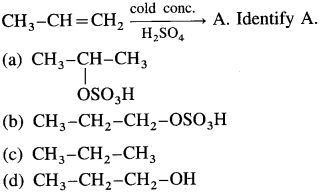
(2) Rationality, Continuity, Reasonability, Indivisibility.
(3) Sum, Aggregate, Total, Additional.
(4) Disutility, Negative utility. Maximum TU, Declining TU.
(5) Diminishing, Declining, Developing, ; Decreasing.
(6) Miser, Drunkard, Power, Rational consumer.
Answer:
(1) Date utility
(2) Indivisibility
(3) Additional
(4) Maximum TU
(5) Developing
(6) Rational consumer

(E) Complete the following statements.

Question 1.
Utility depends upon ………………..
(a) intensity of want
(b) income of a consumer
(c) quality of a product
(d) cardinal measurement
Answer:
(a) intensity of want

Question 2.
When TU declines, MU ……………………………..
(a) is zero
(b) increases
(c) remains constant
(d) becomes negative
Answer:
(d) becomes negative

Question 3.
Consumer’s equilibrium is attained when
(a) MUX > Px
(b) MUX = Px
(c) MUX < Px
(d) MUX = zero
Answer:
(b) MUX = Px

Maharashtra Board Class 12 Economics Important Questions Chapter 2 Utility Analysis

Question 4.
Electricity can be used in Fan, TV, iron, computer, etc. because utility is ……………
(a) subjective concept
(b) multi-purpose
(c) basis of demand
(d) morally colourless
Answer:
(b) multi-purpose

Question 5.
The sum of all marginal utilities from the consumption of a commodity is called ………………
(a) place utility
(b) additional utility
(c) total utility
(d) time utility
Answer:
(c) total utility

[F] Choose the wrong pair :

I.

Group ‘A’ Group ‘B’
1. Prof. Marshall Law of DMU
2. Total utility Utility from last unit
3. Cardinal measurement Assumption of law of DMU
4. Service utility Knowledge by teacher

Answer:
Wrong pair : Total utility – Utility from last unit

II.

Group ‘A’ Group ‘B’
1. Disutilit Negative MU
2. Homogeneity Identical unit
3. Law of DMU Explained by Prof. Gossen
4. Maximum TU Zero MU

Answer:
Wrong pair : Law of DMU
Explained by Prof. Gossen

[G] Choose the correct pair :

I.

Group ‘A’ Group ‘B’
1. Total utility (a) Point of Satiety
2. Zero MU (b) Furniture from wood
3. Time utility (c) Aggregate of utilities
4. Form utility (d) Apples for Kashmir
(e) Organ donation

Options :
(1) 1 – a, 2 – c, 3 – e, 4 – b.
(2) 1 – c, 2 – e, 3 – d, 4 – b.
(3) 1 – c, 2 – a, 3 – e, 4 – b.
(4) 1 – e, 2 – a, 3 – c, 4 – d.
Answer:
(3) 1 – c, 2 – a, 3 – e, 4 – b.

II.

Group ‘A’ Group ‘B’
1. Ordinal measurement (a)Maximum TU
2. Principles of Economics (b) MUX>PX
3. Point of satiety (c) Prof. Alfred Marshall
4. Consumer’s equilibrium (d) Grading of utility
(e) MUX = PX

Options :
(1) 1 – d, 2 – c, 3 – a, 4 – e.
(2) 1 – c, 2 – a, 3 – b, 4 – b.
(3) 1 – d, 2 – a, 3 – b, 4 – c.
(4) 1 – b, 2 – e, 3 – d, 4 – c.
Answer:
(1) 1 – d, 2 – c, 3 – a, 4 – e.

2.[A] Identify and explain the concept from given illustrations.

Question 1.
Tanvi took umbrella while going out as it started raining.
Concept: Time utility.
Explanation : When Utility of a commodity increases during particular time period, it is called time utility.
Tanvi is using umbrella, when it is raining Ans. so, it is an example of time utility.

Question 2.
A goldsmith made a beautiful golden necklace.
Answer:
Concept: Form utility.
Explanation : When utility is created due to change in the form of given material it is known as form utility.
So, furniture from wood, dress from cloth, jewellery from gold, etc. are examples of form utility.
Thus, necklace made from gold is an example of form utility.

Question 3.
Deepak purchased bricks and transported to Thane at his construction site.
Answer:
Concept : Place utility.
Explanation : When utility arises due to change in the place of its utilisation, it is called place utility.
Transport of goods creates place utility. In this example, bricks are transported from place of production to place of utilization. So it is an example of place utility.

Question 4.
Mugdha bought raw mangoes and made pickle from it.
Answer:
Concept: Form utility.
Explanation : When utility increases due to change in the shape, structure or form of material, it is called form utility. So, pickle made from raw mangoes, is an example of form utility.

Maharashtra Board Class 12 Economics Important Questions Chapter 2 Utility Analysis

Question 5.
Aditi went to Beauty Parlour to cut her hairs.
Answer:
Concept: Service utility.
Explanation : When service is provided by one person to another, it is called service utility.
It includes services rendered by professionals like doctors, lawyers, teachers, etc.
In this case, a beautician has given service to Aditi.
So, it is an example of service utility.

(B) Distinguish between

Question 1.
Utility and Usefulness.
Answer:

Utility Usefulness
1. Utility is the capacity of a commodity to satisfy human wants. (a) Anything (goods or services) are useful if they satisfy human want and generate human welfare.
2. A product may have utility irrespective of the commodity is useful or harmful, desirable or undesirable. (b) A product is useful only when it is desirable or beneficial and does not do any harm to a person.
3. All commodities have utility such as car, clothes, even harmful products like drugs, liquor, cigarettes, narcotics, etc. (c) Products such as food items, medicine, clothes, etc. are useful. Also services such as education, recreation are useful to people.
4. The term utility is subjective in nature as it changes from person to person, from place to place and from time to time. (d) The term usefulness is absolute in nature, it never changes.

Question 2.
Utility and satisfaction.
Answer:

Utility Satisfaction
1. Utility is a want satisfying capacity possessed by a commodity. (a) Satisfaction is actual realisation from consumption of a commodity.
2. It is what the commodity possesses. (b) It is what the commodity gives.
3. It is a means. (c) It is an end.
4. It is expected satisfaction before consumption. (d) It is actual realisation which comes after consumption.

Question 3.
Place Utility and Time Utility.
Answer:

Place Utility Time Utility
1. Place utility is created by changing the place of utilisation. (a) Time utility is created by changing the time of utilisation.
2. Transporting goods from one place to another, generally from place of abundance to place of scarcity, from place of manufacturing to place of consumption (Market), etc. (b) Storing of goods during abundance and releasing them during scarcity or goods are warehoused from time of production to time of consumption.
3. All types of transport service create place utility. (c) Warehousing service create time utility.
4. E.g. Food grains from village farm are sold in city markets. (d) E.g. Wheat stored during harvest time and released during off season.

Question 4.
Total Utility and Marginal Utility.
Answer:
Total Utility :

  1. Total utility is the sum total of utilities derived from the consumption of all units in a given stock of a commodity.
  2. TU =Σ MU
  3. TU increases but at a diminishing rate.
  4. At point of satiety TU is maximum.
  5. After point of satiety TU starts diminishing.
  6. Numerical value of TU is always positive.
  7. TU indicates value-in-use.
  8. When TU is maximum, the MU is zero.

Maharashtra Board Class 12 Economics Important Questions Chapter 2 Utility Analysis 1
Marginal Utility :

  1. Marginal utility is the additional utility derived from consuming additional unit of a commodity.
  2. MUn = TUn – TUn-1
  3. MU continuously diminishes.
  4. At point of satiety MU is zero.
  5. After point of satiety MU becomes negative.
  6. Numerical value of MU can be positive, negative or zero.
  7. MU indicates value-in-exchange.
  8. When the MU is maximum the TU is minimum.

Maharashtra Board Class 12 Economics Important Questions Chapter 2 Utility Analysis 2

Maharashtra Board Class 12 Economics Important Questions Chapter 2 Utility Analysis

Question 5.
Form Utility and Service Utiliity.
Answer:
Form Utility :

  1. Form utility arises when the structure of given material changes.
  2. Furniture made out of wood is an example of form utility.
  3. It is related to material welfare.
  4. Form utility is mainly created by artisans like tailor, carpenter, etc.

Service Utility :

  1. It arises when service is rendered by one person to another.
  2. Knowledge given by teacher to student is an example of service utility.
  3. It is related to non-material welfare.
  4. Service utility is mainly created by professionals like doctor, lawyers, etc.

Question 6.
Knowledge Utility and Possession Utility.
Answer:
Knowledge Utility:

  1. Knowledge utility arises when a person acquires knowledge regarding a product.
  2. Use of mobile, computer, etc. creates knowledge utility.
  3. In this case, a consumer is interested to know various functions of product.
  4. Knowledge utility increases due to utilisation.

Possession Utility:

  1. Possession utility arises when the ownership of a product is transferred from one person to another.
  2. Sale and purchase of goods creates possession utility.
  3. In this case, a consumer is interested to satisfy his wants.
  4. Possession utility increases due to demand.

Question 7.
Form Utility and Time Utility.
Answer:
Form Utility :

  1. Form utility arises when the structure of given material changes.
  2. E.g. Furniture made out of wood.
  3. Technology and intelligence creates form utility.

Time Utility:

  1. Time utility is created by changing the time of utilisation.
  2. E.g. Wheat stored during harvest season and released during off season.
  3. Warehousing creates time utility.

3. Answer the following questions:

Question 1.
Critically evaluate the law of Diminishing Marginal Utility.
OR
Explain the limitations or shorcomings of law of DMU.
Answer:
Critical evaluation of the Law of DMU is as follows:
(1) Unrealistic Assumptions : The law of DMU is based upon some unrealistic assumptions like homogeneity, continuity, rationality, constancy, etc.
In reality, it is very difficult to fulfil all these ssumptions at a time.

(2) Cardinal Measurement – not possible : The law assumes that, utility is cardinally measurable. It is necessary for the law to express schedule indicating MU and TU. It helps to add, subtract and compare utilities, In the real sense, utility is a psychological concept so it cannot be measured cardinally i.e. in numbers.

(3) Not applicable to Indivisible Goods : The law assumes divisibility. So it is not applicable to indivisible or bulky goods like car, T.V. set, house, etc. which are not divisible.
It is not possible to compare MU from commodity which are normally purchased, once in a life time.

(4) Constant MU of Money: The law assumes that MU of each unit of money is constant. But, in reality, MU of money declines as its stock increases.
Critics also argue that MU of money differs from person to person. It is affected by changes in price level, stock of money, rate of interest, etc.

(5) Restricted to satisfaction of Single Want : The law of DMU has limited applicability. It analyses the satisfaction derived from single want.
In reality, human wants are multiple in nature i.e. a person has to satisfy many wants at a time.
Though, law of DMU is criticized, it is important and popular in economics, because it explains economics behavior of a rational consumer.

Question 2.
Explain the significance importance of Law of Diminishing Marginal Utility.
Answer:
The law of DMU has universal applicability so it is an important law in economics.
Importance or significance of the law of DMU is as follows :

(1) Useful to Consumers : The law is important to the consumer because it helps the consumer to maximize his satisfaction.
It creates awareness among the consumers 5 to get maximum satisfaction with limited resources.

(2) Useful to the Government : The law ; guides the government in framing various economics policies like progressive tax policy, pricing policy, trade policy, import export policy, etc. so as to maximise
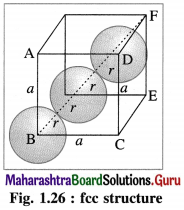
economic welfare of the society.

(3) To understand Paradox of Value : The law of DMU helps us to understand paradox of values, i.e. value-in-use and value-in-exchange.

Some goods have more value-in-use but less value-in-exchange like air, water, sunlight, etc. while some goods have less value-in-use but high value-in-exchange like gold, diamond, etc. Greater value-in-use denotes high total utility whereas, more value in exchange denotes higher marginal utility.

(4) Basis of Law of Demand : The law of demand is based on the law of DMU.
A consumer compares MU with price of a commodity. He purchases till MU equals price. When a consumer buys more and more units of a commodity, his MU diminishes. It means, a consumer would buy more only at a lower price which is a basis of law of demand.

Maharashtra Board Class 12 Economics Important Questions Chapter 2 Utility Analysis

Question 3.
Explain the features / characteristics of Utility.
Answer:
Maharashtra Board Class 12 Economics Important Questions Chapter 2 Utility Analysis 3
(1) Multi-purpose : Utility is said to be multi-purpose because a commodity can be used to satisfy several wants. It can satisfy wants of more than one person at a time.
E.g. milk has multi-purpose utility. It can be used to make coffee, ice- cream, milk-shake, tea, etc.
Similarly, in case of commodities like coal, electricity, etc. utility is multi-purpose.

(2) Relative Concept : Utility is a relativeconcept because it is related to time, place and person. It changes from time to time, place to place and from person to person.
E.g. fan has greater utility in summer than
winter, sweater has greater utility in cold regions.

(3) S ubjective Concept: Utility is a subjective term. It varies from person to person. It differs on the basis of taste and preferences, habits, likes, dislikes, profession, situation, etc. e.g. chalk has utility for teachers and not for doctors. Fish has utility for non¬vegetarian person etc.

(4) Basis of Demand : A person will demand only those commodities which give him utility. No utility means no demand, so utility is the basis of demand.
E.g. a student demands a book because he has utility of a book. Thus, utility creates demand for a product.

(5) Intensity of Want: Utility of a commodity is greater if a want is most urgent, whereas, utility is less if the intensity of want is less. Utility diminishes when the urgency of want declines. E.g. a thirsty person gets more utility from the first sip of water than the next one.

(6) Measurement of Utility : Utility is a psychological concept. So utility cannot be measured cardinally, that is, in numbers. Ordinal measurement, i.e. higher or lower level of utility can be measured.
E.g. a hungry person may experience higher or lower utility after having food. However, X it is assumed that cardinal measurement of i utility is possible, for the validity of the law 5 of diminishing marginal utility.

(7) Utility is morally Colourless : Utility is ethically neutral concept. It has no moral consideration. It is morally colourless. It does not consider whether a want is good or bad, moral or immoral, desirable or undesirable. A commodity can be used to satisfy any kind of want. It can be useful or harmful.
E.g. a knife can be used to cut vegetables, as well as, it can be also used to harm somebody. Thus, utility does not have ? ethical consideration.

(8) Utility differs from Usefulness : Utility and usefulness are different concepts. Utility means want satisfying capacity of a commodity whereas usefulness means use value of a commodity.
Some commodities have both, utility and usefulness. E.g. watch, pen, etc.
However, some commodities have utility but no usefulness.
e.g. cigarette has utility for those who smoke but it is not at all useful as it has an adverse effect on human health.

(9) Utility differs from Pleasure : There is a difference between utility and pleasure, Certain commodities which possess utility, may not give pleasure.
E.g. a course of injections given to patient, has utility because it cures him however, it may not give pleasure or happiness as it is a painful experience.

(10) Utility differs from Satisfaction : Utility and satisfaction, interrelated concepts but, utility is not same as satisfaction. Utility refers to power of a good to a satisfy human want. Satisfaction is a state of mind to feel happy.
Utility arises before the consumption of a commodity. However, satisfaction is received after the consumption of a commodity. It is because, utility is anticipated satisfaction, whereas, satisfaction is actual realisation.
Utility is related to commodity but satisfaction is experienced by a person.

Question 4.
What are the different types or forms of utility?
Answer:
Types of utility :

  1. Form utility
  2. Place utility
  3. Service utility
  4. Knowledge utility
  5. Possession utility
  6. Time utility

Types of utility are explained as under:

(1) Form utility : It arises due to a change in the shape of an object. When utility is created because of change in the structure or form of a given material, it is known as form utility.
E.g. furniture made of wood, dress from cloth, jewellery from gold, etc.

(2) Place utility : Utility changes from place to place. When utility arises due to change in the place of its utilisation, it is called as place utility. Transport of goods and services creates place utility.
E.g. utility of river water increases when it is diverted towards farm.
Shawls have greater utility in cold regions than any other place.

(3) Service utility : When service is provided by professionals to another person, it creates service utility. It includes services rendered by Doctor to patient, Lawyer to client, Teacher to student, etc.

(4) Knowledge utility : In this case, utility increases when a person acquires knowledge regarding specific product.
For example, when a consumer knows about various functions of a laptop, its utility increases, Similarly, use of mobile, computer, sewing machine etc. creates knowledge utility.

(5) Possession utility : It is related to the ownership of goods. When the ownership of a product is transferred from one person to another, it creates possession utility.
E.g. transfer of ownership of food grains from farmer to consumer.
Thus, possession utility arises when goods are transferred from sellers to buyers.

(6) Time utility : When utility of a commodity changes due to change in time period, it is called time utility.
E.g. an umbrella has greater time utility during rainy season.
Time utility also takes place when goods are stored and used as per the requirement. Time utility varies from season to season or from situation to situation.
So, blood donation creates time utility.

4. State with reasons whether you agree or disagree with the following statements:

Question 1.
Utility is a subjective concept.
Answer:
Yes, I agree with this statement.
It is a psychological concept. It is the mental assessment of a commodity. So utility differs from person to person because of difference in taste, preference, likes and dislikes of a person e.g., Chalks have more utility to a teacher than a student.

Maharashtra Board Class 12 Economics Important Questions Chapter 2 Utility Analysis

Question 2.
Utility and happiness are different.
Answer:
Yes, I agree with this statement.

  • Utility is want satisfying capacity of a commodity and happiness is an enjoyable experience.
  • When a commodity has utility it may not necessarily give happiness or pleasure or enjoyable experience to consumer. E.g., no one enjoys taking an injection or bitter medicine but they have utility to a patient.

Question 3.
Utility is ethically neutral.
OR
The concept of utility has no moral or ethical consideration. (Feb. ‘16)
Answer:
Yes, I agree with this statement.

  • Utility is morally colourless concept.
  • As long as a commodity possesses the want satisfying power, it has utility for a person irrespective of the fact that the commodity is good or bad, desirable or undesirable, moral or immoral.
  • e.g., Knife has the utility for both a killer (for stabbing) and a housewife (as kitchen appliance).
  • Similarly liquor has utility to a drunkard but from ethical point of view their consumption may be undesirable .

Question 4.
Utility means not usefulness.
Answer:
Yes, I agree with this statement.
Utility indicates the power of a good to satisfy human wants irrespective of whether it is good or bad or harmful. Whereas usefulness means that the commodity is beneficial or desirable. A commodity may have utility but may not be useful e.g., Cigarette is injurious to health. It is not useful but it has utility to a smoker.

Question 5.
Utility is a psychological term.
Answer:
Yes, I agree with this statement.

  • Utility relates to consumer’s mental attitude and experience regarding a given commodity.
  • So utility differs from person to person.
  • The utility of a good cannot be the same for all individuals.
  • This is due to difference in taste, preference, likes and dislikes.
  • E.g. fish has utility to non-vegetarian but not to a pure vegetarian.

Question 6.
Utility depends on urgency of want Or Utility depends upon intensity of want.
Answer:
Yes, I agree with this statement.

  • Utility for a commodity is dependent on the intensity of need for that commodity.
  • If a want is very intense or urgent for the commodity concerned then he will find more utility from the commodity.
  • As the intensity of want falls, its utility diminishes. For example first slice of bread will give more utility to a hungry person than the 2nd or 3rd slice of bread. Books have more utility to students just before exams and no utility after the exams.

Question 7.
Utility of same commodity for two c persons is different.
Answer:
Yes, I agree with this statement.

  • Utility is affected by personal likes, dislikes, preference, habits, etc.
  • Utility changes from person to person. It is subjective concept.
  • It is psychological feeling and subject to change from person to person.
  • E.g. Cigarette has utility to a smoker but it has no utility to non-smoker.
  • Marginal Utility diminishes.

Question 8.
Marginal Utility diminishes.
Answer:
Yes, I agree with this statement.

  • Marginal utility diminishes with increase in consumption of a commodity.
  • When the stock of the commodity increases the intensity of want decreases so the utility diminishes.
  • There is an inverse relation between the stock of commodity and.MU.
  • The law of DMU states “The additional benefit which a person derives from a given increase in the stock of a
  • thing, diminishes with every increase in the stock that he already has.

Question 9.
Utility can be measured cardinally.
Answer:
No, I do not agree with this statement.

  • Utility being a psychological concept it cannot be quantified in numbers such as 10, 20, 30 so on.
  • It is a feeling so can be only be expressed ordinally.
  • It can be expressed as 1st, 2nd, 3rd and so on, in order of preference or can be graded.
    It is intangible.
    But Marshall has assumed that utility can be measured in cardinal numbers to explain the law of Diminishing Marginal Utility but different concepts.

Question 10.
Utility and satisfaction are different concepts.
Answer:
Yes, I agree with this statement.

  • Utility is the quality possessed by the commodity before consumption of the goods. It is expected satisfaction.
  • Satisfaction is actual realisation, which is derived after the consumption.
  • Utility is the means and satisfaction is the end result of consumption.
  • Utility is what commodity possesses whereas satisfaction is what we experience after consumption.
  • Utility and satisfaction are synonyms but different concepts.

Maharashtra Board Class 12 Economics Important Questions Chapter 2 Utility Analysis

Question 11.
It is more appropriate to tax the rich in excess than the poor.
Answer:
Yes, I agree with this statement.

  • The law of diminishing marginal utility supports the progressive tax system.
  • The rich are taxed more because they can easily bear the burden of heavy tax as they have more stock of money. Therefore, they find less MU in money.
  • The poor have less stock of money. Therefore, they find more MU in money. So they are taxed less.
  • In this way the Government follows the “Principle of Equity” while taxing the people.
  • Also indirect tax on mass consumption goods or necessaries are less compared to the luxury goods.

Question 12.
The hobby of stamp collection is not a real exception to the law of Diminishing Marginal Utility.
Answer:
Yes, I agree with this statement.

  • It is wrongly believed that the hobby of stamp collection is an exception to the law of DMU.
  • It is observed that every successive stamp collected gives more MU to the person.
  • But in reality a person collects different types of stamps. Thus it violates the assumption of homogeneity and continuity.
  • If a person is asked to collect the same type of stamp again and again the MU will= diminish. Therefore, the hobby of stamp collection is not a real exception to law of DMU. It is an apparent exception.

Question 13.
There are no real exceptions to the law of DMU.
Answer:
Yes, I agree with this statement.
[Note : For answer refer Q.6. (1) (D)
Schedule and Diagram :
The law can be explained with the help of following schedule and diagram :

Units of Commodity Marginal Utility (M.U)
1 10
2 8
3 6
4 4
5 2
6 0
7 -2

The above given schedule shows that MU goes on diminishing with an increases in units of commodity consumed.
Graphical Presentation :
Maharashtra Board Class 12 Economics Important Questions Chapter 2 Utility Analysis 10
In the above given diagram, X-axis indicates units of commodity and Y-axis measures marginal utility.
Various points are plotted on the graph which indicates MU derived from each unit of commodity consumed.
When all these point are joined, we get MU curve. It slopes downward from left to right. It shows that MU diminishes as consumption of a commodity increases.
The shaded portion of the diagram shows negative utility. It is because, beyond a certain level, further consumption of a commodity results into disutility.

Question 14.
Law of DMU is important in practice.
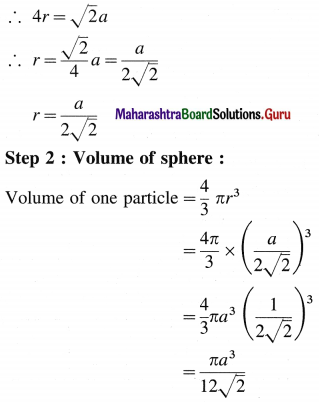
Answer:
Yes, I agree with this statement.
The law of DMU has universal applicability so it is an important law in economics. Importance or significance of the law of DMU is as follows :

(1) Useful to Consumers : The law is important to the consumer because it helps the consumer to maximize his satisfaction.
It creates awareness among the consumers 5 to get maximum satisfaction with limited resources.

(2) Useful to the Government : The law ; guides the government in framing various economics policies like progressive tax policy, pricing policy, trade policy, import export policy, etc. so as to maximise
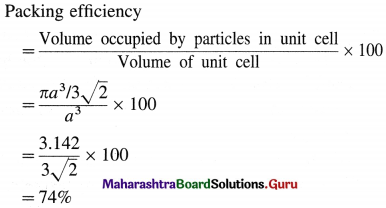
economic welfare of the society.

(3) To understand Paradox of Value : The law of DMU helps us to understand paradox of values, i.e. value-in-use and value-in-exchange.
Some goods have more value-in-use but less value-in-exchange like air, water, sunlight, etc. while some goods have less value-in-use but high value-in-exchange like gold, diamond, etc. Greater value-in-use denotes high total utility whereas, more value in exchange denotes higher marginal utility.
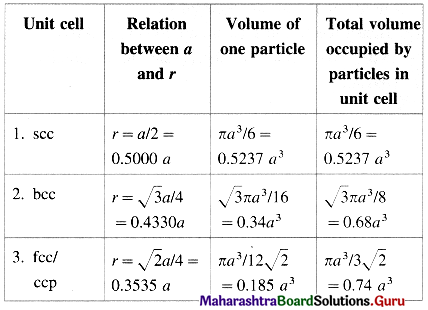
(4) Basis of Law of Demand : The law of demand is based on the law of DMU.
A consumer compares MU with price of a commodity. He purchases till MU equals price. When a consumer buys more and more units of a commodity, his MU diminishes. It means, a consumer would buy more only at a lower price which is a basis of law of demand.

Question 15.
(i) When the MU is zero, TU is maximum.
Answer:
Yes, I agree with this statement.
OR
(ii) When MU is zero, TU diminishes.
Answer:
No, I do not agree with this statement.

  • When MU is zero the TU is the maximum.
  • MU is the additional utility derived from the consumption of last unit of commodity.
  • The TU is the sum of utilities derived from all units of consumption.
  • The inter relationship between MU and TU can be explained with the help of the schedule.
    Units of Commodity Marginal Utility (M.U)
    1 10
    2 8
    3 6
    4 4
    5 2
    6 0
    7 -2

Maharashtra Board Class 12 Economics Important Questions Chapter 2 Utility Analysis 11

  • From the schedule it can be observed that when a consumer keeps on consuming the same commodity continuously the MU diminishes and TU increases but at a diminishing rate.
  • At the point of satiety i.e., unit 5 the consumer enjoys maximum satisfaction. Therefore, the MU becomes zero and TU reaches maximum i.e., 28 units.
  • Here the consumer is fully satisfied. If the consumer keeps on consuming further units of the commodity after satiety, he derives dissatisfactions. Therefore, the MU becomes Negative and TU also starts falling or decreasing.
  • Thus, at the point of full satisfaction MU is zero and it intersects the ‘X’ – axis and TU is maximum

Maharashtra Board Class 12 Economics Important Questions Chapter 2 Utility Analysis

Question 16.
The law of DMU could be explained type of stamp again and again the MU will with example and diagram.


OR The law of DMU can be explained with schedule and graph.
Answer:
Yes, I agree with this statement.
Schedule and Diagram :
The law can be explained with the help of following schedule and diagram :

Units of Commodity Marginal Utility (M.U)
1 10
2 8
3 6
4 4
5 2
6 0
7 -2

The above given schedule shows that MU goes on diminishing with an increases in units of commodity consumed.
Graphical Presentation :
Maharashtra Board Class 12 Economics Important Questions Chapter 2 Utility Analysis 10
In the above given diagram, X-axis indicates units of commodity and Y-axis measures marginal utility.
Various points are plotted on the graph which indicates MU derived from each unit of commodity consumed.
When all these point are joined, we get MU curve. It slopes downward from left to right. It shows that MU diminishes as consumption of a commodity increases.
The shaded portion of the diagram shows negative utility. It is because, beyond a certain level, further consumption of a commodity results into disutility.

Question 17.
The diminishing Marginal Utility Curve goes upwards means it has a positive slope
Answer:
No, I do not agree with this statement.
(a) The MU curve slopes downwards from left to right and it has a negative slope as shown in the diagram.
Maharashtra Board Class 12 Economics Important Questions Chapter 2 Utility Analysis 4
(b) The MU curve has a negative slope which indicates inverse relationship between the stock of the commodity and MU.
(c) The law states that the additional benefit which a person derives from a given increase in his stock of a thing diminishes with every increase in the stock that he already has.
(d) It means that the MU goes on diminishing with an increase in the stock of commodity consumed.
(e) It means that the intensity of want decreases.
(f) With increase in stock of commodity, the satisfaction derived decreases, so it has a negative slope.

Maharashtra Board Class 12 Economics Important Questions Chapter 2 Utility Analysis

Question 18.
The law of DMU depends upon assumptions.
Answer:
Yes, I agree with this statement.
OR
Homogeneity is the only assumption to law of DMU.
Answer:
No, I do not agree with this statement.

Assumptions of the law of DMU :
Assumptions are those conditions which are necessary for the validity of the law. They are as follows :

  • Cardinal Measurement: The law assumes that utility can be measured cardinally i.e. in numbers. So, it is possible to express and compare the utility derived from each unit of commodity consumed.
  • Homogeneity : It is assumed that all the units of commodity consumed are homogeneous or same. They are identical in case of size, shape, taste, colour, flavor, etc.
  • Rationality : A consumer is assumed to be rational. His behaviour is normal from economic’s point of view. It means, he tries to get maximum satisfaction.
  • Continuity : All units of commodity are consumed successively, one after another, without time interval.
  • Reasonability : The law assumes that, all the units of commodity consumed are reasonable in size. The unit of measurement is neither too big nor too small e.g. a cup of tea, glass of water, etc.
  • Divisibility : A commodity is assumed to be divisible. So it is possible to divide the units of commodity in a proper size.
  • Constancy : It is assumed that related factors like income, taste and preference, habits, choice of a consumer remain constant. MU of money is also assumed to be constant.
  • Single want: A given commodity is used to satisfy a single want of a person. So that it is possible to experience full satisfaction from a single want.

Question 19.
Marginal Utility and Total Utility are same.
Answer:
No, I do not agree with this statement.
MU and TU are different.
Total Utility :

  1. Total utility is the sum total of utilities derived from the consumption of all units in a given stock of a commodity.
  2. TU =Σ MU
  3. TU increases but at a diminishing rate.
  4. At point of satiety TU is maximum.
  5. After point of satiety TU starts diminishing.
  6. Numerical value of TU is always positive.
  7. TU indicates value-in-use.
  8. When TU is maximum, the MU is zero.

Maharashtra Board Class 12 Economics Important Questions Chapter 2 Utility Analysis 1
Marginal Utility :

  1. Marginal utility is the additional utility derived from consuming additional unit of a commodity.
  2. MUn = TUn – TUn-1
  3. MU continuously diminishes.
  4. At point of satiety MU is zero.
  5. After point of satiety MU becomes negative.
  6. Numerical value of MU can be positive, negative or zero.
  7. MU indicates value-in-exchange.
  8. When the MU is maximum the TU is minimum.
    Maharashtra Board Class 12 Economics Important Questions Chapter 2 Utility Analysis 2

Question 20.
There are no criticisms to the law of DMU.
Answer:
No, I do not agree with this statement.
Answer:
There are many criticisms / limitations.
Critical evaluation of the Law of DMU is as follows:

  • Unrealistic Assumptions : The law of DMU is based upon some unrealistic assumptions like homogeneity, continuity, rationality, constancy, etc.
    In reality, it is very difficult to fulfil all these assumptions at a time.
  • Cardinal Measurement – not possible : The law assumes that utility is cardinally measurable. It is necessary for the law to express schedule indicating MU and TU. It helps to add, subtract and compare utilities, concept so it cannot be measured cardinally i.e. in numbers.
  • Not applicable to Indivisible Goods : The law assumes divisibility. So it is not applicable to indivisible or bulky goods like car, T.V. set, house, etc. which are not divisible.
    It is not possible to compare MU from commodity which are normally purchased, once in a life time.
  • Constant MU of Money: The law assumes that MU of each unit of money is constant. But, in reality, MU of money declines as its stock increases.
    Critics also argue that MU of money differs from person to person. It is affected by changes in price level, stock of money, rate of interest, etc.
  • Restricted to satisfaction of Single Want The law of DMU has limited applicability. It analyses the satisfaction derived from single want.

In reality, human wants are multiple in nature i.e. a person has to satisfy many wants at a time.
Though, law of DMU is criticized, it is important and popular in economics, because it explains economics behavior of a rational consumer.

Question 21.
Utility is a relative concept.
Answer:
Yes, I agree with this statement.
Relative Concept : Utility is a relative concept because it is related to time, place and person. It changes from time to time, place to place and from person to person.
E.g. fan has greater utility in summer than winter, sweater has greater utility in cold regions.

5. Study the following table / figures / passages and answer the questions :

Question 1.
Observe the given table and answer the questions:

Units of Com. ‘X’ MU TU
1 12 12
2 8 20
3 5 25
4 3 28
5 0 28
6 -2 26

(1) Draw MU and TU curve with the help of given schedule.
Answer:
Maharashtra Board Class 12 Economics Important Questions Chapter 2 Utility Analysis 5

(2) What is TU at zero MU?
Answer:
T.U. is maximum, at zero MU.

Maharashtra Board Class 12 Economics Important Questions Chapter 2 Utility Analysis

(3) Complete the sentence :
With an increase in consumption, MU goes on diminishing and TU …..
Answer:
With an increase in consumption, MU goes on diminishing and TU goes on increasing at a diminishing rate.

(4) What happens to MU when TU falls?
Answer:
MU becomes negative when TU falls.

Question 2.
Observe the given table and answer the questions:

Units of Com. ‘X’ TU Units MU Units
1 6 6
2 11 5
3 15 4
4 15 0
5 14 -1

(1) Draw TU and MU curve.
Answer:
Maharashtra Board Class 12 Economics Important Questions Chapter 2 Utility Analysis 6

(2) Fill in the blanks :
(a) When total utility is maximum marginal utility is ……………..
Answer:
When total utility is maximum marginal utility is zero.

(b) When total utility falls, marginal utility becomes ……..
Answer:
When total utility falls, marginal utility becomes negative.

6. Answer in detail:

Question 1.
Explain the relationship between MU and Price.
Answer:
The relationship between MU & Price helps to understand, how the law of DMU forms ’ the basis of law of demand.
It is a perfect example of application of law of DMU practically. In this case, MU is converted in terms of money to understand this relationship and the comparison between MU & price.

Let us assume that 1 unit of MU = ₹ 10/- Market price per unit of commodity x = ₹ 50/- The table given below, explains the relationship between MU and price. It helps to know consumers equilibrium.
Maharashtra Board Class 12 Economics Important Questions Chapter 2 Utility Analysis 7

The above given table indicates that a consumer purchase units of commodity ‘x’ one after another. 2nd column shows MU derived from each unit. It goes on diminishing with every unit of commodity consumed.
To compare MU with price, it is necessary to ) convert MU in terms of money.
Let us assume that, 1 unit of MU = ₹ 10/- So, units of MU multiplied by ₹ 10/- (as shown in column

Market price of each unit of commodity ‘x’ is ₹ 50/- (as shown in column 4)
Column 5 shows comparison between MU and price.
It is observed that, for the first and second unit, MU (in terms of money) is greater than the price paid for them it means MUx > Px.

So, a rational consumer will be willing to buy 1st and 2nd unit of commodity ‘x’.
At the 3rd unit a commodity ‘x’ MU equals ) the price. So, the consumer can also think of purchasing it. Here, MUx = Px.
But, in case of 4th and 5th unit, MU is less than price. Therefore, a rational consumer will not purchase these units because MUx < Px

The relationship between MU and price can be summarised as follows :

1. When MU is greater than price, a consumer is willing to buy those units. They are called Intra- Marginal units (MUx > Px).

2. When MU becomes equal to market price, a consumer can also think of buying that unit. It is called Marginal unit (MUx = Px = Consumer’s equilibrium).

3. When MU is less than price, a rational consumer is not willing to buy them. They are called Extra-marginal units (MUx < Px) Thus, a rational consumer attains equilibrium where MUx = Px.
The relationship between MU and price helps to understand the law of demand.

Question 2.
Explain the various concepts of Utility.
Answer:
There are two main concepts of utility :
Marginal Utility (MU)
Total Utility (TU)
They are explained as follows :

1. Marginal Utility (MU) : MU refers to the additional utility derived by a consumer from the last unit of a commodity consumed. In simple words, MU is the addition made by one more unit of a commodity consumed.

2. Total Utility (TU) : TU means the sum of utilities derived by a consumer from all units of commodity consumed.
It is an aggregate of utilities derived from all units.
Symbolically, it can be represented as follows :
MU = Marginal Utility
TU Total Utility
MU1, MU2 , MU3, = Marginal Utilities
derived from each unit.
MUn = Marginal utility of nth unit.
MUn = TUn -TU(n-1)
TUn = Total utility of nth unit.

TU(n-1) = Total utility of nth previous unit.
TUn = ΣMUn or
TUn = MU1 + MU2 + …………………. +MUn
TU of nth unit = Summation of marginal utilities up to nth unit.

Maharashtra Board Class 12 Economics Important Questions Chapter 2 Utility Analysis

Question 3.
Explain the relationship between MU and TU.
Answer:
MU & TU are inter-related concepts but there is a difference between MU and TU because MU shows utility derived from each unit whereas, TU indicates summations of marginal utilities.
It can be explained with the help of following schedule –
Maharashtra Board Class 12 Economics Important Questions Chapter 2 Utility Analysis 8
The above given schedule indicates MU derived from each successive unit & TU – summation of MU’s.
On the basis of given schedule, MU curve and TU curve can be drawn, as shown in the following diagram.
Maharashtra Board Class 12 Economics Important Questions Chapter 2 Utility Analysis 9

In the given diagram X’ axis indicates units of commodity and ‘Y’ axis measures TU & MU.
MU curve slopes downward whereas; TU curve goes upward.
MU curve shows zero and negative level of satisfaction whereas, TU curve shows maximum level of satisfaction.
The relationship between MU and TU can be summarized as follows:

  1. When the 1st unit of commodity is consumed, MU is equal to TU. (MU = TU)
  2. From 2nd consumption, MU goes on diminishing and TU increases at a diminishing rate. (MU↓↓↓. and TU ↑↑↑)
  3. At a full satisfaction level, MU becomes zero & TU reaches at maximum level. It becomes constant. It is called point of satiety. (MU zero, TU maxm)
  4. After a point of satiety, any additional consumption of unit results into negative MU while TU starts declining.
    (MU —ve, TU↓)
  5. If any unit of commodity consumed beyond the point of satiety, consumer experiences dissatisfaction.