Maharashtra Board 12th BK Important Questions Chapter 3 Reconstitution of Partnership (Admission of Partner)

Balbharti Maharashtra State Board 12th Commerce Book Keeping & Accountancy Important Questions Chapter 3 Reconstitution of Partnership (Admission of Partner) Important Questions and Answers.

Maharashtra State Board 12th Commerce BK Important Questions Chapter 3 Reconstitution of Partnership (Admission of Partner)

1. Objetive type questions.

A. Select appropriate alternatives from those given below and rewrite the sentences.

Question 1.
If an asset is depreciated, Revalutation Account is ______________
(a) debited
(b) credited
(c) debited and credited
(d) none of these
Answer:
(a) debited

Question 2.
______________ Account is debited when unrecorded liability is brought into business.
(a) Liability
(b) Revaluation
(c) Capital
(d) Current
Answer:
(b) Revaluation

Maharashtra Board 12th BK Important Questions Chapter 3 Reconstitution of Partnership (Admission of Partner)

Question 3.
The proportion in which old partners make a sacrifice is called ______________ Ratio.
(a) Capital
(b) Gaining
(c) Sacrifice
(d) New
Answer:
(c) Sacrifice

Question 4.
The ______________ Ratio is useful for making adjustment for goodwill among the old partners.
(a) New
(b) Sacrifice
(c) Old
(d) Profit and Loss
Answer:
(b) Sacrifice

Question 5.
Krishna and Balram, who are equal partners, admit Arjun into a partnership for 1/4th share, their new profit sharing ratio will be ______________
(a) 3 : 3 : 1
(b) equal
(c) 3 : 3 : 2
(d) 2 : 2 : 1
Answer:
(c) 3 : 3 : 2

Question 6.
In case of admission of a partner, the profit or loss on revaluation of assets and liabilities is shared by ______________ partners.
(a) all
(b) old
(c) new
(d) none of these
Answer:
(b) old

Question 7.
When the reserve funds is distributed to old partners, the ______________ Account is debited.
(a) Capital
(b) Current
(c) Reserve Fund
(d) Profit and Loss
Answer:
(c) Reserve Fund

Maharashtra Board 12th BK Important Questions Chapter 3 Reconstitution of Partnership (Admission of Partner)

Question 8.
Goodwill brought in by a new partner is shared by the old partners in their ______________ Ratio.
(a) New
(b) Gain
(c) Sacrifice
(d) Balance of 1
Answer:
(c) Sacrifice

Question 9.
______________ Ratio is a ratio surrendered by old partners in favour of a new partner.
(a) Sacrifice
(b) Gain
(c) New
(d) Old
Answer:
(a) Sacrifice

Question 10.
When goodwill is written off, partners’ capital accounts are ______________
(a) credited
(b) debited
(c) increase
(d) none of these
Answer:
(b) debited

Question 11.
X and Y are equal partners, admit Z into the partnership. If Z’s share is 1/5th, the new profit sharing ratio of the partners will be ______________
(a) 3 : 2 : 1
(b) 4 : 2 : 1
(c) 3 : 3 : 2
(d) 2 : 2 : 1
Answer:
(d) 2 : 2 : 1

Question 12.
A and B who are equal partners admit C into the partnership for 1/7th share. The new profit sharing ratio of the partners will be ______________
(a) 3 : 3 : 2
(b) 3 : 3 : 1
(c) 1 : 2 : 3
(d) 4 : 2 : 1
Answer:
(b) 3 : 3 : 1

Maharashtra Board 12th BK Important Questions Chapter 3 Reconstitution of Partnership (Admission of Partner)

Question 13.
If prepaid expenses are to be recorded in the books of account, they should be shown on the ______________ side of Revaluation A/c.
(a) debit
(b) credit
(c) liabilities
(d) assets
Answer:
(b) credit

Question 14.
If an asset is appreciated, Revaluation Account is ______________
(a) debited
(b) credited
(c) depreciated
(d) neutralised
Answer:
(b) credited

B. Write a word/phrase/term which can substitute each of the following statements.

Question 1.
The account shows the change in the values of assets.
Answer:
Revaluation Account or Profit and Loss Adjustment Account

Question 2.
The credit balance of the Revaluation Account.
Answer:
Profit on Revaluation Account

Question 3.
Excess of actual capital over proportionate capital.
Answer:
Surplus Capital

Question 4.
Name of an intangible asset having a value.
Answer:
Goodwill

Maharashtra Board 12th BK Important Questions Chapter 3 Reconstitution of Partnership (Admission of Partner)

Question 5.
The account is debited when the new partner brings cash for his share of goodwill.
Answer:
Cash/Bank Account

Question 6.
The account is credited when goodwill is withdrawn by old partners.
Answer:
Cash/Bank Account

Question 7.
Profit and Loss Account appearing on the Asset side of a balance sheet.
Answer:
Undistributed Loss

Question 8.
The account is opened to record the gains and losses on revaluation.
Answer:
Profit and Loss Adjustment Account

Question 9.
Change in the relationship between the partners.
Answer:
Reconstitution of a Partnership

Question 10.
An account is credited when a new partner brings cash for his share of goodwill.
Answer:
Goodwill A/c

Question 11.
A fund created by the partnership firm out of profit as a precautionary measure.
Answer:
General Reserve/Reserve Fund

Maharashtra Board 12th BK Important Questions Chapter 3 Reconstitution of Partnership (Admission of Partner)

Question 12.
The ratio in which the old partners share the amount brought in by the new partner towards goodwill.
Answer:
Sacrifice Ratio

Question 13.
The ratio in which the Goodwill A/c may be written off after admission of a partner.
Answer:
New Profit and Loss Ratio

Question 14.
An account was opened for the Revaluation of Assets and Liabilities.
Answer:
Profit and Loss Adjustment A/c or Revaluation A/c

Question 15.
Debit balance of Revaluation Account.
Answer:
Loss on revaluation of assets and liabilities

Question 16.
An amount by which the actual capital of a partner exceeds his Proportionate capital.
Answer:
Surplus capital/Excess capital

Question 17.
An amount by which the proportionate capital of a partner exceeds his actual capital.
Answer:
Deficit or Deficiency in capital

C. State True or False with reasons.

Question 1.
The credit balance of the Revaluation Account means a loss on revaluation of assets and liabilities.
Answer:
This statement is False.
The credit balance of the Revaluation Account means profit on revaluation of assets and liabilities. Revaluation A/c is nominal A/c. On the credit side of this A/c, all incomes and gains are recorded. The credit balance means the credit amount is more than the debt amount. Hence, the credit balance of the Revaluation Account is profit on the revaluation of assets and liabilities.

Question 2.
If the Goodwill Account is raised up, Goodwill Account is debited.
Answer:
This statement is True.
As per the rules of Accountancy when the value of an asset increases or raises, its account is debited in the books of account. Goodwill is an Asset.

Maharashtra Board 12th BK Important Questions Chapter 3 Reconstitution of Partnership (Admission of Partner)

Question 3.
On admission of a partner, the amount of goodwill brought in cash is credited to Goodwill Account.
Answer:
This statement is True.
When newly admitted partner brought cash for goodwill, Cash/Bank Account is debited as it comes in and Goodwill Account is credited and afterward, Goodwill Account will be debited when benefits of Goodwill are transferred to old partners’ Capital Accounts.

Question 4.
The new partner is entitled to receive a share in the general reserve of the existing partnership firm.
Answer:
This statement is False.
General reserve is the amount kept aside from the part and current profit earned by the business for future business development purposes. Hence on this amount, the new partner has no right. Therefore new partner is not entitled to receive a share in general reserve.

Question 5.
On admission of a partner, the profit or loss on revaluation is distributed among the old partners.
Answer:
This statement is True.
At the time of admission of a new partner, existing assets and liabilities of the business are to be revalued and whatever the profit or loss is there it is to be distributed among old partners only.

Question 6.
The goodwill brought in by a new partner is shared by the old partner.
Answer:
This statement is True.
The reputation of business measured in terms of money is known as goodwill and on this, old partners have right so when goodwill is brought in by a new partner in the business, it is shared by the old partner.

Question 7.
The new ratio minus the old ratio is equal to the gain ratio.
Answer:
This statement is True.
At the time of Retirement or Death of a partner, existing partners may have some gain, which is found out by the Gain ratio = New ratio – Old ratio.

Question 8.
When a partner takes away any asset from the business, his account will be debited.
Answer:
This statement is True.
When a partner takes away any asset from the business, Asset Account will be credited and the Partner’s Account will be debited as it decreases the partner’s capital.

Maharashtra Board 12th BK Important Questions Chapter 3 Reconstitution of Partnership (Admission of Partner)

Question 9.
Average profit means profit that is earned over and above the normal profit.
Answer:
This statement is False.
When a firm earns extra profit over and above the normal profit because of the reputation of the firm then it is known as a super profit and not average profit.

D. Answer in one sentence.

Question 1.
What is meant by the admission of a partner?
Answer:
A process in which a new person is taken into the partnership firm as a partner is called admission of a partner.

Question 2.
In what proportion is general reserve distributed among the old partners?
Answer:
On admission of a new partner, the amount of general reserve is distributed among the old partners in their old profit sharing ratio.

Question 3.
How is the sacrifice ratio calculated?
Answer:
The sacrifice ratio is calculated by deducting the new ratio of the partner from his old ratio.
Formula:
Sacrifice ratio = Old ratio – New ratio.

Question 4.
What does credit balance on Profit and Loss Adjustment A/c or Revaluation A/c show?
Answer:
A credit balance on Profit and Loss Adjustment A/c or Revaluation A/c shows a profit on revaluation of assets and liabilities.

Question 5.
In which ratio do the old partners share the profit or loss made on revaluation of assets and liabilities of the firm?
Answer:
The profit or loss made on revaluation of assets and liabilities of the firm is shared by old partners in their old profit sharing ratio.

Maharashtra Board 12th BK Important Questions Chapter 3 Reconstitution of Partnership (Admission of Partner)

Question 6.
What is General Reserve or Reserve Fund?
Answer:
A fund created by keeping aside a part of profit every year to provide timely finance for unforeseen contingencies like fire, flood, earthquake, change in Government policy, etc. is called General Reserve or Reserve Fund.

Question 7.
Who shares the amount of general reserve on the admission of a new partner?
Answer:
On admission of a new partner, the amount of general reserve is shared by old partners only.

Question 8.
On what single factor does the valuation of goodwill primarily depend?
Answer:
The most important factor of the valuation of goodwill is the profit earning capacity of the firm.

Solved Problems

Question 1.
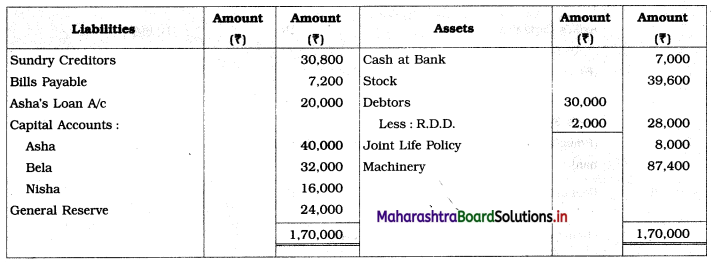
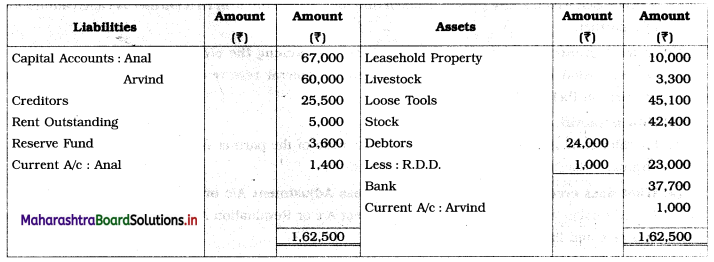
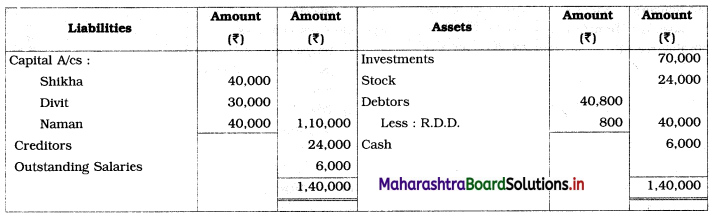
The Balance Sheet of Anal and Arvind who shared the profits in the ratio of 2 : 1 is as under:
Balance Sheet as of 31st March 2019
Maharashtra Board 12th BK Important Questions Chapter 3 Reconstitution of Partnership (Admission of Partner) Q1
On 1st April 2019 Zalak was admitted as 1/4th partner on the following terms:
1. She brings equipment of ₹ 40,000 as her capital.
2. Firm’s goodwill is valued at ₹ 72,000 and Zalak agreed to bring her share in the firm’s goodwill by cheque.
3. R.D.D. should be maintained at 7.5% on debtors.
4. Increase the value of livestock by ₹ 1,300 and write off loose tools by 20%.
5. Outstanding rent paid ₹ 4,520 in full settlement.
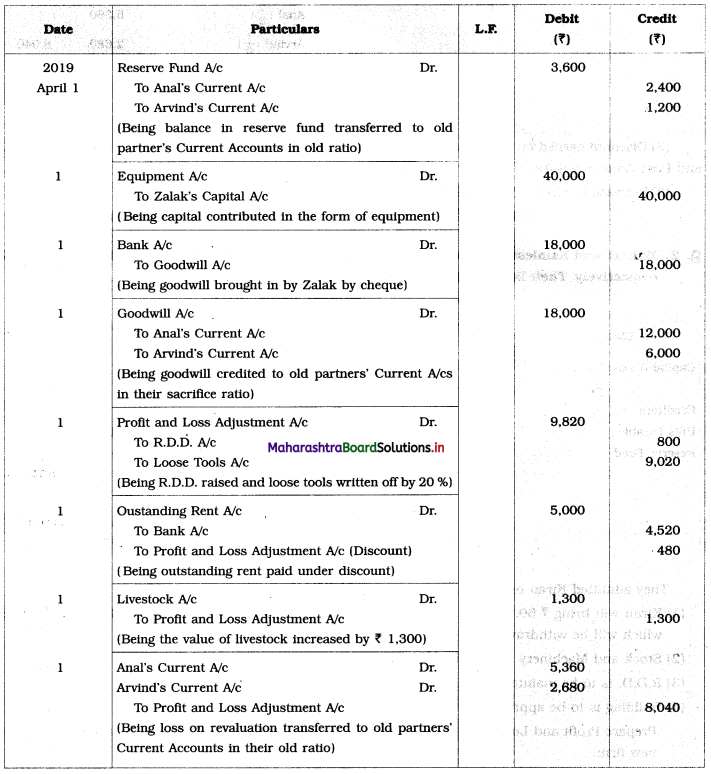
Pass necessary journal entries to record the above scheme of admission.
Solution:
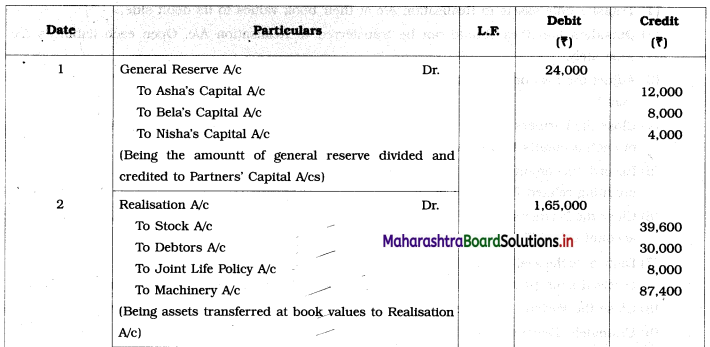
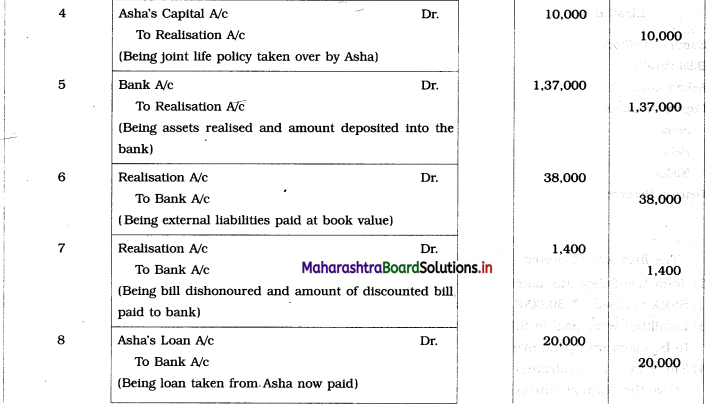
Journal entries in the books of partnership firm
Maharashtra Board 12th BK Important Questions Chapter 3 Reconstitution of Partnership (Admission of Partner) Q1.1
Working Notes:
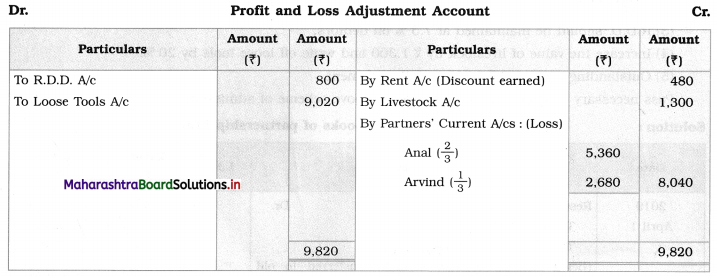
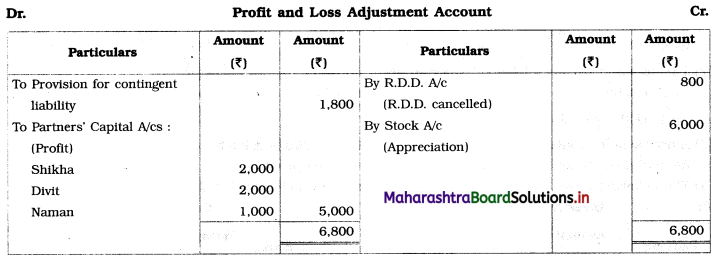
1. To find out Profit or Loss made on revaluation of assets and liabilities, Profit and Loss Adjustment A/c is prepared:
Maharashtra Board 12th BK Important Questions Chapter 3 Reconstitution of Partnership (Admission of Partner) Q1.2
2. Discount earned on payment of outstanding Rent = 5,000 – 4,520 = ₹ 800.
It is credited to Profit and Loss-Adjustment A/c.

3. Increase in RDD = New RDD – Old RDD
= 7.5% on 24,000 – 1,000.
= 1,800 – 1,000
= ₹ 800.
It is debited to Profit and Loss-Adjustment A/c

Maharashtra Board 12th BK Important Questions Chapter 3 Reconstitution of Partnership (Admission of Partner)

Question 2.
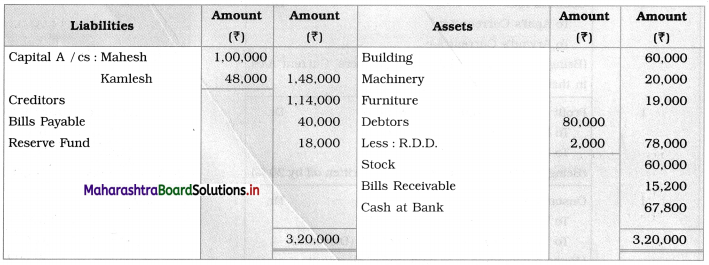
Mahesh and Kamlesh are partners in a business sharing profits and losses in the ratio of 2 : 1 respectively. Their Balance Sheet as of 31st March 2019 is as follows:
Balance Sheet as of 31st March 2019
Maharashtra Board 12th BK Important Questions Chapter 3 Reconstitution of Partnership (Admission of Partner) Q2
They admitted Kiran on 1st April 2019 as a partner on the following terms:
1. Kiran will bring ₹ 60,000 as his capital for 1/4th share in future profit and ₹ 24,000 as goodwill which will be withdrawn by old partners.
2. Stock and Machinery are to be depreciated by 10%.
3. R.D.D. is to be maintained at 5% on debtors.
4. Building is to be appreciated by 20% and Furniture is revalued at ₹ 20,000.
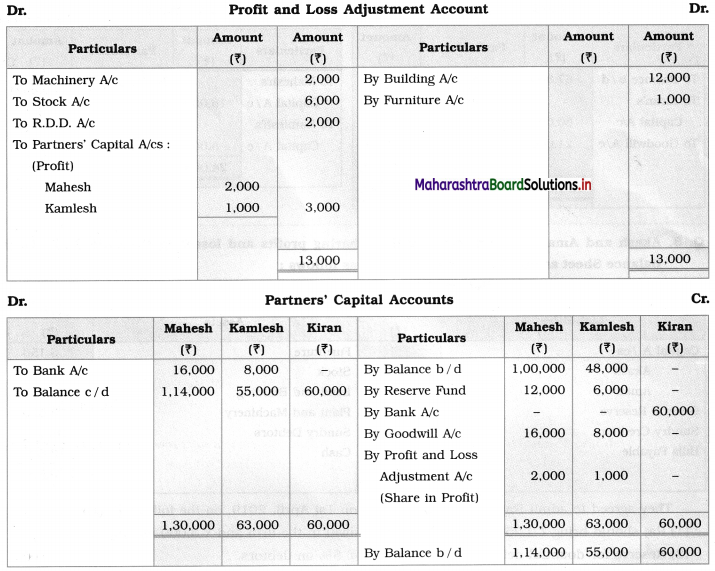
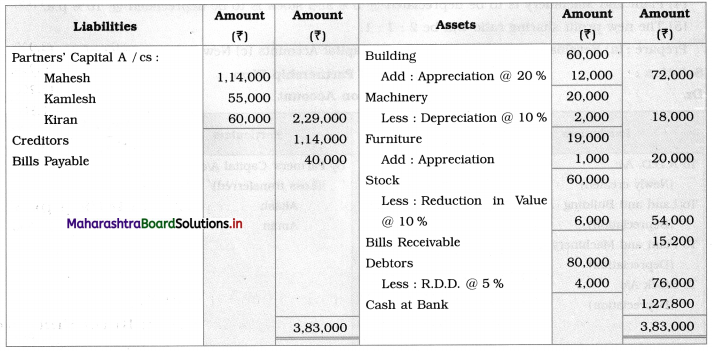
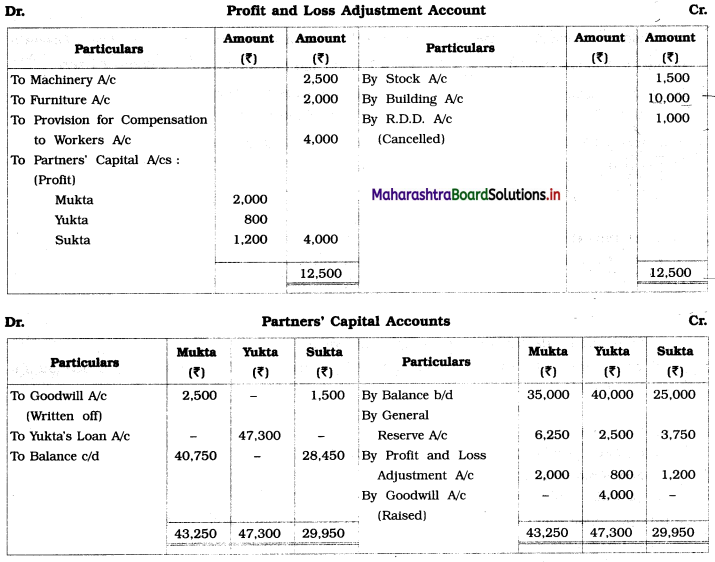
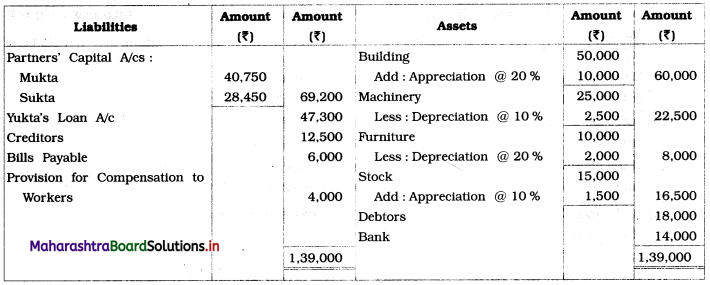
Prepare Profit and Loss Adjustment Account, Partners’ Capital Accounts, and Balance Sheet of the new firm.
Solution:
In the books of partnership firm
Maharashtra Board 12th BK Important Questions Chapter 3 Reconstitution of Partnership (Admission of Partner) Q2.1
Balance Sheet as of 1st April 2019
Maharashtra Board 12th BK Important Questions Chapter 3 Reconstitution of Partnership (Admission of Partner) Q2.2
Working Notes:
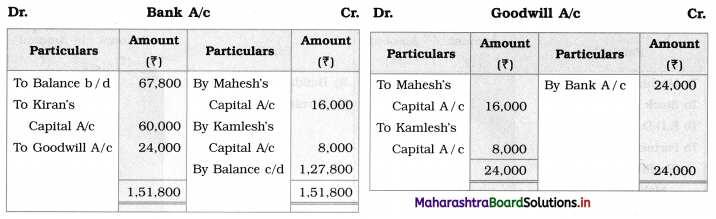
Maharashtra Board 12th BK Important Questions Chapter 3 Reconstitution of Partnership (Admission of Partner) Q2.3

Question 3.
Akash and Aman are partners in firm sharing profits and losses in the ratio 3 : 2. Their Balance Sheet as of 31st March 2019 was as follows:
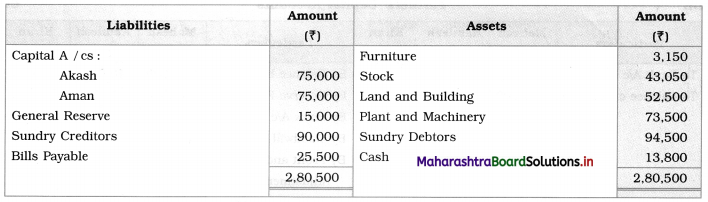
Balance Sheet as of 31st March 2019
Maharashtra Board 12th BK Important Questions Chapter 3 Reconstitution of Partnership (Admission of Partner) Q3
They agreed to admit Raj in their partnership on 1st April 2019, on the following terms:
1. Raj should bring ₹ 2,250, as his share of goodwill in the firm and ₹ 3,000 as his capital.
2. Reserve for doubtful debts is to be provided @ 5% on debtors.
3. Land and building are to be depreciated at 10% p.a.
4. Plant and Machinery is to be depreciated @ 5% and stock is to be depreciated @ 10% p.a.
5. The new profit sharing, the ratio will be 2 : 1 : 1.
Prepare:
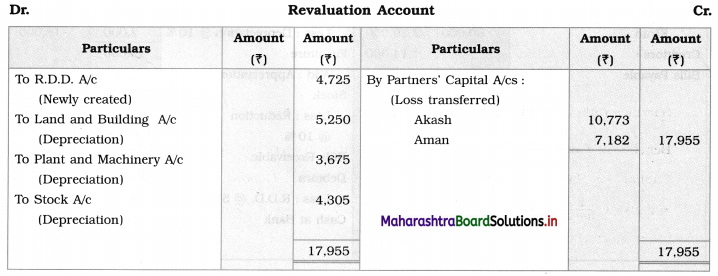
(a) Revaluation Account
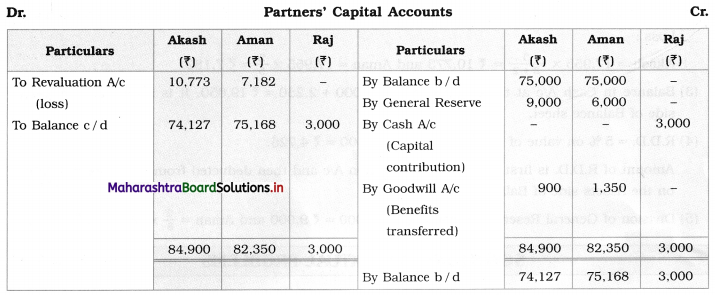
(b) Partners’ Capital Accounts
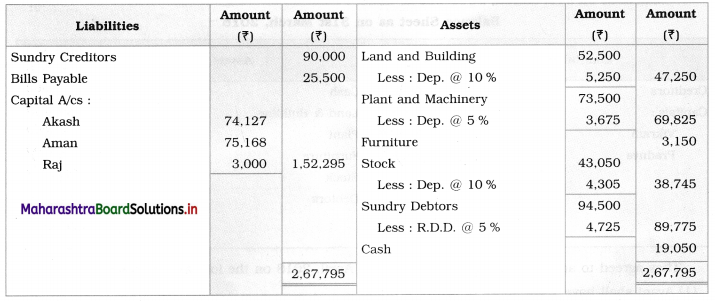
(c) New Balance Sheet of the firm.
Solution:
In the books of Partnership Firm
Maharashtra Board 12th BK Important Questions Chapter 3 Reconstitution of Partnership (Admission of Partner) Q3.1
Maharashtra Board 12th BK Important Questions Chapter 3 Reconstitution of Partnership (Admission of Partner) Q3.2
Balance Sheet as of 1st April 2019
Maharashtra Board 12th BK Important Questions Chapter 3 Reconstitution of Partnership (Admission of Partner) Q3.3
Working Notes:
1. Calculation of sacrifice ratio of old partners:
Old ratio: Akash = \(\frac{3}{5}\) and Aman = \(\frac{2}{5}\)
New ratio: Akash = \(\frac{2}{4}\) and Aman = \(\frac{1}{4}\)
Sacrifice ratio = Old ratio – New ratio
Akash’s sacrifice ratio = \(\frac{3}{5}-\frac{2}{4}=\frac{12-10}{20}=\frac{2}{20}\)
Aman’s sacrifice ratio = \(\frac{2}{5}-\frac{1}{4}=\frac{8-5}{20}=\frac{3}{20}\)
Sacrifice ratio of Akash and Aman = \(\frac{2}{20}\) : \(\frac{3}{30}\) i.e. 2 : 3.
Benefits of Goodwill of ₹ 2,250 distributed and transferred to Akash’s Capital A/c and Aman’s Capital A/c in their sacrifice ratio (which is 2 : 3).
Goodwill credited to Akash’s Capital = 2,250 × \(\frac{2}{3+2}\) = ₹ 900
and Aman’s Capital = 2,250 × \(\frac{3}{5}\) = ₹ 1,350.

2. Debit balance of Revaluation of ₹ 17,955 indicates Loss on revaluation.
Division of Revaluation Loss:
Akash = 17,955 × \(\frac{3}{3+2}\) = ₹ 10,773
and Aman = 17,955 × \(\frac{2}{5}\) = ₹ 7,182.

3. Balance in Cash A/c at the end = 13,800 + 3,000 + 2,250 = ₹ 19,050.
It is shown on the Assets side of the Balance sheet.

Maharashtra Board 12th BK Important Questions Chapter 3 Reconstitution of Partnership (Admission of Partner)

4. R.D.D. = 5 % on value of Debtors = \(\frac{5}{100}\) × 94,500 = ₹ 4,725.
Amount of R.D.D. is first debited to Revaluation A/c and then deducted from the value of Debtors on the Assets side of Balance Sheet.

5. Division of General Reserve:
Akash = \(\frac{3}{5}\) × 15,000 = ₹ 9,000
and Aman = \(\frac{2}{5}\) × 15,000 = ₹ 6,000.

Maharashtra Board Class 12 Chemistry Important Questions Chapter 8 Transition and Inner Transition Elements

Balbharti Maharashtra State Board 12th Chemistry Important Questions Chapter 8 Transition and Inner Transition Elements Important Questions and Answers.

Maharashtra State Board 12th Chemistry Important Questions Chapter 8 Transition and Inner Transition Elements

Question 1.
What are d-block elements? Give their general electronic configuration.
Answer:
Definition : d-block elements are defined as the elements in which the differentiating electron enters d-orbital of the penultimate shell i.e. (n – 1) d-orbital where ‘n is the last shell.

The general electronic configuration can be represented as, (n – n) dn – 10, nsn – 2

Maharashtra Board Class 12 Chemistry Important Questions Chapter 8 Transition and Inner Transition Elements

Question 2.
What is the position of the transition elements in the periodic table?
Answer:
The transition elements are placed in periods 4 to 7 and groups 3 to 12 of the periodic table.

Question 3.
In which block of the modern periodic table are the transition elements placed?
Answer:
Transition elements are placed in d-block of the modern periodic table.

Question 4.
Why are most of the d-block elements called transition elements?
Answer:

  • d-block elements have electronic configuration,(n – n) dn – 10, nsl – 2. They are all metals.
  • In the periodic table, they are placed between the ,s-block and p-block elements, i.e., in the groups between 2 and 13.
  • They show characteristic properties which are intermediate between those of the elements of s-block and p-block.
  • Hence, they show a transition in the properties from those of the most electropositive .v-block elements and less
  • electropositive (or electronegative) p-block elements.
  • Therefore, most of the d-block elements are called transition elements.

Question 5.
How many series of d-block elements are present in the long-form periodic table? Give their general electronic configuration.
Answer:
There are four series of d-block elements which are placed between 5 and p-block elements in the long-form periodic table as follows :

d-series Period Electronic configuration
(1) 3d-series fourth [Ar] 3d1 – 10, 4s1 – 2
(2) 4d-series fifth [Kr] 4d1 – 10, 5s1 – 2
(3) 5d-series sixth [Xe] 4f14 5d1 – 10 6s1 – 2
(4) 6d- series seventh [Rn] 5f14 6d1 – 10 7s2

Modern periodic table :
Maharashtra Board Class 12 Chemistry Solutions Chapter 8 Transition and Inner Transition Elements 1

Maharashtra Board Class 12 Chemistry Important Questions Chapter 8 Transition and Inner Transition Elements

Question 6.
Represent the elements in the four series of transition elements.
Answer:
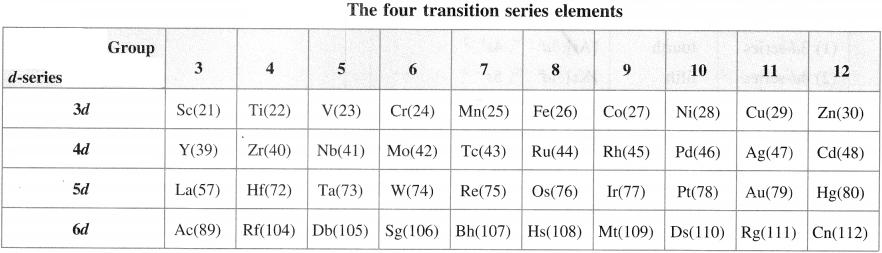
Maharashtra Board Class 12 Chemistry Solutions Chapter 8 Transition and Inner Transition Elements 2

Question 7.
In which period of the periodic table, will an element, be found whose differentiating electron is a 4d-electron?
Answer:
An element whose differentiating electron is a 4d-electron will be present in fifth period of the periodic table.

Question 8.
Write the condensed electronic configuration of each series of transition elements.
Answer:
Condensed Electronic Configuration of Transition Elements
Maharashtra Board Class 12 Chemistry Solutions Chapter 8 Transition and Inner Transition Elements 3
Maharashtra Board Class 12 Chemistry Solutions Chapter 8 Transition and Inner Transition Elements 4

Maharashtra Board Class 12 Chemistry Important Questions Chapter 8 Transition and Inner Transition Elements

Question 9.
Write expected and observed electronic configuration of 3d-series block elements.
Answer:
Electronic configuration of 3d-series of d-block elements
Maharashtra Board Class 12 Chemistry Solutions Chapter 8 Transition and Inner Transition Elements 5

Question 10.
Explain why transition elements with electronic configuration 3d44s2 and 3d94s2 do not exist.
Answer:
(1) d-orbitals are degenerate orbitals and they acquire extra stability when half-filled (3d5) or completely filled (3d10). Hence 3d4 and 3d9 electronic configurations are less stable.
(2) The energy difference between 3d and 4.s’ subshells is very low, hence there arises a transfer of one electron from 45 orbital to 3d orbital.
The electronic configuration changes as,
3d4, 4s2 → 3d5 4s1
3d9, 4s2 → 3d10 451
Therefore transition elements, with electronic configurations 3d4, 4s2 and 3d9, 4s2 do not exist.

Question 11.
Write observed electronic configuration of elements from first transition series having half-filled d-orbitals.
Answer:
There are two elements namely Cr and Mn which have half-filled d-orbitals.
24Crls22s22p63s23p63d54s1
25Mnls22s22p63s23p63d54s2

Question 12.
Explain the variable oxidation states of metals of first transition series.
Answer:

  • The transition metals (or, elements) exhibit variable oxidation states due to their electronic configuration, (n – 1) d1 – 10 ns1 – 2 for the first row.
  • They show only positive oxidation states due to loss of electrons from outer 45-orbital and the penultimate 3rf-orbital.
  • Loss of one 45 electron forms M+ ion. Loss of two 45 electrons form M2+ ion.
  • +2 is the common oxidation state of these elements.
  • Higher oxidation states are due to loss of 3 d-electrons along with 45 electrons.
  • As the number of unpaired electrons increases, the number of oxidation states shown by the element also increases.
  • Sc has only one unpaired electron and it shows two oxidation states ( + 2 and + 3)
  • Mn with 5 unpaired d electrons show six different oxidation states. They are +2, +3, +4, +5, +6 and + 7. Thus Mn has the highest oxidation state.
  • From Fe onwards variable oxidation states decreases as the number of unpaired electron decreases.
  • The last element in the series, Zn shows only one oxidation state ( + 2).

Question 13.
Show different oxidation states of 3d-series of transition elements.
Answer:
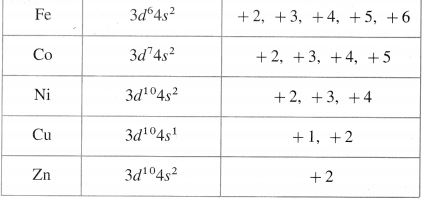
The following table shows, different oxidation states of 3d-series of transition elements.
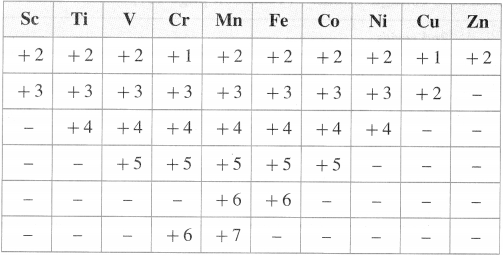
Maharashtra Board Class 12 Chemistry Solutions Chapter 8 Transition and Inner Transition Elements 7

Maharashtra Board Class 12 Chemistry Important Questions Chapter 8 Transition and Inner Transition Elements

Question 14.
Write oxidation states and outer electronic configuration of first transition series elements.
Answer:
Oxidation states of first transition series elements
Maharashtra Board Class 12 Chemistry Solutions Chapter 8 Transition and Inner Transition Elements 8
Maharashtra Board Class 12 Chemistry Solutions Chapter 8 Transition and Inner Transition Elements 9

Question 15.
Zinc shows only one oxidation slate. Explain.
Answer:

  • The electronic conliguration of zinc is, 30Zn Is2 2s2 2p6 3s2 3p6 3d10 4s2 or [Ar] 3d10 4s2.
  • Due lo loss of two electrons from 4s suhshell Zn shows oxidation state +2. with elcctronic configuration. [Ar] 183d10.
  • Since Zn+2 acquires an extra stability of completely fIlled 3d10 orbital. it shows only one oxidation state + 2.

Question 16.
Why is manganese more stable in the + 2 state than the + 3 state and the reverse is true for iron?
Answer:

  • The electronic configuration of Mn is 25Mn [Ar] 3d5 4s2
  • In + 2 and + 3 oxidation states, the electronic configuration of Mn is, Mn2+ [Ar] 3d5 and Mn3+ [Ar] 3d4
  • Since half-filled d-orbital (3d5) has more stability and lower energy than 3d4, Mn2+ is more stable than Mn3+.
  • The electronic configuration of Fe is 26Fe [Ar] 3d6 4s2 In + 2 and + 3 oxidation states of Fe, the electronic configuration is, Fe2+ [Ar] 3d6 and Fe3+ [Ar] 3d5 Since half-filled orbital is more stable, + 3 state of Fe is more stable than + 2 state.

Question 17.
What are the electronic configurations of various ions of 3d-elements?
Answer:
Electronic configuration of various ions of 3d elements
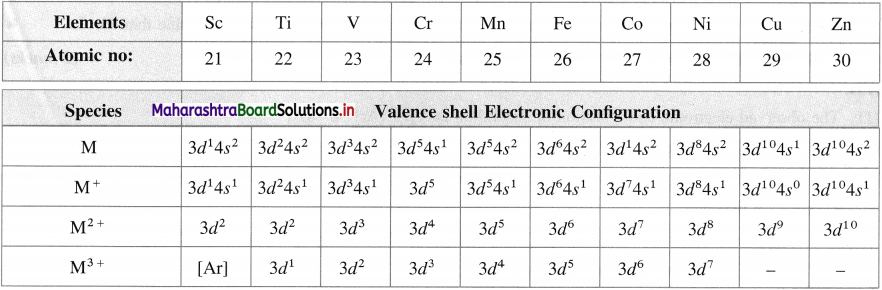
Maharashtra Board Class 12 Chemistry Solutions Chapter 8 Transition and Inner Transition Elements 10

Question 18.
Scandium shows only two oxidation states. Explain.
Answer:
Scandium has electronic configuration, 21Sc : Is2, 2s2, 2p6, 3s2, 3p6, 3d1, 4s2 Sc shows only two oxidation states namely + 2 and + 3.

  • Due to the loss of two electrons from the 4s-orbital, Sc acquires + 2 oxidation state Sc2 + : Is2 2s2 2p6 3s2 3p6 3d1.
  • Due to the loss of one more electron from the 3d-orbital, it acquires + 3 oxidation state with the extra stability of an inert element 18Ar. Sc+3 : Is2 2s2 2p6 3s2 3p6.
  • Since Sc3+ acquires extra stability of inert element [Ar]18, it does not form higher oxidation state.

Maharashtra Board Class 12 Chemistry Important Questions Chapter 8 Transition and Inner Transition Elements

Question 19.
Write different oxidation states of iron.
OR
Write the electronic configurations of
(i) Fe
(ii) Fe2+ and
(iii) Fe3+.
Answer:
Oxidation states of iron are +2, +3, +4, +5, +6.
(i) 26Fe : ls22s22p63s23p63d64s2
(ii) Fe2+ : Is2 2s2 2p6 3s2 3p6 3d6
(iii) Fe3+ : Is2 2s2 2p6 3s2 3p6 3d5.

Question 20.
Explain different oxidation states of chromium.
Answer:

  • The observed electronic configuration of chromium is, 24Cr [Ar] 3d5 4s1.
  • Different possible oxidation states of Cr are 4-1 (3d5), + 2 (3d4), + 3 (3d3), + 4 (3d2), + 5 (3d1) and + 6 (3d°).
  • Although in + 1 state, Cr gets extra stability of half-filled 3d5-orbital, it does not exhibit + 1 state in common except with pyridine.
  • Cr+2 has few stable salts like CrCl2, CrSO4 while Cr+3 forms very stable salts like CrCl3.
  • Cr+4 and Cr + 5 are unstable oxidation states.
  • Cr+6 is the most stable state due to inert gas [Ar] electronic configuration and form the salts like K2Cr2O7.

Question 21.
Manganese shows variable oxidation states. Give reasons.
Answer:

  • Manganese (25Mn) has electronic configuration. 25Mn [Ar]18 3d5 4s2.
  • Mn has stable half-filled d-subshell.
  • Due to a small difference in energy between 3d and 4s-orbitals, Mn can lose or share electrons from both the orbitals, hence shows variable oxidation states.
  • Mn shows oxidation states ranging from + 2 to + 7.

Question 22.
Write the different oxidation states of manganese. Why is + 2 oxidation state of manganese more stable than Mn3+?
Answer:

  • The different oxidation states of Mn are +2, +3, +4, +5, + 6 and +7.
  • The electronic configuration of Mn is Is2 2s2 2p6 3s2 3p6 3d5 4s2
  • + 2 oxidation state is very stable due to higher stability of half-filled 3d orbital.
  • Mn3+ has electronic configuration, ls22s2 2p63s23p63dA which is less stable.

Question 23.
Write the physical properties of first transition series.
Answer:
Physical properties of first transition series :

  • All transition elements of the first series are metals.
  • Except Zn, they are very hard and have low volatility.
  • They show characteristic properties of metals. They are lustrous, malleable and ductile.
  • They are good conductors of heat and electricity.
  • They have high melting points and boiling points.
  • Except Zn and Mn, they have one or more typical metallic structures at normal temperatures.

Question 24.
Which elements in the transition elements, 3d-series has
(i) the lowest density
(ii) the highest density?
Answer:
In 3d transition elements,
(i) Scandium (Sc) has lowest density and
(ii) Zinc (Zn) has the highest density.

Maharashtra Board Class 12 Chemistry Important Questions Chapter 8 Transition and Inner Transition Elements

Question 25.
Explain the variation in density of d-block elements.
Answer:
The densities of d-block elements are higher than 5-block elements due to higher nuclear charge which results in reduction in atomic size.

Question 26.
Explain the variation in melting points of the transition elements.
Answer:

  1. All transition elements are metals and the strength of metallic bonding increases as the number of unpaired electrons increases.
  2. In transition elements as atomic number increases, the number of unpaired electrons increases from (n – 1)d1 to (n – 1 )d5.
    For example in 3d-series, melting points increase from 21Sc to 24Cr in 4d-series from 39Y to 42Mo, and in 5d-series from 72Hf to 74W.
  3. After (n – l)d5 electronic configuration, the electrons start pairing, hence the number of unpaired electrons decrease, hence metallic character, melting points decrease from (n-1 )d6 to (n – 1)d10.
  4. In all transition series the melting point increases steadily up to d5 configuration and after this melting point decreases regularly.
    Maharashtra Board Class 12 Chemistry Solutions Chapter 8 Transition and Inner Transition Elements 11

Question 27.
The first ionisation enthalpies of third transition series elements are much higher than those of the elements of first and second transition series. Explain.
Answer:

  1. Third transition series elements have electronic configuration, 4f14 5d1 – 10 6s2.
  2. Thus, atoms of third series elements possess filled 4f-orbitals.
  3. 4f-orbitals due to their diffused shape, exhibit poor shielding effect and give rise to lanthanide contraction. Hence the valence electrons experience greater nuclear attraction and greater amount of energy is required to ionise the elements of third transition series namely (Hf to Au).
  4. Therefore the ionisation enthalpies of third transition series elements are much higher than those of the first and second transition series.

Maharashtra Board Class 12 Chemistry Solutions Chapter 8 Transition and Inner Transition Elements 13

Question 28.
Explain the metalic character of transition metals.
Answer:

  • All the transition elements are metals.
  • They are hard, lustrous, malleable, ductile and they have high tensile strength.
  • They have high melting points and boiling points.
  • Their metallic character is due to vacant or partially filled (n – 1) d-orbitals, and they involve both metallic and covalent bonding.
  • Since the strength of metallic bonds depends upon the number of unpaired electrons, it increases up to middle i.e., up to (n – 1 )d5, hence accordingly melting points and boiling points also increase.
  • After (n – l)d5 configuration, the electrons start pairing, hence the metallic strength, melting points and boiling points decrease with the increase in atomic number.

Maharashtra Board Class 12 Chemistry Important Questions Chapter 8 Transition and Inner Transition Elements

Question 29.
How does metallic character vary in 3d transition elements?
Answer:

  1. In 3d-series elements as atomic number increases from scandium (Sc [Ar]18 3d1 4s2) the number of unpaired electrons increases up to 3d5 in chromium.
  2. As the number of unpaired electrons increases, the metallic character increases, hence the melting points and boiling points increase from 21Sc(3d1) to 24Cr (3d5).
  3. After chromium the number of unpaired electrons goes on decreasing due to the pairing of electrons, hence metallic character, melting points and boiling points decrease from 25Mn to 29Cu.
  4. Zinc has all electrons paired, hence it is soft, has a low melting and boiling points.

Question 30.
Which are the common arrangement of the atoms in the structure of transition metals?
Answer:
Most of the transition metals have simple hexagonal closed packed (hep), cubic closed packed (ccp) or body centred cubic (bcc) lattices.

Question 31.
Why do the compounds of transition metals exhibit magnetic properties?
Answer:
The compounds of transition metals exhibit magnetic properties due to the presence of unpaired electrons in their atoms or ions.

Question 32.
What is the cause of paramagnetism and ferromagnetism?
Answer:
Paramagnetism and ferromagnetism is due to the presence of unpaired electrons in species.

Question 33.
When does species become diamagnetic?
Answer:
When there is no unpaired electron, i.e. all electron spins are paired, the species become diamagnetic.

Question 34.
How do metals Fe, Co, Ni acquire permanent magnetic moment?
Answer:
The transition metals Fe, Co and Ni are ferromagnetic. When the magnetic field is applied, all the unpaired electrons in these metals (and their compounds) align in the direction of the applied magnetic field. Due to this the magnetic susceptibility is enhanced and these metals can be magnetised, that is, they acquire permanent magnetic properties.

Question 35.
In which oxidation state, is vanadium diamagnetic?
Answer:

  • The electronic configuration of vanadium is, 23V [Ar] 3d3 4s2.
  • In +5 oxidation state, the electronic configuration is, V5+ [Ar].
  • Since in V5+ state, vanadium has all electrons paired, it is diamagnetic.

Question 36.
How is a magnetic moment expressed?
Answer:
The magnetic moment is expressed in Bohr magneton (B.M.). It is denoted by μ.

Question 37.
What is Bohr magneton (B.M.)?
Answer:
Bohr magneton (B.M.) is a unit of magnetic moment :
\(1 \mathrm{~B} . \mathrm{M} .=\frac{e h}{4 \pi m_{\mathrm{e}} c}\)
where, h : Planck’s constant (h = 6.626 x 10⁻³⁴ Js)
e : electronic charge (1.60218 x 10⁻¹⁹ C)
me : mass of an electron (9.109 x 10⁻³¹ kg)
c : velocity of light. (2.998 x 10⁸ ms-1)

Maharashtra Board Class 12 Chemistry Important Questions Chapter 8 Transition and Inner Transition Elements

Question 38.
Explain the magnetic properties of transition (or d-block) elements.
Answer:

  • Most of the transition metal ions and their compounds are paramagnetic in nature due to the presence of one or more unpaired electrons in their (n – 1)d-orbitals. Hence they are attracted in the magnetic field.
  • As the number of unpaired electrons increases from 1 to 5 in J-orbitals, the paramagnetic character and magnetic moment increase.
  • The transition elements or their ions having all electrons paired are diamagnetic and they are repelled in the magnetic field.
  • Metals like Fe, Co and Ni possess very high paramagnetism and acquire permanent magnetic moment hence they are ferromagnetic.

Question 39.
Explain the effective magnetic moment of the species.
Answer:

  • The magnetic moment in the species arises due to the presence of unpaired electrons.
  • The magnetic moment depends upon the sum of orbitals and spin contribution for each unpaired electron present in the species.
  • In transition metal ions, the contribution of orbital magnetic moment is suppressed by the electrostatic field of other atoms, molecules or ions surrounding the metal ion in the compound.
  • Hence the net or effective magnetic moment arises mainly due to spin of electrons. The effective magnetic moment μeff, of a paramagnetic substance is given by 1 spin only’ formula represented as, \(\mu=\sqrt{n(n+2)}\) B.M. where n is the number of unpaired electrons.

Question 40.
What is the importance of magnetic moment (μ)?
Answer:

  • From the measurements of the magnetic moment (μ) of the species or metal complexes of the first row of transition elements, the number of unpaired electrons can be calculated with the spin-only formula.
  • As magnetic moment is directly related to the number of unpaired electrons, value of μ will vary directly with the number of unpaired electrons.
  • In 2nd and 3rd transition series, orbital angular moment is significant. Hence spin-only formula for the complexes of 2nd and 3rd transition series is not useful.

Question 41.
Calculate the magnetic moment of the following species :
(1) Cr3+
(2) Co
(3) Co3+
(4) Cu2 +.
Answer:
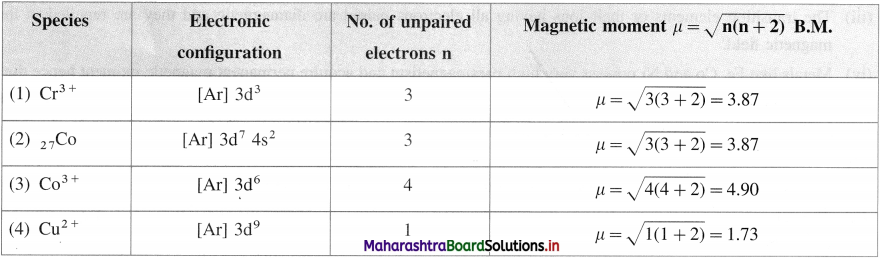
Maharashtra Board Class 12 Chemistry Solutions Chapter 8 Transition and Inner Transition Elements 14

Question 42.
Explain : A slight difference in the calculated and observed values of magnetic moments.
Answer:
Magnetic moments are determined experimentally in solution or in solid state where the central atom or ion is hydrated or bound to ligands. Hence a slight difference is observed in calculated and experimentally obtained values of magnetic moment (μ).
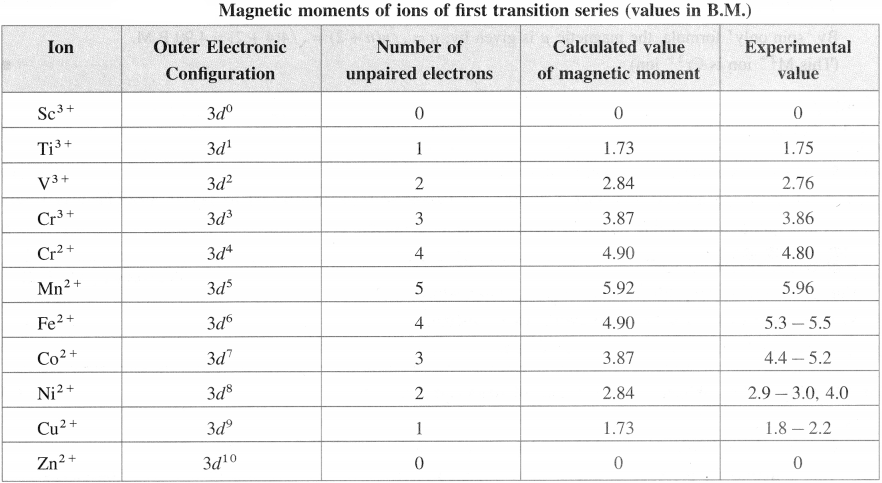
Maharashtra Board Class 12 Chemistry Solutions Chapter 8 Transition and Inner Transition Elements 15

Maharashtra Board Class 12 Chemistry Important Questions Chapter 8 Transition and Inner Transition Elements

Question 43.
Calculate the magnetic moment of a divalent ion in an aqueous solution, if its atomic number is 24.
Answer:
(1) The electronic configuration of divalent inri M2+ having atomic number 24 is.

Maharashtra Board Class 12 Chemistry Solutions Chapter 8 Transition and Inner Transition Elements 18

The ion has number of unpaired electrons. n = 4.
By spin only’ formula, the magnetic μ is given by, \(\mu=\sqrt{n(n+2)}=\sqrt{4(4+2)}=4.90 \mathrm{~B} . \mathrm{M}\)
(This M2+ ion is Cr2+ ion)

Question 44.
When does a substance appear coloured?
Answer:
A substance appears coloured when it absorbs a portion of visible light. The colour depends upon the wavelength of absorption in the visible region of electromagnetic radiation.

Question 45.
Why do the d-block elements form coloured compounds?
Answer:

  • Compounds (or ions) of many d-block elements or transition metals are coloured.
  • This is due to the presence of one or more unpaired electrons in (n – 1) d-orbital. The transition metals have incompletely filled (n – 1) cf-orbitals.
  • The energy required to promote one or more electrons within the d-orbitals involving d-d transitions is very low.
  • The energy changes for d-d transitions lie in visible region of electromagnetic radiation.
  • Therefore transition metal ions absorb the radiation in the visible region and appear coloured.
  • Colour of ions of d-block elements depends on the number of unpaired electrons in (n – 1) d-orbital. The ions having equal number of unpaired electrons have similar colour.
  • The colour of metal ions is complementary to the colour of the radiation absorbed.

Question 46.
How is complementary colour of a compound identified?
Answer:

  1. The transition metal ions absorb the radiation in the visible region and appeared coloured.
  2. Metal ion absorbs radiation of certain wavelength from the visible region. Remaining light is transmitted and the observed colour corresponds to the complementary colour of the light observed.
  3. The complementary colour can be identified (with the diagram given).

For example if red colour is absorbed then transmitted complementary colour is green.
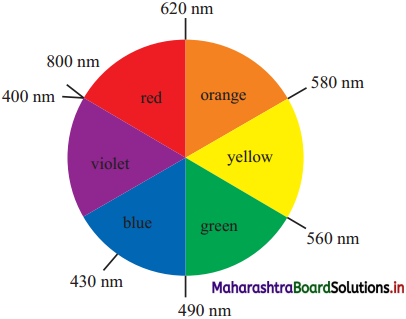
Maharashtra Board Class 12 Chemistry Solutions Chapter 8 Transition and Inner Transition Elements 19

Question 47.
Write outer electronic configuration (d-orbital) and colour of 3d-series of transition metal ions.
Answer:
Colour of 3d-transition metal ions
Maharashtra Board Class 12 Chemistry Solutions Chapter 8 Transition and Inner Transition Elements 20

Maharashtra Board Class 12 Chemistry Important Questions Chapter 8 Transition and Inner Transition Elements

Question 48.
Mention the factors on which the colour of a transition metal ion depends.
Answer:
The factors on which the colour of transition metal ion depends are as follows :

  • The presence of incompletely filled d-orbitals in metal ions. (The compounds with the configuration d° and d’0 are colourless.)
  • The presence of unpaired electrons in d-orbitals.
  • d → d transitions of electrons due to absorption of radiation in the visible region.
  • Nature of groups (anions) (or ligands) linked to the metal ion in the compound or a complex.
  • Type of hybridisation in metal ion in the complex.
  • Geometry of the complex of the metal ion.

Question 49.
Give reasons : Zinc salts are colourless.
Answer:

  • Colour of the ions of d-block elements depends on the number of unpaired electrons in (n – 1) d-orbitals.
  • Zinc forms salts of Zn2+ ions.
  • The electronic configuration of Zn+2 is [Ar] 3d10.
  • Since Zn+2 does not have unpaired electrons in 3d-orbital, d→d transition cannot take place, hence, Zn+2 ions form colourless salts.

Question 50.
Explain : The compounds of Cu(II) are coloured.
Answer:

  • The electronic configuration of 29Cu [Ar] 3d10 4s1 and Cu2+ [Ar] 3d9.
  • In copper compounds Cu2+ ions have incompletely filled 3d-orbital (3d9).
  • Due to the presence of one unpaired electron in 3 d-orbital, Cu2+ ions absorb red light from visible spectrum and emit blue radiation due to d → d transition. Therefore, copper compounds are coloured.

Question 51.
Explain why the solution of Ti3+ salt is purple in colour.
OR
Why is Ti3+ coloured? (atomic number Ti = 22)
Answer:

  • Ti2+ ions in the aqueous solution exist in the hydrated complex form as [Ti(H2O)6]2+.
  • The electronic configuration of Ti is, 22Ti [Ar]18 3d2 4s2 and Ti3+ [Ar]18 3d1. Hence in complex, Ti3+ has one unpaired electron in 3d subshell.
  • Initially, the 3d electron occupies lower energy d-orbital (in t2g-orbitals).
  • On the absorption of radiations of about 500 nm in yellow green region by a complex, 3d1 electron is excited to the higher energy d-orbital (eg-orbitals).
  • When the electron returns back to the lower energy d-orbital (t2g), it transmits radiation of complementary colour i.e. red blue or purple colour. Hence, the solution of hydrated Ti3+ is purple.

Question 52.
What will be the colour of Cd2+ salts? Explain.
Answer:

  • The electronic configuration of, 48Cd [Kr]36 3d10 5s2 and Cd2+ [Kr]36 3d10.
  • Cd2+ ions have completely filled 3d subshell and there are no unpaired electrons in 3d-orbital.
  • Hence d → d transition is not possible.
  • Therefore, Cd2+ ions do not absorb radiations in the visible region and the salts of Cd2+ ions are colourless (or white).

Maharashtra Board Class 12 Chemistry Important Questions Chapter 8 Transition and Inner Transition Elements

Question 53.
Indicate which of the ions may be coloured- V3+, Sc3+, Cr31, Cu2+, Ti3+, Cu+
Answer:

  • V3+ [Ar]18 3d2-((green)
    Since there are two unpaired electrons available, for d → d transition, it will show a Green colour.
  • Sc3+ [Ar]18 3d° (colourless/white).
    Since there are no unpaired electrons in the 3d subshell, it will not show colour.
  • Cr3+ [Ar]18 3d3 – (violet)
    There are three unpaired electrons in the 3d subshell, hence due to d → d transition, it will show violet colour.
  • Cu2+ [Ar]18 3d9 (blue)
    It has one unpaired electron that can undergo a d → d transition, hence it will show the colour blue.
  • Ti3+ [Ar]18 3d1 (purple)
    It has one unpaired electron that can undergo a d → d transition, hence it will show the colour purple.
  • Cu1+ [Ar]18 3d10 (colourless)
    There are no unpaired electrons in the 3d subshell, hence it will not show colour.

Question 54.
Explain why is cobalt chloride pink in colour when dissolved in water but turns deep blue when treated with concentrated hydrochloric acid.
Answer:

  • The electronic configuration of 27Co : [Ar] 3d14s2 and Co2+ [Ar] 3d1.
  • When dissolved in water cobalt chloride, Co2+ forms pink complex, [Co(H2O)6]2+.
  • The complex has octahedral geometry.
  • Due to absorption of radiation in the visible region and d – d transition, it forms pink coloured solution.
  • When CoCl2 solution is treated with concentrated HCl solution it turns deep blue.
  • This change is due to the formation of another complex, [CoC14]2+ which has a tetrahedral geometry.
  • Thus due to a change in geometry of the complex formed the colour of the solution changes from pink to deep blue.

Question 55.
Explain the catalytic properties of the rf-block or transition metals.
Answer:

  • d-block elements or transition metals and their compounds or complexes influence the rate of a chemical reaction and hence act as catalysts.
  • In homogeneous catalysis a catalyst forms an unstable intermediate compound which decomposes into products and regenerates the catalyst. But transition metals involve heterogeneous catalysis.
  • The transition metals have incompletely filled d-subshells which adsorb reactants on the surface and provide a large surface area for the reactants to react.
  • Since transition metals have variable oxidation states they are very good catalysts.
  • Hence, compounds of Fe, Co, Ni, Pt, Pd, Cr etc are used as catalysts in many reactions.

Question 56.
Explain the use of different transition metals as catalysts.
Answer:
The transition metals are very good catalysts.

  • MnO2 is used as a catalyst in the decomposition of KClO3.

    Maharashtra Board Class 12 Chemistry Solutions Chapter 8 Transition and Inner Transition Elements 21
  • In the manufacture of ammonia by Haber’s process, Mo/Fe is used as a catalyst.

    Maharashtra Board Class 12 Chemistry Solutions Chapter 8 Transition and Inner Transition Elements 22
  • In the synthesis of gasoline by Fischer Tropsch process, Co-Th alloy is used as a catalyst.
  • Finely divided Ni (formed by reduction of heated oxide in hydrogen) is very efficient catalyst in hydrogenation of ethene to ethane at 140 °C.
    Maharashtra Board Class 12 Chemistry Solutions Chapter 8 Transition and Inner Transition Elements 23
  • Commercially, hydrogenation with Ninkel as catalyst is used to convert inedible oils into solid fat for the production of margarine.
  • In the contact process of industrial production of sulphuric acid, sulphur dioxide and oxygen (from air) react reversibly over a solid catalyst of platinised asbestos.
    Maharashtra Board Class 12 Chemistry Solutions Chapter 8 Transition and Inner Transition Elements 24
  • Carbon dioxide and hydrogen are formed by the reaction of carbon monoxide and steam at 500 °C with Fe-Cr catalyst.
    Maharashtra Board Class 12 Chemistry Solutions Chapter 8 Transition and Inner Transition Elements 25

Maharashtra Board Class 12 Chemistry Important Questions Chapter 8 Transition and Inner Transition Elements

Question 57.
What are interstitial compounds of transition metals?
Answer:

  • The interstitial compounds of the transition metals are those which are formed when small atoms like H, C or N are trapped inside the interstitial vacant spaces in the crystal lattices of the metals.
  • Sometimes, sulphides and oxides are also trapped in the crystal lattices of transition elements.
  • Presence of these elements in the crystal lattices of metals provide new properties to the metals.

Question 53.
Give one example of an interstitial compound.
Answer:
Steel and cast iron are examples of interstitial compounds of carbon and iron.

Question 54.
Give examples of interstitial compounds where the property of the transition metal is changed.
Answer:
Steel and cast iron are interstitial compounds of carbon and iron (carbides of iron). Due to the presence of carbon, the malleability and ductility of iron is reduced while its tenacity increases.

Question 55.
What are the properties of the interstitial compounds of transition metals?
Answer:

  • The chemical properties of the interstitial compounds are the same as that of parent transition metals.
  • They are hard and show the metallic properties like electrical and thermal conductivity, lustre, etc.
  • Since metal-non-metal bonds in the interstitial compounds are stronger than metal-metal bonds in pure metals, the compounds have very high melting points, higher than the pure metals.
  • They have lower densities than the parent metal.
  • The interstitial compounds containing hydrogen (i.e., hydrides of metals) are powerful reducing agents.
  • The compounds containing carbon, hence behaving as carbides, are chemically inert and extremely hard like diamond.
  • In these compounds, malleability and ductility are changed. For example steel and cast iron.

Question 56.
What are interstitial compounds? Why do these compounds have higher melting points than corresponding pure metals?
Answer:

  1. The interstitial compounds of the transition metals are those which are formed when small atoms like H, C or N are trapped inside the interstitial vacant spaces in the crystal lattice of the metals.
  2. Since metal-nonmetal bonds in the interstitial compounds are stronger than metal-metal bonds in pure metals, the compounds have very high melting points, higher than the pure metals.

Question 57.
Explain the formation of alloys of transition metals.
Answer:

  • The transition metals form a large number of alloys among themselves, which are hard with high melting points.
  • During alloy formation atoms of one metal are distributed randomly in the lattice of another metal.
  • The metals with similar atomic radii and similar properties readily form alloys.
  • These alloys have industrial importance.
  • The alloys can be ferrous alloys or nonferrous alloys.

Question 58.
How are the transition metal alloys classIfied?
Answer:
The transition metal alloys are classified into

  • Ferrous alloys
  • Nonferrous alloys.

Question 59.
Explain what are
(1) ferrous alloys and
(2) nonferrous alloys.
Answer:

  1. Ferrous alloys: In ferrous alloys, atoms of other elemems are distributed randomly in atoms of iron in the mixture. As the percentage of iron is more in these alloys, they are termed as ferrous alloys. For expamle : nickel steel, chromium steel, stainless steel, (All steels have abot 2% carbon)
  2. onferrous alloys : These are formed by mixing atoms of transition metal other than iron with a non transition elemeni. For example, brass is an alloy of Cu and Zn. Bronze is an alloy of Cu and Sn.

Maharashtra Board Class 12 Chemistry Important Questions Chapter 8 Transition and Inner Transition Elements

Question 60.
What are the uses of alloys?
Answer:

Name of alloy Important use in industry
(1) Bronze (Cu + Sn) In making statues, medals and trophies (as it is tough, strong and corrosion-resistant)
(2) Cupra-nickel (Cu + Ni) In making machinery parts of marine ships, boats, marine conden­ser tubes.
(3) Stainless steel In the construction of the outer fuselage of ultra-high-speed aircraft.
(4) Nichrome : (Ni+ Cr in the ration 80 : 20) For gas turbine engines.
(5) Titanium alloys For ultra-high-speed flight, fireproof bulkheads and exhaust shrouds (as they withstand high temperatures).

Question 61.
Write the preparation of potassium permanganate.
Answer:
Potassium permanganate (KMnO4) is prepared in the following steps,

(1) Chemical Oxidation : When finely divided manganese dioxide (Mn02) is heated strongly with fused caustic potash (KOH) and an oxidising agent potassium chlorate (KCIO3), dark green potassium manganate (K2MnO4) is obtained. (In neutral or acidic medium K2MnO4 disproportionates.)

Maharashtra Board Class 12 Chemistry Solutions Chapter 8 Transition and Inner Transition Elements 26

The liquid is filtered through glass wool or sintered glass and evaporated. Potassium manganate crystallises as small, blackish crystals.

(2) Oxidation of K2MnO4 by
(i) Electrolytic oxidation : An alkaline solution of manganate ion is electrolysed between iron electrodes separated by a diaphragm. Manganate ion \(\left(\mathrm{MnO}_{4}^{2-}\right)\) undergoes oxidation at anode forming permanganate ion \(\left(\mathrm{MnO}_{4}^{-}\right)\). Oxygen evolved at anode converts \(\left(\mathrm{MnO}_{4}^{2-}\right)\) to \(\left(\mathrm{MnO}_{4}^{-}\right)\).

The overall reaction is as follows :
2K2MnO4 + H2O + [O] → 2KMnO4 + 2KOH

The electrolytic solution is filtered and evaporated to obtain deep purple black crystals of KMn04.

(ii) By passing CO2 through the solution of K2MnO4 :
3K2MnO4 + 4CO2 + 2H2O → 2KMnO4 + MnO2 + 4 KHCO3

Question 62.
What is meant by the disproportionation of an oxidation state? Explain giving example of manganese.
Answer:

  1. Disproportionation reaction is a chemical reaction in which atom or an ion of an element forms two or more species having different oxidation states, one lower and one higher.
  2. Manganese (Mn) shows different oxidation states + 2 to +7.
  3. When one oxidation state, lower or higher oxidation state becomes unstable as compared to another oxidation state, it undergoes disproportionation reaction.
  4. For example, + 6 oxidation state of Mn is less stable than + 7 and + 4.
    • Hence, in acidic medium \(\mathrm{Mn}^{6+} \text { in } \mathrm{MnO}_{4}^{2-}\) undergoes disproportionation reaction.
      Maharashtra Board Class 12 Chemistry Solutions Chapter 8 Transition and Inner Transition Elements 27
    • In neutral medium green K2MnO4 disproportionates to KMn04 and MnO2.
      Maharashtra Board Class 12 Chemistry Solutions Chapter 8 Transition and Inner Transition Elements 28

Maharashtra Board Class 12 Chemistry Important Questions Chapter 8 Transition and Inner Transition Elements

Question 63.
Give examples of oxidising reactions of KMnO4.
Answer:
(1) KMnO4 in acidic medium :
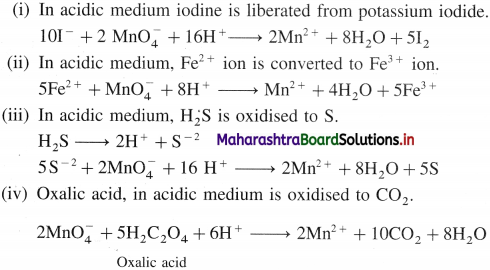
Maharashtra Board Class 12 Chemistry Solutions Chapter 8 Transition and Inner Transition Elements 57
(2) KMnO4 in neutral or alkaline medium in neutral or weakly alkaline medium :
(i) Iodide is oxidised to iodate ion.
Maharashtra Board Class 12 Chemistry Solutions Chapter 8 Transition and Inner Transition Elements 33
(ii) Thiosulphate ion is oxidised to sulphate ion.
Maharashtra Board Class 12 Chemistry Solutions Chapter 8 Transition and Inner Transition Elements 34
(iii) Manganous salt is oxidised to MnO2.

Maharashtra Board Class 12 Chemistry Solutions Chapter 8 Transition and Inner Transition Elements 35

Question 64.
Balance the following equations :
KI + KMnO4 + H2SO4 → K2SO4 + MnSO4 + 8H2O + I2
H2S + KMnO4 + H2SO4 → K2SO4 + MnSO4 + H2O + S.
Answer:
10 KI + 2KMnO4 + 8H2SO4 → 6K2SO4 + 2MnSO4 + 8H2O + 5I2
5H2S + 2KMnO4 + 3H2SO4 → K2SO4 + 2MnSO4 + 8H2O + 5S.

Question 65.
Give the uses of potassium permanganate.
Answer:
Uses of potassium permanganate :

  • as an antiseptic.
  • as a powerful oxidising agent in laboratory and industry.
  • in the detection of unsaturation in organic compounds in the laboratory. (Baeyer’s reagent, alkaline KMnO4).
  • for detecting halides in qualitative analysis.
  • in volumetric analysis for the estimation of H2O2, FeSO4 etc.)

Question 66.
Write the formula of chromite ore.
Answer:
FeOCr2O3.

Question 67.
How is potassium dichromate manufactured from chromite ore (FeOCr2O3)?
Answer:
Manufacture of potassium dichromate (K2Cr2O2) from chrome iron ore (FeOCr2O3) involves following steps :
(1) Concentration of ore : The chromite ore (FeOCr2O3) is powdered and washed with current of water.
(2) Conversion of chromite ore into sodium chromate : The concentrated ore is mixed with anhydrous sodium carbonate (Na2CO3) and a flux of lime in excess air and heated in a reverberatory furnace.

Maharashtra Board Class 12 Chemistry Solutions Chapter 8 Transition and Inner Transition Elements 36
Sodium chromate (Na2CrO4) formed in the reaction is then extracted with water so that Na2CrO4 dissolves into solution and insoluble substances separate out.
(3) Conversion of Na2CrO4 into sodium dichromate (Na2Cr4O7) : Na2CrO4 solution is acidified with concentrated H2SO2, so that sodium chromate is converted into sodium dichromate.

Maharashtra Board Class 12 Chemistry Solutions Chapter 8 Transition and Inner Transition Elements 37
Less soluble sodium sulphate crystallises out as Na2SO4.10H2O. which is filtered off.
(4) Conversion of Na2Cr2O7 into K2Cr2O7 : Concentrated solution of Na2Cr2O7 is treated with KCl on by double decomposition, K2Cr2O7 is obtained.
Na2Cr2O7 + 2KCl → K2Cr2O7 + 2NaCl
On concentrating and cooling the solution, less soluble orange coloured K2Cr2O7 crystallises out which is filtered and purified by recrystallisation.

Maharashtra Board Class 12 Chemistry Important Questions Chapter 8 Transition and Inner Transition Elements

Question 68.
What happens when hydrogen sulphide gas (H2S) is passed through acidified K2Cr2O7 solution?
Answer:
When hydrogen sulphide (H2S) gas is passed into solution of K2Cr2O7, H2S is oxidised to a pale yellow solid (precipitate) of sulphur. Orange coloured solution becomes green due to formation of chromic sulphate (green coloured).

In the reaction, H2S is oxidised to S and K2Cr2O7 is reduced to Cr2(SO4)3.

Maharashtra Board Class 12 Chemistry Solutions Chapter 8 Transition and Inner Transition Elements 38

Question 69.
What are the common physical properties of d-block elements?
Answer:
The common physical properties of d-block elements are :

  • All d-block elements are lustrous and shining.
  • They are hard and have high density
  • They have high melting and boiling points.
  • They are good electrical and thermal conductors.
  • They have high tensile strength and malleability.
  • They can form alloys with transition and nontransition elements
  • Many metals and their compounds are paramagnetic.
  • Most of the metals are efficient catalysts.

Question 70.
What are the common chemical properties of d-block elements?
Answer:
The common chemical properties of the d-block elements are :

  • All d-block elements are electropositive metals.
  • They exhibit variable oxidation states and form coloured salts and complexes.
  • They are good reducing agents.
  • They form insoluble oxides and hydroxides.
  • Iron, cobalt, copper, molybdenum and zinc are biologically important metals.
  • They catalyse biological reactions.

Question 71.
Give examples to show that elements of first row of d-block elements differ from second and third row with respect to the stabilisation of higher oxidation states.
Answer:

  • Highest oxidation state for the first row element is + 7 as in Mn.
    For the second row, the highest oxidation state is + 8 as in Ru (RuO4).
    For the third row, the highest oxidation state is + 8 as in Os (OsO4).
  • Compounds of Mo(V) of 2nd row and W(VI) of 3rd row of transitional elements are more stable than Cr(VI) and Mn (VIII) of first row elements.

Question 72.
How do metals occur in nature?
Answer:
In nature, few metals occur in earth’s crust in free state or native state while other metals occur in the combined form.
(1) Elements in free state or native state : The metals which are non-reactive with air, water, CO2 and non-metals occur in free state or native state. For example, gold, platinum, palladium occur in free state. Metals like Cu, Ag and Hg occur partly in the free state.

(2) Combined form : The metals which are reactive occur in the combined state with other elements forming compounds like oxides, sulphides, sulphates, carbonates, silicates, etc.

Question 73.
What are minerals?
Answer:
Minerals : They are naturally occurring chemical substances in the earth’s crust containing metal in free state or in combined form and obtainable from mining are called minerals. For example, haematite Fe203, galena PbS, etc.

Question 74.
What are ores?
Answer:
Ores : The minerals containing a high percentage of metals from which metals can be profitably extracted are called ores.
[Note : Every ore is a mineral but every mineral is not an ore.]

Question 75.
Write names of minerals and ores of Iron, Copper and Zinc.
Answer:

Metals Mineral Ore
Iron Haematite Fe2O3
Magnetite Fe3O4
Limonite 2Fe2O3, 3H2O
Iron pyrites FeS2
Siderite FeCO3
Haematite
Copper Chalcopyrite CuFeS2 Chalcocite Cuprite Cu2O Chalcopyrite
Chalcocite
Zinc Zinc blende ZnS
Zincite ZnO
Calamine ZnCO3
Zinc blende

Maharashtra Board Class 12 Chemistry Important Questions Chapter 8 Transition and Inner Transition Elements

Question 76.
What is metallurgy?
Answer:
Metallurgy : The process of extraction of metal in a pure state from its ore is called metallurgy.

Question 77.
Define the following:
(1) Pyrometallurgy
(2) Hydrometallurgy
(3) Electrometallurgy.
Answer:

  1. Pyrometallurgy : It is a process of extraction of metal from metal oxide from concentrated ore by reduction with a suitable reducing agent like carbon, hydrogen, aluminium, etc. at high temperature.
  2. Hydrometallurgy : It is a process of extraction of metals by converting their ores into aqueous solutions of metal compounds and reducing them by suitable reducing agents.
  3. Electrometallurgy : It is a process of extraction of highly electropositive metals like Na, K, Al, etc. by electrolysis of fused compounds of the metals where metal ions are reduced at cathode forming metals.

Question 78.
What is gangue?
Answer:
Gangue : The earthly and undesired impurities of various substances like sand (SiO2), metal oxides, etc. present in the ore are called gangue or matrix.

Question 79.
Define concentration of an ore.
Answer:
Concentration : A process of removal of gangue or unwanted impurities from the ore is called concentration of an ore. It is also called benefaction or dressing of an ore.

Question 80.
What are common methods of concentration of an ore?
Answer:
The concentration of an ore involves different methods depending upon the differences in physical properties of compounds or the metal present and the nature of the gangue.

The common methods of concentration of ore are as follows :

  1. Gravity separation or hydraulic washing :
    This can be carried out by two processes as follows :

    • Hydraulic washing by using Wilfley’s table method
    • Hydraulic classifier methods.
  2. Magnetic separation
  3. Froth floatation process.
  4. Leaching.

The method depends upon the nature of ore.

Question 81.
What is leaching?
Answer:
Leaching : ft is a (chemical) process used in the concentration of an ore by extracting soluble material from an insoluble solid by dissolving in a suitable solvent. This method is used in the concentration process of ores of Al, Ag, Au, etc.

Question 82.
What is roasting of an ore?
Answer:
Roasting : It is a process of strongly heating a concentrated ore in the excess of air below melting point of metal, to convert it into oxide form. It is used for a sulphide ore. For example, ZnS ore on roasting forms ZnO.

Question 83.
Write an equation to show how zinc blende (ZnS) is converted to ZnO.
Answer:
When zinc blende is roasted, it is converted to ZnO.
\(\mathrm{ZnS}+\mathrm{O}_{2} \stackrel{\Delta}{\longrightarrow} \mathrm{ZnO}+\mathrm{SO}_{2}\)

Maharashtra Board Class 12 Chemistry Important Questions Chapter 8 Transition and Inner Transition Elements

Question 84.
Explain the term : Smelting
Answer:
Smelting : The process of extraction of a metal from its ore by heating and melting at high temperature is called smelting. Reduction of ore is carried out during smelting.

Question 85.
What is calcination?
Answer:
Calcination is a process in which the ore is heated to a high temperature below the melting point of the metal in the absence of air or limited supply of air in a reverberatory furnace.

It is generally used for carbonate and hydrated oxides to convert them into anhydrous oxides.

Question 86.
Define the terms :
(1) Flux
(2) Slag
Answer:
(1) Flux : A flux is a chemical substance which is added to the concentrated ore during smelting in order to remove the gangue or impurities by chemical reaction forming a fusible mass called slag.
(2) Slag : It is a waste product formed by combination of a flux and gangue (or impurities) during the extraction of metals by smelting process.

Iron is the fourth most abundant element in the earth’s crust.

Question 87.
What is the composition of haematite ore?
Answer:
Composition of Haematite ore is Fe2O3 + SiO2 + Al2O3 + phosphates

Question 88.
Which impurities (gangue) are present in haematite ore?
Answer:
SiO2 and Al2O3 are the impurities present in the haematite ore.

Question 89.
Which reducing agents are used to reduce haematite ore into metallic iron?
Answer:
Haematite ore is reduced using coke and CO. Carbon in the coke is converted to carbon monoxide. Carbon and carbon monoxide together reduce Fe203 to metallic iron.

Fe2O3 + 3C → 2Fe + 3CO.
Fe2O3 + 3CO → 2Fe + 3CO2.

Question 90.
Why is limestone used in the extraction of iron?
Answer:

  • The ore of iron contains acidic gangue or impurity of silica, SiO2.
  • To remove silica gangue, basic flux like calcium oxide CaO, is required, which is obtained from the decomposition of limestone, CaCO3. \(\mathrm{CaCO}_{3} \stackrel{\Delta}{\longrightarrow} \mathrm{CaO}+\mathrm{CO}_{2}\)
  • Silica reacts with CaO and forms a fusible slag of CaSiO3.
    \(\mathrm{SiO}_{2}+\mathrm{CaO} \stackrel{\Delta}{\longrightarrow} \mathrm{CaSiO}_{3}\)

Therefore in the extraction of iron, lime is used.

Maharashtra Board Class 12 Chemistry Important Questions Chapter 8 Transition and Inner Transition Elements

Question 91.
Name the furnace in which iron is extracted from Haematite ore.
Answer:
Extraction of iron is carried out in Blast furnace.

Question 92.
Explain the extraction of iron from haematite.
Answer:
Iron is mainly extracted from haematite, Fe2O3 by reduction process.
Haematite ore contains silica (SiO2), alumina (Al2O3) and phosphates as impurity or gangue.

Coke is used for the reduction of ore.

To remove acidic gangue SiO2, a basic flux CaO is used which is obtained from lime stone CaCO3.

The extraction process involves following steps :
(1) Concentration of an ore : The powdered ore is concentrated by gravity separation process by washing it in a current of water. The lighter impurities (gangue) are carried away leaving behind the ore.
(2) Roasting : The concentrated ore is heated strongly in a limited current of air. During this, moisture is removed and the impurities like S, As and phosphorus are oxidised to gaseous oxides which escape.
Maharashtra Board Class 12 Chemistry Solutions Chapter 8 Transition and Inner Transition Elements 41
After roasting, the ore is sintered to form small lumps.
(3) Reduction (or smelting) : The roasted or calcined ore is then reduced by heating in a blast furnace.
Maharashtra Board Class 12 Chemistry Solutions Chapter 8 Transition and Inner Transition Elements 42
The blast furnace is a tall cylindrical steel tower about 25 m in height and has a diameter about 5-10m lined with fire bricks inside.

Blast furnace has three parts :

  • the hearth,
  • the bosh and
  • the stack.

At the top, there is a cup and cone arrangement to introduce the ore and at the bottom, tapping hole for withdrawing molten iron and an outlet to remove a slag.

The roasted ore is mixed with coke and limestone in the approximate ratio of 12 : 5 : 3.

A blast of hot air at about 1000 K is blown from downwards to upwards by layers arrangement. The temperature range is from bottom 2000 K to 500 K at the top. The charge of ore from top and the air blast from bottom are sent simultaneously. There are three zones of temperature in which three main chemical reactions take place.

Maharashtra Board Class 12 Chemistry Important Questions Chapter 8 Transition and Inner Transition Elements

(i) Zone of combustion : The hot air oxidises coke to CO which is an exothermic reaction, due to which the temperature of furnace rises.
C + 1/2 O2 → CO ΔH= – 220kJ
Some part of CO dissociates to give finely divided carbon and O2.
2CO → 2C + O2
The hot gases with CO rise up in the furnace and heats the charge coming down. CO acts as a fuel as well as a reducing agent.

(ii) Zone of reduction : At about 900 °C, CO reduces Fe2O3 to spongy (or porous) iron.
Fe2O3 + 3CO → 2Fe + 3CO2
Carbon also reduces partially Fe203 to Fe.
Fe2O3 + 3C → 2Fe + 3CO

(iii) Zone of slag formation : At 1200 K limestone, CaCO3 in the charge, decomposes and forms a basic flux CaO which further reacts at 1500 K with gangue (SiO2, Al2O3) and forms a slag of CaSiO3 and Ca3AlO3.
CaCO3 + CaO + CO2.
CaO + SiO2 → CaSiO3
12CaO + 2Al2O3 → 4Ca3AlO3 + 3O2

The slag is removed from the bottom of the furnace through an outlet.

(iv) Zone of fusion : The impurities in ore like MnO2 and Ca3(PO4)2 are reduced to Mn and P while SiO2 is reduced in Si. The spongy iron moving down in the furnace melts in the fusion zone and dissolves the impurities like C, Si, Mn, phosphorus and sulphure. The molten iron collects at the bottom of furnace. The lighter slag floats on the molten iron and prevents its oxidation.

The molten iron is removed and cooled in moulds. It is called pig iron or cast iron. It contains about 4% carbon.

Question 93.
Write the reaction involved in the zone of reduction in blast furnace during extraction of iron.
Answer:
Zone of reduction : At about 900 °C, CO reduces Fe2O3 to spongy (or porous) iron.
Fe2O3 + 3CO → 2Fe + 3CO2
Carbon also reduces Fe2O3 to Fe.
Fe2O3 + 3C → 2Fe + 3CO

Question 94
Write reactions involved at different temperatures in the blast furnace.
Answer:

Temperature K Change taking place in the blast furnace Reactions
1. 500 K Haematite ore loses moisture ore xH2O → ore
2. 900 K Reduction of ore by CO Fe2O3 + 3CO → 2Fe + 3CO
3. 1200K Limestone decomposes CaCO3 → CaO + CO2
4. 1500K Reduction of ore by C Fe2O3 + 3C → 2Fe + 3CO
5. 1600 K (i) Reduction of FeO by C
(ii) Fusion of iron and slag formation
FeO + C → Fe + CO
CaO + SiO2 → CaSiO3
6. 2000 K Combustion of coke 2C + O2 → CO

Maharashtra Board Class 12 Chemistry Important Questions Chapter 8 Transition and Inner Transition Elements

Question 95.
What is the action of carbon on Fe203 in blast furnace?
Answer:
Fe2O3 + 3C → 2Fe + 3CO

Question 96.
What is refining of metals?
Answer:
Refining of metals : The purification of impure or crude metals by removing metallic and nonmetallic impurities is known as refining of metals. H

Question 97.
How is pure iron obtained from crude iron?
Answer:
Pure iron can be obtained by electrolytic refining.

Question 98.
Name the methods of refining of metals.
Answer:
Methods of refining of metals :

  • Electrorefining
  • Liquefaction
  • Distillation
  • Oxidation m

Question 99.
What are the factors that govern the choice of extraction technique of metals?
Answer:
The choice of extraction technique is governed by the following factors.

  • Nature of ore
  • Availability and cost of reducing agent. (Generally, cheap coke is used).
  • Availability of hydraulic power.
  • Purity of metal required.
  • Value of by-products. For example. SO2 obtained during the roasting of sulphide ores is important for the manufacture of H2SO4.

Question 100.
Which are the commercial forms of iron?
Answer:
Commercial forms of iron are :

  • Cast iron
  • wrought iron
  • steel. H

Question 101.
(A) What are f-block elements?
(B) What are inner transition elements?
Answer:
(A)

  • Elements in which differentiating electron enters into the pre-penultimate shell the (n – 2) f-orbital are known as f.block elements.
  • They include 28 elements with atomic numbers ranging from 58-71 and atomic numbers 90 to 103 collectively.
  • There are two f-series or two f-block elements, namely 4f and 5f series.
  • The f-block includes two inner transition series namely the lanthanoid series. Cerium (58) to LuteUum (71) or the 4 f-block elements and the actinoid series. Thorium (90) to I.awrencium (103) or the 5f block elements.

(B) f-block elements are called inner transition elements since f-orbital lies much inside the f-orbital in relation to the transition metals, These elements have 1 to 14 electrons in their f-orbital.

Question 102.
What are fIrst inner transition elements?
Answer:

  1. 4f-hlock elements are called (first) inner transition elements and have partly filled inner orbitaIs or (4f) orbitais.
  2. They have general outer electronic configuration \((n-2) f^{1-14},(n-1) d^{0-1}, n s^{2}\).
  3. There are two f-series, namely 4f and 5f series, called lanthanoids and acùnoids respectively.
  4. They shos intermediate properties as compared to electropositive s-block elements and electronegative p-block elements. Hence they are called (first) inner transition elements.

Question 103.
What are lanthanoids (or lanthanides)?
OR
What is the lanthanoid series?
Answer:

  • Lanthanoids or Lanthanoid series or Lanthanones : The series of fourteen elements from 58Ce to 71Lu in which a differentiating electron enters 4f sub-shell and follows lanthanum is called lanthanoid series and the elements are called lanthanoids.
  • They have general electronic configuration, [Xe] 4f1-14 ,5d0-1, 6s2.
  • They follow Lanthanum (Z = 57) in 3d-series.

Maharashtra Board Class 12 Chemistry Important Questions Chapter 8 Transition and Inner Transition Elements

Question 104.
What are rare earths?
Answer:

  • Lanthanoids or 4f-block elements are called rare earths.
  • Lanthanoids are never found in free state, and their minerals are not pure.
  • They exhibit similar chemical properties hence cannot be extracted and separated by normal metallurgical processes.
  • Lanthanoid metals are available on small scale. Therefore they are called rare earths.

Question 105.
Explain the position of lanthanoids in the periodic table.
OR
How is the position of lanthanoids justified?
Answer:

  1. Position of Lanthanoids in the periodic table : Group – 3; Period – 6.
  2. They interrupt the third transition series of t/-block elements (i.e. 5 d series) in the sixth period.
  3. They are 14 elements from 58Ce to 71Lu and their position is in between La and Hf. Since they follow lanthanum, they are called lanthanoids.
  4. They are called 4f-series elements and for the convenience, they are placed separately below the main periodic table.
  5. The actual position of lanthanoids is in between Lanthanum (Z = 57) and Hafnium (Z = 72).
  6. Their position is justified due to following reasons :
    • All these elements have the same electronic configuration in ultimate and penultimate shells, one electron in 5d-orbital and two electrons in 6s-orbital.
    • Group valence of all lanthanoids is 3.
    • All lanthanoids from 58Ce to 71Lu have similar physical and chemical properties.

Question 106.
Explain the meaning of inner-transition series.
Answer:
A series of f-block elements having electronic configuration (n – 2)f1-14 (n – I) d0-1 ns2 placed separately in the periodic table represents inner transition series. The f-orbitals lie much inside the e/ orbitals.

Since the last electron enters pre-penultimate shell, these elements are inner transition elements.

There are two inner transition series as follows :
4f-series 58Ce → 71Lu
5f-series 90Th → 103Lr

Question 107.
Draw a skeletal diagram of the periodic table to show the position of d and/- block elements.
Answer:
Maharashtra Board Class 12 Chemistry Solutions Chapter 8 Transition and Inner Transition Elements 44

Maharashtra Board Class 12 Chemistry Important Questions Chapter 8 Transition and Inner Transition Elements

Question 108.
What are the properties of lanthanoids?
Answer:

  • Lanthanoids are soft metak with silvery white colour, Colour and brightness reduces on exposure to air.
  • They are good conductors of heat and electricity.
  • Except promethium (Pm), all are non-radioactive in nature.
  • The atomic and ionic radii decrease from La to Lu. (Lanthanoid contraction).
  • Coordination numbers arc greater than 6.
  • They are paramagnetic.
  • They become ferromagnetic at lower temperature.
  • Their magnetic and optical properties are independent of environment.
  • They are called rare earths as their exiractioli was difficult.
  • They are abundant in earth’s crust
  • All lanthanoids fonn hydroxides which are ionic and basic. l3asicity decreases with atomic number,
  • They react with nitrogen to give nitrides and with halogen to give halides.
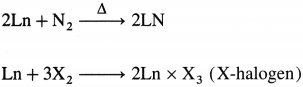
    Maharashtra Board Class 12 Chemistry Solutions Chapter 8 Transition and Inner Transition Elements 45
  • When heated with carbon at very high temperature give carbides

    Maharashtra Board Class 12 Chemistry Solutions Chapter 8 Transition and Inner Transition Elements 46

Question 109.
Explain the variations in ionisation enthalpy of lanthanoids.
Answer:

  • The first ionisation enthalpy of lanthanoids is nearly same. It is very high for Gd and Yb.
  • The ionisation enthalpy increases from first (IE1] to third (IE3).

First, second and third ionization enthalpies of lanthanoids in kj/mol

Lanthanoid IE1 IE2 IE3
La 538.1 1067 1850.3
Ce 528.0 1047 1949
Pr 523.0 1018 2086
Nd 530.0 1034 2130
Pm 536.0 1052 2150
Sm 543.0 1068 2260
Eu 547.0 1085 2400
Gd 592.0 1170 1990
Tb 564.0 1112 2110
Dy 572.0 1126 2200
Ho 581.0 1139 2200
Er 589.0 1151 2190
Tm 596.7 1163 2284
Yb 603.4 1175 2415
Lu 523.5 1340 2022

Maharashtra Board Class 12 Chemistry Important Questions Chapter 8 Transition and Inner Transition Elements

Question 110.
Give the general electronic configuration of 4f-series elements (OR lanthanoids).
Answer:

  • The general electronic configuration of 4f-series elements is, Ln[Xe]54 4f1-14 5d0-1 6s2 where Ln is a lanthanoid.
  • Xenon has electronic configuration, [Xe] : Is2 2s2 2p6 3s2 3p6 3d10 4s2 4p6 4d10 5s2 5p6.
  • In lanthanoids, the differentiating electron enters prepenultimate shell, 4f m

Question 111.
What are the important features of the electronic configuration of lanthanoids?
Answer:

  1. Lanthanoids show two types of electronic configurations
    (a) an expected or idealized
    (b) an observed electronic configuration.
    In the idealized electronic configuration, the filling of the 4/-orbitals is regular but in the observed configuration, there is the shift of a single electron from 5d to 4/ sub-shell.
  2. Lanthanum (57) has an electronic configuration [Xe] 4f° 5d16s2. It does not have any f-electron.
  3. The next incoming electron does not enter the 5d sub-shell but goes to the 4f sub-shell.
  4. 14 electrons are progressively filled in the 4f sub-shell as the atomic number increases by one unit from La to Lu.
  5. La, Gd and Lu are the only elements which possess one electron in a 5d orbital, while in all other lanthanoids the 5d sub-shell is empty.
  6. La-(4f°), Gd-(4f7) and Lu-(4f14) posses extra stability due to their empty, half-filled and completely filled 4f-orbitals respectively.
  7. The 4f-electrons in the prepenultimate shell are shielded by the outermost higher orbitals, 5s2, 5p6, 5d1, 6s2, i.e. by eleven electrons, hence they are less effective in chemical bonding.

Electronic configuration (Idealised and observed)
Maharashtra Board Class 12 Chemistry Solutions Chapter 8 Transition and Inner Transition Elements 48
[Xe]54 ls22s22p63s23p63d104s24p64d105s25p6

Question 112.
Write the expected electronic configuration of (a) Nd (Z = 60) (b) Tm (Z = 69).
Answer:
Expected electronic configuration :
(a) Nd = [Xe] 4f3 5d1 6s2
(b) Tm= [Xe] 4f145d16s2

Question 113.
Write electronic configurations of
(i) Gd
(ii) Yb.
Answer:
(i) 64Gd [Xe] 4f75d16s2 (Observed)
(ii) 70Yb [Xe] 4f145d°6s2 (Observed)

Maharashtra Board Class 12 Chemistry Important Questions Chapter 8 Transition and Inner Transition Elements

Question 114.
Write expected and observed electronic configurations of
(i) Ce
(ii) Tb.
Answer:

Element Expected (Idealised) Observed
(i) 58Ce [Xe] 4f15d16s2 [Xe] 4f25d°6s2
(ii) 65Tb [Xe] 4f85d16s2 [Xe] 4f95d°6s2

Question 115.
Why are the expected and observed ground state electronic configurations of gadolinium and lawrencium same?
Answer:

  • The degenerate orbitals like 4f and 5f acquire extra stability when they are half filled (4f7) or completely filled (5f14).
  • The expected and observed electronic configuration of gadolinium is, 64Gd [Xe] 4f7 5d1 6s2.
  • The expected and observed electronic configuration of lawrencium is 103Lr [Rn] 5f14 6d1 7s2.

Question 116.
Explain oxidation states of lanthanoids.
Answer:

  • The common oxidation state of the Lanthanoids is 3 + due to the loss of 2 electrons from outermost 6s orbital and one electron from the penultimate 5d sub-shell.
  • Gd3+ and Lu3+ show extra stability due to their half-filled and completely filled f-orbitals, Gd3+ = [Xe]4f7, Lu3+ = [Xe]4f14
  • Ce and Tb attain the 4f° and 4f7configurations in the 4 + oxidation states. Eu and Yb attain the 4f7 and 4f14 configurations in the 2 + oxidation states. Sm and Tm also show the 2+ oxidation state although their stability can be explained based on thermodynamic factors.
  • Some lanthanoids show 2 + and 4 + oxidation states even though they do not have stable electronic configuration of 4f°, 4f7 or 4f14. E.g. Pr4+ (4f1), Nd2+ (4f4), Sm2+ (4f6), Dy4+ (4f8) etc

Question 117.
Write the. electronic configuration of the following ions :
(1) La3 + ;
(2) Gd3+;
(3) Eu3+;
(4) Ce3+.
Answer:
(1) La3 + = [Xe]
(2) Gd3+ = [Xe] 4f7
(3) Eu3+ = [Xe] 4f6
(4) Ce3+ = |Xe] 4f1

Question 118.
Write the electronic configuration of
(1) Nd2+
(2) Nd3+
(3) Nd4+.
Answer:
(1) Nd2+ [Xe] 4f4
(2) Nd3+ [Xe] 4f3
(3) Nd4+ [Xe] 4f2

Maharashtra Board Class 12 Chemistry Important Questions Chapter 8 Transition and Inner Transition Elements

Question 119.
Among the following lathanoids, which elements show only one oxidation state 3 +? Why? Dy, Gd, Yb, Lu.
Answer:
Gd and Lu show only one oxidation state 3 +, since they acquire electronic configurations with extra stability namely 4f7 and 4f14 respectively.

Question 120.
Write the expected electronic configurations of :
(1) europium (Z = 63),
(2) erbium (Z = 68).
Answer:
(1) Europium (63Eu) [Xe]544f6 5d1 6s2
(2) Erbium (68Er) [Xe]544f11 5d1 6s2

Question 121.
Why does lanthanum form La3+ ion, while cerium forms Ce4+ ion? (Atomic number La = 57 and Ce = 58).
Answer:

  1. Electronic configuration Lanthanum is La [Xe] 4f° 5d1 6s2. By losing three electrons, La acquires stable electronic configuration of Xe and forms La3+.
  2. Electronic configuration of Cerium is Ce [Xe] 4f1 5d1 6s2. By losing four electrons, Ce acquires stable electronic configuration of Xe and forms Ce4+.

Question 122.
63EU and 70Yb show 2 + oxidation state. Explain.
Answer:
63EU has electronic configuration, [Xe] 4f7 5d°6s2. By losing 2 electrons from 6s orbital, it acquires stable configuration and 4f-orbital is half-filled.
70Yb has electronic configuration, [Xe] 4f14 5d° 6s2. By losing 2 electrons from 6 s orbital, it acquires stable configuration and 4/-orbital is completely filled.
Hence Eu and Yb show 2 + oxidation states.

Question 123.
Display electronic configuration, atomic and ionic radii of lanthanoids.
Answer:
Answers are given in bold.

Electronic configuration and atomic ionic radii of lanthanoids
Maharashtra Board Class 12 Chemistry Solutions Chapter 8 Transition and Inner Transition Elements 49

Maharashtra Board Class 12 Chemistry Important Questions Chapter 8 Transition and Inner Transition Elements

Question 124.
Explain the trend in atomic and ionic sizes of lanthanoids.
Answer:

  • From 57La (187 pm) to first element of 4f-series 58Ce (183 pm), the contraction in atomic radius is very large, 4 pm.
  • But from Ce onwards as atomic number increases atomic radius decreases very steadily so that total decrease in atomic radius from Ce to Lu is only 10 pm.
  • In case of tripositive ions due to large pull by nucleus, the decrease in ionic radii is slightly more, i.e. 18 pm. For example, Ce3+ (103 pm) to Lu3+ (85 pm ).
  • Hence all lanthanoids have similar properties. Therefore they cannot be separated from each other easily by normal metallurgical methods but require special methods.
    Maharashtra Board Class 12 Chemistry Solutions Chapter 8 Transition and Inner Transition Elements 50

Question 125.
What is meant by lanthanoid contraction?
Answer:
Lanthanoid contraction : The gradual decrease in atomic and ionic radii of lanthanoids with the increase in atomic number is called lanthanoid contraction.

Question 153.
Explain the causes of the lanthanoid contraction.
Answer:
The causes of the lanthanoid contraction are as follows :

  • As the atomic number of lanthanoids or 4f-block elements increases the positive nuclear charge increases and correspondingly electrons are added to the prepenultimate 4f sub-shell.
  • The attraction of nucleus on 4 f-electrons increases with the increase in atomic number.
  • The outer eleven electrons namely, 5s2, 5p6, 5d3 and 6s2 do not shield inner 4 f-electrons from the nucleus.
  • There is imperfect shielding of each 4f-electron from other 4 f-electrons.
  • As compared to d sub-shell, the extent of shielding for 4 f-electrons is less.
  • Due to these cumulative effects, 4 f-electrons experience greater nuclear attraction and hence valence shell is pulled towards the nucleus to the greater extent decreasing atomic and ionic radii appreciably.
  • From 57La to 58Ce, there is a sudden contraction in atomic radius from 187 pm to 183 pm but the further decrease up to the last 4f-element, 71Lu is comparatively low (about 10 pm).

Question 126.
Explain lanthanoid contraction effect with respect to (1) decrease in basicity, (2) ionic radii of post-lanthanoids.
Answer:
The lanthanoid contraction has a definite effect on the properties of lanthanoids as well as on the properties of post-lanthanoid elements.
(1) Decrease in basicity :

  • In lanthanoids due to lanthanoid contraction, as the atomic number increases, the size of the lanthanoid atoms and their try positive ions decreases, i.e. from La3+ to Lu3+.
  • As size of the cation decreases, according to Fajan’s rule, the polarizability increases and thus the covalent character of the M-OH bond increases, and ionic character decreases.
  • Therefore the basic nature of the hydroxides decreases.
  • Basicity and ionic character decrease in the order La(OH)3 > Ce(OH)3 > … Lu(OH)3.

Maharashtra Board Class 12 Chemistry Important Questions Chapter 8 Transition and Inner Transition Elements

(2) Ionic radii of post-lanthanoids :

  • Elements following the lanthanoids in the 6th period (third transition series, i.e. 5d-series) are known as post-lanthanoids.
  • Due to lanthanoid contraction the atomic radii (size) of elements which follow lanthanum in the 6th period (3rd transition series – Hf, Ta, W, Re)-are similar to the elements of the 5th period (4d-series Zr, Nb Mo, Tc).
  • Due to similarity in their size, post-lanthanoid elements (5d-series) have closely similar properties to the elements of the 2nd transition series (4d-series) which lie immediately above them.
  • Pairs of elements namely Zr-Hf(Gr-4), Nb-Ta (Gr-5), Mo-W(Gr-6), Tc-Re (Gr-7) are called chemical twins since they possess almost identical sizes and similar properties.

Question 127.
Why do lanthanoids form coloured compounds?
Answer:

  • The colour in lanthanoid ions is due to the presence of unpaired electrons in partially filled 4f sub-shells.
  • Due to the absorption of radiations in the visible region there arises the excitations of the unpaired electrons from f-orbital of lower energy to the f-orbital of higher energy-giving f → f transitions.
  • The observed colour is complementary to the colour of the light absorbed.
  • The colour of try positive ions (M3+) depends upon the number of unpaired electrons in f-orbitals. Hence the lanthanoid ions having equal number of unpaired electrons have similar colour.
  • The colours of M3+ ions of the first seven lanthanoids, La3+ to Eu3+ are similar to those of seven elements Lu3+ to Tb3+ in the reverse order.

Question 128.
Explain, why Ce3+ ion is colourless.
Answer:

  • The electronic configuration of Ce3+ is, [Xe] 4f7
  • Even though there is one unpaired electron in 4f sub-shell, the f → f transition involves very low energy. Hence, Ce3+ ion does not absorb radiation in the visible region.

Therefore Ce3+ ion is colourless.

Question 129.
Explain why Gd3+ is colourless.
Answer:

  • Gd3+ has electronic configuration, [Xe] 4f7
  • Due to extra stability of half filled orbital, it does not allow f → f transition, and hence does not absorb radiations in the visible region.

Hence Gd3+ is colourless.

Question 130.
The salts of (1) La3+ and (2) Lu3+ are colourless. Explain.
Answer:
(1) (i) La3+ has electronic configuration, [Xe] 4f°
(ii) Since there are no unpaired electrons in 4 f-orbital, f → f transition is not possible. Hence La3+ ions do not absorb radiations in visible region, and they are colourless.

(2) (i) LU3+ has electronic configuration [Xe] 4 f14
(ii) Since there are no unpaired electrons in 4f-orbital, f → f transition is not possible. Hence Lu3+ ions do not absorb radiations in visible region and they are colourless.

Question 131.
Explain giving examples, the colour of nf electrons is about the same as those having (14-n) electrons.
Answer:
(1) Consider Pr3+ and Tm3+ ions.
Tm3+ (4f12) has nf electron 12 electrons.
Pr2+ (4f2) has (14 – n) = (14 – 2) = 12 electrons. Both, Tm3+ and Pr3+ are green.

(2) Consider Nd3+ and Er3+ ions. Er3+ (4f11) has nf electrons 11.
Nd3+ (4f3) has (14 – n) is (14 – 3) = 11 electrons. These both ions Er3+, Na3+ are pink in colour.

Question 132.
Lu3+ has observed magnetic moment zero. How many unpaired electrons are present?
Answer:
Since magnetic moment is zero, it has no unpaired electrons.

Maharashtra Board Class 12 Chemistry Important Questions Chapter 8 Transition and Inner Transition Elements

Question 133.
What are the application of lanthanoids?
Answer:

  1. Lanthanoid compounds are used inside the colour television tubes and computer monitor. For example mixed oxide (Eu, Y)2 O3 releases an intense red colour when bombarded with high energy electrons.
  2. Lanthanoid ions are used as active ions in luminescent materials. (Optoelectronic application)
  3. Nd : YAG laser is the most notable application. (Nd : YAG = neodymium doped ytterium aluminium garnet)
  4. Erbium doped fibre amplifiers are used in optical fibre communication systems.
  5. Lanthanoids are used in cars, superconductors and permanent magnets.

Question 134.
What are actinoids? Give their general electronic configuration.
Answer:

  • Actinoids : The series of fourteen elements from 90Th to 103Lr which follow actinium (89Ac) and in which differentiating electrons are progressively filled in 5f-orbitals in prepenultimate shell are called actinoids.
  • Their general electronic configuration is, [Rn]86 5f1-14 6d0-1 7s2.

Question 135.
Why are actinoids called inner transition elements?
Answer:

  • Actinoids are 5f-series elements in which electrons progressively enter into 5f-orbitals, which are inner orbitals.
  • They have electronic configuration [Rn]86 5f1-14 6d0-1 7s2.
  • They show intermediate properties as compared to electropositive 5-block elements and electronegative p-block elements. Hence they are called second inner transition elements.

Question 136.
Explain the position of actinoids in the periodic table.
OR
What is the position of actinoids in the periodic table?
Answer:

  • Position of actinoids in the periodic table : Group-3; Period-7.
  • They interrupt the fourth transition series (6d series) in the seventh period in the periodic table.
  • After Actinium, 89Ac which has electronic configuration [Rn] 6d17s2, the electrons enter progressively 5f orbital and they have general electronic configuration, [Rn] 5f1 – 14 6d0 – 1 7s2.
  • They are fourteen elements from 90Th to 103Lr and since they follow actinium, they are called actinoids.
  • They are called 5f series or second inner transition series elements and for the convenience they are placed separately below the periodic table.

Question 137.
Write idealised and observed electronic configuration of actinoids.
Answer:
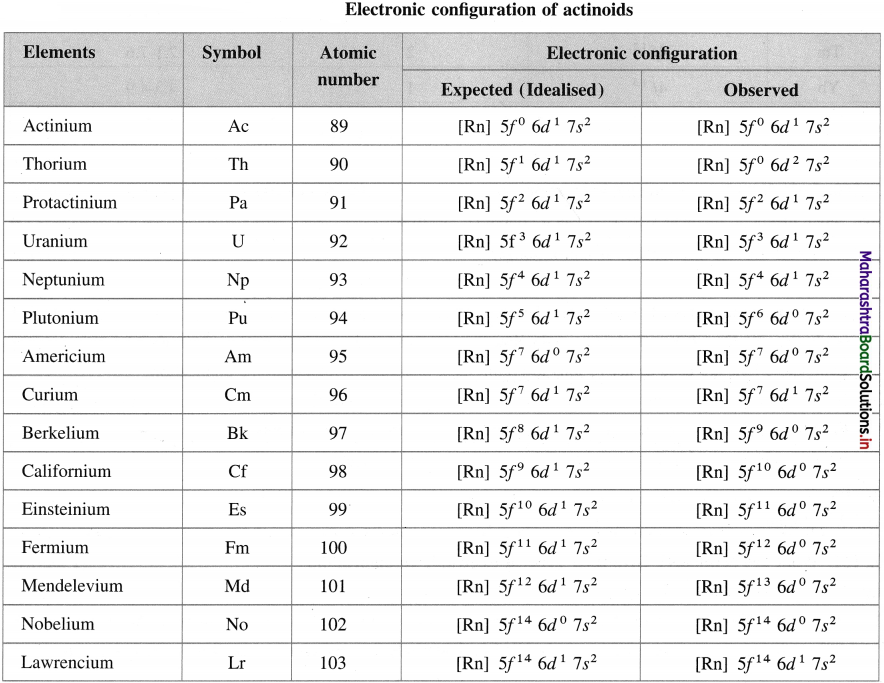
Maharashtra Board Class 12 Chemistry Solutions Chapter 8 Transition and Inner Transition Elements 52

Maharashtra Board Class 12 Chemistry Important Questions Chapter 8 Transition and Inner Transition Elements

Question 138.
Explain the oxidation states of actinoids.
Answer:

  • Due to availability of electrons in 5f, 6d and 7s sublevels, lanthanoids show varied oxidation states.
  • The most common oxidation state is + 3 due to loss of one electron from 6d and two electrons from 6s-orbitals.
  • Ac, Th and Am show + 2 oxidation state.
  • Th, Pa, U, Np, Pu, Am and Cm show + 4 oxidation state.
  • Np and Pu show the highest oxidation state + 7.
  • U, Np, Bk, Cm and Am show stable oxidation state + 4.
  • In + 6 oxidation state, due to high charge density the actinoid ions form oxygenated ions, e.g. \(\mathrm{UO}_{2}^{+}, \mathrm{NpO}_{2}^{+},\) etc.

Maharashtra Board Class 12 Chemistry Solutions Chapter 8 Transition and Inner Transition Elements 53

Question 139.
Why do actinoids show variable oxidation states?
Answer:

  • The large number of variable oxidation states of actinoids is due to very small energy difference between 5f, 6d and 7s subshells.
  • The electronic configuration of actinoids is, [Rn] 5f1-14 6d0-1, 7s2
  • Due to the loss of three electrons from 6d1 and 7s2, the common oxidation state is + 3, but due to further loss of electrons from 5f subshell, actinoids show higher oxidation states.
  • The variable oxidation states are + 2 to + 7.

Electronic configuration of actinoids and their ionic radii in + 3 oxidation state
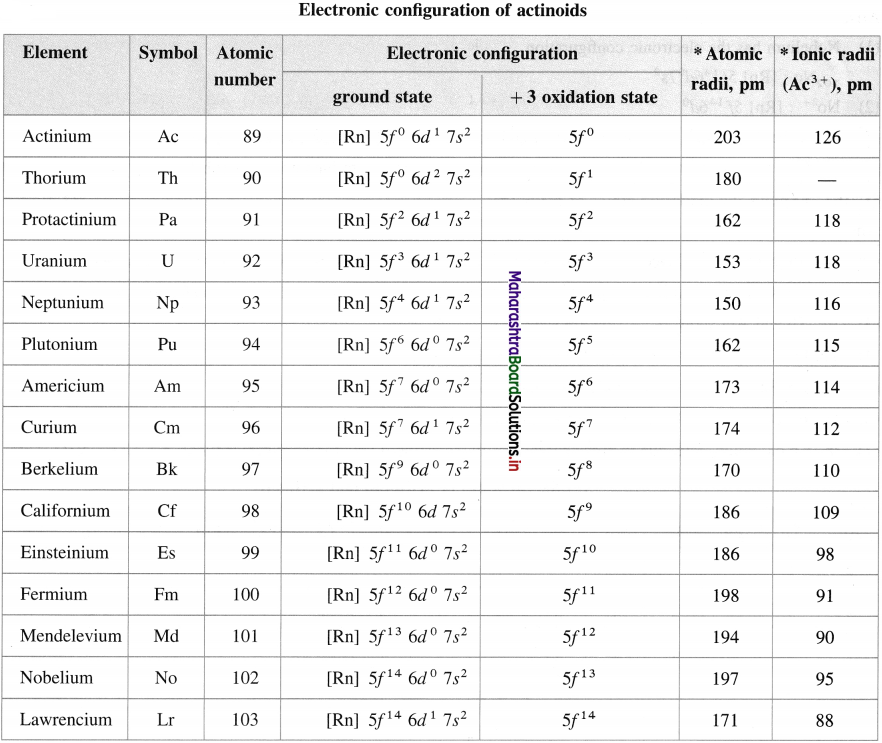
Maharashtra Board Class 12 Chemistry Solutions Chapter 8 Transition and Inner Transition Elements 54

Maharashtra Board Class 12 Chemistry Important Questions Chapter 8 Transition and Inner Transition Elements

Question 140.
What is meant by actinoid contraction?
Answer:
Actinoid contraction: The gradual decrease in atomic and ionic radii of actinoids with the increase in atomic number is called actinoid contraction.

Question 141.
The extent of actinoid contraction is greater than lanthanoid contraction. Explain Why?
Answer:

  • The electronic configurations of :
    Lanthanoids [Xe] 4f1 – 14 5d0 – 1 6s2
    Actinoids [Rn] 5f1 – 14, 6d0 – 1 7s2
  • The mutual screening offered in case of 5f-electrons is less than that in the 4f-electrons.
  • Hence, the outer orbitals are pulled to the greater extent by nuclei in actinoids (5f-series) than in lanthanoids (4f-series).
  • Therefore, actinoid contraction is greater than lanthanoid contraction.

Question 142.
Describe the important properties of actinoids.
Answer:
Properties of actinoids :

  • Actinoids are silvery white ( similar to lanthanoids).
  • They are highly reactive radioactive elements.
  • Most of these elements are not found in nature. They are radioactive and man made.
  • They experience decrease in the atomic and ionic radii from Ac to Lw, known as actinoid contraction.
  • The common oxidation state is +3. Elements of the first half of the series exhibit higher oxidation states.

Question 143.
What are the applications of actinoids?
Answer:

  • Thorium oxide (ThO2) with 1% CeO2 is used as a major source of indoor lighting, as well as for outdoor camping.
  • Uranium is used in the nuclear reactors.
  • The isotopes of Thorium and Uranium have very long half-life, so that we get very negligible radiation from them: Hence they can be used safely.

Question 144.
What are transuranic elements?
Answer:

  • The man-made elements heavier titan Uranium (Z = 92) in the Actinoid señes are called transuranic elements.
  • These are synthetically or artificially prepared (man-made) elements starting from Neptunium (Z= 93).
  • Transuranic elements arc generally considered to be from Neptunium (Z = 93) to Lawrencium (Z = 103).
  • Recently elements from atomic number 104 (Rf) to atomic number 118 (Og) or (Uuo) in 6 d series have also been identified as transuranic elements.
  • All transuranic elements are radioactive.

Question 145.
What are post actinoid elements?
Answer:

  • Elements from atomic number 104 to 118 are called postactinoid elements.
  • The post actinoid elements known so far are transition metals.
  • They can be synthesised in the nuclear reactions.
  • As they have very short half life period, it is difficult to study their chemistry.
  • Ruiherfordium forms a chloride (RfCl4) similar to zirconium and hafnium in + 4 oxidation state.
  • Dubniurn resembles niobium and protactinium.

Maharashtra Board Class 12 Chemistry Important Questions Chapter 8 Transition and Inner Transition Elements

Question 146.
Name the transuranic elements.
Answer:
Names of transuranic elements

Name Symbol Atomic number
Neptunium Np 93
Plutonium Pu 94
Americium Am 95
Curium Cm 96
Berkelium Bk 97
Californium Cf 98
Einsteinium Es 99
Ferminum Fm 100
Mendelevium Md 101
Nobelium No 102
Lawrencium Lr 103
Rutherfordium Rf 104
Dubnium Db 105
Seaborgium Sg 106
Bohrium Bh 107
Hassium Hs 108
Meitnerium Mt 109
Darmstadtium Uun/Ds 110
Roentgenium Uuu/Rg 111
Copernicium Uub/Cn 112
Ununtrium Uut 113
Ununquadium Uuq 114
Ununpentium Uup 115
Ununhexium Uuh 116
Ununseptium Uus 117
Ununoctium Uuo 118

In the transuranic elements, elements from atomic number 93 to 103 are actinoids and from atomic number 104 to 118 are called postactinoid elements.

Question 147.
What are the similarities between lanthanides and actinides.
Answer:
Lanthanides and actinides show similarities as follows :

  • Both, lanthanides and actinides show+ 3 oxidation state.
  • In both the series, the f-orbitals are filled gradually.
  • Ionic radius of the elements in both the series decreases with increase in atomic number.
  • Electronegativity in both the series is low for all the elements.
  • They all are highly reactive.
  • The nitrates, perchlorates and sulphates of all elements are soluble while their hydroxides, theorides and carbonates
    are insoluble.

Maharashtra Board Class 12 Chemistry Important Questions Chapter 8 Transition and Inner Transition Elements

Question 148.
Differentiate between lanthanoids and actinoids.
Answer:

Lanthanoids Actinoids
Electronic configuration [Xe] 4f1-14 5d0-1, 6s2 Electronic configuration [Rn] 5f1-14 6d0-1, 7s2
The differentiating electron enters the 4f subshell. The differentiating electron enters the 5f subshell.
Except for Promethium all other elements occur in nature. Except for Uranium and Thorium, all others are synthesized in the laboratory.
The binding energy of 4f electrons is higher. 5f-orbitals have lower binding energy.
Only Promethium is radioactive. All elements are radioactive.
Besides 3 + oxidation state they show 2 + and 4 + oxidation states. Besides 3 + oxidation state they show 2 + , 4 + , 5 + , 6 + , 7 + oxidation states.
They have a less tendency to form complexes. They have greater tendency to form complexes.
Many lanthanoid ions are colourless. Their colour is not as deep and sharp as actinoids. Actinoids are coloured ions. Their colour is deep, e.g. U3+ is red and U4+ is green.
Lanthanoids cannot form oxo-cations. Actinoids form oxo-cations such as – UO2+, PuO2+, UO22+, PuO22+.
Lanthanoid hydroxides are less basic. Actinoid hydroxides are more basic.
Lanthanoid contraction is relatively less. Actinoid contraction from element to element is comparatively more.
Mutual shielding of 4f electrons is more. Mutual shielding effect of 5f electrons is less.

Question 149.
Compare Pre-transition metals, Lanthanoid and transition metals.
Answer:
Maharashtra Board Class 12 Chemistry Solutions Chapter 8 Transition and Inner Transition Elements 55

Maharashtra Board Class 12 Chemistry Important Questions Chapter 8 Transition and Inner Transition Elements

Multiple Choice Questions

Question 150.
Select and write the most appropriate answer from the given alternatives for each sub-question :

1. In transition elements, the different electron enters into
(a) ns subshell
(b) np subshell
(c) (n – 1) d subshell
(d) (n – 2)f subshell
Answer:
(c) (n – 1) d subshell

2. Chromium (Z = 24) has electronic configuration
(a) [Ar]4dA 4s2
(b) [Ar] 4d5 451
(c) [Ar] 3d5 3s1
(d) [Ar] 3d5 4s1
Answer:
(d) [Ar] 3d5 4s1

3. Manganese achieves the highest oxidation state in its compounds
(a) Mn3O4
(b) KMnO4
(c) K2MnO4
(d) MnO2
Answer:
(b) KMnO4

4. The group which belongs to transition series is
(a) 2
(b) 7
(c) 13
(d) 15
Answer:
(b) 7

5. The last electron of transition element is called
(a) s-electron
(b) p-electron
(c) d-electron
(d) f-electron
Answer:
(c) d-electron

6. Which one of the following elements does NOT belong to first transition series?
(a) Fe
(b) V
(c) Ag
(d) Cu
Answer:
(c) Ag

7. The incomplete d-series is
(a) 3d
(b) 4d
(c) 5d
(d) 6d
Answer:
(d) 6d

Maharashtra Board Class 12 Chemistry Important Questions Chapter 8 Transition and Inner Transition Elements

8. The electronic configuration of Sc is
(a) [Ar] 3d2 4s2
(b) [Ar] 3d1 4s2
(c) [Kr] 3d1 4s2
(d) [Kr] 3d2 4s1
Answer:
(b) [Ar] 3d1 4s2

9. The observed electronic configuration of copper is
(a) [Ar]18 3d9 4s2
(b) [Kr] 3d10 451
(c) [Kr] 3d9 4s2
(d) [Ar] 3d10 451
Answer:
(d) [Ar] 3d10 451

10. Fe belongs to the
(a) 3d-transition series elements
(b) 4d-transition series elements
(c) 5d-transition series elements
(d) 6d-transition series elements
Answer:
(a) 3d-transition series elements

11. Which one of the following elements does not exhibit variable oxidation states?
(a) Iron
(b) Copper
(c) Zinc
(d) Manganese
Answer:
(c) Zinc

12. In KMnO4, oxidation number of Mn is
(a) 2+
(b) 4 +
(c) 6 +
(d) 7+
Answer:
(d) 7+

13. Which one of the following transition elements shows the highest oxidation state?
(a) Sc
(b) Ti
(c) Mn
(d) Zn
Answer:
(c) Mn

14. The colour of transition metal ions is due to
(a) s → s transition
(b) d → d transition
(c) p → p transition
(d) f → f transition
Answer:
(b) d → d transition

15. Which one of the following compounds is expected to be coloured?
(a) AgNO3
(b) CuSO4
(c) ZnCl2
(d) CuCl
Answer:
(b) CuSO4

Maharashtra Board Class 12 Chemistry Important Questions Chapter 8 Transition and Inner Transition Elements

16. The metal ion which is NOT coloured, is
(a) Fe3+
(b) V2+
(c) Zn2+
(d) Ti3+
Answer:
(c) Zn2+

17. A pair of coloured ion is
(a)Cu2+, Zn2+
(b)Cr3+ , Cu+
(c) Cd2+, Mn5+
(d) Fe2+, Fe3+
Answer:
(d) Fe2+, Fe3+

18. The highest oxidation state is shown by
(a) Fe
(b) Mn
(c) Os
(d) Cr
Answer:
(c) Os

19. Transition elements are good catalysts since
(a) they show variable oxidation states
(b) they have partially filled d-orbitals
(c) they have low I.P
(d) they have small atomic radii
Answer:
(a) they show variable oxidation states

20. Highest magnetic moment is shown by the ion
(a) V3+
(b) Co3+
(c) Fe3+
(d) Cr3+
Answer:
(c) Fe3+

21. The most common oxidation state of lanthanoids is
(a) +4
(b) +3
(c) +6
(d) +2
Answer:
(b) +3

22. Which one of the following elements belong to the actinoid series?
(a) Cerium
(b) Lutetium
(c) Thorium
(d) Lanthanum
Answer:
(c) Thorium

23. The total number of elements in each of f-series is
(a) 10
(b) 12
(c) 14
(d) 15
Answer:
(c) 14

Maharashtra Board Class 12 Chemistry Important Questions Chapter 8 Transition and Inner Transition Elements

24. The general electronic configuration of Lanthanoids is
(a) [Xe] 4f1 – 14 5d0 – 1 6s2
(b) [Xe] 4f2 – 14 5d0 – 1 6s2
(c) [Xe] 4f1 – 13 5d0 – 1 6s2
(d) [Xe] 4f0 – 14 5d0 – 1 6s1
Answer:
(a) [Xe] 4f1 – 14 5d0 – 1 6s2

25. f-block elements are called ………………….
(a) transition elements
(b) representative elements
(c) inner transition elements
(d) alkalin earth metals
Answer:
(c) inner transition elements

26. Actinoids form coloured salts due to the transition of electrons in
(a) d – d
(b) f – f
(c) f – d
(d) s – f
Answer:
(b) f – f

27. In the periodic table, Gadolinium belongs to
(a) 4th Group 6th period
(b) 4th group 4th period
(c) 3rd group 5th period
(d) 3rd group 7th period.
Answer:
(d) 3rd group 7th period.

Maharashtra Board Class 12 Chemistry Important Questions Chapter 8 Transition and Inner Transition Elements

28. The transuranic elements are prepared by
(a) addition reaction
(b) substitution reactions
(c) decomposition reaction
(d) nuclear reactions
Answer:
(d) nuclear reactions

Maharashtra Board Class 11 Biology Important Questions Chapter 5 Cell Structure and Organization

Balbharti Maharashtra State Board 11th Biology Important Questions Chapter 5 Cell Structure and Organization Important Questions and Answers.

Maharashtra State Board 11th Biology Important Questions Chapter 5 Cell Structure and Organization

Question 1.
Define cell.
Answer:
Cell is defined as a structural and functional unit of life of all living organisms capable of independent existence and can perform all functions of life.

Maharashtra Board Class 11 Biology Important Questions Chapter 5 Cell Structure and Organization

Question 2.
Write information about the instrument which is used for observing smaller organisms or cells.
Answer:

  1. To observe cells or organisms of smaller size we use a microscope.
  2. Larger cells can be seen through simple microscope but to observe smaller cells we require compound microscope.
  3. Simple microscope can magnify image 50 to 100 times but a compound microscope can do so 1000 times or more.
  4. In the microscope a beam of light is used to make things visible hence it is light microscope.
  5. To observe interior of cell we need electron microscope which can magnify image 500000 times.

Question 3.
Write the shapes of the cells that can be observed.
Answer:
There is no typical shape of a cell. Cells may be spherical, rectangular, flattened, polygonal, oval, triangular, conical, columnar, etc.

Question 4.
1. Smallest cell
2. Longest cell in animals
3. Largest cell
Answer:
1. Mycoplasma (0.3 µm)
2. Nerve cell
3. Ostrich egg

Maharashtra Board Class 11 Biology Important Questions Chapter 5 Cell Structure and Organization

Question 5.
Explain the term totipotency.
Answer:

  1. Totipotency (totus – entire, potential – power) is the capacity or the potential of living nucleated cell, to differentiate into any other type of cell and thus, can form a complete new organism.
  2. A cell is totipotent as it has the entire genetic information of the organism stored in its nucleus.
  3. Embryonic animal cells are totipotent and are termed as stem cells.
  4. Stem cells are used in curing many diseases. Therefore, they have great potential for medical applications.

Question 6.
Who proposed the cell theory?
Answer:
Schwann and Schleiden proposed the cell theory.

Question 7.
Give the postulates of modern cell theory.
Answer:
Postulates of modern cell theory:

  1. All living organisms are made up of cells.
  2. Cell is the basic structural and functional unit of life.
  3. All cells arise from pre-existing cells. (Rudolf Virchow 1858 – “Omnis cellula-e-cellula”).
  4. Total activities of cells are responsible for activity of an organism.
  5. Cells show transformation of energy.
  6. Cells contain nucleic acids; DNA and RNA in the nucleus and cytoplasm.

Question 8.
State the two general categories on which living organisms are grouped.
Answer:
Living organisms are grouped into two main categories the Prokaryotes and Eukaryotes.

Question 9.
State the general characteristics of prokaryotic cell.
Answer:
General characteristics of prokaryotic cell:
1. Prokaryotic cells are primitive type of cells.
2. It does not have membrane bound cell organelles (like endoplasmic reticulum, Golgi complex, mitochondria, etc.) and well-defined nucleus (nuclear membrane is absent).
3. Genetic material is in the form of nucleoid.

4. Cell envelope:
a. Prokaryotic cell has chemically complex protective cell envelope having glycocalyx, cell wall and plasma membrane.
b. In some bacteria, glycocalyx occurs in the form of a slime layer (loose sheath). Other bacteria may have a thick and tough covering called capsule. It helps in protection of bacterial cell.

5. Cell wall:
The Gram-positive bacteria show presence of peptidoglycan layer in the cell wall and Gram-negative bacteria show presence of murein in the cell wall. It gives mechanical strength to the cell.
[Note: In Gram-negative bacteria, cell wall is made up of two layers; inner layer of Murein or peptidoglycan and outer layer of Lipopolysaccharides.]

6. Cell membrane:
a. It is the innermost covering of the cell envelope, chemically composed of lipids and proteins.
b. It helps in intercellular communication.
c. Cell membrane shows infoldings called mesosomes which help in cell wall formation, cellular respiration and DNA replication.
d. The cyanobacteria show longer extensions called as chromatophores which carry photosynthetic pigments.

7. In motile bacteria either cilia or flagella are found. Both are driven by rotatory movement produced by basal body (which works as motor) of flagellum. Other parts of flagellum are filament and hook.

8. Some other surface projections are the tubular pili (which help in inter-cellular communication) and fimbriae (for clinging to support).

9. Ribosomes:
Bacterial cell cytoplasm contains dense particles called ribosomes which help in protein synthesis. Ribosomes are 70S type (composed of a larger sub-unit 50S and + smaller sub-unit 30S).

Maharashtra Board Class 11 Biology Important Questions Chapter 5 Cell Structure and Organization

Question 10.
What is the difference between Gram-positive and Gram-negative bacterial cells? Name the technique used for differentiating such bacterial cells.
Answer:
The Gram-positive bacteria show presence of peptidoglycan layer in the cell wall and Gram-negative bacteria show presence of murein in the cell wall. The technique used for differentiating bacterial cells is Gram staining.
[Note: Murein is similar to peptidoglycan in structure and function. It is present in the cell walls of archaebacteria.

Question 11.
Write the constituents of prokaryotic cytoplasm.
Answer:
1. Cytoplasm of prokaryotes is a pool of all necessary materials like water, enzymes, elements, amino acids, etc.
2. Some inclusion bodies in form of organic (cyanophycean starch and glycogen) and inorganic granules (phosphate and sulphur) are also found.

Question 12.
Fill in the blanks.

  1. Genetic material in bacterium is a single chromosome made up of circular and coiled _______.
  2. The bacterial chromosome remains attached to _________.
  3. The _________ model of replication is observed in bacterial cells.
  4. _________ present in the bacterial cells are known as extrachromosomal self-replicating DNA.

Answer:

  1. DNA
  2. Mesosomes
  3. Theta
  4. Plasmids

Question 13.
What are eukaryotic cells?
Answer:
1. Eukaryotic cells are the cells possessing well-defined nucleus and membrane bound organelles (like mitochondria, endoplasmic reticulum, ribosomes, Golgi complex etc.).
2. Eukaryotes include protists, plants, animals and fungi.

Maharashtra Board Class 11 Biology Important Questions Chapter 5 Cell Structure and Organization

Question 14.
Write a note on cell wall in Eukaryotic cells.
Answer:

  • The rigid, protective and supportive covering, outside the cell membrane is called cell wall. It is present in plant cells, fungi and some protists.
  • Algae show presence of cellulose, galactans, mannans and minerals like calcium carbonate in cell wall.
  • In other plants, it is made up of hemicelluloses, pectin, lipids and protein.
  • Microfibrils of plant cell wall show presence of cellulose which is responsible for rigidity.
  • Some of the depositions of cell wall are silica (grass stem), cutin (epidermal walls of land plants), suberin (endodermal cells of root), wax, lignin.
  • Function:
    • Provides support, rigidity and shape to the cell.
    • Protects the protoplasm against mechanical injury and infections.

Question 15.
Explain the structure of plant cell wall.
Answer:
In plants, cell wall shows middle lamella, primary wall and secondary wall
Maharashtra Board Class 11 Biology Important Questions Chapter 5 Cell Structure and Organization 1
1. Middle lamella:
It is thin and present between two adjacent r cells. It is the first structure formed from cell plate during cytokinesis. It is mainly made up of pectin, calcium and magnesium pectate. Softening of ripe fruit is due to solubilization of pectin.
2. Primary wall:
In young plant cell, it is capable of growth. It is laid inside to middle lamella.
It is the only wall seen in meristematic tissue, mesophyll, pith, etc.
3. Secondary wall:
It is present inner to primary wall. Once the growth of primary wall stops, secondary wall is laid. At some places thickening is absent which leads to formation of pits.

Question 16.
Draw a well labelled diagram of a plant cell.
Answer:
Maharashtra Board Class 11 Biology Important Questions Chapter 5 Cell Structure and Organization 2

Maharashtra Board Class 11 Biology Important Questions Chapter 5 Cell Structure and Organization

Question 17.
Give an account of eukaryotic plasma membrane.
Answer:
Eukaryotic plasma membrane/ Cell membrane/ Biomembrane:

  1. It is thin, quasi-fluid structure present both extracellularly and intracellularly.
  2. Extracellularly, it is present around protoplast and intracellularly, it is present around most of the cell organelles in eukaryotic cell. It separates cell organelles from cytosol.
  3. Thickness of bio-membrane is about 75A.
  4. Cell membrane appears trilaminar (made up of three layers) when observed under electron microscope. It shows presence of lipids (mostly phospholipids) arranged in bilayer.
  5. Lipids possess one hydrophilic polar head and two hydrophobic non-polar tails. Therefore, phospholipids are amphipathic.
  6. Lipid molecules are arranged in two layers (bilayer) in such a way that their tails are sandwiched in between heads. Due to this, tails never come in direct contact with aqueous surrounding.
  7. Cell membrane also shows presence of proteins and carbohydrates.
  8. Ratio of proteins and lipids varies in different cells. For example, in human beings, RBCs show approximately 52% protein and 40% lipids.

Question 18.
Explain the structure of plasma membrane on the basis of Fluid mosaic model.
Answer:
Fluid mosaic model:

  1. Fluid mosaic model was proposed by Singer and Nicholson (1972).
  2. This model states that plasma membrane is made up of phospholipid bilayer and proteins.
  3. Proteins are embedded in the lipid membrane like icebergs in the sea of lipids.
  4. Phospholipid bilayer is fluid in nature.
  5. Quasi-fluid nature of lipid enables lateral movement of proteins. This ability to move within the membrane is measured as fluidity.
  6. Based on organization of membrane proteins they are of two types, as:

a. The intrinsic proteins occur at different depths of bilayer i.e. they are tightly bound to the phospholipid bilayer and are embedded in it. They span the entire thickness of the membrane. Therefore, they are known as transmembrane proteins. They form channels for passage of water.
b. The extrinsic or peripheral proteins are found on two surfaces of the membrane i.e. are loosely held to the phospholipid layer and can be easily removed.

Question 19.
Draw neat and labelled diagram of structure of plasma membrane proposed by Singer and Nicolson.
Answer:
Fluid mosaic model:

  1. Fluid mosaic model was proposed by Singer and Nicholson (1972).
  2. This model states that plasma membrane is made up of phospholipid bilayer and proteins.
  3. Proteins are embedded in the lipid membrane like icebergs in the sea of lipids.
  4. Phospholipid bilayer is fluid in nature.
  5. Quasi-fluid nature of lipid enables lateral movement of proteins. This ability to move within the membrane is measured as fluidity.
  6. Based on organization of membrane proteins they are of two types, as:

a. The intrinsic proteins occur at different depths of bilayer i.e. they are tightly bound to the phospholipid bilayer and are embedded in it. They span the entire thickness of the membrane. Therefore, they are known as transmembrane proteins. They form channels for passage of water.
b. The extrinsic or peripheral proteins are found on two surfaces of the membrane i.e. are loosely held to the phospholipid layer and can be easily removed.

Maharashtra Board Class 11 Biology Important Questions Chapter 5 Cell Structure and Organization

Question 20.
Give the functions of plasma membrane.
Answer:
1. The significant function of plasma membrane is transport of molecules across it. Plasma membrane is selectively permeable.

2. Passive transport:
a. Many molecules move across the membrane without spending energy.
b. Some molecules move by simple diffusion along the concentration gradient i.e. from higher to lower concentration.
c. Neutral molecules may move across the membrane by the process of simple diffusion.
d. Water may also move by osmosis.

3. Active transport:
a. Few ions or molecules are transported against concentration gradient i.e. from lower to higher concentration.
b. This requires energy, hence ATP is utilized. As such a transport is an energy dependent process in which ATP is utilized, it is called Active transport e.g. Na+ /K+ pump.
c. Polar molecules cannot pass through non-polar lipid bilayer. Therefore, they require carrier proteins to facilitate their transport across the membrane.

Question 21.
Write a note on cytoplasm in Eukaryotic cell.
Answer:
Cytoplasm in Eukaryotic cell:

  1. The cell contains ground substance called cytoplasmic matrix or cytosol.
  2. This colloidal jelly like material shows streaming movements called cyclosis.
  3. The cytoplasm contains water as major component along with organic and inorganic molecules like sugars, amino acids, vitamins, enzymes, nucleotides, minerals and waste products.
  4. It also contains various membrane-bound cell organelles like endoplasmic reticulum, Golgi complex, mitochondria, plastids, nucleus, microbodies and cytoskeletal elements like microtubules.
  5. Cytoplasm acts as a source of raw materials as well as seat for various metabolic activities taking place in the cell.
  6. It helps in distribution and exchange of materials between various cell organelles.

Maharashtra Board Class 11 Biology Important Questions Chapter 5 Cell Structure and Organization

Question 22.
Explain the endomembrane system of the cell.
Answer:

  1. Cell organelles are compartments in the cell that carry out specific functions.
  2. Some of these organelles coordinate with each other and complete the specific function of the cell.
  3. Nuclear membrane, endoplasmic reticulum, Golgi complex, lysosomes and various types of vesicles and vacuoles form such a group and are together considered as endomembrane system of the cell.

Question 23.
Why mitochondria and chloroplasts are not considered as a part of endomembrane system?
Answer:
1. Organelles having distinct functions are not included in endomembrane system.
2. Mitochondria or chloroplast carry out specific type of energy conversions in the cell. Therefore, mitochondria and chloroplasts are not considered as a part of endomembrane system.

Question 24.
Describe the structure of Endoplasmic Reticulum.
Answer:

  1. Endoplasmic reticulum is a network present within the cytosol.
  2. It is present in all a cells except ova and mature red blood corpuscles.
  3. Under the electron microscope, it appears like network of membranous tubules and sacs called cisternae.
  4. This network of ER divides the cytoplasm in two parts viz. one within the lumen of ER called laminal cytoplasm and non-laminal cytoplasm that lies outside ER.
  5. Membrane of ER is continuous with nuclear envelope at one end and extends till cell membrane. It thus acts as intracellular supporting framework and helps in maintaining position of various cell organelles in the cytoplasm.
  6. Depending upon the presence or absence of ribosomes, endoplasmic reticulum is called rough endoplasmic reticulum (RER) or smooth endoplasmic reticulum (SER) respectively.

Question 25.
Label the diagram
Answer:

  1. Endoplasmic reticulum is a network present within the cytosol.
  2. It is present in all a cells except ova and mature red blood corpuscles.
  3. Under the electron microscope, it appears like network of membranous tubules and sacs called cisternae.
  4. This network of ER divides the cytoplasm in two parts viz. one within the lumen of ER called laminal cytoplasm and non-laminal cytoplasm that lies outside ER.
  5. embrane of ER is continuous with nuclear envelope at one end and extends till cell membrane. It thus acts as intracellular supporting framework and helps in maintaining position of various cell organelles in the cytoplasm.
  6. Depending upon the presence or absence of ribosomes, endoplasmic reticulum is called rough endoplasmic reticulum (RER) or smooth endoplasmic reticulum (SER) respectively.

Maharashtra Board Class 11 Biology Important Questions Chapter 5 Cell Structure and Organization

Question 26.
Explain the structure, location and functions of Golgi complex.
Answer:
Golgi complex or Golgi apparatus or Golgi body act as a assembly, manufacturing cum packaging and transport unit of cell.
1. Structure of Golgi complex:
a. Golgi complex consists of stacks of membranous sacs called cistemae.
b. Diameter of cistemae varies from 0.5 to 1pm.
c. A Golgi complex may have few to several cistemae depending on its function.
d. The thickness and molecular composition of membranes at one end of the stack of a Golgi sac differ from those at the other end.
e. The Golgi sacs show specific orientation in the cell.
f. Each cistema has a forming or ‘cis’ face (cis: on the same side) and maturing or ‘trans’ face (trAnswer:the opposite side).
g. Transport vesicles that pinch off from transitional ER merge with cis face of Golgi cistema and add its contents into the lumen.

2. Location of Golgi complex:
Golgi bodies are usually located near endoplasmic reticulum.

3. Functions of Golgi complex:
a. Golgi body carries out two types of functions, modification of secretions of ER and production of its own secretions.
b. Cistemae contain specific enzymes for specific functions.
c. Refining (modification) of product takes place in a sequential manner.
d. For example, certain sugar component is added or removed from glycolipids and glycoproteins that are brought from ER, thus forming a variety of products.
e. Golgi bodies also manufacture their own products. Golgi bodies in many plant cells produce non-cellulose polysaccharides like pectin.
f. Manufactured or modified, all products of Golgi complex leave cistemae from trans face as transport vesicles.

Question 27.
How transport vesicles identify their target cell or cell membrane?
Answer:
While transport vesicles are leaving from the trans face of the Golgi, certain markers get impregnated on their membrane. These markers help them to identify their specific target cell or cell organelle.

Question 28.
Label the diagrams and write down the details of concept in your words.
Answer:
Golgi complex or Golgi apparatus or Golgi body act as a assembly, manufacturing cum packaging and transport unit of cell.
1. Structure of Golgi complex:
a. Golgi complex consists of stacks of membranous sacs called cistemae.
b. Diameter of cistemae varies from 0.5 to 1pm.
c. A Golgi complex may have few to several cistemae depending on its function.
d. The thickness and molecular composition of membranes at one end of the stack of a Golgi sac differ from those at the other end.
e. The Golgi sacs show specific orientation in the cell.
f. Each cistema has a forming or ‘cis’ face (cis: on the same side) and maturing or ‘trans’ face (trAnswer:the opposite side).
g. Transport vesicles that pinch off from transitional ER merge with cis face of Golgi cistema and add its contents into the lumen.

2. Location of Golgi complex:
Golgi bodies are usually located near endoplasmic reticulum.

3. Functions of Golgi complex:
a. Golgi body carries out two types of functions, modification of secretions of ER and production of its own secretions.
b. Cistemae contain specific enzymes for specific functions.
c. Refining (modification) of product takes place in a sequential manner.
d. For example, certain sugar component is added or removed from glycolipids and glycoproteins that are brought from ER, thus forming a variety of products.
e. Golgi bodies also manufacture their own products. Golgi bodies in many plant cells produce non-cellulose polysaccharides like pectin.
f. Manufactured or modified, all products of Golgi complex leave cistemae from trans face as transport vesicles.

Maharashtra Board Class 11 Biology Important Questions Chapter 5 Cell Structure and Organization

Question 29.
Write a note on lysosomes and make a list of lysosomal enzymes.
Answer:
Lysosomes:

  1. Lysosomes are considered as dismantling and restructuring units of a cell.
  2. These are membrane bound vesicles containing hydrolytic enzymes. The enzymes in lysosomes are used by most eukaryotic cells to digest (hydrolyse) macromolecules.
  3. The lysosomal enzymes show optimal activity in acidic pH.
  4. Lysosomes arise from Golgi associated endoplasmic reticulum.
  5. Lysosomes are polymorphic in nature and are classified as primary lysosomes, secondary or hybrid lysosomes, residual body and autophagic vesicle.
  6. The list of lysosomal enzymes includes:
    All types of hydrolases viz, amylases, proteases and lipases.

Question 30.
“Lysosomes are polymorphic in nature.” Justify the statement.
Answer:

  1. Lysosomes are classified as, Primary lysosomes; which are nothing but membrane bound vesicles in which enzymes are in inactive state.
  2. Secondary lysosomes or hybrid lysosomes, which are formed by fusion of lysosome with endocytic vesicle containing materials to be digested, represented as heterophagic vesicle. This is larger in size than primary lysosome.
  3. When organic molecules or membrane bound old cell organelle to be recycled fuses with primary lysosome, autophagic vesicles are formed.
  4. Residual body is the vesicle containing undigested remains left over in the heterophagic vesicle after releasing the products of digestion in the cytosol. Hence, lysosomes are polymorphic in nature.

Question 31.
“Lysosomes are called suicide bags of the cells”. Why?
Answer:

  1. Lysosomes which bring about digestion of cell’s own organic material like a damaged cell organelle are called autophagic vesicle (suicide bags).
  2. An autophagic vesicle essentially consists of lysosome fused with membrane bound old cell organelle or organic molecules to be recycled.
  3. Thus, lysosomes are capable of destructing all kinds of material in the cell. Therefore, can digest its own cell organelles due to presence of lysosome. Hence, lysosomes are also called as suicide bags.

Maharashtra Board Class 11 Biology Important Questions Chapter 5 Cell Structure and Organization

Question 32.
Write a note on vacuoles.
Answer:
The organelle which helps in maintaining turgidity of the cell and a proper internal balance of cellular contents is known as vacuole.

  1. The vacuoles are bound by semipermeable membrane, called tonoplast membrane. This membrane helps in maintaining the composition of vacuolar fluid (cell sap), different from that of the cytosol.
  2. Composition of cell sap differs in different types of cells.
  3. In vacuoles along with excretory products other compounds are stored that are harmful or unpalatable to herbivores, thereby protecting the plants.
  4. Attractive colours of the petals are due to storage of such pigments in vacuoles.
  5. Generally, there are two or three permanent vacuoles in a plant cell.
  6. In some large plant cells, a single large vacuole occupies the central part of the cell. It is called central vacuole. In such cells, vacuole can occupy about 90% of the total volume of the cell.
  7. The cell sap of central vacuole is a store house of various ions and thus is hypertonic to cytosol.
  8. Small vacuoles in seeds of certain plants store organic materials like proteins.
  9. In animal cells, they are few in number and smaller in size.
  10. Intake of food or foreign particle by phagocytosis involves formation of food vacuole.

Question 33.
What is the function of contractile vacuole in Paramoecium?
Answer:
Contractile vacuole performs excretion and osmoregulation in fresh water unicellular forms like Paramoecium.

Question 34.
What are microbodies? Mention their types and functions.
Answer:
Microbodies are minute membrane bound sacs found in both plant and animal cells. Microbodies contain various types of enzymes based on which they are classified into following types:
1. Sphaerosomes:
a. These are found mainly in cells involved in synthesis and storage of fats. For e. g. endosperm of oil seeds.
b. The membrane of sphaerosome is half unit membrane i.e. this membrane has only one phospholipid layer.

2. Peroxisomes:
a. Peroxisomes contain enzymes that remove hydrogen atoms from substrate and produce toxic hydrogen peroxide by utilisation of oxygen.
b. At the same time peroxisome also contains enzymes that convert toxic H202 to water. Conversion of toxic substances like alcohol takes place in liver cells by peroxisomes.

Question 35.
Draw a neat and labelled diagram and explain the functions of glyoxysomes.
Answer:
Maharashtra Board Class 11 Biology Important Questions Chapter 5 Cell Structure and Organization 3
Glyoxysomes are membrane bound organelles containing enzymes that convert fatty acids to sugar. They are observed in cells of germinating seeds where the cells utilize sugar (formed by conversion of stored fatty acids) till it starts photosynthesising on its own.

Question 36.
Describe the structure of mitochondria.
Answer:
Mitochondrion is known as the power house of the cell. It plays significant role in aerobic respiration. Mitochondria are absent in prokaryotic cells and red blood corpuscles (RBCs).

The structure of mitochondrion:

  1. Shape of the mitochondria may be oval or spherical or like spiral strip.
  2. It is a double membrane bound organelle.
  3. Outer membrane is permeable to various metabolites due to presence of a protein-Porin or Parson’s particles.
  4. Inner membrane is selectively permeable to few substances only.
  5. Both membranes are separated by intermembrane space.
  6. Inner membrane shows several finger like or plate like folds called as cristae which bears numerous particles oxysomes and cytochromes / electron carriers.
  7. Inner membrane encloses a cavity called inner chamber, containing a fluid-matrix.
  8. Matrix contains few coils of circular DNA, RNA, 70S types of ribosomes, lipids and various enzymes of Krebs’ cycle and other pathways.

Maharashtra Board Class 11 Biology Important Questions Chapter 5 Cell Structure and Organization

Question 37.
Label the diagram and write down the details of concept in your words.
Maharashtra Board Class 11 Biology Important Questions Chapter 5 Cell Structure and Organization 4
Answer:
Mitochondrion is known as the power house of the cell. It plays significant role in aerobic respiration. Mitochondria are absent in prokaryotic cells and red blood corpuscles (RBCs).

The structure of mitochondrion:

  1. Shape of the mitochondria may be oval or spherical or like spiral strip.
  2. It is a double membrane bound organelle.
  3. Outer membrane is permeable to various metabolites due to presence of a protein-Porin or Parson’s particles.
  4. Inner membrane is selectively permeable to few substances only.
  5. Both membranes are separated by intermembrane space.
  6. Inner membrane shows several finger like or plate like folds called as cristae which bears numerous particles oxysomes and cytochromes / electron carriers.
  7. Inner membrane encloses a cavity called inner chamber, containing a fluid-matrix.
  8. Matrix contains few coils of circular DNA, RNA, 70S types of ribosomes, lipids and various enzymes of Krebs’ cycle and other pathways.

Question 38.
Identify and label the following structure. Write a note on it.
Maharashtra Board Class 11 Biology Important Questions Chapter 5 Cell Structure and Organization 5
Answer:
1. The given structure is of Oxysome/ F1 Particle.
2. A: Head (F1)
B: Pedicel
C: Foot (Base / F0)
3. Structure of Oxysome:
a. Inner membrane of mitochondria bears numerous particles called as Oxysomes (F1 – Fo / Fernandez – Moran Elementary particles / Mitochondrial particles).
b. Each particle consists of head, stalk (Pedicel) and base.
c. Head (F1) / lollipop head faces towards matrix and foot (F0) is embedded in inner membrane.
d. Head acts as an enzyme ATP synthase and foot (base) as proton channel. Oxysomes are involved in proton pumping and ATP synthesis.

Maharashtra Board Class 11 Biology Important Questions Chapter 5 Cell Structure and Organization

Question 39.
What are plastids?
Answer:
Plastids are double membraned organelles containing DNA, RNA and 70S ribosomes.

Question 40.
Draw a labelled diagram of the organelle which plays a significant role in synthesis of starch in plants. Write a note on its structure.
Answer:
Chloroplast plays a significant role in synthesis of starch in plants.
Structure of chloroplast:

  1. In plants, chloroplast is found mainly in mesophyll of leaf.
  2. Chloroplast is lens shaped but it can also be oval, spherical, discoid or ribbon like.
  3. A cell may contain single large chloroplast as in Chlamydomonas or there can be 20 to 40 chloroplasts per cell as seen in mesophyll cells.
  4. Chloroplasts contain green pigment called chlorophyll along with other enzymes that help in production of sugar by photosynthesis.
  5. Inner membrane of double membraned chloroplast is comparatively less permeable.
  6. Inside the cavity of inner membrane, there is another set of membranous sacs called thylakoids.
  7. Thylakoids are arranged in the form of stacks called grana (singular: granum).
  8. The grana are connected to each other by means of membranous tubules called stroma lamellae.
  9. Space outside thylakoids is filled with stroma.
  10. The stroma and the space inside thylakoids contain various enzymes essential for photosynthesis.
  11. Stroma of chloroplast contains DNA and ribosomes (70S).

Question 41.
Insulin is the protein hormone synthesized by pancreatic cells. Name the component that performs the role of protein factory and draw their labelled structure as seen in prokaryotes and eukaryotes.
Answer:
Ribosomes are the protein factories that synthesize proteins using genetic information.
Maharashtra Board Class 11 Biology Important Questions Chapter 5 Cell Structure and Organization 6

Question 42.
Give the detailed information on ribosomes found in eukaryotic cell.
Answer:

  1. Ribosomes are protein factories of cell and were first observed as dense particles in electron micrograph of a cell by scientist Palade in 1953.
  2. Ribosomes lack membranous covering around them and are made up of Ribosomal RNA and proteins.
  3. In a eukaryotic cell, ribosomes are present in mitochondria, plastids (in plant cells) and in cytosol.
  4. Ribosomes are either found attached to outer surface of Rough Endoplasmic Reticulum and nuclear membrane or freely suspended in cytoplasm.
  5. Both are of 80S type. Each ribosome is made up of two subunits- a large (60S) and a small (40S) subunit.
  6. Bound ribosomes generally produce proteins that are transported outside the cell after processing in ER and Golgi body. e.g. Bound ribosomes of acinar cells of pancreas produce pancreatic digestive enzymes.
  7. Free ribosomes come together and form chains called polyribosomes for protein synthesis.
  8. Free ribosomes generally produce enzymatic proteins that are used up in cytoplasm, like enzymes required for breakdown of sugar.
  9. Both types of ribosomes (bound and free) can interchange position and function.
  10. Number of ribosomes is high in cells actively engaged in protein synthesis.

Maharashtra Board Class 11 Biology Important Questions Chapter 5 Cell Structure and Organization

Question 43.
What is Svedberg unit?
Answer:
The particle size of ribosomes is measured in terms of Svedberg unit (S). It is a measure of sedimentation rate of a particle in ultracentrifuge. It is thus a measure of density and size of a particle. 1S = 10-13 sec.

Question 44.
Describe the structure of nucleus.
Answer:
Nucleus is known as the master cell organelle as it regulates various metabolic activities through synthesis of various proteins and enzymes.
The nucleus in eukaryotic cell is made up of nuclear envelope, nucleoplasm, nucleolus and chromatin network.
1. Nuclear envelope:
a. Nuclear envelope is a double layered delimiting membrane of nucleus.
b. Two membranes are separated from each other by perinuclear space (10 to 50nm).
c. Outer membrane is connected with endoplasmic reticulum at places and harbours ribosomes on it.
d. The inner membrane is lined by nuclear lamina- a network of protein fibres that helps in maintaining shape of the nucleus.
e. The two membranes along with perinuclear space help in separating nucleoplasm from cytoplasm. However, nuclear membrane is not continuous.
f. There are small openings called nucleopores on the nuclear membrane.
g. The nucleopores are guarded by pore complexes which regulate flow of substances from nucleus to cytoplasm and in reverse direction.

2. Nucleoplasm or karyolymph:
a. The nucleoplasm or karyolymph contains various substances like nucleic acids, protein molecules, minerals and salts.
b. It contains chromatin network and nucleolus.

3. Nucleolus:
a. Nucleolus is made up of rRNA and ribosomal proteins and it is known as the site of ribosome biogenesis.
b. The rRNA and ribosomal proteins are transported to cytoplasm and are assembled together to form ribosomes.
c. Depending on synthetic activity of a cell, there are one or more nucleoli present in the nucleoplasm. For e.g. cells of oocyte contain large nucleolus whereas sperm cells contain small inconspicuous one.
d. Nucleolus appear as dense spherical body present near chromatin network.

Question 45.
Write the functions of the controlling unit of the cell.
Answer:
Nucleus is known as the controlling unit of the cell.
Functions of the nucleus:
1. The nucleus contains entire genetic information; hence play important role in heredity and variation.
2. It is the site for synthesis of DNA, RNA and ribosomes.
3. It plays important role in protein synthesis.

Maharashtra Board Class 11 Biology Important Questions Chapter 5 Cell Structure and Organization

Question 46.
Write a note on chromatin material.
Answer:

  1. Nucleus contains genetic information in the form of chromosomes which are DNA molecules associated with proteins.
  2. In a non-dividing cell, the chromosomes appear as thread like network and cannot be identified individually. This network is called chromatin material.
  3. The chromatin material contains DNA, histone and non-histone proteins and RNA.
  4. In some regions of chromatin, DNA is more and is genetically active called euchromatin.
  5. Some regions that contain more of proteins and less DNA and are genetically inert, are called
    heterochromatin.

[Note: Heterochromatin is a region in chromatin that is highly compacted during interphase and is generally not accessible for transcription of genes.]

Question 47.
What is the significance of having constant chromosome number in a species?
Answer:
Constant chromosome number in a species is important in phylogenetic studies.

Question 48.
Explain the cytoskeletal system of a cell.
Answer:

  1. The cytoskeleton is a supportive structure built from microtubules, intermediate filaments, and
    microfilaments.
  2. Microtubules are made up of protein- tubulin.
  3. Microfilaments are made up of actin.
  4. Intermediate filaments are composed of fibrous proteins.

Question 49.
Compete the following concept map representing the functions of cytoskeleton.
Answer:
Maharashtra Board Class 11 Biology Important Questions Chapter 5 Cell Structure and Organization 7

Question 50.
Explain in detail the structures of components that help in locomotion of unicellular organisms.
Answer:

  1. Cilium or flagellum helps in locomotion of unicellular organisms.
  2. They consist of basal body, basal plate and shaft.
  3. Basal body is placed in outer part of cytoplasm. It is derived from centriole. It has nine peripheral triplets of fibrils.
  4. Shaft is exposed part of cilia or flagella. It consists of two parts- sheath and axoneme.
  5. Sheath is covering membrane of cilium or flagellum.
  6. Core called axoneme possesses 11 fibrils (microtubules) running parallel to long axis.
  7. It shows 9 peripheral doublet microtubules and two single central microtubules (9+2).
  8. The central tubules are enclosed by central sheath.
  9. This sheath is connected to one of the tubules of peripheral doublets by a radial spoke.
  10. Central tubules are connected to each other by bridges.
  11. The peripheral doublet microtubules are connected to each other through linkers or inter-doublet bridge.

Maharashtra Board Class 11 Biology Important Questions Chapter 5 Cell Structure and Organization

Question 51.
Draw a labelled diagram of the structure of cilia.
Answer:
Cilia act as oars causing movement of cell.
Maharashtra Board Class 11 Biology Important Questions Chapter 5 Cell Structure and Organization 8

Question 52.
Spindle apparatus is formed during cell division. Write the information on the components of cell which help in formation of this.
Answer:

  1. Centrioles and centrosomes play significant role in formation of spindle apparatus during cell division.
  2. Centrosome is usually found near the nucleus of an animal cell.
  3. It contains a pair of cylindrical structures called centrioles.
  4. The cylinder (centriole) are perpendicular to each other and are surrounded by amorphous substance called pericentriolar material.
  5. Each cylinder of centriole is made up of nine sets of triplet microtubules made up of tubulin.
  6. Evenly spaced triplets are connected to each other by means of non-tubulin proteins.
  7. At the proximal end of centriole, there is a set of tubules called hub.
  8. The peripheral triplets are connected to hub by means of radial spokes. Due to this proximal end of centriole looks like a cartwheel.
  9. Centriole forms basal body of cilia and flagella.

Question 53.
Draw a labelled diagram of the structure of centriole.
Answer:
Maharashtra Board Class 11 Biology Important Questions Chapter 5 Cell Structure and Organization 9

Question 54.
Match the column I with column II.

Column I Column II
1. Mitochondria (a) Synthesis of protein
2. Nucleus (b) Photosynthesis
3. Chloroplast (c) Respiration
4. Ribosomes (d) Nucleoplasm

Answer:

Column I Column II
1. Mitochondria (c) Respiration
2. Nucleus (d) Nucleoplasm
3. Chloroplast (b) Photosynthesis
4. Ribosomes (a) Synthesis of protein

Question 55.
Distinguish between Plant cell and Animal cell.
Answer:

Plant cell Animal cell
(a) Cell wall is present. Cell wall is absent.
(b) Plastids present. Plastids absent.
(c) Chloroplast present. Chloroplast absent.
(d) Centrioles are present only in lower plant forms. Centrioles are present in all animal cells.
(e) Lysosomes absent. Lysosomes present in all animal cells.
(f) Two or three large and permanent vacuoles. Small and temporary vacuoles are present.
(g) Carbohydrates stored as starch. Carbohydrates stored as glycogen.

Maharashtra Board Class 11 Biology Important Questions Chapter 5 Cell Structure and Organization

Question 56.
Label the A, B, C, and D in above diagram and write the functions of organelles A and B.
Maharashtra Board Class 11 Biology Important Questions Chapter 5 Cell Structure and Organization 10Answer:
1. A: Mitochondria B: Endoplasmic Reticulum
C: Golgi complex D: Amyloplast
2. Functions of Mitochondria: Mitochondrion is known as the power house of the cell. It plays significant role in aerobic respiration. Mitochondria are absent in prokaryotic cells and red blood corpuscles (RBCs).
3. Functions of Endoplasmic Reticulum: Refer Q.33.

Question 57.
Draw a labelled diagram of an animal cell.
Answer:
Maharashtra Board Class 11 Biology Important Questions Chapter 5 Cell Structure and Organization 11

Question 58.
Classify the following organelles / cellular components on the basis of presence or absence in prokaryotic and eukaryotic cells.
(Ribosomes, Nucleus, Plasma membrane, Mitochondria, mRNA, Endoplasmic Reticulum, Golgi complex, Centrioles, Nucleoid)
Answer:

Prokaryotic cell Ribosomes, Plasma membrane, mRNA, Nucleoid
Eukaryotic cell Ribosomes, Plasma membrane, mRNA, Nucleus, Mitochondria, Endoplasmic Reticulum, Golgi complex, Centrioles

Question 59.
Apply Your Knowledge

Question 1.
After learning organization of cell, to test one of the postulates of cell theory, Ananya requested her teacher to guide and allow her to perform a small experiment. The aim of the experiment Avas to form new cells in the laboratory using isolated cellular organelles from other cells. Though Ananya did not succeed to form new cells, teacher-guided and motivated her explaining why experiment performed by them failed.
1. Which postulate Ananya was willing to test and why new cells failed to form from the isolated organelles from other cells?
2. From the above mentioned data could you guess which type of cells they were trying to form whether eukaryote or prokaryote?
Answer:
1. The postulate Ananya was willing to test was, ‘all cells arise from pre-existing cells’. According to this postulate, to form new cells, pre-existing cells are must; therefore, cellular organelles did not form new cells.
2. The cells which Ananya and her teacher were trying to form were eukaryotic cells, as cellular organelles are present in eukaryotes.

Question 2.
A mix bacterial culture was given to different teams of students and was asked to write their observation regarding the shapes of bacterial cells they observed under microscope. Students discussed the characteristics among their respective teams and mentioned major types of shapes they observed.
1. Which types of bacterial shapes were observed by the students?
2. Mention why they were named in a specific manner with respect to their shapes?
Answer:
1. The bacterial shapes observed by the students are cocci, bacilli, vibrios, spirilla.
2. Under microscope, cocci appear spherical shape, bacilli appear rod shape, vibrios appear comma shape and spirilla appear twisted, therefore they are named accordingly.

Maharashtra Board Class 11 Biology Important Questions Chapter 5 Cell Structure and Organization

Question 60.
Quick Review:

Maharashtra Board Class 11 Biology Important Questions Chapter 5 Cell Structure and Organization 12

Question 61.
Exercise

Question 1.
Define cell.
Answer:
The first microscope was made by two Dutch spectacle makers Hans and Zacharias Janssen.
[Note: The Dutch scientist Anton van Leeuwenhoek made microscopes capable of magnifying single-celled organisms in a drop of pond water.]

Question 2.
Write a note on microscope.
Answer:
Cell is defined as a structural and functional unit of life of all living organisms capable of independent existence and can perform all functions of life.

Question 3.
Write a short note on totipotency.
Answer:

  1. Totipotency (totus – entire, potential – power) is the capacity or the potential of living nucleated cell, to differentiate into any other type of cell and thus, can form a complete new organism.
  2. A cell is totipotent as it has the entire genetic information of the organism stored in its nucleus.
  3. Embryonic animal cells are totipotent and are termed as stem cells.
  4. Stem cells are used in curing many diseases. Therefore, they have great potential for medical applications.

Maharashtra Board Class 11 Biology Important Questions Chapter 5 Cell Structure and Organization

Question 4.
What are the characteristics of cells in which genetic material is known as nucleoid?
Answer:
General characteristics of prokaryotic cell:
1. Prokaryotic cells are primitive type of cells.
2. It does not have membrane bound cell organelles (like endoplasmic reticulum, Golgi complex, mitochondria, etc.) and well-defined nucleus (nuclear membrane is absent).
3. Genetic material is in the form of nucleoid.

4. Cell envelope:
a. Prokaryotic cell has chemically complex protective cell envelope having glycocalyx, cell wall and plasma membrane.
b. In some bacteria, glycocalyx occurs in the form of a slime layer (loose sheath). Other bacteria may have a thick and tough covering called capsule. It helps in protection of bacterial cell.

5. Cell wall:
The Gram-positive bacteria show presence of peptidoglycan layer in the cell wall and Gram-negative bacteria show presence of murein in the cell wall. It gives mechanical strength to the cell.
[Note: In Gram-negative bacteria, cell wall is made up of two layers; inner layer of Murein or peptidoglycan and outer layer of Lipopolysaccharides.]

6. Cell membrane:
a. It is the innermost covering of the cell envelope, chemically composed of lipids and proteins.
b. It helps in intercellular communication.
c. Cell membrane shows infoldings called mesosomes which help in cell wall formation, cellular respiration and DNA replication.
d. The cyanobacteria show longer extensions called as chromatophores which carry photosynthetic pigments.

7. In motile bacteria either cilia or flagella are found. Both are driven by rotatory movement produced by basal body (which works as motor) of flagellum. Other parts of flagellum are filament and hook.

8. Some other surface projections are the tubular pili (which help in inter-cellular communication) and fimbriae (for clinging to support).

9. Ribosomes:
Bacterial cell cytoplasm contains dense particles called ribosomes which help in protein synthesis. Ribosomes are 70S type (composed of a larger sub-unit 50S and + smaller sub-unit 30S).

Question 5.
Which technique is used to differentiate between Gram positive and Gram negative bacteria?
Answer:
The Gram-positive bacteria show presence of peptidoglycan layer in the cell wall and Gram-negative bacteria show presence of murein in the cell wall. The technique used for differentiating bacterial cells is Gram staining.
[Note: Murein is similar to peptidoglycan in structure and function. It is present in the cell walls of archaebacteria.

Question 6.
What are mesosomes?
Answer:
Cytoplasm does not show streaming movement. Cytoplasm shows streaming movement.

Question 7.
What are the functions of pili and fimbriae?
Answer:
Respiratory enzymes are present on the infoldings of the plasma membrane called mesosomes. Respiratory enzymes are present within mitochondria.
e-g- Cyanobacteria (Blue green algae) and bacteria. Algae, fungi, plants and animals.

Maharashtra Board Class 11 Biology Important Questions Chapter 5 Cell Structure and Organization

Question 8.
Enlist the organelles present in eukaryotic cells.
Answer:
It also contains various membrane bound cell organelles like endoplasmic reticulum, Golgi complex, mitochondria, plastids, nucleus, microbodies and cytoskeletal elements like microtubules.

Question 9.
Who proposed the fluid-mosaic model?
Answer:
Fluid mosaic model was proposed by Singer and Nicholson (1972).

Question 10.
What are nuclear membrane?
Answer:
Nucleus is known as the master cell organelle as it regulates various metabolic activities through synthesis of various proteins and enzymes.
The nucleus in eukaryotic cell is made up of nuclear envelope, nucleoplasm, nucleolus and chromatin network.
1. Nuclear envelope:
a. Nuclear envelope is a double layered delimiting membrane of nucleus.
b. Two membranes are separated from each other by perinuclear space (10 to 50nm).
c. Outer membrane is connected with endoplasmic reticulum at places and harbours ribosomes on it.
d. The inner membrane is lined by nuclear lamina- a network of protein fibres that helps in maintaining shape of the nucleus.
e. The two membranes along with perinuclear space help in separating nucleoplasm from cytoplasm. However, nuclear membrane is not continuous.
f. There are small openings called nucleopores on the nuclear membrane.
g. The nucleopores are guarded by pore complexes which regulate flow of substances from nucleus to cytoplasm and in reverse direction.

Question 11.
Name two types of chromatin.
Answer:
1. In some regions of chromatin, DNA is more and is genetically active called euchromatin.
2. Some regions that contain more of proteins and less DNA and are genetically inert, are called heterochromatin.

Question 12.
What are lysosomes commonly known as?
Answer:
1. Lysosomes which bring about digestion of cell’s own organic material like a damaged cell organelle are called autophagic vesicle (suicide bags).
2. An autophagic vesicle essentially consists of lysosome fused with membrane bound old cell organelle or organic molecules to be recycled.
3. Thus, lysosomes are capable of destructing all kinds of material in the cell. Therefore, can digest its own cell organelles due to presence of lysosome. Hence, lysosomes are also called as suicide bags.

Question 13.
What are ribosomes?
Answer:
Ribosomes are the protein factories that synthesize proteins using genetic information.

Question 14.
What are glyoxysomes? Where do they occur?
Answer:
Glyoxysomes are membrane bound organelles containing enzymes that convert fatty acids to sugar. They are observed in cells of germinating seeds where the cells utilize sugar (formed by conversion of stored fatty acids) till it starts photosynthesising on its own.

Maharashtra Board Class 11 Biology Important Questions Chapter 5 Cell Structure and Organization

Question 15.
Sketch and label the fluid mosaic model of cell membrane.
Answer:
Fluid mosaic model:

  1. Fluid mosaic model was proposed by Singer and Nicholson (1972).
  2. This model states that plasma membrane is made up of phospholipid bilayer and proteins.
  3. Proteins are embedded in the lipid membrane like icebergs in the sea of lipids.
  4. Phospholipid bilayer is fluid in nature.
  5. Quasi-fluid nature of lipid enables lateral movement of proteins. This ability to move within the membrane is measured as fluidity.
  6. Based on organization of membrane proteins they are of two types, as:

a. The intrinsic proteins occur at different depths of bilayer i.e. they are tightly bound to the phospholipid bilayer and are embedded in it. They span the entire thickness of the membrane. Therefore, they are known as transmembrane proteins. They form channels for passage of water.
b. The extrinsic or peripheral proteins are found on two surfaces of the membrane i.e. are loosely held to the phospholipid layer and can be easily removed.

Question 16.
State the functions of Endoplasmic reticulum.
Answer:
Smooth endoplasmic reticulum (SER):
1. Depending on cell type, it helps in synthesis of lipids for e.g. Steroid secreting cells of cortical region of adrenal gland, testes and ovaries.
2. Smooth endoplasmic reticulum plays a role in detoxification in the liver and storage of calcium ions (muscle cells).

Rough Endoplasmic Reticulum (RER):

  1. Rough ER is primarily involved in protein synthesis. For e.g. Pancreatic cells synthesize the protein insulin in the ER.
  2. These proteins are secreted by ribosomes attached to rough ER and are called secretory proteins. These proteins get wrapped in membrane that buds off from transitional region of ER. Such membrane bound proteins depart from ER as transport vesicles.
  3. Rough ER is also involved in formation of membrane for the cell. The ER membrane grows in place by addition of membrane proteins and phospholipids to its own membrane. Portions of this expanded membrane are transferred to other components of endomembrane system.

Question 17.
Write short note on lysosomes.
Answer:
Lysosomes:

  1. Lysosomes are considered as dismantling and restructuring units of a cell.
  2. These are membrane bound vesicles containing hydrolytic enzymes. The enzymes in lysosomes are used by most eukaryotic cells to digest (hydrolyse) macromolecules.
  3. The lysosomal enzymes show optimal activity in acidic pH.
  4. Lysosomes arise from Golgi associated endoplasmic reticulum.
  5. Lysosomes are polymorphic in nature and are classified as primary lysosomes, secondary or hybrid lysosomes, residual body and autophagic vesicle.
  6. The list of lysosomal enzymes includes:
    All types of hydrolases viz, amylases, proteases and lipases.

Maharashtra Board Class 11 Biology Important Questions Chapter 5 Cell Structure and Organization

Question 18.
Lysosomes are known as suicide bags of the cell. Give reason.
Answer:

  1. Lysosomes which bring about digestion of cell’s own organic material like a damaged cell organelle are called autophagic vesicle (suicide bags).
  2. An autophagic vesicle essentially consists of lysosome fused with membrane-bound old cell organelle or organic molecules to be recycled.
  3. Thus, lysosomes are capable of destructing all kinds of material in the cell. Therefore, can digest its own cell organelles due to presence of lysosome. Hence, lysosomes are also called as suicide bags.

Question 19.
Describe the structure of plant cell wall.
Answer:
In plants, cell wall shows middle lamella, primary wall and secondary wall

  1. Middle lamella:
    It is thin and present between two adjacent r cells. It is the first structure formed from cell plate during cytokinesis. It is mainly made up of pectin, calcium and magnesium pectate. Softening of ripe fruit is due to solubilization of pectin.
  2. Primary wall:
    In young plant cell, it is capable of growth. It is laid inside to middle lamella.
    It is the only wall seen in meristematic tissue, mesophyll, pith, etc.
  3. Secondary wall:
    It is present inner to primary wall. Once the growth of primary wall stops, secondary wall is laid. At some places thickening is absent which leads to formation of pits.

Question 20.
Describe the cell wall of eukaryotic cells and state their function.
Answer:

  1. The rigid, protective and supportive covering, outside the cell membrane is called cell wall. It is present in plant cells, fungi and some protists.
  2. Algae show presence of cellulose, galactans, mannans and minerals like calcium carbonate in cell wall.
  3. In other plants, it is made up of hemicelluloses, pectin, lipids and protein.
  4. Microfibrils of plant cell wall show presence of cellulose which is responsible for rigidity.
  5. Some of the depositions of cell wall are silica (grass stem), cutin (epidermal walls of land plants), suberin (endodermal cells of root), wax, lignin.
  6. Function:
    1. Provides support, rigidity and shape to the cell.
    2. Protects the protoplasm against mechanical injury and infections.

Question 21.
1. Draw neat and labelled diagram of ultrastructure of mitochondria,
2. Explain the structure of mitochondria.
Answer:
Mitochondrion is known as the power house of the cell. It plays significant role in aerobic respiration. Mitochondria are absent in prokaryotic cells and red blood corpuscles (RBCs).

The structure of mitochondrion:

  1. Shape of the mitochondria may be oval or spherical or like spiral strip.
  2. It is a double membrane bound organelle.
  3. Outer membrane is permeable to various metabolites due to presence of a protein-Porin or Parson’s particles.
  4. Inner membrane is selectively permeable to few substances only.
  5. Both membranes are separated by intermembrane space.
  6. Inner membrane shows several finger like or plate like folds called as cristae which bears numerous particles oxysomes and cytochromes / electron carriers.
  7. Inner membrane encloses a cavity called inner chamber, containing a fluid-matrix.
  8. Matrix contains few coils of circular DNA, RNA, 70S types of ribosomes, lipids and various enzymes of Krebs’ cycle and other pathways.

Question 22.
1. Draw neat and labelled diagram of structure of plasma membrane proposed by Singer and Nicholson,
2. Write any two functions of plasma membrane.
Answer:
1. Fluid mosaic model:

1. Fluid mosaic model was proposed by Singer and Nicholson (1972).
2. This model states that plasma membrane is made up of phospholipid bilayer and proteins.
3. Proteins are embedded in the lipid membrane like icebergs in the sea of lipids.
4. Phospholipid bilayer is fluid in nature.
5. Quasi-fluid nature of lipid enables lateral movement of proteins. This ability to move within the membrane is measured as fluidity.
vi. Based on organization of membrane proteins they are of two types, as:
a. The intrinsic proteins occur at different depths of bilayer i.e. they are tightly bound to the phospholipid bilayer and are embedded in it. They span the entire thickness of the membrane. Therefore, they are known as transmembrane proteins. They form channels for passage of water.
b. The extrinsic or peripheral proteins are found on two surfaces of the membrane i.e. are loosely held to the phospholipid layer and can be easily removed.

(ii)

1. The significant function of plasma membrane is transport of molecules across it. Plasma membrane is selectively permeable.

2. Passive transport:
a. Many molecules move across the membrane without spending energy.
b. Some molecules move by simple diffusion along the concentration gradient i.e. from higher to lower concentration.
c. Neutral molecules may move across the membrane by the process of simple diffusion.
d. Water may also move by osmosis.

3. Active transport:
a. Few ions or molecules are transported against concentration gradient i.e. from lower to higher concentration.
b. This requires energy, hence ATP is utilized. As such a transport is an energy dependent process in which ATP is utilized, it is called Active transport e.g. Na+ /K+ pump.
c. Polar molecules cannot pass through non-polar lipid bilayer. Therefore, they require carrier proteins to facilitate their transport across the membrane.

Question 23.
1. Draw neat and labelled diagram of nucleus,
2. Write a short note on nuclear envelope.
Answer:
Nucleus is known as the master cell organelle as it regulates various metabolic activities through synthesis of various proteins and enzymes.
The nucleus in eukaryotic cell is made up of nuclear envelope, nucleoplasm, nucleolus and chromatin network.
1. Nuclear envelope:
a. Nuclear envelope is a double layered delimiting membrane of nucleus.
b. Two membranes are separated from each other by perinuclear space (10 to 50nm).
c. Outer membrane is connected with endoplasmic reticulum at places and harbours ribosomes on it.
d. The inner membrane is lined by nuclear lamina- a network of protein fibres that helps in maintaining shape of the nucleus.
e. The two membranes along with perinuclear space help in separating nucleoplasm from cytoplasm. However, nuclear membrane is not continuous.
f. There are small openings called nucleopores on the nuclear membrane.
g. The nucleopores are guarded by pore complexes which regulate flow of substances from nucleus to cytoplasm and in reverse direction.

2. Nucleoplasm or karyolymph:
a. The nucleoplasm or karyolymph contains various substances like nucleic acids, protein molecules, minerals and salts.
b. It contains chromatin network and nucleolus.

3. Nucleolus:
a. Nucleolus is made up of rRNA and ribosomal proteins and it is known as the site of ribosome biogenesis.
b. The rRNA and ribosomal proteins are transported to cytoplasm and are assembled together to form ribosomes.
c. Depending on synthetic activity of a cell, there are one or more nucleoli present in the nucleoplasm. For e.g. cells of oocyte contain large nucleolus whereas sperm cells contain small inconspicuous one.
d. Nucleolus appear as dense spherical body present near chromatin network.

Maharashtra Board Class 11 Biology Important Questions Chapter 5 Cell Structure and Organization

Question 24.
Which components of a cell help in formation of spindle apparatus formed during cell division?
Answer:
Centrioles and centrosomes play significant role in formation of spindle apparatus during cell division.

Question 25.
Write a note on control unit of a cell.
Answer:
a. Nucleus contains the genetic material of an organism.
b. This genetic material is present in the form of Deoxyribonucleic Acid (DNA) which is responsible for synthesis of various proteins and enzymes.
c. These proteins and enzymes in turn regulate metabolic activities of the cells.
Therefore, nucleus is considered as control unit of a cell.

Question 26.
What are the various types of plastids? ii. Describe the chemical composition and functions of eukaryotic cell wall.
Answer:
(i)

1. Plastids are classified according to the pigments present in it. Three main types of plastids are – leucoplasts, chromoplasts and chloroplasts.
2. Leucoplasts do not contain any photosynthetic pigments they are of various shapes and sizes. These are meant for storage of nutrients:
a. Amyloplasts store starch. b. Elaioplasts store oils. c. Aleuroplasts store proteins.
3. Chromoplasts contain pigments like carotene and xanthophyll etc.
a. They impart yellow, orange or red colour to flowers and fruits.
b. These plastids are found in the coloured parts of flowers and fruits.
iv. Chloroplasts are plastids containing green pigment chlorophyll along with other enzymes that help in production of sugar by photosynthesis. They are present in plants, algae and few protists like Euglena.

(ii)

  1. The rigid, protective and supportive covering, outside the cell membrane is called cell wall. It is present in plant cells, fungi and some protists.
  2. Algae show presence of cellulose, galactans, mannans and minerals like calcium carbonate in cell wall.
  3. In other plants, it is made up of hemicelluloses, pectin, lipids and protein.
  4. Microfibrils of plant cell wall show presence of cellulose which is responsible for rigidity.
  5. Some of the depositions of cell wall are silica (grass stem), cutin (epidermal walls of land plants), suberin (endodermal cells of root), wax, lignin.
  6. Function:
    Provides support, rigidity and shape to the cell.
    Protects the protoplasm against mechanical injury and infections.

Question 27.
1. Explain the structure of ribosomes in detail.
2. What are sphaerosomes?
3. What is totipotency?
Answer:
(i) Ribosomes are the protein factories that synthesize proteins using genetic information.

  1. Ribosomes are protein factories of cell and were first observed as dense particles in electron micrograph of a cell by scientist Palade in 1953.
  2. Ribosomes lack membranous covering around them and are made up of Ribosomal RNA and proteins.
  3. In a eukaryotic cell, ribosomes are present in mitochondria, plastids (in plant cells) and in cytosol.
  4. Ribosomes are either found attached to outer surface of Rough Endoplasmic Reticulum and nuclear membrane or freely suspended in cytoplasm.
  5. Both are of 80S type. Each ribosome is made up of two subunits- a large (60S) and a small (40S) subunit.
  6. Bound ribosomes generally produce proteins that are transported outside the cell after processing in ER and Golgi body. e.g. Bound ribosomes of acinar cells of pancreas produce pancreatic digestive enzymes.
  7. Free ribosomes come together and form chains called polyribosomes for protein synthesis.
  8. Free ribosomes generally produce enzymatic proteins that are used up in cytoplasm, like enzymes required for breakdown of sugar.
  9. Both types of ribosomes (bound and free) can interchange position and function.
  10. Number of ribosomes is high in cells actively engaged in protein synthesis.

(ii) Sphaerosomes:
a. These are found mainly in cells involved in synthesis and storage of fats. For e. g. endosperm of oil seeds.
b. The membrane of sphaerosome is half unit membrane i.e. this membrane has only one phospholipid layer.

(iii) 1. Totipotency (totus – entire, potential – power) is the capacity or the potential of living nucleated cell, to differentiate into any other type of cell and thus, can form a complete new organism.
2. A cell is totipotent as it has the entire genetic information of the organism stored in its nucleus.
3. Embryonic animal cells are totipotent and are termed as stem cells.
4. Stem cells are used in curing many diseases. Therefore, they have great potential for medical applications.

Maharashtra Board Class 11 Biology Important Questions Chapter 5 Cell Structure and Organization

Question 28.
1. Give any two functions of each of the following:
a. Golgi complex
b. Lysosomes
2. What are the major differences between eukaryotic and prokaryotic cells? Write any two points.
3. Explain the structure of cilia and flagella.
Answer:
1. a. Functions of Golgi complex:
a. Golgi body carries out two types of functions, modification of secretions of ER and production of its own secretions.
b. Cistemae contain specific enzymes for specific functions.
c. Refining (modification) of product takes place in a sequential manner.
d. For example, certain sugar component is added or removed from glycolipids and glycoproteins that are brought from ER, thus forming a variety of products.
e. Golgi bodies also manufacture their own products. Golgi bodies in many plant cells produce non-cellulose polysaccharides like pectin.
f. Manufactured or modified, all products of Golgi complex leave cistemae from trans face as transport vesicles.
b. i. Lysosomes which bring about digestion of cell’s own organic material like a damaged cell organelle are called autophagic vesicle (suicide bags).
2. An autophagic vesicle essentially consists of lysosome fused with membrane bound old cell organelle or organic molecules to be recycled.
3. Thus, lysosomes are capable of destructing all kinds of material in the cell. Therefore, can digest its own cell organelles due to presence of lysosome. Hence, lysosomes are also called as suicide bags.

(ii)

  1. Cilium or flagellum helps in locomotion of unicellular organisms.
  2. They consist of basal body, basal plate and shaft.
  3. Basal body is placed in outer part of cytoplasm. It is derived from centriole. It has nine peripheral triplets of fibrils.
  4. Shaft is exposed part of cilia or flagella. It consists of two parts- sheath and axoneme.
  5. Sheath is covering membrane of cilium or flagellum.
  6. Core called axoneme possesses 11 fibrils (microtubules) running parallel to long axis.
  7. It shows 9 peripheral doublet microtubules and two single central microtubules (9+2).
  8. The central tubules are enclosed by central sheath.
  9. This sheath is connected to one of the tubules of peripheral doublets by a radial spoke.
  10. Central tubules are connected to each other by bridges.
  11. The peripheral doublet microtubules are connected to each other through linkers or inter-doublet bridge.
    Cilia act as oars causing movement of cell.

Question 29.
Write a note on glycoprotein molecules found on membranes of RBC.
Answer:
Glycoproteins are protein molecules modified within the Golgi complex by having a short sugar chain (polysaccharide) attached to them.
The polysaccharide part of glycoproteins located on the surfaces of red blood cells acts as the antigen responsible for determining the blood group of an individual.
Different polysaccharide part of glycoproteins act as different type of antigens that determine the blood groups.
Four types of blood groups A, B, AB, and O are recognized on the basis of presence or absence of these antigens.

Question 30.
Describe in detail the structure of nucleus.
Answer:
Nucleus is known as the master cell organelle as it regulates various metabolic activities through synthesis of various proteins and enzymes.
The nucleus in eukaryotic cell is made up of nuclear envelope, nucleoplasm, nucleolus and chromatin network.
1. Nuclear envelope:
a. Nuclear envelope is a double layered delimiting membrane of nucleus.
b. Two membranes are separated from each other by perinuclear space (10 to 50nm).
c. Outer membrane is connected with endoplasmic reticulum at places and harbours ribosomes on it.
d. The inner membrane is lined by nuclear lamina- a network of protein fibres that helps in maintaining shape of the nucleus.
e. The two membranes along with perinuclear space help in separating nucleoplasm from cytoplasm. However, nuclear membrane is not continuous.
f. There are small openings called nucleopores on the nuclear membrane.
g. The nucleopores are guarded by pore complexes which regulate flow of substances from nucleus to cytoplasm and in reverse direction.

2. Nucleoplasm or karyolymph:
a. The nucleoplasm or karyolymph contains various substances like nucleic acids, protein molecules, minerals and salts.
b. It contains chromatin network and nucleolus.

3. Nucleolus:
a. Nucleolus is made up of rRNA and ribosomal proteins and it is known as the site of ribosome biogenesis.
b. The rRNA and ribosomal proteins are transported to cytoplasm and are assembled together to form ribosomes.
c. Depending on synthetic activity of a cell, there are one or more nucleoli present in the nucleoplasm. For e.g. cells of oocyte contain large nucleolus whereas sperm cells contain small inconspicuous one.
d. Nucleolus appear as dense spherical body present near chromatin network.

Question 31.
Observe the diagram given below and answer the questions based on it.
1. Identify the structure labelled as ‘A’.
2. Mention the two types of the given cell organelle.
3. Which type of ribosomes would be seen on the membrane of the given structure.
Answer:
1. Smooth endoplasmic reticulum (SER):

1. Depending on cell type, it helps in synthesis of lipids for e.g. Steroid secreting cells of cortical region of adrenal gland, testes and ovaries.
2. Smooth endoplasmic reticulum plays a role in detoxification in the liver and storage of calcium ions (muscle cells).

Rough Endoplasmic Reticulum (RER):
1. Rough ER is primarily involved in protein synthesis. For e.g. Pancreatic cells synthesize the protein insulin in the ER.
2. These proteins are secreted by ribosomes attached to rough ER and are called secretory proteins. These proteins get wrapped in membrane that buds off from transitional region of ER. Such membrane bound proteins depart from ER as transport vesicles.
3. Rough ER is also involved in formation of membrane for the cell. The ER membrane grows in place by addition of membrane proteins and phospholipids to its own membrane. Portions of this expanded membrane are transferred to other components of endomembrane system.

3. Both are of 80S type. Each ribosome is made up of two subunits- a large (60S) and a small (40S) subunit.

Maharashtra Board Class 11 Biology Important Questions Chapter 5 Cell Structure and Organization

Multiple Choice Questions:

Question 1.
Which of the following is the smallest cell?
(A) Red Blood Cell
(B) Plant cell
(C) Mycoplasma
(D) Euglena
Answer:
(C) Mycoplasma

Question 2.
From the following identify the CORRECT range of size of the bacteria.
(A) 0.3 pm to 1 mm
(B) 1 pm to 1mm
(C) 1 nm to 1 pm
(D) 3 pm to 5 pm
[Note: Prokaryotic cells generally range between 1 to 10 pm in size.]
Answer:
(D) 3 pm to 5 pm

Question 3.
Identify the CORRECT statements.
1. Nerve cells are the longest cells.
2. The concept ‘Omnis cellula-e-cellulla’ was explained by Rudolf Virchow.
3. The cell theory was proposed by Nicolson and Singer.
(A) Statements i and ii are correct.
(B) Statements ii and iii are correct.
(C) Statements i and iii are correct.
(D) Statements i, ii and iii are correct.
Answer:
(A) Statements i and ii are correct.

Question 4.
New cells generate from
(A) bacterial fermentation
(B) regeneration of old cells
(C) pre-existing cells
(D) abiotic materials
Answer:
(C) pre-existing cells

Question 5.
Mesosonle is produced by the infoldings of
(A) mitochondria
(B) chloroplast
(C) golgi complex
(D) plasma membrane
Answer:
(D) plasma membrane

Question 6.
The ribosomes present in prokaryotic cells is of type.
(A) 30S
(B) 80S
(C) 70S
(D) 50S
Answer:
(C) 70S

Question 7.
Complete the analogy.
F-plasmid: Reproduction :: R-plasmid: ________
(A) Respiration
(B) Resistance against antibiotics
(C) Packaging and transportation
(D) Apposition
Answer:
(B) Resistance against antibiotics

Maharashtra Board Class 11 Biology Important Questions Chapter 5 Cell Structure and Organization

Question 8.
A rigid, supportive and protective outer covering of plasma membrane of fungi is called
(A) cell wall
(B) lamella
(C) plasmodesmata
(D) cell membrane
Answer:
(A) cell wall

Question 9.
The cytoplasmic connections from cell to cell are known as
(A) middle lamella
(B) plasmodesmata
(C) cell membrane system
(D) endoplasmic reticulum
Answer:
(B) plasmodesmata

Question 10.
Due to presence of ________, endoplasmic reticulum is termed as rough endoplasmic reticulum.
(A) cistemae
(B) RNA
(C) ribosomes
(D) tubules
Answer:
(C) ribosomes

Question 11.
Golgi body is absent in
(A) Prokaryotes
(B) Mature mammalian RBC
(C) Akaryotes
(D) All of the above
Answer:
(D) All of the above

Question 12.
Lysosomes are not helpful in
(A) Osteogenesis
(B) Cellular digestion
(C) Metamorphosis
(D) Lipogenesis
Answer:
(D) Lipogenesis

Maharashtra Board Class 11 Biology Important Questions Chapter 5 Cell Structure and Organization

Question 13.
Identify the INCORRECT statements from the following.
1. Lysosomal enzymes do not digest their own membrane proteins.
2. Accidental release of lysosomal enzymes in limited amount does not harm the cell because pH of cytosol is near neutral.
3. Any insufficiency in secretion of lysosomal enzymes leads to disorders e.g. in genetic disorder- Klinefelter syndrome.
iv. Due to insufficiency of protease brain gets impaired resulting from accumulation of fats.
(A) Statements i and ii are incorrect.
(B) Statements i, ii and iii are incorrect.
(C) Statements iii and iv are incorrect.
(D) Statements i, ii and iv are incorrect.
Answer:
(C) Statements iii and iv are incorrect.

Question 14.
Tonoplast is a differentially permeable membrane surrounding the
(A) cytoplasm
(B) vacuole
(C) nucleus
(D) mitochondria
Answer:
(B) vacuole

Question 15.
Which organelle is surrounded by two membranes?
(A) Ribosomes
(B) Peroxisomes
(C) Vacuoles
(D) Mitochondria
Answer:
(D) Mitochondria

Question 16.
F1 particles are present in
(A) plasmids
(B) mitochondria
(C) chloroplast
(D) ribosomes
Answer:
(B) mitochondria

Question 17.
_______ are green plastids containing green pigment chlorophyll.
(A) Chloroplasts
(B) Leucoplast
(C) Chromoplasts
(D) Xanthophyll
Answer:
(A) Chloroplasts

Maharashtra Board Class 11 Biology Important Questions Chapter 5 Cell Structure and Organization

Question 18.
Select the INCORRECT statement about ribosome.
(A) Each ribosome consists of two sub- units-large and small subunit.
(B) Ribosomes are double membrane bound cell organelles.
(C) Ribosomes are made up of ribosomal RNA and protein.
(D) Ribosomes are involved in protein synthesis.
Answer:
(B) Ribosomes are double membrane bound cell organelles.

Question 19.
The space between the two nuclear membranes is known as
(A) peritonial space
(B) periplasmic space
(C) perinuclear space
(D) none of the above
Answer:
(C) perinuclear space

Question 20.
In eukaryotic cells, the chromosomes are located in
(A) nucleus
(B) nucleolus
(C) golgi complex
(D) lysosomes
Answer:
(A) nucleus

Question 21.
What is the normal chromosome number in humans?
(A) 23
(B) 46
(C) 48
(D) 16
Answer:
(B) 46

Question 22.
During which stage of cell division chromosomes become distinct and can be clearly identified?
(A) Interphase
(B) Prophase
(C) Pachytene
(D) Metaphase
Answer:
(D) Metaphase

Question 23.
Microtubules are made up of protein.
(A) tubulin
(B) fibrion
(C) collagen
(D) myosin
Answer:
(A) tubulin

Maharashtra Board Class 11 Biology Important Questions Chapter 5 Cell Structure and Organization

Competitive Corner:

Question 1.
Match the column I with column II.

Column I Column II
(a) Golgi apparatus (i) Synthesis of protein
(b) Lysosomes (ii) Trap waste and excretory products
(c) Vacuoles (iii) Formation of glycoproteins and glycolipids
(d) Ribosomes (iv) Digesting  biomolecules

Choose the right match from options given below:
(A) a-i, b-ii, c-iv, d-iii
(B) a-iii, b-iv, c-ii, d-i
(C) a-iv, b-iii, c-i, d-ii
(D) a-iii, b-ii, c-iv, d-i
Answer:
(B) a-iii, b-iv, c-ii, d-i

Question 2.
The concept of “Omnis cellula – e- cellula” regarding cell division was first proposed by:
(A) Schleiden
(B) Aristotle
(C) Rudolf Virchow
(D) Theodore Schwann
Answer:
(C) Rudolf Virchow

Maharashtra Board Class 11 Biology Important Questions Chapter 5 Cell Structure and Organization

Question 3.
The Golgi complex participates in
(A) respiration in bacteria
(B) formation of secretory vesicles
(C) fatty acid breakdown
(D) activation of amino acid
Answer:
(B) formation of secretory vesicles

Question 4.
Which of the following is true for nucleolus?
(A) It takes part in spindle formation.
(B) It is a membrane-bound structure.
(C) Larger nucleoli are present in dividing cells.
(D) It is a site for active ribosomal RNA synthesis.
Hint: Large nucleoli are found in cells that are actively engaged in protein synthesis. Nucleolus is non-membranous structure.
Answer:
(D) It is a site for active ribosomal RNA synthesis.

Question 5.
Given below are cell organelles and their functions. Select the INCORRECT match.
(A) Lysosome – Phagocytosis
(B) Centriole – Spindle formation
(C) Sphaerosomes – Storage and synthesis of fats
(D) Leucoplast – Photosynthesis
Hint: Leucoplasts store food material.
Answer:
(D) Leucoplast – Photosynthesis

Question 6.
Which of the following cell organelles is responsible for extracting energy from carbohydrates to form ATP?
(A) Lysosome
(B) Ribosome
(C) Chloroplast
(D) Mitochondria
Hint: Glucose (carbohydrate) on complete oxidation from ATP during respiration. The ATP synthesis during carbohydrate oxidation takes place in the Mitochondria (site of aerobic respiration). Mitochondria produce cellular energy in the form of ATP.
Answer:
(D) Mitochondria

Maharashtra Board Class 11 Biology Important Questions Chapter 5 Cell Structure and Organization

Question 7.
Which of the following components provides sticky character to the bacterial cell?
(A) Cell wall
(B) Nuclear membrane
(C) Plasma membrane
(D) Glycocalyx
Hint: In some bacteria, glycocalyx is rich in glycoproteins and could be a loose sheath called as slime layer. This slime layer or glycocalyx imparts sticky character to bacterial cell wall or bacteria.
Answer:
(D) Glycocalyx

Maharashtra Board 12th BK Important Questions Chapter 5 Reconstitution of Partnership (Death of Partner)

Balbharti Maharashtra State Board 12th Commerce Book Keeping & Accountancy Important Questions Chapter 5 Reconstitution of Partnership (Death of Partner) Important Questions and Answers.

Maharashtra State Board 12th Commerce BK Important Questions Chapter 5 Reconstitution of Partnership (Death of Partner)

1. Objective questions:

A. Select the most appropriate answer from the alternative given below and rewrite the sentences.

Question 1.
Share of loss of a deceased partner till the date of death is _____________
(a) debited to Profit and Loss-Adjustment A/c
(b) credited to Profit and Loss-Adjustment A/c
(c) debited to Profit and Loss Suspense A/c
(d) credited to Profit and Loss Suspense A/c
Answer:
(d) credited to Profit and Loss Suspense A/c

Question 2.
Gain ratio is calculated on _____________
(a) admission of a partner
(b) retirement of a partner
(c) death of a partner
(d) retirement or death of a partner
Answer:
(d) retirement or death of a partner

Maharashtra Board 12th BK Important Questions Chapter 5 Reconstitution of Partnership (Death of Partner)

Question 3.
Share of profit of a deceased partner till the date of death is _____________
(a) debited to Profit and Loss-Adjustment A/c
(b) credited to Profit and Loss-Adjustment A/c
(c) debited to Profit and Loss Suspense A/c
(d) credited to Profit and Loss Suspense A/c
Answer:
(c) debited to Profit and Loss Suspense A/c

Question 4.
An amount received from the Insurance Company against the joint-life policy is _____________
(a) debited to the deceased partner
(b) credited to the deceased partner
(c) credited to Continuing Partners Capital A/c
(d) credited to All Partners’ Capital A/c’s in their profit sharing ratio
Answer:
(d) credited to All Partners’ Capital A/c’s in their profit sharing ratio

Question 5.
M, N, and S are partners in a firm having joint life policy of ₹ 10,00,000 on which premium has been paid by the firm. M dies and his legal representatives want the whole amount of the policy whereas N and S want to distribute the amount among all the partners.
(a) M’s representatives are correct
(b) N and S are correct
(c) All are wrong
(d) Insurance company will decide
Answer:
(b) N and S are correct

Question 6.
X, Y, and Z share profit as 1/2, 3/10, and 1/5 and Z have expired, the new profit ratio of X and Y will be _____________ respectively.
(a) 5 : 8
(b) 5 : 3
(c) 2 : 1
(d) 5 : 2
Answer:
(b) 5 : 3

Maharashtra Board 12th BK Important Questions Chapter 5 Reconstitution of Partnership (Death of Partner)

Question 7.
The interest on drawings of a deceased partner is credited to _____________
(a) Profit and Loss-Adjustment A/c
(b) Revaluation A/c
(c) Capital A/c
(d) Profit and Loss Suspense A/c
Answer:
(d) Profit and Loss Suspense A/c

Question 8.
In the case of death of a partner, a _____________ is opened for revaluation of the assets and liabilities.
(a) Profit and Loss-Adjustment A/c
(b) Profit and Loss A/c
(c) Profit and Loss Suspense A/c
(d) Executor’s Loan A/c
Answer:
(a) Profit and Loss-Adjustment A/c

Question 9.
A balance on the Deceased Partner’s Executor’s Loan Account is shown in the new Balance Sheet on _____________ side.
(a) assets
(b) credit
(c) liabilities
(d) none of these
Answer:
(c) liabilities

B. Write a word, term, phrase, which can substitute each of the following statements.

Question 1.
The account shows the revaluation of assets and liabilities.
Answer:
Revaluation A/c or Profit and Loss Adjustment A/c

Question 2.
Excess of proportionate capital over actual capital.
Answer:
Deficit

Question 3.
The account to which deceased partners’ capital balance is transferred.
Answer:
Deceased Partner’s Executor’s Loan Account

Maharashtra Board 12th BK Important Questions Chapter 5 Reconstitution of Partnership (Death of Partner)

Question 4.
A person is entitled to receive the amount due to a deceased partner.
Answer:
Legal Heir/Executor/Legal Representative of a deceased partner

Question 5.
The account where the deceased partner’s share in the accrued profit from the date of the last Balance Sheet to the date of his death is adjusted.
Answer:
Profit and Loss Suspense A/c

C. State whether the following statements are True or False with reasons.

Question 1.
The death of a partner is like a compulsory retirement.
Answer:
This statement is True.
After the death of a partner, the business is not able to get any kind of services from the deceased partner and he ceases to be a partner of a firm on natural ground. Hence, we can say that the death of a partner is like a compulsory retirement.

Question 2.
The total amount due to the deceased partner is paid in cash to the executor immediately after his death.
Answer:
This statement is False.
Depending on the availability of sufficient cash or bank balance the total amount due to the deceased partner is paid. However, it is not at all necessary to make immediate payment to the legal heir or representative of the deceased partner.

Question 3.
On the death of a partner, his share in the goodwill is divided equally among continuing partners.
Answer:
This statement is False.
On the death of a partner, his share in the goodwill is divided into the old profit ratio of continuing partners.

Question 4.
The deceased partner’s share in profit up to the date of his death will be debited to his Capital A/c.
Answer:
This statement is False.
The deceased partner’s share in profit up to the date of his death will be credited to his Capital A/c as he is entitled to receive it.

Maharashtra Board 12th BK Important Questions Chapter 5 Reconstitution of Partnership (Death of Partner)

Question 5.
For a decrease in the value of assets, Revolution Account is debited.
Answer:
This statement is True.
A decrease in the value of assets means a loss to the business and in that case, Asset Account will be credited and Revaluation Account will be debited.

Question 6.
An amount due to the deceased partner appears in the Balance Sheet.
Answer:
This statement is False.
An amount due to the deceased partner is transferred to his Executor’s Account and the balance if remains in Executor’s Loan Account then appears in the Balance Sheet.

D. Fill in the blanks and rewrite the following sentence.

Question 1.
An amount due to a deceased partner is transferred to _____________ A/c.
Answer:
Executor’s Loan

Question 2.
Death of a partner is like a _____________ retirement.
Answer:
compulsory

Question 3.
Usually assets and liabilities of the firm are revalued on the _____________ of a partner.
Answer:
death

Question 4.
For increase in the value of assets, Revaluation Account is _____________
Answer:
credited

Maharashtra Board 12th BK Important Questions Chapter 5 Reconstitution of Partnership (Death of Partner)

Question 5.
A partner who died is known as _____________
Answer:
deceased partner

Question 6.
A person who represent a deceased partner is known as _____________
Answer:
Legal Heir or Executor.

E. Answer in one sentence only.

Question 1.
How is the gain ratio calculated?
Answer:
The gain ratio is calculated by using the formula:
Gain Ratio = New Ratio – Old Ratio.

Question 2.
When is the gain ratio required to be calculated?
Answer:
The gain ratio is usually calculated at the time of retirement or death of a partner.

Question 3.
How would you treat general reserve on the death of a partner?
Answer:
On the death of a partner, balance in general reserve is transferred to all Partners’ Capital Accounts or Current Accounts in their old profit sharing ratio.

Maharashtra Board 12th BK Important Questions Chapter 5 Reconstitution of Partnership (Death of Partner)

Question 4.
How is the amount due to a deceased partner calculated?
Answer:
The amount due to a deceased partner is calculated by adding his share in general reserve, past accumulated profit, goodwill, profit on revaluation of assets and liabilities, interest on capital, salary payable, etc. in the opening balance of capital and by deducting the share in the past accumulated loss, revaluation loss, drawings and interest on drawings from his capital balance.

Question 5.
How is an amount due to the deceased partner settled?
Answer:
The amount finally due to the deceased partner is settled by transferring the same amount to his Legal Heir or Representative’s Loan Account and the same is paid to the legal heir or representative or executor after completing all legal formalities.

Question 6.
How is the share of the deceased partner in accrued profit calculated?
Answer:
The share of the deceased partner in accrued profit is calculated on the assumed basis of average profit of the past few years and credited to the Deceased Partner’s Capital Account.

Question 7.
How is a debit balance of Profit and Loss Account dealt with on the death of a partner?
Answer:
On the death of a partner, a debit balance of the Profit and Loss Account is adjusted and transferred to all Partners’ Capital/Current Accounts in their old profit sharing ratio.

Solved Problem

Question 1.
The following is the Balance Sheet of Shikha, Divit, and Naman, who were partners sharing profits and losses in the ratio of 2 : 2 : 1.
Balance Sheet as of 31st March 2020
Maharashtra Board 12th BK Important Questions Chapter 5 Reconstitution of Partnership (Death of Partner) Q1
Naman died on 1st July 2020 and the following adjustments were made in the books of the firm:
1. All debtors were considered as good and the Reserve for Doubtful Debts was no longer necessary.
2. A contingent liability for compensation of ₹ 1,800 was to be provided.
3. Investments worth ₹ 40,000 were taken over by the executor of Naman and the remaining investments were sold for ₹ 30,000.
4. Stock was revalued at ₹ 30,000.
5. The goodwill of the firm was valued at ₹ 20,000 and was to be shown in the books.
6. The deceased partner’s share in profit up to the date of his death was to be calculated on the basis of the preceding year’s profit which was ₹ 16,000.
Prepare the Profit and Loss Adjustment Account, Capital Accounts of Partners, and the Balance Sheet of the new firm after the death of Naman.
Solution:
In the books of Partnership Firm
Maharashtra Board 12th BK Important Questions Chapter 5 Reconstitution of Partnership (Death of Partner) Q1.1
Maharashtra Board 12th BK Important Questions Chapter 5 Reconstitution of Partnership (Death of Partner) Q1.2
Balance Sheet as of 1st July 2020
Maharashtra Board 12th BK Important Questions Chapter 5 Reconstitution of Partnership (Death of Partner) Q1.3
Working Notes:
1. Goodwill valued at ₹ 20,000 is debited to Goodwill A/c and credited to all Partners’ Capital A/cs in their profit sharing ratio. Show balance in the Goodwill A/c then transfers to the Assets side of the Balance Sheet.

2. The deceased partner’s (Naman) share in profit up to the date of his death = (Preceding year’s profit) × (Proportionate profit) × Naman’s share in profit
= 16,000 × \(\frac{3}{12} \times \frac{1}{5}\)
= ₹ 800.

Maharashtra Board 12th BK Important Questions Chapter 5 Reconstitution of Partnership (Death of Partner)

3. A provision for contingent liability for compensation ₹ 1,800 is debited to Profit and Loss-Adjustment A/c and then shown at the Liabilities side of the Balance Sheet.

4. The following ledger accounts are prepared to ascertain their closing balances:
Maharashtra Board 12th BK Important Questions Chapter 5 Reconstitution of Partnership (Death of Partner) Q1.4
Maharashtra Board 12th BK Important Questions Chapter 5 Reconstitution of Partnership (Death of Partner) Q1.5

Maharashtra Board 12th BK Important Questions Chapter 4 Reconstitution of Partnership (Retirement of Partner)

Balbharti Maharashtra State Board 12th Commerce Book Keeping & Accountancy Important Questions Chapter 4 Reconstitution of Partnership (Retirement of Partner) Important Questions and Answers.

Maharashtra State Board 12th Commerce BK Important Questions Chapter 4 Reconstitution of Partnership (Retirement of Partner)

A. Select the most appropriate alternatives from those given below and rewrite the sentence.

Question 1.
A, B and C are partners sharing profits in the ratio of 5 : 3 : 2. If B retires then new ratio will be _____________
(a) 5 : 2
(b) 5 : 3
(c) 3 : 2
(d) 1 : 1
Answer:
(a) 5 : 2

Question 2.
When goodwill is raised at its full value and it is written off _____________ Account is to be credited.
(a) Cash
(b) Goodwill
(c) All Partners’ Capital
(d) Loan
Answer:
(b) Goodwill

Maharashtra Board 12th BK Important Questions Chapter 4 Reconstitution of Partnership (Retirement of Partner)

Question 3.
Increase in the value of assets should be _____________ to Profit and Loss Adjsutment Account.
(a) debited
(b) credited
(c) added
(d) none of these
Answer:
(b) credited

Question 4.
If the goodwill is raised to the extent of retiring partner’s share _____________ account is to be debited.
(a) cash
(b) goodwill
(c) partner’s Capital
(d) retiring Partners Capital
Answer:
(b) goodwill

Question 5.
A, B and C are partners, sharing profits and losses in the ratio of \(\frac{1}{2}\), \(\frac{1}{3}\) and \(\frac{1}{6}\) respectively, if B retires, the new ratio will be _____________
(a) 4 : 1
(b) 3 : 1
(c) 3 : 2
(d) 2 : 1
Answer:
(b) 3 : 1

Question 6.
On retirement of a partner the balance on his Current Account is transferred to his _____________ Account.
(a) Drawings
(b) Capital
(c) Wife’s Loan
(d) Son’s
Answer:
(b) Capital

Maharashtra Board 12th BK Important Questions Chapter 4 Reconstitution of Partnership (Retirement of Partner)

Question 7.
_____________ Ratio is a ratio which continuing partners are benefited on retirement of a partner
(a) New
(b) Sacrifice
(c) Gain
(d) Old
Answer:
(c) Gain

Question 8.
If Goodwill Account is raised only to the extent of retiring partner’s share, _____________ A/c is credited.
(a) Cash
(b) Goodwill
(c) All Partners’ Capital
(d) Retiring Partner’s Capital
Answer:
(d) Retiring Partner’s Capital

Question 9.
In the case of retirement of a partner, _____________ Account is opened for revaluation of the assets and liabilities.
(a) Revaluation
(b) Profit and Loss
(c) Current
(d) Trading
Answer:
(a) Revaluation

Question 10.
In the case of retirement of a partner, balance on Revaluation Account is transferred to _____________ Accounts.
(a) Retiring Partner’s Capital
(b) All Partners’ Capital
(c) New Partner’s Capital
(d) Continuing Partners’ Capital
Answer:
(b) All Partners’ Capital

Maharashtra Board 12th BK Important Questions Chapter 4 Reconstitution of Partnership (Retirement of Partner)

Question 11.
Debit balance on Profit and Loss Suspense Account is shown in the new Balance Sheet on _____________ side.
(a) Assets
(b) Liabilities
(c) Debit
(d) None of these
Answer:
(a) Assets

B. Write the word, term, phrase, which can substitute each of the following statements.

Question 1.
The account shows the revaluation of assets and liabilities.
Answer:
Revaluation Account or Profit and Loss Adjustment Account

Question 2.
Excess of actual capital over proportionate capital.
Answer:
Surplus Capital

Question 3.
Process in which a partner leaves the firm permanently on account of old age continued sickness or loss of interest in the firm.
Answer:
Retirement of a Partner

Question 4.
The ratio in which the continuing partners share the profit ratio given up by the retiring partner.
OR
The ratio in which goodwill is credited to the retiring partners is adjusted by the continuing partners.
Answer:
Gain Ratio
OR
Benefit Ratio

Maharashtra Board 12th BK Important Questions Chapter 4 Reconstitution of Partnership (Retirement of Partner)

Question 5.
An account to which the amount due to a partner on his retirement is transferred.
Answer:
Retiring Partner’s Loan A/c

C. State whether the following statements are true or false with reasons.

Question 1.
Amount due to a retiring partner if not paid, appears as his loan in the books of the firm.
Answer:
This statement is True.
If in Cash/Bank account, the firm has sufficient balance then the amount due to a retiring partner is paid by firm immediately. If due to insufficient fund amount due to a retiring partner is not paid and it appears as his loan in the books of the firm.

Question 2.
A revaluation Account is also called Realisation Account.
Answer:
This statement is False.
The changes in the values of assets or liabilities on revaluation are recorded in the Revaluation Account. At the time of dissolution of the firm, when Assets or liabilities are disposed off and whatever amounts are paid or received by the firm are recorded in the Realisation Account. So Revaluation Account and Realisation Account are not the same.

Question 3.
Profit on Revaluation Account is transferred to Continuing Partner’s Capital Account only.
Answer:
This statement is False.
Profit on revaluation of assets and liabilities is to be shared by all the partners, including retiring partners. This is because changes in the value of assets and liabilities take place due to the hard work of all the partners, including retiring partners.

Question 4.
On the retirement of a partner, the partnership deed is not changed.
Answer:
This statement is False.
On the retirement of a partner, profit and loss ratio, capital ratio, etc. may get changed. So the partnership deed is supposed to be changed.

Maharashtra Board 12th BK Important Questions Chapter 4 Reconstitution of Partnership (Retirement of Partner)

Question 5.
A retiring partner is not entitled to share in the goodwill of the firm.
Answer:
This statement is False.
A retiring partner is entitled to get a share in the goodwill of the firm up to the date of retirement as it is his legal right.

Question 6.
If goodwill is written off, Goodwill A/c is credited in the books of the firm.
Answer:
This statement is True.
When goodwill of the firm is written off then there is no question of any balance in the Goodwill Account therefore Goodwill A/c is credited in the books of the firm.

Question 7.
Balance of Retiring Partner’s Capital Account is transferred to his Legal Heir’s Account.
Answer:
This statement is False.
If the financial position of the firm allows, the balance of the Retiring Partner’s Capital Account is given immediately to the retiring partner, otherwise, it will be transferred to Retiring Partner’s Loan Account.

Question 8.
The Capital A/c of the retiring partner always shows a debit balance.
Answer:
This statement is False.
The Capital A/c of the retiring partner may show debit or credit balance depends upon the amount withdrawn by a retiring partner.

Question 9.
Retirement of a partner leads to the dissolution of the firm unless otherwise agreed upon.
Answer:
This statement is True.
At the time of retirement of a partner, continuing partners don’t want to continue the business activities of the firm, then only it leads to the dissolution of the firm.

D. Fill in the blanks and rewrite the following sentences:

Question 1.
On retirement of a partner, partnership deed is _____________ changed.
Answer:
not

Question 2.
A retiring partner is _____________ to get his share in general reserve/accumulated profit.
Answer:
entitled

Question 3.
A _____________ balance of Revaluation Account means loss on revaluation.
Answer:
debit

Maharashtra Board 12th BK Important Questions Chapter 4 Reconstitution of Partnership (Retirement of Partner)

Question 4.
Goodwill A/c is _____________ in the books of the firm when goodwill is written off.
Answer:
credited

Question 5.
Revaluation of Assets and Liabilities is recorded in _____________ Account.
Answer:
Revaluation

Question 6.
The amount due to a partner on his retirement is transferred to _____________ Account.
Answer:
Partner’s Capital

Question 7.
An amount payable to the retiring partner is paid off at a time is known as _____________ Method.
Answer:
Lumpsum

Question 8.
Excess of actual capital over proportional capital is known as _____________
Answer:
Surplus

Question 9.
Credit balance of Revaluation Account means _____________ on revaluation.
Answer:
Profit

Maharashtra Board 12th BK Important Questions Chapter 4 Reconstitution of Partnership (Retirement of Partner)

Question 10.
The credit balance on the Profit and Loss Suspense Account is shown in the Balance Sheet on _____________ side.
Answer:
Liabilities

E. Answer in one sentence.

Question 1.
Who is a retiring partner?
Answer:
A partner who leaves the firm or severs his connection or relationship with other partners on account of old age or continued ill health or loss of interest in the firm or similar other reasons is called a retiring partner.

Question 2.
How would you treat general reserve on the retirement of a partner?
Answer:
General reserve appearing on the liabilities side of the Balance Sheet may be credited to all the partners’ Capital Accounts in their old profit sharing ratio or only the share of retiring partner is credited to his Capital Account, depending on the provisions made in the partnership deed.

Question 3.
When is the gain ratio calculated?
Answer:
The gain ratio is calculated when a firm raises goodwill to the extent of retiring partner’s share and then intends to write off the goodwill so raised.

Question 4.
To which account, increase in the value of assets credited at the time of retirement of a partner?
Answer:
An increase in the values of assets is credited to Profit and Loss-Adjustment A/c or Revaluation A/c at the time of retirement of a partner.

Question 5.
How would you adjust the retiring partner’s share of goodwill without opening Goodwill A/c?
Answer:
Adjustment of retiring partner’s share of goodwill without opening Goodwill Account is done by debiting continuing Partners’ Capital/Current Accounts in their gain ratio and crediting Retiring Partners’ Capital/Current Account with that amount.

Maharashtra Board 12th BK Important Questions Chapter 4 Reconstitution of Partnership (Retirement of Partner)

Question 6.
To which account is the outstanding amount due to the retiring partner transferred?
Answer:
The outstanding amount due to the retiring partner is transferred to the retiring partner’s Loan Account.

Solved Problems

Question 1.
A, B, and C are partners of a firm sharing profit and loss in the 3 : 3 : 2 ratio. Their firm’s Balance Sheet as of 31st March, 2020 is as under:
Balance Sheet as of 31st March 2020
Maharashtra Board 12th BK Important Questions Chapter 4 Reconstitution of Partnership (Retirement of Partner) Q1
On 1st April 2020, C retired from the firm on the following terms:
1. Outstanding amount of retiring partner C be transferred to his loan account.
2. Write off ₹ 2,500 as bad debts.
3. ₹ 500 is now not payable to creditors.
4. Assets are revalued as under:
Furniture ₹ 30,000, Machinery ₹ 40,000, Equipments ₹ 21,000.
Pass necessary journal entries in the books of a firm.
Solution:
Journal Entries in the books of Partnership firm
Maharashtra Board 12th BK Important Questions Chapter 4 Reconstitution of Partnership (Retirement of Partner) Q1.1
Working Note:
Maharashtra Board 12th BK Important Questions Chapter 4 Reconstitution of Partnership (Retirement of Partner) Q1.2
Maharashtra Board 12th BK Important Questions Chapter 4 Reconstitution of Partnership (Retirement of Partner) Q1.3

Maharashtra Board 12th BK Important Questions Chapter 4 Reconstitution of Partnership (Retirement of Partner)

Question 2.
Mukta, Yukta and Sukta were partners sharing profits and losses in the ratio of 5 : 2 : 3. Their Balance Sheet was as follows:
Balance Sheet as of 31st March 2020
Maharashtra Board 12th BK Important Questions Chapter 4 Reconstitution of Partnership (Retirement of Partner) Q2
Yukta retired on that date on the following terms:
1. Machinery is to be depreciated by 10% and Furniture by 20%.
2. Stock is to be appreciated by 10% and Building by 20%.
3. R.D.D. is no longer necessary.
4. Provision is to be made for ₹ 4,000 being compensation to workers.
5. The goodwill of the firm is to be valued at ₹ 20,000 and Yukta’s share in it should be raised.
6. Both the remaining partners decided to write off the goodwill.
7. Amount payable to Yukta is to be kept as her Loan.
Prepare:
1. Profit and Loss Adjustment Account
2. Partners’ Capital Accounts
3. New Balance Sheet.
Solution:
In the books of partnership firm
Maharashtra Board 12th BK Important Questions Chapter 4 Reconstitution of Partnership (Retirement of Partner) Q2.1
Balance Sheet as of 1st April 2020
Maharashtra Board 12th BK Important Questions Chapter 4 Reconstitution of Partnership (Retirement of Partner) Q2.2
Working Notes:
1. Yukta’s share in firm’s Goodwill = \(\frac {2}{10}\) × 20,000 = ₹ 4,000.
Goodwill to the extent of ₹ 4,000 is credited to Yukta’s A/c and then debited to Mukta’s Capital A/c andSukta’s Capital A/c in their gain ratio which is equal to the new ratio i.e. 5 : 3.
Hence, Goodwill debited to Mukta’s Capital A/c = \(\frac {5}{8}\) × 4,000 = ₹ 2,500 and Sukta’s A/c = \(\frac {3}{8}\) × 4,000 = ₹ 1,500.

2. Provision for compensation to workers ₹ 4,000 is first debited to Profit and Loss-Adjustment A/c (as new liability is created) and then it is shown on the Liabilities side of the new Balance Sheet.

Maharashtra Board 12th BK Important Questions Chapter 4 Reconstitution of Partnership (Retirement of Partner)

3. The cancelled R.D.D. ₹ 1,000 is credited to Profit and Loss-Adjustment A/c and Debtors to the extent of ₹ 18,000 are shown on the Assets side of the Balance Sheet.

Maharashtra Board 12th OCM Important Questions Chapter 8 Marketing

Balbharti Maharashtra State Board 12th OCM Important Questions Chapter 8 Marketing Important Questions and Answers.

Maharashtra State Board 12th Commerce OCM Important Questions Chapter 8 Marketing

Select the correct options and rewrite the sentence

Question 1.
In …………….. there are few sellers selling homogeneous products or differentiated products in the market.
(a) Monopoly
(b) Duopoly
(c) Oligopoly
Answer:
(c) Oligopoly

Maharashtra Board 12th OCM Important Questions Chapter 8 Marketing

Question 2.
The process of classification of products according to similar characteristics and/or quality is known as ………………
(a) Standardisation
(b) Grading
(c) Branding
Answer:
(b) Grading

Question 3.
The market which uses Information Technology for buying and selling of product or service is known as ………………….
(a) Exchange concept of market
(b) Digital concept of market
(c) Place concept of market
Answer:
(b) Digital concept of market

Question 4.
The market for semi-processed or semifinished goods is called ……………………
(a) Primary Market
(b) Secondary Market
(c) Terminal Market
Answer:
(b) Secondary Market

Question 5.
……………….. helps to avoid breakage, damage, and destruction of the product.
(a) Packaging
(b) Grading
(c) Branding
Answer:
(a) Packaging

Question 6.
……………… gives a special identity to the product.
(a) Grading
(b) Packaging
(c) Branding
Answer:
(c) Branding

Match the pairs

Question 1.

Group A Group B
(A) Regulated Market 1. Market of consumer goods
(B) Capital Market 2. Monopoly
(C) Tool of Marketing 3. Provides employment
(D) Marketing Mix 4. Stock Exchange
(E) Promotion 5. Market not controlled by regulation
6. Provides quality products
7. 4 Ps
8. Packaging and labelling
9. Process of informing customers about producer
10. Borrowing and lending long term capital

Answer:

Group A Group B
(A) Regulated Market 4. Stock Exchange
(B) Capital Market 10. Borrowing and lending long term capital
(C) Tool of Marketing 8. Packaging and labelling
(D) Marketing Mix 7. 4 Ps
(E) Promotion 9. Process of informing customers about producer

Maharashtra Board 12th OCM Important Questions Chapter 8 Marketing

Question 2.

Group A Group B
(A) Customer Support Service (1) Creates good design of product
(B) Label (2) To identity Need/ Want of Consumers
(C) Product Development (3) Provides Information
(D) Marketing Research (4) After Sales Services
(E) Trademark (5) Movement of finished goods
(6) Storage of goods
(7) Registered Brands
(8) King of Market
(9) Distribution Channel
(10) Decreases Distribution cost

Answer:

Group A Group B
(A) Customer Support Service (4) After Sales Services
(B) Label (3) Provides Information
(C) Product Development (1) Creates good design of product
(D) Marketing Research (2) To identity Need/ Want of Consumers
(E) Trademark (7) Registered Brands

Give one word/phrase/term for the following statements

Question 1.
The market for the commodities which are sold within geographical limits of a region.
Answer:
Local Market

Question 2.
The market for agricultural and forest products.
Answer:
Primary Market

Question 3.
Where there is single seller or producer who controls the market.
Answer:
Monopoly

Question 4.
Market situation where there is single buyer of a commodity or service.
Answer:
Monopsony

Question 5.
Market where lEirge number of buyers and sellers buy and sell their homogeneous products.
Answer:
Perfect Market.

Maharashtra Board 12th OCM Important Questions Chapter 8 Marketing

Question 6.
The process of identifying the needs Emd wants of consumers in the market.
Answer:
Marketing Research

Question 7.
The tool of market that helps to publicise the product to the consumer.
Answer:
Promotion

Question 8.
Putting the right product at the right time, at the right place, at the right price.
Answer:
MEirketing Mix

Question 9.
Slip attached to the product which provides all the information regEirding product and its producer.
Answer:
Labelling

Question 10.
Function of determining standards and ensuring uniformity in the product.
Answer:
Standardisation

Question 11.
The market for the commodities which are sold within country.
Answer:
National Market

Question 12.
The market for commodities which are produced in one country and sold in other countries.
Answer:
International Market

Question 13.
A type of market which has very short time existence.
Answer:
Very Short Period s Market

Question 14.
A market in which the activities of buying and selling is undertaken in large quantities at cheaper rate.
Answer:
Wholesale Market

Question 15.
A market where goods are sold to ultimate consumers.
Answer:
Terminal Market.

State whether following the statements are True or False

Question 1.
Monopsony refers to a market situation where there is a single seller of a commodity or service.
Answer:
False

Question 2.
Product development is one time process.
Answer:
False

Maharashtra Board 12th OCM Important Questions Chapter 8 Marketing

Question 3.
Marketing follows customer oriented approach.
Answer:
True

Question 4.
Commodity Exchanges, Stock Exchanges, Foreign ExchEmges are examples of unregulated or raw market.
Answer:
False

Question 5.
Effective utilisation of channel of distribution can help in reducing the cost price of product.
Answer:
True.

Find the odd one

Question 1.
Local market, International market, Terminal j market, National market
Answer:
Terminal market

Question 2.
Very short period market, Perfect market, Short period market, Long period market
Answer:
Perfect market

Question 3.
Monopoly, Monopsony, Oligopoly, Imperfect market
Answer:
Imperfect market.

Complete the sentences

Question 1.
…………….. is a part and parcel of modern day’s life.
Answer:
Marketing

Question 2.
…………….. is the king of the market.
Answer:
Customer

Question 3.
Market which uses Information Technology for buying and selling of goods or services is called ………………..
Answer:
Digital market

Question 4.
Market for goods, materials, consumer and industrial goods is called ………………….
Answer:
Commodity market

Maharashtra Board 12th OCM Important Questions Chapter 8 Marketing

Question 5.
………………. market refers to the markets regulated by statutory provisions of the country.
Answer:
Regulated

Question 6.
In …………………. there are two sellers, selling either a homogenous product or differentiated products.
Answer:
Duopoly

Question 7.
…………………. involves collecting raw materials from different sources and bringing them at one place for production.
Answer:
Assembling.

Correct the underlined word and rewrite the sentence

Question 1.
Transportation creates time utility.
Answer:
Perfect market refers to a market situation which is characterised by large number of buyers and sellers who buy and sell their homogeneous products.

Question 2.
Imperfect market refers to a market situation which is characterised by large number of buyers and sellers who buy and sell their homogeneous products.
Answer:
Warehousing creates time utility.

Question 3.
Producer is the king of the market.
Answer:
Consumer is the king of the market.

Question 4.
Retail market refers to the market of bulk purchase and sale of goods.
Answer:
Wholesale market refers to the market of bulk purchase- and sale of goods.

Question 5.
Determining the right price is the result of product development.
Answer:
Determining the right price is the result of marketing research.

Maharashtra Board 12th OCM Important Questions Chapter 8 Marketing

Arrange in proper order

Question 1.
Terminal market, Primary market, Secondary market.
Answer:
Primary market, Secondary market, Terminal market.

Distinguish between

Question 1.
Marketing and Selling
Answer:

Taiga Region Tundra Region
1. Meaning Marketing refers to a process in which needs are identified or created, products offered and delivered to the consumers. Selling refers to a process of processing orders from customers and delivering the products to them.
2. Concept As compared to selling, marketing is a wider concept. It comprises selling and other functions. As compared to marketing, selling is a narrower concept. It is part and parcel of the marketing concept.
3. Essential Fulfilling the needs and satisfaction of the consumers is the essence of the marketing concept. Transfer of title and possession of the products from one person to another is the essence of selling.
4. Orientation Marketing is consumer-oriented. It stresses more on consumers and the maximization of their satisfaction. Selling is product-oriented. It stresses more on the product and its efficiency.
5. Views Marketing views (looks at) the customers as they are the center of all activities of marketing. Selling views (looks at) the customers as the last link in the activities of selling.
6. Activity Marketing is an indirect activity. Selling is a direct activity.


Maharashtra Board 12th OCM Important Questions Chapter 7 Consumer Protection

Balbharti Maharashtra State Board 12th OCM Important Questions Chapter 7 Consumer Protection Important Questions and Answers.

Maharashtra State Board 12th Commerce OCM Important Questions Chapter 7 Consumer Protection

Select the correct options and rewrite the sentence

Question 1.
Any person who does not agree with the decision of the State Commission can appeal to the ……………….
(a) Supreme Court
(b) High Court
(c) National Commission
Answer:
(c) National Commission

Maharashtra Board 12th OCM Important Questions Chapter 7 Consumer Protection

Question 2.
Right to ………………… restricts monopolistic tendencies in the market.
(a) Information
(b) Choose
(c) Safety
Answer:
(b) Choose

Question 3.
………………. is referred to as ‘People’s Court.’
(a) Lok Adalat
(b) Public Interest Litigation
(c) Consumer Welfare Fund
Answer:
(a) Lok Adalat

Question 4.
State Consumer Dispute Redressal Commission is popularly known as ……………….
(a) National Commission
(b) State Commission
(c) District Forum
Answer:
(b) State Commission

Question 5.
……………… is the President of State Commission.
(a) District Court Judge
(b) Supreme Court Judge
(c) High Court Judge
Answer:
(c) High Court Judge

Question 6.
……………… is celebrated as ‘National Consumer Day’.
(a) 15th March
(b) 24th December
(c) 26th January
Answer:
(b) 24th December

Question 7.
National Commission entertains complaints where the values of goods or services paid as consideration exceeds Rs ………………..
(a) 50 lakh
(b) 1 crore
(c) 10 crore
Answer:
(c) 10 crore

Match the pairs

Question 1.

Group A Group B
(A) District Judge (1) 2019
(B) Right to Redressal (2) Duty of seller
(C) Consumer Protection Act (3) President of District Commission
(D) Creating Consumer Awareness (4) Supreme Court
(E) Lok Adalat (5) Seek legal remedy in the court
(6) Use of media
(7) Settlement of disputes by mutual compromise
(8) 2010
(9) President of National Commission
(10) Selecting best quality product

Answer:

Group A Group B
(A) District Judge (3) President of District Commission
(B) Right to Redressal (5) Seek legal remedy in the court
(C) Consumer Protection Act (1) 2019
(D) Creating Consumer Awareness (6) Use of media
(E) Lok Adalat (7) Settlement of disputes by mutual compromise

Give one word/phrase/term for the following statement

Question 1.
The right of a consumer which allows him to express his views.
Answer:
Right to be Heard

Maharashtra Board 12th OCM Important Questions Chapter 7 Consumer Protection

Question 2.
The right of a consumer which creates an awareness in him about his rights.
Answer:
Right to Consumer Education

Question 3.
Non-profit and non-political independent groups working for a definite cause.
Answer:
Non-Government Organisations (NGOs)

Question 4.
The right which demands that inferior quality goods or defective products are not brought in the market at all.
Answer:
Right to Safety

Question 5.
The court established by Government to settle consumer disputes by mutual compromise.
Answer:
Lok Adalat/People’s Court.

State whether the following statements are True or False

Question 1.
The Consumer Protection Act was passed in the interest of the sellers.
Answer:
False

Question 2.
Order issued by District Forum on a complaint is final.
Answer:
False

Question 3.
24th December is observed as International Consumer Rights Day every year.
Answer:
False.

Find the odd one

Question 1.
Right to Safety, Right to Travel, Right to Information, Right to Choose.
Answer:
Right to Travel

Maharashtra Board 12th OCM Important Questions Chapter 7 Consumer Protection

Question 2.
Right to be Heard, Right to Represent, Right to Redress, Right to Adult Education.
Answer:
Right to Adult Education.

Complete the sentences

Question 1.
The primary objective of consumer movement is to protect ………………. rights.
Answer:
consumers

Question 2.
An appeal against the order of State Commission may be made to the National Commission within ………………. days.
Answer:
30

Question 3.
A District Commission shall be established by ………………..
Answer:
State Government.

Select the correct option and complete the following table

(High Court Judge, Four, Consumer Organisations, does not exceeds Rs one crore, 2019, created by the Department of Consumer Affairs, 15th March, Lok Adalat, Public Interest Litigation, 24th December)

Group A Group B
1 Janahit Yachika —————-
2. Consumer Welfare Fund ——————-

Answer:

Group A Group B
1 Janahit Yachika Public Interest Litigation
2. Consumer Welfare Fund Created by the department of consumer Affairs.

Justify the following statements

Question 1.
Order issued by the District Commission on a complaint is final.
Answer:
(1) The main objective of the Consumer Protection Act, 1986 is expeditious and inexpensive settlement of consumer disputes. In order to achieve this objective, the Act provides the three tier quasi-judicial consumer disputes redressal machinery at district, state and national level.

(2) A consumer redressal agency established by the state government in each district to give relief or settle the disputes of consumers who complain against manufacturers or traders is called a ‘District Commission’. It consists of a president and two other members to be appointed by the state government.

(3) The District Commission has a jurisdiction over a particular district. As per amendments made to the Consumer Protection Act, 1986, it has the jurisdiction to entertain complaints where the value of goods or services, including compensation, if any, does not exceed Rs one crore.

(4) The justice or order given by the District Commission is binding on both parties. However, if any person is not satisfied with the order of the District Commission he can appeal against such order to the State Commission within 45 days of the order. Thus, an order issued by the District Commission on a complaint is not final.

Maharashtra Board 12th OCM Important Questions Chapter 7 Consumer Protection

Question 2.
Lok Adalat can rightly be described as ‘People’s Court’.
Answer:
(1) Lok Adalat, i.e. People’s Court is established by the government to settle the disputes by compromise. It is a mock court held by the State authority, District authority, Supreme Court Legal Service Committee, High Court Legal Service Committee or Taluka Legal Service Committee.

(2) Lok Adalat accepts the cases pending in regular courts to settle them by compromise. For this, both the parties to the case should agree to transfer the case to Lok Adalat from the regular court. Even on the application of one of the parties, the court transfers the case to Lok Adalat, if the court feels that there are chances for a compromise.

(3) In Lok Adalat, if a matter cannot be settled through a compromise, then it is returned to regular court. The order passed or the resolution of disputes by Lok Adalat is given statutory recognition.

(4) Lok Adalat is one of the several ways to resolve the consumers’ problems or grievances. Some organisations such as Railways, MSEDCL, MSRTC, Telephone Exchanges, Insurance Companies in the public sector regularly hold Lok Adalat to resolve consumers’ problems through compromise.

Maharashtra Board 12th OCM Important Questions Chapter 6 Social Responsibilities of Business

Balbharti Maharashtra State Board 12th OCM Important Questions Chapter 6 Social Responsibilities of Business Important Questions and Answers.

Maharashtra State Board 12th Commerce OCM Important Questions Chapter 6 Social Responsibilities of Business

Select the correct options and rewrite the sentence

Question 1.
The business organization should not create profit.
(a) reasonable
(b) secret
(c) maximum
Answer:
(b) secret

Maharashtra Board 12th OCM Important Questions Chapter 6 Social Responsibilities of Business

Question 2.
Business organisation should avoid the creation of ……………….
(a) trade unions
(b) consumers’ cell
(c) monopoly
Answer:
(c) monopoly

Question 3.
Business organisation is a part of ……………….
(a) industry
(b) government
(c) society
Answer:
(c) society

Question 4.
To maintain industrial peace is the responsibility of organisation towards ……………….
(a) customers
(b) employees
(c) society
Answer:
(b) employees

Question 5.
Ultimate goal of business must be satisfaction of …………………
(a) shareholders
(b) consumers
(c) owners
Answer:
(b) consumers

Question 6.
Location of industries should be in ……………….. zones.
(a) residential
(b) industrial
(c) commercial
Answer:
(b) industrial

Question 7.
To maintain safety of investment is responsibility of business towards …………………
(a) community
(b) investors
(c) employees
Answer:
(b) investors

Maharashtra Board 12th OCM Important Questions Chapter 6 Social Responsibilities of Business

Question 8.
In modern business environment, …………….. provides more opportunities and challenges.
(a) privatisation
(b) globalisation
(c) specialisation
Answer:
(b) globalisation

Match the pairs

Question 1.

Group A Group B
(A) Responsibility to owners (1) Negotiations with management
(B) Anti-social activity (2) Pollution control
(C) Business ethics (3) Good working condition
(D) Responsibility towards community (4) Branch of philosophy
(E) Trade union (5) Earning foreign exchange
(6) Creating goodwill
(7) To help small scale industry
(8) Confidentiality
(9) Provide often sales services
(10) Smuggling

Answer:

Group A Group B
(A) Responsibility to owners (6) Creating goodwill
(B) Anti-social activity (10) Smuggling
(C) Business ethics (8) Confidentiality
(D) Responsibility towards community (2) Pollution control
(E) Trade union (1) Negotiations with management

Give one word/phrase/term for the following statement

Question 1.
Code of conduct followed by the business to regulate their behaviour.
Answer:
Business Ethics

Question 2.
Latest trend towards quality control.
Answer:
International Standard Organisation (ISO).

Question 3.
Process of integration of national economy with world economy.
Answer:
Globalisation

Question 4.
An association of employees who have come together to improve their wages, conditions of employment by means of collective bargaining.
Answer:
Trade Union

Question 5.
Responsibility of business organisation, towards environment, towards sustainable development including health and well-being of society.
Answer:
Corporate Social Responsibility (CSR)

Question 6.
Indian philosopher who had promoted concept of social responsibility in ancient times.
Answer:
Chanakya

Question 7.
Running efficient business is the responsibility of business towards this group.
Answer:
Owners.

State whether following statement are true or false

Question 1.
Business ethics are applicable to all business organisations.
Answer:
True

Maharashtra Board 12th OCM Important Questions Chapter 6 Social Responsibilities of Business

Question 2.
Every business organisation should undertake Research and Development.
Answer:
True

Question 3.
Business ethics can be considered as a tool for social development.
Answer:
False.

Question 4.
A business unit is a part of society.
Answer:
True

Question 5.
Business should not disclose their records to investors.
Answer:
False

Question 6.
Providing career opportunities to employees is the responsibility of business.
Answer:
True

Question 7.
Management should avoid worker’s participation while making decisions.
Answer:
False

Question 8.
Business organisation is not liable to control pollution.
Answer:
False

Question 9.
Ethics is a branch of politics.
Answer:
False

Question 10.
Business organisation can use natural resources as they want.
Answer:
False

Question 11.
Business organisation can participate in solving complex social problems.
Answer:
True

Complete the sentences

Question 1.
Business ethics is a branch of ……………..
Answer:
Social science

Maharashtra Board 12th OCM Important Questions Chapter 6 Social Responsibilities of Business

Question 2.
……………… should be printed on every product.
Answer:
Maximum Retail Price

Question 3.
Business and society are ……………….
Answer:
interdependent

Question 4.
The ……………….. protects the rights of employees.
Answer:
trade union

Question 5.
All companies shall spend, in every financial year, at least ……………… of the average net profits of the company.
Answer:
2%.

Answer in one sentence

Question 1.
In ancient times who preached and promoted ethical principles while doing business ?
Answer:
Philosophers like Chanakya from India and pre-Christian era philosophers in West, preached and promoted ethical principles while doing business.

Question 2.
Which points are to be considered by the business regarding investment by the investors ?
Answer:

  1. Fair returns on investment,
  2. Safety of investment,
  3. Steady appreciation of business are the points to be considered by the business regarding investment made by investors.

Maharashtra Board 12th OCM Important Questions Chapter 6 Social Responsibilities of Business

Question 3.
Why is it necessary for the business to provide job security to their employees ?
Answer:
Security of job provides mental peace and employees can work with full dedication and concentration which will raise their morale and ; loyalty towards the organisation.

Question 4.
What should be banned by management to protect the interest of employees ?
Answer:
Management and Trade Union should agree to ban strikes and lockouts to protect the interest of both the parties.

Question 5.
What are 4 R’s in waste prevention techniques?
Answer:
Waste prevention techniques are commonly summarized in 4 ‘R’s:

  1. Reduction in waste
  2. Reuse of waste if practicable
  3. Recycle of waste which cannot be reduced or reused.
  4. Recover materials or energy from waste, if it cannot be reduced, reused or recycled.

Question 6.
Which companies has to comply with provisions related to CSR under Section 135 of Indian Companies Act 2013 ?
Answer:
Under Section 135 of India Companies Act 2013, the companies having net worth of 1500 Cr or more or turnover of 1000 Cr or more or net profit of 15 Cr or more during any financial year shall be required to comply with provision related to CSR.

Question 7.
How much amount companies are required to spend in pursuance of their CSR policy ?
Answer:
All companies shall spend, in every financial year, at least 2% of the average net profits of the company made during the three immediately preceding financial years, in pursuance of its CSR Policy.

Question 8.
What are penalties for Non-compliance of CSR activities ?
Answer:
Penalties for non-complying the duty of CSR would attract a fine of not less than Rs 50,000 which may extend to Rs 25,00,000 and every officer of the company in default shall be punishable with imprisonment for a term which may extend to 3 years; or with fine which shall not be less than Rs 50,000 which may extend to Rs 5,00,000 or with both.

Maharashtra Board 12th OCM Important Questions Chapter 6 Social Responsibilities of Business

Attempt the following

Question 1.
Explain the responsibilities of business organisations towards owners.
Answer:
The responsibilities of business organisations towards the owners are explained as follows:
(1) Reasonable profit : The business organisations must earn adequate (reasonable) profit for further growth and expansion. It brings financial stability.

(2) Exploring business opportunities : Opportunity refers to the scope available to the business enterprise to grow, expand and diversify the business. Businessmen should be watchful to find and explore such opportunities. They should take advantage of and exploit every possible opportunity. It is very essential for success of the business.

(3) Optimum use of capital : The business organisations are expected to use available capital more carefully and efficiently. Business risk should be carefully and properly considered. Management should take extra care for the safety of the capital.

(4) Minimise wastage : Management should provide due attention throughout the business to avoid or minimise the wastage of time, money, manpower and other resources. This in turn facilitates business enterprise to maximise its profitability.

(5) Efficient business : Business organisations are expected to make use of available resources up to their optimum level. Efficient use of resources ultimately increases efficiency, productivity and profitability.

(6) Fair practices on stock exchange : The business organisations should avoid all sorts of unfair practices on stock exchange such as insider trading, providing wrong and secret information about the affairs of the company, etc. Artificial increase or decrease in share prices put the common investors to loss.

(7) Expansion and diversification : The business unit must always develop, expand and diversify its business to strengthen and consolidate its position. It should always undertake research and development activities to face competition more successfully.

Maharashtra Board 12th OCM Important Questions Chapter 6 Social Responsibilities of Business

(8) Periodic information : It is obligatory for a business organisation to provide complete and accurate information in respect to financial position. It should disclose information through reports, circulars, etc.

(9) Effective use of owners’ funds : The company is expected to use the shareholders’ i.e. owners’ funds in the most profitable manner. It helps the organisation to give short term and long term returns in proper time.

(10) Creating goodwill : In order to get respect and trust in the (share) market, the management is expected to develop and maintain good public image of its company.

Maharashtra Board 12th OCM Important Questions Chapter 5 Emerging Modes of Business

Balbharti Maharashtra State Board 12th OCM Important Questions Chapter 5 Emerging Modes of Business Important Questions and Answers.

Maharashtra State Board 12th Commerce OCM Important Questions Chapter 5 Emerging Modes of Business

Select the correct options and rewrite the sentence

Question 1.
Wedding Planning is an example of ……………….
(a) corporate organization
(b) outsourcing
(c) buying and selling of goods
Answer:
(b) outsourcing

Maharashtra Board 12th OCM Important Questions Chapter 5 Emerging Modes of Business

Question 2.
……………… is the trading aspect of e-business where it connects buyers and sellers on the internet.
(a) Outsourcing
(b) e-commerce
(c) e-mail
Answer:
(b) e-commerce

Question 3.
An electronic facility of transferring funds through the internet is ………………. transfer.
(a) cash
(b) net banking
(c) credit
Answer:
(b) net banking

Question 4.
Credit or Debit Cards are popularly known as ………………. ‘Money’.
(a) Paper
(b) Plastic
(c) Polymer
Answer:
(b) Plastic

Question 5.
In e-business payments have to be made ……………….
(a) in cash
(b) credit
(c) online
Answer:
(c) online

Question 6.
The transactions under ………………. are between one business firm and other business firm.
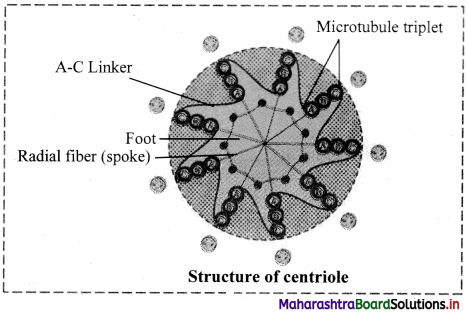
(a) C2C
(b) B2C
(c) B2B
Answer:
(c) B2B

Match the pairs

Question 1.

Group A Group B
(A) Outsourcing (1) Consumer to consumer
(B) B2A (2) Exist everywhere
(C) KPO (3) First step
(D) C2A (4) Business to Consumer
(E) LPO (5) Electronic business
(6) BPO
(7) RTO
(8) Efficient business
(9) Exist only in cyberspace
(10) Last step

Answer:

Group A Group B
(A) Outsourcing (8) Efficient business
(B) B2A (5) Electronic business
(C) KPO (6) BPO
(D) C2A (1) Consumer to consumer
(E) LPO (7) RTO

Maharashtra Board 12th OCM Important Questions Chapter 5 Emerging Modes of Business

Give one word/phrase/term for the following statement

Question 1.
Name the term which is used by even common man effectively while collecting the needed s information quickly.
Answer:
Internet

Question 2.
Name the electronic facility of transferring funds through the internet.
Answer:
Net banking transfer

Question 3.
The form of electronic currency that exists only in cyberspace.
Answer:
Digital cash

Question 4.
The outsourcing of peripheral activities of the organisation to an external organisation to minimise cost.
Answer:
Business Process Outsourcing (BPO)

Question 5.
The trading aspect of e-business that connects buyers and sellers on the internet.
Answer:
e-commerce.

State whether following statement are true or false

Question 1.
Credit cards are used for online payment.
Answer:
True

Question 2.
In online transactions ‘Account’ is password protected.
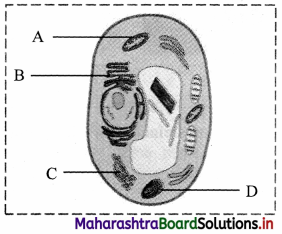
Answer:
True

Question 3.
Online transactions are done without the help of internet.
Answer:
False

Maharashtra Board 12th OCM Important Questions Chapter 5 Emerging Modes of Business

Question 4.
BPO enables optimum utilisation of scarce resources.
Answer:
True

Find the odd one

Question 1.
C2B, B2A, A2U, C2A.
Answer:
A2U

Question 2.
Off shore, Seashore, On shore, Near shore
Answer:
Seashore.

Complete the sentences

Question 1.
Use of Internet has considerably reduced the dependence on
Answer:
Paper work

Question 2.
includes more knowledge based and specialised work.
Answer:
KPO

Question 3.
The concept of e-business was coined in 90s by
Answer:
IBM.

Correct the underlined word and rewrite the sentence:

Question 1.
BPO is more complex than KPO.
Answer:
less

Maharashtra Board 12th OCM Important Questions Chapter 5 Emerging Modes of Business

Question 2.
Traditional business lacks personal touch.
Answer:
e-business

Question 3.
E-commerce is superset of E-business.
Answer:
subset

Question 4.
E-business is narrower concept than s e-commerce.
Answer:
broader

Question 5.
E-commerce is more appropriate in B2B transaction.
Answer:
B2C.

Distinguish between

Question 1.
BPO and LPO
Answer:

BPO LPO
1. Meaning BPO implies the outsourcing of non-primary peripheral activities of the organisation to an external organisation to decrease cost and increase efficiency of parent organisation. LPO is a type of KPO that renders legal services ranging from drafting legal documents, performing legal research to offering legal advice for certain money consideration.
2. Degree of complexity BPO is comparatively less complex. LPO is relatively more complex.
3. Requirement BPO requires process expertise. LPO requires legal (law) expertise.
4. Talent required in employees BPO requires personnel having good communication having legal (law) knowledge. LPO requires professionally qualified personnel skills.
5. Focus BPO focus on low level process. LPO focus on high level process.
6. Outcome BPO gives a company the ability to get access to skilled and trained manpower at low rate. LPO allows organisations to access high level talent and niche expertise that does not exist within the firm.

Maharashtra Board 12th OCM Important Questions Chapter 5 Emerging Modes of Business

Question 2.
KPO and LPO
Answer:

KPO LPO
1. Meaning KPO is a form of outsourcing in which knowledge related and information related work are outsourced to third party service providers to help in value addition and to get cost benefits. LPO is a type of KPO that renders legal services ranging from drafting legal documents, performing legal research to offering legal advice for certain money consideration.
2. Requirement KPO requires knowledge expertise. LPO requires legal (law) expertise.
3. Talent required in employees KPO requires professionally qualified personnel having technical knowledge. LPO requires professionally qualified personnel having legal (law) knowledge.
4. Nature KPO is a subset of BPO which involves outsource of core functions of the parent company. LPO is a type of KPO that is specific to legal services.
5. Sources of services Business organisations mostly hire services from skilled employees supplied by KPO service providers. In-house, legal department mostly hire services from law firms situated in foreign country to minimise cost.
6. Problems Lack of communication due to legal, language and cultural barriers may create complications LPO gets affected adversely by geographical hurdles between law firm and client organisation.


Maharashtra Board 12th OCM Important Questions Chapter 4 Business Services

Balbharti Maharashtra State Board 12th OCM Important Questions Chapter 4 Business Services Important Questions and Answers.

Maharashtra State Board 12th Commerce OCM Important Questions Chapter 4 Business Services

Select the correct option and rewrite the sentences

Question 1.
Principle of utmost good faith is applicable to ………………
(a) Life insurance
(b) Marine insurance
(c) All types of insurance
Answer:
All types of insurance

Question 2.
Insurable interest must exist in ……………..
(a) Life insurance contract only
(b) Marine insurance contract only
(c) Every insurance contract
Answer:
Every insurance contract

Maharashtra Board 12th OCM Important Questions Chapter 4 Business Services

Question 3.
Indemnity means ………………….
(a) compensation equal to loss
(b) compensation more than loss
(c) compensation less than loss
Answer:
compensation equal to loss.

Question 4.
In India railways are owned and managed by ………………….
(a) Private companies
(b) Government
(c) Individuals
Answer:
Government

Question 5.
The costliest means of transport is ………………
(a) Rail transport
(b) Water transport
(c) Air transport
Answer:
Airtransport

Question 6.
Road transport is suitable for ……………… distance.
(a) Short
(b) Long
(c) Medium
Answer:
Short

Question 7.
Railway transport is convenient mode of transport for travelling ………………. distance.
(a) Short
(b) Long
(c) Medium
Answer:
Long.

Question 8.
Food Corporation of India is Em exEimple of ……………….
(a) Government warehouse
(b) Duty-paid warehouse
(c) Cold storage warehouse
Answer:
Government warehouse

Question 9.
Duty paid warehouses are located near ………………….
(a) Railway stations
(b) villages
(c) port and dock
Answer:
port and dock.

Question 10.
Postal services are administered by …………………
(a) Private companies
(b) Government of India
(c) Panchayat system
Answer:
Government of India

Question 11.
In case of urgency and to avoid delays ……………… is sent.
(a) Registered post
(b) Speed post
(c) Insured post
Answer:
Speed post

Question 12.
Inland letter card is used for transmission of messages ……………… only.
(a) outside India
(b) within India
(c) within state
Answer:
within India

Question 13.
Communication in the nature of financial statements may be posted by a service provider to the customers at least once in ……………….. days under Bill Mail Service.
(a) 90
(b) 60
(c) 30
Answer:
90

Question 14.
A ………….. is the person named in money order to whom the money is to be paid.
(a) drawee
(b) drawer
(c) payee
Answer:
payee

Question 15.
Under iMO one can transfer money from Rs ………………….. to Rs 50,000 from designated iMO post offices.
(a) 5,000
(b) 1,000
(c) 500
Answer:
1,000.

Question 16.
The types of account under which the amount is kept fixed for specific period is called ……………….
(a) Fixed Deposit Account
(b) Current Account
(c) Recurring Deposit Account
Answer:
Fixed Deposit Account

Question 17.
The account In which a monthly deposit of certain amount Is to be made for a fixed period Is known as ……………….
(a) Savings Account
(b) Current Account
(c) Recurring Deposit Account
Answer:
Recurring Deposit Account

Question 18.
The account suitable for business purpose is ………………….
(a) Savings Account
(b) Current Account
(c) Recurring Account
Answer:
Current Account

Maharashtra Board 12th OCM Important Questions Chapter 4 Business Services

Question 19.
The account suitable for creating a saving habit is ………………..
(a) Current Account
(b) Recurring Account
(c) Savings Account
Answer:
Savings Account

Question 20.
There Is no limit on the frequency of withdrawals from a …………………
(a) Savings Account
(b) Fixed Deposit Account
(c) Current Account
Answer:
Current Account.

Match the pairs

Question 1.

Group A Group B
(A) Life Insurance (1) Written request by insured
(B) Mitigation of loss (2) Document contains terms and conditions of insurance contract
(C) Premium (3) Insurable interest
(D) Policy (4) Maximise loss
(E) Claim (5) Transfer of loss from one person to another
(F) Subject-matter of insurance (6) To minimise the loss
(7) Owned by Private Companies
(8) Life, property or cargo of insured
(9) Demand to compensate the loss occurred
(10) Payment made by policyholder

Answer:

Group A Group B
(A) Life Insurance (3) Insurable interest
(B) Mitigation of loss (6) To minimise the loss
(C) Premium (10) Payment made by policyholder
(D) Policy (2) Document contains terms and conditions of insurance contract
(E) Claim (9) Demand to compensate the loss occurred
(F) Subject-matter of insurance (8) Life, property or cargo of insured

Question 2.

Group A Group B
(A) Air Transport (1) Suitable for carrying bulky and heavy goods
(B) Pipeline Transport (2) Connects two places on the hills
(C) Railway Transport (3) Raigad Ropeway
(D) Road transport (4) Fastest mode of Transport
(E) Water Transport (5) Feeder to other Transport
(6) Petroleum and gas
(7) Monorail transport
(8) Door to door service
(9) Owned by private companies
(10) Fully owned by foreign companies.

Answer:

Group A Group B
(A) Air Transport (4) Fastest mode of Transport
(B) PipelineTransport (6) Petroleum and gas
(C) Railway Transport (5) Feeder to other Transport
(D) Road transport (8) Door to door service
(E) Claim (1) Suitable for carrying bulky and heavy goods

Question 3.

Group A Group B
(A) Warehousing (1) Located at railway station
(B) Cold storage (2) Stocks the goods on which duty is paid
(C) Warehouse keeper (3) Owned and managed by Government
(D) Duty paid warehouses (4) Time utility
(E) Government warehouses (5) Bond
(6) Possession utility
(7) Perishable goods
(8) Stocks the goods on which duty is not yet paid
(9) Owned and managed by NGOs
(10) Operated by manufacturers to profit storage needs

Answer:

Group A Group B
(A) Warehousing (4) Time utility
(B) Cold storage (7) Perishable goods
(C) Warehouse keeper (5) Bond
(D) Duty paid warehouses (2) Stocks the goods on which duty is paid
(E) Government warehouses (3) Owned and managed by Government

Maharashtra Board 12th OCM Important Questions Chapter 4 Business Services

Question 4.

Group A Group B
(A) Reserve Bank of India (RBI) (1) Recurring deposit account
(B) Overdraft facilities (2) 12 hours service
(C) ATM (3) Withdrawals after fixed period of time
(D) Fixed deposit account (4) Central Bank
(E) Business Service (5) Current account
(6) 24 hours service
(7) Commercial bank
(8) Withdrawal before fixed period of time
(9) Intangible in nature
(10) Tangible in nature

Answer:

Group A Group B
(A) Reserve Bank of India (RBI) (4) Central Bank
(B) Overdraft facilities (5) Current account
(C) ATM (6) 24 hours service
(D) Fixed deposit account (3) Withdrawals after fixed period of time
(E) Business Service (9) Intangible in nature

Give one word/phrase/term for the following sentences

Question 1.
The policy under which cargo is insured for a specific period and voyage.
Answer:
Mixed Policy

Question 2.
The principle of insurance under which the insurer and insured must show complete faith towards each other.
Answer:
Principle of utmost good faith

Question 3.
The type of insurance where the principle of indemnity is not applicable.
Answer:
Life insurance

Question 4.
The person who is protected against certain losses.
Answer:
Insured or Policy Holder

Question 5.
The policy for which the premium is lowest, among all insurance policies.
Answer:
Term insurance policy

Question 6.
The consideration for which the insurer agrees to insure the insured.
Answer:
Premium

Question 7.
This policy is applicable till the departure of the vessel from the port.
Answer:
Part Risk Policy

Question 8.
A policy in which subject matter is insured for a specific voyage irrespective of time involved in it.
Answer:
Voyage policy

Question 9.
Type of marine insurance policy purchased from more than one insurer.
Answer:
Composite marine insurance policy

Question 10.
Policy under which several ships belonging to one owner are insured under the same policy.
Answer:
Fleet Policy or Block Policy.

Question 11.
Mode of transport which helps to get goods and passengers at their doors.
Answer:
Road transport

Question 12.
The mode of transport which connects two places on the hills or across a valley or river.
Answer:
Rope way.

Question 13.
A warehouse where the goods can be stored after the payment of import duty.
Answer:
Duty Paid Warehouse

Question 14.
These warehouses are owned and operated by big manufacturers to fulfil their own storage needs.
Answer:
Private Warehouses

Question 15.
The warehouses which provide storage facilities to general public for certain charges.
Answer:
Public Warehouses

Question 16.
The warehouses which store imported goods until the payment of custom duty.
Answer:
Bonded Warehouses

Question 17.
These warehouses are owned, managed and controlled by co-operative societies.
Answer:
Cooperative Warehouses.

Maharashtra Board 12th OCM Important Questions Chapter 4 Business Services

Question 18.
A quick and easy way of transferring personal remittances from abroad to beneficiaries in India.
Answer:
International Money Transfer

Question 19.
A method of exchanging mail between people using electronic devices.
Answer:
e-mail

Question 20.
The process of passing any information from one person to another with the help of some medium.
Answer:
Communication

Question 21.
The postal service which provide complete solutions right from mail preparation to mail delivery useful for small business and large companies.
Answer:
Business Post.

Question 22.
A bank which Is known as banker’s bank.
Answer:
Central bank

Question 23.
The type of bank which issues currency notes In India.
Answer:
Reserve Bank of India

Question 24.
They operate at village level.
Answer:
Primary Credit Societies

Question 25.
It is not allowed to Issue loans and credit cards.
Answer:
Payment Bank

Question 26.
It is an apex institution for financing agricultural and rural sector.
Answer:
National Bank for Agricultural and Rural Development (NABARD)

Question 27.
The type of bank engaged in financing import and export trade and in foreign exchange transactions.
Answer:
Exchange bank.

State whether following statements are True or False

Question 1.
The principle of subrogation is applicable to life insurance contract.
Answer:
False

Question 2.
The principle of utmost good faith is only applicable to life insurance contract.
Answer:
False

Question 3.
Insured must have insurable interest in the subject-matter at the time of taking the policy.
Answer:
True

Question 4.
An individual must always try to minimize the loss by fire as far as possible.
Answer:
True

Maharashtra Board 12th OCM Important Questions Chapter 4 Business Services

Question 5.
The Principle of indemnity is applicable to fire insurance.
Answer:
True

Question 6.
Railway transport provides door to door services.
Answer:
False

Question 7.
Water transport is the costliest means of transport.
Answer:
False

Question 8.
Transport is useful in raising standard of living.
Answer:
True

Question 9.
Air transport is suitable for short distances.
Answer:
False

Question 10.
Air transport plays vital role during war or emergency situation.
Answer:
True.

Question 11.
International trade for perishable goods has become possible due to cold storage warehouses.
Answer:
True

Question 12.
In bonded warehouses imported goods on which customs duty is already paid are stocked.
Answer:
False

Question 13.
In duty paid warehouses imported goods on which customs duty is not yet paid are stocked.
Answer:
False

Question 14.
Co-operative warehouses are owned, managed and controlled by individuals and private enterprises to earn rent.
Answer:
False

Question 15.
Warehouses can provide transportation facilities to bulk depositors.
Answer:
True.

Question 16.
Parcel cannot be insured.
Answer:
False

Question 17.
Envelope ensures safety of documents and confidentiality of messages.
Answer:
True

Maharashtra Board 12th OCM Important Questions Chapter 4 Business Services

Question 18.
If insured parcel lost in transit, the post office is not responsible to pay the insured amount.
Answer:
False

Question 19.
As a premium, courier service is usually less” expensive than usual mail services.
Answer:
False.

Question 20.
Central bank of the nation cannot accept deposits from the public.
Answer:
True

Question 21.
Overdraft facility Is given to savings account holders.
Answer:
False

Question 22.
Current account Is suitable for business community.
Answer:
True

Question 23.
Debit cards are issued by the bank to non account holders also.
Answer:
False

Question 24.
Real-Time Gross Settlement means payment transaction is not subject to any waiting period.
Answer:
True

Question 25.
The minimum amount to be remitted through RTGS Rs 1.00,000
Answer:
False

Question 26.
Banks never charge any commission for issuing a bank draft.
Answer:
False

Question 27.
Bank issue gift cheques and gold coins to account holders only.
Answer:
False

Find the odd one

Question 1.
Voyage policy, Time policy, Average policy, Mixed policy.
Answer:
Average policy

Question 2.
Specific policy, Composite policy, Comprehensive policy, Excess policy.
Answer:
Composite policy.

Question 3.
Big ships, boats, helicopters, launches
Answer:
helicopters

Question 4.
Aircrafts, tankers, jets, helicopters
Answer:
tankers

Maharashtra Board 12th OCM Important Questions Chapter 4 Business Services

Question 5.
Animal carts, motor-cycles, tracks, boats
Answer:
boats

Question 6.
Launches, buses, boats, tankers
Answer:
buses

Question 7.
Fruits, machinery, fish, vegetables
Answer:
machinery

Question 8.
Machinery, cotton, coal, vegetables
Answer:
vegetables.

Question 9.
Storage, advertising, price stabilisation, risk-bearing
Answer:
advertising

Question 10.
Financing, grading and packing, salesmanship, processing.
Answer:
salesmanship.

Question 11.
Inland Letter, Envelope, Business Post, Book Post.
Answer:
Business Post

Question 12.
Electronic Money Transfer, Instant Money order, Bill Mail Service, International Money Transfer.
Answer:
Bill Mail Service

Question 13.
e-post, courier service, internet, email.
Answer:
e-post.

Question 14.
Issue of cheques. locker facility. issue of currency flotes, preparing project report.
Answer:
issue of currency notes

Question 15.
Portfolio management. framing monetary policy, Dematerlalisatlon, Forex transactions.
Answer:
framing monetary policy

Complete the sentences

Question 1.
……………… policy is suitable for small ship owner having only one ship.
Answer:
Single vessel

Question 2.
……………… policy is purchased from more than one insurer.
Answer:
Composite

Question 3.
Insurance is a means of protection from …………………
Answer:
financial loss

Question 4.
………………. is the consideration for which the insurer agrees to insured a person.
Answer:
Premium

Question 5.
……………….. policy is like pension payment scheme.
Answer:
Annuity

Question 6.
ULIP stands for ………………..
Answer:
Unit Linked Insurance Plan.

Question 7.
Road transport is suitable for …………….. distance.
Answer:
short

Question 8.
Road transport is suitable to carry …………….. goods over a short distance.
Answer:
Perishable

Question 9.
Transport system contributes to the rapid development of ………………..
Answer:
industry and commerce

Question 10.
Long distance networks of Pipeline transport are used for ………………
Answer:
petroleum and gas

Question 11.
When the goods and passenger move inside the country, it is known as ……………….. water transport.
Answer:
inland.

Question 12.
Warehouses provide space for ………………
Answer:
storage of goods

Question 13.
Bonded warehouses are under the close supervision of ………………
Answer:
customs authority

Question 14.
The ……………… warehouses are owned and managed by big manufacturers and merchants.
Answer:
private

Maharashtra Board 12th OCM Important Questions Chapter 4 Business Services

Question 15.
All duty paid warehouses are ………………
Answer:
public warehouses

Question 16.
……………… warehouses are owned, managed and controlled by the Government.
Answer:
Government

Question 17.
……………… warehouses are owned, managed and controlled by co-operative societies.
Answer:
Co-operative.

Question 18.
The process of passing information from one person to another with the help of some ……………….. is called Communication.
Answer:
Medium

Question 19.
The Department of Post and Telegraph is part of ………………..
Answer:
Ministry of Communication and Information and Technology

Question 20.
Printed books, magazines, etc. can be sent through ………………
Answer:
Book Post

Question 21.
………………. is the service through which customers can send their messages to any address in India.
Answer:
e-post

Question 22.
Courier services are usually employed by ………………..
Answer:
a company

Question 23.
The minimum quantity of articles to be posted ……………….. by Bill Mail Service at a time is
Answer:
5000.

Question 24.
Cash credit is granted under a separate …………………
Answer:
Loan account

Question 25.
ICICI Bank is an example of ……………..
Answer:
PrIvate Sector Bank

Question 26.
The account under which a fixed sum is to be deposited regularly every month is known as ………………
Answer:
Recurring deposit account

Question 27.
The RBI was established in the ……………… year
Answer:
1945

Question 28.
In public sector banks, the majority of capital Is held by …………………
Answer:
Government.

Select the correct option and complete the following table

Question 1.
(Warehousing provides storage facilities on rental basis, Big manufacturers and merchants to fulfil their storage needs, Duty paid warehouses, Bonded warehouses)

Group A Group B
(1) Private warehouses —————
(2) ————– Work under the control of customs authorities
(3) ————– Useful for importer as proper care of goods is taken after paying customs duty
(4) Public warehouses ————–
(5) Time utility and place utility ——————–

Answer:

Group A Group B
(1) Private warehouses Big manufacturers and merchants to fulfil their storage needs
(2) Bonded warehouses Work under the control of customs authorities
(3) Duty paid warehouses Useful for importer as proper care of goods is taken after paying customs duty
(4) Public warehouses Provide storage facilities on rental basis
(5) Time utility and place utility Warehousing.

Question 2.
(Courier service, ensures safety of documents and confidentiality of messages, Book Post, International Money Transfer, Communication in the nature of financial statements, bills, etc.)

Group A Group B
(1) Envelope —————-
(2) ————— Printed books, magazines can be sent at distance places through post.
(3) Bill mail service —————
(4) —————- Transferring personal remittances from abroad to beneficiaries in India.
(5) —————- Exchange of items between two or more persons.

Answer:

Group A Group B
(1) Envelope ensures safety of documents and confidentiality of messages
(2) Book Post Printed books, magazines can be sent at distance places through post.
(3) Bill mail service Communication in the nature of financial statements, bills, etc.
(4) International Money Transfer Transferring personal remittances from abroad to beneficiaries in India.
(5) Courier service Exchange of items between two or more persons.

Maharashtra Board 12th OCM Important Questions Chapter 4 Business Services

Question 3.
(Ministry of Shipping, Air transport, movement of people and goods from place to another, Duroto Express and Shatabdi Express, Ministry of Railways, looks after development of surface transport in the country)

Group A Group B
(1) Transportation —————
(2) Ministry of Road Transport ————–
(3) ————– Looks after development of rail transport
(4) Some popular trains ————–
(5) ————– Mountainous areas where other modes of transport cannot reach
(6) —————- Looks after development of ocean transport

Answer:

Group A Group B
(1) Transportation Movement of people and goods from one place to another
(2) Ministry of Road Transport Looks after development of surface transport in the country
(3) Ministry of Railways Looks after development of rail transport
(4) Some popular trains Duranto express and Shatabdi Express
(5) Air transport Mountainous areas where other modes of transport cannot reach
(6) Ministry of Shipping Looks after development of ocean transport

Answer in one sentence

Question 1.
What is Indemnity ?
Answer:
Indemnity means a guarantee or assurance to put the insured in same financial position in which he was immediately before the happening of the uncertain event.

Question 2.
What is Insurance ?
Answer:
insurance is contract between the insured and insurer whereby the insurer agrees to compensate the insured against loss.

Question 3.
What is Child Insurance ?
Answer:
A child insurance policy is a saving cum investment plan that is designed to meet child’s future financial requirements which helps him to pursue his dreams.

Question 4.
What is ULIP policy ?
Answer:
Unit Linked Insurance Policy (ULIP) is the policy which combines the benefits of life insurance policy with mutual funds.

Question 5.
Define warehouse.
Answer:
A warehouse is defined as, an establishment for the storage or accumulation of goods.

Question 6.
What is public warehouses ?
Answer:
A public warehouse is a specialised business establishment that provides storage facilities to the general public on certain charges.

Question 7.
What is Retail Post ?
Answer:
The service under which department of S post offers convenience to the common people by making third party’s products and services available in their areas through selected post offices, e.g. collection of electricity bill, collection of taxes, etc. is called Retail post.

Question 8.
What is e-Post ?
Answer:
e-Post is the service through which customers can send their messages to any address in India with a combination of electronic transmission and physical delivery.

Question 9.
What is Transportation ?
Answer:
Transportation refers to the movement of people, animals and goods from one location to another location.

Question 10.
What is Road Transport ?
Answer:
Road transport are the means that connect people and places on the surface of the land.

Question 11.
What is Rail Transport ?
Answer:
Transportation of passengers and goods on rail lines through trains is called as rail transport.

Question 12.
What is Water Transport ?
Answer:
The movement of passengers and goods on waterways by using various means such as boats, steamers, launches, ships, etc. is called water transport.

Question 13.
What are services ?
Answer:
Services are an act of performance that one party offers to another for certain consideration or without consideration essentially intangible and does not result in the ownership of anything, e.g. services of doctors.

Question 14.
What are business services ?
Answer:
Business services are those services which help business to grow and run It successfully.

Question 15.
What is NABARD ?
Answer:
National Bank for Agriculture and Rural Development (NABARD) Is an apex Institution which provides short term as well as long term credit through regional rural banks to agricultural and rural sector of the Indian economy.

Maharashtra Board 12th OCM Important Questions Chapter 4 Business Services

Question 16.
What is overdraft ?
Answer:
Overdraft is a temporary arrangement by which a current accountholder Is allowed to withdraw more money than his own balance up to a certain limit sanctioned by the bank.

Correct the underlined word and rewrite the sentences

Question 1.
Under whole life policy, the insured can receive money from the insurance company.
Answer:
cannot receive

Question 2.
The person who is protected against certain losses is called insurer.
Answer:
insured

Question 3.
Whole life policy is taken for a specific period.
Answer:
Endowment

Question 4.
Fire insurance gives protection against the losses caused due to the dangers of the sea.
Answer:
Marine.

Question 5.
Ministry of Railways looks after the development of water transport throughout the country.
Answer:
Railways

Question 6.
In hilly areas where other modes of transport are not accessible, water transport is important and convenient.
Answer:
Air

Question 7.
Ministry of Road transport looks after development of ocean transport throughout the country.
Answer:
Shipping

Question 8.
Palace on wheels and Maharaja are the examples of popular trains.
Answer:
Luxury

Question 9.
Warehouses are constructed in such a way to maximise risks.
Answer:
Minimise

Question 10.
Warehouses create place utility by preserving the goods till they are demanded.
Answer:
time

Question 11.
A private warehouse is a specialised establishment that provides storage facilities to the general public for certain charges.
Answer:
public

Question 12.
Duty paid warehouses work under the control of customs authorities.
Answer:
Bonded

Question 13.
Bonded warehouses are more useful for re-export of the goods.
Answer:
Duty paid.

Question 14.
Inland letter is used to send message outside India only.
Answer:
within

Question 15.
Printed books, magazines, journals, etc. can be sent through Business Post.
Answer:
Book Post

Question 16.
The minimum quantity of articles to be posted at a time is 1000 in Bill Mail Service.
Answer:
5000

Question 17.
A Drawee is the person named in money order as the person to whom the money is to be paid.
Answer:
A Payee

Question 18.
On can transfer money from INR 1000 to INR 5000 from designated imp post offices.
Answer:
50,000

Question 19.
Services are homogeneous.
Answer:
heterogeneous

Question 20.
All services are transferable in nature.
Answer:
non-transferable

Question 21.
Commercial bank issues currency notes in India.
Answer:
Reserve Bank of India

Maharashtra Board 12th OCM Important Questions Chapter 4 Business Services

Question 22.
Export and Import Bank provides financial assistance to common people.
Answer:
Exporters and Importers

Distinguish between.

Question 1.
Private Warehouse and Public Warehouses
Answer:

Private Warehouse Public Warehouses
1. Ownership and management These warehouses are owned and managed by big manufacturers, merchants, a firm or a company. These warehouses are owned and managed by individuals, firms, co-operative organisations, etc.
2. Purpose These warehouses are meant for their owners. They Eire not given on rental basis to outsiders. These warehouses are meant for commercial use. Storage and other facilities are provided to small manufacturers and traders on payment of rent.
3. Location Private warehouses are located at the places near factory or residence or place which is convenient to their owners. Public warehouses are generally located near the junctions of railways, highways and waterways.
4. Rules and Regulations These warehouses Eire not required to work under any rules and regulations. They have to observe general laws of the nation. These warehouses work under a licence from the government in accordance with the rules and regulations prescribed by the government.
5. Suitability These warehouses are suitable for large scale manufacturers, wholesalers and retailers who can afford to have their own warehouses. These warehouses are more suitable for small scale manufacturers, traders or distributors who cannot afford to have their own warehouses.

Question 2.
Government Warehouses and Private Warehouses

Government Warehouses Private Warehouses
1. Ownership and management These warehouses Eire owned, managed and controlled by Central and State governments or public authorities. These warehouses are owned, managed and controlled by big manufacturers, merchants, a firm or a company.
2. Storage facilities These warehouses offer storage facilities to the governments, small farmers, businessmen, traders at nominal charges. These warehouses offer storage facilities to the owners for their own purposes. They are not rented to others.
3. Other services These warehouses provide all the services for marketing such as classification, standardisation, grading, packing, etc. These warehouses provide only those services which Eire required by their owners.
4. Rate The rates charged by these warehouses for storing the goods are usually cheap and low. Since these warehouses do not give their space on hire to outsiders, the question of charging rent does not arise.
5. Location These warehouses Eire located at the important transport centres across different states and country. These warehouses Eire located in the premises of the owners which may be near to their factories or market places.

Question 3.
Road Transport and Water Transport
Answer:

Road Transport Water Transport
1. Nature Road transport represents transport facilities on the ground. It consists of motor transport, carts, etc. Water transport represents transport facilities in the water. It consists of river, canal and ocean transport.
2. Carrying capacity It has limited carrying capacity. It has huge or large carrying capacity.
3. Cost of construction and maintenance It requires relatively less capital investment in terms of construction of vehicles and roads and their maintenance. Although no cost is involved in construction of waterways, high cost is involved for construction of ships and ports and also for maintenance of ships and ports
4. Transport charges Transport charges are not fixed but they Eire usually high due to increase in fuel charges. Transport charges Eire fixed according to the distance and they Eire relatively the lowest.
5. Door to door service Road transport provides door to door services to the passengers. Water transport does not provide door-to-door services to the passengers.
6. Suitability It is suitable for short distances and for carrying light and perishable goods such as fruits, fish, vegetables, food grains and other consumer goods. It is suitable for long distance and for carrying heavy and bulky goods such as machinery, cotton, COEQ, etc. in large quantity to any part of the world.
7. Means of transport It uses animals, animal carts, motor-cycles, trucks, tempos, three-wheelers, buses, motor CEO’S, etc. It uses launches, boats, tankers, liners, big ships etc.

Question 4.
Water Transport and Air Transport
Answer:

Water Transport Air Transport
1. Speed Water transport is the slowest mode of transport. Air transport is the fastest mode of transport
2. Carrying capacity Water transport has huge carrying capacity. Air transport has limited carrying capacity.
3. Means of transport Water transport uses big ships, boats, liners, tankers, etc. as means of transport. Air transport uses aircraft, jets, helicopter, etc. as means of transport.
4. Suitability Water transport is suitable for carrying heavy Eind bulky goods such as machinery, cotton, coal, etc. in large quantities to any part of the world. Air transport is suitable to carry light, perishable and valuable goods to any part of the world.
5. Transport charges Transport charges are fixed according to the distance and they are relatively lowest. Transport charges are fixed according to the distance and they Eire relatively highest.
6. Origin Water transport dates back to early historical period. Air transport commenced at the beginning of the 20th century.
7. Means of transport It uses animals, animal carts, motor-cycles, trucks, tempos, three-wheelers, buses, motor CEO’S, etc. It uses launches, boats, tankers, liners, big ships etc.

Question 5.
Savings Account and Fixed Deposit Account
Answer:

Savings Account Fixed Deposit Account
1. meaning A savings account is a type of bank account meant for any regular salaried and wage earners and for making savings A Fixed Deposit Account is a type of bank account under which a certain fixed amount is deposited for a definite period of time.
2. Mode of withdrawals Withdrawals are allowed by cheques or withdrawal slips. No withdrawal is permitted before the date of maturity.
3. Facilities Passbook balance on SMS, cheque books, etc. are issued to the account holders. Only Fixed Deposit Receipt (FDR) is issued.
4. Restrictions on withdrawals There are certain restrictions on the number of withdrawals and the amount to be withdrawn at a time. Withdrawal or payment can be obtained only on the expiry of the fixed period.
5. Rate of interest Interest at low rate is paid periodically in this account. Interest at high rate is paid periodically or at the expiry of period along with principal sum depending upon the time period of deposit.
6. Loan No loan facility is available on the balance of savings account. A certain amount by way of loan can be granted against the security of the Fixed Deposit Receipt (FDR).

Question 6.
Loan and Overdraft
Answer:

Loan Overdraft
1. Meaning Loan is an arrangement under which the bank advances an amount against securities for a certain fixed period of time. Overdraft is a temporary arrangement where a current account holder is allowed to overdraw from the account up to a specified limit.
2. Eligibility Any account holder (i.e. current, savings or fixed deposit) can get a loan facility. Only current account holders are eligible for an overdraft facility.
3. Purpose The purpose of loan is to provide a long-term finance for some project or expansion of business. The purpose of overdraft is to meet short term working capital requirements.
4.Duration Loan may be sanctioned for a period such as 1 year, 3 years, 5 years or even more. Overdraft is generally sanctioned for a short duration from 15 to 60 days.
5. Interest Interest is calculated on the sanctioned loan amount whether it is withdrawn or not and the rate of interest is a little higher than that of overdraft. Interest is calculated on the amount actually withdrawn and the rate of interest is lower than that of loan.
6. Repayment Loan is repaid either in instalments or in lump sum on its due date. Overdraft amount is adjusted against the amount or cheques deposited in the Current Account.

Arrange in proper order

Question 1.
email, Inland letter, Courier
Answer:
Inland letter, Courier, email.

Explain the following terms/concepts

Question 1.
Insurable interest.
Answer:
(1) A person is said to have insurable interest in the object insured if he is in such a relationship with the object of insurance, that he would stand to benefit monetarily by the continuance of the object insured or would suffer a financial loss by the loss or destruction or absence of the object. Therefore, it is necessary that he should be the owner or the lawful user of the object concerned.

(2) In simple term, insurable interest means – some financial interest in the subject-matter. The insured must have insurable (financial) interest in the subject-matter of insurance. No person can enter into a valid insurance contract unless he has insurable interest in the object insured. A person has insurable interest in his own life and his property. A wife has insurable interest in the life of her husband. Similarly, a businessman has insurable interest in the business property.

Question 2.
E-banking service
Answer:
(1) E-banklng stands for electronic banking. It is also called Virtual banking or Online Banking It is a systern under which all the working of the banks Is done through Internet and computers. With the help of this system. an account holder can deposit the money into the bank or withdraw the money. These funds tram one account to another. He can also get information of his account on the computer itself.

(2) The following-banking services are available to account holders:

  • Automated Thller Machine (ATM)
  • Credit Cards
  • Debit Cards
  • Mobile Banking
  • National Electronic Fund Transfer (NEFT)
  • Real Time Gross Settlement (RTGS). E-banking has made life much easier and banking much faster for both customers and banks.

Justify the following statements

Question 1.
The principle of indemnity does not apply to life insurance contract.
Answer:
(1) The principle of indemnity is the controlling principle of insurance according to which the insured shall be compensated for only the actual loss suffered by him.

(2) All insurance contracts except life insurance contracts are the contracts of indemnity. Life insurance contract is, strictly speaking, a contract of assurance and not a contract of indemnity.

(3) In the case of life insurance contract, insurer cannot fully compensate the insured or his legal heir. This is because loss due to death of individual cannot be exactly determined or expressed in terms of money.

(4) Life insurance contract is a contract of assurance by which the insurer agrees to pay a fixed amount on the happening of the contingency.

Maharashtra Board 12th OCM Important Questions Chapter 4 Business Services

Question 2.
Transport is useful in raising standard of living.
Answer:
(1) An efficient transportation system helps to develop agriculture by making available better seeds, fertilisers and agricultural equipment.

(2) Transport system also contributes to the rapid development of industry and commerce. The development in agriculture, industry and commerce leads to expansion in employment opportunities. Transport, as an industry by itself, also provides jobs to millions of people all over the country.

(3) By generating employment, transport leads to increase the purchasing power with people. As a result consumption pattern improves and consumption of variety of goods and services increases.

(4) Transport makes products from different regions available in local markets. The people also get variety of new and novel goods and services from any corner of the world at their places. This raises their standard of living.

Question 3.
Railway transport does not provide door to door service.
Answer:
(1) Transportation of passengers and goods from one place to another on the land surface on railway tracks through trains is called Railway Transport. It is the most dependable, cheaper and faster mode of transport to carry goods and passengers over long distances. It occupies an important place in land transport system.

(2) Railway transport requires specially ; prepared rail tracks with signalling systems. Therefore, throughout the country only certain places are fixed between which such tracks Eire laid. So, it runs between two railway stations.

(3) Special platforms are constructed to facilitate the loading and unloading of goods and for the movement of passengers.

(4) Goods and passengers are transported from one station to another by railway and there onward journey in the interior locations is facilitated by road transport. Thus, railways cannot provide door-to-door service in the interior as road transport does.

Question 4.
Current account is suitable for businessman.
Answer:
(1) A current account is a type of bank account in which there are no restrictions on the number of deposits and withdrawals. Therefore, it is suitable for businessmen (traders, hospitals, educational institutions, companies, etc.) as they have numerous day-to-day transactions of depositing amounts or cheques into a bank and issuing cheques for making payments to various parties.

(2) A current account is meant for facilitating, banking transactions of a businessman, such as collection of cheques, remittances to parties, bank overdraft facility, etc. A salaried person has no such transactions and does not require such facilities.

(3) A salaried person is interested in the rate of interest on his savings in the bank account. Banks generally do not pay any interest on the current account balances because they cannot use the current deposits for advancing loans to businessmen. Therefore, a salaried person finds savings account suitable for his limited banking transactions.

(4) The minimum balance to be kept for running the current account is much higher as compared to that for the savings account. A salaried person has a limited income and therefore, cannot afford to keep relatively large sum blocked in his account without earning any interest thereon. Therefore, a current account is suitable for businessman.

Attempt the following

Question 1.
What is fire insurance? Explain the different types of fire insurance policies.
Answer:
[A] Meaning : Fire insurance contract is contract of indemnity against loss or damage to goods or property arising from fire. Any property which is likely to damage due to fire may be insured against fire. Fire insurance also cover the loss caused due to fire, lightning and explosion.

[B] Types : The different types of fire insurance policies are shown in the following:

  1. Valued Policy
  2. Average Policy
  3. Specific Policy
  4. Floating Policy
  5. Excess Policy
  6. Reinstatement Policy
  7. Comprehensive Policy
  8. Consequential Loss Policy
  9. Sprinkler Leakage Policy

1. Valued Policy : It is a policy under which the value of the property (i.e. subject mater) is ascertained and agreed upon by the insurer and the insured at the time of issue of the policy. The insurer undertakes to pay the agreed value irrespective of amount of loss caused due to fire. This type of policy is taken for those goods whose value is too difficult to calculate at the time of loss by fire, e.g. artwork, paintings, etc.

2. Average Policy : This policy contains an average clause. Under this policy the insurer is liable to pay only that proportion of the actual loss as the insured sum will bear to the full value of the property at the time of the loss, e.g. the machinery of Rs 5,00,000 is insured under fire insurance for Rs 2,00,000, The loss occurred due to fire arrived at Rs 2,50,000. This is because insurance is 40% of actual value of machinery. Hence the claim for loss is also 40% of 2,50,000 i.e. Rs 1,00,000.
Formula to calculate claim:
\(\frac {Value of Policy}{Value of Property}\) × Actual loss
\(\frac {200000}{500000}\) × 250000 = Rs 100000

3. Specific Policy: This type of policy mentions a specific maximum amount payable as compensation in case the insured property is destroyed by fire, irrespective of the market value of the property insured, e.g. a property of the value of Rs 5,00,000 is insured for Rs 3,00,000. The loss occurred due to fire is Rs 1,50,000. Here insurance company will pay Rs 1,50,000 in full as compensation.

4. Floating Policy : This type of policy covers, under one sum and for a single premium, one or several kinds of goods lying in different localities. As the quantity of goods lying at different places fluctuate from time to time, it is convenient to the businessmen to take a policy for one sum and one premium for goods lying at different places.

5. Excess Policy : This type of policy is taken when the market value of stock constantly fluctuates. In such case one policy is taken for a minimum amount below which value of stock never falls and another policy for excess amount by which price fluctuates, e.g. If the value of stock ranges between Rs 5,00,000 and Rs 5,40,000, then one policy will be taken for Rs 5,00,000 and another policy will be taken for Rs 40,000 i.e. for excess amount.

6. Reinstatement Policy : Under this policy, insurer undertakes to replace the property or goods lost by fire or to pay the amount that would be needed to reinstate or replace the damaged or destroyed property. While replacing the property for paying compensation depreciation amount of the property destroyed is not taken into consideration. The rate of premium is usually very high.

7. Comprehensive Policy : This fire insurance policy covers all kinds of risks such as fire explosion, lightning, earthquake, floods, riot, strikes, burglary, etc. under single policy.

8. Consequential Loss Policy : Initially a fire insurance policy was meant for indemnification of loss due to damage of tangible property. The intangible property was not covered by fire insurance. The consequential loss policy now taken for the loss of tangible as well as intangible properties. This policy covers the risk of loss of net profits, payment of standing charges, expenditure in respect of the increased cost of working, etc.

9. Sprinkler Leakage Policy: This policy covers the damage of property caused by an automatic sprinkler system that has leakage or discharged water accidently and not due to fire and smoke. This policy does not cover the discharge or leakage of water due to heat caused by fire, repair, earthquake, war, explosion, etc.

Question 2.
Explain the advantages of air transport.
Answer:
The advantages of air transport are explained as follows:
(1) Fastest means of transport : Among all the means of transport available at present, air transport is the fastest and quickest means of transport.

(2) Vital services : Air transport plays key role during war and emergency situations because it is useful to provide valuable services quickly in affected areas by floods, earthquakes, etc.

(3) Free routes : In case of air transport, it is not necessary to incur any expenditure on the construction of aerial routes. It uses natural and shortest aerial routes.

(4) Less pollution : In comparison to other means of transport like road transport, air transport is less polluting.

(5) Useful in certain areas : Air transport is very useful in carrying passengers, goods and medicines to the areas specially hilly and mountainous areas which are not accessible by any other means.

(6) Market for perishable and costly goods : For speedy transport of perishable good medicines, human organs, diamonds, ornaments, etc. air transport is most suitable and the fastest.

Maharashtra Board 12th OCM Important Questions Chapter 4 Business Services

Answer the following.

Question 1.
Explain types of warehouses.
Answer:
The different types of warehouses are:
(1) Private warehouses : The warehouses owned and operated by the big manufacturers and wholesalers for storing their own goods are called private warehouses. Big companies which need large storage capacity on a regular basis, can afford to construct and maintain their own warehouses. Many public sector organisations also have their own private warehouses, e.g. the Food Corporation of India (FCI) has constructed warehouses in different parts of the country for its own use. Usually these warehouses are constructed near to ones business factory or industry for convenience. They have network of warehouses in different parts of the country.

(2) Public warehouses : Warehouses which are established to provide storage facilities to the general public, small manufacturers and traders on rental basis are called public warehouses. These warehouses are owned and managed by an individual or co-operative societies. These warehouses are located near railway junctions, highways, waterways, airport, seaport, etc. They are well guarded and specially designed to protect goods from several types of risks. These warehouses have to obtain licence from the government. They provide warehousing facilities at low cost. Many marketing facilities such as standardisation, grading, labelling, packing, branding, etc. are provided in these warehouses.

(3) Bonded warehouses : Warehouses which are licensed by the government to accept and store imported goods till the customs duties are not paid on such goods are called bonded warehouses. These warehouses are managed and controlled by customs authorities. These warehouses are located near the ports. The importers cannot take possession of goods from such warehouses unless and until the duty on the goods is paid.

The warehouse-keeper is required to give undertaking or ‘Bond’ that without the consent of the customs authorities goods will not be removed from the warehouse. Hence, such warehouses are called ‘Bonded Warehouses’. If an importer is unwilling or unable to pay customs duty immediately, he can withdraw them in instalments and pay customs duty proportionately.

(4) Duty-paid warehouses : The duty-paid warehouses provide the facility of storing the imported goods but not yet sold or transported to importers’ place or godown. These warehouses are owned and managed by the dock authorities only and hence they are also known as public warehouses. These warehouses are located near port and dock areas. They are more useful to importers who re-export the imported goods. The concerned authorities take all the due and reasonable care to ensure their safety. Processing of imported goods such as sorting, re-packing is done in these warehouses.

(5) Government warehouses : Warehouses which are owned, managed and controlled by the Central and State Governments or public authorities are called Government warehouses. These warehouses offer storage facilities to small traders, farmers, businessmen, etc. who are in need of the same on payment of reasonable rent. Central Warehousing Corporation of India (CWC), State Warehousing Corporation (SWC) and Food

(6) Co-operative warehouses : These are warehouses owned, run, managed and controlled by co-operative societies to provide warehousing facilities to the members who are farmers in rural areas. These warehouses are similar to private warehouses but they run on the principle of co-operation. They are used for storing agricultural commodities, consumer goods, raw materials, etc. Farmers, small producers and traders are benefited by such warehouses as they charge at economical rates.

(7) Cold storage warehouses : Cold storage warehouses are largely used to store and preserve perishable goods such as flowers, fish, eggs, meat, vegetables, fruits, medicines, dairy products, etc. These products are kept in cold storage warehouses at very low temperature so that their quality and freshness would remain intact. These warehouses ensure continuous supply of seasonal and perishable products throughout the year. International trade for seasonal and perishable goods such as green peas, mangoes, etc., becomes possible only because of cold storage facilities.

Question 2.
What is rail transport. Explain its advantages and disadvantages.
Answer:
[A] Meaning : Railways are the principal means of transport on land. The mode of transport which carries goods, passengers and materials from one place to another on rail lines through trains is called Railway transport. It runs passenger trains, mail express, goods trains, popular trains and luxury trains. The ministry of railways looks after the development of rail transport in India.

[B] Advantages : The advantages of rail transport are explained as follows:

  1. Suitable for long distances : Railway transport is suitable and convenient mode of transport for travelling over long distances.
  2. Carriage of heavy and bulky goods : Railway transport is more suitable for the carriage of bulky and heavy goods like engineering goods, coal, cotton, livestock, oil, etc. over long distances.
  3. Speedy : Railway transport is more speedy in comparison to road transport.
  4. Less affected by adverse weather conditions : Usually railway service is more certain, uniform and regular. It is not much affected by adverse weather conditions such as rains, fogs, floods, etc.
  5. Protection to goods : Railway transport protects goods against rains, sun, wind, snow, etc. and ensures safety and security to goods.

[C] Disadvantages : The disadvantages of railway transport are explained as follows:

  1. Expensive for short distances : Railway transport is more expensive for carrying goods and passengers over short distances.
  2. Non-availability of services in remote part : The services of railway transport are not reachable or available in the remote part of the country.
  3. Heavy loss in case of accident : In case of accident, it involves heavy losses of life, goods and materials.
  4. Inflexibility : Fixed time schedule of trains, permanent track, definite station and halts, etc. bring certain degree of inflexibility in railway transport.
  5. Incomplete service : The railway service is available between the nearest stations only. Railways can not provide door-to-door services. Therefore, railway stations are required to be connected by roads.

Question 3.
What is water transport? Explain the advantages and disadvantages of water transport.
Answer:
[A] Meaning : This is the oldest and cheapest means of transport. The mode of transport which carries goods and passengers on the surface of the water from one port to another by using boats, steamers, launches, ships, etc. is called water transport. When the passengers and goods move within the country, it is known as inland water transport and when the goods and passengers are carried through sea and oceans, it is known as ocean or sea transport. The ministry of shipping takes cares of ocean transport in India.

[B] Advantages : The advantages of water transport are explained as follows:

  1. Economical mode of transport : Water transport is suitable and economical mode of transport for carrying heavy and bulky goods over longer distances.
  2. Safe mode of transport : It is safe and secured mode of transport in regard to occurrence of accidents.
  3. Promotes international trade : Water transport facilitates and promotes international trade and thus helps to widen the market.
  4. Free routes : Water transport use waterways which are natural and free of cost route and involve no construction and maintenance costs.
  5. More flexibility : Water transport is more flexible in comparison to rail transport.

[C] Disadvantages : The disadvantages of water transport are explained as follows:

  1. Absence of door-to-door services : Water transport cannot provide door-to-door service. It carries goods and passengers from one port to another.
  2. Affected by adverse weather conditions : It is much affected by adverse weather conditions like heavy rains, cyclone, storms, etc.
  3. Low speed : In comparison to other modes of transport, speed of water transport is very slow. Therefore, perishable goods cannot be transported by this mode of transport.
  4. Heavy capital expenditure : Heavy investment (capital expenditure) cost is involved in the construction and maintenance of ships, ports, docks, wharves, etc.
  5. Hazardous : Water transport is hazardous. There are dangers of storms, cyclone and other perils of sea.

Maharashtra Board 12th OCM Important Questions Chapter 4 Business Services

Question 4.
Define Bank. Explain different type of banks.
Answer:
[A] Definition : Bank is a dealer in money and credit. It is a financial institution whose basic activities are to accept deposits and advance, lend money and provide other related services, According to The Indian Banking Regulation Act, 1949, “any company which transacts the business of banking in India.” The term banking is further defined as, “accepting for the purpose of lending or investment of deposits from the public, repayable on demand or otherwise and withdrawable by cheque, draft and order or otherwise.”

[B] Types of Banks:
The different types of banks are shown In the following:

  1. Central Bank
  2. Commercial Bank
  3. Co-operatIve Bank
  4. Industrial Development Bank
  5. Exchange Bank
  6. RegIonal Rural Bank
  7. SavIngs Bank
  8. Investment Bank
  9. Speclalised Bank

The different types of banks are explained below:
1. Central Bank : The central bank in a country is the financial institution at the top (apex) of all the banking institutions operating in the country. In India, The Reserve Bank of India was established in 1945 under a special statute called the Reserve Bank of India Act, 1944. It performs the functions like framing monetary policy, issuing currency notes, acting as a banker to the Government and acting as the banker’s bank to commercial and other banks in India.

2. Commercial Bank : The Commercial bank plays key role in the economic, industrial and social development of a country. It performs broadly two functions such as (i) Primary functions which include accepting deposits and lending money in different forms and (ii) Secondary function which include agency functions and utility functions. The different types of commercial banks in India are as follows:
(i) Public Sector Banks : The banks in which majority of the share capital or stake (interest) is held by the Government of India are called Public Sector Bank, e.g. State Bank of India, Bank of India, etc.

(ii) Private Sector Banks : The banks in which majority of the share capital or stake is held by private individuals are called Private Sector Banks, e.g. Axis Bank, HDFC Bank, etc.

(iii) Foreign Banks : The banks which are registered and have their headquarters in foreign country but operate in different countries including India through their branches established there, are called Foreign banks e.g. Standard Chartered Bank, American Express Bank, HSBC, etc.

3. Co-operative Banks : Co-operative banks are formed, registered and organised under the Indian Co-operative Societies Act and regulated under Banking Regulation Act. These banks are more popular in rural and semi-urban areas. These banks are primarily meant for catering to the financial needs of economically backward people, farmers and small scale units. They operate at three different levels:
(a) Primary Credit Societies : The primary credit societies work at village level. These credit societies collect the savings and surplus money in the form of deposits from members and common people. They are also financed by the State Co¬operative Banks and District Co-operative Banks for the purpose of lending to needy people for productive purpose.

(b) District Central Co-operative Banks : The District Central Co-operative Banks operating at district level and financed by the State Co-operative Bank for the purpose of providing finance to primary credit societies.

(c) State Co-operative Banks : The State Co-operative Banks Eire working at state level. These banks provide funds to District Central Cooperative Banks and Primary Credit Societies to enable them to provide finance to rural and semi urban areas. Apart from this, they also supervise the working of district banks and credit co¬operative societies.

4. Industrial Development Banks : The banks which provide medium and long term equipment, latest technology, expansion and modernisation of business, etc. are called Industrial Development Banks. Industrial Finance ; Corporation of India (IFCI), State Financial Corporations (SFCs), Maharashtra State Finance Corporation (MSFC), etc. are the examples of Industrial Development Banks. These banks perform the following functions:

  • Provide medium and long term finance to business organisations for expansion and modernisation.
  • Underwriting i.e. giving guarantee to buy shares issued by public limited companies.
  • Purchase debentures and bonds.

5. Exchange Banks : An exchange bank specialises in financing import and export trade and in foreign exchange transactions. The American Express Bank, Bank of Tokyo, Barclays Bank, etc. are the examples of Exchange Banks functioning in India. The Exchange Banks perform the following functions:

  • Finance foreign trade transactions,
  • Issue letter of credit on behalf of importer,
  • Discount foreign bills of exchange,
  • Remit dividend, interests and profits.

6. Regional Rural Banks : These banks were constituted (established) in 1975 and are sponsored by large public sector banks. 50%, 35% and 15% of the capital of these banks are provided by the Central Government, sponsored banks and State Government respectively. These banks collect (mobilise) funds in the form of deposits from rural and semi-urban areas. They provide loans and advances to small and marginal farmers, agricultural workers, rural artisans for productive purpose.

7. Savings Bank : A savings bank is one which has the main object of inculcating the habit of saving among the community. It collects scattered savings of the community especially from rural areas and invests the same in good securities. In India, Postal Savings Bank is an example of such a bank. Commercial Banks and Co-operative Banks act as savings banks as they have separate savings accounts departments.

8. Investment Bank : Investment banks offer financial and advisory assistance to their customers which usually include business firms and government organisations. These banks provide advice on investment decisions and facilitate mergers and acquisitions by undertaking research. These Banks do not directly deal with the common people.

9. Specialised Banks: The banks which make available to the requirements of the business and provide possible support to set up business activities in specific area are called Specialised Banks. The different types of specialised banks are:
(a) Export Import Bank of India (EXIM Bank) : These banks provide the needed financial assistance and support to the exporters and importers in setting up business for exporting and importing products respectively. They work to expand and promote country’s international trade.

(b) Small Industries Development Bank of India (SIDBI) : SIDBI was established on 2nd April, 1990 under the Act of Parliament of India. Its main function is to act as the main institution for financing, promoting and developing the Micro, Small and Medium Enterprises (MSMEs) as well as co-ordinator of the institutions engaged in similar activities.

(c) National Bank for Agricultural and Rural Development (NABARD) : NABARD has been established to work as an apex institution to finance agricultural and rural sector. It provides long term and short term loans through regional rural banks. It provides loans to financial institutions and not individuals. It is also concerned with the function of policy planning and operations relating to agricultural credit and credit for other activities in rural areas.