Maharashtra Board 11th BK Important Questions Chapter 2 Meaning and Fundamentals of Double Entry Book-Keeping

Balbharti Maharashtra State Board 11th Commerce Book Keeping & Accountancy Important Questions Chapter 2 Meaning and Fundamentals of Double Entry Book-Keeping Important Questions and Answers.

Maharashtra State Board 11th Commerce BK Important Questions Chapter 2 Meaning and Fundamentals of Double Entry Book-Keeping

1. Answer in one sentence only.

Question 1.
State the meaning of the accounting equation.
Answer:
An equation that indicates or shows that the total assets of a business are always equal to the total liabilities of a business plus capital is called the accounting equation.

Question 2.
What do you mean by debt?
Answer:
To debit an account means to enter the entry or write on the left-hand side of an account.

Maharashtra Board 11th BK Important Questions Chapter 2 Meaning and Fundamentals of Double Entry Book-Keeping

Question 3.
Give two examples of personal accounts.
Answer:
Two examples of personal accounts are stated below:

  1. Mr. Raghuvir Sharma’s Account
  2. The Bank of India’s Account.

Question 4.
What is a Nominal Account?
Answer:
The account relating to business expenses, incomes, and gains is called a nominal account.
e.g. Rent A/c.

Question 5.
Give two examples of real accounts.
Answer:
Two examples of real accounts are:

  1. Cash A/c
  2. Goodwill A/c

Question 6.
State whether drawings increase or decrease owner’s equity.
Answer:
Drawings made by the owner of the business decrease its equity.

Question 7.
What is a conventional cash book?
Answer:
A cash book that is prepared to record not only cash transactions but all types of transactions such as credit purchase or sale, banking transactions, opening, and closing entries, adjustments entries is called a conventional cash book.

Maharashtra Board 11th BK Important Questions Chapter 2 Meaning and Fundamentals of Double Entry Book-Keeping

Question 8.
Explain the term dual aspect.
Answer:
Every transaction has two aspects i.e. for every debit there is corresponding and equal credit.

Question 9.
State the meaning of impersonal account.
Answer:
The account which is not of a person is called an impersonal account.

Question 10.
Write the rule of Real account.
Answer:
The rule of real account states that Debit what comes in and Credit what goes out.

Question 11.
Which account will be debited when goods are sold to Ram on credit?
Answer:
When goods are sold to Ram, Ram’s A/c will be debited.

Question 12.
Which account will be debited when Mr. Shyam has paid cash to you?
Answer:
Cash A/c will be debited when Mr. Shyam has paid cash to us.

2. Write one word/term or phrase which can substitute each of the following statements.

Question 1.
Expenses are paid before it is due.
Answer:
Prepaid Expenses

Question 2.
Income due but not yet received.
Answer:
Accrued Income

Maharashtra Board 11th BK Important Questions Chapter 2 Meaning and Fundamentals of Double Entry Book-Keeping

Question 3.
Carriage paid on the sale of goods.
Answer:
Carriage Outward

Question 4.
Statement of Assets & Liabilities.
Answer:
Balance Sheet

Question 5.
Account prepared to know Net Profit or Net Loss.
Answer:
Profit & Loss Account

Question 6.
Value of goods remaining unsold at the end of the year.
Answer:
Closing Stock

Question 7.
The provision was made to compensate the loss on account of likely debts.
Answer:
Provision for Bad & Doubtful Debts

Question 8.
The accounts are prepared at the end of the accounting year to know the profit or loss and financial position of the business.
Answer:
Final Accounts

Maharashtra Board 11th BK Important Questions Chapter 2 Meaning and Fundamentals of Double Entry Book-Keeping

Question 9.
An amount spent on promoting the sale of goods.
Answer:
Selling Expenses

Question 10.
Additional information is provided below the Trial Balance.
Answer:
Adjustments

3. Select the most appropriate alternatives from those given below and rewrite the statements.

Question 1.
___________ is excess of assets over liabilities.
(a) Goodwill
(b) Capital
(c) Investments
(d) Drawings
Answer:
(b) Capital

Question 2.
Discount earned is transferred to credit side of ___________ account.
(a) Current A/c
(b) Profit & Loss Account
(c) Trading
(d) Capital
Answer:
(b) Profit & Loss Account

Question 3.
___________ is a statement that shows the financial position of a business on a specific date.
(a) Trading account
(b) Trial Balance
(c) Profit & Loss A/c
(d) Balance Sheet
Answer:
(d) Balance Sheet

Maharashtra Board 11th BK Important Questions Chapter 2 Meaning and Fundamentals of Double Entry Book-Keeping

Question 4.
Outstanding expenses are shown on the ___________ side of Balance Sheet.
(a) Assets
(b) Liability
(c) Both
(d) None of these
Answer:
(b) Liability

Question 5.
Interest on Drawing is credited to ___________ Account.
(a) Trading
(b) Profit & Loss Account
(c) Capital
(d) All
Answer:
(b) Profit & Loss Account

Question 6.
Debit balance of Trading Account means ___________
(a) Gross Loss
(b) Net Loss
(c) Net Profit
(d) Gross Profit
Answer:
(a) Gross Loss

Question 7.
Carriage Inward is debited to ___________ Account.
(a) Trading A/c
(b) Profit & Loss
(c) Capital
(d) Bank
Answer:
(a) Trading A/c

Question 8.
Excess of credit over to debit in Profit & Loss Account indicates ___________
(a) Net Profit
(b) Gross Profit
(c) Gross Loss
(d) Net Loss
Answer:
(a) Net Profit

Maharashtra Board 11th BK Important Questions Chapter 2 Meaning and Fundamentals of Double Entry Book-Keeping

Question 9.
Closing stock is always valued at cost or market price which is ___________
(a) more
(b) less
(c) zero
(d) equal
Answer:
(b) less

Question 10.
When a specific date is not given, in that case, interest on the drawing is charged for ___________ month.
(a) Four
(b) Six
(c) Eight
(d) Nine
Answer:
(b) Six

4. Fill in the blanks.

Question 1.
Gross Profit is transferred to ___________ account.
Answer:
Profit & Loss Account

Question 2.
Debit Balance of Trading Account indicates ___________
Answer:
Gross Loss

Question 3.
Income Receivable appears on ___________ side of Balance Sheet.
Answer:
Asset

Question 4.
Interest on Bank Loan is debited to ___________ A/c.
Answer:
Profit & Loss Account

Maharashtra Board 11th BK Important Questions Chapter 2 Meaning and Fundamentals of Double Entry Book-Keeping

Question 5.
Profit and Loss Account is prepared to find out ___________ results of the business.
Answer:
Networking

Question 6.
All indirect/operating expenses are transferred to ___________ account.
Answer:
Profit and Loss Account

Question 7.
Interest of proprietor’s drawing is credited to ___________ account.
Answer:
Profit & Loss Account

Question 8.
An excess of debit over credit in the Profit & Loss A/c represents the ___________
Answer:
Net Loss

Question 9.
All direct expenses are transferred to ___________ account.
Answer:
Trading A/c

Maharashtra Board 11th BK Important Questions Chapter 2 Meaning and Fundamentals of Double Entry Book-Keeping

Question 10.
Balance Sheet is ___________ of assets & liabilities.
Answer:
Statement

5. Classify the following accounts under the types of Personal, Real, and Nominal accounts.

Question 1.
Investments A/c
Answer:
Real Account

Question 2.
Creditors A/c
Answer:
Personal Account

Question 3.
Land A/c
Answer:
Real Account

Question 4.
Purchase Returns A/c
Answer:
Personal Account

Question 5.
Cash A/c
Answer:
Real Account

Question 6.
Building A/c
Answer:
Real Account

Maharashtra Board 11th BK Important Questions Chapter 2 Meaning and Fundamentals of Double Entry Book-Keeping

Question 7.
Capital A/c
Answer:
Personal Account

Question 8.
Goodwill A/c
Answer:
Real Account

Question 9.
Interest received A/c
Answer:
Nominal Account

Question 10.
Depreciation A/c
Answer:
Nominal Account

Question 11.
Stationery A/c
Answer:
Nominal Account

Question 12.
Salary A/c
Answer:
Nominal Account

Maharashtra Board 11th BK Important Questions Chapter 2 Meaning and Fundamentals of Double Entry Book-Keeping

Question 13.
Excise duty A/c
Answer:
Nominal Account

Question 14.
Bank Loan A/c
Answer:
Personal Account

Question 15.
Bank Overdraft A/c
Answer:
Personal Account

Question 16.
Sales A/c
Answer:
Nominal Account

Question 17.
Return Inwards A/c
Answer:
Personal Account

Question 18.
Rent received A/c
Answer:
Nominal Account

Maharashtra Board 11th BK Important Questions Chapter 2 Meaning and Fundamentals of Double Entry Book-Keeping

Question 19.
Wages A/c
Answer:
Nominal Account

Question 20.
Discount received A/c
Answer:
Nominal Account

Question 21.
Debtors A/c
Answer:
Personal Account

Question 22.
Furniture & Fixtures A/c
Answer:
Nominal Account

Question 23.
Purchases A/c
Answer:
Nominal Account

Maharashtra Board 11th BK Important Questions Chapter 2 Meaning and Fundamentals of Double Entry Book-Keeping

Question 24.
Bad Debts A/c
Answer:
Nominal Account

Question 25.
Dadar Library A/c
Answer:
Personal Account

Question 26.
Rent paid A/c
Answer:
Nominal Account

Question 27.
Prepaid Insurance A/c
Answer:
Personal Account

Question 28.
Carriage Outwards A/c
Answer:
Nominal Account

Question 29.
Rent Receivable A/c
Answer:
Personal Account

Maharashtra Board 11th BK Important Questions Chapter 2 Meaning and Fundamentals of Double Entry Book-Keeping

Question 30.
Profit on sale of machinery A/c
Answer:
Nominal Account

Question 31.
Bills Payable A/c
Answer:
Personal Account

Question 32.
Bank of India A/c
Answer:
Personal Account

Question 33.
Carriage Inwards A/c
Answer:
Nominal Account

Question 34.
Stock A/c
Answer:
Real Account

Question 35.
Accrued Interest A/c
Answer:
Personal Account

Maharashtra Board 11th BK Important Questions Chapter 2 Meaning and Fundamentals of Double Entry Book-Keeping

Question 36.
Bank A/c
Answer:
Personal Account

Question 37.
12% Government Bonds A/c
Answer:
Real Account

Question 38.
Carriage A/c
Answer:
Nominal Account

Question 39.
Advertisement A/c
Answer:
Nominal Account

Question 40.
Conveyance A/c
Answer:
Nominal Account

Maharashtra Board 11th BK Important Questions Chapter 2 Meaning and Fundamentals of Double Entry Book-Keeping

Question 41.
Premises A/c
Answer:
Real Account

Question 42.
Octroi A/c
Answer:
Nominal Account

Question 43.
Postage A/c
Answer:
Nominal Account

Question 44.
Electricity Charges A/c
Answer:
Nominal Account

Maharashtra Board 11th BK Important Questions Chapter 1 Introduction to Book Keeping and Accountancy

Balbharti Maharashtra State Board 11th Commerce Book Keeping & Accountancy Important Questions Chapter 1 Introduction to Book Keeping and Accountancy Important Questions and Answers.

Maharashtra State Board 11th Commerce BK Important Questions Chapter 1 Introduction to Book Keeping and Accountancy

1. Answer in One Sentence:

Question 1.
What is Transaction?
Answer:
The exchange of goods or services for money or money’s worth is called a transaction.

Question 2.
What is Cash Discount?
Answer:
The amount which is deducted by the seller from the amount due at the time of the receipt is called cash discount.

Question 3.
What is the entity concept?
Answer:
The business entity concept states that a business has a separate entity and has an independent legal existence distinct from the person who owns it.

Maharashtra Board 11th BK Important Questions Chapter 1 Introduction to Book Keeping and Accountancy

Question 4.
What is the money measurement concept?
Answer:
The money measurement concept implies that every business transaction must be recorded in a common unit of measurement i.e. in terms of money only.

Question 5.
What is the consistency concept?
Answer:
The consistency concept implies that any policy adopted for accounting should be continuous or consistent throughout the business and it need not be changed generally unless and until circumstances demand.

Question 6.
What is conservatism?
Answer:
The concept of conservatism states that while deciding the policy of the enterprise the businessman has to anticipate no profit but provide for all possible losses.

Question 7.
What is accounting?
Answer:
Accounting is a process of recording, classifying, summarising, analyzing, and interpreting financial transactions and communicating the result thereof to the users of such information.

Question 8.
Name the financial statements prepared by a business.
Answer:
A businessman prepares the financial statements such as income statements i.e. Trading Account and Profit and Loss Account and Position Statement i.e. Balance Sheet.

Maharashtra Board 11th BK Important Questions Chapter 1 Introduction to Book Keeping and Accountancy

Question 9.
Explain the term ‘Profit’.
Answer:
Excess of revenue income over revenue expenditure is termed as profit.

Question 10.
Explain the term ‘Cost Concept’.
Answer:
The concept according to which assets are recorded in the books of accounts at the price at which they are acquired or purchased is called the cost concept.

2. Give the word term or phrase which can substitute each of the following statements:

Question 1.
Dealings between two persons.
Answer:
Transaction

Question 2.
Business transaction in which cash is not paid or received immediately.
Answer:
Credit Transaction

Question 3.
An allowance is given by the receiver of the cash to the giver of cash at the time of payment.
Answer:
Cash Discount

Question 4.
Liability depends on the happening or not happening a certain event.
Answer:
Contingent Liability

Maharashtra Board 11th BK Important Questions Chapter 1 Introduction to Book Keeping and Accountancy

Question 5.
Expenditure on fixed assets increases the earning capacity of the business.
Answer:
Capital Expenditure

Question 6.
System in which entry is recorded for cash as well as credit transactions.
Answer:
Accrual System

Question 7.
The concept under which comparison of one accounting period with the other period is possible.
Answer:
Consistency Concept

Question 8.
A science and art of correctly recording in the books of accounts, all those business transactions that result in the transfer of money or money’s worth.
Answer:
Bookkeeping

Question 9.
Exchange of goods and services either for cash or any other goods or services.
Answer:
Transaction

Question 10.
Sale or purchase of goods or services for immediate cash payment.
Answer:
Cash Transaction

Maharashtra Board 11th BK Important Questions Chapter 1 Introduction to Book Keeping and Accountancy

Question 11.
Sale or purchase of goods or services for a certain value to be receivable or payable in the future.
Answer:
Credit Transaction

Question 12.
Commodity purchased or produced for sale.
Answer:
Goods

Question 13.
Excess of assets over liabilities.
Answer:
Capital

Question 14.
Excess of profit over normal profit.
Answer:
Super Profit

Question 15.
The total amount of goods and services are withdrawn by the proprietor for self-use.
Answer:
Drawings

Maharashtra Board 11th BK Important Questions Chapter 1 Introduction to Book Keeping and Accountancy

Question 16.
Amount of discount deducted from the invoice price.
Answer:
Trade discount

Question 17.
The reputation of a business is expressed in terms of money.
Answer:
Goodwill

Question 18.
The concept states that assets when purchased should be recorded at cost price.
Answer:
Cost concept

Question 19.
The concept states that business operations will continue forever.
Answer:
Concept of Going Concern

Question 20.
A concept on which a double-entry bookkeeping system is based.
Answer:
Dual Aspect Concept

Question 21.
Rules of conduct are accepted universally to record business transactions.
Answer:
Accounting Principles

Maharashtra Board 11th BK Important Questions Chapter 1 Introduction to Book Keeping and Accountancy

Question 22.
General ideas which convey certain meanings.
Answer:
Concepts

Question 23.
The general notion or abstract ideas on which accounting is based.
Answer:
Accounting Concept

Question 24.
The accounting concept suggests that a business has a separate identity from its owner.
Answer:
Business Entity Concept

Question 25.
The accounting concept states that monetary transactions are only recorded in the books of accounts.
Answer:
Money Measurement Concept

Question 26.
The money value for which assets are acquired or manufactured.
Answer:
Cost

Question 27.
Proprietor’s contribution to the business.
Answer:
Capital

Maharashtra Board 11th BK Important Questions Chapter 1 Introduction to Book Keeping and Accountancy

Question 28.
Valuable things are owned by the business.
Answer:
Assets

Question 29.
Period of time for which accounts of the business are prepared.
Answer:
Financial year/Accounting year

Question 30.
Amount received after selling of goods or services.
Answer:
Revenue

Question 31.
Excess of revenue over its cost.
Answer:
Profit

Question 32.
Name the accounting concept on the basis of which the income statement is prepared.
Answer:
Accrual Accounting Concept

3. Select the most appropriate alternatives from those given below and rewrite the statements.

Question 1.
Money value of the reputation of business is known as ____________
(a) Copyright
(b) Goodwill
(c) Patents
(d) Trademark
Answer:
(b) Goodwill

Maharashtra Board 11th BK Important Questions Chapter 1 Introduction to Book Keeping and Accountancy

Question 2.
Heavy advertising expenditure for launching a new product is called as ____________
(a) Capital expenditure
(b) Revenue Expenditure
(c) Deferred Revenue Expenditure
(d) None of these
Answer:
(c) Deferred Revenue Expenditure

Question 3.
Expenditure incurred on purchase of fixed asset is ____________
(a) Revenue Expenditure
(b) Capital Expenditure
(c) Deferred Revenue Expenditure
(d) None of these
Answer:
(b) Capital Expenditure

Question 4.
Concept which provides a line between present and future is known as ____________
(a) Going Concern Concept
(b) Cost Concept
(c) Accrual Concept
(d) Entity Concept
Answer:
(a) Going Concern Concept

Question 5.
Totalling of Journal or Ledger is called as ____________
(a) Posting
(b) Folio
(c) Casting
(d) Journalising
Answer:
(c) Casting

Maharashtra Board 11th BK Important Questions Chapter 1 Introduction to Book Keeping and Accountancy

Question 6.
In cash transaction, goods or services are exchanged for ____________
(a) other goods
(b) other services
(c) immediate cash
(d) grains
Answer:
(c) immediate cash

Question 7.
The work of book-keeping is of ____________ nature.
(a) competitive
(b) primary/basic
(c) secondary
(d) none of these
Answer:
(b) primary/basic

Question 8.
Capital is ____________ of the business.
(a) asset
(b) liability
(c) property
(d) goodwill
Answer:
(b) liability

Question 9.
The work of accounting depends upon ____________
(a) book-keeping
(b) cash book
(c) subsidiary books
(d) ledger
Answer:
(a) book-keeping

Question 10.
____________ is the amount invested by the owner of a business.
(a) Cash
(b) Money
(c) Asset
(d) Capital
Answer:
(d) Capital

Maharashtra Board 11th BK Important Questions Chapter 1 Introduction to Book Keeping and Accountancy

Question 11.
Revenue expenditure is ____________ in nature.
(a) capital
(b) outstanding
(c) recurring
(d) contingent
Answer:
(c) recurring

Question 12.
Amount withdrawn by the owner for his personal expenses is called ____________
(a) Drawings
(b) Personal expenses
(c) Cash
(d) Assets
Answer:
(a) Drawings

Question 13.
Financial statements are a part of ____________
(a) Book keeping
(b) Planning
(c) Accounting
(d) None of these
Answer:
(c) Accounting

Question 14.
A ____________ liability is an uncertain liability.
(a) Long term
(b) Contingent
(c) Current
(d) Fixed
Answer:
(b) Contingent

Question 15.
A Derson who is unable to nay his debts, is called ____________
(a) insolvent
(b) solvent
(c) well to do
(d) poor
Answer:
(a) insolvent

Maharashtra Board 11th BK Important Questions Chapter 1 Introduction to Book Keeping and Accountancy

Question 16.
According to ____________ concept business shall go on for a long time.
(a) going concerned
(b) consistency
(c) materiality
(d) dual aspects
Answer:
(a) going concerned

Question 17.
According to ____________ concept, every business transaction has two aspects.
(a) going concerned
(b) materiality
(c) business entity
(d) dual aspects
Answer:
(d) dual aspects

Question 18.
According to ____________ concept revenue is recognised when it is earned.
(a) Realisation
(b) Accounting period
(c) Accrual
(d) Matching cost
Answer:
(c) Accrual

Question 19.
According to ____________ convention, while preparing planning anticipate losses.
(a) Materiality
(b) Consistency
(c) Conservatism
(d) disclosure
Answer:
(c) Conservatism

Question 20.
Customs and traditions which guide the accountants to prepare accounting statements are called ____________
(a) Conventions
(b) Principles
(c) Concepts
(d) Procedure
Answer:
(a) Conventions

Maharashtra Board 11th BK Important Questions Chapter 1 Introduction to Book Keeping and Accountancy

Question 21.
According to ____________ concept, assets are recorded at a price paid to acquire them.
(a) Cost
(b) Money measurement
(c) Entity
(d) Dual aspect
Answer:
(a) Cost

4. State whether the following statements are true or false with reasons:

Question 1.
The trading concern is established for rendering services to society.
Answer:
This statement is False.
The main objective of trading concern is to earn profit. It is for traders’ livelihood, so the trading concern is not established for rendering services to the society.

Question 2.
Book-keeping is an art as well as a science.
Answer:
This statement is True.
Book-keeping is also considered as an art of recording business transactions because the writing of accounts in a specific style and format requires education, knowledge, training, skill, and experience. From another point of view, Book-keeping is a continuous process of collecting, analyzing, classifying, summarising, and recording the different types of business transactions. In brief, bookkeeping may be defined as “A science as well as an art of collecting, analyzing, classifying, summarising and recording all types of business transactions in a significant manner and in terms of money in a separate set of books.”

Question 3.
In Book-keeping & Accountancy non-monetary transactions are also recorded.
Answer:
This statement is False.
Only monetary transactions are recorded in Book-keeping & Accountancy. It is done to find financial results for the purpose of analyzing and interpreting.

Question 4.
Perpetual succession is explained by the concept of the entity.
Answer:
This statement is False.
The concept of entity is different from the perpetual succession. Entity means separate existence of business from the owner whereas perpetual succession means long life and continuation.

Maharashtra Board 11th BK Important Questions Chapter 1 Introduction to Book Keeping and Accountancy

Question 5.
Accounting is useful only to the owner.
Answer:
This statement is False.
Accounting is not only useful for the owner but also to the suppliers, government, customers, lenders, etc.

Question 6.
Writing of account does not require specific skill and knowledge.
Answer:
This statement is False.
Writing of account requires specific skill and knowledge as book-keeping is an art and science of correctly recording business transactions.

Question 7.
The main objective of Bookkeeping is to keep permanent records of business transactions.
Answer:
This statement is True.
The record of business transactions is prepared for a specific period of time i.e. one year and it is preserved for a long period of time.

Question 8.
In credit transactions, goods or services are purchased for cash only.
Answer:
This statement is False.
In credit transactions, goods and services are purchased and sold for credit only. Credit means post-pone payments for a future date.

Question 9.
In barter transactions, goods or services are purchased for other goods or services.
Answer:
This statement is True.
Barter means exchange of goods or services for goods or services. No money is involved in barter transactions.

Question 10.
In cash transactions, goods or services are purchased for a certain value to be paid in the future.
Answer:
This statement is False.
In a cash transaction, goods or services are purchase or sold for spot payments or receipts. No credit is allowed.

Maharashtra Board 11th BK Important Questions Chapter 1 Introduction to Book Keeping and Accountancy

Question 11.
Good is a commodity that is purchased for self-use.
Answer:
This statement is False.
Good is a commodity that is purchased for resale purposes. It is an article or a commodity in which businessman deals.

Question 12.
Amount due from other person is known as debt.
Answer:
This statement is True.
Debt is a total sum of money due from a person with whom the business has dealings. Accordingly, a person from whom such debt is due to a business is called the debtor.

Question 13.
Liabilities represent the debts or obligations that a business must receive in terms of money.
Answer:
This statement is False.
Liabilities refer to the total amount of obligations that a business has to pay in the future. Liability means the total amount owed by the business to other persons.

Question 14.
Capital = Liabilities – Assets.
Answer:
This statement is False.
Excess of business assets over business liabilities is called capital.
Capital = Assets – liabilities.

Question 15.
Drawings made by the businessman increase his capital.
Answer:
This statement is False.
Drawing means cash or goods withdrawn by the proprietor for his personal or family use. Drawings made by the businessman decreases his capital.

Maharashtra Board 11th BK Important Questions Chapter 1 Introduction to Book Keeping and Accountancy

Question 16.
A person whose assets are equal to or greater than liabilities is known as insolvent.
Answer:
This statement is False.
Insolvent means a person whose liabilities are greater than assets is known as ‘Insolvent’.

Question 17.
A person whose assets are less than business liabilities is known as insolvent.
Answer:
This statement is True.
When a person is not able to pay liabilities is called insolvent. Liabilities are greater than assets.

Question 18.
The cost or sacrifice which is incurred to run the business is known as an income.
Answer:
This statement is False.
The cost or sacrifice which is incurred to run the business is known as an expenditure.

Question 19.
Benefits which are given by giver to the receiver is known as discount.
Answer:
This statement is False.
Discount is a concession given by the seller to the buyer. There are two types of discount,

  • Cash discount
  • Trade discount

Question 20.
Posting implies recording a transaction in a journal.
Answer:
This statement is False.
Posting means transferring or recording journal entries from the journal to the respective ledger accounts. Ledger is the main book of accounting.

Maharashtra Board 11th BK Important Questions Chapter 1 Introduction to Book Keeping and Accountancy

Question 21.
Contingent liabilities can also be called doubtful liabilities.
Answer:
This statement is True.
The contingent liabilities are the liabilities whose occurrence depends upon the happening of a certain event that may or may not take place. So a contingent liabilities can also be called doubtful liabilities.

Question 22.
A sports club is a trading concern.
Answer:
This statement is False.
The sports club is a nontrading concern as they do not work for profit-making. They work for the promotion of sports.

Question 23.
A cash discount is an incentive allowed for the speedy recovery of income.
Answer:
This statement is True.
A cash discount is given by the creditor or seller to the debtor or buyer to induce him to make prompt payment. It is given at the time of cash payment.

Question 24.
Excess of revenue over expenses is called loss.
Answer:
This statement is False.
Excess of revenue over expenses is called profit. Your income is less and expenditures are less so you get profit.
Income ₹ 50,000 – Expenses ₹ 35,000 = Profit is ₹ 15,000.

Question 25.
Excess of liabilities over assets represents the solvency of a business.
Answer:
This statement is False.
Excess of liabilities over assets represents insolvency of business. A trader cannot pay his debts as liabilities are greater than his assets.
Liabilities ₹ 1,50,000 Assets ₹ 80,000.
₹ 1,50,000 – ₹ 80,000 = ₹ 70,000 deficiency.

Maharashtra Board 11th BK Important Questions Chapter 1 Introduction to Book Keeping and Accountancy

Question 26.
A business can not run without bookkeeping.
Answer:
This statement is False.
Book-keeping is a recording of business financial transactions which is useful to prepare ledger, trial balance, financial statements. All the above are useful to take decisions, planning, liabilities, and assets so a businessman cannot run his business without book-keeping.

Question 27.
Bookkeeping is necessary only for organizing with profit objectives.
Answer:
This statement is False.
Books of accounts are maintained by trading and non-trading concerns. Non-trading concerns do not earn any profits so book-keeping is not necessary only with the objective of profit.

Question 28.
The figures of profit and net worth are disclosed by books of accounts.
Answer:
This statement is True.
The purpose of preparing books of accounts is to know financial details of organization from journal ledger, trial balance, final accounts proprietor to get an idea of his financial status. The purpose of financial books of accounts is to get profit and net worth etc.

Question 29.
Financial statements are an effective weapon in the hands of management.
Answer:
This statement is True.
With help of financial statements, management does planning, decision-making for the future. The past record gives ideas to the management to improve financial decisions like more profit better financial conditions etc. so financial statements are effective weapons in the hands of management.

Maharashtra Board 11th BK Important Questions Chapter 1 Introduction to Book Keeping and Accountancy

Question 30.
Irregularities, frauds, and misappropriations can be detected only because of books accounts.
Answer:
This statement is False.
Irregularities frauds and misappropriations can be detected by auditing. Continuous and periodical auditing will detect the irregularities frauds and misappropriations which is done by a chartered accountant.

5. Do you agree or disagree with the following statements:

Question 1.
Goodwill is a tangible asset.
Answer:
Disagree

Question 2.
For income tax purposes an accounting year starts on 1st January and ends on 31st March.
Answer:
Disagree

Question 3.
Earning profits is an aim of Not for Profit Concern.
Answer:
Disagree

Question 4.
Trade discount is recorded in the books of accounts.
Answer:
Disagree

Maharashtra Board 11th BK Important Questions Chapter 1 Introduction to Book Keeping and Accountancy

Question 5.
Wages paid on installation of machinery are revenue expenditures.
Answer:
Disagree

Question 6.
An amount that is not recoverable from debtors is called bad debt.
Answer:
Agree

Question 7.
The double-entry book-keeping system is invented in India.
Answer:
Disagree

Question 8.
Book-keeping does not have any rules and regulations for recording business transactions.
Answer:
Disagree

Question 9.
The owner of the business does not have any utility of book-keeping.
Answer:
Disagree

Maharashtra Board 11th BK Important Questions Chapter 1 Introduction to Book Keeping and Accountancy

Question 10.
Bookkeeping cannot be used as financial evidence in a court of law.
Answer:
Disagree

Question 11.
It is not possible for management to plan and take decisions in business with help of book-keeping and accountancy.
Answer:
Disagree

Question 12.
Cash-withdrawn by the proprietor from his business for personal use is called capital.
Answer:
Disagree

Question 13.
A person who has to pay the business for getting goods and services on credit is known as the debtor.
Answer:
Agree

Question 14.
Trade discount is not recorded in the books of accounts.
Answer:
Agree

Maharashtra Board 11th BK Important Questions Chapter 1 Introduction to Book Keeping and Accountancy

Question 15.
Purchase of goods is revenue expenditure.
Answer:
Agree

Question 16.
Heavy expenditure on advertising is deferred revenue expenditure.
Answer:
Agree

Question 17.
A solvent person’s assets are more than his liabilities.
Answer:
Agree

Question 18.
Net Worth = Total Assets – Outsiders Liabilities
Answer:
Agree

Question 19.
Conservatism’s concept means to play safe.
Answer:
Agree

Maharashtra Board 11th BK Important Questions Chapter 1 Introduction to Book Keeping and Accountancy

Question 20.
The dual aspect means every transaction has two effects i.e. debit and credit.
Answer:
Agree

6. Complete the following sentences:

Question 1.
In barter transaction goods are exchange for ____________
Answer:
Goods

Question 2.
Asset is ____________ of the business.
Answer:
property

Question 3.
Capital expenditures are ____________ in nature.
Answer:
Non Recurring

Maharashtra Board 11th BK Important Questions Chapter 1 Introduction to Book Keeping and Accountancy

Question 4.
A ____________ liability is an uncertain liability.
Answer:
Contingent

Question 5.
A person whose liabilities are more than his assets is known as ____________
Answer:
Insolvent

Question 6.
An article or a commodity which is purchase for resale in business is called ____________
Answer:
Goods

Question 7.
Customs and traditions which guide the accountants to prepare accounting systems are called ____________
Answer:
Conventions

Question 8.
Discount given by the creditor to the debtor on payment of cash is called ____________
Answer:
Cash discount

Question 9.
For tax purpose an year starts on 1st April and ends on 31st March is called ____________
Answer:
Accounting year

Question 10.
An institution which provides standard of accounting in India called ____________
Answer:
Institute of Chartered Accountants of India

Maharashtra Board 11th BK Important Questions Chapter 1 Introduction to Book Keeping and Accountancy

Question 11.
Which accounting standard is followed for depreciation on fixed assets ____________
Answer:
AS-6

Question 12.
Brief explanation of an entry is called as ____________
Answer:
Narration

Question 13.
Businessman open ____________ type of bank account.
Answer:
Current

Question 14.
The main objective of business concern ____________
Answer:
making profits

Question 15.
Assets which are held in the business for a period of less than one year ____________
Answer:
Current Assets

Question 16.
10 years loan taken from bank by organisation is ____________ term loan.
Answer:
long

Question 17.
Heavy expenses paid on formation of an organisation is known as ____________ expenditure.
Answer:
Deferred Revenue

Maharashtra Board 11th BK Important Questions Chapter 1 Introduction to Book Keeping and Accountancy

Question 18.
Dividend received on shares is ____________ income.
Answer:
Revenue

Question 19.
Loss on sale of old machine is ____________ loss.
Answer:
Capital

Maharashtra Board Class 12 Chemistry Important Questions Chapter 13 Amines

Balbharti Maharashtra State Board 12th Chemistry Important Questions Chapter 13 Amines Important Questions and Answers.

Maharashtra State Board 12th Chemistry Important Questions Chapter 13 Amines

Question 1.
What are amines?
Answer:
Amines : The alkyl or aryl derivatives of ammonia in which one, two or all the three hydrogen atoms attached to nitrogen are replaced by same or different alkyl or aryl groups are called amines. OR Amines are nitrogen-containing organic compounds having basic character.

Example : methyl amine : CH3 – NH2
Maharashtra Board Class 12 Chemistry Solutions Chapter 13 Amines 1

Maharashtra Board Class 12 Chemistry Important Questions Chapter 13 Amines

Question 2.
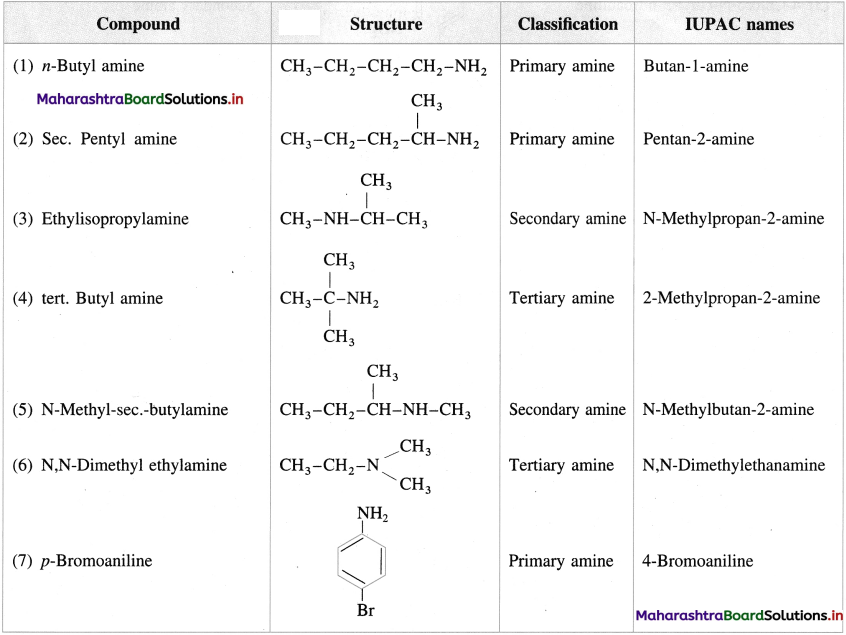
Classify the following amines as primary, secondary and tertiary.
Answer:
Maharashtra Board Class 12 Chemistry Solutions Chapter 13 Amines 7

Question 3.
Mention the functional group in :
(1) Primary amine
(2) Secondary amine
(3) Tertiary amine.
Answer:
(1) A primary amine has a functional group – NH2 (amino group).
Example : ethylamine, C2H5 – NH2
(2) A secondary amine has a functional group – NH – (imino group).
Example : Maharashtra Board Class 12 Chemistry Solutions Chapter 13 Amines 8
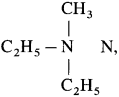
(3) A tertiary amine has a functional group Maharashtra Board Class 12 Chemistry Solutions Chapter 13 Amines 9 (tertiary nitrogen atom)

Example :
Maharashtra Board Class 12 Chemistry Solutions Chapter 13 Amines 10

Question 4.
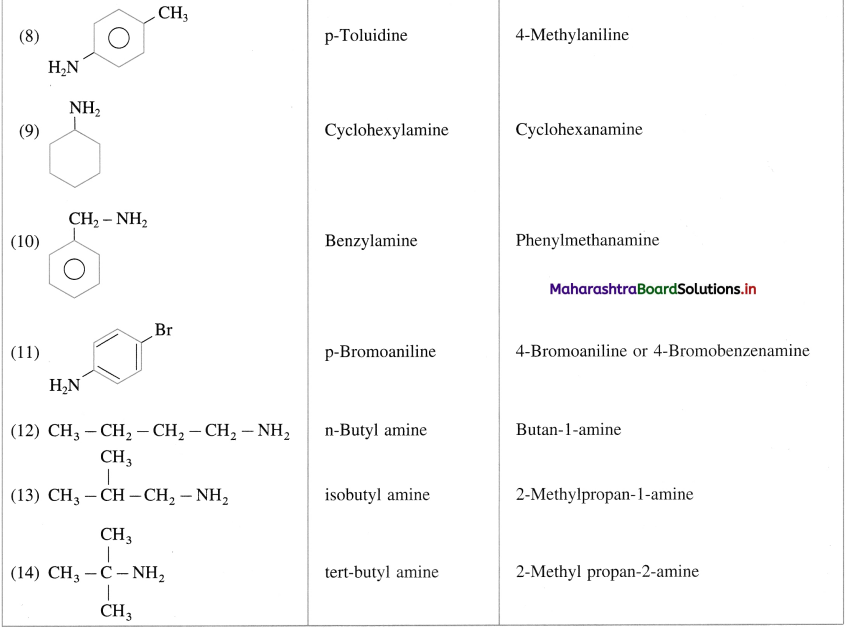
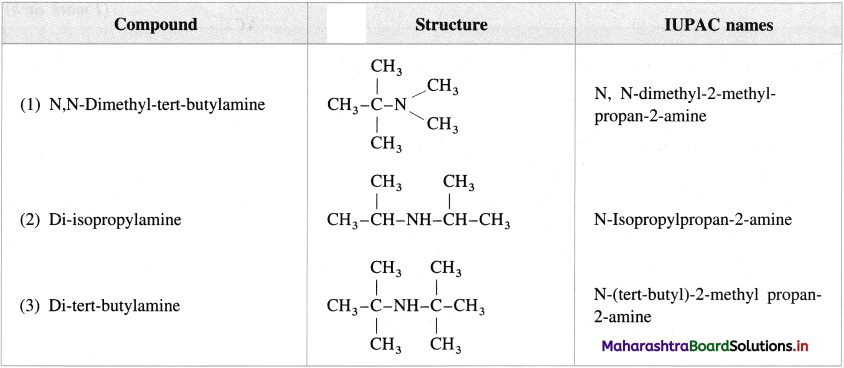
Write common and IUPAC names of following compounds :
Answer:
(A) Primary amines :
Maharashtra Board Class 12 Chemistry Solutions Chapter 13 Amines 14
Maharashtra Board Class 12 Chemistry Solutions Chapter 13 Amines 15
(B) Secondary amine :
Maharashtra Board Class 12 Chemistry Solutions Chapter 13 Amines 16
(C) Tertiary Aimines :
Maharashtra Board Class 12 Chemistry Solutions Chapter 13 Amines 17.

Maharashtra Board Class 12 Chemistry Important Questions Chapter 13 Amines

Question 5.
Give the structures of the following :
Answer:
Maharashtra Board Class 12 Chemistry Solutions Chapter 13 Amines 22

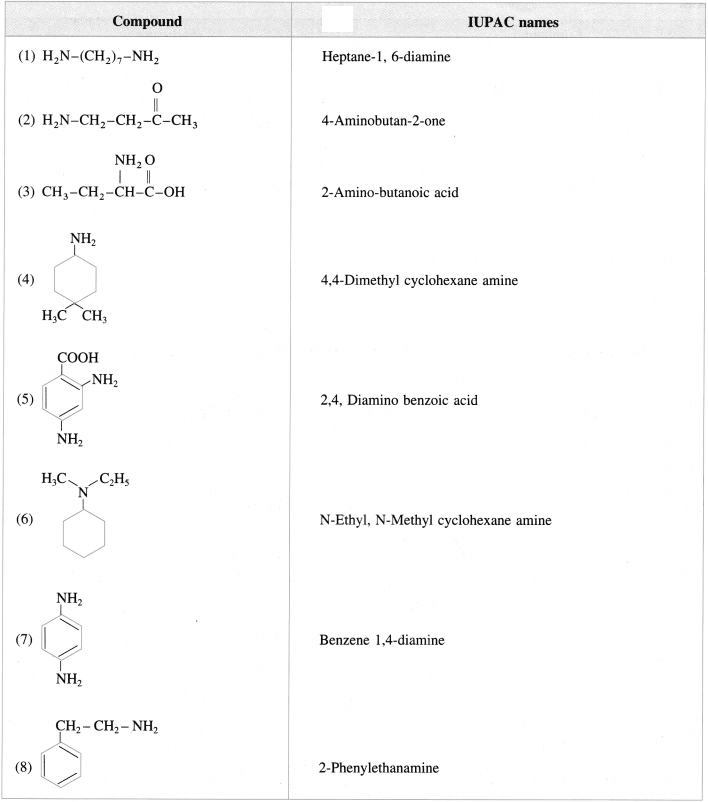
Question 6.
Give the IUPAC names of the following amines :
Answer:
Maharashtra Board Class 12 Chemistry Solutions Chapter 13 Amines 23

Question 7.
Write the IUPAC names of the following amines :
Answer:
Maharashtra Board Class 12 Chemistry Solutions Chapter 13 Amines 24

Maharashtra Board Class 12 Chemistry Important Questions Chapter 13 Amines

Question 8.
Give the structures and IUPAC names of the following amines :
Answer:
Maharashtra Board Class 12 Chemistry Solutions Chapter 13 Amines 25

Question 9.
Classify the following amines as primary, secondary and tertiary and write the IUPAC names.
Answer:
Maharashtra Board Class 12 Chemistry Solutions Chapter 13 Amines 26

Question 10.
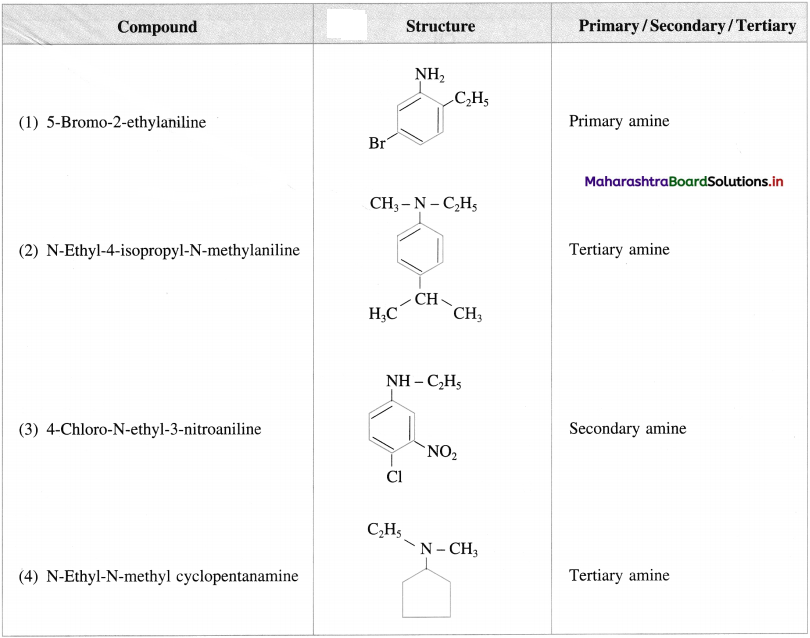
Write the structures and classify the following amines as primary, secondary, tertiary amines.
Answer:
Maharashtra Board Class 12 Chemistry Solutions Chapter 13 Amines 27

Maharashtra Board Class 12 Chemistry Important Questions Chapter 13 Amines

Question 11.
Write the common and IUPAC name of a tertiary amine in which one methyl, one ethyl and one w-propyl group is attached to nitrogen.
Answer:
Maharashtra Board Class 12 Chemistry Solutions Chapter 13 Amines 28

Question 12.
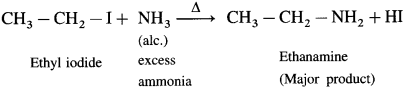
How will you prepare ethanamine from ethyl iodide?
Answer:
When ethyl iodide is heated with excess of alcoholic ammonia, under pressure at 373 K ethanamine is obtained as a major product.
Maharashtra Board Class 12 Chemistry Solutions Chapter 13 Amines 29

Question 13.
How is a nitroalkane converted to a primary amine?
OR
What is the action of LiAlH4/ether on (i) 1-Nitropropane (ii) 2-MethyI-l-nitropropane?
Answer:
When a nitroalkane is refluxed with tin (or iron) and concentrated HCl it gives corresponding primary amine.
Maharashtra Board Class 12 Chemistry Solutions Chapter 13 Amines 33
For example, (1) nitromethane on reduction by refluxing with Sn and concentrated HCl gives methylamine.
Maharashtra Board Class 12 Chemistry Solutions Chapter 13 Amines 34

(2) 1-Nitropropane on reduction with Sn and concentrated HCl gives propan-1-amine.
Maharashtra Board Class 12 Chemistry Solutions Chapter 13 Amines 35

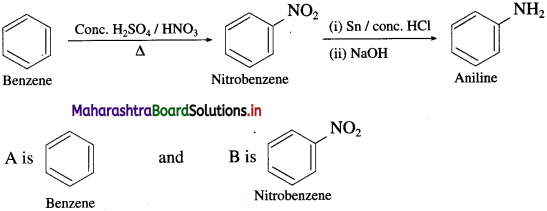
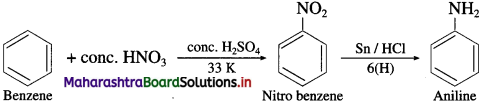
(3) Niirobenzcnc on reducion with tin and concentrated HCI or by using H2/Pd in ethanol gives anilinc.
Maharashtra Board Class 12 Chemistry Solutions Chapter 13 Amines 36

(4) When nitropropane is reduced in the presence of LiAlH4 in ether, n-propyl amine is obtained.
Maharashtra Board Class 12 Chemistry Solutions Chapter 13 Amines 37

(5) When 2-methyl-1-nitropropane is reduced in the presence of LiAlH4 in ether, 2-methyl propan-1-amine is obtained.
Maharashtra Board Class 12 Chemistry Solutions Chapter 13 Amines 38

Question 14.
How will you prepare aniline from nitrobenzene?
OR
How is aniline prepared from nitro compounds?
Answer:
Nitrobenzene is reduced to aniline by passing hydrogen gas in the presence of finely divided nickel, palladium or platinum.
Maharashtra Board Class 12 Chemistry Solutions Chapter 13 Amines 39

Question 15.
Identify the compounds A and B in the following reactions
Maharashtra Board Class 12 Chemistry Solutions Chapter 13 Amines 40
Answer:
Maharashtra Board Class 12 Chemistry Solutions Chapter 13 Amines 41

Maharashtra Board Class 12 Chemistry Important Questions Chapter 13 Amines

Question 16.
How will you obtain a primary amine from an alkyl cyanide (nitrile)?
OR
Write a short note on Mendius reduction.
Answer:
Alkyl cyanides (nitriles) on reduction by sodium and ethyl alcohol form corresponding primary amines. This reaction is called Mendius reduction.
Maharashtra Board Class 12 Chemistry Solutions Chapter 13 Amines 42
For example; propionitrile on reduction by sodium and ethanol gives n-propyl amine (Propan-1-amine).
Maharashtra Board Class 12 Chemistry Solutions Chapter 13 Amines 43
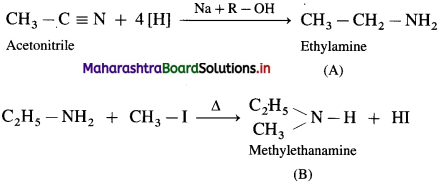
Methyl cyanide or acetonitrile on reduction by sodium and ethanol gives ethanaminc.
Maharashtra Board Class 12 Chemistry Solutions Chapter 13 Amines 44

Question 17.
How will you prepare ethylamine from acetonitrile?
OR
How is ethanamine prepared from methyl cyanide?
OR
What is the action of a mixture of sodium and alcohol on acetonitrile?
Answer:
Methyl cyanide or acetonitrile on reduction by sodium and ethyl alcohol forms ethanamine. The reaction is called Mendius reduction.
Maharashtra Board Class 12 Chemistry Solutions Chapter 13 Amines 45

Question 18.
How will convert phenyl acetonitrile to β-phenylethylamine?
Answer:
When phenyl acetonitrile is reduced in the presence of sodium and ethanol, β-phenyl ethylamine is obtained.
Maharashtra Board Class 12 Chemistry Solutions Chapter 13 Amines 46

Question 19.
How will you obtain primary amine from an acid amide?
Answer:
Acid amides on reduction with lithium aluminium hydride or sodium, ethanol form corresponding primary amines.
Maharashtra Board Class 12 Chemistry Solutions Chapter 13 Amines 50
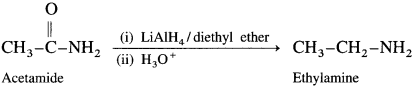
For example : Acetamide on reduction with lithium aluminium hydride or sodium, ethanol gives ethylamines.
Maharashtra Board Class 12 Chemistry Solutions Chapter 13 Amines 51

Question 20.
Explain Hoffmann degradation of amides.
Write a note on Hoffmann bromamide degradation.
Answer:
The conversion of amides into amines in the presence of bromine and alkali is known as Hoffmann degradation of amides. An important characteristic of this reaction is that an amine with one carbon less than those in the amide is formed. Thus, decreasing the length of carbon chain. This reaction is an example of molecular rearrangement and involves the migration of an alkyl or aryl group from the carbonyl carbon to the adjacent nitrogen atom. For example,

(1) When propanamide is treated with bromine and aqueous or alcoholic sodium hydroxide, ethanamine is obtained which has one carbon atom less.
Maharashtra Board Class 12 Chemistry Solutions Chapter 13 Amines 53
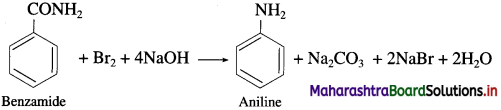
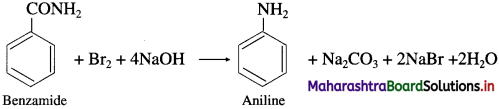
(2) When benzamide is treated with bromine and aqueous or alcoholic sodium hydroxide, aniline is obtained.
Maharashtra Board Class 12 Chemistry Solutions Chapter 13 Amines 54

Maharashtra Board Class 12 Chemistry Important Questions Chapter 13 Amines

Question 21.
How will you obtain methyl amine from acetamide?
Answer:
When acetamide is treated with bromine and aq or alcoholic solution of KOH, methyl amine is obtained, which has one cabon atom less.
Maharashtra Board Class 12 Chemistry Solutions Chapter 13 Amines 55

Question 22.
How will you convert the following?

(1) Ethyl bromide to ethylamine.
Answer:
Maharashtra Board Class 12 Chemistry Solutions Chapter 13 Amines 60

(2) Propionitrile to n-propyl amine.
Answer:
Maharashtra Board Class 12 Chemistry Solutions Chapter 13 Amines 61

(3) Acetonitrile to ethylamine.
Answer:
Maharashtra Board Class 12 Chemistry Solutions Chapter 13 Amines 62

(4) Phenyl acetonitrile to β-phenylethyl amine.
Answer:
Maharashtra Board Class 12 Chemistry Solutions Chapter 13 Amines 63

(5) Acetamide to ethylamine.
Answer:
Maharashtra Board Class 12 Chemistry Solutions Chapter 13 Amines 64

(6) Nitropropane to propan-l-amine.
Answer:
Maharashtra Board Class 12 Chemistry Solutions Chapter 13 Amines 65

(7) Nitrobenzene to Aniline.
Answer:
Maharashtra Board Class 12 Chemistry Solutions Chapter 13 Amines 66

(8) Benzamide to aniline.
Answer:
Maharashtra Board Class 12 Chemistry Solutions Chapter 13 Amines 67

Maharashtra Board Class 12 Chemistry Important Questions Chapter 13 Amines

Question 23.
How will you prepare propan-l-amine from (1) butane nitrile (2) 1-nitropropane (3) propanamide (4) butanamide?
Answer:
(1) From butane nitrile :
When butane nitrile is reduced by sodium and ethanol, it gives propan-l-amine.
Maharashtra Board Class 12 Chemistry Solutions Chapter 13 Amines 68

(2) From 1-nitropropane :
When 1-nitropropane is reduced in the presence of tin and cone, hydrochloric acid, propan-l-amine is obtained.
Maharashtra Board Class 12 Chemistry Solutions Chapter 13 Amines 69

(3) From propanamide :
When propanamide is reduced in the presence of lithium aluminium hydride, propan-l-amine is obtained.
Maharashtra Board Class 12 Chemistry Solutions Chapter 13 Amines 70

(4) From butanamide :
When butanamide is treated with bromine and aq. KOH, propan-l-amine is obtained.
Maharashtra Board Class 12 Chemistry Solutions Chapter 13 Amines 71

Question 24.
Write a reaction to, convert acetic acid into methyl amine.
Answer:
Maharashtra Board Class 12 Chemistry Solutions Chapter 13 Amines 78

Question 25.
Primary and secondary amines have boiling points higher than the tertiary amines. Explain why?
Answer:
(1) The N – H bond in amines is polar in nature because of electronegativities of nitrogen (3.0) and hydrogen (2.1) are different.
(2) Due to the polar nature of N – H bond, primary and secondary have strong intermolecular hydrogen bonding. Tertiary amines do not have intermolecular hydrogen bonding as there is no hydrogen atom on nitrogen of tertiary amine. Thus, intermolecular forces of attraction are strongest in primary and secondary amines and weakest in to tertiary amines. Hence, primary and secondary amines have boiling points higher than the tertiary amines.

Question 26.
Amines have boiling points higher than the hydrocarbon but lower than the alcohols of comparable masses. Explain, why?
Answer:
Amines are polar than alkanes but less polar than alcohols. Primary and secondary amines form intermolecular hydrogen bonds. This hydrogen bonding leads to an associated structure. The association is more in primary amines than that in secondary amines as there are two hydrogen atoms attached to the nitrogen atom. However, tertiary amines do not form intermolecular hydrogen bonds because they do not contain any hydrogen atoms attached to the nitrogen atom. Hence, amines have higher boiling points than the hydrocarbons but lower boiling points than the alcohols of comparable masses.
Maharashtra Board Class 12 Chemistry Solutions Chapter 13 Amines 79

Compound Molar mass Boiling points (K)
nC2H5CH(CH3)2 72 300
nC4H9NH2 73 350.8
nC4H9OH 74 391

Question 27.
Arrange the following compounds in the decreasing order of their solubility in water.
(a) Ethyl amine, diethyl amine and triethyl amine.
Answer:
Diethyl amine > triethyl amine > ethyl amine
(The reason that ethyl group has greater +1 effect than methyl group)

Maharashtra Board Class 12 Chemistry Important Questions Chapter 13 Amines

(b) Ethyl amine, n-propyl amine and n-butyl amine.
Answer: n-butyl amine < n-propyl amine < ethyl amine

(c) n-Butane, n -butyl alcohol and n-butyl amine
Answer:
n-butyl alcohol < n-butyl amine < n-butane

Question 28.
Arrange the following compounds in the decreasing order of their boiling points.
(a) Ethane, ethyl amine and ethyl alcohol.
Answer:
Ethyl alcohol < ethyl amine < ethane

(b) Ethyl amine, n-propyl amine and n-butyl amine.
Answer:
n-butyl amine < n-propyl amine < ethyl amine

(c) n-propyl amine, ethyl methyl amine and trimethyl amine.
Answer:
n-propyl amine < ethyl methyl amine < trimethyl amine.

(d) Ethyl alcohol, dimethyl amine and ethyl amine.
Answer:
Ethyl alcohol < ethyl amine < dimethyl amine.

Question 29.
Explain the basic nature of amines with a suitable examples.
OR
Explain why amines are basic.

Question 38.
Tertiary amine (R3N) or 3° amine is weaker base than secondary amine R2NH or 2° amine. Explain.
Answer:
Maharashtra Board Class 12 Chemistry Solutions Chapter 13 Amines 81
Maharashtra Board Class 12 Chemistry Solutions Chapter 13 Amines 82
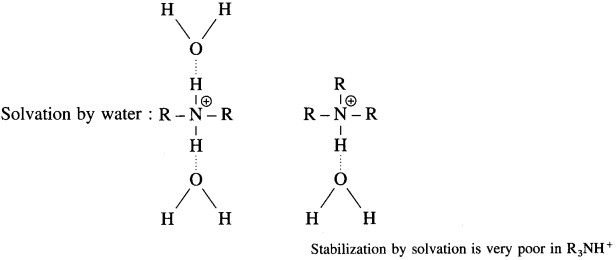
The increase in basic strength from 1° amine to 2° amine is explained on the basis of increased stabilization of conjugate acids by +1 effect of the increased number of the alkyl group. However, decreased basic strength of 3° implies that the conjugate acid of 3° amine is less stabilized and is weak base though the +1 effect of three alkyl groups in R3NH is large.

R2NH is best stabilized by solvation while the stabilization by solvation is very poor in R3NH. Hence (R3N) or tertiary amine or 3° amine is weaker base than secondary amine (R2NH) or 2° amine.

Question 30.
Primary or aliphatic amine is a stronger base than ammonia. Explain.
Answer:
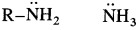
(1) The alkyl group in primary amines has +I effect i.e. (electron releasing).
Maharashtra Board Class 12 Chemistry Solutions Chapter 13 Amines 83
The alkyl group tends to increase the electron density on the nitrogen atom. As a result, amines can donate the lone pair of electrons on nitrogen more easily than ammonia.

(2) The amine being a base, can donate a pair of electrons to an acid. The alkyl group with +I effect will disperse the positive charge on the cation more than ammonia.
Maharashtra Board Class 12 Chemistry Solutions Chapter 13 Amines 84

Due to +I effect of alkyl group cation formed by primary amine is more stable compared to cation formed from ammonia. Also it is seen that observed increasing basic strength from ammonia to primary amine is explained on the basis of increased stabilization of conjugate acids by +I effect for the presence of alkyl (R) groups. Hence, primary or aliphatic amine is a stronger base than ammonia.

Maharashtra Board Class 12 Chemistry Important Questions Chapter 13 Amines

Question 31.
Aniline is less basic than ammonia. Explain.
Answer:
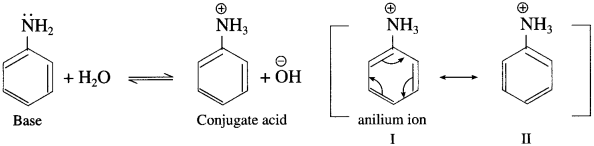
The less basic character of aniline can be explained on the basis of resonance shown by aniline.
Maharashtra Board Class 12 Chemistry Solutions Chapter 13 Amines 85

Due to resonance, the nitrogen atom of amino group in aniline acquires a positive charge, hence, lone pair of electrons is less available for protonation as compared to that of ammonia. Aniline is resonance stabilized by five resonance structures. On the other hand, aniline in aqueous medium, accepts a proton does not have lone pair of electrons on nitrogen to produce a very low concentration of anilium ion and anilium ion shows only two resonance structures and therefore less stabilized than anline.

Maharashtra Board Class 12 Chemistry Solutions Chapter 13 Amines 86

Thus, aniline is more stable than anilium ion. Hence aniline accepts proton less readily or less basic in nature than ammonia.

Question 32.
Explain the order of basicity in ammonia and aliphatic amines.
Answer:
Since nitrogen atom in ammonia molecule has a lone pair of electrons, it is a Lewis base.
Greater the availability of an electron pair, more is the basic character.

Since alkyl group (R -) is an electron releasing group with (+I) inductive effect, alkyl amines act as a stronger base than ammonia.

The decreasing order of basicity is –
Maharashtra Board Class 12 Chemistry Solutions Chapter 13 Amines 87

The availability of a lone pair of electrons on a nitrogen atom in amines is influenced by steric factor due to crowding of alkyl groups which affects solvation along with inductive effect of alkyl groups.

Due to high energy of solvation of \(\mathrm{NH}_{4}^{+}\) ions, they acquire higher stability in aqueous solutions.

The presence of alkyl groups in secondary and tertiary amines, due to steric hindrance decrease the solvation energy.

This effect is more in tertiary amines making the tertiary ammonium ions (R3NH+) unstable as compared to secondary ammonium ion (R2N+H2).
Hence the cumulative effect on the order of basicity of amines is, secondary amine > primary amine > tertiary amine > ammonia (NH3).

Question 33.
Arrange the following amines in the decreasing order of their basic nature.
(a) Aniline, propan-l-amine and N-methylethanamine.
Answer:
N-methylethanamine < propan-l-amine < aniline

(b) Benzene-1, 4-diamine, ammonia and 4-aminobenzoic acid.
Answer:
Ammonia < benzene-1, 4-diamine < 4-aminobenzoic acid

(c) N-Methylaniline, phenylmethylamine and N-phenylaniline.
Answer:
N-Methylaniline < N-phenylaniline < phenylmethylamine

Question 34.
Arrange the following amines in the increasing order of their pKb values.
(a) Aniline, N-methylaniline and cyclohexalamine.
Answer:
Maharashtra Board Class 12 Chemistry Solutions Chapter 13 Amines 88

Maharashtra Board Class 12 Chemistry Important Questions Chapter 13 Amines

(b) Phenylmethylamine, 2-aminotoluene and 2-fluoroaniline.
Answer:
Maharashtra Board Class 12 Chemistry Solutions Chapter 13 Amines 89

(c) Aniline, 4-methoxyaniline and 4-nitroaniline.
Answer:
Maharashtra Board Class 12 Chemistry Solutions Chapter 13 Amines 90

Question 35.
Arrange the following compounds in the decreasing order of their basic nature in the gaseous phase.
Ammonia, N-methylhexanamine, propan-1-amine and N, N-dimethylethanolamine.
Answer:
Propan-1-amine < N-methylethanamine < N,N-dimethylmethanamine < ammonia

Question 36.
Explain laboratory test for amines.
Answer:
(1) All amines are basic compounds. Aqueous solution of water soluble amines turns red litmus blue.

(2) When water insoluble amine is dissolved in aqueous HCl, forms water soluble substituted ammonium chloride, further a substituted ammonium chloride on reaction with excess aqueous NaOH regenerates the original insoluble amine.
Maharashtra Board Class 12 Chemistry Solutions Chapter 13 Amines 91

(3) Diazotization reaction/ Orange dye test: In a sample of aromatic primary amine, 1-2 mL of cone. HCl is added. The aqueous solution of NaNO2 is added with cooling. This solution is transfered to a test tube containing solution of β naphthol in NaOH. Formation of orange dye indicates presence of aromatic primary amino group. (It may be noted that temperature of all the solutions and reaction mixtures is maintained near 0 °C throughout the reaction).

Question 37.
Explain Hofmann’s exhaustive alkylation.
OR
Explain Hofmann’s exhaustive methylation of amines.
Answer:
Hofmann’s Exhaustive alkylation : When a primary amine is heated with excess of primary alkyl halide it gives a mixture of secondary amine, tertiary amine along with tetraalkylammonium halide
Maharashtra Board Class 12 Chemistry Solutions Chapter 13 Amines 92

If excess of alkyl halide is used, tetraalkyl ammonium halide is obtained as major product. The reaction is known as exhaustive alkylation of amines.

Hofmann’s Exhaustive Methylation : The process of converting a primary, secondary or tertiary amine into quaternary ammonium halide by heating them with excess of methyl iodide, is called exhaustive methylation or Hoffmann’s exhaustive methylation.

Thus when methyl amine is heated with excess of methyl iodide it forms dimethylamine (secondary amine), then trimethylamine (a tertiary amine) and finally of quaternary ammonium iodide. The reaction is carried out in the presence of mild base NaHCO3, to neutralize the large quantity of HI formed.
Maharashtra Board Class 12 Chemistry Solutions Chapter 13 Amines 93

Question 38.
Predict the products of exhaustive methylation of following compounds.
(1) Ethylamine.
Answer:
A primary amine, ethylamine (CH3 – CH2 – NH2) on exhaustive methylation, i.e., on heating with excess methyl iodide, forms secondary amine, tertiary amine and finally a quaternary ammonium salt, ethyl-trimethyl ammonium iodide.
Maharashtra Board Class 12 Chemistry Solutions Chapter 13 Amines 97

Maharashtra Board Class 12 Chemistry Important Questions Chapter 13 Amines

(2) Benzylamine.
Answer:
Benzylamine C6H5CH2NH2 on exhaustive methylation i.e., on heating with excess methyl iodide forms benzylmethyl amine, benzyldimethyl ammonium chloride and finally benzyltrimethyl ammonium iodide.
Maharashtra Board Class 12 Chemistry Solutions Chapter 13 Amines 98

Question 39.
Explain Hofmann elimination.
OR
Write a note on Hoffmann elimination.
Answer:
When tetra alkyl ammonium halide is heated with moist silver hydroxide, a quaternary ammonium hydroxide is obtained. Quaternary ammonium hydroxides are deliquescent crystalline solids and are basic in nature. Quaternary ammonium hydroxides on strong heating undergo ^-elimination to give tertiaryamine, alkenes and water, the reaction is called Hofmann elimination. The major product is least substituted alkene.
Maharashtra Board Class 12 Chemistry Solutions Chapter 13 Amines 99

Question 40.
Write the bond line formula of the alkene which is obtained as major product from the following amines, on heating with excess of methyl iodide followed by strong heating with moist silver oxide.
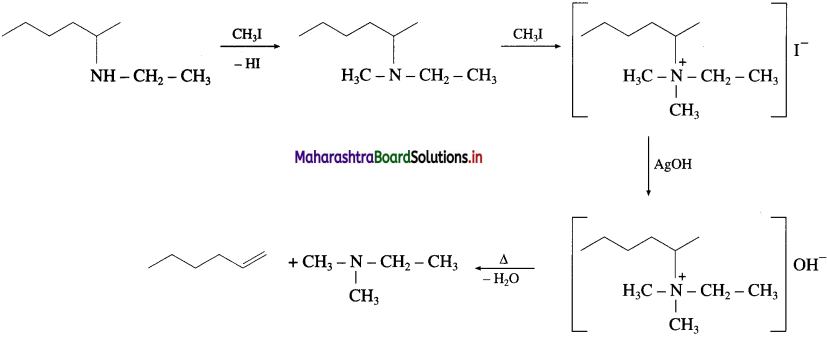
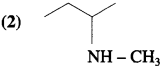
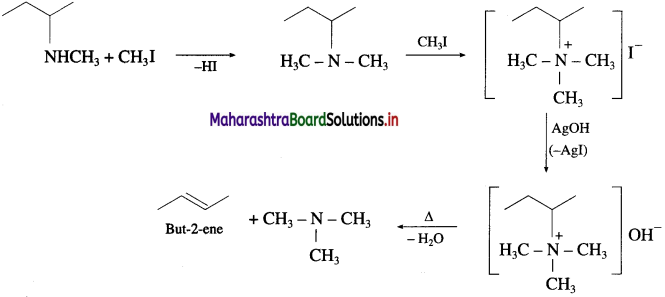
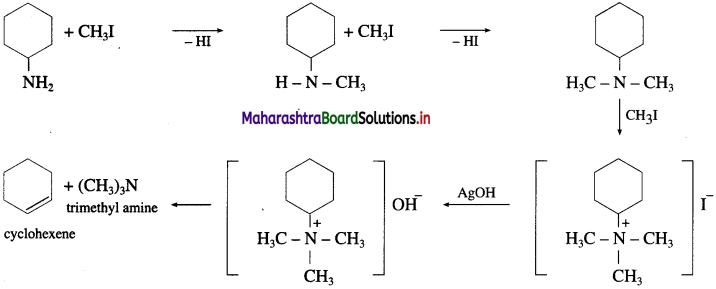
Maharashtra Board Class 12 Chemistry Solutions Chapter 13 Amines 102
Answer:
Maharashtra Board Class 12 Chemistry Solutions Chapter 13 Amines 103

Maharashtra Board Class 12 Chemistry Solutions Chapter 13 Amines 104
Answer:
Maharashtra Board Class 12 Chemistry Solutions Chapter 13 Amines 105

Maharashtra Board Class 12 Chemistry Important Questions Chapter 13 Amines

Maharashtra Board Class 12 Chemistry Solutions Chapter 13 Amines 106
Answer:
Maharashtra Board Class 12 Chemistry Solutions Chapter 13 Amines 107

Question 41.
Compound X with a molecular formula C5H13N did not react with nitrous acid, but reacted with one mole of CH3I to form a salt. What is the structure of X?
Answer:
The structure of compound X is Maharashtra Board Class 12 Chemistry Solutions Chapter 13 Amines 108 ethyl-N-methylethanamine since compound X is tertiary amine. It reacts with one mole of CH3I to give a quaternary ammonium salt.

Question 42.
What is the action of acetyl chloride on :
(1) ethyl amine (ethanamine)
(2) diethyl amine (N-Ethylethanamine)
(3) triethyl amine?
OR
Write a short note on acylation of amines.
Answer:
The reaction of amines with acetyl chloride is called acetylation of amines.

(1) Acetyl chloride on reaction with ethylamine forms monoacetyl derivative, N-ethylacetamide (or N-acetyl ethylamine).
Maharashtra Board Class 12 Chemistry Solutions Chapter 13 Amines 109
(2) Diethyl amine on reaction with acetyl chloride forms N-acetyl dimethylamine.
Maharashtra Board Class 12 Chemistry Solutions Chapter 13 Amines 110
(3) Triethyl amine, being a tertiary amine does not have H atom attached to nitrogen of amine, hence it does not react with acetyl chloride.
Maharashtra Board Class 12 Chemistry Solutions Chapter 13 Amines 111

Question 43.
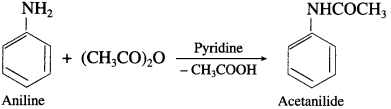
What is the action of acetic anhydride on aniline?
Answer:
Aniline on reaction with acetic anhydride forms N-phenyl acetamide.
Maharashtra Board Class 12 Chemistry Solutions Chapter 13 Amines 116

Question 44.
What is the action of benzoyl chloride on ethanamine?
Answer:
When benzoyl chloride is treated with ethanamine, N-ethyl benzamide is obtained.
Maharashtra Board Class 12 Chemistry Solutions Chapter 13 Amines 117

Maharashtra Board Class 12 Chemistry Important Questions Chapter 13 Amines

Question 45.
What is the action of nitrous acid on ethylamine?
Answer:
Ethyl amine on reaction with nitrous acid in cold forms aliphatic diazonium salt, (unstable intermediate), which decomposes immediately by reaction with solvent water to produce ethyl alcohol and nitrogen gas.
Maharashtra Board Class 12 Chemistry Solutions Chapter 13 Amines 123

Question 46.
What is the action of nitrous acid on aniline?
Answer:
Aniline reacts with nitrous acid in cold to form diazonium salt which has reasonable solubility at 273 K
Maharashtra Board Class 12 Chemistry Solutions Chapter 13 Amines 124

Question 47.
How is benzenediazon|um chloride prepared?
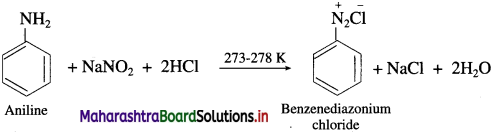
Answer:
Benzenediazonium chloride is prepared by the action of nitrous acid on aniline at 273-278 K. Nitrous acid being unstable, is prepared in situ by the reaction between sodium nitrite and dilute hydrochloric acid.
Maharashtra Board Class 12 Chemistry Solutions Chapter 13 Amines 125

Question 48.
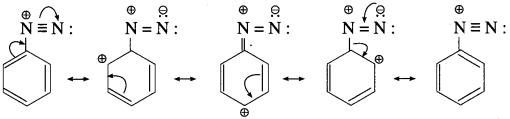
Write resonance stabilized structures of aryl diazonium salt.
Answer:
Maharashtra Board Class 12 Chemistry Solutions Chapter 13 Amines 126

Question 49.
Write a note on Sandmeyer’s reaction.
OR
How is aryl chloride or aryl bromide or aryl cyanide prepared from diazonium salt?
Answer:
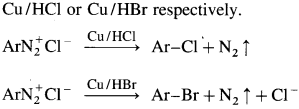
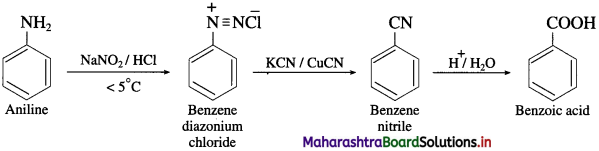
[Replacement by Cl, Br and -CN : Sandmeyer reaction.] Freshly prepared aromatic diazonium salt on reaction with cuprous chloride gives aryl chloride, on reaction with cuprous bromide gives aryl bromide and on reaction with cuprous cyanide give aryl cyanide. The reaction in which copper (I) salts are used to replace nitrogen in diazonium salt is called Sandmeyer reaction.
Maharashtra Board Class 12 Chemistry Solutions Chapter 13 Amines 128

Question 50.
How is aryl chloride or aryl bromide prepared by Gattermann reactions?
Answer:
The aryl chloride or bromides can also be prepared by Gattermann reactions in which diazonium salt reacts with
Maharashtra Board Class 12 Chemistry Solutions Chapter 13 Amines 129

Question 51.
How is aryl iodide obtained from diazonium salt?
Answer:
When diazonium salt is warmed with potassium iodide, aryl iodide is obtained.
Maharashtra Board Class 12 Chemistry Solutions Chapter 13 Amines 130

Maharashtra Board Class 12 Chemistry Important Questions Chapter 13 Amines

Question 52.
Explain the reduction of arene diazonium salt?
OR
How is arene obtained from arene diazonium salt?
OR
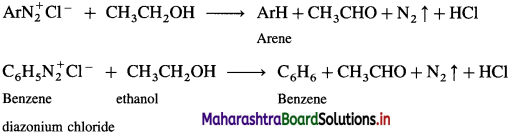
What is the action of benzene diazonium chloride on ethanol?
Answer:
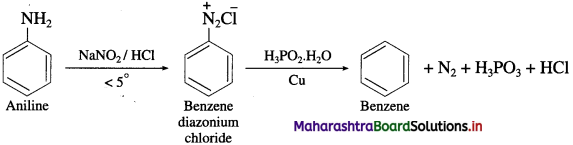
Arene diazonium salt on treatment with mild reducing agents like phosphinic acid (hypophosphoric acid) or ethanol, arene is obtained.

Maharashtra Board Class 12 Chemistry Solutions Chapter 13 Amines 131Maharashtra Board Class 12 Chemistry Solutions Chapter 13 Amines 132

Question 53.
How is phenol obtained from arene diazonium salt?
Answer:
When arene diazonium salt is slowly added to a large volume of boiling dilute sulphuric acid, phenol is obtained,
Maharashtra Board Class 12 Chemistry Solutions Chapter 13 Amines 133

Question 54.
How is aryl fluoride obtained from diazonium salt?
Answer:
When fluoroboric acid is treated with the solution of diazonium salt, a precipitate of diazonium fluoroborate is obtained, which is filtered and dried. When dry diazonium fluoroborate is heated, it decomposes to give aryl fluoride. This reaction is called Balz-Schiemann reaction.
Maharashtra Board Class 12 Chemistry Solutions Chapter 13 Amines 134

Question 55.
How is nitrobenzene obtained from benzene diazonium fluoroborate?
Answer:
When benzene diazonium fluoroborate is heated with aqueous solution of sodium nitrite in the presence of copper powder, nitrobenzene is obtained.
Maharashtra Board Class 12 Chemistry Solutions Chapter 13 Amines 135
Benzene diazonium fluorobate can be obtained by reaction of benzene diazonium chloride with HBF4.
Maharashtra Board Class 12 Chemistry Solutions Chapter 13 Amines 136

Question 56.
What is meant by a coupling reaction? Explain with suitable examples.
OR
What is the action of benzene diazonium chloride on (a) phenol in alkaline medium (b) aniline?
OR
Write a note on the coupling reaction.
Answer:
Diazonium salts react with certain aromatic compounds having an electron-rich group (e.g.-OH, – NH2, etc.) to form azo compounds. This reaction is an electrophilic substitution and is called coupling reaction. Azo compounds are brightly coloured and are used as dyes and indicators. Coupling reaction is an electrophilic substitution reaction. Benzene diazonium chloride reacts with alkaline solution of phenol to give p-hydroxy azo benzene (orange dye).
Maharashtra Board Class 12 Chemistry Solutions Chapter 13 Amines 139
Benzene diazonium chloride reacts with aniline in mild alkaline medium to give p-aminobenzene (yellow dye).
Maharashtra Board Class 12 Chemistry Solutions Chapter 13 Amines 140

Question 57.
What is the action of p-toluene sulphonyl chloride on ethyl amine and diethyl amine?
Answer:
(1) When ethyl amine is treated with p-toluene sulphonyl chloride, N-ethyl p-toluene sulphonamide is obtained.
Maharashtra Board Class 12 Chemistry Solutions Chapter 13 Amines 144
(2) When diethyl amine is treated with p-toluene suiphonyl chloride. N.N-dicthyl p-toluene suiphonyl amide is formed.
Maharashtra Board Class 12 Chemistry Solutions Chapter 13 Amines 145

Maharashtra Board Class 12 Chemistry Important Questions Chapter 13 Amines

Question 58.
How will you distinguish between :
(1) Ethylamine, diethyl amine and triethyl amine by using (i) nitrous acid (ii) Hinsberg’s reagent.
(2) Diethyl amine and triethyl amine by using acetic anhydride.
Answer:
Maharashtra Board Class 12 Chemistry Solutions Chapter 13 Amines 150
Maharashtra Board Class 12 Chemistry Solutions Chapter 13 Amines 151

Question 59.
Give a chemical test to distinguish between following pairs of compounds.
(i) Ethylamine and diethyl amine :
Answer:
Ethylamine (C2H5NH2) is a primary amine while diethyl amine ( (C2H5)2NH) is a secondary amine. So the two can be distinguished by the following test.
Maharashtra Board Class 12 Chemistry Solutions Chapter 13 Amines 152

Maharashtra Board Class 12 Chemistry Important Questions Chapter 13 Amines

(ii) Ethyl amine and aniline :
Answer:
Ethylamine is an aliphatic amine, while aniline is an aromatic amine. So the two can be distinguished by the following test :
Maharashtra Board Class 12 Chemistry Solutions Chapter 13 Amines 153

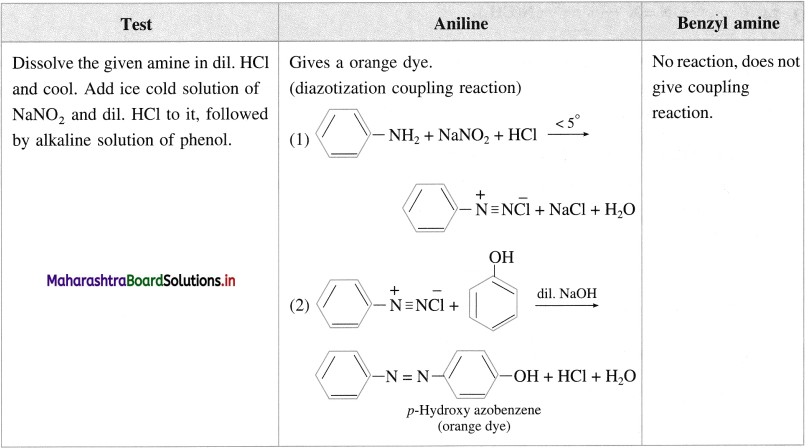
(iii) Aniline and benzyl amine :
Answer:
Maharashtra Board Class 12 Chemistry Solutions Chapter 13 Amines 154

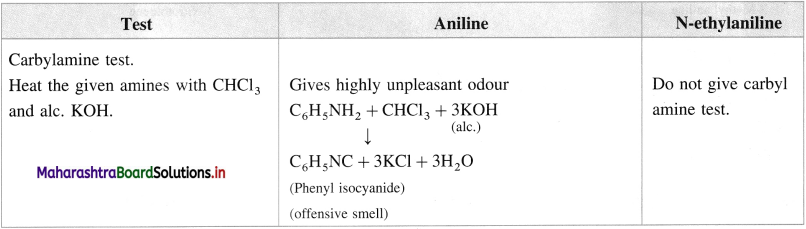
(iv) Aniline and N-ethylaniline :
Answer:
Maharashtra Board Class 12 Chemistry Solutions Chapter 13 Amines 155

Maharashtra Board Class 12 Chemistry Important Questions Chapter 13 Amines

Question 60.
Compound ‘X’ with a molecular formula C4H11N did not react with Hinsberg’s reagent, but reacted with one mole of CH3I to form a salt. What is the structure of ‘X’?
Answer:
The structure of compound ‘X’ is :
Maharashtra Board Class 12 Chemistry Solutions Chapter 13 Amines 156
Since the compound ‘X’ does not react with NaN02 and HC1 i.e. nitrous acid (HO – N = O), it must be a tertiary amine.

The tertiary amine reacts with one mole of CH3I to give a quaternary ammonium salt.
Maharashtra Board Class 12 Chemistry Solutions Chapter 13 Amines 157

Question 74.
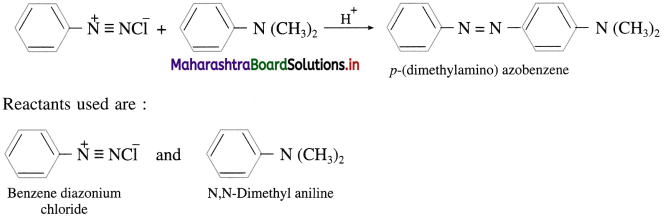
Maharashtra Board Class 12 Chemistry Solutions Chapter 13 Amines 158
p-(dimethylamino) azobenzene is yellow dye which was formerly used as a colouring agent in margarine. Write the structures of the reactants used in the preparation of this dye.
Answer:
Maharashtra Board Class 12 Chemistry Solutions Chapter 13 Amines 159

Question 61.
Convert 3-Methyl aniline into 3-nitrotoluene.
Answer:
Maharashtra Board Class 12 Chemistry Solutions Chapter 13 Amines 160

Question 62.
How will you bring about following conversions?
(1) N.Methyl aniline into N-methyl benzanilide.
Answer:
Maharashtra Board Class 12 Chemistry Solutions Chapter 13 Amines 161

(2) 1.4-Dichlorobutane Into hexane-1,6-diamlne.
Answer:
Maharashtra Board Class 12 Chemistry Solutions Chapter 13 Amines 162

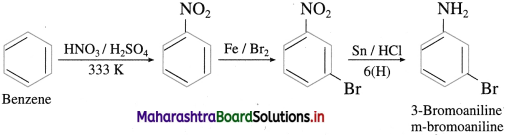
(3) Benzene into 3-bromo aniline.
Answer:
Maharashtra Board Class 12 Chemistry Solutions Chapter 13 Amines 163

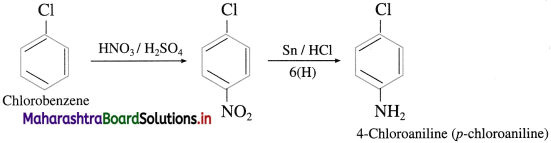
(4) Chlorobenzene into 4-chioroanilinc.
Answer:
Maharashtra Board Class 12 Chemistry Solutions Chapter 13 Amines 164

Maharashtra Board Class 12 Chemistry Important Questions Chapter 13 Amines

(5) 11enaniide into toluene.
Answer:
Maharashtra Board Class 12 Chemistry Solutions Chapter 13 Amines 165

Question 63.
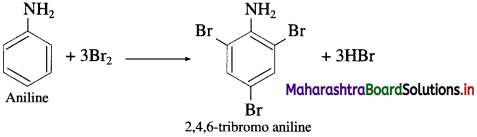
What is the action of aqueous bromine on aniline?
Answer:
Action of aqueous bromine on aniline : When aniline is treated with bromine water at room temperature, a white precipitate of 2, 4, 6-tri bromoaniline is obtained.
Maharashtra Board Class 12 Chemistry Solutions Chapter 13 Amines 166

Question 64.
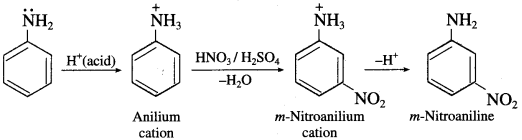
Explain the action of cone, nitric acid (nitrating mixture) on aniline.
Answer:
When aniline is warmed with a mixture of cone, nitric acid and cone, sulphuric acid (a nitrating mixture), a mixture of ortho, meta and para nitroaniline is obtained.
Maharashtra Board Class 12 Chemistry Solutions Chapter 13 Amines 169

Question 65.
What is the action of acetic anhydride on aniline?
Answer:
When aniline is heated with acetic anhydride, an acetanilide is obtained.
Maharashtra Board Class 12 Chemistry Solutions Chapter 13 Amines 170

Question 66.
How will you convert aniline to p-nltroanhline? (major product)
Answer:
Maharashtra Board Class 12 Chemistry Solutions Chapter 13 Amines 171

Question 67.
What is the action of cone, sulphuric acid on aniline?
Answer:
Aniline on treatment with cold sulphuric acid forms anilium hydrogen sulphate which on heating with sulphuric acid at 453 K-475 K gives sulphanilic acid, (p-aminobenzene sulphonic acid) as major product.Maharashtra Board Class 12 Chemistry Solutions Chapter 13 Amines 172
Sulphanilic acid exists as a salt; called dipolar ion or zwitter ion. It is produced by the reaction between an acidic group and a basic group present in the same molecule.

Maharashtra Board Class 12 Chemistry Important Questions Chapter 13 Amines

Question 68.
How will you convert the following?
(1) Ethylamine to ethyl alcohol.
Answer:
Maharashtra Board Class 12 Chemistry Solutions Chapter 13 Amines 173

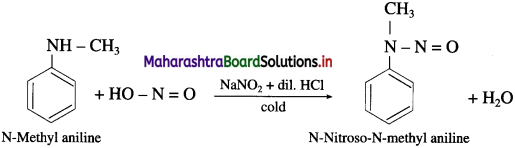
(2) N-Methyl aniline to N-Nitroso-N-methyl aniline.
Answer:
Maharashtra Board Class 12 Chemistry Solutions Chapter 13 Amines 174

(3) Diethylamine to N-nitrosodiethylamine
Answer:
Maharashtra Board Class 12 Chemistry Solutions Chapter 13 Amines 175

(4) Triethylamine to triethyl ammonium nitrite.
Answer:
Maharashtra Board Class 12 Chemistry Solutions Chapter 13 Amines 176

(5) Ethyl amine to N-ethylacetamide.
Answer:
Maharashtra Board Class 12 Chemistry Solutions Chapter 13 Amines 177

(6) Diethyl amine to N-acetyl diethylamine.
Answer:
Maharashtra Board Class 12 Chemistry Solutions Chapter 13 Amines 178

(7) Aniline to acetanilide.
Answer:
Maharashtra Board Class 12 Chemistry Solutions Chapter 13 Amines 179

(8) Aniline to N-ethyl henzamide.
Answer:
Maharashtra Board Class 12 Chemistry Solutions Chapter 13 Amines 180

(9) Ethylamine to ethyl isocyanide.
Answer:
Maharashtra Board Class 12 Chemistry Solutions Chapter 13 Amines 181

(10) Aniline to phenyl isocyanide.
Answer:
Maharashtra Board Class 12 Chemistry Solutions Chapter 13 Amines 182

(11) Aniline to 2,4,6-tribromoaniline.
Answer:
Maharashtra Board Class 12 Chemistry Solutions Chapter 13 Amines 183

Maharashtra Board Class 12 Chemistry Important Questions Chapter 13 Amines

Question 69.
Give a plausible explanation for each of the following statements :
(1) Ethylamine is soluble in water whereas aniline is not.
Answer:
Ethylamine is soluble in water due to intermolecular hydrogen bonding resulting in the formation of C2H5NH3 ion. Whereas in anline the hydrogen bonding with water is negligible due to the phenyl group (C6H5) is bulky and has -I effect. Therefore, aniline is nearly insoluble in water.
Maharashtra Board Class 12 Chemistry Solutions Chapter 13 Amines 184

(2) Butan-1-ol is more soluble in water than butani-amine.
Answer:
Rutan- l-al is more soluble in watcr duc to intermoiccular hydrogen bonding. In alcohols, hydrogen bonding is through oxygen atoms. WIereas hutani-amine is less soluble in water due to the larger hydrocarbon part is hydrophobic in nature. Hence, butan-l-ol is more soluble in water than butani-amine.

(3) Butan-1-amlne has higher boiling point than N-ethylethanamine.
Answer:
Due to the presence of two H-atoms on N-atom in butait- I -amine, they undergo extensive intermolecular H-bonding while in N-cthylethanamine due to the presence of one-H atom on the N-atom, they undergo least intermolecular H-bonding. Hence, butan- l-amine has higher boiling point than-N-ethyl ethanamine.

(4) AnIline Is less basic than ethyl afine.
Answer:
Aniline (Kb4-2 x 10⁻¹⁰) is less basic than ethyl amine (Kb5.1 x 10-4). This is because -I effect of phenyl group in aniline as compared to + 1 effect of ethyl group in ethyl amine.
Maharashtra Board Class 12 Chemistry Solutions Chapter 13 Amines 185
Due to resonance, the lone pair of electrons on the nitrogen atom gets delocalized over the benzene ring and thus less available for protonation. On the other hand, in ethyl anine, delocalization of the lone pair of electrons on the nitrogen atom by resonance is not possible. Further more, the electron density on the nitrogen atom is increased by +1 effect of the ethyl group. Hence, aniline is less basic than ethyl amine.

(5) pKb value of diethyl amine is less than that of ethyl amine.
Answer:
The basic strength of amines is expressed in terms of pKb values. Smaller is the value of pKb more basic is the amine. The pKb value of ethyl amine is 3.29 and that of diethyl amine is 3.00. Therefore, diethyl amine is more basic than ethyl amine.

(6) Aniline cannot be prepared by Gabriel phthalimide synthesis.
Answer:
In Gabriel-phthalimide synthesis of aniline, potassium phthalimide requires the treatment with chlorobenzene or bromobenzene. Since aryl halides do not undergo nucleophilic substitution reaction. Therefore, chlorobenzene or bromobenzene does not react with potassium phthalimide to give N-phenylphthalimide and hence aniline cannot be prepared by Gabriel phthalimide synthesis.

(7) Gabriel phthalimide synthesis is preferred for the preparation of aliphatic primary amines.
Answer:
In aromatic amines, the lone pair of electrons on the N-atom is delocalized over the benzene ring. As a result electron density on the nitrogen atom decreases. Whereas in aliphatic primary amines, due to +1 effect of alkyl group, electron density on nitrogen atom increases. As the pKh value of aliphatic amines is more than that of aromatic amines, aromatic amines are less basic than primary aliphatic amines. Hence, Gabriel phthalimide synthesis is preferred for the preparation of aliphatic amines.

(8) Arere diazonium salts are relatively more stable than alkyl diazonium salts.
Answer:
Arene diazonium salts are stable due to the dispersal of the positive charge over the benzene ring as shown below :
Maharashtra Board Class 12 Chemistry Solutions Chapter 13 Amines 186
Alkane diazonium salts are unstable due to their tendency to eliminate a stable molecule of nitrogen to form carbocation. Aromatic diazonium salts have much lower tendency to remove nitrogen than aliphatic diazonium salts. Hence, arene diazonium salts are relatively more stable than alkyl diazonium salts.
Maharashtra Board Class 12 Chemistry Solutions Chapter 13 Amines 187

Maharashtra Board Class 12 Chemistry Important Questions Chapter 13 Amines

(9) Tertiary amines cannot be acylated.
Answer:
Tertiary amines do not react with acetic anhydride or acetyl chloride i.e. they can be acylated because they do not contain a H-atom on the N-atom.

(10) Besides the ortho and para derivatives, considerable amount of meta derivatives is also formed during nitration of aniline.
OR
Although amino group is o- and p-directing in electrophilic substitution reactions, aniline on nitration gives substantial amount of m-nitroaniline.
Answer:
In aromatic amines, -NH2 is an electron releasing or activating group. It activates the ortho and para positions in the benzene ring towards electrophilic substitution. When aniline is treated with nitrating mixture (cone. HNO3+ cone. H2SO4), a mixture of ortho and para nitroaniline is obtained. However, a substantial amount of m-nitroaniline is also formed. Aniline being a base gets protonated in acidic medium to form anilium cation, which deactivates the ring and the substitution takes place at the meta position.
Maharashtra Board Class 12 Chemistry Solutions Chapter 13 Amines 188

Question 70.
How will you convert :
(1) Aniline into benzyl alcohol.
Answer:
Maharashtra Board Class 12 Chemistry Solutions Chapter 13 Amines 191

(2) Aniline into 4-bromoaniline.
Answer:
Maharashtra Board Class 12 Chemistry Solutions Chapter 13 Amines 192

(3) Aniline into 1,3,5-tribromo benzene.
Answer:
Maharashtra Board Class 12 Chemistry Solutions Chapter 13 Amines 193

(4) Aniline into 2,4,6-tribromo fluoro benzene.
Answer:
Maharashtra Board Class 12 Chemistry Solutions Chapter 13 Amines 194

Question 71.
How will you convert :
(1) Propanoic acid into ethanoic acid.
Answer:
Maharashtra Board Class 12 Chemistry Solutions Chapter 13 Amines 197

(2) Propanoic acid into ethanol
Answer:
Maharashtra Board Class 12 Chemistry Solutions Chapter 13 Amines 198

(3) Ethanamine into propan-l-amine.
Answer:
Maharashtra Board Class 12 Chemistry Solutions Chapter 13 Amines 199

Maharashtra Board Class 12 Chemistry Important Questions Chapter 13 Amines

(4) Propan-l-amine into ethanamine.
Answer:
Maharashtra Board Class 12 Chemistry Solutions Chapter 13 Amines 200

(5) Propanoic acid into ethanamine.
Answer:
Maharashtra Board Class 12 Chemistry Solutions Chapter 13 Amines 201

(6) Ethanamine into propanoic acid.
Answer:
Maharashtra Board Class 12 Chemistry Solutions Chapter 13 Amines 202

(7) Benzene to aniline.
Answer:
Maharashtra Board Class 12 Chemistry Solutions Chapter 13 Amines 203

(8) Aniline to Benzene.
Answer:
Maharashtra Board Class 12 Chemistry Solutions Chapter 13 Amines 204

(9) Aniline into benzoic acid.
Answer:
Maharashtra Board Class 12 Chemistry Solutions Chapter 13 Amines 205

(10) Benzoic acid into aniline.
Answer:
Maharashtra Board Class 12 Chemistry Solutions Chapter 13 Amines 206

(11) Aniline into benzamide.
Answer:
Maharashtra Board Class 12 Chemistry Solutions Chapter 13 Amines 207

Maharashtra Board Class 12 Chemistry Important Questions Chapter 13 Amines

(12) 3-Nitrotoluene into 3-methyl aniline.
Answer:
Maharashtra Board Class 12 Chemistry Solutions Chapter 13 Amines 208

(13) 3-Methyl aniline into 3-Nitrotoluene.
Answer:
Maharashtra Board Class 12 Chemistry Solutions Chapter 13 Amines 209

Question 72.
An organic compound ‘A’ having molecular formula C2H6O evolves hydrogen gas on treatment with sodium metal and on treatment with red phosphorous and iodine gives compound ‘B’. The compound ‘B’ on treatment with alcoholic KCN and on subsequent reduction gives compound ‘C’. The compound ‘C’ on treatment with nitrous acid evolves nitrogen gas. Write the balanced chemical equations for all the reactions involved and identify the compounds ‘A’, ‘B’ and ‘C;.
Answer:
A = C2H5OH ethanol
B = C2H5I ethyl iodide
C = C2H5CH2NH2 n-propyl amine
Compound C2H6O = C2H5OH
Maharashtra Board Class 12 Chemistry Solutions Chapter 13 Amines 215

Question 73
Identify B, C and D write complete reactions :
Maharashtra Board Class 12 Chemistry Solutions Chapter 13 Amines 216
Answer:
Maharashtra Board Class 12 Chemistry Solutions Chapter 13 Amines 217
Maharashtra Board Class 12 Chemistry Solutions Chapter 13 Amines 218

Maharashtra Board Class 12 Chemistry Important Questions Chapter 13 Amines

Question 74.
Identify the compounds B, C and D in the following series of reactions and rewrite the complete equations :
Maharashtra Board Class 12 Chemistry Solutions Chapter 13 Amines 219
Answer:
Maharashtra Board Class 12 Chemistry Solutions Chapter 13 Amines 220

Question 75.
Identify the compounds ‘A’ and ‘B’ in the following equation :
Maharashtra Board Class 12 Chemistry Solutions Chapter 13 Amines 221
Answer:
Maharashtra Board Class 12 Chemistry Solutions Chapter 13 Amines 222

Question 76.
Answer in one sentence :

(1) Arrange the following compounds in decreasing order of basic strength in their aqueous solutions. NH3, C2H5NH2, (CH3)2NH, (CH3)3N
Answer:
The decreasing order of basic strength is – (C2H5)2NH > (C2H5)3N > (C2H5)2NH > NH3
(The reason that ethyl group has greater +1 effect than methyl group).

(2) Arrange the following compounds in an increasing order of their solubility in water.
Maharashtra Board Class 12 Chemistry Solutions Chapter 13 Amines 226
Answer:
The solubility increases in order in which molecular mass decreases.
Maharashtra Board Class 12 Chemistry Solutions Chapter 13 Amines 227

Maharashtra Board Class 12 Chemistry Important Questions Chapter 13 Amines

(3) What is Hinsberg’s reagent?
Answer:
Benzenesulphonyl chloride (C6H5SO2Cl) is known as Hinsberg’s reagent.

(4) Name the reaction in which a primary amine is formed from amide.
Answer:
Hoffmann bromamide degradation.

(5) NH3 is a Lewis base.
Answer:
Since nitrogen in ammonia molecule has a lone pair of electrons, it is a Lewis base.

(6) How many primary amines are possible for the compound C3H9N?
Answer:
For the compound C3H9N, two primary amines are possible.

(7) State the hybridization of the nitrogen atom in amines.
Answer:
The hybridization of nitrogen atom in amines is sp3.

(8) Arrange the following compounds in an increasing order of basic strength. Aniline, p-nitroaniline, p-toluidine.
Answer:
p-nitroaniline < aniline < p-toluidine.

(9) Which of the two is more basic and why? CH3NH2 or NH3
Answer:
Due to +1 effect of -CH3 group, electron density on N-atom increases, hence methyl amine is a stronger base than ammonia.

(10) Which of the two is more basic and why? p-toluidine or aniline.
Answer:
p-toluidine is more basic due to the presence of -CH3 group at para position. Due to +1 effect of -CH3 group, electron density on nitrogen increases, hence the tendency to donate pair of electrons increases.

Multiple Choice Questions

Question 77.
Select and write the most appropriate answer from the given alternatives for each subquestion :

1. Which of the following is an amine?
(a) C2H5N(COCH3)2
(b) (C2H5)2N – N = 0
(c) (C2H5)3N
(d) All of these
Answer:
(d) All of these

2. N-methyl-N-ethyl-n-propyl amine is
(a) a primary amine
(b) a secondary amine
(c) a tertiary amine
(d) an alkyl nitrile
Answer:
(c) a tertiary amine

3. Which of the following is a tertiary amine?
Maharashtra Board Class 12 Chemistry Solutions Chapter 13 Amines 229
Answer:
(d)

4. Tertiary butyl amine is a
(a) primary amine
(b) secondary amine
(c) tertiary amine
(d) quaternary ammonium salt
Answer:
(a) primary amine

5. The IUPAC name of
Maharashtra Board Class 12 Chemistry Solutions Chapter 13 Amines 230
(a) ethyl propanamine
(b) ethyl butylamine
(c) 2-pentanamine
(d) 3-hexanamine
Answer:
(d) 3-hexanamine

Maharashtra Board Class 12 Chemistry Important Questions Chapter 13 Amines

6. The IUPAC name of ethyl dimethyl amine is ……………..
(a) 2-amino propane
(b) N,N-dimethyl ethanolamine
(c) ethyl methanamine
(d) propanamine
Answer:
(b) N,N-dimethyl ethanolamine

7. Isopropyl amine and trimethyl amine are ……………..
(a) acidic in nature
(b) electrophilic compounds
(c) structural isomers
(d) optically active compounds
Answer:
(c) structural isomers

8. N, N-dimethylethanolamine is ……………
Maharashtra Board Class 12 Chemistry Solutions Chapter 13 Amines 231
Answer:
(b)

9. IUPAC name of diethylmethyl amine is ………………
(a) methyl amino propane
(b) N-Ethyl-N-methylhexanamine
(c) methyl diethanamine
(d) amino pentane
Answer:
(b) N-Ethyl-N-methylhexanamine

10. Ethyl bromide reacts with excess of alcoholic ammonia, the major product is …………..
(a) ethyl amine
(b) diethylamine
(c) triethylamine
(d) tetraethyl ammonium bromide
Answer:
(a) ethyl amine

11. Isopropylamine is obtained by the reduction of
(a) acetoxime
(b) acetaldoxime
(c) formaldoxime
(d) aldoxime
Answer:
(a) acetoxime

12. Which of the following compounds can be converted into amines in the presence of Na and alcohol?
(a) Alkyl nitriles
(b) Aldoxime
(c) Ketoxime
(d) All of these
Answer:
(d) All of these

13. Chloroethane when boiled with excess of aqueous-alcoholic ammonia gives hydrochloric acid and
(a) triethyl amine
(b) trimethyl amine
(c) diethyl amine
(d) ethyl amine
Answer:
(d) ethyl amine

14. How many hydrogen atoms are required for the reduction of 1-nitropropane to n-propyl amine?
(a) Four
(b) Three
(c) Six
(d) Two
Answer:
(c) Six

Maharashtra Board Class 12 Chemistry Important Questions Chapter 13 Amines

15. A secondary alkyl halide is heated with excess of ammonia, the major product obtained is
(a) primary amine
(b) secondary amine
(c) tertiary amine
(d) quaternary ammonium salt
Answer:
(a) primary amine

16. The true statement about ethylamine is
(a) it is weaker base than ammonia
(b) it is stronger base than diethyl amine
(c) it is stronger base than triethyl amine
(d) it is stronger base than alkali
Answer:
(c) it is stronger base than triethyl amine

17. The reaction which is given only by primary amines is
(a) acetylation
(b) alkylation
(c) reaction with HNO2
(d) carbyl amine test
Answer:
(d) carbyl amine test

18. The amine which reacts with NaNO2 and dil. HCl to give yellow oily compound is
(a) ethylamine
(b) isopropylamine
(c) sec-butylamine
(d) dimethylamine
Answer:
(d) dimethylamine

19. The name of the compound ‘C’ in the following series of reactions, is Maharashtra Board Class 12 Chemistry Solutions Chapter 13 Amines 232
(a) propan-l-ol
(b) propan-2-ol
(c) butan-l-ol
(d) butan-2-ol
Answer:
(b) propan-2-ol

20. Triethylamine when treated with nitrous acid gives
(a) an alcohol
(b) a nitrosamine
(c) a monoacetyl derivative
(d) a soluble nitrite salt
Answer:
(d) a soluble nitrite salt

21. Ammes are basic in nature because
(a) of the nitrogen atom contain or lone pair of electrons
(b) they give H+ ions in aqueous medium
(c) they form quaternary ammonium salts when heated with acids
(d) both (a) and (c)
Answer:
(a) of the nitrogen atom contain or lone pair of electrons

22. An aqueous solution of primary amine contains
Maharashtra Board Class 12 Chemistry Solutions Chapter 13 Amines 233
Answer:
(d)

23. The basic nature of amines in an aqueous solution is in the order of
(a) tert. > sec. > pri.
(b) sec. > pri. > tert.
(b) pri. > sec. > tert.
(d) pri. > tert. > sec.
Answer:
(b) pri. > sec. > tert.

24. In trimethyl ammonium ion, the number of sigma bonds attached to nitrogen are
(a) 2
(b) 3
(c) 4
(d) 5
Answer:
(b) 3

Maharashtra Board Class 12 Chemistry Important Questions Chapter 13 Amines

25. The number of coordinate bond/bonds in a trialkyl ammonium ion is
(a) one
(b) two
(c) three
(d) four
Answer:
(a) one

26. The number of electrons in the valence shell of nitrogen in methyl amine is
(a) 5
(b) 3
(c) 8
(d) 7
Answer:
(c) 8

27. Ethanamine reacts with excess of acetyl chloride to form
(a) C2H5NHCOCH3
(b) C2H5N(CH3)2
(c) C2H5N(COCH3)2
(d) C2H5N+H3Cl
Answer:
(c) C2H5N(COCH3)2

28. The compound used for acylation of amine is
(a) (CH3CO)2O
(b) CH3COOH
(c) CH3COCl
(d) both (a) and (c)
Answer:
(d) both (a) and (c)

29. Dimethyl amine reacts with acetyl chloride to give
(a) N-acetyl methyl amine
(b) N-acetyl ethyl amine
(c) N-acetyl dimethyl amine
(d) N-acetyl diethyl amine
Answer:
(c) N-acetyl dimethyl amine

30. Identify ‘A’ in the following reaction :
Maharashtra Board Class 12 Chemistry Solutions Chapter 13 Amines 234
Answer:
(c)

31. n-propyl alcohol is obtained when HNO2 is treated with
Maharashtra Board Class 12 Chemistry Solutions Chapter 13 Amines 235
Answer:
(c)

32. A mixture of CH3NH2, (CH3)2NH, (CH3)3N can be distinguished by using
(a) HCI
(b) HNO2
(c) HNO3
(d) H2SO4
Answer:
(b) HNO2

33. In the acetylation reaction the H-atom of an amine is replaced by
(a) a carbonyl group
(b) an alkyl group
(c) an acetyl group
(d) an imino group
Answer:
(c) an acetyl group

Maharashtra Board Class 12 Chemistry Important Questions Chapter 13 Amines

34. Amines are basic in nature
(a) as they have a fishy odour
(b) as they form quaternary ammonium salts with alkyl halides
(c) due to the presence of an unshared pair of electrons on the nitrogen atom
(d) all of these
Answer:
(c) due to the presence of an unshared pair of electrons on the nitrogen atom

35. The correct order of increasing basic strength is
(a) NH3 < CH3NH2 < (CH3)2NH
(b) CH3NH2 < (CH3)2NH < NH3
(c) CH3NH2 < NH3 < (CH3)2NH
(d) (CH3)2NH < NH3 < CH3NH2
Answer:
(a) NH3 < CH3NH2 < (CH3)2NH

36. Which of the following is the strongest base?
Maharashtra Board Class 12 Chemistry Solutions Chapter 13 Amines 236
Answer:
(d)

37. Identify the weakest base amongst the following :
(a) p-methoxyaniline
(b) o-toluidine
(c) benzene-1, 4-diamine
(d) 4-aminobenzoic acid
Answer:
(d) 4-aminobenzoic acid

38. Amine that cannot be prepared by Gabriel phthalimide synthesis is
(a) aniline
(b) benzyl amine
(c) methyl amine
(d) iso-butyl amine
Answer:
(a) aniline

39. Which of the following exist as Zwitter ion?
(a) Salicylic acid
(b) Suphanilic acid
(c) p-Aminophenol
(d) p-Amino acetophenone
Answer:
(b) Suphanilic acid

40. Reduction of benzene diazonium chloride with Zn/HCl gives
(a) phenyl hydrazine
(b) hydrazine hydrate
(c) aniline
(d) ozo benzene
Answer:
(c) aniline

41. When primary amine reacts with CHCl3 in alcoholic KOH, the product is
(a) aldehyde
(b) alcohol
(c) cyanide
(d) an isocyanide
Answer:
(d) an isocyanide

42. Which of the following amines cannot be prepared by Gabriel phthalimide synthesis?
(a) sec-Propylamine
(b) tert-Butylamine
(c) 2-Phenylethylamine
(d) N-Methyl benzyl amine
Answer:
(d) N-Methyl benzyl amine

Maharashtra Board Class 12 Chemistry Important Questions Chapter 13 Amines

43. Which of the following compounds has highest boiling point?
(a) Ethane
(b) Ethanoic acid
(c) Ethanol
(d) Ethanamine
Answer:
(b) Ethanoic acid

44. Identify the statement about the basic nature of amines.
(a) Alkylamines are weaker bases than ammonia.
(b) Arylamines are stronger bases than alkylamines.
(c) Secondary aliphatic amines are stronger bases than primary aliphatic amines.
(d) Tertiary aliphatic amines are weaker bases than arylamines.
Answer:
(c) Secondary aliphatic amines are stronger bases than primary aliphatic amines.

45. The compounds ‘A’, ‘B’ and ‘C’ react with methyl iodide to give finally quaternary ammonium iodides. Only ‘C’ gives carbylamines test while only ‘A’ forms yellow oily compound on reaction with nitrous acid. The compounds ‘A’, ‘B’ and ‘C’ are respectively.
(a) butan-1-amine, N-ethylethanamine and
N, N-dimethylethanamine.
(b) N-ethylethanamine, N, N-dimethylethanamine and butan-1 – amine.
(c) N, N-dimethylethanamine, N-ethylethanamine and butan-1-amine.
(d) N-ethylethanamine, butan-1-amine and N-ethylethanamine.
Answer:
(b) N-ethylethanamine, N, N-dimethylethanamine and butan-1 – amine.

46. Which of the following amines is most basic in nature?
(a) 2, 4-Dichloroaniline
(b) 2, 4-Dimethylaniline
(c) 2, 4-Dinitroaniline
(d) 2, 4-Dibromoaniline
Answer:
(b) 2, 4-Dimethylaniline

47. How many moles of methyl iodide are required to convert ethylamine, diethylamine and triethylamine into quaternary ammonium salt, respectively?
(a) 1, 2 and 3
(b) 2, 3 and 1
(c) 3, 2 and 1
(d) 3, 1 and 2
Answer:
(c) 3, 2 and 1

48. Which of the following amines does not undergo acetylation?
(a) t-Butylamine
(b) Ethylamine
(c) Diethylamine
(d) Triethylamine
Answer:
(d) Triethylamine

49. n-Propylamine can be prepared by catalytic reduction of
(a) n-propyl cyanide
(b) propionaldoxime
(c) acetoxime
(d) nitroethane
Answer:
(b) propionaldoxime

50. Identify the compound ‘B’ in the following series of reactions :
Maharashtra Board Class 12 Chemistry Solutions Chapter 13 Amines 237
Answer:
(c)

Maharashtra Board Class 12 Chemistry Important Questions Chapter 13 Amines

51. Chloropicrin is used as
(a) antiseptic
(b) antibiotic
(c) insecticide
(d) anaesthetic
Answer:
(c) insecticide

52. Identify the compound B in the following series of reactions. Maharashtra Board Class 12 Chemistry Solutions Chapter 13 Amines 238
(a) n-propyl chloride
(b) propanamine
(c) n-propyl alcohol
(d) Isopropyl alcohol
Answer:
(c) n-propyl alcohol

53. Which of the following amines yields foul smelling product with haloform and alcoholic KOH?
(a) Ethyl amine
(b) Diethyl amine
(c) Triethyl amine
(d) Ethyl methyl amine
Answer:
(a) Ethyl amine

54. Which of the following compounds is NOT prepared by the action of alcoholic NH3 on alkyl halide?
(a) CH3NH2
(b) CH3-CH2-NH2
(c) CH3 – CH2 – CH2 – NH2
(d) (CH3)3CNH2
Answer:
(d) (CH3)3CNH2

Maharashtra Board 12th BK Important Questions Chapter 2 Accounts of ‘Not for Profit’ Concerns

Balbharti Maharashtra State Board 12th Commerce Book Keeping & Accountancy Important Questions Chapter 2 Accounts of ‘Not for Profit’ Concerns Important Questions and Answers.

Maharashtra State Board 12th Commerce BK Important Questions Chapter 2 Accounts of ‘Not for Profit’ Concerns

1. Objective Type Questions:

A. Select the most appropriate alternatives from those given below.

Question 1.
Purchases of stationery is a ______________ expenditure.
(a) capital
(b) revenue
(c) long-term
(d) deferred revenue
Answer:
(b) revenue

Question 2.
Usually ______________ is a major source of revenue income for ‘Not for Profit’ concerns.
(a) subscription
(b) donations
(c) legacies
(d) entrance fees
Answer:
(a) subscription

Maharashtra Board 12th BK Important Questions Chapter 2 Accounts of 'Not for Profit' Concerns

Question 3.
An Income and Expenditure Account and a Balance Sheet are prepared as final accounts by a ______________
(a) ‘Not for Profit’ concern
(b) Trading concern
(c) commercial organisation
(d) Public Limited Company
Answer:
(a) ‘Not for Profit’ concern

Question 4.
Non-cash items are not recorded in ______________
(a) Income and Expenditure Account
(b) Receipts and Payments Account
(c) Balance Sheet
(d) Profit and Loss Account
Answer:
(b) Receipts and Payments Account

Question 5.
The excess of assets over liabilities is termed as ______________
(a) surplus
(b) deficit
(c) capital fund
(d) loan
Answer:
(c) capital fund

Question 6.
For a library, expenditure on the purchase of books is a ______________ Expenditure.
(a) Capital
(b) Revenue
(c) General
(d) Recurring
Answer:
(a) Capital

Maharashtra Board 12th BK Important Questions Chapter 2 Accounts of 'Not for Profit' Concerns

Question 7.
______________ Account starts with the opening Cash Balance.
(a) Income and Expenditure
(b) Receipts and Payments
(c) Capital Fund
(d) Subscriptions
Answer:
(b) Receipts and Payments

Question 8.
Only ______________ incomes and expenses are shown in the Income and Expenditure Account.
(a) revenue
(b) capital
(c) business
(d) non-recurring
Answer:
(a) revenue

Question 9.
A debit balance on the Income and Expenditure Account denotes ______________
(a) deficit
(b) surplus
(c) profit
(d) excess of income over expenditure
Answer:
(a) deficit

Question 10.
Non-trading organisation writes summary of all cash transactions in the ______________ Account.
(a) Cash
(b) Receipts and Payments
(c) Income and Expenditure
(d) Profit and Loss
Answer:
(b) Receipts and Payments

Question 11.
Both capitalised receipts and capital expenditure are shown in the ______________
(a) Profit and Loss A/c
(b) Balance Sheet
(c) Trading A/c
(d) Income and Expenditure A/c
Answer:
(b) Balance Sheet

Maharashtra Board 12th BK Important Questions Chapter 2 Accounts of 'Not for Profit' Concerns

Question 12.
‘Not for Profit’ organisation prepares ______________ to find out its financial position.
(a) Receipts and Payments A/c
(b) Balance Sheet
(c) Trading A/c
(d) Income and Expenditure A/c
Answer:
(b) Balance Sheet

Question 13.
Subscriptions received from the members is considered as ______________ receipts.
(a) capital
(b) revenue
(c) non-recurring
(d) commercial
Answer:
(b) revenue

Question 14.
Fund which provides permanent source of income to non-trading organisation is called ______________ fund.
(a) endowment
(b) general
(c) specific
(d) capital
Answer:
(a) endowment

Question 15.
For a public hospital, expenditure on the purchase of medicines is a ______________ Expenditure.
(a) General
(b) Non-recurring
(c) Capital
(d) Revenue
Answer:
(d) Revenue

Question 16.
Which of the following items will not appear in the Balance Sheet of a club?
(a) Subscriptions received in advance
(b) Special donation received during the year
(c) Subscriptions due for the year
(d) Entrance fees paid by new members
Answer:
(d) Entrance fees paid by new members

Maharashtra Board 12th BK Important Questions Chapter 2 Accounts of 'Not for Profit' Concerns

Question 17.
The main purpose of incurring a ______________ expenditure is to earn an income or to increase the earning capacity of the business.
(a) recurring
(b) capital
(c) revenue
(d) business
Answer:
(b) capital

Question 18.
Excess of Expenditure over Income is termed as ______________
(a) Surplus
(b) Deficit
(c) Capital Fund
(d) Profit
Answer:
(b) Deficit

Question 19.
Receipts and Payments Account is a ______________
(a) Personal Account
(b) Real Account
(c) Nominal Account
(d) Profit and Loss Account
Answer:
(b) Real Account

B. Write the Word/Term/Phrase which can substitute each of the following statements.

Question 1.
Such concerns, which are formed for rendering some useful services to its members without having profit motive.
Answer:
‘Not for Profit’ concern

Question 2.
Excess of expenditure over income of ‘Not for Profit’ concerns.
Answer:
Deficit

Question 3.
A statement showing the financial position of a concern on a particular date.
Answer:
Balance Sheet

Maharashtra Board 12th BK Important Questions Chapter 2 Accounts of 'Not for Profit' Concerns

Question 4.
The debit balance of an Income and Expenditure Account.
Answer:
Deficit

Question 5.
Fees received from the member only once at the time of his entry into the ‘Not for Profit’ concern.
Answer:
Life membership fees

Question 6.
Specific amount paid by the members annually to non-trading organisation to get certain services or benefits.
Answer:
Subscription

Question 7.
Donation or gift received from the members or outsiders for specific purpose.
Answer:
Specific donation

Question 8.
Donation received for general purpose like welfare of the members or society.
Answer:
General donation

Question 9.
The gifts received from legal representatives as per the will of a deceased person.
Answer:
Legacies

Maharashtra Board 12th BK Important Questions Chapter 2 Accounts of 'Not for Profit' Concerns

Question 10.
An expenditure which is incurred for carrying the day-to-day business activities.
Answer:
Revenue Expenditure

Question 11.
Capital resources which are owned and possessed by the ‘Not for Profit’ concern.
Answer:
Capital Fund

Question 12.
An account which is prepared by the ‘ Not for Profit’ concern to record summary of all types of receipts and payments.
Answer:
Receipts and Payments Account

Question 13.
Closing debit balance of Receipts and Payments Account.
Answer:
Cash in Hand and or Cash at Bank

Question 14.
A payment made by the non-trading organisation periodically for consecutive issue of magazines, newspapers, etc.
Answer:
Subscriptions paid

Question 15.
The major source of revenue to a ‘Not for Profit’ concern, from its members.
Answer:
Subscriptions

Question 16.
Fees paid by persons to become members of a ‘Not for Profit’ concern.
Answer:
Entrance Fees or Admission Fees

Maharashtra Board 12th BK Important Questions Chapter 2 Accounts of 'Not for Profit' Concerns

Question 17.
The concerns which prepare Income and Expenditure Account instead of Profit and Loss Account.
Answer:
‘Not for Profit’ concern

Question 18.
The expenditure which is recurring in nature.
Answer:
Revenue Expenditure

Question 19.
The expenditure which is non-recurring in nature.
Answer:
Capital Expenditure

Question 20.
An account opened by non-trading concerns, to find out surplus/deficit during the particular financial year.
Answer:
Income and Expenditure Account

C. State whether the following statements are True or False with reasons.

Question 1.
All receipts are the items of revenue income.
Answer:
This statement is False.
In ‘Not for Profit’ concern receipts includes revenue receipts as well as capital receipts of current year or of previous year or of next year, so we can say that all receipts are not the items of revenue income.

Question 2.
In the Income and Expenditure Account, all incomes received during the year irrespective of the year for which they are received, are to be recorded.
Answer:
This statement is False.
In the Income and Expenditure Account, all revenue incomes, received during the current year, are to be recorded only.

Maharashtra Board 12th BK Important Questions Chapter 2 Accounts of 'Not for Profit' Concerns

Question 3.
Receipts and Payments Account shows the amount of profit earned or loss suffered during a year.
Answer:
This statement is False.
Receipts and Payments Account shows the amount of receipts and payments (in cash or through bank) of any year in the current year and do not shows any profit earned or loss suffered during a year.

Question 4.
Every year ‘Not for Profit’ concerns, prepares Income and Expenditure Account.
Answer:
This statement is True.
To get the idea of sufficient income, other expenditure, for smooth run of concern, every year ‘Not for Profit’ concern prepares Income and Expenditure Account.

Question 5.
‘Deficit’ means excess of income over expenditure in the Income and Expenditure Account.
Answer:
This statement is False.
In the Income and Expenditure Account ‘Deficit’ means excess of expenditure over incomes.

Question 6.
‘Revenue receipts’ means receipts which are not recurring in nature.
Answer:
This statement is False.
Revenue Receipts means receipts which frequently takes place and which are recurring in nature.

D. Fill in the blanks.

Question 1.
An Income and Expenditure Account and a Balance Sheet are prepared as final account by a ______________
Answer:
‘Not for Profit’ concern

Question 2.
______________ is a major source of revenue income for ‘Not for Profit’ concern.
Answer:
Subscription

Maharashtra Board 12th BK Important Questions Chapter 2 Accounts of 'Not for Profit' Concerns

Question 3.
Non-cash items are not recorded in ______________
Answer:
Receipts and Payments Account

Question 4.
______________ concerns have profit motive.
Answer:
Trading

Question 5.
In a Trading concerns ______________ is prepared to know the financial position of the business.
Answer:
Balance Sheet

Question 6.
Excess of Receipts over Payments means ______________
Answer:
Cash or Bank balance

Question 7.
Legacy is received by ‘Not for Profit’ concerns on a ______________ basis.
Answer:
permanent

Maharashtra Board 12th BK Important Questions Chapter 2 Accounts of 'Not for Profit' Concerns

Question 8.
Incomes which are to be capitalised are to be added to ______________
Answer:
Capital Fund

Question 9.
Subscription received in advance, in current year, is to be ______________ from subscription amount.
Answer:
subtracted

Question 10.
Subscription received in advance, in previous year is to be ______________ to subscription amount.
Answer:
added

Question 11.
Locker’s rent is ______________ for ‘Not for Profit’ concern.
Answer:
revenue income

Question 12.
Life membership fees, Legacy, Surplus, etc. are to be ______________ to Capital Fund.
Answer:
added

Question 13.
All revenue incomes and revenue expenses are to be recorded in ______________
Answer:
Income and Expenditure Account

Question 14.
All Receipts and Payments are recorded in the Receipts and Payment Account ______________ of the year.
Answer:
irrespective

Maharashtra Board 12th BK Important Questions Chapter 2 Accounts of 'Not for Profit' Concerns

Question 15.
Incomes or Expenses having recurring nature are known as ______________ incomes or expenses.
Answer:
revenue

E. Answer in one sentence only.

Question 1.
What is deferred revenue expenditure?
Answer:
Expenditure which is basically revenue expenditure but benefits of which accured to the organisation for more than one year is called deferred revenue expenditure.

Question 2.
What is Entrance Fees?
Answer:
The fees which is paid by the persons who wish to become a member of the organisation are called Entrance Fees.

Question 3.
What is Deficit?
Answer:
Excess of expenditure over income shown by Income and Expenditure Account is called Deficit for the financial year.

Question 4.
State the meaning of Revenue Expenditure.
Answer:
An expenditure which is incurred for carrying day-to-day business activities and maintaining fixed assets in working condition is called Revenue Expenditure.

Question 5.
What do you mean by Capital Expenditure?
Answer:
An expenditure which is non recurring is nature and incurred to purchase new fixed assets, to increase earning capacity, efficiency and working life of the existing fixed assets and to achieve economy of operation an existing fixed assets is called Capital Expenditure.

Maharashtra Board 12th BK Important Questions Chapter 2 Accounts of 'Not for Profit' Concerns

Question 6.
Which final accounts do the ‘Not for Profit’ concern prepare?
Answer:
‘Not for Profit’ concern prepare Income and Expenditure Account and Balance Sheet as their final accounts.

Question 7.
Give the examples for ‘Not for Profit’ concerns.
Answer:
Examples of ‘Not for Profit’ concerns are: sports club, charitable hospitals, schools, colleges, universities, welfare association, chamber of commerce, etc.

Question 8.
What do you mean by Recurring Expenses?
Answer:
Recurring expenses are those expenses, benefit of which lasts for a maximum period of one year and is increased on purchase of goods or services, in order to carry out the main activity of the business.

Question 9.
Why Receipts and Payments Account is prepared?
Answer:
To record all cash and Bank transactions taken place in the organisation, Receipt and Payment Account is prepared.

Question 10.
In Income and Expenditure Account, which kind of incomes and expenses are to be recorded?
Answer:
In Income and Expenditure Account, ‘Revenue’ incomes and expenses are to be recorded.

Solved Problems

Question 1.
With the information given below regarding ‘Subscription’ give accounting effects of it in the Final Accounts of a ‘Not for Profit’ concern:
Maharashtra Board 12th BK Important Questions Chapter 2 Accounts of 'Not for Profit' Concerns Q1
Additional Information:
1. Subscriptions received during the year includes:
Subscriptions received for 2018-2019 ₹ 8,750 and for 2020-21 ₹ 7,500.
2. There are 500 members of the concern and each member pays ₹ 500 as annual subscription.
3. During the year 2018-19 subscription received for the year 2019-20 was ₹ 12,500.
Solution:
In the books of _____________________
Maharashtra Board 12th BK Important Questions Chapter 2 Accounts of 'Not for Profit' Concerns Q1.1
Balance Sheet as on 31st March, 2020
Maharashtra Board 12th BK Important Questions Chapter 2 Accounts of 'Not for Profit' Concerns Q1.2
Working Notes:
Amount of subscriptions outstanding for current year 2019-20 is calculated as follows:
Subscriptions outstanding (receivable) = (Subscriptions due from all members) – (Subscriptions received)
= (500 members × ₹ 500 per member) – (Subscriptions received during current year + Subscription received during previous year)
= (500 × 500) – (2,27,500 + 12,500)
= 2,50,000 – 2,40,000
= ₹ 10,000.

Maharashtra Board 12th BK Important Questions Chapter 2 Accounts of 'Not for Profit' Concerns

Question 2.
Show the following items in the Income and Expenditure Account for the year ended 31st March, 2018:
Maharashtra Board 12th BK Important Questions Chapter 2 Accounts of 'Not for Profit' Concerns Q2
Adjustments:
1. Outstanding salaries for 2016-17 is ₹ 11,250 and of 2017 – 18 is ₹ 8,125.
2. Opening stock of stationery is ₹ 5,000 and Closing stock of stationery is ₹ 2,500.
3. There are 70 members paying annual subscription of ₹ 250/- each.
4. Insurance is paid for year ended 30th June, 2018.
Solution:
In the books of _____________________
Maharashtra Board 12th BK Important Questions Chapter 2 Accounts of 'Not for Profit' Concerns Q2.1
Working Notes:
1. Outstanding subscriptions for the current year 2017-18 are calculated as follows:
Outstanding subscriptions = Subscriptions due or receivable – Subscriptions received
= 70 × 250 – 15,250
= 17,500 – 15,250
= ₹ 2,250.
Subscriptions for 2016 – 17 and 2018 – 19 will not appear in the Income and Expenditure Account prepared for 2017 – 18.

2. Prepaid insurance is calculated as follows:
Insurance is paid in advance for 3 months i.e. from 1st April, 2018 to 30th June, 2018.
Prepaid insurance = \(\frac{3}{12}\) × Insurance premium paid
= \(\frac{3}{12}\) × 10,000
= ₹ 2,500.
Prepaid insurance deducted from Insurance on the Debit side of Income and Expenditure Account.

Question 3.
The following is the Receipts and Payments Account for the year ended on 31st March, 2019:
Maharashtra Board 12th BK Important Questions Chapter 2 Accounts of 'Not for Profit' Concerns Q3
Adjustments:
1. Outstanding picnic receipts ₹ 2,550.
2. Furniture was purchased on 01 – 10 – 2018 and it is to be depreciated @ 10% p.a.
3. Outstanding subscriptions for current year ₹ 4,920.
4. Stock of Stationery on 1st April 2018 was ₹ 390 and on 31st March 2019 was ₹ 690.
5. Entire amount of legacies and 50 % of donations are to be capitalized.
With the above information, you are required to prepare Income and Expenditure Account for the year ending on 31st March 2019.
Solution:
In the books of _____________________
Maharashtra Board 12th BK Important Questions Chapter 2 Accounts of 'Not for Profit' Concerns Q3.1

Maharashtra Board 12th BK Important Questions Chapter 2 Accounts of 'Not for Profit' Concerns

Question 4.
From the information given below of Sarthi Education, you are required to prepare Income and Expenditure Account and Balance Sheet for the year ended on 31st March, 2019:
Balance Sheet as on 1st April, 2018
Maharashtra Board 12th BK Important Questions Chapter 2 Accounts of 'Not for Profit' Concerns Q4
Maharashtra Board 12th BK Important Questions Chapter 2 Accounts of 'Not for Profit' Concerns Q4.1
Adjustments:
1. Tuition fees outstanding ₹ 6,750.
2. Outstanding interest on loan ₹ 30,000.
3. Entire admission Fees are to be capitalized.
4. Depreciation is to be written off as under:
Library Books ₹ 25,000, Furniture ₹ 15,000, Laboratory Equipment ₹ 10,000, Building ₹ 15,000.
Solution:
In the books of Sarthi Education
Maharashtra Board 12th BK Important Questions Chapter 2 Accounts of 'Not for Profit' Concerns Q4.2
Balance Sheet as on 31st March, 2019
Maharashtra Board 12th BK Important Questions Chapter 2 Accounts of 'Not for Profit' Concerns Q4.3
Working Notes:
1. Tuition fees outstanding ₹ 6,750 are first added to Tuition Fees on the credit side of Income and Expenditure A/c and then such outstanding tuition fees are shown on the Assets side of the Balance Sheet.
2. Outstanding interest on Loan ₹ 30,000 is first debited to Income and Expenditure A/c and it is added to Loan on the Liabilities side of Balance Sheet.
3. Government grant (Revenue income) ₹ 1,75,000 is recorded on the credit side of the Income and Expenditure Account.
4. Debit balance of Income and Expenditure Account ₹ 55,850 indicates a deficit. It is deducted from the Capital fund on the Liabilities side of the Balance Sheet.

Maharashtra Board Class 11 Political Science Important Questions Chapter 5 Concept of Representation

Balbharti Maharashtra State Board Class 11 Political Science Important Questions Chapter 5 Concept of Representation Important Questions and Answers.

Maharashtra State Board 11th Political Science Important Questions Chapter 5 Concept of Representation

1A. Choose the correct alternative and complete the following statements.

Question 1.
Today, in most countries, the form of government is ___________ democracy. (direct, indirect, concurrent, national)
Answer:
indirect

Question 2.
After the Civil War (1640’s) UK become a ___________ (Republic, Constitutional Monarchy, Absolute Monarchy, Federation)
Answer:
Constitutional Monarchy

Maharashtra Board Class 11 Political Science Important Questions Chapter 5 Concept of Representation

Question 3.
The first general elections was held in the year ___________ in India. (1947-48, 1950, 1951-52, 1935)
Answer:
1951-52

Question 4.
In the plurality method, ___________ constituency is required. (single member, multi member, transferable, non-official)
Answer:
single member

Question 5.
___________ System is used in India for presidential elections. (List, FPTP, Majority, Single Transferable vote)
Answer:
Majority

Question 6.
In India ___________ classifies parties as ‘State’ or ‘National’ and allots symbols to them. (President, Parliament, Election Commission, Judiciary)
Answer:
Election Commission

1B. Identify the incorrect pair in every set, correct it and rewrite.

Question 1.
BMS – Trade Union.
ABVP – Peasant’s Union.
FICCI – Business Group
BKU – Agricultural Unions
Answer:
ABVP – Student Union

Maharashtra Board Class 11 Political Science Important Questions Chapter 5 Concept of Representation

Question 2.
Government of India Act – 1935
Queen’s Proclamation – 1858
French Revolution – 776
Morley – Minto Reforms – 1909
Answer:
French Revolution – 1789

1C. State the appropriate concept for the given statements.

Question 1.
The idea in the middle ages in Europe was that the king was God’s representative on earth.
Answer:
Divine Rights of Kings

Question 2.
Distinct geographical areas from which representatives are elected.
Answer:
Constituencies

Question 3.
The electoral system in which the candidate who secures the maximum number of votes is declared as elected.
Answer:
Plurality System

Maharashtra Board Class 11 Political Science Important Questions Chapter 5 Concept of Representation

Question 4.
Views, objectives of a political party taken together.
Answer:
Ideology

Question 5.
All Indian parties have at least 11 seats in the Lok Sabha from at least three states.
Answer:
National Party

1D. Answer in one sentence.

Question 1.
What is a single-member constituency?
Answer:
A single-member constituency is one from which only a single member can be declared elected.

Question 2.
What is a multi-member constituency?
Answer:
A constituency from which several members can be elected is called a multi-member constituency.

Question 3.
What is the First Part of the Post System?
Answer:
It is a system wherein the candidate with the maximum number of votes is declared elected.

Maharashtra Board Class 11 Political Science Important Questions Chapter 5 Concept of Representation

Question 4.
What is Single Transferable Vote System?
Answer:
It is a type of Proportional Representation where voters rank candidates in order of preference.

Question 5.
What is meant by the ideology of a political party?
Answer:
The reflection of the overall views, objectives, and policies of a political party is called its ideology.

Question 6.
Name some state parties in Maharashtra.
Answer:
Shiv Sena, Maharashtra Navnirman Sena, Vanchit Bahujan Aghadi, Rashtriya Samaj Paksha.

1E. Complete the following sentence using the appropriate reason.

Question 1.
Representative democracy is referred to as responsible Government because
(a) representatives are ultimately responsible to the people.
(b) people are responsible for electing the government.
(c) direct democracy is not possible today.
Answer:
(a) representatives are ultimately responsible to the people.

Question 2.
In many European countries, a struggle between the representative assemblies and monarchs arose because
(a) monarchs believed in the Divine Rights of Kings.
(b) it was a period of national awakening.
(c) representative assemblies started insisting on a share in the decision-making process.
Answer:
(c) representative assemblies started insisting on a share in the decision-making process.

Maharashtra Board Class 11 Political Science Important Questions Chapter 5 Concept of Representation

Question 3.
Elections to the Lok Sabha is called the ‘First Past the Post’ method because
(a) it is a single-member constituency.
(b) candidates are ranked in order of preference.
(c) the candidate who gets a maximum number of votes is declared as elected.
Answer:
(c) the candidate who gets a maximum number of votes is declared as elected.

1F. Find the odd word in the given set.

Question 1.
Indian National Congress, Bharatiya Janata Party, Shiv Sena, Communist Party of India (Marxist).
Answer:
Shiv Sena (it is a regional party)

Question 2.
Nationalist Congress Party, All India Anna Dravida Munnetra Kazhagam, Telugu Desam Party, Akali Dal.
Answer:
Nationalist Congress Party (it is a national party)

Question 3.
National Students Union of India, Hind Mazdoor Sangh, Akhil Bharatiya Vidyarthi Parishad, Student Federation of India.
Answer:
Hind Mazdoor Sangh (it is a labour pressure group)

2A. State whether the following statements are true or false with reasons.

Question 1.
Today, most countries have an indirect or representative democracy.
Answer:
This statement is True.

  • Today, most countries have large territories and populations. Hence, direct democracy is not possible. The form of democracy today is indirect democracy or representative democracy.
  • People elect representatives from among themselves to govern the country for e.g., in India, members of Parliament (MP’s), Members of State Legislative Assemblies/Councils (MLA’s, MLC’s), of corporations, etc. are all our representatives.

Maharashtra Board Class 11 Political Science Important Questions Chapter 5 Concept of Representation

Question 2.
First Past the Post system is followed for Lok Sabha elections.
Answer:
This statement is True.

  • Lok Sabha (general) elections are held all over the country.
  • The candidate who gets the maximum number of votes is declared as elected from that constituency. He / She does not need a majority of votes.

Question 3.
Proportional Representation has limited scope.
Answer:
This statement is True.

  • In Proportional Representation the number of candidates of a political party to be elected depends on the proportion of votes that it receives.
  • It is a lengthy process and needs a multi-member constituency. Hence it is unsuitable for large-scale elections such as elections to the Lok Sabha.

Question 4.
Political parties are important channels for political representation.
Answer:
This statement is True.

  • Political parties serve as the primary channels of political representation. In democracies, parties seek to obtain power through elections. Members of various parties contest elections as candidates of their respective parties.
  • During the election, the parties present before the voters a programme based on their ideology and promise them that this programme would be implemented if elected to power. Thus, the aspirations and wishes of the voters are represented in the decision-making process through the channel or the medium of a given political party.

Question 5.
Telugu Desam (TDP) is a national party.
Answer:
This statement is False.

  • A national party must have a political presence in at least four states.
  • TDP is significant only in Andhra Pradesh and to some extent in Telangana.

Maharashtra Board Class 11 Political Science Important Questions Chapter 5 Concept of Representation

Question 6.
The Communist Party of India (CPI) can be described as the first political party in the country.
Answer:
This statement is False.

  • CPI was formed in 1925 by people who were influenced by the Bolshevik Revolution in Russia (1917) and the communist ideology.
  • In 1885, the Indian National Congress was formed as a united front against British Rule. It is considered the first political party in India.

2B. Complete the concept maps.

Question 1.
Maharashtra Board Class 11 Political Science Important Questions Chapter 5 Concept of Representation 2B Q1

Answer:
Maharashtra Board Class 11 Political Science Important Questions Chapter 5 Concept of Representation 2B Q1.1

3. Explain the correlation between the following.

Question 1.
Political Parties and Pressure Groups.
Answer:
Political parties are the most important channels for political representation. They are organized groups comprising of persons who hold similar views on a variety of issues or have similar objectives. They seek to obtain political power, generally, through the process of elections. The views of a party taken together are called the party’s ideology. At election times, political parties issue ‘Manifestos’ i.e., what policies/programmes they would implement if voted to power. Every party puts up its candidates who contest election.

Interest and Pressure groups are informal channels that seek to represent the people. A pressure group is an interest group that is organized to influence public opinion and government policy towards the fulfillment of its objectives and without active participation in the electoral process. This includes interest groups in the fields of business such as the Federation of Indian Chambers of Commerce and Industry (FICCI), for labour e.g., Indian National Trade Union Congress (INTUC), Bharatiya Kamgar Sena (BKS), for peasants such as Shetkari Sanghatana, for students such as Akhil Bharatiya Vidyarthi Parishad (ABVP), National Students Union of India (NSUI). In the USA, pressure groups are also called Lobby Groups.

Maharashtra Board Class 11 Political Science Important Questions Chapter 5 Concept of Representation

Many pressure groups today are closely affiliated with political parties e.g., ABVP is the student wing of BJP and BKS is the Shiv Sena’s Trade Union. Both the pressure group and the political party will then support each other in times of elections and decision-making in aspects like finance, manpower, and publicity.

4. Answer the following questions.

Question 1.
Explain the Divine Rights Theory.
Answer:
The Divine Rights of Kings Theory was propagated in Europe by Kings like James I (England). It explained that the Monarchs were God’s representatives on earth to whom, the people had to render habitual obedience. The King was infallible and unquestionable as he derived his power from God. Disobedience to the King was akin to sinning against God. This theory was used to strengthen the Absolute Monarchy in Europe.

Question 2.
Explain Representative Assemblies in Europe.
Answer:
Representative Democracy has its origins in medieval Europe. Till that time, Absolute Monarchies existed in most countries. The Divine Rights of Kings Theory was in application. As time went by, monarchs in many countries like England started having Representative Assemblies that represented the population. Soon, these assemblies asked for a share in the decision-making process of the country leading to conflicts between the monarchs and the Assemblies for e.g. French Revolution. Most conflicts ended with reduced/power to the monarchs. The Representative assemblies, now become Political Representatives as they dealt with all government activities.

Question 3.
What are the three methods of representation?
Answer:
The three methods of representation are

  • Electoral Method: Persons are directly or indirectly elected by the citizens to govern them as members of representative assemblies e.g., General elections to Lok Sabha and Legislative Assemblies.
  • Non-electoral Method: Representatives occupy their position through nomination or appointment for e.g., the President of India appoints 12 members to the Rajya Sabha.
  • Non-official Method: Civil society represents the people through various pressure groups like trade unions, student groups, etc.

Maharashtra Board Class 11 Political Science Important Questions Chapter 5 Concept of Representation

Question 4.
Explain the Proportional System of Representation.
Answer:
Proportional Representation is generally used in multi-member constituencies. In this system, the number of candidates of a given political party to be elected depends upon the proportion of votes that it receives. For instance, if a political party receives 40% of the votes in a five-member constituency, then two of its candidates will be elected from that constituency. This system is not used in India. There is a sub-type of the proportional system which is known as the Single-Transferable Vote (STV) system. Here the voters have to rank the candidates in order of preferences. This system is used in elections to the Rajya Sabha and to the State Legislative Councils in India.

Question 5.
What is a National Party?
Answer:
Political parties can be classified as National or State parties. The Election commission has decided that a political party shall be eligible to be recognized as a National party if-

  • It secures at least six percent (6%) of the valid votes polled in any four or more states, at a general election to the
  • House of the People or, to the State Legislative Assembly; and
  • In addition, it wins at least four seats in the House of the People from any State or state.

OR

  • It wins at least two percent (2%) seats in the House of the People (i.e., 11 seats in the existing House having 543 members), and these members are elected from at least three different States.
  • In India, some National Parties include I.N.C., B.J.P., G.P.M., N.C.P., etc.

Question 6.
Name six regional (state) parties.
Answer:

  • Telugu Desam Party (TDP) – Andhra Pradesh,
  • Telangana Rashtriya Samiti – Telangana,
  • Dravida Munnetra Kazhagam (DMK) and All India Dravida Munnetra Kazhagam (AIADMK) – Tamil Nadu,
  • National Conference – Jammu & Kashmir
  • Assam Gana Parishad (AGP) – Assam.
  • Shiv Sena – Maharashtra.

Question 7.
Name 4 trade unions and the political parties they are affiliated to.
Answer:

Trade Unions Political Parties affiliated to
Indian National Trade Union Congress (INTUC) Indian National Congress
All India Trade Union Congress (AITU) Communist Party of India
Bharatiya Kamgar Sena (BKS) Shiv Sena
The Bharatiya Mazdoor Sangh (BMS) Bharatiya Janata Party (B.J.P)
Centre for Indian Trade Unions (CITU) Communist Party of India (Marxist) (CPM)

Question 8.
How do pressure groups differ from social movements?
Answer:
Pressure groups are different from social movements. The pressure groups usually have a more formalized structure. This is why sometimes interest groups are described as representing ‘organized interest’. Social movements usually do not have a formal structure or organisation. They take up a cause and pursue it. (Example: Chipko Movement)

Maharashtra Board Class 11 Political Science Important Questions Chapter 5 Concept of Representation

Question 9.
Write two examples of NGOs in India in the following field.

  1. Child Welfare
  2. Animal Welfare
  3. Aged Persons
  4. Disabled Persons
  5. Environment
  6. Women’s Welfare

Answer:

  1. Child welfare – Child Rights and You (CRY), Akansha
  2. Animal Welfare – PETA, People for Animals (PFA)
  3. Aged Persons – Help Age, Dignity Foundation.
  4. (iv) Disabled Persons – National Association for the Blind (NAB), GCCI, ADAPT.
  5. Environment – BNHS, BEAG.
  6. Women’s Welfare – SEWA, SNEHA, WIT

5. Observe the given image and writes in brief about it.
Maharashtra Board Class 11 Political Science Important Questions Chapter 5 Concept of Representation 5
Answer:
This is a heart-warming and motivating photograph.
We can observe the following about it.

  • In India, women have participated in the election process since 1950 when they were given voting rights.
  • It shows political awareness and participation of women, dressed in traditional attire, braving the hot sun standing in the queue to vote.
  • They are proudly holding up their identity proof which shows how motivated and proud they are to have the political right to vote.

Maharashtra Board Class 11 Political Science Important Questions Chapter 4 Constitutional Government

Balbharti Maharashtra State Board Class 11 Political Science Important Questions Chapter 4 Constitutional Government Important Questions and Answers.

Maharashtra State Board 11th Political Science Important Questions Chapter 4 Constitutional Government

1A. Choose the correct alternative and complete the following statements.

Question 1.
Constitution of the ____________ was made by the Constitutional Convention. (USA, UK, India, France)
Answer:
USA

Question 2.
The Magna Carta has it’s origin in ____________ (USA, England, France, Cuba)
Answer:
England

Maharashtra Board Class 11 Political Science Important Questions Chapter 4 Constitutional Government

Question 3.
Till, recently the doctrine of absolute Parliamentary Sovereignty existed in ____________ (USA, Mexico, Argentina, UK)
Answer:
UK

Question 4.
____________ is an example of a ‘Holding Together’ federation. (USA, India, UK, Portugal)
Answer:
UK

Question 5.
____________ is an example of a ‘Coming Together’ federation. (USA, India, UK, Portugal)
Answer:
USA

Question 6.
Protection of rights is entrusted to the ____________ (Legislature, Executive, Civil Services, Judiciary)
Answer:
Judiciary

Question 7.
A ____________ system functions on ‘Separation of Powers’ theory. (dictatorship, parliamentary, presidential, federation)
Answer:
Presidential

1B. Identify the incorrect pair in every set, correct it and rewrite.

Question 1.
(a) England – Republic
(b) USA – Federation
(c) Portugal – Unitary System
Answer:
(a) England – Constitutional Monarchy

Maharashtra Board Class 11 Political Science Important Questions Chapter 4 Constitutional Government

Question 2.
(a) Union List – Defence
(b) State List – Atomic Energy
(c) Concurrent List – Education
Answer:
(b) Union list – Atomic energy or State list – Public health and sanitation

Question 3.
(a) Senate – USA
(b) Rajya Sabha – India
(c) House of Lords – Brazil
Answer:
(c) Houses of Lords – England

1C. State the appropriate concept for the given statement.

Question 1.
The idea that there should be limitations on powers of the government.
Answer:
Constitutionalism

Question 2.
First ten amendments to the American constitution.
Answer:
Bill of Rights

Question 3.
Type of government in which Head of State assumes his/her position on a hereditary basis.
Answer:
Monarchy

Question 4.
Process of bringing out changes in some provisions of the constitution.
Answer:
Amendment

Maharashtra Board Class 11 Political Science Important Questions Chapter 4 Constitutional Government

Question 5.
The manner in which those who hold power are expected to behave.
Answer:
Constitutional Morality

Question 6.
Executive in a parliamentary system in whose name all powers are exercised.
Answer:
Nominal Executive

1D. Answer in one sentence.

Question 1.
What is the modern view of constitutionalism?
Answer:
The modern view of constitutionalism is the idea of restricting the powers of the government as a whole.

Question 2.
Explain the doctrine of Parliamentary Sovereignty.
Answer:
The doctrine of Parliamentary Sovereignty means that the Parliament which represents the citizens has the power to make laws with no restrictions on it’s jurisdiction.

Maharashtra Board Class 11 Political Science Important Questions Chapter 4 Constitutional Government

Question 3.
What was the ruling in the Kesavananda Bharati case?
Answer:
The ruling in the Kesavananda Bharati case was that ‘the basic structure of the constitution could not be altered by any amendments carried out by the legislature.

Question 4.
What is Constitutional Morality?
Constitutional Morality refers to the values which are the foundation of the constitution and the manner in which those in political power are expected to behave.

Question 5.
In a Parliamentary system who constitutes the real executive?
Answer:
The Prime Minister and the Council of Ministers i.e., the Ministry constitute the real executive in a Parliamentary System.

Question 6.
Name the two kinds of executive in a parliamentary system of government.
Answer:
The two kinds of executive in a parliamentary system of Government are nominal executive and real executive.

Question 7.
Name the two houses of legislature in the following:

  1. Indian
  2. England
  3. USA

Answer:

  1. India – Lok Sabha, Rajya Sabha
  2. England – House of Commons, House of Lords
  3. USA – Senate, House of Representatives

Maharashtra Board Class 11 Political Science Important Questions Chapter 4 Constitutional Government

Question 8.
What is the ‘veto power’ of US President The US President has the right to reject a law passed by the legislature. This is the ‘veto power’.

Question 9.
What is the unitary system of Government?
Answer:
Countries with small territory usually have a single government at the centre which is called unitary government.

Question 10.
What is the significance of the Seventh Schedule?
Answer:
The Seventh Schedule consists of the Union, State and the Concurrent lists on the basis of which government powers are distributed in India.

1E. Find the odd word out in the given set.

Question 1.
USA, UK, India, Australia.
Answer:
UK (not a federation)

Question 2.
USA, Brazil, Argentina, Japan.
Answer:
Japan (not a presidential system)

Question 3.
USA, Canada, Australia, India.
Answer:
India (not a ‘coming together’ federation)

2A. State whether the following statements are true or false with reasons.

Question 1.
Indian Constitution is enacted.
Answer:
This statement is True.

  • The Indian Constitution was framed by the Constituent Assembly of India which functioned from December 1946 till November 1949.
  • It is a product of detailed discussions, debates and deliberations. The constitution came into force on 26th January 1950.

Maharashtra Board Class 11 Political Science Important Questions Chapter 4 Constitutional Government

Question 2.
Today the doctrine of Parliamentary Sovereignty no longer exists in it’s absolute form in the United Kingdom.
Answer:
This statement is True.

  • According to the doctrine of Parliamentary Sovereignty, the Parliament has the authority to make any law and the only control mechanism is a vigilant public opinion.
  • Today, the United Kingdom is a member of various international organizations and signatory to many international agreements which guarantee individual rights and restrict parliamentary powers.

Question 3.
In a parliamentary system, the Head of State is powerful.
Answer:
This statement is False.

  • A parliamentary system makes a distinction between the Head of State and Head of government. The Head of State is the nominal executive. While the Prime Minister and his/her council are the head of government.
  • All decisions and administration is conducted in the name of the nominal executive (President) by the real executive (Prime Minister and his/her Council of Ministers.)

2B. Complete the concept maps.

Question 1.
Maharashtra Board Class 11 Political Science Important Questions Chapter 4 Constitutional Government 2B Q1
Answer:
Maharashtra Board Class 11 Political Science Important Questions Chapter 4 Constitutional Government 2B Q1.1

Question 2.
Maharashtra Board Class 11 Political Science Important Questions Chapter 4 Constitutional Government 2B Q2
Answer:
Maharashtra Board Class 11 Political Science Important Questions Chapter 4 Constitutional Government 2B Q2.1

Maharashtra Board Class 11 Political Science Important Questions Chapter 4 Constitutional Government

Question 3.
Maharashtra Board Class 11 Political Science Important Questions Chapter 4 Constitutional Government 2B Q3
Answer:
Maharashtra Board Class 11 Political Science Important Questions Chapter 4 Constitutional Government 2B Q3.1

3. Express your opinion of the following.

Question 1.
The Presidential System may lead to a deadlock in government functioning.
Answer:
The President is both Head of State and Head of government. He/she is directly elected by the people for a fixed tenure for e.g., US President is elected for a 4 year tenure. There is only one executive. The legislature (Congress in the USA) is also directly elected by the citizens.

There exists a separation of legislative and executive powers as well as a system of ‘checks and balances’ for e.g., Legislature can impeach the President, while the President can exercise the ‘Veto Power’ to reject any law passed by the Legislature.

Thus, there can be an impasse in government functioning for e.g., since President Trump assumed office- there have been many cases of a standoff between the office of the President and the US Congress, especially the Democrats. In 2019, the Congress voted to overturn President Trump’s emergency declaration to build a border wall with Mexico. In turn, the President ‘vetoed’ this vote.

4. Answer the following questions.

Question 1.
Explain the nature of Indian Federation.
Answer:
In India, at the time of independence, there were Princely States and areas under British administration. The States were created after independence on the basis of language i.e., linguistic reorganisation of States. The Union Government created the States. The journey of Indian Federalism has been mixed. After independence, the States had been granted additional powers. However, later economic and technological changes had led to the enhancement of the powers of the Central government.

Maharashtra Board Class 11 Political Science Important Questions Chapter 4 Constitutional Government

The Indian Federation differs greatly from the US federation. India has been described as ‘quasi-federation’ or a ‘federation with an unitary spirit’ as the division of powers favors the central government for e.g., it has full control over the Union list and Residuary subjects and it’s laws have precedence over state legislations even in case of the subjects in Concurrent list.

Question 2.
Explain the components of a Constitution.
Answer:
The constitution is the highest law of the country. It reflects the objectives of the state and the rights and aspiration of its citizens. It establishes the rule of law and sets limits on government authority. A constitution is a living document that indicates the way in which a country is governed. The primary function of the constitution is to lay out the basic structure of the government according to which the people are to be governed.

A constitution has three distinct but interrelated components.

  • Set of Rules – A constitution is a set of rules that describes the structure, powers and functions of the three organs of government to ensure that each organ functions without its jurisdiction. It lays down the limitations on what the government can do or cannot do.
  • Set of Rights – A constitution lists the rights of the citizens, means for protection of this rights and the duties of citizens. It also lists the means of protecting the rights e.g., in India, the judiciary is entrusted with protecting the rights. The rights guaranteed by the constitution are not unlimited i.e. they are subject to reasonable limitations.
  • Set of Objectives and Values – A constitution enumerates the values and objectives that it seeks to fulfill. For e.g., Indian Constitution seeks to ensure the values of justice, liberty and equality.

Question 3.
Explain Parliamentary system.
Answer:
The two main types of democratic governments are Parliamentary System (as seen in the United Kingdom, India, Canada, Australia, Japan, etc.) and Presidential System (which exists in the United State of America, Argentina, Mexico, Brazil, etc.). This distinction is mainly based on the nature of Legislature-Executive relationship.

Parliamentary System – It makes a distinction between Head of State (President of India) and Head of Government (Prime Minister and his Council of Ministers).

The main features of the parliamentary system are:

  • There is a fusion of legislature and executives powers. The executive i.e., the ministry is drawn from the legislature and is subordinate to it. Ministers are also members of Parliament.
  • There are two executives i.e., nominal (President of India or Monarch in England) and real (ministry). All powers are exercised by the real executive although it is conducted in the name of the nominal executive.
  • It is a responsible government- The Prime Minister and the Council of Ministers stay in power only as long as they have the required majority in the Parliament. In case, the Ministry loses majority support, the Prime Minister along with his Council of Ministers has to resign.
  • It may exist either as Republics or as Constitutional Monarchies depending on the nature of the nominal executive. In a Republic, the nominal executive is elected while in a Monarchy, he/she assumes position on the basis of heredity.
  • Most Parliamentary systems have a Bicameral Parliament for e.g., in England, Parliament consists of House of Commons (lower house-directly elected)] and House of Lords (Upper house hereditary basis)

Maharashtra Board Class 11 Political Science Important Questions Chapter 4 Constitutional Government

Question 4.
Explain Presidential system.
Answer:
The main features of Presidential system are:

  • The President who is directly elected by the citizens for a fixed tenure is both, Head of State and Head of Government.
  • Thus, there is only one executive.
  • The Legislature is also directly elected. Members of the executive are not permitted to belong to the legislature.
  • There exists a separation of legislative and executive powers as well as a system of checks and balances for e.g.
  • The legislature can impeach the President while the President, can exercise the ‘Veto Power’ to reject any law passed by the
  • Legislature.
  • The President can continue in office irrespective of whether or not he/she enjoys majority support in the Legislature.

Question 5.
What are the two processes of forming a Federation?
Answer:
Federation may be performed by two processes-

  • Small political units ‘come together to establish a single, large political unit for e.g., thirteen colonies came together to fight for independence from British rule and the US federation came into being. This is called centripetal process.
  • States are created by the union government for e.g., in India, States were reorganized on the basis of language and other regional aspirations. This is the centrifugal process.

Question 6.
Explain Unitary System of Government.
Answer:
Countries that are small in size prefer to have a single, central, government. This is called the Unitary System. It is seen in Cuba, France, Bolivia, Israel, Portugal, Sri Lanka, etc, Some hitherto unitary systems change to a quasi-unitary form, through establishment of provinces and distribution of political power to somewhat autonomous units, for e.g., UK has an unitary system. However, it’s regions i.e. Scotland, Wales, Northern Ireland have their own assemblies with some degree of autonomy. These are known as ‘Holding Together’ federations.

Question 7.
Write about the Seventh Schedule of Indian Constitution.
Answer:
The Seventh Schedule of the constitution contains three lists i.e., the Union List, the State List and the Concurrent List. Each list contains subjects over which the Central Government, The State Governments (as far as their respective states are concerned), or both the governments can take decisions and make laws respectively. In cases where both the Central and State governments have made laws about subjects falling in the Concurrent List, then the decision of the former prevails. Furthermore, the State Governments can also ask the Central Government to make laws on subjects included in the State List, if such a need arises.

Maharashtra Board Class 11 Political Science Important Questions Chapter 4 Constitutional Government

Question 8.
Explain Basic Structure Doctrine.
Answer:
The Supreme Court of India, in the celebrated Keshavananda Bharati (1973) laid down the restrictions on the power of the Government to amend the Constitution. It ruled that the Constitution of India possessed a basic structure which could not be altered in any manner, and that other than this there were no restrictions on the power of parliament to amend the Constitution. This is known as Basic Structure Doctrine.

5. Answer the following in detail with reference to the given points.

Question 1.
Explain Federation.
(i) What is a federation?
(ii) Features of a federation.
(iii) Processes of forming a federation.
(iv) Quasi-federal nature of Indian Federation.
Answer:
(i) A federation refers to a political structure in which there are two sets of governments i.e. one for the whole country and governments in each of the federal units (called Provinces or States). There is a distribution of powers between the Federal government (also known as Union or Central Government) and the State Governments. Federal governments are preferred in countries having large size and heterogeneous population.

(ii) The main features of a federation are

  • Dual set of governments i.e., Union government and State governments.
  • Division of power between the two sets of governments for e.g., in India, jurisdiction is distributed between the Union (Centre) and States on the basis of Union, State and Concurrent list (as stated in Seventh Schedule of the Constitution)
  • A written constitution to enable a clear distribution of government powers.
  • Independent judiciary to resolve center-state or state-state disputes.

(iii) Federation may be performed by two processes

  • Small political units ‘come together to establish a single unit for e. g., thirteen colonies came together to fight for independence from British rule and the US federation came into being. This is called centripetal process.
  • States are created by the union government for e.g., in India, states were reorganized on the basis of language and other regional aspirations. This is the centrifugal process.

Maharashtra Board Class 11 Political Science Important Questions Chapter 4 Constitutional Government

(iv) India has been described as ‘quasi-federation’ or a ‘federation with an unitary spirit’ as the division of powers favors the central government for e.g. it has full control over the Union list as well as over residuary subjects. It’s laws have precedence even in case of the subjects in Concurrent list.

Maharashtra Board 12th BK Important Questions Chapter 7 Bills of Exchange

Balbharti Maharashtra State Board 12th Commerce Book Keeping & Accountancy Important Questions Chapter 7 Bills of Exchange Important Questions and Answers.

Maharashtra State Board 12th Commerce BK Important Questions Chapter 7 Bills of Exchange

Objective Questions

A. Select the correct option and rewrite the sentence:

Question 1.
A bill of exchange is called a _____________ by one who is entitled to receive the amount due on it.
(a) Bills Payable
(b) Draft
(c) Bills Receivable
(d) Promissory Note
Answer:
(c) Bills Receivable

Question 2.
The person who draws a bill of exchange is called _____________
(a) Payee
(b) Drawee
(c) Endorsee
(d) Drawer
Answer:
(d) Drawer

Maharashtra Board 12th BK Important Questions Chapter 7 Bills of Exchange

Question 3.
A bill of exchange is required to be _____________ by drawee.
(a) drafted
(b) discounted
(c) accepted
(d) endorsed
Answer:
(c) accepted

Question 4.
A person who accepts the bill is called _____________
(a) Drawer
(b) Acceptor
(c) Payee
(d) Creditor
Answer:
(b) Acceptor

Question 5.
The person to whom the amount of the bill is made payable is called _____________
OR
_____________ is a person to whom the amount on a bill is payable.
(a) Endorsee
(b) Drawer
(c) Drawee
(d) Payee
Answer:
(d) Payee

Question 6.
When the acceptor accepts the bill with certain conditions, the acceptance is called _____________ Acceptance.
(a) Qualified
(b) General
(c) Clean
(d) Special
Answer:
(a) Qualified

Question 7.
The drawee becomes an _____________ on acceptance of a bill.
(a) acceptor
(b) owner
(c) endorser
(d) drawer
Answer:
(a) acceptor

Maharashtra Board 12th BK Important Questions Chapter 7 Bills of Exchange

Question 8.
Borrowing money from a bank on the security of a bill of exchange is called _____________
(a) Honouring
(b) Endorsing
(c) Discounting
(d) Retiring
Answer:
(c) Discounting

Question 9.
A bill of exchange is/can be discounted with the _____________
(a) bank
(b) payee
(c) money lenders
(d) government
Answer:
(a) bank

Question 10.
Transferring a bill of exchange before maturity to a third party is called _____________ of a bill of exchange.
(a) honouring
(b) endorsement
(c) retirement
(d) discounting
Answer:
(b) endorsement

Question 11.
The person who endorses the bill of exchange is known as _____________
(a) Drawer
(b) Endorsee
(c) Endorser
(d) Drawee
Answer:
(c) Endorser

Question 12.
A person to whom a bill of exchange is endorsed is called _____________
(a) Endorsee
(b) Drawer
(c) Endorser
(d) Payee
Answer:
(a) Endorsee

Maharashtra Board 12th BK Important Questions Chapter 7 Bills of Exchange

Question 13.
If a bill falls due on 15th August, payment on it must be made on _____________
(a) 14th August
(b) 16th August
(c) 13th August
(d) 17th August
Answer:
(a) 14th August

Question 14.
A bill drawn on 12th June, 2020 at two months would be payable on _____________
(a) 12th August 2020
(b) 14th August 2020
(c) 15th August 2020
(d) 16th August 2020
Answer:
(b) 14th August 2020

Question 15.
If a bill is drawn on 3rd July, 2020 for 40 days, its payment must be made on _____________
(a) 14th August 2020
(b) 15th August 2020
(c) 13th August 2020
(d) 16th August 2020
Answer:
(a) 14th August 2020

Question 16.
A bill is drawn on 23rd September, 2019 at 4 months would be payable on _____________
(a) 24th January 2020
(b) 25th January 2020
(c) 26th January 2020
(d) 25th January 2019
Answer:
(b) 25th January 2020

Question 17.
A bill is drawn on 23rd October 2016 payable after 3 months, the due date of the bill will be _____________
(a) 25th January 2017
(b) 26th January 2017
(c) 24th January 2017
(d) 25th January 2016
Answer:
(a) 25th January 2017

Maharashtra Board 12th BK Important Questions Chapter 7 Bills of Exchange

Question 18.
_____________ means payment of the bill before due date.
(a) Discounting of Bill
(b) Retirement of Bill
(c) Renewal of Bill
(d) Endorsement of Bill
Answer:
(b) Retirement of Bill

Question 19.
A bill of one month duration is accepted on 12th July, 2020, its due date will be _____________
(a) 12th August 2020
(b) 16th August 2020
(c) 14th August 2020
(d) 15th August 2020
Answer:
(c) 14th August 2020

Question 20.
When a bill Is dishonoured, the _____________ is held responsible for the noting charges.
(a) holder
(b) drawee
(c) drawer
(d) endorser
Answer:
(b) drawee

Question 21.
Fees charged by the Notary Public for noting facts or reasons of dishonour of bill are called _____________
(a) Discount
(b) Rebate
(c) Noting Charges
(d) Commission
Answer:
(c) Noting Charges

Maharashtra Board 12th BK Important Questions Chapter 7 Bills of Exchange

Question 22.
Noting charges are paid when a bill is _____________
(a) honoured
(b) dishonoured
(c) renewed
(d) retired
Answer:
(b) dishonoured

Question 23.
_____________ is done in respect of dishonour of foreign bill of exchange.
(a) Discounting
(b) Endorsement
(c) Noting
(d) Protesting
Answer:
(d) Protesting

B. Give one word/phrase/term which can substitute each of the following statements:

Question 1.
A bill of exchange is drawn and accepted for a value received.
Answer:
Trade bill

Question 2.
A person who draws a bill of exchange.
Answer:
Drawer

Question 3.
A person on whom a bill of exchange is drawn.
Answer:
Drawee

Maharashtra Board 12th BK Important Questions Chapter 7 Bills of Exchange

Question 4.
Payment in accordance with the apparent tenor of the bill.
Answer:
Honour

Question 5.
Non-payment in accordance with the apparent tenor of the bill.
Answer:
Dishonour

Question 6.
Acceptance without making any change in the terms of a bill.
Answer:
General acceptance

Question 7.
Acceptance with some changes as regards the terms of a bill.
Answer:
Qualified acceptance

Question 8.
A bill of which payment is to be made after the fixed period.
Answer:
After date bill

Question 9.
The bill is drawn in one country and payable in other countries.
Answer:
Foreign bill

Maharashtra Board 12th BK Important Questions Chapter 7 Bills of Exchange

Question 10.
Encashment of the bill before the due date.
Answer:
Discounting

Question 11.
Transfer of title of the bill from the debtor to the creditor.
Answer:
Endorsement

Question 12.
Payment of the bill before the due date.
Answer:
Retirement of bill

Question 13.
A document consists of a written order signed by the maker, directing a certain person to pay a certain sum of money on-demand or on a certain future date.
Answer:
Bill of Exchange

Question 14.
A person who accepts the bill.
Answer:
Drawee or Acceptor

Question 15.
The period for which a bill is drawn.
Answer:
Term/Tenure of a bill of exchange

Question 16.
A bill of exchange that does not contain the period for its payment.
Answer:
Demand bill/Bill at sight

Maharashtra Board 12th BK Important Questions Chapter 7 Bills of Exchange

Question 17.
The date on which period of the bill gets expired.
Answer:
Nominal due date

Question 18.
The date on which the payment of the bill is to be made.
Answer:
Due date or Date of maturity

Question 19.
Drawee’s signature on the face of the bill to show his consent to pay the amount of the bill.
Answer:
Acceptance of a bill of exchange

Question 20.
A bill of exchange before its acceptance.
Answer:
Draft

Question 21.
A bill is drawn, accepted, and made payable within the territory of one and the same country.
Answer:
Inland bill of exchange

Question 22.
Selling a bill to the bank before its due date for an amount slightly less than its face value.
Answer:
Discounting of a bill of exchange

Question 23.
Act of signing the bill on its back by its holder to transfer its title to a third Person.
Answer:
Endorsement of a bill of exchange

Question 24.
Discount is given by holder to acceptor on the retirement of the bill of exchange.
Answer:
Rebate

Question 25.
Non-payment of the bill on the due date.
Answer:
Dishonour of a bill of exchange

Maharashtra Board 12th BK Important Questions Chapter 7 Bills of Exchange

Question 26.
Recording the facts of dishonour of a bill of exchange by a Notary Public.
Answer:
Noting

Question 27.
The request by the acceptor of the bill to the drawer for issuing a new bill after canceling the old bill.
Answer:
Renewal of the bill of exchange

Question 28.
The account to which the bill is sent for collection is debited.
Answer:
Bill sent for Collection Account

Question 29.
Payment of a bill on the due date.
Answer:
Honouring of a bill of exchange

Question 30.
Drafting a new bill in cancellation of the old bill at the request of drawee.
Answer:
Renewal of the bill of exchange

Question 31.
Certificate is given by Notary Public for the fact of dishonour of the bill.
Answer:
Certificate of protest

Question 32.
The account is to be debited in case of dishonour of bill in the books of the drawer.
Answer:
Drawee’s Account

Maharashtra Board 12th BK Important Questions Chapter 7 Bills of Exchange

Question 33.
A foreign bill accompanied by shipping documents.
Answer:
Documentary bill

C. State True or False with reasons:

Question 1.
Bills payable are a liability.
Answer:
This statement is True.
Bill is always drawn on the debtor by the creditor. The debtor i.e. drawee has to pay the money on a future date. For the drawee or acceptor of the bill, payment of the number of Bills payable is certain and therefore, for drawee, Bills payable is a liability.

Question 2.
Drawee has no right to discount the bill with the bank.
Answer:
This statement is True.
Drawee means acceptor of a bill and for him, it is bills payable. Once he accept it, sign it, and returned it to the drawer he don’t have any bill with him to discount it with the bank. He is not the owner of the bill and hence, he has no right to discount the bill with the bank.

Question 3.
A bill of exchange needs acceptance.
Answer:
This statement is True.
A bill of exchange is drawn by the creditor on the debtor. It is signed by drawer as well as by drawee. The drawee has to give his assent to the terms and conditions of the bill by putting his signature on it. A bill without acceptance is called a draft. It becomes a valid document only when the drawee accepts it.

Question 4.
A bill can’t be deposited into the bank for collection.
Answer:
This statement is False.
When a drawer or holder of the bill needs money on the due date, he has to deposit the bill into the bank for collection purposes. So that bank can collect the amount in time. This means a bill can be deposited into the bank for collection.

Maharashtra Board 12th BK Important Questions Chapter 7 Bills of Exchange

Question 5.
Noting charges are payable to the Notary Public in honour of a bill.
Answer:
This statement is False.
Noting charges are payable to the Notary Public at the time of registration of a dishonoured bill, not at the time of honour of a bill.

Question 6.
A bill of exchange is a negotiable instrument.
Answer:
This statement is True.
Being a negotiable instrument, a bill of exchange is a written acknowledgment of debts and also a promise to pay the debt according to the terms of the bill and can be transferred from one person to another.

Question 7.
A bill of exchange is signed by the person on whom it is drawn.
Answer:
This statement is True.
A bill of exchange is signed by the person who draws or makes it, and the person on whom it is drawn accepts it.

Question 8.
Acceptance with some change as regards the terms of a bill is called general acceptance.
Answer:
This statement is False.
General acceptance means acceptance of a draft without any change or conditions regards the terms of a bill.

Question 9.
Drawee is a person who holds the title of the bill in due course.
Answer:
This statement is False.
A drawer is a person who holds the title of the bill in due course as drawee accepts it and returns it to the drawer.

Maharashtra Board 12th BK Important Questions Chapter 7 Bills of Exchange

Question 10.
A payee is an official person appointed by the Central government for noting of dishonour of the bill.
Answer:
This statement is False.
A notary public is an official person appointed by the Central government for noting of dishonour of the bill and making it legal.

D. Complete the sentences:

Question 1.
A person to whom or as per his order, amount of bill is payable is a _____________
Answer:
Payee

Question 2.
The inland bill is drawn and payable in the _____________ country.
Answer:
same

Question 3.
Discounting means encashment of the bill before its _____________
Answer:
due date

Question 4.
_____________ can transfer the ownership of the bill.
Answer:
Drawer

Question 5.
Noting charges are payable to the Notary public on _____________ of a bill.
Answer:
dishonour

Maharashtra Board 12th BK Important Questions Chapter 7 Bills of Exchange

Question 6.
A bill of exchange is a _____________
Answer:
negotiable instrument

Question 7.
If a discounted bill is honoured, the _____________ does not record this transaction.
Answer:
drawer

Question 8.
Days of grace are not allowed in the case of a _____________
Answer:
demand bill

Question 9.
Noting charges should be borne by _____________
Answer:
drawee

E. Answer in one sentence:

Question 1.
State the types of Bills of Exchange.
Answer:
The bills of exchange may be classified as

  1. Inland bills of exchange
  2. Foreign bills of exchange.

Question 2.
What is the Inland bill of exchange?
Answer:
A bill of exchange that is drafted, accepted, and made payable between the parties from one and the same country is called an Inland bill of exchange.

Question 3.
What is a Foreign bill of exchange?
Answer:
A bill of exchange that is drafted and accepted in one country and made payable in another country is called a Foreign bill of exchange.

Maharashtra Board 12th BK Important Questions Chapter 7 Bills of Exchange

Question 4.
Which are the parties to a bill of exchange?
Answer:
There are three parties to a bill of exchange, viz.,

  1. Drawer
  2. Drawee
  3. Payee

Question 5.
Who is the Drawer?
Answer:
The Drawer of a bill is the person who draws or makes the bill.

Question 6.
Who is the Drawee?
Answer:
The Drawee of a bill is the person on whom the bill is drawn.

Question 7.
What is a Draft?
Answer:
A bill of exchange is called a Draft before its acceptance.

Question 8.
What is an Acceptance of the Bill of Exchange?
Answer:
The act of signing the bill of exchange by the drawee with a date to show his consent to pay the amount of the bill is called an Acceptance of the Bill of Exchange.

Question 9.
What do you mean by Clean or General Acceptance?
Answer:
A Clean or General Acceptance is an acceptance where the drawee does not make any change in the terms of the bill before accepting it.

Maharashtra Board 12th BK Important Questions Chapter 7 Bills of Exchange

Question 10.
What is Qualified Acceptance?
Answer:
If the drawee of a bill of exchange accepts it on condition that the time or amount of the bill is changed or adds some other conditions to the bill, his acceptance is called a Qualified Acceptance.

Question 11.
What is the term of the bill of exchange?
Answer:
The period for which the bill of exchange is drawn and accepted is called the term of the bill of exchange.

Question 12.
What is the Nominal Due Date?
Answer:
The date on which the term i.e. the period of a bill of exchange gets expired is called Nominal Due Date.

Question 13.
What is the Due Date of a Bill?
Answer:
The Due Date of a Bill of Exchange is the date on which it is falling due for payment by the drawee.

Question 14.
What is Endorsing of a Bill?
Answer:
Endorsing of a Bill is the holder’s signing on its back with the intention of transferring its title or ownership to another person.

Maharashtra Board 12th BK Important Questions Chapter 7 Bills of Exchange

Question 15.
Who is an Endorser?
Answer:
The drawer or the holder of a bill of the exchange who transfers or endorses the same in favour of a third party is called Endorser.

Question 16.
Who is an Endorsee?
Answer:
An Endorsee is a person to whom or in whose favour a bill is endorsed or transferred.

Question 17.
What is Retirement of a Bill?
Answer:
A bill of exchange is said to be retired if its acceptor makes payment of it before its due date, usually after deducting some discount or rebate.

Question 18.
When is a bill said to be honoured?
Answer:
A bill of exchange is said to be honoured or met when the acceptor or drawee makes payment on its due date.

Question 19.
When is the bill said to be dishonoured?
Answer:
A bill of exchange is said to be dishonoured if its acceptor or drawee fails to make payment on its due date.

Maharashtra Board 12th BK Important Questions Chapter 7 Bills of Exchange

Question 20.
Which account is credited in the books of the drawer when the discounted bill is dishonoured?
Answer:
Cash/Bank A/c is credited in the books of the drawer when the discounted bill is dishonoured.

Question 21.
Who is a Notary Public?
Answer:
An officer appointed by the Government to certify dishonour of bills of exchange is called Notary Public.

Question 22.
Who bears the noting charges on dishonour of a bill?
Answer:
An acceptor or drawee bears the noting charges on dishonour of a bill of exchange.

Question 23.
Who pays the noting charges?
Answer:
The holder of the bill of exchange pays the noting charges.

Question 24.
What do you mean by Renewal of a Bill?
Answer:
Renewal of a Bill of Exchange means cancellation of the original bill and drafting a new bill in exchange for that by a drawer at the request of drawee.

F. Do you agree or disagree with the following statements:

Question 1.
A bill of which payment to be made after the fixed period is after date bill.
Answer:
Agree

Question 2.
Drawee can transfer the ownership of the bill.
Answer:
Disagree

Question 3.
Endorsee is a person in whose favour the bill is transferred.
Answer:
Agree

Maharashtra Board 12th BK Important Questions Chapter 7 Bills of Exchange

Question 4.
The drawer and payee of a bill of exchange may be one and the same person.
Answer:
Agree

Question 5.
A bill of exchange can be endorsed only once.
Answer:
Disagree

Question 6.
Days of grace are allowed in the case of demand bills.
Answer:
Disagree

Question 7.
The noting of dishonoured bills is compulsory.
Answer:
Disagree

Question 8.
The endorser is a creditor to the endorsee.
Answer:
Disagree

Question 9.
Bills payable are a liability.
Answer:
Agree

Maharashtra Board 12th BK Important Questions Chapter 7 Bills of Exchange

Question 10.
A bill of exchange is a negotiable instrument.
Answer:
Agree

Solved Problems

Question 1.
On 1st April 2019 Parth draws a bill for ₹ 50,000 on Zalak for 4 months period. The bill is accepted and returned to Parth. On the same date, Parth discounted the bill with his bank @ 12% p.a.
Before the due date Zalak finds herself unable to meet the bill, hence requested Parth to renew the bill for a further period of 2 months. Parth agreed and he took the bill back from the bank and received new acceptance for ₹ 52,000 including interest. This new bill is duly honoured by Zalak on the due date.
Write Journal of Parth and Zalak for the above bill transactions.
Solution:
In the books of Parth
Journal Entries
Maharashtra Board 12th BK Important Questions Chapter 7 Bills of Exchange Q1

In the books of Zalak
Journal Entries
Maharashtra Board 12th BK Important Questions Chapter 7 Bills of Exchange Q1.1

Question 2.
Prahran owes Keyur ₹ 75,000. Keyur draws a bill for ₹ 60,000 on Prihaan for 4 months period and received the cheque for the balance. The bill is duly accepted and returned by Prahran. On the same date, Keyur endorsed Prihaan’s acceptance to Monil.
On the due date, Monil informed Keyur that Prihaan dishonored his acceptance and ₹ 1,905 paid as noting charges. Keyur then drew a new bill for 3 months on Prihaan for the amount due including noting charges and interest of ₹ 2,400. On the due date, the bill was duly honoured by Prihaan.
Write Journal Entries in the books of Keyur and prepare Keyur’s account in the books of Prihaan.
Solution:
In the books of Keyur
Journal Entries
Maharashtra Board 12th BK Important Questions Chapter 7 Bills of Exchange Q2
Maharashtra Board 12th BK Important Questions Chapter 7 Bills of Exchange Q2.1

Working Notes:
1. Amount paid by cheque = Total amount due from Prihaan – the amount of Bill accepted
= 75,000 – 60,000
= ₹ 15,000

2. Amount for which new bill is drawn = Amount of bill dishonoured + Noting charges + Interest
= 60,000 + 1,905 + 2,400
= ₹ 64,305

Note: For easy understanding, the students are advised to draft the journal entries in the journal of Prihaan first. So that they will be able to understand ledger entries of Keyur’s A/c opened in the ledger of Prihaan.

Maharashtra Board 12th BK Important Questions Chapter 7 Bills of Exchange

Question 3.
On 1st June, 2020 Bela draws a bill for ₹ 1,00,000 on Premila for 4 months period. The bill is duly accepted and returned to Bela. One month after the date, Bela discounted the bill with bank @ 18% p.a.
On the due date, Premila dishonoured her acceptance. Bank paid noting charges ₹ 2,250. Premila requested Bela to renew the bill for a further period of 2 months. Bela agreed and took the bill back from the bank and received new acceptance for 40% amount of the bill with the full amount of noting charges and a cheque for 60% balance plus interest @ 12% p.a.
Before the due date, Premila was declared as insolvent and 30% of the amount due could be recovered from her private estate.
Write Journal of Bela and Premila for the above bill transactions.
Solution:
In the books of Bela
Journal Entries
Maharashtra Board 12th BK Important Questions Chapter 7 Bills of Exchange Q3

In the books of Premila
Journal Entries
Maharashtra Board 12th BK Important Questions Chapter 7 Bills of Exchange Q3.1

Working Notes:
1. Discount charged by the bank on discounting 1st bill = 1,00,000 × \(\frac{3}{12} \times \frac{18}{100}\) (Period of bill is 4 months, but it is discounted 1 month later) = ₹ 4,500

2. Amount paid by Premila to Bela in Part payment = 60% of Bill amount
= 60% of 1,00,000
= ₹ 60,000

3. Balance amount still due from Premila to Bela = 40% of Bill amount
= 40% of 1,00,000
= ₹ 40,000

4. Interest is to be calculated on total amount due from Premila = Balance due + Unpaid amount noting charges
= 40,000 + 2,250
= ₹ 42,250
Interest due = Balance amount × Unexpired period × Rate of interest
= 42,250 × \(\frac{2}{12} \times \frac{12}{100}\)
= ₹ 845

5. Amount paid by Premila to Bela = 60,000 + 845 = ₹ 60,845.

Maharashtra Board 12th BK Important Questions Chapter 7 Bills of Exchange

6. Amount for which new bill is drafted and accepted = ₹ 42,250.

7. Amount recovered by Bela from the property of Premila = 30% of total amount due
= \(\frac{30}{100}\) × 42,250
= ₹ 12,675

8. Bad debts incurred by Bela = Total Amount due – Amount recovered
= 42,250 – 12,675
= ₹ 29,575

Maharashtra Board Class 12 Chemistry Important Questions Chapter 4 Chemical Thermodynamics

Balbharti Maharashtra State Board 12th Chemistry Important Questions Chapter 4 Chemical Thermodynamics Important Questions and Answers.

Maharashtra State Board 12th Chemistry Important Questions Chapter 4 Chemical Thermodynamics

Question 1.
Define the term energy.
Answer:
The energy of a system is defined as its capacity to perform the work. A system with higher energy can perform more work.

Question 2.
What are different forms of energy ?
Answer:
The energy of a system has many different forms as follows :

  • Kinetic energy which arises due to motion, like rotational, vibrational and translational.
  • Potential energy which arises due to position and state of a matter. If depends upon the temperature of the system.
  • Heat energy (or thermal energy) which is transferred from the hotter body to the colder body.
  • Radiant energy which is associated with electro-magnetic or light radiation.
  • Electrical energy produced in the galvanic cells.
  • Chemical energy stored in chemical substances.

All these various forms of energy can be converted from one form to another without any loss.

Question 3.
Explain the concept of interconversion of different forms of energy.
Answer:
There are various forms of energy like kinetic energy, potential energy, heat or thermal energy, radiant energy, electrical energy and chemical energy.

All these forms of energy are interconvertible. For example, a body at very high level possesses higher potential energy. When it falls down, potential energy is converted into kinetic energy. Falling of water from high level is used to drive turbines converting potential energy into kinetic energy which is further converted into electrical energy.

In galvanic cells, chemical energy is converted into electrical energy.
In electrolytic cells, chemical energy is converted into electrical energy. But during interconversion, the energy can neither be created nor destroyed, and there is a conservation of energy.

Question 4.
What is thermodynamics ? What are its drawbacks?
Answer:
Thermodynamics : It is concerned with the energy changes in physical and chemical changes.

Drawbacks :

  • It does not give information on the rates of physical or chemical changes.
  • It does not explain mechanisms involved in physical and chemical processes.

Maharashtra Board Class 12 Chemistry Important Questions Chapter 4 Chemical Thermodynamics

Question 5.
Define and explain :
(1) System (2) Surroundings (3) Boundary.
Answer:
(1) System : The portion of the universe under thermo-dynamic consideration to study thermodynamic properties is called a system.
Explanation :

  • As such any portion of the universe under thermodynamic consideration is a system. The thermodynamic consideration involves the study of thermodynamic parameters like pressure, volume, temperature, energy, etc.
  • The system may be very small or very large.
  • The system is confined by a real or an imaginary boundary.

(2) Surroundings : The remaining portion of the universe other than under thermodynamics study i.e„ the system is called the surroundings.
Explanation :

  • Surroundings represent a large stock of mass and energy and can be exchanged with the system when allowed.
  • For a liquid in an open vessel, the surrounding atmosphere around it represents the surroundings.

(3) Boundary : The wall or interface separating the system from its surrounding is called a boundary.
Explanation :

  • This boundary may be either real or imaginary.
  • Through this boundary, exchange of heat and matter between the system and surroundings can take place, e.g. when a liquid is placed in a beaker the walls of beaker represent real boundaries while open portion of the beaker is imaginary boundary.
  • Everything outside the boundary represents surroundings.

Question 6.
What are the types of systems ?
Answer:
Following are the types of systems :

  1. Open system
  2. Closed system
  3. Isolated system
  4. Homogeneous system
  5. Heterogeneous system.

Question 7.
Define and explain the following :
(1) Open system
(2) Closed system
(3) Isolated system.
Answer:
(1) Open system :it is defined as a system which can exchange both matter and energy with its surroundings, e.g. a beaker containing water. The water continuously absorbs energy from the surroundings and forms vapour which diffuse in the surroundings. So that this system exchanges energy and matter (or mass), with the surroundings.
Maharashtra Board Class 12 Chemistry Important Questions Chapter 4 Chemical Thermodynamics 1
Fig. 4.1 : Open system

(2) Closed system : it is defined as a system which can exchange only energy but not the matter with its surroundings, e.g. A closed vessel containing hot water so that only heat is lost to the surroundings and not the matter.
Maharashtra Board Class 12 Chemistry Important Questions Chapter 4 Chemical Thermodynamics 2
Fig. 4.2 : Closed system

(3) Isolated system : it is defined as a system which can neither exchange energy nor matter with its surroundings, e.g. hot water filled in a thermally insulated closed vessel like thermos flask.
Maharashtra Board Class 12 Chemistry Important Questions Chapter 4 Chemical Thermodynamics 3
In actual practice, perfectly isolated system is not possible.
Universe represents an isolated system.

Maharashtra Board Class 12 Chemistry Important Questions Chapter 4 Chemical Thermodynamics

Question 8.
‘Universe is an isolated system’. Explain.
Answer:
Universe represents an isolated system due to the following reasons :

  • The total mass and energy of the universe remain constant.
  • The universe has no boundary.
  • The universe has no surroundings.

Question 9.
Define and explain :
(1) Homogeneous system
(2) Heterogeneous system.
Answer:
(1) Homogeneous system : A system consisting of only one uniform phase is called a homogeneous system.
Explanation :
(1) The properties of homogeneous system are uniform throughout the phase or system.
(2) The homogeneous systems are :

  • Solutions of miscible liquids (water and alcohol) or soluble solids in liquids, (NaCl in water), etc.
  • Mixture of gases. H2 and N2, NH3 and H2, etc.

(2) Heterogeneous system : A system consisting of two or more phases separated by interfacial boundaries is called a heterogeneous system.
Explanation : These systems are :

  • Mixture of two or more immiscible liquids. E.g. Water and benzene.
  • Solid in equilibrium with liquid.
    E.g. Ice ⇌ water.
  • Liquid in equilibrium with vapour.
    E.g. Water ⇌ vapour.

Question 10.
Explain : (A) Extensive property (B) Intensive property of a system.
OR
What is the difference between extensive and intensive properties?
Answer:
The properties of a system are classified as (A) Extensive property and (B) Intesive property.
(A) Extensive property : It is defined as a property of a system whose magnitude depends on the amount of matter present in the system.
Explanation :

  • More the quantity (or amount) of the matter of the system, more is the magnitude of extensive property, e.g., mass, volume, heat, energy, enthalpy, etc.
  • The extensive properties are additive.

(B) Intensive property : It is defined as a property of a system whose magnitude is independent of the amount of matter present in the system.
Explanation :

  • Intensive property is characteristic of the system, e.g., refractive index, density, viscosity, temperature, pressure, boiling point, melting point, freezing point of a pure liquid, surface tension, etc.
  • The intensive properties are not additive.

Question 11.
Select extensive and intensive properties in the following :
Moles, molar heat capacity, entropy, heat capacity.
Answer:
Extensive property : Moles, entropy, heat capacity.
Intensive property : Molar heat capacity.

Question 12.
What is a state function ? Give examples.
Answer:
State function : The property which depends on the state of the system and independent of the path followed by the system to attain the final state is called a state function.
For example, pressure, volume, temperature, etc.

Maharashtra Board Class 12 Chemistry Important Questions Chapter 4 Chemical Thermodynamics

Question 13.
Classify the following properties as intensive or extensive :
(i) Temperature (ii) Density (iii) Enthalpy (iv) Mass (v) Energy (vi) Refractive index (vii) Pressure (viii) Viscosity (ix) Volume (x) Weight.
Answer:
(1) Intensive properties : Temperature, Density, Refractive index. Pressure, Viscosity.
(2) Extensive properties : Enthalpy, Mass, Energy, Volume, Weight.

Question 14.
What are path functions?
Answer:
Path functions : The properties which depend on the path of the process are called path functions. For example, work (W) and heat (Q).

Question 15.
Define thermodynamic equilibrium. Mention different types of thermodynamic equilibria.
Answer:
Thermodynamic equilibrium : A system is said to have attained a state of thermodynamic equilibrium if there is no change in any thermodynamic functions or state functions like energy, pressure, volume, etc. with time.

For a system to be in thermodynamic equilibrium, it has to attain following three types of equilibrium :

  • Thermal equilibrium
  • Chemical equilibrium
  • Mechanical equilibrium

Question 16.
Distinguish between :
(1) Open system and Closed system :
Open system:

  1. An open system can exchange both matter and energy with the surroundings.
  2. In this, the total amount of matter does not remain constant.
  3. Example : Hot water kept in an open beaker.

Closed system:

  1. A closed system can exchange only energy, but not matter with the surroundings.
  2. In this, the total amount of matter remains constant.
  3. Example : Hot water kept in a closed glass flask.

(2) Closed system and Isolated system :
Closed system:

  1. A closed system can exchange only energy, but not matter with the surroundings.
  2. In this, the total amount of energy does not remain constant.
  3. Example : Hot water kept in a sealed glass flask.

Isolated system:

  1. An isolated system can exchange neither matter nor energy with the surroundings.
  2. In this, the total amount of energy remains constant.
  3. Example : Hot water kept in a thermos flask.

(3) Open system and Isolated system :
Open system:

  1. An open system can exchange matter with the surroundings.
  2. It can exchange energy with the surroundings.
  3. In this, the total amount of energy does not remain constant.
  4. Example : Hot water kept in an open beaker.

Isolated system

  1. An isolated system cannot exchange matter with the surroundings.
  2. It cannot exchange energy with the surroundings.
  3. In this, the total amount of energy remains constant.
  4. Example : Hot water kept in a thermos flask.

Maharashtra Board Class 12 Chemistry Important Questions Chapter 4 Chemical Thermodynamics

Question 17.
What is a thermodynamic process ? What are different types of processes ?
Answer:
(i) Thermodynamic process : It is defined as a transition by which a state of a system changes from initial equilibrium state to final equilibrium state.

The process is carried out by changing the state functions or thermodynamic variables like pressure, volume and temperature. During the process one or more properties of the system change.

(ii) Types of processes :

  • Isothermal process
  • Isobaric process
  • Isochoric process
  • Adiabatic process
  • Reversible process
  • Irreversible (spontaneous) process.

Question 18.
Define and explain different types of processes.
Answer:
There are following types of processes :
(1) Isothermal process : It is defined as a process in which the temperature of the system remains constant throughout the change of a state of the system.
In this, ΔT = 0.

Features :

  • In this process, the temperature at initial state, final state and throughout the process remains constant.
  • In this process, system exchanges heat energy with its surroundings to maintain constant temperature. E.g., in case of exothermic process liberated heat is given to the surroundings and in case of endothermic process heat is absorbed from the surroundings so that temperature of the system remains constant and ΔT = 0.
  • Isothermal process is carried out with a closed system.
  • Internal energy (U) of the system remains constant, hence, Δ U = 0.
  • In this process, pressure and volume of a gaseous system change.

(2) Isobaric process : It is defined as a process which is carried out at constant pressure. Hence, Δ P = 0.
Features :

  • In this process, the volume (of gaseous system) changes against a constant pressure.
  • Since the external atmospheric pressure remains always constant, all the processes carried out in open vessels, or in the laboratory are isobaric processes.
  • In this volume and temperature change.
  • Internal energy of a system changes, hence, ΔU ≠ 0.

(3) Isochoric process : It is defined as a process which is carried out at constant volume of the system.
Features :

  • In this process, temperature and pressure of the system change but volume remains constant.
  • Since ΔV = 0, no mechanical work is performed.
  • In this internal energy (U) of the system changes. The example of this process in cooking takes place in a pressure cooker.

(4) Adiabatic process : It is defined as a process in which there is no exchange of heat energy between the system and its surroundings. Hence, Q = 0.
Features :

  • An adiabatic process is carried out in an isolated system.
  • In this process, temperature and internal energy of a system change, ΔT ≠ 0, Δ U ≠ 0.
  • During expansion, temperature and energy decrease and during compression, temperature and energy increase.
  • If the process is exothermic, the temperature rises and if the process is endothermic the temperature decreases in the adiabatic process.

(5) Reversible process : A process carried out in such a manner that at every stage, the driving force is only infinitesimally greater than the opposing force and it can be reversed by an infinitesimal increase in force and the system exists in equilibrium with its surroundings throughout, is called a reversible process.
Features :

  • This is a hypothetical process.
  • Driving force is infinitesimally greater than the opposing force throughout the change.
  • The process can be reversed at any point by making infinitesimal changes in the conditions.
  • The process takes place infinitesimally slowly involving infinite number of steps.
  • At the end of every step of the process, the system attains mechanical equilibrium, hence, throughout the process, the system exists in temperature-pressure equilibrium with its surroundings.
  • In this process, maximum work is obtained.
  • Temperature remains constant throughout the isothermal reversible process.

(6) Irreversible process : it is defined as the unidirectional process which proceeds in a definite direction and cannot be reversed at any stage and in which driving force and opposing force differ in a large magnitude. It is also called a spontaneous process.
Features :

  • It takes place without the aid of external agency.
  • All irreversible processes are spontaneous.
  • All natural processes are irreversible processes.
  • Equilibrium is attained at the end of process.
  • They are real processes and are not hypothetical.

Examples :

  • Flow of heat from a matter at higher temperature to a matter at lower temperature.
  • Flow of a gas from higher to lower pressure.
  • Flow of water from higher level to lower level.
  • Flow of a solvent into a solution through a semipermeable membrane due to osmosis.
  • Flow of electricity from higher potential terminal to lower potential terminal.

Question 19.
Distinguish between :
(1) Isothermal process and Adiabatic process.
(2) Reversible and irreversible processes.
Answer:
Isothermal process:

  1. In an isothermal process, the temperature of the system remains constant. ΔT = 0
  2. In this process, the system exchanges heat with the surroundings. Q ≠ 0 (Closed system)
  3. The total internal energy of the system remains constant.
  4. In this process, the system is not thermally isolated.
  5. In this process, Q = -W as ΔU = 0.
  6. ΔH = 0.

Adiabatic process:

  1. In an adiabatic process, the temperature of the system changes. ΔT ≠ 0
  2. In this process, the system does not exchange heat with the surroundings. Q = 0 (Isolated system)
  3. The total internal energy of the system changes. ΔU ≠ 0
  4. In this process, the system is thermally isolated.
  5. In this process, W = ΔU.
  6. ΔH ≠ 0.

(2) Reversible and irreversible processes.
Reversible process:

  1. The process whose direction can be reversed at any stage by an infinitesimal increase in the opposing force is called a reversible process.
  2. Such a process is not spontaneous and takes place infinitesimally slowly and takes infinite time for completion.
  3. In this process, the thermodynamic equilibrium is always maintained between the system and the surroundings at every step.
  4. The opposing force is infinitesimally less than the driving force.
  5. It is an ideal or hypothetical process.
  6. Maximum work can be derived from such a process.

Irreversible process:

  1. The process whose direction cannot be reversed by an infinitesimal increase in the opposing force is called an irreversible process.
  2. Such a process is spontaneous and takes finite time for completion.
  3. The thermodynamic equilibrium is attained only at the end of the process.
  4. The opposing force is significantly less than the driving force.
  5. It is a practical or real and spontaneous process.
  6. Work derived from such a process is always less than the maximum work.

Maharashtra Board Class 12 Chemistry Important Questions Chapter 4 Chemical Thermodynamics

Question 20.
Show that pressure times volume (PV) is equal to work.
Answer:
The work is defined as the energy by which a body is displaced through a distance d by applying a force f.
∴ W = f × d
If area is A = d2 and volume V = d3 then,
PV = \(\frac{f}{A}\) × d3 = \(\frac{f}{d^{2}}\) × d3 = f × d = W
∴ The term PV represents the pressure-volume work.

Question 21.
Explain the process of (A) expansion and (B) compression with suitable examples.
Answer:
(A ) Expansion : Consider an ideal cylinder fitted with a piston and filled with H2O2(l).
2H2O2(l) → 2H2O(l) + O2(l)
Maharashtra Board Class 12 Chemistry Important Questions Chapter 4 Chemical Thermodynamics 4
Fig. 4.5 : Decomposition of H2O2
The oxygen gas produced pushes the piston upwards lifting the mass. Thus, the system performs the work on the surroundings and loses energy by expansion. In this work is done by the system.

(B) Compression : Consider an ideal cylinder fitted with a piston and containing gaseous NH3(g) and HCl(g).
Maharashtra Board Class 12 Chemistry Important Questions Chapter 4 Chemical Thermodynamics 5
Fig. 4.6 : Reaction between NH3(g) and HCl(g)
NH3(g) + HCl(g) → NH4Cl(s)
As the reaction proceeds, due to consumption of gases, the volume decreases and there is work due to compression. In this work is done on the system by surroundings and the system gains energy.

Question 22.
What are the sign conventions for Q and W in (A) expansion, (B) compression?
Answer:
(A) For expansion, work is done by the system hence,
Q = -ve and W = -ve
(B) For compression, work is done on the system hence,
Q = -ve and W = +ve
Maharashtra Board Class 12 Chemistry Important Questions Chapter 4 Chemical Thermodynamics 6
Fig. 4.7 : Sign conventions

Question 23.
Explain sign convention of work during expansion and compression.
OR
Explain +W and -W.
Answer:
(A) Expansion of a gas :
(1) When a gas expands against a constant pressure, Pex changing the volume from initial volume V1 to final volume V2,
Change in volume, Δ V = V2 – V1
The mechanical work = W = -Pex × Δ V
= -Pex (V2 – V1)

(2) During expansion V2 > V1. The work is said to be performed by the system on the surroundings. This results in the decrease in the (work) energy of the system. Hence the work is negative, i.e. W is -ve.

(B) Compression of a gas : During compression, V2 < V1. The work is said to be performed on the system by the surroundings. This results in the increase in the (work) energy of the system. Hence the work is positive, i.e. W is + ve.

Question 24.
What are different units of energy and work ?
Answer:
Maharashtra Board Class 12 Chemistry Important Questions Chapter 4 Chemical Thermodynamics 7

Question 25.
What are the characteristics of maximum work?
Answer:
(1) The process is carried out at constant temperature.
(2) During the complete process, driving force is infinitesimally greater than opposing force.
(3) Throughout the process, the system exists in equilibrium with its surroundings.
(4) The work obtained is maximum. This is given by,
Wmax = -2.303 nRT log10 \(\frac{V_{2}}{V_{1}}\)
OR
Wmax = -2.303 nRT log10 \(\frac{P_{1}}{P_{2}}\)
where n, P, V and T represent number of moles, pressure, volume and temperature respectively.
(5) ΔU = 0, ΔH = 0.
(6) The heat absorbed in reversible manner
Qrev, is completely converted into work.
Qrev = -Wmax.
Hence work obtained is maximum.

Maharashtra Board Class 12 Chemistry Important Questions Chapter 4 Chemical Thermodynamics

Solved Examples 4.3

Question 26.
Solve the following :

(1) 2.5 moles of an ideal gas are expanded isothermally from 12 dm3 to 25 dm3 against a pressure of 3.0 bar. Calculate the work obtained.
Solution :
Given : n = 2.5 mol; V1 = 12 dm3;
V2 = 25 dm3
Pext = 3.0 bar; W = ?
W = -Pext × (V2 – V1)
= – 3 × (25 – 12)
= -39 dm3 bar
∵ V1 dm3 = 100 J
∴ W = -39 × 100 = -3900 J = -3.9kJ
Ans. W= -3.9 kJ

(2) When 2.2 moles of an ideal gas are expanded from 3.5 dm3 to 12 dm3 against a constant pressure, the work obtained is 3910 J. Estimate the external pressure.
Solution :
Given : n = 2.2 mol; V1 = 3.5 dm3; V2 = 12 dm3
W= -3910 J = \(\frac{-3910}{100}\)dm3 bar
W = -Pex (V2 – V1)
Maharashtra Board Class 12 Chemistry Important Questions Chapter 4 Chemical Thermodynamics 8
= 4.6 bar
Ans. Pex = 4.6 bar

(3) Three moles of an ideal gas are expanded isothermally from a volume of 300 cm3 to 2.5 dm3 at 300 K against a pressure of 1.9 bar. Calculate the work done in L atm and joules.
Solution :
Given : Number of moles of a gas = n = 3 mol
Initial volume = V1 = 300 cm3
= 0.3 dm3
Final volume = V2 = 2.5 dm3
External pressure = Pex =1.9 bar
Temperature = T = 300 K
∵ W = -Pex (V2 – V1)
= -1.9 (2.5 – 0.3)
= -4.18 dm3 bar
Now, 1 dm3 bar = 100 J
∴ W = -4.18 × 100
= -4180 J
Ans. Work of expansion = W = -4180 J

(4) Calculate the constant external pressure needed to compress an ideal gas from 25 dm3 to 15 dm3. The amount of work done in the compression process is 3500 joules.
Solution :
As the compression of the gas takes place against a constant pressure, the work done is given by
W = -Pex(V2 – V1)
W = Work done by the gas against the external pressure = 3500 J
∴ W = \(\frac{3500}{100}\) = 35 dm3 bar
P = Constant external pressure = ?
V2 = Final volume = 15 dm3
V1 = Initial volume = 25 dm3
∴ 35= -P × (15 – 25)
∴ 35 = 10 × P
∴ P = \(\frac{35}{10}\) = 3.5 bar
Ans. External pressure = 3.5 bar

Maharashtra Board Class 12 Chemistry Important Questions Chapter 4 Chemical Thermodynamics

(5) Three moles of an ideal gas are compressed isothermally and reversibly to a volume of 2 dm3. The work done is 2.983 kJ at 22°C. Calculate the initial volume of the gas.
Solution :
Given : Number of moles of a gas = n = 3 mol
Final volume = V2 = 2 dm3
Initial volume = V1 = ?
For compression,
Wmax = +2.983 kJ = 2983 J
Temperature = T = (273 + 22) K = 295 K
Wmax= -2.303 nRT log10\(\frac{V_{2}}{V_{1}}\)
∴ \(\frac{2983}{2.303 \times 3 \times 8.314 \times 295}\)
= -[log102 – log10V1]
0.1760 = -log102 + log10 V1
= -0.3010 + log10V1
∴ log10 V1 = 0.1760 + 0.3010 = 0.4770
∴ V1 = Antilog 0.4770
= 3.0 dm3
Ans. Initial volume of the gas = 3.0 dm3

(6) A chemical reaction takes place in a container of cross sectional area 100 cm2. As a result of the reaction, a piston is pushed out through 10 cm against an external pressure of 1.0 bar. Calculate the work done by the system.
Solution :
Given : Cross sectional area = A = 100 cm2
Displacement of a piston = 1 = 10 cm
External pressure = P = 1.0 bar
Work = W = ?
Volume change = A × l
∴ ΔV = 100 × 10
= 1000 cm3
= 1 dm3
Work = W = -P × ΔV
= -1 × 1
= -1 dm3 bar
= – 1 × 100 J
= -100 J
Ans. Work = W = -100 J

(7) 5 moles of helium expand isothermally and reversibly from a pressure 4 atm to 0.4 at 300 K. Calculate the work done, change in internal energy and heat absorbed during the expansion. (R = 8.314 J k-1 mol-1)
Solution :
Given : n = 5 mol
P1 = 4 atm
P2 = 0.4 atm
T = 300 K
Wmax = ?, ΔU = ?, Q = ?
Wmax = -2.303 nRT log10 (\(\frac{P_{1}}{P_{2}}\))
= -2.303 × 5 × 8.314 × 300 log10 \(\frac{4}{0.4}\)
= -2.303 × 5 × 8.314 × 300 × 1
= -28720 J
= -28.72 kJ
For an isothermal process, ΔU = 0
By first law, ΔU = Q + Wmax
∴ Q = -Wmax
= – (-28.72) = 28.72 kJ
Ans. Wmax = – 28.72 kJ; ΔU = 0;
Q = 28.72 kJ

(8) 2.8 × 10⁻² kg of nitrogen is expanded isothermally and reversibly at 300 K from 15.15 × 10⁵ Pa when the work done is found to be -17.33 kJ. Find the final pressure.
Solution :
Given : Mass of nitrogen = m = 2.8 × 10⁻² kg
Temperature = T = 300 K
Work obtained in expansion = Wmax = -17.33 kJ
= – 17330 J
Initial pressure = P1 = 15.15 × 10⁵ Pa
= 1.515 × 10⁶ Pa
Molar mass of nitrogen (N2) = MN2
= 28 × 10-3 kg mol-1
Final pressure = P2 = ?
Number of moles of N2 = n = \(\frac{m}{M_{\mathrm{N}_{2}}}\)
= \(\frac{2.8 \times 10^{-2}}{28 \times 10^{-3}}=1 \mathrm{~mol}\)
Wmax = -2.303 × nRT log10 \(\frac{P_{1}}{P_{2}}\)
17330 = 2.303 × 1 × 8.314 × 300 × \(\log _{10} \frac{1.515 \times 10^{6}}{P_{2}}\)
∴ \(\frac{17330}{2.303 \times 1 \times 8.314 \times 300}\)
= [log10 1.515 × 10⁶ – log10P2]
3.017 = 6.1804 – log10P2
∴ log10P2 = 6.1804 – 3.017 = 3.1634
∴ P2 = Antilog 3.1634
= 1456.8 Pa
Ans. Final pressure = 1456.8 Pa

Maharashtra Board Class 12 Chemistry Important Questions Chapter 4 Chemical Thermodynamics

(9) Carbon monoxide expands isothermally and reversibly at 300 K doing 4.754 kJ of work. If the initial volume changes from 10 dm3 to 20 dm3, calculate the number of moles of carbon monoxide. (R = 8.314 JK-1 mol-1)
Solution :
Wmax = -2.303 nRT log10 \(\frac{V_{2}}{V_{1}}\)
Wmax = Maximum work done = -4.754 kJ
= -4754 J, n = Number of moles = ?,
= 8.314 JK-1 mol-1
T = 300 K, V1 = Initial volume of carbon monoxide = 10 dm3
V2 = Final volume of carbon monoxide = 20 dm3
∴ -4754 = 22.303 × n × 8.314 × 300 log10 \(\frac {20}{10}\)
∴ -4754 = – 2.303 × n × 8.314 × 300 × log102
∴ – 4754 = – 2.303 × n × 8.314 × 300 × 0.3010
∴ n = \(\frac{-4754}{-2.303 \times 8.314 \times 300 \times 0.3010}\)
= 2.75 mol
Ans. Number of mol = 2.75 mol

(10) Given that the work done in isothermal and reversible expansion is 6.4 kJ when 2 moles of an ideal gas expanded to double its volume. Calculate the temperature at which expansion takes place.
Solution :
Given : Work = Wmax = -6.4 kJ (For expansion)
= – 6400 J
Number of moles = 2
If 1 = x L
V2 = 2 L
Temperature = T = ?
For isothermal reversible expansion,
Maharashtra Board Class 12 Chemistry Important Questions Chapter 4 Chemical Thermodynamics 9

(11) 300 mmol of perfect gas occupies 13 dm3 at 320 K. Calculate the work done in joules when the gas expands :
(a) Isothermally against a constant external pressure of 0.20 bar,
(b) Isothermal and reversible process,
(c) Into vacuum until the volume of gas is increased by 3 dm3. (R = 8.314 J mol-1K-1)
Solution :
Given : Number of moles of a gas = n
= 300 mmol = 0.3 mol
Initial volume = V1 = 13 dm3
Increase in volume = ΔV = 3 dm3
Pressure = Pex = 0.2 atm
Temperature = 320 K

(a) Expansion against constant pressure is an irreversible process.
∴ W = -Pex × ΔV
= -0.2 × 3
= -0.6 dm3 bar
= -0.6 × 100 J
= -60 J

(b) For isothermal reversible process,
Wmax = 2.303 nRT log10 \(\frac{V_{2}}{V_{1}}\)
Now, V2 = V1 + ΔV = 13 + 3 = 16 dm3
Wmax = – 2.303 × 0.3 × 8.314 × 320 log10 \(\frac {16}{13}\)
= -165.4 J

(c) In vacuum, Pex = 0
∴ W = -Pex × ΔV
= -0 × 3
= 0
Ans. (a) W= -60.78 J
(b) Wmax = -165.4 J
(c) W = 0.

Maharashtra Board Class 12 Chemistry Important Questions Chapter 4 Chemical Thermodynamics

Question 27.
Define and explain the term internal energy.
Answer:
Internal energy : It is defined as the total energy constituting potential energy and kinetic energy of the molecules present in the system.
Explanation :

  • The internal energy of a system is a state function and thermodynamic function. It is denoted by U.
  • Its value depends on the state of a system.
  • The change in internal energy (Δ U) depends only on the initial state and the final state of the system.
    Δ U = U2 – U1
  • It is an extensive property of the system.
  • It has same unit as heat and work.
  • Total internal energy U of the system is,
    Total energy = Potential energy + Kinetic energy

Question 28.
Explain the formulation of first law of thermodynamics.
OR
Deduce mathematical equation for the first law of thermodynamics. Justify its expression.
Answer:
(1) The first law of thermodynamics is based on the principle of conservation of energy.
(2) If Q is the heat absorbed by the system and if W is the work done by surroundings on the system then the internal energy of the system will increase by Δ U.
(3) From the conservation of energy we can write,
Increase in internal energy of the system = Quantity of heat absorbed by the system + Work done on the system
∴ ΔU = Q + W
(4) For an infinitesimal change,
dU = dQ + dW

Question 29.
Deduce the mathematical expression of first law of thermodynamics for the following processes :
(1) Isothermal process
(2) Isobaric process
(3) Isochoric process
(4) Adiabatic process.
Answer:
(1) Isothermal process :This is a process which is carried out at constant temperature. Since internal energy, U of the system depends on temperature there is no change in the internal energy U of the system. Hence ΔU = 0.
By first law of thermodynamics,
ΔU = Q +W
∴ 0 = Q + W
∴ Q = -W or W = -Q.

  • Hence in expansion, the heat absorbed by the system is entirely converted into work on the surroundings.
  • In compression, the work done on the system is converted into heat which is transferred to the surroundings by the system, keeping temperature constant.

(2) Isobaric process : In this, throughout the process pressure remains constant. Hence the system performs the work of expansion due to volume change ΔV.
W= -Pext × ΔV
Let QP be the heat absorbed by the system at constant pressure.
By first law of thermodynamics,
ΔU = QP + W.
∴ ΔU = QP – PexΔV
or QP = ΔU + PexΔV
In this process, the heat absorbed QP is used to increase the internal energy (ΔU) of the system.

(3) Isochoric process : In this process the volume of the system remains constant. Hence ΔV = 0. Therefore, the system does not perform mechanical work.
∴ W = -PΔV = -P × (0) = 0
Let QV be the heat absorbed at constant volume.
By first law of thermodynamics,
ΔU = Q + W
∴ ΔU = QV.

(4) Adiabatic process : In this process, the system does not exchange heat, Q with its surroundings.
∴ Q = 0.
Since by first law of thermodynamics,
ΔU = Q + W
∴ ΔU = Wad.
Hence,
(i) the increase in internal energy ΔU is due to the work done on the system by surroundings. This results in increase in energy and temperature of the system.
(ii) if the work is done by the system on surroundings, like expansion, then there is a decrease in internal energy (-ΔU) and temperature of the system decreases.

Question 30.
What are the IUPAC sign conventions of Q, U and W?
Answer:
In thermodynamics, the sign conventions are adopted according to IUPAC convention, based on acquisition of energy.
(i) Heat absorbed = +Q
Heat evolved = -Q
(ii) Internal energy change :
Increase in energy = + Δ U
Decrease in energy = – Δ U
(iii) Work done by the system = – W
Work done on the system = + W

Maharashtra Board Class 12 Chemistry Important Questions Chapter 4 Chemical Thermodynamics

Question 31.
Define and explain the term enthalpy.
OR
What is meant by enthalpy of a system ?
Answer:
Enthalpy (H) : It is defined as the total energy of a system consisting of internal energy (U) and pressure – volume (P × V) type of energy, i.e. enthalpy represents the sum of internal energy U and product PV energy. It is denoted by H and is represented as
Maharashtra Board Class 12 Chemistry Important Questions Chapter 4 Chemical Thermodynamics 10

Explanation :

  • Enthalpy represents total heat content of the system.
  • Enthalpy is a thermodynamic state function.
  • Enthalpy is an extensive property.
  • The absorption of heat by a system increases its enthalpy. Hence enthalpy is called heat content of the system.

Question 32.
Derive the expression, ΔH = ΔU + PΔV.
Answer:
Enthalpy (H) of a system is defined as
H = U + PV
where U is internal energy
P is pressure and V is volume.
Consider a process in which a state of a system changes from an initial state A to a final state B. Let H1, U1, P1, V1 and H2, U2, P2, V2 be the state functions of the system in initial and final states.
Maharashtra Board Class 12 Chemistry Important Questions Chapter 4 Chemical Thermodynamics 11
Then,
H1 = U1 + P2V2 and H2 = U2 + P2V2
The enthalpy change ΔH is given by,
ΔH = H2 – H1
= (U2 + P2V2) – (U1 + P1V1)
= (U2 – U1) + (P2V2 – P1V1)
= ΔU + ΔPV
where ΔU = U2 – U1
At constant pressure, P1 = P2 = P
∴ P2V2 – P1V1 = PV2 – PV1
= P(V2 – V1)
= P × ΔV
Hence, ΔH = ΔU + PΔV
This is a relation for enthalpy change.

Question 33.
Show that the heat absorbed at constant pressure is equal to the change in enthalpy of the system.
OR
Why is enthalpy called heat content of the system?
Answer:
By the first law of thermodynamics,
ΔU = Q + W
where ΔU is the change in internal energy
Q is heat supplied to the system
W is the work obtained.
∴ Q = ΔU – W
If QP is the heat absorbed at constant pressure by the system, so that the volume changes by Δ V against constant pressure P then,
W = -PΔV
∴ QP = ΔU – (-PΔV)
∴ QP = ΔU + PΔV ……… (1)
If ΔH is the enthalpy change for the system, then
ΔH = ΔU + PΔV ……….. (2)
By comparing above equations, (1) and (2), we can write, QP = ΔH
Hence heat absorbed at constant pressure is equal to the enthalpy change for the system.
Since by increase in enthalpy heat content of the system increases, enthalpy is also called as the heat content of the system.

Question 34.
What are the conditions under which ΔH = ΔU?
Answer:

  1. For any thermodynamic process or a chemical reaction at constant volume, Δ V = 0.
  2. Since ΔH = ΔU + PΔV, at constant volume ΔH = ΔU.
  3. In the reactions, involving only solids and liquids, Δ V is negligibly small, hence ΔH = ΔH.
  4. In a chemical reaction, in which number of moles of gaseous reactants and gaseous products are equal, then change in number of moles, Δ n = n2 – n1 = 0. Since ΔH = ΔU + ΔnRT, as Δn = 0, ΔH = ΔU.

Maharashtra Board Class 12 Chemistry Important Questions Chapter 4 Chemical Thermodynamics

Solved Examples 4.6 – 4.8

Question 35.
Solve the following :

(1) Calculate the change in internal energy when a gas is expanded by supplying 1500 J of heat energy. Work done in expansion is 850 J.
Solution :
Given : Q = 1500 J
W = -850 J (For expansion work is negative)
ΔU = ?
By first law of thermodynamics,
ΔU = Q + W
= 1500 + (- 850)
= 650 J
Ans. Change in internal energy = Δ U = 650 J

(2) A system absorbs 520 J of heat and performs work of 210 J. Calculate the change in internal energy.
Solution :
Given : Since the heat is absorbed by the system, the work is of expansion.
Q = 520 J
W= -210 J
ΔV = ?
ΔU = Q + W
= 520 + (- 210)
= 310 J
Ans. Internal energy change = Δ U = 310 J

(3) A gas expands from 6 litres to 20 dm3 at constant pressure 2.5 atmosphere. If the system is supplied with 5000 J of heat, calculate W and ΔU.
Solution :
Given : V1 = 6 dm3
V2 = 20 dm3
P = 2.5 atm
Q = 5000 J
W = ?; ΔU = ?
For expansion,
W = -Pex(V2 – V1)
= -2.5 (20 – 6)
= – 35
= – 35 × 100 J
= – 3500 J
ΔU = Q + W
= 5000 + (-3500)
= -1500 J
Ans. W= -3500 J; ΔU = – 1500 J

(4) An ideal gas expands against a constant pressure of 2.026 × 10⁵ Pa from 5 dm3 to 15 dm3. If the change in the internal energy is 418 J, calculate the change in enthalpy.
Solution :
As the expansion takes place at a constant pressure, the change in enthalpy is given by
ΔH = ΔU + P(V2 – V1)
ΔH = Change in enthalpy = ?
ΔU = Change in internal energy = 418 J
P = Constant pressure = 2.026 × 10⁵ Pa
V2 = 15 dm3 = 15 × 10-3 m3
V1 = 5 dm3 = 5 × 10⁻³ m3
∴ ΔH = 418 + 2.026 × 105 × (15 × 10-3 – 5 × 10⁻³)
= 418 + 2026
∴ ΔH = 2.444 × 10³ J = 2.444 kJ
Ans. Change in enthalpy = 2.444 × 10³ J
= 2.444 kJ

Maharashtra Board Class 12 Chemistry Important Questions Chapter 4 Chemical Thermodynamics

(5) In a reaction, 2.5 kJ of heat is released from the system and 5.5 kJ of work is done on the system. Find ΔU.
Solution :
Given : Q = -2.5 kJ (since heat is released)
W= + 5.5 kJ (since the work will be of compression)
ΔU = ?
ΔU = Q + W
= -2.5 + 5.5
= +3 kJ
Internal energy of the system will increase by 3 kJ.
Ans. Δ U = 3 kJ

(6) A chemical reaction is carried out by supplying 8 kJ of heat. The system performs the work of 2.7 kJ. Calculate ΔH and ΔU.
Solution :
Given : Q = + 8 kJ (since heat is absorbed by the system)
W = -2.7 kJ (It will be a work of expansion)
ΔH = ?, ΔU = ?
ΔU = Q + W = 8 + (-2.7) = 5.3 kJ
Internal energy of the system will increase by 5.3 kJ.
Due to expansion, Δ V > 0,
∴ PΔV = +2.7 kJ
ΔH = ΔU + PΔV = 5.3 + 2.7 = 8 kJ
Enthalpy of the system will increase by 8 kJ
Ans. ΔU = 5.3 kJ, ΔH = 8 kJ

(7) A sample of gas absorbs 4000 kJ of heat, (a) if volume remains constant. What is ΔU? (b) Suppose that in addition to absorption of heat by the sample, the surroundings does 2000 kJ of work on the sample. What is Δ U ? (c) Suppose that as the original sample absorbs heat, it expands against atmospheric pressure and does 600 kJ of work on its surroundings. What is ΔU ?
Solution :
Given : Q = + 4000 kJ (since heat is absorbed)
(a) Since volume remains constant, Δ V = 0.
W = -Pex (V2 – V1)
= -PexΔV = -Pex(0) = 0
∴ ΔU = Q + W = 4000 + 0 = 4000 kJ

(b) Q = + 4000 kJ
W = + 2000 kJ (Work done on the system)
ΔU = Q + W = 4000 + 2000 = 6000 kJ

(c) W = -600 kJ (Work of expansion)
ΔU = Q + W
ΔU = 4000 + (-600) = 3400 kJ
Ans. (a) Δ U = 4000 kJ
(b) Δ U = 6000 kJ
(c) Δ U = 3400 kJ

(8) Calculate the internal energy change at 298 K for the following reaction :
\(\frac{1}{2} \mathbf{N}_{2(\mathrm{~g})}+\frac{3}{2} \mathbf{H}_{2(\mathrm{~g})} \rightarrow \mathbf{N H}_{3(\mathrm{~g})}\)
The enthalpy change at constant pressure is -46.0 kJ mol-1. (R = 8.314 JK-1 mol-1)
Solution :
Given : \(\frac{1}{2} \mathbf{N}_{2(\mathrm{~g})}+\frac{3}{2} \mathbf{H}_{2(\mathrm{~g})} \rightarrow \mathbf{N H}_{3(\mathrm{~g})}\)
ΔH= -46.0 kJ mol-1
ΔH = Heat of formation of NH3 at constant pressure
= -46.0 kJ mol-1 = -4600 J mol-1
Δ U = Change in internal energy = ?
Δn = (Number of moles of ammonia) – (Number of moles of hydrogen + Number of moles of nitrogen)
= [1 – (\(\frac {1}{2}\) + \(\frac {3}{2}\))]= -1 mol
R= 8.314 JK-1 mol-1
T = Temperature in kelvin = 298 K
ΔH = Δ U + ΔnRT
∴ -46000 = ΔU + (-1 × 8.314 × 298)
∴ -46000 = ΔU – 2477.0
∴ ΔU = -46000 + 2477.0
= -43523 J
= -43.523 kJ
Ans. Change in internal energy = -43.523 kJ

Maharashtra Board Class 12 Chemistry Important Questions Chapter 4 Chemical Thermodynamics

(9) 5 moles of helium expand isothermally and reversibly from a pressure 40 × 10-5 Nm-2 to 4 × 10⁻⁵ Nm-2 at 300 K. Calculate the work done, change in internal energy and heat absorbed during the expansion. (R = 8.314 JK-1 mol-1)
Solution :
As the expansion takes place isothermally and reversibly, the work done is given by
Wmax = -2.203 nRT log\(\frac{P_{1}}{P_{2}}\)
Wmax = Maximum work done
n = Number of moles of helium = 5 moles
R = Gas constant = 8.314 JK-1 mol-1
T = 300 K
P1 = Initial pressure = 40 × 10-5 Nm-2
P2 = Final pressure = 4 × 10⁻⁵ Nm-2
∴ Wmax = -2.303 × 5 × 8.314 × 300 × log \(\frac {40}{4}\)
= – 2.303 × 5 × 8.314 × 300 × log 10
= -2.303 × 5 × 8.314 × 300 × 1
= – 28720J
As the expansion takes place isothermally, i.e., at the same temperature, there is no change in the internal energy of the system.
Q = ΔU + W
∴ Q = – W= + 28720 J as ΔU = 0
Ans. Work done = -28720 J, Heat absorbed = 28720 J, Change in internal energy = 0

(10) Calculate the work done in each of the following reactions. State whether work is done on or by the system.
(a) The oxidation of one mole of SO2 at 50°C.
2SO2(g) + O2(g) → 2SO3(g)
(b) Decomposition of 2 moles of NH4NO3 at 100°C
NH4NO3(s) → N2O(g) + 2H2O(g)
Solution :
(a) Given reaction :
2SO2(g) + O2(g) → 2SO3(g)
For 1 mole of SO2,
SO2(g) + \(\frac {1}{2}\)O2(g) → SO2(g)
∴ Δn = (n2)gaseous products – (n1)gaseous reactants
= 1 – (1 + \(\frac {1}{2}\))
= -0.5 mol
Since there is decrease in number of moles of gases, there will be compression, hence, the work will be done on the system by the surroundings.
Work is given by,
∴ W = – ΔnRT
= – (- 0.5) × 8.314 × (273 + 50)
= + 1342.7 J

(b) Given reaction :
NH4NO3(s) → N2O(g) + 2H2O(g)
For 2 moles of NH4NO3,
2NH4NO3(s) → 2N2O(g) + 4H2O(g)
∴ Change in number of moles,
Δn = (n2)gaseous products – (n1)gaseous reactants
= (2 + 4) – 0
= 6 mol
Since there is an increase in number of moles of gases, work of expansion is done by the system on the surroundings.
∴ W = -ΔnRT
= – 6 × 8.314 × (273+ 100)
= – 18606 J
= – 18.606 kJ
Ans. (a) W = 1342.7 J (b) W= -18.606 kJ

(11) The amount of heat evolved for the combustion of ethane is -900kJ mol-1 at 300K and 1 atm.
C2H6(g) + \(\frac {7}{2}\)O2(g) → 2CO2(g) + 3H2O(l)
Calculate W, ΔH and ΔU for the combustion of 12 × 10-3 kg ethane.
Solution :
Given : ΔH = -900 kJ mol-1
Temperature = T = 300 K
Pressure = P = 1 atm
Mass of ethane = m = 12 × 10-3 kg
Molar mass of ethane (C2H6) = 30 × 10-3 kg mol-1
ΔH = ? Δ U = ? for given ethane.
Number of moles of C2H6 = n = \(\frac{m \mathrm{~kg}}{M \mathrm{~kg} \mathrm{~mol}^{-1}}\)
= \(\frac{12 \times 10^{-3}}{30 \times 10^{-3}}\)
= 0.4 mol
For the given reaction,
C2H6(g) + \(\frac {7}{2}\)O2(g) → 2CO2(g) + 3H2O(l)
Δn = (n2)gaseous products – (n1)gaseous reactants
= 2 – (1 + \(\frac {7}{2}\)) = -2.5 mol
For 1 mol of C2H6, Δn = -2.5 mol
∴ For 0.4 mol of C2H6, Δn = -2.5 × 0.4
= -1 mol
Since there is a decrease in number of moles, the work is of compression on the system.
W = -ΔnRT
= – (-1) × 8.314 × 300
= + 2494 J
= + 2.494 kJ
For 1 mol of C2H6 ΔH = -900 kJ
∴ For 0.4 mol of C2H6, ΔH= – 900 × 0.4
= – 360 kJ
ΔH = ΔU + ΔnRT
ΔU = ΔH – ΔnRT
= -360 – (-1) × 8.314 × 300× 10-3
= – 360 + 2.494
= – 357.506 kJ
Ans. W = + 2.494 kJ, ΔH = -360 kJ;
ΔU= – 357.506 kJ

(12) The latent heat of evaporation of water is 80 kJ mol-1. If 100 g water are evaporated at 100 °C and 1 atm, calculate W, ΔH, ΔU and Q.
Solution :
Given : Latent heat of evaporation = ΔH
= 80 kJ mol-1 of water
Temperature = T = 273 + 100 = 373 K
Pressure = P = 1 atm
Mass of water = m = 100 g
Molar mass of water = 18 g mol-1
W = ?, ΔH = 1, U = ?, Q = ?
Number of moles of water = \(\frac{m}{M}=\frac{100}{18}\) = 5.556 mol
H2O(l) → H2O(g)
5.556 mol 5.556 mol
Change in number of moles = Δn = 5.556 – 0
= 5.556 mol
For evaporation of 1 mol H2O, ΔH = 80 kJ
For 5.556 mol H2O, ΔH= 80 × 5.556 = 444.5 kJ
In this reaction, the work will be of expansion.
W= -ΔnRT
= -5.556 × 8.314 × 373
= – 17230 J
= -17.23 kJ
Now,
ΔH = ΔU + ΔnRT
ΔU = ΔH – ΔnRT
= 444.5 – 5.556 × 8.314 × 373 × 10-3
= 444.5 – 17.23
= 427.27 kJ
In this, Q = QP = ΔH = 444.5 kJ
Ans. W= -17.23 kJ; ΔH = 444.5 kJ
ΔU= 427.21 kJ, Q = 444.5 kJ

Maharashtra Board Class 12 Chemistry Important Questions Chapter 4 Chemical Thermodynamics

(13) Oxidation of propane is represented as
C3H8(g) + 5O2(g) → 3CO2(g) + 4H2O(g), ΔH0 = -2043 kJ
How much pressure volume work is done and what is the value of AU at constant pressure of 1 bar when the volume change is + 22.4 dm3.
Solution :
Given :
ΔH0 = – 2043 kJ
Change in volume = ΔV = +22.4 L
ΔU = ?
C3H8(g) + 5O2(g) → 3CO2(g) + 4H2O(g)
Δn = (n2)gaseous products – (n1)gaseous reactants
= (3 + 4) – (1 + 5)
= 1 mol
Since there is an increase in number of moles, the work will be of expansion.
W = -P × ΔV dm3 bar
= – 1 × 22.4
= – 1 × 22.4 × 100 J
= – 2240 J
= -2.240
ΔH = ΔU + PΔV
ΔU = ΔH – PΔV
= – 2043 – (2.24)
= – 2040.7 kJ
Ans. W = -2.27 kJ, ΔU = -2040.7 kJ

(14) How much heat is evolved when 12 g of CO reacts with NO2 ? The reaction is :
4CO(g) + 2NO2(g) → 4CO2(g) + N2(g),
ΔrH0 = -1200 kJ
Solution :
Given : 4CO(g) + 2NO2(g) → 4CO2(g) + N2(g)
Molar mass of CO = 28 g mol-1
ΔrH0 = – 1200 kJ;
Molar mass of CO = 28 g mol-1
mco = 12 g, ΔH = ?
From the reaction,
∵ For 4 × 28 g CO, ΔH0 = – 1200 kJ
∵ For 12g CO ΔH0 = \(\frac{(-1200) \times 12}{4 \times 28}\)
= -128.6 kJ
Ans. Heat evolved = 128.6 kJ

Question 36.
What is phase transformation?
Answer:
Phase transformation (or transition) :

  • The transition of one phase (physical state) of a matter to another phase at constant temperature and pressure without change in chemical composition is called phase transformation.
  • During phase transformation, both the phases exist at equilibrium.
    Solids ⇌ Liquid; Liquid ⇌ Vapour.

Maharashtra Board Class 12 Chemistry Important Questions Chapter 4 Chemical Thermodynamics

Question 37.
Mention different types of phase transitions.
Answer:
The following are the types of phase changes :
(1) Fusion : This involves the change of a matter from solid state to liquid state. In this heat is absorbed, hence it is endothermic (ΔH > 0).
H2O(s) → H2O(l)
(2) Vaporisation or evaporation : This involves the change of a matter from liquid state to gaseous state. In this heat is absorbed, hence it is endothermic (ΔH > 0).
H2O(l) → H2O(g)
(3) Sublimation : This involves the change of matter from solid state directly into gaseous state. In this heat is absorbed, hence it is endothermic (ΔH > 0).
Camphor(s) → Camphor(g)

Question 38.
Define and explain enthalpy of freezing.
Answer:
Enthalpy of freezing (ΔfreezH) : The enthalpy change that accompanies the solidification of one mole of a liquid into solid at constant temperature and pressure is called enthalpy of freezing.
For example,
\(\mathrm{H}_{2} \mathrm{O}_{(\mathrm{l})} \stackrel{1 \mathrm{~atm}, 273 \mathrm{~K}}{\longrightarrow} \mathrm{H}_{2} \mathrm{O}_{(\mathrm{s})}\)
ΔfreezH = -6.01 kJ mol-1
This equation describes that when one mole of water freezes (solidifies) at 0 °C (273 K) and 1 atmosphere, 6.01 kJ of heat will be released to the surroundings.

Question 39.
Define and explain the following :
(A) Enthalpy of vaporisation.
(B) Enthalpy of sublimation.
Answer:
(A) Enthalpy of vaporisation (ΔvapH) : The enthalpy change that accompanies the vaporisation of one mole of a liquid at constant temperature and pressure is called heat of vaporisation or evaporation. For example,
\(\mathrm{H}_{2} \mathrm{O}_{(\mathrm{l})} \stackrel{1 \mathrm{~atm}, 373 \mathrm{~K}}{\longrightarrow} \mathrm{H}_{2} \mathrm{O}_{(\mathrm{g})}\)
ΔvapH = +40.7 kJ mol-1
This equation describes that when one mole of water is evaporated at 100 °C (373 K) and 1 atmosphere, 40.7 kJ of heat will be absorbed.

(B) Enthalpy of sublimation (ΔsubH) : The enthalpy change or the amount of heat absorbed that accompanies the sublimation of one mole of a solid directly into its vapour at constant temperature and pressure is called enthalpy of sublimation.
For example,
\(\mathrm{CO}_{2(\mathrm{~s})} \stackrel{1 \mathrm{~atm}, 195 \mathrm{~K}}{\longrightarrow} \mathrm{CO}_{2(\mathrm{~g})}\)
ΔsubH = 25.2 kJ mol-1
This equation describes that when 1 mole of dry solid carbon dioxide, CO2(s) sublimes forming gaseous CO2(g), 25.2 kJ of heat will be absorbed.

Question 40.
Explain process of sublimation and enthalpy of sublimation ?
OR
How is enthalpy of sublimation related to enthalpy of fusion and enthalpy of vaporisation ?
Answer:
(1) The sublimation involves the conversion of a solid into vapour at constant temperature and pressure. For example,
H2O(s) → H2O(g), ΔsubH = 51.08 kJ mol-1 at 0°C.
(2) This conversion takes place in two steps, first melting of solid into liquid and second vaporisation of the liquid.
Maharashtra Board Class 12 Chemistry Important Questions Chapter 4 Chemical Thermodynamics 12
Hence we can write,
ΔsubH = ΔfusH + ΔvapH

Question 41.
Arrange the following in order of increasing enthalpy :
H2O(s), H2O(g), H2O(l)
Answer:
The increasing order of enthalpy of the given substance will be,
HH2O(g), < HH2O(l), < HH2O(s)
This is because the conversion of H2O(s) to H2O(l) and further to H2O(g) involves absorption of heat.

Maharashtra Board Class 12 Chemistry Important Questions Chapter 4 Chemical Thermodynamics

Question 42.
Define and explain :
(A) Enthalpy of atomisation
(B) Enthalpy of ionisation.
Answer:
(A) Enthalpy of atomisation (ΔatoH) : The enthalpy change or amount of heat absorbed accompanying the dissociation of the molecules in one mole of a gaseous substance into free gaseous atoms at constant temperature and pressure is called enthalpy of atomisation.
For example,
Cl2(g) → 2Cl(g), ΔatoH = 242 kJ mol-1
CH4(g) → C(g) + 4H(g), ΔatoH = 1660 kJ mol-1.

(B) Enthalpy of ionisation (ΔionH) : The enthalpy change or amount of heat absorbed accompanying the removal of one electron from each atom or ion in one mole of gaseous atoms or ions is called enthalpy of ionisation.
For example,
Na(g) → Na+(g) + e ΔionH = 494 kJ mol-1
This equation describes that when one mole of gaseous sodium atoms, Na(g) are ionised forming gaseous ions, Na+(g), the energy required is 494 kJ.

Question 43.
Define and explain electron gain enthalpy.
Answer:
Electron gain enthalpy (ΔegH) : It is defined as the enthalpy change, when mole of gaseous atoms of an element accept electrons to form gaseous ion.
E.g. Cl(g) + e → Cl(g) ΔegH = – 349 kJ mol-1.
It is the reverse of ionisation process.

Question 44.
Define enthalpy of solution.
Answer:
Enthalpy of solution : It is defined as the enthalpy change in a process when one mole of a substance is dissolved in specified amount of a solvent.
NaCl(s) + aq ⇌ NaCl(aq) ΔsolnH = 4 kJ mol-1

Question 45.
Define enthalpy of solution at infinite dilution.
Answer:
Enthalpy of solution (ΔsolnH) : It is defined as the enthalpy change when one mole of a substance is dissolved in a large excess of a solvent, so that further dilution will not change the enthalpy at constant temperature and pressure.
For example,
HCl(g) + aq → HCl(aq) ΔsolnH
= -75.14 kJ mol-1

Question 46.
Explain the enthalpy of solution of an ionic compound.
Answer:
An ionic compound dissolves in a polar solvent like water in two steps as follows :
Step-I : The ions are separated from the molecule involving crystal lattice enthalpy ΔLH.
\(\mathrm{MX}_{(\mathrm{s})} \rightarrow \mathrm{M}_{(\mathrm{g})}^{+}+\mathrm{X}_{(\mathrm{g})}^{-} \quad \Delta_{\mathrm{L}} H\)
ΔLH is always positive.

Step-II : The gaseous ions are hydrated with water molecules involving hydration energy, ΔhydH.
\(\mathbf{M}_{(\mathrm{g})}^{+}\) + xH2O(l) → [M(H2O)x]+
\(\mathrm{X}_{(\mathrm{g})}^{-}\) + yH2O(l) → [X(H2O)y]
ΔhydH is always negative.
The enthalpy change ΔsolnH of solution is given by,
ΔsolnH = ΔLH + ΔhydH
For example, consider enthalpy of solution of NaCl(s).
ΔLHNaCl = 790 kJ mol-1
ΔhydHNaCl = -786 kJ mol-1
Hence enthalpy change for solution of NaCl(s) is,
ΔsolnH = ΔLHNaCl + ΔhydHNaCl
= 790 + (-786)
= + 4 kJ mol-1
Therefore dissolution of NaCl in water is an endothermic process.

Maharashtra Board Class 12 Chemistry Important Questions Chapter 4 Chemical Thermodynamics

Solved Examples 4.9

Question 47.
Solve the following :

(1) Heat of fusion of ice at 0 °C and 1 atmosphere is 6.1 kJ mol-1 and heat of evaporation of water at 100 °C is 40.7 kJ mol-1. Calculate the enthalpy change for the conversion of 1 mole of ice at 0 °C into vapour at 100 °C. Heat capacity of water is 4.184 JK-1 mol-1.
Solution :
Given : Heat of fusion of ice = ΔfusH = 6.01 kJ mol-1
Heat of evaporation of water = ΔvapH = 40.7 kJ mol-1
Temperature of ice = 273 K
Temperature of vapour = (273 + 100) K = 373 K
Heat capacity of water = 4.184 JK-1 g-1
Heat capacity of 1 mole of water
= CH2O = 4.184 × 18
= 75.312 JK-1 mol-1
The conversion of ice at 0 °C to water at 100°C takes place in three steps as follows:
Maharashtra Board Class 12 Chemistry Important Questions Chapter 4 Chemical Thermodynamics 13
ΔH1 = nice × ΔfusH = 1mol × 6.01kJ mol-1 = 6.01 kJ
ΔH2 is the enthalpy change for raising the temperature from 273 K to 373 K.
ΔH2 = nwater × CH2O × (T2 – T1)
= 1mol × 75.312JK-1 mol-1 × (373 – 273)K
= 7531 J
= 7.531 kJ
ΔH3 = nwater × ΔvapH
= 1 × 40.7
= 40.7 kJ
Hence total enthalpy change will be ΔH = ΔH1 + ΔH2 + ΔH3
= 6.01 + 7.531 + 40.7
= 54.241 kJ
Ans. ΔH = 54.241 kJ

(2) Heat of sublimation of ice at 0°C and 1 atmosphere is 6.01 kJ mol-1 and heat of evaporation of water at 0 °C and 1 atmosphere is 45.07 kJ mol-1. Calculate the heat of sublimation of one mole of ice at 0 °C and 1 atmosphere. Write the equation for the same.
Solution :
The sublimation of ice can be represented by following equation,
\(\mathrm{H}_{2} \mathrm{O}_{(\mathrm{s})} \stackrel{1 \mathrm{~atm}, 0^{\circ} \mathrm{C}}{\longrightarrow} \mathrm{H}_{2} \mathrm{O}_{(\mathrm{g})}\)
This is a process of two steps.
Maharashtra Board Class 12 Chemistry Important Questions Chapter 4 Chemical Thermodynamics 14
ΔH1 = nH2O × ΔfusH
= 1 × 6.01 =6.01 kJ
ΔH2 = nH2O × ΔvapH
= 1 × 45.07 = 45.07
Heat of sublimation = ΔH = ΔH1 + ΔH2
= 6.01 + 45.07
= 51.08 kJ
Ans. Heat of sublimation of ice = 51.08 kJ

(3) Heat of evaporation of ethyl alcohol at 78.5 °C and 1 atmosphere is 38.6 kJ mol-1. If 100 g ethyl alcohol vapour is condensed, what will be ΔH ?
Solution :
Given : ΔvapHC2H5OH = 38.6 kJ mol-1
Mass of C2H5OH = m = 100 g
Molar mass of C2H5OH = M = 46 g mol-1
ΔcondHC2H5OH = ?
Number of moles of C2H5OH = \(\frac{m}{M}=\frac{100}{46}\)
= 2.174 mol
Heat of condensation = ΔcondH = -38.6 kJ mol-1
∴ ΔcondH = n × ΔcondH
= 2.174mol × (-38.6)kJ mol-1 kJ = – 83.9 kJ
Ans. Heat of condensation = ΔcondH = -83.9 kJ

Maharashtra Board Class 12 Chemistry Important Questions Chapter 4 Chemical Thermodynamics

(4) The hydration enthalpies of Li+(g), and Br(g) are -500 kJ mol-1 and -350 kJ mol-1 respectively and the lattice energy of LiBr(s) is 807 kJmol-1. Write the thermochemical equations for enthalpy of solution of LiBr(s) and calculate its value.
Solution :
Given : Enthalpy of hydration of Li+(g)
= ΔhydH1
= -500 kJmol-1
Enthalpy of hydration of Br(g) = ΔhydH2
= -350 kJ mol-1
Lattice energy of LiBr(s) = ΔLH3 = 807 kJ mol-1
Enthalpy of solution of LiBr(s) = ΔsolnΔH = ?
The thermochemical equation for the dissolution of LiBr(s) forming a solution is,
LiBr(s) + aq → Li+(aq) + Br(aq) (I) ΔsolH = ?
This takes place in two steps as follows :
(i) LiBr(s) → Li+(g) + Br(g) ΔLH3
(ii) (a) Li+(g) + aq → Li+(aq) ΔhydH1
(b) Br(g) + aq → Br(aq) ΔhydH2
Hence by adding equations (i) and (ii) (a) and (b) we get equation I.
∴ ΔsolH = ΔLH3 + ΔhydH1 + ΔhydH2
= 807 + (-500) + (-350)
= -43 kJ mol-1
Ans. Heat of solution of LiBr(s) = ΔsolH = -43 kJ mol-1

(5) Heat of solution of NaCl is 3.9 kJ mol-1. If the lattice energy of NaCl is 787 kJ mol-1, calculate the hydration energies of ions of the salt.
Solution :
Given : Heat of solution of NaCl
= ΔsolnH0
= ΔH1 = 3.9 kJmol-1
Lattice energy of NaCl = ΔLH
= ΔH2 = 787 kJ mol-1
Hydration energy of Na+(g) and Cl(g)
= ΔhydH(Na+ + Cl)
= ΔH3 = ?
Thermochemical equation for dissolution of NaCl(s) is;
NaCl(s) + aq → Na+(aq) + Cl(aq)…ΔH1
NaCl(s) → Na+(g) + Cl(g)… ΔH2
Na+(g) + Cl(g) + aq → Na+(aq) + Cl(aq) ΔH3
∴ ΔH1 = ΔH2 + AH3
3.9 = 787 + AH3
∴ ΔH3 = -787 + 3.9= -783.1 kJmol-1
Ans. Hydration energy of Na+(g) and Cl(g)
= -783.1 kJmol-1

(6) Enthalpies of solution are given as follows :
CuSO4(s) + 10H2O → CUSO4(10H2O)
ΔH1 = -54.5 kJ mol-1
CuSO4(s) + 100 H2O → CUSO4(100H2O)
ΔH2 = -68.4 kJ mol-1
A solution contains 1 mol of CuSO4 in 180 g water at 25 °C. If it is diluted by adding 1620 g water, calculate the enthalpy of dilution.
Solution :
Given : Enthalpy of solution of CuSO4 in 10 mol H2O
= ΔsolnH = ΔH1 = -54.5 kJ mol-1
Enthalpy of solution of CuSO4 in 100 mol
H2O = ΔH2
= -68.4 kJmol-1
Mass of water = 1620 g
For dilution, ΔdilH = ?
Now 180 g H2O = \(\frac {180}{18}\) = 10 mol H2O
And, 1620 g H2O = \(\frac {1620}{18}\) = 90 mol H2O
Hence for heat of dilution,
CUSO4(10H2O) + 90H2O(l) → CUSO4(100H2O) ΔdilH = ?
∴ ΔdilH = ΔH2 -ΔH1
= -68.4 – (54.5)
= -13.9 kJmol-1
Ans. Heat of dilution = ΔdilH = -13.9 kJ mol-1

(7) Heat of solution and heat of hydration of AgF are -20.5kJmol-1 and -930kJmol-1 respectively. Calculate lattice energy of AgF.
Solution :
Given : Heat of solution of AgF = ΔsolnH
= -ΔH1 = -20.5 kJmol-1
Heat of hydration of AgF = ΔhydH = ΔH2
= -930 kJ mol-1
Lattice energy of AgF = ΔLH = ΔH3 = ?
For heat of solution, AgF(s) + aq → AgF(aq) ΔH1
For heat of hydration,
Ag+(g) + F(g) + aq → Ag+(aq) + F(aq) ΔH2
For Lattice energy, Ag+(g) + F(g) → AgF(s)
ΔLH = ?
From above equations,
∴ ΔH3 = ΔH2 – ΔH1
= -930 – (-20.5)
= -909.5 kJmol-1
Ans. Lattice energy of AgF(s) = -909.5 kJ mol-1

Maharashtra Board Class 12 Chemistry Important Questions Chapter 4 Chemical Thermodynamics

(8) Bond enthalpy of H2 is 436kJmol-1 while hydration energy of hydrogen ion is -1075 kJ mol-1. Calculate the enthalpy of formation of H+(aq). (Ionisation energy of hydrogen is 1312 kJ mol-1
Solution :
Given : Bond enthalpy of H2(g) = ΔH0H2(g)
= 436 kJ mol-1
Hydration energy of H+(g) = ΔH2 = -1075 kJmol-1
Ionisation energy of H(g) = ΔH3 = 1312 kJ mol-1
Enthalpy of formation of H+(aq) = ΔfH = ?
Thermochemical equation for the formation of H+(aq)
\(\frac {1}{2}\)H2(g) + aq → H+(aq)ΔfH
This takes place in three steps as follows :
Maharashtra Board Class 12 Chemistry Important Questions Chapter 4 Chemical Thermodynamics 15
Hence heat of formation of H+(aq) is
ΔfH = ΔH1 + ΔH2 + ΔH3
= \(\frac {1}{2}\) × 436 + (-1075) + 1312
= 218 – 1075 + 1312.
= 455 kJ mol-1
Ans. Enthalpy of formation of H+(aq) = 455 kJmol-1

(9) Calculate lattice energy of crystalline sodium chloride from the following data :
Maharashtra Board Class 12 Chemistry Important Questions Chapter 4 Chemical Thermodynamics 16
Solution :
Given : Bond enthalpy of Cl2 = ΔH0 = 244 kJmol-1
Thermochemical equation for the formation of 1 mole of NaCl(s),
\(\mathrm{Na}_{(\mathrm{s})}+\frac{1}{2} \mathrm{Cl}_{2} \longrightarrow \mathrm{NaCl}_{(s)} \quad \Delta_{\mathrm{f}} H_{\mathrm{NaCl}}^{0}=-411 \mathrm{~kJ}\)
Lattice energy, ΔLH = ?
Since enthalpy is a state function, this reaction can be written in various steps as follows :
Maharashtra Board Class 12 Chemistry Important Questions Chapter 4 Chemical Thermodynamics 17
By Hess’s law,
ΔLH0 = ΔsubH0+ ΔionH0 + \(\frac {1}{2}\)ΔH0cl2 + ΔegH0 + ΔLH0
-411 = 109 + 496 + \(\frac {1}{2}\) × 244 + (-348) + ΔLH
= 109 + 496 + 122 – 348 + ΔLH
∴ ΔLH= -790 kJ mol-1.
Ans. Lattice energy of NaCl(s) = -790 kJ mol

(10) Calculate the internal energy at 298 K for the formation of one mole of ammonia, if the enthalpy change at constant pressure is -42.0 kJ mol-1.
(Given : R = 8.314 J K-1 mol-1)
Solution :
Given : ΔH = -42.0 kJ mol-1, T = 298 K, ΔU = ?
\(\frac{1}{2} \mathrm{~N}_{2(\mathrm{~g})}+\frac{3}{2} \mathrm{H}_{2(\mathrm{~g})} \longrightarrow \mathrm{NH}_{3(\mathrm{~g})}\)
Δn = 1 – (\(\frac {1}{2}\) + \(\frac {3}{2}\)) = -1 mol
ΔH = ΔU + ΔnRT
∴ ΔU = ΔH – ΔnRT
= -42 – (- 1) × 8.314 × 298 × 10-3
= -42 + 2.477
= -39.523 kJ
Ans. ΔU = -39.523 kJ

Maharashtra Board Class 12 Chemistry Important Questions Chapter 4 Chemical Thermodynamics

Question 48.
What is thermochemistry ? Explain.
Answer:
Thermochemistry : Thermodynamic study of heat changes or enthalpy changes during the chemical reactions is called thermochemistry.
Consider a reaction, Reactants → Products
The heat changes ΔH for the reaction may be represented as,
ΔHreaction = Σ Hproducts – Σ Hreactants
where H represents enthalpy.
The energy released or absorbed during a chemical change appears in the form of heat energy.

Question 49.
Define and explain the term, enthalpy or heat of reaction.
Answer:
Enthalpy or heat of reaction : The enthalpy of a chemical reaction is the difference between the sum of the enthalpies of products and that of the reactants with every substance in a definite physical state and in the amounts (moles) represented by the coefficients in the balanced equation.
Explanation : Consider the following general reaction,
aA + bB → cC + dD
The heat of the reaction ΔH is the difference in sum of enthalpies of products and sum of enthalpies of reactants.
∴ ΔH = Σ Hproducts – Σ Hreactants
= [cHC + dHD] – [aHA + bHB]
= ΣPH – ΣRZ
where H represents enthalpy of the substance.
For endothermic reaction, ΔH is positive, (ΔH > 0).
For exothermic reaction, ΔH is negative, (ΔH < 0).

Question 50.
Explain the sign convention used for ΔH.
Answer:
The change in enthalpy or heat of reaction ΔH is given by,
Maharashtra Board Class 12 Chemistry Important Questions Chapter 4 Chemical Thermodynamics 18
(i) If the sum of enthalpies of products, ΣH and reactants, ΣRH are equal then ΔH for the reaction is zero, (ΔH = 0).
i. e. ΣPH = ΣRH
∴ ΔH = ΣPH – ΣRH = 0
(ii) If the sum of enthalpies of products ΣPH is greater than the sum of enthalpies of reactants ΣRH, then ΔH is positive, (ΔH > 0). Since such reactions take place with the absorption of heat from surroundings, they are called endothermic reactions.
∴ ΣHproducts > ΣHreactants
∴ ΔH > 0
(iii) If the sum of enthalpies of products ΣPH is less than the sum of enthalpies of reactants, ΣRH then ΔH is negative, (ΔH < 0). Since in such reactions heat is given out to the surroundings, they are called exothermic reactions.
∴ ΣPH < ΣRH
∴ ΔH < 0

Question 51.
Define : (i) Exothermic process (ii) Endothermic process.
Answer:
(i) Exothermic process : A process taking place with the evolution of heat is called exothermic process.
For this process, Q is -ve, ΔH is -ve.
(ii) Endothermic process : A process taking place with the absorption of heat (from the surroundings) is called endothermic process.
For this process, Q is +ve, ΔH is +ve.

Question 52.
Distinguish between Endothermic reaction and Exothermic reaction.
Answer:
Endothermic reaction:

  • In endothermic reaction heat is absorbed from suroundings.
  • Sum of enthalpies of products is greater than sum of enthalpies of reactants i.e. ΣPH > ΣRH
  • Heat of reaction, ΔH is positive.
  • Products are less stable than reactants.
  • C(s) + O2(g) → CO2(g)
    ΔH = -394 kJ
  • This reaction requires supply of thermal energy.

Exothermic reaction:

  • In exothermic reaction heat is given out to surroundings.
  • Sum of enthalpies of products is less than sum of enthalpies of reactants.
    i.e. ΣPH < ΣRH
  • Heat of reaction, ΔH is negative.
  • Products are more stable than reactants.
  • N2(g) + O2(g) → 2NO
    ΔH = + 180 kJ
  • This reaction does not require supply of thermal energy.

Maharashtra Board Class 12 Chemistry Important Questions Chapter 4 Chemical Thermodynamics

Question 53.
Explain the standard state of an element.
Answer:
Standard state of an element : It is defined as the most stable state of an element at 298 K and 1 atmosphere (or 1 bar).
In this state, the enthalpy of the element is assumed to be zero.
∴ H0element or in general Helement = 0
∴ H0graphite = HH2(g) = 0; HNa(s) = 0; HHg(l) = 0

Question 54.
What is a thermochemical equation? Explain with an example.
Answer:
Thermochemical equation : It is defined as a balanced chemical equation along with the corresponding heat of reaction (ΔH) and physical states and number of moles of all reactants and all products appropriately mentioned.
E.g. C6H12O6(s) + 6O2(g) = 6CO2(g) + 6H2O(l)
ΔH = -2808 kJ mol-1

Question 55.
What are the guidelines followed for writing thermochemical equations?
Answer:
According to IUPAC conventions, while writing thermochemical equations, following rules must be followed :
(1) Reaction is represented by balanced chemical equation for the number of moles of the reactants and the products. E.g.
CH4(g) + 2O2(g) = CO2(g) + 2H2O(l)
ΔrH°= -890 kJ mol-1
(2) The physical states of all the substances in the reaction must be mentioned. E.g. (s) for solid, (l) for liquid and (g) for gas.
(3) Heat or enthalpy changes are measured at 298 K and 1 atmosphere (or 1 bar).
(4) ΔH0 is written at right hand side of thermochemical equation.
(5) Proper sign must be indicated for ΔH0. For endothermic reaction ΔH0 is positive, (+ΔH0) and for exothermic reaction ΔH is negative, (-ΔH0).
(6) The enthalpy of the elements in their standard states is taken as zero. (H0Element = 0; H0C(s) = 0, H0H2(g) = 0)
(7) When all the substances taking part in the reaction are in their standard states, the enthalpy change is written as ΔH0.
(8) The enthalpy of any compound is equal to its heat of formation.
(9) In case of elements, the allotropic form must be mentioned. E.g. C(graphite), S(rhombic), Sn(white)
(10) For the reverse reaction, ΔH0 value has equal magnitude but opposite sign.

Maharashtra Board Class 12 Chemistry Important Questions Chapter 4 Chemical Thermodynamics

Question 56.
Define the following terms giving examples :
(1) Standard enthalpy of reaction.
(2) Standard enthalpy of formation or standard heat of formation
(3) Standard enthalpy of combustion or standard heat of combustion.
Answer:
(1) Standard enthalpy of reaction : it is defined as the difference between the sum of enthalpies of products and that of the reactants with every substance in its standard state at constant temperature (298 K) and pressure (1 atm).
Reactants → Products
ΔH0reaction = ΣH0products – ΣH0reactants

(2) Standard enthalpy of formation or standard heat of formation (ΔfH0) : It is defined as the enthalpy change ΔH0 when one mole of a pure compound is formed in its standard state from its constituent elements in their standard states at constant temperature (298 K) and pressure (1 atmosphere or 1 bar). It is denoted by ΔfH0. E.g.
C(s) + O2(g) = CO2(g) ΔfH0= -394 kJ mol-1
fH0 may be positive or negative.)

(3) Standard enthalpy of combustion or standard heat of combustion : it is defined as the enthalpy change when one mole of a substance in the standard state undergoes complete combustion in a sufficient amount of oxygen at constant temperature (298 K) and pressure (1 atmosphere or 1 bar). It is denoted by ΔcH0.
E.g. CH3OH(l) + \(\frac {3}{2}\)O2(g) = CO2(g) + 2H2O
ΔCH0 = -726 kJ mol-1
cH0 is always negative.)
[Note : Calorific value : It is the enthalpy change or amount of heat liberated when one gram of a substance undergoes combustion.
Maharashtra Board Class 12 Chemistry Important Questions Chapter 4 Chemical Thermodynamics 19

Question 57.
Show that the standard heat of formation of a compound is equal to its enthalpy.
Answer:
Consider the formation of one mole of gaseous CO2 in the standard state at 298 K and 1 atmosphere. The thermochemical equation for formation can be represented as,
C(s) + O2(g) = CO2(g) ΔfH0 = -394 kJ mol-1
Now heat of this reaction, ΔH0 is,
ΔH0reaction = ΣPH0 – ΣRH0
∴ ΔfH0co2(g) = H0co2(g) – [H0c(s) + H0O2(g)]
Since the enthalpies of elements in their standard states are zero,
i.e.
H0c(s) = o, H0O2(g) = 0
∴ ΔfH0co2(g) = H0co2(g) – [0 + 0]
∴ ΔfH0co2 = Hco2(g)
Therefore standard heat of formation of a compound is equal to its enthalpy.

Question 58.
Standard enthalpy of formation of various following compounds are given. Write thermochemical equation for each :

Compound ΔfH0 KJ mol-1
Cao(s) -635.1
Al2Cl6(s) -1300
C2H6(g) -84.7
CH3COOH(l) -484.7
C2H5OH(l) -277.7
NaNO3(s) -950.8

Answer:
(Hint: Write one mole of the compound on right hand side and corresponding constituent elements along with their standard physical states on left hand side.)
Maharashtra Board Class 12 Chemistry Important Questions Chapter 4 Chemical Thermodynamics 20

Question 59.
Standard enthalpy of combustion of different substances are given. Write thermochemical equation for each.

Substance ΔCH0 KJ mol-1
C(graphite) -393.5
C6H6(l) -3268
C2H5OH(l) -1409
CH3CHO -1166

Answer:
In the combustion reaction, C forms CO2(g),
H forms H2O(l), etc.
(1) C(graphite) + O2(g) → CO2(g)
ΔCH0 = -393.5 kJ mol-1
Maharashtra Board Class 12 Chemistry Important Questions Chapter 4 Chemical Thermodynamics 21

Question 60.
Write the thermochemical equations for enthalpy of solution of :
(1) Glucose (C6H12O6)
(2) NaCl(s)
(3) CaBr2(s)
Answer:
Maharashtra Board Class 12 Chemistry Important Questions Chapter 4 Chemical Thermodynamics 22

Maharashtra Board Class 12 Chemistry Important Questions Chapter 4 Chemical Thermodynamics

Question 61.
How is standard enthalpy of formation useful to calculate standard enthalpy of reaction ?
Answer:
(1) The standard enthalpies of formation, ΔfH0 of the compounds can be used to determine the standard enthalpy of reaction (ΔrH0).
(2) ΔrH0 of a reaction can be obtained by subtracting the sum of ΔfH0 values of all the reactants from the sum of ΔfH0 values of all the products with each ΔfH0 value multiplied by the appropriate coefficient of that substance in the balanced thermochemical equation.
(3) Consider following reaction :
aA + bB → cC + dD
The standard enthalpy of the reaction is given by,
Maharashtra Board Class 12 Chemistry Important Questions Chapter 4 Chemical Thermodynamics 23
where a, b, c and d are the coefficients (moles) of the substances A, B, C and D respectively.

Question 62.
Write the balanced chemical equation that have ΔH0 value equal to ΔfH0 for each of the following substances :
(1) C2H2(g)
(2) KCIO3(s)
(3) C12H22O11(s) (4) CH3-CH2-OH(1)
Answer:
ΔfH0 represents the standard enthalpy of formation of each given substance. Hence it is necessary to write thermochemical equation for the formation of each substance. ΔH0 of this formation reaction is equal to standard heat of formation, ΔfH0.
Maharashtra Board Class 12 Chemistry Important Questions Chapter 4 Chemical Thermodynamics 24

Question 63.
Consider the chemical reaction,
OF2(g) + H2O(g) → O2(g) + 2HF(g) ΔH0 = -323 kJ
What is ΔH0 of the reaction if (a) the equation is multiplied by 3, (b) direction of reaction is reversed?
Answer:
(a) If the given thermochemical equation is multiplied by 3 then,
ΔrH0 = 3ΔH0 = 3 × (-323) = -969 kJ
(b) If the direction of equation is reversed, then the reaction will be,
O2(g) + 2HF(g) → OF2(g) + H2O(g)
∴ ΔrH0 = – ΔH0 = – (- 323) = + 323 kJ

Question 64.
Define bond enthalpy (or bond energy).
Answer:
Bond enthalpy (or Bond energy) : The enthalpy change or amount of heat energy required to break one mole of particular covalent bonds of gaseous molecules forming free gaseous atoms or radicals at constant temperature (298 K) and pressure (1 atmosphere) is called bond enthalpy or bond energy. For example, bond enthalpy of H2 is 436.4 kJ mol-1.

Maharashtra Board Class 12 Chemistry Important Questions Chapter 4 Chemical Thermodynamics

Question 65.
Explain bond enthalpy of diatomic molecules.
Answer:
In case of diatomic molecules, since there is only one bond, the bond enthalpy is equal to heat of atomisation. For example, heat of atomisation of
HCl(g) is 431.9 kJ mol-1.
Maharashtra Board Class 12 Chemistry Important Questions Chapter 4 Chemical Thermodynamics 25
(Bond enthalpy is generally denoted by D).

Question 66.
Explain bond enthalpy in polyatomic molecules.
Answer:
Consider bond enthalpy in H2O. The thermochemical equation for dissociation of H2O(g) is,
H2O(g) → 2H(g) + O(g), ΔrH0 = 927 kJ mol-1
In this, two O – H bonds are broken. It can be represented in stepwise as follows :
Maharashtra Board Class 12 Chemistry Important Questions Chapter 4 Chemical Thermodynamics 26
In above, even if two identical O – H bonds are borken, the energies required to break each bond are different.
The average bond enthalpy of O – H bond is,
ΔrH0 = \(\frac {927}{2}\) = 463.5 kJ mol-1

Solved Examples 4.10

Question 67.
Solve the following :

(1) Standard enthalpy of formation of ethane, C2H6(g) is -84.7 kJ mol-1. Calculate the enthalpy change for the formation of 0.1 kg ethane.
Solution :
Given : Enthalpy of formation of C2H6(g)
= ΔfH0 = ΔH1 = -84.7 kJ mol-1
Mass of C2H6(g) = 0.1 kg = 100 g
Molar mass ofC2H6 = 30 g mol-1
ΔH0 for the formation of 0.1 kg C2H6 = 100 g
C2H6 = ΔH2 = ?
Maharashtra Board Class 12 Chemistry Important Questions Chapter 4 Chemical Thermodynamics 27
Ans. Heat of formation = -282.3 kJ

(2) When 10 g C2H5OH(l) are formed, 51 kJ heat is liberated. Calculate standard enthalpy of formation of C2H5OH(l).
Solution :
Given : Mass of C2H5OH(l) = m = 10 g
Heat liberated = ΔH1 = -51 kJ
Molar mass of C2H5OH = 46 gmol-1
Standard enthalpy of formation of C2H5OH(l)
= ΔfH = ?
Standard enthalpy of formation is the enthalpy change for the formation of 1 mole C2H5OH(l) i.e., 46 g C2H5OH(l).
Now,
∵ For the formation of 10 g C2H5OH(l)
ΔH1 = -51 kJ
∴ For the formation of 46 g C2H5OH,
ΔfH0 = \(\frac{-51 \times 46}{10}\) = – 234.6 kJ mol-1
Ans. Standard enthalpy of formation of C2H5OH = ΔfH0 = – 234.6 kJ mol-1

Maharashtra Board Class 12 Chemistry Important Questions Chapter 4 Chemical Thermodynamics

(3) Standard enthalpy of combustion of CH3OH is -726kJ mol-1. Calculate enthalpy change for the combustion of 0.5 kg CH3OH.
Solution :
Given : Standard enthalpy of combustion of
CH3OH = ΔCH0 = ΔH1 = -726 kJ mol-1
Mass of CH3OH = m = 0.5 kg = 500 g
Molar mass of CH3OH = 32 g mol-1
Enthalpy of combustion = ΔCH = ΔH2 = ?
Now,
Enthalpy of combustion is ΔH for the combustion of 1 mole CH3OH = 32 g CH3OH.
∵ For 1 mole CH3OH = 32g CH3OH
ΔH1 = – 726 kJ
∴ For 500 g CH3OH, ΔH2 = \(\frac{-726 \times 500}{32}\)
= -11344 kJ
Ans. Enthalpy change for combustion of 0.5 kg CH3OH = – 11344 kJ

(4) The heat evolved in a reaction of 7.5 g of Fe2O3 with enough CO is 1.164 kJ.
Calculate ΔH0 for the reaction,
Fe2O3(s) + 3CO(g) → 2Fe(s) + 3CO2(g)
Solution :
Fe2O3(s) + 3CO(g) → 2Fe(s) + 3CO2(g)
ΔH = -1.164 kJ
Atomic mass of Fe = 56 g mol-1
Atomic mass of O = 16 g mol-1
Mass of Fe2O3 = 7.5 g
ΔH = -1.164 kJ
ΔH0 for reaction = ?
Molar mass of Fe2O3 = 2 × 56 + 3 × 16
= 160 g mol-1
∵ For 7.5 g Fe2O3 ΔH= – 1.164 kJ
∴ For 160 g Fe2O3
ΔH0 = \(\frac{-1.164 \times 160}{7.5}\) = -24.86 kJ mol-1
Ans. ΔH0 for the reaction = -24.83 kJ mol-1

(5) Calculate the standard enthalpy of the reaction,
2C (graphite) + 3H2(g) → C2H6(g), ΔH0 = ? from the following ΔH0 values :
Maharashtra Board Class 12 Chemistry Important Questions Chapter 4 Chemical Thermodynamics 28
Solution :
Maharashtra Board Class 12 Chemistry Important Questions Chapter 4 Chemical Thermodynamics 29
Ans. Standard enthalpy of formation of C2H6 = -84.4 kJ mol-1

(6) The enthalpy of combustion of ethane is -1300 kJ. How much heat will be evolved by combustion of 1.3 × 10⁻³ kg of ethane?
Solution :
Given : ΔCHC2H6(g) = -1300 kJ mol-1
ΔH = ?
Amount of C2H6(g) = 1.3 × 10⁻³ kg
Molar mass of C2H6 = 30 × 10-3 kg mol-1
Number of moles of C2H6
= nC2H6 = \(\frac{1.3 \times 10^{-3}}{30 \times 10^{-3}}\) = 4,333 × 10-2 mol
For, combustion of 1 mol C2H6 ΔH = -1300 kJ
∴ For combustion of 4.333 × 10⁻² mol C2H6,
ΔH = 4.333 × 10⁻² × ( -1300) = – 56.33 kJ
Ans. Heat evolved is -56.33 kJ

Maharashtra Board Class 12 Chemistry Important Questions Chapter 4 Chemical Thermodynamics

(7) Calculate heat of formation of pentane from the following data :
(i) C(s) + O2(g) = CO2(g) ΔH0 = -393.51 kJ
(ii) H2(g) + \(\frac {1}{2}\)O2(g) = H2O(l) ΔH0 = -285.80 kJ
(iii) C5H12 + 😯2(g) = 5CO2(g) + 6H2O1 ΔH0 = -3537 kJ
Solution :
Given :
(i) CO(s) + O2(g) = CO2(g) ….. (1)
\(\Delta H_{1}^{0}\) = -393.51 kJ mol-1
(ii) H2(g) + \(\frac {1}{2}\)O2(g) = H2O(l) … (2)
\(\Delta H_{2}^{0}\) = – 285.80 kJ mol-1
(iii) C5H12(g) + 😯2(g) = 5CO2(g) + 6H2O(l) ….. (3)
\(\Delta H_{3}^{0}\) = -3537 kJ mol-1
Required thermochemical equation :
5C(s) + 6H2(g) → C5H12(g) – ΔH = ?
Add 5 × equation (1) and 6 × equation (2) and subtract equation (3), then we get the required equation.
∴ ΔH0 = 5 \(\Delta H_{1}^{0}\) + 6 \(\Delta H_{2}^{0}\) – \(\Delta H_{3}^{0}\)
= 5( -393.52) + 6( -285.8) – (-3537)
= -1967.6 – 1714.8 + 3537
= -145.4 kJ mol-1
Ans. ΔfH0C5H12 = -145.4 kJ mol-1

(8) How much heat is evolved when 12 g of CO react with NO2 according to the following reaction,
4CO(g) + 2NO2(g) → 4CO2(g) + N2(g), ΔH0 = -1198 kJ ?
Solution :
Given : Mass of CO(g) = m = 12 g
Molar mass of CO = 28 g mol-1
4CO(g) + 2NO2(g) → 4CO2(g) + N2(g)
ΔrH0 = -1198 kJ
Mass of 4 moles of CO = 4 × 28 g CO = 112 g CO
Maharashtra Board Class 12 Chemistry Important Questions Chapter 4 Chemical Thermodynamics 30
Ans. Heat evolved during combustion of 12 g CO = 128.4 kJ, or ΔCH = -128.4 kJ

(9) The heats of formation of C12H22O11(S), CO2(g) and H2O(l) are -2271.82, – 393.50 and 285.76 kJ respectively. Calculate the amount of cane sugar (C12H22O11(S)) which will supply 11296.8 kJ of energy.
Solution :
Given : ΔfHC12H22O11(S) = -2271.82 J mol-1
ΔfHCO2(g) = – 393.5 kJ mol-1
ΔfHH2O(l) = – 285.76 kJ mol-1
Energy required = 11296.8 kJ
Thermochemical equation for combustion of C12H22O11(S) is represented as,
Maharashtra Board Class 12 Chemistry Important Questions Chapter 4 Chemical Thermodynamics 31
= [ 12(-393.5) + 11 (-285.76] – [-2271.82 + 12(0)]
= [ -4722 – 3143.36] + 2271.82
= -5593.54 kJ mol-1
Molar mass of C12H22O11(S) = 342
To obtain 5593.5 kJ energy, C12H22O11(S) required is 342 gram.
Hence for 11296.8 energy, the amount of C12H22O11(S) required as = \(\frac{11296.8 \times 342}{5593.54}\)
= 690.7 g
Ans. Amount of sugar required = 690.7 g

Maharashtra Board Class 12 Chemistry Important Questions Chapter 4 Chemical Thermodynamics

(10) 6.24 g of ethanol are vaporized by supplying 5.89 kJ of heat energy. What is enthalpy of vaporization of ethanol?
Solution :
Given : Mass of ethanol (C2H5OH) = m = 6.24 g
Heat energy supplied = ΔH = 5.89 kJ
Heat of vaporisation of ethanol = ΔvapH = ?
Molar mass of ethanol, C2H5OH = 46 g mol-1
∵ For 6.24 g C2H5OH ΔH = 5.89kJ
∴ For 1 mole C2H5OH = 46 g C2H5OH
ΔH = \(\frac{5.89 \times 46}{6.24}\)
= 43.42 kJ mol-1
∴ Enthalpy of vaporisation of C2H5OH(l)
= 43.42 kJ
Ans. Enthalpy of vaporisation of C2H5OH(l)
= 43.42 kJ

(11) Given the following equations calculate the standard enthalpy of the reaction :
Maharashtra Board Class 12 Chemistry Important Questions Chapter 4 Chemical Thermodynamics 32
Solution :
Maharashtra Board Class 12 Chemistry Important Questions Chapter 4 Chemical Thermodynamics 33
By subtracting eq. (ii) from eq. (iii), we get eq. (i)
∴ eq. (i) = eq. (iii) – eq. (ii)
\(\Delta H_{1}^{0}=\Delta H_{3}^{0}-\Delta H_{2}^{0}\)
= -1670 – (-847.6)
= – 822.4 kJ
∴ ΔrH0 = ΔH01 = -822.4 kJ
Ans. Standrad enthalpy of the reaction = ΔrH0 = -822.4 kJ

(12) Calculate the standard enthalpy of combustion of CH2COOH(l) from the following data : ΔfH0(CO2) = -393.3 kJ mol-1
ΔfH0(H2O) = -285.8 kJ mol-1
ΔfH0(CH3COOH) = -483.2 kJ mol-1
Solution :
Maharashtra Board Class 12 Chemistry Important Questions Chapter 4 Chemical Thermodynamics 34
Maharashtra Board Class 12 Chemistry Important Questions Chapter 4 Chemical Thermodynamics 35
∴ ΔH1 = 2ΔH2 + 2ΔH3 – ΔH4
= 2(-393.3) + 2(-285.8) – (-483.2)
= -786.6 – 571.6 + 483.2
= -875 kJ mol-1
Ans. Standard enthalpy of combustion of CH3COOH = -875 kJ mol-1.

(13) The bond enthalpies of H2(g), Br2(g) and HBr(g) are 436 kJ mol-1, 193 kJ mol-1 and 366 kJ mol-1 respectively. Calculate the enthalpy change for the following reaction,
H2(g) + Br2(g) → 2HBr(g).
Solution :
Given : Bond enthalpy of H2(g) = ΔH0H2(g)
= 436 kJ mol-1
Bond enthalpy of Br2(g) = ΔH0Br2(g) = 193 kJ mol-1
Bond enthalpy of HBr(g) = ΔH0HBr(g) = 366 kJ mol-1
Given reaction,
H2(g) + Br2(g) → 2HBr(g)
OR
H-H(g) + Br-Br(g) → 2H-Br(g)
The enthalpy change of the reaction is,
Maharashtra Board Class 12 Chemistry Important Questions Chapter 4 Chemical Thermodynamics 36
= [436 + 193] – 2[366]
= 629 – 732
= -103 kJ
Ans. Enthalpy change for the reaction = ΔrH0
= -103 kJ

Maharashtra Board Class 12 Chemistry Important Questions Chapter 4 Chemical Thermodynamics

(14) Calculate ΔrH0 of the reaction
CH4(g) + O2(g) → CH2O(g) + H2O(g)
From the following data:
Maharashtra Board Class 12 Chemistry Important Questions Chapter 4 Chemical Thermodynamics 37
Solution:
Given:
Maharashtra Board Class 12 Chemistry Important Questions Chapter 4 Chemical Thermodynamics 38
Standard enthalpy change for the reaction = ΔrH0 = ?
Maharashtra Board Class 12 Chemistry Important Questions Chapter 4 Chemical Thermodynamics 39
= [ 2ΔH0C-H + ΔH0o=o ] – [ΔH0C=o + 2ΔH0o-H]
= [2 × 414 + 499] – [745 + 2 × 464]
= [828 + 499] – [745 + 928]
= -346 kJ
Ans. Standard enthalpy change for the reaction = ΔrH0 = -346 kJ

(15) Calculate C-Cl bond enthalpy from the following data :
CH3Cl(g) + Cl2(g) → CH2Cl2(g) + HCl(g) ΔH0 = – 104 kJ

Bond C–H Cl–Cl H–Cl
ΔH0/KJ mol-1 414 243 431

(330 kJ mol-1)
Solution :
Given :

Bond C–H Cl–Cl H–Cl
ΔH0/KJ mol-1 414 243 431

For the given reaction, ΔrH0 = -104 kJ
Bond enthalpy of C-Cl = ΔH0C–Cl] = ?
Maharashtra Board Class 12 Chemistry Important Questions Chapter 4 Chemical Thermodynamics 40
In this reaction, 1 C–H, 1 Cl–Cl bonds of the reactants are broken while 1C–Cl and 1H–Cl bonds of the products are formed.
Sum of bond enthalpies of bonds formed of the products
Maharashtra Board Class 12 Chemistry Important Questions Chapter 4 Chemical Thermodynamics 41
Ans. Bond enthalpy of C–Cl = ΔH0C–Cl
= 330 kJ mol-1

(16) The enthalpy change for the atomisation of 1010 molecules of ammonia is 1.94 × 10⁻¹¹ kJ. Calculate the bond enthalpy of N-H bond.
Solution :
Given : Enthalpy change for atomisation of 1010 molecules = 1.94 × 10⁻¹¹ kJ
Number of NH3 molecules dissociate = 1010
Bond enthalpy of N-H = ΔH = ?
1 mole of NH3 contains 6.022 × 10²³ NH3 molecules.
∵ For atomisation of 1010 molecules of NH3
ΔH = 1.94 × 10⁻¹¹ kJ
∴ For atomisation of 6.022 × 10²³ molecules of NH3,
ΔH = \(\frac{1.94 \times 10^{-11} \times 6.022 \times 10^{23}}{10^{10}}\)
= 1168 kJ mol-1
In NH3 three N-H bonds are broken on atomisation.
NH3(g) → N(g) + 3H(g) ΔH = 1168 kJ mol-1
∴ Average bond enthalpy of N-H bond is,
ΔH = \(\frac{1168}{3}\) = 389.3 kJ mol-1
Ans. Bond enthalpy of N-H bond
= 389.3 kJ mol-1

(17) Calculate the enthalpy of atomisation (or dissociation) of CH2Br2(g) at 25°C from the following data :

Bond enthalpies C-H C-Br
ΔH0 kJ mol-1 414 352

Solution :
Given : Bond enthalpies : ΔH0C-H
= 414 kJ mol-1;
ΔH0C-Br = 352 kJ mol-1
Enthalpy of atomisation of CH2Br2(g) = ?
Thermochemical equation for atomisation (or dissociation) of CH2Br2 is,
Maharashtra Board Class 12 Chemistry Important Questions Chapter 4 Chemical Thermodynamics 42
ΔatomH° = sum of bond enthalpies of all bonds broken
= 2ΔH0C-H + 2ΔH0C-Br
= 2 × 414 + 2 × 352
= 828 + 704
= 1532 kJ mol-1
Ans. Enthalpy of atomisation of CH2Br2(g)
= 1532 kJ mol-1

Maharashtra Board Class 12 Chemistry Important Questions Chapter 4 Chemical Thermodynamics

(18) Enthalpy of sublimation of graphite is 716 kJ mol-1.

Bond enthalpy H-H C-H
ΔH0 kJ mol-1 436.4 414

Calculate standard enthalpy of formation of CH4.
Solution :
Given : ΔsubH0graphite = 716 kJ mol-1

Bond enthalpy H-H C-H
ΔH0 kJ mol-1 436.4 414

Thermochemical equation for the formation of CH4,
Maharashtra Board Class 12 Chemistry Important Questions Chapter 4 Chemical Thermodynamics 43
= [716 + 2 × 436.4] – [4 × 414]
= [716+ 872.8] – [1656]
= 1588.8 – 1656
= -67.2 kJ mol-1
Ans. Standard enthalpy of formation of CH4 = ΔfH0CH4(g) = -67.2 kJ mol-1

(19) Calculate enthalpy of formation of propane from the following data :
Heat of sublimation of graphite is 716 kJ mo-1.

Bond enthalpy H-H C-H C-C
ΔH0 kJ mol-1 436.4 414 350

Solution :
Given: Enthalpy of sublimation of graphite = ΔsubH0C
= 716 kJmol-1

Bond enthalpy H-H C-H C-C
ΔH0 kJ mol-1 436.4 414 350

Enthalpy of formation of propane = ΔfH0 = ?
Thermochemical equation of the formation of propane, CH3-CH2-CH3,
Maharashtra Board Class 12 Chemistry Important Questions Chapter 4 Chemical Thermodynamics 44
= [3 × 716 + 4 × 436.4] – [2 × 350 + 8 × 414]
= [2148 + 1745.6] – [700 + 3312]
= -118.4 kJmol-1
Ans. Enthalpy of formation of propane (C3H8)
= -118.4 kJmol-1

(20) The standard enthalpy of formation of propene, CH3-CH = CH2 is -13.2 kJ mol-1. Enthalpy of sublimation (atomisation) of graphite is 716 kJmol-1.

Bond enthalpy H-H C-H C-C
ΔH0 kJ mol-1 436.4 414 350

Calculate bond enthalpy of C = C
Solution :
Maharashtra Board Class 12 Chemistry Important Questions Chapter 4 Chemical Thermodynamics 45
Bond enthalpy of C = C = ΔH0C=C = ?
For the formation of propene, (CH3 – CH = CH2),
Maharashtra Board Class 12 Chemistry Important Questions Chapter 4 Chemical Thermodynamics 46
13.2 = [3 × 716 + 3 × 436.4] – [6 × 414 + 350 + \(\Delta H_{\mathrm{C}=\mathrm{C}}^{0}\) ]
= [2148 + 1309.2] – [2484 + 350 + \(\Delta H_{\mathrm{C}=\mathrm{C}}^{0}\) ]
= [3457.2] – [2834 + \(\Delta H_{\mathrm{C}=\mathrm{C}}^{0}\) ]
= 3457.2 – 2834 – \(\Delta H_{\mathrm{C}=\mathrm{C}}^{0}\)
\(\Delta H_{\mathrm{C}=\mathrm{C}}^{0}\) = 3457.2 – 2834 – 13.2
= 610 kJmol-1
Ans. Bond enthalpy of C = C = \(\Delta H_{\mathrm{C}=\mathrm{C}}^{0}\)
= 610 kJ mol-1

Maharashtra Board Class 12 Chemistry Important Questions Chapter 4 Chemical Thermodynamics

(21) Calculate the enthalpy of the reaction,
CH3COOH(g) + CH3CH2OH(g) → CH3COOCH2CH3(g) + H2O(g)
Bond enthalpies of O-H, C-O, in kJmol-1 are 464, 351 respectively.
Solution :
Maharashtra Board Class 12 Chemistry Important Questions Chapter 4 Chemical Thermodynamics 47
In this reaction 1O-H and 1C-0 bond of the reactants are broken while 1C-0 and 1O-H bonds of the products are formed. Enthalpy of reaction,
Maharashtra Board Class 12 Chemistry Important Questions Chapter 4 Chemical Thermodynamics 48
Ans. Hence Enthalpy change for the reaction = ΔrH0 = 0.

Question 68.
(1) What is a spontaneous process?
(2) What are its characteristics?
Answer:
(1) Spontaneous process : It is defined as a process that takes place on its own or without the intervention of the external agency or influence. For example, expansion of a gas or flow of a gas from higher pressure to low pressure or a flow of heat from higher temperature to lower temperature.

(2) Characteristics :

  • It occurs on its own and doesn’t require external agency.
  • It proceeds in one direction and can’t be completely reversed by external stimulant.
  • These processes may be fast or slow.
  • These processes proceed until an equilibrium is reached.

Question 69.
Give the examples of spontaneous processes.
Answer:
The examples of the spontaneous processes are as follows :

  1. All natural processes are spontaneous.
  2. A flow of gas from higher pressure to lower pressure.
  3. Flow of water on its own from higher level to lower level.
  4. Flow of heat from hotter body to colder body.
  5. Acid-base neutralisation is a spontaneous reaction.

Question 70.
What is relation between spontaneity and energy of a system ?
Answer:
(1) The spontaneous process takes place in a direction in which energy of the system decreases. For example, neutralisation reaction between NaOH and HCl solution is exothermic with release of energy.

(2) The spontaneous process also takes place with the increase in energy by absorbing heat. For example,
(a) Melting of ice at 0 °C by absorption of heat
(b) Dissolution of NaCl,
NaCl(s) + aq → NaCl(aq) → Na+(aq) + Cl(aq)
ΔH0 = + 3.9 kJ mol-1

Question 71.
Which of the following are spontaneous ?
(a) Dissolving sugar in hot coffee.
(b) Separation of Ar and Kr from their mixture.
(c) Spreading of fragrance when a bottle of perfume is opened.
(d) Flow of heat from cold object to hot object.
(e) Heat transfer from ice to room temperature at 25 °C.
Answer:
The spontaneous processes are :
(a) Dissolving sugar in hot coffee.
(b) Separation of Ar and Kr from their mixture.
(c) Spreading of fragrance when a bottle of perfume is opened.

The non-spontaneous processes are :
(d) Flow of heat from cold object to hot object.
(e) Heat transfer from ice to room temperature at 25 °C.

Question 72.
Explain : (a) Order in a system.
(b) Disorder in a system.
Answer:
(a) (i) When the atoms, molecules or ions constituting the system are arranged in a perfect order then the system is said to be in order. For example, in the solid state, the constituent atoms, molecules or ions are tightly placed at lattice points in the crystal lattice.
(ii) When solid melts forming a liquid or when a liquid vaporises, the constituents are separated and are in random motion imparting maximum disorder.
(iii) As energy of the system decreases order increases.

(b) Increase in entropy is a measure of disorder in the system. Consider following process :
Maharashtra Board Class 12 Chemistry Important Questions Chapter 4 Chemical Thermodynamics 49
Fig. 4.11 : Order decreases and disorder increases, Entropy increases

Question 73.
What is the change in order and entropy in the following :
(i) Dissolution of solid I2 in water.
(ii) Dissociation of H2(g) into atoms ?
Answer:
(i) For dissolution of solid I2,
Maharashtra Board Class 12 Chemistry Important Questions Chapter 4 Chemical Thermodynamics 50
In the solid I2, there is ordered arrangement which collapses in solution increasing disorder and entropy, hence ΔS is positive.

(ii) In the dissociation of H2(g)
H2(g) → 2H(g) (ΔS > 0)
In the molecular state, two H atoms in every molecule are together but in atomic state the disorder is increased with the increase in entropy and hence ΔS > 0.

Maharashtra Board Class 12 Chemistry Important Questions Chapter 4 Chemical Thermodynamics

Question 74.
How does addition of heat to a system at different temperatures changes disorder or ΔS ?
Answer:

  • The amount of heat added to a system at higher temperature causes less disorder than when the heat is added at lower temperature.
  • Since disorder depends on the temperature at which heat is added, ΔS relates reciprocally to temperature.
  • This can also be explained from equation,
    ΔS = \(\frac{Q_{\text {rev }}}{T}\)

Question 75.
Explain the change in entropy for the following processes :
(i) 2H2O2(l) → 2H2O(l) + O2(g)
(ii) 2H2(g) + O2(g) → 2H2O(l)
(iii) When ice melts at 0 °C and water vaporises at 100 °C.
Answer:
(i) In the following reaction,
2H2O2(l) → 2H2O(l) + O2(g) ΔS = + 126 JK
Due to formation of O2 gas from liquid, entropy increases.
(ii) In the reaction, entropy decreases due to formation of liquid H2O from gaseous H2 and O2.
(iii) \(\text { Ice } \stackrel{0^{\circ} \mathrm{C}}{\longrightarrow} \text { water } \stackrel{100^{\circ} \mathrm{C}}{\longrightarrow} \text { vapour }\)
In these two steps, entropy increases due to increase in disorder from solid ice to liquid water and further to gaseous state.

Question 76.
How does entropy change in the following processes ? Explain.
(a) freezing of a liquid
(b) sublimation of a solid
(c) dissolving sugar in water
(d) condensation of vapour.
Answer:
(a) Freezing of a liquid results in decrease in randomness and disorder, hence entropy decreases, ΔS < 0.
(b) Sublimation of a solid converts it into vapour where the molecules or atoms are free to move randomly. Hence disorder increases accompanying increase in entropy, ΔS > 0.
(c) Dissolving sugar in water separates the molecules of sugar in the solution increasing disorder and entropy, ΔS > 0.
(d) Condensation of vapour decreases the disorder and randomness, hence entropy, ΔS < 0.

Question 77.
Predict the sign of ΔS in the following processes. Give reasons for your answer :
OR
Explain with reason sign conventions of ΔS in the following reactions.
Maharashtra Board Class 12 Chemistry Important Questions Chapter 4 Chemical Thermodynamics 51
Answer:
(a) N2O4(g) → 2NO2(g)
Since 1 mole N2O4 on dissociation gives two moles of NO2, the number of molecules increase, disorder increases hence entropy increases, ΔS > 0.

(b) Fe2O3(s) + 3H2(g) → 2Fe(s) + 3H2O(g)
In the reaction number of moles of gaseous reactants and products are same, hence ΔS = 0.

(c) N2(g) + 3H2(g) → 2NH3(g)
In the reaction, 4 moles of gaseous reactants form 2 moles of gaseous products (Δn < 0). Therefore disorder decreases and hence entropy decreases, ΔS < 0.

(d) MgCO3(s) → MgO(s) + CO2(g)
In this 1 mole of orderly solid MgCO3 gives 1 mole of solid MgO and 1 mole of gaseous CO2 (Δn > 0) with more disorder. Hence entropy increases, ΔS > 0.

(e) CO2(g) → CO2(s)
In this system from higher disorder in gaseous state changes to less disorder in the solid state, hence entropy decreases, ΔS < 0.

(f) Cl2(g) → 2Cl(g)
Since the dissociation of Cl2 gas gives double Cl atoms, the number of atoms increases (Δn >0) increasing the disorder of the system. Hence ΔS > 0.

Maharashtra Board Class 12 Chemistry Important Questions Chapter 4 Chemical Thermodynamics

Question 78.
Identify which of the following pairs has larger entropy ? Why ?
(a) He(g) in a volume of 1 L or He(g) in a volume of 5 L both at 25 °C.
(b) O2(g) at 1 atm or O2(g) at 10 atm both at the same temperature.
(c) C2H5OH(l) or C2H5OH(g)
(d) 5 mol of Ne or 2 mol of Ne.
Answer:
(a) Atoms of He in 5 L at 25 °C occupy more volume than in 1 L. Hence, the randomness and disorder is more in 5 L. Expansion of a gas always increases its entropy. Therefore He(g) in 5L will have larger entropy.

(b) O2(g) at 1 atm will occupy more volume than O2(g) at 10 atm at the same temperature. Hence at 1 atm O2(g) will have higher disorder and hence higher entropy.

(c) The molecules of gaseous C2H5OH(g) will have more disorder and randomness due to free motion of molecules than C2H5OH(l). Hence entropy of C2H5OH(g) will be larger.

(d) 5 mol Ne will contain more Ne atoms than 2 mol Ne. Hence disorder in 5 mol will be more. Therefore 5 mol Ne will have larger entropy.

Question 79.
Mention entropy change (ΔS) for :
(i) spontaneous process
(ii) nonspontaneous process
(iii) at equilibrium.
Answer:
(a) ΔStotal > 0, the process is spontaneous
(b) ΔStotal < 0, the process is non-spontaneous
(c) ΔStotal = 0, the process is at equilibrium.

Question 80.
Define Gibbs free energy and change in free energy. What are the units of Gibbs free energy ?
OR
Derive the relation between ΔG and ΔS Total.
Answer:
(i) Gibbs free energy, G is defined as,
G = H – TS
where H is the enthalpy, S is the entropy of the system at absolute temperature T.
Since H, T and S are state functions, G is a state function and a thermodynamic function.

(ii) At constant temperature and pressure, change in free energy ΔG for the system is represented as, ΔG = ΔH – TΔS
Maharashtra Board Class 12 Chemistry Important Questions Chapter 4 Chemical Thermodynamics 52
This is called Gibbs free energy equation for ΔG. In this ΔS is total entropy change, i.e., ΔSTotal.

(iii) The SI units of ΔG are J or kJ (or Jmol-1 or kJmol-1).
The c.g.s. units of ΔG are cal or kcal (or cal mol-1 or kcal mol-1.)

Question 81.
Explain Gibbs free energy and spontaneity of the process.
Answer:
The total entropy change for a system and its surroundings accompanying a process is given by,
ΔSTotal = ΔSsystem + ΔSsurr
By second law, for a spontaneous process,
ΔSTotal > 0. If + ΔH is the enthalpy change (or enthalpy increase) for the process, or a reaction at constant temperature (T) and pressure, then enthalpy change (or enthalpy decrease) for the surroundings will be -ΔH.
Maharashtra Board Class 12 Chemistry Important Questions Chapter 4 Chemical Thermodynamics 53
By Gibbs equation,
ΔG = ΔH – TΔS
By comparing above two equations,
∴ ΔG = -TΔSTotal
As ΔSTotal increases, ΔG decreases.
For a spontaneous process, ΔSTotal > 0
which is according to second law of thermodynamics.
∴ ΔG < 0.
Hence in a spontaneous process, Gibbs free energy decreases (ΔG < 0) while entropy increases (ΔS > 0).
Therefore for a non-spontaneous process Gibbs free energy increases (Δ G > 0).
It can be concluded that for a process at equilibrium, ΔG=0.
Hence,

  • For the spontaneous process, Δ G < 0
  • For the non-spontaneous process, Δ G > 0
  • For the process at equilibrium, Δ G = 0.

Maharashtra Board Class 12 Chemistry Important Questions Chapter 4 Chemical Thermodynamics

Question 82.
How does second law of thermodynamics explain the conditions of spontaneity ?
Answer:
The second law explains the conditions of spontaneity as below :
(i) ΔStotal  > 0 and ΔG < 0, the process is spontaneous.
(ii) ΔStotal  < 0 and ΔG > 0, the process is nonspontaneous.
(iii) ΔStotal = 0 and ΔG = 0, the process is at equilibrium.

Question 83.
Discuss the factors, ΔH, ΔS and ΔG for spontaneous and non-spontaneous processes.
OR
What can be said about the spontaneity of reactions when (1) ΔH and ΔS are both positive (2) ΔH and ΔS are both negative (3) ΔH is positive and ΔS is negative (4) ΔH is negative and ΔS is positive.
Answer:
For a spontaneous or a non-spontaneous process, ΔH and ΔS may be positive or negative (ΔH < 0 or ΔH > 0; ΔS < 0 or ΔS > 0). But ΔG must decrease, i.e., ΔG < 0. If ΔG > 0, the process or a reaction will definitely be non-spontaneous. This can be explained by Gibbs equation, ΔG = ΔH – TΔS.
(1) If ΔH and ΔS are both negative, then ΔG will be negative only when TΔS < ΔH or when temperature T is low. Such reactions must be carried out at low temperatures.
(2) If ΔH and ΔS are both positive then ΔG will be negative if, TΔS > ΔH; such reactions must be carried out at high temperature.
(3) If ΔH is negative (ΔH < 0) and ΔS is positive (ΔS > 0) then for all temperatures ΔG will be negative and the reaction will be spontaneous. But as temperature increase, ΔG will be more negative, hence the reaction will be more spontaneous at higher temperature.
(4) If ΔH is positive, (ΔH > 0) and ΔS is negative (ΔS < 0), ΔG will be always positive (ΔG > 0) and hence the reaction will be non-spontaneous at all temperatures.

This can be summarised in the following table :
Maharashtra Board Class 12 Chemistry Important Questions Chapter 4 Chemical Thermodynamics 54

Question 84.
Obtain a temperature condition for equilibrium.
Answer:
For a system at equilibrium, free energy change ΔG is,
ΔG = ΔH – TΔS
where ΔH is enthalpy change, ΔS is entropy change at temperature, T. Since ΔG = 0 at equilibrium,
O = ΔH – TΔS
∴ TΔS = ΔH
OR T = \(\frac{\Delta H}{\Delta S}\)
Hence at temperature T, changeover between forward spontaneous step and backward non-spontaneous step occurs and the system attains an equilibrium.
Here ΔH and ΔS are assumed to be independent of temperature.

Question 85.
Predict the signs of ΔH, ΔS and ΔG of the system when a solid melts at 1 atmosphere and at (a) -55 °C (b) -95 °C (c) -77 °C, if the normal melting point of the solid is -77 °C.
Answer:
Since the normal melting point of the solid is -77°C, to melt the solid at any temperature other than at -77 °C, the pressure is required to be changed. During the phase change, the system will be at equilibrium, hence Δ G = 0.
(a) In case a solid at -55 °C, the temperature should be decreased (ΔH < 0, ΔS < 0) to -77 °C and then it will melt, so ΔH > 0, ΔS > 0, ΔG = 0.
(b) In case of a solid at -95 °C, it represents supercooled system and the temperature should be raised to -77 °C (ΔH > 0, ΔS > 0) and then it will melt so ΔH > 0, ΔS > 0, ΔG = 0.
(c) At -77 °C, solid will melt, solid and liquid will be at equilibrium. Melting involves absorption of heat,
Maharashtra Board Class 12 Chemistry Important Questions Chapter 4 Chemical Thermodynamics 55
ΔH >0, ΔS > 0, ΔG = 0.

Maharashtra Board Class 12 Chemistry Important Questions Chapter 4 Chemical Thermodynamics

Solved Examples 4.11

Question 86.
Solve the following :

(1) In an isothermal reversible process, 6 kJ heat is absorbed at 27 °C. Calculate the entropy change.
Solution :
Given : Temperature = T = 273 + 21 = 300 K
Heat absorbed = Qrev = 6 kJ = 6000 J
Entropy change = ΔS = ?
ΔS = \(\frac{Q_{\text {rev }}}{T}=\frac{6000}{300}\) = 20 JK-1
Ans. Entropy change = ΔS = 20 JK-1

(2) The latent heat of evaporation of water is 2.26 kJ g-1 at 1 atm and 100 °C. Calculate the entropy change for evaporation of 1 mole of water at 100 °C.
Solution :
Given : Latent heat of evaporation = ΔvapH0
= 2.26 kJ g-1
Temperature = T = 273 + 100 = 373 K
Molar mass of water = 18 g mol-1
ΔS = ?
For 1g H2O(l) ΔvapH0 = 2.26 KJ
∴ For 1 mol H2O(l) = 18 g H2O(l)
ΔvapH0 = 2.26 × 18
= 40.68 kJ
= 40680 J
Entropy change, ΔS is given by,
ΔS = \(\frac{\Delta_{\mathrm{vap}} H^{0}}{T}=\frac{40680}{373}\) = 109.06 JK-1 mol-1
Ans. Entropy change = ΔS = 109.06 JK-1 mol-1

(3) Calculate the standard (absolute) entropy change for the formation of CO2(g).

Substance C(graphite) O2(g) CO2(g)
Standard molar enthalpy JK-1 mol-1 5.74 205 213.7

Solution:
Given:

Substance C(graphite) O2(g) CO2(g)
Standard molar enthalpy S0 JK-1 mol-1 5.74 205 213.7

For the formation of CO2(g),
Maharashtra Board Class 12 Chemistry Important Questions Chapter 4 Chemical Thermodynamics 56

(4) The standard entropies of H2(g), O2(g) and H2O(g) in JK-1 mol-1 are 130, 205 and 189 respectively. The heat of formation of H2O(g) is -242 kJ mol-1. Calculate ΔS for formation of H2O(g), for the surroundings and the universe at 298 K. Mention whether the reaction is spontaneous or non-spontaneous.
Solution :
Given :

Substance H2(g) O2(g) H2O(g)
Standard entropy S0 JK-1 mol-1 130 205 189

ΔfH0 = -242 kJ mol-1
ΔSuniverse = ?, ΔSsurr = ?
Thermochemical equation for the formation of H2O(g)
H2(g) + \(\frac {1}{2}\)O2(g) → H2O(g)
ΔS0 = [S0H2O] – [H0H2 + \(\frac {1}{2}\) H0O2]
= 189 – [130 + \(\frac {1}{2}\)(205)]
= 189 – [232.5]
= -43.5 JK-1 mol-1
Hence, ΔSsystem = -43.5 JK-1 mol-1
Since for the formation of H2O(g)
ΔfH0 = -242 kJmol-1 = -242 × 103 Jmol-1, the reaction is exothermic. Hence the surroundings gains heat energy 242 × 103J. Therefore entropy of the system decreases while entropy of surroundings increases.
Maharashtra Board Class 12 Chemistry Important Questions Chapter 4 Chemical Thermodynamics 57
Hence, ΔSsys < 0 but ΔSuniverse > 0, hence the reaction is spontaneous.
Ans. ΔSH2O(g) = -43.5 JK-1 mol-1
ΔSsurr = 813 JK-1 mol-1
ΔSuniverse = 769.5 JK-1.

Maharashtra Board Class 12 Chemistry Important Questions Chapter 4 Chemical Thermodynamics

(5) Calculate ΔSTotal and hence show whether the following reaction is spontaneous at 25 °C.
Hg(s) + O2(g) → Hg(l) + SO2(g) ΔH0 = – 238.6 kJ
ΔS0 = +36.7 JK-1
Solution :
Given : Hg(s) + O2(g) → Hg(l) + SO2(g)
ΔrH0 = – 238.6 kJ
ΔS0 = +36.7 JK-1
T = 273 + 25 = 298 K
ΔSTotal = ?
ΔSTotal = ΔSsys + Δ Ssurr
Now, ΔSsys = 36.7 JK-1
Since the reaction is exothermic, system loses heat to surroundings. Hence the entropy of the surroundings increases.
ΔHsurr = + 238.6 kJ = 238600 J
Maharashtra Board Class 12 Chemistry Important Questions Chapter 4 Chemical Thermodynamics 58
∵ ΔSTotal > 0, the reaction is spontaneous.
Ans. ΔSTotal = 837.4 JK-1
The reaction is spontaneous.

(6) What is the value of ASsurr for the following reaction at 298 K ?
6CO2(g) + 6H2O(l) → C6H12O6(s) + 6O2(g),
ΔG0 = 2879 kJ mol-1, ΔS0 = -210 JK-1 mol-1.
Solution :
Given :
6CO2(g) + 6H2O(l) → C6H12O6(s) + 6O2(g),
ΔG0 = 2879 kJmol-1;
ΔS0 = -210 JK-1mol-1 = -0.210 kJ K-1 mol-1
T = 298 K ΔH0 = ?
ΔG0 = ΔH0 – TΔS0
∴ ΔH0 = ΔG0 + TΔS0
= 2879 + 298(-0.210)
= 2879 – 62.58
= 2816.42 kJ mol-1
Since ΔH0 > 0, the reaction is endothermic, and system absorbs heat from surroundings. Hence surroundings loses heat,
Maharashtra Board Class 12 Chemistry Important Questions Chapter 4 Chemical Thermodynamics 59
Ans. ΔS0surr = -9.45 kJ K-1

(7) Calculate ΔSsurr when on mole of methanol (CH3OH) is formed from its elements under standard conditions if ΔfH0(CH3OH) = -238.9 J mol-1.
Solution :
Given : Number of moles of ethanol,
(C2H5OH) = n = 1 mol
ΔfH0(CH3OH) = -238.9 kJ mol-1
= -238.9 × 10³J mol-1
Temperature = T = 298 K
ΔS = ?
ΔSsurr = ?
Since ΔfH0 is negative, the reaction for the formation of one mole of C2H5OH is exothermic.
As heat is released to the surroundings,
ΔH0surr = + 238.9 kJ mol-1
∴ ΔSsurr = \(\frac{\Delta H_{\text {surr }}^{0}}{T}=\frac{+238.9 \times 10^{3}}{298}\)
= +801.7 JK-1
Thus entropy of the surroundings increases.
Ans. ΔSsurr = +801.7 JK-1

(8) What is the value of ΔSsurr for the following reaction at 298 K –
6CO2(g) + 6H2O(l) → C6H12O6(s) + 6O2(g)
Given that: ΔG° = 2879 KJ mol-1
ΔS0 = -210 J K-1 mol-1
Solution :
Given : ΔG0 = 2879 KJ mol-1 = 2879 × 103 J mol-1
ΔS0 = -210 JK-1 mol-1
ΔSsurr = ?
ΔG0 = ΔH0 – TΔS0
∴ ΔH0 = ΔG0 + TΔS0
= 2879 × 103 + 298 × (- 210)
= 2879 × 103 – 62580
= 2816420 J
Since, for a system, ΔH0 is +2816420 J, the surrounding loses heat to system,
∴ ΔH0surr = – 2816420 J
∴ ΔS0surr = \(\frac{\Delta H_{\text {surr }}^{0}}{T}\)
= \(\frac{-2816420}{298}\)
= -9451 JK-1
= -9.451 kJ K-1
Ans. ΔSsurr = -9.451 kJ K-1

Maharashtra Board Class 12 Chemistry Important Questions Chapter 4 Chemical Thermodynamics

(9) Determine whether the reactions with the following ΔH and ΔS values are spontaneous or non-spontaneous. State whether they are exothermic or endothermic.
(a) ΔH = -110 kJ and ΔS = +40 JK-1 at 400 K
(b) ΔH = +50 kJ and ΔS = -130 JK-1 at 250 K.
Solution :
(a) Given : ΔH= -110 kJ ΔS = 40 JK-1 = 0.04 kJK-1
Temperature = T = 400 K ΔG = ?
Since ΔH is negative, the reaction is exothermic
ΔG = ΔH – TΔS
= -110 – 400 × 0.04
= -110 – 16
= -126 kJ
Since ΔG is negative, the reaction is spontaneous.

(b) Given : ΔH=50 kJ,
ΔS= -130 JK-1 = -0.13 kJ K-1
Temperature = T = 250 K
ΔG = ?
Since ΔH is positive, the reaction is endothermic.
ΔG = ΔH – TΔS
= 50 – 250 × (-0.13)
= 50 + 32.5
= 82.5 kJ
Since ΔG > 0, the reaction is non-spontaneous.
Ans. (a) ΔG = -126 kJ; The reaction is exothermic and spontaneous.
(b) ΔG = 82.5 kJ; The reaction is endothermic and non-spontaneous.

(10) For a certain reaction, ΔH0 = -224 kJ and ΔS0 = -153 JK-1. At what temperature will it change from spontaneous to non-spontaneous ?
Solution :
Given : ΔH0 = – 224 kJ = – 224000 J
ΔS0 = – 153 JK-1
Temperature (T) at which, reaction changes from spontaneous to non-spontaneous = ?
Find the temperature at equilibrium, where ΔG0 = 0
ΔG0 = ΔH0 – TΔS0
0 = ΔH0 – TΔS0
∴ TΔS0 = ΔH0
∴ T = \(\frac{\Delta H^{0}}{\Delta S^{0}}\)
= \(\frac{224000}{153}\)
= 1464 K.
Hence reaction will be spontaneous below 1464 K. It will be at equilibrium at 1464 K and non-spontaneous above 1464 K.
Ans. Change over temperature from spontaneous to non-spontaneous = 1464 K.

(11) Determine whether the reactions with the following ΔH and ΔS values are spontaneous or non-spontaneous. State whether the reactions are exothermic or endothermic.
(a) ΔH = -110 kJ, ΔS = +40 JK-1 at 400 K
(b) ΔH = + 40 kJ, ΔS = – 120 JK-1 at 250 K
Solution :
(a) Given : ΔH = -110 kJ, ΔS = +40 JK-1 at T = 400K
ΔG = ΔH – TΔS
Maharashtra Board Class 12 Chemistry Important Questions Chapter 4 Chemical Thermodynamics 60
= -110 – 16
= -126 kJ
Since ΔG is negative, the reaction is spontaneous.
Since ΔH is negative, the reaction is exothermic.

(b) Given : ΔH = + 40 kJ, ΔS = -120 JK-1 at T = 250 K
ΔG = ΔH – TΔS
Maharashtra Board Class 12 Chemistry Important Questions Chapter 4 Chemical Thermodynamics 61
= 40 + 30
= 70 kJ
Since ΔG is negative, the reaction is spontaneous.
Since ΔH is negative, the reaction is exothermic.

Maharashtra Board Class 12 Chemistry Important Questions Chapter 4 Chemical Thermodynamics

(12) Determine whether the following reaction will be spontaneous or non-spontaneous under standard conditions.
Zn(s) + Cu2+ → Zn2+ +Cu(s) ΔH0 = -219 kJ, ΔS0 = -21 JK-1
Solution :
Given : ΔH0 = -219 kJ;
ΔS0 = -21 JK-1= 0.021 kJ K-1
ΔG0 = ?
For standard conditions : Pressure = 1 atm
Temperature = T = 298 K
ΔG0 = ΔH0 – TΔS0
= -219 – 298 × (-0.021)
= -219 + 6.258
= -212.742 kJ
Since ΔG < 0, the reaction is spontaneous.
Ans. The reaction is spontaneous.

(13) The equilibrium constant for a gaseous reversible reaction at 200 °C is 1.64 × 10³ atm2. Calculate ΔG° for the reaction.
Solution :
Given : Equilibrium constant = KP = 1.64 × 10³ atm2
Temperature = T = 273 + 200 = 473 K
ΔG0 = ?
ΔG0 = -2.303 RTlog10 Kp
= – 2.303 × 8.314 × 473 × log10 1.64 × 103
= – 2.303 × 8.314 × 473 × (3.2148)
= -29115 J
= -29.115 kJ
Ans. ΔG0 = -29.115 kJ

(14) Calculate ΔG for the reaction at 25°C
CO(g) + 2H2(g) ⇌ CH3OH(g)
ΔG0 = -24.8 kJ mol-1.
if Pco = 4 atm, PH2 = 2 atm, PCH3OH = 2 atm.
Solution :
Given : Partial pressures : pco = 4 atm,
PH2 = 2 atm,
PCH3OH = 2 atm
Temperature = T = 273 + 25 = 298 K
ΔG0 = -24.8 kJ mol-1
CO(g) + 2H2(g) ⇌ CH3OH(g)
The reaction quotient, Q is,
Maharashtra Board Class 12 Chemistry Important Questions Chapter 4 Chemical Thermodynamics 62
= – 24.8 + 2.303 × 8.314 × 298 × log10 0.125
= – 24.8 + 2.303 × 8.314 × 298 × (\(\overline{1} \cdot 09691\))
= – 24.8 + 2.303 × 8.314 × 298 × (- 0.90709)
= – 24.8 – 2.303 × 8.314 × 298 × 0.90709 × 10-3
= -24.8 – 5.176
= -29.976 kJ mol-1.
Ans. ΔG = – 29.976 kJ mol-1

Maharashtra Board Class 12 Chemistry Important Questions Chapter 4 Chemical Thermodynamics

(15) Calculate KP for the reaction,
C2H4(g) + H2(g) ⇌ C2H6(g),
ΔG0 = -100 kJ mol-1, at 25°C.
Solution :
Given : ΔG0 = – 100 kJ mol-1 = – 100 × 103 J mol-1
= -1 × 10⁵ Jmol-1
Temperature = T = 273 + 25 = 298 K
Equilibrium constant = KP = ?
Maharashtra Board Class 12 Chemistry Important Questions Chapter 4 Chemical Thermodynamics 63

(16) KP for the reaction,
MgCO3(s) → MgO(s) + CO2(g) is 9 × 10⁻¹⁰.
Calculate ΔG0 for the reaction at 25 °C.
Solution :
Given : KP = 9 Δ 10-10
Temperature = T = 273 + 25 = 298 K
ΔG0 = ?
ΔG0 = -2.303 RTlog10KP
= -2.303 × 8.314 × 298 × log109 × 10-10
= -2.303 × 8.314 × 298 × \([\overline{10} \cdot 9542]\)
= – 2.303 × 8.314 × 298 × [ – 9.0458]
= 51683 Jmol-1
= 51.683 kJmol-1
Ans. ΔG0 = 51.653 kJ mol-1

(17) Calculate ΔH, ΔS and ΔG for melting of 10 g ice at 0 °C and 1 atm. (ΔfusH0 = 6.02 kJ mol-1 for ice)
Solution :
Given : ΔfusH0 = 6.02 kJ mol-1 = 6.02 × 10³ Jmol-1
Temperature = T = 273 + 0 = 273 K
Mass of ice = 10 g
Molar mass of H2O = 18 g mol-1
ΔH= ?, ΔS = ?, ΔG = ?
For melting of ice,
H2O(s) ⇌ H2O(l)
For 1 mol ice = 18 g ice ΔfusionH = 6.05 kJ
∴ For 10 g ice
ΔH = \(\frac{6.02 \times 10}{18}\)
= 3.344 kJ
ΔH = 3.344 kJ = 3.344 × 10³ J
∴ ΔS = \(\frac{\Delta H}{T}=\frac{3.344 \times 10^{3}}{273}\) = 12.25 JK-1
ΔG = ΔH – TΔS
= 3.344 – 273 × 12.25 ×10-3 kJ
= 3.344 – 3.344
= 0
Since ΔG = 0, the system is at equilibrium.
Ans. ΔH = 3.344 kJ; ΔS = 12.25 JK-1; ΔG = 0

(18) Calculate Kp, ΔG0 for the reaction,
C(s) + H2O(g) ⇌ CO(g) + H2(g)
at 990 K if the equilibrium concentrations are as follows :
[H2O] = 1.10 mol dm--3,
[CO] = [H2] = 0.2 mol dm-3,
R = 0.08206 L atm K-1 mol-1.
Solution :
Given : [H2O] = 1.1 mol dm-3,
[CO] = 0.2 mol dm-3,
[H2] = 0.2 mol dm-3, T = 990 K,
R = 0.08206 L atm K-1 mol-1
KP = ? ΔG0 = ?
C(s) + H2O(g) ⇌ CO(g) + H2(g)
Maharashtra Board Class 12 Chemistry Important Questions Chapter 4 Chemical Thermodynamics 64
KP = KC × (RT)Δn
= 0.03636 × (0.08206 × 990)
= 2.954 atm
ΔG0 = -2.303 RTlog10KP
= -2.303 × 8.314 × 990 × log10 2.954
= -2.303 × 8.314 × 990 × 0.4704
= -8917 J
= -8.917 kJ
Ans. KP = 2.954 atm; ΔG0 = -8.917 kJ

Maharashtra Board Class 12 Chemistry Important Questions Chapter 4 Chemical Thermodynamics

Multiple Choice Questions

Question 87.
Select and write the most appropriate answer from the given alternatives for each subquestion :

1. For an isochoric process, the change in
(a) pressure is zero
(b) volume is negative
(c) volume is zero
(d) temperature is zero
Answer:
(c) volume is zero

2. Which of the following is an extensive property ?
(a) Surface tension
(b) Refractive index
(c) Energy
(d) Temperature
Answer:
(c) Energy

3. Which of the following is an intensive property ?
(a) Enthalpy
(b) Weight
(c) Refractive index
(d) Volume
Answer:
(c) Refractive index

4. Which of the following pairs is an intensive property ?
(a) Density, viscosity
(b) Surface tension, mass
(c) Viscosity, internal energy
(d) Heat capacity, volume
Answer:
(a) Density, viscosity

5. The property which is not intensive is
(a) freezing point
(b) viscosity
(c) temperature
(d) free energy
Answer:
(d) free energy

Maharashtra Board Class 12 Chemistry Important Questions Chapter 4 Chemical Thermodynamics

6. Which of the following is not an extensive property ?
(a) molarity
(b) molar heat capacity
(c) mass
(d) volume
Answer:
(b) molar heat capacity

7. Which of the following is NOT a state function ?
(a) Work
(b) Enthalpy
(c) Temperature
(d) Pressure
Answer:
(a) Work

8. In an adiabatic process
(a) ΔT ≠ 0
(b) ΔU ≠ 0
(c) Q = 0
(d) All of these
Answer:
(d) All of these

9. For an isothermal and reversible process
(a) P1V1 = P2V2
(b) P1V1 ≠ P2V2
(c) ΔV ≠ 0
(d) ΔH ≠ 0
Answer:
(a) P1V1 = P2V2

10. For the process to occur under adiabatic conditions, the correct condition is :
(a) ΔT = 0
(b) Δp = 0
(c) Q = 0
(d) W = 0
Answer:
(c) Q = 0

Maharashtra Board Class 12 Chemistry Important Questions Chapter 4 Chemical Thermodynamics

11. What is true for an adiabatic process ?
(a) ΔT = 0
(b) ΔU
(c) ΔH = ΔU
(d) Q = 0
Answer:
(d) Q = 0

12. ΔU = 0 is true for
(a) Adiabatic process
(b) Isothermal process
(c) Isobaric process
(d) Isochoric process
Answer:
(b) Isothermal process

13. When a gas expands in vacuum, the work done by the gas is
(a) maximum
(b) zero
(c) less than zero
(d) greater than zero
Answer:
(b) zero

14. When a sample of an ideal gas is allowed to expand at constant temperature against an atomospheric pressure,
(a) surroundings does work on the system
(b) ΔU = 0
(c) no heat exchange takes place between the system and surroundings
(d) internal energy of the system increases
Answer:
(b) ΔU = 0

15. In what reaction of the following work is done by the system on the surroundings ?
(a) Hg(l) → Hg(g)
(b) 3O2(g) → 2O3(g)
(c) H2(g) + Cl2(g) → 2HCl(g)
(d) N2(g) + 3H2(g) → 2NH3(g)
Answer:
(a) Hg(l) → Hg(g)

Maharashtra Board Class 12 Chemistry Important Questions Chapter 4 Chemical Thermodynamics

16. A gas does 0.320 kJ of work on its surroundings and absorbs 120 J of heat from the surroundings. Hence, ΔU is
(a) 440 kJ
(b) 200 J
(c) 120.32 J
(d) -200J
Answer:
(d) -200J

17. For an isothermal and reversible expansion of 0.5 mol of an ideal gas, Wmax is -3.918 kJ. The value of ΔU is
(a) 3.918 kJ
(b) zero
(c) 1.959 kJ
(d) 3918 J
Answer:
(b) zero

18. The mathematical expression of the first law of thermodynamics for an adiabatic process is
(a) W = Q
(b) W = -ΔU
(c) W = +ΔU
(d ) W = -Q
Answer:
(c) W = +ΔU

19. A gaseous system absorbs 600 kJ of heat and performs the work of expansion equal to 130 kJ. The internal energy change is
(a) 730 kJ
(b) -470 kJ
(c) -730 kJ
(d) 470 kJ
Answer:
(d) 470 kJ

20. When a gas is compressed, the work obtained is 360 J while the heat transferred is 190 J. Hence the change in internal energy is
(a) -170 J
(b) 170 J
(c) 550 J
(d) -550 J
Answer:
(b) 170 J

Maharashtra Board Class 12 Chemistry Important Questions Chapter 4 Chemical Thermodynamics

21. For the reaction N2(g) + 3H2(g) = 2NH3(g); Which of the following is valid ?
(a) ΔH = ΔU
(b) ΔH < ΔU
(c) ΔH > ΔU
(d) ΔH = 2ΔH
Answer:
(b) ΔH < ΔU

22. For which reaction ΔH = ΔU ?
Maharashtra Board Class 12 Chemistry Important Questions Chapter 4 Chemical Thermodynamics 65
Answer:
(b) \(\mathrm{C}_{6} \mathrm{H}_{12} \mathrm{O}_{6(\mathrm{~s})}+6 \mathrm{O}_{2(\mathrm{~g})} \rightarrow 6 \mathrm{CO}_{2(\mathrm{~g})}+6 \mathrm{H}_{2} \mathrm{O}_{(\mathrm{l})}\)

23. For the following reaction at 298 K
H2(g) + \(\frac {1}{8}\)O2(g) = H2O(l)
Which of the following alternative is correct ?
(a) ΔH = ΔU
(b) ΔH > ΔU
(c) ΔH < ΔU
(d) ΔH = 1.5 ΔU
Answer:
(c) ΔH < ΔU

24. The heat of combustion of carbon is 394 kJ mol-1. The heat evolved in combustion of 6.023 × 10²¹ atoms of carbon is
(a) 3940 kJ
(b) 3940.0 kJ
(c) 3.94 kJ
(d) 0.394 kJ
Answer:
(c) 3.94 kJ

25. Which of the reactions defines the heat of formation ?
Maharashtra Board Class 12 Chemistry Important Questions Chapter 4 Chemical Thermodynamics 66
Answer:
(d) \(\frac{1}{2} \mathrm{H}_{2(\mathrm{~g})}+\frac{1}{2} \mathrm{Cl}_{2(\mathrm{~g})} \rightarrow \mathrm{HCl}_{(\mathrm{g})}\)

Maharashtra Board Class 12 Chemistry Important Questions Chapter 4 Chemical Thermodynamics

26. ΔUo of combustion of methane is -X kJ mol-1. The value of ΔH0 is
(a) = ΔUo
(b) > ΔUo
(c) < ΔUo
(d) =0
Answer:
(c) < ΔUo

27. The enthalpy of combustion of 5(rhomic)is -297.4 kJ mol-1. The amount of sulphur required to produce 29.74 kJ of heat is
(a) 32 × 10-2 kg
(b) 3.2 × 10⁻³ kg
(c) 3.2 × 10⁻² kg
(d) 6.4 × 10⁻³ kg
Answer:
(b) 3.2 × 10⁻³ kg

28. The heat of formation of SO2(g) and SO3(g) are -269 kJ mol-1 and -395 kJ mol-1 respectively the value of ΔH for the reaction
SO2(g) + \(\frac {1}{2}\)O2(g) → SO3(g) is
(a) -664 kJ mol-1
(b) -126 kJ mol-1
(c) 63 kJ mol-1
(d) 126 kJ mol-1
Answer:
(b) -126 kJ mol-1

29. The enthalpy of combustion of methane, graphite and dihydrogen at 298 K are, -890.3 kJ mol-1, -393.5 kJ mol-1 and -285.8 kJ mol-1 respectively. Enthalpy of formation of CH4(g) will be
(a) – 74.8 kJ mol-1
(b) – 52.27 kJ mol-1
(c) + 74.8 kJ mol-1
(d) + 52.26 kJ mol-1
Answer:
(a) – 74.8 kJ mol-1

30. The enthalpies of formation of N2O(g) and NO(g) are 82 kJ mol-1 and 90 kJ mol-1 respectively. Then enthalpy of a reaction 2N2O(g) + O2(g) → 4NO(g) is …………
(a) 8 kJ
(b) -16 kJ
(c) 88 kJ
(d) 196 kJ
Answer:
(d) 196 kJ

Maharashtra Board Class 12 Chemistry Important Questions Chapter 4 Chemical Thermodynamics

31. The heat of combustion of naphthalene (C10H8) to CO2 gas and water vapour at 298 K and at constant pressure is -5.1567 × 10⁶ J. The heat of combustion at constant volume at 298 K is (R = 8.314 JK-1 mol-1)
(a) -5.1567 × 10⁶ J
(b) -5.6161 × 10⁶ J
(c) -5.1616 × 10⁶ J
(d) -5.7161 × 10⁶ J
Answer:
(c) -5.1616 × 10⁶ J

32. Given the reaction,
2NH3(g) → N2(g) + 3H2(g) ΔH = 92.6 kJ
The enthalpy of formation of NH3 is
(a) -92.6 kJ
(b) 92.6 kJ mol-1
(c) -46.3 kJmol-1
(d) -185.2 kJmol-1
Answer:
(c) -46.3 kJmol-1

33. Calculate the heat of reaction at 298 K for the reaction C2H4(g) + H2(g) = C2H6(g)
Given that the heats of combustion of ethylene, hydrogen and ethane are 337.0, 68.4 and 373.0 kcal respectively.
(a) 23.4 kcal
(b) 62.2 kcal
(c) 32.4 kcal
(d) 34.2 kcal
Answer:
(c) 32.4 kcal

34. Entropy change for a process is given by,
(a) Qrev × T
(b) Qrev/T
(c) \(\frac{T}{Q_{\text {rev }}}\)
(d) ΔHrev × T
Answer:
(b) Qrev/T

35. For a spontaneous process, total entropy change for a system and its surroundings is
(a) ΔStotal < 0
(b) ΔStotal = 0
(c) ΔStotal > 0
(d) ΔStotal ≤ 0
Answer:
(c) ΔStotal > 0

Maharashtra Board Class 12 Chemistry Important Questions Chapter 4 Chemical Thermodynamics

36. For a system at equilibrium,
(a) ΔStotal = 0
(b) ΔStotal > 0
(c) ΔStotal < 0
(d) ΔStotal ≥ 0
Answer:
(a) ΔStotal = 0

37. If the enthalpy of vaporisation of water at 100°C is 186.5 J·mol-1, the entropy of vaporization will be-
(a) 4.0 J·K-1 mol-1
(b) 3.0 J·K-1 mol-1
(c) 1.5 J·K-1 mol-1
(d) 0.5 J·K-1 mol-1
Answer:
(d) 0.5 J·K-1 mol-1

38. Heat of fusion of ice is 6.02kJmol-1 at 0 °C. If 100 g water is frozen at 0 °C, entropy change will be
(a) -0.1225 JK-1
(b) 310.6 JK-1
(c) -122.6 JK-1
(d) 92.8 JK-1
Answer:
(c) -122.6 JK-1

39. If for a reaction ΔH is negative and ΔS is positive then the reaction is
(a) spontaneous at all temperatures
(b) non-spontaneous at all temperatures
(c) spontaneous only at high temperatures
(d) spontaneous only at low temperature
Answer:
(a) spontaneous at all temperatures

40. The relationship between ΔGo of a reaction and its equilibrium constant is
Maharashtra Board Class 12 Chemistry Important Questions Chapter 4 Chemical Thermodynamics 67
Answer:
(c) \(\frac{R T \ln K}{\Delta G^{0}}=-1\)

Maharashtra Board Class 12 Chemistry Important Questions Chapter 4 Chemical Thermodynamics

41. Which of the following has highest entropy?
(a) Al(s)
(b) CaCO3(s)
(c) H2O(l)
(d) CO2(g)
Answer:
(d) CO2(g)

42. The entropy change for the formation of 3.5 mol NO(g) from the following data will be,
Maharashtra Board Class 12 Chemistry Important Questions Chapter 4 Chemical Thermodynamics 68
Answer:
(b) 42.875 JK-1

43. Gibbs free energy change at equilibrium is
(a) ΔG = 0
(b) ΔG > 0
(c) ΔG < 0
(d) ΔG ≤ 0
Answer:
(a) ΔG = 0

44. For spontaneous process,
(a) ΔG = 0
(b) ΔG > 0
(c) ΔG < 0
(d) ΔG ≤ 0
Answer:
(c) ΔG < 0

45. A substance which shows highest entropy is
(a) SrCO3(S)
(b) Cu(S)
(c) NaC(aq)
(d) Cl2(g)
Answer:
(d) Cl2(g)

Maharashtra Board Class 12 Chemistry Important Questions Chapter 4 Chemical Thermodynamics

46. For which of the following reactions ΔS is negative ?
Maharashtra Board Class 12 Chemistry Important Questions Chapter 4 Chemical Thermodynamics 69
Answer:
(a) \(\mathrm{Mg}_{(s)}+\mathrm{Cl}_{2(\mathrm{~g})} \rightarrow \mathrm{MgCl}_{2(s)}\)

47. For a reaction, at 300K enthalpy is 138 kJ and entropy change is 115 JK-1. Hence the free energy change of the reaction is
(a) 130.5 kJ
(b) 103.5 kJ
(c) 82.8 kJ
(d) – 60.5 kJ
Answer:
(b) 103.5 kJ

48. Bond enthalpies of H2-1, I2(g) and HI are 436, 151 and 298 kJ mol-1 respectively. Hence enthalpy of formation of HI(g) is
(a) -9 kJmol-1
(b) -4.5kJmol-1
(c) 4.5 kJ mol-1
(d) 9 kJ mol-1
Answer:
(b) -4.5kJmol-1

49. The average bond energy of C-H bond is 410 kJmol-1. The enthalpy change of atomisation of 3.2 g CH4(g) is
(a) 1312 kJ
(b) 29.8 kJ
(c) 328 kJ
(d) 120 kJ
Answer:
(c) 328 kJ

Maharashtra Board Class 12 Chemistry Important Questions Chapter 4 Chemical Thermodynamics

50. For a chemical reaction ΔS = -0.035 kJ/K and ΔH = -20 kJ. At what temperature does the reaction turn non-spontaneous ?
(a) 5.14 K
(b) 57.14 K
(c) 571.4 K
(d) 5714.0 K
Answer:
(c) 571.4 K

51. For a certain reaction, ΔH = -50 kJ and ΔS = -80 JK-1, at what temperature does the reaction turn from spontaneous to non-spontaneous.
(a) 6.25 K
(b) 62.5 K
(c) 625 K
(d) 6250 K
Answer:
(c) 625 K

Maharashtra Board 12th BK Important Questions Chapter 6 Dissolution of Partnership Firm

Balbharti Maharashtra State Board 12th Commerce Book Keeping & Accountancy Important Questions Chapter 6 Dissolution of Partnership Firm Important Questions and Answers.

Maharashtra State Board 12th Commerce BK Important Questions Chapter 6 Dissolution of Partnership Firm

1. Objective Questions:

A. Select the most appropriate answer from the alternatives given below and rewrite the sentences.

Question 1.
_____________ means winding up of partnership firm.
(a) Dissolution
(b) Formation
(c) Retirement
(d) Death
Answer:
(a) Dissolution

Question 2.
When a partner takes over a liability, his Capital Account is _____________
(a) debited
(b) credited
(c) deducted
(d) none of these
Answer:
(b) credited

Maharashtra Board 12th BK Important Questions Chapter 6 Dissolution of Partnership Firm

Question 3.
Dissolution expenses are debited to the _____________ Account.
(a) Profit and Loss
(b) Trading
(c) Capital
(d) Realisation
Answer:
(d) Realisation

Question 4.
The debit balance on Realisation A/c indicates _____________
(a) profit
(b) loss
(c) gain
(d) deficiency
Answer:
(b) loss

Question 5.
The partner who is unable to pay his liabilities is called an _____________ partner.
(a) solvent
(b) working
(c) insolvent
(d) sleeping
Answer:
(c) insolvent

Question 6.
Debit balance of insolvent Partner’s Capital Account is known as _____________
(a) capital deficiency
(b) capital surplus
(c) profit
(d) loss
Answer:
(a) capital deficiency

B. Give the word/term/phrase which can substitute each of the following statements.

Question 1.
The account records all realisable assets and external liabilities of the firm on dissolution.
Answer:
Realisation Account

Question 2.
The partner who bears capital deficiency of an insolvent partner.
OR
The person who bears insolvency loss of an insolvent partner.
Answer:
Solvent Partner

Maharashtra Board 12th BK Important Questions Chapter 6 Dissolution of Partnership Firm

Question 3.
Account to which the ultimate unpaid balances on the outside liability accounts are transferred on dissolution.
Answer:
Deficiency Account

C. State whether the following statements are True or False with reasons.

Question 1.
The cash and bank balances are not transferred to the Realisation A/c.
Answer:
This statement is True.
Cash or bank balance are liquid assets. They cannot be sold or realised. The cash and/or bank balances are recorded in the Cash and/or Bank Account. All cash and/or bank transactions, at the time of Realisation, are recorded in the Cash and Bank Accounts. Therefore, Cash and Bank balances are not transferred to Realisation Account.

Question 2.
On dissolution, sundry debtors are transferred to Realisation A/c at their net figure.
Answer:
This statement is False.
On dissolution, sundry debtors are transferred to Realisation A/c at their Gross value book value and not at their net figure. R.D.D. which is deducted from debtors is not an asset and therefore R.D.D. is transferred to the credit side of Realisation A/c and the remaining debtors are transferred to the debit side of Realisation A/c.

Question 3.
On dissolution of the firm, the partner’s wife loan is transferred to Realisation A/c.
Answer:
This statement is True.
A loan taken from the partner’s wife is an external liability and it is a third party’s liability. So, the partner’s wife’s loan is transferred to Realisation A/c at the time of dissolution of the firm.

Question 4.
A liability that is not shown in the Balance Sheet on the date of dissolution cannot be repaid.
Answer:
This statement is False.
Liability of the firm which is not yet recorded in the book of accounts is called unrecorded liability. At the time of dissolution unrecorded liability is supposed to be paid though it is not shown in the Balance Sheet.

Maharashtra Board 12th BK Important Questions Chapter 6 Dissolution of Partnership Firm

Question 5.
A debit balance of Realisation A/c indicates profit on realisation.
Answer:
This statement is False.
A debit balance of Realisation A/c means payment is more than the receipt. When payments exceed receipts there is a loss. Hence, debit balance on realisation account indicates loss on realisation and not profit.

D. Answer in one sentence only.

Question 1.
What is Realisation Account?
Answer:
An account that is opened by the firm at the time of its dissolution to determine profit or loss on realisation of assets and payment of liabilities is known as Realisation Account.

Question 2.
Why is the Realisation Account opened?
Answer:
Realisation Account is opened to find out profit or loss made on the sale of assets and discharge of liabilities of the partnership firm.

Question 3.
What are realisation or dissolution expenses?
Answer:
The expenses incurred by the firm to realise the assets and to liquidate the liabilities of the firm on its dissolution are called realisation or dissolution expenses.

Solved Problem

Question 1.
Asha, Bela, and Nisha were partners sharing profits and losses in the ratio of 3 : 2 : 1. On 31st March 2020 their Balance Sheet was as follows:
Balance Sheet as of 31st March 2020
Maharashtra Board 12th BK Important Questions Chapter 6 Dissolution of Partnership Firm Q1
The firm was dissolved on 31st March 2020 and the assets realised as follows:
1. Joint Life Policy was taken over by Asha at ₹ 10,000.
2. Stock realised: ₹ 36,000, Debtors realised: ₹ 29,000, Machinery was sold for ₹ 72,000.
3. Liabilities were paid in full. In addition, one bill for ₹ 700 under discount was dishonoured and had to be taken up by the firm.
4. There were no realisation expenses.
Give the Journal entries and prepare necessary Ledger Accounts to close the books of the firm.
Solution:
In the Journal of Partnership Firm
Maharashtra Board 12th BK Important Questions Chapter 6 Dissolution of Partnership Firm Q1.1
Maharashtra Board 12th BK Important Questions Chapter 6 Dissolution of Partnership Firm Q1.2
Maharashtra Board 12th BK Important Questions Chapter 6 Dissolution of Partnership Firm Q1.3
Ledger Accounts:
In the books of Partnership Firm
Maharashtra Board 12th BK Important Questions Chapter 6 Dissolution of Partnership Firm Q1.4
Maharashtra Board 12th BK Important Questions Chapter 6 Dissolution of Partnership Firm Q1.5
Maharashtra Board 12th BK Important Questions Chapter 6 Dissolution of Partnership Firm Q1.6

Maharashtra Board 12th BK Important Questions Chapter 8 Company Accounts – Issue of Shares

Balbharti Maharashtra State Board 12th Commerce Book Keeping & Accountancy Important Questions Chapter 8 Company Accounts – Issue of Shares Important Questions and Answers.

Maharashtra State Board 12th Commerce BK Important Questions Chapter 8 Company Accounts – Issue of Shares

1. Objective Questions:

A. Select the appropriate answer from the alternative given below and rewrite the sentence.

Question 1.
Nominal value of shares allotted to the public is called ____________ capital.
(a) authorised
(b) reserve
(c) paid-up
(d) subscribed
Answer:
(d) subscribed

Question 2.
Paid-up value of all shares allotted is called ____________ capital.
(a) uncalled
(b) issued
(c) subscribed
(d) nominal
Answer:
(c) subscribed

Question 3.
If the articles are silent regarding interest on Calls-in-Arrears, the minimum rate of interest to be charged is ____________
(a) 5% p.a.
(b) 6% p.a.
(c) 8% p.a.
(d) none of these
Answer:
(a) 5% p.a.

Maharashtra Board 12th BK Important Questions Chapter 8 Company Accounts - Issue of Shares

Question 4.
If the articles are silent regarding interest on Calls-in-Advance, the minimum rate of interest to be charged is ____________ p.a.
(a) 5%
(b) 6%
(c) 8%
(d) none of these
Answer:
(b) 6%

Question 5.
____________ is deducted from the share capital to know paid-up value of shares.
(a) Calls-in-Advance
(b) Calls-in-Arrears
(c) Forfeited Shares
(d) Discount on Issue
Answer:
(b) Calls-in-Arrears

Question 6.
The excess price received over the par value of shares should be ____________ to Securities Premium A/c.
(a) debited
(b) credited
(c) adjusted
(d) none of these
Answer:
(b) credited

Question 7.
The capital with which a company is registered is called ____________
(a) Issued Capital
(b) Subscribed Capital
(c) Authorised Capital
(d) Called-up Capital
Answer:
(c) Authorised Capital

Maharashtra Board 12th BK Important Questions Chapter 8 Company Accounts - Issue of Shares

Question 8.
If a share of ₹ 100 is issued at ₹ 90, it is said to be issued ____________
(a) at par
(b) at a discount
(c) at a premium
(d) none of these
Answer:
(b) at a discount

Question 9.
If a share of ₹ 100 is issued at ₹ 100, it is said to be issued ____________
(a) at par
(b) at premium
(c) at discount
(d) none of these
Answer:
(a) at par

Question 10.
If a share of ₹ 100 is issued at ₹ 110, it is said to be issued ____________
(a) at par
(b) at a premium
(c) at a discount
(d) none of these
Answer:
(b) at a premium

B. Give one word/term/phrase for each of the following statements.

Question 1.
The capital is not disclosed in the Balance Sheet.
Answer:
Reserve capital

Question 2.
Preference share on which arrears of dividend accumulate.
Answer:
Cumulative preference shares

Question 3.
A preference share having the right of conversion into equity.
Answer:
Convertible preference shares

Question 4.
The account to which excess amount on Share Forfeited A/c is transferred.
Answer:
Capital Reserve Account

Maharashtra Board 12th BK Important Questions Chapter 8 Company Accounts - Issue of Shares

Question 5.
The maximum amount beyond which a company is not allowed to raise its share capital.
Answer:
Authorised/Nominal capital

Question 6.
Deduction made from share capital to find out paid-up capital.
Answer:
Calls-in-Arrears

Question 7.
The capital on which dividend is paid.
Answer:
Paid-up share capital

Question 8.
Shares having voting rights.
Answer:
Equity shares

Question 9.
Part of the authorised capital is offered by the company to the public to subscribe for.
Answer:
Issued capital

Question 10.
Part of the uncalled capital is called up at the time of winding up of the company.
Answer:
Reserve capital

Question 11.
Shares that do not preference shares.
Answer:
Equity shares

Maharashtra Board 12th BK Important Questions Chapter 8 Company Accounts - Issue of Shares

Question 12.
Shares enjoy preferential rights in the matter of payment of dividends and repayment of capital.
Answer:
Preference shares

Question 13.
The direct sale of shares by a company to a limited number of sophisticated investors.
Answer:
Private placement of shares

Question 14.
A demand made by the company after allotment of shares to pay the remaining amount of shares.
Answer:
Call on share

C. State true or false with reasons.

Question 1.
In private placement, shares are issued to the public through the prospectus.
Answer:
This statement is False.
‘Private placement’ means a direct private offering of the company’s securities by a company to a selected group of sophisticated investors. In private placement, shares are not issued to the public through the prospectus.

Question 2.
In public issues whole amount of share, capital is called at once.
Answer:
This statement is False.
In public issues whole amount of share, capital is not called at once but called in several installments such as application money, allotment money and calls money by following SEBI guidelines.

Question 3.
Shares are always issued at par.
Answer:
This statement is False.
Depends on the company’s position in the market, the company can issue shares at par or at a premium, or a discount.

Maharashtra Board 12th BK Important Questions Chapter 8 Company Accounts - Issue of Shares

Question 4.
Share forfeited balance is transferred to Capital Reserve Account.
Answer:
This statement is True.
Share forfeited balance is a profit earned by the company at the time of issuing shares, which is not recurring in nature. It is also known as capital profit. Therefore it is to be transferred to Capital Reserve Account.

Question 5.
Shares are issued for cash only.
Answer:
This statement is False.
The company issues shares for cash and also for consideration other than cash. Shares are issued by the company to the vendor for the purchase of land, machinery, etc. In such cases, money is not paid, but shares are issued by the company for value received.

Question 6.
Preference shares can be redeemed after a certain period of time.
Answer:
This statement is True.
When a provision of Articles of Association permits, Preference shares can be redeemed after a certain period of time with other preferential rights like a preference for the payment of dividend at a predetermined fixed rate and for repayment of capital.

Question 7.
Authorised capital of a company is always equal to its issued capital.
Answer:
This statement is False.
Authorized capital means the maximum limit up to which a company is authorised to raise share capital while issued capital means capital that is issued or offered for subscription to the public. Issued capital is a part of authorised capital. So, authorised capital and issued capital can’t be equal for a company.

D. State whether you agree or disagree with the following statements.

Question 1.
Equity shareholders enjoy preferential rights.
Answer:
Disagree

Question 2.
An equity share is a guarantee of a fixed rate of dividend.
Answer:
Disagree

Question 3.
The private placement method saves time and cost.
Answer:
Agree

Maharashtra Board 12th BK Important Questions Chapter 8 Company Accounts - Issue of Shares

Question 4.
Shares can be issued at par or at a discount or a premium.
Answer:
Agree

Question 5.
A public company forfeits shares on nonpayment of the final call only.
Answer:
Disagree

Question 6.
Forfeited shares are reissued at par.
Answer:
Disagree

Question 7.
Calls-in-Arrears are also called unpaid calls.
Answer:
Agree

Question 8.
The balance of the Calls-in-Advance account is shown in the Balance Sheet under the head ‘Share Capital’.
Answer:
Agree

Question 9.
Sweat shares can be issued for consideration other than cash.
Answer:
Agree

Maharashtra Board 12th BK Important Questions Chapter 8 Company Accounts - Issue of Shares

Question 10.
Equity shares are issued to the public through the prospectus.
Answer:
Agree

E. Answer in one sentence only.

Question 1.
What is Owned Capital?
Answer:
The capital collected through the issue of shares is known as Owned Capital.

Question 2.
State the types of shares.
Answer:
There are two types of shares viz.

  • Equity or Ordinary Shares
  • Preference Shares

Question 3.
What is Subscribed Capital?
Answer:
Subscribed Capital is a part of the issued capital which the company has actually received by way of application from the public and also allotted by the company.

Question 4.
What is Under Subscription?
Answer:
When a company received applications for shares less than those actually offered or issued to the public, the issue is said to be undersubscribed.

Question 5.
State the meaning of issued capital.
Answer:
The part of the portion of authorised capital which is issued or offered for subscription to the public is called issued capital.

Maharashtra Board 12th BK Important Questions Chapter 8 Company Accounts - Issue of Shares

Question 6.
Define Share.
Answer:
The owned capital of a company when divided into a large number of parts having equal face value, each such part is called a ‘Share’.

Question 7.
What is Equity Share?
Answer:
An equity share is one that has no special preferential right to dividend or repayment of capital.

Question 8.
Write the meaning of Equity Share Capital.
Answer:
The capital raised by the company through the issue of equity shares is called equity share capital.

Question 9.
What is meant by Convertible Preference Share?
Answer:
Preference share which can be converted into equity share after a certain period is called Convertible Preference Share.

Question 10.
Which preference shares are called Cumulative Preference Shares?
Answer:
Preference shares in which unpaid dividend in a year gets accumulated and added in the dividend of the next year are called Cumulative Preference Shares.

Question 11.
What is Allotment qf Shares?
Answer:
Allotment of shares means after considering the demand of the applicants, accepting application forms up to certain fixed numbers as per the resolution passed in the meeting of the board of directors.

Maharashtra Board 12th BK Important Questions Chapter 8 Company Accounts - Issue of Shares

Question 12.
What is meant by a Discount on the Issue of Shares?
Answer:
When shareholders are supposed to pay a price lower than the face value of the shares, then the shares are said to be issued at discount.

Question 13.
Give the full form of SEBI.
Answer:
The full form of SEBI is the Securities Exchange Board of India.

Question 14.
Define Calls-in-Advance.
Answer:
Calls-in-Advance is that amount paid by the shareholders in excess of the call amount due from them. .

Question 15.
Define Securities Premium Account.
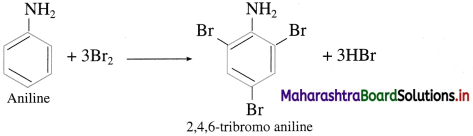
Answer:
In case of issue of shares at a premium, a separate account into which premium amount is deposited is called ‘Securities Premium Account’.
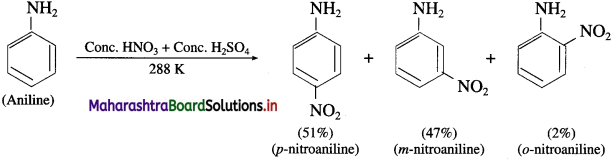
Question 16.
When are shares said to be issued at par?
Answer:
Shares are said to be issued at par when the company issues shares at their face value.

F. Complete the following sentences.

Question 1.
The portion of Subscribed capital which has not yet been called-up is ____________
Answer:
Uncalled capital

Question 2.
The capital which is not disclosed in the Balance Sheet is known as ____________
Answer:
Reserve capital

Maharashtra Board 12th BK Important Questions Chapter 8 Company Accounts - Issue of Shares

Question 3.
____________ shares have voting right.

Answer:
Equity

Question 4.
The liability of shareholder of public limited company is ____________
Answer:
limited

Question 5.
____________ shares are issued to public through prospectus.
Answer:
Equity

Question 6.
In public issue whole amount of share capital is called in ____________
Answer:
instalments

Question 7.
A public company ____________ share on non-payment of call money.
Answer:
forfeits

Question 8.
Share forfeited balance is transferred to ____________ Account.
Answer:
Capital Reserve

Question 9.
Preference shares can be ____________ after certain period of time.
Answer:
redeemed

Maharashtra Board 12th BK Important Questions Chapter 8 Company Accounts - Issue of Shares

Question 10.
____________ shares have a right to participate in decision making process.
Answer:
Equity

Solved Problems

Question 1.
Kandla Co. Ltd. made an issue of 80,000 equity shares of ₹ 20 each payable as follows:
Application: ₹ 5 per share
Allotment: ₹ 10 per share
First Call: ₹ 3 per share
Second and Final Call: ₹ 2 per share
The company received applications for 90,000 shares of which applications for 10,000 shares were rejected and money refunded. All the shareholders paid up to the second call except Sachin, the allottee of 4,000 Shares, who failed to pay a final call.
Pass Journal Entries for the above transaction in the books of Kandla Co. Ltd.
Solution:
Journal Entries in the books of KANDLA CO. LTD.
Maharashtra Board 12th BK Important Questions Chapter 8 Company Accounts - Issue of Shares Q1
Maharashtra Board 12th BK Important Questions Chapter 8 Company Accounts - Issue of Shares Q1.1

Maharashtra Board 12th BK Important Questions Chapter 8 Company Accounts - Issue of Shares

Question 2.
Vraj Ltd. issued 20,000 equity shares of ₹ 20 each, payable as follows:
On Application: ₹ 4
On Allotment: ₹ 6
On First Call: ₹ 6
On Second Call: ₹ 4
The company received applications for 25,000 equity shares. Allotment of shares was made on a pro-rata basis. Share allotment and calls were made and as also received except Raja holding 500 shares failed to pay both the calls. His shares were forfeited after the second call.
Record the above transactions in the books of Vraj Ltd.
Solution:
Journal Entries in the books of VRAJ LIMITED
Maharashtra Board 12th BK Important Questions Chapter 8 Company Accounts - Issue of Shares Q2
Maharashtra Board 12th BK Important Questions Chapter 8 Company Accounts - Issue of Shares Q2.1