Maharashtra Board Class 11 Biology Important Questions Chapter 8 Plant Tissues and Anatomy

Balbharti Maharashtra State Board 11th Biology Important Questions Chapter 8 Plant Tissues and Anatomy Important Questions and Answers.

Maharashtra State Board 11th Biology Important Questions Chapter 8 Plant Tissues and Anatomy

Question 1.
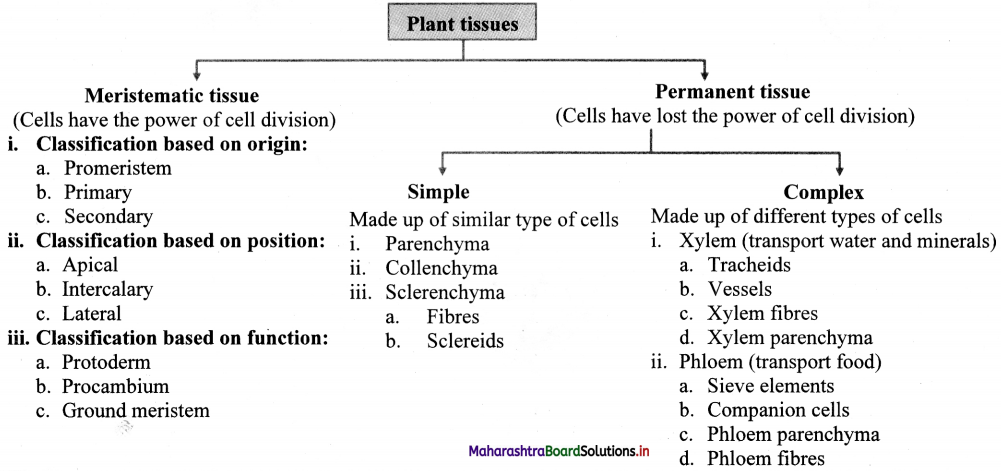
How plant tissues are classified on the basis of their ability to divide?
Answer:
Plant tissues are classified into meristematic tissues and permanent tissues based on their ability to divide.

Maharashtra Board Class 11 Biology Important Questions Chapter 8 Plant Tissues and Anatomy

Question 2.
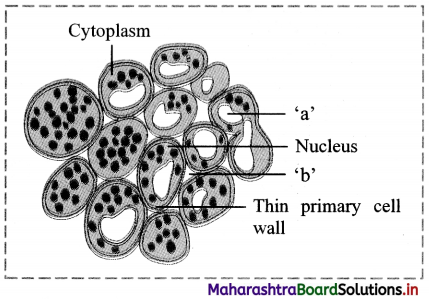
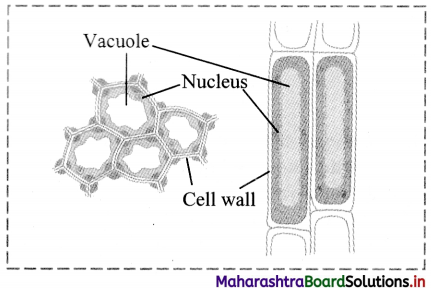
Identify the labels i, ii and iii in the given figure of meristematic tissue and write its characteristics.
Maharashtra Board Class 11 Biology Important Questions Chapter 8 Plant Tissues and Anatomy 1
Answer:
1. Cell wall
2. Nucleus
3. Cytoplasm
Characteristics of meristematic tissue:

  1. It is a group of young, immature cells.
  2. These are living cells with ability to divide in the regions where they are present.
  3. These are polyhedral or isodiametric in shape without intercellular spaces.
  4. Cell wall is thin, elastic and mainly composed of cellulose.
  5. Protoplasm is dense with distinct nucleus at the centre and vacuoles if present, are very small.
  6. Cells show high rate of metabolism.

Question 3.
With the help of neat and labelled diagram explain the classification of meristematic tissue based on its position.
Answer:
Classification of meristematic tissue based on its position:
1. Apical meristem:
a. It is produced from promeristem and forms growing point of apices of root, shoot and their lateral branches.
b. It brings about increase in length of plant body and is called as apical initials.
c. Shoot apical meristem is terminal in position whereas in root it is subterminal i.e. located behind the root cap.

2. Intercalary meristem:
a. Intercalary meristematic tissue is present in the top or base area of node.
b. Their activity is mainly seen in monocots.
c. These are short lived.

3. Lateral meristem:
a. It is present along the sides of central axis of organs.
b. It takes part in increasing girth of stem or root, e.g. Intrafascicular cambium.
c. It is found in vascular bundles of gymnosperms and dicot angiosperms.

Maharashtra Board Class 11 Biology Important Questions Chapter 8 Plant Tissues and Anatomy

Question 4.
Complete the given table representing types of meristematic tissue based on its function.
Answer:

Types of meristematic tissue Function
1. Protoderm It is found in young growing region of a plant forming a protective covering like epidermis around the various organs.
2. Procambium It is involved in developing primary vascular tissue.
3. Ground meristem It forms structures like cortex, endodermis, pericycle, medullary rays, pith.

Question 5.
Which are the simple permanent tissues in plants?
Answer:
Parenchyma, Collenchyma and Sclerenchyma are the simple permanent tissues in plants.

Question 6.
Complete the given chart by giving characteristics of following tissues:
Answer:
Maharashtra Board Class 11 Biology Important Questions Chapter 8 Plant Tissues and Anatomy 2

Question 7.
Name the type of tissue in the given figure, identify labels ‘a’ and ‘b’ and write its characteristics.
Maharashtra Board Class 11 Biology Important Questions Chapter 8 Plant Tissues and Anatomy 3
Answer:
1. The given figure represents simple permanent tissue i.e. Parenchyma.
2. a: Vacuole, b: Intercellular air spaces.

Characteristics of parenchyma: Parenchyma:

  1. It is a type of simple permanent tissue.
  2. Cells in this tissue are thin walled, isodiametric, round, oval to polygonal or elongated in shape.
  3. Cell wall is composed of cellulose.
  4. Cells are living with prominent nucleus and cytoplasm with large vacuole.
  5. Parenchyma has distinct intercellular spaces. Sometimes, cells may show compact arrangement.
  6. The cytoplasm of adjacent cells is interconnected through plasmodesmata and thus forms a continuous tissue.
  7. This is less specialized permanent tissue.
  8. Occurrence:
    These cells are distributed in all the parts of a plant body viz. epidermis, cortex, pericycle, pith, mesophyll cells, endosperm, xylem and phloem.
  9. Functions:
    These cells store food, water, help in gaseous exchange, increase buoyancy, perform photosynthesis and different functions in plant body.
  10. Dedifferentiation in parenchyma cells develops vascular cambium and cork cambium at the time of
    secondary growth.

Maharashtra Board Class 11 Biology Important Questions Chapter 8 Plant Tissues and Anatomy

Question 8.
Identify the type of tissue shown in the given figure and write its characteristics.
Maharashtra Board Class 11 Biology Important Questions Chapter 8 Plant Tissues and Anatomy 4
Answer:
The given figure represents Collenchyma tissue.
Characteristics of Collenchyma:

  1. It is a simple permanent tissue made up of living cells.
  2. The cell wall is cellulosic but shows uneven deposition of cellulose and pectin especially at comers.
  3. The walls may show presence of pits.
  4. Cells are similar like parenchyma, containing cytoplasm, nucleus and vacuoles but small in size and without intercellular spaces. Thus, the cells appear to be compactly packed.
  5. The cells are either circular, oval or angular in transverse section.

Function:
Collenchyma is a living mechanical tissue and serves different functions in plants.
a. It gives mechanical strength to young stem and parts like petiole of leaf.
b. It allows bending and pulling action in plant parts and also prevents tearing of leaf.
c. It also allows growth and elongation of organs.
d. Collenchyma is usually absent in monocots and roots of dicot plant.

Question 9.
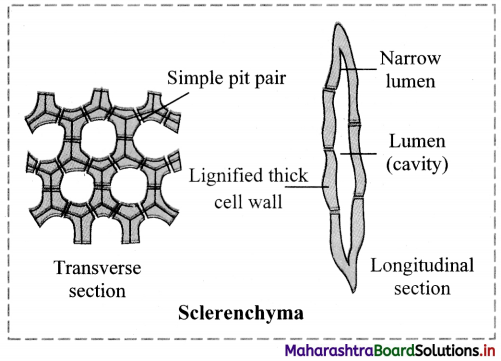
With the help of neat and labelled diagrams explain the Sclerenchyma Tissue.
Maharashtra Board Class 11 Biology Important Questions Chapter 8 Plant Tissues and Anatomy 5
Answer:
Sclerenchyma Tissue:

  1. It is simple permanent tissue made up of compactly arranged thick walled dead cells.
  2. The cells are living at the time of production but at maturity they become dead.
  3. Cells are devoid of cytoplasm.
  4. Their walls are thickened due to uniform deposition of lignin.
  5. Cells remain interconnected through several pits.

Types of Sclerenchyma:
Sclerenchyma cells are categorized into two types on the basis of their size and shape as
fibres and sclereids:
a. Fibres:
Fibres are thread-like, elongated and narrow structures with tapering and interlocking end walls. Fibres are mostly in bundles. Pits are narrow, unbranched and oblique. They provide mechanical strength.

b. Sclereids:
Sclereids are usually broad, with blunt end walls.
These occur singly or in loose groups and their pits are deep branched and straight.
These are developed due to secondary thickening of parenchyma cells and provides stiffness only.

Functions:
a. This tissue functions as the main mechanical tissue.
b. It permits bending, shearing and pulling.
c. It gives rigidity to leaves and prevents it from falling.
d. It also gives rigidity to epicarps and seeds.

Maharashtra Board Class 11 Biology Important Questions Chapter 8 Plant Tissues and Anatomy

Question 10.
Give a brief account of water-conducting tissues in higher plants.
Answer:
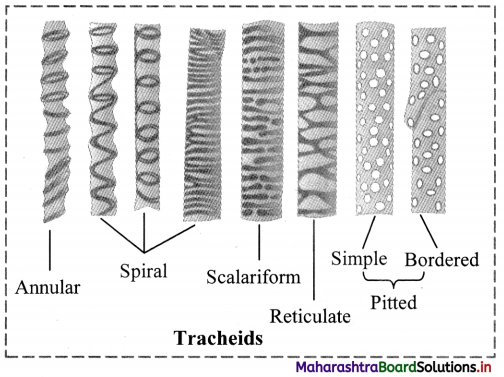
Maharashtra Board Class 11 Biology Important Questions Chapter 8 Plant Tissues and Anatomy 6
1. Xylem is the water-conducting tissue in higher plants. It is a dead complex tissue.
It also provides mechanical strength to the plant body.
Components of xylem are tracheids, vessels, xylem parenchyma and xylem fibres.

2. Tracheids:
a. These are elongated, tubular and dead cells (without protoplasm).
b. The ends are oblique and tapering.
c. The cell walls is unevenly thickened and lignified. This provides mechanical strength.
d. Tracheids contribute 95% of wood in gymnosperms and 5% in angiosperms.
e. The different types of thickening patterns are seen on their walls such as annular (in the form of rings), spiral (in the form of spring/helix), scalariform (ladder like) and pitted (small circular area). Pitted is the most advanced type of thickening which may be simple or bordered.

3. Vessels:
a. Vessels are longer than tracheids with perforated or dissolved ends and formed by union of several vessels end to end.
b. These are involved in conduction of water and minerals.
c. Their lumen is wider than tracheids and the thickening is due to lignin and similar to tracheids.
d. In monocots, vessels are rounded where as they are angular in dicot angiosperms.
e. The first formed xylem vessels (protoxylem) are small and have either annular or spiral thickenings while latter formed xylem vessels are larger (metaxylem) and have reticulate or pitted thickenings.
f. When protoxylem is arranged towards pith and metaxylem towards periphery it is called as endarch
e. g. in stem and when the position is reversed as in the roots is called as exarch.

4. Xylem parenchyma:
a. Xylem parenchyma cells are small associated with tracheids and vessels.
b. This is the only living tissue among this complex tissue.
c. The function is to store food (starch) and sometimes tannins.
d. Xylem parenchyma are involved in lateral or radial conduction of water or sap.

5. Xylem fibres:
a. Xylem fibres are sclerenchymatous cells and serve mainly mechanical support. These are called wood fibres.
b. These are also elongated, narrow and spindle shaped.
c. Cells are tapering at both the ends and their walls are lignified.

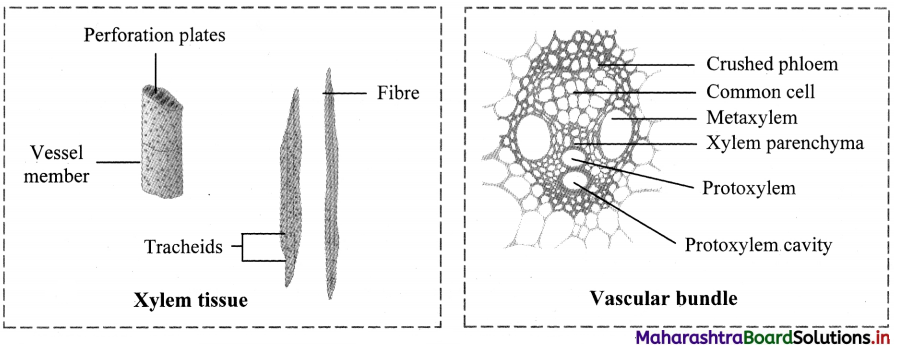
Question 11.
Draw neat and labelled diagram of xylem tissue and vascular bundle.
Answer:
Maharashtra Board Class 11 Biology Important Questions Chapter 8 Plant Tissues and Anatomy 7

Question 12.
Match the following.

Column I Column II
1. Protoxylem (a) Xylem with larger vessels
2. Endarch Xylem (b) Protoxylem arranged towards pith
3. Metaxylem (c) Metaxylem arranged towards pith
4. Exarch xylem (d) First formed xylem vessels

Answer:

Column I Column II
1. Protoxylem (d) First formed xylem vessels
2. Endarch Xylem (b) Protoxylem arranged towards pith
3. Metaxylem (a) Xylem with larger vessels
4. Exarch xylem (c) Metaxylem arranged towards pith

Maharashtra Board Class 11 Biology Important Questions Chapter 8 Plant Tissues and Anatomy

Question 13.
Describe the structure of phloem.
Maharashtra Board Class 11 Biology Important Questions Chapter 8 Plant Tissues and Anatomy 8
Answer:
Structure of phloem:
1. Phloem is a living tissue. It is also called as bast.
It is responsible for conduction of organic food material from source (generally leaf) to a sink (other plant parts).
On the basis of origin, it can be protophloem (first formed) and metaphloem (latterly formed).
It is composed of sieve elements (sieve cells and sieve tubes), companion cells, phloem parenchyma and phloem fibres.

2. Sieve elements:
a. Sieve tubes are long tubular conducting channel of phloem.
b. These are placed end to end with bulging at end walls.
c. The sieve tube has sieve plate formed by septa with small pores.
d. The sieve plates connect protoplast of adjacent sieve tube cells.
e. The sieve tube cell is a living cell with a thin layer of cytoplasm, but loses its nucleus at maturity.
f. The sieve tube cell is connected to companion cell through phloem parenchyma by plasmodesmata.
g. Sieve cells are found in lower plants like pteridophytes and gymnosperms and sieve tubes are found in angiosperms.
h. The cells are narrow, elongated with tapering ends and sieve area located laterally.

3. Companion cells:
a. These are narrow elongated and living.
b. Companion cells are laterally associated with sieve tube elements.
c. Companion cells have dense cytoplasm and prominent nucleus.
d. Nucleus of companion cell regulates functions of sieve tube cells through simple pits.
e. From origin point of view, sieve tube cells and companion cell are derived from same cell. Death of the one result in death of the other type.

4. Phloem parenchyma:
a. Cells of phloem parenchyma are living, elongated found associated with sieve tube and companion cells.
b. Their chief function is to store food, latex, resins, mucilage, etc.
c. The cells carry out lateral conduction of food material.
d. These cells are absent in most of the monocots.

5. Phloem fibres (Bast fibres):
a. Phloem fibres are the only dead tissue among this unit.
b. They are sclerenchymatous.
c. They are generally absent in primary phloem, but present in secondary phloem.
d. These cells have with lignified walls and provide mechanical support.
e. They are used in making ropes and rough clothes.

Question 14.
Draw a diagram of phloem.
Answer:
Maharashtra Board Class 11 Biology Important Questions Chapter 8 Plant Tissues and Anatomy 9

Question 15.
Name the types of tissue systems in plants.
Answer:
The types of tissue systems in plants are epidermal tissue system, ground tissue system and vascular tissue system.

Maharashtra Board Class 11 Biology Important Questions Chapter 8 Plant Tissues and Anatomy

Question 16.
Write a short note on Epidermis.
Answer:
Epidermis:

  1. It is the outermost protective cell layer made up of compactly arranged cells without intercellular spaces.
  2. Cells show presence of central large vacuole, thin cytoplasm and a nucleus.
  3. The outer side of the epidermis is often covered with a waxy thick layer called the cuticle which prevents the loss of water.
  4. Root epidermis (Epiblema) has root hairs. These are unicellular, elongated and involved in absorption of sap from the soil.
  5. In stem, epidermal hairs are called trichomes. These are generally multicellular, branched or unbranched, stiff or soft or even secretory. These help in preventing water loss due to transpiration.

Question 17.
Draw a diagram representing epidermal tissue system.
Answer:
Maharashtra Board Class 11 Biology Important Questions Chapter 8 Plant Tissues and Anatomy 10

Question 18.
Write a short note on Structure of stomata.
Answer:
Structure of stomata:

  1. Small gateways in the epidermal cells are called as stomata.
  2. Stoma is controlled or guarded by specially modified cells called guard cells.
  3. These guard cells may be kidney shaped (dicot) or dumbbell shaped (monocot), collectively called as stomata.
  4. Guard cells have chloroplasts to carry out photosynthesis.
  5. Change in turgor pressure of guard cells causes opening and closing of stomata, which enables exchange of gases and water vapour.
  6. Stomata are further covered by subsidiary cells.
  7. Stoma, guard cells and subsidiary cells form a unit called stomatal apparatus.

Question 19.
Write the information related to diagrams given below.
Answer:
1. The given diagram represents stoma in dicot leaf.
[Note: We have given additional label of ‘chloroplast ’for better understanding of students]
2. Structure of stomata:

  1. Small gateways in the epidermal cells are called as stomata.
  2. Stoma is controlled or guarded by specially modified cells called guard cells.
  3. These guard cells may be kidney shaped (dicot) or dumbbell shaped (monocot), collectively called as stomata.
  4. Guard cells have chloroplasts to carry out photosynthesis.
  5. Change in turgor pressure of guard cells causes opening and closing of stomata, which enables exchange of gases and water vapour.
  6. Stomata are further covered by subsidiary cells.
  7. Stoma, guard cells and subsidiary cells form a unit called stomatal apparatus.

Question 20.
Explain the term ground tissue.
Answer:
Ground tissue:

  1. All the plant tissues excluding epidermal and vascular tissue is ground tissue.
  2. It is made up of simple permanent tissue e.g. parenchyma.
  3. It is present in cortex, pericycle, pith and medullary rays in the primary stem and root.
  4. Collenchyma and sclerenchyma in the hypodermis and chloroplasts containing mesophyll tissue in leaves is also ground tissue.

Question 21.
Describe various types of vascular bundles.
Answer:
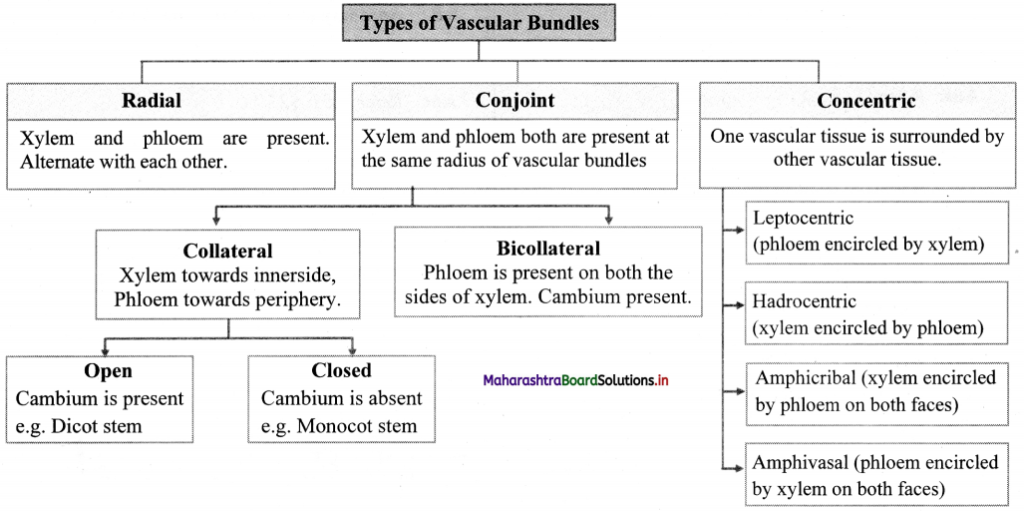
Vascular bundles occur in the form of distinct patches of the complex tissue viz. Xylem and Phloem. On the basis of their arrangement in the plant body they are classified as follows:
1. Radial vascular bundles:
When the complex tissues (xylem and phloem) are situated separately on separate radius as separate bundle, vascular bundle is called Radial vascular bundle. This is a common feature of roots.

2. Conjoint vascular bundles:
When the complex tissue (xylem and phloem) is collectively present as neighbours of each other on the same radius, vascular bundle is called Conjoint vascular bundle.
They are of two types:
a. Collateral vascular bundle:
In this type of vascular bundle, xylem lies inwards and the phloem lies outwards.
These bundles may be further of open type (secondary growth takes place) containing cambium in between xylem and phloem and closed type if cambium is not present (secondary growth absent).
b. Bicollateral vascular bundle:
When phloem is present in a vascular bundle on both the sides of xylem and intervening cambium tissue, it is called bicollateral vascular bundle. It is a feature of family Cucurbitaceae.

3. Concentric vascular bundle:
a. When one vascular tissue is completely encircling the other, it is called as concentric vascular bundle.
b. When phloem is encircled by xylem, it is called as leptocentric vascular bundle, whereas when xylem is encircled by phloem, it is called as hadrocentric vascular bundle.
c. When xylem is encircled by phloem on both faces, it is called as amphicribral vascular bundle. When phloem is encircled by xylem on both faces it is called as amphivasal vascular bundle.
Maharashtra Board Class 11 Biology Important Questions Chapter 8 Plant Tissues and Anatomy 11

Maharashtra Board Class 11 Biology Important Questions Chapter 8 Plant Tissues and Anatomy

Question 22.
Explain how formation of cambial ring occurs in dicot stem.
Answer:

  1. The cambium present between the primary xylem and primary phloem of a vascular bundle is called intrafascicular cambium.
  2. With the onset of favourable season, meristematic cells of intrafascicular cambium become active.
  3. Simultaneously, the ray parenchyma cells, both fusiform initials and ray initials become meristematic. This is known as dedifferentiation.
  4. These form patch of cambial cells (meristematic cells) in between the adjacent bundles and produce interfascicular cambium.
  5. Both intrafascicular and interfascicular cambium join and form a complete ring, known as the cambial ring. This is possible because they lie in one plane.

Question 23.
‘Secondary growth is observed in most of the dicot and gymnospermic root.’ State whether the given statement is true or false and justify your answer.
Answer:

  1. The given statement is true.
  2. Secondary growth is observed in most of the dicot and gymnospermic root by producing secondary vascular tissue and periderm.
  3. Secondary growth is produced by vascular cambium and cork cambium respectively.
  4. Conjunctive parenchyma cells present on the inner edges of primary phloem bundles become meristematic.
  5. These cells add secondary xylem and secondary phloem on the inner and outer side respectively which results in secondary growth.

Question 24.
Differentiate between heartwood and sap wood.
Answer:

Heartwood Sap wood
1. It is central region of secondary xylem (wood). It is the peripheral region of secondary xylem (wood).
2. It is darker in colour due to deposition of oils, gums, resins, tannins, etc It is lighter in colour and without any depositions.
3. It is non- functional part of secondary xylem. It is functional part of secondary xylem.
4. It is resistant to pathogens. It is more susceptible to pathogens
5. It is not involved in conduction of sap. It is involved in conduction of sap.
6. It is also called as duramen. It is also called as alburnum.

Question 25.
What are tyloses?
Answer:
Tyloses:
1. Tracheary elements of heartwood are plugged by in-growth of adjacent parenchyma cells are known as tyloses.
2. Tyloses are fdled by oils, gums, resins, tannins called as extractives.

Question 26.
Explain how periderm is formed?
Answer:
Formation of periderm:
As the stem increase in diameter due to activity of vascular cambium, the outer cortical and epidermal layer get ruptured. Thus, it becomes necessaiy to replace these cells by new cells.

  1. Phellogen (cork cambium) develops in extrastelar region (cortex region) of the stem.
  2. The outer cortical cells of cortex become meristematic and produce a layer of thin walled, rectangular cells. These cells cut off new cells on both sides.
  3. The cells produced on outer side develop phellem (cork), whereas on the inner side produce phelloderm (secondary cortex).
  4. The cork is impervious in nature and does not allow entry of water due to suberized walls. Secondary cortex is parenchymatous in nature.
  5. Phellogen, phellem and phelloderm constitute periderm.

Question 27.
Explain the given terms:
1. Bark
2. Lenticels
3. Anomalous secondary growth
Answer:
1. Bark:
a. Bark is non-technical term referring to all cell types found external to vascular cambium including secondary phloem.
b. Bark of early season is soft and of the late season is hard.

2. Lenticels:
a. Lenticels are aerating pores present as raised scars on the surface of bark.
b. These are portions of periderm, where phellogen activity is more.
c. Lenticels are meant for gaseous and water vapour exchange.

3. Anomalous secondary growth:
a. Monocot stems lack cambium hence secondary growth does not take place.
b. However, accessory cambium development in plants like, Dracaena, Agave, Palms and root of sweet potato shows presence of secondary growth. This is called as anomalous secondary growth.

Maharashtra Board Class 11 Biology Important Questions Chapter 8 Plant Tissues and Anatomy

Question 28.
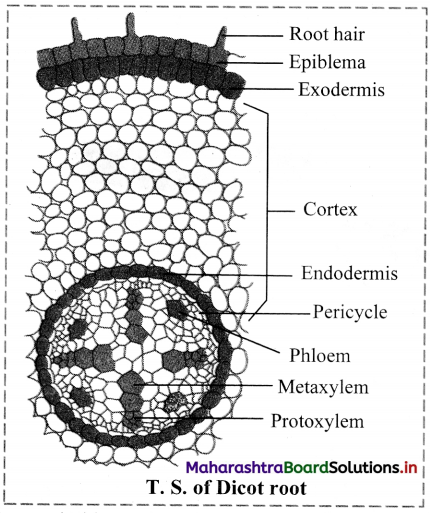
With the help of neat and labelled diagram explain the anatomy of dicot root.
Answer:
Maharashtra Board Class 11 Biology Important Questions Chapter 8 Plant Tissues and Anatomy 12
The transverse section of a typical dicotyledonous root shows following anatomical features:
1. Epiblema: It is the outermost single layer of cells without cuticle. Some epidermal cells prolong to form unicellular root hairs.
2. Cortex: It is made up of many layers of thin walled parenchyma cells. Cortical cells store food and water.
3. Exodermis: After the death of epiblema, outer layer of cortex become cutinized and is called Exodermis.

4. Endodermis:
The innermost layer of cortex is called Endodermis.
The cells are barrel-shaped and their radial walls bear Casparian strip or Casparian bands composed of suberin. Near the protoxylem, there are unthickened passage cells.

5. Stele: It consists of pericycle, vascular bundles and pith.
a. Pericycle: Next to the endodermis, there is a single layer of thin walled parenchyma cells called pericycle. It forms outermost layer of stele or vascular cylinder.
b. Vascular bundle: Vascular bundles are radial. Xylem and Phloem occur in separate patches arranged on alternate radii. Xylem is exarch in root that means protoxylem vessels are towards periphery and metaxylem elements are towards centre. Xylem bundles vary from two to six number, i.e. they may be diarch, triarch, tetrarch, etc.
Connective tissue: A parenchymatous tissue is present in between xylem and phloem.
c. Pith: The central part of stele is called pith. It is narrow and made up of parenchymatous cells, with or without intercellular spaces.
6. At a later stage cambium ring develops between the xylem and phloem causing secondary growth.

Question 29.
With the help of neat and labelled diagram explain the anatomy of monocot root.
Answer:
The transverse section of a typical monocotyledonous root shows following anatomical features:
1. Epiblema: It is the outermost single layer of cells without cuticle. Some epidermal cells prolong to form unicellular root hairs.
2. Cortex: It is made up of many layers of thin walled parenchyma cells. Cortical cells store food and water.
Endodermis: It is innermost layer of cortex. The cells of endodermis are thick walled except the passage cells which lie just opposite to the protoxylem.
Stele: It consists of pericycle, vascular bundles and pith.
a. Pericycle: Pericycle is present below the endodermis.
b. Vascular bundle: Vascular bundles are radial. Xylem and Phloem occur in separate patches arranged on alternate radii. Xylem is exarch in root that means protoxylem vessels are towards periphery and metaxylem elements are towards centre. Polyarch condition of xylem is observed, (xylem bundles are more than six).
Pith: Pith is large and well developed.
Secondary growth does not occur due to absence of cambium.

Maharashtra Board Class 11 Biology Important Questions Chapter 8 Plant Tissues and Anatomy

Question 30.
What is polyarch condition of root?
Answer:
Polyarch condition is the one in which roots possess more than six xylem bundles.

Question 31.
Explain in detail anatomy of sunflower stem.
Answer:
A transverse section of sunflower (dicot) stem shows the following structures:
1. Epidermis: It is a single, outermost layer with multicellular outgrowth called trichomes. A layer of cuticle
is usually present towards the outer surface of epidermis.

2. Cortex: Cortex is situated below the epidermis and is usually differentiated into three regions namely, hypodermis, general cortex and endodermis.
a. Hypodermis: It is situated just below the epidermis and is made of 3-5 layers of collenchymatous cells. Intercellular spaces are absent.
b. General cortex: It is made up of several layers of large parenchymatous cells with intercellular spaces.
c. Endodermis: It is an innermost layer of cortex which is made up of barrel shaped cells. It is also called starch sheath, as it is rich in starch grain.

3. Stele: It is differentiated into pericycle, vascular bundles and pith.
a. Pericycle: It is the outermost layer of vascular system situated between the endodermis and vascular bundles. In sunflower, it is multi-layered and also called hard bast.
b. Vascular bundles: Vascular bundles are conjoint, collateral, open, and are arranged in a ring. Each one is composed of xylem, phloem and cambium. Xylem is endarch. A strip of cambium is present between xylem and phloem.
c. Pith: It is situated in the centre of the young stem and is made up of large-sized parenchymatous cells with conspicuous intercellular spaces.

Question 32.
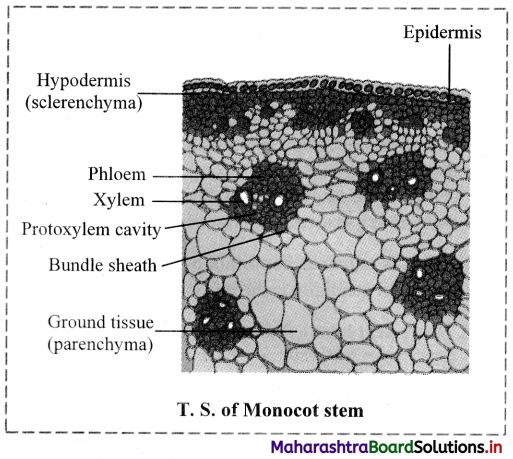
With the help of neat and labelled diagram explain the anatomy of maize stem.
Answer:
Maharashtra Board Class 11 Biology Important Questions Chapter 8 Plant Tissues and Anatomy 13
A transverse section of maize (monocot) stem shows the following structures:

  1. Epidermis: It is single layered and without trichomes.
  2. Hypodermis: It is sclerenchymatous.
  3. Ground tissue: It consists of thin walled parenchyma cells. It extends from hypodermis to the centre. It is not differentiated into cortex, endodermis, pericycle and pith.
  4. Vascular bundles: Vascular bundles are numerous and are scattered in ground tissue. Each vascular bundle is surrounded by a sclerenchymatous bundle sheath. Vascular bundles are conjoint, collateral and closed (without cambium). Xylem is endarch and shows lysigenous cavity.
  5. Pith: Pith is absent.

Question 33.
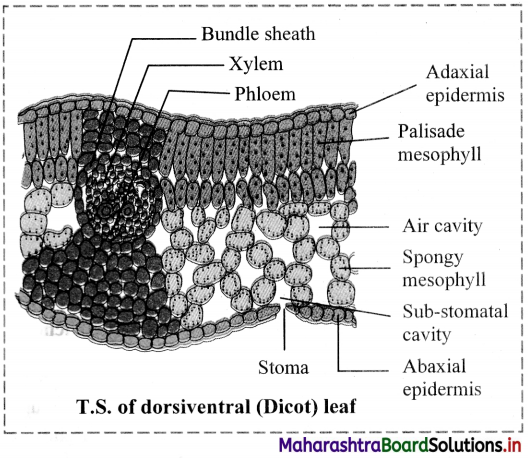
With the help of a neat and labelled diagram, describe the internal structure of dorsiventral leaf.
Answer:
1. Structure of dorsiventral leaf: The mesophyll tissue is differentiated into palisade and spongy parenchyma in a dorsiventral leaf. This type is very common in dicot leaf. The different parts of this leaf are as follows:
2. Upper epidermis: It consists of a single layer of tightly packed rectangular, barrel shaped, parenchymatous cells which are devoid of chloroplast. A distinct layer of cuticle lies on the outside of the epidermis. Stomata are generally absent.
3. Mesophyll: Between upper and lower epidermis, there is chloroplast-containing photosynthetic tissue called mesophyll It is differentiated into Palisade parenchyma and Spongy parenchyma.
a. Palisade parenchyma:
Palisade parenchyma is present below upper epidermis and consists of closely packed elongated cells. The cells contain abundant chloroplasts and help in photosynthesis.
b. Spongy parenchyma:
Spongy parenchyma is present below palisade tissue and consists of loosely arranged irregularly shaped cells with intercellular spaces. The spongy parenchyma cells contain chloroplast and are in contact with the atmosphere through stomata.
Maharashtra Board Class 11 Biology Important Questions Chapter 8 Plant Tissues and Anatomy 14
4. Vascular system: It is made up of a number of vascular bundles of varying size depending upon the venation. Each one is surrounded by a thin layer of parenchymatous cells called bundle sheath. Vascular bundles are closed. Xylem lies towards upper epidermis and phloem towards lower epidermis. Cambium is absent, hence there is no secondary growth in the leaf.
5. Lower epidermis: It consists of a single layer of compactly arranged rectangular, parenchymatous cells. A thin layer of cuticle is also present. The lower epidermis contains a large number of microscopic pores called stomata. There is an air-space called substomatal chamber at each stoma.

Maharashtra Board Class 11 Biology Important Questions Chapter 8 Plant Tissues and Anatomy

Question 34.
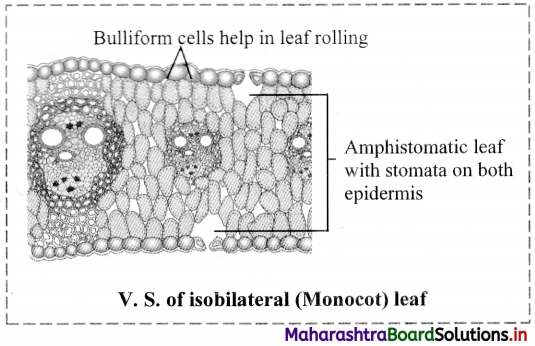
With the help of a neat labelled diagram, describe the anatomy of isobilateral leaf.
Answer:
The parts of isobilateral leaf are as follows:
Maharashtra Board Class 11 Biology Important Questions Chapter 8 Plant Tissues and Anatomy 15
1. Epidermis:
It is single layered, present on both sides of the leaf.
It consists of compactly arranged rectangular transparent parenchymatous cells.
Both the surfaces contain stomata.
Both the surfaces have a distinct layer of cuticle.
2. Mesophyll:
Mesophyll is not differentiated into palisade and spongy tissue.
3. Vascular bundle:
These are conjoint, collateral and closed.

Question 35.
Compare between dorsiventral and isobilateral leaf.
Answer:

Dorsiventral leaf Isobilateral leaf
1. Dorsiventral Leaf is very common in dicotyledonous plants. Isobilateral leaf is very common in monocotyledonous plants.
2. In this mesophyll tissue is differentiated into palisade and spongy parenchyma. In this mesophyll tissue is not differentiated into palisade and spongy parenchyma.
3. The leaves are commonly horizontal in orientation with distinct upper and lower surfaces. The upper surface which faces the sun is darker than the lower surface. In this leaf both the surfaces are equally illuminated as both the surface can face the sun, and show similar structure. The two surfaces are equally green.
4. Stomata is absent on the upper surface of these leaves. Stomata is present on both the upper and lower surfaces of these leaves.

Question 36.
Distinguish between anatomy of dicot root and monocot root.
Answer:

Anatomy of dicot root Anatomy of monocot root
1. Pith is narrow. Pith is large and well developed.
2. Diarch, triarch or tetrarch condition can be observed. (Xylem bundles vary from two to six number) Polyarch condition is observed, (xylem bundles are more than six)
3. Cambium is formed in later stage between xylem and phloem which causes secondary growth. Secondary growth is absent.

Maharashtra Board Class 11 Biology Important Questions Chapter 8 Plant Tissues and Anatomy

Question 37.
Distinguish between anatomy of dicot stem and monocot stem.
Answer:

Anatomy of Dicot stem Anatomy of Monocot stem
1. Epidermis shows presence of multicellular trichomes. Epidermis is without trichomes.
2. Hypodermis is made up of collenchymatous cells. Hypodermis is made up of sclerenchymatous cells.
3. Medullary rays are present between vascular bundles. Medullary rays are absent.
4. Vascular bundles are arranged in the form of a ring. Vascular bundles are scattered in the ground tissue.
5. It is conjoint, collateral and open (Cambium present) They are conjoint, collateral and closed (cambium is absent).
6. Vascular bundle is not surrounded by a sclerenchymatous bundle sheath. Vascular bundle is surrounded by a sclerenchymatous bundle sheath.
7. Secondary growth takes place due to presence of cambium. Secondary growth does not occur due to absence of cambium.
8. Pith is present. Pith is absent.

Question 38.
Apply Your Knowledge

Question 1.
Which plant part would show the following:

  1. Radial vascular bundles.
  2. Large and well-developed pith.
  3. Differentiation of mesophyll into palisade and spongy tissue.
  4. Presence of stomata on both upper and lower epidermis.

Answer:

  1. Root
  2. Monocot root and Dicot stem,
  3. Dicot leaf
  4. Monocot leaf

Question 2.
When a tree is debarked, which tissues are removed?
Answer:
The bark is made up of tissues like cork, cork cambium and secondary cortex, which are removed when a tree is debarked.

Question 3.
While eating fruits like pear or guava, it feels gritty. What gives stiffness to these fruits?
Answer:
Sclereids are found in pulp of fruits like pear and guava which gives them stiffness and thus we feel gritty while eating these fruits.

Maharashtra Board Class 11 Biology Important Questions Chapter 8 Plant Tissues and Anatomy

Question 39.
Quick Review

Maharashtra Board Class 11 Biology Important Questions Chapter 8 Plant Tissues and Anatomy 16
Maharashtra Board Class 11 Biology Important Questions Chapter 8 Plant Tissues and Anatomy 17

Question 40.
Exercise

Question 1.
Define tissue.
Answer:
A group of cells having essentially a common function and origin is called as tissue.

Question 2.
Classify the meristematic tissue based on its origin.
Answer:
Classification of meristematic tissue on the basis of origin:
1. Promeristem / Primordial meristem:
a. It is also called as embryonic meristem.
b. It usually occupies very minute area at the tip of root and shoot.

2. Primary meristem:
a. It originates from the primordial meristem and occurs in the plant body from the beginning, at the root and shoot apices.
b. Cells are always in active state of division and give rise to permanent tissues.

3. Secondary meristem:
a. These tissues develop from living permanent tissues during later stages of plant growth hence are called as secondary meristems.
b. This tissue occurs in the mature regions of root and shoot of many plants.
c. Secondary meristem is always lateral (to the central axis) in position e.g. Fascicular cambium, inter fascicular cambium, cork cambium.

Maharashtra Board Class 11 Biology Important Questions Chapter 8 Plant Tissues and Anatomy

Question 3.
Explain in detail classification of meristematic tissue based on its position.
Answer:
Classification of meristematic tissue based on its position:
1. Apical meristem:
a. It is produced from promeristem and forms growing point of apices of root, shoot and their lateral branches.
b. It brings about increase in length of plant body and is called as apical initials.
c. Shoot apical meristem is terminal in position whereas in root it is subterminal i.e. located behind the root cap.

2. Intercalary meristem:
a. Intercalary meristematic tissue is present in the top or base area of node.
b. Their activity is mainly seen in monocots.
c. These are short lived.

3. Lateral meristem:
a. It is present along the sides of central axis of organs.
b. It takes part in increasing girth of stem or root, e.g. Intrafascicular cambium.
c. It is found in vascular bundles of gymnosperms and dicot angiosperms.

Question 4.
Give any two examples of secondary meristematic tissue.
Answer:
Secondary meristem is always lateral (to the central axis) in position e.g. Fascicular cambium, inter fascicular cambium, cork cambium.

Question 5.
Draw a diagram of meristematic cells.
Answer:
1. Cell wall
2. Nucleus
3. Cytoplasm
Characteristics of meristematic tissue:

  1. It is a group of young, immature cells.
  2. These are living cells with ability to divide in the regions where they are present.
  3. These are polyhedral or isodiametric in shape without intercellular spaces.
  4. Cell wall is thin, elastic and mainly composed of cellulose.
  5. Protoplasm is dense with distinct nucleus at the centre and vacuoles if present, are very small.
  6. Cells show high rate of metabolism.

Maharashtra Board Class 11 Biology Important Questions Chapter 8 Plant Tissues and Anatomy

Question 6.
Write a short note on tracheids.
Answer:
Tracheids:
a. These are elongated, tubular and dead cells (without protoplasm).
b. The ends are oblique and tapering.
c. The cell walls is unevenly thickened and lignified. This provides mechanical strength.
d. Tracheids contribute 95% of wood in gymnosperms and 5% in angiosperms.
e. The different types of thickening patterns are seen on their walls such as annular (in the form of rings), spiral (in the form of spring/helix), scalariform (ladder like) and pitted (small circular area). Pitted is the most advanced type of thickening which may be simple or bordered.

Question 7.
Describe parenchyma in detail.
Answer:
Cell is the component that brings about important processes in the living organisms.

Question 8.
Describe the structure of xylem in detail.
Answer:
1. Xylem is the water conducting tissue in higher plants. It is a dead complex tissue.
It also provides mechanical strength to the plant body.
Components of xylem are tracheids, vessels, xylem parenchyma and xylem fibres.

2. Tracheids:
a. These are elongated, tubular and dead cells (without protoplasm).
b. The ends are oblique and tapering.
c. The cell walls is unevenly thickened and lignified. This provides mechanical strength.
d. Tracheids contribute 95% of wood in gymnosperms and 5% in angiosperms.
e. The different types of thickening patterns are seen on their walls such as annular (in the form of rings), spiral (in the form of spring/helix), scalariform (ladder like) and pitted (small circular area). Pitted is the most advanced type of thickening which may be simple or bordered.

3. Vessels:
a. Vessels are longer than tracheids with perforated or dissolved ends and formed by union of several vessels end to end.
b. These are involved in conduction of water and minerals.
c. Their lumen is wider than tracheids and the thickening is due to lignin and similar to tracheids.
d. In monocots, vessels are rounded where as they are angular in dicot angiosperms.
e. The first formed xylem vessels (protoxylem) are small and have either annular or spiral thickenings while latter formed xylem vessels are larger (metaxylem) and have reticulate or pitted thickenings.
f. When protoxylem is arranged towards pith and metaxylem towards periphery it is called as endarch
e. g. in stem and when the position is reversed as in the roots is called as exarch.

4. Xylem parenchyma:
a. Xylem parenchyma cells are small associated with tracheids and vessels.
b. This is the only living tissue among this complex tissue.
c. The function is to store food (starch) and sometimes tannins.
d. Xylem parenchyma are involved in lateral or radial conduction of water or sap.

5. Xylem fibres:
a. Xylem fibres are sclerenchymatous cells and serve mainly mechanical support. These are called wood fibres.
b. These are also elongated, narrow and spindle shaped.
c. Cells are tapering at both the ends and their walls are lignified.

Question 9.
What are Sclerenchyma fibres?
Answer:
a. Fibres:
Fibres are thread-like, elongated and narrow structures with tapering and interlocking end walls. Fibres are mostly in bundles. Pits are narrow, unbranched and oblique. They provide mechanical strength.

Maharashtra Board Class 11 Biology Important Questions Chapter 8 Plant Tissues and Anatomy

Question 10.
Write the functions of parenchyma cells.
Answer:
Parenchyma, Collenchyma and Sclerenchyma are the simple permanent tissues in plants.

Question 11.
Write function of collenchyma tissue.
Answer:
Function:
Collenchyma is a living mechanical tissue and serves different functions in plants.
a. It gives mechanical strength to young stem and parts like petiole of leaf.
b. It allows bending and pulling action in plant parts and also prevents tearing of leaf.
c. It also allows growth and elongation of organs.

Question 12.
Which are the different types of tracheids based on the types of thickenings on their walls?
Answer:
The different types of thickening patterns are seen on their walls such as annular (in the form of rings), spiral (in the form of spring/helix), scalariform (ladder like) and pitted (small circular area). Pitted is the most advanced type of thickening which may be simple or bordered.

Question 13.
Death of companion cell causes death of sieve tube cells and vice versa. Justify.
Answer:
Companion cells:
a. These are narrow elongated and living.
b. Companion cells are laterally associated with sieve tube elements.
c. Companion cells have dense cytoplasm and prominent nucleus.
d. Nucleus of companion cell regulates functions of sieve tube cells through simple pits.
e. From origin point of view, sieve tube cells and companion cell are derived from same cell. Death of the one result in death of the other type.

Question 14.
Which are the three types of simple permanent tissues?
Answer:
Parenchyma, Collenchyma and Sclerenchyma are the simple permanent tissues in plants.

Maharashtra Board Class 11 Biology Important Questions Chapter 8 Plant Tissues and Anatomy

Question 15.
Write the functions of sclerenchyma tissue.
Answer:
Functions:
a. This tissue functions as the main mechanical tissue.
b. It permits bending, shearing and pulling.
c. It gives rigidity to leaves and prevents it from falling.
d. It also gives rigidity to epicarps and seeds.

Question 16.
What are the components of xylem?
Answer:
1. Xylem is the water conducting tissue in higher plants. It is a dead complex tissue.
It also provides mechanical strength to the plant body.
Components of xylem are tracheids, vessels, xylem parenchyma and xylem fibres.

Question 17.
Name the living component of xylem.
Answer:
This is the only living tissue among this complex tissue.

Question 18.
Name the dead component of phloem.
Answer:
Phloem fibres are the only dead tissue among this unit.

Question 19.
What is closed vascular bundle?
Answer:
When cambium is not present between xylem and phloem, it is known as closed vascular bundle.

Question 20.
Describe two types of conjoint vascular bundles.
Answer:
Conjoint vascular bundles:
When the complex tissue (xylem and phloem) is collectively present as neighbours of each other on the same radius, vascular bundle is called Conjoint vascular bundle.
They are of two types:
a. Collateral vascular bundle:
In this type of vascular bundle, xylem lies inwards and the phloem lies outwards.
These bundles may be further of open type (secondary growth takes place) containing cambium in between xylem and phloem and closed type if cambium is not present (secondary growth absent).
b. Bicollateral vascular bundle:
When phloem is present in a vascular bundle on both the sides of xylem and intervening cambium tissue, it is called bicollateral vascular bundle. It is a feature of family Cucurbitaceae.

Question 21.
Write the function of trichomes.
Answer:
In stem, epidermal hairs are called trichomes. These are generally multicellular, branched or unbranched, stiff or soft or even secretory. These help in preventing water loss due to transpiration.

Question 22.
What are bicollateral vascular bundle?
Answer:
Bicollateral vascular bundle:
When phloem is present in a vascular bundle on both the sides of xylem and intervening cambium tissue, it is called bicollateral vascular bundle. It is a feature of family Cucurbitaceae.

Question 23.
Name the tissue that are not included in ground tissue.
Answer:
All the plant tissues excluding epidermal and vascular tissue is ground tissue.

Maharashtra Board Class 11 Biology Important Questions Chapter 8 Plant Tissues and Anatomy

Question 24.
Which type of conjoint – vascular bundles are found in members of Cucurbitaceae family?
Answer:
Bicollateral vascular bundle:
When phloem is present in a vascular bundle on both the sides of xylem and intervening cambium tissue, it is called bicollateral vascular bundle. It is a feature of family Cucurbitaceae.

Question 25.
What is concentric vascular bundle?
Answer:
Concentric vascular bundle:
a. When one vascular tissue is completely encircling the other, it is called as concentric vascular bundle.
b. When phloem is encircled by xylem, it is called as leptocentric vascular bundle, whereas when xylem is encircled by phloem, it is called as hadrocentric vascular bundle.
c. When xylem is encircled by phloem on both faces, it is called as amphicribral vascular bundle. When phloem is encircled by xylem on both faces it is called as amphivasal vascular bundle.

Question 26.
Define intrafascicular cambium.
Answer:
The cambium present between the primary xylem and primary phloem of a vascular bundle is called intrafascicular cambium.

Question 27.
What is the difference between spring wood and autumn wood?
Answer:
During favourable conditions, spring wood (early wood) is formed which has broader xylem bands, lighter colour, tracheids with thin wall and wide lumen, fibres are less in number, low density. Whereas, during unfavourable conditions, autumn wood (late wood) is formed which has narrow xylem band, darker in colour, lumen is narrow and walls are thick with abundant fibres, high density.

Question 28.
Explain how growth rings are formed in trees?
Answer:
1. Growth rings are formed due cambial activity during favourable and non-favourable climatic conditions.
2. During favourable conditions, spring wood (early wood) is formed which has broader xylem bands, lighter colour, tracheids with thin wall and wide lumen, fibres are less in number, low density. Whereas, during unfavourable conditions, autumn wood (late wood) is formed which has narrow xylem band, darker in colour, lumen is narrow and walls are thick with abundant fibres, high density.
3. Spring wood and autumn wood that appear as alternate light and dark concentric rings, constitute an annual ring or growth ring.

Question 29.
Which tissues are together called as periderm?
Answer:
Phellogen, phellem and phelloderm constitute periderm.

Maharashtra Board Class 11 Biology Important Questions Chapter 8 Plant Tissues and Anatomy

Question 30.
What is bark?
Answer:
Bark:
a. Bark is non-technical term referring to all cell types found external to vascular cambium including secondary phloem.
b. Bark of early season is soft and of the late season is hard.

Question 31.
What is the function of lenticels?
Answer:
Lenticels are meant for gaseous and water vapour exchange.

Question 32.
Explain the term anomalous secondary growth.
Answer:
Anomalous secondary growth:
a. Monocot stems lack cambium hence secondary growth does not take place.
b. However, accessory cambium development in plants like, Dracaena, Agave, Palms and root of sweet potato shows presence of secondary growth. This is called as anomalous secondary growth.

Question 33.
Explain in detail anatomical structure of a dicot stem.
Answer:
A transverse section of sunflower (dicot) stem shows the following structures:
1. Epidermis: It is a single, outermost layer with multicellular outgrowth called trichomes. A layer of cuticle
is usually present towards the outer surface of epidermis.

2. Cortex: Cortex is situated below the epidermis and is usually differentiated into three regions namely, hypodermis, general cortex and endodermis.
a. Hypodermis: It is situated just below the epidermis and is made of 3-5 layers of collenchymatous cells. Intercellular spaces are absent.
b. General cortex: It is made up of several layers of large parenchymatous cells with intercellular spaces.
c. Endodermis: It is an innermost layer of cortex which is made up of barrel shaped cells. It is also called starch sheath, as it is rich in starch grain.

3. Stele: It is differentiated into pericycle, vascular bundles and pith.
a. Pericycle: It is the outermost layer of vascular system situated between the endodermis and vascular bundles. In sunflower, it is multi-layered and also called hard bast.
b. Vascular bundles: Vascular bundles are conjoint, collateral, open, and are arranged in a ring. Each one is composed of xylem, phloem and cambium. Xylem is endarch. A strip of cambium is present between xylem and phloem.
c. Pith: It is situated in the centre of the young stem and is made up of large-sized parenchymatous cells with conspicuous intercellular spaces.

Question 34.
Draw neat and labelled diagrams of dicot and monocot root and differentiate between their anatomical characters.
Answer:
The transverse section of a typical dicotyledonous root shows following anatomical features:
1. Epiblema: It is the outermost single layer of cells without cuticle. Some epidermal cells prolong to form unicellular root hairs.
2. Cortex: It is made up of many layers of thin walled parenchyma cells. Cortical cells store food and water.
3. Exodermis: After the death of epiblema, outer layer of cortex become cutinized and is called Exodermis.

4. Endodermis:
The innermost layer of cortex is called Endodermis.
The cells are barrel-shaped and their radial walls bear Casparian strip or Casparian bands composed of suberin. Near the protoxylem, there are unthickened passage cells.

5. Stele: It consists of pericycle, vascular bundles and pith.
a. Pericycle: Next to the endodermis, there is a single layer of thin walled parenchyma cells called pericycle. It forms outermost layer of stele or vascular cylinder.
b. Vascular bundle: Vascular bundles are radial. Xylem and Phloem occur in separate patches arranged on alternate radii. Xylem is exarch in root that means protoxylem vessels are towards periphery and metaxylem elements are towards centre. Xylem bundles vary from two to six number, i.e. they may be diarch, triarch, tetrarch, etc.
Connective tissue: A parenchymatous tissue is present in between xylem and phloem.
c. Pith: The central part of stele is called pith. It is narrow and made up of parenchymatous cells, with or without intercellular spaces.
6. At a later stage cambium ring develops between the xylem and phloem causing secondary growth.

Maharashtra Board Class 11 Biology Important Questions Chapter 8 Plant Tissues and Anatomy

Question 35.
Which type of vascular bundles are observed in isobilateral leaf?
Answer:
Vascular bundle:
These are conjoint, collateral and closed.

Question 36.
Describe the internal structure of a leaf in which mesophyll is differentiated in palisade and spongy parenchyma.
Answer:
1. Structure of dorsiventral leaf: The mesophyll tissue is differentiated into palisade and spongy parenchyma in a dorsiventral leaf. This type is very common in dicot leaf. The different parts of this leaf are as follows:
2. Upper epidermis: It consists of a single layer of tightly packed rectangular, barrel shaped, parenchymatous cells which are devoid of chloroplast. A distinct layer of cuticle lies on the outside of the epidermis. Stomata are generally absent.
3. Mesophyll: Between upper and lower epidermis, there is chloroplast-containing photosynthetic tissue called mesophyll It is differentiated into Palisade parenchyma and Spongy parenchyma.
a. Palisade parenchyma:
Palisade parenchyma is present below upper epidermis and consists of closely packed elongated cells. The cells contain abundant chloroplasts and help in photosynthesis.
b. Spongy parenchyma:
Spongy parenchyma is present below palisade tissue and consists of loosely arranged irregularly shaped cells with intercellular spaces. The spongy parenchyma cells contain chloroplast and are in contact with the atmosphere through stomata.
4. Vascular system: It is made up of a number of vascular bundles of varying size depending upon the venation. Each one is surrounded by a thin layer of parenchymatous cells called bundle sheath. Vascular bundles are closed. Xylem lies towards upper epidermis and phloem towards lower epidermis. Cambium is absent, hence there is no secondary growth in the leaf.
5. Lower epidermis: It consists of a single layer of compactly arranged rectangular, parenchymatous cells. A thin layer of cuticle is also present. The lower epidermis contains a large number of microscopic pores called stomata. There is an air-space called substomatal chamber at each stoma.

Question 37.
Multiple Choice Questions:

Question 1.
Meristematic tissues are found
(A) only in stems of the plants
(B) in both roots and stems
(C) in all growing tips of the plant body
(D) only in roots of the plants
Answer:
(C) in all growing tips of the plant body

Question 2.
The tissue responsible for translocation of food material is _________
(A) xylem
(B) cambium
(C) parenchyma
(D) phloem
Answer:
(D) phloem

Maharashtra Board Class 11 Biology Important Questions Chapter 8 Plant Tissues and Anatomy

Question 3.
________ are used in making ropes and rough clothes.
(A) Phloem parenchyma
(B) Trachieds
(C) Phloem fibres
(D) Sieve tube elements
Answer:
(C) Phloem fibres

Question 4.
_______ are the only dead tissue among the phloem.
(A) Phloem parenchyma
(B) Sieve tubes
(C) Companion cells
(D) Phloem fibres
Answer:
(D) Phloem fibres

Question 5.
Phloem was named as _______ by Haberlandt as similar to xylem.
(A) Bast
(B) Leptome
(C) Wood fibres
(D) Casparian
Answer:
(B) Leptome

Question 6.
The sieve tube cell is connected to companion cell through phloem parenchyma by
(A) Plasmodesmata
(B) Interfascicular cambium
(C) Pericycle
(D) Hypodermis
Answer:
(A) Plasmodesmata

Maharashtra Board Class 11 Biology Important Questions Chapter 8 Plant Tissues and Anatomy

Question 7.
Which of the following tissues is with dead thick-walled cells without intercellular spaces?
(A) parenchyma
(B) collenchyma
(C) sclerenchyma
(D) phloem
Answer:
(C) sclerenchyma

Question 8.
The tissue which is present in between xylem and phloem of stem is called
(A) apical meristem
(B) pericycle
(C) vascular cambium
(D) cork cambium
Answer:
(C) vascular cambium

Question 9.
In stem, epidermal hairs are called as
(A) Cuticles
(B) Casparian strip
(C) Trichomes
(D) Companion cells
Answer:
(C) Trichomes

Question 10.
_______ forms the outer covering of plant body and is derived from protodenn or dermatogen.
(A) Ground tissue system
(B) Interfascicular cambium
(C) Vascular tissue system
(D) Epidermal tissue system
Answer:
(D) Epidermal tissue system

Question 11.
_______ play a vital role in exchange of gases and water vapour.
(A) Vascular bundles
(B) Stomata
(C) Ground tissues
(D) Trichomes
Answer:
(B) Stomata

Maharashtra Board Class 11 Biology Important Questions Chapter 8 Plant Tissues and Anatomy

Question 12.
In which of the following leaf possesses dumbbell shaped guard cell’?
(A) Pisum sativum
(B) Wheat
(C) Datura
(D) Sunflower
Answer:
(B) Wheat

Question 13.
Which of the following is NOT a characteristic of spring wood?
(A) Tracheids with wide lumen
(B) Less number of fibres
(C) Narrow xylem band
(D) Lighter colour
Answer:
(C) Narrow xylem band

Question 14.
Periderm consists of
(A) Phellogen
(B) Phellem
(C) Phelloderm
(D) All of these
Answer:
(D) All of these

Question 15.
Which of the following is essential for secondary growth?
(A) Xylem
(B) Pith
(C) Phloem
(D) Cambium
Answer:
(D) Cambium

Question 16.
Vascular bundles of dicot root are
(A) radial exarch
(B) radial endarch
(C) conjoint exarch
(D) conjoint endarch
Answer:
(A) radial exarch

Question 17.
In which of the following characters, a monocot root differs from dicot root?
(A) Open vascular bundle
(B) Large pith
(C) Radial vascular bundles
(D) Scattered vascular bundles
Answer:
(B) Large pith

Question 18.
Which of the following plant shows isobilateral leaves?
(A) Hibiscus
(B) Maize
(C) Mangifera indica
(D) Sunflower
Answer:
(B) Maize

Maharashtra Board Class 11 Biology Important Questions Chapter 8 Plant Tissues and Anatomy

Question 19.
Secondary growth does not occur in
(A) Maize stem
(B) Mango leaf
(C) Carina root
(D) All of these
Answer:
(D) All of these

Question 20.
Stele of a dicot stem consists of all the given below, EXCEPT
(A) Pericycle
(B) Cortex
(C) Vascular bundles
(D) Pith
Answer:
(B) Cortex

Question 21.
Hypodermis is collenchymatous in
(A) monocot stem
(B) dicot stem
(C) monocot root
(D) both (A) and (B)
Answer:
(B) dicot stem

Question 22.
Lysigenous cavity filled with water is present in
(A) dicot stem
(B) monocot stem
(C) monocot root
(D) dicot root
Answer:
(B) monocot stem

Question 23.
The vascular bundles in a dicot stem are
(A) collateral and open
(B) radial
(C) bicollateral and open
(D) collateral and closed
Answer:
(A) collateral and open

Question 38.
Competitive Corner

Question 1.
Phloem in gymnosperms lacks:
(A) companion cells only
(B) both sieve tubes and companion cells
(C) albuminous cells and sieve cells
(D) sieve tubes only
Answer:
(B) both sieve tubes and companion cells

Question 2.
Grass leaves curl inwards during very dry weather. Select the most appropriate reason from the following:
(A) Shrinkage of air spaces in spongy mesophyll
(B) Tyloses in vessels
(C) Closure of stomata
(D) Flaccidity of bulliform cells
Hint: Grass leaves curl inwards to the minimize water loss.
Answer:
(D) Flaccidity of bulliform cells

Question 3.
Which of the statements given below is NOT true about formation of ‘annual rings’ in trees?
(A) Activity of cambium depends upon variation in climate.
(B) Annual rings are not prominent in trees of temperate region.
(C) Annual ring is a combination of spring wood and autumn wood produced in a year.
(D) Differential activity of cambium causes light and dark bands of tissue – early and late wood respectively.
Hint: Annual rings are formed due to activity of cambium. The activity of cambium is under the control of many physiological and environmental factors. In temperate regions, the climatic conditions are not uniform throughout the year due to this, annual rings are formed.
Answer:
(B) Annual rings are not prominent in trees of temperate region.

Question 4.
Regeneration of damaged growing grass following grazing is largely due to:
(A) secondary meristem
(B) lateral meristem
(C) apical meristem
(D) intercalary meristem
Hint: Intercalary meristems occur in grasses at the base of intemode, which regenerates the grass damaged due to grazing.
Answer:
(D) intercalary meristem

Question 5.
In the dicot root, the vascular cambium originates from:
(A) intrafascicular and interfascicular tissue in a ring
(B) tissue located below the phloem bundles and a portion of pericycle tissue above protoxylem
(C) cortical region
(D) parenchyma between endodermis and pericycle
Answer:
(B) tissue located below the phloem bundles and a portion of pericycle tissue above protoxylem

Maharashtra Board Class 11 Biology Important Questions Chapter 8 Plant Tissues and Anatomy

Question 6.
Casparian strips occur in
(A) Cortex
(B) Pericycle
(C) Epidermis
(D) Endodermis
Answer:
(D) Endodermis

Question 7.
Plants having little or no secondary growth are
(A) Conifers
(B) Deciduous angiosperms
(C) Grasses
(D) Cycads
Hint: Secondary growth takes place in stems and roots of dicotyledons and gymnosperms, but does not occur in monocotyledons.
Answer:
(C) Grasses

Question 8.
Secondary xylem and phloem in dicot stem are produced by
(A) Phellogen
(B) Vascular cambium
(C) Apical meristems
(D) Axillary meristems
Answer:
(B) Vascular cambium

Question 9.
The vascular cambium normally gives rise to
(A) Phelloderm
(B) Primary phloem
(C) Secondary xylem
(D) Periderm
Answer:
(C) Secondary xylem

Maharashtra Board Class 11 Biology Important Questions Chapter 8 Plant Tissues and Anatomy

Question 10.
Identify the wrong statement in context of heartwood.
(A) Organic compounds are deposited in it
(B) It is highly durable
(C) It conducts water and minerals efficiently
(D) It comprises dead elements with highly lignified walls
Hint: In old trees, secondary xylem (wood) becomes physiologically non active. It does not conduct water and becomes dark due to organic deposits (tannins, resins, oils, aromatic substances, etc.) It comprises of dead elements and called as heart wood. It is non conductive, hard, durable and resistant to microbes and insects.
Answer:
(C) It conducts water and minerals efficiently

Question 11.
Which of the following is made up of dead cell?
(A) Xylem parenchyma
(B) Collenchyma
(C) Phellem
(D) Phloem
Hint: Cork cambium (phellogen) cuts off cells on both the sides. The outer cells differentiate into cork or phellem. The cork is impervious to water due to suberin deposition in the cell wall.
Answer:
(C) Phellem

Maharashtra Board Class 12 Chemistry Important Questions Chapter 16 Green Chemistry and Nanochemistry

Balbharti Maharashtra State Board 12th Chemistry Important Questions Chapter 16 Green Chemistry and Nanochemistry Important Questions and Answers.

Maharashtra State Board 12th Chemistry Important Questions Chapter 16 Green Chemistry and Nanochemistry

Question 1.
Define the following:
a. Atom economy.
Answer:
Atom economy : Atom economy is a measure of the amount of atoms from the starting materials that are present
in the final product at the end of chemical process.

Maharashtra Board Class 12 Chemistry Important Questions Chapter 16 Green Chemistry and Nanochemistry Important Questions

Question 2.
How will you prevent the generation of waste or by-products?
Answer:
To prevent generating waste, there is the need to develop the zero waste technology (ZWT). ZWT in a chemical synthesis should result in waste product being zero or minimum. To use the waste product of one system as the raw material for other system is also the aim of ZWT.

For example :

  • Cement and brick industry can use the bottom ash of thermal power station as the raw material.
  • Thermal power station can use the effluent coming out from cleansing of machinery parts as coolant water.

Question 3.
(1) Calculate the atom economy of the following:
(At mass of C = 12, 11 = 1 ,0 = 16)
Maharashtra Board Class 12 Chemistry Solutions Chapter 16 Green Chemistry and Nanochemistry 3
Answer:
Maharashtra Board Class 12 Chemistry Solutions Chapter 16 Green Chemistry and Nanochemistry 2
Formula weight of ethanol = 46
ethene 28
water= 18
% atom economy = \(\frac{28}{46}\) x 100 = 60.9%

(2) Calculate the atom economy of fermentation of sugar (glucose) to ethanol.
Maharashtra Board Class 12 Chemistry Solutions Chapter 16 Green Chemistry and Nanochemistry 4
Answer:
Maharashtra Board Class 12 Chemistry Solutions Chapter 16 Green Chemistry and Nanochemistry 5
Formula wt of glucose = 180
Formula Wi of ethanol =46
Relative massiwt of desired useful product in thc equation = 2 x 46 =92
% Atom economy = 92/180 x 100 = 51.1%

Maharashtra Board Class 12 Chemistry Important Questions Chapter 16 Green Chemistry and Nanochemistry Important Questions

Question 4.
ExpLain less hazardous chemical synthesis with suitable example.
Answer:

  1. To avoid formation of hazardous waste from chemical processes, the chemical reactions and synthesis routes should be designed to be as safe as possible.
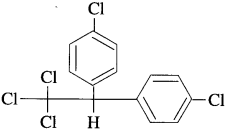
  2. Earlier used insecticide DDT (Dichlorodiphenyltrichloroethanc) was found to be harmful for human beings. So DDT has been replaced by benzenc hexachioride (BHC) as an insecticide, one of the y-isomer (gamma) of BHC is called gammexane or lindane.

Question 5.
How will you develop products that are less toxic or which require less toxic raw materials ?
Answer:

  • There is a need to design safer chemicals to prevent the workers in chemical industries from being exposed to toxic environment.
  • Adipic acid is extensively used in polymer industry. In synthesis of adipic acid, benzene is used as the starting material, but benzene is carcinogenic and being volatile organic compound (VOC) it pollutes the air and environment.
  • To overcome this health hazard Green technology developed by Drath and Frost, adipic acid is enzymatically synthesised from glucose.

Question 6.
How to apply the principle of green chemistry to achieve energy efficiency?
Answer:

  • Energy requirements during chemical synthesis is huge. To minimize the energy use it is better to carry out reactions at room temperature and pressure.
  • This can be achieved by applying the principle of green chemistry i.e. use of catalyst, use of micro-organisms or biocatalyst and use of renewable materials, etc.
  • The use of less energy can be achieved by improving the technology of heating system, use of microwave, etc.

Question 7.
Explain the use of renewable feed stocks.
Answer:

  • Industries use a lot of non-renewable feed stocks like petroleum. These resources are depleting fast and the future generation will be deprived. The excessive use of these resources have also put a burden on the environment.
  • If renewable resources like agricultural or biological products are used, this will ensure the sharing of resources by future generations. This practice will also not put a burden on the environment.
  • The products and waste produced are generally biodegradable and environmental friendly hence leading to a sustainable future.

Question 8.
Explain the need to design degradable chemicals.
Answer:

  • Environment protection is the prime concern which has lead to the need for designing chemicals that degrade and can be discarded easily. These chemicals and their degradation products should be non-toxic, non-bioaccumulative or should not be environmentally persistent.
  • This principle aims at waste product being automatically degradable to clean the environment. Thus the preference for biodegradable polymers and pesticides.
  • To make the separation and segregation easier for the consumer an international plastic recycle mark is printed on larger items.

Question 9.
Define the role of real time analysis in pollution prevention.
Answer:

  • There is a dire need to develop improvised analytical methods to allow for real time, in process monitoring and control prior to the formation of hazardous substances.
  • It is very much important for the chemical industries and nuclear reactors to develop or modify analytical
    methodologies so that continuous monitoring of the manufacturing and processing unit is possible.

Maharashtra Board Class 12 Chemistry Important Questions Chapter 16 Green Chemistry and Nanochemistry Important Questions

Question 10.
Define the role of safer chemistry in accident prevention.
Answer:
(1) It is needed to develop chemical processes that are safer and minimize the risk of accidents. It is important to select chemical substances used in a chemical reaction in such a way that they can minimize the occurrence of chemical accidents, explosions, fire and emissions.

(2) For example : Chemical process that works with the gaseous substances can lead to relatively higher possibilities of accidents including explosion as compared to the system working with nonvolatile liquid and solid substances.

Question 11.
Green chemistry plays an important role in sustainable development. Explain.
Answer:
Sustainable development is a development that protects the environment and the world’s resources. We can achieve sustainable development by adapting the twelve principles of green chemistry.

Green chemistry designs safer chemicals which are less toxic. It normally leads to low cost, use of less energy, environmentally friendly solvents and less production of waste. Green chemistry works on the principle of atom economy and minimum or no waste production. It encourages the use of renewable feed stocks and reduces the use of toxic and hazardous chemicals. It eliminates majorly stoichiometry reactions and prefers to use catalysis. It preserves the environment and safety requirements with added benefit of cost reduction.

Question 12.
How are nanomaterials classified ?
Answer:
Nanoparticles, nanowires and nanotubes can be classified according to dimensions. The nano structured materials may be large organic molecules, inorganic cluster compounds and metallic or semiconductor particles.

Question 13.
What are zero, one and two dimensional nanoscale system ?
Answer:

  • Zero-Dimensional Nanostructures : A zero-dimensional structure is one in which all three dimensions are in the nanoscale.
    For example : Nanoparticles.
  • One-Dimensional Nanostructures : A one-dimensional nanostructure is one in which two dimensions are in the nanoscale. For example : Nanowires and Nano rods.
  • Two-Dimensional Nanostructures : A two-dimensional nanostructure is one in which one dimension is in the nanoscale. For example : Thin films.

Question 14.
State the different characteristic features of nanoparticles.
Answer:
The nanoparticle science is special as at such a small scale, different laws dominate than what we experience in our everyday life.

The characteristic features like optical properties, catalytical activities, have huge surface area and good thermal properties mechanical strength electrical conductivity vary than that of bulk material.

(1) Colour : At nanoscale this optical property behaves differently. Elemental gold has nice shining yellow colour, but nanoparticles of gold show red colour.

(2) Catalytic activity : Since the surface area of nanoparticles is large they show increased catalytic activity. They are usually heterogenous catalyst that means catalysts are solid form and the reactions occur on the surface of the catalyst. These catalysts can be easily separated and recycled. For example : Pd, Pt metal nanoparticles used in hydrogenation reactions. Ti02, ZnO are used in photocatalysis. Gold in bulk is unreactive but the nanoparticles of gold behave as very good catalyst for organic reactions.

(3) Surface area : High surface-to-volume ratio is a very important characteristic of nanoparticles. Bulk material if subdivided into a group of individual nanoparticles, the total volume remains the same, but the collective surface area is largely increased. With large surface area for the same volume, these small particles react much faster because more surface area provides more number of reaction sites, leading to more chemical reactivity. Explanation of increase in surface area with decrease in particle size.

(4) Thermal strength : The melting point of nanomaterial changes drastically with size.

For example : Sodium clusters (Nan) of 1000 atoms melts at 288 K, 10000 atoms melt at 303 K and bulk sodium melts at 371 K.

(5) Mechanical strength : The mechanic al strength of nano clusters increase the hardness of the metal.

For example : nanoparticles of copper and palladium clusters with diameter in the range of 5-7 nm have hardness up to 500 r. greater than the bulk metal.

(6) Electrical conductivity : At nanoscale level the electrical conductivity changes. For example : Carbon nanotubes behave as a conductor or semiconductor whereas carbon is nonconductor.

Maharashtra Board Class 12 Chemistry Important Questions Chapter 16 Green Chemistry and Nanochemistry Important Questions

Question 15.
Describe the two methods of synthesising nanomaterials (nanoparticles).
Answer:
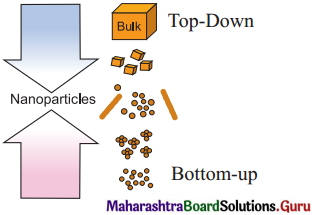
The two methods of synthesising nanomaterials :
(1) Bottom-up and
(2) Top down methods :

(1) Bottom-up method : Synthesis of nanoparticles in the bottom-up approach molecular components arrange themselves into more complex assemblies atom by atom, molecule by molecule and cluster by cluster from the bottom. Example : synthesis of nanoparticles by colloidal dispersion.

Maharashtra Board Class 12 Chemistry Solutions Chapter 16 Green Chemistry and Nanochemistry 7

(2) Top-down method : In the top-down approach, involves nanomaterials being synthesised from bulk material by breaking the material. The bulk solids are disassembled into finer pieces until they are constituted of only few atoms. Example : Nanoparticles are synthesised by colloidal dispersion.

Question 16.
Discuss the various analytical tools used for characterization of nanoparticles.
Answer:
The analytical tools used for characterization of nanoparticles are

  • U.V visible spectroscopy – It gives the preliminary confirmation of formation of nanoparticles.
  • X-ray Diffraction (XRD) – The information given by this tool is about particle size, crystal structure and geometry.
  • Scanning electron microscopy (SEM) : This is used to study the structure of surface of material that is the morphology of the material.
  • Transmission electron microscopy (TEM) gives information about the particles size.
  • (FTIR) Fourier transform infrared spectroscopy gives information about absorption of functional groups and binding nature of the nanomaterial.

Question 17.
Give evidence of use of nanoparticles by humans in ancient times with appropriate examples.
Answer:
There is enough evidence that nanomaterials have been produced and used by humans in ancient times. For example :

  • Gold and silver nanoparticles trapped in the glass matrix gives ruby red colour in some ancient glass paintings.
  • The decorative glaze or metallic film known as lustre found on some medieval pottery is due to certain spherical metallic nanoparticles.
  • Carbon black is a nanostructured material that is used in tyres of car to increase the life of tyre. (Discovery in 1900). Carbon nanotubes are made up of graphite sheets with nanosized diameter. They have highest strength.
  • Fumed silica, a component of silicon rubber, coatings, sealants and adhesives is also a nanostructured material.

Question 18.
Explain the different applications of nanoparticles.
Answer:
The contribution of nanochemistry in number of innovative products in various disciplines due to their unique physical, chemical, optical, structural, catalytic properties. Few applications are as follows :

  • Nanoparticles contribute to stronger, lighter, cleaner and smarter surfaces and systems. They are used in the manufacture of scratchproof eyeglasses, transport, sunscreen, crack resistant paints, etc.
  • Used in electronic devices like Magnetoresistive Random Access Memory (MRAM).
  • Nanotechnology plays an important role in water purification techniques. Silver nanoparticles are used in water purification system to get safe drinking water.
  • Self cleansing materials : Lotus is an example of self cleansing. Nanostructures on lotus leaves repel water which carries dirt as it rolls off. Lotus effect is the basis of self cleaning windows.

Maharashtra Board Class 12 Chemistry Important Questions Chapter 16 Green Chemistry and Nanochemistry Important Questions

Question 19.
State the advantages of nanoparticles and nanotechnology.
Answer:

  • Nanotechnology has revolutionalized electronics and computing.
  • Nanotechnology has benefited the energy sector by making solar power more economical and energy storage more efficient.
  • Nanotechnology has transformed the medical field with the manufacture of smart dmgs which help cure the life threatening diseases like cancer and diabetes faster and without side effects.

Question 20.
State the disadvantages of nanoparticles and nanotechnology.
Answer:
Despite the benefits that nanotechnology offers to the world, it is accompanied by certain disadvantages and potential risks.

The standard of living has been raised by nanotechnology but at the same time it has increased the environmental pollution. The kind of pollution caused by nanotechnology is very dangerous for living organism, it is called nano pollution.

Nanoparticles can be potential health hazard depending on the size, chemical composition and shape. They can be inhaled and can be deposited in the human respiratory tract and in the lungs, causing lung damage.

Question 21.
Name the development that meets the needs of the present, without compromising the ability of future generation to meet their own need.
Answer:
Sustainable development

Question 22.
Give name of father of green chemistry.
Answer:
Paul T. Anastas

Question 23.
Environmentally safe chemistry is known as.
Answer:
Green chemistry

Question 24.
How many principles does green chemistry have ?
Answer:
Twelve

Question 25.
Which principle of green chemistry has its perspective largely towards petrochemicals?
Answer:
Use of renewable feedstocks.

Question 26.
Name the chemical which leachs out of plastic packaging materials.
Answer:
Phthalate

Question 27.
Name the materials having structural components with at least one dimension in the nanometer scale.
Answer:
Nanomaterials.

Question 28.
Name the class of nanomaterial i.e. nanotubes, fibres, nanowires belong to.
Answer:
Two dimensions are in the nanoscale.

Question 29.
Name the nanoparticles used in sunscreen.
Answer:
Zinc oxide (ZnO) and Titanium dioxide (TiO2).

Question 30.
What is the colour of gold nanoparticles ?
Answer:
Red

Question 31.
Name the nanoparticles used as catalyst in hydrogenation reaction.
Answer:
Palladium and Platinum.

Question 32.
Name the two approaches used to synthesize nanomaterials.
Answer:
Bottom up and Top down.

Question 33.
Give the name of the wet chemical synthetic process for nanomaterials.
Answer:
Sol-gel process.

Maharashtra Board Class 12 Chemistry Important Questions Chapter 16 Green Chemistry and Nanochemistry Important Questions

Question 34.
Give the steps involved in preparation of nanoparticle using sol-gel process.
Answer:
Hydrolysis, polycondensation, drying, thermal decomposition.

Question 35.
Name the analytical techniques used for characterisation of nanomaterials.
Answer:
u.v-visible spectroscopy, x-ray diffraction (XRD), scanning electron microscopy (SEM), Transmission electron microscopy (TEM), Fourier transform infrared spectroscopy (FTIR).

Question 36.
Name the technique used to analyse particle size, crystal structure and geometry of a nanoparticle.
Answer:
x-ray diffraction (XRD)

Question 37.
Name the analytical technique used to study the morphology (structure of surface) of a material.
Answer:
Scanning electron microscopy (SEM)

Question 38.
Which innovative material has been developed using the lotus effect ?
Answer:
Self cleansing material

Question 39.
Which are the sectors that are revolutionalized by nanoparticles ?
Answer:
Electronics, energy sector and medical fields.

Question 40.
What are the disadvantages of nanotechnology ?
Answer:
Nano pollution and lung damage.

Question 41.
Name the scientist who coined the word nanotechnology.
Answer:
Nario Taniguchi (University professor at Tokyo in 1974).

Question 42.
Select and write the most appropriate answer from the given alternatives for each subquestion:

1. The measure of the amount of atoms from the starting materials that are present in the useful product at the end of chemical process is known as
(a) catalyst
(b) atom economy
(c) design of safer chemicals
(d) design for efficient energy
Answer:
(b) atom economy

2. The atom economy of the following reaction is CH3 – CH2 – CH2 – CH2 – OH + NaBr + H2SO4 → CH3 – CH2 – CH2 – CH2 – Br + NaHSO4 + H2O
(a) 49.81%
(b) 49%
(c) 50%
(d) 100%
Answer:
(a) 49.81%

3. Green chemistry reduces risk by
(a) developing the process for reuse and recycle of solvents and chemicals
(b) inventing technologies to clean the environ-ment
(c) minimize the use of chemicals
(d) reducing or eliminating the use or generation of hazardous chemicals in chemical products and process
Answer:
(d) reducing or eliminating the use or generation of hazardous chemicals in chemical products and process

4. Chemical synthesis should be designed to mini-mizes the use of
(a) liquid fuels
(b) solid fuels
(c) gaseous fuels
(d) energy
Answer:
(d) energy

5. The chemistry that applies across the life cycle of a chemical product like design, manufacture and use is called
(a) eco-friendly chemistry
(b) green chemistry
(c) environmental chemistry
(d) inorganic chemistry
Answer:
(b) green chemistry

Maharashtra Board Class 12 Chemistry Important Questions Chapter 16 Green Chemistry and Nanochemistry Important Questions

6. According to the principles of green chemistry the chemicals involved in the production must be
(a) non-hazardous
(b) toxic
(c) polluting
(d) highly toxic
Answer:
(a) non-hazardous

7. Which of the following is not one of the twelve principles of green chemistry ?
(a) using renewable feedstocks
(b) designing safer chemicals and products
(c) maximizing atom economy
(d) avoiding the use of catalysts
Answer:
(d) avoiding the use of catalysts

8. Chemical synthesis based on principle of green chemistry encourages the use of
(a) hazardous chemicals
(b) reactions with low atom efficiency
(c) catalyst
(d) high energy requirements
Answer:
(c) catalyst

9. The plastic bottles made of HDPE are used to store household cleaner and shampoo can be recycled to make
(a) carpets, furniture, new containers
(b) detergent bottles, fencing, floor tiles, pens
(c) custom-made products
(d) cables, mudflaps, panelling, roadway gutters
Answer:
(b) detergent bottles, fencing, floor tiles, pens

10. The plastic ketch-up bottles and syrup bottles made from polypropylene (pp) can be recycled to make
(a) battery cables, brooms, ice scrapers, rakes
(b) envelopes, floor tiles, lumber
(c) custom-made products
(d) carpet, furniture, new containers
Answer:
(a) battery cables, brooms, ice scrapers, rakes

11. The role of green chemistry aims to
(a) design chemical processes and products that maximize profits
(b) design safer chemicals and products by reduc¬ing or eliminating the use and generation of hazardous substances
(c) design processes and products that work efficiently
(d) utilize non-renewable feedstocks
Answer:
(b) design safer chemicals and products by reducing or eliminating the use and generation of hazardous substances

12. The study of phenomena and manipulation of materials of atomic, molecular and macromolecular scales where properties differ significantly from those at a large scale is called
(a) nanoscience
(b) nanochemistry
(c) nanotechnology
(d) nanomaterial
Answer:
(a) nanoscience

13. The term nanotechnology was first used by whom and when ?
(a) Richard Feynman, 1959
(b) Nario Taniguchi, 1974
(c) Eric Drexter, 1986
(d) Sumia Lijima, 1991
Answer:
(b) Nario Taniguchi, 1974

14. Which one of these statements is NOT true ?
(a) Gold at the nanoscale is red.
(b) A very highly useful application of nanochem¬istry is medicine.
(c) Sunscreen contains nanoparticles of zinc oxide (ZnO) and (SiO2) silicon oxide.
(d) Silicon at nanoscale is not an insulator
Answer:
(c) Sunscreen contains nanoparticles of zinc oxide (ZnO) and (SiO2) silicon oxide.

Maharashtra Board Class 12 Chemistry Important Questions Chapter 16 Green Chemistry and Nanochemistry Important Questions

15. Which of the historical works mentioned below contain nanotechnology?
(a) Lycurgus cup
(b) Medieval stained glass windows in churches
(c) Damascus steel swords
(d) All of the above
Answer:
(d) All of the above

16. The nanometer scale is conventionally defined as
(a) 10 – 100nm
(b) 1 – 100nm
(c) 1 – 1000 nm
(d) 1 – 10000 nm
Answer:
(b) 1-100 nm

17. The material synthesized on the nanometer scale possess
(a) same bulk properties
(b) different bulk properties
(c) unique optical, magnetic, electrical properties
(d) no change in properties
Answer:
(c) unique optical, magnetic, electrical properties

18. Nanomaterials of zero dimension is
(a) one in which all three dimensions are in the nanoscale
(b) one in which two dimensions are in the nanoscale
(c) one in which one dimension is in the nanoscale
(d) None of the above
Answer:
(a) one in which all three dimensions are in the nanoscale

19. The science which deals with the design and synthesis of material on nanoscale with different size and shape is called
(a) nanoscience
(b) nanochemistry
(c) nanophysics
(d) nanotechnology
Answer:
(b) nanochemistry

20. Elemental has a shining yellow colour, but the colour of nanoparticles of gold is
(a) green
(b) yellow
(c) red
(d) blue
Answer:
(c) red

21. The surface area of nanoparticles
(a) is the same as in bulk
(b) increases with the same volume of the bulk
(c) decreases with the same volume of the bulk
(d) does not change with particle size
Answer:
(b) increases with the same volume of the bulk

22. The nanomaterial based catalyst are usually
(a) homogeneous catalyst
(b) heterogeneous catalyst
(c) good catalyst
(d) bad catalyst
Answer:
(b) heterogeneous catalyst

23. The catalyst used in photocatalysis is
(a) gold
(b) Raney Ni
(c) TiO2
(d) AI2O3
Answer:
(c) TiO2

Maharashtra Board Class 12 Chemistry Important Questions Chapter 16 Green Chemistry and Nanochemistry Important Questions

24. Nanosized copper clusters have the mechanical strength of
(a) less than the bulk copper wire
(b) 100% more than the bulk metal
(c) 200% more than the bulk metal
(d) 500% more than the bulk metal
Answer:
(d) 500% more than the bulk metal

25. The most common method used for synthesis of nanomaterials is
(a) sol-gels method
(b) only sol method
(c) only gel method
(d) colloidal dispersion method
Answer:
(a) sol-gels method

26. What is the information obtained from uv-visible spectroscopy when used for nanomaterials ?
(a) morphology of structure
(b) preliminary conformation of formation of nanoparticle
(c) particle size
(d) functional group present
Answer:
(b) preliminary conformation of formation of nanoparticle

27. What information of the nanoparticles is obtained from transmission electron microscopy technique ?
(a) structure
(b) functional group
(c) particle size
(d) geometry
Answer:
(c) particle size

28. The analytical tool used to study the structure of surface of nanoparticle i.e. morphology is
(a) Absorption spectroscopy
(b) Scanning electron microscopy
(c) Emission spectroscopy
(d) Nuclear magnetic resonance spectroscopy
Answer:
(b) Scanning electron microscopy

29. The constituents of carbon nanotubes are
(a) nanosized graphite sheets
(b) nanosized carbon black
(c) nanosized coal black
(d) None of the above
Answer:
(a) nanosized graphite sheets

30. Self cleansing windows are example of the
(a) Nanoparticle effect
(b) Crompton effect
(c) Lotus effect
(d) Tyndal effect
Answer:
(c) Lotus effect

Maharashtra Board Class 12 Chemistry Important Questions Chapter 16 Green Chemistry and Nanochemistry Important Questions

31. Which highly effective and cost effective nano-particles are used for water purification ?
(a) gold nanoparticle
(b) copper nanoparticle
(c) silver nanoparticle
(d) silica nanoparticle
Answer:
(c) silver nanoparticle

32. The sectors revolutionalized by nanotechnology are
(a) electronics and computing
(b) energy
(c) medicine
(d) All of the above
Answer:
(d) All of the above

33. Name the body part that gets affected by the hazardous nano pollution.
(a) heart
(b) brain
(c) lungs
(d) eyes
Answer:
(c) lungs

34. The pollution caused by nanotechnology is known as
(a) air pollution
(b) nano pollution
(c) ground pollution
(d) environmental pollution
Answer:
(b) nano pollution.

Maharashtra Board Class 12 Chemistry Important Questions Chapter 10 Halogen Derivatives

Balbharti Maharashtra State Board 12th Chemistry Important Questions Chapter 10 Halogen Derivatives Important Questions and Answers.

Maharashtra State Board 12th Chemistry Important Questions Chapter 10 Halogen Derivatives

Question 1.
What are halogen derivatives of hydrocarbons?
Answer:
The replacement of hydrogen atom/s in aliphatic or aromatic hydrocarbons by halogen atom/s results in the formation of halogen derivatives of hydrocarbons.

Maharashtra Board Class 12 Chemistry Important Questions Chapter 10 Halogen Derivatives Important Questions

Question 2.
How are halogen derivatives of hydrocarbons classified?
Answer:
Halogen derivatives of alkane are classified as :
Maharashtra Board Class 12 Chemistry Solutions Chapter 10 Halogen Derivatives 1

  1. Monohalogen derivative (or alkyl halide) : It is a halogen derivative of an alkane in which one hydrogen atom is replaced by one halogen atom and it is also called alkyl halide. E.g. C2H5Br.
  2. Poh halogen derivatives : These are halogen derivatives in which more than one hydrogen atoms of an alkane are substituted by corresponding number of halogen atoms.

They are classified as follows :
(i) Dihalogen derivatives : The compounds formed by the substitution of two hydrogen atoms of an alkane by two halogen atoms are called dihalogen derivatives.
Maharashtra Board Class 12 Chemistry Solutions Chapter 10 Halogen Derivatives 2

They are further classified as :

  • Vicinal dihalides Maharashtra Board Class 12 Chemistry Solutions Chapter 10 Halogen Derivatives 3(Two halogen atoms on vicinal or adjacent carbon atoms)
  • Geminal dihalides : CH3 – CHCI2 (Two halogen atoms on the same carbon atom)

(ii) Trihalogen derivatives : The compounds formed by the substitution of three hydrogen atoms of an alkane by three halogen atoms are called trihalogen derivatives.
Maharashtra Board Class 12 Chemistry Solutions Chapter 10 Halogen Derivatives 4

(iii) Tetrahalogen derivatives : The compounds formed by the substitution of four hydrogen atoms of an alkane by four halogen atoms are called tetrahalogen derivatives. E.g. CCI4.

Question 3.
What are alkyl halides? How are they classified?
Answer:
The compound formed by the replacement of one hydrogen atom in an alkane by a halogen atom is called an alkyl halide. The halogen atom is bonded to sp3 hybridised carbon. Alkyl halides are classified into the following three classes depending on the type of the carbon to which halogen atom is bonded.

(1) Primary (1°) alkyl halide : Alkyl halide in which a halogen atom is bonded to a primary carbon atom is called primary alkyl halide.

[Primary (1°) carbon atom i.e., the carbon atom which is attached to only one carbon atom.]
Maharashtra Board Class 12 Chemistry Solutions Chapter 10 Halogen Derivatives 5

They are represented by the general formula R – CH2 – X.

Maharashtra Board Class 12 Chemistry Important Questions Chapter 10 Halogen Derivatives Important Questions

(2) Secondary (2°) alkyl halide : Alkyl halide in which a halogen atom is bonded to a secondary carbon atom is called secondary alkyl halide. [Secondary (2°) carbon i.e., the carbon atom which is attached to two other carbon atoms.]
Maharashtra Board Class 12 Chemistry Solutions Chapter 10 Halogen Derivatives 6

They are represented by the general formula Maharashtra Board Class 12 Chemistry Solutions Chapter 10 Halogen Derivatives 7 (R and R’ can be same or different)

(3) Tertiary (3°) alkyl halide : Alkyl halide in which halogen atom is bonded to a tertiary carbon atom is called tertiary alkyl halide. [Tertiary (3°) carbon i.e., the carbon atom which is attached to three other carbon atoms.]
Maharashtra Board Class 12 Chemistry Solutions Chapter 10 Halogen Derivatives 8

They are represented by the general formula Maharashtra Board Class 12 Chemistry Solutions Chapter 10 Halogen Derivatives 9 (R, R’ and R” may be same or different)

Question 4.
Explain the following :
(1) Alkyl halide or haloalkanes
(2) Allylic halides
(3) Benzylic halide
(4) Vinylic halide
(5) Haloalkyne
(6) Aryl halide or haloarenes.
Answer:
(1) Alkyl halide or haloalkanes : In alkyl halides or haloalkanes the halogen atom is bonded to sp3 hybridized carbon which is a part of saturated carbon chain.
Example : Maharashtra Board Class 12 Chemistry Solutions Chapter 10 Halogen Derivatives 9

(2) Allylic halides : In allylic halides, halogen atom is bonded to a sp3 hybridized carbon atom next to a carbon-carbon double bond.

Example : Maharashtra Board Class 12 Chemistry Solutions Chapter 10 Halogen Derivatives 11

(3) Benzylic halide : In benzylic halides, halogen atom is bonded to a sp3 hybridized carbon atom which is further bonded to an aromatic ring.
Example : Maharashtra Board Class 12 Chemistry Solutions Chapter 10 Halogen Derivatives 12

(4) Vinylic halides : In vinylic halides, halogen atom is bonded to a sp2 hybridized carbon atom of aliphatic chain. Vinylic halide is a haloalkene.
Example : Maharashtra Board Class 12 Chemistry Solutions Chapter 10 Halogen Derivatives 13

(5) Haloalkyne : In haloalkynes, halogen atom is bonded to a sp hybridized carbon atom.
Example : Maharashtra Board Class 12 Chemistry Solutions Chapter 10 Halogen Derivatives 14

(6) Aryl halides or haloarenes : In aryl halides, halogen atom is directly bonded to the sp2 hybridized carbon atom of aromatic ring.
Example : Maharashtra Board Class 12 Chemistry Solutions Chapter 10 Halogen Derivatives 15

Maharashtra Board Class 12 Chemistry Important Questions Chapter 10 Halogen Derivatives Important Questions

Question 5.
Give the IUPAC names of the following :
Answer:
Maharashtra Board Class 12 Chemistry Solutions Chapter 10 Halogen Derivatives 16

Maharashtra Board Class 12 Chemistry Important Questions Chapter 10 Halogen Derivatives Important Questions

Question 6.
Draw the structures of the following compounds:
Answer:
Maharashtra Board Class 12 Chemistry Solutions Chapter 10 Halogen Derivatives 18
Maharashtra Board Class 12 Chemistry Solutions Chapter 10 Halogen Derivatives 19
Maharashtra Board Class 12 Chemistry Solutions Chapter 10 Halogen Derivatives 20
Maharashtra Board Class 12 Chemistry Solutions Chapter 10 Halogen Derivatives 21

Maharashtra Board Class 12 Chemistry Important Questions Chapter 10 Halogen Derivatives Important Questions

Question 7.
Write the structure of-
(a) 3-chloro-3-ethylhex-l-ene
(b) 1-Iodo-2, 3-dimethylbutane
(c) 1, 3, 5-tribromobenzene
Answer:
Maharashtra Board Class 12 Chemistry Solutions Chapter 10 Halogen Derivatives 22

Question 8.
Write structures of
(a) 2-iodo-3-methyl pentane
(b) 3-chiorolleNane
(c) 1-chloro-2, 2-dimethyl propane
(d) 1-chloro-4-ethyl cyclohexane.
Answer:
Maharashtra Board Class 12 Chemistry Solutions Chapter 10 Halogen Derivatives 25

Question 9.
Write the possible isomers of monochloro derivatives of 2,3-Dimethylbutane and write their IUPAC names.
Answer:
The given parent hydrocarbon has molecular formula, C6H14. The monochloro derivative of this compound has molecular formula C6H13CI.
The parent hydrocarbon is,
Maharashtra Board Class 12 Chemistry Solutions Chapter 10 Halogen Derivatives 25
Hence the structures of isomers of monochioroderivative are.
Maharashtra Board Class 12 Chemistry Solutions Chapter 10 Halogen Derivatives 27

Maharashtra Board Class 12 Chemistry Important Questions Chapter 10 Halogen Derivatives Important Questions

Question 10.
Write structures and IUPAC names of all possible isomers of C5H11Br and classify them as l°/2°/3°.
Answer:
C5H11Br is a monohalogen derivative.
Maharashtra Board Class 12 Chemistry Solutions Chapter 10 Halogen Derivatives 28

Question 11.
How are following compounds obtained from alcohols :
(1) ethyl chloride C2H5CI
(2) isopropyl chloride (CH3 CHCI – CH3)
(3) tert-butyl chloride (CH3)3 – CI?
Answer:
Alcohols in the presence of Lucas reagent which is a solution of concentrated HCI and ZnCI2 form alkyl halides. Hydrogen chloride is used with zinc chloride (Grooves’ process) for primary and secondary alcohols.

Maharashtra Board Class 12 Chemistry Solutions Chapter 10 Halogen Derivatives 31

(3) Tertiary alcohols don’t need ZnCI2 to react with HCI.
Maharashtra Board Class 12 Chemistry Solutions Chapter 10 Halogen Derivatives 32
The order of reactivity of alcohols with a given halo acid is 3° >2°> 1°.

Question 12.
How are following compounds prepared from alcohols:
(1) ethyl bromide (C2H5Br)
(2) isopropyl bromide (CH3 – CHBr – CH3)
(3) tert-butyl bromide (CH3)3 C – Br?
Answer:
(1) Ethyl alcohol on heating with conc. hydrobromic acid (48%) forms ethyl bromide.
OR
When ethyl alcohol is treated with a mixture of NaBr and H2SO4, ethyl bromide is formed. Here HBr is generated in situ.
Maharashtra Board Class 12 Chemistry Solutions Chapter 10 Halogen Derivatives 33
(2) Isopropyl alcohol, on reaction with NaBr and dil. H2SO4 forms isopropyl bromide.
Maharashtra Board Class 12 Chemistry Solutions Chapter 10 Halogen Derivatives 34
(3) Tertiary alcohol on reaction with sodium bromide and dil. H2SO4 forms tert-butyl bromide.
Maharashtra Board Class 12 Chemistry Solutions Chapter 10 Halogen Derivatives 35

Maharashtra Board Class 12 Chemistry Important Questions Chapter 10 Halogen Derivatives Important Questions

Question 13.
How is ethyl iodide obtained from ethyl alcohol?
Answer:
When ethyl alcohol is treated with sodium or potassium iodide in 95 % phosphoric acid, ethyl iodide is formed. Here HI is generated in situ.
Maharashtra Board Class 12 Chemistry Solutions Chapter 10 Halogen Derivatives 36

Question 14.
How will you prepare the following :

(1) Ethyl chloride (chloroethane) from ethyl alcohol using
(i) PCI3
(ii) PCI5 and
(iii) SOCI2.
Answer:
(i) When ethyl alcohol is refluxed with phosphorus trichloride, ethyl chloride is formed.
Maharashtra Board Class 12 Chemistry Solutions Chapter 10 Halogen Derivatives 37
(ii) When ethyl alcohol is refluxed with phosphorus pentachloride, ethyl chloride is formed.
Maharashtra Board Class 12 Chemistry Solutions Chapter 10 Halogen Derivatives 38
(iii) When ethyl alcohol is refluxed with thionyl chloride, in the presence of pyridine, ethyl chloride is formed. The by-products obtained are gases. Therefore, this method is preferred for preparation of alkyl chloride.
Maharashtra Board Class 12 Chemistry Solutions Chapter 10 Halogen Derivatives 39

(2) Isopropyl chloride (2-chloropropane) from isopropyl alcohol using
(i) PCI3
(ii) PCI5
(iii) SOCI2.
Answer:
When isopropyl alcohol is refluxed with phosphorus trichloride, isopropyl chloride is formed.
Maharashtra Board Class 12 Chemistry Solutions Chapter 10 Halogen Derivatives 40

When isopropyl alcohol is refluxed with phosphorus pentachloride, isopropyl chloride is formed.
Maharashtra Board Class 12 Chemistry Solutions Chapter 10 Halogen Derivatives 41

When isopropyl alcohol is refluxed with thionyl chloride, in the presence of pyridine, isopropyl chloride is formed. The by-products obtained are gases. Therefore, this method is preferred for the preparation of alkyl chloride.

Maharashtra Board Class 12 Chemistry Solutions Chapter 10 Halogen Derivatives 42

(3) Ethyl bromide (bromoethane) from ethyl alcohol.
Answer:
When ethyl alcohol is treated with a mixture of red phosphorus and bromine or hydrobromic acid (phosphorus tribromide is generated in situ), ethyl bromide is formed.

Maharashtra Board Class 12 Chemistry Solutions Chapter 10 Halogen Derivatives 43

Maharashtra Board Class 12 Chemistry Important Questions Chapter 10 Halogen Derivatives Important Questions

(4) Ethyl iodide (do ethane) from ethyl alcohol.
Answer:
When ethyl alcohol is heated with a mixture of red phosphorus and iodine, (phosphorus triiodide is generated in situ), ethyl iodide is formed.

Maharashtra Board Class 12 Chemistry Solutions Chapter 10 Halogen Derivatives 44

Question 15.
Explain halogenation of methane.
Answer:
Halogenation : A reaction of alkanes with halogens (CI2, Br2, I2) in the presence of appropriate conditions forming a mixture of alkyl halides.
(1) Chlorination:
Maharashtra Board Class 12 Chemistry Solutions Chapter 10 Halogen Derivatives 44
(2) When excess of chlorine is used, tetrachioro methane, a major product is obtained. When excess of methane is used, chioromethane, a major product is obtained. The order of reactivity of halogens towards alkane is
Maharashtra Board Class 12 Chemistry Solutions Chapter 10 Halogen Derivatives 47
(3) lodination:
Maharashtra Board Class 12 Chemistry Solutions Chapter 10 Halogen Derivatives 48
However, iodination reaction is a reversible reaction. HI being a strongest reducing agent reduces methyl iodide back to methane.

(4) Fluorination: A reaction of alkane with fluorine is explosive and also hydrofluoric acid is poisonous and corrosive. Hence, alkyl fluorides are not prepared by halogenation of alkane.

Question 16.
Predict the possible products of the following reaction :
(1) Bromination of propane
(2) Bromination of n-butane
(3) Bromination of 2-Methyl propane.
Answer:
(1) Bromination of propane
Maharashtra Board Class 12 Chemistry Solutions Chapter 10 Halogen Derivatives 49
(2) Bromination of n-butane
Maharashtra Board Class 12 Chemistry Solutions Chapter 10 Halogen Derivatives 50
(3) Bromination of 2-Methyl propane
Maharashtra Board Class 12 Chemistry Solutions Chapter 10 Halogen Derivatives 51

Maharashtra Board Class 12 Chemistry Important Questions Chapter 10 Halogen Derivatives Important Questions

Question 17.
How are following compounds prepared by halogenation of ethane :
(1) Chloroethane
(2) Bromoethane
(3) Iodoethane?
Answer:
(1) Chlorination of ethane : When ethane (excess) is reacted with a limited quantity of chlorine in the presence of diffused sunlight or U.V. light or at high temperature, chloroethane is obtained.
Maharashtra Board Class 12 Chemistry Solutions Chapter 10 Halogen Derivatives 52

(2) Bromination of ethane : When ethane is heated with Br2 in the presence of anhydrous AlBr3, bromoethane is obtained.
Maharashtra Board Class 12 Chemistry Solutions Chapter 10 Halogen Derivatives 53

(3) Iodination : When ethane is reacted with I2 in the presence of suitable oxidising agents like-HgO or HIO3 or dilute HNO3 iodoethane is obtained.
Maharashtra Board Class 12 Chemistry Solutions Chapter 10 Halogen Derivatives 54

Question 18.
Direct iodination of alkanes is not possible.
Answer:
(1) Direct iodination of alkanes using iodine is highly reversible.
\(\mathrm{RH}+\mathrm{I}_{2} \rightleftharpoons \mathrm{RI}+\mathrm{HI}\)
(2) Hydroiodic acid HI being strong reducing agent, it reduces RI to alkane RH.
(3) The reaction takes place only in the presence of a suitable oxidizing agent like HgO, HIO3 or dilute HNO3 which decomposes HI. Hence, direct iodination of alkanes is not possible.
Maharashtra Board Class 12 Chemistry Solutions Chapter 10 Halogen Derivatives 55

Question 20.
How are following compounds obtained from alkenes :
Maharashtra Board Class 12 Chemistry Solutions Chapter 10 Halogen Derivatives 56
Answer:
(1) Ethene on reaction with hydrogen chloride forms
Maharashtra Board Class 12 Chemistry Solutions Chapter 10 Halogen Derivatives 57
(2) Ethene on reaction with hydrogen bromide forms
Maharashtra Board Class 12 Chemistry Solutions Chapter 10 Halogen Derivatives 58
(3) Propene on reaction with hydrogen iodide forms
Maharashtra Board Class 12 Chemistry Solutions Chapter 10 Halogen Derivatives 59
(4) but-2-ene on reaction with hydrogen iodide forms 2-iodobutane.
Maharashtra Board Class 12 Chemistry Solutions Chapter 10 Halogen Derivatives 60

Question 19.
State and explain Markovnikov’s rule.
Answer:
Markovnikov’s rule : When an unsymmetrical reagent is added to an unsymmetrical alkene, the negative part of the reagent gets attached to that carbon atom of the double bond which carries less number of hydrogen atoms.

Example : Addition of HBr’to unsymmetrical alkene like propene gives two products.
Maharashtra Board Class 12 Chemistry Solutions Chapter 10 Halogen Derivatives 61

Maharashtra Board Class 12 Chemistry Important Questions Chapter 10 Halogen Derivatives Important Questions
Isopropyl bromide is the major product, since the negative part (Br) of HBr is attached to carbon atom of a double bond with less number of hydrogen atoms.

Question 20.
Explain peroxide effect.
OR
Write a note on the Kharasch-Mayo effect.
OR
Explain the addition of HBr to (unsymmetrical alkene) propane in the presence of benzoyl peroxide.
Answer:
The addition of HBr to an unsymmetrical alkene (propane) in the presence of benzoyl peroxide takes place in the opposite orientation to that of Markovnikov’s rule and this is known as Kharasch-Mayo effect or peroxide effect or Anti-Markovnikov addition.
Maharashtra Board Class 12 Chemistry Solutions Chapter 10 Halogen Derivatives 62

Question 21.
Write the structure of alkyl halide obtained by the action hydrogen bromide on 2-Methyiprop-1-ene in the presence of peroxide.
Answer:
In the presence of peroxide. HBr to 2-Methyl prop-I-cne forms l-Bromo-2-methylpropane.
Maharashtra Board Class 12 Chemistry Solutions Chapter 10 Halogen Derivatives 63

Question 22.
How are alkyl iodides prepared from alkyl chlorides/bromides?
Answer:
Alkyl iodide is prepared by treating alkyl chloride or alkyl bromide with sodium iodide, in the presence of dry acetone, sodium chloride or sodium bromide precipitates from the solution and can be separated by filtration. This reaction is known as Finkelstein reaction.
Maharashtra Board Class 12 Chemistry Solutions Chapter 10 Halogen Derivatives 70

Question 23.
How are alkyl fluorides prepared with alkyl chlorides/alkyl bromides?
Answer:
When alkyl chloride or alkyl bromide is heated with metallic fluorides like AgF, CaF2, CoF2 or Hg2F2, alkyl fluoride is formed.
Maharashtra Board Class 12 Chemistry Solutions Chapter 10 Halogen Derivatives 71

This reaction is known as Swarts reaction.

Question 24.
Explain the preparation of haloarenes using electrophilic substitution.
Answer:
When arene is treated with chlorine or bromine in dark at ordinary temperature in the presence of lewis acid as a catalyst like Fe, FeCI3 or anhydrous AlCI3, aryl chloride or aryl bromide is formed.

When toluene is brominated in dark at ordinary temperature in the presence of iron, a mixture of ortho and para bromo tolerene is obtained.

Maharashtra Board Class 12 Chemistry Solutions Chapter 10 Halogen Derivatives 72

Ortho and para isomers can be easily separated as there is large difference in melting points of ortho and para isomers.

Maharashtra Board Class 12 Chemistry Important Questions Chapter 10 Halogen Derivatives Important Questions

Question 25.
Write a note on Sandmeyer’s reaction.
Answer:
Aryl halides are most commonly prepared by replacement of nitrogen of diazonium salt. The replacement of diazonium group by -Cl or -Br using cuprous salt is called Sandmeyer’s reaction. When a primary aromatic amine (like aniline) suspended in cold F1C1, is treated with sodium nitrite, a diazonium salt (benzene diazonium chloride) is formed. When diazonium salt is treated with cuprous chloride or cuprous bromide, aryl halide (chlorobenzene or bromobenzene) is formed.

Maharashtra Board Class 12 Chemistry Solutions Chapter 10 Halogen Derivatives 73

When benzene diazonium salt is mixed with potassium iodide, iodobenzene is formed.

Maharashtra Board Class 12 Chemistry Solutions Chapter 10 Halogen Derivatives 74

Question 26.
Define the following :
Answer:
(1) Monochromatic light : It consists of rays of single wavelength vibrating in different planes perpendicular to the direction of propagation of the light.
Maharashtra Board Class 12 Chemistry Solutions Chapter 10 Halogen Derivatives 77
(2) Plane polarized light : A light having oscillations only in one plane perpendicular to direction of propagation of light is known as plane polarized light.
Maharashtra Board Class 12 Chemistry Solutions Chapter 10 Halogen Derivatives 78
(3) Optical isomerism : The steroisomerism in which the isomers have different spatial arrangements of groups/atoms around a chiral atom is called optical isomerism.

(4) Optical activity : The property of a substance by which it rotates plane of polarization of incident plane polarized light is known as optical activity.

(5) Optically active compound : The compound which rotate the plane of plane polarized light is called optically active compound.

(6) Enantiomers : The optical isomers which are non-superimposable mirror images of each other are called enantiomers or enantiomorphs or optical antipodes.
Example : 2-chlorobutane, lactic acid

(7) Chiral carbon atom : Carbon atom in a molecule which carries four different groups/atoms is called chiral carbon atom.

Chiral atom in a molecule is marked with asterisk (*)

For example : C in lactic acid
Maharashtra Board Class 12 Chemistry Solutions Chapter 10 Halogen Derivatives 79

(8) Chiral molecule : When a molecule contains one chiral atom, it acquires a unique property i.e. it is non- superimposable with its mirror image is said to be chiral molecule.

(9) Chirality : The relationship between a chiral molecule and its mirror image is similar to the relationship between left and right hands. Therefore it is called handedness or chirality.

(10) Dextrorotatory substance or r/-Isomer : An optically active substance (or isomer) which rotates the plane of a plane polarized light to the right hand side (RHS) is called dextrorotatory substance (or isomer) and denoted by d or (+) sign.

(11) Laevorotatory substance or /-Isomer : An optically active substance (or isomer) which rotates the plane of a plane polarized light to the left hand side (LHS) is called laevorotatory substance (or isomer) and denoted by / or (-) sign.

(12) Racemic mixture or Racemate : A mixture containing equimolar quantities of dextro (d) and laevo (/) optical
isomers which is optically inactive due to molecules of one enantiomer is cancelled by equal and opposite optical rotation due to molecules of the other enantiomer is called a racemic mixture or racemate. It is represented as (dl) or (+).

Maharashtra Board Class 12 Chemistry Important Questions Chapter 10 Halogen Derivatives Important Questions

Question 27.
Calculate the number of isomers for 2-chlorobutane.
Answer:
The number of optical isomers possible for a compound is 2n where n = number of asymetric carbon atoms.
As n = 1 for 2-ehlorobutane, 2n = 21 = 2. Hence, it has two optical isomers.

Question 28.
How many optical isomers are possible for C5H11 CI?
Answer:
The number of optical isomers : 3.

Question 29.
How many optical isomers are possible for glucose?
Answer:
The number of optical isomers : 16.

Question 30.
Draw the structures and indicate the chiral carbon atoms in
(1) Lactic acid
(2) 2-Chlorobutane.
Answer:
(1) In lactic acid structure, Maharashtra Board Class 12 Chemistry Solutions Chapter 10 Halogen Derivatives 80 the starred carbon atom is chiral carbon atom as it is attached to four different substituents, COOH, OH, CH3 and H.
(2) In 2-chlorobutane structure, Maharashtra Board Class 12 Chemistry Solutions Chapter 10 Halogen Derivatives 81 the starred carbon atom is chiral carbon atom as it is attached to four different substituents, -CH2 – CH3 (ethyl), CH3 (methyl), Cl and H.

Question 31.
Identify chira! and achiral molecules.
Maharashtra Board Class 12 Chemistry Solutions Chapter 10 Halogen Derivatives 82

Question 32.
Complete the following reactions and explain optical activity of the products formed:
(i) Pent-1-ene with HBr
Answer:
Maharashtra Board Class 12 Chemistry Solutions Chapter 10 Halogen Derivatives 84
(ii) Pent-2-ene with HBr
Answer:
Maharashtra Board Class 12 Chemistry Solutions Chapter 10 Halogen Derivatives 85

Maharashtra Board Class 12 Chemistry Important Questions Chapter 10 Halogen Derivatives Important Questions

Question 33.
C6H12 (A) on treatment with HCI produced a compound Y. Which is optically active, what is structure A?
Answer:
Maharashtra Board Class 12 Chemistry Solutions Chapter 10 Halogen Derivatives 86

Question 34.
A racemic mixture is optically inactive. Explain.
Answer:

  • A racemic mixture contains equimolar (or equimolecular) quantities of the dextrorotatory (d-) and laevorotatory (l-) isomers (enantiomers) of a compound.
  • The d-enantiomer rotates the plane of plane-polarized light to the right, while the l-enantiomer rotates the same to the left to the same extent.
  • The quantities of the d- and l-enantiomers being the same, both the rotations are of the same magnitude, but of opposite directions. Hence, they cancel each other. Hence, a racemic mixture is optically inactive.
  • It is represented as dl or ( + ). Example : ( ± ) lactic acid

Question 35.
Explain Fischer projection formula with illustration.
OR
Write a note on Fischer projection formula.
Answer:
Fischer projection formula or cross formula : The three dimensional (3-D) view of a molecule is presented on plane of paper. A Fischer projection formula can be drawn by visualizing the main carbon chain verical in the molecule. Each carbon on the vertical chain is represented by a cross.

Maharashtra Board Class 12 Chemistry Solutions Chapter 10 Halogen Derivatives 89

Conventionally the horizontal lines of the cross represent bonds projecting up from the carbon and the vertical lines represent the bonds going below the carbon.

Question 36.
Explain Wedge formula with illustration
OR
Write a note on Wedge formula.
Answer:
Wedge formula : When a tetrahedral carbon is imagined to be present in the plane of paper all the four bonds at this carbon cannot lie in the same plane. The bonds in the plane of paper are represented by normal lines, the bonds projecting above the plane of paper are represented by solid wedges (or simply by bold lines) while bonds going below the plane of paper are represented by broken wedges (or simply by broken lines).
Maharashtra Board Class 12 Chemistry Solutions Chapter 10 Halogen Derivatives 90

Question 37.
Give a laboratory test to confirm the presence of halogen in the original organic compound.
Answer:
Haloalkanes are of neutral type in aqueous medium. On warming with aqueous sodium or potassium hydroxide the covalently bonded halogen in haloalkane is converted to halide ion.

Maharashtra Board Class 12 Chemistry Solutions Chapter 10 Halogen Derivatives 94

When this reaction mixture is acidified by adding dilute nitric acid and silver nitrate solution is added a precipitate of silver halide is formed which confirms presence of halogen in the original organic compound.

Maharashtra Board Class 12 Chemistry Solutions Chapter 10 Halogen Derivatives 95

Maharashtra Board Class 12 Chemistry Important Questions Chapter 10 Halogen Derivatives Important Questions

Question 38.
Define the following :
Answer:
(1) Mechanism of a reaction : It is a step by step description of exactly how the reactants are transformed into products in as much details as possible.
(2) Substitution reaction : When a group bonded to a carbon in a substrate is replaced by another group to get a product with no change in state of hybridization of that carbon, the reaction is called substitution reaction.

Question 39.
Describe the action of aqueous KOH (or NaOH) on :
(1) ethyl bromide
(2) isopropyl bromide
(3) tert-butyl chloride
(4) methyl bromide
(5) 2-chlorobutane.
Answer:
(1) Ethyl bromide : When ethyl bromide (bromoethane) is refluxed with aqueous potassium hydroxide, ethyl alcohol is formed. The reaction is called a hydrolysis reaction.
Maharashtra Board Class 12 Chemistry Solutions Chapter 10 Halogen Derivatives 96
(2) Isopropyl bromide : When isopropyl bromide (2-bromopropane) is boiled with aqueous potassium hydroxide, isopropyl alcohol is formed.
Maharashtra Board Class 12 Chemistry Solutions Chapter 10 Halogen Derivatives 97
(3) Tert-butyl chloride : When tert-butyl chloride is refluxed with aqueous potassium hydroxide, tert-butyl alcohol is formed.
Maharashtra Board Class 12 Chemistry Solutions Chapter 10 Halogen Derivatives 98
(4) Methyl bromide : When methyl bromide (bromomethane) is heated with aq. KOH, it is hydrolysed to methyl alcohol (methanol).
Maharashtra Board Class 12 Chemistry Solutions Chapter 10 Halogen Derivatives 99
(5) 2-chlorobutane : When 2-Chlorobutane is boiled with aqueous KOH, Butan-2-ol is obtained.
Maharashtra Board Class 12 Chemistry Solutions Chapter 10 Halogen Derivatives 100

Question 40.
Describe the action of sodium ethoxide on
(1) ethyl bromide
(2) methyl bromide :
OR
Write a note on Williamson’s synthesis.
OR
How are ethers prepared from alkyl halides?
Answer:
Williamson’s synthesis : When an alkyl halide (R – X) is heated with sodium alkoxide (R – O – Na), an ether is obtained. In this reaction halide (-X) of alkyl halide is replaced by an alkoxy group (-OR). This reaction is known as Williamson’s synthesis. This method is used to prepare simple (or symmetrical) ethers and mixed (or unsymmetrical) ethers.

Sodium alkoxide is obtained by a reaction of sodium with an alcohol.

Maharashtra Board Class 12 Chemistry Solutions Chapter 10 Halogen Derivatives 101

(1) Simple (symmetrical) ether : When an alkyl halide and sodium alkoxide having similar alkyl groups are heated, symmetrical ether is obtained.

Maharashtra Board Class 12 Chemistry Solutions Chapter 10 Halogen Derivatives 102

e.g., When ethyl bromide is heated with sodium ethoxide, diethyl ether is formed.

Maharashtra Board Class 12 Chemistry Solutions Chapter 10 Halogen Derivatives 103

(2) Mixed (unsymmetrical) ether : When an alkyl halide and sodium alkoxide having different alkyl groups are heated, unsymmetrical ether is obtained.
Maharashtra Board Class 12 Chemistry Solutions Chapter 10 Halogen Derivatives 104
When methyl bromide is heated sodium ethoxide, ethyl methyl ether is formed.Maharashtra Board Class 12 Chemistry Solutions Chapter 10 Halogen Derivatives 105
When ethyl bromide is heated with sodium meihoxide, ethyl methyl ether is formed.
Maharashtra Board Class 12 Chemistry Solutions Chapter 10 Halogen Derivatives 106

Maharashtra Board Class 12 Chemistry Important Questions Chapter 10 Halogen Derivatives Important Questions

Question 41.
What is the action of silver salt of carboxylic acid on alkyl halide?
Answer:
When an alkyl halide (R – X) is heated with silver salt of carboxylic acid (R -COOAg). an ester is obtained.
Maharashtra Board Class 12 Chemistry Solutions Chapter 10 Halogen Derivatives 107

Question 42.
Describe the action of alcoholic silver acetate on
(1) methyl bromide
(2) ethyl bromide.
Answer:
(1) Methyl bromide : When methyl bromide is heated with an alcoholic silver acetate, methyl acetate is formed.
Maharashtra Board Class 12 Chemistry Solutions Chapter 10 Halogen Derivatives 108
(2) Ethyl bromide : When ethyl bromide is heated with an alcoholic silver acetate, ethyl acetate is formed.
Maharashtra Board Class 12 Chemistry Solutions Chapter 10 Halogen Derivatives 109

Question 43.
What is the action of alcoholic silver propionate on ethyl bromide?
Answer:
When ethyl bromide is heated with an alcoholic silver propionate. ethyl propionate is formed.
Maharashtra Board Class 12 Chemistry Solutions Chapter 10 Halogen Derivatives 110

Question 44.
Describe the action of excess of ammonia on (I) ethyl bromide (2) n.propyl bromide.
Answer:
(1) Ethyl bromide : When ethyl bromide is boiled under pressure with an excess of alcoholic ammonia, ethylamine (ethanamine) is formed. This is known as ‘ammonolysis of ethyl bromide.

Maharashtra Board Class 12 Chemistry Solutions Chapter 10 Halogen Derivatives 111

(2) n-propyl bromide : When n-propy1 bromide is boiled under pressure with an excess of ammonia, n-propyl amine (propanamine) is formed.

Maharashtra Board Class 12 Chemistry Solutions Chapter 10 Halogen Derivatives 112

Question 45.
What is ammonolysis? Give a suitable example for the reaction.
Answer:
When an alkyl halide is boiled under pressure with an excess of alcoholic solution of ammonia (NH3), corresponding (primary amine) alkyl amine is formed. This reaction is known as ammonolysis of alkyl halide.

Maharashtra Board Class 12 Chemistry Solutions Chapter 10 Halogen Derivatives 113

(1) Ethyl bromide : When ethyl bromide (bromoethane) is refluxed with aqueous potassium hydroxide, ethyl alcohol is formed. The reaction is called a hydrolysis reaction.
Maharashtra Board Class 12 Chemistry Solutions Chapter 10 Halogen Derivatives 96
(2) Isopropyl bromide : When isopropyl bromide (2-bromopropane) is boiled with aqueous potassium hydroxide, isopropyl alcohol is formed.
Maharashtra Board Class 12 Chemistry Solutions Chapter 10 Halogen Derivatives 97
(3) Tert-butyl chloride : When tert-butyl chloride is refluxed with aqueous potassium hydroxide, tert-butyl alcohol is formed.
Maharashtra Board Class 12 Chemistry Solutions Chapter 10 Halogen Derivatives 98
(4) Methyl bromide : When methyl bromide (bromomethane) is heated with aq. KOH, it is hydrolysed to methyl alcohol (methanol).
Maharashtra Board Class 12 Chemistry Solutions Chapter 10 Halogen Derivatives 99
(5) 2-chlorobutane : When 2-Chlorobutane is boiled with aqueous KOH, Butan-2-ol is obtained.
Maharashtra Board Class 12 Chemistry Solutions Chapter 10 Halogen Derivatives 100

Maharashtra Board Class 12 Chemistry Important Questions Chapter 10 Halogen Derivatives Important Questions

Question 46.
Describe the action of aqueous alcoholic potassium cyanide on
(1) ethyl bromide
(2) methyl iodide.
Answer:
Ethyl bromide : When ethyl bromide (bromoethane) is boiled with alcoholic solution of potassium cyanide in aqueous ethanol, ethyl cyanide (ethyl nitrile) is formed.
Maharashtra Board Class 12 Chemistry Solutions Chapter 10 Halogen Derivatives 114
(2) Methyl iodide : When methyl iodide is boiled with alcoholic solution of potassium cyanide, methyl cyanide is formed.
Maharashtra Board Class 12 Chemistry Solutions Chapter 10 Halogen Derivatives 115

Question 47.
Describe the action of alcoholic silver cyanide on
(1) ethyl bromide
(2) methyl chloride.
OR
Explain isocyanide reaction of
(1) ethyl bromide
(2) methyl chloride.
Answer:
(1) Ethyl bromide : When ethyl bromide is heated with alcoholic silver cyanide, ethyl isocyanide is formed.
Maharashtra Board Class 12 Chemistry Solutions Chapter 10 Halogen Derivatives 116
(2) Methyl chloride : When .methyl chloride is heated with alcoholic silver cyanide, methyl isocyanide is formed.
Maharashtra Board Class 12 Chemistry Solutions Chapter 10 Halogen Derivatives 117
The above reactions (1) and (2) are called isocyanide reaction.

Question 48.
Describe the action of potassium nitrite on
(i) ethyl bromide,
(ii) methyl chloride.
Answer:
(1) Ethyl bromide : When ethyl bromide is treated with potassium nitrite, ethyl nitrite is formed.
Maharashtra Board Class 12 Chemistry Solutions Chapter 10 Halogen Derivatives 118
(2) Methyl chloride : When methyl chloride is treated with potassium nitrite, methyl nitrite is formed.
Maharashtra Board Class 12 Chemistry Solutions Chapter 10 Halogen Derivatives 119

Question 49.
Describe the action of silver nitrite on (1) ethyl chloride (2) n-propyl bromide.
Answer:
(1) Ethy chloride : When ethyl chloride is treated with silver nitrite, nitroethane is obtained.
Maharashtra Board Class 12 Chemistry Solutions Chapter 10 Halogen Derivatives 120
(2) n-Propyt bromide: When n-propyl bromide is treated with silver nitrate, nitropropane is obtained.
Maharashtra Board Class 12 Chemistry Solutions Chapter 10 Halogen Derivatives 121

Question 50.
How will you convert (the following:

(1) Ethyl bromide to ethanol.
Answer:
Maharashtra Board Class 12 Chemistry Solutions Chapter 10 Halogen Derivatives 128

(2) Ethyl bromide to propane nitrile.
Answer:
Maharashtra Board Class 12 Chemistry Solutions Chapter 10 Halogen Derivatives 129

(3) Ethyl bromide to ethyl amine.
Answer:
Maharashtra Board Class 12 Chemistry Solutions Chapter 10 Halogen Derivatives 130

(4) Ethyl bromide to ethyl acetate.
Answer:
Maharashtra Board Class 12 Chemistry Solutions Chapter 10 Halogen Derivatives 131

(5) Ethyl bromide to ethyl isocyanide.
Answer:
Maharashtra Board Class 12 Chemistry Solutions Chapter 10 Halogen Derivatives 132

(6) Ethyl bromide to ethyl methyl ether.
Answer:
Maharashtra Board Class 12 Chemistry Solutions Chapter 10 Halogen Derivatives 133

Maharashtra Board Class 12 Chemistry Important Questions Chapter 10 Halogen Derivatives Important Questions

(7) Ethyl bromide to n-butane.
Answer:
Maharashtra Board Class 12 Chemistry Solutions Chapter 10 Halogen Derivatives 134

(8) Ethyl bromide to Ethyl magnesium bromide.
Answer:
Maharashtra Board Class 12 Chemistry Solutions Chapter 10 Halogen Derivatives 135

Question 51.
Define the following :
Answer:
(1) Nucleophilic bimolecular reaction (SN2) : The substitution reaction in which a nucleophile reacts with the substrate and the rate of the reaction depends on the concentration of the substrate and the nucleophile is called a nucleophilic bimolecular reaction.

Example :
Maharashtra Board Class 12 Chemistry Solutions Chapter 10 Halogen Derivatives 136

(2) SN1 reaction : The substitution reaction in which a nucleophile reacts with the substrate and the rate of the reaction depends only on the concentration of the substrate is called nucleophilic unimolecular or first order reaction or SN1 reaction.

Question 52.
Explain, the mechanism of alkaline hydrolysis (reaction with aqueous KOH) of tert-butyl bromide (2-Bromo-2-methylpropane) with energy profile diagram.
OR
Explain only reaction mechanism for alkaline hydrolysis of tert-butyl bromide.
Answer:
(i) Consider alkaline hydrolysis of tert-butyl bromide (2-Bromo-2 methylpropane) with aqueous NaOH or KOH.
Maharashtra Board Class 12 Chemistry Solutions Chapter 10 Halogen Derivatives 137
(ii) Kinetics of the reaction : Due to steric hindrance of voluminous three methyl groups around carbon, nucleophile OH- cannot attack carbon atom directly. Hence, the reaction takes place in two steps.

Step I : This involves heterolytic fission of C – Br covalent bond in the substrate forming carbocation and Br. This is a slow process.
Maharashtra Board Class 12 Chemistry Solutions Chapter 10 Halogen Derivatives 138

Step II : This step involves attack of nucleophile OH- or carbocation forming C – OH bond and product tert-butyl alcohol. Since it involves ionic charge neutralisation, it is a fast step.
Maharashtra Board Class 12 Chemistry Solutions Chapter 10 Halogen Derivatives 139

Rate Determining Step (R.D.S.) : Since the first step is a slow step, it is R.D.S., and therefore the rate of the reaction depends on the concentration of only one reactant, (CH3) C – Br.
Rate = R = k [(CH3)3 C – Br] where k is a rate constant of the reaction.

SN1 reaction : The reaction between tert.butyl bromide and hydroxide ion to form tert.butyl alcohol follows a first-order kinetics. The rate of this reaction depends only on the concentration of one substance (tert-butyl bromide) and is independent of the concentration of alkali added. It is an unimolecular first (1st) order Nucleophilic Substitution reaction denoted as SN reaction.

Maharashtra Board Class 12 Chemistry Important Questions Chapter 10 Halogen Derivatives Important Questions

Stereochemistry and mechanism of the reaction : The reaction takes place in two steps and both the steps involve formation of transition states (T.S.).

T.S. -1 for first step :
Maharashtra Board Class 12 Chemistry Solutions Chapter 10 Halogen Derivatives 140

In this transition state, C – Br bond is partially broken, so that carbon atom carries partial positive charge (+δ) and Br carries partial negative charge (-δ) which further breaks forming carbocation and Br . Tert-butyl cation (carbocation) has a planar structure and the CH3 – C – CH3 bond angle is 120°. It is the intermediate of the reaction. It is unstable. In this step, hybridisation of carbon atom changes from sp3 (tetrahedral geometry) to sp (planar geometry).

T.S. – II for second step :
Maharashtra Board Class 12 Chemistry Solutions Chapter 10 Halogen Derivatives 141

In this transition state, C – OH bond is partially fonned so that carbon atom carries partial positive charge (+ δ) and OH carries partial negative charge ( -δ) which further forms tert-butyl alcohol.

Formation of a racemic mixture : Since OH has equal probability of the attack on carbocation from frontside and from backside, the products obtained are equal. In case of optical active alkyl halide, a racemic mixture is obtained.

Question 53.
Discuss SN2 mechanism of methyl bromide using aqueous KOH. Draw energy profile diagram.
OR
Discuss the mechanism of alkaline hydrolysis of methyl bromide or Bromomethane.
Answer:
(1) Consider alkaline hydrolysis of methyl bromide (Bromomethane). CH3Br with aqueous NaOH or KOH.
Maharashtra Board Class 12 Chemistry Solutions Chapter 10 Halogen Derivatives 142

(2) Stereochemistry and Kinetics of the reaction iR.D.S.) : This hydrolysis reaction takes place only in one step which is a rate determining step i.e. R.D.S. The rate of hydrolysis reaction depends on the Concentration of CH3Br
and 0H which are present in the R.D.S. of the reaction.
Rate = R = k [CH3Br] (OH]
where k is rate constant of the reaction.

SN2 reaction : The reaction between methyl bromide and hydroxide ion to form methanol follows a second order kinetics, since the rate of the reaction depends on the concentrations of two reacting species, namely methyl bromide and hydroxide ion it is bimolecular second order (2nd) Nucleophilic Substitution reaction denoted by SN2.

(3) Mechanism of the reaction :
(i) It is a single step mechanism. The reaction takes place in the following steps :
Maharashtra Board Class 12 Chemistry Solutions Chapter 10 Halogen Derivatives 143

(ii) Backside attack of the nucleophile : Nucleophile, OH attacks carbon atom of CH3Br from back side i. e. from opposite side to that of the leaving group i.e. Br to experience minimum steric repulsion and electrostatic repulsion between the incoming nucleophile (OH) and leaving Br.

Maharashtra Board Class 12 Chemistry Important Questions Chapter 10 Halogen Derivatives Important Questions

(iii) Transition state : When a nucleophile, OH approaches carbon atom of CH3Br, the potential energy of the system increases until a transition state (T.S.) of maximum potential energy is formed in which C – Br bond is partially broken and C – OH bond is partially formed. The negative charge is equally shared by both incoming nucleophile- OH and outgoing, leaving group-Br. (Thus, the total negative charge is diffused.)

(iv) In CH3Br, carbon atom is sp3 -hybridized and CH3Br molecule is tetrahedral. The hybridisation of carbon atom changes to sp2 hybridisation. The transition state contains pentacoordinate carbon having three δ (sigma) bonds in one plane making bond angles of 120° with each other i.e., H1; H2 and H3 atoms lie in one plane while two partial covalent bonds containing Br and OH lie collinear and on opposite sides perpendicular to the plane.

(v) Inversion of configuration : The transition state decomposes fast by the complete breaking of the C-Br bond and the new C-OH bond is formed on the other side. The breaking of C-Br bond and the formation of C-OH bond take place simultaneously. The energy required to break the C-Br bond is partly obtained from the energy released when C-OH bond is formed. The formation of product CH3OH is accompanied by complete or 100% inversion of configuration forming again sp3-hybridized carbon atom giving tetrahedral CH3OH molecule. But in this structure the positions of H2 and H3 atoms in the reactant (CH3Br) and in product are on the opposite side. This inversion of configuration is called Walden inversion.

Question 54.
Discuss the factors influencing SN1 and SN2 mechanism.
Answer:
(1) Nature of substrate : SN2 : The transition state (T.S.) of SN2 mechanism + is pentacoordinate, it is crowded. As a result SN2 mechanism is favoured in primary halides and least favoured in tertiary halides.

SN1 : A planar carbocation intermediate is formed in SN1 reaction. Bulky alkyl groups can be easily accommodated in planar carbocation and it has no steric crowding. As a result SN1 mechanism is favoured in tertiary halides and least favoured in primary halides.

The carbocation intermediate is stabilized by + effect of alkyl substituents and also by hyperconjugation y effect of alkyl substituents containing a-hydrogens. As a result, SN1 mechanism is favoured in tertiary halides and least favoured in primary halides.
Maharashtra Board Class 12 Chemistry Solutions Chapter 10 Halogen Derivatives 148

Thus, tertiary alkyl halides undergo nucleophilic substitution by SN1 mechanism while primary halides follow SN2 mechanism.

(2) Nucleophilicity of the reagent : A strong nucleophile attacks the substrate faster and favours SN2 mechanism. The rate of SN1 mechanism is independent of the nature of nucleophile. Nucleophile does not react in the 1st step (slow step) of SN1. Nucleophile reacts fast after the carbocation intermediate is formed.

(3) Solvent polarity : (1) SN1 reaction proceeds more rapidly in polar protic solvents than in aprotic solvent. Polar protic solvent decreases the rate of SN2 reaction. (2) In SN2 mechanism, rate depends on substrate as well as nucleophile. A polar solvent stabilizes nucleophile by solvation. Thus solvent deactivates the nucleophile by stabilizing it. Hence, aprotic solvents or solvent of low polarity will favour SN2 mechanism.

Question 55.
How does relative reactivity for alkaline hydrolysis with respect to SN2 and SN1 vary in the following alkyl halides :
(1) Bromomethane
(2) Bromoethane
(3) 2-Bromopropane
(4) 2-Bromo-2-methylpropane ?
Answer:
(A) Relative reactivity for SN2 mechanism decreases in the order of :
Maharashtra Board Class 12 Chemistry Solutions Chapter 10 Halogen Derivatives 153
(B) Relative reactivity for SN1 mechanism decreases in the order of :
2-Bromo-2-methylpropane > 2-Bromopropane > Bromoethane > Bromomethane
Maharashtra Board Class 12 Chemistry Solutions Chapter 10 Halogen Derivatives 154

Maharashtra Board Class 12 Chemistry Important Questions Chapter 10 Halogen Derivatives Important Questions

Question 56.
Explain with reason the relative order of reactivity of l°/2°/3° alkyl halides by SN1 mechanism.
Answer:
In alkaline hydrolysis of an alkyl halide by SN1 mechanism, the formation of carbocation as an intermediate product is involved.

The increasing order of a stability of carbocation is,
Maharashtra Board Class 12 Chemistry Solutions Chapter 10 Halogen Derivatives 155
The stability order for carbocation is 3° > 2° > 1°.
Therefore the increasing order of reactivity by SN1 mechanism of alkyl halides is
(1°) primary < (2°) secondary < (3°) tertiary

Question 57.
Which one of the following is more easily hydrolysed in SN1 and SN2 reaction by aqueous KOH, C6H5 CHCIC6H5 and C6H5CH2CI?
Answer:
In SN1 reaction C6H5CHCI C6H5 will be more easily hydrolysed than C6H5CH2CI
In SN2 reaction C6H5 CH2CI will be more easily hydrolysed than C6H5CHCIC6H5.

Question 58.
Choose the member that will react faster than the following pairs by SN1 mechanism.
(1) l-bromo-2, 2-dimethyl propane or 2-bromopropane.
Maharashtra Board Class 12 Chemistry Solutions Chapter 10 Halogen Derivatives 159
Answer:
The reactivity of SN1 reaction depends on the steric hindrance, in 2-bromopropane, a-carbon atom is attached to two methyl groups suffers greater steric hindrance to nucleophilic attack than l-bromo-2, 2-dimethyl propane. Hence, 2-bromopropane react faster by SN1 mechanism.

(2) 2-Iodo-2-methyl butane or 2-iodio-3-methyl butane.
Maharashtra Board Class 12 Chemistry Solutions Chapter 10 Halogen Derivatives 160
Answer:
Since, 2-Iodo-2-methyl butane is a tertiary alkyl halide, it undergoes SN-1 reaction faster than 2-iodo-3-methyl butane.

(3) 1-Chloro propane or 2-chloropropane.
Maharashtra Board Class 12 Chemistry Solutions Chapter 10 Halogen Derivatives 161
Answer:
Since, 2-chloropropane is a secondary alkyl halide, it undergoes SN-1 reaction faster than 1-chloropropane.

(4) 2-Iodo-2-methyl butane or tert-butyl chloride.
Maharashtra Board Class 12 Chemistry Solutions Chapter 10 Halogen Derivatives 162
Answer:
Since, iodine is a better leaving group than chloride 2-iodo-2-methyl butane undergo SN-1 reaction faster than tert-butyl chloride.

Maharashtra Board Class 12 Chemistry Important Questions Chapter 10 Halogen Derivatives Important Questions

Question 59.
Write a note on elimination reaction.
OR
Explain dehydrohalogenation reaction.
Answer:
When alkyl halide having at least one β-hydrogen is boiled with alcoholic solution of potassium hydroxide (KOH), an alkene is formed due to elimination of hydrogen atom from β-carbon and halogen atom from α-carbon, is called dehydrohalogenation.
Maharashtra Board Class 12 Chemistry Solutions Chapter 10 Halogen Derivatives 164

Tertiary butyl bromide when heated with alcoholic solution of potassium hydroxide forms isobutylene.
Maharashtra Board Class 12 Chemistry Solutions Chapter 10 Halogen Derivatives 165

This reaction is called β-elimination (or 1,2-elimination) reaction as it involves elimination of halogen and a β-hydrogen atom.

As hydrogen and halogen is removed in this reaction it is also known as dehydrohalogenation reaction.

Question 60.
Describe the action of alcoholic potassium hydroxide (aic. KOH) on
(1) ethyl bromide
(2) n-propyl bromide
(3) isopropyl bromide
(4) tert-butyl chlorIde.
Answer:
(1) Ethyl bromide : When ethyl bromide (bromoethane) is heated with alcoholic potassium hydroxide (alcoholic alkali). ethene (gas) is formed by the dehydrobrominaion reaction.
Maharashtra Board Class 12 Chemistry Solutions Chapter 10 Halogen Derivatives 166

(2) n-PropI bromide : When n-propyl bromide is heated with alcoholic potassium hydroxide, propene is formed.
Maharashtra Board Class 12 Chemistry Solutions Chapter 10 Halogen Derivatives 167

(3) Isopropvl bromide : When isopropyl bromide (2-bromopropane) is boiled with alcoholic potassium hydroxide, propcne is formed.
Maharashtra Board Class 12 Chemistry Solutions Chapter 10 Halogen Derivatives 168

(4) Tert-hutyl chloride: When ten-butyl chloride (2-chloro-2-methyl propanc) is hcatcd with alcoholic KOH.
Maharashtra Board Class 12 Chemistry Solutions Chapter 10 Halogen Derivatives 169

Question 61.
Describe the action of alc.KOH on 2-bromobutane.
When 2-bromobutane is boiled with alc.KOH on 2-bromobutane, a mixture of but-l-ene and but-2-ene is formed.
Answer:
Maharashtra Board Class 12 Chemistry Solutions Chapter 10 Halogen Derivatives 170

Maharashtra Board Class 12 Chemistry Important Questions Chapter 10 Halogen Derivatives Important Questions

Question 62.
Explain Saytzelf’s rule with suitable example.
Answer:
Saytzcff’s rule : In dehydrohalogenation reaction the preferred product is that alkene which has the greater number of alkyl groups attached to the doubly bonded carbon atoms.

Hence the number of alkyl substituents on doubly bonded Carbon atoms increases, the stability of the alkene giving its major products.

Hence the increasing stability of alkenes is.
Maharashtra Board Class 12 Chemistry Solutions Chapter 10 Halogen Derivatives 171

There are two types of fi hydrogens (β1 and β2) therefore two alkenes are expected.
Maharashtra Board Class 12 Chemistry Solutions Chapter 10 Halogen Derivatives 172

Question 63.
What is a Grignard reagent ?
Answer:
Grignard reagent : An organometallic compound in which the divalent magnesium is directly linked to an alkyl group (R -) and a halogen atom (X), and has general formula R – Mg – X is called Grignard reagent. OR When alkyl halide is treated with magnesium in dry ether as solvent, it gives alkyl magnesium halide. It is known as Grignard reagent.
Maharashtra Board Class 12 Chemistry Solutions Chapter 10 Halogen Derivatives 185

The carbon-magnesium bond is highly polar and magnesium-halogen bond is in ionic in nature. Grignard reagent is highly reactive. It is an important reagent and used in the preparation of a large number of organic compounds.

Question 64.
How is Grignard reagent prepared ?
Answer:
Grignard reagent is an alkyl magnesium halide, R – Mg – X obtained by the reaction of alkyl halide R – X with magnesium (Mg) in dry ether.
Maharashtra Board Class 12 Chemistry Solutions Chapter 10 Halogen Derivatives 186

When an alkyl halide like CH3I is added from a dropping funnel to a flask containing pieces of pure Mg in pure and dry ether (diethyl ether) and a trace of iodine, Grignard reagent, CH3 – Mg – I is formed.
Maharashtra Board Class 12 Chemistry Solutions Chapter 10 Halogen Derivatives 187

Ethyl iodide when treated with magnesium in presence of dry ether forms ethyl magnesium iodide.
Maharashtra Board Class 12 Chemistry Solutions Chapter 10 Halogen Derivatives 188

Question 65.
Write a note on Grignard reagent.
Answer:
(1) Ethyl bromide : When ethyl bromide (bromoethane) is heated with alcoholic potassium hydroxide (alcoholic alkali). ethene (gas) is formed by the dehydrobrominaion reaction.
Maharashtra Board Class 12 Chemistry Solutions Chapter 10 Halogen Derivatives 166

(2) n-PropI bromide : When n-propyl bromide is heated with alcoholic potassium hydroxide, propene is formed.
Maharashtra Board Class 12 Chemistry Solutions Chapter 10 Halogen Derivatives 167

(3) Isopropvl bromide : When isopropyl bromide (2-bromopropane) is boiled with alcoholic potassium hydroxide, propcne is formed.
Maharashtra Board Class 12 Chemistry Solutions Chapter 10 Halogen Derivatives 168

(4) Tert-hutyl chloride: When ten-butyl chloride (2-chloro-2-methyl propanc) is hcatcd with alcoholic KOH.
Maharashtra Board Class 12 Chemistry Solutions Chapter 10 Halogen Derivatives 169

Maharashtra Board Class 12 Chemistry Solutions Chapter 10 Halogen Derivatives 170

Maharashtra Board Class 12 Chemistry Important Questions Chapter 10 Halogen Derivatives Important Questions

Question 66.
Describe the action of water on
(1) methyl magnesium iodide
(2) ethyl magnesium iodide.
Answer:
(1) Methyl magnesium iodide : When methyl magnesium iodide is treated with water, methane is obtained
Maharashtra Board Class 12 Chemistry Solutions Chapter 10 Halogen Derivatives 190
(2) Ethyl magnesium iodide : When ethyl magnesium iodide is treated with water, ethane is obtained.
Maharashtra Board Class 12 Chemistry Solutions Chapter 10 Halogen Derivatives 191

Question 67.
Describe the action of ammonia on
(1) ethyl magnesium bromide
(2) n-propyl magnesium chloride.
Answer:
(1) Ethyl magnesium bromide : When ethyl magnesium bromide is treated with ammonia, ethane is formed.
Maharashtra Board Class 12 Chemistry Solutions Chapter 10 Halogen Derivatives 192
(2) n-Propyl magnesium chloride : When n-propyl magnesium chloride is treated with ammonia, propane is formed.
Maharashtra Board Class 12 Chemistry Solutions Chapter 10 Halogen Derivatives 193

Question 68.
Explain Wurtz reaction. OR Explain the action of sodium with alkyl halides.
Answer:
(1) When an alkyl halide is treated with metallic sodium in dry ether, the corresponding higher alkane is formed. This is called Wurtz reaction or Wurtz coupling reaction.
Maharashtra Board Class 12 Chemistry Solutions Chapter 10 Halogen Derivatives 194
(2) In this reaction the alkyl radicals from two molecules of the reacting alkyl halide combine or couple to form the higher alkane.

(3) Thus, methyl bromide reacts with sodium in ether to form ethane (C2H6), while ethyl bromide under the same conditions forms n-butane (C4H10).
Maharashtra Board Class 12 Chemistry Solutions Chapter 10 Halogen Derivatives 195

(4) If a mixture of two different alkyl halides is treated with Na in dry ether, then a mixture of alkanes is obtained called self coupling products. For example, a mixture of CH3Br and C2H5Br gives propane along with C2H6 and C4H10.
Maharashtra Board Class 12 Chemistry Solutions Chapter 10 Halogen Derivatives 196

Question 69.
Explain the reaction of haloarene with alkyl halide and sodium metal.
Write a note on Wurtz-Fittig reaction.
Answer:
When an alkyl halide and an aryl halide is treated with sodium metal in dry ether the corresponding alkylarene (alkyl benzene) is formed. The reaction is known as Wurtz-Fittig reaction. This reaction allows alkylation of alkyl halides.
Maharashtra Board Class 12 Chemistry Solutions Chapter 10 Halogen Derivatives 197

Question 70.
Describe the action of aryl halide on sodium metal.
Answer:
Aryl halide reacts with sodium metal in dry ether, biphenyl is formed. This reaction is known as Fittig reaction.
Maharashtra Board Class 12 Chemistry Solutions Chapter 10 Halogen Derivatives 198

Maharashtra Board Class 12 Chemistry Important Questions Chapter 10 Halogen Derivatives Important Questions

Question 71.
Identify the product A of following reaction.
Maharashtra Board Class 12 Chemistry Solutions Chapter 10 Halogen Derivatives 200
Answer:
Maharashtra Board Class 12 Chemistry Solutions Chapter 10 Halogen Derivatives 201

Question 72.
Explain the following substitution reactions of chlorobenzene :
(1) Halogenation
(2) Nitration
(3) Sulphonation.
Answer:
(1) Halogenation : When chlorobenzene is reacted with chlorine in presence of anhydrous ferric chloride, a mixture of ortho and para-dichlorobenzene (major product) is formed.
Maharashtra Board Class 12 Chemistry Solutions Chapter 10 Halogen Derivatives 203
(2) Nitration : When chlorobenzene is heated with nitrating mixture (cone, nitric acid -I- cone, sulphuric acid) a mixture of l-chloro-4-nitro benzene (major product) and l-chloro-2-nitrobenzene is formed.
Maharashtra Board Class 12 Chemistry Solutions Chapter 10 Halogen Derivatives 204
(3) Sulphonation : When chlorobenzene is heated with concentrated sulphuric acid, a mixture of 4-chlorobenzene sulphonic acid (major product) and 2-chlorobenzene sulphonic acid is formed.
Maharashtra Board Class 12 Chemistry Solutions Chapter 10 Halogen Derivatives 205

Question 73.
Describe the action of the following on chlorobenzene :
(1) Methyl chloride in the presence of anhydrous AICI3
(2) Acetyl chloride in the presence of anhydrous AICI3.
Answer:
(1) Methyl chloride in the presence of anhydrous AICI3 : When chlorobenzene is treated with methyl chloride in the presence of anhydrous AICI3, a mixture of l-chloro-4-methyl benzene (major product) and l-chloro-2-methyl benzene is formed. Since, the alkyl group is introduced in the benzene ring, the reaction is termed as Friedel Craft’s alkylation.
Maharashtra Board Class 12 Chemistry Solutions Chapter 10 Halogen Derivatives 206

(2) Acetyl chloride in the presence of anhydrous AICI3 : When chlorobenzene is reacted with acetyl chloride in the presence of anhydrous AICI3, a mixture of 2-chloro acetophenone and 4-chloro acetophenone (major product) is formed. Since, the acetyl group is introduced in the benzene ring, the reaction is termed as Friedel Craft’s acylation.
Maharashtra Board Class 12 Chemistry Solutions Chapter 10 Halogen Derivatives 207

Maharashtra Board Class 12 Chemistry Important Questions Chapter 10 Halogen Derivatives Important Questions

Question 74.
Write a note on Friedel Craft’s reaction.
Answer:

(1) Methyl chloride in the presence of anhydrous AICI3 : When chlorobenzene is treated with methyl chloride in the presence of anhydrous AICI3, a mixture of l-chloro-4-methyl benzene (major product) and l-chloro-2-methyl benzene is formed. Since, the alkyl group is introduced in the benzene ring, the reaction is termed as Friedel Craft’s alkylation.
Maharashtra Board Class 12 Chemistry Solutions Chapter 10 Halogen Derivatives 206

(2) Acetyl chloride in the presence of anhydrous AICI3 : When chlorobenzene is reacted with acetyl chloride in the presence of anhydrous AICI3, a mixture of 2-chloro acetophenone and 4-chloro acetophenone (major product) is formed. Since, the acetyl group is introduced in the benzene ring, the reaction is termed as Friedel Craft’s acylation.
Maharashtra Board Class 12 Chemistry Solutions Chapter 10 Halogen Derivatives 207

Question 75.
Convert 1-chlorobutane into the following compounds :
Maharashtra Board Class 12 Chemistry Solutions Chapter 10 Halogen Derivatives 221
Answer:
(1) 1-Chlorobutane to butan-l-ol :
Maharashtra Board Class 12 Chemistry Solutions Chapter 10 Halogen Derivatives 222
(2) 1-Chlorobutane to 1-iodobutane :
Maharashtra Board Class 12 Chemistry Solutions Chapter 10 Halogen Derivatives 223
(3) 1-Chlorobutane to n-butyl cyanide (CH3 – CH2 – CH2 – CH2 – CN) :
Maharashtra Board Class 12 Chemistry Solutions Chapter 10 Halogen Derivatives 224
(4) l-Chlorobutane to Maharashtra Board Class 12 Chemistry Solutions Chapter 10 Halogen Derivatives 225
Maharashtra Board Class 12 Chemistry Solutions Chapter 10 Halogen Derivatives 226

Question 76.
Predict the expected product of substitution reactions :
(1) Isobutyl chloride + sodium ethoxide.
Answer:
Maharashtra Board Class 12 Chemistry Solutions Chapter 10 Halogen Derivatives 227

(2) n-butyl chloride + sodium.
Answer:
Maharashtra Board Class 12 Chemistry Solutions Chapter 10 Halogen Derivatives 228

Maharashtra Board Class 12 Chemistry Important Questions Chapter 10 Halogen Derivatives Important Questions

(3) 1-chloropropane + aq. potassium hydroxide.
Answer:
Maharashtra Board Class 12 Chemistry Solutions Chapter 10 Halogen Derivatives 229

(4) Aniline + NaNO2/HCl.
Answer:
Maharashtra Board Class 12 Chemistry Solutions Chapter 10 Halogen Derivatives 230

Question 77.
Write the products:
Maharashtra Board Class 12 Chemistry Solutions Chapter 10 Halogen Derivatives 231
Maharashtra Board Class 12 Chemistry Solutions Chapter 10 Halogen Derivatives 232

Question 78.
Identify A and B in the following :
Maharashtra Board Class 12 Chemistry Solutions Chapter 10 Halogen Derivatives 234
Answer:
Maharashtra Board Class 12 Chemistry Solutions Chapter 10 Halogen Derivatives 235

Maharashtra Board Class 12 Chemistry Solutions Chapter 10 Halogen Derivatives 236
Answer:
Maharashtra Board Class 12 Chemistry Solutions Chapter 10 Halogen Derivatives 237

Maharashtra Board Class 12 Chemistry Solutions Chapter 10 Halogen Derivatives 238
Answer:
Maharashtra Board Class 12 Chemistry Solutions Chapter 10 Halogen Derivatives 239

Maharashtra Board Class 12 Chemistry Solutions Chapter 10 Halogen Derivatives 267
Answer:
Maharashtra Board Class 12 Chemistry Solutions Chapter 10 Halogen Derivatives 239

Maharashtra Board Class 12 Chemistry Solutions Chapter 10 Halogen Derivatives 240
Answer:
Maharashtra Board Class 12 Chemistry Solutions Chapter 10 Halogen Derivatives 241

Maharashtra Board Class 12 Chemistry Solutions Chapter 10 Halogen Derivatives 242
Answer:
Maharashtra Board Class 12 Chemistry Solutions Chapter 10 Halogen Derivatives 243

Maharashtra Board Class 12 Chemistry Important Questions Chapter 10 Halogen Derivatives Important Questions

Question 79.
State the uses of the following compounds :
(1) Dichloromethane (CH2CI2)
(2) Trichloromethane or Chloroform (CHCI3)
(3) Tetrachloromethane or carbon tetrachloride (CCI4)
(4) Iodoform (CHI3)
(5) Freons
(6) DDT (p, p’-Dichlorodiphenyl trichloroethane).
Answer:
(1) Dichloromethane (CH2CI2) :

  • Dichloromethane dissolves wide range of organic compounds, hence it is used as solvent for many chemical reactions.
  • It is used as a solvent as a paint remover and degreaser.
  • It is used as propellant in aerosols and as a fumigant pesticide for grains and strawberries.
  • It is used to decaffinate tea or coffee.

(2) Trichloromethane or Chloroform (CHCI3) :

  • Chloroform in the production of chlorofluoromethane, freon refrigerant R-22.
  • It is used as solvent in pharmaceuticals, pesticides, gums, fats, resins and dye industry.
  • It is a good source of dichlorocarbene species.

(3) Tetrachloromethane or carbon tetrachloride (CCI4) :

  • Carbon tetrachloride is used in the manufacture of refrigerants.
  • It is used as a dry cleaning agent and as a pesticide for stored grains.
  • It is very useful solvent for oils, fats and resins. It serves as a source of chlorine.

(4) Iodoform (CHI3) :

  • Iodoform is used as antiseptic, dressing of wounds and sores.
  • On small scale it is used as disinfectant.

(5) Freons :

  • Freons are widely used as propellants in aerosol, products of food, cosmetics and pharmaceutical industries.
  • Freons containing bromine in their molecules are used as fire extinguishers.
  • They are used in aerosol insecticides, solvent for cleaning clothes and metallic surfaces.
  • It is used as foaming agents in the preparation of foamed plastics and in production of certain fluorocarbons.
  • It is used as refrigerants and air conditioning purposes.

Question 80.
State the environmental effects of the following compounds :
(1) Dichloromethane (CH2CI2)
(2) Trichloromethane or chloroform (CHCI3)
(3) Tetrachloromethane or carbon tetrachloride (CCI4)
(4) Iodoform (CHI3)
(5) Freon.s (CCI2F2, CCI3F, CHCIF2)
Maharashtra Board Class 12 Chemistry Solutions Chapter 10 Halogen Derivatives 247
Answer:
(1) Dichloromethane (CH2CI2) :

  • Higher levels of dichloromethane in air causes nausea, numbness in fingers and toes, dizziness.
  • Lower levels of dichloromethane causes impaired vision and hearing.
  • Direct contact with eyes can damage cornea.

(2) Trichloromethane or chloroform (CHCI3) :

  • When chloroform is exposed to air in the presence of sunlight, it slowly oxidised to phosgene, a poisonous compound, therefore it is stored in dark, amber coloured bottles.
  • Chloroform vapour when inhaled for a short time causes dizziness, headache and fatigue and if inhaled for a long time affects central nervous system.

(3) Tetrachloromethane or carbon tetrachloride (CCI4) :

  • Exposure to carbon tetrachloride causes eye irritation, damages nerve cells, vomiting sensation, dizziness, unconciousness or death. Long exposure to chloroform may affect liver.
  • When mixed with air it causes depletion of the ozone layer, which affects human skin leading to cancer.

(4) Iodoform (CHI3) : Iodoform has a strong smell. It causes irritation to skin and eyes. It may cause respiratory irritation or breathing difficulty, dizziness, nausea, depression of central nervous system, visual disturbance.

(5) Freons (CCI2F2, CCI3F, CHCIF2) :

  • Freon as refrigerant causes ozone depletion.
  • Freons have low toxicity and low biological activity.
  • Freons from propane group are more toxic in nature.
  • Regular large inhalation of freon results in breathing problems, organ damage, loss of consciousness.

(6) DDT :
Maharashtra Board Class 12 Chemistry Solutions Chapter 10 Halogen Derivatives 248

  • DDT is not readily metabolised by animals.
  • It is deposited and stored in fatty tissues.
  • Exposure to high doses of DDT may cause vomiting, tremors or shakiness.
  • Laboratory animal studies showed adverse effect of DDT on liver and reproduction.
  • DDT is a pressistent organic pollutant, readily absorbed in soils and tends to accumulate in the ecosystem.
  • When dissolved in oil or other lipid, it is readily absorbed by the skin. It is resistant to metabolism.
  • There is a ban on use of DDT due to all these adverse effects.

Maharashtra Board Class 12 Chemistry Important Questions Chapter 10 Halogen Derivatives Important Questions

Question 81.
What is the chemical name of freon?
Answer:
The chemical name of freon is Dichlorodifluoromethane.

Question 82.
What is the chemical name of DDT ?
Answer: The chemical name of DDT is p, p’-Dichlorodiphenyltrichloroethane.

Activity :
(1) Collect detailed information about Freons and their uses.
(2) Collect information about DDT as a persistent pesticide.
Reference books :
(1) Organic chemistry by Morrison, Boyd, Bhattacharjee, 7th edition, Pearson.
(2) Organic chemistry by Finar, Vol 1, 6th edition, Pearson

Multiple Choise Questions

Question 83.
Select and write the most appropriate answer from the given alternatives for each sub-question :

Question 1.
Maharashtra Board Class 12 Chemistry Solutions Chapter 10 Halogen Derivatives 250
Answer:
(b) CH3 – CH2 – CH2 – I

Question 2.
The rate of SN2 reaction depends on the concentra¬tion of
(a) only the substrate
(b) only the reagent
(c) both the substrate and the reagent
(d) neither the substrate nor the reagent
Answer:
(c) both the substrate and the reagent

Question 3.
In SN2 reaction, the hydrolysis of alkyl halide shows
(a) the retention of configuration
(b) the inversion of configuration
(c) both retention and inversion of configuration
(d) no change in the configuration
Answer:
(b) the inversion of configuration

Question 4.
The one step exothermic reaction is
(a) SN1
(b) SN2
(C) SN
(d) S2N
Answer:
(b) SN2

Question 5.
Which of the following is correct about SN2 mechanism?
(a) Two step reaction
(b) Complete inversion of configuration
(c) Formation of carbonium ion
(d) Favoured by polar solvent
Answer:
(b) Complete inversion of configuration

Question 6.
Which of the following is not a nucleophile?
(a) Ammonia
(b) Ammonium ion
(c) Primary amine
(d) Secondary amine
Answer:
(d) Secondary amine

Maharashtra Board Class 12 Chemistry Important Questions Chapter 10 Halogen Derivatives Important Questions

Question 7.
Which of the following undergoes nucleophilic substitution exclusively by SN2 mechanism ?
(a) ethyl chloride
(b) isopropyl chloride
(c) chlorobenzene
(d) benzyl chloride
Answer:
(d) benzyl chloride

Question 8.
Which of the following is most reactive towards nucleophilic substitution reaction ?
(a) CH2 = CH – CI
(b) CH3CH = CHCI
(c) C6H5CI
(d) CICH2 – CH = CH2
Answer:
(d) CICH2 – CH = CH2

Question 9.
The stability order of carbocation is
(a) 2° > 3° > 1°
(b) 3° > 2° > 1°
(c) 3° > 1° > 2°
(d) 1° > 3° > 2°
Answer:
(b) 3° > 2° > 1°

Question 10.
Maharashtra Board Class 12 Chemistry Solutions Chapter 10 Halogen Derivatives 255
(a) ethane
(b) propane
(c) n-butane
(d) n-pentane
Answer:
(c) n-butane

Question 11.
Which of the following characteristic properties of the enantiomers is correct?
(a) The enantiomers possess same physical and chemical properties
(b) The enantiomers are optically active compounds
(c) The enantiomers have different optical rotations
(d) All of these
Answer:
(d) All of these

Question 12.
The optically inactive compound is
(a) glucose
(b) lactic acid
(c) isopropyl alcohol
(d) 2-bromo butane
Answer:
(c) isopropyl alcohol

Question 13.
A compound with the molecular formula CH2OH(CHOH)3CH2OH has optically active forms
(a) 3
(b) 4
(c) 6
(d) 8
Answer:
(d) 8

Maharashtra Board Class 12 Chemistry Important Questions Chapter 10 Halogen Derivatives Important Questions

Question 14.
A racemic mixture consists of
(a) equal amount of d and l isomers
(b) unequal amounts of d and / isomers
(c) unknown amounts of d and / isomers
(d) only d isomers
Answer:
(a) equal amount of d and l isomers

Question 15.
Which of the following compounds is not optically active ?
(a) Lactic acid
(b) Secondary butyl chloride
(c) n-propyl iodide
(d) Glucose
Answer:
(c) n-propyl iodide

Question 16.
Which of the following compounds shows optical activity ?
(a) n-butyl chloride
(b) isobutyl chloride
(c) sec-butyl chloride
(d) t-butyl chloride
Answer:
(c) sec-butyl chloride

Question 17.
The major product of the following reaction is
Maharashtra Board Class 12 Chemistry Solutions Chapter 10 Halogen Derivatives 256
Answer:
(c)

Question 18.
The above reaction is known as
Maharashtra Board Class 12 Chemistry Solutions Chapter 10 Halogen Derivatives 257
(a) Wurtz-Fittig reaction
(b) Friedel Craft’s reaction
(c) Sandmeyer’s reaction
(d) Swarts reaction
Answer:
(b) Friedel Craft’s reaction

Maharashtra Board Class 12 Chemistry Important Questions Chapter 10 Halogen Derivatives Important Questions

Question 19.
Iodoform is used as
(a) an anaesthetic
(b) an antiseptic
(c) an analgesic
(d) an antibiotic
Answer:
(b) an antiseptic

Question 20.
p, p’-dichlorodiphenyl trichloroethane is used as
(a) insecticide
(b) anaesthetic
(c) antiseptic
(d) refrigerant
Answer:
(a) insecticide

Question 21.
The order of reactivity in nucleophilic substitution reaction is
(a) CH3F < CH3C1 < CH3I < CH3Br
(b) CH3F < CH3C1 < CH3Br < CH3I
(c) CH3F < CH3Br < CH3C1 < CH3I
(d) CH3I < CH3Br < CH3C1 < CH3F
Answer:
(b) CH3F < CH3C1 < CH3Br < CH3I

Question 22.
Racemate is
(a) optically active
(b) optically dextro rotatory
(c) optically inactive
(d) optically laevorotatory
Answer:
(c) optically inactive

Question 23.
The number of asymmetric carbon atoms in glucose are
(a) 2
(b) 3
(c) 4
(d) 5
Answer:
(c) 4

Question 24.
The geometry of carbon lum ion is
(a) Tetrahedral
(b) planar
(c) linear
(d) pyramidal
Answer:
(b) planar

Question 25.
In its nucleophilic substitution reaction, aryl halide resembles
(a) Vinyl chloride
(b) allyl chloride
(e) Benzyl chloride
(d) ethyl chloride
Answer:
(a) Vinyl chloride

Question 26.
The weakest C-Cl bond is present in
Maharashtra Board Class 12 Chemistry Solutions Chapter 10 Halogen Derivatives 258
Answer:
(d)

Maharashtra Board Class 12 Chemistry Important Questions Chapter 10 Halogen Derivatives Important Questions

Question 27.
Which alkyl halide among the following com¬pounds has the highest boiling point ?
(a) (CH3)3CCI
(b) CH3CH2CH2CH2CI
(c) CH3CH2CH2C1
(d) CH3CH(CH3)CH2CI
Answer:
(b) CH3CH2CH2CH2CI

Question 28.
It is difficult to break C-Cl bond in CH2 = CH – CI due to
(a) Hyper conjugation
(b) Resonance
(c) Electromeric effect
(d) Inductive effect
Answer:
(b) Resonance

Question 29.
Which one of the following when heated with metallic sodium will not give the corresponding alkane ?
Maharashtra Board Class 12 Chemistry Solutions Chapter 10 Halogen Derivatives 259
Answer:
(c)

Question 30.
The most reactive alkyl halide towards SN2 reac¬tion is
(a) CH3X
(b) R3CX
(C) R2CHX
(d) RCH2X
Answer:
(a) CH3X

Question 31.
The number of electrons surrounding the carbon- ium ion is
(a) 6
(b) 8
(c) 10
(d) 7
Answer:
(a) 6

Question 32.
The lowest stability of carbocation among the compounds
Maharashtra Board Class 12 Chemistry Solutions Chapter 10 Halogen Derivatives 260
Answer:
(a)

Question 33.
Carbon atom in methyl carbocation contains how many pairs of electrons?
(a) 8
(b) 4
(c) 3
(d) 5
Answer:
(b) 4

Maharashtra Board Class 12 Chemistry Important Questions Chapter 10 Halogen Derivatives Important Questions

Question 34.
The optically inactive compound is
(a) Glucose
(b) Lactic acid
(c) 2-Chlorobutane
(d) 2-Chloropropane
Answer:
(d) 2-Chloropropane

Question 35.
The hydrogen halide which does not obey Markownikv rule in presence of peroxide is
(a) HC1
(b) HBr
(c) HF
(d) HI
Answer:
(b) HBr

Question 36.
Which one of the following is NOT used to prepare alkyl halide from an alcohol ?
(a) SOCl2
(b) PC13
(c) HC1 + ZnCl2
(d) NaCl
Answer:
(d) NaCl

Question 37.
The total number of electrons present in the central carbon atom of a free radical is
(a) 7
(b) 8
(c) 9
(d) 6
Answer:
(a) 7

Question 38.
In which of the following pairs both are nucleophiles ?
(a) BF3, AICI3
(b) NO+2, Cl
(c) CN, NH3
(d) Br+, BC13
Answer:
(c) CN, NH3

Question 39.
Which one of the following alkane is NOT formed in Wurtz reaction ?
(a) Methane
(b) Ethane
(c) Propane
(d) Butane
Answer:
(a) Methane

Question 40.
Which of the following groups has highest priority according to R, S convention?
(a) CH2OH
(b) COOH
(c) COCH3
(d) COOCH3
Answer:
(d) COOCH3

Question 41.
The halogen atom in aryl halides is
(a) o- and p-di reefing
(b) m-directing
(c) o, m and p-di reefing
(d) only m-directing
Answer:
(a) o- and p-di reefing

Maharashtra Board Class 12 Chemistry Important Questions Chapter 10 Halogen Derivatives Important Questions

Question 42.
Chlorobenzene can be obtained by benzene diazonium chloride by
(a) Friedel Craft’s reaction
(b) Wurtz reaction
(c) Gatterman’s reaction
(d) Fittig reaction
Answer:
(c) Gatterman’s reaction

Question 43.
Which of the following carbocations is least stable ?
Maharashtra Board Class 12 Chemistry Solutions Chapter 10 Halogen Derivatives 261
Maharashtra Board Class 12 Chemistry Solutions Chapter 10 Halogen Derivatives 262
Answer:
(c)

Question 44.
But-l-ene on reaction with HCI in the presence of sodium peroxide yields
(a) n-butyl chloride
(b) isobutyl chloride
(c) secondary butyl chloride
(d) tertiary butyl chloride
Answer:
(c) secondary butyl chloride

Question 45.
Carbon tetrachloride is used as
(a) anaesthetic
(b) antiseptic
(c) dry cleaning agent
(d) fire extinguisher
Answer:
(c) dry cleaning agent

Question 46.
Identify the product D in the following sequence of reactions :
Maharashtra Board Class 12 Chemistry Solutions Chapter 10 Halogen Derivatives 263
(a) 2, 2-dimethyl butane
(b) 2, 3-dimethyl butane
(C) hexane
(d) 2, 4-dimethylpentane
Answer:
(b) 2, 3-dimethyl butane

Question 47.
The preparation of alkyl fluoride from alkyl chlor ide, in presence of metallic fluorides is known as
(a) Williamson’s reaction
(b) Finkeistein reaction
(c) Swarts reaction
(d) Wurlz reaction
Answer:
(c) Swarts reaction

Maharashtra Board Class 12 Chemistry Important Questions Chapter 10 Halogen Derivatives Important Questions

Question 48.
UPAC name of the following compound is
Maharashtra Board Class 12 Chemistry Solutions Chapter 10 Halogen Derivatives 264
(a) 3-Bromo-3, 4-dimetbyiheptane
(b) 3,4-dimethyl-3-bromoheptane
(c) 5-Bromo-4,5-dimethylheptane
(d) 4,5-dimethyl-5-bromoheptane
Answer:
(a) 3-Bromo-3, 4-dimetbyiheptane

Maharashtra Board Class 12 Chemistry Important Questions Chapter 9 Coordination Compounds

Balbharti Maharashtra State Board 12th Chemistry Important Questions Chapter 9 Coordination Compounds Important Questions and Answers.

Maharashtra State Board 12th Chemistry Important Questions Chapter 9 Coordination Compounds

Question 1.
What are double salts?
Answer:
Double salts are crystalline molecular or addition compounds containing more than one salt in simple molecular proportions soluble in water and in solution they ionise and exhibit all the properties of the constituent ions.

For example, K2SO4+ A12(SO4)324H2O
\(\mathrm{K}_{2} \mathrm{SO}_{4} \cdot \mathrm{Al}_{2}\left(\mathrm{SO}_{4}\right)_{3} \cdot 24 \mathrm{H}_{2} \mathrm{O}_{(\mathrm{aq})} \longrightarrow 2 \mathrm{~K}_{(\mathrm{aq})}^{+}+2 \mathrm{Al}_{(\mathrm{aq})}^{3+}+4 \mathrm{SO}_{4(\mathrm{aq})}^{2-}+24 \mathrm{H}_{2} \mathrm{O}_{0}\)

Maharashtra Board Class 12 Chemistry Important Questions Chapter 9 Coordination Compounds Important Questions

Question 2.
Define coordination compound.
Answer:
Coordination compound : It consists of a central metal ion or atom surrounded by atoms, molecules or anions called ligands by coordinate bonds, e.g. cisplatin Pt(NH3)2Cl2, [Cu(NH3)4]SO4.

Question 3.
Define Lewis bases and Lewis acids with respect to a coordination compound.
Answer:

  • Lewis bases : In a coordination compound the ligands being electron pair donors they are Lewis bases.
  • Lewis acids : The central metal atom or ion being electron acceptor behaves as a Lewis acid.
  • For example, in the coordination compound, [Cu(NH3)4]2+, NH3 is a Lewis base and Cu2+ is a Lewis acid.

Question 4.
Define coordination sphere. Give example.
Answer:
Coordination sphere : A coordination entity consisting of a central metal atom or ion and the coordinating groups like neutral molecules or anions (ligands) written inside a square bracket is together called coordination sphere. This is a discrete structural unit. The ionisable groups (generally ions) called counter ions are written outside the bracket.

For example, in the coordination compound K4[Fe(CN)6], the coordination sphere is [Fe(CN)6]4- while K+ represents counter ion.

Question 5.
Define and explain charge number of a complexion.
Answer:
Charge number of a complexion : The net charge carried by a complexion or a coordination entity is called its charge number.

Explanation :
(i) Charge number is equal to the algebraic sum of the charges carried by central metal atom or ion and all the ligands attached to it.
(ii) E.g. consider anionic complex, [Fe(CN)6]4-.
Charge number of [Fe(CN)6]4- = Charge on Fe2+ ions + 6 x charge on CN = ( + 2) + 6( -1) = – 4 Hence charge number of [Fe(CN)6]4- is – 4.

Question 6.
Explain the oxidation state of a metal in a complex.
Answer:

  • The oxidation state of a metal atom or ion in the complex is the apparent charge carried by it in the complex.
  • It depends upon the atomic number and electronic configuration of the metal atom or ion.
  • The coordination number, the formula and geometry of a complex depend upon the oxidation state of the metal
    atom or ion.

Question 7.
What is the charge on a monodentate ligand X in the complex, [NiX4]2-?
Answer:
The charge number of the complex ion is – 2. Nickel being divalent, its oxidation state is + 2. If the charge on monodentate ligand X is y, then Charge number = charge on Ni2+ charge on 6X – 2 = + 2 + 4 xy
∴ y = – 1
Hence the charge on ligand X is – 1.

Question 8.
Calculate the oxidation state of a metal in the following complexes :
(a) [Fe(NH3)6](NO3)3
(b) Ni(CO)5.
Answer:
(a) [Fe(NH3)6](NO3)3 ⇌ [Fe(NH3)6]3+ + 3NO3

NH3 is a neutral ligand, and the charge number of complex ion is + 3.
If the oxidation state of Fe is x then,
+ 3 = x + 6(0)
∴ x = + 3
∴ The oxidation state of Fe is +3.

(b) Ni(CO)5 is a neutral complex and CO is a neutral ligand. If the oxidation state of Ni is x, then zero = x + 5 x (zero)
∴ x = zero.
The oxidation state of Ni is zero.

Question 9.
Define and explain the term coordination number (C.N.) of a metal in the complex.
Answer:
Coordination number or legancy (C.N.) : The number of (monodentate) ligands which are directly bonded by coordinate bonds to central metal atom or ion in a coordination compound is called coordination number (C.N.) of the metal atom or ion.

Explanation :

  • The coordination number (C.N.) is a characteristic property of the metal and its electronic configuration.
  • C.N. takes the values from 2 to 10, of which 4 and 6 are very common.
  • The light transition metals show C.N. 4 and 6 while the heavier transition metals show C.N. 8.
  • The geometry and shape of a complex compound depends upon C.N. of the metal.

Maharashtra Board Class 12 Chemistry Important Questions Chapter 9 Coordination Compounds Important Questions

Question 10.
Mention primary valence, secondary valence and coordination number in the following complexes :
(a) [Cu(NH3)JCI2
(b) [Co(NH3)3CI3]
(C) K4[Fe(CN)6]
(d) [CoF6]3
(e) [Pt(NH3)2Cl2]
(f) [Pt(NH3)2(Py)3CI2]
(g) Cr(CO)6
(h) [Ni(CN)4]2-
Answer:
Maharashtra Board Class 12 Chemistry Solutions Chapter 9 Coordination Compounds 2

Question 11.
Classify the following complexes as homoleptic and heteroleptic complex :
(a) [Cu(NH3)4]SO4;
(b) [Cu(en)2(H2O)CI]2+
(c) [Fe(H2O)5(NCS)]2+
(d) Tetraaminezinc(II) nitrate.

Question 12.
Summarise the rules of IUPAC nomenclature of coordination compounds.
Answer:
Following rules are followed for naming coordination compounds recommended by IUPAC :

  1. In case of a complexion or a neutral molecule, name the ligand first and then the metal.
  2. The names of anionic ligands are obtained by changing the ending -ide to -o and -ate to -ato.
  3. The name of a complex is one single word. There must not be any space between different ligand names as well as between ligand name and the name of the metal.
  4. After the name of the metal, write its oxidation state in Roman number which appears in parentheses without any space between metal name and parentheses.
  5. If complex has more than one ligand of the same type, the number is indicated with prefixes, di-, tri-, tetra-, penta-, hexa- and so on.
  6. For the complex having more than one type of ligands, they are written in an alphabetical order. Suppose two ligands with prefixes are tetraaqua and dichloro. While naming in alphabetical order, tetraaqua is written first and then dichloro.
  7. If the ligand itself contains numerical prefix in its name, then display number by prefixes bis for 2, tris for 3, tetrakis for 4 and so forth. Put the ligand name in parentheses. For example, (ethylenediamine)3 or (en)3 would appear as tris (ethylenediamine) or tris(ethane-l, 2-diamine).
  8. The metal in cationic or neutral complex is specified by its usual name while in the anionic complex the name of metal ends with ‘ate’.

Question 13.
State effective atomic number (EAN).
OR
State and explain effective atomic number (EAN). How is it calculated?
Answer:
Effective atomic number (EAN) : It is the total number of electrons present around the central metal atom or ion and calculated as the sum of electrons of metal atom or ion and the number of electrons donated by ligands.

It is calculated by the formula : EAN = Z – X + Y where.
Z = Atomic number of metal atom
X = Number of electrons lost by a metal atom forming a metal ion
Y = Total number of electrons donated by all ligands in the complex.

Generally the value of EAN is equal to the atomic number of the nearest inert element.

Explanation : Consider a complex ion [Co(NH3)6]3+
Oxidation state of cobalt is + 3 hence X = 3.
There are six ligands, hence Y = 2 x 6 = 12
Atomic number of cobalt. Z = 27
∴ EAN = Z – X + Y = 27 – 3 + 12 = 36.

Maharashtra Board Class 12 Chemistry Important Questions Chapter 9 Coordination Compounds Important Questions

Question 14.
Find effective atomic number (EAN) in the following complexes :
(1) [Ni(CO)4]
(2) [Fe(CN)6]4-
(3) [Co(NH3)6]3+
(4) [Zn(NH3)J2+
(5) [Pt(NH3)6]4+
Answer:
Maharashtra Board Class 12 Chemistry Solutions Chapter 9 Coordination Compounds 4

Question 15.
What is effective atomic number (EAN) in the following complexes ?
(1) [Fe(CN)6]3-
(2) [CU(NH3)4]2+
(3) [Pt(NH3)4]2+
Answer:
Maharashtra Board Class 12 Chemistry Solutions Chapter 9 Coordination Compounds 5

Question 16.
Calculate EAN in the following complexes :
(1) [Cr(H2O)2(NH3)2(en)]CI3;
(2) [Ni(en)2]SO4;
(3) Na3[Cr(C2O4)3].
Answer:
Maharashtra Board Class 12 Chemistry Solutions Chapter 9 Coordination Compounds 6

Question 17.
Define in coordination compounds :
(1) Isomerism
(2) Isomers.
Answer:

  1. Isomerism : It is the phenomenon in coordination compounds having same molecular formula but different physical and chemical properties due to different arrangements of the ligands around the central metal atom or ion in the space.
  2. Isomers : The isomers are the coordination compounds having same molecular formula but different physical and chemical properties due to the difference in arrangements of the ligands in the space.

Question 18.
Mention the types of isomerisms in coordination compounds.
Answer:
There are two principal types of isomerisms in coordination compounds as follows :
(A) Stereoisomerism
(B) Structural isomerism (OR Constitutional isomerism)

(A) Stereoisomerism is further classified as :

  • Geometrical isomerism
  • Optical isomerism

(B) Structural isomerism is further classified as :

  • Ionisation isomerism
  • Linkage isomerism
  • Coordination isomerism
  • Solvate (or hydrate) isomerism

Maharashtra Board Class 12 Chemistry Important Questions Chapter 9 Coordination Compounds Important Questions

Question 19.
Why does stereoisomerism arise in the coordination compounds?
Answer:
In the coordination compounds (complexes) the ligands are linked to the central metal atom or ion by coordinate bonds which are directional in nature and hence give rise to the phenomenon of stereoisomerism.

In this isomerism, the different stereoisomers have different arrangements of ligands (atoms, molecules or ions) in space around the central metal atom or ion. Hence they have different physical and chemical properties and give rise to the phenomenon of stereoisomerism.

Question 20.
Define, in coordination compounds : (1) Stereoisomerism (2) Stereoisomers.
Answer:
(1) Stereoisomerism The phenomenon of isomerism in the coordination compounds arising due to different spatial positions of the ligands in the space around the central metal atom or ion is called stereoisomerism.

(2) Stereoisomers : The coordination compounds having same molecular formula but different stereoisomerism due to different spatial arrangements of the ligand groups in the space around the central metal atom or ion are called stereoisomers.

Question 21.
Define :
(1) Geometrical isomerism and
(2) Geometrical isomers.
Answer:
(1) Geometrical isomerism : The phenomenon of isomerism in the heteroleptic coordination compounds with the same molecular formula but different spatial arrangement of the ligands in the space around the central metal atom or ion is called geometrical isomerism.

(2) Geometrical isomers : The heteroleptic coordination compounds having same molecular formula but different geometrical isomerism due to different spatial arrangements of the ligands in the space around the central metal atom or ion are called geometrical isomers.

Question 22.
Define cis and trails isomers in the coordination compounds.
Answer:
(1) Cis-isomer : A heteroleptic coordination compound in which two similar ligands are arranged adjacent to each other is called cis-isomer. For example,

Maharashtra Board Class 12 Chemistry Solutions Chapter 9 Coordination Compounds 11

Gis-Diamminedichloroplatinum(II)

(2) Trans-isomer : A heteroleptic coordination compound in which two similar ligands are arranged diagonally opposite to each other is called trans-isomer. For example,

Maharashtra Board Class 12 Chemistry Solutions Chapter 9 Coordination Compounds 12

Trans-Diamminedichloroplatinum(II)

Question 23.
Write structures for geometrical isomers of Diamminebromochloroplatinum(II).
Answer:
Maharashtra Board Class 12 Chemistry Solutions Chapter 9 Coordination Compounds 7

Question 24.
Explain the geometrical isomerism of the octahedral complex of the type [MA4B2] with a suitable example.
Answer:

  • Consider an octahedral complex of a metal M with coordination number six and monodentate ligands a and b having formula [MA4B2],
  • CA-isomer is obtained when both the B ligands occupy adjacent (1,2) positions.
  • Trans-isomer is obtained when the ligands B occupy the opposite (1,6) positions.
  • For example, consider a complex [CO(NH3)4CI2]+. The structures of cis and trans isomers are
    Maharashtra Board Class 12 Chemistry Solutions Chapter 9 Coordination Compounds 8

Maharashtra Board Class 12 Chemistry Important Questions Chapter 9 Coordination Compounds Important Questions

Question 25.
Explain the geometrical isomerism of the octahedral complex of the type [M(AA)2B2] with a suitable example.
Answer:

  • Consider an octahedral complex of metal M with coordination number six and a bidentate ligand AA and monodentate ligand B having molecular formula [M(AA)2B2] .
  • Bidentate ligand AA has two identical coordinating atoms.
  • Cis- isomer is obtained when two bidentate AA ligands as well as two ‘B’ ligands are at adjacent positions.
  • Trans-isomer is obtained when two AA ligands and two B ligands are at opposite positions.
  • For example, consider a complex [Co(en)2CI2]+.
    Maharashtra Board Class 12 Chemistry Solutions Chapter 9 Coordination Compounds 10

Question 26.
Explain the geometrical isomerism of the octahedral complex of the type [MA4BC] with suitable example.
Answer:

  • Consider an octahedral complex of metal M with coordination number six and monodentate ligands A, B andC.
  • Cis-isomer is obtained when both the ligands B and C occupy adjacent (1,2) positions.
  • Trans-isomer is obtained when the ligands B and C occupy opposite positions.
  • For example, consider a complex [Pt(NH3)4BrCI] of the type [MA4BC],
    Maharashtra Board Class 12 Chemistry Solutions Chapter 9 Coordination Compounds 13

Question 27.
Define : (1) Optical isomerism (2) Optical isomers.
Answer:
(1) Optical isomerism : The phenomenon of isomerism in which different coordination compounds having same molecular formula have different optical activity is called optical isomerism.

(2) Optical isomers : Different coordination compounds having same molecular formula but different optical activity
are called optical isomers.

Question 28.
Explain : (1) Plane polarised light (2) Optical activity.
Answer:
(1) Plane polarised light : A monochromatic light having vibrations only in one plane is called a plane polarised light. This light is obtained by passing monochromatic light through NICOL prism.

(2) Optical activity : A phenomenon of rotating a plane of a plane polarised light by an optically active substance is
called optical activity. This substance is said to be optically active.

Maharashtra Board Class 12 Chemistry Important Questions Chapter 9 Coordination Compounds Important Questions

Question 29.
Explain : (1) Dextrorotatory substance (2) Laevorotatory substance. (1 mark each)
Answer:

  1. Dextrorotatory substance : An optically active substance which rotates the plane of a plane polarised light to right hand side is called dextrorotatory or d isomer denoted by d.
  2. Laevorotatory substance : An optically, active substance which rotates the plane of a plane polarised light to the left hand side is called laevorotatory or l isomer and denoted by l.

Question 30.
What are the conditions for the optical isomerism in coordination compounds?
Answer:

  • Optical isomerism is exhibited by those coordination compounds which possess chirality.
  • There should not be the presence of element of symmetry which makes the complex optically inactive.
  • The mirror images of the complex molecule or ion must be non-superimposable with the molecule or ion. B

Question 31.
What are enantiomers?
Answer:
Enantiomers : The two forms of the optical active complex molecule which are mirror images of each other are called enantiomers.

There are two forms of enantiomers, d form and l form.

Question 32.
Draw diagrams for the optical isomers of a complex, [Co(en)3]3+.
Answer:
The complex [Co(en)3]3+ has two optical isomers.
Maharashtra Board Class 12 Chemistry Solutions Chapter 9 Coordination Compounds 14

Question 33.
Explain the optical isomerism in the octahedral complex with two symmetrical bidentate chelating ligands.
Answer:
The octahedral complexes of the type [M(AA)2Q2]”±, in which two symmetrical bidentate chelating ligands like AA and two monodentate ligands like a are coordinated to the central metal atom or ion exhibit optical isomerism and two optical isomers d and l can be resolved. For example, [Pt Cl2(en)2]2.

The cis-form is unsymmetrical and optically active while the trans-form is symmetrical and hence optically inactive. The optical isomers of cis-form (d and ) of this complex along with trans-form are shown below,
Maharashtra Board Class 12 Chemistry Solutions Chapter 9 Coordination Compounds 15

Question 34.
When are optical isomers called chiral?
Answer:
When the mirror images of optical isomers of the complex are nonsuperimposable they are said to be chiral. For example, [Co(en)2(NH3)2]3+.

Question 35.
Define and explain ionisation isomerism.
Answer:
Ionisation isomerism : The phenomenon of isomerism in the metal complexes in which there is an exchange of ions between coordination (or inner) sphere and outer sphere is known as ionisation isomerism.

Explanation :

  • Ionisation isomers have same molecular formula but different arrangement of ions in the inner sphere and outer sphere in the complex,
  • Hence on ionisation, these ionisation isomers produce different ions in the solution. This ionisation isomerism is also called ion-ion exchange isomerism.

Examples:
(A) [CO(NH3)4CI2]Br and (B) [Co(NH3)4CIBr] Cl

Ionisation :
(A) [CO(NH3)4CI2] Br ⇌ [CO(NH3)4CI2]+ + Br-
(B) [Co(NH3)4CIBr]Cl ⇌ [CO(NH3)4ClBr]+ + CP
In the isomers (A) and (B), there is an exchange of ions namely Br and CI.

Maharashtra Board Class 12 Chemistry Important Questions Chapter 9 Coordination Compounds Important Questions

Question 36.
Define : (1) Linkage isomerism (2) Linkage isomers.
OR
What is linkage isomerism ? Explain with an example.
Answer:
(1) Linkage isomerism : The phenomenon of isomerism in which the coordination compounds have same metal atom or ion and same ligand but bonded through different donor atoms or linkages is known as linkage isomerism.

(2) Linkage isomers : The coordination compounds having same metal atom or ion and ligand but bonded through different donor atoms or linkages are called linkage isomers.
For example : Nitro complex [CO(NH3)5NO2]CI2 = (Yellow) and nitrito complex [CO(NH3)5ONO]CI2 (Red)

Question 37.
Explain linkage isomers with NO2 group as a ligand.
Answer:
(1) Nitro group (NO2) is an ambidentate ligand. NO2 group may link to central metal atom, through N or O.
(2) The two linkage isomers are, [CI: → Ag ← : NO2] and [CI: → Ag ← O-NO]
Choloronitroargentate(I) ion and Chloronitritoargentate(I) ion

Question 38.
Write linkage isomers of a complex having constituents Co3+, 5NH3 and NO2.
Answer:
(i) NO2 is an ambidentate ligand which can be linked through N or O.
(ii) The linkage isomers are as follows :
(a) [CO(NH3)5(NO2)]2+ Pentaamminenitrocobalt(III) ion
(b) [CO(NH3)5(ONO)]2+ Pentaamminenitritocobalt(III) ion

Question 39.
Define: (1) Coordination isomerism (2) Coordination isomers.
Answer:
(1) Coordination isomerism : The phenomenon of isomerism in the ionic coordination compounds having the same molecular formula but different complex ions involving the interchange of ligands between cationic and anionic spheres of different metal. ions is called coordination isomerism.

(2) Coordination isomers : The ionic coordination compounds having same molecular formula but different complexions duc to interchange of ligands between cationic and anionic spheres of different metal ions are called coordination isomers.

For example,
Maharashtra Board Class 12 Chemistry Solutions Chapter 9 Coordination Compounds 27

Question 40.
Give three examples of coordination isomers. (I mark each)
Answer:

  • [Cu(NH3)4] [PICI4] and I Pt(NH3)4] [ICuCl44]
  • [Cr(NH3)6] [Cr(CN)6] and [Cr(NH3)4(CN)2] [Cr(NH3)2(CN)4]
  • [Cr(NH3)6] [Cr(SCN)6] and [Cr(NH3)4(SCN)2] [Cr(SCN)4(NH3)2]

Question 41.
Define Solvate or Hydrate isomerism.
Answer:
Solvate ate or Hydrate isomerism : The phenomenon of isomerism in the coordination compounds arising due to the exchange of solvent or H2O molecules inside the coordination sphere and outer sphere of the complex is known as solvate or hydrate isomerism.

Question 42.
Define solvate or hydrate isomers.
OR
What are hydrate isomers? Explain with examples.
Answer:
Solvate or Hydrate isomers : The coordination compounds having the same molecular formula but differ in the number of solvent or H2O molecules inside the coordination sphere and outer sphere of the complexes are called solvate or hydrate isomers.

For example : [Cr(H2O)6] CI3; [Cr(H2O)5CI]CI2 H2O; and [Cr(H2O)4CI2] CI 2H2O.

Question 43.
A coordination compound has the formula COCI3 6H2O. Write the hydrate isomers of the complex.
Answer:
The possible hydrate isomers of the coordination compounds having molecular formula COCI3 6H2O are as follows :
(1) [CO(H2O)6]CI3;
(2) [CO(H2O)5CI]CI2 H2O
(3) [CO(H2O)4CI2] Cl – 2H2O
(4) [Co(H2O)3 CI3] 3H2O.

Maharashtra Board Class 12 Chemistry Important Questions Chapter 9 Coordination Compounds Important Questions

Question 44.
Explain the steps involved in describing the bonding in coordination compounds using valence bond theory.
Answer:

  • Vacant d-orbitais of metal ion form coordination bonds with ligands.
  • s, p orbitais along with vacant d-orbitais of metal ion take part in hybridisation.
  • The number of vacant hybrid orbitais formed is equal to number of hybridising orbitais which is equal to the number of ligand donor atoms or coordination number of the metal.
  • The metal-ligand coordination bonds are formed by the overlap between the vacant hybrid orbitais of metal and the filled orbitais of the ligands.
  • The hybrid orbitais used by the metal ion point in the direction of the ligands.
  • When inner (n – 1)d orbitais of metal ion are used in the hybridisation then the complex is called (a) inner orbital complex while when outer nd orbitais are used, complexes are called (b) outer orbital complexes. .

Question 45.
Explain the steps involved ¡n the metal-ligand bonding.
Answer:

  • Find the oxidation state of central metal ion in the complex.
  • Write the valence shell electronic configuration of metal ion.
  • From the formula of the complex determine the number of ligands and find the number of metal ion orbitais required for bonding.
  • Find the orbitais of metal ion available for hybridisation and the type of hybridisation involved.
  • Represent the electronic configuration of metal ion after hybridisation.
  • Exhibit filling of hybrid orbitais after complex formation.
  • Determine the nunther of unpaired electrons and predict magnetic property of the complex.
  • Find whether the complex is low spin or high spin (applicable for octahedral complexes with d4 or d8 electronic configuration.)

Question 46.
What are the salient features of valence bond theory (VBT)?
Answer:
The salient features of valence bond theory (VBT) are as follows :

  1. According to this theory, a central metal atom or ion present in a complex provides a definite number of vacant orbitals (s, p, d and) to accommodate the electrons from the ligands for the formation coordinate bonds with the metal ion atom.
  2. The number of vacant orbitals provided by the central metal atom or ion is the same as the coordination number of the metal. For example : Cu2+ provides 4 vacant orbitals in the complex. [Cu(NH3)4]2+.
  3. The vacant orbitals of metal atom or ion undergo hybridisation forming the same number of hybridised orbitals, since the bonding with the hybrid orbitals is stronger.
  4. Each ligand has one or more orbitals containing one or more lone pairs of electrons.
  5. The shape or geometry of the complex depends upon the type of hybridisation of the metal atom.
  6. When inner orbitals namely (n – 1) d orbitals in transition metal atom or ion hybridise, the complex is called inner complex and when outer orbitals i.e., nd orbitals hybridise then the complex is called outer complex.
  7. When the central metal atom or ion in the complex contains one or more unpaired electrons the complex is
    paramagnetic while if all the electrons are paired, the complex is diamagnetic.

Question 47.
What is the spin pairing process in the coordination compound?
Answer:
When the ligands approach the metal atom or ion for the formation of a complex, they influence the valence electrons of metal atom or ion. Accordingly the ligands are classified as (A) strong ligands and (B) weak ligands.

(A) Strong ligands :

  • They cause the pairing of unpaired electrons present in the metal atom or ion.
  • Spin pairing process :
    • The process of pairing of unpaired electrons in metal atom or ion due to the presence of ligands in the complex is called spin pairing process.
    • This spin pairing process decreases the number of unpaired electrons and hence decreases the paramagnetic character of the complex.
    • The strong ligands also promote the outer ns electrons to the vacant inner (n – 1)d orbitals.

(B) Weak ligands : The weak ligands have no effect on the electrons in the valence shell of a metal atom or ion.
Strong ligands : CO, CN, ethylenediammine (en), NH3, EDTA, etc.
Weak ligands : CI, I, OH, etc.

[Note : If a complex has n number of unpaired electrons then the magnetic moment, μ is given by ‘spin only’ formula μ = n(n + 2) B.M. where B.M. (Bohr Magneton) is the unit of magnetic moment. Hence from the magnitude of p, the number of unpaired electrons in the complex and its structure can be evaluated.]

Maharashtra Board Class 12 Chemistry Important Questions Chapter 9 Coordination Compounds Important Questions

Question 48.
Explain the structure of octahedral complex, [CO(NH3)6]3+ on the basis of valence bond theory.
Answer:
(1) Hexaamminecobalt(III) ion, [CO(NH3)6]3+ is a cationic complex, the oxidation state of cobalt is + 3 and the coordination number is 6.

(2) Electronic configuration : 27CO [Ar]18 3d7 4s2
Electronic configuration : Co3+ [Ar]18 3d6 4s° 4p°

Maharashtra Board Class 12 Chemistry Solutions Chapter 9 Coordination Compounds 32

(3) Since NH3 is a strong ligand, due to spin pairing effect, all the four unpaired electrons in 3d orbital are paired giving two vacant 3d orbitals.

Maharashtra Board Class 12 Chemistry Solutions Chapter 9 Coordination Compounds 33

(4) Since the coordination number is Co3+ ion gets six vacant orbitais by hybridisation of two 3d vacant orbitais, One 4s and three 4p orbitais forming six d2sp3 hybrid orbitais giving octahedral geometly. It is an inner complex.

Maharashtra Board Class 12 Chemistry Solutions Chapter 9 Coordination Compounds 34

(5) 6 lone pairs of electrons from 6NH3 ligands are accommodated in the six vacant d2sp3 hybrid orbitals. Thus six hybrid orbitals of Co3+ overlap with filled orbitals of NH3 forming 6 coordinate bonds giving octahedral geometry to the complex.

Maharashtra Board Class 12 Chemistry Solutions Chapter 9 Coordination Compounds 35

Since the complex has all electrons paired, it is diamagnetic.

Maharashtra Board Class 12 Chemistry Solutions Chapter 9 Coordination Compounds 36

Question 49.
Explain the geometry of [CoF6]3- on the basis of valence bond theory.
Answer:
(1) Hexafluorocobaltate(III) ion, [CoF]3- is an anionic complex, the oxidation state of cobalt is +3 and the coordination number is 6.
(2) Electronic configuration : 27Co [Ar]18 3d7 4s2 4p° 4d°
Electronic configuration : Co3+ [Ar]18 3d6 4s° 4p° 4d°

Maharashtra Board Class 12 Chemistry Solutions Chapter 9 Coordination Compounds 37

(3) Since F is a weak ligand, there is no spin pairing effect and Co3+ possesses 4 unpaired electrons.
(4) Since the coordination number is 6, the Co3+ ion gets six vacant orbitals by hybridisation of one 45 orbital, three 4p orbitals and two 4d orbitals forming six sp3d2 hybrid orbitals giving octahedral geometry.
Maharashtra Board Class 12 Chemistry Solutions Chapter 9 Coordination Compounds 38
(5) 6 lone pairs of electrons from 6F ligands are accommodated in the six vacant sp3d2 hybrid orbitals. Thus six hybrid orbitals of Co3+ overlap with filled orbitals of F forming 6 coordinate bonds giving octahedral geometry to the complex. It is an outer complex.

Maharashtra Board Class 12 Chemistry Solutions Chapter 9 Coordination Compounds 39

As the complex has 4 unpaired electrons it is paramagnetic.
Magnetic movement μ is, Maharashtra Board Class 12 Chemistry Solutions Chapter 9 Coordination Compounds 29

Maharashtra Board Class 12 Chemistry Solutions Chapter 9 Coordination Compounds 40

Maharashtra Board Class 12 Chemistry Important Questions Chapter 9 Coordination Compounds Important Questions

Question 50.
Explain the structure of tetrachloronickelate(II) [NiCI]2- on the basis of valence bond theory.
Answer:
(1) Tetrachloronickelate(II) ion is an anionic complex, oxidation state of Ni is +2 and the coordination number is 4.
(2) Electronic configuration : 28Ni [Ar]18 3d8 4s2 4p°
Electronic configuration : Ni2+ [Ar]18 3d8 4s° 4p°

Maharashtra Board Class 12 Chemistry Solutions Chapter 9 Coordination Compounds 41

(3) Since the coordination number is 4, it gets 4 vacant hybrid orbitals by sp3 -hybridisation of one 4s and three 4p orbitals giving tetrahedral geometry to the complex.
Maharashtra Board Class 12 Chemistry Solutions Chapter 9 Coordination Compounds 42
(4) As Cl is a weak ligand, 2 unpaired electrons in Ni2+ remain undisturbed.
(5) 4 lone pairs of electrons from 40 ligands are accommodated in the vacant four sp3 hybrid orbitals. Thus four sp3 hybrid orbitals of Ni2+ overlap with filled orbitals of Clforming 4 coordination bonds, giving tetrahedral geometry to the complex.
Since the complex has 2 unpaired electrons, it is paramagnetic.
Maharashtra Board Class 12 Chemistry Solutions Chapter 9 Coordination Compounds 43
Magnetic moment \(\mu \text { is, } \mu=\sqrt{n(n+2)}=\sqrt{2(2+2)}=2.83 \text { B.M. }\)
Maharashtra Board Class 12 Chemistry Solutions Chapter 9 Coordination Compounds 44

Question 51.
Explain the structure of [Ni(CN)4]2- on the basis of valence bond theory.
Answer:
(1) Tetracyanonickelate (II) ion, INi(CN)2]2- is an anionic complex, oxidation state of Ni is + 2 and the coordination number is 4.
(2) Electronic configuration : 22Ni [Ar]18 3d8 4s2 4p°
Electronic configuration: Ni2+ [Ai]18 3d8 4s° 4p°

Maharashtra Board Class 12 Chemistry Solutions Chapter 9 Coordination Compounds 45
(3) Since CN is a sa-ong ligand, one of the unpaired electrons in 3d orbital is promoted giving two paired electrons and one vacant 3d orbital.
Maharashtra Board Class 12 Chemistry Solutions Chapter 9 Coordination Compounds 46
(4) Since the coordination number is 4, Ni2+ gets 4 vacant hybrid orbitais by hybridisation of one 3d, one 4s and two 4p orbitais forming four dsp2 hybrid orbitaIs. This has square planar geometry.
Maharashtra Board Class 12 Chemistry Solutions Chapter 9 Coordination Compounds 47
(5) 4 lone pairs from 4CN ligands are accommodated in the vacant four dsp2 hybrid orbitais. Thus four dps2 hybrid orbitais of Ni2+ overlap with filled orbitais of CN forming 4 coordinate bonds giving square planar geometry to the complex. It is an inner complex.
Maharashtra Board Class 12 Chemistry Solutions Chapter 9 Coordination Compounds 48
Since the complex ion has all electrons paired, it is diamagnetic.
Maharashtra Board Class 12 Chemistry Solutions Chapter 9 Coordination Compounds 49
Maharashtra Board Class 12 Chemistry Solutions Chapter 9 Coordination Compounds 50

Maharashtra Board Class 12 Chemistry Important Questions Chapter 9 Coordination Compounds Important Questions

Question 52.
What are the limitations of valence bond theory?
Answer:
In case of the coordination compounds, the valence bond theory has the following limitations :
(1) It cannot explain the spectral properties (colours) of the complex compounds.
(2) Even if the magnetic moments can be calculated from the number of unpaired electrons, it cannot explain the magnetic moment arising due to orbital motion of electrons.
(3) It cannot explain why the metal ions with the same oxidation state give inner complexes and outer complexes with different ligands.
(4) In every complex, it cannot explain magnetic properties based on geometry of the complex.
(5) Quantitative interpretations of thermodynamic and kinetic stabilities of the coordination compounds cannot be accounted.
(6) The complexes with weak field ligands and strong field ligands cannot be distinguished.
(7) It cannot predict the tetrahedral and square planar geometry of complexes with coordination number 4.
(8) The order of reactivity of inner complexes of d3, d4, d5 and d6 metal ions cannot be explained.
(9) It cannot explain the rates and mechanisms of reactions of the coordination compounds.

Question 53.
What are the assumptions of Crystal Field Theory (CFT)?
Answer:
Bethe and van Vleck developed Crystal Field Theory (CFT) to explain various properties of coordination compounds. The salient features of CFT are as follows :

  1. In a complex, the central metal atom or ion is surrounded by various ligands which are either negatively charged ions (F, CI, CN, etc.) or neutral molecules (H2O, NH3, en, etc.) and the most electronegative atom in them points towards central metal ion.
  2. The ligands are treated as point charges involving purely electrostatic attraction between them and metal ion.
    • The central metal ion has five, (n – 1)d degenerate orbitals namely dxy, dyz, dzx, d(x2 – y2) and dz2.
    • When the ligands approach the metal ion, due to repulsive forces, the degeneracy of <i-orbitals is destroyed and they split into two groups of different energy, t2g and eg orbitals. This effect is called crystal field splitting which depends upon the geometry of the complex.
    • The T-orbitals lying in the direction of ligands are affected to a greater extent while those lying in between the ligands are affected to a less extent.
    • Due to repulsion, the orbitals along the axes of ligands acquire higher energy while those lying in between the ligands acquire less energy.
    • Hence repulsion by ligands give two sets of split up orbitals of metal ion with different energies.
    • The energy difference between two sets of d-orbitais after splitting by ligands is called crystal field splitting energy (CFSE) and represented by Δ0 or by arbitrary term 10Dq. The value of Δ or 10Dq depends upon the geometry of the complex.
      Maharashtra Board Class 12 Chemistry Solutions Chapter 9 Coordination Compounds 53
  3. The electrons of metal ion occupy the split d-orbitais according to Hund’s rule. aufbau principle and those orbitais with minimum repulsion and the farthest away from the ligands.
  4. CFI’ does not account for overlapping of orbitais of central metal ion and ligands, hence does not consider covalent nature of the complex.
  5. From the crystal field stability energy, the stability of the complexes can he known.
    Maharashtra Board Class 12 Chemistry Solutions Chapter 9 Coordination Compounds 54

Question 54.
What is crystal field splitting?
Answer:
The splitting of five degenerate d-orbitals of the transition metal ion into different sets of orbitals (to2g and eg) having different energies in the presence of ligands in the complex is called crystal field splitting.

Question 55.
What is crystal field stabilisation energy?
Answer:
Crystal field stabilisation energy (CFSE) It is the change in energy achieved by preferential filling up of the orbitals by electrons in the complex of metal atom or ion.

CFSE is expressed as a negative .quantity i.e., CFSE < 0. Higher the negative value more is the stability of the complex. m

Question 56.
Explain the factors affecting Crystal Field Splitting parameter (Δ0).
Answer:
Crystal Field Splitting parameter (Δ0) depends on. (a) Strength of the ligands and (b) Oxidation state of the metal.

(a) Strength of the ligands : Since strong field ligands like CN, en, etc. approach closer to the central metal ion, it results in a large crystal field splitting and hence Δ0 has higher values.
(b) Oxidation state of the metal A metal ion with the higher positive charge draws the ligands closer to it which results in large separation of t2g and eg set of orbitals. The complexes involving metal ions with low oxidation state have low values of Δ0. For example [Fe(NH3)6]3+ has higher Δ0 than [Fe(NH3)6]2+. H

Maharashtra Board Class 12 Chemistry Important Questions Chapter 9 Coordination Compounds Important Questions

Question 57.
Explain the octahedral geometry of complexes using crystal field theory.
Answer:
(1) In an octahedral complex [MX6]n+, the metal atom or ion is placed at the centre of regular octahedron while six ligands occupy the positions at six vertices of the octahedron.

(2) Among five degenerate d-orbitals. two orbitals namely dx2 – y2 and dz2 are axial and have maximum electron density along the axes, while remaining three c-orbitals namely dxy, dyz and dyz are planar and have maximum electron density in the planes and in-between the axes.

(3) Hence, when the ligands approach a metal ion, the orbitals dx2 – y2 and dz2 experience greater repulsion and the orbitals dzy, dyz and dzx experience less repulsion.

Maharashtra Board Class 12 Chemistry Solutions Chapter 9 Coordination Compounds 55

(4) Therefore the energy of dx2 – y2 and dz2 increases while the energy of dxy, dyz and dzx decreases and five d-orbital lose degeneracy and split into two point groups. The orbitals dxy, dyz and dyz form t2g group of lower energy while dx2 – y2 and dz2 form e group of higher energy.

Thus t2g has three degenerate orbitals while eg has two degenerate orbitals.

(5) Experimental calculations show that the energy of t2g orbitals is lowered by 0.4Δ0 or 4Dq and energy of eg. orbital is increased by 0.6 Δ0 or 6Dq Thus energy difference between t2g and eg orbitals is Δ0 or 10Dg which is crystal field splitting energy.

Maharashtra Board Class 12 Chemistry Solutions Chapter 9 Coordination Compounds 56

(6) CFSF increases with the increasing strength of ligands and oxidation stale of central metal ion.

Question 58.
Explain the tetrahedral geometry of complexes using crystal field theory.
Answer:
(1) In the tetrahedral complex, [MX4], the metal atom or ion is placed at the centre of the regular tetrahedron and the four ligands, are placed at four corners of the tetrahedron.

(2) The ligands approach the central metal atom or ion in-between the three coordinates x, y and The orbitals dxy, dyz and d are pointed towards ligands and experience greater repulsion while the axial orbitals dx2y2 and dz2 lie in-between metal-ligand bond axes and experience comparatively less experience.

Maharashtra Board Class 12 Chemistry Solutions Chapter 9 Coordination Compounds 57
Fig. 9.12 (a) and (b) : Tetrahedral geometry hasing central metal atoll) (M) at the centre and four ligands (L) al the four corners

Maharashtra Board Class 12 Chemistry Important Questions Chapter 9 Coordination Compounds Important Questions

(3) Therefore energy of dxy, dyz and ddzx orbitals is increased while that of dx2y2 and dz2 is lowered. Hence 5d-orbitals lose their degeneracy and split into two point groups, namely f2? of higher energy (dxy, dyz and dzx) and eg of lower energy (dx2 – y2 and dz2).

Maharashtra Board Class 12 Chemistry Solutions Chapter 9 Coordination Compounds 58

(4) The experimental calculations show that the energy of t2g orbitals is increased by 0.4 Δ0 or 4Dq and energy of eg is lowered by 0.6 Δ0 or 6Dg. Thus energy difference between t2g and eg orbitals is Δ0 or 10Dg which is crystal field splitting energy (CFSE).

(5) This explains that the entry of each electron in eg orbitals, stabilises the complex by 0.6 Δ0 or 6Dq While the entry of each electron in t2g orbitals destabilises the tetrahedral complex by 0.4 Δ0 or 4Dg.

(6) In case of strong field ligands, the electrons prefer to pair up in eg orbitals giving low spin (LS) complexes while in case of weak held ligands, the electrons prefer to enter higher energy t2g orbitals giving more unpaired electrons and hence form high spin (HS) complexes.

Table 9.4 : Properties of complexes

Maharashtra Board Class 12 Chemistry Solutions Chapter 9 Coordination Compounds 59

Question 59.
Give valence bond description for the bonding in the complex [VCI4]. Draw box diagrams for free metal ion. Which hybrid prbitals are used by the metal? State the number of unpaired electrons.
Answer:
Maharashtra Board Class 12 Chemistry Solutions Chapter 9 Coordination Compounds 64
Since CI is a weak ligand, there is no pairing of electrons.
Number of unpaired electrons = 2
Type of hybridisation = sp3

Geometry of complex ion = Tetrahedral
The complex ion is paramagnetic.

Maharashtra Board Class 12 Chemistry Important Questions Chapter 9 Coordination Compounds Important Questions

Question 60.
Write a note on colour in coordination compounds.
Answer:

  • A large number of coordination compounds show wide range of colours due to d – d transition of electron and this can be explained by crystal field theory (CFT).
  • The complex absorbs the light in one visible region (400 nm to 700 nm) and transmits the light in different visible region giving complementary colour.
  • Consider an octahedral purple coloured complex of [Ti(H2O)6]3+ which absorbs green light and transmits purple colour. Similarly [Cu(H2O)6]2+ absorbs the light in the red region of radiation spectrum and transmits in the blue region, hence the complex appears blue.
  • The absorption of light arises due to d-d transition of electron from lower energy level (t2g) to higher energy level (eg) in octahedral complex.
  • The energy required for transition depends upon crystal field splitting energy Δ0. If Δ0 = ΔE, then the energy of an absorbed photon (hv) is \(\Delta E=h v=\frac{h c}{\lambda}\) where λ, v and c are wavelength, frequency and velocity of the absorbed light.
  • Higher the magnitude of Δ0 or ΔE, higher is the frequency or lower is the wavelength of the absorbed radiation.
  • Since Δ0 depends upon nature of metal atom or ion, its oxidation state, nature of ligands and the geometry of the complex, different coordination compounds have different colours.

Question 61.
Explain the purple colour of the complex, [Ti(H2O)6]3+ with the help of crystal field theory.
Answer:
(1) [Ti(H2O)6]3+ is an octahedral complex, oxidation state of titanium is +3 (Ti3+) and the coordination number is 6.

(2) Electronic configuration = 22Ti [Ar]18 3d2 4s2
Electronic configuration = Ti3+ + [Ar]18 3d1
OR
Maharashtra Board Class 12 Chemistry Solutions Chapter 9 Coordination Compounds 66
(3) According to crystal field theory, 3d orbitals undergo crystal field splitting giving higher energy eg, two orbitals and lower energy t2g, three orbitals.
Maharashtra Board Class 12 Chemistry Solutions Chapter 9 Coordination Compounds 67
(4) The crystal field splitting energy (CFSE), Δ0 is found to be 3.99 x 10⁻¹⁹ J/ion from the spectrochemical studies.

(5) The absorption of radiation of wavelength λ or frequency v results in the transition of one unpaired electron from Photon energy t2g orbital to eg orbital.
Maharashtra Board Class 12 Chemistry Solutions Chapter 9 Coordination Compounds 68
(6) The wavelength of the absorbed radiation will be.
Maharashtra Board Class 12 Chemistry Solutions Chapter 9 Coordination Compounds 69
(7) Hence the complex [Ti(H2O)6]3+ absorbs the green radiation of wavelength 498 nm in the visible region and transmits the complementary purple light. Therefore the complex is purple coloured.

Question 62.
An octahedral complex absorbs the radiation of wavelength 620 nm. Find the crystal field splitting energy.
Answer:
Crystal field splitting energy Δ0 is given by,
Maharashtra Board Class 12 Chemistry Solutions Chapter 9 Coordination Compounds 70

Maharashtra Board Class 12 Chemistry Important Questions Chapter 9 Coordination Compounds Important Questions

Question 63.
What are the applications of coordination compounds ?
Answer:
(1) In biology : Several biologically important natural compounds are metal complexes which play an important role in number of processes occurring in plants and animals.

For example, chlorophyll in plants is a complex of Mg2+ ions, haemoglobin in blood is a complex of iron, vitamin B12 is a complex of cobalt.

(2) In medicine : The complexes are used on a large scale in medicine. Many medicines in the complex form are more stable, more effective and can be assimilated easily.

For example, platinum complex [Pt(NH3)2CI2] known as cisplatin is effectively used in cancer treatment. EDTA is used to treat poisoning by heavy metals like lead.

(3) To estimate hardness of water :

  • The hardness of water is due to the presence Mg2+ and Ca2+ ion in water.
  • The strong field ligand EDTA forms stable complexes with Mg2+ and Ca2+. Hence these ions can be removed by adding EDTA to hard water.

Similarly these ions can be selectively estimated due to the difference in their stability constants.

(4) Electroplating : This involves deposition of a metal on the other metal. For smooth plating, it is necessary to supply continuously the metal ions in small amounts.

For this purpose, a solution of a coordination compound is used which dissociates to a very less extent. For example, for uniform and thin plating of silver and gold, the complexes K[Ag(CN)2] and K[Au(CN)2] are used.

Multiple Choice Questions

Select and write the most appropriate answer from the given alternatives for each subquestion :

Question 1.
The coordination number of cobalt in the complex [Co(en)2Br2]CI2 is
(a) 4
(b) 5
(c) 6
(d) 7
Answer:
(c) 6

Question 2.
EDTA combines with cations to form
(a) chelates
(b) polymers
(c) clathrates
(d) non-stoichiometric compounds
Answer:
(a) chelates

Question 3.
Which one of the following compounds can exhibit coordination isomerism?
(a) [Co(en)2CI2]Br
(b) [CO(NH3)6] [Cr(CN)6]
(c) [Co(en)3]CI3
(d) [CO(NH3)5NO2]CI2
Answer:
(b) [CO(NH3)6] [Cr(CN)6]

Question 4.
Which of the following compounds can exhibit linkage isomerism?
(a) [Co(en)3]CI3
(b) [Co(en)2CI2]CI
(c) [Co(en)2NO2Br]CI
(d) [Co(NH3)5CI]Br2
Answer:
(c) [Co(en)2NO2Br]CI

Question 5.
Oxidation number of cobalt in K[COCI4] is
(a) +1
(b) -1
(c) +3
(d) -3
Answer:
(b) -1

Maharashtra Board Class 12 Chemistry Important Questions Chapter 9 Coordination Compounds Important Questions

Question 6.
The correct structure of [Cr(H2O)6]3+ is ……………………
(a) octahedral
(b) tetrahedral
(c) square pyramidal
(d) trigonal bipyramidal
Answer:
(b) tetrahedral

Question 7.
Amongst the following ions which one has the highest paramagnetism?
(a) [Cr(H2O)6]3+
(b) [Fe(H2O)6]2+
(c) [CU(H2O)6]2+
(d) [Zn(H2O)6]2+
Answer:
(b) [Fe(H2O)6]2+

Question 8.
The geometry of [Ni(CN)4]3- and [NiCI4]-2 are
(a) both tetrahedral
(b) both square planar
(c) tetrahedral and square planar respectively
(d) square planar and tetrahedral respectively
Answer:
(d) square planar and tetrahedral respectively

Question 9.
The complex cis-[Pt(NH3)2CI2] is used in treatment of cancer under the name.
(a) Aspirin
(b) Eqanil
(c) cisplatin
(d) transplatin
Answer:
(c) cisplatin

Question 10.
[CO(NH3)6]3+ is an orbital complex and is in nature.
(a) inner, paramagnetic
(b) inner, dimagnetic
(c) outer, paramagnetic
(d) outer, dimagnetic
Answer:
(b) inner, dimagnetic

Question 11.
The IUPAC name of [Ni(Co)4] is
(a) tetra carbonyl nickel (O)
(b) tetra carbonyl nickel (II)
(c) tetra carbonyl nickelate (O)
(d) tetra carbonyl nickelate (II)
Answer:
(a) tetra carbonyl nickel (O)

Question 12.
The number of ions produced by the complex [CO(NH3)4CI2] Cl is
(a) 1
(b) 2
(c) 3
(d) 4
Answer:
(b) 2

Question 13.
The dimagnetic species is
(a) [Ni(CN)4]2-
(b) [NiCl4]2-
(c) [CoCI4]2-
(d) [CoF6]2-
Answer:
(a) [Ni(CN)4]2-

Question 14.
Which one of the following is an inner orbital complex as well as diamagnetic in behaviour (Atomic no. Zn = 30, Cr = 24, Co = 27, Ni = 28)
(a) [Zn(NH3)6]2+
(b) [Cr(NH3)6]3+
(c) [CO(NH3)6]3+
(d) [Ni(NH3)6]2+
Answer:
(c) [CO(NH3)6]3+

Maharashtra Board Class 12 Chemistry Important Questions Chapter 9 Coordination Compounds Important Questions

Question 15.
Among [Ni(Co)J, [Ni(CN)4]2A [NiClJ2- Species, the hybridisation states at the Nickel atom are respectively
(a) sp3, dsp2, sp3
(b) sp3, dsp2, dsp2
(c) dsp2, sp3, sp3
(d) sp3, sp3, dsp2
Answer:
(a) sp3, dsp2, sp3

Question 16.
The strongest ligand in the following is
(a) CN
(b) Br
(c) HO
(d) F
Answer:
(a) CN

Question 17.
Magnetic moment of (NH4)2 (MnBr4) is BM
(a) 5.91
(b) 4.91
(c) 3.91
(d) 2.91
Answer:
(a) 5.91

Question 18.
The complex which violates EAN rule is
(a) Fe(CO)5
(b) [Fe(CN)6]3-
(c) Ni(CO)4
(d) [Zn(NH3)4]CI2
Answer:
(b) [Fe(CN)6]3-

Question 19.
EDTA is a ligand of the type
(a) bidentate
(b) tridentate
(c) tetradentate
(d) hexadentate
Answer:
(d) hexadentate

Question 20.
The cationic complex among the following is
(a) K3[Fe(CN)6]
(b) Ni(CO)4
(c) K2HgI4
(d) [CO(NH3)6]CI2
Answer:
(d) [CO(NH3)6]CI2

Question 21.
If Z is the atomic number of a metal, X is number of electrons lost forming metal ion and Y is the number of electrons from the ligands then EAN is
(a) Z + X + Y
(b) X – Z + Y
(c) Z – X + Y
(d) X + Z – Y
Answer:
(c) Z – X + Y

Question 22.
Octahedral complex has hybridisation,
(a) dsp2
(b) d3sp3
(c) dsp3
(d) d2sp3
Answer:
(d) d2sp3

Maharashtra Board Class 12 Chemistry Important Questions Chapter 9 Coordination Compounds Important Questions

Question 23.
Inner complex has hybridisation,
(a) d2sp3
(b) sp3d2
(c) sp3d
(d) sp3d3
Answer:
(a) d2sp3

Question 24.
The number of unpaired electrons in [CO(NH3)6]3+ is
(a) 0
(b) 1
(c) 2
(d) 4
Answer:
(a) 0

Question 25.
The number of unpaired electrons in [NiClJ2- and [Ni(CN)4]2_ are respectively,
(a) 2, 2
(b) 2, 0
(c) 0, 0
(d) 1, 2
Answer:
(b) 2, 0

Question 26.
Among the following complexes, the highest magnitude of crystal field stabilisation energy will be for [Co(H2O)6]3+, [CO(CN)6]3-, [Co(NH3)6]3+, [CoF6]3-
(a) [Co(H2O)6]3+
(b) [CO(CN)6]3-
(c) [Co(NH3)6]3+
(d) [CoF6]3-
Answer:
(b) [CO(CN)6]3-

Question 27.
The number of unpaired electrons in a low spin octahedral complex ion of d1 is
(a) 0
(b) 1
(c) 2
(d) 3
Answer:
(b) 1

Question 28.
The number of unpaired electrons in a high spin octahedral complex ion of d7 is
(a) 0
(b) 1
(c) 2
(d) 3
Answer:
(d) 3

Question 29.
Ligand used in the estimation of hardness of water is
(a) EDTA
(b) DBG
(c) chloride
(d) bromo
Answer:
(a) EDTA

Question 30.
Which of the following complexes will give a white precipitate on treatment with a solution of barium nitrate?
(a) [Cr(NH3)4SO4] CI
(b) [CO(NH3)4CI2] NO2
(c) [Cr(NH3)4CI2] SO4
(d) [CrCI3(H2O)4]CI
Answer:
(c) [Cr(NH3)4CI2] SO4

Maharashtra Board Class 12 Chemistry Important Questions Chapter 9 Coordination Compounds Important Questions

Question 31.
What is effective atomic number of Fe (z = 26) in [Fe(CN)6]4-?
(a) 12
(b) 30
(c) 26
(d) 36
Answer:
(d) 36

Question 32.
Cisplatin compound is used in the treatment of
(a) malaria
(b) cancer
(c) AIDS
(d) yellow fever
Answer:
(b) cancer

Maharashtra Board Class 12 Chemistry Important Questions Chapter 5 Electrochemistry

Balbharti Maharashtra State Board 12th Chemistry Important Questions Chapter 5 Electrochemistry Important Questions and Answers.

Maharashtra State Board 12th Chemistry Important Questions Chapter 5 Electrochemistry

Question 1.
What is electrochemistry ?
Answer:
Electrochemistry : It is the branch of physical chemistry which involves the study of the inter-relation between chemical changes and electrical energy and also concerned with the electrical properties of electrolytic solutions such as resistance and conductance.

Question 2.
What is electric conduction?
Answer:
The transfer of electric charge or electrons from one point to another is called electric conduction which results in an electric current.

Question 3.
What are the electric conductors?
Answer:
The substances that allow the flow of electricity or electric charge transfer through them are called the electric conductors.

Question 4.
What is a flow of electricity or a transfer of electric charge?
Answer:
The flow of electricity or a transfer of electric charge through a conductor involves the transfer of electrons from one point to the other point. This takes place under the influence of applied electric potential.

Question 5.
What are the types of electric conductors? On what basis are they classified ?
Answer:
The electric conductors are classified according to the mechanism of the transfer of electrons or charge. There are two types of conductors as follows :

(i) Electrons (or metallic) conductors : The electric conductors through which the conduction of electricity takes place by a direct flow of electrons under the influence of applied potential are called electronic conductors.

In this case, there is no transfer of matter like atoms or ions. For example, solid and molten metals such as Al, Cu, etc.

(ii) Electrolytic conductors : The conductors in which the conduction of electricity takes place by the migration of positive ions (cations) and negative ions (anions) of the electrolyte are called electrolytic conductors. In this, the conduction involves the transfer of matter and it is accompanied with chemical changes. For example, solutions of electrolytes (strong and weak), molten salts.

Maharashtra Board Class 12 Chemistry Important Questions Chapter 5 Electrochemistry

Question 6.
Distinguish between electronic and electrolytic conductors.
Answer:
Electronic conductors:

  1. The flow of electricity takes place by direct flow of electrons through the conductor.
  2. The conduction does not involve the transfer of a matter.
  3. No chemical change is involved during conduction.
  4. The resistance of the conductor increases and conductivity decreases with the increase in temperature.
  5. The conductance of metallic conductors is very high.
  6. Examples are solid or molten metals, such as Al, Cu, etc.

Electrolytic conductors:

  1. The electron transfer takes place by the migration of ions (cations and anions) of the electrolyte.
  2. The conduction involves the transfer of a matter.
  3. Chemical changes are always involved during the passage of an electric current.
  4. The resistance decreases and the conductivity increases with the increase in temperature.
  5. The conductance of the electrolytes is comparatively low.
  6. Examples are aqueous solutions of acids, bases or salts.

Question 7.
What information is provided by measurement of conductivities of solutions?
Answer:

  • The conducting and nonconducting properties of solutions can be identified by the measurement of their conductivities.
  • The substances like sucrose and urea which do not dissociate in aqueous solutions have same conductivity as that of water. Hence they are nonelectrolytes.
  • The substances like KCl, CH3COOH, NaOH, etc. dissociate in their aqueous solutions and their conductivities are higher than water. Hence they are electrolytes.
  • On the basis of high or low electrical conductivity, the electrolytes can be classified as strong and weak electrolytes. The solutions of strong electrolytes have high conductivities while solutions of weak electrolytes have lower conductivities.

Question 8.
What is Ohm’s law?
Answer:
Ohm’s law : According to Ohm’s law, the electrical resistance R of a conductor is equal to the electric potential difference, V divided by the electric current, I.
R = \(\frac{V}{I}\) ohm

Question 9.
What are SI units of
(a) electrical resistance
(b) potential and
(c) electric current?
Answer:
(a) The SI unit of electrical resistance is Ohm denoted by Ω (omega).
(b) The SI unit of potential is volt denoted by V.
(c) The SI unit of electric current is ampere denoted by A.

Question 10.
How is electrical conductance of a solution denoted ? What are its units ?
Answer:
The electrical conductance of a solution is denoted by G and it is the reciprocal of resistance, R.
G = \(\frac{1}{R}\)
The unit of G is siemens denoted by S or Ω-1.
Hence we can write, S = Ω-1 = AV-1 = CV-1S-1 where A is ampere and C is coulomb.

Maharashtra Board Class 12 Chemistry Important Questions Chapter 5 Electrochemistry

Question 11.
What is electrical conductance? What are its units ?
Answer:
The reciprocal of the electrical resistance of a solution is called the conductance. It is represented by G.
∴ Conductance (G) = \(\frac{1}{\text { Resistance }}=\frac{1}{\mathrm{R}}\)
The conductance has units of reciprocal of ohm (Ω-1, ohm-1 or mho). In SI units, conductance has units as Siemens, (S). (1 S = 1 Ω-1 = 1 ohm-1 = 1 mho = AV-1 = CV-1 S, where C represents electric charge in coulomb, and A represents current strength)

Question 12.
What is specific conductance or conductivity?
Answer:
The reciprocal of specific resistance or resistivity is called specific conductance or conductivity.
If ρ is the resistivity then,
conductivity = \(\frac{1}{\text { resistivity }}=\frac{1}{\rho}\)
Conductivity is denoted by κ (kappa), where κ = \(\frac{1}{\rho}\)
It is the conductance of a conductor that is 1 m in length and 1 m2 in cross section area in SI units. (In C.G.S. units, it is the resistance of a conductor that is 1 cm in length and 1 cm2 in cross section area.) It is the conductance of a conductor of volume 1 m3 (or in C.G.S. units, the volume of 1 cm3).

Question 13.
What are the units of specific conductance or conductivity?
Answer:
If ρ is a resistivity and κ is conductivity or specific conductance, then
Maharashtra Board Class 12 Chemistry Important Questions Chapter 5 Electrochemistry 1
(where S is Siemens)
(In C.G.S. system, the units of κ are Ω-1 cm-1 or S cm-1 which are commonly used.)

Question 14.
Define molar conductivity. What is the significance of it ?
Answer:
Molar conductivity: It is defined as a conductance of a volume of the solution containing ions from one mole of an electrolyte when placed between two parallel plate electrodes 1 cm apart and of large area, sufficient to accommodate the whole solution between them, at constant temperature. It is denoted by ∧m.

Thus, the significance of molar conductivity is the conductance due to ions from one mole of an electrolyte.

Question 15.
Obtain a relation between conductivity (κ) and molar conductivity (∧m).
Answer:
Conductivity or specific conductance (κ) is the conductance of 1 cm3 of the solution in C.G.S. units, while molar conductivity is the conductance of a solution containing one mole of an electrolyte. Consider C molar solution, i.e., C moles of an electrolyte present in 1 litre or 1000 cm3 of the solution.
∴ C moles of an electrolyte are present in 1000 cm3 solution.
∴ 1 mole of an electrolyte is present in \(\frac{1000}{\mathrm{C}}\) cm
solution.
Now,
∴ Conductance of 1 cm3 of this solution is κ,
∴ Conductance of \(\frac{1000}{\mathrm{C}}\) cm3 of the solution is \(\frac{\kappa \times 1000}{C}\)
This represents molar conductivity, ∧m.
∴ ∧m = \(\frac{\kappa \times 1000}{C}\) cm2 mol-1 (in C.G.S units)
[In case of SI units :
Consider a solution in which C moles of an electrolyte are present in 1 m3 of solution.
Conductivity κ is the conductance of 1 m3 of solution.
∵ C moles of an electrolyte are present in 1 m3 solution.
∴ 1 mol of an electrolyte is present in \(\frac{1}{C}\) solution.
∵ Conductance of 1 m3 of this solution is κ.
∴ Conductance of \(\frac{1}{C}\) m3 of the solution is \(\frac{\kappa}{\mathrm{C}}\)
This represents molar conductivity, ∧m.
∴ ∧m = \(\frac{\kappa}{\mathrm{C}}\)Ω-1 m2 mol-1 (In SI units).]

Maharashtra Board Class 12 Chemistry Important Questions Chapter 5 Electrochemistry

Question 16.
What are the units of molar conductivity, ∧m?
Answer:
In SI units: Conductivity κ is expressed in Ω-1m-1 (or S m-1) and concentration of the solution is expressed in mol m-3.
Maharashtra Board Class 12 Chemistry Important Questions Chapter 5 Electrochemistry 2
In C.G.S. units : Conductivity is expressed in Ω-1 cm-1 (or S cm-1) and concentration of the solution is expressed in mol L-1 or moles in 1000 cm3 of the solution.
Maharashtra Board Class 12 Chemistry Important Questions Chapter 5 Electrochemistry 3

Question 17.
Explain the variation of molar conductivity with concentration for strong and weak electrolytes.
OR
How is the molar conductivity of strong electrolytes at zero concentration determined by graphical method? Why is this method not useful for weak electrolytes?
Answer:
(i) As the dilution of an electrolytic solution increases, the dissociation of the electrolyte increases, hence the total number of ions increases, therefore, the molar conductivity increases.
Maharashtra Board Class 12 Chemistry Important Questions Chapter 5 Electrochemistry 4
Fig. 5.5 : Variation of molar conductivity with \(\sqrt{\mathbf{c}}\)
(ii) The increase in molar conductivity with increase in dilution or decrease in concentration is different for strong and weak electrolytes.
(iii) On dilution, the molar conductivity of strong electrolytes increases rapidly and approaches to a maximum limiting value at infinite dilution or zero concentration and represented as ∧ ∞ or ∧0 or ∧0m. In case of weak electrolytes which dissociate less as compared to strong electrolytes, the molar conductivity is low and increases slowly in high concentration region, but increases rapidly at low concentration or high dilution. This is because the extent of dissociation increases with dilution rapidly.
(v) ∧0 values for strong electrolytes can be obtained by extrapolating the linear graph to zero concentration (or infinite dilution). However ∧0 for the weak electrolytes cannot be obtained by this method, since the graph increases exponentially at very high dilution and does not intersect ∧m axis at zero concentration.

Question 18.
Why has the molar conductance of an electrolyte the maximum value at infinite dilution ?
Answer:

  • As the dilution of an electrolytic solution increases or concentration decreases, the dissociation of an electrolyte increases.
  • At infinite dilution, the dissociation of an electrolyte is complete (100% dissociation). Hence all the ions from one mole of an electrolyte are available to carry electricity.

Therefore the molar conductance at infinite dilute (∧0) for a given electrolyte has the highest or limiting value. It is always constant for the given electrolyte at constant temperature.

Question 19.
State Kohlrausch’s law.
OR
State and explain Kohlrausch’s law of independent migration of ions.
Answer:
(A) Statement of Kohlrausch’s law : This states that at infinite dilution of the solution, each ion of an electrolyte migrates independently of its co-ions and contributes independently to the total molar conductivity of the electrolyte, irrespective of the nature of other ions present in the solution.

(B) Explanation : Both the ions, cation and anion of the electrolyte make a definite contribution to the molar conductivity of the electrolyte at infinite dilution or zero concentration (∧0).
If \(\lambda_{+}^{0}\) and \(\lambda_{-}^{0}\) are the molar ionic conductivities of cation and anion respectively at infinite dilution, then
0 = \(\lambda_{+}^{0}\) + \(\lambda_{-}^{0}\)
This is known as Kohlrausch’s law of independent migration of ions.
For an electrolyte, Bx Ay giving x number of cations and y number of anions,
0 = x\(\lambda_{+}^{0}\) + y\(\lambda_{-}^{0}\)

(C) Applications of Kohlrausch’s law :
(1) With this law, the molar conductivity of a strong electrolyte at zero concentration can be determined. For example,
\(\wedge_{0(\mathrm{KCl})}=\lambda_{\mathrm{K}^{+}}^{0}-\lambda_{\mathrm{Cl}^{-}}^{0}\)
(2) ∧0 values of weak electrolyte with those of strong electrolytes can be obtained. For example,
Maharashtra Board Class 12 Chemistry Important Questions Chapter 5 Electrochemistry 5

Question 20.
State Kohlrausch’s law and write mathematical expression of molar conductivity of the given solution at infinite dilution.
Answer:
Statement of Kohlrausch’s law : This states that at infinite dilution of the solution, each ion of an electrolyte migrates independently of its co-ions and contributes independently to the total molar conductivity of the electrolyte, irrespective of the nature of other ions present in the solution.

This law of independent migration of ions is represented as
0 = \(\lambda_{+}^{0}\) + \(\lambda_{-}^{0}\).
where ∧0 is the molar conductivity of the electrolyte at infinite dilution or zero concentration while \(\lambda_{+}^{0}\) and \(\lambda_{-}^{0}\) are the molar ionic conductivities of cation and anion respectively at infinite dilution.

Maharashtra Board Class 12 Chemistry Important Questions Chapter 5 Electrochemistry

Question 21.
Explain the determination of molar conductivity of a weak electrolyte at infinite dilution or zero concentration using Kohlrausch’s law.
Answer:
Molar conductivity of a weak electrolyte at infinite dilution or zero concentration cannot be measured experimentally.
Consider the molar conductivity (∧0) of a weak acid, CH3COOH at zero concentration. By Kohlrausch s law, ∧0CH3COOH = λ0CH3COOH + λ0 H+ where λ0 CH3COO and λ0 H+ are the molar ionic conductivities of CH3COO and H+ ions respectively.

If ∧0CH3COONa, ∧0HCl and ∧0NaCl are the molar conductivities of CH3COONa, HCl and NaCl respectively at zero concentration, then by
Kohlrausch’s law,
Maharashtra Board Class 12 Chemistry Important Questions Chapter 5 Electrochemistry 6
Hence, from ∧0 values of strong electrolytes, ∧0 of a weak electrolyte CH3COOH, at infinite dilution can be calculated.

Question 22.
How is the degree of dissociation related to the molar conductance of the electrolytic solution ?
Answer:
(i) At zero concentration or at infinite dilution, the molar conductivity has a maximum value denoted by ∧0.
(ii) This is due to complete dissociation of the weak electrolyte making all the ions available from one mole of the electrolyte to carry electricity at zero concentration.
(iii) If α is the degree of dissociation, then
Maharashtra Board Class 12 Chemistry Important Questions Chapter 5 Electrochemistry 7
This suggests that at zero concentration or infinite dilution, the electrolyte is completely (100%) dissociated.

Question 23.
Write the relation between molar conductivity and molar ionic conductivities for the following electrolytes :
(a) KBr, (b) Na2SO4, (c) AlCl3.
Answer:
(a) If ∧0 is molar conductivity of an electrolyte at infinite dilution and \(\lambda_{+}^{0}\) and \(\lambda_{-}^{0}\) are molar ionic conductivities then,
Maharashtra Board Class 12 Chemistry Important Questions Chapter 5 Electrochemistry 8

Question 24.
How is molar conductivity of an electrolytic solution measured ?
Answer:
The resistance of an electrolytic solution is measured by using a conductivity cell and Wheatstone bridge.
Maharashtra Board Class 12 Chemistry Important Questions Chapter 5 Electrochemistry 9
Fig. 5.6 : Measurement of conductance

The measurement of molar conductivity of a solution involves two steps as follows :
Step I : Determination of cell constant of the conductivity cell :
KCl solution (0.01 M) whose conductivity is accurately known (κ = 0.00141 Ω-1 cm-1) is taken in a beaker and the conductivity cell is dipped. The two electrodes of the cell are connected to one arm while the variable known resistance (R) is placed in another arm of Wheatstone bridge.

A current detector D’ which is a head phone or a magic eye is used. J is the sliding jockey (contact) that slides on the arm AB which is a wire of uniform cross section. A source of A.C. power (alternating power) is used to avoid electrolysis of the solution.

By sliding the jockey on wire AB, a balance point (null point) is obtained at C. Let AC and BC be the lengths of wire.
If Rsolution is the resistance of KCl solution and Rx is the known resistance then by Wheatstone’s bridge principle,
\(\frac{R_{\text {solution }}}{\mathrm{BC}}=\frac{R_{x}}{\mathrm{AC}}\)
∴ Rsolution = \(\mathrm{BC} \times \frac{R_{x}}{\mathrm{AC}}\)
Then the cell constant ‘b’ of the conductivity cell is obtained by, b = κKCl × Rsolution.

Step II : Determination of conductivity of the given solution :
KCl solution is replaced by the given electrolytic solution and its resistance (Rs) is measured by Wheatstone bridge method by similar manner by obtaining a null point at D.
The conductivity (κ) of the given solution is, cell constant b
κ = \(\frac{\text { cell constant }}{R_{\mathrm{s}}}=\frac{b}{R_{\mathrm{s}}}\)

Step III: Calculation of molar conductivity :
The molar conductivity (∧m) is given by,
Maharashtra Board Class 12 Chemistry Important Questions Chapter 5 Electrochemistry 10
Since the concentration of the solution is known, ∧m can be calculated.

Maharashtra Board Class 12 Chemistry Important Questions Chapter 5 Electrochemistry

Solved Examples 5.3

Question 25.
Solve the following :

(1) The resistance of a solution is 2.5 × 10³ ohm. Find the conductance of the solution.
Solution :
Given : Resistance of solution = R = 2.5 × 10³
Conductance of solution = G = ?
G = \(\frac{1}{R}\)
= \(\frac{1}{2.5 \times 10^{3}}\) ohm-1 (Ω-1 or S)
= 4 × 10⁻³-1 (or S)
Ans. Conductance = G = 4 × 10⁻³-1

(2) A conductivity cell has two electrodes 20 mm apart and of cross section area 1.8 cm2. Find the cell constant.
Solution :
Given: Distance between two electrodes = l
= 20 mm
= 2 cm
Cross section area = a = 1.8 cm
Cell constant = b = ?
b = \(\frac{l}{a}=\frac{2}{1.8}\) = 1.111 cm-1
Ans. Cell constant = 1.111 cm-1

(3) The conductivity of 0.02 M AgNO3 at 25 °C is 2.428 × 10⁻³-1 cm-1. What is its molar conductivity ?
Solution :
Given : Concentration of solution = C = 0.02 M AgNO3
Temperature = T = 273 + 25 = 298 K
Conductivity = κ = 2.428 × 10⁻³-1 cm-1 (or S cm-1)
Molar conductivity = ∧m = ?
m = \(\frac{\kappa \times 1000}{C}\)
= \(\frac{2.428 \times 10^{-3} \times 1000}{0.02}\)
= 121.4 Ω-1 cm2 mol-1 (or 121.4 S cm2 mol-1)
Ans. Molar conductivity = ∧m
= 121.4 Ω-1 cm2 mol-1

(4) 0.05 M NaOH solution offered a resistance of 31.6 in a conductivity cell at 298 K. If the cell constant of the cell is 0.367 cm-1, calculate the molar conductivity of NaOH solution.
Solution :
Given : Concentration = C = 0.05 M NaOH
Resistance = R = 31.6 Ω
Cell constant = b = 0.367 cm-1
Maharashtra Board Class 12 Chemistry Important Questions Chapter 5 Electrochemistry 11
Ans. Molar conductivity = ∧m = 232.2 Ω-1 cm2 mol-1

Maharashtra Board Class 12 Chemistry Important Questions Chapter 5 Electrochemistry

(5) A conductivity cell filled with 0.1 M KCl gives at 25 °C a resistance of 85.5 ohms. The conductivity of 0.1 M KCl at 25° is 0.01286 ohm-1 cm-1. The same cell filled with 0.005 M HCl gives a resistance of 529 ohms. What is the molar conductivity of HCl solution at 25 °C ?
Solution :
Given : Resistance of KCl solution = RKCl = 85.5 Ω
Conductivity of KCl solution = κKCl
= 0.01286 ohm-1 cm-1
Concentration = C = 0.005 M HCl
Resistance of HCl solution = Rsoln = 529 ohms
Molar conductivity of HCl = ∧m(HCl) = ?
Maharashtra Board Class 12 Chemistry Important Questions Chapter 5 Electrochemistry 12
Ans. Molar conductivity of HCl solution = ∧m(HCl)
= 416 ohm-1 cm2 mol-1

(6) The molar conductivity of 0.05 M BaCl2 solution at 25 °C is 223 Ω-1 cm2 mol-1. What is its conductivity?
Solution :
Given : Molar conductivity = ∧m
= 223 Ω-1 cm2 mol-1
Concentration = C = 0.05 M BaCl2
Conductivity = κ = ?
Maharashtra Board Class 12 Chemistry Important Questions Chapter 5 Electrochemistry 13
Ans. Conductivity = κ = 0.01115 Ω-1 cm-1

(7) Conductivity of a solution is 6.23 × 10⁻⁵-1 cm-1 and its resistance is 13710 Ω. If the electrodes are 0.7 cm apart, calculate the cross-sectional area of electrode.
Solution :
Given : κ = 6.23 × 10⁻⁵-1 cm-1
R = 13710 Ω
l = 0.7 cm
a = ?
Maharashtra Board Class 12 Chemistry Important Questions Chapter 5 Electrochemistry 14
Ans. Cross sectional area of electrode = 0.8195 cm2

(8) A conductivity cell filled with 0.01 M KCl gives at 25 °C the resistance of 604 ohms. The conductivity of KCl at 25 °C is 0.00141 Ω-1 cm-1. The same cell filled with 0.001 M AgNO3 gives a resistance of 6529 ohms. Calculate the molar conductivity of 0.001 M AgNO3 solution at 25 °C.
Solution :
Given : Resistance of KCl solution = RKCl
= 604 ohm (Ω)
Conductivity of KCl solution = κKCl
= 0.00141 Ω-1 cm-1
Concentration = C = 0.001 M AgNO3
Resistance of solution = Rsol = 6529 ohm (Ω)
Molar conductivity = ∧m = ?
Maharashtra Board Class 12 Chemistry Important Questions Chapter 5 Electrochemistry 15
cell constant b
= 130.4 Ω-1 cm2 mol-1
Ans. Molar conductivity of AgNO3 solution = ∧m
= 130.4 Ω-1 cm2 mol-1

(9) Resistance and conductivity of a cell containing 0.001 M KCl solution at 298 K are 1500 Ω and 1.46 × 10⁻⁴ S.cm-1 respectively. What is cell constant.
Solution :
Given : Resistance of KCl solution = 1500 Ω, conductivity of KCl solution = κ = 1.46 × 10⁻⁴ S.cm-1, Cell constant = b = ?
Cell constant = Conductivity (k) × Resistance
= 1.46 × 10-4 × 1500
= 0.219 cm-1
Ans. Cell constant = 0.219 cm-1

Maharashtra Board Class 12 Chemistry Important Questions Chapter 5 Electrochemistry

(10) A conductivity cell filled with 0.02 M H2SO4 gives at 25 °C resistance of 122 ohms. If the molar conductivity of 0.02 H2SO4 is 618 Ω-1 cm2 mol-1, what is the cell constant?
Solution :
Given : Concentration = C = 0.02 M H2SO4
Resistance of H2SO4 solution = Rsoln = 122 Ω
Molar conductivity = ∧m = 618 Ω-1 cm2 mol-1
Cell constant = b = ?
Maharashtra Board Class 12 Chemistry Important Questions Chapter 5 Electrochemistry 16
Ans. Cell constant = b = 1.51 cm-1

(11) A conductivity cell filled with 0.02 M AgNO3 gives at 25 °C resistance of 947 ohms. If the cell constant is 2.3 cm-1, what is the molar conductivity of 0.02 M AgNO3 at 25 °C?
Solution :
Given : Concentration = C = 0.02 M AgNO3
Resistance of solution = Rsoln = 947 Ω
Cell constant = b = 2.3 cm-1
Molar conductivity = ∧m = ?
Conductivity of soln = κ
Maharashtra Board Class 12 Chemistry Important Questions Chapter 5 Electrochemistry 17
Ans. Molar conductivity = ∧m
= 121.5 Ω-1 m2 mol-1

(12) Resistance of conductivity cell filled with 0.1 M KCl solution is 100 ohms. If the resistance of the same cell when filled with 0.02 M KCl solution is 520 ohms, calculate the conductivity and molar conductivity of 0.02 M KCl solution. [Given : Conductivity of 0.1 M KCl solution is 1.29 Sm-1.]
Solution:
Given : Resistance of 0.1 M KCl solution = R1 = 100 Ω
Resistance of 0.02 M KCl solution = R2 = 520 Ω
Conductivity of 0.02 M KCl solution = κ2 = ?
Molar conductivity of 0.02 M KCl solution = ∧m = ?
Conductivity of 0.1 M KCl solution = κ1
= 1.29 S m-1
Cell constant = b = κ1 × R1 = 1.29 × 100
= 129 m-1
= 1.29 cm-1
Maharashtra Board Class 12 Chemistry Important Questions Chapter 5 Electrochemistry 18

(13) The molar conductivities at zero concentration (or at infinite dilution) of CH3COONa, HCl and NaCl in Ω-1 cm2 mol-1 are 90.8,426.2 and 126.4 respectively. Calculate the molar conductivity of CH3COOH at infinite dilution.
Solution :
Maharashtra Board Class 12 Chemistry Important Questions Chapter 5 Electrochemistry 19
Maharashtra Board Class 12 Chemistry Important Questions Chapter 5 Electrochemistry 20

Maharashtra Board Class 12 Chemistry Important Questions Chapter 5 Electrochemistry

(14) The molar conductivities at zero concentrations of NH4Cl, NaOH and NaCl are respectively 149.7Ω-1 cm2 mol-1, 248.1 Ω-1 cm2 mol-1 and 126.5 Ω-1 cm2 mol-1. What is the molar conductivity of NH4OH at zero concentration ?
Solution :
Maharashtra Board Class 12 Chemistry Important Questions Chapter 5 Electrochemistry 21

(15) What is the molar conductivity of AgI at zero concentration if the ∧0 values of NaI, AgNO3 and NaNO3 are respectively 126.9 Ω-1 cm2 mol-1, 133.4 Ω-1 cm2 mol-1 and 121.5 Ω-1 cm2 mol-1 ?
Solution :
Maharashtra Board Class 12 Chemistry Important Questions Chapter 5 Electrochemistry 22
Adding equations (i) and (ii) and subtracting equation (iii) we get equation I.
Maharashtra Board Class 12 Chemistry Important Questions Chapter 5 Electrochemistry 23

(16) Molar conductivity of KCl at infinite dilution is 150.3 S cm2 mol-1. If the molar conductivity of K+ is 73.4, calculate that of Cl.
Solution :
Given : Molar conductivity at infinite dilution
= ∧(KCl) = 150.3 S cm2 mol-1
Molar conductivity of K+
= \(\lambda_{\mathrm{K}^{+}}^{0}\) = 73.4 S cm2 mol-1
Molar conductivity of Cl = \(\lambda_{\mathrm{Cl}^{-}}^{0}\) = ?
By Kohlrausch’s law,
Maharashtra Board Class 12 Chemistry Important Questions Chapter 5 Electrochemistry 24

(17) Molar conductivities at infinite dilution of Mg2+ and Br are 105.8 Ω-1 cm2 mol-1 and 78.2 Ω-1 cm2 mol-1 respectively. Calculate molar conductivity at zero concentration of MgBr2.
Solution :
Given : \(\lambda_{\mathrm{Mg}^{2+}}^{0}\) = 105.8 Ω-1 cm2 mol-1
\(\lambda_{\mathrm{Br}^{-}}^{0}\) = 78.2 Ω-1 cm2 mol-1
\(\wedge_{0\left(\mathrm{MgBr}_{2}\right)}\) = ?
By Kohlrausch’s law,
\(\wedge_{0\left(\mathrm{MgBr}_{2}\right)}\) = \(\lambda_{\mathrm{Mg}^{2+}}^{0}\) + 2\(\lambda_{\mathrm{Br}^{-}}^{0}\)
= 105.8 + 2 × 78.2 = 105.8 + 156.4
= 262.2 Ω-1 cm2 mol-1
Ans. Molar conductivity of MgBr2 at zero concentration = \(\wedge_{0\left(\mathrm{MgBr}_{2}\right)}\) = 262.2 Ω-1 cm2 mol-1

Maharashtra Board Class 12 Chemistry Important Questions Chapter 5 Electrochemistry

(18) The molar conductivity of 0.1 M CH3COOH at 25 °C is 15.9 Ω-1 cm2 mol-1. If the molar conductivities of CH3COO and H+ ions in Ω-1 cm2 mol-1 at zero concentration are 40.8 and 349.6 respectively, calculate degree of dissociation of 0.1 M CH3COOH.
Solution :
Given : Concentration = C = 0.1 M CH3COOH
Molar conductivity = ∧m = 15.9 Ω-1 cm2 mol-1
\(\lambda_{\mathrm{CH}_{3} \mathrm{COO}^{-}}^{0}\) = 40.8 Ω-1 cm2 mol-1;
\(\lambda_{\mathrm{H}^{+}}^{0}\) = 349.6 Ω-1 cm2 mol-1
Degree of dissociation = α = ?
By Kohlrausch’s law,
\(\wedge_{0\left(\mathrm{CH}_{3} \mathrm{COOH}\right)}=\lambda_{\mathrm{CH}_{3} \mathrm{COO}^{-}}^{0}+\lambda_{\mathrm{H}^{+}}^{0}\)
= 40.8 + 349.6
= 390.4 Ω-1 cm2 mol-1
α = ∧m/∧0
= \(\frac{15.9}{390.4}\) = 0.0407
Ans. The degree of dissociation of CH3COOH = 0.0407

(19) The dissociation constant of a weak monoacidic base is 1.2 × 10⁻⁵ at 25 °C. The molar conductivity of the base at zero concentration is 354.8 Ω-1 cm2 mol-1 at 25°C. Calculate the percentage dissociation and molar conductivity of the weak base at 0.1 M concentration.
Solution :
Given : Dissociation constant of the base = Kb = 1.2 × 10⁻⁵
Concentration = C = 0.1 M
0 = 354.8 Ω-1 cm2 mol-1
Percentage dissociation = ?
m = ?
Ka = \(\frac{\mathrm{C} \alpha^{2}}{1-\alpha}\); For a week electrolyte, α is small,
∴ Ka = cα2;
∴ α = \(\sqrt{\frac{\mathrm{K}_{\mathrm{a}}}{\mathrm{C}}}=\left(\frac{1.2 \times 10^{-5}}{0.1}\right)^{\frac{1}{2}}\) = 1.0954 × 10⁻²
∴ Percentage dissociation = α × 100
= 1.0954 × 10-2 × 100 = 1.0954%
Now, α = \(\frac{\wedge_{\mathrm{m}}}{\wedge_{0}}\)
∴ ∧m = α × ∧0 = 1.954 × 10-2 × 354.8
= 6.932 Ω-1 cm2 mol-1
Ans. Percentage dissociation = 1.0954
Molar conductivity = ∧m
= 6.932 Ω-1 cm2 mol-1

Question 26.
What is an electrochemical cell? What does it consist of?
Answer:
Electrochemical cell : It consists of two electronic conductors such as metal plates dipping into an electrolytic or ionic conductor which is an aqueous electrolytic solution or a pure liquid of a molten electrolyte.

Question 27.
What are electrochemical reactions ?
Answer:

  1. Electrochemical reactions : The chemical reactions occurring in electrochemical cells which involve transfer of electrons from one species to other are called electrochemical reactions. They are redox reactions.
  2. These reactions are made of two half reactions namely oxidation at one electrode (anode) and reduction at another electrode (cathode) of the electrochemical cell.
  3. The net reaction is the sum of the above two half reactions.

Question 28.
Define electrode.
Answer:
Electrode : The arrangement consisting of a metal rod dipping in an aqueous solution or molten electrolyte containing ions and conduct electric current due to oxidation or reduction half reactions occurring on its surface is called an electrode.

The electrodes which take part in the reactions are called active electrodes while those which do not take part in the reactions are called inert electrodes.

Maharashtra Board Class 12 Chemistry Important Questions Chapter 5 Electrochemistry

Question 29.
Define : (a) Anode (b) Cathode.
Answer:
(a) Anode : An electrode of an electrochemical cell, at which oxidation half reaction occurs due to the loss of electrons from some species is called an anode.
(b) Cathode : An electrode of an electrochemical cell at which reduction half reaction occurs due to gain of electrons by some species is called a cathode.

Question 30.
What are the types of electrochemical cells ?
Answer:
There are two types of electrochemical cells as follows :

  1. Electrolytic cells
  2. Voltaic or galvanic cells.

Question 31.
Define : (1) Electrolytic cell (2) Voltaic or galvanic cell.
Answer:
(1) Electrolytic cell : An electrochemical cell in which a non-spontaneous chemical reaction is forced to occur by passing direct electric current into the solution from the external source and where electrical energy is converted into chemical energy is called an electrolytic cell. E.g. voltameter, electrolytic cell for deposition of a metal.

(2) Voltaic or galvanic cell : An electrochemical cell in which a spontaneous chemical reaction occurs producing electricity and where a chemical energy is converted into an electrical energy is called voltaic cell or galvanic cell. E.g. Daniell cell, dry cell, lead storage battery, fuel cells, etc.

Question 32.
Define electrolysis.
Answer:
Electrolysis : The process of a non-spontaneous chemical decomposition of an electrolyte by the passage of an electric current through its aqueous solution or fused mass and in which electrical energy is converted into chemical energy is called electrolysis. E.g. Electrolysis of fused NaCl.

Question 33.
Describe electrolysis of aqueous NaCl.
Answer:
(1) Construction of an electrolytic cell : It consists of a vessel containing aqueous solution of NaCl. Two inert electrodes (graphite electrodes) are dipped in it and connected to an external source of electricity like battery. The electrode connected to the negative terminal is a cathode and that connected to a positive terminal is an anode.

(2) Working of the cell :
(A) NaCl(aq) and H2O(l) dissociate as follows :
Maharashtra Board Class 12 Chemistry Important Questions Chapter 5 Electrochemistry 25
Maharashtra Board Class 12 Chemistry Important Questions Chapter 5 Electrochemistry 26

(3) Reactions in electrolytic cell :
(i) Reduction half reaction at cathode : There are Na+ and H+ ions but since H+ are more reducible than Na+, they undergo reduction liberating hydrogen and Na+ are left in the solution.
2H2O(l) + 2e → H2(g) + \(2 \mathrm{OH}_{(\mathrm{aq})}^{-}\) (reduction)
E0 = -0.83 V
(ii) Oxidation half reaction at anode : At anode there are Cl and OH. But Cl ions are preferably oxidised due to less decomposition potential.
Maharashtra Board Class 12 Chemistry Important Questions Chapter 5 Electrochemistry 27
Net cell reaction : Since two electrons are gained at cathode and two electrons are released at anode for each redox step, the electrical neutrality is maintained. Hence we can write,
Maharashtra Board Class 12 Chemistry Important Questions Chapter 5 Electrochemistry 28
Since Na+ and OH are left in the solution, they form NaOH(aq).

(4) Results of electrolysis :

  • H2 gas is liberated at cathode.
  • Cl2 gas is liberated at anode.
  • NaOH is formed in the solution and it reacts basic.

Maharashtra Board Class 12 Chemistry Important Questions Chapter 5 Electrochemistry

Question 34.
Define and explain the following electrical units : (1) Coulomb (2) Ampere (3) Volt (4) Joule (5) Ohm.
Answer:
(1) Coulomb : It is a quantity of electricity obtained when one ampere current flows for one second.
It is the unit of quantity of electricity.
Q = I × t Coulomb (C)
where Q is the charge or quantity of electricity in coulombs.

(2) Ampere : It is a strength of an electric current obtained when one coulomb of electricity is passed through a circuit for one second.
∴ I = Q/t

(3) Volt : It is the potential difference between two points of an electric conductor required to send a current of one amphere through a resistance of one ohm.
∴ V = I × R
where V is the potential difference in volts and R is the resistance of a conductor in ohms.

(4) Joule : It is the electrical work or energy produced when one coulomb of electricity is passed through a
potential difference of one volt.
∴ Electrical work = Q × V J
where Q is electrical charge in coulombs and V is the potential difference.

(5) Ohm : It is the resistance of an electrical conductor across which when potential difference of 1 volt is applied, a current of one ampere is obtained. It has units, Ω or per siemens.

Question 35.
Explain quantitative aspects of electrolysis.
Answer:
(1) Calculation of quantity of electricity : If an electric current of strength I A is passed through the cell for t seconds, then quantity of electricity (Q) obtained is given by,
Q = I × t C (Coulomb)

(2) Calculation of moles of electrons passed : The charge carried by one mole of electrons is referred to as one faraday (F). If total charge passed is Q C, then moles of electrons passed = \(\frac{Q(\mathrm{C})}{F\left(\mathrm{C} / \mathrm{mol} \mathrm{e}^{-}\right)}\)

(3) Calculation of moles of product formed : Consider one mole of ions, \(\mathbf{M}_{(\mathrm{aq})}^{n^{+}}\) which will require n moles of electrons for reduction.
\(\mathbf{M}_{(\mathrm{aq})}^{n^{+}}\) + ne → M (Reduction half reaction)
Maharashtra Board Class 12 Chemistry Important Questions Chapter 5 Electrochemistry 29

(4) Calculation of mass of product : Mass, W of product formed is given by,
W = moles of product × molar mass of product (M)
Maharashtra Board Class 12 Chemistry Important Questions Chapter 5 Electrochemistry 30
When two electrolytic cells containing different electrolytes are connected in series so that same quantity of electricity is passed through them, then the masses W1 and W2 of products produced are given by,
Maharashtra Board Class 12 Chemistry Important Questions Chapter 5 Electrochemistry 31

Question 36.
Define Faraday.
Answer:
Faraday : It is defined as the quantity of the electric charge carried by one mole of electrons.
It has value, 1F = 96500 C/mol

Question 37.
Obtain a charge on one electron from Faraday’s value.
Answer:

  • One Faraday is the electric charge on one mole of electrons (6.022 × 10²³ electrons).
  • 1 Faraday = 96500 (per mol of electrons).
  • Hence the charge on one electron is, change on one electron = \(\frac{96500}{6.022 \times 10^{23}}\)
    = 1.602 × 10⁻⁹ C.

Maharashtra Board Class 12 Chemistry Important Questions Chapter 5 Electrochemistry

Solved Examples 5.4-5.5

Question 38.
Solve the following :

(1) An electric current of 100 mA is passed through an electrolyte for 2 hours, 20 minutes and 20 seconds. Find the quantity of electricity passed.
Solution :
Given : Electric current = I = 100 mA
= 100 × 10-3 A
= 0.1 A
Time = t = 2 hrs + 20 min + 20 s
= 2 × 60 × 60 + 20 × 60 + 20
= 8420 s
The quantity of electricity = Q = ?
Q = I × t
= 0.1 × 8420
= 842 C
Ans. Quantity of electricity passed, Q = 842 C

(2) An electric current of 500 mA is passed for 1 hour and 30 minutes. Calculate the
(i) Quantity of electricity (or charge)
(ii) Number of Faradays of electricity
(iii) Number of electrons passed (Charge on 1 electron = 1.602 × 10⁻¹⁹ C)
Solution :
Given : Electric current = I = 500 mA
= 500 × 10-3 A = 0.5 A
Time = t = 1 hr + 30 min
= 1 × 60 × 60 + 30 × 60
= 5400 s
(i) The quantity of electricity = Q = ?
(ii) Number of Faradays of electricity = ?
(iii) Number of electrons passed = ?

(i) Q = I × t = 0.5(A) × 5400(s) = 2700 C
Maharashtra Board Class 12 Chemistry Important Questions Chapter 5 Electrochemistry 32
(iii) 1F is the electric charge on 6.022 × 10²³ electrons.
∴ 0.028F is the charge on,
0.028 × 6.022 × 1023 = 1.686 × 10²² electrons
∴ Number of electrons passed = 1.686 × 10²²
Ans. (i) The quantity of electricity = Q = 2700 C
(ii) Number of Faradays of electricity = 0.028 F
(iii) Number of electrons passed = 1.686 × 10²²

(3) How much electricity in terms of Faraday is required to produce :
(a) 20 g of Ca from molten CaCl2
(b) 40 g of Al from molten Al2O3
(Given : Molar mass of Calcium and Aluminium are 40 g mol-1 and 27 g mol-1 respectively.)
Solution :
Maharashtra Board Class 12 Chemistry Important Questions Chapter 5 Electrochemistry 33

(4) For the following conversions,
calculate
(i) number of moles of electrons
(ii) number of Faradays
(iii) Amount of electricity :
(A) 0.1 mol conversion of Zn2+ to Zn.
(B) 0.08 mol conversion of \(\mathbf{M n O}_{4}^{2-}\) to Mn2+
(C) 1.1 mol conversion of \(\mathrm{Cr}_{2} \mathbf{O}_{7}^{2-}\) to Cr3+.
Solution :
(i) Number of moles of electrons = ?
(ii) Number of Faradays = ?
(iii) Amount of electricity = Q = ?
(A) Number of moles of Zn2+ =0.1 mol
Zn2+ + 2e → Zn
(i) ∵ 1 mol Zn2+ requires 2 mol electrons
0.1 mol Zn2+ will require
∴ 0.1 × 2 = 0.2 mol electrons
(ii) ∵ 1 mol electrons = 1 Faraday
∴ 0.2 mol electrons = 0.2 × 1
= 0.2 Faradays
(iii) ∵ 1 Faraday = 96500 C
∴ 0.2 Faraday = 96500 × 0.2 = 48250 C
Amount of electricity required =48250C

(B) Number of moles of \(\mathrm{MnO}_{4}^{-}\) = 0.08 mol
\(\mathrm{MnO}_{4}^{-}+5 \mathrm{e}^{-} \longrightarrow \mathrm{Mn}^{2+}\)
(i) ∵ 1 mol \(\mathrm{MnO}_{4}^{-}\) requires 5 mol electrons
∴ 0.08 mol \(\mathrm{MnO}_{4}^{-}\) will require
5 × 0.08 = 0.4 mol electrons
(ii) Number of Faradays = 0.4 × 1 = 0.4
(iii) Amount of electricity = Q = 0.4 × 96500
= 38600 C

(C) Number of moles of \(\mathrm{Cr}_{2} \mathrm{O}_{7}^{2-}\) = 1.1 mol
Maharashtra Board Class 12 Chemistry Important Questions Chapter 5 Electrochemistry 34
(i) ∵ 1 mol \(\mathrm{Cr}_{2} \mathrm{O}_{7}^{2-}\) requires 6 mol electrons
∴ 1.1 mol \(\mathrm{Cr}_{2} \mathrm{O}_{7}^{2-}\) will require
6 × 1.1 = 6.6 mol electrons
(ii) Number of Faradays = 1 × 6.6 = 6.6
(iii) Amount of electricity = 6.6 × 96500
= 6.369 × 10⁵ C
Ans.
(A) (i) Number of moles of electrons = 0.2 mol
(ii) Number of Faradays = 0.2
(iii) Amount of electricity = 48250 C

(B) (i) Number of moles of electrons = 0.4 mol
(ii) Number of Faradays = 0.4
(iii) Amount of electricity = 38600 C

(C) (i) Number of moles of electrons = 6.6 mol
(ii) Number of Faradays = 6.6
(iii) Amount of electricity = 6.369 × 10⁵ C

Maharashtra Board Class 12 Chemistry Important Questions Chapter 5 Electrochemistry

(5) What mass of aluminium is produced at the cathode during the passage of 4 ampere current through Al2(SO4)3 solution for 100 minutes? Molar mass of aluminium is 27 g mol-1.
Solution :
Given : I = 4 A; t = 100 × 60 = 600 s
F = 96500 C mol-1, M = 27 g mol-1, WAl = ?
Maharashtra Board Class 12 Chemistry Important Questions Chapter 5 Electrochemistry 35

(6) How long will it take to produce 2.415 g Ag metal from its salt solution by passing a current of 3 amperes? How many moles of electrons are required ? Molar mass of Ag is 107.9 gmol-1.
Solution :
Given : Electric current = I = 3A
Mass of Ag produced = 2.415 g
Molar mass of Ag = Atomic mass of Ag
= 107.9 gmol-1
Time = t = ? Number of moles of electrons = ?
Reduction half reaction at cathode :
Maharashtra Board Class 12 Chemistry Important Questions Chapter 5 Electrochemistry 36
From the reaction,
∵ 1 mole of Ag requires 1 mole of electrons
∴ 0.02238 mole of Ag will require,
0.02238 mol electrons
∵ 1 mole of electrons carries a charge of 96500 C,
∴ 0.02238 mole of electrons will carry a charge, 0.02238 × 96500 = 2160 C
∴ Quantity of electricity passed = Q = 2160 C
Let I be the current strength and t be time of electrolysis. Then,
∵ Q = I × t
∴ t = \(\frac{Q}{I}=\frac{2160}{3}\) = 720 s = \(\frac{720}{60}\) min = 12 min.
Ans. Time of electrolysis = 12 min
Moles of electrons = 0.02238 mol

(7) What current strength in ampere will be required to produce 2.369 × 10⁻³ kg of Cu from CuSO4 solution in one hour? How many moles of electrons are required? Molar mass of copper is 63.5 gmol-1.
Solution :
Given : Mass of Cu produced = 2.369 × 10⁻³ kg
= 2.369 g
Time = t = 1 hr = 1 × 60 × 60 = 3600 s
Molar mass of Cu = 63.5 g mol-1
Strength of current = I = ?
1 Faraday = 96500 C = 1 mol electrons
1 mol Cu = Molar mass of Cu = 63.5 g
Reduction half reaction :
Maharashtra Board Class 12 Chemistry Important Questions Chapter 5 Electrochemistry 37
Moles of Cu deposited = \(\frac{2.369}{63.5}\) = 0.0373 mol Cu
From the reaction,
∵ 1 mol of Cu requires 2 mol electrons
∴ 0.0373 mol Cu will require 2 × 0.0373
= 0.0746 mol electrons
Now,
∵ 1 mol electrons = 96500 C
∴ 0.0746 mol electrons = 96500 × 0.0746 = 7199 C
∴ Quantity of electricity required = Q = 7199 C
∴ Q = I × t
∴ Current, I = \(\frac{Q}{t}=\frac{7199}{3600}\) = 2A
Ans. Current strength = I = 2A
Moles of electrons required = 0.0746 mol

(8) A current of 6 amperes is passed through AlCl3 solution for 15 minutes using Pt electrodes, when 0.504 g Al is produced. What is the molar mass of Al ?
Solution :
Given : Electric current = I = 6 A
Time = t = 15 min = 15 × 60 s = 900 s
Mass of Al produced = 0.504 g
Molar mass of Al = ?
Reduction half reaction,
\(\mathrm{Al}_{(\mathrm{aq})}^{3+}+3 \mathrm{e}^{-} \longrightarrow \mathrm{Al}_{(\mathrm{aq})}\)
Quantity of electricity passed = Q = I × t
= 6 × 900 = 5400 C
Number of moles of electrons = \(\frac{Q}{F}=\frac{5400}{96500}\)
= 0.05596 mol
From half reaction,
∵ 3 moles of electrons deposit 1 mole Al
∴ 0.05596 moles of electrons will deposit,
\(\frac{0.05596}{3}\) = 0.01865 mol Al
Now,
∵ 0.01865 mole Al weighs 0.504 g
∴ 1 mole Al will weigh, \(\frac{0.504}{0.01865}\) = 27 g
Hence molar mass of Al is 27 g mol-1
Ans. Molar mass of Al = 27 g mo-1

Maharashtra Board Class 12 Chemistry Important Questions Chapter 5 Electrochemistry

(9) How many moles of electrons are required for the reduction of (i) 3 moles of Zn2+ to Zn,
(ii) 1 mol of Cr3+ to Cr ?
How many Faradays of electricity will be required in each case ?
Solution :
(i) Given : For reduction of 3 mol Zn2+ to Zn;
Number of moles of electrons required = ?
Reduction half reaction,
Zn2+ + 2e → Zn
∵ 1 mole of Zn2+ requires 2 moles of electrons
∴ 3 moles of Zn2+ will require,
∵ 3 × 2 = 6 moles of electrons
∴ 1 mole of electrons = 1 F 6 moles of electrons = 6 F

(ii) Given : Reduction of 1 mol of Cr3+ to Cr :
Reduction half reaction,
Cr3+ + 3e → Cr
Hence 1 mole of Cr3+ will require 3 moles of electrons
∵ 1 mole of electrons = 1
∴ 3 moles of electrons = 3 F
Ans. (i) 6 mol electrons and 6 Faradays.
(ii) 3 mol electrons and 3 Faradays.

(10) In an electrolysis of AgNO3 solution, 0.7 g of Ag is deposited after a certain period of time. Calculate the quantity of electricity required in coulomb. (Molar mass of Ag is 107.9 g mol-1.)
Solution :
Given : Mass of Ag deposited = 0.7 g
Molar mass of Ag = 107.9 g mol-1
Quantity of electricity = Q = ?
Reduction half reaction is,
Ag+ + e → Ag
1 mole of Ag = 107.9 g Ag requires 1 mole of electrons
∴ 0.7 g Ag will require, \(\frac{0.7}{107.9}\) = 6.49 × 10⁻³ mole of electrons
∵ 1 mole of electrons carry 96500 C charge
∴ 6.49 × 10⁻³ mole of electrons will carry, 96500 × 6.49 × 10-3 = 626 C
Ans. Quantity of electricity required = 626 C,

(11) Calculate the amounts of Na and Chlorine gas produced during the electrolysis of fused NaCl by the passage of 1 ampere current for 25 minutes. Molar masses of Na and Chlorine gas are 23 g mol-1 and 71 g mol-1 respectively.
Solution :
Given : Electric current = I = 1 ampere
Time = t = 25 minutes = 25 × 60 s = 1500 s
Molar mass of Na = 23 g mol-1
Molar mass of Cl2 = 71 g mol-1
Mass of Na produced = ?, Mass of Cl2 produced = ?
Reactions during electrolysis :
Maharashtra Board Class 12 Chemistry Important Questions Chapter 5 Electrochemistry 38
Quantity of electricity = Q = I × t = 1 × 1500
= 1500 C
Number of moles of electrons passed
= \(\frac{Q}{F}=\frac{1500}{96500}\) = 0.01554
From half reaction (i),
∵ 2 moles of electrons deposit 2 moles of Na
∴ 0.01554 moles of electrons will deposit, \(\frac{0.01554 \times 2}{2}\) = 0.01554 mol Na
Mass of Na = Moles of Na × Molar mass of Na
= 0.01554 × 23 = 0.3572 g Na
From half reaction (ii)
∵ 2 moles of electrons produce 1 mole Cl2
∴ 0.01554 moles of electrons will produce,
\(\frac{0.01554 \times 1}{2}\) = 7.77 × 10-3 × 71
∴ Mass of Cl2 gas = Moles of Cl2 × Molar mass
= 7.77 × 10-3 × 71
= 0.5518 g
Ans. Mass of Na deposited = 0.3572 g
Mass of Cl2 liberated = 0.5518 g

(12) Calculate the mass of Mg and the volume of Chlorine gas at NTP produced during the electrolysis of molten MgCl2 by the passage of 2 amperes of current for 1 hour. Molar masses of Mg and Cl2 are 24 g mol-1 and 71 g mol-1 respectively.
Solution :
Given : Electric current = I = 2A
Time = t = 1 hr = 1 × 60 × 60 s = 3600 s
Molar mass of Mg = 23 g mol-1
Molar mass of Cl2 = 71 g mol-1
Mass of Mg produced = ?
Volume of Cl2 at NTP produced = ?
Reactions during electrolysis :
(i) Mg2+ + 2e → Mg (Reduction half reaction)
(ii) 2Cl → Cl2(g) + 2e (Oxidation half reaction)
Quantity of electricity passed = Q = I × t
= 2 × 3600 = 7200 C
∵ 1 Faraday = 1 mol electrons
∴ Number of moles of electrons passed
= \(\frac{Q}{F}=\frac{7200}{96500}\) = 0.07461 mol
From half reaction (i),
∵ 2 moles of electrons deposit 1 mole of Mg
∴ 0.07461 moles of electrons will deposit, \(\frac{0.07461 \times 1}{2}\) = 0.037305 mol Mg
Mass of Mg = Moles of Mg × Molar mass of Mg
= 0.037305 × 24 = 0.8953 g Mg
From half reaction (ii),
∵ 2 moles of electrons produce 1 mol Cl2 gas
∴ 0.07461 moles of electrons will produce,
\(\frac{0.07461}{2}\) = 0.037305 mol Cl2
∵ 1 mole of Cl2 occupies 22.4 dm at NTP
∴ 0.037305 mole of Cl2 will occupy,
22.4 × 0.037305 = 0.8356 dm3
∴ Volume of Cl2 gas produced
= 0.8356 dm3
= 0.8356 × 103 cm3
= 835.6 cm3
Ans. Mass of Mg produced = 0.8953 g
Volume of Cl2(g) at NTP produced = 835.6 cm3

Maharashtra Board Class 12 Chemistry Important Questions Chapter 5 Electrochemistry

(13) How many Faradays would be required to plate out one mole of free metal from the following cations?
(a) Mg2+ (b) Cr3+ (c) Pb2+ (d) Cu+
Solution :
(a) Reduction half reaction :
Maharashtra Board Class 12 Chemistry Important Questions Chapter 5 Electrochemistry 39
∵ 1 mol electrons = 1 Faraday
Since to deposite 1 mol Mg, two moles of electrons are required,
∴ To plate one mole Mg, 2 Faradays of electricity will be required.

(b) Reduction half reaction :
\(\mathrm{Cr}_{(\mathrm{aq})}^{3+}+3 \mathrm{e}^{-} \longrightarrow \mathrm{Cr}_{(\mathrm{s})}\)
∴ 1 mol Cr will require 3 mol electrons, hence 3 Faradays of electricity are required.

(c) Reduction half reaction :
\(\mathrm{Pb}_{(\mathrm{aq})}^{2+}+2 \mathrm{e}^{-} \longrightarrow \mathrm{Pb}_{(\mathrm{s})}\)
∴ 1 mol Pb will require 2 mol electrons, hence 2 Faradays are required.

(d) Reduction half reaction :
\(\mathrm{Cu}_{(\mathrm{aq})}^{+}+\mathrm{e}^{-} \longrightarrow \mathrm{Cu}_{(\mathrm{s})}\)
∴ 1 mol Cu will require 1 mol electrons hence one Faraday of electricity is required.

(14) In a certain electrolysis experiment, 0.561 g of Zn is deposited in one cell containing ZnSO4 solution. Calculate the mass of Cu deposited in another cell containing CuSO4 solution in series with ZnSO4 cell. Molar masses of Zn and Cu are 65.4 g mol-1 and 63.5 g mol-1 respectively.
Solution :
Given : Mass of Zn deposited = WZn = 0.561 g
Molar mass of Zn = 65.4 g mol-1
Molar mass of Cu = 63.5 g mol-1
Mass of Cu deposited = ?
Number of moles of Zn deposited
= \(\frac{\text { Mass of Zn deposited }}{\text { Molar mass of } \mathrm{Zn}}=\frac{0.561}{65.4}\)
= 8.578 × 10⁻³ mol Zn
Reactions of electronics:
(i) Zn++ + 2e → Zn (Half reaction in ZnSO4 cell)
(ii) Cu++ + 2e → Cu (Half reaction in CuSO4 cell)
Mole ratio of Zn
Maharashtra Board Class 12 Chemistry Important Questions Chapter 5 Electrochemistry 40
∴ Mass of Cu produced
= moles of Cu × molar mass of Cu
= 8.578 × 10-3 × 63.5
= 0.5447 g Cu
Ans. Mass of Cu deposited = 0.5447 g

(15) Two electrolytic cells, one containing AlCl3 solution and the other containing ZnSO4 solution are connected in series. The same quantity of electricity is passed through the cells. Calculate the amount of Zn deposited in ZnSO4 cell if 1.2 g of Al are deposited in AlCl3 cell. The molar masses of Al and Zn are 27 g mol-1 and 65.4 g mol-1 respectively.
Solution :
Given : Mass of Al deposited = 1.2 g
Molar mass of Al = 27 g mol-1
Molar mass of Zn = 65.4 g mol-1
Mass of zinc deposited = ωZn = ?
Reduction reactions in electrolysis :
Maharashtra Board Class 12 Chemistry Important Questions Chapter 5 Electrochemistry 41
Number of moles of Al deposited = \(\frac{1.2}{27}\)
= 0.04444 mol.
From reaction (i),
∵ 1 mol Al requires 3 mol electrons
∴ 0.04444 mol Al requires 3 × 0.04444
= 0.1333 mol electrons
Hence 0.1333 moles of electrons are passed through both the cells in the series.
From reaction (ii),
∵ 2 moles of electrons deposit 1 mol Zn
∴ 0.1333 moles of electrons will deposit, \(\frac{0.1333}{2}\) = 0.06665 mol Zn
Mass of Zn deposited = 0.06665 × 65.4 = 4.36 g
Ans. Mass of Zn deposited = 4.36 g

(16) How much quantity of electricity in coulomb is required to deposit 1.346 × 10⁻³ kg of Ag in 3.5 minutes from AgNO3 solution ?
(Given : Molar mass of Ag is 108 × 10-3 kg mol-1)
Solution :
Given : Mass of Ag deposited = 1.346 × 10⁻³ kg
Molar mass of Ag = 108 × 10-3 kg mol-1
Time = t = 3.5 × 60 s
Maharashtra Board Class 12 Chemistry Important Questions Chapter 5 Electrochemistry 42
∵ 108 × 10-3 kg Ag requires 1 Faraday
1.346 × 10⁻³ kg Ag will require,
\(\frac{1.346 \times 10^{-3}}{108 \times 10^{-3}}\) = 0.01246 F
∵ If F = 96500 C
∴ 0.01246 F = 96500 × 0.01246 = 1202 C
Ans. Amount of electricity required = 1202 C

Maharashtra Board Class 12 Chemistry Important Questions Chapter 5 Electrochemistry

(17) How many electrons will have a total charge of 1 Coulomb ?
Solution :
Given : Charge = 1 Coulomb
Number of electrons = ?
1 Faraday = 96500 C per mol electrons
∵ 96500 C electric charge is present on 1 mol electrons
∴ 1C charge is present on \(\frac{1}{96500}\) mol electrons
∴ Number of electrons = \(\frac{1}{96500}\) × 6.022 × 1023
= 6.24 × 10¹⁸ electrons
Ans. 1 Coulomb charge is present on 6.24 × 10¹⁸ electrons.

(18) A constant electric current flows for 4 hours through two electrolytic cells connected in series. One contains AgNO3solution and second contains CuCl2 solution. During this time, 4 grams of Ag are deposited in the first cell.
(a) How many grams of Cu are deposited in the second cell?
(b) What is the current flowing in amperes? (Atomic mass : Cu = 63.5 gmol-1; Ag = 107.9 gmol-1)
Solution :
Given : Mass of Ag deposited = 4 g
Molar mass of Cu = 63.5 g mol-1
Molar mass of Ag = 107.9 g mol-1
Time = t = 4 hrs = 4 × 60 × 60 = 14400 s
Mass of Cu deposited = WCu = ?
Current = I = ?
(a) Number of moles of Ag deposited
\(=\frac{\text { Mass of } \mathrm{Ag}}{\text { Molar mass of } \mathrm{Ag}}=\frac{4}{107.9}\)
= 0.03707 mol of Ag
Reactions of electrolysis :
(i) Ag+ + e → Ag (Half reaction in AgNO3 cell)
(ii) Cu2+ + 2e → Cu (Half reaction in CuCl2 cell)
Mole ratio of Ag
Maharashtra Board Class 12 Chemistry Important Questions Chapter 5 Electrochemistry 43
∴ Mass of Cu produced = 0.01854 × 63.5 = 1.177 g

(b) From the reaction,
∵ 1 mol Ag+ requires 1 mol electrons
∴ 0.03707 mol Ag will require 0.03707 mol electrons
∵ 1 mol electrons = 1 Faraday
∴ 0.03707 mol electrons = 0.03707 Faraday
∵ 1 Faraday = 96500 C
∴ 0.03707 Faraday
= 0.03707 × 96500 = 3577 C
∴ Quantity of electricity = Q = 3577 C.
Q = I × t
∴ I = \(\frac{\mathrm{Q}}{t}=\frac{3577}{14400}\) = 0.25 A
Ans. (a) Mass of Cu deposited = 1.177 g
(b) Current passed = 0.25 A

(19) The passage of 0.95 A current for 40 minutes deposited 0.7493 g Cu from CuSO4 solution. Calculate the molar mass of Cu.
Solution :
Given : Electric current = I = 0.95 A
Time = f = 40 min = 40 × 60 = 2400 s
Mass of Cu deposited = 0.7493 g
Molar mass of Cu = ?
Reduction half reaction,
\(\mathrm{Cu}_{(\mathrm{aq})}^{2+}+2 \mathrm{e}^{-} \longrightarrow \mathrm{Cu}_{(\mathrm{s})}\)
Quantity of electricity = Q = I × t
= 0.95 × 2400
= 2280 C
Number of moles of electrons = \(\frac{2280}{96500}\)
= 0.02362 mol
∵ 2 mol electrons deposit 1 mol Cu
∴ 0.02362 mol electrons will deposit,
\(\frac{0.02362}{2}\) = 0.01181 mol Cu
Now,
0.01181 mol Cu weighs 0.7493 g
∴ 1 mol of Cu weigh, \(\frac{0.7493 \times 1}{0.01181}\) = 63.44 g
Hence molar mass of Cu 63.44 g mol-1
Ans. Molar mass of Cu = 63.44 g mol-1

(20) A quantity of 0.3 g of Cu was deposited from CuSO4 solution by passing 4A through the solution for 3.8 min. Calculate the value of Faraday constant. (Atomic mass of Cu = 63.5 g mol-1)
Solution :
Given : Mass of Cu deposited = 0.3 g
Electric current = I = 4A
Time = t = 3.8 min = 3.8 × 60 = 228 s
Value of Faraday = ?
Quantity of electricity passed = Q = I × t
= 4 × 228 = 912 C
Reduction half reaction,
\(\mathrm{Cu}_{(\mathrm{aq})}^{2+}+2 \mathrm{e}^{-} \longrightarrow \mathrm{Cu}_{(\mathrm{s})}\)
Number of moles of Cu deposited 0.3
= \(\frac{0.3}{63.5}\) = 0.004724 mol
From reduction half reaction,
1 mol Cu ≡ 2 mol electrons
∴ 0.004724 mol Cu = 2 × 0.004724
= 0.009448 mol electrons
Now
∵ 0.009448 mol electrons = 912 C
∴ 1 mol electrons = \(\frac{912}{0.009448}\) = 96528 C
∵ 1 Faraday charge is equal to charge on 1 mol electrons
∴ 1 Faraday = 96528 C
Ans. 1 Faraday = 96528 C

(21) In the electrolysis of water, one of the half reactions is
2H+(aq) + 2e → H2(g)
Calculate the volume of H2 gas collected at 25 °C and 1 atm pressure by passing 2A for 1h through the solution. R = 0.08205 L atm K-1 mol-1.
Solution :
Given : Reduction half reaction :
Maharashtra Board Class 12 Chemistry Important Questions Chapter 5 Electrochemistry 44
Temperature = T = 273 + 25 = 298 K
Pressure = P = 1 atm
Electric current = I = 2A
Time = t = 1 hr = 1 × 60 × 60 = 3600 s
R = 0.08205 L atm K-1 mol-1
Volume of H2 = VH2 = ?
Quantity of electricity passed = Q = I × t
= 2 × 3600 = 7200 C
Number of moles of electrons = \(\frac{Q}{F}\)
\(\frac{7200}{96500}\) = 0.0746 mol
From the reaction,
∵ 2 mol electrons produces 1 mol H2 gas
∴ 0.0746 mol electrons will produce \(\frac{0.0746}{2}\)
= 0.0373 mol H2.
pVH2 = nRT
Maharashtra Board Class 12 Chemistry Important Questions Chapter 5 Electrochemistry 45
= 0.912 L
Ans. Volume H2 gas = 0.912 L

Maharashtra Board Class 12 Chemistry Important Questions Chapter 5 Electrochemistry

(22) Calculate the current strength and number of moles of electrons required to produce 2.369 × 10⁻³ kg of Cu from CuSO4 solution in one hour. (Molar mass of Cu is 63.5 g/mol)
Solution :
Given : Mass of Cu deposited = 2.369 × 10⁻³ kg;
t = 1 hr = 3600 s
Molar mass of Cu = 63.5 g mol-1
I = ?; Number of moles of electrons = ?
Maharashtra Board Class 12 Chemistry Important Questions Chapter 5 Electrochemistry 46
∵ For 63.5 × 10⁻³ kg Cu Q = 2 × 96500 C
∴ For 2.369 × 10⁻³ kg Cu
Maharashtra Board Class 12 Chemistry Important Questions Chapter 5 Electrochemistry 47
Ans. I = 2A; Number of moles of electrons = 0.07461

Question 39.
Define : Galvanic cell or voltaic cell.
Answer:
Galvanic or voltaic cell : An electrochemical cell which is used to produce electrical energy by a spontaneous chemical reaction inside it is called an electrochemical cell. In this chemical energy is converted into electrical energy.
Example : Daniell cell.

Question 40.
Define : Half cell or Electrode.
Answer:
Half cell or Electrode : It is a metal electrode dipped in the electrolytic solution and capable of establishing oxidation reduction equilibrium with one of the ions of electrolyte solution and develop electrode potential. E.g. Zn in ZnSO4 solution.

Question 41.
What are the functions of a salt bridge ?
Answer:
The functions of a salt bridge are :

  1. It maintains the electrical contact between the two electrode solutions of the half cells.
  2. It prevents the mixing of electrode solutions.
  3. It maintains the electrical neutrality in both the solutions of two half cells by a flow of ions.
  4. It eliminates the liquid junction potential.

Maharashtra Board Class 12 Chemistry Important Questions Chapter 5 Electrochemistry

Question 42.
What are the conventions used to write galvanic cell or cell diagram (cell formula) ?
Answer:
A galvanic cell or voltaic cell is represented by a short notation or diagram which includes electrodes, aqueous solutions of ions and other species that may or may not involve in the cell reaction.
The following conventions are used to represent the cell or write the cell notation :
(1) The metal electrodes or the inert electrodes like platinum are placed at the ends of the cell formula.
(2) The galvanic cell consists of two half cells or electrodes. The electrode on the extreme left hand side is anode where oxidation takes place and it carries negative (-) charge while extreme right hand electrode is cathode where reduction takes place and it carries positive (+) charge.
(3) The gases or insoluble substances are placed in the interior positions adjacent to the metal electrode.
(4) A single vertical line is written between two phases like solid electrode and aqueous solution containing ions.
(5) A double vertical line is drawn between two solutions of two electrodes which indicates a salt bridge connecting them electrically.
(6) The concentration of solutions or ions or pressures of gases are written in brackets along with the substances in the cell.
(7) Different ions in the same solution are separated by a comma.
Maharashtra Board Class 12 Chemistry Important Questions Chapter 5 Electrochemistry 48
(8) Examples of electrochemical cells :
(i) Daniel cell is represented as,
Maharashtra Board Class 12 Chemistry Important Questions Chapter 5 Electrochemistry 49

Question 43.
How to write cell reaction for a galvanic cell ?
Answer:
(1) A galvanic cell consists of two half cells or electrodes.
(2) Write oxidation half reaction for left hand electrode which is an anode and reduction half reaction for right hand electrode which is a cathode.
(3) Balance the number of electrons in the oxidation and reduction reactions.
(4) By adding both the reactions, overall cell reaction is obtained.
(5) For example, consider following cell :
Maharashtra Board Class 12 Chemistry Important Questions Chapter 5 Electrochemistry 50

Question 44.
Why is anode in a galvanic cell considered to be negative?
Answer:

  1. According to IUPAC conventions, the electrode of a galvanic cell where de-electronation or oxidation takes place releasing electrons is called anode. Zn(s) → \(\mathrm{Zn}_{(\mathrm{aq})}^{2+}\) + 2e
  2. The electrons released due to oxidation reaction are accumulated on the metal electrode surface charging it negatively.

Hence anode in the galvanic cell is considered to be negative.

Question 45.
Why is cathode in a galvanic cell considered to be positive electrode?
Answer:
(1) According to IUPAC conventions, the electrode of the galvanic cell where electronation or reduction takes place is called cathode. In this, the electrons from the metal electrode are removed by cations required for their reduction.
\(\mathrm{Cu}_{(\mathrm{aq})}^{2+}\) + 2e → Cu(s)

(2) Since the electrons are lost, the metal electrode acquires a positive charge.
Hence cathode in the galvanic cell is considered to be positive.

Maharashtra Board Class 12 Chemistry Important Questions Chapter 5 Electrochemistry

Question 46.
Give the cell reactions in the case of the following cells :
(1)
Maharashtra Board Class 12 Chemistry Important Questions Chapter 5 Electrochemistry 51
Answer:
Maharashtra Board Class 12 Chemistry Important Questions Chapter 5 Electrochemistry 52

(2)
Maharashtra Board Class 12 Chemistry Important Questions Chapter 5 Electrochemistry 53
Answer:
Maharashtra Board Class 12 Chemistry Important Questions Chapter 5 Electrochemistry 54

(3) Pt, H2(g) | H+(aq) || Cl(aq) | Cl2(g), Pt
Answer:
Maharashtra Board Class 12 Chemistry Important Questions Chapter 5 Electrochemistry 55

(4) Ni(s)|Ni2+ (1 M) || Al3+ (1 M) | Al(s)
Answer:
Maharashtra Board Class 12 Chemistry Important Questions Chapter 5 Electrochemistry 56

Question 47.
Represent the half cells or electrodes for the following reactions :
Maharashtra Board Class 12 Chemistry Important Questions Chapter 5 Electrochemistry 57
Answer:
Maharashtra Board Class 12 Chemistry Important Questions Chapter 5 Electrochemistry 58

Question 48.
Formulate a cell from the following electrode reactions :
(a) Cl2(g) + 2e → 2Cl(aq)
(b) 2I(aq) → I2(s) + 2e
Answer:
(a) Cl2(g) + 2e → 2Cl(aq) (Reduction half reaction)
(b) 2I(aq) → I2(s) + 2e (Oxidation half reaction)
The galvanic cell is,
Pt |I2(s)|I(aq) (1 M) | Cl(aq) (1 M) | Cl2(g, PCl2)|Pt

Maharashtra Board Class 12 Chemistry Important Questions Chapter 5 Electrochemistry

Question 49.
Formulate a cell for each of the following reactions :
(a) \(\mathrm{Sn}_{\text {(aq) }}^{2+}\) + 2AgCl(s) → \(\mathrm{Sn}_{(\mathrm{aq})}^{4+}\) + 2Ag(s) + \(2 \mathrm{Cl}_{(\mathrm{aq})}^{-}\)
(b) Mg(s) + Br2(l) → \(\mathrm{Mg}_{(\mathrm{aq})}^{2+}+2 \mathrm{Br}_{(\mathrm{aq})}^{-}\)
Answer:
(a) \(\mathrm{Sn}_{\text {(aq) }}^{2+}\) + 2AgCl(s) → \(\mathrm{Sn}_{(\mathrm{aq})}^{4+}\) + 2Ag(s) + \(2 \mathrm{Cl}_{(\mathrm{aq})}^{-}\)
The overall reaction takes place into two steps :
(i) \(\mathrm{Sn}_{\text {(aq) }}^{2+}\) → Sn4+ + 2e (Oxidation half reaction)
(ii) 2AgCl(s) + 2e → 2Ag(s) + \(2 \mathrm{Cl}_{(\mathrm{aq})}^{-}\) (Reduction half reaction)
Hence the cell is,
Maharashtra Board Class 12 Chemistry Important Questions Chapter 5 Electrochemistry 59

(b) Mg(s) + Br2(l) → \(\mathrm{Mg}_{(\mathrm{aq})}^{2+}+2 \mathrm{Br}_{(\mathrm{aq})}^{-}\)
The overall reaction takes place into two steps :
Maharashtra Board Class 12 Chemistry Important Questions Chapter 5 Electrochemistry 60

Question 50.
What is electrode potential?
Answer:
(1) Electrode potential : It is defined as the difference of electrical potential established due to electrode half reaction between metal electrode and the solution around it at equilibrium at constant temperature.

(2) Explanation : When a metal is immersed into a solution containing its ions there arises oxidation (or reduction) reaction involving a release of electrons (or gain of electrons). This gives rise to the formation of an electrical double layer, consisting of a charged metal surface and an ionic layer. The potential across this double layer i.e., between metal and the solution is an electrode potential.
Maharashtra Board Class 12 Chemistry Important Questions Chapter 5 Electrochemistry 61
Maharashtra Board Class 12 Chemistry Important Questions Chapter 5 Electrochemistry 62

Question 51.
Define :
(1) Oxidation potential,
(2) Reduction potential.
Answer:
(1) Oxidation potential : It is defined as the difference of electrical potential between metal electrode and the solution around it at equilibrium developed due to oxidation reaction at anode and at constant temperature.

(2) Reduction potential : It is defined as the difference of electrical potential between metal electrode and the solution around it at equilibrium developed due to reduction reaction at cathode and at constant temperature.

Question 52.
What is a standard state of a substance ?
Answer:
The standard state of a substance is that state in which the substance has unit activity or concentration at 25 °C. i.e., For solution having concentration 1 molar, gas at 1 atm, pure liquids or solids are said to be in their standard states.

Maharashtra Board Class 12 Chemistry Important Questions Chapter 5 Electrochemistry

Question 53.
Define the following terms :
(1) Standard electrode potential
(2) Standard oxidation potential
(3) Standard reduction potential.
Answer:
(1) Standard electrode potential : It is defined as the difference of electrical potential between metal electrode and the solution around it equilibrium when all the substances involved in the electrode reaction are in their standard states of unit activity or concentration at constant temperature.

(2) Standard oxidation potential : It is defined as the difference of electrical potential between metal electrode and the solution around it at equilibrium due to oxidation reaction, when all the substances involved in the oxidation reaction are in their standard states of unit activity or concentration at constant temperature.

(3) Standard reduction potential : It is defined as the difference of electrical potential between metal electrode and the solution around it at equilibrium due to reduction reaction, when all the substances involved in the reduction reaction are in their standard states of unit activity or concentration at constant temperature.

Question 54.
What is the standard potential of an electrode according to IUPAC convention?
Answer:
Standard reduction potential : According to IUPAC convention, the standard potential of an electrode due to reduction reaction at 298 K is taken as the standard reduction potential. In this active mass of the substance has unit value.

Question 55.
What is cell potential or emf of a cell ?
Answer:
Cell potential or emf of a cell : It is defined as the potential difference between two electrodes, responsible for an external flow of electrons from the left hand electrode at higher potential (anode), to the right hand electrode at lower potential (cathode), when connected to form an electrochemical or galvanic cell.

Since there is oxidation reaction at left hand electrode (LHE) or anode and reduction reaction at right hand electrode (RHE) or cathode, emf of the galvanic, Ecell, is given by
Ecell = (Eoxi)anode + (Ered)cathode
Since by IUPAC conventions, generally reduction potentials are used, hence, for the given cell,
(∵ Eoxi = -Ered)
∴ Ecell = (Ered)cathode – (Ered)anode
Similarly, standard emf of the cell, E0cell is given by
E0cell = (E0red)cathode – (E0red)anode

Question 56.
Explain dependence of cell potential on concentration.
OR
Explain Nernst equation for cell potential.
Answer:
Consider following general reaction taking place in the galvanic cell.
aA + bB → cC + dD
The cell voltage is given by,
Maharashtra Board Class 12 Chemistry Important Questions Chapter 5 Electrochemistry 63
where,
T → temperature
R → Gas constant
F → Faraday
n → Number of electrons in the redox cell reaction.
Maharashtra Board Class 12 Chemistry Important Questions Chapter 5 Electrochemistry 64
This is Nernst equation for cell potential. It is used to calculate cell potential and electrode potentials.

Question 57.
State (or write) Nernst equation for the electrode potential and explain the terms involved.
Answer:
The Nernst equation for the single electrode reduction potential for a given ionic concentration in the solution in the case, \(M_{(a q)}^{n+}\) + ne → M(s) is given by
Maharashtra Board Class 12 Chemistry Important Questions Chapter 5 Electrochemistry 65

\(\mathrm{E}_{\mathrm{M}^{\mathrm{n}+} / \mathrm{M}}\) is the single electrode potential,
\(E_{\mathrm{M}^{n+} / \mathrm{M}}^{0}\) is the standard reduction electrode potential,
R is the gas constant = 8.314 JK-1 mol-1
T is the absolute temperature,
n is the number of electrons involved in the reaction,
F is Faraday (96500 C)
[Mn+] is the molar concentration of ions.

Maharashtra Board Class 12 Chemistry Important Questions Chapter 5 Electrochemistry

Question 58.
Obtain Nernst equation for the following cell :
Maharashtra Board Class 12 Chemistry Important Questions Chapter 5 Electrochemistry 66
Answer:
Electrode reactions and a cell reaction for the given cell are,
Maharashtra Board Class 12 Chemistry Important Questions Chapter 5 Electrochemistry 67
Here, n = 2
By Nernst equation, the cell potential is given by,
Maharashtra Board Class 12 Chemistry Important Questions Chapter 5 Electrochemistry 68

Question 59.
Obtain Nernst equation for the electrode potential for the electrode, \(\mathrm{Zn}_{(\mathrm{aq})}^{2+} \mid \mathrm{Zn}_{(\mathrm{s})}\).
Answer:
For the electrode, \(\mathrm{Zn}_{(\mathrm{aq})}^{2+} \mid \mathrm{Zn}_{(\mathrm{s})}\),
the reduction reaction is,
\(\mathrm{Zn}_{(\mathrm{aq})}^{2+}+2 \mathrm{e}^{-} \longrightarrow \mathrm{Zn}_{(\mathrm{s})}\) ∴ n = 2
By Nernst equation, the reduction electrode potential is given by,
Maharashtra Board Class 12 Chemistry Important Questions Chapter 5 Electrochemistry 69
where E0zn2+/zn is the standard electrode potential of zinc electrode.

Question 60.
Obtain a relation between cell potential and Gibbs energy for the cell reaction.
Answer:
Consider a galvanic cell which involves n number of electrons in the overall cell reaction. Since one mole of electrons involve the electric charge equal to one Faraday (F) which is equal to 96500 C, the total charge involved in the reaction is,
Electric charge = n × F
If Ecell is the cell potential, then Electrical work = n × F × Ecell
According to thermodynamics, electric work is equal to decrease in Gibbs energy, -ΔG, we can write,
Electric work = n × F × Ecell = -ΔG
∴ ΔG = -nFEcell
Under standard conditions, we can write
∴ ΔG0 = -nF\(E_{\text {cell }}^{0}\)
where \(E_{\text {cell }}^{0}\) is the standard cell potential and ΔG0 is the standard Gibbs free energy change.

Question 61.
Write Nernst Equation for the following reactions :
(a) Cr(s) + 3Fe3+(aq) → Cr3+(aq) + 3Fe2+(aq)
(b) Al3+(aq) + 3e → Al(s)
Answer:
(a) Cr(s) + 3Fe3+(aq) → Cr3+(aq) + 3Fe2+(aq)
The cell formulation is,
Cr(s)|Cr3+(aq) || Fe3+(aq), Fe2+(aq)| Pt
Hence cell potential is,
Maharashtra Board Class 12 Chemistry Important Questions Chapter 5 Electrochemistry 70

Question 62.
A single electrode potential can’t be measured but the cell potential can be measured. Explain.
Answer:
(1)
Maharashtra Board Class 12 Chemistry Important Questions Chapter 5 Electrochemistry 71
Maharashtra Board Class 12 Chemistry Important Questions Chapter 5 Electrochemistry 72
According to Nemst theory, electrode potential is the potential difference between the metal and ionic layer around it at equilibrium, i.e. the potential across the electric double layer.

(2) For measuring the single electrode potential, one part of the double layer, that is metallic layer can be connected to the potentiometer but not the ionic layer. Hence, single electrode potential can’t be measured experimentally.

(3) When an electrochemical cell is developed by combining two half cells or electrodes, they can be connected to the potentiometer and the potential difference or cell potential can be measured.
Ecell = E2 – E1
where E1 and E2 are reduction potentials of two electrodes.

(4) If one of the electrode potentials is known or arbitrarily assumed and Ecell is measured by potentiometer, then potential of another electrode can be obtained. Therefore it is necessary to choose a reference electrode with arbitrarily fixed potential and measure the potentials of other electrodes.

(5) Therefore Standard Hydrogen Electrode (SHE) is selected assuming arbitrary potential 0.0 volt. Hence potentials of all other electrodes are referred to as hydrogen scale potentials.

Maharashtra Board Class 12 Chemistry Important Questions Chapter 5 Electrochemistry

Question 63.
Describe the construction and working of the standard hydrogen electrode (S.H.E.). Give its advantages and disadvantages.
OR
What is the standard hydrogen electrode
OR
Primary reference electrode? Write the construction and working of it.
Answer:
A single electrode potential cannot be measured, but the cell potential can be measured experimentally. Hence, it is necessary to have a reference electrode. S.H.E. is a primary reference electrode.
(1) Construction :
(1) The standard hydrogen electrode (S.H.E.) consists of a glass tube at the end of which a piece of platinised platinum foil is attached as shown in Fig. 5.14. Around this plate there is an outer jacket of glass which has a side inlet through which pure and dry hydrogen gas is bubbled at one atmosphere pressure. The inner tube is filled with a little mercury and a copper wire is dipped into it. This provides an electrical contact with the platinum foil. The outer jacket ends into a broad opening.
Maharashtra Board Class 12 Chemistry Important Questions Chapter 5 Electrochemistry 73
(2) The whole assembly is kept immersed in a solution containing hydrogen ions (H+) of unit activity.
(3) This electrode is arbitrarily assigned zero potential.
(4) The platinised platinum foil is used to provide an electrical contact for the electrode. This permits rapid establishment of the equilibrium between the hydrogen gas adsorbed by the metal and the hydrogen ions in solution.

(2) Representation of S.H.E. :
H+ (1 M) | H2 (g, 1 atm) | Pt

(3) Working :
Reduction : H+(aq) + e ⇌ \(\frac {1}{2}\)H2(g) E0 = 0.00 V
H2 gas in contact with H+(aq) ions attains an equilibrium establishing a potential.

(4) Applications of SHE : A reversible galvanic cell with the experimental (indicator) electrode, Zn2+ (1M) | Zn(s) and SHE can be developed as follows :
Maharashtra Board Class 12 Chemistry Important Questions Chapter 5 Electrochemistry 74
Thus the potential can be directly obtained.

(5) Disadvantages (Drawbacks or Difficulties) :

  • It is difficult to construct and handle SHE.
  • Pure and dry H2 gas cannot be obtained.
  • Pressure of H2 gas cannot be maintained exactly at 1 atmosphere.
  • The active mass or concentration of H+ from HCl cannot be maintained exactly unity.

Question 64.
How is the potential of hydrogen electrode obtained?
Answer:
Hydrogen gas electrode is represented as,
H+(aq) | H2 (g, PH2) | Pt
Electrode reduction reaction is,
2H+(aq) + 2e → H2(g)
By Nernst equation, the reduction potential is,
Maharashtra Board Class 12 Chemistry Important Questions Chapter 5 Electrochemistry 75

If H2 gas is passed at 1 atm, then PH2 = 1 atm
Maharashtra Board Class 12 Chemistry Important Questions Chapter 5 Electrochemistry 76

Question 65.
Draw the diagram for the determination of standard electrode potential with SHE.
Answer:
Consider the following cell :
Zn | Zn2+(aq) || HCl | H2(g, 1atm) | Pt
Maharashtra Board Class 12 Chemistry Important Questions Chapter 5 Electrochemistry 77

Maharashtra Board Class 12 Chemistry Important Questions Chapter 5 Electrochemistry

Question 66.
A voltaic cell consisting of Fe2+(aq)|Fe(s) and Bi3+(aq) | Bi(s) electrodes is constructed. When the circuit is closed, mass of Fe electrode decreases and that of Bi electrode increases.
(a) Write cell formula, (b) Which electrode is cathode and which electrode is anode ? (c) Write electrode reactions and overall cell reaction.
Answer:
(a) Since the mass of Fe electrode decreases, it undergoes oxidation and it is an anode or an oxidation electrode while as the mass of Bi electrode increases, there is a reduction of Bi3+ to Bi and it is cathode or a reduction electrode. Hence the cell formula is,
\(\mathrm{Fe}_{(\mathrm{s})}\left|\mathrm{Fe}_{\mathrm{(aq})}^{2+}(1 \mathrm{M}) \| \mathrm{Bi}_{(\mathrm{aq})}^{3+}(1 \mathrm{M})\right| \mathrm{Bi}\)

(b) The left hand electrode is an anode and right hand electrode is a cathode.

(c) Reactions :
Maharashtra Board Class 12 Chemistry Important Questions Chapter 5 Electrochemistry 78

Solved Examples 5.7 – 5.9

Question 67.
Solve the following :

(1) Write the reaction and calculate the potential of the half cell,
\(\mathbf{Z n}_{(\mathbf{a q})}^{2+}\) (0.2M) | Zn. (E0Zn2+/Zn = – 0.76 V).
Solution :
Given : E0Zn2+/Zn = -0.76 V
Concentration of Zn2+ = [Zn2+] = 0.2 M
EZn2+/Zn = ?
Reduction reaction for the half cell,
Maharashtra Board Class 12 Chemistry Important Questions Chapter 5 Electrochemistry 79
= – 0.76 + 0.0296 (-0.6990)
= -0.76 – 0.02069
= -0.78069 V
Ans. E0Zn2+/Zn = -0.78069 V

(2) Write a reaction and calculate the potential of the electrode, \(\mathrm{Cl}_{(\mathrm{aq})}^{-}\) (0.05 M) | Cl2 (g, 1 atm) | Pt E0Cl2/Cl = 1.36 V.
Solution :
Given : Reduction reaction :
Maharashtra Board Class 12 Chemistry Important Questions Chapter 5 Electrochemistry 80
= 1.36 – 0.0592 (- 2 + 0.6990)
= 1.36 – 0.0592 (-1.3010)
= 1.36 + 0.077
= 1.437 V
Ans. Potential of the electrode = 1.437 V

(3) Calculate the potential of the electrode,
pH = 4.5 | H2 (g, 1 atm) |Pt.
Solution :
Given : pH = 4.5
Maharashtra Board Class 12 Chemistry Important Questions Chapter 5 Electrochemistry 81
∴ EH+/H2 = -0.0592 pH
= -0.0592 × 4.5
= -0.2664 V
Ans. EH+/H2 = -0.2664 V

(4) If the standard cell potential of Daniell cell is 1.1 V, calculate standard free energy change for the cell reaction.
Solution :
Given : Daniell cell :
Maharashtra Board Class 12 Chemistry Important Questions Chapter 5 Electrochemistry 82
= – 2 × 96500 × 1.1
= -212300 J
= -212.3 kJ
Ans. Standard free energy change = ΔG0
= -212.3 kJ

Maharashtra Board Class 12 Chemistry Important Questions Chapter 5 Electrochemistry

(5) Write balanced equations for the half reactions and calculate the reduction potentials at 25 °C for the following half cells :
(a) Cl (1.2 M) | Cl2(g, 3.6 atm) E0 = 1.36 V
(b) Fe2+ (2 M) | Fe(s) E0 = – 0.44 V
Solution :
(a) Given : Half cell,
\(\mathrm{Cl}_{(\mathrm{aq})}^{-}\) (1.2 M) | Cl2(g, 3.6 atm)|Pt
E0Cl2/Cl = 1.36 V
The reduction reaction:
Maharashtra Board Class 12 Chemistry Important Questions Chapter 5 Electrochemistry 83
= 1.36 – 0.0296 (-0.3979)
= 1.36 + 0.01178
= 1.37178
≅ 1.372 V

(b) Given: Half cell, \(\mathrm{Fe}_{(\mathrm{aq})}^{2+}\) (2M) |Fe(s)
E0 Fe2+/Fe = -0.44 V
The reduction reaction:
Maharashtra Board Class 12 Chemistry Important Questions Chapter 5 Electrochemistry 84
= – 0.44 – 0.0296 × (- 0.3010)
= -0.44 + 0.00891
= -0.43109 V
Ans. (a) Half reaction : Cl2(g) + 2e → \(2 \mathrm{Cl}_{\text {(aq) }}^{-}\)
ECell = 1.372 V
(b) \(\mathrm{Fe}_{(\mathrm{aq})}^{2+}\) + 2e → Fe(s)
ECell = -0.43109 V.

(6) Using Nernst equation, calculate the potentials for the following half reactions :
Maharashtra Board Class 12 Chemistry Important Questions Chapter 5 Electrochemistry 85
Solution :
(a) Given :
Maharashtra Board Class 12 Chemistry Important Questions Chapter 5 Electrochemistry 86
= 0.535 – 0.0296 [ – 4 + 0.9542]
= 0.535 – 0.0296 [-3.0458]
= 0.535 + 0.0902
= 0.6252 V
Maharashtra Board Class 12 Chemistry Important Questions Chapter 5 Electrochemistry 87
Ans. (a) Potential of the half cell = 0.6252 V
(b) Potential of the half cell = 0.7118 V.

(7) Write the cell reaction and calculate the standard potential of the cell,
Ni(s) | Ni2+(1 M) || Cl(1M) | Cl2 (g, 1 atm) | Pt
E0Cl2 = 1.36 V and E0Ni = – 0.25 V.
Solution :
Maharashtra Board Class 12 Chemistry Important Questions Chapter 5 Electrochemistry 88
= 1.36 – (-0.25)
= 1.36+ 0.25 = 1.61V
Ans. Cell reaction : Ni(s) + Cl2(g) → \(\mathrm{Ni}_{(\mathrm{aq})}^{2+}+2 \mathrm{Cl}_{(\mathrm{aq})}^{-}\)
E0Cell = 1.61 V

(8) Write the cell reaction and calculate cell potential and standard free energy change for a cell reaction in the following cell :
\(\mathbf{A l}_{(\mathrm{s})}\left|\mathbf{A l}_{(\mathbf{a q})}^{3+}(1 \mathbf{M}) \| \mathbf{C d}_{(\mathbf{a q})}^{2+}(1 \mathrm{M})\right| \mathbf{C} d\)
E0Al3+/Al = -1-66 V and E0cd2+/cd = -0.403 V
Solution :
Maharashtra Board Class 12 Chemistry Important Questions Chapter 5 Electrochemistry 89
Since concentrations of ions are 1 M each, it is a standard cell, hence the cell potential is E0Cell.
Maharashtra Board Class 12 Chemistry Important Questions Chapter 5 Electrochemistry 90
Standard free energy change ΔG0 is given by,
ΔG0= – nFE0Cell
= -6 × 96500 × 1.257
= – 727800 J
= -727.8 kJ
Ans. Cell reaction :
Maharashtra Board Class 12 Chemistry Important Questions Chapter 5 Electrochemistry 91

Maharashtra Board Class 12 Chemistry Important Questions Chapter 5 Electrochemistry

(9) Write the cell reaction and calculate cell potential and the standard free energy change for the cell reaction in the following cell :
Pt | H2 (g, 1 atm) | \(\mathbf{H}_{(\mathrm{aq})}^{+}\)(1M) || \(\mathrm{Cu}_{\text {(aq) }}^{2+}\) (1M) | Cu(s).
Mention anode and cathode and direction of flow of electrons in the external circuit. (E0Cu2+/Cu = 0.337 V)
Solution :
Given : E0Cu2+/Cu = 0.337 V;
E0H+/H2 = E0SHE = 0.0V
Pt | H2(g, 1 atm) | \(\mathbf{H}_{(\mathrm{aq})}^{+}\) (1M) || \(\mathrm{Cu}_{\text {(aq) }}^{2+}\) (1M) | Cu(s)
Maharashtra Board Class 12 Chemistry Important Questions Chapter 5 Electrochemistry 92
Anode : Hydrogen gas electrode (LHE)
Cathode : Copper electrode (RHE)
E0Cell = E0Cu2+/Cu – E0H+/H2
= 0.337 – (0.0)
= 0.337 V
ΔG0 = – nFE0 = -2 × 96500 × 0.337
= – 65040J
= – 65.04 kJ
Electrons in the external circuit will flow from (LHE) hydrogen gas electrode to (RHE) copper electrode.
Ans. Cell reaction : H2(g) + \(\mathrm{Cu}_{(\mathrm{aq})}^{2+}\) → 2 \(\mathrm{H}_{(\mathrm{aq})}^{+}\) + Cu(s)
Cell potential = E0Cell = 0.337 V
ΔG0 = -65.04 kJ

(10) Calculate the reduction potential of the electrode, Zn2+ (0.02 M) | Zn(s). E0Zn++/Zn = – 0.76 V.
Solution :
Given :E0red = E0Zn++/Zn = -0.76 V;
Concentration of \(\mathrm{Zn}_{(\mathrm{aq})}^{2+}\) = [Zn2+] = 0.02 M
The reduction reaction for the electrode,
\(\mathrm{Zn}_{(\mathrm{aq})}^{2+}\) +2e → Zn(s); ∴ n = 2
The reduction potential is given by,
Maharashtra Board Class 12 Chemistry Important Questions Chapter 5 Electrochemistry 93
= – 0.76 + 0.0296 (- 1.6990)
= -0.76 – 0.0296 × 1.6990
= -0.76 – 0.0503
= -0.8103 V
Ans. Ered = EZn2+/Zn = -0.8103 V

(11) Calculate the potential of the following cell at 25 °C :
Zn | Zn2+(0.6 M) ||H+(1.2 M) | H2 (g, 1 atm) | Pt
E°Zn2+/Zn = -0.763 V
Solution :
Given : E0Zn2+/Zn = -0.763 V;
Concentrations : [Zn2+] = 0.6 M; [H+] = 1.2 M
[H2]g = 1 atm
Cell potential = Ecell = ?
Maharashtra Board Class 12 Chemistry Important Questions Chapter 5 Electrochemistry 94
= 0.763 – 0.0296 × (- 0.3801)
= 0.763 + 0.01125
= 0.77425 V
Ans. Cell potential = E0cell = 0.77425 V

(12) The following redox reaction occurs in a galvanic cell.
2Al(s) + 3Fe2+(1 M) → 2Al3+(1 M)+ 3Fe(s)
(a) Write the cell notation.
(b) Identify anode and cathode
(c) Calculate E0cell if E0anode = – 1.66 V and E0cathode = – 0 44 V
(d) Calculate ΔG0 for the reaction.
Solution :
Maharashtra Board Class 12 Chemistry Important Questions Chapter 5 Electrochemistry 95
(a) In the cell reaction, Al is oxidised from zero to 3+ while Fe3+ is reduced from 3+ to zero. Hence the cell notation is,
Maharashtra Board Class 12 Chemistry Important Questions Chapter 5 Electrochemistry 96

(b) Anode : Al electrode at LHE
Cathode : Fe electrode at RHE

Maharashtra Board Class 12 Chemistry Important Questions Chapter 5 Electrochemistry 97

(d) The standard free energy change ΔG0 is given by,
ΔG0 = – nFE0cell
= – 6 × 96500 × 1.22
= – 70640 J
= – 706.4 kJ
Ans. (a) Cell notation :
\(\mathrm{Al}_{(\mathrm{s})}\left|\mathrm{Al}_{(\mathrm{aq})}^{3+}(1 \mathrm{M}) \| \mathrm{Fe}_{(\mathrm{aq})}^{2+}(1 \mathrm{M})\right| \mathrm{Fe}_{(\mathrm{s})}\)
(b) Anode : Al; Cathode : Fe
(c) E0cell = 1.22 V
(d) ΔG0 = – 706.4 kJ

Maharashtra Board Class 12 Chemistry Important Questions Chapter 5 Electrochemistry

(13) Construct a cell consisting of \(\mathbf{N i}_{(\mathrm{aq})}^{2+}\) | Ni(s) half cell and H+ | H2(g) | Pt half cell.
(a) Write the cell reaction
(b) Calculate emf of the cell if [Ni2+] = 0.1M,
PH2 = 1 atm [H+] = 0.05 M and
E0Ni = – 0.257 V.
Solution :
Maharashtra Board Class 12 Chemistry Important Questions Chapter 5 Electrochemistry 98
Maharashtra Board Class 12 Chemistry Important Questions Chapter 5 Electrochemistry 99
= 0.257 – 0.0296 × 1.6020
= 0.257 – 0.04742
= 0.20958
≅ 0.2096 V
Ans.
Maharashtra Board Class 12 Chemistry Important Questions Chapter 5 Electrochemistry 100

(14) Calculate the cell potential of the following cell at 25°C,
Maharashtra Board Class 12 Chemistry Important Questions Chapter 5 Electrochemistry 101
Standard reduction potentials (SRP) of Zn and Cu are -0.76 V and 0.334 V respectively.
Solution:
Given:
Maharashtra Board Class 12 Chemistry Important Questions Chapter 5 Electrochemistry 102

(15) Set up the cell consisting of \(\mathbf{H}_{\text {(aq) }}^{+} \mid \mathbf{H}_{2(\mathrm{~g})}\) and \(\mathbf{P b}_{(\mathbf{a q})}^{2+}\) | Pb(s) electrodes. Calculate the emf at 25 °C of the cell if [Pb2+] = 0.1 M,
[H+] = 0.5 M and hydrogen gas is at 2 atm pressure. E0pb2+/pb = – 0.126 V.
Solution :
Given : Half cells :
Maharashtra Board Class 12 Chemistry Important Questions Chapter 5 Electrochemistry 103
Concentrations : [H+] = 0.5 M; [Pb2+] = 0.1M;
[H2]g = PH2 = 2 atm; E0H+/H2 = ESHE = 0.0 V;
E0pb2+/pb = -0.126 V
Since E0pb2+/pb (reduction) < E0H+/H2 the Pb electrode is anode and hydrogen gas electrode is cathode.
The cell formulation :
Maharashtra Board Class 12 Chemistry Important Questions Chapter 5 Electrochemistry 104
Maharashtra Board Class 12 Chemistry Important Questions Chapter 5 Electrochemistry 105
= 0.126 – 0.0296 (- 0.0969)
= 0.126 + 0.002868
= 0.128868
≅ 0.1289 V
Ans. Ecell = 0.1289 V

(16) Consider a galvanic cell that uses the half reactions,
2H+(aq) + 2e → H(g)
Mg2+(aq) + 2e → Mg(s)
Write balanced equation for the cell reaction. Calculate E0cell, Ecell and ΔG0 if concentrations are 1M each and PH2 = 10 atm
E0Mg2+/Mg = -2.37 V.
Solution :
Maharashtra Board Class 12 Chemistry Important Questions Chapter 5 Electrochemistry 106
Maharashtra Board Class 12 Chemistry Important Questions Chapter 5 Electrochemistry 107
Maharashtra Board Class 12 Chemistry Important Questions Chapter 5 Electrochemistry 108
The standard free energy change ΔG0 is given by
ΔG0= – nFE0cell
= – 2 × 96500 × 2.37
= -457400 J
= – 457.4 kJ
Ans. E0cell = 2.37 V; Ecell = 2.3404 V;
ΔG0 = -457.4 kJ

Maharashtra Board Class 12 Chemistry Important Questions Chapter 5 Electrochemistry

(17) Calculate Ecell and ΔG for the following at 28 °C : Mg(s) + Sn2+ (0.04M) → Mg2+ (0.06M) + Sn(s)
E0cell = 2.23 V
Is the reaction spontaneous ?
Solution:
Given:
Mg(s) + Sn2+ (0.04 M) → Mg2+ (0.06 M) + Sn
[Sn2+] = 0.4 M
[Mg2+] = 0.06 M
E0cell = 2.23V
Ecell = ?
ΔG = ?
Maharashtra Board Class 12 Chemistry Important Questions Chapter 5 Electrochemistry 109
2.23 – 0.0296 × 0.1761
= 2.23 – 0.005213
= 2.224V
ΔG = – nFE
= – 2 × 96500 × 2.224
= – 4.292 × 10⁵ J
= -429.2 kJ
Since ΔG is negative, the electrochemical reaction is spontaneous.

(18) The standard potentials for Sn2+/Sn and Fe2+/Fe half reactions are -0.136 V and -0.440 V respectively. At what relative concentrations of Sn2+ and Fe2+ will these have the same reduction potentials?
Solution :
Maharashtra Board Class 12 Chemistry Important Questions Chapter 5 Electrochemistry 110
Maharashtra Board Class 12 Chemistry Important Questions Chapter 5 Electrochemistry 111
Maharashtra Board Class 12 Chemistry Important Questions Chapter 5 Electrochemistry 112
Hence when relative concentrations of Sn2+ and Fe2+ i.e., [Sn2+]/[Fe2+] = 5.37 × 10⁻¹¹, both the electrodes will have same potential.

(19) Write the cell reaction and calculate the emf of the cell at 25 °C.
Cr(s) | Cr3+(0.0065 M) || Co2+(0.012 M) | Co(s)
E0Co = – 0.280 V, E0Cr = – 0.74 V
What is ΔG for the cell reaction ?
Solution :
Given :
Maharashtra Board Class 12 Chemistry Important Questions Chapter 5 Electrochemistry 113
By Nernst equation,
Maharashtra Board Class 12 Chemistry Important Questions Chapter 5 Electrochemistry 114
Ecell = 0.4463 V
ΔG = -nFECell
= – 6 × 96500 × 0.4463
= – 258407 J
= – 258.4 kJ
Ans. Cell reaction :
\(2 \mathrm{Cr}_{(\mathrm{s})}+3 \mathrm{Co}_{(\mathrm{aq})}^{2+} \rightarrow 2 \mathrm{Cr}_{(\mathrm{aq})}^{3+}+3 \mathrm{Co}_{(\mathrm{s})}\)
ECell = 0.4463 V; ΔG = – 258.4 kJ.

Maharashtra Board Class 12 Chemistry Important Questions Chapter 5 Electrochemistry

(20) Calculate E0Cell, ΔG0 and equilibrium constant for the reaction 2Cu+ → Cu2+ + Cu.
E0Cu+/Cu = 0.52 V and E0Cu2+,Cu+ = 0.16 V.
Solution :
Given : Cell reaction : 2Cu+(aq) → Cu2+(aq) +Cu(s)
E0Cu+/Cu = 0.52V; E0Cu2+,Cu+ = 0.16 V
1F = 96500 C
E0Cell = ? ΔG0 = ? K=?
(i) The formulation of the cell :
Maharashtra Board Class 12 Chemistry Important Questions Chapter 5 Electrochemistry 115
(ii) ΔG0 = – nFE0Cell = – 1 × 96500 × 0.36
= – 34740 J
= – 34.74 kJ
(iii) Electrochemical redox reactions are considered as reversible reactions. If K is the equilibrium constant for the electrochemical redox reaction, then
Maharashtra Board Class 12 Chemistry Important Questions Chapter 5 Electrochemistry 116
Ans. E0Cell = 0.36 V; ΔG0 = – 34.74 kJ; Equilibrium constant = K= 1.2 × 10⁶ mol-1 dm3.

(21) Calculate the equilibrium constant for the redox reaction at 25 °C.
Sr(s) + Mg2+ → Sr2+(aq) + Mg(s),
that occurs in a galvanic cell. Write the cell formula.
E0Mg = – 2.37 V and E0Sr = – 2.89 V.
Solution :
Given :
Cell reaction : Sr(s) + Mg2+ → Sr2+(aq) + Mg(s)
E0 Mg2+/Mg = -2.37 V; E0 Sr2+/Sr = -2.89 V
Equilibrium constant K = ?
The formation of the cell :
Maharashtra Board Class 12 Chemistry Important Questions Chapter 5 Electrochemistry 117
Ans. Equilibrium constant = K = 3.698 × 10¹⁷

(22) The equilibrium constant for the following reaction at 25 °C is 2.9 × 10⁹. Calculate standard voltage of the cell.
Cl2(g) + 2Br(aq) ⇌ Br2(l) + 2Cl(aq)
Solution :
Given : Cell reaction : Cl2(g) + 2Br(aq) ⇌ Br2(l) + 2Cl(aq)
Equilibrium constant = K = 2.9 × 10⁹ atm-1
Standard voltage of the cell = E0Cell = ?
The formulation of the cell :
Maharashtra Board Class 12 Chemistry Important Questions Chapter 5 Electrochemistry 118

(23) Write the cell representation and calculate equilibrium constant for the following redox reaction :
Ni(s) + 2 Ag+(aq) (1M) → Ni2+(aq) (1 M) + 2Ag(s)
at 25 °C
E0Ni = – 0.25 V and E0Ag = 0.799 V
Solution :
Given : E0Ni2+/Ni = – 0.25 V; E0Ag+/Ag = 0.799 V
Equilibrium constant = K = ?
Maharashtra Board Class 12 Chemistry Important Questions Chapter 5 Electrochemistry 119

(24) Calculate the cell potential of the following galvanic cell :
Pt|H2 (g, 1 atm)|\(\mathbf{H}_{\text {(aq) }}^{+} \mathbf{p H}\) = 3.51||Calomel electrode
Ecal = 0.242 V at 25 °C.
Solution :
Maharashtra Board Class 12 Chemistry Important Questions Chapter 5 Electrochemistry 120
= -0.0592 × pH
= -0.0592 × 3.5
= -0.2072 V
∴ Ecell = Ecal – EH+/H2
= 0.242 – (-0.2072)
= 0.242 + 0.2072
= 0.4492 V
Ans. Ecell = 0.4492 V

Maharashtra Board Class 12 Chemistry Important Questions Chapter 5 Electrochemistry

Question 68.
How are the voltaic cells classified ?
Answer:
The voltaic cells are classified as primary and secondary voltaic cells.
(1) Primary voltaic cells : These are the voltaic cells in which the electrical energy or cell potentials are developed within the cells due to oxidation and reduction reactions at the reversible electrodes.

The chemicals and electrode materials consumed during the discharging can be regenerated by passing the current in opposite direction from the external source of electricity i.e., these cells can be recharged. For example, Daniell cell. There are the examples where the primary cells can’t be recharged. E.g. Dry cell.

(2) Secondary voltaic cells :
(i) These are the voltaic cells in which the electrical energy or cell potentials are not developed within the cell but electrical energy can be stored or cell potentials can be regenerated by passing electricity from the external source of electricity. Since the electrical energy obtained is second hand, these cells are called secondary cells or accumulators or storage cells.

(ii) These cells can be recharged by passing electric current in opposite direction from the external source of higher emf. Therefore the secondary cells are reversible cells. For example, lead accumulator (lead storage battery).

Question 69.
Explain the construction and working of a dry cell (or Leclanche’s cell).
OR
Write a note on dry cell.
Answer:
(A) Principle :

  • Leclanche’s cell is a primary voltaic cell.
  • It doesn’t contain mobile liquid electrolyte but contains moist viscose aqeuous paste of the electrolytes.
  • It is an irreversible voltaic cell which can’t be recharged.

(B) Construction :
(i) It consists of a small zinc vessel which serves as an anode (negative electrode).
Maharashtra Board Class 12 Chemistry Important Questions Chapter 5 Electrochemistry 121
(ii) The zinc vessel contains a porous paper bag containing an inert graphite (C) electrode which serves as cathode, immersed in a paste of MnO2 and carbon black. This paper bag divides the dry cell into two compartments, namely anode and cathode compartments.
(iii) The rest of the cell is filled with a moist paste of NH4Cl and ZnCl2 which acts as an electrolyte for zinc anode.
(iv) The graphite rod is fitted with a metal cap and the cell is sealed to prevent the drying of moist paste by evaporation.

(C) The dry cell can be represented as,
Zn|ZnCl2(aq), NH2Cl(aq), MnO2(s)|C+.

(D) Reactions in the dry cell :
(i) Oxidation at zinc anode :
Zn(s) → \(\mathrm{Zn}_{\text {(aq) }}^{2+}\) + 2e (oxidation half reaction)
(ii) Reduction at graphite (C) cathode :
The electrons released in the oxidation reaction at anode, flow to cathode through external circuit.
Hydrogen in NH4 ion is reduced to molecular hydrogen which reduces MnO2 to Mn2O3.
Maharashtra Board Class 12 Chemistry Important Questions Chapter 5 Electrochemistry 122
(iii) Zn2+ react with NH3 and form a complex.
\(\mathrm{Zn}_{(\mathrm{aq})}^{2+}+4 \mathrm{NH}_{3(\text { aq) }} \longrightarrow\left[\mathrm{Zn}\left(\mathrm{NH}_{3}\right)_{4}\right]^{2+}{ }_{(\mathrm{aq})}\)
Since Zn2+ ions are removed, the overall cell reaction can’t be reversed.

(E) Uses of dry cell :

  • Dry cell is used as a source of electric power in radios, flashlights, torches, clocks, etc.
  • Since they are available in small size and portable, they can be used conveniently.

Question 70.
Describe the construction and working of lead accumulator (lead storage cell).
OR
Draw a neat labelled diagram of the lead accumulator. Explain the reactions involved in discharging and charging this cell. Represent this cell using cell conventions.
Answer:
(A) Principle :
(1) The lead accumulator is a secondary electrochemical cell since electrical energy and emf are not developed within the cell but it is previously stored by passing an electric current. Hence it is also called lead accumulator or lead storage battery.
(2) It is reversible since the electrochemical reaction can be reversed by passing an electric current in opposite direction and consumed reactants can be regenerated.
(3) Hence battery can be charged after it is discharged.

(B) Construction : In a lead accumulator, the negative terminal (anode) is made up of lead sheets packed with spongy lead, while the positive terminal (cathode) is made up of lead grids packed with PbO2.
Maharashtra Board Class 12 Chemistry Important Questions Chapter 5 Electrochemistry 123
Sulphuric acid of about 38% strength (%w/w) or specific gravity 1.28 or 4.963 molar is the electrolyte in which the lead sheets and lead grids are dipped. The positive terminal and negative terminal are alternatively arranged in the electrolyte and are separately interconnected.

(C) Representation of lead accumulator :
Maharashtra Board Class 12 Chemistry Important Questions Chapter 5 Electrochemistry 124

(D) Working of a lead accumulator :
(1) Discharging : When the electric current is withdrawn from lead accumulator, the following reactions take place :
Oxidation at the – ve electrode or anode :
Maharashtra Board Class 12 Chemistry Important Questions Chapter 5 Electrochemistry 125

(2) Net cell reaction :
(i) Thus, the overall cell reaction during discharging is
Maharashtra Board Class 12 Chemistry Important Questions Chapter 5 Electrochemistry 126
OR
Pb(s) + PbO2(s) + 2H2SO4(aq) → 2PbSO4(s) + 2H2O(l)
The cell potential or emf of the cell depends upon the concentration of sulphuric acid. During the operation, the acid is consumed and its concentration decreases and specific gravity decreases from 1.28 to 1.17. As a result, the emf of the cell decreases. The emf of a fully charged cell is about 2.0 V.

(ii) Recharging of the cell : When the discharged battery is connected to external electric source and a higher external potential is applied the cell reaction gets reversed generating H2SO4.
Reduction at the – ve electrode or cathode :
PbSO4(s) + 2e → Pb(s) + \(\mathrm{SO}_{4(a q)}^{2-}\)
Oxidation at the + ve electrode or anode :
PbSO4(s) + 2H2(l)O → PbO2(s) + 4H+(aq) + \(\mathrm{SO}_{4(a q)}^{2-}\) + 2e
The net reaction during charging is
2PbSO4(s) + 2H2O(l) → Pb(s) + PbO2(s) + 4H+(aq) + 2\(\mathrm{SO}_{4(a q)}^{2-}\)
OR
2PbSO4(s) + 2H2O → Pb(s) + PbO2(s) + 2H2SO4(aq)
The emf of the accumulator depends only on the concentration of H2SO4.

(E) Applications :

  1. It is used as a source of d.c. electric supply.
  2. It is used in automobile in ignition circuits and lighting the head lights by connecting 6 batteries giving 12V potential.
  3. It is also used in invertors.

Maharashtra Board Class 12 Chemistry Important Questions Chapter 5 Electrochemistry

Question 71.
In lead accumulator which electrode is coated with PbO2 ? Anode or cathode ?
Answer:
In lead accumulator, cathode is coated with PbO2.

Question 72.
Write net charging and discharging reactions for lead storage battery.
Answer:
For lead storage battery :
Net charging reaction :
2PbSO4(s) + 2H2O(l) → Pb(s) + PbO2(s) + 2H2SO4(aq)
Net discharging reaction :
Pb(s) + PbO2(s) + 2H2SO4(aq) → 2PbSO4(s) + 2H2O(l)

Question 73.
Write a note on Nickel-Cadmium (NICAD) cell.
Answer:
(1) Nickel-Cadminum (NICAD) cell is a secondary dry cell.
(2) It is rechargable, hence it is a reversible cell.
(3) It consists of a cadmium electrode in contact with an alkali and acts as anode while nickel (IV) oxide, NiO2 in contact with an alkali acts as cathode. The alkali used is moist paste of KOH.
(4) Reactions in the cell :
(i) Oxidation at cadmium anode :
Cd(s) + 2OH(aq) → Cd(OH)2(s) + 2e
(ii) Reduction at Ni02(s) cathode :
NiO2(s) + 2H2O(l) + 2e → Ni(OH)2(s) + 2OH(aq)
The overall cell reaction is the combination of above two reactions.
Cd(s) + NiO2(s) + 2H2O(l) → Cd(OH)2(s) + Ni(OH)2(s)
(5) Since the net cell reaction doesn’t involve any electrolytes but solids, the voltage is independent of the concentration of alkali electrolyte.
(6) The cell potential is about 1.4 V.
(7) This cell has longer life than other dry cells.

Question 74.
Write a note on mercury battery.
Answer:
(1) Mercury battery is a rechargeable secondary dry cell.
(2) It consists of zinc anode amalgamated with mercury.
(3) The cathode consists of a paste of Hg and carbon.
(4) The electrolyte is a paste of KOH and ZnO in a strong alkaline medium.
(5) Reactions:
Maharashtra Board Class 12 Chemistry Important Questions Chapter 5 Electrochemistry 127
(6) The overall reaction involves only solid substances and electrolytic composition remains unchanged.
(7) Therefore mercury battery provides constant voltage (1.35 V) over a long period.
(8) It is superior to Leclanche’s cell in durability.
(9) Uses : It is used in hearing aids, electric watches, pacemakers, etc.

Question 75.
Describe the construction and working of hydrogen-oxygen (H2-O2) fuel cell.
Answer:
(A) Principle :
(i) The functioning of the fuel cell is based on the combustion reaction like,
2H2(g) + O2(g) → 2H2O(g) is exothermic redox reaction and hence it can be used to produce electricity.
(ii) The reactants of this fuel cell can be continuously supplied from outside, hence this can be used to supply electrical energy for a very long period.

(B) Construction :
(i) In fuel cell the anode and cathode are porous electrodes with suitable catalyst like finely divided platinum.
Maharashtra Board Class 12 Chemistry Important Questions Chapter 5 Electrochemistry 128
(ii) The electrolyte used is hot aqueous KOH solution in which porous anode and cathode carbon rods are immersed.
(iii) H2 is continuously bubbled through anode while O2 gas is bubbled through cathode.

(C) Working (cell reactions) :
(i) Oxidation at anode : At anode, hydrogen gas is oxidised to H2O.
2H2(g) + 4OH(aq) → 4H2O(l) + 4e (oxidation half reaction)
(ii) Reduction at cathode : The electrons released at anode travel to cathode through external circuit and reduce oxygen gas to OH-.
O2(g) + 2H2O(l) + 4e → 4OH(aq) (reduction half reaction)
(iii) Net cell reaction: Addition of both the above reactions at anode and cathode gives a net cell reaction.
2H2(g) + O2(g) → 2H2O(l) (overall cell reaction)

(D) Representation of the cell :
Maharashtra Board Class 12 Chemistry Important Questions Chapter 5 Electrochemistry 129
The overall cell reaction is an exothermic combustion reaction. However in this, H2 and O2 gases do not react directly but react through electrode reactions. Hence the chemical energy released in the formation of O-H bonds in H2O, is directly converted into electrical energy.

(E) Advantages :

  1. The fuel cell operates continuously as long as H2 and O2 gases are supplied to the electrodes.
  2. The cell reactions do not cause any pollution.
  3. The efficiency of this galvanic cell is the highest about 70% as compared to ordinary galvanic cells.

(F) Drawbacks of H2-O2 fuel cell :

  1. The cell requires expensive electrodes like Pt, Pd.
  2. In practice, voltage is less than 1.23 volt due to spontaneous reactions at the electrodes.
  3. H2 gas is expensive and hazardous.

(G) Applications :

  1. It was successfully used in spacecraft.
  2. It has potential applications in automobiles, power generators for domestic and industrial uses.

Maharashtra Board Class 12 Chemistry Important Questions Chapter 5 Electrochemistry

Question 76.
What are the applications of the fuel cells?
Answer:

  1. Fuel cells have been used in the space programme providing electrical energy for a long duration.
  2. The fuel cells have been used in automobiles on experimental basis.
  3. In case of H2-O2 fuel cell, used in spacecraft, the water produced is used for drinking for astronauts.
  4. The fuel cells using methanol as a fuel for combustion are used in electronic products such as cell phones and laptop computers.
  5. The fuel cells have many potential applications as power generators for domestic and industrial uses.

Question 77.
In what way fuel cell differs from ordinary galvanic cells ?
Answer:

  1. Fuel cell is a modified galvanic cell in which the thermal energy of combustion reactions is directly converted into electrical energy.
  2. In the fuel cell, the reactants are not placed within the cell like ordinary galvanic cells, but they are continuously supplied to the electrodes from outside reservoir.
  3. They cannot be recharged unlike ordinary galvanic cell.

Question 78.
Define electrochemical series or electromotive series.
Answer:
Electrochemical series (Electromotive series) : It is defined as the arrangement in a series of electrodes of elements (metal or non-metal in contact with their ions) with the electrode half reactions in the decreasing order of their standard reduction potentials.

Question 79.
Explain electrochemical series or electromotive series.
Answer:
The conventions used in the construction of electrochemical series (or electromotive series) are as follows :

  • The (reduction) electrodes or half cells of the elements are written on the left hand side of the series and they are arranged in the decreasing order of their standard reduction potentials (E°red).
  • Reduction half reactions are written for each half cell in such a way that the species with higher oxidation state and electrons are on left hand side while reduced species with lower oxidation state are on right hand side.
  • The standard reduction potential of standard hydrogen electrode is 0.00 V, i.e., E0H+/H2 = 0.0 V. The electrodes and half cell reactions with positive E0red values are located above hydrogen and those with negative E0red values below hydrogen. Above hydrogen, positive E0red values increase, while below hydrogen negative E0 values increase.
  • The positive E0red values indicate the tendency for reduction and the negative E0red values indicate the tendency for oxidation.
  • The elements, whose electrodes are at the top of the series having high positive values for E0red are good oxidising agents.
  • The elements, whose electrodes are at the bottom of the series having high negative values for E0red are good reducing agents.

Question 80.
What are the applications of electrochemical series (or electromotive series) ?
Answer:
The applications of electrochemical series (or electromotive series) are as follows :
(1) Relative strength of oxidising agents in terms of E0red values : The E0red value is a measure of the tendency of the species to be reduced i.e., to accept electrons and act as an oxidising agent. The species mentioned on left hand side of the half reactions are oxidising agents.

The substances in the upper positions in the series and hence in the upper left side of the half reactions have large positive E0red values hence are stronger oxidising agents. For example, F2, Ce4+, Au3+, etc. As we move down the series, the oxidising power decreases. Hence from the position of the elements in the electrochemical series, oxidising agents can be selected.

(2) Relative strength of reducing agents in terms of E0red values : The lower E0red value means lower tendency to accept electrons but higher tendency to lose electrons. The tendency for reverse reaction or oxidation increases as E0red becomes more negative and we move towards the lower side of the series. For example, Li, K, Al, etc. are good reducing agents.

(3) Identifying the spontaneous direction of reaction : From the standard reduction potentials, E0red, the spontaneity of a redox reaction can be determined. The difference between E0red values for any two electrodes represents cell potential E0cell, constituted by them.

If E°cell is positive then the reaction is spontaneous while if E0cell is negative the reaction is non-spontaneous. For example, E0Mg2+/Mg and E0Ag+/Ag have values -2.37 V and 0.8 V respectively. Then Mg will be a better reducing agent than Ag. Therefore Mg can reduce Ag+ to Ag.

The corresponding reactions will be:
Maharashtra Board Class 12 Chemistry Important Questions Chapter 5 Electrochemistry 130

Therefore above reaction in the forward direction will be spontaneous while in the reverse direction will be non-spontaneous since for it E0cell = -3.17V.

(4) Calculation of standard cell potential E0cell : From the electrochemical series, the standard cell potential, E0cell from the E0red values for the half reactions given can be calculated.
For example,
Maharashtra Board Class 12 Chemistry Important Questions Chapter 5 Electrochemistry 131

Question 81.
Write any four applications of electrochemical series.
Answer:
The applications of electrochemical series are as follows :

  1. Predicting relative strength of oxidising agents.
  2. Predicting relative strength of reducting agents.
  3. Identifying the spontaneous direction of a reaction.
  4. To calculate the standard cell potential E°cell.

Maharashtra Board Class 12 Chemistry Important Questions Chapter 5 Electrochemistry

Multiple Choice Questions

Question 82.
Select and write the most appropriate answer from the given alternatives for each subquestion :

1. The cell constant of a conductivity cell is given by
(a) l × a
(b) \(\frac{a}{l}\)
(c) \(\frac{1}{l \times a}\)
(d) \(\frac{l}{a}\)
Answer:
(d) \(\frac{l}{a}\)

2. A conductivity cell has two platinum electrodes of area 1.2 cm2 and 0.92 cm apart. Hence the cell constant is
(a) 1.104 cm-1
(b) 1.304 cm-1
(c) 0.906 cm-1
(d) 0.767 cm-1
Answer:
(d) 0.767 cm-1

3. The conductivity of 0.02 M KI solution is 4.37 × 10⁻⁴ Ω-1 cm-1. Hence its molar conductivity is
(a) 8.74 × 10⁻⁶ Ω-1 cm2 mol-1
(b) 21.85 Ω-1 cm2 mol-1
(c) 4.58 × 10⁻⁴ Ω-1 cm2 mol-1
(d) 136.5 Ω-1 cm2 mol-1
Answer:
(b) 21.85 Ω-1 cm2 mol-1

4. The specific conductance of 0.02 M HCl is 8.2 × 10⁻³ Ω-1 cm-1. Hence its molar conductivity is
(a) 164 Ω-1 cm2 mol-1
(b) 6.1 × 10³Ω-1 cm2 mol-1
(c) 239.6 S cm2 mol-1
(d) 410 S cm2 mol-1
Answer:
(d) 410 S cm2 mol-1

Maharashtra Board Class 12 Chemistry Important Questions Chapter 5 Electrochemistry

5. Molar conductivity of an electrolyte is given by,
Maharashtra Board Class 12 Chemistry Important Questions Chapter 5 Electrochemistry 132
Answer:
(c) \(\wedge_{\mathrm{m}}=\frac{\kappa \times 1000}{\mathrm{C}}\)

6. The units of molar conductivity are
(a) Ω cm-2 mol-1
(b) Ω-1 cm2 mol-1
(c) Ω-1 cm-1 mol-1
(d) Ω cm-1 mol-2
Answer:
(b) Ω-1 cm2 mol-1

7. If conductivity is expressed in Ω-1 m-1 and concentration of the electrolytic solution in mol m-3 then, the molar conductance is given by
Maharashtra Board Class 12 Chemistry Important Questions Chapter 5 Electrochemistry 133
Answer:
(b) \(\wedge_{\mathrm{m}}=\frac{\kappa}{C}\)

8. Kohlrausch’s law is represented as
Maharashtra Board Class 12 Chemistry Important Questions Chapter 5 Electrochemistry 134
Answer:
(a) \(\wedge_{0}=\lambda_{+}^{0}+\lambda_{-}^{0}\)

9. The degree of dissociation of a weak electrolyte is given by
Maharashtra Board Class 12 Chemistry Important Questions Chapter 5 Electrochemistry 135
Answer:
(c) α = \(\frac{\wedge_{\mathrm{m}}}{\wedge_{0}}\)

10. ∧0 for CH3COOH is 390.7 Ω-1 cm2 mol-1. If ∧0 for CH3COOK, and HBr in Ω-1 cm2 mol-1 are 115 and 430.4 respectively, then ∧0 for KBr is
(a) 74.6 Ω-1 cm2 mol-1
(b) 180.6 Ω-1 cm2 mol-1
(c) 154.7 Ω-1 cm2 mol-1
(d) 706.1 Ω-1 cm2 mol-1
Answer:
(c) 154.7 Ω-1 cm2 mol-1

Maharashtra Board Class 12 Chemistry Important Questions Chapter 5 Electrochemistry

11. The molar conductivity of cation and anion of salt BA are 180 and 220 mhos respectively. The molar conductivity of salt BA at infinite dilution is
(a) 90 mhos · cm2 · mol-1
(b) 110 mhos · cm2 · mol-1
(c) 200 mhos · cm2 · mol-1
(d) 400 mhos · cm2 · mol-1
Answer:
(d) 400 mhos · cm2 · mol-1

12. If ∧m and ∧0 are the molar conductivities of a weak electrolyte at concentration C and at zero concentration, then the dissociation constant Ka is given by
Maharashtra Board Class 12 Chemistry Important Questions Chapter 5 Electrochemistry 136
Answer:
(b) Ka = \(\frac{\wedge_{\mathrm{m}}^{2} \times \mathrm{C}}{\Lambda_{0}\left(\wedge_{0}-\wedge_{\mathrm{m}}\right)}\)

13. What is the ratio of volumes of H2 and O2 liberated during electrolysis of acidified water ?
(a) 1 : 2
(b) 2 : 1
(c) 1 : 8
(d) 8 : 1
Answer:
(b) 2 : 1

14. What weight of copper will be deposited by passing 2 Faradays of electricity through a cupric salt? (atomic mass = 63.5)
(a) 63.5 g
(b) 31.75 g
(c) 127 g
(d) 12.7 g
Answer:
(a) 63.5 g

15. The S.I. unit of cell constant for conductivity cell is
(a) m-1
(b) S·m-2
(c) cm-2
(d) S·dm2·mol-1
Answer:
(a) m-1

Maharashtra Board Class 12 Chemistry Important Questions Chapter 5 Electrochemistry

16. The charge of how many coulomb is required to deposit 1.0 g of sodium metal (molar mass 23.0 g mol-1) from sodium ions is
(a) 2098
(b) 96500
(c) 193000
(d) 4196
Answer:
(d) 4196

17. The amount of electricity equal to 0.05 F is
(a) 48250 C
(b) 3776 C
(c) 4825 C
(d) 4285 C
Answer:
(c) 4825 C

18. The number of electrons that have a total charge of 965 coulombs is
(a) 6.022 × 10²³
(b) 6.022 × 10²²
(c) 6.022 × 10²¹
(d) 3.011 × 10²³
Answer:
(c) 6.022 × 10²¹

19. When 0.2 Faraday of electricity is passed through an electrolytic solution, the number of electrons involved are
(a) 96500
(b) 1.603 × 10⁻¹⁹
(c) 1.2046 × 10²³
(d) 12 × 106
Answer:
(c) 1.2046 × 10²³

20. When a charge of 0.5 Faraday is passed through AlCl3 solution, the amount of aluminium deposited at the cathode is (Atomic weight of Al = 27)
(a) 4.5
(b) 18
(c) 27
(d) 2.7
Answer:
(a) 4.5

21. The quantity of electricity required to deposit 54 g of silver from silver nitrate solution is
(a) 0.5 Coulomb
(b) 0.5 Ampere
(c) 0.5 Faraday
(d) 0.5 Volt
Answer:
(c) 0.5 Faraday

Maharashtra Board Class 12 Chemistry Important Questions Chapter 5 Electrochemistry

22. Passage of 5400 C of electricity through an electrolyte deposited 5.954 × 10⁻³ kg of the metal with atomic mass 106.4. The charge on the metal ion is
(a) + 1
(b) + 2
(c) + 3
(d) + 4
Answer:
(a) + 1

23. On calculating the strength of current in amperes if a charge of 840 C (coulomb) passes through an electrolyte in 7 minutes, it will be
(a) 1
(b) 2
(c) 3
(d) 4
Answer:
(b) 2

24. On passing 1.5 F charge, the number of moles of aluminium deposited at cathode are [Molar mass of Al = 27 gram mol-3]
(a) 1.0
(b) 13.5
(c) 0.50
(d) 0.75
Answer:
(c) 0.50

25. Number of faradays of electricity required to liberate 12 g of hydrogen is
(a) 1
(b) 8
(c) 12
(d) 16
Answer:
(c) 12

26. Daniell cell is
(a) Secondary cell
(b) Irreversible cell
(c) primary irreversible cell
(d) primary reversible cell
Answer:
(d) primary reversible cell

Maharashtra Board Class 12 Chemistry Important Questions Chapter 5 Electrochemistry

27. In the representation of galvanic cell, the ions in the same phase are separated by a
(a) single vertical line
(b) comma
(c) double vertical lines
(d) semicolon
Answer:
(b) comma

28. In the Daniell cell, reduction occurs at the
(a) anode
(b) zinc rod
(c) negative electrode
(d) positive electrode
Answer:
(d) positive electrode

29. The standard hydrogen electrode is represented as
(a) \(\mathrm{H}_{(\mathrm{aq})}^{+}\)|H2(g, 1 atm) | Pt
(b) \(\mathrm{H}_{(\mathrm{aq})}^{+}\) 1M | H2(g, 1 atm) | Pt
(c) \(\mathrm{H}_{(\mathrm{aq})}^{+}\) 1M|H2(g)|Pt
(d) \(\mathrm{H}_{(\mathrm{aq})}^{+}\) 0.1M|H2(g, 1 atm) | Pt
Answer:
(b) \(\mathrm{H}_{(\mathrm{aq})}^{+}\) 1M | H2(g, 1 atm) | Pt

30. The essential condition to set a standard hydrogen electrode is
(a) 298 K
(b) pure and dry H2 gas at 1 atm
(c) solution containing H+ at unit activity
(d) all of these
Answer:
(d) all of these

31. In hydrogen-oxygen fuel cell, the carbon rods are immersed in hot aqueous solution of
(a) KCl
(b) KOH
(c) H2SO4
(d) NH4Cl
Answer:
(b) KOH

32. The emf of cell is 1.3 volt. The positive electrode has potential of 0.5 volt. The potential of negative electrode is
(a) 0.8 V
(b) -0.8 V
(c) 1.8 V
(d) – 1.8 V
Answer:
(b) -0.8 V

33. The electrode potential of a silver electrode dipped in 0.1 M AgNO3 solution at 298 K is (E0red of Ag = 0.80 volt)
(a) 0.0741 V
(b) 0.0591 V
(c) 0.741 V
(d) 0.859 V
Answer:
(c) 0.741 V

34. Which of the following species gains electrons more easily ?
(a) Na+
(b) H+
(c) Mg+
(d) Hg+
Answer:
(b) H+

Maharashtra Board Class 12 Chemistry Important Questions Chapter 5 Electrochemistry

35. In Nernst equation the constant 0.0592 at 298 K represents the value of
Maharashtra Board Class 12 Chemistry Important Questions Chapter 5 Electrochemistry 137
Answer:
(d) \(\frac{2.303 R T}{F}\)

36. The concept of electrode potential is explained on the basis of
(a) Arrhenius’ theory
(b) Ostwald’s theory
(c) Nemst’s theory
(d) Faraday’s law
Answer:
(c) Nemst’s theory

37. The standard reduction potentials of metals A and B are x and y respectively. If x > y, the standard emf of the cell containing these electrodes would be
(a) 2x – y
(b) y – x
(c) x – y
(d) x + y
Answer:
(c) x – y

38. The emf of the cell,
Maharashtra Board Class 12 Chemistry Important Questions Chapter 5 Electrochemistry 138
(E0red = 0.34 V)
(a) -1.34
(b) 0.34 V
(c) -0.34 V
(d) 1.34
Answer:
(b) 0.34 V

39. The Electromotive Force of the following Cell Cu|Cu++ (1 M)||A+g (1 M)|Ag is …………….. if E0cu++ = 0.33 V and E0 Ag++/Ag = 0.79 V
(a) 0.46 V
(b) – 0.46 V
(c) 1.12 V
(d) – 112 V
Answer:
(a) 0.46 V

40. The standard cell potential of the following cell is 0.463 V Cu|Cu++ (1 M)||Ag+ (1 M)|Ag. If E0Ag = 0.8 V, what is the standard potential of Cu electrode ?
(a) 1.137 V
(b) 0.337 V
(c) 0.463 V
(d) – 0.463 V
Answer:
(b) 0.337 V

Maharashtra Board Class 12 Chemistry Important Questions Chapter 5 Electrochemistry

41. The metal which cannot displace hydrogen from dil. H2SO4 solution is
(a) Zn
(b) Al
(c) Fe
(d) Ag
Answer:
(d) Ag

42. In the Lead storage battery during discharging
(a) pH of the electrolyte increases
(b) pH decreases
(c) pH remain unchanged
(d) pH increases or decreases depends on the extent of discharging
Answer:
(a) pH of the electrolyte increases

43. During the discharging of a lead storage battery,
(a) H2SO4 is consumed
(b) PbSO4 is consumed
(c) Pb2+ ions are formed
(d) Pb is formed
Answer:
(a) H2SO4 is consumed

44. In lead accumulator, anode and cathode are
(a) (Pb + PbO2), Pb
(b) Pb, PbO2
(b) PbO2, Pb
(d) Pb, (Pb + PbO2)
Answer:
(d) Pb, (Pb + PbO2)

45. The efficiency of the hydrogen-oxygen fuel cell is about
(a) 20%
(b) 40%
(c) 70%
(d) 90%
Answer:
(c) 70%

46. The strongest oxidizing agent among the species In3+ (E0 = – 1.34 V), Au3+ (E0 = 1.4 V), Hg2+ (E0 = 0.86 V), Cr3+ (E0 = – 0.74 V) is
(a) Cr3+
(b) Au3+
(c) Hg2+
(d) In3+
Answer:
(b) Au3+

Maharashtra Board Class 12 Chemistry Important Questions Chapter 5 Electrochemistry

47. The reaction, \(2 \mathrm{Br}_{(\mathrm{aq})}^{-}+\mathrm{Sn}_{(\mathrm{aq})}^{2+} \longrightarrow \mathrm{Br}_{2(\mathrm{l})}+\mathrm{Sn}_{(\mathrm{s})}\)
with the standard potentials, E0Sn = -0.114 V, E0Br2 = + 1.09 V, is
(a) spontaneous in reverse direction
(b) spontaneous in forward direction
(c) at equilibrium
(d) non-spontaneous in reverse direction
Answer:
(a) spontaneous in reverse direction

48. The cell potential of the following cell is
(E0Al3+/Al = – 1.66 V)
Maharashtra Board Class 12 Chemistry Important Questions Chapter 5 Electrochemistry 139
(a) 1.66 V
(b) -1.66 V
(c) 0.5533 V
(d) 2.14 V
Answer:
(a) 1.66 V

49. The standard reduction potentials of Sn, Hg and Cr are – 1.36 V, 0.854 V and – 0.746 V respectively. The increasing order of oxidising power of the given elements is
(a) Sn < Hg < Cr
(b) Hg < Cr < Sn
(c) Sn < Cr < Hg
(d) Cr < Hg < Sn
Answer:
(c) Sn < Cr < Hg

50. If standard reduction potentials for Pb, K, Zn and Cu are -0.126 V, -2.925 V, -0.763 V and 0.337 V, the decreasing order of reducing power is
(a) Zn > Pb > K > Cu
(b) Cu > Pb > Zn > K
(c) K > Zn > Pb > Cu
(d) K > Pb > Cu > Zn
Answer:
(c) K > Zn > Pb > Cu+

Maharashtra Board Class 12 Chemistry Important Questions Chapter 6 Chemical Kinetics

Balbharti Maharashtra State Board 12th Chemistry Important Questions Chapter 6 Chemical Kinetics Important Questions and Answers.

Maharashtra State Board 12th Chemistry Important Questions Chapter 6 Chemical Kinetics

Question 1.
What is chemical kinetics?
Answer:
Chemical kinetics is a branch of physical chemistry which involves the study of the rates and mechanisms of chemical reactions and the influence of various factors like temperature, pressure, catalyst, etc., on the rates of reactions.

Maharashtra Board Class 12 Chemistry Important Questions Chapter 6 Chemical Kinetics

Question 2.
What is the importance of chemical kinetics?
Answer:

  • It deals with the study of the rates and mechanism of reactions.
  • The effect of temperature on the reaction rates can be studied.
  • The influence of catalysts can be studied.
  • The conditions for altering the rates and mechanisms of chemical reactions can be predicted.
  • Thermodynamic parameters like energy, enthalpy changes, Δ5, ΔG of the reactions can be calculated.

Question 3.
How are reactions classified according to their rates? Give one example of each.
Answer:
According to the rates of the reactions, they can be classified as :
(1) Fast reactions,
(2) Very slow reactions,
(3) Moderately slow reactions.

(1) Fitst actions : In this, reactants react almost instantaneously, e.g., neutralisation reaction between H+ and OH-, forming water.
\(\mathrm{H}_{(\mathrm{xa})}^{+}+\mathrm{OH}_{(\mathrm{aq})}^{-} \rightarrow \mathrm{H}_{2} \mathrm{O}_{0 \mathrm{D}}\)

(2) Very slow reactions : In this, the reactants react extremely slow, so that there is no appreciable change in the concentrations of the reactants over a long period of time. E.g., reaction of silica with mineral acids, rusting of iron, etc.

(3) Moderately slow reactions : In this, the reactants react moderately slow with a measurable velocity, e.g., the hydrolysis of the esters.
\(\begin{aligned}
\mathrm{CH}_{3} \mathrm{COOC}_{2} \mathrm{H}_{5}+\mathrm{H}_{2} \mathrm{O} \stackrel{\mathrm{H}^{+}}{\longrightarrow} \mathrm{CH}_{3} \mathrm{COOH} \\
&+\mathrm{C}_{2} \mathrm{H}_{5} \mathrm{OH}
\end{aligned}\)

Question 4.
Define rate of a reaction.
Answer:
Definition : The rate of a chemical reaction is defined as the change in the concentration of the reactants or products per unit time.

Maharashtra Board Class 12 Chemistry Solutions Chapter 6 Chemical Kinetics 2
It is often expressed in mol dm-3s-1.

Question 5.
Explain the following :
(A) Rate of the reaction in terms of the concentration of the reactants.
(B) Rate of reaction in terms of the concentration of the products.
Answer:
(A) Rate of the reaction in terms of the concentration of the reactants :
If c1 and c2 are the concentrations of the reactant A at time t1 and t2 respectively, then, the change in concentration, Δc = c2 – c1
Since c2 < c1, the term Δc is negative often written as – Δc.
The time interval is, Δt – t2 – t1
If Δ [A] is the change in concentration of A, then A[A] = C2 – C1
∴ Rate of the reaction = \(\mathrm{A}=\frac{-\Delta[\mathrm{A}]}{\Delta t}\)
∴ Rate of the reaction = \(\frac{-\Delta c}{\Delta t}\)

(B) Rate of the reaction in terms of the concentration of the products :
If x1 and x2 are the concentrations of the product B at time t1 and t2 respectively, then the change in concentration, Δx = x2 – x1.

∴ x2 > x1, the term Δx is positive.
The time interval is, Δt = t2 – t1

If Δ B is the change in concentration of product B, then Δ[B] = x2 – x1 = Δx
∴ Rate of formation of \(\mathrm{B}=+\frac{\Delta[\mathrm{B}]}{\Delta t}\)
∴ Rate of the reaction \(=\frac{\Delta x}{\Delta t}\)

Maharashtra Board Class 12 Chemistry Important Questions Chapter 6 Chemical Kinetics

Question 6.
What are the units of rate of a chemical reaction?
Answer:
Maharashtra Board Class 12 Chemistry Solutions Chapter 6 Chemical Kinetics 3
∴ The unit of the rate of a chemical reaction : mol L-1 3t-1 or mol dm-3s-1 (According to IUPAC, the rate of a chemical reaction should be expressed in mol m-3s-1 [SI unit]).

Question 7.
Mention the factors that affect the rate of a chemical reaction.
Answer:
The rate of a chemical reaction depends on the following factors :

  • Nature of the reactants.
  • The concentration of the reactants. In case of a gaseous reaction the rate depends on the pressures of the reactants.
  • Temperature of the reaction.
  • The presence of a catalyst and its nature.

Question 8.
Explain the term Average rate of a reaction.
Answer:
In chemical kinetics the rate of a reaction is measured in terms of the changes in the concentrations of the reactants or the products per unit time. Average rate of a chemical reaction : It is expressed as a finite change in concentration (- Δc) of the reactant divided by the time interval (Δt) for the change in concentration.

Consider a reaction,
A → B
The rate of a reaction, \(R=\frac{-\Delta[\mathrm{A}]}{\Delta t}=\frac{-\Delta c}{\Delta t}=\frac{c_{2}-c_{1}}{t_{2}-t_{1}}\)
Maharashtra Board Class 12 Chemistry Solutions Chapter 6 Chemical Kinetics 4
Maharashtra Board Class 12 Chemistry Solutions Chapter 6 Chemical Kinetics 5
∴ Average rate \(=\frac{-\Delta[\mathrm{A}]}{\Delta t}\) (in mol dm-3s-1)

Δc is negative, since the concentrartion of the reactant decreases with the time.
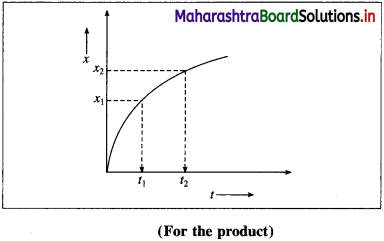
Maharashtra Board Class 12 Chemistry Solutions Chapter 6 Chemical Kinetics 6
The rate of a reaction is also measured in terms of a finite change in the concentration (Δx) of the product divided by the time interval (Δt), for the change.

For the reaction,
Maharashtra Board Class 12 Chemistry Solutions Chapter 6 Chemical Kinetics 7

Question 9.
Explain the term Instantaneous rate of a reaction.
Answer:
Instantaneous rate of a reaction : It is defined as a rate of a reaction at a specific instant during a course of the reaction.

If the average reaction rate is calculated over shorter and shorter intervals (making Δt very small) then instantaneous rate is obtained.

In case of reactant A, the instantaneous rate is represented as, \(R=\frac{-d[\mathrm{~A}]}{d t}\) and in case of product B, it is represented as \(R=\frac{+d[B]}{d t}\)

Maharashtra Board Class 12 Chemistry Important Questions Chapter 6 Chemical Kinetics

Question 10.
Define :
(a) Average rate of reaction.
(b) Instantaneous rate of reaction.
Answer:
(a) Average rate of a chemical reaction : It is expressed as a finite change in concentration (- Δc) of the reactant divided by the time interval (Δt) for the change in concentration.

∴ Average rate, \(R=\frac{-\Delta c}{\Delta t}\)

(b) Instantaneous rate of reaction : It is defined as a rate of a reaction at a specific instant during a course of the reaction.

Instantaneous rate \(=\frac{-d c}{d t}\)

Question 11.
Represent the average rates of the following reaction. N2(g) + 3H2(g) → 2NH3(g).
Answer:
For the reation,
Maharashtra Board Class 12 Chemistry Solutions Chapter 6 Chemical Kinetics 12
This is because the rate of consumption of H2 is thrice the rate of consumption of N2 while the rate of formation of NH3 will be twice the rate of consumption of N2.

Question 12.
Express the rate of a reaction in terms of change in concentration of each constituent in the following reaction : aA+bB → cC+ dD
Answer:
The rate of a reaction may be expressed in terms of decrease in the concentration of the reactants or in-crease in the concentration of the product per unit time,

∴ For the given reaction, aA T bB → cC +dD
Maharashtra Board Class 12 Chemistry Solutions Chapter 6 Chemical Kinetics 13

Question 13.
For a hypothetical reaction, A + 2B → products, the concentration of A and B at different intervals of time are given in the following table. Find the rates of the reaction in terms of concentration changes in A and B.

The equilibrium concentration of A and B at different time intervals :

Time t/minute [A]/mol L-1 [B]/ml L-1
0 1.000 2.000
10 0.534 1.068
20 0.342 0.360
30 0.180 0.360

Answer:
Rate of a reaction = \(\frac{-\Delta[\mathrm{A}]}{\Delta t}=-\frac{1}{2} \frac{\Delta[\mathrm{B}]}{\Delta t}\)
(1) Over time interval from O to 10 minutes
Maharashtra Board Class 12 Chemistry Solutions Chapter 6 Chemical Kinetics 14
(Note that the rate of a reaction in terms of changes in concentration of any reactant or product at the given time remains the same.)

Maharashtra Board Class 12 Chemistry Important Questions Chapter 6 Chemical Kinetics

(2) Over the time interval from 10 to 20 minutes,
Maharashtra Board Class 12 Chemistry Solutions Chapter 6 Chemical Kinetics 15

Question 14.
Show that the rate of reaction is the same whether expressed in terms of the rate of consumption of any reactant or of the formation of any product.
2N2O5(g) → 4NO2(g) + O2(g)
The concentrations of reactants and products at different time intervals are given in the following table :
Concentrations of various species at different times for the reaction N2O5(g) → 4NO2(g) + O2(g) :

Time/s [N2O5]/M [NO2]/M [O2]/M
0 0.0300 0 0
200 0.0213 0.0174 0.00435
400 0.0152 0.0296 0.00740
600 0.0108 0.0384  0.00960

Answer:
The rate of the reaction can be expressed in terms of rate of consumption of reactants or rate of formation of products.
Maharashtra Board Class 12 Chemistry Solutions Chapter 6 Chemical Kinetics 16
Consider concentrations at time t1 = 200 seconds and t2 = 400 seconds
Maharashtra Board Class 12 Chemistry Solutions Chapter 6 Chemical Kinetics 17
The constant values of rate of reaction proves that the rate of the reaction may be measured in terms of concentration changes of reactants or products per unit time.

Maharashtra Board Class 12 Chemistry Important Questions Chapter 6 Chemical Kinetics

Question 15.
Define Rate law (or differential rate law).
Answer:
Rate law (or differential rate law) : It is defined as an experimentally determined mathematical equation which expresses the rate of a chemical reaction in terms of molar concentrations of the reactants which influence the rate of the reaction. For example, for a reaction, A + B → Products By rate law, Rate = R = k[A] x [B] where k is a rate constant and [Al and [B] are molar concentrations of the reactants A and B respectively.

Question 16.
Give examples of rate law with illustrations.
Answer:
Consider following examples :
(i) H2(g) + I2(g) → 2HI(g)
R = k[H2] [I2]

(ii) 2H2O2(g) → 2H2O(I) + O2(g)
Experimentally it is observed that the rate of the reaction is proportional to the concentration of H2O2.
∴ R = k [H2O2]

(iii) NO2(g) + CO(g) → NO(g) + CO2(g)
Experimentally it is observed that rate of the reaction does not depend on the concentration of CO but it is proportional to [NO2]2.
∴ R = k[NO2]2

Question 17.
What are the applications of the rate law?
Answer:

  • The rate of any reaction at the given concentration can be measured by knowing the rate law and the rate constant.
  • The concentration of the reactants or the products at any instant during the progress of a reaction can be estimated with the help of rate law and the rate constant.
  • The mechanisms of simple or complex chemical reactions can be predicted and studied.

Question 18.
Define the rate constant. What are the factors which influence the rate constant of a chemical reaction?
Answer:
(A) Rate constant : The rate constant of a chemical reaction is defined as the rate of the chemical reaction when the concentration (or active masses) of each reactant has unit value, i.e., 1 mol dm-3 in the case of solution and the pressure is 1 atm in case of gases, e.g., for a reaction, A → products, Rate R = k[A].

If [A] = 1 mol dm-3, then k = R.

(B) The rate constant of a reaction depends on the following factors:

  • Nature of the reactants.
  • Temperature of the reaction. As the temperature increases, the velocity constant (rate constant) increases.
  • The conditions of the reactions like the presence of the catalyst, solvent, pH, etc.
  • It does not depend on the concentration of the reactants. But if one or more substances are in excess concentration, then the order of the reaction is independent of them.

Question 19.
What are the characteristics of rate constant?
Answer:
The characteristics of rate constant are as follows :

  • The rate constant depends upon the nature of the reaction.
  • Higher the value of the rate constant, faster is the reaction.
  • Lower the value of the rate constant, slower is the reaction.
  • By increasing the temperature, the magnitude of the rate constant increases.
  • For the given reaction, the rate constant has higher value in the presence of a catalyst than in the absence of the catalyst.
  • The reactions having lower activation energy have higher values for rate constants.

Solved Examples 6.2 – 6.3.2

Question 20.
Solve the following :

(1) Write the rate expressions for the following reactions in terms of rate of consumption of the reactants and the rate of formation of the products.
(i) 2NO(g) + O2(g) → 2NO2(g)
(ii) H2(g) + I2(g) → 2HI(g)
Solution :
(i) Given : 2NO(g) + O2(g) → 2NO2(g)
Rate of consumption of NO at time \(t=\frac{-d[\mathrm{NO}]}{d t}\)
Rate of consumption of O2 at time \(t=\frac{-d\left[\mathrm{O}_{2}\right]}{d t}\)
Rate of formation of NO2 at time \(t=\frac{d\left[\mathrm{NO}_{2}\right]}{d t}\)
Rate of the reaction \(=-\frac{1}{2} \frac{d[\mathrm{NO}]}{d t}=\frac{-d\left[\mathrm{O}_{2}\right]}{d t}\)
\(=\frac{1}{2} \frac{d\left[\mathrm{NO}_{2}\right]}{d t}\)

(ii) Given : H2(g) + I2(g) → 2HI(g)
Rate of consumption of H2 at time \(t=\frac{-d\left[\mathrm{H}_{2}\right]}{d t}\)
Rate of consumption of I2 at time \(t=\frac{-d\left[\mathrm{I}_{2}\right]}{d t}\)
Rate of formation of HI at time \(t=\frac{d[\mathrm{HI}]}{d t}\)
∴ Rate of reaction at any time t \(=-\frac{d\left[\mathrm{H}_{2}\right]}{d t}=-\frac{d\left[\mathrm{I}_{2}\right]}{d t}=\frac{1}{2} \frac{d[\mathrm{HI}]}{d t}\)

Maharashtra Board Class 12 Chemistry Important Questions Chapter 6 Chemical Kinetics

(2) The gas-phase reaction between NO and Br2 is represented by the equation. 2NO(g) + Br2(g) → 2NOBr(g)
(a) Write the expressions for the rate of consumption of reactants and formation of products.
(b) Write the expression for the rate of overall reaction in terms of rates of consumption of reactants and formation of products.
Solution :
Given : 2NO(g) + Br2(g) → 2NOBr(g)
(a) Rate of consumption of NO at time t \(=-\frac{d[\mathrm{NO}]}{d t}\)
Rate of consumption of Br2 at time t \(=\frac{-d\left[\mathrm{Br}_{2}\right]}{d t}\)
Rate of formation of NOBr at time \(t=\frac{d[\mathrm{NOBr}]}{d t}\)
(b) Rate of reaction \(=-\frac{1}{2} \frac{d[\mathrm{NO}]}{d t}=\frac{-d\left[\mathrm{Br}_{2}\right]}{d t}\)
\(=\frac{1}{2} \frac{d[\mathrm{NOBr}]}{d t}\)

(3) The decomposition of N2Os is represented by the equation
2N2O5(g) → 4NO2(g) + O2(g)
(a) How is the rate of formation of NO2 related to the rate of formation of O2?
(b) How is the rate of formation of O2 related to the rate of consumption of N2O5?
Solution :
Given : 2N2O5(g) → 4NO2(g) + O2(g)
(a) Rate of formation of NO2 at time \(t=\frac{d\left[\mathrm{NO}_{2}\right]}{d t}\)
Rate of formation of O2 at time \(t=\frac{d\left[\mathrm{O}_{2}\right]}{d t}\)

They are related to each other through rate of reaction.
∴ Rate of reaction \(=\frac{1}{4} \frac{d\left[\mathrm{NO}_{2}\right]}{d t}=\frac{d\left[\mathrm{O}_{2}\right]}{d t}\)

(b) Rate of consumption of N2O5 at time t \(=-\frac{d\left[\mathrm{~N}_{2} \mathrm{O}_{5}\right]}{d t}\)

Rate of reaction \(=-\frac{1}{2} \frac{d\left[\mathrm{~N}_{2} \mathrm{O}_{5}\right]}{d t}=\frac{d\left[\mathrm{O}_{2}\right]}{d t}\)

In general,
Rate of reaction \(=-\frac{1}{2} \frac{d\left[\mathrm{~N}_{2} \mathrm{O}_{5}\right]}{d t}=\frac{1}{4} \frac{d\left[\mathrm{NO}_{2}\right]}{d t}=\frac{d\left[\mathrm{O}_{2}\right]}{d t}\)

(4) Nitric oxide reacts with H2 according to the reaction. 2NO(g) + 2H2(g) → N2(g) + 2H2O(g)
What is the relationship among \(\frac{d[\mathrm{NO}]}{d t}=\frac{d\left[\mathrm{H}_{2}\right]}{d t}=\frac{d\left[\mathrm{~N}_{2}\right]}{d t} \text { and } \frac{d\left[\mathrm{H}_{2} \mathrm{O}\right]}{d t} ?\)
Solution :
Given : 2NO(g) + 2H2(g) → N2(g) + 2H2O(g)
The relationship among the rate of consumption of the reactants and the rate of formation of products is as follows :

Rate of reaction :
\(R=-\frac{1}{2} \frac{d[\mathrm{NO}]}{d t}=-\frac{1}{2} \frac{d\left[\mathrm{H}_{2}\right]}{d t}=\frac{d\left[\mathrm{~N}_{2}\right]}{d t}=\frac{1}{2} \frac{d\left[\mathrm{H}_{2} \mathrm{O}\right]}{d t}\)

(5) The rate of decomposition of N2Os was studied in liquid bromine,
2N2O5(g) → 4NO2(g) + O2(g)
If at a certain time, the rate of disappearance of N2O5 is 0.015 Ms-1 find the rates of formation of NO2 and O2. What is the rate of the reaction at this instant?
Solution :
Given : 2N2O5(g) → 4NO2(g) + O2(g)
Rate of disappearance of N2O5 = 0.015 M s-1
Rate of formation of NO2 =?
Rate of formation of O2 =?
Rate of reaction = ?
Rate of disappearance of \(\mathrm{N}_{2} \mathrm{O}_{5}=\frac{-d\left[\mathrm{~N}_{2} \mathrm{O}_{5}\right]}{d t}\)
= 0.015 M s-1

Since 4 moles of NO2 are formed from 2 moles of N2O5 Rate of formation of NO2Maharashtra Board Class 12 Chemistry Solutions Chapter 6 Chemical Kinetics 21
Answer:
Rate of formation of NO2 = 0.03 Ms-1
Rate of formation of O2 = 0.0075 M s-1
Rate of reaction = 0.0075 Ms-1.

(6) In the reaction, PCl5(g) → PCl3(g) + CI2(g), at a particular moment, the rate of disappearance of PCl5 is 0.015 Ms-1. What are the rates of formation of PCI3 and Cl2?
Solution :
Given : PCl5(g) → PCl3(g) + Cl2(g)
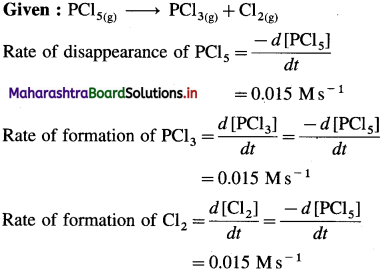
Maharashtra Board Class 12 Chemistry Solutions Chapter 6 Chemical Kinetics 22
Maharashtra Board Class 12 Chemistry Solutions Chapter 6 Chemical Kinetics 23
Answer:
Rate of formation of PCl3 = 0.015 Ms-1
Rate of formation of Cl2 = 0.015 Ms-1

Maharashtra Board Class 12 Chemistry Important Questions Chapter 6 Chemical Kinetics

(7) In the reaction, 2N3O5(g) → 4NO2(g) + O2(g), at a certain time, the rate of formation of NO2 is 0. 04 Ms-1. Find the rate of consumption of N2O5, rate of formation of O2 and the rate of the reaction.
Solution :
Given : 2N2O5(g) → 4NO2(g) + O2(g)
Rate of formation of NO2 = \(\frac{d\left[\mathrm{NO}_{2}\right]}{d t}\) = 0.04 Ms-1

From the reaction, rate of consumption of N2O5 is half the rate of formation of NO2 since when 2 moles of N2O5 are consumed, 4 moles of NO2 are formed.
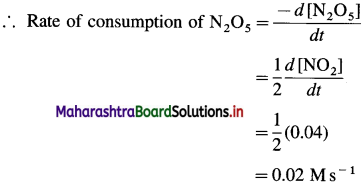
Maharashtra Board Class 12 Chemistry Solutions Chapter 6 Chemical Kinetics 24
Rate of formation of O2 is one-fourth rate of formation of NO2.
Maharashtra Board Class 12 Chemistry Solutions Chapter 6 Chemical Kinetics 25
Answer:
(i) Rate of consumption of N2O5
(ii) Rate of formation of O2 = 0.01 Ms-1
(iii) Rate of reaction = 0.01 Ms-1

(8) Consider the reaction 2A + B → 2C. Suppose that at a particular moment during the reaction, rate of disappearance of A is 0.076 M/s,
(a) What is the rate of formation of C?
(b) What is the rate of consumption of B?
(c) What is the rate of the reaction?
Solution :
Given : 2A + B → 2C
Rate of disappearance of A = 0.076 Ms-1
(a) Rate of formation of C =?
(b) Rate of consumption of B =?
(c) Rate of reaction = ?
Maharashtra Board Class 12 Chemistry Solutions Chapter 6 Chemical Kinetics 26
Answer:
(a) Rate of formation of C = 0.076 Ms-1
(b) Rate of consumption of B = 0.038 M s-1
(c) Rate of reaction = 0.038 Ms-1

Maharashtra Board Class 12 Chemistry Important Questions Chapter 6 Chemical Kinetics

(9) Consider the reation \(\mathbf{3 I}_{(\mathbf{a q})}^{-}+\mathbf{S}_{2} \mathbf{O}_{8(u q)}^{2-} \longrightarrow \mathbf{I}_{3(\mathrm{aq})}^{-}+2 \mathrm{SO}_{4}^{2-}\) At a particular time t, \(t, \frac{d\left[\mathrm{SO}_{4}^{2-}\right]}{d t}=2.2 \times 10^{-2} \mathrm{M} / \mathrm{s}\) What are the values of \(\text { (a) }-\frac{d\left[\mathrm{I}^{-}\right]}{d t}\) \(-\frac{d\left[\mathrm{~S}_{2} \mathrm{O}_{8}^{2-}\right]}{d t}\) \(\text { (c) } \frac{d\left[\mathbf{I}_{3}^{-}\right]}{d t}\) at the same time?
Solution :
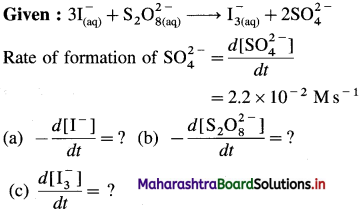
Maharashtra Board Class 12 Chemistry Solutions Chapter 6 Chemical Kinetics 27
(a) Rate of consumption of \(\mathrm{I}^{-}=-\frac{d\left[\mathrm{I}^{-}\right]}{d t}\)
When 2 moIes of \(\mathrm{SO}_{4}^{2-}\) are formed, 3 moves of I are consumed in the same time.
Maharashtra Board Class 12 Chemistry Solutions Chapter 6 Chemical Kinetics 28

(b) In the formation of 2 moles of \(\mathrm{SO}_{4}^{2-}\), 1 mole of \(\mathrm{S}_{2} \mathrm{O}_{8}^{2-}\) is consumed in the same time.
Maharashtra Board Class 12 Chemistry Solutions Chapter 6 Chemical Kinetics 29
Answer:
Maharashtra Board Class 12 Chemistry Solutions Chapter 6 Chemical Kinetics 30

(10) Ammonia and oxygen react at high temperature as :
4NH3(g) + 5O2(g) → 4NO(g) + 6H2O(g)
In an experiment, rate of formation of NO(g) is 3.6 x 10⁻³ mol L-1s-1.
Calculate-
(a) Rate of disappearance of ammonia
(b) Rate of formation of water.
Solution :
Maharashtra Board Class 12 Chemistry Solutions Chapter 6 Chemical Kinetics 31
Answer:
(a) Rate of disappearance of NH3
= 3.6 x 10⁻³ mol L-1s-1
(b) Rate of formation of H2O
= 5.4 x 10⁻³ mol L-1s-1

Maharashtra Board Class 12 Chemistry Important Questions Chapter 6 Chemical Kinetics

(11) The rate law for the reaction
C2H4Br2 + 3I → C2H4 + 2Br +I3 is Rate = k [C2H4Br2][I]. The rate of the reac-tion is found to be 1.1 x 10⁻⁴ M/s when the concentrations of C2H4Br2 and I– are 0.12M and 0.18 M respectively. Calculate the rate constant of the reaction.
Solution :
Given : C2H4Br2 + 3I → C2H4 + 2Br +I3
By rate law, Rate of reaction = R = k x [C2H4Br2][I]
R = 1.1 x 10⁻⁴ Ms-1
[C2H4Br2] = 0.12 M; [I] =0.18 M
Rate constant = k =?
R = k x [C2H4Br2] x [I]
Maharashtra Board Class 12 Chemistry Solutions Chapter 6 Chemical Kinetics 33
Answer:
Rate constant = k = 5.1 x 10⁻³ M-1s-1

(12) For a reaction, 2A + B → C, the rate law is, rate =k x [A]2 x [B]. If the rate constant of the reaction is 3.74 x 10⁻²M-2s-1, calculate the rate of the reaction when the concentrations of A, B and C are 0.108 M, 0.132 M and 0.124 M respectively.
Solution :
Given : Rate constant of the reaction = k
= 3.74 x 10⁻²M-2s-1
[A] =0.108 M, [B] = 0.132M, [C] = 0.124 M
Rate of the reaction = R = ?
By rate law,
R = k [A]2 x [B] = (0.108)2 x 0.132 = 1.54 x 10⁻³ Ms-1
(Concentration of C need not be considered since it is a product.)
Answer:
Rate of reaction = 1.54 x10⁻³ Ms-1

(13) For a reaction, A + B → C, if the concentration of A doubles, the rate of the reaction doubles. While if the concentration of B doubles the rate of the reaction increases by four fold. Write rate law. .
Solution :
Let x moles of A react with y moles of B. xA + yB → C
To write rate law, it is necessary to find x and y values.

(i) Initial rate \(=R_{1}=k[\mathrm{~A}]_{1}^{x}[\mathrm{~B}]_{1}^{y}\)
Final rate R2 is doubled when the concentration of A is doubled, i.e., R2 = 2R1 when final concentration,
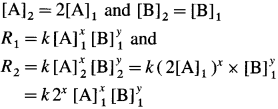
Maharashtra Board Class 12 Chemistry Solutions Chapter 6 Chemical Kinetics 174
(It is assumed that the concentration of B remains same.)
Maharashtra Board Class 12 Chemistry Solutions Chapter 6 Chemical Kinetics 34

(ii) Initial rate \(=R_{1}=k[\mathrm{~A}]_{1}^{x}[\mathrm{~B}]^{y}\)
If the concentration of B is doubled keeping of A constant, rate becomes four times, i.e.,
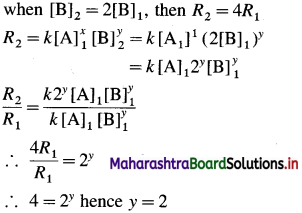
Maharashtra Board Class 12 Chemistry Solutions Chapter 6 Chemical Kinetics 35
Hence the rate law is represented by an expression.
Rate = k[A] [B]2
Answer:
Rate law is. Rate = k [A] [B]2

Maharashtra Board Class 12 Chemistry Important Questions Chapter 6 Chemical Kinetics

(14) For the reaction, A2 + B + C → AC + AB, it is found that tripling the concentration of A2 triples the rate, doubling the concentration of C doubles the rate and doubling the concentration of B has no effect,
(a) What is the rate law?
(b) Why the change in concentration of B has no effect?
Solution :
Given : A2 + B + C → AC + AB
(a) The rate law may be represented as,
Rate = k [A2]x [B]y [C]z
Let [A]1, [B]1 and [C]1 represent initial concentration and [A]2, [B]2 and [C]2 represent final concentrations, and let R1 and R2 be initial and final rates of the reaction when the concentrations are changed.

(i) If [A]2 = 3[A]1, R2 = 3R1
Maharashtra Board Class 12 Chemistry Solutions Chapter 6 Chemical Kinetics 36
If the concentrations of B and C remain constant, then
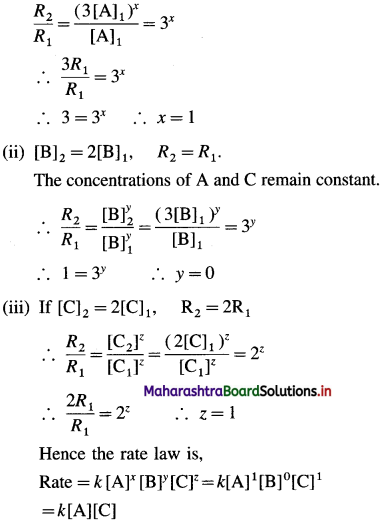
Maharashtra Board Class 12 Chemistry Solutions Chapter 6 Chemical Kinetics 37

(b) In the rate determining step, B may not be involved as the reactant, hence rate is independent of changes in concentration of B. (OR B may be in large excess as compared to the concentrations of A and C.)
Answer:
(a) Rate law : Rate = k [A] [C]

Question 21.
Define and explain the term order of a chemical reaction.
Answer:
Order of a chemical reaction : The order of a chemical reaction is defined as the number of molecules (or atoms) whose concentrations influence the rate of the chemical reaction.
OR
The order of a chemical reaction is defined as the sum of the powers (or exponents) to which the concentration terms of the reactants are raised in the rate law expression for the given reaction.

Explanation :
Consider a reaction,
n1A + n2B → Products
where n1 moles of A react with n2 moles of B.

The rate of this reaction can be expressed by the rate law equation as,
R = k [A]n1 [B]n2
where k is the rate constant of the reaction, hence, the order of the reaction is n – n1 + n2, (observed, experimentally).

If n = 1, the reaction is called the first order reaction, if n = 2, it is called the second order reaction, etc.

If n = 0, it is called the zero order reaction, e.g., photochemical reaction of H2(g) and Cl2(g).

Question 22.
What are the features (or key points) of order of a reaction?
Answer:
The features of order of reaction are as follows :

  • It represents the number of atoms, ions or molecules whose concentrations influence the rate of the reaction.
  • It is not related to the stoichiometric equation of the reaction, hence it cannot be predicted from stoichiometric balanced equation.
  • It is experimentally determined quantity.
  • It is defined only in terms of the concentrations of the reactants and not of products.
  • It may have values which are integers, fractional or zero.
  • Higher values are rare. Reactions of first and second order are in large number. Third order reactions are very few like,
    2NO(g) + Cl2(g) → 2NOCl(g).

Maharashtra Board Class 12 Chemistry Important Questions Chapter 6 Chemical Kinetics

Solved Examples 6.3.3

Question 23.
Solve the following :
(1) From the rate expressions for the following reactions, determine their order :
(a) 2N2O5(g) → 4NO2(g) + O2(g) : Rate = k [N2O5]
(b) CHCl3(g) + Cl2(g) → CCl4(g) + HCl(g) : Rate = k [CHL3] [Cl2]1/2
(c) C2H5Cl(g) → C2H4(g) + HCl(g): Rate = k [C2H5Cl]
(d) 2NO2(g) + F2(g) → 2NO2F(g) → : Rate = k (NO2] [F2]
Solution :
(a) 2N2O5(g) → 4NO2(g) + O2(g)
The rate law expression given for the reaction is Rate = k x [N2O5]
Hence the reaction is of first order.

(b) CHCl3(g) + Cl2(g) → CCl4(g) + HCl(g)
The given rate law expression is, R = k [CHCl3] x [Cl2]1/2 Here the order of a reaction is one with respect to CHCl3(g) and half with respect to Cl2(g). Therefore the overall order of the reaction is 1 + 1/2 = 1.5.

(c) C2H5Cl(g) → C2H4(g) + HCl(g)
The given rate law expression is, Rate = k [C2H5Cl]
Hence the reaction has order equal to one.

(d) 2NO2(g) + F2(g) → 2NO2F(g)
The given rate law expression for the reaction is Rate = k [NO2] x [F2]
Hence the reaction is first order with respect to NO2 and first order with respect to F2. The overall order of the reaction is, n = nNO2 + nF1 = 1 + 1 = 2.

(2) Determine the order of following reactions from their rate expressions :
(a) 2H2O2 → 2H2O + O2 Rate = k [H2O2]
(b) NO2 + CO → NO + CO2 Rate = k [NO2]2
(c) 2NO + O2 → 2NO2 Rate = k [NO]2 x [O2]
(d) CHCl3(g) + Cl2(g) → CCl4(g) + HCl(g)
Rate = k [CHCl3] [Cl2]
Solution :
(a) For the reaction,
2H2O2 → 2H2O + O2
Since the rate law expression given is,
Rate = k [H2O2]
Hence the reaction is of first order.

(b) For the reaction,
NO2 + CO → NO + CO2
Since the rate law given is Rate = k [NO2]2, the reaction is second order with respect to NO2 and zero order with respect to CO. Hence the net order of the reaction is, n = nNO2 + nco = 2 + 0 = 2

(c) For the reaction,
2NO + O2 → 2NO2
Since the rate law expression given is, Rate = k [NO]2 x [O2] the reaction is second order with respect to NO and first order with respect to O2. Hence the overall order of reaction is n = nNO2 + no2 = 2 + 1 = 3.

(d) For the reaction, by rate law,
Rate = k [CHCl3] x [Cl2] reaction is first order with respect to CHCl3 and first order with respect to Cl2. Hence the overall order is, n = ncHcl3 + ncl2 = 1 + 1 = 2.

(3) Write the rate law expressions for the following reactions:
(1) 2N2O5(g) → 4NO2 + O2; order of the reaction is 1.
(2) CH3CHO → CH4 + CO; order of the reaction Is 3/2.
Solution :
(1) For the given reaction, order is one hence the rate law expression is, Rate = k [N2O5].
(2) For the given reaction, order is 3/2, hence the rate law expression is Rate = k x [CH2CHO]3/2.

(4) The reaction \(\mathbf{H}_{2} \mathbf{O}_{2(\mathbf{a q})}+3 \mathbf{I}_{(\mathbf{a q})}^{-}+2 \mathbf{H}_{(\mathrm{aq})}^{+} \longrightarrow 2 \mathbf{H}_{2} \mathbf{O}_{(0)}+\mathbf{I}_{3(a q)}^{-}\) is first order in H2O2 and I, zero order in H+. Write the rate law.
Solution:
Given :
\(\mathrm{H}_{2} \mathrm{O}_{2(\mathrm{~g})}+3 \mathrm{I}_{(\mathrm{aq})}^{-}+2 \mathrm{H}^{+}{ }_{(\mathrm{aq})} \longrightarrow 2 \mathrm{H}_{2} \mathrm{O}_{(\mathrm{i})}+\mathrm{I}_{3(\mathrm{aq})}^{-}\)
Since the reaction is first order in H2O2 and F and zero order in H+, the expression for rate law will be,
Rate =k [H2O2]1 [I]1 [H+]0
∴ Rate = k [H2O2] [I]
Answer:
Rate = k [H2O2] [I]

Maharashtra Board Class 12 Chemistry Important Questions Chapter 6 Chemical Kinetics

(5) The rate law for the gas-phase reaction
2NO(g) + O2(g) → 2NO2(g) is rate = k [NO2]2 [O2]. What is the order of the reaction with respect to each of the reactants and what is the overall order of the reaction?
Solution :
Given : 2NO(g) + O2(g) → 2NO2(g)
Rate = k [NO]2[O2]
Order of the reaction with respect to NO = nNo = 2
Order with respect to O2 = nO2 = 1
Overall order of the reaction = n = nNO + nO2
= 2 + 1
= 3
Answer:
Order with respect to NO = 2
Order with respect to O2 = 1
Overall order = 3

(6) What is the order for the following reactions?
(a) 2NO2(g) + F2(g) → 2NO2F(g), rate = k [NO2][F2]
(b) CHCl3(g) + Cl2(g) → CCl4(g) + HCl(g), rate = k[CHCl3][Cl2]1/2
Solution :
(a) Given : 2NO2(g) + F2(g) → 2NO2F
Rate = k [NO2][F2]
Hence the reaction is first order with respect to NO2 and first order with respect to F2
∴ Order of reaction = nNO2 + nF2 = 1 + 1 = 2

(b) Given :
CHCl3(g) + Cl2(g) → CCl4(g) + HCl(g),
Rate = k [ CHCl3] [Cl2]1/2
Hence the reaction is first order in CHCl3 and half order in Cl2.
∴ Order of reaction
= nCHCl3 + nCl2 = 1 + \(\frac{1}{2}\) = \(\frac{3}{2}\)
Answer:
(a) Order of the reaction = 2
(b) The order of the reaction = \(\frac{3}{2}\)

(7) Write the rate law for the following reactions :
(a) A reaction that is zero order in A and second order in B.
(b) A reaction that is second order in NO and first order in Br2.
Solution :
(a) Given : A + B → Products
The reaction is zero order in A and second order in B. Hence the rate law is represented as, Rate = k [A]O[B]2
Rate = k[B]2

(b) Given : 2NO(g) + Br2(g) → 2NOBr(g)
The reaction is second order in NO and first in Br2. Hence the rate law is,
∴ Rate = k [NO]2[Br2]
Answer: (a) Rate law : Rate = k[B]2
(b) Rate law : Rate = k [NO]2[Br2]

(8) The reaction A + B → Products, is first order in each of the reactants, (a) Write the rate law.
(b) How does the reaction rate change if the concentration of B is decreased by a factor 3?
(c) What is the change in the rate if the concentration of each reactant is tripled? (d) What is the change in the rate, if the concentration of A is doubled and that of B is halved?
Solution :
(a) The reaction is first order in A and B. Hence the equation for rate law is,
Rate = k [A] [B]
(b) Before changing the concentration of B, Initial rate = R1 – k [A]1 [B]1
After change in concentration of B,
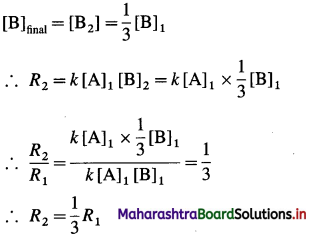
Maharashtra Board Class 12 Chemistry Solutions Chapter 6 Chemical Kinetics 39
Hence the rate of the reaction will be decreased by a factor 3.

Maharashtra Board Class 12 Chemistry Important Questions Chapter 6 Chemical Kinetics

(c) When the concentration of each reactant is tripled, then the final concentrations will be, [A]2 = 3[A]1 and [B]2 = 3[B1]
∴ R2 = k x 3[A]1 x 3 [B]1
Maharashtra Board Class 12 Chemistry Solutions Chapter 6 Chemical Kinetics 40
Hence the rate of the reaction will be increased by 9 times.

(d) When the concentration A is doubled and that of B is halved then the final concentrations will be,
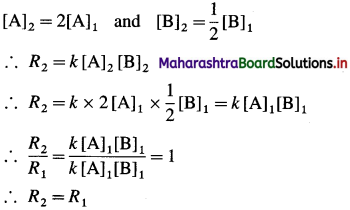
Maharashtra Board Class 12 Chemistry Solutions Chapter 6 Chemical Kinetics 41
Rate of the reaction will remain unchanged.
Answer:
(a) Rate law is, Rate = k [A] [B],
(b) Rate is decreased by a factor 3,
(c) Rate is increased by 9 times,
(d) Rate remains unchanged.

(9) Consider the reaction A2 + B → products. If the concentration of A2 and B are halved, the rate of the reaction decreases by a factor of 8. If the concentration of A2 is increased by a factor of 2.5, the rate increases by the factor of 2.5. What is the order of the reaction? Write the rate law.
Solution :
Given : A2 + B → Products
(i) When concentration of A2 and B are halved :
[A2]2(final) = 1/2 [A2]1(final) and [B]2 = 1/2 [B]1 then, R2(final) = 1/8R1(intial).

(ii) When concentration of A2 is increased by the factor 2.5,
[A2]2 = 2.5 [A2]1 (concentration of B is same) then, R2 = 2.5 R1
Now let the reaction be, XA2 + yB → Products

From data in (ii),
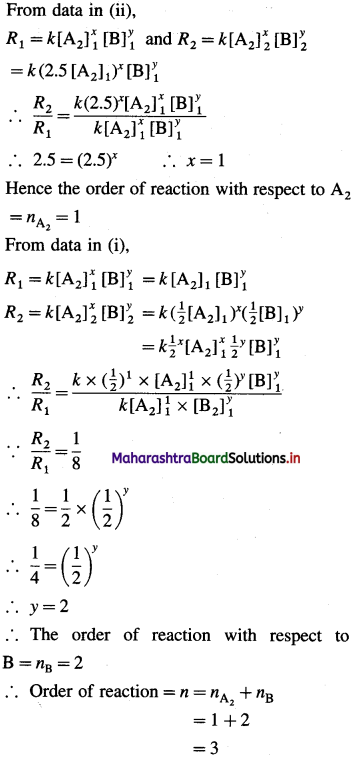
Maharashtra Board Class 12 Chemistry Solutions Chapter 6 Chemical Kinetics 43
Hence the reaction is of third order. The rate law can be represented as,
Rate = k [A2] [B]2
Answer:
(i) Order of the reaction = 3
(ii) Rate law : Rate = k [A2] [B]3

Maharashtra Board Class 12 Chemistry Important Questions Chapter 6 Chemical Kinetics

(10) Consider the reaction C + D → Products. The rate of the reaction increases by a factor of 4 when the concentration of C is doubled. The rate of the reaction is tripled when concentration of D is tripled. What is the order of the reaction? Write the rate law.
Solution :
Given : C + D → Products OR xC + yD → Products
(i) When the concentration of C is doubled, the rate of the reaction increases by 4.

[C]2(final) = 2[C]1(initial) then R2(final) = 4R1(initial)
(In this, the concentration of D is assumed to be constant.)
Maharashtra Board Class 12 Chemistry Solutions Chapter 6 Chemical Kinetics 44
Hence, the reaction is second order in C.
∴ nC = 2
(ii) When the concentration of D is tripled, rate is tripled. The concentration of C is assumed to be constant.
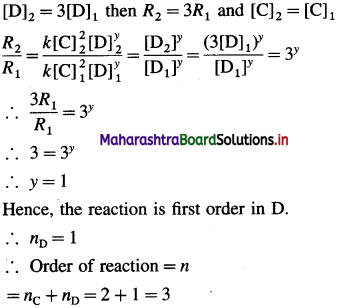
Maharashtra Board Class 12 Chemistry Solutions Chapter 6 Chemical Kinetics 45
Rate law : Rate = A[C]2[D]
Answer:
(i) Order of the reaction = 3
(ii) Rate law : Rate = A[C]2[D]

(11) The reaction F2(g) + 2ClO2(g) → 2FClO2(g) is first order in each of the reactants. The rate of the reaction is 4.88 x 10⁻⁴ M/s when [F2] = 0.015 M and [ClO2]= 0.025 M. Calculate the rate constant of the reaction.
Solution :
Given :
F2(g) + 2ClO2(g) → 2FClO2(g)
Order of reaction in F2 = nF2 = 1
Order of reaction in CIO2 = nClO2 = 1
Rate = R = 4.88 x 10⁻⁴ Ms-1
[F2] = 0.015 M; [ClO2] = 0.025 M
Rate = k = ?
By rate law,
Maharashtra Board Class 12 Chemistry Solutions Chapter 6 Chemical Kinetics 46
Answer:
Rate constant = 1 = 1.3 M-2s-1

(12) The reaction 2H2(g) + 2NO(g) → 2H2O(g) + N2(g) is first order in H2 and second order in NO. The rate constant of the reaction at a certain tem­perature is 0.42M-2s-1. Calculate the rate when [H2] = 0.015 M and [NO] = 0.025 M.
Solution :
Given : 2H2(g) + 2NO(g) → 2H2O(g) + N2(g)
Order of reaction in H2 = nH1 = 1
Order of reaction in NO = nNO = 2
Rate constant = k = 0.42 M-2s-1
[H2] = 0.015 M; [NO] = 0.025 M
Rate of reaction = R = ?
By rate law,
Rate = R = k [H2] [NO]2
= 0.42 x 0.015 x (0.025)2 M-2s-1 M M
= 3.94 x 10⁻⁶ Ms-1
Answer:
Rate of reaction = R = 3.94 x 10⁻⁶ Ms-1

Maharashtra Board Class 12 Chemistry Important Questions Chapter 6 Chemical Kinetics

(13) Find the order of following reactions whose rate laws are expressed as follows. CA and CB are the concentrations of reactants A and B respectively :
Maharashtra Board Class 12 Chemistry Solutions Chapter 6 Chemical Kinetics 47
Solution :
Given :
(1) For, – \(\frac{d c}{d t}\) = k x \(\mathrm{C}_{A}^{0}\) the order of the reaction, n = 0. Hence it is a zero order reaction.

(2) For, – \(\frac{d c}{d t}\) = k x \(\mathrm{C}_{A}^{3 / 2}\), the overall order of the reaction is 3/2.

(3) For, –\(\frac{d c}{d t}\) = k x \(\mathrm{C}_{A}^{1 / 2} \mathrm{C}_{B}^{2}\), the reaction has order 1/2 with respect to A and 2 with respect to B.
∴ n = nA + nB = \(\frac{1}{2}\) + 2 = \(\frac{5}{2}\).
Hence the (overall) order of the reaction is \(\frac{5}{2}\).

(4) For, \(-\frac{d c}{d t}=k \mathrm{C}_{A}^{5 / 2} \times \mathrm{C}_{B}^{0}\)
The reaction has order \(\frac{5}{2}\) with respect to A and zero with respect to B.
∴ n = nA + nB = \(\frac{5}{2}\) + 0 = \(\frac{5}{2}\)
Hence the order of the reaction is \(\frac{5}{2}\).

(5) For, \(-\frac{d c}{d t}=k \times \mathrm{C}_{A}^{1 / 3} \times \mathrm{C}_{B}^{2 / 3}\). The reaction has order \(\frac{1}{3}\) with respect to A and \(\frac{2}{3}\) with respect to B.
∴ n = nA + nB = \(\frac{1}{3}\) + \(\frac{2}{3}\) = 1
Hence the order of the reaction is 1.

(14) The rate of a reaction, 2A + B → Products is 3.78 x 10⁻⁴ M s-1 when the concentrations of A and B are 0.3 M each. If the rate constant of the reaction is 4.2 x 10⁻³s-1 find the order of the reaction.
Solution :
Given : 2A + B → Products
Rate = R = 3.78 x 10⁻⁴Ms-1
[A] = [B] = 0.3 M
Rate constant = 1 = 4.2 x 10⁻³ s-1
Let the order of the reaction in A be x and in B be y.

Then, by rate law,
Rate = R = k [A]x [B]y 3.78 x 10-4
= 4.2 x 10⁻³(0.3)x(0.3)y
= 4.2 x 10⁻³ (0.3)x+y
∴ \(\frac{3.78 \times 10^{-4}}{4.2 \times 10^{-3}}\) = (0.3)x+y
0.09 = (0.3)x+y
(0.3)2 = (0.3)x+y                        .
∴ x + y = 2
Hence the order of overall reaction is 2.
Answer:
The order of the reaction is 2.

(15) The rate of the reaction, A → Products is 1.25 x 10⁻² M/s when concentration of A is 0. 45 M. Determine the rate constant if the reaction is
(a) first order in A
(b) second order in A.
Solution :
Given : A → Products
Rate = R = 1.25 x 10⁻² M/s
[A] = 0.45 M

(a) Rate constant, k = ? if order is one.
For first order, rate law is, R = k [A]
∴ \(k=\frac{R}{[\mathrm{~A}]}=\frac{1.25 \times 10^{-2}}{0.45}\)
= 2.78 x 10⁻²s-1

(b) Rate constant, k =? if order is two. For second order, rate law is, R = k [A]2
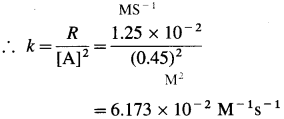
Maharashtra Board Class 12 Chemistry Solutions Chapter 6 Chemical Kinetics 50
Answer:
(a) Rate constant, k = 2.78 x 10⁻²
(b) Rate constant, k = 6.173 x 10⁻²

Maharashtra Board Class 12 Chemistry Important Questions Chapter 6 Chemical Kinetics

Question 24.
Define and explain the term elementary reaction.
Answer:
Many reactions take place in a series of steps. Such reactions are called complex reactions. Each step taking place in a complex reaction is called an elementary reaction. This shows that a complex reaction is broken down in a series of elementary chemical reactions.

By adding all the elementary steps of a complex reaction we get the overall reaction.

The mechanism of a reaction is decided from the sequence of the elementary steps that are added to give overall reaction.

Elementary reaction : It is defined as the reac­tion which takes place in a single step and cannot be divided further into simpler chemical reactions.

The order and molecularity of the elementary reaction are same.

Some reactions take place in one step and cannot be broken down into simpler reactions. For example,

C2H5I(g) → C2H4(g) + HI(g)
O3(g) → O2(g) + O(g)

Question 25.
Define and explain the term molecularity of a reaction. Give examples.
OR
Define the molecularity of a chemical reaction.
Answer:
Molecularity : The molecularity of an elementary reaction is defined as the number of molecules (or atoms or ions) which take part in a chemical reaction.

Explanation :

  • The molecularity of a reaction is always integral.
  • It cannot be determined experimentally.
  • The minimum value of the molecularity is one.
  • It cannot have fractional or zero values.
  • The reactions are classified according to the mole­cularity as follows :

(a) Unimolecular reaction (OR First order reac­tion) : In this only one molecule takes part in the reaction, e.g., N2O5(g) → 2NO2(g) + \(\frac{1}{2}\)O2(g)

The rate law expression for this reaction is, Rate = k [N2O5]. Hence it is unimolecular and first order.

Other unimolecular reactions are,
O3(g) → O2(g) + O(g)
C2H5I(g) → C2H2(g) + HI(g)

(B) Bimolecular reaction In this two molecules take part in the reaction,
e.g., 2HI(g) → H2(g) + I2(g)
O3(g) + O(g) → 2O2(g)
2NO2(g) → 2NO(g) + O2(g)

(c) Trimolecular reaction: In this three molecules take part in the reaction.
e.g., 2NO(g) + O2(g) → 2NO2(g)

The higher molecularity is rare since the prob ability of simultaneous collisions between more molecules is very low.

Question 26.
Explain order and molecularity of elementary reactions.
Answer:
(1) The order and molecularity of elementary reaction are same.
(2) Consider second order bimolecular reaction,
2NO2(g) → 2NO(g) + O2.
(3) The rate of the reaction is given by, Rate = k [NO2]2
(4) Similarly consider unimolecular first order reaction,
C2H5I(g) → C2H4(g) + HI(g)
Rate = k [C2H5I]

Maharashtra Board Class 12 Chemistry Important Questions Chapter 6 Chemical Kinetics

Question 27.
Define and explain the term rate-determining step.
Answer:
(1) Many chemical reactions take place in a series of elementary steps. Among many steps of the reaction, one of the steps is the slowest step compared to other steps.

Rate determining step : The slowest step in the reaction mechanism which involves many steps is called the rate-determining step.

(2) Example :
Consider decomposition of gaseous NO2Cl.
2NO2Cl(g) → 2NO2(g) + Cl2(g)
This reaction takes place in two steps :
Step I : \(\mathrm{NO}_{2} \mathrm{Cl}_{(g)} \stackrel{k_{1}}{\longrightarrow} \mathrm{NO}_{2(\mathrm{~g})}+\mathrm{Cl}_{(\mathrm{g})}\) (slow, unimolecular)

Step II: \(\mathrm{NO}_{2} \mathrm{Cl}_{(g)} \stackrel{k_{2}}{\longrightarrow} \mathrm{NO}_{2(\mathrm{~g})}+\mathrm{Cl}_{(\mathrm{g})}\) (fast, bimolecular)

2NO2CI(g) → 2NO2(g) + CI2(g) (overall reaction)

Among two steps, first step being slower represents rate-determining step. The rate law can be represented as, Rate = k1 [NO2CI]

Hence, the reaction is first order.

In this Cl(g) is formed as a reaction intermediate.

Question 28.
What are the features of rate-determining step?
Answer:
Features of rate-determining step :

  • The overall reaction can never occur faster than its rate-determining step.
  • The rate-determining step can occur anywhere in the reaction mechanism and depends on nature of reactants, conditions of the reaction, etc.
  • The rate law of a rate-determining step can directly be obtained from its stoichiometric equation.
  • The rate law of a rate-determining step can directly be obtained from its stoichiometric equation.

Question 29.
What is reaction intermediate? Explain with an example.
Answer:
Reaction intermediate : The additional species other than the reactants or products formed in the mechanism during progress of the reaction is called reaction intermediate.

Features of reaction intermediate :

  • The reaction intermediate appears in the reaction mechanism but does not appear in the overall reaction or in the products.
  • It is always formed in one step and consumed in the subsequent step in the mechanism.
  • Its concentration is very small and cannot be determined easily.
  • Rate of the reaction is independent of concentration of this intermediate.
  • The life period of the reaction intermediate is extremely small, hence cannot be isolated.
  • The composition of the reaction intermediate, decides the mechanism of the reaction.
  • Consider decomposition of gaseous NO2Cl. 2NO2Cl(g) → 2NO2(g) + Cl2(g)

This reaction takes place in two steps :
Step I : \(\mathrm{NO}_{2} \mathrm{Cl}_{(\mathrm{g})} \stackrel{k_{1}}{\longrightarrow} \mathrm{NO}_{2(\mathrm{~g})}+\mathrm{Cl}_{(\mathrm{g})}\) (slow, unimolecular)

Step II : \(\mathrm{NO}_{2} \mathrm{Cl}_{(\mathrm{g})}+\mathrm{Cl}_{(\mathrm{g})} \stackrel{k_{2}}{\longrightarrow} \mathrm{NO}_{2(\mathrm{~g})}+\mathrm{Cl}_{2(\mathrm{~g})}\) (fast, bimolecular)
2NO2Cl(g) → 2NO2(g) + Cl2(g) (overall reaction)
Cl formed in Step I is removed in Step II, Hence Cl is a reaction intermediate.

Question 30.
Identify the molecularity and write the rate law for each of the following elementary reactions :
(a) NO(g) + O3(g) → NO3(g) + O(g)
(b) H2I(g) + I(g) → 2HI(g)
(c) CI(g) + Cl(g) + N2(g) → N2(g)
Answer:
NO(g) + O3(g) → NO3(g) + O(g) Molecularity is 2.
Rate law : Rate = k [NO] x [O3]

(b) H2I(g) + I(g) → 2HI(g) Molecularity is 2.
Rate law : Rate = k [H2I] x [I]

(c) Cl(g) + Cl(g) + N2(g) →Cl2(g) + N2(g) Molecularity is 3.
Rate law : Rate = k [Cl]2

Maharashtra Board Class 12 Chemistry Important Questions Chapter 6 Chemical Kinetics

Question 31.
Write molecularity of the following reaction:
2NO(g) + O2(g) → 2NO2(g).
Answer:
For the reaction, 2NO(g) + O2(g) → 2NO2(g) Molecularity = 3.

Question 32.
How Is reaction intermediate predicted in the reaction?
Answer:
(1) When a reaction takes place in more than one steps, then a substance produced in one step is removed in the next step is called reaction intermediate.
(2) For example,
(I) NO(g) + O3(g) → NO3(g) + O(g)
(ii) NO3(g) + O(g) → NO2(g) + O(g)
In the reaction. NO3 and O are reaction intermediates.

Question 33.
A certain reaction occurs in the following steps :
(i) Cl(g) + O3(g) → ClO(g) + O2(g)
(ii) ClO(g) + O(g) → Cl(g) + O2(g)
(a) Write the chemical equation for overall reaction.
(b) Identify the reaction intermediate.
(c) Identify the catalyst.
(d) What is the molecularity of each step?
Answer:
Step I : Cl(g) + O3(g) → ClO(g) + O2(g)
Step II : ClO(g) + O(g) → Cl(g) + O2(g)
(a) Overall reaction is obtained by adding both the reactions.
O3(g) + O(g) → 2O2(g)
(b) Reaction intermediate is ClO(g) which is formed in the first step and removed in the second step.
(c) Cl(g) acts as a catalyst. It is an example of homo-geneous catalysis in which catalyst Cl(g) forms an intermediate ClO(g) and again is released in the second step.
(d) Since both the steps involve two reactants each, both the steps are bimolecular.

Question 34.
The rate law for the reaction 2H2(g) + 2NO(g) → N2(g) + 2H2O(g) is given by rate = k [H2] [NO]2.
The reaction occurs in the following two steps :
(i) H2(g) + 2NO(g) → N2O(g) + H2O(g)
(ii) N2O(g) + H2(g) → N2(g) + H2O(g)
What is the role of N2O in the mechanism? What is the molecularity of each of the elementary steps?
Answer:
N2O is a reaction intermediate which is formed in the first step and removed in the second step. Molecularity of the elementary steps :
(a) First step – Termolecular.
(b) Second step-Bimolecular.

Question 35.
What is the rate law for the reaction,
NO2(g) + CO(g) → NO(g) + CO2(g)
The reaction occurs in the following steps :
NO2 + NO2 → NO3 + NO (slow)
NO3 + CO → NO2 + CO2 (fast)
What is the role of NO3?
Answer:
Overall reaction :
NO2(g) + CO(g) → NO(g) + CO2(g)
Step-I NO2 + NO2 → NO3 + NO (slow) (slow)
Step-II NO3 + CO → NO2 + CO2 (fast)

(A) From first rate determining slow step, rate law is, Rate = k[NO2]2
(B) Role of NO3 : In the reaction, NO3 is the reaction intermediate which is formed in first step and removed in the second step.

Maharashtra Board Class 12 Chemistry Important Questions Chapter 6 Chemical Kinetics

Question 36.
The rate law for the reaction 2NO(g) + Cl2(g) → 2NOCl(g) is given by rate = k[NO][Cl2]. The reaction occurs in the following steps :
(i) NO(g) + Cl2(g) → NOCl2(g)
(ii) NOCl2(g) + NO(g) → 2NOCl(g)
(a) Is NOCl2 a catalyst or reaction intermedi-ate? Why?
(b) Identify the rate determining step.
Answer:
(a) NOCl2 is a reaction intermediate since it is formed in the first step and removed in the second step. It is not a catalyst since it was not present in the first step or on reactant side nor in the second step on product side.
(b) Since rate law is, Rate = k[NO][Cl2], and the sub-stances NO and Cl2 are present in the first step as reactants, it is the slow and rate-determining step.

Question 37.
The rate law for the reaction 2H2(g) + 2NO(g) → N2(g) + 2H2O(g) is given by rate = k[H2][NO]2. The reaction occurs in the following steps :
(i) H2 + 2NO → N2O + H2O
(ii) N2O + H2 → N2 + H2O
What is the role of N2O in the mechanism? Identify the slow step.
Answer:
(a) N2O is the reaction intermediate since it is formed in the first step and removed in the second step.
(b) By rate law, Rate = k [H2][NO]2. Since the first step involves the substances H2 and NO, it is the slow and rate-determining step.

Question 38.
What are integrated rate laws?
Answer:
Integrated rate laws : The equations which are obtained by integrating the differential rate laws (expressions) and which provide direct relationship between the concentrations of the reactants and time are called integrated rate laws.

For example, integrated rate law for first order reaction is represented as,
\(k=\frac{2.303}{t} \log _{10} \frac{[\text { Reactant }]_{\text {final }}}{[\text { Reactant }]_{\text {initial }}}\)

Question 39.
Derive the expression for integrated rate law (equation) for the first-order reaction.
Answer:
Consider the following first-order reaction, A → B The rate of the chemical reaction is given by the rate law expression as, Rate, R = k [A] where [A] is the concentration of the reactant A and k is the velocity constant or specific rate of the reaction.
The instantaneous rate is given by,
Maharashtra Board Class 12 Chemistry Solutions Chapter 6 Chemical Kinetics 52

If [A0] is the initial concentration of the reactant and [A]t at time t, then by integrating the above equation,
Maharashtra Board Class 12 Chemistry Solutions Chapter 6 Chemical Kinetics 53

This is the integrated rate equation for the first order reaction. This is also called integrated rate law.

Question 40.
How is the integrated rate equation for the first order reaction represented by considering the concentration of the product?
Answer: The
integrated rate equation for the first order reaction can be represented as,
\(k=\frac{2.303}{t} \log _{10} \frac{[\mathrm{A}]_{0}}{[\mathrm{~A}]_{t}}\) where [A]0 is the initial concentration of the reactant (at time, 1 = 0) and [A]t is that at time t. Consider the reaction, A → B
Maharashtra Board Class 12 Chemistry Solutions Chapter 6 Chemical Kinetics 54

If a is the initial concentration of the reactant A and x is the concentration of the product B after time t, then
Maharashtra Board Class 12 Chemistry Solutions Chapter 6 Chemical Kinetics 55

Maharashtra Board Class 12 Chemistry Important Questions Chapter 6 Chemical Kinetics

Question 41.
Explain the exponential rate law expression for the first order reaction.
Answer:
The integrated rate equation for the first order reaction can be represented as,
\(k=\frac{1}{t} \log _{\mathrm{e}} \frac{[\mathrm{A}]_{0}}{[\mathrm{~A}]_{t}}\)
where k is a rate constant, [A]0 and [A]t are initial and final concentrations of the reactant after time t.
∴ k = \(-\frac{1}{t} \log _{\mathrm{e}} \frac{[\mathrm{A}]_{t}}{[\mathrm{~A}]_{0}}\)
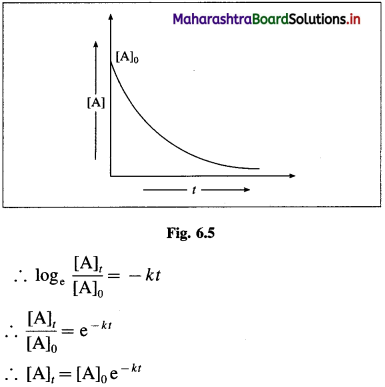
Maharashtra Board Class 12 Chemistry Solutions Chapter 6 Chemical Kinetics 56
where [A]0 and [A]t are the concentrations of the reactant when t = 0 and t = t respectively.

Thus, the concentration of the reactant decreases exponentially with time and the time required to complete the first order reaction will be infinity.

Another feature of the exponential behaviour is the time required to complete a definite fraction of the reaction is always constant. Therefore, the first order reactions are also described in terms of the half-life of the reaction ™.

Question 42.
What are the units of rate constant of first order reaction?
Answer:
The units of rate constant (k) for the first order reaction is per time (or s-1).

Question 43.
Give three examples of first order reaction.
Answer:
The examples of first order reaction are :
(1) Decomposition of H2O2 :
2H2O2(I) → 2H2O(1) + O2(g) Rate = k[H2O2]
(2) Decomposition of N2Os :
2N2O5(g) → 4NO2(g) + O2(g) Rate = k[N2O5]
(3) Isomerisation of cyclopropane to propene :
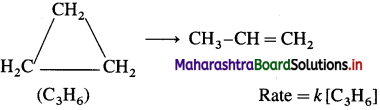
Maharashtra Board Class 12 Chemistry Solutions Chapter 6 Chemical Kinetics 67

Question 44.
Write a note on a zero order reaction.
OR
What is a zero order reaction? Explain.
Answer:
(1) Definition : Zero order reaction : A reaction in which the rate of the reaction does not depend on the concentration of any reactant taking part in the reaction is called zero order reaction.
(2) Explanation : For example, consider photochemical reaction between H2 and Cl2 gases.
Maharashtra Board Class 12 Chemistry Solutions Chapter 6 Chemical Kinetics 72
In this the rate of the reaction remains constant throughout the progress of the reaction, even if the concentrations of the reactants decrease with time, until the reactant has reacted entirely.

Hence, by the rate law,
R = k [H2]° [Cl2]° = k (constant).

Question 45.
Derive the expression for integrated rate law for zero-order reaction A → Products.
Answer:
Consider a zero order reaction, A → Products
The rate of the reaction is, Rate \(=\frac{-d[\mathrm{~A}]}{d t}\)

By rate law,
Rate = k x [A]0 = k
∴ – d[A] = k x dt

If [A]0 is the initial concentration of the reactant A at t = 0 and [A]t is the concentration of A present after time t, then by integrating above equation,
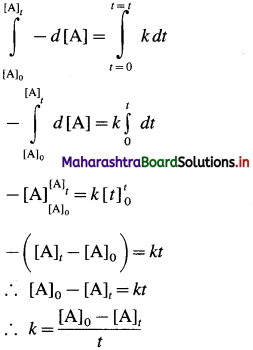
Maharashtra Board Class 12 Chemistry Solutions Chapter 6 Chemical Kinetics 73
This is the integrated rate law expression for rate constant for zero order reaction.
∴ k x t = [A]0 – [A]t
∴ [A]t = – kt + A0

Maharashtra Board Class 12 Chemistry Important Questions Chapter 6 Chemical Kinetics

Question 46.
How would you obtain the unit of the velocity constant k for (i) the first order reaction (ii) the zero order reaction?
Answer:
(i) For a first order reaction :
Consider the reaction,
A → B
The rate (R) of the reaction will be, R = k [A] = kc, where [A] is concentration in mol dm-3Maharashtra Board Class 12 Chemistry Solutions Chapter 6 Chemical Kinetics 74
Hence, the SI unit of velocity constant for the first order reaction is second-1.

(ii) For a zero order reaction :
The rate of reaction is R = k [A]0 = k
Hence, the velocity constant k has the unit of the rate of the reaction, i.e., mol dm-3 s-1.

Question 47.
Obtain an expression for half-life period of zero order reaction.
Answer:
The rate law expression for zero order reaction is, [A]t = – kt + [A]0
where [A]0 and [A]t are the concentrations of the reactant at time, t = 0 and after time t respectively, Half-life period, t1/2 is the time when the concentration reduces from [A]0 to [A]0/2. i.e., at t = t1/2, [A]t = [A]0/2.
Maharashtra Board Class 12 Chemistry Solutions Chapter 6 Chemical Kinetics 75
Hence for a zero-order reaction, the half-life period is directly proportional to the initial concentration of the reactant.

Question 48.
Give the examples of zero order reactions.
Answer:
Zero order reactions are not common. They take place under special conditions. They are hetero-geneous catalysed reactions generally involving metals as catalysts.

(1) Decomposition NH3 on Pt surface :

Maharashtra Board Class 12 Chemistry Solutions Chapter 6 Chemical Kinetics 79
(2) Decomposition of N2O to N2 and O2 on Pt :
Maharashtra Board Class 12 Chemistry Solutions Chapter 6 Chemical Kinetics 80
(3) Decomposition of PH3 on hot tungsten catalyst at high pressure.

Question 49.
Decomposition of NH3(g) on platinum surface at high temperature is a zero order reaction. Explain.
Answer:

  • The decomposition of NH3(g) on platinum surface is represented as,
    2NH3(g) \(\frac{1130 \mathrm{~K}}{\mathrm{Pt}}\) N2(g) + 3H2(g)
  • Since it is a heterogeneous catalysed reaction, NH3 gaseous molecules at high pressure are adsorbed on the metal surface covering the surface area.
  • The number of NH3 molecules adsorbed is small compared to NH3 molecules in the gaseous phase.
  • Only the molecules adsorbed on the surface get decomposed. Hence rate of the decomposition becomes independent of the concentration (pressure) of NH3. Therefore the decomposition reaction is zero order.

Question 50.
The catalysed decomposition of nitrous oxide (N2O) to nitrogen and oxygen is a zero order reaction. Explain.
Answer:

  • The decomposition of N2O(g) on platinum can be represented as, \(2 \mathrm{~N}_{2} \mathrm{O}_{(\mathrm{g})} \stackrel{\mathrm{Pt}}{\longrightarrow} 2 \mathrm{~N}_{2(\mathrm{~g})}+\mathrm{O}_{2(\mathrm{~g})}\)
  • Since it is heterogeneously catalysed reaction, N2O gaseous molecules are adsorbed on the metal surface covering the surface area.
  • The number of N2O molecules adsorbed is small compared to N2O molecules in the gaseous phase.
  • Only the molecules adsorbed on the metal surface get decomposed. Hence rate of decomposition becomes independent of the concentration (pressure) of N2O. Therefore the decomposition of N2O is a zero order reaction.

Maharashtra Board Class 12 Chemistry Important Questions Chapter 6 Chemical Kinetics

Question 51.
Inversion of cane sugar (sucrose) is a pseudo-first-order reaction. Explain.
OR
The reaction,
Maharashtra Board Class 12 Chemistry Solutions Chapter 6 Chemical Kinetics 82
Can it be of pseudo-first-order type?
Answer:
The inversion of cane sugar (sucrose) is an acid catalysed hydrolysis reaction which can be represented as,

Maharashtra Board Class 12 Chemistry Solutions Chapter 6 Chemical Kinetics 83

This is a bimolecular reaction. Hence, the true rate law for the reaction should be, Rate = k[C12H22O11] [H2O]. This shows that the reaction should be second order.

Since water (H2O) is in large excess, its concentration remains constant and the rate depends only upon the concentration of cane sugar.

∴ Rate = k[C12H22O11]

Therefore the second order true rate law becomes first order rate law. Hence the inversion of cane sugar is a pseudo first order reaction.

Solved Examples 6.4-6.5

Question 52.
Solve the following :

(1) For the reaction 2A + B → products, find the rate law from the following data :

[A]/M [B]/M rate/Ms-1
0.3 0.05 0.15
0.6 0.05 0.30
0.6 0.2 1.20

Solution:
In steps (i) and (ii), the concentration of A is doubled but the concentration of B remains constant. Since the rate is doubled the rate is proportional to the concentration of A or R α [A] and hence with respect to A order of the reaction is 1 or nA = 1.

In steps (ii) and (iii), the concentration of A is kept constant but the concentration of B is increased 4 times and rate of the reaction is increased 4 times. Hence the rate of reaction is proportional to concentration of B, R α [B] and hence with respect of B, order is 1 or nB = 1. Hence rate law will be, Rate = k [A] x [B].

(2) In a first order reaction A → product, 80 % of the given sample of compound decomposes in 40 min. What is the half life period of the reaction ?
Solution :
Maharashtra Board Class 12 Chemistry Solutions Chapter 6 Chemical Kinetics 91
Answer:
Half life period = 17.22 min

(3) The reaction A + B → products is first order in each of the reactants.
(a) How does the rate of reaction change if the concentration of A is increased by factor 3?
(b) What is the change in the rate of reaction if the concentration of A is halved and concen­tration of B is doubled?
Solution :
Maharashtra Board Class 12 Chemistry Solutions Chapter 6 Chemical Kinetics 92
Hence the rate remains the same.
Answer:
(a) The rate increases by factor 3.
(b) The rate remains the same.

Maharashtra Board Class 12 Chemistry Important Questions Chapter 6 Chemical Kinetics

(4) Half-life period of a first order reaction is 41.09 min. Calculate rate constant in per second.
Solution :
Given : Half-life period = t1/2
= 41.09 min = 41.09 x 60 s
= 2.465 x 10³s
Rate constant = k = ?
For a first order reaction,
\(\begin{aligned}
k &=\frac{0.693}{t_{1 / 2}} \\
&=\frac{0.693}{2.465 \times 10^{3}}
\end{aligned}\)
= 2.81 x 10⁻⁴ s-1
Answer:
Rate constant = k = 2.81 x 10⁻⁴ s-1

(5) A first order reaction takes 15 minutes to com­plete 25%. How much will it take to complete 65 %?
Solution:
(i) Given : For 25% completion, t1 = 15 min.
For 35 % completion, t2 = ?
Maharashtra Board Class 12 Chemistry Solutions Chapter 6 Chemical Kinetics 94
Answer:
Time required to complete 65 % reaction = 547 min

(6) Gaseous A2 dissociates as, A2(g) → 2A(g). Initial pressure of A2 is 0.8 atm. After 20 minutes the pressure is 1.1 atm. Calculate rate constant and half-life period for the reaction.
Solution :
Given : [A]0 = Initial pressure = P0 = 0.8 atm
Final pressure = Total pressure = PT = 1.1 atm
Rate constant = k = ?
Half life period = t1/2 = ?
A2(g) → 2A(g)
P0 – x 2x
Pressure of A2 = Pt = P0 – x
Total pressure of the mixture,
PT = P0 – x + 2x = P0 + x
∴ x = PT – P0
∴ Pt = P0 – X = P0 – (PT – P0) – 2P0 – PT
\(k=\frac{2.303}{t} \log _{10} \frac{[\mathrm{A}]_{0}}{[\mathrm{~A}]_{t}}\)
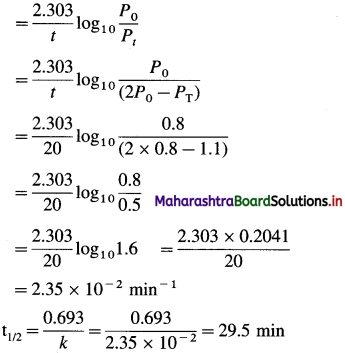
Maharashtra Board Class 12 Chemistry Solutions Chapter 6 Chemical Kinetics 95
Answer:
Rate constant = k = 2.35 x 10⁻² min-1
Half-life period = t1/2 = 29.5 min

Maharashtra Board Class 12 Chemistry Important Questions Chapter 6 Chemical Kinetics

(7) The decomposition of N2O5(g) at 320 K according to the following equation follows first order reaction :
N2O5(g) → 2NO2(g) + \(\frac{1}{2}\)O2(g)
The initial concentration of N2O5(g) is 1-24 x 10-2 mol. L-1 and after 60 minutes,
0.20 x 10⁻² mol. L-1. Calculate the rate con­stant of the reaction at 320 K.
Solution :
Given :
Initial concentration
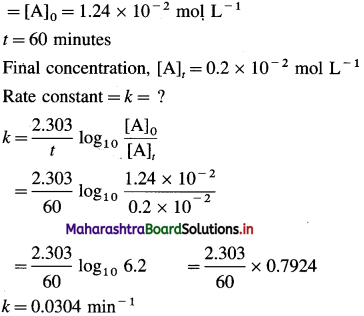
Maharashtra Board Class 12 Chemistry Solutions Chapter 6 Chemical Kinetics 96

(8) From the following data for the liquid phase reaction A → B, determine the order of reaction and calculate its rate constant:

t/s 0 600 1200 1800
[A]/Mol L-1 0.624 0.446 0.318 0.226

Solution:
Maharashtra Board Class 12 Chemistry Solutions Chapter 6 Chemical Kinetics 97
Answer:
Rate constant = k = 5.618 x 10⁻⁴ s-1

(9) The concentration of a reactant in a first-order reaction A → products, varies with time as follows :

t/min 0 10 20 30 40
[AJ/M 0.0800 0.0536 0.0359 0.0241 0.0161

Show that the reaction is first order.
Solution :
Given : A → Products
[A]0 = 0.08 M
Maharashtra Board Class 12 Chemistry Solutions Chapter 6 Chemical Kinetics 98
Since all the values of rate constant using first order rate law equation come constant, the reaction is of first order.
Answer:
Order of the reaction is one.

Maharashtra Board Class 12 Chemistry Important Questions Chapter 6 Chemical Kinetics

(10) In a first order reaction x → y, 40% of the given sample of compound remains unreacted in 45 minutes. Calculate rate constant of the reac­tion.
Solution :
Maharashtra Board Class 12 Chemistry Solutions Chapter 6 Chemical Kinetics 99
Answer:
k = 0.02036 min-1

(11) If the half-life period of a zero order reaction with initial concentration 0.1 M is 21.3 min, what will be the half-life when the concentration is 0.3 M?
Solution :
Given : Reaction is zero order. t1/2 = 21.3, when
initial concentration = [A]1 x = 0.1 M t1/2 = 2 when
initial concentration = [A]2 = 0.3 M
For zero order reaction, t1/2 = \(\frac{[\mathrm{A}]_{0}}{2 k}\)
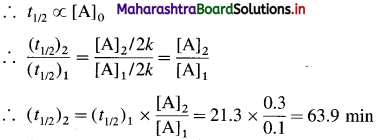
Maharashtra Board Class 12 Chemistry Solutions Chapter 6 Chemical Kinetics 100
Answer:
Half life period = 63.9 min

(12) Consider the reaction 2A + 2B → 2C + D.
From the following data, calculate the order and rate constant of the reaction.

[A]0/M [B]0/M r0/Ms_1
0.488 0.160 0.24
0.244 0.160 0.06
0.244 0.320 0.12

Write the rate law of the reaction.
Solution :
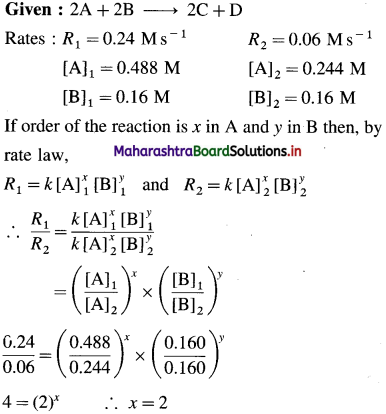
Maharashtra Board Class 12 Chemistry Solutions Chapter 6 Chemical Kinetics 101

Hence the reaction is 2nd order in A.
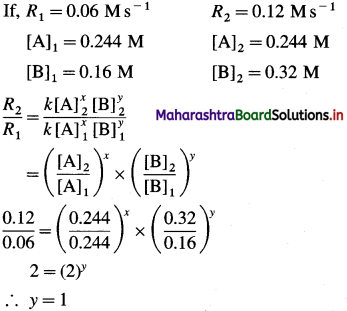
Maharashtra Board Class 12 Chemistry Solutions Chapter 6 Chemical Kinetics 102
Hence the reaction is first order in B.
The order of overall reaction = n = nA + nB = 2 + 1 = 3
By rate law,
Rate = R = k[A]2[B]
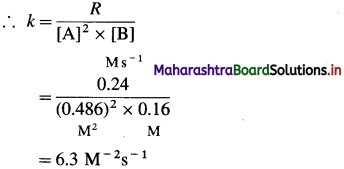
Maharashtra Board Class 12 Chemistry Solutions Chapter 6 Chemical Kinetics 103
Answer:
(i) Order of reaction = 3
(ii) Rate constant = k = 63M-2s-1
(iii) Rate law : Rate = k [A]2 [B]

Maharashtra Board Class 12 Chemistry Important Questions Chapter 6 Chemical Kinetics

(20) In acidic solution, sucrose is converted to a mixture of glucose and fructose in pseudo first order reaction. It has been found that the con-centration of sucrose decreased from 20 mmol L-1 to 8 mmol L-1 in 38 minutes. What is the half-life of the reaction?
Solution :
Given :
Initial concentration = [A]0 = [sucrose]0
= 20 mmol L-1
= 20 x 10-3 mol L-1

Final concentration = [A]t = [sucrose]t
= 8 mmol L-1
= 8 x 10⁻³ mol L-3
time = t = 38 min
Half-life period = t1/2 =?
For first order reaction,
Maharashtra Board Class 12 Chemistry Solutions Chapter 6 Chemical Kinetics 106
Answer:
Half-life period = t1/2 = 28.74 min

(21) The half-life of a first order reaction is 1.7 hours. How long will it take for 20 % of the reactant to disappear?
Solution :
Given : Half-life period = t1/2 = 1.7 hrs.
Maharashtra Board Class 12 Chemistry Solutions Chapter 6 Chemical Kinetics 107
Maharashtra Board Class 12 Chemistry Solutions Chapter 6 Chemical Kinetics 108
Answer:
Time required for 20% reaction = 32.86 min

(22) The gaseous reaction A2 → 2A is first order in A2. After 12.3 minutes, 65% of A2 remains un­decomposed. How long will it take to decompose 90% of A2? What is the half-life of the reaction?
Solution :
Given : A2 → 2A
t1 = 12.3 min
[A]0 = 100, [A], = 65
t2 = ? for 90 % decomposition Half-life period = t1/2 = ?
Maharashtra Board Class 12 Chemistry Solutions Chapter 6 Chemical Kinetics 109
Answer:
(i) Time required for 90% reaction = 65.8 min
(ii) Half-life periods = t1/2 = 19.8 min

Maharashtra Board Class 12 Chemistry Important Questions Chapter 6 Chemical Kinetics

(23) Sucrose decomposes in acid solution to give glucose and fructose according to the first-order rate law. The half-life of the rection is 3 hours. Calculate the fraction of sucrose which will remain after 8 hours.
Solution :
Given : Half-life period = t1/2 = 3 hrs
Time = t = 8 hrs
Maharashtra Board Class 12 Chemistry Solutions Chapter 6 Chemical Kinetics 110
Answer:
Fraction of sucrose left = 0.1576

(24) The rate constant of a first order reaction is 6.8 x 10⁻⁴ s-1. If the initial concentration of the reactant is 0.04 M, what is its molarity after 20 minutes? How long will it take for 25% of the reactant to react?
Solution :
Given : Rate constant = k = 6.8 x 10⁻⁴s-1
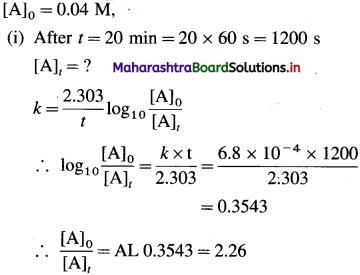
Maharashtra Board Class 12 Chemistry Solutions Chapter 6 Chemical Kinetics 111
Maharashtra Board Class 12 Chemistry Solutions Chapter 6 Chemical Kinetics 112
Answer:
(i) Molarity of reactant after 20 min = 0.0177 M
(ii) Time for 25 % of the reaction = 7.05 min

Maharashtra Board Class 12 Chemistry Important Questions Chapter 6 Chemical Kinetics

(25) The rate constant of a certain first-order reaction is 3.12 x 10⁻³ min-1,
(a) How many minutes does it take for the reactant concentra­tion to drop to 0.02 M if the initial concentration of the reactant is 0.045 M?
(b) What is the molarity of the reactant after 1.5 hr?
Solution :
Given : Rate constant = k = 3.12 x 10⁻³ min-1
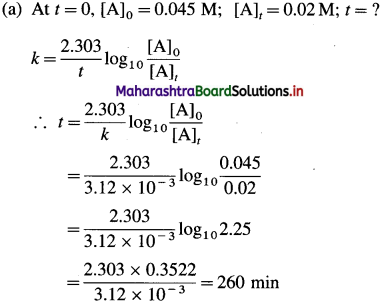
Maharashtra Board Class 12 Chemistry Solutions Chapter 6 Chemical Kinetics 113
Maharashtra Board Class 12 Chemistry Solutions Chapter 6 Chemical Kinetics 114
Answer:
(i) Time required to drop the concentration to 0.02 M = 260 min
(ii) Molarity after 1.5 hr = 0.034 M

(26) From the following data for the decomposition of azoisopropane,
(CH32)2 CHN = NCH(CH3)2 → N2 + C6H14 estimate the rate of the reaction when total pressure is 0.75 stm.

Time/s Total pressure/atm
0 0.65
200 1.0

Solution :
Given :
(CH3)2CHN = NCH(CH3)2(g) → N2(g) + C6H14(g)
At time t P0 – x x x
At t = 0, [A]0 = P0 = 0.65 atm
At t = 200 s,
Total pressure = PT = 0.75 atm, Rate =?
From the reaction,
Maharashtra Board Class 12 Chemistry Solutions Chapter 6 Chemical Kinetics 115
Maharashtra Board Class 12 Chemistry Solutions Chapter 6 Chemical Kinetics 116
Answer:
Rate of the reaction = 2.13 x 10⁻³ atm s-1

Maharashtra Board Class 12 Chemistry Important Questions Chapter 6 Chemical Kinetics

(27) The rate constant for a zero order reaction is 0.04 Ms-1. Calculate the half-life period of the reaction, when the initial concentration of the reactant is 0.01 M.
Solution :
Given : Order of the reaction = 0
Rate constant = k = 0.04 Ms-1
Concentration = [A]0 = 0.01 M
Half-life period = t1/2 =?
For zero order reaction,
\(t_{1 / 2}=\frac{[\mathrm{A}]_{0}}{2 k}=\frac{0.01}{0.04}=0.25 \mathrm{~s}\)
Answer:
Half-life period = t1/2 = 0.25 s

(28) A flask contains a mixture of A and B. Both the compounds decompose by first order kinetics. The half-lives are 60 min for A and 15 min for B. If the initial concentrations of A and B are equal, how long will it take for the concentration of A to be three times that of B?
Solution :
Given :
For A : tm = 60 min For B : t1/2 = 15 min
Let initial concentrations of
[A]0 = [B]0 = M mol dm-3
After time t, let the concentrations be, [B]t = x, then [A]t = 3x
Maharashtra Board Class 12 Chemistry Solutions Chapter 6 Chemical Kinetics 117
Answer:
After 31.8 min, concentration of A will be three time that of B. ‘

Question 53.
Obtain Arrhenius equation from collision theory of bimolecular reactions.
Answer:
Consider a bimolecular reaction,
A – B + C → A + B – C
(i) Collisions of reactant molecules : The basic
requirement for a reaction to occur is reacting species A – B and C must come together and collide. The rate of reaction will depend on the rate and frequency of collisions between them. As the i concentration and temperature increase, rate of collisions increases, hence the rate of reaction increases. But the rate of reaction is low as com-pared to the rate of collisions.

(ii) Energy of activation : For fruitful collisions, the colliding molecules must possess a certain amount of energy called activation energy Ea. Due to collisions between A – B and C, there is a change in electron distribution about three nuclei namely A, B and C so that old A – B bond is weakened while new bond is partially formed between B and C, and results in the formation of an activated complex or a transition state.
Maharashtra Board Class 12 Chemistry Solutions Chapter 6 Chemical Kinetics 119

Therefore transition state always has higher energy than reactants or products. Due to high energy, activated complex is unstable, short lived and decomposes into the products.

To form activated complex, the reactant mol-ecules have to climb the potential energy barrier i. e., activation energy level, hence molecular collision energy of colliding molecules must be high so that reactant molecules form activated complex and further decompose into products.

The fraction (f) of molecules at temperature T having activation energy Ea is given by f = e-Ea/RT.

If P represents the probability of Z collisions with proper orientation then,
Reaction rate = P x Z x e-Ea/RT,

Hence the rate constant k of the reaction may be represented as, k = A x e-Ea/RT where A is called frequency factor or pre-exponential factor and ΔH is the enthalpy change of the reaction. This equation is called Arrhenius equation.

Maharashtra Board Class 12 Chemistry Important Questions Chapter 6 Chemical Kinetics

Question 54.
Define :
(i) Transition state or activated complex.
Answer:
Transition state or activated complex : The configuration of atoms formed from reactant molecules and which is at the peak of barrier in energy profile diagram having maximum potential energy compared to reactants and products is called transition state or activated complex.

Question 55.
If a gaseous reaction has activation energy 75k J mol-1 at 298 K, find the fraction of successful collisions.
Answer:
Activation energy = Ea = 75 kJ mol-1 = 75000 mol-1; Temperature = T = 298 K The fraction (f) of successful collisions between the molecules with an energy equal to Ea is given by,
Maharashtra Board Class 12 Chemistry Solutions Chapter 6 Chemical Kinetics 120
Maharashtra Board Class 12 Chemistry Solutions Chapter 6 Chemical Kinetics 121
This shows that only 7 collisions out of 1014 collisions are sufficiently energetic to convert reactants into products.

Question 56.
Draw energy profile diagram and show
(i) Activated complex
(ii) Energy of activation for forward reaction
(iii) Energy of activation for backward reaction
(iv) Heat of reaction.
Answer:
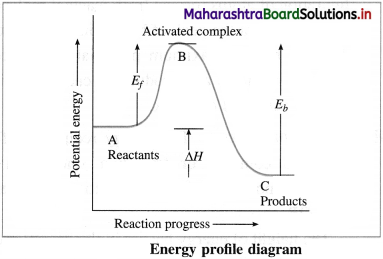
Maharashtra Board Class 12 Chemistry Solutions Chapter 6 Chemical Kinetics 122
(i) B → Activated complex
(ii) Ef → Energy of activation for forward reaction
(iii) Eb → Energy of activation for backward reaction
(iv) ΔH → Heat of reaction.

Question 57.
Obtain Arrhenius equation, k = A x e-Ea/RT
Answer:
(i) From experimental observations of variation in rate constants with temperature, Arrhenius developed a mathematical equation between reaction rate con­stant (k), activation energy (Ea) and temperature T.
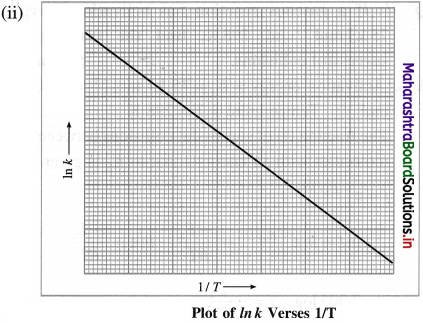
Maharashtra Board Class 12 Chemistry Solutions Chapter 6 Chemical Kinetics 123

When a graph of Ink is plotted against reciprocal of temperature (1/T) a straight line with a negative slope is obtained. This is described by a mathematical equation as,
Maharashtra Board Class 12 Chemistry Solutions Chapter 6 Chemical Kinetics 124

Maharashtra Board Class 12 Chemistry Important Questions Chapter 6 Chemical Kinetics

where k is a rate constant, R is the gas constant, E.a is activation energy, T is absolute temperature and the parameter A is called frequency factor or preexponential factor. This is Arrhenius equation.

Question 58.
What is a frequency factor or pre-exponential factor?
Answer:
In Arrhenius equation, k=A x e-Ea/RT the factor A is called frequency factor and since it is a coefficient of exponential expression, e~Ea/RT it is also called a pre-exponential factor.

In the above equation k is a rate constant at temperature T, Ea is the energy of activation and R is a gas constant.

A is related to frequency of collisions (Z) or rate of collisions. It is represented as, A = P x Z where P is the probability of collisions with proper orientations and Z is the frequency of collisions of reacting molecules.

The units of A are same as that of k.

Question 59.
Obtain a relation, \(\log _{10} \frac{k_{2}}{k_{1}}=\frac{E_{\mathrm{a}}\left(T_{2}-T_{1}\right)}{2.303 R \times T_{1} \times T_{2}}\),
OR
Obtain a relation showing variation in rate constant with temperature.
Answer:
By arrhenius equation, the rate constant k of the reaction at a temperature T is represented as, k = A x e-Ea/RT where A is a frequency factor, R is a gas constant and Ed is the energy of activation.

By taking logarithm to the base e, we get,
Maharashtra Board Class 12 Chemistry Solutions Chapter 6 Chemical Kinetics 126

If kt and k2 are the rate constants at temperatures T1 and T2 respectively, then
Maharashtra Board Class 12 Chemistry Solutions Chapter 6 Chemical Kinetics 127
By measuring the rate constants k1 and k2 at two different temperatures T1 and T2, the energy of activation Ea of the reaction can be obtained.

Question 60.
How is the energy of activation determined from rate constants at two different temperatures?
Answer:
For the given reaction, rate constants k1 and k2 are measured at two different temperatures T1 and T2 respectively. Then \(\log _{10} \frac{k_{2}}{k_{1}}=\frac{E_{\mathrm{a}}\left(T_{2}-T_{1}\right)}{2.303 R \times T_{1} \times T_{2}}\) where Ea is the energy of activation.

Hence by substituting appropriate values, energy of activation Ea for the reaction is determined.

Question 61.
Obtain a relation, \(\frac{k_{2}}{k_{1}}=\frac{\left(t_{1 / 2}\right)_{2}}{\left(t_{1 / 2}\right)_{1}}\), where k1 and k2 are rate constants while (t1/2)1 and (t1/2)2 are halflife periods of the first order reaction at temperatures T1 and T2 respectively. Write the relation for activation energy.
Answer:
The rate constant k and half-life period t1/2 are related as
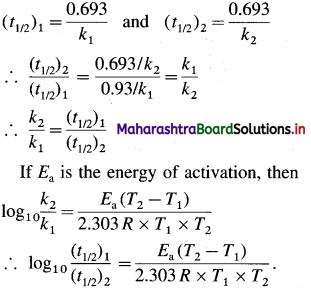
Maharashtra Board Class 12 Chemistry Solutions Chapter 6 Chemical Kinetics 129

Question 62.
How does a catalyst differ from reaction intermediate?
Answer:

  • A catalyst accelerates the rate of reaction, while reaction intermediate has no effect on the rate of the reaction.
  • The catalyst is always present at the start of the reaction whereas reaction intermediate is produced during the mechanism of the reaction.
  • A catalyst is consumed in one of the steps of mechanism and regenerated in a subsequent step while the reaction intermediate is formed in one step and consumed in subsequent step.
  • The catalyst is stable but the reaction intermediate is unstable and short lived.

Maharashtra Board Class 12 Chemistry Important Questions Chapter 6 Chemical Kinetics

Question 63.
How is lowering of activation energy in the presence of a catalyst obtained?
Answer:

  • In the presence of a catalyst, activation energy of a reaction is lowered, hence rate and rate constant increase.
  • If ΔEa is lowering of activation energy, while k1 and k2 are the rate constants of the reaction in the absence and presence of the catalyst respectively then,
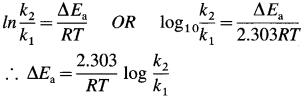
    Maharashtra Board Class 12 Chemistry Solutions Chapter 6 Chemical Kinetics 135

Question 64.
The rate constant of a reaction of 400 K is 1.35 x 10²s-1. When a nickel catalyst is used, the rate constant of the reaction becomes 3.8 x 10²s-1. Find activation energy. If the initial activation energy is 20 KJ, what will be activation energy in the presence of the catalyst?
Answer:
In the presence of a catalyst, the activation energy is lowered and rate constant is increased.
Maharashtra Board Class 12 Chemistry Solutions Chapter 6 Chemical Kinetics 136
The decrease activation energy of the reaction in the presence of a catalyst will be Ea = 20 – 3.446 = 16.554 kJ.

Solved Examples 6.6-6.7

Question 65.
Solve the following :

(1) Calculate activation energy for a reaction of which rate constant becomes four times when temperature changes from 30 °C to 50 °C. (Given : R = 8.314 K-1mol-1)
Solution :
Given : k2 = 4k1
T1 = 273 + 30 = 303 K
T2 = 273 + 50 = 323 K
Activation energy = Ea =?
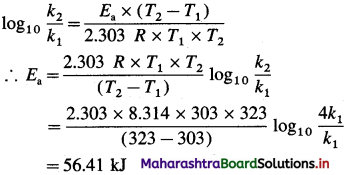
Maharashtra Board Class 12 Chemistry Solutions Chapter 6 Chemical Kinetics 141
Answer:
Activation energy = Ea = 56.41 kJ

(2) The rate constant of a first order reaction are 0.58 s-1 at 313 K and 0.045 s-1 at 293 K. What is the energy of activation for the reaction?
Solution :
Maharashtra Board Class 12 Chemistry Solutions Chapter 6 Chemical Kinetics 142
Answer:
Energy of activation = Ea = 97.46 kJ mol-1

Maharashtra Board Class 12 Chemistry Important Questions Chapter 6 Chemical Kinetics

(3) The energy of activation for a first order reaction is 104 kJ mol-1. The rate constant at 25°C is 3.7 x 10⁻⁵s-1. What is the rate constant at 30 °C?
Solution :
Given : Energy of activation = Ea = 104 kJ mol-1 = 104 x 103 mol-1
Initial rate constant – k1= 3.7 x 10⁻⁵ s-1
Initial temperature = T1 = 273 + 25 = 298 K
Final temperature = T2 = 273 + 30 = 303 K
Final rate constant = k2 =?
Maharashtra Board Class 12 Chemistry Solutions Chapter 6 Chemical Kinetics 143
Maharashtra Board Class 12 Chemistry Solutions Chapter 6 Chemical Kinetics 144
Answer:
Rate constant at 30 0C = 7.4 x 10⁻⁴ s-1

(4) What is the activation energy for a reaction whose rate constant doubles when temperature changes from 30 °C to 40 °C?
Solution :
Given :
Initial rate constant = k1
and final rate constant = k2; \(\frac{k_{2}}{k_{1}}\) = 2
Initial temperature = T1 = 273 + 30 = 303 K
Final temperature = T2 = 273 + 40 = 313 K
Energy of activation = Ea = ?
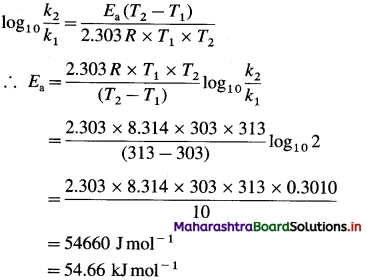
Maharashtra Board Class 12 Chemistry Solutions Chapter 6 Chemical Kinetics 145
Answer:
Activation energy = Ea = 54.66 kj mol-1

(5) The activation energy for a certain reaction is 334.4 kj mol-1. How many times larger is the rate constant at 610 K than the rate constant at 600 K?
Solution :
Given :
Activating energy = Ea = 334.4 kJ mol-1
= 334.4 x 10³ J mol-1
Initial temperature = T1 = 600 K
Final temperature = T2 = 610 K
Maharashtra Board Class 12 Chemistry Solutions Chapter 6 Chemical Kinetics 146
Maharashtra Board Class 12 Chemistry Solutions Chapter 6 Chemical Kinetics 147
Answer:
Rate constant increase three time.

Maharashtra Board Class 12 Chemistry Important Questions Chapter 6 Chemical Kinetics

(6) The rate of a reaction at 600 K is 7.5 x 10⁵ times the rate of the same reaction at 400 K. Calculate the energy of activation for the reaction. (Hint: The ratio of rates is equal to the ratio of rate constants.)
Solution :
Given : \(\frac{R_{2}}{R_{1}}\) = 7.5 x 10⁵.
From the hint, \(\frac{R_{2}}{R_{1}}=\frac{k_{2}}{k_{1}}\) = 7.5 x 10s
Initial temperature = T1 = 400 K
Final temperature = T2 = 600 K
Energy of activation = Ea = ?
Maharashtra Board Class 12 Chemistry Solutions Chapter 6 Chemical Kinetics 148
Answer:
Activation energy = Ea = 135 kj mol-1

(7) The rate constant of a first order reaction at 25 °C is 0.24 s’. If the energy of activation of the reaction is 88 kJmol-1, at what temperature would this reaction have rate constant of 4 x 10⁻²s-1?
Solution :
Given : k2 =0.24s-1; k2 =4 x 10⁻²s-1 T1 = 273 + 25 = 298 K
Energy of activation = Ea
= 88 kJ mol-1 = 88000 J mol-1
T2 = ?
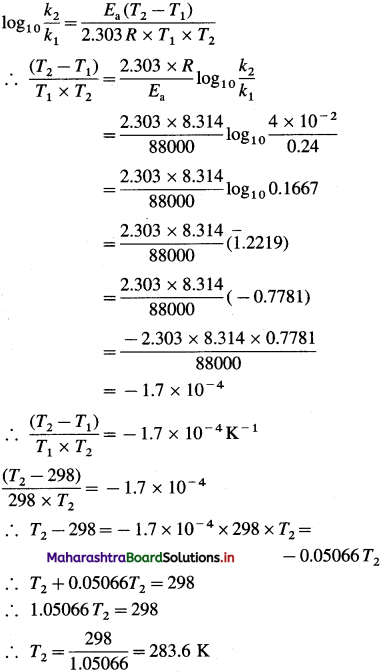
Maharashtra Board Class 12 Chemistry Solutions Chapter 6 Chemical Kinetics 149
Answer:
Temperature = 283.6 K

(8) The half-life of a first order reaction is 900 min at 820 K. Estimate its half-life at 720 K if the energy of activation ot the reaction is 250 kJ mol-1 (1.464 x 105 mm).
Solution:
Given: Initial half-life period = (t1/2)1 = 900 min
Energy of activation = 250 kJ mol-1
= 250 x 103 kJ mol-1
Initial temperature = T1 = 820 K
Final temperature = T2 = 720 K
Final half-life period = (t1/2)2 = ?
Maharashtra Board Class 12 Chemistry Solutions Chapter 6 Chemical Kinetics 150
Maharashtra Board Class 12 Chemistry Solutions Chapter 6 Chemical Kinetics 151
Answer:
Half-life period = 1.46 x 10⁵ min

Maharashtra Board Class 12 Chemistry Important Questions Chapter 6 Chemical Kinetics

(9) The rate of a gaseous reaction is 6.08 x 10⁻² Ms-1 at 50°C. What will be its rate at 60°C? Energy of activation of the reaction is 18.26 kj mol-1. (R = 8.314k-1 mol-1)
Solution :
Given : Initial rate = R1 = 6.08 x 10″2Ms-1
Energy of activation = Ea = 18.26 kJmol-1 = 18260 mol-1
Initial temperature = T1 = 273 + 50 = 323 K
Final temperature = T2 = 273 + 60 = 333 K
Final rate of the reaction = R2 = ?
Maharashtra Board Class 12 Chemistry Solutions Chapter 6 Chemical Kinetics 152
Answer:
Rate of reaction at 37°C = 7.46 x 10⁻² Ms-1

(10) A first order gas-phase reaction has an energy of activation of 240 kj mol-1. If the frequency factor of the reaction is 1.6 x 10¹³ s-1, calculate its rate constant at 600 K.
Solution :
Given : Energy of activation = Ea = 240 kJ mol-1 = 240 x 103 mol-1
Frequency factor = A = 1.6x 10¹³ s-1
Temperature = T= 600 K
Rate constant = k = ?
By Arrhenius equation,
Maharashtra Board Class 12 Chemistry Solutions Chapter 6 Chemical Kinetics 153
Answeer:
Rate constant = k = 2.01 x 10⁻⁸ s-1

(11) In the Arrhenius equation for a first order reaction, the values of ‘A’ and ‘Ea’ are 4 x 10¹³ sec-1 and 98.6 kJ mol-1 respectively. At what temperature will its half-life period be 10 minutes? [R = 8.314 JK-1 mol-2]
Solution :
Given
Maharashtra Board Class 12 Chemistry Solutions Chapter 6 Chemical Kinetics 154
= 311.3 K
Answer:
Temperature = T = 311.3 K

Maharashtra Board Class 12 Chemistry Important Questions Chapter 6 Chemical Kinetics

(12) The frequency factor for a second-order reaction is 4.83 x 10¹²M-1s-1 at 27°C. If the rate con­stant of the reaction is 1.37 x 10⁻³M-1s-1, find the energy of activation.
Solution :
Given : Frequency factor = A
= 4.83 x 10¹² M-1s-1
Rate constant = k= 1.37 x 10⁻³ M-1s-1
Temperature = T = 273 + 27 = 300 K
Energy of activation = Ea = ?
By Arrhenius equation,
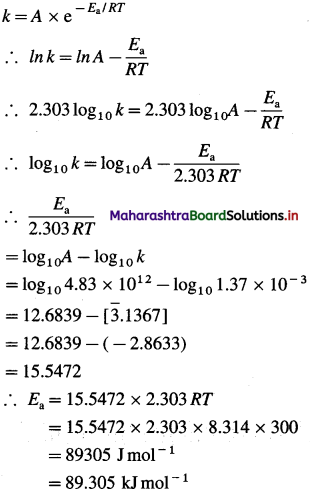
Maharashtra Board Class 12 Chemistry Solutions Chapter 6 Chemical Kinetics 155
Answer:
Energy of activation = Ea = 89.305 kJ mol1

(13) Rate constants (k) for a reaction were measured at different temperatures. When log10ft was plotted against 1/T, the slope of the graph was 3.28 x 10³. Calculate the energy of activation.
Solution :
Given : Slope of a graph = 3.28 x 10³
Activation energy = Ea = ?
From Arrhenius equation, k = A x e-Ea/RT
\(\log _{10} k=\frac{-E_{\mathrm{a}}}{2.303 R} \times \frac{1}{T}+\log _{10} A\)

The graph is a straight line with slope equal to Ea/2.303R
∴ \(\frac{E_{\mathrm{a}}}{2.303 R}\) = 3.28 x 10³
∴ Ea = 2.303/? x 3.28 x 103
= 2.303 x 8.314 x 3.28 x 103
= 62.8 x 10³ mol-1
= 62.8 kJ mol-1
Answer:
Activation energy = Ea = 62.8 kj mol-1

Multiple Choice Questions

Question 66.
Select and write the most appropriate answer from the given alternatives for each subquestion :

1. The rate of a reaction is expressed in the units
(a) L mol-1t-1
(b) mol dm-3 t-1
(c) Ms
(d) M-1s-1
Answer:
(b) mol dm-3 t-1

2. For a gaseous reaction the unit of rate of reaction is
(a) L atm s-1
(b) atm mol-1s-1
(c) atm s-1
(d) mol s
Answer:
(c) atm s-1

Maharashtra Board Class 12 Chemistry Important Questions Chapter 6 Chemical Kinetics

3. In the reaction A 4- 3B → 2C, the rate of formation of C is
(a) the same as rate of consumption of A
(b) the same as the rate of consumption of B
(c) twice the rate of consumption of A
(d) 3/2 times the rate of consumption of B
Answer:
(c) twice the rate of consumption of A

4. The units of rate of a reaction and rate constant are same for a reaction of order.
(a) zero
(b) one
(c) two
(d) fractional
Answer:
(a) zero

5. During the progress of a reaction, the rate constant of a reaction
(a) increases
(b) decreases
(c) remains unchanged
(d) first increases and then decreases
Answer:
(a) increases

6. For the reaction, 2A → 3C, the reaction rate is equal to
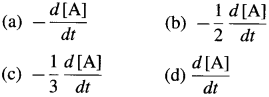
Maharashtra Board Class 12 Chemistry Solutions Chapter 6 Chemical Kinetics 158
Answer:
(c)

7. For the reaction, 2X + 3Y → 4Z, reaction may be represented as
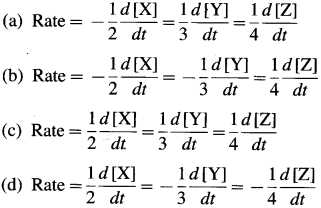
Maharashtra Board Class 12 Chemistry Solutions Chapter 6 Chemical Kinetics 159
Answer:
(b)

8. For the reaction 2N2O5(g) → 4NO2(g) + O2(g) liquid bromine, which of the following rate equation is ‘incorrect’?
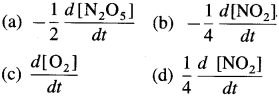
Maharashtra Board Class 12 Chemistry Solutions Chapter 6 Chemical Kinetics 160
Answer:
(b)

9. The rate of reaction for certain reaction is expressed as :

Maharashtra Board Class 12 Chemistry Solutions Chapter 6 Chemical Kinetics 161
The reaction is
(a) 3A → 2B + C
(b) 2B → 3A + C
(c) 2B+C → 3A
(d) 3A + 2B → C
Answer:
(c) 2B+C → 3A

10. Order of a reaction is
(a) number of molecules reacting in a reaction
(b) the number of molecules whose concentration changes during a reaction
(c) the number of molecules of reactants whose concentration determine the rate
(d) increase in number of molecules of products
Answer:
(c) the number of molecules of reactants whose concentration determine the rate

11. The unit of rate constant for zero order reaction is
(a) t-1
(b) mol dm-3 t-1
(c) mol-1 dm3 t-1
(d) mol-2 dm6 t-1
Answer:
(b) mol dm-3 t-1

Maharashtra Board Class 12 Chemistry Important Questions Chapter 6 Chemical Kinetics

12. A → B is a first order reaction with rate 6.6 x 10⁻⁵ ms-1. When [A] is 0.6 m, rate constant of the reaction is-
(a) 1.1 x 10⁻⁵ s-1
(b) 1.1 x 10⁻⁴ s-1
(c) 9 x 10⁻⁵ s-1
(d) 9 x 10⁻⁴ s-1
Answer:
(b) 1.1 x 10⁻⁴ s-1

13. For a first order reaction, when the rate of a reaction is plotted against concentration of the reactant, then the graph obtained is
(a) a curve
(b) a straight line with negative slope
(c) a straight line with a positive slope
(d) a straight line with positive intercept
Answer:
(c) a straight line with a positive slope

14. For a chemical reaction, A → products, the rate of reaction doubles when the concentration of ‘A’ is increased by a factor of 4, the order of reaction is
(a) 2
(b) 0.5
(c) 4
(d) 1
Answer:
(b) 0.5

15. The order of reaction between equimolar mixture of H2 and Cl2 in the presence of sunlight is
(a) 0
(b) 1
(c) 2
(d) 3
Answer:
(a) 0

16. Molecularity of reaction can be
(a) zero
(b) integral
(c) fractional
(d) negative
Answer:
(b) integral

17. The reaction,
CH3COOC2H5 + H2O \(\stackrel{\mathrm{H}^{+}}{\longrightarrow}\) CH3COOH + C2H5OH is of
(a) zero order
(b) first order
(c) second order
(d) pseudo first order reaction
Answer:
(d) pseudo first order reaction

18. A reaction is first order with respect to reactant A and second order with respect to reactant B. The rate law for the reaction is given by
(a) rate = k[A][B]2
(b) rate = [A][B]2
(c) rate = k [A]2[B]
(d) rate = k[A]0[B]2
Answer:
(a) rate = k[A][B]2

19. Molecularity of an elementary reaction
(a) may be zero
(b) is always integral
(c) may be semi-integral
(d) may be integral, fractional or zero.
Answer:
(b) is always integral

20. The unit of rate constant for first order reaction is
(a) min-2
(b) s
(c) s-1
(d) min
Answer:
(c) s-1

Maharashtra Board Class 12 Chemistry Important Questions Chapter 6 Chemical Kinetics

21. The integrated rate equation for first order reaction A → products is given by
Maharashtra Board Class 12 Chemistry Solutions Chapter 6 Chemical Kinetics 162
Answer:
(b)

22. Time required to complete 90% of the first order reaction is
Maharashtra Board Class 12 Chemistry Solutions Chapter 6 Chemical Kinetics 163
Answer:
(a)

23. The rate constant of a first order reaction is given by
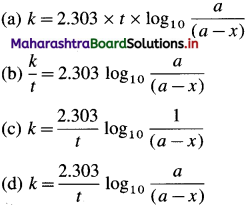
Maharashtra Board Class 12 Chemistry Solutions Chapter 6 Chemical Kinetics 164
Answer:
(d)

24. The half-life of a first order reaction is 30 min and the initial concentration of the reactant is 0.1M. If the initial concentration of reactant is doubled, then the half-life of the reaction will be
(a) 1800s
(c) 15 min
(b) 60 min
(d) 900s
Answer:
(a) 1800s

25. The rate constant for a first order reaction is loos the time required for completion of 50% of reaction is-
(a) 0.0693 milliseconds
(b) 0.693 milliseconds
(c) 6.93 milliseconds
(d) 69.3 milliseconds
Answer:
(c) 6.93 milliseconds

26. The slope of the straight line obtained by plotting rate versus concentration of reactant for a first order reaction is
(a) – k
(b) – k/2.303
(c) k/2.303
(d) k
Answer:
(d) k

27. If C0 and C are the concentrations of a reactant initially and after time t then, for a first order reaction
(a) C = C0ekr
(b) C0 = 1/C e-kr
(c) C = C0e-kr
(d) CO = C ekr
Answer:
(b) C0 = 1/C e-kr

Maharashtra Board Class 12 Chemistry Important Questions Chapter 6 Chemical Kinetics

28. A graph corresponding to a first order reaction is
Maharashtra Board Class 12 Chemistry Solutions Chapter 6 Chemical Kinetics 165
Answer:
(b)

29. For two first order reactions, A → products and B → products, k1 and k2 are the rate constants. The fIrst reaction (A) is slower than the second reaction (B). The graphical observation corresponding to this observation will be
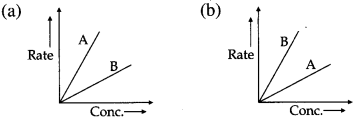
Maharashtra Board Class 12 Chemistry Solutions Chapter 6 Chemical Kinetics 166
Maharashtra Board Class 12 Chemistry Solutions Chapter 6 Chemical Kinetics 167
Answer:
(b)

30. Half-life (t1/2) of first order reaction is
(a) dependent of concentration
(b) independent of concentration
(c) dependent of time
(d) dependent of molecularity
Answer:
(b) independent of concentration

31. For a first order reaction, the half-life period is
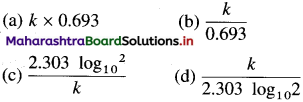
Maharashtra Board Class 12 Chemistry Solutions Chapter 6 Chemical Kinetics 168
Answer:
(c)

32. When half-life period of a zero order reaction is plotted against concentration of the reactant at constant temperature, the graph obtained is
(a) a curve
(b) a straight line with a positive slope
(c) a straight line with a negative slope
(d) an exponential graph
Answer:
(b) a straight line with a positive slope

Maharashtra Board Class 12 Chemistry Important Questions Chapter 6 Chemical Kinetics

33. The rate of a reaction between A and B is R = k [A]n x [B]m On doubling the concentration of A and halving the concentration of B, the ratio of the new rate to the earlier rate of the reaction will be
(a) m + n
(b) n – m
(c) 2(n-m)
(d) \(\frac{1}{{ }_{2} n+m}\)
Answer:
(c) 2(n-m)

34. Consider the reaction
Maharashtra Board Class 12 Chemistry Solutions Chapter 6 Chemical Kinetics 169
(a) 0,052 M/s
(b) 0.114 M/s
(c) 0.026 M/s
(d) -0.026 M/s
Answer:
(c)

35. The rate of the first order reaction A → products is 0.01 M/s, when reactant concentration is 0.2 M. The rate constant for the reaction will be
(a) 0.05 s-1
(b) 0.05 min-1
(c) 0.1 s-1
(d) 0.01 s-1
Answer:
(a) 0.05 s-1

36. The rate constant of a reaction
(a) decreases with increasing Ea
(b) decreases with decreasing Ea
(c) is independent of Ea
(d) decreases with increasing temperature
Answer:
(a) decreases with increasing Ea

37. The slope of a graph In [A]t versus t for a first order reaction is -2.5 x 10⁻³s-1. The rate constant for the reaction will be
(a) 5.76 x 10⁻³s-1
(b) 1.086 x 10⁻³s-1
(c) -2.5 x 10⁻³s-1
(d) 2.5 x 10⁻³s-1
Answer:
(d) 2.5 x 10⁻³s-1

38. For the reaction, Cl2 + 2I → 2CI + I2, the initial concentration of I was 0.2 mol L and the concentration after 20 minutes was 0.18 mol L-1. Then the rate of formation of I2 in mol L min-1 will be
(a) 1 x 10⁻³
(b) 5 x 10⁻⁴
(c) 1 x 10⁻⁴
(d) 2 x 10⁻³
Answer:
(b) 5 x 10⁻⁴

39. A catalyst increases the rate of the reaction by
(a) increasing Ea
(b) increasing T
(c) decreasing Ea
(d) decreasing T
Answer:
(c) decreasing Ea

40. The Arrhenius equation is
(a) A = ke-Ea/RT
(b) A/k = e-Ea/RT
(c) k = AeEa/RT
(d) k = Aee-RT/Ea
Answer:
(b) A/k = e-Ea/RT

Maharashtra Board Class 12 Chemistry Important Questions Chapter 6 Chemical Kinetics

41. The Arrhenius equation is
(a) k = Ae-RT/Ea
(b) A = keEa/RT
(c) k = Ae-RT/Ea
(d) A = keEa/RT
Answer:
(d) A = keEa/RT

42. When the initial concentration of the reactant is doubled, the half-life period of the reaction is also doubled. Hence the order of the reaction is
(a) one
(b) two
(c) fraction
(d) zero
Answer:
(d) zero

43. If k1 and k2 are the rate constants of the given reaction in the presence and absence of the catalyst, then
(a) k1 = k2
(b) k1 > k2
(c) k1 < k2
(d) k1 > k2
Answer:
(b) k1 > k2

44. If the ratio of rate constants at two temperatures for the given reaction is 2.5, the ratio of corresponding half-life periods is
(a) 2.5
(b) 4
(c) 5
(d) 0.4
Answer:
(d) 0.4

45. For a zero order reaction, if Co is the initial concentration, then the half life period will be
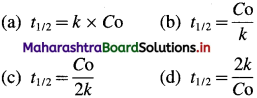
Maharashtra Board Class 12 Chemistry Solutions Chapter 6 Chemical Kinetics 170
Answer:
(c)

46. The order of nuclear disintegration reaction is
(a) zero
(b) one
(c) two
(d) fraction
Answer:
(b) one

47. The unit of rate constant for zero order reaction is
(a) mol L-2 s-1
(b) mol-1Ls-1
(c) mol2L-2s-1
(d) mol L-1 s-1
Answer:
(d) mol L-1 s-1

48. When a graph of log10k is plotted against 1 /T, the slope of the line is,
Maharashtra Board Class 12 Chemistry Solutions Chapter 6 Chemical Kinetics 171
Answer:
(d)

49. The slope of a graph obtained by plotting half-life period and initial concentration of the reactant in zero order reaction is
\((a) \frac{2.303}{k}
(b) \frac{1}{k}
(c) \frac{1}{2 k}
(d) \frac{k}{2.303}\)
Answer:
(c)

Maharashtra Board Class 12 Chemistry Important Questions Chapter 6 Chemical Kinetics

50. When a graph of log, 0k against 1/T is plotted, for reaction, a graph with slope equal to 1 x 10³ is obtained. Hence the activation energy is
(a) 8.314 x 10³ Jmor-1
(b) 3.61 kJ mol-1
(c) 4.85 x 10³ Jmol-1
(d) 19.1 kJ mol-1
Answer:
(d) 19.1 kJ mol-1

51. The correct expression for activation energy is,
Maharashtra Board Class 12 Chemistry Solutions Chapter 6 Chemical Kinetics 172
Answer:
(c)

52. In the reaction, 2A(g) → B(g), the initial pressure of A is 2.5 atm. After 10 minutes the pressure becomes 2.2 atm. Hence the pressure of A is
(a) 1.2 atm
(b) 1.9 atm
(c) 2.3 atm
(d) 0.3 atm
Answer:
(b) 1.9 atm

53. The half-life period of zero order reaction A → product is given by –
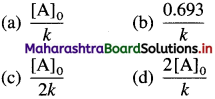
Maharashtra Board Class 12 Chemistry Solutions Chapter 6 Chemical Kinetics 173
Answer:
(c)
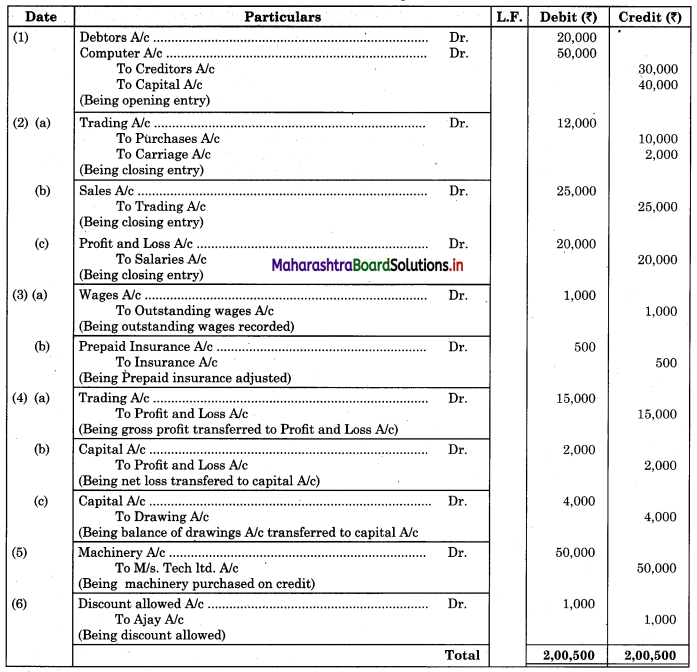
Maharashtra Board Class 11 Biology Important Questions Chapter 7 Cell Division

Balbharti Maharashtra State Board 11th Biology Important Questions Chapter 7 Cell Division Important Questions and Answers.

Maharashtra State Board 11th Biology Important Questions Chapter 7 Cell Division

Question 1.
Why interphase is known as preparatory phase.
Answer:
1. During interphase, the cell is metabolically very active.
2. In this phase, a cell grows to its maximum size, chromosomal material (DNA and histone proteins) duplicates and the cell prepares itself for next mitotic division. Hence, inteiphase is known as preparatory phase.

Maharashtra Board Class 11 Biology Important Questions Chapter 7 Cell Division

Question 2.
Name the following.
1. In which phase the amount of DNA per cell doubles?
2. Which types of RNA are synthesized during first growth phase?
Answer:
1. S-phase.
2. m-RNA, t-RNA and r-RNA

Question 3.
Match the Column I (Phases of Cell cycle) with Column II (Approximate time for completion).

Column I Column II
1. G: Phase (a) 1-3 Hours
2. Gi Phase (b) 2-5 Hours
3. M Phase (c) 6-8 Hours
4. S Phase (d) 8 Hours

Answer:

Column I Column II
1. G: Phase (b) 2-5 Hours
2. Gi Phase (d) 8 Hours
3. M Phase (a) 1-3 Hours
4. S Phase (c) 6-8 Hours

Question 4.
What is cell division? Mention the types of cell division.
Answer:
The division of cells into two (or more) daughter cells with same (or different) genetic material is called cell division. There are three types of cell divisions:
1. Amitosis:
a. It is the simplest form of cell division. The nucleus elongates and a constriction appears along its length.
b. This constriction deepens and divides nucleus into two daughter nuclei followed by division of cytoplasm resulting in formation of two daughter cells.
c. This type of division is observed in unicellular organisms, abnormal cells, old cells and in foetal membrane cells.

2. Mitosis:
a. In this type of cell division, the cell divides and forms two similar daughter cells which are identical to the parent cell.
b. It is completed in two steps as karyokinesis and cytokinesis.

3. Meiosis:
a. In this type of cell division, the number of chromosomes is reduced to half. Hence, this type of cell division is also called reductional division.
b. Meiosis produces four haploid daughter cells from a diploid parent cell.

Maharashtra Board Class 11 Biology Important Questions Chapter 7 Cell Division

Question 5.
With the help of suitable diagrams, explain karyokinesis in brief.
Answer:
Karyokinesis is the nuclear division which is divided into prophase, metaphase, anaphase and telophase.
1. Prophase:
a. In this phase, condensation of chromatin material, migration of centrioles, appearance of mitotic apparatus and disappearance of nuclear membrane takes place.
b. Due to condensation, each chromosome with its sister chromatids connected by centromere is clearly visible under light microscope.
c. The nucleolus starts to disappear.
d. Centrosome start moving towards the opposite poles of the cell.
e. Mitotic apparatus is almost completely formed.

2. Metaphase:
a. Chromosomes are completely condensed and appear short.
b. Centromere and sister chromatids become very prominent.
c. All the chromosomes are arranged at equatorial plane of cell. This is called metaphase plate.
d. Mitotic spindle is fully formed in this phase.
e. Centromere of each chromosome divides horizontally into two, each being associated with a chromatid. [Note: The centromeres divide at the beginning of anaphase so that the two chromatids of each chromosome become separated from each other.
Source: Cell Division, Donald B. McMillan, Richard J. Harris, in An Atlas of Comparative Vertebrate Histology, 2018.]

3. Anaphase:
a. In this phase, chromatids of each chromosome separate and form two chromosomes called daughter chromosomes.
b. The chromosomes which are formed are pulled away in opposite direction by spindle apparatus.
c. Anaphase ends when each set of chromosomes reach at opposite poles of the cell.

4. Telophase:
a. This is the final stage of karyokinesis.
b. The chromosomes with their centromeres begin to uncoil at the poles.
c. The chromosomes lengthen and lose their individuality.
d. The nucleolus reappears and the nuclear membrane appear around the chromosomes.
e. Spindle fibres breakdown and get absorbed in the cytoplasm. Thus, two daughter nuclei are formed.

These are small disc-shaped structures at the surface of the centromeres which serve as the sites of attachment of spindle fibres to the chromosomes.

Question 6.
Draw neat and labelled diagram of Anaphase.
Answer:
Anaphase:
a. In this phase, chromatids of each chromosome separate and form two chromosomes called daughter chromosomes.
b. The chromosomes which are formed are pulled away in opposite direction by spindle apparatus.
c. Anaphase ends when each set of chromosomes reach at opposite poles of the cell.

Maharashtra Board Class 11 Biology Important Questions Chapter 7 Cell Division

Question 7.
Match the following.

Column I Column II
1. Prophase (a) Chromatids moving to opposite poles.
2. Metaphase (b) Nuclear membrane starts disappearing.
3. Anaphase (c) Chromosomes at equatorial plane of the cell.
4. Telophase (d) Nuclear membrane reappears

Answer:

Column I Column II
1. Prophase (b) Nuclear membrane starts disappearing.
2. Metaphase (c) Chromosomes at equatorial plane of the cell.
3. Anaphase (a) Chromatids moving to opposite poles.
4. Telophase (d) Nuclear membrane reappears

Question 8.
Observe the given diagram and explain the depicted process in your own words.
Maharashtra Board Class 11 Biology Important Questions Chapter 7 Cell Division 1
Answer:

  1. The process depicted in the given diagram is cytokinesis in animal cell.
  2. This step takes place at the end of karyokinesis (nuclear division) of mitosis.
  3. It depicts the division of the cytoplasmic material in order to form two daughter cells that resemble each other.
  4. The division starts with a constriction generally at the equator. This constriction gradually deepens and ultimately joins in the centre dividing into two cells.
  5. At the time of cytoplasmic division, organelles like mitochondria and plastids get distributed between the two daughter cells.

Maharashtra Board Class 11 Biology Important Questions Chapter 7 Cell Division

Question 9.
Diagrammatically differentiate between cytokinesis in animal cell and plant cell.
Answer:
Maharashtra Board Class 11 Biology Important Questions Chapter 7 Cell Division 2

Question 10.
How cell wall is formed in plant cell?
Answer:
The formation of the new cell wall begins with the formation of a simple precursor, called the ‘cell-plate’ that represents the middle lamella between the walls of two adjacent cells.

Question 11.
What is necrosis?
Answer:
Necrosis is a form of cell injury which leads to the premature death of cells. For example: due to scrape or a harmful chemical.

Question 12.
What is apoptosis? Write its significance.
Answer:

  1. Apoptosis also known as programmed cell death or cellular suicide. In apoptosis cells die in controlled way.
  2. For example: during embryonic development the cells between the embryonic fingers die in a normal process called apoptosis to give a definite shape to the fingers.
  3. Apoptosis also helps in eliminating potential cancer cells.

Maharashtra Board Class 11 Biology Important Questions Chapter 7 Cell Division

Question 13.
Which type of cell division is known as reductional division? Why?
Answer:
1. Meiosis is known as reductional division.
2. The number of chromosome is reduced to half, hence, meiosis is known as reductional division.

Question 14.
Describe the various phases of heterotypic division.
Answer:
Heterotypic division is first meiotic division, during which a diploid cell is divided into two haploid cells. The daughter cells resulting from this division are different from the parent cell in chromosome number. Hence the division is called heterotypic division.
It consists of following phases:
1. Prophase -I:
It is the most complicated and longest phase of meiotic division.
It is further divided into five sub-phases viz. leptotene, zygotene, pachytene, diplotene and diakinesis.

a. Leptotene:

  1. The volume of the nucleus increases.
  2. The chromosomes become long distinct and coiled.
  3. They orient themselves in a specific fonn known as bouquet stage. This is characterized with the ends of chromosomes converged towards the side of nucleus where the centrosome lies.
  4. The centriole duplicates into two and migrates to opposite poles. [Note: Centrioles divide during Gj phase of interphase.]

b. Zygotene:

  1. Pairing of non-sister chromatids of homologous chromosomes takes place by formation of synaptonemal complex. This pairing is called synapsis.
  2. Each pair consists of a maternal chromosome and a paternal chromosome. Chromosomal pairs are called bivalents or tetrads.

c. Pachytene:

  1. Each individual chromosome begins to split longitudinally into two similar chromatids. Therefore, each bivalent now appears as a tetrad consisting of four chromatids.
  2. The homologous chromosomes begin to separate but they do not separate completely and remain attached to one or more points. These points are called chiasmata (Appear like a cross-X).
  3. Chromatids break at these points and broken segments are exchanged between non-sister chromatids of homologous chromosomes resulting in recombination.

d. Diplotene:
The chiasma becomes clearly visible in diplotene due to beginning of repulsion between synapsed homologous chromosomes. This is known as desynapsis. Synaptonemal complex also starts to disappear.

e. Diakinesis:

  1. The chiasmata begin to move along the length of chromosomes from the centromere towards the ends of chromosomes. The displacement of chiasmata is termed as terminalization.
  2. The terminal chiasmata exist till the metaphase.
  3. The nucleolus and nuclear membrane completely disappear and spindle fibres begin to appear.

2. Metaphase -1:
a. The spindle fibres are well developed.
b. The tetrads orient themselves on equator in such a way that centromeres of homologous tetrads lie towards the poles and arms towards the equator.
c. They are ready to separate as repulsive force increases.
a. Homologous chromosomes are carried towards the opposite poles by spindle apparatus. This is known as disjunction.
b. The two sister chromatids of each chromosome do not separate in meiosis -I. This is reductional division.
c. The sister chromatids of each chromosome are connected by a common centromere.
d. Both sister chromatids of each chromosome are now different in genetic content as one of them has undergone recombination.
Maharashtra Board Class 11 Biology Important Questions Chapter 7 Cell Division 3

3. Anaphase – I:
1. Homologous chromosomes are carried towards the opposite poles by spindle apparatus. This is known as disjunction.
2. The two sister chromatids of each chromosome do not separate in meiosis -I. This is reductional division.
3. The sister chromatids of each chromosome are connected by a common centromere.
4. Both sister chromatids of each chromosome are now different in genetic content as one of them has undergone recombination.
Maharashtra Board Class 11 Biology Important Questions Chapter 7 Cell Division 4

4. Telophase-I:
a. The haploid number of chromosomes becomes uncoiled and elongated after reaching their respective poles.
b. The nuclear membrane and nucleolus reappear and thus two daughter nuclei are formed.
Maharashtra Board Class 11 Biology Important Questions Chapter 7 Cell Division 5

Cytokinesis -1:
Cytokinesis occurs after karyokinesis and two haploid cells are formed. In many cases, these daughter cells pass through interkinesis.
Maharashtra Board Class 11 Biology Important Questions Chapter 7 Cell Division 6
[Note: The association between the homologous chromosomes i.e. chiasmata remain till metaphase I. During metaphase /, the paired homologous chromosomes move to the metaphase plate. In anaphase [ the spindle fibers begin to shorten. As these spindle fibres shorten, the association between homologous chromosomes (chiasmata) are broken, allowing homologous chromosomes to be pulled to opposite poles.]

Maharashtra Board Class 11 Biology Important Questions Chapter 7 Cell Division

Question 15.
What is Homotypic Division? Explain its phases.
Answer:
Two haploid cells formed during first meiotic division divide further into four haploid cells this division is called homotypic division. It consists of five phases: prophase – II, metaphase – II, anaphase – II, telophase – II, and Cytokinesis – II.
Maharashtra Board Class 11 Biology Important Questions Chapter 7 Cell Division 7

1. Prophase-II:
a. The chromosomes are distinct with two chromatids.
b. Each centriole divides into two resulting in formation of two centrioles which migrate to opposite poles and form asters.
c. Spindle fibres are formed between the centrioles.
d. The nuclear membrane and nucleolus disappears in this phase.

2. Metaphase -II:
a. Chromosomes are arranged at the equator.
b. The two chromatids of each chromosome are separated by division of the centromere.
c. Some of the spindle fibres are attached to the centromeres and some are arranged end to end between two opposite centrioles.

3. Anaphase – II:
In this phase, the separated chromatids become daughter chromosomes and move to opposite poles due to the contraction of the spindle fibres attached to centromeres.

4. Telophase – II:
a. In this stage daughter chromosomes starts to uncoil.
b. The nuclear membrane surrounds each group of chromosomes.
c. Nucleolus reappears in this phase.

5. Cytokinesis – II
a. Cytokinesis takes place after the nuclear division.
b. Two haploid cells are formed from each haploid cell.
c. Thus, four haploid daughter cells are formed.
d. These cells then undergo changes to form gametes.

Maharashtra Board Class 11 Biology Important Questions Chapter 7 Cell Division

Question 16.
Why meiosis is important?
Answer:

  1. Meiotic division produces gametes or spores.
  2. If it is absent, the number of chromosomes would double or quadruple resulting in the formation of monstrosities (abnormal gametes).
  3. The constant number of chromosomes in a given species across generations is maintained by meiosis and fertilization.
  4. Because of crossing over, exchange of genetic material takes place leading to genetic variations, which are the raw materials for evolution.

Question 17.
Observe the diagram and answer the questions given below it.
Maharashtra Board Class 11 Biology Important Questions Chapter 7 Cell Division 8
1. Identify the type of cell division shown in the diagram.
2. Write its significance of meiosis.
Answer:
1. The type of cell division shown in diagram is meiosis II.
2. Meiotic division produces gametes or spores.

  1. If it is absent, the number of chromosomes would double or quadruple resulting in the formation of monstrosities (abnormal gametes).
  2. The constant number of chromosomes in a given species across generations is maintained by meiosis and fertilization.
  3. Because of crossing over, exchange of genetic material takes place leading to genetic variations, which are the raw materials for evolution.

Question 18.
Explain Anaphase-I with a neat labelled diagram.
Answer:
Maharashtra Board Class 11 Biology Important Questions Chapter 7 Cell Division 9
Anaphase:
a. In this phase, chromatids of each chromosome separate and form two chromosomes called daughter chromosomes.
b. The chromosomes which are formed are pulled away in opposite direction by spindle apparatus.
c. Anaphase ends when each set of chromosomes reach at opposite poles of the cell.

Question 19.
What is crossing over? Give its significance.
Answer:
Crossing over:
The process of exchange of genetic material between non-sister chromatids of homologous chromosomes is known as crossing over.
Significance of crossing over:
Crossing over results in genetic recombination of parental characters that leads to variations.

Maharashtra Board Class 11 Biology Important Questions Chapter 7 Cell Division

Question 20.
What happens during diakinesis?
Answer:

  1. In diakinesis, the chiasmata begin to move along the length of chromosomes from the centromere towards the ends of chromosomes.
  2. The displacement of chiasmata is termed as terminalization. The terminal chiasmata exist till the metaphase.
  3. The nucleolus disappears and the nuclear membrane also begins to disappear.
  4. Spindle fibres starts to appear in the cytoplasm.

Question 21.
Differentiate between anaphase of mitosis and anaphase – I of meiosis.
Answer:

Anaphase of mitosis Anaphase – I of meiosis
1. Centromere divides into two, resulting in the separation of chromatids. Centromere does not divide.
2. Homologous chromosomes are not involved. Homologous chromosomes are involved.
3. Disjunction does not occur. Disjunction occurs.
4. Same number of chromosomes gather at each pole. Half the chromosome number gather at respective pole.

Question 22.
Give reasons: Meiosis is known as reductional division.
Answer:
Meiosis is known as reductional division because the parent cell produces four daughter cells each having half the number of chromosomes present in the parent cell.

Question 23.
Fill in the blanks:

  1. The process of mitosis maintains the _______.
  2. ________ involves the cell death, but it benefits the organism as a whole.
  3. Crossing over takes place in _______ phase of Prophase-I.

Answer:

  1. The process of mitosis maintains the nucleo-cytoplasmic ratio.
  2. Apoptosis involves the cell death, but it benefits the organism as a whole.
  3. Crossing over takes place in pachytene phase of Prophase-I.

Question 24.
1. Complete the following flowchart.
2. Explain the type of cell division in which chromosome number remain the same as that of the parent cell.
Maharashtra Board Class 11 Biology Important Questions Chapter 7 Cell Division 10
Answer:
Maharashtra Board Class 11 Biology Important Questions Chapter 7 Cell Division 11Karyokinesis is the nuclear division which is divided into prophase, metaphase, anaphase and telophase.
1. Prophase:
a. In this phase, condensation of chromatin material, migration of centrioles, appearance of mitotic apparatus and disappearance of nuclear membrane takes place.
b. Due to condensation, each chromosome with its sister chromatids connected by centromere is clearly visible under light microscope.
c. The nucleolus starts to disappear.
d. Centrosome start moving towards the opposite poles of the cell.
e. Mitotic apparatus is almost completely formed.

2. Metaphase:
a. Chromosomes are completely condensed and appear short.
b. Centromere and sister chromatids become very prominent.
c. All the chromosomes are arranged at equatorial plane of cell. This is called metaphase plate.
d. Mitotic spindle is fully formed in this phase.
e. Centromere of each chromosome divides horizontally into two, each being associated with a chromatid. [Note: The centromeres divide at the beginning of anaphase so that the two chromatids of each chromosome become separated from each other.
Source: Cell Division, Donald B. McMillan, Richard J. Harris, in An Atlas of Comparative Vertebrate Histology, 2018.]

3. Anaphase:
a. In this phase, chromatids of each chromosome separate and form two chromosomes called daughter chromosomes.
b. The chromosomes which are formed are pulled away in opposite direction by spindle apparatus.
c. Anaphase ends when each set of chromosomes reach at opposite poles of the cell.

4. Telophase:
a. This is the final stage of karyokinesis.
b. The chromosomes with their centromeres begin to uncoil at the poles.
c. The chromosomes lengthen and lose their individuality.
d. The nucleolus reappears and the nuclear membrane appear around the chromosomes.
e. Spindle fibres breakdown and get absorbed in the cytoplasm. Thus, two daughter nuclei are formed.

These are small disc-shaped structures at the surface of the centromeres which serve as the sites of attachment of spindle fibres to the chromosomes.

Maharashtra Board Class 11 Biology Important Questions Chapter 7 Cell Division

Question 25.
While studying mitosis, different teams of students made following observations in the cells focused under microscope.
1. In certain cells chromosomes were arranged at equatorial plane with fibres originating from cylindrical structures at both the poles.
2. Few cells showed chromatids moving towards opposite poles.
a. In first observation which stage of mitosis is seen by students and what is the scientific term used to represent cylindrical structures?
b. Which stage is seen in the second observation?
Answer:
a. The stage observed in the first case is metaphase. The scientific term used to represent the cylindrical structures are centrioles.
b. The other stage seen in second observation is anaphase.

Question 26.
During biology practical students were asked to see the slide mounted under microscope and note down their observations. Few students noted that the stage observed is anaphase of mitosis and others said that it is anaphase I of meiosis. Later while explaining about experiments teacher said that it is anaphase I of meiosis. On what basis teacher confirmed that it is anaphase I of meiosis?
Answer:
Chromosomes moving towards opposite poles during anaphase I do not separate at the centromeres.

Question 27.
Colchicine is an alkaloid extracted from plants. It prevents the formation of spindle fibres. In the presence colchicine, if a cell enters mitosis what would be the outcome?
Answer:
The spindle fibres are necessary for segregating the sister chromatids to opposite poles of the cell during anaphase. In the presence of colchicine, no spindle fibres will form to attach to the kinetochores (small disc¬like structures present on chromosomes). Therefore, the cell will be stuck in mitosis with the condensed pairs of sister chromatids in an unorganized array.

Question 28.
Read the following statements and mention whether they are TRUE or FALSE in respective boxes.
1. Life of all multicellular organisms starts from single cell which is known as zygote.
2. Spindle fibres present between centriole and centromere are known as polar fibres which can contract.
3. Growth of every living organism depends on cell division.
4. Spindle fibres present between opposite centrioles are called as kinetochore fibres which can elongate.

(i) (ii) (iii) (iv)
(A) T T F T
(B) F F T F
(C) T F T F
(D) 1 T F F ‘

Answer:
(C)

Maharashtra Board Class 11 Biology Important Questions Chapter 7 Cell Division

Question 29.
Quick Review

Maharashtra Board Class 11 Biology Important Questions Chapter 7 Cell Division 12

Question 30.
Exercise:

Question 1.
Define cell cycle.
Answer:

  1. Sequential events occurring in the life of a cell is called cell cycle.
  2. Interphase and M – phase are the two phases of cell cycle.
  3. Cell undergoes growth or rest during interphase and divides during M – phase.

Question 2.
Observe the following diagram and the questions based on it.
Maharashtra Board Class 11 Biology Important Questions Chapter 7 Cell Division 13
1. If the initial amount of DNA in a cell is 2C then in which phase of cell cycle the amount of this DNA would become 4C? Also name the process.
2. Which sub-phase of the interphase is of short duration?
3. Enlist the phases of karyokinesis in proper order.
Answer:
S – phase (Synthesis phase):
In this phase DNA is synthesized (replicated), so that amount of DNA per cell doubles.
Synthesis of histone proteins takes place in this phase.
Karyokinesis is the nuclear division which is divided into prophase, metaphase, anaphase and telophase.
1. Prophase:
a. In this phase, condensation of chromatin material, migration of centrioles, appearance of mitotic apparatus and disappearance of nuclear membrane takes place.
b. Due to condensation, each chromosome with its sister chromatids connected by centromere is clearly visible under light microscope.
c. The nucleolus starts to disappear.
d. Centrosome start moving towards the opposite poles of the cell.
e. Mitotic apparatus is almost completely formed.

2. Metaphase:
a. Chromosomes are completely condensed and appear short.
b. Centromere and sister chromatids become very prominent.
c. All the chromosomes are arranged at equatorial plane of cell. This is called metaphase plate.
d. Mitotic spindle is fully formed in this phase.
e. Centromere of each chromosome divides horizontally into two, each being associated with a chromatid. [Note: The centromeres divide at the beginning of anaphase so that the two chromatids of each chromosome become separated from each other.
Source: Cell Division, Donald B. McMillan, Richard J. Harris, in An Atlas of Comparative Vertebrate Histology, 2018.]

3. Anaphase:
a. In this phase, chromatids of each chromosome separate and form two chromosomes called daughter chromosomes.
b. The chromosomes which are formed are pulled away in opposite direction by spindle apparatus.
c. Anaphase ends when each set of chromosomes reach at opposite poles of the cell.

4. Telophase:
a. This is the final stage of karyokinesis.
b. The chromosomes with their centromeres begin to uncoil at the poles.
c. The chromosomes lengthen and lose their individuality.
d. The nucleolus reappears and the nuclear membrane appear around the chromosomes.
e. Spindle fibres breakdown and get absorbed in the cytoplasm. Thus, two daughter nuclei are formed.

These are small disc-shaped structures at the surface of the centromeres which serve as the sites of attachment of spindle fibres to the chromosomes.

Maharashtra Board Class 11 Biology Important Questions Chapter 7 Cell Division

Question 3.
During which stage of Prophase-I synapsis occurs?
Answer:
b. Zygotene:
Pairing of non-sister chromatids of homologous chromosomes takes place by formation of synaptonemal complex. This pairing is called synapsis.
Each pair consists of a maternal chromosome and a paternal chromosome. Chromosomal pairs are called bivalents or tetrads.

Question 4.
During which stage disjunction takes place?
Answer:
Telophase-I:
a. The haploid number of chromosomes becomes uncoiled and elongated after reaching their respective poles.
b. The nuclear membrane and nucleolus reappear and thus two daughter nuclei are formed.

Question 5.
What is disjunction?
Answer:
Telophase-I:
a. The haploid number of chromosomes becomes uncoiled and elongated after reaching their respective poles.
b. The nuclear membrane and nucleolus reappear and thus two daughter nuclei are formed.

Question 6.
Why meiosis is known as reductional division?
Answer:
In this type of cell division, the number of chromosomes is reduced to half. Hence, this type of cell division is also called reductional division.

Question 7.
Sketch and label the phase of cell division in which synaptonemal complex is formed?
Answer:
Zygotene:
Pairing of non-sister chromatids of homologous chromosomes takes place by formation of synaptonemal complex. This pairing is called synapsis.
Each pair consists of a maternal chromosome and a paternal chromosome. Chromosomal pairs are called bivalents or tetrads.

Maharashtra Board Class 11 Biology Important Questions Chapter 7 Cell Division

Question 8.
Make a schematic representation of a type of cell division in which chromosome number is reduced to half.
Answer:
Karyokinesis is the nuclear division which is divided into prophase, metaphase, anaphase and telophase.
1. Prophase:
a. In this phase, condensation of chromatin material, migration of centrioles, appearance of mitotic apparatus and disappearance of nuclear membrane takes place.
b. Due to condensation, each chromosome with its sister chromatids connected by centromere is clearly visible under light microscope.
c. The nucleolus starts to disappear.
d. Centrosome start moving towards the opposite poles of the cell.
e. Mitotic apparatus is almost completely formed.

2. Metaphase:
a. Chromosomes are completely condensed and appear short.
b. Centromere and sister chromatids become very prominent.
c. All the chromosomes are arranged at equatorial plane of cell. This is called metaphase plate.
d. Mitotic spindle is fully formed in this phase.
e. Centromere of each chromosome divides horizontally into two, each being associated with a chromatid. [Note: The centromeres divide at the beginning of anaphase so that the two chromatids of each chromosome become separated from each other.
Source: Cell Division, Donald B. McMillan, Richard J. Harris, in An Atlas of Comparative Vertebrate Histology, 2018.]

3. Anaphase:
a. In this phase, chromatids of each chromosome separate and form two chromosomes called daughter chromosomes.
b. The chromosomes which are formed are pulled away in opposite direction by spindle apparatus.
c. Anaphase ends when each set of chromosomes reach at opposite poles of the cell.

4. Telophase:
a. This is the final stage of karyokinesis.
b. The chromosomes with their centromeres begin to uncoil at the poles.
c. The chromosomes lengthen and lose their individuality.
d. The nucleolus reappears and the nuclear membrane appear around the chromosomes.
e. Spindle fibres breakdown and get absorbed in the cytoplasm. Thus, two daughter nuclei are formed.

These are small disc-shaped structures at the surface of the centromeres which serve as the sites of attachment of spindle fibres to the chromosomes.

Question 9.
Describe mitosis and its stages in brief.
Answer:
Karyokinesis is the nuclear division which is divided into prophase, metaphase, anaphase and telophase.
1. Prophase:
a. In this phase, condensation of chromatin material, migration of centrioles, appearance of mitotic apparatus and disappearance of nuclear membrane takes place.
b. Due to condensation, each chromosome with its sister chromatids connected by centromere is clearly visible under light microscope.
c. The nucleolus starts to disappear.
d. Centrosome start moving towards the opposite poles of the cell.
e. Mitotic apparatus is almost completely formed.

2. Metaphase:
a. Chromosomes are completely condensed and appear short.
b. Centromere and sister chromatids become very prominent.
c. All the chromosomes are arranged at equatorial plane of cell. This is called metaphase plate.
d. Mitotic spindle is fully formed in this phase.
e. Centromere of each chromosome divides horizontally into two, each being associated with a chromatid. [Note: The centromeres divide at the beginning of anaphase so that the two chromatids of each chromosome become separated from each other.
Source: Cell Division, Donald B. McMillan, Richard J. Harris, in An Atlas of Comparative Vertebrate Histology, 2018.]

3. Anaphase:
a. In this phase, chromatids of each chromosome separate and form two chromosomes called daughter chromosomes.
b. The chromosomes which are formed are pulled away in opposite direction by spindle apparatus.
c. Anaphase ends when each set of chromosomes reach at opposite poles of the cell.

4. Telophase:
a. This is the final stage of karyokinesis.
b. The chromosomes with their centromeres begin to uncoil at the poles.
c. The chromosomes lengthen and lose their individuality.
d. The nucleolus reappears and the nuclear membrane appear around the chromosomes.
e. Spindle fibres breakdown and get absorbed in the cytoplasm. Thus, two daughter nuclei are formed.

These are small disc-shaped structures at the surface of the centromeres which serve as the sites of attachment of spindle fibres to the chromosomes.

Maharashtra Board Class 11 Biology Important Questions Chapter 7 Cell Division

Question 10.
Describe chiasmata. Draw diagram to illustrate your answer.
Answer:
Pachytene:
Each individual chromosome begins to split longitudinally into two similar chromatids. Therefore, each bivalent now appears as a tetrad consisting of four chromatids.
The homologous chromosomes begin to separate but they do not separate completely and remain attached to one or more points. These points are called chiasmata (Appear like a cross-X).
Chromatids break at these points and broken segments are exchanged between non-sister chromatids of homologous chromosomes resulting in recombination.

Diplotene:
The chiasma becomes clearly visible in diplotene due to beginning of repulsion between synapsed homologous chromosomes. This is known as desynapsis. Synaptonemal complex also starts to disappear.

Question 11.
Correct the following diagram and write a short note on it.
Maharashtra Board Class 11 Biology Important Questions Chapter 7 Cell Division 14
Answer:
b. Zygotene:
Pairing of non-sister chromatids of homologous chromosomes takes place by formation of synaptonemal complex. This pairing is called synapsis.
Each pair consists of a maternal chromosome and a paternal chromosome. Chromosomal pairs are called bivalents or tetrads.

Question 12.
Explain prophase I in your own words.
Answer:
Prophase -I:
It is the most complicated and longest phase of meiotic division.
It is further divided into five sub-phases viz. leptotene, zygotene, pachytene, diplotene and diakinesis.

Question 13.
Explain homotypic division.
Answer:
Two haploid cells formed during first meiotic division divide further into four haploid cells this division is called homotypic division. It consists of five phases: prophase – II, metaphase – II, anaphase – II, telophase – II, and Cytokinesis – II.

1. Prophase-II:
a. The chromosomes are distinct with two chromatids.
b. Each centriole divides into two resulting in formation of two centrioles which migrate to opposite poles and form asters.
c. Spindle fibres are formed between the centrioles.
d. The nuclear membrane and nucleolus disappears in this phase.

2. Metaphase -II:
a. Chromosomes are arranged at the equator.
b. The two chromatids of each chromosome are separated by division of the centromere.
c. Some of the spindle fibres are attached to the centromeres and some are arranged end to end between two opposite centrioles.

3. Anaphase – II:
In this phase, the separated chromatids become daughter chromosomes and move to opposite poles due to the contraction of the spindle fibres attached to centromeres.

4. Telophase – II:
a. In this stage daughter chromosomes starts to uncoil.
b. The nuclear membrane surrounds each group of chromosomes.
c. Nucleolus reappears in this phase.

5. Cytokinesis – II
a. Cytokinesis takes place after the nuclear division.
b. Two haploid cells are formed from each haploid cell.
c. Thus, four haploid daughter cells are formed.
d. These cells then undergo changes to form gametes.

Maharashtra Board Class 11 Biology Important Questions Chapter 7 Cell Division

Question 14.
How does cytokinesis in plant cells differ from animal cells?
Answer:
The formation of the new cell wall begins with the formation of a simple precursor, called the ‘cell-plate’ that represents the middle lamella between the walls of two adjacent cells.

Question 15.
What is the significance of meiosis in sexually reproducing animals?
Answer:

  1. Meiotic division produces gametes or spores.
  2. If it is absent, the number of chromosomes would double or quadruple resulting in the formation of monstrosities (abnormal gametes).
  3. The constant number of chromosomes in a given species across generations is maintained by meiosis and fertilization.
  4. Because of crossing over, exchange of genetic material takes place leading to genetic variations, which are the raw materials for evolution.
  5. Gametes are produced by the process of meiosis which are essential for sexual reproduction.
  6. Diploid organisms have two set of chromosomes (one paternal and one maternal).
  7. For a diploid organism to undergo sexual reproduction it needs to create gametes that contain only one set of chromosomes so the number of chromosomes remains same in the next generation.
  8. In absence of meiosis, the chromosome number of parents and their offsprings will differ in every generation; hence no species will hold its characters.
  9. Also, there will be no crossing over of homologous chromosomes. Thus, there will be no variations with respect to the changing environment in progeny to maintain their existence, which may lead to extinction of species.

Question 16.
Explain the first three stages of Meiosis II.
Answer:
Two haploid cells formed during first meiotic division divide further into four haploid cells this division is called homotypic division. It consists of five phases: prophase – II, metaphase – II, anaphase – II, telophase – II, and Cytokinesis – II.

1. Prophase-II:
a. The chromosomes are distinct with two chromatids.
b. Each centriole divides into two resulting in formation of two centrioles which migrate to opposite poles and form asters.
c. Spindle fibres are formed between the centrioles.
d. The nuclear membrane and nucleolus disappears in this phase.

2. Metaphase -II:
a. Chromosomes are arranged at the equator.
b. The two chromatids of each chromosome are separated by division of the centromere.
c. Some of the spindle fibres are attached to the centromeres and some are arranged end to end between two opposite centrioles.

3. Anaphase – II:
In this phase, the separated chromatids become daughter chromosomes and move to opposite poles due to the contraction of the spindle fibres attached to centromeres.

4. Telophase – II:
a. In this stage daughter chromosomes starts to uncoil.
b. The nuclear membrane surrounds each group of chromosomes.
c. Nucleolus reappears in this phase.

5. Cytokinesis – II
a. Cytokinesis takes place after the nuclear division.
b. Two haploid cells are formed from each haploid cell.
c. Thus, four haploid daughter cells are formed.
d. These cells then undergo changes to form gametes.

Maharashtra Board Class 11 Biology Important Questions Chapter 7 Cell Division

Question 17.
Sketch, label and describe telophase in mitosis.
Answer:
Telophase:
a. This is the final stage of karyokinesis.
b. The chromosomes with their centromeres begin to uncoil at the poles.
c. The chromosomes lengthen and lose their individuality.
d. The nucleolus reappears and the nuclear membrane appear around the chromosomes.
e. Spindle fibres breakdown and get absorbed in the cytoplasm. Thus, two daughter nuclei are formed.

These are small disc-shaped structures at the surface of the centromeres which serve as the sites of attachment of spindle fibres to the chromosomes.

Question 18.
Explain the process recombination.
Answer:
a. Recombination is exchange of genetic material between paternal and maternal chromosomes during gamete formation.
b. The points where crossing over takes place is known as chiasmata.
c. Chromatids acquire new combinations of alleles by physically exchanging segments in crossing-over.
d. The exchange of genetic material between homologous chromosomes involves accurate breakage and joining of DNA molecules through a complex mechanism.
e. It is catalyzed by enzymes.

Question 19.
1. What is necrosis?
2. What is apoptosis? Mention its significance.
Answer:
1. Necrosis is a form of cell injury which leads to the premature death of cells. For example: due to scrape or a harmful chemical.
(2) 1. Apoptosis also known as programmed cell death or cellular suicide. In apoptosis cells die in controlled way.
2. For example: during embryonic development the cells between the embryonic fingers die in a normal process called apoptosis to give a definite shape to the fingers.
3. Apoptosis also helps in eliminating potential cancer cells.

Question 20.
Multiple Choice Questions:

Question 1.
Replication of DNA takes place during
(A) prophase
(B) S-phase
(C) G2 phase
(D) Interkinesis
Answer:
(B) S-phase

Question 2.
During cell division, spindle fibers are attached to
(A) telomere
(B) centromere
(C) chromomeres
(D) chromosome
Answer:
(B) centromere

Question 3.
Which of the following is the shortest phase?
(A) metaphase
(B) anaphase
(C) interphase
(D) S-phase
Answer:
(B) anaphase

Question 4.
Reappearance of nucleolus is during
(A) telophase
(B) prophase
(C) cytokinesis
(D) inter-kinesis
Answer:
(A) telophase

Maharashtra Board Class 11 Biology Important Questions Chapter 7 Cell Division

Question 5.
During telophase,
(A) nuclear membrane is formed.
(B) nucleolus appears.
(C) astral rays disappear.
(D) all the above
Answer:
(D) all the above

Question 6.
Cytokinesis in plant cell takes place by
(A) furrowing
(B) cell plate formation
(C) any one of (A) or (B)
(D) none of these
Answer:
(B) cell plate formation

Question 7.
Meiosis is a
(A) homotypic division
(B) equatorial division
(C) reductional division
(D) none of the above
Answer:
(C) reductional division

Question 8.
Formation of Synaptonemal complex during meiosis occurs at
(A) Leptotene
(B) Zygotene
(C) Diplotene
(D) Pachytene
Answer:
(B) Zygotene

Question 9.
Crossing over takes place in the ________ stage.
(A) leptotene
(B) zygotene
(C) pachytene
(D) diplotene
Answer:
(C) pachytene

Maharashtra Board Class 11 Biology Important Questions Chapter 7 Cell Division

Question 10.
Crossing over takes place between
(A) sister chromatids
(B) non-homologous chromosomes
(C) non-sister chromatids of homologues
(D) any two chromatids
Answer:
(C) non-sister chromatids of homologues

Question 11.
Crossing over of chromosomes during meiosis leads to
(A) mutation
(B) sex determination
(C) new gene combination
(D) loss of chromosomes
Answer:
(C) new gene combination

Question 12.
Points at which crossing over has taken place between homologous chromosomes are called
(A) chiasmata
(B) synaptonemal complexes
(C) centromeres
(D) telomere
Answer:
(A) chiasmata

Question 13.
Which of the following events take place during diplotene stage of prophase I of meiosis?
(A) Compaction of chromosomes
(B) Formation of synapsis
(C) Process of crossing over
(D) Repulsion of homologues
Answer:
(D) Repulsion of homologues

Question 14.
The correct sequence of stages in prophase I of meiosis is
(A) Leptotene, Pachytene, Zygotene, Diakinesis, Diplotene
(B) Zygotene, Leptotene, Pachytene, Diakinesis, Diplotene
(C) Leptotene, Zygotene, Pachytene, Diplotene, Diakinesis
(D) Diplotene, Diakinesis, Pachytene, Zygotene, Leptotene
Answer:
(C) Leptotene, Zygotene, Pachytene, Diplotene, Diakinesis

Question 15.
In which phase of meiosis are homologous chromosomes separated?
(A) Anaphase I
(B) Prophase II
(C) Anaphase II
(D) Prophase I
Answer:
(A) Anaphase I

Maharashtra Board Class 11 Biology Important Questions Chapter 7 Cell Division

Question 16.
Mitosis differs from meiosis in not having
(A) Long prophase
(B) duplication of DNA
(C) Synapsis and crossing over
(D) interphase
Answer:
(C) Synapsis and crossing over

Question 17.
How many divisions are required to produce 128 gametes?
(A) 64
(B) 16
(C) 32
(D) 12
Answer:
(C) 32

Question 18.
Number of cells undergoing meiotic divisions to produce 124 microspores in angiosperm is
(A) 62
(B) 31
(C) 124
(D) 8
Answer:
(B) 31

Question 19.
How many haploid daughter cells are produced at the end of meiosis-II?
(A) 2
(B) 4
(C) 6
(D) 8
Answer:
(B) 4

Question 21.
Competitive Corner:

Question 1.
Crossing over takes place between which chromatids and in which stage of the cell cycle?
(A) Non-sister chromatids of nonhomologous chromosomes at Pachytene stage of prophase I
(B) Non-sister chromatids of nonhomologous chromosomes at Zygotene stage of prophase I
(C) Non-sister chromatids of homologous chromosomes at Pachytene stage of prophase I
(D) Non-sister chromatids of homologous chromosomes at Zygotene stage of prophase I
Answer:
(C) Non-sister chromatids of homologous chromosomes at Pachytene stage of prophase I

Maharashtra Board Class 11 Biology Important Questions Chapter 7 Cell Division

Question 2.
After meiosis I, the resultant daughter cells have
(A) four times the amount of DNA in comparison to haploid gamete.
(B) same amount of DNA as in the parent cell in S phase.
(C) twice the amount of DNA in comparison to haploid gamete.
(D) same amount of DNA in comparison to haploid gamete.
Answer:
(C) twice the amount of DNA in comparison to haploid gamete.

Question 3.
Cells in G0 phase
(A) suspend the cell cycle
(B) terminate the cell cycle
(C) exit the cell cycle
(D) enter the cell cycle
Answer:
(C) exit the cell cycle

Question 4.
The CORRECT sequence of phases of cell cycle is: [NEET (UG) 2019]
(A) S → G1 → G2 → M
(B) G1 → S → G2 → M
(C) M → G1 → G2 → S
(D) G1 → G2 → S → M
Answer:
(B) G1 → S → G2 → M

Question 5.
The stage during which separation of the paired homologous chromosomes begins is
(A) Diakinesis
(B) Diplotene
(C) Pachytene
(D) Zygotene
Answer:
(B) Diplotene

Question 6.
Which of the following options gives the correct sequence of events during mitosis?
(A) Condensation → nuclear membrane disassembly → crossing over – segregation → telophase
(B) Condensation → nuclear membrane disassembly → arrangement at equator → centromere division → segregation → telophase
(C) Condensation → crossing over → nuclear membrane disassembly → segregation → telophase
(D) Condensation → arrangement at equator → centromere division → segregation → telophase
Answer:
(B) Condensation → nuclear membrane disassembly → arrangement at equator → centromere division → segregation → telophase

Question 7.
Which of the following is not a characteristic feature during mitosis in somatic cells?
(A) Chromosome movement
(B) Synapsis
(C) Spindle fibres
(D) Disappearance of nucleolus
Answer:
(B) Synapsis

Maharashtra Board Class 11 Biology Important Questions Chapter 7 Cell Division

Question 8.
Arrange the following events of meiosis in correct sequence. [AIPMT Retest 2015]
(a) Crossing over
(b) Synapsis
(c) Terminalisation of chiasmata
(d) Disappearance of nucleolus
(A) (b), (c), (d), (a)
(B) (b), (a), (d), (c)
(C) (b),(a), (c), (d)
(D) (a), (b), (c), (d)
Answer:
(C) (b),(a), (c), (d)

Maharashtra Board 11th BK Important Questions Chapter 4 Ledger

Balbharti Maharashtra State Board 11th Commerce Book Keeping & Accountancy Important Questions Chapter 4 Ledger Important Questions and Answers.

Maharashtra State Board 11th Commerce BK Important Questions Chapter 4 Ledger

1. Answer in one sentence only.

Question 1.
State the meaning of ‘Debit Balance’.
Answer:
Excess of the debit total of an account over its credit total is called debit balance.

Question 2.
What do you mean by Credit Balance?
Answer:
Excess of credit total of an account over its debit total is called credit balance.

Maharashtra Board 11th BK Important Questions Chapter 4 Ledger

Question 3.
What is the balance of Outstanding Salary A/c?
Answer:
The balance of Outstanding Salary A/c is a credit balance.

Question 4.
What is the balance of Cash A/c?
Answer:
The balance of Cash A/c is always a debit balance.

Question 5.
Where is the balance of Salaries A/c transferred at the end of the year?
Answer:
At the end of the year, the balance of Salaries A/c is transferred to Profit and Loss A/c.

Question 6.
From which books of accounts posting is made in the Ledger?
Answer:
From Journal and Subsidiary books posting is made in the ledger.

Maharashtra Board 11th BK Important Questions Chapter 4 Ledger

Question 7.
What do you mean by the head of an Account?
Answer:
The name of the account which is written on the top of the ledger account in the middle is called “Head of an account”.

2. Write the word, term, phrase, which can substitute each of the statements.

Question 1.
A bound book of Account.
Answer:
Ledger

Question 2.
The credit balance of the Bank Account.
Answer:
Bank Overdraft

Question 3.
Recording of transactions from Journal to Ledger.
Answer:
Ledger Posting

Maharashtra Board 11th BK Important Questions Chapter 4 Ledger

Question 4.
Page number of Ledger.
Answer:
L.F. No.

Question 5.
The right-hand side of an account.
Answer:
Credit Side

Question 6.
The left-hand side of an account.
Answer:
Debit Side

Question 7.
Excess of a debit total of an account over its credit total.
Answer:
Debit Balance

Question 8.
Excess of credit total of an account over its debit total.
Answer:
Credit Balance

Maharashtra Board 11th BK Important Questions Chapter 4 Ledger

Question 9.
A secondary book of account in which entries are recorded from Journal or Subsidiary books.
Answer:
Ledger

Question 10.
Page of the account book.
Answer:
Folio

Question 11.
A book of accounts in which all ledger accounts are maintained.
Answer:
Ledger

Question 12.
Type of accounts that are not balanced but transferred to Trading Account or P/L A/c.
Answer:
Nominal Accounts

Question 13.
An account where the total purchase book is posted.
Answer:
Purchases Account

Maharashtra Board 11th BK Important Questions Chapter 4 Ledger

Question 14.
A statement of accounts’s prepared from the balances of the ledger account.
Answer:
Trial Balance

3. Select appropriate alternatives from those given below and rewrite the sentences.

Question 1.
_______________ is the act of transferring an entry from journal to ledger.
(a) Journalising
(b) Casting
(c) Balancing
(d) Posting
Answer:
(d) Posting

Question 2.
Cash account always shows _______________ balance.
(a) Credit
(b) Negative
(c) Minus
(d) Debit
Answer:
(d) Debit

Question 3.
Bank overdraft means _______________ balance of Bank A/c.
(a) Debit
(b) Credit
(c) Positive
(d) Nil
Answer:
(b) Credit

Maharashtra Board 11th BK Important Questions Chapter 4 Ledger

Question 4.
Real accounts generally shows _______________ balance.
(a) Debit
(b) Credit
(c) Negative
(d) Nil
Answer:
(a) Debit

Question 5.
Excess of debit total of an account over it’s credit total indicates _______________ balance.
(a) Negative
(b) Positive
(c) Debit
(d) Credit
Answer:
(c) Debit

Question 6.
When goods are sold on credit _______________ account is credited.
(a) Buyer’s A/c
(b) Cash A/c
(c) Sales A/c
(d) Seller’s A/c
Answer:
(c) Sales A/c
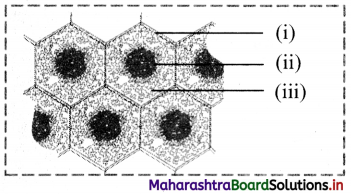
Question 7.
When the total of debit side of an account exceeds credit side, it is called _______________ balance.
(a) Debit
(b) Credit
(c) Nil
(d) Real
Answer:
(a) Debit

Question 8.
Machinery A/c shows _______________ balance.
(a) Credit
(b) Debit
(c) Positive
(d) Negative
Answer:
(b) Debit

Maharashtra Board 11th BK Important Questions Chapter 4 Ledger

Question 9.
Left hand side of an account is called _______________
(a) Credit
(b) Debit
(c) Middle
(d) Centre
Answer:
(b) Debit

Question 10.
_______________ is prepared from the balances in the ledger accounts.
(a) List
(b) Journal
(c) Book
(d) Trial Balance
Answer:
(d) Trial Balance

Question 11.
Total of Sales book is _______________ to sales account.
(a) entered
(b) moved
(c) posted
(d) given
Answer:
(c) posted
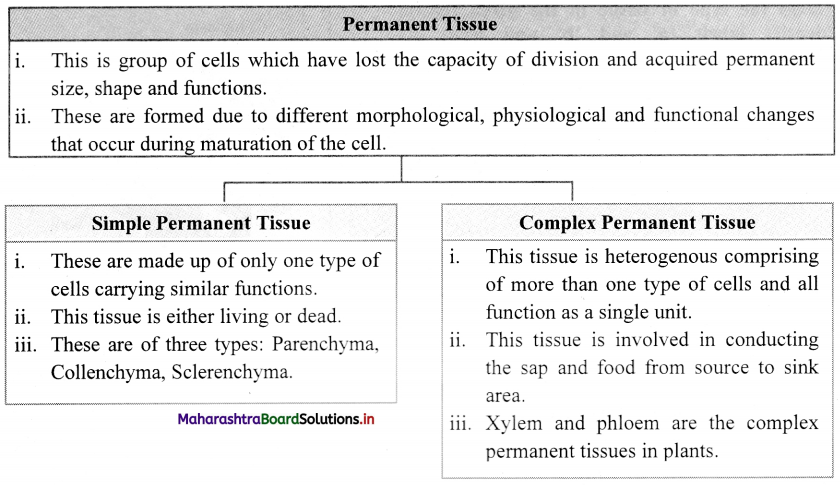
Question 12.
Wages A/c is transferred to _______________ A/c.
(a) Trading A/c
(b) Profit & Loss A/c
(c) Trial Balance
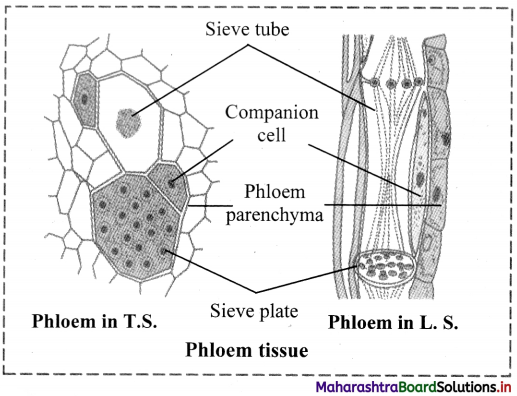
(d) Any
Answer:
(a) Trading A/c

Question 13.
All entries are posted from Journal to _______________
(a) Ledger
(b) Balance Sheet
(c) Trial Balance
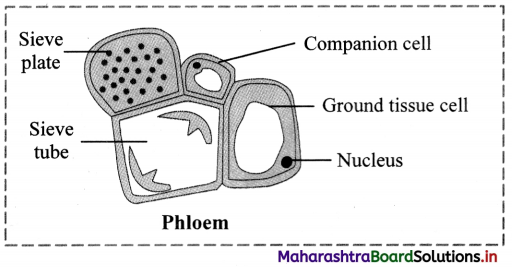
(d) Cash A/c
Answer:
(a) Ledger

4. State whether the following statements are ‘True or False’ with reasons.

Question 1.
Ledger accounts are balanced every day.
Answer:
This statement is False.
Ledger accounts are balanced on a particular period of time or on the accounting year of the firm. They are not balanced every day.

Maharashtra Board 11th BK Important Questions Chapter 4 Ledger

Question 2.
Every account is divided into two sides.
Answer:
This statement is True.
Every account is divided into two sides i.e. Debit and Credit to do ledger pasting from a journal which follows the rules of double-entry book-keeping.

Question 3.
The discount allowed is a real account.
Answer:
This statement is False.
Discount allowed is an expense for the business. All expenses come under the Nominal account. So the discount allowed is a Nominal account.

Question 4.
The bank is a Nominal A/c.
Answer:
This statement is False.
A bank is an Artificial person created by law. The bank is personal accounts.

Question 5.
Accounts of expenses may show a credit balance.
Answer:
This statement is False.
Accounts of expenses always show debit balance. They fall under the nominal account and its Golden rule is to Debit all Expenses.

Question 6.
A Debtors A/c always show a credit balance.
Answer:
This statement is False.
A Debtor A/c always shows a Debit balance. The debtor is a personal account and as per the rule of personal account Debit the receiver.

Maharashtra Board 11th BK Important Questions Chapter 4 Ledger

Question 7.
When goods are sold for cash, the personal a/c of the buyer is debited.
Answer:
This statement is False.
In a cash transaction, there is no Personal A/c. The personal account comes in a credit transaction. So when goods are sold for cash, the cash account is debited. A cash account is a real account and as per rule debit what comes in.

Question 8.
Capital a/c is a nominal a/c.
Answer:
This statement is False.
Capital is a Personal account. Capital is the amount invested by the proprietor in his business. A proprietor is a person. Capital is also personal A/c.

Question 9.
Drawing a/c is a personal a/c.
Answer:
This statement is True.
Drawings mean cash or goods withdrawn by the proprietor for his personal or family use he is a person. So drawing is personal A/c.

Question 10.
Narration is not necessary for a ledger.
Answer:
This statement is False.
Narration is necessary for a Journal book and not in Ledger. Ledgers are self-narrative as every ledger has headed.

Question 11.
All a/c’s are closed down at the end of the accounting year.
Answer:
This statement is True.
All ledger accounts are closed an accounting year or Financial year to prepare the Trial balance and Financial statements of the year.

Question 12.
Recording of a transaction in the journal is called posting.
Answer:
This statement is False.
The process of recording a transaction in the Journal is called Journalising. Posting means transferring journal entries to respective ledger accounts.

Maharashtra Board 11th BK Important Questions Chapter 4 Ledger

Question 13.
Balance of personal a/c is brought down for the next year.
Answer:
This statement is True.
Personal accounts are the account of Debtors or Creditors. The business has to collect or pay amounts on personal accounts. Current year collections or payments are done in the following year. So balances of personal accounts are brought for the next year.

Question 14.
All transactions are recorded directly in the ledger.
Answer:
This statement is False.
First, every transaction is recorded in a Journal book or Subsidiary book and from there they are posted to respective ledger accounts. No transaction can be recorded directly in the ledger.

Question 15.
Ledger Folio and index are necessary for the ledger.
Answer:
This statement is True.
The index is necessary to final particular account on its page number and ledger folio number is also necessary for cross-checking with the journal book. This makes handling convenient and easier.

Question 16.
Ledger posting is not necessary for journal proper.
Answer:
This statement is False.
Ledger posting is necessary for journal proper. From Ledger trial balance and financial statements are prepared for the accounting year. Without posting of journal proper Trial balance and financial statements will not be tally and can’t give true and fair accounting.

Question 17.
Ledger Folio is recorded in the journal.
Answer:
This statement is True.
Ledger folio is a page of the ledger, where posting is made from a journal book. For cross-reference, the ledger folio is recorded in the journal.

Maharashtra Board 11th BK Important Questions Chapter 4 Ledger

Question 18.
Ledger posting is made before journal entry.
Answer:
This statement is False.
Ledger posting is made after journal entry. First, all transactions are recorded to Journal and from the journal, posting is made to Ledger.

5. Fill in the blanks.

Question 1.
Debtors A/c shows _______________ balance.
Answer:
Debit

Question 2.
Left hand side of an account is called _______________ side.
Answer:
Debit

Question 3.
_______________ is prepared from the balances in the Ledger A/c.
Answer:
Trial Balance

Question 4.
Total of salary A/c is transfered to _______________ A/c.
Answer:
Profit and loss A/c

Maharashtra Board 11th BK Important Questions Chapter 4 Ledger

Question 5.
b/d (brought down) balance indicates _______________ balance.
Answer:
Opening

Question 6.
_______________ Balance on Nominal Account shows Inconies or gains.
Answer:
Credit

Question 7.
Debtors A/c shows _______________ balance.
Answer:
Debit

Question 8.
Drawing A/c shows _______________ balance.
Answer:
Debit

Question 9.
Wages A/c balance transferred to _______________ A/c.
Answer:
Profit and Loss

Question 10.
Discount allowed shows _______________ Balance.
Answer:
Debit

Maharashtra Board 11th BK Important Questions Chapter 4 Ledger

Question 11.
Dividend received shows _______________ Balance.
Answer:
Credit

Question 12.
Ledger is the _______________ book of Accounts.
Answer:
Principal

6. Complete the following table.

Question 1.
Maharashtra Board 11th BK Important Questions Chapter 4 Ledger 6 Q1
Answer:
Credit balance

Question 2.
Maharashtra Board 11th BK Important Questions Chapter 4 Ledger 6 Q2
Answer:
Ledger

Question 3.
Maharashtra Board 11th BK Important Questions Chapter 4 Ledger 6 Q3
Answer:
Credit Balance

Maharashtra Board 11th BK Important Questions Chapter 4 Ledger

Question 4.
Maharashtra Board 11th BK Important Questions Chapter 4 Ledger 6 Q4
Answer:
Livestock A/c

Question 5.
Maharashtra Board 11th BK Important Questions Chapter 4 Ledger 6 Q5
Answer:
Output GST

7. Put ‘✓’ mark for the nature of balance for the following.

Question 1.

Account Dr. Balance Cr. Balance
1. Salary A/c
2. Purchase A/c
3. Sales Return A/c
4. Machinery A/c
5. Bank Balance A/c
6. Cash Balance A/c
7. Sale A/c
8. Purchase Return A/c
9. Bills Payable A/c
10. Debtors A/c
11. Creditors A/c
12. Stationery A/c
13. Furniture A/c
14. Amit’s Loan A/c

Answer:

Account Dr. Balance Cr. Balance
1. Salary A/c
2. Purchase A/c
3. Sales Return A/c
4. Machinery A/c
5. Bank Balance A/c
6. Cash Balance A/c
7. Sale A/c
8. Purchase Return A/c
9. Bills Payable A/c
10. Debtors A/c
11. Creditors A/c
12. Stationery A/c
13. Furniture A/c
14. Amit’s Loan A/c

Maharashtra Board Class 11 Biology Important Questions Chapter 6 Biomolecules

Balbharti Maharashtra State Board 11th Biology Important Questions Chapter 6 Biomolecules Important Questions and Answers.

Maharashtra State Board 11th Biology Important Questions Chapter 6 Biomolecules

Question 1.
How are living organisms classified? Give examples of each.
Answer:
1. Living organisms are classified as unicellular (consisting of single cell) and multicellular (having many cells).
2. Example of unicellular organisms: bacteria, yeast.
Example of multicellular organisms: plants, animals.

Maharashtra Board Class 11 Biology Important Questions Chapter 6 Biomolecules

Question 2.
What is biochemistry?
Answer:
1. Biochemistry is biological chemistry that provides us the idea of the chemistry of living organisms and molecular basis for changes taking place in plants, animals and microbial cells.
2. It develops the foundation for understanding all biological processes and communication within and between cells as well as chemical basis of inheritance and diseases in animals and plants.

Question 3.
What does chemical analysis of living organisms indicate?
Answer:
Chemical analysis of all living organisms indicates the presence of the most common elements like carbon, hydrogen, nitrogen, oxygen, sulphur, calcium, phosphorus, magnesium and others with their respective content per unit mass of a living tissue.

Question 4.
Name the basic macromolecules present in the living organisms.
Answer:
Polysaccharides (carbohydrate) polymer of monosaccharide, polypeptides (proteins) polymer of amino acids and polynucleotides (nucleic acids) polymer of nucleotides are the three basic macromolecule present in the living organisms.

Question 5.
Draw a flowchart showing classification of carbohydrates.
Answer:
Maharashtra Board Class 11 Biology Important Questions Chapter 6 Biomolecules 1

Maharashtra Board Class 11 Biology Important Questions Chapter 6 Biomolecules

Question 6.
Write a short note on
1. Glucose
2. Galactose and
3. Fructose.
Answer:
1. Glucose:
a. It is the most important fuel in living cells.
b. Its concentration in the human blood is about 90mg per 100ml of blood.
c. The small size and solubility in water of glucose molecules allows them to pass through the cell membrane into the cell.
d. Energy is released when the molecules are metabolized by cellular respiration.

2. Galactose:
a. It looks very similar to glucose molecules.
b. They can also exist in a and p forms.
c. Galactose react with glucose to form the disaccharide lactose.
d. However, glucose and galactose cannot be easily converted into one another.
e. Galactose cannot play the same role in respiration as glucose.

3. Fructose:
a. It is the fruit sugar and chemically it is ketohexose but it has a five-atom ring rather than a six-atom ring.
b. Fructose reacts with glucose to form the sucrose, a disaccharide.

Question 7.
How are disaccharides absorbed through the cell membrane?
Answer:
1. Disaccharides are soluble in water but they are too big to pass through the cell membrane by diffusion.
2. They are broken down in the small intestine during digestion.
3. Thus, formed monosaccharides then pas into the blood and through cell membranes into the cells.
Maharashtra Board Class 11 Biology Important Questions Chapter 6 Biomolecules 2

Question 8.
Identify the X and Y in the following structure of a disaccharide.
Answer:
Maharashtra Board Class 11 Biology Important Questions Chapter 6 Biomolecules 3
X: Glycosidic bond Y: Glucose

Question 9.
Distinguish between monosaccharides and disaccharides.
Answer:

Monosaccharides Disaccharides
1. They are composed of 3-6 carbon atoms. They are composed of two monosaccharide units covalently linked to each other.
2. They cannot be hydrolyzed into smaller units. They can be hydrolysed into monosaccharides.
3. Glucose, Fructose Sucrose and Lactose

Question 10.
Which macromolecules are too big to escape from the cell?
Answer:
Polysaccharides are too big to escape from the cell.

Maharashtra Board Class 11 Biology Important Questions Chapter 6 Biomolecules

Question 11.
Write a short note on
1. Starch
2. Glycogen
3. Cellulose.
Answer:
1. Starch:
a. Starch is a stored food in the plants.
b. Starch contains two types of glucose polymer: amylose and amylopectin.
c. Both are made from a-glucose.
d. Amylose is an unbranched polymer of a-glucose.
e. The molecules coil into a helical structure.
f. It foims a colloidal suspension in hot water.
g. Amylopectin is a branched polymer of a-glucose.
h. It is completely insoluble in water.
Maharashtra Board Class 11 Biology Important Questions Chapter 6 Biomolecules 4

2. Glycogen:
a. It is amylopectin with very short distances between the branching side-chains.
b. Glycogen is stored in animal body particularly in liver and muscles from where it is hydrolyzed as per need to produce glucose.

3. Cellulose:
a. It is a polymer made from P-glucosc molecules and the polymer molecules are ‘straight’.
b. Cellulose serves to form the cell walls in plant cells.
c. These are much tougher than cell membranes.
d. This toughness is due to the arrangement of glucose units in the polymer chain and the hydrogen-bonding between neighbouring chains.

Maharashtra Board Class 11 Biology Important Questions Chapter 6 Biomolecules

Question 12.
Why plant fats are liquid at room temperature while animal fats are solid?
Answer:

  1. Plant fats are unsaturated fatty acids, whereas animal fats are saturated fatty acids.
  2. Fats having unsaturated fatty acids are liquid at room temperature.
  3. Saturated fatty acids are solid at room temperature. Hence, plant fats are liquid at room temperature, while animal fats are solid.

Question 13.
Draw the structure of triglyceride.
Answer:
Maharashtra Board Class 11 Biology Important Questions Chapter 6 Biomolecules 5

Question 14.
Observe the following diagram and answer the questions based on it.
1. Identify the part ‘X’ in the given diagram.
2. What is the chemical property of the part ‘X’.
Answer:
1. The part labelled as ‘X’ is non-polar tail.
2. Non-polar tails are hydrophobic in nature.

Question 15.
Give two examples of unsaturated fatty acids.
Answer:
Oleic acid and linoleic acid are the examples of unsaturated fatty acids.

Maharashtra Board Class 11 Biology Important Questions Chapter 6 Biomolecules

Question 16.
Explain primary structure of protein.
Answer:
The linear sequence of amino acids in polypeptide chain of a protein forms the primary structure of a protein.

Question 17.
Explain the secondary structure of protein with examples.
Answer:

  1. There are two types of secondary structure of protein: a-helix and P-pleated sheets.
  2. The polypeptide chain is arranged in a spiral helix. These spiral helices are of two types: a-helix (right handed) and P-helix (left handed).
  3. This spiral configuration is held together by hydrogen bonds.
  4. The sequence of amino acids in the polypeptide chain determines the location of its bend or fold and the position of formation of hydrogen bonds between different portions of the chain or between different chains. Thus, peptide chains form an a-helix structure.
  5. Example of a-helix structure is keratin.
  6. In some proteins two or more peptide chains are linked together by intermolecular hydrogen bonds. Such structures are called P-pleated sheets.
  7. Example of P-pleated sheet is silk fibres.
  8. Due to formation of hydrogen bonds peptide chains assume a secondary structure.

Question 18.
Explain the tertiary and quaternary structure of protein with example.
Answer:
Tertiary structure:

  1. In tertiary structure the peptide chains are much looped, twisted and folded back on themselves due to formation of disulphide bonds.
  2. Such loops and bends give the protein a tertiary structure.
  3. E.g. Myoglobin, enzymes.

Quaternary structure:
1. When a protein has more than two polypeptide subunits their arrangement in space is called quaternary structure.
2. E.g. Haemoglobin.

Question 19.
Write a note on properties of protein.
Answer:
Properties of proteins are as follows:

  1. Proteins are extremely reactive and highly specific in behaviour.
  2. Proteins are amphoteric in nature i.e. they act as both acids and bases.
  3. The behaviour of proteins is strongly influenced by pH.
  4. Like amino acids, proteins are dipolar ions at the isoelectric point i.e. the sum of the positive charges is equal to the sum of the negative charges and the net charge is zero.
  5. The ionic groups of a protein are contributed by the side chains of the polyfunctional amino acids.
  6. A protein consists of more basic amino acids such as lysine and arginine exist as a cation at the physiological pH of 7.4. Such proteins are called basic proteins.
  7. Histones of nucleoproteins are basic proteins.
  8. A protein rich in acidic amino acids exists as an anion at the physiological pH. Such proteins are called acidic proteins.
  9. Most of the blood proteins are acidic proteins.

Question 20.
Mention the findings of Feulgen.
Answer:
1. In 1924, Feulgen showed that chromosomes contain DNA.
2. He found that nucleic acids contain two pyrimidine (cytosine and thymine) and two purine (adenine and guanine) bases.

Maharashtra Board Class 11 Biology Important Questions Chapter 6 Biomolecules

Question 21.
What were the findings of Wilkins and coworkers?
Answer:
The findings of Wilkins and coworkers were as follows:

  1. Purine and pyrimidine bases are placed regularly along the DNA molecules at a distance of 3.4 A.
  2. DNA (Deoxyribonucleotide) is composed of sugar molecule (a pentose sugar of deoxyribose type), phosphoric acid (phosphates when in chemical combination), nitrogen containing bases (nitrogen containing organic ring compounds).
  3. Bases are of two types: Pyrimidine bases and purine bases.
  4. Pyrimidine bases are single ring (monocyclic) nitrogenous bases. Cytosine, Thymine and uracil are pyrimidines.
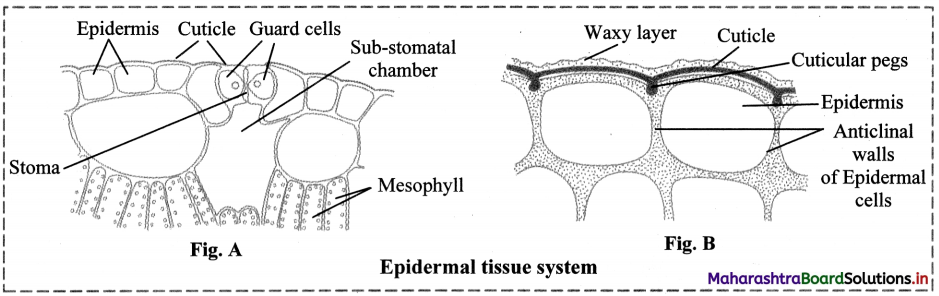
  5. Purine are double ring (dicyclic) nitrogenous bases. Adenine and guanine are purines.
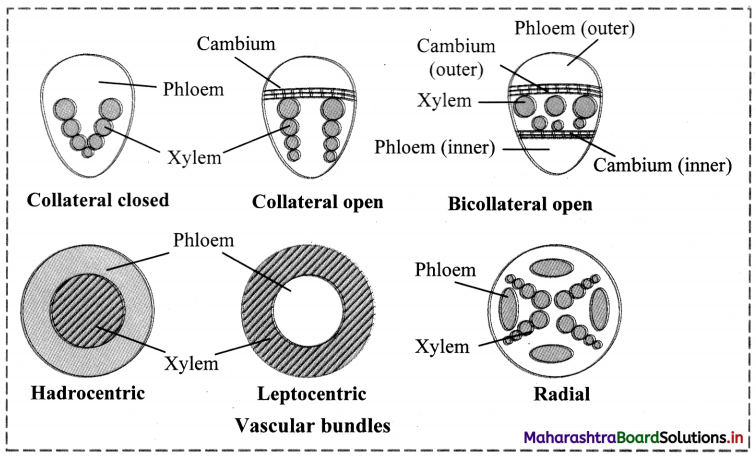
Question 22.
Chargaff analyzed the composition of DNA from various sources. Mention what were his implications from all his experiments.
Answer:
Implications proposed by Erwin Chargaff:
1. Purine and pyrimidine always occur in equal amount in DNA.
2. The base ratio i.e. A+T/G+C may vary in the DNA of different groups of animals and plants but the ratio remains constant for particular species.

Question 23.
Describe the structure of DNA.
Answer:
Maharashtra Board Class 11 Biology Important Questions Chapter 6 Biomolecules 6

  1. DNA is a long chain made up of alternate sugar and phosphate groups. The sugar present in DNA is always a deoxyribose attached to a phosphate group. So, it forms a regular, repeating phosphate sugar sequence.
  2. A base is attached to sugar -phosphate chain. Together this unit which consist of sugar, phosphate and a base is called nucleotide.
  3. The nitrogenous base and a sugar of a nucleotide form a molecule called nucleoside. It lacks phosphate group. Four types of nucleoside are found in DNA molecule.
  4. In a nucleoside, nitrogenous base is attached to the first carbon atom (C-1) of the sugar and when a phosphate group gets attached with that of the carbon (C-5) atom of the sugar molecule a nucleotide molecule is formed.
  5. A single strand of DNA consists of several thousands of nucleotides one above the other.
  6. The phosphate group of the lower nucleotide attached with the 5th carbon atom of the deoxyribose sugar forms phospho-di-ester bond with that of the 3rd carbon atom of the deoxyribose sugar of the nucleotide placed just above it.
  7. Single long chain of polynucleotides of DNA consists of one end with sugar molecules not connected with another nucleotide having C-3 carbon which is not connected with phosphate group, similarly the other end having C-5 of the sugar is not connected with any phosphate group. These two ends of the polynucleotide chain are called as 3′ and 5′ ends respectively.
  8. The single polynucleotide strand of DNA is not straight but helical in shape.
  9. The DNA molecule consists of such two helical polynucleotide chains which are complementary to each other.
  10. The two complementary polynucleotide chains of DNA are held together by the weak hydrogen bonds.
  11. Adenine always pairs with thymine, and guanine with cytosine (a pyrimidine with a purine).
  12. Adenine-thymine pair consists of two hydrogen bonds and guanine-cytosine pair consists of three hydrogen bonds (Thus, if the sequence of bases of a polynucleotide chain is known, that of the other can be determined).

Question 24.
Draw the structures of nitrogen bases in nucleic acid.
Answer:
Maharashtra Board Class 11 Biology Important Questions Chapter 6 Biomolecules 7

Maharashtra Board Class 11 Biology Important Questions Chapter 6 Biomolecules

Question 25.
Describe the structure of RNA.
Answer:
Maharashtra Board Class 11 Biology Important Questions Chapter 6 Biomolecules 8

  1. The other nucleic acid found in living organisms is Ribose nucleic acid.
  2. In most of the organisms it is not found to be hereditary material but in certain organisms like tobacco mosaic virus, it is the hereditary material.
  3. Like DNA, ribose nucleic acid also consists of polynucleotide chain with the difference that it consists of single strand. Exceptions are Reovirus and wound tumor virus where RNA is double stranded.
  4. The nucleotides of RNA have ribose sugar instead of the deoxyribose sugar as in the case of DNA.
  5. In case of RNA, Uracil substitutes thymine of DNA.
  6. Purine, pyrimidine equality is not found in RNA molecule because of its single stranded structure.
  7. RNA strand is usually found folded upon itself in certain regions or entirely. These folding helps in stability of the RNA molecule.
  8. Most of the RNA polynucleotide chains start either with adenine or guanine.
  9. Three types of cellular RNAs have been distinguished:
    1. messenger RNA (mRNA) or template RNA,
    2. ribosomal RNA (rRNA),
    3. transfer RNA (tRNA) or soluble RNA.

Question 26.
Observe the following figure and name the type of bond shown by arrow in the structure.
Maharashtra Board Class 11 Biology Important Questions Chapter 6 Biomolecules 9
Answer:
The type of bond shown in the diagram is hydrogen bond.

Maharashtra Board Class 11 Biology Important Questions Chapter 6 Biomolecules

Question 27.
What would have happened if there were no enzymes in the body?
Answer:
If enzymes were absent in the body, either the reactions would not occur or if they occur they would occur at a very slow rate.

Question 28.
How many reactions are catalyzed by an enzyme?
Answer:
Each enzyme catalyzes only one reaction.

Question 29.
What is a substrate?
Answer:
The substance upon which an enzyme acts is termed as the substrate.

Question 30.
What is endo-enzyines? Give examples.
Answer:
The enzymes which act within the cell in which they are synthesized are known as endo-enzymes E.g., enzymes produced in the chloroplast and mitochondria.

Question 31.
What are exo-enzymes?
Answer:
1. The enzymes which act outside the cell of which they are synthesized are known as exo-enzymes. E.g. enzymes released by many fungi.
2. These enzymes, synthesized by living cell, retain their catalytic property even when extracted from cells.

Question 32.
How are enzymes categorised?
Answer:
On basis of chemical composition enzymes are categorised:
1. Purely proteinaceous enzymes: e.g. Proteases that spilt protein
2. Conjugated enzymes: enzymes are made up of a protein to which a non-protein prosthetic group is attached.

Maharashtra Board Class 11 Biology Important Questions Chapter 6 Biomolecules

Question 33.
What is a prosthetic group ? What w ill happen if it is removed?
Answer:
1. Prosthetic group is non-protein in nature and is attached to the protein component of enzyme by chemical bonds.
2. It is not removed by hydrolysis.
3. If the prosthetic group is removed the protein part of the enzyme becomes inactive.

Question 34.
What are coenzymes?
Answer:
1. Enzymes require certain organic compounds for their activity.
2. The organic compounds that are tightly attached to the protein part are called coenzymes.
3. E.g. Nicotinamaide adenine dinucleotide (NAD), Flavin mononucleotide (FMN).

Question 35.
What are co-factors?
Answer:
1. Enzymes require certain inorganic ions for their activity.
2. The inorganic ions which are loosely attached to the protein part are called co-factors.
E.g. Magnesium, copper, zinc, iron, manganese etc.
[Note: Apoenzyme (protein part) and co-factor together form a complete catalytically active enzyme which is known as holoenzyme. The co-factors are of two types; metal ions and coenzymes. A coenzyme or metal ion that is very tightly or even covalently bound to the enzyme protein is known as a prosthetic group.]

Question 36.
Complete the analogy.
Iron (Fe): Catalase: Manganese (Mn):
Answer:
Peptidase

Question 37.
Give examples of coenzymes and cofactors.
Answer:
1. Nicotinamaide adenine dinucleotide (NAD), Flavin mononucleotide (FMN).
2. Magnesium, copper, zinc, iron, manganese etc.

Maharashtra Board Class 11 Biology Important Questions Chapter 6 Biomolecules

Question 38.
How are enzymes named?
Answer:

  1. Enzymes are named by adding the suffix- ‘ase’ to the name of the substrate on which they act e.g. protease, sucrase, nuclease etc. which break up proteins, sucrose and nucleic acids respectively.
  2. The enzymes can be named according to the type of function they perform.
    For e.g., dehydrogenase remove hydrogen, carboxylase add CO; decarboxylases remove C02, oxidases helping in oxidation.
  3. Some enzymes are named according to the source from which they are obtained.
    For e.g., papain from papaya, bromelain from the member of Bromeliaceae family, pineapple.
  4. According to international code of enzyme nomenclature, the name of each enzyme ends with an -ase and consists of double name!
  5. The first name indicates the nature of substrate upon which the enzyme acts and the second name indicates the reaction catalyzed.

For e.g., pyruvic decarboxylase catalyses the removal of C02 from the substrate pyruvic acid.
Similarly, the enzyme glutamate pyruvate transaminase catalyses the transfer of an amino group from the substrate glutamate to another substrate pyruvate.

Question 39.
Explain in detail the mechanism of enzyme action. Write a note on model proposed by Emil Fischer for mechanism of enzyme action.
Answer:
1. The basic mechanism by which enzymes catalyze chemical reactions begins with the binding of the substrate (or substrates) to the active site on the enzyme.
2. The active site is the specific region of the enzyme which combines with the substrate.
3. The binding of the substrate to the enzyme causes changes in the distribution of electrons in the chemical bonds of the substrate and ultimately causes the reactions that lead to the formation of products.
4. The products are released from the enzyme surface to regenerate the enzyme for another reaction cycle.
Maharashtra Board Class 11 Biology Important Questions Chapter 6 Biomolecules 10
5. Lock and Key model proposed by Emil Fischer: i. Proteinaceous Nature:
All enzymes are basically made up of protein.

Maharashtra Board Class 11 Biology Important Questions Chapter 6 Biomolecules

Question 40.
Describe the concept of metabolism.
Answer:

  1. Metabolism is the sum of the chemical reactions that take place within each cell of a living organism and provide energy for vital processes and for synthesizing new organic material.
  2. It involves continuous process of breakdown and synthesis of biomolecules through chemical reactions.
  3. Each of the metabolic reaction results in a transformation of biomolecules.
  4. Most of these metabolic reactions do not occur in isolation but are always linked with some other reactions.
  5. In cells, metabolism involves two following types of pathways:

a. Catabolic pathways
This involves formation of simpler structure from a complex biomolecule.
For e.g. when we eat wheat, bread or chapati, our gastrointestinal tract digests (hydrolyses) the starch to glucose units with help of enzymes and releases energy in form of ATP (Adenosine triphosphate).

b. Anabolic pathway
It is also called as biosynthetic pathway that involves formation of a more complex biomolecules from a simpler structure
Fone.g., synthesis of glycogen from glucose and protein from amino acids. These pathways consume energy.

Question 41.
Draw a flowchart showing catabolic and anabolic reactions.
Answer:
Maharashtra Board Class 11 Biology Important Questions Chapter 6 Biomolecules 11

Question 42.
Write a short note on secondary metabolites.
Answer:

  1. Secondary metabolites are small organic molecules produced by organisms that are not essential for their growth, development and reproduction.
  2. Several types of bacteria, fungi and plants produce secondary metabolites.
  3. Secondary metabolites can be classified on the basis of chemical structure (e.g. SMs containing rings, sugar), composition (with or without nitrogen), their solubility in various solvents, or the pathway by which they are synthesized (e.g. phenylpropanoid produces tannins).
  4. A simple way of classifying secondary metabolites includes three main groups such as:
    • Terpenes: Made from mevalonic acid that is composed mainly of carbon and hydrogen
    • Phenolics: Made from simple sugars containing benzene rings, hydrogen and oxygen.
    • Nitrogen-containing compounds: Extremely diverse class may also contain sulphur.

Maharashtra Board Class 11 Biology Important Questions Chapter 6 Biomolecules

Question 43.
Fill in the blanks.

  1. Living organism have _________ as the basic structural and functional unit.
  2. The cells have _______ containing numerous chemical molecules, the biomolecules.
  3. ________ are used very quickly by cells but if a cell is not in need of all the energy released immediately then it may get stored.
  4. By ________ reaction monosaccharide is converted to disaccharide.
  5. The balance between catabolism and anabolism maintain _______ in the cell as well as in the whole body.

Answer:

  1. Cell
  2. Protoplasm
  3. monosaccharides
  4. Condensation reaction
  5. Homeostasis

Question 44.
Apply Your Knowledge:

Question 1.
While performing an experiment, to understand effect of pH on enzyme activity, a student prepared
solution of varied pH. He observed that enzyme activity is maximum at a particular range of pH.
What is the reason for its maximum activity at a particular range of pH? What would be the effect on enzyme activity if strong acid or strong base is added?
Answer:
The enzymes are highly specific to pH and remain active within particular range of pH only. Hence, exhibit maximum activity only at particular range of pH. When strong acid or strong base is added in the reaction the enzyme activity is inhibited as most of the enzymes are denatured.

Question 2.
When a compound ‘x’ is added to a chemical solution containing enzyme and substrate, the enzymatic activity stops. What could be the nature of compound ‘x’?
Answer:
Compound ‘x’ could be either competitive or non-competitive inhibitor.

Question 45.
Quick Review

Maharashtra Board Class 11 Biology Important Questions Chapter 6 Biomolecules 12
Maharashtra Board Class 11 Biology Important Questions Chapter 6 Biomolecules 13

Question 46.
Exercise:

Question 1.
Draw a flow chart of biomolecules in living system.
Answer:
Refer Quick Review

Maharashtra Board Class 11 Biology Important Questions Chapter 6 Biomolecules

Question 2.
Explain what is biochemistry?
Answer:
1. Biochemistry is biological chemistry that provides us the idea of the chemistry of living organisms and molecular basis for changes taking place in plants, animals and microbial cells.
2. It develops the foundation for understanding all biological processes and communication within and between cells as well as chemical basis of inheritance and diseases in animals and plants.

Question 3.
Mention the basic macromolecules present in the living organism.
Answer:
Polysaccharides (carbohydrate) polymer of monosaccharide, polypeptides (proteins) polymer of amino acids and polynucleotides (nucleic acids) polymer of nucleotides are the three basic macromolecule present in the living organisms.

Question 4.
Write a note on monosaccharides.
Answer:
Monosaccharides:
a. Monosaccharides are the simplest sugars having crystalline structure, sweet taste and soluble in water.
b. They cannot be further hydrolyzed into smaller molecules.
c. They are the building blocks or monomers of complex carbohydrates.
d. They have the general molecular formula (CH20)n, where n can be 3, 4, 5, 6 and 7.
e. They can be classified as triose, tetrose, pentose, etc.
f. Monosaccharides containing the aldehyde (-CHO) group are classified as aldoses e.g. glucose, xylose, and those with a ketone(-C=0) group are classified as ketoses. E.g. ribulose, fructose.

Question 5.
Explain the absorption of disaccharides through the cell membrane.
Answer:
1. Disaccharides are soluble in water but they are too big to pass through the cell membrane by diffusion.
2. They are broken down in the small intestine during digestion.
3. Thus, formed monosaccharides then pass into the blood and through cell membranes into the cells.

Question 6.
Draw the structure of amylose.
Answer:
Starch:
a. Starch is a stored food in the plants.
b. Starch contains two types of glucose polymer: amylose and amylopectin.
c. Both are made from a-glucose.
d. Amylose is an unbranched polymer of a-glucose.
e. The molecules coil into a helical structure.
f. It foims a colloidal suspension in hot water.
g. Amylopectin is a branched polymer of a-glucose.
h. It is completely insoluble in water.

Question 7.
Write the significance of carbohydrates.
Answer:
Significances of carbohydrates are as follows:

  1. Carbohydrates provide energy for metabolism.
  2. Glucose is the main substrate for ATP synthesis.
  3. Lactose, a disaccharide present in the milk provides energy to babies.
  4. Polysaccharide serves as a structural component of cell membrane, cell wall and reserved food as starch and glycogen.

Maharashtra Board Class 11 Biology Important Questions Chapter 6 Biomolecules

Question 8.
What is glycosidic bond?
Answer:
Oligosaccharides:
a. A carbohydrate polymer comprising of two to six monosaccharide molecules is called oligosaccharide.
b. They are linked together by glycosidic bond.
c. They are classified on the basis of monosaccharide units:
Disaccharides: These are the sugars containing two monosaccharide units and can be further hydrolysed into smaller components. E.g.: Sucrose, maltose, lactose, etc.
Trisaccharides: These contain three monomers. E.g. Raffmose.
Tetrasaccharides: These contain four monomers. E.g.: Stachyose.

Glycosidic bond:
a. Glycosidic bond is a covalent bond that forms a linkage between two monosaccharides by a dehydration reaction.
b. It is formed when a hydroxyl group of one sugar reacts with the anomeric carbon of the other.
c. Glycosidic bonds are readily hydrolyzed by acid but resist cleavage by base.
d. There are two types of glycosidic bonds: a-glycosidic bond and P-glycosidic bond.

Question 9.
What are saturated fatty acids?
Answer:
1. Saturated fatty acids: They contain single chain of carbon atoms with single bonds.
E.g. Palmitic acid, stearic acid
2. Unsaturated fatty acids: They contain one or more double bonds between the carbon atoms of the hydrocarbon chain.
a. Simple lipids: These are esters of fatty acids with various alcohols.
E.g. Fats, wax.
b. Compound lipids: These are ester of fatty acids containing other groups like phosphate (Phospholipids), sugar (glycolipids), etc.
E.g. Lecithin
c. Sterols: They are derived lipids. They are composed of fused hydrocarbon rings (steroid nucleus) and a long hydrocarbon side chain.
E.g. Cholesterol, phytosterols.

Question 10.
Write a note on simple lipids.
Answer:
Lipids are classified into three main types:
Simple lipids:
a. These are esters of fatty acids with various alcohols. Fats and waxes are simple lipids.
b. Fats are esters of fatty acids with glycerol (CH2OH-CHOH-CH2OH).
c. Triglycerides are three molecules of fatty acids and one molecule of glycerol.
d. Unsaturated fats are liquid at room temperature and are called oils. Unsaturated fatty acids are hydrogenated to produce fats e.g. Vanaspati ghee.

Question 11.
Write a note on derived lipids.
Answer:
Derived Lipids:
a. They are composed of fused hydrocarbon rings (steroid nucleus) and a long hydrocarbon side chain.
b. One of the most common sterols is cholesterol.
Biological significance:
a. It is widely distributed in all cells of the animal body, but particularly in nervous tissue.
b. Cholesterol exists either free or as cholesterol ester.
c. Adrenocorticoids, sex hormones (progesterone, testosterone) and vitamin D are synthesized from cholesterol.
d. Cholesterol is not found in plants.
e. Sterols exist as phytosterols in plants.
f. Yam Plant (Dioscorea) produces a steroid compound called diosgenin. It is used in the manufacture of antifertility pills, i.e. birth control pills.

Maharashtra Board Class 11 Biology Important Questions Chapter 6 Biomolecules

Question 12.
What are compound lipids? Mention their biological significance.
Answer:
Compound lipids:
a. These are ester of fatty acids containing other groups like phosphate (Phospholipids), sugar (glycolipids), etc.
b. They contain a molecule of glycerol, two molecules of fatty acids and a phosphate group or simple sugar.
c. Some phospholipids such as lecithin also have a nitrogenous compound attached to the phosphate group.
d. Phospholipids have both hydrophilic polar groups (phosphate and nitrogenous group) and hydrophobic non-polar groups (hydrocarbon chains of fatty acids).
e. Glycolipids contain glycerol, fatty acids, simple sugars such as galactose. They are also called cerebrosides.
Biological significance:
a. Phospholipids contribute in the formation of cell membrane.
b. Large amounts of glycolipids are found in the brain white matter and myelin sheath.

Question 13.
Explain the classification of proteins based on their chemical composition.
Answer:
On the basis of structure, proteins are classified into three categories:
1. Simple proteins:
a. Simple proteins on hydrolysis yield only amino acids.
b. These are soluble in one or more solvents.
c. Simple proteins may be soluble in water.
d. Histones of nucleoproteins are soluble in water.
e. Globular molecules of histones are not coagulated by heat.
f. Albumins are also soluble in water but they get coagulated on heating.
g. Albumins are widely distributed e.g. egg albumin, serum albumin and legumelin of pulses are albumins.
Importance: They are involved in structural components; they also act as a storage kind of protein.
Some are associated with nucleic acids in nucleoproteins of cell.

2. Conjugated proteins:
a. Conjugated proteins consist of a simple protein united with some non-protein substance.
b. The non-protein group is called prosthetic group e.g. haemoglobin.
c. Globin is the protein and the iron containing pigment haem is the prosthetic group.
d. Similarly, nucleoproteins have nucleic acids.
e. Proteins are classified as glycoproteins and mucoproteins.
f. Mucoproteins are carbohydrate-protein complexes e.g. mucin of saliva and heparin of blood.
g. Lipoproteins are lipid-protein complexes e.g. conjugate protein found in brain, plasma membrane, milk etc. Importance: They are involved in structural components of cell membranes and organelles.
They also act as a transporter.
Some conjugated proteins are important in electron transport chain in respiration.

3. Derived proteins:
a. These proteins are not found in nature as such.
b. These proteins are derived from native protein molecules on hydrolysis.
c. Metaproteins, peptones are derived proteins.
Importance: They act as a precursor for many molecules which are essential for life.

Question 14.
What is peptide bond? Explain its formation.
Answer:
1. The covalent bond that links the two amino acids is called a peptide bond.
2. Peptide bond is formed by condensation reaction.

Question 15.
Mention the examples of simple proteins and write their significance.
Answer:
Examples of simple proteins are: E.g.: Albumins and histones.
Significance:
1. Albumin:
a. % It is the main protein in the blood.
b. It maintains the pressure in the blood vessels.
c. It helps in transportation of substances like hormone and drugs in the body.
2. Histones:
a. It is the chief protein of chromatin.
b. They are involved in packaging of DNA into structural units called nucleosomes.

Maharashtra Board Class 11 Biology Important Questions Chapter 6 Biomolecules

Question 16.
What is nucleotide?
Answer:
Nucleotide is a unit which consists of a sugar, phosphate and a base. Nucleotides are basic units of nucleic acids.

Question 17.
Write a note on structure of DNA molecule proposed by Watson and Crick.
Answer:
1. DNA is a long chain made up of alternate sugar and phosphate groups. The sugar present in DNA is always a deoxyribose attached to a phosphate group. So, it forms a regular, repeating phosphate sugar sequence.
2. A base is attached to sugar -phosphate chain. Together this unit which consist of sugar, phosphate and a base is called nucleotide.
3. The nitrogenous base and a sugar of a nucleotide form a molecule called nucleoside. It lacks phosphate group. Four types of nucleoside are found in DNA molecule.
4. In a nucleoside, nitrogenous base is attached to the first carbon atom (C-1) of the sugar and when a phosphate group gets attached with that of the carbon (C-5) atom of the sugar molecule a nucleotide molecule is formed.
5. A single strand of DNA consists of several thousands of nucleotides one above the other.
6. The phosphate group of the lower nucleotide attached with the 5th carbon atom of the deoxyribose sugar forms phospho-di-ester bond with that of the 3rd carbon atom of the deoxyribose sugar of the nucleotide placed just above it.
7. Single long chain of polynucleotides of DNA consists of one end with sugar molecules not connected with another nucleotide having C-3 carbon which is not connected with phosphate group, similarly the other end having C-5 of the sugar is not connected with any phosphate group. These two ends of the polynucleotide chain are called as 3′ and 5′ ends respectively.
8. The single polynucleotide strand of DNA is not straight but helical in shape.
9. The DNA molecule consists of such two helical polynucleotide chains which are complementary to each other.
10. The two complementary polynucleotide chains of DNA are held together by the weak hydrogen bonds.
11. Adenine always pairs with thymine, and guanine with cytosine (a pyrimidine with a purine).
12. Adenine-thymine pair consists of two hydrogen bonds and guanine-cytosine pair consists of three hydrogen bonds (Thus, if the sequence of bases of a polynucleotide chain is known, that of the other can be determined).

  1. According to Watson and Crick, DNA molecule consists of two strands twisted around each other in the form of a double helix.
  2. The two strands i.e. polynucleotide chains are supposed to be in opposite direction so end of one chain having 3′ lies beside the 5′ end of the other.
  3. One turn of the double helix of the DNA measures about 34A.
  4. It consists paired nucleotides and the distance between two neighboring pair nucleotides is 3.4A.
  5. The diameter of the DNA molecule has been found be 20A.

Question 18.
What is the function of ribosomal RNA?
Answer:
Ribosomal RNA (rRNA):
a. rRNA was discovered by Kurland in 1960.
b. It forms 50-60% part of ribosomes.
c. It accounts 80-90% of the cellular RNA.
d. It is synthesized in nucleus.
e. It gets coiled at various places due to intrachain complementary base pairing.
Role of ribosomal RNA: It provides proper binding site for m-RNA during protein synthesis.

Question 19.
Write a short note on m-RNA.
Answer:
Messenger RNA (mRNA):
a. It is a linear polynucleotide.
b. It accounts 3% of cellular RNA.
c. Its molecular weight is several million. , d. mRNA molecule carrying information to form a complete polypeptide chain is called cistron.
e. Size of mRNA is related to the size of message it contains.
f. Synthesis of mRNA begins at 5’ end of DNA strand and terminates at 3’ end.

Role of messenger RNA:
It carries genetic information from DNA to ribosomes, which are the sites of protein synthesis.
Maharashtra Board Class 11 Biology Important Questions Chapter 6 Biomolecules 14

Question 20.
Write a note on types of non-genetic RNA.
Answer:
There are three types of cellular RNAs:
1. messenger RNA (mRNA),
2. ribosomal RNA (rRNA),
3. transfer RNA (tRNA). ‘

1. Messenger RNA (mRNA):
a. It is a linear polynucleotide.
b. It accounts 3% of cellular RNA.
c. Its molecular weight is several million. , d. mRNA molecule carrying information to form a complete polypeptide chain is called cistron.
e. Size of mRNA is related to the size of message it contains.
f. Synthesis of mRNA begins at 5’ end of DNA strand and terminates at 3’ end.

Role of messenger RNA:
It carries genetic information from DNA to ribosomes, which are the sites of protein synthesis.

2. Ribosomal RNA (rRNA):
a. rRNA was discovered by Kurland in 1960.
b. It forms 50-60% part of ribosomes.
c. It accounts 80-90% of the cellular RNA.
d. It is synthesized in nucleus.
e. It gets coiled at various places due to intrachain complementary base pairing.
Role of ribosomal RNA: It provides proper binding site for m-RNA during protein synthesis.

3. Transfer RNA (tRNA):
a. These molecules are much smaller consisting of 70-80 nucleotides.
b. Due to presence of complementary base pairing at various places, it is shaped like clover-leaf.
c. Each tRNA can pick up particular amino acid.
d. Following four parts can be recognized on tRNA
1. DHU arm (Dihydroxyuracil loop/ amino acid recognition site
2. Amino acid binding site
3. Anticodon loop / codon recognition site
4. Ribosome recognition site.
e. In the anticodon loop of tRNA, three unpaired nucleotides are present called as anticodon which pair with codon present on mRNA.
f. The specific amino acids are attached at the 3’ end in acceptor stem of clover leaf of tRNA.
Role of transfer RNA: It helps in elongation of polypeptide chain during the process called translation.

Maharashtra Board Class 11 Biology Important Questions Chapter 6 Biomolecules

Question 21.
What are co-factors? Give examples.
Answer:

  1. Enzymes require certain inorganic ions for their activity.
  2. The inorganic ions which are loosely attached to the protein part are called co-factors.
  3. E.g. Magnesium, copper, zinc, iron, manganese etc.

[Note: Apoenzyme (protein part) and co-factor together form a complete catalytically active enzyme which is known as holoenzyme. The co-factors are of two types; metal ions and coenzymes. A coenzyme or metal ion that is very tightly or even covalently bound to the enzyme protein is known as a prosthetic group.]

Question 22.
Describe the important properties of enzymes.
Answer:
1. Proteinaceous Nature:
All enzymes are basically made up of protein.

2. Three-Dimensional conformation:
a. All enzymes have specific 3-dimensional conformation.
b. They have one or more active sites to which substrate (reactant) combines.
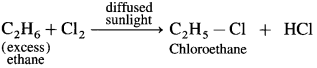
c. The points of active site where the substrate joins with the enzyme is called substrate binding site.

3. Catalytic property:
a. Enzymes are like inorganic catalysts and influence the speed of biochemical reactions but themselves remain unchanged.
b. After completion of the reaction and release of the product they remain active to catalyze again.
c. A small quantity of enzymes can catalyze the transformation of a very large quantity of the substrate
into an end product.
d. For example, sucrase can hydrolyze 100000 times of sucrose as compared with its own weight.

4. Specificity of action:
a. The ability of an enzyme to catalyze one specific reaction and essentially no other is perhaps its most significant property. Each enzyme acts upon a specific substrate or a specific group of substrates.
b. Enzymes are very sensitive to temperature and pH.
c. Each enzyme exhibits its highest activity at a specific pH i.e. optimum pH.
d. Any increase or decrease in pH causes decline in enzyme activity e.g. enzyme pepsin (secreted in stomach)shows highest activity at an optimum pH of 2 (acidic)

5. Temperature:
a. Enzymes are destroyed at higher temperature of 60-70°C or below, they are not destroyed but become inactive.
b. This inactive state is temporary and the enzyme can become active at suitable temperature.
c. Most of the enzymes work at an optimum temperature between 20°C and 35°C.

There are two types of models:
1. Lock and Key model:
a. Lock and Key model was first postulated in 1894 by Emil Fischer.
b. This model explains the specific action of an enzyme with a single substrate.
c. In this model, lock is the enzyme and key is the substrate.
d. The correctly sized key (substrate) fits into the key hole (active site) of the lock (enzyme).

2. Induced Fit model (Flexible Model):
a. Induced Fit model was first proposed in 1959 by Koshland.
b. This model states that approach of a substrate induces a conformational change in the enzyme.
c. It is the more accepted model to understand mode of action of enzyme.
d. The induced fit model shows that enzymes are rather flexible structures in which the active site continually reshapes by its interactions with the substrate until the time the substrate is completely bound to it.
e. It is also the point at which the final form and shape of the enzyme is determined.
[Note: Temperature is a factor affecting enzyme activity and not a property of enzyme.]

Maharashtra Board Class 11 Biology Important Questions Chapter 6 Biomolecules

Question 23.
Explain the classification enzymes and mention the example of each class.
Answer:
1. Enzymes are biological macromolecules which act as a catalyst and accelerates the reaction in the body.
2. Enzymes are classified into six classes:
a. Oxidoreductases: These enzymes catalyze oxidation and reduction reactions by the transfer of hydrogen and/or oxygen, e.g. alcohol dehydrogenase
b. Transferases: These enzymes catalyse the transfer of certain groups between two molecules, e.g. glucokinase
c. Hydrolases: These enzymes catalyse hydrolytic reactions. This class includes amylases, proteases, lipases etc. e.g. Sucrase
d. Lyases: These enzymes are involved in elimination reactions resulting in the removal of a group of atoms from substrate molecule to leave a double bond. It includes aldolases, decarboxylases, and dehydratases, e.g. fumarate hydratase.
e. Isomerases: These enzymes catalyze structural rearrangements within a molecule. Their nomenclature is based on the type of isomerism. Thus, these enzymes are identified as racemases, epimerases, isomerases, mutases, e.g. xylose isomerase.
f. Ligases or Synthetases: These are the enzymes which catalyze the covalent linkage of the molecules utilizing the energy obtained from hydrolysis of an energy-rich compound like ATP, GTP e.g. glutathione synthetase, Pyruvate carboxylase.

Question 24.
Enlist the factors affecting the activity of enzymes.
Answer:
The factors affecting the enzyme activity are as follows:
1. Concentration of substrate:
a. Increase in the substrate concentration gradually increases the velocity of enzyme activity within the limited range of substrate levels.
b. A rectangular hyperbola is obtained when velocity is plotted against the substrate concentration.
c. Three distinct phases (A, B and C) of the reaction are observed in the graph.
Where V = Measured velocity, Vmax = Maximum velocity, S = Substrate concentration,
Km = Michaelis-Menten constant.
d. Km or the Michaelis-Menten constant is defined as the substrate concentration (expressed in moles/lit) to produce half of maximum velocity in an enzyme catalyzed reaction.
e. It indicates that half of the enzyme molecules (i.e. 50%) are bound with the substrate molecules when the substrate concentration equals the Km value.
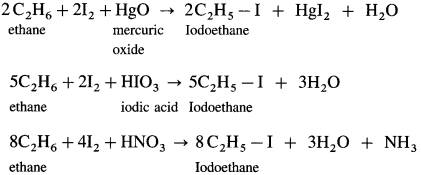
f. Km value is a constant and a characteristic feature of a given enzyme.
g. It is a representative for measuring the strength of ES complex.
h. A low Km value indicates a strong affinity between enzyme and substrate, whereas a high Km value reflects a weak affinity between them.
i. For majority of enzymes, the Km values are in the range of 10-5 to 10-2 moles.

2. Enzyme Concentration:
a. The rate of an enzymatic reaction is directly proportional to the concentration of the substrate.
b. The rate of reaction is also directly proportional to the square root of the concentration of enzymes.
c. It means that the rate of reaction also increases with the increasing concentration of enzyme and the rate of reaction can also decrease by decreasing the concentration of enzyme.

3. Temperature:
a. The temperature at which the enzymes show maximum activity is called Optimum temperature.
b. The rate of chemical reaction is increased by a rise in temperature but this is true only over a limited range of temperature.
c. Enzymes rapidly denature at temperature above 40°C.
d. The activity of enzymes is reduced at low temperature.
e. The enzymatic reaction occurs best at or around 37°C which is the average normal body temperature in homeotherms.

4. Effect of pH:
a. The pH at which an enzyme catalyzes the reaction at the maximum rate is known as optimum pH.
b. The enzyme cannot perform its function beyond the range of its pH value.

5. Other substances:
a. The enzyme action is also increased or decreased in the presence of some other substances such as co-enzymes, activators and inhibitors.
b. Most of the enzymes are combination of a co-enzyme and an apo-enzyme.
c. Activators are the inorganic substances which increase the enzyme activity.
d. Inhibitor is the substance which reduces the enzyme activity.

Maharashtra Board Class 11 Biology Important Questions Chapter 6 Biomolecules

Question 25.
With the help of lock and key theory explain the mechanism of enzyme action.
Answer:
1. Proteinaceous Nature:
All enzymes are basically made up of protein.

2. Three-Dimensional conformation:
a. All enzymes have specific 3-dimensional conformation.
b. They have one or more active sites to which substrate (reactant) combines.
c. The points of active site where the substrate joins with the enzyme is called substrate binding site.

3. Catalytic property:
a. Enzymes are like inorganic catalysts and influence the speed of biochemical reactions but themselves remain unchanged.
b. After completion of the reaction and release of the product they remain active to catalyze again.
c. A small quantity of enzymes can catalyze the transformation of a very large quantity of the substrate
into an end product.
d. For example, sucrase can hydrolyze 100000 times of sucrose as compared with its own weight.

4. Specificity of action:
a. The ability of an enzyme to catalyze one specific reaction and essentially no other is perhaps its most significant property. Each enzyme acts upon a specific substrate or a specific group of substrates.
b. Enzymes are very sensitive to temperature and pH.
c. Each enzyme exhibits its highest activity at a specific pH i.e. optimum pH.

d. Any increase or decrease in pH causes decline in enzyme activity e.g. enzyme pepsin (secreted in stomach)shows highest activity at an optimum pH of 2 (acidic)

5. Temperature:
a. Enzymes are destroyed at higher temperature of 60-70°C or below, they are not destroyed but become inactive.
b. This inactive state is temporary and the enzyme can become active at suitable temperature.
c. Most of the enzymes work at an optimum temperature between 20°C and 35°C.

There are two types of models:
1. Lock and Key model:
a. Lock and Key model was first postulated in 1894 by Emil Fischer.
b. This model explains the specific action of an enzyme with a single substrate.
c. In this model, lock is the enzyme and key is the substrate.
d. The correctly sized key (substrate) fits into the key hole (active site) of the lock (enzyme).

Question 26.
With the help of suitable examples give any three classes of enzymes.
Answer:
a. Oxidoreductases: These enzymes catalyze oxidation and reduction reactions by the transfer of hydrogen and/or oxygen, e.g. alcohol dehydrogenase
b. Transferases: These enzymes catalyse the transfer of certain groups between two molecules, e.g. glucokinase
c. Hydrolases: These enzymes catalyse hydrolytic reactions. This class includes amylases, proteases, lipases etc. e.g. Sucrase

Question 27.
Following graph represents the effect of substrate concentration on enzyme activity. Identify ‘X’ and ‘Y’ Write proper explanation of the process.
Maharashtra Board Class 11 Biology Important Questions Chapter 6 Biomolecules 17
Answer:
The factors affecting the enzyme activity are as follows:
1. Concentration of substrate:
a. Increase in the substrate concentration gradually increases the velocity of enzyme activity within the limited range of substrate levels.
b. A rectangular hyperbola is obtained when velocity is plotted against the substrate concentration.
c. Three distinct phases (A, B and C) of the reaction are observed in the graph.
Where V = Measured velocity, Vmax = Maximum velocity, S = Substrate concentration,
Km = Michaelis-Menten constant.
d. Km or the Michaelis-Menten constant is defined as the substrate concentration (expressed in moles/lit) to produce half of maximum velocity in an enzyme catalyzed reaction.
e. It indicates that half of the enzyme molecules (i.e. 50%) are bound with the substrate molecules when the substrate concentration equals the Km value.
f. Km value is a constant and a characteristic feature of a given enzyme.
g. It is a representative for measuring the strength of ES complex.
h. A low Km value indicates a strong affinity between enzyme and substrate, whereas a high Km value reflects a weak affinity between them.
i. For majority of enzymes, the Km values are in the range of 10-5 to 10-2 moles.

Maharashtra Board Class 11 Biology Important Questions Chapter 6 Biomolecules

Question 28.
Explain the concept of metabolism.
Answer:

  1. Metabolism is the sum of the chemical reactions that take place within each cell of a living organism and provide energy for vital processes and for synthesizing new organic material.
  2. It involves continuous process of breakdown and synthesis of biomolecules through chemical reactions.
  3. Each of the metabolic reaction results in a transformation of biomolecules.
  4. Most of these metabolic reactions do not occur in isolation but are always linked with some other reactions.
  5. In cells, metabolism involves two following types of pathways:

a. Catabolic pathways
This involves formation of simpler structure from a complex biomolecule.
For e.g. when we eat wheat, bread or chapati, our gastrointestinal tract digests (hydrolyses) the starch to glucose units with help of enzymes and releases energy in form of ATP (Adenosine triphosphate).

b. Anabolic pathway
It is also called as biosynthetic pathway that involves formation of a more complex biomolecules from a simpler structure
Fone.g., synthesis of glycogen from glucose and protein from amino acids. These pathways consume energy.

Question 29.
Distinguish between Catabolic pathways and anabolic pathways.
Answer:
In cells, metabolism involves two following types of pathways:

a. Catabolic pathways
This involves formation of simpler structure from a complex biomolecule.
For e.g. when we eat wheat, bread or chapati, our gastrointestinal tract digests (hydrolyses) the starch to glucose units with help of enzymes and releases energy in form of ATP (Adenosine triphosphate).

b. Anabolic pathway
It is also called as biosynthetic pathway that involves formation of a more complex biomolecules from a simpler structure
Fone.g., synthesis of glycogen from glucose and protein from amino acids. These pathways consume energy.

Question 30.
Write the application of secondary metabolites.
Answer:

  1. Drugs developed from secondary metabolites have been used to treat infectious diseases, cancer, hypertension and inflammation.
  2. Morphine, the first alkaloid isolated from Papaver somniferum is used as pain reliver and cough suppressant.
  3. Secondary metabolites like alkaloids, nicotine, cocaine and the terpenes, cannabinol are widely used for recreation and stimulation.
  4. Flavours of secondary metabolites improve our food preferences.
  5. Tannins are added to wines and chocolate for improving astringency.
  6. Since most secondary metabolites have antibiotic property, they are also used as food preservatives.
  7. Glucosinolates is a secondary metabolite which is naturally present in cabbage imparts a characteristic flavour and aroma because of nitrogen and sulphur-containing chemicals. It also offers protection to these plants from many pests.

Question 31.
Explain the formation of metabolic pool.
Answer:

  1. Metabolism is the sum of the chemical reactions that take place within each cell of a living organism and provide energy for vital processes and for synthesizing new’ organic material.
  2. Metabolic pool in the cell is formed due to glycolysis and Krebs cycle.
  3. The catabolic chemical reaction of glycolysis and Krebs cycle provides ATP and biomolecules. These biomolecules form the metabolic pool of the cell.
  4. These biomolecules can be utilized for synthesis of many important cellular components.
  5. The metabolites can be added or withdrawn from the pool according to the need of the cell.

Question 32.
Explain the concept of metabolic pool.
Answer:
1. Metabolic pool is the reservoir of biomolecules in the cell on which enzymes can act to produce useful products as per the need of the cell.
2. The concept of metabolic pool is significant in cell biology because it allows one type of molecule to change into another type E.g. Carbohydrates can be converted to fats and vice-versa.

Maharashtra Board Class 11 Biology Important Questions Chapter 6 Biomolecules

Question 33.
Multiple Choice Questions:

Question 1.
Most common constituents of organic compounds found in organims are
(A) C, H, O, P
(B) C, H, O
(C) C, H, N, P
(D) C, H, O, N, P
Answer:
(B) C, H, O

Question 2.
Carbohydrates are composed of
(A) carbon
(B) hydrogen
(C) oxygen
(D) all of these
Answer:
(D) all of these

Question 3.
In which of the following, the ratio of hydrogen and oxygen atoms is 2:1?
(A) proteins
(B) fats
(C) oil
(D) carbohydrates
Answer:
(D) carbohydrates

Question 4.
Which of the following do not give smaller sugar units on hydrolysis?
(A) Monosaccharides
(B) Disaccharides
(C) Polysaccharides
(D) Glycogen
Answer:
(A) Monosaccharides

Question 5.
The simplest monosaccharide made up of three carbons amongst the following is
(A) erythrose
(B) glucose
(C) glyceraldehyde
(D) ribose
Answer:
(C) glyceraldehyde

Question 6.
Deoxyribose sugar is an example of
(A) monosaccharide
(B) disaccharide
(C) polysaccharide
(D) simple protein
Answer:
(A) monosaccharide

Question 7.
Common examples of hexose sugar is/are
(A) glucose
(B) fructose
(C) erythrose
(D) both (A) and (B)
Answer:
(D) both (A) and (B)

Maharashtra Board Class 11 Biology Important Questions Chapter 6 Biomolecules

Question 8.
If a compound contains 2 monosaccharides, then it is described as
(A) derived monosaccharide
(B) disaccharide
(C) polysaccharide
(D) pentose sugar
Answer:
(B) disaccharide

Question 9.
In a disaccharide, monomers are linked with each other through ________ bonds.
(A) peptide
(B) hydrogen
(C) glycosidic
(D) ester
Answer:
(C) glycosidic

Question 10.
A disaccharide that gives two molecules of glucose on hydrolysis is
(A) sucrose
(B) maltose
(C) lactose
(D) none of these
Answer:
(B) maltose

Question 11.
Sugar present in milk is
(A) fructose
(B) lactose
(C) galactose
(D) sucrose
Answer:
(B) lactose

Question 12.
Polysaccharides consist of
(A) two monosaccharide units
(B) eight monosaccharide units
(C) many monosaccharide units
(D) amino acids
Answer:
(C) many monosaccharide units

Maharashtra Board Class 11 Biology Important Questions Chapter 6 Biomolecules

Question 13.
________ are water insoluble and small molecular weight compounds as compared to macromolecules.
(A) Lipids
(B) proteins
(C) carbohydrates
(D) nucleic acids.
Answer:
(A) Lipids

Question 14.
Simple lipids are esters of
(A) amino acids
(B) proteins
(C) phosphorus
(D) fatty acids with glycerol
Answer:
(D) fatty acids with glycerol

Question 15.
Fatty acids which do not contain double bond between carbon atoms are
(A) saturated fatty acids
(B) unsaturated fatty acids
(C) oleic and linoleic acids
(D) linoleic and linolenic acids
Answer:
(A) saturated fatty acids

Question 16.
Proteins are linear polymers of
(A) amino acids
(B) fatty acids
(C) monosaccharides
(D) nucleic acids
Answer:
(A) amino acids

Question 17.
Proteins are formed by the condensation of
(A) nucleic acids
(B) amino acids
(C) fatty acids
(D) carbohydrates
Answer:
(B) amino acids

Question 18.
Protein is
(A) micromolecule
(B) macromolecule
(C) soluble
(D) specific
Answer:
(B) macromolecule

Maharashtra Board Class 11 Biology Important Questions Chapter 6 Biomolecules

Question 19.
Keratin is a ________ protein.
(A) transport
(B) protective
(C) structural
(D) storage
Answer:
(C) structural

Question 20.
A nucleotide contains
(A) sugar + phosphate
(B) N-base + phosphate
(C) sugar + nitrogenous base
(D) sugar + N-base + phosphate
Answer:
(D) sugar + N-base + phosphate

Question 21.
Nucleotides, the polymers of nucleic acid are joined together by __________ bond.
(A) Peptide
(B) Ester
(C) Phosphodiester
(D) Glycosidic
Answer:
(C) Phosphodiester

Question 22.
Find the odd one.
(A) Adenine
(B) Cytosine
(C) Thymine
(D) Uracil
Answer:
(D) Uracil

Question 23.
The two strands of DNA are
(A) similar in nature and complementary
(B) anti-parallel and complementary
(C) parallel and complementary
(D) basically, different in nature
Answer:
(B) anti-parallel and complementary

Question 24.
RNA is genetic material in
(A) bacteria
(B) cyanobacteria
(C) bacteriophages
(D) plant viruses
Answer:
(D) plant viruses

Maharashtra Board Class 11 Biology Important Questions Chapter 6 Biomolecules

Question 25.
Which RNA is present in more amount in the cell?
(A) m-RNA
(B) t-RNA
(C) r-RNA
(D) not certain
Answer:
(C) r-RNA

Question 26.
Smallest RNA is
(A) t-RNA
(B) m-RNA
(C) r-RNA
(D) not specific
Answer:
(A) t-RNA

Question 27.
________ catalyze hydrolysis of ester, ether etc.
(A) Lyases
(B) Ligases
(C) Hydrolases
(D) Transferases
Answer:
(C) Hydrolases

Question 28.
_______ catalyze interconversions of geometric, optical and positional isomers.
(A) Transferases
(B) Ligases
(C) Oxidoreductase
(D) Isomerases
Answer:
(D) Isomerases

Question 29.
Metal cofactors are also known as?
(A) prosthetic group
(B) coenzyme
(C) activators
(D) inhibitors
Answer:
(C) activators

Question 30.
________ are also known as dehydrogenases.
(A) Oxidoreductases
(B) Ligases
(C) Lyases
(D) Transferases
Answer:
(A) Oxidoreductases

Question 31.
The enzyme functions best at temperature
(A) 30°C to 50°C
(B) 15°C to 25°C
(C) 20°C to 35°C
(D) 40°C to 50°C
Answer:
(C) 20°C to 35°C

Maharashtra Board Class 11 Biology Important Questions Chapter 6 Biomolecules

Question 32.
As temperature changes from 30° to 45° C, the rate of enzyme activity will
(A) decrease
(B) increase
(C) first increase and then decrease
(D) first decrease and then increase
Answer:
(C) first increase and then decrease

Question 33.
Out of the following, which is not a property of enzymes?
(A) Specific in nature
(B) Proteinaceous
(C) Used up in reaction
(D) Increased rate of biochemical reaction
Answer:
(C) Used up in reaction

Question 34.
Majority of cellular enzymes function best at _______ PH.
(A) acidic
(B) basic
(C) neutral
(D) strong base
Answer:
(B) basic

Question 35.
The _______ action of enzyme with a substrate is explained by lock and key theory.
(A) relative
(B) specific
(C) random
(D) abstract
Answer:
(B) specific

Question 36.
Morphine, the first alkaloid isolated from ________
(A) Pisum sativum
(B) Hibiscus rosa sinensis
(C) Papaver somniferum
(D) Azadirachta indica
Answer:
(C) Papaver somniferum

Maharashtra Board Class 11 Biology Important Questions Chapter 6 Biomolecules

Question 34.
Competitive Corner:

Question 1.
Prosthetic groups differ from co-enzymes in that –
(A) They can serve as co-factors in a number of enzyme – catalyzed reactions
(B) They require metal ions for their activity
(C) They (prosthetic groups) are tightly bound to apoenzymes
(D) Their association with apoenzymes is transient
Hint: Apoenzyme (protein part) and co-factor together form a complete catalytically active enzyme which is known as holoenzyme. The co-factors are of two types; metal ions and coenzymes. A coenzyme or metal ion that is very tightly or even covalently bound to the enzyme protein is known as a prosthetic group.
Answer:
(C) They (prosthetic groups) are tightly bound to apoenzymes

Question 2.
Consider the following statements:
1. Coenzyme or metal ion that is tightly bound to enzyme protein is called prosthetic group.
2. A complete catalytic active enzyme with its bound prosthetic group is called apoenzyme. Select the correct option.
(A) Both (i) and (ii) are false.
(B) (i) is false but (ii) is true.
(C) Both (i) and (ii) are true.
(D) (i) is true but (ii) is false.
Answer:
(D) (i) is true but (ii) is false.

Question 3.
Concanavalin A is:
(A) a lectin
(B) a pigment
(C) an alkaloid
(D) an essential oil
Answer:
(A) a lectin

Question 4.
Which one of the following carbohydrates is a heteropolysaccharide?
(A) Cellulose
(B) Starch
(C) Glycogen
(D) Hyaluronic acid
Answer:
(D) Hyaluronic acid

Question 5.
The two functional groups characteristic of sugars are
(A) Carbonyl and phosphate
(B) Carbonyl and methyl
(C) Hydroxyl and methyl
(D) Carbonyl and hydroxyl
Answer:
(D) Carbonyl and hydroxyl

Maharashtra Board Class 11 Biology Important Questions Chapter 6 Biomolecules

Question 6.
Which one of the following statements is correct with reference to enzymes?
(A) Apoenzyme = Holoenzyme + coenzyme
(B) Holoenzyme = Apoenzyme + Coenzyme
(C) Coenzyme = Apoenzyme + Holoenzyme
(D) Holoenzyme = Coenzyme + Co-factor
Answer:
(B) Holoenzyme = Apoenzyme + Coenzyme

Question 7.
Which of the following are NOT polymeric?
(A) Nucleic acids
(B) Proteins
(C) Polysaccharides
(D) Lipids
Answer:
(D) Lipids

Maharashtra Board 11th BK Important Questions Chapter 3 Journal

Balbharti Maharashtra State Board 11th Commerce Book Keeping & Accountancy Important Questions Chapter 3 Journal Important Questions and Answers.

Maharashtra State Board 11th Commerce BK Important Questions Chapter 3 Journal

1A. Answer in One Sentence:

Question 1.
What do you mean by Journalising?
Answer:
Journalisation means a process of recording two-fold effects of business transactions in the summarized form of debit and credit in the journal.

Question 2.
Which column in a journal is not filled in at the time of journalising?
Answer:
Ledger Folio column in a journal is not filled in at the time of journalising.

Maharashtra Board 11th BK Important Questions Chapter 3 Journal

Question 3.
Which account is credited when Salary is paid by cheque?
Answer:
Bank Account is credited when salary is paid by cheque.

Question 4.
Why is a journal called the book of prime entry?
Answer:
Journal is called a book of prime entry because all the business transactions are recorded first in the journal in a chronological order i.e. in the order of their occurrence.

Question 5.
In which order the transactions are recorded in a journal.
Answer:
The transactions are recorded in a journal in chronological order i.e. in the order of their occurrence or taking place.

Maharashtra Board 11th BK Important Questions Chapter 3 Journal

Question 6.
Which account is debited, when goods are destroyed by fire?
Answer:
When goods are destroyed by fire, the Loss by Fire Account is debited.

2. Correct the following statements and rewrite the statements.

Question 1.
Transactions can be recorded in any order in the Journal.
Answer:
Transactions must be recorded in chronological order in the Journal.

Question 2.
Trade discount is recorded in the books of accounts.
Answer:
A cash discount is recorded in the books of accounts.

Question 3.
Trade discount is calculated after cash discount while calculating discount on purchase or sales.
Answer:
Trade discount is calculated before cash discount while calculating discount on purchase or sales.

Maharashtra Board 11th BK Important Questions Chapter 3 Journal

Question 4.
Trade discount is allowed for prompt payments.
Answer:
A cash discount is allowed for prompt payments.

Question 5.
The process of entering or recording the transactions in the Journal is called posting.
Answer:
The process of entering or recording the transaction in a Journal is called Journalising.

3. Do you agree or disagree with the following statements

Question 1.
Purchase of Assets should be debited to purchase A/c.
Answer:
Disagree

Question 2.
A cash discount is recorded in the books of Accounts.
Answer:
Agree

Question 3.
GST is imposed by the local body.
Answer:
Disagree

Maharashtra Board 11th BK Important Questions Chapter 3 Journal

Question 4.
Capital is an asset for business organisations.
Answer:
Disagree

Question 5.
With NEFT, RTGS Transaction Cash A/c is affected.
Answer:
Disagree

Question 6.
On purchase of goods or assets output, GST A/c is credited.
Answer:
Disagree

Question 7.
5% GST Charge on luxury cars.
Answer:
Disagree

Maharashtra Board 11th BK Important Questions Chapter 3 Journal

Question 8.
GST Generates income to Central Government only.
Answer:
Disagree

Question 9.
Ledger Folio column in Journal filled while passing Journal entry only.
Answer:
Disagree

Question 10.
Purchase of shares of TATA Ltd should be debited to TATA Ltd’s A/c.
Answer:
Disagree