Maharashtra Board Class 11 Biology Important Questions Chapter 9 Morphology of Flowering Plants

Balbharti Maharashtra State Board 11th Biology Important Questions Chapter 9 Morphology of Flowering Plants Important Questions and Answers.

Maharashtra State Board 11th Biology Important Questions Chapter 9 Morphology of Flowering Plants

Question 1.
Explain how angiosperms are classified into different types based on habitat.
Answer:
Angiosperms can be classified into following types based on habitat:

  1. Hydrophytes – Growing in aquatic habitat e.g. Hydrilla
  2. Xerophytes – Growing in regions with scanty or no rainfall like desert e.g. Opimtia
  3. Psammophytes – Growing in sandy soil e.g. Elymus
  4. Lithophytes – Growing on rock e.g. Couchidium, Cladopus, Dalzellia, Paphiopedilum orchids, rock felt fem.
  5. Halophytes – Growing in saline soil e.g. Mangrove plants like Rhizophora

Maharashtra Board Class 11 Biology Important Questions Chapter 9 Morphology of Flowering Plants

Question 2.
Draw neat and labelled diagram of a typical angiospermic plant. Classify its vegetative and reproductive structures.
Answer:
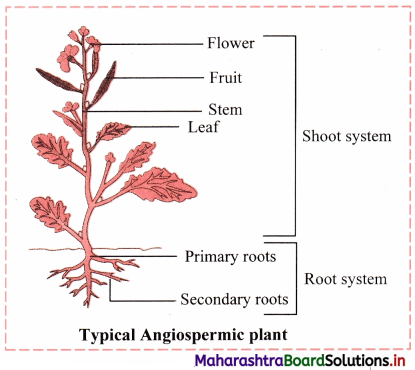
Maharashtra Board Class 11 Biology Important Questions Chapter 9 Morphology of Flowering Plants 1

Vegetative structures in angiospermic plant Reproductive structures in angiospermic plant
Root, Stem, Leaf Flowers, Fruits, Seeds

Question 3.
Label the various regions of a typical root in the given figure and explain them in detail.
Answer:
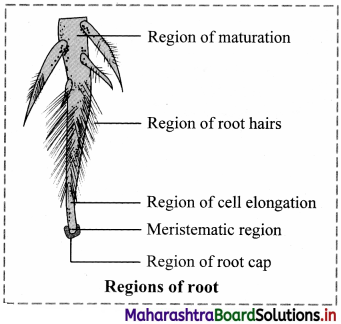
Maharashtra Board Class 11 Biology Important Questions Chapter 9 Morphology of Flowering Plants 2
A typical root possesses the following regions:
1. Root cap:
a. A parenchymatous multicellular structure in the form of cap, present over young growing root apex is known as root cap.
b. Cell of root cap secrete mucilage for lubricating passage of root through the soil.
c. Cells of root cap show presence of starch granules which help in graviperception and geotropic movement of root.
d. Usually single root cap is present in plants. But in plants like Pandanus or screw pine multiple root caps are present.
e. In hydrophytes, root caps are replaced by root pocket e.g. Pistia, Eichhornia etc.
f. Due to presence of root cap the growing apex of root.

2. Meristematic region or region of cell division:
a. The apex of the root is a growing point about 1 mm in length protected by root cap. This region is called as region of cell division or meristematic region.
b. The structure is developed by compactly arranged thin walled actively dividing meristematic cells.
c. These cells bring about longitudinal growth of root.

3. Region of elongation:
a. This region of cells is present just above zone of cell division.
b. The cells are newly formed and show rapid elongation to bring about increase in length of the root.
c. The cells help in absorption of mineral salts.

4. Region of root hair or region of absorption:
a. A region of root hair / absorption/piliferous zone is made up of numerous hair like outgrowths.
b. The epiblema or piliferous layer produces tubular elongated unicellular structures known as root hair.
c. They are in close contact with soil particles and increase surface area for absorption of water.
d. Root hair are short lived or ephimeral and are replaced after every 10 to 15 days.

5. Region of maturation/region of differentiation:
a. It is the uppermost major part of the root.
b. The cells of this region are quite impermeable to water due to thick wall.
c. The cells show differentiation and form different types of tissues.
d. This region helps in fixation of plant and conduction of absorbed substances.
e. Development of lateral roots also takes place from this region.

Maharashtra Board Class 11 Biology Important Questions Chapter 9 Morphology of Flowering Plants

Question 4.
What are the primary functions of root?
Answer:
Primary functions of root are, fixation or anchorage of plant body in the soil, absorption of water and minerals from soil and conduction of absorbed materials up to the stem base, etc.

Question 5.
Which type of root system is found in plants like maize, wheat and sugarcane? Explain in detail.
Answer:

  1. Adventitious root system is found in plants like maize, wheat and sugarcane.
  2. Adventitious root develops from any part other than radicle.
  3. Such roots may develop from the base of the stem, nodes or from leaves.
  4. In monocots, radicle is short lived.
  5. A thick cluster of equal sized roots arise from the base of a stem. It is also known as fibrous root system as they look like fibre. The growth of roots is superficial.
  6. Adventitious roots in some plants are used for vegetative propagation. E.g. Euphorbia, Carapichea ipecacuanha (Ipecac) etc.

Question 6.
What are metamorphosed roots?
Answer:
When roots have to perform some special type of function in addition to or instead of their normal function they develop some structural changes. Such roots are called as metamorphosed roots.

Question 7.
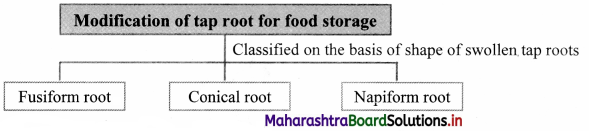
Complete the given chart and explain the modification of tap root for storage of food.
Answer:
Maharashtra Board Class 11 Biology Important Questions Chapter 9 Morphology of Flowering Plants 3
1. Modification of tap root for storage of food:
a. WTien tap root stores food it becomes swollen, fleshy and also develops definite shape.
b. Main or primary root is the main storage organ but sometimes hypocotyl part of embryo axis also joins the main root. Secondary roots remain thin.
c. On the basis of shape, swollen tap roots are classified as Fusiform, Conical and Napiform.
2. Fusiform root:
The fusiform root is swollen in the middle and tapering towards both ends forming spindle shaped structure, e.g. Radish (Raphanus sativus)
3. Conical root:
The conical root is broad at its morphological base and narrows down towards its apex. e.g. Carrot (Daucus car ota)
4. Napiform root:
In napiform root, base of root is highly swollen, almost spherical in shape and abruptly narrows down towards its apex. e.g. Beet (Beta vulgaris)

Question 8.
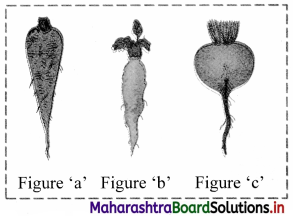
Identify the type of swollen tap root in the figures given below.
Maharashtra Board Class 11 Biology Important Questions Chapter 9 Morphology of Flowering Plants 4
Answer:
Figure ‘a’: Conical root;
Figure ‘b’: Fusiform root;
Figure ‘c’: Napiform root

Question 9.
Answer the following questions:
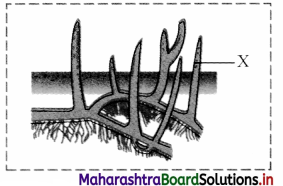
1. Identify the label ‘X’ in the given figure of respiratory roots. Give its function.
Maharashtra Board Class 11 Biology Important Questions Chapter 9 Morphology of Flowering Plants 5
2. Give any tw o examples of plants in which respiratory roots are present.
Answer:
1. X: Lenticels
In respiratory roots or pneumatophores, gaseous exchange occurs through lenticels.
2. Examples of plants in which respiratory roots are present:
Rhizophora, Avicennia, Sormeratia, Heritiera fames (sundri), etc.

Question 10.
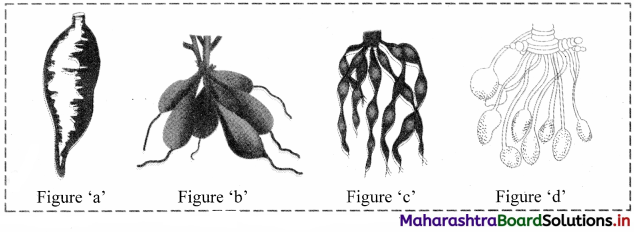
Identify the types of modified adventitious roots in the figures given below and explain in detail.
Maharashtra Board Class 11 Biology Important Questions Chapter 9 Morphology of Flowering Plants 6
Answer:
1. Figure ‘a’ indicates simple tuberous root.
a. Simple tuberous roots become swollen and do not show definite shape.
b. They are produced singly.
c. The roots arise from nodes over the stem and penetrate into the soil, e.g. sweet potato or shakarkand (Ipomoea batatas).

2. Figure ‘b’ indicates fasciculated tuberous roots.
a. A cluster of roots arising from one point which becomes thick and fleshy due to storage of food is known as fasciculated tuberous root.
b. These clusters are seen at the base of the stem, e.g. Dahlia, Asparagus, etc.

3. Figure ‘c’ indicates Moniliform roots.
a. Some adventitious roots get swollen at regular intervals.
b. These gives them the appearance of beads of a necklace. Such roots are called as Moniliform roots, e.g. Spinacia oleracea (Indian Spinach).

4. Figure ‘d’ indicates Nodulose roots.
The cluster of long slender roots become enlarged at the tips forming nodules is known as nodulose roots, e.g. Arrow root (Maranta), Amhaldi or mango ginger (Curcuma amada).

Maharashtra Board Class 11 Biology Important Questions Chapter 9 Morphology of Flowering Plants

Question 11.
Explain various types of adventitious roots which are modified for mechanical support.
Answer:
1. Prop roots / Columnar roots:
a. These roots arise from horizontal branches of tree like Banyan tree (Ficus benghalensis) and grow vertically downwards till they penetrate the soil.
b. These prop roots show secondary growth, become thick, act like pillars to provide mechanical support to the heavy branches.

2. Stilt roots:
a. These roots normally arise from a few lower nodes of a weak stem in some monocots, shrubs and small trees.
b. They show obliquely downward growth penetrating soil and provide mechanical support to the plant.
c. In the members of family Poaceae, the plants like Maize, Jowar, Sugarcane etc. produce stilt root in whorl around the node.
d. These roots provide additional support to the plant body.
e. In Screw pine or Pandanus (Kewada), stilt roots arise only from the lower surface of obliquely growing stem for additional support. These roots show multiple root caps.

3. Climbing roots:
Different climbers with weak stem produce roots at their nodes by means of which they attach themselves to support and thereby raise themselves above the ground.
e.g. Betel leaf or Pan, black pepper or Piper nigrum (Kali Mirch), Pothos or money plant.

4. Clinging roots:
a. These tiny roots develop along intemodes, show disc at tips, which exude sticky substance.
b. This substance enables plant to get attached with walls of buildings.
c. They do not damage substratum, e.g. English Ivy (Hedera helix).

5. Plank roots/Buttress:
a. These roots often develop at the base of large trees and form plank like extensions around stem.
b. These roots provide additional support, e.g. Silk cotton, Peepal, etc.

6. Buoyant roots:
Roots developed at the nodes of aquatic herbs like (Jussiaea repens), become highly inflated and spongy providing buoyancy and helping the plant to float.

Question 12.
What are sucking roots? Explain with the help of examples.
Answer:
Sucking roots or Haustoria:
1. These are the specialised microscopic sucking roots developed by parasitic plants to absorb nourishment from the host.
2. Viscum album is a partial parasite. It develops haustoria which penetrate into xylem of host plant for absorption of food.
3. In Cuscuta reflexa or Dodder (Amarvel) haustoria penetrates vascular strand and suck food from phloem, water and minerals from xylem. Cuscuta is leafless plant with yellow stem. It is a total parasite.

Question 13.
Enlist the important characteristics of stem.
Answer:
Characteristics of stem:

  1. Stem is the ascending part of the plant body which develops from plumule and reproductive units.
  2. It is usually positively phototropic, negatively geotropic and negatively hydrotropic.
  3. It shows different types of buds (axillary, apical, accessory, etc.).
  4. It is differentiated into nodes and intemodes.
  5. At nodes it produces dissimilar organs such as leaves and flowers and similar organs such as branches.
  6. Young stem is green and capable of photosynthesis.

Question 14.
Sketch and label a typical stem structure and write its primary functions.
Answer:
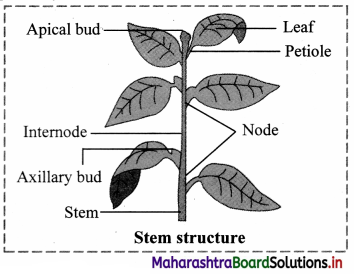
Maharashtra Board Class 11 Biology Important Questions Chapter 9 Morphology of Flowering Plants 7
The primary functions of the stem are to produce and support branches, leaves, flowers and fruits; conduction of water and minerals and transportation of food to plant parts.

Maharashtra Board Class 11 Biology Important Questions Chapter 9 Morphology of Flowering Plants

Question 15.
What is underground stem? When does it produce aerial shoots?
Answer:
In some herbaceous plants the stem which develops below soil surface is called underground stem. The underground stem remains dormant during unfavourable condition and on the advent of favourable condition produces aerial shoots.

Question 16.
Draw neat and labelled diagram of rhizome of ginger.
Answer:
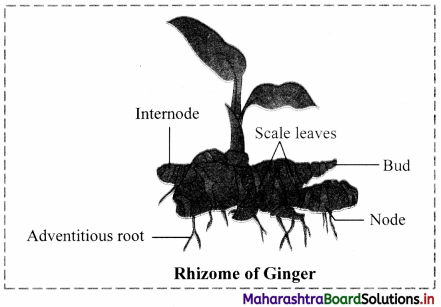
Maharashtra Board Class 11 Biology Important Questions Chapter 9 Morphology of Flowering Plants 8

Question 17.
Potato which we eat is an underground part of a plant, however it can not be considered as root. Justify the given statement.
Answer:

  1. Potato is a stem tuber.
  2. It is an underground stem, modified for storage of food material.
  3. Special underground branches of stem at their tips becomes swollen due to storage of food which is mostly starch.
  4. Stem tuber shows distinct nodes, but not intemodes hence it is classified as stem.
  5. At nodal part, it shows scale leaves with axillary buds, which are commonly called as ‘eyes’.
  6. Under favourable conditions, ‘eyes’ can produce aerial shoots.
  7. Potato tuber can be propagated vegetatively. [Note: In stem tuber, internodes are present but they are not very distinct.]

Question 18.
What are tunicated and compound tunicated bulbs?
Answer:
1. Tunicated bulb:
When fleshy scale leaves are arranged on stem in concentric manner, bulb is called as tunicated bulb or layered bulb. E.g. Onion
2. Compound tunicated bulb:
When fleshy scale leaves arranged on stem, partially overlap each other by their margins only, such bulb is called compound tunicated or scaly bulb. e.g. Garlic

Question 19.
Which type of modified stem is present in Colocasia and Amorphophallus? Explain with the help of neat and labelled diagram.
Answer:
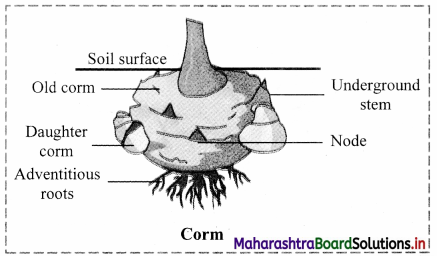
Maharashtra Board Class 11 Biology Important Questions Chapter 9 Morphology of Flowering Plants 9

  1. In Colocasia and Amorphophallus corm is present, which is an underground stem modified for storage of food.
  2. Corm is swollen underground spherical or subspherical vertically growing stem.
  3. It is condensed structure with circular or ring like nodes.
  4. It shows presence of axillary buds and scales.
  5. Adventitious buds are produced which help in vegetative propagation.
  6. Adventitious roots are produced at lower part of the stem.

Maharashtra Board Class 11 Biology Important Questions Chapter 9 Morphology of Flowering Plants

Question 20.
1. What are sub aerial stems?
2. Explain the different types of sub aerial stems. Give atleast one example of each.
Answer:
1. Subaerial stems:
a. These are generally weak or straggling stems growing over the ground and need support for perpetuation.
b. Sometimes these stems are found to grow beneath the soil surface also. Thus, they show contact with both air and soil.
c. Subaerial stems are meant for perennation and vegetative propagation.
d. Scale leaves and axillary buds are present over stem surface. Axillary buds develop into aerial shoots.

2. Types of subaerial stems:
a. Trailer:
1. The shoot spreads over the ground without striking adventitious roots.
The branches are either flat i.e. procumbent or partly vertical i.e. decumbent.
e. g. Euphorbia, Tridax etc. [Any one example]

b. Runner:
1. They are special narrow, prostrate or horizontal green branches which develop at the base of erect shoots known as crown.
2. Runners spread in all directions to produce new crowns with bunch of adventitious roots.
3. Presence of nodes with scale leaves and axillary buds is observed.
e.g. Cynodon (Lawn grass) Centella (Hydrocotyl / Brahmi), Oxalis etc. [Any one example]

c. Stolons:
1. The slender lateral branch arising from the base of main axis is known as stolon.
2. In some plants it is above ground (wild strawberry).
3. Primarily stolon shows upward growth in the form of ordinary branch, but when it bends and touches the ground terminal bud grows into new shoot and develops adventitious roots.
e.g. Wild Strawberry, Jasmine, Mentha, etc. [Any one example]

d. Sucker:
1. It is non-green, runner like branch of stem.
2. It grows horizontally below soil initially and then comes above the soil surface obliquely to produce a new plant.
3. Sucker can be termed as underground runner.
e. g. Chrysanthemum, Banana etc. [Any one example]

e. Offset:
1. These are one intemode long runners in rosette plants at ground or water level.
2. Offset helps in vegetative propagation.
e.g. Water hyacinth or Jal kumbhi (Eichhornia) and Pistia. [Any one example]

Question 21.
Observe the given figures and identify P, Q, R and S representing the different types of sub aerial shoot.
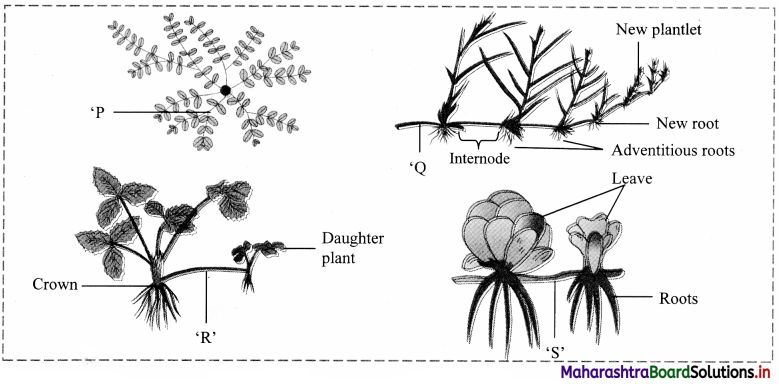
Maharashtra Board Class 11 Biology Important Questions Chapter 9 Morphology of Flowering Plants 10Answer:
‘P’: Trailer ‘Q’: Runner ‘R’: Stolon ‘S’: Offset

Question 22.
Draw neat and labelled diagram of Eichhornia showing offset.
Answer:
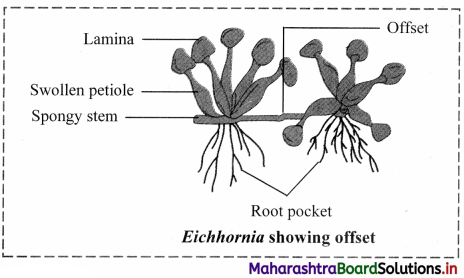
Maharashtra Board Class 11 Biology Important Questions Chapter 9 Morphology of Flowering Plants 11

Maharashtra Board Class 11 Biology Important Questions Chapter 9 Morphology of Flowering Plants

Question 23.
What are metamorphosed stems?
Answer:
Stem or its vegetative part develops various modifications to carry out specialized functions. Such modified stems are called as metamorphosed stems.

Question 24.
Describe the aerial modifications of stem.
Answer:
Different aerial modifications shown by stem are as follows:
1. Stem tendrils:
a. Tendrils are thin, wiry, photosynthetic, leafless coiled structures.
b. They give additional support to developing plant.
c. Tendrils have adhesive glands for fixation.
d. Apical bud in Vitis quadrangularis gets modified into tendril. The further growth is carried out by axillary bud.
e. In Passiflora axillary bud gets modified in tendril.
f. Extra axillary bud is the one which grows outside the axil. This bud in cucurbita gets modified into tendril.
g. Normally floral buds are destined to produce flowers. But in plants like Antigonon they produce tendrils.

2. Thorn:
a. It is modification of apical or axillary bud.
b. Thom is hard pointed and mostly straight structure (except Bougainvillea where it is curved and useful for climbing).
c. It provides protection against browsing animals and also helps in reducing transpiration.
d. Apical bud develops into thorn in Carrisa whereas axillary bud develops into thorn in Duranta, Citrus, Bougainvillea, etc.

3. Phylloclade:
a. Modification of stem into leaf like photosynthetic organ is known as phylloclade.
b. Being stem it possesses nodes and internodes.
c. It is thick, fleshy and succulent, contains mucilage for retaining water e.g. Opuntia, Casuarina (Cylindrical shaped phylloclade) and Muehlenbeckia (ribbon like phylloclade).

4. Cladodes:
a. The branches of limited growth i.e. one intemode long and performing photosynthetic function are called as cladodes.
b. True leaves are reduced to spine or scales to reduce rate of transpiration, e.g. Asparagus.

5. Cladophylls:
These are leaf like structures bore in the axil of scale leaf. It has floral bud and scale leaf in the middle i.e. upper half is leaf and lower half is stem. e.g. Ruscus.

6. Bulbils:
a. In plants like Dioscorea, etc. axillary bud becomes fleshy and rounded due to storage of food called as bulbil.
b. When it falls off it produces new plant and help in vegetative propagation.

Question 25.
Observe the given figures oi Asparagus, Vitis quadrangularis and Passiflora. Which of the following is labelled incorrectly?
Answer:
Figure ‘a’ is incorrectly labelled.
It represents Cladode oi Asparagus.

Question 26.
How does thorn in Carissa differ from that of Duranta?
Answer:
In Carrisa, apical bud develops into thorn, whereas in Duranta, axillary bud develops into thorn.

Question 27.
Enlist the general characteristics of a leaf.
Answer:
General characteristics of a leaf:

  1. Leaves are the most important appendages as they carry out photosynthesis and also help to remove excess amount of water from plant body through transpiration.
  2. Leaves are exogenous in origin and develops from leaf primordium.
  3. Leaf is dorsiventrally flattened lateral appendage of stem, produced at nodal region.
  4. Leaf is thin, expanded and green due to presence of photosynthetic pigments, i.e. chlorophyll.
  5. Axil of leaf shows presence of axillary bud.
  6. Leaf shows limited growth, does not show apical bud or a growing point.

Question 28.
Give an account of various parts of a typical dicot leaf.
Answer:
A typical dicot leaf shows presence of three main parts Leaf base or Hypopodium, Petiole or Mesopodium and Leaf lamina/blade or Epipodium.
1. Leaf base or Hypopodium:
a. The point by which leaf remains attached to the stem is known as leaf base.
b. The nature of leaf base varies in different plants. It may be pulvinus (swollen), sheathing or ligulate, etc.

Question 29.
How simple leaf differs from a compound leaf?
Answer:
The leaf with entire lamina is called simple leaf, whereas leaf in which leaf lamina is divided into many leaflets is called as compound leaf.

Maharashtra Board Class 11 Biology Important Questions Chapter 9 Morphology of Flowering Plants

Question 30.
Identify the type of pinnately compound leaves in the figures given below and give one example of each.
Answer:
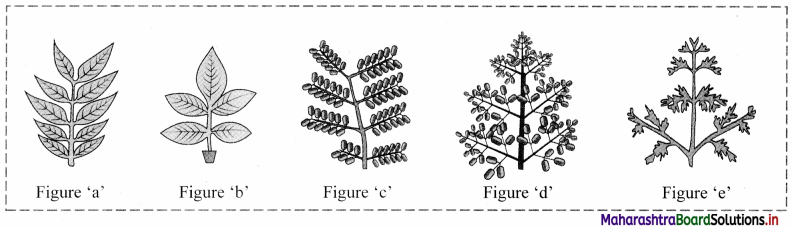
Maharashtra Board Class 11 Biology Important Questions Chapter 9 Morphology of Flowering Plants 12
Figure ‘a’: Paripinnately compound leaves (e.g. Cassia)
Figure ‘b’: Imparipinnately compound leaves (e.g. Rosa)
Figure ‘c’: Bipinnately compound leaves (e.g. Caesalpinia)
Figure ‘d’: Tripinnately compound leaves (e.g. Moringa)
Figure ‘e’: Decompound leaves (e.g. Coriandrum)

Question 31.
Explain how leaves modify to perform different functions other than photosynthesis and gaseous exchange.
Answer:
Leaves show different types of modification as follows:
1. Leaf spines:
Sometimes entire leaf is modified into spines (Opuntia) or margin of leaf becomes spiny (Agave) or stipule modifies into spine (Acacia, Zizyphus) to check the rate of transpiration and to protect plant from grazing.

2. Leaf tendril:
In some weak stems, leaf, leaflet or other part modifies to produce thin, green, wiry, coiled structure called as leaf tendril. It helps in climbing and provides additional support.

3. Leaf hooks:
In plants like Bignonia unguis-cati (Cat’s nail) the terminal three leaflet get modified into three! stiff curve and pointed hooks used to cling over the bark of tree.

4. Phyllode:
When petiole of leaf becomes flat, green and leaf like it is called as phyllode. In Acacia auriculoformis the normal leaf is bipinnately compound and falls off soon. The petiole modifies itself into phyllode. It is a xerophytic adaptation.

Question 32.
Identify different types of tendril in the figures given below and give one example of each.
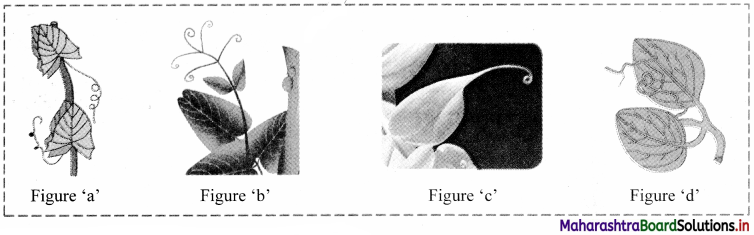
Maharashtra Board Class 11 Biology Important Questions Chapter 9 Morphology of Flowering Plants 13
Answer:
Figure ‘a’: Whole leaf tendril (e.g. Lathyrus)
Figure ‘b’: Leaflet tendril (e.g. Pisum sativum)
Figure ‘c’: Leaf tip tendril (e.g. Gloriosa)
Figure ‘d’: Stipular tendril (e.g. Smilax)

Question 33.
Define phyllotaxy. Why do leaves show phyllotaxy?
Answer:
Phyllotaxy:
1. Arrangement of leaves on the stem and branches in a specific manner is known as phyllotaxy.
2. It enables leaf to get sufficient light for photosynthesis.

Maharashtra Board Class 11 Biology Important Questions Chapter 9 Morphology of Flowering Plants

Question 34.
Which type of phyllotaxy is show n by leaves of Mango, Nerium and Jamun?
Answer:

  1. Phyllotaxy shown by leaves of Mango is alternate phyllotaxy. In this type, single leaf from each node.
  2. Phyllotaxy shown by leaves of Nerium is whorled phyllotaxy. In this type, many leaves arise from each node
    and form a whorl.
  3. Phyllotaxy shown by leaves of Jamun is opposite superposed phyllotaxy. In this type, a pair of opposite leaves are arranged one above the other in the same plane.

Question 35.
What are pinnately compound and palmately compound leaves? Give any two examples of each.
Answer:
1. Pinnately compound: Leaflets are present laterally on a common axis called rachis, which represents the midrib of the leaf. e.g. Cassia, Rose, Caesalpinia, Moringa, Coriandrum, etc. [Any two examples]
2. Palmately compound: In this all the leaflets are attached at the tip of petiole.
e.g. Citrus, Zorina, Oxalis, Marsilea, Bombax [Any two examples] [Note: Another example of palmately compound leaf (Bifoliate) is Balanites roxburghii.]

Question 36.
Define inflorescence.
Answer:
A specialised axis or branch over which flowers are produced or borne in definite manner is known inflorescence.

Question 37.
Write significance of inflorescence.
Answer:
Significance of inflorescence:

  1. Inflorescence makes a flower more conspicuous to attract the insects and birds for pollination.
  2. It provides more chances for cross pollination.
  3. An insect can pollinate many flowers in inflorescence in a single visit.
  4. In an inflorescence, flowers open successively and not simultaneously. This improves chances of pollination as flowering period is longer.

Question 38.
Define flower.
Answer:
Flower is highly modified and condensed shoot meant for sexual reproduction.

Maharashtra Board Class 11 Biology Important Questions Chapter 9 Morphology of Flowering Plants

Question 39.
Complete the table by giving the meaning of following terminologies related to flower.
Answer:

1. Complete flower: Presence of all four floral whorls Incomplete flower: Absence of any one of the floral whorls.
2. Pedicellate flower: Flower with pedicel Sessile flower: Flower without pedicel
3. Bracteate flower: Flower with bract at the base of pedicel Ebracteate flower: Flower without bract
4. Perfect flower: Both androecium and gynoecium are present, also called as dicliny or bisexual flower. Imperfect flower: Any one reproductive whorl is present also called as monocliny or unisexual flower.
5. Actinomorphic flower: The flower can be cut in any plane passing through the centre in order to obtain two identical halves. Flowers show radial symmetry, e.g. Sunflower Zygomorphic flower: The flower can be cut only along one plane passing through the centre in order to obtain two identical halves. Flowers show bilateral symmetry e.g. Sweet Pea flower.
6. Unisexual flower: It can be either staminate (male)/ pistillate (female) flower Neuter flower: When both reproductive whorls are absent, it is said to be neuter flower
7. Monoecious plant: Male and female reproductive flowers are borne on same plant, e.g. Maize Dioecious plant: Only one type of unisexual flowers are present on plant, e.g. Ray floret of sunflower

Question 40.
Mango is called as polygamous plant. Why?
Answer:
Mango produces all types of flowers like staminate, bisexual and neuter, hence it is called as polygamous plant.

Question 41.
What is insertion of floral whorls?
Answer:
The position and arrangement of rest of the floral whorls (calyx, corolla, androecium) with respect to gynoecium on the thalamus is known as insertion of floral whorls. .

Question 42.
With help of neat and labelled diagrams explain the classification of flowers based on the position of ovary on the thalamus.
Answer:
Classification of flowers based on the position of ovary on the thalamus.
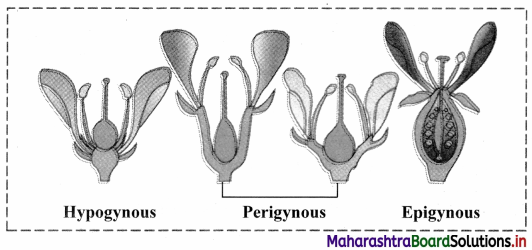
Maharashtra Board Class 11 Biology Important Questions Chapter 9 Morphology of Flowering Plants 14
1. Hypogynous flower:
When the convex or conical thalamus is present in flower, ovary occupies the highest position while other floral parts are below ovary. Ovary is said to be superior and flower is called as hypogynous flower, e.g. Brinjal, Mustard, China rose etc. It is denoted as G in floral formula.

2. Perigynous flower:
When cup shaped or saucer shaped thalamus is present in a flower, ovary and other floral parts occupy about same position. Such an ovary is said to be semi- superior or semi-inferior. All floral whorls are at the rim of thalamus. Flower is called as perigynous. e.g. Rose, etc. It is denoted as G- in floral formula.

3. Epigynous flower:
When thalamus completely encloses ovary and may show fusion with wall; the other floral parts occupy superior position and ovary becomes inferior. Such flower is called as epigynous flower, e.g. Ray florets of Sunflower, Guava, Cucumber etc. It is denoted as G in floral formula.

Question 43.
What is thalamus?
Answer:
Thalamus:
1. The upper, swollen, condensed, knob-like part of the pedicel is called thalamus. It is also called receptacle or torus.
2. In a typical flower, the thalamus consists of four compactly arranged nodes and three highly condensed intemodes.
3. From each node of thalamus, whorl of modified leaves is produced.

Maharashtra Board Class 11 Biology Important Questions Chapter 9 Morphology of Flowering Plants

Question 44.
With the help of a diagram explain the floral parts of a typical flower.
Answer:
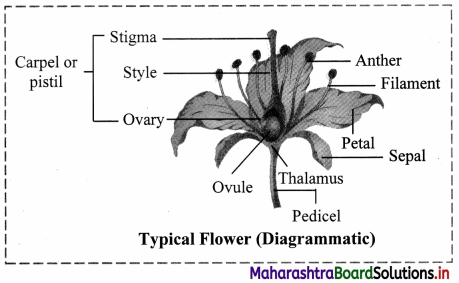
Maharashtra Board Class 11 Biology Important Questions Chapter 9 Morphology of Flowering Plants 15
Floral parts of a typical flower:
1. Calyx (K):
a. It is outermost floral whorl and individual members are known as
sepals.
b. Sepals are usually green in colour and perform photosynthesis.
c. If all the sepals are united, the condition is gamosepalous and if they are free, the condition is called as polysepalous.
d. Gamosepalous calyx is found in China rose and polysepalous calyx is found in Brassica.
e. The main function of sepals is to protect inner floral parts in bud condition.
f. Sometimes sepals become brightly coloured (petaloid sepals) and attract insects for pollination,
e.g. Mussaenda etc.
g. Sepals modify into hairy structures called as pappus. Such calyx helps in dispersal of fruit, e.g. Tridex.

2. Corolla (C):
a. It is second floral whorl from outer side and variously coloured.
b. The individual member is called as petal.
c. Petals may be sweet to taste, possess scent, odour, aroma or fragrance etc.
d. The condition in which petals are free is said to be polypetalous (e.g. Rose) and if they are fused it is called as gamopetalous (e.g. Datura).
e. The main function of corolla is to attract different agencies for pollination.

3. Perianth (P):
a. Many times, calyx and corolla remain undifferentiated. Such member is known as tepal.
b. The whorl of tepals is known as Perianth.
c. It protects other floral whorls.
d. If all the tepals are free the condition is called as polyphyllous and if they are fused the condition is called as gamophyllous.
e. Sepaloid perianth shows green tepals, while petaloid perianth shows brightly coloured tepals. e.g. Lily, Amaranthus, Celosia, etc.
f. Petaloid tepal helps in pollination and sepaloid tepals can perform photosynthesis.

4. Androecium (A):
a. It is third floral whorl from outer side.
b. Androecium is male reproductive part of a flower.
c. The individual member is known as stamen.
d. If all the stamens are free the condition is polyandrous and synandrous if they are fused.
e. Typical stamen shows three different parts:
1. Anther: It is terminal in position. Anther produces pollen grains. It is usually dithecous (two anther lobes), tetralocular/tetra sporangiate (four pollen sacs) structure, e.g. Datura.
In some plants it is monothecous (single lobed), bilocular or bisporangiate structure e.g. Hibiscus.
2. Filament: It is a stalk of stamen and bears anther at its tip. It raises anther to a proper height for easy dispersal of pollen grains.
3. Connective: It is in continuation with the filament. It is similar to mid rib and connects two anther lobes together and also with the filament.

5. Gynoecium (G):
a. It is the female reproductive part of a flower and innermost in position.
b. It is also known as pistil.
c. The individual member of gynoecium is known as carpel.
d. The number of carpels may be one to many.
e. If all the carpels are fused the condition is described as syncarpous and if they are free the condition is described as apocarpous.
f. The polycarpellary gynoecium can be bicarpellary (two carpels e.g. Datura), tricarpellary (three carpels e.g. Cucurbita), pentacarpellery (five carpels e.g. Hibiscus) and so on.
g. A typical carpel consists of three parts stigma, style and ovary.
1. Stigma is a terminal part of carpel which receives pollen grains during pollination. It helps in
germination of pollen grain. Stigma shows variation in structure to suit the pollinating agent.
2. Style is narrow thread like structure that connects ovary with stigma.
3. Ovary is basal swollen fertile part of the carpel. Ovules are produced in ovary on a soft fertile tissue called placenta.

Maharashtra Board Class 11 Biology Important Questions Chapter 9 Morphology of Flowering Plants

Question 45.
Explain the term Epicalyx.
Answer:
Epicalyx:

  1. Epicalyx is an additional whorl of sepal like structures formed by bracteole which occurs on the outside of calyx.
  2. These are 5-8 in number.
  3. It is a characteristic feature of family Malvaceae.
  4. They are protective in function, e.g. Ladies finger

Question 46.
Match the columns.

Column I (Tvpe of calyx) Column II (Nature of sepals) Column III (Example)
1. Caducous (a) Sepals remain even after fruit formation 1. Brinjal, Pea
2. Deciduous (b) Sepals fall off as soon as the flower bud opens 2. Lotus, Mustard
3. Persistent (c) Sepals survive till (withering of petals) fruit formation 3. Argemone (Poppy)

Answer:

Column I (Type of calyx) Column II (Nature of sepals) Column III (Example)
1. Caducous (b) Sepals fall off as soon as the flower bud open 3. Argemone (Poppy)
2. Deciduous (c) Sepals survive till (withering of petals) fruit formation 2. Lotus, Mustard
3. Persistent (a) Sepals remain even after fruit formation 1. Brinjal, Pea

Question 47.
Define aestivation and explain its different types.
Answer:
Aestivation:
1. The mode of arrangement of sepals, petals or tepals in a flower with respect to the members of same whorl is known as aestivation.
2. Different types of aestivation are as follows:
a. Valvate: Margins of sepals or petals remain either in contact or lie close to each other but do not overlap, e.g. Calyx of Datura, Calotropis.
b. Twisted: Margins of each sepal or petal is directed inwards and is overlapped. While the other margin is directed outwards and overlap the margin of adjacent, e.g. Corolla of China rose, Cotton etc.
c. Imbricate: One of the sepals or petals is internal and is overlapped at both the margins. One is external i.e. both of its margin overlap adjacent member. Rest of the sepals / petals have one inner or overlapped margin and outer or overlapping margin, e.g. Cassia, Bauhinia, etc.
d. Vexillary: Corolla is butterfly shaped and consists of five petals. Outermost and largest is known as standard or vexillum, two lateral petals are wings and two smaller fused forming boat shaped structures keel. e.g. Pisum sativum
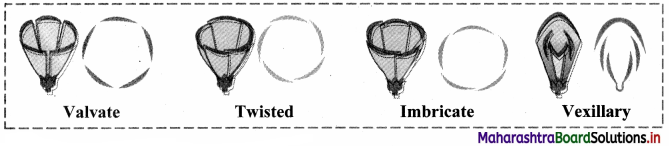
Maharashtra Board Class 11 Biology Important Questions Chapter 9 Morphology of Flowering Plants 16

Question 48.
Answer the following:
1. Define the term Adelphy.
2. Give three types of stamens based on adelphy. Draw a diagram of each type.
Answer:
Adelphy:
1. When stamens are united by filaments and anthers are free, the condition is called adelphy.
2. Three types of stamens based on adelphy:
Monadelphous stamens, Diadelphous stamens, Polyadelphous stamens.
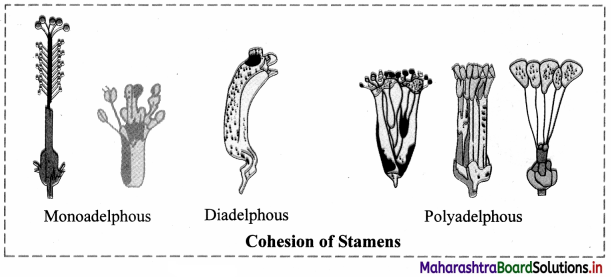
Maharashtra Board Class 11 Biology Important Questions Chapter 9 Morphology of Flowering Plants 17

Maharashtra Board Class 11 Biology Important Questions Chapter 9 Morphology of Flowering Plants

Question 49.
Define the following terms and give one example of each:

  1. Epipetalous stamens
  2. Epiphyllous stamens
  3. Syngenesious stamens
  4. Synandrous stamens

Answer:

  1. Epipetalous stamens: When the stamens are united to petals they are described as epipetalous stamen. E.g. Datura
  2. Epiphyllous stamens: When the stamens are united to tepals they are described as epiphyllous stamens. E.g. Lily
  3. Syngenesious stamens: When anthers are united and filaments are free, such stamens are called as syngenesious stamens. E.g. Sunflower
  4. Synandrous stamens: When both anthers and filaments are fused, such stamens are called as synandrous stamens. E.g. Cucurbita

Question 50.
Define placentation. Explain its types.
Answer:
1. Placentation: The mode of arrangement of ovules on the placenta within the ovary is called placentation.
2. Types of placentation:
a. Marginal: Ovules are placed on the fused margins of unilocular ovary, e.g. Pea, Bean etc.
b. Axile: Ovules are placed on the central axis of a multilocular ovary, e.g. China rose, Cotton, etc.
c. Parietal: Ovules are placed on the inner wall of unilocular ovary of multicarpellary syncarpus ovary,
e. g. Papaya, Cucumber, etc.
d. Basal: Single ovule is present at the base of unilocular ovary, e.g. Sunflower, Rice, Wheat.
e. Free central: Ovules are borne on central axis which is not attached to ovary wall, e.g.Argemone, Dianthus.

Question 51.
What are parthenocarpic fruits? Give any two examples.
Answer:
Fruits which are produced from ovary without fertilization are called as parthenocarpic fruits, e.g. Cultivated Banana and Grapes.

Question 52.
How true fruit differs from false fruit or pseudofruit? Give one example of each.
Answer:
The fruit which develops only from ovary is called as true fruit or eucarp. e.g. Mango. The fruit which develops from other than ovary floral part is called as false fruit or pseudocarp

Question 53.
Identify the parts of mango and apple fruit in the given figures.
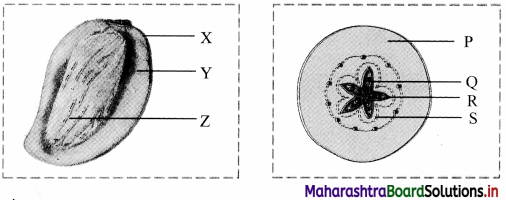
Maharashtra Board Class 11 Biology Important Questions Chapter 9 Morphology of Flowering Plants 18Answer:
1. parts of mango fruit:
X: Epicarp
Y: Mesocarp
Z: Endocarp

2. Part of apple fruit:
P: Thalamus
Q: Seed
R: Endocarp
S: Mesocarp

Maharashtra Board Class 11 Biology Important Questions Chapter 9 Morphology of Flowering Plants

Question 54.
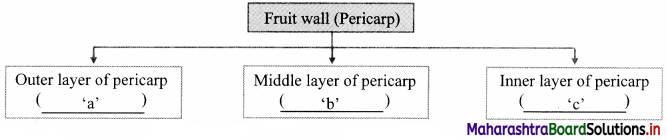
Identify terms a,b,and c in the given chart.
Maharashtra Board Class 11 Biology Important Questions Chapter 9 Morphology of Flowering Plants 19
Answer:
a: Epicarp
b: Mesocarp
c: Endocarp

Question 55.
What are simple fruits? Explain its different types.
Answer:
1. Fruits which develop from one ovary of one flower are called as simple fruits.
2. Types of simple fruits on the basis of their pericarp:
a. Dry fruits: These fruits have thin pericarp. It is further divided into two types:
1. Dehiscent dry fruits: Pericarp becomes dry, thin and fruit opens at maturity, e.g. Capsule (Lady’s finger) and legume (Pea)
2. Indehiscent dry fruits: Fruit does not open.
e.g. Achene (Mirabilis), Caryopsis (Maize) and Cypsela (Sunflower)

b. Fleshy fruits: These fruits have thick pericarp. It is further divided into two types based on nature endocarp:
1. Drupe: In these fruits, endocarp is hard and stony, e.g. Mango
2. Berry: In these fruits, endocarp is fleshy and fruit is many seeded, e.g. Tomato

Question 56.
What are aggregate fruits? Enlist the types of aggregate fruits.
Answer:
The fruit which develops from a single flower with many ovaries of polycarpellary, apocarpous gynoecium is known as aggregate fruit or etaerio.
Types of aggregate fruits:
Etario of achenes (e.g. Strawberry), etario of berries (e.g. Custard apple), etario of follicles (e.g. Calotropis)

Question 57.
Write a short note on composite fruits.
Answer:
1. The fruits which develop from many ovaries of many flowers of a complete inflorescence are called composite fruits, (e.g. fig) and from catkin inflorescence are called sorosis (e.g. Pineapple).
2. Fruits which develops from hypanthodium inflorescence are called syconus.

Question 58.
Match the columns with column II.

Column I Column II
1. Composite fruit (a) Custard apple
2. Parthenocarpic fruit (b) Cultivated Banana
3. Aggregate fruit (c) Mango
(d) Pineapple

Answer:

Column I Column II
1. Composite fruit (d) Pineapple
2. Parthenocarpic fruit (b) Cultivated Banana
3. Aggregate fruit (a) Custard apple

Maharashtra Board Class 11 Biology Important Questions Chapter 9 Morphology of Flowering Plants

Question 59.
Describe the structure of a seed.
Answer:
Structure of a seed:

  1. Seed is a reproductive unit that developed from fertilized mature ovule.
  2. The seed is made up of seed coat, embryo with or without endosperm and one or two cotyledons.
  3. Outer most covering of a seed is called seed coat.
  4. It shows outer layer called as testa and inner layer called as tegmen.
  5. Hilum is a scar on the seed coat through which seed attach to the fruit.
  6. Embryo of a seed is enclosed within seed coat.
  7. Embryonal axis consists of radicle and plumule.
  8. The part of embryonal axis between cotyledon and plumule is epicotyl, while the part between cotyledons and radicle is hypocotyl.
  9. The nutritive tissue in a seed called endosperm.

[Note: Dicotyledonous seed is a non-endospermic or exalbuminous, as it lacks endosperm at maturity.]
[Note: Students can scan the given Q.R code to study the structure of dicotyledonous and monocotyledonous seed.]

Question 60.
Describe the family Fabaceae with suitable floral diagram.
Answer:
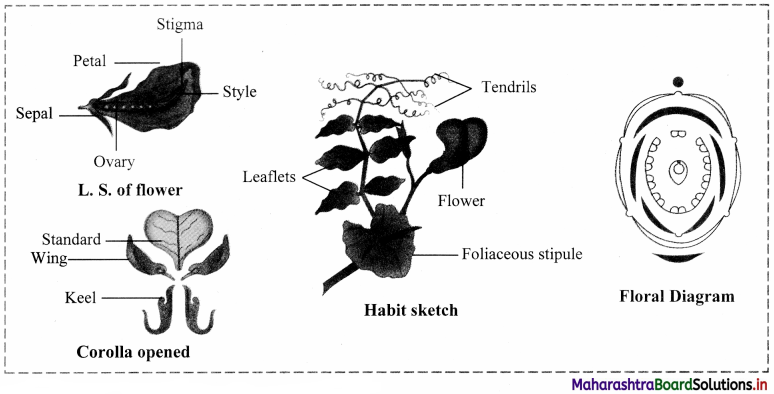
Maharashtra Board Class 11 Biology Important Questions Chapter 9 Morphology of Flowering Plants 20

  • Example: Pea plant (Pisum sativum)
  • Habit: Tree, shrubs, herbs.
  • Root: Root with root nodules.
  • Stem: Erect or climber.
  • Leaves: Alternate phyllotaxy, Pinnately compound leaves.
  • Inflorescence: Racemose
  • Flower: Zygomorphic, bisexual, complete.
  • Calyx: Sepals five, gamosepalous, imbricate aestivation.
  • Corolla: Petals five, polypetalous, consisting of a larger posterior petal vexillum, two lateral petals wings and two anterior ones forming a keel, vexillary aestivation.
  • Androecium: Stamens ten, diadelphous.
  • Gynoecium: Ovary superior, monocarpellary, unilocular with many ovules, marginal placentation. Fruit: Legume.
  • Seed: Non-endospermic

Question 61.
Apply your knowledge

Question 1.
Tendrils are seen in the following plants. Identify whether they are stem tendrils or leaf tendrils,

  1. Vitis
  2. Smilax
  3. Lathyrus
  4. Passiflora
  5. Cucurbita
  6. Gloriosa

Answer:
Stem tendrils → Vitis, Passiflora, Cucurbita
Leaf tendrils → Smilax, Lathyrus, Gloriosa

Maharashtra Board Class 11 Biology Important Questions Chapter 9 Morphology of Flowering Plants

Question 2.
Which type of roots are shown by halophytes growing in Sundarbans in West Bengal?
Answer:
Pneumatophores

Question 3.
Find out from internet the state flower of Sikkim. Write about the type of roots shown by this plant.
Answer:
Dendrobium is the state flower of Sikkim. It shows epiphytic roots.
Epiphytic roots:

  1. Epiphytic plants like Vanda, Dendrobium grow on branches of trees in dense rain forests and are unable to obtain moisture from soil.
  2. Such plants produce epiphytic roots which hang in the air.
  3. The roots are provided with a spongy membranous absorbent covering of the velamen tissue.
  4. The cells of velamen tissue are hygroscopic and have porous walls, thus they can absorb moisture from air.
  5. Epiphytic roots can be silvery white or green and are without root cap.

Question 62.
Quick Review:
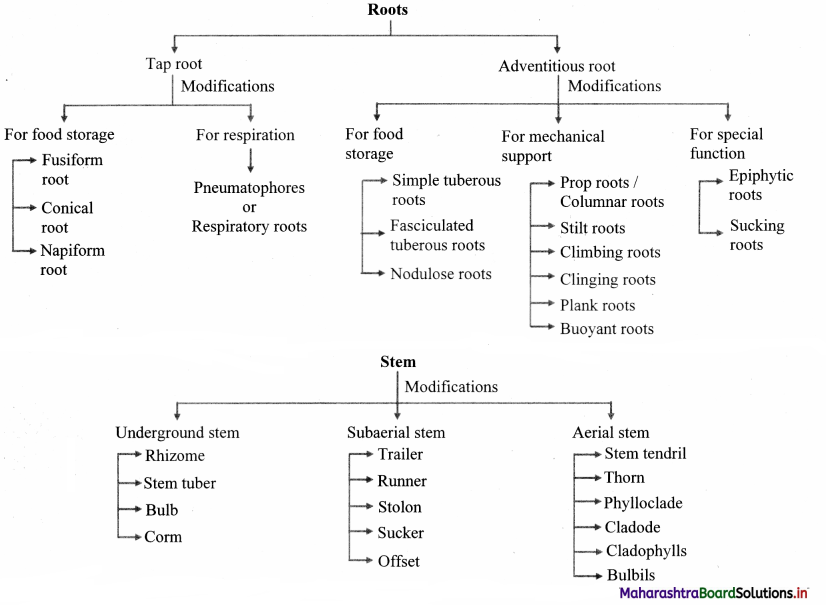
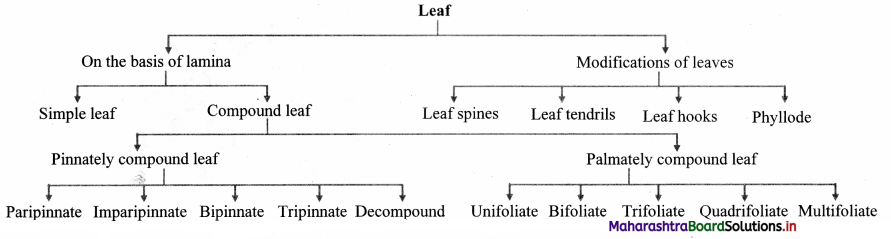
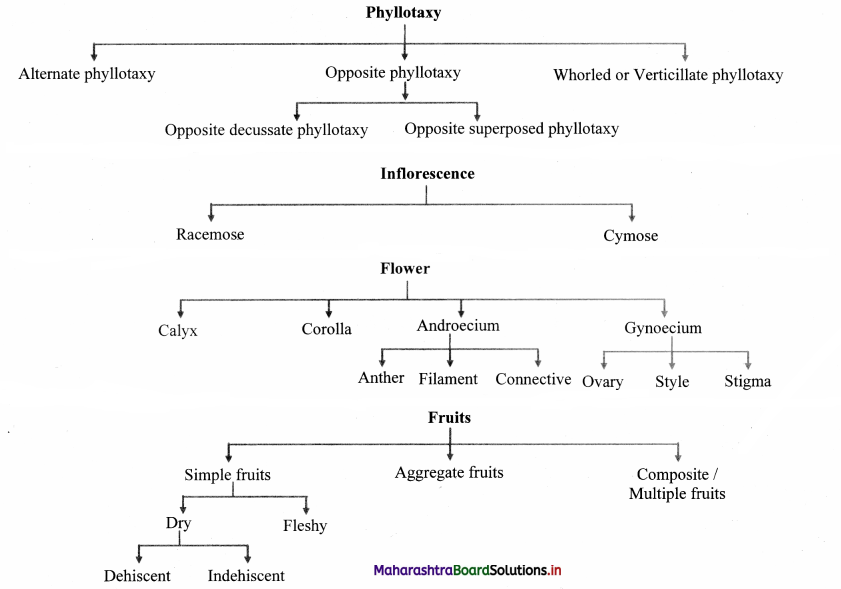
Maharashtra Board Class 11 Biology Important Questions Chapter 9 Morphology of Flowering Plants 21
Maharashtra Board Class 11 Biology Important Questions Chapter 9 Morphology of Flowering Plants 22
Maharashtra Board Class 11 Biology Important Questions Chapter 9 Morphology of Flowering Plants 23

Maharashtra Board Class 11 Biology Important Questions Chapter 9 Morphology of Flowering Plants

Question 63.
Exercise:

Question 1.
Draw neat and labelled diagram of tap root showing different regions.
Answer:
A typical root possesses the following regions:
1. Root cap:
a. A parenchymatous multicellular structure in the form of cap, present over young growing root apex is known as root cap.
b. Cell of root cap secrete mucilage for lubricating passage of root through the soil.
c. Cells of root cap show presence of starch granules which help in graviperception and geotropic movement of root.
d. Usually single root cap is present in plants. But in plants like Pandanus or screw pine multiple root caps are present.
e. In hydrophytes, root caps are replaced by root pocket e.g. Pistia, Eichhornia etc.
f. Due to presence of root cap the growing apex of root is

2. Meristematic region or region of cell division:
a. The apex of the root is a growing point about 1 mm in length protected by root cap. This region is called as region of cell division or meristematic region.
b. The structure is developed by compactly arranged thin walled actively dividing meristematic cells.
c. These cells bring about longitudinal growth of root.

3. Region of elongation:
a. This region of cells is present just above zone of cell division.
b. The cells are newly formed and show rapid elongation to bring about increase in length of the root.
c. The cells help in absorption of mineral salts.

4. Region of root hair or region of absorption:
a. A region of root hair / absorption/piliferous zone is made up of numerous hair like outgrowths.
b. The epiblema or piliferous layer produces tubular elongated unicellular structures known as root hair.
c. They are in close contact with soil particles and increase surface area for absorption of water.
d. Root hair are short lived or ephimeral and are replaced after every 10 to 15 days.

5. Region of maturation/region of differentiation:
a. It is the uppermost major part of the root.
b. The cells of this region are quite impermeable to water due to thick wall.
c. The cells show differentiation and form different types of tissues.
d. This region helps in fixation of plant and conduction of absorbed substances.
e. Development of lateral roots also takes place from this region.

Question 2.
Write a short note on root cap.
Answer:
Root cap:
a. A parenchymatous multicellular structure in the form of cap, present over young growing root apex is known as root cap.
b. Cell of root cap secrete mucilage for lubricating passage of root through the soil.
c. Cells of root cap show presence of starch granules which help in graviperception and geotropic movement of root.
d. Usually single root cap is present in plants. But in plants like Pandanus or screw pine multiple root caps are present.
e. In hydrophytes, root caps are replaced by root pocket e.g. Pistia, Eichhornia etc.
f. Due to presence of root cap the growing apex of root.

Question 3.
Name the region of a root which is located just above the zone of a cell division.
Answer:
Region of elongation:
a. This region of cells is present just above zone of cell division.
b. The cells are newly formed and show rapid elongation to bring about increase in length of the root.
c. The cells help in absorption of mineral salts.

Question 4.
Name any two plants in which root caps are replaced by root pockets.
Answer:
In hydrophytes, root caps are replaced by root pocket e.g. Pistia, Eichhornia etc.

Maharashtra Board Class 11 Biology Important Questions Chapter 9 Morphology of Flowering Plants

Question 5.
Write a short note on pneumatophores.
Answer:
1. a. Plants growing in marshy region (halophytes) produce upwardly growing roots called as
pneumatophores or respiratory roots.
b. The main root system of these plants does not get sufficient air for respiration as soil is water logged.
c. Due to this, mineral absorption of plant also gets affected.
d. To overcome this problem underground roots, develop special roots which are negatively geotropic; growing vertically upward.
e. These roots are conical projections present around main trunk of plant.
f. Respiratory roots show presence of lenticels which helps in gaseous exchange.
2. Examples of plants in which respiratory roots are present:
Rhizophora, Avicennia, Sormeratia, Heritiera fames (sundri), etc.

Question 6.
Name the four types of adventitious roots modified for food storage.
Answer:
1. Figure ‘a’ indicates simple tuberous root.
a. Simple tuberous roots become swollen and do not show definite shape.
b. They are produced singly.
c. The roots arise from nodes over the stem and penetrate into the soil, e.g. sweet potato or shakarkand (Ipomoea batatas).

2. Figure ‘b’ indicates fasciculated tuberous roots.
a. A cluster of roots arising from one point which becomes thick and fleshy due to storage of food is known as fasciculated tuberous root.
b. These clusters are seen at the base of the stem, e.g. Dahlia, Asparagus, etc.

3. Figure ‘c’ indicates Moniliform roots.
a. Some adventitious roots get swollen at regular intervals.
b. These gives them the appearance of beads of a necklace. Such roots are called as Moniliform roots, e.g. Spinacia oleracea (Indian Spinach).

4. Figure ‘d’ indicates Nodulose roots.
The cluster of long slender roots become enlarged at the tips forming nodules is known as nodulose roots, e.g. Arrow root (Maranta), Amhaldi or mango ginger (Curcuma amada).

Question 7.
Explain in detail modification of tap roots for food storage.
Answer:
1. Modification of tap root for storage of food:
a. WTien tap root stores food it becomes swollen, fleshy and also develops definite shape.
b. Main or primary root is the main storage organ but sometimes hypocotyl part of embryo axis also joins the main root. Secondary roots remain thin.
c. On the basis of shape, swollen tap roots are classified as Fusiform, Conical and Napiform.
2. Fusiform root:
The fusiform root is swollen in the middle and tapering towards both ends forming spindle shaped structure, e.g. Radish (Raphanus sativus)
3. Conical root:
The conical root is broad at its morphological base and narrows down towards its apex. e.g. Carrot (Daucus car ota)
4. Napiform root:
In napiform root, base of root is highly swollen, almost spherical in shape and abruptly narrows down towards its apex. e.g. Beet (Beta vulgaris)

Question 8.
Write a short note on:
1. Stilt root
2. Climbing roots
Answer:
1. Stilt roots:
a. These roots normally arise from a few lower nodes of a weak stem in some monocots, shrubs and small trees.
b. They show obliquely downward growth penetrating soil and provide mechanical support to the plant.
c. In the members of family Poaceae, the plants like Maize, Jowar, Sugarcane etc. produce stilt root in whorl around the node.
d. These roots provide additional support to the plant body.
e. In Screw pine or Pandanus (Kewada), stilt roots arise only from the lower surface of obliquely growing stem for additional support. These roots show multiple root caps.

2. Climbing roots:
Different climbers with weak stem produce roots at their nodes by means of which they attach themselves to support and thereby raise themselves above the ground.
e.g. Betel leaf or Pan, black pepper or Piper nigrum (Kali Mirch), Pothos or money plant.

Maharashtra Board Class 11 Biology Important Questions Chapter 9 Morphology of Flowering Plants

Question 9.
What is the function of prop roots in banyan tree?
Answer:
These prop roots show secondary growth, become thick, act like pillars to provide mechanical support to the heavy branches.

Question 10.
Name any two plants which show climbing roots.
Answer:
Climbing roots:
Different climbers with weak stem produce roots at their nodes by means of which they attach themselves to support and thereby raise themselves above the ground.
e.g. Betel leaf or Pan, black pepper or Piper nigrum (Kali Mirch), Pothos or money plant.

Question 11.
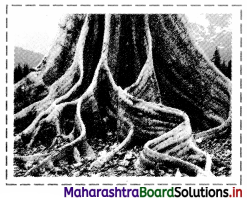
Identify the type of modified roots shown in the picture given below.
Maharashtra Board Class 11 Biology Important Questions Chapter 9 Morphology of Flowering Plants 24
Answer:
Plank roots/Buttress:
a. These roots often develop at the base of large trees and form plank like extensions around stem.
b. These roots provide additional support, e.g. Silk cotton, Peepal, etc.

Question 12.
Identify the type of root marked as ‘X’ in the given picture and write a short note on it.
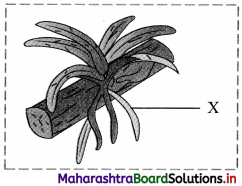
Maharashtra Board Class 11 Biology Important Questions Chapter 9 Morphology of Flowering Plants 25
Answer:
Epiphytic roots:
1. Epiphytic plants like Vanda, Dendrobium grow on branches of trees in dense rain forests and are unable to obtain moisture from soil.
2. Such plants produce epiphytic roots which hang in the air.
3. The roots are provided with a spongy membranous absorbent covering of the velamen tissue.
4. The cells of velamen tissue are hygroscopic and have porous walls, thus they can absorb moisture from air.
5. Epiphytic roots can be silvery white or green and are without root cap.

Question 13.
Identify the type of aerial modification of stem in the given figure.
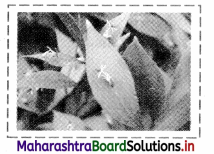
Maharashtra Board Class 11 Biology Important Questions Chapter 9 Morphology of Flowering Plants 26
Answer:
Cladophylls:
These are leaf like structures bore in the axil of scale leaf. It has floral bud and scale leaf in the middle i.e. upper half is leaf and lower half is stem. e.g. Ruscus.

Maharashtra Board Class 11 Biology Important Questions Chapter 9 Morphology of Flowering Plants

Question 14.
Write a short note on corm.
Answer:

  1. In Colocasia and Amorphophallus corm is present, which is an underground stem modified for storage of food.
  2. Corm is swollen underground spherical or subspherical vertically growing stem.
  3. It is condensed structure with circular or ring like nodes.
  4. It shows presence of axillary buds and scales.
  5. Adventitious buds are produced which help in vegetative propagation.
  6. Adventitious roots are produced at lower part of the stem.

Question 15.
Observe the type of sub aerial stem in the given picture of Eichhornia and explain it.
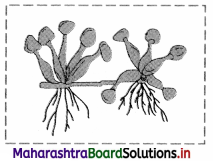
Maharashtra Board Class 11 Biology Important Questions Chapter 9 Morphology of Flowering Plants 27
Answer:
Offset:
1. These are one intemode long runners in rosette plants at ground or water level.
2. Offset helps in vegetative propagation.
e.g. Water hyacinth or Jal kumbhi (Eichhornia) and Pistia. [Any one example]

Question 16.
Explain the type of stem modification in Opuntia.
Answer:
Phylloclade:
a. Modification of stem into leaf like photosynthetic organ is known as phylloclade.
b. Being stem it possesses nodes and internodes.
c. It is thick, fleshy and succulent, contains mucilage for retaining water e.g. Opuntia, Casuarina (Cylindrical shaped phylloclade) and Muehlenbeckia (ribbon like phylloclade).

Question 17.
Identify the structure ‘X’ in the given figure and explain it.
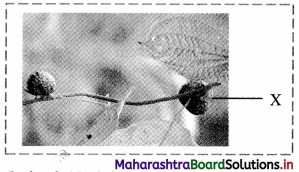
Maharashtra Board Class 11 Biology Important Questions Chapter 9 Morphology of Flowering Plants 28
Answer:
Bulbils:
a. In plants like Dioscorea, etc. axillary bud becomes fleshy and rounded due to storage of food called as bulbil.
b. When it falls off it produces new plant and help in vegetative propagation.

Maharashtra Board Class 11 Biology Important Questions Chapter 9 Morphology of Flowering Plants

Question 18.
Describe the types of stem tendrils present in different plants.
Answer:
1. Stem tendrils:
a. Tendrils are thin, wiry, photosynthetic, leafless coiled structures.
b. They give additional support to developing plant.
c. Tendrils have adhesive glands for fixation.
d. Apical bud in Vitis quadrangularis gets modified into tendril. The further growth is carried out by axillary bud.
e. In Passiflora axillary bud gets modified in tendril.
f. Extra axillary bud is the one which grows outside the axil. This bud in cucurbita gets modified into tendril.
g. Normally floral buds are destined to produce flowers. But in plants like Antigonon they produce tendrils.

Question 19.
What are cladodes?
Answer:
Cladodes:
a. The branches of limited growth i.e. one intemode long and performing photosynthetic function are called as cladodes.
b. True leaves are reduced to spine or scales to reduce rate of transpiration, e.g. Asparagus.

Question 20.
What are tendrils?
Answer:
Tendrils are thin, wiry, photosynthetic, leafless coiled structures.

Question 21.
What is sympodial growth in ginger rhizome and monopodial growth in lotus rhizome?
Answer:
1. Growth of rhizome takes place with lateral buds, such growth is known as sympodial growth, e.g. Ginger (Zingiber officinale), Turmeric (Curcuma domestica), Canna etc.
2. In plants where rhizomes grow obliquely, terminal bud brings about growth of rhizomes. This is known as monopodial growth, e.g. Nymphea, Nelumbo (Lotus), Pteris (Fern) etc.

Question 22.
In xerophytic plant like Opuntia, the stem becomes photosynthetic. Give reason.
Answer:
1. Xerophytes are the plants which grow in regions with scanty or no rainfall like desert.
2. In Xerophytes, leaves get modified into spines or get reduced in size to check the loss of water due to transpiration.
3. As the leaves are modified into spines, the stem becomes green in colour to do the function of photosynthesis.

Question 23.
Define compound leaves. Explain its two types.
Answer:
The leaf with entire lamina is called simple leaf, whereas leaf in which leaf lamina is divided into many leaflets is called as compound leaf.
1. Pinnately compound: Leaflets are present laterally on a common axis called rachis, which represents the midrib of the leaf. e.g. Cassia, Rose, Caesalpinia, Moringa, Coriandrum, etc. [Any two examples]
2. Palmately compound: In this all the leaflets are attached at the tip of petiole.
e.g. Citrus, Zorina, Oxalis, Marsilea, Bombax [Any two examples] [Note: Another example of palmately compound leaf (Bifoliate) is Balanites roxburghii.]

Maharashtra Board Class 11 Biology Important Questions Chapter 9 Morphology of Flowering Plants

Question 24.
Define leaf venation. What are its two types?
Answer:
Leaf venation:
1. Arrangement of veins and veinlets in leaf lamina is known as venation.
2. There are two types of leaf venation: parallel venation which is found in monocot leaves and reticulate venation which is found in dicot leaves.

Question 25.
Draw neat and labelled diagram of structure of a typical leaf.
Answer:
A typical dicot leaf shows presence of three main parts Leaf base or Hypopodium, Petiole or Mesopodium and Leaf lamina/blade or Epipodium.
1. Leaf base or Hypopodium:
a. The point by which leaf remains attached to the stem is known as leaf base.
b. The nature of leaf base varies in different plants. It may be pulvinus (swollen), sheathing or ligulate, etc.

Question 26.
Which type of venation can be observed in monocot leaf?
Answer:
There are two types of leaf venation: parallel venation which is found in monocot leaves and reticulate venation which is found in dicot leaves.

Question 27.
Enlist the types of pinnately compound leaves and give one example of each.
Answer:
Figure ‘a’: Paripinnately compound leaves (e.g. Cassia)
Figure ‘b’: Imparipinnately compound leaves (e.g. Rosa)
Figure ‘c’: Bipinnately compound leaves (e.g. Caesalpinia)
Figure ‘d’: Tripinnately compound leaves (e.g. Moringa)
Figure ‘e’: Decompound leaves (e.g. Coriandrum)

Question 28.
What is opposite decussate phyllotaxy? Give one example.
Answer:
Figure ‘c’ represents opposite decussate phyllotaxy. In this type of phyllotaxy, a pair of leaf arise from each node and the consecutive pair at right angle to the previous one. e.g. Calotropis.

Question 29.
Explain in detail androecium of an angiospermic flower.
Answer:
Androecium (A):
a. It is third floral whorl from outer side.
b. Androecium is male reproductive part of a flower.
c. The individual member is known as stamen.
d. If all the stamens are free the condition is polyandrous and synandrous if they are fused.
e. Typical stamen shows three different parts:
1. Anther: It is terminal in position. Anther produces pollen grains. It is usually dithecous (two anther lobes), tetralocular/tetra sporangiate (four pollen sacs) structure, e.g. Datura.
In some plants it is monothecous (single lobed), bilocular or bisporangiate structure e.g. Hibiscus.

2. Filament: It is a stalk of stamen and bears anther at its tip. It raises anther to a proper height for easy dispersal of pollen grains.

3. Connective: It is in continuation with the filament. It is similar to mid rib and connects two anther lobes together and also with the filament.

4. Gynoecium (G):
a. It is the female reproductive part of a flower and innermost in position.
b. It is also known as pistil.
c. The individual member of gynoecium is known as carpel.
d. The number of carpels may be one to many.
e. If all the carpels are fused the condition is described as syncarpous and if they are free the condition is described as apocarpous.
f. The polycarpellary gynoecium can be bicarpellary (two carpels e.g. Datura), tricarpellary (three carpels e.g. Cucurbita), pentacarpellery (five carpels e.g. Hibiscus) and so on.
g. A typical carpel consists of three parts stigma, style and ovary.

1. Stigma is a terminal part of carpel which receives pollen grains during pollination. It helps in
germination of pollen grain. Stigma shows variation in structure to suit the pollinating agent.
2. Style is narrow thread like structure that connects ovary with stigma.
3. Ovary is basal swollen fertile part of the carpel. Ovules are produced in ovary on a soft fertile tissue called placenta.

Question 30.
Draw neat and labelled diagram of a typical flower.
Answer:
Floral parts of a typical flower:
1. Calyx (K):
a. It is outermost floral whorl and individual members are known as
sepals.
b. Sepals are usually green in colour and perform photosynthesis.
c. If all the sepals are united, the condition is gamosepalous and if they are free, the condition is called as polysepalous.
d. Gamosepalous calyx is found in China rose and polysepalous calyx is found in Brassica.
e. The main function of sepals is to protect inner floral parts in bud condition.
f. Sometimes sepals become brightly coloured (petaloid sepals) and attract insects for pollination,
e.g. Mussaenda etc.
g. Sepals modify into hairy structures called as pappus. Such calyx helps in dispersal of fruit, e.g. Tridex.

2. Corolla (C):
a. It is second floral whorl from outer side and variously coloured.
b. The individual member is called as petal.
c. Petals may be sweet to taste, possess scent, odour, aroma or fragrance etc.
d. The condition in which petals are free is said to be polypetalous (e.g. Rose) and if they are fused it is called as gamopetalous (e.g. Datura).
e. The main function of corolla is to attract different agencies for pollination.

3. Perianth (P):
a. Many times, calyx and corolla remain undifferentiated. Such member is known as tepal.
b. The whorl of tepals is known as Perianth.
c. It protects other floral whorls.
d. If all the tepals are free the condition is called as polyphyllous and if they are fused the condition is called as gamophyllous.
e. Sepaloid perianth shows green tepals, while petaloid perianth shows brightly coloured tepals. e.g. Lily, Amaranthus, Celosia, etc.
f. Petaloid tepal helps in pollination and sepaloid tepals can perform photosynthesis.

4. Androecium (A):
a. It is third floral whorl from outer side.
b. Androecium is male reproductive part of a flower.
c. The individual member is known as stamen.
d. If all the stamens are free the condition is polyandrous and synandrous if they are fused.
e. Typical stamen shows three different parts:
1. Anther: It is terminal in position. Anther produces pollen grains. It is usually dithecous (two anther lobes), tetralocular/tetra sporangiate (four pollen sacs) structure, e.g. Datura.
In some plants it is monothecous (single lobed), bilocular or bisporangiate structure e.g. Hibiscus.
2. Filament: It is a stalk of stamen and bears anther at its tip. It raises anther to a proper height for easy dispersal of pollen grains.
3. Connective: It is in continuation with the filament. It is similar to mid rib and connects two anther lobes together and also with the filament.
4. Gynoecium (G):
a. It is the female reproductive part of a flower and innermost in position.
b. It is also known as pistil.
c. The individual member of gynoecium is known as carpel.
d. The number of carpels may be one to many.
e. If all the carpels are fused the condition is described as syncarpous and if they are free the condition is described as apocarpous.
f. The polycarpellary gynoecium can be bicarpellary (two carpels e.g. Datura), tricarpellary (three carpels e.g. Cucurbita), pentacarpellery (five carpels e.g. Hibiscus) and so on.
g. A typical carpel consists of three parts stigma, style and ovary.
1. Stigma is a terminal part of carpel which receives pollen grains during pollination. It helps in
germination of pollen grain. Stigma shows variation in structure to suit the pollinating agent.
2. Style is narrow thread like structure that connects ovary with stigma.
3. Ovary is basal swollen fertile part of the carpel. Ovules are produced in ovary on a soft fertile tissue called placenta.

Maharashtra Board Class 11 Biology Important Questions Chapter 9 Morphology of Flowering Plants

Question 37.
How many carpels are present in gynoecium of Cucurbita and Hibiscus flower?
Answer:
The polycarpellary gynoecium can be bicarpellary (two carpels e.g. Datura), tricarpellary (three carpels e.g. Cucurbita), pentacarpellery (five carpels e.g. Hibiscus) and so on.

Question 38.
Enlist the different types of aestivation and placentation in a flower.
Answer:
Different types of aestivation are as follows:
a. Valvate: Margins of sepals or petals remain either in contact or lie close to each other but do not overlap, e.g. Calyx of Datura, Calotropis.
b. Twisted: Margins of each sepal or petal is directed inwards and is overlapped. While the other margin is directed outwards and overlap the margin of adjacent, e.g. Corolla of China rose, Cotton etc.
c. Imbricate: One of the sepals or petals is internal and is overlapped at both the margins. One is external i.e. both of its margin overlap adjacent member. Rest of the sepals / petals have one inner or overlapped margin and outer or overlapping margin, e.g. Cassia, Bauhinia, etc.
d. Vexillary: Corolla is butterfly shaped and consists of five petals. Outermost and largest is known as standard or vexillum, two lateral petals are wings and two smaller fused forming boat shaped structures keel. e.g. Pisum sativum

2. Types of placentation:
a. Marginal: Ovules are placed on the fused margins of unilocular ovary, e.g. Pea, Bean etc.
b. Axile: Ovules are placed on the central axis of a multilocular ovary, e.g. China rose, Cotton, etc.
c. Parietal: Ovules are placed on the inner wall of unilocular ovary of multicarpellary syncarpus ovary,
e. g. Papaya, Cucumber, etc.
d. Basal: Single ovule is present at the base of unilocular ovary, e.g. Sunflower, Rice, Wheat.
e. Free central: Ovules are borne on central axis which is not attached to ovary wall, e.g.Argemone, Dianthus.

Question 39.
Explain in detail types of fruits.
Answer:
1. Fruits which develop from one ovary of one flower are called as simple fruits.
2. Types of simple fruits on the basis of their pericarp:
a. Dry fruits: These fruits have thin pericarp. It is further divided into two types:
1. Dehiscent dry fruits: Pericarp becomes dry, thin and fruit opens at maturity, e.g. Capsule (Lady’s finger) and legume (Pea)
2. Indehiscent dry fruits: Fruit does not open.
e.g. Achene (Mirabilis), Caryopsis (Maize) and Cypsela (Sunflower)

b. Fleshy fruits: These fruits have thick pericarp. It is further divided into two types based on nature endocarp:
1. Drupe: In these fruits, endocarp is hard and stony, e.g. Mango
2. Berry: In these fruits, endocarp is fleshy and fruit is many seeded, e.g. Tomato
The fruit which develops from a single flower with many ovaries of polycarpellary, apocarpous gynoecium is known as aggregate fruit or etaerio.
Types of aggregate fruits:
Etario of achenes (e.g. Strawberry), etario of berries (e.g. Custard apple), etario of follicles (e.g. Calotropis)
1. The fruits which develop from many ovaries of many flowers of a complete inflorescence are called composite fruits, (e.g. fig) and from catkin inflorescence are called sorosis (e.g. Pineapple).
2. Fruits which develops from hypanthodium inflorescence are called syconus.

Maharashtra Board Class 11 Biology Important Questions Chapter 9 Morphology of Flowering Plants

Question 40.
Give one example of each type of fruit given below:
1. Etario of berries
2. Berry
3. Etario of follicles
4. Cypsela
5. Sorosis
Answer:
The fruit which develops from a single flower with many ovaries of polycarpellary, apocarpous gynoecium is known as aggregate fruit or etaerio.
Types of aggregate fruits:
Etario of achenes (e.g. Strawberry), etario of berries (e.g. Custard apple), etario of follicles (e.g. Calotropis)
2. Berry: In these fruits, endocarp is fleshy and fruit is many seeded, e.g. Tomato
The fruit which develops from a single flower with many ovaries of polycarpellary, apocarpous gynoecium is known as aggregate fruit or etaerio.
Types of aggregate fruits:
Etario of achenes (e.g. Strawberry), etario of berries (e.g. Custard apple), etario of follicles (e.g. Calotropis)
2. Types of simple fruits on the basis of their pericarp:
a. Dry fruits: These fruits have thin pericarp. It is further divided into two types:
3. Dehiscent dry fruits: Pericarp becomes dry, thin and fruit opens at maturity, e.g. Capsule (Lady’s finger) and legume (Pea)
4. Indehiscent dry fruits: Fruit does not open.
e.g. Achene (Mirabilis), Caryopsis (Maize) and Cypsela (Sunflower)
5. The fruits which develop from many ovaries of many flowers of a complete inflorescence are called composite fruits, (e.g. fig) and from catkin inflorescence are called sorosis (e.g. Pineapple).

Question 41.
Define parthenocarpic fruit and give one example.
Answer:
Fruits which are produced from ovary without fertilization are called as parthenocarpic fruits, e.g. Cultivated Banana and Grapes.

Question 42.
Write a short note on simple fruits.
Answer:
1. Fruits which develop from one ovary of one flower are called as simple fruits.
2. Types of simple fruits on the basis of their pericarp:
a. Dry fruits: These fruits have thin pericarp. It is further divided into two types:
1. Dehiscent dry fruits: Pericarp becomes dry, thin and fruit opens at maturity, e.g. Capsule (Lady’s finger) and legume (Pea)
2. Indehiscent dry fruits: Fruit does not open.
e.g. Achene (Mirabilis), Caryopsis (Maize) and Cypsela (Sunflower)

b. Fleshy fruits: These fruits have thick pericarp. It is further divided into two types based on nature endocarp:
1. Drupe: In these fruits, endocarp is hard and stony, e.g. Mango
2. Berry: In these fruits, endocarp is fleshy and fruit is many seeded, e.g. Tomato

Question 43.
Give examples of any two types of aggregate fruits.
Answer:
The fruit which develops from a single flower with many ovaries of polycarpellary, apocarpous gynoecium is known as aggregate fruit or etaerio.
Types of aggregate fruits:
Etario of achenes (e.g. Strawberry), etario of berries (e.g. Custard apple), etario of follicles (e.g. Calotropis)

Question 44.
Complete the given chart.
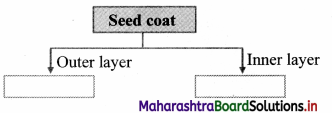
Maharashtra Board Class 11 Biology Important Questions Chapter 9 Morphology of Flowering Plant 29
Answer:
It shows outer layer called as testa and inner layer called as tegmen.

Question 45.
Explain the family of pea plant in detail with suitable floral diagram.
Answer:

  • Example: Pea plant (Pisum sativum)
  • Habit: Tree, shrubs, herbs.
  • Root: Root with root nodules.
  • Stem: Erect or climber.
  • Leaves: Alternate phyllotaxy, Pinnately compound leaves.
  • Inflorescence: Racemose
  • Flower: Zygomorphic, bisexual, complete.
  • Calyx: Sepals five, gamosepalous, imbricate aestivation.
  • Corolla: Petals five, polypetalous, consisting of a larger posterior petal vexillum, two lateral petals wings and two anterior ones forming a keel, vexillary aestivation.
  • Androecium: Stamens ten, diadelphous.
  • Gynoecium: Ovary superior, monocarpellary, unilocular with many ovules, marginal placentation. Fruit: Legume.
  • Seed: Non-endospermic

Question 46.
Answer the following.
1. Explain the family Solanaceae with the help of floral diagram.
2. Give examples of economically important plants from family Liliaceae.
Answer:

  • Example: Thom apple (Datura stramonium)
  • Habit: Mostly herbs, shmbs and rarely small trees.
  • Root: Tap root system
  • Stem: Herbaceous, woody, erect, branched, hairy, sometimes it may be underground like in potato.
  • Leaves: Alternate phyllotaxy, simple, reticulate venation.
  • Inflorescence: Solitary, cymose.
  • Flower: Actinomorphic, bisexual, complete.
  • Calyx: Sepals five, gamosepalous, persistent, valvate aestivation.
  • Corolla: Petals five, gamopetalous, valvate aestivation.
  • Androecium: Stamens five, free epipetalous (adhesion).
  • Gynoecium: Bicarpellary, syncarpous, superior ovary, bilocular, placenta swollen with many ovules, axile placentation.
  • Fruits: Berry or capsule.
  • Seeds: Many, endospermic.

2. Economically important plant from family Liliaceae:
Family Liliaceae includes many ornamental plants like tulip, Gloriosa, Medicinal plants like Aloe vera. Asparagus and source of colchicine, e.g. Colchicum autumnale.

Question 64.
Multiple Choice Questions:

Question 1.
Root is descending axis of plant body which is
(A) negatively geotropic
(B) hydrophobic
(C) negatively phototropic
(D) green and with intemodes
Answer:
(C) negatively phototropic

Maharashtra Board Class 11 Biology Important Questions Chapter 9 Morphology of Flowering Plants

Question 2.
The root system grow out from the
(A) plumule of the embryo
(B) radicle of the embryo
(C) embryo of the seed
(D) all of these
Answer:
(B) radicle of the embryo

Question 3.
Adventitious roots develop from
(A) radicle
(B) any part of the plant body except the radicle
(C) flower
(D) embryo
Answer:
(B) any part of the plant body except the radicle

Question 4.
A fibrous root system is best adapted to perform which of the following functions?
(A) Storage of food
(B) Transport of water and organic food
(C) Absorption of water and minerals from the soil
(D) Anchorage of the plant into the soil
Answer:
(D) Anchorage of the plant into the soil

Question 5.
When the root is swollen in the middle and tapers at both ends, it will be called as root.
(A) tuberous
(B) fusiform
(C) conical
(D) napiform
Answer:
(B) fusiform

Question 6.
Pneumatophores are helpful in
(A) protein synthesis
(B) respiration
(C) transpiration
(D) carbohydrate metabolism
Answer:
(B) respiration

Question 7.
Sweet potato is a modification of
(A) leaf
(B) adventitious root
(C) tap root
(D) stem
Answer:
(B) adventitious root

Question 8.
Stilt roots are roots.
(A) primary
(B) adventitious
(C) secondary
(D) tap
Answer:
(B) adventitious

Question 9.
A spongy tissue called velamen is present in
(A) breathing roots
(B) parasitic roots
(C) tuberous roots
(D) epiphytic roots
Answer:
(D) epiphytic roots

Question 10.
Which of the following is NOT a type of adventitious root modified for storage of food?
(A) Fasciculated tuberous roots
(B) Simple tuberous root
(C) Napiform root
(D) Moniliform roots
Answer:
(C) Napiform root

Question 11.
In which of the following plants, root cap is replaced by root pocket?
(A) Pistia
(B) Pandanus
(C) Screw pine
(D) Hibiscus
Answer:
(A) Pistia

Question 12.
Which of the following is an example of stem tuber?
(A) Helianthus tuberosus
(B) Zingiber officinale
(C) Cynodon
(D) Chrysanthemum
Answer:
(A) Helianthus tuberosus

Maharashtra Board Class 11 Biology Important Questions Chapter 9 Morphology of Flowering Plants

Question 13.
In stem tuber, the number of nodes and eyes is more towards
(A) rose end
(B) basal end
(C) heel
(D) both (B) and (C)
Answer:
(A) rose end

Question 14.
A rhizome differs from corm in its
(A) thickness
(B) basic organization
(C) direction of growth
(D) nature of leaves
Answer:
(C) direction of growth

Question 15.
The reduced stem of onion produces.
(A) Adventitious roots
(B) Prop roots
(C) Fusiform roots
(D) Fasciculated roots
Answer:
(A) Adventitious roots

Question 16.
Corm is ____________
(A) a horizontal underground stem.
(B) an underground root.
(C) an underground vertical stem.
(D) an aerial stem modification.
Answer:
(C) an underground vertical stem.

Question 17.
The stem modified to perform the function of leaf and with many internodes is called
(A) phylloclade
(B) cladode
(C) offset
(D) phyllode
Answer:
(A) phylloclade

Question 18.
_______ is a non-green runner like branch of stem, which develops from underground base of roots and found in Chrysanthemum.
(A) Corn
(B) Sucker
(C) Offset
(D) Tendril
Answer:
(B) Sucker

Question 19.
Ribbon shaped phylloclades are found in
(A) Ruscus
(B) Duranta
(C) Muehlenbeckia
(D) Bougainvillea
Answer:
(C) Muehlenbeckia

Question 20.
Axillary buds in Dioscorea becomes fleshy and rounded due to storage of food called as
(A) Stiphles
(B) Bulbils
(C) Offset
(D) Cladophylls
Answer:
(B) Bulbils

Maharashtra Board Class 11 Biology Important Questions Chapter 9 Morphology of Flowering Plants

Question 21.
The leaves without petiole are called
(A) sessile
(B) petiolate
(C) rachis
(D) lamina
Answer:
(A) sessile

Question 22.
The type of leaves observed is mango plant is
(A) Compound leaves
(B) Bipinnately compound leaves
(C) Simple leaves with reticulate venation
(D) Simple leaves with parallel venation
Answer:
(C) Simple leaves with reticulate venation

Question 23.
In _________ , the terminal three leaflet get modified into three stiff leaf hooks.
(A) Lathyrus
(B) Pisum sativum
(C) Smilax
(D) Bignonia unguisi-cati
Answer:
(D) Bignonia unguisi-cati

Question 24.
Leaf apex is modified into tendril in
(A) Gloriosa
(B) Pea
(C) Smilax
(D) Lathyrus
Answer:
(A) Gloriosa

Question 25.
Modification of petiole into leaf-like structure is called ________ .
(A) cladode
(B) phylloclade
(C) phyllode
(D) pistillode
Answer:
(C) phyllode

Question 26.
The mode of arrangement of leaves on the stem and the branch is known as _______ .
(A) vernalization
(B) vernation
(C) venation
(D) phyllotaxy
Answer:
(D) phyllotaxy

Question 27.
Bipinnately compound leaves can be observed in
(A) Citrus
(B) Hibiscus
(C) Caesalpinia
(D) Coriandrum
Answer:
(C) Caesalpinia

Question 28.
The axis of the inflorescence is known as
(A) Thalamus
(B) Peduncle
(C) Pedicel
(D) Petiole
Answer:
(B) Peduncle

Question 29.
In racemose inflorescence
(A) growth of peduncle is infinite
(B) apical bud always terminates into flower
(C) growth of peduncle is finite.
(D) order of opening of flower is centrifugal.
Answer:
(A) growth of peduncle is infinite

Maharashtra Board Class 11 Biology Important Questions Chapter 9 Morphology of Flowering Plants

Question 30.
In a typical flower thalamus consists of compactly arranged nodes and intemodes.
(A) three, two
(B) four, three
(C) three, four
(D) two, three
Answer:
(B) four, three

Question 31.
When the flower is epigynous, the ovary is said to be
(A) inferior
(B) superior
(C) semi-inferior
(D) semi-superior
Answer:
(A) inferior

Question 32.
When the gynoecium is present at the topmost position of the thalamus, the flower is known as
(A) inferior
(B) epigynous
(C) perigynous
(D) hypogynous
Answer:
(D) hypogynous

Question 33.
When all sepals are united, the condition is called as
(A) polysepalous
(B) gamosepalous
(C) polypetalous
(D) gamopetalous
Answer:
(B) gamosepalous

Question 34.
When sepals fall just after opening of the flower, they are termed as
(A) persistent
(B) caducous
(C) remnant
(D) deciduous
Answer:
(B) caducous

Question 35.
Fusion between members of a similar whorl is known as
(A) succession
(B) adhesion
(C) cohesion
(D) inflorescence
Answer:
(C) cohesion

Maharashtra Board Class 11 Biology Important Questions Chapter 9 Morphology of Flowering Plants

Question 36.
Complete the analogy. Seed:ovule::Fruit:
(A) pericarp
(B) ovary
(C) embryo
(D) cotyledons
Answer:
(B) ovary

Question 37.
Which one of the following is not a fruit?
(A) Tomato
(B) Cucumber
(C) Pumpkin
(D) Potato
Answer:
(D) Potato

Question 38.
Pineapple is an example of _________ .
(A) simple dry fruit
(B) composite fruit
(C) aggregate fruit
(D) simple-fleshy fruit
Answer:
(B) composite fruit

Question 39.
Outer seed coat is called _______ .
(A) testa
(B) tegmen
(C) raphe
(D) micropyle
Answer:
(A) testa

Question 40.
Vexillum wings and keel corolla are found in family
(A) Solanaceae
(B) Fabaceae
(C) Liliaceae
(D) Malvaceae
Answer:
(B) Fabaceae

Question 65.
Competitive Corner:

Question 1.
Match the placental types (Column-I) with their examples (Column-II).

Column-I Column-II
1. Basal (p) Mustard
2. Axile (q) China rose
3. Parietal (r) Dianthus
4. Free central (s) Sunflower

Choose the correct answer from the following option: [NEET (ODISHA) – 2019J
(A) i – r, ii – s, iii – p, iv – q
(B) i – q, ii – r, iii – s, iv – p
(C) i – p, ii – q, iii – r, iv – s
(D) i – s, ii – q, iii – p, iv – r
Answer:
(D) i – s, ii – q, iii – p, iv – r

Question 2.
Placentation in which ovules develop on the inner wall of the ovary or in peripheral part is:
(A) Parietal
(B) Free central
(C) Basal
(D) Axile
Answer:
(A) Parietal

Question 3.
Pneumatophores occur in
(A) Carnivorous plants
(B) Free-floating hydrophytes
(C) Halophytes
(D) Submerged hydrophytes
Answer:
(C) Halophytes

Question 4.
Sweet potato is a modified
(A) Tap root
(B) Adventitious root
(C) Stem
(D) Rhizome
Answer:
(B) Adventitious root

Maharashtra Board Class 11 Biology Important Questions Chapter 9 Morphology of Flowering Plants

Question 5.
Root hairs develop from the region of
(A) Maturation
(B) Elongation
(C) Root cap
(D) Meristematic activity
Hint: Epidermal cells from the region of maturation form very fine and delicate, thread like structures called root hairs. These root hairs absorb water and minerals from the soil.
Answer:
(A) Maturation

Question 6.
Plants which produce characteristic pneumatophores and show vivipary belong to
(A) Mesophytes
(B) Halophytes
(C) Psammophytes
(D) Elydrophytes
Hint: Plants growing in swampy areas, marshy places and salt lakes are called halophytes. Many halophytes develop respiratory roots or pneumatophores. Pneumatophores are negatively geotropic and are provided with pores called lenticels. Since they grow in oxygen-deficient soil, their seeds germinate inside the fruit, when it is still attached with the parents, exhibiting vivipary.
Answer:
(B) Halophytes

Question 7.
In Bougainvillea thorns are the modifications of
(A) Stipules
(B) Adventitious root
(C) Stem
(D) Leaf
Hint: Thom is a hard, pointed, woody and usually straight structure produced by modification of axillary bud. It provides protection against browsing animals. In Bougainvillea, thorns are modified stems.
Answer:
(C) Stem

Maharashtra Board Class 11 Biology Important Questions Chapter 9 Morphology of Flowering Plants

Question 8.
Coconut fruit is a
(A) Drupe
(B) Berry
(C) Nut
(D) Capsule
Hint: Dmpe is the simple, fleshy fruit developing from the monocarpellary superior ovary. It is generally one seeded. Coconut fruit is a dmpe with fibrous mesocarp and hard endocarp
Answer:
(A) Drupe

Maharashtra Board 11th BK Important Questions Chapter 6 Bank Reconciliation Statement

Balbharti Maharashtra State Board 11th Commerce Book Keeping & Accountancy Important Questions Chapter 6 Bank Reconciliation Statement Important Questions and Answers.

Maharashtra State Board 11th Commerce BK Important Questions Chapter 6 Bank Reconciliation Statement

1. Answer in one sentence.

Question 1.
What is a Bank Reconciliation Statement?
Answer:
Bank Reconciliation Statement is a statement that shows the causes of disagreement between the balance shown by passbook and the balance shown by Cash Book under the column as on a particular date.

Question 2.
What is a Bank passbook?
Answer:
A Bank passbook is a copy of a Customer’s A/c in the Bank’s ledger.

Maharashtra Board 11th BK Important Questions Chapter 6 Bank Reconciliation Statement

Question 3.
What do you mean by the debit balance of Pass Book?
Answer:
Debit balance of passbook means overdraft as per passbook.

Question 4.
Which account is opened by a trader in Bank for his business operation?
Answer:
A current account is opened by a trader in Bank for his business operation.

Question 5.
On which side of the Cash Book interest on investment is to be shown?
Answer:
Interest on investment is to be shown on the debit/receipt side in the Cash Book.

Question 6.
On which side of the passbook, the direct deposit made by a customer is recorded?
Answer:
A direct deposit made by a customer is recorded on the credit side of the passbook.

Question 7.
What does the credit balance of Cash Book indicate?
Answer:
A credit balance of Cash Book indicates overdraft as per Cash Book.

2. Give one word/term/phrase which can substitute each of the following statements:

Question 1.
Excess of a total of debit side over a total of credit side of Cash Book, Bank column.
Answer:
Bank Balance as per Cash Book

Question 2.
An unfavourable balance is shown by the passbook.
Answer:
Overdraft

Maharashtra Board 11th BK Important Questions Chapter 6 Bank Reconciliation Statement

Question 3.
A copy of the customer’s account issued by the bank.
Answer:
Pass Book

Question 4.
Booklet or a statement that is used to record the banking transactions.
Answer:
Pass Book

Question 5.
The credit balance of the bank column of the Cash Book.
Answer:
Overdraft

Question 6.
Refusal by the bank to make payment of a cheque.
Answer:
Dishonour of Cheque

Question 7.
Document used to withdraw cash from the bank.
Answer:
Withdrawal Slip

Question 8.
Excess of a total of credit side over a total of debit side in the passbook.
Answer:
Balance as per Pass Book

Maharashtra Board 11th BK Important Questions Chapter 6 Bank Reconciliation Statement

Question 9.
Document used by the account holder to deposit cash and/or cheques into the bank.
Answer:
Pay-in-Slip

Question 10.
Document used by the account holder to withdraw cash from the bank and for making payment to outside parties through the bank.
Answer:
Cheque

3. Do you agree or disagree with the following statements:

Question 1.
Bank Reconciliation Statement is prepared by Bank.
Answer:
Disagree

Question 2.
Overdraft Facility is available to savings Bank Account.
Answer:
Disagree

Question 3.
The bank account holder can make payments to a third party by use of a pay-in slip.
Answer:
Disagree

Maharashtra Board 11th BK Important Questions Chapter 6 Bank Reconciliation Statement

Question 4.
Bank does not charge any interest on an overdraft balance.
Answer:
Disagree

Question 5.
Credit balance in Pass Book represents overdraft balance.
Answer:
Disagree

Question 6.
In the cash book of a trader Bank record the entries.
Answer:
Disagree

Question 7.
In the passbook, entries are made by the account holder.
Answer:
Disagree

Question 8.
Through mobile banking account holder can deposit physical cash into his account.
Answer:
Disagree

Question 9.
The right-hand side of the pay-in-slip is known as a counterfoil.
Answer:
Disagree

Maharashtra Board 11th BK Important Questions Chapter 6 Bank Reconciliation Statement

Question 10.
A cash withdrawal slip is used to deposit a cheque or cash into a bank account.
Answer:
Disagree

4. Select the most appropriate alternative from those given and rewrite the following statements:

Question 1.
Pass Book is _____________ of account holders transactions with bank.
(a) an extract
(b) balance sheet
(c) balance
(d) mode
Answer:
(a) an extract

Question 2.
When cheque is _____________ into bank Cash Book is debited.
(a) written
(b) issued
(c) deposited
(d) dishonoured
Answer:
(c) deposited

Question 3.
Overdraft facility is allowed to _____________ account.
(a) saving
(b) recurring
(c) current
(d) fixed deposit.
Answer:
(c) current

Question 4.
Overdraft means _____________ balance of Pass Book.
(a) opening
(b) debit
(c) credit
(d) closing
Answer:
(b) debit

Maharashtra Board 11th BK Important Questions Chapter 6 Bank Reconciliation Statement

Question 5.
Interest on bank overdraft is recorded on _____________ side of Pass Book.
(a) debit
(b) credit
(c) any
(d) both
Answer:
(a) debit

Question 6.
Credit balance in the Pass Book represents _____________
(a) overdraft
(b) bank balance
(c) loan borrowed
(d) negative
Answer:
(b) bank balance

Question 7.
Direct deposit by a customer will be recorded on _____________ side of Pass Book.
(a) debit
(b) credit
(c) left hand
(d) any
Answer:
(b) credit

Question 8.
Normally the Bank Reconciliation Statement is prepared at the end of a _____________
(a) day
(b) week
(c) year
(d) month
Answer:
(d) month

Maharashtra Board 11th BK Important Questions Chapter 6 Bank Reconciliation Statement

Question 9.
Bank charges charged by bank are recorded on _____________ side of Pass Book.
(a) debit
(b) credit
(c) any
(d) both
Answer:
(a) debit

5. Complete the following statements:

Question 1.
Bank issue _____________ to current account holders as record or summary for bank transactions.
Answer:
Bank statement

Question 2.
To deposit cash or cheque _____________ is used.
Answer:
Pay in Slip

Question 3.
Directly deposited by a customer in bank account appears an _____________ side of pass book.
Answer:
Credit

Question 4.
____________ is an unfavorable balance as per Pass Book.
Answer:
overdraft

Question 5.
Check deposited into Bank but not cleared is called _____________ cheque.
Answer:
Dishonoured

Question 6.
Expenses paid by the Bank as per standing instructions will be recorded at _____________ side of the passbook.
Answer:
Debit

Maharashtra Board 11th BK Important Questions Chapter 6 Bank Reconciliation Statement

Question 7.
Dividend collected by the bank will be recorded at _____________ side of cash book.
Answer:
Debit

Question 8.
_____________ type of bank account is open by trader.
Answer:
Current

6. State whether the following statements are True or False with reasons:
Question 1.
Bank Reconciliation Statement is prepared by the Bank.
Answer:
This statement is False.
A Bank Reconciliation statement shows the causes of disagreement between the balances shown by the bank passbook and the bank balance shown by the cash book, for a particular period of time generally a month. It is prepared by the trader as he has both the books to compare and find the differences.

Question 2.
Bank Reconciliation Statement is prepared at the end of every month.
Answer:
This statement is True.
Monthly preparation of Bank Reconciliation Statement assists in the regular monitoring of cash flows of a business and identification of accounting errors.

Question 3.
Overdraft facility is allowed to Proprietor’s Personal A/c.
Answer:
This statement is False.
Overdraft facility is allowed only to business current A/c and not to Proprietor’s Personal A/c.

Maharashtra Board 11th BK Important Questions Chapter 6 Bank Reconciliation Statement

Question 4.
The debit balance of Pass Book represents overdraft.
Answer:
This statement is True.
Debit Column of a passbook means withdrawals from the bank, When withdrawals are more than deposits it means the excess amount is withdrawn from the bank. It is a temporary loan payable by the trader to the bank. So the debit balance of Pass Book represents overdraft.

Question 6.
Bank charges debited by Bank increase bank balance as per Pass Book.
Answer:
This statement is False.
Bank charges are expenses for the business. Expenses decrease the bank balance as per Pass Book. Bank charges debited by the bank decrease the bank balance as per Pass Book.

Question 6.
Interest credited in PassBook is an income to the customer.
Answer:
This statement is True.
All incomes are shown on the credit side of the passbook. It is a deposit. So Interest Credited in Passbook is an income to the customer.

Question 7.
Bank Reconciliation Statement is prepared to detect the errors that take place in accounting.
Answer:
This statement is True.
A businessman maintains a cash book with a bank column to record his bank transactions whereas the bank also maintains a customer’s ledger account and issues him a Bank statement. There could be differences as per the bank balance in the cash book and bank balance in the passbook. To detect the errors that take place in accounting Bank Reconciliation Statement is prepared.

Question 8.
Overdraft as per Cash Book means debit balance as per Cash Book.
Answer:
This statement is False.
Overdraft as per Cash Book means credit balance as per cash book. Cashbook debit means deposits. When cash book debit balance is greater it means Bank Balance as per Cash Book.

Maharashtra Board 11th BK Important Questions Chapter 6 Bank Reconciliation Statement

Question 9.
Cheque deposited into Bank increases the Bank balance as per Cash Book.
Answer:
This statement is True.
The Debit side of the cash book means deposits. So cheque deposited into the Bank increases the Bank Balance as per Cash Book.

Question 10.
Payments made by the bank as per standing instructions are recorded on the Debit balance of the Pass Book.
Answer:
This statement is True.
The Debit side of the passbook represents payments. So any payments made by the bank, Bank debits the customer’s account and records on the Debit side of the passbook.

Question 11.
Bank column in Cash Book represents Proprietor’s Savings A/c.
Answer:
This statement is False.
Cashbook records only business transactions and not the personal A/c of the trader. The Bank column in Cash Book represents Business Current A/c and not the proprietor’s savings A/c.

7. Correct and rewrite the following statements.

Question 1.
Overdraft as per cash book means debit balance as per cash book.
Answer:
Normal bank balance as per cash book means debit balance as per cashback.

Question 2.
Bank column in cash book represents proprietors saving A/c.
Answer:
The Bank column in cashback represents the business’s current account.

Question 3.
Fixed deposit A/c is opened by traders for day-to-day business bank transactions.
Answer:
The current account is opened by traders for day-to-day business bank transactions.

Maharashtra Board 11th BK Important Questions Chapter 6 Bank Reconciliation Statement

Question 4.
The bank account is a real account.
Answer:
A bank account is a personal account

Question 5.
Interest charged by the bank on overdraft A/c is income for the business.
Answer:
Interest charged by the bank on overdraft A/c is an expense for the business.

8. Complete the following table.

Question 1.
Maharashtra Board 11th BK Important Questions Chapter 6 Bank Reconciliation Statement 8 Q1
Maharashtra Board 11th BK Important Questions Chapter 6 Bank Reconciliation Statement 8 Q1.1
Answer:
Maharashtra Board 11th BK Important Questions Chapter 6 Bank Reconciliation Statement 8 Q1.2
Maharashtra Board 11th BK Important Questions Chapter 6 Bank Reconciliation Statement 8 Q1.3
Maharashtra Board 11th BK Important Questions Chapter 6 Bank Reconciliation Statement 8 Q1.4

Maharashtra Board Class 11 Chemistry Important Questions Chapter 2 Introduction to Analytical Chemistry

Balbharti Maharashtra State Board 11th Chemistry Important Questions Chapter 2 Introduction to Analytical Chemistry Important Questions and Answers.

Maharashtra State Board 11th Chemistry Important Questions Chapter 2 Introduction to Analytical Chemistry

Question 1.
Explain the statement: Analytical chemistry provides physical or chemical information about a sample.
Answer:

  • Analytical chemistry facilitates the investigation of the chemical composition of substances.
  • It uses the instruments and methods to separate, identify and quantify a sample under study.

Thus, analytical chemistry provides chemical or physical information about a sample.

Question 2.
What is the difference between qualitative analysis and quantitative analysis?
Answer:

  1. Qualitative analysis deals with the detection of the presence or absence of elements in compounds and of chemical compounds in mixtures.
  2. Quantitative analysis deals with the determination of the relative proportions of elements in compounds and of chemical compounds in mixtures.

Question 3.
Explain the importance of chemical analysis.
Answer:

  • Chemical analysis is one of the most important methods of monitoring the composition of raw materials, intermediates and finished products, and also the composition of air in streets and premises of industrial plants.
  • In agriculture, chemical analysis is used to determine the composition of soils and fertilizers.
  • In medicine, it is used to determine the composition of medicinal preparations.

Question 4.
Write a note on the applications of analytical chemistry.
Answer:

  • Analytical chemistry has applications in forensic science, engineering and industry.
  • Analytical chemistry is also useful in the field of agriculture and pharmaceutical industry.
  • Industrial process as a whole and the production of new kinds of materials are closely associated with analytical chemistry.

Maharashtra Board Class 11 Chemistry Important Questions Chapter 2 Introduction to Analytical Chemistry

Question 5.
What is semi-microanalysis?
Answer:

  • When the amount of a solid or liquid sample taken for analysis is a few grams, the analysis is called semi-microanalysis.
  • It is of two types: qualitative and quantitative analysis.

Question 6.
What does classical qualitative analysis method include?
Answer:
Classical qualitative analysis method includes separation and identification of compounds.

  • Separations may be done by methods such as precipitation, extraction and distillation.
  • Identification may be based on differences in colour, odour, melting point, boiling point, and reactivity.

Question 7.
Name two methods of classical quantitative analysis.
Answer:

  1. Volumetric analysis (Titrimetric analysis)
  2. Gravimetric analysis (i.e., decomposition, precipitation)

Question 8.
What are the two stages involved in the chemical analysis of a sample?
Answer:
The chemical analysis of a sample is carried out mainly in two stages: by the dry method and by the wet method. In dry method, the sample under test is not dissolved and in wet method, the sample under test is first dissolved and then analysed to determine its composition.

Question 9.
Explain: Qualitative analysis of organic compounds
Answer:

  • The majority of organic compounds are composed of a relatively small number of elements.
  • The most important ones are: carbon, hydrogen, oxygen, nitrogen, sulphur, halogen, phosphorus.
  • Elementary qualitative analysis is concerned with the detection of the presence of these elements.
  • The identification of an organic compound involves tests such as detection of functional group, determination of melting/boiling points, etc.

Maharashtra Board Class 11 Chemistry Important Questions Chapter 2 Introduction to Analytical Chemistry

Question 10.
What does qualitative analysis of inorganic compounds involve?
Answer:
The qualitative analysis of simple inorganic compounds involves detection and confirmation of cationic and anionic species (basic and acidic radical) in them.

Question 11.
Explain: Chemical methods of quantitative analysis
Answer:

  • Quantitative analysis of organic compounds involves methods such as determination of percentage of constituent elements, concentrations of a known compound in the given sample, etc.
  • Quantitative analysis of simple inorganic compounds involves methods such as gravimetric analysis (i.e., decomposition, precipitation, etc.) and the titrimetric or volumetric analysis (i.e., progress of reaction between two solutions till its completion).
  • The quantitative analytical methods involve measurement of quantities such as mass and volume using some equipment/apparatus such as weighing machine, burette, etc.

Question 12.
Why is accurate measurement crucial in science?
Answer:

  • The accuracy of measurement is of a great concern in analytical chemistry. This is because faulty equipment, poor data processing or human error can lead to inaccurate measurements. Also, there can be intrinsic errors in the analytical measurement.
  • When measurements are not accurate, this provides incorrect data that can lead to wrong conclusions. For example, if a laboratory experiment requires a specific amount of a chemical, then measuring the wrong amount may result in an unsafe or unexpected outcome.
  • Hence, the numerical data obtained experimentally are treated mathematically to reach some quantitative conclusion.
  • Also, an analytical chemist has to know how to report the quantitative analytical data, indicating the extent of the accuracy of measurement, perform the mathematical operation and properly express the quantitative error in the result.

Question 13.
Why are scientific notations (exponential notations) used?
Answer:
A chemist has to deal with numbers as large as 602,200,000,000,000,000,000,000 for the molecules of 2 g of hydrogen gas or as small as 0.00000000000000000000000166 g. that is, mass of a H atom. To avoid the writing of so many zeros in mathematical operations, scientific notations i.e. exponential notations are used.

Question 14.
How are numbers expressed in scientific notations (exponential notations)?
Answer:
In scientific notations, numbers are expressed in the form of N × 10n, where ‘n’ is an exponent with positive or negative values and N can have a value between 1 to 10.
e.g. i. The number, 602,200,000,000,000,000,000,000 is expressed as 6.022 × 10²³.
ii. The mass of a H atom, 0.00000000000000000000000166 g is expressed as 1.66 × 10⁻²⁴ g.
iii. The number 123.546 is written as 1.23546 × 10².
iv. The number 0.00015 is written as 1.5 × 10⁻⁴.

Maharashtra Board Class 11 Chemistry Important Questions Chapter 2 Introduction to Analytical Chemistry

Question 15.
Express the following quantities in scientific notations (exponential notations).
i. 0.0345
ii . 0.08
iii. 653.00
iv. 34.768
Answer:
i. 0.0345 = 3.45 × 10⁻²
ii. 0.08 = 8 × 10⁻²
iii. 653.00 = 6.5300 × 10²
iv. 34.768 = 3.4768 × 101

Question 16.
Define: Accuracy of measurement
Answer:
Nearness of the measured value to the true value is called the accuracy of measurement.

Question 17.
Explain with the help of a diagram how accuracy depends upon the sensitivity or least count of the measuring equipment.
Answer:
A burette reading of 10.2 mL is as shown in the diagram below:
Maharashtra Board Class 11 Chemistry Important Questions Chapter 2 Introduction to Analytical Chemistry 1

  • For all the three situations in the above figure, the reading would be noted is 10.2 mL.
  • It means that there is an uncertainty about the digit appearing after the decimal point in the reading 10.2 mL because the least count of the burette is 0.1 mL.
  • The meaning of the reading 10.2 mL is that the true value of the reading lies between 10.1 mL and 10.3 mL.
  • This is indicated by writing 10.2 ± 0.1 mL.
  • Here, the burette reading has an error of ± 0.1 mL.
  • Smaller the error, higher is the accuracy.

Question 18.
How is absolute error calculated?
Answer:
Absolute error is calculated by subtracting true value from observed value.
Absolute error = Observed value – Tme value

Question 19.
Explain the term: Relative error
Answer:

  1. Relative error is the ratio of an absolute error to the true value.
  2. Relative error is generally a more useful quantity than absolute error.
  3. Relative error is expressed as a percentage and can be calculated as follows:
    Relative error = \(\frac{\text { Absolute error }}{\text { True value }} \times 100 \%\)

Maharashtra Board Class 11 Chemistry Important Questions Chapter 2 Introduction to Analytical Chemistry

Question 20.
Explain the term: Precision in measurement
Answer:

  • Multiple readings of the same quantity are noted to minimize the error.
  • If the multiple readings of the same quantity match closely, they are said to have high precision.
  • High precision implies reproducibility of the readings.
  • High precision is a prerequisite for high accuracy.
  • Precision is expressed in terms of deviation (i.e. absolute deviation and relative deviation).

Question 21.
Explain the following terms with respect to precise measurement:
i. Absolute deviation
ii. Mean absolute deviation
iii. Relative deviation
Answer:
i. Absolute deviation: An absolute deviation is the modulus of the difference between an observed value and the arithmetic mean for the set of several measurements made in the same way. It is a measure of absolute error in the repeated observation. It is expressed as follows:
Absolute deviation = |Observed value – Mean|

ii. Mean absolute deviation: Arithmetic mean of all the absolute deviations is called the mean absolute deviation in the measurements.

iii. Relative deviation: The ratio of mean absolute deviation to its arithmetic mean is called relative deviation. It is expressed as follows:
Relative deviation = \(\frac{\text { Mean absolute deviation }}{\text { Mean }}\) × 100%

Question 22.
Explain the need of significant figures in measurement.
Answer:

  • Uncertainty in measured value leads to uncertainty in calculated result.
  • Uncertainty in a value is indicated by mentioning the number of significant figures in that value. e.g. Consider, the column reading 10.2 ± 0.1 mL recorded on a burette having the least count of 0.1 mL. Here, it is said that the last digit ‘2’ in the reading is uncertain, its uncertainty is ±0.1 mL. On the other hand, the figure ‘10’ is certain.
  • The significant figures in a measurement or result are the number of digits known with certainty plus one uncertain digit.
  • In a scientific experiment, a result is obtained by doing calculation in which values of a number of quantities measured with equipment of different least counts are used.

Question 23.
How many significant figures are present in the following measurements?
i. 4.065 m
ii. 0.32 g
iii. 57.98 cm3
iv. 0.02 s
v. 4.0 × 10⁻⁴ km
vi. 604.0820 kg
vii. 307.100 × 10⁻⁵ cm
Answer:
i. 4
ii. 2
iii. 4
iv. 1
v. 2
vi. 7
vii. 6

Question 24.
How many significant figures are present in each of the following?
i. 45.0
ii. 0.001
iii. 2.10 × 10⁻⁸
iv. 340000
v. 0.0100
vi. 7890320
vii. 100.00
viii. 100
Answer:
i. 3
ii. 1
iii. 3
iv. 2
v. 3
vi. 6
vii. 5
viii. 1

Maharashtra Board Class 11 Chemistry Important Questions Chapter 2 Introduction to Analytical Chemistry

Question 25.
State the rules used to round off a number to the required number of significant figures.
Answer:
The following rules are used to round off a number to the required number of significant figures:

  • If the digit following the last digit to be kept is less than five, the last digit is left unchanged, e.g. 46.32 rounded off to two significant figures is 46.
  • If the digit following the last digit to be kept is five or more, the last digit to be kept is increased by one. e.g. 52.87 rounded to three significant figures is 52.9.

Question 26.
Round off each of the following to the number of significant digits indicated:
i. 1.223 to two digits
ii. 12.56 to three digits
iii. 122.17 to four digits
iv. 231.5 to three digits
Answer:
i. 1.223 to two digits = 1.2
This is because the third digit is less than 5, so we drop it and all the other digits to its right.
ii. 12.56 to three digits = 12.6
This is because the fourth digit is greater than 5, so we drop it and add 1 to the third digit.
iii. 122.17 to four digits = 122.2
This is because the fifth digit is greater than 5, so we drop it and add 1 to the fourth digit.
iv. 231.5 to three digits = 232
This is because the fourth digit is 5, so we drop it and add 1 to the third digit.

Question 27.
Add 5.55 × 10⁴ and 6.95 × 10³ and express the result in scientific notation.
Solution:
To perform addition operation, first the numbers are written in such a way that they have the same exponent. The coefficients are then added.
(5.55 × 10⁴) + (6.95 × 10³)= (5.55 × 10⁴) + (0.695 × 10⁴)
= (5.55 +0.695) × 104
= 6.245 × 10⁴

Question 28.
Add 1.77 × 10² and 2.23 × 10³ and express the result in scientific notation.
Solution:
To perform addition operation, first the numbers are written in such a way that they have the same exponent. The coefficients are then added.
(1.77 × 10²) + (2.23 × 10³) = (0.177 × 10³) + (2.23 × 10³)
= (0.177 + 2.23) × 103
= 2.407 × 10³

Question 29.
Subtract 5.8 × 10⁻³ from 3.5 × 10⁻² and express result in scientific notation.
Solution:
To perform subtraction operation, first the numbers are written in such a way that they have the same exponent. Then subtraction of coefficients can be done.
(3.5 × 10⁻²)- (5.8 × 10⁻³) = (3.5 × 10⁻²) – (0.58 × 10⁻²)
= (3.5 – 0.58) × 10-2
= 2.92 × 10⁻²

Maharashtra Board Class 11 Chemistry Important Questions Chapter 2 Introduction to Analytical Chemistry

Question 30.
Subtract 6.90 × 10⁻⁵ from 5.11 × 10⁻⁴ and express the result in scientific notation.
Solution:
To perform subtraction operation, first the numbers are written in such a way that they have the same exponent. Then subtraction of coefficients can be done.
(5.11 × 10⁻⁴) – (6.90 × 10⁻⁵) = (5.11 × 10⁻⁴) – (0.690 × 10⁻⁴)
= (5.11 – 0.690) × 10-4
= 4.42 × 10⁻⁴

Question 31.
Perform following calculations and express results in scientific notations (exponential notations),
i. (1.5 × 10⁻⁶) – (5.8 × 10⁻⁷)
ii. (9.8 × 10⁻³) – (8.8 × 10⁻³)
iii. (6.5 × 10⁻⁸) – (5.5 × 10⁻⁹)
Solution:
To perform subtraction operation, first the numbers are written in such a way that they have the same exponent. Then subtraction of coefficients can be done.
i. (1.5 × 10⁻⁶) – (5.8 × 10⁻⁷) = (1.5 × 10⁻⁶) – (0.58 × 10⁻⁶)
= (1.5 – 0.58) × 10-6
= 0.92 × 10-6
= 9.2 × 10⁻⁷

ii. (9.8 × 10⁻³) – (8.8 × 10⁻³) = (9.8 – 8.8) × 10-3
= 1.0 × 10⁻³

iii. (6.5 × 10⁻⁸) – (5.0 × 10⁻⁹) = (6.5 × 10⁻⁸) – (0.50 × 10⁻⁸)
= (6.5 – 0.50) × 10-8
= 6.0 × 10⁻⁸

Question 32.
Multiply 5.6 × 10⁵ and 6.9 × 10⁸ and express result in scientific notation.
Solution:
(5.6 × 105) × (6.9 × 108) = (5.6 × 6.9) (105+8)
= 38.64 × 1013
= 3.864 × 10¹⁴

Question 33.
Multiply 9.8 × 10⁻² and 2.5 × 10⁻⁶ and express result in scientific notation.
Solution:
(9.8 × 10-2) × (2.5 × 10-6) = (9.8 × 2.5) (10-2+(-6))
= (9.8 × 2.5) × (10-2-6)
= 24.5 × 10-8
= 2.45 × 10⁻⁷

Question 34.
Perform following calculations and express results in scientific notations (exponential notations).
i. (2.5 × 10-6) × (1.8 × 10-7)
ii. (4.5 × 10-3) × (1.8 × 103)
iii. (8.5 × 107) × (3.5 × 109)
Solution:
i. (2.5 × 10-6) × (1.8 × 10-7) = (2.5 × 1.8) (10-6+(-7))
= (2.5 × 1.8) × (10-6-7)
= 4.5 × 10⁻¹³

ii. (4.5 × 10-3) × (1.8 × 103) = (4.5 × 1.8) (10-3+3)
= (4.5 × 1.8) × (100)
= 8.1

iii. (8.5 × 107) × (3.5 × 109) = (8.5 × 3.5) (107+9)
= (8.5 × 3.5) × 1016
= 29.75 × 1016
= 2.975 × 10¹⁷
[Note: To express number in scientific notation, the number has to be greater than or equal to 10 or less than 1. The number, 8.1 is greater than 1, but less than 10 and hence, it cannot be expressed in scientific notation.]

Maharashtra Board Class 11 Chemistry Important Questions Chapter 2 Introduction to Analytical Chemistry

Question 35.
In laboratory experiment, 10 g potassium chlorate sample on decomposition gives following data: The sample contains 3.8 g of oxygen and the actual mass of oxygen in the quantity of potassium chlorate is 3.92 g. Calculate absolute error and relative error.
Solution:
The observed value is 3.8 g and accepted (true) value is 3.92 g.
i. Absolute error = Observed value – True value
= 3.8 – 3.92
= -0.12 g
Maharashtra Board Class 11 Chemistry Important Questions Chapter 2 Introduction to Analytical Chemistry 2
[Note: The negative sign indicates that experimental result is lower than the true value.]
Ans: i. Absolute error = -0.12 g
ii. Relative error = -3.06%

Question 36.
12.15 g of magnesium gives 20.20 g of magnesium oxide on burning. The actual mass of magnesium oxide that should be produced is 20.15 g. Calculate absolute error and relative error.
Solution:
The observed value is 20.20 g and accepted (true) value is 20.15 g.
i. Absolute error = Observed value – True value
= 20.20 – 20.15
= 0.05 g
Maharashtra Board Class 11 Chemistry Important Questions Chapter 2 Introduction to Analytical Chemistry 3
Ans: i. Absolute error = 0.05 g
ii. Relative error = 0.25 %

Question 37.
The three identical samples of potassium chlorate are decomposed. The mass of oxygen is determined to be 3.87 g, 3.95 g and 3.89 g for the set. Calculate absolute deviation and relative deviation.
Solution:
Mean = \(\frac{3.87+3.95+3.89}{3}\) = 3.90

Sample Mass of oxygen

Absolute deviation =
| Observed value – Mean |

1 3.87 g 0.03 g
2 3.95 g 0.05 g
3 3.89 g 0.01 g

Maharashtra Board Class 11 Chemistry Important Questions Chapter 2 Introduction to Analytical Chemistry 4
Ans: i. Absolute deviation in each observation = 0.03 g, 0.05 g, 0.01 g
Relative deviation = 0.8%

Question 38.
In repeated measurements in volumetric analysis, the end-points were observed as 11.15 mL, 11.17 mL, 11.11 mL and 11.17 mL. Calculate mean absolute deviation and relative deviation.
Solution:
Mean = \(\frac{11.15+11.17+11.11+11.17}{4}\) = 11.15

Measurement End-point

Absolute deviation =
|Observed value – Mean|

1 11.15 mL 0
2 11.17 mL 0.02 mL
3 11.11 mL 0.04 mL
4 11.17 mL 0.02 mL

Maharashtra Board Class 11 Chemistry Important Questions Chapter 2 Introduction to Analytical Chemistry 5
Ans: i. Mean absolute deviation = ±0.02 mL
ii. Relative deviation = 0.2%

Question 39.
Calculate the mass percentages of H, P and O in phosphoric acid if atomic masses are H = 1, P = 31 and O = 16.
Solution:
Atomic mass of H = 1, P = 31 and 0=16
The mass percentage of hydrogen, phosphorus, oxygen in H3PO4
Formula:
Maharashtra Board Class 11 Chemistry Important Questions Chapter 2 Introduction to Analytical Chemistry 6
Calculation: Molecular formula of phosphoric acid: H3PO4
∴ Molar mass of H3PO4 = 3 × (1) + 1 × (31) + 4 × (16)
= 3 + 31 + 64
= 98 g mol-1
Percentage of H = \(\frac {3}{98}\) × 100 = 3.06%
Percentage of P = \(\frac {31}{98}\) × 100 = 31.63%
Percentage of O = \(\frac {64}{98}\) × 100 = 65.31%
Ans: Mass percentage of H, P and O in phosphoric acid are 3.06%, 31.63% and 65.31% respectively.

Maharashtra Board Class 11 Chemistry Important Questions Chapter 2 Introduction to Analytical Chemistry

Question 40.
Calculate the percentage composition of the elements in HNO3 (H = 1, N = 14, O = 16).
Solution:
Atomic mass of H = 1, N = 14 and O = 16
The mass percentage of H, N and O in HNO3
Formula:
Maharashtra Board Class 11 Chemistry Important Questions Chapter 2 Introduction to Analytical Chemistry 7
Calculation: Molecular formula of HNO3
∴ Molar mass = 1 × (1) + 1 × (14) + 3 × (16) = 1 + 14 + 48 = 63 g mol-1
∴ Percentage of H = \(\frac {1}{63}\) × 100 = 1.59%
Percentage of N = \(\frac {14}{63}\) × 100 = 22.22%
Percentage of O = \(\frac {48}{63}\) × 100 = 76.19%
Ans: Mass percentage of H, N and O in HNO3 are 1.59%, 22.22% and 76.19% respectively.

Question 41.
A compound contains 4.07% hydrogen, 24.27% carbon and 71.65% chlorine by mass. Its molar mass is 98.96 g mol-1. What is its empirical formula and molecular formula? Atomic masses of hydrogen, carbon and chlorine are 1.008,12.000 and 35.453 u, respectively
Solution:
Given: Percentage of H, C and Cl = 4.07% , 24.27% and 71.65% by mass respectively.
To find: Empirical formula and molecular formula
Calculation: Step I:
Check whether the sum of all the percentages is 100.
4.07 + 24.27 + 71.65 = 99.99 ≈ 100
Therefore, no need to consider presence of oxygen atom in the molecule.

Step II:
Conversion of mass percent to grams. Since we are having mass percent, it is convenient to use 100 g of the compound as the starting material. Thus, in the 100 g sample of the above compound, 4.07 g hydrogen 24.27 g carbon and 71.65 g chlorine are present.

Step III:
Convert into number of moles of each element. Divide the masses obtained above by respective atomic masses of various elements.
Moles of hydrogen = \(\frac{4.07 \mathrm{~g}}{1.008 \mathrm{~g}}\) = 4.04 mol
Moles of carbon = \(\frac{24.27 \mathrm{~g}}{12.000 \mathrm{~g}}\) = 2.0225 mol
Moles of chlorine = \(\frac{71.65 \mathrm{~g}}{35.453 \mathrm{~g}}\) = 2.021 mol

Steps IV:
Divide the mole values obtained above by the smallest value among them.
Maharashtra Board Class 11 Chemistry Important Questions Chapter 2 Introduction to Analytical Chemistry 8
Hence, the ratio of number of moles of 2 : 1 : 1 for H : C : Cl.
In case the ratios are not whole numbers, then they may be converted into whole number by multiplying by the suitable coefficient.

Step V:
Write empirical formula by mentioning the numbers after writing the symbols of respective elements. CH2Cl is thus, the empirical formula of the above compound.

Step VI:
Writing molecular formula
a. Determine empirical formula mass: Add the atomic masses of various atoms present in the empirical formula.
For CH2Cl, empirical formula mass = 12.000 + 2 × 1.008 + 35.453 = 49.469 g mol-1
b. Divide molar mass by empirical formula mass
Maharashtra Board Class 11 Chemistry Important Questions Chapter 2 Introduction to Analytical Chemistry 9
c. Multiply empirical formula by r obtained above to get the molecular formula:
Molecular formula = r × empirical formula
∴ Molecular formula is 2 × CH2Cl i.e. C2H4Cl2.
Ans: The empirical formula of the compound is CH2Cl and the molecular formula of the compound is C2H4Cl2.
[Note: The question is modified to include the determination of molecular formula of the compound.]

Question 42.
A compound with molar mass 159 was found to contain 39.62% copper and 20.13% sulphur. Suggest molecular formula for the compound (Atomic masses: Cu = 63, S = 32 and O = 16).
Solution:
Given: Atomic mass of Cu = 63, S = 32, and O = 16
Percentage of copper and sulphur = 39.62% and 20.13% respectively.
To find: The molecular formula of the compound
Calculation: % copper + % sulphur = 39.62 + 20.13 = 59.75
This is less than 100 %. Hence, compound contains adequate oxygen so that the total percentage of elements is 100%.
Hence, % of oxygen = 100 – 59.75 = 40.25%
Maharashtra Board Class 11 Chemistry Important Questions Chapter 2 Introduction to Analytical Chemistry 10
Hence, empirical formula is CuSO4.
Empirical formula mass = 63 + 32 +16 × 4 = 159 g mol-1
Hence,
Molar mass = Empirical formula mass
∴ Molecular formula = Empirical formula = CuSO4
Ans: Molecular formula of the compound = CuSO4

Question 43.
An inorganic compound contained 24.75% potassium and 34.75% manganese and some other common elements. Give the empirical formula of the compound. (K = 39 u, Mn = 54.9 u, O = 16 u)
Solution:
Given: Atomic mass of K = 39 u, Mn = 59 u, and O = 16 u.
Percentage of potassium and manganese = 24.75 % and 34.75% respectively
To find: The empirical formula of the given inorganic compound
Calculation: Percentage of potassium = 24.75%
Percentage of manganese = 34.75%
Total percentage = 59.50%
∴ Remaining must be that of oxygen
∴ Percentage of oxygen = 100 – 59.50 = 40.50%
Moles of K = \(\frac{\% \text { of } \mathrm{K}}{\text { Atomic mass of } \mathrm{K}}=\frac{24.75}{39}\) = 0.635 mol
Maharashtra Board Class 11 Chemistry Important Questions Chapter 2 Introduction to Analytical Chemistry 11
Empirical formula = KMnO4
Ans: The empirical formula of given inorganic compound is KMnO4.

Maharashtra Board Class 11 Chemistry Important Questions Chapter 2 Introduction to Analytical Chemistry

Question 44.
An organic compound contains 40.92% carbon by mass, 4.58% hydrogen and 54.50% oxygen. Determine the empirical formula of the compound.
Solution:
Given: Percentage mass of carbon = 40.92%; Percentage mass of hydrogen = 4.58%
Percentage mass of oxygen = 54.50%
To find: The empirical formula of compound
Calculation:
Maharashtra Board Class 11 Chemistry Important Questions Chapter 2 Introduction to Analytical Chemistry 12
∴ Ratio = 1 : 1.34 : 1
Multiply by 3 to get whole number
∴ Ratio = 3 : 4.02 : 3 ≈ 3 : 4 : 3
∴ The empirical formula of the compound is C3H4O3.
Ans: Empirical formula of the compound is C3H4O3.

Question 45.
Define stoichiometric calculations.
Answer:
Calculations based on a balanced chemical equation are known as stoichiometric calculations.

Question 46.
Give reason: Balanced chemical equation is useful in solving problems based on chemical equations.
Answer:
Balanced chemical equation is symbolic representation of a chemical reaction. It provides the following information, which is useful in solving problems based on chemical equations:

  • It indicates the number of moles of the reactants involved in a chemical reaction and the number of moles of the products formed.
  • It indicates the relative masses of the reactants and products linked with a chemical change, and
  • It indicates the relationship between the volume/s of the gaseous reactants and products, at STP.

Hence, balanced chemical equation is useful in solving problems based on chemical equations.

Question 47.
What are different types of stoichiometric problems? Write steps involved in solving stoichiometric problems.
Answer:
i. Generally, problems based on stoichiometry are of the following types:

  • Problems based on mass-mass relationship
  • Problems based on mass-volume relationship
  • Problems based on volume-volume relationship.

ii. Steps involved in problems based on stoichiometric calculations:

  • Write down the balanced chemical equation representing the chemical reaction.
  • Write the number of moles and the relative masses or volumes of the reactants and products below the respective formulae.
  • Relative masses or volumes should be calculated from the respective formula mass referring to the condition of STP.
  • Apply the unitary method to calculate the unknown factors) as required by the problem.

Question 48.
Calculate the mass of carbon dioxide and water formed on complete combustion of 24 g of methane gas. (Atomic masses, C = 12 u, H = 1 u, O = 16 u)
Solution:
Mass of methane consumed in reaction = 24 g
Atomic mass: C = 12 u, H = 1 u, O = 16 u
To find: Mass of carbon dioxide and water formed
Calculation: The balanced chemical equation is,
Maharashtra Board Class 11 Chemistry Important Questions Chapter 2 Introduction to Analytical Chemistry 13
Hence, 16 g of CH4 on complete combustion will produce 44 g of CO2.
∴ 24 g of CH4 = \(\frac {24}{16}\) × 44 = 66 g of CO2
Similarly, 16 g of CH4 will produce 36 g of water.
∴ 24 g of CH4 = \(\frac {24}{16}\) × 36 = 54 g of water
Ans: Mass of carbon dioxide and water formed respectively are 66 g and 54 g.

Maharashtra Board Class 11 Chemistry Important Questions Chapter 2 Introduction to Analytical Chemistry

Question 49.
How much CaO will be produced by decomposition of 5 g CaCO3?
Solution:
Given: Mass of CaCO3 consumed in reaction = 5 g
To find: Mass of CaO produced
Calculation: Calcium carbonate decomposes according to the balanced equation,
Maharashtra Board Class 11 Chemistry Important Questions Chapter 2 Introduction to Analytical Chemistry 14
So, 100 g of CaCO3 produce 56 g of CaO.
Maharashtra Board Class 11 Chemistry Important Questions Chapter 2 Introduction to Analytical Chemistry 15
Ans: Mass of CaO produced = 2.8 g

Question 50.
How many litres of oxygen at STP are required to burn completely 2.2 g of propane, C3H8 ?
Solution:
Given: Mass of propane used up in reaction = 2.2 g
To find: Volume of oxygen required at STP
Calculation:
The balanced chemical equation for the combustion of propane is,
Maharashtra Board Class 11 Chemistry Important Questions Chapter 2 Introduction to Analytical Chemistry 16
(∵ 1 mol of ideal gas occupies 22.4 L of volume at STP)
Thus, 44 g of propane require 112 litres of oxygen at STP for complete combustion.
∴ 2.2 g of propane will require
\(\frac {112}{44}\) × 2.2 = 5.6 litres of O2 at STP for complete combustion.
Ans: Volume of O2 (at STP) required to bum 2.2 g propane = 5.6 litres

Question 51.
A piece of zinc weighing 0.635 g when treated with excess of dilute H2SO4 liberated 200 cm3 hydrogen at STP. Calculate the percentage purity of the zinc sample.
Solution:
Given: Mass of zinc = 0.635 g, volume of H2 liberated = 200 cm3
To find: % purity of zinc sample
Calculation: The relevant balanced chemical equation is,
Zn + H2SO4 → ZnSO4 + H2
It indicates that 22.4 L of hydrogen at STP = 65 g of Zn.
(where, atomic mass of Zn = 65 u)
∴ 0.200 L of hydrogen at STP
= \(\frac{65 \mathrm{~g}}{22.4 \mathrm{~L}}\) × 200 L
= 0.5803 g of Zn
∴ Percentage purity of Zn = \(\frac{0.5803}{0.635}\) × 100
= 91.37 % (by using log tables)
Ans: Percentage purity of Zn sample = 91.37%

[Calculation using log table:
\(\frac{65 \times 0.200}{22.4}\)
= Antilog10 [log10 (65) + log10 (0.200) – log10 (22.4)]
= Antilog10 [1.8129 + \(\overline{1} .3010\) – 1.3502]
= Antilog10 [latex]\overline{1} .7637[/latex] = 0.5803
\(\frac{0.5803}{0.635} \times 100=\frac{58.03}{0.635}\)
= Antilog10 [log10 (58.03) – log10 (0.635)]
= Antilog10 [1.7636 – \(\overline{1} .8028\)]
= Antilog10 [1.9608] = 91.37]

Question 52.
Explain with the help of a chemical reaction how limiting reagent works.
Answer:

  • Consider the formation of nitrogen dioxide (NO2) from nitric oxide (NO) and oxygen.
    2NO(g) + O2(g) → 2NO2(g)
  • Suppose initially, we take 8 moles of NO and 7 moles of O2.
  • To determine the limiting reagent, calculate the number of moles NO2 produced from the given initial quantities of NO and O2. The limiting reagent will yield the smaller amount of the product.
  • Starting with 8 moles of NO, the number of NO2 produced is,
    8 mol NO × \(\frac{2 \mathrm{~mol} \mathrm{NO}_{2}}{2 \mathrm{~mol} \mathrm{NO}}\) = 8 mol NO2
  • Starting with 7 moles of O2, the number of moles NO2 produced is,
    7 mol O2 × \(\frac{2 \mathrm{~mol} \mathrm{NO}_{2}}{1 \mathrm{~mol} \mathrm{NO}}\) = 14 mol NO2
  • Since, 8 moles NO result in a smaller amount of NO2, NO is the limiting reagent, and O2 is the excess reagent, before reaction has started.

Question 53.
Urea [(NH2)2CO] is prepared by reacting ammonia with carbon dioxide.
2NH3(g) + CO2(g) → (NH2)2CO(aq) + H2O(l)
In one process, 637.2 g of NH3 are treated with 1142 g of CO2.
i. Which of the two reactants is the limiting reagent?
ii. Calculate the mass of (NH2)2CO formed.
iii. How much excess reagent (in grams) is left at the end of the reaction?
Solution:
i. If 637.2 g of NH3 react completely, calculate the number of moles of (NH2)2CO, that could be produced, by the following relation.
Mass of NH3 → Moles of NH3 → Moles of (NH2)2CO
Maharashtra Board Class 11 Chemistry Important Questions Chapter 2 Introduction to Analytical Chemistry 17
If 1142 g of CO2 react completely, calculate the number of moles of (NH2)2CO, that could be produced, by the following relation.
Mass of CO2 → Moles of CO2 → Moles of (NH2)2CO
Maharashtra Board Class 11 Chemistry Important Questions Chapter 2 Introduction to Analytical Chemistry 18
Since NH3 produces smaller amount of (NH2)2CO, the limiting reagent is NH3.
Maharashtra Board Class 11 Chemistry Important Questions Chapter 2 Introduction to Analytical Chemistry 19
iii. Starting with 18.71 moles of (NH2)2CO, we can determine the mass of CO2 that reacted using the mole ratio from the balanced equation and the molar mass of CO2 by the following relation.
Moles of (NH2)2CO → Moles of CO2 → Grams of CO2
Maharashtra Board Class 11 Chemistry Important Questions Chapter 2 Introduction to Analytical Chemistry 20
The amount of CO2 remaining = 1142 g – 823.4 g = 318.6 g ≈ 319 g CO2 remaining
Ans: i. Limiting reagent = NH3
ii. Mass of (NH2)2CO produced = 1124 g
iii. Mass of CO2 remaining = 319 g

Maharashtra Board Class 11 Chemistry Important Questions Chapter 2 Introduction to Analytical Chemistry

Question 54.
6 g of H2 reacts with 32 g of O2 to yield water. Which is the limiting reactant? Find the mass of water produced and the amount of excess reagent left.
Solution:
i. The reaction is: 2H2(g) + O2(g) → 2H2O(l)
If 6 g of H2 react completely, calculate the number of moles of H2O, that could be produced, by the following relation.
Mass of H2 → Moles of H2 → Moles of H2O
Maharashtra Board Class 11 Chemistry Important Questions Chapter 2 Introduction to Analytical Chemistry 21
If 32 g of O2 react completely, calculate the number of moles of H2O, that could be produced, by the following relation.
Mass of O2 → Moles of O2 → Moles of H2O
Maharashtra Board Class 11 Chemistry Important Questions Chapter 2 Introduction to Analytical Chemistry 22
Since O2 produces smaller amount of H2O, the limiting reagent is O2.
Maharashtra Board Class 11 Chemistry Important Questions Chapter 2 Introduction to Analytical Chemistry 23
iii. Starting with 2 moles of H2O, we can determine the mass of H2 that reacted using the mole ratio from the balanced equation and the molar mass of H2 by the following relation.
Moles of H2O → Moles of H2 → Grams of H2
Maharashtra Board Class 11 Chemistry Important Questions Chapter 2 Introduction to Analytical Chemistry 24
The amount of H2 remaining = 6g – 4g = 2g H2 remaining
Ans: i. Limiting reagent = O2
ii. Mass of H2O produced = 36 g
iii. Mass of H2 remaining = 2 g

Question 55.
Name different ways to express the concentration of a solution (or the amount of substance in a given volume of solution).
Answer:

  • Mass percent or weight percent (w/w %)
  • Mole fraction
  • Molarity (M)
  • Molality (m)

Question 56.
State the formula to obtain mass percent.
Answer:
Mass percent (w/w %) = \(\frac{\text { Mass of Solute }}{\text { Massof solution }} \times 100\)

Question 57.
Why is molality NOT affected by temperature?
Answer:

  • Molality is the number of moles of solute present in 1 kg of solvent. Therefore, molality is mass dependent.
  • Mass remains unaffected with temperature.

Hence, molality is not affected by temperature.

Question 58.
State TRUE or FALSE. Correct the statement if false.
i. A majority of reactions in the laboratory are carried out in in gaseous forms.
ii. Molarity is the most widely used to express the concentration of solution.
iii. Molality of a solution changes with temperature.
Answer:
i. False
A majority of reactions in the laboratory are carried out in solution forms.
ii. Tme
iii. False
Molality of a solution does not change with temperature.

Question 59.
A solution is prepared by adding 2 g of a substance A to 18 g of water. Calculate the mass percent of the solute.
Solution:
Given: Mass of substance = 2 g, mass of water = 18 g
To find: Mass % of solute
Maharashtra Board Class 11 Chemistry Important Questions Chapter 2 Introduction to Analytical Chemistry 25
Ans: Mass percent of A = 10 % w/w

Maharashtra Board Class 11 Chemistry Important Questions Chapter 2 Introduction to Analytical Chemistry

Question 60.
Calculate the molarity of NaOH in the solution prepared by dissolving its 4 g in enough water to form 250 mL of the solution.
Solution:
Given: Mass of solute (NaOH) = 4 g, volume of solution = 250 mL = 0.250 L
To find: Molarity of the solution
Maharashtra Board Class 11 Chemistry Important Questions Chapter 2 Introduction to Analytical Chemistry 26
Ans: Molarity of the NaOH solution = 0.4 M

Question 61.
The density of 3 M solution of NaCl is 1.25 g mL-1. Calculate molality of the solution.
Solution:
Given: Molarity of the solution = 3 M, density of the solution = 1.25 g mL-1
To find: Molality of the solution
Formula:
Maharashtra Board Class 11 Chemistry Important Questions Chapter 2 Introduction to Analytical Chemistry 27
Calculation: Molarity = 3 mol L-1
∴ Mass of NaCl in 1 L solution = 3 × 58.5 = 175.5 g
Mass of 1 L solution = 1000 × 1.25 = 1250 g (∵ Density = 1.25 g mL-1)
Mass of water in solution = 1250 – 175.5 = 1074.5 g = 1.0745 kg
Maharashtra Board Class 11 Chemistry Important Questions Chapter 2 Introduction to Analytical Chemistry 28
Ans: Molality of the NaCl solution = 2.790 m

[Calculation using log table:
\(\frac{3}{1.0745}\)
= Antilog10 [log10 (3) – log10 (1.0745)]
= Antilog10 [0.4771 – 0.0315]
= Antilog10 [0.4456] = 2.790]

Question 62.
Calculate the molarity of 1.8 g HNO3 dissolved in 250 mL aqueous solution.
Solution:
Mass of HNO3 = 1.8 g,
volume of solution = 250 mL = 0.250 L
To find: Molarity
Formulae:
Maharashtra Board Class 11 Chemistry Important Questions Chapter 2 Introduction to Analytical Chemistry 29
Calculation: Molar mass of HNO3 = 63 g mol-1
Using formula (i),
Maharashtra Board Class 11 Chemistry Important Questions Chapter 2 Introduction to Analytical Chemistry 30
Ans: Molarity of the HNO3 solution = 0.114 M

Question 63.
What volume in mL of a 0.1 M H2SO4 solution will contain 0.5 moles of H2SO4?
Solution:
Given: Molarity of H2SO4 solution = 0.1 M
Moles of H2SO4 = 0.5 mol
To find: Volume of H2SO4 solution
Maharashtra Board Class 11 Chemistry Important Questions Chapter 2 Introduction to Analytical Chemistry 31
= 5 L
= 5000 L
Ans: Volume of a 0.1 M H2SO4 solution = 5000 mL

Maharashtra Board Class 11 Chemistry Important Questions Chapter 2 Introduction to Analytical Chemistry

Question 64.
A mixture has 18 g water and 414 g ethanol. What are the mole fractions of water and ethanol?
Solution:
Given: Mass of water = 18 g, mass of ethanol = 414 g
To find: Mole fractions of water and ethanol
Formulae:
Maharashtra Board Class 11 Chemistry Important Questions Chapter 2 Introduction to Analytical Chemistry 32
Maharashtra Board Class 11 Chemistry Important Questions Chapter 2 Introduction to Analytical Chemistry 33
Ans: Mole fraction of water = 0.1
Mole fraction of ethanol = 0.9

Question 65.
Explain in brief: Use of graphs in analytical chemistry.
Answer:
i. Analytical chemistry often involves deducing some relation between two or more properties of matter under study.
ii. For example, the relation between temperature and volume of a given amount of gas.
iii. A set of experimentally measured values of volume and temperature of a definite mass of a gas upon plotting on a graph paper appears as in the figure below:
Maharashtra Board Class 11 Chemistry Important Questions Chapter 2 Introduction to Analytical Chemistry 34
iv. When the points are directly connected, a zig zag pattern results as shown below:
Maharashtra Board Class 11 Chemistry Important Questions Chapter 2 Introduction to Analytical Chemistry 35
From the above pattern, no meaningful result can be deduced.
v. A smooth curve (or average curve) passing through these points can be drawn as shown below. This straight line is consistent with the V ∝ T .
Maharashtra Board Class 11 Chemistry Important Questions Chapter 2 Introduction to Analytical Chemistry 36
vi. While fitting the points into a smooth curve, all the plotted points should be evenly distributed. This can be verified mathematically, by drawing a perpendicular from each point to the curve. The perpendicular represents deviation of each point from the curve. Take sum of all the perpendiculars on side of the line and sum of all the perpendiculars on another side of the line separately. If the two sums are equal (or nearly equal), the curve drawn shows the experimental points in the best possible representation
Maharashtra Board Class 11 Chemistry Important Questions Chapter 2 Introduction to Analytical Chemistry 37

Question 66.
1.5 g of an impure sample of sodium sulphate dissolved in water was treated with excess of barium chloride solution when 1.74 g of BaSO4 was obtained as dry precipitate. Calculate the percentage purity of the sample.
Solution:
Maharashtra Board Class 11 Chemistry Important Questions Chapter 2 Introduction to Analytical Chemistry 38
The chemical equation representing the reaction is:
Maharashtra Board Class 11 Chemistry Important Questions Chapter 2 Introduction to Analytical Chemistry 39
To calculate the mass of Na2SO4 from which 1.74 g of BaSO4 is obtained:
233 g of BaSO4 is produced from 142 g of Na2SO4.
∴ Mass of Na2SO4 from which 1.74 g of BaSO4 would be obtained = \(\frac {142}{233}\) × 1.74 = 1.06 g
∴ The mass of pure Na2SO4 present in 1.5 g of impure sample = 1.06 g
To calculate the percentage purity of the impure sample:
1.5 g of impure sample contains 1.06 g of pure Na2SO4
∴ 100 g of the impure sample will contain = \(\frac{1.06}{1.5}\) × 100 = 70.67 g of pure Na2SO4
Ans: Percentage purity of the sample is 70.67 %.

Question 67.
Calculate the amount of lime Ca(OH)2, required to remove hardness of 50,000 L of well water which has been found to contain 1.62 g of calcium bicarbonate per 10 L .
Solution:
Calculation of total Ca(HCO3)2 present:
10 L of water contains 1.62 g of Ca(HCO3)
∴ 50,000 L of water will contain \(\frac{1.62}{10}\) × 50,000 = 8100 g of Ca(HCO3)
Calculation of lime required:
The balanced equation for the reaction:
Maharashtra Board Class 11 Chemistry Important Questions Chapter 2 Introduction to Analytical Chemistry 40
∴ 162 g of Ca(HCO3) requires 74 g of lime.
Mass of lime required by 8100 g of Ca(HCO3) = \(\frac {74}{162}\) × 8100 g = 3700 g = 3.7 kg
Ans: The amount of lime required to remove hardness of 50,000 L of well water, with 1.62 g of calcium bicarbonate per 10 L, is 3.7 kg.

Maharashtra Board Class 11 Chemistry Important Questions Chapter 2 Introduction to Analytical Chemistry

Multiple Choice Questions

1. The number of significant figures in 0.0110 is …………….
(A) 2
(B) 3
(C) 4
(D) 5
Answer:
(B) 3

2. For the following measurements in which the true value is 4.0 g, find the CORRECT statement.

Student Readings (g)
A 4.01 3.99
B 4.05 3.95

(A) Results of both the students are neither accurate nor precise.
(B) Results of student A are both precise and accurate.
(C) Results of student A are neither precise nor accurate.
(D) Results of student B are both precise and accurate.
Answer:
(B) Results of student A are both precise and accurate.

3. 18.238 is rounded off to four significant figures as ………….
(A) 18.20
(B) 18.23
(C) 18.2360
(D) 18.24
Answer:
(D) 18.24

4. The % of H2O in Fe(CNS)3.3H2O is ……………..
(A) 34
(B) 11
(C) 19
(D) 46
Answer:
(C) 19

5. The molecular mass of an organic compound is 78 g mol-1. Its empirical formula is CH. The molecular formula is ………….
(A) C2H4
(B) C2H2
(C) C6H6
(D) C4H4
Answer:
(C) C6H6

6. The percentage of oxygen in NaOH is ……………
(A) 40%
(B) 60%
(C) 8%
(D) 10%
Answer:
(A) 40%

Maharashtra Board Class 11 Chemistry Important Questions Chapter 2 Introduction to Analytical Chemistry

7. 1.2 g of Mg (At. mass 24) will produce MgO equal to …………….
(A) 0.05 mol
(B) 0.03 mol
(C) 0.01 mol
(D) 0.02 mol
Answer:
(A) 0.05 mol

8. …………. reagent is the reactant that reacts completely but limits further progress of the reaction.
(A) Oxidizing
(B) Reducing
(C) Limiting
(D) Excess
Answer:
(C) Limiting

9. If a solution is made up of 1 mol ethanol and 9 mol water, then mole fraction of water in the solution is ……………
(A) 0.1
(B) 0.5
(C) 0.9
(D) 1.0
Answer:
(C) 0.9

10. 0.9 glucose (C6H12O6) is present in 1 L of solution. Find molarity.
(A) 5 M
(B) 50 M
(C) 0.005 M
(D) 0.5 M
Answer:
(C) 0.005 M

11. Molality of a solution is the ……………
(A) number of moles of solute present in 1 kg of solvent
(B) number of moles of solute present in 1 L of solution
(C) mass of solute present in 1 kg of solvent
(D) number of moles of solute present in 1 kg of solution
Answer:
(A) number of moles of solute present in 1 kg of solvent

Maharashtra Board 11th BK Important Questions Chapter 7 Depreciation

Balbharti Maharashtra State Board 11th Commerce Book Keeping & Accountancy Important Questions Chapter 7 Depreciation Important Questions and Answers.

Maharashtra State Board 11th Commerce BK Important Questions Chapter 7 Depreciation

1. Answer in One Sentence only.

Question 1.
What is the Reducing Balance Method of charging depreciation?
Answer:
A method of charging depreciation in which depreciation is charged on fixed assets at a fixed percentage on its opening balance every year is called the reducing balance method.

Question 2.
Under which method of depreciation the amount of depreciation remains constant every year?
Answer:
Under the Fixed Instalment Method of depreciation, an amount of depreciation remains constant every year.

Question 3.
Under which method of depreciation does the number of depreciation change every year?
Answer:
Under the Reducing Balance Method of depreciation amount of depreciation changes every year.

Maharashtra Board 11th BK Important Questions Chapter 7 Depreciation

Question 4.
Which method of depreciation would you suggest for depreciating a five years lease?
Answer:
For depreciating a five years lease fixed installment Method of depreciation is suggested.

Question 5.
What is meant by the cost of assets?
Answer:
The sum total of the purchase price of a fixed asset and its installation charges are called the cost of the asset.

2. Write the word/term/phrase which can substitute each of the following statements:

Question 1.
The method of charging depreciation under which depreciation is calculated on the original cost of an asset.
Answer:
Fixed Instalment Method

Question 2.
The method of charging depreciation under which depreciation is calculated on the balance amount.
Answer:
Reducing Balance Method

Question 3.
The Latin word for reduction or decline in the value of a fixed asset due to its use.
Answer:
Depretium

Question 4.
An amount to which the balance in the depreciation account is transferred.
Answer:
Profit and Loss A/c

Maharashtra Board 11th BK Important Questions Chapter 7 Depreciation

Question 5.
Transport charges, coolie charges, charges for electrification, etc. incurred for the erection of machinery.
Answer:
Installation Charges

3. Select the most appropriate answers from the alternatives given below and rewrite the sentences.

Question 1.
Wages paid for installation of machinery is debited to ____________ account.
(a) Profit and Loss
(b) Trading
(c) Wages
(d) Machinery
Answer:
(d) Machinery

Question 2.
Depreciation arises because of ____________
(a) wear and tear
(b) inflation
(c) loss in business
(d) profit in business
Answer:
(a) wear and tear

Question 3.
The profit on sale of an asset is debited to ____________ A/c.
(a) Profit and Loss
(b) Reserve
(c) Asset
(d) Balance sheet
Answer:
(c) Asset

Maharashtra Board 11th BK Important Questions Chapter 7 Depreciation

Question 4.
By the amount of depreciation the value of asset ____________
(a) decreases
(b) increases
(c) becomes zero
(d) remains constant
Answer:
(a) decreases

Question 5.
In fixed instalment system the amount of depreciation is ____________ every year.
(a) constant
(b) fluctuating
(c) increased
(d) decreased
Answer:
(a) constant

Question 6.
Under ____________ method depreciation is calculated on written down value.
(a) Fixed Instalment
(b) Reducing Balance
(c) Revaluation
(d) Depletion
Answer:
(b) Reducing Balance

Question 7.
Under the ____________ system of depreciation, the amount of depreciation does not change from year to year.
(a) Fixed Instalment
(b) Reducing Balance
(c) Depletion
(d) Machine Hour Rate
Answer:
(a) Fixed Instalment

Maharashtra Board 11th BK Important Questions Chapter 7 Depreciation

Question 8.
Depreciation = \(\frac{Cost of Asset (-) ………….}{Estimated life of Asset}\)
(a) Purchase price
(b) Scrap value
(c) Installation charges
(d) months
Answer:
(b) Scrap value

4. State whether the following statements are True or False with reasons.

Question 1.
There is no need to provide depreciation if the asset is maintained with care.
Answer:
This statement is False.
There is no relation between good maintenance of assets and depreciation working life of fixed assets decreases with the passage of time and the introduction of new technology. So even assets are maintained with care depreciation is provided.

Question 2.
Under the Reducing Balance, method depreciation is charged on the original cost.
Answer:
This statement is False.
Underwritten down value method depreciation is calculated at a certain fixed rate of percentage every on the balance of the asset which is brought forward from the previous year.

5. Complete the following sentence.

Question 1.
____________ is the major cause for Depreciation.
Answer:
Normal and Natural wear of Tear

Question 2.
Depreciation is ____________ to the business.
Answer:
Loss

Question 3.
Depreciation is necessary to make provision for ____________ of old assets.
Answer:
replacement

Maharashtra Board 11th BK Important Questions Chapter 7 Depreciation

Question 4.
Depreciation enables the business to compute and pay the correct amount of ____________ to the Government.
Answer:
Tax

Question 5.
____________ cost concept is use for depreciation of Assets.
Answer:
Historical

Question 6.
Fixed Installment Method of depreciation is also known as ____________ cost method.
Answer:
Original

Question 7.
____________ method of depreciation is recognised by Tax/Law.
Answer:
Written Down

Question 8.
____________ account is credited when incidental expenses paid on acquiring Assets.
Answer:
Cash/Bank

Maharashtra Board 11th BK Important Questions Chapter 7 Depreciation

Question 9.
Balance of depreciation A/c is transferred to ____________ A/c at the end of financial year.
Answer:
profit and loss

Question 10.
Depreciation is ____________ expenses.
Answer:
non cash

6. Do you agree or disagree with the following statements.

Question 1.
Depreciation is charged on current Assets only.
Answer:
Disagree

Question 2.
Depreciation is not charged on Intangible assets.
Answer:
Disagree

Question 3.
No depreciation is charged on Land.
Answer:
Agree

Maharashtra Board 11th BK Important Questions Chapter 7 Depreciation

Question 4.
Written Down value of the asset is calculated by adding depreciation for a period of use of assets.
Answer:
Disagree

Question 5.
No depreciation is charged on assets purchased on credit.
Answer:
Disagree

7. Correct the following statement and rewrite the statement.

Question 1.
Depreciation is cash expenses.
Answer:
Depreciation is a non-cash expense.

Question 2.
The depreciation account is a Real account.
Answer:
The depreciation account is a Nominal account.

Question 3.
Wages paid on the installation of Machinery is Debited to wages A/c.
Answer:
Wages paid on the installation of Machinery is Debited to Machinery A/c.

Maharashtra Board 11th BK Important Questions Chapter 7 Depreciation

Question 4.
Depreciation is charged only when the business is making a loss.
Answer:
Depreciation is charged whether a business is making a profit or loss.

Question 5.
Depreciation increases the value of an asset.
Answer:
Depreciation reduces the value of the Asset.

Maharashtra Board Class 12 Marathi Yuvakbharati Solutions निबंध लेखन

Balbharti Maharashtra State Board Marathi Yuvakbharati 12th Digest निबंध लेखन Notes, Textbook Exercise Important Questions and Answers.

Maharashtra State Board 12th Marathi Yuvakbharati Solutions निबंध लेखन

12th Marathi Guide निबंध लेखन Textbook Questions and Answers

कृती

खालील विषयांवर निबंधलेखन करा.

प्रश्न 1.
वर्णनात्मक निबंध-
पहाटेचे सौंदर्य.
आमची अविस्मरणीय सहल.
उत्तर :
वर्णनात्मक निबंध दैनंदिन जीवनात आपण पाहिलेल्या व्यक्तींचे, प्रसंगांचे, दृश्यांचे किंवा वस्तूंचे शब्दांनी केलेले प्रत्ययकारक चित्रण म्हणजे वर्णनात्मक निबंध होय.

वर्णिलेल्या प्रसंगांतील, दृश्यांतील, मानवी स्वभावांतील बारकाव्यांचा तपशील येणे वर्णनात्मक निबंधात आवश्यक असते. समजा, आपण एखादया व्यक्तीचे वर्णन करीत आहोत; अशा वेळी त्या निबंधात त्या व्यक्तीच्या सद्गुणांचे वर्णन येणारच. पण त्याचबरोबर (त्या व्यक्तीमधील उणिवाही सांगितल्या पाहिजेत. तसेच, तिच्या हालचाली, लकबी, सवयी यांतील बारकावे सांगितले पाहिजेत. म्हणजे ती व्यक्ती आपल्या डोळ्यांसमोर जशीच्या तशी उभी राहते. असे लेखन घडले, तर तो चांगला वर्णनात्मक निबंध ठरेल.

व्यक्तीच्या वर्णनाप्रमाणेच वस्तू, ठिकाण, दृश्य, प्रसंग यांचेही हुबेहूब, प्रत्ययकारी वर्णन लिहिता आले पाहिजे. ती वस्तू , ते ठिकाण आपण समोर उभे राहून पाहत आहोत, असा प्रत्यय आला पाहिजे. प्रत्ययकारकता हा वर्णनात्मक निबंधाचा प्राण आहे.

नोंद : येथे निबंधात विदयार्थ्यांच्या मार्गदर्शनार्थ मुद्दे दिलेले आहेत. परीक्षेत केवळ निबंधांचे विषय देण्यात येतात, याची नोंद घ्यावी.

वर्णनात्मक निबंधाचा एक नमुना :

घरातील एक उपद्रवी कीटक

[मुद्दे : उपद्रवकारक कीटकांचा प्राथमिक परिचय – त्रासाचे स्वरूप – कीटकांविषयी कुतूहल – कीटकांचे स्थूल स्वरूप – वागण्याची वैशिष्ट्यपूर्ण रीत – कीटकांपासून होणारा महत्त्वाचा त्रास – त्या कीटकांची पैदास – त्या कीटकांच्या निर्मूलनाचा मार्ग.]

माशी ही परमेश्वराप्रमाणे सर्वव्यापी व सर्वसंचारी आहे. कोठेही जा. तुम्हांला माशी आढळणारच. मी तरी माशी नसलेले ठिकाण अजून पाहिलेले नाही. माझ्या मते, माणसाला उपद्रव देणाऱ्या कीटकांमध्ये, माशीचा पहिला क्रमांक लागतो. डास त्रासदायक आहे, यात शंकाच नाही. पण त्याच्यापेक्षा माशी अधिक त्रासदायक आहे, असे माझे ठाम मत आहे. डासांना अटकाव करण्यासाठी वा त्यांना मारण्यासाठी औषधे, फवारण्या व अगरबत्त्या बाजारात मिळतात. पण माश्यांविरुद्ध असे काही उपाय केले जात असल्याचे दिसत नाही.

माश्या आणि उपद्रव या दोन्ही बाबी सोबत सोबतच असतात. डासांप्रमाणे माश्या चावत नाहीत. काही रोगांशी डासांचा संबंध घट्ट जोडला गेला आहे. तसे माश्यांबाबत नाही. म्हणून माश्या निरुपद्रवी वाटत असाव्यात. आणि माश्यांना बहुधा हे कळले असावे. त्यामुळे त्या एकदम अंगचटीलाच येतात. त्यांना हाकलण्याचा कितीही प्रयत्न करा; त्या तात्पुरत्या सटकतात आणि पुन्हा पुन्हा अंगावर येतात. आपण एकाग्रतेने अभ्यासाला बसावे किंवा निवांतपणे टीव्ही पाहत असावे, तर माशीचा फेरा सुरू झालाच म्हणून समजा.

आपण तिला अगदी अव्वल गुप्तहेराच्या चतुराईने मारण्याचा प्रयत्न केला, तरी ती तावडीत सापडत नाहीच. त्यानंतर ती परत येऊन बसते कुठे? तर पाठीवर, मानेवर वा कपाळावर अशा आपल्याला न दिसणाऱ्या जागेवर! मग तिला फक्त निकराने हाकलतच राहावे लागते. ती मात्र सुरक्षितरीत्या पळत राहते, एखादया कुशल खो – खो खेळाडूप्रमाणे! अशा वेळी ती आपल्याला कुत्सितपणे हसत असणार, असे अनेकदा माझ्या मनात येऊन गेले आहे. ती चावत नाही; पण सारखी सुळसुळत राहते. त्यामुळे चित्त विचलित होत राहते. चैन पडत नाही. आपण एकाग्रतेने काहीही करू शकत नाही. मन अस्वस्थ होते आणि मनाची चिडचिड चिडचिड होते!

खरे पाहता, माशीच्या आकाराच्या तुलनेत आपण म्हणजे महाकाय, अक्राळविक्राळ राक्षसच! तरीही ती आपल्याला घाबरत कशी नाही? पुन्हा पुन्हा अंगावर येऊन बसते कशी? प्रत्येक वेळी ती यशस्वीरीत्या सटकते कशी? याचे मला प्रचंड कुतूहल होते. हे कुतूहल मला काही केल्या गप्प बसू देईना. मग मी मराठी विश्वकोश उघडला. त्यातील माशीची माहिती वाचली आणि थक्कच झालो. तिच्या सुरक्षितरीत्या पळण्याचे रहस्यच मला उलगडले.

माशीच्या डोक्यावर दोन मोठे टपोरे डोळे असतात. त्या डोळ्यांत प्रत्येकी चार हजार नेत्रिका असतात. नेत्रिका म्हणजे काय माहीत आहे का? आपण सूक्ष्मदर्शक उपकरणाच्या साहाय्याने अत्यंत लहान, सूक्ष्म वस्तू मोठी करून पाहतो. सूक्ष्मदर्शकाच्या ज्या भिंगातून आपण पाहतो, त्या भिंगाला नेत्रिका म्हणतात. म्हणजे आठ हजार भिंगांमधून माशी भोवतालचा परिसर पाहते. शिवाय तिला आणखी तीन साधे डोळे असतातच. त्यामुळे माशी मान न हलवता एकाच क्षणी सर्व दिशांनी भोवताली पाहू शकते. लक्षात घ्या – आपल्याला फक्त समोरचेच दिसते. माशीला मात्र हालचाल न करता सगळीकडचे दिसते. म्हणूनच तिला कोणत्याही दिशेने येणाऱ्या संकटाची चाहूल तत्काळ लागते आणि ती त्वरेने पळ काढू शकते.

एकदा दुपारी मी शाळेतून घरी आलो आणि समोरचे दृश्य पाहून चकितच झालो. एका बशीच्या काठावर माश्या ओळीने गोलाकार बसल्या होत्या – उंच टांगलेल्या केबलवर कावळे ओळीने बसतात तशा. गुपचूप बाजूला झालो. माझ्या काकांचे मोठे बहिर्गोल भिंग घेऊन आलो आणि त्या भिंगातून माश्यांचे निरीक्षण करू लागलो.

प्रत्येक माशीला सहा पाय होते. सर्व माश्या सहाही पायांवर उभ्या होत्या. मधूनमधून पुढचे दोन पाय वर उचलून ते हातासारखे वापरत होत्या. ” कधी दोन्ही हात एकमेकांवर घासायच्या; तर कधी चेहऱ्यावरचे पाणी निपटून टाकावे त्याप्रमाणे चेहऱ्यावरून हात फिरवायच्या. जणू त्यांचा स्वच्छतेचा कार्यक्रम चालू होता! मला हसूच येऊ लागले. कुजलेले पदार्थ, शेण, लीद, मलमूत्र, गटारे अशा ठिकाणी रममाण होणाऱ्या आणि तिथेच अंडी घालणाऱ्या या माश्या स्वच्छता करीत होत्या!

त्यांच्या पायांवर दाट केस होते. या केसांत अक्षरश: लाखो सूक्ष्म रोगजंतू घर करून राहतात. त्या आपल्या अन्नपदार्थांवर येऊन बसतात. मग ते रोगजंतू आपल्या अन्नात मिसळतात. आपल्याला कॉलरा, हगवण, टायफॉईड यांसारख्या रोगांची लागण होते. आपल्या देशात या रोगांमुळे काही हजार माणसे दरवर्षी दगावतात. केवढा हा माश्यांचा उपद्रव!

माश्यांच्या उपद्रवामुळे मी त्यांचा बारकाईने विचार केला आहे. मला एक शोध लागला आहे. माश्यांचा नायनाट करायला औषधे, फवारण्या वगैरेंची अजिबात गरज नाही. माश्यांना घाण प्रिय असते. म्हणून आपण घाणच नाहीशी करायची. घाण होऊच दयायची नाही. सदोदित स्वच्छता पाळायची, बस्स. केवढा सुंदर महामार्ग आहे हा!

प्रश्न 2.
व्यक्तिचित्रणात्मक निबंध –
माझा आवडता कलावंत.
माझे आवडते शिक्षक.
उत्तर :
व्यक्तिचित्रणात्मक निबंध

व्यक्तिचित्रणात्मक निबंधात व्यक्तीचे चित्रण केलेले असते. प्रसंगवर्णनात प्रसंगाचे शब्दचित्र असते. त्या चित्रणात प्रसंगाचे लक्षवेधक, प्रभावी वर्णन केलेले असते. तो प्रसंग वाचकाच्या डोळ्यांसमोर उभा राहतो. आपण जणू काही तो प्रसंग पाहतच आहोत, असा वाचकाला प्रत्यय येत राहतो. त्याप्रमाणेच व्यक्तिचित्रणात व्यक्ती डोळ्यांसमोर उभी करण्याचे सामर्थ्य असले पाहिजे. जिवंत व्यक्तीच आपण पाहत आहोत, असा वाचकाला प्रत्यय आला पाहिजे. म्हणून व्यक्तीचे दिसणे, तिच्या हालचाली, लकबी, बोलण्याच्या पद्धती, विचार, दृष्टिकोन वगैरेंपैकी काही घटकांच्या किंवा अनेक घटकांच्या आधारे ती व्यक्ती साकार करता यायला हवी.

व्यक्तिचित्रणासाठी व्यक्ती नामवंत, वलयांकित, इतिहासप्रसिद्ध असली पाहिजे असे मुळीच नाही. व्यक्ती कोणीही असू शकते. अट एकच – चित्रण हुबेहूब वठले पाहिजे. त्यात व्यक्तिमत्त्वाचे जास्तीत जास्त पैलू प्रकट झाले पाहिजेत. असे व्यक्तिचित्रण हे यशस्वी व्यक्तिचित्रण होय.

व्यक्तिचित्रणात्मक निबंधाचा एक नमुना :

आमचे मनोहरकाका

[मुद्दे : व्यक्तीची प्राथमिक ओळख – लेखकाशी नाते – दर्शनी रूप – पेहराव – वृत्ती – व्यक्तीची इतरांशी वागण्याची पद्धत – सहवासाचा परिणाम – व्यक्तीचे उपजीविकेचे साधन – छंद – छंदाचे महत्त्व – लेखकाला झालेला फायदा.]

आमच्या शेजारचे मनोहरकाका आमच्या कॉलनीतील आम्हा मित्रमंडळींचे लाडके दोस्त आहेत. आम्हा सगळ्यांना ते खूप आवडतात. नेहमी हसतमुख चेहरा. आम्ही त्यांना कधीही कंटाळलेले, वैतागलेले, त्रागा करीत असलेले असे पाहिलेले नाही. त्यांच्या अंगावर स्वच्छ, इस्त्री केलेले नीटनेटके कपडे असतात. शर्ट नेहमी पँटीत खोचलेले असते. ते ठरावीक दोन – तीनच रंगांचे कपडे वापरतात, असे नाही. त्यांच्या अंगावर विविध रंग सुखाने नांदत असतात.

त्यातही त्यांना टी – शर्ट खूप प्रिय आहेत. हे टी – शर्टसुद्धा ते पॅन्टीत खोचतात, साधारणपणे टी – शर्ट खोचल्यानंतर बहुतेक लोक कमरेचा पट्टा बांधतात. पण मनोहरकाकांच्या बाबतीत गमतीची गोष्ट अशी की त्यांनी कधीही कमरेचा पट्टा वापरलेला नाही. त्यांची प्रकृती नेहमी टुणटुणीत असते. मनोहरकाका आणि प्रसन्नता नेहमी एकत्रच येतात.

मनोहरकाकांचा एक गुण आम्हांला खूप म्हणजे खूपच आवडतो. त्यांनी आम्हांला, “आज अभ्यास केला की नाही? की नुसता खेळण्यात वेळ गेला? किती गुण मिळाले?” असले प्रश्न कधीही विचारले नाहीत. पण त्यांचे आमच्या शिक्षणाकडे लक्ष नव्हते, असे नाही. आम्हा मित्रांच्या आई – बाबांशी त्यांची सतत कोणत्या ना कोणत्या योजनांविषयी चर्चा चालू असे. त्यांनी कॉलनीतील आठवी – नववी – दहावीतील मुलांसाठी विज्ञान प्रयोगशाळा सुरू केली आहे. तसेच, त्यांचे आम्हांला एक आग्रहाचे सांगणे असते, “इंग्रजीवर प्रभुत्व मिळवा. इंग्रजी वर्तमानपत्रे, मासिके वाचा. इंग्रजी पुस्तके वाचत राहा.

इंग्रजी कार्यक्रम पाहा. इंग्रजी बातम्या पाहा. डिक्शनरीची फिकीर करू नका”. मी आठवीत असल्यापासून त्यांचे हे म्हणणे मनावर घेतले. मी मराठी माध्यमातून शिकलो. दहावीनंतर मी कॉलेजमध्ये गेलो. तिथे मला इंग्रजीचा काहीही त्रास झाला नाही. मी आरामात आणि आनंदाने कॉलेजमध्ये वावरलो. शिकतानाही अडथळे आले नाहीत. खरे सांगू? मनोहरकाका माझ्या सोबतच आहेत, असे मला सतत वाटत राहिले आहे.

मनोहरकाकांची स्मरणशक्ती अफाट आहे. त्यांना देशोदेशीच्या इतक्या घटना, माणसे स्मरणात आहेत की विचारता सोय नाही. त्यांचे घर पुस्तकांनी भरलेले आहे. त्यांचे वाचन अफाट आहे. ते प्राध्यापक आहेत. कॉलेजात इतिहास शिकवतात. इतिहास त्यांच्या जिभेवर असतो. त्यांच्याकडे माहितीचा प्रचंड खजिना आहे. शिवाय त्याचे सगळे छापील पुरावे त्यांनी जपून ठेवले आहेत. साठ – सत्तर वर्षांपासूनची वर्तमानपत्रांची, साप्ताहिकांची, मासिकांची कात्रणे त्यांनी जमा केलेली आहेत. विषयानुसार कालानुक्रमे त्यांनी ती कात्रणे लावली आहेत. त्यांच्या फाईली करून ठेवल्या आहेत. स्पर्धांसाठी, स्पर्धा परीक्षांसाठी मनोहरकाकांचा आम्हांला खूप उपयोग होतो.

मी दहावी पास झालो. मला चांगले गुण मिळाले. मनापासून माझे कौतुक केले. पण त्याच वेळी आमच्या घरात एक पेच निर्माण झाला होता. मला आर्ट्स शाखेत प्रवेश घ्यायची इच्छा होती. माझ्या आई – ५ बाबांना ती कल्पना पसंत नव्हती. आम्ही मनोहरकाकांचा सल्ला घ्यायला गेलो. क्षणाचाही विलंब न लावता त्यांनी माझ्या निर्णयाचे कौतुक केले. मी आर्ट्स शाखेत प्रवेश घेतला. या वर्षी मी बारावीत आहे. कॉलेजातला माझा सगळा काळ आनंदात गेलेला आहे. असे आहेत आमचे मनोहरकाका. त्यांना तुम्ही एकदा जरी भेटलात, तरी त्यांचे मित्र होऊन जाल!

प्रश्न 3.
आत्मवृत्तात्मक निबंध-
मी सह्याद्री बोलतोय.
वृत्तपत्राचे मनोगत.
उत्तर :
आत्मवृत्तात्मक (आत्मकथनात्मक) निबंध

या प्रकारच्या निबंधामध्ये सजीव व निर्जीव वस्तू स्वत:च स्वत:च्या जीवनाचे कथन करीत आहेत, अशी कल्पना केलेली असते. या प्रकाराला आत्मनिवेदन, आत्मवृत्त, मनोगत, कैफियत, गाहाणे इत्यादी वेगवेगळे शब्दही योजले जातात.

या निबंधप्रकारात, निवेदक स्वत:च बोलत असल्याने प्रथमपुरुषी वाक्यरचना येते. या कथनात निवेदकाच्या जन्मापासूनच्या संपूर्ण बारीकसारीक तपशिलांची अपेक्षा नसते. त्याच्या जीवनातील ठळक, महत्त्वाचे मोजकेच प्रसंग वा घडामोडी नमूद कराव्यात. त्या आधारे त्याच्या व्यथा – वेदना कथन कराव्यात; या व्यथा – वेदना कथन करता मानवी जीवनातील, माणसाच्या वर्तनातील विसंगती दाखवून दयाव्यात, अशी अपेक्षा असते. मनोगत व्यक्त करताना सुप्त, अतृप्त इच्छा प्रकट करावी. गा – हाणी, कैफियत लिहिताना निवेदकाच्या सुखदुःखावर भर दयावा. निवेदक स्वतः वाचकाशी बोलत असतो. म्हणून या निबंधाची भाषा साधी व ओघवती असावी. निवेदनात जिव्हाळा, कळकळ, भावनेचा ओलावा व्यक्त झाला पाहिजे.

आत्मवृत्तात्मक (आत्मकथनात्मक) निबंधाचा एक नमुना :

भटक्या जमातीतील एका भटक्याचे मनोगत

[मुद्दे : भटकी जमात सतत भटकत असते – पण दारिद्र्य त्यांच्या पाचवीला पुजलेले – डॉ. बाबासाहेब आंबेडकरांचे प्रयत्न – भटके जीवन – स्थिरता नाही – गावोगावी भटकणे – भटकंतीमुळे सतत ताटातूट – भटकंतीत साथ प्राण्यांची – अपमानित जीवन – फुले, शाहू महाराज, डॉ. आंबेडकर यांच्यामुळे नवीन जीवन – प्रेरणा – अजूनही सुधारणेची गरज.]

“खरोखर आज मला फार आनंद झाला आहे. कारण अशा त – हेने आपल्या मनातील विचार समाजातील सगळ्या लोकांपुढे आपण कधी मांडू शकू, असे मला स्वप्नातही वाटले नव्हते. खरं सांगू का? असं एका जागी उभं राहून बोलण्याचीही मला सवय नाही, कारण… कारण आम्ही आहोत ‘भटके’ लोक ! सतत भटकतच असतो! आमच्या पायांना मुळी चक्रच लावलेलं असतं. पण एक शंका माझ्या मनात बरेच दिवस रेंगाळते आहे. ती तुमच्यापुढे मांडतो. असं म्हणतात की – जो चालतो, त्याचं नशीबही जोरात चालतं. जर असं आहे तर आम्हां भटक्यांचं नशीब का कधीच जोरात धावत नाही? आमची गाठ सदैव दारिद्र्याशीच का? आज वर्षानुवर्षे आम्ही हिंडत आहोत, पण जगातील कोणाचंही आमच्याकडे लक्ष गेलं नाही.

“आता मात्र दिवस हळहळ पालटू लागले आहेत. आमच्या दैन्यावस्थेकडे समाजाचे थोडं थोडं लक्ष जाऊ लागलं आहे. आमच्या मुलांपैकी काहीजण शिकू लागले आहेत. हे घडू लागलं आहे ते आमच्या परमपूज्य डॉ. बाबासाहेब आंबेडकरांमुळे. त्यांनी आम्हांला नवीन डोळे दिले; नवी दृष्टी दिली ! आम्ही अंधश्रद्धेच्या गुडूप अंधारात घनघोर झोपलो होतो. बाबासाहेबांनी आपल्या विचारांनी आम्हांला गदागदा हलवलं; आम्हांला जागं केलं. आम्हांला नवा मार्ग दाखवला. आम्ही त्या मार्गावर एकेक पाऊल टाकत आहोत.

“आता मी माझं मनोगत सांगतोय, तेव्हा मी माझी सुखदुःखे सांगावीत, असं तुमच्या मनात येईल. पण खरं सांगू का? सुखाचे क्षण मला शोधावेच लागतील. सगळं दु:खच दु:ख आलं आहे आमच्या वाट्याला! आम्हां भटक्यांना ना घर ना गाव! आम्ही सर्वजण गटागटाने हिंडत असतो… या गावातून त्या गावात. गावात गेल्यावर मुक्काम गावकुसाबाहेर. तेथेच फाटक्यातुटक्या कापडाच्या राहुट्या उभारतो. त्यांना आम्ही ‘पालं’ म्हणतो. दोन – चार दिवस राहतो. गावात दारोदार हिंडून काही काम मिळालं तर करतो आणि खातो आणि मग पालं गुंडाळून नव्या गावाच्या दिशेने पावलं टाकतो. वर्षानुवर्षे हे असंच चालू आहे.

“खरं सांगू का माझा जन्म कधी झाला व कोठे झाला, हे मला सांगता येणार नाही. आम्ही सगळी भावंडं अशीच भटकंतीत जन्मलो. आमचे जन्म, बारसे, लग्न सगळे या भटकंतीतच. जवळच्या माणसाचा मृत्यू झाला, तरी आम्हांला हे कळतं ते काही महिन्यांनी, कधी कधी तर वर्षानंतरही ! या भटक्या जीवनामुळे सगळ्या भावंडांची गाठ पडते, तीसुद्धा वर्षावर्षानंतर!

“भटक्या जीवनामुळे आम्हांला खडतर जीवनाची सवयच झाली आहे. कष्ट, दैन्य, हालअपेष्टा, मानापमान अशा गोष्टींचं काही वाटेनासंच झालं आहे. कधी कधी आम्ही पालं टाकतो आणि कोणीतरी येऊन शिवीगाळ करून आम्हांला हुसकावतं! आम्ही काहीही न बोलता भीतीने व दुःखी अंत:करणाने तिथून उठतो आणि दुसरीकडे जातो! आम्हांला कायम साथ देतात ती आमची मेंढरं, कुत्री आणि गाढवं ! आजारी पडायलाही आम्हांला फुरसत नसते.

आता आता आमच्यात थोडा बदल झाला आहे. छत्रपती शाहू महाराज हे देवदूतासारखे आमच्यासाठी धावून आले. आमच्यासाठी त्यांनी अपार कष्ट घेतले. आपल्या राजेपणाचे सर्व अधिकार त्यांनी आमच्यासाठी वापरले. आम्हांला स्थिर जीवन मिळावे म्हणून अनेक कल्पक योजना आखल्या. अनेकांची टीका सहन करीत त्या राबवल्या. आम्हांला माणसात आणण्याचा प्रयत्न केला. महात्मा फुले, शाहू महाराज, डॉ. बाबासाहेब आंबेडकर यांच्यासारख्यांच्या प्रयत्नांमुळे आता आमची मुलं शिकू लागली आहेत. वरच्या पदापर्यंत जाऊ लागली आहेत.

“इतर समाजसुद्धा हळूहळू बदलत आहे. लोक आमची स्थिती समजून घेत आहेत. सरकार आमच्यासाठी विविध योजना आखत आहे, कायदे करीत आहे. पण तरीही अजून खूप सुधारणा होण्याची गरज आहे. मग आपण एकसमान होऊ. आपला देश समर्थ बनेल.”

प्रश्न 4.
कल्पनाप्रधान निबंध –
सूर्य मावळला नाही तर…
पेट्रोल संपले तर…
उत्तर :
कल्पनाप्रधान निबंध

अशक्य वाटणारी गोष्ट शक्य झाल्यास काय घडेल या कल्पनेचा मुक्त वापर करून लिहिलेल्या निबंधाला कल्पनाप्रधान निबंध म्हणतात. आधुनिक जीवनव्यवहारात काही वस्तू अगदी अपरिहार्य झाल्या आहेत. त्या उपलब्ध नसल्यास काय घडेल, याचे वर्णन कल्पनाप्रधान निबंधात करता येते. परंतु त्याच वेळी त्या वस्तूंची आवश्यकता किती आहे, त्यामुळे आपल्या जीवनात किती सौंदर्य निर्माण झाले आहे किंवा किती कृत्रिमता निर्माण झाली आहे, हेही सांगता आले पाहिजे.

या निबंधप्रकाराची सुरुवात एखादया दैनंदिन प्रसंगातून करता येते. अशा निबंधाच्या विषयाची मांडणी करताना आपणाला ज्या गोष्टी सांगायच्या असतात, त्या एखादया कल्पनेभोवती गुंफून सांगाव्यात.

कल्पनाप्रधान निबंधाचा एक नमुना :

आषाढघनाचे आगमन झाले नाही तर?

[मुद्दे : असा प्रश्न मनात येण्याचे कारण – प्रथम जाणवणारा दुष्परिणाम – – निसर्गसौंदर्याचा नाश – आषाढ धो धो पावसाचा महिना – अतिवृष्टीच्या परिणामांपासून मुक्ती – पाण्याच्या अभावाचे परिणाम – मानवी प्रयत्न – पाणी मिळवणे महागडे – पाण्याविना तडफडणारी सर्वच प्राणिसृष्टी – आधुनिक जीवन ठप्प – गरीबश्रीमंत दरी – सर्वनाशाकडे वाटचाल.]

मध्यंतरी कोरोनाने अक्षरश: हैदोस घातला होता. जगातली सर्व कुटुंबे आपापल्या घरात कोंडून पडली होती. माणसाच्या गेल्या दहा हजार वर्षांच्या इतिहासात पहिल्यांदाच घडले हे. निसर्गाने माणसाला शिक्षाच दयायला सुरुवात केली नसेल ना? गेली दहा हजार वर्षे माणूस स्वार्थासाठी निसर्गाला ओरबाडतो आहे. पर्यावरण उद्ध्वस्त करीत आहे. त्याचा बदला तर नाही ना हा? आणखी काय काय घडणार आहे कोण जाणे! सध्याचाच ताप पाहा आधी. तापमानाचा पारा ४०°ला स्पर्श करीत आहे. आता पाऊस येईल तेव्हाच गारवा. त्यातच पाऊस या वर्षी उशिरा आला तर? अरे देवा! पण तो आलाच नाही तर? आषाढघनाचे दर्शनच घडले नाही तर?

परवाच बा. भ. बोरकर यांची कविता वाचत होतो. वाचता वाचता हरखून गेलो होतो. या पावसाळ्यात जायचेच, असा आमच्या घरात बेत आखला जात होता. गावी जायला मिळाले, तर आषाढघनाने नटलेले निसर्गसौंदर्य डोळे भरून पाहता येईल. कोमल, नाजूक पाचूच्या रांगांची हिरवीगार शेते, पोवळ्याच्या रंगाची लाल माती, रत्नांच्या प्रभेसारखी बांबूची बेटे, सोनचाफा, केतकी, जाईजुई यांचे आषाढस्पर्शाने प्रफुल्लित झालेले सौंदर्य अनुभवायला मिळेल, हे खरे आहे. पण पाऊसच नसेल तर?

आषाढ महिना हा धुवाधार पावसाचा महिना. गडगडाटासह धो धो कोसळणाऱ्या पावसाचा महिना. कधी कधी हे आषाढघन रौद्ररूप धारण करतात. गावेच्या गावे जलमय होतात. डोंगरकडे कोसळतात. घरे बुडतात. गटारे ओसंडून वाहतात. सांडपाण्याची, मलमूत्राची सर्व घाण रस्तोरस्ती पसरते. घराघरात घुसते. मुकी जनावरे बिचारी वाहून जातात. हे सर्व परिणाम किरकोळ वाटावेत, अशी भीषण संकटे समोर उभी ठाकतात. दैनंदिन जीवन कोलमडून पडते. रोगराईचे तांडव सुरू होते. पाऊस नसेल, तर हे सर्व टळेल, यात शंकाच नाही.

मात्र, पाण्याशिवाय जीवन नाही. आणि माणूस हा तर करामती प्राणी आहे. तो पाणी मिळवण्याचे मार्ग शोधू लागेल. समुद्राचे पाणी वापरण्याजोगे करण्याचे कारखाने सुरू होतील. त्यामुळे प्यायला पाणी मिळेल. काही प्रमाणात शेती होईल. पण हे जेवढ्यास तेवढेच असेल.

सर्वत्र पाऊस पडत आहे. रान हिरवेगार झाले आहे. फळाफुलांनी झाडे लगडली आहेत, अशी दृश्ये कधीच आणि कुठेही दिसणार नाही. बा. भ. बोरकरांच्या कवितेतील रमणीय दृश्य हे कल्पनारम्य चित्रपटातील फॅन्टसीसारखे असेल फक्त.

समुद्रातून पाणी मिळवण्याचा उपाय तसा खूप महागडा असेल. त्यातून सर्व मानवजातीच्या सर्व गरजा भागवता येणे अशक्य होईल. उपासमार मोठ्या प्रमाणात होईल. दंगली घडतील. लुटालुटीचे प्रकार सुरू होतील.

थोडकीच माणसे शिल्लक राहिली, तर ती जगूच शकणार नाहीत. इतर प्राणी त्यांना जगू देणार नाहीत. माणूस फक्त स्वत:साठी पाणी मिळवील. पण उरलेल्या प्राणिसृष्टीचे काय? ही प्राणिसृष्टी माणसांवर चाल करून येईल. वरवर वाटते तितके जीवन सोपे नसेल. माणसांचे, प्राण्यांचे मृतदेह सर्वत्र दिसू लागतील. त्यांतून कल्पनातीत रोगांची निर्मिती होईल. एकूण काय? ती सर्वनाशाकडची वाटचाल असेल.

पाऊस नसेल, तर वीजही नसेल. एका रात्रीत सर्व कारखाने थंडगार पडतील. पाणी नसल्यामुळे शेती नसेल. फळबागाईत नसेल. नेहमीच्या अन्नधान्यासाठी माणूस समुद्रातून पाणी काढील, इथपर्यंत ठीक आहे. पण अन्य अनेक पिके घेणे महाप्रचंड कठीण होईल. या परिस्थितीतून अल्प माणसांकडे काही अधिकीच्या गोष्टी असतील. बाकी प्रचंड समुदाय दारिद्र्यात खितपत राहील. त्यातून प्रचंड अराजक माजेल. याची भीषण चित्रे रंगवण्याची गरजच नाही. अल्पकाळातच जीवसृष्टी नष्ट होईल. उरेल फक्त रखरखीत, रणरणते वाळवंट. सूर्यमालिकेतील कोणत्याच ग्रहावर जीवसृष्टी अशीच नष्ट झाली नसेल ना?

नको, नको ते प्रश्न आणि त्या दृश्यांची ती वर्णने! एकच चिरकालिक सत्य आहे. ते म्हणजे पाऊस हवा, आषाढघन बरसायला हवाच!

प्रश्न 5.
वैचारिक निबंध –
तंत्रज्ञानाची किमया.
वाचते होऊया.
उत्तर :
वैचारिक निबंध

वैचारिक निबंधात विचाराला महत्त्व असते. मात्र, सर्व वैचारिक निबंध एकाच स्वरूपाचे नसतात. (यामध्ये विचारप्रधान, चिंतनपर, समस्याप्रधान, चर्चात्मक अशा स्वरूपांचे निबंध असतात.) काही निबंधांत विचाराला महत्त्व असते. उदा., ‘अहिंसा हाच श्रेष्ठ धर्म’, ‘दया, क्षमा, शांती हाच जीवनाचा आधार’, ‘त्यागात मैत्रीचा आत्मा’ इत्यादी. काही निबंध समस्याप्रधान असतात. उदा., ‘पर्यावरणाचा हास’, ‘फॅशनचे वेड’, ‘बालमजुरी’, ‘बेकारी’, ‘स्त्रियांवरील अत्याचार’ इत्यादी. अशा निबंधांत समस्या मांडलेली असते आणि त्या अनुषंगाने लेखक आपले विचार मांडतो. तर काही निबंध हे वादविवादात्मक स्वरूपाचे असतात. उदा., ‘मोबाइल – शाप की वरदान’, ‘आजचे तरुण बिघडले आहेत काय?’, ‘आजची स्त्री – अबला की सबला?’ इत्यादी.

वैचारिक निबंध कोणत्याही स्वरूपाचा असला, तरी त्यात एक विचार मांडलेला असतो. कोणत्याही विषयाला नेहमी दोन बाजू असतात. एक अनुकूल आणि दुसरी प्रतिकूल. अशा निबंधात केवळ आपलीच बाजू – म्हणजे अनुकूल बाजू – मांडून चालत नाही. त्या विषयाची दुसरी बाजू – म्हणजे आपल्याला न पटणारी बाजूसुद्धा – मांडावी लागते.

अशा प्रकारच्या निबंधाची मांडणी साधारणपणे पुढील प्रकारची असते :

प्रास्ताविकात विषयाची सदयःस्थिती मांडावी. त्यानंतर विरुद्ध बाजू मांडावी. लगेचच त्या बाजूतील उणिवा दाखवाव्यात. याला ‘खंडन’ असे म्हणतात. मग आपली बाजू मांडावी. याला ‘मंडन’ असे म्हणतात. खंडन – मंडन करताना दाखले दयावेत. अखेरीला आपल्या विचाराबाबतचा स्वत:चा निष्कर्ष नोंदवावा.

वैचारिक निबंधाचा एक नमुना :

सादरीकरण – एक जीवनावश्यक कौशल्य

[मुद्दे : समूहात राहणे ही माणसाची जीवनावश्यक गरज – त्यामुळे इतरांसमोर कौशल्याने सादर होणे – दैनंदिन जीवनात अनौपचारिक सादरीकरण – आधुनिक जीवन गुंतागुंतीचे – सतत विविध समूहांसमोर सादर होण्याची निकड – विशिष्ट कौशल्ये आवश्यक – पूर्वीचे जीवन शांत, संथ – सादरीकरणाचा अभ्यास करणे निकडीचे.]

असे म्हणतात की, माणूस हा सामाजिक प्राणी आहे. तो समूह करून राहतो. तो एकेकटा, स्वतंत्रपणे जगूच शकणार नाही. तो माणसांत, माणसांसोबत राहतो. तो त्याचा जगण्याचा आधारच आहे. हा आधार नसेल, तर माणूस वेडापिसाच होईल. म्हणूनच, प्राचीन काळापासून ते अगदी आजतागायत जगभर सर्व देशांमध्ये माणसाला शिक्षा केली जाते ती तुरुंगवासाची. त्याला त्याच्या कुटुंबीयांपासून, मित्रांपासून, समाजापासून तोडून टाकण्याची ती शिक्षा असते. बाह्य जगाशी कोणताही संपर्क येऊ दयायचा नाही, हीच ती शिक्षा असते. ही शिक्षा माणसाला मृत्युदंडापेक्षाही भीषण वाटत आलेली आहे. समाजात राहणे ही त्याची जीवनावश्यक गरज आहे.

समाजात राहायचे म्हणजे दुसऱ्यांच्या सोबतीने, त्यांच्या सहकार्याने राहायचे. म्हणूनच ज्यांच्यासोबत आपण राहतो, वावरतो त्यांना आपल्या इच्छा – आकांक्षा, भावना – विचार समजावून सांगणे आवश्यक ठरते. इतरांच्या इच्छा – आकांक्षांना तडे न जाता आपल्या मनाप्रमाणे जगता आले पाहिजे. म्हणूनच आपल्या कल्पना – भावना, विचार इतरांना समजावून सांगणे हे अत्यंत कौशल्याचे ठरते. याच्यासाठी सादरीकरणाची गरज आहे. स्वत:ची मते पद्धतशीरपणे समजावून सांगण्यासाठी खास युक्तिवाद करावा लागतो. ही सर्व पद्धत म्हणजेच ‘सादरीकरण’ होय.

सादरीकरणाशिवाय माणूस नाही. सादरीकरण हा माणसाच्या जगण्याचाच एक भाग आहे. आपले बोलणे, चालणे, उठणे, बसणे, वागणे, हातवारे करणे किंबहुना आपली देहबोली हे आपले सादरीकरणच होय. या सादरीकरणातून आपले व्यक्तिमत्त्व व्यक्त होत असते. आपण फारच थोड्या कृती एकट्याने, खाजगीरीत्या करतो. आपले बहुतांशी जगणे इतरांसमोर, इतरांसोबतच घडत असते. म्हणजे आपण इतरांसमोर सदोदित सादरीकरणच करीत असतो म्हणा ना!

हे सादरीकरण अनौपचारिक पद्धतीने घडत असते. म्हणूनच आईवडील किंवा अन्य वडीलधारी माणसे “उठता – बसता काळजी घे”, “असा उभा राहू नकोस, तसा राहा’ या अशा सूचना करतात. इतरांसमोर आपले व्यक्तिमत्त्व चांगल्या रितीने प्रकट व्हावे, ही त्यांची इच्छा असते. म्हणजेच आपल्या देहबोलीला, आपल्या वागण्याबोलण्याला किती महत्त्व आहे, हे लक्षात येईल.

मात्र, आताचे जीवन खूप जटिल बनले आहे. खूप व्यामिश्र बनले आहे. जागतिकीकरणामुळे संपूर्ण मानवी जीवनच ढवळून निघाले आहे. कामांचे स्वरूप व व्याप्ती वाढली आहे. विविध प्रकारचे उदयोगव्यवसाय निर्माण झाले आहेत. संगणक, इंटरनेट, मोबाइल यांसारख्या माहिती तंत्रज्ञानाच्या दूतांमुळे सर्व व्यवहारांचे स्वरूप आरपार बदलले आहे. सामाजिक, सांस्कृतिक, आर्थिक क्षेत्रांत अनेकानेक घडामोडी घडताहेत. यासाठी चर्चा, परिषदा, मेळावे, बैठका, संमेलने, शिबिरे इत्यादी आयोजित केली जात आहेत. माणसांना विविध कारणांनी असे एकत्र यावे लागत आहे.

अशा वेळी समूहासमोर आपल्या कल्पना, आपली मते व्यक्त करण्याची, सगळ्यांना आपले विचार समजावून सांगण्याची वेळ येते. आधुनिक काळात या सगळ्याला आपल्याला सामोरे जावे लागत आहे. हे टाळता येणे शक्यच नाही. अन्यथा आपल्याला नोकरी, धंदा वा व्यवसाय करताच येणार नाही. येथे सादरीकरणाचा संबंध येतो. अशा या सादरीकरणाशिवाय आपण जगूच शकणार नाही.

काही वर्षांपूर्वीचे जीवन हे शांत, संथ होते. तेथे कोणाला, कशाचीही घाई नव्हती किंवा अगत्यही नव्हते. म्हणून कोणीही सैलपणाने वागला तरी ते चालून जाई. आता मात्र ते शक्य नाही. म्हणून सादरीकरणाचा अभ्यासही करावा लागेल. दुसऱ्यांसमोर आपण सादर होतो तेव्हा, उभे राहणे, बोलणे, हातवारे करणे या सगळ्यांचा काटेकोर अभ्यास करावा लागेल. कोणत्या हेतूने व कोणत्या प्रकारच्या लोकांसमोर आपण उभे राहिलो आहोत, हे लक्षात घेऊन आपल्याला आपल्या सादरीकरणाची रीत ठरवावी लागेल. सादरीकरण हे आता दुर्लक्ष करण्याएवढे बिनमहत्त्वाचे राहिले नाही. आपण शाळा – कॉलेजात अभ्यास करतो, तसा सादरीकरणाचा अभ्यास करावा लागेल. सातत्याने सराव करावा लागेल. तर आणि तरच आपला आधुनिक जगात टिकाव लागणार आहे.

निबंध लेखन प्रस्तावना

निबंध हा गदयलेखनाचा एक प्रकार आहे. त्यात एखादया विषयाची सांगोपांग माहिती सुसंगतपणे दयायची असते.

निबंधात कधी एखादया समस्येचा ऊहापोह केलेला असतो. समस्येचे स्वरूप, कारणे व उपाय या रितीने त्यात मांडणी केलेली असते. कधी एखादी वस्तू, ठिकाण, परिसर, प्रसंग, व्यक्ती यांचे वर्णन असते; तर कधी विविध सजीव – निर्जीव गोष्टींचे आत्मकथन असते. कधी कधी कल्पनेवर स्वार होऊन अनेक गोष्टींच्या अंतरंगात शिरण्याचा प्रयत्न असतो. त्याचप्रमाणे नकारात्मक गुणांचाही निर्देश करायला हरकत नसते. अशा प्रकारे निबंधात आशय विविध रितींनी मांडलेला असतो.

1. लक्षात ठेवा

  • निबंधाची सुरुवात आकर्षक, लक्षवेधक हवी आणि आपले मत ठाशीवपणे मांडणारा परिणामकारक शेवट हवा.
  • सुरुवातीच्या काळात कोणालाही कोणताही निबंध एका दमात, एका झटक्यात लिहिता येत नाही. पुन:पुन्हा सुधारणा करून पुनर्लेखन करावे लागते.
  • परीक्षेत ठरावीक मिनिटांत निबंध लिहावा लागतो. पुन:पुन्हा लिहिण्यास वेळ नसतो. निबंध लिहिण्याचा सातत्याने सराव केला पाहिजे. निबंधाच्या विषयानुसार प्रथम मुद्दे तयार करावेत. ते क्रमाने मांडावेत. मुद्द्यांना अनुसरून परिच्छेद पाडले पाहिजेत.
  • निबंध ठरावीक शब्दसंख्येत बसवावा. या त – हेने वेगवेगळ्या विषयांवरचे निबंध तयार करावेत.
  • म्हणी, वाक्प्रचार, सुभाषिते, विविध भाषांतील अवतरणे यांचा गरजेनुसार व प्रमाणशीर वापर करावा.
  • शब्दरचना व वाक्यरचना अर्थपूर्ण असावी. ज्या शब्दांचा अर्थ निश्चितपणे माहीत नाही, त्यांचा उपयोग करू नये.
  • पाल्हाळीकपणा टाळावा.
  • स्वत:च्या शब्दांतच निबंध लिहावा. दुसऱ्याचा निबंध उतरवून काढू नये किंवा त्याची घोकंपट्टी करू नये.
  • लेखनाचे नियम, विरामचिन्हे यांबाबत दक्षता बाळगावी.
  • शब्दसंपत्ती, भाषाशैली यांचा विकास व्हावा, म्हणून वृत्तपत्रे व पाठ्यपुस्तकेतर पुस्तके यांचे नियमित वाचन अवश्य करावे.
  • टिपणे, कात्रणे यांचा संग्रह करण्याची सवय लावावी.
  • शा प्रकारे सराव केल्यास मुद्देसूदपणे व आटोपशीरपणे निबंध लिहिण्याचे कौशल्य प्राप्त होते. परीक्षेत कोणत्याही विषयावरचा निबंध लिहिण्यास हे कौशल्य उपयोगी पडते.

2. अभ्यासक्रमातील निबंधाचे प्रकार :

निबंधाच्या आशयानुसार निबंधाचे अनेक प्रकार मानले जातात. त्यांपैकी पुढील पाच प्रकार इयत्ता १२वीच्या अभ्यासक्रमात समाविष्ट करण्यात आले आहेत :

कल्पनाप्रधान निबंधाचा एक नमुना :

आषाढघनाचे आगमन झाले नाही तर?

[मुद्दे : असा प्रश्न मनात येण्याचे कारण – प्रथम जाणवणारा दुष्परिणाम – निसर्गसौंदर्याचा नाश – आषाढ धो धो पावसाचा महिना – अतिवृष्टीच्या परिणामांपासून मुक्ती – पाण्याच्या अभावाचे परिणाम – मानवी प्रयत्न – पाणी मिळवणे महागडे – पाण्याविना तडफडणारी सर्वच प्राणिसृष्टी – आधुनिक जीवन ठप्प – गरीबश्रीमंत दरी – सर्वनाशाकडे वाटचाल.]

मध्यंतरी कोरोनाने अक्षरश: हैदोस घातला होता. जगातली सर्व कुटुंबे आपापल्या घरात कोंडून पडली होती. माणसाच्या गेल्या दहा हजार वर्षांच्या इतिहासात पहिल्यांदाच घडले हे. निसर्गाने माणसाला शिक्षाच दयायला सुरुवात केली नसेल ना? गेली दहा हजार वर्षे माणूस स्वार्थासाठी निसर्गाला ओरबाडतो आहे. पर्यावरण उद्ध्वस्त करीत आहे. त्याचा बदला तर नाही ना हा? आणखी काय काय घडणार आहे कोण जाणे! सध्याचाच ताप पाहा आधी. तापमानाचा पारा ४०°ला स्पर्श करीत आहे. आता पाऊस येईल तेव्हाच गारवा. त्यातच पाऊस या वर्षी उशिरा आला तर? अरे देवा! पण तो आलाच नाही तर? आषाढघनाचे दर्शनच घडले नाही तर?

परवाच बा. भ. बोरकर यांची कविता वाचत होतो. वाचता वाचता हरखून गेलो होतो. या पावसाळ्यात जायचेच, असा आमच्या घरात बेत आखला जात होता. गावी जायला मिळाले, तर आषाढघनाने नटलेले निसर्गसौंदर्य डोळे भरून पाहता येईल. कोमल, नाजूक पाचूच्या रांगांची हिरवीगार शेते, पोवळ्याच्या रंगाची लाल माती, रत्नांच्या प्रभेसारखी बांबूची बेटे, सोनचाफा, केतकी, जाईजुई यांचे आषाढस्पर्शाने प्रफुल्लित झालेले सौंदर्य अनुभवायला मिळेल, हे खरे आहे. पण पाऊसच नसेल तर?

आषाढ महिना हा धुवाधार पावसाचा महिना. गडगडाटासह धो धो कोसळणाऱ्या पावसाचा महिना. कधी कधी हे आषाढघन रौद्ररूप धारण करतात. गावेच्या गावे जलमय होतात. डोंगरकडे कोसळतात. घरे बुडतात. गटारे ओसंडून वाहतात. सांडपाण्याची, मलमूत्राची सर्व घाण रस्तोरस्ती पसरते. घराघरात घुसते. मुकी जनावरे बिचारी वाहून जातात. हे सर्व परिणाम किरकोळ वाटावेत, अशी भीषण संकटे समोर उभी ठाकतात. दैनंदिन जीवन कोलमडून पडते. रोगराईचे तांडव सुरू होते. पाऊस नसेल, तर हे सर्व टळेल, यात शंकाच नाही.

मात्र, पाण्याशिवाय जीवन नाही. आणि माणूस हा तर करामती प्राणी आहे. तो पाणी मिळवण्याचे मार्ग शोधू लागेल. समुद्राचे पाणी वापरण्याजोगे करण्याचे कारखाने सुरू होतील. त्यामुळे प्यायला पाणी मिळेल. काही प्रमाणात शेती होईल. पण हे जेवढ्यास तेवढेच असेल.

सर्वत्र पाऊस पडत आहे. रान हिरवेगार झाले आहे. फळाफुलांनी झाडे। लगडली आहेत, अशी दृश्ये कधीच आणि कुठेही दिसणार नाही. बा. भ. बोरकरांच्या कवितेतील रमणीय दृश्य हे कल्पनारम्य चित्रपटातील फॅन्टसीसारखे असेल फक्त.

समुद्रातून पाणी मिळवण्याचा उपाय तसा खूप महागडा असेल. त्यातून सर्व मानवजातीच्या सर्व गरजा भागवता येणे अशक्य होईल. उपासमार मोठ्या प्रमाणात होईल. दंगली घडतील. लुटालुटीचे प्रकार सुरू होतील. थोडकीच माणसे शिल्लक राहिली, तर ती जगूच शकणार नाहीत. इतर प्राणी त्यांना जगू देणार नाहीत. माणूस फक्त स्वत:साठी पाणी मिळवील. पण उरलेल्या प्राणिसृष्टीचे काय? ही प्राणिसृष्टी माणसांवर चाल करून येईल. वरवर वाटते तितके जीवन सोपे नसेल. माणसांचे, प्राण्यांचे मृतदेह सर्वत्र दिसू लागतील. त्यांतून कल्पनातीत रोगांची निर्मिती होईल. एकूण काय? ती सर्वनाशाकडची वाटचाल असेल.

पाऊस नसेल, तर वीजही नसेल. एका रात्रीत सर्व कारखाने थंडगार पडतील. पाणी नसल्यामुळे शेती नसेल. फळबागाईत नसेल. नेहमीच्या अन्नधान्यासाठी माणूस समुद्रातून पाणी काढील, इथपर्यंत ठीक आहे. पण अन्य अनेक पिके घेणे महाप्रचंड कठीण होईल. या परिस्थितीतून अल्प माणसांकडे काही अधिकीच्या गोष्टी असतील. बाकी प्रचंड समुदाय दारिद्र्यात खितपत राहील. त्यातून प्रचंड अराजक माजेल. याची भीषण चित्रे रंगवण्याची गरजच नाही. अल्पकाळातच जीवसृष्टी नष्ट होईल. उरेल फक्त रखरखीत, रणरणते वाळवंट. सूर्यमालिकेतील कोणत्याच ग्रहावर जीवसृष्टी अशीच नष्ट झाली नसेल ना?

नको, नको ते प्रश्न आणि त्या दृश्यांची ती वर्णने! एकच चिरकालिक १ सत्य आहे. ते म्हणजे पाऊस हवा, आषाढघन बरसायला हवाच!

वैचारिक निबंध

वैचारिक निबंधात विचाराला महत्त्व असते. मात्र, सर्व वैचारिक निबंध एकाच स्वरूपाचे नसतात. (यामध्ये विचारप्रधान, चिंतनपर, समस्याप्रधान, चर्चात्मक अशा स्वरूपांचे निबंध असतात.) काही निबंधांत विचाराला महत्त्व असते. उदा., ‘अहिंसा हाच श्रेष्ठ धर्म’, ‘दया, क्षमा, शांती हाच जीवनाचा आधार’, ‘त्यागात मैत्रीचा आत्मा’ इत्यादी. काही निबंध समस्याप्रधान असतात. उदा., ‘पर्यावरणाचा हास’, ‘फॅशनचे वेड’, ‘बालमजुरी’, ‘बेकारी’, ‘स्त्रियांवरील अत्याचार’ इत्यादी. अशा निबंधांत समस्या मांडलेली असते आणि त्या अनुषंगाने लेखक आपले विचार मांडतो. तर काही निबंध हे वादविवादात्मक स्वरूपाचे असतात. उदा., ‘मोबाइल – शाप की वरदान’, ‘आजचे तरुण बिघडले आहेत काय?’, ‘आजची स्त्री – अबला की सबला?’ इत्यादी.

वैचारिक निबंध कोणत्याही स्वरूपाचा असला, तरी त्यात एक विचार मांडलेला असतो. कोणत्याही विषयाला नेहमी दोन बाजू असतात. एक अनुकूल आणि दुसरी प्रतिकूल. अशा निबंधात केवळ आपलीच बाजू – म्हणजे अनुकूल बाजू – मांडून चालत नाही. त्या विषयाची दुसरी बाजू – म्हणजे आपल्याला न पटणारी बाजूसुद्धा – मांडावी लागते.

अशा प्रकारच्या निबंधाची मांडणी साधारणपणे पुढील प्रकारची असते :

प्रास्ताविकात विषयाची सदय:स्थिती मांडावी. त्यानंतर विरुद्ध बाजू मांडावी. लगेचच त्या बाजूतील उणिवा दाखवाव्यात. याला ‘खंडन’ असे म्हणतात. मग आपली बाजू मांडावी. याला ‘मंडन’ असे म्हणतात. खंडन – मंडन करताना दाखले दयावेत. अखेरीला आपल्या विचाराबाबतचा स्वत:चा निष्कर्ष नोंदवावा.

वैचारिक निबंधाचा एक नमुना :

सादरीकरण – एक जीवनावश्यक कौशल्य

[मुद्दे : समूहात राहणे ही माणसाची जीवनावश्यक गरज – त्यामुळे इतरांसमोर कौशल्याने सादर होणे – दैनंदिन जीवनात अनौपचारिक सादरीकरण – आधुनिक जीवन गुंतागुंतीचे – सतत विविध समूहांसमोर सादर होण्याची निकड – विशिष्ट कौशल्ये आवश्यक – पूर्वीचे जीवन शांत, संथ – सादरीकरणाचा अभ्यास करणे निकडीचे.]

असे म्हणतात की, माणूस हा सामाजिक प्राणी आहे. तो समूह करून राहतो. तो एकेकटा, स्वतंत्रपणे जगूच शकणार नाही. तो माणसांत, माणसांसोबत राहतो. तो त्याचा जगण्याचा आधारच आहे. हा आधार नसेल, तर माणूस वेडापिसाच होईल. म्हणूनच, प्राचीन काळापासून ते अगदी आजतागायत जगभर सर्व देशांमध्ये माणसाला शिक्षा केली जाते ती तुरुंगवासाची. त्याला त्याच्या कुटुंबीयांपासून, मित्रांपासून, समाजापासून तोडून टाकण्याची ती शिक्षा असते. बाह्य जगाशी कोणताही संपर्क येऊ दयायचा नाही, हीच ती शिक्षा असते. ही शिक्षा माणसाला मृत्युदंडापेक्षाही भीषण वाटत आलेली आहे. समाजात राहणे ही त्याची जीवनावश्यक गरज आहे.

समाजात राहायचे म्हणजे दुसऱ्यांच्या सोबतीने, त्यांच्या सहकार्याने राहायचे. म्हणूनच ज्यांच्यासोबत आपण राहतो, वावरतो त्यांना आपल्या इच्छा – आकांक्षा, भावना – विचार समजावून सांगणे आवश्यक ठरते. इतरांच्या इच्छा – आकांक्षांना तडे न जाता आपल्या मनाप्रमाणे जगता आले पाहिजे. म्हणूनच आपल्या कल्पना – भावना, विचार इतरांना समजावून सांगणे हे अत्यंत कौशल्याचे ठरते. याच्यासाठी सादरीकरणाची गरज आहे. स्वत:ची मते पद्धतशीरपणे समजावून सांगण्यासाठी खास युक्तिवाद करावा लागतो. ही सर्व पद्धत म्हणजेच ‘सादरीकरण’ होय.

सादरीकरणाशिवाय माणूस नाही. सादरीकरण हा माणसाच्या जगण्याचाच एक भाग आहे. आपले बोलणे, चालणे, उठणे, बसणे, वागणे, हातवारे करणे किंबहुना आपली देहबोली हे आपले सादरीकरणच होय. या सादरीकरणातून आपले व्यक्तिमत्त्व व्यक्त होत असते. आपण फारच थोड्या कृती एकट्याने, खाजगीरीत्या करतो. आपले बहुतांशी जगणे इतरांसमोर, इतरांसोबतच घडत असते. म्हणजे आपण इतरांसमोर सदोदित सादरीकरणच करीत असतो म्हणा ना!

हे सादरीकरण अनौपचारिक पद्धतीने घडत असते. म्हणूनच आईवडील किंवा अन्य वडीलधारी माणसे “उठता – बसता काळजी घे”, “असा उभा राहू नकोस, तसा राहा” या अशा सूचना करतात. इतरांसमोर आपले व्यक्तिमत्त्व चांगल्या रितीने प्रकट व्हावे, ही त्यांची इच्छा असते. म्हणजेच आपल्या देहबोलीला, आपल्या वागण्याबोलण्याला किती महत्त्व आहे, हे लक्षात येईल.

मात्र, आताचे जीवन खूप जटिल बनले आहे. खूप व्यामिश्र बनले आहे. जागतिकीकरणामुळे संपूर्ण मानवी जीवनच ढवळून निघाले आहे. कामांचे स्वरूप व व्याप्ती वाढली आहे. विविध प्रकारचे उदयोगव्यवसाय निर्माण झाले आहेत. संगणक, इंटरनेट, मोबाइल यांसारख्या माहिती तंत्रज्ञानाच्या दूतांमुळे सर्व व्यवहारांचे स्वरूप आरपार बदलले आहे. सामाजिक, सांस्कृतिक, आर्थिक क्षेत्रांत अनेकानेक घडामोडी घडताहेत. यासाठी चर्चा, परिषदा, मेळावे, बैठका, संमेलने, शिबिरे इत्यादी आयोजित केली जात आहेत. माणसांना विविध कारणांनी असे एकत्र यावे लागत आहे. अशा वेळी समूहासमोर आपल्या कल्पना, आपली मते व्यक्त करण्याची, सगळ्यांना आपले विचार समजावून सांगण्याची वेळ येते. आधुनिक काळात या सगळ्याला आपल्याला सामोरे जावे लागत आहे. हे टाळता येणे शक्यच नाही. अन्यथा आपल्याला नोकरी, धंदा वा व्यवसाय करताच येणार नाही. येथे सादरीकरणाचा संबंध येतो.

अशा या सादरीकरणाशिवाय आपण जगूच शकणार नाही.

काही वर्षांपूर्वीचे जीवन हे शांत, संथ होते. तेथे कोणाला, कशाचीही घाई नव्हती किंवा अगत्यही नव्हते. म्हणून कोणीही सैलपणाने वागला तरी ते चालून जाई. आता मात्र ते शक्य नाही. म्हणून सादरीकरणाचा अभ्यासही करावा लागेल. दुसऱ्यांसमोर आपण सादर होतो तेव्हा, उभे राहणे, बोलणे, हातवारे करणे या सगळ्यांचा काटेकोर अभ्यास करावा लागेल. कोणत्या हेतूने व कोणत्या प्रकारच्या लोकांसमोर आपण उभे राहिलो आहोत, हे लक्षात घेऊन आपल्याला आपल्या सादरीकरणाची रीत ठरवावी लागेल. सादरीकरण हे आता दुर्लक्ष करण्याएवढे बिनमहत्त्वाचे राहिले नाही. आपण शाळा – कॉलेजात अभ्यास करतो, तसा सादरीकरणाचा अभ्यास करावा लागेल. सातत्याने सराव करावा लागेल. तर आणि तरच आपला आधुनिक जगात टिकाव लागणार आहे.

सरावासाठी काही विषय

पुढील विषयावर सुमारे ३०० शब्दांत निबंध लिहा :

[टीप : बारावीच्या अभ्यासक्रमातील निबंधांच्या प्रकारांचे विवरण करताना प्रत्येक प्रकारातील एक – एक निबंध नमुन्यादाखल दिला आहे. येथे सरावासाठी निबंध – प्रकारानुसार निबंधांचे विषय व त्यांचे मुद्दे दिलेले आहेत.]

1. वर्णनात्मक निबंध

(१) माझा महाविदयालयातील पहिला दिवस

[मुद्दे : महाविदयालयात अधीरतेने प्रवेश – भुरळ घालणारे वातावरण – वर्गाचे आनंददायी दर्शन – महाविदयालयात फेरफटका – प्राचार्यांचे स्वागतपर भाषण – अखेरीला घरी परत.]

(२) आमच्या महाविदयालयातील स्नेहसंमेलन

[मुद्दे : स्नेहसंमेलनाचा दिवस – रंगमंचावर नाटक सादर करण्याची धुंदी पडदयामागील कृतींमध्येही – सर्वांच्या अंगात संमेलनाचा संचार – संमेलनात माझा सहभाग – कार्यक्रमाच्या व्यवस्थापनाची जबाबदारी – प्राध्यापकांच्या नकला, गायन, वादन, नर्तन, नाट्यछटा इत्यादी – गमतीदार स्पर्धा – संमेलन यशस्वी – सहभागाचा फार मोठा आनंद.]

(३) सूर्योदयाची सुवर्णशोभा

[मुद्दे : दिवसाचे प्रहर – नवीन दिवसाची सुरुवात – अंधाराचा नाश – सकाळचा निसर्ग व प्रसन्न वातावरण – चराचरात बदल – मानवाला दिलासा व कार्य करण्याची उमेद – सूर्योदयाचे सौंदर्य.]

(४) श्रावणातला पाऊस

[मुद्दे : प्रास्ताविक – आषाढातला पाऊस – धसमुसळेपणा करणारा – श्रावणातला पाऊस – अलवारपणा, मुलायमपणा यांचे दर्शन घडवणारा – जीवनातील सर्व कोमलता श्रावणातील पावसाकडे; म्हणूनच निसर्गाची, सौंदर्याची विविध लेणी – श्रावणातील पावसाचे एक अद्भुत दर्शन.]

(५) आमचे कनिष्ठ महाविद्यालय

[मुद्दे : कनिष्ठ महाविदयालयात प्रवेश घेण्यापूर्वी हुरहुर, उत्सुकता – काही दिवसांनी नावीन्य संपले – दैनंदिन जीवनाचा भाग – सर्वत्र मित्रांसोबत हास्य – उल्हासात वावर – आवार फार मोठे, विस्तृत नाही – इमारतही लहानच – अत्याधुनिकता, चकचकीतपणा नाही – तरीही सुंदर – विविध वर्गखोल्या, वाचनालय येथे बसण्याची, अभ्यासाची जागा निश्चित – मैदान, मनोरंजन कक्ष, कँटीन ही आनंदाची ठिकाणे – त्याचबरोबर माहितीत, ज्ञानात नवनवीन भर – नवीन कौशल्ये आत्मसात – व्यक्तिमत्त्व विकसित.]

(६) माझे आवडते शिक्षक

[मुद्दे : आवडते शिक्षक कोण? – सर्व विदयार्थ्यांचे आवडते – व्यक्तिमत्त्व वर्णन – वेशभूषा – विषय समजावून सांगण्याची हातोटी – शैक्षणिक साधनांसाठी आधुनिक तंत्रज्ञानाचा उपयोग – दैनंदिन जीवनातील साध्या प्रसंगाच्या वर्णनातून विषय शिकवायला सुरुवात – कल्पक उपक्रम – असे शिक्षक लाभले हे माझे भाग्यच.]

(७) मी पाहिलेला क्रिकेटचा सामना

[मुद्दे : आवडता खेळ – संधी मिळेल तेव्हा हाच खेळ खेळतो – कोणाचाही खेळ पाहायला आवडते – एकदा एका गल्लीतील खेळ – सुरुवातीपासून अटीतटीचा खेळ – रोमहर्षक – दोन्ही संघांची सरस कामगिरी – कोणाचा विजय, कोणाचा पराजय सांगणे अशक्य – क्षेत्ररक्षणामुळे एका संघाचा विजय – दोघांनीही एकमेकांचे अभिनंदन केले – दोन्ही कप्तानांनी प्रतिस्पर्धी संघाचे भरभरून कौतुक केले.]

(८) पावसाळ्यातील एक दिवस

[मुद्दे : नकोसा झालेला उन्हाळा – पावसाची प्रतीक्षा – कडक उन्हाचा वातावरणावर झालेला परिणाम – वरुणाची आराधना – शेतकऱ्यांची केविलवाणी स्थिती – पावसाचे अचानक आगमन – आनंदाची लहर – पावसाचे रौद्र स्वरूप – पावसाने केलेली किमया – वातावरणातील सुखद बदल – पक्ष्यांचा आनंद – पावसाचे स्वागत – शेतकऱ्याची बदललेली मन:स्थिती.]

(९) डोंगरमाथ्यावरील गाव

[मुद्दे : आंबोली – निसर्गाचे वरदान लाभलेले एक गाव – गरिबांचे महाबळेश्वर – सुंदर ठिकाणे – महादेवगड, नारायणगड – आंबोलीतील नदी – धबधबा – आंबोलीतील झाडे – साधेपणा हाच आगळेपणा.]

2. व्यक्तिचित्रणात्मक निबंध

(१०) माझे आवडते शेजारी

[मुद्दे : आमच्या वाडीवरचे शेजारी – परिसरातील सर्वांचे आवडते – व्यक्तिमत्त्व वर्णन – वेशभूषा – परिसरातील लोकांच्या हिताची कळकळ – परिसरातील मुलांना नवीन नवीन उपक्रम देण्याची कल्पकता – आम्ही भाग्यवान शेजारी.]

(११) आमची आरोग्यसेविका

[मुद्दे : गावातील एका सर्वसाधारण पदावरील व्यक्ती – सगळ्यांशी आपुलकीचे वागणे – कामाचे स्वरूप – कामाच्या प्रारंभीच घडलेले दर्शन – कार्यतत्परतेची उदाहरणे – स्वत:च्या कक्षेबाहेर जाऊन लोकहिताचे काम करण्याची वृत्ती – व्यापक दृष्टी – लोकांवर पडलेला प्रभाव.]

(१२) आमची आजी

[मुद्दे : उत्साही वयस्क स्त्री – म्हाताऱ्या स्त्रीच्या रूढ प्रतिमेविरुद्धचे दर्शन – आधुनिक वळणाची – व्यायाम करणारी – नोकरीमुळे बाह्यजगाची ओळख – प्रकृतीची काळजी, आर्थिक नियोजन, ताणतणाव समायोजन – स्वत:च्या आवडीनिवडी जोपासणे.]

(१३) माझी आई

[मुद्दे : आठवणीचा प्रसंग – दिनक्रम – कामांची त्वरा – अनेक आघाड्यांवरील कामे – कडक शिस्त – प्रसंगी धपाटे घालणारी – पण अत्यंत प्रेमळ – आमच्या बरोबर स्वत:च्या करिअरचाही विचार – आदर्श जीवनाचा विचार.]

3. आत्मवृत्तात्मक (आत्मकथनात्मक) निबंध

(१४) पृथ्वीचे मनोगत

[मुद्दे : प्रास्ताविक – पृथ्वीविषयी विचार येण्याचा एखादा प्रसंग – पृथ्वीचे निवेदन – पृथ्वीचे वय – जडणघडण – सर्व सजीव – निर्जीवांची साखळी – पर्यावरणाचे संतुलन – माणसांची संख्यावाढ – पृथ्वीचा – हास – सर्वांच्याच नाशाची शक्यता – पृथ्वीचा उपदेश – ‘पर्यावरणाचा समतोल राखा.’]

(१५) वटवृक्षाची आत्मकहाणी

[मुद्दे : वृक्ष – लहान रोपट्याचे मोठे रूप – माणसाच्या विसाव्याचे ठिकाण – मुळापासून पानापर्यंत सर्व अवयवांचा माणसाला उपयोग – माणसाच्या अनेक कृतींचा साक्षीदार – माणसाला सर्वस्वाने मदत – पर्यावरणाचा आधारस्तंभ – मी टिकलो तरच जीवसृष्टी टिकेल – मी नसेन तर जीवसृष्टी नष्ट – माणूस कृतघ्न – वृक्षाला चिंता – माणसाला विनंती.]

(१६) मी आहे पर्जन्य!

[मुद्दे : मी पाऊस! – माझी अनेक नावे – मी कसा निर्माण होतो? – वर्षाचक्र – मानवावर उपकार – नवनिर्मिती – अन्न, वस्त्र, निवारा – मी नसेन तर… दुष्काळ व जीवनाचा अंत – माझे कर्तव्य व माणसाची जबाबदारी.]

(१७) कर्जबाजारी शेतकऱ्याची कैफियत शेतकऱ्याचे मनोगत

[मुद्दे : कर्जबाजारी शेतकऱ्याचा बोलण्याचा प्रसंग – हताश – आत्महत्या करावी का, या विचारात – चहूबाजूंनी कोंडमारा – अनेकांचा गैरसमज आम्ही आळशी – सुका – ओला दुष्काळ – माणसे, गुरेढोरे यांचे अनंत हाल – आमच्या उत्पादनाला नगण्य किंमत – शिक्षण, आरोग्य यांची प्रचंड आबाळ – कर्जाला दुसरा पर्यायच नसतो – शासनाकडून आम्हांला कर्जमाफी किंवा नको – रस्ता, पाणी, वीज, आरोग्य, शिक्षण आणि शेतमालासाठी विपणन व्यवस्था एवढीच शासनाकडून अपेक्षा – संपूर्ण देशाचेच चित्र बदलता येईल.]

(१८) शौर्यपदक विजेत्या सैनिकाचे मनोगत

[मुद्दे : शौर्यपदक जाहीर झाले त्या वेळची भावना – सैन्यदलात प्रवेश घेण्याचा हेतू सफल – मनात भूतकाळ जागा – सैन्यदलाचे आकर्षण का व कसे? – आधुनिक काळातील संकटे कोणत्या स्वरूपाची? – माहितीजालावरील युद्धे – देशाला त्या दृष्टीनेही तयार राहण्याची गरज – सैनिकाचे काम न संपणारे.]

(१९) एका संगणकाचे मनोगत

[मुद्दे : कामे सुलभ, अचूक व वेगाने – प्रवास, बँका, खरेदी – विक्री इत्यादींसंबंधातील सर्व कामे सुलभ, घरबसल्या – कामकाजात पारदर्शकता – भ्रष्टाचाराला अटकाव – सर्व जग जवळ – जीवनाच्या सर्व क्षेत्रांत आमूलाग्र बदल – माझ्या नावाला बट्टा लागला – गेम खेळणे, इतर कामे बाजूला ठेवून माझ्यातच बुडून जाणे, आरोग्याची काळजी न घेणे वगैरे – संकेतस्थळे हॅक करणे ही गुंडगिरीच – या अपप्रवृत्तींविरुद्ध लढणे आवश्यक.]

(२०) नापास झालेल्या विदयार्थ्याचे आत्मकथन

[मुद्दे : नापास होण्याचा दिवस – त्या दिवसाचा अनुभव – नापासानंतर पुढचा टप्पा? – कारणांचा शोध – निश्चय – अन्य कौशल्ये प्राप्त करण्याचा प्रयत्न – पुढील शिक्षणात यश – अन्य कौशल्यांचा फायदा – व्यावसायिक यश.]

(२१) वृद्धाश्रमातील वृद्धाचे मनोगत

[मुद्दे : प्रवेश केला तेव्हा एक प्रकारची हुरहुर – बरेचसे दु:ख पण थोडी आशा – कालांतराने वातावरण स्पष्ट – सगळेच वृद्ध, सगळेच कमकुवत – आजारांनी त्रस्त झालेले – कंटाळलेले, हताश, दु:खी – घरातले चैतन्य नाही – – आधुनिक जीवनाची आपत्ती – मुलांना घरात म्हातारी माणसे नकोत – समविचारी, समानशील व्यक्तींनी, मित्रांनी म्हातारपणी एकत्र राहण्याचा निर्णय घेणे आवश्यक – स्वत:ला स्वत:तच रमवणारा छंद जोपासणे आवश्यक.]

(२२) सर्कशीतील हत्तीचे मनोगत

[मुद्दे : वृद्ध हत्ती – मनोगत – सध्या सर्कशीत प्राण्यांना बंदी – खूप आनंद – अत्याचार, फटके, गुलामगिरी यांतून सर्वांची मुक्तता – नाइलाजास्तव मनाविरुद्ध कामे करणे – खूप यातना – प्राणिमित्रांमुळे सुटका – पुढच्या जन्मात प्राणिमित्राचा जन्म मिळावा.]

(२३) पूरग्रस्ताची कैफियत

[मुद्दे : पूरग्रस्त मुलगा – जुन्या आठवणी – अनपेक्षित धक्का – झाडा – घरांची पडझड – अनेक घरांत मृत्यू – प्रचंड वाताहत – सगळीकडून मदतकार्य – भ्रष्टाचारामुळे अनेकजण मदतीला वंचित.]

4. कल्पनाप्रधान निबंध

(२४) माणूस हसण्याची शक्ती गमावून बसला तर…

[मुद्दे : हास्य – फक्त माणसाला लाभलेली शक्ती – हास्य हे आनंदाचे, सुखाचे निदर्शक – हसण्याने दु:ख हलके – हास्यवृत्ती असलेली व्यक्ती स्वत:च्या उणिवांकडे तटस्थपणे पाहू शकते – विसंगती हेरण्याची शक्ती लाभते – कोणालाही न दुखावता उणिवा दाखवण्याची शक्ती लाभते – मन सदोदित उत्साहात राहते – कार्यशक्ती वाढते – सहकार्याची वृत्ती वाढते – ही शक्ती गमावल्यास माणसाचे फार मोठे नुकसान – जीवन रूक्ष वाळवंट होईल.]

(२५) झाडांनी प्राणवायू सोडायचे बंद केले तर…

[मुद्दे : झाडांमुळे वातावरणातील प्राणवायूचे प्रमाण टिकते – हवा शुद्ध राहते – झाडांनी प्राणवायू सोडणे बंद केल्यास भीषण परिणाम – वातावरणातील प्राणवायू हळूहळू नष्ट होऊन कार्बन डायऑक्साइडचे प्रमाण वाढेल – हरितगृह परिणाम दिसू लागतील – जागतिक तापमानात वाढ होईल – विविध सूक्ष्म जीवांची वाढ होईल – दोन्ही ध्रुवांकडील बर्फ वितळेल – समुद्रपातळीत वाढ होईल – हळूहळू बराच भाग पाण्याखाली जाईल – ऋतूंची साखळी विस्कटेल – जीवसृष्टीच नष्ट होईल.]

(२६) माणूस बोलणे विसरला तर…

[मुद्दे : माणसाला लाभलेली फार मोठी देणगी – विचार, कल्पना, भावना व्यक्त करण्याचे साधन – सर्व माणसांना एकत्र ठेवणारी शक्ती – – एकमेकांशी संपर्क साधणे ही माणसाची मूलभूत गरज – भाषा नसेल तर माणसाची घुसमट – अनेक व्यावहारिक अडचणी – प्रगतीत फार मोठे अडथळे – न बोलण्यातून गमतीदार प्रसंग – भाषेअभावी आनंदाचा लोप – भाषेशिवाय माणूस अपूर्ण.]

(२७) परीक्षा नसत्या तर…
[मुद्दे : परीक्षांमध्ये गोंधळ उडण्याचे प्रसंग – परीक्षांचा त्रास – दडपण, भीती – सर्वांच्या अपेक्षांचे दडपण – परीक्षा नसत्या तर या अडचणी दूर – विदयार्थ्यांना मोकळा वेळ – पण नवीन अडचणी – कुवत, क्षमता तपासणे अशक्य – विविध पदांसाठी योग्य व्यक्तीची निवड करणे कठीण – कोणतेही काम दर्जेदार होणे अशक्य – उच्च जीवनमान न मिळणे – प्रगती कठीण – समाजाचे नुकसान – परीक्षा आवश्यक.]

(२८) पाऊस पडलाच नाही तर…

[मुद्दे : पाऊस नकोसा वाटावा असा प्रसंग – पाऊस पडलाच नाही, तर पावसामुळे होणारे नुकसान टळेल – सर्वत्र चिखल होऊन सहन करावा लागणारा त्रास टळेल – गटारे तुंबणे, रस्त्यात पाणी साचणे इत्यादी अडचणी उद्भवणार नाहीत – रोगराईचा प्रसार उद्भवणार नाही – पुरामुळे होणारी अपरिमित हानी टळेल – परंतु शेती नसेल – अन्नधान्याचे उत्पादन नाही – वीज नसेल – शेती व उदयोगधंदे नष्ट – विलोभनीय सृष्टिसौंदर्याला पारखे होण्याची वेळ – पाऊस, पाणी हे सर्व निर्मितीचे आदिकारण – पाऊस हवाच.]

(२९) सूर्य उगवला नाही तर…

[मुद्दे : सकाळी वेळेवर उठण्याचा त्रास नाही – रस्त्यावर घाईगडबड नाही – घामाच्या धारा वा उन्हाचा ताप नाही – उन्हामुळे ओढे – नदी – नाले आटणार नाहीत – कितीही वेळ टी. व्ही. पाहता येणे – दिवस नसल्याने शाळेतील मित्र नाहीत – ज्ञानाचा विकास नाही – कारखाने – कार्यालये नसतील – नोकऱ्या नाहीत – पाऊस नसल्याने शेती नाही – उपासमार – प्राणिसृष्टी धोक्यात – सूर्य जीवनदाता – तो हवाच.]

(३०) वृत्तपत्रे बंद पडली तर…

[मुद्दे : हा विचार मनात आणणारा प्रसंग – वर्तमानपत्रात आदल्या दिवसापर्यंतच्याच बातम्या – वाचकांच्या प्रतिसादाला मर्यादित जागा – ताज्या ताज्या घडामोडींच्या समावेशाने इलेक्ट्रॉनिक माध्यमे सत्य लवकर जगासमोर आणतात – बातम्यांची विश्वासार्हता कमी होण्याचा धोका – बातमी पुन्हा तपासून पाहण्याची संधी जाणार – बातम्यांचे स्पष्ट आकलन होण्यास मदत – वर्तमानपत्र कुठेही वाचता येते – वर्तमानपत्रे बंद होणे अशक्य.]

(३१) परीक्षा नसत्या तर…

[मुद्दे : परीक्षा नसत्या तर हा विचार मनात आणणारा प्रसंग – वर्षअखेरीला तीन तासांत तपासणी ही चुकीची पद्धत – परीक्षेमुळे विदयार्थ्यांमध्ये भेदभाव – परीक्षेचा चुकीचा अर्थ – परीक्षा नसेल तर अनागोंदी – मिळालेल्या ज्ञानाची तपासणी म्हणजे परीक्षा – जीवनात प्रत्येक क्षणाला परीक्षा – परीक्षा नसेल तर कामे अशक्य – प्रगती अशक्य.]

(३२) भ्रमणध्वनी (मोबाइल) बंद झाले तर…

[मुद्दे : काही कारणांनी मोबाइलवर बंदी – अनेक दुरुपयोग थांबले – गैरवर्तन नियंत्रणात – पण अल्पावधीतच हाहाकार – अनेक अडचणींना सुरुवात – संवाद थांबला – व्हिडिओ कॉन्फरन्सिंग बंद – म्हणून बैठकांमध्ये वेळाचा अपव्यय – कामांचा, निर्णयांचा वेग मंदावला – बँक सुविधांना वंचित – खरेदीविक्रीत अडथळे – आर्थिक मंदी – नोकऱ्यांमध्ये कपात – अभ्यासात, शासकीय कामांत अडथळे – नागरिकांच्या हातचे एक समर्थ साधन गायब.]

5. वैचारिक निबंध

(३३) स्त्री – कुटुंबव्यवस्थेचा कणा

[मुद्दे : कुटुंब हा समाजाचा महत्त्वाचा मूलभूत घटक – समाजाला टिकवून ठेवणारा – कुटुंबातील मुले, प्रौढ व वृद्ध या सगळ्यांची काळजी वाहिली जाते – म्हणून कुटुंब महत्त्वाचे – कुटुंबातील मुख्य स्त्रीमुळे कुटुंब टिकून राहते – मुलांच्या खाण्यापिण्याची, अभ्यासाची, भवितव्याची चिंता मुख्यतः स्त्रीच वाहते – वृद्धांच्या गरजांबाबत तीच दक्ष असते – घरातील सगळी माणसे भावनिकदृष्ट्या स्त्रीला बांधलेली – स्त्री नसेल तर घरातील वातावरण कोरडे होते; नाती विस्कटतात – स्त्रीच कुटुंबाला धरून ठेवते.]

(३४) समाज घडवण्यात युवकांची जबाबदारी

[मुद्दे : आज देशापुढे अनेक आव्हाने – या आव्हानांना तरुणच सामोरे जाऊ शकतात – उदा., भ्रष्टाचार – कोणत्याही परिस्थितीला तोंड देण्यास मानसिकदृष्ट्या तरुणच तयार असतात – ज्येष्ठ व्यक्ती तडजोडीला पटकन तयार होतात – यामुळे भ्रष्टाचाराला वाव – राजकारण – समाजकारण यांत सुधारणा आवश्यक – आधुनिक जीवनाला अनुसरून नवीन समाजरचना हवी – ज्येष्ठांना नवीन रचना झेपत नाही – उदयोग – व्यापारात धडाडी हवी – ज्येष्ठांपेक्षा तरुणच धडाडीने काम करू शकतात.].

(३५) संगणक साक्षरता : काळाची गरज

[मुद्दे : मानवी जीवनाच्या प्रत्येक क्षेत्रात संगणकाचा प्रवेश – संगणकाबद्दल अनेक तक्रारी – मात्र, संगणकाचे अनेक फायदे – पावलोपावली संगणकाची गरज – संगणक साक्षरता अटळ – – अन्यथा प्रगती नाही.]

(३६) आजच्या काळातील बदलते स्त्री – जीवन

[मुद्दे : स्त्री – परंपरा – दोन पिढ्यांतील अंतर – शिक्षणाचे , परिणाम – पाश्चात्त्य संस्कृतीचे अनुकरण – स्त्रीचे वळण – 3 स्त्रीचे नवे वळण – नवी स्त्री स्वावलंबी – पुरुषप्रधान । संस्कृतीचे वर्चस्व – विविध क्षेत्रांत आघाडी – स्त्री – मुक्तीची वाटचाल – परिवर्तन.]

(३७) विज्ञानयुगातील अंधश्रद्धा

[मुद्दे : खूप पूर्वीपासून अंधश्रद्धांचा पगडा – एकोणिसाव्याविसाव्या शतकांत विज्ञानाचा प्रसार – विज्ञानावर आधारित यंत्रसामग्री व उपकरणे यांचा वाढता वापर – जीवनाच्या प्रत्येक क्षेत्रात विज्ञानाचा वापर – पण वैज्ञानिक दृष्टीचा अभाव – अजूनही अंधश्रद्धा – अज्ञानी जनतेची फसवणूक, लुबाडणूक, पिळवणूक – प्रबोधनाची प्रचंड आवश्यकता.]

(३८) नववर्षाचे स्वागत

[मुद्दे : अलीकडच्या काळात फोफावलेला उत्सव – मागील वर्षाला निरोप व नववर्षाचे स्वागत – जातपात, धर्म, पंथ, भाषा वगैरे सर्व भेदांच्या पलीकडे जाणारा उत्सव – सर्व वयोगटांतील व्यक्ती सहभागी – पण अनिष्ट प्रवृत्तींचा आढळ – अनेक ठिकाणी केवळ धांगडधिंगा व धूम्रपान, मदयपान, अमली पदार्थांचे सेवन – याचे शुद्धीकरण आवश्यक.]

(३९) मुलगी झाली हो!
स्वागत करू या मुलीच्या जन्माचे!

[मुद्दे : मुलगी जन्मली की दुःख – स्त्रीला कमी लेखणे – मुलींना घरकामाला जुंपणे – मुलींच्या शिक्षणाला कमी महत्त्व – पण स्त्रीमुळे घराची प्रगती – स्त्री सुशिक्षित तर सगळे घर सुशिक्षित – अनेक उच्च पदांवर स्त्रिया समर्थपणे कार्यरत – स्त्रियांना समान हक्क आवश्यक – नाही तर देशाची प्रगती अशक्य – म्हणून ‘मुलगी झाली हो!’ या घटनेचे स्वागत करू या.]

(४०) संगणक : आपला मित्र

[मुद्दे : संगणकाच्या दुष्परिणामांची एक – दोन उदाहरणे – मुलांकडून होणारा दुरुपयोग – वृत्तींवर परिणाम – संगणकाचे उपयोग मुले कोणत्या कारणांसाठी करतात – संगणक मोकळेपणाने वापरू देणे व समजावून सांगणे – नवीन सुधारणांमुळे नवीन संकटे – म्हणून बंदी घालणे अयोग्य – संगणक आपला मित्र आहे – त्याचा योग्य उपयोग करायला शिकवणे आवश्यक.]

(४१) वृक्षवल्ली आम्हां सोयरी वनचरे

[मुद्दे : संत तुकाराम महाराजांची सुप्रसिद्ध उक्ती – त्या उक्तीतून वनस्पती, प्राणी, माणूस या सर्वांविषयीचे प्रेम व्यक्त – पृथ्वीवर फक्त माणूसच महत्त्वाचा नाही – अन्य जीवही महत्त्वाचे – सूक्ष्मातिसूक्ष्म जीवजंतूंपासून ते देवमाशासारख्या महाकाय प्राण्यांपर्यंत सर्वांना महत्त्व – यात पर्यावरणाचा समतोल – माणसाचे जीवन सुखकर होण्यासाठी, त्याच्या अस्तित्वासाठी पर्यावरणाचा समतोल महत्त्वाचा – झाडे लावा, झाडे जगवा.]

Maharashtra Board Class 12 Marathi Yuvakbharati Solutions व्याकरण अलंकार

Balbharti Maharashtra State Board Marathi Yuvakbharati 12th Digest व्याकरण अलंकार Notes, Textbook Exercise Important Questions and Answers.

Maharashtra State Board 12th Marathi Yuvakbharati Solutions व्याकरण अलंकार

12th Marathi Guide व्याकरण अलंकार Textbook Questions and Answers

कृती

1. खालील ओळींतील अलंकार ओळखून त्याचे नाव लिहा.

(१) वीर मराठे आले गर्जत!
पर्वत सगळे झाले कंपित!
(२) सागरासारखा गंभीर सागरच!
(३) या दानाशी या दानाहुन
अन्य नसे उपमान
(४) न हा अधर, तोंडले नव्हत दांत हे की हिरे।

Maharashtra Board Class 12 Marathi Yuvakbharati Solutions व्याकरण अलंकार

(५) अनंत मरणे अधी मरावी,
स्वातंत्र्याची आस धरावी,
मारिल मरणचि मरणा भावी,
मग चिरंजीवपण ये बघ तें.

(६) मुंगी उडाली आकाशी
तिने गिळिले सूर्यासी!

(७) फूल गळे, फळ गोड जाहलें,
बीज नुरे, डौलात तरू डुले;
तेज जळे, बघ ज्योत पाजळे;
का मरणिं अमरता ही न खरी?
उत्तर :
(१) अतिशयोक्ती अलंकार
(२) अनन्वय अलंकार
(३) अपन्हुती अलंकार
(४) अपन्हुती अलंकार
(५) अर्थान्तरन्यास अलंकार
(६) अतिशयोक्ती अलंकार
(७) अर्थान्तरन्यास अलंकार

2. खालील तक्ता पूर्ण करा.
Maharashtra Board Class 12 Marathi Yuvakbharati Solutions व्याकरण अलंकार 1
उत्तर :
Maharashtra Board Class 12 Marathi Yuvakbharati Solutions व्याकरण अलंकार 3

Maharashtra Board Class 12 Marathi Yuvakbharati Solutions व्याकरण अलंकार

3. खालील कृती करा.

(१) कर्णासारखा दानशूर कर्णच.
वरील वाक्यातील-
उपमेय ………………………….
उपमान ………………………….

(२) न हे नभोमंडल वारिराशी आकाश
न तारका फेनचि हा तळाशी पहिल्या ओळीतील-
उपमेय ………………………….
उपमान ………………………….

दुसऱ्या ओळीतील
उपमेय ………………………….
उपमान ………………………….
उत्तर :
(१) उपमेय : कर्ण (दानशूरत्व)
उपमान : कर्ण

(२) पहिल्या ओळीतील – उपमेय : नभोमंडल (आकाश)
उपमान : आकाश
दुसऱ्या ओळीतील – उपमेय : तारका
उपमान : तारका

4. खालील तक्ता पूर्ण करा.
Maharashtra Board Class 12 Marathi Yuvakbharati Solutions व्याकरण अलंकार 2
उत्तर :
Maharashtra Board Class 12 Marathi Yuvakbharati Solutions व्याकरण अलंकार 4

Maharashtra Board Class 12 Marathi Yuvakbharati Solutions व्याकरण अलंकार

अलंकार म्हणजे काय?

अलंकार म्हणजे आभूषणे किंवा दागिने. अधिक सुंदर दिसण्यासाठी व्यक्ती दागिने घालतात, त्याप्रमाणे आपली भाषा अधिक सुंदर, अधिक आकर्षक व अधिक परिणामकारक करण्यासाठी कवी (साहित्यिक) भाषेला अलंकाराने सुशोभित करतात.

एखादया माणसाचे शूरत्व सांगताना → तो शूर आहे → सामान्य वाक्य तो वाघासारखा शूर आहे → आलंकारिक वाक्य. ← असा वाक्यप्रयोग केला जातो.

अशा प्रकारे ज्या ज्या गुणांमुळे भाषेला शोभा येते, त्या त्या गुणधर्मांना भाषेचे अलंकार म्हणतात.

भाषेच्या अलंकारांचे दोन मुख्य प्रकार आहेत :

  • शब्दालंकार
  • अर्थालंकार.

आपल्याला या इयत्तेत

  • अनन्वय
  • अपन्हुती
  • अतिशयोक्ती
  • अर्थान्तरन्यास हे चार अर्थालंकार शिकायचे आहेत.

उपमेय आणि उपमान म्हणजे काय?
पुढील वाक्य वाचा व अधोरेखित शब्दांकडे नीट लक्ष दया : भीमा वाघासारखा शूर आहे.
‘भीमा’ हे उपमेय आहे; कारण भीमाबद्दल विशेष सांगितले आहे. भीमाला वाघाची उपमा दिली आहे.
‘वाघ’ हे उपमान आहे; कारण भीमा हा कसा शूर आहे, ते सांगितले आहे.

म्हणून,

  • ज्याला उपमा देतात, त्यास उपमेय म्हणतात.
  • ज्याची उपमा देतात, त्यास उपमान म्हणतात.

म्हणून,

  • भीमा → उपमेय
  • वाघ → उपमान
  • साधर्म्य गुणधर्म → शूरत्व.

अनन्वय अलंकार
पुढील उदाहरणांचे निरीक्षण करा व कृती सोडवा :

  • आहे ताजमहाल एक जगती तो तोच त्याच्यापरी
  • या आंब्यासारखा गोड आंबा हाच.
  • वरील दोन्ही उदाहरणांतील उपमेये – ताजमहाल, आंबा
  • वरील दोन्ही उदाहरणांतील उपमाने – ताजमहाल, आंबा

निरीक्षण केल्यानंतर वरील उदाहरणांत उपमेय व उपमान एकच आहेत, असे लक्षात येते.

Maharashtra Board Class 12 Marathi Yuvakbharati Solutions व्याकरण अलंकार

जेव्हा उपमेयाला कशाचीच उपमा देता येत नाही व जेव्हा उपमेयाला उपमेयाचीच उपमा देतात, तेव्हा अनन्वय अलंकार होतो. [अन् + अन्वय (संबंध) = अनन्वय (अतुलनीय)]

अनन्वय अलंकाराची वैशिष्ट्ये (लक्षणे) :

  • उपमेय हे अद्वितीय असते. त्यास कोणतीच उपमा लागू पडत नाही.
  • उपमेयाला योग्य उपमान सापडतच नाही; म्हणून उपमेयाला उपमेयाचीच उपमा दयावी लागते.

अनन्वय अलंकाराची काही उदाहरणे :

  • ‘झाले बहु, होतिल बहू, आहेतहि बहू, परंतु या सम हा।’
  • या दानासी या दानाहुन अन्य नसे उपमान
  • आईसारखे दैवत आईच!

अपन्हुती अलंकार

पुढील उदाहरणांचे निरीक्षण करा व कृती सोडवा :
उदा., न हे नयन, पाकळ्या उमलल्या सरोजांतिल।
न हे वदन, चंद्रमा शरदिचा गमे केवळ।।

वरील उदाहरणातील –

वरील उदाहरणांत उपमेयांचा निषेध केला आहे व उपमेय, उपमान हे उपमानेच आहे, अशी मांडणी केली आहे.

जेव्हा उपमेयाचा निषेध करून उपमेय हे उपमानच आहे, असे जेव्हा सांगितले जाते, तेव्हा अपन्हुती अलंकार होतो.

अपन्हुती अलंकाराची वैशिष्ट्ये (लक्षणे) :

  • उपमेयाला लपवले जाते व निषेध केला जातो.
  • उपमेय हे उपमेय नसून उपमानच असे ठसवले जाते.
  • निषेध दर्शवण्यासाठी ‘न, नव्हे, नसे, नाहे, कशाचे’ असे शब्द येतात.

अपन्हुती अलंकाराची काही उदाहरणे :

  1. ओठ कशाचे? देठचि फुलल्या पारिजातकाचे।
  2. हे हृदय नसे, परि स्थंडिल धगधगलेले।
  3. मानेला उचलीतो, बाळ मानेला उचलीतो।
    नाही ग बाई, फणा काढुनि नाग हा डोलतो।।
  4. हे नव्हे चांदणे, ही तर मीरा गाते
  5. आई म्हणोनि कोणी। आईस हाक मारी
    ती हाक येई कानी। मज होय शोकारी
    नोहेच हाक माते। मारी कुणी कुठारी.

Maharashtra Board Class 12 Marathi Yuvakbharati Solutions व्याकरण अलंकार

अतिशयोक्ती अलंकार
पुढील उदाहरणांचे निरीक्षण करा व त्यातील अतिरेकी (असंभाव्य) वर्णन समजून घ्या :
दमडिचं तेल आणलं, सासूबाईचं न्हाणं झालं
मामंजींची दाढी झाली, भावोजीची शेंडी झाली
उरलं तेल झाकून ठेवलं, लांडोरीचा पाय लागला
वेशीपर्यंत ओघळ गेला, त्यात उंट पोहून गेला.
दमडीच्या तेलात कोणकोणत्या गोष्टी उरकल्या हे सांगताना त्या वस्तुस्थितीपेक्षा कितीतरी गोष्टी फुगवून सांगितल्या आहेत.

जसे की, एका दमडीच्या (पैशाच्या) विकत आणलेल्या तेलात काय काय घडले? →

  • सासूबाईचे न्हाणे
  • मामंजीची दाढी
  • भावोजीची शेंडी
  • कलंडलेले तेल वेशीपर्यंत ओघळले
  • त्यात उंट वाहून गेला.

या सर्व अशक्यप्राय गोष्टी घडल्या. म्हणजेच अतिशयोक्ती केली आहे.
जेव्हा एक कल्पना फुगवून सांगताना त्यातील असंभाव्यता (अशक्यप्रायता) अधिक स्पष्ट करून सांगितलेली असते, तेव्हा अतिशयोक्ती अलंकार होतो.

अतिशयोक्ती अलंकाराची वैशिष्ट्ये (लक्षणे) :

  • एखाद्या गोष्टीचे, प्रसंगाचे, घटनेचे, कल्पनेचे अतिव्यापक फुगवून अशक्यप्राय केलेले वर्णन.
  • त्या वर्णनाची असंभाव्यता, कल्पनारंजकता अधिक स्पष्ट केलेली असते.

अतिशयोक्ती अलंकाराची काही उदाहरणे :

  1. ‘जो अंबरी उफाळतां खुर लागलाहे।
    तो चंद्रमा निज तनुवरि डाग लाहे।।’
  2. काव्य अगोदर झाले नंतर जग झाले सुंदर।
    रामायण आधी मग झाला राम जानकीवर।।
  3. सचिनने आभाळी चेंडू टोलवला।
    तो गगनावरी जाऊन ठसला।।
    तोच दिवसा जैसा दिसतो चंद्रमा हसला।।

Maharashtra Board Class 12 Marathi Yuvakbharati Solutions व्याकरण अलंकार

अर्थान्तरन्यास
पुढील उदाहरणांचे निरीक्षण करा व समजून घ्या :
‘बोध खलास न रुचे अहिमुखी दुग्ध होय गरल।
श्वानपुच्छ नलिकेत घातले होईना सरल।।
[खल = दुष्ट, अहि = साप, गरल = विष, श्वान = कुत्रा, पुच्छ = शेपटी]
दुष्ट माणसाला कितीही उपदेश केला तरी तो आवडत नाही, हे स्पष्ट करताना सापाला पाजलेल्या दुधाचे रूपांतर विषातच होते, हे उदाहरण देऊन ‘कुत्र्याची शेपटी नळीत घातली, तरी वाकडीच राहणार’, हा सर्वसामान्य सिद्धांत मांडला आहे.
एका अर्थाचा समर्थक असा दुसरा अर्थ ठेवणे, हा या अलंकाराचा उद्देश असतो.

एका अर्थाचा समर्थक असा दुसरा अर्थ शेजारी ठेवणे म्हणजेच ५ एक विशिष्ट अर्थ दुसऱ्या व्यापक अर्थाकडे नेऊन ठेवणे व सर्वसामान्य सिद्धांत मांडणे, यास अर्थान्तरन्यास अलंकार म्हणतात.

अर्थान्तरन्यास अलंकाराची वैशिष्ट्ये (लक्षणे) :

  • विशेष उदाहरणावरून एखादा सर्वसामान्य सिद्धांत मांडणे.
  • सामान्य विधानाच्या समर्थनार्थ विशेष उदाहरण देणे.
  • अर्थान्तर – म्हणजे दुसरा अर्थ. न्यास – म्हणजे शेजारी ठेवणे.

अर्थान्तरन्यास अलंकाराची काही उदाहरणे :

  1. तदितर खग भेणे वेगळाले पळाले।
    उपवन-जल-केली जे कराया मिळाले।।
    स्वजन, गवसला जो, त्याजपाशी नसे तो।
    कठिण समय येता कोण कामास येतो?
  2. होई जरी सतत दुष्टसंग
    न पावती सज्जन सत्त्वभंग
    असोनिया सर्प सदाशरीरी
    झाला नसे चंदन तो विषारी
  3. अत्युच्च पदी थोरही बिघडतो हा बोल आहे खरा
  4. जातीच्या सुंदरा काहीही शोभते.

Maharashtra Board Class 12 Marathi Yuvakbharati Solutions व्याकरण प्रयोग

Balbharti Maharashtra State Board Marathi Yuvakbharati 12th Digest व्याकरण प्रयोग Notes, Textbook Exercise Important Questions and Answers.

Maharashtra State Board 12th Marathi Yuvakbharati Solutions व्याकरण प्रयोग

12th Marathi Guide व्याकरण प्रयोग Textbook Questions and Answers

कृती

1. खालील वाक्यांतील प्रयोग ओळखा.

प्रश्न 1.
(a) मुख्याध्यापकांनी इयत्ता दहावीच्या गुणवंत विदयार्थ्यांना बोलावले.
(b) कप्तानाने सैनिकांना सूचना दिली.
(c) मुले प्रदर्शनातील चित्रे पाहतात.
(d) तबेल्यातून व्रात्य घोडा अचानक पसार झाला.
(e) मावळ्यांनी शत्रूस युद्धभूमीवर घेरले.
(f) राजाला नवीन कंठहार शोभतो.
(g) शेतकऱ्याने फुलांची रोपे लावली.
(h) आकाशात ढग जमल्यामुळे आज लवकर सांजावले.
(i) युवादिनी वक्त्याने प्रेरणादायी भाषण दिले..
(j) आपली पाठ्यपुस्तके संस्कारांच्या खाणी असतात.
उत्तर :
(a) भावे प्रयोग
(b) कर्मणी प्रयोग
(c) कर्तरी प्रयोग
(d) कर्तरी प्रयोग
(e) भावे प्रयोग
(f) कर्तरी प्रयोग
(g) कर्मणी प्रयोग
(h) भावे प्रयोग
(i) कर्मणी प्रयोग
(j) कर्तरी प्रयोग.

Maharashtra Board Class 12 Marathi Yuvakbharati Solutions व्याकरण प्रयोग

2. सूचनेनुसार सोडवा

प्रश्न अ.
कर्तरी प्रयोग असलेल्या वाक्यासमोर ✓ अशी खूण करा.
(a) गुराख्याने गुरांना विहिरीपासून दूर नेले.
(b) सकाळी तो सरावासाठी मैदानावर गेला. [✓]
(c) विदयार्थ्यांनी कार्यक्रमाच्या सुरुवातीला स्वागतगीत गायले.
उत्तर :
(b) सकाळी तो सरावासाठी मैदानावर गेला. [✓]

प्रश्न आ.
कर्मणी प्रयोग असलेल्या वाक्यासमोर ✓ अशी खूण करा.
(a) सुजाण नागरिक परिसर स्वच्छ ठेवतात.
(b) शिक्षकाने विदयार्थ्यास शिकवले.
(c) भारतीय संघाने विश्वचषक स्पर्धा जिंकली. [✓]
उत्तर :
(c) भारतीय संघाने विश्वचषक स्पर्धा जिंकली. [✓]

प्रश्न इ.
भावे प्रयोग असलेल्या वाक्यासमोर ✓ अशी खूण करा.
(a) आज लवकर सांजावले.
(b) त्याने कपाटात पुस्तक ठेवले. [✓]
(c) आम्ही अनेक किल्ले पाहिले.
उत्तर :
(a) आज लवकर सांजावले. [✓]

Marathi Yuvakbharati 12th Digest व्याकरण प्रयोग Additional Important Questions and Answers

प्रश्न 1.
उदाहरण वाचा. कृती करा : विदयार्थी पाठ्यपुस्तक आवडीने वाचतो.
(१) वाक्यातील क्रियापद. → [ ]
(२) पाठ्यपुस्तक आवडीने वाचणारा तो कोण? → [ ]
(३) वाचले जाणारे ते काय? → [ ]
(४) वरील वाक्यातील क्रिया कोणती? → [ ]
उत्तर :
(१) वाचणे
(२) विदयार्थी
(३) पाठ्यपुस्तक
(४) वाचण्याची

पुढील वाक्य नीट वाचा व अधोरेखित शब्दांकडे लक्ष दया :

  • समीर पुस्तक वाचतो.
  • वरील वाक्यात ‘वाचतो‘ हे क्रियापद आहे. त्यात वाचण्याची क्रिया दाखवलेली आहे.
  • वाचण्याची क्रिया समीर करतो.
  • वाचण्याची क्रिया पुस्तकावर घडते आहे.

Maharashtra Board Class 12 Marathi Yuvakbharati Solutions व्याकरण प्रयोग

जो क्रिया करतो, त्याला कर्ता म्हणतात. म्हणून समीर हा कर्ता आहे. ज्यावर क्रिया घडते, त्याला कर्म म्हणतात. म्हणून पुस्तक हे कर्म आहे.

म्हणून,
Maharashtra Board Class 12 Marathi Yuvakbharati Solutions व्याकरण प्रयोग 1

वाक्यात क्रियापदाचा काशी व कर्माशी लिंग-वचन-पुरुष याबाबतीत जो संबंध असतो, त्या संबंधाला प्रयोग म्हणतात.

मराठीत प्रयोगाचे मुख्य तीन प्रकार आहेत :

  • कर्तरी प्रयोग
  • कर्मणी प्रयोग
  • भावे प्रयोग.

कर्तरी प्रयोग

प्रश्न  1.
पुढील उदाहरणे वाचून कृती करा :
Maharashtra Board Class 12 Marathi Yuvakbharati Solutions व्याकरण प्रयोग 2
Maharashtra Board Class 12 Marathi Yuvakbharati Solutions व्याकरण प्रयोग 3
उत्तर :
(१) कर्त्याचे लिंग बदलले.
(२) कर्त्याचे वचन बदलले.
(३) कर्त्याचा पुरुष बदलला.

पुढील वाक्य नीट वाचा :
समीर पुस्तक वाचतो. (समीर कर्ता आहे.)
कर्त्याचे अनुक्रमे लिंग-वचन-पुरुष बदलू या.

  • सायली पुस्तक वाचते. (लिंगबदल केला.)
  • ते पुस्तक वाचतात. (वचनबदल केला.)
  • तू पुस्तक वाचतोस. (पुरुषबदल केला.)

Maharashtra Board Class 12 Marathi Yuvakbharati Solutions व्याकरण प्रयोग

म्हणजे,
कर्त्याच्या लिंग, वचन व पुरुष बदलामुळे अनुक्रमे वाचतो हे क्रियापद → वाचते, वाचतात, वाचतोस असे बदलले. म्हणजेच कर्त्याप्रमाणे क्रियापद बदलले.

जेव्हा कर्त्याच्या लिंग-वचन-पुरुषाप्रमाणे क्रियापद बदलते, तेव्हा कर्तरी प्रयोग होतो.

कर्तरी प्रयोगाची वैशिष्ट्ये (लक्षणे) :

  • कर्ता प्रथमा विभक्तीत असतो. (प्रत्यय नसतो.)
  • कर्म असल्यास ते प्रथमा किंवा द्वितीया विभक्तीत असते.
  • कर्तरी प्रयोगातील क्रियापद बहुधा वर्तमानकाळी असते.
  • क्रियापद कर्त्याच्या लिंग, वचन, पुरुषाप्रमाणे बदलते.

कर्मणी प्रयोग

प्रश्न  1.
पुढील उदाहरणे वाचून कृती करा :
Maharashtra Board Class 12 Marathi Yuvakbharati Solutions व्याकरण प्रयोग 4
उत्तर :
(१) कर्माचे लिंग बदलले.
(२) कर्माचे वचन बदलले.

पुढील वाक्य नीट वाचा :
समीरने पुस्तक वाचले. (पुस्तक कर्म आहे.)
कर्माचे लिंग व वचन बदलू या.

  • समीरने गोष्ट वाचली. (लिंगबदल केला.)
  • समीरने पुस्तके वाचली. (वचनबदल केला.)

म्हणजे,
कर्माच्या लिंग-वचन बदलामुळे अनुक्रमे वाचले हे क्रियापद → वाचली, असे बदलले.

Maharashtra Board Class 12 Marathi Yuvakbharati Solutions व्याकरण प्रयोग

म्हणजेच कर्माप्रमाणे क्रियापद बदलले.

जेव्हा कर्माच्या लिंग-वचनाप्रमाणे क्रियापद बदलते, तेव्हा कर्मणी प्रयोग होतो.

कर्मणी प्रयोगाची वैशिष्ट्ये (लक्षणे) :

  • (१) कर्ता बहुधा तृतीयेत असतो. (प्रत्यय असतो.)
  • (२) कर्म नेहमी प्रथमा विभक्तीत असते. (प्रत्यय नसतो.)
  • (३) कर्मणी प्रयोगातील क्रियापद बहुधा भूतकाळी असते.
  • (४) क्रियापद कर्माच्या लिंग-वचनाप्रमाणे बदलते.

भावे प्रयोग

प्रश्न  1.
पुढील वाक्यात रोखणे क्रियापदाचे योग्य रूप लिहा :

(a) सैनिकाने शत्रूला सीमेवर ………………………………..
(b) सैनिकांनी शत्रूला सीमेवर ………………………………..
(c) सैनिकांनी शत्रूना सीमेवर ………………………………..
उत्तर :
(a) रोखले
(b) रोखले
(c) रोखले.

प्रश्न  2.
पुढील वाक्यात बांधणे या क्रियापदाचे योग्य रूप लिहा :
(a) श्रीधरपंतांनी बैलांना ………………………………..
(b) सुमित्राबाईंनी गाईला ………………………………..
(c) त्याने घोह्याला ………………………………..
(d) आम्ही शेळ्यांना ………………………………..
उत्तर :
(a) बांधले
(b) बांधले
(c) बांधले
(d) बांधले.

Maharashtra Board Class 12 Marathi Yuvakbharati Solutions व्याकरण प्रयोग

पुढील वाक्य नीट पाहा :
समीरने पुस्तकास वाचले.
प्रथम कर्त्याचे लिंग-वचन बदलू या.

  • सायलीने पुस्तकास वाचले. (लिंगबदल केला.)
  • त्यांनी पुस्तकास वाचले. (वचनबदल केला.)

आता कर्माचे लिंग-वचन बदलूया.

  • समीरने गोष्टीला वाचले. (लिंगबदल केला.)
  • समीरने पुस्तकांना वाचले. (वचनबदल केला.)

म्हणजे,
कर्त्याच्या व कर्माच्या लिंग-वचन बदलाने क्रियापदाचे रूप बदलले नाही. ‘वाचले’ हेच क्रियापद कायम राहिले.

जेव्हा कर्त्याच्या व कर्माच्या लिंग-वचन-पुरुषाप्रमाणे क्रियापदाचे रूप बदलत नाही, तेव्हा भावे प्रयोग होतो.

भावे प्रयोगाची वैशिष्ट्ये (लक्षणे) :

  • कर्त्याला बहुधा तृतीया विभक्ती असते. (प्रत्यय असतो.)
  • कर्म असल्यास द्वितीया विभक्तीत असते. (प्रत्यय असतो.)
  • क्रियापद नेहमी तृतीयपुरुषी, नपुंसकलिंगी, एकवचनी असते. बहुधा ते एकारान्त असते.
  • क्रियापद कर्त्याच्या किंवा कर्माच्या लिंग-वचनाप्रमाणे बदलत नाही.

लक्षात ठेवा :

  • समीर पुस्तक वाचतो. → कर्तरी प्रयोग
  • समीरने पुस्तक वाचले. → कर्मणी प्रयोग
  • समीर पुस्तकास वाचतो. → भावे प्रयोग

Maharashtra Board Class 12 Marathi Yuvakbharati Solutions व्याकरण समास

Balbharti Maharashtra State Board Marathi Yuvakbharati 12th Digest व्याकरण समास Notes, Textbook Exercise Important Questions and Answers.

Maharashtra State Board 12th Marathi Yuvakbharati Solutions व्याकरण समास

12th Marathi Guide व्याकरण समास Textbook Questions and Answers

कृती

1. अधोरेखित शब्दांमध्ये दडलेले दोन शब्द ओळखून चौकटी पूर्ण करा.

(अ) प्रतिक्षण – [ ]
(आ) राष्ट्रार्पण – [ ]
(इ) योग्यायोग्य – [ ]
(ई) लंबोदर – [ ]
उत्तर :
(अ) प्रतिक्षण – [प्रति] [क्षण]
(अ) राष्ट्रार्पण – [राष्ट्र] [अर्पण]
(अ) योग्यायोग्य – [योग्य] [अयोग्य]
(अ) लंबोदर – [लांब] [उदर]

(अ) प्रतिक्षण → प्रति (प्रत्येक) व क्षण या दोन शब्दांचा एक शब्द केला आहे.
(अ) राष्ट्रार्पण → राष्ट्र व अर्पण या दोन शब्दांचा एक शब्द केला आहे.
(अ) योग्यायोग्य → योग्य व अयोग्य या दोन शब्दांचा एक शब्द केला आहे.
(अ) लंबोदर → लंब व उदर या दोन शब्दांचा एक शब्द केला आहे.

Maharashtra Board Class 12 Marathi Yuvakbharati Solutions व्याकरण समास

2. अव्ययीभाव समास
खालील वाक्यांतील सामासिक शब्द ओळखून अधोरेखित करा.

प्रश्न 1.
(a) वैभव वर्गातील कोणत्याही तासाला गैरहजर राहत नाही.
(b) नागरिकांनी गरजू विदयार्थ्यांना यथाशक्ती मदत केली.
(c) रस्त्याने चालताना जाहिरातींचे फलक सध्या पावलोपावली दिसतात.
उत्तर :
(a) वैभव वर्गातील कोणत्याही तासाला गैरहजर राहत नाही.
(b) नागरिकांनी गरजू विदयार्थ्यांना यथाशक्ती मदत केली.
(c) रस्त्याने चालताना जाहिरातींचे फलक सध्या पावलोपावली दिसतात.

वरील वाक्यांतील अधोरेखित शब्द हे सामासिक शब्द आहेत.

सामासिकशब्द →

  1. गैरहजर
  2. यथाशक्ती
  3. पावलोपावली.

प्रश्न 2.
खालील तक्ता पूर्ण करा.
Maharashtra Board Class 12 Marathi Yuvakbharati Solutions व्याकरण समास 1
उत्तर :
Maharashtra Board Class 12 Marathi Yuvakbharati Solutions व्याकरण समास 10

Maharashtra Board Class 12 Marathi Yuvakbharati Solutions व्याकरण समास

3. तत्पुरुष समास
खालील वाक्यांतील सामासिक शब्द ओळखून अधोरेखित करा.

प्रश्न 1.
(a) मेट्रो रेल्वेचा लोकार्पण सोहळा थाटामाटात पार पडला.
(b) सुप्रभाती तलावात नीलकमल उमललेले दिसले.
(c) शिक्षण प्रक्रियेत पालक, शिक्षक आणि विदयार्थी हा आदर्श त्रिकोण असतो.
उत्तर :
(a) मेट्रो रेल्वेचा लोकार्पण सोहळा थाटामाटात पार पडला.
(b) सुप्रभाती तलावात नीलकमल उमललेले दिसले.
(c) शिक्षण प्रक्रियेत पालक, शिक्षक आणि विदयार्थी हा आदर्श त्रिकोण असतो.

वरील वाक्यांतील अधोरेखित शब्द हे सामासिक शब्द आहेत.
सामासिक शब्द →

  1. लोकार्पण
  2. नीलकमल
  3. त्रिकोण.

प्रश्न 1.
खालील तक्ता पूर्ण करा.

Maharashtra Board Class 12 Marathi Yuvakbharati Solutions व्याकरण समास 2
उत्तर :
Maharashtra Board Class 12 Marathi Yuvakbharati Solutions व्याकरण समास 11

Maharashtra Board Class 12 Marathi Yuvakbharati Solutions व्याकरण समास

प्रश्न अ.
विभक्ती तत्पुरुष समास
पुढील उदाहरणांचा अभ्यास करून तक्ता पूर्ण करा.
Maharashtra Board Class 12 Marathi Yuvakbharati Solutions व्याकरण समास 3
उत्तर :
Maharashtra Board Class 12 Marathi Yuvakbharati Solutions व्याकरण समास 12

प्रश्न आ.
कर्मधारय समास
पुढील वाक्ये अभ्यासून तक्ता पूर्ण करा.
(१) गुप्तहेर वेशांतर करून खऱ्या माहितीचा शोध घेतात.
(२) अतिवृष्टीमुळे ओला दुष्काळ पडला.
(३) काही माणसे केलेल्या कामाचे मानधन घेणे टाळतात.
(४) निळासावळा झरा वाहतो बेटाबेटांतुन.
Maharashtra Board Class 12 Marathi Yuvakbharati Solutions व्याकरण समास 4
उत्तर :
Maharashtra Board Class 12 Marathi Yuvakbharati Solutions व्याकरण समास 13

Maharashtra Board Class 12 Marathi Yuvakbharati Solutions व्याकरण समास

प्रश्न इ.
द्विगू समास
खालील वाक्यांतील सामासिक शब्द ओळखून दिलेला तक्ता पूर्ण करा.
(१) सूर्याच्या सोनेरी किरणांनी दशदिशा उजळून निघाल्यात.
(२) नवरात्रात ठिकठिकाणी गरबा नृत्याचे कार्यक्रम चालतात.
(३) सुरेखाला वन्यजीव सप्ताहानिमित्त झालेल्या वक्तृत्व स्पर्धेत प्रथम क्रमांक प्राप्त झाला.
Maharashtra Board Class 12 Marathi Yuvakbharati Solutions व्याकरण समास 5
उत्तर :
Maharashtra Board Class 12 Marathi Yuvakbharati Solutions व्याकरण समास 14

प्रश्न 2.
तत्पुरुष समासाचे प्रकार ओळखून खालील तक्ता पूर्ण करा.
Maharashtra Board Class 12 Marathi Yuvakbharati Solutions व्याकरण समास 6
उत्तर :
Maharashtra Board Class 12 Marathi Yuvakbharati Solutions व्याकरण समास 15

Maharashtra Board Class 12 Marathi Yuvakbharati Solutions व्याकरण समास

4. द्वंद्व समास

प्रश्न 1.
खालील उदाहरणांतील सामासिक शब्द ओळखून अधोरेखित करा.
(a) पतिपत्नी ही संसाररथाची दोन महत्त्वाची चाके आहेत.
(b) योग्य पुरावा उपलब्ध झाला, की खरेखोटे कळतेच.
(c) स्नेहमेळाव्यात मित्रमैत्रिणींच्या गप्पागोष्टी रंगात आल्या.
उत्तर :
(a) पतिपत्नी ही संसाररथाची दोन महत्त्वाची चाके आहेत.
(b) योग्य पुरावा उपलब्ध झाला, की खरेखोटे कळतेच.
(c) स्नेहमेळाव्यात मित्रमैत्रिणींच्या गप्पागोष्टी रंगात आल्या.

प्रश्न 2.
खालील तक्ता पूर्ण करा.
Maharashtra Board Class 12 Marathi Yuvakbharati Solutions व्याकरण समास 7
उत्तर :
Maharashtra Board Class 12 Marathi Yuvakbharati Solutions व्याकरण समास 16

प्रश्न 3.
खालील तक्ता पूर्ण करा.
Maharashtra Board Class 12 Marathi Yuvakbharati Solutions व्याकरण समास 8
उत्तर :
Maharashtra Board Class 12 Marathi Yuvakbharati Solutions व्याकरण समास 17

Maharashtra Board Class 12 Marathi Yuvakbharati Solutions व्याकरण समास

5. बहुव्रीही समास

प्रश्न 1.
खालील उदाहरणे अभ्यासा व त्यातील सामासिक शब्द अधोरेखित करा.
(१) कृष्णा हा माझा सहाध्यायी आहे.
(२) काल रात्री आमच्या परिसरात नीरव शांतता होती.
(३) रावणाला दशमुख असेही संबोधले जाते.
उत्तर :
(१) सहाध्यायी → जो माझ्यासह अध्ययन करतो असा तो → (कृष्णा)
(२) नीरव → अजिबात आवाज जीत नसतो अशी → (शांतता)
(३) दशमुख → दहा मुखे आहेत ज्याला असा तो → (रावण)

प्रश्न 2.
खालील तक्ता पूर्ण करा.
Maharashtra Board Class 12 Marathi Yuvakbharati Solutions व्याकरण समास 9
उत्तर :
Maharashtra Board Class 12 Marathi Yuvakbharati Solutions व्याकरण समास 18

Marathi Yuvakbharati 12th Digest व्याकरण समास Additional Important Questions and Answers

प्रश्न 1.
पुढील वाक्ये वाचा व अधोरेखित शब्दांकडे नीट लक्ष दया :
(a) प्रत्येकाने प्रतिक्षण सतर्क असावे.
(b) स्वातंत्र्यवीरांनी आपले तन–मन राष्ट्रार्पण केले.
(c) सज्जन माणूस योग्यायोग्यतेचा निवाडा करतो.
(d) लंबोदर विदयेची देवता आहे.
उत्तर :
(a) प्रतिक्षण
(b) राष्ट्रार्पण
(c) योग्यायोग्यतेचा
(d) लंबोदर

  • वरील प्रत्येकी दोन शब्दांतील मधले काही शब्द व विभक्ती प्रत्यय गाळून जोडशब्द तयार केले आहेत.

Maharashtra Board Class 12 Marathi Yuvakbharati Solutions व्याकरण समास

कमीत कमी दोन शब्दांच्या एकत्रीकरणाला समास असे म्हणतात. एकत्रीकरणाने जो नवीन जोडशब्द तयार होतो, त्याला सामासिक शब्द म्हणतात आणि तयार झालेला सामासिक शब्द फोड करून सांगण्याच्या प्रक्रियेला समासाचा विग्रह असे म्हणतात.

सामासिक शब्द – विग्रह

  • प्रतिक्षण – प्रत्येक क्षणाला
  • राष्ट्रार्पण – राष्ट्राला अर्पण
  • योग्यायोग्य – योग्य किंवा अयोग्य
  • लंबोदर – लंब आहे उदर (पोट) असा तो

समासात कमीत कमी दोन शब्द असतात.
समासातील शब्दांना पद म्हणतात.
पहिला शब्द म्हणजे पहिले पद.
दुसरा शब्द म्हणजे दुसरे पद.
समासातील कोणते पद महत्त्वाचे किंवा प्रधान आहे, यावरून समासाचे प्रकार ठरतात.

महत्त्वाचे पद म्हणजे प्रधान पद (+)
कमी महत्त्वाचे पद म्हणजे गौण पद (-)

पहिले पद दुसरे पद समासाचा प्रकार

  • प्रधान गौण = अव्ययीभाव समास (+–) (प्रतिक्षण)
  • गौण प्रधान = तत्पुरुष समास (– +) (राष्ट्रार्पण)
  • प्रधान प्रधान = वंद्व समास (++) (योग्यायोग्य)
  • गौण गौण = बहुव्रीही समास (––) (लंबोदर)

अव्ययीभाव समास

  • या सामासिक शब्दांतील पहिले पद हे महत्त्वाचे आहे व संपूर्ण शब्द वाक्यात क्रियाविशेषण अव्ययाचे कार्य करतो.
ज्या समासातील पहिले पद महत्त्वाचे असते व जो सामासिक शब्द क्रियाविशेषण अव्ययाचे कार्य करतो, त्या समासाला अव्ययीभाव समास म्हणतात.

आ, प्रति, यथा इत्यादी संस्कृत उपसर्ग आणि दर, बिन, बे यांसारखे फारशी उपसर्ग यांच्या साहाय्याने अव्ययीभाव समासातले सामासिक शब्द तयार होतात. तसेच, काही मराठी शब्दांची द्विरुक्ती होऊनही काही सामासिक शब्द तयार होतात. उदा., पुढील शब्द पाहा.
Maharashtra Board Class 12 Marathi Yuvakbharati Solutions व्याकरण समास 19

आणखी काही सामासिक शब्द [अव्ययीभाव समास] :

  • आजन्म
  • आमरण
  • प्रतिदिन
  • यथावकाश
  • यथाक्रम
  • बिनधास्त
  • बिनचूक
  • दरसाल
  • दररोज
  • बेपर्वा
  • दारोदारी
  • गावोगाव
  • दिवसेंदिवस
  • गल्लोगल्ली
  • जागोजागी
  • बेशिस्त

Maharashtra Board Class 12 Marathi Yuvakbharati Solutions व्याकरण समास

तत्पुरुष समास

  • या सामासिक शब्दांतील दुसरे पद हे महत्त्वाचे आहे.
ज्या समासातील दुसरे पद महत्त्वाचे असते व अर्थाच्या दृष्टीने गाळलेला शब्द किंवा विभक्तिप्रत्यय विग्रह करताना घालावा लागतो, त्यास तत्पुरुष समास म्हणतात.

म्हणून,
Maharashtra Board Class 12 Marathi Yuvakbharati Solutions व्याकरण समास 20

तत्पुरुष समासाच्या तीन उपप्रकारांचा अभ्यास करू या :

  • विभक्ती तत्पुरुष
  • कर्मधारय
  • द्विगू.

विभक्ती तत्पुरुष :
विभक्ती तत्पुरुष समासातील सामासिक शब्दात विभक्ती प्रत्यय किंवा शब्दयोगी अव्यय गाळलेले असते.

उदा.,

  • क्रीडेसाठी अंगण → क्रीडांगण
  • विदयेचे आलय → विदयालय

वरील पहिल्या उदाहरणात ‘साठी’ हे शब्दयोगी अव्यय तर दुसऱ्या उदाहरणात ‘चे’ हा विभक्तिप्रत्यय गाळला आहे.

म्हणून,

ज्या तत्पुरुष समासात विभक्ती प्रत्ययाचा किंवा शब्दयोगी अव्ययाचा लोप करून दोन्ही पदे जोडली जातात, त्यास विभक्ती तत्पुरुष समास म्हणतात.

काही विभक्ती तत्पुरुष समासाचे सामासिक शब्द :

  • ईश्वरनिर्मित
  • गुणहीन
  • तोंडपाठ
  • मतिमंद
  • लोकप्रिय
  • देवघर
  • वसतिगृह
  • दुःखमुक्त
  • आम्रवृक्ष
  • कार्यक्रम
  • गणेश
  • दीनानाथ
  • मन:स्थिती
  • मोरपीस
  • वातावरण
  • स्वभाव
  • सूर्योदय
  • हिमालय
  • ज्ञानेश्वर
  • स्वाभिमान
  • घरकाम
  • स्वर्गवास
  • वनमाला
  • सिंहगर्जना

Maharashtra Board Class 12 Marathi Yuvakbharati Solutions व्याकरण समास

कर्मधारय समास :

प्रश्न 1.
पुढील सामासिक शब्द नीट अभ्यासा :
(a) अमृतवाणी→ दोन्ही पदे ‘प्रथमा’ विभक्तीत
(b) नीलकमल → पहिले पद विशेषण व दुसरे नाम
(c) घननीळ → दुसरे पद विशेषण व पहिले नाम
(d) नरसिंह → पहिले पद उपमेय व दुसरे उपमान
(e) कमलनयन → पहिले पद उपमान व दुसरे उपमेय
(f) मातृभूमी → दोन्ही पदे एकरूप
(g) शुभ्रधवल → दोन्ही पदे विशेषणे.
उत्तर :
(a) अमृतवाणी → अमृतासारखी वाणी
(b) नीलकमल → निळे असे कमळ
(c) घननीळ → निळा असा घन
(d) नरसिंह → सिंहासारखा नर
(e) कमलनयन → कमलासारखे डोळे
(f) मातृभूमी → भूमी हीच माता.

ज्या तत्पुरुष समासातील दोन्ही पदे एकाच विभक्तीत म्हणजे साधारणतः प्रथमा विभक्तीत असतात आणि त्यातील एक पद विशेषण व दुसरे नाम असते, त्यास कर्मधारय समास म्हणतात.

कर्मधारय समासाचे काही सामासिक शब्द :

  • मुखचंद्रमा
  • श्यामसुंदर
  • कृष्णविवर
  • विदयाधन
  • दीर्घकाळ
  • महादेव
  • भारतमाता
  • महर्षी
  • महाराष्ट्र
  • सुदैव
  • ज्ञानामृत
  • महाराज
  • महात्मा
  • पांढराशुभ्र
  • तपोधन
  • गुणिजन

Maharashtra Board Class 12 Marathi Yuvakbharati Solutions व्याकरण समास

द्विगू समास :

प्रश्न 1.
पुढील वाक्यांतील सामासिक शब्द ओळखून दिलेला तक्ता पूर्ण करा :
(a) सूर्याच्या सोनेरी किरणांनी दशदिशा उजळून निघाल्यात.
(b) नवरात्रात ठिकठिकाणी गरबा नृत्याचे कार्यक्रम चालतात.
(c) सुरेखाला वन्यजीव सप्ताहानिमित्त झालेल्या वक्तृत्व स्पर्धेत प्रथम क्रमांक प्राप्त झाला.
उत्तर :
(a) दशदिशा = दश + दिशा → पहिले पद संख्याविशेषण
(b) नवरात्र = नऊ + रात्र → पहिले पद संख्याविशेषण
(c) सप्ताह = सप्त + आह → पहिले पद संख्याविशेषण

ज्या तत्पुरुष समासातील पहिले पद संख्याविशेषण व दुसरे पद नाम असते, त्यास द्विगू समास म्हणतात.

द्विगू समासाचे काही सामासिक शब्द :

  • द्विदल
  • त्रिखंड
  • त्रिकोण
  • त्रिभुवन
  • चौकोन
  • पंचगंगा
  • षट्कोन
  • षण्मास
  • सप्तसिंधू
  • सप्तस्वर्ग
  • सप्तपदी
  • पंचारती
  • पंचपाळे
  • अष्टकोन
  • आठवडा
  • दशदिशा

Maharashtra Board Class 12 Marathi Yuvakbharati Solutions व्याकरण समास

वंद्व समास

ज्या समासातील दोन्ही पदे प्रधान (समान दर्जाची) असतात, त्यास दुवंद्व समास म्हणतात.

सामासिक शब्दाच्या विग्रहावरून वंद्व समासाचे तीन प्रकार पडतात :

  • इतरेतर द्वंद्व
  • वैकल्पिक द्वंद्व
  • समाहार वंद्व.

इतरेतर द्वंद्व समास :

प्रश्न 1.
पुढील वाक्ये वाचा व अधोरेखित शब्दांकडे नीट लक्ष या :
(a) आईवडील ही घरातील दैवते आहेत.
(b) भाऊबहीण दोघेही एकाच महाविदयालयात आहेत.
उत्तर :
(a) आईवडील → आई आणि वडील.
(b) भाऊबहीण → भाऊ व बहीण.

जेव्हा द्वंद्व समासातील सामासिक शब्दांचा विग्रह करताना ‘आणि, व’ या उभयान्वयी अव्ययांचा वापर केला जातो, तेव्हा त्यास इतरेतर द्वंद्व समास म्हणतात.

बह्वीही समासाचे काही सामासिक शब्द :

  • लंबोदर
  • गजानन
  • नीलकंठ
  • भालचंद्र
  • अष्टभुजा
  • अनाथ
  • दशानन
  • निर्धन
  • पंचमुखी
  • कमलनयन
  • अभंग
  • निबल

Maharashtra Board Class 12 Marathi Yuvakbharati Solutions व्याकरण वाक्यरूपांतर

Balbharti Maharashtra State Board Marathi Yuvakbharati 12th Digest व्याकरण वाक्यरूपांतर Notes, Textbook Exercise Important Questions and Answers.

Maharashtra State Board 12th Marathi Yuvakbharati Solutions व्याकरण वाक्यरूपांतर

12th Marathi Guide व्याकरण वाक्यरूपांतर Textbook Questions and Answers

कृती

1. खालील तक्ता पूर्ण करा.
Maharashtra Board Class 12 Marathi Yuvakbharati Solutions व्याकरण वाक्यरूपांतर 1
उत्तर :
(१) दिलेल्या सूचनांचे पालन करा.

  • वाक्यप्रकार → आज्ञार्थी वाक्य
  • विधानार्थी वाक्य → दिलेल्या सूचनांचे पालन करणे आवश्यक आहे.

(२) बापरे! किती वेगाने वाहने चालवतात ही तरुण मुले!

  • वाक्यप्रकार → उद्गारार्थी वाक्य
  • विधानार्थी – नकारार्थी वाक्य → तरुण मुलांनी खूप वेगाने वाहने चालवू नयेत.

(३) स्वयंशिस्त ही खरी शिस्त नाही का?

  • वाक्यप्रकार → प्रश्नार्थी वाक्य
  • विधानार्थी – होकारार्थी वाक्य → स्वयंशिस्त ही खरी शिस्त आहे.

(४) मोबाइलचा अतिवापर योग्य नाही.

  • वाक्यप्रकार → विधानार्थी – नकारार्थी वाक्य
  • आज्ञार्थी वाक्य → मोबाइलचा अतिवापर टाळा.

(५) खऱ्या समाजसेवकाला लोकनिंदेची भीती नसते.

  • वाक्यप्रकार → विधानार्थी – नकारार्थी वाक्य
  • प्रश्नार्थी वाक्य → खऱ्या समाजसेवकाला लोकनिंदेची भीती असते का?

(६) विदयार्थ्यांनी संदर्भग्रंथांचे वाचन करावे.

  • वाक्यप्रकार → विधानार्थी वाक्य
  • आज्ञार्थी वाक्य → विदयार्थ्यांनो, संदर्भग्रंथांचे वाचन करा.

2. कंसातील सूचनेप्रमाणे वाक्यरूपांतर करा.

(a) सकाळी फिरणे आरोग्यास हितकारक आहे. (नकारार्थी करा.)
(b) तुम्ही काम अचूक करा. (विधानार्थी करा.)
(c) किती सुंदर आहे ही पाषाणमूर्ती! (विधानार्थी करा.)
(d) पांढरा रंग सर्वांना आवडतो. (प्रश्नार्थी करा.)
(e) चैनीच्या वस्तू महाग असतात. (नकारार्थी करा.)
(f) तुझ्या भेटीने खूप आनंद झाला. (उद्गारार्थी करा.)
(g) अबब! काय हा चमत्कार! (विधानार्थी करा.)
(h) तुम्ही कोणाशीच वाईट बोलू नका. (होकारार्थी करा.)
(i) निरोगी राहावे असे कोणाला वाटत नाही ? (विधानार्थी करा.)
(j) दवाखान्यात मोठ्या आवाजात बोलू नये. (होकारार्थी करा.)
उत्तर :
(a) सकाळी फिरणे आरोग्यास अपायकारक नाही.
(b) तुम्ही काम अचूक करणे आवश्यक आहे.
(c) ही पाषाणमूर्ती खूप सुंदर आहे.
(d) पांढरा रंग कुणाला आवडत नाही?
(e) चैनीच्या वस्तू स्वस्त नसतात.
(f) किती आनंद झाला तुझ्या भेटीने!
(g) हा अजब चमत्कार आहे.
(h) तुम्ही सगळ्यांशी चांगले बोला.
(i) निरोगी राहावे असे सर्वांना वाटते.
(j) दवाखान्यात हळू आवाजात बोलावे.

  • लेखन करताना काही वेळा वाक्यरचनेत बदल करण्याची गरज भासते, अशा बदलाला ‘वाक्यरूपांतर किंवा वाक्यपरिवर्तन’ असे म्हणतात.
  • वाक्यांचे रूपांतर करताना वाक्यरचनेत बदल होतो, पण वाक्यार्थाला बाध येत नाही.

विधानार्थी, प्रश्नार्थी, उद्गारार्थी, आज्ञार्थी या वाक्यांचे एकमेकांत रूपांतर होते.

उदाहरणार्थ,
पुढील वाक्ये नीट अभ्यासा :

  • मुलांनी शिस्त पाळणे खूप आवश्यक आहे. (विधानार्थी वाक्य.)
  • किती आवश्यक आहे मुलांनी शिस्त पाळणे! (उद्गारार्थी वाक्य.)
  • मुलांनी शिस्त पाळणे आवश्यक नाही का? (प्रश्नार्थी वाक्य.)
  • मुलांनो, शिस्त अवश्य पाळा. (आज्ञार्थी वाक्य.)

म्हणून :

वाक्यार्थ्याला बाध न आणता वाक्याच्या रचनेत केलेला बदल म्हणजे वाक्यरूपांतर होय.

होकारार्थी – नकारार्थी (वाक्यरूपांतर)

पुढील वाक्ये नीट अभ्यासा.

  • क्रिकेट मालिकेत भारतीय संघ विजयी झाला. (होकारार्थी वाक्य.)
  • क्रिकेट मालिकेत भारतीय संघ पराभूत झाला नाही. (नकारार्थी वाक्य.)

होकारार्थी वाक्याचे नकारार्थी वाक्यात रूपांतर करताना आपण काय केले?

  • विजयी x पराभूत
  • झाला x झाला नाही.

दोन विरुद्धार्थी शब्दबंध घेऊन वाक्य बदलले. पण वाक्याचा अर्थ बदलला नाही.

म्हणून,

वाक्य रूपांतर करताना वाक्याच्या रचनेत बदल झाला, तरी वाक्याच्या अर्थात बदल होता कामा नये.

Maharashtra Board Class 11 Chemistry Important Questions Chapter 1 Some Basic Concepts of Chemistry

Balbharti Maharashtra State Board 11th Chemistry Important Questions Chapter 1 Some Basic Concepts of Chemistry Important Questions and Answers.

Maharashtra State Board 11th Chemistry Important Questions Chapter 1 Some Basic Concepts of Chemistry

Question 1.
Define chemistry.
Answer:
Chemistry is the study of matter, its physical and chemical properties and the physical and chemical changes it undergoes under different conditions.

Question 2.
Why is chemistry called a central science?
Answer:

  1. Knowledge of chemistry is required in the studies of physics, biological sciences, applied sciences, and earth and space sciences.
  2. Chemistry is involved in every aspect of day-to-day life, i.e. the air we breathe, the food we eat, the fluids we drink, our clothing, transportation and fuel supplies, etc.

Hence, chemistry is called a central science.

Question 3.
Give reason: Although chemistry has ancient roots, it has developed as a modern science.
Answer:
Technological development in sophisticated instruments have expanded knowledge of chemistry which, now, has been used in applied sciences such as medicine, dentistry, engineering, agriculture and in daily home use products. Hence, due to development and advancement in science and technology, chemistry has developed as modem science.

Question 4.
How is chemistry traditionally classified?
Answer:
Chemistry is traditionally classified into five branches:

  • Organic chemistry
  • Inorganic chemistry
  • Physical chemistry
  • Biochemistry
  • Analytical chemistry

Maharashtra Board Class 11 Chemistry Important Questions Chapter 1 Some Basic Concepts of Chemistry

Question 5.
Explain the following terms:
i. Organic chemistry
ii. Inorganic chemistry
iii. Physical chemistry
Answer:
i. Organic chemistry: It deals with properties and reactions of compounds of carbon.
ii. Inorganic chemistry: It deals with the study of all the compounds which are not organic.
iii. Physical chemistry: It deals with the study of properties of matter, the energy changes and the theories, laws and principles that explain the transformation of matter from one form to another. It also provides basic framework for all the other branches of chemistry.

Question 6.
Distinguish between
i. Mixtures and pure substances
ii. Mixtures and compounds
Answer:
i.

Mixtures Pure substances
a. Mixtures have no definite chemical composition. Pure substances have a definite chemical composition.
b. Mixtures have no definite properties. Pure substances always have the same properties regardless of their origin.
e.g. Paint (mixture of oils, pigment, additive), concrete (a mixture of sand, cement, water), etc. Pure metal, distilled water, etc.

ii.

Mixtures Compounds
a. Mixtures have no definite chemical composition. Compounds are made up of two or more elements in fixed proportion.
b. The constituents of a mixture can be easily separated by physical method. The constituents of a compound cannot be easily separated by physical method.
e.g. Paint (mixture of oils, pigment, additive), concrete (a mixture of sand, cement, water), etc. Water, table salt, sugar, etc.

Question 7.
What is the difference between element and compound?
Answer:
Elements cannot be broken down into simpler substances while compounds can be broken down into simpler substances by chemical changes.

Question 8.
Explain: States of matter
Answer:
There are three different states of matter as follows:

  1. Solid: Particles are held tightly in perfect order. They have definite shape and volume.
  2. Liquid: Particles are close to each other but can move around within the liquid.
  3. Gas: Particles are far apart as compared to that of solid and liquid.

These three states of matter can be interconverted by changing the conditions of temperature and pressure.

Question 9.
Explain: Physical and chemical properties
Answer:
i. Physical properties: These are properties which can be measured or observed without changing the identity or the composition of the substance. e.g. Colour, odour, melting point, boiling point, density, etc.

ii. Chemical properties: These are properties in which substances undergo change in chemical composition. e.g. Coal bums in air to produce carbon dioxide, magnesium wire bums in air in the presence of oxygen to form magnesium oxide, etc.

Maharashtra Board Class 11 Chemistry Important Questions Chapter 1 Some Basic Concepts of Chemistry

Question 10.
How are properties of matter measured?
Answer:

  • Measurement involves comparing a property of matter with some fixed standard which is reproducible and unchanging.
  • Properties such as mass, length, area, volume, time, etc. are quantitative in nature and can be measured.
  • A quantitative measurement is represented by a number followed by units in which it is measured.
  • These units are arbitrarily chosen on the basis of universally accepted standards. e.g. Length of class room can be expressed as 10 m. Here, 10 is the number and ‘m’ is the unit ‘metre’ in which the length is measured.

Question 11.
Define: Units
Answer:
The arbitrarily decided and universally accepted standards are called units.
e.g. Metre (m), kilogram (kg).

Question 12.
What are the various systems in which units are expressed?
Answer:
Units are expressed in various systems like CGS (centimetre for length, gram for mass and second for time), FPS (foot, pound, second) and MKS (metre, kilogram, second) systems, etc.

Question 13.
What are SI units? Name the fundamental SI units.
Answer:
SI Units: In 1960, the general conference of weights and measures proposed revised metric system, called International system of Units i.e. SI system (abbreviated from its French name).
The seven fundamental SI units are as given below:

No. Base physical quantity SI unit Symbol
i. Length Metre k
ii. Mass Kilogram kg
iii. Time Second s
iv. Temperature Kelvin K
v. Amount of substance Mole mol
vi. Electric current Ampere A
vii. Luminous intensity Candela cd

[Note: Units for other quantities such as speed, volume, density, etc. can be derived from fundamental SI units.]

Question 14.
What is the basic unit of mass in the SI system?
Answer:
The basic unit of mass in the SI system is kilogram (kg).

Question 15.
Name the following:
i. Full form of CGS unit system
ii. Full form of FPS unit system
iii. The SI unit of length
iv. Symbol used for Candela unit
v. SI unit of electric current
vi. SI unit of electric current
Answer:
i. Centimetre Gram Second
ii. Foot Pound Second
iii. Metre (m)
iv. Cd
v. Kelvin (K)
vi. Ampere (A)

Maharashtra Board Class 11 Chemistry Important Questions Chapter 1 Some Basic Concepts of Chemistry

Question 16.
Give reason: The mass of a body is more fundamental property than its weight.
Answer:

  • Mass is an inherent property of matter and is the measure of the quantity of matter of a body.
  • The mass of a body does not vary with respect to its position.
  • On the other hand, the weight of a body is a result of the mass and gravitational attraction
  • Weight varies because the gravitational attraction of the earth for a body varies with the distance from the centre of the earth.

Hence, the mass of a body is more fundamental property than its weight.

Question 17.
How is gram related to the SI unit kilogram?
Answer:
The SI unit kilogram (kg) is related to gram (g) as 1 kg = 1000 g= 103 g.
[Note: ‘Gram’ is used for weighing small quantities of chemicals in the laboratories.
Other commonly used quantity is ‘milligram’. 1 kg = 1000 g = 106 mg]

Question 18.
Why are fractional units of the SI units of length often used? Give two examples of the fractional units of length. How are they related to the SI unit of length?
Answer:
i. Some properties such as the atomic radius, bond length, wavelength of electromagnetic radiation, etc. are very small and therefore, fractional units of the SI unit of length are often used to express these properties.
ii. Fractional units of length: Nanometre (nm), picometre (pm), etc.
iii. Nanometre (nm) and picometre (pm) are related to the SI unit of length (m) as follows:
1 nm = 10-9 m, 1 pm = 10-12 m

Question 19.
Define: Volume
Answer:
Volume is the amount of space occupied by a three-dimensional object. It does not depend on shape.

Question 20.
State the common unit used for the measurement of volume of liquids and gases.
Answer:
The common unit used for the measurement of volume of liquids and gases is litre (L).

Question 21.
How is the SI unit of volume expressed?
Answer:
The SI unit of volume is expressed as (metre)3 or m3.

Question 22.
Name some glassware that are used to measure the volume of liquids and solutions.
Answer:

  • Graduated cylinder
  • Burette
  • Pipette

Question 23.
What is a volumetric flask used for in laboratory?
Answer:
A volumetric flask is used to prepare a known volume of a solution in laboratory.

Maharashtra Board Class 11 Chemistry Important Questions Chapter 1 Some Basic Concepts of Chemistry

Question 24.
What is density of a substance? How is it measured?
Answer:
Density:

  • Density of a substance is its mass per unit volume. It is the characteristic property of any substance.
  • It is determined in the laboratory by measuring both the mass and the volume of a sample.
  • The density is calculated by dividing mass by volume.

Question 25.
How is the SI unit of density derived? State CGS unit of density.
Answer:
i. The SI unit of density is derived as follows:
Density = \(\frac{\text { SI unit mass }}{\text { SI unit volume }}\)
= \(\frac{\mathrm{kg}}{\mathrm{m}^{3}}\)
= kg m-3

ii. CGS unit of density: g cm-3
[Note: The CGS unit, g cm-3 is equivalent to \(\frac{\mathrm{g}}{\mathrm{mL}}\) or g mL-1.]

Question 26.
State three common scales of temperature measurement.
Answer:

  1. Degree Celsius (°C)
  2. Degree Fahrenheit (°F)
  3. Kelvin (K)

Question 27.
State the temperatures in Fahrenheit scale that corresponds to 0 °C and 100 °C.
Answer:
The temperature that corresponds to 0 °C is 32 °F and the temperature that corresponds to 100 °C is 212 °F.

Question 28.
Write the expression showing the relationship between:
i. Degree Fahrenheit and Degree Celsius
ii. Kelvin and Degree Celsius
Answer:
i. The relationship between degree Fahrenheit and degree Celsius is expressed as,
°F = \(\frac {9}{5}\) (°C) + 32
ii. The relationship between Kelvin and degree Celsius is expressed as,
K = °C + 273.15

Maharashtra Board Class 11 Chemistry Important Questions Chapter 1 Some Basic Concepts of Chemistry

Question 29.
Convert the following degree Fahrenheit temperature to degree Celsius.
i. 50 °F ii. 10 °F
Answer:
Given: Temperature in degree Fahrenheit = 50 °F
To find: Temperature in degree Celsius
Formula: °F = \(\frac {9}{5}\) (°C) + 32
Calculation: Substituting 50 °F in the formula,
°F = \(\frac {9}{5}\) (°C) + 32
50 = \(\frac {9}{5}\) (°C) + 32
°C = \(\frac{(50-32) \times 5}{9}\)
= 10 °C

ii. Given: Temperature in degree Fahrenheit = 10 °F
To find: Temperature in degree Celsius
Formula: °F = \(\frac {9}{5}\) (°C) + 32
Calculation: Substituting 10 °F in the formula,
°F = \(\frac {9}{5}\) (°C) + 32
10 = \(\frac {9}{5}\) (°C) + 32
°C = \(\frac{(10-32) \times 5}{9}\)
= -12.2 °C
Ans: i. The temperature 50 °F corresponds to 10 °C.
ii. The temperature 10 °F corresponds to -12.2 °C.

Question 30.
What is a chemical combination?
Answer:

  • The process in which the elements combine with each other to form compounds is called chemical combination.
  • The process of chemical combination is governed by five basic laws which were discovered before the knowledge of molecular formulae.

Question 31.
State and explain the law of definite proportions.
Answer:
Law of definite proportions:
i. The law states that “A given compound always contains exactly the same proportion of elements by weight”.
ii. French chemist, Joseph Proust worked with two samples of cupric carbonate; one of which was naturally occurring cupric carbonate and other was synthetic sample. He found the composition of elements present in both the samples was same as shown below:

Cupric carbonate % of copper % of carbon % of oxygen
Natural sample 51.35 9.74 38.91
Synthetic sample 51.35 9.74 38.91

iii. Thus, irrespective of the source, a given compound always contains same elements in the same proportion.

Question 32.
State and explain the law of multiple proportions.
Answer:
Law of multiple proportions:
i. John Dalton (British scientist) proposed the law of multiple proportions in 1803.
ii. It has been observed that two or more elements may combine to form more than one compound.
iii. The law states that, “ When two elements A and B form more than one compounds, the masses of element B that combine with a given mass of A are always in the ratio of small whole numbers”.
e.g. Hydrogen and oxygen combine to form two compounds, water and hydrogen peroxide.
Maharashtra Board Class 11 Chemistry Important Questions Chapter 1 Some Basic Concepts of Chemistry 1
Here, the two masses of oxygen (16 g and 32 g) which combine with the fixed mass of hydrogen (2 g) in these two compounds bear a simple ratio of small whole numbers, i.e. 16 : 32 or 1 : 2.

Question 33.
Show that NO and NO2 satisfy the law of multiple proportions.
Answer:
Nitrogen and oxygen combine to form two compounds, nitric oxide (NO) and nitrogen dioxide (NO2).
Maharashtra Board Class 11 Chemistry Important Questions Chapter 1 Some Basic Concepts of Chemistry 2
Here, the two masses of oxygen (16 g and 32 g) which combine with the fixed mass of nitrogen (14 g) in these two compounds bear a simple ratio of small whole numbers, i.e. 16 : 32 or 1 : 2.
This is in accordance with the law of multiple proportions.

Maharashtra Board Class 11 Chemistry Important Questions Chapter 1 Some Basic Concepts of Chemistry

Question 34.
Show that carbon monoxide and carbon dioxide satisfy the law of multiple proportions.
Answer:
Chemical reaction of carbon with oxygen gives two compounds, carbon monoxide (CO) and carbon dioxide (CO2).
Maharashtra Board Class 11 Chemistry Important Questions Chapter 1 Some Basic Concepts of Chemistry 3
Here, the two masses of oxygen (16 g and 32 g) which combine with the fixed mass of carbon (12 g) in these two compounds bear a simple ratio of small whole numbers, i.e. 16 : 32 or 1 : 2.
This is in accordance with the law of multiple proportions.

Question 35.
Show that SO2 and SO3 satisfy the law of multiple proportions.
Answer:
Chemical reaction of sulphur with oxygen gives two compounds, sulphur dioxide (SO2) and sulphur trioxide (SO3).
Maharashtra Board Class 11 Chemistry Important Questions Chapter 1 Some Basic Concepts of Chemistry 4
Here, the two masses of oxygen (32 g and 48 g) which combine with the fixed mass of sulphur (32 g) in these two compounds bear a simple ratio of small whole numbers, i.e. 32 : 48 or 2 : 3.
This is in accordance with the law of multiple proportions.

Question 36.
State and explain Gay Lussac’s law of gaseous volume with two examples.
Answer:
Gay Lussac’s law:
i. Gay Lussac proposed the law of gaseous volume in 1808.
ii. Gay Lussac’s law states that, “ When gases combine or are produced in a chemical reaction, they do so in a simple ratio by volume, provided all gases are at same temperature and pressure
e.g. a. Under identical conditions of temperature and pressure, 100 mL of hydrogen gas combine with 50 mL of oxygen gas to produce 100 mL of water vapour.
Maharashtra Board Class 11 Chemistry Important Questions Chapter 1 Some Basic Concepts of Chemistry 5
Thus, the simple ratio of volumes is 2 : 1 : 2.

b. Under identical conditions of temperature and pressure, 1 L of nitrogen gas combine with 3 L of hydrogen gas to produce 2 L of ammonia gas.
Maharashtra Board Class 11 Chemistry Important Questions Chapter 1 Some Basic Concepts of Chemistry 6
Thus, the simple ratio of volumes is 1 : 3 : 2.

Question 37.
Give two examples which support the Gay Lussac’s law of gaseous volume.
Answer:
i. Under identical conditions of temperature and pressure, 1 L of hydrogen gas reacts with 1 L of chlorine gas to produce 2 L of hydrogen chloride gas.
Maharashtra Board Class 11 Chemistry Important Questions Chapter 1 Some Basic Concepts of Chemistry 7
Thus, the ratio of volumes is 1 : 1 : 2
This is in accordance with Gay Lussac’s law.

ii. Under identical conditions of temperature and pressure, 200 mL sulphur dioxide combine with 100 mL oxygen to form 200 mL sulphur trioxide.
Maharashtra Board Class 11 Chemistry Important Questions Chapter 1 Some Basic Concepts of Chemistry 8
Thus, the ratio of volumes is 2 : 1 : 2.
This is in accordance with Gay Lussac’s law.

Question 38.
Match the following:

Law Statement
i. Law of definite proportions a. When two elements A and B form more than one compounds, the masses of element B that combine with a given mass of A are always in the ratio of small whole numbers
ii. Gay Lussac’s law b. Equal volumes of all gases at the same temperature and pressure contain equal number of molecules
iii. Law of multiple proportions c. When gases combine or are produced in a chemical reaction they do so in a simple ratio by volume, provided all gases are at same temperature and pressure
iv. Avogadro’s law d. A given compound always contains exactly the same proportion of elements by weight

Answer:
i – d,
ii – c,
iii – a,
iv – b

Maharashtra Board Class 11 Chemistry Important Questions Chapter 1 Some Basic Concepts of Chemistry

Question 39.
32 g of oxygen reacts with some carbon to make 56 grams of carbon monoxide. Find out how much mass must have been used.
Answer:
Given: Mass of oxygen (reactant) = 32 g, mass of carbon monoxide (product) = 56 g
To find: Mass of oxygen (reactant)
Calculation: 12 g of carbon combine with 16 g oxygen to form 28 g of carbon monoxide as follows:
Maharashtra Board Class 11 Chemistry Important Questions Chapter 1 Some Basic Concepts of Chemistry 9
Hence, (2 × 12 = 24 g) of carbon will combine with (2 × 16 = 32 g) of oxygen to give (2 × 28 = 56 g) carbon monoxide.
Ans: Mass of carbon used = 24 g

Question 40.
Calculate the mass of sulphur trioxide produced by burning 64 g of sulphur in excess of oxygen. (Average atomic mass: S = 32 u, O = 16 u).
Solution:
Given: Mass of sulphur (reactant) = 64 g
To find: Mass of sulphur dioxide (product)
Calculation: 32 g of sulphur combine with 48 g oxygen to form 80 g of sulphur trioxide as follows:
Maharashtra Board Class 11 Chemistry Important Questions Chapter 1 Some Basic Concepts of Chemistry 10
Hence, (2 × 32 = 64 g) of sulphur will combine with (2 × 48 = 96 g) of oxygen to give (2 × 80 = 160 g) sulphur trioxide.
Ans: Mass of sulphur trioxide produced = 160 g

Question 41.
Explain Dalton’s atomic theory.
Answer:
John Dalton published “A New System of chemical philosophy” in the year of 1808. He proposed the following features, which later became famous as Dalton’s atomic theory.

  • Matter consists of tiny, indivisible particles called atoms.
  • All the atoms of a given elements have identical properties including mass. Atoms of different elements differ in mass.
  • Compounds are formed when atoms of different elements combine in a fixed ratio.
  • Chemical reactions involve only the reorganization of atoms. Atoms are neither created nor destroyed in a chemical reaction.

Dalton’s atomic theory could explain all the laws of chemical combination.

Question 42.
Give reason: Dalton’s atomic theory explains the law of conservation of mass.
Answer:

  • The law of conservation of mass states that, “Mass can neither be created nor destroyed” during chemical combination of matter.
  • According to Dalton’s atomic theory, chemical reactions involve only the reorganization of atoms. Therefore, the total number of atoms in the reactants and products should be same and mass is conserved during a reaction.

Hence, Dalton’s atomic theory explains the law of conservation of mass.

Question 43.
Give reason: Dalton’s atomic theory explains the law of multiple proportion.
Answer:

  • The law of multiple proportion states that, “When two elements A and B form more than one compounds, the masses of element B that combine with a given mass of A are always in the ratio of small whole numbers
  • According to Dalton’s atomic theory, compounds are formed when atoms of different elements combine in fixed ratio.

Hence, Dalton’s atomic theory explains the law of multiple proportion.

Maharashtra Board Class 11 Chemistry Important Questions Chapter 1 Some Basic Concepts of Chemistry

Question 44.
Define: Atomic mass unit (amu).
Answer:
Atomic mass unit or amu is defined as a mass exactly equal to one twelth of the mass of one carbon-12 atom.

Question 45.
How is relative atomic mass of an atom measured?
Answer:

  • The mass of a single atom is extremely small, i.e. the mass of a hydrogen atom is 1.6736 × 10⁻²⁴ g. Hence, it is not possible to weigh a single atom.
  • In the present system, mass of an atom is determined relative to the mass of an atom of carbon-12 as the standard. This was decided in 1961 by international agreement.
  • The atomic mass of carbon-12 is assigned as 12.00000 atomic mass unit (amu).
  • The masses of all other elements are determined relative to the mass of an atom of carbon-12 (C-12).
  • The atomic masses are expressed in amu which is exactly equal to one twelth of the mass of one carbon-12 atom.
  • The value of 1 amu is equal to 1.6605 × 10⁻²⁴ g.

Question 46.
What is meant by Unified Mass unit?
Answer:

  • Presently, instead of amu, Unified Mass has now been accepted as the unit of atomic mass.
  • It is called Dalton and its symbol is ‘u’ or ‘Da’.

Question 47.
What is average atomic mass?
Answer:
The atomic mass of an element which exists as mixture of two or more isotopes is the average of atomic masses of its isotopes. This is called average atomic mass.

Question 48.
Define: Molecular mass
Answer:
Molecular mass of a substance is the sum of average atomic masses of the atoms of the elements which constitute the molecule.
OR
Molecular mass of a substance is the mass of one molecule of that substance relative to the mass of one carbon-12 atom.

Question 49.
How is molecular mass of a substance calculated? Give example.
Answer:
Molecular mass is calculated by multiplying average atomic mass of each element by the number of its atoms and adding them together.
e.g. Molecular mass of carbon dioxide (CO2) is calculated as follows:
Molecular mass of CO2 = (1 × average atomic mass of C) + (2 × average atomic mass of O)
= (1 × 12.0 u) + (2 × 16.0 u)
= 44.0 u

Maharashtra Board Class 11 Chemistry Important Questions Chapter 1 Some Basic Concepts of Chemistry

Question 50.
Mass of an atom of hydrogen in gram is 1.6736 × 10⁻²⁴ g. What is the atomic mass of hydrogen in u?
Solution:
Given: Mass of an atom of hydrogen in gram is 1.6736 × 10⁻²⁴ g.
To find: Atomic mass of hydrogen in u
Calculation: 1.66056 × 10⁻²⁴ g = 1 u
∴ 1.6736 × 10⁻²⁴ g = x
x = \(\frac{1.6736 \times 10^{-24} \mathrm{~g}}{1.66056 \times 10^{-24} \mathrm{~g} / \mathrm{u}}\) = 1.008u
Ans: The atomic mass of hydrogen in u = 1.008 u

Question 51.
The mass of an atom of one carbon atom is 12.011 u. What is the mass of 20 atoms of the same isotope?
Solution:
Mass of l atom of carbon = 12.011 u
∴ Mass of 20 atoms of same carbon isotope = 20 × 12.011 u = 240.220 u
Ans: The mass of 20 atoms of same carbon isotope = 240.220 u

Question 52.
Calculate the average atomic mass of neon using the following data:

Isotope Atomic mass Natural Abundance
20Ne 19.9924 u 90.92%
21Ne 20.9940 u 0.26 %
22Ne 21.9914 u 8.82 %

Solution:
Average atomic mass of Neon (Ne)
Maharashtra Board Class 11 Chemistry Important Questions Chapter 1 Some Basic Concepts of Chemistry 11
Ans: Average atomic mass of neon = 20.1707 u

Question 53.
Calculate the average atomic mass of argon from the following data:

Isotope Isotopic mass (g mol-1) Abundance
36Ar 35.96755 0.337%
38Ar 37.96272 0.063%
40Ar 39.9624 99.600%

Solution:
Average atomic mass of argon (Ar)
Maharashtra Board Class 11 Chemistry Important Questions Chapter 1 Some Basic Concepts of Chemistry 12
Ans: Average atomic mass of argon = 39.974 g mol-1

Question 54.
Calculate the molecular mass of the following in u:
i. H2O ii. C6H5Cl iii. H2SO4
Solution:
i. Molecular mass of H2O = (2 × Average atomic mass of H) + (1 × Average atomic mass of O)
= (2 × 1.0u) + (1 × 16.0 u)
= 18 u

ii. Molecular mass of C6H5Cl = (6 × Average atomic mass of C) + (5 × Average atomic mass of H) + (1 × Average atomic mass of Cl)
= (6 × 12.0 u) + (5 × 1.0 u) + (1 × 35.5 u)
= 112.5 u

iii. Molecular mass of H2SO4 = (2 × Average atomic mass of H) + (1 × Average atomic mass of S) + (4 × Average atomic mass of O)
= (2 × 1.0 u) + (1 × 32.0 u) + (1 × 16.0 u)
= 98 u
Ans: i. The molecular mass of H2O = 18 u
ii. The molecular mass of C6H5Cl = 112.5 u
iii. The molecular mass of H2SO4 = 98 u

Maharashtra Board Class 11 Chemistry Important Questions Chapter 1 Some Basic Concepts of Chemistry

Question 55.
Find the mass of 1 molecule of oxygen (O2) in amu (u) and in grams.
Solution:
Molecular mass of O2 = 2 × 16 u
∴ Mass of 1 molecule = 32 u
∴ Mass of 1 molecule of O2= 32 × 1.66056 × 10-24 g = 53.1379 × 10⁻²⁴ g
Ans: Mass of 1 molecule in amu = 32 u
Mass of 1 molecule in grams = 53.1379 × 10⁻²⁴ g

Question 56.
Find the formula mass of
i. NaCl ii. Cu(NO3)2
Solution:
i. Formula mass of NaCl
= Average atomic mass of Na + Average atomic mass of Cl
= 23.0 u + 35.5 u = 58.5 u

ii. Formula mass of Cu(NO3)2
= Average atomic mass of Cu + 2 × (Average atomic mass of N + Average atomic mass of three O)
= 63.5 + 2 × [14 + (3 × 16)] = 187.5 u
Ans: i. Formula mass of NaCl = 58.5 u
ii. Formula mass of Cu(NO3)2 = 187.5 u

Question 57.
Find the formula mass of
i. KCl
ii. AgCl
Atomic mass of K = 39 u, Ag =108 u and Cl = 35.5 u.
Solution:
i. Formula mass of KCl
= Average atomic mass of K + Average atomic mass of Cl
= 39 u + 35.5 u = 74.5 u

ii. Formula mass of AgCl
= Average atomic mass of Ag + Average atomic mass of Cl
= 108 + 35.5 = 143.5 u
Ans: i. Formula mass of KCl = 74.5 u
ii. Formula mass of AgCl = 143.5 u

Question 58.
Calculate the number of moles and molecules of urea present in 5.6 g of urea.
Solution:
Given: Mass of urea = 5.6 g
To find: The number of moles and molecules of urea
Formulae: i. Number of moles = \(\frac{\text { Mass of a substance }}{\text { Molar mass of a substance }}\)
ii. Number of molecules = Number of moles × Avogadro’s constant
Mass of urea = 5.6 g
Molecular mass of urea, NH2CONH2
= (2 × Average atomic mass of N) + (4 × Average atomic mass of H) + (1 × Average atomic mass of C) + (1 × average atomic mass of O)
= (2 × 14 u) + (4 × 1 u) + (1 × 12 u) + (1 × 16 u) = 60 u
∴ Molar mass of urea = 60 g mol-1
∴ Number of moles = \(\frac{\text { Mass of a substance }}{\text { Molar mass of a substance }}\)
= \(\frac{5.6 \mathrm{~g}}{60 \mathrm{~g} \mathrm{~mol}^{-1}}\)
= 0.09333 mol

[Calculation using log table:
\(\frac{5.6}{60}\)
= Antilog10 [log10 (5.6) – log10 (60)]
= Antilog10 [0.7482 – 1.7782]
= Antilog10 [latex]\overline{2} .9700[/latex]
= 0.09333]

Now,
Number of molecules of urea
= Number of moles × Avogadro’s constant
= 0.09333 mol × 6.022 × 1023 molecules/mol
= 0.5616 × 10²³ molecules (by using log table)
= 5.616 × 10²² molecules
Ans: Number of moles of urea = 0.0933 mol
Number of molecules of urea = 5.616 × 10²² molecules

[Calculation using log table:
0.09333 × 6.022
= Antilog10 [log10 (0.09333) + log10 (6.022)]
= Antilog10 [\(\overline{2} .9698\) + 0.7797]
= Antilog10 [latex]\overline{1} .7495[/latex]
= 0.5616]

Question 59.
Calculate the number of atoms in each of the following:
i. 64 u of oxygen (O)
ii. 42 g of nitrogen (N)
Solution:
i. 64 u of oxygen (O) = x atoms
Atomic mass of oxygen (O) = 16 u
∴ Mass of one oxygen atom = 16 u
∴ x = \(\frac{64 \mathrm{u}}{16 \mathrm{u}}\) = 4 atoms

ii. 42 g of nitrogen (N)
Atomic mass of nitrogen = 14 u
∴ Molar mass of nitrogen = 14 g mol-1
Now,
Number of moles = \(\frac{\text { Mass of a substance }}{\text { Molar mass of a substance }}\)
= \(\frac{42 \mathrm{~g}}{14 \mathrm{~g} \mathrm{~mol}^{-1}}\) = 3 mol
Now,
Number of atoms = Number of moles × Avogadro’s constant
= 3 mol × 6.022 × 1023 atoms/mol
= 18.07 × 10²³ atoms
= 1.807 × 1024 atoms
Ans: i. Number of oxygen atoms in 64 u = 4 atoms
ii. Number of nitrogen atoms in 42 g = 1.807 × 1024 atoms

Maharashtra Board Class 11 Chemistry Important Questions Chapter 1 Some Basic Concepts of Chemistry

Question 60.
Calculate the number of atoms in each of the following.
i. 52 moles of Argon (Ar)
ii. 52 u of Helium (He)
iii. 52 g of Helium (He)
Solution:
i. 52 moles of Argon
1 mole Argon atoms = 6.022 × 10²³ atoms of Ar
∴ Number of atoms = 52 mol × 6.022 × 1023 atoms/mol
= 313.144 × 10²³ atoms of Argon

ii. 52 g of He
Molar mass of He = mass of 1 atom of He = 4.0 u
4.0 u = 1 He
∴ 52 u = x
∴ x = 52 u × \(\frac{1 \text { atom of He }}{4.0 \mathrm{u}}\) = 13 atoms of He

iii. 52 g of He
Molar mass of He = 4.0 g mol-1
Number of moles = \(\frac{\text { Mass of a substance }}{\text { Molar mass of a substance }}\)
= \(\frac{52 \mathrm{~g}}{4.0 \mathrm{~g} \mathrm{~mol}^{-1}}\)
= 13 mol
Number of atoms of He = Number of moles × Avogadro’s constant
= 13 mol × 6.022 × 1023 atoms/mol
= 78.286 × 10²³ atoms of He
Ans. i. Number of argon atoms in 52 moles = 313.144 × 10²³ atoms of Argon
ii. Number of helium atoms in 52 u = 13 atoms of He
iii. Number of helium atoms in 52 g = 78.286 × 10²³ atoms of He

Question 61.
Calculate the number of atoms of ‘C’, ‘H’ and ‘O’ in 72.5 g of isopropanol, C3H7OH (molar mass 60 g mol-1).
Solution:
Mass of isopropanol(C3H7OH) = 72.5 g
The number of atoms of C, H, O
Calculation: Molecular formula of isopropanol, is C3H7OH.
Molar mass of C3H7OH = 60 g mol-1
Number of moles = \(\frac{\text { Mass of a substance }}{\text { Molar mass of a substance }}\)
= \(\frac{72.5 \mathrm{~g}}{60 \mathrm{~g} \mathrm{~mol}^{-1}}\)
= 1.208 mol
∴ Moles of isopropanol = 1.21 mol
Number of atoms = Number of moles × Avogadro’s constant
Now, 1 molecule of isopropanol has total 12 atoms, out of which 8 atoms are of H, 3 of C and 1 of O.
∴ Number of C atoms in 72.5 g isopropanol = (3 × 1.208) mol × 6.022 × 1023 atoms/mol
= 2.182 × 1024 atoms of carbon
∴ Number of ‘H’ atoms in 72.5 g isopropanol = (8 × 1.208) mol × 6.022 × 1023 atoms/mol
= 5.819 × 1024 atoms of hydrogen
∴ Number of ‘O’ atoms in 72.5 g isopropanol = (1 × 1.208) mol × 6.022 × 1023 atoms/mol
= 7.274 × 10²³ atoms of oxygen
Ans. 72.5g of isopropanol contain 2.182 ×1024 atoms of H and 7.274 × 10²³ atoms of O.

Question 62.
Calculate the number of moles and molecules of ammonia (NH3) gas in a volume 67.2 dm3 of it measured at STP.
Solution:
Given: Volume of ammonia at STP = 67.2 dm3
To find: Number of moles and molecules of ammonia
Formulae: i. Number of moles of a gas (n) = \(\frac{\text { Volume of a gas at STP }}{\text { Molar volume of a gas }}\)
ii. Number of molecules = Number of moles × 6.022 × 10²³ molecules mol-1
Calculation: Molar volume of a gas = 22.4 dm3 mol-1 at STP.
Number of moles (n) = \(\frac{\text { Volume of a gas at STP }}{\text { Molar volume of a gas }}\)
Number of moles of NH3 = \(\frac{67.2 \mathrm{dm}^{3}}{22.4 \mathrm{dm}^{3} \mathrm{~mol}^{-1}}\)
Number of molecules = Number of moles × 6.022 × 10²³ molecules mol-1
3.0 mol × 6022 × 1023 molecules mol-1
= 18.066 × 10²³ molecules
Ans: Number of moles of ammonia = 3.0 mol
Number of molecules of ammonia = 18.066 × 10²³ molecules

Question 63.
3.40 g of ammonia at STP occupies volume of 4.48 dm3. Calculate molar mass of ammonia.
Solution:
Given: Mass of ammonia = 3.40 g
Volume at STP = 4.48 dm3
To Find: Molar mass of ammonia
Calculation: Let ‘x’ grams be the molar mass of NH3.
Molar volume of a gas = 22.4 dm3 mol-1 at STP.
Volume occupied by 3.40 g of NH3 at S.T.P = 4.48 dm3
Volume occupied by ‘x’ g of NH3 at S.T.P = 22.4 dm3
∴ x = \(\frac{22.4 \times 3.40}{4.48}\) = 17.0 g mol-1
Ans: Molar mass of ammonia is 17.0 g mol-1.

Question 64.
Veg puffs from a particular bakery have an average mass of 27.0 g, whereas egg puffs from the same bakery have an average mass of 40 g.
i. Suppose a person buys 1 kg of veg puff from the bakery. Calculate the number of veg puffs he receives.
ii. Determine the mass of egg puffs (in kg) that will contain the same number of eggs puffs as in one kilogram of veg puffs.
Solution:
i. Mass of a veg puff = 27.0 g = 0.027 kg
∴ Number of veg puffs in 1 kg = 1 / 0.027 = 37
ii. One kilogram of veg puffs contains 37 veg puffs.
Mass of 37 egg puffs = 37 × 0.040 = 1.48 kg
Ans: i. 37 veg puffs in 1 kg of puff.
ii. Mass of 37 egg puffs is 1.48 kg

Maharashtra Board Class 11 Chemistry Important Questions Chapter 1 Some Basic Concepts of Chemistry

Multiple Choice Questions:

1. The branch of chemistry which deals with carbon compounds is called ……………. chemistry.
(A) organic
(B) inorganic
(C) carbon
(D) bio
Answer:
(A) organic

2. A/an is a simple combination of two or more substances in which the constituent substances retain their separate identities.
(A) compound
(B) mixture
(C) element
(D) All of these
Answer:
(B) mixture

3. Which one of the following is NOT a mixture?
(A) Paint
(B) Gasoline
(C) Liquefied Petroleum Gas (LPG)
(D) Distilled water
Answer:
(D) Distilled water

4. The sum of the masses of reactants and products is equal in any physical or chemical reaction. This is in accordance with ………………
(A) law of multiple proportion
(B) law of definite composition
(C) law of conservation of mass
(D) law of reciprocal proportion
Answer:
(C) law of conservation of mass

5. A sample of calcium carbonate (CaCO3) has the following percentage composition: Ca = 40 %; C = 12 %; O = 48 %. If the law of definite proportions is true, then the weight of calcium in 4 g of a sample of calcium
carbonate from another source will be ……………..
(A) 0.016 g
(B) 0.16 g
(C) 1.6 g
(D) 16 g
Answer:
(C) 1.6 g

Maharashtra Board Class 11 Chemistry Important Questions Chapter 1 Some Basic Concepts of Chemistry

6. Two elements, A and B, combine to form two compounds in which ‘a’ g of A combines with ‘b1’ and ‘b2’g of B respectively. According to law of multiple proportion ………………
(A) b1 = b2
(B) b1 and b2 bear a simple whole number ratio
(C) a and b1 bear a whole number ratio
(D) no relation exists between b1 and b2
Answer:
(B) b1 and b2 bear a simple whole number ratio

7. At constant temperature and pressure, two litres of hydrogen gas react with one litre of oxygen gas to produce two litres of water vapour. This is in accordance with ……………….
(A) law of multiple proportion
(B) law of definite composition
(C) law of conservation of mass
(D) law of gaseous volumes
Answer:
(D) law of gaseous volumes

8. One mole of oxygen molecule weighs …………….
(A) 8 g
(B) 32 g
(C) 16 g
(D) 6.022 × 10²³ g
Answer:
(B) 32 g

9. The mass of 0.002 mol of glucose (C6H12O6) is ………………
(A) 0.20 g
(B) 0.36 g
(C) 0.50 g
(D) 1.80 g
Answer:
(B) 0.36 g

10. Which of the following is CORRECT?
(A) 1 mole of oxygen atoms contains 6.0221367 × 10²³ atoms of oxygen.
(B) 1 mole of water molecules contains 6.0221367 × 10²³ molecules of water.
(C) 1 mole of sodium chloride contains 6.0221367 × 10²³ formula units of NaCl.
(D) All of these
Answer:
(D) All of these

Maharashtra Board Class 11 Chemistry Important Questions Chapter 1 Some Basic Concepts of Chemistry

11. 180 g of glucose (C6H12O6) contains ……………. carbon atoms.
(A) 1.8 × 10²³
(B) 1.8 × 1024
(C) 3.6 × 10²³
(D) 3.6 × 1024
Answer:
(C) 3.6 × 10²³

12. The number of molecules present in 8 g of oxygen gas is …………….
(A) 6.022 × 10²³
(B) 3.011 × 10²³
(C) 12.044 × 10²³
(D) 1.505 × 10²³
Answer:
(D) 1.505 × 10²³

13. The number of molecules in 22.4 cm3of ozone gas at STP is ……………….
(A) 6.022 × 10²⁰
(B) 6.022 × 10²³
(C) 22.4 × 10²⁰
(D) 22.4 × 10²³
Answer:
(A) 6.022 × 10²⁰

14. 11.2 cm3 of hydrogen gas at STP, contains …………….. moles.
(A) 0.0005
(B) 0.01
(C) 0.029
(D) 0.5
Answer:
(A) 0.0005

15. The mass of 224 mL of hydrogen gas at STP is
(A) 0.02 g
(B) 0.224 g
(C) 2.24 g
(D) 20.0 g
Answer:
(A) 0.02 g

16. 4.4 g of an unknown gas occupies 2.24 L of volume under STP conditions. The gas may be ………………
(A) CO2
(B) CO
(C) O2
(D) SO2
Answer:
(A) CO2