Effects of Light Class 7 Science Chapter 17 Questions And Answers Maharashtra Board

Class 7 Science Chapter 17

Balbharti Maharashtra State Board Class 7 Science Solutions Chapter 17 Effects of Light Notes, Textbook Exercise Important Questions and Answers.

Std 7 Science Chapter 17 Effects of Light Question Answer Maharashtra Board

Class 7 Science Chapter 17 Effects of Light Question Answer Maharashtra Board

1. Fill in the blanks.

Question a.
When the beams from the headlights of a car fall on an object in the night, the shadows – called ………. and ………… . can be seen.
Answer:
umbra, penumbra

Question b.
During a lunar eclipse the shadow of the …………. falls on the ………. .
Answer:
earth, moon

Maharashtra Board Class 7 Science Solutions Chapter 17 Effects of Light

Question c.
During a solar eclipse the shadow of the ………. falls on the ………… .
Answer:
moon, earth

Question d.
Various shades of colour are seen in the sky at sunrise and sunset due to ……….. .
Answer:
scattering of light

2. Give reasons.

Question a.
Space beyond the earth’s atmosphere appears dark.
Answer:

  1. Space beyond the earth’s atmosphere does have some gas and cosmic dust but there is not any atmosphere.
  2. As there are no particles to scatter the sunlight, the space appears black.

Maharashtra Board Class 7 Science Solutions Chapter 17 Effects of Light

Question b.
We are able to read while sitting in the shade.
Answer:

  1. We are able to read because the sun light which falls on the book is scattered and reaches our eyes.
  2. While sitting in the shade our eyes adjust to the environment and to amount of light available. That is how we are able to read.

Question c.
We should not observe the solar eclipse with naked eyes.
Answer:

  1. During a solar eclipse ultra-violet rays which are harmful to us reach the earth and may lead to eclipse blindness or retinal bums and cataracts.
  2. In order to protect our eyes a solar eclipse should never be watched with the naked eye.
  3. A special type of goggles should be used for this.

Maharashtra Board Class 7 Science Solutions Chapter 17 Effects of Light

3. Give some examples of scattering of light that we come across in day to day life.

Question a.
Give some examples of scattering of light that we come across in day to day life.
Answer:

  1. The formation of rainbow, shift in position of stars, increased day time, mirage, inverted image, glittering of diamond, the working of lens and prism, bending of pen in water are examples of scattering of light.
  2. The blue colour of the sky is due to the scattering of sunlight by the molecules of air.
  3. During sunrise and sunset, sunlight has to travel greater distance, so shorter wavelength gets scattered off and removed and only orange and red with longer wavelengths reach us.
  4. So during sunrise and sunset, sky appears fed and orange.

4. Why is the shadow of a bird flying high not seen on the earth?

Question a.
Why is the shadow of a bird flying high not seen on the earth?
Answer:

  1. Birds flying high in the sky do cast their shadow but because they are shading an area that is very tiny the shadow is not visible.
  2. The higher the bird flies, the smaller the shadow it casts.
  3. Also when the bird flies high, the dark part of the shadow that is called Umbra does not reach the ground so we do not see its shadow.

Maharashtra Board Class 7 Science Solutions Chapter 17 Effects of Light

5. Why is a penumbra not obtained from a point source?

Question a.
Why is a penumbra not obtained from a point source?
Answer:

  1. The umbra, penumbra are the distinct parts of a shadow, created by any light source after striking on an opaque object.
  2. For a point source, only the umbra is cast sharp dark shadow and not penumbra, because all the light of the point source will be blocked by any shadowing object.
  3. Whereas penumbra forms only when some of the light from the source gets blocked by the shadowing object and not all of it does.

Maharashtra Board Class 7 Science Solutions Chapter 17 Effects of Light

6. Answer the following questions in your own words.

Question a.
What is meant by scattering of light?
Answer:

  1. Scattering of light is the deviation of light rays from its straight path.
  2. As light propagates through the atmosphere, it travels in a straight path until it is obstructed by bits of dust or gas molecules in the atmosphere
  3. The process in which light gets deflected by the particles in the medium through which the light passes is called scattering, e.g. The blue colour of the sky is due to the scattering of sunlight by the molecules of air.

Question b.
Does the shadow really vanish in the zero shadow condition?
Answer:
1. Yes, the day on which the sun reaches exactly overhead, at noon, shadow completely disappears.
‘This event can be seen in the region between the Tropic of Cancer (23.5°N) and Tropic of Capricorn (23.5°S).
2. The shadow diminishes and eventually disappears for a while only to reappear later.

Maharashtra Board Class 7 Science Solutions Chapter 17 Effects of Light

Question c.
Will the laser beam be seen if it passes through a glass box which contains a lighted incense stick?
Answer:
Yes, it will be seen.

7. Discuss and write:

Question a.
Write a science based paragraph on ‘What if the sun did not rise’?
Answer:

  1. The sun is a star and the centre of our solar system. Everything in our solar system revolves around the sun.
  2. If the sun were to suddenly disappear, Earth and the other planets would retain their forward motion, effectively flying off into outer space in a straight line.
  3. If the Sun didn’t rise means the Earth’s rotation had come to a screeching halt.
  4. Sunrise and sunset are a result of the earth’s rotation so we will not get to see sunrise or sunset. Earth’s spinning generates the magnetic field at the core and it is saving us from harmful rays from the sun.
  5. Without sun it would be very dark. No sun means no plants and no animals. Of course, without sun none of us would even exist.
  6. Moon will disappear, because the moon dose not produce light. We only see the moon because sunlight is reflected by the moon.
  7. Without the sun’s warmth, Earth would quickly become a much colder place. Life would be difficult, oceans will freeze.
  8. Without sun rays, all photosynthesis on earth would stop. All plants would die.
  9. All animals that rely on plants for food, including humans would die.

Maharashtra Board Class 7 Science Solutions Chapter 17 Effects of Light

Question b.
What efforts will you make to remove the misconceptions about eclipses?
Answer:
Solar, lunar eclipse have been traditionally observed as an ominous sign and therefore superstitions are prevalent in association with these natural phenomena.
1. All these misconceptions should be removed by explaining scientifically the process of eclipse how it happens: (a) Explain with the help of diagram and models of sun, moon and earth, (b) Explain how special glasses which will protect us from UV rays, and excess heat can be used to observe eclipses safely.
2. Also inform that eclipses are natural phenomena and can be predicted in advance.

Question c.
Various eclipses and the conditions during that period.
Answer:
There are two eclipses:

  1. Solar eclipse
  2. Lunar eclipse

1. Solar eclipse:
There are two types of Solar eclipse, (a) Total solar eclipse (b) Partial solar eclipse

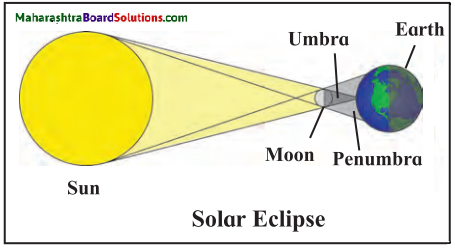
a. Total solar eclipse: In total solar eclipse, the moon is between the sun and the earth and the moon shadow covers the sun disc fully by perfect alignment. The part of the earth that lies in the umbra of the moon experiences total solar eclipse.

b. Partial solar eclipse: In partial solar eclipse, the moon is between the sun and the earth arid the moon shadow does not cover the sun disc fully, because of imperfect alignment. The part of the earth that lies in the penumbra of the moon experiences partial solar eclipse.

c. The solar eclipse occur on a new moon day.
d. Solar eclipse last for few minutes.

2. Lunar eclipse:
There are two types of Lunar eclipse, (a) Total lunar eclipse (b) Partial lunar eclipse

a. Total lunar eclipse: In total lunar eclipse, the earth comes in between the sun and the moon and the earth’s shadow covers the moon’s surface fully because of perfect alignment.

b. Partial lunar eclipse: In partial lunar eclipse, the earth’s shadow does not cover the moon’s surface fully because of inperfect alignment. A small part of the moon’s surface is covered by umbra part of earth’s shadow.

c. The lunar eclipse occurs on a full moon night.
d. Lunar eclipse last for few hours.

Maharashtra Board Class 7 Science Solutions Chapter 17 Effects of Light

8. Explain the difference:

Question a.
Point sources and Extended sources.
Answer:

Point sources Extended sources
1. A source of radiation light that is concentrated at a point and considered as having no spatial extension. 1. An extended source is a source consisting of many point sources separated internally.
2. Shadow we get from a point source is dark called umbra. 2. Shadow we get from extended source of light is faint called penumbra and dark called umbra

Maharashtra Board Class 7 Science Solutions Chapter 17 Effects of Light

Question b.
Umbra and Penumbra.
Answer:

Umbra Penumbra
1. The umbra is a central core of darkness which tapers away. 1. The penumbra is an outer cone of partial shadow which diverges, instead of tapering.
2. Umbra is shadow formed from a point source of light. 2. It is the shadow formed from the extended source of light.
3. It is dark 3. It is faint
4. Umbra is the area of total shadow 4. Penumbra is the area of partial shadow.

Maharashtra Board Class 7 Science Solutions Chapter 17 Effects of Light

Project:

Question a.
Obtain information about the special goggles used to watch a solar eclipse.

Class 7 Science Chapter 17 Effects of Light Important Questions and Answers

Fill in the blanks.

Question 1.
During solar eclipse ………….. comes between the sun and earth.
Answer:
moon

Question 2.
A solar eclipse is seen only on a ………….. day.
Answer:
new moon day

Question 3.
During lunar eclipse ……………. comes between the sun and the moon.
Answer:
earth

Maharashtra Board Class 7 Science Solutions Chapter 17 Effects of Light

Question 4.
A lunar eclipse is seen only on a ………….. night.
Answer:
full moon

Question 5.
The day on which the sun reaches exactly overhead is called the …………… .
Answer:
zero shadow day

Question 6.
As seen from the earth, when a planet or star passes behind the moon, that state is called a ………….. .
Answer:
occultation

Give scientific reasons:

Question 1.
Sky appears blue to us.
Answer:

  1. Sunlight is scattered by the molecules of gases like nitrogen, oxygen in the atmosphere.
  2. The blue colour in the sunlight which is at shorter wavelength is scattered the most than other colours and therefore the sky appears blue.

Maharashtra Board Class 7 Science Solutions Chapter 17 Effects of Light

Question 2.
Solar eclipse is either partial or total.
Answer:

  1. When the moon comes in between the sun and the earth and the solar disc is corripletely covered by the moon, it is called total solar eclipse.
  2. When the solar disc is not covered fully by the moon, it is partial solar eclipse.

Explain the difference:

Question 1.
Solar eclipse and Lunar eclipse.
Answer:

Solar eclipse Lunar eclipse
1. When the moon comes between the sun and the earth, a shadow of the moon is cast on the earth and sun cannot be seen from the part in shadow. This is called a solar eclipse. 1. When the earth comes between the sun and the moon a shadow of the earth is cast on the moon and a part of the moon in covered this is called the lunar eclipse.
2. A solar eclipse is seen only on a new moon day. 2. A lunar eclipse is seen only on a full moon night.
3. A solar eclipse should never be watched with the naked eye. because ultra violate rays which are harmful to us reach the earth
Maharashtra Board Class 7 Science Solutions Chapter 17 Effects of Light 1
3. A lunar eclipse can be seen with the naked eye.
Maharashtra Board Class 7 Science Solutions Chapter 17 Effects of Light 2
4. It can be seen for a few minutes only. 4. It can be seen over a period of a few hours.

Maharashtra Board Class 7 Science Solutions Chapter 17 Effects of Light

Explain diagrams:

Question 1.
Explain Solar eclipse with diagram.
Answer:
Solar eclipse:

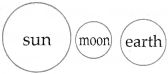
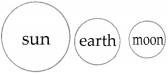
  1. During its revolution, when the moon comes between the sun and the earth, a shadow of the moon is cast on the earth and the sun cannot be seen from the part in the shadow. This is called a solar eclipse
  2. A solar eclipse is seen only on a new moon day.
  3. The solar eclipse may be either partial or total,
  4. Sometimes the solar disc is completely covered by the moon. This is the total solar eclipse.
  5. When the solar disc is not covered fully by the moon, we have a partial solar eclipse.
  6. During a solar eclipse, ultra-violet rays which are harmful to us reach the earth.
  7. A solar eclipse should never be watched with the naked eye.
  8. A special type of goggles should be used for this purpose.
  9. Solar eclipse can be seen for a few minutes only.

Maharashtra Board Class 7 Science Solutions Chapter 17 Effects of Light 3

Maharashtra Board Class 7 Science Solutions Chapter 17 Effects of Light

Question 2.
Explain Lunar eclipse with diagram
Answer:
Lunar eclipse:

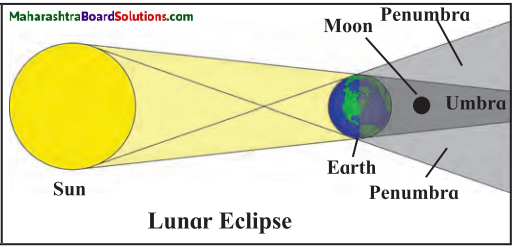
  1. When the earth comes between the sun and the moon a shadow of the earth is cast on the moon and a part of the moon is covered. This is called the lunar eclipse.
  2. A lunar eclipse is seen only on a full moon night. If the whole moon comes in the shadow of the earth, it is a total lunar eclipse.
  3. When the shadow of the earth is cast only on a part of the moon, it is a partial lunar eclipse. You can watch a lunar eclipse with the naked eye.
  4. A lunar eclipse can be seen over a period of a few hours.

Maharashtra Board Class 7 Science Solutions Chapter 17 Effects of Light 4

Maharashtra Board Class 7 Science Solutions Chapter 17 Effects of Light

Question 3.
Write a short note on Zero Shadow Day.
Answer:

  1. The day on which the sun reaches exactly overhead is called zero shadow day.
  2. On this day, at noon, shadow completely disappears.
  3. This event can be seen in the region between the Tropic of Cancer (23.5°N) and at tropic of Capricon (23.5°S).
  4. The shadow diminishes and eventually disappears for a while only to reappear later
  5. This phenomenon occurs twice every year Mumbai got to witness it on May 14, 2018 last year.

Maharashtra Board Class 7 Science Solutions Chapter 17 Effects of Light

Question 4.
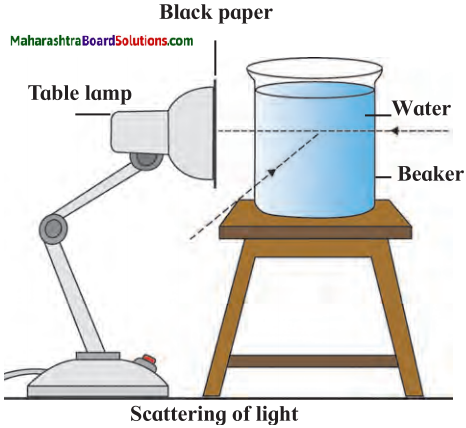
Explain the phenomenon of scattering of light with the help of an experiment.
Answer:

  1. When the sun rises our surroundings appear illuminated. The entire sky appears bright.
  2. This happens because of the dust and other tiny particles in the air. This is the scattering of sunlight by the tiny particles of the various constituents of air.
  3. Had there been no atmosphere, the sky would have appeared dark during the day and of course, the sun would be directly seen.
  4. This has been verified by observations from the rockets and satellites which go out of the earth’s atmosphere.

Apparatus: A table lamp with a 60 or 100 W milky bulb (LED will not do), thick black paper, sticking tape, a packing needle, 100/200 ml. glass beaker, milk or milk powder, dropper, spoon, etc.
Maharashtra Board Class 7 Science Solutions Chapter 17 Effects of Light 5

Procedure: Cover the mouth of the lampshade properly with black paper, using sticking tape. Prick a hole of 1 to 2mm diameter in the center of the paper with the help of the packing needle.

  1. Take clear water in the beaker. Light the bulb and place the beaker in contact with the hole.
  2. Observe from the front and at an angle of 90°.
  3. Now add 2-3 drops of milk to the water and stir. Observe again.
  4. A few more drops of milk may have to be added to make the water turbid.
  5. A blue tinge is seen when observed along the 90° angle. This is the scattered blue light.
  6. Because the blue light is scattered, a red-yellow light is seen from the front, and the hole appears reddish.

Maharashtra Board Class 7 Science Solutions Chapter 17 Effects of Light

Question 5.
Short note on Shadow.
Answer:

  1. Shadow is a dark patch formed behind an opaque object when it is placed in the path of light.
  2. A shadow is formed only when a light source, an opaque object and a screen are present, e.g. during a lunar eclipse we see a part of the earth’s shadow on the surface of the moon.
  3. This happens when the earth, the sun, and the moon are in a straight line with the earth between sun and the moon.
  4. Here the sun acts as the light source, the earth as the opaque object and moon as the screen.
  5. Shadows are formed due the rectilinear propagation of light.
  6. The size and the shape of the shadow depend on the position and orientation of the opaque object between the source of light and the screen.
  7. If the distance of the object from the source is decreased, then the size of the shadow increases.
  8. If the object is moved away from the source, then the size of the shadow decreases.
  9. In older days shadows caused by objects placed in the sun were used to measure time. Such a device is called sun dial.

Maharashtra Board Class 7 Science Solutions Chapter 17 Effects of Light

Use your brain power!

Answer the following questions:

Question 1.
Eclipses and transits which will occur recently.
Answer:

  • January 6, 2019 – Partial solar eclipse
  • January 21, 2019 – Total Lunar eclipse
  • July 2, 2019 – Total solar eclipse
  • July 16, 2019 – Partial Lunar eclipse
  • December 26, 2019 – Annular solar eclipse.

Find Out:

Answer the following questions:

Question 1.
If a few drops of milk are added in the experiment given the reddish colour seen from the front becomes an intense red. However, if many more drops are added the reddish colour is not seen. Why is this so?
Answer:

  1. As more and more milk is added, more particles of protein and fat scatter the light and the blue colour is scattered more and more than orange and red light and the beam appears blue from the sides.
  2. If few drops of milk are added, along with blue colour, orange and yellow also are scattered and only the intense red is seen from the front.
  3. But when many more drops are added, even the red colour is scattered and we do not see any colour from the front.

Maharashtra Board Class 7 Science Solutions Chapter 17 Effects of Light

Question 2.
What is Occultation?
Answer:
As seen from the earth, when a planet or a star passes behind the moon, that state is called an Occultation.

Complete the Chart.

Question 1.
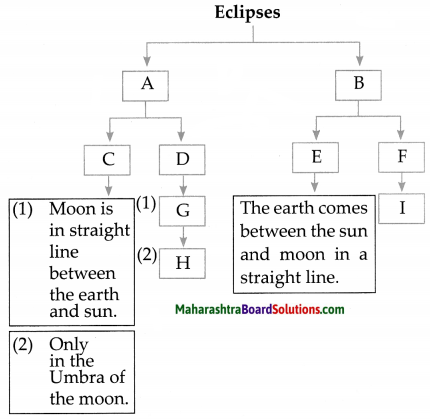
Maharashtra Board Class 7 Science Solutions Chapter 17 Effects of Light 6
Answer:

  • A – Solar B – Lunar
  • C – Total Solar
  • D – Partial Solar
  • E – Total Lunar
  • F – Partial Lunar
  • G – Moon is not in a straight line between earth and sun
  • H – It is in the penumbra region of the moon
  • I – The earth comes in between the sun and moon and they are not in a straight line.

7th Std Science Questions And Answers:

Food Safety Class 7 Science Chapter 5 Questions And Answers Maharashtra Board

Class 7 Science Chapter 5

Balbharti Maharashtra State Board Class 7 Science Solutions Chapter 5 Food Safety Notes, Textbook Exercise Important Questions and Answers.

Std 7 Science Chapter 5 Food Safety Question Answer Maharashtra Board

Class 7 Science Chapter 5 Food Safety Question Answer Maharashtra Board

1. Complete the following statements by using the correct option from those given below.
(Irradiation, dehydration, pasteurization, natural, chemical)

Question a.
Drying the food grains from farms under the hot sun is called …………. .
Answer:
dehydration

Maharashtra Board Class 7 Science Solutions Chapter 5 Food Safety

Question b.
Materials like milk are instantly cooled after heating up to a certain high temperature. This method of food preservation is called ……….. .
Answer:
pasteurization

Question c.
Salt is a ……….. type of food preservative.
Answer:
natural

Question d.
Vinegar is a …………. type of food preservative.
Answer:
chemical

2. Answer the following questions in your own words. 

Question a.
How is milk pasteurised?
Answer:
Boil the milk at 80°C for 15 minutes and cool it quickly. This destroys the microbes present in the milk and it can remain for a longer duration. This process is called pasteurization of milk.

Maharashtra Board Class 7 Science Solutions Chapter 5 Food Safety

Question b.
Why should we not consume adulterated food materials?
Answer:
Different types of adulterants affect our health in different ways. Some adulterants cause abdominal discomfort or poisoning while some may affect the functioning of some organs if consumed over a long period of time or even cause cancer.

Question c.
What precautions do your parents take to keep foodstuffs safe?
Answer:
Our parents take following care to keep foodstuffs safe

  1. Drying of grains.
  2. Boiling of milk, soups and curries from time to time.
  3. Refrigeration of vegetables, fruits, milk and cooked food.
  4. Candying of jams.
  5. Use natural preservatives like oil, spices, neem leaves, salt, etc.
  6. Use chemical preservatives in sauces, ketchups, pickles, jams and squashes.

Question d.
How does food spoilage occur? Which are the various factors spoiling the food?
Answer:
Food spoilage is the process in which food deteriorates to the point in which it is not edible to humans or its quality of edibility becomes reduced.
Following are the factors for spoiling of food:

  1. Bacteria causes food to spoil
  2. Incorrect storage may spoil the food.
  3. Infestation by pests.
  4. Chemical reaction takes place in food and it gets spoiled.

Maharashtra Board Class 7 Science Solutions Chapter 5 Food Safety

Question e.
Which methods of food preservation would you use?
Answer:
I use following methods to preserve the food:

  1. Freezing
  2. Boiling
  3. Salting of pickles
  4. drying of grains
  5. candying of jams.

3. What shall we do?

Question a.
There are vendors selling uncovered sweet-meats in open places in the market.
Answer:
We should tell them to sell the covered sweets because uncovered sweets are harmful to eat because it contains dust, dirt and germs. And buyers also should not purchase these uncovered sweets.

Question b.
A ‘pani-puriwala’ is serving the panipuri with dirty hands.
Answer:
We should tell him to wear gloves before serving panipuri because dirty hands contain dirt and germs which are harmful to us.

Question c.
We have purchased a large quantity of fruits and vegetables.
Answer:
We should keep them in refrigerator because in refrigerator, due to low temperature, fruits and vegetables do not spoil and biological and chemical reactions in fruits and vegetables are slowed down at low temperature.

Maharashtra Board Class 7 Science Solutions Chapter 5 Food Safety

Question d.
We need to protect foodstuffs from pests like rats, cockroaches, wall-lizards etc.
Answer:

  1. If we do not protect foodstuffs from pests like rats, cockroaches, wall-lizards etc. then the food get spoiled by them and germs carried by them enters into the food.
  2. If we eat this food then we may get food poisoning and we fall sick so we need to protect foodstuffs from pests like rat, cockroaches, wall lizards etc.

4. Find the odd-man-out. 

Question a.
Salt, vinegar, citric acid, sodium benzoate.
Answer:
Salt

Question b.
Lakhi dal, brick dust, metanyl yellow, turmeric powder.
Answer:
Turmeric powder

Question c.
Banana, apple, guava, almond.
Answer:
Almond

Maharashtra Board Class 7 Science Solutions Chapter 5 Food Safety

Question d.
Storing, freezing, settling, drying
Answer:
Storing

5. Complete the chart below.

Question a.
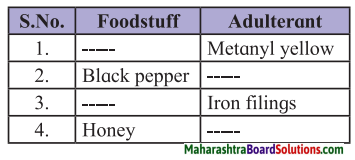
Maharashtra Board Class 7 Science Solutions Chapter 5 Food Safety 1
Answer:

Foodstuff Adulterant
1. Turmeric powder Metanil yellow
2. Black pepper Dried papaya seeds
3. Rava Iron filings
4. Honey Sugar, water and jaggery

Maharashtra Board Class 7 Science Solutions Chapter 5 Food Safety

6. Explain why this happens and suggest possible remedies.

Question a.
Qualitative wastage of food.
Answer:
Qualitative wastage of food happens due to wrong methods of protecting food, excessive use of food preservatives, over-cooking, washing the vegetables after cutting them, mis¬handling of fruits like grapes and mangoes, miscalculation of the time required to transport food from producers to consumers are some of the reasons of qualitative wastage of food.
Possible remedies:

  1. Avoid overcooking of food.
  2. Store grains and other perishable foodstuffs like vegetables, fruits, milk etc. using proper methods.
  3. Wash fruits and vegetables before cutting it.

Question b.
The cooked rice is underdone.
Answer:
Sometimes in a hurry if we cook the rice it is underdone.
Possible remedies: Use proper pressure cooker to cook the rice.

Question c.
The wheat that was bought is a bit moist.
Answer:
Sometimes due to sudden rain, wheat gets a bit moist. Possible remedies: Do not store the moist wheat, it gets spoiled due to fungus so first sundry it and then store in a clean and dry container to avoid microbial growth.

Question d.
The taste of yoghurt is too sour/slightly bitter.
Answer:
The taste of yoghurt is too sour/slightly bitter means it is spoiled. This happens if it is not kept in the refrigerator.
Possible remedies:- Always keep the yoghurt in refrigerator to avoid biological and chemical reactions in food materials.

Maharashtra Board Class 7 Science Solutions Chapter 5 Food Safety

Question e.
Cut fruits turned black.
Answer:
Fruit contains an enzyme called polyphenol oxidase or tyrosinase that reacts with oxygen. The oxidation reaction basically forms a sort of rust on the surface of fruits so it turns black.
Possible remedies:

  1. Coat the fruits with sugar syrup
  2. Add lemon juice on fruits.

7. Give reasons.

Question 1.
Food remains safe at 5° Celsius.
Answer:
Food remains safe at 5° Celsius because at 5°C, micro-organisms stop growing.

Maharashtra Board Class 7 Science Solutions Chapter 5 Food Safety

Question 2.
Nowadays, food is served in buffet style during large gatherings.
Answer:
Nowadays, food is served buffet style during large gatherings because due to buffet style quantitative wastage of food can be avoided, as people take only as much as they could eat.

Project:

Question 1.
Go to your kitchen und take notes about the food safety measures and the food wastage you see there.

Question 2.
In a science exhibition demonstrate the various methods of detecting food adulteration.

Class 7 Science Chapter 5 Food Safety Important Questions and Answers

Complete the following statements by using the correct option from those given below.
(Irradiation, dehydration, pasteurization, natural, chemical)

Question 1.
………………………. is celebrated as “World Food Day”.
Answer:
16th October

Maharashtra Board Class 7 Science Solutions Chapter 5 Food Safety

Question 2.
FSSAI means ………………………. .
Answer:
Food Safety and Standardization Authority of India

Question 3.
………………………. gas is filled in tight packets of potato wafers.
Answer:
Nitrogen

Question 4.
Common name of acetic acid is ……………………….
Answer:
Vinegar

Question 5.
………………………. is sprayed on the gunny bags containing food grains.
Answer:
Melathion

Maharashtra Board Class 7 Science Solutions Chapter 5 Food Safety

Question 6.
………………………. is used in smoking method.
Answer:
Aluminium phosphide

Question 7.
………………………. and ………………………. are emitted by radioactive isotopes in irradiation method.
Answer:
X – rays, gamma rays

Question 8.
In Maharashtra, irradiation plants have been installed at ………………………. for onions and potatoes and at for spices and condiments.
Answer:
Lasalgaon, Navi Mumbai

Question 9.
………………………. found the pasteurisation method.
Answer:
Louis Pasteur

Question 10.
………………………. adulterant is added to turmeric powder.
Answer:
Metanyl yellow

Maharashtra Board Class 7 Science Solutions Chapter 5 Food Safety

Question 11.
………………………. adulterant is added to red chilly powder.
Answer:
Brickdust

Question 12.
………………………. is used to make fruits more attractive.
Answer:
calcium carbide

Question 13.
………………………. and ………………………. harmful chemicals are mixed with cold drinks.
Answer:
carbonated soda, phosphoric acid

Maharashtra Board Class 7 Science Solutions Chapter 5 Food Safety

Question 14.
Shopkeepers change the of the ………………………. food packets fo avoid a financial loss.
Answer:
expiry date

Question 15.
Milk vendors add ………………………. to the milk to appear as higher fat content.
Answer:
urea

Question 16.
The shelf life of potatoes and onions ………………………. due to slowed-down of sprouting.
Answer:
increases

Question 17.
Serving too much food to guests at traditional feasts and banquets leads to ………………………. wastage of food.
Answer:
Quantitative

Maharashtra Board Class 7 Science Solutions Chapter 5 Food Safety

Question 18.
Miscalculation of the time required to transport food from producers to consumers leads to ……………………… . wastage of food.
Answer:
Qualitative

Question 19.
Prevention of food spoilage by microbial growth and infestation by pests is called ………………………. .
Answer:
food protection

Question 20.
………………………. is an example of a chemical preservative.
Answer:
Sodium benzoate.

Say whether True or False,, Correct and rewrite the false statement.

Question 1.
To prevent adulteration of food, it is inspected by the “Food and Drug Administration department of the government”.
Answer:
True

Maharashtra Board Class 7 Science Solutions Chapter 5 Food Safety

Question 2.
Overcooking of food increases the quality of food.
Answer:
False. Over cooking of food spoils it

Question 3.
Peanuts become rancid then, it is not good to eat.
Answer:
True

Question 4.
Oil and ghee contain fats.
Answer:
True

Question 5.
Prevention of food spoilage by microbial growth and infestation by pests is called food wastage.
Answer:
False. Prevention of food spoilage by microbial growth and infestation by pests is called food protection.

Maharashtra Board Class 7 Science Solutions Chapter 5 Food Safety

Question 6.
Serve yourself only as much as you can eat.
Answer:
True

Question 7.
Salt, sugar and oil are naturally available preservatives.
Answer:
True

Question 8.
Pickles can be preserved by salting.
Answer:
True

Question 9.
Milk vendors add urea to the milk so that it appears to have higher fat content.
Answer:
True

Maharashtra Board Class 7 Science Solutions Chapter 5 Food Safety

Question 10.
Shelf life of fruits and vegetables decreases by gamma rays emitted by radio-active isotopes.
Answer:
False. Shelf life of fruits and ‘ vegetables increases by gamma rays emitted by radioactive isotopes.

Give scientific reasons.

Question 1.
Refrigerators are used in the kitchen.
Answer:

  1. Biological and chemical reactions in food materials are slowed down at low temperature.
  2. As a result food remains in good condition for a longer period. Therefore refrigerators are used in the kitchen.

Question 2.
Potatoes and onions are treated with gamma rays.
Answer:
Potatoes and onions are treated with gamma rays because irradiation with gamma rays prevents their wastage due to sprouting and increases their shelf life.

Question 3.
Grains are sun-dried.
Answer:
Grains are sun-dried to preserve them because on sun drying their water content gets reduced and hence they last longer.

Maharashtra Board Class 7 Science Solutions Chapter 5 Food Safety

Question 4.
We boil milk from time to time.
Answer:
We boil milk from time to time to kill microorganisms in it and thus prevent it from getting spoilt.

Question 5.
Jams or pickles get spoilt if their jars are not sealed properly.
Answer:
If the jar is not sealed properly, micro¬organisms from the air enter in the jar and start growing on the food. Oxygen in the air helps the micro-organisms and fungi to grow faster and hence bring about the spoilage of the jams and pickles.

Question 6.
Some vendors add urea to the milk.
Answer:
Some vendors add urea to the milk so that it appears to have higher fat content.

Question 7.
Food wastage should be avoided.
Answer:
In countries like India, the food requirement is plenty and people do not get proper meals even once in a day. If food is not wasted then it could have met the need of many others. Therefore, food should not be wasted and proper measures should be implemented to stop quantitative and qualitative wastage of food.

Question 8.
Adulterated food should not be consumed.’
Answer:

  1. The health of all people is endangered by food adulteration.
  2. Different types of adulterants affect our health in different ways.
  3. Some adulterants cause abdominal discomfort or poisoning, while some may affect the functioning of some organs if consumed over a long period of time or even cause cancer.

Maharashtra Board Class 7 Science Solutions Chapter 5 Food Safety

Can you tell?

Answer the following questions:

Question 1.
How and where food is wasted?
Answer:
Quantitative wastage of food:
1. Wrong methods of farming like hand sowing of, ts seeds, inadequate threshing, improper storage and wrong methods of distribution are some reasons for quantitative wastage of food.

2. Besides, much food is wasted as a result of the custom of offering and serving too much food to guests at traditional feasts or banquets.

3. Had it not been wasted, all this food could have met the need of many others Qualitative wastage of food: Using wrong methods of protecting food, excessive use of food preservatives, over-cooking, washing the vegetables after cutting them, mis-handling of fruits like grapes and mangoes, mis-calculation of the time required to transport food from producers to consumers, are some of the causes of quantitative wastage of food.

Maharashtra Board Class 7 Science Solutions Chapter 5 Food Safety

Question 2.
How is the food adulterated?
Answer:
Food is adulterated by the following ways:

  1. Removal of some important components of food. e.g. removal of fat content of milk, essence of cloves, cardamoms, etc.
  2. Mixing of a low quality inedible or cheaper material or harmful colour with food.
  3. Mixing of some harmful materials like small stones, fine sand, iron filings, urea, dung of horse, sawdust etc.

How will you find out if food has been adulterated?

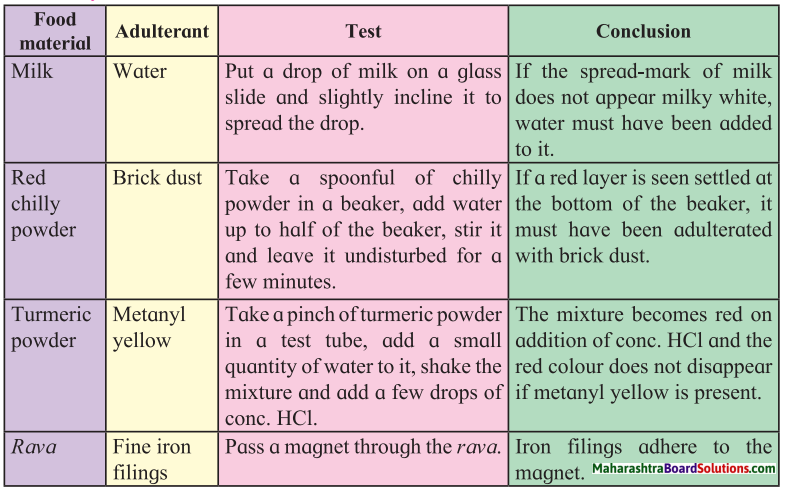
Maharashtra Board Class 7 Science Solutions Chapter 5 Food Safety 2

7th Std Science Questions And Answers:

Natural Resources – Air, Water and Land Class 6 Science Chapter 1 Questions And Answers Maharashtra Board

Class 6 Science Chapter 1

Balbharti Maharashtra State Board Class 6 Science Solutions Chapter 1 Natural Resources – Air, Water and Land Notes, Textbook Exercise Important Questions and Answers.

Std 6 Science Chapter 1 Natural Resources – Air, Water and Land Question Answer Maharashtra Board

Class 6 Science Chapter 1 Natural Resources – Air, Water and Land Question Answer Maharashtra Board

1. Fill in the blanks and rewrite the completed statements.

Question a.
The layer of ozone gas absorbs ……………. rays that come from the sun to the earth.
Answer:
Ultraviolet (U.V) rays

Question b.
Of the total water available on the earth, fresh water forms ……….. percent.
Answer:
0.3 %

Maharashtra Board Class 6 Science Solutions Chapter 1 Natural Resources - Air, Water and Land

Question c.
Both …………. and ………… constituents are present in the soil.
Answer:
biotic, abiotic

2. why is it said that?

Question a.
The ozone layer is a protective shell of earth.
Answer:

  1. The ultra violet (UV) rays coming from the sun are very harmful for living things.
  2. The ozone layer present in the lower stratosphere absorb this U.V. rays and prevent them from reaching the earth. As a result life on earth is protected.
  3. Therefore, it is said that the ozone layer is a protective shell of the earth.

Question 2.
Water is life.
Answer:

  1. Water is a good solvent and it dissolves many substances.
  2. The human blood is made of 70% water and the sap of plant also contains a very high proportion of water.
  3. All the life processes would not take place in the absence of water.
  4. Hence, without water no living organism can survive.
  5. Therefore, it is said that ‘water is life’.

Maharashtra Board Class 6 Science Solutions Chapter 1 Natural Resources - Air, Water and Land

Question c.
Sea water is useful even though it is not potable.
OR
In what way is sea water useful even though it is salty?
Answer:

  1. Many fish and aquatic animals live in sea water.
  2. The water from the sea evaporates to form clouds which brings rain.
  3. The sea water also helps the land to cool due to breezes.
  4. The salt and minerals are also obtained from sea water.
  5. Corals and pearls are obtained from sea animals.
  6. Thus, sea water is useful even though it is not potable.

3.  What will happen if

Question a.

Question a.
Microbes in soil get destroyed.
Answer:

  1. Microbes in the soil decompose dead plants and animals and convert it into humus. This humus supplies nutrients to the soil.
  2. Humus also aerates soil and holds water in it. It makes the soil more fertile.
  3. If microbes are destroyed, humus will not be formed and the soil will not become fertile, making it unsuitable for growth of plants. Also dead and decaying matter will accumulate on land.

Question b.
The number of vehicles and factories in your surroundings increases.
Answer:

  1. Vehicles and factories are the major cause of air pollution.
  2. They release harmful gases like carbon dioxide, carbon monoxide and sulphur dioxide into the air.
  3. These pollutants are harmful to the environment and to the people living in the surrounding area.
  4. Hence, if the number of vehicles and factories in our surroundings increases, the air pollution will also increase.

Maharashtra Board Class 6 Science Solutions Chapter 1 Natural Resources - Air, Water and Land

Question c.
The total supply of potable water is finished.
Answer:

  1. Water plays very important role in the survival of living organism.
  2. All living things are dependent on water.
  3. A very small quantity of water is potable and can be used for drinking.
  4. All bodily functions are regulated by water.
  5. Therefore, if total supply of potable water is finished, plants and animals will not survive and there will be no life on earth.

4. Match the following. 

Question a.

Group ‘A’ Group ‘B’
1. Carbon dioxide a. Generation of soil
2. Oxygen b. Rain
3. Water vapour c. Plants and food production
4. Microbes d. Combustion

Answer:

Group ‘A’ Group ‘B’
1. Carbon dioxide c. Plants and food production
2. Oxygen d. Combustion
3. Water vapour b. Rain
4. Microbes a. Generation of soil

Maharashtra Board Class 6 Science Solutions Chapter 1 Natural Resources - Air, Water and Land

5. Name the following.

Question a.
Constituents of biosphere.
Answer:
Atmosphere, hydrosphere, lithosphere and all living things on earth.

Question b.
Biotic constituents of soil.
Answer:
Microbes, worms, insects, burrowing rhodents like rats, mice, roots of trees and plants.

Question c.
Fossil fuel.
Answer:
Crude oil from which we get kerosene, petrol, diesel, paraffin wax and tar.

Question d.
Inert gases in air.
Answer:
Neon, argon, helium, krypton, xenon.

Maharashtra Board Class 6 Science Solutions Chapter 1 Natural Resources - Air, Water and Land

Question e.
Gases that are harmful to ozone layer.
Answer:
Chlorofluorocarbon and carbon tetrachloride.

6. True or False?

Question a.
Land and soil is the same thing.
Answer:
False – Land consists of stones, soil and big rocks.

Question b.
The water in a lake is called ground water.
Answer:
False – Water trapped below the ground over the bedrocks is called ground water.

Question c.
It takes about thousand years to form a 25 cm thick layer of soil.
Answer:
False – It almost takes around thousand years to form a 2.5 cm thick layer of soil.

Question d.
Radon is used in decorative lights.
Answer:
False – Neon is used in decorative lights.

7. Answer in your own words. 

Question a.
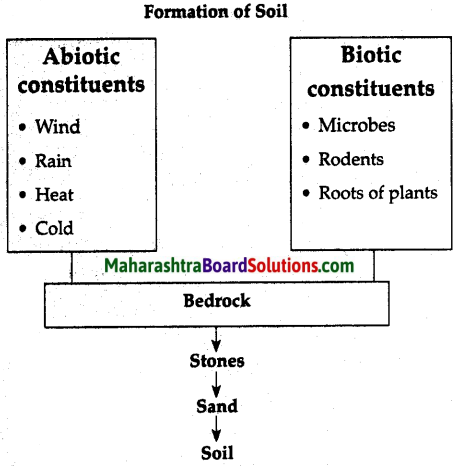
Explain with the help of a diagram how soil is formed.
Answer:

  1. The soil on the land is formed by a natural process.
  2. The abiotic components of soil are supplied through the weathering of the bedrock.
  3. Due to heat, cold wind and rain the bedrock breaks down into pieces.
  4. Stones, sand and soil are formed from these pieces.
  5. Microbes, worms, insects, rodents and roots of trees growing on land help in weathering of rocks.
    Maharashtra Board Class 6 Science Solutions Chapter 1 Natural Resources - Air, Water and Land 1
    This process is slow, continuous and it takes a thousand years to form 2.5 cm thick layer of mature soil.

Maharashtra Board Class 6 Science Solutions Chapter 1 Natural Resources - Air, Water and Land

Question b.
Why is there a shortage of water even though it occupies about 71% of the earth’s surface?
Answer:

  1. 71% of earth’s surface is covered with water of, which 97% is salty water present in seas and oceans and 2.7% water is available as ground water, ice and in other forms.
  2. Only 0.3% water is available as fresh water which can be used for drinking.
  3. All the living organisms require water to drink. The water is used in the industry and also for farming.
  4. Due to increasing population and uncontrolled usage, we experience shortage of water.

Question c.
What are the various constituents of air? Write their uses.
Answer:
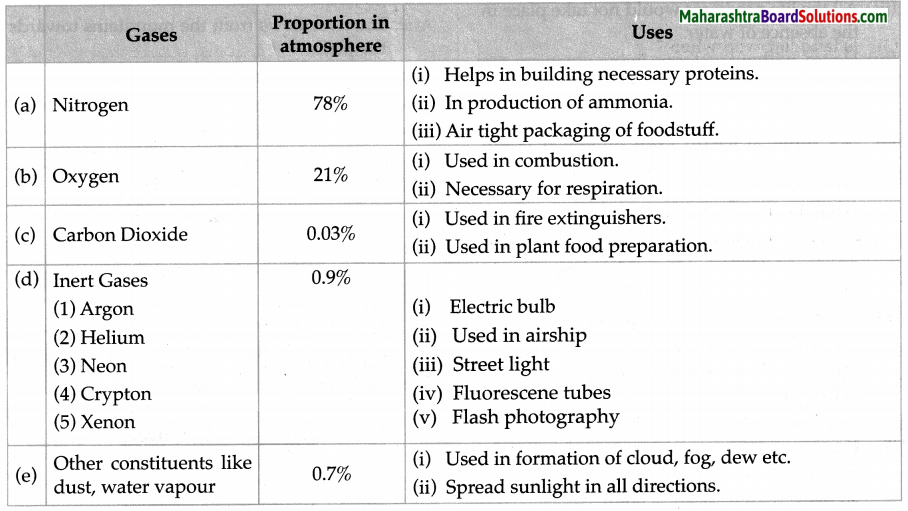
Air contains gases like oxygen, carbon dioxide, nitrogen, inert gases, water vapour and dust particles. The uses of constituents of air are as follows.
Maharashtra Board Class 6 Science Solutions Chapter 1 Natural Resources - Air, Water and Land 2

Maharashtra Board Class 6 Science Solutions Chapter 1 Natural Resources - Air, Water and Land

Question d.
Why are air, water and land considered to be valuable natural resources?
Answer:

  1. The various components of air help and support the growth of living organisms.
  2. Nitrogen is used to make proteins, oxygen is used for respiration and carbon dioxide is used to make food by plants.
  3. Similarly, land supports growth of terrestrial plants and animals. It provides important minerals to plants and also to human beings.?
  4. It is the shelter for worms, insects and rodents and supports their growth. Plants also cannot survive without land.
  5. Water is necessary for carrying out all life processes in the living organisms and without water there will be no life on earth.
  6. Hence land, air and water are considered valuable natural resources.

Activity:

Natural Resources Air, Water And Land Class 6 Questions And Answers Question 1.
Obtain detailed information about the work of the India Meteorological Department.

Natural Resources Air Water And Land Class 6 Questions And Answers Question 2.
Find a remedy for water scarcity.

Class 6 Science Chapter 1 Natural Resources – Air, Water and Land Important Questions and Answers

Fill in the blanks and rewrite the completed statements.

Class 6 Science Chapter 1 Natural Resources Air, Water And Land Exercise Question 1.
……………. gas, used for refrigeration and air conditioning, destroys the ozone layer.
Answer:
Chlorofluorocarbon or carbon tetrachloride

Maharashtra Board Class 6 Science Solutions Chapter 1 Natural Resources - Air, Water and Land

Natural Resources Air Water And Land Class 6 Exercise Question 2.
Air becomes ……………. at higher altitudes.
Answer:
rarer

Natural Resources Air Water And Land Class 6 Question 3.
………….. of land is reduced if green trees and bushes are grown in it.
Answer:
Erosion

Natural Resources Air Water And Land Question 4.
16th September is celebrated as ………. Day all over the world.
Answer:
Ozone Protection

Natural Resources Air Water And Land Question Answer Question 5.
………….. is the layer of air that surrounds the earth.
Answer:
Atmosphere

Maharashtra Board Class 6 Science Solutions Chapter 1 Natural Resources - Air, Water and Land

Natural Resources Air, Water And Land Question 6.
……………. occupies the largest part of the earth’s surface.
Answer:
Hydrosphere

Natural Resources Air Water And Land Class 6 Question 7.
Gases are not found in the …………… and beyond.
Answer:
exosphere

Choose the correct alternative:

Question 1.
………….. percentage of the land is covered by water.
(a) 70%
(b) 81%
(c) 71%
(d)80%.
Answer:
71%

Question 2.
The gas used in fluorescent tubes is ………………… .
(a) Argon
(b) Helium
(c) Neon
(d) Krypton.
Answer:
Krypton

Maharashtra Board Class 6 Science Solutions Chapter 1 Natural Resources - Air, Water and Land

Question 3.
The ozone layer is found in the lower part of …………… .
(a) atmosphere
(b) stratosphere
(c) mesosphere
(d) trophosphere.
Answer:
stratosphere

Question 4.
Gas released in air on combustion of fuel is …………….. .
(a) Hydrogen sulphide
(b) Carbon tetrachloride
(c) Nitrogen dioxide
(d) Oxygen
Answer:
Nitrogen dioxide

Question 5.
The proportion of humus in the upper layer of good fertile soil is about ……………… .
(a) 23% to 45%
(b) 33% to 50%
(c) 30% to 53%
(d) 13% to 33%
Answer:
33% to 50%

Match the following:

Question 1.

Group ‘A’ Group’B’
1. Argon a. temperature for obtaining low
2. Neon b. Used in electric bulb
3. Xenon c. Decorative lights
4. Chlorofluoro – carbon d. Flash photography
5. Helium e. Ozone depletion

Answer:

Group ‘A’ Group’B’
1. Argon b. Used in electric bulb
2. Neon c. Decorative lights
3. Xenon d. Flash photography
4. Chlorofluoro – carbon e. Ozone depletion
5. Helium a. temperature for obtaining low

Maharashtra Board Class 6 Science Solutions Chapter 1 Natural Resources - Air, Water and Land

Name the following:

Question 1.
Substances formed when fuel burns.
Answer:
Carbon dioxide, carbon monoxide, nitrogen dioxide, sulphur dioxide and smoke.

Question 2.
Layers of the atmosphere.
Answer:
Troposphere, stratosphere, mesosphere, ionosphere and exosphere.

Question 3.
Layers of land.
Answer:
Humus, mature soil, immature soil, small rocks and stones and bedrock.

Maharashtra Board Class 6 Science Solutions Chapter 1 Natural Resources - Air, Water and Land

Question 4.
Gas necessary for building proteins.
Answer:
Nitrogen.

State whether True or False. Correct if False.

Question 1.
The amount of gases in the air is greatest near the surface and becomes rarer at higher altitudes.
Answer:
True.

Question 2.
Fogs, clouds, snow, and rain are produced in the exosphere.
Answer:
False – Fogs, clouds, snow and rain are formed in the troposphere and lower stratosphere of the atmosphere.

Question 3.
Fossil fuels are formed from the dead remains of animals and plants buried underground for a long period.
Answer:
True.

Explain what will happen if:

Question 1.
Forests are destroyed.
Answer:

  1. Soil will get eroded due to rains as roots of trees hold the soil.
  2. The land will become barren as trees helps to increase the level of ground water.
  3. Amount of carbondioxide in the air will increase as trees use carbondioxide for photosynthesis and release oxygen.
  4. Natural habitat of many animals will get completely destroyed.

Maharashtra Board Class 6 Science Solutions Chapter 1 Natural Resources - Air, Water and Land

Question 2.
What would have happened if there was no air on the earth?
Answer:

  1. Air contains gases like nitrogen, oxygen, carbon dioxide, dust particles and water vapour, which are used in various piofeesses in living organisms and environment.
  2. If there is no air then there will be no life as oxygen is essential for all living beings to survive. Also atmosphere is a very important filter. It prevents die harmful elements from reaching the earth.
  3. Hence without air, our earth would become a cold, dark planet without any life.

Answer the following:

Question 1.
What is humus?
Answer:
Humus is the topmost layer of the soil formed d by decomposition of remains of plants and animals and it makes the soil fertile.

Question 2.
What is land made up of?
Answer:
Land is made up of stones, soil, sand and big rocks.

Maharashtra Board Class 6 Science Solutions Chapter 1 Natural Resources - Air, Water and Land

Question 3.
Is land flat everywhere?
Answer:
No, land is not flat everywhere. It is flat in some regions and hilly in some regions.

Question 4.
Does man produce soil/ land?
Answer:
No, man does not produce soil/land, it is produced naturally.

Question 5.
What do you see on land?
Answer:
We see mountains, rivers, valleys, ocean, also terrestrial animals and plants. We also see roads, bridges, buildings etc.

Question 6.
What has man created on land?
Answer:
Man has dug wells, borewells to lift ground water. He has also constructed bunds and dams. He has also built many industries, buildings, roads for transport.

Maharashtra Board Class 6 Science Solutions Chapter 1 Natural Resources - Air, Water and Land

Question 7.
If a deep pit is dug in the ground, what do you see there?
Answer:
We see different layers of land.

Answer in your own words.

Question 1.
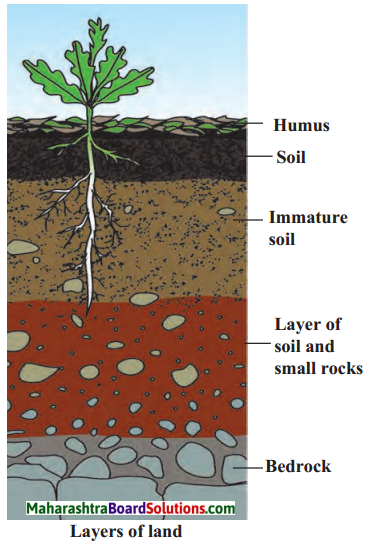
Explain with the help of diagram various layers of land.
Answer:
Maharashtra Board Class 6 Science Solutions Chapter 1 Natural Resources - Air, Water and Land 3

  • Humus – Topmost layer, fertile layer formed by decomposition of remains of plants and animals. Immature
  • Soil – Sand, soil, small stones, worms and insects.
  • Layer of soil and small rocks – less soil and more rocks.
  • Bedrocks – main minerals are obtained from this layer, determines colour and texture of soil.

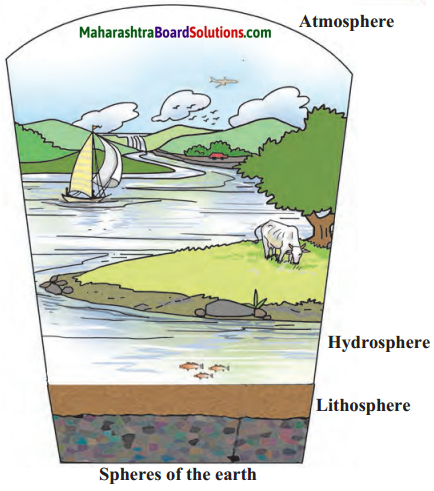
Observe the picture and answer the questions.

Maharashtra Board Class 6 Science Solutions Chapter 1 Natural Resources - Air, Water and Land 4

Question 1.
Where do you see the birds?
Answer:
The birds are flying in the sky.

Maharashtra Board Class 6 Science Solutions Chapter 1 Natural Resources - Air, Water and Land

Question 2.
Where is the cow grazing?
Answer:
The cow is grazing in the pasture (field).

Question 3.
Locate the trees.
Answer:
The trees are seen along the river bank.

Question 4.
Where does the river come from?
Answer:
The river flows from the mountains towards the plains.

Question 5.
Where is the aeroplane?
Answer:
The aeroplane is in the sky above the clouds.

Maharashtra Board Class 6 Science Solutions Chapter 1 Natural Resources - Air, Water and Land

Question 6.
Where are fishes seen?
Answer:
Fishes are seen swimming in the river water.

Question 7.
On what is the sail boat floating?
Answer:
Sail boat is floating on the water.

Observe and discuss:

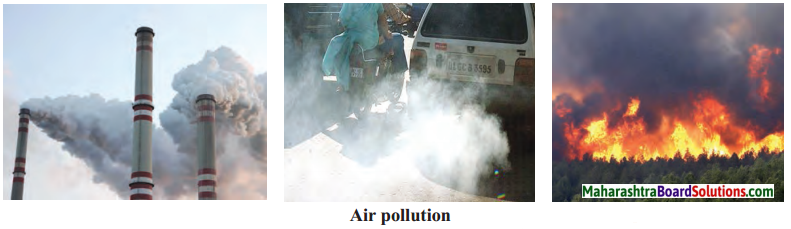
Maharashtra Board Class 6 Science Solutions Chapter 1 Natural Resources - Air, Water and Land 5

Question 1.
What is the similarity in the three pictures given above?
Answer:
All the pictures given above show large scale emission of smoke through different agencies. This smoke directly mixes with the atmosphere, disturbing the balance between the constituents of air and causing air pollution.

Observe and discuss:

Maharashtra Board Class 6 Science Solutions Chapter 1 Natural Resources - Air, Water and Land 6

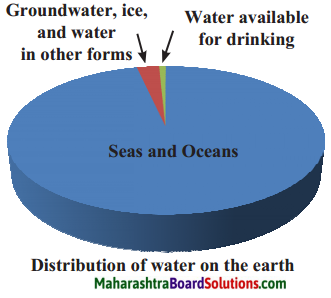
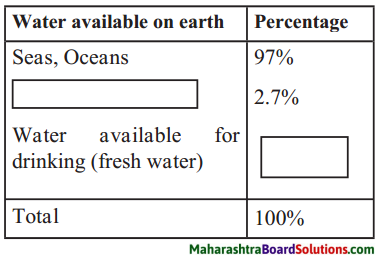
Observe the distribution of water on the earth surface and complete the table.

Question 1.
Maharashtra Board Class 6 Science Solutions Chapter 1 Natural Resources - Air, Water and Land 7
Answer:

Water available on earth percentage
Seas, oceans 97%
Groundwater and water in other forms 2.7%
Water available for drinking 0.3%
Total 100%

Observe given figure carefully and answer the following.

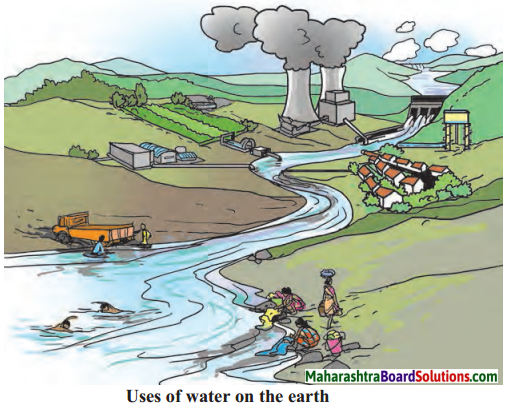
Maharashtra Board Class 6 Science Solutions Chapter 1 Natural Resources - Air, Water and Land 8

Question 1.
For which purpose is water being used?
Answer:
Water is being used for washing clothes, for bathing, farming, drinking, and industries.

Maharashtra Board Class 6 Science Solutions Chapter 1 Natural Resources - Air, Water and Land

Question 2.
Do other living things use water like we do?
Answer:
Animals do not use water like us. They use water only for drinking. Some animals like buffaloes, rhinoceros, elephants use water for cooling themselves during summers.

Question 3.
What are the constituents of soil? Classify them as biotic and abiotic constituents.
Answer:
The constituents of soil are humus, soil, sand, gravel, stones, bedrock, insects, worms, microbes, roots of trees and dead leaves, burrowing rodents like mice and rats.

Biotic Abiotic
Microbes, rodents like mice and rats, humus containing microbes and dead leaves. Soil, sand, gravel, stones, bedrock.

Answer the following:

Question 1.
How would you save water? Give some measures you will adopt.
Answer:
Water can be saved in the following ways:

  1. Repair the leaking taps and pipes and prevent wastage of water.
  2. Take water in a bucket to wash a car, rather than using a hose pipe.
  3. Close the tap when not required.
  4. Store rainwater in underground tanks so that it can be used all round the year.
  5. Water leftover after washing vegetables etc. can be used for watering plants in the garden.
  6. Use water sparingly and reuse water wherever possible.

Maharashtra Board Class 6 Science Solutions Chapter 1 Natural Resources - Air, Water and Land

Question 2.
What measures would you take to prevent soil erosion?
Answer:

  1. The trees, bushes and grass shall be planted in open spaces.
  2. Shrubs will be planted along the river banks to prevent floods.
  3. Proper drainage system will be provided so that there is no flooding of water.

Let’s try this

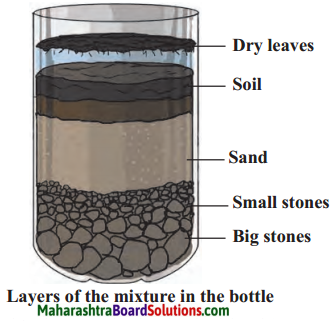
  1. Take a transparent plastic bottle, a handful of soil, big stones, small stones, sand, some dry leaves and water.
  2. Cut off the upper tapering part of the bottle. Put the rest of the materials in the lower part and add water.
  3. Stir the mixture thoroughly and put it aside.

Maharashtra Board Class 6 Science Solutions Chapter 1 Natural Resources - Air, Water and Land 9

Observe it the next day and answer.

Question 1.
How does the mixture in the bottle look now?
Answer:
The mixture gets segregated into various layers. Heaviest substances settle down and lighter forms topmost layer.

Question 2.
Do you see the layers in it?
Answer:
Yes, we see the layers of soil.

Maharashtra Board Class 6 Science Solutions Chapter 1 Natural Resources - Air, Water and Land

Question 3.
What is seen in the different layers from top to bottom?
Answer:
The dry leaves are floating above the water at the top. Then the layer of the soil, which forms a layer above the sand. Below the sand we see a layer of small stones, and the big ones have settled down at the bottom of the bottle.

Question 4.
Obtain specimens of soil from various places and note the differences in the specimen with respect to colour, feel, texture and size of the particles.
Answer:

Area from where soil sample is taken Colour Texture
1. Own yard Red colour Smooth soil which is dry.
2. Garden Black colour Sticky soil, rich in humus and insects.
3. Hills Red colour Rough soil with small stones and pebbles.
4. River banks White colour Sandy and moist in nature.
5. Fields Black soil Sticky soil with fine particles, rich in humus and worms.
6. Rocky ground Black Coarse with stones and pebbles, hardly any fine soil is seen.

Maharashtra Board Class 6 Science Solutions Chapter 1 Natural Resources - Air, Water and Land

Question 5.
Observe how much water is used and for what purposes it is used in your house for a whole day. Record it in a chart. Discuss this data and find out how much water each person needs in your house.
Answer:

Purpose for which water is used Amount of water (approx in litres)
1. Bath 50 litres
2. Brushing teeth 1 litre
3. Washing clothes and utensils 75 litres
4. Mopping the floor 10 litres
5. Drinking 8 litres
6. Cooking 6 litres
Total use of water 150 litres

Total number of persons = 3
Total water used per person = \(\frac{50}{3}\) = 50 litres.
Approximately 50 litres of water is required for 1 person.

Maharashtra Board Class 6 Science Solutions Chapter 1 Natural Resources - Air, Water and Land

Class 6 Questions And Answers

6th Std Science Questions And Answers:

Light and the Formation of Shadows Class 6 Science Chapter 14 Questions And Answers Maharashtra Board

Class 6 Science Chapter 14

Balbharti Maharashtra State Board Class 6 Science Solutions Chapter 14 Light and the Formation of Shadows Notes, Textbook Exercise Important Questions and Answers.

Std 6 Science Chapter 14 Light and the Formation of Shadows Question Answer Maharashtra Board

Class 6 Science Chapter 14 Light and the Formation of Shadows Question Answer Maharashtra Board

1. Choose an appropriate word and fill in the blanks.

Question a.
A ……………. is a natural source of light.
Answer:
star

Maharashtra Board Class 6 Science Solutions Chapter 14 Light and the Formation of Shadows

Question b.
A ………….. is an artificial source of light.
Answer:
candle

Question c.
When light passes through a prism, it gets separated into ………….. colours.
Answer:
seven

Question d.
The image obtained in the pinhole camera is …………. .
Answer:
inverted

Question e.
A shadow is formed when an …………… object comes in the way of light.
Answer:
opaque

Maharashtra Board Class 6 Science Solutions Chapter 14 Light and the Formation of Shadows

Question f.
When a ………….. object comes in the way of light, light passes …………… it. options : seven, star, through, transparent, opaque, colors, shape, erect, inverted, luminous, candle.
Answer:
transparent, through

2. Write whether the following objects are luminous or non-luminous.

Question a.
Maharashtra Board Class 6 Science Solutions Chapter 14 Light and the Formation of Shadows 1
Answer:

Object Luminous /Non-luminous
A book Non-luminous
A burning candle Luminous
A wax cloth Non-luminous
A pencil Non-luminous
A pen Non-luminous
A light bulb Luminous
A tyre Non-luminous
A torch Luminous
Stars Luminous
The planets Non-luminous
A satellite Non-luminous
The Moon Non-luminous

3. Match the following.

Question a.

Natural sources of light Man-made sources of light
The Sun Tubelight
Stars in the night sky Light bulb
Fireflies Torch
Anglerfish Burning candle
Honey mushroom Oil lamps

Answer:

Transparent Opaque Translucent
Piece of glass Water White plastic
Tea kettle
Note book
Cloth
Wooden
cupboard
Tinted glass
Oil paper
Sheet of notebook
Wax paper

4. Write the answers to the following.

Question a.
What things are necessary for the formation of a shadow?
Answer:
Things necessary for the formation of a shadow are:

  1. A source of light
  2. An object
  3. A surface or screen on which the shadow is formed

Maharashtra Board Class 6 Science Solutions Chapter 14 Light and the Formation of Shadows

Question b.
When can an object be seen?
Answer:
We can see an object when reflected rays reach our eyes.

Question c.
What is a shadow?
Answer:

  1. If an opaque object comes in the way of a light source, light does not pass through it.
  2. As a result the light does not reach a wall or any other surface on the other side of the object.
  3. That part remains dark. This dark part is called the shadow of the object.

Project:

Question 1.
Prepare a Newton’s disc.

Question 2.
Find out how to save electricity with the help of the sunlight we receive during the day.

Maharashtra Board Class 6 Science Solutions Chapter 14 Light and the Formation of Shadows

Question 3.
Read a biography of Sir C. V. Raman and find out about the discoveries he made.

Class 6 Science Chapter 14 Light and the Formation of Shadows Important Questions and Answers

Fill in the blanks.

Question 1.
The ……………. is the main natural source of light.
Answer:
Sun

Question 2.
The light emitted by an electric torch is more …………….. than that obtained from a candle.
Answer:
intense

Question 3.
The left and right sides of the original object appear to be …………….. in the mirror.
Answer:
exchanged

Question 4.
The image is as far behind the mirror as the object is in ……………… of it.
Answer:
front

Maharashtra Board Class 6 Science Solutions Chapter 14 Light and the Formation of Shadows

Question 5.
The …………….. of the image is the same as that of the object.
Answer:
height

Question 6.
The materials through which light passes is said to be …………… .
Answer:
transparent

Question 7.
The materials through which light does not pass is said to be ………….. .
Answer:
opaque

Question 8.
The materials through which light passes partially is said to be ………….. .
Answer:
translucent

Question 9.
If an ………….. object comes in the way of a light source, light does not pass it.
Answer:
opaque, through

Maharashtra Board Class 6 Science Solutions Chapter 14 Light and the Formation of Shadows

Question 10.
The shadow of an object formed due to sunlight is ………….. in the mornings and evenings and ……………. in the afternoon.
Answer:
long, short

Question 11.
The shadow of an object is formed only when ………….. does not pass through the object.
Answer:
light

Question 12.
Stars are ………….. .
Answer:
luminous

Question 13.
Planets, satellites are ………….. .
Answer:
non-luminous

Question 14.
The largest sundial is at ………….., New Delhi.
Answer:
Jantar Mantar

Question 15.
………….. is celebrated as National Science Day.
Answer:
28th February

Maharashtra Board Class 6 Science Solutions Chapter 14 Light and the Formation of Shadows

Question 16.
Light travels in a straight line. This is called ………….. .
Answer:
linear propagation of light

Question 17.
The image formed on the diaphragm of the pinhole camera is ………….. .
Answer:
inverted

Question 18.
The kind of shadow an object forms depends upon the ………….. between the ………….., the object and the ………….. or the ………….. on which the shadow is formed.
Answer:
relative distance, source of light, surface, screen

State whether following statements are True or False.

Question 1.
Light travels in a straight line.
Answer:
True

Maharashtra Board Class 6 Science Solutions Chapter 14 Light and the Formation of Shadows

Question 2.
Stars are luminous.
Answer:
True

Question 3.
Image in a pinhole camera is inverted.
Answer:
True

Question 4.
In the afternoon, shadows are long.
Answer:
False

Question 5.
Fireflies are a natural source of light.
Answer:
True

Question 6.
We see the candle clearly when we bend the tube.
Answer:
False

Question 7.
We can see our image clearly in running water.
Answer:
False

Maharashtra Board Class 6 Science Solutions Chapter 14 Light and the Formation of Shadows

Question 8.
Tracing paper is transparent.
Answer:
False

Question 9.
The light obtained from an electric torch is more intense than that obtained from a candle.
Answer:
True

Question 10.
28tn February is celebrated as “National Science day” since 1987 in India.
Answer:
True

Question 11.
Classify the following into natural and man-made/artificial sources of light. (tubelight, light bulb, torch, burning candle, the sun, fireflies, anglerfish, honey mushroom, stars in the night sky, oil lamps, lanterns)
Answer:

Natural sources of light Man-made sources of light
The Sun
Stars in the night sky
Fireflies
Anglerfish
Honey mushroom
Tubelight
Light bulb
Torch
Burning candle
Oil lamps
Lanterns

Maharashtra Board Class 6 Science Solutions Chapter 14 Light and the Formation of Shadows

Question 12.
Identify the transparent, opaque and translucent objects from among the following. (piece of glass, wax paper, tinted glass, oil paper, white plastic, a tea kettle, a notebook, cloth, water, a wooden cupboard, sheet of notebook.)
Answer:

Transparent Opaque Translucent
Piece of glass
Water
White plastic
Tea kettle
Notebook
Cloth
Wooden
cupboard
Tinted glass
Oil-paper
Sheet of notebook
Wax paper

Question 13.
Classify the following into the type of images they form: Clear image, faint image, no image. (still clear water, cemented wall, wooden surface, new steel dish, flower, glossy granite cladding of a wall, mirror, butter paper).
Answer:

Clear Image Faint Image No Image
Still clear water,
New steel dish,
Glossy granite
cladding of a wall,
Mirror
Butter paper Wooden surface
Flower
Cemented wall

Question 14.
Relate images formed with the surfaces.
Answer:

  1. The clear images are formed on plane surfaces.
  2. Faint or no images are formed on rough surfaces.

Answer in one sentence.

Question 1.
What are luminous objects?
Answer:
The objects which emit light i.e. which themselves are a source of light, are called luminous objects.

Maharashtra Board Class 6 Science Solutions Chapter 14 Light and the Formation of Shadows

Question 2.
What determines the intensity of light?
Answer:
The intensity of light is determined by the extent to which the objects emit light.

Question 3.
What are non-luminous objects?
Answer:
The objects that are not sources of light themselves are called as non-luminous objects.

Question 4.
What are artificial sources of light?
Answer:
Man-made objects which emit light are artificial sources of light.

Question 5.
What are natural sources of light?
Answer:
Natural substances, materials which emit light are called natural sources of light.

Question 6.
What is linear propagation of light?
Answer:
Property of light travelling in a straight line is linear propagation of light.

Maharashtra Board Class 6 Science Solutions Chapter 14 Light and the Formation of Shadows

Question 7.
What is reflection of light?
Answer:
The rays of light falling on an object from a source of light are thrown back from the substance of that object. This is reflection of light.

Question 8.
How do we see objects around us?
Answer:
The rays of light falling on an object from a source of light are thrown back from the surface of that object. This is called reflection of light. We see the object when the reflected rays reach our eyes.

Question 9.
What is moonlight?
Answer:
Sunlight reflected from the surface of the moon reaching us, in which we see the moon is called the moonlight.

Question 10.
What type of image is formed in the mirror?
Answer:
The image formed in the mirror is ‘laterally inverted’ i.e. right side appears as left side and left side appears as right side.

Question 11.
What change do you see in the image if you decrease or increase your distance from the mirror?
Answer:
When the distance between object and mirror is increased the size of image decreases where as, when the distance is decreased the image size increases.

Maharashtra Board Class 6 Science Solutions Chapter 14 Light and the Formation of Shadows

Question 12.
What difference do you find in the height of the image in the mirror and yourself?
Answer:
The size of the image in the mirror is the same as that of the object.

Question 13.
What is the image on the diaphragm of the pinhole camera?
Answer:
An inverted or an upside down image of the candle is seen on the diaphragm of the pinhole camera.

Question 14.
What do you mean by transparent object?
Answer:
The objects / materials through which light passes are said to be transparent.

Question 15.
What do you mean by opaque materials?
Answer:
The materials through which light does not pass are said to be opaque.

Question 16.
What do you mean by translucent materials?
Answer:
The materials through which light passes partially are said to be translucent.

Maharashtra Board Class 6 Science Solutions Chapter 14 Light and the Formation of Shadows

Question 17.
How is the shadow in the morning, afternoon and evening?
Answer:
The shadows are long in the mornings and evenings and short in the afternoon.

Question 18.
What is shade of a tree?
Answer:
The shade of a tree is its shadow.

Question 19.
How many colours is sunlight made up of?
Answer:
Sunlight is made up of seven colours.

Give reasons for the following.

Question 1.
When we see in the mirror, we see our image in the mirror.
Answer:
When we see our face in the mirror, the light reflected from our face falls on the mirror and gets reflected back again. Hence, we see our image in the mirror.

Maharashtra Board Class 6 Science Solutions Chapter 14 Light and the Formation of Shadows

Question 2.
Opaque materials cast shadow.
Answer:
An opaque material does not allow light to pass. Hence, it casts a shadow.

Question 3.
Transparent and translucent object do not cast a shadow.
Answer:
Translucent objects cast a faint shadow whereas transparent objects do not cast a shadow at all because they allow light to pass through them.

Use your brain power!

Question 1.
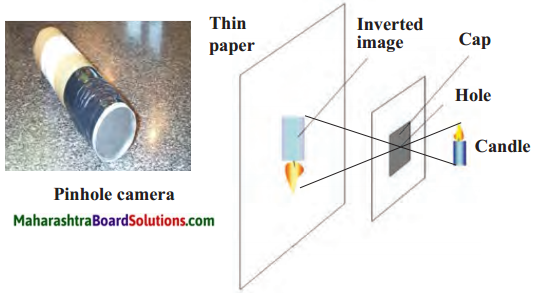
Why is the image on the diaphragm of the pinhole camera inverted?
Answer:
1. The pinhole camera works on the principle of light travelling in a straight line.
2. The rays of light from the candle flame go in all directions.
3. We consider only two rays that pass through the hole and fall on the screen.
Maharashtra Board Class 6 Science Solutions Chapter 14 Light and the Formation of Shadows 2
4. The rays intersect at the pinhole.
5. Since the rays cross over at that point, the top of the object appears at the bottom of the image and the bottom of the image appears at the top. Thus, we see an inverted image of the candle.

Maharashtra Board Class 6 Science Solutions Chapter 14 Light and the Formation of Shadows

Question 2.
How will you light up a dark room using reflected light?
Answer:
Focusing on the wall with torch light. Mirrors or reflectors can be used to get light from outside.

Question 3.
Try to start the TV by operating the remote control from behind it.
Answer:
T.V will not start.

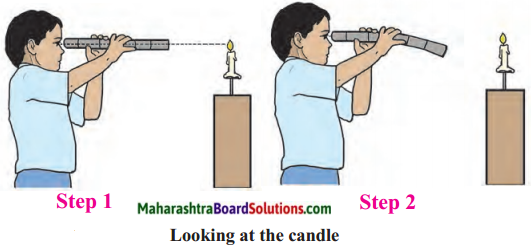
Question 4.
In which step is the flame of the candle seenclearly? Why?
Maharashtra Board Class 6 Science Solutions Chapter 14 Light and the Formation of Shadow 3
Answer:
In step 1 the flame of the candle is seen clearly because light travels in straight line.

Can you tell?

Question 1.
Can we see anything in total darkness?
Answer:
No, we cannot see anything in total darkness.

Maharashtra Board Class 6 Science Solutions Chapter 14 Light and the Formation of Shadows

Question 2.
What helps us to see the objects around us?
Answer:
Reflected light helps us to see objects around us.

Question 3.
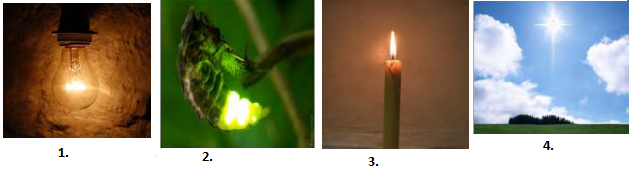
What does the light in each one of the pictures originate form?
Answer:
Maharashtra Board Class 6 Science Solutions Chapter 14 Light and the Formation of Shadow 4
1. Bulb
2. Firefly
3. Candle
4. Sun

Question 4.
Name the natural sources of light.
Answer:
Sun, Fireflies

Question 5.
In which objects do we see our reflection?
Answer:
All objects reflect light rays, but the best reflectors of light are mirrors, still water in a lake, new steel dish i.e. smooth shiny surfaces.

Maharashtra Board Class 6 Science Solutions Chapter 14 Light and the Formation of Shadows

Question 6.
What difference do you notice on looking through the windows in the picture? What causes the difference? The picture shows transperant, opaque, translucent window panes. Spot them.
Maharashtra Board Class 6 Science Solutions Chapter 14 Light and the Formation of Shadows 5
Answer:

  1. Through the first window we can see a clear picture of things outside.
  2. Second window gives a faint image.
  3. Through the third window, we can’t see anything
  4. The difference in the image is due to the material of the window panes.
  5. The first window pane is transparent.
  6. The second window pane is translucent.
  7. The third window pane is opaque.

Answer the following questions in brief.

Question 1.
List factors on which shadow depends.
Answer:
Shadow depends on relative distance between the source of light, the object and the surface on which the shadow is formed.

Question 2.
How we can see that light travels in straight line.
Answer:

  1. In the morning or in the afternoon, rays of light enter a slit in a door, window or a small hole in the roof.
  2. As these rays of light from the slit or the hole move towards the floor, the dust particles in their way are clearly seen.
  3. Due to these particles, the path of light becomes visible to us.
  4. Thus we can see that their path is along straight lines.

Maharashtra Board Class 6 Science Solutions Chapter 14 Light and the Formation of Shadows

Question 3.
What is the difference between an object and its reflection? What causes the difference?
Answer:

  1. Object and its reflection result in formation of images.
  2. Reflections taking place from highly polished metals, mirrors, still water etc, form clear images.
  3. Reflections taking place from wooden surface, flower, book form dull, blurred images.
  4. The difference in reflections is caused by the surface of the object.
  5. Regular reflections have smooth, polished surfaces, hence, image is clear.
  6. Diffused reflections have hard, rough surfaces, hence, image is dull.

Question 4.
List characteristics of images in a plane mirror.
Answer:

  1. The left and right sides of the original object appear to be exchanged in the mirror image.
  2. The image is as far behind the mirror as the object is in front of it.
  3. The size of the image is the same as that of the object.

Question 8.
State the characteristics of image formed by a pinhole camera.
Answer:
Characteristics of an image formed by a pinhole camera are as follows:

  1. It is inverted/upside down.
  2. It can be obtained on a screen – real image.

Try this.

Question 1.
Make your friend stand in between the torch and the wall. What happens?
Answer:
Friend’s Shadow forms on the wall.

Maharashtra Board Class 6 Science Solutions Chapter 14 Light and the Formation of Shadows

Question 2.
Place a glass filled with water on a sheet of paper in the window so it receives direct sunlight. What is seen on the paper?
Answer:
We see rainbow colours on the paper.

Question 3.
Can we do the same in a dark room with the help of a prism and a torch? What do we learn from this?
Answer:
yes, we can. Light gets seperated into seven colour. From this we learn that white light contains seven colours.

Question 4.
If you dip the wire loop in the soap water and then blow it, soap bubbles are formed. Are the beautiful colours of the rainbow seen in these bubbles?
Answer:
Yes, splitting of white light into different colours takes place.

Question 5.
What do you see on holding a CD in the sun?
Answer:
CD reflects rainbow colours, and interesting : patterns.

Maharashtra Board Class 6 Science Solutions Chapter 14 Light and the Formation of Shadows

Question 6.
Raise your right hand. In mirror which hand of the mirror image is raised?
Answer:
Left hand of the mirror image is raised.

Question 7.
Is there any difference between your height and height of the mirror image?
Answer:
The height remains the same.

6th Std Science Questions And Answers:

Maharashtra Board Class 11 Chemistry Important Questions Chapter 15 Hydrocarbons

Balbharti Maharashtra State Board 11th Chemistry Important Questions Chapter 15 Hydrocarbons Important Questions and Answers.

Maharashtra State Board 11th Chemistry Important Questions Chapter 15 Hydrocarbons

Question 1.
What are unsaturated and saturated hydrocarbons?
Answer:
Hydrocarbons which contain carbon-carbon multiple bond (C=C or C≡C) are called unsaturated hydrocarbons, whereas those which contain carbon-carbon single bond (C-C) are called saturated hydrocarbons.

Question 2.
How are hydrocarbons classified?
Answer:
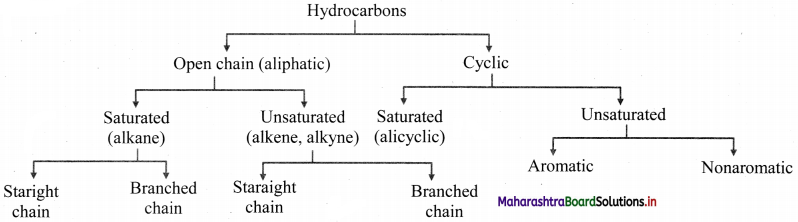
Maharashtra Board Class 11 Chemistry Important Questions Chapter 15 Hydrocarbons 1

Question 3.
Define alkanes. Write general formula of alkanes.
Answer:

  1. Alkanes are aliphatic saturated hydrocarbons containing carbon-carbon and carbon-hydrogen single
    covalent bonds.
  2. They have a general formula CnH2n+2 where, ‘n’ stands for number of carbon atoms in the alkane molecule.

Maharashtra Board Class 11 Chemistry Important Questions Chapter 15 Hydrocarbons

Question 4.
Give information about isomerism in alkanes. Write the all possible structural isomers of a saturated hydrocarbon containing four carbon atoms along with their IUPAC names.

Answer:
i. Alkanes with more than three carbon atoms generally exhibit, structural isomerism and in particular, the chain isomerism.
ii. The number of possible structural isomers increase rapidly with the number of carbon atoms.
iii. Structural isomers of a saturated hydrocarbon containing four carbon atoms along with their IUPAC names.
Maharashtra Board Class 11 Chemistry Important Questions Chapter 15 Hydrocarbons 2

Question 5.
Write all the possible structural isomers of a saturated hydrocarbon having molecular formula C5H12.
Answer:

Maharashtra Board Class 11 Chemistry Important Questions Chapter 15 Hydrocarbons 3

Question 6.
Define sigma bond.
Answer:
A single covalent bond formed by the coaxial overlap of orbitals is called sigma (σ) bond.

Question 7.
i. Why do C – C bonds in alkanes undergo rotation?
ii. What are conformations?
Answer:
i. a. Alkanes have single covalent bonds (sigma bonds) formed by the coaxial overlap of orbitals.
b. As a direct consequence of coaxial overlap of orbitals, a sigma bond is cylindrically symmetrical and the extent of orbital overlap is unaffected by rotation about the single bond and therefore, C – C bonds undergo rotation.

ii. a. In alkanes, the atoms bonded to one carbon of a C – C single bond change their relative position with reference to the atoms on the other carbon of that bond on rotation of that C – C single bond.
b. The resulting arrangements of the atoms in space about the C – C single bond are called conformations or conformational isomers. Innumerable conformations result on complete rotation of a C – C single bond through 360°.

Question 8.
i. What is conformational isomerism?
ii. Name the two extreme conformations shown by ethane molecule.
Answer:
i. The phenomenon of existence of conformation is a type of stereoisomerism and is known as conformational isomerism.
ii. Ethane molecule shows the following two extreme conformations:

  • Staggered conformation
  • Eclipsed conformation

Maharashtra Board Class 11 Chemistry Important Questions Chapter 15 Hydrocarbons

Question 9.
Draw structures representing staggered and eclipsed conformations of ethane using:
i. Sawhorse projection
ii. Newman projection
Answer:
i. Sawhorse projection of ethane:
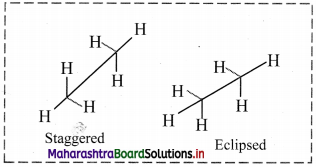
Maharashtra Board Class 11 Chemistry Important Questions Chapter 15 Hydrocarbons 4

ii. Newman projection of ethane:
Maharashtra Board Class 11 Chemistry Important Questions Chapter 15 Hydrocarbons 5

Question 10.
How are alkanes obtained from crude oil?
Answer:
Alkanes are obtained by fractional distillation of crude oil in oil refineries.

Question 11.
How are alkanes obtained from alkenes and alkynes?
OR
How are alkanes obtained from catalytic hydrogenation of alkenes and alkynes?
Answer:
i. Catalytic hydrogenation of alkenes or alkynes with dihydrogen gas gives corresponding alkanes.
ii. Finely divided powder of platinum (Pt) or palladium (Pd) catalyse the hydrogenation of alkenes and alkynes at room temperature.
iii. Relatively high temperature and pressure are required with finely divided nickel as the catalyst.
e.g. a. Propene to propane:
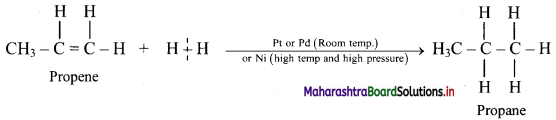
Maharashtra Board Class 11 Chemistry Important Questions Chapter 15 Hydrocarbons 6
b. Ethyne to ethane:
Maharashtra Board Class 11 Chemistry Important Questions Chapter 15 Hydrocarbons 7

Question 12.
Write the general reactions for the catalytic hydrogenation of alkenes and alkynes.
Answer:
General reaction for catalytic hydrogenation of alkenes:

Maharashtra Board Class 11 Chemistry Important Questions Chapter 15 Hydrocarbons 8
General reaction for catalytic hydrogenation of alkynes:

Maharashtra Board Class 11 Chemistry Important Questions Chapter 15 Hydrocarbons 9

Question 13.
Write the structures of alkenes that on catalytic hydrogenation give n-butane.
Answer:

Maharashtra Board Class 11 Chemistry Important Questions Chapter 15 Hydrocarbons 10

Question 14.
Explain the preparation of alkanes by reduction of alkyl halides with the help of an example.
Answer:
i. Alkanes can be prepared by reduction of alkyl halides using zinc and dilute hydrochloric acid.
ii. The reduction of alkyl halides is due to nascent hydrogen obtained from the reaction between reducing agent Zn and dilute HCl.
e.g. Reduction of methyl iodide to methane.
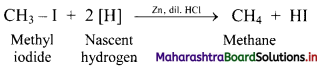
Maharashtra Board Class 11 Chemistry Important Questions Chapter 15 Hydrocarbons 11

Maharashtra Board Class 11 Chemistry Important Questions Chapter 15 Hydrocarbons

Question 15.
How are alkanes obtained by Wurtz reaction?
Answer:
Alkyl halides on treatment with reactive sodium metal in dry ether, gives higher alkanes having double the number of carbon atoms. This is called as Wurtz coupling reaction.

Maharashtra Board Class 11 Chemistry Important Questions Chapter 15 Hydrocarbons 12

Question 16.
How will you convert ethyl chloride into n-butane?
Answer:
Ethyl chloride on heating with sodium metal in presence of dry ether gives n-butane.

Maharashtra Board Class 11 Chemistry Important Questions Chapter 15 Hydrocarbons 13

Question 17.
Write chemical equations for reactions that take place on treating ethereal solutions of:
i. Methyl iodide with sodium metal
ii. Ethyl iodide with sodium metal
Answer:
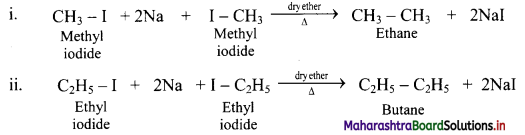
Maharashtra Board Class 11 Chemistry Important Questions Chapter 15 Hydrocarbons 14

Question 18.
Explain the preparation of Grignard reagents.
OR
What is Grignard reagent? Explain its preparation.
Answer:
Grignard reagent are alkyl magnesium halides obtained by treating alkyl halides with dry magnesium metal in the presence of dry ether.

General Reaction:

Maharashtra Board Class 11 Chemistry Important Questions Chapter 15 Hydrocarbons 15

Question 19.
State the action of water on methyl magnesium bromide in dry ether with the help of a chemical reaction.
Answer:

Maharashtra Board Class 11 Chemistry Important Questions Chapter 15 Hydrocarbons 16

Question 20.
Write the reagents involved in the following conversions.

Maharashtra Board Class 11 Chemistry Important Questions Chapter 15 Hydrocarbons 17
Answer:
Maharashtra Board Class 11 Chemistry Important Questions Chapter 15 Hydrocarbons 18

Question 21.
Straight chain alkanes have higher melting and boiling points as compared to branched isomeric alkanes. Give reason.
Answer:
i. The electronegativity of carbon and hydrogen is nearly the same. Therefore, C-H and C-C bonds are nonpolar covalent bonds and hence, alkanes are nonpolar.
ii. Alkane molecules are held together by weak intermolecular van der Waals forces.
iii. Larger the surface area of molecules, stronger are such intermolecular van der Waals forces.
iv. In straight chain alkane molecules, surface area is relatively larger as compared to branched chain alkanes and as a result, the intermolecular forces are relatively stronger in straight chain alkanes than in branched chain alkanes.

Maharashtra Board Class 11 Chemistry Important Questions Chapter 15 Hydrocarbons 19
Hence, straight chain alkanes have higher melting and boiling points as compared to branched alkanes.

Maharashtra Board Class 11 Chemistry Important Questions Chapter 15 Hydrocarbons

Question 22.
State physical properties of alkanes.
Answer:

  • Alkanes are colourless and odourless.
  • At room temperature, the first four alkanes are gases, alkanes having 5 to 17 carbon atoms are liquids while the rest all are solids.
  • Alkanes are readily soluble in organic solvents such as chloroform, ether or ethanol while they are insoluble in water.
  • Alkanes have low melting and boiling points which increases with an increase in the number of carbon atoms for straight chain molecules. But for branched chain molecules, more the number of branches, lower is the boiling/melting point.

Note: [Melting and boiling points of alkanes]
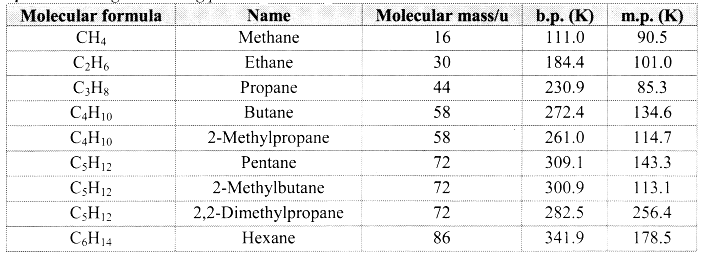
Maharashtra Board Class 11 Chemistry Important Questions Chapter 15 Hydrocarbons 20

Question 23.
Define substitution reactions.
Answer:
The reactions in which an atom or group of atoms in a molecule is replaced by another atom or group of atoms is called as substitution reactions.
e.g. Halogenation of alkanes.

Question 24.
i. What is halogenation of alkanes?
ii. Write the order of reactivity of halogens towards alkanes.
Answer:
i. Substitution of H atoms of alkanes by X (halogen, X = Cl, Br, I and F) atom is called halogenation of alkanes.
ii. The reactivity of halogens toward alkanes follows the order: F2 > Cl2 > Br2 > I2
[Note: The ease of replacement of hydrogen atoms from the carbon in alkanes is in the order: 3 > 2 > 1.]

Question 25.
Explain reactions involved in chlorination of methane.
Answer:
Alkanes react with chlorine gas in presence of UV light or diffused sunlight or at a high temperature (573-773 K) to give a mixture of alkyl halides.

Chlorination of methane:
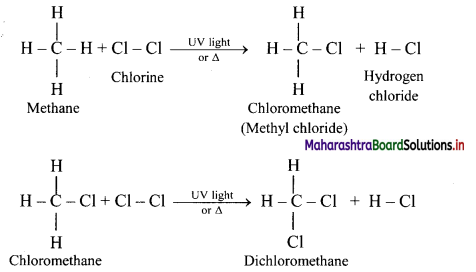
Maharashtra Board Class 11 Chemistry Important Questions Chapter 15 Hydrocarbons 21
Maharashtra Board Class 11 Chemistry Important Questions Chapter 15 Hydrocarbons 22
Tetrachloromethane is a major product when excess of chlorine is used. Chloromethane is obtained as major product when excess of methane is employed.

Question 26.
Predict the products in the following set of reactions.

Maharashtra Board Class 11 Chemistry Important Questions Chapter 15 Hydrocarbons 23
Answer:
Maharashtra Board Class 11 Chemistry Important Questions Chapter 15 Hydrocarbons 24

Question 27.
What is the action of Cl2 and Br2 on 2-methylpropane?
Answer:
Maharashtra Board Class 11 Chemistry Important Questions Chapter 15 Hydrocarbons 25
[Note: In bromination, there is high degree of selectivity as to which hydrogen atoms are replaced.]

Maharashtra Board Class 11 Chemistry Important Questions Chapter 15 Hydrocarbons

Question 28.
Explain mechanism of halogenation of alkanes.
Answer:
i. Halogenation of alkanes follows the free radical mechanism.
ii. Homolysis of halogen molecule (X2) generates halogen atoms, i.e., halogen free radicals.
iii. The mechanism of the first step of chlorination of methane is shown below:
Maharashtra Board Class 11 Chemistry Important Questions Chapter 15 Hydrocarbons 26

Question 29.
Why are alkanes used as fuels?
Answer:
On heating in the presence of air or dioxygen, alkanes are completely oxidized to carbon dioxide and water with the evolution of a large amount of heat. Hence, alkanes are used as fuels.

Question 30.
What is combustion of alkanes? Write a general equation for alkane combustion.
Answer:
On heating in the presence of air or dioxygen, alkanes are completely oxidized to carbon dioxide and water with the evolution of a large amount of heat. This is known as combustion reaction of alkanes.

General representative equation for combustion is:

Maharashtra Board Class 11 Chemistry Important Questions Chapter 15 Hydrocarbons 27

Question 31.
Write chemical equations for combustion of butane and methane.
Answer:
i. Combustion of butane:

Maharashtra Board Class 11 Chemistry Important Questions Chapter 15 Hydrocarbons 28
ii. Combustion of methane:
Maharashtra Board Class 11 Chemistry Important Questions Chapter 15 Hydrocarbons 29

Question 32.
Write a short note on pyrolysis of alkanes.
Answer:
Alkanes on heating at higher temperature in absence of air decompose to lower alkanes, alkenes and hydrogen, etc. This is known as pyrolysis or cracking.
e.g. Pyrolysis of hexane
Maharashtra Board Class 11 Chemistry Important Questions Chapter 15 Hydrocarbons 30

Question 33.
Explain aromatization reaction of alkanes. Give its one application.
Answer:
i. Straight chain alkanes containing 6 to 10 carbon atoms are converted to benzene and its homologues, on heating under 10 to 20 atm pressure at about 773 K in the presence of V2O5, Cr2O3, MO2O3, etc. supported over alumina.

ii. The reaction involves simultaneous dehydrogenation and cyclization. This reaction is known as aromatization or reforming.

Maharashtra Board Class 11 Chemistry Important Questions Chapter 15 Hydrocarbons 31
This process is used in refineries to produce high quality gasoline which is used in automobiles as fuel.

Maharashtra Board Class 11 Chemistry Important Questions Chapter 15 Hydrocarbons

Question 34.
Collect the information on CNG and LPG with reference to the constituents and the advantages of CNG over LPG.
Answer:
Constituents of CNG (Compressed Natural Gas):
It mainly consists of methane compressed at a pressure of 200-248 bar.
Constituents of LPG (Liquefied Petroleum Gas):
It contains a mixture of propane and butane liquefied at 15°C and a pressure of 1.7 – 7.5 bar.

Advantages of CNG over LPG:

  • CNG is cheaper and cleaner than LPG.
  • CNG produces less pollutants than LPG.
  • It does not evolve gases containing sulphur and nitrogen.
  • Octane rating of CNG is high, hence thermal efficiency is more.
  • Vehicles powered by CNG produces less carbon monoxide and hydrocarbon emission.

[Note: Students are expected to collect additional information on their own.]

Question 35.
Write the uses of alkane.
Answer:
Uses of alkanes:

  • First four alkanes are used as a fuel mainly for heating and cooking purpose. For example, LPG and CNG.
  • CNG, petrol and diesel are used as fuel for automobiles.
  • Lower liquid alkanes are used as solvent.
  • Alkanes with more than 35 C atoms (tar) are used for road surfacing.
  • Waxes are high molecular weight alkanes. They are used as lubricants. They are also used for the preparation of candles and carbon black that is used in manufacture of printing ink, shoe polish, etc.

Question 36.
i. Write the general molecular formula of alkenes.
ii. Why are alkenes also known as olefins?
Answer:
i. Alkenes have general formula CnH2n, where, n = 2,3,4… etc.
ii. Alkenes are also known as olefins because the first member ethene/ethylene reacts with chlorine to form oily substance.
[Note: Alkenes with one carbon-carbon double bond, contain two hydrogen atoms less than the corresponding alkanes.]

Question 37.
Define alkadienes and alkatrienes. Give one example for each.
Answer:
i. The aliphatic unsaturated hydrocarbons containing two carbon-carbon double bonds are called as alkadienes.
Maharashtra Board Class 11 Chemistry Important Questions Chapter 15 Hydrocarbons 32

ii. The aliphatic unsaturated hydrocarbons containing three carbon-carbon double bonds are called as alkatrienes.
Maharashtra Board Class 11 Chemistry Important Questions Chapter 15 Hydrocarbons 33

Question 38.
Explain structural isomerism in alkenes by giving an example.
Answer:
Alkenes with more than three carbon atoms show structural isomerism.
e.g. Alkene with molecular formula C4H8 is butene. The structural formulae for C4H8 can be drawn in three different ways:

Maharashtra Board Class 11 Chemistry Important Questions Chapter 15 Hydrocarbons 34

Maharashtra Board Class 11 Chemistry Important Questions Chapter 15 Hydrocarbons

Question 39.
Draw structures of chain isomers of butene.
Answer:

Maharashtra Board Class 11 Chemistry Important Questions Chapter 15 Hydrocarbons 35

Question 40.
Draw structures of position isomers of butene.
Answer:

Maharashtra Board Class 11 Chemistry Important Questions Chapter 15 Hydrocarbons 36

Question 41.
Define geometrical isomerism.
Answer:
The isomerism which arises due to the difference in spatial arrangement of atoms or groups about doubly bonded carbon (C=C) atoms is called geometrical isomerism.

Question 42.
Explain geometrical isomerism using a general example.
Answer:
i. If the two atoms or groups bonded to each end of the C=C double bond are different, then the molecule can be represented by two different special arrangements of the groups as follows:

Maharashtra Board Class 11 Chemistry Important Questions Chapter 15 Hydrocarbons 37
ii. In structure (A), two identical atoms or groups lie on the same side of the double bond.
The geometrical isomer in which two identical or similar atoms or groups lie on the same side of the double bond is called cis-isomer.
iii. In structure (B), two identical atoms or groups lie on the opposite side of the double bond.
The geometrical isomer in which two identical or similar atoms or groups lie on the opposite side of the double bond is called trans-isomer.
iv. Due to different arrangement of atoms or groups in space, these isomers differ in their physical properties like melting point, boiling point, solubility, etc.

Question 43.
i. Define cis- and trans-isomer.
ii. Draw geometrical isomers of but-2-ene.
Answer:
i. a. Cis isomer: The geometrical isomer in which two identical or similar atoms or groups lie on the same side of the double bond is called a cis-isomer.
b. Trans isomer: The geometrical isomer in which two identical or similar atoms or groups lie on the opposite side of the double bond is called a trans-isomer.

ii. Geometrical or cis-trans isomers of but-2-ene are represented as:
Maharashtra Board Class 11 Chemistry Important Questions Chapter 15 Hydrocarbons 38

Question 44.
State whether the following alkenes can exhibit geometrical (or cis-trans) isomerism or not. Give reason for the answer.
i. CH3 – CH2 – CH2 – CH = CH2
ii. CH3 – CH2 – CH = C(CH3)2
Answer:
Both the alkenes (i) and (ii) cannot exhibit geometrical isomerism, since 1 alkene is a terminal alkene (containing two H-atoms on the same side of the double bond) while the 2nd alkene is a 1,1-disubstituted alkene (containing two identical alkyl groups on the same side of the double bond).

Maharashtra Board Class 11 Chemistry Important Questions Chapter 15 Hydrocarbons

Question 45.
Write the general formulae of alkenes which exhibit cis-trans isomerism.
Answer:
Alkenes having the following general formulae exhibit cis-trans isomerism:
RCH=CHR, R1R2C=CR1R3, R1CH=CR1R2, R1CH=CR2R3, R1CH=CHR2 and R1R2C=CR3R4

Question 46.
Draw structures of cis-trans isomers for the following:

Maharashtra Board Class 11 Chemistry Important Questions Chapter 15 Hydrocarbons 39
Answer:
Maharashtra Board Class 11 Chemistry Important Questions Chapter 15 Hydrocarbons 40
Maharashtra Board Class 11 Chemistry Important Questions Chapter 15 Hydrocarbons 41

Question 47.
Which of the following compounds will show geometrical isomerism?

Maharashtra Board Class 11 Chemistry Important Questions Chapter 15 Hydrocarbons 42
Answer:
Compounds (III), (IV) and (V) will show geometrical isomerism as they have each of the doubly bonded carbon atoms in their structures, attached to different atoms/groups of atoms.

Question 48.
Alkenes can be obtained from which industrial sources?
Answer:

  1. The most important alkenes for chemical industry are ethene, propene and buta-1,3-diene.
  2. Alkenes containing up to four carbon atoms can be obtained in pure form from the petroleum products.
  3. Ethene is produced from natural gas and crude oil by cracking.

Question 49.
What is β-elimination reaction? Explain in brief.
Answer:
The reactions in which two atoms or groups are eliminated from adjacent carbon atoms are called 1,2-elimination reactions. Since the atom/group is removed from β-carbon atom (β to the leaving group) it is called as β-elimination reaction.
Maharashtra Board Class 11 Chemistry Important Questions Chapter 15 Hydrocarbons 43
The hybridization of each C in the reactant is sp3 while that in the product is sp2. This means elimination reactions cause change in hybridization state while forming multiple bonds from single bond.

Maharashtra Board Class 11 Chemistry Important Questions Chapter 15 Hydrocarbons

Question 50.
i. What is dehydrohalogenation reaction?
ii. How is it carried out. Explain with an example.
Answer:
i. a. The reactions in which there is removal of hydrogen (H) atom and halogen (X) atom from adjacent carbon atoms are known as dehydrohalogenation reactions.
b. The carbon carrying X is called α-carbon atom. The hydrogen atom from adjacent carbon called β-carbon atom, is removed and hence, the reaction is known as β-elimination.

ii. When an alkyl halide is boiled with a hot concentrated alcoholic solution of a strong base like KOH or NaOH, alkene is formed with removal of water molecule.
Maharashtra Board Class 11 Chemistry Important Questions Chapter 15 Hydrocarbons 44
[Note: The ease of dehydrohalogenation of alkyl halides is in the order 3 > 2 > 1.]

Question 51.
State Saytzeff rule.
Answer:
In dehydrohalogenation the preferred product is the alkene that has the greater number of alkyl groups attached to doubly bonded carbon atoms.

Question 52.
Write and explain dehydrohalogenation reaction of 2-chlorobutane.
Answer:

Maharashtra Board Class 11 Chemistry Important Questions Chapter 15 Hydrocarbons 45
In dehydrohalogenation of 2-chlorobutane, but-2-ene (disubstituted alkene) is the preferred product because it is formed faster than but-1-ene (monosubstituted alkene) which is in accordance with Saytzeff rule.

Question 53.
Write the CORRECT order of stability of alkenes with respect to Saytzeff rule.
R CH = CH2, CH2 = CH2, R2C = CH2, R2C = CR2, RCH = CHR, R2C = CHR
Answer:
R2C = CR2 > R2C = CHR > R2C = CH2, RCH = CHR > RCH = CH2 > CH2 = CH2

Question 54.
Explain dehydration reaction of alcohols.
Answer:
i. Alcohols on heating with sulphuric acid form alkenes with elimination of water molecule. The reaction is known as catalysed dehydration of alcohols.
ii. The exact conditions of dehydration depend upon the alcohol.
iii. Dehydration of alcohol is an example of β-elimination since -OH group from α-carbon along with H-atom from β-carbon is removed.
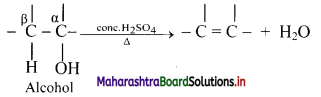
Maharashtra Board Class 11 Chemistry Important Questions Chapter 15 Hydrocarbons 46
The ease of dehydration of alcohol is in the order 3° > 2° > 1°.

Maharashtra Board Class 11 Chemistry Important Questions Chapter 15 Hydrocarbons

Question 55.
Write dehydration reaction of 1°, 2° and 3° alcohols giving one example for each.
Answer:
The ease of dehydration of alcohols is in the order 3° > 2° > 1°.
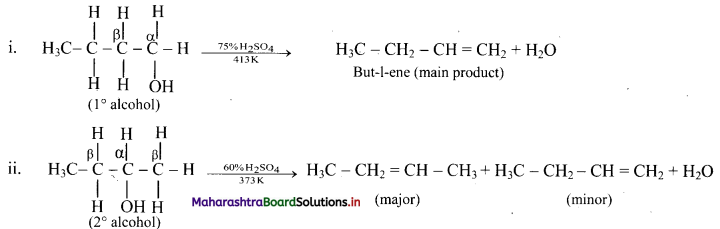
Maharashtra Board Class 11 Chemistry Important Questions Chapter 15 Hydrocarbons 47
Maharashtra Board Class 11 Chemistry Important Questions Chapter 15 Hydrocarbons 48

Question 56.
Explain isomerism with structure in the product obtained by acid catalysed dehydration of pentan-2-ol.
Answer:
i. Pentan-2-ol on acid catalysed dehydration, forms the following isomers.

Maharashtra Board Class 11 Chemistry Important Questions Chapter 15 Hydrocarbons 49
ii. A and B are position isomers.
iii. Pent-2-ene has the following geometrical isomers:

Maharashtra Board Class 11 Chemistry Important Questions Chapter 15 Hydrocarbons 50

Question 57.
What is dehalogenation? Write the general reaction for dehalogenation of vicinal dihalides.
Answer:
i. Removal of two halogen atoms from adjacent carbon atoms is called dehalogenation.
ii. The dihalides of alkane in which two halogen atoms are attached to adjacent carbon atoms are called vicinal dihalides.
iii. Vicinal dihalides on heating with zinc metal form an alkene.
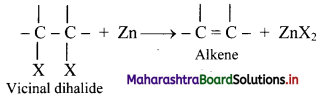
Maharashtra Board Class 11 Chemistry Important Questions Chapter 15 Hydrocarbons 51

Question 58.
How is propene obtained by dehalogenation reaction?
Answer:

Maharashtra Board Class 11 Chemistry Important Questions Chapter 15 Hydrocarbons 52

Question 59.
How are geometrical isomers of alkenes obtained from alkynes?
Answer:
Alkenes are obtained by partial reduction of alkynes wherein C = C triple bond of alkynes is reduced to a C = C double bond by:
i. using calculated quantity of dihydrogen in presence of Lindlar’s catalyst (palladised charcoal deactivated partially with quinoline or sulphur compound) to give the cis-isomer of alkene.
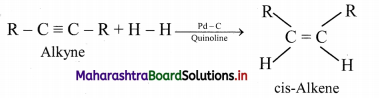
Maharashtra Board Class 11 Chemistry Important Questions Chapter 15 Hydrocarbons 53
ii. using sodium in liquid ammonia to give trans-isomer of alkene.
Maharashtra Board Class 11 Chemistry Important Questions Chapter 15 Hydrocarbons 54

Question 60.
Write physical properties of alkenes.
Answer:

  • Alkenes are nonpolar or weakly polar compounds that are insoluble in water, and soluble in nonpolar solvents like benzene, ether, chloroform.
  • They are less dense than water.
  • The boiling point of alkene rises with increasing number of carbons.
  • Branched alkenes have lower boiling points than straight chain alkenes.
  • The boiling point of alkene is very nearly the same as that of alkane with the same carbon skeleton.

Maharashtra Board Class 11 Chemistry Important Questions Chapter 15 Hydrocarbons

Question 61.
Arrange the following alkenes in increasing order of their boiling points.
But-1-ene, 2,3-dimethylbut-2-ene, 2-methylpropene, propene, 2-methylbut-2-ene.
Answer:
Propene < 2-methylpropene < but-1-ene < 2-methylbut-2-ene < 2,3-dimethylbut-2-ene.
Note: Melting points and boiling points of alkenes.
Maharashtra Board Class 11 Chemistry Important Questions Chapter 15 Hydrocarbons 55

Question 62.
What kind of reactions do alkenes undergo? Give reason.
Answer:
Alkenes undergo electrophilic addition reactions since they are unsaturated and contain pi (π) electrons.

Question 63.
Write a note on halogenation of alkenes.
OR
Explain the formation of vicinal dihalides from alkenes with the help of examples.
Answer:
Alkenes are converted into the corresponding vicinal dihalides by addition of halogens (X2 = Cl2 or Br2).
Maharashtra Board Class 11 Chemistry Important Questions Chapter 15 Hydrocarbons 56
Maharashtra Board Class 11 Chemistry Important Questions Chapter 15 Hydrocarbons 57

Question 64.
How is carbon-carbon double bond in a compound detected by bromination?
Answer:
When an alkene like ethene is treated with bromine in presence of CCl4, the red-brown colour of bromine disappears due to following reaction.
Maharashtra Board Class 11 Chemistry Important Questions Chapter 15 Hydrocarbons 58
Hence, decolourisation of bromine is used to detect the presence of C = C bond in unknown compounds.

Maharashtra Board Class 11 Chemistry Important Questions Chapter 15 Hydrocarbons

Question 65.
Explain the formation of alkyl halides from alkenes.
Answer:
i. Alkenes react with hydrogen halides (HX) like hydrogen chloride, hydrogen bromide and hydrogen iodide to give corresponding alkyl halides (haloalkanes). This reaction is known as hydrohalogenation of alkenes.

Maharashtra Board Class 11 Chemistry Important Questions Chapter 15 Hydrocarbons 59
Maharashtra Board Class 11 Chemistry Important Questions Chapter 15 Hydrocarbons 60
ii. The order of reactivity of halogen acids is HI > HBr > HCl.

Question 66.
State Markovnikov’s rule and explain it with the help of an example.
Answer:
i. Markovnikov’s rule: When an unsymmetrical reagent is added to an unsymmetrical alkene, the negative part (X-) of the reagent gets attached to the carbon atom which carries less number of hydrogen atoms.
ii. For example, addition of HBr to unsymmetrical alkenes yield two isomeric products.
Maharashtra Board Class 11 Chemistry Important Questions Chapter 15 Hydrocarbons 61
iii. Experimentally it has been found that 2-Bromopropane is the major product.
[Note: Addition of HBr to symmetrical alkenes yields only one product.]

Question 67.
Explain Anti-Markovnikov’s addition or peroxide effect or Kharasch-Mayo effect.
Answer:
In 1933, M. S. Kharasch and F. R. Mayo discovered that the addition of HBr to unsymmetrical alkene in the presence of organic peroxide (R-O-O-R) takes place in the opposite orientation to that suggested by Markovnikov’s rule.

Maharashtra Board Class 11 Chemistry Important Questions Chapter 15 Hydrocarbons 62
Maharashtra Board Class 11 Chemistry Important Questions Chapter 15 Hydrocarbons 63

Question 68.
Write the structure of major alkyl halide obtained by the action of HCl on pent-1-ene
i. in presence of peroxide
ii. in absence of peroxide.
Answer:
The structures of alkyl halides obtained by the action of hydrogen bromide on pent-1-ene are as follows:
i. In presence of peroxide:

Maharashtra Board Class 11 Chemistry Important Questions Chapter 15 Hydrocarbons 64
ii. In absence of peroxide:
Maharashtra Board Class 11 Chemistry Important Questions Chapter 15 Hydrocarbons 65
[Note: Presence/absence of peroxide has no effect on addition of HCl or HI.]

Question 69.
Explain the formation of alcohols from alkenes using conc. sulphuric acid with the help of an example.
Answer:
i. Alkenes react with cold concentrated sulphuric acid to form alkyl hydrogen sulphate (ROSO3H). The addition takes place according to Markovnikov’s rule as shown in the following steps.
Maharashtra Board Class 11 Chemistry Important Questions Chapter 15 Hydrocarbons 66
Maharashtra Board Class 11 Chemistry Important Questions Chapter 15 Hydrocarbons 67
ii. If alkyl hydrogen sulphate is diluted with water and heated, then an alcohol having the same alkyl group as the original alkyl hydrogen sulphate is obtained.
Maharashtra Board Class 11 Chemistry Important Questions Chapter 15 Hydrocarbons 68
iii. This is an excellent method for the large-scale manufacture of alcohols.

Maharashtra Board Class 11 Chemistry Important Questions Chapter 15 Hydrocarbons

Question 70.
What is hydration of alkenes?
Answer:
i. Reactive alkenes on adding water molecules in the presence of concentrated sulphuric acid, form alcohol.
ii. The addition of water takes place according to Markovnikov’s rule. This reaction is known as hydration of alkenes.
Maharashtra Board Class 11 Chemistry Important Questions Chapter 15 Hydrocarbons 69

Question 71.
Complete the following conversion.

Maharashtra Board Class 11 Chemistry Important Questions Chapter 15 Hydrocarbons 70
Answer:
Maharashtra Board Class 11 Chemistry Important Questions Chapter 15 Hydrocarbons 71

Question 72.
But-1-ene and 2-methylpropene are separately treated with following reagents. Predict the product/products. Indicate major/minor product,
i. HBr
ii. H2SO4 / H2O
Answer:
i. HBr:
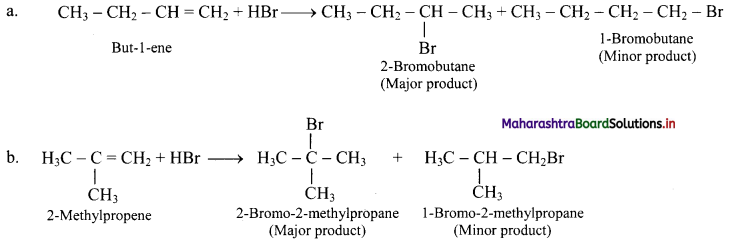
Maharashtra Board Class 11 Chemistry Important Questions Chapter 15 Hydrocarbons 72
ii. H2SO4 / H2O:
Maharashtra Board Class 11 Chemistry Important Questions Chapter 15 Hydrocarbons 73

Question 73.
Explain: Ozonolysis
Answer:
i. The C = C double bond in alkenes, gets cleaved on reaction with ozone followed by reduction.
ii. The overall process of formation of ozonide by reaction of ozone with alkene in the first step and then decomposing it to the carbonyl compounds by reduction in the second step is called ozonolysis.
iii. When ozone gas is passed into solution of the alkene in an inert solvent like carbon tetrachloride, unstable alkene ozonide is obtained.
iv. This is subsequently treated with water in the presence of a reducing agent zinc dust to form carbonyl compounds, namely, aldehydes and/or ketones.
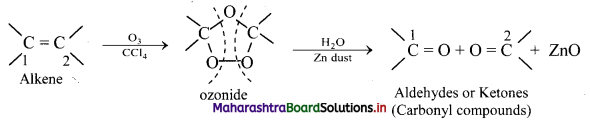
Maharashtra Board Class 11 Chemistry Important Questions Chapter 15 Hydrocarbons 74

Question 74.
Write reactions for the ozonolysis of the following alkenes:
i. Ethene
ii. Propene
Answer:
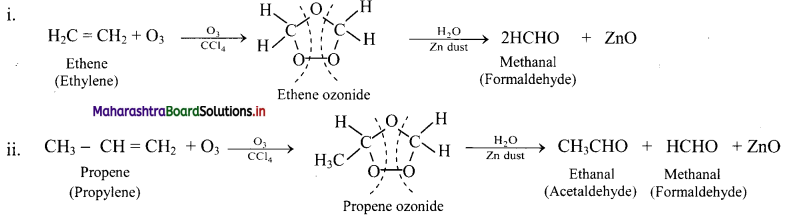
Maharashtra Board Class 11 Chemistry Important Questions Chapter 15 Hydrocarbons 75

Question 75.
What is the role of zinc dust, in ozonolysis reaction?
Answer:
In ozonolysis, the role of zinc dust is to prevent the formation of hydrogen peroxide which oxidizes aldehydes to corresponding acids.

Maharashtra Board Class 11 Chemistry Important Questions Chapter 15 Hydrocarbons

Question 76.
State TRUE or FALSE. If false, correct the statement.
i. In the cleavage products of ozonide, a carbonyl group (C=O) is formed at each of the original doubly bonded carbon atoms.
ii. In ozonolysis, the structure of original alkene reactant cannot be identified by knowing the number and arrangement of carbon atoms in aldehydes and ketones produced.
iii. Ozonolysis reaction is used to locate the position and determine the number of double bonds in alkenes.
Answer:
i. True
ii. False
In ozonolysis, knowing the number and arrangement of carbon atoms in aldehydes and ketones produced, we can identify the structure of original alkene.
iii. True

Question 77.
Identify the alkene which produces a mixture of methanal and propanone on ozonolysis. Write the reactions involved.
Answer:
i. The structure of alkene which produces a mixture of methanol and propanone on ozonolysis is
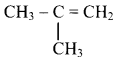
Maharashtra Board Class 11 Chemistry Important Questions Chapter 15 Hydrocarbons 76

ii. Reactions:
Maharashtra Board Class 11 Chemistry Important Questions Chapter 15 Hydrocarbons 77

Question 78.
Explain the process of hydroboration-oxidation of alkenes.
Answer:
i. Alkenes with diborane in tetrahydrofuran (THF) solvent undergo hydroboration to form trialkylborane, which on oxidation with alkaline peroxide forms primary alcohol.
ii. The overall reaction gives anti-Markovnikov’s product from unsymmetrical alkenes.

Maharashtra Board Class 11 Chemistry Important Questions Chapter 15 Hydrocarbons 78

Question 79.
Write reactions for the following conversion by hydroboration-oxidation reaction.
Ethene to ethanol
Answer:
Ethene to ethanol:

Maharashtra Board Class 11 Chemistry Important Questions Chapter 15 Hydrocarbons 79

Question 80.
Define: Polymerization
Answer:
The process in which large number of small molecules join together and form very large molecules with repeating units is called polymerization.

Question 81.
What is the difference between monomer and polymer?
Answer:
The compound having very large molecules made of large number of repeating small units is called polymer while the simple compound forming the repeating units in the polymer is called monomer.

Maharashtra Board Class 11 Chemistry Important Questions Chapter 15 Hydrocarbons

Question 82.
How is ethene converted to polyethene?
Answer:
Ethene at high temperature and under high pressure interacts with oxygen, and undergoes polymerization giving high molecular weight polymer called polyethene.
Maharashtra Board Class 11 Chemistry Important Questions Chapter 15 Hydrocarbons 80
Here, n represents the number of repeating units and is a large number.

Question 83.
Explain the process of hydroxylation of alkenes.
OR
What is the action of alkaline KMnO4 on alkenes?
Answer:
Alkenes react with cold and dilute alkaline potassium permanganate to form glycols.
Maharashtra Board Class 11 Chemistry Important Questions Chapter 15 Hydrocarbons 81

Question 84.
Explain Baeyer’s test giving one example.
Answer:
i. During hydroxylation of alkenes the purple colour of KMnO4 disappears.
ii. Hence, such reaction serves as a qualitative test for detecting the presence of double bond in the sample compound. This is known as Baeyer’s test.
e.g. As propene contains a double bond, it reacts with alkaline KMnO4 to give colourless propane-1,2-diol as product. Therefore, the purple colour of alkaline KMnO4 disappears.
Maharashtra Board Class 11 Chemistry Important Questions Chapter 15 Hydrocarbons 82

Question 85.
What is the action of following reagents on but-1-ene and but-2-ene?
i. Bromine
ii. Cold and dilute alkaline KMnO4.
Answer:
i. Action of Br2:
Maharashtra Board Class 11 Chemistry Important Questions Chapter 15 Hydrocarbons 83
ii. Action of cold and dilute alkaline KMnO4:
Maharashtra Board Class 11 Chemistry Important Questions Chapter 15 Hydrocarbons 84

Question 86.
Describe the action of acidic potassium permanganate on alkenes.
Answer:
Acidic potassium permanganate or acidic potassium dichromate oxidizes alkenes to ketones or acids depending upon the nature of the alkene and the experimental conditions. This is called oxidative cleavage of alkenes.
e.g.
Maharashtra Board Class 11 Chemistry Important Questions Chapter 15 Hydrocarbons 85

Question 87.
Complete the following conversions.

Maharashtra Board Class 11 Chemistry Important Questions Chapter 15 Hydrocarbons 86
Answer:
Maharashtra Board Class 11 Chemistry Important Questions Chapter 15 Hydrocarbons 87

Question 88.
State some important uses of alkenes.
Answer:

  • Alkenes are used as starting materials for preparation of alkyl halides, alcohols, aldehydes, ketones, acids, etc.
  • Ethene and propene are used to manufacture polythene, polypropylene which are used in polyethene bags, toys, bottles, etc.
  • Ethene is used for artificial ripening of fruits, such as mangoes.

Maharashtra Board Class 11 Chemistry Important Questions Chapter 15 Hydrocarbons

Question 89.
What are alkynes? Write their general formula.
Answer:

  • Alkynes are aliphatic unsaturated hydrocarbons containing at least one C = C.
  • Their general formula is CnH2n-2.

Question 90.
Explain position isomerism in alkyne.
Answer:
Alkynes show position isomerism which is a type of structural isomerism.
e.g. But-1-yne and but-2-yne, both are represented by C4H6, however, both of them differ in position of triple bond in them.

Maharashtra Board Class 11 Chemistry Important Questions Chapter 15 Hydrocarbons 88
[Note: 1-Alkynes are also called terminal alkynes.]

Question 91.
Draw the structural isomers of isomers of C5H8. Identify position isomers amongst them.
Answer:
i. Structural isomers of C5H10 (fourth member of homologous series of alkynes):

Maharashtra Board Class 11 Chemistry Important Questions Chapter 15 Hydrocarbons 89
ii. The compounds pent-1-yne and pent-2-yne are position isomers of each other.

Question 92.
What are alkadiynes and alkatriynes? Give one example of each.
Answer:
The aliphatic unsaturated hydrocarbons containing two and three carbon-carbon triple bonds in their structure are called alkadiynes and alkatriynes, respectively.
e.g. CH ≡ C – CH2 – C ≡ CH
Alkadiyne (Penta-1,4-diyne)

HC ≡ C- C ≡ C- C ≡ CH
Alkatriyne (Hexa-1,3,5-triyne)

Question 93.
Complete the following table:
Maharashtra Board Class 11 Chemistry Important Questions Chapter 15 Hydrocarbons 90
Answer:
Maharashtra Board Class 11 Chemistry Important Questions Chapter 15 Hydrocarbons 91

Maharashtra Board Class 11 Chemistry Important Questions Chapter 15 Hydrocarbons

Question 94.
How is acetylene prepared from the following compounds?
i. Methane
ii. Calcium carbide
Answer:
i. From methane: Ethyne is industrially prepared by controlled, high temperature, partial oxidation of methane.

Maharashtra Board Class 11 Chemistry Important Questions Chapter 15 Hydrocarbons 92
ii. From calcium carbide: Industrially, ethyne is prepared by reaction of calcium carbide with water.

Maharashtra Board Class 11 Chemistry Important Questions Chapter 15 Hydrocarbons 93

Question 95.
How are alkynes prepared by dehydrohalogenation of vicinal dihalides? Write general reaction and explain it using an example.
Answer:
Vicinal dihalides react with alcoholic solution of potassium hydroxide to form alkenyl halide which on further treatment with sodamide forms alkyne.
Maharashtra Board Class 11 Chemistry Important Questions Chapter 15 Hydrocarbons 94

Question 96.
Convert 1,2-dichloropropane to propyne.
Answer:

Maharashtra Board Class 11 Chemistry Important Questions Chapter 15 Hydrocarbons 95

Question 97.
i. What are terminal alkynes?
ii. How are they converted to higher nonterminal alkynes? Give one example.
Answer:
i. Terminal alkynes are the compounds in which hydrogen atom is directly attached to triply bonded carbon atom.
ii. a. A smaller terminal alkyne first reacts with a very strong base like lithium amide to form metal acetylide (lithium amide is easier to handle than sodamide).
b. Higher alkynes are obtained by reacting metal acetylides (alkyn-1-yl lithium) with primary alkyl halides.

Maharashtra Board Class 11 Chemistry Important Questions Chapter 15 Hydrocarbons 96
Maharashtra Board Class 11 Chemistry Important Questions Chapter 15 Hydrocarbons 97

Question 98.
How is pent-2-yne prepared from propyne?
Answer:

Maharashtra Board Class 11 Chemistry Important Questions Chapter 15 Hydrocarbons 98

Maharashtra Board Class 11 Chemistry Important Questions Chapter 15 Hydrocarbons

Question 99.
Enlist physical properties of alkenes.
Answer:
The physical properties of alkynes are similar to those of alkanes and alkenes.

  • They are less dense than water.
  • They are insoluble in water and quite soluble in less polar organic solvents like ether, benzene, carbon tetrachloride.
  • The melting points and boiling points of alkynes increase with an increase in molecular mass.

Question 100.
Lithium amide (LiNH2) is very strong base and it reacts with terminal alkynes to form lithium acetylides with the liberation of hydrogen indicating acidic nature of terminal alkynes. Why is it so?
Answer:

  • The hydrogen bonded to C ≡ C triple bond has acidic character.
  • In terminal alkynes, hydrogen atom is directly attached to sp hybridized carbon atom.
  • In sp hybrid orbital, the percentage of s-character is 50%. An electron in s-orbital is very close to the nucleus and is held tightly.
  • The sp hybrid carbon atom in terminal alkynes is more electronegative than the sp2 carbon in ethene or the sp3 carbon in ethane.
  • Due to high electronegative character of carbon in terminal alkynes, hydrogen atom can be given away as proton (H+) to very strong base.

Question 101.
Give reason: Acidic nature of alkynes is used to distinguish between terminal and non-terminal alkynes.
Answer:

  • Acidic alkynes react with certain heavy metal ions like Ag+ and Cu+ and form insoluble acetylides.
  • On addition of acidic alkyne to the solution of AgNO3 in alcohol, it forms a precipitate, which indicates that the hydrogen atom is attached to triply bonded carbon.

Hence, this reaction is used to differentiate terminal alkynes and non-terminal alkynes.

Question 102.
Predict the product in the following reactions.
\(\mathbf{H C} \equiv \mathbf{C H}+\mathbf{2 B r}_{2} \stackrel{\mathrm{CCl}_{4}}{\longrightarrow} ?\)
Answer:
Ethyne reacts with bromine in inert solvent such as carbon tetrachloride to give tetrabromoethane.

Maharashtra Board Class 11 Chemistry Important Questions Chapter 15 Hydrocarbons 99

Question 103.
Write the general reaction for addition of halogens to alkynes.
Answer:
Maharashtra Board Class 11 Chemistry Important Questions Chapter 15 Hydrocarbons 100

Question 104.
Explain the addition of hydrogen halides to alkynes using a general reaction.
Answer:
i. Hydrogen halides (HCl, HBr and HI) add to alkynes across carbon-carbon triple bond in two steps to form geminal dihalides (in which two halogen atoms are attached to the same carbon atom).
ii. The addition of HX in both the steps takes place according to Markovnikov’s rule as shown in below.
General reaction:
Maharashtra Board Class 11 Chemistry Important Questions Chapter 15 Hydrocarbons 101
iii. The order of reactivity of hydrogen halides is HI > HBr > HCl.

Maharashtra Board Class 11 Chemistry Important Questions Chapter 15 Hydrocarbons

Question 105.
State the action of HBr on acetylene and methyl acetylene.
Answer:
Maharashtra Board Class 11 Chemistry Important Questions Chapter 15 Hydrocarbons 102

Question 106.
Explain reactions of alkynes with water using general reaction.
Answer:
Alkynes react with water in presence of 40% sulphuric acid and 1% mercuric sulphate to form aldehydes or ketones, i.e., carbonyl compounds.
General reaction:
Maharashtra Board Class 11 Chemistry Important Questions Chapter 15 Hydrocarbons 103

Question 107.
Predict the products when ethyne and propyne are treated with 1% mercuric sulphate in H2SO4.
Answer:
i. Ethyne:

Maharashtra Board Class 11 Chemistry Important Questions Chapter 15 Hydrocarbons 104
ii. Propyne:
Maharashtra Board Class 11 Chemistry Important Questions Chapter 15 Hydrocarbons 105a

Question 108.
Convert:
i. But-1-yne to butan-2-one
ii. Hex-3-yne to hexan-3-one
Answer:
i. But-l-yne to butan-2-one:

Maharashtra Board Class 11 Chemistry Important Questions Chapter 15 Hydrocarbons 106
ii. Hex-3-yne to hexan-3-one:
Maharashtra Board Class 11 Chemistry Important Questions Chapter 15 Hydrocarbons 107

Question 109.
What are products obtained on hydration of but-1-yne and but-2-yne? Are they same or different? Explain.
Answer:
i. Hydration of but-1-yne:

Maharashtra Board Class 11 Chemistry Important Questions Chapter 15 Hydrocarbons 108
Hydration of but-2-yne:
Maharashtra Board Class 11 Chemistry Important Questions Chapter 15 Hydrocarbons 109
The products obtained on hydration of but-1-yne and but-2-yne are same i.e., butan-2-onc since the addition of water to alkyncs takes place according to Markovnikovs rule.

Maharashtra Board Class 11 Chemistry Important Questions Chapter 15 Hydrocarbons

Question 110.
How is ethylene converted into ethylidene dichloride?
Answer:

Maharashtra Board Class 11 Chemistry Important Questions Chapter 15 Hydrocarbons 110

Question 111.
Write some important uses of acetylene.
Answer:

  • Ethyne (acetylene) is used in preparation of ethanal (acetaldehyde), propanone (acetone), ethanoic acid (acetic acid).
  • It is used in the manufacture of polymers, synthetic rubber, synthetic fibre, plastic, etc.
  • For artificial ripening of fruits.
  • In oxy-acetylene (mixture of oxygen and acetylene) flame for welding and cutting of metals.

Question 112.
Many organic compounds obtained from natural sources such as resins, balsams, oil of wintergreen, etc. have pleasant fragrance or aroma. Such compounds are named as aromatic compounds.
i. Name the simplest aromatic compound.
ii. Write the names of any two aromatic compounds.
Answer:
i. Benzene is the simplest aromatic hydrocarbon.
ii. Toluene and naphthalene

Question 113.
Draw structures of any four aromatic hydrocarbons.
Answer:

Maharashtra Board Class 11 Chemistry Important Questions Chapter 15 Hydrocarbons 111

Question 114.
Write the molecular formula of benzene. Give its boiling point.
Answer:
The molecular formula for benzene is C6H6. Its boiling point is 353 K.

Question 115.
State TRUE or FALSE. Correct the false statement.
i. Aromatic hydrocarbons are also called as arenes.
ii. Toluene is a non-aromatic hydrocarbon.
iii. Benzene is colourless liquid having characteristic odour.
Answer:
i. True
ii. False
Toluene is an aromatic hydrocarbon.
iii. True

Maharashtra Board Class 11 Chemistry Important Questions Chapter 15 Hydrocarbons

Question 116.
Name any two large-scale sources of benzene.
Answer:
Coal-tar and petroleum are the two large-scale sources of benzene.
[Note: Other aromatic compounds like toluene, phenol, naphthalene, etc. are also obtained from coal-tar and petroleum.]

Question 117.
Draw the structure of an aromatic compound that resembles benzene but does not have pleasant odour.
Answer:
Maharashtra Board Class 11 Chemistry Important Questions Chapter 15 Hydrocarbons 112

Question 118.
Name and draw the structures of any three compounds that have pleasant odour but do not resemble benzene.
Answer:
Maharashtra Board Class 11 Chemistry Important Questions Chapter 15 Hydrocarbons 113

Question 119.
Differentiate between aromatic and aliphatic compounds.
Answer:
Aromatic compounds:

  • Aromatic compounds contain higher percentage of carbon.
  • They bum with sooty flame.
  • They are cyclic compounds with alternate single and double bonds.
  • They are not attacked by normal oxidizing and reducing agents.
  • They do not undergo addition reactions easily. They do not decolourise dilute alkaline aqueous KMnO4 and Br2 in CCl4, though double bonds appear in their structure.
  • They prefer substitution reactions.

Aliphatic compounds:

  • Aliphatic compounds contain lower percentage of carbon.
  • They bum with non-sooty flame.
  • They are open chain compounds.
  • They are easily attacked by oxidizing and reducing agents.
  • Unsaturated aliphatic compounds undergo addition reactions easily. They decolourise dilute aqueous alkaline KMnO4 and Br2 in CCl4.
  • The saturated aliphatic compounds give substitution reactions.

Question 120.
Benzene cannot have open chain structure. Explain this statement.
Answer:

  • The molecular formula of benzene is C6H6. This indicates high degree of unsaturation.
  • Open chain or cyclic structure having double and triple bonds can be written for C6H6.
  • However, benzene does not behave like alkenes or alkynes. This indicates that benzene cannot have the open chain structure.

Maharashtra Board Class 11 Chemistry Important Questions Chapter 15 Hydrocarbons

Question 121.
Compare the reactivity of benzene and alkenes with the following reagents:
i. Dilute alkaline KMnO4
ii. Br6 in CCl4
iii. H6O in acidic medium
Answer:

Reagent Alkenes Benzene
Dilute alkaline aqueous KMnO4 Decolourisation of KMnO4 No decolourisation
Br2 in CCl4 Decolourisation of red brown colour of bromine No decolourisation
H2O in acidic medium Addition of H2O molecule No reaction

Question 122.
Give the evidence for the cyclic structure of benzene.
Answer:
Evidence for the cyclic structure of benzene:
i. Benzene yields only one and no isomeric monosubstituted bromobenzene (C6H5Br) when treated with equimolar bromine in FeBr3. This indicates that all six hydrogen atoms in benzene are identical.

Maharashtra Board Class 11 Chemistry Important Questions Chapter 15 Hydrocarbons 114
ii. This is possible only if benzene has cyclic structure of six carbons bound to one hydrogen atom each.
iii. Benzene on catalytic hydrogenation gives cyclohexane.

Maharashtra Board Class 11 Chemistry Important Questions Chapter 15 Hydrocarbons 115
This confirms the cyclic structure of benzene and three C = C in it.

Question 123.
Write a short note on the Kekule structure of benzene.
Answer:
Kekule structure of benzene:
i. August Kekule in 1865 suggested the structure for benzene having a cyclic planar ring of six carbon atoms with alternate single and double bonds and hydrogen atom attached to each carbon atom.
Maharashtra Board Class 11 Chemistry Important Questions Chapter 15 Hydrocarbons 116
ii. The Kekule structure indicates the possibility of two isomeric 1,2-dibromobenzenes. In one of the isomers, the bromine atoms would be attached to the doubly bonded carbon atoms whereas in the other, they would be attached to single bonded carbons.
Maharashtra Board Class 11 Chemistry Important Questions Chapter 15 Hydrocarbons 117
iii. However, benzene was found to form only one ortho-disubstituted benzene. This problem was overcome by Kekule by suggesting the concept of oscillating nature of double bonds in benzene as given below.

Maharashtra Board Class 11 Chemistry Important Questions Chapter 15 Hydrocarbons 118
iv. Even with this modification, Kekule structure of benzene failed to explain unusual stability and preference to substitution reactions rather than addition reactions, which was later explained by resonance.

Question 124.
Explain the resonance phenomenon with respect to benzene.
OR
Explain the resonance hybrid structure of benzene.
Answer:

  • Benzene is a hybrid of various resonance structures. The two structures, (A) and (B) given by Kekule are the main contributing structures.
  • The resonance hybrid is represented by inserting a circle or a dotted circle inscribed in the hexagon as shown in (C).
  • The circle represents six electrons delocalized over the six carbon atoms of benzene ring.
  • A double headed arrow between the resonance structures is used to represent the resonance phenomenon.
Maharashtra Board Class 11 Chemistry Important Questions Chapter 15 Hydrocarbons 119

Question 125.
Why does benzene not prefer to undergo addition reactions?
Answer:

  • Benzene is highly unsaturated molecule but despite of this feature, it does not give addition reaction.
  • The actual structure of benzene is represented by the resonance hybrid which is the most stable form of benzene than any of its resonance structures.
  • This stability due to resonance (delocalization of π electrons) is so high that π-bonds of the molecule becomes strong and thus, resist breaking.

Thus, benzene does not prefer to undergo addition reactions.

Maharashtra Board Class 11 Chemistry Important Questions Chapter 15 Hydrocarbons

Question 126.
Explain the resonance structures of benzene using the orbital overlap concept.
Answer:
The structure of benzene can be better explained by the orbital overlap concept,
i. All six carbon atoms in benzene are sp2 hybridized. Two sp2 hybrid orbitals of each carbon atom overlap and form carbon-carbon sigma (σ) bond and the remaining third sp2 hybrid orbital of each carbon overlaps with s orbital of a hydrogen atom to form six C – H sigma bonds.
Maharashtra Board Class 11 Chemistry Important Questions Chapter 15 Hydrocarbons 120

ii. The unhybridized p orbitals of carbon atoms overlap laterally forming π bonds. There are two possibilities of forming three π bonds by overlap of p orbitals of C1 – C2, C3 – C4, C5 – C6 or C2 – C3, C4 – C5, C6 – C1, respectively, as shown in the following figure. Both the structures are equally probable.

According to resonance theory, these are two resonance structures of benzene.
Maharashtra Board Class 11 Chemistry Important Questions Chapter 15 Hydrocarbons 121

Question 127.
Explain the structure of benzene with respect to molecular orbital theory.
Answer:
i. According to molecular orbital (MO) theory, the six p orbitals of six carbons give rise to six molecular orbitals of benzene.
ii. Shape of the most stable MO is as show in the figure below. Three of these π molecular orbitals lie above and the other below those of free carbon atom energies.
Maharashtra Board Class 11 Chemistry Important Questions Chapter 15 Hydrocarbons 122
iii. The six electrons of the p orbitals cover all the six carbon atoms and are said to be delocalized. Delocalization of π electrons results in stability of benzene molecule.

Question 128.
Give the carbon-carbon bond length in benzene. Explain why benzene shows unusual behaviour.
Answer:
i. X-ray diffraction data indicate that all C – C bond lengths in benzene are equal (139 pm) which is an intermediate between C – C (154 pm) and C = C bond (133 pm).

ii. Thus, absence of pure double bond in benzene accounts for its reluctance to addition reactions under normal conditions, which explains unusual behaviour of benzene.
Maharashtra Board Class 11 Chemistry Important Questions Chapter 15 Hydrocarbons 123

Question 129.
Write a short note on aromaticity.
Answer:
i. All aromatic compounds undergoes substitution reactions rather than addition reactions and this property is referred to as aromaticity or aromatic character.
ii. The aromatic character of benzene is correlated to its structure.
iii. Aromaticity is due to extensive cyclic delocalization of p electrons in the planar ring structure.
iv. Three rules of aromaticity that is used for predicting whether a particular compound is aromatic or non-aromatic are as follows:

  • Aromatic compounds are cyclic and planar (all atoms in ring are sp2 hybridized).
  • Each atom in aromatic ring has a p orbital. The p orbitals must be parallel so that continuous overlap is possible around the ring.
  • Huckel rule: The cyclic π molecular orbital formed by overlap of p orbitals must contain (4n + 2) p electrons, where n = integer 0, 1, 2, 3, … etc.

Question 130.
State and explain the Huckel rule of aromaticity.
Answer:
Huckel rule: The cyclic π molecular orbital formed by overlap of p orbitals must contain (4n + 2) p electrons, where n = integer 0, 1,2,3, … etc.

Explanation:
According to Huckel rule, a cyclic and planar compound is aromatic if it the number of π electrons is equal to (4n + 2), where n = integer 0, 1, 2, 3, … etc.

n Number of π electrons
n = 0 (4 × 0) – 2 = 2
n = 1 (4 × 1) + 2 = 6
n = 2 (4 × 2) + 2 = 10

e.g. Consider benzene molecule:
Maharashtra Board Class 11 Chemistry Important Questions Chapter 15 Hydrocarbons 124
Benzene has 6π electrons. According to Huckel rule, if n = 1, then (4n + 2)π = 6π electrons. Hence, benzene is aromatic.

Maharashtra Board Class 11 Chemistry Important Questions Chapter 15 Hydrocarbons

Question 131.
By using the rules of aromaticity, explain whether the following compounds are aromatic or non-aromatic.
i. Benzene
ii. Naphthalene
iii. Cycloheptatriene
Answer:
i. Benzene:
a. It is cyclic and planar.
b. It has three double bonds and six π electrons.
c. It has a p orbital on each carbon of the hexagonal ring. Hence, a continuous overlap above and below the ring is possible.
Maharashtra Board Class 11 Chemistry Important Questions Chapter 15 Hydrocarbons 125
d. According to Huckcl rule, this compound is aromatic if, 4n + 2 = Number of π electrons.
4n + 2 = 6,
∴ 4n = 6 – 2 = 4
n = 4/4 = 1, here, ‘n’ comes out to be an integer.
Hence, benzene is aromatic.

ii. Naphthalene:
a. It is cyclic and planar.
b. It has 5 double bonds and 10 n electrons.
Maharashtra Board Class 11 Chemistry Important Questions Chapter 15 Hydrocarbons 126
c. It has a p orbital on each carbon atom of the ring. Hence, a continuous overlap around the ring is possible.
d. According to Huckel rule, this compound is aromatic if, 4n + 2 = Number of π electrons.
4n + 2 = 10,
∴ 4n = 10 – 2 = 8
n = 8/4 = 2, Here ‘n’ comes out to be an integer.
Hence, naphthalene is aromatic.

iii. Cycloheptatriene:
a. It is cyclic and planar.
b. It has three double bonds and 6 π electrons.
Maharashtra Board Class 11 Chemistry Important Questions Chapter 15 Hydrocarbons 127
c. But one of the carbon atoms is saturated (sp3 hybridized) and it does not have a p orbital.
d. Hence, a continuous overlap around the ring is not possible in cycloheptatriene. Hence, it is non-aromatic.

Question 132.
How does Huckel rule help in determining the aromaticity of pyridine?
Answer:
i. Pyridine has three double bonds and 6 π electrons.
ii. The six p orbitals containing six electrons form delocalized π molecular orbital.
iii. The unused sp2 hybrid orbital of nitrogen containing two non-bonding electrons is as it is.
Maharashtra Board Class 11 Chemistry Important Questions Chapter 15 Hydrocarbons 128
iv. According to Huckel rule, this compound is aromatic if, 4n + 2 = Number of π electrons
4n + 2 = 6,
∴ 4n = 6 – 2 = 4
n = 4/4 = 1, here ‘n’ comes out to be an integer. Hence, pyridine is aromatic.

Question 133.
How is benzene prepared from ethyne/acetylene?
Answer:
From ethyne (By trimerization): Alkynes when passed through a red hot iron tube at 873 K, polymerize to form aromatic hydrocarbons. Ethyne when passed through a red hot iron tube at 873 K undergoes trimerization to form benzene.
Maharashtra Board Class 11 Chemistry Important Questions Chapter 15 Hydrocarbons 129

Question 134.
How is benzene prepared from sodium benzoate?
OR
Explain preparation of benzene by decarboxylation.
Answer:
From sodium benzoate (by decarboxylation): When anhydrous sodium benzoate is heated with soda lime, it undergoes decarboxylation and gives benzene.
Maharashtra Board Class 11 Chemistry Important Questions Chapter 15 Hydrocarbons 130
[Note: This reaction is useful for decreasing the length of a carbon chain by one C-atom]

Question 135.
How will you convert phenol to benzene?
Answer:
From phenol (By reduction): When vapours of phenol are passed over heated zinc dust, it undergoes reduction and gives benzene.
Maharashtra Board Class 11 Chemistry Important Questions Chapter 15 Hydrocarbons 131

Question 136.
Enlist physical properties of benzene.
Answer:
Physical properties of benzene:

  • Benzene is a colourless liquid.
  • Its boiling point is 353 K and melting point is 278.5 K.
  • It is insoluble in water. It forms upper layer when mixed with water.
  • It is soluble in alcohol, ether and chloroform.
  • Its vapours are highly toxic which on inhalation lead to unconsciousness.

Maharashtra Board Class 11 Chemistry Important Questions Chapter 15 Hydrocarbons

Question 137.
What is the action of chlorine on benzene in the presence of UV light?
Answer:
Addition of chlorine: When benzene is treated with chlorine in the presence of bright sunlight or UV light, three molecules of chlorine gets added to benzene to give benzene hexachloride.
Maharashtra Board Class 11 Chemistry Important Questions Chapter 15 Hydrocarbons 132

Question 138.
Name the γ-isomer of benzene hexachloride which is used as insecticide.
Answer:
The γ-isomer of benzene hexachloride which is used as insecticide is called as gammaxene or lindane.

Question 139.
How will you convert benzene to cyclohexane?
Answer:
Addition of hydrogen: When a mixture of benzene and hydrogen gas is passed over heated catalyst nickel at 453 K to 473 K, cyclohexane is formed.

Maharashtra Board Class 11 Chemistry Important Questions Chapter 15 Hydrocarbons 133

Question 140.
What is the action of ozone on benzene?
Answer:
Addition of ozone: When benzene is treated with ozone in the presence of an inert solvent carbon tetrachloride, benzene triozonide is formed, which is then decomposed by zinc dust and water to give glyoxal.
Maharashtra Board Class 11 Chemistry Important Questions Chapter 15 Hydrocarbons 134

Question 141.
What are the different types of electrophilic substitution reactions of benzene?
Answer:
i. Benzene shows electrophilic substitution reactions, in which one or more hydrogen atoms of benzene ring are replaced by groups like – Cl, – Br, – NO2, – SO3H, -R, -COR, etc.
ii. Different types of electrophilic substitution reactions of benzene are as follows:

  • Halogenation (chlorination and bromination)
  • Nitration
  • Sulphonation
  • Friedel-Craft’s alkylation and
  • Friedel-Craft’s acylation

Question 142.
Write a short note on chlorination reaction of benzene.
Answer:
Chlorination of benzene:
i. In chlorination reaction, hydrogen atom of benzene is replaced by chlorine atom.
ii. Chlorine reacts with benzene in dark in the presence of iron or ferric chloride or anhydrous aluminium chloride or red phosphorus as catalyst to give chlorobenzene (C6H5Cl).
Maharashtra Board Class 11 Chemistry Important Questions Chapter 15 Hydrocarbons 135
iii. Electrophile involved in the reaction: Cl+, chloronium ion,
Formation of the electrophile: Cl – Cl + FeCl3 → Cl+ + [FeCl4]

Maharashtra Board Class 11 Chemistry Important Questions Chapter 15 Hydrocarbons

Question 143.
Write a short note on bromination reaction of benzene.
Answer:
Bromination of benzene:
i. In bromination reaction, hydrogen atom of benzene is replaced by bromine atom.
ii. Bromine reacts with benzene in dark in presence of iron or ferric bromide or anhydrous aluminium bromide or red phosphorus as catalyst to give bromobenzene (C6H5Br).
Maharashtra Board Class 11 Chemistry Important Questions Chapter 15 Hydrocarbons 136
iii. Electrophile involved in the reaction: Br+
Formation of the electrophile: Br – Br + FeBr3 → Br+ + [FeBr4]

Question 144.
Why direct iodination of benzene is not possible?
Answer:
Direct iodination of benzene is not possible as the reaction is reversible.
Maharashtra Board Class 11 Chemistry Important Questions Chapter 15 Hydrocarbons 137
[Note: Iodination of benzene can be carried out in the presence of oxidising agents like HIO3 or HNO3.]

Question 145.
How will you convert benzene to hexachlorobenzene?
Answer:
When benzene is treated with excess of chlorine in presence of anhydrous aluminium chloride, it gives hexachlorobenzene.
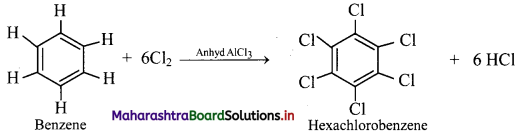
Maharashtra Board Class 11 Chemistry Important Questions Chapter 15 Hydrocarbons 138

Question 146.
State true or false. Correct the false statement.
i. In halogenation reaction, hydrogen atom of benzene ring is replaced by halogen atom.
ii. The molecular formula of hexachlorobenzene is C6H6Cl6.
iii. Benzene forms the lower layer when mixed with water.
Answer:
i. True
ii. False
The molecular formula of hexachlorobenzene is C6Cl6
iii. False
Benzene forms the upper layer when mixed with water.

Maharashtra Board Class 11 Chemistry Important Questions Chapter 15 Hydrocarbons

Question 147.
Explain the nitration reaction of benzene.
Answer:
Nitration of benzene:
i. When benzene is heated with a mixture of concentrated nitric acid and concentrated sulphuric acid (nitrating mixture) at about 313 K to 333 K, it gives nitrobenzene.
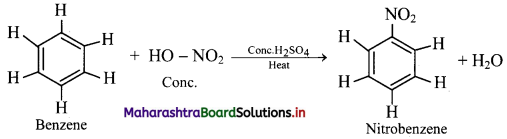
Maharashtra Board Class 11 Chemistry Important Questions Chapter 15 Hydrocarbons 139
ii. Electrophile involved in the reaction: \(\mathrm{NO}_{2}^{+}\), nitronium ion
Formation of the electrophile: HO – NO2 + 2H2SO4 ⇌ \(2 \mathrm{HSO}_{4}^{-}\) + H3O+ + \(\mathrm{NO}_{2}^{-}\)

Question 148.
Write a short note on sulphonation of benzene.
Answer:
Sulphonation of benzene:
i. When benzene is heated with fuming sulfuric acid (oleum) at 373 K, it gives benzene sulfonic acid.
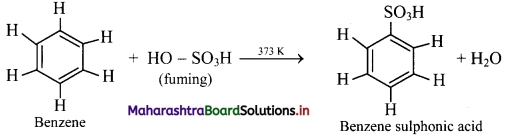
Maharashtra Board Class 11 Chemistry Important Questions Chapter 15 Hydrocarbons 140
ii. Electrophile involved in the reaction: SO3, free sulphur trioxide
Formation of the electrophile: 2H2SO4 → H3O+ + \(\mathrm{HSO}_{4}^{-}\) + SO3

Question 149.
Write a short note on Friedel-Craft’s alkylation reaction of benzene.
Answer:
Friedel-Craft’s alkylation reaction of benzene:
i. When benzene is treated with an alkyl halide like methyl chloride in the presence of anhydrous aluminium chloride, it gives toluene.
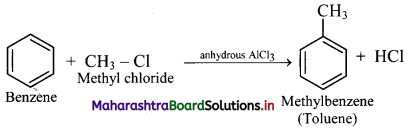
Maharashtra Board Class 11 Chemistry Important Questions Chapter 15 Hydrocarbons 141
ii. Electrophile involved in the reaction: R+
Formation of the electrophile: R – Cl + AlCl3 → R+ + \(\mathrm{AlCl}_{4}^{-}\)
iii. Friedel-Craft’s alkylation reaction is used to extend the chain outside the benzene ring.

Question 150.
Explain Friedel-Craft’s acylation reaction of benzene. Give example reactions.
Answer:
Friedel-craft’s acylation reaction of benzene:
i. When benzene is heated with an acyl halide or acid anhydride in the presence of anhydrous aluminium chloride, it gives corresponding acyl benzene.
Maharashtra Board Class 11 Chemistry Important Questions Chapter 15 Hydrocarbons 142
ii. Electrophile involved in the reaction: R – C- = O, acylium ion
Formation of the electrophile: R – COCl + AlCl3 → R – C+ = O + \(\mathrm{AlCl}_{4}^{-}\)

Question 151.
Write the general combustion reaction for hydrocarbons.
Answer:
General combustion reaction for any hydrocarbon (CxHy) can be represented as follows:

Maharashtra Board Class 11 Chemistry Important Questions Chapter 15 Hydrocarbons 143

Maharashtra Board Class 11 Chemistry Important Questions Chapter 15 Hydrocarbons

Question 152.
Write the combustion reaction of benzene.
Answer:
When benzene is heated in air, it bums with sooty flame forming carbon dioxide and water.
C6H6 + \(\frac {15}{2}\)O2 → 6CO2 + 3H2O

Question 153.
Write a note on the directive influence of substituents (functional groups) in monosubstituted benzene.
Answer:
i. In benzene, all hydrogen atoms are equivalent and so, when it undergoes electrophilic substitution reactions, only one monosubstituted product is possible.
Monosubstituted benzene:
Maharashtra Board Class 11 Chemistry Important Questions Chapter 15 Hydrocarbons 144
ii. When monosubstituted benzene undergoes further electrophilic substitution, the second substituent (electrophile, E) can occupy any of the five positions available and give three disubstituted products.
But these disubstituted products are not formed in equal amounts.
Maharashtra Board Class 11 Chemistry Important Questions Chapter 15 Hydrocarbons 145
iii. The position of second substituent (E) is determined by the nature of substituent (S) already present in the benzene ring and not on the nature of second substituent (E).
iv. The groups which direct the incoming group to ortho and para positions are called ortho and para directing groups. The groups which direct the incoming group to meta positions are called meta directing groups. Thus, depending on the nature of the substituent (S) either ortho and para products or meta products are formed as major products.

Question 154.
What are ortho and para directing groups? Enlist few ortho and para directing groups.
Answer:
The groups which direct the incoming group to ortho and para positions are called ortho and para directing groups.
Ortho and para directing groups:

Maharashtra Board Class 11 Chemistry Important Questions Chapter 15 Hydrocarbons 146

Question 155.
Explain the directive influence of ortho, para directing groups in monosubstituted benzene using suitable example.
OR
Explain the directive influence of -OH group in benzene.
Answer:
i. The directive influence of ortho, para directing groups can be explained with the help of inductive and resonance effects.
ii. phenol has the following resonating structures:
Maharashtra Board Class 11 Chemistry Important Questions Chapter 15 Hydrocarbons 147
iii. It can be seen from the above resonating structures, that the ortho (o-) and para (p-) positions have a greater electron density than the meta positions.
iv. Therefore, -OH group activates the benzene ring for the attack of second substituent (E) at these electron rich centres. Thus, phenolic -OH group is activating and ortho, para-directing group.
v. In phenol, -OH group has electron withdrawing inductive (-I) effect which slightly decreases the electron density at ortho positions in benzene ring. Thus, resonance effect and inductive effect of -OH group act opposite to each other. However, the strong resonance effect dominates over inductive effect.

Maharashtra Board Class 11 Chemistry Important Questions Chapter 15 Hydrocarbons

Question 156.
Explain the o, p-directive effect of methyl group.
Answer:

  • All ortho and para directing groups possess nonbonding electron pair on the atom which is directly attached to the aromatic ring; however, methyl group is an exception.
    Methyl (or alkyl groups) is ortho and para directing, although it has no nonbonding electron pair on the key atom. This is explained on the basis of special type of resonance called hyperconjugation or no bond resonance.

Question 157.
Explain why halide group is an ortho and para directing group.
Answer:
i. In aryl halides, halogens are moderately deactivating. Because of their strong -I effect, overall electron density on the benzene ring decreases, which makes the electrophilic substitution difficult.
ii. However, halogens are ortho and para directing. This can be explained by considering resonance structures.
iii. e.g. Chlorobenzene has the following resonating structures:
Maharashtra Board Class 11 Chemistry Important Questions Chapter 15 Hydrocarbons 148
iv. Due to resonance, the electron density on ortho and para positions is greater than meta positions and hence, -Cl is ortho and para directing.

Question 158.
What are meta directing groups? Enlist few of them.
Answer:
The groups which direct the incoming group to meta positions are called meta directing groups.

Maharashtra Board Class 11 Chemistry Important Questions Chapter 15 Hydrocarbons 149
[Note: All meta directing groups have positive (or partial positive) charge on the atom which is directly attached to an aromatic ring.]

Question 159.
Explain the directive influence of nitro group in nitrobenzene.
OR
Explain why nitro group is a meta-directing group.
Answer:
i. Meta directing group withdraws electrons from the aromatic ring by resonance, making the ring electron-deficient. Therefore, meta groups are ring deactivating groups.
ii. Due to -I effect, -NO2 group reduces electron density in benzene ring on ortho and para positions. So, the attack of incoming group becomes difficult at ortho and para positions. The incoming group can attack on meta positions more easily.
iii. The various resonance structures of nitrobenzene are as shown below:
Maharashtra Board Class 11 Chemistry Important Questions Chapter 15 Hydrocarbons 150
iv. It is clear from the above resonance structures that the ortho and para positions have comparatively less electron density than at meta positions. Hence, the incoming group/electrophile attacks on meta positions.

Question 160.
What are polycyclic aromatic compounds? How are they produced?
Answer:

  • Polycyclic aromatic compounds are the hydrocarbons containing more than two benzene rings fused together.
  • They are produced by incomplete combustion of tobacco, coal and petroleum.

Question 161.
Write the harmful effects of benzene.
Answer:

  • Benzene is both, toxic and carcinogenic (cancer causing).
  • In fact, it might be considered “the mother of all carcinogens” as a large number of carcinogens have structures that include benzene rings.
  • In liver, benzene is oxidized to an epoxide and benzopyrene is converted into an epoxy diol. These substances are carcinogenic and can react with DNA and thus, can induce mutation leading to uncontrolled growth of cancer cells.

Maharashtra Board Class 11 Chemistry Important Questions Chapter 15 Hydrocarbons

Multiple Choice Questions

1. Alkanes are represented by the general formula ………….
(A) CnH2n-2
(B) CnH2n+2
(C) CnH2n
(D) CnHn
Answer:
(B) CnH2n+2

2. Which of the following compound is alkanes?
(A) C5H10
(B) C10H22
(C) C15H28
(D) C9H16
Answer:
(B) C10H22

3. Alkanes are commonly called …………
(A) arenes
(B) paraffins
(C) olefins
(D) acetylenes
Answer:
(B) paraffins

4. Every carbon atom in alkanes is …………..
(A) sp hybridized
(B) sp2 hybridized
(C) sp3 hybridized
(D) sp3d hybridized
Answer:
(C) sp3 hybridized

5. Isomerism is the phenomenon in which two or more organic compounds have ………….
(A) same molecular formula but different structural formula
(B) same structural formula but different molecular formula
(C) same general formula, but different structural formula
(D) same empirical formula, same structural formula
Answer:
(A) same molecular formula but different structural formula

Maharashtra Board Class 11 Chemistry Important Questions Chapter 15 Hydrocarbons

6. Pentane exhibits …………. chain isomers.
(A) two
(B) three
(C) four
(D) five
Answer:
(B) three

7. Which of the following is NOT an isomer of hexane?
(A) 2-Methylpentane
(B) 2,2-Dimethylbutane
(C) 2,2-Dimethylpentane
(D) 3-Methylpentane
Answer:
(C) 2,2-Dimethylpentane

8. Alkanes can be prepared by ………… of unsaturated hydrocarbons.
(A) hydrogenation
(B) oxidation
(C) hydrolysis
(D) cracking
Answer:
(A) hydrogenation

9. Catalytic hydrogenation of ethene or acetylene gives …………..
(A) ethane
(B) propylene
(C) methane
(D) propane
Answer:
(A) ethane

10. Ethyl iodide when reduced by zinc and dilute HCl, leads to the formation of …………..
(A) Methane
(B) Ethane
(C) Ethylene
(D) Butane
Answer:
(B) Ethane

Maharashtra Board Class 11 Chemistry Important Questions Chapter 15 Hydrocarbons

11. The reaction of alkyl halides with sodium in dry ether to give higher alkanes is called ………..
(A) Wurtz reaction
(B) Kolbe’s reaction
(C) Frankland’s reaction
(D) Williamson’s reaction
Answer:
(A) Wurtz reaction

12. Methane is ………… molecule.
(A) polar
(B) nonpolar
(C) highly polar
(D) none of these
Answer:
(B) nonpolar

13. Alkanes are ………… in water.
(A) soluble
(B) sparingly soluble
(C) insoluble
(D) none of these
Answer:
(C) insoluble

14. As branching increases, boiling point of alkanes ………….
(A) increases
(B) decreases
(C) remains same
(D) None of these
Answer:
(B) decreases

15. Halogenation of alkane is an example of …………. reaction.
(A) dehydration
(B) substitution
(C) addition
(D) elimination
Answer:
(B) substitution

Maharashtra Board Class 11 Chemistry Important Questions Chapter 15 Hydrocarbons

16. Order of reactivity of halogens in halogenation of alkanes is ………….
(A) F2 > Cl2 > Br2 > I2
(B) I2 > Br2 > Cl2 > F2
(C) Br2 < I2 < F2 < Cl2
(D) Cl2 < I2 < Br2 < F2
Answer:
(A) F2 > Cl2 > Br2 > I2

17. The thermal decomposition of alkanes in absence of air to give lower alkanes, alkenes and hydrogen is called ………….
(A) vapour phase nitration
(B) pyrolysis
(C) polymerisation
(D) combustion
Answer:
(B) pyrolysis

18. But-1-ene and But-2-ene are …………
(A) chain isomers
(B) position isomers
(C) geometrical isomers
(D) metamers
Answer:
(B) position isomers

19. Hex-2-ene and 2-Methylpent-2-ene exhibit …………
(A) chain isomerism
(B) position isomerism
(C) geometrical isomerism
(D) optical isomerism
Answer:
(A) chain isomerism

20. Which of the following shows position isomerism?
(A) Propene
(B) Ethene
(C) 2-Methylpropene
(D) Pent-2-ene
Answer:
(D) Pent-2-ene

Maharashtra Board Class 11 Chemistry Important Questions Chapter 15 Hydrocarbons

21. When identical atoms or group of atoms are attached to the two carbon atoms on the same side of the double bond, the isomer is called ………… isomer.
(A) cis
(B) trans
(C) position
(D) chain
Answer:
(A) cis

22. Which of the following does NOT exhibit geometrical isomers?
(A) But-2-ene
(B) Pent-2-ene
(C) But-1-ene
(D) Hex-2-ene
Answer:
(C) But-1-ene

23. When ethyl bromide is heated with alcoholic KOH, ………… is formed.
(A) ethane
(B) ethanol
(C) ethene
(D) acetylene
Answer:
(C) ethene

24. Alkenes are insoluble in …………
(A) benzene
(B) water
(C) ether
(D) chloroform
Answer:
(B) water

25. Markownikov’s rule is applicable to …………
(A) symmetrical alkenes
(B) alkanes
(C) unsymmetrical alkenes
(D) alkynes
Answer:
(C) unsymmetrical alkenes

Maharashtra Board Class 11 Chemistry Important Questions Chapter 15 Hydrocarbons

26. When propene is treated with HBr in the dark and in absence of peroxide, then the main product formed is …………
(A) 1-bromopropane
(B) 2-bromopropane
(C) 1,2-dibromopropane
(D) 1,3-dibromopropane
Answer:
(B) 2-bromopropane

27. The product formed by the addition of HCl to propene in presence of peroxide is …………..
Maharashtra Board Class 11 Chemistry Important Questions Chapter 15 Hydrocarbons 151
Answer:
Maharashtra Board Class 11 Chemistry Important Questions Chapter 15 Hydrocarbons 153

28. Propene reacts with HBr in presence of peroxide, to form …………..
(A) 2-bromopropane
(B) 1-bromopropane
(C) 3-bromopropane
(D) 1,2-dibromopropane
Answer:
(B) 1-bromopropane

29. Markovnikov’s rule is applicable for …………..
(A) CH2 = CH2
(B) CH3CH = CHCH3
(C) CH3CH2CH = CHCH2CH3
(D) (CH3)2C = CH2
Answer:
(D) (CH3)2C = CH2

30. The addition of HCl in presence of peroxide does not follow anti-Markownikov’s rule because …………..
(A) HCl bond is too strong to be broken homolytically
(B) Cl atom is not reactive enough to add on to a double bond
(C) Cl atom combines with H atom to form HCl
(D) HCl is a reducing agent
Answer:
(A) HCl bond is too strong to be broken homolytically

Maharashtra Board Class 11 Chemistry Important Questions Chapter 15 Hydrocarbons

31. An alkene on ozonolysis produces a mixture of acetaldehyde and acetone. Identify the alkene.
(A) But-1-ene
(B) But-2-ene
(C) 2-Methylbut-1-ene
(D) 2-Methylbut-2-ene
Answer:
(D) 2-Methylbut-2-ene

32. The ozonolysis of (CH3)2C = C(CH3)2 followed by treatment with zinc and water will give ……………
(A) acetone
(B) acetone and acetaldehyde
(C) formaldehyde and acetone
(D) acetaldehyde
Answer:
(A) acetone

33. The compound which forms only acetaldehyde on ozonolysis is …………..
(A) ethene
(B) propyne
(C) but-1-ene
(D) but-2-ene
Answer:
(D) but-2-ene

34. Treatment of ethylene with ozone followed by decomposition of the product with Zn/H2O gives two moles of ………….
(A) formaldehyde
(B) acetaldehyde
(C) formic acid
(D) acetic acid
Answer:
(A) formaldehyde

35. Ozonolysis of 2,3-Dimethylbut-1-ene followed by reduction with zinc and water gives ………….
(A) methanoic acid and 3-methylbutan-2-one
(B) methanal and 2-methylbutan-2-one
(C) methanal and 3-methylbutan-2-one
(D) methanoic acid and 2-methylbutan-2-one
Answer:
(C) methanal and 3-methylbutan-2-one

Maharashtra Board Class 11 Chemistry Important Questions Chapter 15 Hydrocarbons

36. The reaction, CH2 = CH2 + H2O + [O]

Maharashtra Board Class 11 Chemistry Important Questions Chapter 15 Hydrocarbons 152
is called ……………
(A) hydroxylation
(B) decarboxylation
(C) hydration
(D) dehydration
Answer:
(A) hydroxylation

37. An alkene on vigorous oxidation with KMnO4 gives only acetic acid. The alkene is …………..
(A) CH3CH2CH = CH2
(B) CH3CH = CHCH3
(C) (CH3)2C = CH2
(D) CH3CH = CH2
Answer:
(B) CH3CH = CHCH3

38. Ethylene reacts with Baeyer’s reagent to give a/an ………….
(A) glycol
(B) aldehyde
(C) acid
(D) alcohol
Answer:
(A) glycol

39. Baeyer’s reagent is ………….
(A) aqueous KMnO4
(B) neutral KMnO4
(C) alkaline KMnO4
(D) aqueous bromine water
Answer:
(C) alkaline KMnO4

40. Alkynes have general formula ………….
(A) CnH2n-2
(B) CnH2n
(C) CnH2n+2
(D) CnH2n+1
Answer:
(A) CnH2n-2

Maharashtra Board Class 11 Chemistry Important Questions Chapter 15 Hydrocarbons

41. Aliphatic unsaturated hydrocarbons containing two carbon-carbon triple bonds in their structure are called as ………….
(A) alkadiynes
(B) alkatriynes
(C) alkynes
(D) alkanes
Answer:
(A) alkadiynes

42. Acetylene is prepared in the industry by the action of water on ………….
(A) calcium carbonate
(B) calcium carbide
(C) mercuric chloride
(D) calcium oxide
Answer:
(B) calcium carbide

43. The dihalogen derivatives of alkanes when heated with …………. form corresponding alkynes.
(A) alcoholic water
(B) sodamide
(C) zinc
(D) acids
Answer:
(B) sodamide

44. Alkynes readily undergo …………. reaction.
(A) addition
(B) substitution
(C) elimination
(D) rearrangement
Answer:
(A) addition

45. Liquid bromine reacts with acetylene to form ………….
(A) 1,2-dibromoethene
(B) 1,1,2,2-tetrabromoethane
(C) 1,1-dibromoethene
(D) methyl chloride
Answer:
(B) 1,1,2,2-tetrabromoethane

Maharashtra Board Class 11 Chemistry Important Questions Chapter 15 Hydrocarbons

46. When acetylene is passed through dil H2SO4 in the presence of 1% mercuric sulphate, the compound formed is ………….
(A) ethanol
(B) acetone
(C) acetaldehyde
(D) acetic acid
Answer:
(C) acetaldehyde

47. The compounds which contain at least one benzene ring are ………….
(A) aliphatic compounds
(B) aromatic compounds
(C) cycloalkanes
(D) both (A) and (B)
Answer:
(B) aromatic compounds

48. Which of the following compounds does NOT contain any benzene rings in their structure?
(A) Benzaldehyde
(B) Benzoic acid
(C) Naphthalene
(D) Furan
Answer:
(D) Furan

49. Benzene undergoes ………….
(A) only addition reaction
(B) only substitution reaction
(C) both addition and substitution reactions
(D) nucleophilic substitution reactions
Answer:
(C) both addition and substitution reactions

50. If the substituents are on the adjacent carbon atoms in the benzene ring, it is called ………….
(A) meta
(B) para
(C) ortho
(D) beta
Answer:
(C) ortho

Maharashtra Board Class 11 Chemistry Important Questions Chapter 15 Hydrocarbons

51. How many molecules of acetylene are required to form benzene?
(A) 2
(B) 3
(C) 4
(D) 5
Answer:
(B) 3

52. Which of the following compound on reduction gives benzene?
(A) Sodium benzoate
(B) Acetylene
(C) Cyclohexane
(D) Phenol
Answer:
(D) Phenol

53. X-Ray diffraction reveals that benzene is a …………. structure.
(A) triangular
(B) planar
(C) co-planar
(D) 3D
Answer:
(B) planar

54. γ-isomer of BHC is known as ………….
(A) gammene
(B) gammaxane
(C) chlorobenzene
(D) hexachlorobenzene
Answer:
(B) gammaxane

55. Benzene when treated with ozone forms ………….
(A) glyoxal
(B) acetic acid
(C) formaldehyde
(D) benzaldehyde
Answer:
(A) glyoxal

Maharashtra Board Class 11 Chemistry Important Questions Chapter 15 Hydrocarbons

56. …………. is formed as intermediate product in ozonolysis of benzene.
(A) Benzaldehyde
(B) Phenol
(C) Benzene triozonide
(D) Cyclohexane
Answer:
(C) Benzene triozonide

57. Electrophile in chlorination of benzene is ………….
(A) Cl
(B) Cl+
(C) Cl
(D) Cl2
Answer:
(B) Cl+

58. Benzene when treated with fuming. H2SO4 at 373 K forms ………….
(A) ethylbenzene
(B) toluene
(C) benzene sulphonic acid
(D) acetophenone sulphonic acid
Answer:
(C) benzene sulphonic acid

59. Ethyl chloride reacts with benzene in presence of anhydrous aluminium chloride to form ………….
(A) ethyl benzene
(B) chlorobenzene
(C) toluene
(D) acetophenone
Answer:
(A) ethyl benzene

60. The electrophile in Friedel-Craft’s alkylation reaction is ………….
(A) R+
(B) R
(C) Cl+
(D) RCO+
Answer:
(A) R+
Maharashtra Board Class 11 Chemistry Important Questions Chapter 11 Adsorption and Colloids

Balbharti Maharashtra State Board 11th Chemistry Important Questions Chapter 11 Adsorption and Colloids Important Questions and Answers.

Maharashtra State Board 11th Chemistry Important Questions Chapter 11 Adsorption and Colloids

Question 1.
Explain the phenomenon of adsorption with the help of examples.
Answer:
Consider the following two examples:

  • Example 1: When a metal spoon is dipped in milk and taken out, it is observed that a film of milk particles covers the spoon surface.
  • Example 2: If a cold water bottle is taken out from the refrigerator and kept on a table for a while, water vapour is seen to condense on the outer surface of the bottle, forming droplets or a film.
  • In the above examples, the milk particles or the water molecules from the air get adsorbed on the surface of the spoon and the bottle, respectively.
  • Similarly, surfaces of many objects around us are exposed to the atmosphere. Water molecules as well as other gas molecules such as N2, O2, from the air form an invisible multimolecular film on these objects.
    This is known as the phenomenon of adsorption.

Question 2.
Why does adsorption occur?
Answer:

  • The adsorption phenomenon is caused by dispersion forces (also known as London dispersion forces or van der Waals forces) which are short range and additive. Adsorption force is the sum of all interactions between all the atoms.
  • The pulling interactions cause the surface of a liquid to tighten like an elastic film.
  • A measure of the elastic force at the surface of a liquid is called surface tension.
  • There is a tendency to have minimum surface tension, i.e., decrease of free energy, which leads to adsorption.

Question 3.
Define surface tension.
Answer:
A measure of the elastic force at the surface of a liquid is called surface tension.
OR
Surface tension is the amount of energy required to stretch or increase the surface of a liquid by a unit area.

Question 4.
Define the following terms.
i. Adsorbent
ii. Adsorbate
Answer:
i. Adsorbent: The material or substance present in the bulk, on the surface of which adsorption takes place is called adsorbent.
ii. Adsorbate: The substance getting adsorbed on the adsorbent is called as adsorbate.

Maharashtra Board Class 11 Chemistry Important Questions Chapter 11 Adsorption and Colloids

Question 5.
Give some examples of adsorption.
Answer:
Following are some examples of adsorption:

  • Adsorption of gases like hydrogen and oxygen by finely divided metals, namely, platinum, palladium, copper, nickel, etc.
  • Adsorption of gases like nitrogen and carbon dioxide by activated charcoal.
  • Removal of colouring matter like an organic dye, for example, methylene blue. When charcoal is added to methylene blue solution and shaken, it becomes colourless after some time as dye molecules accumulate on the surface of charcoal.

Question 6.
What is desorption?
Answer:
The process of removal of an adsorbed substance from a surface on which it was adsorbed is called desorption.

Question 7.
Define sorption.
Answer:
When both adsorption and absorption occur simultaneously, it is known as sorption.
e.g. When a chalk is dipped in ink, the ink molecules are adsorbed at the surface of the chalk while the solvent of the ink goes deeper into the chalk due to absorption.

Question 8.
What is physisorption? State its characteristics.
Answer:
When the adsorbent such as gas molecules are accumulated at the surface of a solid on account of weak van der Waals forces, the adsorption is termed as physical adsorption or physisorption.

Characteristics:

  • The van der Waals forces involved in physical adsorption are similar to forces causing condensation of gas into liquid. Thus, heat is released in physisorption.
  • The heat released during physisorption is of the same order of magnitude as heat of condensation.
  • Due to weak nature of van der Waals forces, physisorption is weak in nature.
  • The adsorbed gas forms several layers of molecules at high pressures.
  • The extent of adsorption is large at low temperatures.
  • The equilibrium is attained rapidly.
  • Physisorption is readily reversed by lowering of pressure of gas or by raising temperature.

Maharashtra Board Class 11 Chemistry Important Questions Chapter 11 Adsorption and Colloids

Question 9.
Define chemisorption, Write its main features.
Answer:
When the gas molecules accumulate at the surface of a solid or adsorbate by means of chemical bonds (covalent or ionic), the adsorption is termed as chemical adsorption or chemisorption.
Features of chemical adsorption:

  • Chemisorption is specific in nature.
  • Chemisorption involving the gas-solid as the adsorbate and adsorbent is usually exothermic i.e., heat is released during this process (Exception: The adsorption of hydrogen on glass is endothermic).
  • The heat evolved in chemisorption per mole of adsorbate is nearly the same order of magnitude as that accompanying chemical bonding.
  • Chemisorption involves a large energy of activation and hence, it is also referred as activated adsorption.
  • Chemisorption increases with increase in temperature in the beginning, as a greater number of molecules can have activation energy. But after certain temperature chemisorption decreases with increase in temperature as the chemical bonds break.
  • Sometimes at low’ temperature, physisorption occurs which passes into chemisorption as the temperature is raised.
  • Chemisorption is dependent on surface area of the adsorbent.

[Note: Chemisorption was first investigated in 1916 by American Chemist, Irving Langmuir (1881-1957).]

Question 10.
Why is chemisorption also known as activated adsorption?
Answer:
Chemisorption involves a large energy of activation and hence, it is also referred as activated adsorption.

Question 11.
Give reason: Adsorption of hydrogen on glass is an endothermic process.
Answer:
Adsorption of hydrogen on glass is an endothermic process because heat is absorbed during the process due to dissociation of hydrogen.

Question 12.
Explain graphically the effect of the following factors on the adsorption of gases by solids.
i. Temperature of the adsorbent surface
ii. Pressure of the gas (adsorbate)
Answer:
i. Temperature of the adsorbent surface:

  • Adsorption is an exothermic process.
  • According to Te Chatelier’s principle, it is favoured at low temperature.
  • Therefore, the amount of gas adsorbed is inversely proportional to the temperature.
  • The graph given below shows plots of volume of N? adsorbed per unit mass of adsorbent against the pressure of a gas at different temperatures.
  • As temperature increases from 193 K to 273 K at a constant pressure ‘P’, the amount of gas adsorbed decreases.

ii. Pressure of the gas:

  • At any temperature, the extent of gas adsorbed increases with an increase in pressure.
  • The extent of adsorption is directly proportional to pressure of the gas.
  • At high pressures extent of adsorption becomes independent of the pressure. The surface of adsorbent is then almost fully covered by adsorbed gaseous molecules.

Maharashtra Board Class 11 Chemistry Important Questions Chapter 11 Adsorption and Colloids 1

Question 13.
What are the applications of adsorption?
Answer:
Following are the various applications of adsorption:
i. Catalysis (Heterogeneous catalysis):

  • The solid catalysts are used in many industrial manufacturing processes.
  • For example, iron is used as a catalyst in manufacturing of ammonia, platinum in manufacturing of sulphuric acid, H2SO4 (by contact process) while finely divided nickel is employed as a catalyst in hydrogenation of oils.

ii. Gas masks:

  • It is a device which consists of activated charcoal or mixture of adsorbents.
  • It is used for breathing in coal mines to avoid inhaling of the poisonous gases.

iii. Control of humidity: Silica and alumina gels are good adsorbents of moisture.

iv. Production of high vacuum:

  • Lowering of temperature at a given pressure, increases the rate of adsorption of gases on charcoal powder. By using this principle, high vacuum can be attained by adsorption.
  • A vessel evacuated by vacuum pump is connected to another vessel containing coconut charcoal cooled by liquid air. The charcoal adsorbs the remaining traces of air or moisture to create a high vacuum.

v. Adsorption indicators: The adsorption is used to detect the end point of precipitation titrations. Dyes such as eosin, fluorescein are used as indicators.
e.g.
a. A solution of sodium chloride containing a small amount of fluorescein is titrated against silver nitrate solution.
Maharashtra Board Class 11 Chemistry Important Questions Chapter 11 Adsorption and Colloids 2
b. When chloride ions are over, fluorescein is adsorbed on white silver chloride precipitate and hence, red colour is developed.
c. Thus, colour changes from pale yellow to reddish pink at the end point.

vi. Separation of inert gases:

  • In a mixture of noble gases, different gases adsorb to different extent.
  • Due to selective adsorption principle, gases can be separated on coconut charcoal.

vii. Froth floatation process:

  • A low-grade sulphide ore is concentrated by separating it from silica and other earthy matter using pine oil as frothing agent.
  • Hydrophobic pine oil preferentially adsorbs sulphide ore which is taken up in the froth.

viii. Chromatographic analysis:

  • It is based on selective adsorption of ions from solution using powdered adsorbents such as silica or alumina gel.
  • It has several industrial and analytical applications. Other applications include surface area determination, purification of water, etc.

Maharashtra Board Class 11 Chemistry Important Questions Chapter 11 Adsorption and Colloids

Question 14.
Explain how high vacuum can be obtained by adsorption.
Answer:

  • Lowering of temperature at a given pressure, increases the rate of adsorption of gases on charcoal powder. By using this principle, high vacuum can be attained by adsorption.
  • A vessel evacuated by vacuum pump is connected to another vessel containing coconut charcoal cooled by liquid air. The charcoal adsorbs the remaining traces of air or moisture to create a high vacuum.

Question 15.
State whether TRUE or FALSE. Correct if false.
i. The rate of adsorption of gases on charcoal powder decreases on lowering of temperature at a given pressure.
ii. Noble gases can be separated from their mixture using the principle of selective adsorption as they adsorb to different extent.
iii. Pine oil is used as frothing agent in froth floatation process.
Answer:
i. False
The rate of adsorption of gases on charcoal powder increases on lowering of temperature at a given pressure.
ii. True
iii. True

Question 16.
Match the following.

Column A Column B
i. Iron a. Hydrogenation of oils
ii. Nickel b. Production of sulphuric acid
iii. Platinum c. Synthesis of ammonia

Answer:
i – c,
ii – a,
iii – b

Question 17.
What is a catalyst?
Answer:
A catalyst is a substance which when added to a reacting system, increases the rate of a reaction without itself undergoing any permanent chemical change.

Question 18.
Explain the importance of catalysts in chemical industries.
Answer:

  • A large number of the chemicals manufactured in industries make use of catalysts to obtain specific products.
  • The use of catalyst lowers the reaction temperature as well as energy costs significantly.
    Due to these advantages, catalysts are of great importance in chemical industry.

Maharashtra Board Class 11 Chemistry Important Questions Chapter 11 Adsorption and Colloids

Question 19.
Name two types of catalysis.
Answer:

  1. Homogeneous catalysis
  2. Heterogeneous catalysis

Question 20.
Define homogeneous catalysis and give any two examples.
Answer:
When the reactants and the catalyst are in the same phase, it is said to be homogeneous catalysis.
e.g.
i. Iodide ion (I) is used as homogeneous catalyst in decomposition of aqueous hydrogen peroxide because both I and H2O2 are present in the same aqueous phase.
ii. Hydrolysis of sugar is catalysed by H+ ions furnished by sulphuric acid.
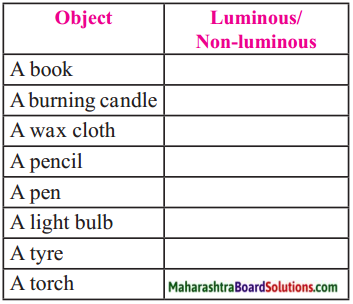
Maharashtra Board Class 11 Chemistry Important Questions Chapter 11 Adsorption and Colloids 3
All reactants and catalyst are in same solution phase.
[Note: Enzyme catalysis is also an important type of homogeneous catalysis.]

Question 21.
Justify: Lead chamber process is an example of homogeneous catalysis.
Answer:
i. In the lead chamber process, sulphur dioxide is oxidized to sulphur trioxide with dioxygen (O2) in the presence of nitric oxide as catalyst.
Maharashtra Board Class 11 Chemistry Important Questions Chapter 11 Adsorption and Colloids 4
ii. Since all the reactants as well as the catalyst is present in gaseous state. i.e., in same phase, it is a homogeneous catalysis reaction.
Hence, lead chamber process is an example of homogeneous catalysis.

Question 22.
Describe heterogeneous catalysis with the help of one example.
Answer:
i. When the reactants and catalyst are in different phase, it is said to be heterogeneous catalysis.
ii. The heterogeneous catalyst is generally a solid and the reactants may either be gases or liquids.
iii. When the solid catalyst is added to the reaction mixture, it does not dissolve in the reacting system and the reaction occurs on the surface of the solid catalyst.
e.g. Dinitrogen (N2) and dihydrogen (H2) combine to form ammonia in Haber process in the presence of finely divided iron along with K2O and Al2O3.
Maharashtra Board Class 11 Chemistry Important Questions Chapter 11 Adsorption and Colloids 5
b. In the above reaction, Al2O3 and K2O are promoters of the Fe catalyst. Al2O3 is added to prevent the fusion of Fe particles. K2O causes chemisorption of nitrogen atoms. Molybdenum is also used as promoter.
c. Since the reactants are present in gaseous phase while the catalyst used is in solid phase, it represents heterogeneous catalysis.

Question 23.
Maharashtra Board Class 11 Chemistry Important Questions Chapter 11 Adsorption and Colloids 6
i. State whether the given reaction is an example of heterogeneous or homogeneous catalysis.
ii. What is the role of Fe, K2O and Al2O3 in this reaction?
Answer:
i. This reaction is an example of heterogeneous catalysis.
ii. Fe is used as a catalyst while K2O and Al2O3 are promoters of the Fe catalyst. Al2O3 is used to prevent the fusion of Fe particles while K2O causes chemisorption of nitrogen atoms.

Maharashtra Board Class 11 Chemistry Important Questions Chapter 11 Adsorption and Colloids

Question 24.
Describe hydrogenation reaction of vegetable oils.
Answer:
i. Hydrogenation reaction of vegetable oils used in food industry to produce solid fats. The reaction is as follows:
Maharashtra Board Class 11 Chemistry Important Questions Chapter 11 Adsorption and Colloids 7
ii. The reaction is catalysed by finely divided metals like Ni, Pd or Pt.
iii. Vegetable oil contains one or more carbon-carbon double bonds (C = C) in its structure.
iv. On hydrogenation, a solid product (which contains only carbon-carbon single bonds) is formed. It is called Vanaspati ghee.
v. The hydrogenation reaction of vegetable oils is an example of heterogeneous catalysis as the reactant and the catalyst are not present in the same phase.

Question 25.
i. Explain the role of catalytic converters in automobile exhaust.
ii. Why do automobiles with catalytic converter require unleaded petrol?
Answer:
i. a. An important application of heterogeneous catalysts is in automobile catalytic converters.
b. In automobile exhaust, large number of air pollutants such as carbon monoxide, nitric oxide, etc. are present.
c. The catalytic converter transforms these air pollutants into carbon dioxide, water, nitrogen and oxygen.
ii. The catalyst used in the catalytic converter gets poisoned by the adsorption of lead (Pb) present in the petrol. Hence, the automobiles with catalytic converter requires unleaded petrol.

Question 26.
What are inhibitors? Explain with an example.
Answer:
Inhibitors are substances that decreases the rate of chemical reactions.
e.g. Chloroform forms poisonous substance, carbonyl chloride, by air oxidation.
Maharashtra Board Class 11 Chemistry Important Questions Chapter 11 Adsorption and Colloids 8
When 2% ethanol is added to chloroform, the formation of COCl2 is suppressed because ethanol acts as an inhibitor and retards the above reaction.
[Note: Chloroform was earlier used as an anaesthetic.]

Question 27.
Write decomposition reaction of hydrogen peroxide. Suggest how this decomposition can be prevented.
Answer:
i. Hydrogen peroxide decomposes as,
Maharashtra Board Class 11 Chemistry Important Questions Chapter 11 Adsorption and Colloids 9
ii. The reaction can be inhibited by addition of dilute acid or glycerol as they act as inhibitors.

Question 28.
Explain why 2% ethanol is added to chloroform?
Answer:
Inhibitors are substances that decreases the rate of chemical reactions.
e.g. Chloroform forms poisonous substance, carbonyl chloride, by air oxidation.
Maharashtra Board Class 11 Chemistry Important Questions Chapter 11 Adsorption and Colloids 10
When 2% ethanol is added to chloroform, the formation of COCl2 is suppressed because ethanol acts as an inhibitor and retards the above reaction.
[Note: Chloroform was earlier used as an anaesthetic.]

Maharashtra Board Class 11 Chemistry Important Questions Chapter 11 Adsorption and Colloids

Question 29.
Describe the steps involved in heterogeneous catalysis by solid catalyst.
OR
Explain the mechanism involved in catalytic action of a heterogeneous catalyst.
Answer:
The catalytic action of a heterogeneous catalyst occurs on the surface of a catalyst.
The mechanism involves the following five steps.
i. Diffusion of reactants towards the surface of the catalyst.
ii. Adsorption of reactant molecules on the surface of the catalyst.
iii. Occurrence of chemical reaction on the catalyst surface and formation of an intermediate.
iv. Formation of the products.
v. Desorption of reaction products from the catalyst surface. Products leave the catalyst surface in the following steps.
Steps involved in desorption of reaction products:
Diffusion → Adsorption → Intermediate formation → Product formation → Desorption
vi. Fresh reactant molecules can replace the products to start the cycle again as in first step.
vii. This is why catalyst remains unchanged in mass and chemical composition at the end of the reaction.

Question 30.
Write a short note on catalytic activity.
Answer:

  • The catalytic activity of a catalyst depends on the strength of chemisorption.
  • If large number of reactant molecules (gas or liquid) are strongly adsorbed on the surface of solid catalyst, the catalyst is said to be active.
  • However, the adsorption of reactant molecules on the surface, that is, the bond formed between adsorbate and adsorbent surface should not be very strong so that they are not immobilized.
  • d-block metals such as Fe, V and Cr tend to be strongly active towards O2, C2H2, C2H4, CO, H2, CO2, N2, etc.
  • Mn and Cu are unable to adsorb N2 and CO2.
  • The metals Mg and Li adsorb O2 selectively.

Question 31.
Explain catalytic selectivity with suitable examples.
Answer:
i. Some solid catalysts are selective in their action.
ii. The same gaseous reactants produce different products when different catalysts are used.
e.g.
a. The gaseous ethylene and O2 react to produce different products with different catalysts.
Maharashtra Board Class 11 Chemistry Important Questions Chapter 11 Adsorption and Colloids 11

b. The gaseous carbon monoxide and H2 produce different products by using different catalysts.
Maharashtra Board Class 11 Chemistry Important Questions Chapter 11 Adsorption and Colloids 12

Question 32.
i. What are zeolites?
ii. Zeolites are shape selective catalysts. Explain.
iii. What is the use of a zeolite catalyst ZSM-5 in petroleum industry?
Answer:
i. a. Zeolites are aluminosilicates with three-dimensional network of silicates.
b. Some silicon atoms in this network are replaced by aluminium atoms giving Al – O – Si framework which results in microporous structure.

ii. a. The reactions in zeolites are dependent on the size and shape of reactant or products, b. It also depends on the pores and cavities of zeolites.
b. Therefore, zeolites are shape selective catalysts.

iii. In petroleum industry, zeolite catalyst ZSM-5 converts alcohols directly to gasoline (petrol) by dehydration which gives a mixture of hydrocarbons.

Question 33.
State the importance of colloids in day-to-day life.
Answer:

  • Colloid chemistry is the chemistry of everyday life.
  • A number of substances we use in our day-to-day life are colloids. For example, milk, butter, jelly, whipped cream, mayonnaise.
  • Knowledge of colloid chemistry is essential for understanding about many useful materials like cement, bricks, pottery, porcelain, glass, enamels, oils, lacquers, rubber, celluloid and other plastics, leather, paper, textiles, filaments, crayons, inks, road construction material, etc.
  • In many daily processes like cooking, washing, dyeing, painting, ore floatation, water purification, sewage disposal, smoke prevention, photography, pharmacy, use of colloids is important.

Maharashtra Board Class 11 Chemistry Important Questions Chapter 11 Adsorption and Colloids

Question 34.
What are colloids? Explain.
Answer:
i. Colloids are heterogeneous mixtures.
ii. The component of colloid present in the largest proportion is called dispersion medium and the other components are called dispersed phase.
iii. The particles of the dispersed phase are larger than the size of a molecule and smaller than the particles which we can see with naked eye.
e.g.

  • Observe the formation of solution of salt and water. Salt dissolves completely in water and forms homogeneous system.
  • On the other hand, ground coffee or tea leaves with milk form suspension.
  • Between the two extremes of solution and suspension exists a large group of systems called colloidal dispersions or simply colloids.

Question 35.
State the differences between colloids and solutions.
Answer:
Colloids:

  1. Colloids contain particles of dispersed phase with diameters in the range of 2 to 500 nm.
  2. They are translucent to light.
  3. e.g. Milk, fog, etc.

Solutions:

  1. Solutions contain solute particles with diameters in the range of 0.1 to 2 nm.
  2. They are transparent or may be coloured.
  3. e.g. NaCl solution

Question 36.
Explain: Natural phenomena of colloids observed in daily life.
Answer:
Following are some examples of colloids observed in daily life.
i. Blue colour of the sky: The sky appears blue to us because minute dust particles along with minute water droplets dispersed in air scatter blue light which reaches our eyes.
ii. Blood: It is a colloidal dispersion of plasma proteins and antibodies in water arid at the same time blood is also a suspension of blood cells and platelets in water.
iii. Soils: Fertile soils are colloidal in nature where humus acts as a protective colloid. Soil adsorbs moisture and nourishing materials due to its colloidal nature.
iv. Fog, mist and rain:

  • Mist is caused by small droplets of water dispersed in air.
  • Fog is formed whenever there is temperature difference between ground and air.
  • A large portion of air containing dust particles gets cooled below its dew point, the moisture from the air condenses on the surface of these particles which form fine droplets, which are colloidal particles and float in the air as fog or mist.

Question 37.
State different ways to classify colloids.
Answer:
Colloids can be classified in three different ways:

  • Physical states of dispersed phase and dispersion medium
  • Interaction or affinity of phases
  • Molecular size

Question 38.
Name the types of colloids based on the physical states of dispersed phase and dispersion medium. Give two examples of each.
Answer:
There are eight types of colloids based on the physical states of dispersed phase and dispersion medium as given below.

Sr. No. Type of Colloids Examples
i. Solid sol (solid dispersed in solid) Coloured glasses, gemstones
ii. Sols and gels (solid in liquid) Gelatin, muddy water
iii. Aerosol (solid in gas) Smoke, dust
iv. Gel (liquid in solid) Cheese, jellies
v. Emulsion (liquid in liquid) Milk, hair cream
vi. Aerosol (liquid in gas) Fog, mist
vii. Solid sol (gas in solid) Foam rubber, plaster
viii. Foam (gas in liquid) Froth, soap lather

Maharashtra Board Class 11 Chemistry Important Questions Chapter 11 Adsorption and Colloids

Question 39.
Complete the following chart.
Maharashtra Board Class 11 Chemistry Important Questions Chapter 11 Adsorption and Colloids 13
Answer:
Maharashtra Board Class 11 Chemistry Important Questions Chapter 11 Adsorption and Colloids 14
[Note: Students can write any one example of the given type of colloids.]

Note: Types of colloids based on the physical states of dispersed phase and dispersion medium.
Maharashtra Board Class 11 Chemistry Important Questions Chapter 11 Adsorption and Colloids 15

Question 40.
Describe classification of colloids based on the interaction or affinity of phases.
Answer:
On the basis of interaction or affinity of phases, a colloidal solution is classified as lyophilic and lyophobic.
i. Lyophilic colloids:

  • A colloidal solution in which the particles of dispersed phase have a great affinity for the dispersion medium are lyophilic colloids.
  • If the lyophilic sol is evaporated, the dispersed phase separates. However, if it is remixed with the medium, the sol. can be formed again and hence, such sols are called reversible sols.
  • They are stable and difficult to coagulate.

ii. Lyophobic colloids:

  • Colloidal solution in which the particles of the dispersed phase have no affinity for the dispersion
    medium are called lyophobic colloids.
  • The common examples are Ag, Au, hydroxides like Al(OH)3, Fe(OH)3, metal sulphides.
  • Once precipitated or coagulated they have little tendency or no tendency to revert back to colloidal state.

[Note: Lyo means liquid and philic means loving whereas phobic means fearing and hence liquid hating. If water is the dispersion medium, the terms hydrophilic and hydrophobic are used.]

Question 41.
Give reason: Lyophilic sols are called reversible sols.
Answer:

  • When lyophilic sol is evaporated, the dispersed phase separates.
  • However, if the dispersed phase is remixed with the medium, the sol can be formed again.

Hence, lyophilic sols are called reversible sols.

Question 42.
How are colloids classified based on their molecular size?
Answer:
Colloids are classified into three types based on their molecular size as described below.
i. Multimolecular colloids:

  • In multimolecular colloids, the individual particles consist of an aggregate of atoms or small molecules with size less than 103 pm.
    e.g. Gold sol consists of particles of various sizes having several gold atoms.
  • Colloidal solution in which particles are held together with van der Waals force of attraction is called multimolecular colloid.
    e.g. S8 sulphur molecules

ii. Macromolecular colloids: In this type of colloids, the molecules of the dispersed phase are sufficiently large in size (macro) to be of colloidal dimensions.
e.g. Starch, cellulose, proteins, polythene, nylon, plastics.

iii. Associated colloids or micelles:

  • The substances behave as normal electrolytes at low concentration and associated in higher concentration forming a colloidal solution.
  • The associated particles are called micelles, e.g. Soaps and detergents

Maharashtra Board Class 11 Chemistry Important Questions Chapter 11 Adsorption and Colloids

Question 43.
How can be colloids prepared by chemical methods?
Answer:
i. Colloidal dispersions can be prepared by chemical reactions leading to formation of molecules by double decomposition, oxidation, reduction or hydrolysis.
ii. Molecules formed in these reactions are water-insoluble and thus, they aggregate leading to the formation of colloids.
e.g.
Maharashtra Board Class 11 Chemistry Important Questions Chapter 11 Adsorption and Colloids 16

Question 44.
Describe the process involved in peptization?
Answer:

  • During peptization a precipitate is converted into colloidal sol by shaking with dispersion medium in the presence of a small amount of an electrolyte. The electrolyte used is known as peptizing agent.
  • During the process, the precipitate adsorbs one of the ions of the electrolyte on its surface and as a result, positive or negative charge is developed on the precipitate which finally breaks up into small particles of colloidal size.

[Note: This method is generally applied to convert a freshly prepared precipitate into a colloidal sol.]

Question 45.
Why is it necessary to purify colloidal solutions?
Answer:

  • Colloidal solution generally contains excessive amount of electrolytes and some other soluble impurities.
  • A small quantity of an electrolyte is necessary for the stability of colloidal solution, however, a large quantity of electrolyte may result in coagulation.
  • It is also necessary to reduce soluble impurities.

Hence, it is necessary to purify colloidal solutions.

Question 46.
i. What is purification of colloidal solution?
ii. How can a colloidal solution be purified using the method of dialysis?
Answer:
i. The process used for reducing the amount of impurities to a requisite minimum is known as purification of colloidal solution.
Maharashtra Board Class 11 Chemistry Important Questions Chapter 11 Adsorption and Colloids 17

ii. a. Dialysis is a process of removing a dissolved substance from a colloidal solution by diffusion through a suitable membrane.
b. Purification of colloidal solution can be carried out using dialysis by the following method.

  • The apparatus used is dialyser.
  • A bag of suitable membrane containing the colloidal solution is suspended in a vessel through which fresh water is continuously flowing.
  • The molecules and ions diffuse through membrane into the outer water and pure colloidal solution is left behind.

Question 47.
What are the general properties exhibited by colloidal dispersions?
Answer:
General properties exhibited by colloidal dispersions:

  • Colloidal system is heterogeneous and consists of two phases, dispersed phase and dispersion medium.
  • The dispersed phase particles pass slowly through parchment paper or animal membrane, but readily pass through ordinary filter paper.
  • Colloidal particles are usually not detectable by powerful microscope.

Maharashtra Board Class 11 Chemistry Important Questions Chapter 11 Adsorption and Colloids

Question 48.
Discuss the factors that influence the colour of colloidal solutions.
Answer:

  • Colour of colloidal solution depends on the wavelength of light scattered by dispersed particles.
  • The colour of colloidal dispersion also changes with the manner in which the observer receives the light.
    e.g. Mixture of a few drops of milk and large amount of water appears blue when viewed by the scattered light and red when viewed by transmitted light.
  • It also depends on size of colloidal particles.
    e.g. Finest gold sol is red in colour whereas with increase in size it appears purple.

Question 49.
Give three examples each:
i. Positively charged sols
ii. Negatively charged sols
Answer:
i. Positively charged sols: Al2O3. xH2O, haemoglobin, TiO2 sol
ii. Negatively charged sols: Au sols, Congo red sol, clay

Note: Some common sols with the nature of charge on the particles are listed in the table below.

Positively charged sols Negatively charged sols
Hydrated metallic oxides: Al2O3.xH2O, CrO3.xH2O, Fe2O3.xH2O. Metals: Cu, Ag. Au sols

Metallic sulphides: As2S3, Sb2S3, CdS

Basic dye stuff, methylene blue sols Acid dye stuff, eosin, Congo red sol
Haemoglobin (blood) Sols of starch, gum
Oxides: TiO2 sol Gelatin, clay, gum sols

Question 50.
Explain the term electroosmosis.
Answer:

  • Movement of dispersed particles can be prevented by suitable means such as use of membrane.
  • On doing so, it is observed that the dispersion medium begins to move in an electric field. This is known as electroosmosis.

Question 51.
What is coagulation?
Answer:
The precipitation of colloids by removal of charge associated with colloidal particles is called coagulation.

Question 52.
How can we bring about precipitation of lyophobic colloids?
Answer:

  • The charge on the colloidal particles is due to the preferential adsorption of ions on their surface.
  • Hence, lyophobic colloids can be precipitated out by removing the charge on the colloidal particles (dispersed phase).

Maharashtra Board Class 11 Chemistry Important Questions Chapter 11 Adsorption and Colloids

Question 53.
Discuss various methods that are used to bring about coagulation of lyophobic sols.
Answer:
Coagulation of the lyophobic sols can be carried out in the following ways.

  • By electrophoresis: The colloidal particles move towards oppositely charged electrodes, get discharged and precipitate.
  • By mixing two oppositely charged sols: Oppositely charged sols when mixed in almost equal proportions neutralize their charges and get precipitated.
    e. g. Mixing of hydrated ferric oxide (positive sol) and arsenious sulphide (negative sol) brings them in the precipitated forms. This type of coagulation is called mutual coagulation.
  • By boiling: When a sol is boiled, the adsorbed layer is disturbed as a result of increased collisions with molecules in the dispersion medium. This reduces charge on the particles and subsequently particles settle down as a precipitate.
  • By persistent dialysis: On prolonged dialysis, traces of the electrolyte present in the sol are removed almost completely. The colloids then become unstable and finally precipitate.
  • By addition of electrolytes: When excess of an electrolyte is added, the colloidal particles are precipitated.

Question 54.
Write Hardy-Schulze rule.
Answer:
Generally, greater the valency of the flocculating ion added, greater is its power to cause precipitation. This is known as Hardy-Schulze rule.

Question 55.
Differentiate between oil in water and water in oil emulsions.
Answer:
Oil in water:

  1. Oil is the dispersed phase and water is the dispersion medium.
  2. If water is added, it will be miscible with the emulsion.
  3. Addition of small amount of an electrolyte makes the emulsion conducting.
  4. Continuous phase is water.
  5. Basic metal sulphates, water soluble alkali metal soaps are used as emulsifiers.

Water in oil:

  1. Water is the dispersed phase and oil is the dispersion medium.
  2. If oil is added, it will be miscible with the emulsion.
  3. Addition of small amount of an electrolyte has no effect on conducting power.
  4. Continuous phase is oil.
  5. Water insoluble soaps such as those of Zn, Al, Fe, alkaline earth metals are used as emulsifiers.

Question 56.
What are the properties of emulsion?
Answer:
Properties of emulsion:

  • Emulsion can be diluted with any amount of the dispersion medium. On the other hand, the dispersed liquid when mixed forms a separate layer.
  • The droplets in emulsions are often negatively charged and can be precipitated by electrolytes.
  • Emulsions show Brownian movement and Tyndall effect.
  • The two liquids in emulsions can be separated by heating, freezing, centrifuging, etc.

Question 57.
Give applications of colloids.
Answer:
Applications of colloids:
i. Electrical precipitation of smoke:

  • Smoke is a colloidal solution of solid particles of carbon, arsenic compound, dust, etc. in the air.
  • When smoke is allowed to pass through chamber containing charged plates, smoke particles lose their charge and get precipitated. The particles then settle down on the floor of the chamber.
  • The precipitator used is called Cottrell precipitator.

ii. Purification of drinking water:

  • Water obtained from natural sources contains colloidal impurities.
  • By addition of alum to such water, colloidal impurities get coagulated and settle down. This makes water potable.

iii. Medicines:

  • Usually medicines are colloidal in nature.
  • Colloidal medicines are more effective owing to large surface area to volume ratio of a colloidal particle and easy assimilation.
    e.g. Argyrol is a silver sol used as an eye lotion. Milk of magnesia, an emulsion is used in stomach disorders.

iv. Rubber industry: Rubber is obtained by coagulation of latex.
v. Cleansing action of soaps and detergents.
vi. Photographic plates, films, and industrial products like paints, inks, synthetic plastics, rubber, graphite lubricants, cement, etc. are colloids.

Maharashtra Board Class 11 Chemistry Important Questions Chapter 11 Adsorption and Colloids

Question 58.
Match column A with column B.

Column A Column B
i. Tyndall effect i. Kinetic property
ii. Electrophoresis ii. Argyrol
iii. Silver sol iii. Optical property
iv. Brownian motion iv. Coagulation

Answer:
i – c,
ii – d,
iii – b,
iv – a

Question 59.
In drinking water treatment, often alum is added for the complete removal of suspended impurities. On complete dissolution, alum produces positive charge which neutralizes the charge on the suspended particles and thus, impurities are easily removed.
i. Name and define the process involved due to which charge on particles get neutralized.
ii. What is the role of alum in the above mentioned process?
Answer:
i. a. Charge on particles get neutralized due to coagulation.
b. The precipitation of colloids by removal of charge associated with colloidal particles is called coagulation.
ii. Alum acts as a reagent that helps in coagulation of the suspended particles by the removal of the charge associated with these particles.

Multiple Choice Questions

1. Which of the following is responsible for adsorption phenomenon?
(A) Hydrogen bonding
(R) Dipole-dipole forces
(C) Ion-dipole forces
(D) Dispersion forces
Answer:
(D) Dispersion forces

2. A substance which adsorbs another substance on its surface is called ……………..
(A) adsorbate
(B) absorbate
(C) adsorbent
(D) absorbent
Answer:
(C) adsorbent

3. During adsorption, the molecules of the substance which gets adsorbed are termed as
(A) adsorbent
(B) adsorbate
(C) absorbent
(D) absorbate
Answer:
(B) adsorbate

Maharashtra Board Class 11 Chemistry Important Questions Chapter 11 Adsorption and Colloids

4. in adsorption of acetic acid on charcoal, acetic acid is ……………
(A) adsorhate
(B) adsorbent
(C) absorbent
(D) absorbate
Answer:
(A) adsorhate

5. The process of removal of an adsorbed substance from the surface is known as
(A) sorption
(B) oxidation
(C) reduction
(D) desorption
Answer:
(D) desorption

6. ………….. is the process in which adsorbate molecules are held on the surface of the adsorbent by weak van der Waals forces.
(A) Chemisorption
(B) Absorption
(C) Physisorption
(D) Biosorption
Answer:
(C) Physisorption

7. Which of the following is an example of physical adsorption?
(A) Adsorption of acetic acid in solution by charcoal
(B) Adsorption of O2 on tungsten
(C) Adsorption of N2 on Fe
(D) Adsorption of H2 on Ni
Answer:
(A) Adsorption of acetic acid in solution by charcoal

8. Chemisorption is a slow process because …………….
(A) it forms multimolecular layer
(B) it is reversible
(C) it takes place at normal temperature
(D) it requires high activation energy
Answer:
(D) it requires high activation energy

9. The number of layer(s) formed on adsorbent in chemical adsorption is …………….
(A) one
(B) two
(C) three
(D) many
Answer:
(A) one

Maharashtra Board Class 11 Chemistry Important Questions Chapter 11 Adsorption and Colloids

10. Which of the following statements is CORRECT regarding chemical adsorption?
(A) It is highly specific in nature.
(B) It is relatively strong.
(C) It involves the formation of monolayer of adsorbed particles.
(D) All of these.
Answer:
(D) All of these.

11. Which of the following is adsorbed to maximum extent on charcoal?
(A) H2
(B) N2
(C) Cl2
(D) O2
Answer:
(C) Cl2

12. The relation between the amount of substance adsorbed by an adsorbent and the equilibrium pressure or …………. at any constant temperature is called adsorption isotherm.
(A) surface area
(B) volume
(C) circumference
(D) concentration
Answer:
(D) concentration

13. For equilibrium pressure (P), the mass of gas adsorbed (x) and mass of adsorbent (m) may be expressed as Freundlich adsorption isotherm as ……………
Maharashtra Board Class 11 Chemistry Important Questions Chapter 11 Adsorption and Colloids 18
Answer:
(B) \(\frac{\mathrm{x}}{\mathrm{m}}=\mathrm{kP}^{\frac{1}{\mathrm{n}}}\)

14. When log x/m is plotted against log P, the intercept obtained …………..
(A) on Y axis is equal to log K
(B) on Y axis is equal to K
(C) on X axis is equal to log K
(D) on X axis is equal to K
Answer:
(A) on Y axis is equal to log K

15. The adsorption isotherm tends to saturate at ………….. pressure.
(A) low
(B) moderate
(C) all of these
(D) high
Answer:
(D) high

Maharashtra Board Class 11 Chemistry Important Questions Chapter 11 Adsorption and Colloids

16. In Haber process for manufacture of NH3, the catalyst used is ……………
(A) iron
(B) copper
(C) vanadium pentoxide
(D) nickel
Answer:
(A) iron

17. A substance that decreases the rate of a chemical reaction is called ……………
(A) inhibitor
(B) prohibitor
(C) promoter
(D) reactor
Answer:
(A) inhibitor

18. Whether a given mixture forms a true solution or a colloidal dispersion depends on the …………….
(A) charge of solute particles
(B) size of solvent particles
(C) size of solute particles
(D) charge of solvent particles
Answer:
(C) size of solute particles

19. An aerosol is a dispersion of a ……………
(A) gas in a solid
(B) liquid in a gas
(C) solid in a gas
(D) both (B) and (C)
Answer:
(D) both (B) and (C)

20. The dispersed phase in Pumice stone is ……………
(A) solid
(B) liquid
(C) gas
(D) none of these
Answer:
(C) gas

21. Colloidal solution in which the dispersed phase has little affinity for the dispersion medium is called ………………
(A) lyophobic colloids
(B) lyophilic colloids
(C) hydrophilic colloids
(D) emulsions
Answer:
(A) lyophobic colloids

Maharashtra Board Class 11 Chemistry Important Questions Chapter 11 Adsorption and Colloids

22. Which of the following is NOT an example of macromolecular colloid?
(A) Starch
(B) Proteins
(C) S8 molecules
(D) Nylon
Answer:
(C) S8 molecules

23. Tyndall effect is useful ……………….
(A) to identify colloidal dispersions
(B) to count number of particles in colloidal dispersion.
(C) to determine the size of the colloidal particles
(D) all of these
Answer:
(D) all of these

24. Brownian movement is a ……………… type of property of the colloidal sol.
(A) electrical
(B) optical
(C) kinetic
(D) colligative
Answer:
(C) kinetic

25. The migration of colloidal particles under the influence of an electric field is called …………….
(A) catalysis
(B) Brownian movement
(C) electrophoresis
(D) Tyndall effect
Answer:
(C) electrophoresis

26. The capacity of an ion to coagulate a colloidal solution depends on ……………….
(A) its shape
(B) its valency
(C) the sign of charge
(D) both (B) and (C)
Answer:
(D) both (B) and (C)

Maharashtra Board Class 11 Chemistry Important Questions Chapter 11 Adsorption and Colloids

27. ……………… is an example of water in oil type of emulsion.
(A) Milk
(B) Cod liver oil
(C) Vanishing cream
(D) Paint
Answer:
(B) Cod liver oil

28. Which of the following has highest precipitation power to precipitate negative sol?
(A) Al3+
(B) Mg2+
(C) Na+
(D) K+
Answer:
(A) Al3+

Maharashtra Board Class 11 Chemistry Important Questions Chapter 12 Chemical Equilibrium

Balbharti Maharashtra State Board 11th Chemistry Important Questions Chapter 12 Chemical Equilibrium Important Questions and Answers.

Maharashtra State Board 11th Chemistry Important Questions Chapter 12 Chemical Equilibrium

Question 1.
Explain irreversible reaction.
Answer:
Irreversible reaction:
i. Reactions which occur only in one direction, namely, from reactant to products are called irreversible reactions.
ii. They proceed in only a single direction until one of the reactants is exhausted.
iii. The direction in which an irreversible reaction occurs is indicated by an arrow (→) pointing towards the products in the chemical equation.
e.g. a. \(\mathrm{C}_{(\mathrm{s})}+\mathrm{O}_{2(\mathrm{~g})} \stackrel{\text { Burn }}{\longrightarrow} \mathrm{CO}_{2(\mathrm{~g})}\)
b. \(2 \mathrm{KClO}_{3(\mathrm{~s})} \stackrel{\Delta}{\longrightarrow} 2 \mathrm{KCl}_{(\mathrm{s})}+3 \mathrm{O}_{2(\mathrm{~g})}\)

Question 2.
What is a closed system?
Answer:
A system in which there is no exchange of matter with the surroundings is called a closed system.

Question 3.
What is an open system?
Answer:
A system in which exchange of both matter and heat occurs with the surroundings is called an open system.

Question 4.
Why was calcium oxide used in theatre lighting?
Answer:
Calcium oxide (CaO) on strong heating glows with a bright white light. Hence, CaO was used in theatre lighting, which gave rise to the phrase ‘in the limelight’.

Maharashtra Board Class 11 Chemistry Important Questions Chapter 12 Chemical Equilibrium

Question 5.
Explain liquid-vapour equilibrium with an example.
Answer:
Liquid-vapour equilibrium:
i. Consider reversible physical process of evaporation of liquid water into water vapour in a closed vessel. Initially, there is practically no water vapour in the vessel.

ii. When the liquid evaporates in the closed container, the liquid molecules escape from the liquid surface into vapour phase building up vapour pressure. They also condense back into liquid state because the container is closed.

iii. In the beginning the rate of evaporation is high and the rate of condensation is low. But with time, as more and more vapour is formed, the rate of evaporation goes down and the rate of condensation increases. Eventually the two rates become equal. This gives rise to a constant vapour pressure. This state is known as an ‘equilibrium state’.
In this state, the rate of evaporation is equal to the rate of condensation.
It may be represented as: H2O(l) ⇌ H2O(Vapour)

iv. At equilibrium, the pressure exerted by the gaseous water molecules at a given temperature remains constant, known as the equilibrium vapour pressure of water (or saturated vapour pressure of water or aqueous tension). The saturated vapour pressure increases with increase of temperature.
Maharashtra Board Class 11 Chemistry Important Questions Chapter 12 Chemical Equilibrium 1
[Note: The saturated vapour pressure of water at 100 °C is 1 atm (1.013 bar). Hence, water boils at 100 °C when pressure is 1 atm.]

Question 6.
What is meant by the term ‘normal boiling point’ of a liquid?
Answer:
For any pure liquid at 1 atm pressure, the temperature at which its saturated vapour pressure equals to atmospheric pressure is called the normal boiling point of that liquid.
e.g. The boiling point of ethyl alcohol is 78 °C i.e., the saturated vapour pressure of ethyl alcohol at 78 °C is 1 atm (1.013 bar).

Question 7.
Give an example of solid-liquid equilibrium.
Answer:
A mixture of ice and water in a perfectly insulated thermos flask at 273 K is an example of solid-liquid equilibrium.
H2O(s) ⇌ H2O(l)

Question 8.
Identify the type of equilibrium in the following physical processes:
i. Camphor(s) ⇌ Camphor(g)
ii. Ammonium chloride(s) ⇌ Ammonium chloride(g)
iii. Carbon dioxide gas ⇌ Dry ice
iv. Water ⇌ Ice
Answer:
i. Solid – vapour equilibrium
ii. Solid – vapour equilibrium Solid
iii. Solid – vapour equilibrium
iv. Solid – liquid equilibrium

Maharashtra Board Class 11 Chemistry Important Questions Chapter 12 Chemical Equilibrium

Question 9.
Name two substances that undergoes sublimation.
Answer:
Camphor, ammonium chloride.

Question 10.
Write a short note on chemical equilibrium.
Answer:
Chemical equilibrium:

  • If a reaction takes place in a closed system so that the products and reactants cannot escape, we often find that reaction does not give a 100% yield of products. Instead some reactants remain after the concentrations stop changing.
  • When there is no further change in concentration of reactant and product, the chemical reaction has attained equilibrium, with the rates of forward and reverse reactions being equal.
  • Chemical equilibrium at a given temperature is characterized by constancy of measurable properties such as pressure, concentration, density, etc.
  • Chemical equilibrium can be approached from either side of the chemical reaction.

Question 11.
Explain the law of mass action and give its mathematical representation.
Answer:
Statement: The law of mass action states that the rate of a chemical reaction at each instant is proportional to the product of concentrations of all the reactants.
Explanation: A rate equation can be written for a reaction by applying the law of mass action as follows: Consider a reaction, A + B → C
Here A and B are the reactants and C is the product. The concentrations of chemical species are expressed in mol L-1 and denoted by putting the formula in square brackets. On applying the law of mass action to this
reaction, a proportionality expression can be written as: Rate ∝ [A] [B]
This proportionality expression is transformed into an equation by introducing a proportionality constant, k, as follows:
Rate = k [A] [B]
This equation is called the rate equation and the proportionality constant, k, is called the rate constant of the reaction.

Question 12.
Write the rate equation for the following reactions:
i. C + O2 → CO2
ii. 2KClO3 → 2KCl + 3O2
Answer:
The rate equation is written by applying the law of mass action.
i. The reactants are C and O2
Rate ∝ [C] [O2]
∴ Rate = k [C] [O2]
ii. The reactant is KClO3 and its 2 molecules appear in the balanced equation.
∴ Rate ∝ [KClO3]2
∴ Rate = k [KClO3]2

Maharashtra Board Class 11 Chemistry Important Questions Chapter 12 Chemical Equilibrium

Question 13.
Derive the expression of equilibrium constant, KC for the reaction:
A + B ⇌ C + D
Answer:
Consider a hypothetical reversible reaction A + B ⇌ C + D.
Two reactions, namely, forward and reverse reactions occur simultaneously in a reversible chemical reaction. The rate equations for the forward and reverse reactions are:
Rateforward ∝ [A][B]
∴ Rateforward = kf [A] [B] …… (1)
∴ Ratereverse ∝ [C] [D]
∴ Ratereverse = kr [C] [D] …. (2)
At equilibrium, the rates of forward and reverse reactions are equal. Thus,
Rateforward = Ratereverse
∴ kf [A] [B] = kr [C] [D]
∴ \(\frac{\mathrm{k}_{\mathrm{f}}}{\mathrm{k}_{\mathrm{r}}}=\mathrm{K}_{\mathrm{C}}=\frac{[\mathrm{C}][\mathrm{D}]}{[\mathrm{A}][\mathrm{B}]}\) …….. (3)
KC is called the equilibrium constant.

Question 14.
Show that the equilibrium constant of the reverse chemical reaction (KC) is the reciprocal of the equilibrium constant (KC).
Answer:
Consider a reversible chemical reaction:
aA + bB ⇌ cC + dD
The equilibrium constant, KC = \(\frac{[C]^{c}[D]^{d}}{[A]^{a}[B]^{b}}\)
Consider the reverse reaction:
cC + dD ⇌ aA + bB.
The equilibrium constant, KC is:
KC = \(\frac{[\mathrm{A}]^{a}[\mathrm{~B}]^{\mathrm{b}}}{[\mathrm{C}]^{\mathrm{c}}[\mathrm{D}]^{\mathrm{d}}}=\frac{1}{\mathrm{~K}_{\mathrm{C}}}\)
Thus, equilibrium constant of the reverse chemical reaction (KC) is the reciprocal of the equilibrium constant KC.

Question 15.
Write equilibrium constant expressions for both forward and reverse reaction for the synthesis of ammonia by the Haber process.
Answer:
Synthesis of ammonia by Haber process:
N2(g) + 3H2(g) ⇌ 2NH3(g)
Maharashtra Board Class 11 Chemistry Important Questions Chapter 12 Chemical Equilibrium 2

Question 16.
How are the equilibrium constants of the following pair of equilibrium reactions related?
Maharashtra Board Class 11 Chemistry Important Questions Chapter 12 Chemical Equilibrium 3
Answer:
Maharashtra Board Class 11 Chemistry Important Questions Chapter 12 Chemical Equilibrium 4
ii. KC = \(\frac{\left[\mathrm{CO}_{2}\right]\left[\mathrm{N}_{2}\right]}{[\mathrm{CO}]\left[\mathrm{N}_{2} \mathrm{O}\right]}\)

Question 17.
Write KP expression for the reaction:
aA(g) + bB(g) ⇌ cC(g) + dD(g)
Answer:
For the given reaction,
KP = \(\frac{\left(P_{c}\right)^{c}\left(P_{D}\right)^{d}}{\left(P_{A}\right)^{a}\left(P_{B}\right)^{b}}\)

Question 18.
N2(g) + 3H2(g) ⇌ 2NH3(g)
Write expressions for KP and substitute expressions for PN2, PH2 and PNH3 using ideal gas equation.
Answer:
For the given reaction, KP = \(\frac{\left(P_{N H_{3}}\right)^{2}}{\left(P_{N_{2}}\right)\left(P_{H_{2}}\right)^{3}}\)
Maharashtra Board Class 11 Chemistry Important Questions Chapter 12 Chemical Equilibrium 5
[Note: The above question is modified to apply appropriate textual context, i. e., to indicate that students need to use ideal gas equation to derive expressions for PN2, PH2 and PNH3]

Maharashtra Board Class 11 Chemistry Important Questions Chapter 12 Chemical Equilibrium

Question 19.
For a chemical equilibrium reaction
H2(g) + I2(g) ⇌ 2HI(g),
write an expression for KP (and relate it to KC).
Answer:
Maharashtra Board Class 11 Chemistry Important Questions Chapter 12 Chemical Equilibrium 6

Question 20.
Write the relationship between KC and KP for the following equilibria:
Maharashtra Board Class 11 Chemistry Important Questions Chapter 12 Chemical Equilibrium 7
Answer:
Maharashtra Board Class 11 Chemistry Important Questions Chapter 12 Chemical Equilibrium 8
Maharashtra Board Class 11 Chemistry Important Questions Chapter 12 Chemical Equilibrium 9

Question 21.
Write the expressions for KC and KP and the relationship between them for the equilibrium reaction,
2A(g) + B(g) ⇌ 3C(g) + 2D(g)
Answer:
Maharashtra Board Class 11 Chemistry Important Questions Chapter 12 Chemical Equilibrium 10

Question 22.
Explain in short homogeneous equilibrium and heterogeneous equilibrium.
Answer:
i. In a homogeneous equilibrium, the reactants and products are in the same phase.
e.g. Dissociation of HI:
2HI(g) ⇌ H2(g) + I2(g)
ii. In a heterogeneous equilibrium, the reactants and products exist in different phases, e.g. Formation of NH4Cl:
NH3(g) + HCl(g) ⇌ NH4Cl(s)

Maharashtra Board Class 11 Chemistry Important Questions Chapter 12 Chemical Equilibrium

Question 23.
The unit of KC is different for different reactions. Explain this statement with suitable examples.
Answer:
Unit of equilibrium constant:
i. The unit of equilibrium constant depends upon the expression of KC which is different for different equilibria. Therefore, the unit of KC is also different for different reactions.
ii. Consider the following equilibrium reaction:
Maharashtra Board Class 11 Chemistry Important Questions Chapter 12 Chemical Equilibrium 11

iii. Consider the following equilibrium reaction:
Maharashtra Board Class 11 Chemistry Important Questions Chapter 12 Chemical Equilibrium 12

Question 24.
Write the equilibrium constant expression for the decomposition of baking soda. Deduce the unit of KC from the above expression.
Answer:
Maharashtra Board Class 11 Chemistry Important Questions Chapter 12 Chemical Equilibrium 13

[Note: Considering gaseous reactants and products, in this reaction, Δn = 2 – 0 = 2
∴ Units of KC = (mol dm-3)Δn
= (mol dm-3)2
= mol2 dm-6
Thus, the units of the above reaction is mol2 dm-6.]

Question 25.
What are the characteristics of equilibrium constant?
Answer:
Characteristics of equilibrium constant:

  • The value of equilibrium constant is independent of initial concentrations of either the reactants or products.
  • Equilibrium constant is temperature dependent. Hence, KC and KP change with change in temperature.
  • Equilibrium constant has a characteristic value for a particular reversible reaction represented by a balanced equation at a given temperature.
  • Higher value of KC or KP means more concentration of products is formed and the equilibrium point is more towards right hand side and vice versa.

Question 26.
Explain how equilibrium constant helps in predicting the direction of the reaction.
Answer:
Prediction of the direction of the reaction:
i. For the reaction, aA + bB ⇌ cC + dD,
The equilibrium constant (KC) is given as:
KC = \(\frac{[C]^{c}[D]^{d}}{[A]^{a}[B]^{b}}\)
where, all the concentrations are equilibrium concentrations.
ii. When the reaction is not necessarily at equilibrium, the concentration ratio is called QC i.e.,
QC = \(\frac{[C]^{c}[D]^{d}}{[A]^{a}[B]^{b}}\)
iii. By comparing QC with KC for a reaction under given conditions, we can decide whether the forward or the reverse reaction should occur to establish the equilibrium.
a. QC < KC: The reaction will proceed from left to right, in forward direction, generating more product to attain the equilibrium.
b. QC > KC: The reaction will proceed from right to left, removing product to attain the equilibrium.
c. QC = KC: The reaction is at equilibrium and no net reaction occurs.
Maharashtra Board Class 11 Chemistry Important Questions Chapter 12 Chemical Equilibrium 14
[Note: The prediction of the direction of the reaction on the basis of QC and KC values makes no comment on the time required for attaining the equilibrium.]

Maharashtra Board Class 11 Chemistry Important Questions Chapter 12 Chemical Equilibrium

Question 27.
Explain how KC can be used to know the extent of the reaction?
Answer:
Extent of the reaction: The equilibrium constant expression indicates that the magnitude of KC is:
i. directly proportional to the concentrations of the products.
ii. inversely proportional to the concentrations of the reactants.
a. Value of KC is very high (KC > 103):
At equilibrium, there is a high proportion of products compared to reactants.
Forward reaction is favoured.
Reaction is in favour of products and nearly goes to completion.

b. Value of KC is very low (KC < 10-3):
At equilibrium, only a small fraction of the reactants is converted into products.
Reverse reaction is favoured.
Reaction hardly proceeds towards the products.

c. Value of KC is in the range of 10-3 to 103:
Appreciable concentrations of both reactants and products are present at equilibrium.
Maharashtra Board Class 11 Chemistry Important Questions Chapter 12 Chemical Equilibrium 15

Question 28.
For the following reactions, write KC expressions and predict direction of the reactions based on the magnitude of their equilibrium constants.
i. 2H2(g) + O2(g) ⇌ 2H2O(g), KC = 2.4 × 1047 at 500 K
ii. 2H2O(g) ⇌ 2H2(g) + O2(g), KC = 4.2 × 10-48 at 500 K
Answer:
i. a. KC expression:
KC = \(\frac{\left[\mathrm{H}_{2} \mathrm{O}_{(\mathrm{g})}\right]^{2}}{\left[\left[\mathrm{H}_{2(\mathrm{~g})}\right]\right]^{2}\left[\mathrm{O}_{2(\mathrm{~g})}\right]}\)
b. For the reaction, KC = 2.4 × 1047 at 500 K
If the value of KC >>> 103, forward reaction is favoured.
Hence, the given reaction will proceed in the forward direction and will nearly go to completion.

ii. a. KC expression:
KC = \(\frac{\left[\mathrm{H}_{2(\mathrm{~g})}\right]^{2}\left[\mathrm{O}_{2(\mathrm{~g})}\right]}{\left[\mathrm{H}_{2} \mathrm{O}_{(\mathrm{g})}\right]^{2}}\)
b. For the reaction, KC = 4.2 × 10-48 at 500 K
If the value of KC <<< 10-3, reverse reaction is favoured.
Hence, the given reaction will proceed in the backward direction and will nearly go to completion.

Question 29.
Describe how equilibrium constant can be used to calculate the composition of an equilibrium mixture.
Answer:
An equilibrium constant can be used to calculate the composition of an equilibrium mixture.
Consider an equilibrium reaction, A(aq) + B(aq) ⇌ C(aq) + D(aq)
The equilibrium constant is 4.0 at a certain temperature.
Let the initial amount of A and B be 2.0 mol in ‘V’ litres. Let x mol be the equilibrium amount of C.
Hence, we can construct a table as shown below:
Maharashtra Board Class 11 Chemistry Important Questions Chapter 12 Chemical Equilibrium 16
The expression for equilibrium constant can be written as:
Maharashtra Board Class 11 Chemistry Important Questions Chapter 12 Chemical Equilibrium 17
Substituting the value of equilibrium concentration, we get
Maharashtra Board Class 11 Chemistry Important Questions Chapter 12 Chemical Equilibrium 18
Therefore, equilibrium concentrations are 0.67 mol of A, 0.67 mol of B, 1.33 mol of C and 1.33 mol of D in V litres.

Question 30.
Explain the link between chemical equilibrium and chemical kinetics:
Answer:
Equilibrium constant (KC) is related to rate or velocity constants of forward reaction (kf) and reverse reaction (kr) as:
KC = \(\frac{\mathrm{k}_{\mathrm{f}}}{\mathrm{k}_{\mathrm{r}}}\)
This equation can be used to determine the composition of the reaction mixture
Maharashtra Board Class 11 Chemistry Important Questions Chapter 12 Chemical Equilibrium 19
[Note: The equilibrium refers to the relative amounts of reactants and products and thus a shift in equilibrium in a particular direction will imply the reaction in that direction will be favoured.]

Maharashtra Board Class 11 Chemistry Important Questions Chapter 12 Chemical Equilibrium

Question 31.
Equal concentrations of hydrogen and iodine are mixed together in a closed container at 700 K and allowed to come to equilibrium. If the concentration of HI at equilibrium is 0.85 mol dm-3, what are the equilibrium concentrations of H2 and I2 if KC = 54 at this temperature?
Solution:
Given: [HI(g)] = 0.85 mol dm-3
KC = 54 at 700 K
Equilibrium concentrations of H2 and I2
Formula: KC = \(\frac{[\mathrm{C}]^{\mathrm{c}}[\mathrm{D}]^{\mathrm{d}}}{[\mathrm{A}]^{\mathrm{a}}[\mathrm{B}]^{\mathrm{b}}}\)
Balanced chemical reaction: 2HI(g)
Maharashtra Board Class 11 Chemistry Important Questions Chapter 12 Chemical Equilibrium 20
Equilibrium concentration of I2(g) = Equilibrium concentration of H2(g)
Maharashtra Board Class 11 Chemistry Important Questions Chapter 12 Chemical Equilibrium 21
Ans: Equilibrium concentrations of H2 and I2 are equal to 0.12 mol dm-3.

Question 32.
Calculate Kc at 500 K for the reaction,
2HI(g) ⇌ H2(g) + I2(g) if the equilibrium concentrations are [HI] = 0.5 M, [H2] = 0.08 M and [I2] = 0.062 M.
Solution:
Given: T = 500 K,
At equilibrium, [HI] = 0.5 M, [H2] = 0.08 M, [I2] = 0.062 M.
To find: Equilibrium constant KC
Formula: KC = \(\frac{[C]^{c}[D]^{d}}{[A]^{a}[B]^{b}}\)
Calculation: The above equilibrium reaction is given as 2HI(g) ⇌ H2(g) + I2(g)
The expression of KC is
Maharashtra Board Class 11 Chemistry Important Questions Chapter 12 Chemical Equilibrium 22
Ans: KC at 500 K for the given reaction is 0.0198.

Question 33.
Calculate KC and KP for the reaction at 295 K, N2O4 ⇌ 2NO2(g) if the equilibrium concentrations are [N2O4] = 0.75 M and [NO2] = 0.062 M, R = 0.08206 L atm K-1 mol-1.
Solution:
Given: R = 0.08206 L atm K-1 mol-1, T = 295 K
At equilibrium , [N2O4] = 0.75 M, [NO2] = 0.062 M
To find: Equilibrium constants, KP and KC
Formulae: i. KC = \(\frac{[\mathrm{C}]^{\mathrm{c}}[\mathrm{D}]^{\mathrm{d}}}{[\mathrm{A}]^{\mathrm{a}}[\mathrm{B}]^{\mathrm{b}}}\)
ii. KP = KC (RT)Δn
Calculation : The equilibrium reaction is given as N2O4(g) ⇌ 2NO2(g)
The expression of KC is
Maharashtra Board Class 11 Chemistry Important Questions Chapter 12 Chemical Equilibrium 23
KP is related to KC by expression: KP = KC (RT)Δn
where, Δn = numbers of moles of gaseous products – number of moles of gaseous reactants
= 2 – 1 = 1
∴ KP = KC(RT)1
∴ KP = 5.13 × 10-3 × 0.08206 × 295
∴ KP= 123.9 × 10-3 = 0.124
Ans: KC and KP for the reaction at 295 K are 5.13 × 10⁻³ and 0.124 respectively.

Question 34.
The equilibrium constant KC for the reaction of hydrogen with iodine is 54.0 at 700 K.
Maharashtra Board Class 11 Chemistry Important Questions Chapter 12 Chemical Equilibrium 24
KC = 54.0 at 700 K
If kf is the rate constant for the formation of HI and kr is the rate constant for the decomposition of HI, deduce whether kr is larger or smaller than kr.
ii. If the value of kr at 700 K is 1.16 × 10⁻³, what is the value of kf ?
Solution:
Given: i. KC = 54.0 at 700 K
ii. kr = 1.16 × 10⁻³ at 700 K
To find: i. Whether kf is larger or smaller than kr.
ii. Value of kf.
Maharashtra Board Class 11 Chemistry Important Questions Chapter 12 Chemical Equilibrium 25

Question 35.
Given the equilibrium reaction, H2O(g) + CH4(g) ⇌ CO(g) + 3H2(g)
Using Le Chatelier’s principle, predict how concentration of CO will change when the equilibrium is disturbed by
i. adding CH4
ii. adding H2
iii. removing H2O
iv. removing H2
Answer:
i. Adding CH4: Adding CH4 will favour the forward reaction and the yield of CO and H2 will increase.
ii. Adding H2: Adding H2 will favour the reverse reaction and the yield of CO and H2 will decrease.
iii. Removing H2O: Removing H2O will favour the reverse reaction and the yield of CO and H2 will decrease.
iv. Removing H2: Removing H2 will favour the forward reaction and the yield of CO and H2 will increase.

Maharashtra Board Class 11 Chemistry Important Questions Chapter 12 Chemical Equilibrium

Question 36.
By using Le Chatelier’s principle, explain the effect of change in pressure (due to volume change) on the composition of equilibrium mixture.
Answer:
Change in pressure:
i. The change in pressure has no effect on the concentrations of solids and liquids. However, it appreciably affects the concentrations of gases.
From the ideal gas equation, PV = nRT or P = \(\frac{\mathrm{n}}{\mathrm{V}}\)RT
∴ P ∝ \(\frac{\mathrm{n}}{\mathrm{V}}\)
where, the ratio n/V is an expression for the concentration of the gas in mol dm-3.
ii. According to Le Chatelier’s principle at constant temperature, when pressure is increased, the equilibrium will shift in a direction in which the number of molecules decreases and when the pressure is decreased the equilibrium will shift in a direction in which the number of molecules increases.

[Note: For a reaction in which decrease in volume takes place, the reaction will be favoured by increasing pressure and for a reaction in which increase in volume takes place, the reaction will be favoured with lowering pressure, temperature being constant.]

Question 37.
An equilibrium mixture of dinitrogen tetroxide (colourless gas) and nitrogen dioxide (brown gas) is set up in a sealed flask at a particular temperature. Observe the effect of change of pressure on the gaseous equilibrium and complete the following table:
Maharashtra Board Class 11 Chemistry Important Questions Chapter 12 Chemical Equilibrium 26
Answer:
Maharashtra Board Class 11 Chemistry Important Questions Chapter 12 Chemical Equilibrium 27

Question 38.
By using Le Chatelier’s principle, explain the effect of change in pressure for the following equilibrium:
H2(g) + I2(g) ⇌ 2HI(g)
Answer:
As there is the same number of molecules of gas on both sides, change of pressure has no effect on the equilibrium.

Question 39.
Explain the effect of change in pressure due to volume change of the following equilibria:
i. 2NO(g) + Cl2(g) ⇌ 2NOCl(g)
ii. 2NO(g) ⇌ N2(g) + O2(g)
Answer:
i. 2NO(g) + Cl2(g) ⇌ 2NOCl(g)
In the forward reaction, the number of molecules decreases (3 to 2) and in the reverse reaction the number of molecules increases (2 to 3).
a. Effect of increase in pressure: According to Le Chatelier’s principle, when pressure is increased the forward reaction is favoured as the number of molecules decreases. Thus, when the pressure of the equilibrium system is increased at constant temperature by reducing the volume, the yield of NOCl increases.
b. Effect of decrease in pressure: When the pressure is decreased the equilibrium will shift from right to left. Therefore, the yield of NOCl will decrease.

ii. 2NO(g) ⇌ N2(g) + O2(g)
As both reactants and products have equal numbers of moles (or molecules), there is no effect of change in pressure (due to volume change) on the composition of the equilibrium mixture.

Question 40.
Explain the effect of change in temperature on the value of KC.
Answer:

  • The value of equilibrium constant is unaffected if temperature remains constant.
  • However, a change in temperature alters the value of equilibrium constant.
  • In a reversible reaction, one of the reactions is exothermic (heat is released) and the other is endothermic (heat is absorbed).
  • The value of equilibrium constant for an exothermic reaction decreases with increase in the temperature and that of endothermic reaction increases with the increase in temperature.

Question 41.
Explain the effect of change in temperature on the following equilibria:
CO(g) + 2H2(g) ⇌ CH3OH(g) ; ΔH = – 90 kJ
Answer:
i. The forward reaction is exothermic and reverse reaction is endothermic. According to Le Chatelier’s principle, when the temperature of the equilibrium mixture increases, the equilibrium shifts from right to left in endothermic direction. Therefore, the yield of CH3OH decreases at high temperature.

ii. When the temperature decreases, the forward exothermic reaction is favoured. Therefore, the yield of CH3OH increases at low temperature.
Thus, the decomposition of CH3OH into CO and H2 is favoured with increase in temperature, whereas formation of CH3OH is favoured with decrease in temperature.

Maharashtra Board Class 11 Chemistry Important Questions Chapter 12 Chemical Equilibrium

Question 42.
By using Le Chatelier’s principle, explain the effect of addition of a catalyst on the composition of equilibrium mixture.
Answer:

  • When a catalyst is added to the equilibrium mixture, the rates of forward and reverse reactions increases to the same extent. Hence, the position of equilibrium remains unaffected.
  • A catalyst does not change the composition of equilibrium mixture. The equilibrium concentrations of reactants and products remain same and catalyst does not shift the equilibrium in favour of either reactants or products.
  • The value of equilibrium constant is also not affected by the presence of a catalyst.

[Note: A catalyst does not appear in the balanced chemical equation and in the equilibrium constant expression.]

Question 43.
Consider an esterification reaction:
Maharashtra Board Class 11 Chemistry Important Questions Chapter 12 Chemical Equilibrium 28
What will happen if H+ ions are added to the reaction mixture?
Answer:
H+ ions act as catalyst in the esterification reaction. Hence, the addition of H+ ions reduces the time for the completion of reaction.

Question 44.
Complete the following table that shows the shifts in the equilibrium position for the reaction:
N2O4(g) + Heat ⇌ 2NO2(g)
Maharashtra Board Class 11 Chemistry Important Questions Chapter 12 Chemical Equilibrium 29
Answer:
Maharashtra Board Class 11 Chemistry Important Questions Chapter 12 Chemical Equilibrium 30

Question 45.
Summarize effects of following four factors on the position of equilibrium and value of KC:
i. Concentration
ii. Pressure
iii. Temperature
iv. Catalyst
Answer:

Effect of Position of equilibrium Value of KC
Concentration Changes No change
Pressure Changes if reaction involves change in number of gas molecules No change
Temperature Change Change
Catalyst No change No change

Question 46.
State TRUE or FALSE. Correct the false statement.
i. The value of equilibrium constant depends on temperature.
ii. If QC < KCC, the reaction will proceed from right to left consuming more product to attain equilibrium.
iii. Any change in the pressure of a gaseous reaction mixture at equilibrium, changes the value of KC.
iv. In a reversible reaction, the reverse reaction has an energy change that is equal and opposite to that of the forward reaction.
Answer:
i. True
ii. False
If QC > KC the reaction will proceed from right to left consuming more product to attain equilibrium.
iii. False
Any change in the pressure of a gaseous reaction mixture at equilibrium, does not change the value of KC.
iv. True

Maharashtra Board Class 11 Chemistry Important Questions Chapter 12 Chemical Equilibrium

Question 47.
Draw the flowchart showing the manufacture of NH3 by Haber process.
Answer:
Maharashtra Board Class 11 Chemistry Important Questions Chapter 12 Chemical Equilibrium 31

Question 48.
Explain in short: The Haber process.
Answer:
Haber process:

  • The Haber process is the process of synthesis of ammonia gas by reacting together hydrogen gas and nitrogen gas in a particular stoichiometric ratio by volumes and at selected optimum temperature and pressure.
  • The chemical reaction is: \(\mathrm{N}_{2(\mathrm{~g})}+3 \mathrm{H}_{2(\mathrm{~g})} \stackrel{\text { Catalyst }}{\rightleftharpoons} 2 \mathrm{NH}_{3(\mathrm{~g})}+\text { Heat }\)
    The reaction proceeds with a decrease in number of moles (Δn = -2) and the forward reaction is exothermic.
  • Iron (containing a small quantity of molybdenum) is used as catalyst.
  • The optimum temperature is about 773 K and the optimum pressure is about 250 atm.

Question 49.
Consider the reaction P(g) + Q(g) ⇌ PQ(g). Diagram ‘X’ represents the reaction at equilibrium.
Maharashtra Board Class 11 Chemistry Important Questions Chapter 12 Chemical Equilibrium 32
i. If each molecule (sphere) represents a partial pressure of 1 atm, calculate the value of KP.
ii. Predict the change in equilibrium, when the volume is increased by 50 percentage.
Answer:
i. For the given equilibrium mixture:

Chemical species P Q PQ
Partial pressure 4 6 7

KP = \(\frac{\mathrm{p}_{\mathrm{PQ}}}{\mathrm{p}_{\mathrm{p}} \times \mathrm{p}_{\mathrm{Q}}}=\frac{7}{4 \times 6}\) = 0.29
ii. Increasing the volume will shift the equilibrium position to the side with higher number of gaseous moles. In the given reaction, the equilibrium will shift to the left (toward reactant) resulting in an increase in the concentration of P and Q accompanied by a corresponding decrease in concentration of PQ.

Maharashtra Board Class 11 Chemistry Important Questions Chapter 12 Chemical Equilibrium

Multiple Choice Questions

1. Which of the following is expression of KC for
2NH3(g) ⇌ N2(g) + 3H2(g)?
Maharashtra Board Class 11 Chemistry Important Questions Chapter 12 Chemical Equilibrium 33
Answer:
(A) \(\frac{\left[\mathrm{N}_{2}\right]\left[\mathrm{H}_{2}\right]^{3}}{\left[\mathrm{NH}_{3}\right]^{2}}\)

2. For the system 3A + 2B ⇌ C, the expression for equilibrium constant is …………..
Maharashtra Board Class 11 Chemistry Important Questions Chapter 12 Chemical Equilibrium 34
Answer:
(D) \(\frac{[\mathrm{C}]}{[\mathrm{A}]^{3}[\mathrm{~B}]^{2}}\)

3. For the reaction C(s) + CO2(g) ⇌ 2CO(g) the partial pressure of CO2 and CO are 4 and 8 atm, respectively, then KP for the reaction is ……………
(A) 16 atm
(B) 2 atm
(C) 5 atm
(D) 4 atm
Answer:
(A) 16 atm

4. The equilibrium constant value for the reaction:
2H2(g) + O2(g) ⇌ 2H2O(g) is 2.4 × 1047 at 500 K. What is the value of equilibrium constant for the reaction:
2H2O(g) ⇌ 2H2(g) + O2(g) ?
(A) 0.41 × 10-46
(B) 0.41 × 1047
(C) 0.41 × 10-48
(D) 0.41 × 10-47
Answer:
(D) 0.41 × 10-47

Maharashtra Board Class 11 Chemistry Important Questions Chapter 12 Chemical Equilibrium

5. For the reaction CO(g) + Cl2(g) ⇌ COCl2(g), KP/KC is equal to ……………
(A) \(\frac{1}{\mathrm{RT}}\)
(B) RT
(C) \(\sqrt{\mathrm{RT}}\)
(D) 1.0
Answer:
(A) \(\frac{1}{\mathrm{RT}}\)

6. For which of the following reaction, KP = KC?
(A) PCl5(g) ⇌ PCl3(g) + Cl2(g)
(B) N2(g) + 3H2(g) ⇌ 2NH3(g)
(C) H2(g) + I2(g) ⇌ 2HI(g)
(D) 2NO2(g) ⇌ N2O4(g)
Answer:
(C) H2(g) + I2(g) ⇌ 2HI(g)

7. For the equilibrium reaction
2NO2(g) ⇌ N2O4(g) + 60.0 kJ, the increase in temperature ……………..
(A) favours the formation of N2O4
(B) favours the decomposition of N2O4
(C) does not affect the equilibrium
(D) stops the reaction
Answer:
(B) favours the decomposition of N2O4

8. The following reaction occurs in the blast furnace where iron ore is reduced to iron metal:
3Fe2O3(s) + 3CO(g) ⇌ 2Fe(l) + 3CO2(g)
Using the Le Chatelier’s principle, predict which one of the following will NOT disturb the equilibrium?
(A) Removal of CO
(B) Removal of CO2
(C) Addition of CO2
(D) Addition of Fe2O3
Answer:
(D) Addition of Fe2O3

Maharashtra Board Class 11 Chemistry Important Questions Chapter 12 Chemical Equilibrium

9. The reaction A + B ⇌ C + D + heat, has reached equilibrium. The reaction may be made to proceed forward by
(A) adding more C
(B) adding more D
(C) decreasing the temperature
(D) increasing the temperature
Answer:
(C) decreasing the temperature

10. Identify the CORRECT statement.
(A) Catalyst lowers activation energy for the forward and reverse reactions by exactly the same amount.
(B) The value of equilibrium constant decreases in presence of a catalyst.
(C) Catalyst affect the position of the equilibrium.
(D) Catalyst changes the equilibrium composition of a reaction mixture.
Answer:
(A) Catalyst lowers activation energy for the forward and reverse reactions by exactly the same amount.

11. The equilibrium constant for the reaction:
N2(g) + O2(g) ⇌ 2NO(g) is 4 × 10⁻⁴ at 2000 K. In presence of a catalyst, the equilibrium is attained ten times faster. Therefore, the equilibrium constant in presence of catalyst of 2000 K is …………..
(A) 40 × 10-4
(B) 4 × 10⁻²
(C) 4 × 10⁻³
(D) 4 × 10⁻⁴
Answer:
(D) 4 × 10⁻⁴

12. The rate of formation of NH3 can be increased by using catalyst …………….
(A) Fe + Co
(B) Mo + Fr
(C) Fe + Mo
(D) Fe + Mg
Answer:
(C) Fe + Mo

Maharashtra Board Class 11 Hindi रचना विज्ञापन लेखन

Balbharti Maharashtra State Board Hindi Yuvakbharati 11th Digest रचना विज्ञापन लेखन Notes, Questions and Answers.

Maharashtra State Board 11th Hindi रचना विज्ञापन लेखन

विज्ञापन का सामान्य अर्थ है सूचना या विशिष्ट ज्ञापन वास्तव में आज की उपभोक्तावादी संस्कृति में यह विशेष महत्त्वपूर्ण है। इसका प्रभाव उपभोक्ता, विक्रेता तथा समाज के सभी वर्गों पर गहरा पड़ता है।

विज्ञापन का मुख्य उद्देश्य है –

  • उत्पाद की बिक्री बढ़ाना।
  • सामाजिक अथवा राजनीतिक अभियान को गति देना।
  • विद्यालयों / महाविद्यालयों में प्रवेश हेतु आवेदन-पत्र की जानकारी प्राप्त करना।
  • नाटक, संवाद, कहानी, सिनेमा आदि की जानकारी देना।
  • नौकरी देने / लेने हेतु जानकारी देना।

Maharashtra Board Class 11 Hindi रचना विज्ञापन लेखन

विज्ञापन के नमूने :

प्रश्न 1.
निम्नलिखित जानकारी के आधार पर विज्ञापन तैयार कीजिए।
Maharashtra Board Class 11 Hindi रचना विज्ञापन लेखन 1
उत्तर:
“घर किराए पर देना है”
500 वर्गफीट, वन बी-एच्.के का फ्लैट गोरेगाँव रेल स्थानक से पाँच मिनट की दूरी पर उपलब्ध है। स्कूल और अस्पताल निकट। जॉगर्स पार्क के बगल/पास में। 24 घंटे पानी की सुविधा।
Maharashtra Board Class 11 Hindi रचना विज्ञापन लेखन 2
संपर्क : अभय पांडेय।
मोबाईल : 98xxxxxxx
समय : सुबह 11 से शाम 6
पता : 203 / गजानन कॉलनी, गोरेगाँव (प.), मुंबई।

प्रश्न 2.
निम्नलिखित जानकारी के आधार पर विज्ञापन तैयार कीजिए।
Maharashtra Board Class 11 Hindi रचना विज्ञापन लेखन 3
उत्तर:
आवश्यकता है

रामानंद विद्यालय, चेंबूर नाका, चेंबूर, मुंबई 71 के लिए खुले प्रवर्ग के लिए एक हिंदी-मराठी विषय के शिक्षक सेवक की आवश्यकता है। प्रार्थी का प्रशिक्षित एवं हिंदी-मराठी विषय में स्नातक होना अनिवार्य है। अपने शैक्षणिक अनुभव एवं प्रमाणपत्रों की प्रतियों के साथ प्रधानाचार्य से मिले।

दिनांक : 7 और 8 अक्टूबर 2017.
समय : सुबह 10.00 से 3.00 बजे तक
भ्रमणध्वनि : 98xxxxx

Maharashtra Board Class 11 Hindi रचना विज्ञापन लेखन

प्रश्न 3.
निम्नलिखित जानकारी के आधार पर विज्ञापन तैयार कीजिए।
Maharashtra Board Class 11 Hindi रचना विज्ञापन लेखन 4
उत्तर :
आवश्यकता है ….
सोसायटी के बगीचे की देखभाल करने हेतु अनुभवी माली की आवश्यकता है।

  • पेड़- पौधों की जानकारी आवश्यक
  • सोसायटी कंपाऊंड में रहने की व्यवस्था
  • 10000 से 15000 प्रतिमाह तनख्वाह
  • निर्व्यसनी, ईमानदार माली अपने दो फोटो और आधार कार्ड के साथ संपर्क करें।

सेक्रेटरी.
हरगोविंद सोसायटी
रामनगर, वरली।
भ्रमणध्वनि: 90xxxxxx
केवल इतवार के दिन शाम 4 से 7 के बीच ही संपर्क कर सकते हैं।

प्रश्न 4.
स्वास्थ्यवर्धक पेय के विक्री हेतु विज्ञापन तैयार कीजिए।
खुशखबर! खुशखबर!! खुशखबर!!!
रोजाना नाश्ते के साथ सेवन करें
स्वास्थ्य की हर समस्या से निजात पाएँ

  • शुगर फ्री, मोटापा घटाए
  • कोई साईड इफेक्ट नहीं
  • त्वचा रखे सदाबहार
  • दाम भी कम

Maharashtra Board Class 11 Hindi रचना विज्ञापन लेखन

पेय एक लाभ अनेक
Maharashtra Board Class 11 Hindi रचना विज्ञापन लेखन 5
प्रथम 100 ग्राहकों को एक पर एक मुफ्त
हमारा पता
विश्वास ग्राहक सेवा, नासिक।
अधिक जानकारी के लिए www.vishwasgrahak.com
हमारी वेबसाइट पर जाए या विजिट करे।

Maharashtra Board Class 11 Hindi रचना पत्र लेखन

Balbharti Maharashtra State Board Hindi Yuvakbharati 11th Digest रचना पत्र लेखन Notes, Questions and Answers.

Maharashtra State Board 11th Hindi रचना पत्र लेखन

पत्रलेखन एक कला है आजकल इसका साहित्यिक महत्त्व भी स्वीकारा जाने लगा है। एक अच्छे पत्र की पाँच विशेषताएँ होती हैं।

  1. सरल भाषा शैली।
  2. विचारों की सुस्पष्टता।
  3. संक्षेप एवं संपूर्णता।
  4. प्रभावान्विति।
  5. बाहरी सजावट।

Maharashtra Board Class 11 Hindi रचना पत्र लेखन

पत्र लिखते समय निम्नलिखित वातों को ध्यान में रखना चाहिए –

  1. जहाँ तक संभव हो, पत्र में स्वाभाविकता का निर्वाह होना चाहिए। पत्र में कहीं बनावटीपन नहीं होना चाहिए।
  2. साधारण संबंधियों या अधिकारी या अपरिचित व्यक्तियों को लिखे पत्रों में कहीं भी अनावश्यक विस्तार या भावुकता नहीं होनी चाहिए।
  3. सरकारी और कामकाजी पत्रों में कहीं अनावश्यक विस्तार या भावुकता नहीं होनी चाहिए।
  4. निकट संबंधियों के लिखे पत्रों में पूर्ण आत्मीयता और स्वाभाविकता होनी चाहिए।
  5. पत्र को उपयुक्त परिच्छेदों में विभाजित करके लिखना चाहिए।
  6. पत्र की भाषा शुद्ध, सरल व प्रवाहपूर्ण होनी चाहिए। वर्तनी (Spelling) एवं विराम चिह्नों का समुचित प्रयोग होना चाहिए।
  7. पत्र संक्षिप्त, सुव्यवस्थित, सुस्पष्ट एवं हेतुपूर्ण होना चाहिए। अनावश्यक बातों के लिए पत्र में कोई जगह नहीं होती।

पत्र के प्रकार:

  1. व्यक्तिगत या पारिवारिक पत्र
  2. सामाजिक पत्र
  3. व्यावसायिक अथवा व्यापारिक पत्र
  4. कार्यालयीन पत्र

मुख्य रूप से औपचारिक और अनौपचारिक दो तरह के पत्र माने गए है।

औपचारिक पत्र : इस पत्र में संदेश, कथ्य, अपरिचित व्यक्ति एवं अधिकारी को लिखा जाता है इसमें प्राय: कार्यालयीन पत्र, सरकारी पत्र, व्यावसायिक व व्यासपीठ पत्र तथा शिकायती पत्र आते हैं। अनौपचारिक पत्र : इसमें व्यक्तिगत; सगे संबंधियों के पत्र, घरेलू या पारिवारिक पत्र आते हैं। अनौपचारिक पत्रों में पत्र लेखक और जिसे पत्र लिखा जाता है, उसके संबंध के अनुसार अभिवादन या अभिनिवेदन में भिन्नता होती। है निम्नलिखित तालिका में सारी बातें स्पष्ट की गई हैं।

Maharashtra Board Class 11 Hindi रचना पत्र लेखन

Maharashtra Board Class 11 Hindi रचना पत्र लेखन 1

विशेष : जो संबंध छोटे-बड़े नहीं हैं या जिन संबंधो में व्यक्तिगत पत्रों जैसी नितांत आत्मीयता नहीं है बल्कि मात्र व्यावहारिकता है वहाँ ‘प्रणाम’ या ‘शुभाशीष’ जैसे किसी अभिवादन की आवश्यकता नहीं होती हैं।

Maharashtra Board Class 11 Hindi रचना पत्र लेखन

पत्र का प्रारूप

अनौपचारिक पत्र

दिनांक : ………………………………..
संबोधन : ………………………………..
अभिवादन : ………………………………..
प्रारंभ : ………………………………..विषय विवेचन : ……………………………………………………………………………………………………………………………………..
……………………………………………………………………………………………………………………………………………………………..
……………………………………………………………………………………………………………………………………………………………..तुम्हारा / तुम्हारी : ………………………………..
नाम : ………………………………..
पता : ………………………………..
ई-मेल आईडी : ………………………………..

औपचारिक पत्र

दिनांक : ………………………………..
प्रति,
………………………………..
………………………………..विषय : ………………………………..
संदर्भ : ………………………………..
महोदय : ………………………………..
विषय विवेचन : ……………………………………………………………………………………………………………………………………..
……………………………………………………………………………………………………………………………………………………………..
……………………………………………………………………………………………………………………………………………………………..भवदीय/भवदीया,
हस्ताक्षर : ………………………………..
नाम : ………………………………..
पता : ………………………………..
ई-मेल आईडी : ………………………………..

Maharashtra Board Class 11 Hindi रचना पत्र लेखन

पत्र के नमूने

1. व्यक्ति गत / अनौपचारिक पत्र

दिनांक : 7 सितंबर, 2019.
आदरणीय पिताजी,
सादर प्रणाम।आपको यह जानकर खुशी होगी कि मैं यहाँ आनंद से हूँ। मैं अपने महाविद्यालय में कई सहपाठियों को मित्र बना चुका हूँ, जो अच्छे . स्वभाव के, परिश्रमी और अध्ययनशील है। मैं यहाँ अभी नया हूँ फिर भी सब का स्नेह प्राप्त है। यहाँ के प्राचार्य और प्राध्यापक सभी अच्छे हैं। उनका हम पर पूरा ध्यान रहता है। मैं विज्ञान परिषद का मंत्री चुना गया हूँ।यहाँ जीवन अत्यंत व्यस्त है। हर क्षण कीमती है। सब में एक तरह की प्रतियोगिता है। सभी एक-दूसरे से आगे निकलना चाहते हैं। मैं आप को विश्वास दिलाता हूँ कि जीतोड़ परिश्रम करके मैं परीक्षा में अच्छे अंक लाऊँगा। शेष कुशल है। पूजनीय माता जी को प्रणाम व प्रिया को आशीर्वाद।आपका स्नेहाकांक्षी,
शरद
नाम : शरद देशमुख
पता : बी- 212, साई कृपा,
महात्मा गांधी रोड,
विलेपार्ले (पूर्व), मुंबई – 400 057
ई-मेल आईडी : sharad2000@gmail.com

2. वधाई पत्र :

दिनांक. 15 जून, 2017
प्रिय सविता
सप्रेम नमस्ते।यह जानकर प्रसन्नता हुई कि तुम बारहवीं कक्षा में प्रथम श्रेणी में उत्तीर्ण हुई हो और तुम्हें 86 प्रतिशत अंक मिले हैं तुम्हारी इस सफलता पर मैं तुम्हें हार्दिक बधाई देती हूँ। आशा करती हूँ कि तुम्हें आगे की परीक्षा में भी ऐसी ही सफलता मिलती रहे।वैद्यकीय या अभियांत्रिकी शिक्षा में तुम अपनी रुचि के अनुसार ही प्रवेश लो, तुम्हें अवश्य सफलता मिलेगी। तुम्हारे माता-पिता को प्रणाम।तुम्हारी कुशलता की कामना के साथ।
तुम्हारी सहेली,
प्रभा
नाम : प्रभा शर्मा
पता : डी, 107, साकेत,
नवघर रोड, ठाणे (पू.)
ई-मेल आईडी : psharma.2017@gmail.com

Maharashtra Board Class 11 Hindi रचना पत्र लेखन

3. निमंत्रण पत्र:

दिनांक : 15 अप्रैल, 2019,
प्रिय भाई भावेश,
सप्रेम नमस्ते।आपको यह जानकर प्रसन्नता होगी कि अगामी 5 मई, 2019, रविवार के दिन मेरे नए घर का गृहप्रवेश है! इस शुभ अवसर पर सपरिवार उपस्थित होकर हमे कृतार्थ करें।आशा है कि आप हमें अनुग्रहित करेंगे।आपका शुभाकांक्षी,
अनिल कुमार।
नाम : अनिल कुमार पाठक
पता : 70/क, कलासागर,
खार (प.), मंबई-400 052.
ई-मेल आईडी : anilpathale@yahoo.com

4. भावी योजना हेतु मित्र को पत्र

दिनांक : 20 मार्च, 2019.
प्रिय मित्र अशोक,
नमस्ते।तुम्हारा पत्र मिला। समाचार पाकर प्रसन्नता हुई। पिछले हप्ते ही मेरी परीक्षा समाप्त हुई है। अगले हप्ते सी इ टी की परीक्षा भी है, जिसकी तैयारी कर रहा हूँ। मेरे प्रश्न पत्र अच्छे गए हैं। बारहवीं में 85% अंक पाने की उम्मीद है।माता जी और पिता जी चाहते हैं कि मैं अभियंता (इंजीनियर) बनू किंतु मेरी रुचि डॉक्टरी में है। बचपन से ही एक सपना देखा है। डॉक्टरी में अर्थलाभ के साथ मानव-सेवा का सुअवसर भी प्राप्त होगा। यह किसी अन्य व्यवसाय में संभव नहीं है।यदि तुम्हारी सलाह भी मुझे शीघ्र मिले तो बेहतर होगा। चाचा और चाची को मेरा प्रणाम। शेष कुशल है।तुम्हारा मित्र,
सतीश
नाम :- सतीश ठाकुर,
पता : 105, कलाकुंज,
शनिवार पेठ, पुणे – 7.
ई-मेल आई.डी. : satish.thakur@gmail.com

Maharashtra Board Class 11 Hindi रचना पत्र लेखन

(5) कार्यालयीन पत्र :

दिनांक : 20 अक्टूबर, 2019
प्रति,
श्री.पुलिस इंस्पेक्टर, शहर पुलिस थाना, वर्धा। विषय : पटाखे असमय फोडने पर प्रतिबंध लगाने हेतु अनुरोधन-पत्रमान्यवर महोदय,
दीवाली के इस शुभ अवसर पर रंग में भंग डालने की मेरी कोई मनिषा नहीं है। पर्व त्योहार मनाने की स्वतंत्रता में मैं बाधा नहीं डालना| चाहता हूँ। परंतु दीवाली के पटाखों से मुहल्ले में दिन-रात शोर-शराबा चलता है। घर में बुजुर्ग और छोटे बच्चे भी होते हैं। उनपर इसका बुरा प्रभाव पड़ता है।ऊपर से प्रदूषण भी बढ़ता है। मैं सुरेश भोसले आपको विनम्र अनुरोध करता हूँ कि आप इन पटाखों के फोड़ने पर कुछ-कुछ प्रतिबंध लगाएँ। एक निश्चित समय पर ही फोड़ने की इजाजत दें। ज्यादा आवाज करनेवाले पटाखों पर प्रतिबंध डाल दें। इस से ध्वनि प्रदूषण कम होगा और सबकी परेशानी मिटेगी।उम्मीद करता हूँ कि आप हमारी परेशानी को गंभीरता से लेंगे और अपने अधिकारों का उपयोग कर ठोस कदम उठाएँगे। तसदी के लिए माफी चाहता हूँ।भवदीय,
सुरेश भोसले।
नाम : सुरेश भोसले,
पता : 50, सेवा सदन,
गोखले नगर, वर्धा।
ई-मेल आई.डी : sureshb1978@gmail.com

(6)

दिनांक : 30 मई, 2019.
सेवा में,
श्रीमान प्रधानाध्यापक,
वैद्यनाथ विद्यालय,
परली।
विषय : पाँचवी कक्षा में प्रवेश दिलाने के लिए प्रार्थना पत्रमान्यवर महोदय,
वैद्यनाथ विद्यालय परली में ही नहीं बल्कि महाराष्ट्र के सबसे अच्छे विद्यालयों में से एक है। मैं चाहती हूँ कि मेरा छोटा भाई कमलेश आगे की पढ़ाई आपके विद्यालय में करे। पिछले वर्ष चौथी कक्षा में उसे अस्सी प्रतिशत अंक आए हैं। वह पढ़ाई के साथ-साथ खेल में भी अच्छा है।दौड़ प्रतियोगिता में उसने राज्यस्तर पर कांस्य पदक प्राप्त किया है। नृत्य और अभिनय जैसी कलाओं में भी निपुण है। उसके इन सभी गुणों का आपके विद्यालय में और विकास होगा। उम्मीद करती हूँ कि आप मना नहीं करेंगे।इस पत्र के साथ मैं चौथी के अंक-पत्र की प्रतिलिपि भेज रही हूँ। आपसे नम्र निवेदन है कि आप मेरे भाई को पाँचवी कक्षा में प्रवेश देने की कृपा करें।धन्यवाद।
प्रार्थी,
शैलजा पाठक।
नाम : शैलजा पाठक,
पता : 460, आसरा,
नेताजी मार्ग, परली।
ई-मेल आई.डी.: shaila.pathale@gmail.com

Maharashtra Board Class 11 Hindi रचना पत्र लेखन

7. व्यावसायिक पत्र :

दिनांक : 16 जून, 2019
सेवा में,
मा. व्यवस्थापक,
क्वालिटी स्पोर्टस्
अप्पा बळवंत चौक, पुणे।
विषय : खेल सामग्री की माँग
संदर्भ : अखबार में छपा विज्ञापनमान्यवर महोदय,
जन-जागरण में प्रकाशित आपके विज्ञापन से ज्ञात हुआ कि आपके यहाँ सभी प्रकार की खेल सामग्री उपलब्ध है। मैं माधव बाग के क्रीड़ा-मंडल का अध्यक्ष होने के नाते आपको यह पत्र लिख रहा हूँ। जल्द ही हमारे यहाँ वार्षिक खेल उत्सव शुरू होगा। इसके लिए मुझे निम्नलिखित खेल-सामग्री की आवश्यकता है।

अनु. क्र.  1.  2.  3.  4.
सामग्री  फुटबॉल  बास्केटबॉल  हॉकी स्टिक्स  नेट
नग  10  10  08  02

नियमानुसार पाँच सौ रुपए का पोस्टल आर्डर आपको भेज रहा हूँ। शेष रकम वी.पी.पी. छुड़ाते समय अदा की जाएगी। उचित कमीशन देने की कृपा करें। खेल सामग्री जल्द से जल्द ऊपर लिखे पते पर भेजने की कोशिश करें।

धन्यवाद,
भवदीय,
अरूण पाटील।
पता : माधव बाग,
सांगली।
ई-मेल आई.डी.: arunp-2898@gmail.com

Maharashtra Board Class 11 Hindi रचना पत्र लेखन

8. सामाजिक पत्र :

दिनांक : 20 जून, 2019
सेवा में,
मा. स्वास्थ्य अधिकारी,
नगर परिषद, कोल्हापुर।विषय : मुहल्ले की अस्वच्छता दूर कराने के लिए निवेदनमहोदय,

मैं कोल्हापुर की नागरिक हूँ और शिवनेरी, खासबाग मैदान के पास रहती हूँ। मैं मुहल्ले के नागरिकों के प्रतिनिधि के रूप में आपका ध्यान एक महत्त्वपूर्ण समस्या की ओर आकर्षित करना चाहती हूँ।पिछले कई दिनों से मुहल्ले की सफाई ठीक से नहीं हुई है। जगह-जगह गंदगी फैली हुई है।

कचरे की पेटियाँ बहुत छोटी हैं और उनकी संख्या भी पर्याप्त नहीं है। उचित मात्रा में कीटनाशक औषधियों का छिड़काव भी नहीं किया जाता। भयंकर बदबू के कारण आने-जाने वालों को भारी परेशानी का सामना करना पड़ता है। मुहल्ले में मच्छरों का प्रकोप भी बढ़ा है।

इसके कारण संक्रामक रोगों के फैलने की आशंका उत्पन्न हो गई है।आकस्मिक रूप से हुई भारी वर्षा ने जनता के कष्ट और भी बढ़ा दिए हैं।अत: आप से विनम्र निवेदन है कि तत्काल सफाई का उचित प्रबंध किया जाए। नई कचरा पेटियाँ रखी जाएँ और कीटनाशक दवाएँ छिड़की जाएँ।आशा है, इस दिशा में तत्काल उचित कार्रवाई करेंगे।

तसदी के लिए क्षमस्व,
भवदीया,
संगीता कोटणीस।
नाम : सांगीत कोटणीस
पता : 46, शिवनेरी, शाहू नगर,
खासबाग मैदान, कोल्हापुर।
ई-मेल आई.डी.: sangeeta-2010@gmail.com

Maharashtra Board Class 11 Hindi रचना निबंध लेखन

Balbharti Maharashtra State Board Hindi Yuvakbharati 11th Digest रचना निबंध लेखन Notes, Questions and Answers.

Maharashtra State Board 11th Hindi रचना निबंध लेखन

निबंध लेखन :

गद्य लिखना अगर कवियों की कसौटी है तो निबंध लिखना गद्यकारों की कसौटी है। निबंध शब्द दो शब्दों से मिलकर बना है नि-बंध। बंध का अर्थ है बाँधना या बंधा हुआ इसमें लगे ‘नि’ उपसर्ग का अर्थ होता है अच्छी तरह से। अत: निबंध का तात्पर्य उस रचना से है जिसे अच्छी तरह बाँधा गया हो।

किसी भी विषय पर अपने भाव, विचार, अनुभव जानकारी इत्यादि को अपनी शैली में क्रमबद्ध कर अभिव्यक्त करना ही निंबध है। निबंध कैसे लिखा जाय? यह महत्त्वपूर्ण है। भाषा शैली का इसमें विशेष महत्त्व है।

Maharashtra Board Class 11 Hindi रचना निबंध लेखन

निबंध लेखन में महत्त्वपूर्ण बातें

Maharashtra Board Class 11 Hindi रचना निबंध लेखन 1

उपर्युक्त क्रम से अंकित एक से बारह तत्त्वों को अनुच्छेद के अनुसार व्यक्त किया जा सकता है। इसी रूप में निबंध को विस्तार दिया जाता है। यदि इसको संक्षिप्त करना है तो दो तत्त्वों को एक अनुच्छेद में समाहित कर अभिव्यक्त किया जा सकता है।

विषय को भली प्रकार से समझ बूझकर उसकी भूमिका बाँधनी चाहिए और विषय प्रवेश के साथ उसके महत्त्व को उजागर करना चाहिए। विस्तार में विषय के प्रकार, शिक्षा विकास, सामाजिक महत्त्व आदि दिखाना चाहिए। विचार स्पष्ट, तर्कपूर्ण एवं सुलझा हुआ होना चाहिए। निबंध में विषयांतर एवं पुनरुक्ति दोष से बचना आवश्यक होता है।

निबंध के संपादन के साथ-समापन भी आकर्षक होना चाहिए। इसमें लेखक का अपना विचार होना आवश्यक होता है। निबंध की भाषा सरल, प्रभावी व व्याकरणनिष्ठ होनी चाहिए। वाक्य जितने छोटे व स्पष्ट होंगे, निबंध उतना ही प्रभावशाली होगा।

निबंध को प्रभावशाली बनाने के लिए प्रसिद्ध काव्य पंक्तियों, उक्तियों, मुहावरों, सटीक लोकोक्तियों व घटनाओं का प्रयोग किया जा सकता है। वर्तनी की शुद्धता के साथ विराम चिह्नों का प्रयोग कुशलता पूर्वक करना चाहिए।

Maharashtra Board Class 11 Hindi रचना निबंध लेखन

निबंध के प्रकार : निबंध पाँच प्रकार के होते हैं :

  1. वर्णनात्मक निबंध
  2. कथात्मक या विवरणात्मक निबंध
  3. कल्पनात्मक निबंध
  4. आत्मकथात्मक निबंध
  5. विचारात्मक निबंध।

(1) वर्णनात्मक निबंध : इस निबंध में वर्णन की प्रधानता रहती है। वर्णन में कभी-कभी निजी अनुभूति एवं कल्पना का रंग भी भरना पड़ता है। वस्तु, स्थान, घटना, प्रसंग, यात्रा, अनुभव आदि का रोचक वर्णन किया जाता है। प्राकृतिक दृश्य, त्योहार, उत्सव में एक घंटा आदि निबंध इसी प्रकार के अंतर्गत आते हैं। ‘वर्षा का एक दिन’ निबंध भी इसी के अंतर्गत आता है।

(2) कथात्मक या विवरणात्मक निबंध : किसी घटना अथवा कथा का विवरण, किसी प्रसंग का चित्रण या निरूपण, किसी की जीवन कथा, या आत्मकथा आदि का समावेश इस प्रकार के निबंधों में होता है। निर्जीव वस्तु की आत्मकथा भी यथार्थ का भ्रम करा सके, ऐसी शैली में लिखना चाहिए। जैसे – महात्मा गांधीजी, रेल दुर्घटना, बाढ़ का प्रकोप आदि निबंध।

(3) कल्पनात्मक निबंध : जिन निबंधों में कल्पना तत्त्व की प्रधानता होती है, उसे कल्पना प्रधान निबंध कहते हैं। इसके अंतर्गत जो बात नहीं होती, उसकी कल्पना की जाती है, कभी असंभव – सी बातों को संभव माना जाता है। लेखक कल्पना की ऊँची उड़ान ले सकता है। इस प्रकार के निबंधों के अंतर्गत यदि – होता, अगर …… न होता, मेरी अभिलाषा आदि विषय हैं। जैसे – यदि परीक्षा न होती, अगर मैं बंदी होता, अगर मैं प्रधानमंत्री होता आदि।

(4) आत्मकथात्मक निबंध : इसमें किसी वस्तु, प्राणी या व्यक्ति की आत्मकथा होती है। विद्यार्थी अपने आपको वह वस्तु, प्राणी या व्यक्ति मानकर निबंध लिखता है। इसमें लेखक कल्पना की उड़ान भर सकता है। इसमें जीवित व निर्जीव दोनों तरह की घटना का आरंभ उत्तम पुरुष से होता है। इसमें किसी के दुःख-सुख के साथ लेखक अपने विचारों को भी प्रस्तुत करता है। जैसे – कुर्सी की आत्मकथा, फूल की आत्मकथा, फटे पुस्तक की आत्मकथा आदि।

(5) विचारात्मक निबंध : ऐसे निबंधों में विचार प्रमुख होता है इसमें कल्पना का पुट न के बराबर होता है। इसका आधार तर्क या प्रमाण होता है। किसी के पक्ष या विपक्ष में सकारात्मक तथा नकारात्मक तथ्यों का संपादन बड़ी कुशलता से किया जाता है। समीक्षा व आकलन इस निबंध का आधार होता है।

गरीबी एक अभिशाप, माँ की ममता, वृक्ष लगाओ देश बचाओ, विविधता में एकता, वही मनुष्य है कि जो मनुष्य के लिए मरे, जीवन का लक्ष्य, आदर्श मित्र, आदर्श विदयार्थी, सदाचार का महत्त्व, समय का सदुपयोग, परोपकार, राष्ट्रभाषा की समस्या, समाचार पत्र, विज्ञान-वरदान या अभिशाप, स्त्री भ्रूण हत्या, भ्रष्टाचार उन्मूलन आदि विषय इसके अंतर्गत आते हैं।

Maharashtra Board Class 11 Hindi रचना निबंध लेखन

Maharashtra Board Class 11 Hindi निबंध

1. होली का त्यौहार

हमारे यहाँ त्योहारों का सिलसिला वर्षभर चलता है। इसीलिए हमारे देश को त्योहारों का देश कहते हैं। ईद, बकरी ईद, ओणम, पोंगल, बैसाखी, रक्षा बंधन, होली, दशहरा, दीपावली, इत्यादि प्रमुख त्योहार हैं। होली रंगों का त्यौहार है।

होली का त्योहार मनाने के पीछे धार्मिक कारण है। कहते हैं कि हिरण्यकश्यप नामक शैतान, प्रहलाद जैसे ईश्वर भक्त बेटे का पिता था, जो घमंड के कारण अपने आप को ईश्वर समझता था। उसकी एक बहन होलिका थी जिसे वरदान था कि वह अग्नि में नहीं जलेगी।

होलिका अपने भाई की मदद के लिए प्रहलाद को लेकर जलती हुई अग्नि में बैठ गई। नारायण की कृपा से प्रहलाद तो बच गया लेकिन होलिका जल गई। तभी से होलिका दहन किया जाने लगा। यह असत्य पर सत्य की विजय का पर्व है। जिसके दूसरे दिन लोग रंगों से एक दूसरे का स्वागत करते हैं।

हमारा देश किसानों का देश है। यह उनकी फसलों का भी त्योहार है। फसल का रसास्वादन होली की खुशी लेकर आता है। लोग एक-दूसरे को अबीर-गुलाल लगाकर नाचते-गाते हैं। इस दिन शैतान को कबीरा सुनाकर ताना भी मारा जाता है। होली के गीत अत्यंत मनोरंजक व आकर्षक होते हैं।

भगवान श्री कृष्ण राधा के साथ होली खेलते थे। बरसाने और ब्रज की लठमार होली आज भी उसी उमंग से मनाई जाती है। लोग मिठाई बाँटते हैं, ठंडाई पीते हैं। अपने गिले-शिकवे मिटाकर एक-दूसरे को गले लगाते हैं। सभी होली के रंग में घुल-मिल जाते हैं।

कुछ गलत परंपराएँ चल पड़ी हैं जिसे रोकना अनिवार्य है। जैसे – गंदा पानी, कीचड़, गोबर, पेंट, शराब व भाँग का प्रचलन। नशे की हालत में किया गया व्यवहार इस सुंदर पर्व को बदरंग कर देता है, जिससे आर्थिक नुकसान के साथ आपसी दुश्मनी को बढ़ावा मिलता है। घातक रंगों के प्रयोग से आँखों की रोशनी पर भी कुप्रभाव पड़ता है।

Maharashtra Board Class 11 Hindi रचना निबंध लेखन

होली के स्नेह सम्मेलन एक – दूसरे को आपस में जोड़ते हैं-

होली के दिन दिल मिल जाते हैं
रंगों में रंग मिल जाते हैं।
गिले-शिकवे सभी भूल कर
दुश्मन भी गले मिल जाते हैं।

यदि गंदगी फूहड़ता तथा नशे पर रोक लगाई जा सके, तो इससे उत्तम पर्व कोई भी नहीं हो सकता।

2. राष्ट्रभाषा हिंदी

राष्ट्रभाषा हमारे विचारों की संवाहक होती है। इसके माध्यम से हम अपने भावों और विचारों को अभिव्यक्त करते हैं। प्रत्येक देश की भाषा उसकी अपनी पहचान होती है। उसका संपूर्ण कार्य उसी भाषा में होता है। राष्ट्रभाषा किसी राष्ट्र के उद्गार का माध्यम होती है। फ्रांस, चीन, जर्मनी, जपान, रूस अपनी भाषा की बदौलत आज पूरे विश्व में अपनी पहचान बनाए हुए हैं और महाशक्ति के रूप में जाने जाते हैं।

हमारे देश की सर्वाधिक जनता हिंदी भाषा का प्रयोग करती है, इसी कारण महात्मा गांधीजी ने कहा था कि हिंदी ही राष्ट्रभाषा बनने योग्य हैं। इसीलिए 14 सितंबर 1949 को भारतीय संविधान में हिंदी को राष्ट्रभाषा के रूप में प्रस्तावित किया गया। पूरे देश को हिंदी सीखने के लिए 15 वर्ष का समय दिया गया। इसे 14 सिंतबर 1964 से कार्यान्वित करने का भी प्रस्ताव था किंतु राजनैतिक कारणों से हिंदी को राष्ट्रभाषा के रूप में आज भी संसद में पारित नहीं किया गया है।

जिस देश की अपनी कोई भाषा नहीं, वह देश या राष्ट्र गूंगा है।

भूतपूर्व प्रधान मंत्री अटल बिहारी वाजपेयीजी ने हिंदी को संयुक्त राष्ट्र संघ की भाषा तो बना दिया किंतु राष्ट्रभाषा हिंदी संसद की भाषा नहीं बन सकी। मारीशस, फिजी, त्रिनिदाद, सूरीनाम, गुयाना, कनाडा, इंग्लैण्ड, नेपाल आदि देशों में हिंदी की अपनी एक अलग पहचान है। भारत में यह षडयंत्र की शिकार है।

14 सिंतबर को हर वर्ष ‘हिंदी दिवस’ मनाया जाता है। जब तक हम व्यावहारिक रूप में राष्ट्रभाषा को स्वीकार नहीं करते तब तक भारत के संपूर्ण विकास पर प्रश्न चिह्न लगा रहेगा।

राष्ट्रभाषा हिंदी ही है, जो पूरे-देश को एक सूत्र में बाँधने की क्षमता रखती है। इसे शिक्षा का माध्यम बनाने से हमारे देश में अत्यधिक बहुमुखी प्रतिभाएँ निकल कर आगे आएँगी। महात्मा गांधीजी ने भी स्वीकार किया था कि शिक्षा मातृभाषा में होनी चाहिए; उच्च व तकनीकी शिक्षा भी हिंदी माध्यम से दी जा सकती है।

Maharashtra Board Class 11 Hindi रचना निबंध लेखन

3. भ्रष्टाचार :

एक राष्ट्रीय अभिशाप । एक समय था जब चुनाव से पहले हर राजनैतिक दल इस देश से भ्रष्टाचार मिटाने का वादा किया करते थे। देश में चुनाव होते गए और राजनैतिक दल अदल-बदल कर सत्तारूढ़ होते गए। जैसे-जैसे दिन बीतता गया इस देश में भ्रष्टाचार बढ़ता गया, अब तो आकंठ डूबे भ्रष्टाचार और राजनेता एक-दूसरे के पर्याय बन गये हैं। अब कोई भी राजनैतिक दल भ्रष्टाचार मिटाने की बात नहीं करता। सभी इस विशालकाय दैत्य के सामने नतमस्तक हैं।

भ्रष्टाचार का अर्थ है दूषित आचरण या बेईमानी। आज भ्रष्टाचार की काली छाया संपूर्ण देश में अमावस्या की तरह व्याप्त हो गई है और सत्तासीन लोग भ्रष्टाचार मिटाने के नाम पर बहती गंगा में हाथ धो रहे हैं। अब भ्रष्टाचार के नाम पर नाक-भौं सिकोड़ने की बजाय इसे अंगीकार कर लिया गया है।

आज भी कुछ लोग ऐसे हैं, जो भ्रष्टाचार से कोसों दूर हैं किंतु वे भ्रष्टाचारियों का विरोध करने की हिम्मत नहीं जुटा पाते। दुःस्साहस करनेवाले मुँह की खाते हैं उनकी आवाज नक्कारखाने में तूती की आवाज बनकर रह जाती है।

वैसे तो भ्रष्टाचार कमोबेश पूरे विश्व में व्याप्त है किंतु हमारे देश में यह सिंहासनारूढ़ है। इसका कारण है हमारे देश की चुनाव पद्धति। जिसे जीतने के लिए प्रत्याशी पानी की तरह पैसा बहाते हैं। अपनी सेवानिष्ठा ईमानदारी, योग्यता के बल पर न ही कोई चुनाव लड़ता है और न ही जीत पाता है। चुनाव में सफल होने पर वह हर हाल में अपना खर्च किया हुआ पैसा ब्याज के साथ वसूलता है। पैसे की प्राप्ति की अधीरता ही उसे भ्रष्टाचारी बनने को मजबूर करती है।

इसका दूसरा कारण है भौतिकवादी सभ्यता का प्रसार और पाश्चात्य देशों का अंधानुकरण। लोग सारे नियम कानून को ताक पर रखकर पैसा कमाने के चक्कर में भ्रष्टाचारी बन जाते हैं। चारों तरफ धन बटोरने की अफरा-तफरी मची हुई है। लोग विदेशी बैंकों में पैसे जमा करते जा रहे हैं।

आज का प्रत्यक्ष आकड़ा बताता है कि भारतीय भ्रष्टाचारियों का चौदह हजार लाख करोड़ रुपया विदेशी बैंकों की शोभा बढ़ा रहा है जो निश्चित रूप से काला धन है। सबने इसे अपनी जीवन पद्धति में शामिल कर लिया है।

नशीले पदार्थो का व्यापार कानून व्यवस्था के रखवालों के हाथ की कठपुतली बन चुका है। देश का युवावर्ग भ्रष्टाचारियों को आदर्श मानकर उसी रास्ते पर चल रहा है। उनके मन से राष्ट्राभिमान और राष्ट्र-प्रेम लुप्त होता जा रहा है। तकनीकी और प्राथमिक शिक्षण व्यवसाय बन चुका है।

Maharashtra Board Class 11 Hindi रचना निबंध लेखन

बाबा रामदेव, अन्ना हजारे जैसे लोग इसके खिलाफ आवाज उठाते हैं। यदि हम राष्ट्र को विश्व की प्रथम पंक्ति में बिठाना चाहते है तो भ्रष्टाचार रूपी रावण का दहन आवश्यक है। समाज सेवकों की मेहनत रंग लाएगी। सत्तासीनों की पोल खुलेगी, जनता जगेगी, निश्चित रूप से काला धन वापस आएगा।

देश का युवावर्ग जिस दिन जगेगा भ्रष्टाचार के रावण का अंत होगा और ध्वंस होगा भ्रष्टाचार का साम्राज्य। नए राष्ट्र का उदय होगा और तब साकार होगा। ‘मेरा भारत महान’ का स्वप्न।

4. मैं मोवाईल वोल रहा हूँ

आज विज्ञान प्रदत्त सुविधाओं को हम नकार नहीं सकते। दूरदर्शन, दूरध्वनि, ट्रांजिस्टर ,संगणक, विमान, राकेट, आदि की खोज ने मानव जीवन को एक नई दिशा दी है। कुछ दिन पहले ही पेजर आया बाद में लोगों को पता चला कि फोन भी आ रहा है। अब जब से मेरा आगमन हुआ है मैनें लोगों की दुनिया में क्रांति ला दी है।

जब मेरा बड़ा भाई टेलिफोन इस दुनिया में आया तो उसने पत्रलेखन की कमी को दूर कर लोगों के आपसी संबंध को जोड़ने का प्रयास किया। लेकिन जैसे ही मैंने इस दुनिया में कदम रखा बड़े भाई की परेशानी दूर कर दी। लोगों ने मुझे अपनी जेब में रखना शुरू किया।

मैंने भी लोगों की हर सुविधा का ध्यान रखा। फोटोग्राफी, खेल, सिनेमा, धारावाहिक, एफ एम रेडियो से लेकर हर सुविधा जो दृश्य – श्रव्य साधनों द्वारा प्राप्त होती है, मैंने दी। हाँ! आया, ठीक सुना आपने मैं मोबाइल बोल रहा हूँ। जब से मैंने इस दुनिया में कदम रखा है, तब से सारे संसार में एक क्रांति आ गई है।

विज्ञान ने जो कुछ भी दिया मैं भी उसी की एक कड़ी हूँ। मैं आप लोगों की दिन – रात सेवा कर रहा हूँ। मैंने ऐसी मुहब्बत दी है कि मुझे एक पल के लिए भी आप अपने से अलग नहीं कर पाते।

आपको मैंने सुविधा दी और आप ने भी अपनी जेब से मुझे निकाल कर हाथ की बजाय एक तार से जोड़कर अपने कान में लगा लिया और घंटों बातें करते रहते हैं।

मेरे दोस्तों मुझे दुःख है कि लोगों ने मेरा दुरुपयोग करना शुरू कर दिया है। पता नहीं लोग इतना झूठ क्यों बोलते हैं। मेरी मोहब्बत में अंधे होकर अपनी जान क्यों दे रहे हैं? लोगों का मुझ पर आरोप है कि मैं लोगों का समय बरबाद कर रहा हूँ।

मैंने लोगों को झूठ बोलना सिखाया है। मैंने माहौल को गंदा किया है। आतंकवाद और भ्रष्टाचार को बढ़ाने में भी मेरा उपयोग हो रहा है। परीक्षा के समय भी छात्र मेरा उपयोग नकल करने में करते हैं। लेकिन इसमें मेरी गलती नहीं है।

Maharashtra Board Class 11 Hindi रचना निबंध लेखन

मैं सबकी मदद करता हूँ। लोगों के दुःख, दर्द को दूर करता हूँ। लोगों के आपसी संबंधों में मधुरता लाता हूँ। इंटरनेट पर होनेवाली, घटनाओं की जानकारी देता हूँ। लोग मेरा सदुपयोग करने की बजाए दुरुपयोग करें, तो इसमें मेरी क्या गलती? मेरी दीवानगी में यदि आप अपना काम छोड़कर निष्क्रिय बन रहे हैं तो मैं क्या करूँ? मेरे दोस्तों मेरा सही प्रयोग करके मुझे बदनामी से आप ही बचा सकते हैं।

यदि मेरा सदुपयोग करेंगे तो मैं कभी किसी को कोई नुकसान नहीं पहुंचा सकता। मैं सूचना पहुँचाने का माध्यम हूँ। मनोरंजन का साधन हूँ। ज्ञान का भंडार हूँ। आपकी हर समस्या का समाधान हूँ। मुझे वही बने रहने दीजिए। मैं तो हमेशा आपकी सेवा में संलग्न रहना चाहता हूँ।

5. दीपावली के पटाखे

पिछले पंद्रह दिनों से लगातार पटाखों के शोर ने मेरी नींद उड़ा दी है। मैं तंग आ गया हूँ घर में बीमार पत्नी कराह रही थी। मैंने नीचे जाकर लोगों से मिन्नतें की लेकिन त्योहार के नाम पर शोर मचानेवालों ने परंपरा की बात कहकर मेरा मजाक उड़ाया। नियम से दस बजे तक ही पटाखे फोड़ने चाहिए लेकिन पूरी रात तक इसका क्रम चलता रहा। दिवाली के दिन तो हद हो गई।

जिसने मुझे चिढ़ाया था, परंपरा की दुहाई दी थी, संस्कृति और पर्व के नाम पर भाषण सुनाया था, पटाखे के धमाके से उसके पिता को दिल का दौरा पड़ा। आधी रात को हम लोग उन्हें अस्पताल ले गए पर दुर्भाग्य कि अब वे एक जिंदा लाश बनकर रह गए हैं।

ध्वनि प्रदूषण का कुप्रभाव सारी खुशियों पर पानी फेर गया। मैंने सुबह सारे कचरे को इकट्ठा करवाकर जलाया, सफाई करवाई, युवकों, बड़ों व बच्चों को बुलाकर समझाया कि जितना पैसा पटाखों में खर्च किया जाता है, उतने पैसों से हम बगीचा बनवा सकते हैं, जो हमें प्रदूषण से राहत देगा।

फिर किसी को जिंदा लाश नहीं बनना पड़ेगा। त्योहार खुशियाँ बाँटने के लिए होते हैं, दर्द देने के लिए नहीं। थोड़े लोगों में सहमति बनी। आज हमारी सोसायटी का बगीचा अन्य लोगों के लिए आदर्श बन चुका है। सबने पटाखे न फोड़ने का संकल्प तो नहीं किया किंतु नियमानुसार फोड़कर पर्व को मनाने का निर्णय अवश्य लिया।

व्यक्ति संस्कारों से सँवरता है, निखरता है। उसके व्यक्तित्व को गढ़ने का कार्य भी संस्कार ही करते हैं। किशोरावस्था और कुमारावस्था में छात्रों के लिए संस्कारगत मूल्यों की शिक्षा अनिवार्य है। इसका मानव जीवन के आचरण पर अत्यधिक प्रभाव पड़ता है।

कुछ नीतिपरक मूल्य मनुष्य को आदर्श नागरिक बनाने में सहायक होते हैं। इस संदर्भ में किसी महान मानव के चरित्र के ऊपर भी कुछ लिखा जा सकता है।

Maharashtra Board Class 11 Hindi रचना निबंध लेखन

उदाहरणार्थ कुछ संकेत निम्नलिखित हैं।

  • जनमत का आदर करनेवाला मानव वास्तविक नायक बन जाता है। संसार के महान पुरुषों के चरित्र को आधार बनाकर इस कथन को अभिव्यक्ति दी जा सकती है।
  • आज शहरी जीवन में स्वार्थांधता इतनी बढ़ गई है कि अपनत्व का भाव लुप्त होता जा रहा है। संवेदना धुंधली होती जा रही है, मानवता कहीं न कहीं लुप्त होती जा रही हैं।

6. अब्राहम लिंकन

अमेरिका के एक गरीब परिवार में जन्म लेनेवाला बालक अब्राहम लिंकन जिसने बचपन में अत्यंत अभावपूर्ण परिस्थिति में परवरिश पायी। घर की टूटी खिड़कियाँ और टूटी हुई छत, ऊपर से बिजली का अभाव, बचपन में पिता के साथ मजदूरी करने को मजबूर भरपेट भोजन का अभाव उसे घेरे रहता था।

कहते हैं “जहाँ चाह वहाँ राह” कुशाग्र बुद्धि, बहादुर, हँसी मजाक करने वाला बालक मित्रों से पुस्तकें माँगकर पढ़ उसे लौटा देता। बुद्धि इतनी तीव्र कि पुस्तक का एक-एक शब्द उसकी याददाश्त का हिस्सा बन जाते।

बिजली के अभाव में सड़क के खंभे से आते प्रकाश को पढ़ने के लिए प्रयोग करते देख एक अमीर ने उसको पढ़ने के लिए पुस्तकें उपलब्ध कराई। उसकी लगन, मेहनत और प्रतिभा ने उसे महान वकील बना दिया।

अमेरिका का कलंक वहाँ की दास प्रथा थी। उससे मुक्ति दिलाने का काम अब्राहम लिंकन ने किया। इसी दृढ संकल्प शक्ति से वे एक दिन अमेरिका के राष्ट्रपति बने। यदि हमारे अंदर दृढ़ इच्छा शक्ति है तो सृजनात्मक मूल्य अपने आप विकसित होते हैं और हमें ऊँचाई प्रदान करते है।

हमारे बीच ऐसी प्रतिभाओं की कमी नहीं है। हमें नहीं भूलना चाहिए कि गरीबी की कोख से पले- बढ़े, संघर्षरत, दृढ़ इच्छा शक्ति वाले गाँव के एक किसान बालक लालबहादुर शास्त्री ने भारत का प्रधान मंत्री बनकर देश को “जय जवान जय किसान” का नारा दिया।

संत महात्माओं, साहित्यकारों, मनीषियों ने अपने विचारों को अभिव्यक्त कर जो अमृत संदेश दिया, उसे भुलाया नहीं जा सकता। उनकी प्रसिद्ध उक्तियाँ ही सूक्तियाँ कहलाती हैं। उन उक्तियों या सूक्तियों को आधार मान कर आप अपने विचार अभिव्यक्त कर सकते हैं। कुछ उदाहरण निम्न हैं।

Maharashtra Board Class 11 Hindi रचना निबंध लेखन

  1. “ढाई आखर प्रेम का, पढ़े सो पंडित होय।”
  2. है अंधेरी रात पर दीया जलाना कब मना है?
  3. “तभी समर्थ भाव है कि तारता हुए तरे, वही मनुष्य है कि जो मनुष्य के लिए मरे।’
  4. “नाश के दुःख से कभी, दबता नहीं निर्माण का सुख”
  5. “मन के हारे हार है, मन के जीते जीत।”

इन कहावतों में मानव जीवन का महान सत्य प्रस्तुत किया गया है। मानव जीवन में उसका मन ही उसकी सारी गतिविधियों का संचालन करता है। जीवन में अनुकूल -प्रतिकूल परिस्थितियों का आना – जाना लगा रहता है। यदि प्रतिकूल परिस्थितियों में हम अपना धैर्य बनाए रखें, तो हम उस पर विजय पाने में सफल रहते हैं। इसके विपरीत यदि हम में निराशा और अधीरता घर कर जाए तो साधन संपन्न रहने पर भी पराजय ही हमारे हाथ लगती है।

सच्ची तंदुरुस्ती और आत्मनिर्भरता हमारे विजय का मार्ग प्रशस्त करती है। खेल में कभी हार तो कभी जीत मिलती है लेकिन हार में यदि हम निराश हो जाएँ तो सब कुछ बिखर जाएगा। हमें हर परिस्थिति में यह मानकर चलना है।

“क्या हार में क्या जीत में किंचित नहीं भयभीत मैं संघर्ष-पथ पर जो मिले, यह भी सही वह भी सही “हार मानूँगा नहीं, वरदान माँगूगा नहीं” इस सूत्र को जीवन का आधार बनाकर एक साधारण परिवार में जन्म लेने वाले छत्रपती शिवाजी महाराज ने अपनी दृढ़ इच्छा शक्ति से आदिलशाही सुलतानों, पुर्तगालियों, मुगलों से लोहा लिया और विजय पाई। समाज के तमाम विरोध के बावजूद महात्मा ज्योतिबा फुले ने महाराष्ट्र में स्त्री शिक्षा के प्रचार-प्रसार का महान कार्य किया।

7. 26 जुलाई

वाह रे! मुंबई और वाह रे मुंबईकर! ऐसी ताकत हिम्मत और हौसले को प्रणाम करता हूँ वरना हिम्मत, हौसला और दृढ इच्छाशक्ति के बिना उस परिस्थिति से उबर पाना आसान न था। क्या छोटा क्या बड़ा? क्या अमीर क्या गरीब। एकता की एक श्रृखंला बन गई। दुनिया के सामने एक मिसाल – लोग कह उठे वाह रे! मुंबई और वाह रे मुंबईकर!

जब से मनुष्य ने विज्ञान की शक्ति पाकर प्रकृति से छेड़छाड़ प्रारंभ की तथा उसका दोहन प्रारंभ किया, तभी से वह प्राकृतिक सुखों से वंचित होता गया। वह भूल गया कि मूक दिखाई देने वाली प्रकृति की वक्रदृष्टि सर्वनाश का कारण बन सकती है। 26 जुलाई की विभिषिणा ने हम मुंबई वासियों को आगाह किया है।

Maharashtra Board Class 11 Hindi रचना निबंध लेखन

हमें इस बात का ध्यान रखना होगा कि आज हमारे परिवेश में पर्यावरण का संरक्षण निहायत जरूरी है। प्लास्टीक की। थैलिया हमारे स्वास्थ्य एवं पर्यावरण के लिए बेहद हानिकारक हैं क्योंकि 60 फीसदी प्लास्टीक ही रिसाइकिल हो पाती है।

प्लास्टीक का यह कचरा ज्यादातर नालियों और सीवेज को ठप्प कर देता है, शेष समुद्र पर होने वाले अतिक्रमण और वृक्षों की कटाई ने भी अपनी भूमिका अदा की है। जिसके कारण ही वर्षा का जल समुद्र की खाड़ी में नहीं जा पाता और जल जमाव से लोग त्रस्त होते हैं।

पर्यावरण की सुरक्षा से ही इस समस्या को सुलझाया जा सकता है। वन रोपण तथा वृक्ष लगाने से यह समस्या कम हो सकती है। जनसंख्या वृद्धि पर भी हमें अंकुश लगाना होगा। कंक्रीट के जंगल की सीमा बांधनी होगी। समुद्र के अतिक्रमण को रोकना होगा। वरना सुख देने वाली यह प्रकृति हमें गटक जाएगी।

26 जुलाई 2005 की वह कहर भरी शाम। समुद्री तूफान और बरसात का सिलसिला जो आरंभ हुआ, पूरी रात चलता रहा। हर गली पानी से भर गई। पहली मंजिल तक पानी पहुंचा, रेलवे प्लेट फार्म डूब गए, सड़कों पर पानी, गाड़ियों के ऊपर से पानी बह रहा था। सब तरफ अफरा-तफरी का माहौल।

सबकी सोच, कि अब क्या होगा? कैसे निपटा जाय। इस मुसीबत से लोगों ने हिम्मत नहीं हारी, पूरी रात कौन कहाँ रहा पता नहीं? मंदिरों, मस्जिदों, चर्चों के दरवाजे खुल गए। लोगों ने शरण ली। सबने जिसकी जितनी ताकत थी एक – दूसरे को सँभाला, हिम्मत बँधाए रखा। करोड़ों का नुकसान हुआ।

रेलवे, बस सबकी सेवाएं ठप्प हो गईं। वाह रे! हिम्मत चौबीस घंटे बाद धीरे-धीरे सब कुछ सामान्य होने लगा। हालात को सामान्य बनाने में सबका योगदान रहा। यह थी हमारी एकता वर्गगत, जातिगत, धर्मगत, दलगत, विचारों से ऊपर। सर्वधर्म समभाव का ऐसा उदाहरण जिसे हम आज भी नमन करते हैं।