Beginning of Settled Life Class 5 Questions And Answers EVS Chapter 8 Maharashtra Board
Balbharti Maharashtra State Board Class 5 Environmental Studies Solutions Chapter 8 Beginning of Settled Life Notes, Textbook Exercise Important Questions and Answers.

5th Standard EVS 2 Lesson Number 8 Question Answer Beginning of Settled Life Maharashtra Board

Std 5 EVS 2 Chapter 8 Question Answer

1. Fill in the blank.

Question a.
Archaeological evidence shows that agriculture first began about 11,000 years ago in Israel and …………. .
(Iran, Iraq, Dubai)
Answer:
Archaeological evidence shows that agriculture first began about 11,000 years ago in Israel and Iraq.

Maharashtra Board Class 5 EVS Solutions Part 2 Chapter 8 Beginning of Settled Life

Question b.
The houses at the beginning of the New Stone Age were made of …………… .
(earth, bricks, wattle and daub)
Answer:
The houses at the beginning of the New Stone Age were made of wattle and daub.

2. Answer the following question in brief.

Question a.
What are the three main steps in the process of domesticating a wild animal?
Answer:

  1. Capture the wild animal.
  2. Taming the wild animal by giving them the training to live with humans.
  3. Obtaining useful materials like milk from these animals and training them to work as beasts of burden for the humans.

Question b.
How did some people in the community become skilled craftsmen?
Answer:

  1. As the food available was more than needed by the community, some men and women utilised their spare time in experimentation and for using their natural creativity to develop special skills.
  2. Persons with such special skills were given to work based on those skills.
  3. Thereby a class of skilled craftsmen emerged.

Maharashtra Board Class 5 EVS Solutions Part 2 Chapter 8 Beginning of Settled Life

3. Complete the following concept chart.

Question 1.
Complete the following concept chart.
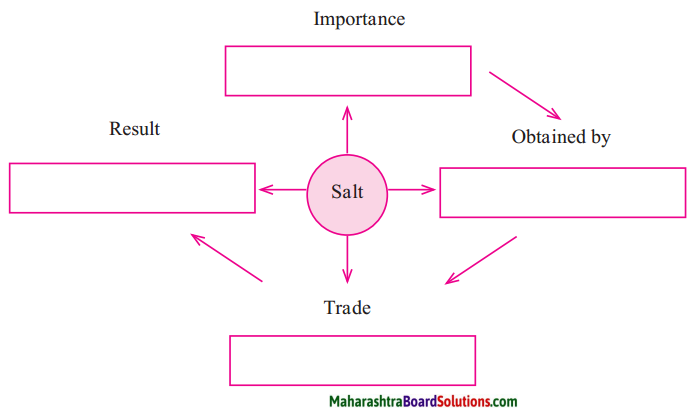
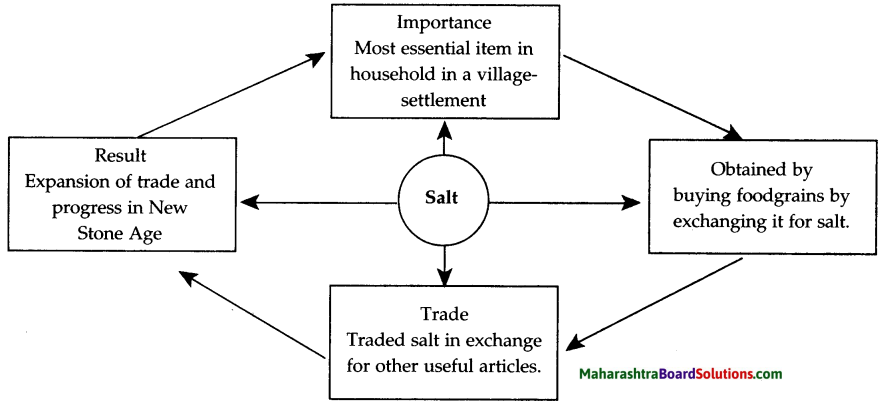
Maharashtra Board Class 5 EVS Solutions Part 2 Chapter 8 Beginning of Settled Life 1
Answer:
Maharashtra Board Class 5 EVS Solutions Part 2 Chapter 8 Beginning of Settled Life 2

4. Write about the usefulness of any five domesticated animals.

Question 1.
Write about the usefulness of any five domesticated animals.
Answer:

  • Cow : Cow is a very useful animal. It is domesticated for its milk. Cow-dung was used to smear mud walls and in courtyards. Cow-dung is used to make dung cakes for fuel and also is a very good natural manure for agriculture.
  • Goats and Sheep : Sheep is useful for its wool and milk. They are also domesticated for their meat.
  • Dog : A very useful and faithful animal. It guards household or village-settlements.
  • Horse : A very useful, strong and a swift animal. Its strength is used to draw carriages or to transport heavy
  • goods. It is also used in travelling.
  • Bullocks : Bullocks are strong and obedient animals. Therefore, they are used to draw carts. They are also used to transport people and heavy objects from one place to another.

Maharashtra Board Class 5 EVS Solutions Part 2 Chapter 8 Beginning of Settled Life

5. Which animal is used by the modern police? In what way?

Question 1.
Which animal is used by the modern police? In what way?
Answer:

  1. The dog is used by modern police.
  2. It is used in the investigation of crimes as a dog can sniff the body odour and blood-stains on the clothes.
  3. It leads police to the person who has committed heinous crimes like murder.

Activity :

Question 1.
Visit people in your locality practising five different occupations and collect information about their work.

Environmental Studies Part 2 Standard 5th Solutions Chapter 8 Beginning of Settled Life Additional Important Questions and Answers

Fill in the blanks:

Question 1.

  1. When the third step is achieved, the animal is supposed to be completely ……….
  2. Domesticating animals and keeping them for our own use is called ……….
  3. The …….. is the first animal to have been domesticated.
  4. ………..and………… were domesticated next.
  5. Dogs were used to help with ………….
  6. …….. are credited to have started cultivation.
  7. They used ………….. Sticks to sow seeds.
  8. People had to stay in one place because of the nature of ………… work.
  9. ………………….. production increased considerably after the plough drawn by animals came into use.
  10. …………. became the main source of livelihood.
  11. People began to worship ……. and various ………. for good crops.
  12. People in the village-settlements established some ………. and ……. to manage things.
  13. Before agriculture, all men and women were continuously engaged in getting ……….
  14. With agricultural production increasing, some men and women began to get ……….. time.
  15. They used their spare time for using their natural creativity to develop……… skills.
  16. Members with such special skills were given ………. based on those skills.
  17. It is believed that in the New Stone Age, ……… made earthen pots and other earthen objects by hand.
  18. The farmers in the village-settlements were now producing……….. food.
  19. They needed skilled ……………. for tasks like making agricultural implements and repairing them
  20. Craftsmen were paid in the form of …………..
  21. ………… is an essential item.
  22. Salt traders also traded articles they received in exchange of ………..
  23. The ………. trade helped in the expansion of trade in the New Stone Age.
  24. People responsible for the implementation of these rules became the ………… of village settlements.
  25. The chiefs were also entrusted with the …… of the village.
  26. The population of the village settlements ………. because food was available in plenty
  27. The ……… became permanent and expanded.
  28. People began to build ………. houses of sun dried bricks.
  29. It appears that the people of the village settlements belonged to a single …………..
  30. The entire village-settlement was an ………….. family.
  31. A dead person was buried either in the ……….. or in the ……..
  32. In the ………… system, it became possible to store food grains.

Answer:

  1. domesticated
  2. animal husbandry
  3. dog
  4. goat, sheep
  5. hunting
  6. uxomen
  7. pointed
  8. agricultural
  9. agricultural
  10. agriculture
  11. nature, deities
  12. rules, customs
  13. food
  14. spare
  15. special
  16. work
  17. women
  18. surplus
  19. craftsmen
  20. foodgrains
  21. salt
  22. salt
  23. salt
  24. chiefs
  25. protection
  26. grew
  27. village-settlements
  28. quadrangular
  29. clan
  30. extended
  31. house, courtyard
  32. agricultural

Maharashtra Board Class 5 EVS Solutions Part 2 Chapter 8 Beginning of Settled Life

Match the following:

Question 1.

Column ‘A’ Column ‘B’
1. Source of livelihood a. Women
2. Sowing of seeds b. New Stone Age
3. Earthen pots c. Protection
4. Moats d. Agriculture

Answer:

Column ‘A’ Column ‘B’
1. Source of livelihood d. Agriculture
2. Sowing of seeds a. Women
3. Earthen pots b. New Stone Age
4. Moats c. Protection

Answer each of the following questions in one sentence:

Question 1.
What is animal husbandry?
Answer:
Domesticating animals and keeping them for one’s use is called animal husbandry.

Question 2.
Which is the first animal to have been domesticated?
Answer:
The dog is the first animal to have been domesticated.

Question 3.
Who domesticated the dog?
Answer:
Homo sapiens of the Middle Stone Age domesticated the dog.

Question 4.
How were the dogs used?
Answer:
Dogs were used to help in hunting.

Maharashtra Board Class 5 EVS Solutions Part 2 Chapter 8 Beginning of Settled Life

Question 5.
Which animals were domesticated after the dog?
Answer:
The goat and sheep were domesticated after the dog

Question 6.
When and where did agriculture begin?
Answer:
Archaeological evidence is available to show that agriculture first began about 11,000 years ago in Israel and Iraq.

Question 7.
Who are given the credit to have started cultivation?
Answer:
Women are credited to have started cultivation

Question 8.
What did they use to sow seeds?
Answer:
They used pointed sticks to sow seeds.

Question 9.
How did the agricultural production increase considerably?
Answer:
Agricultural production increased considerably after the plough driven by animals came into use.

Question 10.
What was the main source of livelihood for people in the New Stone Age?
Answer:
Agriculture was the main source of livelihood for the people in the New Stone Age.

Maharashtra Board Class 5 EVS Solutions Part 2 Chapter 8 Beginning of Settled Life

Question 11.
What did the people do in order to grow good crops?
Answer:
People began to worship nature and various deities to grow good crops.

Question 12.
What gained importance in the village settlement?
Answer:
Essential things like sharing of agricultural tasks and water resources and the security of the village-settlements gained importance.

Question 13.
How did the New Stone Age women make earthen pots?
Answer:
The New Stone Age women made earthen pots and other earthen objects by hand.

Question 14.
Why were the craftsmen needed?
Answer:
Craftsmen were needed for tasks like making agricultural implements and repairing them.

Question 15.
How were the craftsmen paid?
Answer:
The craftsmen were paid in the form of food grains or other articles.

Maharashtra Board Class 5 EVS Solutions Part 2 Chapter 8 Beginning of Settled Life

Question 16.
What is the barter system?
Answer:
Buying and selling articles by exchanging goods for goods is called barter system.

Question 17.
What was an essential item in the village settlement?
Answer:
Salt was an essential item in the village settlement.

Question 18.
How did the salt traders trade?
Answer:
Salt traders traded articles they received in exchange of salt.

Question 19.
Why did the village community lay down rules?
Answer:
The village community laid rules for mutual co-operation in order to keep this system of trade and distribution of resources running smoothly.

Maharashtra Board Class 5 EVS Solutions Part 2 Chapter 8 Beginning of Settled Life

Question 20.
Who became the chiefs of village settlements?
Answer:
People responsible for the implementation of these rules became the chiefs of villagesettlements.

Question 21.
Who was entrusted with the protection of the village?
Answer:
The chiefs were also entrusted with the task of protection of the village.

Question 22.
Why did they build protective walls and moats around the village-settlements?
Answer:
They built protective walls and moats around the village-settlements to protect them selues from floods, wild animals and outsiders who stole the village cattle.

Question 23.
What were the houses at the beginning of New Stone Age made of?
Answer:
Houses at the beginning of the New Stone Age were made of wattle and daub?

Question 24.
Why were there differences in the style of constructing houses?
Answer:
Regional differences are seen in the styles of constructing houses, depending on the local climate.

Maharashtra Board Class 5 EVS Solutions Part 2 Chapter 8 Beginning of Settled Life

Question 25.
Why did the population of village settlements grow?
Answer:
The population of village-settlements grew because food was available in plenty.

Give reasons for the following:

Question 1.
The stick used for sowing was weighed in the centre using a perforated stone.
Answer:
In order to dig deeper into the soil to sow the seeds, the stick was weighted in the centre using a perforated stone.

Question 2.
Before agriculture, men and women in the community were continuously busy.
Answer:

  1. Before agriculture, people obtained food by hunting and gathering.
  2. But this food could not be stored for a long time.
  3. Therefore, all men and women in the community were continuously engaged in acquiring food.

Question 3.
Walls and moats were built around the village settlement.
Answer:
Protective walls and moats were built around the village-settlements to protect them from floods, wild animals and outsiders who stole village cattle.

Question 4.
The village-settlements grew.
Answer:
i. The population of the village-settlements grew because food was available in plenty after agriculture
ii. They also built bigger houses to accommodate their expanding population.

Maharashtra Board Class 5 EVS Solutions Part 2 Chapter 8 Beginning of Settled Life

Question 5.
The entire village-settlement was an extended family.
Answer:

  1. It appears from the plans of the houses and the village-settlements that people staying there belonged to a single class.
  2. It means that they were all related to one another.
  3. Thus, the entire village-settlement was an extended family

Question 6.
Women and men began to get spare time to develop special skills.
Answer:

  1. In the agricultural system, it became possible to store foodgrains for a long period.
  2. There was sufficient food for the community.
  3. Therefore, women and men began to get spare time to use their natural creativity to develop special skills.

Question 7.
People began to worship nature and various deities.
Answer:
i. Agriculture became the main source of livelihood in the New Stone Age period.
ii. Thus, people began to worship nature and various deities for good crops.

Maharashtra Board Class 5 EVS Solutions Part 2 Chapter 8 Beginning of Settled Life

Question 8.
The farmers needed skilled craftsmen.
Answer:
i. Farmers in the village-settlements were producing surplus food.
ii. Therefore, they needed skilled craftsmen for making agricultural implements and repairing them.

Question 9.
A dead person was buried either in the house or in the courtyard.
Answer:
The people thought that the dead person’s bond with family should not get cut off after death.

Answer the following questions in brief:

Question 1.
How was cultivation carried out by women?
Answer:

  1. Women are credited to have started cultivation.
  2. They used pointed sticks to sow seeds.
  3. In order to help dig deeper into the soil, the stick was weighted in the centre using a perforated stone.

Maharashtra Board Class 5 EVS Solutions Part 2 Chapter 8 Beginning of Settled Life

Question 2.
How did a social system based on agriculture came into existence?
Answer:

  1. Essential things like sharing of agricultural tasks and water resources and the security of the village-settlement gained importance.
  2. People in the village-settlements established some rules and customs to manage these things.
  3. Thus, a social system based on agriculture came into existence.

Question 3.
How was barter system established?
Answer:

  1. When the farmers in the village-settlements
  2. produced surplus food, they felt the need for skilled craftsmen who would provide them with agricultural implements and also repair them.
  3. Such craftsmen were paid in the form of food grains or other articles. The craftsmen also purchased the required raw material in the form of foodgrains and other useful articles.
  4. Thus, buying and selling by exchanging goods for goods called barter system was established.

Maharashtra Board Class 5 EVS Solutions Part 2 Chapter 8 Beginning of Settled Life

Question 4.
Describe the structure of houses in the New Stone Age.
Answer:

  1. The houses at the beginning of the New Stone Age were made of wattle and daub i.e. the walls were screens woven from sticks or bamboo and plastered with mud or cow dog.
  2. Later when the population in the village ettlement grew, people began to build quadrangular” houses of sun-dried bricks. These houses were also bigger and had more than one room.
  3. Regional differences are seen in the styles of constructing houses, depending on the local climate.

Question 5.
Describe the ritual of burying the dead in the village settlements.
Answer:
i. A dead person was buried either in the house or in the courtyard with the idea that the person’s bond with the family should not get cut off even after death.
ii. Families would also bury various articles with the dead person for them to use even after death.

Question 7.
How did the village administrative system came into being?
Answer:

  1. The village community made rules for mutual co-operation in order to keep trade running smoothly.
  2. People responsible for the implementation of these rules became the chiefs of village settlements
  3. These chiefs were also entrusted with the protection of the village.
  4. This is how the village administrative system came into being.

Maharashtra Board Class 5 EVS Solutions Part 2 Chapter 8 Beginning of Settled Life

Glossary :

  1. entrusted : assigned the responsibility to doing something to (someone)
  2. archaeological : of history
  3. implementation : put into effect
  4. deities : gods and goddesses
  5. moats : a deep, wide ditch surrounding a house.
  6. wattle : and
  7. daub : material used in building walls.
  8. perforated : pierced with a hote.
  9. accommodate : provide sufficient space for.
  10. surplus : extra.
  11. abundance : a large quantity fo something
  12. experimentation:  procedure.
  13. complied : meet specified standards.
  14. quadrangular : having four sides

Class 5 Environmental Studies Questions and Answers:

Public Facilities and My School Class 5 Questions And Answers EVS Chapter 8 Maharashtra Board
Balbharti Maharashtra State Board Class 5 Environmental Studies Solutions Chapter 8 Public Facilities and My School Notes, Textbook Exercise Important Questions and Answers.

5th Standard EVS 1 Lesson Number 8 Question Answer Public Facilities and My School Maharashtra Board

Std 5 EVS 1 Chapter 8 Question Answer

1. Fill in the blanks.

Question (a)
We must use facilities ……………….. .
(a) carlessly
(b) responsibily
(c) fearlessly
Answer:
(b) responsibily

Maharashtra Board Class 5 EVS Solutions Part 1 Chapter 8 Public Facilities and My School

Question (b)
The school is our ………………… outside our house.
(a) world
(b) family
(c) play ground
Answer:
(a) world

Question (c)
The …………………. has a role in the development of a school.
(a) parents
(b) teachers
(c) community
Answer:
(c) community

2. Answer in one sentence:

Question (a)
Which are the important public services?
Answer:
Water supply, electricity supply, health services, education and transport are the important public services.

Question (b)
What right does each child have?
Answer:
Each child has a right to go to school and learn.

3. Answer in short:

Question (a)
Which public services do we use?
Answer:
We use public facilities like water supply, electricity supply, health services, education, transport, postal services, telephone, fire brigade, police, banks, swimming pools, etc.

Question (b)
Why should schools have Parent Teacher Association and Mata Palak Sangh?
Answer:
Schools should have Parent Teacher Association and Mata Palak Sangh because:

  1. They bring about a dialogue between parents and teachers.
  2. Parents can help in various activities of the school.
  3. We learn with the help of both teachers and parents.
  4. Their interactions are to our benefit.

Maharashtra Board Class 5 EVS Solutions Part 1 Chapter 8 Public Facilities and My School

4. Write what will happen:

Question (a)
If boys and girls are not given an equal right to education.
Answer:
Girls will be deprived of education then the society will not prosper because if you educate a girl you educate a family.

Question (b)
If the community does not help the school.
Answer:
The community has a role in the development of school. If the community does not help, then the school will not be able to provide the students with various facilities like sport equipment, libraries, laboratories etc.

Question (c)
If public services and facilities are not used responsibly.
Answer:
If public services and facilities are not used responsibly and with care then people will not be able to use them for a longer time.

Environmental Studies Part 1 Standard 5th Solutions Chapter 8 Public Facilities and My School Additional Important Questions and Answers

Fill in the blanks with the correct answers from the options given below:

Question 1.
According to the Right of …………….., every child between the ages of 6 and 14 must go to school.
(a) Economic Act
(b) Social Act
(c) Education Act
Answer:
(c) Education Act

Maharashtra Board Class 5 EVS Solutions Part 1 Chapter 8 Public Facilities and My School

Question 2.
The Right to Education Act provides complete ……………………. education.
(a) primary
(b) secondary
(c) higher secondary
Answer:
(a) primary

Question 3.
For children with special needs, the upper age limit is ……………. years of age instead of 14.
(a) 15
(b) 18
(c) 16
Answer:
(b) 18

Question 4.
Parents can help in various ………………… of the school.
(a) facilities
(b) activities
(c) festivities
Answer:
(b) activities

Question 5.
Water supply, electricity supply, health services, education and transport are some important ………………. services.
(a) public
(b) private
(c) democratic
Answer:
(a) public

Question 6.
Public services are meant for ………………. .
(a) someone
(b) noone
(c) everyone
Answer:
(c) everyone

Question 7.
Various ………………… are available to us in our school.
(a) facilities
(b) books
(c) teachers
Answer:
(a) facilities

Maharashtra Board Class 5 EVS Solutions Part 1 Chapter 8 Public Facilities and My School

Question 8.
Bus and railway are public facilities of ……………….. .
(a) transport
(b) government
(c) people
Answer:
(a) transport

Question 9.
Each school has its own ……………… identity.
(a) public
(b) unique
(c) private
Answer:
(b) unique

Question 10.
Every child has the right to go to ……………….. and learn.
(a) play
(b) library
(c) school
Answer:
(c) school

Question 11.
The school ………………… all parents alike.
(a) respects
(b) treats
(c) illtreats
Answer:
(a) respects

Question 12.
We learn with the help of both …………. and …………….. .
(a) parents
(b) teachers
(c) principal
Answer:
(b) teachers

Maharashtra Board Class 5 EVS Solutions Part 1 Chapter 8 Public Facilities and My School

Name the following:

Question 1.
Public facilities of transport.
Answer:
Bus and railway.

Question 2.
Organisations in school which help the school to develop.
Answer:
Parent Teacher Association and a Mata Palak Sangh.

Answer in one sentence:

Question 1.
What is the right to education?
Answer:
Each child has a right to go to school and learn. This is called the Right to Education.

Question 2.
Which people help in the growth of a school?
Answer:
Many parents, past students, writers, artists, sports persons, scientists and industrialists lend a hand in the growth of a school.

Question 3.
What does ‘Right to Education Act’ state?
Answer:
According to Right to Education Act, every child between the age of 6 and 14 must go to school and complete their primary education.

Maharashtra Board Class 5 EVS Solutions Part 1 Chapter 8 Public Facilities and My School

Answer in short:

Question 1.
How does the community have a role in the development of a school?
Answer:
1. Many people and institutions help to set up a school.
2. A school is given assistance in the construction of classrooms, libraries, laboratories and procurements of sports equipment.
3. Thus the community helps in the development of a school.

Can you tell?

Question 1.
Which public facilities are available inside and outside your home?
Answer:
Public facilities available inside our home are water supply, electricity supply and gas service. Facilities used outside our home ate hospitals, school, college, transport, banks, malls, police etc.
[Note : Other Questions of can you tell are personal response]

Maharashtra Board Class 5 EVS Solutions Part 1 Chapter 8 Public Facilities and My School

Glossary:

  1. alike – similar
  2. fundamental – of central importance.
  3. unique – One of a kind
  4. interaction – reciprocal action or influence.
  5. procurement – the action of obtaining something.

Class 5 Environmental Studies Questions and Answers:

Community Health and Hygiene Class 5 Questions And Answers EVS Chapter 25 Maharashtra Board
Balbharti Maharashtra State Board Class 5 Environmental Studies Solutions Chapter 25 Community Health and Hygiene Notes, Textbook Exercise Important Questions and Answers.

5th Standard EVS 1 Lesson Number 25 Question Answer Community Health and Hygiene Maharashtra Board

Std 5 EVS 1 Chapter 25 Question Answer

1. Fill in the blank.

Question a.
A healthy and wholesome life leads to feelings of …………….. .
Answer:
A healthy and wholesome life leads to a feeling of friendship.

Question b.
Constant presence of tobacco in the digestive organs can lead to cancer of ………….. .
Answer:
Constant presence of tobacco in the digestive organs can lead to cancer of (any) digestive organs.

Maharashtra Board Class 5 EVS Solutions Part 1 Chapter 25 Community Health and Hygiene

Question c.
…………… leads to diseases of the liver, intestines and urinary bladder
Answer:
Alcoholism leads to diseases of the liver, intestines and urinary bladder

Question d.
The most important factor in the country’s progress and development are its ……………. .
Answer:
The most important factor in the country’s progress and development are its people.

Question e.
Good community ………… can be achieved through habits of hygiene and good health.
Answer:
Good community health and hygiene can be achieved through habits of hygiene and good health.

2. True or false? Correct the wrong statement.

Question a.
Pollution, squalor, epidemics, addictions, and insect-borne diseases are all beneficial for community health.
1. True
2. False
Answer:
Pollution, squalor. epidemics. addictions and insect-borne diseases are all threats to the community

Maharashtra Board Class 5 EVS Solutions Part 1 Chapter 25 Community Health and Hygiene

Question b.
There is a ban on spitting in public places.
1. True
2. False
Answer:
1. True.

Question c.
A nutritious diet, personal hygiene, exercise and pursuit of hobbies lead to excellent health.
1. True
2. False
Answer:
1. True

Question d.
We cannot live a wholesome life if we take care of our health.
1. True
2. False
Answer:
We can live a wholesome life if we take care of our health

3. Answer the following question.

Question a.
How can you achieve excellent health?
Answer:
Nutritious food. personal cleanliness. exercise and pursuit of hobbies leads to achievement of excellent health.

Maharashtra Board Class 5 EVS Solutions Part 1 Chapter 25 Community Health and Hygiene

Question b.
What factors are a threat to community health?
Answer:
Pollution, squalor, epidemics of infectious diseases. addiction, insect-borne diseases, malnutrition are the factors that cause a threat to community health.

Question c.
What are the ill effects of chewing tobacco?
Answer:

  1. If tobacco is consumed, there are ulcers in the mouth. Ulcers develop into bigger wounds and they are later turned into tumours.
  2. Oral cancer, i.e. cancer of the mouth may be formed.
  3. Tobacco entering into the digestive system cause cancer of any of the digestive organs. It also leads to various complaints of the digestive system.
  4. A person with cancer has to undergo painful treatment. It can lead to death.

Question d.
What are the ill effects of alcoholism?
Answer:

  1. Alcohol acts on the brain of a person. Person becomes drowsy and confused.
  2. Alcohol makes a person lose control over one’s actions.
  3. Alcohol causes diseases of the liver, intestines and kidney, and urinary bladder.

Maharashtra Board Class 5 EVS Solutions Part 1 Chapter 25 Community Health and Hygiene

Use your brain power

Question 1.
What bad habits will you guard against while trying to achieve your aim or interest in life?
Answer:
Do it yourself

Activity :

Question 1.
Write and present a short play on preventing addictions in society.

Environmental Studies Part 1 Standard 5th Solutions Chapter 25 Community Health and Hygiene Additional Important Questions and Answers

Fill in the blank with the correct answers from the option given below:

Question 1.
Pollution, squalor, epidemics of infectious diseases and insect borne diseases, addictions are all …………………. to community health.
(a) encouragement
(b) threats
(c) addictions
Answer:
(b) threats

Maharashtra Board Class 5 EVS Solutions Part 1 Chapter 25 Community Health and Hygiene

Question 2.
It is a ………………… offence to spit in public places.
(a) legal
(b) illegal
(c) criminal
Answer:
(a) legal

Question 3.
If we take care of our health it is possible to lead a ……………… life.
(a) happy
(b) wholesome
(c) comfortable
Answer:
(a) happy

Question 4.
Cigarettes, bidis, masheri are …………… products.
(a) factory
(b) modern
(c) tobacco
Answer:
(c) tobacco

Question 5.
An entire family is destroyed due to …………………. of alcohol.
(a) addiction
(b) consumption
(c) solution
Answer:
(a) addiction

Maharashtra Board Class 5 EVS Solutions Part 1 Chapter 25 Community Health and Hygiene

Question 6.
Addiction of tobacco can cause diseases like ………….
(a) tuberculosis
(b) cancer
(c) malaria
Answer:
(b) cancer

Question 7.
We must make ………….. to ensure good health for all.
(a) efforts
(b) pollution
(c) ugliness
Answer:
(a) efforts

Question 8.
To nurture community health is to ………… the general public from disease.
(a) avoid
(b) protect
(c) encourage
Answer:
(b) protect

Question 9.
People are urged in every possible way to keep their ………………. clean.
(a) surroundings
(b) body
(c) mind
Answer:
(a) surroundings

Maharashtra Board Class 5 EVS Solutions Part 1 Chapter 25 Community Health and Hygiene

Question 10.
If we take care of our health, it is possible for us to lead a ……………… life.
(a) complete
(b) incomplete
(c) wholesome
Answer:
(c) wholesome

Question 11.
We see many people …………. tobacco in different ways.
(a) consuming
(b) destroying
(c) shunning
Answer:
(a) consuming

Question 12.
Drinking alcohol has …………… effects on the body.
(a) good
(b) bad
(c) adverse
Answer:
(c) adverse

Maharashtra Board Class 5 EVS Solutions Part 1 Chapter 25 Community Health and Hygiene

Question 13.
Addiction to alcohol is called ………….. .
(a) fanatism
(b) alcoholism
(c) lunatism
Answer:
(b) alcoholism

Question 14.
……………. makes a person drowsy and confused.
(a) Alcohol
(b) Milk
(c) Coffee
Answer:
(a) Alcohol

Question 15.
………………….. causes diseases of the liver, intestines and urinary bladder.
(a) Fanatism
(b) Alcoholism
(c) Socialism
Answer:
(b) Alcoholism

Question 16.
Addiction to tobacco or alcohol are both very ……… habits.
(a) good
(b) bad
(c) ugly
Answer:
(b) bad

Maharashtra Board Class 5 EVS Solutions Part 1 Chapter 25 Community Health and Hygiene

Question 17.
Never be ………… about health.
(a) negative
(b) assertive
(c) negligent
Answer:
(c) negligent

Question 18.
The family of an addict gets deprived of health and happiness is …………
(a) ruined
(b) built
(c) restored
Answer:
(a) ruined

Question 19.
Tobacco, drugs and alcohol produce a state of …………… .
(a) peace
(b) aggression
(c) intoxication
Answer:
(c) intoxication

Question 20.
Learn to say ………… firmly in order to avoid bad habits.
(a) Yeas
(b) No
(c) OK
Answer:
(b) No

Maharashtra Board Class 5 EVS Solutions Part 1 Chapter 25 Community Health and Hygiene

From the actions given below, mark those that are harmful with a cross (✗) and healthy with a (✓) marks:

Question 1.

  1. Burning of tyres. [ ]
  2. Spitting anywhere on the road. [ ]
  3. Using public toilets [ ]
  4. Looking after domestic animals [ ]
  5. Following doctor’s instructions in cases of infectious diseases [ ]
  6. Washing your hands before a meal or snack. [ ]
  7. Throwing the garbage from your house on to the road. [ ]

Answer:

  1. Burning of tyres. [✗]
  2. Spitting anywhere on the road. [ ✗]
  3. Using public toilets [✓]
  4. Looking after domestic animals [✓]
  5. Following doctor’s instructions in cases of infectious diseases [✓]
  6. Washing your hands before a meal or snack. [✓]
  7. Throwing the garbage from your house on to the road. [✗]

Answer in one sentence:

Question 1.
What leads to good health?
Answer:
Nutritious food, personal hygiene, exercise and pursuit of hobbies lead to excellent health and good personal development.

Maharashtra Board Class 5 EVS Solutions Part 1 Chapter 25 Community Health and Hygiene

Question 2.
How is mass media used to ensure community health?
Answer:
Mass media are used under community welfare programmes to educate people about issues such as taking care of drinking water and food.

Question 3.
How can we lead a wholesome life?
Answer:
If we take care of our health, it is possible for us to lead a wholesome life.

Question 4.
What happens when people of a society live a healthy and wholesome life?
Answer:
If people of a society live a healthy and wholesome life, social tensions also decrease and feelings of friendship can be nurtured.

Question 5.
What is addiction?
Answer:
At first, a person may consume drugs, alcohol or tobacco casually, but later he becomes dependent and cannot give up the habit. This stage is called addiction.

Maharashtra Board Class 5 EVS Solutions Part 1 Chapter 25 Community Health and Hygiene

Question 6.
What happens to people when they are tobacco addicts?
Answer:
When people develop this habit, they become restless if they do not get tobacco. They are not able to pay attention to anything else as they have to have tobacco in their mouth at all times.

Question 7.
Why should we stay away from drugs, tobacco and alcohol?
Answer:
Addiction to drugs, alcohol or tobacco eventually kills the person. So everyone should be aware of the ill-effects of these addictions and strictly stay away from them.

Question 8.
How can we help an addict?
Answer:
An addict should be given the help of counsellors or doctors immediately to rid the person of the habit.

Question 9.
What is the only solution to stay away from bad habits?
Answer:
Learning to say ‘NO! firmly is the best way to stay away from bad habits.

Maharashtra Board Class 5 EVS Solutions Part 1 Chapter 25 Community Health and Hygiene

Give reasons:

Question 1.
Burning tyres is not good.
Answer:
Tyres are made of rubber. When rubber burns it gives out many gases which are poisonous. These gases spread in the air and when inhales these gases affect the health of the people. Burning tyres also causes pollution of air. This will also affect birds and animals. Hence it is not good to burn tyres.

Question 2.
One should not spit on the road.
Answer:
Spitting on the road spreads infectious diseases if the spit is of a person already suffering from a disease. The spit dries up and it flies in the air and when we inhale this air we get the disease. Hence spitting on the road is not good.

Maharashtra Board Class 5 EVS Solutions Part 1 Chapter 25 Community Health and Hygiene

Question 3.
One should not throw garbage on the road.
Answer:
Garbage thrown on the road decays and many flies sit on this. Even water gets stagnated due to garbage and mosquitoes breed there. Decaying garbage emits a foul smell and makes the place dirty. Hence this can affect the people’s health.

Question 4.
State whether true or false? Correct the wrong statements:

  1. Alcoholism causes diseases of liver, intestines, and urinary bladder.
  2. Eating mawa, pan masala are good for health.
  3. Community welfare programmes educate people about safe drinking water and food.
  4. Ban on smoking in public places helps in preventing the bad effects of passive smoking

Answer:

  1. True
  2. False. Eating pan masala is bad for health.
  3. True
  4. True

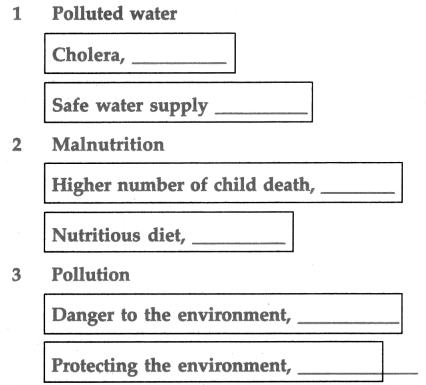
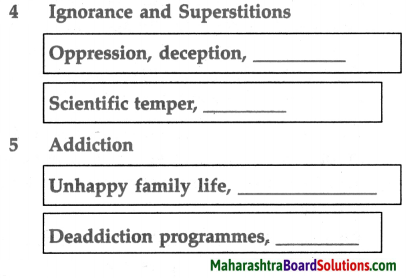
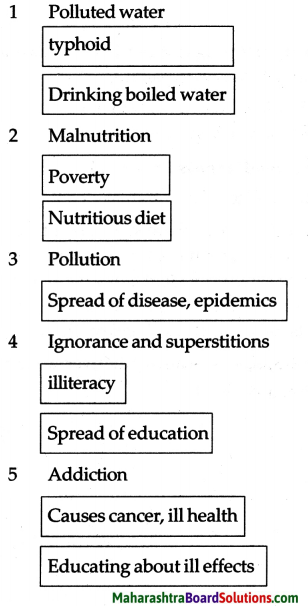
Some important factors that are harmful for community health are mentioned below. Some suggested remedies are mentioned in the next box. Add other ill effects and remedies to the respective boxes.

Question 1.
Maharashtra Board Class 5 EVS Solutions Part 1 Chapter 25 Community Health and Hygiene 1
Maharashtra Board Class 5 EVS Solutions Part 1 Chapter 25 Community Health and Hygiene 2
Answer:
Maharashtra Board Class 5 EVS Solutions Part 1 Chapter 25 Community Health and Hygiene 3

What’s the solution?

Question 1.
You have seen one of your friend’s brother smoking and drinking alcohol and he is slowly becoming addicted.
Answer:
If you see your friend’s, brothers becoming addicted with smoking and drinking alcohol, you should tell this to his parents. Then your friend’s, brother should be taken to a doctor or councellor to rid him of the habit. The family members and friend should support him and help him to give up the habit. Once he is rid of the habit, he should engage himself in some sports or other hobbies.

Question 2.
There is a slum area is your locality where there is lot of filth, dirt and people are living in squalor.
Answer:
People should be educated about the need to maintain hyginic conditions. The students can plan an awareness drive and do street plays and people should be educated about how they should keep their surroundings clean.

Maharashtra Board Class 5 EVS Solutions Part 1 Chapter 25 Community Health and Hygiene+

Glossary :

  1. malnutrition – faulty nutrition due to inadequate or unblanced intake of nutrients
  2. envy – a feeling of discontent aroused by someone’s qualities etc.
  3. tuberculosis – a communicable disease that affects the • lungs caused by tubercle bacillus.
  4. epidemic – an outbreak of disease affecting a large population
  5. infectious – communicable by infection
  6. wholesome – promoting healthy body
  7. restless – showing unrest of mind.
  8. passive smoking – involuntary inhalations of tobacco smoke by a nonsmoker,
  9. remedies – treatment that relieves or cures a disease.

Class 5 Environmental Studies Questions and Answers:

Infectious Diseases and how to Prevent them Class 5 Questions And Answers EVS Chapter 23 Maharashtra Board
Balbharti Maharashtra State Board Class 5 Environmental Studies Solutions Chapter 23 Infectious Diseases and how to Prevent them Notes, Textbook Exercise Important Questions and Answers.

5th Standard EVS 1 Lesson Number 23 Question Answer Our Earth And Our Solar System Maharashtra Board

Std 5 EVS 1 Chapter 23 Question Answer

1. What’s the solution?

Question 1.
You are hungry, but the food has been left uncovered.
Answer:
Heating kills all the disease germs present in the food. So if food is uncovered then one should heat (warm) the food and then eat it when hungry. Eating warm food is always good for health.

Maharashtra Board Class 5 EVS Solutions Part 1 Chapter 23 Infectious Diseases and how to Prevent them

2. Use your brain power!

Question 1.
Which method of preventing the breeding of mosquitoes will you recommend for your surroundings – not allowing water to stagnate or spraying insecticides on the water? Why?
Answer:
First of all it is better not to allow water to stagnate. Hence I would recommend this method for preventing breeding of mosquitoes. However if there are nullahs or gutters in the surrounding area then spraying insecticide on water will be recommended to kill the mosquito larvae growing in water. Therefore both the methods need to be applied sometimes.

3. Answer the following in one or two sentences:

Question (a)
What is an infectious disease?
Answer:
When diseases spread from one person to another person, they are called infectious diseases.

Question (b)
What are the mediums of the spread of diseases?
Answer:
Diseases spread through mediums like food, water, air and insect bite. Sometimes it also spreads by coming in direct contact with a diseased person.

Question (c)
What happens when there is an epidemic of disease?
Answer:
When many people in one area get the same infectious disease at the same time, we say there is an epidemic of the disease. During an epidemic air and water gets contaminated with the disease germs and the disease spreads rapidly. Contaminated water also contaminates the food. If the epidemic is severe many people become serious and need to be hospitalised. To control the epidemic one needs to maintain hygiene and a clean surrounding.

Maharashtra Board Class 5 EVS Solutions Part 1 Chapter 23 Infectious Diseases and how to Prevent them

Question (d)
What is vaccination?
Answer:
When a person is given a vaccine against a specific disease, he develops resistance to that disease. This process of giving vaccine is called vaccination. Whooping cough diphtheria and tetanus called triple vaccine is given.

Question (e)
Make a list of the vaccination given to a new bom baby.
Answer:
The table given below shows the list of vaccinations given to the new bom baby along with the schedule of when the vaccination is given:

Vaccine given Disease against which it is given Age of the new bom baby when it is given
BCG Vaccine Against Tuberculosis within 15 days after baby is just born
Hepa B vaccine Jaundice caused by Hepatitis B vims As soon as the baby is born
Oral Polio Against Polio Within 2 weeks
Triple vaccine Against Diphteria, whooping cough and tetanus After 6 weeks baby is born

Triple vaccine is repeated twice again after 10 weeks and 14 weeks after the baby is bom. Hep. B vaccine is also repeated twice after 4 weeks and 8 weeks after birth. After completing a year the baby is given vaccine against measles, mumps and rubella. It is called MMR vaccine.

4. True or False:

Question (a)
Intestinal diseases spread though air.
Answer:
False

Maharashtra Board Class 5 EVS Solutions Part 1 Chapter 23 Infectious Diseases and how to Prevent them

Question (b)
Some diseases are caused by the anger of gods
Answer:
False

5. Classify the diseases given below as diseases that spread through food, through water, and through air:

Question 1.
Classify the diseases given below as diseases that spread through food, through water, and through air:
Malaria, Typhoid, Cholera, Tuberculosis, Jaundice, Gastro, Diarrhoea, Diphtheria, Conjunctivitis, Chickenpox.
Answer:

Through Food Through Water Through Air
Typhoid Typhoid Tuberculosis
Cholera Cholera Diphtheria
Jaundice Jaundice Conjunctivitis
Gastro Diarrhoea Diarrhoea Chickenpox

6. Give reasons.

Question (a)
When there is an epidemic of cholera, we should boil water before drinking.
Answer:
Sometimes water gets mixed with faeces of person who is suffering from the cholera and it gets contaminated. When people drink this contaminated water an epidemic of cholera spreads.
Boiling the water kills the germs causing the disease and hence one is prevented from getting cholera.
Therefore during an epidemic of cholera one should boil water and drink.

Maharashtra Board Class 5 EVS Solutions Part 1 Chapter 23 Infectious Diseases and how to Prevent them

Question (b)
We should not allow puddles of water to stand in our surroundings.
Answer:
When water stagnates in a puddle, mosquitoes lay eggs in the water and they increase in number. Mosquito bite spread malaria germs and people suffer from malaria. To prevent people from getting malaria mosquitoes should be stopped from breeding. To prevent mosquitoes from breeding we should not allow puddle of water to stand in our surrounding.

Environmental Studies Part 1 Standard 5th Solutions Chapter 23 Infectious Diseases and how to Prevent them Additional Important Questions and Answers

Fill in the blank with the correct answers from the options given below:

Question 1.
……………….. cause diseases.
(a) Microorganisms
(b) Bacteria
(c) Germs
Answer:
(a) Microorganisms

Question 2.
Every …………………. is caused by a specific microorganism or germ.
(a) illness
(b) disease
(c) flu
Answer:
(b) disease

Question 3.
The germs of disease like influenza are present in the spit or ………………… of the person who has the disease.
(a) tongue
(b) nose
(c) saliva
Answer:
(c) saliva

Maharashtra Board Class 5 EVS Solutions Part 1 Chapter 23 Infectious Diseases and how to Prevent them

Question 4.
When diseases spread through food it is called ………………. .
(a) food poisoning
(b) viral
(c) infection
Answer:
(a) food poisoning

Question 5.
Malaria is caused due to bite of a certain kind of ………………… .
(a) animal
(b) mosquito
(c) bird
Answer:
(b) mosquito

Question 6.
Germs of diseases like conjunctivitis spreads through …………………. .
(a) air
(b) water
(c) faces
Answer:
(a) air

Question 7.
Cholera spreads when people drink ……………. water.
(a) good
(b) contaminated
(c) bottled
Answer:
(b) contaminated

Question 8.
People who have a serious infectious disease like tuberculosis or swine flu are ……………….. .
(a) hospitalised
(b) educated
(c) quarantined
Answer:
(c) quarantined

Question 9.
As soon as the baby is born it is given ………………. vaccine.
(a) tuberculosis
(b) triple
(c) polio
Answer:
(a) tuberculosis

Question 10.
The …………………. vaccine is given orally.
(a) conjunctivitis
(b) polio
(c) malaria
Answer:
(b) polio

Maharashtra Board Class 5 EVS Solutions Part 1 Chapter 23 Infectious Diseases and how to Prevent them

Question 11.
When the germs of a particular disease enter the body and begins to grow, the person gets the …………… .
(a) food
(b) disease
(c) cough
Answer:
(b) disease

Question 12.
Disease of the throat and the chest spread through the ………………. .
(a) water
(b) faeces
(c) air
Answer:
(b) faeces

Question 13.
People get ………………. or diarrhoea after eating contaminated food at a function.
(a) flue
(b) gastro
(c) viral
Answer:
(b) gastro

Question 14.
Maintaining ……………….. everywhere is beneficial for our health.
(a) food
(b) cleanliness
(c) disease
Answer:
(b) cleanliness

Question 15.
It is important to always keep our food ……………….. .
(a) covered
(b) uncovered
(c) uncooked
Answer:
(a) covered

Maharashtra Board Class 5 EVS Solutions Part 1 Chapter 23 Infectious Diseases and how to Prevent them

Question 16.
Insects like mosquitoes, lice and fleas spread …………………. .
(a) beauty
(b) health
(c) disease
Answer:
(c) disease

Question 17.
Ringworm, scabies are disease that affect the …………….. .
(a) head
(b) skin
(c) bones
Answer:
(b) skin

Question 18.
Germs of disease like the flu or conjunctivitis spread quickly through the …………….. .
(a) air
(b) water
(c) fire
Answer:
(a) air

Question 19.
If, at some place, mosquitoes ……………… in large numbers then many people there can get malaria
(a) beautify
(b) breed
(c) creed
Answer:
(b) breed

Question 20.
Air, water, food and insects are the ……………….. through which disease spread.
(a) mediums
(b) area
(c) report
Answer:
(a) mediums

Question 21.
It is possible to ……………….. a disease from ecoming an epidemic.
(a) familiarize
(b) prevent
(c) breed
Answer:
(b) prevent

Maharashtra Board Class 5 EVS Solutions Part 1 Chapter 23 Infectious Diseases and how to Prevent them

Question 22.
To prevent disease from spreading through water, it is ………………… at the water works.
(a) diluted
(b) polluted
(c) purified
Answer:
(c) purified

Question 23.
When there is an epidemic of gastro or jaundice, people are advised to ………………. water before drinking it.
(a) cook
(b) steam
(c) boil
Answer:
(c) boil

Question 24.
To prevent mosquitoes from breeding, we must ensure there is no ……………… water in the surroundings.
(a) stagnant
(b) flowing
(c) rippling
Answer:
(a) stagnant

Question 25.
Clothes and utensils used by patients are washed with ………………… .
(a) pesticides
(b) germicides
(c) fertilizers
Answer:
(b) germicides

Question 26.
Our body develops …………….. to a particular disease due to vaccination.
(a) resistance
(b) persistance
(c) deliverance
Answer:
(a) resistance

Question 27.
The vaccines for diphtheria, whooping cough and tetanus are combined into a ………………. vaccine and given as an injection.
(a) single
(b) double
(c) triple
Answer:
(c) triple

Question 28.
Polio Vaccine is given …………………… .
(a) verbally
(b) mentally
(c) orally
Answer:
(c) orally

Question 29.
Primary Health Centres have been established at the ……………. level.
(a) urban
(b) village
(c) grass root
Answer:
(b) village

Maharashtra Board Class 5 EVS Solutions Part 1 Chapter 23 Infectious Diseases and how to Prevent them

Question 30.
It is in now forbidden by law to ……………….. in a public place.
(a) spit
(b) sit
(c) stand
Answer:
(a) spit

Question 31.
………………….. media are also used for raising public awareness about health and hygiene issues.
(a) Mass
(b) Public
(c) Home
Answer:
(a) Mass

Question 2.
Match the columns:

Group ‘A’ Group ‘B’
(a) Ringworm 1. Contaminated Air
(b) Jaundice 2. Direct contact
(c) Tuberculosis 3. Open wound contaminated with soil
(d) Dengue 4. Contaminated food and water
(e) Tetanus 5. Mosquito bite

Answer:

Group ‘A’ Group ‘B’
(a) Ringworm 2. Direct contact
(b) Jaundice 4. Contaminated food and water
(c) Tuberculosis 1. Contaminated Air
(d) Dengue 5. Mosquito bite
(e) Tetanus 3. Open wound contaminated with soil

Name the following:

Question 1.
Insect that causes Malaria.
Answer:
Female Anopheles Mosquito

Question 2.
Insect that causes Dengue.
Answer:
Aedes mosquito

Maharashtra Board Class 5 EVS Solutions Part 1 Chapter 23 Infectious Diseases and how to Prevent them

Question 3.
Vaccine for diphtheria, whooping cough and tetanus (Given as injection).
Answer:
Triple vaccine

Question 4.
Microorganisms that are useful to us.
Answer:
Microorganisms converting milk into yoghurt or microorganisms fermenting batter for idlis.

Question 5.
Germicide used to kill microorganisms in the spittle of a person having tuberculosis.
Answer:
Phenyl or dettol.

Question 5.
State whether the following statements are True or False:

  1. Vaccination helps our body to develop resistance against diseases.
  2. Community programmes are being undertaken every year at the National level to eradicate (put an end) polio, by giving oral vaccine of polio to children below five years.
  3. On television people are educated about right methods of handling, drinking water so to make them aware of how diseases can be prevented.
  4. Insects like lice and fleas spread diseases.
  5. Cancer is an infectious disease.

Answer:

  1. True
  2. True
  3. True
  4. True
  5. False

Answer the following in one or two sentences:

Question 1.
Name the disease that has been completely eradicated (that is it has completely disappeared) by vaccination.
Answer:
The disease called small pox has been completely eradicated by vaccination.
(Note : Now no one in the world is gets the scare or is suffering from small pox.)

Question 2.
Which disease spreads through flea’s bite?
Answer:
Fleas spread diseases like plague when they bite.
(Note : Fleas are found on the bodies of pets like dogs, cat and also on rhodents like rats.)

Question 3.
Why should we cover our nose and mouth when we cough or sneeze?
Answer:
Disease of the throat and chest spread through the air. When other breathe the same air, germs enter their bodies. That is why we must cover our nose and mouth when we cough or sneeze.

Maharashtra Board Class 5 EVS Solutions Part 1 Chapter 23 Infectious Diseases and how to Prevent them

Question 4.
What is ‘food poisoning’?
Answer:
Gastro or diarrhoea spreads through contaminated3 food. When we eat this food the disease spread is called food poisoning.

Question 5.
Why should food always be kept covered?
Answer:
When some flies sit on our food, the germs enter the food. Later when we eat this food the germs enter our body, so we must always cover the food.

Question 6.
What is an epidemic?
Answer:
When many people in one area get the same infectious disease all at the same time, we say that there is an epidemic of the disease.

Question 7.
What precaution can be taken to prevent the spread of tuberculosis?
Answer:
The spittle of a person who has tuberculosis is collected in a vessel and covered with a germicide like phenyl. Such precautions can help to prevent the disease from spreading.

Maharashtra Board Class 5 EVS Solutions Part 1 Chapter 23 Infectious Diseases and how to Prevent them

Give scientific reasons:

Question 1.
Doctors give tetanus vaccine after getting a cut or wound while handling a sharp instrument or after falling down and getting bruised badly while playing.
Answer:
Tetanus germs are present in the soil, dung and dust. The sharp instrument may be dirty, so it may carry the tetanus germs. These germs may then spread though the wound and cause disease. To prevent tetanus germs from spreading doctors give the vaccine which help us develop resistance against this disease.

Question 2.
A person suffering from a disease should cover the mouth when sneezing or coughing.
Answer:
Disease causing organisms are present in the spit or saliva of the person. When they sneeze or cough these gems spread in the air and cause disease in other people. To prevent the spread of disease through the air a person suffering from a disease should cover the mouth while sneezing or coughing.

Question 3.
Before eating or handling food one should wash the hands using soap and water.
Answer:
Soap kills the germs which cause diseases and water washes them away. If our hand is dirty then they may contain disease causing germs. If we handle food, or eat food without washing, the germs will enter the food and contaminate it with these germs. This can cause intestinal diseases or food poisoning. Hence it is advised that one should wash the hands using soap and water before eating or handling food.

Question 4.
People who are suffering from tuberculosis or swine flu are quarantined and kept in hospitals.
Answer:
The diseases like tuberculosis and swine flu are infectious. They spread through air easily. Also the germs spread cause disease in a healthy person if the healthy person comes in contact directly with the diseased person. In hospitals there are separate wards for such diseased people, where extra care and precautions are taken to prevent spread of diseases. Therefore patients suffering from these diseases are quarantined and kept in hospital.

Maharashtra Board Class 5 EVS Solutions Part 1 Chapter 23 Infectious Diseases and how to Prevent them

Can you tell:

Question 1.
When your friends fall while playing and get hurt, does anyone tell you ‘Don’t go near them. You will also yet hurt’?
Answer:
No, no one tells us like that because we will not get hurt because the friend is hurt.

Question 2.
Suppose your mother has a headache. Do you also get a headache if you go near her?
Answer:
No, I do not get a headache if I go near her.

Question 3.
When is it that you are told not to go near a sick person, not to use their utensils for eating or drinking; not to use their hankies, towels or clothes?
Answer:
We are told not to go near a sisk person when the person is suffering from cold, flu, is having high fever, or if the person is suffering from chicken pox, measles, mumps etc.

Question 4.
Maharashtra Board Class 5 EVS Solutions Part 1 Chapter 23 Infectious Diseases and how to Prevent them 1
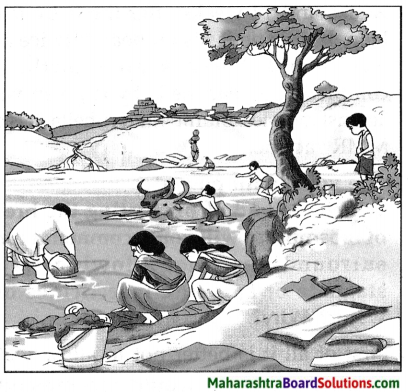
What different activities are going on in the above picture.
Answer:
Women are washing clothes in the river. A boy is urinating in the water. A man is washing utensil and filling it with water. Buffaloes are being washed in the water. Children are swimming and a lady is filling pots with water to use for drinking purpose.

Maharashtra Board Class 5 EVS Solutions Part 1 Chapter 23 Infectious Diseases and how to Prevent them

Question 5.
Maharashtra Board Class 5 EVS Solutions Part 1 Chapter 23 Infectious Diseases and how to Prevent them 2
What do you see in the picture below above?
Answer:
Food is kept open. People are being served this uncovered food and they are eating it. The man serving the food is wearing dirty colthes. There is no cleanliness maintained in the restaurant.

Question 6.
What steps will you take to ensure that dust and flies do not settle on the food in your house?
Answer:
The food will be covered properly to see that no dust and flies settle on it. It will be kept in clean and closed utensils in the kitchen. Care will be taken to see that the kitchen is kept clean. So that no flies will sit there.

Question 7.
Why should you not go to school if you have conjunctivitis?
Answer:
Conjunctivitis causing germs spreads through air. If we go to school many other children will also get this disease. To prevent the spread of this disease, we should not go to school when suffering from conjunctivitis.

Maharashtra Board Class 5 EVS Solutions Part 1 Chapter 23 Infectious Diseases and how to Prevent them

Glossary:

  1. conjunctivitis – sore eyes, which causes irritation.
  2. forbidden -not allowed.
  3. contaminated – to make impure by adding some substance.
  4. stagnates – gets collected.

Class 5 Environmental Studies Questions and Answers:

Evolution Class 5 Questions And Answers EVS Chapter 4 Maharashtra Board
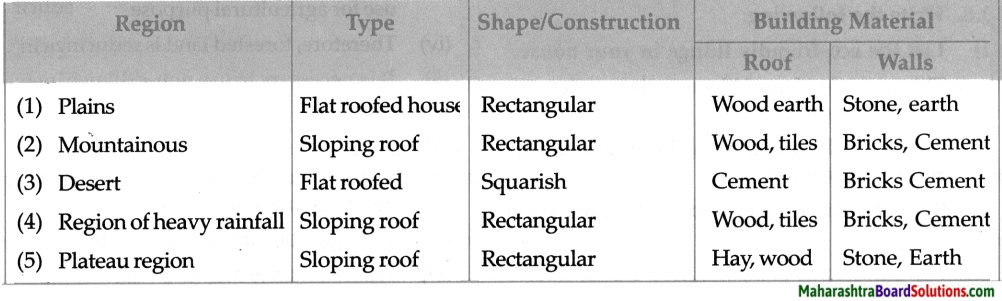
Balbharti Maharashtra State Board Class 5 Environmental Studies Solutions Chapter 4 Evolution Notes, Textbook Exercise Important Questions and Answers.

5th Standard EVS 2 Lesson Number 4 Question Answer Evolution Maharashtra Board

Std 5 EVS 2 Chapter 4 Question Answer

1. Fill in the blank.

Question a.
The first systematic explanation of the concept of evolution was given by ………………… .
Charles Darwin
Willard Libby
Louis Leakey
Answer:
The first systematic explanation of the concept of evolution was given by Charles Darwin.

Maharashtra Board Class 5 EVS Solutions Part 2 Chapter 4 Evolution

Question b.
……………… are the most evolved animals among vertebrates
Aquatic animals
Amphibians
Mammals
Answer:
Mammals are the most evolved animals among vertebrates

2. Answer the question in one sentence.

What do we call animals which live in water and also on land?
Answer:
Amphibians live in water and also on land.

Where did the first humans appear?
Answer:
The first human appeared on the African continent.

Maharashtra Board Class 5 EVS Solutions Part 2 Chapter 4 Evolution

3. Give reasons for the following:

Question a.
The species of dinosaurs, which were enormous in size, suddenly became extinct.
Answer:
The species of dinosaurs, which were enormous in size, suddenly became extinct, because –

1. According to Darwin, the species that cannot adapt to environmental changes become extinct in the process of evolution.
2. Some sudden natural disaster or environmental change is believed to be responsible for the extinction of enormous dinosaurs.

Question b.
In the course of time, a new species with characteristics different from the original species is created.
Answer:
In the process of survival by adapting to environmental changes, certain internal physical changes occur in some species of animals.
Over a period of time, these changes become inherited characteristics seen in all subsequent generations. Thus, in the course of time, a new species with characteristics different from the original species is created.

Maharashtra Board Class 5 EVS Solutions Part 2 Chapter 4 Evolution

4. Fill in the blanks in the concept chart given below.

Question 1.
Fill in the blanks in the concept chart given below.
Maharashtra Board Class 5 EVS Solutions Part 2 Chapter 4 Evolution 1
Answer:
Maharashtra Board Class 5 EVS Solutions Part 2 Chapter 4 Evolution 2

Activity :

Question 1.
Make a model of a dinosaur.

Project :

Queston 1.
Collect pictures of invertebrates and vertebrates. Stick them in a notebook and write down their characteristics.

Environmental Studies Part 2 Standard 5th Solutions Chapter 4 Evolution Additional Important Questions and Answers

Fill in the blanks :

  1. The word ……… generally means a gradual and continuous change.
  2. In the process of survival by adapting to environmental changes, certain internal ……………. changes occur in some animals of a species.
  3. Sometimes during evolution, the original species becomes ………..
  4. During evolution, sometimes more than one species evolve from the ………….. species.
  5. The first systematic explanation of the concept of evolution was given by …………
  6. Species which are capable of adapting to environmental changes are able to …………
  7. Species that cannot adapt to environmental changes become ………….
  8. …………………… means a ‘terrible lizard’.
  9. Some sudden natural………………….. is believed to be responsible for the extinction of Dinosaurs.
  10. Fossils of dinosaurs with ………………… have been discovered
  11. It is supposed that some species of two legged and winged dinosaurs evolved into …………..
  12. The ……………………… organisms evolved gradually and various classes of plants and animals came into being.
  13. Animals without a backbone are called ……………
  14. Animals which have a backbone are called ……….
  15. …………………….. are animals which live in water and also on land.
  16. Animals which crawl are called ………………..
  17. A mammals baby is …………………. on the mother’s milk for some time after birth.
  18. The platypus and anteater are also considered as ……………
  19. ………………… are somewhat like humans in appearance.
  20. Apes mostly lived on ………….
  21. Some ape species that evolved give rise to ………….. species.
  22. The first human species is called the …………… man.
  23. Primitive means ………………..

Answer:

  1. evolution
  2. physical
  3. extinct
  4. original
  5. Charles Darwin
  6. survive
  7. extinct
  8. Dinosaurs
  9. disaster
  10. wings
  11. birds
  12. multicellular
  13. invertebrates
  14. Vertebrates
  15. Amphibians
  16. Reptiles
  17. fed
  18. mammals
  19. Apes
  20. trees
  21. human
  22. primitive
  23. the first

Maharashtra Board Class 5 EVS Solutions Part 2 Chapter 4 Evolution

Match the columns :

Question 1.

Column ‘A’ Column ‘B’
1. Charles Darwin a. a gradual and continuous change
2. Evolution b. means ‘terrible lizard’
3. Dinosaur c. gradually evolved into plants and animals
4. Multicellular d. explained the concept of evolution
5. Invertebrates e. frogs
6. Aquatic f. snake
7. Amphibians g. cow
8. Reptiles h. snails
9. Mammals i. fish

Answer:

Column ‘A’ Column ‘B’
1. Charles Darwin d. explained the concept of evolution
2. Evolution a. a gradual and continuous change
3. Dinosaur b. means ‘terrible lizard’
4. Multicellular c. gradually evolved into plants and animals
5. Invertebrates e. frogs
6. Aquatic i. fish
7. Amphibians e. frogs
8. Reptiles f. snake
9. Mammals g. cow

Maharashtra Board Class 5 EVS Solutions Part 2 Chapter 4 Evolution

Answer each question in one sentence:

Question 1.
What does evolution mean?
Answer:
Evolution means a gradual and continuous change

Question 2.
What changes occur in some species, during the process of survival?
Answer:
In the process of survival, by adapting to environmental changes, certain internal physical changes occur in some animals of a species.

Question 3.
What happens to the internal changes over a period of time?
Answer:
Over a period of time, these internal changes become inherited characteristics seen in all generations.

Question 4.
When does an original species become extinct?
Answer:
During evolution, a new species with characteristics different from the original may be created. Sometimes the original species becomes extinct.

Question 5.
Name the scientist who explained the concept of evolution.
Answer:
The first scientist to give us a systematic explanation of the concept of evolution was Charles Darwin

Maharashtra Board Class 5 EVS Solutions Part 2 Chapter 4 Evolution

Question 6.
Which species are able to survive?
Answer:
Species which are capable of adapting to environmental changes are able to survive.

Question 7.
Which species become extinct in the process of evolution?
Answer:
The species that cannot adapt to environmental changes become extinct in the process of evolution

Question 8.
What does dinosaur mean?
Answer:
Dinosaur means a ‘terrible lizard’.

Question 9.
How did the dinosaurs suddenly become extinct?
Answer:
Some sudden natural disaster or environmental change is believed to be responsible for the extinction of dinosaurs.

Maharashtra Board Class 5 EVS Solutions Part 2 Chapter 4 Evolution

Question 10.
Why do we suppose that some species of dinosaurs have evolved into birds?
Answer:
Fossils of dinosaurs with wings have been discovered. Hence, it is supposed that some species of two-legged and winged dinosaurs evolved into birds.

Question 11.
How did plants and animals come into being?
Answer:
Unicellular organisms gave rise to multicellular organisms which in turn gradually evolved into various classes of plants and animals.

Question 12.
What are invertebrates?
Answer:
Animals without a backbone are called ‘invertebrates’. For example: a snail.

Question 13.
What are vertebrates?
Answer:
Animals which have a backbone are called vertebrates. For example: A cow

Maharashtra Board Class 5 EVS Solutions Part 2 Chapter 4 Evolution

Question 14.
What do we call animals which live in water and also on land?
Answer:
Animals which live in water and also on land are called ‘Amphibians’. For example: Frog

Question 15.
What are Aquatic animals?
Answer:
Living organisms that live only in water are called ‘Aquatic animals’. For example Fish

Question 16.
What are Reptiles?
Answer:
Animals which crawl are called Reptiles. For example: Snake

Question 17.
Which species are the most evolved animals among vertebrates?
Answer:
Mammals are the most evolved animals among vertebrates.

Question 18.
Where do apes mostly live?
Answer:
Apes mostly lived on trees.

Maharashtra Board Class 5 EVS Solutions Part 2 Chapter 4 Evolution

Question 19.
How did the Human species evolve?
Answer:
Some ape species found in grasslands were forced to move around on ground. These species evolved gradually and in time gave rise to human species.

Question 20.
What is the first human species called?
Answer:
The first human species is called the ‘primitive man’.

Question 21.
What does primitive mean?
Answer:
‘Primitive’ means ‘the first’.

Question 22.
Who are Apes?
Answer:
Apes are somewhat like humans in appearance.

Maharashtra Board Class 5 EVS Solutions Part 2 Chapter 4 Evolution

Give reasons for the following :

Question 1.
In the course of time, a new species with characteristics different from the original species is created. Answer:

  1. In the process of survival by adapting to environmental changes, certain physical changes occur in some animals of a species.
  2. These internal changes become inherited characteristics in the following generations.
  3. Thus a new species with characteristics different from the original is created.

Question 2.
A frog is an amphibian.
Answer:

  1. Animals which are able to live in water and also on land are called amphibiAnswer:
  2. Therefore a frog is considered an amphibian.

Question 3.
The platypus and some species of anteaters are considered mammals.
Answer:

  1. Platypus and some species of anteaters are exceptions to the characteristics of mammals.
  2. Though they lay eggs, they suckle their young ones.
  3. Therefore, they are considered mammals.

Maharashtra Board Class 5 EVS Solutions Part 2 Chapter 4 Evolution

Answer the following questions in brief :

Question 1.
Explain the concept Evolution as stated by Charles Darwin.
Answer:

  1. Charles Darwin explained ‘evolution’ in the following manner. In the process of survival by adapting to environmental changes, certain internal physical changes occur in some animals of a species.
  2. Over a period of time, these internal changes become inherited characteristics of the following generation.
  3. Thus a new evolved species with characteristics different from the original is created
  4. Sometimes the original species become extinct.
  5. Sometimes more than one species evolve from the original one.

Question 2.
Give the characteristics of mammals.
Answer:
The characteristics of most of the mammals are as follows:

  1. Growth of the baby in the mother’s womb, sometime before birth.
  2. The baby is fed on the mother’s milk for sometime after birth.

Maharashtra Board Class 5 EVS Solutions Part 2 Chapter 4 Evolution

Question 3.
How and where did the human species evolve?
Answer:

  1. Apes are somewhat like humans in appearance
  2. They mostly lived on trees. Those species of apes which continued to live on trees retained their original ape like form.
  3. Some ape species found in grasslands were forced to move on the ground.
  4. These species evolved gradually, giving rise to the human species.
  5. This happened first on the ‘African continent’.

Question 4.
How did various classes of plants and animals come into being?
Answer:

  1. Life on earth began with unicellular organisms known as protozoa.
  2. These unicellular organisms gave rise to multicellular living things.
  3. Multicellular organisms evolved gradually and thus various classes of plants and animals came into being

Question 5.
How did birds form from dinosaurs?
Answer:

  1. Dinosaurs became extinct because of some sudden natural disaster or environmental change
  2. Fossils of dinosaurs with wings have been discovered
  3. It is thus believed that some species of two legged and winged dinosaurs evolved into birds.

Maharashtra Board Class 5 EVS Solutions Part 2 Chapter 4 Evolution

Question 6.
How many and which are the stages of evolution of animals?
Answer:
There are two stages of evolution of animals. They are:

  1. Invertebrates: These are animals without a backbone.
  2. Vertebrates: Animals which have a backbone are vertebrates. Aquatic animals, amphibians, birds, reptiles and mammals are all vertebrates.

Glossary :

  1. gradual : taking place in stages over an extended period.
  2. adapt : become adjusted to new conditions.
  3. extinction : the process on state of becoming extinct.
  4. species : group of living organisms
  5. survival : the state or fact of surviving
  6. inherited : receive or be left with something from predecessor

Class 5 Environmental Studies Questions and Answers:

Our Home and Environment Class 5 Questions And Answers EVS Chapter 11 Maharashtra Board
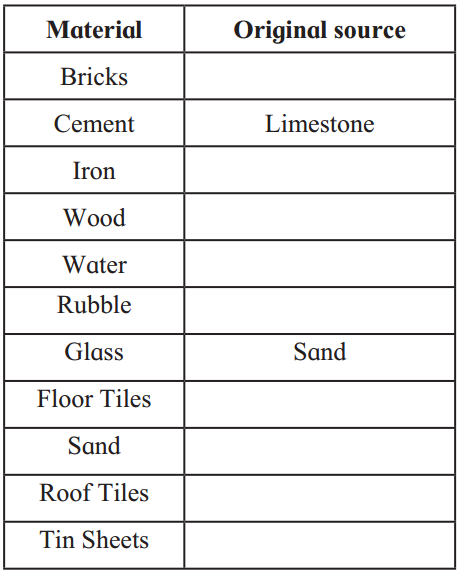
Balbharti Maharashtra State Board Class 5 Environmental Studies Solutions Chapter 11 Our Home and Environment Notes, Textbook Exercise Important Questions and Answers.

5th Standard EVS 1 Lesson Number 11 Question Answer Our Home and Environment Maharashtra Board

Std 5 EVS 1 Chapter 11 Question Answer

Use your brain power?

Question 1.
For what purpose do birds use their nest.
Answer:
Birds use their nest to lay their eggs and bring up their young ones.

Maharashtra Board Class 5 EVS Solutions Part 1 Chapter 11 Our Home and Environment

what’s the solution?

Question 1.
What can we do to build houses without harming the environment?
Answer:
To build houses without harming the environment we can build permanent eco-friendly houses where we have good ventilation and use non exhaustible sources of energy.

1. Which of the following houses would be suitable in a mountainous region.

Question 1(a).
Which of the following houses would be suitable in a mountainous region. Put a ✓ in the appropriate box. Give reasons for selecting that house.
Answer:
Maharashtra Board Class 5 EVS Solutions Part 1 Chapter 11 Our Home and Environment 1
This house is made of natural material available in the mountainous region, that is stone, it is strong to withstand mountainous winds.

Question 1(b).
What materials will you mainly use for building a multi-storeyed house?
(a) Mortar / Coal / Cement / Bricks
(b) Cement / Bricks / Cotton / Iron
(c) Iron / Cement / Mortar / Bricks
Answer:
Iron / Cement / Mortar / Bricks

Maharashtra Board Class 5 EVS Solutions Part 1 Chapter 11 Our Home and Environment

2. Arrange the following considerations from the most to least important factor in house building:

Question 1.
Arrange the following considerations from the most to least important factor in house building:
(a) Luxury
(b) Structure
(c) Climate
Answer:
(a) Climate
(b) Structure
(c) Luxury

3. Write the following:

Question (a)
List the eco-friendly things in your house.
Answer:
Things made of mud like a earthen water pot. (Personal response)

Question (b)
Which of the gadgets in the house can be run on solar energy?
Answer:
Solar calculator, solar cooker. Add more to the list.

4. What are the types of pollution that can be observed at a construction site?

Question 1.
What are the types of pollution that can be observed at a construction site?
Answer:
The types of pollution that are seen at a construction site are air, water, soil and noise.

Make friends with maps!

Question 1.
Observe the map and the pictures and complete the following chart.
Maharashtra Board Class 5 EVS Solutions Part 1 Chapter 11 Our Home and Environment 2
Answer:
Maharashtra Board Class 5 EVS Solutions Part 1 Chapter 11 Our Home and Environment 3

Maharashtra Board Class 5 EVS Solutions Part 1 Chapter 11 Our Home and Environment

Try this.

Question 1.
Complete the table given below regarding the original source.
Maharashtra Board Class 5 EVS Solutions Part 1 Chapter 11 Our Home and Environment 4
Answer:
Maharashtra Board Class 5 EVS Solutions Part 1 Chapter 11 Our Home and Environment 5

Environmental Studies Part 1 Standard 5th Solutions Chapter 11 Our Home and Environment Additional Important Questions and Answers
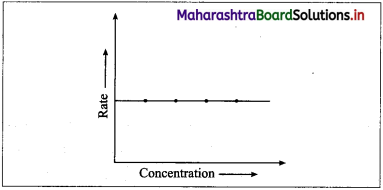
1. Fill in the blanks with the correct answers from the options given below:

Question 1.
A section of our society becomes homeless this is a ………………. problem.
(a) political
(b) social
(c) economic
Answer:
(b) social

Question 2.
Houses are built in large numbers due to increasing …………………. .
(a) population
(b) natural resources
(c) land
Answer:
(a) population

Maharashtra Board Class 5 EVS Solutions Part 1 Chapter 11 Our Home and Environment

Question 3.
Glass is made from ……………… .
(a) soil
(b) limestone
(c) sand
Answer:
(c) sand

Question 4.
The city of Mumbai comprises of ………………….. islands.
(a) 6
(b) 7
(c) 8
Answer:
(b) 7

Question 5.
Land obtained by filling water bodies is called ………………….. .
(a) coastal lands
(b) reclaimed land
(c) marshy lands
Answer:
(b) reclaimed land

Question 6.
People build houses to suit the ………………… of their region.
(a) climate
(b) population
(c) situation
Answer:
(a) climate

Question 7.
Water, food, clothing and shelter are the basic …………………. of every human being.
(a) height
(b) weight
(c) needs
Answer:
(c) needs

Maharashtra Board Class 5 EVS Solutions Part 1 Chapter 11 Our Home and Environment

Question 8.
The ……………….. of the world is increasing all the time.
(a) time
(b) population
(c) water
Answer:
(b) population

Question 9.
Shortage of …………………. land, leads to forest land being used for agriculture.
(a) agricultural
(b) geographical
(c) water
Answer:
(a) agricultural

Question 10.
Trees are …………………. in great numbers and forests are reduced.
(a) watered
(b) fellect
(c) grown
Answer:
(b) fellect

Question 11.
……………… is needed to produce construction material.
(a) Energy
(b) Humans
(c) Forest
Answer:
(a) Energy

Question 12.
Energy is produced using natural …………………. like coal, natural gas or mineral oil.
(a) trees
(b) fuels
(c) minerals
Answer:
(b) fuels

Question 13.
Burning of natural fuels leads to ……………… pollution.
(a) air
(b) water
(c) land
Answer:
(a) air

Question 14.
……………….. or ……………… energy are non-exhaustible sources of energy.
(a) air
(b) wind
(c) solar
Answer:
(b) wind & (c) solar

Maharashtra Board Class 5 EVS Solutions Part 1 Chapter 11 Our Home and Environment

Name the following:

Question 1.
Government provides shelter for homeless in cities.
Answer:
Night shelters

Question 2.
Source from which cement is made.
Answer:
Limestone

Question 3.
Natural fuels
Answer:
Coal, natural gas, mineral oil.

Question 4.
Pollution caused by burning fuel.
Answer:
Air

Question 5.
Non exhaustible sources of energy.
Answer:
Solar energy, Wind energy and Biogas.

Question 6.
Two continents having water tourism
Answer:
Europe and North America.

Question 3.
Complete the co-relation:
Answer:
1. Mountainous region: Sloping roof:: Plain: Flat roof.
2. Cement: Limestone :: Bricks : Soil.
3. Coal: Exhaustible energy:: Solar energy: Non exhaustible energy.

Answer in one sentence:

Question 1.
What are the different things from which a house gives us protection?
Answer:
A house protects us from sun, wind, cold, rain and wild animals.

Question 2.
Where do homeless people live?
Answer:
Homeless people seek shelter at the roadside, on footpaths, under bridges, in tumble down buildings, in railway or bus stations and open grounds.

Question 3.
What is water tourism?
Answer:
In the coastal region, where under water shelters are built for tourist to view the sea bed and marine life is called water tourism.

Question 4.
Why are many people forced to be ‘homeless’?
Answer:
Many people are forced to be ‘homeless’ because they have insufficient or no means of livelihood.

Question 5.
What are the basic needs of every human being?
Answer:
Water, food, clothing and shelter are the basic needs of every human being.

Maharashtra Board Class 5 EVS Solutions Part 1 Chapter 11 Our Home and Environment

Question 6.
Why are houses being built in large numbers?
Answer:
The population of the world is increasing all the time. That is why, houses are being built in large numbers.

Question 7.
What are the ill-effects of urbanization on land?
Answer:
Due to growing urbanization, land which was used for agriculture is now being used to build roads or to raise settlements. This leads to shortage of agricultural land.

Question 8.
Why are trees felled?
Answer:
Shortage of agricultural land leads man to cut down forests and use the land for agriculture.

Question 9.
From where do we get energy?
Answer:
We get energy by using natural fuels like coal, natural gas or mineral oil.

Question 10.
What ill-effects do we face when we use natural fuels?
Answer:
Using natural fuels not only leads to its exhaustion but also to air pollution.

Question 11.
Which are non-exhaustible sources of energy?
Answer:
Solar energy and wind energy are non- exhaustible sources of energy.

Give reasons:

Question 1.
Differences occur in the construction of houses according to the regions.
Answer:
There are differences in the construction of houses according to the region because :
1. People build houses to suit the climate of the region.
2. Using the natural resources that are available.

Question 2.
Many people are forced to be ‘homeless’.
Answer:
Many people are forced to be homeless because they have insufficient or no means of livelihood.

Question 3.
Houses are being built in large numbers.
Answer:
Houses are being built in large numbers because the population of the world is increasing all the time.

Question 4.
Forested land is reducing.
Answer:

  1. Growing urbanization uses agricultural land to build roads and to raise settlements.
  2. This leads to shortage of agricultural land.
  3. So trees are felled in a great number to make use for agricultural purpose.
  4. Therefore, forested land is reducing.

Question 5.
It is necessary to use non-exhaustible sources of energy.
Answer:

  1. Natural fuels like coal, natural gas or mineral oil can be used only once.
  2. They get consumed when we use them.
  3. They also cause air pollution.
  4. It takes lakhs of years for these resources to be formed in nature.
  5. Therefore it is necessary to use non exhaustible sources of energy.

Maharashtra Board Class 5 EVS Solutions Part 1 Chapter 11 Our Home and Environment

Answer briefly:

Question 1.
How are natural resources obtained to build a house?
Answer:
Natural resources are obtained to build a house are as follows:

  1. Digging up hills for quarryingf.
  2. Extracting sand from seashores and riverbeds.
  3. Extracting stone and earth from the ground.
  4. Drawing out excessive amount of ground water.
  5. Felling trees to clear land.
  6. Filling up ponds, lakes, streams, rivers, creeks and low lying areas to reclaimed land.

Question 2.
Why do people become homeless?
Answer:
People become homeless because

  1. Lack of affordable housing.
  2. Poverty and unemployment.
  3. Inadequate’ income.
  4. Natural disasters.
  5. Physical and mental disorders.

Question 3.
What are the main uses of a house?
Answer:
The main uses of a house are as follows:

  1. A shelter.
  2. A resting place.
  3. Protection against the sun, wind, cold and rains.
  4. Protection from wild animals and from anti-social elements.

Question 4.
What is the government doing towards the ‘homeless’?
Answer:
1. A section of society being ‘homeless’ is a social problem.
2. That is why the government implements many schemes to provide homes to the homeless.
In some of the cities, the government makes ‘night shelters’ available to the homeless.

Write short notes on:

Question 1.
Characteristics of eco-friendly houses
Answer:
The characteristics of eco-friendly houses are as follows:

  1. Minimum consumption of natural resources.
  2. Use of non exhaustible sources of energy such as biogas, wind energy and solar energy.
  3. Recycling of water.
  4. Recycling of garbage.
  5. Avoiding artificial materials and artificial colours.
  6. Provision for natural light and ventilation in the house.

Maharashtra Board Class 5 EVS Solutions Part 1 Chapter 11 Our Home and Environment

Question 2.
Uses of a house
Answer:
Uses of a house are as follows:
1. A shelter.
2. A resting place.
3. Protection against the sun, the wind, the cold and the rains.
4. Protection from wild animals.
5. Keeping ourselves safe from anti-sodal elements.

What’s the solution?

Question 1.
Construction work is going on opposite Ajit’s house. That means constant loud noise and a lot of dust in the air. Ajit and his family have to suffer this all the time. What can Ajit do to find a way out of this problem?
Answer:
Ajit and his family will have to keep their windows closed to avoid the dust and noise. They should use ear plugs when the noise is intense.

Maharashtra Board Class 5 EVS Solutions Part 1 Chapter 11 Our Home and Environment

Glossary:

  1. forested – covered with forests
  2. urbanization – population shift from rural to urban areas
  3. reclaimed – recovered.
  4. shortage – a state in which something cannot be obtained in sufficient amount
  5. felled – cut down.
  6. luxury – state of great comfort.
  7. quarrying – cut into and obtain stone
  8. inadequate – lacking the quantity required
  9. consumption – action of using up a resource
  10. artificial – made by human beings, not natural.
  11. DABUR Pivot Point Calculator

Class 5 Environmental Studies Questions and Answers:

12th Chemistry Chapter 6 Exercise Chemical Kinetics Solutions Maharashtra Board

Class 12 Chemistry Chapter 6

Balbharti Maharashtra State Board 12th Chemistry Textbook Solutions Chapter 6 Chemical Kinetics Textbook Exercise Questions and Answers.

Chemical Kinetics Class 12 Exercise Question Answers Solutions Maharashtra Board

Class 12 Chemistry Chapter 6 Exercise Solutions Maharashtra Board

Chemistry Class 12 Chapter 6 Exercise Solutions

1. Choose the most correct option.

Question i.
The rate law for the reaction aA + bB → P is rate = k[A] [B]. The rate of reaction doubles if
a. concentrations of A and B are both doubled.
b. [A] is doubled and [B] is kept constant
c. [B] is doubled and [A] is halved
d. [A] is kept constant and [B] is halved.
Answer:
b. [A] is doubled and [B] is kept constant

Maharashtra Board Class 12 Chemistry Solutions Chapter 6 Chemical Kinetics

Question ii.
The order of the reaction for which the units of rate constant are mol dm-3 s-1 is
a. 1
b. 3
c. 0
d. 2
Answer:
c. 0

Question iii.
The rate constant for the reaction 2N2O5(g) → 2N2O4(g) + O2(g) is 4.98 × 10⁻⁴ s-1. The order of reaction is
a. 2
b. 1
c. 0
d. 3
Answer:
b. 1

Question iv.
Time required for 90 % completion of a certain first order reaction is t. The time required for 99.9 % completion will be
a. t
b. 2t
c. t/2
d. 3t
Answer:
d. 3t

Question v.
Slope of the graph ln[A]t versus t for first order reaction is
a. -k
b. k
c. k/2. 303
d. -k/2. 303
Answer:
a. -k

Question vi.
What is the half life of a first order reaction if time required to decrease concentration of reactant from 0.8 M to 0.2 M is 12 h?
a. 12 h
b. 3 h
c. 1.5 h
d. 6 h
Answer:
d. 6 h

Question vii.
The reaction, 3ClO ClO3Θ + 2 ClΘ occurs in two steps,
(i) 2 ClO → ClO2Θ
(ii) ClO2Θ + ClOΘ → ClO3Θ + ClΘ

The reaction intermediate is
a. ClΘ
b. ClO2Θ
c. ClO3Θ
d. ClOΘ
Answer:
b. ClO2Θ

Question viii.
The elementary reaction O2(g) + O(g) → 2O2(g) is
a. unimolecular and second order
b. bimolecular and first order
c. bimolecular and second order
d. unimolecular and first order
Answer:
c. bimolecular and second order

Maharashtra Board Class 12 Chemistry Solutions Chapter 6 Chemical Kinetics

Question ix.
Rate law for the reaction, 2NO + Cl2 → 2 NOCl is rate = k[NO2]2[Cl2]. Thus k would increase with
a. increase of temperature
b. increase of concentration of NO
c. increase of concentration of Cl2
d. increase of concentrations of both Cl2 and NO
Answer:
a. increase of temperature

Question x.
For an endothermic reaction, X ⇌ Y. If E f is activation energy of the forward reaction and Er that for reverse reaction, which of the following is correct?
a. Ef = Er
b. Ef < Er
c. Ef > Er
d. ∆H = Ef – Er is negative
Answer:
(c) Ef → Er

2. Answer the following in one or two sentences.

Question i.
For the reaction,
N2(g) + 3 H2(g) → 2NH3(g), what is the relationship among \(\frac{\mathrm{d}\left[\mathrm{N}_{2}\right]}{\mathrm{dt}}\)\(\frac{\mathrm{d}\left[\mathrm{H}_{2}\right]}{\mathrm{dt}} \text { and } \frac{\mathrm{d}\left[\mathrm{NH}_{3}\right]}{\mathrm{dt}} ?\)
Answer:
N2(g) + 3H2(g) → 2NH3(g)
From the above reaction, when 1 mole of N2 reacts, 3 moles of H2 are consumed and 2 moles of NH3 are formed.

If the instantaneous rate R of the reaction is represented in terms of rate of the consumption of N2 then, \(R=-\frac{d\left[\mathrm{~N}_{2}\right]}{d t}\)
Maharashtra Board Class 12 Chemistry Solutions Chapter 6 Chemical Kinetics 10
Hence the rate of reaction in terms of concentration changes in N2, H2 and NH3 may be represented as,
Maharashtra Board Class 12 Chemistry Solutions Chapter 6 Chemical Kinetics 11

Question ii.
For the reaction,
CH3Br(aq) + OH-(aq) → CH3OHΘ (aq) +BrΘ (aq), rate law is rate = k[CH3Br][OHΘ]
a. How does reaction rate changes if [OHΘ] is decreased by a factor of 5?
b. What is change in rate if concentrations of both reactants are doubled?
Solution :
Given :
(a) Rate = R = k [CH3Br] x [OH]
If R1 and R2 are initial and final rates of reaction then,
Maharashtra Board Class 12 Chemistry Solutions Chapter 6 Chemical Kinetics 84
Rate will be increased 4 time.

Maharashtra Board Class 12 Chemistry Solutions Chapter 6 Chemical Kinetics

Question iii.
What is the relationship between coeffients of reactants in a balanced equation for an overall reaction and exponents in rate law. In what case the coeffients are the exponents?
Answer:
Explanation : Consider the following reaction, aA + bB → products

If the rate of the reaction depends on the concentrations of the reactants A and B, then, by rate law,
R α [A]a [B]b
∴ R = k [A]a [Bb
where [A] = concentration of A and
[B] = concentration of B

The proportionality constant k is called the velocity constant, rate constant or specific rate of the reaction.

a and b are the exponents or the powers of the concentrations of the reactants A and B respectively when observed experimentally.

The exponents or powers may not be necessarily a and b but may be different x and y depending on experimental observations. Then the rate R will be,
R = k [A]x [B]y
For example, if x = 1 and y = 2, then,
R = k [A] x [B]2

Question iv.
Why all collisions between reactant molecules do not lead to a chemical reaction?
Answer:
(i) Collisions of reactant molecules : The basic re-quirements of a reaction is that the reacting species (atoms, ions or molecules) must come together and collide for a reaction to occur. Therefore the rate of the reaction shall depend on the rate and frequency of collisions which increase with the amount of reacting species and temperature.

However it is observed that the rate of reaction is very low as compared to the rate of collisions between reacting species in gaseous phase or liquid phase. This suggests that all the collisions are not fruitful leading to a reaction. Hence it is necessary to consider another factor like energy of colliding species along with collision frequency.

(ii) Energy requirement (Activation energy) : The colliding molecules must possess a certain mini-mum energy called activation energy required far breaking and making bonds resulting in the reaction. This implies that the colliding molecules must have energy equal to or greater than the activation energy. The colliding molecules with less energy do not react.

(iii) Orientation of reactant molecules : The concept of activation energy is satisfactory in case of simple molecules or ions but not in case of complex or higher polyatomic molecules. It is observed that the rates of reaction are less as compared to the rates of collisions between activated molecules with activation energy.

This suggests that in addition, the colliding molecules must have proper orientations relative to each other during collisions. For example, consider the reaction, A – B-l-C → A + B – C. For the reaction to occur, C must collide with B while collisions with A will not be fruitful. Since B has to bond with C.
Maharashtra Board Class 12 Chemistry Solutions Chapter 6 Chemical Kinetics 118

Question v.
What is the activation energy of a reaction?
Answer:
Activation energy : The energy required to form activated complex or transition state from the reactant molecules is called activation energy.
OR
The height of energy barrier in the energy profile diagram is called activation energy.

Question vi.
What are the units for rate constants for zero order and second order reactions if time is expressed in seconds and concentration of reactants in mol/L?
Answer:
(a) For a zero order reaction, the rate constant has units, molL-1s-1.
(b) For second order reaction,
Rate = k x [Reactant]2

Maharashtra Board Class 12 Chemistry Solutions Chapter 6 Chemical Kinetics 176

Maharashtra Board Class 12 Chemistry Solutions Chapter 6 Chemical Kinetics

Question vii.
Write Arrhenius equation and explain the terms involved in it.
Answer:
Arrhenius equation is represented as k = A x e-Ea/RT
where
k = Rate constant at absolute temperature T
Ea = Energy of activation R = Gas constant
A = Frequency factor or pre-exponential factor.

Question viii.
What is the rate determining step?
Answer:
Many chemical reactions take place in a series of elementary steps. Among many steps of the reaction, one of the steps is the slowest step compared to other steps.

Rate determining step : The slowest step in the reaction mechanism which involves many steps is called the rate-determining step.

Question ix.
Write the relationships between rate constant and half life of fist order and zeroth order reactions.
Answer:
(a) For first order reaction, half-life period t1/2 is, \(t_{1 / 2}=\frac{0.693}{k}\) where k is the rate constant.
(b) For zeroth-order reaction, half half period (t1/2) is, \(t_{1 / 2}=\frac{[\mathrm{A}]_{0}}{2 k}\) where k is the rate constant and [A]0 is initial concentration of the reactant.

Question x.
How do half lives of the fist order and zero order reactions change with initial concentration of reactants?
Answer:
(A) For the first order reaction, half life, t1/2 is given by, \(t_{1 / 2}=\frac{0.693}{k}\) where k is rate constant. Hence it is independent of initial concentration of the reactant.

(B) Zero order reaction,
\(t_{1 / 2}=\frac{[\mathrm{A}]_{0}}{2 k}\) where [A]0 is initial concentration of the reactant.

Hence, half life period increases with the increase in concentration of the reactant.

3. Answer the following in brief.

Question i.
How instantaneous rate of reaction is determined?
Answer:
(1) The instantaneous rate is expressed as an infinite¬simal change in concentration (- dc) of the reactant with the infinitesimal change in time (dt).
For a reaction, A → B, let an infinitesimal change in A be – dc in time dt, then Rate \(=\frac{d[\mathrm{~A}]}{d t}\).

Hence, it is represented as,
∴ Instantaneous rate \(=-\frac{d[\mathrm{~A}]}{d t}\)

The negative sign indicates a decrease in the concentration of A.
Maharashtra Board Class 12 Chemistry Solutions Chapter 6 Chemical Kinetics 8
It is obtained by drawing a tangent to the curve obtained by plotting the concentration against the time. Hence, the slope at a given point represents the instantaneous rate of the reaction.

(2) The instantaneous rate can also be expressed as an infinitesimal change (or increase) in the concentration of the product with the infinitesimal change in time (dt).

Let dB be an infinitesimal change in the concentration of product B in time dt, then Rate \(=\frac{d[\mathrm{~B}]}{d t}=\frac{d x}{d t}\).

Maharashtra Board Class 12 Chemistry Solutions Chapter 6 Chemical Kinetics

Hence,
Instantaneous rate \(=\frac{d x}{d t}\)
Maharashtra Board Class 12 Chemistry Solutions Chapter 6 Chemical Kinetics 9
It is obtained from the slope of the curve obtained by plotting the concentration of the product against time.

The instantaneous rate is more useful in obtaining the rate law integrated equations.

Question ii.
Distinguish between order and molecularity of a reaction.
Answer:

Order Molecularity
1. It is the sum of the exponents to which the concentration terms in rate law expression are raised. 1. ¡t is the number of molecules (or atoms or ions) of the reaCtants taking part in the elementary reaction.
2. It is experimentally determined and indicates the dependence of the reaction rate on the concentration of particular reactants. 2. It is the oretical property and indicátes the number of molecules of reactant in each step of the reaction.
3. It may have values that are integer, fractional, or zero. 3. It is always an integer.
4. Its value depends upon experimental conditions. 4. Its value does not depend upon experimental conditions.
5. It is the property of elementary and complex reactions. 5. It is the property of elementary reactions only.
6. Rate law expression describes the order of the reaction. 6. Rate law does not describe molecularity.

Question iii.
A reaction takes place in two steps,
1. NO(g) + Cl2(g) NOCl2(g)
2. NOCl2(g) + NO(g) → 2NOCl(g)
a. Write the overall reaction.
b. Identify reaction intermediate.
c. What is the molecularity of each step?
Solution :
Given :
(1) NO(g) + Cl2(g) → NOCl2(g)
(2) NOCl2(g) + NO(g) → 2NOCl(g)

(a) Overall reaction is obtained by adding both the reactions
2NO(g) + Cl2(g) → 2NOCl2(g)
(b) The reaction intermediate is NOCl2, since it is formed in first step and consumed in the second step.
(c) Since the first step is a slow and rate determin­ing step, the molecularity is two.

Since the second step is a fast step its molecularity is not considered.

Question iv.
Obtain the relationship between the rate constant and half-life of a fist order reaction.
Answer:
Consider the following reaction,
Maharashtra Board Class 12 Chemistry Solutions Chapter 6 Chemical Kinetics 175
If [A]0 and [A]t are the concentrations of A at start and after time t, then [A]0 = a and [A]t = a – x.

The velocity constant or the specific rate constant k for the first order reaction can be represented as,
Maharashtra Board Class 12 Chemistry Solutions Chapter 6 Chemical Kinetics 57

where, a is the initial concentration of the reactant A, x is the concentration of the product B after time t, so that (a – x) is the concentration of the reactant A after time t.

Maharashtra Board Class 12 Chemistry Solutions Chapter 6 Chemical Kinetics

Half-life of a reaction : The time required to reduce the concentration of the reactant to half of its initial value is called the half-life period or the half-life of the reaction.

If t1/2 is the half-life of a reaction, then at t = t1/2, x = a/2, hence a – x = a – a/2 = a/2
Maharashtra Board Class 12 Chemistry Solutions Chapter 6 Chemical Kinetics 58
Hence, for a first order reaction, the half-life of the reaction is independent of the initial concentration of the reactant.

Question v.
How will you represent zeroth-order reaction graphically?
Answer:
(1) A graph of concentration against time : In case of a zero-order reaction, the rate of reaction is independent of the concentration of the reactant. The concentration [A]t of the reactant at a time t is given by
[A]t = – kt + [A]0 (y = – mx + c)
where [A]0 is the initial concentration of the reactant and k is a rate constant.
Maharashtra Board Class 12 Chemistry Solutions Chapter 6 Chemical Kinetics 76

Hence in case of zero order reaction, when the concentration of the reactant is plotted against time, a straight line with the slope equal to – k is obtained. The concentration of the reactants de-crease with time. The intercept on the concentration axis gives the initial concentration, [A]0.

(2) A graph of rate of a reaction against the concen-tration of the reactant: Rate of a zero order reaction is independent of the concentration of the reactant.

Maharashtra Board Class 12 Chemistry Solutions Chapter 6 Chemical Kinetics

Rate, R = k [A]0 = k

Hence even if the concentration of the reactant decreases, the rate of the reaction remains constant.
Maharashtra Board Class 12 Chemistry Solutions Chapter 6 Chemical Kinetics 77

Therefore if the rate of a zero order reaction is plotted against concentration, then a straight line with zero slope is obtained indicating, no change in the rate of the reaction with a change in the concentration of the reactants.

(3) A graph of half-life period against concentration : The half-life period of a zero-order reaction is given by, \(t_{1 / 2}=\frac{[\mathrm{A}]_{0}}{2 k}\) where [A]0 is initial con-centration of the reactant and k is the rate constant. Hence the half-life period is directly proportional to the concentration.

When a graph of t1/2 is plotted against concentration, a straight line passing through origin is obtained, and the slope gives \(\frac{1}{2 k}\), where k is the rate constant.
Maharashtra Board Class 12 Chemistry Solutions Chapter 6 Chemical Kinetics 78

Question vi.
What are pseudo-fist order reactions? Give one example and explain why it is pseudo-fist order.
Answer:
Pseudo-first-order reaction : A reaction which has higher-order true rate law but is experimentally found to behave as first order is called pseudo first order reaction.
Explanation : Consider an acid hydrolysis reaction of an ester like methyl acetate.
CH3COOCH3(aq) + H2O(1) \(\stackrel{\mathrm{H}_{(\mathrm{aq})}^{+}}{\longrightarrow}\) CH3COOH(aq) + CH3OH(aq)
Since the reaction involves two substances, ester and water, it is a bimolecular reaction and the true rate law should be, Rate = k’ [CH3COOCH3] x [H2O]

Hence the reaction is expected to follow second order kinetics. However experimentally it is found that the reaction follows first order kinetics.

This is because solvent water being in a large excess, its concentration remains constant. Hence, [H2O] = constant = k”
Rate = k [CH3COOCH3] x [H2O]
= k [CH3COOCH3] x k”
= k’ x k” x [CH3COOCH3]
If k’ x k” = k, then Rate = k [CH3COOCH3],

This indicates that second-order true rate law is forced into first order rate law. Therefore this bimolecular reaction which appears of second order is called pseudo first order reaction.

Question vii.
What are the requirements for the colliding reactant molecules to lead to products?
Answer:
Collisions of reactant molecules : The basic re­quirements of a reaction is that the reacting species (atoms, ions or molecules) must come together and collide for a reaction to occur. Therefore the rate of the reaction shall depend on the rate and frequency of collisions which increase with the amount of reacting species and temperature.

Maharashtra Board Class 12 Chemistry Solutions Chapter 6 Chemical Kinetics

However it is observed that the rate of reaction is very low as compared to the rate of collisions between reacting species in gaseous phase or liquid phase. This suggests that all the collisions are not fruitful leading to a reaction. Hence it is necessary to consider another factor like energy of colliding species along with collision frequency.

Energy requirement (Activation energy) : The colliding molecules must possess a certain mini­mum energy called activation energy required far breaking and making bonds resulting in the reac­tion. This implies that the colliding molecules must have energy equal to or greater than the activation energy. The colliding molecules with less energy do not react.

Orientation of reactant molecules : The concept of activation energy is satisfactory in case of simple molecules or ions but not in case of complex or higher polyatomic molecules. It is observed that the rates of reaction are less as compared to the rates of collisions between activated molecules with activa­tion energy.

This suggests that in addition, the colliding mole­cules must have proper orientations relative to each other during collisions. For example, consider the reaction, A – B + C → A + B – C. For the reaction to occur, C must collide with B while collisions with A will not be fruitful. Since B has to bond with C.

Maharashtra Board Class 12 Chemistry Solutions Chapter 6 Chemical Kinetics 118

Question viii.
How catalyst increases the rate of reaction? Explain with the help of a potential energy diagram for catalyzed and uncatalyzed reactions.
Answer:
(i) A catalyst is a substance, when added to the reactants, increases the rate of the reaction without being consumed. For example, the decomposition of KClO3 in the presence of small amount of MnO2 is very fast but very slow in the absence of MnO2.

2KClO3(s) \(\frac{\mathrm{MnO}_{2}}{\Delta}\) 2KCl(s) + 3O2(g)

(ii) The phenomenon of catalysed reaction is called catalysis and depends on nature of the catalyst. In heterogeneous catalysis, the reactant molecules are adsorbed on the solid catalyst surface while in case of homogeneous catalysis, the catalyst reacts with one of the reactants, forms intermediate and decomposes reforming original catalyst and the products.

(iii) The catalyst provides alternative and lower energy path or mechanism for the reaction.

(iv) In the presence of the catalyst, the activation energy of the reaction is lowered. The height of activation energy barrier is less than that in the uncatalysed reaction.

(v) Due to lowering of energy of activation, (Ea) the number of molecules possessing Ea increases, hence the rate of the reaction increases.
Maharashtra Board Class 12 Chemistry Solutions Chapter 6 Chemical Kinetics 134

(vi) The rate constant = k = A x e-Ea/RT where A is a frequency factor and hence the rates of the catalysed reaction are higher than those of un-catalysed reactions.

(vii) The catalyst does not change the extent of the reaction but hastens the reaction.

(viii) The catalyst enters the reaction but does not appear in the balanced equation since it is consumed in one step and regenerated in the another.

Question ix.
Explain with the help of the Arrhenius equation, how does the rate of reaction changes with (a) temperature and (b) activation energy.
Answer:
(a) By Arrhenius equation, k = Ax e-Ea/RT where k is rate constant, A is a frequency factor and Ed is energy of activation at temperature T. As Ea increases, the rate constant and rate of the reaction decreases.

(b) As temperature increases Ea/RT decreases but due to negative sign, k and rate increase with the increase in temperature.

Maharashtra Board Class 12 Chemistry Solutions Chapter 6 Chemical Kinetics

Question x.
Derive the integrated rate law for first order reaction.
Answer:
Consider following gas phase reaction,
Maharashtra Board Class 12 Chemistry Solutions Chapter 6 Chemical Kinetics 68

Let initial pressure of A be P0 at t = 0. If after time t the pressure of a A decreases by jc then the partial pressures of the substances will be, PA = PQ – x; PB = x and Pc = x

Total pressure will be,

PT + P0 – x + x + x = Po + x
∴ x = PT – Pn

The partial pressures at time t will be,
Maharashtra Board Class 12 Chemistry Solutions Chapter 6 Chemical Kinetics 69

Question xi.
How will you represent first-order reactions graphically.
Answer:
(1) A graph of rate of a reaction and concentra­tion : The differential rate law for first-order reac­tion, A → Products is represented as, Rate = [/latex]-\frac{d[\mathrm{~A}]}{d t}=k[\mathrm{~A}]\(

∴ Rate = k x [A]t (y = mx). When the rate of a first order reaction is plotted against concentration, [A]t, a straight line graph is obtained.

With the increase in the concentration [A]t, rate R, increases. The slope of the line gives the value of rate constant k.
Maharashtra Board Class 12 Chemistry Solutions Chapter 6 Chemical Kinetics 59

(2) A graph of concentration against time : When the concentration of the reactant is plotted against time t, a curve is obtained. The concentration [A], of the reactant decreases exponentially with time. The variation in the concentration can be represented as,
Maharashtra Board Class 12 Chemistry Solutions Chapter 6 Chemical Kinetics 60
where [A]0 and [A]t are initial and final concentra­tions the reactant and k is the rate constant. The time required to complete the first order reaction is infinity.

(3) A graph of log10 (a – x) against time t :
Maharashtra Board Class 12 Chemistry Solutions Chapter 6 Chemical Kinetics 61
Maharashtra Board Class 12 Chemistry Solutions Chapter 6 Chemical Kinetics 62

When log10(a – x) is plotted against time t, a straight line with negative slope is obtained, from which the velocity constant k can be calculated.

Maharashtra Board Class 12 Chemistry Solutions Chapter 6 Chemical Kinetics

(4) A graph of half-life period and concentration : The half-life period, t1/2 of a first order reaction is given by, where k is the rate constant.

For the given reaction at a constant temperature, t1/2 is constant and independent of the concentration of the reactant.

Hence when a graph of t1/2 is plotted against concentration, a straight line parallel to the concen­tration axis (slope = zero) is obtained.
Maharashtra Board Class 12 Chemistry Solutions Chapter 6 Chemical Kinetics 63

(5) A graph of log10 [latex]\left(\frac{a}{a-x}\right)\) against time : The rate constant, for a first order reaction is represented as, Maharashtra Board Class 12 Chemistry Solutions Chapter 6 Chemical Kinetics 64where [A0] and [A]t are the respective initial and final concentrations of the reactant after time t.
Maharashtra Board Class 12 Chemistry Solutions Chapter 6 Chemical Kinetics 65
Maharashtra Board Class 12 Chemistry Solutions Chapter 6 Chemical Kinetics 66
When \(\log _{10}\left(\frac{a}{a-x}\right)\) is plotted against time t, a straight line graph passing through the origin is obtained and the slope gives the value of k/2.303. From this slope, the rate constant can be calculated.

Question xii.
Derive the integrated rate law for the first order reaction, A(g) → B(g) + C(g) in terms of pressure.
Answer:
Consider following gas phase reaction,
Maharashtra Board Class 12 Chemistry Solutions Chapter 6 Chemical Kinetics 68

Let initial pressure of A be P0 at t = 0. If after time t the pressure of a A decreases by jc then the partial pressures of the substances will be, PA = PQ – x; PB = x and Pc = x

Total pressure will be,

PT + P0 – x + x + x = Po + x
∴ x = PT – Pn

The partial pressures at time t will be,
Maharashtra Board Class 12 Chemistry Solutions Chapter 6 Chemical Kinetics 69

Maharashtra Board Class 12 Chemistry Solutions Chapter 6 Chemical Kinetics

Question xiii.
What is zeroth-order reaction? Derive its integrated rate law. What are the units of rate constant?
Answer:
Definition : Zero order reaction : A reaction in which the rate of the reaction does not depend on the concentration of any reactant taking part in the reaction is called zero order reaction.

Consider a zero order reaction, A → Products
The rate of the reaction is, Rate \(=\frac{-d[\mathrm{~A}]}{d t}\)

By rate law,
Rate = k x [A]0 = k
∴ – d[A] = k x dt

If [A]0 is the initial concentration of the reactant A at t = 0 and [A]t is the concentration of A present after time t, then by integrating above equation,
Maharashtra Board Class 12 Chemistry Solutions Chapter 6 Chemical Kinetics 73
This is the integrated rate law expression for rate constant for zero order reaction.
∴ k x t = [A]0 – [A]t
∴ [A]t = – kt + A0

For a zero order reaction :
The rate of reaction is R = k [A]0 = k
Hence, the velocity constant k has the unit of the rate of the reaction, i.e., mol dm-3 s-1.

Question xiv.
How will you determine activation energy: (a) graphically using Arrhenius equation (b) from rate constants at two different temperatures?
Answer:
(a) By Arrhenius equation,
Rate constant = = A x e-Ea/RT where A is a fre-quency factor.
Maharashtra Board Class 12 Chemistry Solutions Chapter 6 Chemical Kinetics 130
Maharashtra Board Class 12 Chemistry Solutions Chapter 6 Chemical Kinetics 131

Maharashtra Board Class 12 Chemistry Solutions Chapter 6 Chemical Kinetics

When log10k is plotted against 1/T a straight line with negative slope is obtained. From the slope of the graph, energy of activation Ea, is obtained as follows :
Slope = \(\frac{E_{\mathrm{a}}}{2.303 R}\)
∴ Ea = 2303R x sloPe

(b) For the given reaction, rate constants k1 and k2 are measured at two different temperatures T1 and T2 respectively. Then \(\log _{10} \frac{k_{2}}{k_{1}}=\frac{E_{\mathrm{a}}\left(T_{2}-T_{1}\right)}{2.303 R \times T_{1} \times T_{2}}\) where Ea is the energy of activation.

Hence by substituting appropriate values, energy of activation Ea for the reaction is determined.

Question xv.
Explain graphically the effect of temperature on the rate of reaction.
Answer:
(i) It has been observed that the rates of chemical reactions increase with the increase in temperature.
(ii) The kinetic energy of the molecules increases with the increase in temperature. The fraction of molecules possessing minimum energy barrier,
i. e. activation energy Ea increases with increase in temperature.
(iii) Hence the fraction of colliding molecules that possess kinetic energy (Ea) also increases, hence the rate of the reaction increases with increase in temperature.
Maharashtra Board Class 12 Chemistry Solutions Chapter 6 Chemical Kinetics 132
(iv) The above figure shows that the area that represents the fraction of molecules with kinetic energy exceeding Ea is greater at higher temperature T2 than at lower temperature T1. This explains that the rate of the reaction increases at higher temperature.
(v) The shaded area to the right of activation energy Ea represents fraction of collisions of activated molecules having energy Ea or greater.

Question xvi.
Explain graphically the effect of catalyst on the rate of reaction.
Answer:
(i) The phenomenon of catalysed reaction is called catalysis and depends on nature of the catalyst. In heterogeneous catalysis, the reactant molecules are adsorbed on the solid catalyst surface while in case of homogeneous catalysis, the catalyst reacts with one of the reactants, forms intermediate and decomposes reforming original catalyst and the products.
(ii) The catalyst provides alternative and lower energy path or mechanism for the reaction.
(iii) In the presence of the catalyst, the activation energy of the reaction is lowered. The height of activation energy barrier is less than that in the uncatalysed reaction.

Maharashtra Board Class 12 Chemistry Solutions Chapter 6 Chemical Kinetics

Question xvii.
For the reaction 2A + B → products, find the rate law from the following data.

[A]/M [A]/M rate/M s-1
0.3 0.05 0.15
0.6 0.05 0.30
0.6 0.2 1.20

Solution :
Given : 2A + B → Products
Rates : R1 = 0.15 Ms-1 R2 = 0.3 Ms-1
[A]1 = 0.3 M [A]2 = 0.6 M
[B]1 = 0.05 M [B]2 = 0.05 M
(i) If order of the reaction in A is x and in B is y then, by rate law,
Maharashtra Board Class 12 Chemistry Solutions Chapter 6 Chemical Kinetics 104
∴ y = 1. Hence the reaction has order one in B.
The order of overall reaction = n = nA + nB = 1 + 1 = 2
Maharashtra Board Class 12 Chemistry Solutions Chapter 6 Chemical Kinetics 105
Answer:
(i) Rate law : Rate = fc [A] x [B]
Rate constant = k = 10M-1s-1
Order of the reaction = 2

Maharashtra Board Class 12 Chemistry Solutions Chapter 6 Chemical Kinetics

4. Solve

Question i.
In a first order reaction, the concentration of reactant decreases from 20 mmol dm-3 to 8 mmol dm-3 in 38 minutes. What is the half life of reaction? (28.7 min)
Solution :
Given: [A]0 =20 mmol dm-3;
[A]t=8 mmol dm-3; t=38 mm;
Maharashtra Board Class 12 Chemistry Solutions Chapter 6 Chemical Kinetics 85
Answer:
Half life period = 28.74 min

Question ii.
The half life of a first order reaction is 1.7 hours. How long will it take for 20% of the reactant to react? (32.9 min)
Solution :
Given : t1/2 = 1.7 hr; [A]0 = 100;
[A]t = 100 – 20 = 80; t =?
\(t_{1 / 2}=\frac{0.693}{k}\)
Maharashtra Board Class 12 Chemistry Solutions Chapter 6 Chemical Kinetics 87
Answer:
Time required = t = 32.86 min

Maharashtra Board Class 12 Chemistry Solutions Chapter 6 Chemical Kinetics

Question iii.
The energy of activation for a first order reaction is 104 kJ/mol. The rate constant at 25 0C is 3.7 × 10⁻⁵ s-1. What is the rate constant at 300C? (R = 8.314 J/K mol) (7.4 × 10⁻⁵)
Solution :
Maharashtra Board Class 12 Chemistry Solutions Chapter 6 Chemical Kinetics 137
Answer:
k2 = 7.382 x 10⁻⁵ s-1

Question iv.
What is the energy of activation of a reaction whose rate constant doubles when the temperature changes from 303 K to 313 K? (54.66 kJ/mol)
Solution :
Given : k2 = 2kt, T1 = 303 K; T2 = 313 K; Ea = ?
Maharashtra Board Class 12 Chemistry Solutions Chapter 6 Chemical Kinetics 138
Answer:
Energy of activation = Ea = 54.66 kJ

Question v.
The rate constant of a reaction at 5000C is 1.6 × 10³ M-1 s-1. What is the frequency factor of the reaction if its activation energy is 56 kJ/mol. (9.72 × 10⁶ M-1 s-1)
Solution :
Maharashtra Board Class 12 Chemistry Solutions Chapter 6 Chemical Kinetics 139
Answer:
Frequency factor = A = 9.727 x 10⁶ M-1s-1

Maharashtra Board Class 12 Chemistry Solutions Chapter 6 Chemical Kinetics

Question vi.
Show that time required for 99.9% completion of a first order reaction is three times the time required for 90% completion.
Solution :
Given : For 99.9 % completion, if [A]0 = 100,
Maharashtra Board Class 12 Chemistry Solutions Chapter 6 Chemical Kinetics 89
If t1 and t2 are the times required for 99.9 % and 90 % completion of reaction respectively, then
Maharashtra Board Class 12 Chemistry Solutions Chapter 6 Chemical Kinetics 90
Answer:
Time required for 99.9 % completion of a first order reaction is three time the time required for 90 % completion of the reaction.

Question vii.
A first order reaction takes 40 minutes for 30% decomposition. Calculate its half life. (77.66 min)
Solution :
Maharashtra Board Class 12 Chemistry Solutions Chapter 6 Chemical Kinetics 88
Answer:
Half life period = 77.70 min.

Maharashtra Board Class 12 Chemistry Solutions Chapter 6 Chemical Kinetics

Question viii.
The rate constant for the first order reaction is given by log10 k = 14.34 – 1.25 × 10⁴ T. Calculate activation energy of the reaction. (239.3 kJ/mol)
Solution :
Given : log10 k = 14.34 – \(\frac{1.25 \times 10^{4}}{T}\) ……………………. (1)
From Arrhenius equation we can write,
\(\log _{10} k=\log _{10} A-\frac{E_{\mathrm{a}}}{2.303 R \times T}\) ……………………. (2)
By comparing equations (1) and (2),
\(\frac{E_{\mathrm{a}}}{2.303 \times R}\) = 1.25 x 10⁴
∴ Ea = 1.25 x 104 x 2.303 x R
= 1.25 x 104 x 2.303 x 8.314
= 23.93 x 104 = 239.3 kJ mol-1

[Note : Frequency factor A may also be calculated as follows : log10 A = 14.34
∴ A = Antilog 14.34 = 2.188 x 10⁴
Answer:
Energy of activation = Ea = 239.3 kJ mol-1.

Question ix.
What fraction of molecules in a gas at 300 K collide with an energy equal to activation energy of 50 kJ/mol? (2 × 10⁻⁹)
Solution :
Given : T = 300 K; Ea = 50 kJ mol-1
= 50 x 103 mol-1
The fraction of molecules undergoing fruitful collisions is
Maharashtra Board Class 12 Chemistry Solutions Chapter 6 Chemical Kinetics 140
Answer:
Fraction of molecules undergoing collision = 2 x 10⁻⁹

Activity :
1. If you wish to determine the reaction order and rate constant for the reaction, 2AB2 → A2 + 2B2.
a) What data would you collect?
b) How would you use these data to determine whether the reaction is zeroth or first order?

2. The activation energy for two reactions are Ea and E’a with Ea > E’a. If the temperature of reacting system increases from T1 to T2, predict which of the following is correct?
Maharashtra Board Class 12 Chemistry Solutions Chapter 6 Chemical Kinetics 1
k values are rate constants at lower temperatures and k values at higher temperatures.

12th Chemistry Digest Chapter 6 Chemical Kinetics Intext Questions and Answers
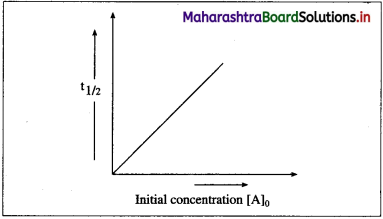
(Textbook Page No 121)

Question 1.
Write the expressions for rates of reaction for :
2N2O5(g) → 4NO2(g) + O2(g)?
Answer:
For the given reaction, Rate of reaction =
\(=R=-\frac{1}{2} \frac{d\left[\mathrm{~N}_{2} \mathrm{O}_{5}\right]}{d t}\)
\(\begin{aligned}
&=+\frac{1}{4} \frac{d\left[\mathrm{NO}_{2}\right]}{d t} \\
&=+\frac{d\left[\mathrm{O}_{2}\right]}{d t}
\end{aligned}\)

Maharashtra Board Class 12 Chemistry Solutions Chapter 6 Chemical Kinetics

Problem 6.1: (Textbook Page No 121)

Question 1.
For the reaction,
\(\mathbf{3 I}_{(a q)}^{-}+\mathbf{S}_{2} \mathbf{O}_{8(a q)}^{2-} \longrightarrow \mathbf{I}_{3(\text { (aq) }}^{-}+2 \mathbf{S O}_{4(\mathrm{aq})}^{2-}\)
Calculate (a) the rate of formation of I3,
(b) the rates of consumption of 1 and S2O and (c) the overall rate of reaction if the rate of formation of \(\mathrm{SO}_{4}^{2-}\) is 0.O22 moles dm-3 sec-1.
Answer:
Maharashtra Board Class 12 Chemistry Solutions Chapter 6 Chemical Kinetics 19
Maharashtra Board Class 12 Chemistry Solutions Chapter 6 Chemical Kinetics 20
∴ (a) Rate of formation of \(\mathrm{I}_{3}^{-}\) = 0.011 mol dm-3 s-1
(b) Rate of consumption of I = 0.033 mol dm-3 s-1
(c) Rate of consumption of \(\mathrm{S}_{2} \mathrm{O}_{8}^{2-}\) = 0.011 mol dm-3 s-1
(d) Overall rate of reaction = Rate of consumption of reactant = Rate of formation of product

Try this….. (Textbook Page No 122)

Question 1.
For the reaction :
NO2(g) + CO(g) → NO(g) + CO2(g), the rate of reaction is experimentally found to be proportional to the square of the concentration of NO2 and independent that of CO. Write the rate law.
Answer:
Since the rate of the reaction is proportional to [NO2]2 and [CO]0, the rate law is R = k[NO2]2 x [CO]0
∴ R = k[NO2]2.

Maharashtra Board Class 12 Chemistry Solutions Chapter 6 Chemical Kinetics

Try this….. (Textbook Page No 124)

Question 1.
The reaction,
CHCl3(g) + Cl2(g) → CCl4(g) + HCl(g) is first order in CHCl3 and 1/2 order in Cl2. Write the rate law and overall order of reaction.
Answer:
Since the reaction is first order in CHCl3 and 1/2 order in Cl2, the rate law for the reaction will be, Rate = k[CHCl3] X [Cl2]1/2
The overall order (n) of the reaction will be, n = l + = \(\frac{1}{2}=\frac{3}{2}\)

Use your brain power! (Textbook Page No 124)

Question 1.
The rate of the reaction 2A + B → 2C + D is 6 x 10⁻⁴ mol dm-3 s-1 when [A] =[B] = O.3 mol dm-3 If the reaction is of first order in A and zeroth order in B, what is the rate constant?
Answer:
For the reaction,
2A + B → 2C + D,
Maharashtra Board Class 12 Chemistry Solutions Chapter 6 Chemical Kinetics 51

(Problem 6.7) (Textbook Page No 126)

Question 1.
A reaction occurs in the following steps :
(i) NO2(g) + F2(g) → NO2F(g) + F(g) (slow)
(ii) F(g) + NO2(g) → NO2F(g) (fast)
(a) Write the equation of overall reaction.
(b) Write down rate law.
(c) Identify the reaction intermediate.
Solution :
(a) The addition of two steps gives the overall reaction as
2NO2(g) + F2(g) → 2NO2 F(g)
(b) Step (i) is slow. The rate law of the reaction is predicted from its stoichiometry. Thus, rate = k [NO2] [F2]
(c) F is produced in step (i) and consumed in step (ii) hence F is the reaction intermediate.

Maharashtra Board Class 12 Chemistry Solutions Chapter 6 Chemical Kinetics

Try this….. (Textbook Page No 126)

Question 1.
A complex reaction takes place in two steps :
(i) NO(g) + O3(g) → NO3(g) + O(g)
(ii) NO3(g) + O(g) → NO2(g) + O2(g)
The predicted rate law is rate = k [NO] [O3]. Identify the rate-determining step. Write the overall reaction. Which is the reaction inter-mediate? Why?
Answer:
(i) NO(g) + O3(g) → NO3(g) + O(g)
(ii) NO3(g) + O(g) NO2(g) + O2(g)
(a) The first step is slow and rate determining step since the rate depends on concentrations of NO(g) and O3(g). (Given : Rate = k [NO] x [O])
(b) The overall reaction is the combination of two steps.
NO(g) + O3(g) → NO2(g) + O2(g)
(c) NO3(g) and O(g) are reaction intermediates. They are formed in first step (i) and removed in the second step (ii).

Try this….. (Textbook Page No 129)

Question 1.
The half-life of a first-order reaction is 0.5 min. Calculate (a) time needed for the reactant to reduce to 20% and (b) the amount decomposed in 55 s.
Answer:
Maharashtra Board Class 12 Chemistry Solutions Chapter 6 Chemical Kinetics 70

Try this….. (Textbook Page No 123)

Question 1.
For the reaction 2A + 2B → 2C + D, if concentration of A is doubled at constant [B] the rate increases by a factor of 4. If the concentration of B is doubled with [A] being constant the rate is doubled. Write the rate law of the reaction.
Answer:
Rate = R1 = k[A]x [B]y
When concentration of A = [2A] and
Maharashtra Board Class 12 Chemistry Solutions Chapter 6 Chemical Kinetics 71
Hence order with respect to A is 2 and with respect to B is 1. By rate law,
Rate = A: [A]2 [B]

Maharashtra Board Class 12 Chemistry Solutions Chapter 6 Chemical Kinetics

Question 2.
The rate law for the reaction A + B → C is found to be rate = k [A]2 x [B]. The rate constant of the reaction at 25 °C is 6.25 M-2 S-1. What is the rate of reaction when [A] = 1.0 mol dm-3 and [B] = 0.2 mol dm-3?
Answer:
Rate = k x [A]2 x [B]
= 6.25 x 12 x 0.2
Rate = 1.25 x 10² mol dm-3 s-1

12th Std Chemistry Questions And Answers:

12th Chemistry Chapter 11 Exercise Alcohols, Phenols and Ethers Solutions Maharashtra Board

Class 12 Chemistry Chapter 11

Balbharti Maharashtra State Board 12th Chemistry Textbook Solutions Chapter 11 Alcohols, Phenols and Ethers Textbook Exercise Questions and Answers.

Alcohols, Phenols and Ethers Class 12 Exercise Question Answers Solutions Maharashtra Board
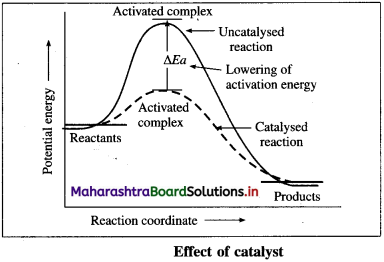
Class 12 Chemistry Chapter 11 Exercise Solutions Maharashtra Board

Chemistry Class 12 Chapter 11 Exercise Solutions

1. Choose the correct option.

Question i.
Which of the following represents the increasing order of boiling points of (1), (2) and (3)?
(1) CH3 – CH2 – CH2 – CH2 – OH
(2) (CH3)2 CH – O – CH3
(3) (CH3)3COH
A. (1) < (2) < (3)
B. (2) < (1) < (3)
C. (3) < (2) < (1)
D. (2) < (3) < (1)
Answer:
(a) (1) < (2) < (3)

Maharashtra Board Class 12 Chemistry Solutions Chapter 11 Alcohols, Phenols and Ethers

Question ii.
Which is the best reagent for carrying out following conversion ?
Maharashtra Board Class 12 Chemistry Solutions Chapter 11 Alcohols, Phenols and Ethers 272
A. LiAlH4
B. Conc. H2SO4, H2O
C. H2/Pd
D. B2H6, H2O2 – NaOH
Answer:
B. Conc. H2SO4, H2O

Question iii.
Which of the following reaction will give ionic organic product on reaction ?
A. CH3 – CH2 – OH + Na
B. CH3 – CH2 – OH + SOCl2
C. CH3 – CH2 – OH + PCl5
D. CH3 – CH2 – OH + H2SO4
Answer:
C. CH3 – CH2 – OH + PCl5

Question iv.
Which is the most resistant alcohol towards oxidation reaction among the follwoing ?
Maharashtra Board Class 12 Chemistry Solutions Chapter 11 Alcohols, Phenols and Ethers 273
Answer:
(c)

Question v.
Resorcinol on distillation with zinc dust gives
A. Cyclohexane
B. Benzene
C. Toluene
D. Benzene-1, 3-diol
Answer:
(b) Benzene

Question vi.
Anisole on heating with concerntrated HI gives
A. Iodobenzene
B. Phenol + Methanol
C. Phenol + Iodomethane
D. Iodobenzene + methanol
Answer:
B. Phenol + Methanol

Question vii.
Which of the following is the least acidic compound ?
Maharashtra Board Class 12 Chemistry Solutions Chapter 11 Alcohols, Phenols and Ethers 274
Answer:
(b)

Question viii.
The compound incapable of hydrogen bonding with water is ……
Maharashtra Board Class 12 Chemistry Solutions Chapter 11 Alcohols, Phenols and Ethers 275
Answer:
(b)

Maharashtra Board Class 12 Chemistry Solutions Chapter 11 Alcohols, Phenols and Ethers

Question ix.
Ethers are kept in air tight brown bottles because
A. Ethers absorb moisture
B. Ethers evaporate readily
C. Ethers oxidise to explosive peroxide
D. Ethers are inert
Answer:
C. Ethers oxidise to explosive peroxide

Question x.
Ethers reacts with cold and concentrated H2SO4 to form
A. oxonium salt
B. alkene
C. alkoxides
D. alcohols
Answer:
A. oxonium salt

2. Answer in one sentence/ word.

Question i.
Hydroboration-oxidation of propene gives…..
Answer:
n-propyl alcohol (CH3 – CH2 – CH2 – OH)

Question ii.
Write the IUPAC name of alcohol having molecular formula C4H10O which is resistant towards oxidation.
Answer:
Maharashtra Board Class 12 Chemistry Solutions Chapter 11 Alcohols, Phenols and Ethers 244

Question iii.
Write the structure of optically active alcohol having molecular formula C4H10O
Answer:
Maharashtra Board Class 12 Chemistry Solutions Chapter 11 Alcohols, Phenols and Ethers 245

Question iv.
Write name of the electrophile used in Kolbe’s Reaction.
Answer:
Electrophile : Carbon dioxide (O = C = O)

3. Answer in brief.

Question i.
Why phenol is more acidic than ethyl alcohol ?
Answer:
(1) In ethyl alcohol, the -OH group is attached to sp3 – hybridised carbon while in phenols, it is attached to sp2 – hybridised carbon.

(2) Due to higher electronegativity of sp2 – hybridised carbon, electron density on oxygen decreases. This increases the polarity of O-H bond and results in more ionization of phenol than that of alcohols.
Maharashtra Board Class 12 Chemistry Solutions Chapter 11 Alcohols, Phenols and Ethers 117

(3) Electron donating inductive effect (+1 effect) of the alkyl group destabilizes alkoxide ion. As a result alcohol does not ionize much in water, therefore alcohol is neutral compound in aqueous medium.

(4) In alkoxide ion, the negative charge is localized on oxygen, while in phenoxide ion the negative charge is delocalized. The delocalization of the negative charge (structure I to V) makes phenoxide ion more stable than that of phenol.
Maharashtra Board Class 12 Chemistry Solutions Chapter 11 Alcohols, Phenols and Ethers 118

The delocalization of charge in phenol (structures VI to X), the resonating structures have charge separation (where oxygen atom of OH group to be positive and delocalization of negative charge over the ortho and para positions of aromatic ring) due to which phenol molecule is less stable than phenoxide ion. This favours ionization of phenol. Thus phenols are more acidic than ethyl alcohol.

Maharashtra Board Class 12 Chemistry Solutions Chapter 11 Alcohols, Phenols and Ethers

Question ii.
Why p-nitrophenol is a stronger acid than phenol ?
Answer:
(1) In p-nitrophenol, nitro group (NO2) is an electron withdrawing group present at para position which enhances the acidic strength (-1 effect). The O-H bond is under strain and release of proton (H+) becomes easy. Further p-nitrophenoxide ion is more stabilised due to resonance.

(2) Since the absence of electron withdrawing group (like – NO2) in phenol at ortho and para position, the acidic strength of phenol is less than that of p-nitrophenol.
Maharashtra Board Class 12 Chemistry Solutions Chapter 11 Alcohols, Phenols and Ethers 119

Question iii.
Write two points of difference between properties of phenol and ethyl alcohol.
Answer:
Maharashtra Board Class 12 Chemistry Solutions Chapter 11 Alcohols, Phenols and Ethers 122

Question iv.
Give the reagents and conditions necessary to prepare phenol from
a. Chlorobenzene
b. Benzene sulfonic acid.
Answer:
(1) From chlorobenzene : Reagents required : NaOH and dil. HC1 Temperature : 623 K, Pressure : 150 atm
(2) From Benzene sulphonic acid : Reagents required : aq NaOH, caustic soda, dil. HC1 Temperature : 573 K

Question v.
Give the equations of the reactions for the preparation of phenol from isopropyl benzene.
Answer:
Preparation of phenol from cumene (isopropylbenzene) : This is the commercial method of preparation of phenol. When a stream of air is passed through cumene (isopropylbenzene) suspended in aqueous Na2CO3 solution in the presence of cobalt naphthenate catalyst, isopropyl benzene hydroperoxide or cumene hydroperoxide is formed. Isopropylbenzene hydroperoxide on warming with dil. H2SO4 gives phenol and acetone. Acetone is an important by-product of the reaction and is separated by distillation. The reaction is called auto oxidation.
Maharashtra Board Class 12 Chemistry Solutions Chapter 11 Alcohols, Phenols and Ethers 111

Maharashtra Board Class 12 Chemistry Solutions Chapter 11 Alcohols, Phenols and Ethers

Question vi.
Give a simple chemical test to distinguish between ethanol and ethyl bromide.
Answer:
When ethyl bromide is heated with aq NaOH; ethyl alcohol is formed whereas ethanol does not react with aq NaOH
Maharashtra Board Class 12 Chemistry Solutions Chapter 11 Alcohols, Phenols and Ethers 123

4. An ether (A), C5H12O, when heated with excess of hot HI produce two alkyl halides which on hydrolysis form compound (B)and (C), oxidation of (B) gave and acid (D), whereas oxidation of (C) gave a ketone (E). Deduce the structural formula of (A), (B), (C), (D) and (E).
Answer:
Maharashtra Board Class 12 Chemistry Solutions Chapter 11 Alcohols, Phenols and Ethers 243

5. Write structural formulae for

a. 3-Methoxyhexane
b. Methyl vinyl ether
c. 1-Ethylcyclohexanol
d. Pentane-1,4-diol
e. Cyclohex-2-en-1-ol
Answer:
Maharashtra Board Class 12 Chemistry Solutions Chapter 11 Alcohols, Phenols and Ethers 35

Maharashtra Board Class 12 Chemistry Solutions Chapter 11 Alcohols, Phenols and Ethers

6. Write IUPAC names of the following

Maharashtra Board Class 12 Chemistry Solutions Chapter 11 Alcohols, Phenols and Ethers 276
Answer:
Maharashtra Board Class 12 Chemistry Solutions Chapter 11 Alcohols, Phenols and Ethers 36
Maharashtra Board Class 12 Chemistry Solutions Chapter 11 Alcohols, Phenols and Ethers 37

Activity :
• Collect information about production of ethanol as byproduct in sugar industry and its importance in fuel economy.
• Collect information about phenols used as antiseptics and polyphenols having antioxidant activity.

12th Chemistry Digest Chapter 11 Alcohols, Phenols and Ethers Intext Questions and Answers
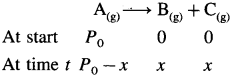
Use your brain power! (Textbook Page No 235)

Question 1.
Classify the following alcohols as l0/2°/3° and allylic/benzylic
Maharashtra Board Class 12 Chemistry Solutions Chapter 11 Alcohols, Phenols and Ethers 7
Answer:
(1) Ally lie alcohol (primary)
(2) Allylic alcohol (secondary)
(3) Allylic alcohol (tertiary)
(4) Benzylic alcohol (primary)
(5) Benzylic alcohol (secondary)

Maharashtra Board Class 12 Chemistry Solutions Chapter 11 Alcohols, Phenols and Ethers

Use your brain power ….. (Textbook Page No 236)

Question 1.
Name t-butyl alcohol using carbinol system of nomenclature.
Answer:
Trimethyl carbinol.

Problem 11.1 (Textbook Page No 238)

Question 1.
Draw structures of following compounds:
(i) 2,5-DiethIphenoI
(ii) Prop-2-en-I-oI
(iii) 2-methoxypropane
(iv) Phenylmethanol
Solution :
Maharashtra Board Class 12 Chemistry Solutions Chapter 11 Alcohols, Phenols and Ethers 32

Try this ….. (Textbook Page No 238)

Write IUPAC names ol (he following compounds.
Maharashtra Board Class 12 Chemistry Solutions Chapter 11 Alcohols, Phenols and Ethers 33
Maharashtra Board Class 12 Chemistry Solutions Chapter 11 Alcohols, Phenols and Ethers 34

Do you know (Textbook Page No 238)

Question 1.
The mechanism of hydration of ethylcnc to ethyl alcohol.
Answer:
The mechanism of hydration of ethylene involves three steps:

Step 1: Ethylene gets protonated to form carbocation by electrophilic attack of H3O (Formation of carbocation intermediate).
Maharashtra Board Class 12 Chemistry Solutions Chapter 11 Alcohols, Phenols and Ethers 59
Step 2 : Nucleophilic attack of water on carbocation
Maharashtra Board Class 12 Chemistry Solutions Chapter 11 Alcohols, Phenols and Ethers 60
Step 3 : Deprotonation to form an alcohol
Maharashtra Board Class 12 Chemistry Solutions Chapter 11 Alcohols, Phenols and Ethers 61

Maharashtra Board Class 12 Chemistry Solutions Chapter 11 Alcohols, Phenols and Ethers

Problem 11.2 : (Textbook Page No 239)

Question 1.
Predict the products for the following reaction.
Maharashtra Board Class 12 Chemistry Solutions Chapter 11 Alcohols, Phenols and Ethers 76
Solution:
The substrate (A) contains an isolated Maharashtra Board Class 12 Chemistry Solutions Chapter 11 Alcohols, Phenols and Ethers 77 and an aldehyde group. H2/Ni can reduce both these functional groups while LiAlH4 can reduce only – CHO of the two, Hence
Maharashtra Board Class 12 Chemistry Solutions Chapter 11 Alcohols, Phenols and Ethers 78

Try this ….. (Textbook page 240)

Question 1.
Arrange O – H, C – H and N – H bonds in increasing order of their bond polarity.
Answer:
Increasing order of polarity :C – H, N – H, O – H

Problem 11.3 : (Textbook Page No 241)

Question 1.
The boiling point of n-butyl alcohol, isobutyl alcohol, sec-butyl alcohol and tert-butyl alcohol are 118 °C, 108 °C. 99 °C and 82 °C respectively. Explain.
Solution:
As branching increases, intermolecular van der Waal’s force become weaker and the boiling point decreases. Therefore, n-butyl alcohol has highest boiling point 118 °C and tert-butyl alcohol has lowest boiling point 83 °C. Isobutyl alcohol is a primary alcohol and hence its boiling point is higher than that of sec-butyl alcohol.

Problem 11.4 : (Textbook Page No 242)

The solubility of o-nitrophenol and p-nitrophenol is 0.2 g and 1.7 g/100 g of H2O respectively. Explain the difference.
Solution :
Maharashtra Board Class 12 Chemistry Solutions Chapter 11 Alcohols, Phenols and Ethers 115
p-Nitrophenol has strong intermolecular hydrogen bonding with solvent water. On the other hand, o-nitrophenol has strong intramolecular hydrogen bonding and therefore the intermolecular attraction towards solvent water is weak. The stronger the intermolecular attraction between solute and solvent higher is the solubility. Hence p-nitrophenol has higher solubility in water than that of o-nitrophenol.

Problem 11.5 : (Textbook Page No 243 & 244)

Question 1.
Arrange the following compounds in decreasing order of acid strength and justify.
(1) CH3 – CH2 – OH
(2) (CH3)3 C – OH
(3) C6H5 – OH
(4) p-NO2 – C6H4 – OH
Solution :
Compounds (3) and (4) are phenols and therefore are more acidic than the alcohols (1) and (2). The acidic strengths of compounds depend upon stabilization of the corresponding conjugate bases. Hence let us compare electronic effects in the conjugate bases of these compounds :
Maharashtra Board Class 12 Chemistry Solutions Chapter 11 Alcohols, Phenols and Ethers 133

The conjugate base of the alcohol (1) is destabilized by + 1 effect of one alkyl group, whereas conjugate base of the alcohol (2) is destabilized by +1 effect of three alkyl groups. Hence (2) is weaker acid than (1)
Maharashtra Board Class 12 Chemistry Solutions Chapter 11 Alcohols, Phenols and Ethers 134

Phenols : The conjugate base of p-nitrophenol (4) is better resonance stabilized due to six resonance structures compared to the five resonance structure of conjugate base of phenol (3). The resonance structure VI has – ve charge on only electronegative oxygens. Hence the phenol (4) is stronger acid than (3). Thus the decreasing order of acid strength is (4), (3), (1), (2).

Maharashtra Board Class 12 Chemistry Solutions Chapter 11 Alcohols, Phenols and Ethers

Use your brain power (Textbook Page No 244)

Question 1.
What are the electronic effects exerted by – OCH3 and – Cl? Predict the acid strength of
Maharashtra Board Class 12 Chemistry Solutions Chapter 11 Alcohols, Phenols and Ethers 135
Answer:
The electronic effects exerted by – Cl and – O CH3 are as follows :
(1) Cl being more electronegative atom it pulls the bonding electrons towards itself. This is known as negative inductive effect (- I).

(2) – OCH3 is less electronegative group which repels the bonding electrons away from it. This is known as positive inductive effect ( + I).

(3) The relative to parent phenol, Maharashtra Board Class 12 Chemistry Solutions Chapter 11 Alcohols, Phenols and Ethers 136 is more acidic than Maharashtra Board Class 12 Chemistry Solutions Chapter 11 Alcohols, Phenols and Ethers 137.

Problem 11.6 : (Textbook Page No 245)

Question 1.
Mechanism of acid catalyzed dehydration of ethanol to give ethene.
Answer:
The mechanism of dehydration of ethanol involves the following order :
Step 1 : Formation of protonated alcohols : Initially ethyl alcohol gets protonated to form ethyl oxonium ion.
Maharashtra Board Class 12 Chemistry Solutions Chapter 11 Alcohols, Phenols and Ethers 164
Step 2 : Formation of carbocation : It is the slowest step and hence, the rate determining step of the reaction.
Maharashtra Board Class 12 Chemistry Solutions Chapter 11 Alcohols, Phenols and Ethers 165
Steps 3: Formation of ethene: Removal of a proton (H+) from carbocation.
Maharashtra Board Class 12 Chemistry Solutions Chapter 11 Alcohols, Phenols and Ethers 166

The acidused in step I is released in step 3, the equilibrium is shifted to the right, ethene is removed as it is formed.

Problem 11.6 : (Textbook Page No 245)

Question 1.
Write the reaction showing major and minor products formed on heating butan-2-ol with concentrrated sulphuric acid.
Solution :
In the reaction described butan-2-ol undergoes dehydration to give but-2-ene (major) and but-l-ene (minor) in accordance with Saytzeff rule.
Maharashtra Board Class 12 Chemistry Solutions Chapter 11 Alcohols, Phenols and Ethers 167

Problem 11.7 : (Textbook Page No 246)

Question 1.
Write and explain reactions to convert propan-l-ol into propan-2-ol.
Solution :
The dehydration of propane-l-ol to propene is the first step. Markownikoff hydration of propene is the second step to get the product propan-2-ol. This is brought about by reaction with concemtrated H2SO4 followed by hydrolysis.
Maharashtra Board Class 12 Chemistry Solutions Chapter 11 Alcohols, Phenols and Ethers 168

Maharashtra Board Class 12 Chemistry Solutions Chapter 11 Alcohols, Phenols and Ethers

Problem 11.8 : (Textbook Page No 246)

Question 1.
An organic compound gives hydrogen on reaction with sodium metal. It forms an aldehyde having molecular formula C2H4O on oxidation with pyridinium chlorochromate. Name the compounds and give equations of these reactions.
Solution :
The given molecular formula C2H4O of aldehyde is written as CH3 – CHO. Hence the formula of alcohol from which this is obtained by oxidation must be CH3 – CH2 – OH. The two reactions can, therefore, be represented as follows :
Maharashtra Board Class 12 Chemistry Solutions Chapter 11 Alcohols, Phenols and Ethers 178

(Do you know? Textbook Page No 248)

Question 90.
Write the mechanism of dehydration of alcohol to give ether.
Answer:
Dehydration of alcohols to form ether is SN2 reaction. The mechanism of dehydration of ethanol involves the following steps.

Step 1 (Protonation) : Initially ethyl alcohol gets protonated in the presence of acid to form ethyl oxonium ion.
Maharashtra Board Class 12 Chemistry Solutions Chapter 11 Alcohols, Phenols and Ethers 191
Step 2 (SN2 mechanism) : Protonated alcohol species undergoes a backside attack by second molecule of alcohol is a slow step.
Maharashtra Board Class 12 Chemistry Solutions Chapter 11 Alcohols, Phenols and Ethers 192

Step 3 (Deprotonation) : Formation of diethyl ether by elimination of proton
Maharashtra Board Class 12 Chemistry Solutions Chapter 11 Alcohols, Phenols and Ethers 193

Problem 11.9 : (Textbook Page No 249)

Question 1.
Ethyl isopropyl ether does not form on reaction of sodium ethoxide and isopropyl chloride.
Maharashtra Board Class 12 Chemistry Solutions Chapter 11 Alcohols, Phenols and Ethers 202
(i) What would be the main product of this reaction?
(ii) Write another reaction suitable for the preparation of ethyl isopropyl ether.
Solution :
(i) Isopropyl chloride is a secondary chloride. On treating with sodium ethoxide it gives elimination reaction to form propene as the main product.
Maharashtra Board Class 12 Chemistry Solutions Chapter 11 Alcohols, Phenols and Ethers 203
(ii) Ethyl isopropyl ether can be prepared as follows using ethyl chloride (10 chloride) as substrate.
Maharashtra Board Class 12 Chemistry Solutions Chapter 11 Alcohols, Phenols and Ethers 204

Maharashtra Board Class 12 Chemistry Solutions Chapter 11 Alcohols, Phenols and Ethers

Do you know? (Textbook Page No 250)

Question 1.
The mechanism of the reaction of HI with methoxy ethane.
Answer:
The reaction mechanism takes place as follows :
Step 1 : Protonation of ether Initially the ether molecule (methoxy ethane) protonated by cone. HI to form oxonium ion.
Maharashtra Board Class 12 Chemistry Solutions Chapter 11 Alcohols, Phenols and Ethers 229

Step 2 : Iodide is a good nucleophile. It attacks the least substituted carbon of the oxonium ion formed in step 1 and displaces an alcohol molecule by SN2 mechanism.
Maharashtra Board Class 12 Chemistry Solutions Chapter 11 Alcohols, Phenols and Ethers 230

For example :
• Use of excess HI converts the alcohol into alkyl iodide.
• In case of ether having one tertiary alkyl group the reaction with hot HI follows SN1 mechanism, and tertiary iodide is formed rather than tertiary alcohol.

Step 1 :
Maharashtra Board Class 12 Chemistry Solutions Chapter 11 Alcohols, Phenols and Ethers 231
Step 2 :
Maharashtra Board Class 12 Chemistry Solutions Chapter 11 Alcohols, Phenols and Ethers 232

12th Std Chemistry Questions And Answers:

12th Chemistry Chapter 15 Exercise Introduction to Polymer Chemistry Solutions Maharashtra Board

Class 12 Chemistry Chapter 15

Balbharti Maharashtra State Board 12th Chemistry Textbook Solutions Chapter 15 Introduction to Polymer Chemistry Textbook Exercise Questions and Answers.

Introduction to Polymer Chemistry Class 12 Exercise Question Answers Solutions Maharashtra Board
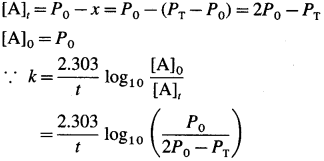
Class 12 Chemistry Chapter 15 Exercise Solutions Maharashtra Board

Chemistry Class 12 Chapter 15 Exercise Solutions

1. Choose the correct option from the given alternatives.

Question i.
Nylon fibers are …………………………………..
A. Semisynthetic fibres
B. Polyamide fibres
C. Polyester fibres
D. Cellulose fibres
Answer:
B. polyamide fibres

Maharashtra Board Class 12 Chemistry Solutions Chapter 15 Introduction to Polymer Chemistry

Question ii.
Which of the following is naturally occurring polymer?
A. Telfon
B. Polyethylene
C. PVC
D. Protein
Answer:
D. Protein

Question iii.
Silk is a kind of …………………………………. fibre
A. Semisynthetic
B. Synthetic
C. Animal
D. Vegetable
Answer:
C. an animal

Question iv.
Dacron is another name of …………………………………. .
A. Nylon 6
B. Orlon
C. Novolac
D. Terylene
Answer:
D. Terylene

Question v.
Which of the following is made up of polyamides?
A. Dacron
B. Rayon
C. Nylon
D. Jute
Answer:
C. Nylon

Question vi.
The number of carbon atoms present in the ring of ε – caprolactam is
A. Five
B. Two
C. Seven
D. Six
Answer:
D. Six

Question vii.
Terylene is …………………………………. .
A. Polyamide fibre
B. Polyester fibre
C. Vegetable fibre
D. Protein fibre
Answer:
B. Polyester fibre

Question viii.
PET is formed by …………………………………. .
A. Addition
B. Condensation
C. Alkylation
D. Hydration
Answer:
D. Hydration

Question ix.
Chemically pure cotton is …………………………………. .
A. Acetate rayon
B. Viscose rayon
C. Cellulose nitrate
D. Cellulose
Answer:
D. Cellulose

Maharashtra Board Class 12 Chemistry Solutions Chapter 15 Introduction to Polymer Chemistry

Question x.
Teflon is chemically inert, due to presence of …………………………………. .
A. C-H bond
B. C-F bond
C. H- bond
D. C=C bond
Answer:
A. C-H bond

2. Answer the following in one sentence each.

Question i.
Identify ‘A’ and ‘B’ in the following reaction …………………………………. .
Maharashtra Board Class 12 Chemistry Solutions Chapter 15 Introduction to Polymer Chemistry 1
Answer:
Maharashtra Board Class 12 Chemistry Solutions Chapter 15 Introduction to Polymer Chemistry 70

Question ii.
Complete the following statements
a. Caprolactam is used to prepare …………………………………. .
b. Novolak is a copolymer of …………………………………. and …………………………………. .
c. Terylene is ………………………………….. polymer of terephthalic acid and ethylene glycol.
d. Benzoyl peroxide used in addtion polymerisation acts as …………………………………. .
e. Polyethene consists of polymerised …………………………………. .
Answer:
a. Nylon-6
b. Phenol, formaldehyde
c. polyester
d. initiator (catalyst)
e. linear or branched-chain

Question iii.
Draw the flow chart diagram to show the classification of polymers based on type of polymerisation.
Answer:
Maharashtra Board Class 12 Chemistry Solutions Chapter 15 Introduction to Polymer Chemistry 71

Question iv.
Write examples of Addition polymers and condensation polymers.
Answer:
Addition polymers : Polyvinyl chloride, polythene
Condensation polymers : Bakelite, terylene, Nylon-66

Question v.
Name some chain-growth polymers.
Answer:
Chain growth polymers : Polythene, polyacrylonitrile and polyvinyl chloride.

Maharashtra Board Class 12 Chemistry Solutions Chapter 15 Introduction to Polymer Chemistry

Question vi.
Define the terms :
1) Monomer
2) Vulcanisation
3) Synthetic fibres
Answer:
1. Monomer is a small and simple molecule and has a capacity to form two chemical bonds with other monomers. Examples : Ethene, Propylene.
2. The process by which a network of cross-links is introduced into an elastomer is called vulcanisation or it can also be defined as the process of heating natural rubber with sulphur to increase the tensile strength, toughness and elasticity of natural rubber is known as vulcanization of rubber.
3. The man-made fibres prepared by polymerization of one monomer or copolymerization of two or more monomers are called synthetic fibres.

Question vii.
What type of intermolecular force leads to high-density polymer?
Answer:
High density polymers have low degree of branching along the hydrocarbon chain. The molecules are closely packed together during crystallization. This closer packing means that the van der Waals attraction between the chains are greater and so the plastic (high density polymer) is stronger and has a melting point.

Question viii.
Give one example each of copolymer and homopolymer.
Answer:
Homopolymer : PVC, Nylon-6
Copolymer : Terylene, Buna-S

Question ix.
Identify Thermoplastic and Thermosetting Plastics from the following …………………………………. .
1. PET
2. Urea-formaldehyde resin
3. Polythene
4. Phenol formaldehyde
Answer:
Thermoplastic plastics : PET, Polythene
Thermosetting plastics : Urea formaldehyde resin, Phenol formaldehyde

3. Answer the following.

Question i.
Write the names of classes of polymers formed according to intermolecular forces and describe briefly their structural characteristics.
Answer:
Molecular forces bind the polymer chains either by hydrogen bonds or Vander Waal’s forces. These forces are called intermolecular forces. On the basis of magnitude of intcrmolccular forces, polymers are further classified as ebstomers, fibres, thermoplastic polymers. thermosetting polymers.

(1) Elastomers: Weak van der Waals type of intermolecular forces of attraction between the polymer chains are observed in cbstomcrs. When polymer is stretched, the polymer chain stretches and when the strain is relieved the chain returns to its odginal position, Thus, polymer shows elasticity and is called elastomers. Elastomers, the elastic polymers, have weak van der Waals type of intermolecular forces which permit the polymer to be stretched. Lilastorners are soft and stretchy and used in making rubber bands. E.g.. neoprene, vulcanized rubber, buna.S, buna-N.

(2) Fibres : It consists of strong intermolecular forces of’ attraction due to hydrogen bonding and strong dipole-dipole forces. These polymers possess high tensile strength. Due to these strong intermolecular forces the fibres are crystalline in nature. They are used in textile industries, strung tyres. etc.. e.g., nylon, terylene.

(3) Thermoplastic polymers: These polymer possess moderately strong intermolecular forces of attraction between those of elastomers and fibres. These polymers arc called thermoplastic because they become soft on heating and hard on cooling. They are either linear or branched chain polymers. They can be remoulded and recycled. E.g. polyethenc, PVC, polystyrene.

(4) Thermosetting polymers: These polymers are cross linked or branched molecules and are rigid polymers. During their formation they have property of being shaped on heating. but they get hardened while hot. Once hardened these become infusible, cannot be softened by heating and therefore, cannot be remoulded and recycled.
This shows extensive cross linking by covalent bonds formed in the moulds during hardening/setting process while hot. E.g. Bakelite, urea formaldehyde resin.

Maharashtra Board Class 12 Chemistry Solutions Chapter 15 Introduction to Polymer Chemistry

Question ii.
Write reactions of formation of :
a. Nylon 6
b. Terylene
Answer:
Terylene is polyester fibre formed by the polymerization of terephthalic acid and ethylene glycol.

Terylene is obtained by condensation polymerization of ethylene glycol and terephthalic acid in presence of catalyst zinc acetate and antimony trioxide at high temperature.
Maharashtra Board Class 12 Chemistry Solutions Chapter 15 Introduction to Polymer Chemistry 26

Properties :

  • Terylene has relatively high melting point (265 °C)
  • It is resistant to chemicals and water.

Uses :

  • It is used for making wrinkle free fabrics by blending with cotton (terycot) and wool (terywool), and also as glass reinforcing materials in safety helmets.
  • PET is the most common thermoplastic which is another trade name of the polyester polyethylenetereph- thalate.
  • It is used for making many articles like bottles, jams, packaging containers.

Question iii.
Write the structure of natural rubber and neoprene rubber along with the name and structure of thier monomers.
Answer:
Maharashtra Board Class 12 Chemistry Solutions Chapter 15 Introduction to Polymer Chemistry 27

Question iv.
Name the polymer type in which the following linkage is present.
Answer:
The Maharashtra Board Class 12 Chemistry Solutions Chapter 15 Introduction to Polymer Chemistry 74 linkage is present in terylene or dacron polymer.

Question v.
Write the structural formula of the following synthetic rubbers :
a. SBR rubber
b. Buna-N rubber
c. Neoprene rubber
Answer:
Maharashtra Board Class 12 Chemistry Solutions Chapter 15 Introduction to Polymer Chemistry 41

Maharashtra Board Class 12 Chemistry Solutions Chapter 15 Introduction to Polymer Chemistry

Question vi.
Match the following pairs :
Name of polymer – Monomer
1. Teflon – a. CH2 = CH2
2. PVC – b. CF2 = CF2
3. Polyester – c. CH2 = CHCl
4. Polythene – d. C6H5OH and HCHO
5. Bakelite – e. Dicarboxylic acid and polyhydoxyglycol
Answer:

  1. Teflon – CF2 = CF2
  2. PVC – CH2 = CHCI
  3. Polyester-Dicarboxylic acid and polyhydoxyglycol
  4. Polythene – CH2 = CH2
  5. Bakelite – C6H5OH and HCHO

Question vii.
Draw the structures of polymers formed from the following monomers
1. Adipic acid + Hexamethylenediamine
2. e – Aminocaproic acid + Glycine
Answer:
Maharashtra Board Class 12 Chemistry Solutions Chapter 15 Introduction to Polymer Chemistry 32

Question viii.
Name and draw the structure of the repeating unit in natural rubber.
Answer:
Maharashtra Board Class 12 Chemistry Solutions Chapter 15 Introduction to Polymer Chemistry 14Repeating unit of natural rubber (Basic unit : isoprene)

Question ix.
Classify the following polymers as natural and synthetic polymers
a. Cellulose
b. Polystyrene
c. Terylene
d. Starch
e. Protein
f. Silicones
g. Orlon (Polyacrylonitrile)
h. Phenol-formaldehyde resins
Answer:

Natural Polymers 1. Cellulose 4. Starch 5. Protein
Synthetic Polymers 2. Polystyrene 3. Terylene 6. Silicones 7. Orion (Polyacrylonitrile) 8. phenol-formaldehyde resin

Question x.
What are synthetic resins? Name some natural and synthetic resins.
Answer:
Synthetic resins are artificially synthesised high molecular weight polymers. They are the basic raw material of plastic. The main properties of plastic depend on the synthetic resin it is made from.

Examples of natural resins : Rosin, Damar, Copal, Sandarac, Amber, Manila
Examples of synthetic resins : Polyester resin, Phenolic resin, Alkyl resin, Polycarbonate resin, Polyamide resin, Polyurethane resin, silicone resin, Epoxy resin, Acrylic resin.

Maharashtra Board Class 12 Chemistry Solutions Chapter 15 Introduction to Polymer Chemistry

Question xi.
Distinguish between thermosetting and thermoplastic resins. Write example of both the classes.
Answer:

Thermosetting resin Thermoplastic resin
(1) They harden when heated. Once hardened it no longer melts. (1) They soften when heated and harden again when cooled.
(2) They cannot be re-shaped. (2) They can be reshaped
(3) They are strong, hard. (3) They are weak, soft.
(4) Thermosetting resin show cross-linking.
Examples : Melamine resin Epoxy resins, Bake-lite.
(4) Thermoplastic molecules do not cross link, hence are flexible.
Examples : Polythene, polypropylene, nylon, polyester.

Question xii.
Write name and formula of raw material from which bakelite is made.
Answer:
The raw material or monomers used to prepare bakelite are o-hydroxymethyl phenol Maharashtra Board Class 12 Chemistry Solutions Chapter 15 Introduction to Polymer Chemistry 35 and formaldehyde (HCHO)

4. Attempt the following :

Question i.
Identify condensation polymers and addition polymers from the following.
Maharashtra Board Class 12 Chemistry Solutions Chapter 15 Introduction to Polymer Chemistry 2
Answer:
Maharashtra Board Class 12 Chemistry Solutions Chapter 15 Introduction to Polymer Chemistry 68

Question ii.
Write the chemical reactions involved in the manufacture of Nylon 6, 6
Answer:
Nylon-6, 6 is a linear polyamide polymer formed by the condensation polymerisation reaction. The monomers used in the preparation of Nylon-6, 6 are :
(1) Adipic acid : HOOC-(CH2)4-COOH
(2) Hexamethylene diamine : H2N-(CH2)6-NH2

When equimolar aqueous solutions of adipic acid and hexamethylene diamine are mixed and heated, there is neutralization to form a nylon salt. During polymerisation at 553 k nylon salt loses a water molecule to form nylon 6, 6 polymer. Both monomers (hexamethylene diamine and adipic acid) contain six carbon atoms each, hence the polymer is termed as Nylon-6,6.
Maharashtra Board Class 12 Chemistry Solutions Chapter 15 Introduction to Polymer Chemistry 24

Properties and uses : Nylon 6,6 is high molecular mass (12000 – 50000 u) linear condensation polymer. It possesses high tensile strength. It does not soak in water. It is used for making sheets, bristles for brushes, surgical sutures, textile fabrics, etc.

Maharashtra Board Class 12 Chemistry Solutions Chapter 15 Introduction to Polymer Chemistry

Question iii.
Explain the vulcanisation of rubber. Which vulcanizing agents are used for the following synthetic rubber.
a. Neoprene
b. Buna-N
Answer:
The process by which a network of cross links is introduced into an elastomer is called vulcanization.

Vulcanization enhances the properties of natural rubber like tensile strength, stiffness, elasticity, toughness etc. Sulphur forms cross links between polyisoprene chains which results in improved properties of rubber.

  • For neoprene vulcanizing agent is MgO.
  • For Buna-N vulcanizing agent is sulphur.

Question iv.
Write reactions involved in the formation of …………………………………. .
1) Teflon
2) Bakelite
Answer:
The monomers phenol and formaldehyde undergo polymerisation in the presence of alkali or acid as catalyst.
Maharashtra Board Class 12 Chemistry Solutions Chapter 15 Introduction to Polymer Chemistry 33
Phenol reacts with formaldehyde to form ortho or p-hydroxy methyl phenols, which further reacts with phenol to form a linear polymer called Novolac. It is used in paints.

In the third stage, various articles are shaped from novolac by putting it in appropriate moulds and heating at high temperature (138 °C to 176 °C) and at high pressure forms rigid polymeric material called bakelite. Bakelite is insoluble and infusible and has high tensile strength.
Maharashtra Board Class 12 Chemistry Solutions Chapter 15 Introduction to Polymer Chemistry 34
Bakelite is used in making articles like telephone instrument, kitchenware, electric insulators frying pans, etc.

2. Teflon is polytetrafluoroethylene. The monomer used in preparation of teflon is tetrafluoroethylene, (CF2 = CF2) which is a gas at room temperature. Tetrafluoroethylene is polymerized by using free radical initiators such as hydrogen peroxide or ammonium persulphate at high pressure.
Maharashtra Board Class 12 Chemistry Solutions Chapter 15 Introduction to Polymer Chemistry 22

Properties:

  • Telflon is tough, chemically inert and resistant to heat and attack by corrosive reagents.
  • C – F bond is very difficult to break and remains unaffected by corrosive alkali, organic solvents.
    Uses : Telflon is used in making non-stick cookware, oil seals, gaskets, etc.

Maharashtra Board Class 12 Chemistry Solutions Chapter 15 Introduction to Polymer Chemistry

Question v.
What is meant by LDP and HDP? Mention the basic difference between the same with suitable examples.
Answer:

  • LDP is low density polyethylene and HDP is high density polyethylene.
  • LDP is a branched polymer with low density due to chains are loosely held and HDP is a linear polymer with density due to close packing.
  • HDP is much stiffer than LDP and has high tensile strength and hardness.

LDP is mainly used in preparation of pipes for agriculture, irrigation and domestic water line connections. HDP is used in manufacture of toys and other household articles like bucket, bottles, etc.

Question vi.
Write preparation, properties and uses of Teflon.
Answer:
Teflon is polytetrafluoroethylene. The monomer used in preparation of teflon is tetrafluoroethylene, (CF2 = CF2) which is a gas at room temperature. Tetrafluoroethylene is polymerized by using free radical initiators such as hydrogen peroxide or ammonium persulphate at high pressure.
Maharashtra Board Class 12 Chemistry Solutions Chapter 15 Introduction to Polymer Chemistry 22

Properties:

  • Telflon is tough, chemically inert and resistant to heat and attack by corrosive reagents.
  • C – F bond is very difficult to break and remains unaffected by corrosive alkali, organic solvents.
    Uses : Telflon is used in making non-stick cookware, oil seals, gaskets, etc.

Question vii.
Classify the following polymers as straight-chain, branched-chain and cross-linked polymers.
Maharashtra Board Class 12 Chemistry Solutions Chapter 15 Introduction to Polymer Chemistry 3
Answer:
Maharashtra Board Class 12 Chemistry Solutions Chapter 15 Introduction to Polymer Chemistry 8

Maharashtra Board Class 12 Chemistry Solutions Chapter 15 Introduction to Polymer Chemistry

5. Answer the following.

Question i.
How is polythene manufactured? Give their properties and uses.
Answer:
LDP means low density polyethylene. LDP is obtained by polymerization of ethylene under high pressure (1000 – 2000 atm) and temperature (350 – 570 K) in presence of traces of O2 or peroxide as initiator.

The mechanism of this reaction involves free radical addition and H-atom abstraction. The latter results in branching. As a result the chains are loosely held and the polymer has low density.

Properties of LDP :

  • LDP films are extremely flexible, but tough chemically inert and moisture resistant.
  • It is poor conductor of electricity with melting point 110 °C.

Uses of LDP :

  • LDP is mainly used in preparation of pipes for agriculture, irrigation, domestic water line connections as well as insulation to electric cables.
  • It is also used in submarine cable insulation.
  • It is used in producing extruded films, sheets, mainly for packaging and household uses like in preparation of squeeze bottles, attractive containers, etc.

HDP means high density polyethylene. It is a linear polymer with high density due to close packing.

HDP is obtained by polymerization of ethene in presence of Zieglar-Natta catalyst which is a combination of triethyl aluminium with titanium tetrachloride at a temperature of 333K to 343K and a pressure of 6-7 atm.

Properties of HDP :

  • HDP is crystalline, melting point in the range of 144 – 150 °C.
  • It is much stiffer than LDP and has high tensile strength and hardness.
  • It is more resistant to chemicals than LDP.

Uses of HDP :

  • HDP is used in manufacture of toys and other household articles like buckets, dustbins, bottles, pipes, etc.
  • It is used to prepare laboratory wares and other objects where high tensile strength and stiffness is required.

Question ii.
Is synthetic rubber better than natural rubber? If so, in what respect?
Answer:
Yes. Synthetic rubber is more resistant to abrasion than natural rubber and is also superior in resistance to heat and the effects of aging (lasts longer). Many types of synthetic rubber are flame-resistant, so they can be used in insulation for electrical devices.

It also remains flexible at low temperatures and is resistant to grease and oil. It is resistant to heat, light and certain chemicals.

Question iii.
Write main specialities of Buna-S, Neoprene rubber?
Answer:
Buna-S is an elastomer and it is copolymer of styrene with butadiene. Its trade name is SBR. Buna-S is superior to natural rubber, because of its mechanical strength and abrasion resistance. It is used in tyre industry. It is vulcanized with sulphur. Neoprene is a synthetic rubber and it is a condensation polymer of chloroprene (2-chloro-l, 3-butadiene). Vulcanization of neoprene takes place in presence of MgO. It is resistant to petroleum, vegetable oils. Neoprene is used in making hose pipes for transport of gasoline and making gaskets.

Maharashtra Board Class 12 Chemistry Solutions Chapter 15 Introduction to Polymer Chemistry

Question iv.
Write the structure of isoprene and the polymer obtained from it.
Answer:
Maharashtra Board Class 12 Chemistry Solutions Chapter 15 Introduction to Polymer Chemistry 82

Question v.
Explain in detail the free radical mechanism involved during the preparation of the addition polymer.
Answer:
Polymerisation of ethylene is carried out at high temperature and at high pressure in presence of small amount of acetyl peroxide as initiator.

(1) Formation of free radicals : The first step involves clevage of acetyl peroxide to form two carboxy radicals. These carboxy radicals immediately undergo decarboxylation to give methyl initiator free radicals.
Maharashtra Board Class 12 Chemistry Solutions Chapter 15 Introduction to Polymer Chemistry 15

(2) Chain initiating step : The methyl radical thus formed adds to ethylene to form a new larger free radical.
Maharashtra Board Class 12 Chemistry Solutions Chapter 15 Introduction to Polymer Chemistry 16

(3) Chain propagation step : The larger free radical formed in the chain initiating step reacts with another molecule of ethene to form another big size free radicals and chain grows. This is called chain propagation step.
Maharashtra Board Class 12 Chemistry Solutions Chapter 15 Introduction to Polymer Chemistry 17

The chain reaction continues till thousands of ethylene molecules are added.

(4) Chain terminating step : The continuous chain reaction can be terminated by the combination of free radicals to form polyethene.
Maharashtra Board Class 12 Chemistry Solutions Chapter 15 Introduction to Polymer Chemistry 18

Activity :
i. Collect the information of the process like extrusion and moulding in Textile Industries.
ii. Make a list of polymers used to make the following articles
a. Photographic film
b. Frames of spectacles
c. Fountain pens
d. Moulded plastic chains
e. Terywool or Terycot fabric
iii. Prepare a report on factors responsible for degradation of polymers giving suitable example.
iv. Search and make a chart/note on silicones with reference to monomers, structure, properties and uses.
v. Collect the information and data about Rubber industry, plastic industry and synthetic fibre (rayon) industries running in India.

Maharashtra Board Class 12 Chemistry Solutions Chapter 15 Introduction to Polymer Chemistry

12th Chemistry Digest Chapter 15 Introduction to Polymer Chemistry Intext Questions and Answers
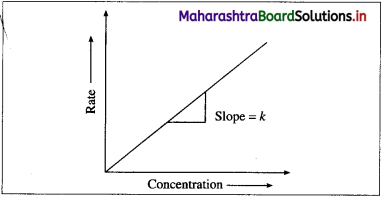
Use your brain power! (Textbook Page No 323)

Question 1.
Differentiate between natural and synthetic polymers.
Answer:

Natural polymers Synthetic polymers
(1) The polymers are obtained either from plants or animals. (1) The man made fibres prepared by polymerization of monomer or copolymerization of two or more monomers.
(2) They are further divided into two types :
(i) plant polymers
(ii) Animal polymers.Examples: Cotton, linen, latex
(2) They are further divided into three subtypes :
(i) fibres
(ii) synthetic rubbers
(iii) plastics.Examples : Nylon, terylene Buna-S

Use your brain power! (Textbook Page No 325)

Question 1.
What is the type of polymerization in the following examples?
Maharashtra Board Class 12 Chemistry Solutions Chapter 15 Introduction to Polymer Chemistry 11
Answer:
(i) Addition polymerization
(ii) Condensation polymerization

Problem 15.1 : (Textbook Page No 326)

Question 1.
Refer to the following table listing for different polymers formed from respective monomers. Identify from the list whether it is copolymer or homopolymer.

Monomer Polymers
Ethylene Polyethene
Vinyl chloride Polyvinyl chloride
Isobutylene Polyisobutylene
Acrylonitrile Polyacrylonitrile
Caprolactam Nylon 6
Hexamethylene diammonium adipate Nylon 6, 6
Butadiene + styrene Buna-S

Solution :
In each of first five cases, there is only one monomer which gives corresponding homopolymer. In the sixth case hexamethylene diamine reacts with adipic acid to form the salt hexamethylene diammonium adipate which undergoes condensation to form Nylon 6, 6. Hence nylon 6, 6 is homopolymer. The polymer Buna-S is formed by polymerization of the monomers butadiene and styrene in presence of each other. The repeating units corresponding to the monomers butadiene and styrene are randomly arranged in the polymer. Hence Buna-S is copolymer.

Maharashtra Board Class 12 Chemistry Solutions Chapter 15 Introduction to Polymer Chemistry

Use your brain power! (Textbook Page No 328)

Question 1.
(1) From the cis-polyisoprene structure of natural rubber explain the low strength of van der Waals forces in it.
(2) Explain how the vulcanization of natural rubber improves its elasticity. (Hint : consider the intermolecular links.)
Answer:
(1) (i) Natural rubber is cis-polyisoprene. It is obtained by polymerization of isoprene units at 1, 4 positions. In rubber molecule, double bonds are located between C2 and C3 of each isoprene unit. These cis-double bonds do not allow the polymer chain to come closer. Therefore, only weak vander Waals’ forces are present. Since the chains are not linear, they can be stretched just like springs and exhibit elastic properties.

(ii) Cis-1, 4 polyisoprene (Natural rubber), due to this cis configuration about the double bonds, has the adjacent chain that do not fit together well (there is no close packing of adjacent chains). The only force that interact is the weak or low strength of van der Waals’ forces.

(iii) Cis-polyisoprene has a coiled structure in which the various polymer chains are held together by weak van der Waals’ forces.

(2) (i) Vulcanization of rubber is a process of improvement of the rubber elasticity and strength by heating it in the presence of sulphur, which results in three dimensional cross-linking of the chain rubber molecules (polyisoprene) bonded to each other by sulphur atoms.

(ii) Vulcanisation makes rubber more elastic and more stiffer. On vulcanisation, sulphur forms cross links at the reactive sites of double bonds and thus rubber get stiffened.

(iii) The improved properties of vulcanised rubber are (i) high elasticity (ii) low water absorption tendency,

(iii) resistance to oxidation.

Use your brain power! (Textbook Page No 334)

Question 1.
Write structural formulae of styrene and polybutadiene.
Answer:
Maharashtra Board Class 12 Chemistry Solutions Chapter 15 Introduction to Polymer Chemistry 43

(1) Classify the following polymers as addition or condensation.
(i) PVC (ii) Polyamides
(iii) Polystyrene
(iv) Polycarbonates
(v) Novolac
Answer:
Addition polymers: PVC, Polystyrene
(ondensatlon polymers: Polyamides. Polycarbonates, Novolac

Question 2.
Completed the following table :
Answer:
Maharashtra Board Class 12 Chemistry Solutions Chapter 15 Introduction to Polymer Chemistry 44

Maharashtra Board Class 12 Chemistry Solutions Chapter 15 Introduction to Polymer Chemistry

Use your brain power! (Textbook Page No 335)

(1) Represent the copolymerization reaction between glycine and e aminocaproic acid to form the copolymer nylon 2-nylon 6.
(2) What is the origin of the numbers 2 and 6 in the name of this polymer?
Answer:
(1) It is a copolymer and has polyamide linkages. The monomers glycine and e-amino caproic acid undergo condensation polymerisation to form nylon-2-nylon-6.
Maharashtra Board Class 12 Chemistry Solutions Chapter 15 Introduction to Polymer Chemistry 46
Nylon-2-nylon-6 is used in orthopaedic devices and implants.

(2) Monomer glycine contains two carbon atoms and e amino caproic acid contains six carbon atoms, hence the polymer is termed as nylon-2-nylon-6.

12th Std Chemistry Questions And Answers:

12th Chemistry Chapter 5 Exercise Electrochemistry Solutions Maharashtra Board

Class 12 Chemistry Chapter 7

Balbharti Maharashtra State Board 12th Chemistry Textbook Solutions Chapter 5 Electrochemistry Textbook Exercise Questions and Answers.

Electrochemistry Class 12 Exercise Question Answers Solutions Maharashtra Board
Class 12 Chemistry Chapter 5 Exercise Solutions Maharashtra Board

Chemistry Class 12 Chapter 5 Exercise Solutions

1. Choose the most correct option.

Question i.
Two solutions have the ratio of their concentrations 0.4 and ratio of their conductivities 0.216. The ratio of their molar conductivities will be
(a) 0.54
(b) 11.574
(c) 0.0864
(d) 1.852
Answer:
(a) 0.54

Question ii.
On diluting the solution of an electrolyte,
(a) both ∧ and κ increase
(b) both ∧ and κ decrease
(c) ∧ increases and κ decreases
(d) ∧ decreases and κ increases
Answer:
(c) ∧ increases and κ decreases

Question iii.
1 S m2 mol-1 is equal to
(a) 10-4 S m2 mol-1
(b) 104 -1 cm2 mol-1
(c) 10-2 S cm2 mol-1
(d) 102-1 cm2 mol-1
Answer:
(b) 104-1 cm2 mol-1

Question iv.
The standard potential of the cell in which the following reaction occurs
H2+ (g, 1 atm) + Cu2+ (1 M) → 2H (1 M) + Cu(s), (\(E_{\mathrm{Cu}}^{0}\) = 0.34 V) is
(a) – 0.34 V
(b) 0.34 V
(c) 0.17 V
(d) -0.17 V
Answer:
(b) 0.34 V

Maharashtra Board Class 12 Chemistry Solutions Chapter 5 Electrochemistry

Question v.
For the cell, Pb(s)|Pb2+ (1 M)|| Ag+ (1 M)|Ag(s), if concentration of an ion in the anode compartment is increased by a factor of 10, the emf of the cell will
(a) increase by 10 V
(b) increase by 0.0296 V
(c) decrease by 10 V
(d) decrease by 0.0296 V
Answer:
(d) decrease by 0.0296 V

Question vi.
Consider the half reactions with standard potentials
Maharashtra Board Class 12 Chemistry Solutions Chapter 5 Electrochemistry 1
The strongest oxidising and reducing agents respectively are
(a) Ag and Fe2+
(b) Ag+ and Fe
(c) Pb2+ and I
(d) I2 and Fe2+
Answer:
(b) Ag+ and Fe

Question vii.
For the reaction
Ni(s) + Cu2+ (1 M) → Ni2+ (1 M) + Cu(s), \(E_{\text {cell }}^{0}\) = 0.57 V. Hence ΔG0 of the reaction is
(a) 110 kJ
(b) -110 kJ
(c) 55 kJ
(d) -55 kJ
Answer:
(b) -110 kJ

Question viii.
Which of the following is not correct ?
(a) Gibbs energy is an extensive property
(b) Electrode potential or cell potential is an intensive property.
(c) Electrical work = -ΔG
(d) If half reaction is multiplied by a numerical factor, the corresponding E0 value is also multiplied by the same factor.
Answer:
(d) If half reaction is multiplied by a numerical factor, the corresponding E0 value is also multiplied by the same factor.

Question ix.
The oxidation reaction that takes place in lead storage battery during discharge is
Maharashtra Board Class 12 Chemistry Solutions Chapter 5 Electrochemistry 2
Answer:
(c) \(\mathrm{Pb}_{(\mathrm{s})}+\mathrm{SO}_{4(\mathrm{aq})}{ }^{2-} \longrightarrow \mathrm{PbSO}_{4(\mathrm{~s})}+2 \mathrm{e}^{-}\)

Question x.
Which of the following expressions represent molar conductivity of Al2(SO4)3 ?
Maharashtra Board Class 12 Chemistry Solutions Chapter 5 Electrochemistry 3
Answer:
(b) \(2 \lambda_{\mathrm{Al}^{3+}}^{0}+3 \lambda_{\mathrm{SO}_{4}^{2-}}^{0}\)

Maharashtra Board Class 12 Chemistry Solutions Chapter 5 Electrochemistry

2. Answer the following in one or two sentences.

Question i.
What is a cell constant ?
Answer:
(A) Cell constant of a conductivity cell is defined as the ratio of the distance between the electrodes divided by the area of cross section of the electrodes.
Maharashtra Board Class 12 Chemistry Solutions Chapter 5 Electrochemistry 4
In SI units it is expressed as m-1.

Question ii.
Write the relationship between conductivity and molar conductivity and hence unit of molar conductivity.
Answer:
If k is conductivity and ∧m is molar conductivity then, ∧m = \(\frac{\kappa \times 1000}{C}\)
Unit of molar conductivity is, Ω-1 cm2 mol-1 or S cm2 mol-1.

Question iii.
Write the electrode reactions during electrolysis of molten KCl.
Answer:
Maharashtra Board Class 12 Chemistry Solutions Chapter 5 Electrochemistry 5

Question iv.
Write any two functions of salt bridge.
Answer:
The functions of a salt bridge are :

  • It maintains the electrical contact between the two electrode solutions of the half cells.
  • It prevents the mixing of electrode solutions.
  • It maintains the electrical neutrality in both the solutions of two half cells by a flow of ions.
  • It eliminates the liquid junction potential.

Maharashtra Board Class 12 Chemistry Solutions Chapter 5 Electrochemistry

Question v.
What is standard cell potential for the reaction
3Ni(s) + 2Al3+ (1M) → 3NI2+ (1M) + 2Al(s)
if \(\boldsymbol{E}_{\mathrm{Ni}}^{0}\) = – 0.25 V and \(\boldsymbol{E}_{\mathrm{Al}}^{0}\) = -1.66V?
Solution :
Given : E0Ni2+/Ni = -0.25 V
E0Al3+/Al = – 1.66 V; E0cell = ?
Since Ni is oxidised and Al3+ is reduced,
\(E_{\text {cell }}^{0}=E_{\mathrm{Al}^{3+} / \mathrm{Al}}^{0}-E_{\mathrm{Ni}^{2+} / \mathrm{Ni}}^{0}\)
= – 1.66 – (-0.25)
= – 1.41 V
Ans. \(E_{\text {cell }}^{0}\) = -1.41 V
[Note : Since \(E_{\text {cell }}^{0}\) is negative, the given reaction is not possible but reverse reaction is possible.]

Question vi.
Write Nerst equation. What part of it represents the correction factor for nonstandard state conditions ?
Answer:
(1) Nernst equation for cell potential is,
Maharashtra Board Class 12 Chemistry Solutions Chapter 5 Electrochemistry 6
(2) The part of equation namely,
Maharashtra Board Class 12 Chemistry Solutions Chapter 5 Electrochemistry 7
represents the correction factor for nonstandard state conditions.

Question vii.
Under what conditions the cell potential is called standard cell potential ?
Answer:
In the standard cell, the active masses of the substances taking part in the electrochemical reaction have unit value, i.e., 1 M solution or ions and 1 atm gas.

Question viii.
Formulate a cell from the following electrode reactions :
\(\mathbf{A u}_{(\mathrm{aq})}^{3+}+\mathbf{3 e}^{-} \longrightarrow \mathbf{A} \mathbf{u}_{(\mathrm{s})}\)
\(\mathbf{M g}_{(\mathbf{s})} \longrightarrow \mathbf{M g}_{(\mathrm{aq})}^{2+}+\mathbf{2 e}^{-}\)
Answer:
An electrochemical cell from above electrode reactions is,
Maharashtra Board Class 12 Chemistry Solutions Chapter 5 Electrochemistry 8

Question ix.
How many electrons would have a total charge of 1 coulomb ?
Answer:
Given : 1 Faraday = charge on 1 mol of electrons
= 6.022 × 10²³ electrons and 1 Faraday = 96500 C
∵ 96500 C = 6.022 × 10²³ electrons 6 022 × 1023
∴ 1 C ≡ \(\frac{6.022 \times 10^{23}}{96500}\) = 6.24 × 10¹⁸ electrons
Ans. Number of electrons = 6.24 × 10¹⁸

Question x.
What is the significance of the single vertical line and double vertical line in the formulation galvanic cell.
Answer:
(i) Consider representation of Daniell cell,
Maharashtra Board Class 12 Chemistry Solutions Chapter 5 Electrochemistry 9
Single vertical line represents separation of two phases, solid Zn(s) and solution of ions.
(ii) Double vertical lines represent a salt bridge.

Maharashtra Board Class 12 Chemistry Solutions Chapter 5 Electrochemistry

3. Answer the following in brief

Question i.
Explain the effect of dilution of solution on conductivity ?
Answer:

  • The conductance of a solution is due to the presence of ions in the solution. More the ions, higher is the conductance of the solution.
  • Conductivity or the specific conductance is the conductance of unit volume (1 cm3) of the electrolytic solution.
  • The conductivity of the electrolytic solution always decreases with the decrease in the concentration of the electrolyte or the increase in dilution of the solution.
  • On dilution, the concentration of the solution decreases, hence the number of (current carrying) ions per unit volume decreases. Therefore the conductivity of the solution decreases, with the decrease concentration or increase in dilution. (It is to be noted here that, molar conductivity increases with dilution.)

Question ii.
What is a salt bridge ?
Answer:
A salt bridge is a U-shaped glass tube containing a saturated solution of a strong electrolyte, like KCl, NH4NO3, Na2SO4 in a solidified agar-agar gel. A hot saturated solution of these electrolytes in 5% agar solution is filled in the U-shaped tube and allowed it to cool and solidify forming a gel.
Maharashtra Board Class 12 Chemistry Solutions Chapter 5 Electrochemistry 10
Fig. 5.9 : Salt bridge
It is used to connect two half cells or electrodes forming a galvanic or voltaic cell.

Question iii.
Write electrode reactions for the electrolysis of aqueous NaCl.
Answer:
Reactions in electrolytic cell :
(i) Reduction half reaction at cathode : There are Na+ and H+ions but since H+ are more reducible than Na+, they undergo reduction liberating hydrogen and Na+ are left in the solution.
2H2O(l) + 2e → H2(g) + 2OH(aq) (reduction) E0 = -0.83 V

(ii) Oxidation half reaction at anode : At anode there are Cl and OH. But Cl ions are preferably oxidised due to less decomposition potential.
Maharashtra Board Class 12 Chemistry Solutions Chapter 5 Electrochemistry 11
Net cell reaction : Since two electrons are gained at cathode and two electrons are released at anode for each redox step, the electrical neutrality is maintained. Hence we can write,
Maharashtra Board Class 12 Chemistry Solutions Chapter 5 Electrochemistry 12
Since Na+ and OH are left in the solution, they form NaOH(aq).

Question iv.
How many moles of electrons are passed when 0.8 ampere current is passed for 1 hour through molten CaCl2 ?
Answer:
Given : I = 0.8 A; t = 1 × 60 × 60 = 3600 s
Number of moles of electrons = ?
Q = I × t
= 0.8 × 3600
= 2880 C
1 Faraday = 1 mol electrons
1 Faraday = 96500 C
∵ 96500 C = 1 mol electrons
∴ 2880 C ≡ \(\frac{2880}{96500}\)
= 0.02984 mol electrons
Ans. Number of moles of electrons = 0.02984

Maharashtra Board Class 12 Chemistry Solutions Chapter 5 Electrochemistry

Question v.
Construct a galvanic cell from the electrodes Co3+|Co and Mn2+|Mn. \(\boldsymbol{E}_{\mathrm{Co}}^{0}\) = 1.82 V,
\(\boldsymbol{E}_{\mathrm{Mn}}^{0}\) = – 1.18V. Calculate \(\boldsymbol{E}_{\text {cell }}^{0}\).
Answer:
Maharashtra Board Class 12 Chemistry Solutions Chapter 5 Electrochemistry 13

Question vi.
Using the relationsip between ∆G0 of cell reaction and the standard potential associated with it, how will you show that the electrical potential is an intensive property ?
Answer:
(1) For an electrochemical cell involving n number of electrons in the overall cell reaction,
ΔG0 = -nF\(E_{\text {cell }}^{0}\)
where ΔG0 is standard Gibbs energy change and \(E_{\text {cell }}^{0}\) is a standard cell potential.
(2) ∴ \(E_{\mathrm{cell}}^{0}=\frac{-\Delta G^{0}}{n F}\)
Since ΔG0 changes according to number of moles of electrons involved in the cell reaction, the ratio, ΔG0/nF remains constant.
(3) Therefore \(E_{\text {cell }}^{0}\) is independent of the amount of substance and it represents the intensive property.

Question vii.
Derive the relationship between standard cell potential and equilibrium constant of cell reaction.
Answer:
For any galvanic cell, the overall cell reaction at equilibrium can be represented as,
Reactants ⇌ Products.
[For example for Daniell cell,
\(\mathrm{Zn}_{(s)}+\mathrm{Cu}_{(\mathrm{aq})}^{2+} \rightleftharpoons \mathrm{Zn}_{(\mathrm{aq})}^{2+}+\mathrm{Cu}_{(\mathrm{s})}\) ]
The equilibrium constant, K for the reversible reaction will be, \(K=\frac{[\text { Products }]}{[\text { Reactants }]}\)
Maharashtra Board Class 12 Chemistry Solutions Chapter 5 Electrochemistry 14
The equilibrium constant is related to the stan-dard free energy change Δ G0, as follows,
ΔG0 = -RTlnK
If \(E_{\text {cell }}^{0}\) is the standard cell potential (or emf) of the galvanic cell, then ΔG0 = -nFE0cell
By comparing above equations,
Maharashtra Board Class 12 Chemistry Solutions Chapter 5 Electrochemistry 15

Question viii.
It is impossible to measure the potential of a single electrode. Comment.
Answer:
(1)
Maharashtra Board Class 12 Chemistry Solutions Chapter 5 Electrochemistry 16
Fig 5.12(a) : Measurement of single electrode potential
Maharashtra Board Class 12 Chemistry Solutions Chapter 5 Electrochemistry 17
Fig 5.12(b) : Measurement of cell potential
According to Nemst theory, electrode potential is the potential difference between the metal and ionic layer around it at equilibrium, i.e. the potential across the electric double layer.

(2) For measuring the single electrode potential, one part of the double layer, that is metallic layer can be connected to the potentiometer but not the ionic layer. Hence, single electrode potential can’t be measured experimentally.

(3) When an electrochemical cell is developed by combining two half cells or electrodes, they can be connected to the potentiometer and the potential difference or cell potential can be measured.
Ecell = E2 – E1
where E1 and E2 are reduction potentials of two electrodes.

Maharashtra Board Class 12 Chemistry Solutions Chapter 5 Electrochemistry

Question ix.
Why do the cell potential of lead accumulators decrease when it generates electricity ? How the cell potential can be increased ?
Answer:
Working of a lead accumulator :
(1) Discharging : When the electric current is withdrawn from lead accumulator, the following reactions take place :
Maharashtra Board Class 12 Chemistry Solutions Chapter 5 Electrochemistry 18

(2) Net cell reaction :
(i) Thus, the overall cell reaction during discharging is
Maharashtra Board Class 12 Chemistry Solutions Chapter 5 Electrochemistry 19
OR
Pb(s) + PbO2(s) + 2H2SO4(aq) → 2PbSO4(s) + 2H2O(l)
The cell potential or emf of the cell depends upon the concentration of sulphuric acid. During the operation, the acid is consumed and its concentration decreases and specific gravity decreases from 1.28 to 1.17. As a result, the emf of the cell decreases. The emf of a fully charged cell is about 2.0 V.

(ii) Recharging of the cell : When the discharged battery is connected to external electric source and a higher external potential is applied the cell reaction gets reversed generating H2SO4.
Reduction at the -ve electrode or cathode :
PbSO4(s) + 2e → Pb(s) + \(\mathrm{SO}_{4(\mathrm{aq})}^{2-}\)
Oxidation at the + ve electrode or anode :
Maharashtra Board Class 12 Chemistry Solutions Chapter 5 Electrochemistry 20
The emf of the accumulator depends only on the concentration of H2SO4.

Question x.
Write the electrode reactions and net cell reaction in NICAD battery.
Answer:
Reactions in the cell :
(i) Oxidation at cadmium anode :
Cd(s) + 2OH(aq) → Cd(OH)2(s) + 2e
(ii) Reduction at NiO2(s) cathode :
NiO2(s) + 2H2O(l) + 2e → Ni(OH)2(s) + 2OH(aq)
The overall cell reaction is the combination of above two reactions.
Cd(s) + NiO2(s) + 2H2O(l) → Cd(OH)2(s) + Ni(OH)2(s)

Maharashtra Board Class 12 Chemistry Solutions Chapter 5 Electrochemistry

4. Answer the following :

Question i.
What is Kohrausch law of independent migration of ions? How is it useful in obtaining molar conductivity at zero concentration of a weak electrolyte ? Explain with an example.
Answer:
(A) Statement of Kohlrausch’s law : This states that at infinite dilution of the solution, each ion of an electrolyte migrates independently of its co-ions and contributes independently to the total molar conductivity of the electrolyte, irrespective of the nature of other ions present in the solution.

(B) Explanation : Both the ions, cation and anion of the electrolyte make a definite contribution to the molar conductivity of the electrolyte at infinite dilution or zero concentration (∧0).
If \(\lambda_{+}^{0}\) and \(\lambda_{-}^{0}\) are the molar ionic conductivities of cation and anion respectively at infinite dilution, then
0 = \(\lambda_{+}^{0}\) + \(\lambda_{-}^{0}\).
This is known as Kohlrausch’s law of independent migration of ions.
For an electrolyte, BxAy giving x number of cations and y number of anions,
0 = x\(\lambda_{+}^{0}\) + y\(\lambda_{-}^{0}\).

(C) Applications of Kohlrausch’s law :
(1) With this law, the molar conductivity of a strong electrolyte at zero concentration can be determined. For example,
\(\wedge_{0(\mathrm{KCl})}=\lambda_{\mathrm{K}^{+}}^{0}-\lambda_{\mathrm{Cl}^{-}}^{0}\)
(2) ∧0 values of weak electrolyte with those of strong electrolytes can be obtained. For example,
Maharashtra Board Class 12 Chemistry Solutions Chapter 5 Electrochemistry 21

Molar conductivity of a weak electrolyte at infinite dilution or zero concentration cannot be measured experimentally.
Consider the molar conductivity (∧0) of a weak acid, CH3COOH at zero concentration. By Kohlrausch s law,
Maharashtra Board Class 12 Chemistry Solutions Chapter 5 Electrochemistry 22
where λ0CH3COO and λ0H+ are the molar ionic conductivities of CH3COO and H+ ions respectively.
If ∧0CH3COONa, ∧0HCl and ∧0NaCl are molar conductivities of CH3COONa, HCl and NaCl respectively at zero concentration, then by
Kohlrausch’s law,
Maharashtra Board Class 12 Chemistry Solutions Chapter 5 Electrochemistry 23
Hence, from ∧0 values of strong electrolytes, ∧0 of a weak electrolyte CH3COOH, at infinite dilution can be calculated.

Question ii.
Explain electrolysis of molten NaCl.
Answer:
(1) Construction of an electrolytic cell : It consists of a vessel containing molten (fused) NaCl. Two graphite (carbon) inert electrodes are dipped in it, and connected to an external source of direct electric current (battery). The electrode connected to a negative terminal of the battery is a cathode and that connected to a positive terminal is an anode.

(2) Working of the cell :
(A) In the external circuit, the electrons flow through the wires from anode to cathode of the cell.
(B) The fused NaCl dissociates to form cations (Na+) and anions (Cl).
\(\mathrm{NaCl}_{\text {(fused) }} \longrightarrow \mathrm{Na}_{(\mathrm{l})}^{+}+\mathrm{Cl}_{(\mathrm{l})}^{-}\)
Na+ migrate towards cathode and Cl migrate towards anode.
Maharashtra Board Class 12 Chemistry Solutions Chapter 5 Electrochemistry 24
Fig. 5.7 : Electrolysis of fused sodium chloride

(C) Reactions in electrolytic cell :
(i) Reduction half reaction at cathode : The Na+ ions get reduced by accepting electrons from a cathode supplied by a battery and form metallic sodium.
\(\mathrm{Na}^{+}+\mathrm{e}^{-} \longrightarrow \mathrm{Na}_{(\mathrm{s})} \text { (reduction) }\)

(ii) Oxidation half reaction at anode : The Cl ions get oxidised by giving up electrons to the anode forming neutral Cl atoms in the primary process, and these Cl atoms combine forming Cl2 gas in the secondary process.
Maharashtra Board Class 12 Chemistry Solutions Chapter 5 Electrochemistry 25
The released electrons in the anodic oxidation half reaction return to battery through the metallic wires.

Net cell reaction : In order to maintain the electrical neutrality, the number of electrons gained at cathode must be equal to the number of electrons released at anode. Hence the reduction half reaction is multiplied by 2 and both reactions, oxidation half reaction and reduction half reaction are added to obtain a net cell reaction.
Maharashtra Board Class 12 Chemistry Solutions Chapter 5 Electrochemistry 26
Results of electrolysis :

  • A molten silvery white Na is formed at cathode which floats on the surface of molten NaCl.
  • A pale green Cl2 gas is liberated at anode.

Maharashtra Board Class 12 Chemistry Solutions Chapter 5 Electrochemistry

Question iii.
What current strength in amperes will be required to produce 2.4g of Cu from CuSO4 solution in 1 hour ? Molar mass of Cu = 63.5 g mol-1.
Answer:
Given : WCu = 2.4 g; t = 1 hr = 1 × 60 × 60 s
MCu = 63.5 g mol-1; I = ?
Maharashtra Board Class 12 Chemistry Solutions Chapter 5 Electrochemistry 27
Ans. Current strength = I = 2.026 A

Question iv.
Equilibrium constant of the reaction,
2Cu+(aq) → Cu2+(aq) + Cu(s)
is 1.2 × 10⁶. What is the standard potential of the cell in which the reaction takes place ?
Answer:
For the cell reaction, n = 1
Maharashtra Board Class 12 Chemistry Solutions Chapter 5 Electrochemistry 28

Question v.
Calculate emf of the cell
Zn(s)|Zn2+ (0.2M)||H+(1.6M)|H2(g, 1.8 atm)|Pt at 25°C.
Answer:
Given : Zn(s)|Zn2+(0.2M)||H+(1.6M)|H2(g, 1.8 atm)|Pt
Maharashtra Board Class 12 Chemistry Solutions Chapter 5 Electrochemistry 29
Maharashtra Board Class 12 Chemistry Solutions Chapter 5 Electrochemistry 30
= 0.763 – 0.0296 × (- 0.8521)
= 0.763 + 0.02522
= 0.7882
Ans. \(E_{\text {cell }}^{0}\) = 0.7882 V

Question vi.
Calculate emf of the following cell at 25°C.
Zn(s)| Zn2+(0.08M)||Cr3+(0.1M)|Cr
E0Zn = – 0.76 V, E0Cr = – 0.74 V
Answer:
Maharashtra Board Class 12 Chemistry Solutions Chapter 5 Electrochemistry 31
Maharashtra Board Class 12 Chemistry Solutions Chapter 5 Electrochemistry 32

Question vii.
What is a cell constant ? What are its units? How is it determined experimentally?
Answer:
(A) Cell constant of a conductivity cell is defined as the ratio of the distance between the electrodes divided by the area of cross section of the electrodes.
Maharashtra Board Class 12 Chemistry Solutions Chapter 5 Electrochemistry 33
In SI units it is expected as m-1.

The resistance of an electrolytic solution is measured by using a conductivity cell and Wheatstone
Maharashtra Board Class 12 Chemistry Solutions Chapter 5 Electrochemistry 52
Fig. 5.6 : Measurement of conductance
The measurement of molar conductivity of a solution involves two steps as follows :
Step I : Determination of cell constant of the conductivity cell :
KCl solution (0.01 M) whose conductivity is accurately known (κ = 0.00141 Ω-1 cm-1) is taken in a beaker and the conductivity cell is dipped. The two electrodes of the cell are connected to one arm while the variable known resistance (R) is placed in another arm of Wheatstone bridge.

A current detector D’ which is a head phone or a magic eye is used. J is the sliding jockey (contact) that slides on the arm AB which is a wire of uniform cross section. A source of A.C. power (alternating power) is used to avoid electrolysis of the solution.

By sliding the jockey on wire AB, a balance point (null point) is obtained at C. Let AC and BC be the lengths of wire.

If Rsolution is the resistance of KCl solution and Rx is the known resistance then by Wheatstone’s bridge principle,
\(\frac{R_{\text {solution }}}{\mathrm{BC}}=\frac{R_{x}}{\mathrm{AC}}\)
∴ \(R_{\text {solution }}=\mathrm{BC} \times \frac{R_{x}}{\mathrm{AC}}\)
Then the cell constant ‘ b ’ of the conductivity cell is obtained by, b = κKcl × Rsolution.

Step II : Determination of conductivity of the given solution :
KCl solution is replaced by the given electrolytic solution and its resistance (Rs) is measured by Wheatstone bridge method by similar manner by obtaining a null point at D.
The conductivity (κ) of the given solution is,
κ = \(\frac{\text { cell constant }}{R_{\mathrm{s}}}=\frac{b}{R_{\mathrm{s}}}\)

Step III: Calculation of molar conductivity :
The molar conductivity (∧m) is given by,
Maharashtra Board Class 12 Chemistry Solutions Chapter 5 Electrochemistry 53
Since the concentration of the solution is known, ∧m can be calculated.

Maharashtra Board Class 12 Chemistry Solutions Chapter 5 Electrochemistry

Question viii.
How will you calculate the moles of electrons passed and mass of the substance produced during electrolysis of a salt solution using reaction stoichiometry.
Answer:
Calculation of moles of electrons passed : The charge carried by one mole of electrons is referred to as one faraday (F). If total charge passed is Q C, then moles of electrons passed = \(\frac{Q(\mathrm{C})}{F\left(\mathrm{C} / \mathrm{mol} \mathrm{e}^{-}\right)}\)

Calculation of mass of product : Mass, W of product formed is given by,
W = moles of product × molar mass of product (M)
= \(\frac{Q}{96500}\) × mole ratio × M
= \(\frac{I \times t}{96500}\) × mole ratio × M 96500
When two electrolytic cells containing different electrolytes are connected in series so that same quantity of electricity is passed through them, then the masses W1 and W2 of products produced are given by,
Maharashtra Board Class 12 Chemistry Solutions Chapter 5 Electrochemistry 34

Question ix.
Write the electrode reactions when lead storage cell generates electricity. What are the anode and cathode and the electrode reactions during its recharging?
Answer:
Recharging of the cell : When the discharged battery is connected to external electric source and a higher external potential is applied the cell reaction gets reversed generating H2SO4.
Reduction at the – ve electrode or cathode :
\(\mathrm{PbSO}_{4(\mathrm{~s})}+2 \mathrm{e}^{-} \rightarrow \mathrm{Pb}^{(s)}+\mathrm{SO}_{4(\mathrm{aq})}^{2-}\)
Oxidation at the + ve electrode or anode :
Maharashtra Board Class 12 Chemistry Solutions Chapter 5 Electrochemistry 35
The emf of the accumulator depends only on the concentration of H2SO4.

Question x.
What are anode and cathode of H2-O2 fuel cell ? Name the electrolyte used in it. Write electrode reactions and net cell reaction taking place in the fuel cell.
Answer:
Construction :
(i) In fuel cell the anode and cathode are porous electrodes with suitable catalyst like finely divided platinum.
Maharashtra Board Class 12 Chemistry Solutions Chapter 5 Electrochemistry 36
(iii) H2 is continuously bubbled through anode while O, gas is bubbled through cathode.

Working (cell reactions) :
(i) Oxidation at anode : At anode, hydrogen gas is oxidised to H2O.
2H2(g) + 4OH(aq) → 4H2O(l) + 4e (oxidation half reaction)
(ii) Reduction at cathode : The electrons released at anode travel to cathode through external circuit and reduce oxygen gas to OH.
O2(g) + 2H2O(l) + 4e → 4OH(aq) (reduction half reaction)

(iii) Net cell reaction: Addition of both the above reactions at anode and cathode gives a net cell reaction.
2H2(g) + O2(g) → 2H2O(l) (overall cell reaction)

Question xi.
What are anode and cathode for Leclanche’ dry cell ? Write electrode reactions and overall cell reaction when it generates electricity.
Answer:
A dry cell has zinc vessel as anode and graphite rod as cathode and moist paste of ZnCl2, MnO2, NH4Cl as electrolytes.
At anode :
Zn(s) → \(\mathrm{Zn}_{(\mathrm{aq})}^{2+}\) + 2e (Oxidation half reaction)
At graphite (c) cathode :
\(2 \mathrm{NH}_{4(\mathrm{e})}^{+}\) + 2e → 2NH3(aq) + H2(g) (Reduction half reaction)
2MnO2(s) + H2 → Mn2O3(s) + H2O(l)
There is a side reaction inside the cell, between Zn2+ ions and aqueous NH3.
\(\mathrm{Zn}_{(\mathrm{aq})}^{2+}+4 \mathrm{NH}_{3(\mathrm{aq})} \longrightarrow\left[\mathrm{Zn}\left(\mathrm{NH}_{3}\right)_{4}\right]_{(\mathrm{aq})}^{2+}\)

Question xii.
Identify oxidising agents and arrange them in order of increasing strength under standard state conditions. The standard potentials are given in parenthesis.
Al(- 1.66 V), Cl2 (1.36 V), Cd2+ (-0.4 V), Fe (-0.44 V), I2 (0.54 V), Br (1.09 V).
Answer:
The oxidising agents are I2, Br and Cl2. The increasing strength is
Maharashtra Board Class 12 Chemistry Solutions Chapter 5 Electrochemistry 37
(Note : Actually Br2 acts as an oxidising agent but not Br.)

Maharashtra Board Class 12 Chemistry Solutions Chapter 5 Electrochemistry

Question xiii.
Which of the following species are reducing agents? Arrange them in order of increasing strength under standard state conditions. The standard potentials are given in parenthesis.
K (-2.93V), Br2(1.09V), Mg(-2.36V), Co3+(1.61V), Ti2+(-0.37V), Ag+(0.8V), Ni (-0.23V).
Answer:
Lower the standard reduction potential, higher is reducing power. The reducing agents are Ni, Mg and K. Their increasing strength is,
Maharashtra Board Class 12 Chemistry Solutions Chapter 5 Electrochemistry 38
(Note : Cations don’t act as reducing agent since they are already in oxidised state.)

Question xiv.
Predict whether the following
reactions would occur spontaneously
under standard state conditions.
a. Ca(s) + Cd2+(aq) → Ca2+(aq) + Cd(s)
b. 2 Br-(s) + Sn2+(aq) → Br2(l) + Sn(s)
c. 2Ag(s) + Ni2+(aq) → 2 Ag+(aq) + Ni(s)
(use information of Table 5.1)
Answer:
Maharashtra Board Class 12 Chemistry Solutions Chapter 5 Electrochemistry 39

12th Chemistry Digest Chapter 5 Electrochemistry Intext Questions and Answers
Question 1.
How does electrical resistance depend on the dimensions of an electronic (metallic) conductor?
Answer:
The electrical resistance of an electronic conductor is linearly proportional to its length (l) and inversely proportional to its cross section area a.
Maharashtra Board Class 12 Chemistry Solutions Chapter 5 Electrochemistry 40
Fig. 5.3 : Electronic conductor
Thus, R ∝ l; R ∝ \(\frac{1}{a}\)
∴ R ∝ \(\frac{l}{a}\) or R = ρ × \(\frac{l}{a}\)
where the proportionality constant p is called specific resistance. IUPAC recommends the term resistivity for specific resistance.

Question 2.
What are the units of resistivity ?
Answer:
For an electronic conductor of length l, and cross section area a, the resistance R is represented as
R = ρ × \(\frac{l}{a}\)
where ρ is the resistivity of the conductor.
∴ ρ = R × \(\frac{a}{l}\)
If l = 1 m, a = 1 m2, ρ = R
Maharashtra Board Class 12 Chemistry Solutions Chapter 5 Electrochemistry 41
Hence, resistivity is the resistance of a conductor of volume of 1 m3.
(In C.G.S. units, the units of ρ are ohm cm. Hence, ρ is the resistance of a conductor of unit volume or 1 cm3.)

Maharashtra Board Class 12 Chemistry Solutions Chapter 5 Electrochemistry

Question 3.
Define resistivity. What are its units ?
Answer:
Resistivity (or specific resistance) : It is the resistance of a conductor that is 1 m in length and 1 m2 in cross section area in SI units. (In C.G.S. units, it is the resistance of a conductor that is 1 cm in length and 1 cm2 in cross section area.) Hence, the resistivity is the resistance of a conductor of unit volume. (In case of electrolytic solution, ρ is the resistivity i.e., resistance of a solution of unit volume.)
It has SI units, ohm m and C.G.S. units, ohm cm.

Question 4.
Why is alternating current used in the measurement of conductivity of the solution ?
Answer:
If direct current (D.C.) by battery is used, there will be electrolysis and the concentration of the solution is changed. Hence alternating current (A.C.) with high frequency is used.

Try this… (Textbook page No. 93)

Question 1.
What must be the concentration of a solution of silver nitrate to have the molar conductivity of 121.4 Ω-1 cm2 mol-1 and the conductivity of 2.428 × 10⁻³-1 cm-1 at 25 °C ?
Answer:
Maharashtra Board Class 12 Chemistry Solutions Chapter 5 Electrochemistry 42
∴ Concentration of a Solution = 0.02 M

Try this… (Textbook page No. 96)

Question 1.
Obtain the expression for dissociation constant in terms of ∧c and ∧0 using Ostwald’s dilution law.
Answer:
Consider a solution of a weak electrolyte, BA having concentration C mol dm-3. If α is the degree of dissociation, then by Ostwald’s theory of weak electrolytes,
Maharashtra Board Class 12 Chemistry Solutions Chapter 5 Electrochemistry 43
If K is the dissociation constant of the weak electrolyte, then by Ostwald’s dilution law,
K = \(\frac{\alpha^{2} C}{(1-\alpha)}\)
If ∧m is the molar conductivity of the electrolyte BA at the concentration C and ∧0 is the molar conductivity at zero concentration or infinite dilution, then
Maharashtra Board Class 12 Chemistry Solutions Chapter 5 Electrochemistry 44
Hence by measuring ∧m at the concentration C and knowing ∧0, the dissociation constant can be calculated.
If \(\lambda_{+}^{0}\) and \(\lambda_{-}^{0}\) are the ionic conductivities, then by Kohlrauseh’s law, ∧0 = \(\lambda_{+}^{0}\) + \(\lambda_{-}^{0}\).

Maharashtra Board Class 12 Chemistry Solutions Chapter 5 Electrochemistry

Learn this as well…

Question 1.
How is the cell constant of a conductivity cell determined?
Answer:
The cell constant of a given conductivity cell is obtained by measuring the resistance (R) (or the conductance) of a standard solution whose conductivity (fc) is accurately known by using Wheatstone’s bridge (discussed in Q. 37). For this purpose, KCl solution of accurately known conductivity is used.
\(\kappa_{\mathrm{KCl}}=\frac{1}{R_{\mathrm{KCl}}} \times \frac{l}{a}\) where \(\frac{l}{a}\) is a cell constant, represented by b.
∴ \(\kappa_{\mathrm{KCl}}=\frac{b}{R_{\mathrm{KCl}}}\)
or b = κKCl × RKCl
For example, the conductivity of 0.01 M KCl is 0.00141 Ω-1 cm-1 (S cm-1). Hence by measuring R KCl the cell constant b can be obtained.

Try this… (Textbook page No. 95)

Question 1.
Calculate ∧0 (CH2ClCOOH) if ∧0 values for HCl, KCl and CH2ClCOOK are respectively, 4.261, 1.499 and 1.132 Ω-1 m2 mol-1.
Solution :
Maharashtra Board Class 12 Chemistry Solutions Chapter 5 Electrochemistry 45
Adding equations (i) and (ii) and subtracting equation (iii) we get equation (I).
Maharashtra Board Class 12 Chemistry Solutions Chapter 5 Electrochemistry 46

Can you tell ? (Textbook page No. 103)

Question 1.
You have learnt Daniel cell in XIth standard. Write notations for anode and cathode. Write the cell formula.
Answer:
Daniel cell is represented as,
Maharashtra Board Class 12 Chemistry Solutions Chapter 5 Electrochemistry 47

Try this… (Textbook page No. 104)

Question 1.
Write electrode reactions and overall cell reaction for Daniel cell you learnt in standard XI.
Answer:
Reactions for Daniell cell:
Maharashtra Board Class 12 Chemistry Solutions Chapter 5 Electrochemistry 48

Question 1.
Describe different types of reversible electrodes with examples. (1 mark for each type)
Answer:
A reversible electrochemical cell or a galvanic cell consists of two reversible half cells or electrodes. There are four types of reversible electrodes according to their compositions.
(1) Metal-metal ion electrode : This electrode is set up by dipping a metal in a solution containing its own ions, e.g. Zn rod dipped into ZnSO4 solution containing Zn++ ions of concentration C.
It is represented as,
\(\mathrm{Zn}^{2+}{ }_{(\mathrm{aq})} \mid \mathrm{Zn}_{(\mathrm{s})}\)
The reduction reaction at the electrode is,
Zn++(aq) + 2e → Zn(s)

(2) Metal-sparingly soluble salt electrode : This electrode consists of a metal coated with one of its sparingly soluble salts and immersed in a solution containing an electrolyte having a common anion as that of the salt. For example, silver electrode coated with sparingly soluble AgCl dipped in KCl solution with common anion Cl. This electrode is represented as,
Cl(aq) | AgCl(s) | Ag(s)
The reduction reaction is,
AgCl(s) + e → Ag(s) + Cl(aq)

(3) Gas electrode : This is developed by bubbling pure and dry gas around a platinised platinum foil dipped in the solution containing ions (of the gas) reversible with respect to the gas bubbled.
The gas is adsorbed on the surface of platinum foil and establishes an equilibrium with its ions in the solution. Pt electrode provides electrical contact and also acts as a catalyst.
Some of the gas electrodes are represented as follows :
(i) Hydrogen gas electrode :
H+(aq) | H2(g, PH2) | Pt
Reduction reaction : H+(aq) + e → \(\frac {1}{2}\)H2(g)
(ii) Chlorine gas electrode :
Cl(aq) | Cl2(g, PCl2) | Pt
Reduction reaction : \(\frac {1}{2}\)Cl2(g) + e- → Cl(aq)

(4) Redox electrode (Oxidation reduction electrode) : This electrode consists of a platinum wire dipped in a solution containing the ions of the same metal (or a substance) in two different oxidation states, like Fe2+ – Fe3+, Sn2+ – Sn4+, Mn++ – MnO4, etc.
A platinum electrode which provides an electrical contact and acts as catalyst aquires an equilibrium between two ions in the solution, due to their tendency to undergo a change from one oxidation state to another. The electrodes are represented as,
Fe2+(aq), Fe3+(aq) | Pt
Reduction reaction : Fe3+(aq) + e → Fe2+(aq)
SnCl2(aq), SnCl4(aq) | Pt
Reduction reaction : Sn4+(aq) + 2e →Sn2+(aq)

Maharashtra Board Class 12 Chemistry Solutions Chapter 5 Electrochemistry

Use your brain power! (Textbook page No. 98)

Question 1.
Distinguish between electrolytic and galvanic cells.
Answer:
Electrolytic cell:

  1. This device is used to bring about a non-spontaneous chemical reaction by passing an electric current.
  2. It is used to bring about a chemical reaction generally for the dissociation (electrolysis) of compounds.
  3. In this cell, electrical energy is converted into chemical energy.
  4. In this cell, the cathode is negative and the anode is positive.
  5. Electrolytic cells are irreversible.
  6. Oxidation takes place at the positive electrode and reduction at the negative electrode.
  7. The electrons are supplied by the external source and enter through cathode and come out through anode.
  8. It is used for electroplating, electrorefining, etc.

Electrochemical cell (Galvanic cell or Voltaic cell):

  1. This device is used to produce electrical energy by a spontaneous chemical reaction.
  2. It is used to generate electricity.
  3. In this cell, chemical energy is converted into electrical energy.
  4. In this cell, the cathode is positive and the anode is negative.
  5. Electrochernical cells are reversible.
  6. Oxidation takes place at the negative electrode and reduction at the positive electrode.
  7. The electrons move from anode to cathode in the external circuit.
  8. It is used as a source of electric current.

Try this… (Textbook page No. 107)

Question 1.
Write expressions to calculate equilibrium constant from
i. Concentration data
ii. Thermochemical data
iii. Electrochemical data
Answer:
(i) Consider following a reversible cell reaction.
aA + bB ⇌ cC + dD
If [A], [B], [C] and [D] represent concentrations of reactants and products then the equilibrium constant K is,
K = \(\frac{[\mathrm{C}]^{c} \times[\mathrm{D}]^{d}}{[\mathrm{~A}]^{a} \times[\mathrm{B}]^{b}}\)
(ii) If ΔG0 is the standard Gibbs free energy change at temperature T then,
ΔG0 = – RTlnK = – 2.303 RTlog10K
(iii) From electrochemical data,
if \(E_{\text {cell }}^{0}\) is the standard cell potential and K is the equilibrium constant for the cell reaction at a temperature T, then,
\(E_{\text {cell }}^{0}=\frac{0.0592}{n} \log _{10} K\)

Maharashtra Board Class 12 Chemistry Solutions Chapter 5 Electrochemistry

Learn this as well…

Question 1.
The construction and working of the calomel electrode.
Answer:
(1) Since standard hydrogen electrode (SHE) is not convenient for experimental use, a secondary reference electrode like calomel electrode is used.
(2) Construction : It consists of a glass vessel with side arm B for dipping in a desired solution of another electrode like, ZnSO4(aq) for an electric contact. The vessel is filled with mercury, a paste of Hg and Hg2Cl2 (calomel) and saturated KCl solution.
Maharashtra Board Class 12 Chemistry Solutions Chapter 5 Electrochemistry 49
Fig. 5.15 : Determination of standard electrode potential using calomel electrode
(3) The potential developed depends upon the concentration of Cl or KCl solution. When saturated KCl solution is used, its reduction potential is 0.242 V.
(4) Consider following cell :
Zn(s) | ZnSO4(aq) || KCl(aq) | Hg2Cl2(s) | Hg
OR Zn(s) | ZnSO4(aq) || Calomel electrode
Reduction reaction for calomel electrode :
Hg2Cl2(s) + 2e → 2Hg(l) + 2Cl(aq)
Hence potential of calomel electrode depends on the concentration of Cl or KCl solution.

Can you tell ? (Textbook page No. 114)

Question 1.
In what ways are fuel cells and galvanic cells similar and in what ways are they different ?
Answer:
Similarity between fuel cells and galvanic cells :

  • In both the cells, there is oxidation at anode and j reduction at cathode.
  • The cell potential is developed due to net redox reactions.
  • Both are galvanic cells.

Difference in fuel cells and galvanic cells :

  • Fuel cells involve electrodes with large surface area while galvanic cells involve electrodes with j compact surface area.
  • Fuel cells involve gaseous materials on a large scale while galvanic cells involve gaseous materials at a definite pressures along with electrolytes or there may not be gases.
  • In fuel cells, the cell potential is developed due to exothermic combustion reactions while in galvanic cell, cell potential is developed due to normal redox reactions.
  • In fuel cells gaseous electrode materials are continuously supplied from outside while in galvanic cells electrode materials have constant concentration or may change due to reactions.

Use your brain power (Textbook page No. 114)

Question 1.
Indentify the strongest and the weakest oxidizing agents from the electrochemical series.
Answer:
From the electrochemical series,
(a) The strongest oxidising agent is fluorine since it has the highest standard reduction potential (\(E_{\mathrm{F}_{2} / \mathrm{F}^{-}}^{0}\) = + 2.87 V).
(b) The weakest oxidising agent (or the strongest reducing agent) is lithium since it has the lowest standard reduction potential, (\(E_{\mathrm{Li}^{+} / \mathrm{Li}}^{0}\) = -3.045 V).

Maharashtra Board Class 12 Chemistry Solutions Chapter 5 Electrochemistry

Use your brain power (Textbook page No. 115)

Question 1.
Identify the strongest and the weakest reducing agents from the electrochemical series.
Answer:
(a) From the electrochemical series, the strongest reducing agent is lithium since it has the lowest standard reduction potential (\(E_{\mathrm{Li}^{+} / \mathrm{Li}}^{0}\) = -3.045 V).
(b) The weakest reducing agent is fluorine since it has the highest standard reduction potential,
(\(E_{\mathrm{F}_{2} / \mathrm{F}^{-}}^{0}\) = +2.87 V).

Question 2.
From E° values given in Table 5.1, predict whether Sn can reduce I2 or Ni2+.
Answer:
From electrochemical series,
Maharashtra Board Class 12 Chemistry Solutions Chapter 5 Electrochemistry 50
Maharashtra Board Class 12 Chemistry Solutions Chapter 5 Electrochemistry 51

12th Std Chemistry Questions And Answers: