Problem Set 11 Class 5 Maths Chapter 3 Addition and Subtraction Question Answer Maharashtra Board

Addition and Subtraction Class 5 Problem Set 11 Question Answer Maharashtra Board

Balbharti Maharashtra Board Class 5 Maths Solutions Chapter 3 Addition and Subtraction Problem Set 11 Textbook Exercise Important Questions and Answers.

Std 5 Maths Chapter 3 Addition and Subtraction

Question 1.
Subtract the following:

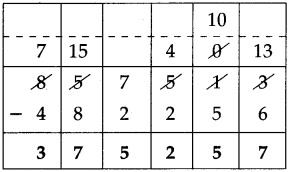
(1) 8,57,513 – 4,82,256
Solution:
Maharashtra Board Class 5 Maths Solutions Chapter 3 Addition and Subtraction Problem Set 11 1
Answer:
3,75,257

Maharashtra Board Class 5 Maths Solutions Chapter 3 Addition and Subtraction Problem Set 11

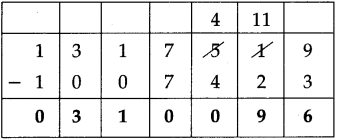
(2) 13,17,519 – 10,07,423
Solution:
Maharashtra Board Class 5 Maths Solutions Chapter 3 Addition and Subtraction Problem Set 11 2
Answer:
3,10,096

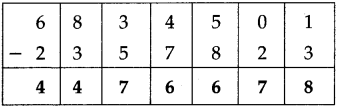
(3) 68,34,501 – 23,57,823
Solution:
Maharashtra Board Class 5 Maths Solutions Chapter 3 Addition and Subtraction Problem Set 11 3
Answer:
44,76,678

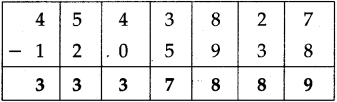
(4) 45,43,827 – 12,05,938
Solution:
Maharashtra Board Class 5 Maths Solutions Chapter 3 Addition and Subtraction Problem Set 11 8
Answer:
33,37,889

Maharashtra Board Class 5 Maths Solutions Chapter 3 Addition and Subtraction Problem Set 11

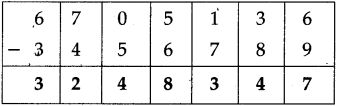
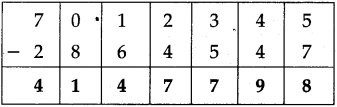
(5) 70,12,345 – 28,64,547
Solution:
Maharashtra Board Class 5 Maths Solutions Chapter 3 Addition and Subtraction Problem Set 11 7
Answer:
41,47,798

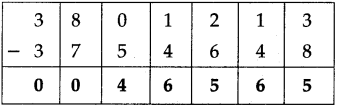
(6) 38,01,213 – 37,54,648
Solution:
Maharashtra Board Class 5 Maths Solutions Chapter 3 Addition and Subtraction Problem Set 11 6
Answer:
46,565

Study the following word problem.

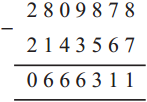
In 2001, the population of a city was 21,43,567. In 2011, it was 28,09,878. By how much did the population grow?
Maharashtra Board Class 5 Maths Solutions Chapter 3 Addition and Subtraction Problem Set 11 9

The population grew by 6,66,311.

Maharashtra Board Class 5 Maths Solutions Chapter 3 Addition and Subtraction Problem Set 11

Addition and Subtraction Problem Set 11 Additional Important Questions and Answers

Subtract the following:

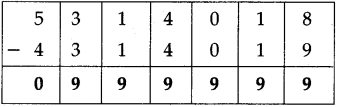
(1) 53,14,018 – 43,14,019
Solution:
Maharashtra Board Class 5 Maths Solutions Chapter 3 Addition and Subtraction Problem Set 11 5
Answer:
9,99,999

(2) 67,05,136 – 34,56,789
Solution:
Maharashtra Board Class 5 Maths Solutions Chapter 3 Addition and Subtraction Problem Set 11 4
Answer:
32,48,347

Class 5 Maths Solution Maharashtra Board

Problem Set 35 Class 5 Maths Chapter 8 Multiples and Factors Question Answer Maharashtra Board

Multiples and Factors Class 5 Problem Set 35 Question Answer Maharashtra Board

Balbharti Maharashtra Board Class 5 Maths Solutions Chapter 8 Multiples and Factors Problem Set 35 Textbook Exercise Important Questions and Answers.

Std 5 Maths Chapter 8 Multiples and Factors

Determine whether the pairs of numbers given below are co-prime numbers.
(1) 22, 24
Answer:
Common factors of 22 and 24 are 1 and 2. (Not only 1 common factor) So, 22, 24 are not co-prime numbers.

(2) 14, 21
Answer:
Common factors of 14 and 21 are 1 and 7. So, this pair is not co-prime numbers.

(3) 10, 33
Answer:
Common factors of 10 and 33 is only 1. So, 10 and 33 are co-prime numbers.

(4) 11, 30
Answer:
Common factors of 11 and 30 is only 1. So, 11 and 30 are co-prime numbers.

(5) 5, 7
Answer:
Common factor of 5 and 7 is only 1. So, 5 and 7 are co-prime numbers.

(6) 15, 16
Answer:
Common factors of 15 and 16 is only 1. So, 15 and 16 are co-prime numbers.

(7) 50, 52
Answer:
Common factors of 50 and 52 are 1 and 2. So, 50 and 52 are not co-prime numbers.

(8) 17, 18
Answer:
Common factors of 17 and 18 is only 1. So, 17 and 18 are co-prime numbers.

Activity 1 :

  • Write numbers from 1 to 60.
  • Draw a blue circle around multiples of 2.
  • Draw a red circle around multiples of 4.
  • Do all numbers with a blue circle also have a red circle around them?
  • Do all the numbers with a red circle have a blue circle around them?
  • Are all multiples of 2 also multiples of 4?
  • Are all multiples of 4 also multiples of 2?

Activity 2 :

  • Write numbers from 1 to 60.
  • Draw a triangle around multiples of 2.
  • Draw a circle around multiples of 3.
  • Now find numbers divisible by 6. Can you find a property that they share?

Eratosthenes’ method of finding prime numbers
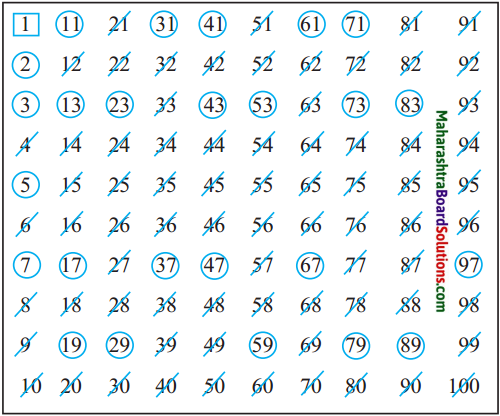
Eratosthenes was a mathematician who lived in Greece about 250 BC. He discovered a method to find prime numbers. It is called Eratosthenes’ Sieve. Let us see how to find prime numbers between 1 and 100 with this method.

Maharashtra Board Class 5 Maths Solutions Chapter 8 Multiples and Factors Problem Set 35 1

  • 1 is neither a prime nor a composite number. Put a square [ ] around it
  • 2 is a prime number, so put a circle around it.
  • Next, strike out all the multiples of 2. This tells us that of these 100 numbers more than half of numbers are not prime numbers.
  • The first number after 2 not yet struck off is 3. So, 3 is a prime number.
  • Draw a circle around 3. Strike out all the multiples of 3.
  • The next number after 3 not struck off yet is 5. So, 5 is a prime number.
  • Draw a circle around 5. Put a line through all the multiples of 5.
  • The next number after 5 without a line through it is 7. So, 7 is a prime number.
  • Draw a circle around 7. Put a line through all the multiples of 7.

In this way, every number between 1 and 100 will have either a circle or a line through it. The circled numbers are prime numbers. The numbers with a line through them are composite numbers.

One more method to find prime numbers

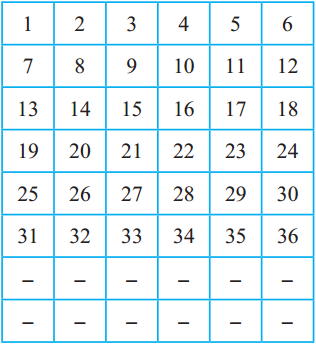
Maharashtra Board Class 5 Maths Solutions Chapter 8 Multiples and Factors Problem Set 35 2

See how numbers from 1 to 36 have been arranged in six columns in the table alongside.

Continue in the same way and write numbers up to 102 in these six columns.

You will see that, in the columns for 2, 3, 4, and 6, all the numbers are composite numbers except for the prime numbers 2 and 3. This means that all the remaining prime numbers will be in the columns for 1 and 5. Now isn’t it easier to find them? So, go ahead, find the prime numbers!

Something more

  • Prime numbers with a difference of two are called twin prime numbers. Some twin prime number pairs are 3 and 5, 5 and 7, 29 and 31 and 71 and 73. 5347421 and 5347423 are also a pair of twin prime numbers.
  • There are eight pairs of twin prime numbers between 1 and 100. Find them.
  • Euclid the mathematician lived in Greece about 300 BC. He proved that if prime numbers, 2, 3, 5, 7, ……., are written in serial order, the list will never end, meaning that the number of prime numbers is infinite.

Multiples and Factors Problem Set 35 Additional Important Questions and Answers

Determine whether the pairs of numbers given below are co-prime numbers.

(1) (12,18)
Answer:
Common factors of 12 and 18 are 1, 2, 3, 6. Hence 12 and 18 are not co-prime numbers.

(2) (26, 39)
Answer:
Common factors of 26 and 39 are 1 and 13. Hence, 26 and 39 are not co-prime numbers.

(3) (23, 29)
Answer:
Common factor of 23 and 29 is only 1. Hence, 23 and 29 are co-prime numbers.

(4) (28, 32)
Answer:
Common factors of 28 and 32 are 1, 2, 4 (not only 1). Hence, 28, 32 are not co-prime numbers.

Class 5 Maths Solution Maharashtra Board

Problem Set 34 Class 5 Maths Chapter 8 Multiples and Factors Question Answer Maharashtra Board

Multiples and Factors Class 5 Problem Set 34 Question Answer Maharashtra Board

Balbharti Maharashtra Board Class 5 Maths Solutions Chapter 8 Multiples and Factors Problem Set 34 Textbook Exercise Important Questions and Answers.

Std 5 Maths Chapter 8 Multiples and Factors

Question 1.
Write all the prime numbers between 1 and 20.
Answer:
2, 3, 5, 7, 11, 13, 17, 19.

Question 2.
Write all the composite numbers between 21 and 50.
Answer:
Composite numbers between 21 and 50 are 22, 24, 25, 26, 27, 28, 30, 32, 33, 34, 35, 36, 38, 39, 40, 42, 44, 45, 46, 48, 49.

Question 3.
Circle the prime numbers in the list given below. 22, 37, 43, 48, 53, 60, 91, 57, 59, 77, 79, 97, 100
Answer:
Maharashtra Board Class 5 Maths Solutions Chapter 8 Multiples and Factors Problem Set 34 1

Question 4.
Which of the prime numbers are even numbers?
Answer:
Only even prime number is 2. (the Rest of the even numbers are composites.)

Co-prime numbers

Dada : Tell me all the factors of 12 and 18.

Anju : I’ll tell the factors of 12: 1, 2, 3, 4, 6, 12.

Manju : I’ll give the factors of 18: 1, 2, 3, 6, 9, 18.

Dada : Now find the common factors of 12 and 18.

Anju : Common factors ?

Dada : 1, 2, 3 and 6 are in both groups, which means that they are common factors. Now tell me the factors of 10 and 21.

Sanju : Factors of 10 : 1, 2, 5, 10.

Manju : Factors of 21: 1, 3, 7, 21.

Dada : Which of the factors in these two groups are common?

Sanju : 1 is the only common factor.

Dada : Numbers which have only 1 as a common factor are called co-prime numbers, so 10 and 21 are co-prime numbers. The common factors of 12 and 18 are 1, 2, 3 and 6; which means that the common factors are more than one. Therefore, 12 and 18 are not co-prime numbers. Now tell me whether 8 and 10 are co-prime numbers.

Manju : The factors of 8 are 1, 2, 4 and 8 and the factors of 10 are 1, 2, 5 and 10. These numbers have two factors, 1 and 2, in common, so 8 and 10 are not co-prime numbers.

Multiples and Factors Problem Set 32 Additional Important Questions and Answers

Question 1.
21 to 50
Answer:
23, 29, 31, 37, 41, 43, 47

Question 2.
Which of the number is neither prime nor composite?
Answer:
1

Question 13.
Between nearest which two prime numbers the prime number 43 lies?
Answer:
43 lies between prime numbers 41 and 47.

Question 14.
Which of the prime numbers are odd numbers?
Answer:
All prime numbers are odd except 2.

Class 5 Maths Solution Maharashtra Board

Problem Set 55 Class 5 Maths Chapter 16 Preparation for Algebra Question Answer Maharashtra Board

Preparation for Algebra Class 5 Problem Set 55 Question Answer Maharashtra Board

Balbharti Maharashtra Board Class 5 Maths Solutions Chapter 16 Preparation for Algebra Problem Set 55 Textbook Exercise Important Questions and Answers.

Std 5 Maths Chapter 16 Preparation for Algebra

Question 1.
Say whether right or wrong.

(1) (23 + 4) = (4 + 23)
Answer:
27 = 27 is right

Maharashtra Board Class 5 Maths Solutions Chapter 16 Preparation for Algebra Problem Set 55

(2) (9 + 4) > 12
Answer:
13 > 12 is right

(3) (9 + 4) < 12
Answer:
13 < 12 is wrong

(4) 138 > 138
Answer:
Wrong

(5) 138 < 138
Answer:
Wrong

(6) 138 = 138
Answer:
right

(7) (4 × 7) = 30 – 2
Answer:
28 = 28 is right

Maharashtra Board Class 5 Maths Solutions Chapter 16 Preparation for Algebra Problem Set 55

(8) \(\frac{25}{5}\) > 5
Answer:
5 > 5 is wrong.

(9) (5 × 8) = (8 × 5)
Answer:
40 = 40 is right

(10) (16 + 0) = 0
Answer:
16 + 0
= 16
16 = 0 is wrong

(11) (16 + 0) = 16
Answer:
16 = 16 is right.

(12) (9 + 4) = 12
Answer:
13 = 12 is wrong.

Maharashtra Board Class 5 Maths Solutions Chapter 16 Preparation for Algebra Problem Set 55

Question 2.
Fill in the blanks with the right symbol from <, > or =.

(1) (45 ÷ 9) [ ] (9 – 4)
Answer:
45 ÷ 9 = 5,
9 – 4 = 5 5
= 5
so, (45 + 9) = (9 – 4)

(2) (6 + 1) [ ] (3 × 2)
Answer:
6 + 1 = 7,
3 x 2 = 6
7 > 6
so, (6 + 1) > (3 x 2)

(3) (12 × 2) [ ] (25 + 10)
Answer:
12 x 2 = 24,
25 + 10 = 35
24 < 35
so, (12 x 2) < (25 + 10)

Maharashtra Board Class 5 Maths Solutions Chapter 16 Preparation for Algebra Problem Set 55

Question 3.
Fill in the blanks in the expressions with the proper numbers.

(1) (1 × 7) = ( [ ] × 1)
Answer:
1 x 7 = 7,
7 x 1 = 7
so, (1 x 7) = ( 7 x 1)

(2) (5 × 4) > (7 × [ ] )
Answer:
5 x 4 = 20, 7 x ………… must be less than 20.
7 x 2 = 14
so, (5 x 4) > ( 7 x 2)

(3) (48 ÷ 3) < ( [ ] × 5)
Answer:
48 – 3 = 16,
5 x 4 = 20
5 x 3 = 15
16 > 15 and 16 < 20 so, (48 + 3) <(4 x 5)

Maharashtra Board Class 5 Maths Solutions Chapter 16 Preparation for Algebra Problem Set 55

(4) (0 + 1) > (5 × [ ] )
Answer:
0 + 1 = 1,
5 x 1 = 5
5 x 0 = 0
1 < 5 and 1 > 0 so, (0 + 1) > (5 x Q)

(5) (35 ÷ 7) = ( [ ] + [ ] )
Answer:
35 ÷ 7 = 5,
3 + 2 = 5 so, (35 + 7) = (3 + 2)

(6) (6 – [ ] ) < (2 + 3)
Answer:
6 – < 2 + 3 = 5
5 > 6 – 2
so, (6 – 2) < (2 + 3)

Using letters
Symbols are frequently used in mathematical writing. The use of symbols makes the writing very short. For example, using symbols, ‘Division of 75 by 15 gives us 5’ can be written in short as ‘75 ÷ 15 = 5’. It is also easier to grasp.

Letters can be used like symbols to make our writing short and simple.

While adding, subtracting or carrying out other operations on numbers, you must have discovered many properties of the operations.

Maharashtra Board Class 5 Maths Solutions Chapter 16 Preparation for Algebra Problem Set 55

For example, what properties do you see in sums like (9 + 4), (4 + 9)?

The sum of any two numbers and the sum obtained by reversing the order of the two numbers is the same.

Now see how much easier and faster it is to write this property using letters.

  • Let us use a and b to represent any two numbers. Their sum will be ‘a + b’.

Changing the order of those numbers will make the addition ‘b + a’. Therefore, the rule will be : ‘For all values of a and b, (a + b) = (b + a).’

Let us see two more examples.

  • Multiplying any number by 1 gives the number itself. In short, a × 1 = a.
  • Given two unequal numbers, the division of the first by the second is not the same as the division of the second by the first.

In short, if a and b are two different numbers, then (a ÷b) ≠ (b ÷a).

Take the value of a as 8 and b as 4 and verify the property yourself.

Maharashtra Board Class 5 Maths Solutions Chapter 16 Preparation for Algebra Problem Set 55

Preparation for Algebra Problem Set 54 Additional Important Questions and Answers

Say whether right or wrong.

(1) (15 ÷ 3) =5
Answer:
5 = 5 is right.

(2) (2 x 1) = 1
Answer:
2 = 1 is wrong.

(3) (16 ÷ 8) = (2 x 2)
Answer:
2 = 4 is wrong.

(4) (13 – 7) = 6
Answer:
6 = 6 is right.

(5) (1 x 0) = 1
Answer:
1 = 1 is wrong.

Maharashtra Board Class 5 Maths Solutions Chapter 16 Preparation for Algebra Problem Set 55

(6) (1 + 0) = 1
Answer:
1 = 1 is right.

Fill in the blanks with the right symbol from <, >, or =.

(1) (12 + 6) (10 X 2)
Answer:
12 + 6 = 18,
10 x 2 = 20
18 < 20
so, (12 + 6) < (10 x 2)

(2) (4 X 5) (10 X 2)
Answer:
4 x 5 = 20,
10 x 2 = 20
20 = 20
so, (4 x 5) = (10 x 2)

(3) (7 + 3) ………….. (3 X 3)
Answer:
7 + 3 = 10,
3 x 3 = 9
10 > 9
so, (7+ 3) > (3 x 3)

Fill in the blanks in the expressions with the proper numbers.

(1) (8 + ………….. ) = (8 x 1)
Answer:
8 + ……………. = 8,
8 x 1 = 8
8 + 0 = 8
so, (8 + 0) = (8 x 1)

Maharashtra Board Class 5 Maths Solutions Chapter 16 Preparation for Algebra Problem Set 55

(2) (5 x 6) > (14 x ……….. )
Answer:
5 x 6 = 30,
14 x 1 = 14
14 x 2 = 28
14 x 3 = 42
30 >28
so, (5 x 6) >(14 x 2)

(3) (6 X 7) < ( x 5)
Ans.
6 x 7 = 42,
9 x 5 = 45
42 < 45, 50, 55
so, (6 x 7) < (9 x 5)

Class 5 Maths Solution Maharashtra Board

Problem Set 9 Class 5 Maths Chapter 3 Addition and Subtraction Question Answer Maharashtra Board

Addition and Subtraction Class 5 Problem Set 9 Question Answer Maharashtra Board

Balbharti Maharashtra Board Class 5 Maths Solutions Chapter 3 Addition and Subtraction Problem Set 9 Textbook Exercise Important Questions and Answers.

Std 5 Maths Chapter 3 Addition and Subtraction

Solve the following problems.

Question 1.
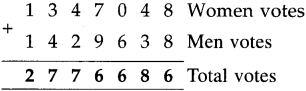
In a certain election, 13,47,048 women and 14,29,638 men cast their votes. How many votes were polled altogether?
Solution:
1 3 4 7 0 4 8 Women votes
+
1 4 2 9 6 3 8 Men votes
2 7 7 6 6 8 6 Total votes
Maharashtra Board Class 5 Maths Solutions Chapter 3 Addition and Subtraction Problem Set 9 1
Answer:
Altogether 27,76,686 votes were polled.

Maharashtra Board Class 5 Maths Solutions Chapter 2 Number Work Problem Set 5

Question 2.
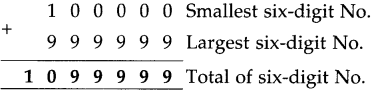
What will be the sum of the smallest and the largest six-digit numbers?
Solution:
1 0 0 0 0 0 Smallest six-digit No.
+
9 9 9 9 9 9 Largest six-digit No.
1 0 9 9 9 9 9 Total of six-digit No.
Maharashtra Board Class 5 Maths Solutions Chapter 3 Addition and Subtraction Problem Set 9 2
Answer:
Altogether 10,99,999 six-digit numbers.

Question 3.
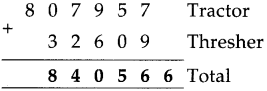
If Surekhatai bought a tractor for ₹ 8,07,957 and a thresher for ₹ 32,609, how much money did she spend altogether?
Solution:
8 0 7 9 5 7 Tractor
+
3 2 6 0 9 Thresher
8 4 0 5 6 6 Total
Maharashtra Board Class 5 Maths Solutions Chapter 3 Addition and Subtraction Problem Set 9 3
Answer:
Surekhatai spend ₹ 8,40,566 altogether.

Maharashtra Board Class 5 Maths Solutions Chapter 2 Number Work Problem Set 5

Question 4.
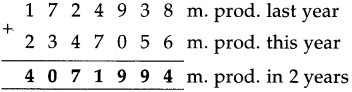
A textile mill produced 17,24,938 metres of cloth last year and 23,47,056 metres this year. What was the total production for the two years?
Solution:
1724938 m. prod, last year
+
2347056 m. prod, this year
4071994 m. prod, in 2 years
Maharashtra Board Class 5 Maths Solutions Chapter 3 Addition and Subtraction Problem Set 9 4
Answer:
40,71,994 metres was the total production for the two years.

Question 5.
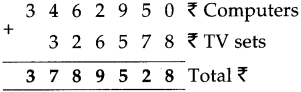
If the Government gave ₹ 34,62,950 worth of computers and ₹ 3,26,578 worth of TV sets to the schools, what is the total amount it spent on this equipment?
Solution:
3 4 6 2 9 5 0 ₹ Computers
3 2 6 5 7 8 ₹ TV sets
3 7 8 9 5 2 8 Total ₹
Maharashtra Board Class 5 Maths Solutions Chapter 3 Addition and Subtraction Problem Set 9 5
Answer:
Total amount spent on equipments is ₹ 37,89,528

Maharashtra Board Class 5 Maths Solutions Chapter 2 Number Work Problem Set 5

Subtraction : Revision

Study the following example.

Last year, 38,796 students took a certain exam. This year the number was 47,528. How many more students took the exam this year?

8,732 more students took the exam this year.

Addition and Subtraction Problem Set 9 Additional Important Questions and Answers

Question 1.
Solve the following problems.

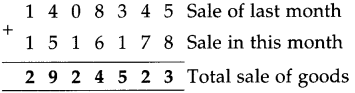
(1) Goods of ₹ 14,08,345 was sold on last month and goods of ₹ 15,16,178 sold this month. What is the total sale of goods in these two months?
Solution:
1 4 0 8 3 4 5 Sale of last month
+
1 5 1 6 1 7 8 Sale in this month
2 9 2 4 5 2 3 Total sale of goods
Maharashtra Board Class 5 Maths Solutions Chapter 3 Addition and Subtraction Problem Set 9 6
Answer:
Total sale of good is ₹ 29,24,523

Maharashtra Board Class 5 Maths Solutions Chapter 2 Number Work Problem Set 5

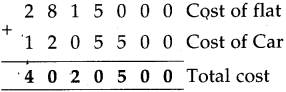
(2) Sundar purchased the flat of ₹ 28,15,000 and a Car of ₹ 12,05,500. What is the total amount spent by him?
Solution:
2 8 1 5 0 0 0 Cost of flat
1 2 0 5 5 0 0 Cost of Car
4 0 2 0 5 0 0 Total cost
Maharashtra Board Class 5 Maths Solutions Chapter 3 Addition and Subtraction Problem Set 9 7
Answer:
Total cost of ₹ 40,20,500

Class 5 Maths Solution Maharashtra Board

Problem Set 3 Class 5 Maths Chapter 2 Number Work Question Answer Maharashtra Board

Number Work Class 5 Problem Set 3 Question Answer Maharashtra Board

Balbharti Maharashtra Board Class 5 Maths Solutions Chapter 2 Number Work Problem Set 3 Textbook Exercise Important Questions and Answers.

Std 5 Maths Chapter 2 Number Work

Question 1.
Read the numbers and write them in words.
(1) 7,65,234
(2) 4,73,225
(3) 3,27,001
(4) 8,75,375
(5) 1,50,437
(6) 2,03,174
(7) 6,47,851
(8) 9,00,999
(9) 5,75,010
(10) 4,03,005
Answer:
(1) Seven lakh, sisxty-five thousand, two hundred and thirty-four.
(2) Four lakh, seventy-three thousand, two hundred and twenty-five.
(3) Three lakh, twenty-seven thousand and one
(4) Eight lakh seventy-five thousand three hundred and seventy-five
(5) One lakh fifty thousand four hundred and thirty seven
(6) Two lakh three thousand one hundred and seventy-four
(7) Six lakh forty seven thousand eight hundred and fifty-one
(8) Nine lakh nine hundred and ninety-nine
(9) Five lakh seventy-five thousand and ten
(10) Four lakh three thousand and five.

Maharashtra Board Class 5 Maths Solutions Chapter 2 Number Work Problem Set 3

Question 2.
Read the numbers and write them in figures.
(1) One lakh thirty-five thousand eight hundred and fifty-five
(2) Seven lakh twenty-seven thousand
(3) Four lakh twenty-five thousand three hundred
(4) Nine lakh nine thousand ninety-nine
(5) Seven lakh forty-nine thousand three hundred and sixty-two
(6) Eight lakh one sixty tow
Answer:
(1) 1,35,008
(2) 7,27,1 55
(3) 4,25,003
(4) 9,09,099
(5) 7,49,003
(6) 8,00,162

Question 3.
Make five six-digit numbers, each time using any of the digits 0 to 9 only once.
Answer:

  • 4,09,138
  • 3,17,045
  • 1,20,645
  • 9,72,860
  • 6,54,302

Maharashtra Board Class 5 Maths Solutions Chapter 2 Number Work Problem Set 3

Introducing seven-digit numbers
Teacher : Now we shall learn about seven-digit numbers. Suppose 10 farmers borrow ₹ 1,00,000 each from a Co-operative Bank. Then, how much is the total loan given by the bank to them?

Ajit : We must find out what is ten times 1,00,000. That is, we multiply 1,00,000 by 10. That means we write one zero after the number to be multiplied.

Ajay : 1,00,000 × 10 = 10,00,000

Teacher : This becomes a seven-digit number. We read it as ‘Ten lakh’. We must make one more place for the 10 lakhs to the left of the lakhs place. In western countries, the term million is used. One million is equal to ten lakhs.

Thus, ten lakh = 10,00,000.

Just as we read ten thousands and thousands together, we read ten lakhs and lakhs together. So, we read 18,35,614 as ‘eighteen lakh, thirty-five thousand, six hundred and fourteen.

Study the seven-digit numbers given below in figures and in words.

  • 31,25,745 : thirty-one lakh, twenty-five thousand, seven hundred and forty-five
  • 91,00,006 : ninety-one lakh and six
  • 63,00,988 : sixty-three lakh, nine hundred and eighty-eight
  • 88,00,400 : eighty-eight lakh, four hundred
  • seventy-two lakh and ninety-five : 72,00,095
  • seventy lakh, two thousand, three hundred : 70,02,300

Maharashtra Board Class 5 Maths Solutions Chapter 2 Number Work Problem Set 3

Roman Numerals Problem Set 2 Additional Important Questions and Answers

Question 1.
Read the numbers and write them in words:

(1) 4,00,527
Answer:
Four lakh five hundred and twenty-seven.

(2) 7,34,016
Answer:
Seven lakh thirty-four thousand and sixteen.

Question 2.
Read the numbers and write them in figures.
(1) Nine lakh three thousand and twenty-three.
(2) One lakh one thousand one hundred and one.
Answer:
(1) 9,03,023
(2) 1,01,101

Class 5 Maths Solution Maharashtra Board

Problem Set 40 Class 5 Maths Chapter 9 Decimal Fractions Question Answer Maharashtra Board

Decimal Fractions Class 5 Problem Set 40 Question Answer Maharashtra Board

Balbharti Maharashtra Board Class 5 Maths Solutions Chapter 9 Decimal Fractions Problem Set 40 Textbook Exercise Important Questions and Answers.

Std 5 Maths Chapter 9 Decimal Fractions

Write the following fractions as decimal fractions.

(1) Two and a half
Answer:
2 \(\frac{1}{2}\) = 2.5 = 2.50

Maharashtra Board Class 5 Maths Solutions Chapter 9 Decimal Fractions Problem Set 40

(2) Two and a quarter
Answer:
2 \(\frac{1}{4}\) = 2.25

(3) Two and three quarters
Answer:
2 \(\frac{3}{4}\) = 2.75

(4) Ten and a half
Answer:
10 \(\frac{1}{2}\) = 10.5 = 10.50

(5) Fourteen and three quarters
Answer:
14 \(\frac{3}{4}\) = 14.75

(6) Sixteen and a quarter
Answer:
16 \(\frac{1}{4}\) = 16.25

Maharashtra Board Class 5 Maths Solutions Chapter 9 Decimal Fractions Problem Set 40

(7) Twenty-eight and a half
Answer:
28 \(\frac{1}{2}\) = 28.50 = 28.5

Adding decimal fractions

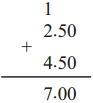
Sir : If the cost of one pencil is two and a half rupees and the cost of a pen is four and half rupees, what is the total cost?

Sumit : Two and a half rupees means two rupees and one half rupee. Similarly, four and a half rupees means four rupees and one-half rupee. 4 rupees and 2 rupees make 6 rupees and two half rupees make one rupee, so both objects together cost 6 + 1 = 7 rupees.

Sir : Correct ! Now, see how this is done using decimals.
The sum of the 0’s in the hundredths place is 0.
0.5 + 0.5 is the same as
\(\frac{5}{10}+\frac{5}{10}=\frac{5+5}{10}=\frac{10}{10}=\frac{1}{1}=1\)
Maharashtra Board Class 5 Maths Solutions Chapter 9 Decimal Fractions Problem Set 40 1

This 1 is carried over to the units place. There is nothing in the tenths place, so we put a zero there. In the units place, 2 + 4 = 6 plus the carried over 1 makes 7.

Maharashtra Board Class 5 Maths Solutions Chapter 9 Decimal Fractions Problem Set 40

So 2.50 rupees and 4.50 rupees add up to 7 rupees.

We use the decimal system to write whole numbers. We extend the same method to write fractions; therefore, we can add in the same way as we add whole numbers.

I will now show some more additions. Watch carefully.

Maharashtra Board Class 5 Maths Solutions Chapter 9 Decimal Fractions Problem Set 40 2

Sumit : There is no carried over number in the first sum, but there are carried over numbers in the second and third sums.

Rekha : While adding whole numbers, we add units first. Similarly, here, tenths are added first. In the second example, the sum of the tenths place is 13. 13 tenths are 10 tenths + 3 tenths = 1 unit + 3 tenths.

Sumit : That is why, in the sum, 3 stayed in the tenths place and 1 was carried over to the units place. 6 + 5 plus 1 carried over makes 12.

Sir : Your observations are absolutely correct. We write digits one below the other according to their place values while adding whole numbers. We do the same thing here. Remember that while writing down an addition problem and the total, the decimal points should always be written one below the other.

Maharashtra Board Class 5 Maths Solutions Chapter 9 Decimal Fractions Problem Set 40

Study the following additions. (Note that: 10 tenths = 1 unit. 10 hundredths = 1 tenth)

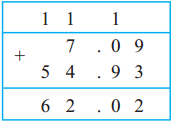
Example (1) Add : 7.09 + 54.93
First, add the digits in the 100ths place. 9 + 3 = 12.
Maharashtra Board Class 5 Maths Solutions Chapter 9 Decimal Fractions Problem Set 40 3

The 1 from the sum 12 in the hundredths place is carried over to the tenths place and 2 is written in the hundredths place. Adding 1 + 9 gives 10 tenths or 1 unit. This 1 is carried over to the units place. 0 is left in the tenths place. Then, the addition is completed in the usual way.

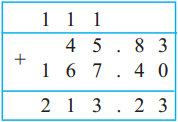
Example (2) Add : 45.83 + 167.4
4 5 . 8 3 We arrange the numbers so that the places and
+
1 6 7. 4 decimal points come one below the other.
Maharashtra Board Class 5 Maths Solutions Chapter 9 Decimal Fractions Problem Set 40 4

\(\frac{4}{10}=\frac{4 \times 10}{10 \times 10}=\frac{40}{100}\) Therefore, to make the denominators of the fractions equal, 167.4 is written as 167.40 and then the fractions are added.

Maharashtra Board Class 5 Maths Solutions Chapter 9 Decimal Fractions Problem Set 40

As usual, the digits with the smallest place values are added first and then those with bigger place values are added serially.

Example (3) 10.46 Rupees
Maharashtra Board Class 5 Maths Solutions Chapter 9 Decimal Fractions Problem Set 40 5

Example (4) 48.80 m
Maharashtra Board Class 5 Maths Solutions Chapter 9 Decimal Fractions Problem Set 40 6

Example (5) 7.5 cm
Maharashtra Board Class 5 Maths Solutions Chapter 9 Decimal Fractions Problem Set 40 7

Decimal Fractions Problem Set 40 Additional Important Questions and Answers

(1) Thirty and a quarter
Answer:
30 \(\frac{1}{4}\) = 30.25

(2) Thirty and a half
Answer:
30 \(\frac{1}{2}\) = 30.50 = 30.5

Maharashtra Board Class 5 Maths Solutions Chapter 9 Decimal Fractions Problem Set 40

(3) Thirty and three quarters
Answer:
30 \(\frac{3}{4}\) = 30.75

Class 5 Maths Solution Maharashtra Board

Problem Set 13 Class 5 Maths Chapter 3 Addition and Subtraction Question Answer Maharashtra Board

Addition and Subtraction Class 5 Problem Set 13 Question Answer Maharashtra Board

Balbharti Maharashtra Board Class 5 Maths Solutions Chapter 3 Addition and Subtraction Problem Set 13 Textbook Exercise Important Questions and Answers.

Std 5 Maths Chapter 3 Addition and Subtraction

Solve the following mixed word problems:

Question 1.
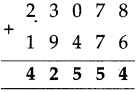
The Forest Department planted 23,078 trees of khair, 19,476 of behada besides trees of several other kinds. If the Department planted 50,000 trees altogether, how many trees were neither of khair nor of behada?
Solution:
2 3 0 7 8 Trees of khair
+
1 9 4 7 6 Trees of behada
4 2 5 5 4 Trees of khair and behada
Maharashtra Board Class 5 Maths Solutions Chapter 3 Addition and Subtraction Problem Set 13 1

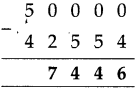
5 0 0 0 0 Total trees planted

4 2 5 5 4 Khair and behada trees planted
7 4 4 6 Other kind of trees planted
Maharashtra Board Class 5 Maths Solutions Chapter 3 Addition and Subtraction Problem Set 13 2
Answer:
7,446 trees planted other than khair and behada trees.

Maharashtra Board Class 5 Maths Solutions Chapter 3 Addition and Subtraction Problem Set 13

Question 2.
A city has a population of 37,04,926. If this includes 11,24,069 men and 10,96,478 women, what is the number of children in the city?
Solution:
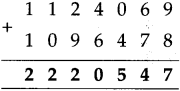
1 1 2 4 0 6 9 Men
+
1 0 9 6 4 7 8 Women
2 2 2 0 5 4 7 Total of men and women
Maharashtra Board Class 5 Maths Solutions Chapter 3 Addition and Subtraction Problem Set 13 3

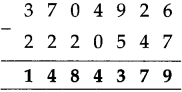
3 7 0 4 9 2 6 Total population

2 2 2 0 5 4 7 Men and women
1 4 8 4 3 7 9 No. of children
Maharashtra Board Class 5 Maths Solutions Chapter 3 Addition and Subtraction Problem Set 13 4
Answer:
Number of children in the city is 14,84,379.

Question 3.
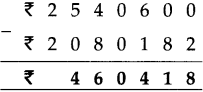
The management of a certain factory had 25,40,600 rupees in the labour welfare fund. From this fund, 12,37,865 rupees were used for medical expenses, 8,42,317 rupees were spent on the education of the workers’ children and the remaining was put aside for a canteen. How much money was put aside for the canteen?
Solution:
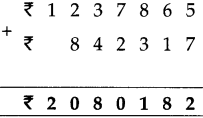
₹ 1 2 3 7 8 6 5 Medical expenses
₹ 8 4 2 3 1 7 Education for workers children
₹ 2080182 Spent for medical and education.
₹ 2 5 4 0 6 0 0 Labour welfare fund
₹ 2 0 8 0 1 8 2 Medical & education
₹ 4 6 0 4 1 8 Kept a side for canteen
Maharashtra Board Class 5 Maths Solutions Chapter 3 Addition and Subtraction Problem Set 13 5
Maharashtra Board Class 5 Maths Solutions Chapter 3 Addition and Subtraction Problem Set 13 6
Answer:
₹ 4,60,418 put aside for the canteen,

Maharashtra Board Class 5 Maths Solutions Chapter 3 Addition and Subtraction Problem Set 13

Question 4.
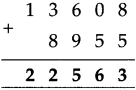
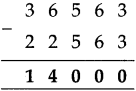
For a three-day cricket match, 13,608 tickets were sold on the first day and 8,955 on the second day. If, altogether, 36,563 tickets were sold in three days, how many were sold on the third day?
Solution:
1 3 6 0 8 Tickets sold on 1st day
+
8 9 5 5 Ticket sold on 2nd day
2 2 5 6 3 Tickets sold on 1st and 2nd day
3 6 5 6 3 Tickets sold in 3 days

2 2 5 6 3 Tickets sold in 2 days
1 4 0 0 0 Tickets sold on 3rd day
Maharashtra Board Class 5 Maths Solutions Chapter 3 Addition and Subtraction Problem Set 13 7
Maharashtra Board Class 5 Maths Solutions Chapter 3 Addition and Subtraction Problem Set 13 8
Answer:
₹ 14,000 tickets sold on the third day.

Addition and Subtraction Problem Set 13 Additional Important Questions and Answers

Solve the following mixed word problems:

Question 1.
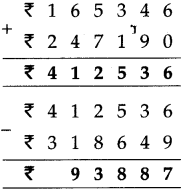
A man had ₹ 1,65,346 in the bank. He deposited ₹ 2,47,190 in the bank, then he gave a cheque of ₹ 3,18,649 to Ashutosh. How much’is the balance in the bank now?
Solution:
₹ 1 6 5 3 4 6 Had in the bank
+
₹ 2 4 7 1 9 0 Deposited in the bank
₹ 4 1 2 5 3 6 Total balance
₹ 4 1 2 5 3 6 Total

₹ 3 1 8 6 4 9 Gave to Ashutosh
₹ 9 3 8 8 7 Balance in the bank
Maharashtra Board Class 5 Maths Solutions Chapter 3 Addition and Subtraction Problem Set 13 9
Answer:
Balance in the bank ₹ 93,887.

Maharashtra Board Class 5 Maths Solutions Chapter 3 Addition and Subtraction Problem Set 13

Question 2.
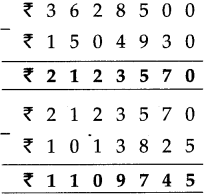
Vighanesh had ₹ 36,28,500 from this amount he gave ₹ 15,04,930 to his wife and ₹ 10,13,825to his son. How much amount left with him?
Solution:
₹ 3 6 2 8 5 0 0 Vighanesh had

₹ 1 5 0 4 9 3 0 given to wife
₹ 2 1 2 3 5 7 0 Total

₹ 2 1 2 3 5 7 0 Balance

₹ 1 0 1 3 8 2 5 Gave to son
₹ 1 1 0 9 7 4 5 Left with him
Maharashtra Board Class 5 Maths Solutions Chapter 3 Addition and Subtraction Problem Set 13 10
Answer:
₹ 11,09,745 left with Vighanesh.

Question 2.
Add the following:

(1) 3 0 5 8 3
+
1 2 3 2 9
_____________
_____________
Answer:
42912

(2) 4 5 3 7 8
+
4 4 6 2 2
_____________
_____________
Answer:
90000

Maharashtra Board Class 5 Maths Solutions Chapter 3 Addition and Subtraction Problem Set 13

(3) 7 5 0 3 8
+
1 7 4 1 8
_____________
_____________
Answer:
92456

(4) 2 2 1 0 5
+
3 9 6 5 1
_____________
_____________
Answer:
61756

Question 3.
Add the following:
(1) 63,348 + 74,35,631
(2) 9,65,247 + 3,28,925
(3) 7,61,856 + 1,45,437
(4) 33,23,057 + 35,28,436
(5) 3,451 + 62,507 + 3,40,678
(6) 48 + 38,41,705 + 98,314
(7) 25,38,781 + 328 + 16,508
(8) 29,145 + 40,37,615 + 8,70,469
Answer:
(1) 74,98,979
(2) 12,94,172
(3) 9,07,293
(4) 68,51,493
(5) 4,06,636
(6) 39,40,065
(7) 25,55,617
(8) 49,37,229

Maharashtra Board Class 5 Maths Solutions Chapter 3 Addition and Subtraction Problem Set 13

Question 4.
Match the equal numbers in three columns

Column (A) Column (B) Column (C)
(1) Thirteen thousand plus two hundred (a) 304 + 500 (i) 80,704
(2) Eight thousand plus seventy (b) 13,000 + 200 (ii) 804
(3) Three hundred and four plus five hundred (c) 80,000 + 704 (iii) 8070
(4) Eighty thousand plus seven hundred and four (d) 8,000 + 70 (iv) 13,200

Answer:
(1) b – iv
(2) d – iii
(3) a – ii
(4) c – i

Question 5.
Subtract the following:

(1) 7 6 3 8 5

5 7 6 3 7
____________
____________
Answer:
18,748

(2) 5 6 0 4 7

3 2 3 7 8
____________
____________
Answer:
23,669

Maharashtra Board Class 5 Maths Solutions Chapter 3 Addition and Subtraction Problem Set 13

(3) 8 2 3 5 6

4 1 5 6 3 9
____________
____________
Answer:
36,927

(4) 4 5 4 2 9

3 5 9 6 8
____________
____________
Answer:
04,788

(5) 7 4 3 5 0 8

4 1 5 6 3 9
____________
____________
Answer:
3,27,869

(6) 2 4 8 1 3 6 7

1 7 8 4 2 7 8
____________
____________
Answer:
6,97,089

Maharashtra Board Class 5 Maths Solutions Chapter 3 Addition and Subtraction Problem Set 13

(7) 5 9 3 1 6 6 5

4 3 6 5 7 4 9
____________
____________
Answer:
19,79,109

(8) 8 0 5 1 4 3 6

4 3 6 5 7 4 9
____________
____________
Answer:
36,85,687

Maharashtra Board Class 5 Maths Solutions Chapter 3 Addition and Subtraction Problem Set 13

Question 6.
Solve the following examples :
(1) (a) 64,83,217 – 23,94,128 + 16,84,579
(b) 36,94,523 + 28,17,689 – 50,49,876
(c) 83,47,215 – 38,58,386 – 25,74,978
(d) 3,72,190 + 2,18,310 – 1,56,900
(e) 36,00,800 – 27,91,978 – 3,01,005
(f) 51,51,515 – 5,55,555 + 6,66,006
Answer:
(a) 57,73,668
(b) 14,62,336
(c) 19,13,851
(d) 4,33,600
(e) 5,07,817
(f) 52,61,966

Class 5 Maths Solution Maharashtra Board

Problem Set 30 Class 5 Maths Chapter 7 Circles Question Answer Maharashtra Board

Circles Class 5 Problem Set 30 Question Answer Maharashtra Board

Balbharti Maharashtra Board Class 5 Maths Solutions Chapter 7 Circles Problem Set 30 Textbook Exercise Important Questions and Answers.

Std 5 Maths Chapter 7 Circles

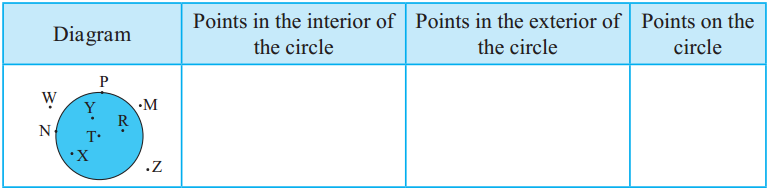
Question 1.
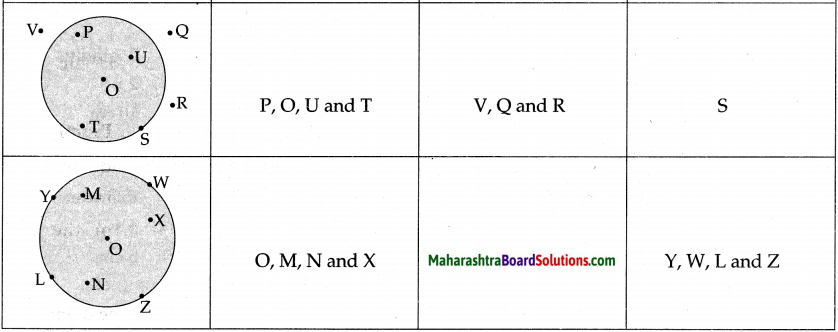
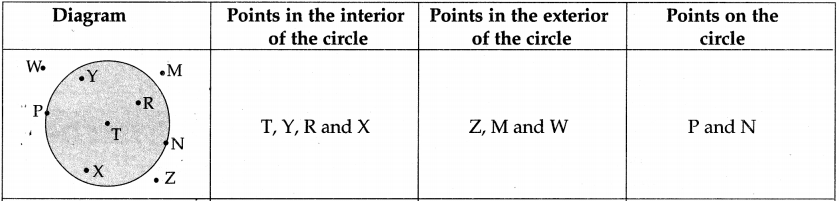
In the table below, write the names of the points in the interior and exterior of the circle and those on the circle.
Maharashtra Board Class 5 Maths Solutions Chapter 7 Circles Problem Set 29 6
Answer:
Maharashtra Board Class 5 Maths Solutions Chapter 7 Circles Problem Set 29 11

Maharashtra Board Class 5 Maths Solutions Chapter 7 Circles Problem Set 30

The circumference of a circle

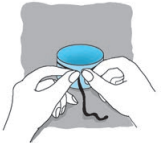
Take a bowl with a circular edge.

Maharashtra Board Class 5 Maths Solutions Chapter 7 Circles Problem Set 29 7

Wind a string once around the bowl and make a full circle around it.
Unwind this circle and straighten it out as shown.
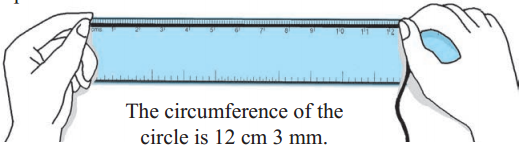
Measure the straightened part with a ruler. The length of that part is the circumference of the circle or of the bowl.

Maharashtra Board Class 5 Maths Solutions Chapter 7 Circles Problem Set 29 8

An arc of a circle
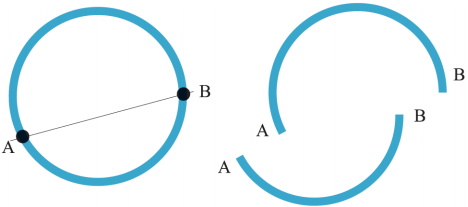
Shown alongside is a plastic bangle. If the bangle breaks at points A and B, it will split into two parts as shown in the picture.

Maharashtra Board Class 5 Maths Solutions Chapter 7 Circles Problem Set 29 9

Each of these parts is an arc of a circle.

Maharashtra Board Class 5 Maths Solutions Chapter 7 Circles Problem Set 30

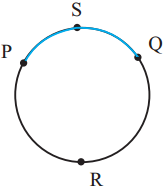
On the given circle, there are two points P and Q. These two points have divided the circle into two parts. Each of these parts is an arc of the circle.

Maharashtra Board Class 5 Maths Solutions Chapter 7 Circles Problem Set 29 10

This means that P and Q have created two arcs. P and Q are the end points of both arcs.

From the name ‘arc PQ’, we cannot say which of the two arcs we are speaking of. So, an additional point is taken on each arc. This point is used to give each arc a three-letter name. In the figure, there are two arcs, arc PSQ and arc PRQ.

Circles Problem Set 30 Additional Important Questions and Answers

Question 1.
In the table below, write the names of the points in the interior and exterior of the circle and those on the circle.
Answer:

Maharashtra Board Class 5 Maths Solutions Chapter 7 Circles Problem Set 29 4

Maharashtra Board Class 5 Maths Solutions Chapter 7 Circles Problem Set 30

Question 2.
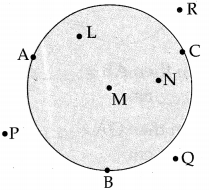
Draw a circle and take points A, B, C on the circle. L, M, N in the interior of the circle, P, Q, R in the exterior of the circle.
Answer:
Maharashtra Board Class 5 Maths Solutions Chapter 7 Circles Problem Set 29 5

Class 5 Maths Solution Maharashtra Board

Problem Set 49 Class 5 Maths Chapter 12 Perimeter and Area Question Answer Maharashtra Board

Perimeter and Area Class 5 Problem Set 49 Question Answer Maharashtra Board

Balbharti Maharashtra Board Class 5 Maths Solutions Chapter 12 Perimeter and Area Problem Set 49 Textbook Exercise Important Questions and Answers.

Std 5 Maths Chapter 12 Perimeter and Area

Question 1.
How much wire will be needed to make a rectangle 7 cm long and 4 cm wide?
Solution:
Perimeter of a rectangle
= 2 x length + 2 x breadth
= 2 x 7 + 2 x 4
= 14 + 8
= 22 cm

∴ 22 cm wire will be needed to make a rectangle

Maharashtra Board Class 5 Maths Solutions Chapter 12 Perimeter and Area Problem Set 49

Question 2.
If the length of a rectangle is 20 m and its width is 12m, what is its perimeter?
Solution:
Perimeter of a rectangle
= 2 x length + 2 x breadth
= 2×20 + 2×12
= 40 + 24
= 64 m
∴ Perimeter is 64 m

Question 3.
Each side of a square is 9 m long. Find its perimeter.
Solution:
Perimeter of a square
= 4 x length of one side
= 4 x 9
= 36 m
∴ Perimeter is 36 m

Question 4.
If we take 4 rounds around a field that is 160 m long and 90 m wide, what is the distance we walk in kilometres?
Solution:
Perimeter of a rectangular field
= 2 x length + 2 x breadth
= 2 x 160 + 2 x 90
= 320 + 180
= 500 m

In one round distance walked is 500 m, hence, distance walked in 4 rounds
= 500 x 4
= 2000 m
= 2km
∴ The distance walked in 4 rounds is 2 km

Maharashtra Board Class 5 Maths Solutions Chapter 12 Perimeter and Area Problem Set 49

Question 5.
Sanju completes 12 rounds around a square park every day. If one side of the park is 120 m, find out in kilometres and metres the distance that Sanju covers daily.
Solution:
Perimeter of a square
= 4 x length of one side
= 4 x 120
= 480 m

So, in one round the distance can be covered is 480 m, hence in 12 rounds the distance can be covered is
= 480 x 12
= 5760 m
= 5000 m + 760 m

∴ Sanju covers 5 km 760 m daily

Question 6.
The length of a rectangular plot of land is 50 m and its width is 30 m. A triple fence has to be put along its edges. If the wire costs 60 rupees permetre, what will be the total cost of the wire needed for the fence?
Solution:
Perimeter of a rectangular plot
= 2 x length + 2 x breadth
= 2 x 50 + 2 x 30
= 100 + 60 – 160 m
For a triple fence, wire needed
= 3 x 160 = 480 m

Cost of the wire needed
= wire needed x rate
= 480 x 60
= 28800 rupees
∴ The total cost of the wire needed for the fence is ₹ 28,800

Maharashtra Board Class 5 Maths Solutions Chapter 12 Perimeter and Area Problem Set 49

Question 7.
A game requires its players to run around a square playground. Each side of the playground is 20 m long. One player took 5 rounds around the playground. How many metres did he run altogether?
Solution:
Perimeter of a square
= 4 x length of one side
= 4 x 20
= 80 m

In one round 80 m.
So in 5 round
= 80 x 5
= 400
= 400 m

∴ He runs altogether = 400 m

Question 8.
Four rounds of wire fence have to be put around a field. If the field is 60 m long and 40 m wide, how much wire will be needed?
Solution:
Perimeter of rectangular field
= 2 x length + 2 x breadth
= 2 x 60 + 2 x 40
= 120 + 80
= 200 m
Hence, wire required for 4 rounds
= 200 x 4
= 800 m

∴ Wire required for 4 rounds
= 800 m

Maharashtra Board Class 5 Maths Solutions Chapter 12 Perimeter and Area Problem Set 49

Question 9.
The sides of a triangle are 24.7cm, 20.4 cm and 10.5 cm respectively. What is the perimeter of the triangle?
Solution:
Perimeter of triangle
= 24.7 + 20.4 + 10.5
= 55.6

∴ The perimeter of a triangle
= 55.6 cm

Question 10.
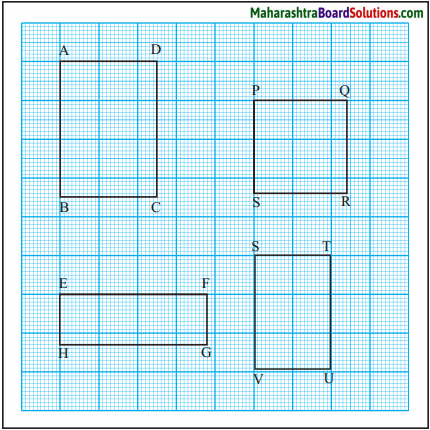
Look at the figures on the sheet of graph paper. Measure their sides with the help of the lines on the graph paper. Write the perimeter of each in the right box.
Maharashtra Board Class 5 Maths Solutions Chapter 12 Perimeter and Area Problem Set 49 1

(1) Perimeter of
rectangle ABCD
= [ ] cm
(2) Perimeter of
rectangle EFGH
= [ ] cm
(3) Perimeter of
square PQRS
= [ ] cm
(4) Perimeter of
rectangle STUV
= [ ] cm
Solution:
Maharashtra Board Class 5 Maths Solutions Chapter 12 Perimeter and Area Problem Set 49 6

Maharashtra Board Class 5 Maths Solutions Chapter 12 Perimeter and Area Problem Set 49

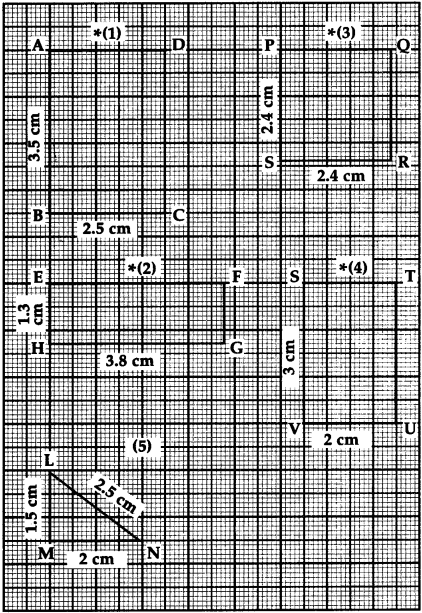
(1) Perimeter of a rectangle ABCD
= 2 x length + 2 x breadth
= 2 x 3.5 + 2 x 2.5
= 7 + 5
= 12 cm

∴ 12 cm

(2) Perimeter of a rectangle EFGH
= 2 x length + 2 x breadth
= 2 x 3.8 + 2 x 1.3
= 7.6 + 2.6
= 10.2 cm

∴ 10.2 cm

(3) Perimeter of a rectangle PQRS
= 2 x length + 2 x breadth
= 2 x 2.4 + 2 x 2.4
= 4.8+ 4.8
= 9.6 cm

∴ 9.6 cm

Maharashtra Board Class 5 Maths Solutions Chapter 12 Perimeter and Area Problem Set 49

(4) Perimeter of a rectangle STUV
= 2 x length + 2 x breadth
= 2 x 3 + 2 x 2
= 6 + 4
= 10 cm

∴ 10 cm

(5) Perimeter of a triangle LMN
= 1.5 + 2.5 + 2
= 6 cm

∴ 6 cm

Area : Revision
Maharashtra Board Class 5 Maths Solutions Chapter 12 Perimeter and Area Problem Set 49 2

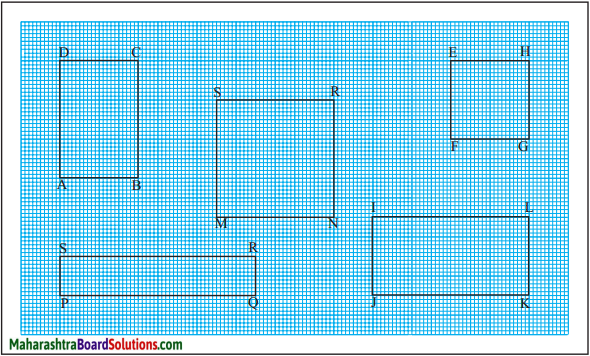
Of the figures given above, figure ABCD has six squares of 1 cm each inside it. It means that its area is 6 sq cm.

In the same way, count the squares in each figure and write its area.
(1) Area of MNRS = [ ] sq cm
(2) Area of EFGH = [ ] sq cm
(3) Area of PQRS = [ ] sq cm
(4) Area of IJKL = [ ] sq cm

Atul : Sir, why is the unit for area written as sq cm? We measure the sides in centimetres.

Teacher : Centimetre is a standard unit of length. In order to measure area, we need a standard unit of area. For this, a square with a side 1 cm is taken as the standard unit. The area of this square is 1 square centimetre. That is why this unit is written as sq cm, in short.

To measure large areas like fields, parks and playgrounds, a square with side 1 m, that is, an area of 1 sq m, is taken as the standard unit.

Maharashtra Board Class 5 Maths Solutions Chapter 12 Perimeter and Area Problem Set 49

To measure the areas oftalukas or districts, a square with side 1km, or 1sq km is the standard unit used.

Formula for the area of a rectangle
Maharashtra Board Class 5 Maths Solutions Chapter 12 Perimeter and Area Problem Set 49 3

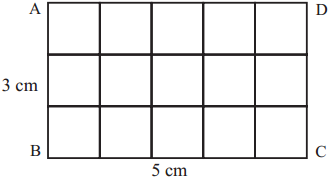
(1) In the rectangle ABCD given alongside, 1 cm divisions were marked off on each side. The points on opposite sides were joined as shown in the figure. The length of the sides of each square thus created is 1cm. Therefore, the area of each square is 1 sq cm.

In ABCD, 3 rows with 5 squares each have been created.
The number of squares in rectangle ABCD is 3 × 5 = 15.
Therefore, the area of rectangle ABCD is 15 sq cm.
Here, the length of the figure is 5 cm and its breadth is 3 cm.
Note that the product of 3 and 5 is 15.

(2) In the rectangle with sides 4 cm and 2 cm, make squares of 1 sq cm each as shown above. Count the number of squares.
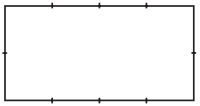
Maharashtra Board Class 5 Maths Solutions Chapter 12 Perimeter and Area Problem Set 49 4

Note that here too, the number of squares formed are the same as the product of the length and width of the rectangle.

Therefore, The area of a rectangle = length × breadth

Formula for the area of a square
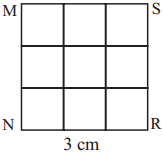
Maharashtra Board Class 5 Maths Solutions Chapter 12 Perimeter and Area Problem Set 49 5

(1) Look at the square given alongside. The side of the square is 3 cm long. 9 squares of 1 cm each are formed within this square.

Maharashtra Board Class 5 Maths Solutions Chapter 12 Perimeter and Area Problem Set 49
Therefore, the area of this square is 9 sq cm.

Here, there are 3 rows with 3 squares each, i.e., there are 3 × 3 = 9 squares.
The length of each side of the square is 3 cm.
The product of two sides of the square is 3 × 3 = 9.

(2) Measure the area of a square with side 5 cm, in the same way.
The answer will be 25 sq cm.
Note that 5 × 5 = 25

Therefore, The area of a square = length of a side × length of a side

It is not necessary to divide a square or rectangle into small squares every time you calculate their area. The advantage of a formula is that you can calculate the area simply by substituting the appropriate values.

Word problems
Example (1) What is the area of a rectangle of length 20 cm and width 15 cm?
Area of a rectangle = length × breadth
= 20 × 15 = 300.
Therefore, the area of the rectangle is 300 sq cm.

Example (2) A wall that is 4 m long and 3 m wide has to be painted. If the labour charges are ₹ 25 per sq m, what is the cost of labour for painting this wall?

First let us calculate the area of the wall to be painted.
Area of the wall = length of the wall × breadth of the wall = 4 × 3 = 12
Thus, the area of the wall is 12 sq m.
Labour cost of 1 sq m is 25 rupees.
So the labour cost for 12 sq m will be = 12 × 25 = 300
The cost of labour for painting the wall will be 300 rupees.

Example (3) What will be the area of a square with sides 15 cm?
Area of a square = length of side × length of side
= 15 × 15 = 225
The area of the square is 225 sq cm.

Maharashtra Board Class 5 Maths Solutions Chapter 12 Perimeter and Area Problem Set 49
Example (4) One side of a square room is 4 m. If the cost of labour for laying 1 sq m of the floor is 35 rupees, what will be the total cost of labour?
First we must find the area of the square room.
Area of the square room = length of side × length of side = 4 × 4 = 16
Therefore, the area of the square room is 16 sq m.
The labour cost of laying 1 sq m of flooring is 35 rupees.
Therefore, the cost of laying 16 sq m of flooring is 16 × 35 = 560 rupees.

Perimeter and Area Problem Set 49 Additional Important Questions and Answers

Question 1.
Devendra walks five rounds of a square garden everyday. If the side of the garden is 150 m, how many kilometres does Devendra walk every morning?
Solution:
Perimeter of a square garden
= 4 x one side of the garden
= 4 x 150
= 600 m

In 5 rounds walking
= 5 x 600
= 3000 m
= 3 km
3 km

Question 2.
The length of a rectangular play ground is 75 m and its breadth is 50 m. Rupali walks four rounds. How many kilometres did she walk?
Solution:
Perimeter of rectangle
= 2 x length + 2 x breadth
= 2 x 75 + 2 x 50
= 150 + 100
= 250 m

In 4 rounds walking
= 4 x 250
= 1000 m
= 1 km

∴ 1 km

Maharashtra Board Class 5 Maths Solutions Chapter 12 Perimeter and Area Problem Set 49
Question 3.
Length of the rectangle is 10 cm and its breadth is 8 cm and one square is side 9 cm. Whose perimetre is more? By how much?
Solution:
Perimeter of a rectangle
= 2 x length + 2 x breadth
= 2 x 10 + 2 x 8
= 20 + 16
= 36 cm ……………….. (i)

Perimeter of a square
= 4 x length of side
= 4 x 9
36 cm ……………….. (ii)
From (i) and (ii) perimeter of both is equal.

∴ perimeter of both is equal

Class 5 Maths Solution Maharashtra Board