Gravitation Class 10 Questions And Answers Maharashtra Board

Class 10 Science Part 1 Chapter 1

Balbharti Maharashtra State Board Class 10 Science Solutions Part 1 Chapter 1 Gravitation Notes, Textbook Exercise Important Questions and Answers.

Std 10 Science Part 1 Chapter 1 Gravitation Question Answer Maharashtra Board

Class 10 Science Part 1 Chapter 1 Gravitation Question Answer Maharashtra Board

Class 10 Science Chapter 1 Gravitation Exercise Question 1.
Study the entries in the following table and rewrite them putting the connected items in a single row :

I II III
Mass m/s2 Zero at the centre of the earth
Weight kg Measure of inertia
Acceleration due to gravity N.m2/kg2 Same in the entire universe
Gravitational constant N Depends on height

Answer:

I II III
Mass kg Measure of inertia
Weight N Depends on height
Acceleration due to gravity m/s2 Zero at the centre of the earth
Gravitational constant N.m2/kg2 Same in the entire universe

Maharashtra Board Class 10 Science Solutions Part 1 Chapter 1 Gravitation

Gravitation Class 10 Maharashtra Board Question 2.
Answer the following questions.
(a) What is the difference between mass and weight of an object? Will the mass and weight of an object on the earth be the same as their values on Mars? Why?
Answer:
The mass of an object is the amount of matter present in it. It is same everywhere in the Universe and is never zero. It is a scalar quantity and its SI unit is kg. The weight of an object is the force with which the earth (or any other planet/ moon/star) attracts it. It is directed towards the centre of the earth. The weight of an object is different at different places on the earth. It is zero at the earth’s centre. It is a vector quantity and its SI unit is the newton (N). The magnitude of weight = mg.

The mass of an object will be the same on the earth and Mars, but the weight will not be the same because the value of g on Mars is different from that on the earth.

(b) what are (i) free fall, (ii) acceleration due to gravity (iii) escape velocity (iv) centripetal force?
Answer:
(i) Free fall:
Whenever an object moves under the influence of the force of gravity alone, it is said to be falling freely.

(ii) Acceleration due to gravity:
The acceleration produced in a body due to the gravitational force of the earth is called the acceleration due to gravity.
[Note: On the earth’s surface, the value of the acceleration due to gravity is almost uniform. If a body falls from a low altitude, the value of the acceleration due to gravity is almost the same.]

(iii) Escape velocity:
When a body is thrown vertically upward from the surface of the earth, the minimum initial velocity of the body for which the body is able to overcome the downward pull by the earth and can escape the earth forever is called the escape velocity.

(iv) Centripetal force:
In uniform circular motion of a body, the force acting on the body is directed towards the centre of the circle. This force is called centripetal force.

(c) Write the three laws given by Kepler. How did they help Newton to arrive at the inverse square law of gravity?
Kepler’s first law :
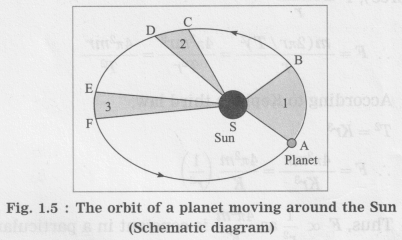
The orbit of a planet is an ellipse with the Sun at one of the foci.
Maharashtra Board Class 10 Science Solutions Part 1 Chapter 1 Gravitation 1
Figure 1.5 shows the elliptical orbit of a planet revolving around the Sun (S).

Kepler’s second law :
The line joining the planet and the Sun sweeps equal areas in equal intervals of time.
A → B, C → D and E → F are the displacements of the planet in equal intervals of time.
The straight lines AS, CS and ES sweep equal areas in equal intervals of time.
Area ASB = area CSD = area ESF.

Kepler’s third law :
The square of the period of revolution of a planet around the Sun is directly proportional to the cube of the mean distance of the planet from the Sun.
Thus, if r is the average distance of the planet from the Sun and T is its period of revolution, then,
T2 ∝ r2, i.e., \(\frac{T^{2}}{r^{3}}\) = constant = K

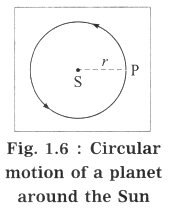
For simplicity, we shall assume the orbit to be a circle.
Maharashtra Board Class 10 Science Solutions Part 1 Chapter 1 Gravitation 2
In Fig. 1.6,
S denotes the position of the Sun, P denotes the position of a planet at a given instant and r denotes the radius of the orbit (= the distance of the planet from the Sun). Here, the speed of the planet is uniform.
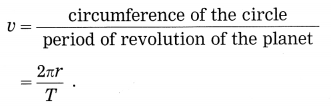
Maharashtra Board Class 10 Science Solutions Part 1 Chapter 1 Gravitation 3
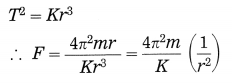
If m is the mass of the planet, the centripetal force exerted on the planet by the Sun (= gravitational force),
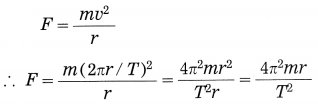
Maharashtra Board Class 10 Science Solutions Part 1 Chapter 1 Gravitation 4
According to Kepler’s third law,
Maharashtra Board Class 10 Science Solutions Part 1 Chapter 1 Gravitation 5
Thus, F ∝ \(\frac{1}{r^{2}}\) as \(\frac{4 \pi^{2} m}{K}\) is constant in a particular case.

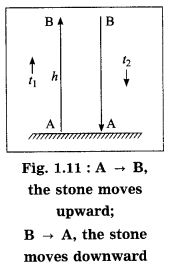
(d) A stone thrown vertically upwards with initial velocity u reaches a height ‘h’ before coming down. Show that the time taken to go up is same as the time taken to come down.
Answer:
Maharashtra Board Class 10 Science Solutions Part 1 Chapter 1 Gravitation 6
We have, v = u + at …..(1)
and s = ut + \(\frac{1}{2}\) at2 …..(2)
∴ s = (v – at) t + \(\frac{1}{2}\) at2
= vt – at2 + \(\frac{1}{2}\) at2
∴ s = vt – \(\frac{1}{2}\) at2 …..(3)
As the stone moves upward from A → B,
s = AB = h, t = t1,
a = -g (retardation),
u = u and v = 0
∴ From Eq. (3), h = 0 – \(\frac{1}{2}\) (-g)t12
∴ h = \(\frac{1}{2}\)gt12 …..(4)
As the stone moves downward from B → A,
t = t2, u = 0, s = h and a = g
∴ from Eq. (2), h = \(\frac{1}{2}\) gt2 …..(5)
From Eqs. (4) and (5), t12 = t22
∴ t1 = t2 (∵ t1 and t2 are positive)

(e) If the value of g suddenly becomes twice its value, it will become two times more difficult to pull a heavy object along the floor. Why?
Answer:
To pull an object along the floor, it is necessary to do work against the force of friction between the object and the surface of the floor. This force of friction is proportional to the weight, mg, of the object. If the value of g becomes twice its value, the weight of the object and hence the force of friction will become double. Therefore, it will become two times more difficult to pull a heavy object along the floor.

10th Gravitation Chapter Exercise Question 3.
Explain why the value of g is zero at the centre of the earth.
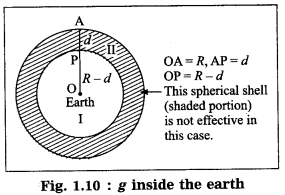
The value of g changes while going deep inside the earth. It goes on decreasing as we go from the earth’s surface towards the earth’s centre.

We shall treat the earth as a sphere of uniform density. If we consider a particle of mass m at point P at a distance (R – d) from the earth’s centre, where R is the radius of the earth and d is the depth below the earth’s surface, the gravitational force on the particle due to the earth is
Maharashtra Board Class 10 Science Solutions Part 1 Chapter 1 Gravitation 7
F = \(\frac{G m M^{\prime}}{(R-d)^{2}}\), where ‘M’ is the mass of the sphere of radius (R – d).
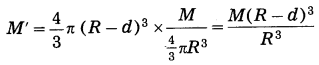
Maharashtra Board Class 10 Science Solutions Part 1 Chapter 1 Gravitation 8
because the outer spherical shell is not effective (Fig. 1.10). In this case, the acceleration due to gravity is

Maharashtra Board Class 10 Science Solutions Part 1 Chapter 1 Gravitation 9
where M is the mass of the earth. Thus, g decreases as d increases. It is less than that at the earth’s surface (\(\frac{G M}{R^{2}}\)) At the earth’s centre, d = R
∴ g = 0.

[Note : The formulae given in the answer are not given in the textbook. The formula density = \(\frac{\text { mass }}{\text { volume }}\) is used to find M’.]

Maharashtra Board Class 10 Science Solutions Part 1 Chapter 1 Gravitation

Std 10 Science Chapter 1 Gravitation Question Answer Question 4.
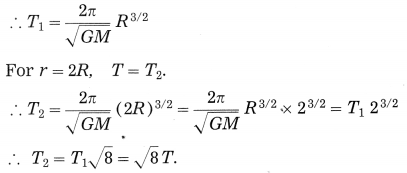
Let the period of revolution of a planet at a distance R from a star be T. Prove that if it was at a distance of 2R from the star, its period of revolution will be \(\sqrt{8} T\).
Answer:
T= \(\frac{2 \pi}{\sqrt{G M}} \quad r^{3 / 2}\), where T = period of revolution of a planet around the Sun, M = mass of the Sun, G = gravitational constant and r = radius of the orbit assumed to be circular = distance of the planet from the Sun.
For r = R, T =T1.
Maharashtra Board Class 10 Science Solutions Part 1 Chapter 1 Gravitation 10

Class 10 Science 1 Chapter 1 Gravitation Question 5.
Solve the following examples.
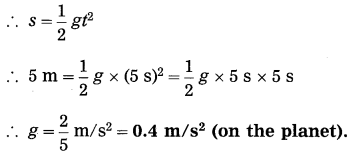
(a) An object takes 5 s to reach the ground from a height of 5 m on a planet. What is the value of g on the planet?
Solution:
Data: u = 0 m/s, s = 5m, t = 5s, g = ?
Maharashtra Board Class 10 Science Solutions Part 1 Chapter 1 Gravitation 11

(b) The radius of planet A is half the radius of planet B. If the mass of A is MA, what must be the mass of B so that the value of g on B is half that of its value on A?  (Practice Activity Sheet – 4)
Solution:
Data : RA = RB/2, gB = \(\frac{1}{2}\) gA, MB = ?
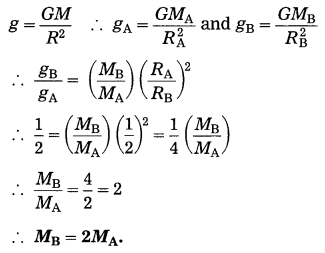
Maharashtra Board Class 10 Science Solutions Part 1 Chapter 1 Gravitation 12

(c) The mass and weight of an object on the earth are 5 kg and 49 N respectively. What will be their values on the moon? Assume that the acceleration due to gravity on the moon is l/6th of that on the earth.
Solution:
Data: m = 5 kg, W = 49 N,
gM = \(\frac{g_{E}}{6}\),m (on the moon) = ?, W(on the moon) = ?
(i) The mass of the object on the moon = the mass of the object on the earth = 5 kg
(ii) W = mg
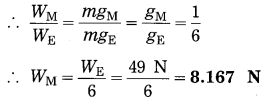
Maharashtra Board Class 10 Science Solutions Part 1 Chapter 1 Gravitation 13
(weight of the object on the moon).

(d) An object thrown vertically upwards reaches a height of 500 m. what was its initial velocity? How long will the object take to come back to the earth? Assume g = 10 m/s2
Solution:
100 mn/s and 20 s

(e) A ball falls off a table and reaches the ground in 1 s. Assuming g = 10 m/s2, calculate its speed on reaching the ground and the height of the table.
Solution:
Data: t = 1s, g = 10 m/s2, u = 0 m/s,
s = ?, v = ?
(i) s = ut + \(\frac{1}{2}\)gt2
= \(\frac{1}{2}\)gt2 for u = 0 m/s
∴ s = \(\frac{1}{2}\) × 10 m/s2 × (1s)2
=5 m
∴ The height of the table = 5 m.

(ii) v = u +at = u + gt
= 0 m/s + 10 m/s2 × 1 s
= 10m/s
∴ The velocity of the ball on reaching the ground = 10 m/s.

(f) The masses of the earth and moon are 6 × 1024 kg and 7.4 × 10²² kg, respectively. The distance between them is 3.84 × 10⁵ km. Calculate the gravitational force of attraction between the two. Use G = 6.7 × 10⁻¹¹ N.m2 kg-2.
Solution:
Data : m1 = 6 × 1024 kg,
m2 = 7.4 × 10²² kg,
r = 3.84 × 10⁵ km = 3.84 × 10⁸ m,
G = 6.7 × 10⁻¹¹ N.m2 kg-2, F = ?
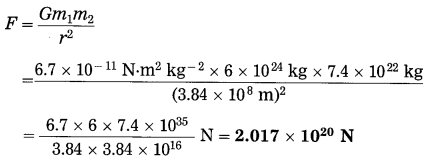
Maharashtra Board Class 10 Science Solutions Part 1 Chapter 1 Gravitation 14
This is (the magnitude of) the gravitational force between the earth and the moon.

(g) The mass of the earth is 6 × 1024 kg. The distance between the earth and the Sun is 1.5 × 10¹¹ m. If the gravitational force between the two is 3.5 × 10²² N, what is the mass of the Sun? (Use G = 6.7 × 10⁻¹¹ N.m2 kg-2)
Solution:
Data : m1 = 6 × 1024 kg,
r = 1.5 × 10¹¹ m, F = 3.5 × 10²² N,
G = 6.7 × 10⁻¹¹ N.m2kg-2, m2 = ?
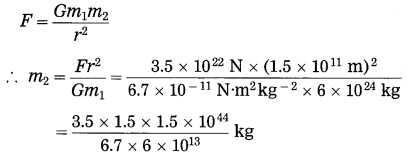
Maharashtra Board Class 10 Science Solutions Part 1 Chapter 1 Gravitation 15
= 1.96 × 1030 kg (mass of the sun)

Gravitation Class 10 Exercise Answers Project:
Take weights of five of your friends. Find out what their weights will be on the moon and the Mars.
Answer:
Help: The weight of a body
(i) On the earth. W1 = mg1
(ii) on the moon, W2 = mg2
(iii) on Mars, W3 = mg3
∴ W2 = W1 × \(\frac{g_{2}}{g_{1}}\) and W3 = W1 × \(\frac{g_{3}}{g_{1}}\)
Now, g1 = 9.81 m/s2, g2 = 1.67 m/s2 and g3 = 3.72 m/s2
If W1 = 500 N,
W2 = 500 × \(\frac{1.67}{9.81}\)N = 85.12N(approx.)
and W3 = 500 × \(\frac{3.72}{9.81}\)N = 189.6 N (approx.)

Can you recall? (Text Book Page No. 1)

10th Class Science Part 1 Chapter 1 Gravitation Exercise Question 1.
What are the effects of a force acting on an object? (Note: a body ≡ an object)
Answer:

  • A force can set a body in motion. For example, if a ball at rest on the floor is pushed, it rolls on the floor.
  • A force can stop a moving body. For example, a moving bicycle can be brought to rest by application of brakes.
  • A force acting on a body can change the speed of the body. For example, when brakes are applied to a moving bicycle, its speed decreases due to the friction between the brake shoes and the rim of the tire.
  • A force can change the direction of motion of the body. For example, in a uniform circular motion of a body, the direction of motion of the body keeps on changing due to the applied force.
  • A force can change the speed as well as the direction of motion of the body. For example, when a ball bowled by a bowler is hit by a batsman, there occurs a*change in the speed as well as the direction of motion of the ball.
  • A force can change the shape and size of the body on which it acts. For example, when a rubber ball is pressed, it gets deformed and hence no longer remains spherical. Also, there can be a decrease in its volume.

1 Gravitation Exercise Question 2.
What types of forces are you familiar with?
Answer:
The gravitational force between the earth and the moon, the electromagnetic force between two charged particles in motion, the nuclear force between a proton and a neutron in the nucleus of an atom.

Gravitation 10th Class Exercise Question 3.
What do you know about the gravitational force?
Answer:
The gravitational force is a universal force, i.e., it acts between any two objects in the universe.

Maharashtra Board Class 10 Science Solutions Part 1 Chapter 1 Gravitation

Can you recall? (Text Book Page No. 1)

Science Part 1 Gravitation Exercise Question 1.
What are Newton’s laws of motion?
Answer:
(1) Newton’s first law of motion: An object continues to remain at rest or in a state of uniform motion along a straight line unless an external unbalanced force acts on it.

(2) Newton’s second law of motion: The rate of change of momentum is proportional to the applied force and the change of momentum occurs in the direction of the force.

(3) Newton’s third law of motion: Every action force has an equal and opposite reaction force that acts simultaneously.
[Note: Equal in magnitude and opposite in direction.]

Use your brainpower! (Text Book Page No. 4)

10th Science Part 1 Gravitation Exercise Question 1.
If area ESF in figure 1.5 is equal to area ASB, what will you infer about EF?
Answer:
The time taken by the planet to move from E to F equals the time taken by the planet to move from A to B.

Use your brainpower (Text Book Page No. 7)

Gravitation Exercise 10th Class Question 1.
According to Newton’s law of gravitation, every object attracts every other object.
Thus, if the earth attracts an apple towards itself, the apple also attracts the earth towards itself with the same force. Why then does the apple fall towards the earth, but the earth does not move towards the apple?
Answer:
The earth and the apple move towards each other, but the magnitude of the displacement of the earth is negligible relative to that of the apple. Also the observer is located on the earth.
[Note: The mass of the earth is far greater than that of an apple. Hence, the magnitude of the acceleration of the earth is negligible relative to that of the apple.]

Gravitation Class 10 Question And Answer Question 2.
The gravitational force due to the earth also acts on the moon because of which it revolves around the earth. Similar situation exists for the artificial satellites orbiting the earth. The moon and the artificial satellites orbit the earth. The earth attracts them towards itself but unlike the falling apple, they do not fall on the earth, why?
Answer:
This is because of the velocity of the moon and the satellites along their orbits. If this velocity was not there, they would have fallen on the earth.

Think about it (Text Book Page No. 8)

Std 10 Science Chapter 1 Gravitation Exercise Question 1.
What would happen if there were no gravity?
Answer:
There would be no gravitational attraction between any two particles and hence no formation of the solar system, galaxy, etc.

Science 1 Gravitation Question 2.
What would happen if the value of G was twice as large?
Answer:
The gravitational force between any two particles would become double, also the value of g would become double.

Maharashtra Board Class 10 Science Solutions Part 1 Chapter 1 Gravitation

Can you tell? (Text Book Page No. 8)

Gravitation Class 10 Exercise Question 1.
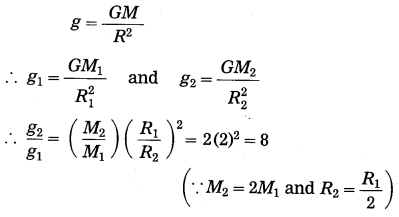
What would be the value of g on the surface of the earth if its mass was twice as large and its radius half of what it is now? (March 2019)
Answer:
Maharashtra Board Class 10 Science Solutions Part 1 Chapter 1 Gravitation 16
∴ g2 = 8g1
Thus, the value of g on the surface of the earth would be eight times the present value.

Think about it (Text Book Page No. 9)

Std 10 Science Chapter 1 Gravitation Answers Question 1.
Will the direction of the gravitational force change as we go inside the earth?
Answer:
No.

Gravitation Class 11 Exercise Solutions State Board Question 2.
What will be the value of g at the centre of the earth?
Answer:
Zero.

Use your brain power! (Text Book Page No. 10)

10th Ssc Science Chapter 1 Gravitation Question 1.
Will your weight remain constant as you go above the surface of the earth?
Answer:
No. As we go above the surface of the earth, our weight will go on decreasing.

Class 10 Science Chapter 1 Gravitation Question 2.
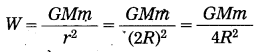
Suppose you are standing on a tall ladder. If your distance from the centre of the earth is 2R, what will be your weight?
Answer:
Maharashtra Board Class 10 Science Solutions Part 1 Chapter 1 Gravitation 17
= \(\frac{1}{4}\left(\frac{G M m}{R^{2}}\right)\)

Maharashtra Board Class 10 Science Solutions Part 1 Chapter 1 Gravitation 18

Use your brain power! (Text Book Page No. 12)

Gravitation Class 11 Maharashtra Board Question 1.
According to Newton’s law of gravitation, the earth’s gravitational force is higher on an object of larger mass. Why doesn’t that object fall down with higher velocity as compared to an object with lower mass?
Answer:
F = ma and F = \(\frac{G M m}{r^{2}}\)
∴ Acceleration, a = \(\frac{G M}{r^{2}}\). This is independent of the mass (m) of the object. Hence, an object of larger mass and an object of lower mass fall down with the same velocity.

Use your brain power! (Text Book Page No. 6)

Question 1.
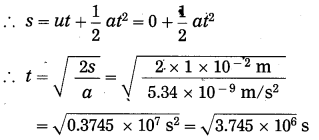
Assuming the acceleration in Example 2 above remains constant, how long will Mahendra take to move 1 cm towards Virat?
Answer:
Here, u = 0
Maharashtra Board Class 10 Science Solutions Part 1 Chapter 1 Gravitation 19
= 1935 s = 32 minutes 15 seconds.

Maharashtra Board Class 10 Science Solutions Part 1 Chapter 1 Gravitation

Fill in the blanks with appropriate words and write the completed sentences :

Question 1.
The ratio g(earth)/g(moon) is equal to……..
Answer:
The ratio g(earth)/g(moon) is equal to 6 (approximately)

Question 2.
The value of the acceleration due to gravity……..as we move from the equator to a pole.
Answer:
The value of the acceleration due to gravity increases as we move from the equator to a pole.

Question 3.
If the earth shrinks to half of its radius, its mass remaining the same, the weight of an object on the earth will become……..times.
Answer:
If the earth shrinks to half of its radius, its mass remaining the same, the weight of an object on the earth will become four times.

Question 4.
The SI unit of weight is the……..
Answer:
The SI unit of weight is the newton.

Question 5.
The CGS unit of weight is the……..
Answer:
The CGS unit of weight is the dyne

Question 6.
The weight of a body is ……..at the poles.
Answer:
The weight of a body is maximum at the poles.

Question 7.
Outside the earth, the weight of a body varies as……..
Answer:
Outside the earth, the weight of a body varies as 1/(R + h)2

Question 8.
Due to the …….. force, the earth attracts all objects towards it.
Answer:
Due to the gravitational force, the earth attracts all objects towards it. Gravitational

Question 9.
The acceleration due to gravity does not depend on the …….. of the body.
Answer:
The acceleration due to gravity does not depend on the mass of the body. Mass

Question 10.
According to Kepler’s first law, the orbit of a planet is …….. with the Sun at one of the……..
Answer:
According to Kepler’s first law, the orbit of a planet is an ellipse with the Sun at one of the foci

Question 11.
According to Kepler’s second law, the line joining the planet and the Sun …….. in equal intervals of time.
Answer:
According to Kepler’s second law, the line joining the planet and the Sun Sweeps equal areas in equal intervals of time.

Question 12.
According to Kepler’s third law T2 ∝ rn, where n = ……..
Answer:
According to Kepler’s third law T2 ∝ rn, where n = 3

Question 13.
For a freely falling object, we can write Newton’s second equation of motion as ……..
Answer:
For a freely falling object, we can write Newton’s second equation of motion as S = \(\frac{1}{2}\)gt2

Question 1.
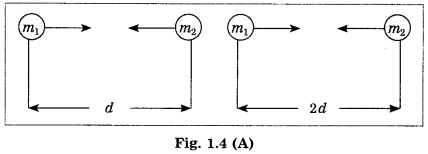
(A) Write the proper answer in the square.  (Practice Activity Sheet – 1)
Maharashtra Board Class 10 Science Solutions Part 1 Chapter 1 Gravitation 20
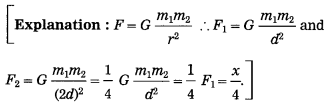
If this F = x
Then F =
Answer:
F = \(\frac{x}{4}\)
Maharashtra Board Class 10 Science Solutions Part 1 Chapter 1 Gravitation 21

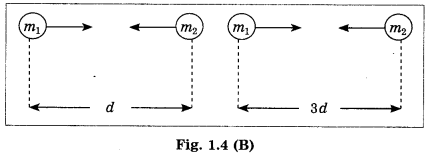
(B) Write the proper answer in the square.  (March 2019)
Maharashtra Board Class 10 Science Solutions Part 1 Chapter 1 Gravitation 22
If F = \(\frac{G m_{1} m_{2}}{d^{2}}\),
then F =
Answer:
F = \(\frac{G m_{1} m_{2}}{9 d^{2}}\)

Choose the correct alternative and rewrite the statements:

Question 1.
The gravitational force between two particles separated by a distance r varies as ……..
(a) \(\frac{1}{r}\)
(b) r
(c) r2
(d) \(\frac{1}{r^{2}}\)
Answer:
(d) \(\frac{1}{r^{2}}\)

Question 2.
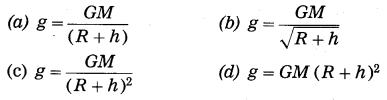
In the usual notation, the acceleration due to gravity at a height h from the surface of the earth is ……..
Maharashtra Board Class 10 Science Solutions Part 1 Chapter 1 Gravitation 23
Answer:
(c) g = \(\frac{G M}{(R+h)^{2}}\)

Maharashtra Board Class 10 Science Solutions Part 1 Chapter 1 Gravitation

Question 3.
The SI unit of the universal constant of gravitation is ……..
(a) N.m2/kg2
(b) N.kg2/m2
(c) m/s2
(d) kg.m/s2
Answer:
(a) N.m2/kg2

Question 4.
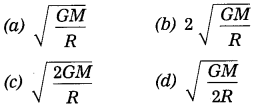
The escape velocity of a body from the earth’s surface, vsec = …….
Maharashtra Board Class 10 Science Solutions Part 1 Chapter 1 Gravitation 24
Answer:
(c) \(\sqrt{\frac{2 G M}{R}}\)

Question 5.
How much will a person with 72 N weight on the earth, weigh on the moon?  (Practice Activity Sheet-1)
(a) 12 N
(b) 36 N
(c) 21 N
(d) 63 N
Answer:
(a) 12 N

Question 6.
What will be the weight of a person on the earth, who weighs 9N on the moon? (Practice Activity Sheet – 2)
(a) 3 N
(b) 15 N
(c) 45 N
(d) 54 N
Answer:
(d) 54 N

State whether the following statements are True or False :  (If a statement is false, correct it and rewrite it.)

Question 1.
If the separation between two particles is doubled, the gravitational force between the particles becomes half the initial force.
Answer:
False. (If the separation between two particles is doubled, the gravitational force between the particles becomes \(\frac{1}{4}\) times the initial force.)

Question 2.
The CGS unit of the universal constant or gravitation is the dyne cm2/gram2?
Answer:
True.

Question 3.
At the centre of the earth, the value of the acceleration due to gravity becomes zero.
Answer:
True.

Question 4.
The weight of a body is minimum at the poles.
Answer:
False. (The weight of a body is maximum at the poles.)

Question 5.
Mass is a vector quantity.
Answer:
False. (Mass is a scalar quantity.)

Question 6.
weight is a vector quantity.
Answer:
True.

Question 7.
g has maximum value at the equator.
Answer:
False. (g has maximum value at the poles.)

Question 8.
Outside the earth, g varies as 1/(R + h)2.
Answer:
True.

Question 9.
The value of G changes from place to place.
Answer:
False. (The value of G is the same throughout the universe.)

Question 10.
The value of g increases with altitude.
Answer:
False. (The value of g decreases with altitude.)

Question 11.
The escape velocity of a body does not depend on the mass of the body.
Answer:
True

Question 12.
The mass of a body is the amount of matter present in it.
Answer:
True

Maharashtra Board Class 10 Science Solutions Part 1 Chapter 1 Gravitation

Match the following :

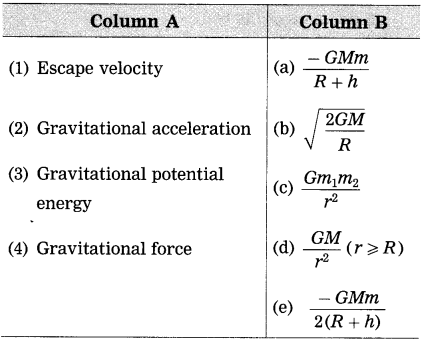
Maharashtra Board Class 10 Science Solutions Part 1 Chapter 1 Gravitation 25
Answer:
(1) Escape velocity : \(\sqrt{\frac{2 G M}{R}}\)
(2) Gravitational acceleration : \(\frac{G M}{r^{2}}\) (r ≥ R)
(3) Gravitational potential energy : \(\frac{-G M m}{R+h}\)
(4) Gravitational force : \(\frac{G m_{1} m_{2}}{r^{2}}\)

Answer the following questions in one sentence each:

Question 1.
State the SI and CGS units of G.
Answer:
The SI unit of G is N.m2/kg2 and CGS unit is the dyne.cm2/g2.

Question 2.
State any one characteristic of gravitational force.
Answer:
Gravitational force between two particles does not depend on the nature of the medium between them.

Question 3.
Name the force that keeps a satellite in the orbit around the earth.
Answer:
The gravitational force due to the earth keeps a satellite in the orbit around the earth.

Question 4.
Name the force due to which the earth revolves around the Sun.
Answer:
The earth revolves around the Sun due to the gravitational force of attraction exerted on it by the Sun.

Question 5.
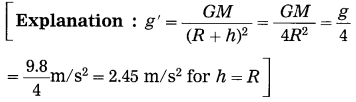
What is the acceleration due to gravity at a height h ( = radius of the earth) from the surface of the earth? (g = 9.8 m/s2)
Answer:
The acceleration due to gravity at a height h ( = radius of the earth) from the surface of the earth is 2.45 m/s2.
Maharashtra Board Class 10 Science Solutions Part 1 Chapter 1 Gravitation 26

Question 6.
What is the relation between the SI unit of weight and the CGS unit of weight?
Answer:
The relation between the SI unit of weight (the newton) and the CGS unit of weight (the dyne) is 1 newton = 105 dynes.

Question 7.
Write the formula for the centripetal force acting on a body performing circular motion.
Answer:
F = \(\frac{m v^{2}}{r}\)

Question 8.
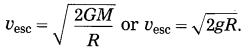
Write the formula for the escape velocity of a body from the earth’s surface.
Answer:
Maharashtra Board Class 10 Science Solutions Part 1 Chapter 1 Gravitation 27

Question 9.
What is the value of the acceleration due to gravity at the centre of the earth?
Answer:
Zero.

Question 10.
What are the factors on which the maximum height attained by a body thrown upwards depends?
Answer:
The initial velocity of the body, the acceleration due to gravity at that place, the buoyant force and frictional force due to air.

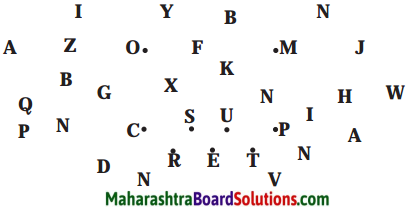
Some of the important terms in chapter Gravitation are given in the following box. Find them :

Maharashtra Board Class 10 Science Solutions Part 1 Chapter 1 Gravitation 28
Answer:
(1) centripetal force
(2) escape velocity
(3) periodic time
(4) gravitational constant.

Answer the following questions:

Question 1.
What is centripetal force?
(OR)
Define centripetal force.
Answer:
In uniform circular motion of a body, the force acting on the body is directed towards the centre of the circle. This force is called centripetal force.

Question 2.
Give one example of centripetal force.
Answer:
The moon revolves around the earth due to the gravitational force exerted on it by the earth. This force is directed towards the centre of the earth and is thus a centripetal force.

Question 3.
Name the source responsible for the motion of a planet around the Sun.
Answer:
A planet revolves around the Sun due to the gravitational force exerted on it by the Sun.

Maharashtra Board Class 10 Science Solutions Part 1 Chapter 1 Gravitation

Answer the following questions:

Question 1.
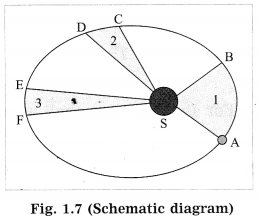
In the following figure, an orbit of a planet around the Sun (S) has been shown. AB and CD are the distances covered by the planet in equal time. Lines AS ad CS sweep equal areas in equal intervals of time. Hence, areas ASB and CSD are equal.  (Practice Activity Sheet-1)
(a) Which laws do we understand from the above description?
(b) Write the law regarding the area swept.
(c) Write the law T2 ∝ r3 in your words.
Maharashtra Board Class 10 Science Solutions Part 1 Chapter 1 Gravitation 29
Answer:
(a) From the given description we understand Kepler’s three laws.
(b) Kepler’s law of areas: The line joining the planet and the Sun sweeps equal areas in equal intervals of time.
(c) Kepler’s law of periods: The square of the period of revolution of a planet around the Sun is directly proportional to the cube of the mean distance of the planet from the Sun.

Question 2.
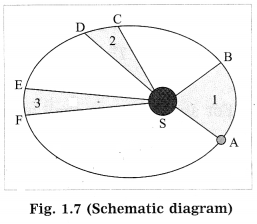
Identify the law shown in Fig. 1.7 and state the three respective laws. (Practice Activity Sheet – 3)
Maharashtra Board Class 10 Science Solutions Part 1 Chapter 1 Gravitation 30
Answer:
(a) From the given description we understand Kepler’s three laws.
(b) Kepler’s law of areas: The line joining the planet and the Sun sweeps equal areas in equal intervals of time.
(c) Kepler’s law of periods: The square of the period of revolution or a planet around the Sun is directly proportional to the cube of the mean distance of the planet from the Sun.

Question 3.
Explain the term gravitational force. What is gravitation?
Answer:
There exists a force of attraction between any two particles of matter in the universe such that the force depends only on the masses of the particles and the separation between them. It is called the gravitational force and the mutual attraction is called gravitation.

Question 4.
State Newton’s universal law of gravitation. Express it in mathematical form.
Answer:
Newton’s universal law of gravitation :
Every object in the Universe attracts every other object with a definite force. This force is directly proportional to the product of the masses of the two objects and inversely proportional to the square of the distance between them.

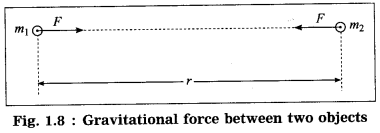
Mathematical form: Consider two objects of masses m1 and m2. We assume that the objects are very small spheres of uniform density and the distance r between their centers is very large compared to the radii of the spheres (Fig. 1.8).
Maharashtra Board Class 10 Science Solutions Part 1 Chapter 1 Gravitation 31
The magnitude (F) of the gravitational force of attraction between the objects is directly proportional to m1m2 and inversely proportional to r2
∴ F ∝ \(\frac{m_{1} m_{2}}{r^{2}}\)
∴ F = \(G\frac{m_{1} m_{2}}{r^{2}}\)
where G is the constant of proportionality, called the universal gravitational constant.
[Note: In the textbook, the word object/body is used.
Newton’s law of gravitation applies to particles.]

Maharashtra Board Class 10 Science Solutions Part 1 Chapter 1 Gravitation

Question 5.
(i) Why is the constant of gravitation called a universal constant?
(ii) Newton’s law of gravitation is called the universal law of gravitation. Why?
Answer:
(i) The value of the constant of gravitation does not change with the nature, mass or the size of the material particles. It does not vary with the distance between the two particles. It is also independent of the nature of the medium between the two particles. Hence, it is called a universal constant.

(ii) As the law of gravitation given by Newton is applicable throughout the universe and to all particles, it is called universal law.

[ Note: The centre of mass of an object is the point inside or outside the object at which the total mass of the object can be assumed to be concentrated to study the effect of an applied force. The centre of mass of a spherical object having uniform density is at its geometrical centre. The centre of mass of an object having uniform density is at its centroid. If the two bodies are spherical and of uniform density, the gravitational force between them is always along the line joining the centres of the two bodies and the distance between the centres is taken to be r. When the bodies are not spherical or have irregular shape or have nonuniform density, the force is along the line joining their centres of mass and r is taken to be the distance between the two centres of mass.]

Question 6.
If the distance between two bodies is increased by a factor of 5, (i) by what factor will the gravitational force change if the masses are kept constant? (ii) by what factor will the mass of one of them have to be altered, keeping the other mass the same, to maintain the same gravitational force between the two bodies?
Answer:
If the distance between two bodies is increased by a factor of 5,
(i) the gravitational force between the bodies will decrease by a factor of 25 if the masses of the bodies are kept constant.
(ii) the mass of one of them will have to be increased by a factor of 25, keeping the mass of the other body the same, to maintain the same gravitational force between the two bodies.
[Note : Gravitational force F ∝ \(\frac{1}{r^{2}}\) and F ∝ m1m2.]

Question 7.
(i) Determine the SI unit of the universal constant of gravitation from the formula for the gravitational force between two particles. Hence, state the CGS unit of the constant of gravitation. (ii) Define G (universal gravitational constant).
Ans. (i) According to Newton’s law of gravitation, the gravitational force between two particles is
F = \(G\frac{m_{1} m_{2}}{r^{2}}\)
where m1 and m2 are the masses of the two particles, r is the distance between them and G is the universal constant of gravitation.
∴ G = \(\frac{F r^{2}}{m_{1} m_{2}}\)

The SI unit of force is the newton (N), that of distance is the metre (m) and that of mass is the kilogram (kg).
The SI unit of G is \(\frac{\mathrm{N} \cdot \mathrm{m}^{2}}{\mathrm{kg}^{2}}\).
The CGS unit of G is \(\frac{\text { dyne } \cdot \mathrm{cm}^{2}}{\mathrm{g}^{2}}\).

(ii) F = \(G\frac{m_{1} m_{2}}{r^{2}}\).
∴ G = \(\frac{F r^{2}}{m_{1} m_{2}}\)
If we take m1 = m2 = unit mass and r = unit distance, numerically, G = F, i.e., G (universal gravitational constant) represents the magnitude of the gravitational force of attraction between two unit masses, separated by a unit distance.

Maharashtra Board Class 10 Science Solutions Part 1 Chapter 1 Gravitation

Question 8.
State the importance of Newton’s universal law of gravitation.
Answer:
The importance of Newton’s universal law of gravitation :
This law explains successfully, i.e., with great accuracy,

  • The force that binds the objects on the earth to the earth
  • The motion of the moon and artificial satellites around the earth
  • The motion of the planets, asteroids, comets, etc., around the Sun
  • The tides of the sea due to the moon and the Sun.

Question 9.
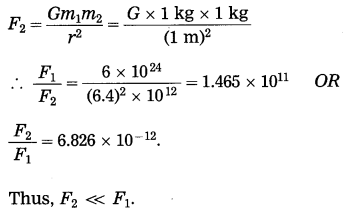
Compare the gravitational force on a body of mass 1 kg due to the earth with the force on the same body due to another body of mass 1 kg at a distance of 1 m from the first body. (Mass of the earth = 6 × 1024 kg, radius of the earth = 6400 km)
Answer:
In the first case, m1 = 1kg,
m2 = 6 × 1024 kg and r = 6400 km = 6.4 × 10⁶ m
The gravitational force on the body.

Maharashtra Board Class 10 Science Solutions Part 1 Chapter 1 Gravitation 32
= \(\frac{G \times 6 \times 10^{24} \mathrm{kg}^{2}}{(6.4)^{2} \times 10^{12} \mathrm{m}^{2}}\)
In second case, m1 = 1 kg
m2 = 1 kg and r = 1m
Gravitational force on the body,
Maharashtra Board Class 10 Science Solutions Part 1 Chapter 1 Gravitation 33

Question 10.
Explain the term the earth’s gravitational force.
(OR)
Write a short note on the earth’s gravitational force.
Answer:
The earth attracts every object towards it because of the gravitational force. As the earth’s centre of mass is at its centre, the gravitational force exerted by the earth on an object is directed towards the earth’s centre. Hence, an object released from a point above the earth’s surface falls vertically downward towards the earth.

If an object is thrown vertically upward, its velocity goes on decreasing due to the earth’s gravitational force on the object. At one stage, the velocity of the body becomes zero and later the body falls back to the earth.

Question 11.
Take two balls of different masses, go to the top of a building, drop them simultaneously and observe what happens to the balls.
Answer:
The balls reach the ground almost at the same time.

Question 12.
Take two similar pages from your notebook. Crumple one paper and allow this and the other paper to fall on the ground simultaneously. What do you observe?
Answer:
The crumpled paper reaches the ground before the other one.

Question 13.
Take a feather and a paper. Allow them to fall to the ground simultaneously. Which will reach the ground earlier? Why?
Answer:
There is no unique answer. It depends on the feather and paper. Upthrust due to air and force due to friction with air play very important roles here. The acceleration of a body depends on the resultant of the earth’s gravitational force on the body and the upthrust and the force of friction due to air.

Question 14.
From Newton’s law of gravitation, derive the formula for the acceleration due to gravity.
Answer:
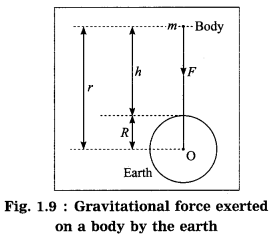
Suppose that a body of mass m is released from a distance r from the centre (O) of the earth (Fig. 1.9). Let M be the mass of the earth. According to Newton’s law of gravitation, the magnitude of the earth’s gravitational force acting on the body Is
F = G\(\frac{M m}{r^{2}}\)
where G is the universal constant of gravitation.
Maharashtra Board Class 10 Science Solutions Part 1 Chapter 1 Gravitation 34
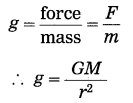
The acceleration produced by this force, force F
Maharashtra Board Class 10 Science Solutions Part 1 Chapter 1 Gravitation 35

This is the formula for the acceleration due to gravity or the gravitational acceleration due to the earth. This acceleration is directed towards the earth’s centre.

If h denotes the altitude, r = R + h, where R is the radius of the earth.
∴ g = \(\frac{G M}{(R+h)^{2}}\)
For a body on the earth’s surface, h = 0 ∴ g = \(\frac{G M}{R^{2}}\)
[Note: When we consider the gravitational interaction between the earth and a body on the surface of the earth or at some height above the surface of the earth, for many practical purposes we can assume that the earth behaves as if its mass were concentrated at the earth’s centre. The proof is not expected here.]

Maharashtra Board Class 10 Science Solutions Part 1 Chapter 1 Gravitation

Question 15.
Explain the factors affecting the value of g.
Answer:
The value of the acceleration due to gravity, g, changes from place to place on the earth. It also varies with the altitude and depth below the earth’s surface. The factors affecting the’ value of g are the shape of the earth, altitude and depth below the earth’s surface.

(1) The earth is not perfectly spherical. It is somewhat flat at the poles and bulging at the equator. At the surface of the earth, the value of g is maximum (9.832 m/s2) at the poles as the polar radius is minimum, while it is minimum (9.78 m/s2) at the equator as the equatorial radius is maximum.

(2) As the height (h) above the earth’s surface increases, the value of g decreases. It varies as \(\frac{1}{(R+h)^{2}}\), where R is radius of the earth.

(3) In the interior of the earth, on average, the value of g is less than that at the earth’s surface. As the depth below the earth’s surface increases, the value of g decreases and finally it becomes zero at the centre of the earth.

Question 16.
If g = GM/r2, then where will the value^ of g be high, at Goa Beach or on the top of the Mount Everest? (Practice Activity Sheet – 3)
Answer:
The value of g will be high at Goa Beach.

Question 17.
Why does an object released from the hand, fall on the earth?
Answer:
When an object is held in the hand, the gravitational force acting on the object due to the earth is balanced by the person holding the object. When the object is released from the hand, it falls on the earth due to the earth’s gravitational force.

Question 18.
Does the value of g depend on the mass of the falling body? Why?
Answer:
The value of g does not depend on the mass of the falling body.
The reason is the gravitational force on a body due to the earth is directly proportional to the mass of the body and for a given force, the acceleration of a body is inversely proportional to the mass of the body.

Question 19.
Define mass. State its SI and CGS units.
Answer:
The mass of a body is the amount of matter present in it. Its SI unit is the kilogram (kg) and CGS unit is the gram (g).
[Note: Mass has only magnitude, not direction. Thus, it is a scalar quantity.]

Question 20.
Define weight. State its SI and CGS units.
Answer:
The weight of a body is defined as the force with which the earth attracts it. Its SI unit is the newton and CGS unit is the dyne.

[Note : In the usual notation, the magnitude of the weight of a body on the earth s surface is W = \(\frac{G m M}{R^{2}}\) = \(m\frac{G M}{R^{2}}\) = mg. Thus, W ∝ g. Hence, weight varies just like the acceleration due to gravity. It is maximum at the poles and minimum at the equator. It decreases with altitude (ft) and depth (d) below the earth’s surface. It becomes zero at the earth’s centre. At a height above the earth’s surface, W = \(\frac{G m M}{(R+h)^{2}}\) at a depth d below the earth’s surface, W = \(\frac{G m M(R-d)}{R^{3}}\). Weight has magnitude and direction (towards the earth’s centre). It is a vector quantity.]

Question 21.
As per the request of one of his friends from the equator, Rahul buys 100 grams of silver at the north pole. He hands it over to his friend at the equator. Will the friend agree with the weight of the silver bought? If not, why?
Answer:
The weight of a body is given by W = mg, where m is the mass of the body and g is the acceleration due to gravity, g varies from place to place. The value of g at the equator is less than that at the north pole (as well as the south pole). Hence, the weight of the silver bought at the north pole would be less when the silver is weighed at the equator. Therefore, Rahul’s friend will disagree about the weight of the silver.
[Note: The mass being independent of the value of g, Rahul’s friends will agree about the mass of the silver.]

Question 22.
What is the difference between mass and weight of an object? Will the mass and weight of an object on the earth be the same as their values on Mars? Why?
Answer:
The mass of an object is the amount of matter present in it. It is same everywhere in the Universe and is never zero. It is a scalar quantity and its SI unit is kg. The weight of an object is the force with which the earth (or any other planet/ moon/star) attracts it. It is directed towards the centre of the earth. The weight of an object is different at different places on the earth. It is zero at the earth’s centre. It is a vector quantity and its SI unit is the newton (N). The magnitude of weight = mg.

The mass of an object will be the same on the earth and Mars, but the weight will not be the same because the value of g on Mars is different from that on the earth.

Maharashtra Board Class 10 Science Solutions Part 1 Chapter 1 Gravitation

Question 23.
Explain the term free fall and state the corresponding kinematical equations of motion in the usual notation.
Answer:
When a body falls in air, there are three forces acting on the body : (1) the gravitational force due to the earth, acting downward (2) the force of buoyancy (upthrust) due to air, acting upward I (3) the force due to friction with air (called air resistance), acting upward (being always in the direction opposite to that of the velocity of the body).

Under certain conditions, the force of buoyancy due to air and friction with air can be ignored compared to the gravitational force of the earth. In that case (near the earth’s surface) the body falls with almost uniform acceleration (g). Whenever a body moves under the influence of the force of gravity alone, it is said to be falling freely. Strictly speaking, this is true only if the body falls in vacuum.

The kinematical equations of motion, in the usual i notation, are
v = u + gt, s = ut + \(\frac{1}{2}\) gt2 and v2 = u2 + 2gs.
If the initial velocity (u) of the body is zero,
v = gt, s = \(\frac{1}{2}\)gt2 and v2 = 2 gs.

Question 24.
During a free fall, will a heavier object accelerate more than a lighter one?
Answer:
No. The two objects will have the same acceleration.

Question 25.
If you had to calculate the mass of the earth, how would you do it?
Answer:
If the acceleration due to gravity (g), the constant of gravitation (G) and the radius of the earth (R) are known, the mass of the earth (M) can be calculated using the formula g = \(\frac{G M}{R^{2}}\)

Question 26.
What is gravitational potential energy?
(OR)
Define gravitational potential energy.
Write the formula for it.
Answer:
The energy stored in a body due to the gravitational force between the body and the earth is called the gravitational potential energy.

Gravitational potential energy of a body of mass m = \(-\frac{G M m}{R+h}\), where G = gravitational constant, M = mass of the earth, R = radius of the earth, h = height of the body from the surface of the earth.

[Note : As the body is bound to the earth due to the earth’s gravitational froce, the gravitational potential energy of the body is negative. If the body is given kinetic energy equal to \(\frac{G M m}{R+h}\) the body will overcome the earth’s gravitational force. It will then move to infinity and come to rest there.]

Question 27.
What is escape Velocity?
(OR)
Define escape velocity.
Answer:
When a body is thrown vertically upward from the surface of the earth, the minimum initial velocity of the body for which the body is able to overcome the downward pull by the earth and can escape the earth forever is called the escape velocity.

Question 28.
Explain the term escape velocity.
(OR)
Write a short note on escape velocity.
Answer:
In general, when a body is thrown vertically upward from the earth’s surface, its velocity goes on decreasing and after some time the body falls back to the ground. If its initial velocity is increased, the maximum height attained by it is more, but it does fall back to the ground. If the initial velocity is increased continuously, for a particular initial velocity, the body can overcome the earth’s gravitational force and move to infinity and come to rest there. This velocity is called the escape velocity.

Maharashtra Board Class 10 Science Solutions Part 1 Chapter 1 Gravitation

Question 29.
Using the law of conservation of energy, obtain the expression for the escape velocity.
Answer:
Here, we shall not consider the effects of air. Suppose a body of mass m is thrown vertically upward from the surface of the earth. Let the initial velocity of the body be the escape velocity (vsec).

When the body is on the earth’s surface, its total energy Ex = kinetic energy + potential energy = \(\frac{1}{2} m v^{2} \text { esc }\) + \(\left(-\frac{G m M}{R}\right)\) where G = universal gravitational constant, M = mass of the earth and R = radius of the earth.
Thus, E1 = \(\frac{1}{2} m v_{\mathrm{esc}}^{2}-\frac{G m M}{R}\)
When the body moves to infinity and comes to rest there, its total energy,

Maharashtra Board Class 10 Science Solutions Part 1 Chapter 1 Gravitation 36
According to the law of conservation of energy,
E1 = E2.
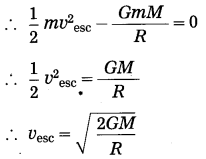
Maharashtra Board Class 10 Science Solutions Part 1 Chapter 1 Gravitation 37
This is the required expression.

Question 30.
Express escape velocity in terms of g and R.
Answer:
Escape velocity, vesc = \(\sqrt{\frac{2 G M}{R}}\)
Now, g = \(\frac{G M}{R^{2}}\)
∴ GM = gR2
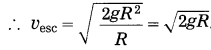
Maharashtra Board Class 10 Science Solutions Part 1 Chapter 1 Gravitation 38

Question 31.
Express escape velocity in terms of G, R and ρ (the earth’s density)
Answer:
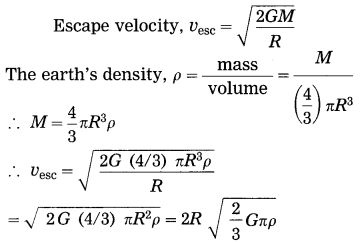
Maharashtra Board Class 10 Science Solutions Part 1 Chapter 1 Gravitation 39

Give scientific reasons:

Question 1.
If a feather and a stone are released from the top of a building simultaneously, the stone reaches the ground earlier than the feather.
Answer:
(a) The motion of a body falling in air accelerated due to the earth’s gravitational force on the body. The force due to buoyancy of air acts on the body in the upward direction. As the body falls, the friction with air opposes its motion.

(b) This opposition due to air depends on the size, shape, density and velocity of the body. It Is greater for a feather than for a stone. Hence, the stone has greater downward acceleration than the feather. Therefore, the stone reaches the ground earlier than the feather though ‘they are released simultaneously from the same height.

Question 2.
The weight of a body is different on different planets.
Answer:
(1) The weight of a body of mass m on the surface of a planet of mass M and radius R is
W = \(\frac{G m M}{R^{2}}\) usuai notation).

(2) For a given body, its mass is constant. G is the universal constant of gravitation. Different planets have different masses and radii such that the ratio (M/R2) is not the same. Hence, the weight of a body is different on different planets.

Maharashtra Board Class 10 Science Solutions Part 1 Chapter 1 Gravitation

Question 3.
With a specific initial velocity, we can jump higher on the moon than on the earth.
Answer:
The acceleration due to gravity on the moon is about \(\frac{1}{6}\) of that on the earth. Hence, with a specific initial velocity, we can jump higher on the moon than on the earth. This can be seen from the equation h = u2/2g.

Distinguish between the following:

Question 1.
mass and weight (2) universal gravitational constant and gravitational acceleration of the earth.
Answer:
(1) Mass:

  • The mass of a body is the amount of matter present in it.
  • It has magnitude, but not direction.
  • It does not change from place to place.
  • It can never be zero.
  • Its SI unit is the kilogram.

Weight:

  • The weight of a body is the force with which the earth attracts it.
  • It has both magnitude and direction.
  • It changes from place to place.
  • It is zero at the centre of the earth.
  • Its SI unit is the newton.

Question 2.
Universal gravitational constant:

  • The universal gravitational constant numerically equals the force of attraction masses separated by a unit distance.
  • Its value remains constant throughout the universe.
  • It has magnitude but not direction.
  • Its SI unit is N.m2/kg2.

Gravitational acceleration of the earth:

  • The gravitational between two unit acceleration of the earth is the acceleration produced in a body due to the gravitational force of the earth.
  • Its value changes from place to place.
  • It has both magnitude and direction.
  • Its SI unit is m/s2

Solve the following examples/numerical problems:
(G 6.67 × 10⁻¹¹ N.m2/kg2, g = 9.8 m/s2)

Question 1.
The time taken by the earth to complete one revolution around the Sun is 3.156 × 10⁷ s. The distance between the earth and the Sun is 1.5 × 10¹¹ m. Find the speed of revolution of the earth.
Solution:
Data : T = 3.156 × 10⁷ s,
r = 1.5 × 10¹¹ m, v =?

Maharashtra Board Class 10 Science Solutions Part 1 Chapter 1 Gravitation 40
= 2.987 × 10⁴ m/s = 29.87 km/s
This is the speed of revolution of the earth.

Question 2.
Assuming that the earth performs uniform circular motion around the Sun, flnd the centripetal acceleration of the earth. [Speed of the earth =3 × 10⁴ m/s, distance between the earth and the Sun = 1.5 × 10¹¹ m]
Solution:
Data: v = 3 × 10⁴ m/s, r=1.5 × 10¹¹ m
Centripetal force = \(\frac{m v^{2}}{r}\) = ma
∴ Centripetal acceleration of the earth,

Maharashtra Board Class 10 Science Solutions Part 1 Chapter 1 Gravitation 41
= 6 × 10⁻³ m/s2
It is directed towards the centre of the Sun.

Maharashtra Board Class 10 Science Solutions Part 1 Chapter 1 Gravitation

Question 3.
What will be the gravitational force on 60 kg man on the Moon, Mars and Jupiter? Are they the same? Why?
M (Moon) = 7.36 × 10²² kg, R (Moon) = 1.74 × 10⁶m,
M (Mars) = 6.4 × 10²³ kg, R (Mars) = 3.395 × 10⁶ m,
M (Jupiter) = 1.9 × 1027 kg.
R (Jupiter) = 7.15 × 10⁷ m,
G = 6.67 × 10⁻¹¹ N.m/kg2
Solution:
(1) Data : m1 = 60 kg, m2 = 7.36 × 10²² kg,
R = 1.74 × 10⁶ m, F = ?
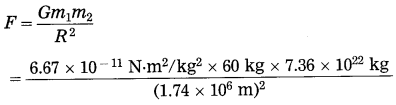
Maharashtra Board Class 10 Science Solutions Part 1 Chapter 1 Gravitation 42
= 97.29 N
On the moon’s surface, the gravitational force on the man due to the moon = 97.29 N.

(2) Data : m1 = 60 kg, m2 = 6.4 × 10²³ kg,
R = 3.395 × 10⁶m, F = ?
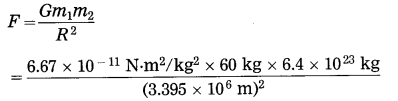
Maharashtra Board Class 10 Science Solutions Part 1 Chapter 1 Gravitation 43
= 222.2 N
On the surface of Mars, the gravitational force on the man due to Mars = 222.2 N.

(3) Data : m1 = 60 kg, m2 = 1.9 × 1027 kg,
R = 7.15 × 10⁷ m, F = ?
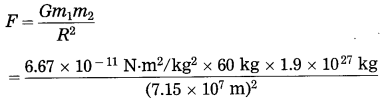
Maharashtra Board Class 10 Science Solutions Part 1 Chapter 1 Gravitation 44
= 1487 N
On the surface of Jupiter, the gravitational force on the man due to Jupiter = 1487 N.

Thus, the forces on the man are not the same because the ratio (M/R2) is not the same in the case of the moon, Mars, and Jupiter.

Question 4.
Mahendra and Virat are sitting at a distance of 1 meter from each other. Their masses are 75 kg and 80 kg respectively. What is the gravitational force between them? G = 6.67 × 10⁻¹¹ N.m2/kg2. (Practice Activity Sheet – 3)
Solution:
Given: r = 1 m,
m1 = 75 kg,
m2 = 80 kg
G = 6.67 × 10⁻¹¹ N.m2/kg2

Maharashtra Board Class 10 Science Solutions Part 1 Chapter 1 Gravitation 45
= 4.002 × 10⁻⁷ N
The gravitational force between Mahendra and Virat is 4.002 × 10⁻⁷ N.

Question 5.
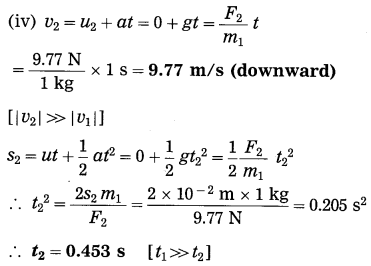
Spheres A and B of uniform density have masses 1 kg and 100 kg respectively. Their centres are separated by 100 m. (i) Find the gravitational force between them, (ii) Find the gravitational force on A due to the earth, (iii) Suppose A and B are initially at rest and A can move freely towards B. What will be the velocity of A one second after it starts moving towards B? How will this velocity change with time? How much time will A take to move towards B by 1 cm? (iv) if A begins to fall, starting from rest, due to the earth’s downward pull, what will be its velocity after one second? How much time will it take to fall through 1cm?
[M(earth) = 6 × 1024 kg, R(earth) = 6400 km]
Solution:Data: m1 = 1 kg, m2 = 100 kg, r = 100 m,
M =6 × 1024 kg,
R = 64o0 km = 6400 × 103 m,
t = 1 s, s = 1 cm = 1 × 10⁻² m,
G = 6.67 × 10⁻¹¹ N.m2/kg
F1 =?, F2 =?, v1 =?, t1 =?, v2 =?, t1 =?
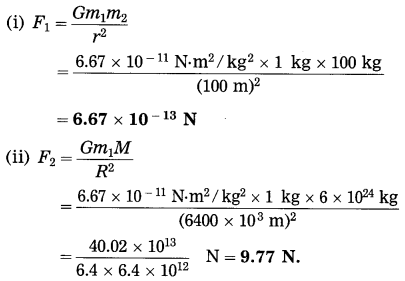
Maharashtra Board Class 10 Science Solutions Part 1 Chapter 1 Gravitation 46
This is far greater than F1.
(iii) Ignoring variation of acceleration with distance,
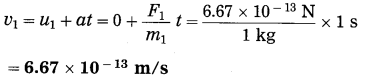
Maharashtra Board Class 10 Science Solutions Part 1 Chapter 1 Gravitation 47
This velocity is directed from A to B. As the separation between A and B decreases, the acceleration of A and hence the velocity of A will increase.

Ignoring variation of acceleration with distance,
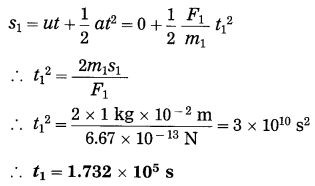
Maharashtra Board Class 10 Science Solutions Part 1 Chapter 1 Gravitation 48
Maharashtra Board Class 10 Science Solutions Part 1 Chapter 1 Gravitation 49

Maharashtra Board Class 10 Science Solutions Part 1 Chapter 1 Gravitation

Question 6.
Two spheres of uniform density have masses 10 kg and 40 kg. The distance between the centres of the spheres is 200 m. Find the gravitational force between them.
Solution:
Data: m1 = 10 kg, m2 = 40 kg,
r = 200 m, G = 6.67 × 10⁻¹¹ N.m2/kg2, F = ?
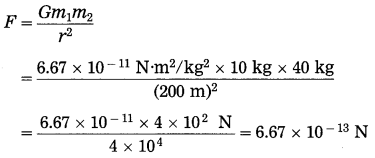
Maharashtra Board Class 10 Science Solutions Part 1 Chapter 1 Gravitation 50
The gravitational force between the two spheres = 6.67 × 10⁻¹³ N.

Question 7.
Find the gravitational force between a man of mass 50 kg and a car of mass 1500 kg separated by 10 m.
Solution: Data : m1 = 50 kg, m2 = 1500 kg,
r = 10 m, G = 6.67 × 10⁻¹¹ N.m2/kg2, F = ?
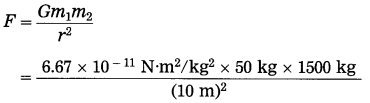
Maharashtra Board Class 10 Science Solutions Part 1 Chapter 1 Gravitation 51
= 5.0025 × 10⁻⁸ N
The gravitational force between the man and the car = 5.0025 × 10⁻⁸ N.

Question 8.
Find the magnitude of the gravitational force between the Sun and the earth. (Mass of the Sun = 2 × 1024 kg, mass of the earth=6 × 1024 kg and the thstance between the centres of the Sun and the earth 1.5 × 10¹¹ m,
G = 6.67 × 10⁻¹¹ N.m2/kg2)
Solution:
Data: m1 = 2 × 1030 kg,
m2 = 6 × 1024 kg, r = 1.5 × 10¹¹ m,
G = 6.67 × 10⁻¹¹ N.m2/kg2, F =?
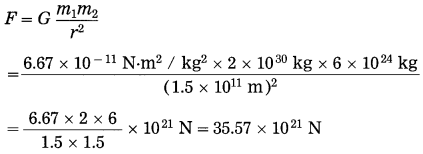
Maharashtra Board Class 10 Science Solutions Part 1 Chapter 1 Gravitation 52
∴ F = 3.557 × 10²² N
The magnitude of the gravitational force between the Sun and the earth = 3.557 × 10²² N.

Question 9.
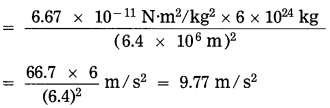
Find the magnitude of the acceleration due to gravity at the surface of the earth. (M= 6 × 1024 kg, R = 6400 km)
Solution:
Data: M = 6 × 1024 kg,
R = 6400km = 6.4 × 10⁶m,
G = 6.67 × 10⁻¹¹ N.m2/kg2, g =?
g = \(\frac{G M}{R^{2}}\)
Maharashtra Board Class 10 Science Solutions Part 1 Chapter 1 Gravitation 53
The magnitude of the acceleration due to gravity at the surface of the earth = 9.77 m/s2.

Question 10.
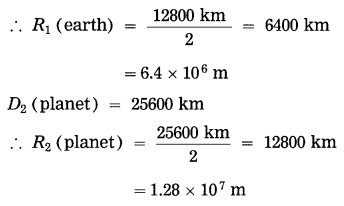
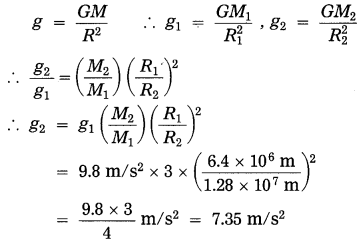
The mass of an imaginary planet is 3 times the mass of the earth. Its diameter is 25600 km arid the earth’s diameter is 12800 km. Find the acceleration due to gravity at the surface of the planet, [g (earth) = 9.8 m/s2]
Solution:
Data: \(\frac{M_{2}(\text { planet })}{M_{1}(\text { earth })}\) = 3
D1 (earth) = 12800 km
Maharashtra Board Class 10 Science Solutions Part 1 Chapter 1 Gravitation 54
g1 (earth) = 9.5 m/s2, g2 (planet) = ?
Maharashtra Board Class 10 Science Solutions Part 1 Chapter 1 Gravitation 55
The acceleration due to gravity at the surface of the planet = 7.35 m/s2.

Question 11.
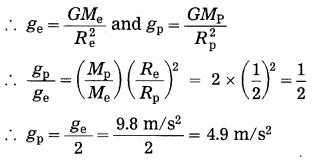
If the acceleration due to gravity on the surface of the earth is 9.8 m/s2, what will be the acceleration due to gravity on the surface of a planet whose mass and radius both are two times the corresponding quantities for the earth?
Solution:
Data: ge = 9.8 m/s2, Mp = 2Me,
Rp = 2Re, gp = ?
Acceleration due to gravity, g = \(\frac{G M}{R^{2}}\)
Maharashtra Board Class 10 Science Solutions Part 1 Chapter 1 Gravitation 56
acceleration due to gravity on the surface of the planet = 4.9 m/s2.

Maharashtra Board Class 10 Science Solutions Part 1 Chapter 1 Gravitation

Question 12.
A body is released from the top of a building of height 19.6 m. Find the velocity with which the body hits the ground.
Solution:
Data: h = 19.6 m, u = 0 m/s,
g = 9.8 m/s2, s = 19.6 m, v = ?
v2 = u2 + 2 gs .
=2 gs …..(as u = 0 m/s)
= 2 × 9.8 m/s2 × 19.6 m
= (19.6 m/s)2
∴ v = 19.6 m/s (downward velocity)
The velocity with which the body hits the i ground = 19.6 m/s (downward).

Question 13.
A stone on a bridge on a river falls into the river. If it takes 3 seconds to reach the surface of water, find (i) the velocity of the stone at the instant it touches the surface of water (ii) the height of the bridge from the surface of water.
Solution:
Data: u = 0 m/s, t = 3 s,
g = 9.8 m/s2, v = ?, h = ?
(i) v = u + gt = 0 m/s + 9.8 m/s2 × 3 s
= 29.4 m/s
The velocity of the stone at the instant it touches the surface of water = 29.4 m/s

(ii) s = ut + \(\frac{1}{2}\)gt2
= 0 m/s × 3 s + \(\frac{1}{2}\) (9.8 m/s2) (3 s)2
= 4.9 × 9 m = 44.1 m
∴ The height of the bridge from the surface of water = 44.1 m.

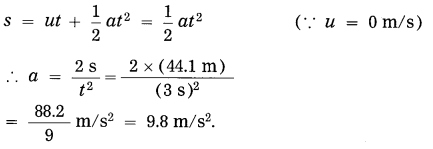
Question 14.
A stone is dropped from rest from the top of a building 44.1 m high. It takes 3 s to reach the ground. Use this information to 1 calculate g.
Solution:
Data: u = 0 m/s, h = 44.1 m
∴ s = 44.1 m, t = 3 s, g =?
Maharashtra Board Class 10 Science Solutions Part 1 Chapter 1 Gravitation 57
It is the acceleration due to gravity.
g = 9.8 m/s2.

Question 15.
A metal ball of mass 5 kg falls from a height of 490 m. How much time will it take to reach the ground? (g = 9.8 m/s2) (March 2019)
Solution:
Data: s = 490 m, a = g = 9.8 m/s2,
u = 0 m/s, s = ut + \(\frac{1}{2}\)at2
∴ 490 = 0 × t + \(\frac{1}{2}\) × 9.8 × t2 = 4.9t2
∴ t2 = \(\frac{490}{4.9}\)
∴ t = 10 s This is the required time.

Question 16.
If the weight of a body on the surface of the moon is 100 N, what is its mass?  (g = 1.63 m/s2)
Solution:
Data: W= 100 N, g = 1.63 m/s2, m = ?
∴ W = mg

Maharashtra Board Class 10 Science Solutions Part 1 Chapter 1 Gravitation 58
∴ The mass of the body = 61.35 kg.

Question 17.
A 100 kg bag of wheat is placed on a plank of wood. What is the weight of the bag and what is the reaction force exerted by the plank?
Solution:
Data: m = 100 kg, g = 9.8 m/s2,
W = ?, reaction force = ?
Magnitude of the weight,
W = mg = 100 kg × 9.8 m/s2 = 980 N
The weight of the bag = 980 N acting downward.
The reaction force exerted by the plank on the bag = 980 N acting upward.

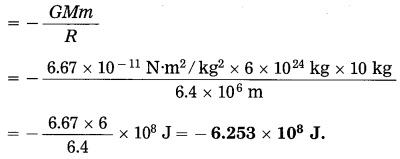
Question 18.
Find the gravitational potential energy of a body of mass 10 kg when it is on the earth’s surface. [M(earth) = 6 × 1024 kg, it(earth) = 6.4 × 10⁶m, G = 6.67 × 10⁻¹¹ N. m2/kg2]
Solution:
Data: m = 10 kg, M = 6 × 1024 kg,
R = 6.4 × 10⁶ m, G = 6.67 × 10⁻¹¹ N.m2/kg2
The gravitational potential energy of the body
Maharashtra Board Class 10 Science Solutions Part 1 Chapter 1 Gravitation 59

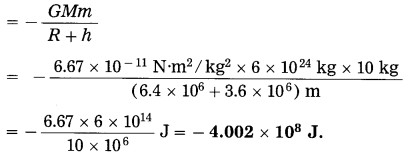
Question 19.
If the body in Ex. (26) performs uniform circular motion around the earth at a height of 3600 km from the earth’s surface, what will be its gravitational potential energy?
Solution:
Here, h = 3600 km = 3.6 × 10⁶ m
∴ The gravitational potential energy of the body
Maharashtra Board Class 10 Science Solutions Part 1 Chapter 1 Gravitation 60

Question 20.
A body of mass 20 kg is at rest on the earth’s surface, (i) Find its gravitational potential energy, (ii) Find the kinetic energy to be provided to the body to make it free from the gravitational influence of the earth. (g = 9.8 m/s2, R = 6400 km)
Solution:
Data : m = 20 kg, g = 9.8 m/s2,
R = 6400 km = 6.4 × 10⁶ m
(i) The gravitational potential energy of the body =

Maharashtra Board Class 10 Science Solutions Part 1 Chapter 1 Gravitation 61
= – 20 kg × 9.8 m/s2 × 6.4 × 106 m
= – 1.2544 × 10⁹ J.

(ii) To make the body free from the gravitational influence of the earth, it should be provided kinetic energy equal to 1.2544 × 10⁹ J.

Question 21.
If the body in Ex. (28) is moving at 100 m/s on-the earth’s surface, what will be its (i) kinetic energy (ii) total energy?
Solution:
Data : m = 20 kg, u = 100 m/s .
(i) The kinetic energy of the body
= \(\frac{1}{2}\)mv2 = \(\frac{1}{2}\) × 20 kg × (100 m/s)2 = 105 J.

(ii) The total energy of the body = kinetic energy + potential energy = 105 J + (- 1.2544 × 10⁹ J)
= (1 – 12544) × 105 J = – 12543 × 105 J
= – 1.2543 × 10⁹ J.

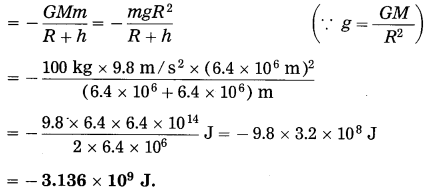
Question 22.
A satellite of mass 100 kg performs uniform circular motion around the earth at a height of 6400 km from the earth’s surface. Find its gravitational potential energy.  [g = 9.8 m/s2, R = 6400 km]
Solution:
Data: m = 100 kg, g = 9.8 m/s2,
R = 6400 km = 6.4 × 10⁶ m, h = 6.4 × 10⁶ m
The gravitational potential energy of the satellite
Maharashtra Board Class 10 Science Solutions Part 1 Chapter 1 Gravitation 62

Maharashtra Board Class 10 Science Solutions Part 1 Chapter 1 Gravitation

Question 23.
Find the escape velocity of a body from the earth. [M(earth) = 6 × 1024 kg, R (earth) = 6.4 × 10⁶ m, G = 6.67 × 10⁻¹¹ N.m2/ kg2]
Solution:
Data: M = 6 × 1024 kg, R = 6.4 × 10⁶ m,
G = 6.67 × 10⁻¹¹ N.m2/kg2
The escape velocity of a body from the earth,
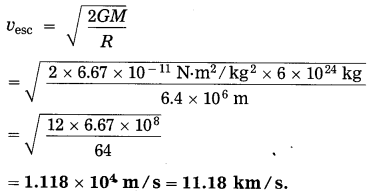
Maharashtra Board Class 10 Science Solutions Part 1 Chapter 1 Gravitation 63

Question 24.
Find the escape velocity of a body from the earth. [R (earth) = 6.4 × 10⁶ m, ρ(earth) = 5.52 × 10³ kg/m3, G = 6.67 × 10⁻¹¹ N.m2/kg2]
Solution:
Data: R = 6.4 × 10⁶ m, ρ = 5.52 × 10³ kg/ m3, G = 6.67 × 10⁻¹¹ N.m2/kg2
The escape velocity of a body from the earth
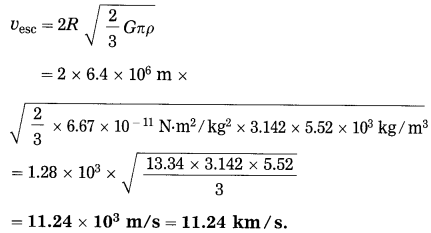
Maharashtra Board Class 10 Science Solutions Part 1 Chapter 1 Gravitation 64

Question 25.
Calculate the escape velocity of a body from the moon. [g(moon) = 1.67 m/s2, R(moon) = 1.74 × 10⁶ m]
Solution:
Data: g = 1.67 m/s2, R = 1.74 × 10⁶ m
The escape velocity of a body from the moon,
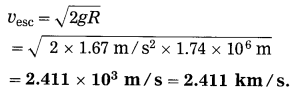
Maharashtra Board Class 10 Science Solutions Part 1 Chapter 1 Gravitation 65

Question 26.
The mass of (an imaginary) planet is four times that of the earth and its radius is double the rathus of the earth. The escape velocity of a body from the earth is 11.2 × 10³ mn/s. Find the escape velocity or a body from the planet.
Solution:
Data: M2 = 4M1, R2 = 2R1,
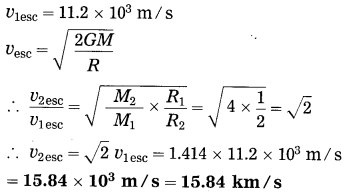
Maharashtra Board Class 10 Science Solutions Part 1 Chapter 1 Gravitation 66
This is the escape velocity or a body from the planet.

Numerical Problems For Practice

[G = 6.67 × 1O-11 N.m2/kg2, mass or the earth =6 × 1024 kg, radius or the earthe 6.4 × 10⁶ m]

Question 1.
A satellite of mass 1000 kg revolves around the earth in a circular path. If the distance between the satellite and the centre of the earth is 40000 km, find the gravitational force exerted on the satellite by the earth.
Answer:
250.1 N

Question 2.
The masses of two spheres are 10 kg and 20 kg respectively. If the distance between their centers is 100 m, find the magnitude of the gravitational force between them.
Answer:
1.334 × 10⁻¹² N)

Question 3.
A satellite revolves around the earth along a circular path. If the mass of the satellite is 1000 kg and its distance from the center of the earth is 20000 km, find the magnitude of the earth’s gravitational force acting on the satellite.
Answer:
1000.5

Question 4.
Find the acceleration due to gravity at a distance of 20000 km from the center of the earth.
Answer:
1.0 m/s2

Question 5.
What is the weight of a body of mass 100 kg at the south pole? (g = 9.832 m/s2)
Answer:
983.2 N (downward)

Question 6.
What is the weight of a body of mass 20 kg at the equator? (g = 9.78 m/s2)
Answer:
195.6 N (downward)

Question 7.
A body is released from the top of a tower of height 50 m. Find the velocity with which the body hits the ground, (g = 9.8 m/s2)
Answer:
31.3 m/s (downward)

Question 8.
A body is thrown vertically upward with a velocity of 9.8 m/s. Calculate the maximum height attained by the body. (g = 9.8 m/s2)
Answer:
4.9 m

Question 9.
A particle of mass 10-6 kg performs uniform circular motion. Its period is 10 s and the radius of the circle is 2 m. Find (i) the speed of the particle (ii) the centripetal acceleration of the particle (iii) the centripetal force on the particle.
Answer:
(i) 1.257 m/s
(ii) 0.79 m/s2
(iii) 7.9 × 10⁻⁷ N

Question 10.
Find the gravitational potential energy of a body of mass 200 kg on the earth’s surface. [M(earth) = 6 × 1024 kg, R(earth) = 6400 km]
Answer:
-1.251 × 10¹⁰J

Question 11.
Find the gravitational potential energy of a body of mass 10 kg when it is at a height of 6400 km from the earth’s surface.  [Given: a mass of the earth and radius of the earth. See Ex. 10 above.]
Answer:
-3.127 × 10⁸ J

Maharashtra Board Class 10 Science Solutions Part 1 Chapter 1 Gravitation

Question 12.
Find the escape velocity of a body from the moon.
[M(moon) = 7.36 × 10²² kg, R(moon) = 1.74 × 10⁶ m]
Answer:
2.375 km/s

Class 10 Questions And Answers
10th Std Science Part 1 Questions And Answers:

Life Processes in Living Organisms Part – 1 Class 10 Questions And Answers Maharashtra Board
Class 10 Science Part 2 Chapter 2

Balbharti Maharashtra State Board Class 10 Science Solutions Part 2 Chapter 2 Life Processes in Living Organisms Part – 1 Notes, Textbook Exercise Important Questions and Answers.

Std 10 Science Part 2 Chapter 2 Life Processes in Living Organisms Part – 1 Question Answer Maharashtra Board

Class 10 Science Part 2 Chapter 2 Life Processes in Living Organisms Part – 1 Question Answer Maharashtra Board

Question 1.
Fill in the blanks and explain the statements.
a. After complete oxidation of a glucose molecules, ……….. number of ATP molecules are formed.
Answer:
After complete oxidation of a glucose molecules, 38 number of ATP molecules are formed.

b. At the end of glycolysis, ……………… molecules are obtained.
Answer:
At the end of glycolysis, pyruvate molecules are obtained.

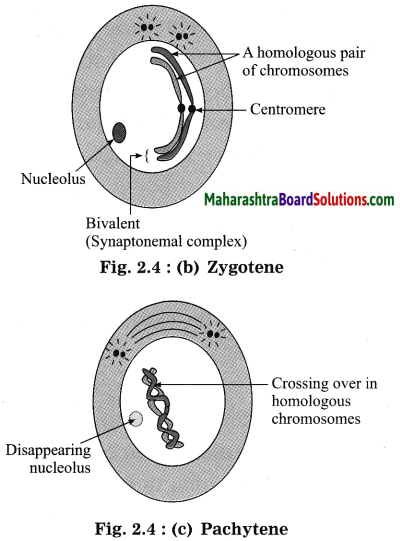
c. Genetic recombination occurs in ………… phase of prophuse of meiosis-I.
Answer:
Genetic recombination occurs in pachytene phase of prophase of meiosis-I.

d. All chromosomes are arranged parallel to equatorial plane of cell in …………. phase of mitosis.
Answer:
All chromosomes are arranged parallel to equutorial plane of cell in metaphase phase of mitosis.

e. For formation of plasma membrane, phospholipid molecules are necessary.
Answer:
For formation of plasma membrane, …………… molecules are necessary.

f. Our muscle cells perform ……………… type of respiration during exercise.
Answer:
Our muscle cells perform anaerobic type of respiration during exercise.

Maharashtra Board Class 10 Science Solutions Part 2 Chapter 2 Life Processes in living organisms Part - 1

Question 2.
Write definitions.
a. Nutrition.
Answer:
Nutrition: The process of taking nutrients in the body and utilizing them by an organism is known as nutrition.

b. Nutrients.
Answer:
Nutrients: The substances like carbohydrates, proteins, lipids, vitamins, minerals etc. which are components of the food are called nutrients.

c. Proteins.
Answer:
Proteins: Protein is a macromolecule which is formed by many amino acids which are joined by peptide bonds.

d. Cellular respiration.
Answer:
Cellular respiration: Oxidation of glucose and other food components which takes place inside the cell in presence or absence of oxygen, is known as cellular respiration.

e. Aerobic respiration.
Answer:
Aerobic respiration: Cellular respiration taking place in presence of oxygen is known as aerobic respiration.

f. Glycolysis.
Answer:
Glycolysis: The process occurring in the cell where a molecule of glucose is oxidized in step by step process forming two molecules of each of pyruvic acid, ATP, NADH2 and water, is called glycolysis.

Question 3.
Distinguish between
a. Glycolysis and TCA cycle
Answer:
Glycolysis:

  • The process of glycolysis occurs in the cytoplasm of the cell.
  • In glycolysis, one molecule of glucose is oxidized step-by-step to produce two molecules each of pyruvic acid, ATP, NADH2 and water.
  • Glycolysis can take place in both aerobic and anaerobic respiration.
  • The first step in cellular respiration is glycolysis where glucose is converted into pyruvate.
  • Two molecules of pyruvate are obtained in glycolysis.
  • Two molecules of ATP are used up in glycolysis.
  • Four molecules of ATP are produced in glycolysis.
  • CO2 is not produced during glycolysis.

TCA cycle:

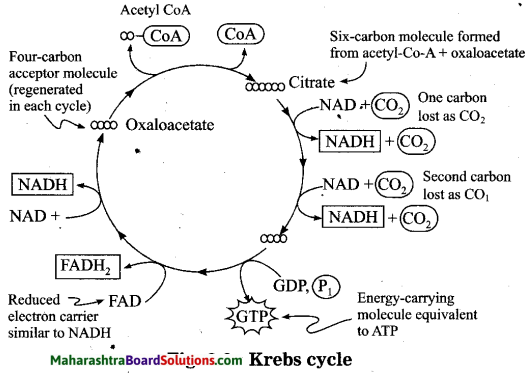
  • TCA cycle takes place in mitochondria.
    In TCA cycle, molecule of acetyl-co-A is completely oxidized and in the process CO2, H2O, NADH2, FADH2 and ATP is produced.
  • TCA cycle takes place only during aerobic respiration.
  • The second step in cellular respiration is TCA cycle.
  • Pyruvate is converted into CO2 and H2O during TCA cycle.
  • ATP molecules are not used up in TCA cycle.
  • Two molecules of ATP are produced in TCA cycle.
  • CO2 is produced in TCA cycle.

b. Mitosis and meiosis.
Answer:
Mitosis:

  • In mitosis the chromosome number does not change. Diploid cells remain diploid, without change.
  • One cell gives rise to two daughter cells in mitosis.
  • Karyokinesis of mitosis has four stages, viz. prophase, metaphase, anaphase and telophase.
  • Prophase of mitosis is not lengthy.
  • Genetic recombination does not happen in mitosis as there is no crossing over.
  • Mitosis is essential for growth and development.
  • Mitosis takes place both in somatic cells and germinal cells.

meiosis:

  • In meiosis, the chromosome number is reduced to half. The diploid cells become haploid.
  • One cell gives rise to four daughter cells in meiosis.
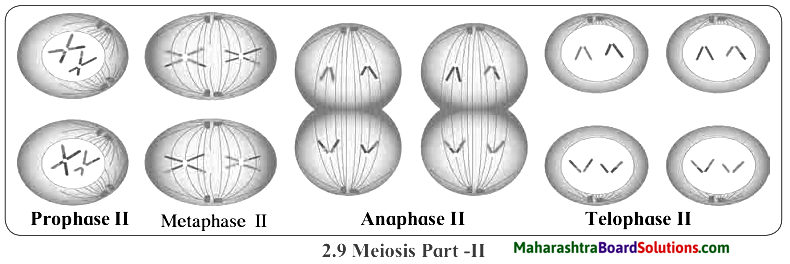
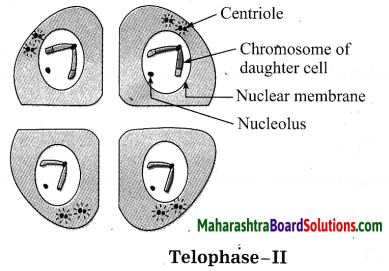
  • Meiosis has two major stages, viz. meiosis-I and meiosis-II. Each is further subdivided into prophase, metaphase, anaphase and telophase.
  • Prophase of meiosis-I is very lengthy.
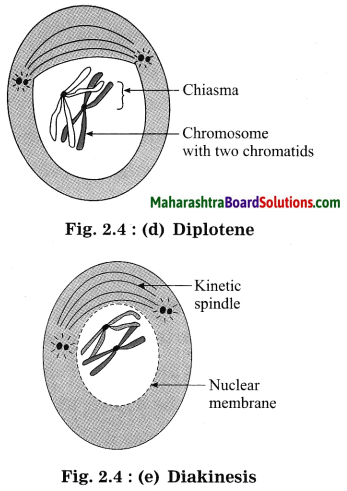
  • Genetic recombination takes place in homologous chromosomes as there is crossing over during prophase-I.
  • Meiosis is essential for formation of gametes in sexual reproduction.
  • Meiosis takes place in only germinal cells. It does not take place in somatic cells.

c. Aerobic and anaerobic respiration.
Answer:
Aerobic respiration:

  • Oxygen is required for aerobic respiration.
  • Aerobic respiration takes place in nucleus as well as in cytoplasm.
  • At the end of aerobic respiration CO2 and H2O is formed.
  • Energy is produced in large amount in aerobic respiration.
  • Glucose is completely oxidized in aerobic respiration.
  • 38 molecules of ATP are formed during aerobic respiration.
  • Chemical reaction:
    C6H12O6 + 6O2 → 6H2O + 6 CO2 + 686 Kcal

Anaerobic respiration:

  • Oxygen is not required for anaerobic respiration.
  • Anaerobic respiration occurs only in the cytoplasm.
  • At the end of anaerobic respiration CO2 and C2H5OH are formed.
  • Energy is produced in lesser amount in anaerobic respiration.
  • Glucose is incompletely oxidized in anaerobic respiration.
  • 2 molecules of ATP are formed during anaerobic respiration.
  • Chemical reaction:
    C6H12O6 → 2 C2H5OH + 2 CO2 + 50 Kcal

Maharashtra Board Class 10 Science Solutions Part 2 Chapter 2 Life Processes in living organisms Part - 1

Question 4.
Give scientific reasons.
a. Oxygen is necessary for complete oxidation of glucose.
Answer:

  1. When glucose is completely oxidized in aerobic cellular respiration, it produces 38 molecules of ATP.
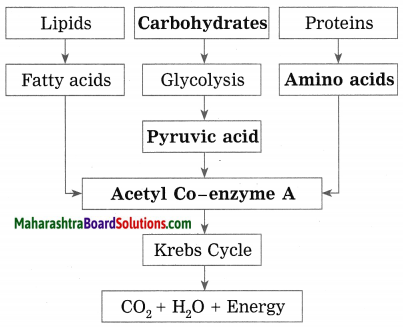
  2. In cellular respiration, three processes take place one after the other, these are glycolysis, Krebs cycle and electron transport chain reactions.
  3. In absence of oxygen only glycolysis can occur but further two reactions will not take place.
  4. If glycolysis occurs in absence of oxygen, it produces alcohol.
  5. By anaerobic glycolysis only two molecules of ATP are produced.
  6. This results in less energy supply to the body. Therefore, oxygen is necessary for complete oxidation of glucose.

b. Fibres are one of the important nutrients. (Board’s Model Activity Sheet)
Answer:

  1. Fibres are indigestible substance.
  2. They are thrown out along with other useless and undigested matter.
  3. This aids in egestion. Some fibres also help in digestion of other substances.
  4. Green leafy vegetables, fruits, cereals, etc. are considered as important in diet as they supply nutritious fibres.
  5. Thus, fibres are considered as one of the important nutrients.

c. Cell division is one of the important properties of cells and organisms.
Answer:

  1. Cell division is very essential for all the living organisms.
  2. The growth and development is possible only due to cell division.
  3. The emaciated body can be restored only through the cell division which adds new cells.
  4. Offspring is produced only through the cell division that take place in parents.
  5. In asexual reproduction, mitosis helps to give rise to new generation.
  6. In sexual reproduction, meiosis helps to form haploid gametes.
  7. All such functions show that cell division is one of the important properties of cells and organisms.

d. Sometimes, higher plants and animals too perform anaerobic respiration.
Answer:

  1. When there is deficiency of oxygen in the surrounding, the aerobic respiration is not possible.
  2. In such case, to survive, higher plants switch over to anaerobic respiration.
  3. In some animal tissues in case of oxygen deficiency cells perform anaerobic respiration.

e. Krebs cycle is also known as citric acid cycle.
Answer:

  1. Sir Hans Kreb proposed this cycle and hence it is called Krebs cycle.
  2. These are series of cyclic chain reactions which begins with acetyl-coenzyme-A molecules which act with molecules of oxaloacetic acid.
  3. The reactions are catalysed with the help of specific enzymes.
  4. The first molecule formed in this reaction is called citric acid. Therefore, Krebs cycle is also called citric acid cycle.

Maharashtra Board Class 10 Science Solutions Part 2 Chapter 2 Life Processes in living organisms Part - 1

Question 5.
Answer in detail.
a. Explain the glycolysis in detail.
Answer:

  • Carbohydrates are converted to glucose after the process of digestion is completed. The oxidation of glucose for releasing energy is called glycolysis which takes place in cytoplasm.
  • Glycolysis can occur in presence of oxygen or without oxygen too. The first type of glycolysis takes place in aerobic respiration and the second type is in anaerobic respiration.
  • In aerobic respiration, there is step-wise oxidation of glucose molecule forming two molecules each of pyruvic acid, ATP, NADH2 and water.
  • Later the pyruvic acid formed in this process is converted into molecules of Acetyl-Coenzyme-A along with two molecules of NADH2 and two molecules of CO2.
  • During anaerobic respiration along with glycolysis there is fermentation too. This is incomplete oxidation of glucose and thus it results in formation of lesser energy.
  • The process of glycolysis was discovered by Gustav Embden, Otto Meyerhof, and Jacob Parnas. Therefore, in their honour, glycolysis is also called as Embden-Meyerhof-Parnas pathway (EMP pathway). For the discovery they had performed experiments on muscles.

b. With the help of suitable diagrams, explain the mitosis in detail.
Answer:
(1) There are two stages of mitosis. These are
(a) Karyokinesis or nuclear division and
(b) Cytokinesis or cytoplasmic division. Karyokinesis takes place in further four phases, viz prophase, metaphase, anaphase and telophase.
Maharashtra Board Class 10 Science Solutions Part 2 Chapter 2 Life Processes in living organisms Part - 1, 1
Maharashtra Board Class 10 Science Solutions Part 2 Chapter 2 Life Processes in living organisms Part - 1, 2
Maharashtra Board Class 10 Science Solutions Part 2 Chapter 2 Life Processes in living organisms Part - 1, 3
(a) Karyokinesis:
(i) Prophase: During prophase, condensation of chromosomes starts. The thin and thread like chromosomes start thickening. They are seen with their pair of sister chromatids. In animal cells the centrioles are seen to duplicate and move to opposite poles of the cell. Nuclear membrane and nucleolus disappear.

(ii) Metaphase: Chromosomes complete their condensation and each one is seen with its sister chromatids. The chromosomes are seen in equatorial plane of the cell. The spindle fibres are formed from polar region, where centrioles are present, and they attach themselves to the centromere of each chromosome. Nuclear membrane now disappears completely.

(iii) Anaphase: The centromeres of the chromosomes now divide forming two daughter chromosomes. The spindle fibres pull apart the chromosomes from equatorial region to the opposite poles. Chromosomes moving to the poles appear like bunch of bananas. One set of chromosomes reach each pole by the end of the anaphase.

(iv) Telophase: Telophase is reverse of events that occurred in prophase. The thickened chromosomes decondense. They again assume the thin and thread like appearance. Nuclear membrane and nucleolus appear again. The spindle fibres are completely lost. The cell looks as if it has two nuclei in one cytoplasm.

(b) Cytokinesis: In animal cells a notch develops in the middle of the cell. This notch goes on deepening down and later the cytoplasm divides into two. In plant cells, cell plate formation takes place and then cytokinesis takes place.

c. With the help of suitable diagrams, explain the five stages of prophase-I of meiosis.
Answer:
Maharashtra Board Class 10 Science Solutions Part 2 Chapter 2 Life Processes in living organisms Part - 1, 4
Maharashtra Board Class 10 Science Solutions Part 2 Chapter 2 Life Processes in living organisms Part - 1, 5
Maharashtra Board Class 10 Science Solutions Part 2 Chapter 2 Life Processes in living organisms Part - 1, 6
Prophase-I: Prophase – I of meiosis is much longer phase of the meiosis.
It is subdivided into 5 substages, namely leptotene, zygotene, pachytene, diplotene, and diakinesis.
(1) Leptotene: Initially the chromosomes start condensation and they become compact during leptotene.

(2) Zygotene: In zygotene, homologous chromosomes start pairing. This pairing is called synapsis. The structure called synaptonemal complex develops to hold chromosomes in place during this pairing. Each chromosome’s chromatid arm divides and forms structure called bivalent or tetrad.

(3) Pachytene: During pachytene stage, crossing over of non-sister chromatids of homologous chromosomes takes place. Genetic recombination is produced due to such exchange. The homologous chromosomes still remain paired together at the sites of crossing over.

(4) Diplotene: During diplotene, synaptonemal complex dissolves and the homologous chromosomes of the bivalents separate except at the point of crossing over. Thus, it looks like X-shaped structures called the chiasmata.

(5) Diakinesis: The last phase of prophase is for termination of chiasmata. The spindle fibres originate, and the cross-over homologous chromosomes are now separated. The nucleQlus disappears, and the nuclear envelope breaks down.

d. How do all the life processes contribute to the growth and development of the body?
Answer:

  1. Different systems work in co-ordination with each other in the body of the living organisms. In human body the homoeostasis is very advanced.
  2. Digestive system, respiratory system, circulatory system, excretory system, nervous system and all the external and internal organs in the bodywork independently but in coordination with each other.
  3. The digested and absorbed nutrients of the food are transported to various cells with the help of circulatory system due to pumping of the heart. Simultaneously, the oxygen absorbed in the blood by lungs is also transported to each cell by RBCs.
  4. Mitochondria in every cell brings about oxidation of nutrients and produce energy required for all of these functions.
  5. The control is exercised by the nervous system on all these actions. This keeps the organism alive and helps in growth and development of the same.

e. Explain the Krebs cycle with reaction.
Answer:

  • Krebs cycle was proposed by Sir Hans Kreb. This cycle is named after him. It is also called tricarboxylic acid cycle or citric acid cycle.
  • The acetyl-coenzyme-A molecules enter the mitochondria located in the cytoplasm.
  • They participate in the chemical reactions taking place in Krebs cycle.
  • In the cyclic chemical reactions, acetyl- coenzyme-A is completely oxidised
  • It yields molecules of CO2, H2O, NADH2, FADH2 and ATP upon complete oxidation.

Maharashtra Board Class 10 Science Solutions Part 2 Chapter 2 Life Processes in living organisms Part - 1, 7

Maharashtra Board Class 10 Science Solutions Part 2 Chapter 2 Life Processes in living organisms Part - 1

Question 5.
How energy is formed from oxidation of carbohydrates, fats and proteins?
Correct the dagram below.
Maharashtra Board Class 10 Science Solutions Part 2 Chapter 2 Life Processes in living organisms Part - 1, 8
Answer:
(1) First of all the dietary carbohydrates are digested in the digestive system with the help of various enzymes and converted into glucose. Similarly, proteins are converted into amino acids and fats are broken down into fatty aid and glycerol (alcohol).

(2) Oxidation of carbohydrates takes place during cellular respiration. Glucose is oxidized by three steps during aerobic respiration, viz. glycolysis, tricarboxylic acid cycle or Krebs cycle and electron transfer chain.

(3) From one molecule of glucose two molecules of each pyruvic acid, ATP, NADH2 and water are formed during glycolysis. Pyruvic acid which is formed in this process is converted into Acetyl-Coenzyme-A along with release of two molecules each of NADH2 and CO2.

(4) In the next step, i.e. in TCA cycle, molecules of Acetyl-Co-A enter the mitochondria and a cyclic chain of reactions take place. Acetyl part of Acetyl- Co-A is completely oxidized through this cyclical process. The molecules CO2, H2O, NADH2, FADH2 are released in this process.

(5) In third step, i.e. in ETC reaction, NADH2 and FADH2 formed during first two steps are used for obtaining ATP molecules. 3 molecules of ATP are obtained from each NADH2 molecule and 2 molecules of ATP from each FADH2.

(6) Thus, one molecule of glucose upon complete oxidation in presence of oxygen yields 38 molecules of ATP. This is how from carbohydrates, energy is obtained.

(7) If carbohydrates are insufficient in diet, then proteins or lipids are used for energy production. Fatty acids derived from fats and amino acids derived from proteins are converted into Acetyl- Co-A. Acetyl-Co-A once again can yield energy through TCA cycle.

Corrected diagram:
Maharashtra Board Class 10 Science Solutions Part 2 Chapter 2 Life Processes in living organisms Part - 1, 9

Project:
With the help of information collected from internet, prepare the slides of various stages of mitosis and observe under the compound microscope.

Can you recall? (Text Book Page No. 12)

Question 1.
How are the food stuffs and their nutrient contents useful for body?
Answer:
The food stuffs are digested and converted into soluble nutrients. These nutrients are carried by blood to every cell of the body. The oxygen inhaled at the time of respiration is also carried to every cell. In the body cells, this oxygen carries out oxidation of nutrients and thus energy is produced. The energy helps the body to carry out all its functions. The nutrients help in the growth and development of the body.

Question 2.
What is the importance of balanced diet for body?
Answer:
Balanced diet has carbohydrates, proteins, fats, vitamins and minerals in the right proportion. Each nutrient carries a specific important function. In balanced diet all these nutrients are in right proportion. Since balanced diet is required for energy and nutrition, it is very important to maintain our health.

Maharashtra Board Class 10 Science Solutions Part 2 Chapter 2 Life Processes in living organisms Part - 1

Question 3.
Which different functions are performed by muscles in body?
Answer:
There are three 4ypes of muscles in our body. The voluntary muscles bring about all the movements according to our will. Involuntary muscles bring about all vital activities of the body. The visceral organs are under the control of involuntary muscles. The cardiac muscles control the movements of heart. Carbohydrates and proteins are stored in muscles.

Question 4.
What is the importance of digestive juices in digestive system?
Answer:
Digestive juice contains different enzymes. Enzymes act as catalysts and bring about the chemical reactions at faster pace. The digestive juices of stomach make pH of digestive tract acidic while that of intestinal juice make it alkaline.

Question 5.
Which system is in action for removal of waste materials produced in human body?
Answer:
Excretory system helps in the removal of nitrogenous waste materials produced in the human body.

Question 6.
What is the role of circulatory system in energy production?
Answer:
Due to circulatory system, glucose from digestive system and oxygen from respiratory system is transported to every cell. Red blood cells carry the oxygen as the blood is pumped by the heart. In every cell with the help of oxygen, glucose molecules yield the energy by the process of oxidation.

Question 7.
How are the various processes occurring in the human body controlled? In how many ways?
Answer:
The nervous system and the endocrine system brings about control by nervous and chemical coordination in the body. Due to such coordination different functions of the body are carried out in sequential and controlled manner.

Use your barain power:

Question 1.
Many players are seen consuming some food stuffs during breaks of the game. Why may be the players consuming these food stuffs? (Text Book Page No. 12)
Answer:

  1. Players require energy in greater amount.
  2. They perspire heavily at the time of game or sport which results in the loss of water and electrolytes from their body.
  3. This may affect their performance in sport. To prevent such unfavourable effect, they are given, juices or drinks.
  4. This helps them to restore the balance of water and electrolytes in their body. It also gives enhanced energy required for the performance.

Maharashtra Board Class 10 Science Solutions Part 2 Chapter 2 Life Processes in living organisms Part - 1

Question 2.
Many times, we experience dryness in mouth. (Text Book Page No. 17)
Answer:

  1. In our body there is 65-70% water. This proportion is always maintained.
  2. Sometimes we lose lots of water either through perspiration or due to unavailability of water for a long time. In such situations, we experience dryness in our mouth.
  3. Dryness is a natural feeling which creates urge in us to drink water, thereby the proportion of water in the body is brought back to its normal levels.

Question 3.
Oral rehydration solution (Salt-sugar- water) is frequently given to persons experiencing loose motions. (Text Book Page No. 17)
Answer:

  1. Loose motions cause lot of loss of water from the body.
  2. This may result in dehydration. This can be lethal if ignored.
  3. Especially in case of young children this is a very serious fatal problem.
  4. Thus, to bring back the normal proportion of water and electrolytes, oral rehydration solution or ORS is given to the patient who suffers from loose motions.

Question 4.
We sweat during summer and heavy exercise. (Text Book Page No. 17)
Answer:

  1. During summer, the environmental temperatures are high.
  2. This causes rise in our body temperature. Exercising also cause rise in the temperature. But since we can regulate our body temperature to a constant level, the sweat, glands g6t automatically stimulated.
  3. This induces perspiration.
  4. The sweat evaporates and causes fall in the body temperature. Thus, for regulation of body temperature, we sweat during summer or even after heavy exercise.

Question 5.
What do you mean by diploid (2n) cell? (Text Book Page No. 20)
Answer:

  • The cells in which chromosome number is double are known as diploid cells.
  • Male and female gametes unite together in the process of fertilization. Their chromosomes mix together in the zygote, therefore, the chromosome number is always diploid.
  • E.g. Diploid chromosome no. in human beings is 46. We hate 46 chromosomes in each of our body cells.

Question 6.
What do you mean by haploid (n) cell? (Text Book Page No. 20)
Answer:

  • The cells with only one set of chromosomes is known as haploid cell.
  • At the time of sexual reproduction, there is meiosis. In meiosis chromosome number of the parental germ cells are reduced to half. Therefore, gametes are haploid.
  • The haploid chromosome number (n) in human beings is 23.
  • Sperm and ovum both are haploid carrying 23 chromosomes each.

Question 7.
What do you mean by homologous chromosomes? (Text Book Page No. 20)
Answer:

  • Every species has definite number of chromosome pairs in their diploid cells.
  • In every pair, the two chromosomes are alike in shape, type and genes located over them.
  • Such chromosomes are called homologous chromosomes.
  • E.g. In human diploid cell, pair of chromosome no. 1 shows chromosome no. 1 from mother and chromosome no. 1 from father. These two chromosomes are homologous to each other.

Question 8.
Whether the gametes are diploid or haploid? Why? (Text Book Page No. 20)
Answer:
The cells that give rise to gametes are diploid (2n). But by meiosis they give rise to gametes which are haploid (n). Two haploid gametes undergo fertilization and the zygote formed becomes once again diploid (2n).

Question 9.
How are the haploid cells formed? (Text Book Page No. 20)
Answer:
Diploid cells undergo meiosis, which is a reduction division. In this way haploid cells are formed.

Maharashtra Board Class 10 Science Solutions Part 2 Chapter 2 Life Processes in living organisms Part - 1

Question 10.
What is the importance of haploid cells? (Text Book Page No. 20)
Answer:

  1. The gametes that take part in the sexual reproduction should be haploid.
  2. Otherwise the chromosome number will not be maintained at constancy. E.g. Parents have 2n = 46 chromosomes in their cells.
  3. If meiosis does not take place in them, the gametes formed will also contain 46 chromosomes.
  4. The resultant offspring will have 46 + 46 = 92 chromosomes.
  5. Such skewed number will produce large scale abnormalities.
  6. But due to meiosis, the gametes formed are haploid and thus the chromosome number is maintained constant for every species. Gametes are haploid cells, this is the most important fact.

Internet is my friend. (Text Book Page No. 17)

Collect information.
(a) What are symptoms of diseases like night blindness, rickets, beriberi, neuritis, pellagra, anaemia, scurvy?
Answer:

Disease Symptoms
Night blindness
  • Near sightedness, or blurred vision when looking at faraway objects
  • Cataracts, or clouding of the eye’s lens.
  • Inability to see in dark.
  • Sometimes blindness.
Rickets
  • Weak and soft bones
  • Stunted growth
  • In severe cases, skeletal deformities.
Beriberi
  • Decreased muscle function, particularly in the lower legs.
  • Tingling or loss of feeling in the feet and hands.
  • Pain
  • Mental confusion, difficulty in speaking
  • Vomiting
  • Involuntary eye movement, paralysis.
Neuritis
  • Numbness in hands and feet
  • Tingling sensation, sharp, jabbing, throbbing, freezing or burning pain.
  • Extreme sensitivity to touch.
  • Lack of coordination and falling.
Pellagra
  • Delusions or mental confusion.
  • Diarrhoea and nausea
  • Inflammed mucous membrane.
  • Scaly skin sores.
Anaemia
  • Fatigue and loss of energy
  • Unusually rapid heartbeat, particularly with exercise
  • Shortness of breath and headache, particularly with exercise
  • Difficulty in concentrating
  • Dizziness, Pale skin
  • Leg cramps, Insomnia
Scurvy
  • Anaemia, debility, exhaustion,
  • Spontaneous bleeding
  • Pain in the limbs, and especially the legs, swelling in some parts of the body
  • Ulceration of the gums and loss of teeth.

(b) What do you mean by coenzymes?
Answer:
Co-enzyme is a non-protein compound that is necessary for the functioning of an enzyme. It is bound to the enzyme as a catalyst. This increases the rate of reaction. Co-enzymes always act along the enzymes. They cannot work independently. But the same molecule of coenzyme can be used again and again.

Many co-enzymes are vitamins or derived from vitamins. When vitamin intake is too low, then an organism also lacks the co-enzymes that catalyse reactions. Water-soluble vitamins, which include all B complex vitamins and vitamin C, lead to the production of co-enzymes. Two of the most important and widespread vitamin-derived coenzymes are Nicotinamide Adenine Dinucleotide (NAD) and co-enzyme A.

(c) Find the full forms of FAD, FMN, NAD, NADP.
Answer:

FAD Flavin Adenine Dinucleotide
FMN Flavin Mono Nucleotide
NAD Nicotinamide Adenine Dinucleotide
NADP Nicotinamide Adenine Dinucleotide Phosphate

(d) How much quantity of each vitamin is required every day?
Answer:

Vitamin Daily requirement
A 700 and 900 μ grams
B Complex 100 mg/day for adults.
C 75 mg
D 5 μg
E 10 mg
K 80 μg

Maharashtra Board Class 10 Science Solutions Part 2 Chapter 2 Life Processes in living organisms Part - 1

Choose the correct alternative and write its alphabet against the sub-question number:

Question 1.
The process of glycolysis occurs in ……….
(a) cytoplasm
(b) mitochondria
(c) nucleus
(d) cell membrane
Answer:
The process of glycolysis occurs in cytoplasm.

Question 2.
ATP is called ………. of the cell.
(a) energy currency
(b) combustion fuel
(c) storage of glucose
(d) protein depot
Answer:
ATP is called protein depot of the cell.

Question 3.
Excess of carbohydrates are stored in liver and muscles in the form of ………….
(a) sugar
(b) glucose
(c) glycogen
(d) protein
Answer:
Excess of carbohydrates are stored in liver and muscles in the form of glycogen.

Question 4.
Chemically vitamin B2 is ………….
(a) Riboflavin
(b) Nicotinamide
(c) Cyanacobalomine
(d) Pantothetic acid
Answer:
Chemically vitamin B2 is Riboflavin

Question 5.
Somatic and stem cells undergo type of ………… division. (March 2019)
(a) meiosis
(b) mitosis
(c) budding
(d) cloning
Answer:
Somatic and stem cells undergo type of mitosis division.

Question 6.
We get ……….. energy from carbohydrates.
(a) 9 kcal/gm
(b) 9 cal/gm
(c) 4 cal/gm
(d) 4 kcal/gm
Answer:
We get 4 cal/gm energy from carbohydrates.

Question 7.
Which of the following vitamins is necessary for synthesis of NADH2?
(a) Vitamin B2
(b) Vitamin B3
(c) Vitamin
(d) Vitamin K
Answer:
(b) Vitamin B3

Write whether the following statements are true or false:

Question 1.
Glucose is oxidized step by step in the cells during the process of respiration at the body level.
Answer:
False. (Glucose is oxidized step by step in the cells during the process of cellular respiration.)

Question 2.
In aerobic respiration, glucose is oxidized in three steps.
Answer:
True

Question 3.
Glycolysis is also called Embden-Meyerhof-Paarnas pathway.
Answer:
True

Question 4.
Molecules of pyruvic acid formed in this glycolysis are converted into molecules of acetyl-co-enzyme A.
Answer:
True

Question 5.
Excess of ATP molecules obtained from proteins are not stored in the body.
Answer:
False. (Excess of ammo acids obtained from proteins are not stored in the body.)

Question 6.
Proteins of animal origin are called ‘first class’ proteins.
Answer:
True

Maharashtra Board Class 10 Science Solutions Part 2 Chapter 2 Life Processes in living organisms Part - 1

Question 7.
The disease related with the deficient synthesis of insulin is heart disease.
Answer:
False. (The disease related with the deficient synthesis of insulin is diabetes.)

Match the columns:

Protein Part of the body (July 2019)
(1) Haemoglobin (a) muscles
(2) Ossein (b) skin
(c) bones
(d) blood

Answer:
(1) Haemoglobin – blood
(2) Ossein – bones.

Protein Part of the body
(1) Keratin (a) muscles
(2) Myosin (b) skin
(c) bones
(d) blood

Answer:
(1) Keratin – skin
(2) Myosin – muscles.

Maharashtra Board Class 10 Science Solutions Part 2 Chapter 2 Life Processes in living organisms Part - 1

Find the odd one out:

Question 1.
Progesterone, Estrogen, Testosterone, Insulin
Answer:
Insulin. (All the others are hormones produced with the help of fatty acids.)

Question 2.
Actin, Ossein, Myosin, Melanin
Answer:
Melanin. (All the others are proteins concerned with locomotion of the body.)

Question 3.
Lipids, Carbohydrates, Fatty acids, Proteins
Answer:
Fatty acids. (All the others are food constituents; fatty acid is soluble nutrient.)

Question 4.
Alcohol, Vinegar, Pyruvic acid, Lactic acid.
Answer:
Pyruvic acid. (All the others are chemical substances formed by the process of fermentation.)

Question 5.
Tricarboxylic acid cycle, Citric acid cycle, Krebs cycle, EMP pathway.
Answer:
EMP pathway. (All the other terms are synonymous to each other.)

Considering the relationship in the first pair, complete the second pair by using a word or group of words:

Question 1.
Process that occurs in the cytoplasm : Glycolysis :: Process that occurs in the mitochondria ………
Answer:
Krebs cycle

Question 2.
Skin : Keratin :: Blood : …………
Answer:
Haemoglobin

Question 3.
Energy obtained from protein : 4 kcal :: Energy obtained from fats / lipids : …………
Answer:
9 Kcal

Question 4.
Breakdown of glucose molecule : Glycolysis :: Formation of glucose from proteins : …………….
Answer:
Gluconeogenesis

Maharashtra Board Class 10 Science Solutions Part 2 Chapter 2 Life Processes in living organisms Part - 1

Question 5.
Condensation of chromosomes : Prophase :: Formation of spindle fibres : …………
Answer:
Metaphase

Question 6.
Division of nucleus : Karyokinesis :: Division of cytoplasm :: ………..
Answer:
Cytokinesis.

Write definitions:

Question 1.
Gluconeogenesis.
Answer:
Gluconeogenesis: Formation of glucose through non-carbohydrate sources such a protein is called gluconeogenesis.

Question 2.
Fermentation.
Answer:
Fermentation: Conversion of pyruvic acid produced in the process of glycolysis into other organic acids or alcohol with the help of some enzymes is called fermentation.

Name the following:

Question 1.
Products formed after complete oxidation of acetyl part present in the molecule of acetyl-coenzyme-A.
Answer:
Molecules of CO2, H2O, NADH2, FADH2 and ATP.

Question 2.
Place where electron transfer chain reaction take place.
Answer:
Mitochondria present in the cytoplasm of the cell.

Question 3.
Two co-enzymes involved in cellular respiration.
Answer:
NAD → Nicotinamide Adenine Dinucleotide and FAD Flavin Adenine Dinucleotide.

Question 4.
Scientist who discovered the TCA cycle.
Answer:
Sir Hans Krebs.

Maharashtra Board Class 10 Science Solutions Part 2 Chapter 2 Life Processes in living organisms Part - 1

Question 5.
Steps of anaerobic respiration.
Answer:
Glycolysis and fermentation.

Question 6.
Most abundantly found protein nature.
Answer:
An enzyme RUBISCO present in plant chloroplasts.

Give scientific reasons:

Question 1.
We feel exhausted after exercising.
Answer:

  • When we undertake constant exercises, there may be shortage of oxygen for the cells.
  • Therefore, our muscles and other tissues perform anaerobic respiration in such condition.
  • In this process, lactic acid is formed.
  • Molecules of ATP produced in oxidation of food are also much less.
  • Thus, there is less energy in the body and accumulation of lactic acid too. All this brings about a feeling of exhaustion.

Answer the following questions in detail:

Question 1.
Write the forms to which the following food materials are converted after digestion:
(a) Milk (b) Potato (c) Oil (d) Chapati.
Answer:
(a) Milk: Proteins (casein) are converted into amino acids. Lactose sugar is converted into glucose. Lipids are converted into fatty acids and glycerol.
(b) Potato: Carbohydrates (starch) are converted into glucose.
(c) Oil: Lipids are converted into fatty acids and glycerol.
(d) Chapati: Carbohydrates (starch) are converted into glucose.

Question 2.
On which two levels does respiration take place in living organisms?
Answer:

  1. In organism respiration takes place at two levels, viz. Body level and Cellular level.
  2. Respiration at body level: The exchange of respiratory gases such as oxygen and carbon dioxide between body and surrounding is called respiration at body level.
  3. Cellular respiration: Oxidation of nutrients inside the cell with or without oxygen is called cellular respiration.

Question 3.
Answer the following questions: (July 2019)
(a) Write main types of vitamins.
Answer:
A, B, C, D, E and K are main types of vitamins.

(b) Name water soluble vitamins.
Answer:
Water soluble vitamins are B and C.

(c) Name fat soluble vitamins.
Answer:
Fat soluble vitamins are A, D, E and K.

Question 4.
Answer the following questions:
(a) Why some living organisms have to perform anaerobic respiration?
Answer:
Some bacteria and lower organisms do not live in the presence of oxygen. In order to survive, they have to perform anaerobic respiration. Sometimes, muscle cells and erythrocytes also perform anaerobic respiration when there is lack of enough oxygen.

(b) Give two examples of such living organisms.
Answer:
Yeast and bacteria.

(c) What are the two steps of anaerobic respiration?
Answer:
Glycolysis and fermentation are the two steps of anaerobic respiration.

Question 5.
Which is the energy currency of the cell? Explain it in detail.
Answer:

  • ATP or Adenosine triphosphate is the ‘energy currency’ of the cell.
  • Chemical composition of ATP is as follows: it is a triphosphate molecule having adenosine ribonucleoside. The nitrogenous compound-adenine, pentose sugar-ribose and three phosphate groups are present in ATP.
  • In this energy-rich molecule the energy remains trapped in the bonds by which phosphate groups are attached to each other.
  • ATP molecules are stored in the cells. As per the need, energy is derived by breaking the phosphate bond of ATP.
  • During cellular respiration, the oxidation of glucose yields 38 molecules of ATP. Whenever required they are consumed to liberate energy.

Maharashtra Board Class 10 Science Solutions Part 2 Chapter 2 Life Processes in living organisms Part - 1

Question 6.
How is energy obtained during starvation or hunger?
Answer:

  • Due to starvation or hunger, there is less supply of nutrients and energy to the body. In such condition, the stored carbohydrates in the body also deplete.
  • In such condition, fats and proteins present in the body are utilized.
  • Fats or lipids are converted into fatty acids and proteins are broken down to amino acids.
  • Fatty acids and amino acids both are converted to acetyl-coenzyme-A.
  • Acetyl-coenzyme-A can undergo series of cyclic reactions and oxidised to liberate energy in the form of ATP molecules.

Question 7.
Why glycolysis is also called EMP pathway?
Answer:
Process of glycolysis was discovered by Gustav Embden, Otto Meyerhof, and Jacob Pamas along with their colleagues. They performed experiments on muscles to understand glycolysis. Hence, in their honour, glycolysis is also edited Embden-Meyerhof-Parnas pathway or EMP pathway.

Question 8.
How are proteins obtained? What are the components of the proteins?
Answer:

  • Protein, is a macromolecule which is formed by amino acids.
  • When digestion of protein takes place, it forms different amino acids. These amino acids are transported to each cell by blood circulation.
  • By protein synthesis, these amino acids are again used to make different kinds of proteins which our body needs.
  • Animal proteins are said to be ‘first class proteins’ as they contain good quality amino acids.
  • 4 Kcal/gm energy is obtained from the proteins.

Question 9.
Where and in which forms the amino acids formed after digestion of food are used in the body?
Answer:
(1) After digestion of proteins, amino acids are formed. These amino acids are used to synthesise proteins in different forms. e.g.

  • In blood-Haemoglobin and antibodies are formed.
  • In skin – Melanin and keratin are formed.
  • In bones – Ossein is formed.
  • In pancreas-Insulin and trypsin are synthesized.
  • Pituitary and all other glands produce hormones by utilising amino acids.
  • In muscles – Actin and myosin are formed.
  • In all the cells, plasma membrane is formed by proteins. All enzymes are also synthesised using the amino acids.

Maharashtra Board Class 10 Science Solutions Part 2 Chapter 2 Life Processes in living organisms Part - 1

Question 10.
What are fatty acids? What are the different uses of fatty acids ?
Answer:
(1) The fatty acids are components of the lipids. When lipids are digested, it forms fatty acids and alcohol (glycerol).
(2) There are certain chemical bonds between fatty acids and alcohol.
(3) Fatty acids are very essential for the health.
(4) After digestion, fatty acids are absorbed into the blood and transported to the cells.
(5) Different types of cells produce their own substances from these fatty acids.
E.g. (a) Plasma membrane is produced from phospholipids.
(b) Hormones like testosterone, progesterone, estrogen, aldosterone are produced from fatty acids.
(c) The axonal coverings around the neurons are also made from fatty acids.

Give explanations for the following statements:

Question 1.
After complete oxidation of a glucose molecules, 38 number of ATP molecules are formed.
Answer:
I. Glycolysis: No. of ATP molecules formed = 4
No. of ATP molecules used = 2
II. Krebs cycle : No. of ATP molecules formed = 2
III. ETC Reaction :
NADH2: 10 NAD2 x 3 ATP = 30 ATP
FADH2 : 2 FADH2 x 2 ATP = 4 ATP
Total ATP molecules produced = (4+2+34)
= 40 ATP
ATP molecules used = 2 ATP
Therefore, total ATP molecules = 38 ATP

Question 2.
At the end of glycolysis, pyruvate molecules are obtained.
Answer:
The process of glycolysis takes place m the cytoplasm of the cell. One molecule of glucose is gradually oxidized step by step forming two molecules of each pyruvic acid, ATP, NADH2 and water. Of these, pyruvate or pyruvic acid takes part in the further reactions.

Question 3.
Genetic recombination occurs in pachytene phase of prophase of meiosis-I.
Answer:
In prophase of meiosis I there are total 5 stages. Of these in pachytene the process of crossing over takes place between homologous chromosomes as chromosomes come near each other forming synapsis.

Question 4.
All chromosomes are arranged parallel to equatorial plane of cell in metaphase of mitosis.
Answer:
In mitosis, the metaphase is the stage when dividing chromosomes lie on the equatorial plane of the cell. They are later pulled by the spindle fibres to the opposite poles.

Question 5.
For formation of plasma membrane, phospholipid molecules are necessary.
Answer:
Upon the digestion of fats, fatty acids and glycerol are formed. The fatty acids can be converted into phospholipid which are essential molecules for development of plasma membrane.

Maharashtra Board Class 10 Science Solutions Part 2 Chapter 2 Life Processes in living organisms Part - 1

Question 6.
Our muscle cells perform anaerobic type of respiration during exercise.
Answer:
When the proportion of oxygen is less, then the cells switch over to anaerobic respiration. When we are exercising there is increased demand of oxygen for muscle cells. If this is not fulfilled, they perform anaerobic respiration during exercise.

Question 7.
Excess of carbohydrates are stored in liver and muscles in the form of glycogen.
Answer:
The carbohydrates which are not used to produce energy cannot be stored in the body in the form of glucose. This glucose is therefore converted into complex compound called glycogen. Glycogen is stored in muscles and liver.

Complete the paragraph by choosing the appropriate words given in the brackets:

Question 1.
(gamete, crossing over, haploid, Meiosis-II, meiosis-I, diploid)
……….. is just like mitosis. In this stage, the two haploid daughter cells formed in ……… undergo division by separation of recombined sister chromatids and four ……….. daughter cells are formed. Process of …………… production and spore formation occurs by meiosis. In this type of cell division, four haploid (n) daughter cells are formed from one ……….. cell. During this cell division, ………… occurs between, the homologous chromosomes.
Answer:
Meiosis-II is just like mitosis. In this stage, the two haploid daughter cells formed in meiosis-I undergo division by separation of recombined sister chromatids and four haploid daughter cells are formed. Process of gamete production and spore formation occurs by meiosis. In this type of cell division, four haploid (n) daughter cells are formed from one diploid cell. During this cell division, crossing over occurs between the homologous chromosomes.

Question 2.
(external, inhalation, alveolar, breathing, respiration, exhalation)
Release of energy from the assimilated food is called …………. Inhalation and exhalation is called …….. When ……….. is done, air enters the lungs. The oxygen from this air enters the blood while carbon dioxide from the blood exits from the blood. Through exhalation, CO2 is given out. This gaseous exchange occurs through ……….. membrane. This is called ………….. respiration. The RBCs carry oxygen to every cell.
Answer:
Release of energy from the assimilated food is called respiration. Inhalation and exhalation is called breathing. When inhalation is done, air enters the lungs. The oxygen from this air enters the blood while carbon dioxide from the blood exits from the blood. Through exhalation, CO2 is given out. This gaseous exchange occurs through alveolar membrane. This is called external respiration. The RBCs carry oxygen to every cell.

Read the paragraph and answer the questions given below:

1. Dietary fibre — found mainly in fruits, vegetables, whole grains and legumes — is probably best known for its ability to prevent or relieve constipation. But foods containing fibre can provide other health benefits as well, such as helping to maintain a healthy weight and lowering your risk of diabetes, heart disease and some types of cancer. Dietary fibre, also known as roughage or bulk, includes the parts of plant foods your body can’t digest or absorb. Unlike other food components, such as fats, proteins or carbohydrates — which your body breaks down and absorbs — fibre isn’t digested by your body. Instead, it passes relatively intact through your stomach, small intestine and colon and out of your body.

Questions and Answers :

Question 1.
Which food items provide rich fibre content?
Answer:
Fruits, vegetables, whole grains and legumes give rich amount of dietary fibre.

Question 2.
Enlist the advantages of fibres in diet.
Answer:
Fibres help to relieve constipation and help in maintaining a healthy weight and lowering risk of diabetes, heart disease and some types of cancer.

Question 3.
Are fibres digested in the body?
Answer:
No, fibres are not digested in the body but are passed on without any alteration.

Question 4.
Which is the path through which fibres pass in the digestive tract?
Answer:
Fibres pass through stomach, small intestine and colon.

Question 5.
What is a roughage?
Answer:
Roughage is the fibre content of the food which consists of plant matter which cannot be digested by the human enzymes, hence form undigested bulk matter in the faeces.

Maharashtra Board Class 10 Science Solutions Part 2 Chapter 2 Life Processes in living organisms Part - 1

2. The substances formed by specific chemical bond between fatty acids and alcohol are called lipids. Digestion of lipids consumed by us is nothing but their conversion into fatty acids and alcohol. Fatty acids are absorbed and distributed everywhere within the body. From those fatty acids, different cells produce various substances necessary to themselves. Ex. the molecules called phospholipids which are essential for producing plasma membrane are formed from fatty acids. Besides, fatty acids are used for producing hormones like progesterone, estrogen, testosterone, aldosterone, etc. and the covering around the axons of nerve cells. We get 9 Kcal of energy per gram of lipids. Excess of lipids are stored in adipose connective tissue in the body.

Questions and Answers:

Question 1.
Define lipids.
Answer:
Lipids are molecules formed of fatty acids and glycerol (alcohol) which have specific bonds between them.

Question 2.
What happens to fats that are eaten in excess?
Answer:
When excess of fats are eaten, they are stored in adipose connective tissue.

Question 3.
Which hormones regulating reproductive functions are produced from fatty acids?
Answer:
Progesterone, estrogen and testosterone are the reproductive hormones produced from fatty acids.

Question 4.
How is plasma membrane of the cells formed?
Answer:
The digested fats are absorbed in the form of fatty acids. These are converted back to phospholipids from which plasma membrane of cells is formed.

Question 5.
What happens to lipids when their digestion is completed? How much energy do they provide?
Answer:
After complete digestion of lipids they are converted to fatty acids and glycerol. 1 gm of lipid provides 9 kcal of energy.

Diagram based questions:

Question 1.
Draw a neat diagram of the structure of chromosome and label the parts:
(a) Centromere (b) p-arm (March 2019)
Answer:
Maharashtra Board Class 10 Science Solutions Part 2 Chapter 2 Life Processes in living organisms Part - 1, 10

Question 2.
Sketch and label the diagram to show ATP – the energy currency of the cell.
Answer:
Maharashtra Board Class 10 Science Solutions Part 2 Chapter 2 Life Processes in living organisms Part - 1, 11

Maharashtra Board Class 10 Science Solutions Part 2 Chapter 2 Life Processes in living organisms Part - 1

Question 3.
Mitochondria and Krebs cycle:
Answer:
Maharashtra Board Class 10 Science Solutions Part 2 Chapter 2 Life Processes in living organisms Part - 1, 12

(a) Which co-enzymes are shown in the diagram?
Answer:
The co-enzymes NADH2 and FADH2 are shown in the above diagram.

(b) Which chemical reaction takes place in the mitochondria? Which molecules are produced in this reaction?
Answer:
The chemical reaction that takes place in the mitochondria is called Electronic Transport Chain reaction. The molecules of H2O, carbon dioxide and energy in the form of ATP are produced in this reaction.

Question 4.
Observe the diagrams 2.8 and 2.9 given on the Textbook page no. 19 and answer the following questions.
Maharashtra Board Class 10 Science Solutions Part 2 Chapter 2 Life Processes in living organisms Part - 1, 13
Maharashtra Board Class 10 Science Solutions Part 2 Chapter 2 Life Processes in living organisms Part - 1, 14
(a) Which peculiarity do you observe in the figure of Metaphase-I of meiosis ?
Answer:
The chromosomes are seen lying on the equatorial plane in the metaphase-I of meiosis.

(b) What is the important difference between Telophase-I and Telophase-II of meiosis?
Answer:
In figure of Telophase-I the diploid chromosomes are seen in two daughter cells. In Telophase-II four daughter cells are seen with haploid chromosomes in them.

(c) Which figure shows phenomena of crossing over?
Answer:
The third figure of Prophase-I shows phenomena of crossing over.

Maharashtra Board Class 10 Science Solutions Part 2 Chapter 2 Life Processes in living organisms Part - 1

Question 5.
Label the diagram below? Which phase of cell division is seen in the above diagram?
Answer:
The above figure shows Telophase-II of Meiosis-II.
Maharashtra Board Class 10 Science Solutions Part 2 Chapter 2 Life Processes in living organisms Part - 1, 15

Question 6.
Observe and label the diagram: (Text Book Page No. 13)
Answer:
Maharashtra Board Class 10 Science Solutions Part 2 Chapter 2 Life Processes in living organisms Part - 1, 16

Activity based questions:

Question 1.
Complete the following chart and state which process of energy production it represents: (March 2019)
Maharashtra Board Class 10 Science Solutions Part 2 Chapter 2 Life Processes in living organisms Part - 1, 17
Answer:
The chart shows process of energy production through aerobic respiration of carbohydrates, proteins and fats.
(Answers to the blanks in chart are given in bold.)

Maharashtra Board Class 10 Science Solutions Part 2 Chapter 2 Life Processes in living organisms Part - 1

Project:

Project 1.
Use of ICT: (Text Book Page No. 20)
Collect videos and photographs of different life processes in living organisms. Prepare a presentation and present it on the occasion of science exhibition.

Project 2.
Books are my friend: (Text Book Page No. 20)
Read different Encyclopaedias of technical terms in biology and anatomy and other reference books.

10th Std Science Part 2 Questions And Answers:

Heredity and Evolution Class 10 Questions And Answers Maharashtra Board
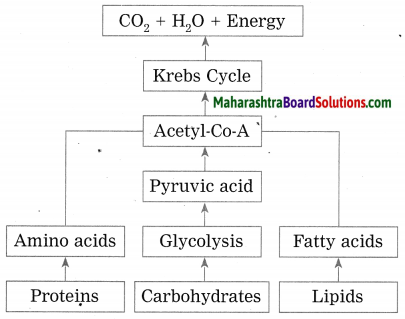
Class 10 Science Part 2 Chapter 1

Balbharti Maharashtra State Board Class 10 Science Solutions Part 2 Chapter 1 Heredity and Evolution Notes, Textbook Exercise Important Questions and Answers.

Std 10 Science Part 2 Chapter 1 Heredity and Evolution Question Answer Maharashtra Board

Class 10 Science Part 2 Chapter 1 Heredity and Evolution Question Answer Maharashtra Board

Question 1.
Complete the following diagram.
Maharashtra Board Class 10 Science Solutions Part 2 Chapter 1 Heredity and Evolution 1
Answer:
Maharashtra Board Class 10 Science Solutions Part 2 Chapter 1 Heredity and Evolution 2

Question 2.
Read the following statements and justify same in your own words with the help of suituble examples.
a. Human evolution began approximately 7 crore years ago.
Answer:

  • Approximately around 7 crore years back the ice age began on the earth. In such conditions, dinosaurs became extinct. The evolution and diversity of mammals started during this time. Due to change in climate the forest cover also declined rapidly.
  • Ancestors of monkey-like animals were Lemur like animals which evolved during this time period.
  • The tails of these monkey-like creatures started vanishing very gradually around 4 crore years ago.
  • The body and brain both increased in volume forming first ape like animals. The monkey like ancestors gave rise to two evolutionary links to apes and human like animals.
  • Later, the human evolution took place by changes in the brain volume, the ability to walk upright, excessive use of hand for manipulations.
  • This journey of human evolution began 7 crore years ago. But the true wise and intelligent man arose around 50,000 years ago.

b. Geographical and reproductive isolation of organisms gradually leads to speciation.
Answer:

  • Every species survives in specific geographical conditions. The requirements of food and habitat, is specific for each species. Their reproductive ability and period is also different.
  • Therefore, the individuals from one species cannot reproduce with individuals from other species.
  • When they are separated by a distance or geographical barriers they are said to be isolated geographically.
  • When they cannot reproduce with each other, they are said to be isolated reproductively.
  • The ancestor species of both these subspecies may be the same but due to isolation over a very long-time duration, there is genetic variation between the two. Therefore, the isolation leads to speciation.

c. Study of fossils is an important aspect of study of evolution.
Answer:
Answer:

  • Fossils offer palaeontological evidence for the evolutionary process.
  • Due to some natural calamities the organisms get buried during ancient times.
  • The impressions and remnants of such organisms remain preserved underground. The hot lava also traps some organisms or their impressions. All such formations form fossils.
  • Study of fossils help the researcher to understand the characteristics of the organisms that existed in the past.
  • Carbon dating method also helps in finding out exact age of the fossil. According to the structure of earth’s crust the fossils are obtained at specific depths.
  • The oldest ones are obtained at the depth while the relatively recent ones occupy the upper surface. Thus fossils of invertebrates were seen in very old Palaeozoic era. Later were seen fossils of Pisces, Amphibia and Reptilia. The Mesozoic era was dominated by reptiles while Coenozoic era showed presence of mammals.
  • In this way, study of fossils unfold the evolutionary secrets.

d. There is evidences of fatal Science among chordates.
[Please read the above question as: Among different chordates there are embryological evidences.]
Answer:

  • Very young embryos of fish, amphibians, reptiles, birds and mammals show quite similar structure in the early stages.
  • As the further growth takes place, they acquire different patterns.
  • The initial similarity between the vertebrate embryos is an evidence that during evolution, there was a common ancestor for all the vertebrate classes.
  • This is called embryological evidence for vertebrate evolution.

Maharashtra Board Class 10 Science Solutions Part 2 Chapter 1 Heredity and Evolution

Question 3.
complete the statements by choosing correct options from bracket.
(Genes, Mutation, Translocation, Transcription, Gradual development, Appendix)
a. The causality behind the sudden changes was understood due to ………… principle of Hugo de Vries.
Answer:
Mutation

b. The proof for the fact that protein synthesis occurs through ……….. was given by George Beadle and Edward Tatum.
Answer:
Genes

c. Transfer of information from molecule of DNA to mRNA is called as …………… process.
Answer:
Transcription

d. Evolution means ………….
Answer:
Gradual development

e. Vestigial organ ……….. present in human body is proof of evolution.
Answer:
Appendix

Question 4.
Write short notes based upon the information known to you.
a. Lamarckism.
Answer:
(1) Lamarckism consists of two theories which were proposed by Jean Baptiste Lamarck. These are as follows: (a) Use and disuse of the organs (b) Inheritance of acquired characters.
(2) In theory of use and disuse of organs, Lamarck says : The characters of organs develop because specific activities that the organisms perform. If such organ is not used it gets degenerated. Thus the morphological changes take place due to activities or inactivity of a particular organism.
(3) To emphasise this theory, he quoted following examples. Due to constant extension of neck to eat foliage from the top of the trees, giraffe’s neck became long. Similarly blacksmith has strong arms due to constant work. Flightless ostrich and emu did not fly and hence their wings became useless. Aquatic birds like swan and duck made their feet suitable for swimming by living in water. Snake lost limbs as it tried burrowing mode.
(4) Such acquired characters are passed from one parental generation to the offspring. This is called inheritance of acquired characters.
(5) The theory of inheritance of acquired characters is not accepted as such transmission of acquired character does not take place. Only genetic characters are transmitted.

b. Darwin’s theory of natural selection.
Answer:

  • Charles Darwin proposed the theory of natural selection after making many observations on different specimens. He published a concept ‘Survival of the fittest’.
  • Darwin explains this concept as follows: All the organisms reproduce prolifically. Therefore, there is always a competition for food, mate, etc. Only adaptations for sustaining this struggle.
  • Natural selection plays important role by selecting only those organisms which are fit to live. Those that do not have better adaptations, perish. Selected sustaining organisms then perform reproduction and form new species in a very long period of time.
  • Darwin published his views in the book titled ‘Origin of Species’.

c. Embryology.
Answer:

  • Embryology is the study of developing embryos.
  • These embryos in their initial stages are very similar to each other.
  • These similarities decrease later in the development.
  • This similarity in initial stages indicate that these vertebrates have originated from a common ancestor.
  • In evolutionary science, comparative study of embryos of various vertebrates provide evidence for evolution.

d. Evolution.
Answer:

  • The sequential changes in the groups of living organisms that take place very gradually is called evolution.
  • Evolution is also described as the formation of new species due to natural selection.
  • The process of evolution takes millions of years for development and speciation of different organisms.
  • Changes in stars and planets in space and the changes in biosphere occurring on the Earth are all included under study of evolution.
  • Due to evolution organisms become fit, biodiversity is increased, and new species are created.
  • Different scientists have put forth theories to explain the process of evolution. Among these Charles Darwin’s theory of natural selection and speciation is accepted worldwide.

e. Connecting link.
Answer:
Some living organisms possess some characters in them which are the distinctive features of different groups or phyla. Such individuals connect these two groups by sharing the characters of both and hence they are known as connective links.

Examples: (1) Peripatus: Peripatus is the connecting link between Annelida and Arthropoda. It shows characters of both animal phyla. Like annelid worm, it shows segmented body, thin cuticle and parapodia. Like an arthropod, it shows open circulatory system and tracheal system for respiration.
(2) Duck Billed platypus: This is a connecting link between reptiles and mammals. Like reptiles it lays eggs but like mammals it has mammary glands and hairy skin.
(3) Lung fish: Lung fish is a connecting link between fishes and amphibians. Though a fish, it shows lungs for respiration as in amphibian animals.
(4) Connecting links indicate the direction and hierarchy of evolution.

Maharashtra Board Class 10 Science Solutions Part 2 Chapter 1 Heredity and Evolution

Question 5.
Define heredity. Explain the mechanism of hereditary changes.
Answer:
(1) Heredity: Heredity is the process by which the biological characters from parental generation are transmitted to the next generation through genes.

(2) The mechanism of hereditary changes:

  • Mutation: Sudden change in the parental DNA can cause mutations. This results into changes in the hereditary characters.
  • At the time of meiosis, the crossing over takes place. This creates new recombination of the genetic information. Therefore, the haploid gametes produced carry changed hereditary characters.

Question 6.
Define vestigial organs. Write names of some vestigial organs in human body and write the names of those animals in whom same organs are functional.
Answer:

  • Vestigial organs are degenerated or underdeveloped organs of organisms which do not perform any function.
  • According to the principle of natural selection, such organs are on the verge of disappearance. But it takes many millions of years for its complete vanishing.
  • The vestigial organs in one animal may be of use but to other kind of the animal as they still perform regular functions.
  • Appendix is vestigial for humans, it does not perform any function but in ruminant animals it is concerned with digestion.
  • Ear muscles are vestigial for us but in monkeys and cattle they are functional.
  • Names of vestigial organs in human body-Appendix, tail-bone or coccyx, wisdom teeth and body hair.

Question 7.
Answer the following questions.
a. How are the hereditary changes responsible for evolution?
Answer:
Hereditary characters are transmitted from parental generation to the offspring. These characters are maintained through inheritance. But the genes which are beneficial for the organisms in helping them to adapt to the environment are transmitted to the next generations in a greater proportion. This happens due to natural selection.

The process of evolution happens at a very slow pace. The favourable genes are preserved in the species as they bring about better survival of the individuals. Such individual reproduces more efficiently and evolve. The individuals with unfavourable genes are not selected by nature and are thus removed from the population through natural death. The fuel for evolution is thus truly supplied by the hereditary changes.

b. Explain the process of formation of complex proteins.
Answer:
The proteins are synthesised in following steps, viz. transcription, translation and translocation. Protein synthesis takes place according to the sequence of nucleotides present on the DNA molecule with the help of RNA molecules. This is known as central dogma of protein synthesis.

1. Transcription: In the process of transcription, mRNA is produced as per the nucleotide sequence on the DNA. For this the two strands DNA are separated. Only one strand participates in the formation of mRNA. The sequence of nucleotides which is complementary to that of present on DNA is copied on mRNA. Instead of thymine present in DNA, uracil is added on the mRNA. Transcription takes place in nucleus but the mRNA leaves nucleus, carries the genetic code and enters the cytoplasm. This genetic code is always in triplet form arid hence is known as triplet codon. The code for each amino acid always consists of three nucleotides.

2. Translation: Each mRNA may carry thousands of codons. But each codon is specific for only one amino acid. The tRNA molecule brings the required amino acid as per the code present on mRNA. There is anticodon on each tRNA which is complementary to the codon on mRNA. This process is known as translation.

3. Translocation: In translocation, the ribosome keeps on moving from one end of mRNA molecule to other end by distance of one triplet codon. While this process is taking place, rRNA, helps in joining the amino acids together by peptide bonds. The peptide chains later come together to form complex protein molecules.

c. Explain the theory of evolution and mention the proof supporting it.
Answer:
1. Theory of evolution:

  • According to the theory of evolution, first living material was in the form of protoplasm which was formed in ocean.
  • Gradually, it gave rise to unicellular organisms. Changes took place in these unicellular organisms which made them evolve into larger and more complex organisms.
  • All evolutionary changes were very slow and gradual taking about 300 crore years to happen.
  • Different types of organisms were developed as the changes and development that occurred in living organisms wefts all round and multi-dimensional.
  • Hence, this overall process of evolution is called organizational and progressive.
  • Variety of plants and animals developed from the ancestors having different structural and functional organization during the process of evolution.

2. Proof here means evidences of evolution.
These evidences are as follows:

  • Morphological evidences
  • Anatomical evidences
  • Vestigial organs
  • Palaentological evidences
  • Connecting links
  • Embryological evidences.

d. Explain with suitable examples importance of anatomical evidences in evolution. (July 2019)
Answer:

  • There are similarities in the structure and anatomy of different animal groups. E.g. human hand, forelimb of bull, patagium of bat and flipper of whale are all similar in their internal anatomy. There is similarity in the bones and joints of all these specimens.
  • External morphology does not show any similarity. Use of each of the organ is also different in different animals. Structurally, they may not be related.
  • However, the similarities in the anatomy is an evidence that they may have a common ancestor.
  • In this way, the anatomical evidence throws light on the process of evolution.

e. Define fossil. Explain importance of fossils as proof of evolution.
Answer:

  • Fossils offer palaeontological evidence for the evolutionary process.
  • Due to some natural calamities the organisms get buried during ancient times.
  • The impressions and remnants of such organisms remain preserved underground. The hot lava also traps some organisms or their impressions. All such formations form fossils.
  • Study of fossils help the researcher to understand the characteristics of the organisms that existed in the.past.
  • Carbon dating method also helps in finding out exact age of the fossil. According to the structure of earth’s crust the fossils are obtained at specific depths.
  • The oldest ones are obtained at the depth while the relatively recent ones occupy the upper surface. Thus fossils of invertebrates were seen in very old Palaeozoic era. Later were seen fossils of Pisces, Amphibia and Reptilia. The Mesozoic era was dominated by reptiles while Coenozoic era showed presence of mammals.
  • In this way, study of fossils unfold the evolutionary secrets.

f. Write evolutionary history of modern man.
Answer:
(1) Ancestors of humans developed from animals which resembled lemur like animals.
(2) Around seven crore years ago, monkey-like animals evolved from some of these lemur like animals.
(3) Then after about 4 crore years ago, in Africa the tails of these monkey like creatures very gradually disappeared.
(4) Simultaneously, there was enlargement in their body and brain volume too. The hands also improved and were provided with opposable thumb. In this way, ape-like animals were evolved.
(5) These ape-like animals independently gave rise to two lines of evolution, one giving rise to apes like gibbon and orangutan in the South and North-East Asia and gorilla and chimpanzee which stayed in Africa around 2.5 crores of years ago.
(6) The other line of evolution gave rise to human like animals around 2 crore years ago.
(7) The climate became dry and this resulted into reduction of forest cover. This made arboreal apes to descend on the land and start terrestrial mode.
(8) Due to this, there were changes in the pefvic
girdle and vertebral column. The hands were also freed from locomotion and thus they became more manipulative.
(9) Later, journey of hominoid species started from around 2 crores years ago. The first record of human like animal is ‘Ramapithecus’ ape from East Africa.
(10) Ramapithecus → Australopithecus → Neanderthal man → Cro-Magnon are the important steps in human evolution.
(11) Neanderthal man was said to be the first wise man. The increasing growth of brain made man more and more intelligent and thinking animal.
(12) Later, more than biological evolution, it was cultural evolution, when man started agriculture, animal , rearing. There was development of civilizations, arts and science etc. About 200 years ago there were industrial inventions and thus man now rules the earth.

Project:

Project 1.
Make a presentation on human evolution using various computer softwares and arrange a group disscussion over it in the class room.

Project 2.
Read the book – ‘Pruthvivur Manus Uparcich’ written by Late Dr. Sureshchandra Nadkarni and note your opinion on evolution.

Maharashtra Board Class 10 Science Solutions Part 2 Chapter 1 Heredity and Evolution

Can you recall? (Text Book Page No. 1)

Question 1.
Which component of the cellular nucleus of living organisms carries hereditary characters?
Answer:
The chromosomes made up of nucleic acids and proteins, present in the nucleus of the cell are the components that carry hereditary characters in living organisms.

Question 2.
What do we call the process of transfer of physical and mental characters from parents to the progeny?
Answer:
The process of transfer of physical and mental characters from parents to the progeny is called inheritance or heredity.

Question 3.
Which are the components of the DNA molecule?
Answer:
DNA molecule is made up of two helical strands consisting of deoxyribose sugar, phosphoric acid and pairs of nitrogenous bases. These three together is called a nucleotide.

Choose the correct alternative and write its alphabet against the sub-question number:

Question 1.
Darwin has published a book titled …………..
(a) Natural selection
(b) Mutation
(c) Fall of a sparrow
(d) Origin of species
Answer:
(d) Origin of species

Question 2.
The …………. man evolved about 50 thousand years ago.
(a) Cro Magnon
(b) Neanderthal
(c) Java man
(d) Ramapithecus
Answer:
(a) Cro Magnon

Question 3.
About 10 thousand years ago, ………….. started to practise agriculture.
(a) Gorilla
(b) wise man
(c) Ramapithecus
(d) Australopithecus
Answer:
(b) wise man

Question 4.
………………. can be considered as the first example of wise-man.
(a) Australopithecus
(b) Ramapithecus
(c) Cro Magnon
(d) Neanderthal man
Answer:
(d) Neanderthal man

Question 5.
………. is a connecting link between Annelida and Arthropoda. (March 2019)
(a) Duck-billed platypus
(b) Peripatus
(c) Lung fish
(d) Whale
Answer:
(b) Peripatus

Question 6.
………… years ago human brain was sufficiently evolved to call him wise man.
(a) 50,000
(b) 30,000
(c) 20,000
(d) 10,000
Answer:
(a) 50,000

Question 7.
The process by which the gene in the nucleotide suddenly changes its position is called ………. (Board’s Model Activity Sheet)
(a) translation
(b) translocation
(c) mutation
(d) transcription
Answer:
(c) mutation

Maharashtra Board Class 10 Science Solutions Part 2 Chapter 1 Heredity and Evolution

Question 8.
…………. is not the vestigial organ in the human body. (Board’s Model Activity Sheet)
(a) appendix
(b) Coccyx
(c) Canine
(d) Wisdom teeth
Answer:
(c) Canine

Write whether the following statements are true or false with proper justification for your answer:

Question 1.
It takes thousands of years for a useful structure to disappear.
Answer:
False. (The useful structures of the body do not disappear. The functioning of the body is easier due to such organs. It takes thousands of years for a functionless organ to disappear.)

Question 2.
Dr. Har Govind Khorana was awarded Nobel prize for his invention and publication in the journal Radio carbon.
Answer:
False. (Willard Libby was awarded Nobel prize for his invention and publication in the journal Radio carbon.)

Question 3.
Mesozoic era was dominated by variety of mammals.
Answer:
False. (Mesozoic era dominated by variety of reptiles.)

Question 4.
It seems that invertebrates have been slowly originated from vertebrates.
Answer:
False. (Vertebrates have been slowly originated from invertebrates in course of evolution. The primitive type of organisms always give rise to complex life forms. The invertebrates from Palaeozoic era gradually gave rise to vertebrates.)

Question 5.
The decaying process of C-12 occurs continuously from the dead remains of living organisms.
Answer:
False. (The decaying process of C-14 occurs continuously from the dead remains of living organisms. C-12 is not radioactive and hence it does not show decaying process.)

Question 6.
The theory of natural selection which mentions ‘Survival of fittest’ is given by Lamarck.
Answer:
False. (The theory of natural selection which mentions ‘Survival of fittest’ is given by Darwin.)

Question 7.
Changes acquired during life time are transferred to next generation.
Answer:
False. (Changes acquired during life time are not heritable. They are not transferred to next generation. Only the genes are transferred to the next generation.)

Question 8.
Each species grows in specific geographical conditions and has specific food, habitat, reproductive ability and period.
Answer:
True. (Each species has specifically evolved characters due to evolution and speciation.)

Question 9.
Humans walking with upright posture were confined to Africa only during prehistoric period.
Answer:
False. (Humans walking upright existed in Africa and China, Indonesia of Asian continent too.)

Maharashtra Board Class 10 Science Solutions Part 2 Chapter 1 Heredity and Evolution

Question 10.
Industrial society was established about 200 years ago.
Answer:
True. (After the development and specialization of human brain, he started indulging in science and technology. Before; this period the idea of industrialization was not existing.)

Match the columns:

Question 1.

Scientist Discovery
(1) Johann Gregor Mendel (a) Chromosomes of grasshopper
(2) Hugo de Vries (b) DNA is genetic material
(c) Pioneer of the modern genetics
(d) Mutational theory

Answer:
(1) Johann Gregor Mendel – Pioneer of the modern genetics.
(2) Hugo de Vries – Mutational theory.

Question 2.

Scientist Discovery
(1) Walter, Sutton (a) Chromosomes of grasshopper
(2) Mclyn McCarthy (b) DNA is genetic material
(c) Pioneer of the modern genetics
(d) Mutational theory

Answer:
(1) Walter, Sutton – Chromosomes of grasshopper.
(2) Mclyn McCarthy – DNA is genetic material.

Question 3.

Evidences of evolution Examples
(1) Morphological evidences (a) Duck billed Platypus and Peripatus
(2) Anatomical evidences (b) Remnants and impressions
(c) Human hand and fore limb of bull
(d) Shape and venation of leaf

Answer:
(1) Morphological evidences – Shape and venation of leaf.
(2) Anatomical evidences – Human hand and fore limb of bull.

Maharashtra Board Class 10 Science Solutions Part 2 Chapter 1 Heredity and Evolution

Question 4.

Evidences of evolution Examples
(1) Palaeontological evidences (a) Duck billed Platypus and Peripatus
(2) Connecting links (b) Remnants and impressions
(c) Coccyx and wisdom tooth
(d) Human hand and fore limb of cat

Answer:
(1) Palaeontological evidences – Remnants and impressions.
(2) Connecting links – Duck billed Platypus and Peripatus.

Find the odd one out:

Question 1.
Transcription, Translation, Translocation, Mutation
Answer:
Mutation. (All others are stages of protein synthesis.)

Question 2.
Bones of the hands, structure of nostrils, position of eyes, structure of ear pinnae
Answer:
Bones of the hands. (All the others are morphological evidences.)

Question 3.
Venation, Shape of seeds, Leaf petiole, Leaf shape
Answer:
Shape of seeds. (All the others are morphological evidences in plants.)

Question 4.
Human hand, wing of cockroach, forelimb of bull, flipper of whale
Answer:
Wing of cockroach. (All others are anatomical evidences, they are homologous organs.)

Identify the correlation between the first two words and suggest the suitable words in the fourth place:

Question 1.
mRNA : Transcription :: tRNA :…………
Answer:
Translation

Question 2.
Peripatus : Connecting link :: Appendix :……….
Answer:
Vestigial organs

Question 3.
Open circulatory system : Arthropods :: Thin cuticle and parapodia :………..
Answer:
Annelida

Question 4.
Between Annelida and Arthropoda : Peripatus ::……….: Lungfish
Answer:
Pisces/Fish and Amphibia

Question 5.
Theory of natural selection : Charles Robert Darwin :: Theory of inheritance of acquired characters :…………
Answer:
Jean Baptiste Lamarck

Maharashtra Board Class 10 Science Solutions Part 2 Chapter 1 Heredity and Evolution

Question 6.
Survival of fittest : Darwin :: Acquired characters :……….
Answer:
Lamark

Question 7.
Wisdom teeth : Vestigial organs :: Lungfish :………..
Answer:
Connecting link.

Define the following:

Question 1.
Heredity.
Answer:
The transfer of biological characters from one generation to another through genes is called heredity.

Question 2.
Transcription.
Answer:

Question 3.
Translation.
Answer:
The process of bringing tRNA possessing anticodon that is complementary to the codon on mRNA for protein synthesis is called translation.

Question 4.
Translocation.
Answer:
The process of movement of the ribosome from one end of mRNA to other end by the distance of one triplet codon is called translocation.

Question 5.
Mutation.
Answer:
Sudden and drastic change that occurs in the genetic material is called mutation.

Question 6.
Species.
Answer:
The group of organisms that cap produce fertile individuals through natural reproduction is called a species.

Name the following:

Question 1.
Three Scientists who proved that except viruses, all living organisms have DNA as genetic material.
Answer:
Oswald Avery, Mclyn McCarthy and Colin MacLeod.

Question 2.
Genetic disorder caused due to mutation:
Answer:
Sickle cell anaemia.

Question 3.
Fish that can breathe with help of lungs:
Answer:
Lung fish.

Question 4.
Vestigial organs in human beings:
Answer:
Appendix, tail-bone or coccyx, wisdom teeth and body hair.

Maharashtra Board Class 10 Science Solutions Part 2 Chapter 1 Heredity and Evolution

Question 5.
Important stages in the journey of human evolution:
Answer:

  • Animals like Lemur
  • Egyptopithecus
  • Dryopithecus
  • Ramapithecus
  • Australopithecus
  • Skilled Human
  • Homo erectus i.e. Man with erect posture
  • Neanderthal man
  • Cro-Magnon man.

Distinguish between the following:

Question 1.
Transcription and Translation.
Answer:
Transcription:

  1. In the process of transcription, the sequence of nucleotides present on the DNA molecule is copied
    and carried to the cytoplasm by mRNA.
  2. The process of transcription takes place in nucleus.
  3. During transcription, RNA is produced from DNA.
  4. Only mRNA takes part in transcription.

Translation:

  1. In the process of translation, the specific amino acids are picked up according to the codons brought by mRNA.
  2. The process of translation takes place in ribosomes located in cytoplasm.
  3. During translation, proteins are produced with the help of RNA.
  4. mRNA, tRNA and rRNA take part in translation.

Question 2.
Ape and Human.
Answer:
Ape:

  1. Brain of the apes is smaller in size.
  2. Ape cannot walk upright.
  3. Ape is less intelligent as compared to human.
  4. Apes are arboreal in their habitat and they spend more time on the trees.
  5. The forelimbs of ape are longer than the hind limbs.

Human:

  1. Brain of humans is larger in size.
  2. Humans can walk upright.
  3. Human is considered to be the most intelligent animal.
  4. Humans are terrestrial in their habitat. They cannot stay on the trees.
  5. The forelimbs of humans are shorter than the hind limbs.

Give scientific reasons:

Question 1.
Some of the characters of parents are seen in their offspring.
Answer:

  • The parental genes are transferred to their progeny through male and female gametes.
  • These genes carry hereditary characters.
  • Since they are transmitted from the parents to their offspring, one can see the parental characters in their offspring.

Question 2.
Darwin’s work on evolution has been a milestone.
Answer:
(1) Darwin has proposed two very important theories of evolution, viz. Theory of natural selection and Theory of origin of species.
(2) The evolution has taken place on the earth for last many crores of years.
(3) The exact nature and process of these evolutionary changes become clear after studying Darwinism. (4) The observations made by Darwin at that time are now tested according to the modern development in science and are found to be correct. Thus, his work is said to be a milestone.

Question 3.
Peripatus is said to be a connecting link between Annelida and Arthropoda.
Answer:

  • Peripatus shows segmented body, thin cuticle, and parapodia-like organs.
  • These characters are typical of Annelids.
  • Similarly, it also shows tracheal respiration and open circulatory system which is a characteristic feature of Arthropods.
  • Since Peripatus shares both these characters, it is said to be a connecting link between j Annelida and Arthropoda.

Question 4.
Vertebrates have been slowly originated from invertebrates.
Answer:

  • When the carbon dating method was used to assess the age of fossils, it was understood that invertebrates were present on the earth much before the vertebrates.
  • The fossils of invertebrates are present in lower layers of earth’s strata.
  • They were seen in Palaeozoic era of geological time period. Vertebrates dominated during Coenozoic era.
  • Their fossils are seen in the upper strata of the earth’s crust.
  • The structural complexity also increased in vertebrates. All these facts indicate that Vertebrates have slowly originated from invertebrates.

Question 5.
During human evolution the hands became available for use.
Answer:

  • During human evolution, the climate of earth started becoming dry.
  • This resulted in loss of forest cover.
  • The apes which were arboreal on the trees thus descended and started walking on land.
  • The lumbar bones underwent change and the apes started walking upright on the grasslands.
  • The vertebral column also underwent change. Due to upright posture the forelimbs were freed from locomotion.
  • The legs started bearing the weight of the body and the hands became available for use.

Read the following statements and justify the same in your own words with the help of suitable examples:

Question 1.
Geographical and reproductive isolation of organisms gradually leads to speciation.
Answer:

  • Every species survives in specific geographical conditions. The requirements of food and habitat, is specific for each species. Their reproductive ability and period is also different.
  • Therefore, the individuals from one species cannot reproduce with individuals from other species.
  • When they are separated by a distance or geographical barriers they are said to be isolated geographically.
  • When they cannot reproduce with each other, they are said to be isolated reproductively.
  • The ancestor species of both these subspecies may be the same but due to isolation over a very long-time duration, there is genetic variation between the two. Therefore, the isolation leads to speciation.

Maharashtra Board Class 10 Science Solutions Part 2 Chapter 1 Heredity and Evolution

Question 2.
Study of fossils is an important aspect of study of evolution.
Answer:
(1) Fossils offer palaeontological evidence for the evolutionary process.
(2) Due to some natural calamities the organisms get buried during ancient times.
(3) The impressions and remnants of such organisms remain preserved underground. The hot lava also traps some organisms or their impressions. All such formations form fossils.
(4) Study of fossils help the researcher to understand the characteristics of the organisms that existed in the.past.
(5) Carbon dating method also helps in finding out exact age of the fossil. According to the structure of earth’s crust the fossils are obtained at specific depths.
(6) The oldest ones are obtained at the depth while the relatively recent ones occupy the upper surface. Thus fossils of invertebrates were seen in very old Palaeozoic era. Later were seen fossils of Pisces, Amphibia and Reptilia. The Mesozoic era was dominated by reptiles while Coenozoic era showed presence of mammals.
(7) In this way, study of fossils unfold the evolutionary secrets.

Question 3.
There is evidences of fatal Science among chordates.
[Please read the above question as: Among different chordates there are embryological evidences.]
Answer:

  • Very young embryos of fish, amphibians, reptiles, birds and mammals show quite similar structure in the early stages.
  • As the further growth takes place, they acquire different patterns.
  • The initial similarity between the vertebrate embryos is an evidence that during evolution, there was a common ancestor for all the vertebrate classes.
  • This is called embryological evidence for vertebrate evolution.

Question 4.
Human evolution began approximately 7 crore years ago.
Answer:

  • Approximately around 7 crore years back the ice age began on the earth. In such conditions, dinosaurs became extinct. The evolution and diversity of mammals started during this time. Due to change in climate the forest cover also declined rapidly.
  • Ancestors of monkey-like animals were Lemur like animals which evolved during this time period.
  • The tails of these monkey-like creatures started vanishing very gradually around 4 crore years ago.
  • The body and brain both increased in volume forming first ape like animals. The monkey like ancestors gave rise to two evolutionary links to apes and human like animals.
  • Later, the human evolution took place by changes in the brain volume, the ability to walk upright, excessive use of hand for manipulations.
  • This journey of human evolution began 7 crore years ago. But the true wise and intelligent man arose around 50,000 years ago.

Answer the following questions:

Question 1.
Answer the following questions: (March 2019)
(a) What do you mean by central dogma?
Answer:
Information about protein synthesis is present in DNA. As per this information, proteins are produced by DNA through RNA molecules. This is called central dogma.

(b) What is transcription?
Answer:
The process of synthesis of mRNA as per the nucleotide sequence present in DNA is called transcription. The nucleotide sequence on mRNA is complimentary to that of the single DNA strand used in synthesis. Instead of thymine, mRNA possesses uracil.

(c) What is meant by triplet codon?
Answer:
The code for each amino acids always consists of three nucleotides which is known as triplet codon.

Question 2.
Which animal is called a connecting link between Reptiles and Mammals? (Board’s Model Activity Sheet)
Answer:
Duck billed platypus is called a connecting link between Reptiles and Mammals.

Question 3.
In which way is science of heredity useful these days?
Answer:
The science of heredity is useful in the following ways:

  • For diagnosis of hereditary disorders.
  • For treatment of hereditary disorders
  • For prevention of hereditary disorders
  • For production of hybrid varieties of animals and plants
  • For using microbes in the industrial processes.

Maharashtra Board Class 10 Science Solutions Part 2 Chapter 1 Heredity and Evolution

Question 4.
What is meant by carbon dating method?
Answer:
(1) Carbon dating method is technique used for determining the age of fossils.
(2) After the death of the organisms, their consumption of carbon stops. But right from that moment the decaying process of C-14 occurs continuously.
(3) This results in change in the ratio between C-14 and C-12. C-12 is not radioactive as C-14.
(4) Thus the time passed since the death of a plant or animal is calculated by measuring the radioactivity of C-14 and ratio of C-14 to C-12 present in their body.
(5) The points noted during carbon dating are:

  • The period after the organism has been dead.
  • The activity of C-14 in the dead organism.
  • Ratio between C-14 and C-12.

Question 5.
Answer the following questions:
(a) Describe briefly the Darwin’s theory of natural selection.
Answer:
Charles Darwin (1809-1882) proposed the theory of natural selection.
Theory of natural selection: ‘The survival of fittest’, i.e., organisms which are fit for survival, evolve while those that are not, perish. The natural selection thus acts to produce new species.

(b) What were the objections raised against Darwinism?
Answer:
Objections raised against Darwinism:

  1. There are other factors too for evolution and just not the Natural Selection.
  2. Arrival of useful and useless modifications were not explained by Darwin, though he said about the survival of the fittest.
  3. He has not given any explanation about slow changes and abrupt changes occurring during evolution.

(c) Which book was published by Darwin to explain this theory? (Board’s Model Activity Sheet)
Answer:
Charles Darwin wrote the book ‘Origin of Species’.

Question 6.
What were the objections raised against Darwinism?
Answer:
Some of the main objections raised against Darwinism are as follows:

  • There are other factors too for evolution and just not the Natural Selection.
  • Arrival of useful and useless modifications were not explained by Darwin, though he said about the survival of the fittest.
  • He has not given any explanation about slow changes and abrupt changes occurring during evolution.

Question 7.
Answer the following questions:
(a) Explain in brief-Lamarck’s principle of ‘use or disuse of organs’.
Answer:
The theory of use and disuse of organs says that the morphological characters of organism develop because of specific activities that the organisms perform. If some organ is not used it gets degenerated. If excessively, used, it develops. Thus, the morphological changes take place due to activities or non-working of a particular body parts in an organism.

(b) Give two examples.
Answer:
Due to constant extension of neck to eat foliage from the top of the trees, giraffe’s neck became long. Similarly, blacksmith has strong arms due to constant work. The flightless ostrich and emu did not fly and hence their wings became useless. Aquatic birds like swan and duck made their feet suitable for swimming by living in water. Snake lost limbs as it tried burrowing mode.

(c) What are acquired characters?
Answer:
Acquired characters are those characters which are obtained during the life time by any organism and passed on to next generations.

Write short notes:
(OR)
Write short notes based upon the information known to you:

Question 1.
Theory of evolution.
Answer:

  • According to the theory of evolution, first living material was in the form of protoplasm which was formed in ocean.
  • Gradually, it gave rise to unicellular organisms. Changes took place in these unicellular organisms which made them evolve into larger and more complex organisms.
  • All evolutionary changes were very slow and gradual taking about 300 crore years to happen.
  • Different types of organisms were developed as the changes and development that occurred in living organisms was all round and multi-dimensional.
  • Hence, this overall process of evolution is called organizational and progressive.
  • Variety of plants and animals developed from the ancestors having different structural and functional organization during the process of evolution.

By choosing appropriate words given in the bracket, complete the paragraph:

Question 1.
(translation, anticodon, tRNA, mRNA, amino acids, triplet codon, transcription, DNA)
The …….. formed in nucleus comes in cytoplasm. It brings in the coded message from DNA. The message contains the codes for amino acids. The code for each amino acid consists of three nucleotides. It is called as ‘………..’. Each mRNA is made up of thousands of triplet codons. As per the message on mRNA, ……… are supplied by the ………. For this purpose, tRNA has ‘…………’ having complementary sequence to the codon on mRNA. This is called ‘………..’.
Answer:
The mRNA formed in nucleus comes in cytoplasm. It brings in the coded message from DNA. The message contains the codes for amino acids. The code for each amino acid consists of three nucleotides. It is called as ‘triplet codon’. Each mRNA is made up of thousands of triplet codons. As per the message on mRNA, amino acids are supplied by the tRNA. For this purpose, tRNA has ‘anticodon’ having complementary sequence to the codon on mRNA. This is called ‘translation’.

Maharashtra Board Class 10 Science Solutions Part 2 Chapter 1 Heredity and Evolution

Question 2.
(Cultural, agriculture, fire, brain, Cro-Magnon, Homo sapiens, Neanderthal)
Evolution of upright man continued in the direction of developing its ………. for the period of about 1 lakh years and meanwhile he discovered the ………. Brain of man, 50 thousand years ago had been sufficiently evolved to the extent that it could be considered as member of the species ………… Neanderthal man can be considered as the first example of wise-man. The ……….. man evolved about 50 thousand years ago and afterwards, this evolution had been faster than the earlier. About 10 thousand years ago, wise-man started to practise the ………. It started to rear the cattle-herds and established the cities. ………..development took place later.
Answer:
Evolution of upright man continued in the direction of developing its brain for the period of about 1 lakh years and meanwhile he discovered the fire. Brain of man 50 thousand years ago had been sufficiently evolved to the extent that it could be considered as member of the species Homo sapiens. Neanderthal man can be considered as the first example of wise-man. The Cro-Magnon man eyolved about 50 thousand years ago and afterwards, this evolution had been faster than the earlier. About 10 thousand years ago, wise-man started-to practise the agriculture. It started to rear the cattle-herds and established the cities. Cultural development took place later.

Read the paragraph and answer the questions given below:

With the help of RNA, the genes present in the form of DNA participate in the functioning of cell and thereby control the structure and functioning of the body. Information about protein synthesis is stored in the DNA and synthesis of appropriate proteins as per requirement is necessary for body. These proteins are synthesized by DNA through the RNA. This is called ‘Central Dogma’. mRNA is produced as per the sequence of nucleotides on DNA. Only one of the two strands of DNA is used in this process. The sequence of nucleotides in mRNA being produced is always complementary to the DNA strand used for synthesis. Besides, there is uracil in RNA instead of thymine of DNA. This process of RNA synthesis is called ‘transcription’.

Questions and Answers:

Question 1.
Which part of the cell control the structure and functioning of the body?
Answer:
Genes present in the form of DNA along with RNA control the structure and functioning of the body.

Question 2.
How is a specific protein synthesised in the cell?
Answer:
The information of protein synthesis is stored in the DNA which is utilised as per the requirement of the body. Later the proteins are synthesised by DNA through the RNA.

Question3.
What is the similarity between mRNA and DNA?
Answer:
The sequence of nucleotides on DNA is copied on mRNA. The nucleotide sequence on mRNA is thus complementary to DNA.

Question 4.
Give one difference between RNA and DNA.
Answer:
RNA has uracil instead of thymine which is present in DNA.

Question 5.
Define central dogma.
Answer:
Central dogma is the concept that proteins are synthesised by DNA through the RNA.

Diagram-based questions:

Question 1.
Observe the figure 1.3 of transcription given on page 9 in this chapter and answer the following questions:
Maharashtra Board Class 10 Science Solutions Part 2 Chapter 1 Heredity and Evolution 3
(1) What is the sequence of nucleotides present on one strand of the DNA?
Answer:
A T G C A A T T

(2) According to the above sequence on DNA, what will be the transcribed sequence on the mRNA molecule?
Answer:
U A C G U U A A

(3) Which enzyme is taking part in the above process of transcription?
Answer:
RNA polymerase takes part in the process of transcription.

Maharashtra Board Class 10 Science Solutions Part 2 Chapter 1 Heredity and Evolution

Question 2.
Observe the figure 1.5 of translation and translocation, given on page 9 this chapter and answer the following questions:
Maharashtra Board Class 10 Science Solutions Part 2 Chapter 1 Heredity and Evolution 4
(1) Which is the initiation codon? Where is it present?
Answer:
AUG is the initiation codon, which is present on the mRNA.

(2) What are the types of RNA present inside the ribosome? Which triplet codon is present on it?
Answer:
There are two molecules of tRNA present inside the ribosome. The triplet codons present on them are UAC and AAG respectively.

(3) Which genetic code is present on mRNA that is leaving the nucleus? What must be the sequence on the DNA to have such code on mRNA?
Answer:
The mRNA that leaves the nucleus has genetic code: A U G U U C A A A
The genetic code on DNA therefore should be as follows: T A C A A G T T T

Question 3.
Observe the figure 1.6 given on page 10 from this chapter. Answer the following question based on your observations:
Maharashtra Board Class 10 Science Solutions Part 2 Chapter 1 Heredity and Evolution 5
What is the significance of this figure from the viewpoint of evolution? Explain in brief.
Answer:
In the figure, the process of mutation is shown. The original nucleotide sequence of TGC is replaced by new mutated sequence GAT. The change in the nucleotide sequence will change the DNA.

This will result in the change in genes and then changing the hereditary characters. Due to such change in genes, the evolution proceeds. The mutation so formed can be minor or major. The greater the impact of the change, the evolution takes place rapidly. The mutation thereby produce recombinations leading to diversity.

Question 4.
Observe the picture and answer the following questions:
Maharashtra Board Class 10 Science Solutions Part 2 Chapter 1 Heredity and Evolution 6
(1) Which evidence of evolution is shown in the picture?
Answer:
Embryological evidences of evolution are shown in this picture.

(2) What can be proven with this proof?
Answer:
The similarities in the initial embryonic stages of different vertebrates shows that there was a common origin of all of them. Thus embryological evidences prove that there was common vertebrate ancestor.

(3) Give one more example of evidence of evolution.
Answer:
Palaeontological evidences such as vestigial organs and connecting links are another examples of evolutionary evidences.

Maharashtra Board Class 10 Science Solutions Part 2 Chapter 1 Heredity and Evolution

Question 5.
Which concept/theory do you remember after seeing this picture of Giraffes? Describe it in brief.
Maharashtra Board Class 10 Science Solutions Part 2 Chapter 1 Heredity and Evolution 7
Answer:

  • The picture is based on the Lamarck’s principle of ‘use and disuse of organs’.
  • The morphological characters of organism develop because of specific activities that the organisms perform.
  • If some organ is not used it gets degenerated. If excessively used, it develops further.
  • Thus, the morphological changes take place due to activities or non-working of a particular body parts in an organism. Due to constant extension of neck to eat foliage from the top of the trees, giraffe’s neck became long.

Activity-based Questions:

Try this: (Text Book Page No. 4)
Maharashtra Board Class 10 Science Solutions Part 2 Chapter 1 Heredity and Evolution 8
Observe the above images and note the similarities between given animal images and plant images.
Answer:
The above pictures of the animals show similarities such as structure of mouth, position of eyes, structure of nostrils and ear pinnae and body fur. In pictures of plants there are similarities in characters like leaf shape, leaf venation, leaf petiole, etc.
These above morphological evidences show that there may be a common ancestor for all of the species shown.

Observe and Discuss:

Question 1.
Observe the pictures given below. (Text Book Page No. 5)
Maharashtra Board Class 10 Science Solutions Part 2 Chapter 1 Heredity and Evolution 9
Answer:
(1) Fossils offer palaeontological evidence for the evolutionary process.
(2) Due to some natural calamities the organisms get buried during ancient times.
(3) The impressions and remnants of such organisms remain preserved underground. The hot lava also traps some organisms or their impressions. All such formations form fossils.
(4) Study of fossils help the researcher to understand the characteristics of the organisms that existed in the.past.
(5) Carbon dating method also helps in finding out exact age of the fossil. According to the structure of earth’s crust the fossils are obtained at specific depths.
(6) The oldest ones are obtained at the depth while the relatively recent ones occupy the upper surface. Thus fossils of invertebrates were seen in very old Palaeozoic era. Later were seen fossils of Pisces, Amphibia and Reptilia. The Mesozoic era was dominated by reptiles while Coenozoic era showed presence of mammals.
(7) In this way, study of fossils unfold the evolutionary secrets.

Question 2.
Observe the pictures given and discuss the characters observed. (Text Book Page No. 6)
Maharashtra Board Class 10 Science Solutions Part 2 Chapter 1 Heredity and Evolution 10
Answer:
Some living organisms possess some characters in them which are the distinctive features of different groups or phyla. Such individuals connect these two groups by sharing the characters of both and hence they are known as connective links.

Examples: (1) Peripatus: Peripatus is the connecting link between Annelida and Arthropoda. It shows characters of both animal phyla. Like annelid worm, it shows segmented body, thin cuticle and parapodia. Like an arthropod, it shows open circulatory system and tracheal system for respiration.
(2) Duck Billed platypus: This is a connecting link between reptiles and mammals. Like reptiles it lays eggs but like mammals it has mammary glands and hairy skin.
(3) Lung fish: Lung fish is a connecting link between fishes and amphibians. Though a fish, it shows lungs for respiration as in amphibian animals.
(4) Connecting links indicate the direction and hierarchy of evolution.

Maharashtra Board Class 10 Science Solutions Part 2 Chapter 1 Heredity and Evolution

Project: (Do it your self)

Project 1.
Internet is my friend: (Text Book Page No. 3)
Collect the information from the internet about Big-Bang theory related with the formation of stars and planets and present it in your class.

Project 2.
Use of ICT: (Text Book Page No. 4)
Collect the information of geological dating and present it in the classroom.

Project 3.
Use of ICT: (Text Book Page No. 5)
Find how the vestigial organs in certain animals are functional in others. Present the information in your class and send it to others.

Project 4.
Internet is my friend: (Text Book Page No. 8)
Collect the pictures and information of various species of monkeys from internet.

Class 10 Questions And Answers
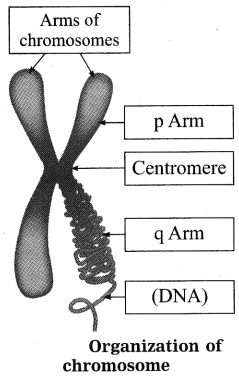
10th Std Science Part 2 Questions And Answers:

Environmental management Class 10 Questions And Answers Maharashtra Board
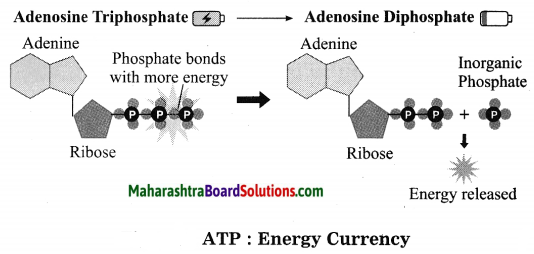
Class 10 Science Part 2 Chapter 4

Balbharti Maharashtra State Board Class 10 Science Solutions Part 2 Chapter 4 Environmental management Notes, Textbook Exercise Important Questions and Answers.

Std 10 Science Part 2 Chapter 3 Environmental management Question Answer Maharashtra Board

Class 10 Science Part 2 Chapter 3 Environmental managementQuestion Answer Maharashtra Board

Question 1.
Reorganize the following food chain. Describe the ecosystem to which it belongs.
Grasshopper – Snake – Paddy field – Eagle – Frog.
Answer:

  • Correct food chain: Paddy field → Grasshopper → Frog → Snake → Eagle.
  • Such food chain is seen in the terrestrial ecosystem. There are many biotic factors in the terrestrial ecosystem, such as insects, birds, mammals etc.
  • The above example mentions about paddy field, so it must be in vicinity of coastal lands. There is water logging in the paddy fields. Therefore, it offers a habitat to the frogs.
  • In the above example, paddy fields are producers in the ecosystem. The primary consumer is grasshopper. Secondary consumer is frog, tertiary consumer is snake and the apex consumer is eagle. On every trophic level the bacteria, fungi and some scavenging worms can act as the decomposers.
  • In this ecosystem. the solar energy is transferred from the paddy crops to eagle in a step wise food
    chain.

Maharashtra Board Class 10 Science Solutions Part 2 Chapter 4 Environmental management

Question 2.
Explain the statement – ‘We have got this Earth planet on lease from our future generations and not as an ancestral property from our ancestors.’
Answer:

  • The earth was inhabited by older generations before us. We have replaced them.
  • But during their life time, they have created hazardous impact on the earth. The industrialization, the quest for more and more natural resources, wars fought, the construction activities such as dams, roads and bridges, extensive deforestation, etc. were their thoughtless activities.
  • All these activities were for development of mankind. But most of them have destroyed the delicate balance between the producers and different levels of consumers.
  • Due to ever increasing population of human beings there is shortage of food, clothing and shelter. To procure these basic needs, we have exploited many natural resources causing destruction of the earth’s natural ecosystem.
  • Now it is our turn to protect the earth as on the same planet the next generations have to survive. We have to hand over the ecosystems of the earth which are in perfect balance to the new generations.
  • The future generations need a good quality of air, water and land along with all other living organisms.
  • Due to problems like climate change, global warming, pollution, droughts, etc. the environment is impacted, thus in order to keep sustainability of earth, we have to remember that the earth has not been obtained only as ancestral property but we have to save it for future generations.

Question 3.
Write short notes.
a. Environmental conservation.
Answer:
Due to natural and man-made causes, there are many environmental problems on the earth. These problems affect the existence of various living organisms. In order to save these organisms and maintain the environmental balance, there is need for environmental conservation. If this is not done then there will not be any quality of life for the resident humans. For environmental conservation, the Government has formulated acts and rules. UN has established UNEP for the conservation programs.

The people’s participation in the conservation movement is essential. From school age, the environmental values are inculcated in the young minds. Conservation of environment is the social responsibility of everyone. Judicial use of natural resources conservation also way of environmental conservation.

b. Chipko Movement of Bishnoi.
Answer:
Chipko Movement of Bishnoi or Bishnoi Andolan:
Khejarli or Khejadli is a village in Rajasthan, where Bishnoi community is located. The name of the town is derived from Khejri trees.

The first event of Chipko Movement took place in Khejadli village in 1730 AD. In this village 363 Bishnois, led by Amrita Devi sacrificed their lives for protecting the trees of Khejri trees, which trees are considered as sacred by Bishnoi.

Amrita Devi said, “if a tree is saved even at the cost of one’s head, it’s worth it”. She was killed with the axes that were brought to chop off the trees. The three young daughters Asu, Ratna and Bhagubai also sacrificed their lives for trees.

83 Bishnoi villages came together and villagers sacrificed their lives after hearing about Amrita Devi’s sacrifice. Three hundred and sixty-three Bishnois were killed as they opposed the king. After realizing the mistake, the king ordered stoppage of the felling of trees. Honouring the courage of the Bishnoi community, the ruler of Jodhpur, Maharaja Abhay Singh, apologized. He issued a royal decree to protect trees and wild life.

Chipko movement of 20th century in Uttar Pradesh also followed the same pattern of embracing the trees and saving them from cutting.

c. Biodiversity.
Answer:
Biodiversity means the diverse life forms that inhabit any area. Biodiversity is seen due to variety of life forms and different ecosystems that lodge these organisms. In nature there is biodiversity on the three different levels, viz. genetic diversity, species diversity and ecosystem diversity. This means that there is diversity in the individuals belonging to the same specips due to genetic reasons, there is diversity among the different species of organisms and there is also a diversity in the ecosystems that are present in any region.

Due to development of mankind, the biodiversity is threatened. There are special efforts taken to restore the lost and threatened biodiversity. Some of these are establishing sanctuaries, National Parks, biodiversity hotspots and reserves etc. Certain endangered species are protected by carrying out conservation projects.

d. Sacred Groves.
Answer:
Sacred grove is the green patch of the forest which is conserved by local people in the name of God. It does not belong to forest department. It is like a sanctuary that is conserved by the common people and tribals in the area. It is rich in the biodiversity.

It is conserved as there is a faith that God or deity reside in the sacred grove. Hence in local language, they are known as Deorai. Due to this reason, people do not fell the trees. Also hunting of any wild life is not done here. More than 13000 sacred groves have been reported in India. Most of these are in Western Ghats in Maharashtra, Karnataka and Kerala. Also, in remaining parts of India sacred groves are reported. Role of sacred grove is tremendous in conserving the biodiversity.

e. Disaster and its management.
Answer:

  • To save human life from disasters. To help them for moving away from the place of disasters by rapid action.
  • To supply essential commodities to the affected people. This helps to reduce the gravity of disaster. People are given grains, water and clothes and other basic necessities under this objective.
  • To bring back the conditions of affected people to normalcy.
  • To rehabilitate the affected and displaced victims.
  • To think and execute the protective measures in order to develop capability to face the disasters in
    future.

Question 4.
How will you justify that overcoming the pollution is a powerful way of environmental management?
(OR)
“Solving the problem of pollution is an effective way of environmental management.” Justify the statement.
Answer:
1. Pollution is created only due to human activities. Air, water, soil, noise, radiation, thermal, light, plastic are different types of pollution.
2. All types of pollution affect environment and particularly threatening the survival of living organisms.
3. Pollution must be controlled in order to have good quality of the environment. E.g. When plastic is thrown anywhere, it causes pollution of the land, it clogs the rain water drains, it affects feeding of the animals. Plastic pollution can be completely stopped by us through proper management of plastic waste. By recycling or reusing, we can overcome the plastic pollution. This would be a powerful way of environmental management.
4. Similarly, when we reduce pollution of different types, we automatically help to regain the environmental health.

Question 5.
Which projects will you run in relation to environmental conservatioh? How?
(OR)
Write six strategies implemented by you for conservation of the environment.
Answer:
Initially, assessment of the environmental problems will be done. The nature and severity of these problems will be understood by detailed study of the same. Then the projects can be undertaken to combat these problems.

1. Tree plantation is one such easier project that can be undertaken to conserve environment. The further nurturing of the tree will also be our responsibility. While selecting the tree, the local and sturdy varieties will be selected. Such trees can survive in polluted environment too and even under the pressure of urbanization.

2. Solid waste management is another very important project that should be undertaken by every society, colony or school. Segregation of waste into dry and wet types and then its proper disposal will be taught to all the people in the neighbouring area.

3. To ban the plastic and make people aware about harmful effects of plastic is another very significant project.

4. Fossil fuels are non-renewable and polluting. Therefore, their use should be reduced as far as possible. Therefore, using bicycle, or walking down for shorter distances or using public transport systems are the better alternatives. The awareness drive about these facts will be taken up as a project.

5. To take care of stray animals, provide shelter, feeding endangered birds like sparrows and allowing them to survive with our support is also one of the essential act to conserve other species.

6. Attempts will be made for bringing awareness among minds of everyone. Such small acts can bring about major shift in the attitude of the people. This will certainly help in the environmental conservation.

Maharashtra Board Class 10 Science Solutions Part 2 Chapter 4 Environmental management

Question 6.
Answer the following:
a. Write the factors affecting environment.
Answer:

  • The biotic and abiotic- factors affect the environment. Among abiotic factors, the physical and chemical factors can alter the conditions of the environment.
  • Abiotic factors are either natural or man-made.
  • The various interrelationships between different living organisms can also affect environment.
  • The natural disasters such as earthquake, forest fires, cyclones, cloud bursting, drought, etc. change the environment.
  • The human activities such as deforestation, urbanisation, constructions etc. cause permanent damage to the ecosystems. Due to man-made impact, there can be large scale changes in the environment.

b. Human beings have important place in environment.
Answer:

  • Man came last on the earth during evolution of animals. But due to his intelligence, imagination, critical thinking and memory, he made progress in all fields.
  • By virtue of these qualities he became the supreme.
  • All the natural resources on the earth were very rapidly exploited by man.
  • Under the pretext of technology and. development he made degradation of almost all¬natural ecosystems.
  • He never obeys the rules of nature.
  • Phenomena like pollution, urbanization, industrialization and deforestation are exclusively his creations.
  • Hunting and poaching other animals were his contribution to the extinction of many other animals.
  • Except man no other organism on the earth can change the ecosystems in such a drastic way. Therefore, it is rightly said that human beings have important place in environment.

c. Write the types and examples of biodiversity.
Answer:
Biodiversity is documented on the following three levels, viz. genetic diversity, species diversity and ecosystem diversity.
1. Genetic Diversity: Diversity seen among the organisms of same species due to genetic differences is called genetic diversity. E.g. The individual human beings are different from each other. No two animals or plants are exactly alike.

2. Species Diversity: The difference between the different species is the species diversity, e.g. All the species of plants, animals and microbes which are seen in any natural environment.

3. Ecosystem Diversity: In one region there may be different ecosystems, such diversity in the ecosystems is called ecosystem diversity. Ecosystems are natural or artificial. Every region shows different types of ecosystems such as aquatic, terrestrial, desert or forest ecosystems. Each ecosystem has its own habitats with resident flora and fauna.

d. How the biodiversity can be conserved?
Answer:
Biodiversity can be conserved by the following ways:

  • Protection of the rare species of plants and animals.
  • Creating habitats for the animals and plants by establishing National Parkland Sanctuaries.
  • Declaration of bioreserves, the areas which are protected through conservation.
  • Conservation projects for protecting special species.
  • Conservation of all flora and fauna.
  • Strict observance of the acts and rules.
  • Use of traditional knowledge and maintaining record of traditional knowledge.

e. What do we learn from the story of Jadav Molai Payeng? (Board’s Model Activity Sheet)
Answer:
Jadav Molai Payeng is a common man who was just a simple forest worker. But he has conscience about plants and tree plantations. He single-handedly planted thousands of trees. He converted a barren patch of land into forest which is spread over 1360 acres. For these plantations he continuously worked.

He has shown that a single determined person, can establish a new forest! We understand the values of
hard work, sincerity and devotion to the nature through the story of Jadav Molai Payeng. Even a common man can contribute a lot for the conservation and protection of the environment by learning the story of Payeng.

f. Write the names of biodiversity hot spots.
Answer:

  • In entire world, 34 highly sensitive biodiversity spots are reported.
  • These hotspots occupied 15.7% area of the Earth.
  • However, currently about 86% of the sensitive areas are already destroyed.
  • Now about 2.3% area of the Earth still has such sensitive biodiversity spots.
  • There are 1,50,000 plant species which are about 50% of the species in the world.
  • In India, out of 135 species of animals, 85 species are found in the jungles of eastern region.
  • There are about 1,500 endemic plant species in Western Ghats.
  • About 50,000 plants species out of the total plants in the world are said to be endemic.

g. Which are the reasons for endangering the many species of plants and animals? How can we save those diversity?
Answer:

  • The animals and plants species are endangered majorly due to man-made causes.
  • Some natural disasters like earthquakes, climate change, forest fires, drought and cyclones also affect the living organisms due to lack of food and water.
  • In man-made causes, hunting and poaching are the main reasons.
  • Also animal-human conflicts occur due to invasion of human settlements into the habitats of wild animals.
  • Construction of dams, roads, and colonies destroy the habitats of wild life.
  • Industrialization, urbanization and population explosion of humans are putting severe pressure on all the existing biodiversity.
  • In order to save and protect the biodiversity, many scientists and naturalists come together. A stretch of land is protected by declaring it as the sanctuary or a national park by the Government. Even the locals can protect it as a sacred grove.
  • Various acts and rules have been formulated to protect the organisms. The violators of such rules are punished accordingly.

Question 7.
What are the meanings of the following symbols? Write your role accordingly. (July ’19; Board’s Model Activity Sheet)
(OR)
What do these symbols indicate? Explain your opinion about those symbols.
Maharashtra Board Class 10 Science Solutions Part 2 Chapter 4 Environmental management 1
Answer:
1. The first symbol is for giving the message, “Reduce, reuse and recycle”. This is important mantra for the utilization of natural resources.
The second symbol gives the message about ‘Save water’.
The third symbol advocates the use of solar energy.

2. These symbols inculcate the importance of being eco-friendly. The first symbol is essential to maintain the natural resources by reusing and recycling them. As far as possible, one should reduce the excessive use of resources by preventing consumerism.

3. Water problems persist in many major cities and villages. In villages it results in drought like conditions. It also reflects into loss of agricultural produce. Therefore, the message about saving water or to make judicious use of water should be spread far and wide.

4. The solar energy is the renewable energy option which is very easily available in country like India. By using solar energy, we can replace the polluting and exhaustible fuels. Thereby, pollution will also be reduced.

Due to such symbols, important messages about environment conservation reach, us and we can change ourselves into more eeofriendly persons.

Project: (Do it your self)

Project 1.
Make a presentation on pollution of Gangci and Yamuna Rivers and effects of air pollution on Taimuhal.

Maharashtra Board Class 10 Science Solutions Part 2 Chapter 4 Environmental management

Can you recall? (Text Book Page No. 36)

Question 1.
What is ecosystem? Which are its different components?
Answer:
In any environment, there are biotic and abiotic components. There are interactions among these components. All such interactions make an ecosystem.

The different components in the ecosystem are as follows:
Abiotic components : Air, water, soil, sunlight, temperature, humidity, etc.
Biotic components: All the types of living organisms, like bacteria, fungi, plants and animals.

Question 2.
Which are the types of consumers? What are the criteria for their classification?
Answer:
Primary consumers, secondary consumers, tertiary consumers or apex consumers are the different types of consumers. These types are according to the trophic level to which they belong.

Question 3.
What may be the relationship between lake and birds on tree?
Answer:
The birds on the tree depend on the aquatic organisms in the lake for their feeding. Birds stay on the trees which are in the vicinity of the lake, so that it is easier for them to capture fishes, frogs, etc. They must also be using the same lake water for drinking.

Question 4.
What is difference between food chain and food web?
Answer:
In every ecosystem, there are always interactions between producers, consumers and decomposers. This sequence of feeding interactions is called food chain. In every food chain there are links between four to five trophic levels constituting the producers, primary consumers, secondary consumers, tertiary consumers, etc. The links of food chain are in linear sequence. But food web is a complex network of many small food chains. In fact, food web is the collection of many small food chains. Thus, when many food chains are interwoven, they form food web.

Think and Answer! (Text Book Page No. 36)

Question 1.
Write the name and category of each of the component shown in picture.
Answer:
By utilizing the solar energy, the green plants perform photosynthesis. Thus, they are producers of the food chain. This food is consumed by the grasshopper. Thus, it is primary consumer. Frog is secondary consumer as its diet consists of insects like grasshopper. Snake is tertiary consumer as it feeds on frogs, while the hawk is apex consumer as it can kill the snake and feed on it. Last picture in the food chain is of fungi which are acting as decomposers. Few bacteria are shown in the picture, act on all the levels and bring about decomposition.
Maharashtra Board Class 10 Science Solutions Part 2 Chapter 4 Environmental management 2

Maharashtra Board Class 10 Science Solutions Part 2 Chapter 4 Environmental management

Question 2.
What is necessary to convert this picture into food web? Why?
Answer:
If this food chain has to be converted into a food web, there should be interactions between the different components. Any living organism can be prey to different predators. Moreover, a predator can also be a prey for other. Frog eats different insects. The same frog can be either eaten by snake or by hawk.

Use your brain power. (Text Book Page No. 40)

Question 1.
Why is it said that pollution control is important?
Answer:
The quantity of pollutants and severity of their effects on the ecosystem have to be taken into consideration constantly. The different methods of pollution control have to be used for checking the hazardous effects of pollution on the living organisms. Especially the impact of pollution on health of human beings is assessed from time to time.

The young children and senior citizens are affected to greater extent by the pollution. If the air and water required for the survival of the people is affected, then exercising the pollution control is to be done immediately. Thus, it is said that pollution control is important.

Enlist and discuss (Text Book Page No. 43)

Question 1.
Find the meaning of given symbols in relation to environment conservation. Make a list of other such symbols.
A. Maharashtra Board Class 10 Science Solutions Part 2 Chapter 4 Environmental management 3
Answer:
This symbol tells us to keep our wastes carefully. The garbage should not be strewn anywhere. But it should be properly managed. Waste if managed properly can be a wealth.
B. Maharashtra Board Class 10 Science Solutions Part 2 Chapter 4 Environmental management 4
Answer:
This symbol tells us to save electricity. If electricity is carefully used, we can save our natural resources. This message is given through this picture.
C. Maharashtra Board Class 10 Science Solutions Part 2 Chapter 4 Environmental management 5
Answer:
Use of bicycle means use of green energy. By riding on a bicycle we save on fuel and use our own muscular energy. It is the best eeofriendly, non polluting vehicle.

Observe and fill the information: (Text Book Page No. 8)

Question 1.
Observe the environment around you. Complete the following flow chart.
Maharashtra Board Class 10 Science Solutions Part 2 Chapter 4 Environmental management 6
Answer:
Maharashtra Board Class 10 Science Solutions Part 2 Chapter 4 Environmental management 7

Maharashtra Board Class 10 Science Solutions Part 2 Chapter 4 Environmental management

Complete the Chart: (Text Book Page No. 39)

Question 1.
We have studied the air pollution, water pollution and soil pollution in detail in earlier classes. Based on that, complete the following chart.
Maharashtra Board Class 10 Science Solutions Part 2 Chapter 4 Environmental management 8
Answer:
Maharashtra Board Class 10 Science Solutions Part 2 Chapter 4 Environmental management 9

Complete the Chart: (Text Book Page No. 40)

Question 1.
Now a day, we are observing the environmental degradation everywhere. Complete the flow chart given besides with the help of environment.
Maharashtra Board Class 10 Science Solutions Part 2 Chapter 4 Environmental management 10
Answer:
Maharashtra Board Class 10 Science Solutions Part 2 Chapter 4 Environmental management 11

(Text Book Page No. 43)

Question 1.
Where are such sacred groves in Maharashtra? Make a list and visit with your teachers.
Answer:
Sacred groves: Sacred groves form an important landscape feature in the deforested hill ranges of the Western Ghats. The felling of timber and the killing of animals in sacred groves is not allowed by the locals. It is considered as taboo.

In Maharashtra, sacred groves are found in tribal as well as non-tribal areas. The sacred groves in the western part are called Devrai or Devrahati, which means the abode of the gods. In eastern parts it is called Devegudi by the madiya tribal people.

In Maharashtra 2820 Devrais have been documented. Maruti, Vaghoba, Vira, Bhiroba, Khandoba and Shirkai are some deities to which sacred groves are dedicated.

In the sacred groves, the most commonly found plant species are Portia tree, Casuarina, Silk cotton tree, Indian laurel, Indian Elm, Bead tree, Indian butter tree, Turmeric and Japanese ginger. In Maharashtra, sacred groves are maximum in district of Sindhudurg, (More than 1500 out of total 2820) followed by Ratnagiri, then Pune and in district of Satara.

Choose the correct alternative and write that alphabet against the sub-question number:

Question 1.
Paddy fields are frequently attacked by
(a) goats
(b) birds
(c) grasshoppers
(d) monkeys
Answer:
(c) grasshoppers

Question 2.
Basic functional unit to study the ecology is termed as ……………
(a) environment
(b) niche
(c) ecosystem
(d) food chain
Answer:
(c) ecosystem

Question 3.
As per ……….. trading of rare animals has been completely banned.
(a) clause 48A
(b) clause 49B
(c) clause 49A
(d) all the above
Answer:
(c) clause 49A

Question 4.
(4) The jungle in Kokilamukh of Jorhat district of Assam is well known as ………….
(a) Molai jungle
(b) Rhino jungle
(c) Rhino forest
(d) Payang jungle
Answer:
(a) Molai jungle

Question 5.
Maintaining record of ………. knowledge is very necessary.
(a) modern
(b) mythical
(c) vedic
(d) traditional
Answer:
(d) traditional

Question 6.
………… is world’s largest organization engaged in environmental activities.
(a) Greenpeace
(b) Hariyali
(c) B. N. H. S.
(d) I. I. T.
Answer:
(a) Greenpeace

Question 7.
……….. sanctuary of West Bengal is reserved for tigers.
(a) Gir
(b) Sunderban
(c) Molai
(d) Corbett
Answer:
(b) Sunderban

Maharashtra Board Class 10 Science Solutions Part 2 Chapter 4 Environmental management

Question 8.
World Biodiversity Day is celebrated on ……… every year.
(a) 22nd April
(b) 5th June
(c) 16th September
(d) 22nd May
Answer:
(d) 22nd May

Question 9.
Out of the total plant species in the entire world, 50,000 are ……………
(a) extinct
(b) endangered
(c) endemic
(d) rare
Answer:
(c) endemic

Question 10.
Giant squirrel is an ………… species.
(a) indeterminate
(b) rare
(c) endemic
(d) endangered
Answer:
(a) indeterminate

Question 11.
In a food chain, autotrophic plants are present at the ……….. level. (March 2019)
(a) tertiary nutrition
(b) secondary nutrition
(c) producer
(d) apex
Answer:
(c) producer

Question 12.
……….. from Manas sanctuary in Assam is under threat. (Board’s Model Activity Sheet)
(a) one horned rhino
(b) Lion
(c) Musk deer
(d) Giant squirrel/Shekru
Answer:
(a) one horned rhino

Write whether the following statements are true or false, giving suitable explanation for the same:

Question 1.
Only abiotic factors play very important role in the ecosystem.
Answer:
False. (Both abiotic and biotic factors play very important role in the ecosystem. Only abiotic factors will not decide the working of an ecosystem.)

Question 2.
Paddy fields are frequently attacked by frogs.
Answer:
False. (Paddy fields are frequently attacked by grasshoppers. Frogs feed on grasshoppers and control the population of these insects that cause destruction of the crops.)

Question 3.
Environmental pollution is necessary and acceptable change in the surrounding environment.
Answer:
False. (Environmental pollution is never acceptable. It is always harmful to the entire ecosystem and thus never necessary.)

Question 4.
X-rays and radiations from atomic energy plants are natural radiations.
Answer:
False. (X-rays are not present in natural radiations. Infra-red and ultra-violet rays are present in natural radiations.)

Question 5.
The person breaching the Environmental Conservation Act is entitled for either one year imprisonment or fine up to ₹ 5 lakh.
Answer:
False. (The person breaching the Environmental conservation Act is fined upto ₹ 1 lakh. He is also entitled to imprisonment for five years.)

Question 6.
Many people come together to establish arnew forest but a single person, if determined can destroy the entire forest!
Answer:
False. (When anything constructive has to be done even a single man can start such action. In case of ‘Molai jungle’, this statement holds true. But when destructive actions are done, many people come together and cause damage.)

Maharashtra Board Class 10 Science Solutions Part 2 Chapter 4 Environmental management

Question 7.
There are clusters of thick forests only in Western Ghats of India.
Answer:
False. (Entire India is rich in biodiversity. Just not in Western Ghats but in entire India one can observe the clusters of thick forests and this is mainly due to suitable tropical climate.)

Question 8.
86 highly sensitive biodiversity spots are reported all over the world.
Answer:
False. (As per the latest information and available data, there are 34 highly sensitive biodiversity spots.)

Question 9.
Flow of nutrients in an ecosystem is unidirectional.
Answer:
False. (Flow of energy in an ecosystem is unidirectional. Flow of nutrients is cyclic.)

Match the columns:

Question 1.

Column I Column II
(1) Physical, chemical and biological factors together form (a) Biodiversity
(2) The science of interactions between biotic and abiotic factors (b) Ecosystem
(c) Ecology
(d) Environment

Answer:
(1) Physical, chemical and biological factors together form – Environment.
(2) The science of interactions between biotic and abiotic factors – Ecology.

Question 2.

Column I Column II
(1) Basic functional unit in the environment (a) Biodiversity
(2) Different types of living organisms (b) Ecosystem
(c) Ecology
(d) Environment

Answer:
(1) Basic functional unit in the environment – Ecosystem.
(2) Different types of living organisms – Biodiversity.

Question 3.

Rules/Act Year
(1) Sound Pollution (Control and Prevention) Rule (a) 1980
(2) Biomedical Waste (Management and Handling) Rule (b) 2011
(c) 1998
(d) 2000

Answer:
(1) Sound Pollution (Control and Prevention) Rule – 2000.
(2) Biomedical Waste (Management and Handling) Rule – 1998.

Question 4.

Rules/Act Year
(1) Forest Conservation Act (a) 1980
(2) Environmental Conservation Act (b) 1986
(c) 2011
(d) 2000

Answer:
(1) Forest Conservation Act – 1980.
(2) Environmental Conservation Act – 1986.

Question 5.

Species Examples
(1) Endangered (a) Red panda, Musk deer.
(2) Rare (b) Tiger, Lion.
(c) Lion tailed monkey, lesser florican.
(d) Monkey, squirrel

Answer:
(1) Endangered Species – Lion tailed monkey, lesser florican.
(2) Rare Species – Red panda, Musk deer.

Question 6.

Species Examples
(1) Vulnerable (a) Giant squirrel (Shekhru)
(2) Indeterminate (b) Red panda, Musk deer
(c) Tiger, Lion
(d) Lesser florican, sparrow

Answer:
(1) Vulnerable Species – Tiger, Lion.
(2) Indeterminate Species – Giant squirrel (Shekhru).

Find the odd one out:

Question 1.
Ash, Carbon dioxide, Lead, Asbestos
Answer:
Carbon dioxide. (All others are solid particulate pollutants.)

Question 2.
Manas sanctuary, Sunderbans sanctuary, The Western Ghats, Tadoba National Park
Answer:
Tadoba National Park. (All others are endangered heritage places of India.)

Question 3.
Lion tailed monkey, White rats, Musk deer, Tiger
Answer:
White rats. (All others are species that are threatened.)

Maharashtra Board Class 10 Science Solutions Part 2 Chapter 4 Environmental management

Question 4.
Conservation, Regulation, Pollution, Prohibition
Answer:
Pollution. (All others are ways of environmental protection.)

Question 5.
IPCC, UNEP, IUCN, BNHS
Answer:
BNHS. (All others are international organizations. BNHS is Bombay Natural History Society.)

Find the correlation:

Question 1.
Rare species : Musk deer : : ………… : Lesser florican.
Answer:
Endangered species

Question 2.
Red panda : Rare species : : Giant Squirrel : …………
Answer:
Indeterminate species

Question 3.
Nitrogen, Oxygen : Gaseous cycle : : Soil and Rocks : …………
Answer:
Sedimentary cycle

Question 4.
Manas : One horned Rhino : : Gir : ………..
Answer:
Asiatic lion

Question 5.
Mumbai : Bombay Natural History Society : : TehriGarhwal : ………….
Answer:
Chipko centre.

Answer the following questions in detail:

Question 1.
Answer the following questions:
If frog population in paddy field declines all of a sudden,
(a) What will be the effect on paddy crop?
Answer:
If the population of frog declines, then there will be rise in the population of grasshoppers. The paddy fields will hence be infested with insect pests.

(b) Number of which consumers will decline and which will increase?
Answer:
The food chain if altered, results in imbalance in the ecosystem. ‘Paddy → Grasshoppers → Frog → Snake’, this food chain is natural. When by any reason there is dec1ine in the number of frogs, thus secondary consumer will also decline. Due to this decline, snake which is at tertiary consumer level will also decline. Theprimary consumers i.e. grasshoppers will increase as there is now no check on their population. Due to increase in their population the paddy production will be reduced. Due to reduced number of snakes, rats and other rodents from neighbouring areas would also rise, which are also secondary consumers.

(c) Name the Indian states where paddy is cultivated on a large scale.
Answer:
West Bengal, Uttar Pradesh, Haryana, Punjab, Tamil Nadu, Andhra Pradesh, Bihar, Chhattisgarh, Odisha, Assam and Maharashtra.

Question 2.
What is radioactive pollution? What are its effects?
Answer:
(1) The radiations emitted either through the natural sources or through man-made sources cause radioactive pollution.
(2) The natural radiations is in the form of ultra violet and infrared radiations.
(3) Artificial or man-made radiations are X-rays and radiations from atomic energy plants.
(4) All radiations are highly hazardous for the living organisms. The impact of radiation is also for a very long time.
(5) It has brought about major accidental mishaps at Chernobyl, Windscale, qpd Three Miles Island. These disasters have affected thousands of people.
(6) Some other effects of radiations are as follows – (i) Due to higher radiations of X-rays, cancerous ulceration occurs, (ii) Radiations destroy the body tissues, (iii) Radiations cause mutations and thus genetic changes occur, (iv) There is adverse effect on the vision.

Question 3.
Give one word for “The forest conserved in the name of God.” (Board’s Model Activity Sheet)
Answer:
Deorai.

Give scientific reasons:

Question 1.
Certain scavenging caterpillars, termites and insects found in the dung are important.
Answer:

  • Scavenging caterpillars and insects are decomposers. They seem to be Worthless due to filthy surrounding in which they thrive.
  • But they carry out most important task of decomposition of complex organic substances into simple inorganic elements.
  • This recycling is possible only due to decomposers.
  • If they are not present, there will be huge accumulation of garbage. Therefore, these living organisms are important.

Question 2.
Destroying trees is to destroy everything.
Answer:

  • When a single huge tree is felled many living organisms which are dependent on it, are exterminated.
  • Many insects, fungi, birds, etc. lose their habitat.
  • Trees take up carbon dioxide from the atmosphere and release oxygen. These natural cycles are also hindered due to loss of trees.
  • Due to trees there is shade, cooler atmosphere and increase in the rainfall. When such trees are destroyed all the components in the ecosystem are destroyed too.

Question 3.
There is no definite information about indeterminate species.
Answer:

  • Indeterminate species do not have substantial information about them.
  • The organisms belonging to such species appear to be endangered due to their some behavioural habits.
  • They are shy and do not come in open so that they can be observed keenly.
  • For example, animals like Giant squirrel also do not provide such information.

Question 4.
Tigers from Sunderbans and Rhinos from Manas are under threat.
Answer:

  • Manas is in the area-of Assam where there are many dams and Indiscriminate use of water.
  • This area is also flood affected. Therefore, rhinos are under threat.
  • In Sunderbans, there are also problems such as deforestation, dams, excessive fishing, and dug out trenches.
  • All of these cause dangers to the tiger population.

Question 5.
There are clusters of thick forests in the Western Ghats of India.
Answer:

  • There are many sacred groves in the region of Western Ghats of India.
  • These forests are not conserved by Government Forest Departments but are cared for by the local people, in the name of God.
  • Due to such faith in the people, the forests are conserved like sanctuaries.
  • Such many clusters are in Western Ghats of Maharashtra.

Maharashtra Board Class 10 Science Solutions Part 2 Chapter 4 Environmental management

Question 6.
We can see biodiversity on three levels.
Answer:

  1. There is biodiversity in the living organisms belonging to the same genus.
  2. This diversity is due to different heredity pattern. This is called genetic biodiversity.
  3. The organisms occupying the same area and belonging to the same species also show diversity due to different species. This is species biodiversity.
  4. The organisms occupying different ecosystems also show differences, which is called ecosystem biodiversity. Therefore, we observe biodiversity on three different levels.

Questions based on diagrams:

Question 1.
What is shown in the picture? Write name and trophic level of each component.
Maharashtra Board Class 10 Science Solutions Part 2 Chapter 4 Environmental management 12
Answer:
In this picture, food chain having rive trophic levels is shown.
(1) Trophic level 1 = Producers : Green plant.
(2) Trophic level 2 = Primary consumer (Herbivore): Grasshopper.
(3) Trophic level 3 = Secondary consumer (Carnivore): Bird.
(4) Trophic level 4 = Tertiary consumer (Carnivore) : Snake.
(5) Trophic level 5 = Top or Apex consumer (Carnivore) : Owl.

Question 2.
Explain the meaning of following symbols A and B and C.
A.
Maharashtra Board Class 10 Science Solutions Part 2 Chapter 4 Environmental management 13
Answer:
The symbol show types of green energy such as solar energy and wind energy. It also expresses that people
should use such sources of energy for their use.

B.
Maharashtra Board Class 10 Science Solutions Part 2 Chapter 4 Environmental management 14
Answer:
This symbol is giving the message “Save water”. Sustainable use of water is necessary for our future.

C.
Maharashtra Board Class 10 Science Solutions Part 2 Chapter 4 Environmental management 15
answer:
The symbols of WWF and BNHS are shown here. BNHS stands for Bombay Natural History Society. This institute works for the conservation and documentation of flora and fauna.

WWF means World Wild Life Fund. Also known as World Wide Life Fund. This International Institute is looking after the welfare of wildlife through different conservation projects. WWF symbol shows Panda while BNHS symbol has Giant Hornbill.

Question 3.
(a) Identify the following symbols and state their significance: (March 2019)
Maharashtra Board Class 10 Science Solutions Part 2 Chapter 4 Environmental management 16
Answer:
(i) This symbol is giving the message “Save water”. Sustainable use of water is necessary for our future.
(ii) Use of bicycle means use of green energy. By riding on a bicycle we save on fuel and use our own muscular energy. It is the best ecofriendly, non polluting vehicle.

(b) How can biodiversity be conserved?
Answer:
Biodiversity can be conserved by the following ways:

  • Protection of the rare species of plants and animals.
  • Creating habitats for the animals and plants by establishing National Park and Sanctuaries.
  • Declaration of bio reserves, the areas which are protected through conservation.
  • Conservation projects for protecting special species.
  • Conservation of all flora and fauna.
  • Strict observance of the acts and rules.
  • Use of traditional knowledge and maintaining record of traditional knowledge.

Activity based questions:

Question 1.
Questions based on the charts.
Complete the flow chart: (July 2019)
Maharashtra Board Class 10 Science Solutions Part 2 Chapter 4 Environmental management 17
Answer:
Maharashtra Board Class 10 Science Solutions Part 2 Chapter 4 Environmental management 18

Maharashtra Board Class 10 Science Solutions Part 2 Chapter 4 Environmental management

Question 2.
Collect more information about locations of these hotspots present in the world. (Textbook page no. 44)
Answer:
Students should collect this information.

Question 3.
Where are such sacred groves in Maharashtra? Make a list and visit with your teachers. (Textbook page no. 43)
Answer:
Sacred groves: Sacred groves form an important landscape feature in the deforested hill ranges of the Western Ghats. The felling of timber and the killing of animals in sacred groves is not allowed by the locals. It is considered as taboo.

In Maharashtra, sacred groves are found in tribal as well as non-tribal areas. The sacred groves in the western part are called Devrai or Devrahati, which means the abode of the gods. In eastern parts it is called Devegudi by the madiya tribal people.

In Maharashtra 2820 Devrais have been documented. Maruti, Vaghoba, Vira, Bhiroba, Khandoba and Shirkai are some deities to which sacred groves are dedicated.

In the sacred groves, the most commonly found plant species are Portia tree, Casuarina, Silk cotton tree, Indian laurel, Indian Elm, Bead tree, Indian butter tree, Turmeric and Japanese ginger. In Maharashtra, sacred groves are maximum in district of Sindhudurg, (More than 1500 out of total 2820) followed by Ratnagiri, then Pune and in district of Satara.

Maharashtra Board Class 10 Science Solutions Part 2 Chapter 4 Environmental management

Projects: (Do it your self)

Project 1.
Let’s Discuss: (Text Book Page No. 41)
Collect the information about Chipko Movement and discuss between two groups of your class about its importance in present situation.

Project 2.
Collect more information on the organization of Greenpeace. (Text Book Page No. 43)
Answer:
Students are expected to write this answer to this question.

Project 3.
There should be positive attitude of human being towards the environment for welfare of entire living world. For this purpose, following roles are important. You can be a conservator, organizer, guide, plant-friend, etc. Describe about the role you wish to perform and your plans for that role. (Text Book Page No. 42)

Project 4.
Survey the plants and animals in your area. Maintain a record about their characteristics. (Text Book Page No. 45)
Answer:
Students can conduct such surveys with the help of elders.

Project 5.
Internet is my friend! (Collect the information Textbook page no. 41)
(1) Sound Pollution (Control and Prevention) Rule, 2000.
(2) Biomedical Waste (Management and Handling) Rule, 1998.
(3) E-waste (Management and Handling) Rule, 2011.

10th Std Science Part 2 Questions And Answers:

Disaster Management Class 10 Questions And Answers Maharashtra Board
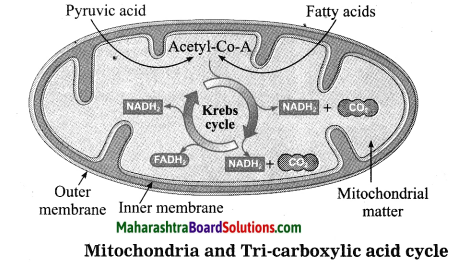
Class 10 Science Part 2 Chapter 10

Balbharti Maharashtra State Board Class 10 Science Solutions Part 2 Chapter 10 Disaster Management Notes, Textbook Exercise Important Questions and Answers.

Std 10 Science Part 2 Chapter 10 Disaster Management Question Answer Maharashtra Board

Class 10 Science Part 2 Chapter 10 Disaster Management Question Answer Maharashtra Board

Question 1.
Complete the table.
Maharashtra Board Class 10 Science Solutions Part 2 Chapter 10 Disaster Management 1
Answer:
Maharashtra Board Class 10 Science Solutions Part 2 Chapter 10 Disaster Management 2
Maharashtra Board Class 10 Science Solutions Part 2 Chapter 10 Disaster Management 3
Maharashtra Board Class 10 Science Solutions Part 2 Chapter 10 Disaster Management 4
Maharashtra Board Class 10 Science Solutions Part 2 Chapter 10 Disaster Management 5

Maharashtra Board Class 10 Science Solutions Part 2 Chapter 10 Disaster Management

Question 2.
Write notes.
a. Disaster Management Authority.
Answer:
Disaster Management Authority is the body that works at the level of government from national level to village level. This work is basically about management of any disaster and tackling the problems of the affected people. At National level there is National Disaster Management Authority for which the Prime Minister is the chairman. For every state there is State Disaster Management Authority, where the chief minister of every state is the chairman. Under the state level, there are district level units where district collector is responsible for disaster management and implementation of rehabilitation schemes. Below district level authority there are Taluka and then Village Disaster Management Committees.

The Tahsildar is the chairman for Taluka level while the Sarpanch of the village is responsible for management of disasters at village level. Collector of each district helps in planning, coordinating and controlling the implementation of rehabilitation programme and also gives essential instructions and reviews the entire system.

b. Nature of disaster management.
Answer:
Disaster management involves either prevention of disasters (Pre-disaster management) or creating preparedness to face them (Post-disaster management). The action plans are prepared for managing disasters. This is done after studying the different aspects such as preventive measures, rehabilitation and reconstruction plans. The disasters are tackled by executing action plans in the following steps: Preparation, redemption, preparedness, action during actual disaster, response, resurgence and restoration. At every level there are other voluntary organizations and Government meteorological institutions for their help.

c. Mock drill.
Answer:

  • Mock drill is the practice to check whether there is preparedness for dealing with the sudden attack of disaster.
  • For this purpose, virtual or apparent situations that simulate the disaster are created.
  • The reaction time for any type of disaster is checked by such activity. In the presence of trained personnel, the execution of the rescue plans are observed.
  • People also understand their responsibilities at the time of actual disaster.
  • The experts also check execution of plan designed for disaster redressal.
  • By such mock drills, the efficacy of the system can be understood. In future, when actual calamity strikes, there is already preparation for disaster redressal. Therefore, mock drill is useful.

d. Disaster Management Act, 2005.
Answer:
Government of India has made Disaster Management Act in 2005. The affected people are given all necessary help as per this act. With the humanitarian view, people are rehabilitated and helped them to come back to normalcy after the disaster.

As per this Act, National Disaster Response Force has been established. This force consists of 12 divisions in entire India which are attached with Indian Army. The headquarter is located in Delhi, but the action is taken all over the country with the help of army. As per the Act, in Maharashtra National Disaster Response Force is in action through State Reserve Polioe Force. The personnel of this force are trained accordingly, and they take part in the rescue work during different disasters.

Question 3.
Answer the following questions.
a. Explain the role of district disaster control unit after occurrence of any disaster.
Answer:
(1) District control unit looks after the ; disaster management of the district.
(2) It is immediately formed either after the impact of disaster or if warning is given about some upcoming disaster.

District-wise Disaster Control Unit performs following role:

  • The review of various aspects of disasters is done.
  • Through the disaster control unit there is continuous contact established with various agencies like army, air force, navy, telecommunication department, paramilitary forces, etc. for obtaining help.
  • The unit also coordinates with various voluntary organizations for their help in disaster management.

b. Give the reasons for increase in human disasters after the World War-II.
Answer:

  • After Second World War, the feelings of peace and brotherhood among the global citizens were lost. The geographic, religious, racial and ethnic differences sprang up tremendously.
  • Atrocities that Nazi has performed made deep impact on the minds of people. Terrorism, abduction, robberies and social unrest increased in almost all the countries.
  • The financial losses had incurred in the World War II. The misuse of science and technology was done to retrieve these deficits.
  • At the end of World War II, the atomic bombs were dropped in Japan. This has created health problems in the entire world.
  • Social inequality, economic disparity, racial and religious differences were some adversaries that created unrest in the country.
  • Later, the neighbouring nations kept on fighting. The geographical boundaries were changed. People always had feelings of insecurity. The terrorism flourished. All such instances gave rise to man-made disasters.

c. What are the objectives of disaster management?
(OR)
State any four objectives of disaster management. (March ’19)
Answer:
Objectives of disaster management:

  • To save human life from disasters. To help them for moving away from the place of disasters by rapid action.
  • To supply essential commodities to the affected people. This helps to reduce the gravity of disaster. People are given grains, water and clothes and other basic necessities under this objective.
  • To bring back the conditions of affected people to normalcy.
  • To rehabilitate the affected and displaced victims.
  • To think and execute the protective measures in order to develop capability to face the disasters in future.

d. Why is it essential to get the training of first aid? (July ’19)
Answer:
When there is a disaster, we need to immediately help the victim. Till the medical help arrives, one should be in position to treat the injured and save his or her life. In such cases; knowing first- aid is essential. Such kind of a need may arise in case of our parents, our siblings at home or with friends in school. Those who are injured should be treated at once. If we know about techniques of first aid, we can save such person before the medical help arrives. Therefore, it is essential to get the training of the first aid.

e. Which different methods are used for transportation of patients? Why?
Answer:
For the transportation of patients following methods are used:

  • Cradle method: This method is used for children and persons with less weight.
  • Carrying piggy back: This method is useful in carrying the unconscious persons.
  • Human crutch method: If one leg of the person is injured, then the victim is supported with minimum load on the other leg. This is called human crutch method.
  • Pulling or lifting method: For carrying an unconscious person for a short distance this method is used.
  • Carrying on four-hand chair: This method is used when the support is needed for a part below waist region.
  • Carrying on two-hand chair: Patients that cannot use their hands but can hold their body upright, are carried by such method.
  • Stretcher: By making temporary stretcher in case of emergency, the unconscious patient can be moved. Such temporary stretchers are made by using bamboos, blanket, etc.

Maharashtra Board Class 10 Science Solutions Part 2 Chapter 10 Disaster Management

Question 4.
On the basis of the structure of disaster management authority, form the same for your school.
Answer:
Maharashtra Board Class 10 Science Solutions Part 2 Chapter 10 Disaster Management 6

Question 5.
Write down the reasons, effects and remedial measures taken for any two disasters experienced by you.
Answer:
Students are expected to write the answer based on their own experiences.

Question 6.
Which different aspects of disaster management would you check for your school? Why?
Answer:
For the pre-disaster management at school following aspects would be inspected.

  • Are the telephones 6f the school working properly?
  • Is there a first-aid box in each class?
  • Are there any basic medicines in the school?
  • Is the team ready for rescue of smaller children from lower classes?
  • Has monitor or prefect participated in a mock drill? Does he/she know about first aid?
  • Is the contact of parent representative available in emergency situations?
  • Is the Medical Officer/Doctor present on the school campus?
  • Is there enough drinking water and some dry snacks available in the school?
  • Are the staircases and corridors suitable for quick evacuation of the children?

Maharashtra Board Class 10 Science Solutions Part 2 Chapter 10 Disaster Management

Question 7.
Identify the type of disaster.
a. Terrorism.
Answer:
Man-made, intentional.
Due to the activities of terrorism, many innocent lives are lost. Many are seriously injured. Some become crippled for their entire life. Buildings, monuments, vehicles everything is completely destroyed. There is rift between different religions or sects. The peaceful atmosphere is disturbed. The entire society is under the constant fear of insecurity.

b. Soil erosion.
Answer:
Natural, geophysical, geological.
When the upper fertile layer of soil is lost, it becomes barren. The trees are uprooted. The fertility of the area is lost. The land becomes unsuitable for cultivation or farming. Due to wind, flowing water or grazing animals the naturally occurring soil erosion becomes hazardous for the environment.

c. Hepatitis.
Answer:
Natural, biological, animal-origin.
Hepatitis is a viral disease which spreads through the contaminated food and water. The outburst of epidemic of hepatitis is difficult to control. As in big cities the quality of road side food is often consumed, the spread of hepatitis is. fast. People suffer due to hepatitis.

d. Forest fire.
Answer:
Natural, biological, plant-origin.
Due to heat and wind, the dry grass and the shrubs catch fire in the forests, resulting in forest fires. Such rapidly spreading forest fire can finish the biodiversity within a very short span of time. It is difficult to extinguish the naturally lit forest fires. Many trees and other vegetation, animals and birds along with their habitats are destroyed due to forest fire. The smoke emanating causes the air pollution.

e. Famine.
Answer:
Natural, climatic.
Due to famine there is severe water scarcity. In absence of water, the fields and farms become barren as the crops cannot grow without water. There is shortage of food grains. The cattle dies due to want of water and grass. Local people have to migrate in search of food, water and shelter.

f. Theft.
Answer:
Man-made, intentional.
Theft causes economic loss for the one whose money or valuables are looted. The person who suffers the loss also undergo mental and emotional shock. Sometimes the thief may also cause physical harm. It may cost on life too.

Question 8.
Some symbols are given below. Explain those symbols. Which disasters may occur if those symbols are ignored?
Maharashtra Board Class 10 Science Solutions Part 2 Chapter 10 Disaster Management 7
Answer:
The above signs are warning symbols which should never be ignored.
The meaning of each is given below. They are giving warnings about explosive, inflammable, oxidizing, compressed gas, corrosive, toxic, irritant, environmentally hazardous and health hazard.

(1) Explosive: Some materials are explosive. While handling such materials care should be taken. We should not take anything that would cause fire leading to explosion. If explosion occurs, there would be a major disaster causing great loss of life and property. Thus if this sign is seen, great care has to be taken.

(2) Inflammable: Similar to explosive substances, the inflammable materials can also catch fire easily. Therefore, to warn people such sign is given on materials that can cause hazard by burning.

(3) Oxidizing: Some chemical substances are oxidizing. They carry out chemical reactions with a rapid speed. E.g. If potassium permanganate falls on the cloth, it starts the reaction on its C-C bonds. Due to such property of carrying out reactions, the cloths may catch fire. Therefore, oxidizing substances should be handled with care.

(4) Compressed: Compressed substances are filled under pressure in some container. If mishandled, they can come out of the container by bursting it open. This can cause some injuries.

(5) Corrosive: The corrosive substances are very reactive. The mere touch of corrosive substances can cause destruction of skin, eyes, respiratory passages, digestive organs, etc. rapidly. Just touching or smelling of such substances can cause major injury and thus warning sign of corrosive substance should never be ignored.

(6) Toxic: To taste a toxic substance or even to smell it, can lead to death. The packing of these substances are therefore marked as dangerous. They should be avoided as far as possible.

(7) Irritant: When skin or any delicate part of the body comes in contact with the irritant substance, it can cause harmful reaction. Especially, eyes, nasal mucosa and skin are affected by contact with corrosive substances.

(8) Environmentally hazardous: Many sub¬stances cause harm to the environment due to their toxicity. Air, water or soil can be polluted due to such pollutants. When environment is affected, ultimately these hazardous effects come back to human species. Therefore, such substances should be carefully used. Their use should be judicious and controlled.

(9) Health hazard: The substances that can cause hazard to our health should always be distanced from us. Such substances should not be kept in proximity. As far as possible they should be kept away and handled with great care if needed for any work. Materials marked with health hazard can cause severe toxicity.

Maharashtra Board Class 10 Science Solutions Part 2 Chapter 10 Disaster Management

Question 9.
Explain that why is it said like that?
a. Mock drill is useful.
Answer:

  • Mock drill is the practice to check whether there is preparedness for dealing with the sudden attack of disaster.
  • For this purpose, virtual or apparent situations that simulate the disaster are created.
  • The reaction time for any type of disaster is checked by such activity. In the presence of trained personnel, the execution of the rescue plans are observed.
  • People also understand their responsibilities at the time of actual disaster.
  • The experts also check execution of plan designed for disaster redressal.
  • By such mock drills, the efficacy of the system can be understood. In future, when actual calamity strikes, there is already preparation for disaster redressal. Therefore, mock drill is useful.

b. Effective disaster management makes us well prepared for future.
Answer:

  • Disaster can strike any time. The sudden disasters can be man-made with some bad intentions or may be accidental.
  • When natural calamity strikes suddenly with a huge impact, large scale devastation of property and general environment degradation occurs along with substantial mortality of people and animals.
  • Therefore, it is most appropriate to have the preparedness to reduce the impact of any future disasters.
  • We cannot control the onset of the natural disaster, but we can definitely reduce the harsh effects of the disaster by following disaster management plan.

Question 10.
Complete the following chart.
Maharashtra Board Class 10 Science Solutions Part 2 Chapter 10 Disaster Management 8
Answer:
Maharashtra Board Class 10 Science Solutions Part 2 Chapter 10 Disaster Management 9

Question 11.
Following are the pictures of some disasters. How will be your pre and post-disaster management in case you face any of those disasters?
Maharashtra Board Class 10 Science Solutions Part 2 Chapter 10 Disaster Management 10
Answer:
In the pictures given, following disasters are shown:
(1) Two groups of children are fighting with each other.
(2) There is gas leakage from the LPG cylinder.
(3) There is heavy downpour due to cloud bursting which has led to waterlogging in the town.
(4) There is cyclone causing a tornado. (Commonly called a twister)
Maharashtra Board Class 10 Science Solutions Part 2 Chapter 10 Disaster Management 11
Maharashtra Board Class 10 Science Solutions Part 2 Chapter 10 Disaster Management 12

Projects:

Project 1.
Demonstrate the activities shown on page no. 106 of Std. IX Science and Technology textbook in front of the students of other classes. Make a video clip and send it to others.

Project 2.
Form a group of students from your school to demonstrate the mock drill and demonstrate it in the school

Maharashtra Board Class 10 Science Solutions Part 2 Chapter 10 Disaster Management

Can you recall? (Text Book Page No. 109)

Question 1.
What is disaster?
Answer:
Disaster is the incidence that occurs suddenly causing heavy damage to life and property. The disaster can be man-made or due to natural reason.

Question 2.
Which disasters have you experienced in your area?
Answer:
On September 2019, there was a heavy downpour in Pune. This disaster has been experienced recently.
On 26th November 2008 there was attack at several places by the Pakistani terrorists. The stories about the deaths and damage caused by this disaster were seen in films and learnt about this from our elders.

Question 3.
What are the effects of that disaster on local and surrounding conditions?
Answer:
Due to a heavy downpour in Pune, there was waterlogging in all the shallow areas. All the transport systems collapsed on that day. Large trees fell down injuring the people. The water logging caused condition like floods. Schools, colleges and offices were shut down. People were caught in troublesome situation.

On 26th November 2008 many innocent people lost their lives. There was tremendous damage caused to some of the important places like Taj Palace Hotel and Chabad house.

Use your brain power: (Text Book Page No. 111)

Question 1.
Depending upon information given on page 111, explain the various effects of the disaster of railway accident.
Answer:
The effects of disastrous railway accident:
The effect will be dependent upon the nature of the accident that has occurred. Whether, it is a collapse of bridge or due to derailment of the train, or due to collision of two moving trains, whether it is due to failure in signaling system, due to land slide or due to obstacle in the tunnel, that has to be understood. The impact of such railway accident will be dependent on the way that accident has occurred. Based on this impact the effects will take place.

(1) Environmental The entire surroundings will show destruction.
(2) Administrative/ Managerial The railway department will have stress and the time table will collapse. The regular use of tracks will hamper, resulting into delay in railway traffic.
(3) Political Ministry of railways is considered to be responsible for the accident. Sometimes the Railway Minister resigns.
(4) Medical The passengers commuting in the train die or suffer from serious injuries.
(5) Economic The railways suffer huge financial loss.
(6) Social The railway traffic is disturbed. Passengers are troubled as they get held up at some place.

Observe/Discuss:
Let’s Discuss: (Text Book Page No. 110)
Question 1.
observe the images on textbook page no. 110. whether the places of disasters are known to you? Discuss the emfects of these disasters on public lire. How people could lave been saved from these disasters? Discuss with your friends in the classroom.
Answer:
Students should discuss the disasters given in the pictures by themselves after collecting the information.

Maharashtra Board Class 10 Science Solutions Part 2 Chapter 10 Disaster Management

Observe: (Text Book Page No. 114)

Question 1.
Observe the disaster cycle given below and explain each aspect of the disaster of earthquake.
Answer:
The main aspects of disaster cycle to tackle disaster of earthquake are as follows:
(1) Preparation : With the help of seismograph, the warning about forthcoming earthquake can be obtained these days. The intensity of the earthquake is also predicted with the help of technology. If the estimate of the Richter scale is on the higher sides, there would be more preparatory measures taken to tackle the forthcoming problem of earthquake.

(2) Redemption: Once this information is obtained the possible impact of the earthquake on the houses, buildings, people can be studied by the geological experts. The meetings of the Disaster Management Authority will be organized for same.

(3) Preparedness: What the general public should do and what action the reserved forces should take, will be decided in case of actual incidence of the earthquake. The schemes and plans will be made ready in this direction.

(4) Impact of Earthquake: In case of disaster of earthquake, people will be helped to safety. The trapped people will be rescued. First aid and other necessary help will be provided. The data about the losses and the intensity of this disaster will be noted and reported for the further process.

(5) Response: In this phase the response of the people as well as the action of Government can be well studied. The response should be quick and positive. The maximum lives and property should be saved by such responses. The disaster of earthquake should be managed with positivity and through help given to the sufferers.

(6) Resurgence: Earthquakes can destroy the entire households or even entire community. Such homeless people should be given the place to stay. Resurgence is important phase for the national welfare. If the citizens of India are cared for, the nation too will progress.

(7) Restoration: The earthquake victims should be settled by providing them with new settlements. Sometimes, entire village is to be settled. E.g. In Latur or Kutch, there twas very large scale devastation. But Government of India as well as some NGOs helped to reconstruct the houses. In such earthquake-prone areas, houses are built in specific pattern to withstand any possible future calamities.

Observe: (Text Book Page No. 117)

Question 1.
Give the reference of following pictures and explain importance of each of those in disaster management. Which are other such activities ?
Maharashtra Board Class 10 Science Solutions Part 2 Chapter 10 Disaster Management 13
Answer:
The actions shown in the above pictures are as follows:
(a) The patient is made to lie on the stretcher. He must be unconscious and injured to greater extent, so that he cannot move by himself.
(b) The patient is helped by giving artificial respiration. Probably the victim is suffocated and needs oxygen supply.
(c) and (d) The patient is being picked up. Most probably the patient is unconscious.
The unconscious person who cannot move by himself is carried by these two methods. In method ‘c’, the weight of the patient is less and hence he can be lifted as shown in the picture. In picture ‘d’ the victim has to be lifted in other way, may be due to his greater body weight.
(e) The patient is carried on the back as in ‘carrying piggy back’ position. He too is unconscious and needs to be shifted for medical treatment.
(f) The patient in this picture is carried by ‘human crutch method’. When victim’s one leg is injured, he cannot walk without support. Hence, he needs to be carried in such a way.

In all the above methods, the injured person at the time of disaster is transported to hospital or dispensary for further medical help. The primary first-aid is given to the victim. Now the volunteer is taking him for further treatment. Such rescue activities depend upon the type of disaster and the extent of the injury. Hence the methods will be of different nature.

Maharashtra Board Class 10 Science Solutions Part 2 Chapter 10 Disaster Management

Let’s Think: (Text Book Page No. 111)

Question 1.
What will be the effect on yourself and surrounding, if any accident-like disaster occurs during the sports on playground or in school?
Answer:
When in school, there is an accident, first of all we get scared. But with caring help of the teacher, we will give the first aid to the injured friends by using first aid kit. If the injury is serious, we will take him to the medical centre of the school. While playing or during sports event, children flock around and make unnecessary crowding. In case of such accident, first of all the crowd will have to be dispersed. If there is major disaster, one should not fumble but manage the disaster in a wise way with the help of teachers.

Let’s Think: (Text Book Page No. 112)

Question 1.
Explain the nature and scope of the disaster of flood with the help of six points given on text book page no. 112.
Answer:
The nature and the scope of the disaster of flood can be described according to the six points:
(1) Pre-disaster phase: Due to Indian Meteorological Department the warning predictions are received before any climatic disaster strikes. If the scope of the flood is predicted to be high, then the people who may be affected by the calamity are relocated to a safer area.

(2) Warning phase: In the warning phase the Government warns the general public about the forthcoming disaster of floods through mass media like radio, television, newspapers, etc. In recent times, even the cellphone messages are sent to people for warning them. The people living in coastal areas will be worst affected and hence such people are given greater care and they are immediately made to leave their houses. They are taken to the safe places.

(3) Emergency phase: When the flood waters actually start rising up, the low-lying areas are submerged. Houses, roads and shops everything goes under water. The rescue operations are carried out by army men from National Disaster Rescue Force. They take every possible effort to rescue the trapped people. The emergency continues till the water does not recede. Later after the water starts receding, people who had been taken to places on heights, start coming back. During this phase, search, rescue operations, medical treatment, and first aid are all the aspects on which the attention is focussed.

(4) Rehabilitation phase: The people affected due to floods are given emotional and financial support. The fields, farms, houses or cattle-shed are under water. Such people are given transient accommodations. Many cattle and other animals die by drowning. Their rotting carcasses have to be disposed as soon as possible because the decaying process spreads epidemics of diseases. People are given vaccinations to protect them from diseases of such kind. Special care of young children and senior citizens is taken during this period. Supply of food and drinking water is also very important task during this time.

(5) Recovery phase: During recovery phase, the life comes gradually back to normalcy. The removal of dead, decaying material and the debris is the first priority. The water connections and electricity is restored back. Various NGOs or Government organizations provide help of various kind to the affected people. This help is to be distributed to those who are in real need. This work is also done by Disaster Management Department.

(6) Reconstruction phase: The houses and building that collapse due to floods are built back. Agricultural activities start again. Roads and water supply is once again normalized. Schools and colleges start once again. Thus, the once flood affected area comes back to routine functioning again.

Let’s Think: (Text Book Page No. 117)

Question 1.
Following are some pictures of disasters. Which precautions would you take during those disasters?
Maharashtra Board Class 10 Science Solutions Part 2 Chapter 10 Disaster Management 14
Answer:
The pictures shown above are showing earthquake, fire and snake bite respectively.
In the above disasters, the initial precautions to be taken are as follows:
(1) Earthquake: In case of earthquake, one should immediately come out of house and stand in the open ground. If this is not possible, one has to go below table or any other cover. During collapse of the building, there should not be a head injury. This precaution is basically for prevention of dangerous injuries and saving our life. Switch off the power supply. If in journey, stay inside the vehicle.

(2) Fire: First and foremost is to save ourselves from fire. Then one can help others in rescue operations. Help others to extinguish fire. Call the fire department for immediate action.

(3) Snake bite: Many a times the biting snake can be non-venomous too. But the victim is psychologically affected too. The tourniquet should be tied in the region above the snake bite. The rope, piece of cloth or even handkerchief can be used for this purpose, so that the venom, if any should not rise and reach vital organs. The wound should be made near the bite-wound so that the blood will ooze out and some venom can automatically flow out. Though these are first-aid measures, the victim should be rushed to a qualified doctor for an injection of antivenin.

Choose the correct alternative and write its alphabet against the sub-question number:

Question 1.
Disasters definitely affect the ………… of the nation.
(a) people
(b) economy
(c) security
(d) employment
Answer:
(b) economy

Question 2.
If local ………… is not strong enough, citizens become confused.
(a) leadership
(b) women
(c) politicians
(d) cattle
Answer:
(a) leadership

Question 3.
…………… problems arise diming the disaster.
(a) Local
(b) Global
(c) Administrative
(d) Private
Answer:
(c) Administrative

Question 4.
Stinking pollution caused due to decomposing corpses of humans and other animal is ………… disaster.
(a) environmental
(b) health
(c) necessary
(d) effective
Answer:
(a) environmental

Maharashtra Board Class 10 Science Solutions Part 2 Chapter 10 Disaster Management

Question 5.
After the subsidence of any type of disaster, rehabilitation work is started in ………… phase.
(a) later
(b) transitional
(c) terminal
(d) ultimate
Answer:
(b) transitional

Question 6.
…………. phase is highly complicated phase.
(a) Reconstruction
(b) Recycling
(c) Reuse
(d) Redevelopment
Answer:
(a) Reconstruction

Question 7.
There had been a huge ……….. in the village Malin, Tal. Ambegaon in 2014.
(a) earthquake
(b) storm
(c) landslide
(d) change
Answer:
(c) landslide

Question 8.
The atomic energy plant at Chernobyl was used only for generating ………….
(a) electricity
(b) solar power
(c) atomic energy
(d) agriculture
Answer:
(a) electricity

Question 9.
Supply of essential ………….. to the affected people can reduce the effect of the disaster.
(a) food
(b) water
(c) commodities
(d) money
Answer:
(c) commodities

Question 10.
Keeping …………. ready is a practice to check the preparedness of facing the disaster.
(a) First aid
(b) Mock drill
(c) Ambulance
(d) Fire brigade
Answer:
(b) Mock drill

Question 11.
Which of the following is man-made disaster. (March, July ’19)
(a) Earthquake
(b) Flood
(c) Meteor
(d) Leakage of toxic gases
Answer:
(d) Leakage of toxic gases

Question 12.
What should be done if gas cylinder at your house catches fire?
(a) Water should be sprinkled
(b) Sand, soil should be put on it
(c) Cylinder should be covered with wet blanket
(d) one should run away
Answer:
(c) Cylinder should be covered with wet blanket

Which type of disaster is described in the following statements:

Question 1.
On 26th July 2005, entire suburban Mumbai was waterlogged.
Answer:
Cloudbursting and severe downpour

Question 2.
Elephants in the Bandipur forest started running helter and skelter due to smoke.
Answer:
Forest fires

Question 3.
Many innocent people died in the bomb blast that occurred on 11th July 2006 in local trains.
Answer:
Bomb explosion-Terrorism

Question 4.
In Kutch, suddenly many school children were buried under the rubble.
Answer:
Earthquake

Maharashtra Board Class 10 Science Solutions Part 2 Chapter 10 Disaster Management

Question 5.
Because of lack of crops, people from Vidarbha are migrating to other regions.
Answer:
Dry famine

Question 6.
The huge waves in Chennai engulfed many human lives in December 2004.
Answer:
Tsunami.

Find the correlation:

Question 1.
Earthquake in recent times : Gujarat, Latur : : Devastating floods in 2018 : ………….
Answer:
Earthquake in recent times : Gujarat, Latur : : Devastating floods in 2018 : Kerala/Assam

Question 2.
Toxic gas leakage: Accidental disaster : : war : …………..
Answer:
Toxic gas leakage: Accidental disaster : : war : Intentional

Question 3.
Sun spots : Atmospheric type of disaster : : Salinization : …………..
Answer:
Sun spots : Atmospheric type of disaster : : Salinization : Geological type of disaster

Question 4.
Pre-disaster management : Preparation and warning : : Post-disaster management : ………..
Answer:
Pre-disaster management : Preparation and warning : : Post-disaster management : Resurgence and restoration.

Match the columns:

Question 1.

Column A: Disaster Column B: Type
(1) Earthquake and volcano (a) Animal origin
(2) Snowfall and snowstorms (b) Geological
(c) Climatic
(d) Terrorism

Answer:
(1) Earthquake and volcano – Geological.
(2) Snowfall and snowstorms – Climatic.

Maharashtra Board Class 10 Science Solutions Part 2 Chapter 10 Disaster Management

Question 2.

Column A: Disaster Column B: Type
(1) Aquatic weeds (a) Animal origin
(2) Attack by locusts (insects) (b) Plant origin
(c) Geological
(d) Climatic

Answer:
(1) Aquatic weeds – Plant origin
(2) Attack by locusts (insects) – Animal origin.

Question 3.

Column A: Disaster Column B: Type
(1) Atomic tests (a) Intentional
(2) Terrorism (b) Unintentional
(c) Geological
(d) Animal origin

Answer:
(1) Atomic tests – Unintentional
(2) Terrorism – Intentional.

Question 4.

Column A: Effect Column B: Effect
(1) Contamination of water (a) Economical
(2) Collapsing of transport system (b) Environmental
(c) Administrative
(d) Geological

Answer:
(1) Contamination of water – Environmental
(2) Collapsing of transport system – Administrative.

Question 5.

Column A: Effect Column B: Problem
(1) Spread of epidemics (a) Economical
(2) Shortage of funds (b) Administrative
(c) Medical
(d) Physical

Answer:
(1) Spread of epidemics – Medical
(2) Shortage of funds – Economical.

Question 6.

Column A: Effect Column B: Problem
(1) Rift due to religions (a) Economical
(2) Citizens getting confused (b) Social
(c) Political
(d) Environmental

Answer:
(1) Rift due to religions – Social
(2) Citizens getting confused – Political.

Identify the type of disaster and describe the effects of the same in brief:

Question 1.
Accident at Chernobyl.
Answer:
Man-made, unintentional. At Chernobyl in Russia there was the atomic energy plant, where disastrous accident took place. The radiations emitted through the reactors caused tremendous radiation pollution. These hazardous effects are even seen today.

Give reasons:

Question 1.
When there are riots, the cities, towns or villages show signs of tense atmosphere.
Answer:

  • During riots, there is financial loss for all the rioting groups.
  • The belongings, houses, shops, etc. are destroyed or damaged.
  • Property is looted. There is no guarantee of safety and security for anyone.
  • Women and children suffer the most as they are easily victimized. Therefore, when there are riots, the cities, towns or villages show signs of tense atmosphere.

Answer the following questions in detail:

Question 1.
which are the disaters that make Impact for longer duration? Give examples.
Answer:
Those disasters that make the impact for long duration and those disasters, whose after-elfbcts are either severe are long term disasters. Their severity increases with thme. Such disasters are famine, various problems of growth of crop, strikes of workers, rising levels of oceans, desertification, etc.

Question 2.
What types of disaster are the following? Explain their impacts.
(a) Floods (b) War. (Board’s Model Activity Sheet)
Answer:
(a) Flood is geophysical climatic disaster.
(b) War is man-made intentional disaster.

Impact of flood : The low-lying and the coastal areas are seen to be submerged. The entire region is waterlogged.
Impact of war: Tremendous destruction causing loss. Many lives are lost. The costs of all the items rise due to war conditions. Entire nation faces insecurity.

Maharashtra Board Class 10 Science Solutions Part 2 Chapter 10 Disaster Management

Question 3.
Explain in brief the sensitive issues of general public about disaster.
(OR)
Which are the three aspects of disaster tjiat are important for common citizens?
Answer:
The phase of emergency, transitional phase and reconstruction phase are the three phases of disaster that are important for common citizens.

(1) Phase of emergency: If timely and rapid action is taken during this phase, maximum lives can be saved. Search and rescue operations, medical help, first aid, restoring communication services, removing the people from affected area are done during this phase. The gravity of disaster can be estimated during this phase.

(2) Transitional Phase: The disaster subsides and then the work of transitional phase starts. The main concern is rehabilitation work for the affected and displaced people. This work includes clearing of debris, restoring water supply, repairing roads, etc. to bring normalcy in public life. Help from different voluntary and Government institute is taken to offer the monetary provision and essential commodities to affected victims. Permanent means of livelihood is given to the people to reduce their mental and emotional stress. The victims are truly rehabilitated.

(3) Reconstruction Phase: Reconstruction phase is a highly complicated phase which actually overlaps with transition stage. Help is offered to people to reconstruct their buildings. Other facilities like roads and water supply are restored. Farming practices are restarted. It is a very gradual phase that makes the victims to completely rehabilitate.

Question 4.
What are the objectives of mock drill?
Answer:
Objectives of Mock Drill:

  • To evaluate the response of the people to the disaster.
  • To improve the coordination between various departments of disaster control.
  • To identify one’s own abilities if disaster approaches.
  • To improve the ability to quick response to disaster and taking rapid action.
  • To check the competency of the planned actions.
  • To identify the possible errors and risks while dealing with disasters.

Question 5.
Write down the names of international organizations that work for disaster management.
Answer:
Following international organizations work for disaster management.

  • United Nations Disaster Relief Organization
  • United Nations Centre for Human Settlements
  • Asian Disaster Reduction Centre.
  • Asian Disaster Preparedness Centre.
  • World Health Organization.
  • United Nations Educational, Scientific and Cultural Organization.

Question 6.
The building in which you are residing ( has caught fire on the ground floor. What necessary rescue steps will you take? (July ’19)
Answer:

  • We shall call out for help.
  • We shall immediately call fire brigade.
  • We shall try to extinguish fire with the help of other people.
  • We will give first aid to people who are injured, fill the medical help arrives.
  • We will cover our nose and mouth with moist cloth to prevent suffocation.

Write short notes:

Question 1.
Pre-disaster management.
Answer:
The management measures taken before onset of a disaster is called pre-disaster management.
In pre-disaster management, complete preparation and planning to face any type of disaster is done. For this purpose, following steps are taken.

  • Identifying the areas where the disaster can strike. Such disaster-prone areas are to be thoroughly studied.
  • Through predictive intensity maps and hazard maps, the information is collected about the intensity of disaster and probable sites of disasters respectively.
  • Special training for disaster management is given to the concerned people.
  • The mass awareness is created about disaster management through training programmes, mass media and internet, etc.

Maharashtra Board Class 10 Science Solutions Part 2 Chapter 10 Disaster Management

Question 2.
Post-disaster management.
Answer:
The management measures taken after the striking of a disaster is called post-disaster management.
Following steps are taken during post-disaster management:

  • Helping the victims of disasters by giving all possible help needed for their survival.
  • Local people are trained to take part in the disaster management so that affected people can be saved rapidly.
  • Establishing the help centres that could provide all the necessary help. Such centres will be different in case of different disasters.
  • Collection and categorization of the material received from control centre for helping the victims. Distributing the same and reviewing the measures continuously.
  • Disaster rescue programmes are mainly focused.

Some symbols are given below. Explain those symbols. Which disasters may occur if those symbols are ignored?

Question 1.
Write what the signs indicate:
Maharashtra Board Class 10 Science Solutions Part 2 Chapter 10 Disaster Management 15
Answer:

  • Figure A indicates inflammable substances. They can catch fire if they come in contact with oxygen-rich air.
  • Figure B indicates corrosive substances which can cause damage to tissues of skin, eyes and other delicate organs etc.
  • Both the symbols are warning signs for people to keep away or handle carefully such substances.

Maharashtra Board Class 10 Science Solutions Part 2 Chapter 10 Disaster Management

Question 2.
What does the symbols below indicate? Write in brief. (Board’s Model Activity Sheet)
Maharashtra Board Class 10 Science Solutions Part 2 Chapter 10 Disaster Management 16
Answer:
(1) Symbol ‘A’ indicates Irritant. When skin or any delicate part of the body comes in contact with the irritant substance, it can cause harmful reaction. Especially, eyes, nasal mucosa and skin are affected by contact with corrosive substances.
(2) Symbol ‘B’ indicates toxic substance. To taste a toxic substance or even to smell it, can lead to death. The packing of these substances are therefore marked as dangerous. They should be avoided as far as possible.

Complete the paragraph by choosing the appropriate words given in the brackets:

(Capability, Rehabilitation, Commodities, Human, objectives, normalcy, amusements)
The ………. of disaster management comprise of the following aspects …………. life is saved from the disasters. People are helped to move away from the place of disasters. They are given essential ……….. by the government so that the gravity of disaster is reduced. The disaster conditions are brought back to ………… of the affected and displaced victims is done. Moreover, protective measures for future are also planned to develop ………… among the people to face any possible disasters in future.
Answer:
The objectives of disaster management, comprise of the following aspects. Human life is saved from the disasters. People are helped to move away from the place of disasters. They are given essential commodities by the government so that the gravity of disaster is reduced. The disaster conditions are brought back to normalcy. Rehabilitation of the affected and displaced victims is done. Moreover, protective measures for future are also planned to develop capability among the people to face any possible disasters in future.

Paragraph based questions:

1. Read the paragraph and answer the questions given below:
Disasters can be properly classified into three categories, viz. natural disasters, technological disasters and man-made disasters. The forces that cause natural disasters cannot be controlled. Moreover, they are becoming more frequent in the current years due to phenomena of climate change. On and off incidences of cyclones, cloud bursting, floods, etc. am creating havoc in the lives of people. Technological disasters are due to improper and callous behaviour at the different processes carried out in technical establishments. Man-made disasters are conflicts arising due to different religions, regions and-terrorism.

Questions and Answers:

Question 1.
What are three broad areas of disasters?
Answer:
Natural disasters, technological disasters and manmade disasters are three broad areas of disasters.

Question 2.
Which disasters cannot be controlled? Why?
Answer:
Natural disasters cannot be controlled as they are due to natural phenomena beyond the human power to stop them.

Question 3.
Which type of disasters were very common in Western Maharashtra in recent times? Why?
Answer:
Cloud bursting and floods were very common in Western Maharashtra caused due to climate change.

Question 4.
Give any one example of technological disaster that shook the entire India.
Answer:
Bhopal gas tragedy that occurred in 1984 was a worst disaster that shook the entire India.

Question 5.
Which types of disasters can be controlled in order to lead happy, peaceful and secured life? How?
Answer:
We have to control manmade disasters such as wars, riots, terrorism, etc. by having peaceful negotiations, respect for each human being and feeling of brotherhood among all.

Maharashtra Board Class 10 Science Solutions Part 2 Chapter 10 Disaster Management

Questions based on tables and charts:

Question 1.
Complete the chart: (Text Book Page No. 111)
Different problems occur with disasters. In the concept map different effects are mentioned. Read it and fill the blank places.
Answer:
(Answers are given directly in bold.)
Maharashtra Board Class 10 Science Solutions Part 2 Chapter 10 Disaster Management 17

Question 2.
Complete the chart: (Text Book Page No. 117)
Complete the chart as per the objectives of the first aidr:t
Answer:
(Answers are given directly in bold.)
Maharashtra Board Class 10 Science Solutions Part 2 Chapter 10 Disaster Management 18

Activity based questions:

Question 1.
Observe the images ‘A’ and ‘B’ and answer the following questions.
Maharashtra Board Class 10 Science Solutions Part 2 Chapter 10 Disaster Management 19
(i) Which disasters are shown in the images ?
Answer:
Image A is showing damage due to earthquake. Image B is showing house on fire.

(ii) Which primary precautions will you take in case of disaster shown in ‘A’?
Answer:
In the above disasters, the initial precautions to be taken are as follows :
Earthquake: In case of earthquake, one should immediately come out of house and stand in the open ground. If this is not possible, one has to go below table or any other cover. During collapse of the building, there should not be a head injury. This precaution is basically for prevention of dangerous injuries and saving our life. Switch off the power supply. If in journey, stay inside the vehicle.

(iii) Which type of first-aid is offered to the injured people in disaster ‘B’?
Answer:
First aid given to burn victim:

  • The person who is injured by fire should be dotised with cold water on his/her body. This will extinguish fire and give some relief caused due to inflammation. Do not break the blisters. Give water to drink.
  • Cover the burnt part by wet and moist cloth. Wash the wounds with antiseptic solution.
  • If the person is severely burnt, transfer him/her immediately to hospital.

Question 2.
Correct the following diagram:
Maharashtra Board Class 10 Science Solutions Part 2 Chapter 10 Disaster Management 20
Answer:
Maharashtra Board Class 10 Science Solutions Part 2 Chapter 10 Disaster Management 21

Maharashtra Board Class 10 Science Solutions Part 2 Chapter 10 Disaster Management

Projects:

Project 1.
Can you tell? ( Textbook page no. 118)
Whether there had been mock drill by fire fighters under the disaster management scheme in your school? Which techniques did you see during the drill?

Project 2.
Try this: (Textbook page no. 115)
Which factors will you consider while designing the pre-disaster management plan for your school/home? Prepare a survey report with the help of your teacher.

Project 3.
Get information:
(1) Visit the district collector or Taluka Tehasildar office and collect the information about disaster management. (Textbook page no. 115)
(2) Meet the medical officer/doctor from your village and collect information about providing the first aid. (Textbook page no. 118)

Project 4.
Internet is my friend:
(1) Search for the video clips of disasters. Discuss in your class about effects of disasters and remedies over it. (Textbook page no. 110)
(2) Find out more about the activities of international organizations that work for disaster management.
(Textbook page no. 116)
1. United Nations Disaster Relief Organization.
2. United Nations Centre for Human Settlements.
3. Asian Disaster Reduction Centre.
4. Asian Disaster Preparedness Centre.
5. World Health Organization.
6. United Nations Educational, Scientific and Cultural Organization.

10th Std Science Part 2 Questions And Answers:

Periodic Classification of Elements Class 10 Questions And Answers Maharashtra Board
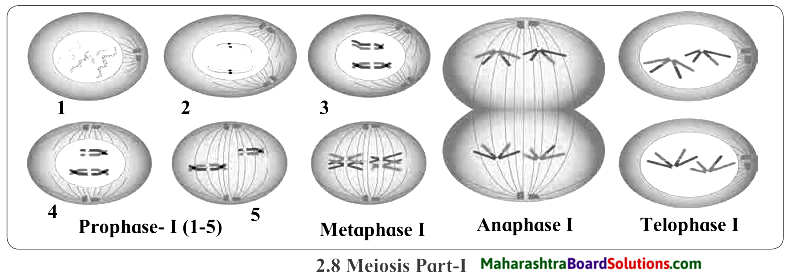
Class 10 Science Part 1 Chapter 2

Balbharti Maharashtra State Board Class 10 Science Solutions Part 1 Chapter 2 Periodic Classification of Elements Notes, Textbook Exercise Important Questions and Answers.

Std 10 Science Part 1 Chapter 2 Periodic Classification of Elements Question Answer Maharashtra Board

Class 10 Science Part 1 Chapter 2 Periodic Classification of Elements Question Answer Maharashtra Board

Periodic Classification Of Elements Question 1.
Rearrange the columns 2 and 3 so as to match with the column 1.

Column 1 Column 2 Column 3
i. Triad a. Lightest and negatively charged particle in all the atoms 1. Mendeleev
ii. Octave b. Concentrated mass and positive charge 2. Thomson
iii. Atomic number c. Average of the first and the third atomic mass 3. Newlands
iv. Period d. Properties of the eighth element similar to the first 4. Rutherford
v. Nucleus e. Positive charge on the nucleus 5. Dobereiner
vi. Electron f. Sequential change in molecular formulae 6. Moseley

Answer:

Column 1 Column 2 Column 3
i. Triad Average of the first and the third atomic mass Dobereiner
ii. Octave Properties of the eighth element similar to the first Newlands
iii. Atomic number Positive charge on the nucleus Moseley
iv. Period Sequential change in molecular formulae Mendeleev
v. Nucleus Concentrated mass and positive charge Rutherford
vi. Electron Lightest and negatively charged particle in all the atoms Thomson

Maharashtra Board Class 10 Science Solutions Part 1 Chapter 2 Periodic Classification of Elements

Periodic Classification Of Elements Class 10 Maharashtra Board Question 2.
Choose the correct option and rewrite the statement:
(a) The number of electrons in the outermost shell of alkali metals is…….
(a) 1
(b) 2
(c) 3
(d) 7
Answer:
(a) 1

(b) Alkaline earth metals have valency 2. This means that their position in the modern periodic table is in…….
(a) Group 2
(b) Group 16
(c) Period 2
(d) d-block
Answer:
(a) Group 2

(c) Molecular formula of the chloride of an element X is XCl. This compound is a solid having high melting point. which of the following elements be present in the same group as X.
(a) Na
(b) Mg
(c) Al
(d) Si
Answer:
(a) Na

(d) In which block of the modem periodic table are the nonmetals found?
(a) s-block
(b) p-block
(c) d-block
(d) f-block
Answer:
(b) p-block

Class 10 Science Chapter 2 Periodic Classification Of Elements Notes Question 3.
An element has its electron configuration as 2, 8, 2. Now answer the following questions.
a. What is the atomic number of this element?
Answer:
The atomic number of this element is 12.

b. What is the group of this element?
Answer:
The group of this element is 2.

c. To which period does this element belong?
Answer:
This element belongs to period 3.

d. With which of the following elements would this element resemble? (Atomic numbers are given in the brackets)
N(7), Be(4), Ar(18), Cl(17)
Answer:
This element resembles Be(4).

Class 10 Science 1 Chapter 2 Periodic Classification Of Elements Question 4.
Write down the electronic configuration of the following elements from the given atomic numbers. Answer the following question with explanation.

a. 3Li, 14Si, 2He, 11Na, 15P which of these elements belong to be period 3?
Answer:

Elements Electronic configuration
(i) 3Li 2,1
(ii) 14Si 2, 8,4
(iii) 2He 2
(iv) 11Na 2, 8, 1
(v) 15P 2, 8, 5

Elements belong to the 3rd period: 14Si, 11Na and 15P.

b. 1H, 7N, 20Ca, 16S, 4Be, 18Ar. Which of these elements belong to the second group?
Answer:

Elements Electronic configuration
(i)  1H 1
(ii) 7N 2, 5
(iii) 20Ca 2, 8, 8, 2
(iv) 16S 2, 8, 6
(v) 4Be 2, 2
(iv) 18Ar 2, 8, 8

Elements belongs to the 2nd group: 4Be and 20Ca.

c. 7N, 6C, 8O, 5B, 13Al Which is the most electronegative element among these?
Answer:

Elements Electronic configuration
(i) 7N 2,5
(ii) 6C 2,4
(iii) 80 2,6
(iv) 5B 2,3
(v) 13A1 2, 8,3

Among these, 8O is the most electronegative element.

d. 4Be, 6C, 8O, 5B, 13Al Which is the most electropositive element among these?
Answer:

Elements Electronic configuration
(i) 4Be 2, 2
(ii) 6C 2, 4
(iii) 8O 2, 6
(iv) B 2, 3
(v) 11Al 2, 8, 3

Among these, 13Al is the most electropositive element.

e. 11Na, 15P, 17Cl, 14Si, 12Mg which of these has largest atoms?
Answer:

Elements Electronic configuration
(i) 11Na 2, 8, 1
(ii) 15P 2, 8, 3
(iii) 17Cl 2, 8, 7
(iv) 14Si 2, 8, 4
(v) 12Mg 2, 8, 2

11Na has the largest atomic size.

f. 19K, 3li, 11Na, 4Be Which of these atoms has smallest atomic radius?
Answer:

Elements Electronic configuration
 (i) 19K 2, 8, 8, 1
(ii) 3Li 2, 1
(iii) 11Na 2, 8, 1
(iv) 4Be 2, 2

4Be has smallest atomic radius.

g. 13Al, 14Si, 11Na, 12Mg, 16S Which of the above elements has the highest metallic character?
Answer:

Elements Electronic configuration
(i) 13Al 2, 8, 3
(ii) 14Si 2, 8, 4
(iii) 11Na 2, 8, 1
(iv) 12Mg 2, 8, 2
(v) 16S 2, 8, 6

11Na has the highest metallic character.

h. 6C, 3Li, 9F, 7N, 8O Which of the above elements has the highest nonmetallic character?
Answer:

Elements Electronic configuration
(i) 6C 2, 4
(ii) 3Li 2, 1
(iii) 9F 2, 7
(iv) 7N 2, 5
(v) 8O 2, 6

9F has the highest non metallic character.

Maharashtra Board Class 10 Science Solutions Part 1 Chapter 2 Periodic Classification of Elements

Science 1 Chapter 2 Class 10 Maharashtra Board  Question 5.
write the name and symbol of the element from the description.
a. The atom having the smallest size.
Answer:
Helium(He).

b. The atom having the smallest atomic mass.
Answer:
Hydrogen(H2).

c. The most electronegative atom.
Answer:
Fluorine(F2).

d. The noble gas with the smallest atomic radius.
Answer:
Helium(He).

e. The most reactive nonmetal.
Answer:
Fluorine(F2).

Class 10 Science Chapter 2 Periodic Classification Of Elements  Question 6.
Write short notes.
a. Mendeleev’s periodic law.
Answer:
when the elements are arranged in the order of their increasing atomic masses, Mendeleev found that the elements with similar physical and chemical properties repeat after a definite interval. On the basis of these finding Mendeleev stated the periodic law. The physical and chemical properties of elements are a periodic function of their atomic masses.

b. Structure of the modern periodic table.
Answer:
(1) In the modern periodic table, the elements are arranged in the order of their increasing atomic number. In the modern periodic table there are seven horizontal rows called periods and eighteen vertical columns (1 to 18) called groups. The arrangement or the periods and groups results into formation of boxes. Atomic numbers are serially indicated in the upper part of these boxes.

(2) Each box represents the place for one element. Apart from these seven rows, there are two rows of elements placed separately at the bottom of the periodic table. They are lanthanides and actinides series. There are 118 boxes in the periodic table including the two series that means there are 118 places for elements in the modern periodic table.

The formation of a few elements was established experimentally very recently and thereby the modern periodic table is now completely filled with 118 elements.

(3) On the basis of the electronic configuration, the elements in the modern periodic table are divided into four blocks, viz. s-block, p-block, d-block and f-block. The s-block constitute groups 1 and 2. The groups 13 to 18 constitute the p-block. Groups 3 to 12 constitute the d-block, while the lanthanide and actinide series at the bottom form the f-block. The d-bloclçelements are called transition elements.

A zig-zag line shown in the p-block of the periodic table. This zig-zag line shows the three traditional types of elements, i.e. metals, nonmetals and metalloids. The metalloid elements lie along the border of zig-zag line. All the metals lie on the left side of the zig-zag line while all the nonmetals lie on the right side.

c. Position of isotopes in the Mendeleev’s and the modern periodic table.
Answer:
Isotopes were discovered long time after Mendeleev put forth the periodic table. A challenge was posed in placing isotopes in Mendeleev’s periodic table, as isotopes have the same chemical properties but different atomic masses. Isotopes do not find separate places in this table.

Moseley found out that atomic number is a fundamental property of an element rather than its atomic mass. The atomic number of any element is increased by one unit (number) from the atomic number or subsequent element. In the modern periodic table, the elements are arranged in the order of their increasing atomic numbers, that time the problem or discrepancy in the pairs or isotopes of elements observed in Mendeleev’s periodic table was solved. The isotopes or 17Cl35 and 17Cl37 were placed in the same group as both have the same atomic number.

Maharashtra Board Class 10 Science Solutions Part 1 Chapter 2 Periodic Classification of Elements

Periodic Classification Of Elements Class 10 State Board Question 7.
Write scientific reasons.
a. Atomic radius goes on decreasing while going from left to right in a period.
Answer:
(1) In a period while going from left to right, atomic radius goes on decreasing and the atomic number increases one by one, that means positive charge on the nucleus increases by one unit at a time.

(2) However, the additional electron is added to the same outermost shell. Due to the increased nuclear charge the electrons are pulled towards the nucleus to a greater extent, as a result the size of atom decreases i.e., atomic radius decreases.

b. Metallic character goes on decreasing while going from left to right in a period.
Answer:
(1) Metals have a tendency to lose the valence electrons to form cations. This tendency of an element is called the metallic character of the element.

(2) while going from left to right within a period the outermost shell remains the same and electrons are added to the same shell. However, the positive charge on the nucleus goes on Increasing while the atomic radius goes on decreasing and thus the effective nuclear charge goes on increasing. As a result of this the tendency of atom to lose electrons decreases, i.e., electropositivity decreases. Thus, metallic character goes on decreasing within a period from left to right.

c. Atomic radius goes on increasing down a group.
Answer:
The size of an atom is indicated by its radius. while going down a group a new shell is added. Therefore, the distance between the outermost electron and the nucleus goes on increasing. These electrons experience lesser pull from the nucleus. Thus, atomic radius goes on increasing down a group.

d. Elements belonging to the same group have the same valency.
Answer:
(1) The valency of an element is determined by the number of valence electron in the outermost shell of an atom of an element.

(2) All the elements in a group have the same number of valence electrons. Therefore, elements in the same group should have the same valency. For example, the elements of group I contain only one valence electron: the valency of elements of group I is one. Similarly for group II, the valency is two.

e. The third period contains only eight elements even through the electron capacity of the third shell is 18.
Answer:
(1) In the modern periodic table, there are seven horizontal rows called periods. In a periods elements are arranged in an increasing order of their atomic numbers. The third row contains 8 elements and the electron capacity of the third shell is 18.

(2) In the third period, while moving from left to right, atomic number increases, number of electrons increases in the shell. The number of elements present in 3rd period is decided on the basis of electronic configuration and octet rule.

Atomic number 11 12 13 14 15 16 17 18
Elements Na Mg Al Si P S Cl Ar

Argon (Ar) is the last element of the third period and has a capacity of maximum 18 electrons. Its octet of electrons is completed and as argon belongs to zero group, the third shell contains 18 electrons.

Periodic Classification Of Elements Exercise Question 8.
Write the names from the description.
a. The period with electrons in the shells, K, L and M.
Answer:
Third period.

b. The group with valency zero.
Answer:
Group 18.

c. The family of nonmetals having valency one.
Answer:
Halogen family.

d. The family of metals having valency one.
Answer:
Group 1.

e. The family of metals having valency two.
Answer:
Group 2.

f. The metalloids in the second and third periods.
Answer:
Boron, Silicon.

g. Nonmetals in the third period.
Answer:
Phosphorous, sulfur and chlorine and argon.

h. Two elements having valency 4.
Answer:
Carbon, silicon.

Maharashtra Board Class 10 Science Solutions Part 1 Chapter 2 Periodic Classification of Elements

Project:
Do it your self.
1. Find out the applications of all the inert gases, prepare a chart and display it in the class.
2. Find out the properties and uses of group 1 and group 2 elements.
3. Find out the properties and uses of period 2 and period 3 elements.

Can you recall? (Text Book Page No. 16)

Science 1 Chapter 2 Periodic Classification Of Elements Question 1.
What are the types of matter?
Answer:
The types of matter are solid, liquid, gas and plasma.

Class 10 Science Chapter 2 Periodic Classification Of Elements Exercise Question 2.
what are the types of elements?
Answer:
The types of elements are metals, nonmetals and metalloids.

Periodic Classification Of Elements Class 10 Solutions Question 3.
What are the smallest particles of matter called?
Answer:
The smallest particles are called atoms.

Periodic Classification Of Elements Question 4.
what is the difference between the molecules of elements and compounds?
Answer:

  1. Elements contain only one kind of atoms in the free state or combined state.
  2. An element cannot be decomposed into simple substances by any chemical reaction or simple physical process, e.g. copper, iron, oxygen.
  3. A compound is produced by a chemical reaction of two or more elements.
  4. The constituents of a compound can be separated by a chemical process, e.g. salt, water and sugar.

Can you tell? (Text Book Page No.16)

Identify Dobereiner’s triads from the following groups of elements having similar chemical properties:
(i) Mg (24.3), Ca (40.1), Sr (87.6)
(ii) S (32.1), Se (79.0), Te (127.6)
(iii) Be (9.0), Mg (24.3), Ca (40.1)
Answer:
Dobereiner’s triads
(i) S (32.1), Se (79.0), Te (127.6)
(ii) Be (9.0), Mg (24.3), Ca (40.1)

Use your brain power! (Text Book Page No. 20)

Class 10 Periodic Classification Of Elements Solutions Question 1.
write the molecular formulae of oxides of the following elements by referring to the Mendeleev’s periodic table. Na, Si, C, Rb, P, Ba, Cl, Sn.
Answer:

Elements Oxides of Elements
Na Na2O Sodium oxide
Si SiO2 Silicon oxide
C CO2 Carbon dioxide
Rb Rb2O Rubidium oxide(yellow solid)
P P2O5 Phosphorous pentaoxide
Ba BaO Barium oxide
Cl Cl2O Chlorine monoxide
Sn SnO2 Tin oxide(stannic oxide)

Maharashtra Board Class 10 Science Solutions Part 1 Chapter 2 Periodic Classification of Elements

Periodic Classification Of Elements Class 10 Question 2.
Write the molecular formulae of the compounds of the following elements with hydrogen by referring to the Mendeleev’s periodic table. C, S, Br, AS, F, O, N, Cl.
Answer:

Elements  Compounds (with hydrogen)
C CH4 Methane
S H2S Hydrogen sulphide
Br HBr Hydrogen bromide
As AsH3 Arsine
F HF Hydrogen fluoride
O H2O Water
N NH3 Ammonia
Cl HCl Hydrogen chloride

Can you tell? (Text Book Page No. 22)

Periodic Classification Of Elements Class 10 Question And Answers Question 1.
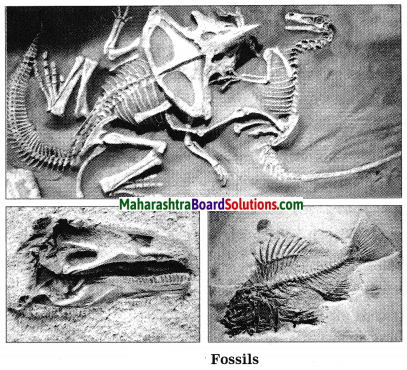
Go through the modern periodic table and write the names one below the other of the elements of group 1.
Answer:
Maharashtra Board Class 10 Science Solutions Part 1 Chapter 2 Periodic Classification of Elements 1

Periodic Classification Of Elements Class 10 Short Notes Question 2.
Write the electronic configuration of first four elements in this group.
Answer:

Elements Electronic configuration
Hydrogen 1
Lithium 2, 1
Sodium 2, 8, 1
Potassium 2, 8, 8, 1

Periodic Classification Of Elements Solutions Question 3.
Which similarity do you find in their configuration?
Answer:
The similarity is observed in valence electrons of these elements. The valence electron in these elements is one.

10th Science Part 1 Chapter 2 Periodic Classification Of Elements Question 4.
How many valence electrons are there in each of these elements?
Answer:
There is one valence electron in all these elements.

Can you tell? (Text Book Page No. 23)

Question 1.
On going through the modern periodic table it is seen that the elements Li, Be, B, C, N, O, F and Ne belong to the period-2. write down electronic configuration of all or them.
Answer:

Elements Electronic configuration
Li 2, 1
Be 2, 2
B 2, 3
C 2, 4
N 2, 5
O 2, 6
F 2, 7
Ne 2, 8

Question 2.
Is the number of valence electrons same for all these elements?
Answer:
The number of valence electrons is different for all these elements.

Maharashtra Board Class 10 Science Solutions Part 1 Chapter 2 Periodic Classification of Elements

Question 3.
Is the number of shells the same in these?
Answer:
The number of shells is the same.

Can you tell? (Text Book Page No. 24)

Question 1.
The elements in the third period, namely, Na, Mg, Al, Si, P, S, Cl and Ar have electrons in the three shells, K, L, M. Write down the electronic configuration of these elements.
Answer:

Elements K Shell L Shell M Shell Electronic configuration
Na 2 8 1 2, 8, 1
Mg 2 8 2 2, 8, 2
Al 2 8 3 2, 8, 3
Si 2 8 4 2, 8, 4
P 2 8 5 2, 8, 5
S 2 8 6 2, 8, 6
Cl 2 8 7 2, 8, 7
Ar 2 8 8 2, 8, 8

(Think about it) (Text Book Page No.19)

Question 1.
There are some vacant places in Mendeleev’s periodic table. In some of these places, the atomic masses are seen to be predicted. Enlist three of these predicted atomic masses along with their group and period.
Answer:

Atomic mass Group Period
44 III 4
72 IV 5
100 VII 6

Question 2.
Due to uncertainty in the names of some of the elements, a question mark is indicated before the symbol in the Mendeleev’s period table. What are such symbols?
Answer:
Symbols : Yt, Di, Ce, Er, La.

Use your brain power! (Text Book Page No. 19)

Question 1.
Chlorine has two isotopes, viz. cl-35 and Cl-37. Their atomic masses are 35 and 37 respectively. Their chemical properties are same. where should these be placed in Mendeleev’s periodic table? In different places or in the same place?
Answer:
The arrangement of elements is done on the basis of atomic mass. Since the atomic masses of chlorine (isotopes) are different i.e. 35 and 37, they should be kept in different places in Mendeleev’s periodic table.

Use your brain power! (Text Book Page No.21)

Question 1.
How is the problem regarding the position of cobalt (59CO) and nickel (59Ni) in Mendeleev’s periodic table resolved in modern periodic table?
Answer:
Mendeleev arranged the elements in their increasing order of atomic masses. But some elements with higher atomic masses are placed before those having lower atomic masses, e.g. cobalt (CO) with atomic mass 58.93 is placed before nickel (Ni) having atomic mass 58.71. Moderm periodic table was prepared on the basis of the atomic number of elements. The atomic number of CO is 27 and that of Ni is 28. So nickel is placed after cobalt.

Question 2.
How thd the position of \({ }_{17}^{35} \mathrm{Cl}\) get fixed in the modern periodic table?
Answer:
In Mendeleev’s periodic table, the difference between atomic masses of two consecutive elements is not the same 35Cl and 35Cl. Moseley found out the atomic number of the elements. The atomic number of any element is increased by one unit (number) from the atomic number of subsequent element.

Isotopes \({ }_{17}^{35} \mathrm{Cl}\) and \({ }_{17}^{37} \mathrm{Cl}\) occupy the same position in the modern periodic table. Both isotopes have the same atomic number.

In the modern periodic table, the elements are arranged in the order of their increasing atomic numbers, that the problem of discrepancy in the pairs of isotopes elements observed in Mendeleev’s periodic table was solved. The isotopes of \({ }_{17}^{35} \mathrm{Cl}\) and \({ }_{17}^{37} \mathrm{Cl}\) were placed in the same group as both have the same atomic number.

Question 3.
Can there be an element with atomie mass 53 or 54 in between the two elements, chromium \({ }_{24}^{52} \mathrm{Cr}\) and manganese \({ }_{25}^{55} \mathrm{Mn}\)?
Answer:
In Mendeleev’s periodic table, the difference between atomic masses of two consecutive elements is not the same (52Cr and 55Mn). Moseley found out the atomic number of the elements. The atomic number of any element is increased by one unit (number) from the atomic number of subsequent element. \({ }_{24}^{52} \mathrm{Cr} \rightarrow{ }_{25}^{55} \mathrm{Mn}\) that means in between two elements (Cr aind Mn), element with mass 53 or 54 do not exist.

Question 4.
what do you think? Should hydrogen be placed in the group 17 of halogens or group 1 of alkali metals in the modern periodic table?
Answer:
(1) Hydrogen is placed in group 1 and in group 17 as it resembles alkali metals as well as halogens. Thus, no fixed position was given to hydrogen in Mendeleev’s periodic table.

(2) On the other hand, hydrogen easily donates the electron and forms a stable cation (H+), but it does not easily form a stable anion (H), hydride ion. Hence, it is better placed in group 1 rather than in group 17 in the modern periodic table.

Use your brain power! (Text Book Page No. 24)

Question 1.
The elements in the second period : Li, Be, B, C, N, O, F and Ne have electrons in the two shells K and L. Write down the electronic configuration of these elements.
Answer:

Element Electronic configuration
K shell L shell
Li 2 1
Be 2 2
B 2 3
C 2 4
N 2 5
O 2 6
F 2 7
Ne 2 8 Octet complete

Question 2.
The elements in the third period: Na, Mg, Al, Si, P, S, Cl and Ar have electrons in the third shell K, L and M. write down the electronic configuration of these elements.
Answer:

Elements K Shell L Shell M Shell Electronic configuration
Na 2 8 1 2, 8, 1
Mg 2 8 2 2, 8, 2
Al 2 8 3 2, 8, 3
Si 2 8 4 2, 8, 4
P 2 8 5 2, 8, 5
S 2 8 6 2, 8, 6
Cl 2 8 7 2, 8, 7
Ar 2 8 8 2, 8, 8

Think about it (Text Book Page No. 24)

Question 1.
what is the relationship between the electronic configuration of an element and its valency?
Answer:
The valency of an element is determined by the number of electrons in the outermost shell.

Question 2.
The atomic number or beryllium is 4. while that of oxygen is 8. Write down the electronic configuration of the two and deduce the valency from the same.
Answer:

Element Atomic number Electronic configuration Valency
Beryllium 4 2, 2 2
Oxygen 8 2, 6 2

Question 3.
The table given below is based on modern periodic table. write in it the electronic configuration of the first 20 elements below the symbol and write the valency (as shown in a separate box)
Answer:
Group
Maharashtra Board Class 10 Science Solutions Part 1 Chapter 2 Periodic Classification of Elements 2

Question 4.
what is the periodic trend in the variation of valency while going from left to right within a period? Explain your answer with reference to period 2 and period 3.
Answer:
Maharashtra Board Class 10 Science Solutions Part 1 Chapter 2 Periodic Classification of Elements 3
(1) In a period, change in valency of an element varies electronic configuration. The number of valence electrons is different in these elements. However, the number of shells is the same.
(2) In a period, while going from left to right, the atomic number increases by one at a time and the number of valence electrons also increases by one at a time.
(3) In periods 2 and 3, while going from left to right, valency varies.

Elements Li Be B C N O F Ne
Valancy 1 2 3 4 3 2 1 0
Elements Na Mg Al Si P S Cl Ar
Valancy 1 2 3 4 3 2 1 0

Maharashtra Board Class 10 Science Solutions Part 1 Chapter 2 Periodic Classification of Elements

Question 5.
What is the periodic trend in the variation of valency while going down a group?
Explain your answer with reference to the group 1, group 2 and group 18.
Answer:
Maharashtra Board Class 10 Science Solutions Part 1 Chapter 2 Periodic Classification of Elements 4
(1) The valency of an element is determined by the number of valence electron in the outermost shell of an atom of an element.

(2) All the elements in a group have the same number of valence elements. Therefore, elements in the same group should have the same valency. For example, the elements of group 1 (H, Li, Na, K etc.) contain only one valence electron. the valency of elements of group 1 is one. Similarly for group 2, (Be, Mg, Ca) contain two valence electrons, the valency of elements of group 2 is two.

(3) The elements of group 18 1 (Ne, Ar) contain 8 electrons (exception, Helium contain 2 electrons). Since the octet is completed their valency is zero.

Use your brain power! (Text Book Page No. 25)

Element K Na Rb Cs Li
Atomic radius (pm) 231 186 244 264 152

Question 1.
By referring to the modern periodic table find out the groups to which above the elements belong.
Answer:
The above elements belong to group 1.

Question 2.
Arrange the above elements vertically downwards in an increasing order of atomic radii.
Answer:
The above elements arranged vertically downward in an increasing order or atomic radii:

Li Na K Rb Cs
152 186 231 244 262

Question 3.
Does this arrangement match with the pattern of the group 1 of the modern periodic table?
Answer:
This arrangement match with the pattern of the group 1 of the modern periodic table in an increasing order of atomic radii.

Question 4.
Which of the above elements have the biggest and the smallest atom?
Answer:
The biggest atom : Cs
The smallest atom : Li

Question 5.
What is the periodic trend observed in the variation of atomic radii down a group?
Answer:
while going down a group, atomic number increases, atomic radius increases. Therefore atomic size gradually increases.

Use your brain power! (Text Book Page No. 26)

Question 1.
Look at the elements of third period. Classify them Into metals and nonmetals.
Answer:
Third row: Na, Mg, Al, Si, P, S, Cl, Ar
Metals: Na, Mg, Al
Nonmetals: P, S, Cl, Ar

Question 2.
On which side of the period are the metals? Left or right?
Answer:
Left side of the period are the metals.

Question 3.
On which side of the period did you find the nonmetals?
Answer:
Right side of the period are the nonmetals.

(Use your brain power !) (Text Book Page No. 27)

Question 1.
What is the cause of non-metallic character of elements?
Answer:
The tendency of an element to form anion or electronegativity is the nonmetallic character of element.

Question 2.
what is the expected trend in the variation of nonmetallic character of elements from left to right in a period?
Answer:
In a period, as the atomic number increases from left to right, electronegativity increases, non-metallic character increases. This is due to a decrease in the atomic size.

Question 3.
What would be the expected trend in the variation of nonmetallic character of elements down a group?
Answer:
In a group as the atomic number increases, electropositivity increases while electronegativity decreases, nonmetallic character decreases.

Full in the blanks:

Question 1.
Using Dobereiner’s law of triads, find the missing number.
Maharashtra Board Class 10 Science Solutions Part 1 Chapter 2 Periodic Classification of Elements 5
Answer:
Using Dobereiner’s law or triads, the missing number is
Maharashtra Board Class 10 Science Solutions Part 1 Chapter 2 Periodic Classification of Elements 6

Question 2.
In the Mendeleev’s periodic table, properties of elements are periodic function of their ……..
Answer:
In the Mendeleev’s periodic table, properties of elements are periodic function of their atomic masses.

Question 3.
The vertical columns in the Mendeleev’s periodic table are called …….
Answer:
The vertical columns in the Mendeleev’s periodic table are called groups.

Question 4.
Eka-aluminium is called ……..
Answer:
Eka-aluminium is called gallium

Question 5.
Zero group elements are called ……..
Answer:
Zero group elements are called noble gases.

Question 6.
In the modern periodic table, the elements are the periodic functions of ……..
Answer:
In the modern periodic table, the elements are the periodic functions of atomic numbers.

Question 7.
The d-block elements are called ……..
Answer:
The d-block elements are called transition elements.

Question 8.
The group …….. contains the members of the halogen family.
Answer:
The group 17 halogen the members of the halogen family.

Question 9.
…….. is the distance between the nucleus of the atom and its outermost shell.
Answer:
Atomic radius is the distance between the nucleus of the atom and its outermost shell.

Question 10.
The number of electrons in an atom is equal to the same of ……..
Answer:
The number of electrons in an atom is equal to the same of atomic number.

Question 11.
Henry Moseley shows that the atomic number (Z) of an element corresponds to the positive charge on the nucleus or the number of ………
Answer:
Henry Moseley showed that the atomic number (Z) of an element corresponds to the positive charge on the nucleus or the number of protons.

Question 12.
The ……. block contains the group 1 and 2.
Answer:
The s-block contains the group 1 and 2.

Question 13.
The elements are arranged in such a way that …… are on left side of zig-zag line and …….. on the right side.
Answer:
The elements are arranged in such a way that metals are on left side or zig-zag line and nonmetals on the right side.

Maharashtra Board Class 10 Science Solutions Part 1 Chapter 2 Periodic Classification of Elements

Choose the correct option and rewrite the statement:

Question 1.
which of the following ti-lads does not follow Dobereirier’s law of triads?
(a) Li, Na, K
(b) Ca, Sr, Ba
(c) Be, Mg, Ca
(d) Cu, Ag, Au
Answer:
(d) Cu, Ag, Au

Question 2.
During Newlands time …….. elements were known.
(a) 56
(b) 65
(c) 63
(d) 36
Answer:
(a) 56

Question 3.
Halogens belong to group …….. in the modern periodic table.
(a) 15
(b) 16
(c) 17
(d) 18
Answer:
(c) 17

Question 4.
Noble gases belong to group …….. in modern periodic table.
(a) 15
(b) 16
(c) 17
(d) 18
Answer:
(d) 18

Question 5.
The law of octaves was given by ……..
(a) Dobereiner
(b) Newlands
(c) Mendeleev
(d) Moseley
Answer:
(b) Newlands

Question 6.
Eka-boron was subsequently named as ……..
(a) gallium
(b)germanium
(C) scandium
(d) molybdenum
Answer:
(C) scandium

Question 7.
The halogen which is liquid at room temperature is ………   (Practice 4ctivity Sheet — 3)
(a) fluorine
(b) astatine
(C) bromine
(d) iodine
Answer:
(C) bromine

Question 8.
……… is used in balloons and in scuba diving.
(a) Helium
(b) Oxygen
(c) Nitrogen
(d) Ozone
Answer:
(a) Helium

State whether the following statements are True or False. Rewrite the correct statement:

Question 1.
Newlands was the first to classify elements having similar chemical properties into groups
of three.
Answer:
False. (Dobereiner was the first to classify elements having similar chemical properties into groups of three.)

Question 2.
Dobereiner named the group of elements having similar properties as Triads.
Answer:
True.

Question 3.
Dobereiner stated the law of octet.
Answer:
False. (Doberemer stated the law of triads.)

Question 4.
Newlands stated the law of triads.
Answer:
False. (Newlands stated the law of octaves.)

Question 5.
Eka-aluminium was later named as germanium.
Answer:
False. (Eka-aluminium was later named as gallium.)

Question 6.
Mendeleev’s periodic table is more useful because it gives information about known and unknown elements.
Answer:
True.

Question 7.
Mendeleev arranged elements in the increasing order of their atomic masses.
Answer:
True.

Question 8.
Mendeleev was the first who successfully classified all known elements.
Answer:
True.

Question 9.
In the modern periodic table, properties of the elements are a periodic function of their atomic numbers.
Answer:
True.

Question 10.
The d-block elements are called transition elements.
Answer:
True.

Question 11.
There are 7 periods in the long form of the periodic table.
Answer:
True.

Question 12.
Elements are classified on the basis of their atomic numbers.
Answer:
False. (Elements are classified on the basis of their electronic configuration.)

Question 13.
The chemical properties of the elements in the same group show similarity.
Answer:
True.

Question 14.
Lanthanides and actinides are also called the d-block elements.
Answer:
False. (Lanthanides and actinides are also called the f-block elements.)

Question 15.
All the elements of a group have the same number of valence electrons.
Answer:
True.

Question 16.
In a period, atomic sizes increases from left to right.
Answer:
False. (In a period, atomic size decreases from left to right.)

Question 17.
In a period, the metallic character increases from left to right.
Answer:
False. (In a period. the metallic character decreases from left to right.)

Question 18.
In a group, the metallic character decreases from top to bottom.
Answer:
False. (In a group, the metallic character increases from top to bottom.)

Question 19.
The zig-zag line separates the metals from nonmetals in the periodic table i.e. metals are on the left side and nonmetals are on the right side.
Answer:
True.

Maharashtra Board Class 10 Science Solutions Part 1 Chapter 2 Periodic Classification of Elements

By observing the correlation in the first pair, complete the second pair:

Question 1.
Dobereiner : Triad : : Newlands law :………
Answer:
Octaves

Question 2.
Mendeleev’s periodic table : Atomic mass :: Modern periodic table :……..
Answer:
Atomic number

Question 3.
Group-1 : Alkali metals: :…….: Halogens.
Answer:
Group 17

Question 4.
Solid : Iodine : : …….. : Bromine.
Answer:
Liquid

Question 5.
Chlorine : 2, 8, 7 :: Fluorine : ……..
Answer:
2, 7

Question 6.
Horizontal row Periods : :…….: Groups.
Answer:
Vertical columns

Find the odd one out and give reasons:

Question 1.
Newlands, Moseley, Dobereiner, Mendeleev.
Answer:
Moseley. (Moseley brought out the importance of atomic number, while the other tried to classify the elements on the basis or atomic mass.)

Question 2.
Fluorine, Sulphur. Bromine, Iodine.
Answer:
Sulfur. (Others are halogens.)

Question 3.
Sodium, Aluminium, Chlorine, Carbon.
Answer:
Carbon. (Carbon belongs to the second row, while the others belong to the third row.)

Question 4.
Nitrogen, Neon, Argon, Helium.
Answer:
Nitrogen. (The others are inert gases.)

Maharashtra Board Class 10 Science Solutions Part 1 Chapter 2 Periodic Classification of Elements

Match the columns:

Question 1.

Column I Column II
(1) Modern periodic table (a) Group 17
(2) Vertical columns (b) Period 2
(3) Halogen (c) Atomic number
(4) Smallest period (d) Group
(e) Period 3

Answer:
(1) Modern periodic table – Atomic number
(2) Vertical columns Group
(3) Halogen – Group 17
(4) Smallest period – Period 2.

Question 2.

Column I Column II
(1) Dobereiner (a) Atomic number
(2) New lands (b) Triads
(3) Moseley (c) Atomic mass
(4) Mendeleev (d) Octaves
(e) Sodium

Answer:
(1) Dobereiner – Triads
(2) Newlands – Octaves
(3) Moseley – Atomic number
(4) Mendeleev – Atomic mass.

Question 3.

Column I Column II
(1) Eka-silicon (a) Scandium
(2) Eka-boron (b) Gallium
(3) Eka-aluminum (c) Germanium
(d) Cesium

Answer:
(1) Eka-silicon – Germanium
(2) Eka-boron – Scandium
(3) Eka-aluminium – Gallium.

Question 4.

Column I Column II
(1) Noble gas (a) 18 elements
(2) First period (b) Eight elements
(3 ) Second period (c) Two elements
(4) 3rd period (d) Helium
(e) Six electrons in the last orbit

Answer:
(1) Noble gas – Helium
(2) First period – Two elements
(3) Second period – Eight elements
(4) 3rd period – 18 elements.

Question 5.

Column I Column II
(1) s-block elements (a) Lanthanides and actinides
(2) p-block elements (b) Groups 1, 2
(3) d-block elements (c) Groups IIIA to VIIA and zero group
(4) f-block elements (d) Groups 3 to 12
(e) Zero group elements
(f) Groups 13 to 18

Answer:
(1) s-block elements – Groups 1, 2
(2) p-block elements – Groups 13 to 18
(3) d-block elements – Groups 3 to 12
(4) f-block elements – Lanthanides and actinides.

Question 6.

Column I Column II
(1) Helium (a) Alkali metal
(2) Horizontal row (b) Alkaline earth metal
(3) Group I (c) Period
(4) Group II (d) Zero group
(e) Metalloid

Answer:
(1) Helium – Zero group
(2) Horizontal row – Period
(3) Group I – Alkali metal
(4) Group II – Alkaline earth metal.

Write the names from the description:

Question 1.
The period with electrons In the shells K, L and M.
Answer:
Third period.

Question 2.
The group with valency zero.
Answer:
Group 18.

Question 3.
The family of nonmetals having valency One.
Answer:
Halogen family.

Question 4.
The family of metals having valency two.
Answer:
Group 2.

Question 5.
The metalloids in the second and third period.
Answer:
Boron, silicon.

Question 6.
The family of metals having valency one.
Answer:
Group 1.

Question 7.
Nonmetals In the third period.
Answer:
Phosphorus, sulfur and chlorine, and argon.

Question 8.
Two elements having valency 4.
Answer:
Carbon. silicon.

Maharashtra Board Class 10 Science Solutions Part 1 Chapter 2 Periodic Classification of Elements

Question 9.
First three noble gases.
Answer:
Helium, neon, and argon.

Name the following:

Question 1.
Horizontal rows In modern periodic table.
Answer:
Periods.

Question 2.
Two elements having a single electron in their outermost shell.
Answer:
Hydrogen, sodium.

Question 3.
Three elements with filled outermost shell.
Answer:

  1. Helium
  2. Neon
  3. Argon.

Question 4.
Three elements having 7 electrons in their outermost shell.
Answer:

  1. Fluorine
  2. Chlorine
  3. Bromine.

Question 5.
An alkali metal in period 2.
Answer:
Lithium.

Question 6.
An alkaline earth metal in period 3.
Answer:
Magnesium.

Question 7.
Halogen in period 3.
Answer:
Chlorine.

Question 8.
Three nonmetallic elements in period 2.
Answer:

  1. Nitrogen
  2. Oxygen
  3. Fluorine.

Question 9.
The element with electronic configuration (2, 7).
Answer:
Fluorine.

Question 10.
The elements in periods 2 and 3 having stable electronic configuration.
Answer:

  1. Neon
  2. Argon.

Question 11.
The three metals in the third period of the modern periodic table.
Answer:

  1. Sodium
  2. Magnesium
  3. Aluminum.

Answer the following questions: (Practice Activity Sheet – 3)
An element has its electron configuration as 2,8,8,2.

Question 1.
What is the atomic number of this element?
Answer:
The atomic number of this element is 20.

Question 2.
what is the group of this element?
Answer:
The group of this element is 2.

Question 3.
To which period does this element belong?
Answer:
The element belongs to period 4.

Answer the following questions in one sentence each:

Question 1.
In Dobereiner’s triad containing L, Na, K, if atomic masses of 1ithium and potassium are 6.9 and 39.1, then what will be the atomic mass of sodium? (Practice Activity Sheet – 3) (March 2019)
Answer:
The atomic mass of sodium is the average of the atomic masses or Li and K i.e., \(\frac{6.9+39.1}{2}\) = 23.

Question 2.
who was the first scientist to prepare the periodic table?
Answer:
Mendeleev was the first scientist to prepare the periodic table.

Maharashtra Board Class 10 Science Solutions Part 1 Chapter 2 Periodic Classification of Elements

Question 3.
State the number of groups and periods in the modern periodic table.
Answer:
There are 18 groups and 7 periods in the modern periodic table.

Question 4.
How many elements are there in the second and the third periods of the periodic table?
Answer:
There are eight elements in the second and the third periods of the periodic table.

Question 5.
State the number of elements in the shortest period.
Answer:
There are two elements in the shortest (first period) period.

Question 6.
State the number of elements in the modern periodic table.
Answer:
There are 118 elements in the modern periodic table.

Question 7.
which column is known as the zero group in the modern periodic table?
Answer:
The last column, i.e. 18th column on the right side of the modern periodic table is known as the zero group in the modern periodic table.

Question 8.
which group elements have seven electrons in the outermost shell?
Answer:
Group 17 elements have seven electrons in the outermost shell.

Question 9.
How many electrons are there in the outermost shell of group 2 elements?
Answer:
There are 2 electrons in the outermost shell of group 2 elements.

Question 10.
How many electrons are there in the outermost shell of group 18 elements?
Answer:
There are 8 electrons mn the outermost shell or group 18 elements, except He, which has 2 electrons.

Question 11.
which block or the modern periodic table separates metals and nonmetals with the help of zig-zag line?
Answer:
p-block of the modern periodic table separates metals and nonmetals with the help of zig-zag line.

Question 12.
Name an alkali metal in the second period.
Answer:
Lithium is an alkali metal in the second period.

Question 13.
Name the halogen in the second period.
Answer:
Fluorine is the halogen in the second period.

Question 14.
Name a metalloid in the third period.
Answer:
Silicon is a metalloid in the third period.

Question 15.
Name the group to which sodium and lithium belong.
Answer:
Sodium and 1ithium belong to group IA or the periodic table.

Question 16.
Name the group to which magnesium and calcium belong.
Answer:
Magnesium and calcium belong to group IIA of the periodic table.

Question 17.
Name the group to which the most reactive metals belong.
Answer:
The most reactive metals belong to group IA.

Question 18.
Name the element having one shell and one valence electron.
Answer:
Hydrogen has one shell and one valence electron.

Question 19.
How many valence electrons are there in the outermost shell of silicon?
Answer:
There are four valence electrons present in the outermost shell of silicon.

Question 20.
State the electronic configuration of nitrogen and phosphorus.
Answer:
Electronic configuration of nitrogen (N) : 2, 5.
Electronic configuration of phosphorus (P) : 2, 8, 5.

Question 21.
write the electronic configuration: 13Al (Practice Activity Sheet – 1)
Answer:
Electronic configuration of 13Al : 2, 8, 3

Question 22.
Name the group containing highly reactive nonmetals only.
Answer:
Group 17 contains highly reactive non-metals, namely, fluorine, chlorine, bromine, and iodine.

Question 23.
Name the last three elements of the second period in increasing order of atomic number.
Answer:
The last three elements of the second period in increasing order of atomic number are oxygen, fluorine, and neon.

Question 24.
Name the three nonmetals in the second period of the modern periodic table.
Answer:
The three nonmetals in the second period of the modern periodic table are nitrogen, oxygen, and fluorine.

Answer the following questions:

Question 1.
State Doberelner’s law of triads giving one example.
Answer:
Dobereiner made groups of three elements each, having similar chemical properties and called them triads. He arranged the three elements in a triad in an increasing order of atomic mass and showed that the atomic mass of the middle element was approximately equal to the mean or the atomic masses of the other two elements.
Examples : Lithium (Li), Sodiun (Na), Potassium (K) form Dobereiner’s triad.

Question 2.
Give a suitable illustration of Dobereiner’s law of triads.
Answer:
(1) Lithium, sodium, and potassium form Doberemer’s triad. They show similar chemical properties. Their atomic masses are as follows:

Element Li Na K
Atomic mass 6.9 23 39.1

According to Dobereiner’s law or triads, the atomic mass of the middle element is approximately the arithmetic mean of the atomic masses of the other two elements.
\(\frac{6.9+39.1}{2}\) which is approximately the 23.0 atomic mass of sodium.
Thus. the atomic mass of sodium (23) is the average of the atomic masses or lithium (6.9) and potassium 39.1.

(2) Another triad of elements: Calcium (40.1), strontium (87.6) and barium (137.3).

Question 3.
(A, B, C) is a Dobereiner’s triad. complete the following chart and give reason for the answer:

Element A B C
Atomic mass 10.08 12.01

Answer:

Element A B C
Atomic mass 10.08 12.01 13.94

Let the atomic mass of C be x. As (A, B, C) is a Dobereiner’s triad, \(\frac{x+10.08}{2}\) = 12.01
∴ x = 24.02 – 10.08 = 13.94
∴ atomic mass of C = 13.94.

Question 4.
From the following set of the elements and their atomic masses obtain Dobereiner’s triad:

Element Br K I Cl
Atomic mass 35.5 79.9 126.9 35.5

Answer:
Among the given four elements, the three elements in the increasing order of atomic masses and having similar properties are

Element Br K I
Atomic mass 35.5 79.9 126.9

Hence, the above three elements represent Dobereiner’s triad.

Question 5.
State the limitations of Dobereiner’s law of triads.
Answer:

  1. During Dobereiner’s period, all elements were not known and also atomic mass was not known accurately.
  2. Dobereiner discovered few triads among all the elements.
  3. He could not classify aul known elements into triads.

Maharashtra Board Class 10 Science Solutions Part 1 Chapter 2 Periodic Classification of Elements

Question 6.
State Newlands’ law of octaves.
Answer:
When the elements are arranged in an increasing order of their atomic masses, the properties of the eighth element are similar to those of the first.
It is found that Na is the eighth element from Li and both of them have similar properties.

Question 7.
Illustrate Newlands’ law of octaves with a suitable example.
Answer:
(1) Newlands’ law of octaves states that when the elements are arranged in the order of their increasing atomic masses, every eighth element has properties similar to those of the first.

(2) Illustration: If the first 21 elements, except inert gases, are arranged in the order of their increasing atomic masses we have octaves as given below:

H Li Be B C N O
F Na Mg Al Si P S
Cl K Ca Cr Ti Mn Fe

It is found that Na is the eighth element from Li and both of them have similar properties. Similarly, the elements, in the following pairs show similar properties: C and Si, Na and K, Mg and Ca, F and Cl.

Question 8.
Explain the limitations of Newlands’ law of octaves.
Answer:
(1) Newlands’ law of octaves i.e. applicable to only the first few elements i.e., only up to calcium out of total 56 elements known at that time.

(2) Newlands placed two elements each in some boxes to accommodate all known elements e.g. CO and Ni, Ce and La. He placed some elements with different properties under the same note in the octave. For example, Co and Ni under the note Do along with halogens, while Fe having similarity with CO and Ni away from them along with the nonmetals O and S under the note Ti.

(3) Newland’s octaves did not have provision to accommodate the newly discovered elements.

Question 9.
Describe the merits of Mendeleev’s periodic table. (March 2019)
Answer:
(1) To give the proper place in the periodic table, atomic masses of some elements were revised in accordance with their properties. For example, the previously determined atomic mass or beryllium, 14.09, was changed to the correct value 9.4, and beryllium was placed before boron.

(2) Mendeleev had kept some vacant places in the periodic table for elements that were yet to be discovered. Three of these unknown elements were given the names eka-boron, eka-aluminum and eka-silicon from the known neighbors and their atomic masses were indicated as 44, 68 and 72, respectively. Their properties were also predicted.

Later on, these elements were discovered subsequently and were named as scandium (SC), gallium (Ga) and germanium (Ge) respectively. The properties of these elements matched well with those predicted by Mendeleev. Due to this success all were convinced about the importance of Mendeleev’s periodic table.

(3) There was no place reserved for noble gases in Mendeleev’s original periodic table. when noble gases such as helium, neon and argon were discovered, Mendeleev created the ‘zero group’ without disturbing the original periodic table in which the noble gases were placed very well.

Question 10.
What are the demerits of Mendeleev’s periodic table?
Answer:
(1) The elements cobalt (CO) and nickel (Ni) have the same whole number atomic mass. As a remit there was an ambiguity regarding their sequence in Mendeleev’s periddic table.

(2) Isotopes were discovered long time after Mendeleev put forth the periodic table. A challenge was posed in placing isotopes in Mendeleev’s periodic table as isotopes have the same chemical properties but different atomic masses.

(3) The rise in atomic mass does not appear to be uniform when elements are arranged in an increasing order of atomic masses. It was not possible, therefore, to predict how many elements could be discovered between two heavy elements.

(4) Position of hydrogen: Hydrogen shows similarity with halogens (group VII). For example, the molecular formula of hydrogen is H2 while the molecular formulae of fluorine and chlorine are F2 and Cl2, respectively. In the same way, there is a similarity in the chemical properties of hydrogen and alkali metals (group I). There is a similarity in the molecular formulae of the compounds of hydrogen alkali metals (Na, K, etc.) formed with chlorine and oxygen. On considering the above properties it is difficult to decide the correct position of hydrogen whether it is in the group of alkali metals (group I) or in the group of halogens (group VII).

Compounds Of H Compounds Of Na
HCl  NaCl
H2O Na2O
H2S Na2S

Similarly in hydrogen and alkali metals.

Element (Molecular formula) Compounds with metals Compounds with non-metals
H2  NaH CH4
Cl2 NaCl CCl4

Question 11.
write a short note on: Moseley’s contribution and the modern periodic table.
Answer:
The English scientist Henry Moseley demonstrated, with the help of the experiments done using X-ray tube, that the atomic number (Z) of an element corresponds to the positive charge on the nucleus or the number of the protons in the nucleus of the atom or that element. He suggested that ‘atomic number’ is more. fundamental property of an element rather than its atomic mass. On the basis of this research, elements were arranged in the order of their increasing atomic numbers in a more systematic way. Accordingly, the statement of the modern periodic law was stated.

Maharashtra Board Class 10 Science Solutions Part 1 Chapter 2 Periodic Classification of Elements

Question 12.
State the modern periodic law.
Answer:
The chemical and physical properties of elements are a periodic function of their atomic numbers.

Question 13.
what is meant by modern periodic table?
Answer:
The classification of elements resulting from an arrangement of the elements in an increasing order of their atomic numbers (Z) is the modern periodic table.

Question 14.
write the answers to the questions with reference to the structure of the periodic table.
Maharashtra Board Class 10 Science Solutions Part 1 Chapter 2 Periodic Classification of Elements 7
(a) Which points are considered for the modern periodic table?
(b) How are blocks indicated?
(c) Which elements are present near the zig-zag line?
(d) Draw the electronic configuration of the second-row elements of first group in the periodic table.
(e) In a periodic table while going from left to right atomic radius decreases. Explain.  (Practice Activity Sheet – 1)
Answer:
(a) In the modern periodic table, the elements are arranged in the order of their increasing atomic number. In the modern periodic table there are seven horizontal rows called periods and eighteen vertical columns (1to 18) called groups. The arrangement of the periods and groups results into formation of boxes. Atomic numbers are serially indicated in the upper part of these boxes.

(b) On the basis of the electronic configuration, the elements in the modern periodic table are divided into four blocks, viz. s-block, p-block and f-clock, The s-block constitutes the groups 1 and 2. Groups 13 to 18 constitute the p-block. Groups 3 to 12 constitute the d-block, while the lanthanide and actinide series at the bottom form the f-block. The d-block elements are called transition elements. A zig-zag line is shown in the p-block of the periodic table.

(c) The zig-zag line shows the three traditional types of elements, i.e. metals, nonmetals and metalloids. The metalloid elements lie along the border of the zig-zag line. All the metals lie on the left side of the zig-zag line while all the nonmetals lie on the right side.

(d) The electronic configuration of the second row elements of the first group in the periodic table is shown below:
Maharashtra Board Class 10 Science Solutions Part 1 Chapter 2 Periodic Classification of Elements 8

(e) (1) In a period while going from left to right, atomic radius goes on decreasing and the atomic number goes on increasing one by one. It means the positive charge on the nucleus increases by one unit at a time.

(2) However, the additional electron gets added to the same outermost shell. Due to the increased nuclear charge the electrons are pulled towards the nucleus to a greater extent. As a result, the size of the atom decreases i.e. the atomic radius decreases.

Question 15.
Observe the figure and answer the following questions.
Maharashtra Board Class 10 Science Solutions Part 1 Chapter 2 Periodic Classification of Elements 9
(a) Identify the block shown by box A and write an electronic configuration of any one element of this block.
(b) Identify the block of element denoted by letter B and write its period number. (Practice Activity Sheer – 3)
Answer:
(a) The block shown by box A is the s-block.
Electronic configuration of Mg: 2, 8, 2.

(b) The block of element denoted by letter B is the d-block and its period number is 4.

Question 16.
Give two examples of metalloids.
Answer:
Metalloids: Boron (B) and Silicon (Si).

Question 17.
write a short note on the zig-zag line in the modern periodic table.
Answer:

  • A zig-zag line is shown in the p-block of the periodic table.
  • The zig-zag 1ine shows the three traditional types of elements is metals, nonmetals and metalloids.
  • The metalloid elements lie along the border or this zig-zag line.
  • All the metals lie on the left side of the zig-zag line.
  • All the nonmetal’s lie on the right side of the zig-zag line.

Question 18.
Classify the following elements into group 1, 16 and 17 :
Chlorine, Hydrogen, Oxygen: Bromine.
Answer:
Group 1 : Hydrogen.
Group 16 : Oxygen.
Group 17 : Chlorine and Bromine.

Question 19.
Classify the following elements into Alkali metals, Halogens, Alkaline earth metals:
(Cl Br I), (Ca, Sr, Mg), (Li, Na, K).
Answer:
Alkali metals : (Li, Na, K)
Halogens : (Cl Br I).
Alkaline earth metals : (Ca, Sr, Mg).

Question 20.
Classify the following elements into Metals, Nonmetals, Metalloids :
(P, C, N), (Ca, Fe, Al), (Si, Ge, Sn), (K. Mg, Na).
Answer:
Metals : (Ca, Fe, Al), (K, Mg, Na).
Nonrnetals : (P, C, N).
Metalloids : (Si, Ge, Sn).

Question 21.
Identiry the electronic configuration of the Inert gas elements, third row elements, seventeen group elements, second group elements:
(i) (2, 8, 2), (ii) (2, 8, 8), (iii) (2, 8, 1), (iv) (2, 7), (v) (2, 2), (vi) (2, 8), (vii) (2, 8, 7).
Answer:
Inert gas elements : (2, 8, 8), (2, 8).
Third row elements : (2, 8, 2), (2, 8, 7), (2, 8, 8).
Second group elements : (2, 8, 2), (2, 2).
Seventeen group elements : (2, 7), (2, 8, 7).

[Note: (1) The outermost shell of all noble gases contain 8 electrons (except He). (2) Atoms or all 3rd row elements contain 3 shells. Out of which first shell contains 2 and 2nd shell contains 8 electrons. (3) The elements of group 17 contains 7 electrons in the outermost shell. (4) The elements or group 2 contains 2 electrons in the outermost shell.]

Maharashtra Board Class 10 Science Solutions Part 1 Chapter 2 Periodic Classification of Elements

Question 22.
Define : (i) Group (ii) Period.
Answer:
(i) Group : The vertical column of elements in the periodic table or elements is called a group.
(ii) Period : The horizontal row bf the elements in the periodic able of the elements is called a period.

Question 23.
write the numbers of vertical columns (groups) and horizontal rows (periods) in the long form of the periodic table.
Answer:
There are 18 vertical columns or groups and seven horizontal rows or periods of the elements in the long form of the periodic table.

Question 24.
Depending on electronic configuration the properties of the elements vary in different groups. Explain why?
Answer:
(1) There are 18 vertical columns in the modern periodic table and are called groups. These groups are 1 and 2, 13 to 18 and 3 to 12.

(2) The number of valence electrons in all these elements from the group 1, i.e., the family of alkali metals, is the same. Similarly, the elements from any other group, the number of their valence electrons to be the same. For example, the elements beryllium (Be), magnesium (Mg) and calcium (Ca) belong to the group 2, i.e. the family of alkaline earth metals. There are two electrons in their outermost shell the number of valence electrons are 2.

Similarly, there are seven electrons in the outermost shell of the elements such as fluorine (F) and chlorine (Cl) from the group 17, i.e. the family of halogens the number of valence electron is 1. As a result, all elements belonging to the same group have the same valence electrons and show similar chemical properties.

(3) while going from top to bottom within any group, one electronic shell is added at a time. Atomic radius and atomic size increases and hence shows gradation of properties of the elements down the group. From this, the electronic configuration of the outermost shell is characteristic of a particular group.

Question 25.
Depending on electronic configuration the properties of elements vary in different periods. Explain why?
Answer:
(1) In the modern periodic table, there are seven horizontal rows called periods.

(2) In a period, change in valency of an elements varies electronic configuration.

(3) The number of valence electrons is different in these elements. However, the number of shells is the same. In a period, while going from left to right, the atomic number increases by one at a time and the number of valence electrons also increases by one at a time. In a period, there is gradation in properties of elements.

(4) The elements with the same number of shells occupied by electrons belong to the same period. The elements in the second period, namely, Li, Be, B, C, N, O, F and Ne have electrons in the two shells, K and L. The elements in the third period, namely, Na, Mg, Al, Si, P, S, Cl, and Ar have electrons in the three shell6: K, L and M.

(5) The chemical reactivity of an element is determined by the number of valence electrons in it and the shell number of the valence shell. In a period, while going from left to right, the atomic number increases by one at a time as a result atomic radius gradually decreases. Hence, atomic size decreases.

Question 26.
What is meant by periodic trends in the modern periodic table?
Answer:
when the properties of elements in a period or a group of the modern periodic table are compared, certain regularity is observed in their variations. it is called the periodic trends in the modern periodic table. The periodic trends are observed in properties of elements, namely, valency, atomic size and metallic-nonmetallic character.

Question 27.
What is meant by valency?
Answer:
The valency of an element is determined the number of electrons present in the outermost shell of its atoms, i.e. valence electrons.

Question 28.
Define atomic size. How does it vary in a period and a group?
Answer:
(1) The distance between the centre of the atom and the outermost shell of the atom is called the atomic radius. The size of an atom is indicated by its radius. Atomic radius is expressed in unit picometre (pm). (1 pm = 10-12 m). The size or atom depends on number of shells, more the number of shells larger is the atomic size.

(2) In a group, while going down a group the atomic size goes on increasing because while going down a group newer shells are successively added. This increases the distance between the outermost electron and the nucleus. Hence, the nuclear attraction on these electrons goes on decreasing. Thus in a group atomic size increases.

(3) while going from left to right within a period, atomic radius goes on decreasing and the atomic number goes on increasing one by one. The positive charge on the nucleus increases by one unit at a time. However, the additional electron gets added to the same outermost shell. Due to the increased nuclear charge, the electrons are pulled towards the nucleus to a greater extent, as a result, the size of the atom decreases.

Question 29.
Discuss the trends in the variation of metallic and nonmetallic properties In a period and in a group.
Answer:
(1) Metals have a tendency to loose the valence electrons to form cations having a stable noble gas configuration. This tendency of an element is called electropositivity is the metallic character of that element.

(2) Nonmetals have a tendency to accept the valence electrons to form anions having a stable noble gas configuration. This tendency of an element is called electronegativity is the nonmetallic character of that element.

(3) In a group, while going down a group a new shell is added, resulting in an increase in the distance between the nucleus and the valence electrons. This results in lowering the effective nuclear charge and thereby lowering the attractive force on the valence electrons. As a result of this the tendency of the atom to lose electrons increases.

Also, the penultimate shell becomes the outermost shell on losing valence electrons. The penultimate shell is a complete octet. Therefore, the resulting cation attains special stability. The metallic character of an atom is its tendency to lose electrons. Therefore, the following trend is observed: The metallic character of elements increases while going down the group.

(4) while going from left to right within a period the outermost shell remains the same. However, the positive charge on the nucleus goes on increasing while the atomic radius goes on decreasing and thus the effective nuclear charge goes on increasing. Therefore, valence electrons are held with greater attractive force. This is called electronegativity. As a result of this the tendency of atom to lose valence electrons decreases within a period from left to right, i.e., electronegativity increases. Thus, non-metallic character of elements increases within a period from left to right.

Maharashtra Board Class 10 Science Solutions Part 1 Chapter 2 Periodic Classification of Elements

Question 30.
Name the elements, group, formulae and physical state belonging to the halogen family.
Answer:

Group Elements Formula Physical state
17 Fluorine F2 Gas
Chlorine Cl2 Gas
Bromine Br2 Liquid
Iodine I2 Solid

Question 31.
Considering the elements of period 3 in the moderm periodic table, answer the following questions:
(a) Name the ‘element’ in which all the shells are completely filled with electrons.Answer:
Answer:
The element in which all the shells are completely filled with electrons is argon. (2, 8, 8).

(b) Name the element which has one electron in the outermost shell.
Answer:
The element which has one electron in the outermost shell is sodium (2, 8, 1).

(c) State the most electronegative element in this period.
Answer:
The most electronegative element in this perod is chlorine (cl).

Question 32.
The atomic number of aluminium is 13. With the help of diagram, write the electronic configuration and valency.
Maharashtra Board Class 10 Science Solutions Part 1 Chapter 2 Periodic Classification of Elements 10
Answer:
The electronic configuration aluminium = 2, 8, 3
The valency of aluminium = 3

Question 33.
Observe the following diagram and answer the following questions:
Maharashtra Board Class 10 Science Solutions Part 1 Chapter 2 Periodic Classification of Elements 11

(i) Identify elements X and Y.
Answer:
An element X is Sodium (Na).
An element Y is Lithium (Li).

(ii) Do these elements belong to the same group? Explain.
Answer:
Yes, these elements belong to the same group as they have the same number of valence electrons.

(iii) which element is more electropositive in nature? Why?
Answer:
Element X is more electropositive than Y. This is because while going down the group, electropositivity increases with increase in atomic size.

Taking into consideration the period of the elements given below, answer the following questions: (March 2019)

Element O B C N Be Li
Atomic radius (pm) 66 68 77 74 111 152

Question 1.
Arrange the above elements in decreasing order of their atomic radii.
Answer:
The above elements are arranged in decreasing order of their atomic radii:

Li Be B C N O
152 111 88 77 74 66

Question 2.
State the period to which the above elements belong.
Answer:
The above elements belong to period 2.

Question 3.
why this arrangement of elements is similar to the above period of the modern periodic table?
Answer:
As we move from left to right within a period, the atomic number increases one by one means the position charge on the nucleus increases by one unit at a time, but the electrons are added to the same orbit thereby increasing the pull towards the nucleus which decreases the size of the atom.

Question 4.
Which of the above elements have the biggest and the smallest atom?
Answer:
The biggest atom: Lithium (Li)
The smallest atom: Oxygen (O)

Question 5.
What is the periodic trend observed in the variation of atomic radius while going from left to right within a period?
Answer:
while going from left to right in a period, the atomic number increases, atomic radius decreases. Therefore, atomic size gradually decreases.

Write scientific reasons:

Question 1.
Zero group elements (inert gases) are called noble gases.
Answer:
(1) In the atoms of the inert gas elements (zero group elements), all the electronic shells, including the outermost shell, are completely filled.

(2) The electronic configuration is stable, and these elements do not lose or accept electrons. These elements do not take part in chemical reactions. These elements are gases. Hence, they are called noble gases.

Question 2.
while going down the second group, the reactivity of the alkaline earth metals increases.
Answer:
The reaction of alkaline earth metal with water is M + 2H2O → M(OH)2 + H2. while going down the second group as Be → Mg → Ca → Sr → Ba, the gradation in this chemical property or the alkaline earth metals is seen. while going down the second group the reactivity of the alkaline earth metals goes on increasing thereby the ease with which this reaction takes place also goes on increasing.

Thus, Beryllium (Be) does not react with water. Mg (Magnesium) reacts with steam. whereas calcium (Ca), strontium (Sr) and barimm (Ba) reacts with water at room temperature with increasing rates.

Question 3.
Fluorine is the most reactive among the halogens.
Answer:

  • Fluorine has the electronic configuration (2, 7).
  • It requires only one electron to complete the octet.
  • The atomic size of fluorine is the smallest among the halogens. Hence, the nuclear attraction on the outermost electrons is maximum. Hence, fluorine is the most reactive among the halogens.

Maharashtra Board Class 10 Science Solutions Part 1 Chapter 2 Periodic Classification of Elements

Question 4.
Sodium is more metallic than aluminium.
Answer:

  • Metals give electrons. Sodium has electronic configuration (2, 8, 1). It has only one electron in the outermost shell.
  • It can easily give a single electron in the outermost shell. Hence, Sodium is a strong metal.
  • Aluminium has an electronic configuration (2,8,3). It has three electrons in the outermost shell.
  • Donation of three electrons is more difficult than the donation of one electron. Hence, sodium is more metallic than aluminium.

Distinguish between the following:

Question .1
Mendaleev’s periodic table and Modern periodic table.
Answer:
Mendaleev’s periodic table:

  1. In this table, the elements are arranged in the order of their increasing atomic weights
  2. In this table, the position of an element is based on its properties and atomic weight.
  3. There are 8 groups in this table.
  4. In this table, some elements having similar properties are found in different groups, while those having different properties are sometimes found in the same group.
  5. Isotopes do not find separate places in this table.

Modern periodic table:

  1. In this table, the elements are arranged in the order of their increasing atomic number.
  2. In this table, the position of an element, is based on its electronic configuration.
  3. There are 18 groups in this table.
  4. In this table, the elements belonging to the same group show similar chemical properties.
  5. Isotopes of an element can be placed at the same place as their atomic number is the same.

Question 2.
Groups and periods
Answer:
Groups:

  1. The vertical columns of elements in the modern periodic table are called groups.
  2. The group number indicates the number of electrons in the outermost shell of an atom of an element belonging to that group.
  3. The elements in the same group show similar chemical properties

periods:

  1. The horizontal row of elements in the modern periodic table are called periods.
  2. The period number indicates the number of electronic shells present in an atom of an element belonging to that period.
  3. The elements in the same period do not show similar properties, but their chemical properties gradually change from left to right in a period.

Maharashtra Board Class 10 Science Solutions Part 1 Chapter 2 Periodic Classification of Elements

Question 3.
s-block elements and p-block elements
Answer:
s-block elements:

  1. The groups IA (1) and IIA (2) elements together with hydrogen constitute the s-block.
  2. They have one or two electrons in the outermost shell.
  3. The elements of the s-block, except hydrogen, are all metals.

p-block elements :

  1. The group III A (13) – VII A (17) and the zero group (18) elements constitute the p-block.
  2. They have three to eight electrons in the outermost shell.
  3. The elements of the p-block include a few metals, all metalloids and all nonmetals.

10th Std Science Part 1 Questions And Answers:

Std 10 English Poem World Heritage 4.3 Question Answer Maharashtra Board

Balbharti Maharashtra State Board Class 10 English Solutions Unit 4.3 World Heritage Notes, Textbook Exercise Important Questions and Answers.

Class 10 English Chapter 4.3 Question Answer Maharashtra Board

World Heritage Poem 10th Std Question Answer

Question 1.
Pair up with your partner and answer the following questions.
(a) Do you like to travel?
(b) Where have you traveled?
(c) Have you heard about the wonders of the world?
(d) Have you heard about UNESCO?
(e) What does UNESCO stand for?
(f) What is meant by Heritage?
(g) Do you know of any Heritage building in your own city?
Answer:
(a) yes, no, sometimes, etc.
(b) Discuss the places, the mode of travel, the sights, etc.
(c) Yes, I have.
(d) Yes, I have, but not much.
(e) UNESCO stands for United Nations Educational, Scientific and Cultural Organization.
(f) Heritage is something that is valued and preserved because of its historical/cultural/natural importance
(g) Students can find out the heritage buildings in their own towns/cities.

Maharashtra Board Solutions

Question 2.
Your teacher will explain the ‘Heritage Cycle’.
→ By understanding (cultural heritage) people value it.
→ By valuing it people want to care for it.
→ By caring for it, it will help people enjoy it.
→ From enjoying it, comes a thirst to understand.
→ By understanding it …………………
Maharashtra Board Class 10 English Solutions Unit 4.3 World Heritage 1

Question 3.
Do you know the difference between :
(a) World Heritage
(b) Cultural Heritage
Refer to a dictionary/encyclopedia/reference book/the internet to get the detailed meaning.
Answer:
(a) World heritage means a global heritage that belongs to everyone.
(b) Cultural heritage is the legacy of physical artifacts and intangible attributes of society that are inherited from past generations, maintained in the present and preserved for the benefit of futurft generations. Cultural heritage includes tangible culture (such as buildings, monuments, landscapes, books, works of art, and artifacts), intangible culture (such as folklore, traditions, language, and knowledge), and natural heritage (including culturally significant landscapes, etc.)

Question 4.
With the help of your partner complete the information in the table.

Tourist spot Favourite Why?
Park
Mountain
Beach
Sea
Forest
Countryside/Rural site

Question 5.
Heritage Sites – Rank these with your partner. Put the best at the top.

  • Great Barrier Reef
  • Mount Fuji
  • Grand Canyon
  • The Pyramids
  • Panda Sanctuaries
  • Machu Picchu
  • Vatican City
  • Great Wall of China

Maharashtra Board Solutions

World Heritage Class 10 English Workshop Questions and Answers Maharashtra Board
Question 1.
Answer the following questions.
(a) What do heritage sites in the world include?
Answer:
A World Heritage Site should have significant cultural or natural importance to humanity.

(b) What kind of sites are protected and maintained by the International World Heritage Programme?
Answer:
Sites which have significant cultural or natural importance to humanity are protected and maintained by the International World Heritage Programme. They may include forests, lakes, monuments, buildings and cities. They can also be a combination of cultural and natural areas.

(c) How many world Heritage sites were there around the world?
Answer:
World Heritage Sites include forests, lakes, monuments, buildings and cities. They cari also be a combination of cultural and natural areas.

(d) What is the role of World Heritage Committees?
Answer:
World Heritage Sites are those that are significant culturally and naturally. People are interested in seeing such sites and learning the history behind them; hence they are a major tourist attraction, and they draw tourists to a country, boosting the country’s revenue.

(e) What is the texture of World Heritage Committee?
Answer:
The tenure of the World Heritage Committee is six years.

(f) What are our duties towards preservation/conservation of any historical site?
Answer:
We should see that the historical sites are not in any danger due to pollution, tourism, uncontrolled urbanization, etc. Whenever we visit the site we must maintain the cleanliness and purity of the place. We must obey whatever orders and guidelines are put in place by the authorities. We should motivate others to do so too.

(g) Why should we preserve the World Heritage Sites?
Answer:
World Heritage Sites promote tourism. They are a part of the culture of the world, a part of the past. It is essential to preserve the past in order to learn from it. Natural beauty too should be preserved so that everyone today and in future can enjoy it. Hence, we should preserve World Heritage Sites.

(h) What is the role of World Heritage Sites in developing tourism in any country?
Answer:
World Heritage Sites are those that are significant culturally and naturally. People are interested in seeing such sites and learning the history behind them; hence they are a major tourist attraction, and they draw tourists to a country, boosting the country’s revenue.

Maharashtra Board Solutions

Question 2.
Complete the following.

Year Establishment Role
1954 ………………………………………………… …………………………………………………
1959 ………………………………………………… …………………………………………………
1965 ………………………………………………… …………………………………………………
1968 ………………………………………………… …………………………………………………
1972 ………………………………………………… …………………………………………………

Answer:

Year Establishment Role
1954 Egypt starts plans to build Aswan High Dam Started the momentum for the protection of cultural and natural heritage sites around the world.
1959 International campaign by UNESCO to protect temples and artifacts likely to be destroyed by Aswan High Dam; a draft convention initiated for the same Protection of natural and cultural sites around the world
1965 A White House Conference in the US called for a World Heritage Trust’. To protect not only the historic and cultural sites but also the significant natural and scenic sites around the world.
1968 The International Union for Conservation of Nature Development of goals similar to those of the White House Conference
1972 Convention concerning the protection of World Cultural and Natural Heritage adopted by UNESCO’s General Conference. To protect not only Are histone and cultural sites but also the significant natural and scenic sites around the world.

Question 3.
Complete the following by giving reasons why World Heritage Sites are in danger.
Maharashtra Board Class 10 English Solutions Unit 4.3 World Heritage 2
Answer:
Maharashtra Board Class 10 English Solutions Unit 4.3 World Heritage 5

Question 4.
Choose the correct alternative and complete the given sentences.
(a) Mount Huangshan is situated in …………………………. .
(i) Japan
(ii) China
(iii) Philippines
Answer:
(ii) China

Maharashtra Board Solutions

(b) The famous dam situated in Egypt on River Nile is …………………………. .
(i) Buzwaa High Dam
(ii) Rizwa High Dam
(iii) Aswan High Dam
Answer:
(iii) Aswan High Dam

(c) The conference based on Human Environment was held at …………………………. .
(i) Athens, Greece
(ii) Mascow, Russia
(iii) Stockholm, Sweden
Answer:
(iii) Stockholm, Sweden

(d) The highest number of world Heritage Sites are located in …………………………. .
(i) France
(ii) Italy
(iii) Germany
Answer:
(ii) Italy

(e) …………………………. can delete/exclude a site from World Heritage list.
(i) World Heritage Committee
(ii) World Peace Committee
(iii) World Health Committee.
Answer:
(i) World Heritage Committee

(f) The tenure of World Heritage Committee is …………………………. years.
(i) Four
(ii) Five
(iii) Six.
Answer:
(iii) Six.

Question 5.
Match the pairs to define different roles of the World Heritage Sites.

A B
(i) Identify cultural and natural sites a green, local based, stable and decent jobs.
(ii) Identify sites of b of outstanding universal value across countries.
(iii) Identify sites that represent c preserve outstanding sites and natural resources.
(iv) UNESCO seeks to d tourism.
(v) World Heritage Sites should have e an asset for economic development and investment.
(vi) World Heritage Sites should f protect these sites.
(vii) World Heritage Sites serve as g best examples of world’s cultural and/or natural heritage.
(viii) World Heritage Sites should ensure h special importance for everyone.
(ix) It should at large develop i relevant development plan policies.

Answer:

‘A’ ‘B’
(1) Identify cultural and natural sites (a) green, local based, stable and decent.
(2) Identify sites of (b) of outstanding universal values across countries.
(3) Identify sites that represent (c) preserve outstanding sites and natural resources.
(4) UNESCO seeks to (d) tourism.
(5) World Heritage Sites should have (e) an asset for economic development and investment.
(6) World Heritage should (f) protect these sites.
(7) World Heritage Sites serve as
Maharashtra Board Solutions
(g) best examples of world’s cultural and or natural heritage.
(8) World Heritage Site should ensure (h) special importance for everyone.
(9) It should at large develop (i) relevant development plan policies.

Question 6.
Look at the words and their meanings. Choose the correct alternative.
(a) determine :
(i) think over
(ii) decide
(iii) ask for
(iv) look over
Answer:
(ii) decide

(b) monument :
(i) statue
(ii) pillar
(iii) memorial
(iv) fort
Answer:
(iii) memorial

(c) significant:
(i) clever
(ii) effective
(iii) systematic
(iv) important
Answer:
(iv) important

(d) disaster:
(i) problem
(ii) incident
(iii) calamity
(iv) accident
Answer:
(iii) calamity

Maharashtra Board Solutions

Question 7.
Find from the text minimum 8 words related to cultural heritage and make a word register. Arrange them in alphabetical order.
Cultural heritage: Abu Simbel Temples, artifacts, buildings, cilles, Histqric Center of Vienna, Machu Picchu, monuments, Mount Huangshan, Sydney Opera House.

Question 8.
Complete the following information from the text.
Maharashtra Board Class 10 English Solutions Unit 4.3 World Heritage 3
Answer:
(a) Preservation of any historical site (Duties):
(i) International World Heritage Programme
(ii) UNESCO World Heritage Committee.

(b) Preserving World Heritage Sites (Reasons) :
(i) They have significant cultural and natira Importance to humanity.
(ii) They promote tourism.

(C) Promoting tourism (Role) :
(i) They attract tourists.
(ii) They help one to understand the history of a place.

Question 9.
Write a report on any tourist place/historical place/World Heritage Site you recently visited using the points given below.
(i) Title
(ii) Place/Location
(iii) Background/History
(iv) Features/Specialities
(v) Security policies
(vi) Sign boards and discipline
(vii) Overall scenario.
Answer:
Ajanta – A Masterpiece In Rock
– Rani Iyer
Mumbai, 12 February: The Ajanta Caves, situated in the Deccan in Maharashtra and about 110 km from Aurangabad, are a UNESCO World Heritage Site. A visit to the place reveals a large slice of history.

These rock – cut cave temples and monasteries of Buddhists date back to around 2nd century BCE. Since they were in the jungles, cut into a mountainside, the external world did not know about them for a long time. They were discovered only in the 19th century, The caves include paintings and rock – cut sculptures described as among the finest surviving examples of ancient Indian art. The paintings are expressive and present emotion through gesture, pose and form, According to UNESCO, these are masterpieces of Buddhist religious art that influenced the Indian art I that followed.

Two new visitor centers provide extensive information about the heritage site using audiovisual media. Local staff is employed for security purposes. Though photography is allowed at certain places, with fees for the use of a camera, use of tripods and flash is prohibited. Signboards and brochures/leaflets provide information about the care to be taken to preserve this UNESCO protected heritage site. “The caves are now being looked after by a private company under the Indian government’s ‘Adopt a Heritage Site’ program,” said a senior official.

Maharashtra Board Solutions

Question 10.
(A) Use ‘not only but also’ in the following sentences.
(a) UNESCO and the International Council on monuments initiated a draft convention to create an international organisation responsible for protecting cultural heritage.
(b) The state parties are responsible for identifying and nominating new sites.
(c) Opera House in Australia and the Historic Center of Vienna in Austria are cultural sites of World Heritage.
(d) World Heritage Sites can also be a combination of both cultural and natural areas.
Answer:
(a) Not only UNESCO but also the International Council on Monuments and Sites initiated a draft convention to create an international organization responsible for protecting cultural heritage.
(b) The State Parties are responsible for not only identifying but also nominating new sites.
(c) Not only the Opera House in Australia but also the Historic Center of Vienna in Austria are cultural sites of World Heritage.
(d) World Heritage Sites can be a combination of not only cultural but also natural areas.

(B) Rewrite the following sentences replacing ‘as soon as’ by ‘No sooner than’
(Note : The phrase, ‘No sooner’ must always be followed by an auxiliary (helping verb).)
For example : As soon as he came, they all gave an applause.
No sooner did he come, than they all gave an applause.

(a) As soon as the Bill is passed, it will become an Act.
(b) As soon as the thief escaped, the family informed the police.
(c) As soon as you have finished, you can submit your answer- papers.
(d) As soon as they can manage, they should change their house.
(e) As soon as the bell rings, the School Assembly will start.
Answer:
(a) No sooner is the Bill passed, than it will become an Act.
(b) No sooner did the thief escape, than the family informed the police.
(c) No sooner do you finish, than you can submit your answer papers.
(d) No sooner can they manage, than they should change their house.
(e) No sooner does the bell ring, than the School Assembly will start.

Question 11.
Identify whether the following sentences are Simple (One Subject + One Predicate or Complex (One Main Clause + One or more Dependent Clauses) or Compound (Combination of 2 or more Independent/ Co-ordinate Clauses).
(1) They vary in type but they include forests, monuments etc.
(2) The mountain is significant because of its characteristics.
(3) To protect the temples and artefacts, UNESCO launched an international campaign.
(4) If the site meets with this criteria, it can be inscribed on the World Heritage List.
(5) There are 890 World Heritage Sites that are located in 148 countries.
(6) The project cost about US $ 80 million and $ 40 million came from 50 different countries.
Answer:
(1) Compound
(2) Simple
(3) Simple
(4) Complex
(5) Complex
(6) Compound

Maharashtra Board Solutions

Question 12.
Following are the ways to preserve ‘World Heritage Sites.’ Transfer these points into a small paragraph. Suggest a title.

  • Practical conservation of posterity
  • Human/animal trespassing to be prohibited
  • Monitored/controlled/restricted access
  • Threat of local administrative negligence to be removed

Answer:
Ways to Preserve World Heritage Sites
World Heritage Sites need to be preserved for posterity. The future generations must know about their history and culture. For this purpose, steps have to be taken to preserve these sites. First and foremost, trespassing by either humans or animals should be strictly prohibited. Access to these sites for tourists, vendors, officials and the general public should be restricted or monitored carefully. Another important step is to keep a check on the local administration of the site, so that negligence in the performance of the duties at this level is ruled out.

Question 13.
Read the points given in column ‘A’ specifying Dos towards prevention of any historical site. Write Don’ts in column ‘B’ specifying things that should not be done.

Dos Don’ts
(i) Obey rules and regulations.
(ii) Maintain discipline and order.
(iii) Maintain cleanliness.
(iv) Use dustbins and garbage bags.
(v) Observe silence.
(vi) Maintain environmental safety.
(vii) Protect our country’s heritage.

Answer:

Dos Don’ts
1. Obey rules and regulations. 1. Don’t dirty the surroundings.
2. Maintain discipline and order. 2. Don’t write on the walls/trees.
3. Maintain cleanliness. 3. Don’t pluck flowers/ destroy plants.
4. Use dustbins and garbage bags. 4. Don’t smoke/ drink alcohol.
5. Observe silence. 5. Don’t play loud music or make a loud noise.
6. Maintain environmental safety. 6. Don’t defecate in the open.
7. Protect our country’s heritage. 7. Don’t trespass.

Maharashtra Board Solutions

Question 14.
Complete the following flow chart by choosing the option given below to show how any site of any country can become a World Heritage Site.
Maharashtra Board Class 10 English Solutions Unit 4.3 World Heritage 4
Options :
1. Inclusion of the name of site from tentative list to the nomination file.
2. Name of the site is inscribed on the World Heritage List after meeting the criteria.
3. Inclusion of the name of site for the nomination in a tentative list after an inventory in country or State.
4. Decision of the World Heritage Committee after review of the nominated file.
5. A review of the included file by the advisory bodies.
Answer:
Step 1 : Inclusion of the name of the site for nomination in a tentative list after inventory in country or state.
Step 2 : Inclusion of the name of site from tentative list to the nomination file.
Step 3 : A review of the included file by the advisory bodies.
Step 4 : Decision of the World Heritage Committee after review of the nominated file.
Step 5 : Name of the site inscribed on the World Heritage List after meeting the criteria.

Question 15.
Projects :
(a) Make a list of sites from our State which are included in the World Heritage Sites. Try to visit one of them. Write the importance of this World Heritage Site. Also write your impression of it in your notebook.

(b) Write a ‘tourism leaflet’ on any one of the following :
(i) Your home town
(ii) A historical place
(iii) A place of natural beauty
(iv) A place of pilgrimage

Maharashtra Board Solutions

→ Make use of the following points :
(i) How to reach there?
(ii) Accommodation facilities
(iii) What to see and visit?/Attractions of the place
(iv) Places of interest nearby
(v) Best time to visit
(vi) Shopping Attractions
Add your own points.
Answer:
MATHERAN: ‘UNSPOILT NATURE’
(1) How to get there:
(a) By train: From Mumbai or Pune to Neral Junction.. From Neral to Matheran by narrow – gauge train that depart at fixed times.
(b) By road: Shared taxis or minibuses from Neral to MTDC Holiday Camp. Cars and other vehicles not allowed beyond a certain point.
(2) Accommodation facilities: Plenty of hotels offering full or half board. MTDC Tourist Camp provides dorm – beds at affordable rates. The ‘camp’ is near the Dasturi car park. You can eat at one of the many thali joints along MG Road.
(3) Best Time of the year to visit: All the year round except the rainy season.
(4) What to see: Viewpoints such as Porcupine, Louisa and Echo have the finest views. On a clear day, one can see Mumbai lying afar from ‘Hart Point’; perpendicular cliffs plunge into steep ravines; monkeys and squirrels.
(5) Shopping Attractions: Locally made chappals, home – made chocolates and chikkis, caps and other items for campers; walking sticks.
(6) Special features: Greenery, nature at its best, trekking, horse riding; good for a day’s group picnic.

(c) Vocabulary Extension – Choose several words from the text. Use a dictionary or internet to build up more associations/collocations of each word.
Answer:
(1) Associations:

(2) Collocations:

Maharashtra Board Solutions

(d) World Heritage Sites – Make a poster about World Heritage Sites, specifying some details and specialties about each of them.

(e) Letter – Write a letter to an expert on the environment. Ask him/her five questions about your concern/doubts about World Heritage sites. Give him/her three ideas on how to protect them.
Answer:
Amit Awte
102, Riddhi Vihar
R.N. Road
Aurangabad – 431 001,
12th November, 2020

To
Mr. Avinash Ranade
‘Nisarg’
Shastri Marg
Aurangabad – 431 002.
Sub: Protection of World Heritage Sites

Sir
It was with great interest that I read in our local newspaper about your interest in the protection of World Heritage Sites. I would like to ask you a few questions which have haunted me for some time.

They are:
(1) Does India have enough experts to restore the damage done to our sites by nature/visitors etc.?
(2) Is there enough security to protect the sites from vandalism?
(3) Can there be a restriction on the number of visitors to the sites?
(4) Are the funds allocated to the preservation of the sites by the World Heritage Committee sufficient?
(5) Is there enough information about the sites on tourist websites/ Internet?

I would like to give some suggestions. Can we not impose a limit on the number of tourists visiting these places? We can also have sessions on how to maintain cleanliness and prevent vandalism. Stiff fines must be imposed on all those who break the rules.

I hope to receive a reply from you, as I am also very concerned about the preservation of our heritage sites.

Yours faithfully,
Amit Awte

Maharashtra Board Solutions

(f) Article – Write an article for a magazine about the World Heritage sites at risk. Include imaginary interviews with people who are trying to save them. Read your article in front of your class.

Question 16.
The project of dismantling and moving the temples in the valley to higher ground cost $80 million.
(i) $40 million
(ii) $50 million
(iii) $80 million.
Answer:
(iii) $80 million.

Question 17.
Complete the following: (The answers are given directly and underlined.)
(1) A World Heritage Site should have significant …………………
(2) World Heritage Sites include ……………………..
(3) They can also be a ……………………..
(4) The convention concerning the protection of  Cultural Natural Herttage was adopted by ……………………
Answer:
(1) cultural or natural importance to humanity.
(2) combination of cultural and natural areas.
(3) forests, lakes, monuments, buildings and cities.
(4) UNESCO’s General Conference on November 16, 1972.

Question 18.
(a) UNESCO launched an international campaign in 1959.
Answer:
In 1954, Egypt started plans to build the Aswan High Dam. The initial plans for the dam’s construction would have flooded the valley containing the Abu Simbel Temples and scores of ancient Egyptian artifacts. To protect the temples and artifacts, UNESCO launched an international campaign in 1959, that called for the dismantling and movement of the temples to higher ground.

(b) A White House Conference in the United States called for a ‘World Heritage Trust’.
Answer:
A White House Conference in the United States called for a World Heritage Trust’ to protect the world’s historic and cultural sites as well as the significant natural and scenic sites.

(c) convention:
(i) typical
(ii) agreement
(iii) old – fashioned
(iv) persuade
Answer:
(d) agreement

Maharashtra Board Solutions

Question 19.
Pick out 4 adjectives from the passage ending with the suffix ‘ – al’.
Answer:
1. educational,
2. cultural,
3. natural,
4. historical.

Question 20.
The World Heritage Committee meets once a year.
(i) once a year
(ii) twice a year
(iii) three times a year
Answer:
(i) once a year

Question 21.
A nominated site has to be first included in a Tentative List.
(i) World Heritage List
(ii) Nomination File
(iii) Tentative List
Answer:
(iii) Tentative List

Question 22.
Explain what the World Heritage Committee is responsible for.
Answer:
The World Heritage Committee is the main group responsible for establishing which sites will be listed as UNESCO World Heritage Sites.

Question 23.
Who makes recommendations to the World Heritage Committee?
Answer:
The recommendations to the World Heritage Committee are made by two Advisory Bodies, the International Council on Monuments and Sites and the World Conservation Union.

Question 24.
(1) Choose the correct noun forms from those given in the brackets:
(1) inscribed (inscription/inscribtion)
(2) responsible (responsive/responsibility)
(3) nominated (nominative/nomination)
(4) included (inclusion/inclution)
Answer:
(1) inscription
(2) responsibility
(3) nomination
(4) inclusion.

Maharashtra Board Solutions

Question 25.
Complete the following by choosing the correct nouns from the box:
Bodies Parties List File
(1) Tentative ……………….
(2) Nomination ……………….
(3) Advisory ……………….
(4) State ……………….
Answer:
(1) Tentative List
(2) Nomination File
(3) Advisory Bodies
(4) State Parties.

Question 26.
World Heritage Committee can delete/exclude a site from the World Heritage List
(a) World Heritage Committee
(b) World Peace Committee
(c) World Health Committee
Answer:
(a) World Heritage Committee

Question 27.
There are 890 World Heritage Sites around the World.
(a) 689
(b) 890
(c) 36
Answer:
(b) 890

Question 28.
36 – sites have been included from India.
(a) 176
(b) 44
(c) 36
Answer:
(c) 36

Question 29.
Match the places with the countries:

‘A’ ‘B’
(1) Sydney Opera House (a) Vienna
(2) Historic Center (b) Peru
(3) Grand Canyon National Park (c) Australia
(4) Machu Pichhu (d) United States

Answer:

‘A’ ‘B’
(1) Sydney Opera House (c) Australia
(2) Historic Center (a) Vienna
(3) Grand Canyon National Park (d) United States
(4) Machu Pichhu (b) Peru

Maharashtra Board Solutions

Question 30.
Complete the following:
(1) Peru’s Machu Picchu is an example of a ………………….
(2) The World Heritage Committee can choose to delete a site from the list if ……………….
Answer:
(1) mixed site, both cultural as well as natural.
(2) the site loses the characteristics which allowed for it to originally be included on the World Heritage List.

Question 31.
Explain the role of the World Heritage Committee.
Answer:
The World Heritage Committee allocates resources from the World Heritage Fund to a World Heritage Site which is in danger due to any reason or in need of protection or restoration. If a site loses the characteristics which allowed for it to originally be included on the World Heritage List, the World Heritage Committee can choose to delete the site from the list.

Question 32.
Choose the correct meanings:
(a) allocate:
(i) allow
(ii) distribute
(iii) catch
(iv) understand
Answer:
(b) distribute

Question 33.
Fill in the blanks with the correct words from the passage: (The answers are given directly and underlined.)
(a) Many small towns of the previous century have become crowded cities now due to rapid ………………..
(b) We should be well – prepared for …………….. problems like global warming.
Answer:
(a) urbanization.
(b) environmental

Question 34.
(1) Pick out a gerund from the lesson and use – it in your own sentence.
(2) Find out five hidden words from the given word: international
(3) Use the following phrase in your own sentence: a corhbination of
(4) Spot the error/errors and rewrite the correct sentence: The State Parties is then responsible for identifying and nominating new sites.
(5) Identify the type of sentence: Get out of my way.
(6) Punctuate: if however a site loses the characteristics which allowed for it to be originally included on the world heritage list the world heritage committee can choose to delete the site from the list.
(7) From the following verbs, pick out the verb which forms its present and past participle by doubling the last letter. run, lose, trip, quit
(8) Arrange the following words in alphabetical order: Sydney, Vienna, Austria, Peru, Australia, Egypt, China
Answer:
(1) protecting: We should think of various ways of protecting our environment.
(2) internatIonal : natIonal, nation, train, trail, trial.
(3) The rainbow is a combination of seven colours.
(4) The State Parties are then responsible for identifying and nominating new sites.
(5) Imperative sentence.
(6) If however, a site loses the characteristics which allowed for it to be originally included on the World Heritage List, the World Heritage Committee can choose to delete the site from the list.
(7) trip : tripped, trIpping.
(8) Australia, Austria, China, Egypt, Peru, Sydney, Vienna

Maharashtra Board Solutions

Question 35.
(1) Use the following word and its homophone in two separate sentences : rain
(2) UNESCO launched an International campaign In 1959. (Rewrite beginning ‘An lnternattonal…..)
(3) DIfferent plans are put Into place. (Rewrite using the future perfect tense of the verb.)
Answer:
(1) (i) There was light rain yesterday evening near my house.
(ii) In the past, a cõuntry progressed dutlng the reign of good kings.
(2) An international campaign was launched by UNESCO in 1959.
(3) Different plans will have been put into place.

Question 36.
(1) Italy has the highest number of World Heritage Sites. (Rewrite using the comparative form.)
(2) The World Heritage Committee meets once a year to review these recommendations. (Rewrite as a compound sentence.)
Answer:
(1) Italy has a higher number of World Heritage Sites than any other country.
(2) The World Heritage Committee meets once a year and (it) reviews these recommendations.

Read More:

Std 10 English Poem All the World’s a Stage 1.4 Question Answer Maharashtra Board

Balbharti Maharashtra State Board Class 10 English Solutions Unit 1.4 All the World’s a Stage Notes, Textbook Exercise Important Questions and Answers.

Class 10 English Chapter 1.4 Question Answer Maharashtra Board

All the World’s a Stage Poem 10th Std Question Answer

Question 1.
Pair work

  • Talk to your friend about all the things related to ‘Seven.’
    For example Seven wonders of the world.
  • Pair up with your partner and name those given below all of the under :

(a) The seven wonders of the world
………………………………………………………
(b) The seven continents
………………………………………………………
(c) The seven colours of the rainbow
………………………………………………………
(d) The seven notes of the music
………………………………………………………
(e) The seven seas of the world
………………………………………………………
Answer:
(a) The Seven wonders of the world : The Great Wall of China, Christ the Redeemer Statue, Machu Picchu, Chichen Itza, The Roman Colosseum, The Taj Mahal and Petra.
(b) The Seven continents : Asia, Europe, Australia, Africa, North America, South America, Antarctica.
(c) The Seven colours of the rainbow : violet, indigo, blue, green, yellow, orange, red
(d) The Seven notes of the musical scale : sa-re-ga-ma-pa-da-ni./doh-re-me-fa-so-la-ti
(e) The Seven seas of the world : Arctic Ocean, Antarctic Ocean, North Atlantic Ocean, South Atlantic Ocean, Indian Ocean, North Pacific Ocean, South Pacific Ocean.

Maharashtra Board Solutions

Question 2.
Life is often compared to many things. Write down 7 things that life can be compared to and justify the comparison. For example,
(a) Life is a keyboard, because if you press the right keys you have typed a good destiny.
(b) ………………………………………………………
(c) ………………………………………………………
(d) ………………………………………………………
(e) ………………………………………………………
(f) ………………………………………………………
(g) ………………………………………………………
Answer:
(a) Life is a keyboard; if you press the right keys, you have typed out a good destiny.
(b) Life is a river-always flowing.
(c) Life is like a seed; it will never grow unless planted, nourished and nurtured.
(d) Life is like an elevator, with lots of ups and downs. ‘
(e) Life is like an onion. You peel off layer after layer. Sometimes it makes you weep.
(f) Life is like a jigsaw puzzle. You have all the pieces, but you have to put them together correctly.
(g) Life is like a jack-in-the-box. You never know : when you are going to get a box on your chin.

Question 3.
Match the approximate ages with the stages.

No. Age-group Stages
1 Birth to 2 years a teenage/adolescence
2 3 years to 12 years b old age/second childhood
3 13 years to 17 years c middle-age
4 18 years to about 44 years d babyhood/infancy
5 About 45 years to 60 years e senior citizen/elderly person
6 65 years up to 75 to 80 years f adulthood
7 Above 80 years g childhood

Answer:

No. Age-group Stages
(1) Birth to 2 years (d) babyhood/infancy
(2) 3 years to 12 years (g) childhood
(3) 13 years to 17 years (a) teenage/adolescence
(4) 18 years to about 44 years (f) adulthood
(5) About 45 years to 60 years (c) middle-age
(6) 65 years up to 75 to 80 years (e) senior citizen/ elderly person
(7) Above 80 years (b) old age/second childhood

Maharashtra Board Solutions

Maharashtra Board Class 10 English Kumarbharati Unit 1.4 Questions and Answers
Question 1.
Read the words in given clouds. Match them with what they signify.
Maharashtra Board Class 10 English Solutions Unit 1.4 All the World’s a Stage 1
Answer:
(1) Stage – Life
(2) Characters – Roles played by human beings
(3) Script – Story of life
(4) Dialogues – Conversation
(5) Entry – Birth
(6) Exit – Death

Question 2.
Read the poem carefully and complete the following table.

Ages of Man Role Qualities/Actions
1 1.
2.
2 1.
2.
3 1.
2.
4 1.
2.
5 Maharashtra Board Solutions 1.
2.
6 1.
2.
7 1.
2.

Answer:

First infant (1)   frightened
(2)   crying, puking
Second schoolboy (1)   unhappy
(2)   whining, creeping unwillingly to school
Third lover (1)   woeful
(2)   sighing, singing sad ballads
Fourth soldier (1)  jealous in honor, ambitious
(2)   quarreling, facing danger

Question 3.
Write down in your own words the differences between the following stages of a man’s life.
2nd stage and 4th stage …………………………………
……………………………………………………………………
……………………………………………………………………

3rd stage and 5th stage …………………………………
……………………………………………………………………
……………………………………………………………………

1 st stage and 7th (last) stage …………………………………
……………………………………………………………………
……………………………………………………………………
Answer:
2nd stage and 4th stage:
The second stage is that of a school boy, complaining and crying. He goes to school early in the morning, with a well-scrubbed, shining face. He carries his school bag and creeps slowly, like a snail, unwillingly to school.

‘Full of strange oaths and bearded like the pard, Jealous in honour, sudden and quick in quarrel.’

3rd stage and 5th stage:
The third stage is that of a lover, who is’ breathless and sighing with passion. He sings sad Songs dedicated to the beauty of his lover.

The fifth stage is that of , a mature middle-aged man with a round belly. He is stern and formal and full of wisdom. He is full of wise sayings and gives modern examples.

1 st stage and 7th (last) stage:
The first stage is that of an infant, crying weakly and throwing up in his nurse’s arms. He is unaware of what is happening around him.The baby, at this stage, is without teeth, without vision, without taste and without anything.

The last stage of all, which ends one’s eventful life, is when man becomes senile and enters his second childhood. He is again unaware of what is happening around him. This final stage is when he is once more without teeth, without vision, without taste and without anything.

Maharashtra Board Solutions

Question 4.
Pick out lines that contain Imagery (a picture created in the mind by using words) of the following people.
(a) School boy …………………………………
(2nd stage) …………………………………
(b) Soldier …………………………………
(4th stage) …………………………………
(c) Judge …………………………………
(5th stage) …………………………………
(d) Senior citizen …………………………………
(6th stage) …………………………………
Answer:
(a) a snail
‘The whining schoolboy, with his satchel and shining morning face, creeping like a snail unwillingly to school.’

(b) acts like the pard
‘Full of strange oaths and bearded like the pard, Jealous in honour, sudden and quick in quarrel.’

(c) In fair round belly with good capon lined
With eyes “severe and beard of formal cut

(d) His youthful hose, well-saved, a world too wide
For his shrunk shank

Question 5.
You will notice that there is no Rhyme-scheme in the poem. It appears similar to the poem 1.1 ‘Where the Mind is Without Fear by Tagore.

However Tagore’s poem has no steady rhythm/meter either it is called Free Verse. Shakespeare uses lines with a steady rhythm of 5 beats in each. It is termed as Blank Verse. (No rhyme-scheme but uniformity in rhythm) Copy the lines from “Ánd all the men and women merely players” to “sudden and quick in quarrel”. Put a stress mark on each of the syllables stressed in the lines as for example, And all the men and women merely players;
Answer:
The poem is written in free verse without any rhyme scheme or consistent metre. There are many figures of speech e.g. Repetition. Metaphor, Alliteration, etc. An Important figure of speech is Personification. ‘Where tireless striving stretches its arms towards perfection’. Here, we can actually visualize ‘tireless striv1ng stretching Its arms to reach its goal.

The poem is a prayer to God. Tagore addresses God as ‘my Father’ and asks Him to awaken his country Into a heaven of freedom, where there is total freedom of good thoughts, good words and good actions. He wishes for a country where people would be free from fear, where knowledge would be free to all individuals and people from all castes and religions would be united.

Maharashtra Board Solutions

Question 6.
Think and write on your own.
(a) What is the theme/central idea of this poem?
(b) Which two stages of man, described by Shakespeare sound humorous? Say why.
(c) The last (7th) stage of life sounds very sad and miserable. How can you make old age also cheerful and happy?
Answer:
(a) The theme of this poem is the cycle of life.
It tells us how one starts out an infant, helpless and unaware of the surroundings, and ends the same way, i without being aware of what is happening around one.

(b) The second and third stages are humorous. One can just imagine the school boy, complaining and whining, creeping to school slowly with a well-scrubbed and shining face. The third stage, where the lover sighs loudly and sings sad poems and songs, is also humorous.

(c) We can make the last stage joyful by preparing for it beforehand. We know that most of us will reach this stage before our final exit. Hence, we must maintain good health, and keep good relations with our family and the people around us. We must save enough money to get us through this stage without any stress on ourselves or others.

Question 7.
(A) The poem is entirely metaphorical. Pick out the comparisons from the poem.
(a) world …………………………………
(b) actors …………………………………
(c) birth and death …………………………………
(d) school boy …………………………………
(e) the lover’s sigh …………………………………
(f) spotted leopard …………………………………
(g) last stage (old age) …………………………………
Answer:
(a) stage
(b) –
(c) entrances and exits
(d) a snail
(e) a furnace
(f) bearded soldier

(B) Pick out from the poem two examples of each.
(a) Simile
(1) …………………………………
(2) …………………………………
Answer:
Simile. Two dissimilar objects are compared using the word ‘like’.

(b) Onomatopoeia
(1) …………………………………
(2) …………………………………

(c) Alliteration
(1) …………………………………
(2) …………………………………

(d) Metaphor
(1) …………………………………
(2) …………………………………

(e) Inversion
(1) …………………………………
(2) …………………………………

(f) Transferred Epithet
(1) …………………………………
(2) …………………………………
Answer:

(a) Simile (1)   Creeping like a snail
(2)   Soldier bearded like the pard
(b) Onomatopoeia (1)   And then the whining schoolboy
(2)   Sighing like a furnace
(c) Alliteration (1) They have -their exits and their entrances
(2) His youthful hose, well- saved, a world too wide
(d) Metaphor (1)   They have their exits and their entrances
(2)   men and women merely players
(e) Inversion (1)   His acts being seven ages.
(2)   With eyes severe and beard of formal cut
(f) Transferred Epithet (1)   with a woeful ballad Maharashtra Board Solutions
(2)   Into the lean and slippered pantaloon

Question 8.
Read the summary of the play ‘As You Like It’ by William Shakespeare using the Internet. Find out which character has narrated the above poem and on what occasion. Also, make a list of all the characters of the play.
Answer:
The character who has narrated the above poem in the play ‘As You Like It’ by William Shakespeare is Jacques. He narrates it in Act II, Scene VII.

Some of the other characters in the play are Celia, Rosalind, Orlando, Oliver, Duke Senior, Duke Frederick, Touchstone, etc.

Question 9.
Read the poem again and write an appreciation of the poem in a paragraph format. (Refer to page no. 5)
Answer:
Point Format
(for understanding)
The title of the poem : All the World’s a Stage’
The poet : WIlliam Shakespeare
Rhyme scheme : blank verse I.e. no rhyme scheme, but there is a steady rhythm of five beats In each line.
Figures of speech : Metaphor, Simile, Alliteration, Repetition. etc.
Theme/Central idea : The theme of the poem Is the cycle of life.

Paragraph Format
The poem ‘All the World’s a Stage’ is by William Shakespeare. It is taken from Shakespeare’s play ‘As you like It’. It is a monologue by one of the characters in the play.

The poem is written in blank verse i.e. there is no rhyme scheme, but there Is a steady rhythm of five beats i.e. iambic pentameter in each line. There are many figures of speech, like Simile. Alliteration and Repetition. but the one that stands out Is Metaphor. In the lines ‘All the world’s a stage, And all men and women are merely players’, there is an implied comparison between two different things.

In this poem, Shakespeare compares life to a stage. He has divided life Into seven stages. each having its own varied qualities and features. The theme of the poem is the cycle of life. It tells us how one starts out as an Infant, helpless. without understanding. and ends the same way, without being aware of what Is happening around one.

Maharashtra Board Solutions

Question 10.
Complete the following diagram:
Answer:
Maharashtra Board Class 10 English Solutions Unit 1.4 All the World’s a Stage 2

Question 11.
Match the following :

A B
(1) Infant (a) acts like the pard
(2) School boy (b) mewling and puking
(3) Lover (c) whining,
(4) Soldier ‘ (d) sighing like furnace

Answer:

(1) Infant  (b) mewling arjd puking
(2) School boy  (c) whining
(3) Lover  (d) sighing like furnace
(4) Soldier  (a) acts like the pard

Question 12.
Complete the following : (The answers are given directly and underlined.)
Answer:
(1) ‘Exits’ and ‘entrances’ refer to deaths and births.
(2) Reputation is like a bubble because one does useless things for one’s reputation, which can burst like a bubble in one instant.

Question 13.
Name and explain the poetic devices used in the following lines:
(a) Soldier bearded like the pard
Answer:
Simile. Two dissimilar objects are compared using the word ‘like’,

(b) Sighing like a furnace
Answer:
Simile. Two dissimilar objects are compared using the word ‘like’.

(c) men and women merely players
Answer:
Metaphor. Implicit comparison between two different things.

(d) They have their exits and their entrances
Answer:
Alliteration. Repetition of the sound of ‘t’ and ‘e’.
Metaphor. Implicit comparison between two different things.

Maharashtra Board Solutions

(f) With a woeful ballad
Answer:
Alliteration. Repetition of the sound of ‘w’.
Transferred Epithet. It is not the ballad that is woeful but the lover.

Question 14.
Complete the following diagram :
Answer:
Maharashtra Board Class 10 English Solutions Unit 1.4 All the World’s a Stage 3

Question 15.
Write if the following statements are True or False :
Answer:

  • Man in the fifth stage of life is full of wisdom. (True)
  • Man in the sixth stage has a fair, round belly. (False)
  • The last few lines are full of melancholy. (True)
  • In the last stage, man is unaware of his surroundings. (True)

Question 16.
Write down in your own words the differences between the following stages of a man’s life :
(a) 5th and 6th stage :
Answer:
The fifth stage is that of a mature middle-aged man with a round belly. He is stern and formal and full of wisdom. He is full of wise sayings and gives modern examples.

In the sixth stage, man has become old, with thin legs in slippers and loose pants. He has spectacles on his nose and a pouch by his side. The close-fitting stockings, which he had saved from his younger days, are now too big for his thin legs, which have shrunk with age. His loud voice, which was once manly, has now become childish and shrill. There are whistling sounds when he talks.

Question 17.
Complete the following table based on the extract. (The answers are given directly.)
Answer:

Stages of Man Role qualities/Actions
Fifth adult man (1)   fat, serious and wise
(2)   giving advice
Sixth middle-aged man (1)   thin and shrunken
(2)   talking in a shrill-voice
Seventh very old man (1)   senile, child-like
(2)   oblivious to his surroundings

Question 18.
The poem is entirely metaphorical. Pick out the comparison from the extract: last stage (old age)

Answer:
last scene

Maharashtra Board Solutions

Question 19.
Name and explain the figures of speech used in the following lines :
(a) His youthful hose, well-saved, a world too wide
Answer:
Alliteration. Repetition of the sound of ‘w’.

(b) For his shrunk shank
Answer:
Alliteration. Repetition of the sound of ‘s’.

(c) Turning again towards childish treble
Answer:
Alliteration. Repetition of the sound of ‘t’.

(d) Sans teeth, sans eyes, sans taste, sans everything.
Answer:
Repetition. The word ‘sans’ is repeated for emphasis.

Read More:

Std 10 English Poem The Concert 3.6 Question Answer Maharashtra Board

Balbharti Maharashtra State Board Class 10 English Solutions Unit 3.6 The Concert  Notes, Textbook Exercise Important Questions and Answers.

Class 10 English Chapter 3.6 Question Answer Maharashtra Board

The Concert Poem 10th Std Question Answer

Question 1.
Pair up with your partner and ask and answer the following questions.
(a) Do you like music?
(b) What does a concert mean?
(c) Have you ever attended any live concert?
(d) Have you seen a concert on Television?
(e) Whose concert would you love to attend?
Answer:
(a) Yes, I do.
(b) A concert is a musical programme where musicians and classical singers come together to play different pieces of music.
(c) Yes, I have.
(d) Yes, I have.
(e) I would love to attend the concert of A. R. Rahman.

Maharashtra Board Solutions

Question 2.
Look at the web diagram given below and study the traits of a good concert organizer.
Maharashtra Board Class 10 English Solutions Unit 3.6 The Concert 1
Answer:
Maharashtra Board Class 10 English Solutions Unit 3.6 The Concert 2

The Concert Class 10 English Workshop Questions and Answers Maharashtra Board
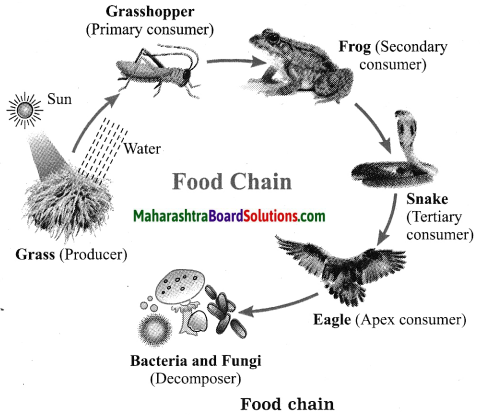
Question 1.
Who said to whom?
(a) “We mustn’t miss the chance.”
(b) “This is not the last time they are going to play.”
(c) “A walk in the park might make you feel better.”
(d) “Tomorrow morning we perform for the boy- Yes?”
Answer:

Statement Who To Whom
(a) “We mustn’t miss the chance.’’ The boy To his sister and mother
(b) “This is not the last time they are going to play.” the mother to anant
(c) “A walk in the park will make you feel better.” Aunt Sushila to smita
(d) “Tomorrow morning we perform for the boy- Yes?” Ustad Sahib to Pandit Ravi Shankar.

Maharashtra Board Solutions

Question 2.
Read the following sentences and write which emotions are revealed from these sentences.
(a) Pandit Ravi Shankar is playing tomorrow at the Shanmukhananda auditorium.
(b) It’s the chance of a lifetime.
(c) Will you come to Aunt Sushila’s house and play for him?
(d) Did you…did you hear him?
(e) Is it…It’s not possible?
Answer:
(a) excitement
(b) anticipation, joy, excitement
(c) This sentence expresses the emotion of a sincere plea or entreaty. Smita is practically begging Pandit Ravi Shankar to consider her request.
(d) This sentence expresses the boy’s innermost curiosity, and his desire to confirm if his sister had indeed heard the performances of the musicians whom he so longed to hear.
(e) This sentence expresses the emotion of complete surprise and disbelief. Something the neighbours had thought absolutely impossible was indeed a reality.

Question 3.
Read the text carefully, you will find some words describing a particular specialty of the individuals/personalities in the text. Explain the meaning of the following words given in the table with reference to the particular personality mentioned in the text.

Speciality Personality Explanation
Maestro
Pandit
Ustad
Moustachioed
…………………..
Ravi Shankar
…………………..
…………………..
…………………..
…………………..
…………………..
a person having a large or bushy mustache.

Answer:

Specialty Personality Explanation
Ustad Allah Rakha title for an expert tabla player
Moustachioed Name unknown someone who sports ’ a prominent bushy mustache
Maestro Pandit Ravi Shankar a distinguished performer of classical music
Pandit
Maharashtra Board Solutions
Ravi Shankar a talented musician (used as a respectful title or form of address)

Question 4.
Describe the condition of Smita when she was going towards the stage. Read the text again and complete the boxes given below. One is done for you.
Maharashtra Board Class 10 English Solutions Unit 3.6 The Concert 3
Answer:
Maharashtra Board Class 10 English Solutions Unit 3.6 The Concert 4

Question 5.
The whole story revolves around Anant. Write a short paragraph on Anant. Take help of the following points to develop the paragraph.
1. Health
2. Disease
3. Early interests
4. Intense desire/wish
5. Fulfillment of desire/wish.
Answer:
Anant was a fifteen-year-old boy, living in a village named Gaganpur with his sister and parents. Very active in his school days, he was a good athlete, the best table-tennis player, could play the sitar very well and had even been composing his own tunes. Suddenly, he was struck with cancer and came to Mumbai for treatment. Then one day, his sister read in the newspaper that Pandit Ravi Shankar would be performing at the Shanmukhananda auditorium.

It was his earnest desire to watch the performance, but due to his sickness, his mother forbade him. Finally, his sister, in a very daring move, went to the concert and after the concert had ended, went backstage and requested Pandit Ravi Shankar to come to their home and play for her brother. The great generous maestro along with Ustad Allah Rakha agreed and did exactly that. As the beautiful soulful music wafted around the room where Anant lay, Anant breathed his last.

Maharashtra Board Solutions

Question 6.
The story has three important characters- Anant, Smita and Aunt Sushila. Go through the story again and complete the following table that highlights their special traits of character. You can put X mark if that trait is not mentioned in the text.

Special traits Smita Anant Aunt Sushila
Strength
Weaknesses
Dreams
Motivation

Answer:

Special traits Smita Anant Aunt Sushila
Strength daring courage concern, generosity
Weakness given to emotion physical health X
Dreams that her brother would get cured that he would hear Pandit Ravi Shankar play X
Motivation love for her brother love for music love for the children

Question 7.
The two contradictory pictures are depicted in the story. Discuss in pairs and describe them in your words in front of the class.
Answer:
The brother and sister seem excited about Pandit Ravi Shankar’s upcoming performance. The girl expresses excitement and the boy’s eyes are shining. The mother, however, is more worried about the physical condition of her son, who is on oxygen and apparently out of breath. The mother’s voice breaks when she speaks and her lips utter unbidden prayers. These are the contradictory images presented in this passage.

Question 8.
The text has a big collection of Indian words in it. Using words from another language in a write up is called Code-mixing. Make a list of all the Indian words in table A and their meanings in table B. One is done for you.

‘A’ Indian word ‘B’ Meaning
1. Raga (a) piece of Indian classical music based on one of the six basic musical modes.
2. (b)
3. (c)
4. (d)
5. (e)
6. (f) Maharashtra Board Solutions

Answer:

‘A’ (Indian word) ‘B’ (Meaning)
1. Raga (a) piece of Indian classical music based on one of the six basic musical modes.
2. Pandit (b) a talented musician (used’as a respectful title or form of address)
3. sitar (c) a large, long-necked Indian lute with movable frets, played with a wire pick
4. Ustad (d) a highly skilled musician
5. Pandit (e) address for a talented classical musician
6. divan (f) a long low sofa without a back or arms

Question 9.
(A) Choose the appropriate Adverb or Adjective form to fill in the gaps.
(1) She spoke in an …………………….. tone. (excited / excitedly)
(2) Smita accepted the suggestion …………………….. (grateful / gratefully)
(3) They gave him whatever made him …………………….. (happy/ happily)
(4) He ran very …………………….. (fast / fastly)
(5) He would become a …………………….. sitarist some day. (great / greatly)
(6) Life went out of him …………………….. (gentle / gently)
Answer:
(1) excited
(2) softly
(3) happy
(4) fast
(5) great
(6) gently
Maharashtra Board Solutions

(B) Rewrite in Indirect speech
1. “Please”, she begged him, “Please come”.
……………………………………………………………………

2. He said, “What shall we do, Ustad Sahib?”
……………………………………………………………………

3. Her brother said, “Enjoy yourself”. He added, “Lucky you!”
……………………………………………………………………

4. ‘Yes’ Panditji replied. “It’s settled then. Tomorrow morning we shall perform, for the boy.”
……………………………………………………………………
Answer:
(1) She begged him repeatedly to come.
(2) He asked the Ustad Sahib what they should do.
(3) Her brother told her to enjoy herself and then added that she was indeed lucky.
(4) The Panditji replied in the affirmative and added that the matter was then settled. He further added that they would perform for the boy the following morning.

Question 10.
The text mentions names of stalwarts like Pandit Ravi Shankar and Ustad Allah Rakha. Both have earned world wide name and fame for their outstanding contribution to the field of music. Form groups of 5 students each and write a brief note on other stalwarts in this (music) field. You can take help of your school library or search the relevant information on the internet.
Take help of the following points.
1. Name :
2. Field : Music
3. Specialisation : Tabla/Sitar/Violin etc.
4. Guru :
5. Early life :
6. Education :
7. Early success :
8. Contribution to the field and world :
9. Awards:
10. Any special incident that has occurred in his/her life :
Answer:
Pandit Hariprasad Chaurasia
Hariprasad Chaurasia is an Indian classical flutist. He plays the bansuri, an Indian bamboo flute in the Hindustani classical tradition.

Maharashtra Board Solutions

His Guru was Bholanath Prasanna of Varanasi. He studied with him for eight years. In 1957, he joined the All India Radio, Cuttack, Odisha. He worked as composer and performer. Much later, he received guidance from the reclusive Annapurna Devi, daughter of Baba Allaudin Khan. Legend has it that she agreed to teach him only if he played with the left hand. True or not, up till today, Hariprasad plays the bansuri with the left hand.

Apart from classical music, Hariprasad has collaborated with Shivkumar Sharma, the santoor exponent forming an association called Shiv-Hari. He has collaborated with world musicians, including the fusion group Shakti, in experimental cross-cultural performances.

He is at present the artistic director of the World Music Department at the Rotterdam Music Conservatory in the Netherlands. In 2006, he founded the Vrindavan Gurukul in Mumbai and in 2010, the Vrindavan Gurukul in Bhubaneshwar. Both of these institutes are schools dedicated to training students in bansuri in the Guru-shishya tradition.

He has collaborated with several western musicians, including John McLaughlin, Jan Garbarek, and Ken Lauber, and has composed music for Indian films.

Chaurasia also played on The Beatles’ 1968 B-side ‘The Inner Light’, which was written by George Harrison.

Question 11.
Imagine you are the monitor of your class. You are assigned the task to invite a classical singer as a chief guest for the Annual Day Programme. Write a letter of invitation to a famous classical singer. Take help of the following points.
Write in short –
1. About your school.
2. About the Annual Day Programme
3. Interest and love of students for music.
4. Motivation.
Answer:
Dilip Rane
Sulochana Devi High School
Mahatma Phule Chowk
Dhule – 424 001,
Date: 20 November, 2020

Shri Gangadin Murkathe
Govardhan Society
Videhi Nagar
Dhule – 424 003.

Subject: Invitation as Chief Guest for the Sulochana Devi High School Annual Function

Dear Sir,
As monitor of Std. X A, Sulochana Devi High School, it is my privilege to invite you to our School Annual Day Function on 15th January, 2021 as Chief Guest.

It will be an evening filled with song and dance, and the first person we thought of was you, as you are an eminent classical singer in your own right. Most of us know about you and have heard your songs either on DVD or on FM.

Our students are highly interested in the classical genre and many are under training at various local i classes. Your presence will serve as motivation for our budding talent and give us pointers as to future careers in music.

Please confirm your presence; for us it will be an honour.

Yours truly,
Dilip Rane,
Monitor (Std. X A)

Maharashtra Board Solutions

Question 12.
Write who said to whom:
Answer:

statements Who To whom
(a) You’ll wake him up. The mother To her daughter
(a) “The chance of a lifetime.” Anant to his mother
(c) “Your father will take you.” Smita’s

mother

to Smita

Question 13.
Complete the following web:
Answer:
Maharashtra Board Class 10 English Solutions Unit 3.6 The Concert 5

Question 14.
Why was Smita excited?
Answer:
Smita was excited because she read in the newspaper that Pandit Ravi Shankar was to play the next day at the Shanmukhananda auditorium.

Question 15.
What was the chance of a lifetime for Anant?
Answer:
To be able to hear and see Pandit Ravi Shankar perform was the chance of a lifetime for Anant.

Question 16.
Give reasons: Smita became nervous.
Answer:
Smita became nervous because she remembered that her brother was very ill and that the doctors had given up hope. The truth that Anant was going to die frightened her.

Question 17.
Write from the passage antonyms for the following words:
(a) bored
(b) forget
(c) worse
(d) worst
Answer:
(a) bored x excited
(b) forgot x remembered
(c) worse X better
(d) worst X best

Question 18.
(1) Choose the appropriate Adverb or Adjective form to fill in the gaps:
(b) I wished the noise would stop. It seemed to go on ……………, (endless, endlessly)
Answer:
(b) endlessly

Maharashtra Board Solutions

Question 19.
Add question tags:
(a) You know he needs all the sleep and rest he can get.
(b) You’ll wake him up.
(c) His eyes were shining.
(d) We mustn’t miss the chance.
Answer:
(a) You know he needs all the sleep and rest he can get, don’t you?
(b) You’ll wake him up, won’t you?
(c) His eyes were shining, weren’t they?
(d) We mustn’t miss the chance, must we?

Question 20.
The boy on the bed was not asleep: (Rewrite without ‘not’.)
Answer:
The boy on the bed was awake.

Question 21.
How would you feel and react if you came to know that someone closely known to you was suffering from cancer?
Answer:
If I came to know that someone closely known to me was suffering from cancer, I would feel very bad. I would visit the person, spend time, make the person happy in every way possible and most of all pray to God, to relieve the person from suffering.

Question 22.
Say whether the following are True or False: (The answers are given directly and underlined.)
Answer:
(a) In Bombay, the family stayed with their aunt.
(b) The doctors told the family directly that Anant did not have many days to live.
(c) The family voiced their fears to Anant.
(d) Anant was well enough to take part in the forthcoming table tennis tournament.
Answer:
True
False
False
False

Question 23.
Why was everyone from the family trying to keep Anant happy?
Answer:
Everyone from the family was trying to keep Anant happy because they knew he did not have many days to live. They did not wish to voice their fears but rather wanted him to be surrounded by whatever made him happy.

Question 24.
Why was Smita not ready to go for the concert?
Answer:
Smita was not ready to go for the concert because she and her brother, Anant, had always done things together.

Question 25.
Write from the passage phrases that mean:
(a) participate
(b) feeling that something good will happen
(c) express their worries
(d) a rare opportunity
Answer:
(a) take part In
(b) high hopes
(c) voice their fears
(d) a chance of a
(e) lifetime.

Maharashtra Board Solutions

Question 26.
Match the columns:

A B
(a) choked
(b) roasted
(c) Yogic
(d) daring
(i) exercises
(ii) thought
(iii) gram
(iv) voice

Answer:

A B
(a) choked
(b) roasted
(c) Yogic
(d) daring
(iv) voice
(iii) gram
(i) exercises
(ii) thought

Question 27.
Complete the sentence with proper option: Smita accepted the suggestion (grateful/gratefully)
Answer:
Smita accepted the suggestion gratefully.

Question 28.
Frame Yes-No questions to get the sentences as the answer:
(a) There’s no harm in trying it.
(b) It would be nice to go to the concert.
Answer:
(a) Is there any harm in trying it?
(b) Wouldn’t it be nice to go to the concert?

Question 29.
*Two contradictory pictures are depicted in the story.
Answer:
On the one hand, the family is aware that Anant does not have many days to live. They are worried. They have fears but they suppress them. Instead they laugh and smile and talk. They surround Anant with whatever makes him happy. They fulfil his every need and give him whatever he asks for.

Question 30.
(1) Complete the following flow-chart:
Answer:
Maharashtra Board Class 10 English Solutions Unit 3.6 The Concert 6

Question 31.
Write whether the following statements are True or False:
(a) Smita dreamt that she was at the concert.
(b) Anant had said, ‘The chance of a lifetime’ the previous evening.
(c) At the end of the concert, the artistes stood and clapped for the audience.
(d) A man with a long moustache was one of the artistes.
Answer:
(a) False
(b) True
(c) False
(d) False

Maharashtra Board Solutions

Question 32.
(1) Arrange the following sentences chronologically according to their occurrence in the passage:
(a) The first notes came over the air.
(b) The audience gave the artistes a standing ovation.
(c) The audience gave the great master a thundering welcome.
(d) The ragas unfolded.
Answer:
(c) The audience gave the great master a thundering welcome.
(a) The first notes came over the air.
(d) The ragas unfolded.
(b) The audience gave the artistes a standing ovation.

Question 33.
How did Smita enjoy the concert?
Answer:
Smita felt as if the gates of a land of enchantment and wonder were opening. She listened spellbound to the unfolding ragas.

Question 34.
Give one example of code-mixing (Indian word) from the passage and explain its meaning.
Answer:
raga – a musical mode in Indian classical music

Question 35.
Pick the odd man out from the following based on the passage and give reasons:
(a) sitting, thundering, unfolding, twinkling
(b) slow, boring, plaintive, twinkling
Answer:
(a) sitting (verb – all the others are adjectives)
(b) boring (describes the noun ‘speech’ – all the others describe the ‘ragas’)

Question 36.
Underline the adverbs:
(a) The curtain came down.
(b) The plan remained firmly in her mind.
(c) The plan she had decided on the evening before remained firmly in her mind.
Answer:
(a) The curtain came down.
(b) The plan remained firmly in her mind.
(c) The plan she had decided on the evening before remained firmly in her mind.

Question 37.
Have you ever attended any concert? How was your experience there?
Answer:
Yes, I have attended a concert in which A. R. Rahman was the main performer. When I heard the first few notes being sung, I was thrilled. Never before had I heard such music or singing. I felt as if I were transported to a wonderland where only music reigned. Every beat, every note filled me with delight. I began wondering if I were in heaven!

Question 38.
Who said this to whom?
“Tomorrow morning we perform for the boy – Yes?”
Answer:
Ustad Sahib said this to Pandit Ravi Shankar.

Question 39.
Write whether the following statements are True or False:
(1) When Smita returned home, Anant was awake.
(2) Both Ravi Shankar and Ustad Allah Rakha came to Aunt Sushila’s house.
(3) Anant’s room was on the ground floor.
(4) Anant survived the sickness.
Answer:
(1) True
(2) True
(3) False
(4) False

Maharashtra Board Solutions

Question 40.
What was Smita’s plan?
Answer:
It was Smita’s plan to plead with Pandit Ravi Shankar to come to her aunt’s house and play the sitar for her brother, Anant, who was suffering from cancer.

Question 41.
Why were the neighbours surprised?
Answer:
The neighbours were surprised to see the two great musicians Pandit Ravi Shankar and Ustad Allah Rakha, getting out of a taxi which pulled up outside their block.

Question 42.
Give one word for each of the following:
(a) a soft compressed lump – …………………..
(b) twist or turn the body with quick – …………………..
(c) an expert at music – …………………..
(d) unseen backstage area on the sides of a stage – …………………..
Answer:
(a) wad
(b) wriggle movements
(c) wizard
(d) wings

Question 43.
(1) State the tense of the underlined verbs in the sentences:
(a) A small crowd had gathered
(b) Her knees felt weak.
(c) “Will you come to Aunt Sushila’s house?”
(d) “Its settled then.”
Answer:
(a) Past Perfect
(b) Simple Past
(c) Simple Future
(d) Simple Present.

Question 44.
Choose the appropriate Adverb or Adjective form to fill in the gaps.
(a) Smita spoke ………………. to Anant. (excited/excitedly)
Answer:
(a) excitedly

Question 45.
Music can calm the mind. Share your views.
Answer:
This is very true. Music has the profound effect of calming the mind, filling the soul of the listener with peace and transporting the devotee to a state of mind that is almost heaven.

Question 46.
(1) Pick out the gerund and use it in a sentence: She had been so excited at seeing the announcement.
(2) Arrange the words in alphabetical order: wooden, word, would, wonder
(3) Make a meaningful sentence by using the phrase: catch the attention of
(4) Write two smaller words hidden in the given word: table-tennis
(5) Identify the kind of sentence: Lucky you!
(6) Spot the errors and correct the sentence: Her knees were felt weak and her tongue being dry.
(7) Write the past participle forms of the given verbs: (1) die (2) stay
(8) Punctuate the sentence: did you hear him he whispered
Answer:
(1) Gerund: seeing Sentence: Seeing is believing.
(2) wonder, wooden, word, would
(3) Sentence: One of the girls in the dance caught the attention of the chief guest.
(4) tablet, table (tennis, able)
(5) Exclamatory Sentence
(6) Her knees felt weak and her tongue was dry.
(7) (1) died (2) stayed
(8) “Did you hear him?” he whispered.

Maharashtra Board Solutions

Question 47.
(a) Write sentences using the word ‘rest’ with two different meanings.
(b) Rewrite the sentences beginning with the underlined word: The audience gave the artistes a standing ovation.
(c) Write a word register of 8 words for the word ‘concert’.
Answer:
(a) (1) Those who have finished may leave. The rest will please stay back, (the remaining ones)
(2) You may rest in the afternoon, (stop work in order to relax, sleep or gather strength)
(b) The artistes were given a standing ovation (by the audience).
(c) concert: programme, stage, audience, music, dance, box office, venue, band, (performance, recital, show, gig)

Question 48.
(1) State the kind of sentence and pick out the clause, if any: They knew then that the boy had not many days to live.
(2) Use the two given words in one meaningful sentence: cured, sitar
Answer:
(1) Kind of sentence: Complex Clause: that the boy had not many days to live – Noun clause
(2) The doctor told him that after he was cured he could play the sitar.

Read More:

Std 10 English Poem Connecting 2.3 Question Answer Maharashtra Board

Balbharti Maharashtra State Board Class 10 English Solutions Unit 2.3 Connecting the Dots Notes, Textbook Exercise Important Questions and Answers.

Class 10 English Chapter 2.3 Question Answer Maharashtra Board

Connecting Fear Poem 10th Std Question Answer

Question 1.
(A) Connect the dots to get what means a lot to you.
Maharashtra Board Class 10 English Solutions Unit 2.3 Connecting the Dots 1
The word is ……………………………… .
Answer:
Maharashtra Board Class 10 English Solutions Unit 2.3 Connecting the Dots 6
The word is SUN

Maharashtra Board Solutions

(B) With your benchmark, use the letters given above to make a word register of ‘computers’. Set a time -limit of 5 minutes and compare your list with that of other classmates.
Answer:
AI, adobe, android, arithmetic, binary, browser, byte, bit, download, document, data, database, disk, format, http, hardware, homepage, java, keyboard, key, Microsoft, malware, memory, network, netscape, program, reboot, spam, spreadsheet, software, virus, web, windows, update, zip.

Question 2.
You are quite familiar with computers, especially the personal computer. Form pairs and make a list of famous computer manufacturing companies. One is given to you.
(a) Apple
(b) ……………………….
(c) ……………………….
(d) ……………………….
(e) ……………………….
(f) ……………………….
Answer:
(a) Apple
(b) Samsung
(c) IBM
(d) Lenovo
(e) Foxconn
(f) HP Inc.

Question 3.
Complete the web by filling the various benefits of computers.
Maharashtra Board Class 10 English Solutions Unit 2.3 Connecting the Dots 2
Answer:
Maharashtra Board Class 10 English Solutions Unit 2.3 Connecting the Dots 5

Question 4.
(A) Expand the following into their full forms.
(a) that’s
(b) didn’t
(c) here’s
(d) can’t
(e) I’ve
Answer:
(a) that’s – that is
(b) didn’t – did not
(c) here’s – here is
(d) can’t – cannot
(e) I’ve – I have

(B) Write the shortened forms of the following.
(a) You have ……………………….
(b) I would ……………………….
(c) It is ……………………….
(d) You are ……………………….
(e) He will ……………………….
(f) I had ……………………….
(g) will not ……………………….
(h) shall not ……………………….
(i) are not ……………………….
(j) need not ……………………….
(k) must not ……………………….
(l) ought not ……………………….
Answer:
(a) you have – you’ve
(b) I would – I’d
(c) it is – it’s
(d) you are – you’re
(e) he will – he’ll
(f) I had – rd
(g) will not – won’t
(h) shall not – shan’t
(i) arc not – aren’t
(j) need not – needn’t
(k) must not – mustn’t
(l) ought not – oughtn’t

Maharashtra Board Solutions

Connecting the Dots Class 10 English Workshop Questions and Answers Maharashtra Board

Question 1.
(A) Rearrange the incidents in the life of Steve Jobs in chronological order.
(a) Steve Jobs started Next.
(b) Jobs underwent a surgery.
(c) Jobs learned about serif and sans serif type faces.
(d) Jobs returned to Apple Inc.
(e) Jobs married Laurene.
(f) Jobs was diagnosed with cancer.
(g) Jobs dropped out of Reed College.
Answer:
(a) Jobs started Next.
(b) Jobs underwent surgery.
(c) Jobs learned about serif and san serif typefaces.
(d) Jobs returned to Apple Inc.
(e) Jobs married Laurene.
(f) Jobs was diagnosed with cancer.
(g) Jobs dropped out of Reed College.

(B) Read the third story again. Complete the flow-chart given below.
Maharashtra Board Class 10 English Solutions Unit 2.3 Connecting the Dots 3
Answer:
Maharashtra Board Class 10 English Solutions Unit 2.3 Connecting the Dots 7

Maharashtra Board Solutions

Question 2.
Read the lesson. Refer to a dictionary and match the words in column ‘A’ with their meanings in column ‘B’.

No ‘A’ ‘B’
(a) diagnosis (i) the power believed to control events
(b) devastating (ii) complete list of items especially in a special order and description.
(c) intuition (iii) act of identifying the nature of a problem or illness.
(d) calligraphy (iv) power of understanding situations or people’s feelings before hand.
(e) destiny (v) causing great destruction
(f) catalogue (vi) beautiful handwriting done with a special pen or brush.

Answer:

No ‘A’ ‘B’
(a) diagnosis (iii) act of identifying the nature of a problem or illness.
(b) devastating (v) causing great destruction
(c) intuition (iv) power of understanding situations or people’s feelings before hand.
(d) calligraphy (vi) beautiful handwriting done with a special pen or brush.
(e) destiny (a) the power believed to control events
(f) catalogue (ii) complete list of items especially in a special order and description.

Question 3.
Go through all the three stories. Identify some qualities of Steve Jobs and complete the web chart.
Maharashtra Board Class 10 English Solutions Unit 2.3 Connecting the Dots 4
Answer:
Maharashtra Board Class 10 English Solutions Unit 2.3 Connecting the Dots 8

Maharashtra Board Solutions

Question 4.
Complete the following table.
‘The Three Stories in the Life of Steve Jobs’

About Setbacks Reactions Achievements and benefits
First story
Second story
Third story

Answer:

About Setbacks Reac­tions Achieve­ments and benefits
First story College days no boarding and lodging managed with friends and at a temple learnt calligraphy
Second story starting ’Apple’ fired from the company started a new company ‘Next’ most creative period; renaissance’ of ‘Apple’
Third story death diagnosed with cancer surgery, cure learnt not to waste time living someone else’s life

Question 5.
Say HOW?
→ the calligraphy classes helped Steve Jobs after 10 years.
Answer:
10 years later when Steve Jobs was designing the first Macintosh computer, he recalled what he had learned in the calligraphy classes about serif and san serif typefaces as well as other elements that go into great typography. He designed all this into the Macintosh computer.

→ You can connect dots.
Answer:
We can’t connect dots by looking forward; we can only connect them looking backwards. We have to trust that the dots will somehow connect in our destiny.

→ Jobs reacted later on, after the shock of being fired from Apple.
Answer:
After he overcame the shock of being fired from Apple, Jobs felt the lightness of being a beginner again. He felt free to enter one of the most creative periods of his life. He started two companies – Next and Pixar.

Maharashtra Board Solutions

→ Jobs was cured of a rare cancer.
Answer:
Jobs was diagnosed with a very rare form of pancreatic cancer. It was curable by surgery. Jobs had the surgery and he was cured.

→ Jobs acquired the famous words ‘Stay Hungry. Stay Foolish’
Answer:
When Jobs was young, he used to read an amazing publication called The Whole Earth Catalogue’. In the final issue was a photograph of an early morning country road beneath which were the words ‘Stay Hungry, Stay Foolish’. Steve acquired these words from the magazine.

Question 6.
Besides those given at the end of the talk by Steve Jobs, pick out other pieces of advice that Jobs gives in his speech.
Answer:
(a) Learn to connect the dots.
(b) Learn whatever you can whenever you can.
(c) We can learn even from negative experiences.
(d) Have trust that somehow the dots will connect in your future.
(e) Have trust in your gut. destiny, life, karma, whatever …
(f) Love what you do.
(g) Keep looking for what you love and don’t ever settle for less.
(h) Even under the most devastating circumstances, you can start all over again.
(i) Don’t lose faith.
(j) Your time is limited, so don’t waste it lining someone else’s life.

Question 7.
(A) Use the following idioms/phrases in sentences of your own.
(a) drop in …………………..
(b) drop out …………………..
(c) stumble on …………………..
(d) look backwards …………………..
(e) look forward …………………..
(f) let (someone) down …………………..
(g) sign off …………………..
(h) begin anew …………………..
Answer:
(a) Though I am not a member of the club, I often play tennis there as a drop in.
(b) I decided to drop out of karate classes as it was taking too much of my time.
(c) While surfing the net, he stumbled into a portal that showed only horror movies.
(d) After his terrible experience in his native place, he went to the city and never looked backwards.
(e) He tried to forget his terrible experience in his native place and looked forward.
(f) He placed great trust in his secretary, and she never let him down.
(g) I would like to sign off by telling you a short story with a beautiful message.
(h) It is never too late to forget past mistakes and begin anew.

Maharashtra Board Solutions

(B) Fill in the gaps in choosing the appropriate idioms.
(drown out, hits in the head with a brick, get one’s affairs in order, connect the dots, begin to dawn, stay hungry)
(a) The wealthy landlord made a will before he could die.
(b) Those who aspire for success should always to learn more.
(c) If you you will realise that crime ultimately leads to poverty.
(d) The siren of the ambulance all other traffic noise.
(e) When the father learned about his son’s misdeeds, it
(f) On reading exactly same essays in both answer sheets, it the examiner, that the students had cheated during exams.
Answer:
(a) Getting his affairs in order
(b) Stay hungry
(c) Connect the dots
(d) Drowned out
(e) It hit him on the head with a brick.
(f) Began to dawn on

Question 8.
(A) Name the Tense of the Verbs underlined to include Time (Past/Present/Future) and Aspect (Simple/Continuous/Perfect/Perfect Continuous)
(1) I slept on the floor
(2) We were designing the first Macintosh computer
(3) It had made all the difference
(4) I am fine, now
(5) I have been facing death
(6) I shall be telling you three stories
Answer:
(1) Time – Past; Aspect – Simple.
(2) Time – Past Tense; Aspect – Progressive (continuous).
(3) Time – Past tense Aspect – Perfect
(4) Time – Present; Aspect – Simple.
(5) Time – Present; Aspect – Perfect.
(6) Time – Future; Aspect – Progressive (continuous).

(B) Change the Tense as instructed.
(1) I got fired. (Future Perfect)
(2) Life hits you in the head. (Present Perfect Continuous)
(3) The dots will somehow connect. (Past Perfect)
(4) I started a company. (Present Continuous)
(5) My doctor advised me. (Past Perfect Continuous)
Answer:
(1) Jobs got fired.
(2) Life hits you in the head.
(3) The dots had somehow connected.
(4) I started a company.
(5) My doctor had been advising me.

Maharashtra Board Solutions

Question 9.
Read the News item and write an application for a suitable job in the same company. Attach a seperate CV/Resume.
May 19, 2016
Apple Opens Development Office in Hyderabad
(A) The new office in Hyderabad will focus on development of maps, Apple products, like iPhone, iPad, Mac. etc. This will create upto 4000 jobs
Answer:

Answer:
Ratan Shah
11 Salsa Apts.
Hafeczpeth
Hyderabad
Telangana – 500 049.
27th May, 2020

The HR Manager
Apple Development Office
18-23, Rd Number 2
Financial District
Nanakram Guda
Hydcrabad
Telangana — 500 032.

Subject : Application for post of Systems Analyst ‘
Sir,
I read the news item in the Times of India’ dated May 20, which stated that Apple has opened a Development office in Hyderabad, which is likely to create up to 4000 jobs. I am interested in applying for the post of Systems Analyst.

I have a bachelor’s degree In Computer Information Systems (CIS) and 6 months experience in Cornputronic& Ltd. as Systems Analyst. I am well-versed in analyzing, designing and implementing Information Systems. I wish to further my prospects and hence am applying to your company.

I do hope that you will give me the opportunity to prove my mettle.

Yours truly,
Ratan Shah

Maharashtra Board Solutions

Attachments: CV, photocopies of Academic and Professional Certificates
Resume:
Name: Ratan Shah
Age: 24 years
Educational Qualification: B.Com (1st class); B.Computer Science (CIS)
Experience: 6 months experience in Computronics Ltd. as Systems Analyst
Marital Status: Single
Special Interests: Chess, Football, Cycling
Contact information: Address as above
Mobile no.: 097

(B) Imagine you are already working as an Engineer in Apple Development Office, Hyderabad. Write an application for 2 weeks leave to the HR Manager as you have to undergo an urgent surgery.
Answer:
Ms. Sara Kanchwala
11 Salsa Apts.
Hafeezpeth
Hyderabad
Telangana 500 049.
3 September, 2020

The HR Manager,
Apple Development Office
18-23, Rd. Number 2
Financial District
Nanakram Guda
Hyderabad
Telangana – 500 032.

Subject : ApplicatIon’ for leave of absence due to Imminent surgery (4th September to 17th September)

Dear Sir,
I had a bad fall a couple of days back and tore a ligament ‘In my knee. The pain is Intense and my doctor has advised me that immediate surgery is necessary.

Please grant me 2 weeks medical leave as the doctor has advised a fortnight’s complete bed rest post-op. Thanking you in advance,

I remain,
Yours truly,
Sara Kanchwala

Question 10.
Prepare a speech on the title “The Will to Win” to be delivered before the class during a competition.
Hints –

  • Title
  • Introduction
  • Objective and Illustrations
  • Specific examples
  • Purpose of the title.
  • Sources/Resourses for implementation.
  • Usefulness/Benefits
  • Conclusion.

Answer:
The Will to Win

Friends,
The topic before us today is The Will to Win’. This title brings to my mind the story of the hare and the tortoise. When the hare challenged the tortoise to a race, the tortoise knew very well that its speed was in no way comparable to that of the hare. Yet this little animal agreed to the race. And why, may I ask you? Only because it had the will to win. Come what may, the tortoise had to prove to the hare that it could win if it wanted to. And finally it won!

This, in fact, is the driving force behind all great ventures and achievements. The Will to Win!

I remember the time when I went to Std. V. My father had been transferred from Agra to Bhusaval. A subject that I had trouble mastering was the language Marathi. Needless to say in the first term I flunked very badly. But I was a student who usually scored high marks in all subjects. This failure was devastating.

However, I did not let it faze me. I took great interest in class lessons. Read my Marathi textbook over and over. Made friends who spoke fluently in Marathi and ventured speaking to them. At first they poked fun at me. But within a month I had picked up the basic structure of the language and began writing answers to questions on my own. Believe it or not, at the end of the term I topped the class in Marathi. ; Today I can speak in the language as if it is my mother tongue.

Friends, my message to you today is that you can do anything. All you require is the will. If you have the will, the skill will follow. So set your goals, define your objectives and I wish all of you the very best in ; whatever you decide to do in life.

Be sure of one thing: If you have the will, You Will Win!

Thank you.

Maharashtra Board Solutions

Question 11.
Project :
Collect more information about Steve Jobs with the help of Internet. Complete it with images into a file.

Question 12.
Do you remember doing some activities in your childhood that you didn’t like it. Form pairs and make a list of all those activities. Do you think, any one of these activities have helped you in solving your problems? Share your experience with the class.

  • chopping vegetables:
  • cleaning the home; sweeping and dusting
  • hanging out clothes to dry
  • looking after my little brother
  • helping dad to repair the bicycle

Answer:
Once while driving home from school, the chain of my bicycle got dislodged and I almost fell off. There was no bicycle repair shop nearby and no passers-by were able to help me. Since I had experience helping dad to repair his bicycle, somehow I managed to get the chain fixed and wobbled back home. My hands were black and dirty with grease and oil, but at least I didn’t have to walk back home, pushing my bicycle along.

Question 13.
Write True or False for these statements: (The answers are given directly and underlined.)

Answer:
(1) Steve Jobs slept in his dorm room. False
(2) Steve took his required courses as a registered student of Reed College. False
(3) During Steve’s College days, one had to pay 5 cents deposit for a Coke bdttle. True
(4) Steve ha’d comfortable college experiences. False

Question 14.
What basic course in Reed College helped while designing the Mac?
Answer:
The basic course of calligraphy in Reed College helped while designing the Mac.

Question 15.
Arrange the following incidents in Steve Jobs’ life in proper sequence based on this passage:
(a) Jobs stayed as a drop-in for 18 months.
(b) Jobs used to sleep on the floor in his friend’s house.
Answer:
(a) Jobs stayed as a drop-in for 18 months.
(b) Jobs used to sleep on the floor in his friend’s house.

Question 16.
Complete the following: (The answers are given directly and underlined.)
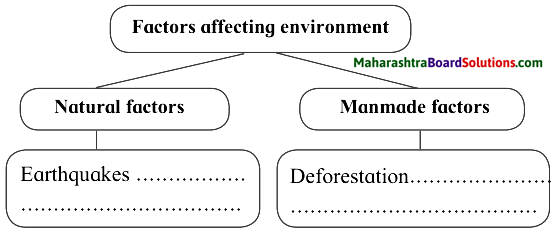
(1) Steve’s first story is about connecting the dots.
(2) Steve got one good meal every Sunday night at the Hare Krishna temple.
Answer:
Connecting the dots.
Hare Krishna temple.

Question 17.
What did Steve Jobs do for two years after he joined Reed College?
Answer:
After joining Reed College, for two years Steve would stop taking the required classes that didn’t interest him. Instead he began dropping in on the ones that looked interesting.

Question 18.
List the hardships that Steve faced.
Answer:

  • Steve didn’t have a dorm room and so had to sleep on the floor in friends’ rooms.
  • Steve returned Coke bottles for the 5 cent deposits to buy food with.
  • Steve would walk seven miles across town every Sunday night to get one good meal a week at the Hare Krishna temple.

Maharashtra Board Solutions

Question 19.
Write from the passage a phrase that means ‘Apart from this, I have nothing more to tell.’
Answer:
That’s it.

Question 20.
Choose the correct contextual meaning of the phrase: connecting the dots.
(a) making a pattern with the help of dots
(b) associating one previous idea with other ideas that follow
(c) joining dots in a puzzle to get the correct picture
(d) understanding a procedure
Answer:
(b) associating one previous idea with other ideas that follow

Question 21.
Match the words in column A with their meanings in column B:

A B
(i)  intuition  (a)  a set of characters like letters, symbols, etc. in one design
(ii)  calligraphy  (b)  the style and appearance of printed matter
(iii)  typography  (c)  power of understanding the feelings of people
(iv)  typeface  (d)  beautiful handwriting done with a special pen or brush

Answer:

(i) intuition  (c)  power of understanding the feelings of people
(ii) calligraphy  (d)  beautiful handwriting done with a special pen or brush
(iii) ypography  (b)  the style and appearance of printed matter
(iv) typeface  (a)  a set of characters like letters, symbols, etc. in one design
Question 22.
It was one of the best decisions I ever made. (Rewrite using ‘better than’.)
Answer:
It was better than most other decisions I ever made.

Question 23.
Personal Response: What impression of Steve Jobs do you get from this passage?
Answer:
In this passage, it appears that Steve Jobs is a student who goes by his impulses. He has a thirst for knowledge, but prefers subjects that he finds interesting and avoids those that he finds uninteresting, even though he has enrolled for them. He is ready to face all kinds of hardships in order to study what he wants to. Steve Jobs had a natural curiosity and intuition. He also had an instinct about what makes something really great and the habit of storing it away in his mind for future use.

Question 24.
Fill in the blanks: (The answers are given directly and underlined.)
(1) Steve designed the Macintosh computer.
(2) Windows copied the Macintosh computer.
(3) It was impossible to connect the dots looking forward when Steve was in college.
(4) You can only connect the dots looking backward.
Answer:
(1) Macintosh
(2) Windows
(3) forward
(4) backward

Maharashtra Board Solutions

Question 25.
Complete the following: (The answers are given directly and underlined.)
(1) The Mac ‘computer which he designed would not have had multiple typefaces or proportionally spaced fonts.
(2) Since Windows just copied Mac, it was likely no personal computer would have had them.
Answer:
(1) not have had multiple typefaces or proportionally spaced fonts.
(2) no personal computer would have had them.

Question 26.
Complete the following: (The answers are given directly and underlined.)
Words connected with typography from the passage are: typeface and font.
Answer:
typeface and font.

Question 27.
Match the words /phrases in column A with their meanings in column B:

(A) (B)
(i)  gut  (a)  Macintosh computer.
(ii)  destiny  (b)  having several parts.
(iii)  Mac  (c)  the power believed to control events.
(iv) multiple  (d)  courage and determination.

Answer:

A B
(i) gut (d) courage and determination
(ii) destiny (c)  the power believed to control events
(iii) Mac (a)  Macintosh computer
(iv) multiple (b)  having several parts

Question 28.
It was impossible to connect the dots looking forward. (Pick out the verbs and say if they are finite or non-finite.)

Answer:
was – finite; to connect, looking – non-finites

Question 29.
It was very clear. (Rewrite as an exclamatory sentence.)
Answer:
How clear it was!

Question 30.
Mac would never have had multiple typefaces. (Rewrite as an interrogative sentence.)
Answer:
Would Mac ever have had multiple typefaces?

Maharashtra Board Solutions

Question 31.
Personal Response: Write about something which you learned in the past and which has helped you in the present.
Answer:
When I was in Std. V, mother enrol led me for dancing classes, I had to stop when I reached Std. IX. However, now whenever I need a break or I am feeling stressed, I put on some music and dance. That gives me relief from stress.

Question 32.
Name the following: (The answers are given directly and underlined.)
Answer:
(1) The world’s most successful animation studio. Pixar
(2) The company that Steve Jobs took five years to establish. Next
(3) The company that bought Next. Apple
(4) Steve Jobs’ wife. Laurene

Question 33.
What setback did Jobs suffer when he was thirty?
Answer:
When Jobs was thirty, he was fired from the company which he himself had started. This was devastating and a major setback in his life.

Question 34.
Match the words/phrases in column A with their meanings in column B:

A B
(i)  renaissance  (a)  causing great destruction
(ii)  to start over  (b)  lost one’s job
(iii)  fired  (c)  revival
(iv)  devastating  (d)  to begin again

Answer:

A B
(i)  renaissance  (c)  revival
(ii)  to start over  (d)  to begin again
(iii)  fired  (b)  lost one’s job
(iv)  devastating  (a)  causing great destruction

Question 35.
Fill in the blanks choosing the appropriate idioms: (at the heart of, hit him on the head with brick, begin to dawn, lose faith)
(1) Even if you don’t succeed at first, don’t lose faith in yourself.
(2) It is corruption in high places that lies at the heart of the non-development of this locality.
Answer:
(1) Lose faith
(2) At the heart of

Maharashtra Board Solutions

Question 36.
Personal Response: What does this second story of Jobs convey to you?
Answer:
The second story of Jobs – about love and loss – conveys to us that even if our efforts result in complete disaster, we should continue believing in ourselves. It tells us that we should love our work. If we haven’t yet found it, we should keep on searching. We should never accept less than what we aim for in life.

Question 37.
Which quality of Steve Jobs impresses you the most? How would you apply it in your life?
Answer:
I admire Steve’s quality of not giving up even after facing a terribly shocking loss. It inspires me never to be disheartened by failure, but to always keep trying. Even if one loses everything, one has to have the courage to start all over again.

Question 38.
Arrange the following incidents in Steve Jobs’ life in proper sequence based on this passage:
(a) Jobs was advised to get his affairs in order.
(b) Jobs was cured of a rare form of cancer.
Answer:
(a) Jobs was advised to get his affairs in order.
(b) Jobs was cured of a rare form of cancer.

Question 39.
Fill in the blanks: (The answers are given directly and underlined.)
(1) Steve’s third story is about death.
(2) The doctor describes the last stage of cancer as the ‘prepare to die’ stage.
(3) Steve ‘says that you should follow your heart and intuition.
(4) We should not waste time.
Answer:
(1) death
(2) ‘prepare to die’
(3) heart and intuition.
(4) time.

Question 40.
What does Jobs warn you about life and dogma?
Answer:
Jobs warns us not be trapped by dogma. Dogma is living with the results of other people’s thinking. The overpowering influence of other’s opinions should not drown out our own inner voice.

Question 41.
How does Jobs close his address to the graduate students?
Answer:
Steve Jobs closes his address to the graduate students by telling them about an amazing publication called The Whole Earth Catalogue’. In the final issue on the back cover there was a photograph of an early morning country road. Beneath it were the words ‘Stay Hungry, Stay Foolish’. Jobs wishes the students the same words as his farewell message to them.

Question 42.
Write from the passage four medical words / phrases / terms.
Answer:
pancreatic cancer, diagnosis, biopsy, surgery

Maharashtra Board Solutions

Question 43.
Match the words in column ‘A’ with their meanings in column ‘B’:

A B
(a)  diagnosis  (1)  a set of beliefs held by an organisation which others are expected to accept without argument.
(b)  catalogue  (2)  act of identifying the nature of a problem or illness.
(c)  dogma  (3)  in a new or different way.
(d)  anew  (4)  complete list of items especially in a special order and description.

Answer:

A B
(a) diagnosis (2)  act of identifying the nature of a problem or illness.
(b) catalogue (4)  complete list, of items especially in a special order and description.
(c) dogma (1)  a set of beliefs held by an organisation which others are expected to accept without argument
(d) anew (3)  in a new or different way.

Question 44.
Choose correct question tags for the sentences and rewrite: wasn’t it? isn’t it? aren’t I? will you?
(a) Don’t be trapped by dogma.
(b) It was their farewell message.
(c) Your time is limited.
(d) I’m fine now.
Answer:
(a) Don’t be trapped by dogma, will you?
(b) It was their farewell message, wasn’t it?
(c) Your time is limited, isn’t it?
(d) I’m fine now, aren’t I?

Question 45.
Don’t waste it. (Rewrite without ‘don’t’.)
Answer:
Avoid wasting it.

Question 46.
Personal Response: “Your time is limited. So don’t waste it living someone else’s life.” What are your views about these statements?
Answer:
These are the conclusions that Steve Jobs came to when he discovered that he was suffering from pancreatic cancer. Coming face to face with death, he realized how very little time we have on earth to realize our true potential. Most of our lives are spent following the dictates of others. By this statement, Steve Jobs means that we should spend every moment of our lives trying to discover our own potential and determine our own purpose and path in life.

Question 47.
(1) Pick out the compound words from the given words: dropping, calligraphy, backwards, graduate, photograph
(2) Pick out the gerund and use it in your own sentence: I could begin dropping in on the ones that looked interesting.
(3) Punctuate the sentence: heres one ekample reed college offered perhaps the best calligraphy instruction in the country
(4) Spot the error and rewrite the correct sentence: At the calligraphy class, I learn about what make great typography great.
(5) Identify the type of sentence: Don’t settle.
(6) Find out two hidden words of at least 4 letters each from the word ‘devastating’.
(7) Form present participles in which the last letter is doubled: drop, quit
(8) Arrange these words in alphabetical order: friend, follow, found, freed.
Answer:
(1) backwards = back + wards; photograph = photo + graph
(2) Gerund: dropping Sentence: Stop dropping in here without any warning.
(3) Here’s one example: Reed College offered perhaps the best calligraphy instruction in the country.
(4) At the calligraphy class, I learned about what makes great typography great.
(5) Imperative Sentence in the Negative.
(6) devastating-vast, taste (gate, stain.)
(7) dropping, quitting
(8) follow, found, freed, friend

Maharashtra Board Solutions

Question 48.
(1) Write the homophone for the word ‘story’ and frame a sentence.
(2) Rewrite the sentence using the past perfect continuous tense: We were designing the first Macintosh computer.
(3) Rewrite beginning with underlined part: The heaviness of being successful was replaced by the lightness of being a beginner again.
(4) Write a word register for the word: ‘doctor’ (4 words).
Answer:
(1) Homophones: story – storey Sentence: I live in a seven-storys building.
(2) We had been designing the first Macintosh computer.
(3) The lightness of being a beginner again replaced the heaviness of being successful.
(4) physician, surgeon, medico, healer, practitioner. (MD, medic, scientist, specialist)

Question 49.
(1) Use the word,‘trust’ in sentences as a noun as well as a verb.
(2) Underline the modal auxiliary and state its function: I had to take a calligraphy class.
Answer:
(1) (a) I have great trust in my teacher, (noun)
(b) Trust in God. (verb)
(2) I had to take a calligraphy class, (necessity/ obligation/compulsion)

Read More: