Economy and Occupations Question Answer Class 10 Geography Chapter 8 Maharashtra Board

Balbharti Maharashtra State Board Class 10 Geography Solutions Chapter 8 Economy and Occupations Notes, Textbook Exercise Important Questions and Answers.

Std 10 Geography Chapter 8 Question Answer Economy and Occupations Maharashtra Board

Class 10 Geography Chapter 8 Economy and Occupations Question Answer Maharashtra Board

Geography Class 10 Chapter 8 Question Answer Maharashtra Board

1. Fill in the blank with appropriate word.

Question a.
India’s per capita income is less than Brazil due to _______.
(a) low national income
(b) massive population
(c) big family size
(d) low foodgrain production
Answer:
(b) massive population

Maharashtra Board Class 10 Geography Solutions Chapter 8 Economy and Occupations

Question b.
The economy of Brazil is mainly dependent on ______ the activities.
(a) primary
(b) secondary
(c) tertiary
(d) quaternary
Answer:
(c) tertiary

Question c.
The economics of India and Brazil are of the _____ type
(a) undeveloped
(b) developed
(c) developing
(d) highly developed
Answer:
(c) developing

2. Answer the following questions:

Question a.
Why has mining not developed in the western part of Brazil?
Answer:
(i) Most of the western part of Brazil is covered by the thick dense equatorial rainforests of the Amazon Basin.
(ii) Inaccessibility, poor transport links, unfavourable climate, heavy rainfall are the main barriers for mining in this part.
(iii) Moreover, lack of knowledge of potential reserves of resources is the other factor which has led to limitations in mining in the western part of Brazil.
(iv) Therefore, mining is not developed in the western part of Brazil.

Question b.
What are the similarities and differences in the fishing activities in Brazil and India.
Answer:
Similarities:

  • In Brazil and India fishing activity is developed near the coastal areas.
  • In both the countries, marine fishing is well- developed.

Differences:

  • In India, fresh water fishing is practised, whereas in Brazil due to unfavourable conditions, fresh water fishing is not developed.
  • The meeting of the warm Brazil current and the cold Falkland current, off the coast of South-East Brazil makes it a good fishing ground. In India such currents do not come together but due to other favourable conditions fishing has been developed.
  • Major fishes of Brazil are swordfish, shrimp, lobsters and sardines.
  • Major fishes of India are mackerel, bombay duck, prawns, horse mackerels, clupeids, silver bellies and sardines.

Maharashtra Board Class 10 Geography Solutions Chapter 8 Economy and Occupations

3. Give reasons:

Question a.
Per capita land availability is more in Brazil as compared to India.
Answer:

  • India occupies 2.4% land area of the world and supports 17.5% of the world’s total population.
  • Brazil occupies 5.6% of land area of the world and supports only 2.75% of the world’s total population.
  • Average density of population in India is about 382 persons per sq. km. while average density of population in Brazil is around 23 persons per sq. km.
  • Thus Brazil’s population is lesser than India, but it occupies a larger land area than India.
  • So, the per capita land availability is more in Brazil as compared to India.

Question b.
There is mixed economy in Brazil and India.
Answer:

  • In a mixed economy there is a co-existence of public sector and private sector.
  • In Brazil, sectors like health, banking, telecommunications, railways and airways are owned and managed by both public and private sectors.
  • In India railways is largely a public sector whereas all the other sectors are owned and managed by both private and public sectors.
  • So it is said that there is a mixed economy in Brazil and India.

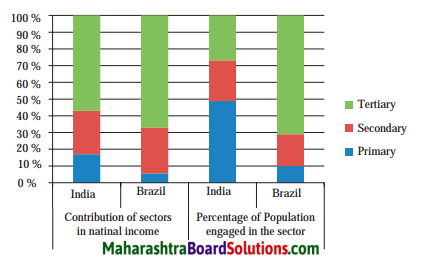
4. Study the following graph and analyse in short.
Maharashtra Board Class 10 Geography Solutions Chapter 8 Economy and Occupations 1
Answer:
(i) This is a compound bar graph showing the contribution of primary, secondary and tertiary sectors to the national income of India and Brazil.
(ii) It also shows the percentage of population engaged in these sectors.
(iii) The contribution of primary, secondary and tertiary sector to India’s national income is about 17%, 26% and 57% respectively.
(iv) Whereas the contribution of primary, secondary and tertiary sector to Brazil’s national income is about 5%, 28% and 67% respectively.
(v) The population engaged in primary, secondary and tertiary sector of India is about 49% 24% and 27% respectively.
(vi) The population engaged in primary, secondary and tertiary sector of Brazil is about 10%, 19% and 71% respectively.
(vii) Thus it is understood clearly from the graph that Brazil is not an agrarian economy like India.

Class 10 Geography Chapter 8 Economy and Occupations Intext Questions and Answers

Give It a Try

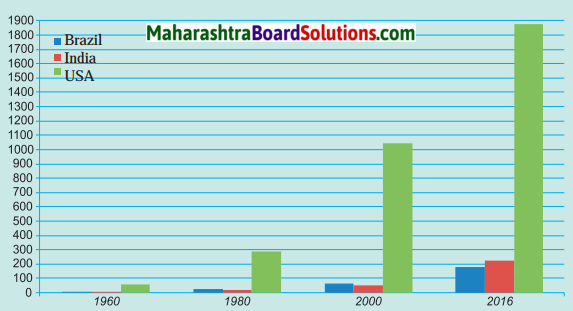
Read the following graph and answer the following questions:
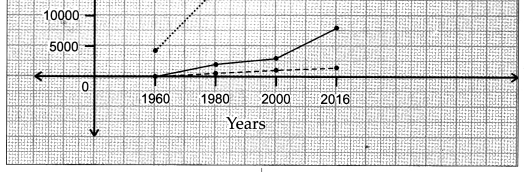
Gross National Incomes (GNI) from 1960 to 2016 (in million US. $)
Maharashtra Board Class 10 Geography Solutions Chapter 8 Economy and Occupations 12

Question 1.
Which country’s national income was the highest in 2016 and how much was it?
Answer:
USA’s national income was highest in 2016. It was approx. U.S. $ 18000 million.

Question 2.
Comparing India and Brazil, which country had a higher national income in 1980?
Answer:
Brazil had a higher national income in 1980, as compared to India.

Question 3.
Comparing India and Brazil, which country had a higher national income in 2016?
Answer:
Comparing India and Brazil, India had a higher national income.in 2016.

Question 4.
Tell the difference between the GNP of Brazil and India in 2016.
Answer:
The difference between the GNP of Brazil and India in 2016 is approximately US $ 300 million. (India : $ 2000 million – Brazil: $ 1700 million)

Question 5.
Name the developing and developed economies based on the graph?
Answer:
India and Brazil are developing economies and the USA is a developed economy.

Question 6.
Calculate the difference between the national incomes of developed and developing countries , in 2016.
Answer:
The difference between the national incomes of developed and developing countries in 2016 was nearly U.S. $ 16500 million.
(US: $18500 million – India, Brazil: $ 2000 million)

Try this

Question 1.
A table regarding the ownership of various sectors in both the countries is given. Like Brazil, fill the details regarding India and complete the table.
Answer:

S.No India Sector Brazil
(1) Private and Public both Banking Private and public both
(2) Largely Public Railways Private and public both
(3) Largely Private Little Public Airways Private and public both
(4) Private and Public both Electricity production Largely public
(5) Private and Public both Iron and Steel Industry Largely public
(6) Private and Public both Health Private and public both
(7) Largely Private and Public Education Largely public, little private
(8) Largely Private and little Public Telecomm­ unications Private and public both

Maharashtra Board Class 10 Geography Solutions Chapter 8 Economy and Occupations

Let’s Recall

Question 1.
Classify the following activities by ticking ( ✓ ) in the respective column
Answer:

S.No Activities Primary Secondary Tertiary
(1) Television Broadcasting
(2) Bee-keeping
(3) Coir and Rope making
(4) Jaggery – making
(5) Producing blades of the plough
(6) Construction
(7) Extracting Iron Ore
(8) Automobile Production
(9) Rice Production
(10) Teaching
(11) Driving buses
(12) Providing lodging and boarding facilities

Question 2.
Name the warm and cold ocean currents near the Brazilian coast.
Answer:
Warm ocean current: Brazil current Cold ocean current: Falkland current

Question 3.
Read the following table and answer the following questions.

Export, Import and Balance of Trade (Value in US $)
India Brazil
Year Exports Imports Exports Imports
2009-10 178751.4 288372.9 152994.7 127647.3
2010-11 251136 369770 197356.4 180458.8
2011-12 304623.53 489181.3 256038.7 226243.4
2012-13 214099.8, 361271.9 242579.8 223749.1

Question (1).
What is balance of trade?
Answer:
Balance of trade is the difference between the value of a nation’s exports and imports for a certain period.

Question (2).
Tell the types of balance of trades.
Answer:
There are three types of balance of trade they are as follows:

  • Unfavourable balance of trade: The value of imports is more than the value of exports.
  • Favourable balance of trade: The value of exports is more than the value of imports.
  •  Balanced trade: The value of exports and imports is almost the same.

Question (3).
In which country do export exceed the imports in all the years?
Answer:
In Brazil, export exceeds the import in all the years.

Question (4).
Brazil’s balance of trade belongs to which type?
Answer:
Brazil has a ‘favourable balance of trade’ or ‘surplus trade’.

Question (5).
India’s balance of trade belongs to which type?
Answer:
India has an ‘unfavourable balance of trade’ or ’trade deficit’.

Question 4.
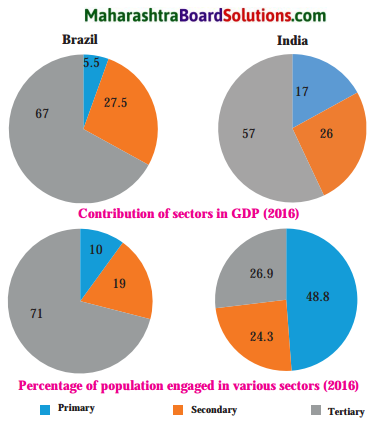
With the help of the pie chart given in Fig. , mention what is the contribution of secondary activities in Brazil’s GDP is.
Maharashtra Board Class 10 Geography Solutions Chapter 8 Economy and Occupations 2
Answer:
The secondary activities contribute 27.5% in Brazil’s GDP.

Activity:

Question 1.
Look at the pie-charts carefully and answer the following questions:
Maharashtra Board Class 10 Geography Solutions Chapter 8 Economy and Occupations 2

Maharashtra Board Class 10 Geography Solutions Chapter 8 Economy and Occupations

Question (1).
Which country has a higher percentage of population engaged in primary activities?
Answer:
India has a higher percentage of population engaged in primary activities (48.8%).

Question (2).
In which country is the contribution of tertiary sector greater in the GDP?
Answer:
The contribution of tertiary sector is greater in Brazil’s GDP (67%).

Question (3).
In which country is the share of secondary activities more in the GDP?
Answer:
The contribution of secondary activities is more in Brazil’s GDP (27.5%).

Question (4).
Can we say that Brazil is an agrarian economy like India? Give reasons.
Answer:
(i) Brazil is not an agrarian economy like India.
(ii) This is because 71% of its population is engaged in the tertiary sector and it contributes 67% in GDP.

Question 2.
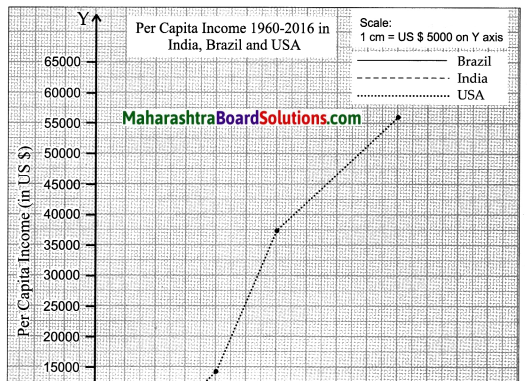
Use the following table and make a polyline graph with the help of computer

Country Name/Year 1960 1980 2000 2016
Brazil 240 2010 3060 8840
India 90 280 450 1680
USA 3250 14230 37470 56280

Answer:
Maharashtra Board Class 10 Geography Solutions Chapter 8 Economy and Occupations 3
Maharashtra Board Class 10 Geography Solutions Chapter 8 Economy and Occupations 4

Question 3.
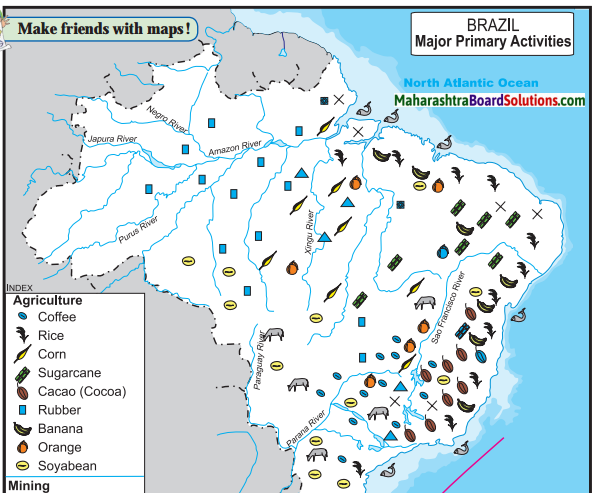
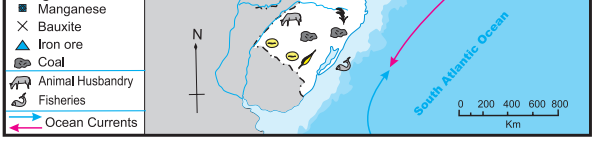
Observe the map of Mining and answer the following questions:
Maharashtra Board Class 10 Geography Solutions Chapter 8 Economy and Occupations 29
Maharashtra Board Class 10 Geography Solutions Chapter 8 Economy and Occupations 30

Question (1)
Prepare a table of mining products and regions of production in Brazil.
Answer:

Mining products Regions of production in Brazil
Manganese North, east
Bauxite Coastal region
Iron-Ore Central, south-east
Coal South

Question (2)
In which part of Brazil has mining activity not developed? What could be the reasons?
Answer:
Mining activity has not developed in the western part of Brazil.

Question (3)
Considering the availability of resources, where has the development of industries occurred?
Answer:
Considering the availability of resources development has occurred mainly in the coastal regions of north-east and south-east of Brazil.

Maharashtra Board Class 10 Geography Solutions Chapter 8 Economy and Occupations

Question 4.
Observe the map of Fishing and answer the following questions:
Maharashtra Board Class 10 Geography Solutions Chapter 8 Economy and Occupations 29
Maharashtra Board Class 10 Geography Solutions Chapter 8 Economy and Occupations 30

Question (1)
Can you give two reasons for concentration of fishing near the south-eastern coast of Brazil?
Answer:
Fishing is done on a large scale near the south-eastern coast of Brazil as it is the region where the warm Brazil current and the cold Falkland current meet making the conditions favourable for it to develop as a good fishing ground.

Question (2)
Inland fishing is not developed in Brazil though there are large number of rivers in Brazil. Can you think of a reason?
Answer:
(i) The Amazon River Basin is very vast with a dense growth of equatorial forests, making it largely inaccessible.
(ii) The methods of inland fishing followed are quite traditional and primitive.
These are some of the reasons why inland fishing is not developed in Brazil, though there are large number of rivers.

Question 5.
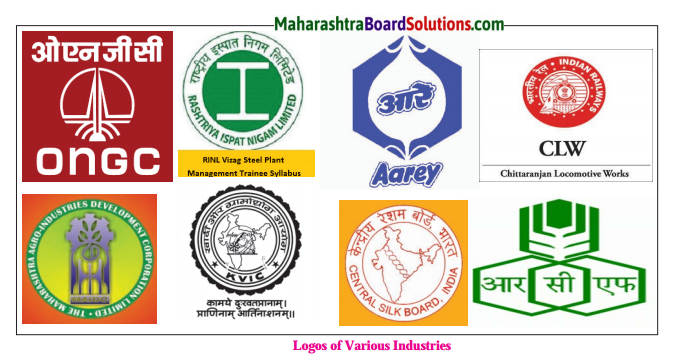
Observe the logos given and answer the questions.
Maharashtra Board Class 10 Geography Solutions Chapter 8 Economy and Occupations 13

Question (1)
Identify the industries with which they are associated.
Answer:
(i) Oil and Natural Gas Corporation – Oil and natural gas exploration and production .
(ii) Rashtriya Ispat Nigam Ltd. (RINL) – Steel production.
(iii) Aarey – Dairy and dairy products.
(iv) Chittaranjan Locomotive Works (CLW) – Electric locomotive manufacturing.
(v) Maharashtra Agro Industries Development Corporation (Limited) MAIDC – Production of pesticides, fertilizers, animal feed, agro-engineering (introducing new kinds of farm implements, sale and repair of tractors, harvesters etc.) and processing food (like jams, jellies and sauces).
(vi) Khadi and Village industries Commission
(KVIC)-Establishment and development of khadi and village Industries in rural areas.
(vii) Central Silk Board (CSB) – Silk production.
(viii) Rashtriya Chemical and Fertilizers Ltd. (RCF) Chemical and fertilizer production

Maharashtra Board Class 10 Geography Solutions Chapter 8 Economy and Occupations

Question (2)
Which raw material is used for these industries. Classify them accordingly.
Answer:

Classification Industries Raw materials
Agro-based industries Maharashtra Agro-industries Development Corporation Ltd. Seeds, raw materials required for the production of pesticides, fertilisers
Khadiand Village Industries Commission Cotton, silk and wool
Animal product – based industries Aarey Milk
Central Silk . Board (CSB) Silk
Minerals and metal-based industries Oil and Natural Gas Corporation Limited (ONGC) Crude oil and natural gas
Rashtriya Ispat Nigam Ltd. (RINL) Iron ore and coal
Chittaranjan Locomotive Works (CLW) Iron and steel and aluminium
Rashtriya Chemical and Fertilizers Ltd. (RCF) Chemicals and different minerals

Question (3)
From which part of India do they get these raw materials? Discuss and write.
Answer:
(i) Iron ore, coal, limestone etc.: Chhota Nagpur plateau area of Jharkhand, Odisha, Chhattisgarh, Bengal, Madhya Pradesh, Rajasthan, Karnataka, Goa, Maharashtra etc.
(ii) Natural Gas: Krishna-Godavari Basin.
Mumbai High, in Arabian Sea.
(iii) Mineral Oil: Mumbai High in Arabian sea, Digboi in Assam, Ankleshwar in Gujarat.
(iv) Milk: Bihar, Tamil Nadu, Haryana, Maharashtra, Punjab, Gujarat etc.
(v) Cotton: Gujarat, Maharashtra, Telangana, Karnataka, Andhra Pradesh.
(vi) Silk: Karnataka, Andhra Pradesh, Tamil Nadu, West Bengal, Jammu and Kashmir.

Think about It

Question 1.
Which type of occupations gives a boost to the development of a country’s economy?
Answer:
Secondary and tertiary occupations give a boost to the development of a country’s economy.

Make Friends With Maps

Look at the map given in Fig. The major primary occupations in Brazil are shown here. Discuss the following points and write your observations.
Maharashtra Board Class 10 Geography Solutions Chapter 8 Economy and Occupations 29
Maharashtra Board Class 10 Geography Solutions Chapter 8 Economy and Occupations 30

Question 1.
In which part of Brazil is coffee mainly produced?
Answer:
Coffee is mainly produced in the South and South-east part of Brazil.

Question 2.
Which food crops are mainly produced in Brazil?
Answer:
Rice, soyabean and corn are the food crops mainly produced in Brazil.

Question 3.
Can you relate the production of these crops with the climate there?
Answer:

  • Brazil has a wide range of climatic variation.
  • Rice requires hot and humid climate with heavy rainfall. So it is grown in the coastal region.
  • Corn grows well in the central parts of Brazil, because the climate there is hot and dry.

Question 4.
Where are the rubber plantations concentrated?
Answer:
The rubber plantations are concentrated in the north western part in the Amazon River Basin area.

Maharashtra Board Class 10 Geography Solutions Chapter 8 Economy and Occupations

Question 5.
Complete the table.
Answer:

Types of crops Crops Areas of Prodution
Food crops Corn / Maize Central
Rice coastal region
Cash crops Coffee South east
Sugarcane Central, East
Cocoa East
Rubber North
Soyabean South
Fruits and Vegetables Bananas coastal region.
Oranges East, Central

Note : Areas of the production Each one has a different area. Difficult to point out one area for all the varieties of cash crops, food crops and rice.

Use Your Brain Power

Question 1.
If Rajasthan does not have a coastal area, then how does it produce salt?
Answer:
(i) Rajasthan does not have a coastline, but it still produces salt because of the Sambhar Lake, which is India’s largest inland salt lake.
(ii) Salt is produced on a large scale here due to high proportion of salt in Sambhar Lake and high rate evaporation.

Colours Of Both

Question 1.
Indo-Brazil ties: Answer the following.

Question (1)
What does BRICS stand for?
Answer:
BRICS stands for Brazil, Russia, India, China and South Africa.

Question (2)
When was it established?
Answer:
BRIC was established in June 2006. South Africa was inducted in 2010. Then it became BRICS.

Question (3)
What are the objectives of this bloc?
Answer:
The main objectives of BRICS are:

  • To achieve regional development.
  • To act as a bridge between developed and developing countries by providing financial assistance and support in various infrastructure projects.

Question (4)
The countries of which continent are not a member of this bloc?
Answer:
The countries of North America and Australia are not a member of this bloc.

Question (5)
In which continents do the member countries lie?
Answer:
The member countries lie in the continents of Europe, South America, Africa and Asia.

Question 2.
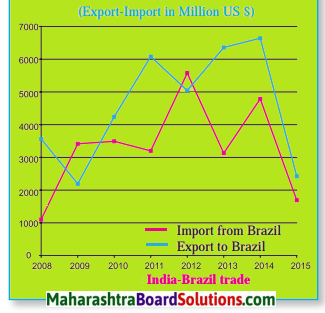
Study the graphs and answer the following questions on
Maharashtra Board Class 10 Geography Solutions Chapter 8 Economy and Occupations 22

Maharashtra Board Class 10 Geography Solutions Chapter 8 Economy and Occupations

Question (1)
In which years did the value of exports to Brazil exceed the imports from Brazil?
Answer:
In the years 2008, 2010, 2011, 2013, 2014 and 2015 the value of exports to Brazil have exceeded the imports from Brazil.

Question (2)
In which year was trade with Brazil the most favourable of all?
Answer:
Trade with Brazil was most favourable in the year 2013.

Question (3)
Comment upon the Balance of Trade in the year 2013.
Answer:
(i) The value of Balance of Trade between India and Brazil was maximum in the year 2013.
(ii) Also, the Balance of Trade was in India’s favour.

Question (4)
From which year the value of exports to Brazil have exeeded the value of import from Brazil?
Answer:
From 2010 to 2015 (except 2012).

Question (5)
Write a note on the trade between Brazil and India.
Answer:
(i) Trade between India and Brazil has not been consistent.
(ii) Most of the time the trade has been favourable for India, with exports more than imports.
(iii) In 2015, India-Brazil trade has shown a downfall with both imports and exports at an all-time low.

Question (6)
In which year was the value of exports to Brazil the maximum?
Answer:
The value of exports to Brazil was the maximum in 2014.

Give It A Try

Question 1.
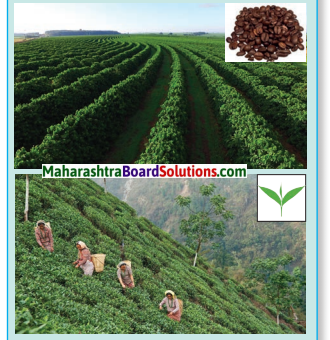
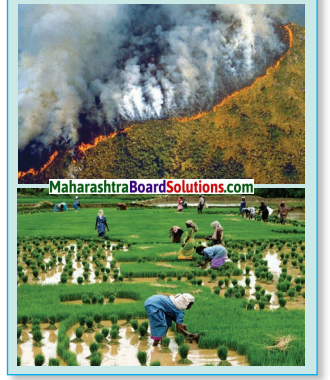
The following images are related to agricultural activities. Identify and write whether they are practised in Brazil or India.
Maharashtra Board Class 10 Geography Solutions Chapter 8 Economy and Occupations 9
Maharashtra Board Class 10 Geography Solutions Chapter 8 Economy and Occupations 21
Answer:
(i) In the first image, coffee plantation is seen. It is found mainly in Brazil. In India, coffee plantation are seen in the South Indian states of Karnataka, Kerala and Tamil Nadu.

(ii) The second image is of the Tea plantation. It is mainly found in India, in Assam, West Bengal, Tamil Nadu and Kerala.

(iii) In the third image, shifting agriculture is seen. It is also called ‘Slash and Burn’ agriculture. In this method, the land under forests is cleared by cutting and burning. On this patch of land, subsistence type of agriculture is practised for the next few years.

Once this patch of land loses fertility; another patch of land is brought under shifting cultivation. It is mainly practiced in Brazil and in some parts of India.

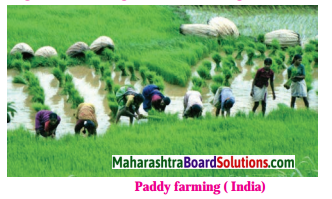
In the fourth image, paddy cultivation is seen and it is mainly practiced in India where there is heavy sufficient and irrigation rainfall.

Try This

Question 1.
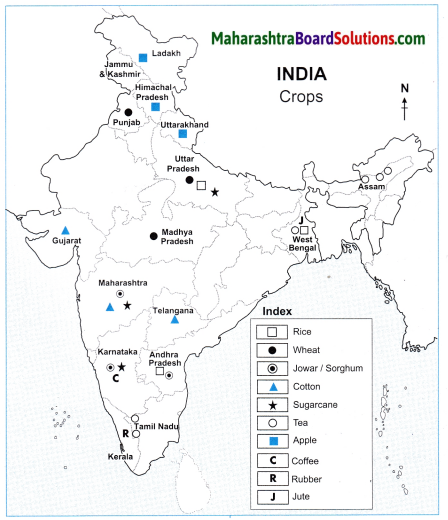
Show the distribution of crops like wheat, jowar, rice, cotton, sugarcane, tea, jute, coffee and rubber, apple in the outline map of India using symbols. Name the map.
Answer:
Maharashtra Board Class 10 Geography Solutions Chapter 8 Economy and Occupations 11

Find Out

Question 1.
Obtain information regarding pisciculture in India with the help of internet and reference books and write a note.
Answer:

  • Breeding, rearing and transplantation of fish by artificial means is called pisciculture. It is also called fish farming.
  • Fishes are raised in tanks or enclosures for commercial reasons.
  • Pisciculture in India is increasing rapidly due to the increasing demand for fish and fish products.
  • Indian climate is suitable for practising pisciculture. Wide variety of fish species are raised in the fish farms, e.g. salmon, carp, catfish.
  • Due to availability of abundant labour and water sources like lakes, ponds, rivers, etc, pisciculture has become easier.
  • Employment opportunities are created due to pisciculture.
  • Banks offer loans for those interested in this business.

Maharashtra Board Class 10 Geography Solutions Chapter 8 Economy and Occupations

Class 10 Geography Chapter 8 Economy and Occupations Additional Important Questions and Answers

Choose the correct option and rewrite the statements:

Question 1.
India has a/an ________ national income as Compared to Brazil.
(a) higher
(b) lower
(c) equal
(d) very low
Answer:
(a) higher

Question 2.
In Brazil, ______ is the main occupation of the people living in the highlands and coastal areas.
(a) agriculture
(b) mining
(c) animal rearing
(d) sericulture
Answer:
(a) agriculture

Question 3.
The main cereal crops grown in Brazil are ______ and maize.
(a) wheat
(b) barley
(c) oat
(d) rice
Answer:
(d) rice

Question 4.
Production of maize is largely concentrated in the _____ part of Brazil.
(a) western
(b) northern
(c) southern
(d) central
Answer:
(d) central

Question 5.
Brazil is the largest exporter of coffee and ______ in the world.
(a) rubber
(b) cocoa
(c) soyabean
(d) maize
Answer:
(c) soyabean

Question 6.
The major states growing coffee are _______ and Sao Paulo.
(a) Rio de Janeiro
(b) Minas Gerais
(c) Para
(d) Parana
Answer:
(b) Minas Gerais

Question 7.
Coffee farms are called _____ in Brazil
(a) para
(b) fazendas
(c) Cerrado
(d) Savannah
Answer:
(b) fazendas

Question 8.
Cattle, sheep and goats are reared in the _____ of the South of Brazil.
(a) Amazon Basin
(b) Parana River basin
(c) Savannah grasslands
(d) Coastal areas
Answer:
(c) Savannah grasslands

Question 9.
The eastern part of Brazil is rich in various types of _____.
(a) crops
(b) animals
(c) minerals
(d) forests
Answer:
(c) minerals

Question 10.
Inaccessibility, lack of knowledge of ________ potential reserves, dense forests are factors which have led to limitation in in the interior parts of Brazil.
(a) agriculture
(b) mining
(c) agro- forestry
(d) fishing
Answer:
(b) mining

Question 11.
Due to the increasing demand in the country, mining has developed well in the ______ region of Brazil.
(a) coastal
(b) highland
(c) mountainous
(d) equatorial forest
Answer:
(b) highland

Maharashtra Board Class 10 Geography Solutions Chapter 8 Economy and Occupations

Question 12.
Brazil has a sea coast of around 7,400 km and excellent fishing grounds off the ____ coast.
(a) South Atlantic
(b) North Atlantic
(c) South Pacific
(d) North Pacific
Answer:
(a) South Atlantic

Question 13.
The meeting of the warm Brazil current and the cold Falkland current off the coast of South-east Brazil make it a good ______.
(a) fishing ground
(b) offshore oil rig
(c) ocean transport route
(d) fishermen’s settlement
Answer:
(a) fishing ground

Question 14.
Traditionally, in Brazil, fishing has been carried on by small groups of individual fishermen using _____ techniques and equipment.
(a) scientific
(b) modern
(c) primitive
(d) latest
Answer:
(c) primitive

Question 15.
The fish resources of the _____ river are not exploited much and fishing only takes place on a small scale.
(a) Parana
(b) Sao Francisco
(c) Paraguay
(d) Amazon
Answer:
(d) Amazon

Question 16.
Around 60% of land in India is under ________.
(a) cultivation
(b) industries
(c) forestry
(d) mining
Answer:
(a) cultivation

Question 17.
Indian agriculture is mainly _______ type.
(a) commercial
(b) mechanized
(c) subsistence
(d) extensive
Answer:
(c) subsistence

Question 18.
In the coastal areas of India, ______ forms an important part of the diet of many people.
(a) wheat
(b) fish
(c) lobsters
(d) millets
Answer:
(b) fish

Question 19.
Horse mackerels, clupeids and silver bellies are important varieties of ________
(a) crops
(b) fish
(c) millets
(d) cereals
Answer:
(b) fish

Question 20.
Among the freshwater varieties of fish, _______ is a major one.
(a) Sardines
(b) Mackerel
(c) Bombay Duck
(d) Silver Bellies Carp (Chopda)
Answer:
(d) Silver Bellies Carp (Chopda)

Question 21.
In India, the _____ plateau is a big store house of minerals.
(a) Malwa
(b) Bundelkhand
(c) Baghelkhand
(d) Chhota Nagpur
Answer:
(d) Chhota Nagpur

Question 22.
Coal is mined in ____ in Chhattisgarh and in eastern Maharashtra.
(a) Korba
(b) Cuddapah
(c) Digboi
(d) Kalol
Answer:
(a) Korba

Question 23.
Mineral oil wells are found in _____ in Assam.
(a) Korba
(b) Koyali
(c) Digboi
(d) Kalol
Answer:
(c) Digboi

Question 24.
Reserves of mineral oil and natural gas have been discovered at the mouth of the river _______.
(a) Krishna
(b) Kaveri
(c) Godavari
(d) Mahanadi
Answer:
(c) Godavari

Question 25.
Stones like marble are found in Rajasthan and Cuddapah in ______.
(a) Andhra Pradesh
(b) Arunachal Pradesh
(c) Himachal Pradesh
(d) Uttar Pradesh
Answer:
(a) Andhra Pradesh

Question 26.
Traditionally, the poorest part of Brazil is the ______.
(a) north-east
(b) south
(c) north-west
(d) central
Answer:
(a) north-east

Maharashtra Board Class 10 Geography Solutions Chapter 8 Economy and Occupations

Question 27.
The north-eastern part of the Indian Peninsula has a very high concentration of _____ industries.
(a) chemical
(b) metallurgical
(c) canning
(d) fruit processing
Answer:
(b) metallurgical

Question 28.
The coastal belt of _______ has a heavy concentration of coir, copra and fish canning industries.
(a) Kerala
(b) Goa
(c) Karnataka
(d) Maharashtra
Answer:
(a) Kerala

Question 29.
Many refineries are situated close to the petroleum producing areas whereas Mathura and _______ refineries are in the interior, away from the oil producing areas.
(a) Digboi
(b) Bongaigaon
(c) Barauni
(d) Koyali
Answer:
(c) Barauni

Question 30.
Among the minerals, Brazil mainly exports _____.
(a) coal
(b) gold
(c) iron ore
(d) manganese
Answer:
(c) iron ore

Question 31.
The main trading partner of Brazil among the Gulf countries is _______.
(a) Bahrain
(b) Saudi Arabia
(c) Kuwait
(d) Iran
Answer:
(b) Saudi Arabia

Question 32.
India’s major trading partners from the continent of Europe are the UK and _______.
(a) Italy
(b) France
(c) Germany
(d) Greece
Answer:
(c) Germany

Match the columns:

Question 1.

S.No Column ‘A’ Column ‘B’
(1)  Rice and maize (a) Commercial crops of Brazil
(2)  Tea and mangoes (b) Cereal crops of Brazil
(3)  Cotton and jute (c) India’s imports
(4) Coffee, cocoa, rubber,soyabean (d)      India’s exports
(e)      India’s cash crops

Answer:
1 – b
2 – d
3 – e

Question 2.

Column ‘A’ Column ‘B’
(1) Kachchh (a) Kerala
(2) Coromandal coast (b) North east India
(3) Malabar coast (c) Near Maharashtra
(4) Mumbai High (d) South east India
(e) Western coast

Answer:
1 – e
2 – d
3 – a
4 – c

Question 3.

Column ‘A’ Column ’B’ Column ‘C’
(1) Coal (a) Digboi (i) Andhra Pradesh
(2) Mineral oil well (b) Coastal belt (ii) Chhattisgarh
(3) Stones (c) Korba (iii) Kaveri
(4) Mineral oil and Natural gas (d) River mouth (iv) Assam
(5) Coir and copra (e) Cuddapah (v) Godavari
(f) Estuary (vi) Kerala

Answer:
1 – c – ii
2 – a – iv
3 – e – i
4 – d – v
5 – b – vi

Maharashtra Board Class 10 Geography Solutions Chapter 8 Economy and Occupations

Question 4.

Column ‘A’ Column ‘B’
(1) Coir, copra and fish canning (a) Mathura
(2) Salt (b) Gujarat
(3) Oil refineries (c) Kerala
(4) Stones (d) Barauni
(e) Andhra Pradesh

Answer:
1 – c
2 – b
3 – d
4 – e

Answer the following in one sentence:

Question 1.
Which currency is mainly used for international trade?
Answer:
US dollar is the currency which is mainly used for international trade.

Question 2.
Name the sectors of Brazil in which Indian companies have invested money.
Answer:
Information technology, pharmaceuticals, energy, agro-business, mining, engineering, automobiles, etc. are the sectors of Brazil in which Indian companies have invested money.

Question 3.
Name the sectors of India in which Brazilian companies have invested money.
Answer:
Automobiles, information technology, mining, energy, bio-fuel, footwear, etc. are the sectors of India in which Brazilian companies have invested capital.

Question 4.
Which type of occupations give a boost to the development of a country’s economy ?
Answer:
Tertiary occupation give a boost to the development of a country’s economy.

Name the following:

Question 1.
Factors making it possible for growing a variety of crops in Brazil.
Answer:
Favourable climate and topography.

Question 2.
The main cereal crops of Brazil.
Answer:
Rice and maize

Question 3.
The production of this cereal crop is largely concentrated in the central part of Brazil.
Answer:
Maize.

Question 4.
The major commercial crops of Brazil.
Answer:
Coffee, cocoa, rubber, soyabean and sugarcane.

Question 5.
The largest exporter of coffee and soyabean in the world.
Answer:
Brazil.

Question 6.
The major coffee-growing states of Brazil.
Answer:
Minas Gerais and Sao Paulo.

Question 7.
Fruits are grown in Brazil.
Answer:
Bananas, pineapples, oranges and other citrus fruits.

Question 8.
The region in Brazil where cattle, sheep and goats are reared.
Answer:
Savannah grasslands in the south.

Question 9.
Two factors that have led to limitations in mining in the interior parts of Brazil.
Answer:

  • Inaccessibility due to dense forests
  • Lack of knowledge of potential reserves of resources.

Maharashtra Board Class 10 Geography Solutions Chapter 8 Economy and Occupations

Question 10.
The warm current in the eastern coast of Brazil.
Answer:
Brazil current.

Question 11.
The cold current off the south-eastern coast of Brazil.
Answer:
Falkland current.

Question 12.
The main catches of the fishermen in Brazil.
Answer:
Swordfish, shrimp, lobsters, sardines, etc.

Question 13.
Major food crops produced in India.
Answer:
Rice, wheat, maize, sorghum and millets.

Question 14.
Crops grown in plantation in India.
Answer:
Tea, coffee and rubber.

Question 15.
Major cash crops grown in India.
Answer:
Sugarcane, cotton and jute.

Question 16.
Main type of Indian agriculture.
Answer:
Subsistence.

Question 17.
Maj or fish varieties found in the western coastal region of India.
Answer:
Sardines, mackerel, bombay duck and prawns.

Question 18.
The important varieties of fish on the eastern coast of India.
Answer:
Horse mackerels, clupeids and silver bellied carp.

Question 19.
The major freshwater fish variety in India.
Answer:
Silver bellied carp (chopda).

Question 20.
Places where coal is mined in India.
Answer:
Korba in Chhattisgarh and in Eastern Maharashtra

Question 21.
Places where mineral oil wells are found in India.
Answer:
(i) Digboi in Assam
(ii) Mumbai High in the Arabian Sea near Maharashtra
(iii) Kalol and Koyali in Gujarat.

Question 22.
The name of the river mouth, where reserves of mineral oil and natural gas have been discovered.
Answer:
River Godavari.

Question 23.
The state where stones like marble are found.
Answer:
Rajasthan.

Question 24.
The place/state where stones like Cuddapah are found.
Answer:
Cuddappah in Andhra Pradesh.

Question 25.
The states in which fish forms an important part of the diet of many people living in the coastal areas in India.
Answer:
Kerala, West Bengal, Odisha, Andhra Pradesh, Tamil Nadu, Goa and Maharashtra.

Maharashtra Board Class 10 Geography Solutions Chapter 8 Economy and Occupations

Question 26.
States of India where metallic minerals are found.
Answer: Jharkhand, Odisha, adjoining Chhattisgarh and Madhya Pradesh, parts of Rajasthan, Karnataka and Tamil Nadu.

Question 27.
The agro-based industries in India which are heavily concentrated in the raw material- producing areas.
Answer:
Cotton, jute and sugar.

Question 28.
The forest-based industries in India.
Answer:
Paper, plywood, matches, resins and lac.

Question 29.
Industries found in the coastal belt of Kerala in India.
Answer:
Coir, copra and fish canning.

Question 30.
Refineries in India situated close to the petroleum-producing areas.
Answer:
Koyali, Digboi, Noonmati and Bongaigaon.

Question 31.
Refineries in India located away from the coast and oil-producing areas.
Answer:
Mathura and Barauni.

Question 32.
Major salt-producing states in India.
Answer:
Gujarat, Rajasthan and Tamil Nadu.

Question 33.
Brazil’s export items.
Answer:
Iron ore, coffee, cocoa, cotton, sugar, tobacco, oranges and bananas.

Question 34.
Brazil’s import items.
Answer:
Machinery, chemical products, fertilizers, wheat, heavy vehicles, mineral oil and lubricants.

Question 35.
Major trading partners of Brazil.
Answer:
Germany, the USA, Canada, Italy and Argentina, Saudi Arabia.

Question 36.
India’s export items.
Answer:
Tea, coffee, mangoes, spices, leather & leather goods, iron ore, cotton and silk textiles etc.

Question 37.
India’s import items.
Answer:
Petroleum, machines, pearls and precious stones, gold and silver, paper, medicines, etc.

Question 38.
India’s major trading partners.
Answer:
The USA, The UK, Germany, Japan, China, Russia, etc.

Distinguish between:

Question 1.
The Indian companies’ investment in Brazil and Brazil’s investment in India.
Answer:

Indian investment in Brazil Brazilian investment in India
(i) Indian companies have invested a lot of capital in Brazil.
(ii) e.g. IT, pharmaceuticals, energy, agri-business, mining, engineering and auto sectors.
(i) Brazilian companies investment in India is smaller.(ii)  e.g. automobiles, IT, mining, energy, biofuels, footwear sectors in India.

Question 2.
Brazil-International Trade and India-International Trade
Answer:

Brazil-International Trade India-International Trade
(i) Major exports of Brazil are iron-ore, coffee, cocoa, cotton, sugar, tobacco, oranges and bananas.
(ii) Major imports of Brazil are machinery, chemical products, fertilizers, wheat, heavy vehicles, mineral oil and lubricants.
(iii) Major trading partners of Brazil are Germany, the USA, Canada, Italy, Argentina, India and Saudi Arabia.
(i) Major exports of India are tea, coffee, mangoes, spices, leather and leather goods, iron ore, cotton and silk textiles.
(ii) Major imports of India are petroleum, machines, pearls, precious stones, gold and silver, paper, medicines, etc.
(iii) Major trading partners of India are the USA, the UK, Germany, Japan, China, Russia, etc.

Question 3.
US Economy and India-Brazil Economies.
Answer:

US Economy India-Brazil Economy
(i) The US economy is a developed economy.
(ii) National income and per capita income of US is far ahead of Brazil and India.
(iii) The US has the strength of many patents, modern technology and mechanical strength.
(i) India and Brazil are developing economies.
(ii) National income and per capita income of India and Brazil is low.
(iii)India and Brazil have just about started progressing in the fields of technology, education and industry.

Maharashtra Board Class 10 Geography Solutions Chapter 8 Economy and Occupations

Mark the following on the outline map:

Question 1.
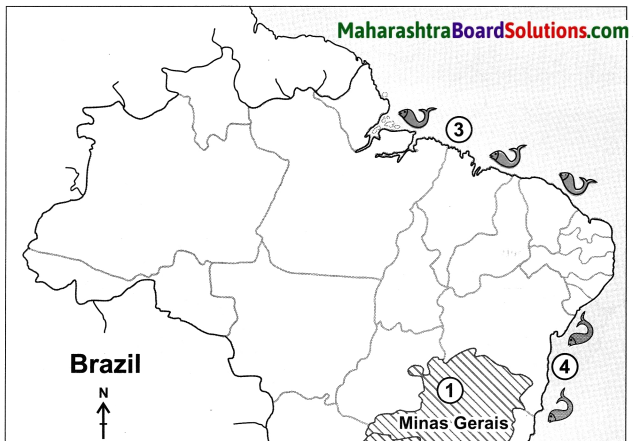
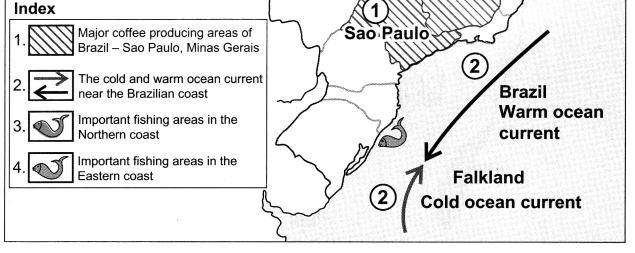
On the given Political map of Brazil, show the following details (Draw index).

  1. Major coffee producing areas of Brazil.
  2. The cold and warm ocean current near the Brazilian coast.
  3. Important fishing areas in the Northern coast.
  4. Important fishing areas in the Eastern coast.

Answer:
Maharashtra Board Class 10 Geography Solutions Chapter 8 Economy and Occupations 23
Maharashtra Board Class 10 Geography Solutions Chapter 8 Economy and Occupations 24

Question 2.
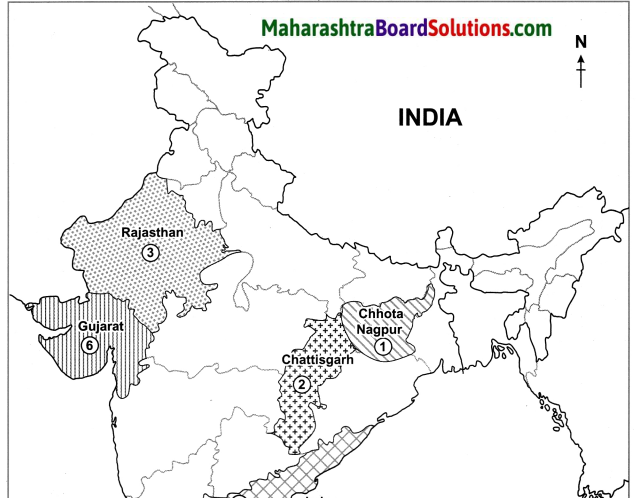
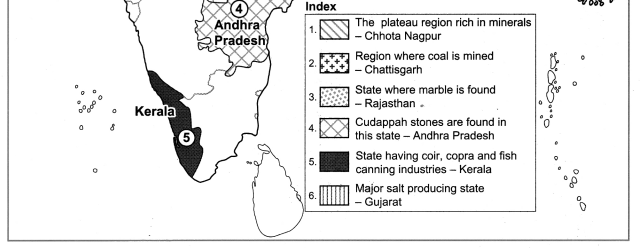
Indicate the following on a map of India.

  1. The plateau region rich in minerals.
  2. Region where coal is mined.
  3. State where marble is found.
  4. Cudappah stones are found in this state.
  5. The state whose coastal belt has a concentration of coir, copra and fish canning industries.
  6. Major salt producing state.

Answer:
Maharashtra Board Class 10 Geography Solutions Chapter 8 Economy and Occupations 25
Maharashtra Board Class 10 Geography Solutions Chapter 8 Economy and Occupations 26

Question 3.
Locate the following regions on the map of India.

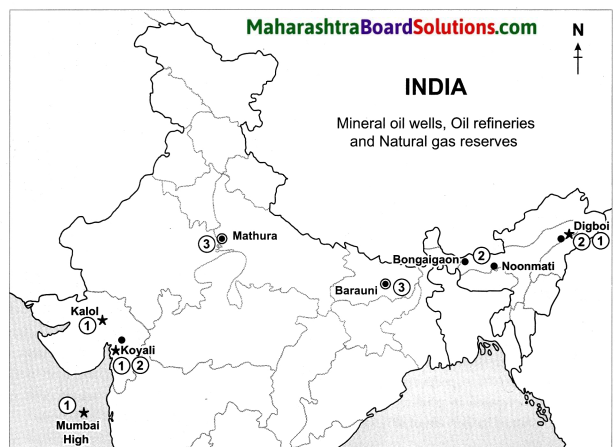
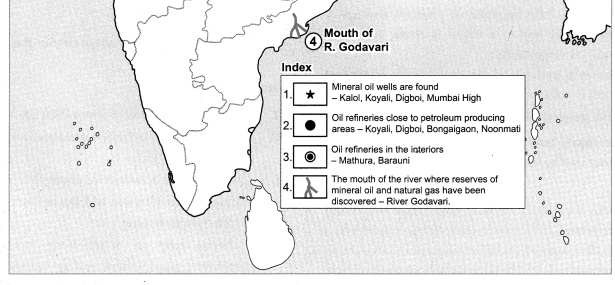
  1. Mineral oil wells.
  2. Oil refineries close to petroleum producing areas.
  3. Oil refineries in the interiors.
  4. The mouth of the river where reserves of mineral oil and natural gas have been discovered.

Answer:
Maharashtra Board Class 10 Geography Solutions Chapter 8 Economy and Occupations 27
Maharashtra Board Class 10 Geography Solutions Chapter 8 Economy and Occupations 28

Give Geographical Reasons:

Question 1.
Unlike Brazil, India’s agriculture contributes more towards the GDP.
Answer:

  • Around 60% of land in India is under cultivation.
  • Agriculture has been a long standing activity here with a large chunk of population engaged in it.
  • The enormous expanse of level plains, rich soils, high percentage of cultivable land, wide climatic variety, long growing season, etc. provide a strong base for agriculture in India.
  • So, unlike Brazil, India’s agriculture contributes more towards the GDP.

Maharashtra Board Class 10 Geography Solutions Chapter 8 Economy and Occupations

Question 2.
Fishing plays an important role in the economy of India.
Answer:

  • India has a coastline of about 7500 km.
  • India is one of the largest producer of fish, both marine and inland.
  • Marine fishing accounts for about 40% of the total annual fish production and the remaining 60% is by freshwater fishing.
  • Fisheries help in augmenting food supply, generating employment, raising nutritional level and earning foreign exchange.
  • Fish forms an important part of the diet of many people living in all the coastal states.
  • Thus, fishing plays a significant role in the economy of the country.

Question 3.
The distribution of industries in India is highly uneven.
Answer:
The distribution of industries is India in highly uneven due to the following reasons:

  • Uneven distribution of the necessary raw materials and power resources.
  • There is concentration of enterprises, financial resources and other necessary conditions in large towns.

Question 4.
The North Eastern part of the Indian Peninsula has a high concentration of heavy metallurgical industries.
Answer:
The north eastern part of the Indian Peninsula has a high concentration of heavy metallurgical industries because:

  • Chattisgarh, Odisha, Jharkhand, West Bengal are rich in minerals.
  • Large quantities of coal deposits, an important raw material in metallurgical industries is available.
  • There are availability of refractory materials, cheap power from the Damodar Valley Corporation and a number of thermal power projects.
  • There is availability of cheap labour in and around this region.

Question 5.
USA is a developed country.
Answer:
The United States is a developed country because:

  • This country has less but a well-educated population.
  • It has the strength of many patents, modern technology and mechanical strength.
  • USA has a very high national income and per capita income.

Question 6.
Brazil is a good fishing ground.
Answer:
Brazil is a good fishing ground because :

  • Brazil has a sea coast of around 7400 km and excellent fishing grounds off the South Atlantic coast.
  • The meeting of the warm Brazil current and the cold Falkland current off the coast of South-East Brazil makes it a good fishing ground.

Write short notes on:

Question 1.
Mining in India:
Answer:
(i) The Chhota Nagpur plateau in India is a big storehouse of different minerals. Mining is the main occupation of the people.
(ii) Coal is mined in Korba in Chattisgarh and in Eastern Maharashtra.
(iii) Mineral oil wells are found in Digboi in
Assam, Mumbai High in the Arabian Sea near Maharashtra, Kalol, Koyali in Gujarat.
(iv) Stones like marble are found in Rajasthan and Cuddapah in Andhra Pradesh.

Question 2.
Industries in Brazil:
Answer:
(i) Major industries of Brazil are iron and steel, automobile assembling, petroleum processing, chemical production and cement making.
(ii) Technologically based industries have been the most dynamic in recent years.
(iii) Food-processing industries, cotton textiles, silk and woollen industries have developed well.
(iv) Most large industries are concentrated in the south and south-east of Brazil.

Question 3.
Agro-based and forest-based industries in India.
Answer:
(i) Agro-based industries: The agro-based industries including cotton, jute and sugar are heavily concentrated in the raw material producing areas.
(ii) Forest-based industries: The forest based industries including paper, plywood, matches, resins and lac are increasingly finding mostly found in the forest areas of various states.

10th Std Geography Questions And Answers:

Population Question Answer Class 10 Geography Chapter 6 Maharashtra Board

Balbharti Maharashtra State Board Class 10 Geography Solutions Chapter 6 Population Notes, Textbook Exercise Important Questions and Answers.

Std 10 Geography Chapter 6 Question Answer Population Maharashtra Board

Class 10 Geography Chapter 6 Population Question Answer Maharashtra Board

Geography Class 10 Chapter 6 Question Answer Maharashtra Board

1. Are the following sentences right or wrong? Correct the wrong ones.

Question a.
Literacy rate is higher in Brazil than India.
Answer:
Right.

Question b.
In Brazil, people prefer living in the south east as compared to the north east.
Answer:
Right.

Maharashtra Board Class 10 Geography Solutions Chapter 6 Population

Question c.
The life expectancy of Indians is decreasing.
Answer:
Wrong.

Question d.
The north-western part of India is densely populated.
Answer:
Wrong.

Question e.
The western part of Brazil is densely populated.
Answer:
Wrong

Maharashtra Board Class 10 Geography Solutions Chapter 6 Population

2. Answer the following questions as per the instructions:

Question a.
Arrange the following states of India in descending order of their population. Himachal Pradesh, Uttar Pradesh, Arunachal Pradesh, Madhya Pradesh, Andhra Pradesh.
Answer:
Descending order: Uttar Pradesh, Madhya Pradesh, Andhra Pradesh, Himachal Pradesh, Arunachal Pradesh.

Question b.
Arrange the states of Brazil in ascending order of their population: Amazonas, Rio de Janeiro,
Alagoas, Sao Paulo, Parana.
Answer:
States of Brazil: Alagoas, Amazonas, Parana, Rio de Janeiro, Sao Paulo.

Question c.
Classify the factors affecting the distribution of population into favourable and unfavourable.
Answer:

Favourable Factors Unfavourable Factors
(1) Nearness to Sea Lack of roads
(2) Temperate Climate Lack of Industries
(3) New cities and towns Tropical moist forests
(4) Minerals Semi arid climate
(5) Cultivable land

Maharashtra Board Class 10 Geography Solutions Chapter 6 Population

3. Answer the following questions:

Question a.
Explain the similarities and differences between the population distribution in Brazil and India.
Answer:
(a) Similarities in population distribution in Brazil and India:

  • In Brazil as well as in India, population is very unevenly distributed.
  • Inaccessible dense forests and absence of facilities are the barriers to human settlements.
  • North, north west and north east of both the countries are the regions of low population.
  • Population is concentrated in flat fertile regions which have abundant water resources, transport facilities, mild climate and development of agriculture industries and trade in the plain region.
  • Coastal regions are densely populated in Brazil and in India.

(b) Differences between population distribution in Brazil and India.

  • The average density of population in India is 382 persons per sq.km, and that of Brazil is about 23 persons per sq.km.
  • Though the area of both the countries is occupied by vast river basins, the distribution of population is extremely opposite in both the river basins.
  • The Amazon River Basin is sparsely populated while the Ganga River Basin is densely populated.

Question b.
Giving examples, correlated to, climate and population distribution
Answer:
Climate and population distribution are closely interreleted. Temperature and rainfall, the two elements of climate greatly influence the population concentration.

(i) Dense population is found in regions with mild climate and moderate rainfall.
E.g. the coastal plains of Brazil, the northern plain as well as the coastal plains of India

(ii) Places with heavy rainfall, inaccessibility and dense forests have low population.
E.g. the interiors of the Amazon Basin in Brazil, north eastern states in India.

(iii) The snow covered regions due to extremely cold climatic conditions have less population.
E.g. the northernmost part of Jammu & Kashmir.

(iv) In certain regions, due to less rainfall and extreme climatic conditions population is sparse.
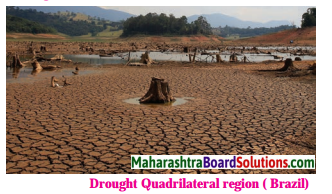
E.g. Thar desert of Rajasthan and the Drought Quadrilateral region of Brazil.

4. Give geographical reasons:

Question a.
Population is an important resource.
Answer:

  • The qualitative aspects of a population are important for a nation’s economic and social progress.
  • Natural resources of any country gets utilised properly because of the population.
  • Economic growth and development will be slow if population resource is not utilised properly.
  • Thus an optimum and quality population can bring about a country’s development.

Question b.
Brazil’s population density is very less.
Answer:

  • Brazil is the fifth largest country in the world with respect to area and has a population of about 19 crores (Census 2010).
  • It occupies 5.6% of world’s total land area and accounts for only 2.78% of the world’s total population.
  • Thus Brazil occupies more percent of world’s land and less percent of world’s total population. Therefore,
  • the density of population is very less in Brazil, i.e. around 23 persons per sq.km.

Question c.
India’s population density is high.
Answer:

  • India is the second most populous country in the world, with a population of about 121 crores (Census 2011).
  • India occupies only 2.41% of the land area of the world, but supports 17.5% of the world’s population.
  • Thus India has less percent of world’s land and supports high percent of world’s population.
  • Hence, India’s average population density is high i.e. 382 persons per sq. km.

Question d.
The density of population is sparse in the Amazon Basin.
Answer:

  • The interior part of the Amazon Basin has a very unfavourable hot and humid climate.
  • It receives heavy rainfall of nearly 2000 mm and has dense inaccessible forests.
  • Transportation, agricultute and industries are not well developed here.
  • All these factors are barriers to the development of human settlements.
  • So, the density of population is sparse in the Amazon Basin.

Question e.
Population density is high in the Ganga plains.
Answer:

  • Ganga plains are fertile low lying plains formed due to the deposition work of River Ganga and its tributaries.
  • Mild climate, moderate rainfall and fertile soil have led to the development of agriculture and industries.
  • This region also has a dense network of roadways and railways.
  • So, the population density is high in the Ganga Plains.

5. Observe the following diagram and answer the following questions:

Maharashtra Board Class 10 Geography Solutions Chapter 6 Population 1
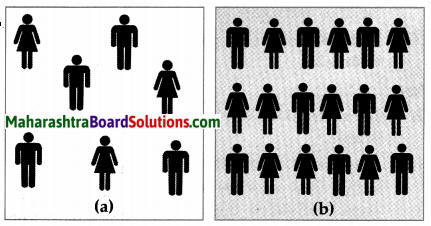
Question 5A.
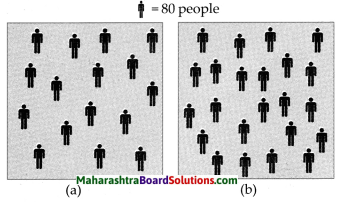
Compare and classify the population densities shown in the figure ‘a’ and ‘b’ representing 1 sq. km. of area.
Answer:
In the fig. (a) density of population is 7 persons per sq. km. The region is sparsely populated.
In the fig. (b), the density of population is 18 persons per sq. km. The region is densely populated.

Question 5B.
If in figure B one sign = 100, then what will be the sex ratio?
Answer:
One symbol = 100 persons
There are 10 female symbols.
Number of females = 100 x 10
= 1000
There are 8 male symbols
Number of males = 100 x 8
= 800

Males 800 1000
Females 1000 ?

Number of females = \(\frac { 1000 X 1000 }{ 800 }\)
= 1250
Sex Ratio is 1250 females per 1000 males.

Question 6.
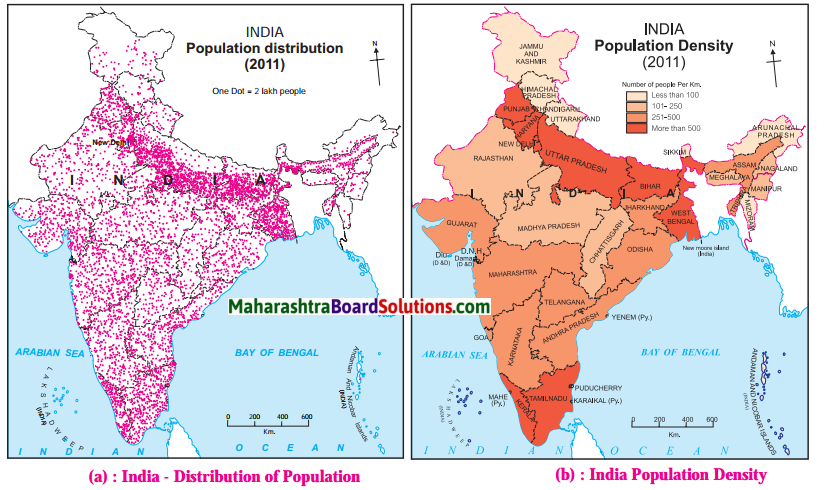
Comment upon the population density of fig (b).
(i) fig (b) shows the population density of India as per 2011.
(ii) The density of population is divided into four categories. They are:
(a) Less than 100 persons per sq.km. .
(b) 101-250 persons per sq.km.
(c) 251-500 persons per sq.km.
(d) more than 500 persons per sq.km.
Answer:

S.No. Population Density (per sq.km.) Name of the States / Union Territories
(1) less than 100 Arunachal Pradesh, Mizoram, Jammu and Kashmir, Himachal Pradesh, Uttarakhand, Sikkim.
(2) 101 to 250 Meghalaya, Manipur, Nagaland, Rajasthan, Madhya Pradesh, Chattisgarh.
(3) 251 to 500 Gujarat, Maharashtra, Goa, Karnataka, Andhra Pradesh, Telangana, Odisha, Jharkhand, Assam, Tripura.
(4) more than 501 West Bengal, Bihar, Punjab, Haryana, Uttar Pradesh,Kerala and Tamil Nadu, Delhi, Chandigarh, Puducherry, Diu, Daman, Dadra Nagar, Haveli, Andaman and Nicobar Islands.

Maharashtra Board Class 10 Geography Solutions Chapter 6 Population

Class 10 Geography Chapter 6 Population Intext Questions and Answers

Study the maps and answer the following questions

Maharashtra Board Class 10 Geography Solutions Chapter 6 Population 9
Question 1.
States with the highest population density.
Answer:
West Bengal, Bihar, Punjab, Haryana, Uttar Pradesh, Kerala and Tamil Nadu.

Question 2.
On the basis of maps given above, classify the distribution population in India in the following table.
Answer:

S.No. Population Density (per sq.km.) Name of the States / Union Territories
(1) less than 100 Arunachal Pradesh, Mizoram, Jammu and Kashmir, Himachal Pradesh, Uttarakhand, Sikkim.
(2) 101 to 250 Meghalaya, Manipur, Nagaland, Rajasthan, Madhya Pradesh, Chattisgarh.
(3) 251 to 500 Gujarat, Maharashtra, Goa, Karnataka, Andhra Pradesh, Telangana, Odisha, Jharkhand, Assam, Tripura.
(4) more than 501 West Bengal, Bihar, Punjab, Haryana, Uttar Pradesh, Kerala and Tamil Nadu, Delhi, Chandigarh, Puducherry, Diu, Daman, Dadra Nagar, Haveli, Andaman and Nicobar Islands.

Question 3.
States with lowest population density.
Answer:
Arunachal Pradesh, Sikkim, Jammu and Kashmir, Himachal Pradesh, Uttarakhand and Mizoram.

Question 4.
Correlate the climate and physiography of India with its population distribution and write a note on it.
Answer:
(i) Climate and population distribution are closely inter-related.

(ii) Temperature and rainfall are the two elements of climate which greatly influence the population distribution.

(iii) Dense population is found in regions with mild climate and moderate rainfall.
E.g. the northern plain as well as the coastal plains of India

(iv) Places with heavy rainfall, inaccessibility and dense forests have low population.
E.g. northeastern states in India.

(v) The snow-covered regions due to extremely cold climatic conditions have less population.
E.g. the northernmost part of Jammu and Kashmir.

(vi) In certain regions, due to less rainfall and extreme climatic conditions population is sparse.
E.g. Westernmost part of India in the Thar desert, Rajasthan.

Maharashtra Board Class 10 Geography Solutions Chapter 6 Population 8

Maharashtra Board Class 10 Geography Solutions Chapter 6 Population

Question 1.
In which area is population greatly concentrated?
Answer:
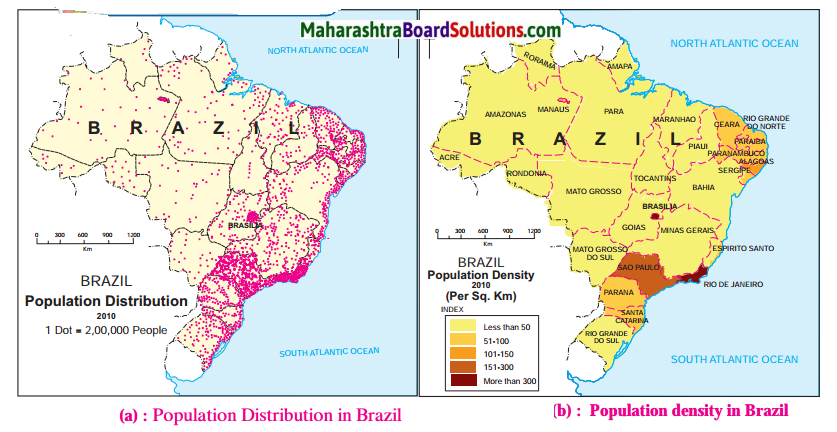
Population is greatly concentrated in the south eastern part of Brazil.

Question 2.
In which area is the distribution of population sparse?
Answer:
The Amazon Basin in the nothern part and the central and western parts of Brazil have sparse distribution of population.

Question 3.
Prepare a note on factors responsible for the uneven distribution of population based on the study of Brazil you have made so far.
Answer:
The distribution of population in Brazil is uneven:

  • There is sparse population in the Amazon Basin due to hot and humid climate, heavy rainfall, dense forests, inaccessibility.
  • The population is low in the swampy areas of Pantanal.
  • Low population is found in the central and western part of Brazil due to lack of minerals, low rainfall, hot and dry climatic conditions.
  • The distribution of population is moderate in Brazilian Highlands.
  • High population is found in the coastal regions and the southern part of Brazil. This is due to flat fertile land and abundant availability of minerals due to which agriculture, industries and trade have developed.

Question 4.
Identify the type of map showing distribution fig. (a) of textbook.
Answer:
The type of map showing distribution of population is a dot map.

Question 5.
On the basis of the map (b), classify the distribution of population in Brazil in the following table.:

S. No. Population Density Names of the places
(1) Less than 50 Acre, Amazonas, Roraima, Rondonia, Para, Amapa, Mata Grasso, Mato Grasso Do Sul, Goias, Tocantins, Maranhao, Piaui, Bahia, Minas Gerais, Rio Gande Do Sul
(2) 51 -100 Paraiba, Pamambuco, Parana, Santa Catarina, Sergipe, Rio Grande Do Norte, Ceara
(3) 101 -150 Alagoas
(4) 151 – 300 Sao Paulo
(5) More than 300 Rio de Janerio, Brasilia

USE YOUR BRAIN POWER

Question 1.
Calculate the population density of the area shown in 1 sq.km, of square in ‘a’ and ‘b’ each
Maharashtra Board Class 10 Geography Solutions Chapter 6 Population 4
Answer:
(a) In fig. (a) there are 16 Maharashtra Board Class 10 Geography Solutions Chapter 6 Population 7
Each Maharashtra Board Class 10 Geography Solutions Chapter 6 Population 7 = 80 people
Total number of people = 16 x 80 = 1280
Fig. (a) has a population density of 1280 people per sq. km.

(b) In fig. (b) there are 23 Maharashtra Board Class 10 Geography Solutions Chapter 6 Population 7
Each Maharashtra Board Class 10 Geography Solutions Chapter 6 Population 7 = 80 people
Total number of people = 23 x 80 = 1840
Fig. (b) has a population density of 1840 people per sq. km.

Maharashtra Board Class 10 Geography Solutions Chapter 6 Population

GIVE IT A TRY

Question 1.
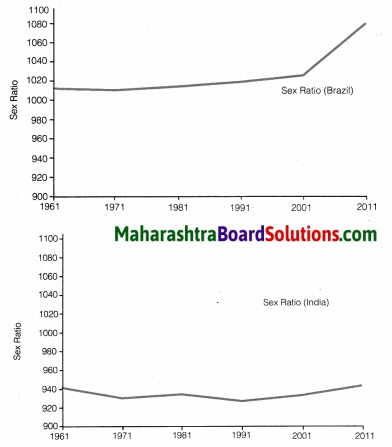
What could be the reasons of lower sex ratio in any region?
Answer:
With reference to both the countries, the characteristics of population are prominently notable.

  • The sex ratio of Brazil has been more than 1000 since decades.
  • Considering the sex ratio of Brazil, the number of women have considerably increaesed than men since 2001.
  • In India men outnumber women.
  • In India we see fluctuations in the sex ratio since few decades. There has been a slight increase in the sex ratio after 1991.

Maharashtra Board Class 10 Geography Solutions Chapter 6 Population 5

Question 2.
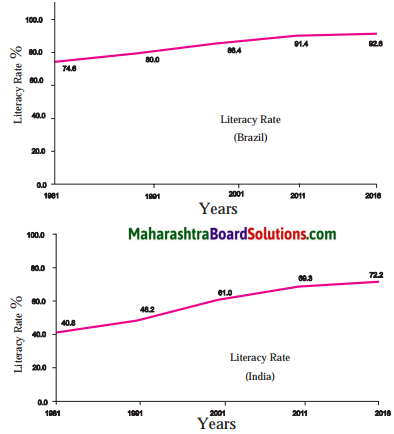
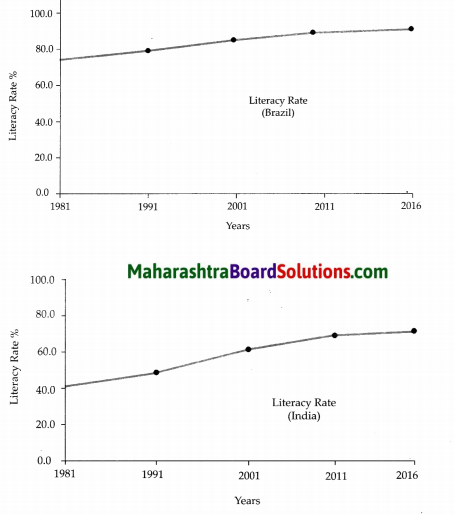
Write a similar conversation using the graph
Maharashtra Board Class 10 Geography Solutions Chapter 6 Population 10
Answer:
A: What do these graphs show?

B: These graphs show the literacy rate of India and Brazil.

A: What do you mean by literacy rate?

B: It means the total percentage of the population of an area at a particular time aged seven years or above ‘ who can read and write with understanding.

A: It means that, as on today’s date, the literacy rate of our country is 72.2%.

B: But, Brazil had an even higher literacy rate decades back in 1981, i.e. 74.6% and it has touched 92.6 as of today (2018), which is quite commendable.

A: Yes, definitely But, we have also seen a steady growth in the literacy rate of the country, especially, during the period between 1991 and 2011.

B: Still, though we are growing, we are way behind Brazil today with 72.2% because they have a much higher literacy percentage of 92.6.

A: What measures can be adopted to increase the literacy rate of our country?

B: We can make people aware of the need and importance of education, help in teaching them, introducing various literacy campaigns by making use of free calls, free sms services, etc.

Question 3.
Study the indices of density maps of both the countries. What difference do you find? What conclusions can you draw?
Maharashtra Board Class 10 Geography Solutions Chapter 6 Population 4
Answer:
(i) India’s density of population is proportionately catered while Brazil’s density of population is concentrated only on the eastern coast.
(ii) After studying the indices of the density maps of both the countries, we can conclude that India’s population density is much higher than that of Brazil.
(iii) The lowest value on the map of India indicates less than 100 whereas on the Brazil map it is less than 50.
(iv) Places in Brazil which are highest in density is grouped in the category of more than 300 people’ per sq. km. whereas in India it is more than 500 persons per sq. km.

Maharashtra Board Class 10 Geography Solutions Chapter 6 Population

Question 4.
Considering the above discussion, what should be done so that our manpower is utilized properly, sex ratio improves and population growth is controlled? Write two to three sentences on each.
Answer:
(i) Measures to utilise man power properly:

  • Good education, health and training facilities are the basic requirements to improve human resources.
  • The focus of education should not just be to chum out jobseekers but also to chum out job creators.
  • The young population should be encouraged to be entrepreneurs.

(ii) Measures to improve sex ratio:

  • Build an environment to save and protect the girl child.
  • Ban sex determination test.

(iii) Measures to control population growth:

  • Family planning measures to be encouraged through media.
  • Spread of education among illiterate masses, especially about the benefits of having a small family.
  • Child marriage should be strictly prohibited.

TRY THIS

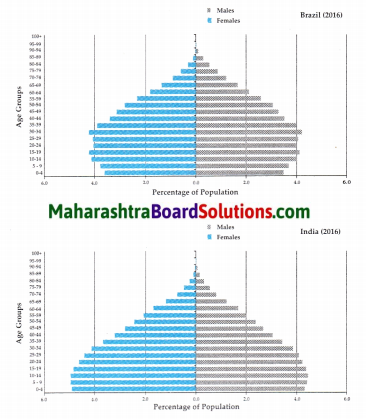
Age and Sex Pyramid:
Maharashtra Board Class 10 Geography Solutions Chapter 6 Population 6

Question 1.
What is this figure called? What is it always known as?
Answer:
The figure is called the Age-Sex Pyramid. It is also known as Population Pyramid.

Question 2.
What does the graph depict?
Answer:
The graph depicts the percentage of male and female population of various age groups in Brazil & India for the year 2016.

Question 3.
In which country is the proportion of adults more?
Answer:
The proportion of adults is comparatively more in India.

Question 4.
‘This country’s population is getting slowly older’. Which country is being referred to? Why?
Answer:
‘This country’s population is getting slowly older – The country being referred to is Brazil. As compared to India, a larger percentage of Brazil’s population falls in the above 60 years age group. So it is said that Brazil’s population is getting slowly older.

Question 5.
In which country are the number of children comparatively more?
Answer:
The proportion of children is comparatively more in India.

Question 6.
While comparing the age-sex pyramids, which pyramid has a broader base?
Answer:
While comparing the age-sex pyramids, India’s pyramid has a broader base.

Maharashtra Board Class 10 Geography Solutions Chapter 6 Population

USE YOUR BRAIN POWER

Question 1.
Is there a relationship between increase in life expectancy and growth of population ? How?
Answer:
(i) Yes, there is a relationship between increase in life expectancy and growth of population.
(ii) Increased life expectancy means there are more people who live longer, which means healthier and better quality of life.
(iii) This kind of population generally prefers fewer children which leads to decreased birth rates.

Question 2.
If the proportion of dependent age groups increases in the composition of population, how will it affect the economy of a country?
Ans.
(i) If the proportion of dependent age groups increases in the composition of population, it will have an adverse effect on the economy of a country.
(ii) The reason is if the working population is less, the economic activities will reduce and will have a direct impact on the economic growth and development of that nation.
(iii) The production will decrease in comparison to consumption leading to inflation also the per capita income and GDP will decrease.
(iv) Export will reduce and imports will increase.
(v) The proportion of the working population will increase, slowing down the pace of development.

Class 10 Geography Chapter 6 Population Additional Important Questions and Answers

Choose the correct option and rewrite the statements:

Question 1.
The ______ aspects of a population are important for a nation’s economic and social progress.
(a) quantitative
(b) qualitative
(c) measurable
(d) calculable
Answer:
(b) qualitative

Question 2.
India is the ________ most populous country in the world.
(a) second
(b) fifth
(c) seventh
(d) sixth
Answer:
(a) second

Question 3.
Due to farming, industries and trade, the proportion of the population got in _____ a few places.
(a) distributed
(b) sparse
(c) concentrated
(d) equal
Answer:
(c) concentrated

Question 4.
In mountainous / hilly regions, dry desert areas and densely forested areas, population density is __________ because of inaccessibility, absence of facilities and tough life.
(a) high
(b) very high
(c) sparse
(d) moderate
Answer:
(c) sparse

Maharashtra Board Class 10 Geography Solutions Chapter 6 Population

Question 5.
Brazil is the _______ populated country in the continent of South America.
(a) second most
(b) third most
(c) fifth most
(d) most
Answer:
(d) most

Question 6.
With a population of around 19 crores, according to Census 2010, Brazil ranks _______ in the world.
(a) 3rd
(b) 5th
(c) 7th
(d) 9th
Answer:
(b) 5th

Question 7.
With respect to area, Brazil stands _______ in the world.
(a) 3rd
(b) 5th
(c) 7th
(d) 9th
Answer:
(b) 5th

Question 8.
A majority of Brazilians have concentrated within 300 kilometers of the ________.
(a) Guyana highlands
(b) Amazon river,
(c) Eastern coastal areas
(d) Pantanal wetlands
Answer:
(c) Eastern coastal areas

Question 9.
The interior of the Amazon basin is ____ populated.
(a) densely
(b) moderately
(c) highly
(d) very sparsely
Answer:
(d) very sparsely

Question 10.
The central and western parts of Brazil is ______ populated.
(a) densely
(b) sparsely
(c) moderately
(d) less
Answer:
(d) less

Question 11.
The density of population in the _______ of Brazil is moderate.
(a) Amazon Basin
(b) coastal lowlands
(c) highlands
(d) forested areas
Answer:
(c) highlands

Question 12.
In India, there has been a _______ in the sex ratio, after 1991.
(a) decrease
(b) slight increase
(c) consistency
(d) steep increase
Answer:
(b) slight increase

Question 13.
The proportion of _______ in India is more.
(a) middle-aged people
(b) old people
(c) children
(d) youth
Answer:
(d) youth

Question 14.
The rate of population growth is now ______ in India.
(a) increasing
(b) declining
(c) stable
(d) stagnant
Answer:
(b) declining

Maharashtra Board Class 10 Geography Solutions Chapter 6 Population

Question 15.
It is observed that Brazil’s population may not increase in the next ______ decades.
(a) two
(b) three
(c) four
(d) five
Answer:
(a) two

Question 16.
The eastern coastal areas of Brazil are also called the coastal ________.
(a) lowlands
(b) highlands
(c) ravines
(d) badlands
Answer:
(a) lowlands

Question 17.
In most of the developing countries life expectancy is still less, but with socio economic development it is ________.
(a) decreasing
(b) increasing
(c) gradually declining
(d) steeply increasing
Answer:
(b) increasing

Match the columns:

S.No Column ‘A’ Column ‘B’
(1)  Coastal lowlands (a) sparsely populated
(2) Amazon Basin interior (b) moderately populated
(3) Highlands (c) densely populated (within 300 kms. of the area)

Answer:
1 – c
2 – a
3 – b

Answer the following questions in one or two sentence.

Question 1.
According to Census 2011, what is India’s population and how much is its average population density?
Answer:
According to Census 2011 India’s population is around 121 crores, and its average population density is 382 persons per sq. km.

Question 2.
What percentage of the total land area of the world is occupied by India and Brazil?
Answer:
India occupies only 2.41% of the land area of the world, whereas Brazil occupies 5.6% of the world’s total land area.

Question 3.
What is the difference in the percentage of the world population supported by India and Brazil?
Answer:
India supports 17.5% of the world’s population, whereas Brazil supports 2.78% of the world’s total population. The difference is 14.72% (India has a large population than Brazil)

Question 4.
According to Census 2010, what is the total population of Brazil and what is its average population density?
Answer:
According to Census 2010, Brazil’s total population is around 19 crores and its average population density is 23 persons per sq. km.

Question 5.
What is sex ratio?
Answer:
Sex ratio means, the number of females per 1000 males in a region.

Question 6.
What is a population pyramid?
Answer:
A population pyramid, also called age-sex pyramid, is a graphical illustration that shows the age and sek/gender related aspects of various age groups in a population.

Maharashtra Board Class 10 Geography Solutions Chapter 6 Population

Question 7.
How is the population pyramid useful? OR State the uses of a population pyramid.
Answer:

  • The population pyramid is used to study the age and sex related aspects of a region’s population
  • We can know the number/percentage of various age groups of males and females in a country.
  • It also helps us to know the proportion of children, youth and old people in a country.

Question 8.
What is life expectancy?
Answer:
Life expectancy means the average number of years, a person born in a country is expected to live.

Question 9.
Which factors lead to an increase in average life expectancy?
Answer:
Improvement in medical facilities, progress in the medical field and access to nutritious food lead to an increase in average life expectancy.

Name the following:

Question 1.
Indian cities that are densely populated.
Answer:
Delhi, Kolkata, Mumbai, Pune, Bengaluru, Chennai.

Question 2.
Factors that play an important role in the distribution of population.
Answer:
Physiography and climate.

Question 3.
Factors due to which human settlements have been established for many centuries.
Answer:
Fertile land, plain land and availability of water.

Question 4.
Factors due to which population got concentrated in a few places, in India.
Answer:
Farming, industries and trade.

Question 5.
Areas which have sparse population density in India.
Answer:
Mountainous / hilly regions, dry desert areas, dense forest areas.

Question 6.
Factors due to which population density is sparse in a few areas.
Answer:
Inaccessibility, absence of facilities and tough life.

Question 7.
The most populated country in South American.
Answer:
Brazil.

Question 8.
Brazil’s rank in the world with regard to population as well as land area.
Answer:
Fifth.

Question 9.
The part of Brazil has the maximum concentration of population
Answer:
Eastern coastal areas or coastal lowlands.

Question 10.
The part of Brazil that is sparsely populated.
Answer:
Amazon River Basin.

Question 11.
The region of Brazil that is moderately populated.
Answer:
The Highlands.

Question 12.
The parts of Brazil that are less populated.
Answer:
Central, western and interior of Amazon basin.

Question 13.
Out of Brazil and India, the country where men outnumber women.
Answer:
India.

Question 14.
Increase in this factor is an indicator of development of that society.
Answer:
Life expectancy, Sex Ratio and Literacy Rate.

Question 15.
The development of this aspect of an economy leads to an increase in average life expectancy.
Answer:
Socio-economic development.

Maharashtra Board Class 10 Geography Solutions Chapter 6 Population

Are the following sentences right or wrong?

Question 1.
India is the fifth most populous country in the world.
Answer:
Wrong.

Question 2.
India’s average population density is 832 persons per sq. km. as per the 2011 Census.
Answer:
Wrong.

Question 3.
Brazil is the second-most populous country in the World.
Answer:
Wrong.

Question 4.
Brazil ranks fifth in the world with respect to area.
Answer:
Right.

Question 5.
The total population of Brazil is around 91 crores.
Answer:
Wrong.

Question 6.
In Brazil and India, population is evenly distributed.
Answer:
Wrong.

Question 7.
The central and western part of Brazil are less populated.
Answer:
Right.

Question 8.
The sex ratio of Brazil has been less than 1000 since centuries.
Answer:
Wrong.

Question 9.
It is observed that in Brazil, the rate of population growth is increasing.
Answer:
Wrong.

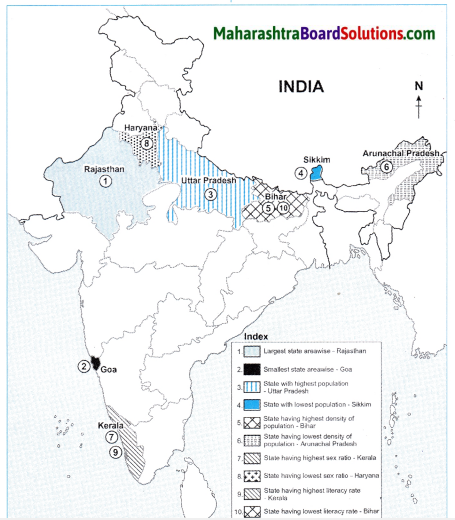
Fill the map with the given information:

Question 1.
On a map of India, show the following.

  1. Largest state areawise.
  2. Smallest state areawise.
  3. State with highest population.
  4. State with lowest population.
  5. State having highest density of population.
  6. State having lowest density of population.
  7. State having highest sex ratio.
  8. State having lowest sex ratio.
  9. State having highest literacy rate.
  10. State having lowest literacy rate.

Answer:
Maharashtra Board Class 10 Geography Solutions Chapter 6 Population 11

Maharashtra Board Class 10 Geography Solutions Chapter 6 Population

Question 2.
On a map of Brazil, show the following.

  1. Largest state areawise.
  2. Smallest state areawise.
  3. State with highest population.
  4. State with lowest population.
  5. State having highest density of population,
  6. State having lowest density of population.

Answer:
Maharashtra Board Class 10 Geography Solutions Chapter 6 Population 12
Maharashtra Board Class 10 Geography Solutions Chapter 6 Population 13

Give geographical reasons:

Question 1.
In India, population is very unevenly distributed.
Answer:
(i) In India, population is very unevenly distributed.
(ii) Physiography and climate play an important role in the distribution of population.
(iii) Due to fertile land, plain land and availability of water, human settlements have been established in some parts for many centuries.
(iv) Due to farming, industries and trade, the . proportion of the population has become concentrated in a few places.
(v) For example, the Northern Plains of the country, Delhi, Kolkata, Mumbai, Pune, Bengaluru, Chennai, etc.
(vi) On the contrary, in mountainous / hilly regions, dry desert areas, dense forest areas, density is sparse because of inaccessibility, absence of facilities and tough life.

Maharashtra Board Class 10 Geography Solutions Chapter 6 Population

Question 2.
The distribution of population is very uneven in Brazil.
Answer:
(i) The distribution of population is very uneven in Brazil. .
(ii) A majority of the Brazilians are concentrated within 300 kilometers of the eastern coastal areas also called the coastal lowlands because agriculture and industries are well developed here.
(iii) In the interior of the Amazon Basin population is very sparse due to.
(iv) Unfavourable climate, heavy rainfall,
inaccessibility and dense forests which are the barriers to development of human settlements here.
(v) The central and western part of Brazil is less moderate.

Question 3.
The average life expectancy in India is increasing.
Answer:
(i) Earlier the average life expectancy in India was low due to, lack of medical facilities which lead to high incidence of diseases and epidemics like chicken pox, malaria, cholera, etc.
(ii) Today with improvement in access to medical facilities and improvement in technology, diseases and epidemics are controlled.
(iii) Also today people in India have an improved standard of living, they eat nutritious food and there is awareness of good health.
All this has led to increase in average life expectancy in India.

Question 4.
In north-eastern India, sparse distribution of population is found.
Answer:
(i) North East India comprises of dense forests and uneven topography.
(ii) There exist unfavourable climatic conditions in this part.
(iii) There is less development of transport, communication and industries here.
So, in north-eastern India, sparse distribution of population is found.

Question 5.
In India, number of men outnumber women. Is this condition found in all the states of India?
Answer:
In India, men outnumber women, on an average. But in Kerala women outnumber men. Sex Ratio of Kerala is 1084 females per 1000 males (2011 Census).

Question 6.
Explain the reasons of low sex ratio in India.
Answer:
Some of the reasons for lower sex ratio in any region are:

  • Illiteracy: Narrow mindedness and lack of education leads to gender bias in the society.
  • Preference for a male child : There is preference of a boy child over a girl child. Nutrition to girls is ignored.
  • Poverty: Povertystruck families do not prefer a girl child as they consider female child a burden due to practices like dowry prevalent in the society.
  • Female foeticide and female infanticide: Female foeticide and female infanticide are on the rise due to the wrong use of modem technology.
  • Maternity deaths: Higher maternity deaths have lowered the sex ratio.

Question 7.
Explain – The growth rate of population in India is decreasing but population is increasing.
Answer:
(i) Growth rate of population is calculated on the basis of difference between birth rate and death rate.
(ii) Earlier the difference between birth rate and death rate was high, so the growth rate was high.
(iii) Today the growth rate is decreasing because the difference between birth rate and death rate is not as high as it was earlier.
So it is said that in India the growth rate of population is decreasing, but the population is increasing.

Question 8.
Explain the uneven distribution of population in India.
Answer:
(i) Dense population is found in regions with mild climate and moderate rainfall. E.g. the northern plain as well as the coastal plains of India
(ii) Places with heavy rainfall, inaccessibility and dense forests have low population. E.g. north eastern states in India.
(iii) The snow covered regions due to extremely cold climatic conditions have less population. E.g. the northernmost part of Jammu & Kashmir.
(iv) In certain regions, due to less rainfall and extreme climatic conditions population is sparse. E.g. westernmost part of India in the Thar desert, Rajasthan.
(v) Moderate population is found in the plateau regions of Narmada valley.

Maharashtra Board Class 10 Geography Solutions Chapter 6 Population

Try this

Population growth rate graphs :
Look at the graphs in Fig. indicating the population growth rate of Brazil and India and answer the following questions.
Maharashtra Board Class 10 Geography Solutions Chapter 6 Population 14
Question 1.
What is the common feature in both the graphs?
Answer:
Both the graphs are indicating a downward trend in population growth rate of Brazil and India.

Question 2.
What is India’s growth rate of population in 2011?
Answer:
India’s population growth rate in 2011 is 1.5%.

Question 3.
In which two decades has the population growth rate of India remained almost stable?
Answer:
The population growth rate of India has remained almost stable during the two decades 1971 to 1981 and 1981 to 1991.

Question 4.
From which time period has Brazil seen a sharp decline in the population growth rate?
Answer:
From 1980-1990, Brazil has seen a sharp decline in the population growth rate.

Question 5.
What is the main point of difference between the two graphs?
Answer:
(i) In the first decade between 1961-1971 the growth rate in India showed an upward trend whereas Brazil has a downward trend throughout.
(ii) Also the decline in Brazil is more sharp but India’s decline in the growth rate is marginal.

Question 6.
What is the interesting feature of Brazil’s growth rate of population?
Answer:
The interesting feature of Brazil’s population growth rate is that it is about to touch 0.0 and then will begin its negative growth rate i.e. the population will start decreasing.

Observe the figure carefully and answer the following questions given below.
Maharashtra Board Class 10 Geography Solutions Chapter 6 Population 15
Question 1.
What is the class interval of the data?
Answer:
The class interval of the data is 10 years.

Question 2.
In which decade was India’s life expectancy the highest?
Answer:
Highest life expectancy in India was in the decade of 1960-1970.

Maharashtra Board Class 10 Geography Solutions Chapter 6 Population

Question 3.
In which year has the difference in the life expectancy between Brazil and India been the maximum? By how much?
Answer:
In the year I960, the difference between the life expectancy of Brazil and India has been the maximum by 13 years. (54 – 51)

Question 4.
Has the difference in life expectancy been increasing or decreasing?
Answer:
During the past 36 years, i.e. from 1980 onwards, the difference between the life expectancy of Brazil and India has remained constant. It has been 7 to 8 years.

Question 5.
What is the similarity between both the graphs?
Answer:
Both India and Brazil have experienced an increase in the life expectancy. Both the graphs indicate an upward trend continuously.

Question 6.
Is the increase in life expectancy a positive or a negative indicator of an economy? Why?
Answer:
The increase in life expectancy is a positive indicator for any economy because longer the people’s average age, longer is their contribution towards the growth of an economy.

Based on the figure, observe carefully and answer the questions given below.
Maharashtra Board Class 10 Geography Solutions Chapter 6 Population 16
Question 1.
What do the graphs indicate?
Answer:
The graphs indicate the literacy rate of India and Brazil (in percentage).

Maharashtra Board Class 10 Geography Solutions Chapter 6 Population

Question 2.
What is this general conclusion that you can come to, after observing both the graphs?
Answer:
On observing both the graphs, we can conclude that Brazil is and has always been way ahead of India with regard to literacy rate.

Question 3.
Which country has higher literacy rate?
Answer:
Brazil has a higher literacy rate.

Question 4.
What was the literacy rate of Brazil in 2011?
Answer:
Brazil had a literacy rate of 91.4% in 2011.

Question 5.
What is the difference in the literacy rate of Brazil and India in 2016?
Answer:
Literacy rate of Brazil and India had a difference of 20.4% (92.6 – 72.2) in 2016.

Question 6.
What is the difference in the literacy rate of India between the years 2001 and 2011?
Answer:
The difference in the literacy rate of India is 8.3% (69.3 – 61) between the years 2001 and 2011.

10th Std Geography Questions And Answers:

Climate Question Answer Class 10 Geography Chapter 4 Maharashtra Board

Balbharti Maharashtra State Board Class 10 Geography Solutions Chapter 4 Climate Notes, Textbook Exercise Important Questions and Answers.

Std 10 Geography Chapter 4 Question Answer Climate Maharashtra Board

Class 10 Geography Chapter 4 Climate Question Answer Maharashtra Board

Geography Class 10 Chapter 4 Question Answer Maharashtra Board

Question 1.
Write names of the States/Regions in appropriate columns.
Bihar, Tocantins, Pernambuco, Alagoas, Eastern Maharashtra, Western part of Rajasthan, Gujarat, Rio Grande Do Norte, Paraiba, Western Ghats, Eastern Himalayas, Western Andhra Pradesh, Roroima, Amazonas, West Bengal, Rio Grande Do Sul, Santa Catarina, Goa
Answer:

States/Regions India Brazil
High rainfall Western Ghats, Eastern Himalayas, Goa Tocantins, Rio Grande Do Sul, Roraima
Moderate rainfall Bihar, Eastern Maharashtra West Bengal Santa Catarina, Amazonas, Alagoas
Low rainfall Western part of Rajasthan, Gujarat, Western Andhra Pradesh Pernambuco, Paraiba,

Rio Grande Do Norte, Alagoas

Maharashtra Board Class 10 Geography Solutions Chapter 4 Climate

2. State whether right or wrong. Rewrite the wrong sentences

Question a.
The fact that Brazil lies on the equator affects its climate in a big way.
Answer:
Right.

Question b.
India and Brazil have the same seasons at the same time.
Answer:
Wrong – India and Brazil have different seasons at the same time.

Question c.
India faces tropical cyclones frequently.
Answer:
Right.

Question d.
Brazil gets a lot of rainfall because of the southwest monsoon winds.
Answer:
Wrong – Brazil gets rainfall from South-East Trade Winds and North-East Trade Winds.

3. Give geographical reasons:

Question a.
The north-eastern part of Brazilian Highlands receives very less rainfall.
Answer:
(i) Brazil gets rainfall from the South-East Trade Winds and the North-East Trade Winds.
(ii) Parts of the Brazilian Highlands extend upto the northern coast.
(iii) The Escarpments act as an obstruction to the winds blowing from the sea and cause orographic type of rainfall in the coastal region.
(iv) Beyond the Highlands, the effect of these winds gets reduced. As a result, the rainfall is minimal.
(v) Thus the North Eastern part of Brazilian highlands receives less rainfall. This rain shadow region is also called the ‘Drought Quadrilateral’.

Question b.
Snowfall doesn’t always occur in Brazil.
Answer:
(i) Because of the vast latitudinal extent of Brazil, it experiences a wide range of climatic variations. Near the Equator it is hot, while tropical type of climate is found near the Tropic of Capricorn.

(ii) Considering the temperatures in Brazil, the northern part of Brazil is hot while the temperatures in the southern part are comparatively lower.

(iii) It generally snows in those areas lying in the temperate or polar regions or in the mountainous regions of very high altitude.

(iv) Snowfall does occur but is only confined to higher elevations in the southern states of Rio Grande Do Sul, Parana and Santa Catarina.

(v) Most part of the country lies in the tropical zone which experiences a hot and humid climate.

So snowfall doesn’t always occur in Brazil and is considered a rare phenomenon.

Question c.
Convectional type of rainfall is not prominent in India.
Answer:
(i) Convectional rains are a feature of the equatorial regions and the equator passes through the northern part of Brazil.
(ii) Due to the intense heat here the air expands and rises upwards. As the air goes upwards it cools down, condensation occurs and clouds are formed. This leads to convectional rains every day.
(iii) As such conditions do not exist in India, convection rainfall is not prominent here.

Question d.
Tropical cyclones occur rarely in Brazil.
Answer:
(i) In the coastal regions of Brazil near the Equator, differences in temperatures are negligible.
(ii) The winds move in the vertical direction in this equatorial region.
(iii) Similarly, the convergence zone of the trade winds is weak here. As a result, cyclones are not formed.
(iv) As a result tropical cyclones occur rarely in Brazil.

Question e.
There is not much difference in the range of temperature in Manaus.
Answer:
(i) Manaus is located to the north of Brazil and close to the Equator.
(ii) This region receives perpendicular rays of the sun throughout the year.
(iii) It also receives convectional type of rainfall every day.
(iv) So the climate is hot and humid throughout the year.
(v) As, there is not much difference in the maximum and minimum temperatures there is not much difference in the range of temperature in Manaus.

Maharashtra Board Class 10 Geography Solutions Chapter 4 Climate

Question f.
India receives precipitation from the North East Monsoon Winds too.
Answer:
(i) In the winter season, India is influenced by the North East Monsoon Winds.
(ii) These winds bring cool breeze to the country.
(iii) While blowing over Bay of Bengal the North East Monsoon Winds pick up moisture and give rain to the eastern coast of Andhra Pradesh and Tamil Nadu in India.
So, it is said that India receives precipitation from the North East Monsoon Winds too.

4. Answer the following questions:

Question a.
Describe in brief the changes occurring in the climatic conditions of India while going from south to north.
Answer:
(i) India’s Climate is of monsoon type. But there is diversity in climatic conditions of India due to the latitudinal location and altitude of the place.

(ii) As the Tropic of Cancer passes through middle of India, it divides the country into tropical region and sub tropical region.

(iii) The tropical region receives nearly vertical rays of the Sun and the temperature increases as we move towards the south.

(iv) In the sub tropical region of the north, summers are very hot and winters are very cool and dry.

(v) The Himalayas lie in the northern part of India. They protects us from the cold winds that blow from the north, obstructs the South West Monsoon Winds which results in orographic rainfall in its southern slopes.

(vi) In major parts of India precipitation is in the form of rainfall, but in the Himalayas it is in the form of snowfall.

Question b.
Explain the importance of the Himalayas and the Indian Ocean with respect to the climate of India.
Answer:
(i) The Indian Ocean and the Himalayan ranges exert a great influence on the climate of India and the origin of monsoons.

(ii) Because of high temperatures in summers, a low pressure area develops in the Punjab Plains and the Thar Desert of Rajasthan.

(iii) At the same time a high pressure region develops over the Indian Ocean.

(iv) This attracts winds and they start blowing from the Indian Ocean towards the mainland India.

(v) These are moisture-laden winds which bring rainfall to India.

(vi) These winds move towards the Himalayas and due to the natural obstruction of the Himalayas, orographic rain occurs.

(vii) Later these winds retreat from the Himalayas and move from the north-east towards the Indian Ocean and brings rain to some parts of the Peninsula.

(viii) Also the severe cold winds blowing from the north are obstructed by the Himalayas and it saves India from severe winters.

Question c.
Discuss the factors affecting the climate of Brazil.
Answer:
(i) Brazil experiences wide range of climatic variations due to its vast latitudinal extent, proximity to the Equator, presence of the Atlantic Ocean and the Great Escarpment.

(ii) The northern part of Brazil near the Equator is hot, while temperate type of climate is found near the Tropic of Capricorn.

(iii) Brazil gets rainfall from the South-East Trade Winds and the North-East Trade Winds blowing from the Atlantic Ocean.

(iv) Convectional rainfall occurs in places near the equator. Whereas, the Escarpment act as an obstruction to the winds blowing from the sea and cause orographic type of rainfall in the coastal region.

(v) Beyond the Highlands the effects of these winds gets reduced, as a result the rainfall is minimal. This region is a rain-shadow region and is called ‘The Drought Quadrilateral.’

(vi) The Equator passes through the northern part of Brazil so the temperature here is high. Average temperature of Amazon valley is 25°-28°C. Climate is cooler in the highlands. While the temperatures in the southern part are comparatively lower.

(vii) In the coastal regions near the Equator in Brazil, differences in temperatures are negligible. Because of the proximity to the sea, the coast experiences mild and humid climate.

(viii) The winds move in the vertical direction in this region. Similarly, the convergence zone of the trade winds is weak here. So the tropical cyclones are a rare phenomena here.

Maharashtra Board Class 10 Geography Solutions Chapter 4 Climate

Question d.
Compare the climates of brazil and India?
Answer:

Climate of India Climate of Brazil
(i) India has a monsoon type of climate. (i) Brazil has a tropical climate to the north and temperate climate to the south.
(ii) The southern part of India lies in the tropical region so the temperature is high in the south and comparatively low in the north, i.e., the temperature decreases from south to north. (ii) The northern part of Brazil lies in the tropical region so the temperature is high in the north and comparatively low in the south, i.e., the temperature decreases from north to south.
(iii) India receives rain from the South West and the North East Monsoon Winds. (iii) Brazil receives rain from the South East and North East Trade Winds.
(iv) India receives orographic rainfall. (iv) Brazil receives convectional and orographic type of rainfall.
(v) The western part of Rajasthan, Gujarat and eastern side of the Western Ghats receive less rain. (v) The north eastern part of the Brazilian highlands is a rain shadow region.
(vi)     Tropical cyclones are a frequent phenomena. (vi) Tropical cyclones are a rare phenomena

Maharashtra Board Class 10 Geography Solutions Chapter 4 Climate

Class 10 Geography Chapter 4 Climate Intext Questions and Answers

Observe the given map below and answer the following questions
Maharashtra Board Class 10 Geography Solutions Chapter 4 Climate 1
Maharashtra Board Class 10 Geography Solutions Chapter 4 Climate 2

Question 1.
Considering the isotherms of Brazil, what is the average range of temperature in Brazil?
Answer:
Considering the isotherms of Brazil, the average range of temperature of Brazil is 10°C (28°C-18°C).

Question 2.
In which area does it rain more?
Answer:
It rains more in the northern and central part of Brazil. E.g., Amazon Valley.

Question 3.
From which directions are winds blowing towards Brazil?
Answer:
The winds are blowing from North East and South East directions.

Question 4.
What could be the reason behind that?
Answer:
These are permanent trade winds which blow from high pressure belt to the equatorial low pressure belt. Brazil being in the tropical zone, a low pressure area is created and wind start blowing from the ocean to the land.

Question 5.
What could be the obstruction in the way of these winds?
The Escarpment acts as obstruction in the way of the South East Trade Winds coming from the sea.

Question 6.
Which type of rainfall will occur because of these winds?
Answer:
Orographic rainfall will occur because of these winds.

Question 7.
Correlate these winds and rainfall.
Answer:
The escarpments act as an obstruction to the winds blowing from the sea and cause an orographic type of rainfall in the coastal region. Beyond the Highlands, the effect of these winds gets reduced. As a result, the rainfall is minimal.

Question 8.
In which part of Brazil are the average temperatures low?
Answer:
The average temperatures are low in the southern part of Brazil.

Question 9.
Identify the rain-shadow area in Brazil. Describe its climatic characteristics.
Answer:
The north-eastern part of the Brazilian highlands is a rain shadow region. Beyond the highlands, the effect of the South East Trade Winds gets reduced and the rainfall is minimal. Also, the temperature here is quite high. This rain shadow region is referred to as the ’Drought Quadrilateral’.

Question 10.
In which region do you find a higher temperature?
Answer:
The northern part of Brazil has higher temperature.

Question 11.
Considering the latitudinal extent of Brazil, where will you find a temperate climate in Brazil?
Answer:
The southern part of Brazil lying below 23 V4°S latitude (Tropic of Capricorn) experiences temperate climate.

Maharashtra Board Class 10 Geography Solutions Chapter 4 Climate

Question 12.
Describe the winds blowing between 0° to 5° N and S zones.
Answer:
The winds blowing between 0° to 5° N and S zones move in the vertical direction leading to convectional type of rain. The North East and South East Trade winds are very weak in this region.

Question 13.
Which method has been used to show distribution in this map?
Answer:
The Isopleth method has been used to show distribution in this map.

Observe the given map and answer the following questions
Maharashtra Board Class 10 Geography Solutions Chapter 4 Climate 16
Maharashtra Board Class 10 Geography Solutions Chapter 4 Climate 17

Question 1.
Which region gets more than 4000mm of rainfall?
Answer:
Western Ghats, Western Coasts of India and the northeastern region comprising of Mawsynram, Cherrapunji and parts of Assam and Arunachal Pradesh gets more than 4000 mm of rainfall.

Question 2.
Identify the regions with maximum and minimum temperatures?
Answer:
Central and North Western parts of Peninsular Plateau and islands have high temperature. Hilly regions of north, northeast and south India have low temperature.

Maharashtra Board Class 10 Geography Solutions Chapter 4 Climate

Question 3.
In which direction is the temperature increasing?
Answer:
The temperature is increasing towards the south.

Question 4.
Identify the direction of the winds shown. What are they known as?
Answer:
The winds shown are blowing from the south west to north east direction. These winds are called Southwest Monsoon Winds.

Question 5.
Which winds are responsible for the rainfall in India ?
Answer:
South-West Monsoon Winds are responsible for rainfall in India.

Question 6.
Some part of Rajasthan is under desert? What could be the reason for it?
Answer:
The South West Monsoon Winds blow parallel to the Aravallis. As these moisture laden winds are not obstructed by the Aravallis it rains less here. Hence, Rajasthan is under desert.

Question 7.
Draw the main parallel latitude passing through India which affects its climate.
Answer:
Students are expected to draw the Tropic of Cancer.

Question 8.
In which part of Peninsular India is semi-arid climatic conditions found and why?
Answer:
(i) The part of peninsular India which has semi-arid climatic conditions are central part of Peninsula Plateau comprising parts of Central Maharashtra, Western Andhra Pradesh, Eastern Karnataka and Western Tamil Nadu. These regions lie on the leeward side of the Western Ghats and Eastern Ghats. It rains less here and a rain shadow region is formed.
(ii) Some parts of Gujarat and Rajasthan are also semi-arid as the Aravallis lie parallel and do not obstruct the South-west Monsoon winds.

Give geographical reasons:

Question 1.
Shillong gets less than 1000 mm of rainfall annually, whereas Cherrapunji/Mawsynram which is nearby get’s over 11000 mm, of rainfall annually.
Answer:
(i) Cherrapunji/Mawsynram lies in the higher altitude on the windward side of the Khasi Hills and receives rainfall from the South West Monsoon Winds.
(ii) While Shillong lies in the lower altitude on the leeward side of the Khasi Hills, so it receives less rainfall being in the rain shadow area.

Maharashtra Board Class 10 Geography Solutions Chapter 4 Climate

Observe the pictures given below and write brief description about them.

Question 1.
Maharashtra Board Class 10 Geography Solutions Chapter 4 Climate 31
Answer:
Both the figures shows the traffic congestion during heavy rains. Due to lack of proper drainage and heavy downpour the water gets accumulated disturbing the commuting system.

Question 2.
Maharashtra Board Class 10 Geography Solutions Chapter 4 Climate 37
Maharashtra Board Class 10 Geography Solutions Chapter 4 Climate 35
Answer:
Both the figures show the drought affected regions of India and Brazil respectively. Due to scarce amount of rainfall received in these regions the land has became dry and cannot be cultivated.

Question 3.
Maharashtra Board Class 10 Geography Solutions Chapter 4 Climate 38
Answer:
figure shows snow fall during winter season in the northern parts of India.

Question 4.
Maharashtra Board Class 10 Geography Solutions Chapter 4 Climate 32
Answer:
figure shows heavy rainfall in the Brazilian rainforest region.

Question 5.
Maharashtra Board Class 10 Geography Solutions Chapter 4 Climate 33
Answer:
figure shows the trees being cut down to bring land under cultivation. Deforestation is a major issue in Brazil.

Question 6.
Maharashtra Board Class 10 Geography Solutions Chapter 4 Climate 34
Answer:
figure shows a well from which water is used for domestic purpose.

Maharashtra Board Class 10 Geography Solutions Chapter 4 Climate

Question 7.
Maharashtra Board Class 10 Geography Solutions Chapter 4 Climate 36
Answer:
figure shows paddy fanning in India. The farmers are planting paddy. The water logged fields are shown.

Study the graphs given below and answer the following questions:

Maharashtra Board Class 10 Geography Solutions Chapter 4 Climate 14

Question 1.
In which month is the highest temperature found in all the four cities?
Answer:
The highest temperature is found in the month of January.

Question 2.
In which month does it rain the most in the given cities?
Answer:
It rains the most in the month of march.

Question 3.
When does Brazil have its rainy season?
Answer:
Brazil has its rainy season from December to march.

Question 4.
Which city has the maximum range of temperature? How much is it?
Answer:
Porto Alegre has the maximum range of temperature. It is 20°C (30° C -10° C).

Question 5.
What type of climate will be found in Rio de Janeiro?
Answer:
Rio de Janeiro has mild & humid climate.

Maharashtra Board Class 10 Geography Solutions Chapter 4 Climate 15

Question 1.
What difference do you find in the rainy seasons of Chennai and other cities of India? Why?

Rainy Season of Chennai Rainy Seasons of Other Indian Cities
(i) Chennai mainly receives rain from October to December. Other cities of India receive rainfall from June to September.
(ii) Chennai receives rainfall from North East Monsoon Winds. The other cities receive rainfall mainly from South-West Monsoon Winds.

Maharashtra Board Class 10 Geography Solutions Chapter 4 Climate

Question 2.
What similarities do you see in the temperature curves of Delhi and Kolkata?
Answer:
The following similarities can be seen in the temperature curves of Delhi and Kolkata:

  • The temperature rises from January to March.
  • From March till June high temperatures are experienced.
  • The temperature drops till July and remain stable in August and September.
  • Thereafter the temperatures decreases.

Question 3.
Calculate the average range of minimum and maximum temperatures of all the four cities.

Cities Average range of minimum and maximum temperatures
Delhi 34°C (41°-7°)
Kolkata 28°C (37°-9°)
Mumbai 17°C (34° -17°)
Chennai 18°C (39° – 21°)

Question 4.
In which city is the range minimum? What can you infer about its climate?
Answer:
The range is minimum in Mumbai due to its proximity to the sea.

Question 5.
In which city is the range maximum? What can you infer from this about its climate?
Answer:
The range is maximum in Delhi. It indicates that Delhi has an extreme climate.

Question 6.
Based on the temperature and rainfall of Mumbai, comment upon its climate.
Answer:
Mumbai has an equable climate, with less variation in summer and winter temperature.

Question 7.
Classify the cites as cities with equable and extreme climates.
Answer:
Equable climates – Mumbai, Chennai, Kolkata. Extreme climate – Delhi.

Give it a try

Question 1.
Considering the various factors affecting Brazil’s climate, complete the table.
Answer:

Regions Climatic characteristics
(1) Amazon Valley The climate is generally hot and humid. It receives around 2000mm of rainfall. The average range of temperature here is 25°C – 28°C.
(2) Highlands Hot and dry climate, low rainfall.
(3) Pantanal Warm and humid.
(4) North Coastal region Hot and humid climate. Rainfall between 1000 to 1200 mm.
(5) South Coastal region Mild and humid climate.
(6) Southernmost region of Brazil Hot summers, cool winters and snowfall.

Question 2.
In which part of India are crops grown in a year? How is this related to the rainfall over there?
Answer:
(i) Coastal areas of Tamil Nadu in India grow rice three times a year.
(ii) This crop is taken during the retreating monsoon season.
While blowing over Bay of Bengal, the North East Monsoon winds pick up moisture and give rain to eastern coast of Tamil Nadu.

Maharashtra Board Class 10 Geography Solutions Chapter 4 Climate

Use your brain power!

Question 1.
Group the months into seasons for a whole year according to the charts given.

Seasons India Brazil
Summer March to May December to March
Winter December to February June to September

Answer:

Colours of Both!

Question 1.
Considering the location extent and climatic conditions of both the countries, write months according to the seasons.
Answer:

Seasons India Brazil
Summer March to May December to March
Winter December to February June to September

Class 10 Geography Chapter 4 Climate Additional Important Questions and Answers

Choose the correct option and rewrite the statements:

Question 1.
The climate found near the Equatorial region is
(a) hot
(b) dry
(c) humid
(d) cold
Answer:
(a) hot

Question 2.
The climate found near the Tropic of Capricorn is
(a) tropical
(b) hot
(c) temperate
(d) tundra
Answer:
(c) temperate

Question 3.
Brazil gets rainfall from
(a) North-West and South-West trade winds
(b) Westerly winds
(c) South-West and North-East
(d) North-East and South-East trade winds
Answer:
(d) North-East and South-East trade winds

Maharashtra Board Class 10 Geography Solutions Chapter 4 Climate

Question 4.
The act as an obstruction to the winds blowing from the sea in Brazil.
(a) Himalayas
(b) Escarpments
(c) Andes
(d) Western Ghats
Answer:
(b) Escarpments

Question 5.
The coastal region of Brazil receives a type of rainfall.
(a) orographic
(b) cyclonic
(c) convectional
(d) frontal
Answer:
(a) orographic

Question 6.
Since the convergence of trade winds are weak near the equator, are not formed.
(a) clouds
(b) ocean currents
(c) cyclones
(d) tides
Answer:
(c) cyclones

Question 7.
The average temperature in the Amazon valley is
(a) 15°-20°C
(b) 13°-15°C
(c) 30°-32°C
(d) 25°-28°C
Answer:
(d) 25°-28°C

Question 8.
The Amazon valley receives around mm of rainfall
(a) 2000
(b) 1800
(c) 1500
(d) 1000-1200
Answer:
(a) 2000

Question 9.
India’s climate is of type.
(a) humid
(b) monsoon
(c) equatorial
(d) cold
Answer:
(b) monsoon

Maharashtra Board Class 10 Geography Solutions Chapter 4 Climate

Question 10.
The diversity in the climatic conditions of India is due to the location and altitude of the place.
(a) longitudinal
(b) latitudinal
(c) equatorial
(d) tropical
Answer:
(b) latitudinal

Question 11.
The Ocean and the Himalayan ranges exert a great influence on the climate of India.
(a) Atlantic
(b) Arctic
(c) Pacific
(d) Indian
Answer:
(d) Indian

Question 12.
Orographic type of rainfall occurs in India because of the natural obstruction of
(a) Himalayas
(b) Escarpments
(c) Highlands
(d) Satpuda
Answer:
(a) Himalayas

Question 13.
As the passes through the middle of India, it is considered to be a tropical region.
(a) Tropic of Capricorn
(b) Equator
(c) Tropic of Cancer
(d) 60°S latitude
Answer:
(c) Tropic of Cancer

Question 14.
Most part of Brazil lies in the zone.
(а) polar
(b) tropical
(c) sub-tropical
(d) temperate
Answer:
(b) tropical

Maharashtra Board Class 10 Geography Solutions Chapter 4 Climate

Match the columns:

Question 1.

Column ‘A’ Column ‘B’
(1) Wettest places in the world (a) Tamil Nadu
(2) Driest place in India (b) Cherrapunji and Mawsynram
(3) Rainshadow region in Brazil (c) Jaisalmer, Rajasthan
(4) Climate of India (d)    Drought Quadrilateral

(e)    Monsoon type

(f)     Dry type

Answer:
1 – b
2 – c
3 – d
4 – e

Answer in one sentence each.

Question 1.
Which natural disasters does India face frequently?
Answer:
India frequently faces natural disasters like erratic rainfall, droughts, cyclones, floods, etc.

Question 2.
Why does Brazil experience wide climatic variations?
Answer:
Brazil has vast latitudinal extent because of which it experiences wide climatic variations.

Question 3.
Which winds bring rainfall to Brazil?
Answer:
Brazil receives rainfall from the South East and North-East Trade Winds.

Question 4.
What acts as an obstruction to the winds blowing from sea in Brazil?
Answer:
The Escarpments act as an obstruction to the winds blowing from the sea in Brazil.

Question 5.
Which region is called the Drought Quadrilateral’?
Answer:
The northern part of Brazil beyond the Highlands is called ‘Drought Quadrilateral’.

Question 6.
Where is the difference in temperature negligible in Brazil?
Answer:
In Brazil the difference in temperature is negligible in the coastal regions near the equator.

Question 7.
In which zone does most of Brazil and India lie?
Answer: Most part of Brazil and India lies in the Tropical zone.

Question 8.
Which important latitude passes through the northern part of Brazil?
Answer:
The equator passes through the northern part of Brazil.

Maharashtra Board Class 10 Geography Solutions Chapter 4 Climate

Question 9.
What is the average temperature in Amazon valley?
Answer:
The average temperature in Amazon valley is 25°-28°C.

Question 10.
Which part of Brazil has cooler climate?
Answer:
The climate is cooler in the Highlands.

Question 11.
Why do the Brazilian coasts experience mild and humid climate?
Answer:
The Brazilian coasts experience mild and humid- climate because of its proximity to sea.

Question 12.
Which type of climate is found in India?
Answer:
Monsoon type of climate is found in India.

Question 13.
Which important latitude passes through the middle of India?
Answer:
The Tropic of Cancer passes through the middle of India.

Question 14.
What diversifies the climatic conditions of India?
Answer:
The diversity in the climatic conditions of India are due to the latitudinal location and altitude of India.

Question 15.
What exerts a great influence on the climate of India and the origins of the monsoon?
Answer:
The Indian Ocean and the Himalayan ranges exert a great influence on the climate of India and the origin of monsoons.

Question 16.
In India, what obstructs the cold winds blowing from the North?
Answer:
In India, the Himalayas obstruct the cold winds blowing from the north.

Question 17.
What brings more rain in the coastal regions of India?
Answer:
The obstruction caused by the Eastern and Western Ghats brings more rain in the coastal regions of India.

Maharashtra Board Class 10 Geography Solutions Chapter 4 Climate

Question 18.
Find out more about the different ways of classification of the seasons. For example, what is summer?
Answer:
The hot weather season is called summer. The season where the rain begins is called the monsoon. The cold weather season is called winter.

Name the following:

Question 1.
The two places in India which are considered as the wettest places in the world.
Answer:
Cherrapunji and Mawsynram.

Question 2.
Years in which Brazil has experienced snowfall.
Answer:
1879,1957and 1985.

Question 3.
The driest part of India.
Answer:
Jaisalmer, Rajasthan.

Question 4.
The state in India which receives maximum rainfall during the retreating monsoon season.
Answer:
Tamil Nadu.

Question 5.
Temperature in Kargil in winter.
Answer:
-48°C.

Question 6.
Temperature in Ganganagar, Rajasthan in the month of June.
Answer:
50°C.

Question 7.
The hills responsible for heavy rainfall in Cherrapunji and Mawsynram.
Answer:
Garo, Khasi and Jaintia Hills.

Question 8.
The winds which provide rainfall to the Tamil Nadu coast.
Answer:
North East Monsoon winds.
Question 9.
The state to receive rain foremost in India.
Answer:
Kerala.

Maharashtra Board Class 10 Geography Solutions Chapter 4 Climate

Question 10.
The four seasons of India as per Indian meteorological department.
Answer:
The hot weather season (Summer), the season

Are the sentences right ot wrong? Rewrite the wrong ones.

Question 1.
Brazil experiences wide climatic variation due to its vast longitudinal extent.
Answer:
Wrong – Brazil experiences wide climatic variation due to its vast latitudinal extent.

Question 2.
The winds move in the vertical direction in northern Brazil.
Answer:
Right.

Question 3.
The rainfall reduces on the windward side of the Great Escarpment.
Answer:
Wrong – The rainfall increases on the windward side of the Great Escarpment.

Mark the following on the map with the given information and make an index.

Question 1.
Outline Map of Brazil.

  1. Winds bringing rainfall to Brazil or North East and South East Trade winds.
  2. Drought Quadrilateral or Rainshadow region in Brazil.

Answer:
Maharashtra Board Class 10 Geography Solutions Chapter 4 Climate 18
Maharashtra Board Class 10 Geography Solutions Chapter 4 Climate 19

Maharashtra Board Class 10 Geography Solutions Chapter 4 Climate

Question 2.
Outline Map of India.

  1. Southwest Monsoon winds or winds bringing rainfall to most parts of India.
  2. Northeast monsoon winds.
  3. Kargil or place recording lowest temperature in India.
  4. Cherrapunji and Mawsynram.
  5. Coromandel coast or the coast receiving rainfall from North East monsoon winds.
  6. Jaisalmer or place recording lowest rainfall in India.
  7. Rain shadow region of Deccan plateau.
  8. Region of low rainfall.
  9. Heavy rainfall region along the western coast.

Answer:
Maharashtra Board Class 10 Geography Solutions Chapter 4 Climate 20
Maharashtra Board Class 10 Geography Solutions Chapter 4 Climate 22

10th Std Geography Questions And Answers:

Heritage Management Question Answer Class 10 History Chapter 9 Maharashtra Board

Balbharti Maharashtra State Board Class 10 History Solutions Chapter 9 Heritage Management Notes, Textbook Exercise Important Questions and Answers.

Std 10 History Chapter 9 Question Answer Heritage Management Maharashtra Board

Class 10 History Chapter 9 Heritage Management Question Answer Maharashtra Board

History Class 10 Chapter 9 Question Answer Maharashtra Board

Question 1.
(A) Choose the correct option from the given options and complete the statement.
(1) Lovre Museum has in its collection the much-acclaimed painting of …………..…….. by Leonardo da Vinci.
(a) Napoleon
(b) Mona Lisa
(c) Hans Sloan
(d) George II
Answer:
(b) Mona Lisa

Maharashtra Board Solutions

(2) …………..…….. at Kolkata is the first museum in India.
(a) Government Museum
(b) National Museum
(c) Chhatrapati Shivaji Maharaj Vastusangrahalay
(d) Indian Museum
Answer:
(d) Indian Museum

(B) Identify and write the wrong pair in the following set.
(1) Maharaja Sayajirao University – Delhi
(2) Banaras Hindu University – Varanasi
(3) Aligarh Muslim University – Aligarh
(4) Jivaji University – Gwalior
Answer:
(1) Wrong Pair: Maharaja Sayajirao University – Delhi

Question 2.
Explain the following statements with reasons.
(1) Archives and libraries publish research journals, informative pamphlets, leaflets, posters, etc.
Answer:

  • Libraries preserve and conserve old’ books and artefacts discovered during excavation.
  • If these documents and artefacts are not exhibited then they are kept in archives.
  • All the historical sources are our assets and they should reach the people.
  • Libraries not only preserve these documents but also carry out research, to know the authenticity.

In order to make the historical events, personalities, and historical research known to the people, archives and libraries publish research journals, informative pamphlets and leaflets.

(2) Only trained persons, who are duly qualified can take up the tasks involved in the work of conservation and preservation.
Answer:

  1. While conducting historical research, one has to do the different tasks carefully like collecting sources, preserving, exhibiting, etc.
  2. The skill required for every task is different. The procedure followed for each task is different as well as the preliminary preparations.
  3. It is essential to know about precautions to be taken.
  4. Hence only trained persons who are duly qualified can take up the tasks involved in the work of conservation and preservation.

Maharashtra Board Solutions

Question 3.
Write notes:
(1) Sthalakosh
Answer:

  • History does not shape itself in oblivion. It takes place at some place.
  • Geographic information is essential to study history.
  • Chakradhar Swami, of Mahanubav sect, visited many villages and details of those villages were noted by Muni Vyas.
  • Siddheshwarshastri Chitrav wrote Prachin Bharatiya Sthalkosh. It gives us information on various places mentioned in Vedic literature, Kautiliya’s Arthashastra, Panini’s Grammar, Ramayana.
  • Mahabharata and also in Buddhist Jain Greek, Chinese and Persian literature.
  • Sthalakosh gives us information on ancient cities and history of those cities. It serves as an important written source of history.

(2) Vishwakosh
Answer:

  • The first Chief Minister of Maharashtra, Shri Yashwantrao Chavan, established the ‘Maharashtra Rajya Sahitya Samskruti Mandal.
  • The objective of making Vishwakosh was to develop and enhance Marathi language and literature.
  • Tarkteerth Lakshmanshastri Joshi was appointed as the chief editor. 20 volumes of Vishwakosh are published till date.
  • Marathi Vishwakosh contains knowledge about all possible subjects which exist in the world. It has important entries about history.

(3) Samdnya Kosh
Answer:

  1. While studying any subject we come across many new words. If their exact meaning is not understood, it can create a lot of confusion.
  2. Terms in history like colonialism, imperialism, liberalisation, globalisation, socialism, communism need explanation and clarity. In order to avoid such confusions, this kosh is prepared.
  3. In Samdnya Kosh, all subject related concepts are collected and explained. Information on what led to the development of concepts is provided.
  4. Samdnya Kosh is very helpful for research students, teachers of history as well as common people.

(4) Saraswati Mahal Granthalay
Answer:

  • The Saraswati Mahal Granthalay was built in 16-17th century in Tanjavur, Tamil Nadu during the reign of Nayak Dynasty.
  • In 1675, Maharaj Vyankojiraje Bhosale conquered ‘ Thanjavur and established his independent rule. He and his successors contributed to the expansion of this library. ‘
  • Sarfojiraje Bhosale contributed the most in expanding and enriching the library. Because of his contribution, to honour him, the library was renamed as ‘The Thanjavur Maharaj Sarfoji’s Saraswati Mahal Library’.

Maharashtra Board Solutions

Question 4.
Give elaborate answers to the following.
(1) Why is library management important?
Answer:
Library is not just about a collection of books but managing it is equally important.

  • Readers can easily get the books they want if the library is properly organised.
  • The location of the book should be easily traced. It saves the time and efforts of readers as well as the librarian.
  • Preservation and conservation of books is done effectively with proper management. It prolongs life of books and causes less damage.
  • If the management is well acquainted, they will have good collection that will make available good quality books to reader.
  • Instead of collecting books on one subject there should be variety in the collection so as to cater of different readers who are very selective in their choices.
  • Facilities like proper catalogues, indexes, computerised systems and modern facilities are provided by effective management of library.
  • If the management is creative it will organise exhibitions, advertise, have seasonal offers for vacations, conduct competitions to increase membership.

(2) Which tasks are important in archives management?
Answer:
The following tasks are important in archives’ management:

  • Important documents to be preserved and care should be taken that document with important contents are preserved in their original condition. Confidentiality of important papers should be maintained.
  • To classify the documents by preparing indexes and to create accurate systems of retrieval of documents.
  • Documents from the archives are supposed to be very reliable.
  • Therefore, it is important to safeguard the papers from humidity, fungus and other environmental factors.
  • It is important to remain updated with latest technology in archive management.
  • Computerise/Digitalse all systems. To make use of information technology in managing libraries and archives.
  • To establish regional and local archives*.
  • To preserve national, cultural and historical heritage.
  • To create a hasslefree system.

Question 5.
Complete the following Concept chart.
Maharashtra Board Class 10 History Solutions Chapter 9 Heritage Management 1
Answer:
Maharashtra Board Class 10 History Solutions Chapter 9 Heritage Management 2

Maharashtra Board Solutions

Project
Obtain information about the important libraries in Maharashtra. Visit the library in your vicinity and learn about its functioning.

Question 6.
Complete the sentences by choosing the correct option:
(a) Documents and artefacts which are not exhibited are kept in …………………… .
(a) Museum
(b) Library
(c) Archives
(d) Government office
Answer:
(c) Archives

(b) ……………………. was the 16th century artist who worked under the patronage of French King Francis I.
(a) Leonardo-da-Vinci
(b) Michaelangelo
(c) Raphael
(d) Dante
Answer:
(a) Leonardo-da-Vinci

(c) The collection in ……………………. increased to a great extent because of the antiquities brought by Napoleon Bonaparte.
(a) National Museum of Natural History
(b) British Museum
(c) Louvre Museum
(d) The Calico Museum
Answer:
(c) Louvre Museum.

(d) ……………………., a natural scientist handed over about 71 thousand objects in his collection to the British Museum.
(a) Sir Hans Sloan
(b) King George II
(c) Napoleon Bonaparte
(d) King Francis I
Answer:
(a) Sir Hans Sloan

(e) The Museum of Natural History which 8 houses more than 12 crore specimens of fossils is in ……………………. .
(a) England
(b) France
(c) Switzerland
(d) USA.
Answer:
(d) USA

(f) Chhatrapati Shivaji Maharaj Vastu-sangrahalay was built to commemorate the visit of ……………………. .
(a) King George I
(b) Queen Elizabeth
(c) Prince Charles
(d) Prince of Wales
Answer:
(c) Prince of Wales

(g) The building of Chhatrapati Shivaji Maharaj Vastusangrahalay is built in ……………………. style.
(a) Mughal
(b) Indo-Greek
(c) Indo-Gothic
(d) Indo-Persian
Answer:
(c) Indo-Gothic

Maharashtra Board Solutions

(h) ……………………. is given status of Grade I heritage building in Mumbai.
(a) Chhatrapati Shivaji Maharaj Railway Terminus
(b) Chhatrapati Shivaji Maharaj Vastusangrahalay
(c) Reserve Bank of India
(d) Jehangir Art Gallery
Answer:
(b) Chhatrapati Shivaji Maharaj Vastusangrahalay.

(i) The Royal Library of Ashurbanipal, the ……………………….. Emperor in Mesopotamia is one of the earliest libraries in the world.
(a) Hispanic
(b) Assyrian
(c) Mongol
(d) Akkadian
Answer:
(b) Assyrian

(j) The ……………………….. in Thanjavur, Tamil Nadu was built in 16th-17th century during the times of Nayak dynasty.
(a) Vyankojiraje Bhosale
(b) Sarfojiraje Bhosale
(c) Saraswati Mahal Granthalay
(d) Vidya Niketan
Answer:
(c) Saraswati Mahal Granthalay

(k) The first official archives of India, the ……………………….. was established in 1891 C.E. in Kolkata.
(a) National Archive
(b) Federal Record of Nation
(c) Archive National
(d) Imperial Record Department
Answer:
(d) Imperial Record Department

(l) There are about five crore Modi documents related to Maratha history in the Pune branch which are referred as ………………………. .
(a) Peshwa Daftar
(b) Bhosale Daftar
(c) British Daftar
(d) Maratha Daftar
Answer:
(a) Peshwa Daftar

(m) ……………………….. prepared during the reign of Chhatrapati Shivaji Maharaj is considered as an important encyclopaedia.
(a) Bharatiya Vyavahar Kosh
(b) Rajavyavaharkosh
(c) Vyavaharik Kosh
(d) Bharatiya Prachin Charitrakosh
Answer:
(b) Rajavyavaharkosh.

Maharashtra Board Solutions

Question 7.
Identify the wrong pair in the following and write it:
(1)

(1) Maharaj Sayajirao University Delhi
(2) Banaras Hindu University Varanasi
(3) Aligarh Muslim University Aligarh
(4) Jivaji University Gwalior

Answer:
Wrong Pair: Maharaj Sayajirao University – Delhi.

(2)

(1) Sangeetshastrakar va Kalavant Yancha Itiha£ Lakshman Dattatray Joshi
(2) Krantikarakancha Charitrakosh S. R. Date
(3) Svantantryasainik Charitrakosh N. R. Phatak
(4) Bharatvarshiya Prachin Aitihasik Kosh Shridhar Vyankatesh Ketkar

Answer:
Wrong Pair: Bharatvarshiya Prachin Aitihasik Kosh – Shridhar Vyankatesh Ketkar

(3)

(1) Bharatvarshiya Charitrakosh Siddeshwar Shastri Chitral
(2) Marathi Vishwakosh Raghunath Bhaskar Godbole
(3) Bharatiya Samskruti Kosh Pandit Mahadevshastri Joshi
(4) Maharashtriya Dnyankosh Shridhar Vyankatesh Ketkar

Answer:
Wrong Pair: Marathi Vishwakosh – Raghunath Bhaskar Godbole

(4)

(1) Sthanapothi Muni Vyas
(2) Index of Marathi Periodicals S. G. Date
(3) First Encyclopaedia of Natural History Denis Diderot
(4) Asiatic Society of Bengal First museum in India

Answer:
Wrong Pair: First Encyclopaedia of Natural History – Denis Diderot

Maharashtra Board Solutions

Question 8.
Complete the following concept chart:
(1)
Maharashtra Board Class 10 History Solutions Chapter 9 Heritage Management 3
Answer:
Maharashtra Board Class 10 History Solutions Chapter 9 Heritage Management 4

(2)
Maharashtra Board Class 10 History Solutions Chapter 9 Heritage Management 5
Answer:
Maharashtra Board Class 10 History Solutions Chapter 9 Heritage Management 7
(3)
Maharashtra Board Class 10 History Solutions Chapter 9 Heritage Management 8
Answer:
Maharashtra Board Class 10 History Solutions Chapter 9 Heritage Management 9

Maharashtra Board Solutions

Question 9.
Explain the concept :

(a) Archives:
Answer:

  1. An archive is a place where documents with important content in their original conditions are preserved in a scientific manner.
  2. Artefacts and documents which are not exhibited in museums or libraries but have historical importance are kept in archives.
  3. Archives provide documents to the § government, research students and local public when required. Technically, the management of archives is akin to library management.
  4. The documents in the archives are preserved in their original condition and hence no changes can be made to it. Documents from archives are very reliable.

(b) Encyclopaedia:
Answer:

  1. Encyclopaedia can be defined as a systematic compilation of words with meaning, information or knowledge on various topics.
  2. A specific method is adopted to compile the information or to organise the available knowledge. g
  3. Accuracy, meticulousness, objectivity, standardised format of presentation and updated information are the special features of good encyclopaedia.
  4. The objective of making an encyclopaedia is to make the available knowledge easily accessible to the readers.

(c) Dictionaries:
Answer:

  • A type of encyclopaedia giving word meaning arranged in alphabetical order is a Dictionary.
  • Dictionaries help the readers to know meaning of the words and enrich their vocabulary.
  • Dictionaries have word meanings, synonyms and etymology.
  • Dictionaries are of various type like comprehensive dictionaries, dictionaries of terminology, etymology, thesaurus and dictionaries of idioms and proverbs.

(d) Comprehensive Encyclopaedia (Vishwakosh):
Answer:

  • Comprehensive Encyclopaedia (Vishwakosh) means a book which has information on all subjects known, i.e. all subjects under the sun.
  • Vishwakosh is an important medium” of documenting and disseminating information.
  • The information is included in encyclopaedia after thorough research and study.
  • (a) There are two types of encydopaedias – one that includes all subjects like ‘Encyclopaedia Britannica’, Maharashtriya Dnyankosh, Marathi Vishvakosh.
    (b) The other type of encyclopaedia includes comprehensive information on one chosen subject, e.g. Bharatiya Samskruti Kosh, ‘Vyayam Dnyankosh1.

(e) Index:
Answer:

  • Index means a list.
  • Index is at the end of a book which includes alphabetical lists of individuals, subjects, key words, reference books, etc.
  • As the list is in alphabetical order, the reader finds it easy to access required information.
  • The index of Marathi periodicals prepared by S. G. Date and index of ‘Marathyancha Itihasachi Sadhane1 is well-known.

Maharashtra Board Solutions

(f) Charitrakosh (Encyclopaedia of Biographies):
Answer:

  1. Charitrakosh contained biographies of individuals who lived in a particular period and their work which inspired and motivated all the people in the society.
  2. Charitrakosh enables the researcher and scholars to know about the historic period, with regard to social structure and social life.
  3. Bharatvarshiya Prachin Aitihasik Kosh written by Raghunath Bhaskar Godbole is the earliest encyclopaedia of this kind.

(g) Bharatiya Samskruti Kosh:
Answer:

  • It contains the description of Indian history, geography, religions, sects, culture, traditions, beliefs, ethnic and lingual groups residing in our country.
  • Bharatiya Samskruti Kosh throws light on, people living in a particular region, festivals and their culture.
  • Mahadevshastri Joshi edited and published 10 volumes of this Kosh.
  • Chakradhar Swami, of Mahanubav sect, visited many villages and details of those villages were noted by Muni Vyas.

Question 10.
Write short notes:
(a) Louvre Museum:
Answer:

  • The Louvre Museum in Paris was established in the 18th century.
  • It has antiquities collected by the royal family of France.
  • The world famous painting of Mona Lisa by Leonardo-Da-Vinci is kept in this museum.
  • The antiquities brought back by Napoleon Bonaparte on his return from conquests are exhibited in this museum.
  • Presently, the museum has more than 3 lakh and 80 thousand artefacts.

(b) British Museum:
Answer:

  • The British Museum was established in the 18th century in London.
  • It has a collection of 71 thousand objects given by natural scientist Sir Hans Sloan to King George. II.
  • Several books, pictures, specimens of preserved plants are included in it.
  • The ancient objects and artefacts which the Britishers have collected from their colonies are exhibited in this museum.
  • At present, it has about 80 lakh objects in its collection.

(c) National Museum of Natural History:
Answer:

  • The National Museum of Natural History was established in Washington DC in 1846.
  • The Smithsonian Institute managed the museum from its inception. This is a museum of natural history.
  • Remains of animals, plants, organisms and thousands of specimens of fossils are kept in it.
  • It also has human fossils, minerals, rocks, shells, artefacts. All together it has a collection of more than 12 crore (120 million).

(d) Chhatrapati Shivaji Maharaj Vastusangrahalay:
Answer:

  1. Chhatrapati Shivaji Maharaj Vastusangrahalay was built to commemorate the visit of Prince of Wales to India. Some influential residents in Mumbai decided to establish a museum in 1904.
  2. The foundation of the building was laid on 2nd November 1905 and the construction was completed in 1922. The museum was named as ‘Prince of Wales of Western India’. In 1998 C.E. it was renamed as ‘Chhatrapati Shivaji Maharaj Vastusangrahalay.’
  3. The museum building is constructed in Indo-Gothic style and has been awarded the status of Grade I heritage building.
  4. The museum has about 50 thousand antiquities which are divided into three categories, viz.. Arts, Archaeology and Natural History.

Maharashtra Board Solutions

(e) Bharatvarshiya Prachin Aitihasik Kosh:
Answer:

  • Raghunath Bhaskar Godbole wrote Bharatvarshiya Prachin Aitihasik Kosh.
  • It is the first dictionary of Biography in Indian regional language.
  • We get information on Manu and many ancient personalities from Mahabharat.
  • We come to know about legendary people who lived in Bharatvarsha and were renowned.
  • Information about their women, their sons, religions, lands, capitals, mountains and rivers.
  • Which flowed in their land their entire history is given in this encyclopaedia.

(f) Bharatiya Samskruti Kosh:
Answer:

  • Pandit Mahadevshastri Joshi edited and published 10 volumes of Bharatiya Samskruti Kosh.
  • He wrote about Indian history, geography, about people speaking different languages and how they created history.
  • Detailed information on culture of India and festivals, geography, traditions, ideas, is taken into consideration.

Therefore these koshs are useful for readers and research scholars.

Question 11.
Explain the following statements with reasons:

(a) Encyclopaedias should be created in as many languages as possible.
Answer:
Encyclopaedias symbolise the richness and vast gamut of words a language has.

  • It fulfils the curiosity of readers and solves the confusion of a layman.
  • Encyclopaedias inspire to carry out more research as one gets information, knowledge and references.
  • Encyclopaedias provide complete information and knowledge to researchers and students which enriches their previous knowledge.
  • Encyclopaedias represent intellectual and cultural development of a society.
  • Many languages in India and the world are rich and resourceful and hence encyclopaedias should be created in as many languages as possible to raise intellectual level of society.

(b) Encyclopaedia and history are related.
Answer:

  • Encyclopaedias contain information about personalities, events and ancient cultures.
  • In order to gather information it is essential to take the help of history,
  • The common factors between an encyclopaedia and history are objectivity and authenticity.
  • Research scholars of history need to refer to encyclopaedias to find information on events, personalities, concept, places, etc. as encyclopaedias are created with the help of history. Hence encyclopaedia and history are related.

(c) Improved versions of Encyclopaedia or supplements to original editions need to be published.
Answer:

  1. Encyclopaedia is a systematic compilation of information or knowledge on various topics ranging from people, places and events to concepts, word meanings, etc.
  2. With the passage of time the spectrum of knowledge has widened.
  3. With the advent of new technology new words are added. Latest or updated information, knowledge, concepts enrich the language.
  4. The references of the past events change in context of the new research. If all these changes are not incorporated in the encyclopaedias, they will become outdated.

Therefore, encyclopaedia or supplements to original editions need to be published.

Question 12.
Answer the following questions in 25-30 words:
(a) What are the ways to preserve and conserve oral resources?
Answer:

  • Folk songs ancl folk tales are collected and compiled.
  • Collected material is classified. It is interpreted and analysed after compilation.
  • The result of research conducted is then published.

Maharashtra Board Solutions

(b) What steps are taken to preserve written sources?
Answer:
Written sources have great importance in the writing of history. To preserve written sources we need –

  • To collect old books, historical books, pictures, photographs, copper plates, manuscripts and official records and edit them.
  • To decide upon the historical values of collected documents.
  • To exhibit the selected documents.
  • To publish edited documents and research reports.
  • To complete necessary chemical and mechanical process of cleaning for conserving and preserving the documents.

(c) What methods should be followed while studying material source?
Answer:
The following methods should be followed by research scholars while studying material source:

  • To collect the artefacts and classify them according to their historical date and type and prepare indexes.
  • To arrange exhibitions of selected artefacts or their replicas.
  • To write and publish research articles about artefacts.
  • To complete required mechanical and chemical processes of cleaning for conservation and preservation of the collected documents.

(d) Write about the earliest libraries in the world.
Answer:
Libraries were established in different parts of the world in ancient times:

  • The Royal Library of Ashurbanipal is the earliest library dating back to the 7th century B.C.E. in Mesopotamia. The library was owned by the Assyrian emperor.
  • A library was discovered at Alexandria in Egypt which was built in 4th century C.E.
  • The library at Takshashila university in 5th century B.C.E. – 5th century C.E. as it was a noted centre of learning.

(e) Write about format of Encyclopaedias.
Answer:
Format of Encyclopaedias:

  • Encyclopaedias are made according to selected subjects; therefore encyclopaedias are classified according to the subjects.
  • Encyclopaedias are framed according to alphabetical order or as per the order of topics.
  • They provide the exact meaning of words and give information on concepts.
  • The type of order is kept according to the convenience of the readers. An index is provided at the end of the encyclopaedia for this purpose.

(f) Write about Encyclopaedic Literature.
Answer:

  • It appears similar to an encyclopaedia but differs in composition.
  • Information and scholarly articles on all possible aspects of a subject is covered.
  • Experts are called to write on different topics which are compiled to create encyclopaedia
  • ‘Maharashtra Jeevan’ Volume I and II; ‘Shahar Pune’ Volume I and II; Yearbook like Manorama, etc. are the examples of Encyclpaedic Literature.

Maharashtra Board Solutions

(g) Give information on early encyclopaedias made in the west.
Answer:

  • The process of making encyclopaedias started in before 1st century C.E. in the west. Pliny wrote the first encyclopaedia on natural history between 23 C.E.-79 C.E.
  • In the 8th and 9th century, encyclopaedias were written in England, France and in Arab countries.
  • French Philosopher Denis Diderot wrote Encyclopaedia in the 18th century C.E.
  • The important milestone in this process was ‘Encyclopaedia Britannica’ published in 1767 C.E.
  • Wikipedia is considered equivalent to encyclopaedia. The information given in this encyclopaedia is highly reliable and updated.

(h) Write about ancient Indian encyclopaedias.
Answer:

  • In the 7th century C.E., Nighantu, a dictionary (information on ancient medicine) in Sanskrit language was written. Dictionaries like Dhatupath were written.
  • In tjie medieval times, encyclopaedic text was composed by Mahanubhav sect.
  • Amarsimha wrote a thesaurus in Sanskrit ‘Amarkosha’.
  • Raghunath Pandit prepared Rajavyavaharkosh as directed by Chhatrapati Shivaji Maharaj.

Question 13.
Read the following passage and answer the following questions:
(a) Which factors influence Encyclopaedia?
Answer:
The influence of national policies, ethical values and ideals, philosophy and traditions is seen in an encyclopaedia.

(b) What is the common factor between history and encyclopaedia?
Answer:
History and encyclopaedia both are objective.

(c) Explain the statement: Encyclopaedias are looked upon as outstanding achievements of a society.
Answer:

  • The knowledge in all the spheres of society is made accessible to everyone is the major reason behind making an encyclopaedia.
  • What inspires people to create encyclopaedias is the instinct to gain knowledge and spread it.
  • Encyclopaedias reflect the collective intellect and creativity of society.
  • One develops a sense of pride after knowing about nation’s progress through it.

Hence encyclopaedias are looked upon as outstanding achievements of a society.

Question 14.
Give elaborate answers to the following: (3 marks each)

(a) What kind of training is required to study written sources?
Answer:
While studying and handling written sources the following training is required:

  • The students should have knowledge of scripts like Brahmi, Modi, Persian and their development.
  • They should know ways to obtain information about the social organisations and traditions.
  • They should know about the literature and writing style in past societies.
  • They should have basic knowledge about administrative systems, dynasties and cultures of the past.
  • They should study prevalent schools of painting and sculpture.
  • They should be able to collect information on types of paper, know about ink and colour of ancient document and ways to handle.
  • They should be well acquainted with properties of stones and metals used for inscriptions.
  • Articles published earlier on case study should be read.
  • They should know the chemicals and equipment used in various processes of cleaning and preserving the documents.
  • Modern know-how of approaches of managing exhibitions in museums, galleries and information technology.

Maharashtra Board Solutions

(b) What kind of training is required to study material sources?
Answer:
Student should have following knowledge to study material resource:

  • They should have basic knowledge of archaeological method and theory.
  • They should be acquainted with the history of ancient civilisations.
  • They should have knowledge of various techniques of excavation.
  • Stones, minerals and clay used to make artefacts and their characteristics to be studied.
  • They should be well-acquainted with the sources of the material used and their chemical properties.
  • They should also know about various styles of making artefacts and development in their making process.
  • They should have the knowledge and skills of making replicas of artefacts and fossils.
  • They should read research papers previously published on his case study.
  • They should acquire information about the approaches of arranging exhibitions and administrations.
  • They should know about the equipment and chemicals necessary for the cleaning of artefacts.
  • They should be able to write research reports and articles.

(c) Write information about museums in India.
Answer:

  • ‘Indian Museum’ established by the Asiatic Society of Bengal in Kolkata was the first museum in India in 1814.
  • The ‘Government Museum’ established in Chennai in 1851 C.E. was the second museum in India. The National Museum was established in Delhi in 1949.
  • The foundation of the Prince of Wales Museum was laid in Mumbai in 1905. Its construction was completed in 1922. It was renamed as Chhatrapati Shivaji Maharaj Vastusangrahalay in 1998 C.E.
  • At present, there are many museums in various states of India.
  • Many museums are connected to libraries and archives. Some are connected to Universities.
  • Such museums offer courses in Museology also.

(d) Give information on “National Archives of India.
Answer:

  • The first official archive of India was established m Kolkata in 1891 C.E. as the ‘Imperial Record Department’.
  • It was moved to Delhi in 1911 C.E.
  • In 1998 C.E. it was made accessible to the public by the then President of India K.R. Narayanan.
  • It was renamed as ‘National Archive’ (National Archive of India). Archives come under the Ministry of Culture of the Indian Government.
  • This archive has papers, maps, books and micro films preserved in chronological order since 1748.
  • Records in English, Arabic, Hindi, Persian, Sanskrit, Devanagari and Modi languages are preserved.
  • Papers kept in archives are classified into public, oriental, manuscripts and private papers.
  • The National Archives of India is the largest in Asia and technologically advanced.

(e) Explain the statement: A nation should have museums and libraries.
Answer:
Museums and libraries mirror the history of the country and that is the reason they are very valuable for a nation.

  • Museums and Libraries make it easy for the research scholar to write history.
  • Historical events and life stories of important people reach the masses.
  • People get an idea about past social, political and cultural conditions.
  • A visit to museums increases one’s interest.
  • A change in a prejudiced view about history is seen.
  • Information on animals, microorganisms, birds and elements of nature.
  • Museums contribute to the process of gaining and dissemination of knowledge.
  • Ancient historical sources are preserved.
  • Tourism is promoted.
  • It creates opportunities for employment.

Maharashtra Board Solutions

Hence it can be said that it is important for a nation to have museums and libraries as they both are symbols of nation’s progress and glory.

Memory Map
Maharashtra Board Class 10 History Solutions Chapter 9 Heritage Management 9

10th Std History Questions And Answers:

Historiography Indian Tradition Question Answer Class 10 History Chapter 2 Maharashtra Board

Balbharti Maharashtra State Board Class 10 History Solutions Chapter 2 Historiography Indian Tradition Notes, Textbook Exercise Important Questions and Answers.

Std 10 History Chapter 2 Question Answer Historiography Indian Tradition Maharashtra Board

Class 10 History Chapter 2 Historiography Indian Tradition Question Answer Maharashtra Board

History Class 10 Chapter 2 Question Answer Maharashtra Board

Question 1.
(A) Choose the correct option from the given options and complete the statement.
(1) …………………..…….. was the first Director-General of the Archaeological Survey of India.
(a) Alexander Cunningham
(b) William Jones
(c) John Marshall
(d) Friedrich Max Muller
Answer:
(a) Sir Alexander Cunningham

Maharashtra Board Solutions

(2) …………………..…….. translated the Sanskrit text of ‘Hitopadesh’ in the German language.
(a) James Mill
(b) Friedrich Max Muller
(c) Mountstuart Elphinstone
(d) Sir John Marshall
Answer:
(b) Friedrich Max Muller

(B) Identify and write the wrong pair in the following set.
(1) ‘Who were the Shudras’ – subaltern History
(2) ‘Stri-Purush Tulana’ – Feminist writing
(3) ‘The Indian War of Independence 1857’ – Marxist History
(4) Grant Duff – Colonial History.
Answer:
(1) Right Pair: ‘Who were the Shudras’ – subaltern History
(2) Right Pair: ‘Stri-Purush Tulana’ – Feminist writing
(3) Wrong Pair: ‘The Indian War of Independence 1857’ – Marxist History
(4) Right Pair: Grant Duff – Colonial History.

Question 2.
Explain the following with its reason.
(1) Writing of the regional history received a momentum.
Answer:

  • Indian historians trained in the British educational system showed an inclination to restore the self-esteem of Indians They started writing Nationalistic historiography.
  • Historians from the different regions of India criticised the prejudiced history of India written by the British officers.
  • Their attention was drawn towards geographic conditions and history of different regions of India.
  • The nationalistic historiography helped in triggering the independence movement.
  • It provided a momentum to the writing of regional histories for e.g.
  • Nationalistic writings in Maharashtra were inspired by Vishnu Shastri Chiplunkar.

Hence, writing of the regional history received momentum.

(2) Bakhar is an important type of historical documents.
Answer:

  • Bakhars are important source of history like coins, inscriptions, texts, copper plates and travelogues.
  • Bakhars contain eulogies of the heroes, historic events, stories of lives of great men and description of battles.
  • It portrays a picture of prevalent society, religions and economic life.
  • Bakhars are of various types which contain biographies of kings, dynastic history, description of events, sects, autobiographies, mythologies, administration of kings, etc.
  • These descriptions are helpful for writing historiography.
  • Among well-known Marathi. Bakhars ‘Sabhasad Bakhar’ written by Krishnaji Anant Sabhasad requires a special mention Bhausahebanchi Bakhar and Panipatachi Bakhar describe the ‘Battle of Panipat’.

Hence, Bakhars are important type of historical document.

Maharashtra Board Solutions

Question 3.
Write detailed Answers the following questions in detail.
(1) What is Marxist History?
Answer:

  1. In the post-independence era, new trends emerged in writing Indian historiography. Marxist historiography is prominent among them.
  2. Historiography which is based on ideas of Karl Marx is known as Marxist Historiography. In Marxist Historiography, more importance was given to class struggles.
  3. Marxist Historiography reflects concerns for means and modes of production as well as the industrial relations. These became centre of writings of the Marxist historians.
  4. How every social event affects the life of people was analysed and it became the theme of Marxist historians Marxist historians studied the transitions that took place in the caste system.
  5. Notable Indian historians who adopted Marxist ideologies were Damodar Kosambi, Comrade Shripad Dange, Sharad Patil and Ram Sharan Sharma.
  6. Their writings reflected Marxist ideology. Comrade Dange was the founder member of the Indian Communist Party

(2) What is the contribution of Itihasacharya V.K. Rajwade to historiography?
Answer:

  1. V.K. Rajwade is well-known for his writings in Marathi on subjects like history, linguistics, etymology and grammar. His contributions are as follows:
  2. He compiled and edited 22 volumes of Marathyanchya Itihasachi Sadhane.
  3. He stated that history is the all-inclusive image of the past societies.
  4. V. K. Rajwade was of the view that history does not include only the stories of political images, conspiracies and Wars for seizing power.
  5. He was of the firm opinion that we should write our own history and insisted that history . should be written only using the authentic sources.
  6. He was of the opinion that description of any human event in historiography should have balanced combination of three factors namely – Time, Space and Personalities.

Question 4.
(a) Complete the following chart.

Historian Name of the Book
James Mill ‘The History of British India’
James Grant Duff ……………………………………………
…………………………………………… ‘The History of India’
S.A. Dange ……………………………………………
…………………………………………… ‘Who were the Shudras’

Answer:

Historian Name of the Book
James Mill The History of British India
James Grant Duff A History of Mahrattas
Mountstuart Elphinstone The History of India
S. A. Dange Primitive Communism to Slavery
Dr. Babasaheb Ambedkar Who Were the Shudras

Maharashtra Board Solutions

(b) Complete the following concept chart.
Maharashtra Board Class 10 History Solutions Chapter 2 Historiography Indian Tradition 1
Answer:
Maharashtra Board Class 10 History Solutions Chapter 2 Historiography Indian Tradition 2

Question 5.
Explain the following concepts.
(1) Orientalist historiography.
Answer:

  1. In the later part of the eighteenth century many European scholars felt curious to know about civilisations and countries of the East.
  2. These scholars who studied the Indian Civilization had respect and admiration for it. They were known as ‘Orientalists’.
  3. They studied similarities between Sanskrit and some of the European languages, focussing more on Vedic traditions and Sanskrit literature.
  4. It resulted in the notion that an ancient language could be the mother of all Indo-European languages.
  5. Notable Orientalist scholars are Friedrich Max Muller and William Jones.

(2) Nationalistic historiography.
Answer:

  1. English education started in India in the nineteenth century. The Indian historians who were trained in English education system realised the glory of their past.
  2. They showed an inclination to restore the pride in the ancient glory of India and the self-esteem of the Indian readers.
  3. They laid the foundation of Nationalistic writing. Nationalistic writings in Maharashtra were inspired by ‘Vishnushastri Chiplunkar’.
  4. Nationalistic historians opposed the prejudiced history written by the British officers.
  5. Mahadev Govind Ranade, Vinayak Damodar Savarkar, Ramesh Chandra Majumdar are renowned Nationalistic historians.
  6. Nationalistic historiography inspired freedom struggle against the Britishers and gave momentum to write about regional history. While glorifying the past, at times they are blamed for ignoring to critically analyse the truth.

Maharashtra Board Solutions

(3) Subaltern history.
Answer:

  • History of deprived classes or communities who were deprived of all rights is known as subaltern history.
  • The seeds of subaltern history can be traced in the Marxist history. Italian historian Antonio Gramsci has special importance in writing the subaltern history.
  • He presented the idea that history should be written starting from the bottommost ranks of people in the society.
  • Ranjit Guha, an Indian historian, has given prominence to subaltern history and played a major role in establishing it as an important academic school of historiography.
  • Similar thoughts were expressed by Mahatma Phule and Dr. Babasaheb Ambedkar which can be found in their writings.

Project
Prepare an illustrated manuscript with the help of the internet giving more information about the historians mentioned in this lesson.
Answer:

Memory Map
Maharashtra Board Class 10 History Solutions Chapter 2 Historiography Indian Tradition 3

Question 6.
Complete the sentences by choosing a correct option:
(a) The first written document found in India was inscribed during the rule of Emperor ……………….. .
(a) Akbar
(b) Harshavardhan
(c) Ashoka Maurya
(d) Aurangzeb
Answer:
(c) Ashoka Maurya

(b) Banabhatta wrote King Harsha’s biography titled ………………… in the 7th century CE.
(a) Meghdoot
(b) Rajtarangini
(c) Rasratnakar
(d) Harshacharit
Answer:
(d) Harshacharit

Maharashtra Board Solutions

(c) In the 12th century C.E., ………………… wrote a book ‘Rajtarangini’ about history of Kashmir.
(a) Banabhatta
(b) Kalhana
(c) Ziquddin Barani
(d) Patanjali
Answer:
(b) Kalhana.

(d) The historians in the courts of Muslim rulers were influenced by ………………… historiography.
(a) Greek and Roman
(b) Arabic and Persian
(c) English and French
(d) Arabic and Urdu
Answer:
(b) Arabic and Persian

(e) We get information about the rule of Chhatrapati Shivaji Maharaj from ……………….. .
(a) Bhausahebanchi Bakhar
(b) Panipatachi Bakhar
(c) Sabhasad Bakhar
(d) Holkaranchi Bakhar
Answer:
(c) Sabhasad Bakhar

(f) ‘Bhausahebanchi Bakhar’ describes Battle of ……………….. .
(a) Raigad
(b) Panipat
(c) Plassey
(d) Vasai
Answer:
(b) Panipat

(g) The first book written by a British historian on Indian history is ……………….. .
(a) The History of India
(b) The History of Maharaj
(c) The History of British India
(d) The Sacred Books of the East
Answer:
(c) The History of British India

(h) Nilkanth Janardan Kirtane and V.K. Rajwade exposed the limitations in writings of ……………….. .
(a) Friedrich Max Muller
(b) Colonel Todd
(c) Grant Duff
(d) William Wilson Hunter
Answer:
(c) Grant Duff

(i) …………………, an Indian historian played a major role in establishing subaltern history as an important academic school of historiography.
(a) Comrade Sharad Patil
(b) Ranjit Guha
(c) Dharmanand Kosambi
(d) Ram Sharan Sharma
Answer:
(b) Ranjit Guha.

Maharashtra Board Solutions

(j) The writings of British officials on India display strong influence of ……………….. .
(a) Marxism
(b) Colonalism
(c) Feminism
(d) Capitalism
Answer:
(b) Colonalism

(k) The Nationalistic Historiography in Maharashtra was inspired by works of ……………….. .
(a) Vinayak Damotfar Savarkar
(b) Ramkrishna Gopal Bhandarkar
(c) Vishnushastri Chiplunkar
(d) Justice Mahadev Govind Ranade
Answer:
(c) Vishnushastri Chiplunkar

(l) The two volumes written by ……………….. on Indian history show impartial treatment of the subject.
(a) Colonel Todd
(b) William Wilson Hunter
(c) Grant Duff
(d) James Mill
Answer:
(b) William Wilson Hunter

(m) ‘Primitive Communism to Slavery’, represents ……………….. the historiography.
(a) Colonial
(b) Orientalist
(c) Nationalistic
(d) Marxist
Answer:
(d) Marxist

(n) ‘Stripurush Tulana’ was written by ……………….. is acknowledged as first feminist book in India.
(a) Meera Kosambi
(b) Dr. Sharmila Rege
(c) Tarabai Shinde
(d) Pandita Ramabai
Answer:
(c) Tarabai Shinde.

Question 7.
Identify the wrong pair and write it:
(1)

Name of the Book Types of Historiography
(1) Who were the (a) Subaltern history
Shudras (July ’19)
(2) Stripurush Tulana (b) Feminist writing
(3) The Indian War of Independence (c) Marxist History
(4) Grant Duff (d) Colonial History

Answer:
Wrong pair: The Indian War of Independence – Marxist History.

(2)

Name of the Book Historian
(1) The Rise of the Maratha Power (a) Justice Mahadev Govind Ranade
(2) Marathyanchya Itihasachi Sadhane (b) Vishnushastri Chiplunkar
(3) Maratha Riyasat (c) Govind Sakharam Sardesai
(4) Gulamgiri (d) Mahatma Phule

Answer:
Wrong pair: Marathyanchya Itihasachi Sadhane- Vishnushastri Chiplunkar.

Maharashtra Board Solutions

(3)

Work Scholars
(1)  Bharat Itihas Samshodhak Manda (a)   V. K. Rajwade
(2)  Asiatic Society (b)   Sir William Jones
(3)  Inspiration for Nationalistic historiography (c)  Vishnushastri Chiplunkar
(4)  Discovery of Harappan Civilization (d)  James Mill

Answer:
Wrong pair: Discovery of Harappan CIvilization – James Mill.

(4)

Historiography Historian
(1) Nationalistic Historiography (a) V. D. Savarkar
(2) Marxist Historiography (b) Damodar Kosambi
(3) Subaltern Historiography (c) Ramchandra Guha
(4) Feminist Historiography (d) Sharmila Rege

Answer:
Wrong pair: Subaltern Historiography – Bamchandra Guha.

Question 8.
Do as directed:
(1)

Answer:

(2)

Answer:

(3) Prepare a flow chart on Literary work of Max Muller:
Answer:
Maharashtra Board Class 10 History Solutions Chapter 2 Historiography Indian Tradition 8

Maharashtra Board Solutions

Question 9.
Explain the concepts:
(a) Colonial Historiography:
Answer:

  • The history written by British officers and Christian missionaries in support of British rule and colonialism is known as Colonial historiography.
  • It reflected their prejudiced mindset about Indian culture. They ridiculed the Indian culture as being primitive.
  • Their writings justified the colonial British rule.
  • The distinct example of colonial historiography is ‘Cambridge History of India’ in five volumes published during 1922-1937.

Question 10.
Write short notes:
(a) Alexander Cunningham:
Answer:

  • British rulers started archaeological exploration and research in India in the 20th century.
  • They established the Archaeological Survey of India and appointed Sir Alexander Cunningham as its first Director General.
  • He mainly chose the sites mentioned in the Buddhist texts for excavations.
  • Many other ancient sites were excavated under his supervision.

(b) James Mill:
Answer:

  • James Mill, a‘British historian, had written the monumental book ‘The History of British India’. He published it in three volumes in 1817.
  • The book is important as it was the first book written by a British officer on Indian history.
  • The book: lacks objective perspective and is prejudiced about various aspects of the Indian culture.

(c) Grant Duff:
Answer:

  • Grant Duff, a British officer, wrote the book ‘A History of Mahrattas’, in three volumes.
  • His name stands out among the British officers who wrote about Maratha history.
  • The tendency of the British historians to condemn Indian culture and history is found in Grant Duff’s writing.
  • Historians Nilkanth Janardan Kirtane and Vishwanath Kashinath Rajwade exposed the limitations of Grant Duff’s writings.

(d) Indian Feminist Historiography:
Answer:

  1. Tarabai Shinde, Pandita Ramabai and Dr. Rukhamabai were feminist historians before independence.
  2. They wrote about employment of women, their right to political equality, treatment meted out to women at their workplace and gender discrimination.
  3. A lot of literature is available unfolding the viewpoint of Dalit women on problems like social class, caste, etc. In the post-independence era.
  4. Dr. Sharmila Rege included her essays on the autobiographies of Dalit women in her book, ‘Writing Caste, Writing Gender: Reading Dalit Women’s Testimonies.’
  5. Meera Kosambi’s book, ‘Crossing Thresholds: Feminist Essays in Social History’ contains essays on the life stories of women like Pandita Ramabai and Dr. Rukhamabai, the first practising lady Doctor of India.

Maharashtra Board Solutions

Question 11.
Explain the following with reasons:
(a) The history of Indian civilization dates back to 3rd millennium BCE.
Answer:

  • Indian civilisation is among the various ancient civilisations in the world.
  • Excavations at Harappa took place in 1920 under the supervision of Sir John Marshall, then Director General of Archaeological Survey of India (ASI). This led to the discovery of Harappan Civilization.
  • This discovery prqved helpful to trace the antiquity of Indian history which dates back 3rd millennium BCE or earlier.

(b) It became necessary to rethink of women’s position in history.
Answer:

  • For a considerable period of time, mainly male scholars were involved in the writing of Indian history.
  • It was obvious that the perspective was male-dominated.
  • The work of the women historians was neglected for long. So it became important to highlight this fact.
  • It was a huge challenge in front of the women: historians to compile the work and do research which would prove to be a medium to put forth their status in society.

Hence, it became necessary to rethink about the position of women in history.

(c) Govind Sakharam Sardesai was addressed as ‘Riyasatkar’.
Answer:

  • Govind Sakharam Sardesai had a momentous achievement to his credit by publishing ‘Maratha Riyasat’.
  • He published several volumes of Maratha history.
  • His work became so popular that people began to address him as ‘Riyasatkar’.

Question 12.
Answer the following in 25-30 words:
(a) Which things are included in the description by Emperor Babur in bis autobiography?
Answer:
Babur, the founder of the Mughal empire, in his autobiography entitled Tuzuk-i-Babari describes:

  • The battles fought by him.
  • Recordings of minute observations of various regions and cities visited by him noting minute observations.
  • Observation of the local customs, economy, fauna and flora of the region travelled by him.

(b) What is the contribution of Swatantryaveer Savarkar to nationalistic historiography?
Answer:

  1. The writings of Swatantryaveer Savarkar were infused with nationalistic ideas. He looked at the revolt of 1857 as the First War of Independence and wrote the ‘book ‘The Indian War of Independence, 1857’.
  2. His book gave inspiration to Nationalistic historiography which helped in triggering independence movement of the Indian people against the British. Even the writing of regional history got momentum.
  3. The attention of historians was drawn towards the history and geographic conditions and variations in the South Indian region.

(c) Write about the contribution of Banabhatta in writing historiographies.
Answer:

  • It was considered an important step in the Indian historiography to write biographies of kings and dynastic histories.
  • Banabhatta wrote Harshacharit, King Harsha’s biography, in the 7th century C.E.
  • It portrays a realistic picture of the social, economic, political, religious and cultural life during the period when King Harsha ruled.

Maharashtra Board Solutions

(d) Write information on ‘Rajtarangini’.
Answer:

  • Rajtarangini was written by Kalhana in the 12th century C.E. It traces the history of Kashmir.
  • These eight books contain records of dynasties which ruled Kashmir, local traditions, coins, remains of monuments and inscriptions. Kalhana wrote the text after critically examining the various sources.
  • The book is a good example to show how scientific technique is applied in writing history.

(e) Write about historiography in the post-independence period.
Answer:

  • In the post-independence period, along with dynastic history, cultural, social and economic histories were also written.
  • New schools of thought like Marxist, Subaltern and Feminist History were included in historiography.
  • The scholars in this era began to feel the need of writing histories of various communities, sciences, economic systems, political ideologies, cultural aspects, etc.
  • They presented the new schools of ideologies. These changes increased the scope of writing historiography.

(f) What are the objectives of writing history according to Ziauddin Barani?
Answer:

  • Ziauddin Barani explained the ’ objectives of historiography. According to him, the duty of a historian does not end with recording the ruler’s valour and welfare policies.
  • He should also write about the ruler’s failings and incorrect policies.
  • He further adds that a historian should also take into account the impact of the teachings of the wise, the learned and the saints on the cultural life of people.

Thus, Ziauddin Barani holds important place as he expanded the scope of historiography.

(g) What are the salient features of writings of historians in the courts of Mughal emperors?
Answer:
The salient features of writings of historians in the courts of Mughal emperors are:

  • Historians praised the Mughal emperors in their writings.
  • Their loyalty towards the rulers is exhibited.
  • The custom of adding suitable poetic quotes was introduced. The historians started to include beautiful pictures as well.

(h) Write about the importance of Tarabai Shinde in writing feminist historiography. *
Answer:

  • Tarabai Shinde has a prominent place among the feminist historians who wrote about women in the nineteenth century, i.e. pre-independence era.
  • She wrote a book Stripurush Tulana which was published in 1882. It is acknowledged as the first feminist book published in India.
  • Her writings attacked the male-dominated social system and the caste system.

Question 13.
Read the given passage and answer the questions given below:
(a) Complete the graphical presentation:

Answer:

(b) What was considered more important by the historians in the Mughal Court?
Answer:
Praising the Mughal emperor and exhibition of loyalty was considered more 8 important by the historians in the Mughal Court.

(c) Why is Abbul Fazl’s writing considered realistic?
Answer:

  • Abul Fazl’s Akbarnama reflects his critical viewpoint.
  • He collected authentic historical documents for this book.
  • He scrutinized these documents to affirm their reliability. Therefore, his method is looked upon as devoid of bias and hence realistic.

Maharashtra Board Solutions

Question 14.
Write detailed answers to the following questions:
(a) Write information about historiography in the ancient period of India.
Answer:

  • In the ancient period, stories of great deeds of ancestors, mythological lore, memories of social transitions were preserved through oral traditions.
  • The art of writing was mastered by Indians as early as 3rd millennium B.C.E. But Harappan script is not deciphered yet.
  • The earliest written documents found in India were in the form of inscriptions that are as old as 3rd century B.C.E. during the period of Emperor Ashok. His edicts are inscribed on natural rocks and stone pillars.
  • Inscriptions started to occur on coins, metal images and sculptures and also on copper plates from the 1st century B.C.E.
  • Epics like Ramayana, Mahabharat, Puranas, Jain and Buddhist texts are important sources of ancient Indian literature.
  • Historical accounts by Indian authors and travelogues by foreign travellers are also important sources of history.

(b) Explain the works of Dr. Babasaheb Ambedkar and Mahatma Phule in Subaltern History.
Answer:

  • History of the deprived classes expressed in folklore was known as ‘Subaltern History’.
  • Similar thoughts were expressed by Mahatma Jotirao Phule and Dr. Babasaheb Ambedkar.
  • Mahatma Phule unfolded the history of the Shudratishudra communities in his book ‘Gulamgiri’.
  • He drew attention to show how women, Shudras and Atishudras were exploited under the name of religion.
  • Dr. Ambedkar focused on the idea that in spite of having a significant role in shaping the cultural and political aspects of India, the role of Dalits was not duly acknowledged in colonial and nationalistic historiography.
  • Injustice done to the Dalits was mostly written by him. ‘Who Were the Shudras’ and ‘The Untouchables’ are his books which can be cited as examples of subaltern history.

Question 15.
Observe the given picture and answer the question given below:

Maharashtra Board Solutions

(a) Write a short note on Copper-plate inscriptions.
Maharashtra Board Class 10 History Solutions Chapter 2 Historiography Indian Tradition 11
Answer:

  • The copper-plate shown in the picture was found at Sohagaura in Gorakhpur district in Uttar Pradesh.
  • It is supposed to be from the Mauryan period and the inscription on it is in Brahmi script.
  • Many symbols are inscribed on it ‘Tree-in-railing’ and ‘Mountain’ at the beginning of inscription occur on punch marked coins.
  • A structure created on four pillars is indicative of a granary.
  • The inscriptions have a record of royal order that the grains stored in the granary should be distributed carefully.
  • This order is suggestive of precautionary measures taken during famine.

10th Std History Questions And Answers:

Historiography Development In The West Question Answer Class 10 History Chapter 1 Maharashtra Board

Balbharti Maharashtra State Board Class 10 History Solutions Chapter 1 Historiography Development in the West Notes, Textbook Exercise Important Questions and Answers.

Std 10 History Chapter 1 Question Answer Historiography Development In The West Maharashtra Board

Class 10 History Chapter 1 Historiography Development In The West Question Answer Maharashtra Board

History Class 10 Chapter 1 Question Answer Maharashtra Board

Question 1.
(A) Choose the correct option from the given options and complete the statement.
(1) It may be said that …….. was the founder of modern historiography.
(a) Voltaire
(b) Rene Descartes
(c) Leopold Ranke
(d) Karl Marx
Answer:
(a) Voltaire

Maharashtra Board Solutions

(2) ………… wrote the book entitled ‘Archaeology of Knowledge’.
(a) Karl Marx
(b) Michel Foucault
(c) Lucien Febvre
(d) Voltaire
Answer:
(b) Michel Foucault

(B) Identify and write the wrong pair in the following set.
(1) Georg Wilhelm Friedrich Hegel – ‘Reason in History’
(2) Leopold von Ranké – ‘The theory and Practice of History’
(3) Herodotus – ‘The Histories’
(4) Karl Marx – ‘Discourse on the Method’
Answer:
(1) Right pair: Georg Wilhelm Friedrich Hegel – ‘Reason in History’
(2) Right pair: Leopold von Ranké – ‘The theory and Practice of History’
(3) Right pair: Herodotus – ‘The Histories’
(4) Wrong pair: Karl Marx – Discourse on the Method.

Question 2.
Explain the following concepts.
(1) Dialectics
Answer:

  • In order to understand the true nature of an event, one needs to know its opposite for e.g. True — False, Good — Bad, etc.
  • A German philosopher, Georg Wilhelm Friedrich Hegel had put forward this method of analysis of history.
  • A theory called ‘Thesis’ is proposed at the beginning. It is followed by another theory called Antithesis’ which is, contrary to ‘Thesis’.
  • After a thorough logical discussion of both new thesis is proposed having gist of both (Thesis and Antithesis).
  • This process of orriving at a new thesis is called Synthesis.
  • This method of analysis of history which is based on opposites is known as ‘Dialectics’.

(2) Annales School
Answer:

  • At the dawn of the twentieth century, the writing ¿f history got a new direction.
  • Along with political events, kings, great leaders, the study of climate, local people, agriculture, trade, technology, means of communication, social divisions and their collective psychology of a group was also considered important in the study of history.
  • This new school of thought is known as Annales School. Annales School was started by French historians.

Question 3.
Explain the following with its reason.
(1) Historical research was driven to focus in depth on various aspects of women’s life.
Answer:

  • Initially, there was a lot of dominance of male perspective on historical writing. Simone de Beauvoir, a French scholar, insisted on inclusion of women perspective in historiography.
  • She emphasised on the inclusion of women in the process of writing history.
  • She insisted on rethinking of the male dominated perspective of history.
  • Because of her efforts historical research was driven to focus in depth on various aspects of women’s lives their employment, their role in trade unions, institution working for their cause, and their family life.

Maharashtra Board Solutions

(2) Foucault called his method, ‘the archaeology of knowledge’.
Answer:

  • According to Michel Foucault, the prevailing method of arranging historical events in a chronological order was not right.
  • He threw light on the fact that archaeology does not strive to reach the ultimate historical truth.
  • It attempts to explain various transitions in the past.
  • Foucault gave more importance for explaining the transitions in history. Hence, his method is called ‘the archaeology of knowledge’.

Question 4.
Complete the concept chart.
Maharashtra Board Class 10 History Solutions Chapter 1 Working of the Constitution 12
Answer:
Maharashtra Board Class 10 History Solutions Chapter 1 Working of the Constitution 7

Question 5.
Answer the following in detail.
(1) Explain Karl Marx’s ‘Class Theory’.

Answer:
In the latter part of nineteenth century, German thinker, Karl Marx put forward ‘Class Theory’ in his book ‘Das Kapital’.

According to him:

  1. History i not about abstract ideas but living people. The fullillment of basic needs of people depends on the nature of prevalent means of production and the ownership.
  2. All the different strata of the society do not get equal access to these means of production which causes the division of the society into classes. It rešults into class struggle.
  3. The class which owns means of production $ economically exploits the rest of the classes. Human history, according to him, is the history of class struggle.

(2) What are the four characteristics of modern historiography?
Answer:
The following are the four characteristics of modern historiography:

  1. Its method is based on scientific principles and begins with formation of relevant questions.
  2. These questions are anthropocentric i.e. they are about ancient human societies and their deeds in that period of time. No interrelation between the divine and human needs is suggested.
  3. Answers to these questions are supported by reliable evidence and they are presented in a logical order.
  4. History presents a graph of man’s progress with the help of his deeds in the past.

(3) What is feminist historiography?
Answer:

  • Feminist historiography means writing history with women perspective. There was a lot of dominance of male perspective on historical writing.
  • Simone de Beauvoir, a French scholar, insisted on rethinking on the male dominated perspective and including the women’s perspective in historiography.
  • The idea of feminist historiography was accepted.
  • Because of her efforts various aspects of women’s lives like their employment, their role in trade unions and their family life became part of historiography.

(4) Explain Leopold von Ranké’s perspective of history?
Answer:
Leopold’s view on ways to write history throws light on his perspective of history:

  1. He spoke about the critical method of historical research. He gave importance to information gathered through original documents.
  2. He also stated that all types of original documents related to the historical event should be examined in detail and with great care.
  3. He believed that with this method it was possible to reach the historical truth. He was critical of imagination in narration of history.

Maharashtra Board Solutions

Historiography : Development In The West Questions And Answers Pdf Project
Obtain detailed information on your favourite subject and write its history. For example :
– History of Pen
– History of Printing technology
– History of Computers
Answer:

Memory Map
Maharashtra Board Class 10 History Solutions Chapter 1 Working of the Constitution 4
Maharashtra Board Class 10 History Solutions Chapter 1 Working of the Constitution 5

Question 6.
Choose the correct option from the given options and complete the sentences:

(a) A scholar who writes critical historical narratives is known as ………………………… .
(a) an archaeologist
(b) a historian
(c) a social scientist
(d) a language expert
Answer:
(b) a historian

(b) The earliest inscription in the world is displayed at Louvre museum in ………………………… .
(a) England
(b) France
(c) Germany
(d) Portugal
Answer:
(b) France

(c) The tradition of recording historical events can be traced back to ………………………… civilization in Mesopotamia.
(a) Sumer
(b) Egyptian
(c) Arab
(d) Mohenjodaro
Answer:
(a) Sumer

(d) The tradition of modern historiography has its roots in the writings of ………………….. historiAnswer:
(a) Roman
(b) Greek
(c) German
(d) French
Answer:
(b) Greek

Maharashtra Board Solutions

(e) ………………….., a Greek historian of the fifth century B.C.E., had used the term ‘History’ for the first time for his book entitled, ‘The Histories’.
(a) Leopold Ranke
(b) Georg Hegel
(c) Michel Foucault
(d) Herodotus
Answer:
(d) Herodotus

(f) In 1737 C.E., the ………………….. university in Germany had an independent department for history.
(a) Oxford
(b) Cambridge
(c) Gottingen
(d) Stanford
Answer:
(c) Gottingen

(g) Historiography of the nineteenth century was greatly influenced by the thoughts of …………………..
(a) Karl Marx
(b) Voltaire
(c) Georg Hegel
(d) Leopold von Ranke
Answer:
(d) Leopold von Ranke

(h) A new school of historiography arose in France known as ………………….. school.
(a) Translation
(b) Annales
(c) Nationalism
(d) Communist
Answer:
(b) Annales

(i) The method of analysis which is based on opposites is known as …………………. .
(a) Numismatics
(b) Arithmetic
(c) Polynomial
(d) Dialectics
Answer:
(d) Dialectics

(j) ………………….. considered subjects like psychological disorders, science of medicine, prison administration for historical analysis.
(a) Michel Foucault
(b) Leopold Ranke
(c) Karl Marx
(d) Voltaire
Answer:
(a) Michel Foucault

(k) After 1990, ………………….. were considered as an independent social class.
(a) labourers
(b) women
(c) men
(d) farmers
Answer:
(b) women

Maharashtra Board Solutions

(l) According to ………………….., historical realities should be presented in a logical manner.
(a) Georg Hegel
(b) Voltaire
(c) Simone de Beauvoir
(d) Herodotus
Answer:
(a) Georg Hegel

(m) According to ………………….., one should never accept anything as the truth till all the doubts are solved.
(a) Rene Descartes
(b) Karl Marx
(c) Voltaire
(d) Herodotus
Answer:
(a) Rene Descartes.

Question 7.
Identify the wrong pair in the following and write it:
(1)

Thinker Book
(1) Georg Wilhelm Friedrich Hegel (a) Reason in History
(2) Leopold von Ranke (b) The Theory and Practice of History
(3) Herodotus (c) The Histories
(4) Karl Marx (d) Discourse on the Method

Answer:
Wrong pair: Karl Marx – Discourse on the Method.

(2)

Historian Country
(1) Herodotus Greece
(2) Simone de Beauvoir Germany
(3) Michel Foucault France
(4) Rene Descartes France

Answer:
Wrong pair: Simone de Beauvoir Germany.

(3)

Thoughts/Opinion Historian
(1) All aspects of human life is important in the historiography Voltaire
(2) He criticized imaginative narration. Leopold von Ranke
(3) History is not about abstract ideas but about living people. Rene Descartes
(4) Emphasized the rethinking of the male-dominated perspective of history. Simone de Beauvoir

Answer:
Wrong pair: History is not about abstract ideas but about living people – René Descartes.

Maharashtra Board Solutions

Question 8.
Complete the concept chart

Maharashtra Board Class 10 History Solutions Chapter 1 Working of the Constitution 8
Answer:
Maharashtra Board Class 10 History Solutions Chapter 1 Working of the Constitution 9

Maharashtra Board Class 10 History Solutions Chapter 1 Working of the Constitution 10
Answer:
Maharashtra Board Class 10 History Solutions Chapter 1 Working of the Constitution 11

Question 9.
Prepare a flow chart on the given topic:
Stages of historiography
Answer:
Maharashtra Board Class 10 History Solutions Chapter 1 Working of the Constitution 12

Question 10.
Write short notes:

(1) Georg Wilhelm Friedrich Hegel:
Answer:

  • Georg Hegel was a German philosopher.
  • He was of the view that the historical realities should be presented in a logical manner. According to him, Timelme was indicative of progress.
  • He believed that presentation of history is bound to change as time passes because new evidence surfaces.
  • His philosophy convinced many scholars that historical methods were not of lesser quality, though they differed from the scientific method.
  • His lectures and articles are published in a book called ‘Encyclopaedia of Philosophical Sciences’.
  • His book ‘Reason in History’ is well known. He devised a method of analysis based on opposites known as Dialectics’.

Maharashtra Board Solutions

(2) Karl Marx:
Answer:

  1. Karl Marx was a German thinker in the nineteenth century. He wrote the world famous treatise Das Kapital’. According to him, history was not about abstract ideas but about living people.
  2. He believed that human relationships are shaped by the fundamental needs of people and the ownership of prevalent ineczns of production to meet those needs.
  3. He stated that unequal accessibility to the means of production creates à division in socièty leading to class struggle. His theory of class struggle is considered significant all over the world.
  4. According to Marx, human history is the history of class struggle because the class which owns the means of production economically exploits the rest of the classes.

(3) Michel Foucault:
Answer:

  • Michel Foucault was a twentieth century historian from France.
  • He wrote the book ‘Archaeology of Knowledge’.
  • In this book, he insisted that the prevailing practice of arranging historical events in a chronological order is not right.
  • He gave importance to explaining the transitions that took place in history.
  • He acknowledged the role of subjects such as science of medicine, psychological disorders, prison.
  • Administration in historical analysis. This was not acknowledged by earlier historiAnswer:

(4) Leopold von Ranke:
Answer:

  1. Leopold von Ranke, a German philosopher, laid emphasis on utmost importance of information gathered through original documents.
  2. In order to reach historical truth, it was necessary to examine all documents related to historical event. He critcised the imaginative narration of history.
  3. Collection of his articles are published in two books, entitled ‘The Theory and Practice of History’ and ‘The Secret of World History’.
  4. Ranke had great influence on historiography of nineteenth century.

Question 11.
Give reasons:
(a) In historical research, it may not be possible to use the method of experiments and observation.
Answer:

  1. In physical and natural sciences, experiment and observation method is used to establish laws that remain true irrespective of the time and space.
  2. These laws can be tested and proved again and again.
  3. In historical research, the events had already taken place in the past and we were not present in the historical time and space.
  4. Moreover, these events cannot be recreated in the present time and space. Hence, experiment and observation method may not be used in historical research.

(b) Historiography in the 18th century gave importance to objectivity in history.
Answer:

  • A remarkable progress was achieved in the fields of Philosophy and Science till the eighteenth century in Europe.
  • It was believed that by applying scientific methods it was possible to study social and historical truths.
  • In the later period, history and historiography witnessed a lot of philosophical discussion.
  • This eliminated the imaginative and divine context in history and gave importance to objectivity.

Maharashtra Board Solutions

Question 12.
Answer the following in 25-30 words:
(a) What is Historiography?
Answer:

  1. The writing of critical historical narrative is called Historiography. A person who writes it is known as ‘Historian’. The following steps are helpful in writing historical narrative:
  2. Information related to history is collected and analyzed.
  3. The various sources are critically examined to understand the references regarding time and space in the given information as well as the conceptual framework used.
  4. After examining the references of historical information, relevant questions related to these historical references are framed and hypotheseis are formulated.
  5. In short, writing of critical historical narrative by following this method is known as historiography.

(b) What did Rene Descartes insist upon?
Answer:
French Philosopher Rene Descartes insisted on the following in writing historiography:

  1. ‘Never to accept anything as true till all grounds of doubt are excluded’.
  2. Hence, the reliability of a source like historical documents should be verified by critically examining them while writing history.

(c) Why is Voltaire said to be the founder of modern historiography?
Answer:
Voltaire, a french scholar, opined that it was important to consider the following aspects while writing history:

  1. objective truth and chronology of events;
  2. prevalent social traditions, agriculture, trade and economic system. It was because of his view that all aspects of human life was considered for history writing. Therefore, he is said to be the founder of modern historiography.

(d) What are the objectives of writing history?
Answer:
History is researched and written down with following objectives:

  • To analyse the events in the past.
  • To verify information about the historical events and their interconnections.
  • To study in detail and remove imaginative element and bring forth the truth.
  • To put the past events in chronological order.

(e) What progress was achieved in historiography in the eighteenth century?
Answer:
The following progress was achieved in historiography in the eighteenth century:

  • Scientific methods were applied to study social and historical truths.
  • Philosophical discourses revolving around divine phenomena were given less importance.
  • Philosophical discussions focused more on the objectivity in history and historiography.
  • Since the universities got an independent department of history, they became centres of historical studies.

Question 13.
Head the given passage carefully and answer the questions given below:
(a) Who is called a Historian?
Answer:
A scholar who writes critical historical narratives is called a Historian.

(b) Complete the concept chart.
Factors which determined historian’s
Maharashtra Board Class 10 History Solutions Chapter 1 Working of the Constitution 1
Answer:
Factors which determined historian’s
Maharashtra Board Class 10 History Solutions Chapter 1 Working of the Constitution 2

(c) How did the people in ancient societies preserve the events in the past?
Answer:
The ancient people preserved the events in the past so that they can pass them to the next generation. They used various means to do this:

  • Narrating the stories of valour of ancestors to the next generation.
  • Stories of their life preserved through cave paintings.
  • Adopting story telling technique.
  • Singing songs and ballads to impress events upon the minds of the new generation.

Maharashtra Board Solutions

Question 14.
Answer the following questions in detail:
(a) Which experts do we need in order to prove the reliability of historical documents?
Answer:
The following experts are required to prove the reliability of historical documents:

  • Language expert who can decipher the language and meaning of the document or the script on the inscription.
  • One who can recognise the type of paper used and the period in which it was used.
  • One who can understand the lettering style and the writing style of the author.
  • Expert who has knowledge of different seals, i.e. stamps of authority used by the rulers.
  • Historian who can interpret and do a comparative study of the references given in the document.

(b) Write Hegel’s view on history.
Answer:

  • Georg Wilhelm Friedrich Hegel was a German philosopher.
  • He was of the view that the historical realities should be presented in a logical manner.
  • He believed that presentation of history is bound to change as time passes because new evidence surfaces.
  • He proposed a method of analysis based on opposites known as ‘Dialectics’.
  • Hegel’s philosophy convinced many scholars that historical methods were not of lesser quality, though they differed from scientific methods.
  • His lectures and articles are published in a book called ‘Encyclopaedia of Philosophical Sciences’. His book ‘Reason in History’ is well known.

Question 15.
Observe the inscription in the picture and write information it:
Maharashtra Board Class 10 History Solutions Chapter 1 Working of the Constitution 13
Answer:

  1. A fragment of the earliest inscription is shown in the above picture. It dates back to 4500 BCE.
  2. It is displayed at the Louvre museum in France.
  3. The inscriptions have names of Sumerian kings and stories of battles fought by them.
  4. It shows a forward marching file of soldiers holding shields and spears. The General is in the front.
    Brain Teaser
    Hints:
    Down:

    • He used the word ‘History’ for the first time
    • He wrote the book ‘Discourse on the Method’
    • Presented Theory of ‘Dialectics’
    • He called his method ‘Archaeology of Knowledge’

Maharashtra Board Solutions

Across:

  • founder of modern historiography
  • Criticised imaginative narration of history. Articles published in ‘The Secret of World History’
  • Her writings helped in establishing the fundamentals of feminism
  • He wrote ‘Das Kapital’
    Maharashtra Board Class 10 History Solutions Chapter 1 Working of the Constitution 14

10th Std History Questions And Answers:

Political Parties Question Answer Class 10 Political Science Chapter 3 Maharashtra Board

Balbharti Maharashtra State Board Class 10 Political Science Solutions Chapter 3 Political Parties Notes, Textbook Exercise Important Questions and Answers.

Std 10 Political Science Chapter 3 Question Answer Political Parties Maharashtra Board

Class 10 Political Science Chapter 3 Political Parties Question Answer Maharashtra Board

Political Science Class 10 Chapter 3 Question Answer Maharashtra Board

Question 1.
Choose the correct option from the given options and complete the sentences.
(1) When people come together and participate in electoral process, to acquire political power, such organisations are called ………………………….. .
(a) Government
(b) Society
(c) Political parties
(d) Social organisations
Answer:
(c) Political parties

Maharashtra Board Solutions

(2) National Conference is a party in ………………………….. this region.
(a) Odisha
(b) Assam
(c) Bihar
(d) Jammu and Kashmir
Answer:
(d) Jammu and Kashmir

(3) Justice Party- a non-Brahmin movement was transformed into ………………………….. Political Party.
(a) Assam Gan Parishad
(b) Shivsena
(c) Dravid Munnetra Kazhagam
(d) Jammu and Kashmir National Conference
Answer:
(c) Dravid Munnetra Kazhagam

Question 2.
State whether the following statements are true or false. Give reasons for your answer.
(1) Political parties act as a link between government and people.
Answer:
The above statement is True.

  • The political parties convey the demands and complaints of the people to the government.
  • Information about various government policies and schemes are conveyed to the people by the political parties.
  • People’s reaction to the policies and their expectations are conveyed to the government too by the parties. In this way, political parties act as a link between government and the people.

(2) Political parties are social organisations.
Answer:
The above statement is True.

  • People who have similar views come together voluntarily and form a party, so it can be said that political parties are an integral part of our society.
  • The political parties try to solve the problems of the people.
  • Some political parties represent the role of a particular community in society, its ideology and work to achieve it. Hence it can be said that political parties are social organizations.

Maharashtra Board Solutions

(3) Coalition politics leads to instability.
Answer:
The above statement is False.

  • As no single party got majority after the elections held in 1989, coalition government came to power at the centre and many states.
  • Parties had to set aside their policies and programmes and concentrate on a common agenda to run the government.
  • Both Congress Party and the Bharatiya Janata Party made an experiment of establishing a coalition government.
  • The National Democratic Alliance formed by BJP and its partners and the Democratic Front government formed by Congress and its partners ruled at the centre and state level effectively.

Therefore, the belief that the coalition government brings instability was proved wrong.

(4) Shiromani Akali Dal is a national party.
Answer:
The above statement is False.
The Election Commission of India recognises a political party as National or Regional party on the basis of specific criteria namely:

  • The number of seats secured in Parliament and Legislative Assembly or percentage of votes secured.
  • Shiromani Akali Dal does not meet the criteria listed above.
  • As its influence is limited to the state of Punjab and not in any other state.
  • The Election Commission has given recognition to it as regional party.

Question 3.
Explain the following concepts.
(1) Regionalism
Answer:

  • India is a vast country with great physical diversity. People belonging to different regions have their own language, culture and traditions.
  • Along with the physical diversity, we find diversity in literature, education, history and movements.
  • Each one feels an affinity for his language, traditions and history of social reforms. This gives rise to linguistic identity.
  • This affinity towards all the above-mentioned aspects develops into identity consciousness and gives rise to excessive regional pride.
  • People start giving preference only to the development of their language and region.
  • This is known as Regionalism.

Maharashtra Board Solutions

(2) National Parties
Answer:
A party which functions at the national level is known as National Party.

  1. The Election Commission has laid certain criteria for a party to get recognised as a Political party. The political party should secure at least f 6% valid votes in four or more states in the earlier Lok Sabha. OR
  2. State Assembly elections and minimum four members should be elected in the Lok Sabha from any state or states in the earlier elections. OR
  3. The candidates of a party should be elected from a minimum three states or should be elected from a minimum 2% constituencies of the total Lok Sabha constituencies. OR
  4. It is important to get recognition as a state party in at least four states.

Question 4.
Answer the following questions in brief.
(1) What are the major characteristics of political parties?
Answer:
The main features of political parties are as follows:

  • Political parties aim at securing power by contesting elections.
  • Every political party has some ideology.
  • Every party has an agenda. It is based on the party’s ideology.
  • The party that gets majority seats in election forms the government and the one that does not secure the majority act as opposition parties.
  • Political parties are a link between the people and the government and work to gain the support of the people.

(2) What changes have taken place in the nature of political parties in India?
Answer:
The following changes were seen in the party system in India:

  • Indian- National Congress was the only dominant party in states and at the centre after independence.
  • All other parties came together and formed a coalition in 1977 and defeated the Congress.
  • For the first time in history, the two-party system got importance over one-party system.
  • The one-party system came to an end after the 1989 elections.
  • Regional parties got importance and the coalition government was formed at the centre and in the states.

Project
(1) In a map of Maharashtra, point out the Loksabha constituency that includes the names of your parents.
(2) In a map of India, point out the places where national political parties have their influence.
Answer:

Memory Map
Maharashtra Board Class 10 Political Science Solutions Chapter 3 Political Parties 1

Maharashtra Board Solutions

Question 5.
Choose the correct option from the given options and complete the sentences:
(a) The party which fails to secure majority is known as ………………………. party.
(a) Ruling
(b) Opposition
(c) Independent
(c) Coalition
Answer:
(b) Opposition

(b) ‘Bharatiya Janata Party’ which was formed in 1980 after a split with ………………………. a component of Janata Party.
(a) Jan Sangh
(b) Lok Dal
(c) Independent party
(b) Janata Dal
Answer:
(a) Jan Sangh.

(c) Social support received by a political party is called ………………………. .
(a) Democracy
(b) People’s rule
(c) Mass base
(d) Public relation
Answer:
(c) Mass base

(d) Promotion of the Marathi language is the objective of the ………………………. .
(a) Dravida Munnetra Kazhagam
(b) Shiromani Akali Dal
(c) Shiv Sena
(d) Assam Gana Parishad
Answer:
(c) Shiv Sena

(e) There are ………………………. recognised parties in India.
(a) five
(b) seven
(c) nine
(d) six
Answer:
(b) seven

(f) The main objective of the political party is to capture ………………………. and retain it.
(a) publicity
(b) victory
(c) power
(d) information
Answer:
(c) power

Maharashtra Board Solutions

(g) The ideology of the Communist Party of India is based on ………………………. Philosophy.
(a) Capitalist
(b) Marxist
(c) Democracy
(d) Imperialist
Answer:
(b) Marxist

(h) Shiromani Akali Dal is a prominent regional party in ………………………. state.
(a) Odisha
(b) Assam
(c) Punjab
(d) Jammu and Kashmir
Answer:
(c) Punjab

Question 6.
State whether the following statements are true or false. Give reasons for your answer:

(a) Political parties do not need support of the people.
Answer:
The above statement is False.

  • To secure power is the main aim of political parties.
  • Political parties have to implement various policies and programmes for the welfare of people and to gain the support of the people.
  • The party which solves the issues related to the welfare of the people get support.
  • Without the support of the people they can never get a mandate.

Hence, all political parties require support of the people.

(b) The Communist Party of India was split.
Answer:
The above statement is True.

  • The Communist Party of- India was established in 1925. The Communist Parties follow Marxist ideology.
  • In 1962, due to differences in the leadership a rift was created in the party.
  • The main reason for the split was about which political line to follow.

(c) Sometimes the sentiments of regionalism gets strengthened in the country.
Answer:
The above statement is True.

  1. A country like India has diversity of government language, region and culture. This diversity creates affinity towards a region.
  2. This affinity gives rise to excessive regional S pride and initiating movements to save it. The significance of such movements is claimed to be for preserving culture.
  3. Asserting to be rightful claimant of material resources, job opportunities and development of the region these movements strengthen the regional pride.
  4. Thus, this excessive regional pride turns morbid taking the form of regionalism.

Maharashtra Board Solutions

(d) Regional parties have no influence on National Politics.
Answer:
The above statement is False.

  • No single party got majority in the elections to Lok Sabha held in 1989.
  • The national parties formed coalition government at the centre taking help of regional parties.
  • As regional parties share power at the centre they have influence on national politics.

Question 7.
Explain the concept:
(a) Regional Parties:
Answer:

  1. The groups having a proud feeling about the different identity of their region and who compete to capture power to bring about regional development are ‘Regional Parties’.
  2. The influence of such parties are limited to their region. They give importance to regional problems. Development of one’s own region is the prime objective of these parties.
  3. Sometimes they demand for independent state or autonomy. They influence the national politics because of their dominance in the region.
  4. They have passed through various phases, from separatism to autonomy and have then merged with mainstream national politics.

(b) Political Party:
Answer:

  1. A Political Party is a kind of social organisation of like-minded people. The main aim of any political party is to contest election and secure power.
  2. The stand taken by various political parties on issues becomes their political ideology.
  3. In democracy, political parties are at the centre of all political activities. They are a link that connects common people, democracy, representation and elections.
  4. The party that secures a majority becomes the ruling party and the rest are known as the. opposition.

Question 8.
Write short note:
(a) Party System:
Answer:

  1. If one party remains in power in a country for a long period and no other party has any kind of influence the party system it is called ‘One- Party System’.
  2. When there are two equally strong parties which alternatively come to power. It is called ‘Two-Party System’.
  3. In a country where many political parties exist and compete with each other to capture power and have more or less influence in different states is called ‘Multi-Party System’.
  4. Democracy develops in Multi-Party System.

(b) Indian National Congress:
Answer:

  • The Indian National Congress was established in 1885.
  • The party represented the hopes and aspirations of Indians and led the freedom struggle.
  • Groups having diverse ideologies became part of the Congress to fight for freedom.
  • It believes in democratic socialism, social equality and international peace.
  • After independence, the Congress Party was a dominant party for almost four decades and ruled at the centre and in the states.

Maharashtra Board Solutions

(c) Communist Party of India:
Answer:

  • The Communist Party of India was established in 1925. The Communist Party follows the Marxist ideology.
  • The party aims at working to protect the interests of workers and labourers.
  • The main objective of this party is to oppose capitalism and protect the interests of workers.
  • The party split due to ideological differences in 1964. Those who walked out of the party formed Communist Party (Marxist).

(d) Nationalist Congress Party:
Answer:

  • Nationalist Congress Party (NCP) is the splinter or breakaway party from the Congress Party.
  • It considers the values like democracy, equality and secularism important.
  • It became part of United Progressive Alliance (UPA) and came to power in Maharashtra.
  • It was in power in Maharashtra from 1999 to 2014 and at the centre from 2004 to 2014.

(e) Trinamool Congress:
Answer:

  • All India Trinamool Congress was established in 1998.
  • The Election Commission of India gave it recognition in 2016.
  • Democracy, Secularism and protection of the weaker sections of the society are some of the policies of the party.
  • Presently (April 2019), this party is in power in the state of West Bengal.

(f) Shiv Sena:
Answer:

  1. The Shiv Sena was founded in 1966.
  2. The main objective of the party was to fight for the cause of Marathi-speaking people and preservation of Marathi language.
  3. They resisted the people from other regions.
  4. In 1995, it became the ruling party with BJP in Maharashtra and its strategic tie-up with BJP helped it to enter national politics.
  5. It was in power at the centre with BJP from 1998 to 2004. Again it has shared power with the BJP at the centre and state since 2014.

(g) Shiromani Akali Dal:
Answer:

  • Shiromani Akali Dal was formed in 1920.
  • It is a dominating party in Punjab.
  • It gives preference to nurture religious and for the regional pride.
  • The party has retained power in Punjab for many years.

(h) Dravid Munnetra Kazhagam:
Answer:

  • Justice party, a non-Brahmin movement, started in 1920. In 1944, it transformed into a political party called Dravid Kazhagam.
  • In 1949, a group within the party got split and formed Dravid Munnetra Kazhagam (DMK).
  • The party works for the protection of Tamil identity.
  • This party implemented many policies for welfare of the people and therefore has support from all the sections of society.
  • Another group separated from it in 1972 and formed All India Dravid Munnetra Kazhagham.
  • It remained in power for a long time in Tamil Nadu and for sometime at the centre.

Maharashtra Board Solutions

Question 9.
Do as directed
(a) Complete the concept map:
Maharashtra Board Class 10 Political Science Solutions Chapter 3 Political Parties 2
Answer:
Maharashtra Board Class 10 Political Science Solutions Chapter 3 Political Parties 3

Maharashtra Board Class 10 Political Science Solutions Chapter 3 Political Parties 4
Answer:
Maharashtra Board Class 10 Political Science Solutions Chapter 3 Political Parties 5

Maharashtra Board Solutions

(3)
Maharashtra Board Class 10 Political Science Solutions Chapter 3 Political Parties 6
Answer:
Maharashtra Board Class 10 Political Science Solutions Chapter 3 Political Parties 7

(b) Complete the Time-line writing the name of the party or the year of establishment:
Maharashtra Board Class 10 Political Science Solutions Chapter 3 Political Parties 8
Answer:
Maharashtra Board Class 10 Political Science Solutions Chapter 3 Political Parties 9

Question 10.
Answer the following questions in brief:

(a) What is called “mass base”?
Answer:

  • Every political party is formed with some ideology.
  • Political parties take a certain stand towards public issues.
  • Their ideology and their stand towards public issues are conveyed to the people through various programmes.
  • If the people agree with their role and ideology, they get the support of the people.
  • Such social support received by a political – party is called ‘mass base’.

(b) Write about the policies of Indian National Congress.
Answer:
The policies of the Indian National: Congress are as follows:

  • Equal rights for the minorities and weaker sections of society.
  • Secularism, all-round development and social welfare are its objectives.
  • Introduction of socialist democracy.
  • Belief in values like international peace and social equality.

Maharashtra Board Solutions

(c) Explain the role of Bharatiya Janata Party.
Answer:
Bharatiya Janata Party was formed in 1980 with the following objectives:

  • To preserve Indian culture and traditions.
  • To create a strong and rich India.
  • To give importance to economic reforms for development of India.

(d) Write about the policies of Communist Party of India (Marxist).
Answer:
Communist Party of India (Marxist) was formed in 1964 with the following objectives:

  • The party advocates socialism, secularism and democracy.
  • The main policy of the party is to work for the welfare of farmers, landless labourers and workers.
  • The party opposes imperialism.

(e) Why was Bahujan Samaj Party formed?
Answer:
The Bahujan Samaj Party was formed in 1984 to achieve the following objectives:

  • To bring socialist ideology into practice.
  • To secure power for ‘majority’ comprising of scheduled castes, scheduled tribes and other backward classes.
  • To give power in the hands of ‘majority’.

(f) What do the regional parties give preference for?
Answer:
The regional parties give preference to the following issues:

  • Importance should be given to regional issues and bring about development.
  • Regional issues should be handled* at regional level.
  • The power rests in the hands of regional people. ‘
  • People living in that region should get preference in administration and jobs. .

(g) What changes are seen in the nature and role of regional parties?
Answer:
The role of regional parties changed over period of time. The changes are as follows:

  • After independence, regional identity gave rise to separatists movements and demands were put up by regional parties for separate state.
  • They wanted to break away from the Indian union and form a separate state.
  • The demands of the regional parties changed gradually and these parties started asking for autonomy.
  • In the later period, for the development of their region and people the parties demanded representation of their people in the state and central government.
  • Regional parties in the north eastern region also started demanding more autonomy after split up.
  • The journey of the regional parties began with a split up and then a demand for autonomy going on to share power in federation and then entry into mainstream national politics.

Maharashtra Board Solutions

(h) What are the objectives of Assam Gana Parishad?
Answer:
Assam Gana Parishad was formed in 1985 with the following objectives:

  • To preserve the uniqueness of Assam’s culture, language and social identity.
  • To make efforts for economical development of Assam.
  • To resolve problems of displaced people.

(i) What are the criteria for a regional party to get recognition?
Answer:

  • In the last general .elections to the State Assembly, the party should not secure less than 6% of the total number of valid votes polled.
  • At least 2 members to be elected to the Legislative Assembly (Vidhan Sabha).
  • 3% seats of the total seats of Legislative Assembly or at least 3 seats in Legislative Assembly.

(j) What work is done by political parties?
Answer:
The following work is done by political parties:

  • To propagate policies and programmes of the party and contest elections.
  • They implement various policies when they come to power.
  • If they fail to secure power, they act as opposition party and try to gain support of the people.
  • They communicate the demands and complaints of the people to the government and the policies and programmes of the government to the people.

Question 11.
Give your opinion:

(a) Imagine you are opposition party leader and you have observed that the ruling party has not done good work in the field of health. What will you do as a leader of opposition?
Answer:
As opposition leader, I will do the following to make the government realise its negligence in the health field:

  • I will question the government in Parliament and point out their shortcomings and ask about the prolonged projects.
  • I will create awareness among the people by writing articles in newspapers.
  • I will give interviews,on radio and television and criticize the government.
  • I will organise rallies and meetings to sensitize among the people.

(b) Think and write
What has to be done to bring partyless democracy in modern times?
Answer:

  • The recognition of all the parties should be cancelled. ‘
  • People should be given the right to make decisions.
  • In order to improve the decision-making power, people should be educated on political issues.
  • To improve the moral character of the people who want to take the leadership.
  • To initiate direct democracy and prepare the people for the same.
  • Stress should be given for decentralization.
  • Mahatma Gandhi, Vinoba Bhave and Jayprakash Narayan put forth the idea of partyless democracy.
  • What has to be done to bring such democracy in modern times?

Maharashtra Board Solutions

Question 12.
What do you understand by the following news in newspapers? Explain in brief.

(a) Opposition parties held a meeting in Mumbai to resist the Ruling party. Will take up the issue of farmers?
Answer:

  • The ruling party did not undertake any work for the welfare of farmers. Therefore all the opposition parties decided to trap the government on this issue.
  • The opposition parties have kept aside their differences and come together for this cause.
  • It is the duty of the opposition party to question the negligence of the government.
  • This news makes us aware of the line of action taken by the opposition.
  • Opposition parties held a meeting in Mumbai to resist the Ruling party. Will take up the issue of farmers?
  • Ruling party organised ‘Samvad Yatra’ in rural areas.

(b) Ruling party has organised ‘Samvad Yatra’ in rural areas.
Answer:

  • Political parties adopt different ways to popularise their party and influence the people.
  • As the means of communication are limited in rural areas they organise the Yatra.
  • It shows the efforts of the government to understand problems of people in rural areas.
  • It is essential to have dialogue with people to know their problems and opinions.
  • As the initiative is taken by the government, people will develop faith in government.
  • The news conveys to us that the ruling party is carrying out its duties properly.
  • The faith in government becomes profound when people feel that government is sensitive towards them.

10th Std Political Science Questions And Answers:

Chemical Reactions and Equations Class 10 Questions And Answers Maharashtra Board

Class 10 Science Part 1 Chapter 3

Balbharti Maharashtra State Board Class 10 Science Solutions Part 1 Chapter 3 Chemical Reactions and Equations Notes, Textbook Exercise Important Questions and Answers.

Std 10 Science Part 1 Chapter 3 Chemical Reactions and Equations Question Answer Maharashtra Board

Class 10 Science Part 1 Chapter 3 Chemical Reactions and Equations Question Answer Maharashtra Board

Question 1.
Choose the correct option from the bracket and explain the statement giving reasons :
(Oxidation, displacement, electrolysis, reduction, zinc, copper, double diplacement, decomposition)

a. To prevent rusting, a laver of ……… metal is applied on iron sheets.
Answer:
To prevent rusting, a layer of zinc metal is applied on iron sheets.
The rusting of iron is an oxidation process. Due to corrosion of an iron a deposit of reddish substance (Fe2O3.H2O) is formed on it. This substance is called rust. To prevent corrosion, a layer of zinc metal (galvanisation) is applied on iron sheets.

b. The conversion or ferrous sulphate to ferric sulphate is …….. reaction.
Answer:
The conversion of ferrous sulphate to ferric sulphate is an oxidation reaction.
When ferric ion is formed. from ferrous ion, the positive charge is increased by one unit. while this happens the rerrous ion loses one electron. A process in which a metal or its ion loses one or more electrons is called an oxidation.
2FeSO4 → Fe2(SO4)3
Fe2 + SO42- → 2Fe3+ + SO42-
Maharashtra Board Class 10 Science Solutions Part 1 Chapter 3 Chemical Reactions and Equations 1

c. When electric current is passed through acidulated water …….. of water takes place.
Answer:
when electric current is passed through acidulated water decomposition of water takes place. In this reaction. hydrogen and oxygen gas are formed.

This decomposition takes place with the help of an electric current, it is also called electrolytic decomposition.
Maharashtra Board Class 10 Science Solutions Part 1 Chapter 3 Chemical Reactions and Equations 2

d. Addition of an aqueous solution of ZnSO4 to an aqueous solution of BaCl2 is an example of ……… reaction.
Answer:
Addition of an aqueous solution of ZnSO4 to an aqueous solution or BaCl2 is an example or double displacement reaction.
Maharashtra Board Class 10 Science Solutions Part 1 Chapter 3 Chemical Reactions and Equations 3
Barium chloride reacts with zinc sulphate to form a white precipitate of barium sulphate. white precipitate is formed by exchange of ions Ba++ and SO4 between the reactants.

Question 2.
a. What is the reaction called when oxidation and reduction take place simultaneously? Explain with one example.
Answer:
The reaction which involves simultaneous oxidation and reduction is called an oxidation-reduction or redox reaction.
In a redox reaction, one reactant gets oxidised while the other gets reduced during a reaction.
Redox reaction = Reduction + Oxidation

In redox reaction, the reductant is oxidized by the oxidant and the oxidant is reduced by the
reductant.
Example:CuO(s) + H2(g) → Cu(s) + H2O
In this reaction, oxygen is removed from copper oxide therefore it is a reduction of CuO, while hydrogen accepts oxygen to form water that means oxidation of hydrogen takes place. Thus oxidation and reduction reactions occur simultaneously.

Other examples of redox reactions:
Maharashtra Board Class 10 Science Solutions Part 1 Chapter 3 Chemical Reactions and Equations 4

b. How can the rate of the chemical reaction, namely, decomposition of hydrogen peroxide be increased?
Answer:
At room temperature, the decomposition of hydrogen peroxide into water and oxygen takes place slowly. However, the same reaction occurs at a faster rate on adding manganese dioxide (MnO2),
powder in it.

c. Explain the term reactant product giving examples.
Answer:

  1. The substance which undergoes bond breaking while taking part in a chemical reaction is called reactant.
  2. The substance formed as a result of a chemical reaction by formation of new bonds is called product.
  3. Example: In a chemical reaction, the formation of carbon dioxide gas takes place by combustion of coal in air. In this reaction, coal (carbon) and oxygen (from air) are the reactants while carbon dioxide is the product.

d. Explain the types of reactions with reference to oxygen and hydrogen. Illustrate with examples.
Answer:
With reference to oxygen and hydrogen, there are two types of reaction

  1. Oxidation reaction
  2. Reduction reaction.

1. Oxidation reaction:
Examples:
(1) When carbon burns in air, it forms carbon dioxide. In this reaction carbon accepts oxygen, therefore, this is an oxidation reaction.
C(s) + O2(g) → CO2(g)

(2) When sodium reacts with ethyl alcohol, sodium ethoxide and hydrogen gas is formed. In this reaction, hydrogen is removed from ethyl alcohol, therefore this is an oxidation reaction.
Maharashtra Board Class 10 Science Solutions Part 1 Chapter 3 Chemical Reactions and Equations 5

(3) Acidified potassium dichromate (K2Cr2O7 / H2SO4) oxidises ethly alcohol to acetic acid.
Maharashtra Board Class 10 Science Solutions Part 1 Chapter 3 Chemical Reactions and Equations 6

2. Reduction reaction:
Examples:
(1) When hydrogen gas is passed over black copper oxide a reddish coloured layer of copper is
formed.
In this reaction an oxygen atom removed from CuO to form copper, hence, this is reduction.
Maharashtra Board Class 10 Science Solutions Part 1 Chapter 3 Chemical Reactions and Equations 7

(2) when hydrogen gas is passed over red hot coke, methane is obtained.
Here, hydrogen is added to coke (carbon). Hence, this is reduction.
Maharashtra Board Class 10 Science Solutions Part 1 Chapter 3 Chemical Reactions and Equations 8

e. Explain the similarity and difference in two events, namely adding NaOH to water and adding CaO to water.
Answer:
Similarity : Both NaOH and CaO, when dissolved separately in water, solid NaOH dissolves releasing heat, resulting in rise in temperature. This reaction is exothermic reaction. When solid CaO dissolves in water, Ca(OH)2 is formed, large amount of heat is evolved. This reaction is also exothermic reaction. Both reactions are combination reactions and single product is obtained.
NaOH(s) + H2O → NaOH(aq) + Heat
CaO(s) + H2O → Ca(OH)2(aq) + Heat
Difference:

  1. Aqueous solution of NaOH is considered as a strong alkali.
  2. Aqueous solution of Ca(OH)2 is considered as a weak alkali.

Maharashtra Board Class 10 Science Solutions Part 1 Chapter 3 Chemical Reactions and Equations

Question 3.
Explain the following terms with examples.
a. Endothermic reaction
Answer:
Endothermic reaction: The reaction in which heat is absorbed is called an endothermic
reaction.
when KNO3(s) dissolves in water, there is absorption of heat during the reaction and the temperature of the solution falls.
KNO2(s) + H2O(l) + Heat → KNO3(aq)

b. Combination reaction
Answer:
When two or more reactants combine in a reaction to form a single product, it is called a combination reaction.
Examples:
1. The ammonia gas reacts with hydrogen chloride gas to form the salt in gaseous state, immediately it condenses at room temperature and gets transformed into the solid state.
Maharashtra Board Class 10 Science Solutions Part 1 Chapter 3 Chemical Reactions and Equations 10

2. Magnesium burns in air to form white powder of magnesium oxide as a single product.
Maharashtra Board Class 10 Science Solutions Part 1 Chapter 3 Chemical Reactions and Equations 11

3. Iron reacts with sulphur to form iron sulphide.
Maharashtra Board Class 10 Science Solutions Part 1 Chapter 3 Chemical Reactions and Equations 12

c. Balanced equation
Answer:
In a chemical reaction, the number of atoms of the elements in the reactants is same as the number or atoms of those elements in the product, such an equation is called a balanced equation.
Example: AgNO3 + NaCl → AgCl + NaNO3
In the above reaction, the number of atoms of the elements in the reactants is same as the number of atoms of elements in the products.

d. Displacement reaction
Answer:
The reaction in which the place of the ion of a less reactive element in a compound is taken by another more reactive element by the formation of its own ions is called displacement reaction.

When zinc granules are added to the blue coloured copper sulphate solution, the zinc ions formed from zinc atoms take the place of Cu2+ ions in CuSO4, and copper atoms, formed from Cu2+ ions comes out i.e. the more reactive zinc displaces the less reactive Cu from copper sulphate.
Maharashtra Board Class 10 Science Solutions Part 1 Chapter 3 Chemical Reactions and Equations 9

4. Give scientific reason:
a. When the gas formed on heating lime stone is passed through freshly prepared lime water, the lime water turns milky.
Answer:
when lime stone is heated, calcium oxide and carbon dioxide are formed. This carbon dioxide gas is passed through freshly prepared lime water, insoluble calcium carbonate and water are formed. In this reaction, lime water turns milky.
Maharashtra Board Class 10 Science Solutions Part 1 Chapter 3 Chemical Reactions and Equations 13

b. It takes time for pieces of Shahabud tile to disappear in HCl, but its powder disappears rapidly.
Answer:
The rate of a reaction depends upon the size of the particles of the reactants taking part in the reaction. The smaller the size of the reactants particles, the more is their total surface area and the faster is the rate of reaction.

In the reaction of dil. HCl with pieces of Shahabad tile, CO2 effervescence is formed amid the tile disappears slowly. On the other hand. CO2 effervescence forms at faster rate with Shahabad tile powder and it disappears rapidly.

c. While preparing dilute sulphuric acid from concentrated sulphuric acid in the laboratory, the concentrated sulphuric acid is added slowly to water with constant stirring.
Answer:
(1) The preparation of dilute sulphuric acid falls in the category of extreme exothermic process.

(2) During the preparation of dilute sulphuric acid. large amount of water is taken in a glass container which is surrounded by ice. Cool it for twenty minutes, Now small quantity of conc. H2SO4 is added slowly with stirring. Therefore, only a small amount of heat is liberated at a time. In this way dilute sulphuric acid is prepared.

(3) On the other hand, in the process of dilution or conc. sulphuric acid with water, very large amount of heat is liberated. As a result, water gets evaported instantaneously, if it is poured in to conc. H2SO4 which may cause an accident.

d. It is recommended to use air tight container for storing oil for long time.
Answer:

  1. If edible oil is allowed to stand for a long time, it undergoes air oxidation, it becomes rancid and its smell and taste changes.
  2. Rancidity in the rood stuff cooked in oil or ghee is prevented by using antioxidants. The process of oxidation reaction of food stuff can also be slowed down by storing it in air tight container.

Maharashtra Board Class 10 Science Solutions Part 1 Chapter 3 Chemical Reactions and Equations

Question 5.
Observe the following picture a write down the chemical reaction with explanation.
Maharashtra Board Class 10 Science Solutions Part 1 Chapter 3 Chemical Reactions and Equations 14
Answer:
The rusting of iron is an oxidation process. The rust on iron does not form by a simple reaction between oxygen and iron surface. The rust is formed by an electrochemical reaction. Fe oxidises to Fe2O3. H2O on one part of iron surface while oxygen gets reduced to H2O on another part or surface, Different regions on the surface of iron become anode and cathode.
(1) Fe is oxidised to Fe2+ in the anode region.
Fe(s) → Fe2+ (aq) + 2e
(2) O2 is reduced to form water in the cathode region.
O2(g) + 4H+ (aq) + 4e— → 2H2O(l)

When Fe2+ ions migrate from the anode region they react with water and futher get oxidised to form Fe3+ ions.
A reddish coloured hydrated oxide is formed from Fe3+ ions. It is called rust. It collects on the
surface.
2Fe3+ (aq) + 4H2O(l) → Fe2O3. H2O(s) + 6H+ (aq)
Because of various components in the atmosphere, oxidation of metals takes place, consequently resulting in their damage. This is called ‘corrosion’. Iron rusts and a reddish coloured layer is formed on it. This is corrosion of iron.

Question 6.
Identify from the following reactions the reactants that undergo oxidation and reduction.
a. Fe + S → FeS
Answer:
Fe + S → FeS
In this reaction, Iron (Fe) undergoes oxidation
and sulphur. (S) undergoes reduction.

b. 2Ag2O → 4Ag + O2
Answer:
2Ag2O → 4Ag + O2
In this reaction, reduction of Ag2O takes place.

c. 2Mg + O2 → 2MgO
Answer:
2Mg + O2 → 2MgO
In this reaction, oxidation of Mg takes place.

d. NiO + H2 → Ni + H2O
Answer:
NiO + H2 → Ni + H2O
In this reaction, reduction of NiO takes place and oxidation of H2 takes place.

Maharashtra Board Class 10 Science Solutions Part 1 Chapter 3 Chemical Reactions and Equations

Question 7.
Balance the following equation stepwise.
a. H2S2O7(l) + H2O(l) → H2SO4(l)
Answer:
Step 1: Rewrite the given equation as it is
H2S2O7(l) + H2O(l) → H2SO4(l)
Step 2: write the number or atoms of each element in the unbalanced equation on both sides of equations.

Element Number of atoms in reactant (left side) Number of atoms in products (right side)
H 4 2
S 2 1
O 8 4

Step 3: To equalise the number of hydrogen atoms, sulphur atoms and oxygen atoms we use 2 as the coemficient or factor in the product.

Element Number of atoms in reactant (left side) Number of atoms in products (right side)
H 4 2 × 2
S 2 1 × 2
O 8 4 × 2
Total 14 14

Now the equation becomes H2S2O7 + H2O → 2H2SO4
Now, count the atoms of each element on both sides of the equation. The number of atoms on both sides are equal. Hence, the balanced equation is
H2S2O7 + H2O → 2H2SO4
Now indicate the physical states of the reactants and products.
H2S2O7(l) + H2O(l) → 2H2SO4(l)

b. SO2(g) + H2S(aq) → S(s) + H2O(l)
Answer:
Step 1:
Rewrite the given equation as it is
SO2(g) + H2S(aq) → S(s) + H2O(l)

Step 2:
Write the number of atoms of each element in the unbalanced equation on both sides of equations.

Element Number of atoms in reactants (left side) Number of atoms in products (right side)
S 2 1
O 2 1
H 2 2

The number of hydrogen atoms on both sides of the equation is same, therefore, equalise the number of sulphur atoms and oxygen atoms.

Step 3: To balance the number of sulphur atoms:

Number of atoms of sulphur In reactants In products
S2O H2S (S)
Initially 1 1 1
To balance 1 1 1 × 2

To equalise the number of sulphur atoms, we use 2 as the factor in the product, now the equation becomes
SO2 + H2S → 2S + H2O

Step 4:
To equalise the number of oxygen atoms in the unbalanced equation.

Number of atoms of oxygen In reactants (SO2) In products H2O
Initially 2 1
To balance 2 1 × 2

To equalise the number of sulphur atoms, we use 2 as the factor in the product i.e. H2O, now the unbalanced equation becomes
SO2 + H2S → 2S + 2H2O

Step 5:
To equalise the number of hydrogen atoms in unbalanced equation:

Number of atoms of hydrogen In reactants (H2S) In products (H2O)
Initially 2 4
To balance 2 × 2 4

To equalise the number of hydrogen atoms we use 2 as the factor in the reactant i.e, H2S, now the unbalanced equation become
SO2 + 2H2S → 2S + 2H2O
Now, count the atoms of each element on both sides of the equation, there are less number of sulphur atoms in the product. Now equalise the sulphur atoms, the balanced equation becomes,
SO2 + 2H2S → 3S + 2H2O
Now indicate the physical states of reactants and products.
SO2(g) + 2H2S(aq) → 3S(s) + 2H2O(l)

c. Ag(s) + HCl(l) → AgCl ↓ + H2
Answer:
Step 1:
Rewrite the given equation as it is
Ag(s) + HCl(l) → AgCl ↓ + H2

Step 2:
write the number of atoms or each element in the unbalanced equation on both sides of equations.

Element Number of atoms in reactants (left side) Number of atoms in products (right side)
Ag 1 1
H 1 2
Cl 1 1

The number of silver and chlorine atoms on both sides of the equation are same, therefore, equalise the number of hydrogen atoms.

Step 3:
To balance the number of hydrogen atoms.

Number of atoms of hydrogen In reactants HCl In products H2
Initially 1 2
To balance 1 × 2 2

To equalise the number of hydrogen atoms, we use 2 as the factor in the product HCl, now the unbalanced equation become
Ag(s) + 2HCl → AgCl + H2

Step 4:
To balance the number of chlorine atoms:

Number of atoms of chlorine In reactants (2HCl) In products (AgCl)
Initially 2 1
To balance  2 2 ×1

To equalise the number of chlorine atoms, we use 2 as the factor in the product AgCl. now the unbalanced equation becomes
Ag + 2HCl → 2AgCl + H2
Now count the atoms of each element on both sides of the equation, there are less number of silver atoms in the reactant. Now equalise the silver atoms, the balanced equation becomes
2Ag + 2HCl → 2AgCl + H2
Now indicate the physical states of the reactunts and products
2Ag(s) + 2HCl(l) → 2AgCl ↓ + H2

d. H2SO4(aq) + NaOH(aq) → Na2SO4(aq) + H2O(l)
Answer:
Step 1:
Rewrite the given equation as it is
H2SO4(aq) + NaOH(aq) → Na2SO4(aq) + H2O(l)

Step 2:
write the number of atoms of each element in the unbalanced equation on both sides of the equation.

Element Number of atoms in reactants Number of atoms in products
Na 1 2
S 1 1
O 5 5
H 3 2

The number of oxygen atoms involved in different compounds on both sides (reactants and products) are equal. Therefore, balance the number of atoms of the second element, sodium.

Step 3:
To balance the number of sodium atoms:

Number of atoms of sodium In reactants In products
To begin with 1 (in NaOH) 2 (in Na2SO4)
To balance  1 × 2 2

To equalise the number of sodium atoms, we use 2 as the factor of NaOH in the reactants. Now, the partly balanced equation becomes as follows
H2SO4 + 2NaOH → Na2SO4 + H2O

Step 4:
Now, balance the number of hydrogen atoms:

Number of atoms of hydrogen In reactants In products
To begin with (in H2SO4)
2 (in NaOH)
2 (in H2O)
To balance  4 2 × 2

To equalise the number of hydrogen atoms, we use 2 as the factor or H2O in the products. The equation then becomes
H2SO4 + 2NaOH → Na2SO4 + H2O
Now, count the atoms of each element on both sides of the equation. The number of atoms on both sides are equal. Hence, the balanced equation is
H2SO4 + 2NaOH → Na2SO4 + 2H2O
Now indicate the physical states of the reactants and the products.
H2SO4(aq) + 2NaOH(aq) → Na2SO4(aq) + 2H2O(l)

Question 8.
Identify the endothermic and exothermic reaction.
a. HCl + NaOH → NaCl + H2O + heat
Answer:
Exothermic reaction.

b. \(2 \mathrm{KClO}_{3}(\mathrm{s}) \stackrel{\Delta}{\longrightarrow} 2 \mathrm{KCl}(\mathrm{s})+3 \mathrm{O}_{2} \uparrow\)
Answer:
Exothermic reaction.

c. CaO + H2O → Ca(OH)2 + heat
Answer:
Exothermic reaction.

d. \(\mathrm{CaCO}_{3}(\mathrm{s}) \stackrel{\Delta}{\longrightarrow} \mathrm{CaO}(\mathrm{s})+\mathrm{CO}_{2} \uparrow\)
Answer:
Exothermic reaction.

Maharashtra Board Class 10 Science Solutions Part 1 Chapter 3 Chemical Reactions and Equations

Question 9.
Match the column in the following table:

Reactants products Type of chemical reaction
BaCl2(aq) + ZnSO4(aq) H2CO3(aq) Displacement
2 AgCl(s) FeSO4(aq) + Cu(s) Combination
CuSO4(aq) + Fe(s) BaSO4↓ + ZnCl2(aq) Decomposition
H2O(l) + CO2(g) 2Ag(s) + Cl2(g) Double displacement

Answer:

Reactants products Type of chemical reaction
BaCl2(aq) + ZnSO4(aq) BaSO4↓ + ZnCl2(aq) Double displacement
2 AgCl(s) 2Ag(s) + Cl2(g) Decomposition
CuSO4(aq) + Fe(s) FeSO4(aq) + Cu(s) Displacement
H2O(l) + CO2(g) H2CO3(aq) Combination

Project:
Do it your self:
1. Prepare aqueous solutions or various solid salts available in the laboratory. Observe what happens when aqueous solution of sodium hydroxide is added to these. Prepare a chart of double displacement reactions based on these observation.

2. Observe and note the physical and chemical changes experienced in various incidents in your day to day 1ife.

Can you recall? (Text Book Page No.16)

Question 1.
what are the types of molecules of elements and compounds?
Answer:
Elements are divided into three classes i.e. metals, nonmetals and metalloids. When two or more elements combine chemically in a fixed proportion by weight, a compound is formed. The properties of a compound are altogether different from those of the constitutional elements.

Question 2.
what is meant by valency of element?
Answer:
The number of electrons that an atom of an element gives away or takes up while forming an ionic bond, is called the valency or that element.

Question 3.
What is the requirement for writing molecular formulae of different compounds?
How are the molecular formulae of the compounds written?
Answer:
while writing the molecular formulae of different compounds, the symbol of the radicals and their valence should be known.
The number of the ions is written as subscript on the right of the symbol or the ion. By cross multiplication of valenceies chemical formula is obtained.

Find out (Text Book Page No. 44)
Question1.
How are the blackened silver utensils and patinated (greenish) brass utensils cleaned?
Answer:
The blackened silver utensils and patinated (greenish) brass utensils are cleaned using baking soda, vinegar and lemon mix.

Use your brain power! (Text Book Page No. 35)

Question 1.
write down the physical states of reactants and products in the reaction
SO2 + 2H2S → 3S + 2H2O
Answer:
Reactants : SO2(g), 2H2S(g)
Products : 3S(s), 2H2O(l).

Question 2.
write down the physical states of reactants and products in the reaction
2Ag + 2HCl → 2AgCl + H2
Answer:
Reactants: 2Ag(s), 2HCl(l)
Products: 2AgCl ↓, H2

Question 3.
Identify the reactants and products of the following equation.
Maharashtra Board Class 10 Science Solutions Part 1 Chapter 3 Chemical Reactions and Equations 15
Answer:
Reactants: vegetable oil, H2(g)
Product: Vanaspathi ghee

Use your brain power! (Text Book Page No. 42)

Question 1.
Which is the oxidant used for purification of drinking water?
Answer:
The chlorine based oxidants are used in the purification of drinking water.

Maharashtra Board Class 10 Science Solutions Part 1 Chapter 3 Chemical Reactions and Equations

Question 2.
Why is potassium permanganate used during cleaning water tanks?
Answer:
Potassium permanganate is an oxidising agent. It oxidises dissolved iron, manganese and hydrogen sulphide into solid particles that are filtered out of the water tank. It is used to control iron bacteria growth in tank.

Can you tell? (Text Book Page No. 43)

Question 1.
what is the type of this reaction, in which Vanaspathi ghee is formed from vegetable oil?
Answer:
Maharashtra Board Class 10 Science Solutions Part 1 Chapter 3 Chemical Reactions and Equations 16
In the preparation of vanaspathi ghee from vegetable oil hydrogen gas is used. This process is known as hydrogenation. This is reduction reaction.

Find out (Text Book page No. 33)

What are the other uses of silver nitrate in every day life?
Answer:
Silver nitrate is used in the voters-ink. It is used as reactant in the laboratory. Silver nitrate is used to prevent infection in wounds and skin burns.

Use your brain power! (Text Book Page No. 35)

Question 1.
N2(g) + H2(g) ⇌ NH3(g)
Answer:
Step 1:
Rewrite the given equation as it is
N2(g) + H2(g) ⇌ NH3(g)

Step 2:
Write the number of atoms of each element in the unbalanced equation on both sides of equations

Element Number of atoms in reactants Number of atoms in products
N 2 1
H 2 3

Step 3:
In the given equation. NH3 is a compound and it contains hydrogen element. On the left hand side there are two H atoms and on the right side 3H atoms. Equalise H atoms on both sides.

Hydrogen atoms In reactants In products
Initially 2 3
To balance 3 × 2 2 × 3

To equalise the number of hydrogen atoms, we use 3 as the factor in the reactant and 2 as the factor in the products. Now the equation becomes
N2 + 3H2 → 2NH3
Now, count the atoms of each element on both sides of the equation. The number of atoms on both sides are equal. Hence, the balanced equation is
N2 + 3H2 → 2NH3
Now indicate the physical states of the reactants and products
N2(g) + 3H2(g) ⇌ 2NH3(g)

Question 2.
Calcium chloride + Sulphuric acid → Calcium sulphate + Hydrogen chloride.
Answer:
Step 1:
Write the chemical equation from the given word equation.
CaCl2 + H2SO4 → CaSO4 + HCl

Step 2:
Write the number of atoms of each element in the unbalanced on both sides of equation.

Element Number of atoms in reactants Number of atoms in products
Ca 1 1
Cl 2 1
H 2 1
S 1 1
O 4 4

Step 3:
In the given equation H2SO4 is a compound and it contains hygrogen element. On the left hand side there are two hydrogen atoms and on the right side one hydrogen atom. Equalise H atoms on both sides.

Hydrogen atoms In reactants (H2SO4) In products (HCl)
Initially 2 1
To balance 2 2  × 1

To equalise the number of hydrogen atoms we use 2 as the factor in the product so that the number of H atoms on both sides are equal. Therefore, the equation becomes
CaCl2 + H2SO4 → CaSO4 + 2 HCl
Now, count the atoms of each element on both sides of the equation. The number of atoms on both sides are equal hence, the balanced equation is
CaCl2 + H2SO4 → CaSO4 + 2 HCl
Now, indicate the physical state of the reactants and products.
CaCl2(s) + H2SO4(l) → CaSO4(s) + HCl(l)

Can you tell? (Text Book Page No. 39)

Take into account the time required for following processes. Classify them into two groups and give titles to the groups.
(1) Cooking gas starts burning on ignition.
(2) Iron article undergoes rusting.
(3) Erosion of rocks takes place to form soil.
(4) Alcohol is formed on mixing yeast in glucose solution under proper condition.
(5) Effervescence is formed on adding baking soda into a test tube containing dilute acid.
(6) A white precipitate is formed on adding dilute sulphuric acid to barium chloride solution.
Answer:
The above processes are classified into two groups (a) slow speed reactions (b) fast speed reactions.
Slow speed reactions: (2), (3) and (4).
Fast speed reactions: (1),(5) and (6).

Maharashtra Board Solutions

Use your brain power! (Text Book Page No. 43)

Question 1.
Some more examples of redox reaction are as follows. Identify the reductants and oxidants from them.
(1) 2H2S + SO2 → 3S↓ + 2H2O
(2) MnO2 + 4HCl → MnCl2 + 2H2O + Cl2
Answer:
Oxidants: SO2, MnO2
Reductants: H2S, HCl

Question 2.
If oxidation means losing electrons, what is meant by reduction.
Answer:
Reduction means gaining one or more electrons.

Question 3.
Write the reaction of formation of Fe2+ by reduction Fe3+ by making use of the symbol (e).
Answer:
Fe3+ + e → Fe2+ (reduction)

Think about it (Text Book Page No. 43)

Question 1.
The luster of the surface of the aluminium utensils in the house is lost after a few days. Why does this happen?
Answer:
The aluminium utensils when kept in the house for a few days, oxidation of aluminium takes place, a thin laver aluminium oxide (Al2O3) is deposited on the surface. Hence, aluminium utensils lose their lustre in a few days.

Question 3.
How many products are formed in each of the above reactions?
Answer:
A single product is formed in each of the above reaction.

Use your brain power! (Text Book Page No. 39)

Question 1.
What is the difference in the process of dissolution and a chemical reaction.
Answer:
In the process of dissolution, new substance is not necessarily formed. Whereas in a chemical reaction a new substance is definitely formed.

Question 2.
Does a new substance form when a solute dissolves in a solvent?
Answer:
It is not necessary that a new substance is always formed.

Fill in the blanks:

Question 1.
Organic waste is decomposed by micro-organism and as a result manure and……..are formed.
Answer:
Organic waste is decomposed by micro-organism and as a result manure and bio gas are formed.

Question 2.
……….is formed on mixing yeast in glucose solution under proper condition.
Answer:
Alcohol is formed on mixing yeast in glucose solution under proper condition.

Question 3.
The chemical reaction during which H2(g) is lost is termed as………
Answer:
The chemical reaction during which H2(g) s lost is termed as oxidation.

Question 4.
Corrosion can be prevented by using………
Answer:
Corrosion can be prevented by using antirust solution.

Question 5.
The chemical reactions in which heat is liberated are called………..reactions.
Answer:
The chemical reactions in which heat is liberated are called exothermic reactions.

Question 6.
The chemical formula of rust is………
Answer:
The chemical formula of rust is Fe2O3.H2O.

Question 7.
A reaction in which heat is absorbed is called………reaction.
Answer:
A reaction in which heat is absorbed is called endothermic reaction.

Question 8.
The process of rusting or iron is………process.
Answer:
The process of rusting of iron is oxidation process.

Question 9.
when oil and fats are oxidised or even allowed to stand in air for a long time, they become ……….
Answer:
when oil and fats are oxidised or even allowed to stand in air for a long time, they become rancid.

Question 10.
……… are used to prevent oxidation of food.
Answer:
Antioxidants are used to prevent oxidation of food.

Question 11.
Carbon dioxide is passed through water. The reaction is a………reaction.
Answer:
Carbon dioxide is passed through water. The reaction is a combination reaction.

Question 12.
Calcium carbonate is heated. The reaction is a………..reaction.
Answer:
Calcium carbonate is heated. The reaction is a decomposition reaction.

Question 13.
Zinc strip is dipped in a CuSO4 solution. The reaction is a……….reaction.
Answer:
Zinc strip is dipped in a CuSO4 solution. The reaction is a displacement reaction.

Question 14.
Silver nitrate solution is added to NaCl solution. The reaction is a……….reaction.
Answer:
Silver nitrate solution is added to NaCl solution. The reaction is a double displacement reaction.

Maharashtra Board Class 10 Science Solutions Part 1 Chapter 3 Chemical Reactions and Equations

Question 15.
The slow process of decay or destruction of a metal due to effect of air, moisture and acids on it is known as……….
Answer:
The slow process of decay or destruction of a metal due to effect of air, moisture and acids on it is known as corrosion.

Rewrite the following statements by selecting the correct options:

Question 1.
The reaction of iron nail with copper sulphate solution is………reaction. (March 2019)
(a) double displacement
(b) displacement
(c) combination
(d) decomposition
Answer:
(b) displacement

Question 2.
Reddish brown deposit formed on iron nails kept in a solution of copper sulphate is
(a) Cu2O
(b) Cu
(c) CuO
(d) CuS
Answer:
(b) Cu

Question 3.
The reaction CuSO4(aq) + Zn(s) → ZnSO4(aq) + Cu(s) is a……..reaction.
(a) displacement
(b) double displacement
(c) decomposition
(d) combination
Answer:
(a) displacement

Question 4.
………is a combination reaction.
(a) Cu + H2SO4 → CuSO4 + H2
(b) H2 + Cl2 → 2HCl
(c) \(2 \mathrm{HgO} \stackrel{\Delta}{\longrightarrow} 2 \mathrm{Hg}+\mathrm{O}_{2}\)
(d) \(\mathrm{CaCO}_{3} \stackrel{\Delta}{\longrightarrow} \mathrm{CaO}+\mathrm{CO}_{2}\)
Answer:
(b) H2 + Cl2 → 2HCl

Question 5.
………..a decomposition reaction.
(a) \(\mathrm{CaCO}_{3} \stackrel{\Delta}{\longrightarrow} \mathrm{CaO}+\mathrm{CO}_{2}\)
(b) H2O + CO2 → H2CO3
(c) CaS + 2HCl → CaCl2 + H2S
(d) 2H2 + O2 → 2H2O
Answer:
(a) \(\mathrm{CaCO}_{3} \stackrel{\Delta}{\longrightarrow} \mathrm{CaO}+\mathrm{CO}_{2}\)

Question 6.
In a chemical equation the……….are written on the left hand side.
(a) products
(b) reactants
(c) catalysts
(d) elements
Answer:
(b) reactants

Question 7.
The Δ sign written above the arrow indicates………..of the reaction.
(a) reactant
(b) product
(c) heat
(d) direction of the reaction
Answer:
(c) heat

Question 8.
The reaction KNO3(S) + H2O(l) + Heat → KNO3(aq) is a/an……….reaction.
(a) exothermic
(b) endothermic
(c) oxidation
(d) reduction
Answer:
(b) endothermic

Question 9.
The reaction NaOH(S) + H2O(l) → NaOH(aq) is a/an……..reaction.
(a) exothermic
(b) endothermic
(c) oxidation
(d) reduction
Answer:
(a) exothermic

Question 10.
A solution of Al2(SO4)3 in water is……….
(a) blue
(b) pink
(c) green
(d) colourless
Answer:
(d) colourless

Question 11.
Carbon dioxide………..
(a) turns lime water milky
(b) is odourless
(c) is colourless
(d) All the three (a), (b) and (c) are correct
Answer:
(d) All the three (a), (b) and (c) are correct

Question 12.
……….is the correct set up to pass CO2 through lime water.
Maharashtra Board Class 10 Science Solutions Part 1 Chapter 3 Chemical Reactions and Equations 17
Answer:
Correct set up D.

Maharashtra Board Class 10 Science Solutions Part 1 Chapter 3 Chemical Reactions and Equations

Question 13.
when……..is passed through fresh lime water, it turns milky.
(a) H2
(b) CO
(c) CO2
(d) SO2
Answer:
(c) CO2

Question 14.
Magnesium reacts with con. HCl to form………..salt.
(a) copper chloride
(b) ferrous chloride
(c) calcium chloride
(d) magnesium chloride
Answer:
(d) magnesium chloride

Question 15.
Zinc reacts with hydrochloric acid. The reaction is a reaction.
(a) combination
(b) decomposition
(c) displacement
(d) double decomposition
Answer:
(c) displacement

Question 16.
In a double displacement reaction,………… (Practice Activity Sheet – 1)
(a) ions remain at rest
(b) ions get liberated
(c) ions are exchanged
(d) ions are not created
Answer:
(c) ions are exchanged

State whether the following statements are True or False:

Question 1.
Rusting of iron is a fast reaction.
Answer:
False. (Rusting of iron is a slow reaction.)

Question 2.
Milk is set into curd is a chemical change.
Answer:
True.

Question 3.
The reaction between salt and water is an example of exothermic reaction.
Answer:
False. (The reaction between salt and water is an example of endothermic reaction.)

Question 4.
The speed of a chemical reaction depends on the catalyst used in the chemical reaction.
Answer:
True.

Maharashtra Board Solutions

Question 5.
The simple form of representation of a chemical reaction in words is known as word reaction.
Answer:
True.

Question 6.
Nascent oxygen is always denoted by showing the symbol of oxygen.
Answer:
False. (Nascent oxygen is always denoted by showing symbol of oxygen [0] in square brackets.)

Question 7.
Antioxidants are used to prevent oxidation or food containing fats and oils.
Answer:
True.

Maharashtra Board Class 10 Science Solutions Part 1 Chapter 3 Chemical Reactions and Equations

Question 8.
When oils and fats are allowed to stand for a long time, they become rancid.
Answer:
True.

Question 9.
The chemical formula of rust is Fe3O4 .xH2O.
Answer:
False. (The chemical formula or rust is Fe2O3 .xH2O.)

Question 10.
Glucose combines with oxygen in our body and provides energy. The reaction is an endothermic reaction.
Answer:
False. (Glucose combines with oxygen in our body and provides energy. The reaction is an exothermic reaction.)

Question 11.
Chemical reactions in which reactants gain oxygen are reduction reactions.
Answer:
False. (Chemical reactions in which reactants gain oxygen are oxidation reactions.)

Question 12.
CuSO4(aq) + Znl(s) → ZnlSO4(aq) + Cu(s) is an example of decomposition reaction.
Answer:
False. (It is an example of displacement reaction.)

Question 13.
The chemical reactions in which heat is liberated are called endothermic reactions.
Answer:
False. (The chemical reactions in which heat is liberated are called exothermic reactions.)

Question 14.
The product or insoluble solid in chemical reaction is indicated by an arrow pointing upwards.
Answer:
False. (The product or insoluble solid in chemical reaction is indicated by an arrow ↑ pointing downwards.)

Question 15.
The rate of a reaction increases on increasing the temperature.
Answer:
True.

Question 16.
The digestion of food is a chemical decomposition process.
Answer:
True.

Question 17.
The reaction between sodium hydroxide and hydrochloric acid is a slow reaction.
Answer:
False (The reaction between sodium hydroxide and hydrochloric acid is a fast reaction.)

Question 18.
When calcium carbonate is heated, it decomposes into calcium oxide and oxygen gas.
Answer:
False (when calcium carbonate is heated. it decomposes into calcium oxide and carbon dioxide gas.

Question 19.
The rate of a chemical reaction changes in presence of catalyst.
Answer:
True.

Maharashtra Board Class 10 Science Solutions Part 1 Chapter 3 Chemical Reactions and Equations

Question 20.
Chlorines is an oxidant.
Answer:
True.

Taking into consideration the relationship in the first pair, complete the second pair. (OR) Complete the following:

Question 1.
2H2 + O2 → 2H2O Combination reaction :: 2HgO → 2Hg + O2 :……….
Answer:
Decomposition reaction

Question 2.
NH3 + HCl → NH4Cl : Combination reaction :: Fe + CuSO4 → FeSO4 + Cu :……..
Answer:
Displacement reaction

Question 3.
2C2H5OH + 2Na → 2C2H5ONa + H2 : Oxidation :: CuO + H2 → Cu + H2O :……….
Answer:
Reduction

Question 4.
CuCl2 + 2KI → CuI2 + 2KCl : Double displacement :: Zn + 2HCl → ZnCl2 + H2 :……….
Answer:
Displacement reaction

Question 5.
Maharashtra Board Class 10 Science Solutions Part 1 Chapter 3 Chemical Reactions and Equations 18
Answer:
Combination reaction

Question 6.
CuI2 : Brown :: AgCl :……….
Answer:
White.

Match the column in the following table:

Question 1.

Reactants products Type of chemical reaction
Fe + S NaCl + H2O Oxidation
CuSO4 + Zn 2CuO Neutralization
2Cu + O2 ZnSO4 + Cu Displacement
HCl + NaOH FeS Combination

Answer:

Reactants products Type of chemical reaction
Fe + S FeS Combination
CuSO4 + Zn ZnSO4 + Cu Displacement
2Cu + O2 2CuO Oxidation
HCl + NaOH NaCl + H2O Neutralization

Maharashtra Board Class 10 Science Solutions Part 1 Chapter 3 Chemical Reactions and Equations

Rewrite the second column so as to match the item from first column or Match the following:

Question 1.

Column I Column II
1. Reduction (a) Type of a chemical reaction
2. Oxidation (b) Combination with hydrogen
3. Double displacement (c) Losing hydrogen
4. Displacement (d) Exchange of ions

Answer:
(1) Reduction – Combination with hydrogen
(2) Oxidation – Losing hydrogen
(3) Double displacement – Exchange of ions
(4) Displacement – Type of chemical reaction.

Question 2.

Column I Column II
1. Oils and fats are allowed to stand in air for a long time (a) Slow  reaction
2. NaOH dissolves in water (b) Rancid
3. Zinc is added to CuSO4 solution (c) Exothermic reaction
4. Rusting of water (d) Colourless Solution

Answer:
(1) Oils and fats are allowed to stand in air for a long time – Rancid
(2) NaOH dissolves in water – Exothermic reaction
(3) Zinc is added to CuSO2 solution – Colourless solution
(4) Rusting of iron – Slow reaction.

Question 3.
Maharashtra Board Class 10 Science Solutions Part 1 Chapter 3 Chemical Reactions and Equations 77
Answer:
(1) Combination reaction – 2Cu +O4 → 2CuO
(2) Double displacement reaction – AgNO3 + NaCl → AgCl ↓ + NaNO3
(3) Decomposition reaction – \(\mathrm{C}_{12} \mathrm{H}_{22} \mathrm{O}_{11(\mathrm{s})} \stackrel{\Delta}{\longrightarrow} 12 \mathrm{C}_{(\mathrm{s})}+11 \mathrm{H}_{2} \mathrm{O}_{(\mathrm{g})}\)
(4) Displacement reaction – Zn+ 2HCl → ZnCl2 + H2

Classify each of the following reactions as combination, decomposition, displacement or double displacement reactions:

Maharashtra Board Class 10 Science Solutions Part 1 Chapter 3 Chemical Reactions and Equations 19
Answer:
Combination reaction

Maharashtra Board Class 10 Science Solutions Part 1 Chapter 3 Chemical Reactions and Equations 20
Answer:
Decomposition reaction

Maharashtra Board Class 10 Science Solutions Part 1 Chapter 3 Chemical Reactions and Equations 21
Answer:
Displacement reaction

Maharashtra Board Class 10 Science Solutions Part 1 Chapter 3 Chemical Reactions and Equations 22
Answer:
double displacement reaction

Maharashtra Board Class 10 Science Solutions Part 1 Chapter 3 Chemical Reactions and Equations 23
Answer:
Combination reaction

Maharashtra Board Class 10 Science Solutions Part 1 Chapter 3 Chemical Reactions and Equations 24
Answer:
double displacement reaction

Name the following:

Question 1.
The product formed in the thermal decomposition of sugar.
Answer:
Carbon is formed in the thermal decomposition of sugar.

Question 2.
The gas evolved when sorghum metal reacts with ethanol.
Answer:
Hydrogen (H2) gas is evolved when sodium metal reacts with ethanol.

Question 3.
The precipitate formed when barium sulphide reacts with zinc sulphate.
Answer:
When barium sulphide reacts with zinc sulphide, a precipitate of barium sulphate is formed.
\(\mathrm{BaS}+\mathrm{ZnSO}_{4} \longrightarrow \underset{\text { precipitate }}{\mathrm{BaSO}_{4}}+\mathrm{ZnS}\)

Question 4.
The reducing agent used for the reduction of copper oxide.
Answer:
Hydrogen is used for the reduction of copper oxide.

Maharashtra Board Class 10 Science Solutions Part 1 Chapter 3 Chemical Reactions and Equations

Question 5.
The catalyst used to accelerate the rate of decomposition of hydrogen peroxide.
Answer:
Manganese dioxide (MnO2) is used as a catalyst to accelerate the rate of decomposition of hydrogen peroxide.

Question 6.
which oxidising agent is used to oxidise ferrous sulphate.
Answer:
Potassium permanganate (KMnO4) is used as an oxidising agent to oxidise ferrous sulphate.

Question 7.
The product formed in the oxidation of ethyl alcohol.
Answer:
Acetic acid is formed in the oxidation of ethyl alcohol.

Answer the following questions in one sentence each:

Question 1.
what is meant by a chemical equation?
Answer:
The simple representation or a chemical reaction in a condensed form with the help of chemical formulae is called a chemical equation.

Question 2.
what is meant by a word equation?
Answer:
The simple form or representation or a chemical reaction in words is known as word equation.

Question 3.
what happens in a combination reaction?
Answer:
A single compound (product) is formed from two or more substances during a combination reaction.

Question 4.
what happens in a displacement reaction?
Answer:
In a displacement reaction. a more reactive element displaces another element, having less reactivity, from its compound.

Question 5.
what happens in a decomposition reaction?
Answer:
A single substance is broken down and two or more substances are formed during a decomposition reaction.

Question 6.
what happens in a double displacement reaction?
Answer:
A precipitate is formed by exchange of ions between the reactants during a double displacement reaction.

Question 7.
IdentIry the type of following reaction:
\(\mathrm{C}_{12} \mathrm{H}_{22} \mathrm{O}_{11} \stackrel{\Delta}{\longrightarrow} 12 \mathrm{C}+11 \mathrm{H}_{2} \mathrm{O}\) (Practice Activity Sheet – 2)
Answer:
The above reaction is a decomposition reaction.

Question 8.
what happens in an endothermic reaction?
Answer:
In an endothermic reaction, the reactants absorb heat to form products.

Question 9.
State the use of antioxidants in food containing fats and oils.
Answer:
Antioxidants are used to prevent oxidation of food containing fats and oils.

Question 10.
What are edible oils?
Answer:
Edible oils are compounds of alcohols and organic acids (carboxylic acids). The compounds formed are known as esters of carboxylic acids.

Question 11.
Is rancidity a phenomenon of oxidation or reduction?
Answer:
Rancidity is a phenomenon of oxidation.

Answer the following questions:

Question 1.
What do you understand by a physical change?
OR
Define physical change.
Answer:
The change in which only the physical state of a substance is changed; no new substance is formed. This change is temporary. During this change the composition of the substance does not change.

Question 2.
Explain giving two examples or physical change.
Answer:
(1) Conversion of ice into water is a physical change. On heating, ice melts into water. when the water is cooled, it freezes into ice. Thus, we get ice from water by a simple method and no new substance is formed. Hence, conversion of ice into water is a physical change.

(2) Magnetization of iron nail is a physical change. An iron nail magnetized by induction loses its magnetism as soon as it is detached from the magnet which induces magnetism in it. An iron nail magnetized by some other methods can also be demagnetized by simple means such as hammering or heating it. Thus, the magnetization of an iron nail can be easily reversed to get original nail. Hence, it is a physical change.
Maharashtra Board Class 10 Science Solutions Part 1 Chapter 3 Chemical Reactions and Equations 25

Question 3.
what do you understand by a chemical change?
OR
Define Chemical change.
Answer:
The change in which a substance or substances are converted into a new substance or substances, possessing properties altogether different from the original ones, is called a chemcial change. During this change, the original substance cannot be recovered by any simple means. This change is permanent.

Maharashtra Board Class 10 Science Solutions Part 1 Chapter 3 Chemical Reactions and Equations

Question 4.
Explain giving two examples of chemical change.
Answer:
(1) When carbon is burnt, carbon dioxide is formed. In this process carbon combines with oxygen, therefore carbon and oxygen are reactants, while curbon dioxide is a product. This change is permanent.
\(\mathrm{C}_{(\mathrm{s})}+\mathrm{O}_{2(\mathrm{g})} \stackrel{\text { Heat }}{\longrightarrow} \mathrm{CO}_{2(\mathrm{g})}\)

(2) When a magnesium wire is burnt in air, a white powder of magnesium oxide is formed. We cannot obtain magnesium from magnesium oxide by simple methods. Properties of magnesium oxide are altogether different from those of magnesium. A new substance MgO is formed in the reaction. Hence, this change is a chemical change.
\(\begin{array}{c}
2 \mathrm{Mg} \\
\text { Magnesium }
\end{array}+\mathrm{O}_{2} \stackrel{\Delta}{\longrightarrow} \begin{array}{c}
2 \mathrm{MgO} \\
\text { Magnesium oxide }
\end{array}\)
Maharashtra Board Class 10 Science Solutions Part 1 Chapter 3 Chemical Reactions and Equations 26

Question 5.
What is meant by a chemical reaction?
Answer:
A process in which some substances undergo bond breaking and are transformed into new substances by formation of new bonds is called a chemical reaction.

Question 6.
What is the importance of a chemical equation?
Answer:

  1. Reactants are converted into products.
  2. Mass is conserved.
  3. Atoms are conserved.
  4. The properties and compositions of the products of a chemical reaction are different from those of its reactants.
  5. Generally, energy is either absorbed or evolved.

Question 7.
What are the conventions used in writing a chemical equation?
Answer:
Conventions used in writing a chemical equation:
(1) The reactants are written on the left hand side (LHS), while the products are written on the right hand side (RHS).

(2) Whenever there are two or more reactants, a plus sign (+) is written between each two of them. Similarly, if there are two or more products, a plus sign is written between each two of them.

(3) Reactant side and product side are connected with an arrow (→) pointing from reactants to products. The arrow represents the direction of the reaction. Heat is to be given from outside to the reaction, it is indicated by the sign Δ written above the arrow.

(4) The conditions like temperature, pressure, catalyst, etc., are mentioned above the arrow (→) pointing towards the product side.

(5) The physical states of the reactants and products are also mentioned in a chemical equation. The notations g, l, s, and aq are written in brackets as a subscript along with the symbols / formulae of reactants and products. The symbols g, l, s, and aq stand for gaseous, 1iquid. solid and aqueous respectively.

If the product is gaseous, instead of (g) it can be indicated by an arrow ↑ pointing upwards. If the product formed is insoluble solid, then instead of (s) it can be indicated by an arrow ↓ pointing downwards.

(6) Special information or names of reactants/products are written below their formulae.

Write the balanced equations for the following reactions:

Question 1.
Ba(OH)2 + HBr → BaBr2 + H2O
Answer:
Step 1:
Rewrite the given equation as it is
Ba(OH)2 + HBr → BaBr2 + H2O

Step 2:
write the number of atoms of each element in the unbalanced equation on both sides of the equation.

Element Number of atoms in reactants Number of atoms in products
Ba 1 1
Br 1 2
O 2 1
H 3 2

Step 3:
To balance the number of oxygen atoms:

Number of atoms of oxygen In reactants In products
To begin with 2 [in Ba(OH)2] 1 (in H2O)
To balance 2 1 × 2

To equalise the number of oxygen atoms, we use 2 as the coefficient of H2O in the product.
Now, the partly balanced equation become as follows
Ba(OH)2 + HBr → BaBr2 + 2H2O

Step 4:
Now, balance the number of hydrogen atoms.
In the partly balanced equation:

Number of atoms of hydrogen In reactants In products
To begin with 2 [in Ba(OH)2]
1 (in HBr)
4 (in 2H2O)
To balance 1 × 2 + 2 4

To equalise the number of hydrogen atoms, we use 2 as the coefficient of HBr in the reactants. Now, the equation becomes
Ba(OH)2 + 2HBr → BaBr2 + 2H2O
Now, count the atoms or each element on both sides of the equation. The number of atoms on both
sides are equal. Hence, the balanced equation is
Ba(OH)2 + 2HBr → BaBr2 +2H2O
Now indicate the physical states of the reactants and products.
Ba(OH)2(aq) + 2HBr(aq) → BaBr2(aq) +2H2O(l)

Question 2.
KCN + H2SO4 → K2SO4 + HCN
Answer:
Step 1:
Rewrite the given equation as it is
KCN + H2SO4 → K2SO4 + HCN

Step 2:
Write the number of atoms of each element or group in the unbalanced equation on both sides of the equation.

Element Number of atoms in reactants Number of atoms in products
K 1 2
CN (group) 1 1
O 4 4
H 2 1
S 1 1

The number of oxygen atoms involved in different compounds on both sides (reactants and products) are equal. Therefore, balance the number of atoms of the second element, potassium.

Step 3:
To balance K atoms:

Number of atoms of Potassium In reactants In products
To begin with 2 (KCN) 2 (in K2SO4)
To balance 1 × 2 2

To equalise the number of potassium atoms, we use 2 as the coefficient of KCN in the reactants.
Now, the partly balanced equation becomes
2KCN + H2SO4 → K2SO4 + 2HCN
Now, count the atoms of each element on both sides of the equation. The number of atoms on both sides are equal. Hence, the balanced equation is
2KCN + H2SO4 → KgSO4 + 2HCN
Now indicate the physical states of the reactants and the products.
2KCN(aq) + H2SO4(aq) → K2SO4(aq) + 2HCN(g)

Maharashtra Board Class 10 Science Solutions Part 1 Chapter 3 Chemical Reactions and Equations

Question 3.
CH4 + O2 → 4CO2 + H2O
Answer:
Step 1:
Rewrite the given equation as it is
CH4 + O2 → 4CO2 + H2O

Step 2:
Write the number of atoms of each element in the unbalanced equation on both sides of the equation.

Element Number of atoms in reactants Number of atoms in products
C 1 1
O 2 3
H 4 2

Step 3:
To balance the number of oxygen atoms:

Number of atoms of oxygen In reactants In products
To begin with 2 (in O2) 1 (in H2O)
2 (in CO2)
To balance 2 × 2 1 × 2 + 2

To equalise the number of oxygen atoms, we use 2 as the coefficient of O2 in the reactants and 2 as the coefficient of H2O in the product.
Now, the partly balanced equation becomes
CH4 + 2O2 → CO2 + 2H2O
Now, count the atoms of each element on both sides of the equation. The number of atoms on both sides are equal. Hence, the balanced equation is,
CH4 + 2O2 → CO2 + 2H2O
Now, indicate the physical states of the reactants and the products.
CH4(g) + 2O2(g) → CO2(g) + 2H2O(l)

Answer the following questions:

Question 1.
what are the different types of chemical reaction?
Answer:
Types of chemical reaction

  1. Combination reaction
  2. Decomposition reaction
  3. Displacement reaction
  4. Double displacement reaction.

Question 2.
What is meant by a combination reaction?
OR
Define: combination reaction.
Answer:
When two or more reactants combine in a reaction to form a single product, it is called a combination reaction.

Question 3.
Give two examples of combination reaction.
Answer:
Examples of combination reaction :
(1) The ammonia gas reacts with hydrogen chloride gas to form the salt in gaseous state, immediately it condenses at room temperature and gets transformed into the solid state.
Maharashtra Board Class 10 Science Solutions Part 1 Chapter 3 Chemical Reactions and Equations 27

(2) Magnesium burns in air to form white powder of magnesium oxide as a single product.
Maharashtra Board Class 10 Science Solutions Part 1 Chapter 3 Chemical Reactions and Equations 28

(3) Iron reacts with sulphur to form iron sulphide.
Maharashtra Board Class 10 Science Solutions Part 1 Chapter 3 Chemical Reactions and Equations 29

Question 4.
What Is meant by a decomposition reaction?
Answer:
The chemical reaction in which two or more products are formed from a single reactant is called decomposition reaction.

Maharashtra Board Class 10 Science Solutions Part 1 Chapter 3 Chemical Reactions and Equations

Question 5.
what is meant by a thermal decomposition?
Answer:
The reaction in which a compound is decomposed by heating it to a high temperature is called thermal decomposition.

Question 6.
What is meant by a electrolytic decomposition?
Answer:
The reaction in which a compound is decomposed by passing an electric current through its solution or molten mass is called an electrolytic decomposition.

Question 7.
Give two examples of thermal decomposition.
Answer:
(1) At high temperature, calcium carbonate decomposes into calcium oxide and carbon dioxide.
Maharashtra Board Class 10 Science Solutions Part 1 Chapter 3 Chemical Reactions and Equations 30

(2) At high temperature sugar decomposes into black mass of carbon and water vapour.
Maharashtra Board Class 10 Science Solutions Part 1 Chapter 3 Chemical Reactions and Equations 31

Question 8.
Give an example of electrolytic decomposition.
Answer:
When an electric current is passed through acidified water, it is electrolysed giving hydrogen
and oxygen.
Maharashtra Board Class 10 Science Solutions Part 1 Chapter 3 Chemical Reactions and Equations 32

Question 9.
Study the following reaction and answer the questions asked.
Maharashtra Board Class 10 Science Solutions Part 1 Chapter 3 Chemical Reactions and Equations 33
(a) State the type of reaction.
(b) Define this reaction. (Practice Activity Sheet – 1)
Answer:
(a) The type of reaction is electrolytic decomposition reaction.
(b) The reaction in which a compound is decomposed by passing an electric current through its solution or molten mass is called an electrolytic decomposition.

Question 10.
what is meant by a displacement reaction?
Answer:
The reaction in which the place of the ion of a less reactive element in a compound is taken by another more reactive element by formation of its own ions, is called displacement reaction.

Maharashtra Board Solutions

Question 11.
Give an example of displacement reaction.
Answer:
when zinc granules are added to the blue coloured copper sulphate solution, the zinc ions formed from zinc atoms take the place or Cu2+ ions in CuSO4, and copper atoms, formed from Cu2+ ions comes out i.e. the more reactive zinc displaces the less reactive Cu from copper sulphate.
Maharashtra Board Class 10 Science Solutions Part 1 Chapter 3 Chemical Reactions and Equations 34

Question 12.
Observe the reaction and answer the following questions.
CuSO4(aq) + Fe(s) → FeSO4(aq) + Cu(s)
(a) Identify and write the type of chemical reaction.
(b) write the definition of above reaction. (Practice Activity Sheet – 3)
Answer:
(a) When iron powder is added to the blue coloured copper sulphate solution, the iron ions formed from iron atoms take the place or Cu2+ ions in CuSO4, and copper atoms, formed from Cu2+ ions comes out i.e. the more reactive iron displaces the less reactive Cu from copper sulphate. Therefore this reaction is a displacement reaction.

(b) The reaction in which the place of the ion of a less reactive element in a compound is taken by another more reactive element by formation of its own ions, is called displacement reaction.

Question 13.
what is meant by a double displacement reaction?
Answer:
The reaction in which the ions in the reactants are exchanged to form a precipitate is called double displacement reaction.

Question 14.
Give two examples of double displacement reaction.
Answer:
(1) Solutions of sodium chloride and silver nitrate react with each other forming a precipitate of silver chloride and a solution of sodium nitrate.
Maharashtra Board Class 10 Science Solutions Part 1 Chapter 3 Chemical Reactions and Equations 35
White precipitate of AgCl is formed by exchange of ions Ag+ and Cl between the reactants.

(2) Barium suiphide reacts with zinc sulphate to form zinc sulphide and a white precipitate of barium sulphate.
Maharashtra Board Class 10 Science Solutions Part 1 Chapter 3 Chemical Reactions and Equations 36
white precipitate is formed by exchange of ions Ba++ and SO4 between the reactants.

Question 15.
Write down what you understand from the following chemical reaction:
AgNO3(aq) + NaCl(aq) → AgCl ↓ + NaNO3(aq)
Answer:
(i) The above reaction is a double displacement reaction.
(ii) AgNO3 and NaCl are the reactants while AgCl and NaNO3 are the products.
(iii) The reactants and the product NaNO3 are in aqueous state. The product AgCl is formed in the form of precipitate.

Question 16.
Study the following chemical reaction and answer the questions given below:
AgNO3(aq) + NaCl(aq) → AgCl(s)↓ + NaNO3(aq)
(i) Identiry and write the type of chemical reaction.
(ii) write the definition of above type of chemical reaction.
(iii) Write the names of reactants and products of above reaction. (March 2019)
Answer:
(i) The type of chemical reaction: Double displacement reaction.
(ii) The reaction in which the ions in the reactants are exchanged to form a precipitate is called double displacement reaction.
(iii)

  1. The above reaction is a double displacement reaction.
  2. AgNO3 and NaCl are the reactants while AgCl and NaNO3 are the products.
  3. The reactants and the product NaNO3 are in aqueous state. The product AgCl is formed in the form of precipitate.

Question 17.
When sodium chromate solution is mixed with barium sulphate solution, a precipitate is formed.
(i) What is the colour of the precipitate formed?
(ii) Name the precipitate.
(iii) What is the type of chemical reaction?
Answer:
(i) The colour of the precipitate is yellow.
(ii) The yellow precipitate formed is barium chromate.
(iii) The type of chemical reaction is double displacement.

Question 18.
Explain the term Exothermic reaction.
Answer:
Exothermic reaction : The process in which heat is given out is called an exothermic reaction.
When NaOH(s) dissolves in water, there is evolution of heat leading to a rise in temperature.
NOH(s) + H3O(l) → NaOH(aq) + Heat

Maharashtra Board Class 10 Science Solutions Part 1 Chapter 3 Chemical Reactions and Equations

Question 19.
State whether the following reactions are exothermic or endothermic:
(i) 3CaO. Al2O3(s) + 6H2O(l) → 3CaO. Al2O3. 6H2O(s) + Heat
Answer:
Exothermic reaction

(ii) 2CaSO4. H2O + 3H2O → 2CaSO4. 2H2O + Heat
Answer:
Exothermic reaction

(iii) KNO3(aq) + H2O(l) + Heat → KNO3(aq)
Answer:
Endothermic reaction

(iv) NaOH(s) + H2O(l) → NaOH(aq) + Heat
Answer:
Exothermic reaction

(v) Transformation of ice into water.
Answer:
Endothermic reaction

(vi) Water turns into ice.
Answer:
Exothermic reaction

(vii) Cooking of food.
Answer:
Endothermic reaction

(viii) Burning candle.
Answer:
Exothermic reaction

Question 20.
What do you mean by slow speed reaction?
OR
Define: Slow speed reaction.
Answer:
The reaction which requires long time for completion i.e. occurs slowly is called slow speed reaction.

Question 21.
What do you mean by fast speed reaction?
OR
Define: Fast speed reaction.
Answer:
The reaction which is completed in short time i.e. occurs rapidly is called fast speed reaction.

Question 22.
Give two examples of slow speed reactions.
Answer:
(1) On heating potassium chlorate (KClO3) it decomposes slowly into potassium chloride and oxygen gas.
Maharashtra Board Class 10 Science Solutions Part 1 Chapter 3 Chemical Reactions and Equations 37
This reaction requires long time for completion, therefore it is slow speed reaction.

(2) Rusting of iron is a slow speed reaction. In this reaction iron reacts with oxygen from air to form iron oxide.
Maharashtra Board Class 10 Science Solutions Part 1 Chapter 3 Chemical Reactions and Equations 38

Question 23.
Give two examples of fast speed reactions.
Answer:
(1) The reaction between sodium hydroxide (NaOH) and hydrochloric acid (HCl) is a neutralization reaction and it is fast speed reaction.
NaOH2(aq) + HCl(aq) → NaCl(aq) + H2O(l)
This neutralizaton reaction is completed in short time, therefore it is fast speed reaction.

(2) Aqueous solution of sodium chloride reacts with silver nitrate solution to form white precipitate of silver chloride (NaCl) and sodium nitrate.
NaCl(aq) + AgNO3(aq) → NaNO3(aq) + AgCl ↓
This reaction is completed in short time, therefore it is fast reaction.

Question 24.
Write a short note on slow speed and fast speed reactions.
Answer:
Slow speed reaction:
The reaction which requires long time for completion i.e. occurs slowly is called slow speed reaction.
Examples:
(1) On heating potassium chlorate (KClO3) it decomposes slowly into potassium chloride and oxygen gas.
Maharashtra Board Class 10 Science Solutions Part 1 Chapter 3 Chemical Reactions and Equations 39
This reaction requires long time for completion, therefore it is slow speed reaction.

(2) Rusting of iron is a slow speed reaction. In this reaction iron reacts with oxygen from air to form iron oxide.
Maharashtra Board Class 10 Science Solutions Part 1 Chapter 3 Chemical Reactions and Equations 40
This reaction requires long time for completion.

Fast speed reaction:
The reaction which is completed in short time i.e., occurs rapidly is called fast speed reaction.
Examples:
(1) The reaction between sodium hydroxide (NaOH) and hydrochloric acid (HCl) is a neutralization reaction and it is fast speed reaction.
NaOH(aq) + HCl(aq) → NaCl(aq) + H2O(l)
This neutralizaton reaction is completed in short time, therefore it is fast speed reaction.

(2) Aqueous solution of sodium chloride reacts with silver nitrate solution to form white precipitate of silver chloride (NaCl) and sodium nitrate.
Maharashtra Board Class 10 Science Solutions Part 1 Chapter 3 Chemical Reactions and Equations 41
This reaction is completed in short time, therefore it is fast reaction.

Maharashtra Board Class 10 Science Solutions Part 1 Chapter 3 Chemical Reactions and Equations

Question 25.
State the factors which affect the speed (or rate) of a reaction.
Answer:
The factors which affect the rate of a reaction are

  1. Nature of the reactants.
  2. Size of the particles of the reactants.
  3. Concentration of the reactants.
  4. Temperature of the reaction.
  5. Catalyst.

Question 26.
How does the rate of reaction depend on the nature of the reactants? Illustrate with suitable example.
Answer:
(1) when the reactant combines with two or more other reactants then the rate of a chemical reaction depends on the nature of the reactants.

(2) Both Al and Zn reacts with dilute hydrochloric acid, H2 gas is liberated and water soluble salts of these metals are formed. However, aluminium metal reacts faster with dil. HCl as compared to zinc metal.

(3) Al is more reactive than Zn. Therefore, the rate of reaction of Al with hydrochloric acid is higher than that of Zn. Hence, the nature of the reactant affect the rate of a reaction.
Maharashtra Board Class 10 Science Solutions Part 1 Chapter 3 Chemical Reactions and Equations 42

Question 27.
How does the rate of a reaction depend on the size of the particles of reactants?
Answer:
(1) In the reaction of dil. HCl and Shahabad tile, CO2 effervescence is formed slowly. On the other hand, C2 effervescence forms at faster speed with the powder of Shahabad tile.

(2) The above observation indicates that the rate of a reaction depends upon the size of the particles of the reactants taking part in the reaction. Smaller the size of the reactant particles taking part in a reaction faster will be the rate of reaètion.

Question 28.
How does the rate of a reaction depend upon the concentration of the reactants? Give suitable example.
Answer:
(1) A chemical reaction takes place due to collisions of the reactant molecules. Higher the concentrations of the reactants more will be the frequency of collisions and faster wifi be the rate of the reaction.

(2) In the reaction of dil. HCl and CaCO3, CaCO3 disappears slowly and CO2 also liberates slowly. On the other hand the reaction with concentrated HCl takes place rapidly and CaCO3 disappears fast.

(3) Concentrated acid reacts faster than dilute acid, that means the rate of a reaction is proportional to the concentration of reactants.

Slow reaction:
CaCO3 + dli.2HCl → CaCl2 + CO2 + H2O
Fast reaction:
Maharashtra Board Class 10 Science Solutions Part 1 Chapter 3 Chemical Reactions and Equations 43

Question 29.
How does the rate of a reaction depend upon the temperature of reactants? Give suitable example.
Answer:
(i) (1) When the temperature of the reactants is increased, the reactant molecules start moving with more velocity and their kinetic energy increases. As a result, the number collisions increases. Hence, the rate of chemical reaction increases.

(2) Lime stone on heating decomposes to give CO2, which turns 1ime water milky. On the other hand, the lime water does not turn milky before heating the lime stone: because of the zero rate of reaction. The above observation indicates that the rate of a reaction increases on increasing the temperature.

(ii) Solid CaCO3 does not decompose at room temperature when heated, it decomposes to give CaO and CO2 that means the rise in temperature increases the rate of reaction. CaCO3 room temperature No chemical reaction.
Maharashtra Board Class 10 Science Solutions Part 1 Chapter 3 Chemical Reactions and Equations 44

Question 30.
How does the rate if a reaction depend upon the catalyst? Give suitable example.
Answer:
(1) The substance in whose presence the rate of a chemical reaction changes, without causing any chemical change to it is called a catalyst.

(2) On heating potassium chlorate (KClO3) decomposes into potassium chloride and oxygen slowly.
\(2 \mathrm{KClO}_{3} \stackrel{\Delta}{\longrightarrow} 2 \mathrm{KCl}+3 \mathrm{O}_{2}\)
The rate of the above reaction neither increases by reducing the particle size nor by increasing the reaction temperature. However in the presence of manganese dioxide, KClO3 decomposes at a comparatively lower temperature and oxygen is produced more briskly. No chemical change takes place in MnO2 in this reaction. It acts as catalyst.

Maharashtra Board Solutions

Question 31.
State the Importance of rate in a chemical reaction.
Answer:

  1. The use of strong acid and strong base in a chemical reaction increases the rate of reaction.
  2. In a chemical reaction, if the smaller size of the reactant particles, the concentrated solution, high temperature and use of catalyst increases the rate of chemical reaction.
  3. The rate of chemical reaction is important with respect to environment.
  4. If the rate of chemimal reaction is fast it is profitable for the chemical factories.
  5. The ozone layer in the earth’s atmosphere protects the life of earth from the ultraviolet radiation of the sun. The process of depletion or maintenance of this layer depends upon the rate of production or destruction of ozone molecules.

Question 32.
Define Oxidation reaction.
Answer:
Oxidation: The chemical reaction in which a reactant combines with oxygen or loses hydrogen to form the product is called oxidation reaction.

Question 33.
Give examples of oxidation.
Answer:
(1) when carbon burns in air, it forms carbon dioxide. In this reaction carbon accepts oxygen, therefore, this is an oxidation reaction.
C(s) + O2(g) → CO2(g)

(2) when sodium reacts with ethyl alcohol, sodium ethoxide and hydrogen gas is formed. In this reaction, hydrogen is removed from ethyl alcohol, therefore this is an oxidation reaction.
Maharashtra Board Class 10 Science Solutions Part 1 Chapter 3 Chemical Reactions and Equations 45
(3) Acidified potassium dichromate: (K2Cr2O7/H2SO4) oxidises ethly alcohol to acetic acid.
Maharashtra Board Class 10 Science Solutions Part 1 Chapter 3 Chemical Reactions and Equations 46

Question 34.
What do you mean by oxidant? Explain with suitable example.
Answer:
The chemical substances which bring about an oxidation reaction by making oxygen available are called oxidants or oxidizing agents.

  1. In the combustion of carbon, oxygen is an oxidant.
  2. In the oxidation of ethly alcohol, potassium dichromate is used as oxidant.

Maharashtra Board Solutions

Question 35.
Name the various oxidants. How nascent oxygen is liberated from these oxidants?
Answer:
K2Cr2O7/H2SO4, KMnO4/H2SO4 are the commonly used chemical oxidants. Hydrogen peroxide (H2O2) is used as a mild oxidant. Ozone (O3) is also a chemical oxidant. Nascent oxygen is generated by chemical oxidants and it is used for the oxidation reaction.
O3 → O2 + [O].
H2O2 → H2O + [O]
K2Cr2O7 + 4H2SO4 → K2SO4 + Cr2(SO4)3 + 4H2O + 3[O]
2KMnO4 + 3H2SO4 → K2SO4 + 2MnSO4 + 3H2O + 5[O]
Nascent oxygen is a state prior to the formation of the O2 molecule. It is the reactive form of oxygen and is represented by the symbol as [O]

Question 36.
Acidified potassium permanganate (KMnO4) is a chemical oxidant and explain, how acidified potassium permanganate oxidise ferrous sulphate (FeSO4). Accordingly write a new definition of oxidation and reduction.
Answer:
Acidified KMnO4 oxidises ferrous sulphate (FeSO4) to ferric sulphate Fe2(SO4)3 and in addition to above K2SO4 and MnSO4 by-products are formed.
2KMnO4 + 10 FeSO4 → 8H2SO4 → K2SO4 + 2MnSO4 + 5Fe2(SO4)3 + 8H2O
2FeSO4 → Fe2(SO4)3
Ionic reaction :
2Fe2 + 2SO42+ → 2Fe3+ + 3SO22-
Net Ionic equation Fe2+ → Fe3+ + e
When ferric ion is formed from ferrous ion the positive change is increased by one unit. While this happens the rerrous ion loses one electron.

When metal or its ion loses electron, it is called an oxidation and gain of electron is called reduction.
Maharashtra Board Class 10 Science Solutions Part 1 Chapter 3 Chemical Reactions and Equations 47

Question 37.
Define reduction reaction.
Answer:
The chemical reaction in which a reactant gains hydrogen and loses oxygen to form the product is called the reduction reaction.

Question 38.
Give two examples of reduction.
Answer:
(1) When hydrogen gas is passed over black copper oxide a reddish coloured layer of copper is formed.
In this reaction an oxygen atom removed from CuO to form copper, hence, this is reduction.
Maharashtra Board Class 10 Science Solutions Part 1 Chapter 3 Chemical Reactions and Equations 48

(2) When hydrogen gas is passed over red hot coke, methane is obtained.
Here, hydrogen is added to coke (carbon). Hence, this is reduction.
Maharashtra Board Class 10 Science Solutions Part 1 Chapter 3 Chemical Reactions and Equations 49

Question 39.
What do you mean by reductant? Explain with suitable example.
Answer:
The chemical substances which bring about reduction by making hydrogen available are called reductant. In the preparation of methane from carbon, hydrogen is a reductant.

Question 40.
What are redox reactions? Identify the substances that are oxidised and the substances that are reduced in the following reactions:
(1) 2H2S2(g) + SO2(g) → 3S(s) + 2H2O(l)
(2) CuO(s) + H2(g) → CU(s) + H2O(l)
Maharashtra Board Class 10 Science Solutions Part 1 Chapter 3 Chemical Reactions and Equations 50
Answer:
When oxidation and reduction take place simultaneously in a given chemical reaction, it is known as a redox reaction.
(1)
Maharashtra Board Class 10 Science Solutions Part 1 Chapter 3 Chemical Reactions and Equations 51
H2S is oxidised and SO2 is reduced.

(2)
Maharashtra Board Class 10 Science Solutions Part 1 Chapter 3 Chemical Reactions and Equations 52
CuO is reduced and H2 is oxidised.

(3)
Maharashtra Board Class 10 Science Solutions Part 1 Chapter 3 Chemical Reactions and Equations 53
(1) Oxidation: H2S, H2O and HCl.
(2) Reduction: SO2, CuO and MnO2

Question 41.
Observe the following reaction and answer the questions given below:
BaSO4 + 4C → BaS + 4CO
(1) what type of reaction is it? Justify.
(2) Give one more example.
Answer:
(1) This is a redox reaction. In this reaction the reduction of BaSO4 and oxidation of carbon take place simultaneously.
Maharashtra Board Class 10 Science Solutions Part 1 Chapter 3 Chemical Reactions and Equations 54

(2) Example
CuO+H2 → Cu + H2O
2H2S + SO2 → 3S + 2H2O

Question 42.
What is corrosion?
Answer:
The slow process of decay or oxidation of metals due to various components of atmosphere is known as corrosion.
Iron rusts and a reddish coloured layer is collected on it. This is corrosion of iron.

Maharashtra Board Class 10 Science Solutions Part 1 Chapter 3 Chemical Reactions and Equations

Question 43.
How does rusting of iron occur?
Answer:
Iron when exposed to moist air forms a reddish layer of hydrated ferric oxide.
Maharashtra Board Class 10 Science Solutions Part 1 Chapter 3 Chemical Reactions and Equations 55

Question 44.
How can corrosion be prevented?
Answer:

  1. Corrosion damages buildings, bridges, automobiles, ships, iron railings and other articles made of iron.
  2. It can be prevented by using an anti-rust solution, coating the surface by a paint, processes like galvanising and electroplating with other metals.

Question 45.
What is corrosion? Do gold ornaments corrode? Justify.
Answer:
The slow process of decay or oxidation or metal due to the effect of air, moisture and acids on
it is known as corrosion.
(1) Gold is a noble metal. There is no effect or moist air or action of acid on it at any temperature.
(2) Pure gold is a very soft metal. it breaks and gets bent easily. Hence, in gold ornaments, gold is alloyed with other metals 1ike copper or silver in appropriate proportion to make it hard and resistant to corrosion. Hence gold ornaments do not get corroded.

Question 46.
Complete the process of iron rusting by filling the blanks. Suggest a way to prohibit the process.
The iron rust is formed due to reaction. Different regions on iron surface become anode and cathode.
Reaction on anode region:
Fe(s) → Fe2+ (aq) + 2e
Reaction on cathode region:
O2(g) + 4H+ (aq) +………→ 2H2O(l)
when Fe2+ ions migrate from anode region they react with……..to fomm Fe3+ ions.
A reddish coloured hytirated oxide is formed from……….ions. It is called rust.
2Fe3+ (aq) + 4H2O(l) → +………+ 6H+ (aq)
A way to prevent rusting………..
(Practice Activity Sheer – 2)
Answer:
The iron rust is formed due to electrochemical reaction. Different regions on iron surface become unode and cathode.
Reaction on anode region:
Fe(s) → Fe2+ (aq) + 2e
Reaction on cathode region:
O2(g) + 4H+ (aq) + 4e → 2H2O(l)
when Fe2+ ions migrate from anode region they react with water to form Fe3+ ions.
A reddish coloured hydrated oxide is formed from Fe3+ ions. It is called rust.
2Fe3+ (aq) + 4H2O(l) → + Fe2O3. H2O(s) + 6H+(aq)
A way to prevent rusting by colouring with acrylic paints, Zn plating, galvanizing, anodizing, alloying, etc.

Question 17.
Deifne: Rancidity.
Answer:
When oil or fat or left over cooking oil for making food stuff undergoes oxidation ir stored for a long time and it is found to have foul odour called rancidity.

Distinguish between the following:

Question 1.
Combination reaction and Decomposition reaction.

Combination reaction Decomposition reaction
1. In a combination re­action, two or more reactants take part in the chemical reaction. 1. In a decomposition reaction there is only one reactant in the chemical reaction.
1. In the combination reaction, only one product is formed. 2. In a decomposition reaction, two or more products are formed.

Question 2.
Oxidation and reduction
Answer:

Oxidation Reduction
1. The chemical reaction in which reactants gain oxygen or lose hydrogen is called oxidation. 1. The chemical reaction in which reactants gain hydrogen or lose oxygen is called reduction.
2. A reducing agent undergoes oxidation. 2. An oxidising agent undergoes reduction.

Question 3.
Exothermic and Endothermic reaction.
Answer:

Exothermic reaction Endothermic reaction
1. The reaction in which heat is evolved is called an exothermic reaction. 1. The reaction in which heat is absorbed is called an endothermic reaction.
2. The evolution of heat leads to a rise in the temperature of the solution. 2. The absorption of heat leads to a fall in the temperature of the solution.

Give scientific reasons:

Question 1.
Grills of doors and windows are always painted before they are used.
Answer:

  • Grills of doors and windows are made from iron. Iron has a tendency to undergo corrosion.
  • Paint does not allow air or moisture to come in contact with iron surface.
    Therefore, to prevent rusting of iron. grills of doors and windows are always painted before they are used.

Maharashtra Board Class 10 Science Solutions Part 1 Chapter 3 Chemical Reactions and Equations

Question 2.
Physical states of reactants and products are mentioned while writing a chemical equation.
Answer:
(1) while writing a chemical equation, gaseous, 1iquid and solid states are symbolised as (g), (l) and (s) respectively.

(2) This is done to make it more informative and to emphasise that those reactions occur in that manner only under those conditions. Hence, physical states of reactants and products are mentioned while writing a chemical equation.

Question 3.
Iron articles rust readily whereas steel which is also mainly made of iron does not undergo corrosion.
Answer:
(1) Iron articles rust readily as iron reacts with oxygen and moisture of air to convert into its hydroxide and oxide (Fe2O3. x H2O), while steel is an alloy of iron, carbon and chromium.

(2) The properties of an alloy are different from the properties of its constituents. The added metals increase its resistance to corrosion. It is more durable and clean.

Question 4.
Concentrated hydrochloric acid reacts more vigorously with calcium carbonate than dilute hydrochloric acid.
Answer:

  1. The rate of a reaction increases with the concentration of the reactant.
  2. As concentrated hydrochloric acid contains more number of HCl molecules than those in an equal volume of dilute HCl, concentrated HCl reacts more vigorously with calcium carbonate.

Question 5.
Zinc powder reacts much faster with dil. H2SO4 than does granulated zinc of the Same mass.
Answer:
(1) In a reaction. the rate of the reaction depends upon the particle size of the solid reactant as the reaction takes place on the surface only. Smaller the particles are, the more will be their total surface area and faster will be the rate of the reaction.
(2) Hence, zinc powder reacts much faster with dil. H2SO4 than does granulated zinc.

Question 6.
When copper articles exposed to air for a long time, gets corroded.
Answer:
Copper oxidises to form black coloured laver of copper oxide. when copper oxide combines with carbon dioxide from air, copper loses its lustre due to formation of greenish layer of copper carbonate on its surface. Thus, copper articles exposed to air for a long time get corroded.

Maharashtra Board Class 10 Science Solutions Part 1 Chapter 3 Chemical Reactions and Equations

Question 7.
When silver vessels exposed to air turns blackish after sometime.
Answer:
On exposure to air, silver vessels turns blackish after sometime. This is because of the layer of silver sulphide (Ag2S) formed by the reaction or silver with hydrogen suphide in air.

Explain the following reactions giving their balanced chemical equations:

Question 1.
Calcium carbonate (Lime stone) is heated.
Answer:
When calcium carbonate (Lime stone) is heated at high temperature it decomposes to form quicklime and carbon dioxide gas.
Maharashtra Board Class 10 Science Solutions Part 1 Chapter 3 Chemical Reactions and Equations 56

Question 2.
Copper reacts with dil. nitric acid.
Answer:
When copper reacts with dil. nitric acid, nitric oxide gas is formed.
Maharashtra Board Class 10 Science Solutions Part 1 Chapter 3 Chemical Reactions and Equations 57

Question 3.
Copper reacts with conc. nitric acid.
Answer:
When copper reacts with conc. nitric acid, reddish coloured poisonous nitrogen dioxide gas is formed.
Maharashtra Board Class 10 Science Solutions Part 1 Chapter 3 Chemical Reactions and Equations 58

Question 4.
Ammonia gas reacts with hydrogen chloride gas.
Answer:
When ammonia gas reacts with hydrogen chloride gas, it forms the salt ammonium chloride in gaseous state, but immediately it got transformed into the solid state.
Maharashtra Board Class 10 Science Solutions Part 1 Chapter 3 Chemical Reactions and Equations 59

Question 5.
Magnesium strip is burnt in air.
Answer:
When magnesium strip is burnt in air, a white powder of magnesium oxide is formed.
Maharashtra Board Class 10 Science Solutions Part 1 Chapter 3 Chemical Reactions and Equations 60

Question 6.
Calcium oxide is mixed with water.
Answer:
When calcium oxide (slaked lime) is mixed with water, calcium hydroxide is formed with evolution of large amount of heat.
Maharashtra Board Class 10 Science Solutions Part 1 Chapter 3 Chemical Reactions and Equations 61

Maharashtra Board Class 10 Science Solutions Part 1 Chapter 3 Chemical Reactions and Equations

Question 7.
Sugar is heated.
Answer:
When sugar is heated, it decomposes to form carbon (black substance).
Maharashtra Board Class 10 Science Solutions Part 1 Chapter 3 Chemical Reactions and Equations 62

Question 8.
Electric current is passed through acidulated water.
Answer:
When an electric current is passed through acidulated water, it decomposes into hydrogen and
oxygen gas.
Maharashtra Board Class 10 Science Solutions Part 1 Chapter 3 Chemical Reactions and Equations 63

Question 9.
Zinc powder is added to copper sulphate solution.
Answer:
When zinc powder is added to copper sulphate solution, more reactive zinc displaces less reactive copper from copper sulphate solution. The colourless zinc sulphate is formed with evolution of heat.
Maharashtra Board Class 10 Science Solutions Part 1 Chapter 3 Chemical Reactions and Equations 64

Question 10.
Iron powder is added to copper sulphate solution.
Answer:
When iron powder is added to copper sulphate solution, more reactive iron displaces less reactive copper from copper sulphate. The colourless ferrous sulphate solution is formed with evolution of heat.
Maharashtra Board Class 10 Science Solutions Part 1 Chapter 3 Chemical Reactions and Equations 65

Question 11.
Lead is added to copper sulphate solution.
Answer:
When lead is added to copper sulphate solution, more reactive lead displaces less reactive copper from copper sulphate. The colourless lead sulphate solution is formed with evolution of heat.
Maharashtra Board Class 10 Science Solutions Part 1 Chapter 3 Chemical Reactions and Equations 66

Question 12.
Potassium chromate solution is added to barium sulphate solution.
Answer:
When potassium chromate solution is added to barium sulphate solution, yellow precipitate of barium chromate is formed.
Maharashtra Board Class 10 Science Solutions Part 1 Chapter 3 Chemical Reactions and Equations 67

Question 13.
Calcium chloride solution is added to sodium carbonate solution.
Answer:
When calcium chloride solution is added to sodium carbonate solution, white precipitate of calcium carbonate is formed.
Maharashtra Board Class 10 Science Solutions Part 1 Chapter 3 Chemical Reactions and Equations 68

Question 14.
Sodium chloride solution is mixed with silver nitrate solution.
Answer:
When sodium chloride solution is mixed with silver nitrate solution, white precipitate or silver chloride is formed.
Maharashtra Board Class 10 Science Solutions Part 1 Chapter 3 Chemical Reactions and Equations 69

Question 15.
Dilute sulphuric acid is added to barium chloride solution.
Answer:
When dilute sulphuric acid is added to barium chloride solution, white precipitate of barium sulphate is rormed.
Maharashtra Board Class 10 Science Solutions Part 1 Chapter 3 Chemical Reactions and Equations 70

Question 16.
Calcium carbonate (Lime stone) is treated with dil. hydrochloric acid.
Answer:
When calcium carbonate (lime stone) is treated with dil. hydrochloric acid, carbon dioxide gas is formed.
Maharashtra Board Class 10 Science Solutions Part 1 Chapter 3 Chemical Reactions and Equations 71

Maharashtra Board Class 10 Science Solutions Part 1 Chapter 3 Chemical Reactions and Equations

Question 17.
Aluminium is treated with dil. hydrochloric acid.
Answer:
When aluminium is treated with dilute hydrochloric acid, hydrogen gas is liberated.
Maharashtra Board Class 10 Science Solutions Part 1 Chapter 3 Chemical Reactions and Equations 72

Question 18.
Magnesium is treated with hydrochloric acid.
Answer:
When magnesium is treated with hydrochloric acid, hydrogen gas is liberated.
Maharashtra Board Class 10 Science Solutions Part 1 Chapter 3 Chemical Reactions and Equations 73

Question 19.
Hydrogen peroxide is decomposed in the presence of manganese dioxide (MnO2).
Answer:
When hvdrogen peroxide is decomposed in the presence of manganese dioxide (MnO2), water and oxygen are formed.
Maharashtra Board Class 10 Science Solutions Part 1 Chapter 3 Chemical Reactions and Equations 74

Question 20.
Ethyl alcohol is treated with acidified potassium dlchromate.
Answer:
When ethly alcohol is treated with acidified potassium dichromate, acetic acid is formed. This is oxidation reaction.
Maharashtra Board Class 10 Science Solutions Part 1 Chapter 3 Chemical Reactions and Equations 75

Question 21.
Hydrogen gas is passed over black copper oxide.
Answer:
When hydrogen gas is passed over black copper oxide, a reddish coloured layer of copper is formed.
Maharashtra Board Class 10 Science Solutions Part 1 Chapter 3 Chemical Reactions and Equations 76

10th Std Science Part 1 Questions And Answers:

Animal Classification Class 10 Questions And Answers Maharashtra Board

Class 10 Science Part 2 Chapter 6

Balbharti Maharashtra State Board Class 10 Science Solutions Part 2 Chapter 6 Animal Classification Notes, Textbook Exercise Important Questions and Answers.

Std 10 Science Part 2 Chapter 6 Animal Classification Question Answer Maharashtra Board

Class 10 Science Part 2 Chapter 6 Animal Classification Question Answer Maharashtra Board

Question 1.
a. I am diploblastic and acoelomate. Which phylum do I belong to ?
Answer:
I am from phylum Cnidaria or Coelenterata.

b. My body is radially symmetrical. Water vascular system is present in my body. I am referred as fish though I am not. What is my name?
Answer:
Starfish. I am from Echinodermata phylum.

c. I live in your small intestine. Pseudocoelom is present in my thread like body. In which phylum will you include me?
Answer:
I am Ascaris. I am included in Aschelminthes.

d. Though I am multicellular, there are no tissues in my body. What is the name of my phylum?
Answer:
Sponge, Porifera.

Maharashtra Board Class 10 Science Solutions Part 2 Chapter 6 Animal Classification

Question 2.
Write the characters of each of the following animals with the help of classification chart:
a. Bath sponge.
Answer:
Classification:
Kingdom: Animalia
Sub-kingdom: Non-chordata
Phylum: Porifera
Characters:

  • Multicellular organisms without cell wall
  • Cellular grade organization.
  • Asymmetrical body
  • Acoelomate

Bath sponge is a marine animal. Blackish in colour and round in shape having porous body. It has spongin fibres and spicules which serve as skeleton. Bath sponges have good water-holding capacity. It is sedentary animal which is fixed to some substratum in the aquatic environment. Reproduction is by budding. It also has a good regeneration capacity.

b. Grasshopper.
Answer:
Classification:
Kingdom: Animalia
Sub-kingdom: Non-chordata
Phylum: Arthropoda
Class: Insecta
Characters:

  • Multicellular organisms without cell wall
  • Organ-system grade organization
  • Bilaterally symmetrical
  • Triploblastic and Eucoelomate.

Grasshopper is an insect included under class insecta of phylum arthropoda because it has jointed appendages. There are three pairs of legs and two pairs of wings. It is a terrestrial insect which is well adapted to the surrounding environment by showing camouflage. It has chitinous exoskeleton. The respiration by tracheae.

c. Rohu.
Answer:
Classification:
Kingdom: Animalia
Phylum: Chordata
Class: Pisces
Subclass: Teleostei (Bony fish)
Characters:

  • Multicellular organisms without cell wall
  • Organ-system grade organization
  • Bilaterally symmetrical
  • Triploblastic and Eucoelomate.

Rohu is a fresh water bony fish. It is a chordate having a vertebral column, hence included under subphylum vertebrata. The body is well adapted for aquatic mode of life. The shape of the body is streamlined. The exoskeleton is of scales. The gills Eire present which are used for respiration. The endoskeleton is of bones, hence called bony fish. There are paired fins and a impaired caudal fin which is used in steering and changing the direction during swimming.

d. Penguin.
Answer:
Classification:
Kingdom: Animalia
Phylum: Chordata
Class: Aves
Characters:

  • Multicellular organisms without cell wall
  • Organ-system grade organization
  • Bilaterally symmetrical
  • Triploblastic and Eucoelomate.

Penguin is a flightless bird inhabitant of cold snow-clad regions. It has exoskeleton of feathers. The body is well adapted to survive in cold regions.

It is a warm-blooded bird. The forelimbs are modified into wings. But due. to excessive body weight, the penguins are not seen flying. It can wade in the water with modified hind limbs.

e. Frog.
Answer:
Classification:
Kingdom: Animalia
Phylum: Chordata
Class: Amphibia
Characters:

  • Multicellular organisms without cell wall
  • Organ-system grade organization
  • Bilaterally symmetrical
  • Triploblastic and Eucoelomate.

The frog is a true amphibian that can live in water as well as on land. When on land it respires with the help of lungs while in water it uses its skin for breathing. It does not have exoskeleton. The skin is soft, slimy and moist. It is suitably coloured and hence the frog can camouflage in the surroundings. Body is divisible into head and trunk. Two pairs of limbs are seen. The forelimbs are short and used for support during locomotion. The hind limbs are long and strong, used for jumping when on land and for swimming when in water.

The eyes are large and protruding. Since the neck is absent, such eyes help in looking around. The tympanum is present.

f. Lizard.
Answer:
Classification:
Kingdom: Animalia
Phylum: Chordata
Class: Reptilia
Characters:

  • Multicellular organisms without cell wall
  • Organ-system grade organization
  • Bilaterally symmetrical
  • Triploblastic and Eucoelomate.

The lizard is a cold-blooded reptile. The limbs are weak and do not support the body weight, hence lizard is seen creeping. But the feet are provided with pads and suckers due to which lizards are well- adapted to climb on the vertical walls. The exoskeleton has fine scales. The body is divisible into head, neck and trunk. The capacity to regenerate is developed in lizards, hence it can produce the lost tail or limbs. The mode of reproduction is egg laying. It feeds on insects with the help of long and sticky tongue.

g. Elephant.
f. Lizard.
Answer:
Classification:
Kingdom: Animalia
Phylum: Chordata
Class: Mammalia
Characters:

  • Multicellular organisms without cell wall
  • Organ-system grade organization
  • Bilaterally symmetrical
  • Triploblastic and Eucoelomate.

Elephant is the terrestrial, herbivorous mammal adapted to survive in hot and humid tropical forests.
It is a mammal and hence shows viviparity and milk secretion. The body is divisible into head, neck, trunk, and tail. The proboscis is a characteristic feature of the elephant which is actually modified nose.

h. Jellyfish.
Answer:
Classification:
Kingdom: Animalia
Sub-kingdom: Non-chordata
Phylum: Cnidaria or Coelenterata
Characters:

  • Multicellular organisms without cell wall
  • Tissue grade organization
  • Radially symmetrical
  • Diploplastic and Acoelomate

Jellyfish or Aurelia is a coelenterate. Its body is medusa. It appears as a transparent balloon seen floating in the marine waters. Since it has appearance like a jelly, it is known commonly as jellyfish. There are tentacles provided with cnidoblasts or stinging cells. Tentacles are used for catching the prey. Cnidoblasts are used to secrete a toxin which paralyses the prey.

Maharashtra Board Class 10 Science Solutions Part 2 Chapter 6 Animal Classification

Question 3.
Write in brief about progressive changes in animal classification.
Answer:
There were different methods of classification of animals.

  1. The first classification method was given by the Greek philosopher Aristotle. He took into account the criteria like body size, habits and habitats of the animals. This method was called artificial method of classification.
  2. The same artificial method was used by other scientists such as Theophrastus, Pliny, John Ray, Linnaeus, etc.
  3. Further due to advances in science the references were changed and there were some new methods of classification proposed.
  4. The system of classification called ‘Natural system of classification’ was then proposed. This system of classification was based on criteria such as body organization, types of cells, chromosomes, bio-chemical properties, etc.
  5. Later, Dobzhansky and Meyer gave the system of classification based on evolution.
  6. In 1977, Carl Woese has also proposed the three domain system of animal classification.

Question 4.
What is the exact difference between grades of organization and symmetry? Explain with examples.
Answer:
I. Grades of organization:
(1) The grades of organization mean the way an organism has different body formation.
(2) Unicellular organisms like amoeba have a single cell in the body and hence the organization in its body is called protoplasmic grade of organization.
(3) Some organisms have only cells in their body which is called cellular grade of organization, e.g. Poriferans.
(4) Some have tissues e.g. Coelenterates. They are said to have tissue grade organization. Some have organs, they are said to have organization-organ grade, e.g. Platyhelminthes. All other higher animals have organ-system grade organization.

II. Symmetry:
(1) Symmetry on the other hand shows the base of the body formation.
(2) The symmetry can be understood by taking an imaginary cut through the animal body.
(3) Based on the symmetry there can be three types.
(4) In asymmetric animals, there is no symmetry in any plane, e.g. Amoeba.
(5) The bilateral symmetry is the one in which an imaginary axis can pass through only one median plane to divide the body into two equal halves. Most of the animals have bilateral symmetry and hence their organs are arranged in symmetric way on both the sides.
(6) The imaginary cut passing through the central axis but any plane of body aan -give more than one equal half. The organs of such animals are arranged in a radius of an imaginary circle, e.g. Cnidarians and some echinoderms.
Both grades of organization and symmetry are the bases for classifying animals into different phyla.

Question 5.
Answer in brief.
a. Give scientific classification of shark upto class.
Answer:
Kingdom: Animalia
Phylum: Chordata
Subphylum: Vertebrata
Class: Pisces
Subclass: Elasmobranchii (Cartilaginous)
Example: Scientific name: Scoliodon sorrakowah.
Common name: Shark

b. Write four distinguishing characters of phylum – Echinodermata.
Answer:
Distinguishing characters of Echinodermata:

  1. Marine organisms with skeleton made up of calcareous spines. Calcareous material on the body hence the name is Echiodermata. Some are sedentary while some are free swimming.
  2. Body is triploblastic, eucoelomate and radially symmetrical when adult. The larvae are bilateral symmetrical.
  3. Locomotion with the help of tube-feet which are also used for capturing the prey.
  4. Echinoderms have regeneration capability. Hence they can restore their lost parts.
  5. Most of them are unisexual.
  6. Examples; Starfish, sea-urchin, brittle star, sea cucumber, etc.

c. Distinguish between butterfly and bat with the help of four distinguish properties.
Answer:
Butterfly:

  1. Butterfly is classified as Non-chordate.
  2. It is included in class Insecta of phylum Arthropoda.
  3. Butterfly has three pairs of legs and two pairs of chitinous wings.
  4. Butterfly is a diurnal (active during day) insect.
  5. Butterfly lays eggs which hatch into larva. Larva develops into pupa and pupa metamorphoses into an adult.

Bat:

  1. Bat is classified as a Chordate.
  2. It is included in class Mammalia of subphylum Vertebrata.
  3. Bat has one pair of legs and a pair of patagium which are used for flying. Patagium has bones.
  4. Bat is a nocturnal (active at night) mammal.
  5. Bat is a viviparous animal that gives birth to live young ones. Young ones are fed by milk secreted by mammary glands.

d. To which phylum does Cockroach belong? Justify your answer with scientific reasons.
Answer:
(1) Cockroach belongs to the phylum Arthropoda and class Insecta.
(2) Scientific reasons for placement of Cockroach in the phylum Arthropoda:

  • The body is covered by chitinous exoskeleton.
  • Jointed appendages present, three pairs of walking legs and two pairs of membranous wings.
  • Body is eucoelomate, triploblastic, bilaterally segmented and segmented.
  • Respiration by spiracles and tracheal tubes.

Maharashtra Board Class 10 Science Solutions Part 2 Chapter 6 Animal Classification

Question 6.
Give scientific reasons.
a. Though tortoise lives on land as well as in water, it cannot be included in class-Amphibia.
Answer:

  • When tortoise lives on the land, it respires with the help of lungs.
  • When in water, it puts out its nares (nasal openings) out of the water and breathes air.
  • It cannot take up oxygen dissolved in water. In both the habitats it respires with the help of lungs. In case of true amphibians, this is not the case.
  • They can breathe in water with the help of skin and on land with the help of lungs.
  • Tortoise also has exo-skeleton which is lacking in Amphibia. Therefore, tortoise cannot be included in class Amphibia.

b. Our body irritates if it comes in contact with jellyfish.
Answer:

  • Jellyfish is a coelenterate that has cnidoblasts bearing tentacles.
  • These cnidoblasts inject toxins to paralyse the prey at the time of feeding.
  • When jellyfish comes in contact with our body, this toxin is released causing reaction to our skin.
  • Therefore, our body gets irritation when we come in contact with jellyfish.

c. All vertebrates are chordates but all chordates are not vertebrates.
Answer:

  • All chordates possess notochord in some period of their development.
  • All vertebrates also have notochord during embryonic life, which is later replaced by vertebral column.
  • Therefore all vertebrates are chordates.
  • But some chrodate’s like Urochordata and cephalochordata do not possess vertebral column and hence they are not vertebrates.

d. Balanoglossus is connecting link between non-chordates and chordates.
Answer:

  • Balanoglossus shows some characters of non-chordates.
  • It also has notochord as in case of chordates.
  • Since it shares the characters of non-chordates and chordates, from the view point of evolution, it is called connecting link between them.

e. Body temperature of reptiles is not constant. (Board’s Model Activity Sheet)
Answer:

  1. Reptiles are cold-blooded animals.
  2. The thermoregulatory system is not there in their bodies.
  3. Their body temperatures, fluctuate as per the environmental temperatures.
  4. Therefore, the body temperature is not maintained at constant level in reptiles.

Question 7.
Answer the following questions by choosing correct option.
a. Which special cells are present in the body of sponges (Porifera)?
1. Collar cells
2. Cnidoblasts
3. Germ cells
4. Ectodermal cells
Answer:
1. Collar cells
Explanation: Porifera animals are attached to the substratum. They do not show locomotion. For gathering and catching the food, they need to produce a current in the water. For this purpose, they have characteristic collar cells in their body. Germ cells and ectodermal cells are seen in all other phyla. Cnidoblasts are characteristic feature of coelenterates.

b. Which of the following animals’ body shows bilateral symmetry?
1. Starfish
2. Jellyfish
3. Earthworm
4. Sponge
Answer:
3. Earthworm
Explanation: When an imaginary plane passing through only one axis can divide the body into two equal halves, then it is called bilateral symmetry. Such symmetry is shown only by earthworm. Sponge body is asymmetrical while starfish and jellyfish are radially symmetrical.

c. Which of the following animals can regenerate it’s broken body part?
1. Cockroach
2. Frog
3. Sparrow
4. Starfish
Answer:
4. Starfish
Explanation: Cockroach, sparrow and frog cannot perform regeneration. Only echinoderms show power of regeneration. So only starfish can regenerate its broken part.

d. Bat is included in which class?
1. Amphibia
2. Reptilia
3. Aves
4. Mammalia
Answer:
4. Mammalia
Explanation: Bat gives birth to young ones and they also possess mammary glands. Amphibia, Reptilia and Aves do not show such features. Therefore, bat is included in Mammalia.

Maharashtra Board Class 10 Science Solutions Part 2 Chapter 6 Animal Classification

Question 8.

Body cavity Germ Layer Phylum
Absent _____________ Porifera
Absent Triploblastic _____________
Pseudocoelom _____________ Aschelminthes
Present _____________ Arthropoda

Answer:

Body cavity Germ Layer Phylum
Absent Diploblastic Porifera
Absent Triploblastic Platyhelminthes
Pseudocoelom Triploblastic Aschelminthes
Present Triploblastic Arthropoda

Question 9.

Type Character Examples
Cyclostomata …………… ……………
…………… Gill respiration ……………
Amphibia …………… ……………
…………… …………… Whale, Cat, Man
…………… Poikilotherms ……………

Answer:

Type Character Examples
Cyclostomata Jawless mouth with suckers Petromyzon, Myxine
Pisces Gill respiration Pomfret, Sea horse, Shark
Amphibia Moist skin without exoskeleton Frog, Toad, Salamander
Mammalia Mammary glands Whale, Cat, Man
Reptilia Poikilotherms Tortoise, Lizard, Snake

Maharashtra Board Class 10 Science Solutions Part 2 Chapter 6 Animal Classification

Question 10.
Sketch, labell and classify.
1. Hydra.
Answer:
Maharashtra Board Class 10 Science Solutions Part 2 Chapter 6 Animal Classification 1
Classification:
Kingdom: Animalia
Division: Non-chordata
Phylum: Coelenterata
Example: Hydra

2. Jellyfish
Answer:
Maharashtra Board Class 10 Science Solutions Part 2 Chapter 6 Animal Classification 2
Classification:
Kingdom: Animalia
Division: Non-chordata
Phylum: Coelenterata
Example: Jellyfish

3. Planaria
Answer:
Maharashtra Board Class 10 Science Solutions Part 2 Chapter 6 Animal Classification 3
Classification:
Kingdom: Animalia
Division: Non-chordata
Phylum: Platyhelminthes
Example: Planaria

4. Roundworm
Answer:
Maharashtra Board Class 10 Science Solutions Part 2 Chapter 6 Animal Classification 4
Classification:
Kingdom: Animalia
Division: Non-Chordata
Phylum: Aschelminthes
Example: Ascaris (Roundworm)

5. Butterfly
Answer:
Maharashtra Board Class 10 Science Solutions Part 2 Chapter 6 Animal Classification 5
Classification:
Kingdom: Animalia
Division: Non-chordata
Phylum: Arthopoda
Class: Insecta
Example: Butterfly

6. Earthworm
Answer:
Maharashtra Board Class 10 Science Solutions Part 2 Chapter 6 Animal Classification 6
Classification:
Kingdom: Animalia
Division: Non-chordata
Phylum: Annelida
Example: Earthworm

7. Octopus
Answer:
Maharashtra Board Class 10 Science Solutions Part 2 Chapter 6 Animal Classification 7
Classification:
Kingdom: Animalia
Division: Non-chordata
Phylum: Mollusca
Example: Octopus

8. star fish
Answer:
Maharashtra Board Class 10 Science Solutions Part 2 Chapter 6 Animal Classification 8
Classification:
Kingdom: Animalia
Division: Non-chordata
Phylum: Echinodermata
Example: Star fish

9. Shark
Answer:
Maharashtra Board Class 10 Science Solutions Part 2 Chapter 6 Animal Classification 9
Classification:
Kingdom: Animalia
Phylum: Chordata
Sub Phylum: Vertebrata
Class: Pisces
Example: Scoliodon (Shark)

10. Frog
Answer:
Maharashtra Board Class 10 Science Solutions Part 2 Chapter 6 Animal Classification 10
Classification:
Kingdom: Animalia
Phylum: Chordata
Sub Phylum: Vertebrata
Class: Amphibia
Example: Frog

11. Wall Lizard
Answer:
Maharashtra Board Class 10 Science Solutions Part 2 Chapter 6 Animal Classification 11
Classification:
Kingdom: Animalia
Phylum: Chordata
Sub Phylum: Vertebrata
Class: Reptilia
Example: Wall Lizard

12. Pigeon.
Answer:
Maharashtra Board Class 10 Science Solutions Part 2 Chapter 6 Animal Classification 16
Classification:
Kingdom: Animalia
Phylum: Chordata
Sub-Phylum: Vertebrata
Class: Aves
Example: Pigeon

Question 11.
Maharashtra Board Class 10 Science Solutions Part 2 Chapter 6 Animal Classification 12
Answer:
(1) Jellyfish
(2) Nereis
(3) Flatworm/Planaria
(4) Bony fish.

Project: (Do it your self)

1. In each week, on a specific day of your convenience, observe the animals present around your school and residence. Perform this activity for six months. Keep date-wise record of your observations. After the observation period of six months, analyse your observations with respect to seasons. With the help of your teacher, classify the reported animals.

Maharashtra Board Class 10 Science Solutions Part 2 Chapter 6 Animal Classification

Can you recall? (Text Book Page No. 61)

Question 1.
Which criteria are used for classification of organisms?
Answer:
The living organisms are classified according to their basic characteristics, such as presence or absence of nucleus, unicellular body or multicellular body, presence or absence of cell wall and the mode of nutrition in them.

Question 2.
How are the plants classified?
Answer:
The plants are classified according to the following basis:

  1. Presence or absence of the organs.
  2. Presence or absence of separate

Use your brain power: (Text Book Page No. 74)

(A) Animals like gharial and crocodile live in water as well as on land. Are they amphibians or reptiles?
Answer:
Ghariyal and crocodile are reptiles. They can swim in water and crawl on land. But they can respire only with the help of lungs. Their breathing is through nostrils. Even when in water, they have to inhale and exhale by coming up to the surface of water for air. Amphibians can breathe through the skin when in water and by lungs when on land. They also have hard exoskeleton which amphibians do not have. Hence, ghariyal and crocodile are not amphibians, but they are reptiles.

(B) Animals like whale, walrus live in water (ocean). Are they included in Pisces or Mammalia?
Answer:
Whale and walrus are aquatic and marine mammals. They do not belong to class Pisces. They do not have gills to breathe in dissolved oxygen in water. Neither they have scales on the body nor can they lay eggs. Whales and walrus have mammary glands like all other mammals. They give birth to live young one. They breathe only with the help of lungs by putting their nostrils out of the water at surface. Hence they are included in Mammalia.

Choose the correct alternative and write its alphabet against the sub-question number:

Question 1.
System of classification based on evolution was brought into practice by ……….. and …………
(a) Darwin, Mendel
(b) Lamarck, De Vries
(c) Morgan, Mayor
(d) Dobzansky, Meyer
Answer:
(d) Dobzansky, Meyer

Question 2.
Artificial method of animal classification was proposed by ………….
(a) Aristotle
(b) Darwin
(c) Lamarck
(d) Whittaker
Answer:
(a) Aristotle

Question 3.
Animals attached to substratum are called ……….. animals.
(a) sessile
(b) sedentary
(c) lame
(d) motionless
Answer:
(b) sedentary

Question 4.
In coelenterates, ………… are useful for capturing the prey whereas ………. inject the toxin in the body of prey.
(a) tentacles, cnidoblast
(b) hands, legs
(c) flagella, sting
(d) cilia, sting cells
Answer:
(a) tentacles, cnidoblast

Question 5.
Body of annelidan animals is long, cylindrical and …………. segmented.
(a) annular
(b) metamerically
(c) jointed
(d) cuticular
Answer:
(b) metamerically

Question 6.
…………. is second largest phylum in animal kingdom.
(a) Mollusca
(b) Arthropoda
(c) Porifera
(d) Platyhelminthes
Answer:
(a) Mollusca

Maharashtra Board Class 10 Science Solutions Part 2 Chapter 6 Animal Classification

Question 7.
Endoskeleton of Cyclostomata animals is …………..
(a) bony
(b) bony and cartilaginous
(c) cartilaginous
(d) none of the above
Answer:
(c) cartilaginous

Question 8.
Body cavity between the body and internal organs is called ………….
(a) gastrocoel
(b) enteron
(c) coelom
(d) cave
Answer:
(c) coelom

Question 9.
Larvae of ……….. metamorphose into adults after settling down at bottom of the sea.
(a) Hemichdrdata
(b) Urochordata
(c) Cephalochordata
(d) Cyclostomata
Answer:
(b) Urochordata

Question 10.
The body organization of unicellular organisms is of …………. grade.
(a) cellular
(b) tissue
(c) protoplasmic
(d) organ
Answer:
(c) protoplasmic

Question 11.
………….. is a cold blooded animal. (March 2019)
(a) Bat
(b) Snake
(c) Rabbit
(d) Elephant
Answer:
(b) Snake

Question 12.
Calcareous spines are present on the body of ………… animal. (July 2019)
(a) fish
(b) snail
(c) sponge
(d) starfish
Answer:
(d) starfish

Question 13.
Due to which similar characteristic honey bee and cockroach are included in the same phylum?
(a) Wings
(b) Three pair of legs
(c) Jointed appendages
(d) Antenna
Answer:
(c) Jointed appendages

Write whether the following statements are true or false with proper explanation:

Question 1.
Greek philosopher Linnaeus was the first to perform the animal classification.
Answer:
False. (Greek philosopher Aristotle was the first to perform the animal classification.)

Question 2.
Heart if present in the non-chordates is on dorsal side of body.
Answer:
True.

Question 3.
Arthropoda animals bear numerous pores on their body.
Answer:
False. (Porifera animals bear numerous pores on their body.)

Question 4.
Porifera animals have special type of collar cells.
Answer:
True.

Question 5.
Aschelminthes have acoelomate and bilaterally symmetrical body.
Answer:
False. (Platyhelminthes have acoelomate and bilaterally symmetrical body. OR Aschelminthes have pseudocoelomate and bilaterally symmetrical body.

Maharashtra Board Class 10 Science Solutions Part 2 Chapter 6 Animal Classification

Question 6.
Planet Earth has highest number of animals from phylum Arthropoda.
Answer:
True.

Question 7.
Animals belonging to phylum Annelida perform locomotion with the help of tube-feet.
Answer:
False. (Animals belonging to phylum Echinodermata perform locomotion with the help of tube-feet.)

Question 8.
Herdmania has notochord in only tail region and hence it is called Urochordate.
Answer:
True.

Question 9.
Mammals breathe with the help of lungs.
Answer:
True.

Question 10.
Amphibians are warm blooded.
Answer:
False. (Amphibians are cold-blooded. OR Mammals are warm blooded.)

Match the columns:

Question 1.

Phylum Characteristics
(1) Mollusca (a) Collar cells
(2) Hemichordata (b) Mantle
(c) Trunk
(d) Cnidoblasts

Answer:
(1) Mollusca – Mantle
(2) Hemichordata – Trunk.

Question 2.

Phylum Characteristics
(1) Porifera (a) Tunic
(2) Coelenterata (b) Collar cells
(c) Tentacles bearing cnidoblasts
(d) Mantle

Answer:
(1) Porifera – Collar cells
(2) Coelenterata – Tentacles bearing cnidoblasts.

Question 3.

Subphylum/Class Characteristics
(1) Cyclostomata (a) Collar cells
(2) Urochordat (b) Sucker
(c) Tunic
(d) Chitinous exoskeleton

Answer:
(1) Cyclostomata – Sucker
(2) Urochordata – Tunic.

Maharashtra Board Class 10 Science Solutions Part 2 Chapter 6 Animal Classification

Find the odd one out:

Question 1.
Physalia, Hyalonema, Ruplectella, Spongilla
Answer:
Physalia. (Physalia belongs to Coelenterata, all the remaining are poriferans.)

Question 2.
Planaria, Liverfluke, Filarial worm, Tapeworm
Answer:
Filarial worm. (Filarial worm is Aschelminthes remaining are Platyhelminthes.)

Question 3.
Star fish, Sea-urchin, Nereis, Sea-cucumber
Answer:
Nereis. (Nereis belongs to Annelida all the remaining are Echinoderm animals.)

Question 4.
Cockroach, Butterfly, Spider, Honey bee
Answer:
Spider. (Spider is eight-legged Arachnid, remaining are insects.)

Question 5.
Amphioxus, Herdmania, Doliolum,Oikopleura
Answer:
Amphioxus. (Amphioxus is Cepholochordate all the remaining are Urochordates.)

Question 6.
Frog, Tortoise, Toad, Salamander
Answer:
Tortoise. (Tortoise is a reptile, the remaining are amphibians.)

Question 7.
Tube feet, Setae, Parapodia, Sucker
Answer:
Tube feet. (Tube feet are locomotory organs of Echinoderms, the remaining are locomotory organs of Annelids.)

Question 8.
Shark, Sting ray, Electric ray, Pomfret
Answer:
Pomfret. (Pomfret is a bony fish, all the remaining are cartilaginous fish.)

Find the correlation:

Question 1.
Annelida : Earthworm : : Platyhelminthes : …………
Answer:
Annelida : Earthworm : : Platyhelminthes : Planaria/Liverfluke

Question 2.
Horse : Mammal : : Seahorse : ………….
Answer:
Horse : Mammal : : Seahorse : Pisces

Question 3.
Parapodia : Annelida : : Tube feet : ………..
Answer:
Parapodia : Annelida : : Tube feet : Echinodermata

Maharashtra Board Class 10 Science Solutions Part 2 Chapter 6 Animal Classification

Question 4.
Frog : Amphibia : : Turtle : …………..
Answer:
Frog : Amphibia : : Turtle : Reptilia

Question 5.
Proboscis : Hemichordata : : Suctorial mouth : …………
Answer:
Proboscis : Hemichordata : : Suctorial mouth : Cyclostomata

Question 6.
Bird from very cold regions : Penguin : : Aquatic Mammal from very cold regions : ………..
Answer:
Bird from very cold regions : Penguin : : Aquatic Mammal from very cold regions : Whale.

Distinguish between:

Question 1.
Non-chordates and Chordates.
Answer:
Non-chordates

  1. Non-chordates are less evolved animals and are on the lower levels of evolution.
  2. Non-chordates do not have notochord.
  3. In non-chordates, there are no pharyngeal gill slits.
  4. Nerve cord, if present is double and solid.
  5. Nerve cord is located on the ventral side of the body.
  6. Heart if present is on the dorsal side of the body.

Chordates:

  1. Chordates are more evolved animals and are on the higher levels of evolution.
  2. Chordates have notochord at least in some stage of development.
  3. In chordates, there are pharyngeal gill slits.
  4. Nerve cord is single and hollow.
  5. Nerve cord is located on the dorsal side of the body.
  6. Heart if present is on the ventral side of the body.

Question 2.
Phylum Platyhelminthes and Phylum Aschelminthes. OR Write any two points of differences between flat worms and round worms.
Answer:
Phylum Platyhelminthes (Flat worms):

  1. Platyhelminth worms have slender and flat leaf or strip like body hence called flat worms.
  2. Platyhelminthes are triploblastic and acoelomate.
  3. Most of them are hermaphrodite or bisexual having both male and female reproductive systems in the same body.
  4. Examples: Planaria, Liver fluke, Tapeworm, etc.

Phylum Aschelminthes (Round worms):

  1. Aschelminthes have long thread-like or Cylindrical body, hence called round worms.
  2. Aschelminthes are triploblastic and pseudocoelomate.
  3. They are unisexual with male and female sexes separate. There is sexual dimorphism.
  4. Examples: Ascaris (Intestinal worm), Filarial worm, Loa loa (Eye worm), etc.

Maharashtra Board Class 10 Science Solutions Part 2 Chapter 6 Animal Classification

Question 3.
Urochordata and Cephalochordata.
Answer:
Urochordata:

  1. Urochordates have notochord in the tail region of the adult body.
  2. These animals look like small sacs.
  3. Usually urochordates are hermaphrodites.
  4. Body of urochordate is covered over by skin-like test or tunic.
  5. Examples: Herdmania, Doliolum, Oikopleura, etc.

Cephalochordata:

  1. Cephalochrodates have notochord in the entire length of the body.
  2. These animals look like small fish.
  3. Cephalochordates are unisexual.
  4. Body of cephalochordate is not covered in a test.
  5. Example: Amphioxus.

Question 4.
Cyclostomata and Pisces.
Answer:
Cyclostomata:

  1. Cyclostomata are the poorly evolved first class of vertebrate animals.
  2. Cyclostomata have circular jawless mouth with suckers.
  3. Paired appendages are absent in cyclostomates.
  4. Cyclostomes have soft skin which is without any scales.
  5. Endoskeleton is cartilaginous.
  6. Examples: Petromyzon, Myxine, etc.

Pisces:

  1. Pisces are the better evolved class of vertebrates which is well adapted for aquatic living.
  2. Pisces have mouth with upper and lower jaws. Teeth are present in the mouth.
  3. Paired and unpaired fins present in all kinds of fishes.
  4. Fishes have different types of scales on the body.
  5. Endoskeleton may be cartilaginous, or it may be bony.
  6. Examples: Shark (Scoliodoh), rays which are cartilaginous fishes and pomfret, makerel, sardines, rohu which are bony fishes.

Question 5.
Amphibia and Reptilia.
Answer:
Amphibia:

  1. Amphibians can inhabit both land and water. They can survive on both environments by breathing there.
  2. The exoskeleton is absent in amphibians. The skin is soft, slimy and moist.
  3. Body is divided into head and trunk. Neck is absent.
  4. The digits do not have claws.
  5. The respiration is by skin when in water and by lungs when on land. The larvae breathe by gills.
  6. There is external fertilization at the time of sexual reproduction.
  7. The developmental stages are eggs and tadpole. Metamorphosis is seen in amphibians.
  8. Examples : Frog, Toad, Salamander, etc.

Reptilia:

  1. Reptilians are terrestrial animals. Though turtle and sea snakes can stay in water, they cannot breathe in water.
  2. The exoskeleton in the form of scales. Some animals have plates or scutes (e.g. tortoise and crocodile).
  3. Body is divided into head, neck and trunk.
  4. The digits have claws.
  5. The respiration is only by lungs.
  6. There is internal fertilization at the time of sexual reproduction.
  7. The developmental stages are eggs and juvenile. Metamorphosis is not seen in reptiles.
  8. Examples : Tortoise, Lizard, Snake, etc.

Maharashtra Board Class 10 Science Solutions Part 2 Chapter 6 Animal Classification

Question 6.
Aves and Mammalia.
Answer:
Aves:

  1. Aves are totally adapted for the aerial mode of life.
  2. Body is spindle shaped. Body is divisible into head, neck and trunk. There are two pairs of limbs. The forelimbs are modified to form wings for flight.
  3. Digits have scales and claws.
  4. The exoskeleton is in the form of feathers.
  5. Jaws are modified into a beak.
  6. Birds are oviparous. The eggs hatch into nestlings.
  7. The incubation of eggs and feeding of nestlings is done by both parents.
  8. Examples: Crow, Sparrow, Peacock, Parrot, Pigeon, Duck, Penguin, etc.

Mammalia:

  1. Mammals are adapted for terrestrial life.
  2. Body is not spindle shaped. It is divisible into head, neck, trunk and tail. There are two pairs of limbs. They are adapted for walking or running on the ground.
  3. Digits have nails or hoofs. Few have claws.
  4. The exoskeleton is in the form of fur, hair, wool, etc.
  5. Jaws have teeth and they surround the mouth.
  6. Mammals are viviparous. They give birth to live young ones. (Exception: Platypus)
  7. Parental care is shown only by mother, who feeds, the babies with milk from mammary glands.
  8. Examples: Cat, Dog, Tiger, Lion, Elephant, Human, Kangaroo, Dolphin, Bat, etc.

Classification-based questions:

Question 1.
Identify me:
(1) I am metamerically segmented, blood sucking, ectoparasite. I have suckers. Who am I and to what phylum do I belong to? (OR) Who am I? (July 2019)
I have suckers. I am blood sucking.
Answer:
Leech, Phylum Annelida.

(2) I have chitinous exoskeleton, I have four pairs of walking appendages. I can sting you. Who am I? What phylum do I belong to?
Answer:
Scorpion. Phylum Arthropoda.

Question 2.
Characters of a phylum are given below. Read them carefully and answer the questions:
(a) Spines of calcium carbonate are present on the body, (b) These animals are exclusively marine, (c) They perform the locomotion with the help of tube feet, (d) Their skeleton is made up of calcareous plates or spicules.
(i) Animals of which phylum show the above character?
Answer:
Animals belonging to phylum Echinodermata show the above characters.

(ii) Give an example from that phylum.
Answer:
Starfish, brittlestar, sea urchin.

(iii) These animals can be classified with the help of which criteria of new system of animals classification.
Answer:
Animals are classified on the basis of criteria such as body organization, body symmetry, body cavity, etc.

Question 3.
Identify my class/phylum and give one example of it: (March 2019)
(a) I have mammary glands and exoskeleton in the form of hair.
(b) We form the highest number of animals on the planet. We have bilateral symmetry and our exoskeleton is in the form of chitin.
(c) I live in your small intestine, my body is long and thread like and pseudocoelomate.
Answer:
(a) Class: Mammalia, Example: Cat, Dog, Man.
(b) Phylum: Arthropoda, Example: Prawn, Crab.
(c) Phylum: Aschelminthes, Example: Ascaris or round worm, Filarial worm.

Maharashtra Board Class 10 Science Solutions Part 2 Chapter 6 Animal Classification

Question 4.
Tell me who am I? What is my class/ phylum?
1. My body is divided into proboscis, collar and trunk. I am marine animal.
Answer:
Balanoglossus; Phylum: Hemichordata.

2. I stay inside two shells. My body is divided into head, foot and visceral mass.
Answer:
Bivalve or Oyster; Phylum: Mollusca.

3. I am male as well as female. I am endoparasite having a coelomate and bilaterally symmetrical and flattened body.
Answer:
Liver fluke or tape worm; Phylum: Platyhelminthes.

4. I am sedentary marine animal drinking water all the time through numerous pores on the body.
Answer:
Sponge; Phylum: Porifera.

5. I am venomous, eight legged creature having chitinous exoskeleton.
Answer:
Scorpion; Phylum: Arthropoda.

6. My body is covered by tunic. As a larva I swim but as an adult I settle down.
Answer:
Doliolum or Salpa; Phylum: Chordata subphylum : Urochordata.

Question 5.
Identify the class of given animals and write one characteristic of each animal:
(1) Kangaroq (2) Penguin (3) Crocodile (4) Frog (5) Sea-horse. (July 2019)
Answer:
(1) Kangaroo: Class Mammalia. It is a marsupial animal with pouch for development of offspring. Long hind limbs for jumping.
(2) Penguin: Class Aves. It is flightless bird. Body covered with thick feathery coat. Oviparous mode.
(3) Crocodile: Class Reptilia. It is a large animal seen near water bodies. Can swim in water but cannot respire in water. Body covered with exoskeleton of scaly plates. Limbs very weak in comparison with huge bodies.
(4) Frog: Class Amphibia. Shows aquatic as well as terrestrial mode. Can breathe with lungs and skin. No exoskeleton and skin is slimy.
(5) Sea-horse: Class Pisces. Bony fish. Highly modified body structure showing brood pouch for development of offspring gills for respiration, fins for swimming.

Answer the following questions:

Question 1.
State any four benefits of animal classification. (March 2019)
Answer:

  1. Studying the different animals becomes easy when they are placed under different groups.
  2. When few representative animals of the particular group are studied then the idea about other animals belonging to that group also becomes clear.
  3. The animal evolution becomes easier to follow after studying classification.
  4. The identification of animals can be done accurately.
  5. Relationship of the different animals with each other and with other groups can be understood clearly.
  6. Habitat of each animal and its role in nature is understood by classification.
  7. Various adaptations are understood by learning classification.

Question 2.
Into which phyla is Non-chordata divided? In which three subphyla are Chordates divided?
Answer:
I. The phyla of Non-chordata:

  • Protozoa
  • Porifera
  • Coelenterata or Cnidaria
  • Platyhelminthes
  • Aschelminthes
  • Annelida
  • Arthropoda
  • Mollusca
  • Echinodermata
  • Hemichordata

II. The subphyla of Chordata:

  • Urochordata
  • Cephalochordata
  • Vertebrata

Maharashtra Board Class 10 Science Solutions Part 2 Chapter 6 Animal Classification

Question 3.
Write the characteristics of chordates.
Answer:
Characteristics of Chordates:

  1. All chordates possess notochord and pharyngeal gill slits in at least during some developmental stage.
  2. Presence of single, tubular and dorsally located spinal cord and ventrally located heart.

Question 4.
Write the characteristics of vertebrates.
Answer:
Characteristics of vertebrates:

  • In vertebrates, notochord is replaced by vertebral column.
  • Development of head is complete.
  • Well-developed cranium which protects the brain.
  • Presence of endoskeleton which is either cartilaginous or bony.
  • Presence of jaws as in Gnathostomata or absence of jaws as in Agantha.

Write short notes on:

Question 1.
(1) Benefits of classification.
Answer:

  • Studying the different animals becomes easy when they are placed under different groups.
  • When few representative animals of the particular group are studied then the idea about other animals belonging to that group also becomes clear.
  • The animal evolution becomes easier to follow after studying classification.
  • The identification of animals can be done accurately.
  • Relationship of the different animals with each other and with other groups can be understood clearly.
  • Habitat of each animal and its role in nature is understood by classification.
  • Various adaptations are understood by learning classification.

Question 2.
Germinal layers.
Answer:

  • During the initial embryonic period of any multicellular animal there is formation of germinal layers or germ layer.
  • These germ layers give rise to new tissues in the developing animal.
  • The primitive animals were diploblastic i.e. they have only two germ layers called ectoderm and endoderm.
  • The higher animals are triploblastic, having three germ layers; ectoderm, mesoderm and endoderm.
  • Cnidarians are diploblastic while all other animals are triploblastic.

Question 3.
Coelom.
Answer:

  • Coelom means body cavity. It is situated between the body wall and the internal organs of the body.
  • The coelom is formed during early embryonic life in case of multicellular animals. It is formed from either mesoderm or gut.
  • Coelom when present in the body, those animals are called eucoelomate. Phylum Annelida onwards are eucoelomate animals. They are animals with true body cavity.
  • Those animals in which coelom are absent are called acoelomate animals. Porifera, Cnidaria and Platyhelminthes are acoelomate animals.
  • When coelom is not formed from mesoderm or gut, but formed from other tissues, it is called pseudocoelom. Only Aschelminthes animals have such coelom and hence they are called pseudocoelomate.

Maharashtra Board Class 10 Science Solutions Part 2 Chapter 6 Animal Classification

Question 4.
Notochord.
Answer:

  • Notochord is an important feature of Chordates.
  • Notochord is supporting rod like structure.
  • This structure is present on the dorsal side of the animals.
  • It keeps the nervous tissue separated from the rest of the tissues.
  • In Hemichordates, the notochord is present in the proboscis.
  • In Urochordates, the notochord is present in the tail region of the free swimming larvae.
  • In Cephalochordates, the notochord lies throughout the length of the body.
  • In vertebrates, notochord is replaced by the vertebral column.

Complete the paragraph by choosing the appropriate words given in the brackets:

Question 1.
(Linnaeus, Dobzhansky, Carl Woese, Theophrastus, Artificial method, Aristotle, Natural system, Traditional system)
Time to time, different scientists have tried to classify the animals. Greek philosopher ………… was the first to perform the animal classification. Aristotle classified the animals, according to the criteria like body size, habits and habitats. Classification proposed by Aristotle is known as ………… Besides Aristotle, artificial method of classification was followed by ……….., Pliny, John Ray and ……….. Later on,’………… of classification’ was followed. Natural system of classification was based on various other criteria. By the time, system of classification based on evolution was also brought into practice. It was used by …………. and Meyer. Recently, ……….. has also proposed the animal classification.
Answer:
Time to time, different scientists have tried to classify the animals. Greek philosopher Aristotle was the first to perform the animal classification. Aristotle classified the animals, according to the criteria like body size, habits and habitats. Classification proposed by Aristotle is known as ‘Artificial method’. Besides Aristotle, artificial method of classification was followed by Theophrastus, Pliny, John Ray and Linnaeus. Later on, ‘Natural system of classification’ was followed. Natural system of classification was based on various other criteria. By the time, system of classification based on evolution was also brought into practice. It was used by Dobzansky and Meyer. Recently, Carl Woese has also proposed the animal classification.

Question 2.
(neck, lungs, skin, exoskeleton, amphibian, metamorphose, aquatic, gills)
Class Amphibia consist of animals which are strictly ……….. only during their larval stages. At that time they breathe through their …………. Tadpoles are such stages which later ………… to form adult frog. Adult frog respires with the help of ………… when in water and with when on land. Thus, it is a true …………. For performing cutaneous respiration, i.e. respiration through skin, they lack ………. in any form. The skin is also kept moist by staying near the water bodies. Amphibians do not have a ………… but eyes are bulging and prominent, this solves the problems of vision.
Answer:
Class Amphibia consist of animals which are strictly aquatic only during their larval stages. At that time they breathe through their gills. Tadpoles are such stages which later metamorphose to form adult frog. Adult frog respires with the help of skin when in water and with lungs when on land. Thus, it is a true amphibian. For performing cutaneous respiration, i.e. respiration through skin, they lack exoskeleton in any form. The skin is also kept moist by staying near the water bodies. Amphibians do not have a neck but eyes are bulging and prominent, this solves the problems of vision.

Paragraph based questions:

1. Read the paragraph and answer the questions given below:
Locomotion is considered as an important j characteristics of the animals. However, animals belonging to Porifera are said to be sedentary. Every 1 other phylum has typical locomotory organs. E.g. Nereis crawls with the help of parapodia, whereas earthworm buries in soil by setae. Spiders have four pairs of walking legs, crab has five while all insects have three pairs of walking legs. The walking legs are also called appendages. Starfish moves with the help of tube feet. Snails and bivalves use muscular foot for locomotion. Birds flying with their spread out wings and fish swimming with their fins, both have spindle-shaped body tapering at both the ends. While flying or swimming such body offers least resistance during locomotion. Mammals have two pairs of limbs while animals like snakes are limbless. Other animals belonging to the class of snakes also have very weak limbs which make them creep on the ground.

Questions and Answers:

Question 1.
What are the locomotory organs in phylum Annelida?
Answer:
Annelidans have parapodia and setae as the locomotory organs.

Question 2.
Which phylum has a characteristic of jointed appendages?
Answer:
Phylum Arthropoda has a characteristic of jointed appendages.

Question 3.
Which the locomotory organ of animals belong to Phylum Mollusca?
Answer:
Animals belonging to Phylum Mollusca have strong muscular foot which is used for locomotion.

Question 4.
Which class of animals show weak legs?
Answer:
Class Reptilia belonging to subphylum vertebrata show weak legs.

Question 5.
In which class of animals the forelimbs are modified?
Answer:
Class Aves belonging to subphylum vertebrata have wings which are modified forelimbs.

Maharashtra Board Class 10 Science Solutions Part 2 Chapter 6 Animal Classification

Diagram based questions:

Question 1.
Sketch, label and classify the following organisms:
1. Liverfluke.
Answer:
Maharashtra Board Class 10 Science Solutions Part 2 Chapter 6 Animal Classification 13
Classification:
Kingdom: Animalia
Division: Non-chordata
Phylum: Platyhelminthes
Example: Liverfluke

2. Leench.
Answer:
Maharashtra Board Class 10 Science Solutions Part 2 Chapter 6 Animal Classification 14
Classification:
Kingdom: Animalia
Division: Non-chordata
Phylum: Annelida
Example: Leech

3. Cockroach:
Answer:
Maharashtra Board Class 10 Science Solutions Part 2 Chapter 6 Animal Classification 15
Classification:
Kingdom: Animalia
Division: Non-chordata
Phylum: Arthopoda
Class: Insecta
Example: Cockroach

Question 2.
Identify the animal given in the figure and label the figure:
1.
Maharashtra Board Class 10 Science Solutions Part 2 Chapter 6 Animal Classification 17
Answer:
Balanoglossus
Maharashtra Board Class 10 Science Solutions Part 2 Chapter 6 Animal Classification 18

2.
Maharashtra Board Class 10 Science Solutions Part 2 Chapter 6 Animal Classification 19
Answer:
Herdmania.
Maharashtra Board Class 10 Science Solutions Part 2 Chapter 6 Animal Classification 20

3.
Maharashtra Board Class 10 Science Solutions Part 2 Chapter 6 Animal Classification 21
Answer:
Amphioxus
Maharashtra Board Class 10 Science Solutions Part 2 Chapter 6 Animal Classification 22

4.
Maharashtra Board Class 10 Science Solutions Part 2 Chapter 6 Animal Classification 23
Answer:
Petromyzon.
Maharashtra Board Class 10 Science Solutions Part 2 Chapter 6 Animal Classification 24

5.
Maharashtra Board Class 10 Science Solutions Part 2 Chapter 6 Animal Classification 25
Answer:
bat
Maharashtra Board Class 10 Science Solutions Part 2 Chapter 6 Animal Classification 26

Question 3.
Identify the class of the animal shown in the figure and write any two characteristics.
Answer:
(1) The animal shown in the figure is bat.
(2) It belongs to class Mammalia of Subphylum Vertebrata. Phylum Chordata.
(3) Characteristics:
(i) Body is divided into head, neck, torso and tail. Patagium present for the flying mode. Nocturnal in habit. It is warm blooded.
(ii) Gives birth to live young ones. Mammary glands present for nourishing young ones.

Maharashtra Board Class 10 Science Solutions Part 2 Chapter 6 Animal Classification

Question 4.
Observe the figure and answer the following questions.
Maharashtra Board Class 10 Science Solutions Part 2 Chapter 6 Animal Classification 27
(a) To which phylum these organisms belong?
(b) Name the substance with which their body is covered.
(c) Name their organs of locomotion.
Answer:
(a) The starfish and the sea urchin shown in the figure belong to phylum Echinodermata.
(b) The body of echinoderm animal is covered with calcareous spines or ossicles/plates.
This is the substance covering the body is mostly calcium salts and compounds.
(c) Their locomotory organs are tube feet.

Question 5.
Observe the figures given below and answer the given questions: (Board’s Model Activity Sheet)
Maharashtra Board Class 10 Science Solutions Part 2 Chapter 6 Animal Classification 28
(a) In which phylum are these animals included?
(b) Which substance forms the outer layer of their exoskeleton?
(c) What are their locomotory organs?
Answer:
(a) These animals are included in phylum Arthropoda.
(b) The outer layer of their exoskeleton is covered by chitinous substance.
(c) Their locomotory organs are jointed paired appendages.

Question 6.
Identify the phylum of the given animal and write any two characteristics of this phylum. (Board’s Model Activity Sheet)
Answer:
Maharashtra Board Class 10 Science Solutions Part 2 Chapter 6 Animal Classification 29
This animal is Sycon sponge and its phylum in Porifera.
Characteristics of phylum Porifera
(a) Asymmetrical body.
(b) Many pores on body. Large osculum and smaller ostia.

Question 7.
(a) Identify the animal given here.
(b) Write the phylum to which it belongs.
(c) Identify the pointed parts; p, q, r and s.
Maharashtra Board Class 10 Science Solutions Part 2 Chapter 6 Animal Classification 30
Answer:
(a) The given animal is Octopus.
(b) It belongs to the phylum Mollusca.
(c) p = eye, q = sucker, s = siphon and r = tentacle.

Complete the following charts:

Question 1.
Complete the chart by taking into consideration the criteria for classification: (Text Book Page No. 61)
Maharashtra Board Class 10 Science Solutions Part 2 Chapter 6 Animal Classification 31
Answer:
Maharashtra Board Class 10 Science Solutions Part 2 Chapter 6 Animal Classification 32

Question 2.
Complete the following flow-chart.
Maharashtra Board Class 10 Science Solutions Part 2 Chapter 6 Animal Classification 33
Answer:
(A) Eukaryotes
(B) Monera.

Maharashtra Board Class 10 Science Solutions Part 2 Chapter 6 Animal Classification

Activity based questions:

Question 1.
Observe: (Text Book Page No. 65)
(1) Body organization of human has been shown in the following figure. Use appropriate labels for different organs present in human body.
Maharashtra Board Class 10 Science Solutions Part 2 Chapter 6 Animal Classification 34
Answer:
There are different organs in the human body. The liver, pancreas, stomach, intestine, etc. related to the digestive system and a pair of kidney concerned with excretion is present in the abdominal cavity. The cranial cavity shows brain and sense organs. In the thoracic cavity there are lungs and heart. In addition to these organs, there are network of blood capillaries, nerve network, etc. which is spread from head to toes.

Question 2.
Why is earthworm called as friend of farmers? (Get Information: Text Book Page No. 69)
Answer:
Earthworms move through the soil in the farms and fields. They feed on the detritus in the soil. They also help in decomposition of the organic matter. When the soil is loosened due to their activities, the roots of the crops grow well. They enrich the soil by their excreta which act as fertilizers. All these facts make earthworm, a farmer’s friend.

Question 3.
In what way the leech is used in ayurvedic system of treatment? (Get Information: Text Book Page No. 69)
Answer:
Leeches are blood sucking ectoparasite. In Ayurveda leech is used to remove impure blood and blood clots. Such blood is sucked up by leeches and then the patient gets some relief. In the leech body there is. a substance called hirudine which prevent blood clotting as it sucks up the blood. This hirudine is also used for medicinal purpose.

Question 4.
What is chitin? (Find out: Text Book Page No. 70)
Answer:
Chitin is a type of polysaccharide. Its chemical formula is (C8H13O5N)n. It is a long-chain polymer of N-acetylglucosamine, which is actually a derivative of glucose. It is a primary component of cell walls in fungi, the exoskeletons of arthropods, such as crustaceans and insects. In many medicines chitin is used. The industrial processes and the biotechnological experiments also use chitin.

Question 5.
Let’s Think: (Text Book Page No. 70)
(i) What types of benefit and harm occur to human from animals of phylum-Arthropoda?
Answer:
Some insects are very useful for us. We get many products from them. e.g. Honey bee, Lac insect, Silk worm, are the insects that provide us with honey and wax, lac and silk respectively. The culture experiments are done on these insects for large scale production of these substances. Butterflies help in the pollination of crops and are thus helpful for the farmers and gardeners. Lady bug beetle is an insect which acts as a natural pest control as it attacks the other harmful insect pests.

In biological pest control methods it is widely used. Some insects, on the contrary are very harmful. Mosquito, bed bugs, lice are blood sucking parasites which can spread the diseases. Mosquito is a vector for dengue, filariasis and malaria. Some are biting insects that can cause wounds, some cause allergies of various kinds. The grains and crops are destroyed to great extent by the insects. In this way the insects belonging to the phylum Arthropods are harmful to health, wealth and peace of mind too.

(ii) Which are the animals from phylum Arthropoda those have shortest and longest life span?
Answer:
The shortest life span: May fly – About 24 hours. The longest life span : Lobster (Homarus americanus) – About 100 years.

(iii) Why has it been said that only insects directly compete with humans for food?
Answer:
The standing crop in the fields can be totally ruined by insects. The locust can damage the crops when they attack in thousands at a time. The grains are also infested by variety of insects like ants, weevils, beetles, etc. Therefore, we can say that only insects compete with humans for food.

Maharashtra Board Class 10 Science Solutions Part 2 Chapter 6 Animal Classification

Project: (Do it your self)

Project 1.
How does the infection of tapeworm in man, liver fluke in grazing animals like goat and sheep occur and what are their preventive measures? (Collect the Information, Internet is my friend: Textbook page no. 69)

Project 2.
How does the infection of round worms like Ascaris, filarial worm and plant nematodes occur and what are their preventive measures and treatment? (Collect the Information, Internet is my friend: Textbook page no. 69)

Project 3.
Books are my friend: Collect the information about pearl production from bivalves by reading appropriate books. (Textbook page no. 70)

Project 4.
Book are my friends: The Animal Kingdom: Libbie Hyman and some other similar books.
(Textbook page no. 75)

Project 5.
Use of Information Technology: (Textbook page no. 75)
Prepare the presentation of animal classification using video clips downloaded from internet.

10th Std Science Part 2 Questions And Answers:

Lenses Class 10 Questions And Answers Maharashtra Board

Class 10 Science Part 1 Chapter 7

Balbharti Maharashtra State Board Class 10 Science Solutions Part 1 Chapter 7 Lenses Notes, Textbook Exercise Important Questions and Answers.

Std 10 Science Part 1 Chapter 7 Lenses Question Answer Maharashtra Board

Class 10 Science Part 1 Chapter 7 Lenses Question Answer Maharashtra Board

Question 1.
Match the columns in the following table and explain them:

Column 1 Column 2 Column 3
Farsightedness Nearby object can be seen clearly Bifocal  lens
Presbyopia Faraway object can be seen clearly Concave  lens
Nearsightedness Problem of old age Convex  lens

Answer:

Column 1 Column 2 Column 3
Farsightedness Faraway object can be seen clearly Convex  lens
Presbyopia Problem of old age Bifocal  lens
Nearsightedness Nearby object can be seen clearly Concave  lens

1. Farsightedness:
Hypermetropia or farsightedness is the defect of vision in which a human eye can see distant objects clearly but is unable to see nearby objects clearly.
In this case the image of a nearby object would fall behind the retina instead of on the retina.

Possible reasons for hypermetropia:
(1) Curvature of the cornea and the eye lens decreases. Hence, the converging power of the eye lens becomes less.
(2) The distance between the eye lens and retina decreases (relative to the normal eye) and the focal length of the eye lens becomes very large due to the flattening of the eyeball.
Maharashtra Board Class 10 Science Solutions Part 1 Chapter 7 Lenses 1

2. Presbyopia:
Presbyopia is the defect of vision in which aged people find it difficult to see nearby objects
comfortably and clearly without spectacles.

Reason of presbyopia: The power of accommodation of eye usually decreases with ageing. The muscles near the eye lens lose their ability to change the focal length of the lens.

Therefore, the near point of the eye lens shifts rarther from the eye, This defect is corrected using a. convex lens of appropriate power. The lens converges light rays before they fall on the eye lens such that the action of the eye lens forms the image on the retina.

3. Nearsightedness:
Myopia or nearsightedness is the defect of vision in which a human eye can see nearby objects distinctly but is unable to see distant objects clearly as they appear indistinct.
In this case the image of a distant object is formed in front of the retina instead of on the retina.
[Figs. 7.29 (a), 7.29 (b)]

Possible reasons for myopia:
(1) The curvature of the cornea and the eye lens increases. The muscles near the lens cannot relax so that the converging power of the lens remains large. (2) The distance between the eye lens and the retina increases as the eyeball elongates.

Myopia is corrected using a suitable concave lens. Light rays are diverged by the concave lens before they strike the eye lens. A concave lens of proper focal length is chosen to produce the required divergence. Hence, after the converging action of the eye lens, the image is formed on the retina. [Fig. 7.29 (c)]
Maharashtra Board Class 10 Science Solutions Part 1 Chapter 7 Lenses 2

Maharashtra Board Class 10 Science Solutions Part 1 Chapter 7 Lenses

Question 2.
Draw a figure explaining various terms related to a lens.
Answer:
(1) Centre of curvature (C): The centres of the spheres whose parts form the surfaces of a lens are called the centres of curvature of the lens. A lens has two centres of curvature C1, and C2 for its two spherical surfaces.

(2) Radii of curvature (R1, R2): The radii of the spheres whose parts form surfaces of a lens are called the radii of curvature of the lens.

(3) Principal axis: The imaginary straight line passing through the two centres of curvature of a lens is called the principal axis of the lens.

(4) Optical centre (O): The point inside a lens on the principal axis, through which light rays pass without changing their path is called the optical centre (O) of the lens.

(5) Principal focus (F): When light rays parallel to the principal- axis are incident on a convex lens, they converge at a point on the principal axis. This point is called the principal focus (F) of the convex lens. Light rays travelling parallel to the principal axis of a concave lens diverge after refraction in such a way that they appear to be coming out of a point on the principal axis. This point is called the principal focus of the concave lens. A lens has two principal foci F1 and F2.
[Note: In this chapter, the terms focus and the principal focus are used in the same sense.]

(6) Focal length (f): The distance between the optical centre and the principal focus of a lens is called the focal length (f) of the lens.
Maharashtra Board Class 10 Science Solutions Part 1 Chapter 7 Lenses 3
C1, C2: Centres of curvature, R1, R2: Radii of curvature, O: Optical centre.
The cross sections of convex and concave lenses are shown in parts (a) and (b) of Fig. 7.4. The surface marked as 1 is part of sphere S1 while the surface marked as 2 is part of sphere S2.
Maharashtra Board Class 10 Science Solutions Part 1 Chapter 7 Lenses 4
P1, P2, P3: Incident rays of light,
Q1, Q2, Q3: Refracted rays of light, O: Optical centre
Maharashtra Board Class 10 Science Solutions Part 1 Chapter 7 Lenses 5
F1, F2: Principal foci of the lens, f: Focal length of the lens

Maharashtra Board Class 10 Science Solutions Part 1 Chapter 7 Lenses

Question 3.
At which position will you keep an object in front of a convex lens so as to get a real image of the same size as the object? Draw a figure.
Answer:
At 2F1.
Maharashtra Board Class 10 Science Solutions Part 1 Chapter 7 Lenses 6

Question 4.
Give scientific reasons:
a. A simple microscope is used for watch repairs.
Answer:
(1) when an object is placed within the focal length of a magnifying glass or simple microscope (convex lens), its larger and erect image is obtained on the same side of the lens as that of the object.

(2) By adjusting the distance between the object and the lens, the image can be obtained at the minimum distance of distinct vision. Thus, a watch repairer can see the minute parts of a watch more clearly with the aid of a magnifying glass (a simple microscope) than with the naked eye, without any stress on the eye. Hence, watch repairers use a magnifying glass (a simple microscope) while repairing the watches.

b. One can sense colours only in bright light.
Answer:
(1) The retina in the eye is made of many light sensitive cells. The rod-shaped cells respond to the intensity of light while the cone-shaped cells j respond to various colours.
(2) The cone-shaped cells do not respond to faint light. They function only in bright light. Hence, one can sense colours only in bright, light.

c. We cannot clearly see an object kept at a distance less than 25 cm from the eye.
Answer:
(1) When we try to see a nearby object, the eye lens becomes more rounded and its focal length decreases. Then a clear image of the object is formed on the retina of the eye.
(2) The focal length of the eye lens cannot be decreased beyond some limit. Therefore we cannot clearly see an object kept at a distance less than 25 cm from the eye.

Question 5.
Explain the working of an astronomical telescope using refraction of light.
Answer:
Construction of a refracting telescope: It consists of two convex lenses called the objective lens (directed towards the object) and the eyepiece (directed towards the eye). The focal length and diameter of the objective lens are respectively greater than the focal length and diameter of the eyepiece. The objective lens is fitted at one end of a long metal tube.

A metal tube of smaller diameter is fitted in this metal tube and the eyepiece is fitted at the outer end of the smaller tube. With the help of a screw it is possible to change the distance between the eyepiece and the objective lens by sliding the tube fitted with the eyepiece. The principal axes of the objective lens and the eyepiece are along the same line. A telescope is usually mounted on a stand.
Maharashtra Board Class 10 Science Solutions Part 1 Chapter 7 Lenses 7

Working: When the objective lens is pointed towards the distant object to be observed, the rays of light from the distant object, which are almost parallel to each other, pass through the objective lens. The objective lens collects maximum amount of light as it is large in size. It forms a real, inverted and diminished image in the focal plane of the objective lens. Now, the position of the eyepiece is adjusted such that this image falls just within the focal length of the eyepiece and serves as the object for the eyepiece which works as a simple microscope.

The final image is highly magnified, virtual, on the same side as that of the object and inverted with respect to the original object. The final image can be observed by keeping the eye close to the eyepiece. If the image formed by the objective lens lies in the focal plane of the eyepiece, the final image is formed at infinity.

Maharashtra Board Class 10 Science Solutions Part 1 Chapter 7 Lenses

Question 6.
Distinguish between the following:
a. Farsightedness (Hypermetropia) and Nearsightedness (Myopia).
Answer:
Farsightedness:

  1. In hypermetropia, a human eye can see distant distinctly but is unable to see nearby objects clearly.
  2. In this case, the image of a nearby object would be formed behind the retina.
  3. This defect can be corrected using a convex lens of appropriate power.

Nearsightedness:

  1. In myopia, a human eye can see near objects distinctly, but is unable to see distant objects clearly.
  2. In this case, the image of a distant object is formed in front of the retina.
  3. This defect can be corrected using a concave lens of appropriate power.

b. Concave lens and Convex lens.
Answer:
Concave lens:

  1. A concave lens has its surfaces curved inwards.
  2. It is thicker at the edges than in the middle.
  3. It can form only a virtual image.
  4. It can form only a diminished image.

Convex lens:

  1. A convex lens has its surfaces puffed up outwards.
  2. It is thicker in the middle than at the edges.
  3. It can form a real image as well as a % virtual image.
  4. It can form a magnified, diminished or the same sized image (relative to the object) depending on the position of the object.

Question 7.
What is the function of the iris and the muscles connected to the lens in the human eye?
Answer:
When the incident light is very bright, the muscles of the iris stretch to reduce the size of the pupil. When the incident light is dim, the muscles of the iris relax to increase the size of the pupil. Thus, the iris controls the size of the pupil and thereby regulates the amount of light entering the eye. (Fig. 7.26)

When a distant object is to be observed, the ciliary muscles relax so that the eye lens becomes flat. This increases the focal length of the lens. Therefore, a sharp image of the distant object is formed on the retina.
Thus, we can see a distant object clearly. (Fig. 7.27)
Maharashtra Board Class 10 Science Solutions Part 1 Chapter 7 Lenses 8
when an object closer to the eye is to be observed. the ciliary muscles contract increasing the curvature. of the eye lens. The eye lens, therefore, becomes rounded. This decreases the focal length of the lens. Therefore, a sharp image of the nearby object is formed on the retina. Thus, we can see a nearby object clearly. (Fig. 7.27)
Maharashtra Board Class 10 Science Solutions Part 1 Chapter 7 Lenses 9

Question 8.
Solve the following examples:
i. Doctor has prescribed a lens having I power + 1.5 D. What will be the focal length of the lens? What is the type of the lens and what must be the defect of vision?
Solution:
Data: P = + 1.5 D, f = ?
Focal length of the lens, f = \(\frac{1}{P}=\frac{1}{1.5 \mathrm{D}}\)
= \(\frac{10}{15}\) m = 0.6667 m = 0.67 m
P is positive. This shows that the lens is convex. The defect of vision is farsightedness (hypermetropia).

ii. 5 cm high object is placed at a distance of 25 cm from a converging lens of focal length of 10 cm. Determine the position, size and type of the image.
Solution:
Data: Converging lens, f = 10 cm
u = – 25 cm, h1 = 5 cm, v = ?, h2 = ?
Maharashtra Board Class 10 Science Solutions Part 1 Chapter 7 Lenses 10
Maharashtra Board Class 10 Science Solutions Part 1 Chapter 7 Lenses 11
The height of the image = -3.3 cm (inverted image ∴ minus sign).
(iii) The image is real, inverted and smaller than the object.

iii. Three lenses having powers 2, 2.5 and 1.7 D are kept touching in a row. What is the total power of the lens combination?
Solution:
Data: P1 = 2 D, P2 = 2.5 D, P3 = 1.7 D, P = ?
Total power of the lens combination,
P = P1 +P2 + P3
= 2 D + 2.5 D + 1.7 D
= 6.2 D.

iv. An object kept 60 cm from a lens gives a virtual image 20 cm in front of the lens. What is the focal length of the lens? Is it a converging lens or diverging lens?
Solution:
Data: u = -60 cm, v = -20 cm, f = ?
Maharashtra Board Class 10 Science Solutions Part 1 Chapter 7 Lenses 12
∴ The focal length of the lens, f = – 30 cm. As f is negative, it is a diverging lens.

Project:

Question 1.
Make a Powerpoint presentation about the construction and use of binoculars. (Do it your self)

Maharashtra Board Class 10 Science Solutions Part 1 Chapter 7 Lenses

Can you recall? (Text Book Page No. 80)

Question 1.
Indicate the following terms related to spherical mirrors in figure 7.1: pole, centre of curvature, radius of curvature, principal focus.
Maharashtra Board Class 10 Science Solutions Part 1 Chapter 7 Lenses 13
Answer:
Maharashtra Board Class 10 Science Solutions Part 1 Chapter 7 Lenses 14

Question 2.
How are concave and convex mirrors constructed?
Answer:
The given part of a hollow spherical glass can be converted into a concave mirror by (i) polishing (silvering) its inner side (inner surface or concave surface) to make it reflecting or (ii) coating its outer side with a thin layer of silver and painting it with red colour to protect the silver coating.
[Note: Case (i) corresponds to the front surface silvered concave mirror.]

The given part of a hollow spherical glass can be converted into a convex mirror by (i) polishing (silvering) its outer side (outer surface or convex surface) to make it reflecting or (ii) coating its inner side with a thin layer of silver and painting it with red colour to protect the silver coating.
[Note: Case (i) corresponds to the front surface silvered convex mirror. ]

Use your brain power! (Text Book Page No. 85)

Question 1.
From equations (1) and (2) what is the relation between h1, h2, u and v?
Answer:
M = \(\frac{h_{2}}{h_{1}}\) …….(1)
Also, M = \(\frac{v(\text { image distance })}{u \text { (object distance) }}\)……(2)
\(\frac{h_{2}}{h_{1}}\) = \(\frac{v}{u}\)

Maharashtra Board Class 10 Science Solutions Part 1 Chapter 7 Lenses

Try this (Text Book Page No. 88)

(1) Try to read a book keeping it very far from your eyes.
(2) Try to read a book keeping it very close to your eyes.
(3) Try to read a book keeping it at a distance of 25 cm from your eyes.
At which time do you see the alphabets clearly? Why?
Answer:
Minimum distance of distinct vision: Though the focal length of the eye lens is adjustable, it cannot be decreased below a certain limit. Hence, if an object is very close to the eye, it cannot be seen clearly. For a normal human eye, the minimum distance from the eye at which an object is clearly visible without stress on the eye, is called the minimum distance of distinct vision. For the normal human eye, it is 25 cm.

Use your brain power! (Text Book Page No. 89)

Question.
(1) Why do we have to bring a small object near the eyes in order to see it clearly?
(2) If we bring an object closer than 25 cm from the eyes, when can we not see it clearly even though it subtends a bigger angle at the eye?
Answer:
(1) when a small object is brought near the eyes, its apparent size increases. Therefore, it is
seen clearly.

(2) Minimum distance of distinct vision: Though the focal length of the eye lens is adjustable, it cannot be decreased below a certain limit. Hence, if an object is very close to the eye, it cannot be seen clearly. For a normal human eye, the minimum distance from the eye at which an object is clearly visible without stress on the eye, is called the minimum distance of distinct vision. For the normal human eye, it is 25 cm.

Try this (Text Book Page No. 91)

Question 1.
Take a burning incense stick in your hand and rotate it fast along a circle.
Answer:
A circle of red light is seen.

Question 2.
Draw a cage on one side of a cardboard and a bird on the other side. Hang the cardboard with the help of a thread. Twist the thread and leave It. What do you see and why?
Answer:
The bird appears to be inside the cage. This happens due to persistence of vision.
Persistence of vision: We see an object when its image is formed on the retina. The image disappears when the object is removed from our sight. But this is not instantaneous and the image remains imprinted on the retina for about \(\frac{1}{16}\) th of a second after the removal of the object. The sensation on the retina persists for a while. This effect is known as the persistence of vision.

It is due to persistence of vision that we continue to see the object in its position for about \(\frac{1}{16}\) th of a second after it is removed.
Example: When a burning stick of incense is moved fast in a circle, a circle of red light is seen.

Maharashtra Board Class 10 Science Solutions Part 1 Chapter 7 Lenses

Can you tell? (Text Book Page No. 91)

Question 1.
How do we perceive different colours?
Answer:
(1) In nature we field objects of various colours. Perception of colour means to be able to respond to colour.
(2) We can distinguish between various colours due to perception of colour.
(3) The cone-shaped cells on the retina of the eye respond to the various colours when light is bright and communicate to the brain about the colours of the image formed on the retina. This gives us the proper idea about the colours of the object.
(4) If, in the retina of a person, the cone-shaped cells responding to certain specific colours are absent, the person is unable to distinguish between the colours. As a result, he lacks perception of colour.

Fill in the blanks and rewrite the statements:

Question 1.
The focal length of a………..lens is positive.
Answer:
The focal length of a convex lens is positive.

Question 2.
The focal length of a………..lens is negative.
Answer:
The focal length of a concave lens is negative.

Question 3.
The magnification produced by a………..lens is always positive.
Answer:
The magnification produced by a concave lens is always positive.

Question 4.
The power of a………..lens is positive.
Answer:
The power of a convex lens is positive.

Question 5.
The power of a………..lens is negative.
Answer:
The power of a concave lens is negative.

Question 6.
The focal length of a lens with power 2.5 D is………..
Answer:
The focal length of a lens with power 2.5 D is 40 cm (0.4 m).

Question 7.
The power of a lens with focal length 20 cm is………..
Answer:
The power of a lens with focal length 20 cm is 5D.

Question 8.
The minimum distance of distinct vision for a normal human eye is………..
Answer:
The minimum distance of distinct vision for a normal human eye is 25 cm.

Question 9.
If two lenses with focal lengths 10 cm and 20 cm respectively are kept in contact with each other, the effective power of the combination is………..
Answer:
If two lenses with focal lengths 10 cm and 20 cm respectively are kept in contact with each other, the effective power of the combination is 15 D.

Maharashtra Board Class 10 Science Solutions Part 1 Chapter 7 Lenses

Question 10.
A………..lens is used as a simple microscope.
Answer:
A convex lens is used as a simple microscope.

Rewrite the following statements by selecting the correct options:

Question 1.
Inside water, an air bubble behaves………..
(a) like a flat plate
(b) like a concave lens
(c) like a convex lens
(d) like a concave mirror
Answer:
Inside water, an air bubble behaves like a concave lens.

Question 2.
…………represents the lens formula.
Maharashtra Board Class 10 Science Solutions Part 1 Chapter 7 Lenses 15
Answer:
(b) \(\frac{1}{v}-\frac{1}{u}=\frac{1}{f}\) represents the lens formula.

Question 3.
The power of a convex lens of focal length 25 cm is………..
(a) +4.0 D
(b) 0.25 D
(c) -4.0 D
(d) -0.4D
Answer:
The power of a convex lens of focal length 25 cm is +4.0 D

Question 4.
A lens does not produce any deviation of a ray of light passing through………..
(a) it’s centre of curvature
(b) it’s optical centre
(c) it’s principal focus
(d) an axial point at a distance 2F from its centre
Answer:
A lens does not produce any deviation of a ray of light passing through its optical centre.

Question 5.
The image formed by a concave lens is always………..
(a) virtual and erect
(b) real and erect
(c) virtual and inverted
(d) real and inverted
Answer:
The image formed by a concave lens is always virtual and erect.

Question 6.
A convex lens forms a virtual image of an object placed………..
(a) at infinity
(b) at a distance 2F from the lens
(c) at a distance F from the lens
(d) between the principal focus and the optical centre of the lens.
Answer:
A convex lens forms a virtual image of an object placed between the principal focus and the optical centre of the lens.

Question 7.
When an object is placed at 2F1 of a convex lens, its image is formed………..
(a) at F1
(b) at 2F2
(c) beyond 2F2
(d) on the same side as the object
Answer:
When an object is placed at 2F1 of a convex lens, its image is formed at 2F2

Maharashtra Board Class 10 Science Solutions Part 1 Chapter 7 Lenses

Question 8.
To obtain an image of the same size as that of an object with the help of a convex lens, the object should be placed………..
(a) at infinity
(b) beyond F1
(c) between F1 and 2F1
(d) at 2F1
Answer:
To obtain an image of the same size as that of an object with the help of a convex lens, the object should be placed at 2F1

Question 9.
When an object is placed between O and F1 in front of a convex lens, the image formed is ………..
(a) enlarged and erect
(b) diminished and erect
(c) real and enlarged
(d) diminished and inverted
Answer:
When an object is placed between O and F1 in front of a convex lens, the image formed is enlarged and erect.

Question 10.
When an object is placed at any finite distance from a concave lens, the image is formed ………..
(a) between F1 and 2F1
(b) beyond 2F1
(c) at F1
(d) between F1 and O on the same side as the object.
Answer:
When an object is placed at any finite distance from a concave lens, the image is formed between F1 and O on the same side as the object.

Question 11.
A student obtained a clear image of window grills on the screen. But the teacher told him to get the image of a tree far away, instead of the window. To get a clear image, the lens must be ……….. (Practice Activity Sheet – 2)
(a) moved towards the screen
(b) moved away from the screen
(c) moved behind the screen
(d) moved far away from the screen
Answer:
A student obtained a clear image of window grills on the screen. But the teacher told him to get the image of a tree far away, instead of the window. To get a clear image, the lens must be moved towards the screen.

Question 12.
The image obtained while finding the focal length of a convex lens is ……….. (Practice Activity Sheet – 3)
(a) real and erect
(b) virtual and erect
(c) real and inverted
(d) virtual and inverted
Answer:
The image obtained while finding the focal length of a convex lens is real and inverted.

Maharashtra Board Class 10 Science Solutions Part 1 Chapter 7 Lenses

Question 13.
Yash found out f1 and f2 of a symmetric convex lens experimentally. Then which of the following conclusions is true? (Practice Activity Sheet – 4)
(a) f1 = f2
(b) f1 > f2
(c) f1 < f2
(d) f1 ≠ f2
Answer:
(a) f1 = f2

State whether the following statements are true or false: (If a statement is false, correct it and rewrite it.)

Group (A)

Question 1.
Power of a lens, P = \(\frac{1}{f}\).
Answer:
True.

Question 2.
If the power of a lens is 2 D, its focal length = 0.5 m.
Answer:
True.

Question 3.
A concave lens is a converging lens. (March 2019)
Answer:
False. (A concave lens is a diverging lens.)

Question 4.
A convex lens is a diverging lens.
Answer:
False. (A convex lens is a converging lens.)

Question 5.
A concave lens always forms a virtual image.
Answer:
True.

Question 6.
A convex lens always forms a virtual image.
Answer:
False. (A convex lens forms a real image or a virtual image depending on the object distance.)

Maharashtra Board Class 10 Science Solutions Part 1 Chapter 7 Lenses

Question 7.
Due to the light sensitive cells in the eye, we get information about the brightness or dimness of the object and the colour of the object.
Answer:
True.

Question 8.
The focal length of a concave lens is negative.
Answer:
True.

Question 9.
The magnification produced by a concave lens is positive or negative depending on the object distance.
Answer:
False. (The magnification produced by a concave lens is always positive.)

Question 10.
The magnification produced by a convex lens is positive or negative depending on the object distance.
Answer:
True.

Question 11.
A concave lens is used as a magnifying glass.
Answer:
False. (A convex lens is used as a magnifying glass.)

Question 12.
A convex lens is used as a simple microscope.
Answer:
True.

Question 13.
A concave lens is used to correct myopia.
Answer:
True.

Maharashtra Board Class 10 Science Solutions Part 1 Chapter 7 Lenses

Question 14.
A convex lens is used to correct hypermetropia.
Answer:
True.

Group (B)

Question 1.
When red light falls on the eyes, the cells responding to red light get excited more than those responding to other colours and we get the sensation of red colour.
Answer:
True.

Question 2.
When an object is placed in front of a concave lens, its image is obtained on the opposite side of the object.
Answer:
False. (When an object is kept in front of a concave lens, its image is obtained on the same side of the lens as the object.)

Question 3.
The image formed by a concave lens is always virtual.
Answer:
True.

Question 4.
The principal focus of a convex lens is virtual.
Answer:
False. (The principal focus of a convex lens is real.)

Maharashtra Board Class 10 Science Solutions Part 1 Chapter 7 Lenses

Question 5.
An object of height 2 cm forms an image of height 3 cm when placed in front of a concave lens.
Answer:
False. (An object of height 2 cm forms an image of height less than 2 cm when placed in front of a concave lens.)

Question 6.
Absence of rod like cells results in colour blindness.
Answer:
False. (Absence of conical cells results in colour-blindness.)

Question 7.
Nearsightedness can be corrected using spectacles having convex lenses.
Answer:
False. (Nearsightedness can be corrected using spectacles having concave lenses.)

Question 8.
Farsightedness can be corrected using spectacles having convex lenses of suitable focal length.
Answer:
True.

Question 9.
As one grows old, ciliary muscles become weak.
Answer:
True.

Question 10.
In a simple microscope, the object is placed within the focal length of the convex lens.
Answer:
True.

Question 11.
A compound microscope forms an erect and real image of a small object.
Answer:
False. (A compound microscope forms an inverted and virtual image of a small object.)

Question 12.
In a compound microscope, a real image acts as an object for the eyepiece.
Answer:
True.

Maharashtra Board Class 10 Science Solutions Part 1 Chapter 7 Lenses

Question 13.
In television, we see a continuous picture due to persistence of vision.
Answer:
True.

Question 14.
The conical cells can respond differently to red, green and blue colours.
Answer:
True.

Question 15.
The rod like cells respond to colours and communicate the presence of colours in the retinal image of the brain.
Answer:
False. (The rod like cells respond to the intensity of light and communicate the degree of brightness and darkness, to the brain.)

Question 16.
The conical cells respond to the intensity of light and communicate the degree of brightness and darkness to the brain.
Answer:
False. (The conical cells respond to colours and communicate the presence of colours in the retinal image to the brain.)

Question 17.
Generally, using the same objective lens, but different eyepieces, different magnification can be obtained.
Answer:
True.

Find the odd one out and give the reason:

Question 1.
Simple microscope, Compound microscope, Telescope, Myopia.
Answer:
Myopia. It is a defect of vision; others are instruments.

Question 2.
Myopia, Presbyopia, Hypermetropia, Spectrometer.
Answer:
Spectrometer. It is an instrument; others are defects of vision.

Question 3.
Presbyopia, Retina, Nearsightedness, Farsightedness.
Answer:
Retina. It is a part of the eye; others are defects of vision.

Question 4.
Compound microscope, Kaleidoscope, Simple microscope, Astronomical telescope.
Answer:
Kaleidoscope. Others are optical instruments.

Maharashtra Board Class 10 Science Solutions Part 1 Chapter 7 Lenses

Question 5.
TV, Motion picture, Complete circle formed by a revolving burning incense stick, Colour blindness.
Answer:
Colour-blindness. Others are examples of persistence of vision.

Question 6.
Planets, Stars, Satellites, Rainbow.
Answer:
Rainbow. Others are celestial bodies.

Considering the correlation between the words of the first pair, pair the third word accordingly with proper answer:

Question 1.
Nearsightedness: Elongated eyeball :: Farsightedness:………
Answer:
Flattened eyeball

Question 2.
Convex lens : Converging :: Concave lens :………..
Answer:
Diverging

Question 3.
Object at 2F1 of a convex lens : Image at 2F2 :: Object at F1 :………..
Answer:
Image on the opposite side at infinity

Question 4.
Magnification positive : Erect image :: Magnification negative :………..
Answer:
Inverted image

Question 5.
Convex lens : Positive power of the lens :: Concave lens:
Answer:
Negative power of the lens.

Maharashtra Board Class 10 Science Solutions Part 1 Chapter 7 Lenses

Question 6.
\(\frac{1}{f(\text { in metre })}\) : Power of the lens (in dioptre) :: \(\frac{\text { Image distance }}{\text { Object distance }}\)
Answer:
Magnification.

Question 7.
Focal length : Metre :: Power of a lens :………..
Answer:
Dioptre.

Question 8.
Iris : Pupil :: Ciliary muscles :……….
Answer:
Eye lens

Question 9.
Nearsightedness : Concave lens :: Farsightedness :………..
Answer:
Convex lens

Question 10.
Nearsightedness : Image in front of the retina :: Farsightedness :………..
Answer:
Image behind the retina

Question 11.
Observation of stars and planets : Telescope :: Repairing a watch :……….
Answer:
Simple microscope

Question 12.
Cinema : Persistence of vision :: Rainbow :………
Answer:
Refraction, dispersion and internal reflection of light.

Match the following:

Question 1.

Column A Column B
(1) Conical cells (a) Intensity of light
(2) Rod like cells (b) Colour of an image
(3) Pupil (c) Iris
(4) Cornea (d) Aperture
(e) Transparent

Answer:
(1) Conical cells – Colour of an image
(2) Rod like cells – Intensity of light
(3) Pupil – Aperture
(4) Cornea – Transparent.

Maharashtra Board Class 10 Science Solutions Part 1 Chapter 7 Lenses

Question 2.

Column A Column B
(1) Magnification (a) \(\frac{1}{f}\)
(2) Power of a lens (b) \(\frac{h_{2}}{h_{1}}\)
(3) Focal length (c) f
(4) Distance of an object from a lens (d) u
(e) \(\frac{h_{1}}{h_{2}}\)

Answer:
(1) Magnification: \(\frac{h_{2}}{h_{1}}\)
(2) Power of a lens: \(\frac{1}{f}\)
(3) Focal length: f
(4) Distance of an object from a lens: u.

Question 3.
Maharashtra Board Class 10 Science Solutions Part 1 Chapter 7 Lenses 16
Answer:
(1) Lens: \(\frac{1}{f}: \frac{1}{v}-\frac{1}{u}\)
(2) Magnification: \(\frac{h_{2}}{h_{1}}\)
(3) Refractive index: \(\frac{\sin i}{\sin r}\)

Question 4.

Column A Column B
(Convex lens) (a) Image virtual, erect and enlarged
(1) Object at 2F1 (b) Image real, inverted and of the same size
(2) Object between F1 and 2F1 (c) Image real, inverted and highly diminished
(3) Object between O and F1 (d) Image real, inverted and highly enlarged
(4) Object at infinity (e) Image real, inverted and enlarged

Answer:
(1) Object at 2F1 – Image real, inverted and of the same size
(2) Object between F1 and 2F1 – Image real, inverted and enlarged
(3) Object between O and F1 – Image virtual, erect and enlarged
(4) Object at infinity – Image real, inverted and highly diminished

Question 5.

Column A Column B
(1) Nearsightedness (a) Ciliary muscles become weak
(2) Farsightedness (b) Image in front of the retina
(3) Presbyopia (c) Colour-blindness
(d) Image behind the retina

Answer:
(1) Nearsightedness – Image in front of the retina
(2) Farsightedness – Image behind the retina
(3) Presbyopia – Ciliary muscles become weak

Question 6.

Column A Column B
(1) Convex lens (a) To see small objects clearly
(2) Astronomical telescope (b) To observe minute objects
(3) Compound microscope (c) To observe astronomical objects such as stars, planets, etc.
(4) Simple microscope (d) Presbyopia
(e) Power of a lens

Answer:
(1) Convex lens – Presbyopia
(2) Astronomical telescope – To observe astronomical objects such as stars, planets, etc.
(3) Compound microscope – To observe minute objects
(4) Simple microscope – To see small objects clearly.

Maharashtra Board Class 10 Science Solutions Part 1 Chapter 7 Lenses

Question 7.

Column A Column B
(1) Persistence of vision (a) Lenses and mirrors are used
(2) Reflecting telescope (b) To see objects far away from us
(3) Telescope (c) Motion picture
(4) Compound microscope (d) To observe blood
(e) Convex lens

Answer:
(1) Persistence of vision – Motion picture
(2) Reflecting telescope – Lenses and mirrors are used
(3) Telescope – To see objects far away from us
(4) Compound microscope – To observe blood corpuscles.

Name the following:

Question 1.
Name the lens which forms a real image or a virtual image depending on the position of the object.
Answer:
A convex lens.

Question 2.
Name the lens which produces magnification always less than 1.
Answer:
A concave lens.

Question 3.
Name the lens which always forms an image virtual and smaller than the object.
Answer:
A concave lens.

Maharashtra Board Class 10 Science Solutions Part 1 Chapter 7 Lenses

Question 4.
Name the lens used to obtain the image on a screen.
Answer:
A convex lens.

Question 5.
Name the lens for which the image always lies between the object and the lens.
Answer:
A concave lens.

Question 6.
Name the instrument used to observe bacteria.
Answer:
A compound microscope.

Question 7.
Name the instrument used to observe planets.
Answer:
An astronomical telescope.

Answer the following questions in one sentence each:

Question 1.
An object is placed at 60 cm from a convex lens of focal length 20 cm. State the nature and size of the image relative to that of the object.
Answer:
The image is real, inverted and smaller than the object.

Question 2.
If an object is placed at 50 cm from a convex lens of focal length 25 cm, what will be the image distance?
Answer:
The image distance will be.50 cm.

Question 3.
An object is placed at 40 cm from a convex lens of focal length 20 cm. State the nature and the size of the image relative to that of the object.
Answer:
The image is real, inverted and of the same size as that or the object.

Maharashtra Board Class 10 Science Solutions Part 1 Chapter 7 Lenses

Question 4.
An object is placed at 30 cm from a convex lens of focal length 20 cm. State the nature and the size of the image relative to that of the object.
Answer:
The image is real, inverted and larger than the object.

Question 5.
An object is placed at 15 cm from a convex lens of focal length 25 cm. State the nature and size of the image relative to that of the object.
Answer:
The image is virtual, erect and larger than the object.

Question 6.
State the type of lens that can be used to burn paper in sunlight at noon.
Answer:
A convex lens can be used to burn paper in sunlight at noon.

Question 7.
State the type of lens used to correct myopia.
Answer:
A concave lens is used to correct myopia.

Question 8.
State the type of lens used to correct hypermetropia.
Answer:
A convex lens is used to correct hypermetropia.

Question 9.
If two lenses with focal lengths 10 cm and – 20 cm respectively are kept in contact with each other, what will be the effective power of the combination of the lenses?
Answer:
The effective power of the combination of the lenses will be + 5 D.

Question 10.
If two lenses with focal lengths – 10 cm and 40 cm respectively are kept in contact with each other, what can you say about the behaviour of the combination of the lenses?
Answer:
The combination of the lenses will behave as a concave lens.

Answer the following questions:

Question 1.
What is a lens?
Answer:
A lens is a transparent material bound by two surfaces, out of which at least one surface is spherical.
[Note: A lens is normally made of glass or plastic.]

Question 2.
In which instruments have you seen a lens?
Answer:
We have seen a lens in a microscope and a telescope.

Question 3.
How is a lens different from a mirror?
Answer:
A mirror has one reflecting surface. By reflection of light, it forms an image of the object placed in front of it. A mirror is not transparent. A lens has two surfaces that form an image by refraction of light. A lens is transparent.

Question 4.
Make a list of optical devices you know.
Answer:
Microscope, telescope, binoculars, camera, projector.

Question 5.
Do you know which is the natural optical device?
Answer:
Yes. The eye is the natural optical device.

Question 6.
What is a convex lens?
Answer:
A lens having both spherical surfaces puffed up outwards is called a convex lens or double convex lens or biconvex lens. It is thicker in the middle than at the edges.
[Note: A convex lens is also called a converging lens.]

Question 7.
What is a concave lens?
Answer:
A lens having both spherical surfaces curved inwards is called a concave lens or double concave lens or biconcave lens. It is thicker at the edges than in the middle.
[Note: A concave lens is also called a diverging lens.]

Maharashtra Board Class 10 Science Solutions Part 1 Chapter 7 Lenses

Question 8.
Draw neat labelled diagrams: Types of lenses.
Answer:
Maharashtra Board Class 10 Science Solutions Part 1 Chapter 7 Lenses 17
[Note: Positive meniscus behaves as a convex lens as it is thicker in the middle than at the edges. Negative meniscus behaves as a concave lens as it is thicker at the edges than in the middle.]

Question 9.
In general, when a ray of light passes through a lens, there occurs a change in its direction of propagation. Why?
Answer:
The working of a lens is similar to that of a triangular prism. When a ray of light passes through a lens, it is refracted twice: When entering the lens and when emerging from the lens. There is a change 5 in its direction of propagation every time and as both the changes occur in the same sense, the direction of propagation of the emergent ray is different from that of the incident ray.

Question 10.
State the rules used for drawing ray diagrams for the formation of an image by a convex lens.
Answer:
Rules used for drawing ray diagrams for the formation of an image by a convex lens:
(1) When the incident ray is parallel to the principal axis, the refracted ray passes through the principal focus.
Maharashtra Board Class 10 Science Solutions Part 1 Chapter 7 Lenses 18
(2) When the incident ray passes through the principal focus, the refracted ray is parallel to the principal axis.
Maharashtra Board Class 10 Science Solutions Part 1 Chapter 7 Lenses 19
(3) When the incident ray passes through the optical centre of the lens, it passes without changing its direction.
Maharashtra Board Class 10 Science Solutions Part 1 Chapter 7 Lenses 20

Question 11.
In the case of a convex lens, show the path of the refracted ray when the incident ray of light (1) is parallel to the principal axis of the lens (2) passes through the focus of the lens (3) passes through the optical centre of the lens.
Answer:
1.
Maharashtra Board Class 10 Science Solutions Part 1 Chapter 7 Lenses 21

2.
Maharashtra Board Class 10 Science Solutions Part 1 Chapter 7 Lenses 22

3.
Maharashtra Board Class 10 Science Solutions Part 1 Chapter 7 Lenses 23

Maharashtra Board Class 10 Science Solutions Part 1 Chapter 7 Lenses

Question 12.
Draw neat and well labelled ray diagrams for image formation by convex lens when an object is (1) at infinity (2) beyond 2F1 (3) at 2F1 (4) between F1 and 2F1 (5) at focus F1 (6) between focus F1 and optical centre O. Also, in each case, state the position, nature and size of the image relative to that of the object.
Answer:
(1) Object at infinity:
Maharashtra Board Class 10 Science Solutions Part 1 Chapter 7 Lenses 24
In this case, the image is formed at focus F2 of the convex lens. It is real, inverted and highly diminished (point-sized).

(2) Object beyond 2F1:
Maharashtra Board Class 10 Science Solutions Part 1 Chapter 7 Lenses 25
In this case, the image is formed between F2 and 2F2. It is real, inverted and diminished.

(3) Object at 2F1:
Maharashtra Board Class 10 Science Solutions Part 1 Chapter 7 Lenses 26
In this case, the image is formed at 2F2. It is real, inverted and of the same size as that of the object.

(4) Object between F1 and 2F1:
Maharashtra Board Class 10 Science Solutions Part 1 Chapter 7 Lenses 27
In this case, the image is formed beyond 2F2. It is real, inverted and magnified (enlarged).

(5) Object at focus F1:
Maharashtra Board Class 10 Science Solutions Part 1 Chapter 7 Lenses 28
In this case, the image is formed at infinity. It is real, inverted and infinitely large (highly magnified).

(6) Object between focus F1 and optical centre O:
Maharashtra Board Class 10 Science Solutions Part 1 Chapter 7 Lenses 29
In this case, the image is formed on the same side of the lens as the object. It is virtual, erect and larger than the object.
[Note: Here, the image is virtual. Hence, it is shown by a dotted line.]

Maharashtra Board Class 10 Science Solutions Part 1 Chapter 7 Lenses

Question 13.
Observe the following figure and complete the table: (March 2019)
Maharashtra Board Class 10 Science Solutions Part 1 Chapter 7 Lenses 30
Answer:

Point Answer
(i) Position of the object Between F1 and O
(ii) Position of the image On the same side of the lens as the object
(iii) Size of the image Very large
(iv) Nature of the image Virtual and erect

Question 14.
At which position will you keep an object in front of a convex lens to get a real image smaller than the object? Draw a figure.
Answer:
The object should be placed beyond 2F1.
Maharashtra Board Class 10 Science Solutions Part 1 Chapter 7 Lenses 31

Question 15.
State the rules used for drawing ray diagrams for the formation of an image by a concave lens.
Answer:

  1. When the incident ray is parallel to the principal axis, the refracted ray, when extended backwards, passes through the principal focus.
  2. When the incident ray is directed towards the principal focus F2, the refracted ray is parallel to the principal axis.
  3. When the incident ray passes through the optical centre of the lens, it passes without changing its direction.

Question 16.
State the characteristics of an image formed by a concave lens.
Answer:
The image formed by a concave lens is always virtual, erect and smaller than the object. It is on the same side of the lens as the object. Generally, it is formed between the optical centre of the lens and the principal focus F1. If the object is at infinity, the image is a point image formed at F1.

Question 17.
In the case of image formation by a concave lens, what can you say about the position, nature and size of the image relative to the size of the object?
Answer:
Image formation by a concave lens :
(1) If the object is at infinity, the image is formed at the focus of the lens, on the same side of the lens as the object. It is virtual, erect and much smaller than the object (point image).

(2) If the object is at any finite distance from the lens, the image is formed on the same side of the lens as the object and between the focus and the optical centre of the lens. It is virtual, erect and smaller than the object. The image distance is less than the object distance.

Maharashtra Board Class 10 Science Solutions Part 1 Chapter 7 Lenses

Question 18.
Draw a ray diagram to show image formation by a concave lens.
Answer:
Maharashtra Board Class 10 Science Solutions Part 1 Chapter 7 Lenses 32
PQ : Object
P’Q’ : Image (virtual, therefore shown by a dotted line),
O : Optical centre,
F1 : Principal focus,
f : Focal length of the lens
[Note: If in a Board examination, incomplete diagram (as shown below) is given, students should complete it and label its parts as shown in Figure.]
Maharashtra Board Class 10 Science Solutions Part 1 Chapter 7 Lenses 33

Question 19.
State the Cartesian sign convention for refraction of light (image formation) by a lens.
Answer:
Cartesian sign convention for refraction of light (image formation) by a lens:
In this case, the optical centre (O) of the lens is taken as the origin and the principal axis of the lens is taken as X-axis of the coordinate system.

(1) The object is always placed at the left of the lens.
All distances parallel to the principal axis are measured from the optical centre of the lens.
(2) All distances measured to the right of the origin are taken as positive while distances measured to the left of the origin are taken as negative.
(3) Distances measured perpendicular to and above the principal axis are taken as positive.
(4) Distances measured perpendicular to and below the principal axis are taken as negative.
(5) The focal length of a convex lens is positive and that of a concave lens is negative. (Fig. 7.21)
Maharashtra Board Class 10 Science Solutions Part 1 Chapter 7 Lenses 34
Maharashtra Board Class 10 Science Solutions Part 1 Chapter 7 Lenses 35

Question 20.
(i) What is a lens formula? (ii) State it.
Answer:
(i) The relationship between the object distance (u), image distance (v) and focal length (J) of a lens is called the lens formula.
(ii) It is \(\frac{1}{v}-\frac{1}{u}=\frac{1}{f}\)
[Note: The lens formula holds good for all values of u and v and is applicable to a convex lens as well as a concave lens. The sign convention for u, v and f must tie used in solving numerical examples.]

Maharashtra Board Class 10 Science Solutions Part 1 Chapter 7 Lenses

Question 21.
What is meant by the magnification produced by a lens? State the formulae for it.
Answer:
The magnification (M) produced by a lens is the ratio of the height of the image (h2) to the height of the object (h1).
M = \(\frac{h_{2}}{h_{1}}\)……….(1)
Also M = \(\frac{v(\text { image distance })}{u \text { (object distance) }}\)……………(2)

Question 22.
When is the magnification produced by a lens (1) positive (2) negative?
Answer:
The magnification produced by a lens is
(1) Positive when the image is virtual (as it is erect)
(2) Negative when the image is real (as it is inverted).

Question 23.
Express the magnification produced by a lens in terms of the focal length of the lens and (1) the object distance (2) the image distance.
Answer:
Magnification (M) produced by a lens
Maharashtra Board Class 10 Science Solutions Part 1 Chapter 7 Lenses 36
where f is the focal length of the lens:
Maharashtra Board Class 10 Science Solutions Part 1 Chapter 7 Lenses 37
(2) From eq. (2), we have
Maharashtra Board Class 10 Science Solutions Part 1 Chapter 7 Lenses 38

Question 24.
An object is kept in front of a lens of focal length + 10 cm. Describe the nature of the image in the following cases: (1) The object” distance is 25 cm. (2) The object distance is 5 cm.
Answer:
Since, the focal length of the lens ( +10 cm) is positive, it is a convex lens.
(1) If an object is kept at 25 cm from the lens, the image will be real, inverted and smaller than the object.
(2) If an object is kept at 5 cm from the lens, the image will be virtual, erect and larger than the object.

Maharashtra Board Class 10 Science Solutions Part 1 Chapter 7 Lenses

Question 25.
Anu and Anand have concave and convex lenses respectively. They took lenses in sunlight and tried to burn two pieces of paper of equal areas and temperature. State which lens will burn the paper. Give the reason. Explain with the help of a diagram, why the other paper did not burn.
Answer:
(1) The convex lens will burn the paper. See Fig. 7.22 for reference. The ray of sunlight will converge at the principal focus of the lens. Hence, if the paper is held at the focus, it will burn due to concentration of heat energy.
Maharashtra Board Class 10 Science Solutions Part 1 Chapter 7 Lenses 39
(2) The paper held in front of the concave lens, will not burn. For reference, see Fig. 7.23. The concave lens will diverge the rays of sunlight falling on it. Hence, the paper will not burn.
Maharashtra Board Class 10 Science Solutions Part 1 Chapter 7 Lenses 40

Question 26.
To obtain a magnified real image of a small film strip, which type of lens is used? Where is the film strip placed to obtain the image on the screen?
Answer:
To obtain a magnified real image of a small film strip, a convex lens is used. The film strip is placed between F1 and 2F1 and the screen is placed on the other side of the lens.

Maharashtra Board Class 10 Science Solutions Part 1 Chapter 7 Lenses

Question 27.
When an object of height 2 cm is placed in front of a convex lens, the height of the image is found to be 3 cm. State the nature and position of the image giving reason.
Answer:
When an object is placed between the optical centre and the principal focus of a convex lens, the image formed by the lens is virtual and larger than the object. When an object is placed between F1 and 2F1 the image formed by the lens is real and larger than the object.

In the above case, if the image is virtual, it will be erect and on the same side of the lens as that of the object. If the image is real, it will be inverted and beyond 2F2 on the other side of the lens with respect to the object.

Question 28.
You are given a lens which gives a virtual, erect and enlarged image. What type of lens is it?
Answer:
Since the lens gives a virtual, erect and enlarged image, it must be a convex lens.

Question 29.
When an object of height 3 cm is placed in front of a concave lens, the height of the image is found to be 6 cm. State, giving the reason, whether the given statement is true or false.
Answer:
When an object is placed in front of a concave lens, the image formed by the lens is always smaller than the object. In the statement given in the question, the height of the image is reported as greater than that of the object. Hence, the statement given in the question is false.

Question 30.
State two uses of a concave lens.
Answer:

  1. A concave lens is used to correct myopia (nearsightedness).
  2. In some optical instruments, a combination of a concave lens and a convex lens is used.

Question 31.
State two uses of a convex lens.
Answer:
A convex lens is used (1) to read words in small print (2) to correct hypermetropia (Far-sightedness).

Maharashtra Board Class 10 Science Solutions Part 1 Chapter 7 Lenses

Question 32.
An object is kept in front of a lens of j focal length – 20 cm. Describe the nature of the image when the object distance is 25 cm.
Answer:
Since the focal length of the lens (- 20 cm) is negative, it is a concave lens.
If an object is kept at 25 cm from the lens, the image will be virtual, erect and smaller than the object.
[Note: The nature of the image is independent of the object distance as it is a concave lens.]

Question 33.
An object is placed in front of a convex lens of focal length 20 cm. If the object distance is changed from 60 cm to 40 cm, what can you say about the size of the image relative to that of the object?
Answer:
In this case, the focal length (f) of the lens is 20 cm.
∴ 2f = 40 cm.
When the object distance is 60 cm (which is greater than 2f), the image will be smaller than the object. When the object distance becomes 40 cm (which is equal to 2f), the image will be of the same size as that of the object.

Question 34.
What is the power of a lens?
Answer:
The capacity of a lens to converge or diverge incident rays is called its power. The power (P) of a lens is the inverse of the focal length (f) of the lens.
P = \(\frac{1}{f}\)

Question 35.
What is the unit of power of a lens? Define it.
Answer:
The unit of power of a lens is the dioptre (D).
One dioptre is the power of a lens whose focal length is one metre.
1 dioptre (D) = \(\frac{1}{1 \text { metre }(\mathrm{m})}\)
[Note: The dioptre, the SI unit of power of a lens, is denoted by D.]

Question 36.
What is the sign of the power of (i) a convex lens (ii) a concave lens?
Answer:
The power of a convex lens is positive while that of a concave lens is negative.

Maharashtra Board Class 10 Science Solutions Part 1 Chapter 7 Lenses

Question 37.
If there is an increase or decrease in the focal length of a lens, what will be the effect on the power of the lens?
Answer:
The power of a lens is the inverse of its focal length. Hence, if there is an increase in the focal length of a lens, the power of the lens will decrease accordingly. Similarly, if there is a decrease in the focal length of a lens, the power of the lens will increase accordingly.

Question 38.
If two lenses of focal lengths f1 and f2 are kept in contact with each other, state the formula for the focal length of the combination. If P1 and P2 are the powers of these lenses, state the formula for the power of the combination.
Answer:
If two lenses of focal lengths f1 and f2 are kept in contact with each other, the focal length (f) of the combination is given by \(\frac{1}{f}=\frac{1}{f_{1}}+\frac{1}{f_{2}}\)
Maharashtra Board Class 10 Science Solutions Part 1 Chapter 7 Lenses 41
[Two lenses kept in contact with each other]
If P1 and P2 are the powers of these lenses, the power (P) of the combination is given by P = P1 + P2.
[Note: The figures are given only for reference.]

Question 39.
Draw a neat labelled diagram to show the structure of the human eye.
Answer:
Maharashtra Board Class 10 Science Solutions Part 1 Chapter 7 Lenses 42

Question 40.
What is cornea?
Answer:
The cornea is a thin and transparent cover (membrane) on the human eye through which light enters the eye. Maximum refraction of light rays entering the eye occurs at the cornea.

Maharashtra Board Class 10 Science Solutions Part 1 Chapter 7 Lenses

Question 41.
What is iris?
Answer:
The iris is a dark fleshy screen (muscular diaphragm) behind the cornea in the human eye. Its colours are different for different people.

Question 42.
What is pupil?
Answer:
The pupil is a small circular opening of changing diameter at the centre of the iris in the human eye.

Question 43.
What is the use of the pupil in the human eye?
Answer:
The pupil in the human eye is useful for controlling and regulating the amount of light entering the eye. The pupil contracts in the presence of too much light and dilates when light is insufficient, thus changing the amount of light entering the eye.

Question 44.
With reference to the functioning of the pupil in the human eye, what is adaptation?
Answer:
The tendency of the pupil in the human eye to adjust the opening for light, depending on the intensity of incident light, to control and regulate the amount of light entering the eye is called adaptation.

Question 45.
What is the shape and the size of the human eyeball?
Answer:
The human eyeball is approximately spherical in shape with a diameter of about 2.4 cm.

Question 46.
Name the part of the human eye that forms a transparent bulge on the surface of the eyeball.
Answer:
The cornea forms a transparent bulge on the surface of the eyeball.

Question 47.
Which part of the human eye is located just behind the pupil?
Answer:
A transparent biconvex crystalline lens is located just behind the pupil in the human eye.

Question 48.
What is retina?
Answer:
The retina is a light sensitive screen consisting of a delicate membrane with a large number of light sensitive cells.

Maharashtra Board Class 10 Science Solutions Part 1 Chapter 7 Lenses

Question 49.
What is the nature of the eye lens and what does the eye lens do?
Answer:
The eye lens is a double convex transparent crystalline lens, just behind the pupil. The eye lens provides small adjustment of focal length to form a real and inverted sharp image on the retina.

Question 50.
What happens when light falls on the retina?
Answer:
When light falls on the retina, light sensitive cells of the retina are activated. They generate electrical signals which are passed by optic nerves to the brain. The brain interprets the signals and processes the information such that we perceive the object as it is.

Question 51.
What are ciliary muscles?
Answer:
The muscles which hold the eye lens in its position, and bring about changes in the shape (curvature) of the eye lens, and hence of focal length are known as ciliary muscles.

Question 52.
What is the focal length of the eye lens of a normal eye in relaxed position of eye muscles?
Answer:
The focal length of the eye lens of a normal eye in relaxed position of eye muscles is about 2 cm.

Question 53.
Where does the second focal point of the eye lens of a normal eye in relaxed position of eye muscles lie?
Answer:
The second focal point of the eye lens of a normal eye in relaxed position of eye muscles lies on the retina.

Question 54.
What is meant by power of accommodation of the eye?
Answer:
The ability of the eye lens to adjust its focal length is called the power of accommodation of the eye.

Question 55.
Explain the term power of accommoda¬tion of the eye.
(OR)
Write a short note on the power of accommodation of the eye.
Answer:
Power of accommodation of the eye: The eye lens is held in its position by the ciliary muscles. When we look at a nearby object, the ciliary muscles compress the eye lens so that it becomes rounded. Hence, the focal length of the eye lens decreases. Therefore, the image is formed on the retina of the eye and hence the nearby object is seen clearly.

When we look at a distant object, the ciliary muscles relax so that the eye lens becomes flat. Hence, the focal length of the eye lens increases. Therefore, the image is formed on the retina of the eye and hence the distant object is seen clearly. This ability of the eye lens to adjust its focal length is called the power of accommodation of the eye.

Maharashtra Board Class 10 Science Solutions Part 1 Chapter 7 Lenses

Question 56.
What is meant by accommodation? How is it brought about?
Answer:
The process of focusing the eye on objects at different distances is called accommodation. It is brought about by changing the curvature of the f elastic eye lens making it thinner or thicker.

Question 57.
The human eye is very similar to a photographic camera. The figure given shows the main parts of a photographic camera. Now answer the following questions:
Maharashtra Board Class 10 Science Solutions Part 1 Chapter 7 Lenses 43
(1) Name the parts of the human eye similar to the following parts of the photographic camera :
(a) Photographic film (b) Aperture.
(2) State one difference between the human eye lens and camera lens.
(3) Name the muscles which adjust the curvature of the eye lens.
(4) Which phenomenon of light is responsible for the working of the eye?
Answer:
(1) (a) The retina in the human eye is similar to the photographic film in a camera.
(b) The pupil in the human eye is similar to the aperture in a camera.
(2) In a photographic camera, the focal length of the lens changes when the position of the lens is changed. In the human eye, the focal length of the eye lens is changed by the ciliary muscles and the distance of the image from the eye lens is fixed.
(3) The ciliary muscles adjust the curvature of the eye lens.
(4) The refraction of light is responsible for the working of the eye.

Question 58.
Have you seen a photographic camera in which a film is used? Compare the human eye with it. State similarities between them. State the points of difference between them.
Answer:
Yes, we have seen a photographic camera in which a film is used.
Cameras, in general, have various shapes and sizes. Some cameras are much bigger than the human eye while some are smaller than the human eye. Here we shall consider a simple camera.

Similarities: In the case of a camera as well as the human eye, it is possible to control the amount of incoming light with the help of a diaphragm and an aperture. Both use a convex lens for focusing. The photographic film in a camera is coated with a photosensitive material. The retina in the eye consists of a large number of light sensitive cells. The photographic film in a camera is processed using chemicals and then prints (photographs) can be obtained using the appropriate paper.

In the human eye, the electrical signals generated by light sensitive cells are passed by optic nerves to the brain which interprets them.

Differences: Cameras come in a variety of sizes and shapes unlike the human eye. Unlike the human eye, a wide variation in exposure time is possible in the case of cameras. The human eye is sensitive in the visible region (red to violet) of the electromagnetic spectrum, while a much wider range of the electromagnetic spectrum can be covered with cameras designed for specific J purposes. In comparison with the human eye, a wider view and range can be covered by a camera.

In comparison with the human eye, a wider intensity (of light) range can be covered with a camera. The retina is indispensable in the human eye, while cameras without a photographic film have been designed with the help of photosensitive materials and are in current use.

[Note: With advances in technology, improved cameras are designed all the time, and the list of differences between the human eye and a camera in general would be practically endless.]

Question 59.
What is meant by the minimum distance of distinct vision?
Answer:
The minimum distance from the normal eye, at which an object is clearly visible without stress on the eye is called the minimum distance of distinct vision.

Maharashtra Board Class 10 Science Solutions Part 1 Chapter 7 Lenses

Question 60.
Explain the term minimum distance of distinct vision.
(OR) Write a short note on distance of distinct vision.
Answer:
Minimum distance of distinct vision; Though the focal length of the eye lens is adjustable, it cannot be decreased below a certain limit. Hence, if an object is very close to the eye, it cannot be seen clearly. For a normal human eye, the minimum distance from the eye at which an object is clearly visible without stress on the eye, is called the minimum distance of distinct vision. For the normal human eye, it is 25 cm.

Question 61.
State four reasons related to problems of vision.
Answer:
Problems of vision are related to (i) weakening of ciliary muscles (ii) change in the size of the eyeball (iii) irregularities on the surface of cornea (iv) formation of a membrane over the eye lens.

Question 62.
What is myopia or nearsightedness? What are the possible reasons of myopia? How is myopia corrected? Explain with diagrams.
Answer:
Myopia or nearsightedness is the defect of vision in which a human eye can see nearby objects distinctly but is unable to see distant objects clearly as they appear indistinct.
In this case the image of a distant object is formed in front of the retina instead of on the retina. [Figs. 7.29 (a), 7.29 (b)]

Possible reasons of myopia: (1) The curvature of the cornea and the eye lens increases. The muscles near the lens cannot relax so that the converging power of the lens remains large. (2) The distance between the eye lens and the retina increases as the eyeball elongates.

Myopia is corrected using a suitable concave lens. Light rays are diverged by the concave lens before they strike the eye lens. A concave lens of proper focal length is chosen to produce the required divergence. Hence, after the converging action of the eye lens, the image is formed on the retina. [Fig. 7.29 (c)]

Maharashtra Board Class 10 Science Solutions Part 1 Chapter 7 Lenses 44

Question 63.
Observe the following diagram and answer the questions.
(a) Which eye defect is shown in this diagram?
(b) What are the possible reasons for this eye defect?
(c) How is this defect corrected? Write it in brief.
Maharashtra Board Class 10 Science Solutions Part 1 Chapter 7 Lenses 45
Answer:
(a) Myopia or Nearsightedness

(b) Possible reasons for the defect:
(i) The curvature of the cornea and the eye lens increases. The muscles near the lens cannot relax so that the converging power of the lens remains large.
(ii) The eyeball elongates so that the distance between the lens and the retina increases.

(c) Correction of the defect: This defect can be corrected using spectacles with concave lenses.
A concave lens diverges the incident rays and these diverged rays can be converged by the lens in the eye to form an image on the retina.

Question 64.
What is the sign of the power of the lens used to correct myopia?
Answer:
The power of the lens used to correct myopia is negative.
[Note: It is a concave lens. Negative focal length Negative power.]

Maharashtra Board Class 10 Science Solutions Part 1 Chapter 7 Lenses

Question 65.
In a Std. X class, out of 40 students, 10 students use spectacles, 2 students have ( positive power and 8 students have negative power of lenses in their spectacles.
Answer the following questions:
(1) What does the negative power indicate?
(2) What does the positive power indicate?
(3) Generally which type of spectacles do most of the students use?
(4) What defect of eyesight do most of the students suffer from?
(5) Give two possible reasons for the above defect.
Answer:
(1) The negative power indicates a concave lens or myopia.
(2) The positive power indicates a convex lens or hypermetropia.
(3) Generally, most of the students use spectacles with concave lenses.
(4) Most of the students suffer from myopia.
(5) Two possible reasons for myopia:

  1. The curvature of the cornea and the eye lens increases. The muscles near the lens cannot relax so that the converging power of the lens remains large.
  2. The distance between the eye lens and the retina increases as the eyeball elongates.

Question 66.
What is hypermetropia or farsightedness? What are the possible reasons of hypermetropia? How is hypermetropia corrected? Explain with figures.
Answer:
Hypermetropia or farsightedness is the defect of vision in which a human eye can see distant objects clearly but is unable to see nearby objects clearly.
In this case the image of a nearby object would fall behind the retina instead of on the retina.
[Figs. 7.31 (a), 7.31 (b)]

Possible reasons of hypermetropia:
(1) Curvature of the cornea and the eye lens decreases. Hence, the converging power of the eye lens becomes less. (2) The distance between the eye lens and retina decreases (relative to the normal eye) and the focal length of the eye lens becomes very large due to the flattening of the eyeball.
Maharashtra Board Class 10 Science Solutions Part 1 Chapter 7 Lenses 46
Hypermetropia is corrected using a suitable convex lens. Light rays are converged by the convex lens before they strike the eye lens. A convex lens of proper focal length is chosen to produce the required convergence. Hence, after the converging action of the eye lens, the image is formed on the retina. [Fig. 7.31 (c)]

Question 67.
What is the sign of the power of the lens used to correct hypermetropia?
Answer:
The power of the lens used to correct hypermetropia is positive.
[Note: It is a convex lens. Positive focal length ∴ Positive power.]

Question 68.
Given below is a diagram showing a defect of human eye.
Maharashtra Board Class 10 Science Solutions Part 1 Chapter 7 Lenses 47
Study it and answer the following questions:
(1) Name the defect shown in the figure. (Practice Activity Sheet – 3)
(2) Give two possible reasons for this defect of eye in human beings.
(3) Name the type of lens used to correct the eye defect.
(4) Draw a labelled diagram to show how the defect is rectified by using the lens.
Answer:
A lens having both spherical surfaces puffed up outwards is called a convex lens or double convex lens or biconvex lens. It is thicker in the middle than at the edges.
[Note: A convex lens is also called a converging lens.]

Maharashtra Board Class 10 Science Solutions Part 1 Chapter 7 Lenses

Question 69.
Observe the following figures and complete the table. (Practice Activity Sheet – 1)
Answer:
Maharashtra Board Class 10 Science Solutions Part 1 Chapter 7 Lenses 48

Question 70.
What is presbyopia? State the reason for this defect. How is presbyopia corrected?
Answer:
Presbyopia is the defect of vision in which aged people find it difficult to see nearby objects comfortably and clearly without spectacles.

Reason of presbyopia: The power of accommodation of eye usually decreases with ageing. The muscles near the eye lens lose their ability to change the focal length of the lens.
Therefore, the near point of the eye lens shifts farther from the eye.

This defect is corrected using a convex lens of appropriate power. The lens converges light rays before they fall on the eye lens such that the action of the eye lens forms the image on the retina.

Question 71.
What is a bifocal lens?
Answer:
A bifocal lens is a lens of which the upper part is a concave lens to correct myopia and the lower part is a convex lens to correct hypermetropia.

[Note: A person suffering from myopia as well as hypermetropia, uses a bifocal lens. Nowadays, the defects of vision such as myopia and hypermetropia can be corrected using contact lenses or by laser surgery.]

Question 72.
(A) Anil cannot see the blackboard writing clearly, but he can see nearby objects clearly.
(i) What is the eye defect he is suffering from?
(ii) How is it corrected?
(B) Anil’s uncle cannot see nearby objects clearly, but he can see distant objects clearly.
(i) What is the eye defect he is suffering from?
(ii) How is it corrected?
Answer:
(A) Anil cannot see the blackboard writing clearly, but he can see nearby objects clearly.
(i) This defect is called myopia (nearsightedness).
(ii) It is corrected using spectacles having concave lenses of appropriate power.

(B) Anil’s uncle cannot see nearby objects clearly, but he can see distant objects clearly.
(i) This defect is called hypermetropia (farsightedness).
(ii) It is corrected using, spectacles having convex lenses of appropriate power.

Question 73.
When are bifocal lenses used in spectacles?
Answer:
When a person cannot see nearby objects as well as distant objects clearly, bifocal lenses are used in spectacles.

Question 74.
Aniket from Std. X uses spectacles. The power of the lenses in his spectacles is -0.5 D. Answer the following questions:
(1) State the type of’ lenses used in his spectacles.
(2) Name the defect of vision Aniket is suffering from.
(3) Find the focal length of the lenses used in his spectacles.
Answer:
(1) Concave lenses are used in the spectacles used by Aniket.
(2) Aniket is suffering from myopia (near-sightedness).
(3) Focal length of the lenses used in his spectacles

Maharashtra Board Class 10 Science Solutions Part 1 Chapter 7 Lenses 49
= -2 m (Concave lens ∴ Minus sign)

Maharashtra Board Class 10 Science Solutions Part 1 Chapter 7 Lenses

Question 75.
Sunita from Std. X uses spectacles. Her spectacle number is -1.5 D. Answer the following questions:
(1) Name the defect of eye from which she is suffering.
(2) What type of lens is she using?
(3) Find the focal length of the lens.
Answer:
(1) Myopia.
(2) Concave.
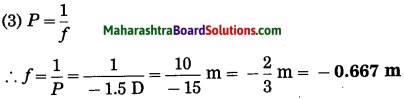
Maharashtra Board Class 10 Science Solutions Part 1 Chapter 7 Lenses 50
(Concave lens ∴ minus sign)
This is the focal length of the lens.

Question 76.
Surabhi from Std. X uses spectacles. The power of the lenses in her spectacles is 0.5 D. Answer the following questions from the given information: (March 2019)
(i) Identify the type of lenses used in her spectacles.
(ii) Identify the defect of vision Surabhi is suffering from.
(iii) Find the focal length of the lenses used in her spectacles.
Answer:
(i) Convex lenses are used in the spectacles used by Surabhi.
(ii) Surabhi is suffering from hypermetropia (farsightedness).
(iii) Focal length of the lenses used in her spectacles

Maharashtra Board Class 10 Science Solutions Part 1 Chapter 7 Lenses 51

Question 77.
My grandfather uses a bifocal lens in his spectacles. Explain why.
Answer:
In old age, people usually suffer from both myopia and hypermetropia. Therefore, they need spectacles having bifocal lenses.

The upper part of a bifocal lens is a concave lens to correct myopia. The lower part of a bifocal lens is a convex lens to correct hypermetropia.

Question 78.
State uses of concave lens.
Answer:

  1. Concave lenses are used for proper working of medical equipment, scanner, CD player – the instruments that employ laser rays.
  2. One or more concave lenses are used in a small safety device, fitted in the peep hole in a door, due to which we can see a large area outside the door.
  3. Concave lenses are used in spectacles to correct nearsightedness (myopia).
  4. A concave lens is used to spread light emitted by the small bulb in a torch over a wide area.
  5. A concave lens is used in front of the eyepiece or inside the eyepiece fitted in a camera, telescope and microscope – the instruments employing convex lenses.

Question 79.
State uses of a convex lens.
Answer:
Convex lenses are used in a simple microscope, compound microscope, refracting telescope, camera, projector, spectroscope, spectacles for correcting farsightedness (hypermetropia) and binoculars.

Maharashtra Board Class 10 Science Solutions Part 1 Chapter 7 Lenses

Question 80.
What is meant by the apparent size of an object? With a neat and labelled diagram, explain the relation between the apparent size of an object and the angle subtended by the object at the eye.
Answer:
An object appears small or big depending upon the size of its image formed on the retina of the eye. The size of an object as perceived by the eye is called the apparent size of the object. Consider two objects of the same size, one held near the eye and the other away from the eye as shown in the following figure (Fig. 7.34). The nearby object (PQ) appears larger than the distant object (P1Q1).
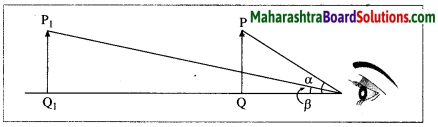
Maharashtra Board Class 10 Science Solutions Part 1 Chapter 7 Lenses 52
Also, the angle a subtended by the nearby object at the eye is larger than the angle β subtended by the distant object at the eye. This shows that the apparent size of an object depends upon the angle subtended by the object at the eye. The greater the angle subtended by the object at the eye, the greater is the apparent size of the object. Similarly, the smaller the angle subtended by the object at the eye, the smaller is the apparent size of the object.

Question 81.
With a neat labelled diagram, explain the working of a simple microscope. State uses of a simple microscope.
(OR)
What does a simple microscope consist of? What is the order of magnification obtained by a simple microscope? What is a simple microscope used for?
Answer:
A simple microscope consists of a convex lens of short focal length, usually fixed in a suitable frame with a handle or mounted on a stand.
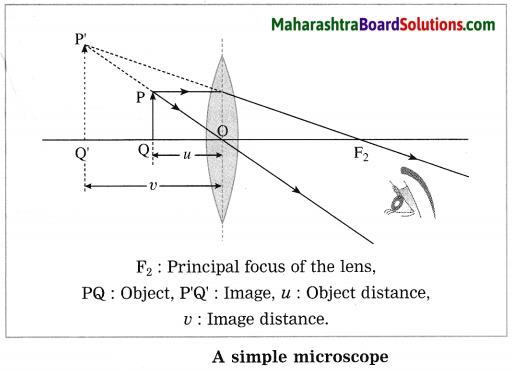
Maharashtra Board Class 10 Science Solutions Part 1 Chapter 7 Lenses 53
The object is placed in front of the convex lens of short focal length such that the object distance is less than the focal length. The image is virtual and larger than the object. It is formed on the same side of the lens as the object.

A maximum magnification of about 20 can be obtained by a simple microscope. A simple microscope is used by watch repairers to observe small parts of a watch and by jewellers to examine ornaments. A simple microscope (also called a magnifying glass) is also used to read words in small print.

Question 82.
With a neat labelled diagram, explain the construction and working of a compound microscope.
Answer:
Construction of a compound microscope:
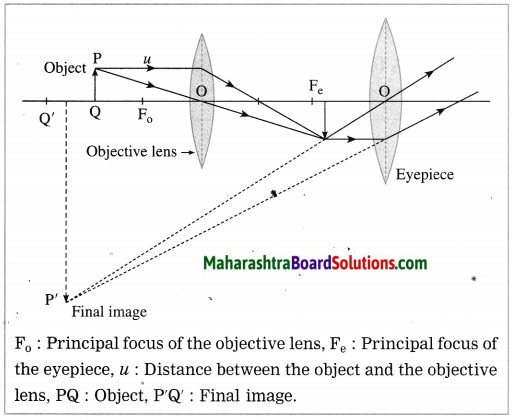
Maharashtra Board Class 10 Science Solutions Part 1 Chapter 7 Lenses 54
(1) A compound microscope consists of a metal tube fitted with two convex lenses at the two ends. These lenses are called the objective lens (the lens directed towards the object) and the eyepiece (the lens directed towards the eye). Both the lenses are small in size, but the cross section of the objective lens is less than that of the eyepiece. The objective lens has a short focal length. The focal length of the eyepiece is more than that of the objective lens.

(2) The metal tube is mounted on a stand. The principal axes of the objective lens and the eyepiece are along the same line. The distance between the object and the objective lens can be changed with a screw. It is possible to change the distance between the objective lens and the eyepiece.

Working :
(1) The object to be observed is illuminated and placed in front of the objective lens, slightly beyond the focal length of the objective lens. Its real, inverted and enlarged image is formed by the objective lens on the other side.

(2) This intermediate image lies within the focal length of the eyepiece. It serves as an object for the eyepiece. The eyepiece works as a simple microscope. The final image is virtual, highly enlarged and inverted with respect to the original object. It can be formed at the minimum distance of distinct vision from the eyepiece. The final image is observed by keeping the eye close to the eyepiece.

Maharashtra Board Class 10 Science Solutions Part 1 Chapter 7 Lenses

Question 83.
State two uses of a compound microscope.
Answer:
Uses of a compound microscope:

  1. It is used to observe blood corpuscles, plant and animals cells, microorganisms like bacteria, etc.
  2. It is used in a pathological laboratory to observe blood, urine, etc.
  3. It is a part of a travelling microscope used for measurement of very small distance.

Question 84.
What will happen if in a compound microscope, the objective lens is large in size and has a focal length?
Answer:
If the objective lens of a compound microscope is large in size, in addition to the light coming from an object, other unwanted light will be incident on the objective lens. Hence, the image will not be seen clearly. If the objective lens has a large focal length, the magnification produced by it will be less.

Question 85.
(a) In which type of microscope do you find the lens arrangement as shown in the following diagram? (Practice Activity Sheet – 1)
Maharashtra Board Class 10 Science Solutions Part 1 Chapter 7 Lenses 55
(b) Write in brief, the working of this microscope.
(c) Where is this microscope used?
Answer:
(a) Compound microscope.

(b)
An object appears small or big depending upon the size of its image formed on the retina of the eye. The size of an object as perceived by the eye is called the apparent size of the object. Consider two objects of the same size, one held near the eye and the other away from the eye as shown in the following figure (Fig. 7.34). The nearby object (PQ) appears larger than the distant object (P1Q1).
Maharashtra Board Class 10 Science Solutions Part 1 Chapter 7 Lenses 56
Also, the angle a subtended by the nearby object at the eye is larger than the angle β subtended by the distant object at the eye. This shows that the apparent size of an object depends upon the angle subtended by the object at the eye. The greater the angle subtended by the object at the eye, the greater is the apparent size of the object. Similarly, the smaller the angle subtended by the object at the eye, the smaller is the apparent size of the object.

(c) A simple microscope is used by watch repairers to observe small parts of a watch and by jewellers to
examine ornaments. A simple microscope (also called a magnifying glass) is also used to read words in small print.

Question 86.
(i) Which type of microscope has the arrangement of lenses shown in the following figure?
Maharashtra Board Class 10 Science Solutions Part 1 Chapter 7 Lenses 57
(ii) Label the figure correctly.
(iii) Write the working of this microscope.
(iv) Where is this microscope used?
(v) Suggest a way to increase the efficiency of this microscope. (Practice Activity Sheet – 2)
Answer:
(i) Compound microscope.

(ii)
Maharashtra Board Class 10 Science Solutions Part 1 Chapter 7 Lenses 58

(iii) Working:
(1) The object to be observed is illuminated and placed in front of the objective lens, slightly beyond the focal length of the objective lens. Its real, inverted and enlarged image is formed by the objective lens on the other side.

(2) This intermediate image lies within the focal length of the eyepiece. It serves as an object for the eyepiece. The eyepiece works as a simple microscope. The final image is virtual, highly enlarged and inverted with respect to the original object. It can be formed at the minimum distance of distinct vision from the eyepiece. The final image is observed by keeping the eye close to the eyepiece.

(iv)

  1. It is used to observe blood corpuscles, plant and animals cells, microorganisms like bacteria. etc.
  2. It is used in a pathological laboratory to observe blood, urine, etc.
  3. It is a part of a travelling microscope used for measurement of very small distance.

(v) Lenses with appropriate focal lengths should be selected.

Question 87.
State the use of a telescope.
Answer:
A telescope is used to observe a distant object such as mountain, moon, planet, star in the magnified form.

Maharashtra Board Class 10 Science Solutions Part 1 Chapter 7 Lenses

Question 88.
Observe the following figure and answer the questions. (Practice Activity Sheet – 3)
(a) Which optical instrument shows arrangement of lenses as shown in the figure?
(b) Write in brief the working of this optical instrument.
Maharashtra Board Class 10 Science Solutions Part 1 Chapter 7 Lenses 59
(c) How can we get different magnifications in this optical instrument?
(d) Draw the figure again and labelled it properly.
Answer:
(a) Refracting telescope.

(b) working: When the objective lens is pointed towards the distant object to be observed, the rays
of light from the distant object, which are almost parallel to each other. pass through the objective lens. The objective lens collects maximum amount of light as it is large in size. It forms a real, inverted and diminished image in the focal plane of the objective lens. Now, the position of the eyepiece is adjusted such that this image falls just within the focal length of the eyepiece and serves as the object for the eyepiece which works as a simple microscope.

The final image is highly magnified, virtual, on the same side as that of the object and inverted with respect to the original object. The final image can be observed by keeping the eye close to the eyepiece. If the image formed by the objective lens lies in the focal plane of the eyepiece, the final image is formed at infinity.

(c) We can get different magnifications by using the eyepiece with different focal lengths.

(d)
Maharashtra Board Class 10 Science Solutions Part 1 Chapter 7 Lenses 60

Question 89.
What is persistence of vision? Give one example of persistence of vision.
Answer:
Persistence of vision: We see an object when its image is formed on the retina. The image disappears when the object is removed from our sight. But this is not instantaneous and the image
remains imprinted on the retina for about \(\frac{1}{16}\) th of a second after the removal of the object.

The sensation on the retina persists for a while. This effect is known as the persistence of vision. It is due to persistence of vision that we continue to see the object in its position for about \(\frac{1}{16}\) th of a second after it is removed.
Example: When a burning stick of incense is moved fast in a circle, a circle of red light is seen.

Question 90.
Name two devices whose working is based on the phenomenon of persistence of vision.
(OR)
Name any two applications based on persistence of vision.
Answer:
The working of a television set and motion picture is based on the phenomenon of persistence of vision.
[Note: These are the examples of persistence of vision in daily life.

Question 91.
How is the phenomenon of persistence of vision used in motion pictures?
Answer:
In motion pictures, photographs of a moving object are taken at the rate of more than sixteen pictures per second. These photographs are projected on the screen at the same rate.
Each picture is slightly different from the other. As a result of persistence of vision, we get the impression of observing the object in continuous motion.

Question 92.
Name the two types of light sensitive cells present in the retina of the human eye. What are their functions?
Answer:
(1) The retina of the human eye contains a large number of light sensitive cells. These cells are of two shapes : (i) rods and (ii) cones.
(2) The rod-like cells respond to the intensity of light.
(3) The conical cells respond to various colours of light. They respond differently to red, green and blue colours. They do not respond to faint light.

Maharashtra Board Class 10 Science Solutions Part 1 Chapter 7 Lenses

Question 93.
When do you say that a person is colour blind?
Answer:
When a person is unable to distinguish between certain colours, he is said to be colour blind.
[Note: (i) Except for being colour-blind, their eyesight is normal, (ii) Rod-shaped cell ≡ rod-like cell, cone-shaped cell = Conical cell.]

Question 94.
Explain the perception of colour in the human eye.
(OR)
Explain in short perception of colour.
(OR)
Write a note on perception of colour.
Answer:
(1) In nature we firld objects of various colours. Perception of colour means to be able to respond to colour.
(2) We can distinguish between various colours due to perception of colour.
(3) The cone-shaped cells on the retina of the eye respond to the various colours when light is bright and communicate to the brain about the colours of the image formed on the retina. This gives us the proper idea about the colours of the object.
(4) If, in the retina of a person, the cone-shaped cells responding to certain specific colours are absent, the person is unable to distinguish between the colours. As a result, he lacks perception of colour.

Question 95.
What is colour-blindness?
Answer:
(1) The retina of the human eye contains a large number of light sensitive cells. These cells are of two shapes : (i) rods and (ii) cones.
(2) The cone-shaped cells respond to various colours of light when light is bright.
(3) Thus, the perception of colour is due to the presence of the cone-shaped cells in the retina.
(4) In the retina of some persons, cone-shaped cells responding to certain specific colours are absent. Hence, these persons are unable to distinguish between certain colours, i.e., they are colour-blind. This defect is known as colour¬blindness.

Question 96.
Why are some persons colour-blind? What is the cause of this defect?
Answer:
In the retina of some persons, cone-shaped cells responding to certain specific colours are absent. Hence, these persons are unable to distinguish between certain colours, i.e., they are colour-blind.

Question 97.
What are the difficulties faced by a colour-blind person?
Answer:
(1) A colour-blind person cannot distinguish between different colours. For example, he cannot distinguish between red and green colours. Also he cannot distinguish between blue and green colours. Red and green, both appear grey. Since a colour¬blind person cannot distinguish between red and green colours, it is difficult for him to cross a road. There is a possibility of an accident while crossing a road.

(2) A colour-blind person cannot distinguish between two objects of different colours, which are otherwise identical, e.g., clothes.

(3) A colour-blind person may have an inferiority complex and hence may find it difficult to mix with other persons.

Give scientific reasons:

Question 1.
A convex lens is known as a converging lens.
Answer:
When rays of light parallel to the principal axis of a convex lens pass through the lens, they converge to a point on the principal axis. Hence, a convex lens is known as a converging lens.

Maharashtra Board Class 10 Science Solutions Part 1 Chapter 7 Lenses

Question 2.
A concave lens is called a diverging lens.
Answer:
When rays of light parallel to the principal axis of a concave lens pass through the lens, they appear to diverge from a point on the principal axis. Hence, a concave lens is called a diverging lens.

Question 3.
In old age, a bifocal lens is necessary for some persons.
Answer:
(1) Some people, in old age, suffer from myopia (nearsightedness) as well as hypermetropia (farsightedness).
(2) Myopia is corrected using a concave lens of appropriate power. Hypermetropia is corrected using a convex lens of appropriate power. Therefore, they need a bifocal lens.

Question 4.
A person suffering from myopia (nearsightedness) uses spectacles of concave lenses.
Answer:
(1) A person suffering from myopia can see nearby objects clearly as the image of a nearby object is formed on the retina, but cannot see distant objects clearly as the image of a distant object is formed in front of the retina instead of on the retina.

(2) A concave lens diverges the rays of light passing through it. When spectacles of concave lenses of appropriate power are used, the parallel rays coming from a distant object are diverged to proper extent before they are incident on the eye lens. Therefore, after the converging action of the eye lens, the image of a distant object is formed on the retina of the eye and hence the distant object can be seen clearly.

Question 5.
A person suffering from hypermetropia (farsightedness) uses spectacles of convex lenses.
Answer:
(1) A person suffering from hypermetropia can see distant objects clearly as the image of a distant object is formed on the retina, but cannot see nearby objects clearly as the image of a nearby object would be formed behind the retina instead of on the retina.

(2) A convex lens converges the rays of light passing through it. When spectacles of convex lenses of appropriate power are used, the rays of light coming from a nearby object are converged to proper extent before they are incident on the eye lens. Therefore after the converging action of the j eye lens, the image of a nearby object is formed on j the retina of the eye and hence the nearby object | can be seen clearly.

Question 6.
You cannot enjoy watching a movie from a very short distance from the screen in a cinema hall.
Answer:
(1) The less the distance between the screen in a cinema hall and the person watching the movie, the more is the intensity of light falling on the eye.
(2) This results in great contraction of the pupil of the eye causing a strain. Hence, you cannot enjoy watching a movie from a very short distance from the screen in a cinema hall.

Maharashtra Board Class 10 Science Solutions Part 1 Chapter 7 Lenses

Question 7.
The rays of light travelling through the optical centre of a lens pass without changing their path.
Answer:
The portion of a lens near the optical centre is like a very thin slab of glass. Hence, the rays of light travelling through the optical centre of a lens pass without changing their path.

Question 8.
A convex lens converges the rays of light falling on it.
Answer:

  • A convex lens can be regarded as made of a very large number of portions of triangular prisms. The bases of these prisms are towards the central thicker portion of the lens.
  • A ray of light passing through a prism bends towards its base. Hence, a convex lens converges the rays falling on it.

Question 9.
A concave lens diverges the rays of light falling on it.
Answer:

  • A concave lens can be regarded as made of a very large number of portions of triangular prisms. The bases of these prisms are towards the edges of the less, i.e, away from the central thinner portion of the lens.
  • A ray of light passing through a prism bends towards its base. Hence, a concave lens diverges the rays of light falling on it.

Question 10.
When a burning stick of incense is moved fast in a circle, a circle of red light is seen.
Answer:
The impression of the image on the retina lasts for about \(\frac{1}{16}\) th of a second after the removal of the object. If a burning stick of incense is moved at a rate of more than sixteen revolutions per second, we see a circle of red light due to persistence of vision.

Question 11.
Colour-blind persons are unable to distinguish between different colours.
Answer:
(1) The cone-shaped cells in the retina of a person respond to colours. This makes the perception of colours possible.
(2) In the retina of colour-blind persons, cone-shaped cells responding to certain specific colours are absent. Hence, they are unable to distinguish between different colours.

Question 12.
It is risky to issue a driving license to a person suffering from colour-blindness.
Answer:
A colour-blind person cannot distinguish between different colours. If a driver is colour-blind, he will not be able to distinguish between the colours of the signal and the colours on different sign boards. This will lead to an accident. Hence, it is risky to issue a driving license to a person suffering from colour-blindness.

Distinguish the following:

Question 1.
Real image and Virtual image.
Answer:
Real image:

  1. A real image is formed when the light rays starting from an object meet after reflection or refraction.
  2. It can be projected on a screen.
  3. It is inverted with respect to the object.

Virtual image:

  1. A virtual image is formed when the light rays starting from an object (when extended backward) appear to meet after reflection or refraction.
  2. It cannot be projected on a screen.
  3. It is erect with respect to the object.

Question 2.
Simple microscope and Compound microscope.
Answer:
Simple microscope:

  1. In a simple microscope, only one convex lens is used.
  2. In this case, the object is placed within the focal length of the convex lens.
  3. Its magnifying power is much less than that of a compound microscope.
  4. It is used to observe minute parts of a watch, to read words in small print, etc.

Compound microscope:

  1. In a compound microscope, two convex lenses, objective and eyepiece, are used.
  2. In this case, the object is placed beyond the focal length of the objective lens.
  3. Its magnifying power is much greater than that of a simple microscope.
  4. It is used to observe blood corpuscles, plant and animal cells, etc.

Maharashtra Board Class 10 Science Solutions Part 1 Chapter 7 Lenses

Question 3.
Compound microscope and Astronomical refracting telescope.
Answer:
Compound microscope:

  1. In a compound microscope, the focal length and cross section of the objective lens are respectively smaller than the focal length and cross section of the eyepiece.
  2. In this case, to observe the object, the distance between the object and the objective lens is adjusted.
  3. It forms a magnified image of a small object.
  4. It is used to observe blood corpuscles, plant and animal cells, etc.

Astronomical refracting telescope:

  1. In an astronomical refracting telescope, the focal length and cross section of the objective lens are respectively greater than the focal length and cross section of the eyepiece.
  2. In this case, to observe the object, the distance between the objective lens and eyepiece is adjusted.
  3. It forms a near image of a distant object.
  4. It is used to observe sateulites, planets, stars, etc.

Question 4.
Simple microscope and Astronomical refracting telescope.
Answer:
Simple microscope:

  1. In a simple microscope, only one convex lens is used.
  2. In this case, the object is placed within the focal length of the convex lens.
  3. In this case, the image is erect.
  4. It is used to observe minute parts of a watch, to read words in small print, etc.

Astronomical refracting telescope:

  1. In an astronomical refracting telescope, two convex lenses, objective lens and eyepiece are used.
  2. In this case, the object is far away from the objective lens.
  3. In this case, the image is inverted.
  4. It is used to observe satellites, planets, stars, etc.

Read the following paragraph and answer the questions given below it:

Construction of a compound microscope:
(1) A compound microscope consists of a metal tube fitted with two convex lenses at the two ends. These lenses are called the objective lens (the lens directed towards the object) and the eyepiece (the lens directed towards the eye). Both the lenses are small in size, but the cross section of the objective lens is less than that of the eyepiece. The objective lens has a short focal length. The focal length of the eyepiece is more than that of the objective lens.(2) The metal tube is mounted on a stand. The principal axes of the objective lens and the eyepiece are along the same line. The distance between the object and the objective lens can be changed with a screw. It is possible to change the distance between the objective lens and the eyepiece.
Working:
(1) The object to be observed is illuminated and placed in front of the objective lens, slightly beyond the focal length of the objective lens. Its real, inverted and enlarged image is formed by the, objective lens on the other side.
(2) This intermediate image lies within the focal length of the eyepiece. It serves as an object for the eyepiece. The eyepiece works as a simple microscope. The final image is virtual, highly enlarged and inverted with respect to the original object. It can be formed at the minimum distance of distinct vision from the eyepiece. The final image is observed by keeping the eye close to the eyepiece.
Use: This microscope is used to observe blood cells, microorganisms, etc.

Question 1.
In a compound microscope, which lens has greater focal length?
Answer:
In a compound microscope, the eyepiece has greater focal length.

Question 2.
Where do you place the object to be observed with a compound microscope?
Answer:
In a compound microscope, the object to be observed is placed in front of the objective lens, slightly beyond the focus of the objective lens.

Question 3.
State which distance is adjusted to observe the object with a compound microscope.
Answer:
To observe the object with a compound microscope, the distance between the object and objective lens is adjusted.

Question 4.
State the nature of the final image in compound microscope relative to the object.
Answer:
In a compound microscope, the final image is highly enlarged, inverted and virtual relative to the object.

Question 5.
State the use of a compound microscope.
Answer:
A compound microscope is used to observe blood cells, microorganisms, etc.

Fill in the blanks for a convex lens:

Question 1.

f (m) 0.2 —————– 0.1
P (D) ————— 2 ——————

Answer:
[P (D) = \(\frac{1}{f(\mathrm{m})}\)]

f (m) 0.2 0.5 0.1
P (D) 5 2 10

Question 2.

h1 (cm) —————- 5 10
h2 (cm) -30 -20 —————-
M -2 —————– -0.5

Answer:
[M = \(\frac{h_{2}}{h_{1}}\)]

h1 (cm) 15 5 10
h2 (cm) -30 -20 -5
M -2 -4 -0.5

Maharashtra Board Class 10 Science Solutions Part 1 Chapter 7 Lenses

Solve the following numerical problems:

Problem 1.
An object Is kept at 60 cm in front of a convex lens. Its real image is formed at 20 cm from the lens. Find the focal length or the lens.
Solution:
Data: Convex lens, u = -60 cm,
Maharashtra Board Class 10 Science Solutions Part 1 Chapter 7 Lenses 61
The focal length of the lens = 15 cm.

Problem 2.
The focal length of a convex lens is 20 cm. If an object of height 2 cm is placed at 30 cm from the lens, find (i) the position and nature of the Image (ii) the height of the image (iii) the magnification produced by the lens.
Solution:
Data: Convex lens, f = 20 cm,
u = -30 cm, h1 = 2 cm, v = ?, h2 = ?, M = ?
Maharashtra Board Class 10 Science Solutions Part 1 Chapter 7 Lenses 62
The image will be formed at 60 cm from the lens and on the other side of the lens with respect to the object. It is a real image.
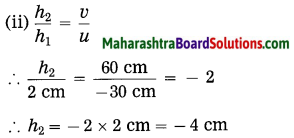
Maharashtra Board Class 10 Science Solutions Part 1 Chapter 7 Lenses 63
h2 is negative. This shows that the image is inverted.
The height of the image -4 cm.
(iii) M = \(\frac{h_{2}}{h_{1}}=\frac{-4 \mathrm{cm}}{2 \mathrm{cm}}\) = -2
M is negative, indicating that the image is inverted.
The magnification produced by the lens = -2.

Problem 3.
When a pm of height 3 cm is fixed at 10 cm from a convex lens, the height or the virtual image formed is 12 cm. Find the focal length of the lens.
Solution:
Data: Convex lens, h1 =3 cm,
h2 = 12 cm (virtual image), u = -10 cm, f = ?
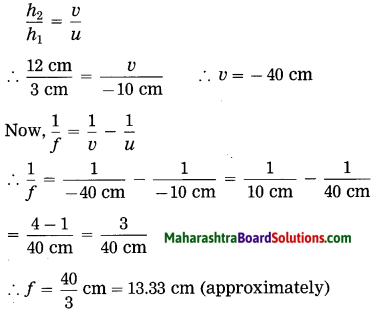
Maharashtra Board Class 10 Science Solutions Part 1 Chapter 7 Lenses 64
The focal length of the lens = 13.33 cm [approximately]

Maharashtra Board Class 10 Science Solutions Part 1 Chapter 7 Lenses

Problem 4.
At what distance from a convex lens of focal length 2.5 m should a boy stand so that his image is half his height?
Solution:
Data: Convex lens, f= 2.5 m,
M= –\(\frac{1}{2}\), u=?
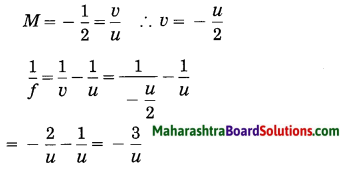
Maharashtra Board Class 10 Science Solutions Part 1 Chapter 7 Lenses 65
∴ u = -3f = -3 × 2.5 m = -7.5 m
This is the object distance.
The boy should stand at 7.5 m from the convex lens so that his image is half his height.

Problem 5.
A convex lens forms a real image or a pencil at a distance of 40 cm from the lens. The image formed is of the same size as the object. Find the focal length and power of the lens. At what distance is the pencil placed from the lens?
Solution:
Data: Convex lens, v = 40 cm,
M = -1, f = ?, h1 = ?, u = ?
M = = -1 = \(\frac{v}{u}\)
∴ u = -v = -40 cm (object distance)
The pencil is placed at 40 cm from the convex lens.
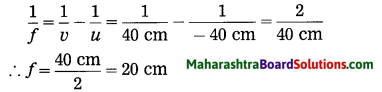
Maharashtra Board Class 10 Science Solutions Part 1 Chapter 7 Lenses 66
The focal length of the lens 20 cm.
Maharashtra Board Class 10 Science Solutions Part 1 Chapter 7 Lenses 67
The power of the lens = 5 D.

Problem 6.
A spherical lens is used to obtain an image on a screen. The size of the image is four times the size of the object. What is the type of lens and at what distance is the screen placed from the lens?
Solution:
Data: M = -4, type of lens? v = ?
As the image formed by the lens is obtained on a screen, it is a real image. The lens is, therefore, a convex 1ens.
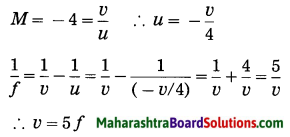
Maharashtra Board Class 10 Science Solutions Part 1 Chapter 7 Lenses 68
The distance of the screen from the lens = 5f.

Problem 7.
An object of height 5 cm Is held 20 cm away from a converging lens of focal length 10 cm. Find the position, nature and size of the image formed.
Solution:
Data: Converging lens (convex lens),
f = 10 cm, h1 = 5 cm, u = -20 cm, v = ?, h2 = ?
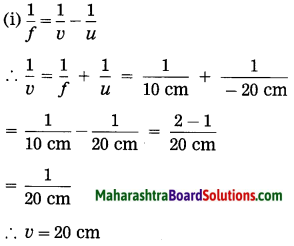
Maharashtra Board Class 10 Science Solutions Part 1 Chapter 7 Lenses 69
The image is real and inverted. it is formed at 20 cm from the lens and on the other side of the lens relative to the object.
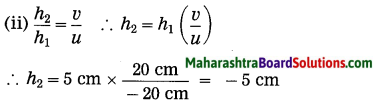
Maharashtra Board Class 10 Science Solutions Part 1 Chapter 7 Lenses 70
The height of the image, h2 = -5 cm
Thus, it is numerically the same as the height of the object.

Maharashtra Board Class 10 Science Solutions Part 1 Chapter 7 Lenses

Problem 8.
An object is placed at 10 cm from a convex lens of focal length 12 m. Find the position and nature of the image.
Solution:
Data: Convex lens, u = -10 cm,
f = 12 cm, v = ?
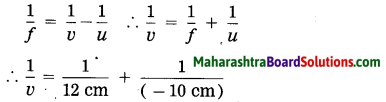
Maharashtra Board Class 10 Science Solutions Part 1 Chapter 7 Lenses 71
Maharashtra Board Class 10 Science Solutions Part 1 Chapter 7 Lenses 72
∴ v = -60 cm
It is negative.
The image is formed at 60 cm from the lens and on the same side of the lens relative to the object. It is virtual, erect, and enlarged.

Problem 9.
An object of height 4 cm is placed in front of a concave lens of focal length 40 cm. If the object distance is 60 cm, find the position and height of the image.
Solution:
Data: f = -40 cm (concave lens),
u = -60 cm, h1 = 4 cm, v = ?, h2 = ?
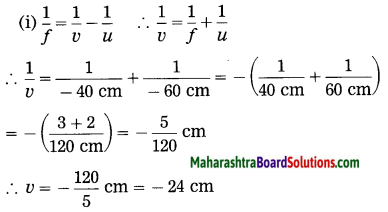
Maharashtra Board Class 10 Science Solutions Part 1 Chapter 7 Lenses 73
The image Is formed at 24 cm from the lens.
It is on the same side as the object.
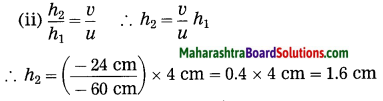
Maharashtra Board Class 10 Science Solutions Part 1 Chapter 7 Lenses 74
The height of the image is 1.6 cm.

Problem 10.
What is the power of a convex lens having focal length 0.5 m?
Solution:
Data: Convex lens, f= 0.5 m, P = ?
P = \(\frac{1}{f}=\frac{1}{0.5 \mathrm{m}}\) = 2D
The power of the lens = 2D.

Problem 11.
The power of a convex lens is 2.5 dioptres. Find its focal length.
(OR)
Calculate the focal length of a corrective lens having power +2.5 D.
Solution:
Data: Convex lens, P = +2.5 D, f = ?
P = \(\frac{1}{f}\)
∴ 2.5 D = \(\frac{1}{f}\)
∴ f = \(\frac{1}{2.5 \mathrm{D}}\) = 0.4 cm = 40 cm
The focal length of the lens = 40 cm.

Problem 12.
Two convex lenses of focal length 20 cm each are kept in contact with each other. Find the power of their combination.
Solution:
Data: f1 = 20 cm = 0.2 m,
f2 =20 cm = 0.2 m, P (combination) = ?

Maharashtra Board Class 10 Science Solutions Part 1 Chapter 7 Lenses 75
∴ Focal length of the combination or the lenses, f = 0.1 m.
P = \(\frac{1}{f}=\frac{1}{0.1 \mathrm{m}}\) = 10 D
The power of the combination of the lenses, P = 10 D.

Maharashtra Board Class 10 Science Solutions Part 1 Chapter 7 Lenses

Problem 13.
Two convex lenses of equal focal lengths are kept in contact with each other. If the power of their combination is 20 D, find the focal length of each convex lens.
Solution:
Data: Convex lens, P = 20 D, f1 = f2 = ?
The focal length (f) of the combination of the lenses is given by
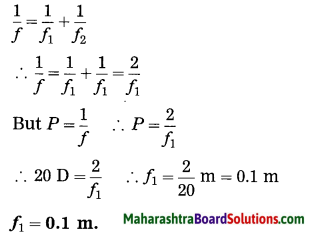
Maharashtra Board Class 10 Science Solutions Part 1 Chapter 7 Lenses 76
This gives the focal length or each convex lens.

Problem 14.
If a convex lens of focal length 10 cm and a concave lens of focal length 50 cm are kept in contact with each other, (i) what will be the focal length of the combination? (ii) what wiil be the power of the combination? (iii) what will be the behaviour of the combination (behaviour as a convex lens/concave lens)?
Solution:
Data: f1 = +10 cm = +0.1 m (convex lens),
f2 = -50 cm = -0.5 m (concave lens),
f (combination) = ?, P (combination) = ?
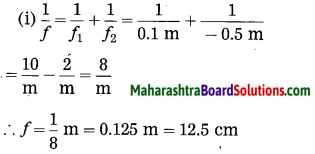
Maharashtra Board Class 10 Science Solutions Part 1 Chapter 7 Lenses 77
The focal length or the combination of the lenses = 0.125 m = 12.5 cm.
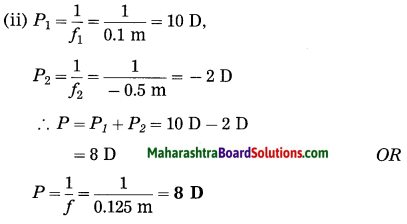
Maharashtra Board Class 10 Science Solutions Part 1 Chapter 7 Lenses 78
The power of the combination of the lenses 8.D.
(iii) The focal length of the combination of the lenses is positive. This shows that the combination will behave as a convex lens.

Numerical problems for practice:
Problem 1.
Find the focal length of a convex lens which produces a real image at 60 cm from the lens when an object is placed at 40 cm in front of the lens.
Answer:

24 cm

Problem 2.
Find the focal length of a convex lens which produces a virtual image at 10 cm from the lens when an object is placed at 5 cm from the lens.
Answer:
10 cm

Problem 3.
A real image is obtained at 30 cm from a convex lens of focal length 7.5 cm. Find the distance of the object from the lens.
Answer:
u = -10 cm

Maharashtra Board Class 10 Science Solutions Part 1 Chapter 7 Lenses

Problem 4.
An object is kept at 20 cm in front of a convex lens and its real image is formed at 60 cm from the lens. Find (1) the focal length of the lens (2) the height or the image if the height of the object is 6 cm.
Answer:
(1) 15 cm
(2) h2 = -18 cm]

Problem 5.
An object is kept at 10 cm in front of a convex lens. Its image is formed on the screen at 15 cm from the lens. Calculate (1) the focal length of the lens (2) the magnification produced by the lens.
Answer:
(1) 6 cm
(2)M = -1.5

Problem 6.
An object is kept at 60 cm in front of a convex lens of focal length 15 cm. Find the image distance and the nature of the image. Also find the magnification produced by the lens.
Answer:
v = 20 cm. The image is real, inverted and smaller than the object. M = –\(\frac{1}{3}\)]

Problem 7.
An object of height 2 cm is kept at 30 cm from a convex lens. Its real image is formed at 60 cm from the lens. Find the focal length and power of the lens.
Answer:
f = 20 cm, P = 5 D

Problem 8.
If the power of a lens is 4 dioptres, find its focal length.
Answer:
25 cm

Problem 9.
Find the power of a convex lens of focal length 40 cm.
Answer:
2.5 D

Problem 10.
Find the power of a convex lens of focal length 12.5 cm.
Answer:
8 D

Problem 11.
If for a lens, f = – 20 cm, what is the power of the lens?
Answer:
-5 D

Maharashtra Board Class 10 Science Solutions Part 1 Chapter 7 Lenses

Problem 12.
An object of height 4 cm is kept in front of a concave lens of focal length 20 cm. If the object distance is 30 cm, find the position and the height of the image.
Answer:
v = -12 cm, h2 = 1.6 cm

Problem 13.
If two convex lenses of focal lengths 10 cm and 5 cm are kept in contact with each other, what is their combined focal length?
Answer:
\(\frac{10}{3}\) cm [approximately 3.33 cm]

Problem 14.
If a convex lens of focal length 20 cm and a concave lens of focal length 30 cm are kept in contact with each other, (i) What will be the focal length of the combination? (ii) What will be the power of the combination? (iii) What will be the behaviour of the combination?
Answer:
(i) f = 60 cm
(ii) P = \(\frac{5}{3}\) D = 1.6667 D (approximately)
(iii) The combination will behave as a convex lens.

Maharashtra Board Class 10 Science Solutions Part 1 Chapter 7 Lenses

Problem 15.
A concave lens of focal length 12 cm and a convex lens of focal length 20 cm are kept in contact with each other, (i) Find the focal length of the combination, (ii) What will be the behaviour of the combination?
Answer:
(i) f = -30 cm
(ii) The combination will behave as a concave lens.

10th Std Science Part 1 Questions And Answers: