12th Commerce Maths 2 Chapter 3 Exercise 3.3 Answers Maharashtra Board

Linear Regression Class 12 Commerce Maths 2 Chapter 3 Exercise 3.3 Answers Maharashtra Board

Balbharati Maharashtra State Board 12th Commerce Maths Digest Pdf Chapter 3 Linear Regression Ex 3.3 Questions and Answers.

Std 12 Maths 2 Exercise 3.3 Solutions Commerce Maths

Question 1.
From the two regression equations find r, \(\bar{x}\) and \(\bar{y}\).
4y = 9x + 15 and 25x = 4y + 17
Solution:
Given 4y = 9x + 15 and 25x = 4y + 17
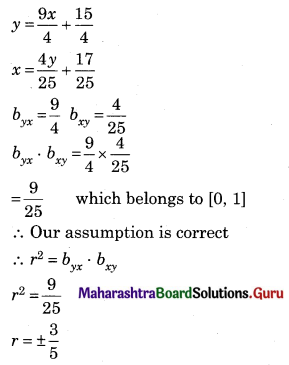
Maharashtra Board 12th Commerce Maths Solutions Chapter 3 Linear Regression Ex 3.3 Q1
Since byx and bxy are positive.
∴ r = \(\frac{3}{5}\) = 0.6
(\(\bar{x}\), \(\bar{y}\)) is the point of intersection of the regression lines
9x – 4y = -15 …….(i)
25x – 4y = 17 ……….(ii)
-16x = -32
x = 2
∴ \(\bar{x}\) = 2
Substituting x = 2 in equation (i)
9(2) – 4y = -15
18 + 15 = 4y
33 = 4y
y = 33/4 = 8.25
∴ \(\bar{y}\) = 8.25

Maharashtra Board 12th Commerce Maths Solutions Chapter 3 Linear Regression Ex 3.3

Question 2.
In a partially destroyed laboratory record of an analysis of regression data, the following data are legible:
Variance of X = 9
Regression equations:
8x – 10y + 66 = 0 And 40x – 18y = 214.
Find on the basis of the above information
(i) The mean values of X and Y.
(ii) Correlation coefficient between X and Y.
(iii) Standard deviation of Y.
Solution:
Given, \(\sigma_{x}{ }^{2}=9, \sigma_{x}=3\)
(i) (\(\bar{x}\), \(\bar{y}\)) is the point of intersection of the regression lines
40x – 50y = -330 …….(i)
40x – 50y = +214 ………(ii)
-32y = -544
y = 17
∴ \(\bar{y}\) = 17
8x – 10(17) + 66 = 0
8x = 104
x = 13
∴ \(\bar{x}\) = 13
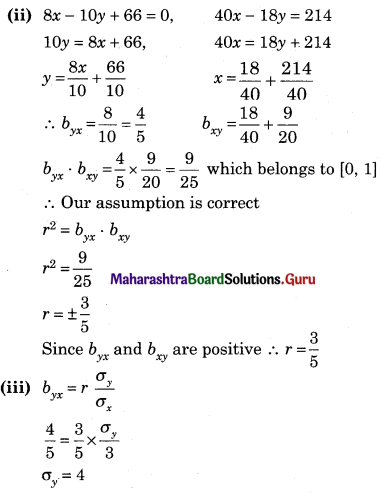
Maharashtra Board 12th Commerce Maths Solutions Chapter 3 Linear Regression Ex 3.3 Q2

Question 3.
For 50 students of a class, the regression equation of marks in statistics (X) on the marks in Accountancy (Y) is 3y – 5x + 180 = 0. The mean marks in accountancy is 44 and the variance of marks in statistics \(\left(\frac{9}{16}\right)^{t h}\) of the variance of marks in accountancy. Find the mean in statistics and the correlation coefficient between marks in two subjects.
Solution:
Given, n = 50, \(\bar{y}\) = 44
\(\sigma_{x}^{2}=\frac{9}{16} \sigma_{y}^{2}\)
∴ \(\frac{\sigma_{x}}{\sigma_{x}}=\frac{3}{4}\)
Since (\(\bar{x}\), \(\bar{y}\)) is the point intersection of the regression line.
∴ (\(\bar{x}\), \(\bar{y}\)) satisfies the regression equation.
3\(\bar{y}\) – 5\(\bar{x}\) + 180 = 0
3(44) – 5\(\bar{x}\) + 180 = 0
∴ 5\(\bar{x}\) = 132 + 180
\(\bar{x}\) = \(\frac{312}{5}\) = 62.4
∴ Mean marks in statistics is 62.4
Regression equation of X on Y is 3y – 5x + 180 = 0
∴ 5x = 3y + 180
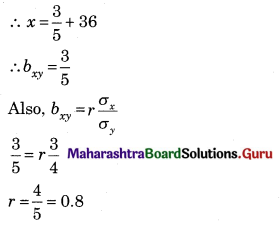
Maharashtra Board 12th Commerce Maths Solutions Chapter 3 Linear Regression Ex 3.3 Q3

Question 4.
For bivariate data, the regression coefficient of Y on X is 0.4 and the regression coefficient of X on Y is 0.9. Find the value of the variance of Y if the variance of X is 9.
Solution:
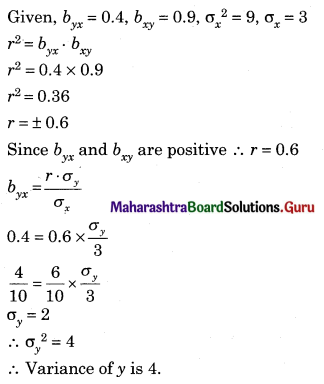
Maharashtra Board 12th Commerce Maths Solutions Chapter 3 Linear Regression Ex 3.3 Q4

Question 5.
The equation of two regression lines are 2x + 3y – 6 = 0 and 3x + 2y – 12 = 0
Find (i) Correlation coefficient (ii) \(\frac{\sigma_{x}}{\sigma_{y}}\)
Solution:
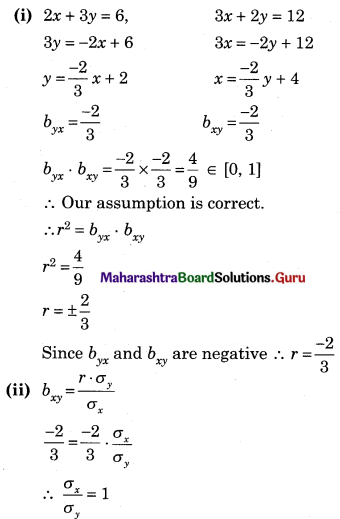
Maharashtra Board 12th Commerce Maths Solutions Chapter 3 Linear Regression Ex 3.3 Q5

Question 6.
For a bivariate data \(\bar{x}\) = 53, \(\bar{y}\) = 28, byx =-1.5 and bxy = -0.2. Estimate Y when X = 50.
Solution:
Regression equation of Y on X is
(Y – \(\bar{y}\)) = byx (X – \(\bar{x}\))
(Y – 28) = -1.5(50 – 53)
Y – 28 = -1.5(-3)
Y – 28 = 4.5
Y = 32.5

Maharashtra Board 12th Commerce Maths Solutions Chapter 3 Linear Regression Ex 3.3

Question 7.
The equation of two regression lines are x – 4y = 5 and 16y – x = 64. Find means of X and Y. Also, find the correlation coefficient between X and Y.
Solution:
Since (\(\bar{x}\), \(\bar{y}\)) is the point of intersection of the regression lines.
x – 4y = 5 …..(i)
-x + 16y = 64 …….(ii)
12y = 69
y = 5.75
Substituting y = 5.75 in equation (i)
x – 4(5.75) = 5
x – 23 = 5
x = 28
∴ \(\bar{x}\) = 28, \(\bar{y}\) = 5.75
x – 4y = 5
x = 4y + 5
∴ bxy = 4
16y – x = 64
16y = x + 64
y = \(\frac{1}{16}\)x + 4
byx = \(\frac{1}{16}\)
byx . bxy = \(\frac{1}{16}\) × 4 = \(\frac{1}{4}\) ∈ [0, 1]
∴ Our assumption is correct
∴ r2 = byx . bxy
r2 = \(\frac{1}{4}\)
r = ±\(\frac{1}{2}\)
Since byx and bxy are positive,
∴ r = \(\frac{1}{2}\) = 0.5

Question 8.
In partially destroyed record, the following data are available variance of X = 25. Regression equation of Y on X is 5y – x = 22 and Regression equation of X on Y is 64x – 45y = 22 Find
(i) Mean values of X and Y.
(ii) Standard deviation of Y.
(iii) Coefficient of correlation between X and Y.
Solution:
Given \(\sigma_{x}^{2}\) = 25, ∴ σx = 5
(i) Since (\(\bar{x}\), \(\bar{y}\)) is the point of intersection of regression lines
-x + 5y = 22 …….(i)
64x – 45y = 22 ………..(ii)
equation (i) becomes
-9x + 45y = 198
64y – 45y = 22
55x = 220
x = 4
Substituting x = 4 in equation (i)
-4 + 5y = 22
5y = 26
∴ y = 5.2
∴ \(\bar{x}\) = 4, \(\bar{y}\) = 5.2
Regression equation of X on Y is
64x – 45y – 22
64x = 45y + 22
x = \(\frac{45}{64} y+\frac{22}{64}\)
bxy = \(\frac{45}{64}\)
(ii) Regression equation of Y on X is
5y – x = 22
5y = x + 22
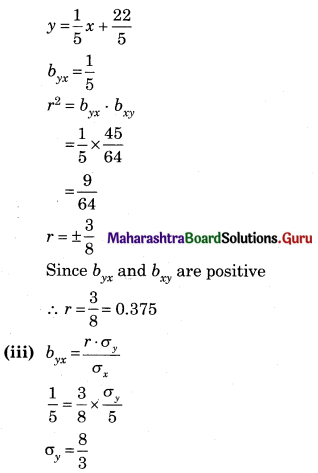
Maharashtra Board 12th Commerce Maths Solutions Chapter 3 Linear Regression Ex 3.3 Q8

Question 9.
If the two regression lines for a bivariate data are 2x = y + 15 (x on y) and 4y – 3x + 25 (y on x) find
(i) \(\bar{x}\)
(ii) \(\bar{y}\)
(iii) byx
(iv) bxy
(v) r [Given √0.375 = 0.61]
Solution:
Since (\(\bar{x}\), \(\bar{y}\)) is the point of intersection of the regression line
2x = y + 15
4y = 3x + 25
2x – y = 15 …….(i)
3x – 4y = -25 ……..(ii)
Multiplying equation (i) by 4
8x – 4y = 60
3x – 4y = -25
on Subtracting,
5x = 85
∴ x = 17
Substituting x in equation (i)
2(17) – y = 15
34 – 15 = y
∴ y = 15
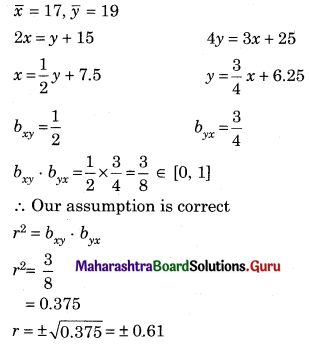
Maharashtra Board 12th Commerce Maths Solutions Chapter 3 Linear Regression Ex 3.3 Q9
Since byx and bxy are positive, ∴ r = 0.61

Maharashtra Board 12th Commerce Maths Solutions Chapter 3 Linear Regression Ex 3.3

Question 10.
The two regression equation are 5x – 6y + 90 = 0 and 15x – 8y – 130 = 0. Find \(\bar{x}\), \(\bar{y}\), r.
Solution:
Since (\(\bar{x}\), \(\bar{y}\)) is the point of intersection of the regression lines
5x – 6y + 90 = 0 ……(i)
15x – 8y – 130 = 0
15x – 18y + 270 = 0
15x – 8y – 130 = 0
on subtracting,
-10y + 400 = 0
y = 40
Substituting y = 40 in equation (i)
5x – 6(40) + 90 = 0
5x = 150
x = 30
∴ \(\bar{x}\) = 30, \(\bar{y}\) = 40
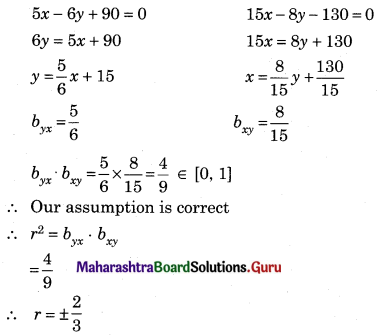
Maharashtra Board 12th Commerce Maths Solutions Chapter 3 Linear Regression Ex 3.3 Q10
Since byx and bxy are positive
∴ r = \(\frac{2}{3}\)

Question 11.
Two lines of regression are 10x + 3y – 62 = 0 and 6x + 5y – 50 = 0 Identify the regression equation equation of x on y. Hence find \(\bar{x}\), \(\bar{y}\), and r.
Solution:
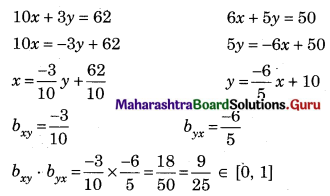
Maharashtra Board 12th Commerce Maths Solutions Chapter 3 Linear Regression Ex 3.3 Q11
∴ Our assumption is correct.
∴ Regression equation of X on Y is 10x + 3y – 62 = 0
r2 = byx . bxy
r2 = \(\frac{9}{25}\)
r = ±\(\frac{3}{5}\)
Since, byx and bxy are negative, r = –\(\frac{3}{5}\) = -0.6
Also (\(\bar{x}\), \(\bar{y}\)) is the point of intersection of the regression lines
50x + 15y = 310
18x + 15y = 150
on subtracting
32x = 160
x = 5
Substituting x = 5 in 10x + 3y = 62
10(5) + 3y = 62
3y = 12
∴ y = 4
∴ \(\bar{x}\) = 5, \(\bar{y}\) = 4

Question 12.
For certain X and Y series, which are correlated the two lines of regression are 10y = 3x + 170 and 5x + 70 = 6y. Find the correlation coefficient between them. Find the mean values of X and Y.
Solution:
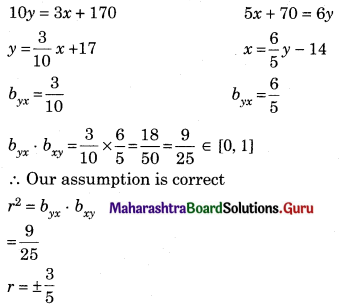
Maharashtra Board 12th Commerce Maths Solutions Chapter 3 Linear Regression Ex 3.3 Q12
Since byx and bxy are positive,
r = \(\frac{3}{5}\) = 0.6
Since, (\(\bar{x}\), \(\bar{y}\)) is the point of intersection of the regression lines
3x – 10y = -170 …….(i)
5x – 6y = -70 ………(ii)
9x – 30y = -510
25x – 30y = -350
on subtracting
-16x = -160
x = 10
Substituting x = 10 in equation (i)
3(10) – 10y = -170
30 + 170 = 10y
200 = 10y
y = 20
∴ \(\bar{x}\) = 10, \(\bar{y}\) = 20

Maharashtra Board 12th Commerce Maths Solutions Chapter 3 Linear Regression Ex 3.3

Question 13.
Regression equation of two series are 2x – y – 15 = 0 and 4y + 25 = 0 and 3x- 4y + 25 = 0. Find \(\bar{x}\), \(\bar{y}\) and regression coefficients, Also find coefficients of correlation. [Given √0.375 = 0.61]
Solution:
Since (\(\bar{x}\), \(\bar{y}\)) is the point of intersection of the regression line
2x = y + 15
4y = 3x + 25
2x – y = 15 ……(i)
3x – 4y = -15 ……..(ii)
Multiply equation (i) by 4
8x – 4y = 60
3x – 4y = -25
on subtracting,
5x = 85
x = 17
Substituting x in equation (i)
2(17) – y = 15
34 – 15 = y
y = 15
∴ \(\bar{x}\) = 17, \(\bar{y}\) = 19
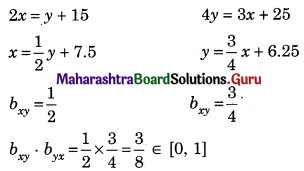
Maharashtra Board 12th Commerce Maths Solutions Chapter 3 Linear Regression Ex 3.3 Q13
∴ Our assumption is correct
r2 = bxy . byx
r2 = \(\frac{3}{8}\) = 0.375
r = ±√o.375 = ±0.61
Since, byx and bxy are positive, ∴ r = 0.61

Question 14.
The two regression lines between height (X) in includes and weight (Y) in kgs of girls are 4y – 15x + 500 = 0 and 20x – 3y – 900 = 0. Find the mean height and weight of the group. Also, estimate the weight of a girl whose height is 70 inches.
Solution:
Since (\(\bar{x}\), \(\bar{y}\)) is the point intersection of the regression lines
15x – 4y = 500 ……(i)
20x – 3y = 900 …….(ii)
60x – 16y – 2000
60x – 9y = 2700
on subtracting,
-7y = -700
y = 100
Substituting y = 100 in equation (i)
15x – 4(100) = 500
15x = 900
x = 60
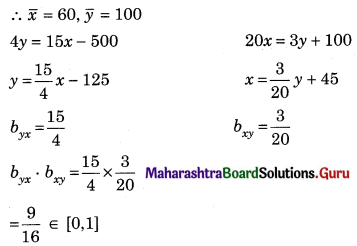
Maharashtra Board 12th Commerce Maths Solutions Chapter 3 Linear Regression Ex 3.3 Q14
∴ Our assumption is correct
∴ Regression equation of Y on X is
Y = \(\frac{15}{4}\)x – 125
When x = 70
Y = \(\frac{15}{4}\) × 70 = -125
= 262.5 – 125
= 137.5 kg

12th Commerce Maths Digest Pdf
12th Commerce Maths 2 Chapter 3 Exercise 3.2 Answers Maharashtra Board

Linear Regression Class 12 Commerce Maths 2 Chapter 3 Exercise 3.2 Answers Maharashtra Board

Balbharati Maharashtra State Board 12th Commerce Maths Digest Pdf Chapter 3 Linear Regression Ex 3.2 Questions and Answers.
Std 12 Maths 2 Exercise 3.2 Solutions Commerce Maths

Question 1.
For bivariate data.
\(\bar{x}\) = 53, \(\bar{x}\) = 28, byx = -1.2, bxy = -0.3
Find,
(i) Correlation coefficient between X and Y.
(ii) Estimate Y for X = 50
(iii) Estimate X for Y = 25
Solution:
(i) r2 = byx . bxy
r2 = (-1.2)(-0.3)
r2 = 0.36
r = ±0.6
Since, byx and bxy are negative, r = -0.6

(ii) Regression equation of Y on X is
(Y – \(\bar{y}\)) = byx (X – \(\bar{x}\))
Y – 28 = -1.2(50 – 53)
Y – 28 = -1.2(-3)
Y – 28 = 3.6
Y = 31.6

(iii) Regression equation of X on Y is
(X – \(\bar{x}\)) = bxy (Y – \(\bar{y}\))
(X – 53) = -0.3(25 – 28)
X – 53 = -0.3(-3)
X – 53 = 0.9
X = 53.9

Maharashtra Board 12th Commerce Maths Solutions Chapter 3 Linear Regression Ex 3.2

Question 2.
From the data of 20 pairs of observation on X and Y, following result are obtained \(\bar{x}\) = 199, \(\bar{y}\) = 94, \(\sum\left(x_{i}-\bar{x}\right)^{2}\) = 1200, \(\sum\left(y_{i}-\bar{y}\right)^{2}\) = 300
\(\sum\left(x_{i}-\bar{x}\right)\left(y_{i}-\bar{y}\right)\) = -250
Find
(i) The line of regression of Y on X.
(ii) The line of regression of X on Y.
(iii) Correlation coefficient between X on Y.
Solution:
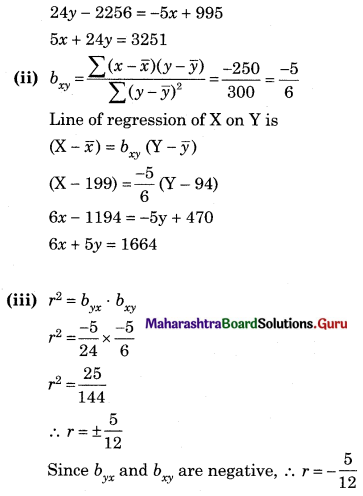
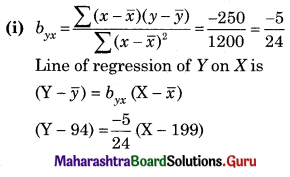
Maharashtra Board 12th Commerce Maths Solutions Chapter 3 Linear Regression Ex 3.2 Q2
Maharashtra Board 12th Commerce Maths Solutions Chapter 3 Linear Regression Ex 3.2 Q2.1

Question 3.
From the data of 7 pairs of observations on X and Y following results are obtained.
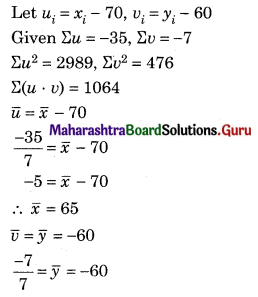
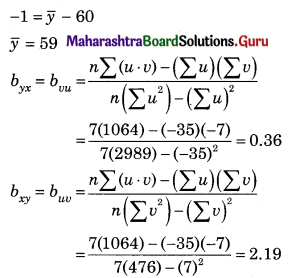
Σ(xi – 70 ) = -35, Σ(yi – 60) = -7, Σ(xi – 70)2 = 2989, Σ(yi – 60)2 = 476, Σ(xi – 70) (yi – 60) = 1064 [Given √0.7884 = 0.8879]
Obtain
(i) The line of regression of Y on X.
(ii) The line of regression of X on Y.
(iii) The correlation coefficient between X and Y.
Solution:
Maharashtra Board 12th Commerce Maths Solutions Chapter 3 Linear Regression Ex 3.2 Q3
Maharashtra Board 12th Commerce Maths Solutions Chapter 3 Linear Regression Ex 3.2 Q3.1
(i) Line of regression Y on X is
(Y – \(\bar{y}\)) = byx (X – \(\bar{x}\))
(Y – 59) = 0.36(x – 65)
(Y – 59) = 0.36x – 23.4
Y = 0.36x + 35.6

(ii) Line of regression X on Y is
(X – \(\bar{x}\)) = bxy (Y – \(\bar{y}\))
(X – 65) = 2.19(y – 59)
(X – 65) = 2.19y – 129.21
X = 2.19y – 64.21

(iii) r2 = byx . bxy
r2 = (0.36) (2.19)
r2 = 0.7884
r = ±√0.7884 = ±0.8879
Since byx and bxy are positive.
∴ r = 0.8879

Maharashtra Board 12th Commerce Maths Solutions Chapter 3 Linear Regression Ex 3.2

Question 4.
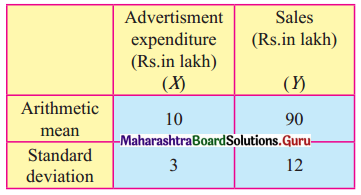
You are given the following information about advertising expenditure and sales.
Maharashtra Board 12th Commerce Maths Solutions Chapter 3 Linear Regression Ex 3.2 Q4
Correlation coefficient between X and Y is 0.8
(i) Obtain two regression equations.
(ii) What is the likely sales when the advertising budget is ₹ 15 lakh?
(iii) What should be the advertising budget if the company wants to attain sales target of ₹ 120 lakh?
Solution:
Given, \(\bar{x}\) = 10, \(\bar{y}\) = 90, σx = 3, σy = 12, r = 0.8
byx = \(\frac{r \sigma_{y}}{\sigma_{x}}=0.8 \times \frac{12}{3}\) = 3.2
bxy = \(\frac{r \sigma_{x}}{\sigma_{y}}=0.8 \times \frac{3}{12}\) = 0.2
(i) Regression equation of Y on X is
(Y – \(\bar{y}\)) = byx (X – \(\bar{x}\))
(Y – 90) = 3.2(x – 10)
Y – 90 = 3.2x – 32
Y = 3.2x + 58
Regression equation of X on Y is
(X – \(\bar{x}\)) = bxy (Y – \(\bar{y}\))
(X – 10) = 0.2(y – 90)
X – 10 = 0.2y + 18
X = 0.2y – 8

(ii) When x = 15,
Y = 3.2(15) + 58
= 48 + 58
= 106 lakh

(iii) When y = 120
X = 0.2(120) – 8
= 24 – 8
= 16 lakh

Question 5.
Bring out inconsistency if any, in the following:
(i) byx + bxy = 1.30 and r = 0.75
(ii) byx = bxy = 1.50 and r = -0.9
(iii) byx = 1.9 and bxy = -0.25
(iv) byx = 2.6 and bxy = \(\frac{1}{2.6}\)
Solution:
(i) Given, byx + bxy = 1.30 and r = 0.75
\(\frac{b_{y x}+b_{x y}}{2}=\frac{1.30}{2}\) = 0.65
But for regression coefficients byx and bxy
\(\left|\frac{b_{y x}+b_{x y}}{2}\right| \geq r\)
Here, 0.65 < r = 0.75
∴ The data is inconsistent
(ii) The signs of byx, bxy and r must be same (all three positive or all three negative)
∴ The data is inconsistent.

(iii) The signs of byx and bxy should be same (either both positive or both negative)
∴ The data is consistent.

(iv) byx . bxy = 2.6 × \(\frac{1}{2.6}\) = 1
∴ 0 ≤ r2 ≤ 1
∴ The data is consistent.

Maharashtra Board 12th Commerce Maths Solutions Chapter 3 Linear Regression Ex 3.2

Question 6.
Two sample from bivariate populations have 15 observation each. The sample means of X and Y are 25 and 18 respectively. The corresponding sum of square of deviations from respective means are 136 and 150. The sum of product of deviations from respective means is 123. Obtain the equation of line of regression of X on Y.
Solution:
Given, n = 15, \(\bar{x}\) = 25, \(\bar{y}\) = 18, Σ(x – \(\bar{x}\)) = 136, Σ(y – \(\bar{y}\)) = 150, Σ(x – \(\bar{x}\)) (y – \(\bar{y}\)) = 123
Regression equation of X on Y is (X – \(\bar{x}\)) = bxy (Y – \(\bar{y}\))
(X – 25) = 0.82(y – 18)
(X – 25) = 082y – 14.76
X = 0.82y + 10.24

Question 7.
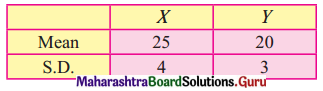
For a certain bivariate data
Maharashtra Board 12th Commerce Maths Solutions Chapter 3 Linear Regression Ex 3.2 Q7
And r = 0.5 estimate y when x = 10 and estimate x when y = 16
Solution:
Given, \(\bar{x}\) = 25, \(\bar{y}\) = 20, σx = 4, σy = 3, r = 0.5
byx = \(\frac{r \sigma_{y}}{\sigma_{y}}=0.5 \times \frac{3}{4}\) = 0.375
Regression equation of Y on X is
(Y – \(\bar{y}\)) = byx (X – \(\bar{x}\))
(Y – 20) = 0.375(x – 25)
Y – 20 = 0.375x – 9.375
Y = 0.375x + 10.625
When, x = 10
Y = 0.375(10) + 10.625
= 3.75 + 10.625
= 14.375
bxy = \(\frac{r \sigma_{x}}{\sigma_{y}}=0.5 \times \frac{4}{3}\) = 0.67
Regression equation of X on Y is
(X – \(\bar{x}\)) = byx (Y – \(\bar{y}\))
(X – 25) = 0.67(y – 20)
(X – 25) = 0.67y – 13.4
X = 0.67y + 11.6
When, Y = 16
x = 0.67(16) + 11.6
= 10.72 + 11.6
= 22.32

Question 8.
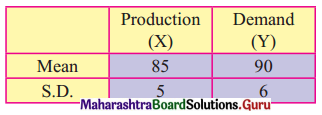
Given the following information about the production and demand of a commodity obtain the two regression lines:
Maharashtra Board 12th Commerce Maths Solutions Chapter 3 Linear Regression Ex 3.2 Q8
Coefficient of correlation between X and Y is 0.6. Also estimate the problem when demand is 100.
Solution:
Given \(\bar{x}\) = 85, \(\bar{y}\) = 90, σx = 5, σy = 6 and r = 0.6
bxy = \(\frac{r \sigma_{x}}{\sigma_{y}}=0.6 \times \frac{5}{6}\) = 0.5
byx = \(\frac{r \sigma_{y}}{\sigma_{x}}=0.6 \times \frac{6}{5}\) = 0.72
Regression equation of X on Y is
(X – \(\bar{x}\)) = bxy (Y – \(\bar{y}\))
(X – 85) = 0.5(y – 90)
(X – 85 ) = 0.5y – 45
X = 0.5y + 40
When y = 100,
x = 0.5 (100) + 40
= 50 + 40
= 90
Regression equation of Y on X is
(Y – \(\bar{y}\)) = byx (X – \(\bar{x}\))
(Y – 90) = 0.72(x – 85)
(Y – 90) = 0.72x – 61.2
Y = 0.72x + 28.8

Maharashtra Board 12th Commerce Maths Solutions Chapter 3 Linear Regression Ex 3.2

Question 9.
Given the following data, obtain linear regression estimate of X for Y = 10
Solution:
\(\bar{x}\) = 7.6, \(\bar{y}\) = 14.8, σx = 3.2, σy = 16 and r = 0.7
bxy = \(\frac{r \sigma_{x}}{\sigma_{y}}=0.7 \times \frac{3.2}{16}\) = 0.14
Regression equation of X on Y is
(X – \(\bar{y}\)) = bxy (Y – \(\bar{y}\))
(X – 7.6) = 0.14(y – 14.8)
X – 7.6 = 0.14y – 2.072
X = 0.14y + 5.528
When y = 10
x = 0.14(10) + 5.528
= 1.4 + 5.528
= 6.928

Question 10.
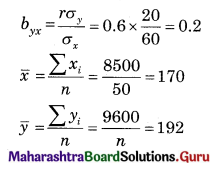
An inquiry of 50 families to study the relationship between expenditure on accommodation (₹ x) and expenditure on food and entertainment (₹ y) gave the following result:
Σx = 8500, Σy = 9600, σx = 60, σy = 20, r = 0.6
Estimate the expenditure on food and entertainment when expenditure on accommodation is ₹ 200
Solution:
n = 50 (given)
Maharashtra Board 12th Commerce Maths Solutions Chapter 3 Linear Regression Ex 3.2 Q10
Regression equation of Y on X is
Y – \(\bar{y}\) = byx (X – \(\bar{x}\))
(Y – 192) = 0.2(200 – 170)
Y – 192 = 0.2(30)
Y = 192 + 6
Y = 198

Question 11.
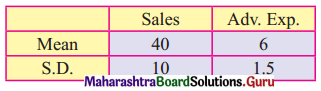
The following data about the sales and advertisement expenditure of a firms is given below (in ₹ crores)
Maharashtra Board 12th Commerce Maths Solutions Chapter 3 Linear Regression Ex 3.2 Q11
Also correlation coefficient between X and Y is 0.9
(i) Estimate the likely sales for a proposed advertisement expenditure of ₹ 10 crores.
(ii) What should be the advertisement expenditure if the firm proposes a sales target ₹ 60 crores
Let the sales be X and advertisement expenditure be Y
Solution:
Given, \(\bar{x}\) = 40, \(\bar{y}\) = 6, σx = 10, σy = 1.5, r = 0.9
byx = \(\frac{r \sigma_{y}}{\sigma_{x}}=0.9 \times \frac{1.5}{10}\) = 0.135
bxy = \(\frac{r \sigma_{x}}{\sigma_{y}}=0.9 \times \frac{10}{1.5}\) = 6
(i) Regression equation of X on Y is
(X – \(\bar{x}\)) = bxy (Y – \(\bar{y}\))
(X – 40) = 6(y – 6)
X – 40 = 6y – 36
X = 6y + 4
When y = 10
x = 6 (10) + 4
= 60 + 4
= 64 crores

(ii) Regression equation Y on X is
(Y – \(\bar{y}\)) = byx (X – \(\bar{x}\))
(Y – 6) = 0.135 (x – 40)
Y – 6 = 0.135x – 5.4
Y = 0.135x + 0.6
When x = 60
Y = 0.135 (60) + 0.6
= 8.1 + 0.6
= 8.7 crores

Maharashtra Board 12th Commerce Maths Solutions Chapter 3 Linear Regression Ex 3.2

Question 12.
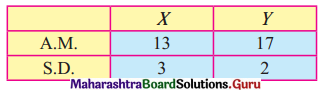
For certain bivariate data the following information are available
Maharashtra Board 12th Commerce Maths Solutions Chapter 3 Linear Regression Ex 3.2 Q12
Correlation coefficient between x and y is 0.6, estimate x when y = 15 and estimate y when x = 10.
Solution:
Given, \(\bar{x}\) = 13, \(\bar{y}\) = 17, σx = 3, σy = 2, r = 0.6
byx = \(\frac{r \sigma_{y}}{\sigma_{x}}=0.6 \times \frac{2}{3}\) = 0.4
bxy = \(\frac{r \sigma_{x}}{\sigma_{y}}=0.6 \times \frac{3}{2}\) = 0.9
Regression equation of Y on X
(Y – \(\bar{y}\)) = byx (X – \(\bar{x}\))
Y – 17 = 0.4(x – 13)
Y = 0.4x + 11.8
When x = 10
Y = 0.4(10) + 11.8
= 4 + 11.8
= 15.8
Regression equation of X on Y
(X – \(\bar{x}\)) = bxy (Y – \(\bar{y}\))
(X – 13) = 0.9(y – 17)
X – 13 = 0.9y – 15.3
X = 0.9y – 2.3
When y = 15
X = 0.9(15) – 2.3
= 13.5 – 2.3
= 11.2

12th Commerce Maths Digest Pdf
12th Commerce Maths 2 Chapter 3 Exercise 3.1 Answers Maharashtra Board

Linear Regression Class 12 Commerce Maths 2 Chapter 3 Exercise 3.1 Answers Maharashtra Board

Balbharati Maharashtra State Board 12th Commerce Maths Digest Pdf Chapter 3 Linear Regression Ex 3.1 Questions and Answers.
Std 12 Maths 2 Exercise 3.1 Solutions Commerce Maths

Question 1.
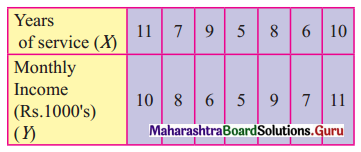
The HRD manager of the company wants to find a measure which he can use to fix the monthly income of persons applying for the job in the production department. As an experimental project. He collected data of 7 persons from that department referring to years of service and their monthly incomes.
Maharashtra Board 12th Commerce Maths Solutions Chapter 3 Linear Regression Ex 3.1 Q1
(i) Find the regression equation of income on years of service.
(ii) What initial start would you recommend for a person applying for the job after having served in a similar capacity in another company for 13 years?
Solution:
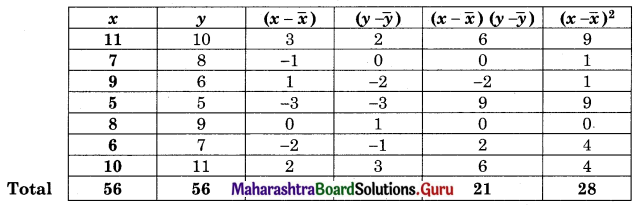
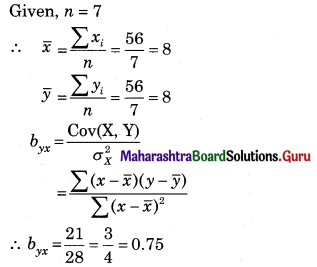
Maharashtra Board 12th Commerce Maths Solutions Chapter 3 Linear Regression Ex 3.1 Q1.1
Maharashtra Board 12th Commerce Maths Solutions Chapter 3 Linear Regression Ex 3.1 Q1.2
(i) Regression equation of Y on X is (Y – \(\bar{y}\)) = byx (x – \(\bar{x}\))
(Y – 8) = 0.75(x – \(\bar{x}\))
Y = 0.75x + 2
(ii) When x = 13
Y = 0.75(13) + 2 = 11.75
Recommended income for the person is ₹ 11750.

Maharashtra Board 12th Commerce Maths Solutions Chapter 3 Linear Regression Ex 3.1

Question 2.
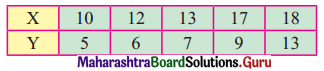
Calculate the regression equations of X on Y and Y on X from the following date:
Maharashtra Board 12th Commerce Maths Solutions Chapter 3 Linear Regression Ex 3.1 Q2
Solution:
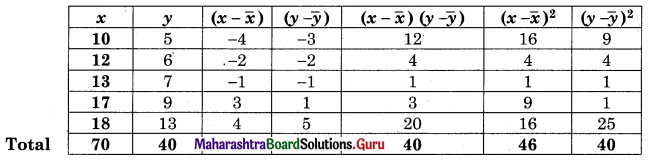
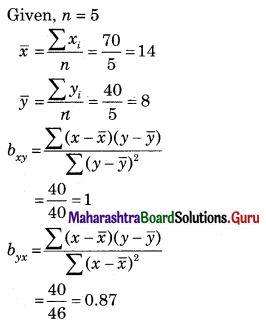
Maharashtra Board 12th Commerce Maths Solutions Chapter 3 Linear Regression Ex 3.1 Q2.1
Maharashtra Board 12th Commerce Maths Solutions Chapter 3 Linear Regression Ex 3.1 Q2.2
Regression equation of X on Y is (X – \(\bar{x}\)) = bxy (Y – \(\bar{y}\))
(X – 14) = 1(Y – 8)
X – 14 = Y – 8
X = Y + 6
Regression equation Y on X is (Y – \(\bar{y}\)) = byx (X – \(\bar{x}\))
(Y – 8) = 0.87(X – 14)
Y – 8 = 0.87X – 12.18
Y = 0.87X – 4.18

Question 3.
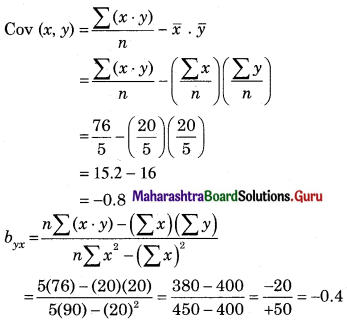
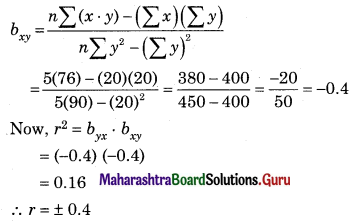
For a certain bivariate data on 5 pairs of observations given
Σx = 20, Σy = 20, Σx2 = 90, Σy2 = 90, Σxy = 76
Calculate (i) cov(x, y), (ii) byx and bxy, (iii) r
Solution:
Maharashtra Board 12th Commerce Maths Solutions Chapter 3 Linear Regression Ex 3.1 Q3
Maharashtra Board 12th Commerce Maths Solutions Chapter 3 Linear Regression Ex 3.1 Q3.1
Sine byx and bxy are negative, r = -0.4

Maharashtra Board 12th Commerce Maths Solutions Chapter 3 Linear Regression Ex 3.1

Question 4.
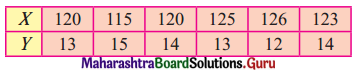
From the following data estimate y when x = 125
Maharashtra Board 12th Commerce Maths Solutions Chapter 3 Linear Regression Ex 3.1 Q4
Solution:
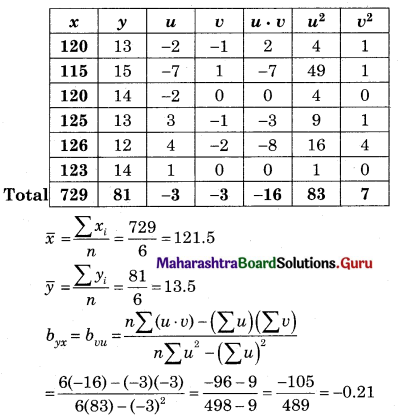
Let u = x – 122, v = y – 14
Maharashtra Board 12th Commerce Maths Solutions Chapter 3 Linear Regression Ex 3.1 Q4.1
Regression equation of Y on X is
(Y – \(\bar{y}\)) = byx (X – \(\bar{x}\))
(Y – 13.5) = -0.21(x – 121.5)
Y – 13.5 = -0.21x + 25.52
Y = -0.21x + 39.02
When x = 125
Y = -0.21(125) + 39.02
= -26.25 + 39.02
= 12.77

Question 5.
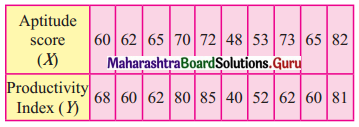
The following table gives the aptitude test scores and productivity indices of 10 works selected at workers selected randomly.
Maharashtra Board 12th Commerce Maths Solutions Chapter 3 Linear Regression Ex 3.1 Q5
Obtain the two regression equation and estimate
(i) The productivity index of a worker whose test score is 95.
(ii) The test score when productivity index is 75.
Solution:
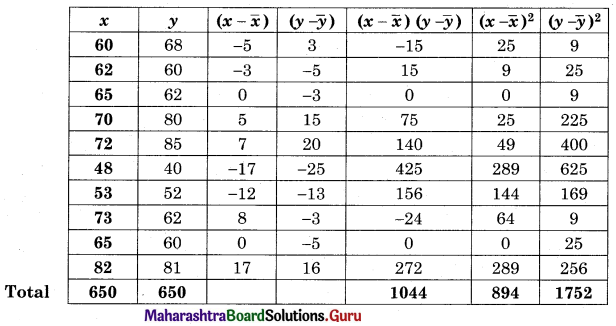
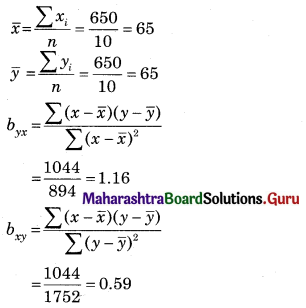
Maharashtra Board 12th Commerce Maths Solutions Chapter 3 Linear Regression Ex 3.1 Q5.1
Maharashtra Board 12th Commerce Maths Solutions Chapter 3 Linear Regression Ex 3.1 Q5.2
Regression equation of Y on X,
(Y – \(\bar{y}\)) = byx (X – \(\bar{y}\))
(Y – 65) = 1.16 (x – 65)
Y – 65 = 1.16x – 75.4
Y = 1.16x – 10.4
(i) When x = 95
Y = 1.16(95) – 10.4
= 110.2 – 10.4
= 99.8
Regression equation of X on Y,
(X – \(\bar{x}\)) = bxy (Y – \(\bar{y}\))
(X – 65) = 0.59(y – 65)
(X – 65) = 0.59y – 38.35
X = 0.59y + 26.65
(ii) When y = 75
x = 0.59(75) + 26.65
= 44.25 + 26.65
= 70.9

Maharashtra Board 12th Commerce Maths Solutions Chapter 3 Linear Regression Ex 3.1

Question 6.
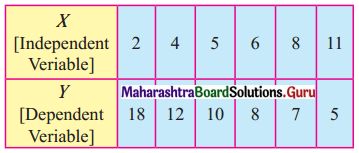
Compute the appropriate regression equation for the following data.
Maharashtra Board 12th Commerce Maths Solutions Chapter 3 Linear Regression Ex 3.1 Q6
Solution:
Since x is the independent variable, and y is the dependent variable,
we need to find regression equation of y on x
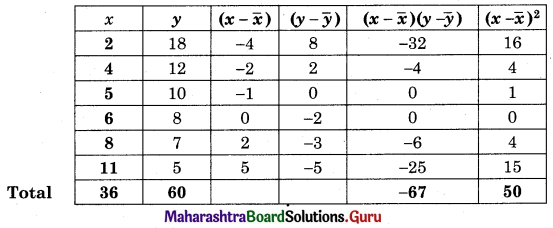
Maharashtra Board 12th Commerce Maths Solutions Chapter 3 Linear Regression Ex 3.1 Q6.1
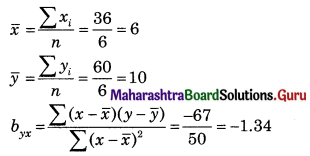
Maharashtra Board 12th Commerce Maths Solutions Chapter 3 Linear Regression Ex 3.1 Q6.2
Regression equation of y on x is (y – \(\bar{y}\)) = byx (x – \(\bar{x}\))
(y – 10) = -13.4(x – 6)
y – 10 = -1.34x + 8.04
y = -1.34x + 18.04

Question 7.
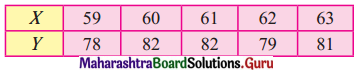
The following are the marks obtained by the students in Economic (X) and Mathematics (Y)
Maharashtra Board 12th Commerce Maths Solutions Chapter 3 Linear Regression Ex 3.1 Q7
Find the regression equation of Y and X.
Solution:
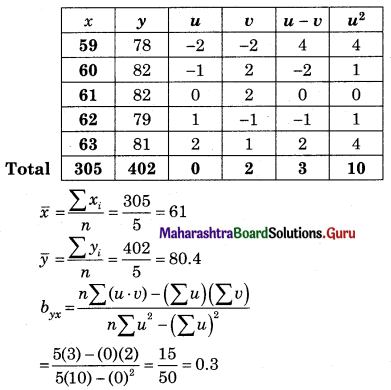
Let u = x – 61, v = y – 80
Maharashtra Board 12th Commerce Maths Solutions Chapter 3 Linear Regression Ex 3.1 Q7.1
Regression equation of Y on X is
(Y – \(\bar{y}\)) = byx (X – \(\bar{x}\))
(Y – 80.4) = 0.3(x – 61)
Y – 80.4 = 0.3x – 18.3
Y = 0.3x + 62.1

Maharashtra Board 12th Commerce Maths Solutions Chapter 3 Linear Regression Ex 3.1

Question 8.
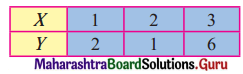
For the following bivariate data obtain the equation of two regressions lines:
Maharashtra Board 12th Commerce Maths Solutions Chapter 3 Linear Regression Ex 3.1 Q8
Solution:
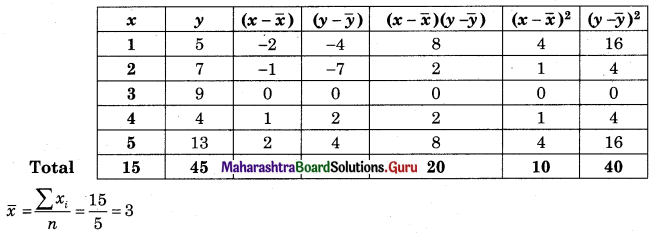
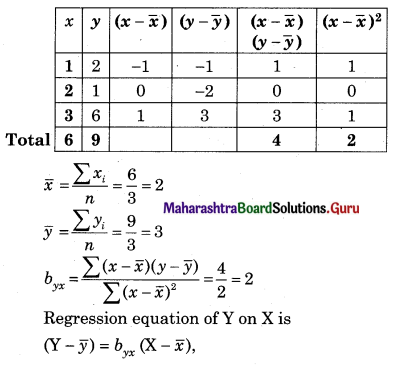
Maharashtra Board 12th Commerce Maths Solutions Chapter 3 Linear Regression Ex 3.1 Q8.1
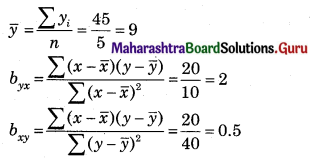
Maharashtra Board 12th Commerce Maths Solutions Chapter 3 Linear Regression Ex 3.1 Q8.2
Regression equation of Y on X
(Y – \(\bar{y}\)) = byx (X – \(\bar{x}\))
(Y – 9) = 2(x – 3)
Y – 9 = 2x – 6
Y = 2x + 3
Regression equation of X on Y
(X – \(\bar{x}\)) = bxy (Y – \(\bar{y}\))
(X – 3) = 0.5(y – 9)
(X – 3) = 0.5y – 4.5
X = 0.5y – 1.5

Question 9.
Find the following data obtain the equation of two regression lines:
Maharashtra Board 12th Commerce Maths Solutions Chapter 3 Linear Regression Ex 3.1 Q9
Solution:
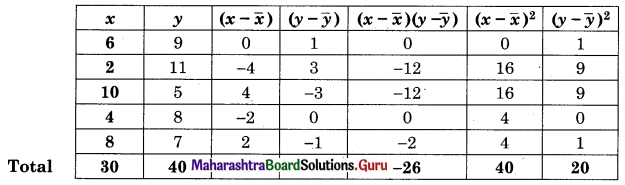
Maharashtra Board 12th Commerce Maths Solutions Chapter 3 Linear Regression Ex 3.1 Q9.1
Maharashtra Board 12th Commerce Maths Solutions Chapter 3 Linear Regression Ex 3.1 Q9.2
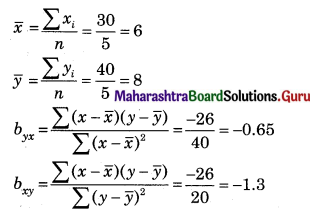
Regression of Y on X,
(Y – \(\bar{y}\)) = byx (X – \(\bar{x}\))
(Y – 8) = 0.65(x – 6)
Y – 8 = -0.65x + 3.9
Y = -0.65x + 11.9
Regression of X on Y
(X – \(\bar{x}\)) = bxy (Y – \(\bar{y}\))
(X – 6) = -1.3(y – 8)
(X – 6) = -1.3y + 10.4
X = -1.3y + 16.4

Maharashtra Board 12th Commerce Maths Solutions Chapter 3 Linear Regression Ex 3.1

Question 10.
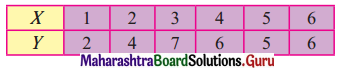
For the following data, find the regression line of Y on X
Maharashtra Board 12th Commerce Maths Solutions Chapter 3 Linear Regression Ex 3.1 Q10
Hence find the most likely value of y when x = 4
Solution:
Maharashtra Board 12th Commerce Maths Solutions Chapter 3 Linear Regression Ex 3.1 Q10.1
(Y – 3) = 2(x – 2)
Y – 3 = 2x – 4
Y = 2x – 1
When x = 4
Y = 2(4) – 1
= 8 – 1
= 7

Question 11.
Find the following data, find the regression equation of Y on X, and estimate Y when X = 10.
Maharashtra Board 12th Commerce Maths Solutions Chapter 3 Linear Regression Ex 3.1 Q11
Solution:
Maharashtra Board 12th Commerce Maths Solutions Chapter 3 Linear Regression Ex 3.1 Q11.1
Regression equation of Y on X is
(Y – \(\bar{y}\)) = byx (X – \(\bar{x}\))
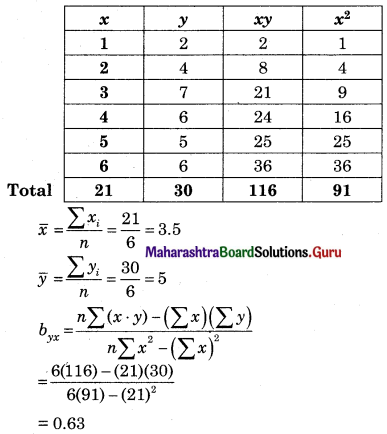
(Y – 5) = (0.63)(x – 3.5)
Y – 5 = 0.63x – 2.2
Y = 0.63x + 2.8
When x = 10
Y = 0.63(10) + 2.8
= 6.3 + 2.8
= 9.1

Maharashtra Board 12th Commerce Maths Solutions Chapter 3 Linear Regression Ex 3.1

Question 12.
The following sample gave the number of hours of study (X) per day for an examination and marks (Y) obtained by 12 students.
Maharashtra Board 12th Commerce Maths Solutions Chapter 3 Linear Regression Ex 3.1 Q12
Obtain the line of regression of marks on hours of study.
Solution:
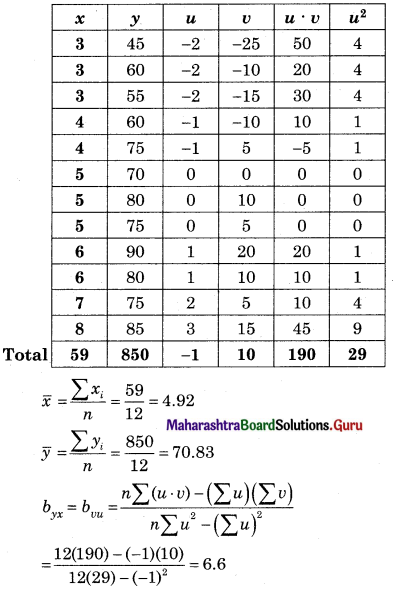
Let u = x – 5, v = y – 70
Maharashtra Board 12th Commerce Maths Solutions Chapter 3 Linear Regression Ex 3.1 Q12.1
∴ Equation of marks on hours of study is
(Y – \(\bar{y}\)) = byx (X – \(\bar{x}\))
(Y – 70.83) = 6.6(x – 4.92)
Y – 70.83 = 6.6x – 32.47
∴ Y = 6.6x + 38.36

12th Commerce Maths Digest Pdf
12th Commerce Maths 1 Chapter 8 Miscellaneous Exercise 8 Answers Maharashtra Board

Differential Equation and Applications Class 12 Commerce Maths 1 Chapter 8 Miscellaneous Exercise 8 Answers Maharashtra Board

Balbharati Maharashtra State Board Std 12 Commerce Statistics Part 1 Digest Pdf Chapter 8 Differential Equation and Applications Miscellaneous Exercise 8 Questions and Answers.

Std 12 Maths 1 Miscellaneous Exercise 8 Solutions Commerce Maths

(I) Choose the correct option from the given alternatives:

Question 1.
The order and degree of \(\left(\frac{d y}{d x}\right)^{3}-\frac{d^{3} y}{d x^{3}}+y e^{x}=0\) are respectively.
(a) 3, 1
(b) 1, 3
(c) 3, 3
(d) 1, 1
Answer:
(a) 3, 1

Question 2.
The order and degree of \(\left[1+\left(\frac{d y}{d x}\right)^{3}\right]^{\frac{2}{3}}=8 \frac{d^{3} y}{d x^{3}}\) are respectively
(a) 3, 1
(c) 3, 3
(b) 1, 3
(d) 1, 1
Answer:
(c) 3, 3

Maharashtra Board 12th Commerce Maths Solutions Chapter 8 Differential Equation and Applications Miscellaneous Exercise 8

Question 3.
The differential equation of y = k1 + \(\frac{k_{2}}{x}\) is
(a) \(\frac{d^{2} y}{d x^{2}}+2 \frac{d y}{d x}=0\)
(b) \(x \frac{d^{2} y}{d x^{2}}+2 \frac{d y}{d x}=0\)
(c) \(\frac{d^{2} y}{d x^{2}}-2 \frac{d y}{d x}=0\)
(d) \(x \frac{d^{2} y}{d x^{2}}-2 \frac{d y}{d x}=0\)
Answer:
(b) \(x \frac{d^{2} y}{d x^{2}}+2 \frac{d y}{d x}=0\)

Question 4.
The differential equation of y = k1 ex + k2 e-x is
(a) \(\frac{d^{2} y}{d x^{2}}-y=0\)
(b) \(\frac{d^{2} y}{d x^{2}}+\frac{d y}{d x}=0\)
(c) \(\frac{d^{2} y}{d x^{2}}+y \frac{d y}{d x}=0\)
(d) \(\frac{d^{2} y}{d x^{2}}+y=0\)
Answer:
(a) \(\frac{d^{2} y}{d x^{2}}-y=0\)

Question 5.
The solution of \(\frac{d y}{d x}\) = 1 is
(a) x + y = c
(b) xy = c
(c) x2 + y2 = c
(d) y – x = c
Answer:
(d) y – x = c

Question 6.
The solution of \(\frac{d y}{d x}+\frac{x^{2}}{y^{2}}=0\) is
(a) x3 + y3 = 7
(b) x2 + y2 = c
(c) x3 + y3 = c
(d) x + y = c
Answer:
(c) x3 + y3 = c

Maharashtra Board 12th Commerce Maths Solutions Chapter 8 Differential Equation and Applications Miscellaneous Exercise 8

Question 7.
The solution of x \(\frac{d y}{d x}\) = y log y is
(a) y = aex
(b) y = be2x
(c) y = be-2x
(d) y = eax
Answer:
(d) y = eax

Question 8.
Bacterial increases at a rate proportional to the number present. If the original number M doubles in 3 hours, then the number of bacteria will be 4M in
(a) 4 hours
(b) 6 hours
(c) 8 hours
(d) 10 hours
Answer:
(b) 6 hours

Question 9.
The integrating factor of \(\frac{d y}{d x}\) – y = ex is
(a) x
(b) -x
(c) ex
(d) e-x
Answer:
(c) ex

Maharashtra Board 12th Commerce Maths Solutions Chapter 8 Differential Equation and Applications Miscellaneous Exercise 8

Question 10.
The integrating factor of \(\frac{d y}{d x}\) – y = ex is e-x, then its solution is
(a) ye-x = x + c
(b) yex = x + c
(c) yex = 2x + c
(d) ye-x = 2x + c
Answer:
(a) ye-x = x + c

(II) Fill in the blanks:

Question 1.
The order of highest derivative occurring in the differential equation is called ________ of the differential equation.
Answer:
order

Question 2.
The power of the highest ordered derivative when all the derivatives are made free from negative and/or fractional indices if any is called ________ of the differential equation.
Answer:
degree

Question 3.
A solution of differential equation that can be obtained from the general solution by giving particular values to the arbitrary constants is called _________ solution.
Answer:
particular

Question 4.
Order and degree of a differential equation are always _________ integers.
Answer:
positive

Maharashtra Board 12th Commerce Maths Solutions Chapter 8 Differential Equation and Applications Miscellaneous Exercise 8

Question 5.
The integrating factor of the differential equation \(\frac{d y}{d x}\) – y = x is _________
Answer:
e-x

Question 6.
The differential equation by eliminating arbitrary constants from bx + ay = ab is _________
Answer:
\(\frac{d^{2} y}{d x^{2}}=0\)

(III) State whether each of the following is True or False:

Question 1.
The integrating factor of the differential equation \(\frac{d y}{d x}\) – y = x is e-x.
Answer:
True

Question 2.
The order and degree of a differential equation are always positive integers.
Answer:
True

Question 3.
The degree of a differential equation is the power of the highest ordered derivative when all the derivatives are made free from negative and/or fractional indices if any.
Answer:
True

Question 4.
The order of highest derivative occurring in the differential equation is called the degree of the differential equation.
Answer:
False

Maharashtra Board 12th Commerce Maths Solutions Chapter 8 Differential Equation and Applications Miscellaneous Exercise 8

Question 5.
The power of the highest ordered derivative when all the derivatives are made free from negative and/or fractional indices if any is called the order of the differential equation.
Answer:
False

Question 6.
The degree of the differential equation \(e^{\frac{d y}{d x}}=\frac{d y}{d x}+c\) is not defined.
Answer:
True

(IV) Solve the following:

Question 1.
Find the order and degree of the following differential equations:
(i) \(\left[\frac{d^{3} y}{d x^{3}}+x\right]^{3 / 2}=\frac{d^{2} y}{d x^{2}}\)
Solution:
The given differential equation is \(\left[\frac{d^{3} y}{d x^{3}}+x\right]^{3 / 2}=\frac{d^{2} y}{d x^{2}}\)
∴ \(\left[\frac{d^{3} y}{d x^{3}}+x\right]^{3}=\left(\frac{d^{2} y}{d x^{2}}\right)^{2}\)
This D.E. has highest order derivative \(\frac{d^{3} y}{d x^{3}}\) with power 3
∴ order = 3 and degree = 3

(ii) \(x+\frac{d y}{d x}=1+\left(\frac{d y}{d x}\right)^{2}\)
Solution:
The given differential equation is \(x+\frac{d y}{d x}=1+\left(\frac{d y}{d x}\right)^{2}\)
This D.E. has highest order derivative \(\frac{d y}{d x}\) with power 2.
∴ order = 1, degree = 2.

Question 2.
Verify that y = log x + c is a solution of the differential equation \(x \frac{d^{2} y}{d x^{2}}+\frac{d y}{d x}=0\).
Solution:
y = log x + c
Differentiating both sides w.r.t. x, we get
\(\frac{d y}{d x}=\frac{1}{x}+0=\frac{1}{x}\)
∴ x\(\frac{d y}{d x}\) = 1
Differentiating again w.r.t. x, we get
\(x \frac{d^{2} y}{d x^{2}}+\frac{d y}{d x} \times 1=0\)
∴ \(x \frac{d^{2} y}{d x^{2}}+\frac{d y}{d x}=0\)
This shows that y = log x + c is a solution of the D.E.
\(x \frac{d^{2} y}{d x^{2}}+\frac{d y}{d x}=0\)

Maharashtra Board 12th Commerce Maths Solutions Chapter 8 Differential Equation and Applications Miscellaneous Exercise 8

Question 3.
Solve the following differential equations:
(i) \(\frac{d y}{d x}\) = 1 + x + y + xy
Solution:
\(\frac{d y}{d x}\) = 1 + x + y + xy
∴ \(\frac{d y}{d x}\) = (1 + x) + y(1 + x) = (1 + x)(1 + y)
∴ \(\frac{1}{1+y}\) dy = (1 + x) dx
Integrating, we get
∫\(\frac{1}{1+y}\) dy = ∫(1 + x) dx
∴ log|1 + y| = x + \(\frac{x^{2}}{2}\) + c
This is the general solution.

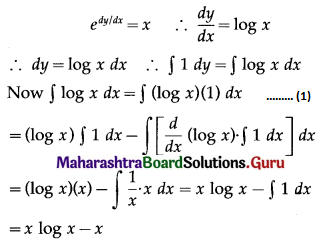
(ii) \(e^{d y / d x}=x\)
Solution:
Maharashtra Board 12th Commerce Maths Solutions Chapter 8 Differential Equation and Applications Miscellaneous Exercise 8 IV Q3(ii)
∴ from (1), the general solution is
y = x log x – x + c, i.e. y = x(log x – 1) + c.

(iii) dr = ar dθ – θ dr
Solution:
dr = ar dθ – θ dr
∴ dr + θ dr = ar dθ
∴ (1 + θ) dr = ar dθ
∴ \(\frac{d r}{r}=\frac{a d \theta}{1+\theta}\)
On integrating, we get
\(\int \frac{d r}{r}=a \int \frac{d \theta}{1+\theta}\)
∴ log |r| = a log |1 + θ| + c
This is the general solution.

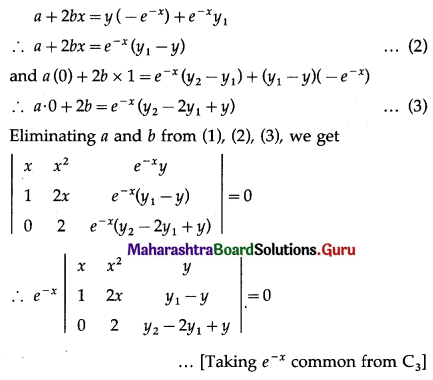
(iv) Find the differential equation of the family of curves y = ex (ax + bx2), where a and b are arbitrary constants.
Solution:
y = ex (ax + bx2)
ax + bx2 = ye-x …….(1)
Differentiating (1) w.r.t. x twice and writing \(\frac{d y}{d x}\) as y1 and \(\frac{d^{2} y}{d x^{2}}\) as y2, we get
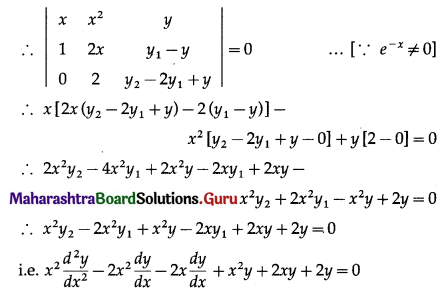
Maharashtra Board 12th Commerce Maths Solutions Chapter 8 Differential Equation and Applications Miscellaneous Exercise 8 IV Q3(iv)
Maharashtra Board 12th Commerce Maths Solutions Chapter 8 Differential Equation and Applications Miscellaneous Exercise 8 IV Q3(iv).1
This is the required differential equation.

Question 4.
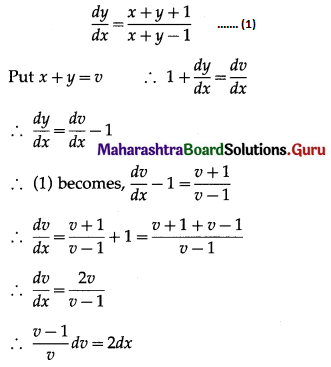
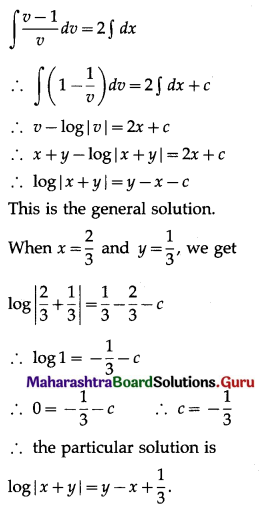
Solve \(\frac{d y}{d x}=\frac{x+y+1}{x+y-1}\) when x = \(\frac{2}{3}\) and y = \(\frac{1}{3}\).
Solution:
Maharashtra Board 12th Commerce Maths Solutions Chapter 8 Differential Equation and Applications Miscellaneous Exercise 8 IV Q4
Maharashtra Board 12th Commerce Maths Solutions Chapter 8 Differential Equation and Applications Miscellaneous Exercise 8 IV Q4.1

Maharashtra Board 12th Commerce Maths Solutions Chapter 8 Differential Equation and Applications Miscellaneous Exercise 8

Question 5.
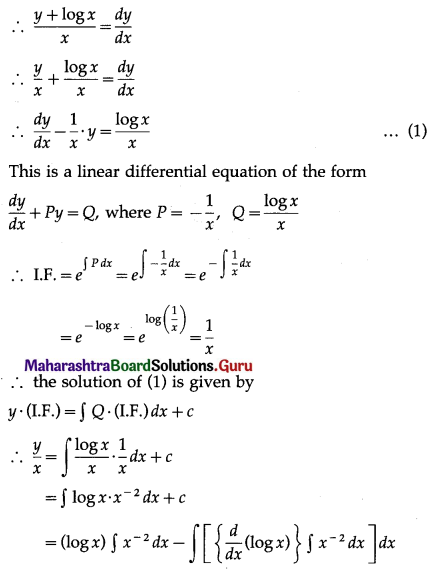
Solve y dx – x dy = -log x dx.
Solution:
y dx – x dy = -log x dx
∴ y dx – x dy + log x dx = 0
∴ x dy = (y + log x) dx
∴ \(\frac{d y}{d x}=\frac{y+\log x}{x}=\frac{y}{x}+\frac{\log x}{x}\)
∴ \(\frac{d y}{d x}-\frac{1}{x} \cdot y=\frac{\log x}{x}\) …….(1)
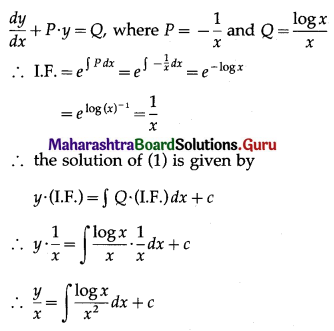
This is the linear differential equation of the form
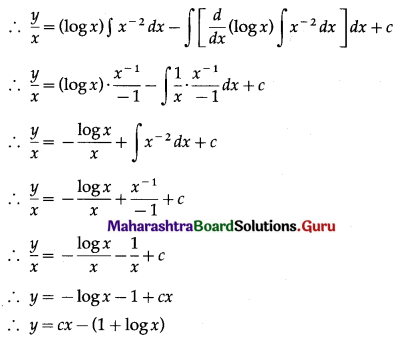
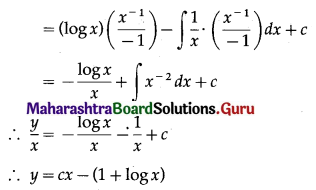
Maharashtra Board 12th Commerce Maths Solutions Chapter 8 Differential Equation and Applications Miscellaneous Exercise 8 IV Q5
Maharashtra Board 12th Commerce Maths Solutions Chapter 8 Differential Equation and Applications Miscellaneous Exercise 8 IV Q5.1
This is the general solution.

Question 6.
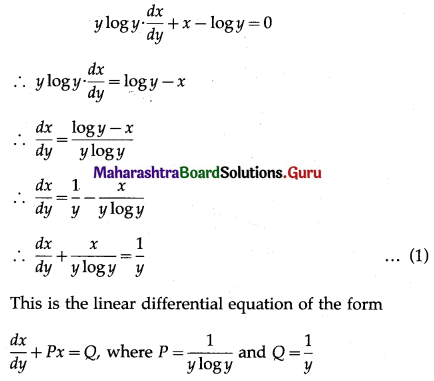
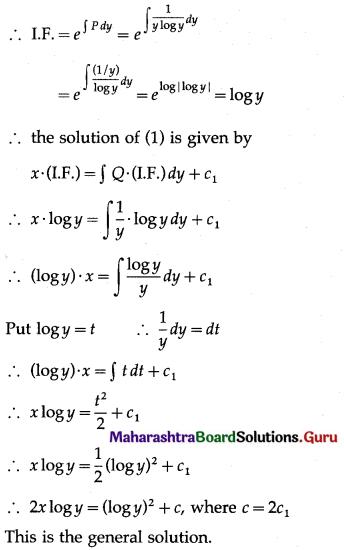
Solve y log y \(\frac{d x}{d y}\) + x – log y = 0.
Solution:
Maharashtra Board 12th Commerce Maths Solutions Chapter 8 Differential Equation and Applications Miscellaneous Exercise 8 IV Q6
Maharashtra Board 12th Commerce Maths Solutions Chapter 8 Differential Equation and Applications Miscellaneous Exercise 8 IV Q6.1

Question 7.
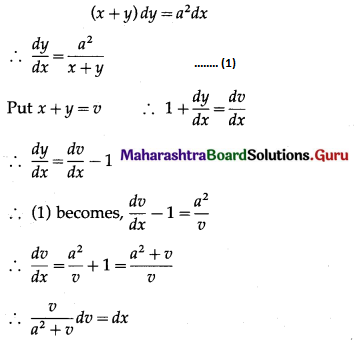
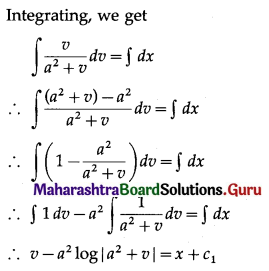
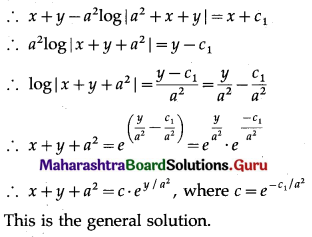
Solve (x + y) dy = a2 dx
Solution:
Maharashtra Board 12th Commerce Maths Solutions Chapter 8 Differential Equation and Applications Miscellaneous Exercise 8 IV Q7
Maharashtra Board 12th Commerce Maths Solutions Chapter 8 Differential Equation and Applications Miscellaneous Exercise 8 IV Q7.1
Maharashtra Board 12th Commerce Maths Solutions Chapter 8 Differential Equation and Applications Miscellaneous Exercise 8 IV Q7.2

Question 8.
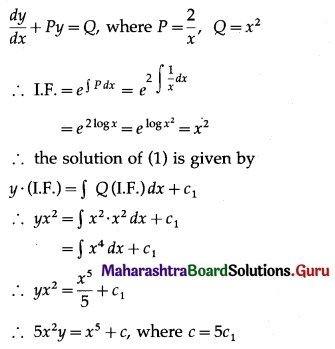
Solve \(\frac{d y}{d x}+\frac{2}{x} y=x^{2}\)
Solution:
\(\frac{d y}{d x}+\frac{2}{x} y=x^{2}\) ……..(1)
This is a linear differential equation of the form
Maharashtra Board 12th Commerce Maths Solutions Chapter 8 Differential Equation and Applications Miscellaneous Exercise 8 IV Q8
This is the general solution.

Maharashtra Board 12th Commerce Maths Solutions Chapter 8 Differential Equation and Applications Miscellaneous Exercise 8

Question 9.
The rate of growth of the population is proportional to the number present. If the population doubled in the last 25 years and the present population is 1 lakh, when will the city have a population of 400000?
Solution:
Let P be the population at time t years.
Then the rate of growth of the population is \(\frac{d P}{d t}\) which is proportional to P.
∴ \(\frac{d P}{d t}\) ∝ P
∴ \(\frac{d P}{d t}\) = kP, where k is a constant
∴ \(\frac{d P}{P}\)= k dt
On integrating, we get
\(\int \frac{d P}{P}=k \int d t\)
∴ log P = kt + c
The population doubled in 25 years and present population is 1,00,000.
∴ initial population was 50,000
i.e. when t = 0, P = 50000
∴ log 50000 = k × 0 + c
∴ c = log 50000
∴ log P = kt + log 50000
When t = 25, P = 100000
∴ log 100000 = k × 25 + log 50000
∴ 25k = log 100000 – log 50000 = log(\(\frac{100000}{50000}\))
∴ k = \(\frac{1}{25}\) log 2
∴ log P = \(\frac{t}{25}\) log 2 + log 50000
If P = 400000, then
log 400000 = \(\frac{t}{25}\) log 2 + log 50000
∴ log 400000 – log 50000 = \(\frac{t}{25}\) log 2
∴ log(\(\frac{400000}{50000}\)) = \(\log (2)^{t / 25}\)
∴ log 8 = \(\log (2)^{t / 25}\)
∴ 8 = \((2)^{t / 25}\)
∴ \((2)^{t / 25}\) = (2)3
∴ \(\frac{t}{25}\) = 3
∴ t = 75
∴ the population will be 400000 in (75 – 25) = 50 years.

Question 10.
The resale value of a machine decreases over a 10 years period at a rate that depends on the age of the machine. When the machine is x years old, the rate at which its value is changing is ₹ 2200(x – 10) per year. Express the value of the machine as a function of its age and initial value. If the machine was originally worth ₹ 1,20,000 how much will it be worth when it is 10 years old?
Solution:
Let V be the value of the machine after x years.
Then rate of change of the value is \(\frac{d V}{d x}\) which is 2200(x – 10)
∴ \(\frac{d V}{d x}\) = 2200(x – 10)
∴ dV = 2200(x – 10) dx
On integrating, we get
∫dV = 2200∫(x – 10) dx
∴ V = 2200[\(\frac{x^{2}}{2}\) – 10x] + c
Initially, i.e. at x = 0, V = 120000
∴ 120000 = 2200 × 0 + c = c
∴ c = 120000
∴ V = 2200[\(\frac{x^{2}}{2}\) – 10x] + 120000 …….(1)
This gives value of the machine in terms of initial value and age x.
We have to find V when x = 10.
When x = 10, from (1)
V = 2200[\(\frac{100}{2}\) – 100] + 120000
= 2200 [-50] + 120000
= -110000 + 120000
= 10000
Hence, the value of the machine after 10 years will be ₹ 10000.

Maharashtra Board 12th Commerce Maths Solutions Chapter 8 Differential Equation and Applications Miscellaneous Exercise 8

Question 11.
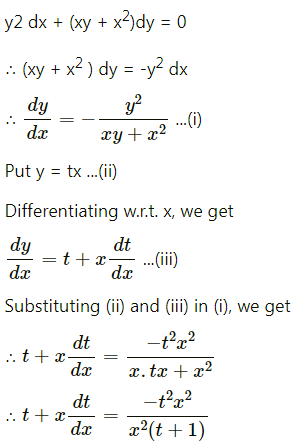
Solve y2 dx + (xy + x2) dy = 0
Solution:
Maharashtra Board 12th Commerce Maths Solutions Chapter 8 Differential Equation and Applications Miscellaneous Exercise 8 IV Q11
Maharashtra Board 12th Commerce Maths Solutions Chapter 8 Differential Equation and Applications Miscellaneous Exercise 8 IV Q11.1
Maharashtra Board 12th Commerce Maths Solutions Chapter 8 Differential Equation and Applications Miscellaneous Exercise 8 IV Q11.2

Question 12.
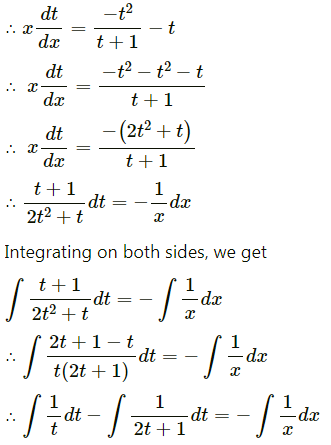
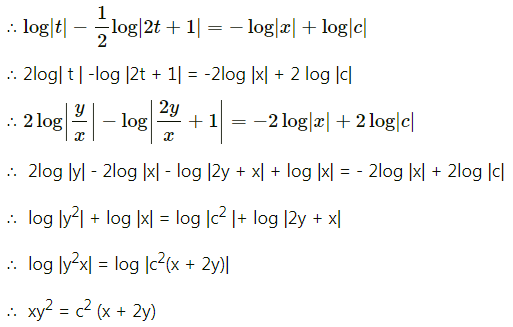
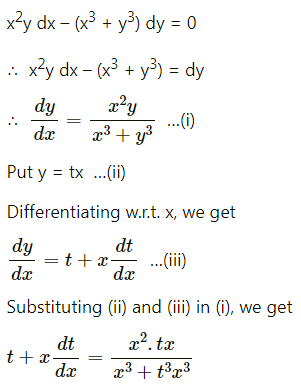
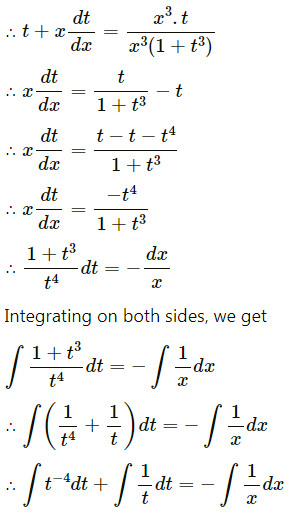
Solve x2y dx – (x3 + y3) dy = 0
Solution:
Maharashtra Board 12th Commerce Maths Solutions Chapter 8 Differential Equation and Applications Miscellaneous Exercise 8 IV Q12
Maharashtra Board 12th Commerce Maths Solutions Chapter 8 Differential Equation and Applications Miscellaneous Exercise 8 IV Q12.1
Maharashtra Board 12th Commerce Maths Solutions Chapter 8 Differential Equation and Applications Miscellaneous Exercise 8 IV Q12.2

Question 13.
Solve yx \(\frac{d y}{d x}\) = x2 + 2y2
Solution:
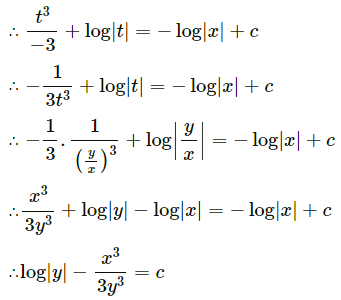
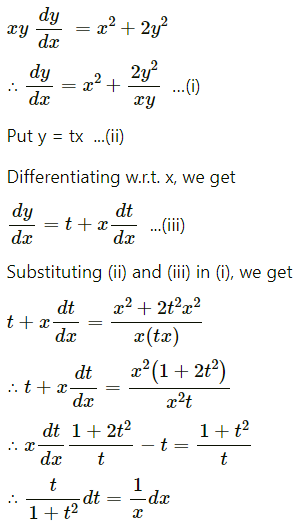
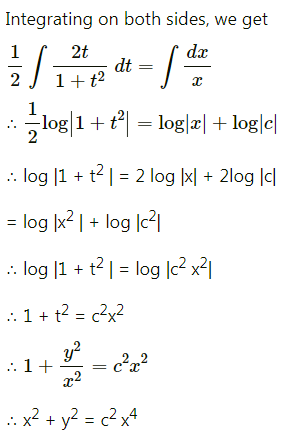
Maharashtra Board 12th Commerce Maths Solutions Chapter 8 Differential Equation and Applications Miscellaneous Exercise 8 IV Q13
Maharashtra Board 12th Commerce Maths Solutions Chapter 8 Differential Equation and Applications Miscellaneous Exercise 8 IV Q13.1

Question 14.
Solve (x + 2y3) \(\frac{d y}{d x}\) = y
Solution:
(x + 2y3) \(\frac{d y}{d x}\) = y
∴ x + 2y3 = y \(\frac{d x}{d y}\)
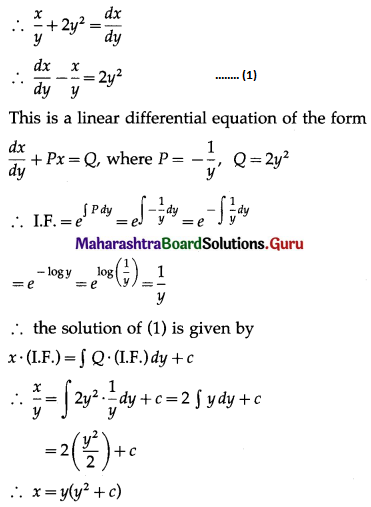
Maharashtra Board 12th Commerce Maths Solutions Chapter 8 Differential Equation and Applications Miscellaneous Exercise 8 IV Q14
This is the general solution.

Maharashtra Board 12th Commerce Maths Solutions Chapter 8 Differential Equation and Applications Miscellaneous Exercise 8

Question 15.
Solve y dx – x dy + log x dx = 0
Solution:
y dx – x dy + log x dx = 0
∴ (y + log x) dx = x dy
Maharashtra Board 12th Commerce Maths Solutions Chapter 8 Differential Equation and Applications Miscellaneous Exercise 8 IV Q15
Maharashtra Board 12th Commerce Maths Solutions Chapter 8 Differential Equation and Applications Miscellaneous Exercise 8 IV Q15.1
This is the general solution.

Question 16.
Solve \(\frac{d y}{d x}\) = log x dx
Solution:
\(\frac{d y}{d x}\) = log x dx
∴ dy = log x dx
On integrating, we get
∫dy = ∫log x . 1 dx
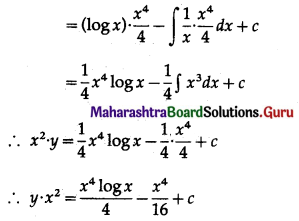
∴ y = (log x) ∫1 dx – \(\int\left[\left\{\frac{d}{d x}(\log x)\right\} \cdot \int 1 d x\right] d x\)
∴ y = (log x) . x – \(\int \frac{1}{x} \cdot x d x\)
∴ y = x log x – ∫1 dx
∴ y = x log x – x + c
This is the general solution.

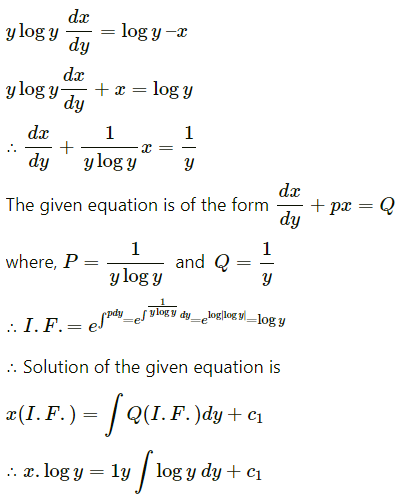
Question 17.
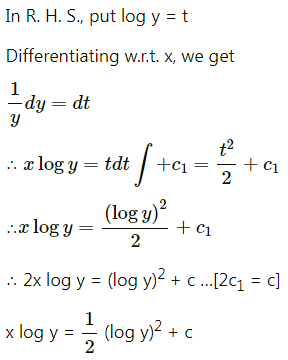
y log y \(\frac{d x}{d y}\) = log y – x
Solution:
Maharashtra Board 12th Commerce Maths Solutions Chapter 8 Differential Equation and Applications Miscellaneous Exercise 8 IV Q17
Maharashtra Board 12th Commerce Maths Solutions Chapter 8 Differential Equation and Applications Miscellaneous Exercise 8 IV Q17.1

12th Commerce Maths Digest Pdf
12th Commerce Maths 1 Chapter 8 Exercise 8.6 Answers Maharashtra Board

Differential Equation and Applications Class 12 Commerce Maths 1 Chapter 8 Exercise 8.6 Answers Maharashtra Board

Balbharati Maharashtra State Board Std 12 Commerce Statistics Part 1 Digest Pdf Chapter 8 Differential Equation and Applications Ex 8.6 Questions and Answers.

Std 12 Maths 1 Exercise 8.6 Solutions Commerce Maths

Question 1.
In a certain culture of bacteria, the rate of increase is proportional to the number present. If it is found that the number doubles in 4 hours, find the number of times the bacteria are increased in 12 hours.
Solution:
Let x be the number of bacteria in the culture at time t.
Then the rate of increase is \(\frac{d x}{d t}\) which is proportional to x.
∴ \(\frac{d x}{d t}\) ∝ x
∴ \(\frac{d x}{d t}\) = kx, where k is a constant
∴ \(\frac{d x}{x}\) = k dt
On integrating, we get
∫\(\frac{d x}{x}\) = k∫dt
∴ log x = kt + c
Initially, i.e. when t = 0, let x = x0
∴ log x0 = k × 0 + c
∴ c = log x0
∴ log x = kt + log x0
∴ log x – log x0 = kt
∴ log(\(\frac{x}{x_{0}}\)) = kt ……(1)
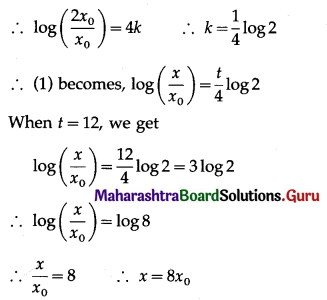
Since the number doubles in 4 hours, i.e. when t = 4, x = 2x0
Maharashtra Board 12th Commerce Maths Solutions Chapter 8 Differential Equation and Applications Ex 8.6 Q1
∴ the number of bacteria will be 8 times the original number in 12 hours.

Maharashtra Board 12th Commerce Maths Solutions Chapter 8 Differential Equation and Applications Ex 8.6

Question 2.
If the population of a town increases at a rate proportional to the population at that time. If the population increases from 40 thousand to 60 thousand in 40 years, what will be the population in another 20 years? (Given: \(\sqrt{\frac{3}{2}}\) = 1.2247)
Solution:
Let P be the population of the city at time t.
Then \(\frac{d P}{d t}\), the rate of increase of population, is proportional to P.
∴ \(\frac{d P}{d t}\) ∝ P
∴ \(\frac{d P}{d t}\) = kP, k is a constant
∴ \(\frac{d P}{P}\) = k dt
Integrating, we get
∫\(\frac{d P}{P}\) = k∫dt
∴ log P = kt + c
Initially, i.e. when t = 0, P = 40000
∴ log 40000 = 0 + c
∴ c = log 40000
∴ log P = kt + log 40000
∴ log P – log 40000 = kt
∴ log(\(\frac{P}{40000}\)) = kt ………(1)
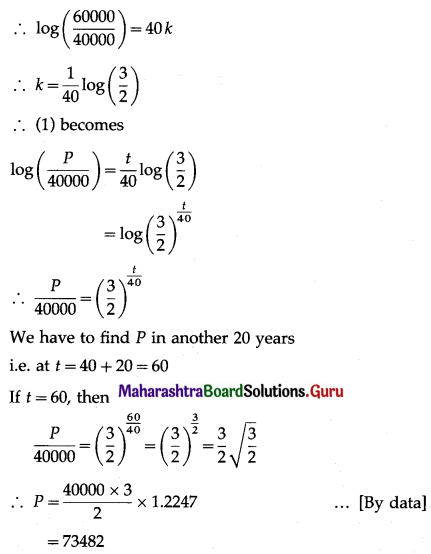
When t = 40, P = 60000
Maharashtra Board 12th Commerce Maths Solutions Chapter 8 Differential Equation and Applications Ex 8.6 Q2
∴ population after 60 years will be 73482.

Question 3.
The rate of growth of bacteria is proportional to the number present. If initially, there were 1000 bacteria and the number doubles in 1 hour, find the number of bacteria after \(\frac{5}{2}\) hours. [Given: √2 = 1.414]
Solution:
Let x be the number of bacteria at time t.
Then the rate of increase is \(\frac{d x}{d t}\) which is proportional to x.
∴ \(\frac{d x}{d t}\) ∝ x
∴ \(\frac{d x}{d t}\) = kx, where k is a constant
∴ \(\frac{d x}{x}\) = k dt
On integrating, we get
∫\(\frac{d x}{x}\) = k∫dt
∴ log x = kt + c
Initially, i.e. when t = 0, x = 1000
∴ log 1000 = k × 0 + c
∴ c = log 1000
∴ log x = kt + log 1000
∴ log x – log 1000 = kt
∴ log(\(\frac{x}{1000}\)) = kt …….(1)
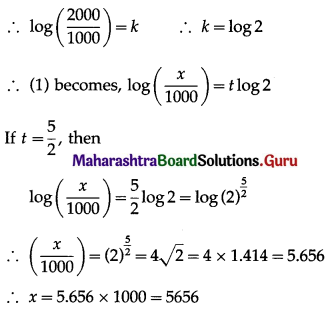
Now, when t = 1, x = 2 × 1000 = 2000
Maharashtra Board 12th Commerce Maths Solutions Chapter 8 Differential Equation and Applications Ex 8.6 Q3
∴ number of bacteria after \(\frac{5}{2}\) hours = 5656.

Maharashtra Board 12th Commerce Maths Solutions Chapter 8 Differential Equation and Applications Ex 8.6

Question 4.
Find the population of a city at any time t, given that the rate of increase of population is proportional to the population at that instant and that in a period of 40 years, the population increased from 30,000 to 40,000.
Solution:
Let P be the population of the city at time t.
Then \(\frac{d P}{d t}\), the rate of increase of population, is proportional to P.
∴ \(\frac{d P}{d t}\) ∝ P
∴ \(\frac{d P}{d t}\) = kP, where k is a constant.
∴ \(\frac{d P}{P}\) = k dt
On integrating, we get
∫\(\frac{1}{P}\)dP = k∫dt
∴ log P = kt + c
Initially, i.e. when t = 0, P = 30000
∴ log 30000 = k x 0 + c
∴ c = log 30000
∴ log P = kt + log 30000
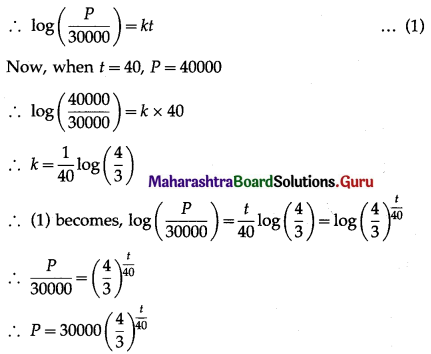
∴ log P – log 30000 = kt
Maharashtra Board 12th Commerce Maths Solutions Chapter 8 Differential Equation and Applications Ex 8.6 Q4
∴ the population of the city at time t = 30000\(\left(\frac{4}{3}\right)^{\frac{t}{40}}\).

Question 5.
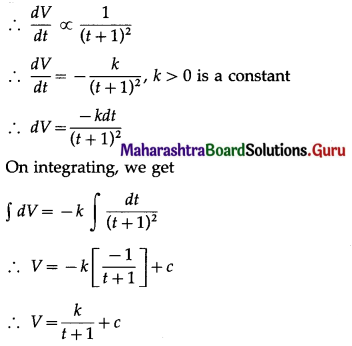
The rate of depreciation \(\frac{d V}{d t}\) of a machine is inversely proportional to the square of t + 1, where V is the value of the machine t years after it was purchased. The initial value of the machine was ₹ 8,00,000 and its value decreased ₹ 1,00,000 in the first year. Find the value after 6 years.
Solution:
Let V be the value of the machine at the end of t years.
Then \(\frac{d V}{d t}\), the rate of depreciation, is inversly proportional to (t + 1)2.
Maharashtra Board 12th Commerce Maths Solutions Chapter 8 Differential Equation and Applications Ex 8.6 Q5
Initially, i.e. when t = 0, V = 800000
∴ 800000 = \(\frac{k}{1}\) + c = k + c ………(1)
Now, when t = 1, V = 800000 – 100000 = 700000
∴ 700000 = \(\frac{k}{1+1}\) + c = \(\frac{k}{2}\) + c ……(2)
Subtracting (2) from (1), we get
100000 = \(\frac{1k}{2}\)
∴ k = 200000
∴ from (1), 800000 = 200000 + c
∴ c = 600000 200000
∴ V = \(\frac{200000}{t+1}\) + 600000
When t = 6,
V = \(\frac{200000}{7}\) + 600000
= 28571.43 + 600000
= 628571.43 ~ 628571
Hence, the value of the machine after 6 years will be ₹ 6,28,571.

12th Commerce Maths Digest Pdf
12th Commerce Maths 1 Chapter 8 Exercise 8.5 Answers Maharashtra Board

Differential Equation and Applications Class 12 Commerce Maths 1 Chapter 8 Exercise 8.5 Answers Maharashtra Board

Balbharati Maharashtra State Board Std 12 Commerce Statistics Part 1 Digest Pdf Chapter 8 Differential Equation and Applications Ex 8.5 Questions and Answers.

Std 12 Maths 1 Exercise 8.5 Solutions Commerce Maths

Solve the following differential equations.

Question 1.
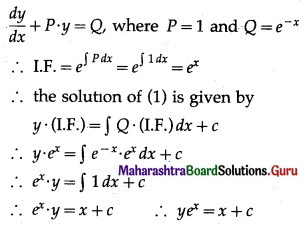
\(\frac{d y}{d x}+y=e^{-x}\)
Solution:
\(\frac{d y}{d x}+y=e^{-x}\) …….(1)
This is the linear differential equation of the form
Maharashtra Board 12th Commerce Maths Solutions Chapter 8 Differential Equation and Applications Ex 8.5 Q1
This is the general solution.

Question 2.
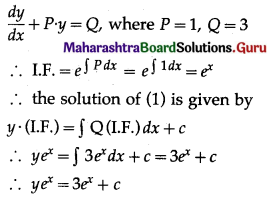
\(\frac{d y}{d x}\) + y = 3
Solution:
\(\frac{d y}{d x}\) + y = 3
This is the linear differential equation of the form
Maharashtra Board 12th Commerce Maths Solutions Chapter 8 Differential Equation and Applications Ex 8.5 Q2
This is the general solution.

Maharashtra Board 12th Commerce Maths Solutions Chapter 8 Differential Equation and Applications Ex 8.5

Question 3.
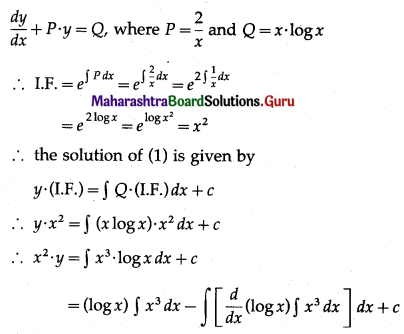
x\(\frac{d y}{d x}\) + 2y = x2 . log x.
Solution:
x\(\frac{d y}{d x}\) + 2y = x2 . log x
∴ \(\frac{d y}{d x}+\left(\frac{2}{x}\right) \cdot y=x \cdot \log x\) …….(1)
This is the linear differential equation of the form
Maharashtra Board 12th Commerce Maths Solutions Chapter 8 Differential Equation and Applications Ex 8.5 Q3
Maharashtra Board 12th Commerce Maths Solutions Chapter 8 Differential Equation and Applications Ex 8.5 Q3.1
This is the general solution.

Question 4.
(x + y)\(\frac{d y}{d x}\) = 1
Solution:
(x + y) \(\frac{d y}{d x}\) = 1
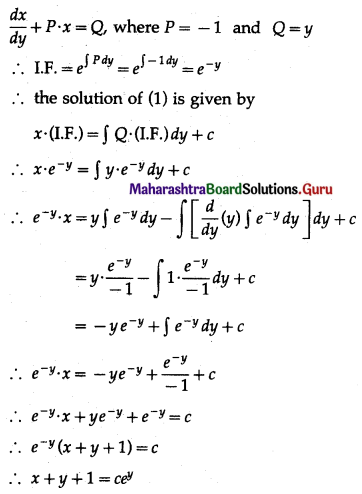
∴ \(\frac{d x}{d y}\) = x + y
∴ \(\frac{d x}{d y}\) – x = y
∴ \(\frac{d x}{d y}\) + (-1) x = y ……(1)
This is the linear differential equation of the form
Maharashtra Board 12th Commerce Maths Solutions Chapter 8 Differential Equation and Applications Ex 8.5 Q4
This is the general solution.

Question 5.
y dx + (x – y2) dy = 0
Solution:
y dx + (x – y2) dy = 0
∴ y dx = -(x – y2) dy
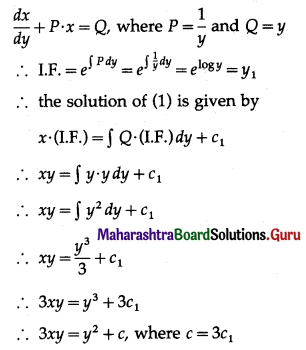
∴ \(\frac{d x}{d y}=-\frac{\left(x-y^{2}\right)}{y}=-\frac{x}{y}+y\)
∴ \(\frac{d x}{d y}+\left(\frac{1}{y}\right) \cdot x=y\) ……(1)
This is the linear differential equation of the form
Maharashtra Board 12th Commerce Maths Solutions Chapter 8 Differential Equation and Applications Ex 8.5 Q5
This is the general solution.

Maharashtra Board 12th Commerce Maths Solutions Chapter 8 Differential Equation and Applications Ex 8.5

Question 6.
\(\frac{d y}{d x}\) + 2xy = x
Solution:
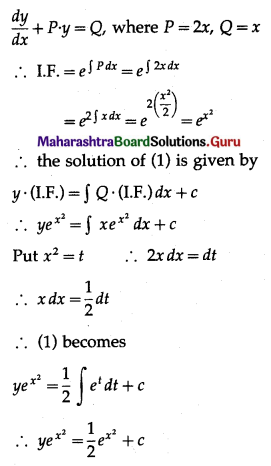
\(\frac{d y}{d x}\) + 2xy = x ………(1)
This is the linear differential equation of the form
Maharashtra Board 12th Commerce Maths Solutions Chapter 8 Differential Equation and Applications Ex 8.5 Q6
This is the general solution.

Question 7.
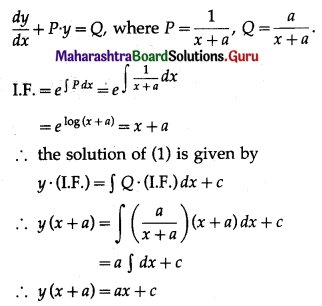
(x + a) \(\frac{d y}{d x}\) = -y + a
Solution:
(x + a) \(\frac{d y}{d x}\) + y = a
∴ \(\frac{d y}{d x}+\left(\frac{1}{x+a}\right) y=\frac{a}{x+a}\) ……..(1)
This is the linear differential equation of the form
Maharashtra Board 12th Commerce Maths Solutions Chapter 8 Differential Equation and Applications Ex 8.5 Q7
This is the general solution.

Maharashtra Board 12th Commerce Maths Solutions Chapter 8 Differential Equation and Applications Ex 8.5

Question 8.
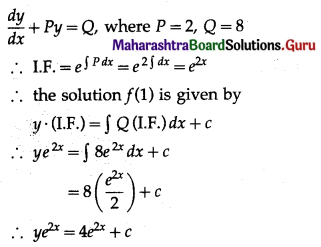
dy + (2y) dx = 8 dx
Solution:
dy + (2y) dx = 8 dx
∴ \(\frac{d y}{d x}\) + 2y = 8 …….(1)
This is the linear differential equation of the form
Maharashtra Board 12th Commerce Maths Solutions Chapter 8 Differential Equation and Applications Ex 8.5 Q8
This is the general solution.

12th Commerce Maths Digest Pdf
12th Commerce Maths 1 Chapter 8 Exercise 8.4 Answers Maharashtra Board

Differential Equation and Applications Class 12 Commerce Maths 1 Chapter 8 Exercise 8.4 Answers Maharashtra Board

Balbharati Maharashtra State Board Std 12 Commerce Statistics Part 1 Digest Pdf Chapter 8 Differential Equation and Applications Ex 8.4 Questions and Answers.

Std 12 Maths 1 Exercise 8.4 Solutions Commerce Maths

Solve the following differential equations:

Question 1.
x dx + 2y dy = 0
Solution:
x dx + 2y dy = 0
Integrating, we get
∫x dx + 2 ∫y dy = c1
∴ \(\frac{x^{2}}{2}+2\left(\frac{y^{2}}{2}\right)=c_{1}\)
∴ x2 + 2y2 = c, where c = 2c1
This is the general solution.

Maharashtra Board 12th Commerce Maths Solutions Chapter 8 Differential Equation and Applications Ex 8.4

Question 2.
y2 dx + (xy + x2) dy = 0
Solution:
y2 dx + (xy + x2) dy = 0
∴ (xy + x2) dy = -y2 dx
∴ \(\frac{d y}{d x}=\frac{-y^{2}}{x y+x^{2}}\) ………(1)
Put y = vx
∴ \(\frac{d y}{d x}=v+x \frac{d v}{d x}\)
Substituting these values in (1), we get
Maharashtra Board 12th Commerce Maths Solutions Chapter 8 Differential Equation and Applications Ex 8.4 Q2
Maharashtra Board 12th Commerce Maths Solutions Chapter 8 Differential Equation and Applications Ex 8.4 Q2.1
Maharashtra Board 12th Commerce Maths Solutions Chapter 8 Differential Equation and Applications Ex 8.4 Q2.2
This is the general solution.

Question 3.
x2y dx – (x3 + y3) dy = 0
Solution:
x2y dx – (x3 + y3) dy = 0
∴ (x3 + y3) dy = x2y dx
∴ \(\frac{d y}{d x}=\frac{x^{2} y}{x^{3}+y^{3}}\) ……(1)
Put y = vx
∴ \(\frac{d y}{d x}=v+x \frac{d v}{d x}\)
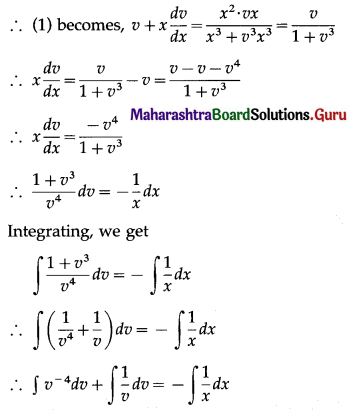
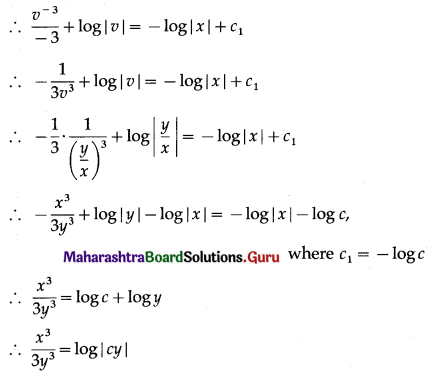
Maharashtra Board 12th Commerce Maths Solutions Chapter 8 Differential Equation and Applications Ex 8.4 Q3
Maharashtra Board 12th Commerce Maths Solutions Chapter 8 Differential Equation and Applications Ex 8.4 Q3.1
This is the general solution.

Maharashtra Board 12th Commerce Maths Solutions Chapter 8 Differential Equation and Applications Ex 8.4

Question 4.
\(\frac{d y}{d x}+\frac{x-2 y}{2 x-y}=0\)
Solution:
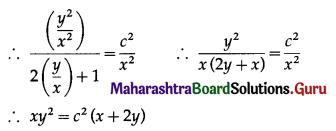
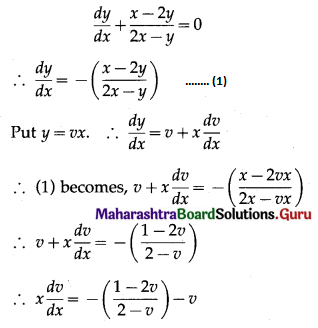
Maharashtra Board 12th Commerce Maths Solutions Chapter 8 Differential Equation and Applications Ex 8.4 Q4
Maharashtra Board 12th Commerce Maths Solutions Chapter 8 Differential Equation and Applications Ex 8.4 Q4.1
Maharashtra Board 12th Commerce Maths Solutions Chapter 8 Differential Equation and Applications Ex 8.4 Q4.2
This is the general solution.

Question 5.
(x2 – y2) dx + 2xy dy = 0
Solution:
(x2 – y2) dx + 2xy dy = 0
∴ 2xy dy = -(x2 – y2) dx = (y2 – x2) dx
∴ \(\frac{d y}{d x}=\frac{y^{2}-x^{2}}{2 x y}\) ………(1)
Maharashtra Board 12th Commerce Maths Solutions Chapter 8 Differential Equation and Applications Ex 8.4 Q5
Maharashtra Board 12th Commerce Maths Solutions Chapter 8 Differential Equation and Applications Ex 8.4 Q5.1

Question 6.
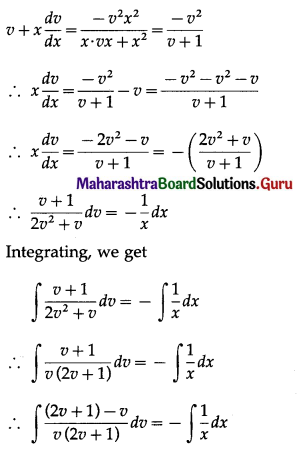
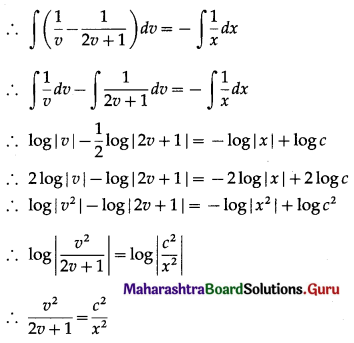
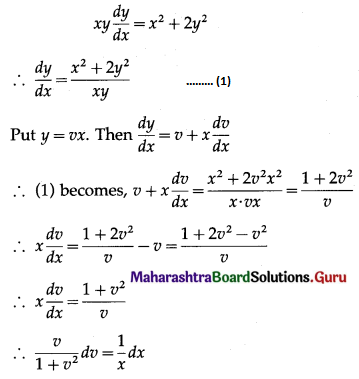
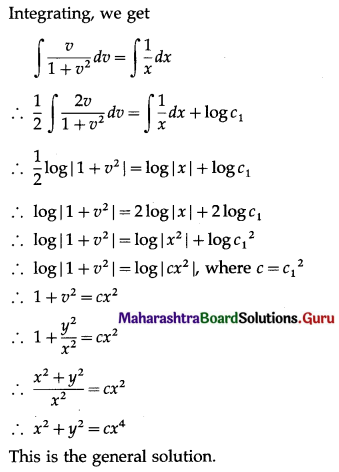
xy\(\frac{d y}{d x}\) = x2 + 2y2
Solution:
Maharashtra Board 12th Commerce Maths Solutions Chapter 8 Differential Equation and Applications Ex 8.4 Q6
Maharashtra Board 12th Commerce Maths Solutions Chapter 8 Differential Equation and Applications Ex 8.4 Q6.1

Maharashtra Board 12th Commerce Maths Solutions Chapter 8 Differential Equation and Applications Ex 8.4

Question 7.
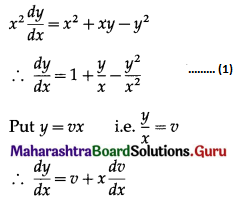
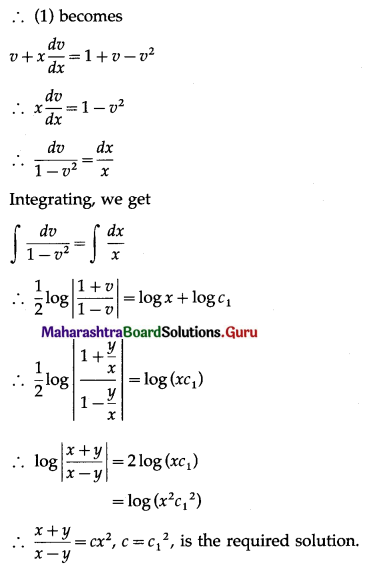
x2\(\frac{d y}{d x}\) = x2 + xy – y2
Solution:
Maharashtra Board 12th Commerce Maths Solutions Chapter 8 Differential Equation and Applications Ex 8.4 Q7
Maharashtra Board 12th Commerce Maths Solutions Chapter 8 Differential Equation and Applications Ex 8.4 Q7.1

12th Commerce Maths Digest Pdf
12th Commerce Maths 1 Chapter 8 Exercise 8.3 Answers Maharashtra Board

Differential Equation and Applications Class 12 Commerce Maths 1 Chapter 8 Exercise 8.3 Answers Maharashtra Board

Balbharati Maharashtra State Board Std 12 Commerce Statistics Part 1 Digest Pdf Chapter 8 Differential Equation and Applications Ex 8.3 Questions and Answers.

Std 12 Maths 1 Exercise 8.3 Solutions Commerce Maths

Question 1.
Solve the following differential equations:
(i) \(\frac{d y}{d x}\) = x2y + y
Solution:
\(\frac{d y}{d x}\) = x2y + y
∴ \(\frac{d y}{d x}\) = y(x2 + 1)
∴ \(\frac{1}{y}\) dy = (x2 + 1) dx
Integrating, we get
∫\(\frac{1}{y}\) dy = ∫(x2 + 1) dx
∴ log |y|= \(\frac{x^{3}}{3}\) + x + c
This is the general solution.

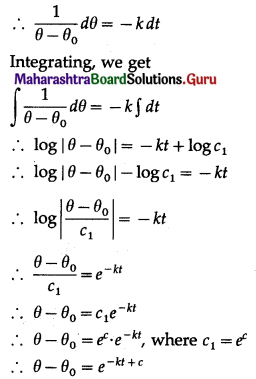
(ii) \(\frac{d \theta}{d t}=-k\left(\theta-\theta_{0}\right)\)
Solution:
\(\frac{d \theta}{d t}=-k\left(\theta-\theta_{0}\right)\)
Maharashtra Board 12th Commerce Maths Solutions Chapter 8 Differential Equation and Applications Ex 8.3 Q1(ii)
This is the general solution.

Maharashtra Board 12th Commerce Maths Solutions Chapter 8 Differential Equation and Applications Ex 8.3

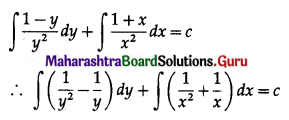
(iii) (x2 – yx2) dy + (y2 + xy2) dx = 0
Solution:
(x2 – yx2) dy + (y2 + xy2) dx = 0
∴ x2(1 – y) dy + y2(1 + x) dx = 0
∴ \(\frac{1-y}{y^{2}} d y+\frac{1+x}{x^{2}} d x=0\)
Integrating, we get
Maharashtra Board 12th Commerce Maths Solutions Chapter 8 Differential Equation and Applications Ex 8.3 Q1(iii)
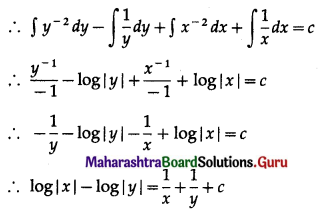
Maharashtra Board 12th Commerce Maths Solutions Chapter 8 Differential Equation and Applications Ex 8.3 Q1(iii).1
This is the general solution.

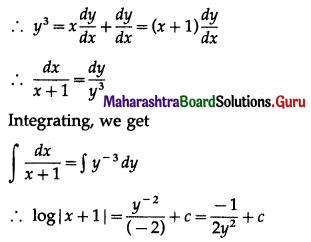
(iv) \(y^{3}-\frac{d y}{d x}=x \frac{d y}{d x}\)
Solution:
\(y^{3}-\frac{d y}{d x}=x \frac{d y}{d x}\)
Maharashtra Board 12th Commerce Maths Solutions Chapter 8 Differential Equation and Applications Ex 8.3 Q1(iv)
∴ 2y2 log |x + 1| = 2cy2 – 1 is the required solution.

Maharashtra Board 12th Commerce Maths Solutions Chapter 8 Differential Equation and Applications Ex 8.3

Question 2.
For each of the following differential equations find the particular solution:
(i) (x – y2x) dx – (y + x2y) dy = 0, when x = 2, y = 0.
Solution:
(x – y2x) dx – (y + x2y) dy = 0
∴ x(1 – y2) dx – y(1 + x2) dy = 0
Maharashtra Board 12th Commerce Maths Solutions Chapter 8 Differential Equation and Applications Ex 8.3 Q2(i)
∴ the general solution is
log |1 + x2| + log |1 – y2| = log c, where c1 = log c
∴ log |(1 + x2)(1 – y2) | = log c
∴ (1 + x2)(1 – y2) = c
When x = 2, y = 0, we have
(1 + 4)(1 – 0) = c
∴ c = 5
∴ the particular solution is (1 + x2)(1 – y2) = 5.

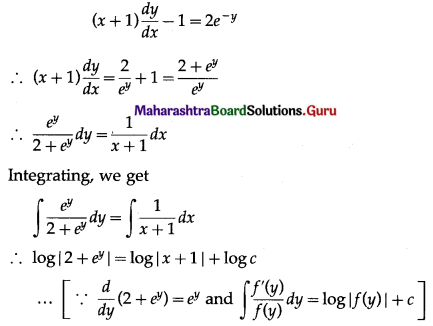
(ii) (x + 1) \(\frac{d y}{d x}\) -1 = 2e-y, when y = 0, x = 1.
Solution:
Maharashtra Board 12th Commerce Maths Solutions Chapter 8 Differential Equation and Applications Ex 8.3 Q2(ii)
∴ log |2 + ey| = log |c(x + 1)|
∴ 2 + ey = c(x + 1)
This is the general solution.
Now, y = 0, when x = 1
∴ 2 + e0 = c(1 + 1)
∴ 3 = 2c
∴ c = \(\frac{3}{2}\)
∴ the particular solution is
2 + ey = \(\frac{3}{2}\)(x + 1)
∴ 4 + 2ey = 3x + 3
∴ 3x – 2ey – 1 = 0

Maharashtra Board 12th Commerce Maths Solutions Chapter 8 Differential Equation and Applications Ex 8.3

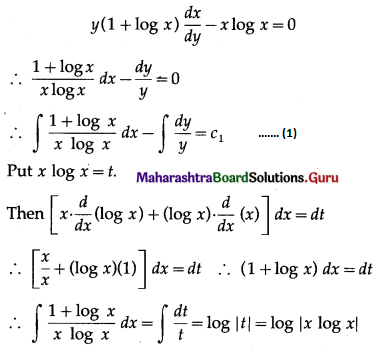
(iii) y(1 + log x) \(\frac{d x}{d y}\) – x log x = 0, when x = e, y = e2.
Solution:
Maharashtra Board 12th Commerce Maths Solutions Chapter 8 Differential Equation and Applications Ex 8.3 Q2(iii)
∴ from (1), the general solution is
log |x log x| – log |y| = log c, where c1 = log c
∴ log |\(\frac{x \log x}{y}\)| = log c
∴ \(\frac{x \log x}{y}\) = c
∴ x log x = cy
This is the general solution.
Now, y = e2, when x = e
e log e = ce2
1 = ce ……[∵ log e = 1]
c = \(\frac{1}{e}\)
∴ the particular solution is x log x = (\(\frac{1}{e}\)) y
∴ y = ex log x

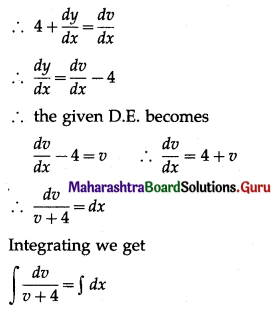
(iv) \(\frac{d y}{d x}\) = 4x + y + 1, when y = 1, x = 0.
Solution:
\(\frac{d y}{d x}\) = 4x + y + 1
Put 4x + y + 1 = v
Maharashtra Board 12th Commerce Maths Solutions Chapter 8 Differential Equation and Applications Ex 8.3 Q2(iv)
∴ log |v + 4| = x + c
∴ log |4x + y + 1 + 4| = x + c
i.e. log |4x + y + 5| = x + c
This is the general solution.
Now, y = 1 when x = 0
∴ log|0 + 1 + 5| = 0 + c,
i.e. c = log 6
∴ the particular solution is
log |4x + y + 5| = x + log 6
∴ \(\log \left|\frac{4 x+y+5}{6}\right|\) = x

12th Commerce Maths Digest Pdf
12th Commerce Maths 1 Chapter 8 Exercise 8.2 Answers Maharashtra Board

Differential Equation and Applications Class 12 Commerce Maths 1 Chapter 8 Exercise 8.2 Answers Maharashtra Board

Balbharati Maharashtra State Board Std 12 Commerce Statistics Part 1 Digest Pdf Chapter 8 Differential Equation and Applications Ex 8.2 Questions and Answers.

Std 12 Maths 1 Exercise 8.2 Solutions Commerce Maths

Question 1.
Obtain the differential equation by eliminating arbitrary constants from the following equations:
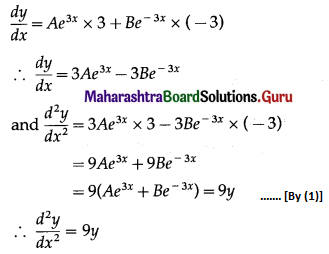
(i) y = Ae3x + Be-3x
Solution:
y = Ae3x + Be-3x ……(1)
Differentiating twice w.r.t. x, we get
Maharashtra Board 12th Commerce Maths Solutions Chapter 8 Differential Equation and Applications Ex 8.2 Q1(i)
This is the required D.E.

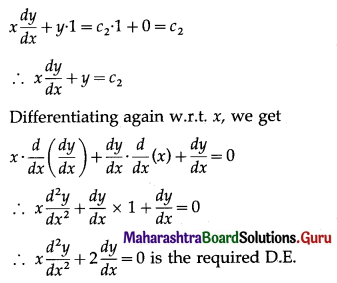
(ii) y = \(c_{2}+\frac{c_{1}}{x}\)
Solution:
y = \(c_{2}+\frac{c_{1}}{x}\)
∴ xy = c2x + c1
Differentiating w.r.t. x, we get
Maharashtra Board 12th Commerce Maths Solutions Chapter 8 Differential Equation and Applications Ex 8.2 Q1(ii)

Maharashtra Board 12th Commerce Maths Solutions Chapter 8 Differential Equation and Applications Ex 8.2

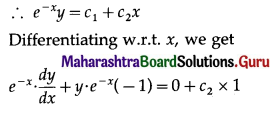
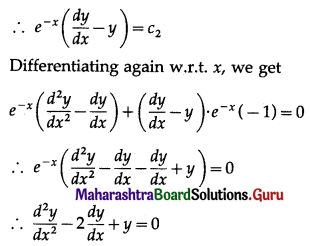
(iii) y = (c1 + c2x) ex
Solution:
y = (c1 + c2x) ex
Maharashtra Board 12th Commerce Maths Solutions Chapter 8 Differential Equation and Applications Ex 8.2 Q1(iii)
Maharashtra Board 12th Commerce Maths Solutions Chapter 8 Differential Equation and Applications Ex 8.2 Q1(iii).1
This is the required D.E.

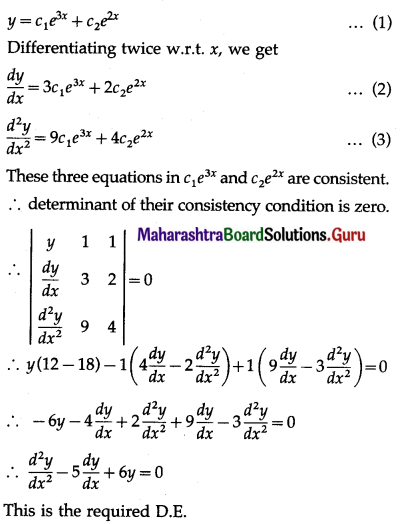
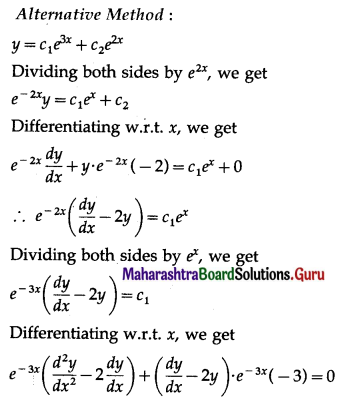
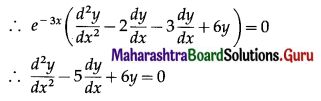
(iv) y = c1 e3x+ c2 e2x
Solution:
Maharashtra Board 12th Commerce Maths Solutions Chapter 8 Differential Equation and Applications Ex 8.2 Q1(iv)
Maharashtra Board 12th Commerce Maths Solutions Chapter 8 Differential Equation and Applications Ex 8.2 Q1(iv).1
Maharashtra Board 12th Commerce Maths Solutions Chapter 8 Differential Equation and Applications Ex 8.2 Q1(iv).2
This is the required D.E.

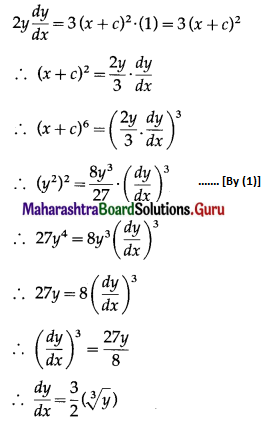
(v) y2 = (x + c)3
Solution:
y2 = (x + c)3
Differentiating w.r.t. x, we get
Maharashtra Board 12th Commerce Maths Solutions Chapter 8 Differential Equation and Applications Ex 8.2 Q1(v)
This is the required D.E.

Maharashtra Board 12th Commerce Maths Solutions Chapter 8 Differential Equation and Applications Ex 8.2

Question 2.
Find the differential equation by eliminating arbitrary constant from the relation x2 + y2 = 2ax.
Solution:
x2 + y2 = 2ax
Differentiating both sides w.r.t. x, we get
2x + 2y\(\frac{d y}{d x}\) = 2a
Substituting value of 2a in equation (1), we get
x2 + y2 = [2x + 2y \(\frac{d y}{d x}\)]x = 2x2 + 2xy \(\frac{d y}{d x}\)
∴ 2xy \(\frac{d y}{d x}\) = y2 – x2 is the required D.E.

Question 3.
Form the differential equation by eliminating arbitrary constants from the relation bx + ay = ab.
Solution:
bx + ay = ab
∴ ay = -bx + ab
∴ y = \(-\frac{b}{a} x+b\)
Differentiating w.r.t. x, we get
\(\frac{d y}{d x}=-\frac{b}{a} \times 1+0=-\frac{b}{a}\)
Differentiating again w.r.t. x, we get
\(\frac{d^{2} y}{d x^{2}}\) = 0 is the required D.E.

Question 4.
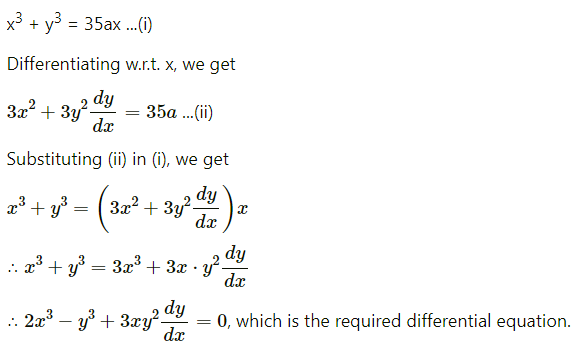
Find the differential equation whose general solution is x3 + y3 = 35ax.
Solution:
Maharashtra Board 12th Commerce Maths Solutions Chapter 8 Differential Equation and Applications Ex 8.2 Q4

Maharashtra Board 12th Commerce Maths Solutions Chapter 8 Differential Equation and Applications Ex 8.2

Question 5.
Form the differential equation from the relation x2 + 4y2 = 4b2.
Sol ution:
x2 + 4y2 = 4b2
Differentiating w.r.t. x, we get
2x + 4(2y\(\frac{d y}{d x}\)) = 0
i.e. x + 4y\(\frac{d y}{d x}\) = 0 is the required D.E.

12th Commerce Maths Digest Pdf
12th Commerce Maths 1 Chapter 8 Exercise 8.1 Answers Maharashtra Board

Differential Equation and Applications Class 12 Commerce Maths 1 Chapter 8 Exercise 8.1 Answers Maharashtra Board

Balbharati Maharashtra State Board Std 12 Commerce Statistics Part 1 Digest Pdf Chapter 8 Differential Equation and Applications Ex 8.1 Questions and Answers.

Std 12 Maths 1 Exercise 8.1 Solutions Commerce Maths

Question 1.
Determine the order and degree of each of the following differential equations:
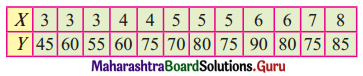
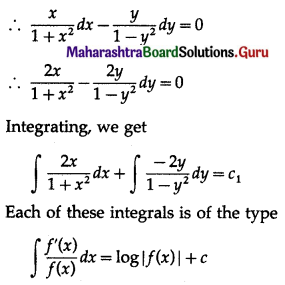
(i) \(\frac{d^{2} x}{d t^{2}}+\left(\frac{d x}{d t}\right)^{2}+8=0\)
Solution:
The given D.E. is \(\frac{d^{2} x}{d t^{2}}+\left(\frac{d x}{d t}\right)^{2}+8=0\)
This D.E. has highest order derivative \(\frac{d^{2} x}{d t^{2}}\) with power 1.
∴ the given D.E. is of order 2 and degree 1.

(ii) \(\left(\frac{d^{2} y}{d x^{2}}\right)^{2}+\left(\frac{d y}{d x}\right)^{2}=a^{x}\)
Solution:
The given D.E. is \(\left(\frac{d^{2} y}{d x^{2}}\right)^{2}+\left(\frac{d y}{d x}\right)^{2}=a^{x}\)
This D.E. has highest order derivative \(\frac{d^{2} y}{d x^{2}}\) with power 2.
∴ the given D.E. is of order 2 and degree 2.

(iii) \(\frac{d^{4} y}{d x^{4}}+\left[1+\left(\frac{d y}{d x}\right)^{2}\right]^{3}\)
Solution:
The given D.E. is \(\frac{d^{4} y}{d x^{4}}+\left[1+\left(\frac{d y}{d x}\right)^{2}\right]^{3}\)
This D.E. has highest order derivative \(\frac{d^{4} y}{d x^{4}}\) with power 1.
∴ the given D.E. is of order 4 and degree 1.

Maharashtra Board 12th Commerce Maths Solutions Chapter 8 Differential Equation and Applications Ex 8.1

(iv) (y'”)2 + 2(y”)2 + 6y’ + 7y = 0
Solution:
The given D.E. is (y”‘)2 + 2(y”)2 + 6y’ + 7y = 0
This can be written as \(\left(\frac{d^{3} y}{d x^{3}}\right)^{2}+2\left(\frac{d^{2} y}{d x^{2}}\right)^{2}+6 \frac{d y}{d x}+7 y=0\)
This D.E. has highest order derivative \(\frac{d^{3} y}{d x^{3}}\) with power 2.
∴ the given D.E. is of order 3 and degree 2.

(v) \(\sqrt{1+\frac{1}{\left(\frac{d y}{d x}\right)^{2}}}=\left(\frac{d y}{d x}\right)^{3 / 2}\)
Solution:
The given D.E. is \(\sqrt{1+\frac{1}{\left(\frac{d y}{d x}\right)^{2}}}=\left(\frac{d y}{d x}\right)^{3 / 2}\)
On squaring both sides, we get
\(1+\frac{1}{\left(\frac{d y}{d x}\right)^{2}}=\left(\frac{d y}{d x}\right)^{3}\)
∴ \(\left(\frac{d y}{d x}\right)^{2}+1=\left(\frac{d y}{d x}\right)^{5}\)
This D.E. has highest order derivative \(\frac{d y}{d x}\) with power 5.
∴ the given D.E. is of order 1 and degree 5.

(vi) \(\frac{d y}{d x}=7 \frac{d^{2} y}{d x^{2}}\)
Solution:
The given D.E. is \(\frac{d y}{d x}=7 \frac{d^{2} y}{d x^{2}}\)
This D.E. has highest order derivative \(\frac{d^{2} y}{d x^{2}}\) with power 1.
∴ the given D.E. is of order 2 and degree 1.

(vii) \(\left(\frac{d^{3} y}{d x^{3}}\right)^{1 / 6}=9\)
Solution:
The given D.E. is \(\left(\frac{d^{3} y}{d x^{3}}\right)^{1 / 6}=9\)
i.e., \(\frac{d^{3} y}{d x^{3}}=9^{6}\)
This D.E. has highest order derivative \(\frac{d^{3} y}{d x^{3}}\) with power 1.
∴ the given D.E. is of order 3 and degree 1.

Maharashtra Board 12th Commerce Maths Solutions Chapter 8 Differential Equation and Applications Ex 8.1

Question 2.
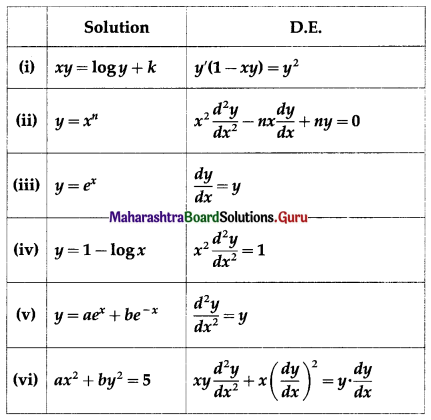
In each of the following examples, verify that the given function is a solution of the corresponding differential equation:
Maharashtra Board 12th Commerce Maths Solutions Chapter 8 Differential Equation and Applications Ex 8.1 Q2
Solution:
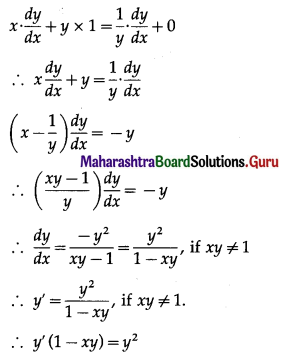
(i) xy = log y + k
Differentiating w.r.t. x, we get
Maharashtra Board 12th Commerce Maths Solutions Chapter 8 Differential Equation and Applications Ex 8.1 Q2(i)
Hence, xy = log y + k is a solution of the D.E. y'(1 – xy) = y2.

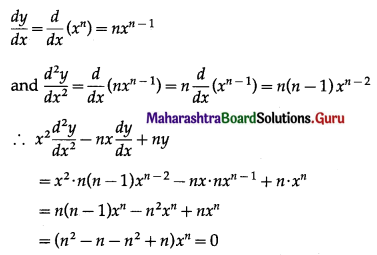
(ii) y = xn
Differentiating twice w.r.t. x, we get
Maharashtra Board 12th Commerce Maths Solutions Chapter 8 Differential Equation and Applications Ex 8.1 Q2(ii)
This shows that y = xn is a solution of the D.E.
\(x^{2} \frac{d^{2} y}{d x^{2}}-n x \frac{d y}{d x}+n y=0\)

(iii) y = ex
Differentiating w.r.t. x, we get
\(\frac{d y}{d x}\) = ex = y
Hence, y = ex is a solution of the D.E. \(\frac{d y}{d x}\) = y.

Maharashtra Board 12th Commerce Maths Solutions Chapter 8 Differential Equation and Applications Ex 8.1

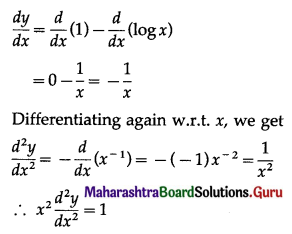
(iv) y = 1 – log x
Differentiating w.r.t. x, we get
Maharashtra Board 12th Commerce Maths Solutions Chapter 8 Differential Equation and Applications Ex 8.1 Q2(iv)
Hence, y = 1 – log x is a solution of the D.E.
\(x^{2} \frac{d^{2} y}{d x^{2}}=1\)

(v) y = aex + be-x
Differentiating w.r.t. x, we get
\(\frac{d y}{d x}\) = a(ex) + b(-e-x) = aex – be-x
Differentiating again w.r.t. x, we get
\(\frac{d^{2} y}{d x^{2}}\) = a(ex) – b(-e-x)
= aex + be-x
= y
Hence, y = aex + be-x is a solution of the D.E. \(\frac{d^{2} y}{d x^{2}}\) = y.

Maharashtra Board 12th Commerce Maths Solutions Chapter 8 Differential Equation and Applications Ex 8.1

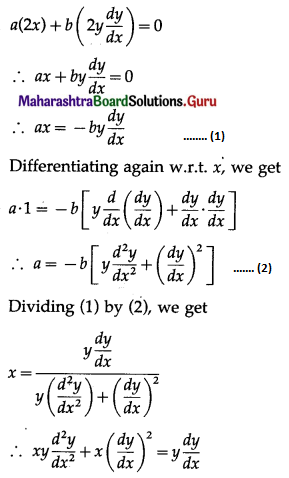
(vi) ax2 + by2 = 5
Differentiating w.r.t. x, we get
Maharashtra Board 12th Commerce Maths Solutions Chapter 8 Differential Equation and Applications Ex 8.1 Q2(vi)
Hence, ax2 + by2 = 5 is a solution of the D.E.
\(x y \frac{d^{2} y}{d x^{2}}+x\left(\frac{d y}{d x}\right)^{2}=y\left(\frac{d y}{d x}\right)\)

12th Commerce Maths Digest Pdf