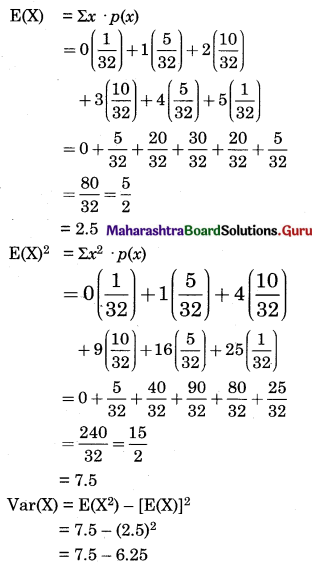
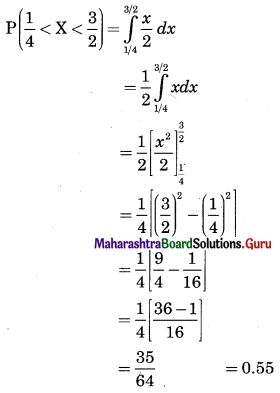
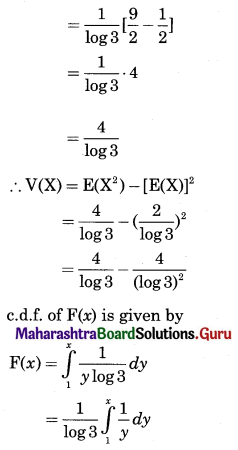
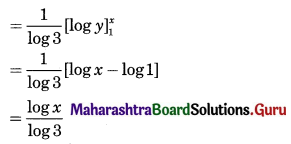
12th Commerce Maths 2 Chapter 1 Exercise 1.2 Answers Maharashtra Board

Commission, Brokerage and Discount Class 12 Commerce Maths 2 Chapter 1 Exercise 1.2 Answers Maharashtra Board

Balbharati Maharashtra State Board 12th Commerce Maths Digest Pdf Chapter 1 Commission, Brokerage and Discount Ex 1.2 Questions and Answers.

Std 12 Maths 2 Exercise 1.2 Solutions Commerce Maths

Question 1.
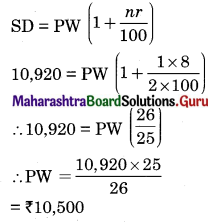
What is the present worth of a sum of ₹ 10,920 due six months hence at 8% p.a simple interest?
Solution:
Given, SD = ₹ 10,920
n = \(\frac{6}{12}\) year = \(\frac{1}{2}\) year
r = 8%
We have,
Maharashtra Board 12th Commerce Maths Solutions Chapter 1 Commission, Brokerage and Discount Ex 1.2 Q1
Thus the present worth is ₹ 10,500

Question 2.
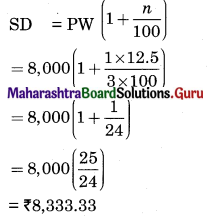
What is the sum due of ₹ 8,000 due 4 months at 12.5% simple interest?
Solution:
Given, PW = ₹ 8,000, n = \(\frac{4}{12}\) year = \(\frac{1}{3}\) year, r = 12.5%
We have,
Maharashtra Board 12th Commerce Maths Solutions Chapter 1 Commission, Brokerage and Discount Ex 1.2 Q2
Thus, the sum due is ₹ 8,333.33

Question 3.
The true discount on the sum due 8 months hence at 12% p.a. is ₹ 560. Find the sum due and present worth of the bill.
Solution:
Given, TD = ₹ 560, n = \(\frac{8}{12}\) year = \(\frac{2}{3}\) year, r = 12%
We have,
TD = \(\frac{\mathrm{PW} \times n \times r}{100}\)
∴ 560 = \(\frac{\mathrm{PW} \times 2 \times 12}{3 \times 100}\)
∴ PW = 560 × \(\frac{25}{2}\) = ₹ 7,000
Now, SD = PW + TD
= 7,000 + 560
= ₹ 7,560

Maharashtra Board 12th Commerce Maths Solutions Chapter 1 Commission, Brokerage and Discount Ex 1.2

Question 4.
The true discount on a sum is \(\frac{3}{8}\) of the sum due at 12% p.a. Find the period of the bill.
Solution:
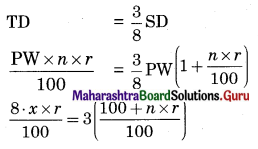
Maharashtra Board 12th Commerce Maths Solutions Chapter 1 Commission, Brokerage and Discount Ex 1.2 Q4
8 × n × 12 = 3(100 + n × 12)
96n = 300 + 36n
60n = 300
∴ n = 5
∴ Period of the bill = 5 years.

Question 5.
20 copies of a book can be purchased for a certain sum payable at the end of 6 months and 21 copies for the same sum in ready cash. Find the rate of interest.
Solution:
Given, n = \(\frac{6}{12}\) year = \(\frac{1}{2}\) year
Let the sum payable be ₹ x
Let the rate of interest be r%
According to given condition,
PW of one book = \(\frac{x}{21}\)
SD of one book = \(\frac{x}{20}\)
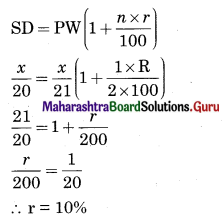
Maharashtra Board 12th Commerce Maths Solutions Chapter 1 Commission, Brokerage and Discount Ex 1.2 Q5
Thus, the rate of interest is 10%.

Question 6.
Find the true discount, Banker’s discount, and Banker’s gain on a bill of ₹ 4,240 due 6 months hence at 9% p.a.
Solution:
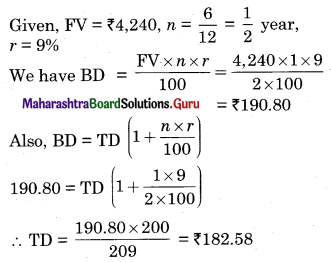
Maharashtra Board 12th Commerce Maths Solutions Chapter 1 Commission, Brokerage and Discount Ex 1.2 Q6
And, Banker’s Gain (BG) = BD – TD
= 190.80 – 182.58
= ₹ 8.22

Question 7.
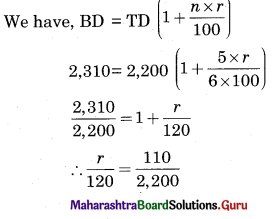
The true discount on a bill is ₹ 2,200 and bankers discount is ₹ 2,310. If the bill is due 10 months, hence, find the rate of interest.
Solution:
Given, TD = ₹ 2,200, BD = ₹ 2,310
n = \(\frac{10}{12}=\frac{5}{6}\) year
Maharashtra Board 12th Commerce Maths Solutions Chapter 1 Commission, Brokerage and Discount Ex 1.2 Q7
∴ \(\frac{r}{120}=\frac{1}{20}\)
∴ r = 6%
Thus, rate of interest is 6%

Maharashtra Board 12th Commerce Maths Solutions Chapter 1 Commission, Brokerage and Discount Ex 1.2

Question 8.
A bill of ₹ 6,395 drawn on 19th January 2015 for 8 months was discounted on 28th February 2015 at 8% p.a. interest. What is the banker’s discount? What is the cash value of the bill?
Solution:
Face value = ₹ 6,395
Date of drawing = 19/01/2015
Period of the bill = 8 months
Nominal Due date = 19/09/2015
Legal due date = 22/09/2015
Date of discounting = 28/02/2015
Now, the unexpired period = Legal due date – Date of discounting
= 22/09/2015 – 28/02/2015
= days (as shown below)
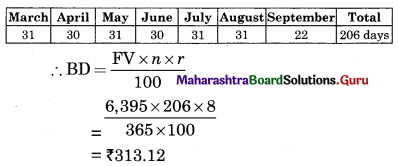
Maharashtra Board 12th Commerce Maths Solutions Chapter 1 Commission, Brokerage and Discount Ex 1.2 Q8
Cash Value = FV – BD
= 6,395 – 313.12
= ₹ 6,621.38

Question 9.
A bill of ₹ 8,000 drawn on 5th January 1998 for 8 months was discounted for ₹ 7,680 on a certain date. Find the date on which it was discounted at 10% p.a.
Solution:
Bankers discount (BD) = FV – cash value
= 8,000 – 7,680
= ₹ 320
Let the unexpired period be x days
∴ BD = \(\frac{\mathrm{FV} \times x \times r}{365 \times 100}\)
∴ 320 = \(\frac{8,000 \times x \times 10}{365 \times 100}\)
∴ x = 146 days
∴ The unexpired days = 146 days
Date of drawing = 05/01/1998
Period of bill = 8 months
Nominal due date = 05/09/1998
Legal due date = 08/09/1998
Thus, the date of discounting is 146 days before the legal due date
Maharashtra Board 12th Commerce Maths Solutions Chapter 1 Commission, Brokerage and Discount Ex 1.2 Q9
∴ Date of discounting of the bill is 15th April 1998

Question 10.
A bill drawn on 5th June for 6 months was discounted at the rate of 5% p.a. on 19th October. If the cash value of the bill is ₹ 43,500, find the face value of the bill.
Solution:
Date of drawing = 5th June
Period of bill = 6 months
Nominal due date = 5th December
Legal due date = 8th December
Date of discounting = 19th October
Rate of interest = 5% p.a.
Let the face value of the bill be ₹ x
The unexpired period
Maharashtra Board 12th Commerce Maths Solutions Chapter 1 Commission, Brokerage and Discount Ex 1.2 Q10

Question 11.
A bill was drawn on 14th April for ₹ 7,000 and was discounted on 6th July at 5% p.a. The Banker paid ₹ 6,930 for the bill. Find the period of the bill.
Solution:
Face value = ₹ 7,000, cash value = ₹ 6,930
∴ Banker’s discount = 7,000 – 6,930 = ₹ 70
Date of drawing = 14/04
Date of discounting = 06/07
Rate of interest = 5%
Let the unexpired period = x days
∴ BD = \(\frac{7,000 \times x \times 5}{365 \times 100}\)
∴ 70 = \(\frac{70 \times x}{73}\)
∴ x = 73 days
∴ Legal due date of the bill is 73 days after the date of discounting.
Maharashtra Board 12th Commerce Maths Solutions Chapter 1 Commission, Brokerage and Discount Ex 1.2 Q11
∴ Legal due date = 17/09
∴ Nominal due date = 14/09
∴ Period of the bill = 5 months

Maharashtra Board 12th Commerce Maths Solutions Chapter 1 Commission, Brokerage and Discount Ex 1.2

Question 12.
If the difference between true discount and banker’s discount on a sum due 4 months hence is ₹ 20. Find true discount, banker’s discount and amount of bill, the rate of simple interest charged is 5% p.a.
Solution:
Banker’s gain (BG) = Banker’s discount (BD) – True Discount (TD)
∴ BG = ₹ 20
Also, BG = \(\frac{\mathrm{TD} \times n \times r}{100}\)
∴ 20 = \(\frac{\mathrm{TD} \times 4 \times 5}{12 \times 100}\)
∴ 20 = \(\frac{\mathrm{TD}}{60}\)
∴ TD = ₹ 1200
Now, BD = BG + TD
= 20 + 1,200
= ₹ 1,220
Also, BD = \(\frac{\mathrm{FV} \times n \times r}{100}\)
∴ 1,220 = \(\frac{\mathrm{FV} \times 4 \times 5}{12 \times 100}\)
∴ FV = 1,200 × 60 = ₹ 73,200
∴ Amounting the bill = ₹ 73,200

Question 13.
A bill of ₹ 51,000 was drawn on 18th February 2010 for 9 months. It was encashed on 28th June 2010 at 5% p.a. Calculate the banker’s gain and true discount.
Solution:
Face Value = ₹ 51,000
Date of drawing = 18/02/2010
Period of the bill = 9 months
Nominal due date = 18/11/2010
Legal due date = 21/11/2010
Date of discounting = 28/06/2010
Unexpired period
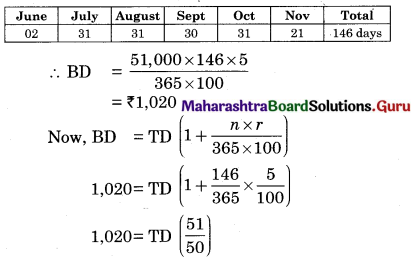
Maharashtra Board 12th Commerce Maths Solutions Chapter 1 Commission, Brokerage and Discount Ex 1.2 Q13
∴ TD = ₹ 1,000
∴ BG = BD – TD
= 1,020 – 1,000
= ₹ 20

Question 14.
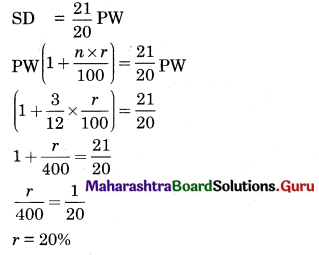
A certain sum due 3 months hence is \(\frac{21}{20}\) of the present worth, what is the rate of interest.
Solution:
Maharashtra Board 12th Commerce Maths Solutions Chapter 1 Commission, Brokerage and Discount Ex 1.2 Q14

Maharashtra Board 12th Commerce Maths Solutions Chapter 1 Commission, Brokerage and Discount Ex 1.2

Question 15.
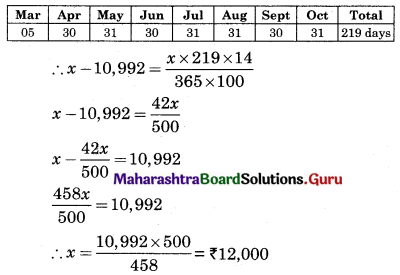
A bill of a certain sum drawn on 28th February 2007 for 8 months was encashed on 26th March 2007 for ₹ 10,992 at 14% p.a. Find the face value of the bill.
Solution:
Date drawing = 28/02/2007
Period of the bill = 8 months
Nominal due date = 28/10/2007
Legal due date = 31/10/2007
Date of discounting = 26/03/2007
Cash value = ₹ 10,992
Rate of interest = 14%
Let face value of the bill = ₹ x
Bankers discount = Face value – Cash value = x – 10,992
Also, Banker s discount = \(\frac{F V \times n \times r}{365 \times 100}\)
Where n is the unexpired days
Maharashtra Board 12th Commerce Maths Solutions Chapter 1 Commission, Brokerage and Discount Ex 1.2 Q15
Thus face value of the bill = ₹ 12,000

12th Commerce Maths Digest Pdf

12th Commerce Maths 2 Chapter 1 Exercise 1.1 Answers Maharashtra Board

Commission, Brokerage and Discount Class 12 Commerce Maths 2 Chapter 1 Exercise 1.1 Answers Maharashtra Board

Balbharati Maharashtra State Board 12th Commerce Maths Digest Pdf Chapter 1 Commission, Brokerage and Discount Ex 1.1 Questions and Answers.

Std 12 Maths 2 Exercise 1.1 Solutions Commerce Maths

Question 1.
An agent charges a 12% commission on the sales. What does he earn if the total sale amounts to ₹ 48,000? What does the seller get?
Solution:
Rate of commission = 12%
Total sales = ₹ 48,000
Agent’s commission = \(\frac {12}{100}\) × 48,000
= ₹ 5,760
Amount received by the seller = Total sales – commission
= ₹ 8,000 – ₹ 5760
= ₹ 2,240

Question 2.
A salesman receives a 3% commission on sales up to ₹ 50,000 and a 4% commission on sales over ₹ 50,000. Find his total income on the sale of ₹ 2,00,000.
Solution:
Total sales = ₹ 2,00,000
Rate of commission upto ₹ 50,000 = 3%
= \(\frac{3}{100}\) × 50,000
= ₹ 1,500
Rate of commission on the sales over ₹ 50,000 = 4%
Sales over ₹ 50,000 is 2,00,000 – 50,000 = ₹ 1,50,000
Commission on sales over ₹ 50,000 = \(\frac{4}{100}\) × 1,50,000 = ₹ 6,000
His total income = ₹ 1,500 + ₹ 6,000 = ₹ 7,500

Maharashtra Board 12th Commerce Maths Solutions Chapter 1 Commission, Brokerage and Discount Ex 1.1

Question 3.
Ms. Saraswati was paid ₹ 88,000 as commission on the sale of computers at the rate of 12.5%. If the price of each computer was ₹ 32,000, how many computers did she sell?
Solution:
Total commission = ₹ 88,000
Rate of commission = 12.5%
Let the number of computers sold be x
since price of each computer = ₹ 32,000
Total sales = ₹ 32,000x
Total commission = 12.5% of total sales
88,000 = \(\frac{12.5}{100}\) × 32,000x
= \(\frac{125}{1000}\) × 32,000x
x = \(\frac{88,000}{125 \times 32}\)
x = 22

Question 4.
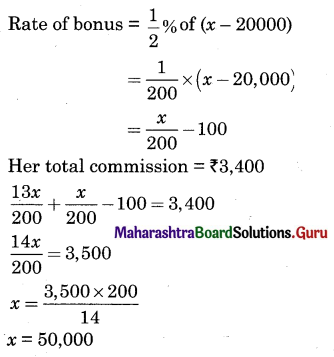
Anita is allowed 6.5% commission on the total sales made by her, plus, a bonus of \(\frac{1}{2}\)% on the sale over ₹ 20,000. If her total commission amounts to ₹ 3,400. Find the sales made by her.
Solution:
Let the total sales made by Anita be ₹ x
Rate of commission = 6.5% of total sales
= \(\frac{6.5}{100} \times x\)
= \(\frac{65 x}{1,000}\)
= \(\frac{13 x}{200}\)
Maharashtra Board 12th Commerce Maths Solutions Chapter 1 Commission, Brokerage and Discount Ex 1.1 Q4

Question 5.
Priya gets a salary of ₹ 15,000 per month and a commission of 8% on sales over ₹ 50,000. If she gets ₹ 17,400 in a certain month. Find the sales made by her in that month.
Solution:
Let the total sales made by Priya be ₹ x
Salary of Priya = ₹ 15,000
Commission = Total earning – salary
= ₹ 17,400 – ₹ 15,000
= ₹ 2,400
Commission = 8% on the sales over ₹ 50,000
2400 = \(\frac{8}{100}\) (x – 50000)
\(\frac{2,400 \times 100}{8}\) = x – 50,000
30,000 = x – 50,000
30,000 + 50,000 = x
∴ x = ₹ 80,000

Maharashtra Board 12th Commerce Maths Solutions Chapter 1 Commission, Brokerage and Discount Ex 1.1

Question 6.
The income of the broker remains unchanged though the rate of commission is increased from 4% to 5%. Find the percentage reduction in the value of the business.
Solution:
Let the original value of business be ₹ 100
Original rate of commission = 4%
∴ Original commission = \(\frac{4}{100}\) × 100 = ₹ 4
Let the new value of business be ₹ x
The new rate of commission = 5%
∴ New commission = \(\frac{5}{100}\) × x = \(\frac{x}{20}\)
Given, original income = New income
4 = \(\frac{x}{20}\)
∴ x = ₹ 80
Thus there is 20% reduction in the value of the business.

Question 7.
Mr. Pavan is paid a fixed weekly salary plus commission based on a percentage of sales made by him. If on the sale of ₹ 68,000 and ₹ 73,000 in two successive weeks, he received in all ₹ 9,880 and ₹ 10,180. Find his weekly salary and the rate of commission paid to him.
Solution:
Let the weekly salary of Mr. Pavan be ₹ x and the rate of commission paid to him be y%
Income = Weekly salary + Commission on the sales
∴ 9,880 = x + \(\frac{y}{100}\) × 68,000
i.e. 9,880 = x + 680y …….(1)
Also, 10,180 = x + \(\frac{y}{100}\) × 73,000
i.e 10,180 = x + 730y ………(2)
Subtracting (1) from (2), we get
50y = 300
∴ y = 6
Substituting y = 6 in equation (1)
9,880 = x + 680(6) ‘
∴ 9,880 – 4,080 = x
∴ x = 5,800
Weekly salary = ₹ 5,800
Rate of commission = 6%

Question 8.
Deepak’s salary was increased from ₹ 4,000 to ₹ 5,000. The sales being the same, due to a reduction in the rate of commission from 3% to 2%, his income remained unchanged. Find his sales.
Solution:
Let Deepak’s total sales be ₹ x
Original salary of Deepak = ₹ 4,000
Original rate of commission = 3%
His new salary = ₹ 5,000
New rate of commission = 2%
Original income = New income (given)
4000 + \(\frac{3 x}{100}\) = 5000 + \(\frac{2 x}{100}\)
\(\frac{3 x}{100}-\frac{2 x}{100}\) = 5,000 – 4,000
\(\frac{x}{100}\) = 1000
x = ₹ 1,00,000
∴ His total sales = ₹ 1,00,000

Maharashtra Board 12th Commerce Maths Solutions Chapter 1 Commission, Brokerage and Discount Ex 1.1

Question 9.
An agent is paid a commission of 7% on cash sales and 5% on credit sales made by him. If on the sale of ₹ 1,02,000 the agent claims a total commission of ₹ 6,420, find his cash sales and credit sales.
Solution:
Total Sales = ₹ 1,02,000
Let cash sales ₹ x
∴ Credit sales = ₹ (1,02,000 – x)
Agent’s commission on cash sales = 7%
= \(\frac{7}{100}\) × x
= \(\frac{7x}{100}\)
Commission on credit sales = 5%
= \(\frac{5}{100}\)(1,02,000 – x)
Given, Total commission = ₹ 6,420
∴ \(\frac{7x}{100}\) + \(\frac{5}{100}\)(1,02,000 – x) = 6420
∴ \(\frac{7x}{100}\) + 5100 – \(\frac{5x}{100}\) = 6,420
∴ \(\frac{2x}{100}\) = 6,420 – 5,100
∴ \(\frac{2x}{100}\) = 1320
∴ x = ₹ 66,000
∴ Cash sales = ₹ 66,000
∴ Credit sales = 1,02000 – 66,000 = ₹ 36,000

Question 10.
Three cars were sold through an agent for ₹ 2,40,000, ₹ 2,22,000 and ₹ 2,25,000 respectively. The rates of the commission were 17.5% on the first, 12.5% on the second. If the agent overall received 14% commission on the total sales, find the rate of commission paid on the third car.
Solution:
Total selling price of three cars = 2,40,000 + 2,22,000 + 2,25,000 = ₹ 6,87,000
Commission on total sales = 14%
= \(\frac{14}{100}\) × 6,87,000
= ₹ 96,180
Selling price of first car = ₹ 2,40,000
Rate of commission = 17.5% = \(\frac{17.5}{100}\) × 2,40,000
∴ Commission on first car = ₹ 42,000
Selling price of second car = ₹ 2,22,000
Rate of commission = 12.5% = \(\frac{12.5}{100}\) × 2,22,000
∴ Commission on second car = ₹ 27,750
Selling price of third car = ₹ 2,25,000
Let the rate of commission be x%
Commission on third car = \(\frac{x}{100}\) × 2,25,000
96,180 – (42,000 + 27,750) = \(\frac{x}{100}\) × 2,25,000
\(\frac{26,430 \times 100}{2,25,000}\) = x
∴ x = 11.75
∴ Rate of commission on the third car = 11.75%

Question 11.
Swatantra Distributors allows a 15% discount on the list price of the washing machines. Further 5% discount is giver for cash payment. Find the list price of the washing machine if it was sold for the net amount of ₹ 38,356.25.
Solution:
Let the list price of the washing machine be ₹ 100
Trade discount = 15% = \(\frac{15}{100}\) × 100 = ₹ 15
∴ Invoice price =100 – 15 = ₹ 85
Cash discount = 5% = \(\frac{5}{100}\) × 85 = ₹ 4.25
∴ Net price = 85 – 4.25 = ₹ 80.75
Thus if List price is 100 than Net price is 80.75
if List price is x than Net price is 38,356.25.
∴ x = \(\frac{38356.25 \times 100}{80.75}\)
∴ x = ₹ 47,500
The list price of the washing machine is ₹ 47,500

Maharashtra Board 12th Commerce Maths Solutions Chapter 1 Commission, Brokerage and Discount Ex 1.1

Question 12.
A bookseller received ₹ 1,530 as a 15% commission on the list price. Find the list price of the books.
Solution:
Let the list price of the books be ₹ x
Rate of commission = 15%
Book seller’s commission = ₹ 1,530
∴ \(\frac{15}{100}\) × x = 1,530
∴ x = \(\frac{1,530 \times 100}{15}\)
∴ x = ₹ 10,200

Question 13.
A retailer sold a suit for ₹ 8,832 after allowing an 8% discount on market price and a further 4% cash discount. If he made 38% profit, find the cost price and the market price of the suit.
Solution:
Let the marked price of the suit be ₹ 100
Trade discount = 8% = \(\frac{8}{100}\) × 100 = ₹ 8
Invoice price = 100 – 8 = ₹ 92
Cash discount = 4% = \(\frac{4}{100}\) × 92 = ₹ 3.68
∴ Net price = 92 – 3.68 = ₹ 88.32
Thus if list price is 100 then net price is 88.32, if list price is x then net price is 8,832
∴ x = \(\frac{8,832 \times 100}{88.32}\)
∴ x = ₹ 10,000
The retailer made 38% profit.
Let the CP of the suit be ₹ 100
∴ SP of the suit = 100 + 38 = ₹ 138
Thus if the SP of the suit is ₹ 138 then its CP is ₹ 100
If the SP of the suit is 88.32 then its
CP = \(\frac{88.32 \times 100}{138}\) = ₹ 6400

Question 14.
An agent charges 10% commission plus 2% delcredere. If he sells goods worth ₹ 37,200, find his total earnings.
Solution:
Total sales = ₹ 37,200
Rate of commission = 10%
Agents commission = \(\frac{4}{100}\) × 37200 = ₹ 3720
Rate of delcredere = 2%
Amount of delcredere = \(\frac{2}{100}\) × 37,200 = ₹ 744
Total earning of the agent = ₹ 3,720 + ₹ 744 = ₹ 4,464

Maharashtra Board 12th Commerce Maths Solutions Chapter 1 Commission, Brokerage and Discount Ex 1.1

Question 15.
A whole seller allows a 25% trade discount and 5% cash discount. What will be the net price of an article marked at ₹ 1600?
Solution:
Marked price of the article = ₹ 1,600
Trade discount = 25%
= \(\frac{25}{100}\) × 1,600
= ₹ 400
∴ Invoice price = 1,600 – 400 = ₹ 1,200
Cash discount = 5%
= \(\frac{5}{100}\) × 1,200
= ₹ 60
∴ Net price = 1,200 – 60 = ₹ 1,140

12th Commerce Maths Digest Pdf

12th Commerce Maths 2 Chapter 8 Miscellaneous Exercise 8 Answers Maharashtra Board

Probability Distributions Class 12 Commerce Maths 2 Chapter 8 Miscellaneous Exercise 8 Answers Maharashtra Board

Balbharati Maharashtra State Board 12th Commerce Maths Solution Book Pdf Chapter 8 Probability Distributions Miscellaneous Exercise 8 Questions and Answers.

Std 12 Maths 2 Miscellaneous Exercise 8 Solutions Commerce Maths

(I) Choose the correct alternative.

Question 1.
F(x) is c.d.f. of discreter r.v. X whose p.m.f. is given by P(x) = \(k\left(\begin{array}{l}
4 \\
x
\end{array}\right)\), for x = 0, 1, 2, 3, 4 & P(x) = 0 otherwise then F(5) = __________
(a) \(\frac{1}{16}\)
(b) \(\frac{1}{8}\)
(c) \(\frac{1}{4}\)
(d) 1
Answer:
(d) 1

Question 2.
F(x) is c.d.f. of discrete r.v. X whose distribution is
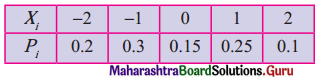
Maharashtra Board 12th Commerce Maths Solutions Chapter 8 Probability Distributions Miscellaneous Exercise 8 I Q2
then F(-3) = __________
(a) 0
(b) 1
(c) 0.2
(d) 0.15
Answer:
(a) 0

Maharashtra Board 12th Commerce Maths Solutions Chapter 8 Probability Distributions Miscellaneous Exercise 8

Question 3.
X : number obtained on uppermost face when a fair die is thrown then E(X) = __________
(a) 3.0
(b) 3.5
(c) 4.0
(d) 4.5
Answer:
(b) 3.5

Question 4.
If p.m.f. of r.v. X is given below.
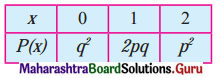
Maharashtra Board 12th Commerce Maths Solutions Chapter 8 Probability Distributions Miscellaneous Exercise 8 I Q4
then Var(X) = __________
(a) p2
(b) q2
(c) pq
(d) 2pq
Answer:
(d) 2pq

Question 5.
The expected value of the sum of two numbers obtained when two fair dice are rolled is __________
(a) 5
(b) 6
(c) 7
(d) 8
Answer:
(c) 7

Question 6.
Given p.d.f. of a continuous r.v. X as
f(x) = \(\frac{x^{2}}{3}\) for -1 < x < 2
= 0 otherwise then F(1) =
(a) \(\frac{1}{9}\)
(b) \(\frac{2}{9}\)
(c) \(\frac{3}{9}\)
(d) \(\frac{4}{9}\)
Answer:
(b) \(\frac{2}{9}\)

Question 7.
X is r.v. with p.d.f.
f(x) = \(\frac{k}{\sqrt{x}}\), 0 < x < 4
= 0 otherwise then E(X) = __________
(a) \(\frac{1}{3}\)
(b) \(\frac{4}{3}\)
(c) \(\frac{2}{3}\)
(d) 1
Answer:
(b) \(\frac{4}{3}\)

Question 8.
If X follows B(20, \(\frac{1}{10}\)) then E(X) = __________
(a) 2
(b) 5
(c) 4
(d) 3
Answer:
(a) 2

Question 9.
If E(X) = m and Var(X) = m then X follows __________
(a) Binomial distribution
(b) Possion distribution
(c) Normal distribution
(d) none of the above
Answer:
(b) Possion distribution

Maharashtra Board 12th Commerce Maths Solutions Chapter 8 Probability Distributions Miscellaneous Exercise 8

Question 10.
If E(X) > Var(X) then X follows __________
(a) Binomial distribution
(b) Possion distribution
(c) Normal distribution
(d) none of the above
Answer:
(a) Binomial distribution

(II) Fill in the blanks.

Question 1.
The values of discrete r.v. are generally obtained by __________
Answer:
counting

Question 2.
The values of continuous r.v. are generally obtained by __________
Answer:
measurement

Question 3.
If X is dicrete random variable takes the values x1, x2, x3, …… xn then \(\sum_{i=1}^{n} p\left(x_{i}\right)\) = __________
Answer:
1

Question 4.
If f(x) is distribution function of discrete r.v. X with p.m.f. p(x) = \(\frac{x-1}{3}\) for x = 1, 2, 3, and p(x) = 0 otherwise then F(4) = __________
Answer:
1

Question 5.
If f(x) is distribution function of discrete r.v. X with p.m.f. p(x) = \(k\left(\begin{array}{l}
4 \\
x
\end{array}\right)\) for x = 0, 1, 2, 3, 4, and p(x) = 0 otherwise then F(-1) = __________
Answer:
0

Maharashtra Board 12th Commerce Maths Solutions Chapter 8 Probability Distributions Miscellaneous Exercise 8

Question 6.
E(X) is considered to be __________ of the probability distribution of X.
Answer:
centre of gravity

Question 7.
If X is continuous r.v. and f(xi) = P(X ≤ xi) = \(\int_{-\infty}^{x_{i}} f(x) d x\) then f(x) is called __________
Answer:
Cumulative Distribution Function

Question 8.
In Binomial distribution probability of success ________ from trial to trial.
Answer:
remains constant/independent

Question 9.
In Binomial distribution, if n is very large and probability success of p is very small such that np = m (constant) then ________ distribution is applied.
Answer:
Possion

(III) State whether each of the following is True or False.

Question 1.
If P(X = x) = \(k\left(\begin{array}{l}
4 \\
x
\end{array}\right)\) for x = 0, 1, 2, 3, 4, then F(5) = \(\frac{1}{4}\) when f(x) is c.d.f.
Answer:
False

Question 2.
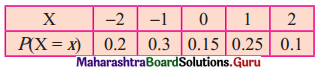
Maharashtra Board 12th Commerce Maths Solutions Chapter 8 Probability Distributions Miscellaneous Exercise 8 III Q2
If F(x) is c.d.f. of discrete r.v. X then F(-3) = 0.
Answer:
True

Question 3.
X is the number obtained on the uppermost face when a die is thrown the E(X) = 3.5.
Answer:
True

Maharashtra Board 12th Commerce Maths Solutions Chapter 8 Probability Distributions Miscellaneous Exercise 8

Question 4.
If p.m.f. of discrete r.v.X is
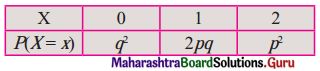
Maharashtra Board 12th Commerce Maths Solutions Chapter 8 Probability Distributions Miscellaneous Exercise 8 III Q4
then E(X) = 2p.
Answer:
True

Question 5.
The p.m.f. of a r.v. X is p(x) = \(\frac{2 x}{n(n+1)}\), x = 1, 2,……n
= 0 otherwise,
Then E(X) = \(\frac{2 n+1}{3}\)
Answer:
True

Question 6.
If f(x) = kx (1 – x) for 0 < x < 1
= 0 otherwise then k = 12
Answer:
False

Question 7.
If X ~ B(n, p) and n = 6 and P(X = 4) = P(X = 2) then p = \(\frac{1}{2}\).
Answer:
True

Question 8.
If r.v. X assumes values 1, 2, 3,………, n with equal probabilities then E(X) = \(\frac{(n+1)}{2}\)
Answer:
True

Question 9.
If r.v. X assumes the values 1, 2, 3,………, 9 with equal probabilities, E(X) = 5.
Answer:
True

(IV) Solve the following problems.

Part – I

Question 1.
Identify the random variable as discrete or continuous in each of the following. Identify its range if it is discrete.
(i) An economist is interested in knowing the number of unemployed graduates in the town with a population of 1 lakh.
Solution:
X = No. of unemployed graduates in a town.
∵ The population of the town is 1 lakh
∴ X takes finite values
∴ X is a Discrete Random Variable
∴ Range of = {0, 1, 2, 4, …. 1,00,000}

(ii) Amount of syrup prescribed by a physician.
Solution:
X : Amount of syrup prescribed.
∴ X Takes infinite values
∴ X is a Continuous Random Variable.

(iii) A person on a high protein diet is interested in the weight gained in a week.
Solution:
X : Gain in weight in a week.
X takes infinite values
∴ X is a Continuous Random Variable.

Maharashtra Board 12th Commerce Maths Solutions Chapter 8 Probability Distributions Miscellaneous Exercise 8

(iv) Twelve of 20 white rats available for an experiment are male. A scientist randomly selects 5 rats and counts the number of female rats among them.
Solution:
X : No. of female rats selected
X takes finite values.
∴ X is a Discrete Random Variable.
Range of X = {0, 1, 2, 3, 4, 5}

(v) A highway safety group is interested in the speed (km/hrs) of a car at a checkpoint.
Solution:
X : Speed of car in km/hr
X takes infinite values
∴ X is a Continuous Random Variable.

Question 2.
The probability distribution of a discrete r.v. X is as follows.
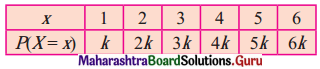
Maharashtra Board 12th Commerce Maths Solutions Chapter 8 Probability Distributions Miscellaneous Exercise 8 IV Part 1 Q2
(i) Determine the value of k.
(ii) Find P(X ≤ 4), P(2 < X < 4), P(X ≥ 3).
Solution:
(i) Assuming that the given distribution is a p.m.f. of X
∴ Each P(X = x) ≥ 0 for x = 1, 2, 3, 4, 5, 6
k ≥ 0
ΣP(X = x) = 1 and
k + 2k + 3k + 4k + 5k + 6k = 1
∴ 21k = 1 ∴ k = \(\frac{1}{21}\)

(ii) P(X ≤ 4) = 1 – P(X > 4)
= 1 – [P(X = 5) + P(X = 6)]
= 1 – [latex]\frac{5}{21}+\frac{6}{21}[/latex]
= 1 – \(\frac{11}{21}\)
= \(\frac{10}{21}\)
P(2 < X < 6) = p(3) + p(4) + p(5)
= 3k + 4k + 5k
= \(\frac{3}{21}+\frac{4}{21}+\frac{5}{21}\)
= \(\frac{12}{21}\)
= \(\frac{4}{7}\)

(iii) P(X ≥ 3) = p(3) + p(4) + p(5) + p(6)
= 3k + 4k + 5k + 6k
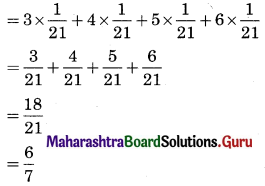
Maharashtra Board 12th Commerce Maths Solutions Chapter 8 Probability Distributions Miscellaneous Exercise 8 IV Part 1 Q2.1

Question 3.
Following is the probability distribution of an r.v. X.
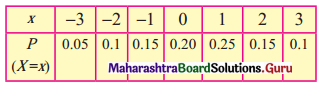
Maharashtra Board 12th Commerce Maths Solutions Chapter 8 Probability Distributions Miscellaneous Exercise 8 IV Part 1 Q3
Find the probability that
(i) X is positive.
(ii) X is non-negative.
(iii) X is odd.
(iv) X is even.
Solution:
(i) P(X is positive)
P(X = 0) = p(1) + p(2) + p(3)
= 0.25 + 0.15 + 0.10
= 0.50

(ii) P(X is non-negative)
P(X ≥ 0) = p(0) + p(1) + p(2) + p(3)
= 0.20 + 0.25 + 0.15 + 0.10
= 0.70

(iii) P(X is odd)
P(X = -3, -1, 1, 3)
= p(- 3) +p(-1) + p(1) + p(3)
= 0.05 + 0.15 + 0.25 + 0.10
= 0.55

(iv) P(X is even)
= 1 – P(X is odd)
= 1 – 0.55
= 0.45

Maharashtra Board 12th Commerce Maths Solutions Chapter 8 Probability Distributions Miscellaneous Exercise 8

Question 4.
The p.m.f of a r.v. X is given by
\(P(X=x)= \begin{cases}\left(\begin{array}{l}
5 \\
x
\end{array}\right) \frac{1}{2^{5}}, & x=0,1,2,3,4,5 . \\
0 & \text { otherwise }\end{cases}\)
Show that P(X ≤ 2) = P(X ≥ 3).
Solution:
For x = 0, 1, 2, 3, 4, 5
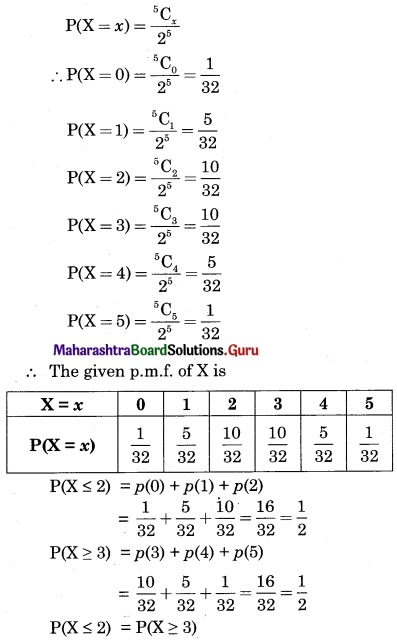
Maharashtra Board 12th Commerce Maths Solutions Chapter 8 Probability Distributions Miscellaneous Exercise 8 IV Part 1 Q4

Question 5.
In the following probability distribution of an r.v. X
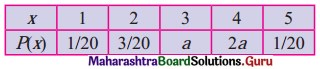
Maharashtra Board 12th Commerce Maths Solutions Chapter 8 Probability Distributions Miscellaneous Exercise 8 IV Part 1 Q5
Find a and obtain the c.d.f. of X.
Solution:
Given distribution is p.m.f. of r.v. X
ΣP(X = x) = 1
∴ p(1) + p(2) + p(3) + p(4) + p(5) = 1
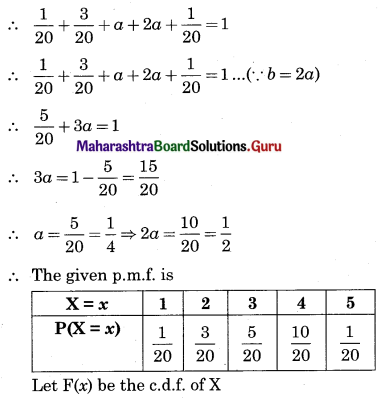
Maharashtra Board 12th Commerce Maths Solutions Chapter 8 Probability Distributions Miscellaneous Exercise 8 IV Part 1 Q5.1
Maharashtra Board 12th Commerce Maths Solutions Chapter 8 Probability Distributions Miscellaneous Exercise 8 IV Part 1 Q5.2

Question 6.
A fair coin is tossed 4 times. Let X denote the number of heads obtained. Identify the probability distribution of X and state the formula for p.m.f. of X.
Solution:
A fair coin is tossed 4 times
∴ Sample space contains 16 outcomes
Let X = Number of heads obtained
∴ X takes the values x = 0, 1, 2, 3, 4.
∴ The number of heads obtained in a toss is an even
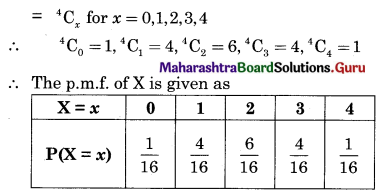
Maharashtra Board 12th Commerce Maths Solutions Chapter 8 Probability Distributions Miscellaneous Exercise 8 IV Part 1 Q6

Question 7.
Find the probability of the number of successes in two tosses of a die, where success is defined as (i) number greater than 4 (ii) six appearing in at least one toss.
Solution:
S : A die is tossed two times
S = {(1, 1), (1, 2), (1, 3), (1, 4), (1, 5), (1, 6), (2, 1), (2, 2), (2, 3), (2, 4), (2, 5), (2, 6), (3, 1), (3, 2), (3, 3), (3, 4), (3, 5), (3, 6), (4, 1), (4, 2), (4, 3), (4, 4), (4, 5), (4, 6), (5, 1), (5, 2), (5, 3), (5, 4), (5, 5), (5, 6), (6, 1), (6, 2), (6, 3), (6, 4), (6, 5), (6, 6)}
n(S) = 36
(i) X : No. is greater than 4
Range of X = {0, 1, 2}
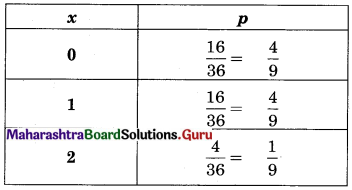
Maharashtra Board 12th Commerce Maths Solutions Chapter 8 Probability Distributions Miscellaneous Exercise 8 IV Part 1 Q7

(ii) X : Six appears on aleast one die.
Range of X = {0, 1, 2}
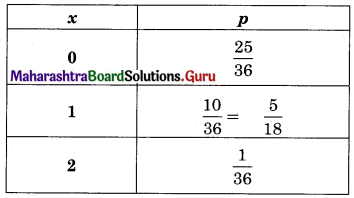
Maharashtra Board 12th Commerce Maths Solutions Chapter 8 Probability Distributions Miscellaneous Exercise 8 IV Part 1 Q7.1

Question 8.
A random variable X has the following probability distribution.
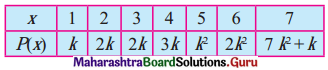
Maharashtra Board 12th Commerce Maths Solutions Chapter 8 Probability Distributions Miscellaneous Exercise 8 IV Part 1 Q8
Determine (i) k, (ii) P(X < 3), (iii) P(X > 6), (iv) P(0 < X < 3).
Solution:
(i) It is a p.m.f. of r.v. X
Σp(x) = 1
p(1) + p(2) + p(3) + p(4) + p(5) + p(6) + p(7) = 1
k + 2k + 2k + 3k + k2 + 2k2 + 7k2 + k = 1
9k + 10k2 = 1
10k2 + 9k – 1 = 0
10k2 +10k – k – 1 = 0
∴ 10k(k + 1) – 1(k + 1) = 0
∴ (10k – 1) (k + 1) = 0
∴ 10k – 1 = 0r k + 1 = 0
∴ k = \(\frac{1}{10}\) or k = -1
k = -1 is not accepted, p(x) ≥ 0, ∀ x ∈ R
∴ k = \(\frac{1}{10}\)

Maharashtra Board 12th Commerce Maths Solutions Chapter 8 Probability Distributions Miscellaneous Exercise 8

(ii) P(X < 3) = p(1) + p(2)
= k + 2k
= 3k
= 3 × \(\frac{1}{10}\)
= \(\frac{3}{10}\)

(iii) P(X > 6) = p(7)
= 7k2 + k
= \(7\left(\frac{1}{10}\right)^{2}+\frac{1}{10}\)
= \(\frac{7}{100}+\frac{1}{10}\)
= \(\frac{17}{100}\)

(iv) P(0 < X < 3) = p(1) + p(2)
= k + 2k
= 3k
= 3 × \(\frac{1}{10}\)
= \(\frac{3}{10}\)

Question 9.
The following is the c.d.f. of a r.v. X.

Maharashtra Board 12th Commerce Maths Solutions Chapter 8 Probability Distributions Miscellaneous Exercise 8 IV Part 1 Q9
Find the probability distribution of X and P(-1 ≤ X ≤ 2).
Solution:
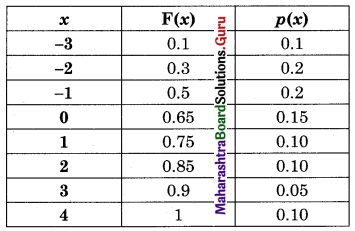
Maharashtra Board 12th Commerce Maths Solutions Chapter 8 Probability Distributions Miscellaneous Exercise 8 IV Part 1 Q9.1
P(-1 ≤ X ≤ 2) = p(-1) + p(0) + p(1) + p(2)
= 0.2 + 0.15 + 0.10 + 0.10
= 0.55

Question 10.
Find the expected value and variance of the r.v. X if its probability distribution is as follows.
(i)
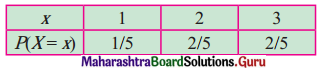
Maharashtra Board 12th Commerce Maths Solutions Chapter 8 Probability Distributions Miscellaneous Exercise 8 IV Part 1 Q10(i)
Solution:
Maharashtra Board 12th Commerce Maths Solutions Chapter 8 Probability Distributions Miscellaneous Exercise 8 IV Part 1 Q10(i).1

(ii)
Maharashtra Board 12th Commerce Maths Solutions Chapter 8 Probability Distributions Miscellaneous Exercise 8 IV Part 1 Q10(ii)
Solution:
E(X) = Σx . p(x)
Maharashtra Board 12th Commerce Maths Solutions Chapter 8 Probability Distributions Miscellaneous Exercise 8 IV Part 1 Q10(ii).1

(iii)
Maharashtra Board 12th Commerce Maths Solutions Chapter 8 Probability Distributions Miscellaneous Exercise 8 IV Part 1 Q10(iii)
Solution:
Maharashtra Board 12th Commerce Maths Solutions Chapter 8 Probability Distributions Miscellaneous Exercise 8 IV Part 1 Q10(iii).1
Maharashtra Board 12th Commerce Maths Solutions Chapter 8 Probability Distributions Miscellaneous Exercise 8 IV Part 1 Q10(iii).2

(iv)
Maharashtra Board 12th Commerce Maths Solutions Chapter 8 Probability Distributions Miscellaneous Exercise 8 IV Part 1 Q10(iv)
Solution:
Maharashtra Board 12th Commerce Maths Solutions Chapter 8 Probability Distributions Miscellaneous Exercise 8 IV Part 1 Q10(iv).1
= 1.25
S.D. of X = σx = √Var(X)
= √1.25
= 1.118

Question 11.
A player tosses two coins. He wins ₹ 10 if 2 heads appear, ₹ 5 if 1 head appears, and ₹ 2 if no head appears. Find the expected value and variance of the winning amount.
Solution:
S : Two fair coin are tossed
S = {HH, HT, TT, TH}
n(S) = 4
∴ Range of X = {0, 1, 2}
∴ Let Y = amount received corresponds to values of X
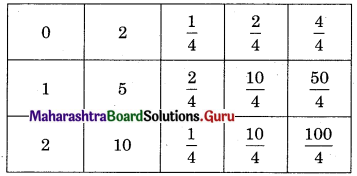
Maharashtra Board 12th Commerce Maths Solutions Chapter 8 Probability Distributions Miscellaneous Exercise 8 IV Part 1 Q11
Expected winning amount
E(Y) = Σpy = \(\frac{22}{4}\) = ₹ 5.5
V(Y) = Σpy2 – (Σpy)2
= \(\frac{154}{4}\) – (5.5)2
= 38.5 – 30.25
= ₹ 8.25

Maharashtra Board 12th Commerce Maths Solutions Chapter 8 Probability Distributions Miscellaneous Exercise 8

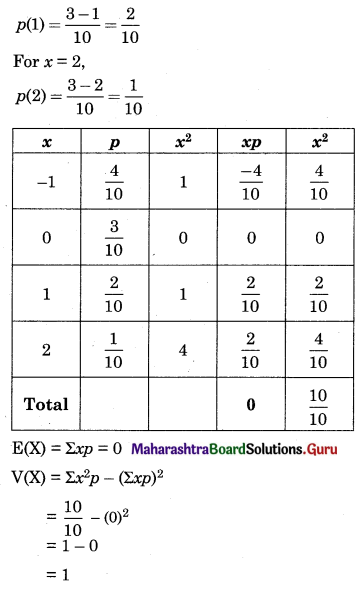
Question 12.
Let the p.m.f. of the r.v. X be
\(p(x)= \begin{cases}\frac{3-x}{10} & \text { for } x=-1,0,1,2 \\ 0 & \text { otherwise }\end{cases}\)
Calculate E(X) and Var(X).
Solution:
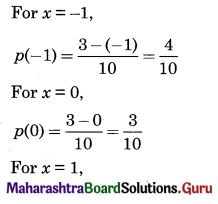
Maharashtra Board 12th Commerce Maths Solutions Chapter 8 Probability Distributions Miscellaneous Exercise 8 IV Part 1 Q12
Maharashtra Board 12th Commerce Maths Solutions Chapter 8 Probability Distributions Miscellaneous Exercise 8 IV Part 1 Q12.1

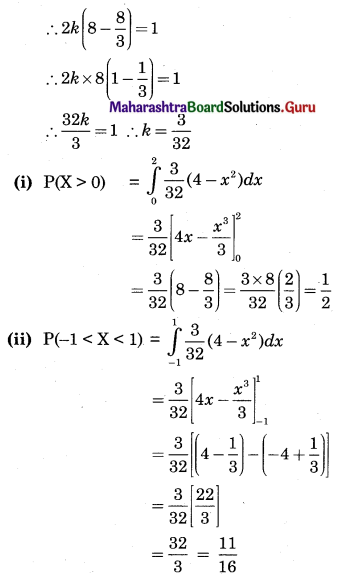
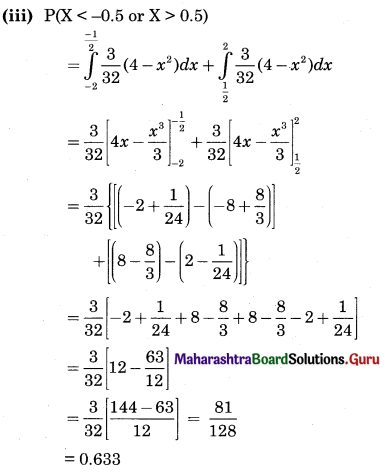
Question 13.
Suppose error involved in making a certain measurement is a continuous r.v. X with p.d.f.
\(f(x)= \begin{cases}k\left(4-x^{2}\right) & \text { for }-2 \leq x \leq 2 \\ 0 & \text { otherwise }\end{cases}\)
Compute (i) P(X > 0), (ii) P(-1 < X < 1), (iii) P(X < -0.5 or X > 0.5)
Solution:
We know that
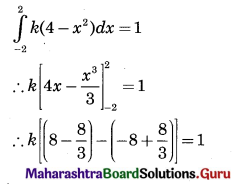
Maharashtra Board 12th Commerce Maths Solutions Chapter 8 Probability Distributions Miscellaneous Exercise 8 IV Part 1 Q13
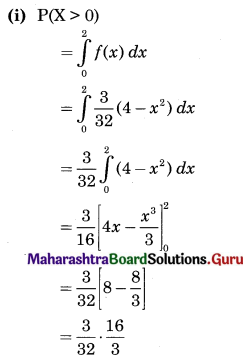
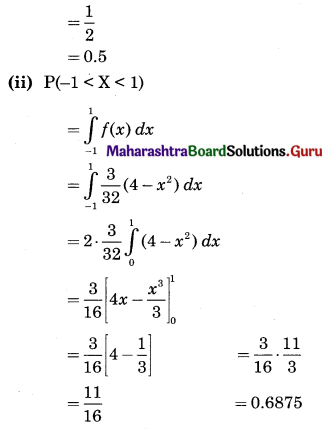
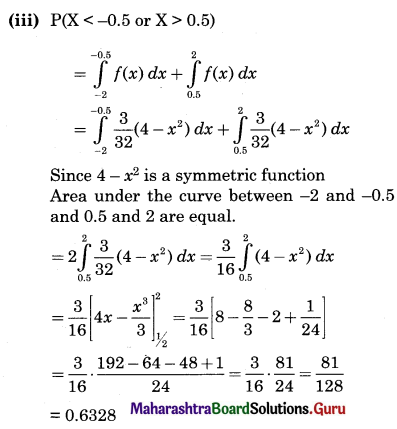
Maharashtra Board 12th Commerce Maths Solutions Chapter 8 Probability Distributions Miscellaneous Exercise 8 IV Part 1 Q13.1
Maharashtra Board 12th Commerce Maths Solutions Chapter 8 Probability Distributions Miscellaneous Exercise 8 IV Part 1 Q13.2

Question 14.
The p.d.f. of the r.v. X is given by
\(f(x)= \begin{cases}\frac{1}{2 a} & \text { for } 0<x<2 a \\ 0 & \text { otherwise }\end{cases}\)
Show that P(X < \(\frac{a}{2}\)) = P(X > \(\frac{3a}{2}\))
Solution:
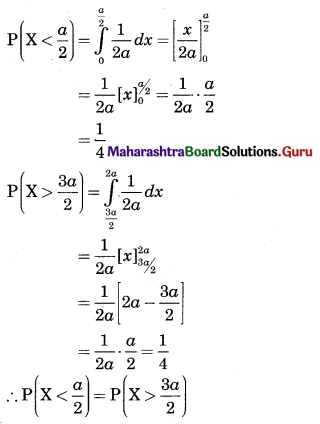
Maharashtra Board 12th Commerce Maths Solutions Chapter 8 Probability Distributions Miscellaneous Exercise 8 IV Part 1 Q14

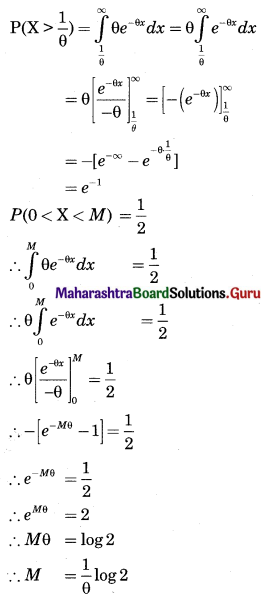
Question 15.
Determine k if
\(f(x)= \begin{cases}k e^{-\theta x} & \text { for } 0 \leq x<\infty, \theta>0 \\ 0 & \text { otherwise }\end{cases}\)
is the p.d.f. of the r.v. X. Also find P(X > \(\frac{1}{\theta}\)). Find M if P(0 < X < M) = \(\frac{1}{2}\)
Solution:
We know that
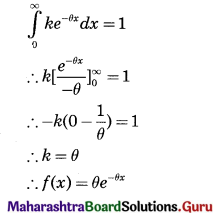
Maharashtra Board 12th Commerce Maths Solutions Chapter 8 Probability Distributions Miscellaneous Exercise 8 IV Part 1 Q15
Maharashtra Board 12th Commerce Maths Solutions Chapter 8 Probability Distributions Miscellaneous Exercise 8 IV Part 1 Q15.1

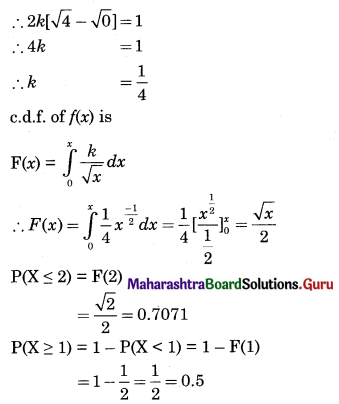
Question 16.
The p.d.f. of the r.v. X is given by
\(f_{x}(x)=\left\{\begin{array}{l}
\frac{k}{\sqrt{x}}, 0<x<4 \\
0, \text { otherwise }
\end{array}\right.\)
Determine k, c.d.f. of X and hence find P(X ≤ 2) and P(X ≥ 1).
Solution:
We know that
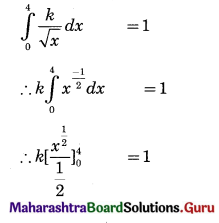
Maharashtra Board 12th Commerce Maths Solutions Chapter 8 Probability Distributions Miscellaneous Exercise 8 IV Part 1 Q16
Maharashtra Board 12th Commerce Maths Solutions Chapter 8 Probability Distributions Miscellaneous Exercise 8 IV Part 1 Q16.1

Question 17.
Let X denote the reaction temperature (in °C) of a certain chemical process. Let X be a continuous r.v. with p.d.f.
\(f(x)= \begin{cases}\frac{1}{10}, & -5 \leq x \leq 5 \\ 0, & \text { otherwise }\end{cases}\)
Compute P(X < 0).
Solution:
Given p.d.f. is f(x) = \(\frac{1}{10}\), for -5 ≤ x ≤ 5
Let its c.d.f. F(x) be given by
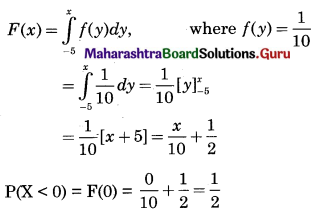
Maharashtra Board 12th Commerce Maths Solutions Chapter 8 Probability Distributions Miscellaneous Exercise 8 IV Part 1 Q17

Part – II

Question 1.
Let X ~ B(10, 0.2). Find (i) P(X = 1) (ii) P(X ≥ 1) (iii) P(X ≤ 8)
Solution:
X ~ B(10, 0.2)
n = 10, p = 0.2
∴ q = 1 – p = 1 – 0.2 = 0.8
(i) P(X = 1) = 10C1 (0.2)1 (0.8)9 = 0.2684

(ii) P(X ≥ 1) = 1 – P(X < 1)
= 1 – P(X = 0)
= 1 – 10C0 (0.2)0 (0.8)10
= 1 – 0.1074
= 0.8926

(iii) P(X ≤ 8) = 1 – P(x > 1)
= 1 – [p(9) + p(10)]
= 1 – [10C9 (0.2)9 (0.8)1 + 10C10 (0.2)10]
= 1 – 0.00000041984
= 0.9999

Maharashtra Board 12th Commerce Maths Solutions Chapter 8 Probability Distributions Miscellaneous Exercise 8

Question 2.
Let X ~ B(n, p) (i) If n = 10 and E(X) = 5, find p and Var(X), (ii) If E(X) = 5 and Var(X) = 2.5, find n and p.
Solution:
X ~ B(n, p)
(i) n = 10, E(X) = 5
∴ np = 5
∴ 10p = 5
∴ p = \(\frac{1}{2}\)
∴ q = 1 – p = 1 – \(\frac{1}{2}\) = \(\frac{1}{2}\)
V(X) = npq
= 10 × \(\frac{1}{2}\) × \(\frac{1}{2}\)
= 2.5

(ii) E(X) = 5, V(X) = 2.5
∴ np = 5, ∴ npq = 2.5
∴ 5q = 2.5
∴ q = \(\frac{2.5}{5}\) = 0.5, p = 1 – 0.5 = 0.5
But np = 5
∴ n(0.5) = 5
∴ n = 10

Question 3.
If a fair coin is tossed 4 times, find the probability that it shows (i) 3 heads, (ii) head in the first 2 tosses, and tail in the last 2 tosses.
Solution:
n : No. of times a coin is tossed
∴ n = 4
X : No. of heads
P : Probability of getting heads
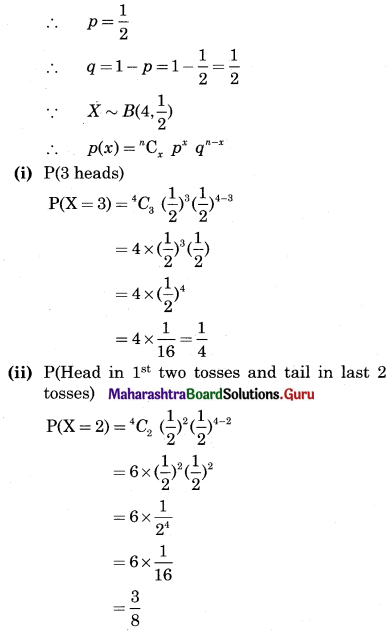
Maharashtra Board 12th Commerce Maths Solutions Chapter 8 Probability Distributions Miscellaneous Exercise 8 IV Part 2 Q3

Question 4.
The probability that a bomb will hit the target is 0.8. Find the probability that, out of 5 bombs, exactly 2 will miss the target.
Solution:
X : No. of bombs miss the target
p : Probability that bomb miss the target
∴ q = 0.8
∴ p = 1 – q = 1 – 0.8 = 0.2
n = No. of bombs = 5
∴ X ~ B(5, 0.2)
∴ p(x) = nCx px qn-x
P(X = 2) = 5C2 (0.2)2 (0.8)5-2
= 10 × 0.04 × (0.8)3
= 10 × 0.04 × 0.512
= 0.4 × 0.512
= 0.2048

Maharashtra Board 12th Commerce Maths Solutions Chapter 8 Probability Distributions Miscellaneous Exercise 8

Question 5.
The probability that a lamp in the classroom will burn is 0.3. 3 lamps are fitted in the classroom. The classroom is unusable if the number of lamps burning in it is less than 2. Find the probability that the classroom can not be used on a random occasion.
Solution:
X : No. of lamps not burning
p : Probability that the lamp is not burning
∴ q = 0.3
∴ p = 1 – q = 1 – 0.3 = 0.7
n = No. of lamps fitted = 3
∴ X ~ B(3, 0.7)
∴ p(x) = nCx px qn-x
P(classroom cannot be used)
P(X < 2) = p(0) + p(1)
= 3C0 (0.7)0 (0.3)3-0 + 3C1 (0.7)1 (0.3)3-1
= 1 × 1 × (0.3)3 + 3 × 0.7 × (0.3)2
= (0.3)2 [0.3 + 3 × 0.7]
= 0.09 [0.3 + 2.1]
= 0.09 [2.4]
= 0.216

Question 6.
A large chain retailer purchases an electric device from the manufacturer. The manufacturer indicates that the defective rate of the device is 10%. The inspector of the retailer randomly selects 4 items from a shipment. Find the probability that the inspector finds at most one defective item in the 4 selected items.
Solution:
X : No. of defective items
n : No. of items selected = 4
p : Probability of getting defective items
∴ p = 0.1
∴ q = 1 – p = 1 – 0.1 = 0.9
P(At most one defective item)
P(X ≤ 1) = p(0) + p(1)
= 4C0 (0.1)0 (0.9)4-0 + 4C1 (0.1)1 (0.9)4-1
= 1 × 1 × (0.9)4 + 4 × 0.1 × (0.9)3
= (0.9)3 [0.9 + 4 × 0.1]
= (0.9)3 × [0.9 + 0.4]
= 0.729 × 1.3
= 0.9477

Question 7.
The probability that a component will survive a check test is 0.6. Find the probability that exactly 2 of the next 4 components tested survive.
Solution:
p = 0.6, q = 1 – 0.6 = 0.4, n = 4
x = 2
∴ p(x) = nCx px qn-x
P(X = 2) = 4C2 (0.6)2 (0.4)2 = 0.3456

Maharashtra Board 12th Commerce Maths Solutions Chapter 8 Probability Distributions Miscellaneous Exercise 8

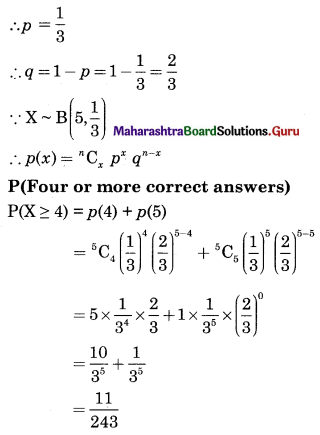
Question 8.
An examination consists of 5 multiple choice questions, in each of which the candidate has to decide which one of 4 suggested answers is correct. A completely unprepared student guesses each answer randomly. Find the probability that this student gets 4 or more correct answers.
Solution:
n : No. of multiple-choice questions
∴ n = 5
X : No. of correct answers
p : Probability of getting correct answer
∵ There are 4 options out of which one is correct
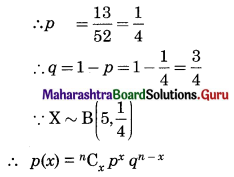
∴ p = \(\frac{1}{4}\)
∴ q = 1 – p = 1 – \(\frac{1}{4}\) = \(\frac{3}{4}\)
∵ X ~ B(5, \(\frac{1}{4}\))
∴ p(x) = nCx px qn-x
P(Four or more correct answers)
P(X ≥ 4) = p(4) + p(5)
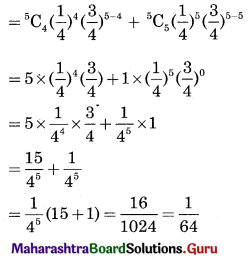
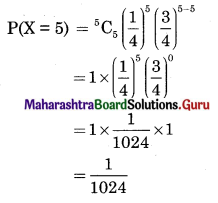
Maharashtra Board 12th Commerce Maths Solutions Chapter 8 Probability Distributions Miscellaneous Exercise 8 IV Part 2 Q8

Question 9.
The probability that a machine will produce all bolts in a production run with in the specification is 0.9. A sample of 3 machines is taken at random. Calculate the probability that all machines will produce all bolts in a production run within the specification.
Solution:
n : No. of samples selected
∴ n = 3
X : No. of bolts produce by machines
p : Probability of getting bolts
∴ p = 0.9
∴ q = 1 – p = 1 – 0.9 = 0.1
∴ X ~ B(3, 0.9)
∴ p(x) = nCx px qn-x
P(Machine will produce all bolts)
P(X = 3) = 3C3 (0.9)3 (0.1)3-3
= 1 × (0.9)3 × (0.1)0
= 1 × (0.9)3 × 1
= (0.9)3
= 0.729

Question 10.
A computer installation has 3 terminals. The probability that anyone terminal requires attention during a week is 0.1, independent of other terminals. Find the probabilities that (i) 0 (ii) 1 terminal requires attention during a week.
Solution:
n : No. of terminals
∴ n = 3
X : No. of terminals need attention
p : Probability of getting terminals need attention
∴ p = 0.1
∴ q = 1 – p = 1 – 0.1 = 0.9
∵ X ~ B(3, 0.1)
∴ p(x) = nCx px qn-x
(i) P(No attention)
∴ P(X = 0) = 3C0 × (0.1)0 (0.9)3-1
= 1 × 1 × (0.9)3
= 0.729

(ii) P(One terminal need attention)
∴ P(X = 1) = 3C1 (0.1)1 (0.9)3-1
= 3 × 0.1 × (0.9)2
= 0.3 × 0.81
= 0.243

Maharashtra Board 12th Commerce Maths Solutions Chapter 8 Probability Distributions Miscellaneous Exercise 8

Question 11.
In a large school, 80% of the students like mathematics. A visitor asks each of 4 students, selected at random, whether they like mathematics, (i) Calculate the probabilities of obtaining an answer yes from all of the selected students, (ii) Find the probability that the visitor obtains the answer yes from at least 3 students.
Solution:
X : No. of students like mathematics
p: Probability that students like mathematics
∴ p = 0.8
∴ q = 1 – p = 1 – 0.8 = 0.2
n : No. of students selected
∴ n = 4
∵ X ~ B(4, 0.8)
∴ p(x) = nCx px qn-x
(i) P(All students like mathematics)
∴ P(X = 4) = 4C4 (0.8)4 (0.2)4-4
= 1 × (0.8)4 × (0.2)0
= 1 × (0.8)4 × 1
= 0.4096

(ii) P(Atleast 3 students like mathematics)
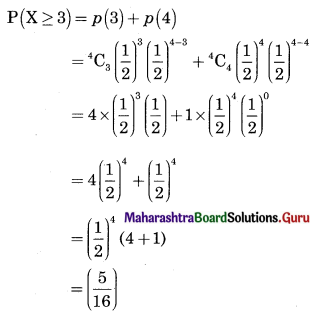
∴ P(X ≥ 3) = p(3) + p(4)
= 4C3 (0.8)3 (0.2)4-3 + 0.4096
= 4 × (0.8)3 (0.2)1 + 0.4096
= 0.8 × (0.8)3 + 0.4096
= (0.8)4 × 0.4096
= 0.4096 + 0.4096
= 0.8192

Question 12.
It is observed that it rains on 10 days out of 30 days. Find the probability that
(i) it rains on exactly 3 days of a week.
(ii) it rains at most 2 days a week.
Solution:
X : No. of days it rains in a week
p : Probability that it rains
∴ p = \(\frac{10}{30}=\frac{1}{3}\)
∴ q = 1 – p = 1 – \(\frac{1}{3}\) = \(\frac{2}{3}\)
n : No. of days in a week
∴ n = 7
∴ X ~ B(7, \(\frac{1}{3}\))
(i) P(Rains on Exactly 3 days of a week)
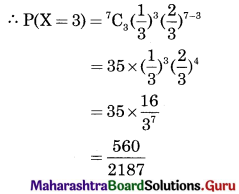
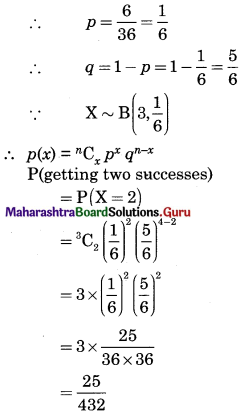
Maharashtra Board 12th Commerce Maths Solutions Chapter 8 Probability Distributions Miscellaneous Exercise 8 IV Part 2 Q12

(ii) P(Rains on at most 2 days of a week)
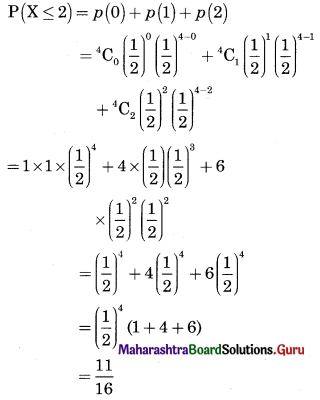
∴ P(X ≤ 2) = p(0) + p(1) + p(2)
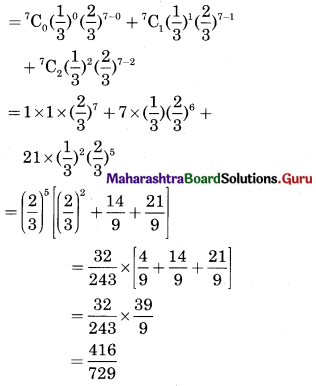
Maharashtra Board 12th Commerce Maths Solutions Chapter 8 Probability Distributions Miscellaneous Exercise 8 IV Part 2 Q12.1

Question 13.
If X follows Poisson distribution such that P(X = 1) = 0.4 and P(X = 2) = 0.2, find variance of X.
Solution:
X : Follows Possion Distribution
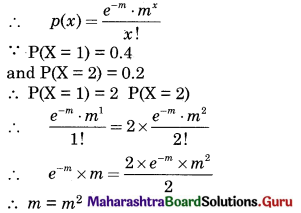
Maharashtra Board 12th Commerce Maths Solutions Chapter 8 Probability Distributions Miscellaneous Exercise 8 IV Part 2 Q13
∴ m = 1
∴ Mean = m = Variance of X = 1

Maharashtra Board 12th Commerce Maths Solutions Chapter 8 Probability Distributions Miscellaneous Exercise 8

Question 14.
If X has Poisson distribution with parameter m, such that
\(\frac{P(X=x+1)}{P(X=x)}=\frac{m}{x+1}\)
find probabilities P(X = 1) and P(X = 2), when X follows Poisson distribution with m = 2 and P(X = 0) = 0.1353.
Solution:
Given that the random variable X follows the Poisson distribution with parameter m = 2
i.e. X ~ P(2)
Its p.m.f. is satisfying the given equation.
\(\frac{P(X=x+1)}{P(X=x)}=\frac{m}{x+1}\)
When x = 0,
\(\frac{\mathrm{P}(\mathrm{X}=1)}{\mathrm{P}(\mathrm{X}=0)}=\frac{2}{0+1}\)
P(X = 1) = 2P(X = 0)
= 2(0.1353)
= 0.2706
When x = 1,
\(\frac{\mathrm{P}(\mathrm{X}=2)}{\mathrm{P}(\mathrm{X}=1)}=\frac{2}{1+1}\)
P(X = 2) = P(X = 1) = 0.2706

12th Commerce Maths Digest Pdf

12th Commerce Maths 2 Chapter 8 Exercise 8.4 Answers Maharashtra Board

Probability Distributions Class 12 Commerce Maths 2 Chapter 8 Exercise 8.4 Answers Maharashtra Board

Balbharati Maharashtra State Board 12th Commerce Maths Solution Book Pdf Chapter 8 Probability Distributions Ex 8.4 Questions and Answers.

Std 12 Maths 2 Exercise 8.4 Solutions Commerce Maths

Question 1.
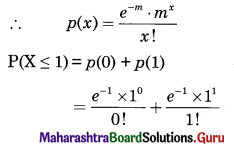
If X has Poisson distribution with m = 1, then find P(X ≤ 1) given e-1 = 0.3678.
Solution:
∵ m = 1
∵ X follows Poisson Distribution
Maharashtra Board 12th Commerce Maths Solutions Chapter 8 Probability Distributions Ex 8.4 Q1
= e-m × 1 + e-m × 1
= e-1 + e-1
= 2 × e-1
= 2 × 0.3678
= 0.7356

Maharashtra Board 12th Commerce Maths Solutions Chapter 8 Probability Distributions Ex 8.4

Question 2.
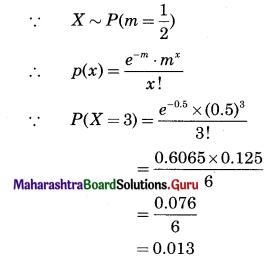
If X ~ P(\(\frac{1}{2}\)), then find P(X = 3) given e-0.5 = 0.6065.
Solution:
Maharashtra Board 12th Commerce Maths Solutions Chapter 8 Probability Distributions Ex 8.4 Q2

Question 3.
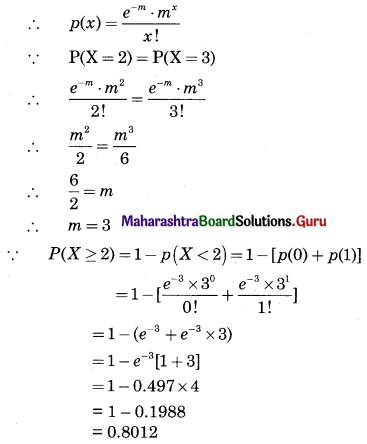
If X has Poisson distribution with parameter m and P(X = 2) = P(X = 3), then find P(X ≥ 2). Use e-3 = 0.0497
Solution:
∵ X follows Poisson Distribution
Maharashtra Board 12th Commerce Maths Solutions Chapter 8 Probability Distributions Ex 8.4 Q3

Question 4.
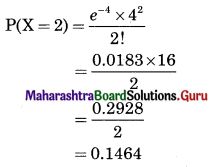
The number of complaints which a bank manager receives per day follows a Poisson distribution with parameter m = 4. Find the probability that the manager receives (i) only two complaints on a given day, (ii) at most two complaints on a given day. Use e-4 = 0.0183.
Solution:
∵ m = 1
∵ X ~ P(m = 4)
∴ p(x) = \(\frac{e^{-m} \cdot m^{x}}{x !}\)
X = No. of complaints recieved
(i) P(Only two complaints on a given day)
Maharashtra Board 12th Commerce Maths Solutions Chapter 8 Probability Distributions Ex 8.4 Q4

(ii) P(Atmost two complaints on a given day)
P(X ≤ 2) = p(0) + p(1) + p(2)
= \(\frac{e^{-4} \times 4^{0}}{0 !}+\frac{e^{-4} \times 4^{1}}{1 !}\) + 0.1464
= e-4 + e-4 × 4 + 0.1464
= e-4 [1 + 4] + 0.1464
= 0.0183 × 5 + 0.1464
= 0.0915 + 0.1464
= 0.2379

Maharashtra Board 12th Commerce Maths Solutions Chapter 8 Probability Distributions Ex 8.4

Question 5.
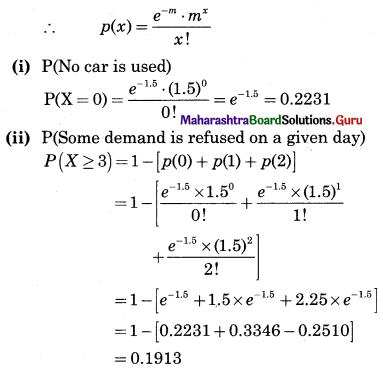
A car firm has 2 cars, which are hired out day by day. The number of cars hired on a day follows a Poisson distribution with a mean of 1.5. Find the probability that
(i) no car is used on a given day.
(ii) some demand is refused on a given day, given e-1.5 = 0.2231.
Solution:
Let X = No. of demands for a car on any day
∴ No. of cars hired
n = 2
m = 1.5
∵ X ~ P(m = 1.5)
Maharashtra Board 12th Commerce Maths Solutions Chapter 8 Probability Distributions Ex 8.4 Q5

Question 6.
Defects on plywood sheets occur at random with an average of one defect per 50 sq. ft. Find the probability that such a sheet has (i) no defect, (ii) at least one defect. Use e-1 = 0.3678.
Solution:
∵ X = No. of defects on a plywood sheet
∵ m = -1
∵ X ~ P(m = -1)
∴ p(x) = \(\frac{e^{-m} \cdot m^{x}}{x !}\)
(i) P(No defect)
P(X = 0) = \(\frac{e^{-1} \times 1^{0}}{0 !}\)
= e-1
= 0.3678

(ii) P(At least one defect)
P(X ≥ 1) = 1 – P(X < 1)
= 1 – p(0)
= 1 – 0.3678
= 0.6322

Maharashtra Board 12th Commerce Maths Solutions Chapter 8 Probability Distributions Ex 8.4

Question 7.
It is known that, in a certain area of a large city, the average number of rats per bungalow is five. Assuming that the number of rats follows Poisson distribution, find the probability that a randomly selected bungalow has
(i) exactly 5 rats
(ii) more than 5 rats
(iii) between 5 and 7 rats, inclusive. Given e-5 = 0.0067.
Solution:
X = No. of rats
∵ m = 5
∴ X ~ P(m = 5)
∴ p(x) = \(\frac{e^{-m} \cdot m^{x}}{x !}\)
(i) P(Exactly five rats)
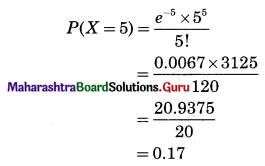
Maharashtra Board 12th Commerce Maths Solutions Chapter 8 Probability Distributions Ex 8.4 Q7

(ii) P(More than five rats)
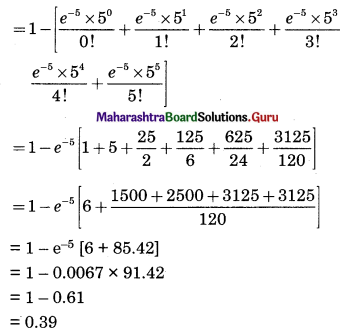
P(X > 5) = 1 – P(X ≤ 5)
Maharashtra Board 12th Commerce Maths Solutions Chapter 8 Probability Distributions Ex 8.4 Q7.1

(iii) P(between 5 and 7 rats, inclusive)
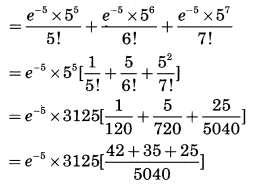
P(5 ≤ x ≤ 7) = p(5) + p(6) + p(7)
Maharashtra Board 12th Commerce Maths Solutions Chapter 8 Probability Distributions Ex 8.4 Q7.2
= 0.0067 × 3125 × 0.02
= 0.0067 × 62.5
= 0.42

12th Commerce Maths Digest Pdf

12th Commerce Maths 2 Chapter 8 Exercise 8.3 Answers Maharashtra Board

Probability Distributions Class 12 Commerce Maths 2 Chapter 8 Exercise 8.3 Answers Maharashtra Board

Balbharati Maharashtra State Board 12th Commerce Maths Solution Book Pdf Chapter 8 Probability Distributions Ex 8.3 Questions and Answers.

Std 12 Maths 2 Exercise 8.3 Solutions Commerce Maths

Question 1.
A die is thrown 4 times. If ‘getting an odd number’ is a success, find the probability of (i) 2 successes (ii) at least 3 successes (iii) at most 2 successes.
Solution:
X: Getting an odd no.
p: Probability of getting an odd no.
A die is thrown 4 times
∴ n = 4
∵ p = \(\frac{3}{6}=\frac{1}{2}\)
∴ q = 1 – p = 1 – \(\frac{1}{2}\) = \(\frac{1}{2}\)
∵ X ~ B(3, \(\frac{1}{2}\))
∴ p(x) = \({ }^{n} \mathrm{C}_{x} p^{x} q^{n-x}\)
(i) P(Two Successes)
Maharashtra Board 12th Commerce Maths Solutions Chapter 8 Probability Distributions Ex 8.3 Q1
(ii) P(Atleast 3 Successes)
Maharashtra Board 12th Commerce Maths Solutions Chapter 8 Probability Distributions Ex 8.3 Q1.1
(iii) P(Atmost 2 Successes)
Maharashtra Board 12th Commerce Maths Solutions Chapter 8 Probability Distributions Ex 8.3 Q1.2

Maharashtra Board 12th Commerce Maths Solutions Chapter 8 Probability Distributions Ex 8.3

Question 2.
A pair of dice is thrown 3 times. If getting a doublet is considered a success, find the probability of two successes.
Solution:
n: No. of times die is thrown = 3
X: No. of doublets
p: Probability of getting doublets
Getting a doublet means, same no. is obtained on 2 throws of a die
There are 36 outcomes
No. of doublets are (1, 1), (2, 2), (3, 3), (4, 4), (5, 5), (6, 6)
Maharashtra Board 12th Commerce Maths Solutions Chapter 8 Probability Distributions Ex 8.3 Q2

Question 3.
There are 10% defective items in a large bulk of items. What is the probability that a sample of 4 items will include not more than one defective item?
Solution:
n: No of sample items = 4
X: No of defective items
p: Probability of getting defective items
∴ p = 0.1
∴ q = 1 – p = 1 – 0.1 = 0.9
X ~ B(4, 0.1)
∴ p(x) = \({ }^{n} \mathrm{C}_{x} p^{x} \mathrm{q}^{n-x}\)
P(Not include more than 1 defective)
P(X ≤ 1) = p(0) + p(1)
= 4C0 (0.1)0 (0.9)4 + 4C1 (0.1)1 (0.9)4-1
= 1 × 1 × (0.9)4 + 4 × 0.1 × (0.9)3
= (0.9)3 [0.9 + 0.4]
= (0.9)3 × 1.3
= 0.977

Maharashtra Board 12th Commerce Maths Solutions Chapter 8 Probability Distributions Ex 8.3

Question 4.
Five cards are drawn successively with replacement from a well-shuffled deck of 52 cards. Find the probability that (i) all the five cards are spades, (ii) only 3 cards are spades, (iii) none is a spade.
Solution:
X: No. of spade cards
Number of cards drawn
∴ n = 5
p: Probability of getting spade card
Maharashtra Board 12th Commerce Maths Solutions Chapter 8 Probability Distributions Ex 8.3 Q4
(i) P(All five cards are spades)
Maharashtra Board 12th Commerce Maths Solutions Chapter 8 Probability Distributions Ex 8.3 Q4.1
(ii) P(Only 3 cards are spades)
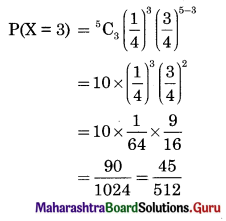
Maharashtra Board 12th Commerce Maths Solutions Chapter 8 Probability Distributions Ex 8.3 Q4.2
(iii) P(None is a spade)
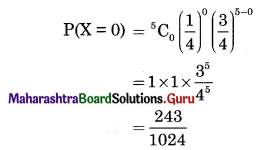
Maharashtra Board 12th Commerce Maths Solutions Chapter 8 Probability Distributions Ex 8.3 Q4.3

Question 5.
The probability that a bulb produced by a factory will use fuse after 200 days of use is 0.2. Let X denote the number of bulbs (out of 5) that fuse after 200 days of use. Find the probability of (i) X = 0, (ii) X ≤ 1, (iii) X > 1, (iv) X ≥ 1.
Solution:
X : No. of bulbs fuse after 200 days of use
p : Probability of getting fuse bulbs
No. of bulbs in a sample
∴ n = 5
∴ p = 0.2
∴ q = 1 – p = 1 – 0.2 = 0.8
∵ X ~ B(5, 0.2)
∴ p(x) = \({ }^{n} \mathrm{C}_{x} p^{x} q^{n-x}\)
(i) P(X = 0) = 5C0 (0.2)0 (0.8)5-0
= 1 × 1 × (0.8)5
= (0.8)5

(ii) P(X ≤ 1) = p(0) + p(1)
= 5C0 (0.2)0 (0.8)5-0 + 5C1 (0.2)1 (0.8)5-1
= 1 × 1 × (0.8)5 + 5 × 0.2 × (0.8)4
= (0.8)4 [0.8 + 1]
= 1.8 × (0.8)4

(iii) P(X > 1) = 1 – [p(0) + p(1)]
= 1 – 1.8 × (0.8)4

(iv) P(X ≥ 1) = 1 – p(0)
= 1 – (0.8)5

Maharashtra Board 12th Commerce Maths Solutions Chapter 8 Probability Distributions Ex 8.3

Question 6.
10 balls are marked with digits 0 to 9. If four balls are selected with replacement. What is the probability that none is marked 0?
Solution:
X : No. of balls drawn marked with the digit 0
n : No. of balls drawn
∴ n = 4
p : Probability of balls marked with 0.
∴ p = \(\frac{1}{10}\)
∴ q = 1 – p = 1 – \(\frac{1}{10}\) = \(\frac{9}{10}\)
p(x) = \({ }^{n} C_{x} p^{x} q^{n-x}\)
P(None of the ball is marked with digit 0)
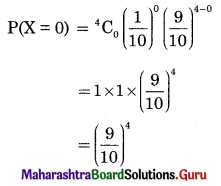
Maharashtra Board 12th Commerce Maths Solutions Chapter 8 Probability Distributions Ex 8.3 Q6

Question 7.
In a multiple-choice test with three possible answers for each of the five questions, what is the probability of a candidate getting four or more correct answers by random choice?
Solution:
n: No. of Questions
∴ n = 5
X: No. of correct answers by guessing
p: Probability of getting correct answers
Maharashtra Board 12th Commerce Maths Solutions Chapter 8 Probability Distributions Ex 8.3 Q7

Question 8.
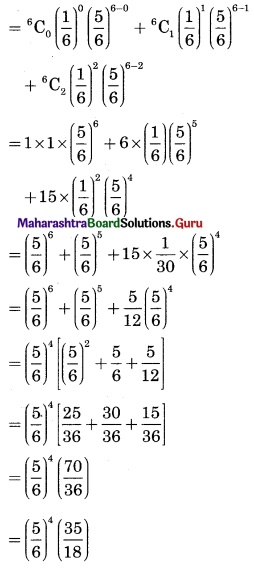
Find the probability of throwing at most 2 sixes in 6 throws of a single die.
Solution:
X : No. of sixes in 6 throws
n : No. of times dice thrown
∴ n = 6
p : Probability of getting six
∴ p = \(\frac{1}{6}\)
∴ q = 1 – p = 1 – \(\frac{1}{6}\) = \(\frac{5}{6}\)
∵ X ~ B(6, \(\frac{1}{6}\))
∴ p(x) = \({ }^{n} \mathrm{C}_{x} p^{x} q^{n-x}\)
P(At most 2 sixes)
P(X ≤ 2) = p(0) + p(1) + p(2)
Maharashtra Board 12th Commerce Maths Solutions Chapter 8 Probability Distributions Ex 8.3 Q8

Maharashtra Board 12th Commerce Maths Solutions Chapter 8 Probability Distributions Ex 8.3

Question 9.
Given that X ~ B(n, p),
(i) if n = 10 and p = 0.4, find E(X) and Var(X).
(ii) if p = 0.6 and E(X) = 6, find n and Var(X).
(iii) if n = 25, E(X) = 10, find p and Var(X).
(iv) if n = 10, E(X) = 8, find Var(X).
Solution:
∵ X ~ B (n, p), E(X) = np, V(X) = npq, q = 1 – p
(i) E(X) = np = 10 × 0.4 = 4
∵ q = 1 – p = 1 – 0.4 = 0.6
V(X) = npq = 10 × 0.4 × 0.6 = 2.4

(ii) ∵ p = 0.6
∴ q = 1 – p = 1 – 0.6 = 0.4
E(X) = np
∴ 6 = n × 0.6
∴ n = 10
∴ V(X) = npq = 10 × 0.6 × 0.4 = 2.4

(iii) E(X) = np
∴ 10 = 25 × p
∴ p = 0.4
∴ q = 1, p = 1 – 0.4 = 0.6
∴ S.D.(X) = √V(X)
= \(\sqrt{n p q}\)
= \(\sqrt{25 \times 0.4 \times 0.6}\)
= √6
= 2.4494

(iv) ∵ E(X) = np
∴ 8 = 10p
∴ p = 0.8
∴ q = 1 – p = 1 – 0.8 = 0.2
∵ V(X) = npq = 10 × 0.8 × 0.2 = 1.6

12th Commerce Maths Digest Pdf
12th Commerce Maths 2 Chapter 8 Exercise 8.2 Answers Maharashtra Board

Probability Distributions Class 12 Commerce Maths 2 Chapter 8 Exercise 8.2 Answers Maharashtra Board

Balbharati Maharashtra State Board 12th Commerce Maths Solution Book Pdf Chapter 8 Probability Distributions Ex 8.2 Questions and Answers.

Std 12 Maths 2 Exercise 8.2 Solutions Commerce Maths

Question 1.
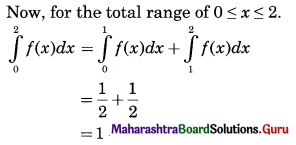
Check whether each of the following is p.d.f.
(i) \(f(x)= \begin{cases}x & \text { for } 0 \leq x \leq 1 \\ 2-x & \text { for } 1<x \leq 2\end{cases}\)
Solution:
Given function is
f(x) = x, 0 ≤ x ≤ 1
Each f(x) ≥ 0, as x ≥ 0.
Maharashtra Board 12th Commerce Maths Solutions Chapter 8 Probability Distributions Ex 8.2 Q1(i)
Maharashtra Board 12th Commerce Maths Solutions Chapter 8 Probability Distributions Ex 8.2 Q1(i).1
∴ The given function is a p.d.f. of x.

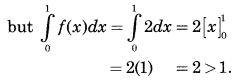
(ii) f(x) = 2 for 0 < x < 1
Solution:
Given function is
f(x) = 2 for 0 < x < 1 Each f(x) > 0,
Maharashtra Board 12th Commerce Maths Solutions Chapter 8 Probability Distributions Ex 8.2 Q1(ii)
∴ The given function is not a p.d.f.

Maharashtra Board 12th Commerce Maths Solutions Chapter 8 Probability Distributions Ex 8.2

Question 2.
The following is the p.d.f. of a r.v. X.
\(f(x)= \begin{cases}\frac{x}{8} & \text { for } 0<x<4 \\ 0 & \text { otherwise }\end{cases}\)
Find (i) P(X < 1.5), (ii) P(1 < X < 2), (iii) P(X > 2)
Solution:
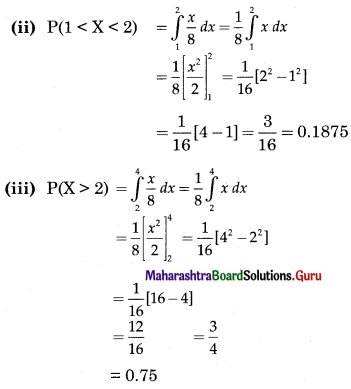
Maharashtra Board 12th Commerce Maths Solutions Chapter 8 Probability Distributions Ex 8.2 Q2
Maharashtra Board 12th Commerce Maths Solutions Chapter 8 Probability Distributions Ex 8.2 Q2.1

Question 3.
It is felt that error in measurement of reaction temperature (in Celsius) in an experiment is a continuous r.v. with p.d.f.
\(f(x)= \begin{cases}\frac{x^{3}}{64} & \text { for } 0 \leq x \leq 4 \\ 0 & \text { otherwise }\end{cases}\)
(i) Verify whether f(x) is a p.d.f.
(ii) Find P(0 < X ≤ 1).
(iii) Find the probability that X is between 1 and 3.
Solution:
(i) f(x) is p.d.f. of r.v. X if
(a) f(x) ≥ 0, ∀ x ∈ R
(b) \(\int_{0}^{4} f(x) d x\) = 1
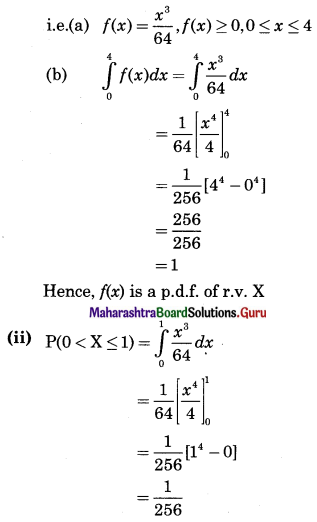
Maharashtra Board 12th Commerce Maths Solutions Chapter 8 Probability Distributions Ex 8.2 Q3
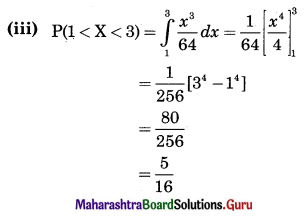
Maharashtra Board 12th Commerce Maths Solutions Chapter 8 Probability Distributions Ex 8.2 Q3.1

Question 4.
Find k, if the following function represents the p.d.f. of a r.v. X.
(i) \(f(x)= \begin{cases}k x & \text { for } 0<x<2 \\ 0 & \text { otherwise }\end{cases}\)
Also find P[\(\frac{1}{4}\) < X < \(\frac{1}{2}\)]
Solution:
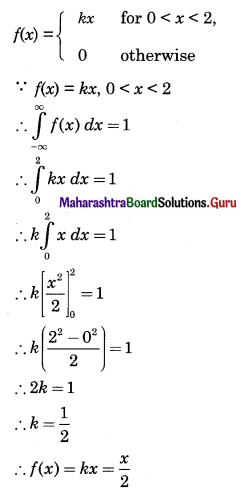
Maharashtra Board 12th Commerce Maths Solutions Chapter 8 Probability Distributions Ex 8.2 Q4(i)
Maharashtra Board 12th Commerce Maths Solutions Chapter 8 Probability Distributions Ex 8.2 Q4(i).1

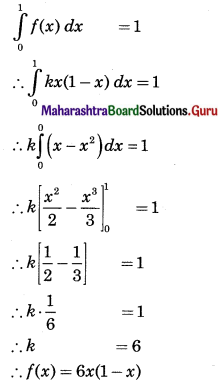
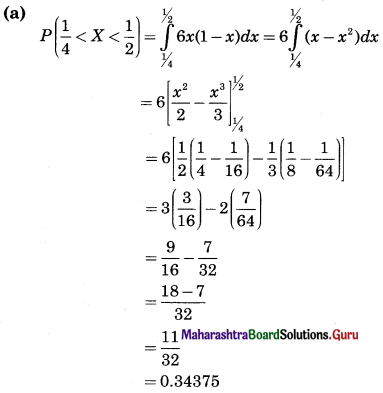
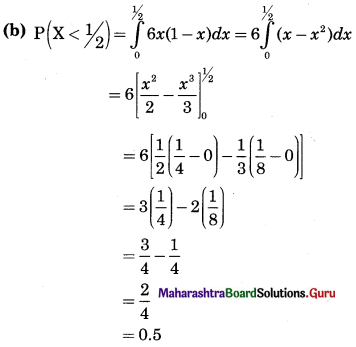
(ii) \(f(x)= \begin{cases}k x(1-x) & \text { for } 0<x<1 \\ 0 & \text { otherwise }\end{cases}\)
Also find (a) P[\(\frac{1}{4}\) < X < \(\frac{1}{2}\)], (b) P[X < \(\frac{1}{2}\)]
Solution:
We know that
Maharashtra Board 12th Commerce Maths Solutions Chapter 8 Probability Distributions Ex 8.2 Q4(ii)
Maharashtra Board 12th Commerce Maths Solutions Chapter 8 Probability Distributions Ex 8.2 Q4(ii).1
Maharashtra Board 12th Commerce Maths Solutions Chapter 8 Probability Distributions Ex 8.2 Q4(ii).2

Maharashtra Board 12th Commerce Maths Solutions Chapter 8 Probability Distributions Ex 8.2

Question 5.
Let X be the amount of time for which a book is taken out of the library by a randomly selected student and suppose that X has p.d.f.
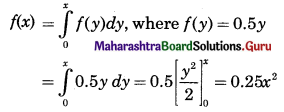
\(f(x)= \begin{cases}0.5 x & \text { for } 0 \leq x \leq 2 \\ 0 & \text { otherwise }\end{cases}\)
Calculate (i) P(X ≤ 1), (ii) P(0.5 ≤ X ≤ 1.5), (iii) P(X ≥ 1.5).
Solution:
Given p.d.f. of X is f(x) = 0.5x for 0 ≤ x ≤ 2
∴ Its c.d.f. F(x) is given by
Maharashtra Board 12th Commerce Maths Solutions Chapter 8 Probability Distributions Ex 8.2 Q5

(i) P(X < 1) = F(1)
= 0.25(1)2
= 0.25

(ii) P(0.5 < X < 1.5) = F(1.5) – F(0.5)
= 0.25(1.5)2 – 0.25(0.5)2
= 0.25[2.25 – 0.25]
= 0.25(2)
= 0.5

(iii) P(X ≥ 1.5) = 1 – P(X ≤ 1.5)
= 1 – F(1.5)
= 1 – 0.25(1.5)2
= 1 – 0.25(2.25)
= 1 – 0.5625
= 0.4375

Question 6.
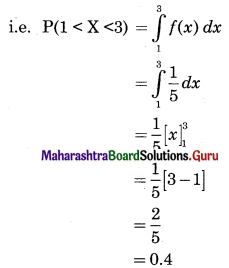
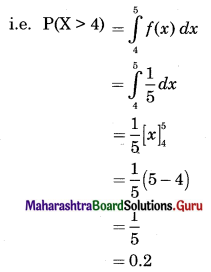
Suppose X is the waiting time (in minutes) for a bus and its p.d.f. is given by
\(f(x)=\left\{\begin{array}{cl}
\frac{1}{5} & \text { for } 0 \leq x \leq 5 \\
0 & \text { otherwise }
\end{array}\right.\)
Find the probability that (i) waiting time is between 1 and 3 minutes, (ii) waiting time is more than 4 minutes.
Solution:
p.d.f. of r.v. X is given by
f(x) = \(\frac{1}{5}\) for 0 ≤ x ≤ 5
This is a constant function.
(i) Probability that waiting time X is between 1 and 3 minutes
Maharashtra Board 12th Commerce Maths Solutions Chapter 8 Probability Distributions Ex 8.2 Q6
(ii) Probability that waiting time X is more than 4 minutes
Maharashtra Board 12th Commerce Maths Solutions Chapter 8 Probability Distributions Ex 8.2 Q6.1

Question 7.
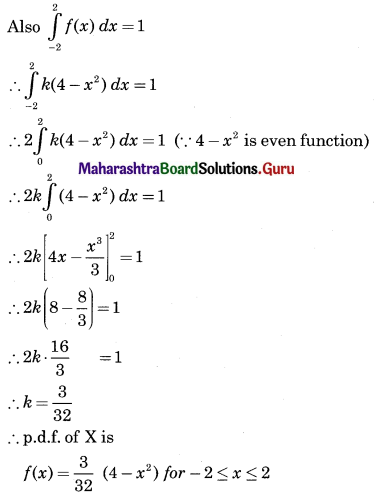
Suppose error involved in making a certain measurement is a continuous r.v. X with p.d.f.
\(f(x)= \begin{cases}k\left(4-x^{2}\right) & \text { for }-2 \leq x \leq 2 \\ 0 & \text { otherwise }\end{cases}\)
Compute (i) P(X > 0), (ii) P(-1 < X < 1), (iii) P(X < -0.5 or X > 0.5)
Solution:
Since given f(x) is a p.d.f. of r.v. X
Since -2 ≤ x ≤ 2
∴ x2 ≤ 4
∴ 4 – x2 ≥ 0
∴ k(4 – x2) ≥ 0
∴ k ≥ 0 [∵ f(x) ≥ 0]
Maharashtra Board 12th Commerce Maths Solutions Chapter 8 Probability Distributions Ex 8.2 Q7
Maharashtra Board 12th Commerce Maths Solutions Chapter 8 Probability Distributions Ex 8.2 Q7.1
Maharashtra Board 12th Commerce Maths Solutions Chapter 8 Probability Distributions Ex 8.2 Q7.2
Maharashtra Board 12th Commerce Maths Solutions Chapter 8 Probability Distributions Ex 8.2 Q7.3

Question 8.
Following is the p.d.f. of a continuous r.v. X.
\(f(x)= \begin{cases}\frac{x}{8} & \text { for } 0<x<4 \\ 0 & \text { otherwise }\end{cases}\)
(i) Find an expression for the c.d.f. of X.
(ii) Find F(x) at x = 0.5, 1.7, and 5.
Solution:
The p.d.f. of a continuous r.v. X is
\(f(x)= \begin{cases}\frac{x}{8} & \text { for } 0<x<4 \\ 0 & \text { otherwise }\end{cases}\)
(i) c.d.f. of continuous r.v. X is given by
Maharashtra Board 12th Commerce Maths Solutions Chapter 8 Probability Distributions Ex 8.2 Q8

(ii) F(0.5) = \(\frac{(0.5)^{2}}{16}=\frac{0.25}{16}=\frac{1}{64}\) = 0.015
F(1.7) = \(\frac{(1.7)^{2}}{16}=\frac{2.89}{16}\) = 0.18
For any of x greater than or equal to 4, F(x) = 1
∴ F(5) = 1

Maharashtra Board 12th Commerce Maths Solutions Chapter 8 Probability Distributions Ex 8.2

Question 9.
The p.d.f. of a continuous r.v. X is
\(f(x)=\left\{\begin{array}{cl}
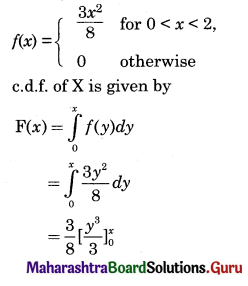
\frac{3 x^{2}}{8} & \text { for } 0<x<2 \\
0 & \text { otherwise }
\end{array}\right.\)
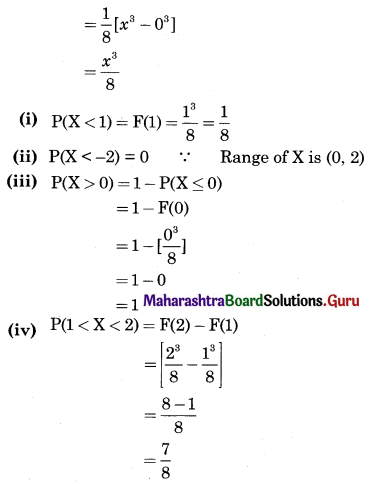
Determine the c.d.f. of X and hence find (i) P(X < 1), (ii) P(X < -2), (iii) P(X > 0), (iv) P(1 < X < 2).
Solution:
The p.d.f. of a continuous r.v. X is
Maharashtra Board 12th Commerce Maths Solutions Chapter 8 Probability Distributions Ex 8.2 Q9
Maharashtra Board 12th Commerce Maths Solutions Chapter 8 Probability Distributions Ex 8.2 Q9.1

Question 10.
If a r.v. X has p.d.f.
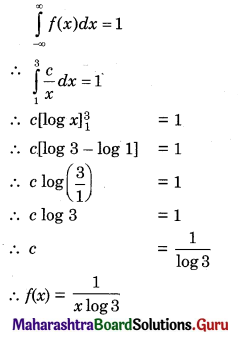
\(f(x)= \begin{cases}\frac{c}{x} & \text { for } 1<x<3, c>0 \\ 0 & \text { otherwise }\end{cases}\)
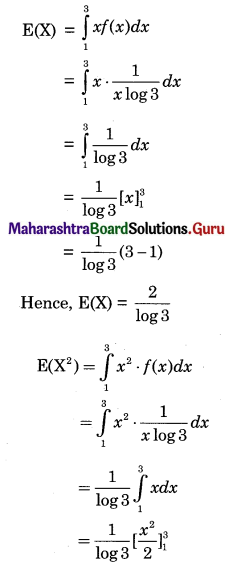
Find c, E(X) and V(X). Also find f(x).
Solution:
The p.d.f. of r.v. X is
f(x) = \(\frac{c}{x}\), 1 < x < 3, c > 0
For p.d.f. of X, we have
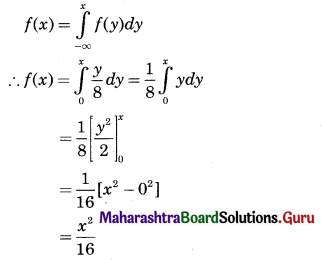
Maharashtra Board 12th Commerce Maths Solutions Chapter 8 Probability Distributions Ex 8.2 Q10
Maharashtra Board 12th Commerce Maths Solutions Chapter 8 Probability Distributions Ex 8.2 Q10.1
Maharashtra Board 12th Commerce Maths Solutions Chapter 8 Probability Distributions Ex 8.2 Q10.2
Maharashtra Board 12th Commerce Maths Solutions Chapter 8 Probability Distributions Ex 8.2 Q10.3

12th Commerce Maths Digest Pdf
12th Commerce Maths 2 Chapter 8 Exercise 8.1 Answers Maharashtra Board

Probability Distributions Class 12 Commerce Maths 2 Chapter 8 Exercise 8.1 Answers Maharashtra Board

Balbharati Maharashtra State Board 12th Commerce Maths Solution Book Pdf Chapter 8 Probability Distributions Ex 8.1 Questions and Answers.

Std 12 Maths 2 Exercise 8.1 Solutions Commerce Maths

Question 1.
Let X represent the difference between a number of heads and the number of tails obtained when a coin is tossed 6 times. What are the possible values of X?
Solution:
∵ A coin is tossed 6 times
S = {6H and 0T, 5H and 1T, 4H and 2T, 3H and 3T, 2H and 4T, 1H and 5T, 0H and 6T}
X: Difference between no. of heads and no. of tails.
X = 6 – 0 = 6
X = 5 – 1 = 4
X = 4 – 2 = 2
X = 3 – 3 = 0
X = 2 – 4 = -2
X = 1 – 5 = -4
X = 0 – 6 = -6
X = {-6, -4, -2, 0, 2, 4, 6}

Maharashtra Board 12th Commerce Maths Solutions Chapter 8 Probability Distributions Ex 8.1

Question 2.
An urn contains 5 red and 2 black balls. Two balls are drawn at random. X denotes the number of black balls drawn. What are the possible values of X?
Solution:
S : Two bolts are drawn from the Urn
S = {RR, RB, BR, BB}
X : No. of black balls
∴ X = {0, 1, 2}

Question 3.
Determine whether each of the following is a probability distribution. Give reasons for your answer.
(i)
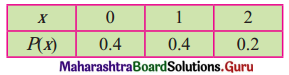
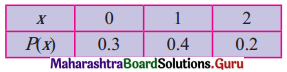
Maharashtra Board 12th Commerce Maths Solutions Chapter 8 Probability Distributions Ex 8.1 Q3(i)
Solution:
Here, P(X = x) ≥ 0, ∀ x and
\(\sum_{x=0}^{2} \mathrm{P}(\mathrm{X}=x)\) = p(0) + p(1) + p(2)
= 0.4 + 0.4 + 0.2
= 1
∴ The function is a p.m.f.

(ii)
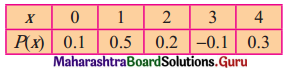
Maharashtra Board 12th Commerce Maths Solutions Chapter 8 Probability Distributions Ex 8.1 Q3(ii)
Solution:
Here, p(3) = -0.1 < 0
∴ P(X = x) ≯ 0, ∀ x
∴ The function is not a p.m.f.

(iii)
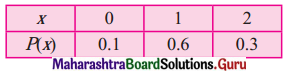
Maharashtra Board 12th Commerce Maths Solutions Chapter 8 Probability Distributions Ex 8.1 Q3(iii)
Solution:
Here, P(X = x) ≥ 0, ∀ x and
\(\sum_{x=0}^{2} \mathrm{P}(\mathrm{X}=x)\) = p(0) + p(1) + p(2)
= 0.1 + 0.6 + 0.3
= 1
∴ The function is a p.m.f.

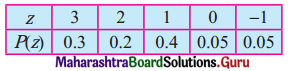
(iv)
Maharashtra Board 12th Commerce Maths Solutions Chapter 8 Probability Distributions Ex 8.1 Q3(iv)
Solution:
Here, P(Z = z) ≥ 0, ∀ z and
\(\sum_{x=-1}^{3} \mathrm{P}(\mathrm{Z}=z)\) = p(-1) + p(0) + p(1) + p(2) + p(3)
= 0.05 + 0 + 0.4 + 0.2 + 0.3
= 0.95
≠ 1
∴ The function is not a p.m.f.

Maharashtra Board 12th Commerce Maths Solutions Chapter 8 Probability Distributions Ex 8.1

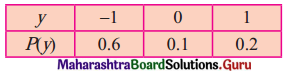
(v)
Maharashtra Board 12th Commerce Maths Solutions Chapter 8 Probability Distributions Ex 8.1 Q3(v)
Solution:
Here, P(Y = y) ≥ 0, ∀ y and
\(\sum_{x=-1}^{2} \mathrm{P}(\mathrm{Y}=y)\) = p(-1) + p(0) + p(1)
= 0.1 + 0.6 + 0.2
= 0.9
≠ 1
∴ The function is not a p.m.f.

(vi)
Maharashtra Board 12th Commerce Maths Solutions Chapter 8 Probability Distributions Ex 8.1 Q3(vi)
Solution:
Here, P(X = x) ≥ 0, ∀ x and
\(\sum_{x=0}^{0} \mathrm{P}(X=x)\) = p(-2) + p(-1) + p(0)
= 0.3 + 0.4 + 0.2
= 0.9
≠ 1
∴ The function is not a p.m.f.

Question 4.
Find the probability distribution of
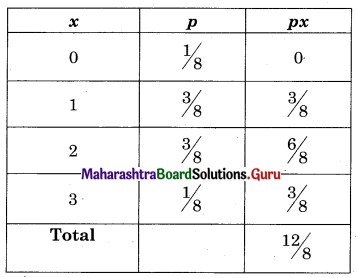
(i) number of heads in two tosses of a coin,
(ii) number of trails in three tosses of a coin,
(iii) number of heads in four tosses of a coin.
Solution:
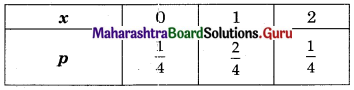
(i) S: Coin is tossed two times
S = {HH, HT, TH, TT}
n(S) = 4
X: No. of heads
Range of X = {0, 1, 2}
p.m.f. Table
Maharashtra Board 12th Commerce Maths Solutions Chapter 8 Probability Distributions Ex 8.1 Q4(i)

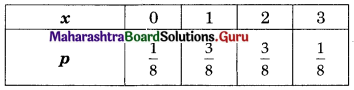
(ii) S: 3 coin are tossed
S = {HHH, HHT, HTH, HTT, THH, THT, TTH, TTT}
n(S) = 8
X: No. of heads
Range of X = {0, 1, 2, 3}
p.m.f. Table
Maharashtra Board 12th Commerce Maths Solutions Chapter 8 Probability Distributions Ex 8.1 Q4(ii)

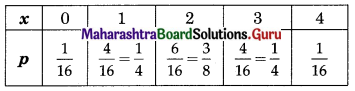
(iii) S: Four coin are tossed
S = {HHHH, HHHT, HHTH, HHTT, HTHH, HTHT, HTTH, HTTT, THHH, THHT, THTH, THTT, TTHH, TTHT, TTTH, TTTT}
n(S) = 16
X: No. of heads
Range of X = {0, 1, 2, 3, 4}
p.m.f. Table
Maharashtra Board 12th Commerce Maths Solutions Chapter 8 Probability Distributions Ex 8.1 Q4(iii)

Question 5.
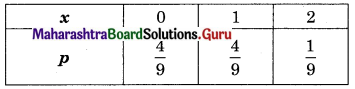
Find the probability distribution of the number of successes in two tosses of a die if successes are defined as getting a number greater than 4.
Solution:
S = A die is tossed 2 times
S = {(1, 1), (1, 2), (1, 3), (1, 4), (1, 5), (1, 6), (2, 1), (2, 2), (2, 3), (2, 4), (2, 5), (2, 6), (3, 1), (3, 2), (3, 3), (3, 4), (3, 5), (3, 6), (4, 1), (4, 2), (4, 3), (4, 4), (4, 5), (4, 6), (5, 1), (5, 2), (5, 3), (5, 4), (5, 5), (5, 6), (6, 1), (6, 2), (6, 3), (6, 4), (6, 5), (6, 6)}
n(S) = 36
X = No. getting greater than 4
Range of X = {0, 1, 2}
p(0) = \(\frac{16}{36}=\frac{4}{9}\)
p(1) = \(\frac{16}{36}=\frac{4}{9}\)
p(2) = \(\frac{4}{36}=\frac{1}{9}\)
Maharashtra Board 12th Commerce Maths Solutions Chapter 8 Probability Distributions Ex 8.1 Q5

Question 6.
A sample of 4 bulbs is drawn at random with replacement from a lot of 30 bulbs which includes 6 defective bulbs. Find the probability distribution of the number of defective bulbs.
Solution:
Total no. of bulbs = 30
No. of defective bulbs = 6
A sample of 4 bulbs are drawn from 30 bulbs.
∴ n(S) = \({ }^{30} \mathrm{C}_{4}\)
∴ No. of non-defective bulbs = 24
Let X = No. of defective bulbs drawn in sample of 4 bulbs.
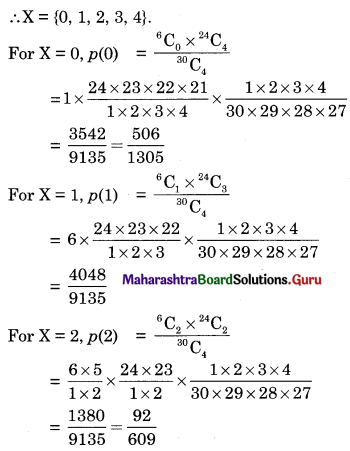
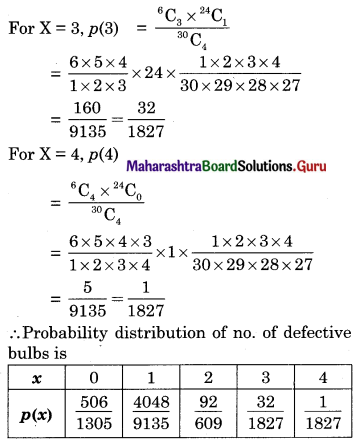
Maharashtra Board 12th Commerce Maths Solutions Chapter 8 Probability Distributions Ex 8.1 Q6
Maharashtra Board 12th Commerce Maths Solutions Chapter 8 Probability Distributions Ex 8.1 Q6.1

Maharashtra Board 12th Commerce Maths Solutions Chapter 8 Probability Distributions Ex 8.1

Question 7.
A coin is biased so that the head is 3 times as likely to occur as the tail. Find the probability distribution of a number of tails in two tosses.
Solution:
Here, the head is 3 times as likely to occur as the tail.
i.e., If 4 times coin is tossed, 3 times there will be a head and 1 time there will be the tail.
∴ p(H) = \(\frac{3}{4}\) and p(T) = \(\frac{1}{4}\)
Let X : No. of tails in two tosses.
And coin is tossed twice.
∴ X = {0, 1, 2}
For X = 0,
p(0) = p(both heads)
= p(H) × p(H)
= \(\frac{3}{4} \times \frac{3}{4}\)
= \(\frac{9}{16}\)
For X = 1,
p(1) = p(HT or TH)
= p(HT) + p(TH)
= p(H) × p(T) + p(T) × p(H)
= \(\frac{3}{4} \times \frac{1}{4}+\frac{1}{4} \times \frac{3}{4}\)
= \(\frac{6}{16}\)
For X = 2,
p(2) = p(both tails)
= p(T) × p(T)
= \(\frac{1}{4} \times \frac{1}{4}\)
= \(\frac{1}{16}\)
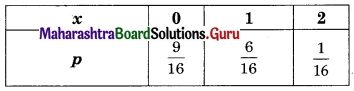
The probability distribution of the number of tails in two tosses is
Maharashtra Board 12th Commerce Maths Solutions Chapter 8 Probability Distributions Ex 8.1 Q7

Question 8.
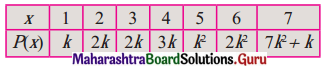
A random variable X has the following probability distribution:
Maharashtra Board 12th Commerce Maths Solutions Chapter 8 Probability Distributions Ex 8.1 Q8
Determine (i) k, (ii) P(X < 3), (iii) P(0 < X < 3), (iv) P(X > 4).
Solution:
(i) It is a p.m.f. of r.v. X
∴ Σp(x) = 1
∴ p(1) + p(2) + p(3) + p(4) + p(5) + p(6) + p(7) = 1
∴ k + 2k + 2k + 3k + k2 + 2k2 + (7k2 + k) = 1
∴ 10k2 + 9k = 1
∴ 10k2 + 9k – 1 = 0
∴ 10k2 + 10k – k – 1 = 0
∴ 10k(k + 1) – (k + 1) = 0
∴ (10k – 1)(k + 1) = 0
∴ 10k – 1 = 0 or k + 1 = 0
∴ k = \(\frac{1}{10}\) or k = -1
but k = -1 is not accepted
∴ k = \(\frac{1}{2}\) is accepted

(ii) P(X < 3) = p(1) + p(2)
= k + 2k
= 3k
= 3 × \(\frac{1}{10}\)
= \(\frac{3}{10}\)

(iii) P(0 < X < 3) = p(1) + p(2)
= k + 2k
= 3k
= 3 × \(\frac{1}{10}\)
= \(\frac{3}{10}\)

(iv) P(X > 4) = p(5) + p(6) + p(7)
= k2 + 2k2 + (7k2 + k)
= 10k2 + k
= \(10\left(\frac{1}{10}\right)^{2}+\frac{1}{10}\)
= \(\frac{2}{10}\)
= \(\frac{1}{5}\)

Question 9.
Find expected value and variance of X using the following p.m.f.
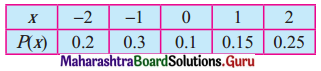
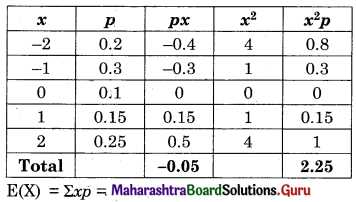
Maharashtra Board 12th Commerce Maths Solutions Chapter 8 Probability Distributions Ex 8.1 Q9
Solution:
Maharashtra Board 12th Commerce Maths Solutions Chapter 8 Probability Distributions Ex 8.1 Q9.1
E(X) = Σxp = -0.05
V(X) = Σx2p – (Σxp)2
= 2.25 – (-0.05)2
= 2.25 – 0.0025
= 2.2475

Question 10.
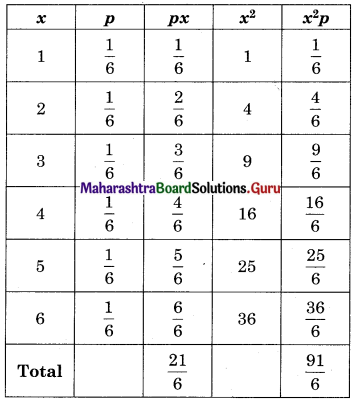
Find expected value and variance of X, the number on the uppermost face of a fair die.
Solution:
S : A fair die is thrown
S = {1, 2, 3, 4, 5, 6}
n(S) = 6
X: No obtained on uppermost face of die
Range of X = {1, 2, 3, 4, 5, 6}
Maharashtra Board 12th Commerce Maths Solutions Chapter 8 Probability Distributions Ex 8.1 Q10
E(X) = Σxp = \(\frac{21}{6}=\frac{7}{2}\) = 3.5
V(X) = Σx2p – (Σxp)2
= \(\frac{91}{6}\) – (3.5)2
= 15.17 – 12.25
= 2.92

Question 11.
Find the mean of the number of heads in three tosses of a fair coin.
Solution:
S : A coin is tossed 3 times
S = {HHH, HHT, HTH, HTT, THH, THT, TTH, TTT}
n(S) = 8
Range of X = {0, 1, 2, 3}
Maharashtra Board 12th Commerce Maths Solutions Chapter 8 Probability Distributions Ex 8.1 Q11
∴ Mean = E(X) = Σxp = \(\frac{12}{8}=\frac{3}{2}\) = 1.5

Question 12.
Two dice are thrown simultaneously. If X denotes the number of sixes, find the expectation of X.
Solution:
S : Two dice are thrown
S = {(1, 1), (1, 2), (1, 3), ……, (6, 6)}
n(S) = 36
Range of X = {0, 1, 2}
First 6 positive integers are 1, 2, 3, 4, 5, 6
X = Larger two numbers selected
S = {(1, 1), (1, 2), (1, 3), (1, 4), (1, 5), (1, 6), (2, 1), (2, 2), (2, 3), (2, 4), (2, 5), (2, 6), (3, 1), (3, 2), (3, 3), (3, 4), (3, 5), (3, 6), (4, 1), (4, 2), (4, 3), (4, 4), (4, 5), (4, 6), (5, 1), (5, 2), (5, 3), (5, 4), (5, 5), (5, 6), (6, 1), (6, 2), (6, 3), (6, 4), (6, 5), (6, 6)}
n(S) = 36
Maharashtra Board 12th Commerce Maths Solutions Chapter 8 Probability Distributions Ex 8.1 Q12
∴ E(X) = Σxp = \(\frac{12}{36}=\frac{1}{3}\)

Maharashtra Board 12th Commerce Maths Solutions Chapter 8 Probability Distributions Ex 8.1

Question 13.
Two numbers are selected at random (without replacement) from the first six positive integers. Let X denote the larger of the two numbers. Find E(X).
Solution:
First 6 positive integers are 1, 2, 3, 4, 5, 6
X : The larger of the selected two numbers
S = {(1, 2), (1, 3), (1, 4), (1, 5), (1, 6), (2, 1), (2, 3), (2, 4), (2, 5), (2, 6), (3, 1), (3, 2), (3, 4), (3, 5), (3, 6), (4, 1), (4, 2), (4, 3), (4, 5), (4, 6), (5, 1), (5, 2), (5, 3), (5, 4), (5, 6), (6, 1), (6, 2), (6, 3), (6, 4), (6, 5)}
n(S) = 30
Maharashtra Board 12th Commerce Maths Solutions Chapter 8 Probability Distributions Ex 8.1 Q13
E(X) = Σxp = \(\frac{140}{30}=\frac{14}{3}\) = 4.67

Question 14.
Let X denote the sum of the numbers obtained when two fair dice are rolled. Find the variance of X.
Solution:
S : Two fair dice are rolled
S = {(1, 1), (1, 2), (1, 4), ……, (6, 6)}
n(S) = 36
X : Sum of the two numbers.
Range of X = {2, 3, 4, 5, 6, 7, 8, 9, 10, 11, 12}
Maharashtra Board 12th Commerce Maths Solutions Chapter 8 Probability Distributions Ex 8.1 Q14
Maharashtra Board 12th Commerce Maths Solutions Chapter 8 Probability Distributions Ex 8.1 Q14.1
V(X) = Σx2p – (Σxp)2
= \(\frac{1952}{36}-\left(\frac{252}{36}\right)^{2}\)
= 54.22 – (7)2
= 5.22
SD(X) = √V(X) = √5.22 = 2.28

Question 15.
A class has 15 students whose ages are 14, 17, 15, 14, 21, 17, 19, 20, 16, 18, 20, 17, 16, 19 and 20 years. If X denotes the age of a randomly selected student, find the probability distribution of X. Find the mean and variance of X.
Solution:
Maharashtra Board 12th Commerce Maths Solutions Chapter 8 Probability Distributions Ex 8.1 Q15
Maharashtra Board 12th Commerce Maths Solutions Chapter 8 Probability Distributions Ex 8.1 Q15.1

Maharashtra Board 12th Commerce Maths Solutions Chapter 8 Probability Distributions Ex 8.1

Question 16.
70% of the member’s favour and 30% oppose a proposal in a meeting. The random variable X takes the value 0 if a member opposes the proposal and the value 1 if a member is in favour. Find E(X) and V(X).
Solution:
Maharashtra Board 12th Commerce Maths Solutions Chapter 8 Probability Distributions Ex 8.1 Q16
E(X) = Σxp = 0.7
V(X) = Σx2p – (Σxp)2
= 0.7 – (0.7)2
= 0.7 – 0.49
= 0.21

12th Commerce Maths Digest Pdf

12th Commerce Maths 2 Chapter 7 Miscellaneous Exercise 7 Answers Maharashtra Board

Assignment Problem and Sequencing Class 12 Commerce Maths 2 Chapter 7 Miscellaneous Exercise 7 Answers Maharashtra Board

Balbharati Maharashtra State Board 12th Commerce Maths Solution Book Pdf Chapter 7 Assignment Problem and Sequencing Miscellaneous Exercise 7 Questions and Answers.

Std 12 Maths 2 Miscellaneous Exercise 7 Solutions Commerce Maths

(I) Choose the correct alternative.

Question 1.
In sequencing, an optimal path is one that minimizes ___________
(a) Elapsed time
(b) Idle time
(c) Both (a) and (b)
(d) Ready time
Answer:
(c) Both (a) and (b)

Question 2.
If job A to D have processing times as 5, 6, 8, 4 on first machine and 4, 7, 9, 10 on second machine then the optimal sequence is:
(a) CDAB
(b) DBCA
(c) BCDA
(d) ABCD
Answer:
(b) DBCA

Maharashtra Board 12th Commerce Maths Solutions Chapter 7 Assignment Problem and Sequencing Miscellaneous Exercise 7

Question 3.
The objective of sequence problem is
(a) to find the order in which jobs are to be made
(b) to find the time required for the completing all the job on hand
(c) to find the sequence in which jobs on hand are to be processed to minimize the total time required for processing the jobs
(d) to maximize the cost
Answer:
(c) to find the sequence in which jobs on hand are to be processed to minimize the total time required for processing the jobs

Question 4.
If there are n jobs and m machines, then there will be ___________ sequences of doing the jobs.
(a) mn
(b) m(n!)
(c) nm
(d) (n!)m
Answer:
(d) (n!)m

Question 5.
The Assignment Problem is solved by
(a) Simple method
(b) Hungarian method
(c) Vector method
(d) Graphical method
Answer:
(b) Hungarian method

Question 6.
In solving 2 machine and n jobs sequencing problem, the following assumption is wrong
(a) No passing is allowed
(b) Processing times are known
(c) Handling times is negligible
(d) The time of passing depends on the order of machining
Answer:
(d) The time of passing depends on the order of machining

Maharashtra Board 12th Commerce Maths Solutions Chapter 7 Assignment Problem and Sequencing Miscellaneous Exercise 7

Question 7.
To use the Hungarian method, a profit maximization assignments problem requires
(a) Converting all profit to opportunity losses
(b) A dummy person or job
(c) Matrix expansion
(d) Finding the maximum number of lines to cover all the zeros in the reduced matrix
Answer:
(a) Converting all profits to opportunity losses

Question 8.
Using the Hungarian method the optimal assignment obtained for the following assignment problem to minimize the total cost is:
Maharashtra Board 12th Commerce Maths Solutions Chapter 7 Assignment Problem and Sequencing Miscellaneous Exercise 7 I Q8
(a) 1 – C, 2 – B, 3 – D, 4 – A
(b) 1 – B, 2 – C, 3 – A, 4 – D
(c) 1 – A, 2 – B, 3 – C, 4 – D
(d) 1 – D, 2 – A, 3 – B, 4 – C
Answer:
(a) 1 – C, 2 – B, 3 – D, 4 – A

Question 9.
The assignment problem is said to be unbalanced if
(a) Number of rows is greater than the number of columns
(b) Number of rows is lesser than number of columns
(c) Number of rows is equal to the number of columns
(d) Both (a) and (b)
Answer:
(d) Both (a) and (b)

Question 10.
The assignment problem is said to be balanced if
(a) Number of rows is greater than the number of columns
(b) Number of rows is lesser than number of columns
(c) Number of rows is equal to the number of columns
(d) If the entry of rows is zero
Answer:
(c) Number of rows is equal to number of columns

Question 11.
The assignment problem is said to be balanced if it is a
(a) Square matrix
(b) Rectangular matrix
(c) Unit matrix
(d) Triangular matrix
Answer:
(a) Square matrix

Question 12.
In an assignment problem if the number of rows is greater than the number of columns then
(a) Dummy column is added
(b) Dummy row is added
(c) Row with cost 1 is added
(d) Column with cost 1 is added
Answer:
(a) Dummy column is added

Question 13.
In a 3 machine and 5 jobs problem, the least of processing times on machines A, B, and C are 5, 1 and 3 hours and the highest processing times are 9, 5 and 7 respectively, then it can be converted to a 2 machine problem if the order of the machines is:
(a) B – A – C
(b) A – B – C
(c) C – B – A
(d) Any order
Answer:
(b) A – B – C

Maharashtra Board 12th Commerce Maths Solutions Chapter 7 Assignment Problem and Sequencing Miscellaneous Exercise 7

Question 14.
The objective of an assignment problem is to assign
(a) Number of jobs to equal number of persons at maximum cost
(b) Number of jobs to equal number of persons at minimum cost
(c) Only the maximize cost
(d) Only to minimize cost
Answer:
(b) Number of jobs to equal number of persons at minimum cost

(II) Fill in the blanks.

Question 1.
An assignment problem is said to be unbalanced when ___________
Answer:
the number of rows is not equal to the number of columns

Question 2.
When the number of rows is equal to the Number of columns then the problem is said to be ___________ assignment problem.
Answer:
balanced

Question 3.
For solving assignment problem the matrix should be a ___________
Answer:
square matrix

Question 4.
If the given matrix is not a ___________ matrix, the assignment problem is called an unbalanced problem.
Answer:
square

Question 5.
A dummy row(s) or column(s) with the cost elements as ___________ the matrix of an unbalanced assignment problem as a square matrix.
Answer:
zero

Question 6.
The time interval between starting the first job and completing the last, job including the idle time (if any) in a particular order by the given set of machines is called ___________
Answer:
Total elapsed time

Maharashtra Board 12th Commerce Maths Solutions Chapter 7 Assignment Problem and Sequencing Miscellaneous Exercise 7

Question 7.
The time for which a machine j does not have a job to process to the start of job i is called ___________
Answer:
Idle time

Question 8.
The maximization assignment problem is transformed to minimization problem by subtracting each entry in the table from the ___________ value in the table.
Answer:
maximum

Question 9.
When the assignment problem has more than one solution, then it is ___________ optimal solution.
Answer:
multiple

Question 10.
The time required for printing four books A, B, C, and D is 5, 8, 10, and 7 hours. While its data entry requires 7, 4, 3, and 6 hrs respectively. The sequence that minimizes total elapsed time is ___________
Answer:
A – D – B – C

(III) State whether each of the following is True or False.

Question 1.
One machine – one job is not an assumption in solving sequencing problems.
Answer:
False

Question 2.
If there are two least processing times for machine A and machine B, priority is given for the processing time which has the lowest time of the adjacent machine.
Answer:
True

Question 3.
To convert the assignment problem into a maximization problem, the smallest element in the matrix is deducted from all other elements.
Answer:
False

Question 4.
The Hungarian method operates on the principle of matrix reduction, whereby the cost table is reduced to a set of opportunity costs.
Answer:
True

Maharashtra Board 12th Commerce Maths Solutions Chapter 7 Assignment Problem and Sequencing Miscellaneous Exercise 7

Question 5.
In a sequencing problem, the processing times are dependent on the order of processing the jobs on machines.
Answer:
False

Question 6.
The optimal assignment is made in the Hungarian method to cells in the reduced matrix that contain a Zero.
Answer:
True

Question 7.
Using the Hungarian method, the optimal solution to an assignment problem is fund when the minimum number of lines required to cover the zero cells in the reduced matrix equals the number of people.
Answer:
True

Question 8.
In an assignment problem, if a number of columns are greater than the number of rows, then a dummy column is added.
Answer:
False

Question 9.
The purpose of a dummy row or column in an assignment problem is to obtain a balance between a total number of activities and a total number of resources.
Answer:
True

Question 10.
One of the assumptions made while sequencing n jobs on 2 machines is: two jobs must be loaded at a time on any machine.
Answer:
False

(IV) Solve the following problems.

Part – I

Question 1.
A plant manager has four subordinates, and four tasks to be performed. The subordinates differ in efficiency and the tasks differ in their intrinsic difficulty. This estimate of the times each man would take to perform each task is given in the effectiveness matrix below.
Maharashtra Board 12th Commerce Maths Solutions Chapter 7 Assignment Problem and Sequencing Miscellaneous Exercise 7 IV Part I Q1
How should the tasks be allocated, one to a man, as to minimize the total man-hours?
Solution:
The hr matrix is given by
Maharashtra Board 12th Commerce Maths Solutions Chapter 7 Assignment Problem and Sequencing Miscellaneous Exercise 7 IV Part I Q1.1
Subtracting row minimum from all values in that row we get
Maharashtra Board 12th Commerce Maths Solutions Chapter 7 Assignment Problem and Sequencing Miscellaneous Exercise 7 IV Part I Q1.2
Subtracting column minimum from all values in that column we get
Maharashtra Board 12th Commerce Maths Solutions Chapter 7 Assignment Problem and Sequencing Miscellaneous Exercise 7 IV Part I Q1.3
The minimum no. of lines covering ail the zeros (4) is equal to the order of the matrix (4)
∴ The assignment is possible.
Maharashtra Board 12th Commerce Maths Solutions Chapter 7 Assignment Problem and Sequencing Miscellaneous Exercise 7 IV Part I Q1.4
The assignment is
A → I, B → III, C → II, D → IV
For the minimum hrs. take the corresponding value from the hr matrix.
Minimum hrs = 7 + 3 + 18 + 9 = 37 hrs

Maharashtra Board 12th Commerce Maths Solutions Chapter 7 Assignment Problem and Sequencing Miscellaneous Exercise 7

Question 2.
A dairy plant has five milk tankers, I, II, III, IV & V. These milk tankers are to be used on five delivery routes A, B, C, D & E. The distances (in kms) between the dairy plant and the delivery routes are given in the following distance matrix.
Maharashtra Board 12th Commerce Maths Solutions Chapter 7 Assignment Problem and Sequencing Miscellaneous Exercise 7 IV Part I Q2
How should the milk tankers be assigned to the chilling centre so as to minimize the distance travelled?
Solution:
The distance matrix is given by
Maharashtra Board 12th Commerce Maths Solutions Chapter 7 Assignment Problem and Sequencing Miscellaneous Exercise 7 IV Part I Q2.1
Subtracting row minimum from all values in that row we get
Maharashtra Board 12th Commerce Maths Solutions Chapter 7 Assignment Problem and Sequencing Miscellaneous Exercise 7 IV Part I Q2.2
Subtracting column minimum from each value in that column we get
Maharashtra Board 12th Commerce Maths Solutions Chapter 7 Assignment Problem and Sequencing Miscellaneous Exercise 7 IV Part I Q2.3
The number of lines covering all the zeros (3) is less than the order of the matrix (5) so the assignment is not possible. The modification is required.
The minimum uncovered value (15) is subtracted from uncovered values and added to the values at the intersection. The numbers on the lines remain the same. We get
Maharashtra Board 12th Commerce Maths Solutions Chapter 7 Assignment Problem and Sequencing Miscellaneous Exercise 7 IV Part I Q2.4
The minimum lines covering all the zeros (4) are less than the order of the matrix (5) so the assignment is not possible. The modification is required the minimum uncovered value (5) is subtracted from uncovered values and added to the values at the intersection. The numbers on the lines remain the same we get
Maharashtra Board 12th Commerce Maths Solutions Chapter 7 Assignment Problem and Sequencing Miscellaneous Exercise 7 IV Part I Q2.5
The minimum number of lines covering all the zeros (5) is equal to the order of the matrix (5) So assignment is possible.
The assignment is
A → II, B → III, C → V, D → I, E → IV
Total minimum distance is = 120 + 120 + 175 + 40 + 70 = 525 kms.

Question 3.
Solve the following assignment problem to maximize sales:
Maharashtra Board 12th Commerce Maths Solutions Chapter 7 Assignment Problem and Sequencing Miscellaneous Exercise 7 IV Part I Q3
Solution:
As it is a maximization problem so we need to convert it into a minimization problem.
Subtracting all the values from the maximum value (19) we get
Maharashtra Board 12th Commerce Maths Solutions Chapter 7 Assignment Problem and Sequencing Miscellaneous Exercise 7 IV Part I Q3.1
Also, it is an unbalanced problem so we need to add a dummy row (E) with all values zero, we get
Maharashtra Board 12th Commerce Maths Solutions Chapter 7 Assignment Problem and Sequencing Miscellaneous Exercise 7 IV Part I Q3.2
Subtracting row minimum from all values in that row we get
Maharashtra Board 12th Commerce Maths Solutions Chapter 7 Assignment Problem and Sequencing Miscellaneous Exercise 7 IV Part I Q3.3
Subtracting column minimum from all values in that column we get the same matrix
Maharashtra Board 12th Commerce Maths Solutions Chapter 7 Assignment Problem and Sequencing Miscellaneous Exercise 7 IV Part I Q3.4
The minimum number of lines covering all the zero (4) is less than the order of the matrix (5) So assignment is not possible. The modification is required. The minimum uncovered value (2) is subtracted from the uncovered values and added to the values at the intersection. The values on the lines remain the same. We get
Maharashtra Board 12th Commerce Maths Solutions Chapter 7 Assignment Problem and Sequencing Miscellaneous Exercise 7 IV Part I Q3.5
The minimum number of lines covering all the zeros (4) is less than the order of the matrix (5) so the assignment is not possible. The modification is required. The minimum uncovered value (1) is subtracted from the uncovered value and added to the values at the intersection. The values on the lines remain the same. We get
Maharashtra Board 12th Commerce Maths Solutions Chapter 7 Assignment Problem and Sequencing Miscellaneous Exercise 7 IV Part I Q3.6
The minimum number of lines covering all the zeros (5) is equal to the order of the matrix (5) so the assignment is possible.
Maharashtra Board 12th Commerce Maths Solutions Chapter 7 Assignment Problem and Sequencing Miscellaneous Exercise 7 IV Part I Q3.7
The assignment is
A → V, B → II, C → IV, D → III, E → I
No salesman goes to I as E is a dummy row.
For the maximum value take the corresponding values from the original matrix.
We get Maximum value = 15 + 19 + 14 + 17 + 0 = 65 units

Maharashtra Board 12th Commerce Maths Solutions Chapter 7 Assignment Problem and Sequencing Miscellaneous Exercise 7

Question 4.
The estimated sales (tons) per month in four different cities by five different managers are given below:
Maharashtra Board 12th Commerce Maths Solutions Chapter 7 Assignment Problem and Sequencing Miscellaneous Exercise 7 IV Part I Q4
Find out the assignment of managers to cities in order to maximize sales.
Solution:
This is a maximizing problem. To convert it into minimizing problem subtract all the values of the matrix from the maximum (largest) value (39) we get
Maharashtra Board 12th Commerce Maths Solutions Chapter 7 Assignment Problem and Sequencing Miscellaneous Exercise 7 IV Part I Q4.1
Also as it is an unbalanced problem so we have to add a dummy column (T) with all the values as zero. We get
Maharashtra Board 12th Commerce Maths Solutions Chapter 7 Assignment Problem and Sequencing Miscellaneous Exercise 7 IV Part I Q4.2
Subtracting row minimum from all values in that row we get the same matrix
Subtracting column minimum from all values in that column we get
Maharashtra Board 12th Commerce Maths Solutions Chapter 7 Assignment Problem and Sequencing Miscellaneous Exercise 7 IV Part I Q4.3
The minimum number of lines covering all the zeros (4) is less than the order of the matrix (5) so assignments are not possible. The modification is required. The minimum uncovered value (1) is subtracted from the uncovered values and added to the values at the intersection. The values on the lines remain the same. We get
Maharashtra Board 12th Commerce Maths Solutions Chapter 7 Assignment Problem and Sequencing Miscellaneous Exercise 7 IV Part I Q4.4
The minimum number of lines covering all the zeros (5) is equal to the order of the matrix (5) so the assignment is possible.
Maharashtra Board 12th Commerce Maths Solutions Chapter 7 Assignment Problem and Sequencing Miscellaneous Exercise 7 IV Part I Q4.5
So I → S, II → T, III → Q, IV → P, V → R.
As T is dummy manager II is not given any city.
To find the maximum sales we take the corresponding value from the original matrix
Total maximum sales = 35 + 39 + 36 + 35 = 145 tons

Question 5.
Consider the problem of assigning five operators to five machines. The assignment costs are given in the following table.
Maharashtra Board 12th Commerce Maths Solutions Chapter 7 Assignment Problem and Sequencing Miscellaneous Exercise 7 IV Part I Q5
Operator A cannot be assigned to machine 3 and operator C cannot be assigned to machine 4. Find the optimal assignment schedule.
Solution:
This is a restricted assignment problem, so we assign a very high cost (oo) to the prohibited cells we get
Maharashtra Board 12th Commerce Maths Solutions Chapter 7 Assignment Problem and Sequencing Miscellaneous Exercise 7 IV Part I Q5.1
Subtracting row minimum from all values in that row we get.
Maharashtra Board 12th Commerce Maths Solutions Chapter 7 Assignment Problem and Sequencing Miscellaneous Exercise 7 IV Part I Q5.2
Subtracting column minimum from all values in that column we get
Maharashtra Board 12th Commerce Maths Solutions Chapter 7 Assignment Problem and Sequencing Miscellaneous Exercise 7 IV Part I Q5.3
As the minimum number of lines covering all the zeros (4) is equal to the order of the matrix (5) so the assignment is not possible. The modification is required. The minimum uncovered value (2) is subtracted from all the uncovered values and added to the values at the intersection. The values on the lines remain the same. We get
Maharashtra Board 12th Commerce Maths Solutions Chapter 7 Assignment Problem and Sequencing Miscellaneous Exercise 7 IV Part I Q5.4
As the minimum number of lines covering all the zeros (5) is equal to the order of the matrix, assignment is the possible
Maharashtra Board 12th Commerce Maths Solutions Chapter 7 Assignment Problem and Sequencing Miscellaneous Exercise 7 IV Part I Q5.5
So A → 4, B → 3, C → 2, D → 1, E → 5
For the minimum cost take the corresponding values from the cost matrix we get
Total minimum cost = 3 + 3 + 4 + 3 + 7 = 20 units

Maharashtra Board 12th Commerce Maths Solutions Chapter 7 Assignment Problem and Sequencing Miscellaneous Exercise 7

Question 6.
A chartered accountant’s firm has accepted five new cases. The estimated number of days required by each of their five employees for each case are given below, where-means that the particular employee can not be assigned the particular case. Determine the optimal assignment of cases of the employees so that the total number of days required to complete these five cases will be minimum. Also, find the minimum number of days.
Maharashtra Board 12th Commerce Maths Solutions Chapter 7 Assignment Problem and Sequencing Miscellaneous Exercise 7 IV Part I Q6
Solution:
This is a restricted assignment problem so we assign a very high cost (∞) to all the prohibited cells. The day matrix becomes
Maharashtra Board 12th Commerce Maths Solutions Chapter 7 Assignment Problem and Sequencing Miscellaneous Exercise 7 IV Part I Q6.1
Subtracting row minimum from all values in that row we get
Maharashtra Board 12th Commerce Maths Solutions Chapter 7 Assignment Problem and Sequencing Miscellaneous Exercise 7 IV Part I Q6.2
Subtracting column minimum from all values in that column we get
Maharashtra Board 12th Commerce Maths Solutions Chapter 7 Assignment Problem and Sequencing Miscellaneous Exercise 7 IV Part I Q6.3
The minimum number of lines covering all the zeros (4) is less than the order of the matrix (5) so the assignment is not possible, The modification is required. The minimum uncovered value (1) is subtracted from all the uncovered values and added to the values at the intersection. The values on the lines remain the same, we get
Maharashtra Board 12th Commerce Maths Solutions Chapter 7 Assignment Problem and Sequencing Miscellaneous Exercise 7 IV Part I Q6.4
The minimum number of lines covering all the zeros (5) is equal to the order of the matrix (5) so the assignment is possible.
Maharashtra Board 12th Commerce Maths Solutions Chapter 7 Assignment Problem and Sequencing Miscellaneous Exercise 7 IV Part I Q6.5
So E1 → I, E2 → IV, E3 → II, E4 → V, E5 → III
To find the minimum number of days we take the corresponding values from the day matrix.
Total minimum number of days = 6 + 6 + 6 + 6 + 3 = 27 days

Part – II

Question 1.
A readymade garments manufacture has to process 7 items through two stages of production, namely cutting and sewing. The time taken in hours for each of these items in different stages are given below:
Maharashtra Board 12th Commerce Maths Solutions Chapter 7 Assignment Problem and Sequencing Miscellaneous Exercise 7 IV Part II Q1
Find the sequence in which these items are to be processed through these stages so as to minimize the total processing time. Also, find the idle time of each machine.
Solution:
Let A = cutting and B = sewing. So we have
Maharashtra Board 12th Commerce Maths Solutions Chapter 7 Assignment Problem and Sequencing Miscellaneous Exercise 7 IV Part II Q1.1
Observe min {A, B} = 2 for item 1 for B.
Maharashtra Board 12th Commerce Maths Solutions Chapter 7 Assignment Problem and Sequencing Miscellaneous Exercise 7 IV Part II Q1.2
The problem reduces to
Maharashtra Board 12th Commerce Maths Solutions Chapter 7 Assignment Problem and Sequencing Miscellaneous Exercise 7 IV Part II Q1.3
Now min {A, B} = 3 for item 3 for A
Maharashtra Board 12th Commerce Maths Solutions Chapter 7 Assignment Problem and Sequencing Miscellaneous Exercise 7 IV Part II Q1.4
The problem reduces to
Maharashtra Board 12th Commerce Maths Solutions Chapter 7 Assignment Problem and Sequencing Miscellaneous Exercise 7 IV Part II Q1.5
New min {A , B} = 4 for item 4 for A.
Maharashtra Board 12th Commerce Maths Solutions Chapter 7 Assignment Problem and Sequencing Miscellaneous Exercise 7 IV Part II Q1.6
The problem reduces to
Maharashtra Board 12th Commerce Maths Solutions Chapter 7 Assignment Problem and Sequencing Miscellaneous Exercise 7 IV Part II Q1.7
Now min(A, B} = 5 for item 6 for B
Maharashtra Board 12th Commerce Maths Solutions Chapter 7 Assignment Problem and Sequencing Miscellaneous Exercise 7 IV Part II Q1.8
The problem reduces to
Maharashtra Board 12th Commerce Maths Solutions Chapter 7 Assignment Problem and Sequencing Miscellaneous Exercise 7 IV Part II Q1.9
Now min {A, B} = 6 for item 5 for A and item 2 for B
Maharashtra Board 12th Commerce Maths Solutions Chapter 7 Assignment Problem and Sequencing Miscellaneous Exercise 7 IV Part II Q1.10
Now only 7 is left
∴ The optimal sequence is
Maharashtra Board 12th Commerce Maths Solutions Chapter 7 Assignment Problem and Sequencing Miscellaneous Exercise 7 IV Part II Q1.11
Worktable
Maharashtra Board 12th Commerce Maths Solutions Chapter 7 Assignment Problem and Sequencing Miscellaneous Exercise 7 IV Part II Q1.12
Total elapsed time = 46 hrs
Idle time for A (cutting) = 46 – 44 = 2 hrs
Idle time for B (Sewing) = 4 hrs

Maharashtra Board 12th Commerce Maths Solutions Chapter 7 Assignment Problem and Sequencing Miscellaneous Exercise 7

Question 2.
Five jobs must pass through a lathe and a surface grinder, in that order. The processing times in hours are shown below. Determine the optimal sequence of the jobs. Also, find the idle time of each machine.
Maharashtra Board 12th Commerce Maths Solutions Chapter 7 Assignment Problem and Sequencing Miscellaneous Exercise 7 IV Part II Q2
Solution:
Let A = lathe and B = surface grinder. We have
Maharashtra Board 12th Commerce Maths Solutions Chapter 7 Assignment Problem and Sequencing Miscellaneous Exercise 7 IV Part II Q2.1
Observe min {A, B} = 1 for job II for A
Maharashtra Board 12th Commerce Maths Solutions Chapter 7 Assignment Problem and Sequencing Miscellaneous Exercise 7 IV Part II Q2.2
The problem reduces to
Maharashtra Board 12th Commerce Maths Solutions Chapter 7 Assignment Problem and Sequencing Miscellaneous Exercise 7 IV Part II Q2.3
Now min {A, B} = 2 for job IV for A
Maharashtra Board 12th Commerce Maths Solutions Chapter 7 Assignment Problem and Sequencing Miscellaneous Exercise 7 IV Part II Q2.4
The problem reduces to
Maharashtra Board 12th Commerce Maths Solutions Chapter 7 Assignment Problem and Sequencing Miscellaneous Exercise 7 IV Part II Q2.5
Now min {A, B} = 3 for job I for B
Maharashtra Board 12th Commerce Maths Solutions Chapter 7 Assignment Problem and Sequencing Miscellaneous Exercise 7 IV Part II Q2.6
The problem reduces to
Maharashtra Board 12th Commerce Maths Solutions Chapter 7 Assignment Problem and Sequencing Miscellaneous Exercise 7 IV Part II Q2.7
Now min {A, B} = 5 for jobs III and V for A
∴ We have two options
Maharashtra Board 12th Commerce Maths Solutions Chapter 7 Assignment Problem and Sequencing Miscellaneous Exercise 7 IV Part II Q2.8
or
Maharashtra Board 12th Commerce Maths Solutions Chapter 7 Assignment Problem and Sequencing Miscellaneous Exercise 7 IV Part II Q2.9
We take the first one.
Worktable
Maharashtra Board 12th Commerce Maths Solutions Chapter 7 Assignment Problem and Sequencing Miscellaneous Exercise 7 IV Part II Q2.10
Total elapsed time = 21 hrs
Idle time for A (lathe) = 21 – 17 = 4 hrs
Idle time for B (surface grinder) = 3 hrs

Question 3.
Find the sequence that minimizes the total elapsed time to complete the following jobs. Each job is processed in order AB.
Maharashtra Board 12th Commerce Maths Solutions Chapter 7 Assignment Problem and Sequencing Miscellaneous Exercise 7 IV Part II Q3
Determine the sequence for the jobs so as to minimize the processing time. Find the total elapsed time and the idle time for both machines.
Solution:
Observe min {A, B} = 3 for job VII on B.
Maharashtra Board 12th Commerce Maths Solutions Chapter 7 Assignment Problem and Sequencing Miscellaneous Exercise 7 IV Part II Q3.1
The problem reduces to
Maharashtra Board 12th Commerce Maths Solutions Chapter 7 Assignment Problem and Sequencing Miscellaneous Exercise 7 IV Part II Q3.2
Now min {A, B} = 4 for job IV on B.
Maharashtra Board 12th Commerce Maths Solutions Chapter 7 Assignment Problem and Sequencing Miscellaneous Exercise 7 IV Part II Q3.3
The problem reduces to
Maharashtra Board 12th Commerce Maths Solutions Chapter 7 Assignment Problem and Sequencing Miscellaneous Exercise 7 IV Part II Q3.4
Now min {A, B} = 5 for job III & V on A. we have two options
Maharashtra Board 12th Commerce Maths Solutions Chapter 7 Assignment Problem and Sequencing Miscellaneous Exercise 7 IV Part II Q3.5
or
Maharashtra Board 12th Commerce Maths Solutions Chapter 7 Assignment Problem and Sequencing Miscellaneous Exercise 7 IV Part II Q3.6
We take the first one
The problem reduces to
Maharashtra Board 12th Commerce Maths Solutions Chapter 7 Assignment Problem and Sequencing Miscellaneous Exercise 7 IV Part II Q3.7
Now min {A, B} = 5 for job II on A
Maharashtra Board 12th Commerce Maths Solutions Chapter 7 Assignment Problem and Sequencing Miscellaneous Exercise 7 IV Part II Q3.8
The problem reduces to
Maharashtra Board 12th Commerce Maths Solutions Chapter 7 Assignment Problem and Sequencing Miscellaneous Exercise 7 IV Part II Q3.9
Now min {A, B} = 7 for a job I on B and for job VI on A
∴ The optional sequence is
Maharashtra Board 12th Commerce Maths Solutions Chapter 7 Assignment Problem and Sequencing Miscellaneous Exercise 7 IV Part II Q3.10
Worktable
Maharashtra Board 12th Commerce Maths Solutions Chapter 7 Assignment Problem and Sequencing Miscellaneous Exercise 7 IV Part II Q3.11
Total elapsed time = 55 units
Idle time for A = 55 – 52 = 3 units
Idle time for B = 9 units.

Maharashtra Board 12th Commerce Maths Solutions Chapter 7 Assignment Problem and Sequencing Miscellaneous Exercise 7

Question 4.
A toy manufacturing company has five types of toys. Each toy has to go through three machines A, B, C in the order ABC. The time required in hours for each process is given in the following table.
Maharashtra Board 12th Commerce Maths Solutions Chapter 7 Assignment Problem and Sequencing Miscellaneous Exercise 7 IV Part II Q4
Solve the problem for minimizing the total elapsed time.
Solution:
Min A = 12, Max B = 12
As min A ≥ max B.
The problem can be converted into two machine problems.
Let G and H be two fictitious machines such that G = A + B and H = B + C, We get
Maharashtra Board 12th Commerce Maths Solutions Chapter 7 Assignment Problem and Sequencing Miscellaneous Exercise 7 IV Part II Q4.1
Now min {G, H} = 16 for type 3 on G
Maharashtra Board 12th Commerce Maths Solutions Chapter 7 Assignment Problem and Sequencing Miscellaneous Exercise 7 IV Part II Q4.2
The problem reduces to
Maharashtra Board 12th Commerce Maths Solutions Chapter 7 Assignment Problem and Sequencing Miscellaneous Exercise 7 IV Part II Q4.3
Min (G, H} = 18 for type 1, 4 & 5 on H
We have more than one option, we take
Maharashtra Board 12th Commerce Maths Solutions Chapter 7 Assignment Problem and Sequencing Miscellaneous Exercise 7 IV Part II Q4.4
Now only type 2 is left.
∴ The optional sequence is
Maharashtra Board 12th Commerce Maths Solutions Chapter 7 Assignment Problem and Sequencing Miscellaneous Exercise 7 IV Part II Q4.5
Worktable
Maharashtra Board 12th Commerce Maths Solutions Chapter 7 Assignment Problem and Sequencing Miscellaneous Exercise 7 IV Part II Q4.6
Total elapsed time = 102 hours
Idle time for A = 102 – 84 = 18 hours
Idle time for B = 54 + (102 – 94) = 62 hours
Idle time for C = 38 hours

Question 5.
A foreman wants to process 4 different jobs on three machines: a shaping machine, a drilling machine, and a tapping, the sequence of operations being shaping-drilling-tapping. Decide the optimal sequence for the four jobs to minimize the total elapsed time. Also, find the total elapsed time and the idle time for every machine.
Maharashtra Board 12th Commerce Maths Solutions Chapter 7 Assignment Problem and Sequencing Miscellaneous Exercise 7 IV Part II Q5
Solution:
The time matrix is
Maharashtra Board 12th Commerce Maths Solutions Chapter 7 Assignment Problem and Sequencing Miscellaneous Exercise 7 IV Part II Q5.1
Min A = 8, Max B = 8, as min A ≥ max B.
The problem can be converted into a two-machine problem.
Let G and H be two fictitious machines such that
G = A + B and H = B + C we get
Maharashtra Board 12th Commerce Maths Solutions Chapter 7 Assignment Problem and Sequencing Miscellaneous Exercise 7 IV Part II Q5.2
Observe min (G, H} = 12 for job 2 on H
Maharashtra Board 12th Commerce Maths Solutions Chapter 7 Assignment Problem and Sequencing Miscellaneous Exercise 7 IV Part II Q5.3
The problem reduces to
Maharashtra Board 12th Commerce Maths Solutions Chapter 7 Assignment Problem and Sequencing Miscellaneous Exercise 7 IV Part II Q5.4
Now min {G, H} = 14 for job 3 on G and job 4 on H
Maharashtra Board 12th Commerce Maths Solutions Chapter 7 Assignment Problem and Sequencing Miscellaneous Exercise 7 IV Part II Q5.5
Now only job 1 is left.
∴ The optimal sequence is
Maharashtra Board 12th Commerce Maths Solutions Chapter 7 Assignment Problem and Sequencing Miscellaneous Exercise 7 IV Part II Q5.6
Worktable
Maharashtra Board 12th Commerce Maths Solutions Chapter 7 Assignment Problem and Sequencing Miscellaneous Exercise 7 IV Part II Q5.7
Total elapsed time = 74 min
Idle time for A (shapping) = 74 – 62 = 12 min
Idle time for B (Drilling) = 47 + (74 – 70) = 51 min
Idle time for C (trapping) = 31 min

12th Commerce Maths Digest Pdf
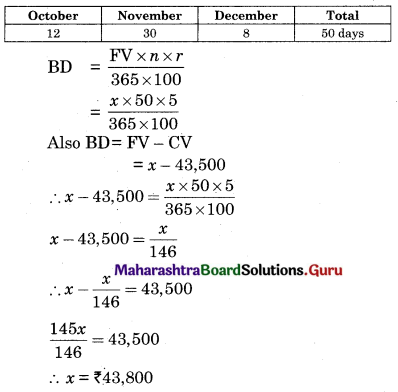
12th Commerce Maths 2 Chapter 7 Exercise 7.2 Answers Maharashtra Board

Assignment Problem and Sequencing Class 12 Commerce Maths 2 Chapter 7 Exercise 7.2 Answers Maharashtra Board

Balbharati Maharashtra State Board 12th Commerce Maths Solution Book Pdf Chapter 7 Assignment Problem and Sequencing Ex 7.2 Questions and Answers.

Std 12 Maths 2 Exercise 7.2 Solutions Commerce Maths

Question 1.
A machine operator has to perform two operations, turning and threading on 6 different jobs. The time required to perform these operations (in minutes) for each job is known. Determine the order in which the jobs should be processed in order to minimize the total time required to complete all the jobs. Also, find the total processing time and idle times for turning and threading operations.
Maharashtra Board 12th Commerce Maths Solutions Chapter 7 Assignment Problem and Sequencing Ex 7.2 Q1
Solution:
Let turning to be A and threading be B.
Maharashtra Board 12th Commerce Maths Solutions Chapter 7 Assignment Problem and Sequencing Ex 7.2 Q1.1
∴ Observe Min{A, B} = 1 for job 6 on B.
Maharashtra Board 12th Commerce Maths Solutions Chapter 7 Assignment Problem and Sequencing Ex 7.2 Q1.2
Then the problem reduces to
Maharashtra Board 12th Commerce Maths Solutions Chapter 7 Assignment Problem and Sequencing Ex 7.2 Q1.3
∴ Now Min {A, B} = 2 for job 4 on A
Maharashtra Board 12th Commerce Maths Solutions Chapter 7 Assignment Problem and Sequencing Ex 7.2 Q1.4
Then the problem reduce to
Maharashtra Board 12th Commerce Maths Solutions Chapter 7 Assignment Problem and Sequencing Ex 7.2 Q1.5
Now Min {A, B} = 3 for job 1 on A and job 5 on B
Maharashtra Board 12th Commerce Maths Solutions Chapter 7 Assignment Problem and Sequencing Ex 7.2 Q1.6
Then the problem reduces to
Maharashtra Board 12th Commerce Maths Solutions Chapter 7 Assignment Problem and Sequencing Ex 7.2 Q1.7
Now Min {A, B) = 5 for job 3 on A
Maharashtra Board 12th Commerce Maths Solutions Chapter 7 Assignment Problem and Sequencing Ex 7.2 Q1.8
Only job 2 is left so the optimal sequence is
Maharashtra Board 12th Commerce Maths Solutions Chapter 7 Assignment Problem and Sequencing Ex 7.2 Q1.9
Worktable is given by
Maharashtra Board 12th Commerce Maths Solutions Chapter 7 Assignment Problem and Sequencing Ex 7.2 Q1.10
Total elapsed time = 43 minutes
Idle time for A (turning) = 43 – 42 = 1 min
Idle time for B (threshing) = 2 + 4 = 6 min

Maharashtra Board 12th Commerce Maths Solutions Chapter 7 Assignment Problem and Sequencing Ex 7.2

Question 2.
A company has three jobs on hand, Each of these must be processed through two departments, in the AB where
Department A: Press shop and
Department B: Finishing
The table below gives the number of days required by each job each department
Maharashtra Board 12th Commerce Maths Solutions Chapter 7 Assignment Problem and Sequencing Ex 7.2 Q2
Find the sequence in which the three jobs should be processed so as to take minimum time to finish all the three jobs. Also find idle time for both the departments.
Solution:
Observe Min {A, B} = 3 for job II on B.
Maharashtra Board 12th Commerce Maths Solutions Chapter 7 Assignment Problem and Sequencing Ex 7.2 Q2.1
Then the problem is reduced to
Maharashtra Board 12th Commerce Maths Solutions Chapter 7 Assignment Problem and Sequencing Ex 7.2 Q2.2
Now Min {A, B} = 4 for job III at B
Maharashtra Board 12th Commerce Maths Solutions Chapter 7 Assignment Problem and Sequencing Ex 7.2 Q2.3
Now only job I in left
∴ the optimal sequence is given by
Maharashtra Board 12th Commerce Maths Solutions Chapter 7 Assignment Problem and Sequencing Ex 7.2 Q2.4
The work table is
Maharashtra Board 12th Commerce Maths Solutions Chapter 7 Assignment Problem and Sequencing Ex 7.2 Q2.5
Total elapsed time = 23 days
Idle time for A = 23 – 19 = 4 days
Idle time for B = 8 days

Maharashtra Board 12th Commerce Maths Solutions Chapter 7 Assignment Problem and Sequencing Ex 7.2

Question 3.
An insurance company receives three types of policy application bundles daily from its head office for data entry and filing. The time (in minutes) required for each type for these two operations is given in the following table:
Maharashtra Board 12th Commerce Maths Solutions Chapter 7 Assignment Problem and Sequencing Ex 7.2 Q3
Find the sequence that minimizes the total time required to complete the entire task. Also, find the total elapsed time and idle times for each operation.
Solution:
Let Data entry be A and filing be B. So
Maharashtra Board 12th Commerce Maths Solutions Chapter 7 Assignment Problem and Sequencing Ex 7.2 Q3.1
Observe min {A, B} = 90 for policy 1 at A
Maharashtra Board 12th Commerce Maths Solutions Chapter 7 Assignment Problem and Sequencing Ex 7.2 Q3.2
Then the problem reduces to
Maharashtra Board 12th Commerce Maths Solutions Chapter 7 Assignment Problem and Sequencing Ex 7.2 Q3.3
Observe min {A, B} = 100 for policy 3 at B
Maharashtra Board 12th Commerce Maths Solutions Chapter 7 Assignment Problem and Sequencing Ex 7.2 Q3.4
Now only policy 2 is left
∴ The optimal sequence is
Maharashtra Board 12th Commerce Maths Solutions Chapter 7 Assignment Problem and Sequencing Ex 7.2 Q3.5
Worktable
Maharashtra Board 12th Commerce Maths Solutions Chapter 7 Assignment Problem and Sequencing Ex 7.2 Q3.6
So Total elapsed time = 490 min
Idle time for A (data entry) = 490 – 390 = 100 min
Idle time for B (filing) = 140 min.

Maharashtra Board 12th Commerce Maths Solutions Chapter 7 Assignment Problem and Sequencing Ex 7.2

Question 4.
There are five jobs, each of which must go through two machines in the order XY. Processing times (in hours) are given below. Determine the sequence for the jobs that will minimize the total elapsed time. Also, find the total elapse time and idle time for each machine.
Maharashtra Board 12th Commerce Maths Solutions Chapter 7 Assignment Problem and Sequencing Ex 7.2 Q4
Solution:
Observe min {x, y} = 2 for job B on x
Maharashtra Board 12th Commerce Maths Solutions Chapter 7 Assignment Problem and Sequencing Ex 7.2 Q4.1
The problem reduces to
Maharashtra Board 12th Commerce Maths Solutions Chapter 7 Assignment Problem and Sequencing Ex 7.2 Q4.2
Now min [x, y] = 4 for job A on x
Maharashtra Board 12th Commerce Maths Solutions Chapter 7 Assignment Problem and Sequencing Ex 7.2 Q4.3
The problem reduces to
Maharashtra Board 12th Commerce Maths Solutions Chapter 7 Assignment Problem and Sequencing Ex 7.2 Q4.4
Now min [x, y] = 6 for job D on x
Maharashtra Board 12th Commerce Maths Solutions Chapter 7 Assignment Problem and Sequencing Ex 7.2 Q4.5
The problem reduces to
Maharashtra Board 12th Commerce Maths Solutions Chapter 7 Assignment Problem and Sequencing Ex 7.2 Q4.7
Now min [x, y] = 8 for job E on y
Maharashtra Board 12th Commerce Maths Solutions Chapter 7 Assignment Problem and Sequencing Ex 7.2 Q4.6
Now only job C in left
∴ The optimal sequence is
Maharashtra Board 12th Commerce Maths Solutions Chapter 7 Assignment Problem and Sequencing Ex 7.2 Q4.8
Worktable
Maharashtra Board 12th Commerce Maths Solutions Chapter 7 Assignment Problem and Sequencing Ex 7.2 Q4.9
Total elapsed time = 60 hrs
Idle time for X = 60 – 56 = 4 hrs
Idle time for Y = 6 hrs

Maharashtra Board 12th Commerce Maths Solutions Chapter 7 Assignment Problem and Sequencing Ex 7.2

Question 5.
Find the sequence that minimizes the total elapsed time to complete the following jobs in the order AB. Find the total elapsed time and idle times for both machines.
Maharashtra Board 12th Commerce Maths Solutions Chapter 7 Assignment Problem and Sequencing Ex 7.2 Q5
Solution:
Observe min {A, B} = 5 for job VI for B and job VII for A
Maharashtra Board 12th Commerce Maths Solutions Chapter 7 Assignment Problem and Sequencing Ex 7.2 Q5.1
The problem reduces to
Maharashtra Board 12th Commerce Maths Solutions Chapter 7 Assignment Problem and Sequencing Ex 7.2 Q5.2
Now min {A, B] = 7 for job I on A
Maharashtra Board 12th Commerce Maths Solutions Chapter 7 Assignment Problem and Sequencing Ex 7.2 Q5.3
The problem reduces to
Maharashtra Board 12th Commerce Maths Solutions Chapter 7 Assignment Problem and Sequencing Ex 7.2 Q5.4
Now min {A, B] = 10 for job IV on A and B so we have two options.
Maharashtra Board 12th Commerce Maths Solutions Chapter 7 Assignment Problem and Sequencing Ex 7.2 Q5.5
Or
Maharashtra Board 12th Commerce Maths Solutions Chapter 7 Assignment Problem and Sequencing Ex 7.2 Q5.6
we take the 1st one.
The problem reduces to
Maharashtra Board 12th Commerce Maths Solutions Chapter 7 Assignment Problem and Sequencing Ex 7.2 Q5.7
Now min {A, B} = 14 for job V on A and job II and III for job B.
∴ We have
Maharashtra Board 12th Commerce Maths Solutions Chapter 7 Assignment Problem and Sequencing Ex 7.2 Q5.8
Or
Maharashtra Board 12th Commerce Maths Solutions Chapter 7 Assignment Problem and Sequencing Ex 7.2 Q5.9
We take the optimal sequence as.
VII – I – IV – V – III – II – VI
Worktable
Maharashtra Board 12th Commerce Maths Solutions Chapter 7 Assignment Problem and Sequencing Ex 7.2 Q5.10
Total elapsed time = 91 units
Idle time for A = 91 – 86 = 5 units
Idle time for B = 13 units

Maharashtra Board 12th Commerce Maths Solutions Chapter 7 Assignment Problem and Sequencing Ex 7.2

Question 6.
Find the optimal sequence that minimizes the total time required to complete the following jobs in the order ABC. The processing times are given in hrs.
Maharashtra Board 12th Commerce Maths Solutions Chapter 7 Assignment Problem and Sequencing Ex 7.2 Q6
Maharashtra Board 12th Commerce Maths Solutions Chapter 7 Assignment Problem and Sequencing Ex 7.2 Q6.1
Solution:
(i) Min A = 5, Max B = 5
As min A ≥ max B.
The problem can be converted into two machine problems.
Let G and H be two fictitious machines such that G = A + B and H = B + C we get
Maharashtra Board 12th Commerce Maths Solutions Chapter 7 Assignment Problem and Sequencing Ex 7.2 Q6.2
Now min {G, H} = 7 for job III & V for G and job I for H
∴ We have two options
Maharashtra Board 12th Commerce Maths Solutions Chapter 7 Assignment Problem and Sequencing Ex 7.2 Q6.3
Or
Maharashtra Board 12th Commerce Maths Solutions Chapter 7 Assignment Problem and Sequencing Ex 7.2 Q6.4
We take the first one
The problem reduces to
Maharashtra Board 12th Commerce Maths Solutions Chapter 7 Assignment Problem and Sequencing Ex 7.2 Q6.5
Min {G, H} = 9 for job IV on H
Maharashtra Board 12th Commerce Maths Solutions Chapter 7 Assignment Problem and Sequencing Ex 7.2 Q6.6
The problem reduces to
Maharashtra Board 12th Commerce Maths Solutions Chapter 7 Assignment Problem and Sequencing Ex 7.2 Q6.7
Now min {G, H} = 10 for job II for G and job VII for H
Maharashtra Board 12th Commerce Maths Solutions Chapter 7 Assignment Problem and Sequencing Ex 7.2 Q6.8
Now job VI is left
∴ The optimal sequence is
Maharashtra Board 12th Commerce Maths Solutions Chapter 7 Assignment Problem and Sequencing Ex 7.2 Q6.9
The work table is
Maharashtra Board 12th Commerce Maths Solutions Chapter 7 Assignment Problem and Sequencing Ex 7.2 Q6.10
Total elapsed time = 61 hrs
Idle time for A = 61 – 54 = 7 hrs
Idle time for B = 35 + [61 – 58] = 38 hrs
Idle time for C = 15 hrs

Maharashtra Board 12th Commerce Maths Solutions Chapter 7 Assignment Problem and Sequencing Ex 7.2

(ii) Min A = 5, Max B = 5
Min A ≥ Max B.
The problem can be converted into two machine problems.
Let G and H be two fictitious machines such that G = A + B and H = B + C we get
Maharashtra Board 12th Commerce Maths Solutions Chapter 7 Assignment Problem and Sequencing Ex 7.2 Q6.11
Now min {G, H} = 5 for job 1 for H.
Maharashtra Board 12th Commerce Maths Solutions Chapter 7 Assignment Problem and Sequencing Ex 7.2 Q6.12
The problem reduces to
Maharashtra Board 12th Commerce Maths Solutions Chapter 7 Assignment Problem and Sequencing Ex 7.2 Q6.13
Now min {G, H} = 8 for job 2 for G and job H also job 5 for G
∴ We have two options
Maharashtra Board 12th Commerce Maths Solutions Chapter 7 Assignment Problem and Sequencing Ex 7.2 Q6.14
Or
Maharashtra Board 12th Commerce Maths Solutions Chapter 7 Assignment Problem and Sequencing Ex 7.2 Q6.15
We take the first one
The problem reduces to
Maharashtra Board 12th Commerce Maths Solutions Chapter 7 Assignment Problem and Sequencing Ex 7.2 Q6.16
Now min {G, H} = 9 for job 3 for H
Maharashtra Board 12th Commerce Maths Solutions Chapter 7 Assignment Problem and Sequencing Ex 7.2 Q6.17
Now only job 4 is left
∴ The optimal sequence is
Maharashtra Board 12th Commerce Maths Solutions Chapter 7 Assignment Problem and Sequencing Ex 7.2 Q6.18
Worktable
Maharashtra Board 12th Commerce Maths Solutions Chapter 7 Assignment Problem and Sequencing Ex 7.2 Q6.20
Total elapsed time = 40 hrs
Idle time for A = 40 – 32 = 8 hrs
Idle time for B = 19 + [40 – 34] = 25 hrs
Idle time for C = 12 hrs

Maharashtra Board 12th Commerce Maths Solutions Chapter 7 Assignment Problem and Sequencing Ex 7.2

Question 7.
A publisher produces 5 books on Mathematics. The books have to go through composing, printing, and binding was done by 3 machines P, Q, E. The time schedule for the entire task in the proper unit is as follows.
Maharashtra Board 12th Commerce Maths Solutions Chapter 7 Assignment Problem and Sequencing Ex 7.2 Q7
Determine the optimum time required to finish the entire task.
Solution:
Min R = 6, Max Q = 6
As min R ≥ max Q.
The problem can be converted into a two-machine problem.
Let G and H be two fictitious machines such that G = P + Q and H = Q + R we get
Maharashtra Board 12th Commerce Maths Solutions Chapter 7 Assignment Problem and Sequencing Ex 7.2 Q7.1
Min {G, H} = 9 for books A, D, E for G.
∴ We have more than one option we take
Maharashtra Board 12th Commerce Maths Solutions Chapter 7 Assignment Problem and Sequencing Ex 7.2 Q7.2
The problem reduces to
Maharashtra Board 12th Commerce Maths Solutions Chapter 7 Assignment Problem and Sequencing Ex 7.2 Q7.3
Min {G, H} = 8 for book C on H
Maharashtra Board 12th Commerce Maths Solutions Chapter 7 Assignment Problem and Sequencing Ex 7.2 Q7.4
Now only B is left. So the optimal sequence is
Maharashtra Board 12th Commerce Maths Solutions Chapter 7 Assignment Problem and Sequencing Ex 7.2 Q7.5
Worktable
Maharashtra Board 12th Commerce Maths Solutions Chapter 7 Assignment Problem and Sequencing Ex 7.2 Q7.6
Total elapsed time = 51 units
Idle time for P = 51 – 32 = 19 units
Idle time for Q = 14 + [51 – 34] = 31 units
Idle time for R = 9 units

12th Commerce Maths Digest Pdf

12th Commerce Maths 2 Chapter 7 Exercise 7.1 Answers Maharashtra Board

Assignment Problem and Sequencing Class 12 Commerce Maths 2 Chapter 7 Exercise 7.1 Answers Maharashtra Board

Balbharati Maharashtra State Board 12th Commerce Maths Solution Book Pdf Chapter 7 Assignment Problem and Sequencing Ex 7.1 Questions and Answers.
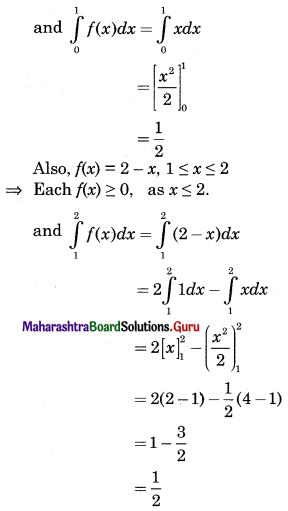
Std 12 Maths 2 Exercise 7.1 Solutions Commerce Maths

Question 1.
A job production unit has four jobs A, B, C, D which can be manufactured on each of the four machines P, Q, R, and S. The processing cost of each job for each machine is given in the following table:
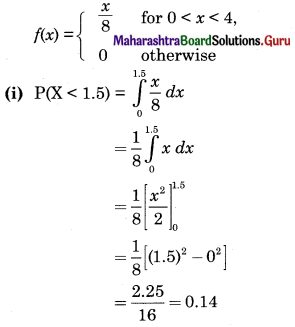
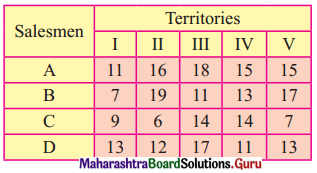
Maharashtra Board 12th Commerce Maths Solutions Chapter 7 Assignment Problem and Sequencing Ex 7.1 Q1
Find the optimal assignment to minimize the total processing cost.
Solution:
The cost matrix is given by
Maharashtra Board 12th Commerce Maths Solutions Chapter 7 Assignment Problem and Sequencing Ex 7.1 Q1.1
Subtracting row minimum from all the elements in that row we get
Maharashtra Board 12th Commerce Maths Solutions Chapter 7 Assignment Problem and Sequencing Ex 7.1 Q1.2
Subtracting column minimum from all the elements in that column we get the same matrix.
As all the rows and columns have single zeros the allotment can be done as follows.
Maharashtra Board 12th Commerce Maths Solutions Chapter 7 Assignment Problem and Sequencing Ex 7.1 Q1.3
As per the table, the job allotments are
P → II, Q → IV, R → I, S → III
The total minimum cost = 25 + 21 + 19 + 34 = ₹ 99

Maharashtra Board 12th Commerce Maths Solutions Chapter 7 Assignment Problem and Sequencing Ex 7.1

Question 2.
Five wagons are available at stations 1, 2, 3, 4, and 5. These are required at 5 stations I, II, III, IV, and V. The mileage between various stations are given in the table below. How should the wagons be transported so as to minimize the mileage covered?
Maharashtra Board 12th Commerce Maths Solutions Chapter 7 Assignment Problem and Sequencing Ex 7.1 Q2
Solution:
The mileage matrix is given by
Maharashtra Board 12th Commerce Maths Solutions Chapter 7 Assignment Problem and Sequencing Ex 7.1 Q2.1
Subtracting row minimum from all elements in that row we get
Maharashtra Board 12th Commerce Maths Solutions Chapter 7 Assignment Problem and Sequencing Ex 7.1 Q2.2
Subtracting column minimum from all elements in that column we get
Maharashtra Board 12th Commerce Maths Solutions Chapter 7 Assignment Problem and Sequencing Ex 7.1 Q2.3
Draw minimum lines covering all the zeros
Maharashtra Board 12th Commerce Maths Solutions Chapter 7 Assignment Problem and Sequencing Ex 7.1 Q2.4
The number of lines covering all the zeros (3) is less than the order of the matrix (5). Hence an assignment is not possible. The modification is required. The minimum uncovered value 1 is subtracted from uncovered values and added to the values at the intersection. The numbers on the lines remain the same we get
Maharashtra Board 12th Commerce Maths Solutions Chapter 7 Assignment Problem and Sequencing Ex 7.1 Q2.5
Drawing a minimum number of lines covering all the zeros.
No. of lines covering all the zeros (4) is less than the order of the matrix (5).
Hence assignment is not possible.
Again modification is required. The minimum uncovered value 3 is subtracted from the uncovered values and added to the values at the intersection.
The numbers on the lines remain the same we get
Maharashtra Board 12th Commerce Maths Solutions Chapter 7 Assignment Problem and Sequencing Ex 7.1 Q2.6
No. of lines covering all the zeros (5) are equal to the order of the matrix so the assignment is possible.
Maharashtra Board 12th Commerce Maths Solutions Chapter 7 Assignment Problem and Sequencing Ex 7.1 Q2.7
According to the table the assignment is
1 → I, 2 → II, 3 → IV, 4 → II, 5 → V
Total minimum mileage = 10 + 6 + 4 + 9 + 10 = 39 units

Maharashtra Board 12th Commerce Maths Solutions Chapter 7 Assignment Problem and Sequencing Ex 7.1

Question 3.
Five different machines can do any of the five required jobs, with different profits five required jobs, with different profits resulting from each assignment as shown below:
Maharashtra Board 12th Commerce Maths Solutions Chapter 7 Assignment Problem and Sequencing Ex 7.1 Q3
Find the optimal assignment schedule.
Solution:
This profit matrix has to be reduced to cost matrix by subtracting all the values of the matrix from the largest value (62) we get
Maharashtra Board 12th Commerce Maths Solutions Chapter 7 Assignment Problem and Sequencing Ex 7.1 Q3.2
Subtracting row minimum value from all the elements in that column we get
Maharashtra Board 12th Commerce Maths Solutions Chapter 7 Assignment Problem and Sequencing Ex 7.1 Q3.3
Subtracting column minimum from all the elements in that column we get
Maharashtra Board 12th Commerce Maths Solutions Chapter 7 Assignment Problem and Sequencing Ex 7.1 Q3.4
Drawing minimum lines covering all zeros we get
Maharashtra Board 12th Commerce Maths Solutions Chapter 7 Assignment Problem and Sequencing Ex 7.1 Q3.5
No. of lines (4) is less than the order of the matrix (5). Hence assignment is not possible. The modification is required. The minimum uncovered value (4) is subtracted from the uncovered value and added to the values at the intersection. The values on the lines remain the same, we get
Maharashtra Board 12th Commerce Maths Solutions Chapter 7 Assignment Problem and Sequencing Ex 7.1 Q3.6
No. of lines (5) are equal to the order of the matrix (5). So assignments are possible
1 → C, 2 → E, 3 → A, 4 → D, 5 → B
For the minimum profit look at the corresponding in the profit matrix given.
Maximum profit = 40 + 36 + 40 + 36 + 62 = 214 units

Maharashtra Board 12th Commerce Maths Solutions Chapter 7 Assignment Problem and Sequencing Ex 7.1

Question 4.
Four new machines M1, M2, M3, and M4 are to be installed in a machine shop. There are five vacant places A, B, C, D, and E available. Because of limited space, machine M2 cannot be placed at C and M1 cannot be placed at A. The cost matrix is given below.
Maharashtra Board 12th Commerce Maths Solutions Chapter 7 Assignment Problem and Sequencing Ex 7.1 Q4
Find the optimal assignment schedule.
Solution:
This is a restricted assignment so we assign a very high cost ‘∞’ to the prohibited all.
Also as it is an unbalanced problem we add a dummy row M5 with all values as ‘0’, we get
Maharashtra Board 12th Commerce Maths Solutions Chapter 7 Assignment Problem and Sequencing Ex 7.1 Q4.1
Subtracting row minimum from all the elements in that row, we get
Maharashtra Board 12th Commerce Maths Solutions Chapter 7 Assignment Problem and Sequencing Ex 7.1 Q4.2
Subtracting column minimum from all the elements in that column we get the same matrix.
Maharashtra Board 12th Commerce Maths Solutions Chapter 7 Assignment Problem and Sequencing Ex 7.1 Q4.3
As minimum no. of lines covering all zeros (5) is equal to the order of the matrix, Assignment is possible
Maharashtra Board 12th Commerce Maths Solutions Chapter 7 Assignment Problem and Sequencing Ex 7.1 Q4.4
The assignments are given by
M1 → A, M2 → B, M3 → E, M4 → D, M5 → C
As M5 is dummy no machine is installed at C
For minimum cost taking the corresponding values in the cost matrix we get
Minimum cost = 4 + 4 + 2 + 2 = 12 units

Maharashtra Board 12th Commerce Maths Solutions Chapter 7 Assignment Problem and Sequencing Ex 7.1

Question 5.
A company has a team of four salesmen and there is four districts where the company wants to start its business. After taking into account the capabilities of salesmen and the nature of districts, the company estimates that the profit per day in rupees for each salesman in each district is as below:
Maharashtra Board 12th Commerce Maths Solutions Chapter 7 Assignment Problem and Sequencing Ex 7.1 Q5
Find the assignments of a salesman to various districts which will yield maximum profit.
Solution:
The profit matrix has to be reduced to the cost matrix. Subtracting all the values from the maximum value (16) we get
Maharashtra Board 12th Commerce Maths Solutions Chapter 7 Assignment Problem and Sequencing Ex 7.1 Q5.1
Subtracting row minimum from all values in that row we get
Maharashtra Board 12th Commerce Maths Solutions Chapter 7 Assignment Problem and Sequencing Ex 7.1 Q5.2
Subtracting column minimum from each column we get the same matrix
Maharashtra Board 12th Commerce Maths Solutions Chapter 7 Assignment Problem and Sequencing Ex 7.1 Q5.3
As minimum no. of lines covering all zeros (4) is equal to the order of the matrix (4) Assignment is possible
Maharashtra Board 12th Commerce Maths Solutions Chapter 7 Assignment Problem and Sequencing Ex 7.1 Q5.4
∴ A → 1, B → 3, C → 2, D → 4
For maximum profit, we take the corresponding values in the profit matrix. We get
Maximum profit = 16 + 15 + 15 + 15 = ₹ 61

Maharashtra Board 12th Commerce Maths Solutions Chapter 7 Assignment Problem and Sequencing Ex 7.1

Question 6.
In the modification of a plant layout of a factory four new machines M1, M2, M3, and M4 are to be installed in a machine shop. There are five vacant places A, B, C, D, and E available. Because of limited space, machine M2 can not be placed at C and M3 can not be placed at A the cost of locating a machine at a place (in hundred rupees) is as follows.
Maharashtra Board 12th Commerce Maths Solutions Chapter 7 Assignment Problem and Sequencing Ex 7.1 Q6
Find the optimal assignment schedule.
Solution:
This is an unbalanced problem so we add a dummy row M5 with all values as ‘0’.
Also, this is on restricted assignment problem. So we assign a very high-cost W to the prohibited cells we have
Maharashtra Board 12th Commerce Maths Solutions Chapter 7 Assignment Problem and Sequencing Ex 7.1 Q6.1
Subtracting row minimum from all values in that row we get
Maharashtra Board 12th Commerce Maths Solutions Chapter 7 Assignment Problem and Sequencing Ex 7.1 Q6.2
Subtracting column minimum from all values in that column we get the same matrix
Maharashtra Board 12th Commerce Maths Solutions Chapter 7 Assignment Problem and Sequencing Ex 7.1 Q6.3
As minimum no. of lines covering all zeros (5) is equal to the order of the matrix (5) assignment is possible.
Maharashtra Board 12th Commerce Maths Solutions Chapter 7 Assignment Problem and Sequencing Ex 7.1 Q6.4
The assignment is
M1 → A, M2 → B, M3 → E, M4 → D, M5 → C
As M5 is dummy, no machine is installed at C.
The minimum cost is found by taking the corresponding values in the cost matrix
Minimum cost = 9 + 9 + 7 + 7 + 0 = 32 (in hundred ₹)

12th Commerce Maths Digest Pdf