Weeds in the Garden Poem Questions And Answers Class 5 English Chapter 18 Maharashtra Board

Std 5 English Lesson No 18 Weeds in the Garden Question Answer Maharashtra Board

Balbharti Maharashtra State Board Class 5 English Solutions Chapter 18 Weeds in the Garden Notes, Textbook Exercise Important Questions and Answers.

5th Std English Poem Weeds in the Garden Question Answer

English Balbharati Std 5 Digest Chapter 18 Weeds in the Garden Textbook Questions and Answers

1. List words and phrases in this story that indicate ‘time’.

Question 1.
List words and phrases in this story that indicate ‘time’.
Answer:
When, time and again, soon, early one morning, suddenly, after a while, again, then, after the hard work, throughout his life, never.

Maharashtra Board Class 5 English Solutions Chapter 18 Weeds in the Garden

2. Add proper prefixes like up-, un-, dis-, in- to the following to form opposites.

Question 1.
Add proper prefixes like up-, un-, dis-, in- to the following to form opposites.

  1. happy
  2. root
  3. effective
  4. noticed
  5. believe
  6. civilized
  7. continue

Answer:

  1. happy – unhappy
  2. root – uproot
  3. effective – ineffective
  4. noticed – unnoticed
  5. believe – disbelieve
  6. civilized – uncivilized
  7. continue – discontinue

3. Answer the following questions.

Question 1.
When do the parents feel sorry and become unhappy?
Answer:
Parents feel sorry when they cannot indulge their kids or when they have to scold them for something wrong which they do. Even when scolding has no effect on improving the kids, parents become unhappy.

Maharashtra Board Class 5 English Solutions Chapter 18 Weeds in the Garden

Question 2.
What methods did Anshuman’s parents use to warn Anshuman about his bad habits?
Answer:
Except for beating Anshuman, his parents used gentle words, strict warnings, and scolding him now and then to warn him about his, bad habits.

Question 3.
What did Anshuman’s father compare bad habits to?
Answer:
Anshuman’s father compared bad habits to the weeds. The longer you allow them to grow the harder it gets to uproot them. He further said that the wisest thing to do is to get rid of them when it is easy to do so.

4. Use the following phrase in your own sentence –

Question 1.
Use the following phrase in your own sentence –
1. in vain
2. get a hold of
3. to get rid of
Answer:
1. in vain – without success
The football team tried its best to win but in vain.

2. get a hold of – to take possession.
The police got hold of the criminal after a long search.

3. to get rid of – to do away with, to discard.
We are going to get rid of our old car for a new one.

Maharashtra Board Class 5 English Solutions Chapter 18 Weeds in the Garden

5. Language Study (See pages 84-88)

1. Read the following sentences and then highlight the prepositions.

Question 1.
Read the following sentences and then highlight the prepositions.

  1. for a walk
  2. around the farm
  3. specialities of plants
  4. in the soil
  5. with great effort

Answer:

  1. for a walk
  2. around the farm
  3. specialities of plants
  4. in the soil
  5. with great effort

2. Change the meaning of the sentence by changing the preposition.

Question 1.
Change the meaning of the sentence by changing the preposition.
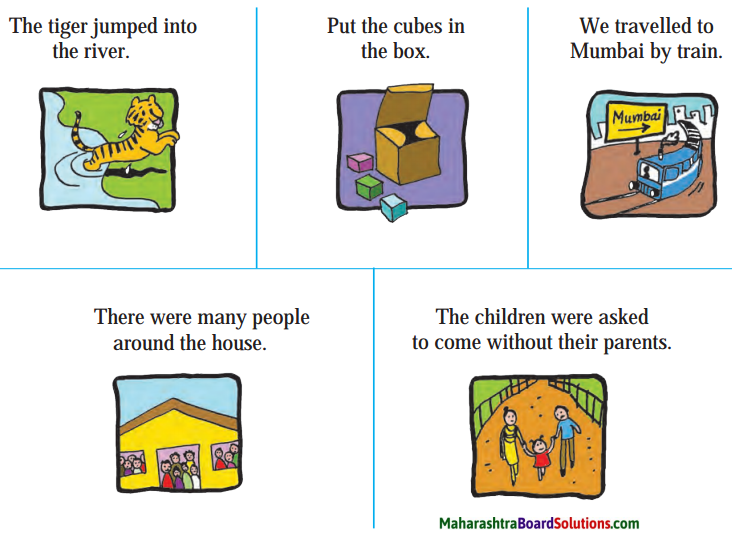
Maharashtra Board Class 5 English Solutions Chapter 18 Weeds in the Garden 1
Answer:
Question 1.
The tiger jumped into the river.
Answer:
The tiger jumped out of the river.

Question 2.
Put the cubes in the box.
Answer:
Put the cubes near the box.

Maharashtra Board Class 5 English Solutions Chapter 18 Weeds in the Garden

Question 3.
We travelled to Mumbai by train.
Answer:
We travelled from Mumbai by train

Question 4.
There were many people around the house.
Answer:
There were many people inside the house.

Question 5.
The children were asked to come without their parents.
Answer:
The children were asked to come with their parents.

3. Change the meaning by changing the adverb.

Question 3.
Change the meaning by changing the adverb.

  1. Speak gently
  2. Come in
  3. Hit the stone-hard with the hammer

Answer:

  1. Speak politely, quickly, slowly
  2. Come here, fast
  3. Hit the stone gently with the hammer

Maharashtra Board Class 5 English Solutions Chapter 18 Weeds in the Garden

6. Group Work

1. Form groups of 5-8 and list the following.

Question 1.
Form groups of 5-8 and list the following.
Bad habits
Very harmful habits
Answer:
Bad habits:

  • biting nails
  • getting up late
  • being untidy
  • talking while eating
  • talking loudly
  • playing with the hair
  • picking the nose

Very harmful habits:

  • stealing
  • using slang words
  • disrespecting elders
  • speaking rudely
  • fighting with everyone

Maharashtra Board Class 5 English Solutions Chapter 18 Weeds in the Garden

2. Discuss the following in groups.

Question 1.
Do people admit that they have bad habits?
Answer:
Do it yourself.

Question 2.
What can we do to get rid of bad habits?
Answer:
Do it yourself.

Maharashtra Board Class 5 English Solutions Chapter 18 Weeds in the Garden

Question 3.
Do’s and Don’ts for young children.
Answer:

Do’s Don’ts
1. Wash hands before eating. 1. Talk while eating.
2. Take small portions of food. 2. Fill your plate when you can’t finish it.
3. Eat everything served in the plate. 3. Waste food.
4. Respect elders. 4. Disrespect elders.
5. Be kind and gentle to all. 5. Be rude and impolite.
6. Be neat and presentable. 6. Be untidy and unclean.
7. Speak politely. 7. Speak loudly.
8. Help others in need. 8. Ignore those in need.
9. Help parents at home. 9. Avoid work.
10. Make friends / be friendly. 10. Make enemies.

Maharashtra Board Class 5 English Solutions Chapter 18 Weeds in the Garden

English Balbharati Std 5 Answers Chapter 18 Weeds in the Garden Additional Important Questions and Answers

A Textual and Additional Questions

Answer the following:

Question 1.
What did Anshuman’s parents notice about him?
Answer:
Anshuman’s parents noticed that he was developing bad habits.

Question 2.
What did Anshuman refuse to believe?
Answer:
Anshuman refused to believe that he was letting the bad habits get a hold over him.

Maharashtra Board Class 5 English Solutions Chapter 18 Weeds in the Garden

Question 3.
How did Anshuman’s parents want to correct their son?
Answer:
Anshuman’s parents wanted to be loving and gentle while correcting their son.

Question 4.
Where did Anshuman and his parents go to stay?
Answer:
Anshuman and his parents went to stay on his grandfather’s farm.

Question 5.
What did Anshuman’s father do while taking him around the farm?
Answer:
Anshuman’s father described the specialities of various plants, vines, bushes and trees while taking him around the farm.

Question 6.
Was it easy for Anshuman to pull out the slightly bigger weed? How did he pull it out?
Answer:
No, it was not easy for Anshuman to pull out the slightly bigger weed. Anshuman had to carefully, twist and pull it hard so that the whole plant came out with its root from the soil.

Maharashtra Board Class 5 English Solutions Chapter 18 Weeds in the Garden

Question 7.
What did Anshuman’s father notice, growing at a distance?
Answer:
Anshuman’s father noticed the same weed growing at a distance. He noticed that the weed had grown into a big plant with tiny flowers and dark fruits.

Question 8.
Why did Anshuman’s father want the weed plant pulled out?
Answer:
Anshuman’s father wanted the weed plant to be pulled out because if the weed plant was allowed to grow it would be dangerous to the other useful plants on the farm.

Question 9.
Was Anshuman successful in pulling out the weed plant with his bare hands?
Answer:
Anshuman put all his strength and tried hard to pull out the weed plant but he was unsuccessful.

Maharashtra Board Class 5 English Solutions Chapter 18 Weeds in the Garden

Question 10.
How was the weed plant pulled out?
Answer:
Anshuman’s father brought some implements. They dug around the weed and with great effort managed to pull the weed plant out.

Question 11.
What did Anshuman never forget throughout his life?
Answer:
Throughout his life Anshuman never forgot the early morning walk he had on the farm with his father.

Use the phrases in your own sentences.

Question 1.
to no avail – of no use, without success
Answer:
We tried hard to put sense into her but to no avail.

Question 2.
no trace left – no sign left
Answer:
The robbers left no trace and had taken away all the valuables from the house.

Maharashtra Board Class 5 English Solutions Chapter 18 Weeds in the Garden

Question 3.
time and again – over and over again, repeatedly.
Answer:
He has been warned not to misbehave time and again.

Question 4.
throughout his life – entire life.
Answer:
Throughout his life he has been helping the sick and needy.

Language Study :

Question 1.
Pick out the prepositions

  1. The cat ran across the road.
  2. I kept my bag on the table.
  3. I blew air into the balloon.
  4. There are many pencils in the box.
  5. We arranged a party for mother.

Answer:

  1. across
  2. on
  3. into
  4. in
  5. for

Maharashtra Board Class 5 English Solutions Chapter 18 Weeds in the Garden

Change the meaning of the sentences by changing the preposition.

Question 1.
Soham reached before me.
Answer:
Soham reached after me.

Question 2.
My brother ran up the hill.
Answer:
My brother ran down the hill.

Question 3.
The children ran inside the house.
Answer:
The children ran outside the house.

Maharashtra Board Class 5 English Solutions Chapter 18 Weeds in the Garden

Question 4.
The cat sat on the table.
Answer:
The cat sat under the table.

Question 5.
He jumped inside.
Answer:
He jumped outside.

Question 6.
Change the meaning by changing the adverb.

  1. Walk slowly
  2. wait here
  3. read quickly
  4. I hurt myself yesterday
  5. write the answer neatly

Answer:

  1. walk quickly
  2. wait there
  3. read slowly
  4. I hurt myself today
  5. write the answer correctly.

Maharashtra Board Class 5 English Solutions Chapter 18 Weeds in the Garden

Do as directed:

Question 1.

  1. Why are you late? (Identify whether the sentence is a statement, a command, a question or an exclamation)
  2. You are the first student to ….. finished your work. (has/have), (Fill in with the right form of verb)
  3. There were many ………………. in the basket. (Fill in with a countable noun)
  4. She spoke ………….. to her friend. (Fill in with an adverb)
  5. I jumped……… the well to save the child. (Fill in with a preposition)
  6. I love to hear stories. (Pick out the verb and state its tense)
  7. I saw a ……………. butterfly in the garden. (Fill in with an adjective)
  8. Stand in a straight line. (Identify whether the sentence is a statement, a command, a question or an exclamation)
  9. The dress has a tear on …………… sleeve. (Fill in with its or it’s)

Answer:

  1. Question
  2. have
  3. mangoes
  4. rudely
  5. into
  6. love-simple present tense
  7. colourful
  8. Command
  9. its

Maharashtra Board Class 5 English Solutions Chapter 18 Weeds in the Garden

Question 2.
Add a prefix to get the opposite of –

  1. correct
  2. obedient
  3. active
  4. safe

Answer:

  1. incorrect
  2. disobedient
  3. inactive
  4. unsafe

Reading Skills, Vocabulary and Grammar

Read the following passage and answer the questions given below.

Question 1.
What did father use to dig out the weed?
Answer:
Father used implements to dig out the weed.

Maharashtra Board Class 5 English Solutions Chapter 18 Weeds in the Garden

Question 2.
Which line in the passage tells us that Anshuman did not succeed in pulling out the weed plant?
Answer:
The line ‘He pulled harder and harder but to no avail’ tells us that Anshuman did not succeed in pulling out the plant.

Question 3.
Pick out a sentence from the passage which is an exclamation.
Answer:
I can’t get it out!

Question 4.
Why couldn’t Anshuman pull out the plant?
Answer:
Anshuman could not pull out the plant because its roots had gone deep into the soil.

Question 5.
Why should we not develop bad habits?
Answer:
Developing bad habits spoils our character. You also lose the love, respect and trust of your near and dear ones.

Maharashtra Board Class 5 English Solutions Chapter 18 Weeds in the Garden

Writing Skills :

Question 1.
Do’s and Don’ts in a classroom.
Answer:

Do’s Don’ts
1. Pay attention to the teacher 1. Disturb the teacher.
2. Complete your home work. 2. Leave work incomplete
3. Help your classmates. 3. Avoid helping
4. Speak softly. 4. Speak loudly.
5. Keep your classroom clean. 5. Litter class with paper, food, pencil shavings, etc.
6. Be disciplined. 6. Be indisciplined and rude.

Maharashtra Board Class 5 English Solutions Chapter 18 Weeds in the Garden

Weeds in the Garden Summary in English

Summary :

The story ‘Weeds in the Garden’, tries to bring out the importance of correcting children and imbibing good habits at the right time. Anshuman in this story develops bad habits. His parents try their best to advise him to get out of it but in vain. His parents get a chance to correct him when they go to stay on his grandfather’s farm.

While taking a walk on the farm, Anshuman’s father points out to the weeds growing between the plants. He explains to Anshuman how these weeds are harmful to the plants on the farm. He tells him that if the weeds are not pulled out at the right time its roots would grow deeper into the soil and thus destroy the plants.

He compares the weeds to bad habits which should be pulled out before the roots grow deeper and destroy a healthy plant. In the same way if we don’t get rid of bad habits, in time it will be difficult to reform or change oneself and will destroy the person’s character. Anshuman realizes his mistake and becomes a changed person.

Maharashtra Board Class 5 English Solutions Chapter 18 Weeds in the Garden

Meanings :

  1. weeds (nt) – useless plants harmful for desired vegetation
  2. indulge (v) – to satisfy wishes
  3. vain (adj) – useless, without success
  4. opportunity (n) – chance
  5. vines (n) – a climbing plant
  6. trace (n) – a very small amount
  7. avail (o) – to be of use
  8. implements (n) – tools or instruments

English Balbharati Std 5 Textbook Digest Unit 3

Strawberries Poem Questions And Answers Class 5 English Chapter 4 Maharashtra Board

Std 5 English Lesson No 4 Strawberries Question Answer Maharashtra Board

Balbharti Maharashtra State Board Class 5 English Solutions Chapter 4 Strawberries Notes, Textbook Exercise Important Questions and Answers.

5th Std English Poem Strawberries Question Answer

English Balbharati Std 5 Digest Chapter 4 Strawberries Textbook Questions and Answers

1. Learn and recite the poem.

Question 1.
Learn and recite the poem.

2. Read the poem and answer the following.

Question 1.
Which are the two different places where strawberries grow?
Answer:
The two different places where the strawberries grow are in the gardens and in the woodlands.

Question 2.
What are the two different ways of eating strawberries?
Answer:
The two different ways of eating strawberries are:
1. To eat it directly
2. To eat it with sugar or spice or cream.

Maharashtra Board Class 5 English Solutions Chapter 4 Strawberries

Question 3.
Which strawberries are plump and juicy?
Answer:
Strawberries that grow in gardens are plump and juicy.

Question 4.
Which strawberries are sweeter?
Answer:
The strawberries which grow in the woodland near the trickling stream are sweeter than the ones that grow in the gardens.

Question 5.
How would you like to eat your strawberries?
Answer:
I would like to eat my strawberries directly without adding any sugar or cream because when these things are added, the natural flavour of the fruit is lost.

Maharashtra Board Class 5 English Solutions Chapter 4 Strawberries

3. Activities

1. Find out when and where we get strawberries in Maharashtra.

Question 1.
Find out when and where we get strawberries in Maharashtra.
Answer:
In Maharashtra, strawberries are grown in Panchgani and Mahableshwar. The strawberry season is from November up to March.

Maharashtra Board Class 5 English Solutions Chapter 4 Strawberries

2. Make a list of your favourite fruits and vegetables and note down the time of the year when they are available in plenty.

Question 1.
Make a list of your favourite fruits and vegetables and note down the time of the year when they are available in plenty.
Answer:
a. Among the fruits, I like strawberries and mangoes. Strawberries are available in plenty from November up to March. Mangoes are available in plenty in the summer season especially in May.

b. Among the vegetables, I like cauliflower and ladyfinger. Cauliflower is found in plenty in the winter season. Ladyfinger is available all round the year.

Maharashtra Board Class 5 English Solutions Chapter 4 Strawberries

3. Have you ever eaten any fruit/vegetable picking it straight from the tree or field? Write about that experience in 3-5 lines.

Question 1.
Have you ever eaten any fruit/vegetable picking it straight from the tree or field? Write about that experience in 3-5 lines.
Answer:
Yes, I have eaten strawberries directly, after plucking it from the strawberry bush. We had gone to Mahableshwar and were staying at a friend’s place where they had strawberry farms. We were invited to the farm and the sight of the strawberries was so beautiful. We were told to pluck as many strawberries as we wanted. All of us started plucking strawberries and as we were plucking, we were also popping a few into our mouth. It was a wonderful experience eating the fruit directly from the tree.

Maharashtra Board Class 5 English Solutions Chapter 4 Strawberries

English Balbharati Std 5 Answers Chapter 4 Strawberries Additional Important Questions and Answers

Answer the following questions:

Question 1.
Who knows that the strawberries from the woodlands are sweeter?
Answer:
The wise men know that the strawberries from the woodlands are sweeter.

Language Study

Question 1.
Pick out the rhyming words from the poem.
Answer:

  • grow – know
  • fine – vine;
  • spoon – June
  • cream – stream

Maharashtra Board Class 5 English Solutions Chapter 4 Strawberries

Question 2.
Write from the poem two describing words for strawberries.
Answer:

  • plump
  • juicy

Reading Skills, Vocabulary and Grammar

Read the following extract and answer the questions given below.

Question 1.
Where do strawberries grow?
Answer:
Strawberries grow in gardens.

Question 2.
How are the strawberries grown in gardens?
Answer:
The strawberries grown in gardens are plump and juicy.

Maharashtra Board Class 5 English Solutions Chapter 4 Strawberries

Question 3.
Why do the berries plucked beside the trickling stream not need sugar, spice or cream?
Answer:
The berries plucked beside the trickling stream do not need sugar, spice or cream because they are naturally very sweet and tasty.

Question 4.
Which word in the poem tells us that the men are experienced?
Answer:
The word ‘wise’ tells us that the men are experienced.

Maharashtra Board Class 5 English Solutions Chapter 4 Strawberries

Question 5.
Have you tried to make anything with strawberries?
Answer:
Yes, I have tried to make strawberry milkshake and it turned out to be yummy.

Strawberries Summary in English

Summary :

The poem Strawberries’ tells us that the strawberries which are grown in gardens under our loving care is not as sweet as the strawberries that grow in the woods without anyone to look after it.

Meanings :

  1. plump (adj.) – to swell out
  2. juicy (adj.) – having a lot of juice
  3. wise (adj.) – good judgment because of experience
  4. woodland (n) – forest
  5. wild (adj.) – grow without being looked after
  6. berry (n) – a small juicy fruit
  7. trickling (adj.) – thin flow of water that drops continuously
  8. pluck (o) – to pull out something sharply

Balbharti English Textbook Std 5 Pdf Free Download Unit 1

The Journey to the Great Oz Poem Questions And Answers Class 5 English Chapter 21 Maharashtra Board

Std 5 English Lesson No 21 The Journey to the Great Oz Question Answer Maharashtra Board

Balbharti Maharashtra State Board Class 5 English Solutions Chapter 21 The Journey to the Great Oz Notes, Textbook Exercise Important Questions and Answers.

5th Std English Poem The Journey to the Great Oz Question Answer

English Balbharati Std 5 Digest Chapter 21 The Journey to the Great Oz Textbook Questions and Answers

1. Read the words. Write other words which have the same ending.
eventful (- ful), travellers (- ers), despairingly (- ly), carefully (- fully).

Question 1.
Read the words. Write other words which have the same ending.
eventful (- ful), travellers (- ers), despairingly (- ly), carefully (- fully).
Answer:

– ful – ers – ly – fully
potful singers sharply beautifully
dreadful dancers slowly gracefully
forgetful hawkers quickly awfully
merciful sellers clearly boastfully
bagful foresters softly colorfully
delightful photographers scarcely dreadfully
boastful potters surprisingly fruitfully
beautiful keepers amazingly forcefully
meaningful encroachers centrally dutifully

Maharashtra Board Class 5 English Solutions Chapter 21 The Journey to the Great Oz

2. List the characters in the story and write a few lines about each of them.

Question 1.
List the characters in the story and write a few lines about each of them.
Answer:
1. Dorothy is the girl who was whisked by the cyclone. She is whisked along with her dog Toto. Both of them land in the wonderful Land of Oz. She is friendly by nature. She is sweet and simple.

2. Tin Woodman has come to the wonderful Land of Oz. He needs a heart. He knows that only the Wizard of Oz can help him out. He helps in the journey to the land of Oz. He uses his axe to chop a tree to create a bridge for his friends. He also helps in putting an end to the snarling brutes.

3. The Scarecrow wants brains from the Wizard of Oz. He feels he lacks brains. He proves to be intelligent when he gives ideas to escape from difficulties.

4. The cowardly lion makes friends with Dorothy. He says that he lacks bravery. He wishes the Wizard of Oz to give him courage. Though he is a coward, he proves himself courageous in many situations and helps the others with him.

Maharashtra Board Class 5 English Solutions Chapter 21 The Journey to the Great Oz

3. Write in short how the travellers crossed the first ditch.

Question 1.
Write in short how the travellers crossed the first ditch.
Answer:
The travellers walked for an hour in the forest when they came across a great ditch that divided the forest. They could not proceed. The ditch was wide and steep. It had jagged rocks at the bottom. Scarecrow comes up with an idea. He requested the lion to carry everyone one by one on his back and jump to the other side of the ditch. The lion was successful in doing this. In this way the travellers crossed the first ditch.

4. Write how the travellers crossed the second gulf.

Question 1.
Write how the travellers crossed the second gulf.
Answer:
After crossing the first gulf I ditch, the travellers travelled some distance and came across another gulf which was broader and deeper than the first ditch/ gulf. It was impossible for the lion to jump across. The Scarecrow came up with an idea. He asked Tin Woodman to chop the tree near the ditch, in such a way that it fell across the gulf creating a bridge. The travellers successfully crossed this gulf too.

Maharashtra Board Class 5 English Solutions Chapter 21 The Journey to the Great Oz

5. Which event in the story tell us that –

Question 1.
the scarecrow was intelligent.
Answer:
When the travellers came across the two ditches it was scarecrow’s idea which helped them cross the ditch. It was because of the Scarecrow’s timely advice that the snarling brutes/beasts were put to death.

Question 2.
the lion was brave.
Answer:
The lion very bravely jumped over the first ditch taking each of the traveller on his back one by one and landed safely to the other side of the ditch.

Maharashtra Board Class 5 English Solutions Chapter 21 The Journey to the Great Oz

6. Imagine you are Dorothy and write about the day’s events in 5-8 lines in your (Dorothy’s) diary.

Question 1.
Imagine you are Dorothy and write about the day’s events in 5-8 lines in your (Dorothy’s) diary.
Answer:
Dear Diary,
22 May, 2015
I had a very eventful day today. I made three new friends. The cyclone which whisked me to the wonderful Land of Oz is where I met them. They had come to this land because they wanted help from the Wizard of Oz. We had to journey through a forest before we reached this wonderful land. We came across a lot of difficulties. Each time my friends helped me out of it. We have finally reached the wonderful Emerald City of Oz. I will let you know what happens as we have to go in search of the Wizard of Oz.

Maharashtra Board Class 5 English Solutions Chapter 21 The Journey to the Great Oz

7. Imagine you are the lion and someone is interviewing you. Write the answers to the following questions

Question 1.
Who were your companions on the way to Oz?
How did you take the others across the ditch? Were you afraid?
Were you afraid of the Kalidahs? Why did you decide to fight with them?
What did it feel like after you were out of the forest?
Answer:

Interviewer: Who were your companions on the way to Oz?
Myself: Dorothy and her dog Toto, the Tin Woodman and the Scarecrow were my companions on my way to Oz.
Interviewer: How did you take the others across the ditch? Were you afraid?
Myself: After measuring the distance of the ditch, I felt I could jump over it. Then as suggested by Scarecrow, I took each one of them one after the other on my back and safely landed on the other side of the ditch. Yes I was scared the first time, I jumped across the ditch with Scarecrow on my back. But when we reached the other side safely my fright disappeared.
Interviewer: Were you afraid of the Kalidahs? Why did you decide to fight with them?
Myself: Yes, I was afraid of the Kalidahs. Anyone would be. They were so dreadful and fierce beasts. I loved my friends dearly. Among my friends I was the one who looked big and ferocious. I felt that my friends believed in me and that is why I decided to fight the Kalidahs as long as I could.
Interviewer: What did it feel like after you were out of the forest?
Myself: It felt wonderful and great. We had actually reached the beautiful city of Oz and all of us were delightful.

Maharashtra Board Class 5 English Solutions Chapter 21 The Journey to the Great Oz

Language Study :

Question 1.
Read the following note and then highlighted the conjunctions.
“I am terribly afraid of falling, myself,” said the Cowardly Lion, “ but I suppose there is nothing to do but try it. So get on my back and we will make the attempt.”
The Scarecrow sat upon the Lion’s back, and the big beast walked to the edge of the gulf and crouched down.
“Why don’t you run and jump ?” asked the Scarecrow.
“ Because that isn’t the way we Lions do these things,” he replied. Then giving a great spring, he shot through the air and landed safely on the other side.
Answer:
“I am terribly afraid of falling, myself,” said the Cowardly Lion, “ but I suppose there is nothing to do but try it. So get on my back and we will make the attempt.”
The Scarecrow sat upon the Lion’s back, and the big beast walked to the edge of the gulf and crouched down.
“Why don’t you run and jump ?” asked the Scarecrow.
Because that isn’t the way we Lions do these things,” he replied. Then giving a great spring, he shot through the air and landed safely on the other side.

English Balbharati Std 5 Answers Chapter 21 The Journey to the Great Oz Additional Important Questions and Answers

Answer the following in one sentence:

Question 1.
Name the travellers.
Answer:
The travellers are Dorothy and her dog Toto, the Tin Woodman, the Scarecrow and the lion.

Question 2.
Who is whisked by the cyclone?
Answer:
Dorothy and her dog are whisked by the cyclone.

Maharashtra Board Class 5 English Solutions Chapter 21 The Journey to the Great Oz

Question 3.
Where did Dorothy find herself?
Answer:
Dorothy found herself in the wonderful Land of Oz

Question 4.
What did Tin Woodman, Scarecrow and the Cowardly Lion need?
Answer:
The Tin Woodman needed a heart, Scarecrow needed brains and the Cowardly Lion needed bravery

Question 5.
Who would help the travellers get what they needed?
Answer:
The Wizard of Oz, was the only person who could help the travellers to get what they needed.

Question 6.
What did the travellers see after walking for an hour?
Answer:
After walking for an hour, the travellers saw before them a great ditch that crossed the road and divided the forest.

Maharashtra Board Class 5 English Solutions Chapter 21 The Journey to the Great Oz

Question 7.
Who helped the travellers cross the ditch?
Answer:
The cowardly lion helped the travellers cross the ditch.

Question 8.
What added to the discomfort of the travellers?
Answer:
The strange noises that the travellers heard coming from the depths of the forest added to the discomfort of the travellers.

Question 9.
What did the travellers see when they started crossing the bridge?
Answer:
The travellers saw two great beasts with bodies like bears and heads like tigers running towards them.

Answer in a few lines:

Question 1.
Describe the ditch.
Answer:
There was a ditch that divided the forest. It was very wide and very deep too. There were many big, jagged rocks at the bottom. The sides of the ditch were very steep.

Maharashtra Board Class 5 English Solutions Chapter 21 The Journey to the Great Oz

Question 2.
Why did the Scarecrow decide to try the jump across the ditch on the lion’s back first?
Answer:
The Scarecrow decided to try the jump across the ditch on the lion’s back first because if Dorothy sat first and the jump was not successful she would be killed. If the Tin Woodman sat first and the jump was not successful he would be badly dented on the rocks. But if the Scarecrow fell it would not be hurt at all.

Question 3.
What are the Kalidahs?
Answer:
Kalidahs are monstrous beasts with bodies like bears and heads like tigers. Their claws are so long and sharp that they could tear anyone into two easily. The travellers were terribly afraid of Kalidahs.

Question 4.
How did the travellers cross the second gulf / ditch?
Answer:
The Scarecrow asked Tin Woodman to chop down the great tree standing close to the ditch so that it would fall across the gulf and the travellers would be able to walk across it easily to the other side.

Maharashtra Board Class 5 English Solutions Chapter 21 The Journey to the Great Oz

Question 5.
How did the Scarecrow and the Tin Woodman put an end to the brutes?
Answer:
The Scarecrow asked Tin Woodman to chop the end of the tree that rested on their side of the ditch. The Tin Woodman began chopping the tree and just as the two Kalidahs were nearly across, the tree fell with a crash into the gulf along with the ugly, snarling brutes. Both the brutes dashed to pieces on the sharp rocks at the bottom

Question 6.
What could the travellers see on the other side of the broad river?
Answer:
On the other side of the broad river, the travellers could see the road of yellow brick running through a beautiful country. The green meadows were dotted with bright flowers and the road was bordered with trees bearing delicious fruits.

Maharashtra Board Class 5 English Solutions Chapter 21 The Journey to the Great Oz

Question 7.
Give a short account of how the travellers crossed the first ditch/gulf.
Answer:
The travellers walked for an hour in the forest when they came across a great ditch that divided the forest. They could not proceed. The ditch was wide and steep. It had jagged rocks at the bottom. Scarecrow comes up with an idea. He requested the lion to carry everyone one by one on his back and jump to the other side of the ditch. The lion was successful in doing this. In this way the travellers crossed the first ditch.

Maharashtra Board Class 5 English Solutions Chapter 21 The Journey to the Great Oz

Question 8.
Give a short account of how the travellers crossed the second ditch/gulf.
Answer:
After crossing the first gulf/ditch, the travellers travelled some distance and came across another gulf which was broader and deeper than the first ditch/gulf. It was impossible for the lion to jump across. The Scarecrow came up with an idea. He asked Tin Woodman to chop the tree near the ditch, in such a way that it fell across the gulf creating a bridge. The travellers successfully crossed this gulf too.

Pick out the conjunctions from the sentences.

Question 1.

  1. He was punished because he did mischief.
  2. My friend and me went to the garden.
  3. I had an umbrella but I was completely wet.
  4. We had pizzas and burgers at the party.
  5. It was hard to say whether Mumbai Indians or Chennai Super Kings would win.

Answer:

  1. because
  2. and
  3. but
  4. and
  5. or

Maharashtra Board Class 5 English Solutions Chapter 21 The Journey to the Great Oz

Do as directed:

Question 1.

  1. ……………… Taj Mahal is one of ………. wonders of the world. (Fill in with articles)
  2. Ramu was not only known for his honesty but also for his wisdom. (Pick out the nouns and state their kind)
  3. The train went ……………. the tunnel. (Fill in with a preposition)
  4. The lion jumped upon the deer and killed it. (Pick out the verbs)
  5. The sky was filled with stars. (Identify the kind of sentence)
  6. Seeing the cat, the rat ran quickly into its hole. (Pick out the adverb)
  7. Add proper prefixes to form the opposites of –
    • unity
    • conduct
    • developed
    • educated
  8. The scarecrow fell backward into the ditch. (Pick out the compound words)
  9. I have a pet cat. …………….. colour is light brown. (Fill in with it’s/its)
  10. She is a …………. girl. (Fill in with an adjective)

Answer:

  1. The, the
  2. Ramu – Proper noun, honesty and wisdom – Abstract Noun
  3. through – preposition
  4. jumped, killed – verb
  5. Statement
  6. adverb – quickly
  7. unity – disunity, conduct – misconduct, developed – undeveloped, educated – uneducated
  8. scare + crow = scarecrow, back + ward = backward
  9. its
  10. beautiful/ hardworking/sincere/good/naughty

Reading Skills, Vocabulary and Grammar

Read the passage and do the activities given below.

Question 1.
Who was the first to cross the bridge?
Answer:
Dorothy, holding Toto in her arms was the first to cross the bridge.

Question 2.
What made the travellers look up when they started crossing the bridge?
Answer:
A sharp growl made the travellers look up when they started crossing the bridge.

Maharashtra Board Class 5 English Solutions Chapter 21 The Journey to the Great Oz

Question 3.
Why did the lion begin to tremble?
Answer:
The lion began to tremble because he saw the Kalidahs running towards them.

Question 4.
Pick out a word from the passage which means ‘strange’.
Answer:
queer

Question 5.
Pick out two words from the passage to form opposite by using a prefix.
Answer:
like – unlike, certainly – uncertainly, afraid – unafraid, even – uneven.

Question 6.
Frame sentences with the given words –
1. fierce
2. surprise
Answer:
1. I was scared to see the fierce lion at the zoo.
2. Mohan was in a surprise when he saw a brand new cycle at home.

Maharashtra Board Class 5 English Solutions Chapter 21 The Journey to the Great Oz

Question 7.
Dorothy screamed and the Scarecrow fell over backward. (Pick out the conjunction.)
Answer:
and

Question 8.
Pick out a sentence which is in the exclamatory form.
Answer:
They are the Kalidahs!

Question 9.
They had just started to cross the queer bridge when a sharp growl made them look up. (Pick out the adjectives from the sentence.)
Answer:
queer, sharp

Maharashtra Board Class 5 English Solutions Chapter 21 The Journey to the Great Oz

Question 10.
What would you do if you were confronted by a barking dog?
Answer:
If I was confronted by a barking dog, I would stand quiet without moving because I have heard that when dog barks and if there is no reaction from us they would go away.

Activities:

Question 1.
Try to add more to these lists of words. Let us try some more endings –
Answer:

-ors -ness -ment -tion
sailors sickness achievement subtraction
vendors cleverness government addition
mirrors cleanliness ailment multiplication
jailors backwardness agreement conjunction
visitors calmness development absorption

The Journey to the Great Oz Summary in English

Summary :

The Journey to the Great Oz’ is a classical novel for children, written by Lyman Frank Baum (1856 – 1919). This classical novel was also made into a movie. This story takes you into a world of fantasies of witches, wizards, monsters and magic where one imagines the impossible.

The story revolves around Dorothy and her dog Toto who are carried away by the cyclone to the Land of Oz. There she meets Tin Woodman, who needs a heart, the Scarecrow who needs brains and a lion who needs bravery.

The one who can fulfill their needs is the Wizard of Oz, who lives in the Emerald City of Oz. The four travellers begin their journey and soon come to a great ditch. The lion carries each of the travellers to the other side of the ditch on his back.

They continue travelling and soon come to a deeper ditch. The Scarecrow comes out with an idea to chop down a tree near the ditch. Tin Woodman chops the tree letting it fall across the ditch.

Somehow the four travellers reach the other side with the help of the tree bridge. As soon as they reach the other side they are chased by some great beasts, the Kalidahs, with bodies like bears and heads like tigers. Scarecrow puts on his thinking cap and asks Tin Woodman to chop the end of the tree resting on their side.

The tree crashes into the gulf putting an end to the snarling beasts. The travellers resume walking and soon they come to a broad river and across the river they can see the beautiful country of Oz.

Maharashtra Board Class 5 English Solutions Chapter 21 The Journey to the Great Oz

Meanings:

  1. fantasy (n) – imagination dealing with magic
  2. literature (n) – written work
  3. whisked (v) – to move something without any warning with a quick, light, sweeping motion
  4. eventful (adj) – having memorable/ wonderful memories
  5. ditch (n) – a long shallow depression
  6. jagged (adj) – unevenly cut, rough and pointed
  7. despairingly (adu) – to give up hope
  8. faintest (adj) – weak sound
  9. shaggy (adj) – rough, long, thick hair
  10. mane (n) – long hair on the back of the neck of an animal
  11. crouched (o) – bent down
  12. gloomy (adj) – depressing
  13. monstrous (adj) – imaginary monsters which are large and frightful
  14. dreadful (adj) – very bad
  15. queer (adj) – strange
  16. brutes (n) – ferocious animals
  17. anxious (adj) – filled with worry
  18. delicious (adj) – very tasty
  19. delightful (adj) – very pleasant
  20. with all his might (phrase) – with all his strength

English Balbharati Std 5 Textbook Digest Unit 3

A Lesson for All Poem Questions And Answers Class 5 English Chapter 14 Maharashtra Board

Std 5 English Lesson No 14 A Lesson for All Question Answer Maharashtra Board

Balbharti Maharashtra State Board Class 5 English Solutions Chapter 14 A Lesson for All Notes, Textbook Exercise Important Questions and Answers.

5th Std English Poem A Lesson for All Question Answer

English Balbharati Std 5 Digest Chapter 14 A Lesson for All Textbook Questions and Answers

1. Answer the following questions.

Question 1.
What difficulties do the people in the play face in the morning?
Answer:
The people in the play neither had their newspaper delivered on time nor did their milkman turn up.

Question 2.
What more difficulties would they have to face, if the roads are not cleared ?
Answer:
If the roads were not cleared, there would be severe threats for the people. There would be more accidents, spread of epidemics and other illnesses, stink and stench and above all, it would be difficult to continue living in such a locality.

Maharashtra Board Class 5 English Solutions Chapter 14 A Lesson for All

Question 3.
What are the complaints of the animals?
Answer:
The animals and birds complained about man dumping all his waste in their dwelling place, the forests due to which trees are dying and vanishing and birds are losing their place to roost and nest. Their young ones get injured due to sharp objects and die due to lack of medical help. All the fish in the river and lakes die because of waste dumped in water. The chemicals and poisonous waste lead to illness and death in the animals.

2. List the characters in the play.

Question 1.
List the characters in the play.
Human characters, Birds and animals
Answer:

Human characters Birds and animals
1. Newspaper boy
2. Milkman Small birds
3. Hawker Rabbit
4. School-bus driver Deer
5. Dr. Sawant Peacock
6. Mrs. Patel – a housewife Squirrel
7. Mr. Desai – a businessman Bear
8. Mayor of the town Birds
9. Mrs. Joshi – a housewife Tortoise
10. Madhu & Nidhi
Mrs. Joshi’s daughters
(school going girls)

Maharashtra Board Class 5 English Solutions Chapter 14 A Lesson for All

3. Activities :

Question 1.
Enact the play.
Answer:

Do’s Don’ts
1. Use a dustbin 1. Ask for plastic carry bags
2. Reduce use of plastics 2. Discard used things carelessly
3. Reuse things 3. Use thermocol
4. Recycle those items which can be recycled 4. Celebrate festivals in a non-eco friendly way
5. Create awareness amongst the people. 5. Take / buy  anything that you  are unsure of using.

Question 2.
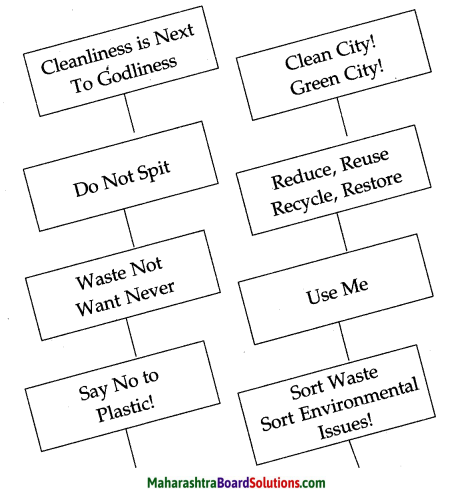
Write slogans for the cleanliness drive in your area.
Answer:
Maharashtra Board Class 5 English Solutions Chapter 14 A Lesson for All 2
Question 3.
Write a short note/story based on the ill effects of pollution.
Answer:
Environmental pollution is a serious problem faced by us today. The ill-effects of all types of pollution, namely air, water, soil and sound are extremely harmful. It not only destroys the plants and animals but they have a disastrous effect on man too.

Cancer, respiratory illnesses, heart trouble are just a few of the many illnesses which are caused due to pollution Thus, we can say that pollution spoils the quality of the environment, affects human life, and renders the soil unfit for cultivation of crops. So, it is very important to control pollution which is one of the causes of the depletion of the ozone layer. So let us control pollution and thereby reduce its impact.

Maharashtra Board Class 5 English Solutions Chapter 14 A Lesson for All

4. Language Study (See pages 84-88.)

Question 1.
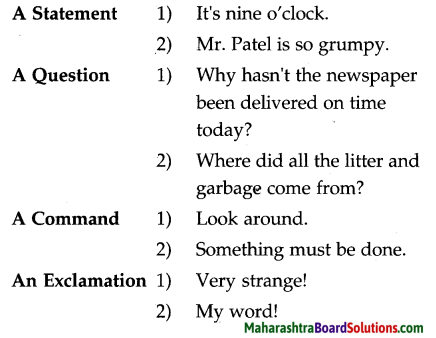
Find two examples of each of the following from the lesson
A Statement, A Question, A Command, An Exclamation
Answer:
Maharashtra Board Class 5 English Solutions Chapter 14 A Lesson for All 1

5. Group Work

1. Form groups of four or five.
Try to find the answers to the following questions through observation and by talking to your teachers, parents and others. Discuss your answers in the group.

Question 1.
How is waste generated?
Answer:
Waste is generated when we dispose or throw away things we no longer need. Waste can be generated at home and in industries.

Maharashtra Board Class 5 English Solutions Chapter 14 A Lesson for All

Question 2.
How is it removed or cleared?
Answer:
Waste can be removed or cleared by having a good waste management plan. We should sort out waste of which some can be processed while the rest can be recycled. Our mantra should be : Reduce! Reuse! Recycle! Restore!

Question 3.
How can we help in the task of clearing or removing garbage.
Answer:

  1. We should stop littering.
  2. We should reduce, reuse and recycle.
  3. We should use organic waste to create biogas and compost.
  4. We should always use dustbins.

Maharashtra Board Class 5 English Solutions Chapter 14 A Lesson for All

2. In what way can we help to reduce or minimize waste generation?
Discuss the issue in groups of 4 or 5 and note down all good suggestions.
Resolve to follow them yourself. Some have been given below for your reference.

Question 1.
In what way can we help to reduce or minimize waste generation?
Discuss the issue in groups of 4 or 5 and note down all good suggestions.
Resolve to follow them yourself. Some have been given below for your reference.

  • Don’t waste food.
  • Take as much as you want but finish everything that’s on your plate.
  • Don’t throw away broken or half-used things. Repair them and use them.
  • Avoid things which can be used only once.
  • For example: thermocol (polysterene) cups, plastic glasses, etc.
  • Reuse !
  • Recycle !

Maharashtra Board Class 5 English Solutions Chapter 14 A Lesson for All

English Balbharati Std 5 Answers Chapter 14 A Lesson for All Additional Important Questions and Answers

Answer the following:

Question 1.
What was the state of the street?
Answer:
The street was littered with plastic bags, cartons, tins, cans, broken glass, old tyres, waste paper balls, bags and other garbage.

Question 2.
Write the suggestions given by the Mayor for waste management.
Answer:
He suggested that the residents should sort out the litter and he would arrange for it to be collected separately. Some of it could go for processing and some for recycling.

Maharashtra Board Class 5 English Solutions Chapter 14 A Lesson for All

Language Study :

Question 1.
Give one word for:

  1. Substances which are artificially prepared
  2. Substance which can cause harm to living organisms if used
  3. A place where people live together

Answer:

  1. Chemicals
  2. Poison
  3. Settlement

Question 2.
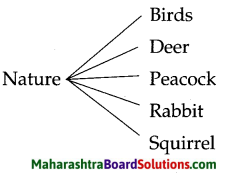
Prepare a word register for nature.
Answer:
Maharashtra Board Class 5 English Solutions Chapter 14 A Lesson for All 4

Match the meanings:

Question 1.

A B
1. vanishing a. throwing
2. dumping b. scattering
3. limping c. disappearing
4. littering d. walk with difficulty

Answer:

A B
1. vanishing c. disappearing
2. dumping a. throwing
3. limping d. walk with difficulty
4. littering b. scattering

Maharashtra Board Class 5 English Solutions Chapter 14 A Lesson for All

Reading Skills, Vocabulary and Grammar

Read the following passage and answer the questions given below.

Question 1.
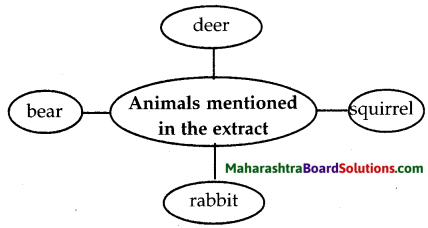
Complete the following web – diagram
Answer:
Maharashtra Board Class 5 English Solutions Chapter 14 A Lesson for All 3

Question 2.
What did the animals confess?
Answer:
The animals confessed that they had brought in all the litter and that they had spread the garbage all over the town.

Question 3.
How according to the deer, were their young ones dying?
Answer:
According to the deer, their young ones were dying due to the injury from the sharp broken objects from the waste dumped in the forest.

Maharashtra Board Class 5 English Solutions Chapter 14 A Lesson for All

Question 4.
What was the impact of the chemicals and poisons on the animals?
Answer:
Many animals who drank the water polluted by chemicals and poisons fell ill and died.

Question 5.
Our trees are dying and vanishing because of you. (State the word class of the underlined word)
Answer:
vanishing – Verb

Question 6. a.
a. We have no doctor to dress their wounds. (Pick out the nouns)
Answer:
Nouns : doctor, wounds

Question b.
All the fish in the rivers and lakes die because of waste dumped in the water (Pick out the conjunction)
Answer:
because – Conjunction

Maharashtra Board Class 5 English Solutions Chapter 14 A Lesson for All

Question c.
Give the opposites of:
1. young
2. die
Answer:
1. old
2. live

d. Give the noun forms of:

  1. live
  2. die
  3. ill
  4. injured

Answer:

  1. life
  2. death
  3. illness
  4. injury

Question 7.
How can we keep the environment clean?
Answer:
We can keep the environment clean by reducing the generation of waste and managing it effectively. Waste not, want not should be our mantra.

Maharashtra Board Class 5 English Solutions Chapter 14 A Lesson for All

Do as directed :

Question 1.
It’s nine o’clock. (Pick out the contraction and state what it stands for)
Answer:
It’s – It is

Question 2.
Mr. Patel is so grumpy (Pick out the verb)
Answer:
is – Verb

Maharashtra Board Class 5 English Solutions Chapter 14 A Lesson for All

Question 3.
Let me see the wound. (Pick out the article)
Answer:
the – Article

Question 4.
The tyres were punctured. (Pick out the verb and state its tense)
Answer:
were punctured – Past perfect tense

Question 5.
We will not tolerate this. (State the part of speech of the underlined word)
Answer:
tolerate – Verb

Question 6.
Self-help is the best help. (Pick out a compound word)
Answer:
self-help

Maharashtra Board Class 5 English Solutions Chapter 14 A Lesson for All

A Lesson for All Summary in English

Summary :

‘A Lesson for All’ is a drama which conveys a very important message of keeping the environment clean by taking effective steps in waste management Very often, we dump the waste in the forest and in water bodies like ponds, lakes, seas etc thereby threatening the life of animals and birds in it.

The trees are dying due to increase in toxic i.e. poisonous wastes and this has a direct impact on the birds as they are left with no place to roost or build nests. The litter which includes glass and other sharp objects hurt the young ones of the animals and sometimes they die due to no medical help available.

Waste disposal in water bodies has serious consequences. We dump waste which contains chemicals and poisonous substances killing not only the fish but the other animals which fall ill and die due to the polluted water. In this drama, the animals and the birds decide to teach a lesson to the humans by dumping the garbage back into the town.

This action not only takes the people by surprise but puts them through the same inconvenience which is faced by the members of the animal king dom It becomes an eye-opener, a lesson for all. The people and the Mayor make a promise to mend their ways-to sort and process the garbage and dispose it in an eco-friendly way. They promise to save our mother earth from further harm.

Maharashtra Board Class 5 English Solutions Chapter 14 A Lesson for All

Meanings :

  1. hawker (n) – one who sells small products from door-to-door
  2. littered (u) – scattered waste here and there
  3. cartons (n) – boxes made out of thick cardboard
  4. mayor (n) – the elected head of a town or city
  5. retinue (n) – a group of advisors or assistants accompanying an important person
  6. grumpy (adj) – ill-tempered
  7. presence of mind – act quickly in an emergency
  8. mystery – difficult to understand
  9. limping (u) – walking with difficulty
  10. punctured (o) – made a hole in
  11. ripped (v) – stumbled and fell
  12. sprained (o) – injured due to twisting
  13. obstacle (n) – a thing that blocks one’s way, hurdle
  14. unbelievable (adj) – something which cannot be believed.
  15. dumping (u) – throwing
  16. endanger (u) – put at risk
  17. hinder (v)- make it difficult for someone to do something.
  18. responsible (adj) – accountable or answerable
  19. dwelling (n) – habitat / place of residence
  20. vanishing (v) – disappearing
  21. chemicals (n) – substances which are artificially prepared
  22. poison (n) – someting destructive or harmful
  23. polluted (o) – made dirty with harmful and poisonous substances
  24. settlements (n) – a place where people live together
  25. rivers (n) – natural streams of water
  26. lakes (n) – large bodies of water surrounded by land
  27. processing (u) – perform a series of operations to change or preserve something
  28. recycling (o) – convert waste into something reusable (here)
  29. effectively (adv) – produce an effect which will bring desired result.

English Balbharati Workbook Std 5 Answers Unit 2

The Triantiwontigongolope Poem Questions And Answers Class 5 English Chapter 9 Maharashtra Board

Std 5 English Lesson No 9 The Triantiwontigongolope Question Answer Maharashtra Board

Balbharti Maharashtra State Board Class 5 English Solutions Chapter 9 The Triantiwontigongolope Notes, Textbook Exercise Important Questions and Answers.

5th Std English Poem The Triantiwontigongolope Question Answer

English Balbharati Std 5 Digest Chapter 9 The Triantiwontigongolope Textbook Questions and Answers

1. Read the poem aloud using proper intonation.

Question 1.
Read the poem aloud using proper intonation.

Maharashtra Board Class 5 English Solutions Chapter 9 The Triantiwontigongolope

2. Note that we say ‘its appetite’, ‘its manners’ and not “it’s appetite’ or ‘it’s manners’.
It’s means ‘It is’ and its means ‘belonging to it.

Question 1.
Note that we say ‘its appetite’, ‘its manners’ and not “it’s appetite’ or ‘it’s manners’.
It’s means ‘It is’ and its means ‘belonging to it.
Answer:
Now, read the following sentences.

  • Its response was overwhelming,
  • It’s not good to be dishonest.
  • It’s a beautiful day,
  • It’s a pleasant surprise.
  • Its results will reveal if the experiment was a success.
  • Its conclusion was unclear.

Maharashtra Board Class 5 English Solutions Chapter 9 The Triantiwontigongolope

3. Activities

1. Is the insect described in the poem a real insect? Think about an imaginary creature. Describe it in your own words. You may draw its picture and label it.

Question 1.
Is the insect described in the poem a real insect? Think about an imaginary creature. Describe it in your own words. You may draw its picture and label it.
Answer:
The insect described in the poem is not real but imaginary by the poet’s own admission at the end of the poem. Let me tell you about Hopperslipograssipede, my friend, who lives in my garden. It thrives on plants. When no one is around it changes its colour according to its own whims and fancies.

2. Think of other funny names for imaginary creatures. Write any 3 of them.

Question 1.
Think of other funny names for imaginary creatures. Write any 3 of them.
Answer:

  1. Hopperslipograssipede
  2. Cenacaciapidekatydid
  3. Alfalfaaerialweevil

Maharashtra Board Class 5 English Solutions Chapter 9 The Triantiwontigongolope

English Balbharati Std 5 Answers Chapter 9 The Triantiwontigongolope Additional Important Questions and Answers

Answer the following questions.

Question 1.
What is the poem about?
Answer:
The poem is about an imaginary insect The Triantiwontigongolope’. The poet describes its funny ways only to disclose in the end that it was all a joke.

Maharashtra Board Class 5 English Solutions Chapter 9 The Triantiwontigongolope

Question 2.
What does the insect live on?
Answer:
The insect lives on weeds and wattle-gum.

Question 3.
What does Trianti wontigongolope do when we call it by its name?
Answer:
When we call Triantiwontigongolope by its name, it makes a sound of contentment, with a sense of pride.

Question 4.
The poet reveals in the end that it was a joke.
Were you disappointed by this confession? Justify your answer.
Answer:
The humorous character in the story made me laugh heartily but at the same time I was disappointed that I won’t be able to see the insect as it does not exist.

Maharashtra Board Class 5 English Solutions Chapter 9 The Triantiwontigongolope

Language Study

Question 1.
Pick out a word indicating sound from the poem:
Answer:
Purrs

Question 2.
Match the rhyming words.

A B
1. toes a. name
2. shame b. nose
3. confess c. green
4. been d. address

Answer:

A B
1. toes a. name
2. shame a. name
3. confess d. address
4. been c. green

What do the underlined words mean:

Question 1.
If you sneer at it or scold it, it will scuttle off
in shame.
Answer:
If we scorn or scold the insect it will run away in shame.

Maharashtra Board Class 5 English Solutions Chapter 9 The Triantiwontigongolope

Question 2.
It lives on weeds and wattle-gum and has a funny face.
Answer:
It eats weeds and wattle-gum and it has a funny face.

Question 3.
Fill in the blanks with ‘it’s’ and ‘its’

  1. ……… effect is severe.
  2. ………. your choice.
  3. ………. a possibility.
  4. ………. impact was strong.
  5. …………. the most severe earthquake Nepal has ever witnessed.

Answer:

  1. Its
  2. It’s
  3. It’s
  4. Its
  5. Its

Maharashtra Board Class 5 English Solutions Chapter 9 The Triantiwontigongolope

Reading Skills, Vocabulary and Grammar

Read the following extract and answer the questions given below:

Question 1.
Complete the web
Maharashtra Board Class 5 English Solutions Chapter 9 The Triantiwontigongolope 1
Answer:

  • tickle
  • scold
  • trembles
  • scuttle

Select the proper alternative and complete the following:

Question 1.
Triantiwontigongolope ………………………. if you tread upon its toes.
(a) smiles
(b) trembles
(c) scuttles
Answer:
(b) trembles

Maharashtra Board Class 5 English Solutions Chapter 9 The Triantiwontigongolope

Question 2.
Pick out a line to prove that Trianti wontigongolope does not exist.
Answer:
For there isn’t such an insect.

Question 3.
The poet reveals in the end that it was a joke.
Were you disappointed by this confession? Justify your answer.
Answer:
The humorous character in the story made me laugh heartily but at the same time. I am disappointed that I won’t be able to see the insect as it does not exist.

The Triantiwontigongolope Summary in English

Summary :

The humorous poem ‘The Triantiwontigongolope’ written by C. J. Dennis tickles the reader’s funny bones and ushers laughter. The main character of this poem is a very funny insect with a very funny name. The poet describes its physical appearance, eating habits and other activities. At the end of the poem, the poet surprises us by concluding that the insect is imaginary and does not exist. We are willing to forgive the poet for his prank. After all, didn’t he make us laugh to our heart’s content?

Maharashtra Board Class 5 English Solutions Chapter 9 The Triantiwontigongolope

Meanings :

  1. spy (o) – catch sight of
  2. spider (n) – a small insect with eight legs.
  3. beetle (n) – an insect with wings which are hard.
  4. bee (n) – an insect which provides honey
  5. woolly (adj.) – covered with wool.
  6. grub (n) – a worm-like larva of an insect
  7. weeds (n) – unwanted wild plants
  8. wattlegum (n) – an Australian gum
  9. appetite (n) – desire for food
  10. disgrace (n) – loss of respect due to one’s action
  11. scare (v) – cause fear
  12. mope (v) – feel low and dejected
  13. tremble (v) – to shake due to excitement or fraility
  14. tickle (o) – light touch by someone which evokes laughter
  15. tread (v) – walk in a specific manner
  16. snubbish (adj.) – somewhat short and turned up at the end
  17. scold (v) – to rebuke
  18. scuttle (o) – to run hurriedly
  19. purrs (u) – sound that cat makes
  20. confess (o) – admit
  21. forgive (v) – cease or stop feeling angry or bitter towards someone for their mistake / their action.

English Balbharati Workbook Std 5 Answers Unit 2

Announcements Poem Questions And Answers Class 5 English Chapter 6 Maharashtra Board

Std 5 English Lesson No 6 Announcements Question Answer Maharashtra Board

Balbharti Maharashtra State Board Class 5 English Solutions Chapter 6 Announcements Notes, Textbook Exercise Important Questions and Answers.

5th Std English Poem Announcements Question Answer

English Balbharati Std 5 Digest Chapter 6 Announcements Textbook Questions and Answers

1. Choose a suitable heading for each announcement from those given below.

Question 1.
Choose a suitable heading for each announcement from those given below.
1. Change in School Hours
2. Cleanliness
3. Story-telling Competition
4. Lost and Found
5. Warning
6. Football Match
Answer:

Announcement Number Heading
1. Cleanliness
2. Change in school hours
3. Football match
4. Story-telling competition
5. Warning
6. Lost and found

Maharashtra Board Class 5 English Solutions Chapter 6 Announcements

2. Present any one of these announcements yourself, orally.

Question 1.
Present any one of these announcements yourself, orally.
Answer:
Announcements

Orally Notice – board
Cleanliness
Change in school hours Change in school hours
Football match Football match
Story-telling competition Warning
Warning Warning
Lost and found Lost and found

Maharashtra Board Class 5 English Solutions Chapter 6 Announcements

3. Group Work

Question 1.
An announcement can be made in every class, orally. Or, it can be put up on the school notice-board. Discuss and decide what method should be used for each of the announcements given here.

  • Oral announcement
  • Written notice
  • Both

Question 2.
Make groups. One person in the group chooses an announcement. Everyone in the group reads that announcement silently but carefully and closes their books. Then that person presents the announcement, changing one of the details in the announcement. Others spot the change. For example, you might say ‘red’ key chain instead of ‘blue’ in the last announcement.

Question 3.
Name the occasion or reason for which each of the announcements is being made. Then think of an occasion and prepare an announcement for it as a group activity.
Answer:

Ganesh Chaturthi Celebrations

All the members of the society are hereby informed that the Ganesh pandals will be set with other decorations in the society compound. Members are requested to contribute as much as they can and handover the amount to the Secretary by tomorrow.

Jt. Secretary
XYZ

Maharashtra Board Class 5 English Solutions Chapter 6 Announcements

4. Activity

Question 1.
Prepare an announcement for an occasion like the ones mentioned here.
Answer:
1.

Little Scholars’ School

Beware! The floor here is wet A pipeline in the boys’ washroom on the second floor is broken. There is water seepage from the walls and the staircase. The floor is wet and slippery. Students using the passages hould be cautious. They are warned not to run, for they might slip and get injured.

Supervisor
XYZ

2.

Little Scholars School Medical Camp

Dt. 01 Sept. 2015 The school has organized a medical checkup programme for classes V, VI and VII from 13th September, 2015 to 16th September, 2015. Try not to remain absent on these days.
Principal
XYZ

3.

Blossoms Laughter Club

Laughter Club has started a laughter session in Tilak Garden every morning at 7 a.m. All those who are interested in cheering up their busy life, kindly register your names with Mr. Pawar, the organizer.

Secretary
XYZ

4.

Blossoms High School Return of Library Books

It has been noticed that library books are not returned on time. Many of the books returned are not in proper condition. Strict action will be taken if there is a delay in returning the books. A fine will also be charged for unkempt books.

Librarian
XYZ

English Balbharati Std 5 Answers Chapter 6 Announcements Additional Important Questions and Answers

Answer the following questions:

Question 1.
What did the Head Boy and the Head Girl observe?
Answer:
The Head Boy and the Head Girl observed that certain classes did not clean up their classrooms before leaving.

Question 2.
Why will the school close an hour earlier?
Answer:
The school will close an hour earlier as the teachers have to attend an important meeting.

Maharashtra Board Class 5 English Solutions Chapter 6 Announcements

Question 3.
Which classes will be competing in the football match?
Answer:
Classes VIII and IX will be competing in the football match.

Question 4.
Give the date, time and venue of the Elocution Competition.
Answer:
The Elocution Competition will be held on the 21st July, at 10 a.m. in the morning in the school hall.

Question 5.
What are the students cautioned about?
Answer:
The students are cautioned to stay away from the fence at the construction site.

Maharashtra Board Class 5 English Solutions Chapter 6 Announcements

Announcements Summary in English

Summary :

The lesson Announcements’ tells us that an announcement is used to communicate with students in school or people in general. Announcements are made to give information or a message about something. Announcements can be in the written or the oral form. In the written form, a notice is put up in class or on the notice board of the school.

Announcements to indicate different timings and days are put up in the written format as it is likely that one may forget the timings or days. On the other hand, short messages without date and time can be announced orally While announcements are being made, one should pay attention to it so that doubts can be cleared right away.

Maharashtra Board Class 5 English Solutions Chapter 6 Announcements

Meanings :

  1. observed (o) – watched carefully.
  2. littered (o) – dirtied with papers thrown around.
  3. detained (u) – forced to stay back in the same place
  4. P.T.A (abbrev.) – Parents’ and Teachers’ Association
  5. cautioned (v) – warned
  6. distracted (u) – diverted the attention of
  7. organized (v) – made arrangements
  8. register (o) – to put one’s name in an official list

Balbharti English Textbook Std 5 Pdf Free Download Unit 1

Water in the Well Poem Questions And Answers Class 5 English Chapter 26 Maharashtra Board

Std 5 English Lesson No 26 Water in the Well Question Answer Maharashtra Board

Balbharti Maharashtra State Board Class 5 English Solutions Chapter 26 Water in the Well Notes, Textbook Exercise Important Questions and Answers.

5th Std English Poem Water in the Well Question Answer

English Balbharati Std 5 Digest Chapter 26 Water in the Well Textbook Questions and Answers

1. Find a word that has a similar meaning.

Question 1.
Find a word that has a similar meaning.

  1. sorry
  2. whole
  3. happily
  4. unfair
  5. remove

Answer:

  1. pitiful
  2. full
  3. joufully
  4. unjust
  5. draw

2. Answer the following questions.

Question 1.
What does a farmer need most for his fields?
Answer:
A farmer needs a good source of water for his field.

Question 2.
Where was the well situated?
Answer:
The well was situated just outside the boundary of Kasim’s field.

Question 3.
What did Ahmad tell Kasim when he dug a channel and began to draw water?
Answer:
When Kasim dug a channel and began to draw water, Ahmad questioned him about what he was doing and asked how he dared to touch the water in his presence.

Maharashtra Board Class 5 English Solutions Chapter 26 Water in the Well

Question 4.
What did the Judge tell Ahmad?
Answer:
The Judge told Ahmad that he had no right to keep his belongings in Kasim’s property and that it had to be removed immediately or else he would have to pay a daily rent to Kasim, only then he would be allowed to use the well.

Question 5.
How do we come to know that Kasim was a generous man?
Answer:
Despite the Judge giving the judgement that Ahmad would have to pay a daily rent to Kasim, Kasim never troubled Ahmad for the ‘rent’ that was due to him. In this way, we come to know that Kasim was a generous man.

3. Find the meaning of the following phrase and use them in your own sentence.

Question 1.
again and again
Answer:
again and again: repeatedly.
I could not believe the bad news, so I read it again and again.

Question 2.
thought over
Answer:
thought over- consider.
Ivan thought over the suggestion made by his friend but was not convinced.

Maharashtra Board Class 5 English Solutions Chapter 26 Water in the Well

Question 3.
in his mind’s eye
Answer:
in his mind’s eye- in his imagination.
He could see the scene and the events in his mind’s eye.

Question 4.
in store for…
Answer:
in store for- awaiting for something to happen in future.
The thief did not think of what was in store for him if he got caught.

Question 5.
(his/her) …… heart sank
Answer:
(his/her) heart sank- to be disappointed.
His heart sank when he heard that he was not selected for the match.

Question 6.
heart of hearts
Answer:
heart of hearts: know something but not admit it
I knew in my heart of hearts that something was wrong.

Maharashtra Board Class 5 English Solutions Chapter 26 Water in the Well

4. Group work:

Question 1.
Form groups of 5-8. In each group, rewrite the story in the form of a play. Present scenes from your play in the classroom.
Answer:
(Ahmad and Kasim are standing near Ahmad’s well).

Ahmad: Why do you come begging for water time and again? I feel sorry to turn down your request every time. I have a suggestion for you, collect some money and buy the whole well from me.
Kasim: (thinks to himself) Ahmad would ask for a lot of money but the channel of water which will come running from the field will indeed change my fortune. (Next day)
Ahmad: So you have come again!
Kasim: I bring to you all my savings. I have decided to buy the whole well from you.
(Next day Kasim is at the well digging out a channel)
Ahmad: What are you doing Kasim? How dare you touch the water in my presence?
Kasim: What do you mean? Haven’t you sold this well to me?
Ahmad: Ah, I sold the well all right, but not the water in the well. The water still belongs to me, you can’t use it. If you needed the water along with the well, you should have said so. I have a suggestion for you, pay for the water separately and use it. You can buy freshwater every day. I don’t mind.
(Kasim rushes to the Qazi and tells him the whole story. Ahmad is summoned to the court and the Qazi hears his argument patiently and then…..)
Qazi: Hmm, I see that you are right. What you have sold is the well, the water is all yours. Isn’t that so?
Ahmad: My Lord, I am so grateful you understand the fine points of this case. The water does indeed belong to me.
Qazi: In that case Ahmad, why are you keeping it in Kasim’s well? You have no right to keep your belongings in his property. You must remove the water immediately or else, you can pay a daily rent to Kasim. Then he will allow you to use his well.
(Ahmad is dumbfounded, people present in the court laugh)
Kasim: (thinks to himself) I will never trouble Ahmad for the ‘rent’. After all I got justice.
(Curtain falls)

Maharashtra Board Class 5 English Solutions Chapter 26 Water in the Well

English Balbharati Std 5 Answers Chapter 26 Water in the Well Additional Important Questions and Answers

Answer the following:

Question 1.
What does a farmer need most for his field?
Answer:
A farmer needs a good source of water for his field.

Question 2.
Do you think Ahmad was right in what he did? Why?
Answer:
Ahmad was not right in what he did as he had sold the well to Kasim. Later he claimed that it was only the well and not the water in the well which he had sold. It was indeed unfair and unjust.

Maharashtra Board Class 5 English Solutions Chapter 26 Water in the Well

Activities :

Question 1.
Give one word for:

  1. The limit of an area or line marking it
  2. A conclusion reached after consideration
  3. Make known to public
  4. A reason put forward
  5. A place where legal cases are heard

Answer:

  1. boundary
  2. decision
  3. announce
  4. argument
  5. court

Question 2.
Spot some describing words used in the lesson and fill in the blank.
Maharashtra Board Class 5 English Solutions Chapter 26 Water in the Well 1
Answer:

  1. good
  2. whole
  3. some
  4. fresh

Language Study :

Question 1.
Find a word that has similar meaning:
1. cunning
2. proposal
Answer:
1. crafty
2. suggestion

Maharashtra Board Class 5 English Solutions Chapter 26 Water in the Well

Find the meaning of the following phrases and use them in your own sentences.

Question 1.
again and again : repeatedly.
Answer:
I could not believe the bad news, so I read it again and again.

Question 2.
thought over : consider.
Answer:
Ivan thought over the suggestion made by his friend but was not convinced.

Question 3.
in his mind’s eye : in his imagination.
Answer:
He could see the scene and the events in his mind’s eye.

Question 4.
in store for: awaiting for something to happen in future.
Answer:
The thief did not think of what was in store for him, if he got caught.

Maharashtra Board Class 5 English Solutions Chapter 26 Water in the Well

Question 5.
his/her heart sank: to be disappointed.
Answer:
His heart sank when he heard that he was not selected for the match.

Question 6.
heart of hearts : know something but not admit it
Answer:
I knew in my heart of hearts that something was wrong.

Do as directed :

Question 1.
What a farmer needs most for his fields is a good source of water. (pick out the nouns in the sentence given above)
Answer:
farmer, field, source water

Question 2.
Ahmad, the man who owned the well, was a crafty old man (Pick out adjectives from the sentence given above)
Answer:
crafty, old. – adjectives

Maharashtra Board Class 5 English Solutions Chapter 26 Water in the Well

Question 3.
Kasim thought over the suggestion and liked it. (State the part of speech of the underlined Trond)
Answer:
and – conjunction

Question 4.
What are you doing Kasim how dare you touch the water in my presence said Ahmad (Punctuate)
Answer:
“What are you doing Kasim? How dare you touch the water in my presence?” said Ahmad.

Question 5.
Pay for the water separately. (Pick out the adverb)
Answer:
separately – adverb

Question 6.
But Kasim was a generous man. (Add a question lag)
Answer:
But Kasim was a generous man, wasn’t he?

Maharashtra Board Class 5 English Solutions Chapter 26 Water in the Well

Reading Skills, Vocabulary and Grammar

Read the following extract and answer the questions given below:

Question 1.
State whether the following statements are true or false.
1. Ahmad had always thought that the Qazi would side with him.
2. Ahmad was a generous man.
Answer:
1. False
2. False

Question 2.
Write about the setting of the above given extract.
Answer:
The above extract was set in the court.

Question 3.
Why was Ahmad overjoyed?
Answer:
Ahmad was overjoyed as he thought that the Qazi was speaking in his favour.

Question 4.
Kasim’s heart sank (Explain the words underlined above)
Answer:
Being a simple man Kasim thought that the Qazi was on Ahmad’s side, and that he had lost the case, so he was disappointed.

Maharashtra Board Class 5 English Solutions Chapter 26 Water in the Well

Question 5.
How did the Qazi prove his wisdom?
Answer:
Since Ahmad maintained that he had only sold the well and not the water to Kasim, the Qazi said that Ahmad had no right to keep his belongings in Kasim’s property. A classic example of ‘Tit for tat’. He also passed an order that either he had the water removed from Kasim’s well immediately or pay a daily rent to Kasim.

Question 6.
Give a suitable moral for the extract.
Answer:
A suitable moral for the extract is ‘you can fool some people some time, but not all the people all the time.’

Question 7.
(a) Give the adjective forms of :

  1. right – righteous
  2. thought – thoughtful

(b) Give the noun forms of:

  1. allow – allowance
  2. laugh .- laughter

Maharashtra Board Class 5 English Solutions Chapter 26 Water in the Well

Water in the Well Summary in English

Summary :

‘Water in the well is a story which revolves around two main characters, Kasim and Ahmad. Kasim was a farmer and he had an eye on Ahmad’s well as that would help him to channelise water to his fields. Each time Kasim would beg for access to Ahmad’s well his request would be turned down by Ahmad. Finally one day, Ahmad suggested to Kasim that he could buy the well from him. Kasim who liked the idea, which he considered beneficial, bought the well at the cost of all his savings.

The next day Kasim went to his own well (or so he thought) and dug out a channel to draw water. Ahmad questioned him how he dared to touch the water in his presence and further continued that he had only sold the well to him and not the water in the well which still belonged to him. He even put forward a suggestion that Kasim could pay him for the water separately on a daily basis and use it A shocked Kasim rushes to the Qazi who heard the argument patiently.

The Qazi’s wisdom comes to light when he tells Ahmad that he had no right to keep his belongings, i.e. the water in Kasim’s property. He also instructed him to remove the water immediately or pay daily rent to Kasim after which Kasim would allow him to use the well. A confused Ahmad was left speechless. But Kasim who was a generous man never troubled Ahmad for the ‘rent’.

Meanings :

  1. boundary (n) – the limit of an area or the line marking it .
  2. crafty (adj) – cunning
  3. access (n) – approach or enter
  4. suggestion (n) – a proposal
  5. decision (n) – a conclusion reached after consideration
  6. channel (n) – passage or a stretch of water
  7. announced (o) – make known to public
  8. presence (n) – being present
  9. argument (n): a reason put forward
  10. court (n) – a place where legal cases are heard
  11. summoned (v) – send for
  12. patiently (adv) – calmly endure
  13. Qazi (n) – one who dispenses justice (here)

English Balbharati Std 5 Answers Unit 4

Count your Garden Poem Questions And Answers Class 5 English Chapter 12 Maharashtra Board

Std 5 English Lesson No 12 Count your Garden Question Answer Maharashtra Board

Balbharti Maharashtra State Board Class 5 English Solutions Chapter 12 Count your Garden Notes, Textbook Exercise Important Questions and Answers.

5th Std English Poem Count your Garden Question Answer

English Balbharati Std 5 Digest Chapter 12 Count your Garden Textbook Questions and Answers

1. The following things are mentioned in the poem. Classify them as happy and sad things.
flowers – falling leaves

  • golden hours – clouds
  • stars – shadows
  • smiles – tears
  • friends in your life – passing years.

Question 1.
The following things are mentioned in the poem. Classify them as happy and sad things.
Answer:

Happy things Sad things
1. flowers 1. falling leaves
2. golden hours 2. clouds
3. stars 3. shadows
4. smiles 4. tears
5. friends in your life 5. passing years

Maharashtra Board Class 5 English Solutions Chapter 12 Count your Garden

2. Name a few other things that people often count. (At least 5.)

Question 1.
Name a few other things that people often count. (At least 5.)
Answer:

  1. Parents’ help
  2. Teacher’s guidance
  3. Loyal friends
  4. Our inner strength (confidence)
  5. Faith in God.

Maharashtra Board Class 5 English Solutions Chapter 12 Count your Garden

3. Group Work

Question 1.
Discuss how you will measure the worth of –

  • a book
  • a sports event
  • a friend
  • a journey.

Answer:
1. A book:
Answer:
A book is a storehouse of information. It helps us to know the meanings of difficult words. It tells us interesting things and provides us happiness. It is an ideal companion/friend especially when we are lonely. A book’s worth can be measured on the basis of the
knowledge it has and the joy it provides

2. A sports event:
Answer:
A sports event provides us different/varied experiences. It sometimes brings forth our competitive spirit. We witness joy in victory and sorrow in loss. We learn to be humble in victory and take defeat with a smile. We learn to give our best. The worth of a sports event can be measured by the enjoyment it provides and the lessons it imparts.

3. A friend:
Answer:
A friend is a gift from God. Someone who is
by our side through happy and sad times, through our smiles and tears. A friend’s worth can be measured when he/ . she displays the values of love and care and never leaves our side when we are in distress
and helps us in every way he/she can.

4. A journey:
Answer:
A journey can teach us so much. As we travel, we see various sights and scenes which encourages to think, learn and understand… A journey is worth the effort if it is interesting, educative and enriching.

You may find the following pairs useful in your discussion.

difficult words – interesting things/knowledge
defeats – enjoyment
quarrels – sharing feelings and thoughts, problems
obstacles – learning new things, seeing new sights.

Maharashtra Board Class 5 English Solutions Chapter 12 Count your Garden

English Balbharati Std 5 Answers Chapter 12 Count your Garden Additional Important Questions and Answers

Activity :

Complete the web diagram using

Question 1.
Complete the web diagram using
(a) naming words i.e., nouns from the poem
(b) words associated with emotions
Answer:
a.
Maharashtra Board Class 5 English Solutions Chapter 12 Count your Garden 1

b.

Maharashtra Board Class 5 English Solutions Chapter 12 Count your Garden 2

Reading Skills, Vocabulary and Grammar

Read the following poem and answer the questions given below:

Question 1.
Complete the following:
(a) Count your garden ………….
(b) Count your life by …………….
Answer:
(a) by the flowers
(b) smiles, not tears

Question 2.
What is the central idea of the poem?
Answer:
The central idea of the poem is that we should learn to look at the brighter side of life and always count our blessings,

Question 3.
According to the poet, how should we count our garden?
Answer:
According to the poet, we should count our garden by the flowers in it.

Question 4.
What should we not remember at all?
Answer:
We should not remember the dark clouds at all.

Maharashtra Board Class 5 English Solutions Chapter 12 Count your Garden

Question 5.
What should we do joyfully on every birthday?
Answer:
On every birthday, we should joyfully count our age by friends and not by the years that pass.

Question 6.
Explain the line: Count your life by smiles, not tears.
Answer:
The above line means that there will be happy times and sad times in our lives. We should count our blessings by the happy times and not those which moved us to tears.

Question 7.
Match the rhyming words:

1. flowers a. all
2. tall b. hours
3. tears c. shadows
d. years

Answer:

1. flowers b. hours
2. tall a. all
3. tears d. years

Question 8.
Give another title to the poem.
Answer:
‘Count your blessings’.

Question 9.
How do you react when you are disappointed?
Answer:
When I am disappointed, I think of the times when things were good. I speak to my parents and share my problems with them. I try to smile and face the situation bravely.

Maharashtra Board Class 5 English Solutions Chapter 12 Count your Garden

Writing Skills :

Question 1.
Your friend is disappointed that he/she is not selected in the school sports team for an inter-school competition. Write a letter to motivate her/him.
Answer:

A/1 Delta,
90 Feet Road,
Ghatkopar (W),
Mumbai – 400 086
2nd July, 2015

Dear Ram/Rama,

We haven’t written to each other for a long time. How are you doing? Hope you are fine. Aunty told me that you are upset that you were not selected in the school cricket team. Remember my friend, small disappointments are just that, ‘small’. We should not get upset about little things.

Why don’t you look at the brighter side? The match schedule is clashing with the school picnic. Imagine the fun we will have at the picnic. You can utilize the time to work on your game too. Take help from experts if need be, so that the next time you cannot be ignored by anyone.

So cheer up and smile. Count your blessings.
Be happy always my friend.
Give my love and regards to all at home.

Yours lovingly,
XYZ.

Maharashtra Board Class 5 English Solutions Chapter 12 Count your Garden

Count your Garden Summary in English

Summary :

‘Count your Garden’ is a beautiful poem which inspires us to look at the brighter side of life and be happy instead of looking at anything negative and regretting or feeling sorry for the same and at the same delve time not dwelling in the past. The poet has explained this by giving some beautiful examples.

The poet encourages us to count our garden by the beauty of the flowers and not by the falling leaves. In our life, there are happy moments and sad moments. The happy moments (golden hours) should be cherished while the unhappy moments should not be remembered at all.

At night, we must admire the starry sky and not the shadows on the ground. We should count our life by the moments which brought a smile on our face and not those w to tears. The poet finally says that on our birthday, we should not count our age by the passing years but the number of friends we have. We should learn to count our blessings and be grateful for all the good things we are blessed with and consider ourselves lucky for having what we have.

Maharashtra Board Class 5 English Solutions Chapter 12 Count your Garden

Meanings :

1. golden hours (phr) – happy moments
2. shadows (n) – gloom/something producing unhappiness

English Balbharati Workbook Std 5 Answers Unit 2

Rangoli Poem Questions And Answers Class 5 English Chapter 33 Maharashtra Board

Std 5 English Lesson No 33 Rangoli Question Answer Maharashtra Board

Balbharti Maharashtra State Board Class 5 English Solutions Chapter 33 Rangoli Notes, Textbook Exercise Important Questions and Answers.

5th Std English Poem Rangoli Question Answer

English Balbharati Std 5 Digest Chapter 33 Rangoli Textbook Questions and Answers

1. Guess the meaning of the following word.

Question 1.
Guess the meaning of the following word.

  1. pleasing
  2. finely
  3. magnificent
  4. coarse-grained
  5. beautify
  6. fragrant

Answer:

  1. pleasing – appealing and attractive
  2. finely – in a very skilled manner
  3. magnificent – beautiful and impressive
  4. coarse – grained – rough
  5. beautify – improve the appearance
  6. fragrant – having a sweet, pleasant smell

2. Answer the following questions.

Question 1.
What does ‘Rangaawali’ mean?
Answer:
The word ‘Rangaawali’ comprises of two words, ‘rang’ meaning colour and ‘aawali’ meaning a row or vine.

Question 2.
Where is Rangoli usually drawn?
Answer:
Rangoli is usually drawn in the courtyard or in front of the doorstep.

Maharashtra Board Class 5 English Solutions Chapter 33 Rangoli

Question 3.
What is used to make Rangoli designs?
Amswer:
Rangoli designs are made using coarse-grained powders such as sand, marble dust, saw dust or rice grain powder.

Question 4.
What are the common Rangoli designs or motifs?
Answer:
Common Rangoli designs or motifs are based on nature, such as mango, creepers, lotus and other flowers, swans, peacocks, fish and other animals and so on. They also include geometrical patterns and shapes.

Question 5.
What different names is ‘Rangoli’ known by in different regions?
Answer:
‘Rangoli’ is known by different names in different parts of the country. It is known as ‘Chowkpurana’ in Uttar Pradesh, ‘Madana’ in Rajasthan, ‘Muggu’ in Andhra Pradesh, and as ‘Rangoli’ in Gujarat, Karnataka and Maharashtra. In Bengal it is known as ‘Alpanaa’ whereas in Bihar and Uttaranchal it is named ‘Aipanaa’. ‘Kolam’ is the name given to the art of Rangoli in southern parts of the country, mainly in the states of Kerala and Tamil Nadu.

Maharashtra Board Class 5 English Solutions Chapter 33 Rangoli

3. Make a collection of Rangoli motifs and patterns.
Write about each motif or pattern in your own words –
it could just be a label or a description or some information or comment.

Question 1.
Make a collection of Rangoli motifs and patterns.
Write about each motif or pattern in your own words –
it could just be a label or a description or some information or comment.
Answer:
Do it yourself.

English Balbharati Std 5 Answers Chapter 33 Rangoli Additional Important Questions and Answers

Answer the following questions in one sentence

Question 1.
What is the most interesting feature of Rangoli?
Answer:
The most interesting feature of Rangoli is that it is drawn afresh everyday.

Maharashtra Board Class 5 English Solutions Chapter 33 Rangoli

Question 2.
On which occasions are Rangoli designs made?
Answer:
On the occasion of feasts and festivals, Rangoli designs are made.

Question 3.
Why is it important to draw unbroken lines of even thickness while drawing Rangoli?
Answer:
It is important to draw unbroken lines of even thickness to maintain the beauty of the design.

Question 4.
Why is a special background for Rangoli with Geru or wet red ochre made?
Answer:
A special background for Rangoli with Geru or wet red ochre is made so that the white design stands out well.

Question 5.
Write any one thing we have witnessed in the art of Rangoli in the modern times?
Answer:
Today, i.e. in the modern times, both men and women, learn and practice the art of Rangoli, adding their innovative ideas to the traditional designs and motifs.

Maharashtra Board Class 5 English Solutions Chapter 33 Rangoli

Activities :

Question 1.
Think of five occasions wherein we make Rangolis and complete the list :
Answer:

  1. Diwali
  2. Ganpati Festival
  3. Special functions in school
  4. Inauguration of a place
  5. Public celebrations
  6. To welcome guests.

Question 2.
Spot the names used in different parts of the country for Rangoli
Answer:
Maharashtra Board Class 5 English Solutions Chapter 33 Rangoli 1

Language Study :

Question 1.
Give one word for:

  1. Creations which are beautiful and expressive
  2. A form of arrangement or decorative pattern
  3. A space enclosed by walls or building
  4. Repeated decorative image or design for forming a pattern
  5. Warm reception of people

Answer:

  1. art
  2. designs
  3. courtyard
  4. motifs
  5. hospitality

Maharashtra Board Class 5 English Solutions Chapter 33 Rangoli

Question 2.
Match the meaning:

Column ‘A’ Column ‘B’
1. occasion a. based on traditional practices.
2. feast b. day or period of celebration for religious purposes.
3. festival c. A special event
4. customary d. A large meal to celebrate an occasion

Answer:

Column ‘A’ Column ‘B’
1. occasion c. A special event
2. feast d. A large meal to celebrate an occasion
3. festival b. day or period of celebration for religious purposes.
4. customary a. based on traditional practices.

Question 3.
Complete the table:
Answer:

Positive Comparative Superlative
beautiful more beautiful most beautiful
interesting more interesting most interesting
important more important most important

Do as directed :

Question 1.
Rangoli is one of the most beautiful and most pleasing art forms of India. (Pick out any tuo nouns)
Answer:
Rangoli, India

Maharashtra Board Class 5 English Solutions Chapter 33 Rangoli

Question 2.
Just as you cleanse and adorn yourself every day, you clean your house and decorate it with a Rangoli everyday. (Pick out the verbs)
Answer:
cleanse, adorn, clean, decorate

Question 3.
Rangoli designs also include geometrical patterns and shapes Form a wh-question to get the underlined part as the answer.
Answer:
What does Rangoli designs also include?

Question 4.
The skill to do so comes with a lot of practice. (Pick out the articles)
Answer:
the, a

Question 5.
Previously, it was used mainly by women. (Pick out the adverbs)
Answer:
Previously, mainly

Maharashtra Board Class 5 English Solutions Chapter 33 Rangoli

Question 6.
Some people use leaves and flowers to make Rangolis which are beautiful as well as fragrant. (Complete the sentence using (not only…but also)
Answer:
Some people use leaves and flowers to make Rangolis which are not only beautiful but also fragrant.

Question 7.
Give the noun forms of:

  1. pleasing
  2. decorate
  3. traditional
  4. include

Answer:

  1. pleasure
  2. decoration
  3. tradition
  4. inclusion

Question 8.
Give the verb forms of:

  1. beautiful
  2. practice
  3. different
  4. innovative

Answer:

  1. beautify
  2. practise
  3. differ
  4. innovate

Maharashtra Board Class 5 English Solutions Chapter 33 Rangoli

Question 9.
Give the adjective forms of:

  1. ornament
  2. sand
  3. beauty
  4. decorate

Answer:

  1. ornamental
  2. sandy
  3. beautiful
  4. decorative

Reading Skills, Vocabulary and Grammar

Read the following extract and complete the activities.

Question 1.
Complete the analogy
1. Chowkpurana : Uttar Pradesh : ……..: Rajasthan
2. ………..: Andhra Pradesh :: Alpana : Bengal
Answer:
1. Madana
2. Muggu

Question 2.
What is the art form of Rangolian expression of?
Answer:
The art form of Rangoli is an expression of warm hospitality

Question 3.
What does drawing of Rangoli on the courtyard signify?
Answer:
Drawing of Rangoli on the courtyard signifies that people coming to the house are welcome inside.

Maharashtra Board Class 5 English Solutions Chapter 33 Rangoli

Question 4.
What is customary, with reference to Rangoli, in the northern parts of India?
Answer:
In the northern parts of India, it is customary to make Rangoli designs with traditional wet colours.

Question 5.
What are Kolam designs made of ?
Answer:
Kolam designs are made of rice powder.

Question 6.
Pick out a word from the extract which means: based on traditional practices.
Answer:
Customary

Question 7.
Kolam is the name given to the art of Rangoli in southern parts of the country. (Separate the subject and predicate.)
Answer:
Subject : Kolam
Predicate : is the name given to the art of Rangoli in the Southern parts of the country.

Question 8.
Why should we keep the art of Rangoli alive? Give your views.
Answer:
Rangoli, a very creative and beautiful art, is an ancient art, a part of India’s rich cultural heritage. It is our duty to preserve and protect such art forms as it is of great value to us. We should keep it alive and pass it on to the future generations.

Maharashtra Board Class 5 English Solutions Chapter 33 Rangoli

Writing Skills :

Question 1.
Your school is organizing a Rangoli workshop as a part of the cultural club activities. You are the cultural secretary. Draft the notice.
Answer:

RJK International School
Mumbai – 400001

Date: 5th Aug, 2015

Notice

The Cultural Club of RJK International School, ‘Sanskruti’ proudly presents the Rangoli Workshop, to be held in the school hall on 15th August, 2015. It will be conducted by our Art teacher Ms. Malini. Participants will be taught to create colourful and intricate designs of Rangoli. This workshop is only for the students of standard V. All the materials required will be provided by the school. Those interested should give their names to the class teacher latest by 10th August, 2015. For further details contact the undersigned at www.sanskruti.com

Sd / Cultural Secretary

Rangoli Summary in English

Summary :

There are different art forms in India. Rangoli is one of its most beautiful and pleasing art forms. Rangoli is an art which involves making designs or patterns on the walls or the floors of the house. Rangoli is regularly drawn in the courtyard or in front of the doorstep of most Indian houses. This lesson takes us through various designs and motifs, patterns and shapes which the of Rangoli makes use of. Rangoli, an expression of warm hospitality occupies a special place in the festival of Deepawali or Diwali. This art is practised in different parts of our country and has different names. It is today used at the time of public celebrations which is spread over large area and even long distances. The author ends on an encouraging note asking us whether we would like to try this beautiful art form.

Maharashtra Board Class 5 English Solutions Chapter 33 Rangoli

Meanings :

  1. comprises (u) – consists of
  2. feature (n) – characteristic or quality
  3. adorn (n) – to decorate
  4. magnificent (adj.) – beautiful and impressive
  5. traditional (adj.) – a long established practice
  6. motifs (n) – repeated decorative image or design for forming a pattern
  7. coarse (adj.) – rough
  8. customary (adj.) – based on traditional practices.
  9. hospitality (n) – warm reception of people
  10. signifies (o) – indicates or means
  11. nnovative (adj.) – new and novel
  12. pleasing – appealing and attractive
  13. beautify (o) – improve the appearance
  14. fragrant (adj) – having a sweet, pleasant smell.

English Balbharati Std 5 Answers Unit 4

Be a Good Speaker Poem Questions And Answers Class 5 English Chapter 11 Maharashtra Board

Std 5 English Lesson No 11 Be a Good Speaker Question Answer Maharashtra Board

Balbharti Maharashtra State Board Class 5 English Solutions Chapter 11 Be a Good Speaker Notes, Textbook Exercise Important Questions and Answers.

5th Std English Poem Be a Good Speaker Question Answer

English Balbharati Std 5 Digest Chapter 11 Be a Good Speaker Textbook Questions and Answers

1. List and say whether the following statements agree with the passage or not.

Question 1.
List and say whether the following statements agree with the passage or not.

  1. You should always speak softly but clearly.
  2. In a discussion, you should share your ideas with others.
  3. If you don’t understand something, don’t let the others know about it.
  4. You should try to talk most of the time whenever there is a discussion.
  5. You should look at the person you are talking to.
  6. When you want to make a speech, there’s no need to think about it in advance.

Answer:

  1. Agree
  2. Agree
  3. Disagree
  4. Disagree
  5. Agree
  6. Disagree

Maharashtra Board Class 5 English Solutions Chapter 11 Be a Good Speaker

2. Think about what you do and what you must learn to do when you speak. Make a list of such ‘Do’s and Don’ts’ for yourself.

Question 1.
Think about what you do and what you must learn to do when you speak. Make a list of such ‘Do’s and Don’ts’ for yourself.
Answer:
Do’s and Don’ts when we speak

Do’s Don’ts
1. Be confident 1. Refer to your material
2. Be interesting and enthusiastic about your ideas. 2. Use difficult words
3. Include stories, examples and illustrations. 3. Speak in a loud or impolite tone
4. Maintain eye contact and body language 4. Look away from the listeners or cause distraction.
5. Keep it short 5. Shift focus from the topic
6. Get your facts right 6. Speak without any preparation

Maharashtra Board Class 5 English Solutions Chapter 11 Be a Good Speaker

3. List the polite expressions we use such as “Pardon’.

Question 1.
List the polite expressions we use such as “Pardon’.
Answer:
Maharashtra Board Class 5 English Solutions Chapter 11 Be a Good Speaker 2

4. Look at the speaker in each picture. Say whether each one is a good speaker. Give reasons for your answer.

Maharashtra Board Class 5 English Solutions Chapter 11 Be a Good Speaker 1

Question 1.
Look at the speaker in each picture. Say whether each one is a good speaker. Give reasons for your answer.
Answer:
Maharashtra Board Class 5 English Solutions Chapter 11 Be a Good Speaker 3

English Balbharati Std 5 Answers Chapter 11 Be a Good Speaker Additional Important Questions and Answers

Language Study :

Question 1.
Given alongside are a few steps which will ensure that you give a good speech: Arrange the stages in order and complete the flow chart given below.
Answer:
Maharashtra Board Class 5 English Solutions Chapter 11 Be a Good Speaker 4

  1. Prepare a draft
  2. Decide on the topic
  3. Plan your speech and enlist points
  4. Make a note of important points
  5. Seek feedback
  6. Rehearse the speech
  7. Deliver the speech

Maharashtra Board Class 5 English Solutions Chapter 11 Be a Good Speaker

Be a Good Speaker Summary in English

Summary :

Communication is sharing or imparting information. Communication involves both the speaker and the listener. It is extremely important to speak well. While some of us speak well with confidence, there are others who are shy.

Some speak very comfortably with their friends and relatives but become nervous and tongue tied in front of a larger audience. This lesson drives home a few tips regarding effective speaking to conduct ourselves during discussions and things to remember when we have to give a speech.

Maharashtra Board Class 5 English Solutions Chapter 11 Be a Good Speaker

Meanings :

  1. relatives (n) – people in the family who are related to one another
  2. nervous (adj) – anxious or afraid
  3. audience (n) – a group of listeners
  4. clearly (adu) – easy to understand
  5. mumble (o) – speak in an indistinct way
  6. polite (adj) – possessing good manners
  7. pleasant (adj) – having a manner which is agreeable
  8. feelings (n) – emotions
  9. interest (n) – the feeling of wanting to learn
  10. thought (n) – ideas
  11. ideas (n) – opinions, beliefs etc.
  12. explanation (n) – a statement that makes something clear
  13. interrupt (v) – break in continuity
  14. disagree (o) – having difference of opinion
  15. speech (n) – a spoken lecture
  16. advance (phr) – ahead in time
  17. rehearse (v) – practicse

English Balbharati Workbook Std 5 Answers Unit 2