India: Social and Religious Reforms Question Answer Class 12 History Chapter 5 Maharashtra Board

Balbharti Maharashtra State Board Class 12 History Solutions Chapter 5 India: Social and Religious Reforms Textbook Exercise Questions and Answers.

Std 12 History Chapter 5 Question Answer India: Social and Religious Reforms Maharashtra Board

Class 12 History Chapter 5 India: Social and Religious Reforms Question Answer Maharashtra Board

History Class 12 Chapter 5 Question Answer Maharashtra Board

1A. Choose the correct alternative and rewrite the statement.

Question 1.
Raja Ram Mohan Roy wrote an English letter against the ___________
(a) caste system
(b) child marriage
(c) practice of sati
(d) segregation of women (Purdah system)
Answer:
(c) practice of sati

Maharashtra Board Class 12 History Solutions Chapter 5 India: Social and Religious Reforms

Question 2.
‘Arya Samaj’ was founded by ___________
(a) Swami Vivekanand
(b) Mahatma Jotirao Phule
(c) Swami Dayanand Saraswati
(d) Ramaswamy Naikar
Answer:
(c) Swami Dayanand Saraswati

1B. Find the incorrect pair from group ‘B’ and write the corrected one.

Question 1.

Group ‘A’ Group ‘B’
(a) Brahmo Samaj Raja Ram Mohan Roy
(b) Satyashodhak Samaj Mahatma Jotirao Phule
(c) Paramhamsa Sabha Maharshi Vitthal Ramji Shinde
(d) Ramkrishna Mission Swami Vivekanand

Answer:
Paramhamsa Sabha – Dadoba Pandurang Tarkhadkar

2. Write the names of historical places/persons/events.

Question 1.
The title conferred on Raja Ram Mohan Roy by the Mughal Badshah-
Answer:
Raja

Question 2.
The one who founded ‘Mohammadan Anglo-Oriental College’-
Answer:
Sir Sayyad Ahmad Khan

Question 3.
The one who participated in ‘Vykom Satyagraha’-
Answer:
Ramaswamy Naikar

Maharashtra Board Class 12 History Solutions Chapter 5 India: Social and Religious Reforms

Question 4.
The one who made the law of free and compulsory primary education in Kolhapur Princely State-
Answer:
Rajarshi Shahu Maharaj

3. Write short notes.

Question 1.
Prarthana Samaj.
Answer:
Prarthana Samaj:

  • Had its origins in Paramhamsa Sabha.
  • Founded by Dadoba Pandurang Tarkhadkar.
  • Founding members like Dr. Atmaram Pandurang, Justice M. G. Ranade, Dr. R. G. Bhandarkar opposed idol worship and emphasized monotheism.
  • Opened schools for girls, orphanages, and night schools for workers.
  • Focussed on gender equality, wiping outcaste discriminations, and appreciating the values of mundane life.

Question 2.
Satyashodhak Samaj.
Answer:
Satyashodhak Samaj:

  • Founded in 1873 by Mahatma Jotirao Phule in Pune.
  • Cracked a whip on the social customs and practices which pushed the Indian masses into a miserable state.
  • Showed a new path to artisans, workers, and other downtrodden people.
  • Characteristics of Satyashodhak Samaj included monotheism, rejection of the authority of Vedas and Puranas, acceptance of rationality, opposition to the dominance of priests and idol worship, etc.
  • Mahatma Phule and his wife Savitribai Phule started a school for girls.
  • His work was continued by Gopalbaba Walangkar who criticized untouchability in his book ‘Vital Vidhwamsan’.
  • Shivram Janba drew attention to the problems of deprived women like Murali, Jagatini, and Devdasi.

4. Answer the following questions in detail.

Question 1.
What were the social reforms on which Raja Ram Mohan Roy put a great emphasis?
Answer:
Contribution of Raja Ram Mohan Roy:

  • Raja Ram Mohan Roy was born in Bengal.
  • Translated Sanskrit Upanishads into Bengali.
  • He was a witness to his brother’s wife immolating herself on her husband’s funeral pyre and this incident made him raise his voice against this evil social custom which according to him is not mentioned in any of the religious scriptures as a prescribed social obligation.
  • It was due to the efforts of Raja Ram Mohan Roy that a law was passed by the Governor-General of Bengal Lord William Bentinck abolishing Sati in 1829.
  • He was also opposed to child marriage and purdah, opened an English medium school, launched the first periodical in Bengali, and also another publication in Persian.
  • He started ‘Atmiya Sabha’, a philosophical discussion circle,’ Brahmo Samaj in 1828.
  • He spoke in support of the anti-colonial movements in Spanish colonies in South America.
  • Ram Mohan Roy laid the foundation of modernity in India.
  • Organizations like Manavdharma Sabha, Paramahamsa Sabha, and Dnyanprasar Sabha were inspired by his work.

Maharashtra Board Class 12 History Solutions Chapter 5 India: Social and Religious Reforms

Question 2.
Write about the contributions of the Ramkrishna Mission.
Answer:
Ramkrishna Mission:

  • Swami Vivekananda founded the Ramkrishna Mission in 1897.
  • Focussed on serving needy people, working for people affected by famine, health care for the sick people, education for women, etc.
  • It also gave a message to the Indian youth to get up to awaken and keep moving until the goal is achieved.

Question 3.
Write about the contributions of Sir Sayyad Ahmad Khan.
Answer:
Sir Sayyad Ahmad Khan:

  • Was born in 1817 in Delhi.
  • Fluent in Urdu, Persian, Arabic, and English.
  • Established ‘Scientific Society’ for Muslims.
  • After returning from England he founded the Mohammadan Anglo-Oriental College in 1875 which later developed into ‘Aligarh Muslim University.
  • Started a periodical entitled ‘Mohammadan Social Reformer’.
  • Worked for the propagation of modern education, science, and technology.

Question 4.
Describe the contribution of Ramaswamy Naikar.
Answer:
Ramaswamy Naikar:

  • Born in ‘Erode’ in Tamil Nadu in 1879.
  • He became a follower of Mahatma Gandhi’s philosophy and worked for propagating the use of ‘Swadeshi’.
  • He participated in the Vykom Satyagraha in Travancore against untouchability.
  • Started the ‘Swabhiman Andolan’ in Tamil Nadu.
  • Fought against the varna system and child marriage.
  • He was addressed as ‘Periyar’ or Great Soul because of his magnanimous work.
  • Was a great speaker and author.
  • Took a radical position on issues like women’s rights and family planning.

Class 12 History Chapter 5 India: Social and Religious Reforms Intext Questions and Answers

Let us find out. (Textbook Page No. 36)

Collect information about ‘Singh Sabha’ that was founded in Amritsar.
Answer:
The Singh Sabha Movement was a Sikh movement that began in Punjab in the 1870s in reaction to the proselytizing activities of Christians, Hindu reform movements (Brahmo Samaj, Arya Samaj), and Muslims (Aligarh movement and Ahmadiyah). The movement was founded in an era when the Sikh Empire had been dissolved and annexed by the British, the Khalsa had lost its prestige, and mainstream Sikhs were rapidly converting to other religions.

The movement’s aims were to propagate the true Sikh religion and restore Sikhism to its pristine glory; to write and distribute historical and religious books of Sikhs, and to propagate Gurmukhi Punjabi through magazines and media. The movement sought to reform Sikhism and bring back into the Sikh fold the apostates who had converted to other religions; as well as to interest the influential British officials in furthering the Sikh community. At the time of its founding, the Singh Sabha policy was to avoid criticism of other religions and political matters.

Maharashtra Board Class 12 History Solutions Chapter 5 India: Social and Religious Reforms

Try to do this (Textbook Page No. 36)

Collect information with the help of the internet and teachers about these people: Pandit Ishwar Chandra Vidyasagar, Vishnushastri Pandit, Veereshlingam Pantalu, and Maharshi Dhondo Keshav Karve.
Answer:
(A) Pandit Ishwar Chandra Vidyasagar:

  • Pandit Vidyasagar was born on 26th September 1820 in the Midnapore district of Bengal Presidency (now in West Bengal).
  • A Sanskrit scholar, he joined Fort William College as the Head Pandit in the Sanskrit department in 1846.
  • In 1846, he left Fort William and joined Sanskrit College as ‘Assistant Secretary’.
  • In 1851, he became the principal of Sanskrit College.
  • In 1854, Vidyasagar started his campaign for widow remarriage.
  • Due to his efforts, the ‘Widow Remarriage Act was passed in 1856.
  • He was keen to advocate for education for women.
  • He exercised his power and lobbied hard for the opening of schools for girls.
  • He gave more importance to educational reforms than social reforms.
  • He emphasized teaching through Mother’s tongue.
  • He has enriched Bengali Education System by writing many good textbooks for students.
  • Vidyasagar died in 1891 at the age of 70.

(B) Vishnushastri Pandit:

  • Vishnushastri Pandit was born in a Chitpavan Brahmin family to Sanskrit scholar Krishnashastri Chiplunkar.
  • Worked as a school teacher in government schools during the years 1872-1879.
  • Co-founded the newspapers Kesari (Marathi) and Mahratta (English) along with Lokmanya Tilak and Gopal Ganesh Agarkar.
  • Also co-founded The New English School in Pune.
  • Began his career as a writer
  • In 1874, he started the monthly ‘Nibandmala’ for which he is principally remembered.
  • Translated the following works in Marathi-
    • Rasselas by Samuel Johnson
    • Kadambari by Banabhatta
    • The Arabian Nights

Maharashtra Board Class 12 History Solutions Chapter 5 India: Social and Religious Reforms

(C) Veereshlingam Pantalu:

  • Rao Bahadur Kandukuri Veereshlingam Pantalu was considered the ’Father of Renaissance movement in Telugu’.
  • Born on 16th April 1848 at Rajamundry, Andhra Pradesh.
  • Social reformer and writer at Madras Presidency under British rule.
  • After completing his matriculation in 1869, he started working as a school teacher in a village.
  • A scholar of three languages namely Telugu, Sanskrit, and English.
  • He is most revered for his contribution to the reformation of Telugu society.
  • Wrote extensively on the emancipation of women, advocated widow remarriage, and denounced child marriages.
  • Set up schools for the education of girls and women.
  • In 1887, he started a Brahmo Mandir at Rajamundry.
  • In 1893, the government of India conferred the title ‘RaoBahadur’ on him
  • He passed away on 27th May 1919 aged 71.

(D) Maharshi Dhondu Keshav Karve:

  • Born on 18th April 1858 at Sheravali, India, Dhondu Keshav Karve, or Maharshi Karve he was popularly known as a social reformer in India.
  • Was a Professor, Activist, Writer, and Social Worker.
  • Noted for supporting the education of women and for organizing associations for the marriage of Hindu widows.
  • In 1893, he established the Widow Marriage Association.
  • He set an example by marrying a widow after his first wife had died in 1891.
  • Established an educational institution in 1896, Hindu Widows Home in Poona.
  • He started Shreemati Nathibai Damodar Thackersey Women’s University in 1916.
  • On his 100th birthday, he was conferred India’s highest honour the ‘Bharat Ratna’.
  • He died in Pune on November 9, 1962, aged 104.

Project (Textbook Page No. 39)

Collect information about the efforts for women’s education in Maharashtra with the help of the internet.
Answer:
Students can use the following points as reference:

  • Trace women’s education down the ages.
  • Education in Maharashtra from 1818-1903.
  • Pioneer of Women’s education in India-Savitribai Phule.
  • Female literacy in Maharashtra today.
  • Schemes for women by the Government of Maharashtra.

12th Std History Questions And Answers:

World: Decolonisation Question Answer Class 12 History Chapter 9 Maharashtra Board

Balbharti Maharashtra State Board Class 12 History Solutions Chapter 9 World: Decolonisation Textbook Exercise Questions and Answers.

Std 12 History Chapter 9 Question Answer World: Decolonisation Maharashtra Board

Class 12 History Chapter 9 World: Decolonisation Question Answer Maharashtra Board

History Class 12 Chapter 9 Question Answer Maharashtra Board

1A. Choose the correct alternative and rewrite the statement.

Question 1.
In the First World War ____________ and Turkey were defeated.
(a) America
(b) France
(c) England
(d) Germany
Answer:
(d) Germany

Question 2.
In 1935 ____________ was separated from India.
(a) Myanmar
(b) Sri Lanka
(c) the Maldives
(d) Iran
Answer:
(a) Myanmar

Maharashtra Board Class 12 History Solutions Chapter 9 World: Decolonisation

Question 3.
In 1947, first conference of ____________ countries was held.
(a) Unity
(b) Asian
(c) Atlantic
(d) Manchester
Answer:
(b) Asian

1B. Find the incorrect pair from group ‘B’ and write the corrected one.

Question 1.

Group ‘A’ Group ‘B’
a. Bandung Bandung conference
b. Paris The first Pan-African Congress in 1919
c. London The first Conference of ‘African Association’ in 1900
d. Manchester Asian Unity Conference

Answer:
Manchester – The 5th Pan-African Congress in 1945

2. Choose the correct reason from those given below and complete the sentence.

Question 1.
During the Second World War, the independence movements in Africa were more intensified ____________
(a) The colonies in Africa threw away the dominance of alien European powers
(b) African leaders were trained in the western education system
(c) During the Second World War the British and the French began to give some rights to the people in their colonies
(d) European countries were involved in the Second World war
Answer:
(c) During the Second World War the British and the; French began to give some rights to the people in their colonies

3. Write short notes.

Question 1.
Bandung Conference.
Answer:

  • India called the first conference of Asian countries in 1947 which was attended by the representatives of 25 Asian countries.
  • In this conference, the concept of Asian regionalism was shaped. The issues like common problems faced by Asian people, the social, economic, and cultural problems of the Asian countries, and the need for mutual co-operation among Asian countries were discussed in this conference.
  • This conference was followed by the first conference of Asian and African countries held in 1955 at Bandung in Indonesia. This is known as the ‘Bandung Conference’.
  • In this conference, the problems of Afro-Asian countries were discussed and it was decided to focus on world peace and mutual co-operation.

Maharashtra Board Class 12 History Solutions Chapter 9 World: Decolonisation

Question 2.
Concept of African Unity.
Answer:

  • The concept of African unity was first put forward by H.S. Williams. He formed an organization while in London, called as ‘African Association’ (later called as Pan-African Association).
  • He organised its first conference in 1900. W.E.B. Du Bois, an American sociologist of African origin was present at this conference.
  • In 1919, the second conference of African leaders and thinkers was held in Paris, known as the ‘Pan-African Congress’.
  • Thereafter, W.E.B. Du Bois and his associates called a series of Pan-African Congress at various places. This resulted in the idea of Pan-African unity taking deep roots in Africa.
  • The 5th Pan-African Congress was held at Manchester in 1945 by people of African origin living in Manchester.

4. Explain the following statements with reasons.

Question 1.
There were three wars fought between the British and Myanmar.
Answer:

  • Myanmar is a Southeast Asian country. In 1599 the Portuguese defeated the king of one of the kingdoms in Myanmar.
  • However, in 1611 various dynasties ruling in Myanmar got together, defeated the Portuguese, and amalgamated their kingdoms.
  • United Myanmar adopted an expansionist policy and conquered Manipur and Assam.
  • It means that the British Indian territory was under threat of being invaded, a situation that caused three wars between the British and Myanmar is known as the Anglo-Burmese war.
  • The first war in 1826 was won by the British and they took over Assam and Manipur and Arakan.
  • British also defeated Myanmar in the second war. At about the same time the French had taken over the regions of ‘Upper Burma’.
  • In the third war, the British won this region too, thereby ruling over the entire Myanmar.
  • In this way during three Anglo-Burmese wars British annexed the entire Myanmar.

Maharashtra Board Class 12 History Solutions Chapter 9 World: Decolonisation

Question 2.
The end of the Second World War created an environment in which the process of decolonisation gained speed.
Answer:

  • The Second World War dealt a serious blow to the colonial powers, depriving them of their former prestige.
  • The process of decolonisation accelerated in a short time because of the conflicts among European coloniser countries and the anti-colonial movements in the colonies.
  • The European countries could not have reasoned out colonisation and the exploitation of colonies from an intellectual platform.
  • The Asian and African continents were filled with a heightened spirit of independence movements.
  • The awareness about these movements spread rapidly. Many countries in both continents obtained their freedom.
  • In ten years following the end of the Second World War, with successive waves of decolonisation in Asia and Africa, the Third World took its place as a new player in the international arena.

Class 12 History Chapter 9 World: Decolonisation Intext Questions and Answers

Get to know: (Textbook Page No. 72)

Collect more information regarding the ‘Atlantic Charter’ and organise a class discussion on the topic.
Answer:
Introduction: The Atlantic Charter was a pivotal policy statement issued on August 14, 1941, that defined goals for the post-war world. The Atlantic Charter was drafted by British Prime Minister Winston Churchill and U.S. President F.D. Roosevelt at the Atlantic Conference in Newfoundland. All the allies of World War II later confirmed it. The terms of the Atlantic Charter were as follows:

  • No territorial expansion and territorial changes were against the wishes of the people.
  • All people had a right to self-determination.
  • No territorial gains were sought by the U.S. and the U.K.
  • Trade and barriers were to be lowered.
  • There was to be global economic co-operation and advancement of social welfare.
  • The participants would work for a world free of want and fear.
  • The participants would work for freedom of the seas.
  • There was to be disarmament of aggressor nations and post-war common disarmament. This agreement proved to be one of the first steps towards the formation of the United Nation.

Discuss in the Class (Textbook Page No. 75)

Make a list of the colonies of the British colonies in Asia and Africa with their geographical locations and discuss in the class their independence struggle and the dates of their independence.
Answer:
Introduction: The decolonisation of Asia was the gradual growth of independence movements in Asia, leading ultimately to the retreat of foreign powers and the creation of a number of nation-states in the region. A number of events were catalysts for this shift, most importantly the Second World War.

The freedom struggle of some of the countries like Sri Lanka, Maldives is mentioned in the textbook. The countries of Asia and Africa which got independence from British rule are as follows:
1. British colonies in Asia
Hong Kong:

  • Hong Kong is a coastal city and major port in southern China.
  • It was returned to the United Kingdom following its war. It was controlled directly by a British governor until the expiry of the 99-year lease of the New Territories which occurred in 1997. From that date, the territories were called as a Special Administrative Region of the People’s Republic of China.

Maharashtra Board Class 12 History Solutions Chapter 9 World: Decolonisation

2. Singapore:

  • Singapore officially known as the Republic of Singapore is a sovereign island city-state in maritime Southeast Asia.
  • In 1819, Sir Thomas Raffles negotiated a treaty whereby King Johor allowed the British to locate a trading port on the island, leading to the establishment of the British crown colony of Singapore.
  • After the end of World War II British granted self-government culminating in Singapore’s merger with Malaysia.
  • On 9th August 1965, Singapore separated from Malaysia to become an independent and sovereign state.

3. India:

  • India is situated in South East Asia surrounded by the Bay of Bengal on the southeast, the Arabian Sea on the west, and the Indian Ocean on the south.
  • India got independence from British rule on 15th August 1947. Indian National Movement under the leadership of Mahatma Gandhi played an important role in the freedom of the country.

4. Pakistan:

  • Pakistan is in Asia, the neighbouring country of India.
  • As the United Kingdom agreed to the partitioning of India in 1947, the modern state of Pakistan was established on 14th August 1947.

5. Cyprus:

  • Cyprus is an island in the Eastern Basin of the Mediterranean Sea in Western Asia.
  • In 1914 it was annexed by U.K Between 1945 and 1959 EOKA was created that fought a campaign for the end of British rule in Cyprus.
  • An independent ‘The Republic of Cyprus’ was created in 1960.

6. British colonies in Africa:

  • On 31st May 1910, Britain gave South Africa nominal independence.
  • This union was a dominion that included the former colonies of the Cape and Natal.
  • This union only became fully sovereign in 1931 when all powers Britain had over the country were abolished.

7. Egypt:

  • Egypt has coastlines on the Mediterranean Sea, the River Nile, and the Red Sea.
  • The Egyptian Revolution of 1919 was a countrywide revolution against the British occupation of Egypt.
  • The revolution led to Great Britain’s later recognition of Egyptian independence in 1922.

8. Nigeria:

  • Lagos was invaded by British forces in 1851 and annexed in 1865.
  • It became a British protectorate in 1901 while her colonization lasted until 1960 when an independence movement succeeded in gaining independence and Nigeria became an independent republic in 1979.

Maharashtra Board Class 12 History Solutions Chapter 9 World: Decolonisation

9. Ghana:
Got independence on 6 March 1957.

10. Kenya:
Became independent on 12 December 1963.

Project (Textbook Page No. 76)

Collect information with the help of the internet regarding French colonies in Asia and Africa.
Answer:
In the 19th century starting with the conquest of Algiers in 1830 France began to establish a new empire in Africa and Southeast Asia. The following is a list of all countries that were part of the French colonial empires in the last 500 years.

  1. French Indochinese Union (1887 – 1954)
  2. Laos (protectorate) (1893 – 1953)
  3. Cambodia (protectorate) (1863 – 1953)
  4. Vietnam
  5. India and Sri Lanka: French establishment of India composed of Puducherry (1765 – 1954), Karikal (1725 – 1954), Chandranagar (1673 – 1952), Yanam (1673 – 1952)
  6. Taiwan (1884 – 1885)
  7. Basilan (1845)
  8. Lebanon (1920 – 1946)
  9. Syria (1920 – 1946)
  10. China: The territory of Kouang-Tcheou-Wan (1898 – 1945), The province of Yunan, Hainan, Guangdong, Guangxi and Shamian island (1859 – 1949)

12th Std History Questions And Answers:

Colonialism and the Marathas Question Answer Class 12 History Chapter 4 Maharashtra Board

Balbharti Maharashtra State Board Class 12 History Solutions Chapter 4 Colonialism and the Marathas Textbook Exercise Questions and Answers.

Std 12 History Chapter 4 Question Answer Colonialism and the Marathas Maharashtra Board

Class 12 History Chapter 4 Colonialism and the Marathas Question Answer Maharashtra Board

History Class 12 Chapter 4 Question Answer Maharashtra Board

1A. Choose the correct alternative and rewrite the statement.

Question 1.
Marathas defeated the Portuguese during the siege of __________
(a) Vengurla
(b) Phonda
(c) Surat
(d) Rajapur
Answer:
(b) Phonda

Question 2.
The political relations between Chhatrapati Shivaji Maharaj and the British began due to the __________ episode.
(a) Kudal campaign
(b) Afzal Khan
(c) Fazal Khan
(d) coronation
Answer:
(b) Afzal Khan

Maharashtra Board Class 12 History Solutions Chapter 4 Colonialism and the Marathas

Question 3.
The younger brother of Bajirao Peshwa I defeated the __________ at Vasai.
(a) British
(b) French
(c) Dutch
(d) Portuguese
Answer:
(d) Portuguese

Question 4.
The ‘Third Battle of Panipat’ was fought between Marathas and the __________
(a) British
(b) Abdali
(c) Ahmed Khan Bangash
(d) Najib Khan
Answer:
(b) Abdali

1B. Find the incorrect pair from group ‘B’ and write the corrected one.

Question 1.

Group ‘A’ Group ‘B’
(a) Cosme da Guarda Portuguese historian
(b) Gonsalo Martez Portuguese emissary
(c) Francois Martin Chief of the Dutch factory
(d) Henry Revington British Officer

Answer:
(c) Francois Martin – Governor General of Pondicherry

2A. Write the names of historical places/persons/events.

Question 1.
The first Europeans to arrive in India-
Answer:
Portuguese

Question 2.
The place where the Portuguese stored their ammunition-
Answer:
Panvel

Maharashtra Board Class 12 History Solutions Chapter 4 Colonialism and the Marathas

Question 3.
They honoured Chhatrapati Shivaji Maharaj with tributes for ensuring the safety of their factories and issuing trade permits-
Answer:
The Dutch

Question 4.
The British agent at Jaitapur-
Answer:
Velaji

2B. Choose the correct reason from those given below and complete the sentence.

Question 1.
Chhatrapati Shivaji Maharaj levied octroi on the salt trade to __________
(a) oppose the Portuguese
(b) stop the British trade of salt
(c) raise funds for Swarajya
(d) oppose the colonialists
Answer:
(b) stop the British trade of salt

3. State your opinion.

Question 1.
Chhatrapati Shivaji Maharaj built a naval force.
Answer:
Chhatrapati Shivaji Maharaj had foreseen the ulterior motives of the foreigners and their ways of infiltration. He built strategies to arrest their advances in India. He took immediate measures by creating a strong naval force. He levied octroi on British trade salt as a measure to protect the local salt trade. Thus, Chhatrapati Shivaji Maharaj adopted a strong policy against the European colonizers.

Question 2.
Maratha’s policies were anti-colonial.
Answer:
Chhatrapati Shivaji Maharaj had foreseen the ulterior motives of the Europeans and their ways of infiltration. So, he built strategies to arrest their advances in India. Chhatrapati Shivaji Maharaj adopted a very strong policy against the European colonisers by levying octroi on the British salt trade etc. The Marathas were the only Indian rulers to adopt a policy of resistance against the European colonisers.

4. Answer the following questions in detail.

Question 1.
Write about Chhatrapati Shivaji Maharaj’s policies regarding the European traders as seen in his Adnyapatra.
Answer:
The strategy of Chhatrapati Shivaji Maharaj against the Europeans is clearly seen in Adnyapatra.
The following were his policies:

  • They should be kept at bay maintaining only business relations.
  • Not allotting them any space near the entrance of a creek or a sea fort.
  • Their establishments should not be a nuisance.
  • They should not be allowed to flaunt their military strength.
  • Not allow them to construct any permanent buildings.
  • They must accept these conditions otherwise they are of no use.
  • He also said that a fine should be collected if any foreign traders were found in the enemy land during expeditions.
  • After they pay the fine, they should be sent back to their factory or the place from where they had arrived.
  • They should not be treated in the same manner as the enemy is treated.

Maharashtra Board Class 12 History Solutions Chapter 4 Colonialism and the Marathas

Question 2.
Explain Chhatrapati Shivaji Maharaj’s resolute policy of safeguarding Maratha sovereignty.
Answer:
Chhatrapati Shivaji Maharaj took several steps to safeguard the Maratha empire.

  • Chhatrapati Shivaji Maharaj created a strong naval force and constructed forts for e.g., Hillforts, Sea forts, and Land forts.
  • Henry Oxenden, a British agent who was present at the coronation of Chhatrapati Shivaji Maharaj sought permission to open a factory at Rajapur.
  • He also levied 2.5% octroi on British goods.
  • An agreement was signed between the British and the Marathas on 12th June 1674.
  • According to this agreement, the Marathas issued permission to open factories at Rajapur, Dabhol, Chaul, and Kalyan. He also prohibited the usage of British coinage.
  • He also refuted some of the conditions put by the British such as the British goods found afloat from the wrecked ships should be returned to them and the Marathas should enter a treaty with the Siddis of Janjira.
  • This clearly reveals his resolute policy of safeguarding Maratha’s sovereignty.

Question 3.
Why did the strongest Maratha rule come to an end?
Answer:
There were several reasons for the downfall of the Maratha empire:
(i) Internal weakness of the Maratha Empire: The empire of the Marathas was not well knit. It was a confederacy of the Maratha chiefs who were in conflict with one another. The nominal unity of the Marathas remained only up to the period of the rule of Madhav Rao I.

(ii) Lack of Political Foresight: The Marathas lacked wisdom and farsightedness. They failed to achieve the political unity of India and therefore failed to utilise the resources of the country either for the benefit of the people or for meeting the challenge of a foreign foe.

(iii) Incapable Leadership: All capable Maratha chiefs died by the end of the eighteenth century. After that the leadership of the Marathas was taken over by Bajirao II, Daulatrao Scindia, Yashwant Rao Holkar, and Nana Phadnavis. The Marathas thus lacked leadership.

(iv) Military weakness of the Marathas: The Marathas were militarily weak compared to the English as they had left their traditional method of guerrilla warfare and adopted European methods which they failed to perfect.

(v) Diplomacy of the English: The English were more diplomatic than the Marathas. The quarrels among the Marathas provided a good opportunity for the English to take advantage. Besides, the English had their eyes on the politics of the entire India.

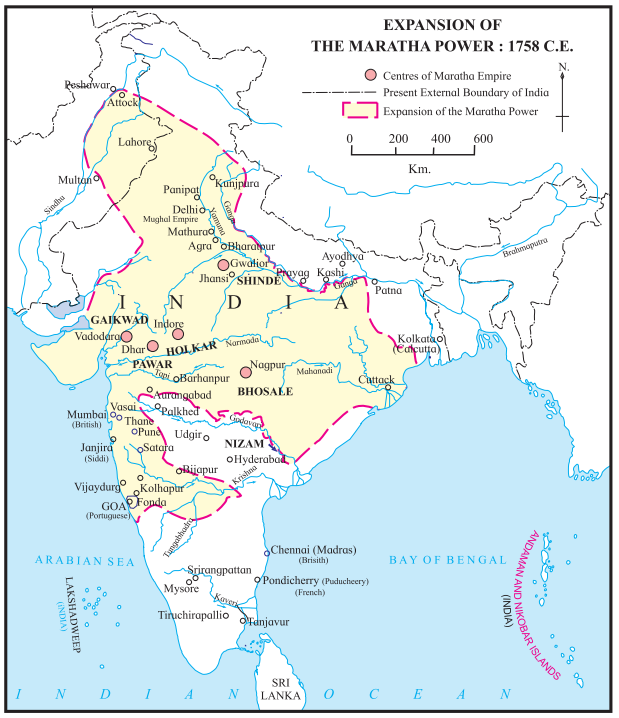
5. Observe the map on textbook page 29 and answer the questions based on it.

Maharashtra Board Class 12 History Solutions Chapter 4 Colonialism and the Marathas 5

Question 1.
Where were the Dutch colonies on the west coast of India?
Answer:
On the west coast of India, there were warehouses at Vengurla in Konkan and at Photo Novo (Parangi Pettai) and Tegna Pattam (Devanapattinam) in Karnataka.

Maharashtra Board Class 12 History Solutions Chapter 4 Colonialism and the Marathas

Question 2.
Where did the French establish their colonies on the east coast of India?
Answer:
The French had their colony in Pondicherry (Puducherry) on the east coast.

Question 3.
Whose warehouses were at Agra and Allahabad?
Answer:
This warehouse is not mentioned on the map. This area was ruled by the Mughals.

Project (Textbook Page No. 33)

Question 1.
Collect information about the colonies established by the European colonialists in various countries with the help of internet.
Answer:
The European colonialists had their colonies in the following countries.
(A) Africa:

  • Belgium – Belgian Congo, Lado Enclave, Rwanda, and Burundi
  • Britain – Sudan, Basutoland, Balleland, British East Africa (Kenya), British Somaliland, British Togoland
  • Gold Coast, South Africa, Namibia, Zimbabwe, Swaziland, Uganda, Zambia, Botswana, Nigeria, Ghana, etc.
  • France – Gambia, Comoros, French Algeria, French Congo, French Guinea, Ivory Coast, French Madagascar, etc.
  • Dutch – Dutch East Indies, Curacao, The Dutch Slave Coast, the Dutch Gold Coast, Surinam.
  • Germany – German East Africa, German Southwest Africa, German West Africa.
  • Portugal – Angola, Cape Verde, Guinea-Bissau, Mozambique.

(B) Asia:

  • Britain – Colony Aden, British Borneo, Burma, Ceylon, Cyprus, India, Iraq, Malay, North Borneo, Palestine, etc.
  • France – Cochin, China, Annam, Laos, and Cambodia.
  • Dutch – Dutch East Indies, Malacca, Taiwan, Tonkin/Annam, Maluku Islands.
  • Portugal – Goa, Malacca and Southeast Asia, China and Japan, Spice Islands, South Asia, Persian Gulf, and the Red Sea.

(C) North America:

  • Britain – Massachusetts, New Hampshire, Rhode Island, Connecticut, New York,
  • Pennsylvania, Delaware, New Jersey, Maryland, Virginia, North Carolina, South Carolina, and Georgia.
  • France – New France (including Canada and Louisiana), French West Indies and
  • French Guiana.
  • Dutch – New Netherland was the first Dutch colony in North America.

Maharashtra Board Class 12 History Solutions Chapter 4 Colonialism and the Marathas

(D) South America:

  • Spain – Argentina, Bolivia, Chile, Colombia, Costa Rica, Cuba, Dominican Republic.

12th Std History Questions And Answers:

World Wars and India Question Answer Class 12 History Chapter 8 Maharashtra Board

Balbharti Maharashtra State Board Class 12 History Solutions Chapter 8 World Wars and India Textbook Exercise Questions and Answers.

Std 12 History Chapter 8 Question Answer World Wars and India Maharashtra Board

Class 12 History Chapter 8 World Wars and India Question Answer Maharashtra Board

History Class 12 Chapter 8 Question Answer Maharashtra Board

1A. Choose the correct alternative and rewrite the statement.

Question 1.
When Austria declared war against Serbia, it was _________, who helped Serbia.
(a) Germany
(b) America
(c) Hungary
(d) Russia
Answer:
(d) Russia

Maharashtra Board Class 12 History Solutions Chapter 8 World Wars and India

Question 2.
The first atom bomb was dropped on the city of _________ during the aerial attack of America on Japan.
(a) Nagasaki
(b) Hiroshima
(c) Pearl Harbour
(d) Stalingrad
Answer:
(b) Hiroshima

1B. Find the incorrect pair from group ‘B’ and write the corrected one.

Question 1.

Group ‘A’ Group ‘B’
1. America Woodrow Wilson
2. England Winston Churchill
3. Germany Hitler
4. Italy Linlithgow

Answer:
Italy – Benito Mussolini

2. Write the names of historical places/persons/events.

Question 1.
The name of the group of nations including England, France, Russia, Italy, and America in the First World War –
Answer:
Allied Nations

Question 2.
The name of the group of nations including Germany, Austria-Hungary, Turkey, Bulgaria in the First World War –
Answer:
Central Powers

3. Write short notes.

Question 1.
‘League of Nations.
Answer:

  1. A peace-loving American president Woodrow Wilson took a lead in the formation of the League of Nations.
  2. All the nations involved in the war felt the need to create some solution to avoid any situation that could lead to war.
  3. The main objectives of the League of Nations were –
    • finding peaceful solutions for conflicts between nations.
    • establishing peace in the world.
  4. Austria, Germany, and other defeated nations were not allowed to become members of the league.
  5. America was not a member of the league so England and France retained their dominance in the league.

Maharashtra Board Class 12 History Solutions Chapter 8 World Wars and India

Question 2.
Dr. Kotnis.
Answer:

  • Dr. Dwarkanath Kotnis was born on 10th October 1910 at Solapur.
  • When Japan had attacked China in 1937, the Chinese Government requested Pandit Jawaharlal Nehru to send a team of doctors to attend to the injured Chinese soldiers.
  • Dr. Kotnis was the chief of the team of Indian doctors sent to China.
  • He attended the Chinese soldiers for years but unfortunately died in China on 9th December 1942 in the plague epidemic.
  • Dr. Kotnis by the virtue of his selfless work formed the bridge of friendship between India and China.
  • The eminent Indian filmmaker, V. Shantaram made a film on his life, entitled ‘Dr. Kotnis Ki Amar Kahani’ which immortalized Dr. Kotnis’ memory.

4. Explain the following statements with reasons.

Question 1.
‘The Treaty of Versailles’ had the seeds of the Second World War. The Text does not have any comment to this effect.
Answer:

  • The Treaty of Versailles was signed between the Allied nations and Germany at Versailles palace in 1919. It was drafted by American President Woodrow Wilson.
  • The Treaty of Versailles was very harsh on Germany because Germany had lost the war.
  • Germany was forced to accept the responsibility for the war damages suffered by the Allies.
  • The victorious powers had deprived Germany of huge tracts of its territory. Germany was burdened with an immense war indemnity.
  • The peace settlement at Paris was made in a spirit of revenge. The Germans felt that too much injustice had been done to them.
  • The German economy was ruined completely. People were starving and the government was in chaos.
  • It was impossible for a proud German race to forget the consequences of the war, which they had lost so humiliatingly.
  • This fuelled the rise of Nazism in Germany which adopted the policy of aggression.
  • In this way, the Treaty of Versailles sowed the seeds of the Second World War.

Question 2.
The British Government in India decided to return home.
Answer:

  • The Second World War ended in the month of August 1945 with the surrender of Japan.
  • In this war, England emerged victoriously but it lost heavily in terms of human life and economic conditions.
  • As a result of this England grew weaker. The British Government in India is now aware that Indian soldiers and people are not as meek and submissive as before, ruling them was no easier.
  • India was not going to be the perennial source of profit for them as it used to be. There was a lot of pressure on England to give freedom to its colonies. Freedom struggles began in India which demanded ‘Poorna Swarajya’ which means total independence. Hence, the British Government in India decided to return home.

5. Answer the following questions in detail.

Question 1.
Give the causes of the Second World War.
(i) Dissatisfaction with the Treaty of Versailles
(ii) Rise of Hitler
(iii) Rise of Communism
(iv) Hitler’s attack on Poland
(v) Hitler’s violation of the Non-aggression Pact
Answer:
The Second World War was fought between 1939 to 1945. Following were the causes of the Second World War:
(i) Dissatisfaction with the Treaty of Versailles: The Treaty of Versailles was very harsh on Germany. It was made in a spirit of revenge. Germany was burdened with huge war indemnity. The German economy was ruined completely. This fuelled the rise of Nazism in Germany.

(ii) Rise of Hitler: The Nazis under the leadership of Hitler grabbed power in Germany. Hitler began to escalate Germany’s military power so as to avenge the demeaning conditions imposed on Germany by the treaty of Versailles. He focussed on increasing the strength of the military as well as the navy.

(iii) Rise of Communism: Meanwhile, Soviet Russia, a communist nation was becoming more powerful. It made nations like England, France, America uneasy. Soviet Russia and imperialistic Germany viewed each other as arch enemies. England and France ignored the advances of Germany thinking that it will keep a check on the rising power of Soviet Russia.

(iv) Hitler’s attack on Poland: In 1938, Hitler won the Sudeten province in Czechoslovakia, which was populated in majority by people of German origin. In 1939, he attacked Poland which was looked upon as a neutral country by all European nations. In spite of this, Hitler attacked Poland. Therefore, England declared war against Germany.

(v) Hitler’s violation of the Non-aggression pact: Denmark, Norway surrendered to Germany. Germany conquered Holland, Belgium, and France. In 1939, Hitler violated the ‘Non-aggression Pact’ made with Stalin and attacked Soviet Russia so Stalin declared war against Germany.

Maharashtra Board Class 12 History Solutions Chapter 8 World Wars and India

Question 2.
Why did Indian people participate in the national movement in great numbers?
Answer:

  • India was a colony of the British during wartime. England started exploiting their colonies to meet the needs of war.
  • During wartime, England felt an increasing need for manpower and money. Therefore, the British Government began recruiting army personnel from India.
  • At times the recruitment was enforced on Indians.
  • Extra taxes were levied on Indians for raising funds. Taxes on trade and industries were raised.
  • During the war period prices of essential commodities went up. Indians suffered from the problems of inflation, hike in prices, increasing unemployment caused by the industrial recession.
  • Indians could see that the exploitative rule of the British was responsible for this miserable state of affairs.
  • Hence, Indians from all strata of society, workers, farmers, and the middle class joined in large numbers in the national movements against British rule.

12th Std History Questions And Answers:

India and European Colonialism Question Answer Class 12 History Chapter 3 Maharashtra Board

Balbharti Maharashtra State Board Class 12 History Solutions Chapter 3 India and European Colonialism Textbook Exercise Questions and Answers.

Std 12 History Chapter 3 Question Answer India and European Colonialism Maharashtra Board

Class 12 History Chapter 3 India and European Colonialism Question Answer Maharashtra Board

History Class 12 Chapter 3 Question Answer Maharashtra Board

1A. Choose the correct alternative and rewrite the statement.

Question 1.
Vasco da Gama was a seafarer from ___________
(a) Poland
(b) England
(c) France
(d) Portugal
Answer:
(d) Portugal

Maharashtra Board Class 12 History Solutions Chapter 3 India and European Colonialism

Question 2.
The license was given by England to the East India Company to trade with eastern countries by ___________
(a) Sir George Oxenden
(b) Princess Braganza
(c) Queen Elizabeth
(d) Homer
Answer:
(c) Queen Elizabeth

1B. Find the incorrect pair from group ‘B’ and write the corrected one.

Question 1.

Group ‘A’ Group ‘B’
(a) Arcebispo Chief Executive Officer
(b) Chancellor Judge
(c) Vedor da Fazenda In charge of Company’s Possessions
(d) Capitaon Captain

Answer:
(a) Arcebispo – Archbishop

2. Complete the concept map.

Question 1.
Maharashtra Board Class 12 History Solutions Chapter 3 India and European Colonialism 2
Answer:
Maharashtra Board Class 12 History Solutions Chapter 3 India and European Colonialism 2.1

3. Explain the following statements with reasons.

Question 1.
The Indian rulers had to obtain Cartaz.
Answer:
Cartaz: The Cartaz was a license issued by the Portuguese to the Indian rulers for sailing on the Indian Ocean when they established firm control of the Indian Ocean. It usually carried details like the name of the vessel (ship), the name of the captain of the ship, port of departure and arrival, the list of weaponry on the ship loaded for the purpose of self-defense, etc.

Maharashtra Board Class 12 History Solutions Chapter 3 India and European Colonialism

Question 2.
Indian rulers found it difficult to fight the Portuguese.
Answer:
The Portuguese established a strong navy. They used to launch sudden attacks on their enemy’s territory from the sea and wreck it completely. The Indian rulers could not match the Portuguese in their war tactics. Later when they established their firm control on the Indian Ocean it became necessary for the Indians to get a license from them for sailing on the Indian Ocean.

4. Answer the following questions in detail.

Question 1.
Which are the places where the Portuguese established their colonies?
Answer:
By 1608, the Portuguese had established their colonies on the western coast of India at Diu, Daman, Chaul, Goa (including Sashti and Bardish), Honnavar, Gangoli, Basrur, Mangalore, Kannur, Kodungallur, Kochi, and Kollam. Similarly, on the eastern coast, they had trader colonies at Nagapattinam, Mylapore or Sao Tome/San Thom, and Hugli in Bengal. This stretch of the Portuguese empire had its capital at Goa.

Question 2.
What were the rights given to United East India Company by the Dutch government?
Answer:
The Dutch government issued a license to the company to conduct trading with the eastern countries. The same license permitted them to appoint staff, establish factories, build forts, engage in battles against the eastern countries, and also sign treaties with them. Accordingly, the company appointed a Governor-General to take care of Indian affairs.

Class 12 History Chapter 3 India and European Colonialism Intext Questions and Answers

Try to do this (Textbook Page No. 19)

Collect information of the church in Kerala, named after Vasco da Gama, with the help of the internet.
Answer:
St. Francis Church:

  • Built-in 1503 as one of the oldest European churches in India.
  • Originally known as St. Bartholomew.
  • Constructed of wood and stone.
  • First Portuguese church in India.
  • Founded by Pedro Alvarez De Cabral.
  • Built-in Persian architecture style.
  • The Portuguese built a fort and within the fort, they built a church.
  • History has it that Vasco da Gama died during his third visit to India and was buried here in 1524.
  • After 14 years his body was moved to Lisbon.

Try to do this (Textbook Page No. 21)

Make a list of the ship-building facilities in pre-independence and post-independence India and collect information about the development of the shipbuilding industry.
Answer:
Students can use the following points as references.

  • India’s maritime history began during the 3rd millennium B.C.E.
  • When Indus valley had trade contact with Mesopotamia.
  • Strabo mentions Rome and Greece had maritime trade relations with India.
  • The Portuguese were the first Europeans to reach India by sea and traded in spices etc. followed by the Dutch.
  • The shipbuilding activities of Chhatrapati Shivaji Maharaj are particularly noteworthy. Chhatrapati Shivaji Maharaj built a strong naval force.
  • In the modern period, the British East India Company shipped substantial quantities of spices.
  • Ship Building was a well-established craft.
  • Some of the well-known shipyards in India today are Sembmarine Kakinada Ltd (SKL) India, Goa Shipyard Limited (GSL) India, Western India Shipyard Ltd.

Maharashtra Board Class 12 History Solutions Chapter 3 India and European Colonialism

Try to do this (Textbook Page No. 21)

The currency of various countries is known by specific names. Prepare a list of countries and their currencies.
Answer:

Country Currency
1. Afghanistan Afghan Afghani (AFN)
2. Argentina Argentine peso (ARS)
3. Australia Australian dollar (AUS)
4. Bahrain Bahraini dinar (BHD)
5. China Chinese yuan (CNY)
6. Denmark Danish krone (DKK)
7. Egypt Egyptian pound (EGP)
8. Germany Euro (EUR)
9. India Indian rupee (INR)
10. Japan Japanese yen (JPY)
11. United States of America US dollar (USD)
12. United Kingdom Pound sterling (GBP)

Project (Textbook Page No. 23)

Compile the names of Governors of British East India Company from 1600 to 1857. C.E.
Answer:
The Regulating Act of 1773 created the office with the title of Governor-General of Presidency of Fort William or Governor-General of Bengal. He was appointed by the Court of Directors of the East India Company.

Governor-General Years Active
1. Warren Hastings 1772 – 1785
2. Sir John Macpherson 1785 – 1786
3. Lord Cornwallis 1786 – 1793
4. Sir John Shore 1793 – 1798
5. Lord Wellesley 1798 – 1805
6. Sir George Barlow 1805 – 1807
7. Lord Minto I 1807 – 1815
8. Lord Hastings 1813 – 1823
9. Lord Amherst 1823 – 1828
10. Lord William Bentinck 1828 – 1835
11. Sir Charles Metcalfe 1835 – 1836
12. Lord Auckland 1836 – 1842
13. Lord Dalhousie 1848 – 1856
14. Lord Canning 1856 – 1862
15. Lord Lawrence 1864 – 1869
16. Lord Mayo 1869 – 1872
17. Lord Lytton 1876 – 1880
18 .Lord Ripon 1880 – 1884
19. Lord Dufferin 1884 – 1888
20. Lord Lansdowne 1888 – 1894
21. Lord Curzon 1894 – 1905
22. Lord Minto 1905 – 1910
23. Lord Hardinge 1910 – 1916
24. Lord Chelmsford 1916 – 1921
25. Lord Reading 1921 – 1926
26. Lord Irwin 1926 – 1931
27. Lord Willingdon 1931 – 1936
28. Lord Linlithgow 1936 – 1944
29. Lord Wavell 1944 – 1947
30. Lord Mountbatten March 1947 – August 1947

12th Std History Questions And Answers:

Decolonisation to Political Integration of India Question Answer Class 12 History Chapter 7 Maharashtra Board

Balbharti Maharashtra State Board Class 12 History Solutions Chapter 7 Decolonisation to Political Integration of India Textbook Exercise Questions and Answers.

Std 12 History Chapter 7 Question Answer Decolonisation to Political Integration of India Maharashtra Board

Class 12 History Chapter 7 Decolonisation to Political Integration of India Question Answer Maharashtra Board

History Class 12 Chapter 7 Question Answer Maharashtra Board

1A. Choose the correct alternative and rewrite the statement.

Question 1.
In 1946, under the leadership of the movement of ____________ ‘Civil Disobedience’ was launched in
Goa.
(a) Dr. Ram Manohar Lohia
(b) Dr. T.B. Kunha
(c) Dr. P.P. Shirodkar
(d) Dr. Ram Hegde
Answer:
(a) Dr. Ram Manohar Lohia

Question 2.
Hyderabad’s struggle of freedom was led skillfully by ____________
(a) King Hari Singh
(b) Swami Ramanand Tirth
(c) Pandit Mahadevshastri Joshi
(d) Keshavrao Jedhe
Answer:
(b) Swami Ramanand Tirth

Maharashtra Board Class 12 History Solutions Chapter 7 Decolonisation to Political Integration of India

Question 3.
The princely states in India were merged in India mainly through the efforts of ____________
(a) Jayantrao Tilak
(b) Sardar Vallabhbhai Patel
(c) Pandit Jawaharlal Nehru
(d) Dr. T.B. Kunha
Answer:
(b) Sardar Vallabhbhai Patel

1B. Find the incorrect pair from group ‘B’ and write the corrected one.

Question 1.

Group ‘A’ Group ‘B’
1. Merger of the princely state of Hyderabad Swami Ramanand Tirth
2. Merger of the princely state of Kashmir Shaikh Abdullah
3. Significant contribution in the ‘Goa Liberation Movement Mohan Ranade
4. The trade unionist leader in Puducherry V. Subbayya

Answer:
The merger of the princely state of Kashmir – King Hari Singh (Instrument of Accession)

2. Write the names of historical places/persons/events.

Question 1.
The President of Goa Congress Committee –
Answer:
Dr. T.B. Kunha

Question 2.
The princely states that did not merge in India immediately after its independence –
Answer:
Junagadh, Hyderabad, Kashmir, Dadra and Haveli, Goa and Puducherry

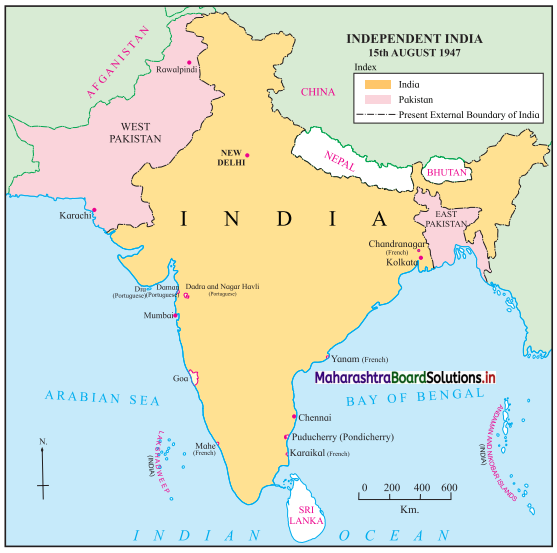
3. Observe the map on textbook page 61 and answer the questions based on it.

Maharashtra Board Class 12 History Solutions Chapter 7 Decolonisation to Political Integration of India 3

Question 1.
Name the countries located at the northwest border of India.
Answer:
Pakistan and Afghanistan.

Question 2.
Which places in India were the centers of Portuguese rule?
Answer:
Goa, Dadra and Nagar haveli, Diu and Daman.

Maharashtra Board Class 12 History Solutions Chapter 7 Decolonisation to Political Integration of India

Question 3.
Which place on the eastern coast of India were the centers of French rule?
Answer:
Puducherry, Yanam and Karaikal.

Question 4.
Which nation is located at the southern tip of India?
Answer:
Sri Lanka

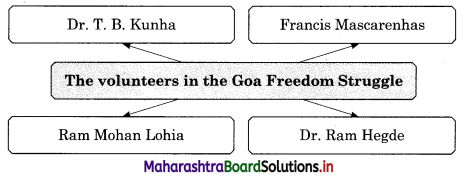
4. Complete the following concept map.

Question 1.
Maharashtra Board Class 12 History Solutions Chapter 7 Decolonisation to Political Integration of India 4
Answer:
Maharashtra Board Class 12 History Solutions Chapter 7 Decolonisation to Political Integration of India 4.1

5. Explain the following statements with reasons.

Question 1.
Ultimately the princely state of Hyderabad was merged in India.
Answer:

  • Hyderabad was under Nizam rule, it was the largest amongst princely states along with Telugu, Kannada, and Marathi regional sections.
  • The various organisation was formed to fight against Nizam’s policies for his people.
  • Swami Ramanand Tirth alongside loyal workers were leading this organisation to gain freedom from the Nizam.
  • Hyderabad State Congress passed a resolution that Hyderabad will merge in India and this was not liked by Nizam, he was willing to join Pakistan.
  • The people of Hyderabad wanted to merge in India.
  • Kasim Razvi formed a ‘Razakar’ organisation against people.
  • In the end, the Indian Government launched a police campaign against Nizam, under the name ‘Operation Polo’.
  • In 1948 Nizam surrendered and Hyderabad merged in India.

Question 2.
Puducherry was declared as a Union territory.
Answer:

  • Puducherry was under the French colony. India was under the impression that the British and Portuguese will send a message to the French to leave India, however, this did not happen.
  • Puducherry, Mahe, Yanam, and Chandranagar in West Bengal were under French control.
  • The people of Puducherry got united under Subbayya, a communist politician and leader.
  • The government noticed it as serious and strongly demanded that French governments should return all the regions held by them.
  • In 1948, a bilateral agreement was signed by both governments. In 1949, Chandranagar was merged.
  • In 1954, all French colonies were merged in India. In 1962, the French Parliament approved the bilateral agreement and in 1963, Puducherry became the ‘Union Territory’ of India.

6. State your opinion.

Question 1.
Andhra, Karnataka, Maharashtra Councils (Parishad) were found in the princely state of Hyderabad.
Answer:

  • Hyderabad was the largest amongst princely states in India. It comprised Telugu, Kannada, and Marathi regional sections. It was ruled by Nizam.
  • Nizam of Hyderabad had put many restrictions on the Civil and Political rights of his subjects to a great extent.
  • To fight against such restrictions in the state, people had formed organizations like ‘Andhra Parishad’ in Telangana, ‘Maharashtra Parishad’ in Marathwada, and ‘Karnataka Parishad’ in Karnataka.

Maharashtra Board Class 12 History Solutions Chapter 7 Decolonisation to Political Integration of India

Question 2.
The Portuguese rule in Goa remained untouched till 1961.
Answer:

  • Goa was under Portuguese control. There prevailed a general notion among Indians that the departure of the British from India would send a signal to the Portuguese and the French to leave India on their own.
  • However, this did not happen and many freedom fighters like Dr. Ram Manohar Lohia, Dr. Kunha, and many more have contributed to the struggle against the Portuguese.
  • At last, the Indian govt has sent the army, under Operation Vijay, to make Goa free from Portuguese control and became a part of India on 19th December 1961.

Class 12 History Chapter 7 Decolonisation to Political Integration of India Intext Questions and Answers

Try to do this (Textbook Page No. 58)

Try to collect information about the newspapers published during ‘Hyderabad Freedom Struggle’ with the help of the internet.
Answer:
Students should do it on their own.

Try to do this (Textbook Page No. 60)

Collect information about the fort of Panaji and make a poster about the fort.
Answer:
Students should do it on their own.

Project (Textbook Page No. 62)

Collect information about the ‘Gorta Massacre’ a very important instance in the struggle for liberating Hyderabad. To get more information about it visit the following website: www.bhausahebumate.com
Answer:
(i) As we know Qasim Razvi, had founded the Razakar organisation (Nizam’s private military) to help Nizam to suppress the voice of people against Nizam of Hyderabad. Gorta was the name of a village (Karnataka) and people were massacred by Razakars of Hyderabad in 1948. Gorta Village is also known as Jaliyanwala Bag of Karanataka, it was a mass killing on May 9th and 10th 1948. Though a plaque kept in front of the village gives fight date May 5th, and it continued for two weeks. It is said that around 200 people were killed by Razakars and property destruction was worth ₹ 70 lakhs.

Maharashtra Board Class 12 History Solutions Chapter 7 Decolonisation to Political Integration of India

(ii) A folk song called ‘Bhulai pada’ sung by village women in bitter memory of the massacre. There is demand from village people in front of the Government for the construction of the memorial at Gorta. Local people and local political parties had collected ₹ 27 lakh for a 35-foot memorial and laid the foundation on September 17th, 2014.

12th Std History Questions And Answers:

European Colonialism Question Answer Class 12 History Chapter 2 Maharashtra Board

Balbharti Maharashtra State Board Class 12 History Solutions Chapter 2 European Colonialism Textbook Exercise Questions and Answers.

Std 12 History Chapter 2 Question Answer European Colonialism Maharashtra Board

Class 12 History Chapter 2 European Colonialism Question Answer Maharashtra Board

History Class 12 Chapter 2 Question Answer Maharashtra Board

1A. Choose the correct alternative and rewrite the statement.

Question 1.
‘Declaration of Independence was drafted by __________
(a) George Washington
(b) Thomas Jefferson
(c) Lord Amherst
(d) Lord Cornwallis
Answer:
(b) Thomas Jefferson

Maharashtra Board Class 12 History Solutions Chapter 2 European Colonialism

Question 2.
The second Anglo-Burmese war was fought during the times of __________
(a) Lord Amherst
(b) Lord Dufferin
(c) Lord Dalhousie
(d) Ashley Eden
Answer:
(c) Lord Dalhousie

1B. Find the incorrect pair from group ‘B’ and write the corrected one.

Question 1.

Group ‘A’ Group ‘B’
1. Togoland German colony
2. Egypt British colony
3. Orange Free State Dutch colony
4. Ivory Coast Portuguese colony

Answer:
Ivory Coast – French colony

2A. Write the names of historical places/persons/events.

Question 1.
The region from Florida to California on the southern coast of America was under the control of-
Answer:
Spain

Question 2.
The sea voyages for exploration were encouraged in the reign of-
Answer:
Queen Elizabeth I

2B. Choose the correct reason from those given below and complete the sentence.

Question 1.
The British wanted to gain control over Myanmar because __________
(a) they wanted to expand their empire
(b) it was very important to control the natural resources and the market in Myanmar
(c) they wanted to be at the forefront of the colonial competition amongst the European nations
(d) they wanted to teach a lesson to King Thibaw of Myanmar
Answer:
(b) it was very important to control the natural resources and the market in Myanmar

Maharashtra Board Class 12 History Solutions Chapter 2 European Colonialism

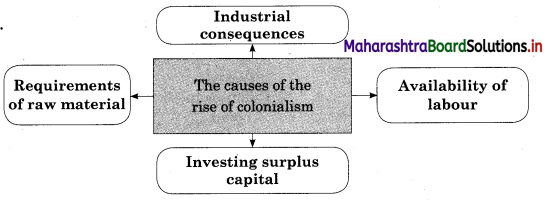
3. Complete the following concept map.

Question 1.
Maharashtra Board Class 12 History Solutions Chapter 2 European Colonialism Q3
Answer:
Maharashtra Board Class 12 History Solutions Chapter 2 European Colonialism Q3.1

4. Write short notes.

Question 1.
Nature of Colonialism.
Answer:

  • Colonialism is the act of a developed nation occupying the land of a less developed, distant nation and establishing its rule on the occupied country. Europeans travelled all over the world with various intentions such as the urge for adventures, to earn a name, to discover unknown lands, to search for gold mines, etc.
  • The Europeans established colonies wherever they went and in doing so there was a competition to gain economic, social, and political supremacy among the nations. Extreme nationalism, feeling of racial superiority, industrialization, aggressive approach, etc., are the factors that led to the growth of colonialism.
  • Thus, Europeans went to America, Australia, and New Zealand. The Europeans also colonised Asia. However, the climate of Asia did not favour them. Favourable or unfavourable, Europeans disposed of the indigenous people in their own lands.
  • The Europeans saw these colonies as potential marketplaces to sell their surplus goods which were accumulated as a result of mass production. The Europeans also needed additional sources that would provide ample raw material.
  • In the latter half of the 19th century, England built a flourishing trade as a result of the industrial revolution.

Maharashtra Board Class 12 History Solutions Chapter 2 European Colonialism

Question 2.
American War of Independence.
Answer:
The colonies got into several battles with the British army even after gaining independence. The colonies finally at Saratoga got a decisive victory over the British army. This victory proved to be a turning point for the colonies as the French agreed to support them in their conflict against the British. Eventually, Spain also joined the conflicts in their struggle for independence.

On 7th October 1780, George Washington defeated the British army. On 19th October, British General Lord Cornwallis surrendered and America became independent. The American revolt for independence is also known as the ‘American Revolution’. America proved to the world that the subjects have a right to fight their rulers who deny them their natural rights.

5. Explain the following statements with reasons.

Question 1.
The industrial revolution gave momentum to colonialism.
Answer:
Colonialism was a result of the industrial revolution. Production increased enormously because of the new machines. However, the rate of local consumption was much less compared to the surplus rate of production. Hence, the immediate need of the Europeans was to find new markets for selling their products. It was also necessary that these markets be dependable and easy to dominate.

Question 2.
European nations established colonies in America.
Answer:
The stronger European nations dominated the weaker countries by establishing colonies there and pushed them to subjection. The lands of the original inhabitants in America were seized by the Europeans and were also massacred. The original inhabitants were forced into slavery. The Europeans discovered gold mines and the Spanish colonizers brought African slaves to work in sugarcane and tobacco fields. Farming and mining earned them enormous wealth. Essential raw materials were exported to Spain and the finished goods used to be imported for sale in the local markets for the colonies. The trade of gold and silver also earned huge profits for the king. Witnessing Spain’s prosperity England, Holland and France also began to establish colonies in America.

Class 12 History Chapter 2 European Colonialism Intext Questions and Answers

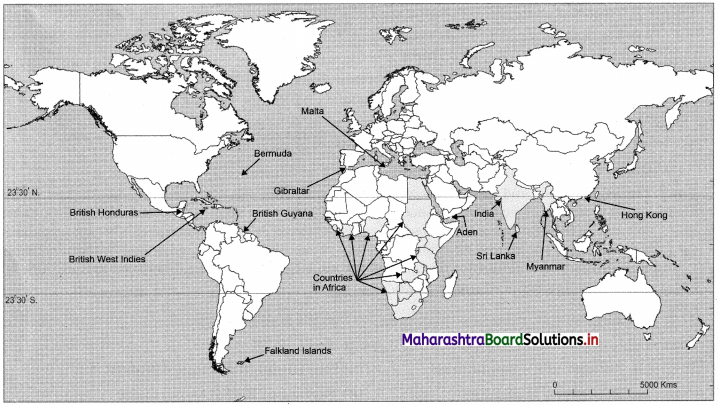
Try to do this. (Textbook Page No. 11)

Locate the following regions under British domination on the map: Gibraltar, Malta in the Mediterranean Sea; British Guyana, British Honduras, British West Indies, Bermuda and Falkland islands in the Western Hemisphere; Aden, Sri Lanka, Myanmar, Hongkong, India; also, the countries in Africa.
Answer:
Maharashtra Board Class 12 History Solutions Chapter 2 European Colonialism Intext Q1

Project (Textbook Page No. 18)

Question 1.
Collect information about the biodiversity and sources of minerals in the African continent.
Answer:
1. Meaning of Biodiversity:
Biodiversity consists of two words ‘Biological’ and ‘Diversity’. It refers to all the variety of life that can be found on earth (plants, animals, fungi, and microorganisms) as well as to the communities that they form and the habitats in which they live.

Maharashtra Board Class 12 History Solutions Chapter 2 European Colonialism

2. Biodiversity in Africa:

  • Rich in biodiversity.
  • Africa supports the earth’s largest assemblages of large mammals which roam freely in many countries.
  • Africa is home to a rich and diverse animal, plant, and marine biodiversity that provide critical ecosystem services.

3. Minerals in Africa:
Africa is rich in mineral reserves and ranks first or second in quantity of world reserves of bauxite, cobalt, industrial diamond, phosphorite, platinum, etc.

12th Std History Questions And Answers:

Indian Struggle against Colonialism Question Answer Class 12 History Chapter 6 Maharashtra Board

Balbharti Maharashtra State Board Class 12 History Solutions Chapter 6 Indian Struggle against Colonialism Textbook Exercise Questions and Answers.

Std 12 History Chapter 6 Question Answer Indian Struggle against Colonialism Maharashtra Board

Class 12 History Chapter 6 Indian Struggle against Colonialism Question Answer Maharashtra Board

History Class 12 Chapter 6 Question Answer Maharashtra Board

1A. Choose the correct alternative and rewrite the statement.

Question 1.
The region of __________ had become a stronghold of Hansaji Naik.
(a) Satara
(b) Nanded
(c) Pune
(d) Nagpur
Answer:
(b) Nanded

Question 2.
The British plant owners in Bihar were pressing the local farmers to grow only __________
(a) indigo
(b) tea
(c) coffee
(d) sugarcane
Answer:
(a) indigo

Maharashtra Board Class 12 History Solutions Chapter 6 Indian Struggle against Colonialism

Question 3.
The first session of the Indian National Congress was presided by __________
(a) Dwarkanath Tagore
(b) Vyomeshchandra Banerjee
(c) Dadabhai Nauroji
(d) Surendranath Banerjee
Answer:
(b) Vyomeshchandra Banerjee

1B. Find the incorrect pair from group ‘B’ and write the corrected one.

Question 1.

Group ‘A’ Group ‘B’
1.Kunwar Sinh Lucknow
2. Nanasaheb Peshwa Kanpur
3. Queen Lakshmibai Jhansi
4. Chimasaheb Kolhapur

Answer:
Kunwar Singh – Patna

2. Write the names of historical places/persons/events.

Question 1.
The region of the regime of the parallel government established in 1942 –
Answer:
Satara District

Question 2.
The islands were conquered by Azad Hind Sena from the British in 1943 –
Answer:
Andaman and Nicobar Islands

3. Write short notes.

Question 1.
The Extremists.
Answer:

  • The Indian National Congress split into two groups-The Moderates and The Extremists at the Surat session of the Congress in 1907.
  • The ‘Extremists’ wing of thinkers insisted that independence should be a natural priority. An independent nation could provide the right set-up for social reformation.
  • Lokmanya Tilak who was the leader of the Extremists said that the home taken over by others should be recovered first, then only we can reform it.
  • He also felt that the British Government will not yield to applications, requests, and speeches.
  • The Extremists did not agree with the Moderators’ policy of avoiding the resolutions of ‘Swadeshi’ and ‘Boycott’ and wanted to stop these attempts of the Moderators.
  • The three leaders of the Extremists group were Lala Lajpat Rai, Bal Gangadhar Tilak, and Bipin Chandra Pal. (Lal-Bal-Pal).

Maharashtra Board Class 12 History Solutions Chapter 6 Indian Struggle against Colonialism

Question 2.
Azad Hind Sena.
Answer:

  • The Azad Hind Sena was built by Rasbihari Bose by recruiting Indian soldiers and later on was reorganized under the leadership of Subhash Chandra Bose.
  • These were the Indian soldiers of the British army who were taken captive by the Japanese army.

Question 3.
Prati Sarkar.
Answer:

  • Prati Sarkar or Parallel Government was established by Krantisinha Nana Patil, a revolutionist in the Satara district of Maharashtra.
  • He, with the help of his associates, put an end to the British regime in the Satara district and established ‘People’s Government’.
  • This government took over the administrative task of collecting revenue, maintaining law and order, solving court cases, and punishing criminals.

4. Answer the following questions in detail.

Question 1.
Lieutenant Outram was successful in crushing the revolt by the Bhils by the end of 1822.
Answer:

  • A revolt of the Bhils in which thousands of Bhils participated was crushed by Lt. Outram.
  • However, he also stayed among the Bhils and won their confidence. He tried to bring them into the mainstream of urban life.
  • He adopted measures like the declaration of amnesty, land grants, agricultural loans and reprieve from the past crimes, and recruitment in the army to weaken the opposition from the Bhils.

Question 2.
Ravindranath gave up his title (Sir.)
Answer:

  • On 13th April 1919, the day of Baisakhi thousands of people had gathered for a meeting at Jallianwala Bagh in Amritsar for celebrating the festival.
  • Many of them were not aware of the ban put by the government on public gatherings.
  • Genera Dyer opened fire on these people without any prior warning.
  • About four hundred innocent people were killed and thousands were injured in this incident. It is known as the ‘Jallianwala Bagh Massacre’.
  • It created a wave of rage all through India.
  • Rabindranath Tagore criticized this act and gave up his title (Sir).

5. State your opinion.

Question 1.
The rise of colonialism was the result of the spreading of European trade.
Answer:

  • The Europeans reached all over the world for several reasons such as the urge for adventures, to earn a name to discover unknown lands, to search for gold mines, etc.
  • Later, trade and commerce increased to such a great extent for which there was economic, social, and political supremacy among them.
  • The Europeans found potential markets in continents like Asia, America, and Africa where they established their colonies. And the first to do so were the Portuguese.

Maharashtra Board Class 12 History Solutions Chapter 6 Indian Struggle against Colonialism

Question 2.
According to Swatantryaveer Savarkar, the Independence War of 1857 was the First War of Independence.
Answer:

  • The revolt of 1857 was a unified and national uprising against the British authority.
  • The Indian war of Independence as described in his book ‘1857-The First War of Independence was considered to be the first war where the entire nation irrespective of caste, creed, race, and religion had come together and staged an armed protest against the British to gain independence from their colonial rule.

Class 12 History Chapter 6 Indian Struggle against Colonialism Intext Questions and Answers

Try this. (Textbook Page No. 43)

Collect more information about ‘Kayamdhara’, ‘Ryotwari’, ‘Mahalwari’ land revenue systems and discuss it in the class. Also, discuss the present land system of ‘Anewari’.
Answer:
(A) Kayamdhara or Jamindari:

  • This system was introduced by Lord Cornwallis in 1793.
  • It was introduced in the provinces of Bengal, Bihar, Orissa, and Varanasi.
  • Zamindars were recognized as the owners of the lands.
  • Zamindars were given the right to collect rent from the peasants.

(B) Ryotwari:

  • The Ryotwari system was a land revenue system in British India introduced by Thomas Munro in 1820 based on a system administered by Captain Alexander Read in the Baramahal district.
  • This was practiced in Madras and Bombay areas as well as Assam and Coorg provinces.
  • In this system, the peasants or cultivators were regarded as the owners of the land.
  • Ryot means peasant cultivator.

(C) Mahalwari system:

  • The government of Lord William Bentinck Governor-General of India (1828-1835) introduced the Mahalwari system of land revenue in 1833.
  • This system was introduced in N W Frontier, Agra, Gangetic Valley, Central Provinces, Punjab, etc.
  • Had elements of both the Zamindari and the Ryotwari systems.
  • This system divided the lands into Mahals. Sometimes the Mahals constituted one or more villages.
  • The tax was assessed on the Mahal.
  • Each individual farmer gave his share.
  • Revenue was collected by the village headman or village leaders (Lambardar).

Maharashtra Board Class 12 History Solutions Chapter 6 Indian Struggle against Colonialism

(D) Anewari System:

  • Paisewari (originally known as Anewari) is a system of survey used by the government to decide whether a village is drought-hit or not
  • Prior to the harvest, the Tehsildar along with farmers and representatives of the agricultural department takes stock of the crop and compares it with the yield of the last ten years
  • If the value is less than 50 paise, the village is declared drought-hit, and drought mitigating measures are put in place.

Try to do this: (Textbook Page No. 46)

Vishnubhat Godse from Vasai was in Jhansi in 1857. Get the book, ‘Maza Pravas’ authored by him as the eyewitness of the happenings and read it.
Answer:

  • ‘Maza Pravas’ translates into English as “My Travels: The story of 1857 Mutiny” is a Marathi travelogue written by Vishnubhat Godse, who traveled on foot from Varsai, a village near Pen (present-day Maharashtra) to the Central and Northern parts of India during 1857-1858 and witnessed several incidents of what he calls “The Mutiny of 1857” also known as the Indian Rebellion of 1857.
  • During his travel, he witnessed the events at Mhow, worked for the Rani of Jhansi for a few months, visited Ayodhya, eventually returning penniless to his village.
  • Apart from his encounters with the mutiny he also visited most of the Hindu holy places.

Try to do this: (Textbook Page No. 55)

Collect information and pictures about revolutionaries and freedom fighters from your area and make a presentation.
Answer:
Students should do this activity by themselves

Projects (Textbook Page No. 56)

(a) The Rising Ballad of Mangal Panday
(b) The Legend of Bhagat Singh
(c) Khele Hum Jee Janse
These are some Hindi films. Watch them and verify the historical truth of the incidences shown in it.
Answer:
Students do by themselves

12th Std History Questions And Answers:

India Transformed Part 1 Question Answer Class 12 History Chapter 11 Maharashtra Board

Balbharti Maharashtra State Board Class 12 History Solutions Chapter 11 India Transformed Part 1 Textbook Exercise Questions and Answers.

Std 12 History Chapter 1 Question Answer India Transformed Part 11 Maharashtra Board

Class 12 History Chapter 11 India Transformed Part 1 Question Answer Maharashtra Board

History Class 12 Chapter 11 Question Answer Maharashtra Board

1A. Choose the correct alternative and rewrite the statement.

Question 1.
A legal agreement was signed in Geneva which is known as ____________
(a) SEATO
(b) NATO
(c) GATT
(d) SAARC
Answer:
(c) GATT

Question 2.
An act similar to ‘Right to Information’ was first applied in ____________ in 1776.
(a) Sweden
(b) France
(c) England
(d) India
Answer:
(a) Sweden

Maharashtra Board Class 12 History Solutions Chapter 11 India Transformed Part 1

Question 3.
The birth anniversary of Swami Vivekananda is observed as ____________
(a) National Education Day
(b) National Youth Day
(c) National Integration Day
(d) National Science Day
Answer:
(b) National Youth Day

2A. Write the names of historical places/persons/events.

Question 1.
In 2004, this became the biggest firm in Asia providing software services –
Answer:
Tata Consultancy Services

Question 2.
In 2002, the Metro railway was flagged off –
Answer:
The Delhi Metro Railway

2B. Choose the correct reason from those given below and complete the sentence.

Question 1.
India became member of World Trade Organisation, because ____________
(a) India want to compete with other nations
(b) India cannot stay aloof from the global economy
(c) India adopted the policy of liberalisation
(d) India wanted to be in the leading position at the global level
Answer:
(c) India adopted the policy of liberalisation

3. Complete the following concept map.

Question 1.
Maharashtra Board Class 12 History Solutions Chapter 11 India Transformed Part 1 Q3
Answer:
Maharashtra Board Class 12 History Solutions Chapter 11 India Transformed Part 1 Q3.1

4. Write short notes.

Question 1.
The Youth Policy of Government of India.
Answer:

  • India is a country with a maximum proportion of young people. Individuals in the age group of 15-29 are considered as ‘youth’.
  • Youth, if provided with opportunities, for education and skill training, can contribute significantly to the development of India.
  • A number of centers of‘Nehru Yuva Kendra Sangathan’ were established in 1972 for the training of young people in various skills.
  • The programmes run by these centers were eventually merged in the ‘National Youth Empowerment Programme’. This programme put a thrust on topics like literacy, education, health and hygiene, family welfare, preservation and conservation of the environment, awareness of social issues, rural development, and self-employment.
  • 12th January the birth anniversary of Swami Vivekanand is celebrated as ‘National Youth Day. National Youth Festival is also celebrated in the month of January. This festival is designed to provide a platform for the artistic talents of young individuals.
  • ‘Youth Hostels Association of India’ has established youth hostels in various parts of the country which works for encouraging adventure skills among young people.
  • Training programmes are arranged by this association through ‘Bharat Scout and Guides, National Service Scheme and National Cadet Corps’.

Maharashtra Board Class 12 History Solutions Chapter 11 India Transformed Part 1

Question 2.
‘Pradhan Mantri Gram Sadak Yojana’.
Answer:

  • The Government of India knows the importance of having roads in good condition in the interior areas started ‘Pradhan Mantri Gram Sadak Yojana’ in 2000.
  • Initially, the work of building roads began by linking the villages of population strength up to 1000. In 2001 this programme was merged in ‘Pradhan Mantri Gramoday Yojana’.
  • The roads measuring about 75000 km. were completed till 2005. The purpose of this work was to extend the benefits of the country’s economic growth to people living in rural areas and to bring transformation in their lives.
  • It aimed at providing amenities for good health, education, drinking water, dwellings, roads, and electricity.

5. State your opinion.

Question 1.
India is a leading country in the field of space research.
Answer:

  • In 2007, India entered a new field of space research. It commercially launched the Italian satellite.
  • Other countries had submitted tenders quoting very high rates, to get this contract. However, India got this contract by quoting reasonable rates.
  • Before entering this field on a commercial basis, India had already successfully launched the satellite of Argentina, Belgium, South Korea, Indonesia, and Germany.
  • In 2008, India launched ‘Chandrayaan-1’, the first lunar probe. India could collect evidence for the presence of water on the moon through this satellite.
  • After that India also launched ‘Chandrayaan-2’ and ‘Mangalyaan’.
  • All these achievements proved that India is a leading country in the field of space research.

6. Answer the following questions in detail.

Question 1.
Which programmes were launched in India for making the opportunities of wage-earning?
Answer:
Creating employment opportunities for an ever-increasing population is a major challenge for the government. There are several programmes launched by the government of India for wage earners.
These programs are as follows:

  • Pradhan Mantri Rojgar Yojana and ‘Rojgar Hami Yojana’: To create job opportunities for educated youth the ‘Ministry of Commerce and Industry of the Government of India started this plan on 2nd October 1993 on the birth anniversary of Mahatma Gandhi.
  • Rojgar Hami Yojana was to assure daily wages to the unemployed agricultural labourers. The objective of this plan was to provide wage-earning opportunity, who was in search. This programme was launched in 257 districts in India. A goal was to provide work to two young laborers in each family below the poverty line. In 2001, this plan was merged in ‘Gramin Rojgar Yojana’.
  • In 1998, to provide support to farmers in difficult times “Kisan Credit Card” plan was started. It helps the farmer to avail funds for essential equipments and seeds for cultivation. Later, an insurance facility was also offered to farmers, who were Kisan Credit Card holders.
  • Suvarnajayanti Gramin Svayam Rojgar Yojana: This plan was launched in 1999 by merging various plans together namely ‘Ekatmik Gramin Vikas Yojana’, Self-employment training programmes, ‘Ganga Kalyan Yojana’ etc.
  • Jawahar Gram Samruddhi Yojana: In 1999, a new plan was implemented with the intention to provide adequate employment for unemployed men and women. It was merged in ‘Sampoorna Gramin Rojgar Yojana’ in 2001.
  • Sampoorna Gramin Rojgar Yojana: This plan made provision for creating opportunities in rural areas of earning wages, to provide food grains in exchange for work, etc. This scheme was started in 150 economically backward districts in the country. In 2006, this scheme was merged in ‘Rashtriya Gramin Rojgar Hami Yojana’.
  • Rashtriya Gramin Rojgar Hami Yojana: Under this scheme, each family in rural areas were given assurance of at least 100 days of work.

7. Answer the following question with the help of the given points.

Question 1.
Give information about the ‘Right to Information Act.
(a) Background of the act and the beginning of this movement in India.
(b) Definition of ‘Information’.
(c) The rights of citizens under this act.
Answer:
(a) Background of the act and the beginning of this movement in India:

  • This kind of Act was first implemented in Sweden in 1776. In 1946, ‘United Nations’ declared the ‘Right to Information to be the fundamental human right.
  • In 1982, L.K. Kulwant, a resident of Jaipur in Rajasthan, a social activist initiated the process by applying to know the Jaipur Municipal Corporation’s work for cleaning the city.
  • The High Court gave a clear verdict stating that ‘Right to Information is a fundamental right of all citizens.
  • In 1990, Aruna Roy started the movement called ‘Majdoor Kisan Shakti Sanghatan’. A need for ‘Right to Information was started through this movement.
  • Harsh Mander, the Divisional Commissioner of Bilaspur showed courage to disclose official information while serving as a bureaucrat.
  • The struggle of Anna Hazare in 2001, had a decisive role in Maharashtra in this matter. The Act was implemented in Maharashtra on 12th October 2005.

Maharashtra Board Class 12 History Solutions Chapter 11 India Transformed Part 1

(b) Definition of ‘Information’:
The definition of term ‘Information’ includes official records, documents, memoranda, emails, comments, consultations, press notes, circulars, orders, logbooks, tenders, reports, correspondence, formats, models, electronic data, the information of a private institution or an individual that is available in the records of any public establishment.

(c) The rights of citizens under this act:

  • Right to information grants access to official documents, records, permission to obtain their copies, to take notes, to extract passages, to get samples of authorised material and prints of data stored in CDs, Floppy discs, tapes, video cassettes, or in any other form, or stored on computers.
  • Citizens can get the desired information after submitting an application to the ‘Information officer’ of a ‘Public Authority.

Class 12 History Chapter 11 India Transformed Part 1 Intext Questions and Answers

Collect information of following schemes: (Textbook Page No. 92)

National Pension Scheme, Pradhan Mantri Suraksha Vima Yojana, Pradhan Mantri Jeevan Jyoti Vima Yojana, Atal Pension Yojana, Indian Post Payments Bank.
Answer:
(A) National Pension Scheme:

  • The National Pension Scheme is a voluntary contribution of the pension system in India which is sponsored by the government of India.
  • This scheme was started by the Government of India in 2004 for all government employees.
  • The scheme was made open to all citizens in 2009. It is a voluntary and long-term retirement scheme. It is regulated by Pension Fund Regulatory and Development Authority (PFRDA) and the central government.
  • Any employee from the public, private, and even the unorganized sectors can opt for this.
  • Personnel from the armed forces are not allowed. The scheme is open to all across industries and locations.

(B) Pradhan Mantri Suraksha Vima Yojana:

  • The scheme is available to people in the age group 18 to 70 years with a bank account who give their consent to join/enable auto-debit on or before 31st May for the coverage period 1st June to 31st May on an annual renewal basis.
  • Aadhar would be the primary KYC for the bank account. The risk coverage under the scheme is ₹ 2 lakh for accidental death and full disability and ₹ 1 lakh for partial disability.
  • The premium of 112 per annum is to be deducted from the account holder’s bank account through ‘auto-debit facility in one installment.

(C) Pradhan Mantri Jeevan Jyoti Vima Yojana:

  • Pradhan Mantri Jeevan Jyoti Vima Yojana is available to people between 18 and 50 years of age with a bank account.
  • This scheme was launched on 9th May 2015 by Prime Minister Narendra Modi in Kolkata.
  • It has an annual premium of ₹ 330. In case of death due to any cause, the payment to the nominee will be ₹ 2 lakh.
  • As of 31st March 2019, 5.92 crore people have already enrolled for this scheme.

(D) Atal Pension Yojana:

  • Atal Pension Yojana is a pension scheme under the Government of India.
  • This scheme replaces the Swavalamban Yojana and was established to provide old age income security to the workers belonging to the unorganized sector.
  • The Atal Pension Yojana was launched by Prime Minister Narendra Modi on 9th May 2015 in Kolkata.
  • The scheme focuses on encouraging workers of the unorganized sectors to save for their future (Age limit 18-40 years).

(E) Indian Postal Payments Bank :

  • The Indian Postal Payment Bank was launched on September 1, 2018, by Prime Minister Narendra Modi that aims at making banking services available at people’s doorstep.
  • This is a 100% Government-owned public sector bank, operating with the Department of Posts under the Ministry of Communications.
  • IPPB would be like any other bank but it will operate at a smaller scale without involving any credit risks and can’t issue advance loans or issue credit cards.

Maharashtra Board Class 12 History Solutions Chapter 11 India Transformed Part 1

Let us know: (Textbook Page No. 92)

Collect information with the help of the internet about the ‘Rafi Ahmad Kidwai National Postal Academy (Gaziabad).
Maharashtra Board Class 12 History Solutions Chapter 11 India Transformed Part 1 Intext Q2
Answer:

  • Rafi Ahmad Kidwai National Postal Academy, recently called Postal Staff College India (PSCI) is the apex training institution of Indian postal services.
  • It was set up in the year 1977. Initially, the college functioned from Sanchar Bhavan and later from Dak Bhavan in Delhi.
  • It was shifted to its present location in Gaziabad in the year 1990. It is a central training institute and has the primary role of training and grooming the young officers who get recruited to the Indian Postal Service.
  • It also conducts various in-service training programmes on postal management for Postal Service officers in India and other foreign postal administrations.
  • Its goal is to make the officers of the department of posts professionally competent to handle the ever-changing communication market.
  • Training Program:
    • Advanced Development Program
    • Executive Development Program
    • Technology Management Program
    • Postal Life Insurance
    • Leadership Development for postmasters and mangers
    • Quality Management

Let us collect information (Textbook Page No. 92)

Collect information about various services like ‘Sarvabhaum Suvarn Rokhe’ (Gold Bonds issued by the Government), ‘Electronic Indian Postal Order’, ‘E-Dakghar’, ‘E-Payment Portal’, ‘Mobile App’ etc. by interviewing the Postmaster of any branch.
Answer:
(A) Sarvabhaum Suvarn Rokhe:

  • This scheme was launched by Government in November 2015, under Gold Monetisation Scheme. The issues are made open for subscription in tranches by RBI in consultation with GOI.
  • As per RBI instructions, every application must be accompanied by the PAN number issued by the income tax department to the investors as the PAN number of the first/ sole applicant is mandatory.
  • SGBs are government securities denominated in grams of gold. They are substitutes for holding physical gold. Investors have to pay the issue price in cash and the bonds will be redeemed in cash on maturity. The bond is issued by Reserve Bank on behalf of the government of India.
  • The SGB offers a superior alternative to holding gold in physical form. The quantity of gold for which the investor pays is protected since he receives the ongoing market price at the time of redemption /premature redemption.

(B) Electronic Indian Postal Order:

  • The Department of Personnel and Training and Department of Posts have launched a service called e-IPO (Electronic Indian Postal Order) to enable the Indian citizens abroad to purchase an Indian Postal Order electronically by paying fee on-line through the e-post Office portal i.e., http://www.epostoffice.gov.in.
  • It also facilitates them to file the Right to Information (RTI) application. Registration is mandatory to avail of this facility. Options for new account creation, user verification, search e-IPO, etc are available.

(C) e-Payment portal:

  • e-Payment is a smart option for businesses and organizations to collect their bills or other payments through post office networks.
  • When businesses require the collection of bills and other payments from customers across the country, Post offers them a simple and convenient solution in the form of e-payment.
  • e-Payment is a many-to-one solution that allows the collection of money (telephone bills, electricity bills, examination fees, taxes, university fees, school fees, etc) on behalf of any organization. The collection is consolidated electronically using web-based software and payment is made centrally through cheque from a specified Post Office of billers choice.
  • The information and MIS regarding the payment can be seen by the biller online. The MIS will contain the five fields of billers choice like name, telephone number, application number, etc. The services are currently available through more than 14,000 Post offices across the country.
  • There is an agency in the market today with a large reach and establishing trust as the Post Office where the public can comfortably deposit all their bills in their neighbourhood.

Maharashtra Board Class 12 History Solutions Chapter 11 India Transformed Part 1

(D) e-Dak Ghar:
The e-Post Office of India post offers a variety of online Postal services to the users. One can avail services-philately (purchase of stamps), PLI/RPLI (payment of the premium), and IPO (purchase order for RTI).

(E) Mobile app:

  • The IPPB app is available on both Android and iOS platforms. This app, however, can only be used by those individuals who have an account in a core banking-enabled post office. KYC of the account should also be completed in advance.
  • Internet banking and mobile banking services should also be completed in advance.
  • Using the mobile app, account holders can also view account balances and statements, transfer funds, request a checkbook, stop payment on a cheque, use sweep-in-sweep-out facilities, and pay utility bills.

Project (Textbook Page No. 98)

Collect information about the States of India and Union Territories, as well as the names of their capital cities, with the help of the internet.
Answer:
The states of India and its capitals are as follows:

States Capital
1. Andhra Pradesh Hyderabad
2. Arunachal Pradesh Itanagar
3. Assam Dispur
4. Bihar Patna
5. Chhattisgarh Raipur
6. Goa Panaji
7. Gujrat Gandhinagar
8. Haryana Chandigarh
9. Himachal Pradesh Shimla
10. Jharkhand Ranchi
11. Karnataka Bengaluru
12. Kerala Thiruvananthapuram
13. Madhya Pradesh Bhopal
14. Maharashtra Mumbai
15. Manipur Imphal
16. Meghalaya Shillong
17. Mizoram Aizawl
18. Nagaland Kohima
19. Odisha Bhubaneswar
20. Punjab Chandigarh
21. Rajasthan Jaipur
22. Sikkim Gangtok
23. Telangana Hyderabad
24. Tamil Nadu Chennai
25. Tripura Agartala
26. Uttar Pradesh Lucknow
27. West Bengal Kolkata
28. Uttarakhand Dehradun

Union Territories and its Capitals:

Union Territories Capitals
1. Anadaman and Nicobar Island Port Blair
2. Chandigarh Chandigarh
3. Dadra and Nagar Haveli and Daman and Diu Daman
4. Delhi New Delhi
5. Lakshadweep Kavaratti
6. Puducherry Pondicherry
7. Ladakh Leh (summer), Kargil (winter)
8. Jammu and Kashmir Srinagar (summer) Jammu (winter)

12th Std History Questions And Answers:

Why We Travel 12th Question Answer English Chapter 1.7 Maharashtra Board

Class 12 English Chapter 1.7

Balbharti Yuvakbharati English 12th Digest Chapter 1.7 Why We Travel Notes, Textbook Exercise Important Questions and Answers.

Class 12 English Chapter 1.7 Why We Travel Question Answer Maharashtra Board

12th Std English Chapter 1.7 Brainstorming Question Answer

Yuvakbharati English Navneet 12th Digest PDF Free Download Maharashtra Board

Question 1.
Share your views on how travelling can be a hobby:
Answer:
Students can discuss their views on travelling, both in India and in foreign countries, and how it can be a leisure time activity.

Maharashtra Board Solutions

Question 2.
Discuss in the class the benefits of travelling and complete the web:
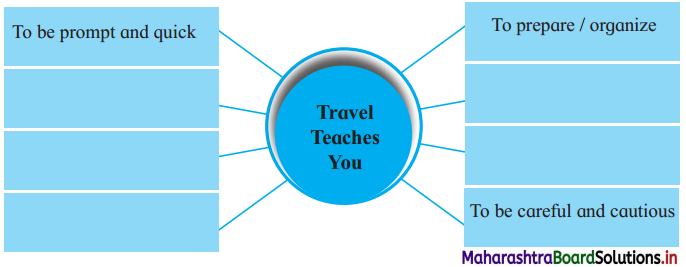
Maharashtra Board Class 12 English Yuvakbharati Solutions Chapter 1.7 Why We Travel 1
Answer:
Maharashtra Board Class 12 English Yuvakbharati Solutions Chapter 1.7 Why We Travel 2
Make a list of your expectations when you travel to some new place:
Answer:
(a) Food should be delicious and available whenever hungry.
(b) Travelling should be easy and comfortable.
(c) Hotel accommodation should be inexpensive and clean.
(d) Weather should be sunny and pleasant.

Question 3.
Discuss in the class the various types of travels. Add your own to ones given below:
Maharashtra Board Class 12 English Yuvakbharati Solutions Chapter 1.7 Why We Travel 3
Answer:
Maharashtra Board Class 12 English Yuvakbharati Solutions Chapter 1.7 Why We Travel 4

Maharashtra Board Solutions

(A1)

Question 1.
Read the first two paragraphs and write down the reasons one needs to travel.
Answer:
One needs to travel:

  1. initially, to lose ourselves next, to find ourselves
  2. to open our hearts and eyes and learn more about the world than our newspapers tell us.
  3. to bring our ignorance and knowledge to cultures which are rich in ways different from ours.
  4. to become young fools again
  5. to slow time down and to get taken in to fall in love once more
  6. to escape into open solitudes, into aimlessness, into accepting dangers and risks
  7. to sharpen the edge of life, and to taste hardship
  8. to leave all one’s beliefs and certainties at home, and see everything in a different light

(A2)

Question (i)
Read the sentence ‘If a diploma can famously ……………. in cultural relativism.’ of this extract on page 67 of the textbook. Pick the sentence which gives the meaning of the above statement from the alternatives given below.
(a) A diploma certificate can be used as a passport and a passport can be used as a diploma certificate.
(b) If one has a diploma, he does not need a passport and if he has a passport, he does not need a diploma.
(c) One can acquire permission to travel to foreign countries for educational purposes based on one’s academic achievements, and travelling to foreign countries enriches one the most regarding the knowledge and wisdom of the world.
Answer:
(c) One can acquire permission to travel to foreign countries for educational purposes based on one’s academic achievements, and travelling to foreign countries enriches one the most regarding the knowledge and wisdom of the world.

Question (ii)
Prepare a list of the litterateurs and their quotations mentioned by the writer in the extract.
Answer:
Names of the litterateurs: Camus, Christopher Isherwood
Quotations: Camus said, “What gives value to travel is fear”- Christopher Isherwood once said, “The ideal travel book should be perhaps a little like a crime story in which you’re in search of something.”

Maharashtra Board Solutions

Question (iii)
‘The real voyage of discovery consists not in seeing new places but in seeing with new eyes.’ – Marcel Proust. Justify with the help of the text.
Answer:
This means that we don’t really have to discover new landscapes or new sights to be in the real process of discovery. Often, we simply need to change our perspective, the way we look at things, to understand them and to raise them to a new, exhilarating level.

Question (iv)
Read the third paragraph and find the difference between a tourist and a traveller as revealed through the complaints made by them.
Answer:
1. A tourist is someone who does not leave his assumptions at home and complains, ‘Nothing here is the way it is at home’.
2. A traveller is someone who leaves his assumptions at home but grumbles, ‘Everything here is the same as it is in Cairo – or Cuzco or Kathmandu.’

Question (v)
Write sentences from the extract conveying the fact that travelling brings together the various cultures of the different parts of the world.
Answer:
1. You can teach them what they have to celebrate as much as you celebrate what they have to teach.
2. This, I think, is how tourism, which so obviously destroys cultures, can also resuscitate or revive them, how it has created new “traditional” dances in Bali, and caused craftsmen in India to pay s new attention to their works.

Maharashtra Board Solutions

Question (vi)
By quoting Camus, the writer has stated that travelling emancipates us from circumstances and all the habits behind which we hide. Write in detail your views about that.
Answer:
When we are at home, we have set ideas and habits, which we are reluctant to change. We dress in a particular way and we behave in a particular way, because the people around us know us and expect that behaviour. We hide behind all this. However, when we travel, no one knows us and there are no expectations about a particular type of behaviour, dress or habits. Hence, we have a feeling of freedom and emancipation from our circumstances and habits.

(A3)

Question (i)
Read the following groups of words:
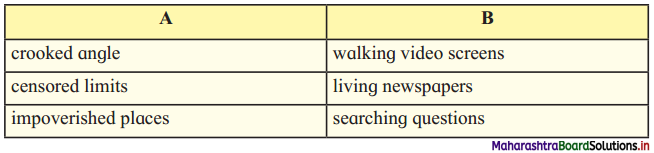
Maharashtra Board Class 12 English Yuvakbharati Solutions Chapter 1.7 Why We Travel 5

  1. crooked angle
  2. censored limits
  3. impoverished places
  4. walking video screens
  5. living newspapers
  6. searching questions

Discuss in pairs and make a list of some more adjectives like this and make sentences using them.
Answer:
1. burnt cottage
2. disturbed night
3. hidden house
4. missing necklace
5. probing questions
6. standing instructions
Sentences:
1. burnt cottage – The mystery of the burnt cottage was finally solved.
2. disturbed night – Rohan had a disturbed night because of the noise from the road construction.
3. hidden house – I could see the hidden house only after climbing a hill.
4. missing necklace – The detective was sure that the missing necklace would be soon found.
5. probing questions – The lawyer asked the witness some probing questions.
6. standing instructions – The queen had given standing instructions that she was never to be disturbed while sleeping.

Maharashtra Board Solutions

Question 1.
Read the following sentence and pick out the phrasal verb.
We travel, then, in part just to shake up our complacencies.
Answer:
shake-up

(A4)

Question 1.
Read the following sentences carefully and find out the infinitives :
(a) We travel, initially, to lose ourselves; and we travel, next, to find ourselves.
(b) We travel to bring what little we can, …………
(c) Yet one of the subtler beauties of travel is that it enables you to bring new eyes to the people you encounter.
Answer:
(a) to lose, to find
(b) to bring
(c) to bring

Question (ii)
Combine the two sentences into one using the word given in the brackets:
(a) I go to Iceland. I visit the lunar spaces within me. (to)
(b) We have the opportunity. We come into contact with more essential parts of ourselves, (of)
(c) Romantic poets inaugurated an era of travel. They were great apostles of open eyes.
(d) The travel spins us around. It shows us the sights and values ordinarily ignored, (showing)
Answer:
(a) I go to Iceland to visit the lunar spaces within me.
(b) We have the opportunity of coming into contact with more essential parts of ourselves.
(c) Romantic poets, being great apostles of open eyes, inaugurated an era of travel.
(d) The travel spins us around, showing us the sights and values ordinarily ignored.

Question (iii)
Read the sentences given below and state whether the underlined words are gerunds or present participles.
(a) As it’s a hot day, many people are swimming
(b) This is a swimming pool.
(c) It’s very bad that children are begging.
(d) Begging is a curse on humanity.
Answer:
(a) present participle
(b) present participle
(c) present participle
(d) gerund

(A5)

Question 1.
Write an email to your friends about your proposed trek. You can take help of the points given below. You can keep your parents informed about it by adding them in BCC.

  • A trek in the forest of Kodaikanal
  • Time and duration
  • Type of trek (cycle/ motorbike/ walk)
  • Facilities provided
  • Last date for registration
  • Fees

Maharashtra Board Solutions

(A6)

Question 1.
There is a boom in ‘Travel and Tourism’ career. Find information about different options in this field.

(A7)

Question (i)
Find information about:
(a) Fa Hien
(b) Huen Tsang
(c) Ibn Batuta
(d) Marco Polo
(e) Sir Richard Burton

Question (ii)
Further reading:

  • ‘Childe Harold’s Pilgrimage’ – Lord Byron
  • ‘Gulliver’s Travels’ – Jonathan Swift
  • ‘Twenty Thousand Leagues Under The Sea’ – Jules Verne
  • ‘Travelling Souls’ – Brian Bouldrey

Yuvakbharati English 12th Digest Chapter 1.7 Why We Travel Additional Important Questions and Answers

Read the extract and complete the activities given below:

Global Understanding:

Question 1.
Write the name of the litterateur and his quotation mentioned by the writer in the extract.
Answer:
Name of the litterateur – George Santayana.
Quotation:
George Santayana writes, “We need sometimes to escape into open solitudes, into aimlessness, into the moral holiday of running some pure hazard, in order to sharpen the edge of life, to taste hardship, and to be compelled to work desperately for a moment at no matter what.”

Question 2.
Based on the extract, complete the web:
(The answers are given directly and underlined.)
Answer:
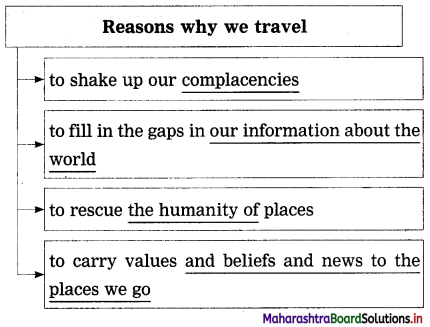
Maharashtra Board Class 12 English Yuvakbharati Solutions Chapter 1.7 Why We Travel 6

Question 3.
From the extract, write the names of:
Answer:
1. 2 litterateurs : Proust, Hazlitt
2. 2 places : Bali, Tibet

Maharashtra Board Solutions

Question 4.
Pick out the false statements and write them correctly :
1. Holidays help you to appreciate your own home more.
2. Tourism can also revive cultures.
3. The writer spent many days in Bali in temples.
4. The writer finds Iceland full of chatter and routine.
Answer:
False statements:
3. The writer spent many days in Bali in temples.
4. The writer finds Iceland full of chatter and routine.

Corrected statements:
3. The writer spent many days in Tibet in temples.
4. The writer finds Iceland quiet and empty.

Question 5.
Write the name of the litterateur and his quotation mentioned by the writer in the extract.
Answer:
Name of the litterateur – Oliver Cromwell Quotation : “A man never goes so far as when he doesn’t know where he is going.”

Question 6.
Write if the following statements are True or False. Correct the false statements :
1. The posters at McDonald’s outlet in Kyoto have pictures of places in San Francisco.
2. The young people in Kyoto McDonald’s outlet look very American.
3. The writer was born in America.
4. Cities like Sydney and Toronto are a mix of many cultures.
True statements:
1. The posters at McDonald’s outlet in Kyoto have pictures of places in San Francisco.
4. Cities like Sydney and Toronto are a mix of many cultures.

False statements:
2. The young people in Kyoto McDonald’s outlet look very American.
3. The writer was born in America.

Corrected statements:
2. The young people in Kyoto McDonald’s outlet look very Japanese.
3. The writer was born in England.

Question 7.
Write from the extract:
Answer:
1. Names of 4 cities: Kyoto, Toronto, Sydney, Addis Ababa
2. Names of two food items: Teriyaki McBurgers, Bacon Potato Pies.

Maharashtra Board Solutions

Question 8.
Write the name of the litterateurs and their quotations mentioned by the writer in the extract.
Answer:
Names of the litterateurs: Sir John Mandeville, Emerson, Thoreau and Sir Thomas Browne.
Quotations: Emerson said, “Travelling is a fool’s paradise.”
Thoreau said, “I have travelled a good deal in Concord.”
Sir Thomas Browne sagely put it, “We carry within us the wonders we seek without us. There is Africa and her prodigies in us.”

Complex Factual:

Question 1.
Write sentences from the extract conveying the fact that travelling brings together the various cultures of the different parts of the world :
Answer:
1. We can become a kind of carrier pigeon in transporting back and forth what every culture needs.
2. I find that I always take Michael Jordan posters to Kyoto, and bring woven ikebana baskets back to California.
3. We become walking video screens and living newspapers, the only channels that can take people out of the censored limits of their homelands.
4. In closed or impoverished places, like Pagan or Lhasa or Havana, we are the eyes and ears of the people we meet, their only contact with the world outside and, very often, the closest, quite literally, they will ever come to Michael Jackson or Bill Clinton.
5. Not the least of the challenges of travel, therefore, is learning how to import – and export – dreams with tenderness.
6. We carry values and beliefs and news to the places we go.

Maharashtra Board Solutions

Question 2.
Complete the following:
Travel spins us round in two ways at once:
Answer:
Travel spins us round in two ways at once: It shows us the sights and values and issues that we might ordinarily ignore. It also shows us all the parts of ourselves that might otherwise grow rusty. For in travelling to a truly foreign place, we inevitably travel to moods and states of mind that we’d otherwise ignore.

Question 3.
Write sentences from the extract conveying the fact that travelling brings together the various cultures of the different parts of the world.
Answer:
1. For when we go to France, we often migrate to French, and the more childlike self, simple and polite, that speaking a foreign language educes.
2. Even when I’m not speaking pidgin English in Hanoi, I’m simplified in a positive way, and concerned not with expressing myself, but simply making sense.

Question 4.
Write sentences from the extract conveying the fact that travelling brings together the various cultures of the different parts of the world.
Answer:
1. When we go abroad we are objects of scrutiny as much as the people we scrutinize, and we are being consumed by the cultures we consume, as much on the road as when we are at home.
2. At the very least, we are objects of speculation (and even desire), who can seem as exotic to the people around us as they do to us.

Question 5.
Write the sentences from the extract conveying the fact that travelling brings together the various cultures of the different parts of the world.
Answer:
1. When you go to a McDonald’s outlet in Kyoto, you will find Teriyaki McBurgers and Bacon Potato Pies.
2. The placemats offer maps of the great temples of the city, and the posters all around broadcast the wonders of San Francisco.
3. And-most crucial of all-the young people eating their Big Macs, with baseball caps worn backwards, and tight 501 jeans, are still utterly and inalienably Japanese in the way they move, they nod, they sip their Oolong teas – and never to be mistaken for the patrons of a McDonald’s outlet in Rio, Morocco or Managua.
4. These days a whole new realm of exotica arises out of the way one culture colours and appropriates the products of another,
5. The other factor complicating and exciting all of this is people, who are, more and more, themselves as many-tongued and mongrel as cities like Sydney or Toronto or Hong Kong.
6. Besides, even those who don’t move around the world find the world moving more and more around them. Walk just six blocks, in Queens or Berkeley, and you’re travelling through several cultures in as many minutes; get into a cab outside the White House, and you’re often in a piece of Addis Ababa.

Maharashtra Board Solutions

Question 6.
Complete the following:
Answer:
1. Travel is a voyage into the imagination and is the conspiracy of perception and imagination.
2. Sir John Mandeville never visited the Far East but yet gave colourful accounts of it.
3. Emerson and Thoreau insist that reality is our creation and we invent the places we see as much as we do the books we read.

Question 7.
Complete the following, giving examples: (The answer is given directly.) The finest recent travel books are those that:
Answer:
1. undertake a parallel journey, matching the physical steps of a pilgrimage with the metaphysical steps of a questioning e.g. in Peter Matthiessen’s great “The Snow Leopard”.
2. chronicle a trip to the farthest reaches of human strangeness e.g. Oliver Sacks’ “Island of the Color-Blind,” which features a journey not just to a remote atoll in the Pacific, but to a realm where people actually see light differently).

Inference/Interpretation/Analysis:

Question 1.
Guess the difference : travel and travail:
Answer:
Travel guides us towards a better balance of wisdom and compassion, of seeing the world clearly and truly. Travail means agony, or hard toil, which will be the result of laborious travelling and hardships.

Question 2.
Describe the changes that come into us because of travels, especially to foreign countries.
Answer:
When we go abroad, we stay up late, do impulsive things and leave ourselves open to various experiences. We live for the moment, without any past or future; only the present. We may even become mysterious-to others, at first, and sometimes even to ourselves, behaving in new ways. We feel younger, as if we have been reborn.

Maharashtra Board Solutions

Question 3.
Explain in your own words how travel can be a kind of ‘monasticism’.
Answer:
‘Monasticism’ means living like monks, living a self-disciplined life that is isolated from other people. When we travel, even if we are living in a luxury hotel, we live more simply than we normally do at home. We have no more possessions than what we can carry, we surrender ourselves to chance, and to whatever may come in our way. Hence, travel can be a kind of ‘monasticism’.

Question 4.
Travelling abroad make us the object of scrutiny. Justify this statement,
Answer:
When we go abroad, the local people there are curious about us and our culture. We seem exotic and different to them and they scrutinize our ways and behaviour to learn and understand more about us.

Question 5.
The writer calls himself ‘many-tongued’ and ‘mongrel’. Give reasons.
Answer:
‘Many-tongued’ means that he knows many languages; ‘mongrel’ here means someone who has a mixed upbringing, someone of mixed cultures. The writer knows many languages. He was born of Indian parents, in England, and he moved to America when he was 7 years old. Hence, he says that he cannot really call himself an Indian, an American or an Englishman.

Question 6.
‘Get into a cab outside the White House, and you’re often in a piece of Addis Ababa.’ Explain the meaning of this sentence.
Answer:
Addis Ababa is the capital of Ethiopia, Africa. The sentence means that the driver of the cab outside the White House was probably an African American, may be originally from Africa.

Maharashtra Board Solutions

Question 7.
“We carry within us the wonders we seek without us.” Explain.
Answer:
This means that all the wonders and emotions are within us, and if we wish to, we can tap these forces. Everything is within our own hearts and imagination. Everything is internal. Whatever we find outside has first to be inside us for us to experience it. There is no necessity for any separate outside happenings for us to feel anything.

Personal Response:

Question 1.
Name the places you would like to visit the most. Give reasons to support your answer.
Answer:
I like to travel but I have not had much opportunity yet. I love seeing new places and meeting new people. I would love to travel to the North-Eastern parts of India and to foreign countries. I am also a nature lover and would love seeing high mountains, clear lakes and green pastures.

Question 2.
‘Travel helps you to appreciate your own home more’. Justify this statement.
Answer:
Holidays, especially holidays abroad, can certainly help us to appreciate our own homes more. For example, if we go to the African desert and see the problems they have with potable water supply, we will appreciate our own water resources more. If we see the problems faced by people living in very cold climates, we will appreciate the heat in our country, and even be grateful for it.

Question 3.
Do you think that people travel more, or in a different way, as compared to people fifty years back? Explain your view.
Answer:
Yes, people certainly travel more today. They also travel for different reasons. Fifty years back, in India, people generally travelled only for religious reasons or to meet relatives and family. Travelling for sightseeing was rarer. Today, in addition to these reasons, people also travel for fun, relaxation and sight-seeing. People also go on holidays abroad, which was not done often earlier.

Maharashtra Board Solutions

Question 4.
Do you think that we must always seek new experiences and new places? Or do you feel that the best place is home, and we must never move?
Answer:
If we just stick to our own homes, we will be like the frog in the pond, which thought its small pond was the whole world. This is not advisable in the world of today. To be happy and successful, we must be broad-minded and unbiased. We must see what the world and other cultures have to offer. We must try to imbibe the best from other cultures and places.

Language Study:

Question 1.
We carry values and beliefs and news to the places we go.
(Rewrite using ‘not only but also.)
Answer:
We carry not only values and beliefs but also news to the places we go.

Question 2.
Travel is the best way we have of rescuing the humanity of places.
(Use an infinitive in place of the gerund.)
Answer:
Travel is the best way we have to rescue the humanity of places.

Question 3.
The beauty of this process was best described by George Santayana.
(Rewrite beginning George Santayana)
Answer:
George Santayana best described the beauty of this process.

Maharashtra Board Solutions

Question 4.
Yet for me the first great joy of travelling is simply the luxury of leaving all my beliefs and certainties at home. (Pick out the finite verb and say whether the sentence is simple, compound or complex.)
Answer:
finite verb-is; simple sentence

Question 5.
Pick out the phrasal verb from this sentence:
Abroad is the place where we stay up late.
Answer:
stay up

Question 6.
Travelling is a way to reverse time. (Identify the part of speech of the underlined word.)
Answer:
travelling – gerund

Question 7.
I tend to believe more abroad than I do at home. (Rewrite using as….as..)
Answer:
I tend not to believe as much at home as I do abroad.

Question 8.
Pick out the phrasal verb from these sentences:
Answer:
1. I remember, in fact, after my first trip to Southeast Asia, more than a decade ago, how I would come back to my apartment in New York.
2. All, in that sense, believed in, “being moved”
Answer:
1. come back
2. believed in

Maharashtra Board Solutions

Question 9.
Anyone witnessing this strange scene would have drawn the right conclusion.
(Rewrite using ‘who’)
Answer:
Anyone who witnessed this strange scene would have drawn the right conclusion.

Question 10.
I remember how I would come back to my apartment in New York. (Rewrite using ‘used, to’.)
Answer:
I remember how I used to come back to my apartment in New York.

Question 11.
We have to carry our sense of destination. (Rewrite beginning‘Our sense….’)
Answer:
Our sense of destination has to be carried by us.

Question 12.
The most valuable Pacifies we explore will always be the vast expanses within us.
(Rewrite using more…than..)
Answer:
We will never explore more valuable Pacifies than the vast expanses within us.

Question 13.
It keeps the mind nimble. (Rewrite using the present perfect tense of the verb.)
Answer:
It has kept the mind nimble.

Vocabulary:

Question 1.
Guess the meaning: riches are differently dispersed
Answer:
cultures that are rich in ways different from ours.

Question 2.
Find out a past/present participle from the extract that has been used as an adjective :
Answer:
crooked angle (crooked-past participle)

Question 3.
Find out two pairs of antonyms from the extract:
Answer:
1. lose × find
2. ignorance × knowledge

Maharashtra Board Solutions

Question 4.
Guess the difference between provisional and provincial.
Answer:
Provisional means temporary, whereas provincial means limited in outlook narrow.

Question 5.
Find out from the extract a few past / present participles that have been used as adjectives:
1. walking video screens
2. censored limits
3. living newspapers
4. impoverished places
Answer:
censored, impoverished – past participles used as adjectives
walking, living – present participles used as adjectives

Question 6.
Pick out four proper nouns for places from the extract.
Answer:
Kyoto, Pagan, Lhasa, Havana.

Question 7.
Find from the extract one word for the following :
1. A Japanese art of flower arrangement
2. Satisfaction of one with oneself or one’s own achievements.
Answer:
1. ikebana
2. complacencies

Question 8.
Complete the table with the words given in the brackets:
(values celebrate now deeply discovery apprehend wonderfully distant quietude foreign appreciative spins)
Answer:

Noun Verb Adjective Adverb
discovery celebrate distant wonderfully
values apprehend foreign deeply
quietude spins appreciative now

Maharashtra Board Solutions

Question 9.
Find out a past/present participle from the extract that has been used as an adjective:
Answer:
searching questions (searching – present participle)

Question 10.
Discuss the pun implied by the writer, ecstasy (ex-stasis):
Answer:
ecstasy – great joy. ex-stasis – previous period of inactivity or boredom. The words sound alike but have different meanings.

Question 11.
Guess the meaning:

  1. many-tongued
  2. mongrel
  3. inheritance
  4. notions

Answer:

  1. many-tongued – a person who speaks many languages.
  2. mongrel – (here) someone who has a mixed upbringing, someone of mixed cultures.
  3. inheritance – the acquisition of a possession, condition, or trait from past generations.
  4. notions – ideas.

Question 12.
Match the adjectives in Column A with the nouns in Column B, with reference to the extract:

A B
1. great (a) specimen
2. new (b) versions
3. typical (c) temples
4. essential (d) world
5. synthetic (e) realm
6. foreign (f) notions

Answer:

  1. great temples
  2. new realm
  3. typical specimen
  4. essential notions
  5. synthetic versions
  6. foreign world

Maharashtra Board Solutions

Question 13.
Give the adjective forms of:

  1. perception
  2. imagination
  3. friendship
  4. reality

Answer:

  1. perception – perceptive
  2. imagination – imaginative
  3. friendship – friendly
  4. reality – realistic

Question 14.
Give the verb forms of:

  1. perception
  2. imagination
  3. friendship
  4. conspiracy

Answer:

  1. perception – perceive
  2. imagination – imagine
  3. friendship – befriend
  4. conspiracy – conspire

Question 15.
Guess the meaning:

  1. atoll
  2. prejudice
  3. fosters

Answer:

  1. atoll – a coral island consisting of a reef surrounding a lagoon
  2. prejudice – bias
  3. fosters – encourages

Maharashtra Board Solutions

Question 17.
Find from the extract the antonyms of:

  1. worthless
  2. public
  3. nearest
  4. familiar
  5. outside
  6. slow

Answer:

  1. worthless × valuable
  2. public × private
  3. nearest × farthest
  4. familiar × unfamiliar
  5. outside × inside
  6. slow × quick

Do as directed:

Question 1.
The queen loved her people and looked after the affairs of her kingdom well.
(Rewrite using ‘who’.)
Answer:
The queen, who loved her people, looked after the affairs of her kingdom well.

Question 2.
But I want to test this. (Change the voice.)
Answer:
But I want this to be tested.

Question 3.
The husband had a small smile on his lips while the wife looked sad.
(Rewrite beginning with ‘Though’)
Answer:
Though the husband had a small smile on his lips, the wife looked sad.

Maharashtra Board Solutions

Spot the error in the following sentences and rewrite them correctly:

Question 1.
You must neither tell me the whole story or at least the first part of it.
Answer:
You must either tell me the whole story or at least the first part of it.

Question 2.
No sooner did the Minister begin speaking, some rogues started shouting loudly.
Answer:
No sooner did the Minister begin speaking, than some rogues started shouting loudly.

12th Std English Questions And Answers: