Problem Set 49 Class 5 Maths Chapter 12 Perimeter and Area Question Answer Maharashtra Board

Perimeter and Area Class 5 Problem Set 49 Question Answer Maharashtra Board

Balbharti Maharashtra Board Class 5 Maths Solutions Chapter 12 Perimeter and Area Problem Set 49 Textbook Exercise Important Questions and Answers.

Std 5 Maths Chapter 12 Perimeter and Area

Question 1.
How much wire will be needed to make a rectangle 7 cm long and 4 cm wide?
Solution:
Perimeter of a rectangle
= 2 x length + 2 x breadth
= 2 x 7 + 2 x 4
= 14 + 8
= 22 cm

∴ 22 cm wire will be needed to make a rectangle

Maharashtra Board Class 5 Maths Solutions Chapter 12 Perimeter and Area Problem Set 49

Question 2.
If the length of a rectangle is 20 m and its width is 12m, what is its perimeter?
Solution:
Perimeter of a rectangle
= 2 x length + 2 x breadth
= 2×20 + 2×12
= 40 + 24
= 64 m
∴ Perimeter is 64 m

Question 3.
Each side of a square is 9 m long. Find its perimeter.
Solution:
Perimeter of a square
= 4 x length of one side
= 4 x 9
= 36 m
∴ Perimeter is 36 m

Question 4.
If we take 4 rounds around a field that is 160 m long and 90 m wide, what is the distance we walk in kilometres?
Solution:
Perimeter of a rectangular field
= 2 x length + 2 x breadth
= 2 x 160 + 2 x 90
= 320 + 180
= 500 m

In one round distance walked is 500 m, hence, distance walked in 4 rounds
= 500 x 4
= 2000 m
= 2km
∴ The distance walked in 4 rounds is 2 km

Maharashtra Board Class 5 Maths Solutions Chapter 12 Perimeter and Area Problem Set 49

Question 5.
Sanju completes 12 rounds around a square park every day. If one side of the park is 120 m, find out in kilometres and metres the distance that Sanju covers daily.
Solution:
Perimeter of a square
= 4 x length of one side
= 4 x 120
= 480 m

So, in one round the distance can be covered is 480 m, hence in 12 rounds the distance can be covered is
= 480 x 12
= 5760 m
= 5000 m + 760 m

∴ Sanju covers 5 km 760 m daily

Question 6.
The length of a rectangular plot of land is 50 m and its width is 30 m. A triple fence has to be put along its edges. If the wire costs 60 rupees permetre, what will be the total cost of the wire needed for the fence?
Solution:
Perimeter of a rectangular plot
= 2 x length + 2 x breadth
= 2 x 50 + 2 x 30
= 100 + 60 – 160 m
For a triple fence, wire needed
= 3 x 160 = 480 m

Cost of the wire needed
= wire needed x rate
= 480 x 60
= 28800 rupees
∴ The total cost of the wire needed for the fence is ₹ 28,800

Maharashtra Board Class 5 Maths Solutions Chapter 12 Perimeter and Area Problem Set 49

Question 7.
A game requires its players to run around a square playground. Each side of the playground is 20 m long. One player took 5 rounds around the playground. How many metres did he run altogether?
Solution:
Perimeter of a square
= 4 x length of one side
= 4 x 20
= 80 m

In one round 80 m.
So in 5 round
= 80 x 5
= 400
= 400 m

∴ He runs altogether = 400 m

Question 8.
Four rounds of wire fence have to be put around a field. If the field is 60 m long and 40 m wide, how much wire will be needed?
Solution:
Perimeter of rectangular field
= 2 x length + 2 x breadth
= 2 x 60 + 2 x 40
= 120 + 80
= 200 m
Hence, wire required for 4 rounds
= 200 x 4
= 800 m

∴ Wire required for 4 rounds
= 800 m

Maharashtra Board Class 5 Maths Solutions Chapter 12 Perimeter and Area Problem Set 49

Question 9.
The sides of a triangle are 24.7cm, 20.4 cm and 10.5 cm respectively. What is the perimeter of the triangle?
Solution:
Perimeter of triangle
= 24.7 + 20.4 + 10.5
= 55.6

∴ The perimeter of a triangle
= 55.6 cm

Question 10.
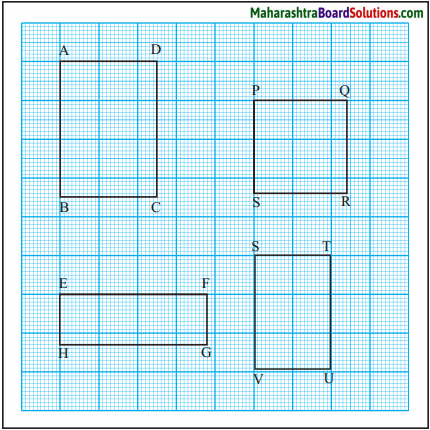
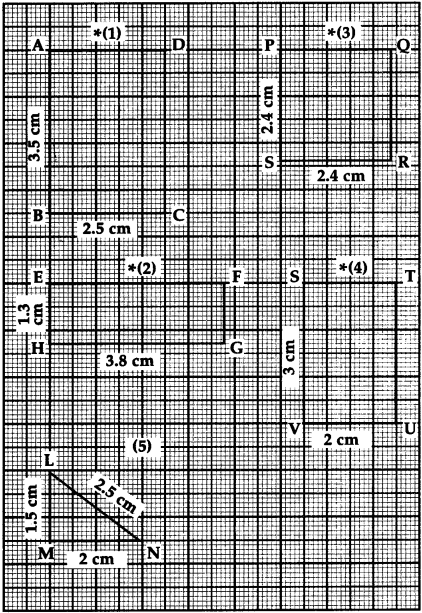
Look at the figures on the sheet of graph paper. Measure their sides with the help of the lines on the graph paper. Write the perimeter of each in the right box.
Maharashtra Board Class 5 Maths Solutions Chapter 12 Perimeter and Area Problem Set 49 1

(1) Perimeter of
rectangle ABCD
= [ ] cm
(2) Perimeter of
rectangle EFGH
= [ ] cm
(3) Perimeter of
square PQRS
= [ ] cm
(4) Perimeter of
rectangle STUV
= [ ] cm
Solution:
Maharashtra Board Class 5 Maths Solutions Chapter 12 Perimeter and Area Problem Set 49 6

Maharashtra Board Class 5 Maths Solutions Chapter 12 Perimeter and Area Problem Set 49

(1) Perimeter of a rectangle ABCD
= 2 x length + 2 x breadth
= 2 x 3.5 + 2 x 2.5
= 7 + 5
= 12 cm

∴ 12 cm

(2) Perimeter of a rectangle EFGH
= 2 x length + 2 x breadth
= 2 x 3.8 + 2 x 1.3
= 7.6 + 2.6
= 10.2 cm

∴ 10.2 cm

(3) Perimeter of a rectangle PQRS
= 2 x length + 2 x breadth
= 2 x 2.4 + 2 x 2.4
= 4.8+ 4.8
= 9.6 cm

∴ 9.6 cm

Maharashtra Board Class 5 Maths Solutions Chapter 12 Perimeter and Area Problem Set 49

(4) Perimeter of a rectangle STUV
= 2 x length + 2 x breadth
= 2 x 3 + 2 x 2
= 6 + 4
= 10 cm

∴ 10 cm

(5) Perimeter of a triangle LMN
= 1.5 + 2.5 + 2
= 6 cm

∴ 6 cm

Area : Revision

Maharashtra Board Class 5 Maths Solutions Chapter 12 Perimeter and Area Problem Set 49 2

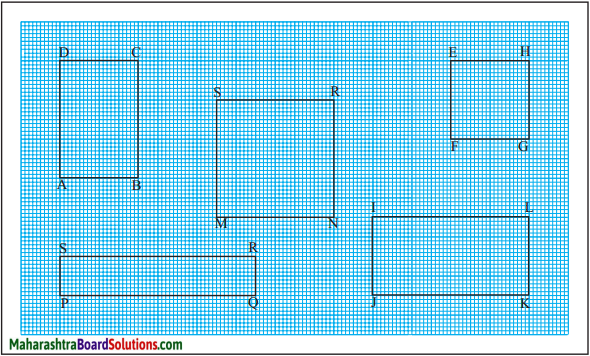
Of the figures given above, figure ABCD has six squares of 1 cm each inside it. It means that its area is 6 sq cm.

In the same way, count the squares in each figure and write its area.
(1) Area of MNRS = [ ] sq cm
(2) Area of EFGH = [ ] sq cm
(3) Area of PQRS = [ ] sq cm
(4) Area of IJKL = [ ] sq cm

Atul : Sir, why is the unit for area written as sq cm? We measure the sides in centimetres.

Teacher : Centimetre is a standard unit of length. In order to measure area, we need a standard unit of area. For this, a square with a side 1 cm is taken as the standard unit. The area of this square is 1 square centimetre. That is why this unit is written as sq cm, in short.

To measure large areas like fields, parks and playgrounds, a square with side 1 m, that is, an area of 1 sq m, is taken as the standard unit.

Maharashtra Board Class 5 Maths Solutions Chapter 12 Perimeter and Area Problem Set 49

To measure the areas oftalukas or districts, a square with side 1km, or 1sq km is the standard unit used.

Formula for the area of a rectangle

Maharashtra Board Class 5 Maths Solutions Chapter 12 Perimeter and Area Problem Set 49 3

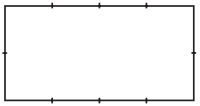
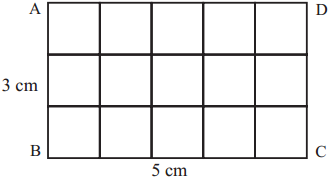
(1) In the rectangle ABCD given alongside, 1 cm divisions were marked off on each side. The points on opposite sides were joined as shown in the figure. The length of the sides of each square thus created is 1cm. Therefore, the area of each square is 1 sq cm.

In ABCD, 3 rows with 5 squares each have been created.
The number of squares in rectangle ABCD is 3 × 5 = 15.
Therefore, the area of rectangle ABCD is 15 sq cm.
Here, the length of the figure is 5 cm and its breadth is 3 cm.
Note that the product of 3 and 5 is 15.

(2) In the rectangle with sides 4 cm and 2 cm, make squares of 1 sq cm each as shown above. Count the number of squares.

Maharashtra Board Class 5 Maths Solutions Chapter 12 Perimeter and Area Problem Set 49 4

Note that here too, the number of squares formed are the same as the product of the length and width of the rectangle.

Therefore, The area of a rectangle = length × breadth

Formula for the area of a square

Maharashtra Board Class 5 Maths Solutions Chapter 12 Perimeter and Area Problem Set 49 5

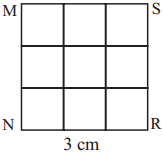
(1) Look at the square given alongside. The side of the square is 3 cm long. 9 squares of 1 cm each are formed within this square.

Maharashtra Board Class 5 Maths Solutions Chapter 12 Perimeter and Area Problem Set 49

Therefore, the area of this square is 9 sq cm.

Here, there are 3 rows with 3 squares each, i.e., there are 3 × 3 = 9 squares.
The length of each side of the square is 3 cm.
The product of two sides of the square is 3 × 3 = 9.

(2) Measure the area of a square with side 5 cm, in the same way.
The answer will be 25 sq cm.
Note that 5 × 5 = 25

Therefore, The area of a square = length of a side × length of a side

It is not necessary to divide a square or rectangle into small squares every time you calculate their area. The advantage of a formula is that you can calculate the area simply by substituting the appropriate values.

Word problems
Example (1) What is the area of a rectangle of length 20 cm and width 15 cm?
Area of a rectangle = length × breadth
= 20 × 15 = 300.
Therefore, the area of the rectangle is 300 sq cm.

Example (2) A wall that is 4 m long and 3 m wide has to be painted. If the labour charges are ₹ 25 per sq m, what is the cost of labour for painting this wall?

First let us calculate the area of the wall to be painted.
Area of the wall = length of the wall × breadth of the wall = 4 × 3 = 12
Thus, the area of the wall is 12 sq m.
Labour cost of 1 sq m is 25 rupees.
So the labour cost for 12 sq m will be = 12 × 25 = 300
The cost of labour for painting the wall will be 300 rupees.

Example (3) What will be the area of a square with sides 15 cm?
Area of a square = length of side × length of side
= 15 × 15 = 225
The area of the square is 225 sq cm.

Maharashtra Board Class 5 Maths Solutions Chapter 12 Perimeter and Area Problem Set 49

Example (4) One side of a square room is 4 m. If the cost of labour for laying 1 sq m of the floor is 35 rupees, what will be the total cost of labour?
First we must find the area of the square room.
Area of the square room = length of side × length of side = 4 × 4 = 16
Therefore, the area of the square room is 16 sq m.
The labour cost of laying 1 sq m of flooring is 35 rupees.
Therefore, the cost of laying 16 sq m of flooring is 16 × 35 = 560 rupees.

Perimeter and Area Problem Set 49 Additional Important Questions and Answers

Question 1.
Devendra walks five rounds of a square garden everyday. If the side of the garden is 150 m, how many kilometres does Devendra walk every morning?
Solution:
Perimeter of a square garden
= 4 x one side of the garden
= 4 x 150
= 600 m

In 5 rounds walking
= 5 x 600
= 3000 m
= 3 km
3 km

Question 2.
The length of a rectangular play ground is 75 m and its breadth is 50 m. Rupali walks four rounds. How many kilometres did she walk?
Solution:
Perimeter of rectangle
= 2 x length + 2 x breadth
= 2 x 75 + 2 x 50
= 150 + 100
= 250 m

In 4 rounds walking
= 4 x 250
= 1000 m
= 1 km

∴ 1 km

Maharashtra Board Class 5 Maths Solutions Chapter 12 Perimeter and Area Problem Set 49

Question 3.
Length of the rectangle is 10 cm and its breadth is 8 cm and one square is side 9 cm. Whose perimetre is more? By how much?
Solution:
Perimeter of a rectangle
= 2 x length + 2 x breadth
= 2 x 10 + 2 x 8
= 20 + 16
= 36 cm ……………….. (i)

Perimeter of a square
= 4 x length of side
= 4 x 9
36 cm ……………….. (ii)
From (i) and (ii) perimeter of both is equal.

∴ perimeter of both is equal

Class 5 Maths Solution Maharashtra Board

Problem Set 39 Class 5 Maths Chapter 9 Decimal Fractions Question Answer Maharashtra Board

Decimal Fractions Class 5 Problem Set 39 Question Answer Maharashtra Board

Balbharti Maharashtra Board Class 5 Maths Solutions Chapter 9 Decimal Fractions Problem Set 39 Textbook Exercise Important Questions and Answers.

Std 5 Maths Chapter 9 Decimal Fractions

Question 1.
Write how many rupees and how many paise.

(1) ₹ 58.43
Answer:
58 rupees 43 paise.

Maharashtra Board Class 5 Maths Solutions Chapter 9 Decimal Fractions Problem Set 39

(2) ₹ 9.30
Answer:
9 rupees 30 paise.

(3) ₹ 2.30
Answer:
2 rupees 30 paise.

(4) ₹ 2.3
Answer:
2 rupees 30 paise.

Question 2.
Write how many rupees in decimal form.

(1) 6 rupees 25 paise
Answer:
₹ 6.25

(2) 15 rupees 70 paise
Answer:
₹ 15.70

Maharashtra Board Class 5 Maths Solutions Chapter 9 Decimal Fractions Problem Set 39

(3) 8 rupees 5 paise
Answer:
₹ 8:05

(4) 22 rupees 4 paise
Answer:
₹ 22.04

(5) 720 paise
Answer:
₹ 7.20

Question 3.
Write how many metres and how many centimetres.

(1) 58.75 m
Answer:
58 m 75 cm

(2) 9.30 m
Answer:
9 m 30 cm

Maharashtra Board Class 5 Maths Solutions Chapter 9 Decimal Fractions Problem Set 39

(3) 0.30 m
Answer:
30 cm

(4) 0.3 m
Answer:
30 cm

(5) 1.62 m
Answer:
1 m 62 cm

(6) 91.4 m
Answer:
91 cm 40 cm

(7) 7.02 m
Answer:
7 m 2 cm

Maharashtra Board Class 5 Maths Solutions Chapter 9 Decimal Fractions Problem Set 39

(8) 0.09 m
Answer:
9 cm

Question 4.
Write how many metres in decimal form.

(1) 1 m 50 cm
Answer:
1.5 m

(2) 50 m 40 cm
Answer:
50.40 m

(3) 50 m 4 cm
Answer:
50.04 m

(4) 734 cm
Answer:
7.34 m

Maharashtra Board Class 5 Maths Solutions Chapter 9 Decimal Fractions Problem Set 39

(5) 10 cm
Answer:
0.1 m

(6) 2 cm
Answer:
0.02 m

Question 5.
Write how many centimetres and how many millimetres.

(1) 6.9 cm
Answer:
6 cm 9 mm

(2) 20.4 cm
Answer:
20 cm 4 mm

(3) 0.8 cm
Answer:
8 mm

Maharashtra Board Class 5 Maths Solutions Chapter 9 Decimal Fractions Problem Set 39

(4) 0.5 cm
Answer:
5 mm

Question 6.
Write how many centimetres in decimal form.
(1) 7 cm 1 mm
Answer:
7.1 cm

(2) 16 mm
Answer:
1.6 cm

(3) 144 mm
Answer:
14.4 cm

Maharashtra Board Class 5 Maths Solutions Chapter 9 Decimal Fractions Problem Set 39

(4) 8 mm
Answer:
0.8 cm

Writing half, quarter, three-quarters and one and a quarter in decimal form

‘Half’ is usually written as \(\frac{1}{2}\). To convert this fraction into decimal form, the denominator of \(\frac{1}{2}\) must be converted into an equivalent fraction with denominator 10.

\(\frac{1}{2}=\frac{1 \times 5}{2 \times 5}=\frac{5}{10}\) so the decimal form of \(\frac{1}{2}\) will be \(\frac{5}{10}\) or 0.5 Just as \(\frac{1}{2}=\frac{1 \times 5}{2 \times 5}=\frac{5}{10}\) = 0.5, note that \(\frac{1}{2}=\frac{1 \times 50}{2 \times 50}=\frac{50}{100}\) = 0.50

Therefore, ‘half’ is written as ‘0.5’ or 0.50’. ‘Quarter’ and ‘three quarters’ are written in fractions as \(\frac{1}{4}\) and \(\frac{3}{4}\) respectively. Let us convert them into decimal fractions. 10 is not divisible by 4. Therefore, the denominators of \(\frac{1}{4}\) and \(\frac{3}{4}\) cannot be made into fractions with multiples of 10. However, 4 × 25 = 100, so the denominator can be 100.

Maharashtra Board Class 5 Maths Solutions Chapter 9 Decimal Fractions Problem Set 39

A quarter \(=\frac{1}{4}=\frac{1 \times 25}{4 \times 25}=\frac{25}{100}=0.25\)
and Three quarters \(=\frac{3}{4}=\frac{3 \times 25}{4 \times 25}=\frac{75}{100}=0.75\)
One and a quarter = 1 \(\frac{1}{4}\) = 1.25
One and a half = 1 \(\frac{1}{2}\) = 1.50 = 1.5
One and three quarters = 1 \(\frac{3}{4}\) = 1.75
Seventeen and a half = 17 \(\frac{1}{2}\) = 17.50 = 17.5

Decimal Fractions Problem Set 37 Additional Important Questions and Answers

Question 1.
Write how many rupees and how many paise.

(1) ₹ 147.5
Answer:
1 hundred and 47 rupees 50 paise.

(2) ₹ 40.4
Answer:
40 rupees and 40 paise.

Question 2.
Write how many rupees in decimal form.

(1) 105 paise
Answer:
₹ 1.05

Maharashtra Board Class 5 Maths Solutions Chapter 9 Decimal Fractions Problem Set 39

(2) 6 rupees 6 paise
Answer:
₹ 6.06

(3) 20 rupees 20 paise
Answer:
₹ 20.2

Question 3.
Write how many metres and how many centimetres.

(1) 1.1m =
Answer:
1 m 10 cm

(2) 120 cm =
Answer:
1 m 20 cm

Maharashtra Board Class 5 Maths Solutions Chapter 9 Decimal Fractions Problem Set 39

(3) 24.8 m =
Answer:
24 m 80 cm

(4) 0.5 m =
Answer:
50 cm

Question 4.
Write how many metres in decimal form.

(1) 110 cm =
Answer:
1.1m

Maharashtra Board Class 5 Maths Solutions Chapter 9 Decimal Fractions Problem Set 39

(2) 60 cm =
Answer:
0.6 m

Question 5.
Write how many centimetres and how many millimetres.

(1) 0.1 cm =
Answer:
1 mm

(2) 10.5 cm =
Answer:
10 cm 5 mm

Maharashtra Board Class 5 Maths Solutions Chapter 9 Decimal Fractions Problem Set 39

Question 6.
Write how form. many centimetres in decimal
(1) 1 mm =
Answer:
0.1 cm

(2) 100 mm =
Answer:
10.0 cm

Class 5 Maths Solution Maharashtra Board

Problem Set 2 Class 5 Maths Chapter 2 Number Work Question Answer Maharashtra Board

Number Work Class 5 Problem Set 2 Question Answer Maharashtra Board

Balbharti Maharashtra Board Class 5 Maths Solutions Chapter 2 Number Work Problem Set 2 Textbook Exercise Important Questions and Answers.

Std 5 Maths Chapter 2 Number Work

Question 1.
Using the digits 0, 1, 2, 3, 4, 5, 6, 7, 8, 9 write ten each of two-, three-, four- and five-digit numbers. Read the numbers.
Answer:

Two-digit numbers Reading a number
37 Thirty-seven
80 Eighty
49 Forty-nine
65 Sixty-five
28 Twenty-eight
54 Fifty-four
92 Ninety-two
71 Seventy-one
16 Sixteen
22 Twenty-two
Three-digit numbers Reading a number
504 Five hundred and four
386 Three hundred eighty-six
430 Four hundred thirty
891 Eight hundred ninety-one
615 Six hundred fifteen
267 Two hundred sixty-seven
900 Nine hundred
173 One hundred seventy-three
766 Seven hundred sixty-six
258 Two hundred and fifty-eight
Four-digit numbers Reading a number
3,817 Three thousand eight hundred and seventeen
4,059 Four thousand fifty-nine
9,611 Nine thousand six hundred and eleven
7,413 Seven thousand four hundred thirteen
5,608 Five thousand six hundred and eight
Four-digit numbers Reading a number
2,009 Two thousand and nine
6,420 Six thousand four hundred and twenty
1,357 One thousand three hundred and fifty-seven
8,172 Eight thousand one hundred and seventy-two
6,156     – Six thousand one hundred and fifty-six
Five-digit numbers Reading a number
41,309 Forty-one thousand, three hundred and nine
68,527 Sixty-eight thousand five hundred and twenty seven
50,348 Fifty thousand three hundred and forty eight
76,052 Seventy-six thousand and fifty-two
21,546 Twenty-one thousand five hundred and forty-six
10,358 Ten thousand three hundred and fifty-eight
94,215 Ninety-four thousand two hundred and fifteen
36,104 Thirty-six thousand one hundred and four
89,157 Eighty-nine thousand one hundred and fifty-seven
72,560 Seventy-two thousand five hundred and sixty

Maharashtra Board Class 5 Maths Solutions Chapter 2 Number Work Problem Set 2

Question 2.
Fill in the blanks in the table below.
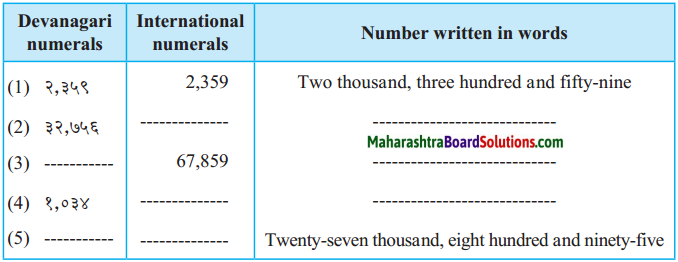
Maharashtra Board Class 5 Maths Solutions Chapter 2 Number Work Problem Set 2 1
Answer:

 Devnagari numerals  International numerals Number written in words
(1)  २,३५९  2,359 Two thousand three hundred and fifty nine
(2)  ३२,७५६  32,756 Thirty two thousand seven hundred and fifty Six
(3)  ६७,८५९  67,859 Sixty seven thousand eight hundred and fifty Nine
(4)  १,०३४  1,034 One thousand and thirty four
(5)  २७,८९५  27,895 Twenty seven thousand eight hundred and ninety five

Question 3.
As a part of the ‘Avoid Plastic Project’, Zilla Parishad schools made and provided paper bags to provision stores and greengrocers. Read the talukawise numbers of the bags and write the numbers in words.

Maharashtra Board Class 5 Maths Solutions Chapter 2 Number Work Problem Set 2 2
Answer:

Talukas No. of Bags Numbers in words
Kopargaon 12,740 Twelve thousand seven hundred and forty
Shevgaon 28,095 Twenty-eight thousand and ninety-five
Karjat 31,608 Thirty-one thousand six hundred and eight
Sangamner 10,792 Ten thousand seven hundred and ninety-two

Maharashtra Board Class 5 Maths Solutions Chapter 2 Number Work Problem Set 2

Question 4.
How many rupees do they make?
(1) 20 notes of 1000 rupees, 5 notes of 100 rupees and 14 notes of 10 rupees.
(2) 15 notes of 1000 rupees, 12 notes of 100 rupees, 8 notes of 10 rupees and 5 coins of 1 rupee.
Answer:

Question 5.
Write the biggest and the smallest five-digit numbers that can be made using the digits 4, 5, 0, 3, 7 only once.
Answer:
Biggest five digit number is 75,430 Smallest five digit number is 30,457

Question 6.
The names of some places and their populations are given below. Use this information to answer the questions that follow.

Tala : 40,642
Gaganbawada : 35,777
Bodhwad : 91,256
Moregaon : 87,012
Bhamragad : 35,950
Velhe : 54,497
Ashti : 76,201
Washi : 92,173
Morwada : 85,890

(1) Which place has the greatest population? What is its population?
(2) Which place, Morwada or Moregaon, has the greater population?
(3) Which place has the smallest population? How much is it?
Answer:
(1) Washi has the greatest population. Population of Washi is 92,173
(2) Moregaon has the greater population.
(3) Gaganbawada has the smallest population. Its population is 35,777

Maharashtra Board Class 5 Maths Solutions Chapter 2 Number Work Problem Set 2

Introducing six-digit numbers
Teacher : How much, do you think, is the price of a four-wheeler?
Ajay : Maybe about six or seven lakh rupees.
Teacher : Do you know exactly how much one lakh is?
Ajay : It’s a lot, isn’t it? More than even ten thousand, right?
Teacher : Yes, indeed ! Let’s find out just how much. What is 999 + 1?
Ajay : One thousand.
Teacher : You have learnt to write 99000, too. Now, if you add 1000 to that, you will get one hundred thousand. That’s what we call one lakh.
Vijay : 9999+1 is 10,000 (ten thousand). We had made the ten thousands place for it. Can we make a place for one lakh too in the same way?
Teacher : Yes, of course. Carry out the addition 99,999 + 1 and see what you get.
Maharashtra Board Class 5 Maths Solutions Chapter 2 Number Work Problem Set 2 3
Here we keep carrying over till we have to make a place for the ‘lakh’ on the left of the ten thousands place. And we write the last carried over one in that place. The sum we get is read as ‘one lakh’.
Vijay : Kishakaka bought a second-hand car for two and a half lakh rupees.
Ajay : How much is two and a half lakh?
Teacher : One lakh is 100 thousand. So, half a lakh is 50 thousand. Because, half of 100 is 50.

Maharashtra Board Class 5 Maths Solutions Chapter 2 Number Work Problem Set 2 4
Vijay : That means two and a half lakh is 2 lakh 50 thousand.
Teacher : Now write this number in figures.
Vijay : 2,50,000.
Teacher : We have seen that a hundred thousand is 1 lakh. If we have 1000 notes of 100 rupees, how many rupees would they make?
Vijay : 1000 notes of 100 rupees would make 1 lakh rupees.

Maharashtra Board Class 5 Maths Solutions Chapter 2 Number Work Problem Set 2

Reading six-digit numbers
(1) 2,35,705 : two lakh thirty-five thousand seven hundred and five
(2) 8,00,363 : eight lakh three hundred and sixty-three
(3) 3,07,899 : three lakh seven thousand eight hundred and ninety-nine
(4) 9,00,049 : nine lakh forty-nine
(5) 5,30,735 : five lakh thirty thousand seven hundred and thirty-five

Writing six-digit numbers in figures
(1) Eight lakh, nine thousand and forty-three : There are 8 lakhs in this number. There are no ten thousands, so we write 0 in that place. As there are 9 thousands, we write 9 in the thousands place. We write 0 in the hundreds place as there are no hundreds. Forty-three is equal to 4 tens and 3 units, so in the tens and units places we write 4 and 3 respectively. In figures : 8,09,043.

When writing numbers in figures, write the digit in the highest place first and then, in each of the next smaller places, write the proper digit from 1 to 9. Write 0, if there is no digit in that place. For example, if the number eight lakh, nine thousand and forty-three is written as ‘89043’, it is wrong. It should be written as 8,09,043. Here, we have to write zero in the ten thousands place.

(2) Four lakh, twenty thousand, five hundred : In this figure, there aren’t any thousands in the thousands place, so we write 0 in it. Since there are five hundreds, we write 5 in the hundreds place. There are no tens and units, hence, we write 0 in those places. In figures : 4,20,500.

Roman Numerals Problem Set 2 Additional Important Questions and Answers

Question 1.
Fill in the blanks in the table below:
Answer:

Devnagari numerals International numerals The number written in words
(1) ५,५१८ 5,518 Five thousand five hundred and eighteen
(2) ४९,८०९ 49,809 Forty-nine thousand eight hundred and nine
(3) ७,२५६ 7,256 Seven thousand two hundred and fifty-six

Maharashtra Board Class 5 Maths Solutions Chapter 2 Number Work Problem Set 2

Question 2.
Solve the following:

(1) In an election, the First candidate received 58,735 votes, the Second candidate received 65,500, the Third candidate received 85,450 and the Fourth candidate got 09,689 votes. Read the numbers of the votes and write the numbers in words.
Answer:
First candidate – 58,735 – Fifty-eight thousand seven hundred and thirty-five
Second candidate – 65,500 – Sixty-five thousand five hundred
Third candidate – 85,450 – Eighty-five thousand four hundred and fifty
Fourth candidate – 09,689 – Nine thousand six hundred and eighty-nine

Question 3.
How many rupees do they make?
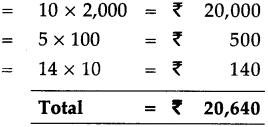
*(1) 10 notes of 2,000 rupees, 5 notes of 100 rupees and 14 notes of 10 rupees.
Solution:
10 notes of 2,000 rupees = 10 x 2,000 ₹ 20,000
5 notes of 100 rupees = 5 x 100 = ₹ 500
14 notes of 10 rupees = 14 x 10 = ₹ 140
Total = ₹ 20,640
Maharashtra Board Class 5 Maths Solutions Chapter 2 Number Work Problem Set 2 10
∴ They make, twenty thousand, six hundred and forty.

Maharashtra Board Class 5 Maths Solutions Chapter 2 Number Work Problem Set 2

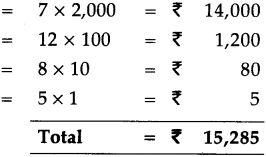
*(2) 7 notes of 2,000 rupees, 12 notes of loo rupees, 8 notes of 10 rupees and 5 coins of 1 rupee
Solution:
7 notes of 2,000 rupees = 7 x 2,000 = ₹ 14,000
12 notes of 100 rupees = 12 x 100 = ₹ 1,200
8 notes of 10 rupees = 8 x 10 = ₹ 80
5 coins of 1 rupee = 5 x 1 = ₹ 5
Total = ₹ 15,285
Maharashtra Board Class 5 Maths Solutions Chapter 2 Number Work Problem Set 2 11
∴ They make, fifteen thousand, two hundred and eighty five.

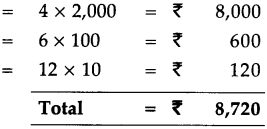
(3) 4 notes of 2,000 rupees, 6 notes of 100 rupees and 12 notes of 10 rupees
Solution:
4 notes of 2,000 rupees = 4 x 2,000 = ₹ 8,000
6 notes of 100 rupees = 6 x 100 = ₹ 600
12 notes of 10 rupees = 12 x 10 = ₹ 120
Total = ₹ 8,720
Maharashtra Board Class 5 Maths Solutions Chapter 2 Number Work Problem Set 2 12
∴ They make, eight thousand, seven hundred and twenty.

Maharashtra Board Class 5 Maths Solutions Chapter 2 Number Work Problem Set 2

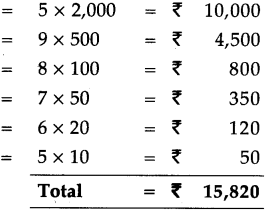
(4) 5 notes of 2,000 rupees, 9 notes of 500 rupees, 8 notes of 100 rupees, 7 notes of 50 rupees, 6 notes of 20 rupees and 5 note of 10 rupees
Solution:
5 notes of 2,000 rupees 5 x 2,000 = ₹ 10,000
9 notes of 500 rupees = 9 x 500 = ₹ 4,500
8 notes of 100 rupees = 8 x 100 = ₹ 800
7 notes of 50 rupees = 7 x 50 = ₹ 350
6 notes of 20 rupees = 6 x 20 = ₹ 120
5 notes of 10 rupees = 5 x 10 = ₹ 50
Total = ₹ 15,820
Maharashtra Board Class 5 Maths Solutions Chapter 2 Number Work Problem Set 2 13
∴ They make, fifteen thousand, eight hundred and twenty.

*Question 4.
Write the biggest and the smallest numbers using all the given digits in every number. Use each digit only once.
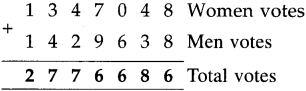
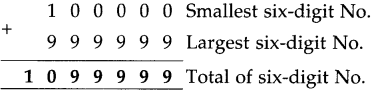
(1) 4, 8, 0, 2, 6, 5;
(2) 2, 6, 7, 1, 4;
(3) 5, 9, 6, 1, 4, 3;
(4) 9, 4, 1, 3, 6;
(5) 5, 3, 0, 0, 2
Answer:
(1) Biggest six digit number is 8,65,420 Smallest six digit number is 2,04,568
(2) Biggest five digit number is 76,421 Smallest five digit number is 12,467
(3) Biggest six digit number is 9,65,431 Smallest six digit number is 1,34,569
(4) Biggest five digit number is 96,431 Smallest five digit number is 13,469
(5) Biggest five digit number is 53,200 Smallest five digit number is 20,035

Class 5 Maths Solution Maharashtra Board

Problem Set 31 Class 5 Maths Chapter 7 Circles Question Answer Maharashtra Board

Circles Class 5 Problem Set 31 Question Answer Maharashtra Board

Balbharti Maharashtra Board Class 5 Maths Solutions Chapter 7 Circles Problem Set 31 Textbook Exercise Important Questions and Answers.

Std 5 Maths Chapter 7 Circles

Question 1.
In the figure given alongside, points S, L, M, and N are on the circle. Answer the questions with the help of the diagram.
Maharashtra Board Class 5 Maths Solutions Chapter 7 Circles Problem Set 31 1

Maharashtra Board Class 5 Maths Solutions Chapter 7 Circles Problem Set 31

(1) Write the names of the arcs with end-points S and M.
Answer:
Arcs with the end-points S and M are, arc SLM and arc SNM.

(2) Write the names of the arcs with the end-points L and N.
Answer:
Arcs with the end-points L and N are, arc LMN and arc LSN.

Question 2.
Write the names of arcs that points A, B, C, and D in the given circle give rise to.
Answer:
Arcs with end-points A and C are, arc ABC and arc ADC.
Arcs with end-points B and D are, arc BAD and arc BCD.

Question 3.
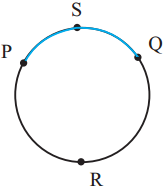
Give the names of the arcs that are made by points P, Q, R, S, and T in the figure.
Answer:
Taking end-points : P and R, arc PQR, arc PTR.
Taking end-points: Q and S, arc QRS, arc QTS
Taking end-points : R and T, arc RST, arc RPT
Taking end-points : S and P, arc STP, arc SRP
Taking end-points: Q and T, arc QPT, arc QST

Maharashtra Board Class 5 Maths Solutions Chapter 7 Circles Problem Set 31

Question 4.
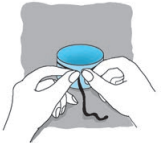
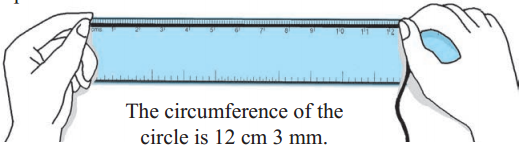
Measure and note down the circumference of different circular objects. (It is convenient to use a measuring tape for this purpose.)

Chapter 7 Circles Problem Set 31 Additional Important Questions and Answers

Question 1.
Draw circles with the radii given below:
(1) 1.2 cm
Answer:
Maharashtra Board Class 5 Maths Solutions Chapter 7 Circles Problem Set 31 2

(2) 2.5 cm
Answer:
Maharashtra Board Class 5 Maths Solutions Chapter 7 Circles Problem Set 31 3

Maharashtra Board Class 5 Maths Solutions Chapter 7 Circles Problem Set 31

(3) 3.3 cm
Answer:
Maharashtra Board Class 5 Maths Solutions Chapter 7 Circles Problem Set 31 4

Question 2.
Write true or false for the following statements:
(1) Longest chord is a diameter.
(2) Centre is not lying on the diameter.
(3) All chords are of equal length.
(4) All chords passes through the centre.
Answer:
(1) True
(2) False
(3) False
(4) False

Maharashtra Board Class 5 Maths Solutions Chapter 7 Circles Problem Set 31

Question 3.
Match the cplumns (A) and (B):
Maharashtra Board Class 5 Maths Solutions Chapter 7 Circles Problem Set 31 7
Answer:
(1) ↔ (c),
(2) ↔ (a),
(3) ↔ (d),
(4) ↔ (b)

Question 4.
Complete the following table by filling in the blanks:
Maharashtra Board Class 5 Maths Solutions Chapter 7 Circles Problem Set 31 8
Answer:
(1) 6 cm
(2) 10 cm
(3) 34 cm
(4) 9 cm

Maharashtra Board Class 5 Maths Solutions Chapter 7 Circles Problem Set 31

Question 5.
From the following figure, fill in the blanks:
Maharashtra Board Class 5 Maths Solutions Chapter 7 Circles Problem Set 31 9
(1) If OP = 4cm then AB = _________ cm, OA = _________ cm, OB = _________ cm.
(2) If AB = 10 cm then OA = _________ cm, OB = _________ cm, OP = _________ cm.
Answer:
(1) AB = 8 cm, OA = 4 cm, OB = 4 cm
(2) OA = 5 cm, OB = 5 cm, OP = 5 cm

Question 6.
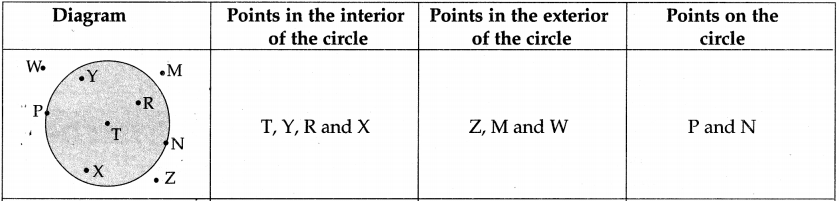
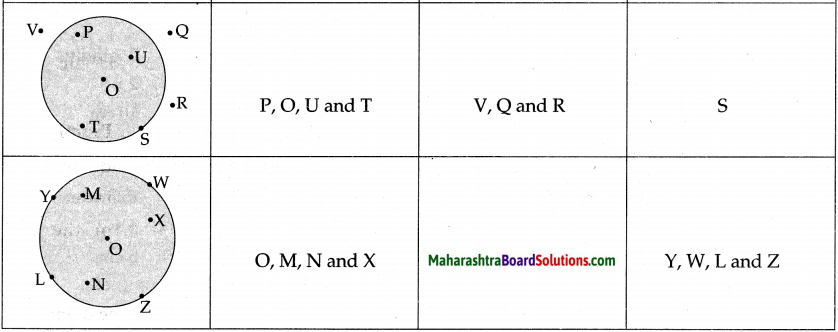
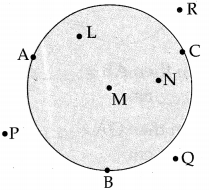
In the table below, write the names of the points in the interior and exterior of the circle and those on the circle.
Maharashtra Board Class 5 Maths Solutions Chapter 7 Circles Problem Set 31 10
Answer:
Points in the exterior of the circle are A, F and G.
Points in the interior of the circle are O, E and B, and Points on the circle are C, D and H.

Maharashtra Board Class 5 Maths Solutions Chapter 7 Circles Problem Set 31

Question 7.
Radius of a circle with centre P is 4 cm. Fill in the blanks.
(1) The, point A is at a distance of 5 cm from the centre P. Flence the point A lies in the ________ of the circle.
(2) Point B is at a distance of 4 cm. from the centre P. Hence the point B lies ________ circle.
(3) Point C lies at a distance 3 cm from the centre P. Hence it lies in the ________ of the circle.
Answer:
(1) Exterior
(2) on the circle
(3) interior

Question 8.
Solve the following:
(1) What is the length of the diameter of a circle of radius 6 cm?
(2) What is the length of the radius of a circle of diameter 14 cm?
(3) Give the names of the arcs that are made by points X, Y, Z and W in this picture.
Maharashtra Board Class 5 Maths Solutions Chapter 7 Circles Problem Set 31 11
(4) Give the names of the arc that are made by points E, F, G and H, taking end points E and G.
Maharashtra Board Class 5 Maths Solutions Chapter 7 Circles Problem Set 31 12 Maharashtra Board Class 5 Maths Solutions Chapter 7 Circles Problem Set 31
(5) If the diameter of a circle is 7 cm. what is the length of the circumference? (Use measure tap)
Answer:
(1) 12 cm
(2) 7 cm
(3) Having end-points X and Z, arc XYZ and arc XWZ
Having end-points Y and W, arc YZW and arc YXW
(4) By end-points E and G, arc EFG and arc EHG
(5) 22 cm

Class 5 Maths Solution Maharashtra Board

Problem Set 22 Class 5 Maths Chapter 5 Fractions Question Answer Maharashtra Board

Fractions Class 5 Problem Set 22 Question Answer Maharashtra Board

Balbharti Maharashtra Board Class 5 Maths Solutions Chapter 5 Fractions Problem Set 22 Textbook Exercise Important Questions and Answers.

Std 5 Maths Chapter 5 Fractions

Question 1.
Add the following:

\(\text { (1) } \frac{1}{8}+\frac{3}{4}\)
Solution:
The smallest common multiple of 4 and 8 is 8. So making 8 is the common denominator of the given fractions.
Maharashtra Board Class 5 Maths Solutions Chapter 5 Fractions Problem Set 21 6
Answer:
\(\frac{7}{8}\)

Maharashtra Board Class 5 Maths Solutions Chapter 5 Fractions Problem Set 22

\(\text { (2) } \frac{2}{21}+\frac{3}{7}\)
Solution:
21 is the multiple of 7. So making 21 as denominator of both the fractions.
Maharashtra Board Class 5 Maths Solutions Chapter 5 Fractions Problem Set 21 7
Answer:
\(\frac{11}{21}\)

\(\text { (3) } \frac{2}{5}+\frac{1}{3}\)
Solution:
Least common multiple of 5 and 3 is 15. So making common denominator of both the fractions 15.
Maharashtra Board Class 5 Maths Solutions Chapter 5 Fractions Problem Set 21 8
Answer:
\(\frac{11}{15}\)

\(\text { (4) } \frac{2}{7}+\frac{1}{2}\)
Solution:
Smallest common multiple of 2 and 7 is 14. So, making denominator of both the fractions 14.
Maharashtra Board Class 5 Maths Solutions Chapter 5 Fractions Problem Set 21 9
Answer:
\(\frac{11}{14}\)

Maharashtra Board Class 5 Maths Solutions Chapter 5 Fractions Problem Set 22

\(\text { (5) } \frac{3}{9}+\frac{3}{5}\)
Solution:
Smallest common multiple of 9 and 5 is 45.
Maharashtra Board Class 5 Maths Solutions Chapter 5 Fractions Problem Set 21 10
Answer:
\(\frac{42}{45}\)

Question 2.
Subtract the following:

\(\text { (1) } \frac{3}{10}-\frac{1}{20}\)
Solution:
20 is the multiples of 10. So,
Maharashtra Board Class 5 Maths Solutions Chapter 5 Fractions Problem Set 21 13
Maharashtra Board Class 5 Maths Solutions Chapter 5 Fractions Problem Set 21 14
Answer:
\(\frac{5}{20}\)

\(\text { (2) } \frac{3}{4}-\frac{1}{2}\)
Solution:
4 is the multiple of 2. So,
Maharashtra Board Class 5 Maths Solutions Chapter 5 Fractions Problem Set 21 15
Answer:
\(\frac{1}{4}\)

Maharashtra Board Class 5 Maths Solutions Chapter 5 Fractions Problem Set 22

\(\text { (3) } \frac{6}{14}-\frac{2}{7}\)
Solution:
14 is the multiples of 7. So,
Maharashtra Board Class 5 Maths Solutions Chapter 5 Fractions Problem Set 21 16
Answer:
\(\frac{2}{14}\)

\(\text { (4) } \frac{4}{6}-\frac{3}{5}\)
Solution:
Smallest common multiple of 6 and 5 is 30. So,
Maharashtra Board Class 5 Maths Solutions Chapter 5 Fractions Problem Set 21 17
Answer:
\(\frac{2}{30}\)

\(\text { (5) } \frac{2}{7}-\frac{1}{4}\)
Solution:
Smallest common multiple of 7 and 4 is 28.
Maharashtra Board Class 5 Maths Solutions Chapter 5 Fractions Problem Set 21 18
Answer:
\(\frac{1}{28}\)

Maharashtra Board Class 5 Maths Solutions Chapter 5 Fractions Problem Set 22

A fraction of a collection and a multiple of a fraction

\(\frac{1}{4}\) of a collection of 20 dots – \(\frac{1}{2}\) of a collection of 20 dots
Maharashtra Board Class 5 Maths Solutions Chapter 5 Fractions Problem Set 21 1

\(\frac{3}{4}\) of a collection of 20 dots
Maharashtra Board Class 5 Maths Solutions Chapter 5 Fractions Problem Set 21 2

Twice 5 is 10 – \(\frac{1}{2}\) times 10
Maharashtra Board Class 5 Maths Solutions Chapter 5 Fractions Problem Set 21 3

Thrice 5 – \(\frac{1}{3}\) times 15
Maharashtra Board Class 5 Maths Solutions Chapter 5 Fractions Problem Set 21 4

Maharashtra Board Class 5 Maths Solutions Chapter 5 Fractions Problem Set 22

\(\frac{1}{3}\) times 15
Maharashtra Board Class 5 Maths Solutions Chapter 5 Fractions Problem Set 21 5

Meena has 5 rupees. Tina has twice as many rupees. That is, Tina has 5 × 2 = 10 rupees. Meena has half as many rupees as Tina, that is, \(\frac{1}{2}\) of 10, or, 5 rupees.

Ramu has to travel a distance of 20 km. If he has travelled \(\frac{4}{5}\) of the distance by car, how many kilometres did he travel by car?
\(\frac{4}{5}\) of 20 km is 20 × \(\frac{4}{5}\). So, we take \(\frac{1}{5}\) of 20, 4 times.
\(\frac{1}{5}\) of 20 = 4. 4 times 4 is 4 × 4 = 16.
It means that 20 × \(\frac{4}{5}\) = 16.
Ramu travelled a distance of 16 kilometres by car.

Addition and Subtraction Problem Set 13 Additional Important Questions and Answers

\(\text { (1) } \frac{5}{6}+\frac{1}{12}\)
Solution:
12 is the multiple of 6
Maharashtra Board Class 5 Maths Solutions Chapter 5 Fractions Problem Set 21 11
Answer:
\(\frac{11}{12}\)

Maharashtra Board Class 5 Maths Solutions Chapter 5 Fractions Problem Set 22

\(\text { (2) } \frac{1}{9}+\frac{2}{3}\)
Solution:
Here 9 is the multiples of 3. So, making like fractions of denominator 9, we get
Maharashtra Board Class 5 Maths Solutions Chapter 5 Fractions Problem Set 21 12
Answer:
\(\frac{7}{9}\)

Subtract the following:

\(\text { (1) } \frac{4}{9}-\frac{2}{5}\)
Solution:
Common multiple of 9 and 5 is 45
Maharashtra Board Class 5 Maths Solutions Chapter 5 Fractions Problem Set 21 19
Answer:
\(\frac{2}{45}\)

Maharashtra Board Class 5 Maths Solutions Chapter 5 Fractions Problem Set 22

\(\text { (2) } \frac{1}{2}+\frac{3}{4}-\frac{7}{8}\)

Maharashtra Board Class 5 Maths Solutions Chapter 5 Fractions Problem Set 21 20.
Answer:
\(\frac{3}{8}\)

Class 5 Maths Solution Maharashtra Board

Problem Set 53 Class 5 Maths Chapter 15 Patterns Question Answer Maharashtra Board

Patterns Class 5 Problem Set 53 Question Answer Maharashtra Board

Balbharti Maharashtra Board Class 5 Maths Solutions Chapter 15 Patterns Problem Set 53 Textbook Exercise Important Questions and Answers.

Std 5 Maths Chapter 15 Patterns

Question 1.
Find the square numbers from the list given below.
5, 9, 12, 16, 50, 60, 64, 72, 80, 81
Answer:
9,16, 64, 81, 4, 25, 49 are square numbers.

Maharashtra Board Class 5 Maths Solutions Chapter 15 Patterns Problem Set 53

Question 2.
Which are the triangular numbers in the given list?
3, 6, 8, 9, 12, 15, 16, 20, 21, 42
Answer:
3, 6, 15, 21, 28, 10, 45, 55 are triangular numbers.

Question 3.
Name a number which is square as well as triangular.
Answer:
36 is square as well as triangular number.

Question 4.
If 4 is the first square number, which is the tenth one?
Answer:
121 is the tenth square number.

Maharashtra Board Class 5 Maths Solutions Chapter 15 Patterns Problem Set 53

Question 5.
If 3 is the first triangular number, which is the tenth one?
Answer:
66 is the tenth triangular number.

Think about it.

  • How will you decide if a given number is a square number?
  • How will you decide if a given number is a triangular number?
  • How many square numbers do you think there are?
  • How many triangular numbers do you think there are?

Activity

Make a collection of pictures in which you can see square or triangular numbers.

Patterns in floor tiles

The tiles in each picture below form a specific pattern. Observe that there is no gap or open ground between two tiles.
Maharashtra Board Class 5 Maths Solutions Chapter 15 Patterns Problem Set 53 1

Maharashtra Board Class 5 Maths Solutions Chapter 15 Patterns Problem Set 53

On a large piece of card sheet, draw several shapes like the one shown alongside. Colour half of them. Cut them all out and separate them.
Maharashtra Board Class 5 Maths Solutions Chapter 15 Patterns Problem Set 53 2

One pattern made of these shapes is shown alongside. Make some other patterns of your own.
Maharashtra Board Class 5 Maths Solutions Chapter 15 Patterns Problem Set 53 3

Cut out many pieces of each of the shapes shown alongside. Join them in a pattern like floor tiles.
Maharashtra Board Class 5 Maths Solutions Chapter 15 Patterns Problem Set 53 4

Maharashtra Board Class 5 Maths Solutions Chapter 15 Patterns Problem Set 53

Note the pattern and complete the design.
Maharashtra Board Class 5 Maths Solutions Chapter 15 Patterns Problem Set 53 5

Make your own shapes and use them to make patterns for sari and shawl borders, etc.

Perimeter and Area Problem Set 49 Additional Important Questions and Answers

Solve the following :

Question 1.
If 4 is the first square number which is the eighth one?
Answer:
81 is the eighth square number.

Maharashtra Board Class 5 Maths Solutions Chapter 15 Patterns Problem Set 53

Question 2.
If 3 is the first triangular number which is the eighth one?
Answer:
45 is the eighth triangular number.

Question 3.
Classify the following into square numbers and triangular numbers.
3, 4, 9,10,15,16; 45, 49, 64, 66, 81, 91
Answer:
Square Numbers : 4, 9,16, 49, 64, 81
Triangular Numbers : 3, 10, 15, 45, 66, 91

Question 4.
Find out the numbers which are neither square nor triangular numbers from the following.
4, 5, 6, 8, 9, 10, 14, 15, 16, 25, 26, 27, 28.
Answer:
5, 8 14, 26 and 27

Maharashtra Board Class 5 Maths Solutions Chapter 15 Patterns Problem Set 53

Question 5.
(1) If 4 is the first square number, which is the fifth one?
(2) If 3 is the first triangular number, which is the sixth one?
(3) Write all the square numbers between 20 and 80.
(4) Write all the triangular numbers between 20 and 80.
(5) Write the greatest two-digit square numbers as well as triangular numbers.
(6) Write the next three square numbers, 36, 49, 64,…….,
(7) Write the next three triangular numbers 36, 45, 55,
Answer:
(1) 36
(2) 28
(3) 25, 36, 49, 64
(4) 21, 28, 36, 45, 55, 66, 78
(5) 81, 91
(6) 81, 100, 121
(7) 66, 78, 91

Maharashtra Board Class 5 Maths Solutions Chapter 15 Patterns Problem Set 53

Question 6.
Match the columns

A B
(1) Third square number (a) 15
(2) Fourth triangular number (b) 36
(3) Number neither square nor triangular (c) 16
(4) Number is both square as well as triangular number (d) 35

Answer:
(1 – c),
(2 – a),
(3 – d),
(4 – b).

Class 5 Maths Solution Maharashtra Board
Problem Set 5 Class 5 Maths Chapter 2 Number Work Question Answer Maharashtra Board

Number Work Class 5 Problem Set 5 Question Answer Maharashtra Board

Balbharti Maharashtra Board Class 5 Maths Solutions Chapter 2 Number Work Problem Set 5 Textbook Exercise Important Questions and Answers.

Std 5 Maths Chapter 2 Number Work

Question 1.
Write the place value of the underlined digit.

(1) 78, 95,210
(2) 14, 95,210
(3) 3,52,749
(4) 50,000
(5) 89, 99,988
Answer:
(1) Here, the underlined digit 7 is in ten lakhs place.
So, its place value is 70,00,000 (70 lakhs)

Maharashtra Board Class 5 Maths Solutions Chapter 2 Number Work Problem Set 5

(2) Here, the underlined digit 4 is in lakhs place.
So, its place value is 4,00,000 (4 lakhs)

(3) Here, the underlined digit 5 in ten thousands place.
So, its place value is 50,000 (50 thousands)

(4) Here, the underlined digit ‘0’ is in the unit place.
Hence, its place value is 0 (zero)

(5) Here, the underlined digit 9 is in ten thousands place
So, its place value is 90,000 (90 thousands)

Question 2.
Write the numbers in their expanded form.
(1) 56, 43, 215
(2) 70, 815
(3) 8, 35, 999
(4) 8, 88, 889
(5) 92, 32, 992
Answer:
(1) 56,43,215: 50,00,000 + 6,00,000 + 40,000 + 3,000 + 200 + 10 + 5
(2) 70,815 : 70,000 + 800 + 10 + 5
(3) 8,35,999 : 8,00,000 + 30,000 + 5,000 + 900 + 90 + 9
(4) 8,88,889 : 8,00,000 + 80,000 + 8,000 + 800 + 80 + 9
(5) 92,32,992: 90,00,000 + 2,00,000 + 30,000 + 2,000 + 900 + 90 + 2

Question 3.
Write the place name and place value of each digit in the following numbers.
(1) 35, 705
Answer:
Digit 3 is in ten thousands place, its place value is 30,000
Digit 5 is in thousands place, its place value is 5,000
Digit 7 is in hundreds place, its place value is 700
Digit 0 is in ten place, its place value is 0
Digit 5 is in units place, its place value is 5

Maharashtra Board Class 5 Maths Solutions Chapter 2 Number Work Problem Set 2

(2) 7, 82, 899
Answer:
Digit 7 is in lakhs place, its place value is 7.0. 000
Digit 8 is in ten thousands place, its place value is 80,000
Digit 2 is in thousands place, its place value is 2,000
Digit 8 is in hundreds place, its place value is 800
Digit 9 is- in ten place, its place value is 90 Digit 9 is in units place, its place value is 9

(3) 82, 74, 508
Answer:
Digit 8 is in ten lakhs place, its place value is 80,00,000
Digit 2 is in lakhs place, its place value is 2.0. 000
Digit 7 is in ten thousands place, its place value is 70,000
Digit 4 is in thousands place, its place value is 4,000
Digit 5 is in hundreds place, its place value is 500
Digit 0 is in ten place, its place value is 0
Digit 8 is in units place, its place value is 8

Question 4.
The expanded form of the number is given. Write the number.
(1) 60, 000 + 4000 + 600 + 70 + 9
(2) 9, 00, 000 + 20,000 + 7000 + 800 + 5
(3) 20,00,000 + 3,00,000 + 60,000 + 9000 + 500 + 10 + 7
(4) 7,00,000 + 80,000 + 4000 + 500
(5) 80,00,000 + 50,000 + 1000 + 600 + 9
Answer:
(1) The number is 64,679
(2) The number is 9,27,805
(3) The number is 23,69,517
(4) The number is 7,84,500
(5) The number is 80,51,609

Maharashtra Board Class 5 Maths Solutions Chapter 2 Number Work Problem Set 2

An interesting dice game

Prepare a table with the name of each player, as shown below.
In front of each name, there are boxes to make seven-digit numbers.
Maharashtra State Board Class 5 Maths Solutions Chapter 2 Number Work Problem Set 5

Game 1 :
The first player throws the dice and writes that number in any one of the boxes in front of his/her name. You can write only one number in each box and once it is written, you cannot change its place. The other players do the same till all the boxes are filled and each one gets a seven-digit number. The one with the largest number is the winner.

Game 2 :
Use the same table, but you may write the number (you get on throwing the dice) in any box in front of anyone’s name. The one with the largest number is the winner.

Game 3 :
The rules are the same as for game 2, but the one with the smallest number is the winner.

Bigger and smaller numbers

Hamid : How do we determine the smaller or bigger number when we are dealing with six- or seven-digit numbers ?

Teacher : You have learnt how to do that with five-digit numbers. The number with the bigger ten thousands digit is the bigger number. If they are the same, we look at the thousands digits to determine the smaller or bigger number.

Now, can you tell how to compare six- or seven-digit numbers ?

Maharashtra Board Class 5 Maths Solutions Chapter 2 Number Work Problem Set 2

Hamid : Yes, I can. First, we’ll look at the ten lakhs digits. If they are the same, we’ll look at the digits in the lakhs place. If those are equal, we look at the ten thousands place to tell the smaller or bigger number and so on. Besides, we might be able to tell which of the numbers is bigger, just by looking at the number of digits in each number. Right ?

Teacher : Absolutely ! The number with more digits is the bigger number.

Roman Numerals Problem Set 5 Additional Important Questions and Answers

Question 1.
Write the place value of the underlined digit.

(1) 81,67,303
Answer:
Here, the underlined digit 7 is in thousands place.
So, its place value is 7,000 (7 thousands)

(2) 41,35,062
Answer:
Here, the underlined digit 6 is in ten’s place.
So, its place value is 60 (sixty)

(3) 90,31,265
Answer:
Here, the underlined digit 3 is in ten thousands place.
So, its place value is 30,000 (30 thousands)

Maharashtra Board Class 5 Maths Solutions Chapter 2 Number Work Problem Set 2

Question 2.
Write the numbers in their expanded form.
Answer:
(1) 51,03,640: .50,00,000 + 1,00,000 + 3,000 + 600 + 40
(2) 60,60,600: 60,00,000 + 60,000 + 600
(3) 71,45,042 : 70,00,000 + 1,00,000 + 40,000 + 5,000 + 40 + 2

Question 3.
Write the place name and place value of each digit in the following numbers.

(1) 1,88,919
Answer:
Digit 1 is in lakhs place, its place value is 1,00,000
Digit 8 is in ten thousands place, its place value is 80,000
Digit 8 is in thousands place, its place value is 8,000
Digit 9 is in hundreds place, its place value is 900
Digit 1 is in ten place, its place value is 10
Digit 9 is in units place, its place value is 9

Question 4.
The expanded form write the number.

(1) 40,00,000 + 5,00,000 + 10,000 + 3,000 + 200 + 70+8
Answer:
The number is 45,13,278

Maharashtra Board Class 5 Maths Solutions Chapter 2 Number Work Problem Set 2

(2) 80,000 + 300 + 40 + 1
Answer:
The number is 80,341

Class 5 Maths Solution Maharashtra Board
Problem Set 44 Class 5 Maths Chapter 10 Measuring Time Question Answer Maharashtra Board

Measuring Time Class 5 Problem Set 44 Question Answer Maharashtra Board

Balbharti Maharashtra Board Class 5 Maths Solutions Chapter 10 Measuring Time Problem Set 44 Textbook Exercise Important Questions and Answers.

Std 5 Maths Chapter 10 Measuring Time

Question 1.
The time below is given by the 12 hour clock. Write the same by the 24 hour clock.
(1) 30 minutes past 10 in the morning –
(2) 10 minutes past 8 in the morning –
(3) 20 minutes past 1 in the afternoon –
(4) 40 minutes past 5 in the evening –
Answer:
(1) [10:30]
(2) [8:10]
(3) [13:20]
(4) [17:40]

Maharashtra Board Class 5 Maths Solutions Chapter 10 Measuring Time Problem Set 44

Question 2.
Match the following.
12 hour clock – 24 hour clock
(1) 9:10 am – 23:10
(2) 2:10 pm – 7:25
(3) 5:25 pm – 14:10
(4) 11:10 pm – 9:10
(5) 7:25 am – 17:25
Answer:
(1) – d
(2) – c
(3) – e
(4) – a
(5) – b

Examples of time measurement

Example (1) If Abdul started working on the computer at 11 in the morning and finished his work at 3:30 in the afternoon, how long did he work?

Method 1 :
From 11 in the morning to 12 noon, it is 1 hour. From 12 noon to 3:30 in the afternoon, it is 3 hours and 30 minutes. Therefore, the total time is 4 hours and 30 minutes.

Maharashtra Board Class 5 Maths Solutions Chapter 10 Measuring Time Problem Set 44

Method 2 :
According to the 24 hour clock, 11’o’clock in the morning is 11:00 and 3:30 in the afternoon is 15:30.

Hr Min
15
– 11
30
00
4 30

Abdul worked for a total of 4 hours and thirty minutes, or four and a half hours.

Example (2) Add : 4 hours 30 min + 2 hours 45 min
Maharashtra Board Class 5 Maths Solutions Chapter 10 Measuring Time Problem Set 44 1

Example (3) Subtract : 5 hr 30 min – 2 hr 45 min
Maharashtra Board Class 5 Maths Solutions Chapter 10 Measuring Time Problem Set 44 2

Maharashtra Board Class 5 Maths Solutions Chapter 10 Measuring Time Problem Set 44

45 minutes cannot be subtracted from 30 minutes. Therefore, we borrow 1 hour and convert it into 60 minutes for the subtraction.

Example (4) Amruta travelled by bus for 3 hours 40 minutes and by motorcycle for 1 hour 45 minutes. How long did she spend travelling?
Maharashtra Board Class 5 Maths Solutions Chapter 10 Measuring Time Problem Set 44 3

(60 + 25) minutes are 85 minutes, that is, 1 hour and 25 minutes.
Let us add this 1 hour to 4 hours.

Therefore, Amruta travelled for a total of 5 hours and 25 minutes.

Measuring Time Problem Set 44 Additional Important Questions and Answers

The time is given by the 12-hour clock. Write the same by the 24-hour clock.

(1) 15 minutes past 9 in the evening –
(2) 12 midnight –
Answer:
[21:15]
[0o:00]

The time below is given by the 24-hour clock. Write the same by the 12-hour clock.

Maharashtra Board Class 5 Maths Solutions Chapter 10 Measuring Time Problem Set 44

(1) 20:20 =
(2) 9:30 =
(3) 23:00 =
(4) 4:00 =
(5) 12:00 =
(6) 00:00 =
Answer:
[8:20 pm]
[9:30 am]
[11 pm]
[4 am]
[12 noon] or [12:00]
[12 midnight]

Class 5 Maths Solution Maharashtra Board
Problem Set 42 Class 5 Maths Chapter 9 Decimal Fractions Question Answer Maharashtra Board

Decimal Fractions Class 5 Problem Set 42 Question Answer Maharashtra Board

Balbharti Maharashtra Board Class 5 Maths Solutions Chapter 9 Decimal Fractions Problem Set 42 Textbook Exercise Important Questions and Answers.

Std 5 Maths Chapter 9 Decimal Fractions

Question 1.
Subtract the following :

(1) 25.74 – 13.42
Solution:
Maharashtra Board Class 5 Maths Solutions Chapter 9 Decimal Fractions Problem Set 42 1

Maharashtra Board Class 5 Maths Solutions Chapter 9 Decimal Fractions Problem Set 42

(2) 206.35 – 168.22
Solution:
Maharashtra Board Class 5 Maths Solutions Chapter 9 Decimal Fractions Problem Set 42 2

(3) 63.4 – 31.8
Solution:
Maharashtra Board Class 5 Maths Solutions Chapter 9 Decimal Fractions Problem Set 42 3

(4) 63.43 – 31.8
Solution:
Maharashtra Board Class 5 Maths Solutions Chapter 9 Decimal Fractions Problem Set 42 4

Maharashtra Board Class 5 Maths Solutions Chapter 9 Decimal Fractions Problem Set 42

(5) 63.4 – 31.83
Solution:
Maharashtra Board Class 5 Maths Solutions Chapter 9 Decimal Fractions Problem Set 42 5

(6) 8.23 – 5.45
Solution:
Maharashtra Board Class 5 Maths Solutions Chapter 9 Decimal Fractions Problem Set 42 6

(7) 18.23 – 9.45
Solution:
Maharashtra Board Class 5 Maths Solutions Chapter 9 Decimal Fractions Problem Set 42 7

Maharashtra Board Class 5 Maths Solutions Chapter 9 Decimal Fractions Problem Set 42

(8) 78.03 – 41.65
Solution:
Maharashtra Board Class 5 Maths Solutions Chapter 9 Decimal Fractions Problem Set 42 8

Question 2.
Vrinda was 1.48 m tall. After a year, her height became 1.53 m. How many centimeters did her height increase in a year?
Answer:
Maharashtra Board Class 5 Maths Solutions Chapter 9 Decimal Fractions Problem Set 42 13

∴ 5 cm height has increased in a year.

Something more

Decimals used for measurement

We need to measure distance, mass (weight) and volume every day. We use suitable units for these measurements. Kilometre, metre and centimeter for distance; litre, millilitre for volume and kilogram and gram for mass are the units that are used most of the time.

Maharashtra Board Class 5 Maths Solutions Chapter 9 Decimal Fractions Problem Set 42

All these units are decimal units. In this method, gram, metre and litre are taken as the basic units for mass, distance and volume respectively. Units larger than these increase 10 times at every step and smaller units become \(\frac{1}{10}\) of the previous unit at each step.

Look at the table of these units given below.

Maharashtra Board Class 5 Maths Solutions Chapter 9 Decimal Fractions Problem Set 42 15

The origin of the terms kilo, hecto… milli is in the Greek or Latin language. Their English equivalents are given in brackets along with the terms.

Decimal Fractions Problem Set 42 Additional Important Questions and Answers

Subtract the following:

(1) 304.17 – 95.28
Solution:
Maharashtra Board Class 5 Maths Solutions Chapter 9 Decimal Fractions Problem Set 42 9

Maharashtra Board Class 5 Maths Solutions Chapter 9 Decimal Fractions Problem Set 42

(2) 72.84 – 36.96
Solution:
Maharashtra Board Class 5 Maths Solutions Chapter 9 Decimal Fractions Problem Set 42 10

(3) 9.17 – 5.88
Solution:
Maharashtra Board Class 5 Maths Solutions Chapter 9 Decimal Fractions Problem Set 42 11

(4) 100 – 49.99
Solution:
Maharashtra Board Class 5 Maths Solutions Chapter 9 Decimal Fractions Problem Set 42 12

Maharashtra Board Class 5 Maths Solutions Chapter 9 Decimal Fractions Problem Set 42

(5) Atul has 56.25 and Anup has 65. Whose amount is more? How much?
Solution:
Maharashtra Board Class 5 Maths Solutions Chapter 9 Decimal Fractions Problem Set 42 14

∴ Anup’s amount is more by ₹ 8.75

Class 5 Maths Solution Maharashtra Board
Problem Set 33 Class 5 Maths Chapter 8 Multiples and Factors Question Answer Maharashtra Board
Multiples and Factors Class 5 Problem Set 33 Question Answer Maharashtra Board
Balbharti Maharashtra Board Class 5 Maths Solutions Chapter 8 Multiples and Factors Problem Set 33 Textbook Exercise Important Questions and Answers.
Std 5 Maths Chapter 8 Multiples and Factors

Question 1.
(1) Write five three-digit numbers that are multiples of 2.
Answer:
100, 102, 104, 106, 108.

Maharashtra Board Class 5 Maths Solutions Chapter 8 Multiples and Factors Problem Set 33
(2) Write five three-digit numbers that are multiples of 5.
Answer:
100, 105, 110, 115, 120.

(3) Write five three-digit numbers that are multiples of 10.
Answer:
100, 110, 120, 130, 140.

Question 2.
Write 5 numbers that are multiples of 2 as well as of 3.
Answer:
2 as well as of 3 means 2 and 3 that is multiples of 6.
They are 6, 12, 18, 24, 30.

Question 3.
A ribbon is 3 metres long. Can we cut it into 50 cm pieces and have nothing left over? Write the reason why or why not.
Answer:
3 metres = 300 cm.
We can cut it into 50 cm pieces.
Since 300 is exactly divisible 50.
That is 300 is multiples of 50.
300 ÷ 50 = 6
We will get 6 pieces, nothing is left over.

Maharashtra Board Class 5 Maths Solutions Chapter 8 Multiples and Factors Problem Set 33
Question 4.
A ribbon is 3 metres long. I need 8 pieces of ribbon each 40 cm long. How many centimetres shorter is the ribbon than the length I need?
Answer:
1 piece of 40 cm, so for 8 pieces ribbon needed is 40 x 8 = 320 cm.
But ribbon is 3 metre = 300 cm long.
So ribbon is shorter by 320 – 300 = 20 cm.

Question 5.
If the number given in the table is divisible by the given divisor, put ✓ in the box. If it is not divisible by the divisor, put ✗ in the box.
Maharashtra Board Class 5 Maths Solutions Chapter 8 Multiples and Factors Problem Set 33 1
Answer:
Maharashtra Board Class 5 Maths Solutions Chapter 8 Multiples and Factors Problem Set 33 3
Maharashtra Board Class 5 Maths Solutions Chapter 8 Multiples and Factors Problem Set 33
Prime and composite numbers

Some numbers are given in the tables below. Write all of their factors.
Maharashtra Board Class 5 Maths Solutions Chapter 8 Multiples and Factors Problem Set 33 2
Dada : What do you notice on studying the table?

Ajay : The number 1 is a factor of every number. Some numbers have only 1 and the number itself as factors. For example, the only factors of 3 are 1 and 3. Similarly, the factors of 2 are only 1 and 2 and the factors of 19 are only 1 and 19. Some numbers have more than two factors.

Dada : Numbers like 2, 3, 19 which have only two factors are called prime numbers.

A number which has only two factors, 1 and the number itself, is called a prime number.

Ajay : What do we call numbers like 4, 6 and 16 which have more than two factors?

Dada : Numbers like 4, 6 and 16 are called composite numbers.

A number which has more than two factors is called a composite number.

Dada : Think carefully and tell me whether 1 is a prime or composite number.

Ajay : The number 1 has only one factor, 1 itself, so I can’t answer your question.

Dada : You’re right. 1 is considered neither a prime number nor a composite number.

1 is a number which is neither prime nor composite.

Maharashtra Board Class 5 Maths Solutions Chapter 8 Multiples and Factors Problem Set 33
Multiples and Factors Problem Set 33 Additional Important Questions and Answers

Question 1.
Write five three-digit numbers that are multiples of 3.
Answer:
102, 105, 108, 111, 114.

Question 2.
Write five two-digit numbers that are multiples of 7.
Answer:
14, 21, 28, 35, 42

Question 3.
Write five three-digit numbers that are multiples of 4.
Answer:
112, 116, 120, 124, 128.

Question 4.
Write 5 numbers that are multiples of 3 as well as 5.
Answer:
3 as well as 5 means 3 and 5. i.e. multiples of 15.
They are 15, 30, 45, 60, 75.

Maharashtra Board Class 5 Maths Solutions Chapter 8 Multiples and Factors Problem Set 33
Question 5.
A string is 4 metres long. Can we cut it into 50 cm pieces and have nothing left over?
Answer:
4 metres = 400 cm.
We can cut it into 50 cm pieces.
Since 400 is exactly divisible by 50.
That is 400 is multiple of 50 400 + 50 = 8
We will get 8 pieces. Nothing is left over.

Question 6.
A paper Is 2 metres long. I need 8 pieces of paper each 30 cm long. How many centimetres shorter is the paper than the length I need?
Answer:
A piece of 30 cm, so for 8 pieces paper needed is 30 x 8 = 240 cm.
But paper is 2 metre = 2 x 100 = 200 cm long.
So paper is shorter by 240 – 200 = 40 cm

Maharashtra Board Class 5 Maths Solutions Chapter 8 Multiples and Factors Problem Set 33
Question 7.
If the number given in the table is divisible by the given divisor, put P in the box. If it is not divisible by the divisor, put in the box.
Answer:
Maharashtra Board Class 5 Maths Solutions Chapter 8 Multiples and Factors Problem Set 33 4
Maharashtra Board Class 5 Maths Solutions Chapter 8 Multiples and Factors Problem Set 33 5
Class 5 Maths Solution Maharashtra Board