Std 9 English Poem The Fall of Troy 3.2 Question Answer Maharashtra Board

Class 9 English Chapter 3.2 Question Answer Maharashtra Board

Balbharti Maharashtra State Board Class 9 English Solutions My English Coursebook Chapter 3.2 The Fall of Troy Notes, Textbook Exercise Important Questions and Answers.

The Fall of Troy Poem 9th Std Question Answer

My English Coursebook Std 9 Guide Chapter 3.2 The Fall of Troy Textbook Questions and Answers

Warming up:
Chit-chat:

  1. Do you know stories from any epics or mythological poems?
  2. Who is your favourite mythological character? What do you like about that character?
  3. Who is your favourite warrior?
  4. If you could visit a place in the ancient world or the mytholocial world, which place would you choose? Which event would you like to see?

Maharashtra Board Class 9 My English Coursebook Solutions Chapter 3.2 The Fall of Troy

Building a Story

Form groups of eight. The group leader prepares slips of paper for each of the seven points given below and distributes them among the others. The group sits in a circle, taking their seats according to the number on the slip they have. Then each one completes the sentence on his/her slip without sharing it with the others. The group leader collects the slips and reads all the sentences aloud as one continuous passage. Does the story make sense? The group then works on the story to make it more meaningful and interesting.

  1. Once there was a …………………………
  2. Who lived in a …………………………
  3. He/She ate …………………………
  4. She/He went …………………………
  5. There She/He saw …………………………
  6. She/He was …………………………
  7. That is why …………………………

Part – I

English Workshop:

1. Find antonyms of the following from the passage:

Question 1.
Find antonyms of the following from the passage: (Answers are directly given.)
Answer:

  1. barren × fertile
  2. surrender × attack
  3. cowardly × brave
  4. defenceless × safe
  5. offended × pleased
  6. peace × war
  7. exposed × closed

Maharashtra Board Class 9 My English Coursebook Solutions Chapter 3.2 The Fall of Troy

2. Correct the following sentences using facts from the passage:

Question (a)
Troy traded in cattle and grass with other cities.
Answer:
Troy traded in goods and grain.

Question (b)
During war, Trojans jumped over the fort gates.
Answer:
During war, Trojans would close the doors of the fort.

Question (c)
Helen escaped with Menelaus.
Answer:
Helen eloped with Paris, a prince of Troy.

Question (d)
The Greek armies and heroes always defeated the Trojans.
Answer:
Sometimes the Greeks defeated the Trojans and sometimes the Trojans defeated the Greeks.

Question (e)
Both the enemies were eager to continue fighting.
Answer:
Both the armies were tired of war. The Trojans of being shut in their city and the Greeks of living away from home.

Question (f)
Troy was attacked because it was strong rich city.
Answer:
Troy was attacked because the Greeks wanted to take revenge on Troy for the wrong’done to their King Menelaus.

3. State the counteraction for the following actions:

Question (a)
Helen eloped with Paris.
Answer:
Counteraction: The Greeks wanted to take revenge on Troy they sailed and laid siege to the city of Troy.

Maharashtra Board Class 9 My English Coursebook Solutions Chapter 3.2 The Fall of Troy

Question (b)
The Greeks sailed to Troy and attacked it.
Answer:
Counteraction: The Trojans fought hard and the siege continued for ten long years.

Question (c)
Hector was killed by Achilles.
Answer:
Counteraction: Achilles himself was killed later on by a poisoned arrow that entered his heel, the only part of his body, where he could be wounded.

Question (d)
The siege continued for ten long years.
Answer:
Counteraction: The Trojans were tired of being shut up in their city and the Greeks deeply desired to see their homes again.

Question (e)
The fighting went on daily.
Answer:
Counteraction: Even then the siege did not end. The Greeks could not take the city, on the other hand, the Trojans could not force them to sail away back to Greece.

4. From either of our two Indian epics, find out which battle/war lasted the longest? Write down about its cause, the enemy armies, its heroes, its duration and the final outcome.

Question 1.
From either of our two Indian epics, find out which battle/war lasted the longest? Write down about its cause, the enemy armies, its heroes, its duration and the final outcome.
Answer:
Mahabharat
1. Cause: Kauravas took possession of the kingdom of Hastinapur forcibly, which rightfully belonged to Pandavas and they were not ready to give even an inch of the land to Pandavas. So, it led to the outbreak of the war.

2. The enemy armies:
Kauravas: 100 Kaurava brothers and many friendly kings like Shakuni, Shalya, Kama, etc. with their armies.
Pandavas: 5 Pandavas, Kashiraja, King Drupad, King Virat, Dhrushtadhyumna, etc. and their armies.

3. Heroes:

  • Pandavas : Dharma (Yudhishthir), Arjun, Bhim, Nakul, Sahadev, Abhimanyu and Shri Krishna as the charioteer of Arjun.
  • Kauravas: Duryodhan, Dushasan, Kama, Bhishmacharya, Dronacharya, Jaydrath.

4. Duration: The war lasted for eighteen days.

5. Final outcome: The war ended in victory to Pandavas. All mighty warriors from Kaurava side except Ashwathama were killed and it was a complete ruin for them. Pandavas regained Hastinapur.

Maharashtra Board Class 9 My English Coursebook Solutions Chapter 3.2 The Fall of Troy

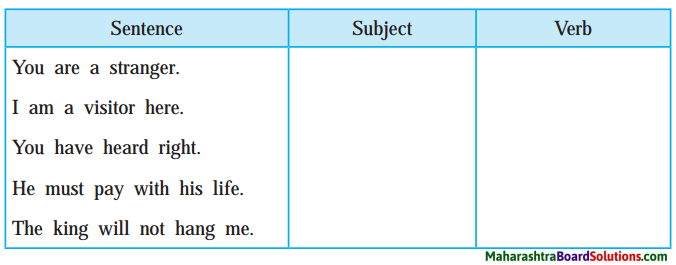
5. Underline the subject in the following sentences:

Question 1.
Underline the subject in the following sentences:
(a) Paris had brought her to Troy.
(b) The Greeks waited to take revenge on Troy.
(c) The Greek armies sailed to Troy.
(d) The fighting went on daily.
(e) Reading is a good habit.

Here, we see that the ‘-ing’ form of the verb ‘fight’ is used as a subject in ‘The fighting went on’. It does the work of a noun. When the ‘-ing’ form of a verb is used as a noun, it is known as a gerund or verbal noun.

  1. Gardening is an art.
  2. Cooking is a science.
  3. I enjoy reading poems.
  4. I like writing, too.

Rewrite the above sentences using other appropriate gerunds in place of the ones given here.
Example: Speaking is an art.

  1. Gardening is an art.
  2. Cooking is a science.
  3. I enjoy reading poems.
  4. I like writing, too.
  5. Swimming is a good exercise.
  6. He is good at running.
  7. I am fond of playing.
  8. Travelling refreshes our minds.

Part – II

English Workshop:

1. Find and write the Greek and the Trojan names used in the story (Part I and II).

Question 1.
Find and write the Greek and the Trojan names used in the story (Part I and II).
Answer:
1. Greek names: Menelaus, Helen, Achilles, Odysseus, Agamemnon, Aphrodite (goddess).
2. Trojan names: Paris, Hector, King Priam.

Maharashtra Board Class 9 My English Coursebook Solutions Chapter 3.2 The Fall of Troy

2. List all the words related to ‘war’ from both parts of the story.

Question 1.
List all the words related to ‘war’ from both parts of the story.
Answer:
enemy, attack, fortress, ships, protect, defend, brave soldiers, heroes, kings, countries, revenge, siege, fighting, battles, killing, arrows, victory, engineer, peace, disaster, terror, death, conquerors.

3. Note the following constructions carefully and then use them to express your own ideas:

Question (a)
A horse big enough to hold men inside it.
……………. enough to …………… ………….
Answer:
A stick long enough to fell mangoes from the tree.

Question (b)
The Greeks were tired of the long war.
……………. tired of …………… ………….
Answer:
We are tired of the tedious work.

Question (c)
They are afraid of the long voyage home, too.
……………. afraid of …………… ………….
Answer:
They are afraid of the impending storm.

Question (d)
They made it too big to go inside your city.
……………… too ………………. to ……………….
Answer:
They bought a cupboard that was too big to go inside our house.

Question (e)
They were so excited that they paid no attention to his words.
……………….. so ………………. that ………………..
Answer:
We were so excited that we could not think of anything except our picnic.

Maharashtra Board Class 9 My English Coursebook Solutions Chapter 3.2 The Fall of Troy

4. Put the following events in the order in which they took place. Number then accordingly:

Question 1.
Put the following events in the order in which they took place. Number then accordingly:
Answer:
(a) The Trojans found a Greek man under the big wooden horse.  [1]
(b) They broke down a part of the wall and brought the horse in.  [3]
(c) The cunning Odysseus thought of a plan. [1]
(d) The Greeks burnt their tents and sailed away. [4]
(e) Troy was burnt down. [3]
(f) The Greeks built a big wooden horse. [2]
(g) The great heroes hid inside the horse. [3]
(h) The priest warned the Trojans not to break the wall.  [2]
(i) The Trojans were happy to see the Greek ships go. [5]
(j) The Trojans slept soundly.  [4]
(k) The Greek army entered the city. [2]

5. Form pairs. Imagine you are a pair of Trojans and you have come to know about Odysseus’s plan. Make a counter plan to defeat the Greeks. Write down your plan as you explain to your fellow Trojans:

Question 1.
Form pairs. Imagine you are a pair of Trojans and you have come to know about Odysseus’s plan. Make a counter plan to defeat the Greeks. Write down your plan as you explain to your fellow Trojans:
Answer:
While observing the large wooden horse, I heard some movements inside it. Friends, I am sure it is some trick to attack our city at night. Their great heroes must be inside the horse. They have not sailed away. They must be somewhere near and will return only when they will get the signal from the Greeks in the horse.

Friends, they will not get the signals from them. Look, we shall get bundles of ropes and tie the ropes tightly around the whole of the horse, so that no one would be able to come out and give signals. That Greek man also is in my custody. We shall arrange heavy barricades to close our wall gates. We shall take this opportunity to lift their siege.

We shall hold these heroes in the horse to ransom, in order to force them to lift the siege, surrender and leave our shore. Let’s come together and implement this plan immediately.

Maharashtra Board Class 9 My English Coursebook Solutions Chapter 3.2 The Fall of Troy

Language Study:

6. Refer to the Language Study pages and read the following entries:

Question (a)
Refer to the Language Study pages and read the following entries:

  1. word
  2. phrase
  3. clause
  4. sentence

Question (b)
A phrase is a meaningful group of words. Read the following phrases :

  • the wise Odysseus
  • a great horse of wood
  • a skilful engineer
  • the greatest heroes
  • the secret of opening and shutting the entrance
  • on the seashore outside the walls
  • in the darkness
  • watching for the return of the fleet
  • part of their strong wall

Question 1.
Write three phrases on your own.
All the above phrases are parts of sentences they do not form a complete sentence by themselves. A sentence expresses a complete idea. You know that it has a subject and a predicate. A sentence has at least one finite verb in it.

Read the following examples:

  • The tents had been burnt.
  • The shore was deserted.
  • The Greek ships had all gone.

Maharashtra Board Class 9 My English Coursebook Solutions Chapter 3.2 The Fall of Troy

2. Write three sentences using your own ideas.

Question (c)
When we read the story of ‘The Fall of Troy’, we see that here (as elsewhere), many sentences express two or more complete ideas linked together. For example,

  1. When the Trojans dragged him out, the man pretended to be very frightened of them.
  2. They wanted also to kill me and offer me as a sacrifice to the sea-god but I escaped and hid from them.
  3. In the darkness the fleet sailed back, and the leading ship, which was Agamemnon’s, bore a red light high on its mast.

All these sentences consist of clauses. A clause has a subject and a verb. Some clauses can stand by themselves as a complete sentence.
Example: The man pretended to be frightened of them.

But some clauses do not make complete sense by themselves.
Example: When the Trojans dragged him out
It is only when we read the entire sentence that we understand what is being said.

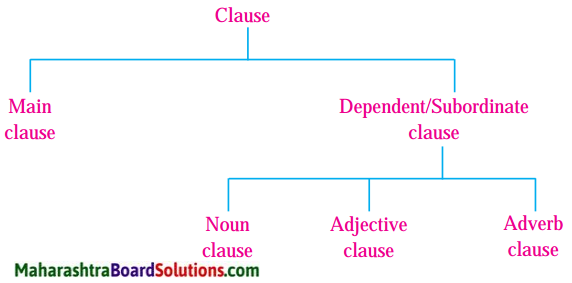
Thus, we have seen that a clause is a part of a sentence and there are two types of clauses:
(a) Main clause – It can stand by itself.
(b) Subordinate or dependent clause : It depends on the main clause, and is incomplete without it.

Note that a sentence can have two or more main clauses or a main clause and one or more dependent clauses, but we cannot have a sentence without a main clause.

Question 3.
Identify one example of a main clause and one example of a dependent clause from page 74.

My English Coursebook 9th Class Solutions Chapter 3.2 The Fall of Troy Additional Important Questions and Answers

Simple Factual Activities:

Question 1.
Fill in the blanks with correct information from the passage. Choose the correct option from the brackets: (Answers are directly given.)
Answer:

  1. Troy was a rich trading city in Asia Minor. (beautiful/trading)
  2. Troy was a strong city protected by its wall. (Mount Ida/wall)
  3. Troy was well situated for commerce and agriculture, (fertile fields/commerce and agriculture)
  4. Helen was the wife of a Greek king Menelaus. (Paris/Menelaus)

Maharashtra Board Class 9 My English Coursebook Solutions Chapter 3.2 The Fall of Troy

Question 2.
Complete the following sentences using the information from the passage:
(Answers are directly given.)
Answer:

  1. The Greek leaders decided to follow the advice of the wise Odysseus.
  2. The Trojans thought that the long siege was over at last.
  3. The last man who entered the wooden horse was the architect himself.
  4. Troy was taken, not by force but by a trick.

Question 3.
State whether the following statements are True or False:
Answer:

  1. The huge wooden horse was an offering to the god of the sea. – False
  2. The man left by the Greeks told the false story of the horse. – True
  3. Their wise priest told the Trojans not to make a hole in the wall. – True
  4. The Greeks were tired of the long war and had sailed away. – False

Complex Factual Activities:

Question 1.
How did the location of Troy help it to grow into a very rich/prosperous city?
Answer:
The city was well situated for commerce and agriculture. Their ships sailed and carried goods and grain over the sea in front of the city. Many rivers and streams flowed from Mount Ida. Well-watered and fertile valleys among the hills grew corn in fertile fields cattle were reared on the rich grass of the meadows. So Troy became a rich/ prosperous city.

Question 2.
How were the Trojans protected?
Answer:
The Trojans had built a strong wall around their city to prevent the enemy attack from the sea. The great gates of the wall were kept closed in time of war. They were safe from all attacks by the walls surrounding the city as well as by the hills behind the city.

Maharashtra Board Class 9 My English Coursebook Solutions Chapter 3.2 The Fall of Troy

Question 3.
What was the cause of the ten year old war between the Greeks and the Trojans?
Answer:
Paris, a prince of Troy, had persuaded Helen, wife of a Greek king Menelaus, to elope with him. Paris brought her to Troy. The Greeks wanted to take revenge on Troy and laid siege to the city. The fight began and the war continued for ten long years.

Who were the brave heroes on either side who were killed in the war? How?

Question 1.
Who were the brave heroes on either side who were killed in the war? How?
Answer:
Great heroes on both sides were killed in the course of time. Hector was killed by Achilles. Achilles himself was killed later on by a poisoned arrow that entered his heel. The prince of Troy, Paris, was also killed by a poisoned arrow.

Question 2.
How did Odysseus plan to defeat the Trojans?
Answer:
Odysseus advised his men to build a great wooden horse, big enough to hold men inside it and let some of their best fighters hide in the horse. Then let them burn their tents and pretend to sail away in their ships. But instead of sailing away, they would return in the night. When the Trojans were asleep, they would attack the city and burn, kill and defeat the Trojans.

Question 3.
What was the reason for Trojans to rejoice and celebrate?
Answer:
The Trojans woke up and came out for fighting as usual. They were delighted and surprised what they saw on the seashore outside the walls. The tents of the Greeks were burnt, the shore was deserted so they thought that the long siege was over at last. They were sure that the Greeks had gone. They were glad to be free to go where they pleased. That was the reason for the Trojans to rejoice and celebrate.

Question 4.
How did the cunning Greek explain the presence of such a large wooden horse?
Answer:
The cunning Greek explained to the Trojans that the Greeks were tired of the long war and had sailed away in their ships. They were afraid of the long voyage home and so they made a large horse and left that as an offering to the god of the sea.

Maharashtra Board Class 9 My English Coursebook Solutions Chapter 3.2 The Fall of Troy

Question 5.
What reckless/thoughtless step did the Trojans take?
Answer:
Thinking that the horse would bring them good luck the Trojans broke down a part of their strong wall in order to drag the horse in the city and that brought the ruin of their city.

Activities based on vocabulary:

Question 1.
Write the words related to ‘Geography’ from the passage.
Answer:
Asia Minor, trading city, Aegean, Black Sea, agriculture, grain, peak of Mount Ida, rivers, streams, valleys, hills, fertile fields, cattle, grass, fortress, meadows.

Question 2.
Match the adjectives in Column ‘A’ with the nouns in Column ‘B’:

‘A’ ‘B’
1. high (a) fortress
2. brave (b) peak
3. fertile (c) fields
4. strong (d) soldiers

Answer:

  1. high – peak
  2. brave – soldiers
  3. fertile – fields
  4. strong – fortress.

Question 3.
Write the words related to war from the passage.
Answer:
fighting, siege, force, battles, armies, heroes, I kill, defence, resist, poisoned arrow, wounded.

Question 4.
Find the nouns for the following adjectives from the passage :

  1. skilful
  2. cunning
  3. wonderful
  4. wooden

Answer:

  1. engineer
  2. Odysseus
  3. piece of work
  4. horse.

Maharashtra Board Class 9 My English Coursebook Solutions Chapter 3.2 The Fall of Troy

Question 5.
Write all the words ending with ‘-mg’ form of verbs:
Answer:
Sailing, being, opening, shutting, expecting.

Question 6.
Arrange the letters properly to make a meaningful word :

  1. aagni
  2. bndeih
  3. rohse
  4. seegi.

Answer:

  1. again
  2. behind
  3. shore
  4. siege

Question 7.
Write the meaningful sentences from the jumbled words:
1. the Greeks did a large such Why horse make?
2. wise their them priest warned not so to do.
Answer:
1. Why did the Greeks make such a large horse?
2. Their wise priest warned them not to do so.

Question 8.
Match the names of the persons in Column ‘A’ with the information in Column ‘B’:
Answer:

  1. Agamemnon – sailing in the leading ship of Greeks
  2. Aphrodite – a Greek goddess
  3. Priam – Old Trojan King
  4. Helen – wife of King Menelaus.

Maharashtra Board Class 9 My English Coursebook Solutions Chapter 3.2 The Fall of Troy

Question 9.
Write the phrases related to Greeks’ attack on Troy.
Answer:
Set fire to houses, burn and kill, sight of leaping flames, sound of shouting, noise of weapons, cries of weeping women, the sleeping Trojans taken by surprise, put on their armour, seize their weapons, went up in flames, all in vain.

Activities based on contextual grammar:

Question 1.
A prince of Troy had persuaded Helen.
(Begin with ‘Helen had – ’ and change the voice.)
Answer:
Helen had been persuaded by a prince of Troy.

Question 2.
The city was strongly defended by its brave soldiers. (Choose the correct option of Active voice)
(a) Its brave soldiers defended strongly by the city.
(b) Its brave soldiers defended the city strongly.
Answer:
Its brave soldiers defended the city strongly.

Question 3.
Underline the infinitives in the sentences:
(Answers are directly underlined.)
1. Paris persuaded Helen to elope with him.
2. The Greeks wanted to take revenge.

Question 4.
Greeks could not take the city. (Make the sentence affirmative.)
Answer:
Greeks were unable to take the city.

Question 5.
Every day Greeks came out of their gates. (Rewrite the sentence using Past Continuous tense.)
Answer:
Every day Greeks were coming out of their gates.

Maharashtra Board Class 9 My English Coursebook Solutions Chapter 3.2 The Fall of Troy

Question 6.
The Trojans, too, fought hard. (Add a question tag.)
Answer:
The Trojans, too, fought hard, didn’t they? ‘

Question 7.
Find the gerund from the sentence. The fighting went on daily.
Answer:
fighting.

Question 8.
They will return in the night. (Frame a Wh-question to get the underlined part as an answer.)
Answer:
When will they return?

Question 9.
They went to sleep.
(Write the sentence in Past Progressive tense.)
Answer:
They were going to sleep.

Question 10.
Why did the Greeks make such a huge horse?
(Rewrite the sentence using Past Perfect tense.)
Answer:
Why had the Greeks made such a huge horse?

Question 11.
The walls are no longer necessary.
(Add a question tag.)
Answer:
The walls are no longer necessary, are they?

Question 12.
The Greeks have gone.
(Rewrite the sentence using Simple Past tense.)
Answer:
The Greeks went.

Choose the correct alternative from the brackets and complete the following sentences:

Question 1.
Choose the correct alternative from the brackets and complete the following sentences:
(Answers are directly underlined.)
Answer:

  1. They were killed with their great heroes. (with/for)
  2. They found the car m their own garage. (on/in)
  3. He jumped into the river to save the child. (over/into)
  4. She was gazing at the strange person. (on/at)

Maharashtra Board Class 9 My English Coursebook Solutions Chapter 3.2 The Fall of Troy

Question 2.
Write the past tense and past participle forms of the following verbs:
(Answers are directly given.)
Answer:

Verb Past tense Past participle
come came come
lead led led
speak spoke spoken
swim swam swum

Complete the words by using correct letters:

Question 1.
Complete the words by using correct letters:

  1. s _ ege
  2. ro_nd
  3. bra _ e
  4. w_ong

Answer:

  1. siege
  2. round
  3. brave
  4. wrong

Copy the following sentences correctly in your notebook:

Question 1.
Copy the following sentences correctly in your notebook:
Answer:
1. The Greek wanted to take revenge on Troy for the wrong done to Menelaus.
2. “But why did the Greeks make such a huge horse?”

Put the following words in alphabetical order:

Question 1.
Put the following words in alphabetical order:
Answer:
1. fields, battles, ships, arrows
2. grain, grow, gates, Greek
3. arrows, battles, fields, ships.
4. gates, grain, Greek, grow.

Maharashtra Board Class 9 My English Coursebook Solutions Chapter 3.2 The Fall of Troy

Punctuate the following sentences:

Question 1.
1. Then he asked the boys where are you going children and for what
2. The king said what a strange appeal
Answer:
1. Then he asked the boys, “Where are you going, children, and for what?”
2. The King said, “What a strange appeal!”

Question 2.
Write four small words (minimum 3 letters each) using the letter in the given word :
“sometimes.”
Answer:

  1. some
  2. time
  3. mime
  4. tie

Question 3.
Spot the error and rewrite the correct sentences:
1. Great heroes on both sides was killed in the course of the war.
2. The Trojans came out of their gates, and the Greeks came out of their tents and ships and the fighting goes on.
Answer:
1. Great heroes on both sides were killed in the course of the war.
2. The Trojans came out of their gates, and the Greeks came out of their tents and ships and the fighting went on.

Question 4.
Write related words as shown in the example: (Answers are directly given.)
Answer:
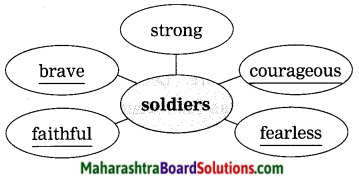
Maharashtra Board Class 9 My English Coursebook Solutions Chapter 3.2 The Fall of Troy

Question 5.
Complete the following word-chain of nouns Add four words, each beginning with the last letter of the previous word:
Stream → ……………., ……………….., …………….., ……………..
Answer:
Stream → mountain → nature → electricity → years.

Question 6.
Make your own meaningful sentence by using the phrase ‘in front of.
Answer:
There is a big ground in front of our school.

Maharashtra Board Class 9 My English Coursebook Solutions Chapter 3.2 The Fall of Troy

Question 7.
Add a prefix or suffix to make new words and use any one of the root words in your own sentence:
1. imagine
2. education
Answer:
1. imaginary
2. educational
Sentence: Just try to imagine that you are a rich person.

Question 8.
Add a clause to expand the sentence meaningfully:
The person cried for help ………………
Answer:
The person cried for help because he was caught in the big fire.

Personal Response:

Question 1.
Do you know one of the wars in ancient India was fought over a woman? Describe it in short.
Answer:
I know such a war was fought between Ram and Ravan. Ravan, the demon king of Lanka, came in disguise as a Sadhu and forcefully took away Seeta, the wife of Ram. Ram with his monkey army reached Lanka. He fought against Ravan, defeated him and killed Ravan and brought back Seeta to Ayodhya.

Question 2.
Why, do you think, did the Greeks burn their tents?
Answer:
The Greeks burnt their tents to show the Trojans that they have left for Greece and did not wish to continue the siege any more. They wanted them (Trojans) to be careless and carefree about the Greek attack and their army.

Question 3.
Was it enough to use the wooden horse to hide some soldiers? What was done to make the Trojans take it inside the city?
Answer:
No, it was not enough to use it for hiding some soldiers. The Greeks wanted their entry into the city with all their army men. Unless the walls around the city were broken down they would not have got that opportunity. That’s why they made the horse very large and lured the Trojans to take it inside the city by breaking the walls.

Maharashtra Board Class 9 My English Coursebook Solutions Chapter 3.2 The Fall of Troy

Question 4.
Was the big wooden horse really an offering to the god of the sea?
Answer:
No, the big wooden horse really was not an offering to the god of the sea. It was a false tale of the Greek who was found under the big horse by the Trojans. It was told to lure the Trojans for taking the horse inside the city for sudden attack without their knowledge.

Question 5.
Why, do you think, were the Trojans so excited?
Answer:
I think, the Trojans thought that the siege by the Greeks was lifted and there would be no war any more. Again they thought that they were bringing in good luck for the city by presence of the wooden horse. They did not think of the impending danger.

Question 6.
Do you think that the conquerors of war are happy after their victory?
Answer:
No, I don’t think so. Both defeated and victorious countries have to bear the brunt of war. Both have to suffer because of the disastrous consequences they face. Both suffer the loss of lives, money, peace and so many other things. It takes a long time for both to regain their normal life.

Question 7.
Which of the following are the adverse effects of war? Tick [✓] them in the given box:
Answer:

  1. Many people are killed. [✓]
  2. The country gains fame and glory. [✗]
  3. They lose peace in the land. [✓]
  4. Thousands are wounded. [✓]
  5. Soldiers enjoy fighting. [✗]
  6. Those who win the war become rich and famous. [✓]

Maharashtra Board Class 9 My English Coursebook Solutions Chapter 3.2 The Fall of Troy

Oral Work

Question 1.
Read the story and retell it in your mother tongue, Read the following passage and do the activities:

My English Coursebook 9th Class Solutions Unit 3

Std 9 English Poem Helen Keller and Anne Sullivan 2.2 Question Answer Maharashtra Board

Class 9 English Chapter 2.2 Question Answer Maharashtra Board

Balbharti Maharashtra State Board Class 9 English Solutions My English Coursebook Chapter 2.2 Helen Keller and Anne Sullivan Notes, Textbook Exercise Important Questions and Answers.

Helen Keller and Anne Sullivan Poem 9th Std Question Answer

My English Coursebook Std 9 Digest Chapter 2.2 Helen Keller and Anne Sullivan Textbook Questions and Answers

Warming up!

Chit-chat:

  • What is your favourite school subject?
  • Which subject do you find the most difficult?
  • What do you do to try to understand it better?
  • Can I help you to ……….. ?
  • Can you help me to ………………. ?

Maharashtra Board Class 9 My English Coursebook Solutions Chapter 2.2 Helen Keller and Anne Sullivan

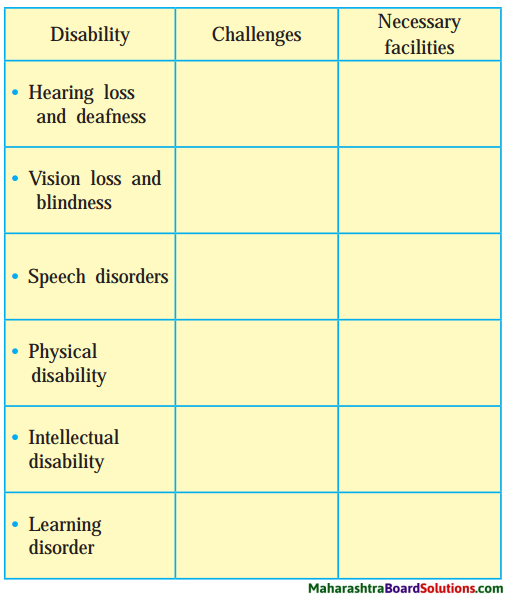
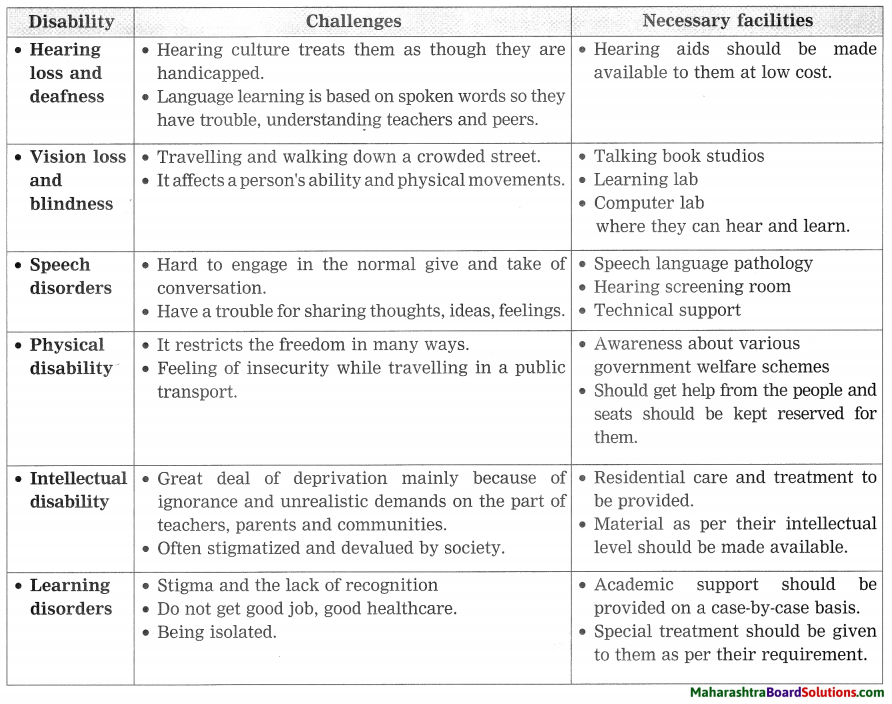
1. Discuss the challenges that people have to face due to disabilities.
What provisions should be made in public places so that everyone gets the same access to public facilities?
Observe your surroundings and write whether such facilities are available. How can you help to improve the situation?

Maharashtra Board Class 9 My English Coursebook Solutions Chapter 2.2 Helen Keller and Anne Sullivan 1

Question 1.
Discuss the challenges that people have to face due to disabilities :
Answer:

  • Unfriendly public places –
  • abused – exploited – excluded
  • inferiority complex

Question 2.
What provisions should be made in public places so that everyone gets the same access to public facilities?
Answer:

  1. Suitably altering buses, airplanes, train compartments to make them accessible to persons with disabilities.
  2. Making necessary curbs, cuts and slopes in pavement for wheelchair users.
  3. Providing ramps at all public places.
  4. Engraving edges of railway platforms for the benefits of the visually impaired.

Maharashtra Board Class 9 My English Coursebook Solutions Chapter 2.2 Helen Keller and Anne Sullivan

Question 3.
Observe your surroundings and write whether such facilities are available. How can you help to improve the situation?
Answer:
Maharashtra Board Class 9 My English Coursebook Solutions Chapter 2.2 Helen Keller and Anne Sullivan 2

English Workshop:

1. Say whether the following sentences are true or false:

Question 1.
Say whether the following sentences are true or false:
(a) The most important day in Helen Keller’s life was when her teacher came to her.
(b) When young Helen stretched out her hand, her mother took it.
(c) Young Helen learnt to spell many words without understanding them.
(d) One day, young Helen understood that everything has a name.
(e) Young Helen did not try to put the pieces of the doll together.
(f) Young Helen felt sorry that she had broken the doll.
Answer:
(a) The most important day in Helen Keller’s life was when her teacher came to her. – True
(b) When young Helen stretched out her hand, her mother took it. – False
(c) Young Helen learnt to spell many words without understanding them. – True
(d) One day young Helen understood that everything has a name. – True
(e) Young Helen did not try to put the pieces of doll together. – True
(f) Young Helen felt sorry that she had broken the doll. – False

Maharashtra Board Class 9 My English Coursebook Solutions Chapter 2.2 Helen Keller and Anne Sullivan

2. Listen carefully and classify the following into ‘one’ and ‘many’.
day, contrasts, teacher, lives, months, years, afternoon, porch, signs, face, fingers, leaves, blossoms, anger, bitterness, weeks, struggle, ship, darkness

Question 1.
Listen carefully and classify the following into ‘one’ and ‘many’.
day, contrasts, teacher, lives, months, years, afternoon, porch, signs, face, fingers, leaves, blossoms, anger, bitterness, weeks, struggle, ship, darkness
Maharashtra Board Class 9 My English Coursebook Solutions Chapter 2.2 Helen Keller and Anne Sullivan 3
Answer:

one many
day, teacher, afternoon, porch, face, anger, bitterness, struggle, ship, darkness contrast, lives, months, years, signs, fingers, leaves, blossoms, weeks.

3. This narrative is written in the first person – using ‘I’. Rewrite the following sentences using ‘Helen Keller/Young Helen’ appropriately in place of ‘I’ and making other neccessary changes in the sentences

Question a.
I did not know what the future held of marvel or surprise for me.
Answer:
Young Helen did not know what the future held of marvel or surprise for her.

Question b.
The morning after my teacher came she led me into her room and gave me a doll.
Answer:
The morning after Helen Keller’s teacher came, she led her into her room and gave her a doll.

Maharashtra Board Class 9 My English Coursebook Solutions Chapter 2.2 Helen Keller and Anne Sullivan

Question c.
On entering the door I remembered the doll I had broken.
Answer:
On entering the door, young Helen remembered the doll she had broken.

Question d.
Then my eyes filled with tears for I realised l what I had done, and for the first time I felt repentance and sorrow.
Answer:
Then young Helen’s eyes filled with tears: for she realised what she had done, and for the first time she felt repentance and sorrow.

Maharashtra Board Class 9 My English Coursebook Solutions Chapter 2.2 Helen Keller and Anne Sullivan

4. Read the following sentences and frame at least two relevant questions on each.
(a) I was like that ship before my education began.
Questions with ‘who’, ‘what’, ‘when’.
Example: Who was like that ship before her education began?)
(b) One day I was playing with the new doll.
(c) I learnt a great many new words that day.
(d) She brought my hat.
(e) We walked down the path to the well-house.
(f) That living word awakened my soul.

Question b.
One day I was playing with the new doll.
Answer:
(i) When was I playing with the new doll?
(ii) What was I doing one day?

Maharashtra Board Class 9 My English Coursebook Solutions Chapter 2.2 Helen Keller and Anne Sullivan

Question c.
I learnt a great many words that day.
Answer:
(i) What did I learn that day?
(ii) Who learnt many words that day?

Question d.
She brought my hat.
Answer:
(i) What did she bring?
(ii) Who brought my hat?

Question e.
We walked down the path to the well-house.
Answer:
(i) Where did we walk down?
(ii) Who walked down the path to the well- house?

Question f.
That living word awakened my soul.
Answer:
(i) What awakened my soul?
(ii) What did that living word awaken?

Maharashtra Board Class 9 My English Coursebook Solutions Chapter 2.2 Helen Keller and Anne Sullivan

5. Write about your own experience. Do you remember an occasion when you did something successfully for the first time? Write about it in short (10-12 lines). Prepare an outline of your composition before you write it.

Question 1.
Write about your own experience. Do you remember an occasion when you did something successfully for the first time? Write about it in short (10-12 lines). Prepare an outline of your composition before you write it.
Answer:
The occasion when I was successful
When our teacher gave us an assignment to write a poem on nature, it was quite a difficult job for me. I tried my level best to arrange some words but I could not do it successfully. Then I took the help of my brother. He guided me how to do it. As per his guidance I collected some words related to nature. Then I tried to weave the words in lines. I tried to match the rhymes also.

Somewhere it was quite easy, whereas somewhere it was a difficult job for me. At last, after a lot of efforts and trials, I was successful to write a poem based on ‘Nature’. It gave me immense pleasure and joy. When I read it in the class, I got good praise and applause from the teacher as well as from my classmates. It was really a memorable occasion for me.

6. Gather more information about the following:

Question a.
Different types of impairment that limit a person’s activity or make it difficult for him/her to mix with others in society.
Answer:
Different types of impairment that limit a person’s activity.

  • Visual impairment
  • Hearing impairment
  • impairment of speech production
  • impairment of language comprehension
  • Intellectual impairment
  • Reading impairment

Maharashtra Board Class 9 My English Coursebook Solutions Chapter 2.2 Helen Keller and Anne Sullivan

Question b.
How modern technology can be used to overcome these problems.
Answer:
Modern technology has been playing an important role in our day-to-day life. But it is more useful for the disabled people than the common man in the society. It facilitates as per the requirement of the person. It will be a boon for them. Devices like Captioned Television, Live Speech Captioning, Telecommunication Devices for the Deaf are useful for Hearing impairments. In the same way, other devices based on modern technology are also available for other impairments.

7. Complete the following sentences using your own ideas:
(a) The most important day I remember in all my life is the one on which ………… .
(b) I did not know what ………… .
(c) One day. while I was playing ………… .
(d) I realised what ………… .
(e) I do not remember what ………… .

Question a.
The most important day I remember in all my life is the one on which ………… .
Answer:
The most important day I remember in all my life is the one on which I was saved in a horrible accident when I was learning to ride bike. I lost my control and dashed the car in front of me. I fell down with bike on my legs. The people around came and lifted the bike and I was rescused.

Question b.
I did not know what ………… .
Answer:
I did not know what to do at that situation.

Maharashtra Board Class 9 My English Coursebook Solutions Chapter 2.2 Helen Keller and Anne Sullivan

Question c.
One day. while I was playing, ………… .
Answer:
One day, while I was playing, I got fracture in my leg.

Question d.
I realised what ………… .
Answer:
I realised what I was doing was wrong.

Question e.
I do not remember what ………… .
Answer:
I do not remember what exactly I did at that moment.

Maharashtra Board Class 9 My English Coursebook Solutions Chapter 2.2 Helen Keller and Anne Sullivan

Language study:

7. Find three examples of the following from the passage.
(a) articles
(b) compound words
(c) present participles
(d) past participles

Question 1.
Find three examples of the following from the passage.
(a) articles
(b) compound words
(c) present participles
(d) past participles.

My English Coursebook 9th Class Solutions Chapter 2.2 Helen Keller and Anne Sullivan Additional Important Questions and Answers

Read the following passage and do the activities:

Simple Factual Activity:

Question 1.
Say whether the following statements are True or False:
(Answers are given directly.)
Answer:

  1. Anne Mansfield Sullivan was Helen Keller’s mother. – False
  2. The author compares herself to the great ship that groped her way towards the shore. – False
  3. The writer was standing on the porch dumb and expectant on that eventful day. – True
  4. Helen’s eyes filled with tears when she realised what she had done. – True

Maharashtra Board Class 9 My English Coursebook Solutions Chapter 2.2 Helen Keller and Anne Sullivan

Question 2.
Fill in the blanks and complete the following sentences: (Answers are directly given.)

  1. The writer was interested in finger play so she tried to imitate.
  2. When young Helen succeeded in making the letters correctly, she was flushed with childish pleasure and pride.
  3. Earlier in the day Helen and Miss Sullivan had a tussle over the words mug and water.
  4. When Miss Sullivan brought Helen’s hat, she realised that she was going out into the warm sunshine.

Question 3.
Complete the following sentences:
(Answers are directly given.)
1. The writer and her teacher were attracted by the fragrance of the honeysuckle with which the well house was covered.
2. As the cool stream gushed over Helen’s hand, she realised that water meant the wonderful cool something that was flowing over her hand.

Complex Factual Activities:

Question 1.
The author refers to two contrasting emotions, what are they?
Answer:

  1. The first is when her teacher Anne Sullivan came in her life and she was filled with wonder.
  2. On the afternoon of that eventful day she guessed vaguely from her mother’s signs and guessed something unusual was about to happen.

Maharashtra Board Class 9 My English Coursebook Solutions Chapter 2.2 Helen Keller and Anne Sullivan

Question 2.
Match the following:

Group ‘A’ Group ‘B’
1. The afternoon sun penetrated the mass of honeysuckle … (a) when she considered the immeasurable contrasts between the two lives.
2. The writer was filled with wonder … (b) how near the harbour she was.
3. The familiar leaves and blossoms came forth … (c) and fell on the writer’s upturned face.
4. The writer was like compass or sounding-line and no way of knowing… (d) to greet the sweet southern spring.

Answer:

Group ‘A’ Group ‘B’
1. The afternoon sun penetrated the mass of honeysuckle … (c) and fell on the writer’s upturned face.
2. The writer was filled with wonder … (a) when she considered the immeasurable contrasts between the two lives.
3. The familiar leaves and blossoms came forth … (d) to greet the sweet southern spring.
4. The writer was like compass or sounding-line and no way of knowing… (b) how near the harbour she was.

Question 3.
What did young Helen’s teacher do when they first met?
Answer:
When Helen met her teacher for the first time, she caught Helen’s hand and held her close in her arms.

Maharashtra Board Class 9 My English Coursebook Solutions Chapter 2.2 Helen Keller and Anne Sullivan

Question 4.
What were Helen’s reactions when she succeeded in making letters correctly?
Answer:
When Helen succeeded in making the letters correctly, she was flushed with childish pleasure and pride. She ran downstairs and held up her mother’s hand and made the letters for doll. She was simply making her fingers go in monkey-like imitation.

Question 5.
Arrange the following sentences in chronological order:
1. Helen learnt many words without understanding them.
2. Helen learnt the word ‘doll’ by imitation from her teacher for the very first time.
3. She realized that everything has a name.
4. When she was successful in making the letters of ‘doll’, she showed it to her mother.
Answer:
2. Helen learnt the word ‘doll’ by imitation from her teacher for the very first time.
4. When she was successful in making the letters of ‘doll’, she showed it to her mother.
1. Helen learnt many words without understanding them.
3. She realized that everything has a name.

Question 6.
What were the barriers? How could they be swept away?
Answer:
When the writer realised that every object had a name, each name gave birth to a new thought. Every object that she touched seemed to quiver with life as everything was strange and new to her. As every living word could give her new experience but some of them couldn’t. By trying to touch every living object she could name it. But she could not do it with objects that were invisible. ’

Maharashtra Board Class 9 My English Coursebook Solutions Chapter 2.2 Helen Keller and Anne Sullivan

Question 7.
Why did young Helen feel repentance and sorrow?
Answer:
When young Helen broke her new doll into pieces, she had no idea that every part of it had a name. But when she realized that every object that existed has a name, she saw everything with a strange, new sight. When she remembered her broken doll she felt repentance and sorrow for what she had done.

Activities based on vocabulary:

Question 1.
Guess the meaning of:
Answer:

  1. immeasurable contrasts – a vast difference
  2. eventful day – the day full of events/activities
  3. upturned – directed upward
  4. unconsciously – without realizing
  5. white darkness – It is symbolic to her condition (she was quite close to her destiny without being able to know it.)

Question 2.
Find out antonyms for the following from the extract. (Answers are directly given.)
Answer:

  1. shrinked × stretched
  2. died/ceased × existed
  3. pain × pleasure
  4. dully × keenly.

Maharashtra Board Class 9 My English Coursebook Solutions Chapter 2.2 Helen Keller and Anne Sullivan

Question 3.
Pick out 4 infinitives from the extract:
Answer:

  1. to reveal
  2. to imitate
  3. to impress
  4. to love.

Question 4.
Classify the following words in the given columns:
fragrance, attract, stream, learn, hearth, enter, sorrow, realise
Answer:

Nouns Verbs
fragrance, stream, hearth, sorrow attract, learn, enter, realise

Question 5.
Find out four compound words from the lesson:
Answer:

  1. honeysuckle
  2. sounding-line
  3. everything
  4. well-house.

Maharashtra Board Class 9 My English Coursebook Solutions Chapter 2.2 Helen Keller and Anne Sullivan

Activities based on contextual grammar:

Question 1.
Add a tail tag to the following sentences:
(Answers are directly given.)

  1. She did not know what the future held of marvel or surprise for her, did she?
  2. Helen was like that ship before her education began, wasn’t she?
  3. Helen had no way of knowing how near the harbour was, had she?
  4. The afternoon sun penetrated the mass of honeysuckle, didn’t it?

Rewrite the sentences by using ‘As soon as’:

Question 1.
On entering the door, I remembered the doll I had broken.
Answer:
As soon as I entered the door, I remembered the doll I had broken.

Personal Response:

Question 1.
What is the difference between wordless sensation and thought?
Answer:
Sensation is a physical feeling or perception resulting from something that happens to or comes into contact with the body. It is the ability to feel something physically and express without using words.

Thought is an idea or opinion produced by thinking or occurring suddenly in the mind. Sensation is different from thought. Thoughts are generated centrally in the brain and sensations occur at different places.

Maharashtra Board Class 9 My English Coursebook Solutions Chapter 2.2 Helen Keller and Anne Sullivan

Question 2.
How can modern technology be used to overcome impairments?
Answer:
Technology has created a revolution in the life of disabled learners.
a. Disabled students have an adequate educational opportunities but application of computer based technology has created a sea of changes in available options for disabled students.

b. Computer programs have been designed to make it easier for disabled students to access material, communicate their ideas and work and participate in educational experiences.

Question 3.
Why should we help disabled people?
Answer:
We should help disabled people because though no fault of their own, they are in a situation where they require more assistance. If we help them wherever they want our help, they can boost their confidence to get success in their life. We are human and we are supposed to have empathy. So it is our duty to assist them wherever they want.

Maharashtra Board Class 9 My English Coursebook Solutions Chapter 2.2 Helen Keller and Anne Sullivan

Activities Based on Language study

Do as directed:

Question 1.
Complete the words by using correct letters:

  1. w _ i c h
  2. h o u _ e
  3. g _ e e t
  4. a _ g e r

Answer:

  1. w h i c h
  2. h o u s e
  3. g r e e t
  4. a n g e r.

Maharashtra Board Class 9 My English Coursebook Solutions Chapter 2.2 Helen Keller and Anne Sullivan

Question 2.
Copy the following sentences in your notebook:
Answer:
1. “Light! give me light!” was the wordless cry of my soul.
2. Those words that were to make the world blossom for me ‘like Aaron’s rod, with flower.’

Question 3.
Put the following words in alphabetical order :
1. porch, dumb, expectant, blossom.
2. interested, imitate, impress, impatient.
Answer:
1. blossom, dumb, expectant, porch.
2. imitate, impatient, impress, interested.

Question 4.
Punctuate the following sentences :
1. why dont you try to understand my situation ruta said her father
2. the tourist exclaimed what a beautiful place kashmir is
Answer:
1. “Why don’t you try to understand my situation Ruta?” said her father.
2. The tourist exclaimed, “What a beautiful place Kashmir is!”

Maharashtra Board Class 9 My English Coursebook Solutions Chapter 2.2 Helen Keller and Anne Sullivan

Question 5.
Write four small words (minimum 3 letters each) using the letters in the given f word:
“immeasurable”
Answer:

  1. sure
  2. measure
  3. ease
  4. able.

Question 6.
Spot the error and rewrite the correct sentences:
1. My father have been working in a bank from last 20 years.
2. Yesterday I will see him while going to office.
Answer:
1. My father has been working in a bank from last 20 years.
2. Yesterday I saw him while going to office.

Maharashtra Board Class 9 My English Coursebook Solutions Chapter 2.2 Helen Keller and Anne Sullivan

Question 7.
Write related words as shown in the example
(Answers are directly given.)
Answer:
Maharashtra Board Class 9 My English Coursebook Solutions Chapter 2.2 Helen Keller and Anne Sullivan 4

Question 8.
Complete the following word-chain of adjectives. Add four words, each beginning with the last letter of the previous word:
white → …………… → ……………… → ………………. → …………….. .
Answer:
white → enormous → sacred → decent → tired.

Do as directed:

Question 1.
Make your own meaningful sentence by using the phrase ‘to be able to’.
Answer:
I was not able to complete my paper in given time.

Question 2.
Add a prefix or suffix to make new words and use any one of the root words in your own sentence:
Answer:
1. unusual
2. conscious
Sentence: He was late as usual.

Maharashtra Board Class 9 My English Coursebook Solutions Chapter 2.2 Helen Keller and Anne Sullivan

Oral Work:

Question 1.
What is the difference between finger play, spelling a word mechanically and writing a meaningful word?

Question 2.
Read aloud the paragraph ‘We walked down… be swept away’ using proper intonation.

My English Coursebook 9th Class Pdf Unit 2

Std 9 English Poem The Last Lesson 4.5 Question Answer Maharashtra Board

Class 9 English Chapter 4.5 Question Answer Maharashtra Board

Balbharti Maharashtra State Board Class 9 English Solutions My English Coursebook Chapter 4.5 The Last Lesson Notes, Textbook Exercise Important Questions and Answers.

The Last Lesson Poem 9th Std Question Answer

My English Coursebook Std 9 Guide Chapter 4.5 The Last Lesson Textbook Questions and Answers

Warming up!
Chit-chat

  1. How was this year for you?
  2. Are you happy with what you could study this year?
  3. What did you miss, or could not do ?
  4. What do you plan to do about it-about the things you could not do /study well?
  5. What was the best moment for you this year?

Maharashtra Board Class 9 My English Coursebook Solutions Chapter 4.5 The Last Lesson

Growing sentences

Form pairs/groups and do the following activities:

1. Form pairs. Write two sentences of two words each.
Examples:
1. Stand up.
2. Don’t disturb.

2. Form groups of three. Write three sentences of three words each.
Examples:

  1. Please come here.
  2. Open your books.
  3. You can go.

3. Form groups of four. Write four sentences of four words each.
Examples:

  1. Complete your notebooks now.
  2. Is it your book?
  3. I like my school.
  4. Mother cooks nice food.

4. Continue to write as many sentences as the number of students in the group, till you reach the number 10.

5. After that, go on forming bigger groups and writing sentences with as many words as the number of students in the group. However, you may write only one or two sentences at each step after 10.
Examples:

  • Sentence of 5 words: Can you please help me? Sentence of 6 words : Avanish works hard for his future.
  • Sentence of 7 words: You are free to choose your career.
  • Sentence of 8 words: I got this gift on my tenth birthday.
  • Sentence of 9 words: My mother corrects me when I make a mistake.
  • Sentence of 10 words: We should follow the rules and regulations of our society.

6. See if you can make a sentence with as many words in it as there are students in your classroom.

7. Write the sentence in big letters on chart paper and display it in the classroom.

English Workshop:

1. Find the meaning of the following words from a good dictionary:

Question 1.
Find the meaning of the following words from a good dictionary:
Answer:

  1. Sawmill – a factory where wood is cut with machinery
  2. Prussian – German inhabitant of Prussia
  3. Apprentice – a person who learns some skill needed in his/her job.
  4. nuisance – annoyance
  5. cranky – irritable
  6. hold fast to something – to possess something (here language) firmly despite of many difficulties.
  7. at one stroke – with a single immediate action.
  8. might – strength.

Maharashtra Board Class 9 My English Coursebook Solutions Chapter 4.5 The Last Lesson

2. List the people and their occupation in the passage.

Question 1.
List the people and their occupation in the passage.
Answer:
1. M. Hamel – French teacher
2. Franz – the narrator student

3. Find five words ending with ‘-ing’ and five words ending with ‘-ed’ from the lesson.

Question 1.
Find five words ending with ‘-ing’ and five words ending with ‘-ed’ from the lesson.
Answer:

Words ending with ‘ing’ Words ending with ‘ed’
1. fluttering 1. dismissed
2. writing 2. turned
3. scratching 3. looked
4. choking 4. leaned

4. Find five examples of commonly used past participles from the story. For example, said, learnt.

Question 1.
Find five examples of commonly used past participles from the story. For example, said, learnt.
Answer:
Commonly used past participles from the passage:

  1. got
  2. saw
  3. wore
  4. came
  5. put

5. What is the meaning of the following words and phrases in the passage? Choose the correct alternative.

Question (a)
…………….. was in great dread of
1. was in a great hall
2. was in great demand
3. was afraid of
4. was angry with.
Answer:
3. was afraid of

Maharashtra Board Class 9 My English Coursebook Solutions Chapter 4.5 The Last Lesson

Question (b)
……………….. did not know the first word about them
1. did not know anything about them
2. did not care about them
3. knew all the words except the first word
4. had not learnt them by heart.
Answer:
1. did not know anything about them

Question (c)
…………………… terrible iron ruler
1. a great king
2. a ruler made of poor quality iron
3. a magic ruler
4. ruler with which the master hit the student hard.
Answer:
4. ruler with which the master hit the student hard.

Question (d)
…………… got a little over my fright
1. got very frightened
2. got something because I was frightened
3. became little
4. got less frightened
Answer:
4. got less frightened

Question (e)
What a thunderclap these words were to me!
1. The words came as a shock.
2. He shouted the words at me.
3. There was thunder and lightning.
4. The words were accompanied by claps.
Answer:
1. The words came as a shock.

Maharashtra Board Class 9 My English Coursebook Solutions Chapter 4.5 The Last Lesson

Question (f)
……………… she put off learning tomorrow
1. she prepare for learning
2. she did not learn at that time
3. she cancelled tomorrow’s learning
4. she studied the word ‘tomorrow’.

6. Fill in the following blanks using proper words from ‘who’, ‘when’, ‘what’, ‘how’ or I ‘why’:

Question 1.
Fill in the following blanks using proper words from ‘who’, ‘when’, ‘what’, ‘how’ or I ‘why’:
(a) She started jumping for joy ……………… she heard the news.
(b) You must tell ………………… I mustn’t do it.
(c) The person ……………… is making the speech is my friend.
(d) They wondered ……………….. had happened to him.
(e) You must show me ………………….. to mix the solutions.
(f) I’ll tell you …………………… it is time to leave.
Answer:
(a) She started jumping for joy when she heard the news.
(b) You must tell why I mustn’t do it.
(c) The person who is making the speech is my friend.
(d) They wondered what had happened to him.
(e) You must show me how to mix the solutions.
(f) I’ll tell you when it is time to leave.

Question 2.
Write a letter of thanks to your English teacher. Thank him/her for everything that he/she did for you:
Answer:
Ishan More
16, Gnyaneshwari,
Aarey Road,
Goregaon (East),
Mumbai – 400 063.
30th April, 2020.

Dear Gogate madam,

I take this opportunity to thank you from my bottom of heart for whatever you have done for me and to improve my English skills. I think words fail me toexpress my gratitude.

Madam, when I saw this new book for the first time, I was worried as I didn’t understand how to study it and improve my writing and speaking skills. But while taking activities of every lesson and poem you not only boosted our courage but also made us confident to write and speak English fluently.

While taking activities, you gave opportunity to every one, so that we could think, imagine and express. At the same time by, taking activities based on vocabulary and grammar you laid a good foundation of it. Now, each and every student of our class wishes to learn English on their own. You created interest in learning the language.

I am really proud to say that throughout the journey of my life, I will be thankful for your efforts taken for the development of our language. I am sure, only because of your support and help I can now speak and write English fluently.

Thank you for the guidance you have given throughout the year and for making it so wonderful. I will forever be obliged to you.

Yours obediently,
Ishan More

Maharashtra Board Class 9 My English Coursebook Solutions Chapter 4.5 The Last Lesson

7. Write a short note on your mother tongue and the attempts you make to study it well.

Question 1.
Write a short note on your mother tongue and the attempts you make to study it well.
Answer:
My mother tongue is Marathi. It is spoken all over Maharashtra. Konkani, Malvani, Ahirani, Varhadi are some of the dialects of Marathi. According to many writers and philosophers, it is the most beautiful language in India.

The moment when I heard the first Marathi word ‘Aai’, I have been learning this language till today. I learnt it from my parents, grandparents, neighbours and my Marathi teachers. I read a lots of books including novels of renowned authors in Marathi. People say Marathi is rich in its literature. By reading Marathi newspapers, magazines and by listening Marathi news bulletins I improved my vocabulary and even the beauty of structure. Being my mother tongue, I haven’t taken any special efforts to learn this language as I learnt it from my surroundings.

8. Write points and counter points on the following topics:

Question 1.
You should study all subjects in your mother tongue:
Answer:
Points:
1. Language is a symbol that reflects the culture of one’s community and ethnic identity and speaking in one’s own mother tongue can create a sense of personal identity for the students across the globe.
2. When students don’t understand the instructions given by the teachers in English they lose their confidence and they either choose to sit silently or repeat mechanically, leading to frustration and ultimately repetition, failure and school drop out.

Counterpoints:

1. India is a country with too many languages with some being state specific and Hindi being the national language. English being an international language has now become language connecting the whole of India. On the other hand, we have our mother tongues which teach the kids about our culture and about our past.

2. If the instructions are given in mother tongue then the question arises, “How will they cope up with English later on? The educationists and policy makers need to give it a thought.

Maharashtra Board Class 9 My English Coursebook Solutions Chapter 4.5 The Last Lesson

Question 2.
You must memorise the rules of grammar : Points:
Answer:
1. Language is the base of almost everything we do as human beings. We cannot communicate without language. If we want to understand linguistic dimension of our existence we need to learn the rules and regulations of grammar as it is fundamental organizing principle of language.
2. It has been observed that the explicit teaching of grammar rules leads to better learning and understanding and this lasts over time. Learning about grammar provides basic knowledge for learning other languages.
Counterpoints:
1. The difference between a literate and educated person is that an educated person knows to read and write. Anyone who knows to read and write knows grammar. It is a part of learning a language. Why to take it up as a separate thing to learn and add to the stress level of the students.
2. Language is a means of communication, people have been communicating with each other for ages. Functional grammar is still acceptable but learning rules looks like wastage of time and energy. There are pros and cons of everything and so is of learning grammar rules. I think that at least the basics of grammar should be taught till primary level and then we can shift to functional grammer.

9. Why was Franz sad?

Question 1.
Why was Franz sad?
Answer:
When Franz came to know that M. Hamel was leaving, he realized that he had not learned a single word of French, his own language and now they will start teaching German. He was also sad thinking about the condition of M. Hamel who was leaving the school after forty years of faithful service.

Maharashtra Board Class 9 My English Coursebook Solutions Chapter 4.5 The Last Lesson

10. What should people never lose even when they lose freedom?

Question 1.
What should people never lose even when they lose freedom?
Answer:
Even when the people lose their freedom, they should not lose their own language.

My English Coursebook 9th Class Solutions Chapter 4.5 The Last Lesson Additional Important Questions and Answers

Simple Factual Activities:

Question 1.
State whether you Agree or Disagree with the following statements:
Answer:

  1. A little boy Franz is narrating the story. – Agree
  2. Mr. Hamel is the teacher in Franz’s school. – Agree
  3. Franz had learnt all his participles well. – Disagree
  4. All bad news had come from the bulletin board which was kept in front of Franz’s school. – Disagree

Question 2.
List the profession/occupation of the people mentioned in the passage:
Answer:

  1. Little Franz: student/narrator
  2. M. Hamel: teacher
  3. Watcher: blacksmith
  4. Classmates: students studying in the same class.
  5. Prussians: Soldiers
  6. Villagers: former mayor former postmaster.

Question 3.
Complete the following sentences:
Answer:

  1. The story takes place in Alsace and Loraine.
  2. The order from Berlin forced on teaching German instead of French in the schools of Alsace and Loraine.
  3. Franz studies grammer, French and history of the saints in school.

Maharashtra Board Class 9 My English Coursebook Solutions Chapter 4.5 The Last Lesson

Question 4.
Complete the following sentences by using one word: (Answers are directly given.)
Answer:

  1. According to M. Hamel, French was the most beautiful language in the world.
  2. M. Hamel had put on his Sunday clothes.
  3. M. Hamel had put in forty years of faithful service.
  4. Franz had not studied participles.

Question 5.
State whether the following statements are True or False: (Answers are directly given.)
Answer:

  1. The people of the village gathered in the school to thank M. Hamel. – True
  2. Franz can neither speak nor write French. – True
  3. Franz’s parents were very much anxious in his studies. – False
  4. Franz had never listened M. Hamel so carefully before. – True

Question 6.
Complete the following sentences:
Answer:

  1. M. Hamel lived above the school room.
  2. His sister lived with him.
  3. M. Hamel wrote “VIVE LA FRANCE”! on the blackboard with all his might.
  4. M. Hamel wrote France, Alsace, France, Alsace on the grammar copy.

Complex Factual Activities:

Question 1.
Complete the following sentences:
Answer:
1. The iron ruler is said to be terrible because M. Hamel hit the students with this ruler.
2. The narrator was thinking not to go to school because he thought M. Hamel would question him about participles and scold him for not doing the participles.

Maharashtra Board Class 9 My English Coursebook Solutions Chapter 4.5 The Last Lesson

Question 2.
Describe the scene usually like when school begins?
Answer:
Usually, when school begins there was a great bustle which could be heard out in the street – the opening and closing of desks, lessons repeated in unison, very loud, and the teacher’s great ruler rapping on the table.

Question 3.
In what time period does the story take place?
Answer:
During the France-Prussian war 1870-1871.

Question 4.
How did M. Hamel dress up on special occasions?
Answer:
On special occasions, M. Hamel dressed up in his beautiful green coat, frilled shirt and a little black embroidered silk cap.

Question 5.
Is the school closing down?
Answer:
No, the school is not closing down whereas a German teacher is going to take the place of M. Hamel who teaches French in that school.

Question 6.
Why were the old men of the village attending school that day?
Answer:
The old men of the village were sorry that they had not gone to school in their life. They also wanted to thank M. Hamel for his selfless service of forty years and show their respect for their country which did not belong to them now. So they were attending the school that day.

Maharashtra Board Class 9 My English Coursebook Solutions Chapter 4.5 The Last Lesson

Question 7.
Why did M. Hamel not scold Franz?
Answer:
Franz was feeling guilty for not learning French properly even though he had a good chance to learn. He also knew that it was not his fault. Whereas his parents were also responsible for the same so M. Hamel did not scold Franz.

Question 8.
According to M. Hamel, who are the people that did not take education seriously? What examples does he give to support his view?
Answer:
According to M. Hamel, the people of Alsace did not take education seriously. He gave the example of Franz’s parents who wanted Franz to work on a farm or at the mill instead of going to school and learn.

Question 9.
Why does Franz understand his lesson well?
Answer:
Being the last lesson of French, Franz was serious. He heard it more carefully that day. He also realized that M. Hamel was teaching patiently as if he wanted to give everything he knew, before going away. So Franz understands his lesson well.

Question 10.
Why does the author say, “I never saw him look so tall”?
Answer:
The author was always afraid of his French teacher M. Hamel. He also did not understand what he taught. But on the last day of his lecture, the narrator understood and remembered that last lesson. He also developed respect and love for M. Hamel seeing his patriotism. So he says. “I never saw him look so tall.”

Maharashtra Board Class 9 My English Coursebook Solutions Chapter 4.5 The Last Lesson

Question 11.
Complete the following sentences:
Answer:

  1. The only sound in the classroom was the scratching of the pens over the paper.
  2. M. Hamel’s sister moved in the room above to pack their trunks.
  3. The gesture to students with his hand by M. Hamel was school is dismissed – you may go.
  4. Only the desks and benches had been worn smooth.

Activities based on vocabulary:

Question 1.
Make a Word Register related with “School” based on the given passage.
Answer:
School: desks, participles, lessons, questions, teacher, classmates, table, ruler.

Question 2.
Complete the following table with the help of the passage given:
Answer:

Words ending with ‘ing’ Words ending with ‘ed’
morning, scolding,
running, spending,
chirping, drilling,
reading, making,
closing, opening,
rapping, walking,
beginning, etc.
started, passed,
hurried, happened,
frightened, called, etc.

Maharashtra Board Class 9 My English Coursebook Solutions Chapter 4.5 The Last Lesson

Question 3.
Find out examples of commonly used past participles from the passage.
Answer:
Commonly used past participles from the passage:
1. knew
2. forgot.

Question 4.
Write the meaning of the following words :
(Answers are directly given.)
Answer:

  1. bustle – busy and noisy activity
  2. attentive – thoughtful
  3. solemn – sincere.

Question 5.
Find out opposites from the passage for the following : (Answers are directly given.)
Answer:

  1. disrespect × respect
  2. unfaithful × faithful
  3. carefree × anxious
  4. best × worst

Question 6.
Arrange the following words in alphabetical order:
prison, patience, people, poor, participles, plenty, pretend, parents.
Answer:
Alphabetical order:
parents, participles, patience, people, plenty, poor, pretend, prison.

Maharashtra Board Class 9 My English Coursebook Solutions Chapter 4.5 The Last Lesson

Question 7.
Find out synonyms from the passage for –
(Answers are directly given.)
Answer:

  1. awesome – beautiful
  2. flapping – fluttering
  3. intone – chant
  4. discharged – dismissed

Activities based on contextual grammar:

Frame a Wh-question to get underlined answer:

Question 1.
The birds were chirping at the edges of the woods.
Answer:
Where were the birds chirping?

Question 2.
The blacksmith was there with his apprentice.
Answer:
Who was there with his apprentice?

Question 3.
The narrator was blushed and frightened.
Answer:
How was the narrator?

Question 4.
The morning was warm and bright.
Answer:
What was warm and bright?

Maharashtra Board Class 9 My English Coursebook Solutions Chapter 4.5 The Last Lesson

Question 5.
Find out two imperative and two exclamatory sentences from the passage:
Answer:
1. Imperative sentences:

  • Don’t go so fast, boy.
  • Go to your place quickly.

2. Exclamatory sentences:

  • It was so warm, so bright!
  • But now it was all so still!

Pick out the infinitive from the sentence and use it in your own sentence:

Question 1.
The order has come from Berlin to teach only German in the schools.
Answer:
Infinitive – to teach
Sentence: I don’t like to teach the people, I like to learn from the people.

Question 2.
So heavy to carry my grammar and my history of the saints.
Answer:
Infinitive – to carry
Sentence: Most of the youngsters don’t like to carry anything with them.

Question 3.
M. Hamel said, “My children, this is the last lesson I shall give you. The order has come from Berlin to teach only German in the schools of Alsace and Loraine.” (Rewrite it in indirect narration.)
Answer:
M. Hamel told his children that, it was the last lesson he would give them. He further told them that the order had come from Berlin to teach only German in the schools of Alsace and Loraine.

Maharashtra Board Class 9 My English Coursebook Solutions Chapter 4.5 The Last Lesson

Question 4.
Add a question tag given.
Answer:

  1. They had not gone to school, had they?
  2. Your parents were not anxious enough to have you learn, were they?
  3. You are not the worst, are you?
  4. I had never listened so carefully, had I?

Make it affirmative without changing the meanings:

Question 1.
He had never explained everything with so much patience.
Answer:
He had hardly explained everything with so much patience.

Question 2.
I had not learnt my participles so I could not say a single word.
Answer:
I had hardly learnt my participles so I was unable to say a single word.

Question 3.
I thought to myself, “Will they make them sing in German, even the pigeons?”
(Rewrite it in indirect narration.)
Answer:
I thought to myself that they would make them sing in German, even the pigeons.

Do as directed:

Question 1.
He could not go on. (Use ‘to be able to’)
Answer:
He was not able to go on.

Maharashtra Board Class 9 My English Coursebook Solutions Chapter 4.5 The Last Lesson

Question 2.
He took a piece of chalk, he wrote as large as he could. (Begin the sentence with ‘After taking …’)
Answer:
After taking a piece of chalk, he wrote as large as he could.

Question 3.
Complete the words by using correct letters:

  1. s _ old
  2. fie_d
  3. pr _ ze
  4. t_ach

Answer:

  1. scold
  2. field
  3. prize
  4. teach

Question 4.
Copy the following sentences in your notebook:
Answer:
1. “Don’t go so fast, boy; you’ll get to your school in plenty of time!”
2. I thought myself “What can be the matter now?”

Question 5.
Put the following words in alphabetical order:
1. wondering, participles, mayor, bustle.
2. scolding, solemn, scratching, soldiers.
Answer:
1. bustle, mayor, participles, wondering.
2. scolding, scratching, soldiers, solemn.

Maharashtra Board Class 9 My English Coursebook Solutions Chapter 4.5 The Last Lesson

Question 6.
Punctuate the following sentences:
1. I thought to myself will they make them sing in german even the pigeons
2. this is your last french lesson I want you to be very attentive m hamel said
Answer:
1. I thought to myself, “Will they make them sing in German, even the pigeons?”
2. “This is your last French lesson. I want you to be very attentive,” M. Hamel said.

Question 7.
Write four small words (minimum letters each) using the letters in the given word:
‘thunderclap’
Answer:

  1. thunder
  2. clap
  3. under
  4. tune

Question 8.
Spot the error and rewrite the correct sentences:
1. Through the window I see my classmates, already in their place.
2. They were sorry because they has not gone to school more.
Answer:
1. Through the window I saw my classmates, already in their place.
2. They were sorry because they had not gone to school more.

Maharashtra Board Class 9 My English Coursebook Solutions Chapter 4.5 The Last Lesson

Question 9.
Write related words as shown in the example: (Answers are directly given.)
Answer:
Maharashtra Board Class 9 My English Coursebook Solutions Chapter 4.5 The Last Lesson

Question 10.
Complete the following word-chain of verbs. Add four words each beginning with the last letter of the previous words:
chirp → ………………… → ……………….. → ……………… →…………….. .
Answer:
chirp → ping → grow → watch → heal.

Do as directed:

Question 1.
Make your own meaningful sentence by using the phrase “Once in a blue moon”.
Answer:
My uncle lives in Australia, so I see him only once in a blue moon.

Question 2.
Add a prefix or suffix to make new words and use any one of the root words in your own sentence:
1. motion
2. faith
Answer:
1. motion – motionless
2. faith – faithful.
Sentence: My grandmother was sitting without any motion in her chair.

Maharashtra Board Class 9 My English Coursebook Solutions Chapter 4.5 The Last Lesson

Question 3.
Add a clause to expand the sentence meaningfully:
The people realized …………….. .
Answer:
The people realized that trees should be protected at any cost.

Personal Response:

Question 1.
What is the scene like when your own school begins? Describe it in short.
Answer:
When my school begins, students are busy in different activities. There is chaos everywhere, students rush to their classes hurriedly. They meet and greet each other. They run laugh, chat and enjoy the beginning of the school.

Maharashtra Board Class 9 My English Coursebook Solutions Chapter 4.5 The Last Lesson

Question 2.
How do your teachers punish you when you make a mistake in the class?
Answer:
I never give any chance to my teachers to punish me. Being studious and serious in studies, I always do my work on time. I participate in all the activities in the class. So my teachers always praise me and my work. So even if I make a mistake they never punish me.

Question 3.
Why is it the last lesson?
Answer:
An order had come from Berlin to teach only German in the schools of Alsace and Loraine. M. Hamel used to teach French there. By order a new German teacher was supposed to come the next day to teach German in that school. It was the last lesson of French and the French teacher.

Question 4.
We should be grateful to our teachers – support your views.
Answer:
We should be grateful to our teachers because whatever they do, they do it for the development of their students. They do it selflessly. They want every student to be successful. By telling us what is good and what is bad they always show us the right path. They always lead like a ‘torch bearer’ to us.

Question 5.
Why M. Hamel was leaving the country?
Answer:
M. Hamel was extremely patriotic towards I France and had a deep love for the French language. The Prussians had taken over Alsace and Loraine. He might be leaving the country as he did not want to live under the Prussians’ rule where even teaching the French language was prohibited.

Maharashtra Board Class 9 My English Coursebook Solutions Chapter 4.5 The Last Lesson

Question 6.
With the coming of Prussians, will language be the only thing that will change? What other changes may take place?
Answer:
With the coming of Prussians not only language but also the whole life of the people of France will be changed because they will be bound by German laws. They will not get their fundamental rights. They will have to obey their orders and live like slaves. They will squeeze money out of them and leave them financially bankrupt.

My English Coursebook 9th Class Digest Unit 4

Std 9 English Poem Think Before You Speak! 3.4 Question Answer Maharashtra Board

Class 9 English Chapter 3.4 Question Answer Maharashtra Board

Balbharti Maharashtra State Board Class 9 English Solutions My English Coursebook Chapter 3.4 Think Before You Speak! Notes, Textbook Exercise Important Questions and Answers.

Think Before You Speak! Poem 9th Std Question Answer

My English Coursebook Std 9 Guide Chapter 3.4 Think Before You Speak! Textbook Questions and Answers

Warming up:
Chit-chat

  1. Do you write a diary?
  2. Do you write letters or notes to your friends and relatives?
  3. Do you ever fight with your friends?
  4. Do you have arguments with your family members?
  5. What are the arguments about?

Maharashtra Board Class 9 My English Coursebook Solutions Chapter 3.4 Think Before You Speak!

Read the following words which may be used in place of speak-
Maharashtra Board Class 9 My English Coursebook Solutions Chapter 3.4 Think Before You Speak! 1

Question (a)
Tick the words you know and underline the ones that you do not know. Find their meaning and pronunciation from a good dictionary.
1. Which of these words have a positive meaning?
2. Which of these words suggest an unpleasant context?

Question (b)
Try to translate these words into your mother tongue to show the different shades of meaning.

English Workshop:

1. The same word can be used as a noun in some sentences and as a verb in others.

Question 1.
The same word can be used as a noun in some sentences and as a verb in others.
For example,
1. Many are the empty remarks. ………………. (Noun)
2. A wise man once remarked, …………………. (Verb)

Make two sentences of your own with each of the words given below, using the same word as a noun in one and as a verb in another:

Maharashtra Board Class 9 My English Coursebook Solutions Chapter 3.4 Think Before You Speak!

Question (a)
Change:
Answer:
1. He experienced a big change in his life. (Noun)
2. She changed her mind and joined them. (Verb)

Question (b)
Show:
Answer:
1. The young boy hosted the television show. (Noun)
2. They showed us the way to the post office. (Verb)

Question (c)
throw:
1. The naughty boy throws stones at a dog. (verb)
2. The wicketkeeper could not catch the throw properly, (noun)

Question (d)
return:
1. He will return from Pune soon. (verb)
2. I shall meet him on his return from London.(noun)

Question (e)
benefit:
1. He invests money in the mutual fund so that he will be benefitted in future, (verb)
2. He is enjoying the benefits of his hard work and honesty, (noun)

2. Complete the following:

Question 1.
Complete the following:
(a) Our ears are like funnels because ………………….
(b) The two rows of teeth are like a fence because ………………
(c) The two lips are like a fence because ……………..
(d) Harsh words are like scattered bits of paper carried away by the wind because ………………..
Answer:
(a) Our ears are like funnels because there is no door with which you can close them.
(b) The two rows of teeth are like a fence because every word you speak must pass through this wall of teeth.
(c) The two lips are like a fence because before a word can be spoken, it has to pass, it has to pierce through these two w alls.
(d) Once you have spoken a word you cannot get it back.

Maharashtra Board Class 9 My English Coursebook Solutions Chapter 3.4 Think Before You Speak!

3. Write a brief summary of the story of the young man and his spiritual teacher, making the young man the narrator:

Question 1.
Write a brief summary of the story of the young man and his spiritual teacher, making the young man the narrator:
You may begin as given below. ‘I went quickly to my spiritual teacher for advice
because I had ……………… (Now continue)
Answer:
The young man and his spiritual teacher I went quickly to my spiritual teacher for advice because I had hurt my friend with my harsh and unkind words. I wanted to make amends. My teacher gave me a sheet of paper and a pen and asked me to write all the harsh words I had spoken.

When I did so he asked me to tear it into small bits and then throw them out of the window. When I did that he ‘i asked me to collect as many hits of paper as I could. That was impossible but I gave a try but could not collect a single torn bit. The teacher told me, that is what happens with the spoken word. He advised me to think before I speak in anger.

4. Translate the following sentences into your mother tongue.

Question 1.
Translate the following sentences into your mother tongue.
(a) The first question we must ask ourselves before we speak is – is it true?
(b) The second question to ask is – is it pleasant?
(c) The third question according to Socrates is – is it useful?
Answer:
The three questions were – is it true?, is it pleasant?, is it useful? Socrates told the youth that they should ask the three questions and if they get affirmative answers to them, they can open their mouths to speak.

(a) About the first question – is it true? – he advised that they should not utter a single word if they are not sure about the truth of what they are saying. If you utter words without thinking, you will be the cause of the spreading untruth.

(b) About the second question – is it pleasant? – he advised that they should not pass empty, vain remarks that might hurt others. Leave these unpleasant words remain unspoken.

(c) About the third question – is it useful? – Socrates advised the youth that our words should bring comfort to others and help them. If they are sure about it they should go ahead and speak.

Maharashtra Board Class 9 My English Coursebook Solutions Chapter 3.4 Think Before You Speak!

5. ‘A very wise man once remarked that of the unspoken word you are a master, of the spoken word, you are a slave.’

Question 1.
Read the following sentence.
‘A very wise man once remarked that of the unspoken word you are a master, of the spoken word, you are a slave.’

The sentence has two pairs of opposites – spoken and unspoken, and master and slave. The contrasting ideas make the sentence more effective. Putting together opposite or contrasting ideas in one sentence is a literary device. It is called antithesis.

Read the following examples of antithesis.

  1. Give every man thy ear, but few thy voice.
  2. Man proposes, God disposes.
  3. Speech is silver, but silence is gold.
  4. Patience is bitter, but it has a sweet fruit.

6. Find some examples of antithesis from your mother tongue and translate them into English.

Question 1.
Find some examples of antithesis from your mother tongue and translate them into English.
Answer:

  1. Give food, clothes, etc. to your child, but never give your earnings.
  2. Hard work is exhausting, but its benefits are pleasing.
  3. Listen to people, but j do what your conscience says.
  4. Money can buy everything, but not happiness.

7. We have seen that clauses are parts of a sentence, and they are classified as main and subordinate or dependent clauses. Dependent clauses can be further classified as follows according to the work they do in a sentence.

Maharashtra Board Class 9 My English Coursebook Solutions Chapter 3.4 Think Before You Speak! 2

How do we decide whether a clause is a noun clause, an adjective clause or an adverb clause? There is a simple rule – we can replace an adverb clause with an adverb, an adjective clause with an adjective and a noun clause with a noun.

Look at the following examples:

  • But I don’t know the answer. (Noun)
    But I don’t know what they want. (Noun clause)
  • He told us a funny story. (Adjective)
    He told us a story that was funny. (Adjective clause)
  • They went away. (Adverb)
    They went when you were talking to your friend. (Adverb clause)

Now complete the following on your own :

  1. But I don’t know ……………………………..
  2. He told us ………………………………………
  3. They went ………………………………………

Maharashtra Board Class 9 My English Coursebook Solutions Chapter 3.4 Think Before You Speak!

8. Think before you use! Name some ‘ready to eat’ and ‘ready to cook’ food items available in the market. Discuss the following in groups.

Question 1.
Think before you use! Name some ‘ready to eat’ and ‘ready to cook’ food items available in the market. Discuss the following in groups.
(a) Discuss whether it is necessary to use such items and why they are sold.
(b) Discuss the possible adverse effects of such food items.
(Students may use the following points)
Food items: burger, pasta, pizza, hot-dog, soups, noodles, etc.
Answer:
(a) Points: not necessary to use-people use them for a matter of convenience – different tastes other than home food – office-going, working people’s need – young children’s craze, ready and easy to eat – many customers – good sell – good income for the manufacturers.
(b) Points: adverse effects: kidney failure, obesity, blood pressure, overweight, heart attack.

5. Activity: Live English: Packs, packets, pouches, wrappers

1. Activity: Live English : Packs, packets, pouches, wrappers
Maharashtra Board Class 9 My English Coursebook Solutions Chapter 3.4 Think Before You Speak! 3

Question (a)
Given above is the picture of an imaginary food item’s packet. Let us see how to ‘read’ the matter on the packet as a vigilant consumer. Look at the wrapper and complete the sentences.
Answer:

  1. The name of the food item is noodles.
  2. It is made by Monnie Foods Corporation Ltd., Pune.
  3. It is a Veg food item. (Veg/Non-veg)
  4. Maharashtra Board Class 9 My English Coursebook Solutions Chapter 3.4 Think Before You Speak! 4
  5. The ingredients of noodles are wheat flour, vegetable oil, salt, carbonates.
  6. The date of packing is 27/6/2017 and the expiry date is not given.
  7. It should be consumed before 8 months from the date of manufacturing.

Maharashtra Board Class 9 My English Coursebook Solutions Chapter 3.4 Think Before You Speak!

Question 1.
Try and obtain more information about the various symbols printed on the packet:
Answer:
Maharashtra Board Class 9 My English Coursebook Solutions Chapter 3.4 Think Before You Speak! 5

2. Discuss the following with the help of given points:

Question 1.
Why the ‘recipe’ is given on the packet:
Answer:
Points: to prepare recipe fast in simple and enjoyable way/manner, proper additives, water, etc. to manage timing-preparing the food item in short time without confusion.

Question 2.
Why the packet tells us to visit the website of the company :
Answer:
Points: for complaining about the bad food product – to enquire about another food products of the company – to get more information about the food item in the packet.

Question 3.
What ideas are used to make the packet attractive :
Answer:
Points: well designed – illustrations for making recipe – separate tables for ingradients, Nutrition facts and recipe – beautiful attractive writing – clear instructions.

Question 4.
How you will verify whether something is good for you to eat:
Answer:
Points: after reading information on the packet especially about ingredients and nutrition facts taste after having the food item – from reliability and genuineness of the manufacturer – popularity.

Maharashtra Board Class 9 My English Coursebook Solutions Chapter 3.4 Think Before You Speak!

Question (b)
Collect the outer coverings of fast food items. Discuss the following points in groups and then write your observations in your notebook.
Answer:

  1. ngredients
  2. Manufactured by
  3. Net weight
  4. Veg or Non-veg
  5. Recipe
  6. Nutrition facts
  7. MRP
  8. Mfg. date
  9. Website
  10. Other instructions, if any

Question (c)
Work in groups and prepare an attractive wrapper or packet for any product of your choice. Prepare an advertisement for your product.

Question (d)
You want to convince the customer to buy your product. Prepare a conversation between you and the customer about it.
Answer:
Convincing a customer about a product

  • Myself: Welcome to our shop. How can I help you?
  • Customer: I want some quality fast food. My daughter is craving for it since morning!
  • Myself: No problem Sir. We have variety of food items in our shop. But I shall insist you to buy this ‘Mineral Noodles’.
  • Customer: I haven’t heard about this.
  • Myself: Don’t worry Sir. I won’t give you any ordinary product. It is new and has become a craze in the market.
  • Customer: What is special about it?
  • Myself: Yes, I tell you. It’s a purely vegetarian t food, rich with important ingredients, rarely found in other products.
  • Customer: What about the taste?
  • Myself : Quite yummy. Children are greedy for it.
  • Customer: Are there any chemical additives?
  • Myself: Not at all, every ingredient is natural, healthy and nutritious. No complaint this date! Its recipe is simple, easy and can be prepared in five minutes. This will be your best choice. You won’t repent, and see the price – less than any renowned products. You must buy it. Customer: I believe your words. Pack me three packets of ‘Mineral Noodles’.
  • Myself: Here they are!
  • Customer: Thank you.
  • Myself: Welcome, Sir.

Maharashtra Board Class 9 My English Coursebook Solutions Chapter 3.4 Think Before You Speak!

Question (e)
Your younger sister wants to eat something tasty. You are telling her the recipe of one such food item. Prepare a dialogue about
Answer:
An Instant Recipe
(My younger sister comes to my study room asking for something to eat, since Mom isn’t at home.)

  • Sister: Dada! I am really hungry. Can you help me make something tasty? Mother isn’t at home.
  • Myself: I am studying right now, sis! But I surely can tell you a recipe that will delight your taste buds as well as fill your stomach.
  • Sister: Thank you, Dada. So what I need to do. What will be the ingredients?
  • Myself: Nothing fancy! You need a salty, crispy biscuit packet and slices of cheese and tomato ketchup.
  • Sister: Here are them all. Anything else.
  • Myself: Nothing! Now take two biscuits and cut the slice of cheese according to the size of the biscuits.
  • Sister: Like this, right?
  • Myself: That’s good! Now place the cheese slice between two biscuits and dip in ketchup. Your tasty, crispy, tummy filling delight is ready.
  • Sister: It is so simple! And that’s really delicious, Dada. I’ll make more of these and will arrange in this plate for me and you to enjoy. Thank you!
  • Myself: It’s my pleasure!

My English Coursebook 9th Class Solutions Chapter 3.4 Think Before You Speak! Additional Important Questions and Answers

Simple Factual Activity:

Question 1.
Complete the following:
(Answers are directly given.)
Answer:
1. Harsh words are like scattered bits of paper carried away by the wind because it is very difficult
to take them back.
2. The young man said that he had spoken very harsh and unkind words to his friend and he was deeply hurt.

Question 2.
Who said to whom?

  1. “How can I make amends?”
  2. “Go out into the street and collect the bits of | paper.”
  3. “Write all the harsh things you said to him.”
  4. “Learn to think before you speak in anger.”

Answer:

  1. The young man said to his spiritual teacher.
  2. The teacher said to the young man.
  3. The teacher said to the young man.
  4. The teacher said to the young man.

Maharashtra Board Class 9 My English Coursebook Solutions Chapter 3.4 Think Before You Speak!

Complex Factual Activities:

Question 1.
What does the narrator tell you about the two fences that you have to pass before speaking a word?
Answer:
The narrator tells us that if you have to speak even a single word, that word must pass through two fences (walls). The first one is of our two rows of the teeth and the second is of our two lips. Before a word can be spoken, it has to pass/ pierce through these two fences or walls. Therefore we must think carefully before we utter a word or speak something.

Question 2.
What were a wise man’s thoughts about our spoken word?
Answer:
The wise man thought that you are the slave of your spoken word. Once you have spoken a word you cannot get it back whatever you do. Therefore you must be careful about the word that you choose for speaking. Once the word has left your lips, you will not be able to get it back; you cannot take it back; you cannot change it or control it.

Question 3.
How did the spiritual teacher teach a lesson to the young man about his harsh and unkind words to his friend?
Answer:
The teacher gave the young man a sheet of paper and a pen and asked him to write down all the harsh, unkind words he had spoken to his friend. When he had written, the teacher asked him to tear up the sheet of paper into many small bits and throw them out of the window. As he did this he asked him to collect all the tiny bits of paper.

The young man tried his best but could not collect a single torn bit of paper because they were scattered far and wide. The teacher told the young man that the spoken words are like the bits of paper; they cannot be taken back and advised him to think before he spoke.

Maharashtra Board Class 9 My English Coursebook Solutions Chapter 3.4 Think Before You Speak!

Activities based on vocabulary:

Question 1.
Write from the passage the words related to our body parts :
Answer:
mouth, ears, teeth, lips

Question 2.
Write four words that have ‘un-’ as prefix:
Example: unspoken
Answer:
unaware, uncertain, uncommon, unclean

Question 3.
Match the following words in column ‘A’ with their antonyms in column ‘B’:

‘A’ ‘B’
1. harsh (a) easy
2. earlier (b) narrow
3. difficult (c) soft
4. wide (d) later

Answer:

‘A’ ‘B’
1. harsh (c) soft
2. earlier (d) later
3. difficult (a) easy
4. wide (b) narrow

Question 4.
Write any four adverbs each with ‘-ly’ that express
(a) anger and
(b) loving nature in our talk:
Answer:
(a) anger: harshly, angrily, rudely, nastily
(b) loving nature: sweetly, nicely, affectionately, kindly

Maharashtra Board Class 9 My English Coursebook Solutions Chapter 3.4 Think Before You Speak!

Activities based on contextual grammar:

Do as directed:

Question 1.
Complete the words by using correct letters:

  1. u _ ter
  2. thi_k
  3. mou _ h
  4. s_ave

Answer:

  1. utter
  2. think
  3. mouth
  4. slave

Question 2.
Copy the following sentences correctly in your notebook:
Answer:
1. “I am afraid I’ve lost my friendship with him. How can I make amends?”
2. “Throw the bits out of this window,” the teacher told him.

Question 3.
Put the following words in alphabetical order:
1. statesman, fence, nature, anger
2. stammer, scatter, spoken, statesman.
Answer:
1. anger, fence, nature, statesman.
2. scatter, spoken, stammer, statesman.

Question 4.
Punctuate the following sentences:
1. this is what happens with the spoken words the teacher said
2. now tear up this sheet of paper into as many as small bits as you can the wise teacher said
Answer:
1. “This is what happens with the spoken words,” the teacher said.
2. “Now tear up this sheet of paper into as many as small bits as you can,” the wise teacher said.

Maharashtra Board Class 9 My English Coursebook Solutions Chapter 3.4 Think Before You Speak!

Question 5.
Write four small words (minimum 3 letters each) using the letters in the given word.
‘mythological’.
Answer:

  1. myth
  2. log
  3. logic
  4. toil.

Question 6.
Spot the error and rewrite the correct sentences:
1. The ears is like funnels, open all the time.
2. Therefore, learn to thought before you speak in anger.
Answer:
1. The ears are like funnels, open all the time.
2. Therefore, learn to think before you speak in anger.

Question 7.
Write related words as shown in the example:(Answers are directly given.)
Answer:
Maharashtra Board Class 9 My English Coursebook Solutions Chapter 3.4 Think Before You Speak! 6

Question 8.
Complete the following word-chain of adjectives. Add four words, each beginning with the last letter of the previous word:
difficult → …………… → …………….. → …………….. → …………………
Answer:
difficult → talkative → energetic constant → tanned.

Maharashtra Board Class 9 My English Coursebook Solutions Chapter 3.4 Think Before You Speak!

Question 9.
Make a meaningful sentence by using the following phrase in your own sentence.
“to be afraid of”.
Answer:
Nowadays children are not afraid of ghosts and stories of ghosts.

Question 10.
Use prefix to or suffix to make new words and use any of the roots words in your own sentence :
1. correct
2. complete
Answer:
1. incorrect
2. incomplete.
Sentence: There was a complete silence in the class.

Question 11.
Make the following sentence bigger by adding a clause:
My village is a beautiful place ………………….
Answer:
My village is a beautiful place which is situated very close to the Konkan coast.

Personal Response:

Question 1.
Was Disraeli trying to give a scientific reason? Was he only trying to give a message in lighthearted but effective way?
Answer:
Disraeli was not trying to give any scientific reason about man having two ears and one mouth. It was good for mankind. If man had two mouths and one ear he would have talked more and listened less and appearance of his face would have strangely changed. He wanted to give a lighthearted and playful message that man should talk less and listen more.

Question 2.
Write the biological reasons why man’s ears and mouth have developed the way they are now.
Answer:
Ears are sense organs that interpret sounds. Two ears will function better by capturing sounds from everywhere. Mouth is basically for feeding in all animals. It should be a single one. It then leads to food pipe to carry swallowed food inside the body. With a single mouth, feeding is easier. However, ears should be two to gather all sound signals.

Maharashtra Board Class 9 My English Coursebook Solutions Chapter 3.4 Think Before You Speak!

Question 3.
What do you do when someone speaks to you angrily. Do you also speak angrily?
Answer:
When someone speaks to me angrily, I try to keep my calm because I know that angry words lead to quarrels and fights. Fire of anger always takes a bad turn and becomes worst. I at first try to pacify the person talking harshly to me or then keep quiet without speaking a word with him.

Read the passage on the textbook page no. 83 about Socrates’ wisdom and his three questions and answer the following questions:

Question 1.
Who was Socrates?
Answer:
Socrates was one of the wisest men of the ancient world.

Question 2.
Who were influenced by his teachings?
Answer:
Many youths were influenced by his teachings.

Question 3.
What did he advise his disciples?
Answer:
He advised his disciples to keep their mouth shut and speak only when it is absolutely necessary.

Maharashtra Board Class 9 My English Coursebook Solutions Chapter 3.4 Think Before You Speak!

Question 4.
Have you ever passed on an empty remark or vain statement that might hurt someone else? What can you do to avoid doing it again ?
Answer:
I was very proud of my fair colour. Once I, jokingly, passed some nasty remark on one of my friends, about his dark colour. He was greatly hurt and stopped talking with me; he started avoiding me and our friendship was lost.

I realised that I shouldn’t have passed such a vain remark. I have now decided to avoid passing such remarks. I can avoid speaking without thinking. I can stop jeering at others. I can change my attitude and speak sweetly and kindly to everyone.

My English Coursebook 9th Class Solutions Unit 3

Std 9 English Poem ‘Hope’ is the Thing with Feathers 1.3 Question Answer Maharashtra Board

Class 9 English Chapter 1.3 Question Answer Maharashtra Board

Balbharti Maharashtra State Board Class 9 English Solutions My English Coursebook Chapter 1.3 ‘Hope’ is the Thing with Feathers Notes, Textbook Exercise Important Questions and Answers.

‘Hope’ is the Thing with Feathers Poem 9th Std Question Answer

My English Coursebook Std 9 Digest Chapter 1.3 ‘Hope’ is the Thing with Feathers Textbook Questions and Answers

Warming up!

Chit-chat:

  • Do you ever feel nervous?
  • Do you ever feel really depressed?
  • What makes you nervous or depressed?
  • What do you hope for on these occasions?
  • Have you hoped for something that you knew was difficult?
  • What do you have to do to fulfil ‘your opes?

Maharashtra Board Class 9 My English Coursebook Solutions Chapter 1.3 ‘Hope’ is the Thing with Feathers

The Only Ray of Hope

1. Divide the class into groups of 4-6. Each group selects for itself, one of the difficult situations listed below. They imagine themselves to be in that situation and carry on with the rest of the activity.
(a) A group of passengers are marooned on an island in the middle of the ocean
(b) A group of pilgrims travelling on foot have lost their way in a thick jungle.
(c) A team of players from an office have got down at the wrong place on a highway at night. It is a lonely spot.
Answer:
Situation: (a)
(a) A group of passengers are marooned on an island in the middle of the ocean

Question 1.
Describe your surroundings in 4-5 sentences:
Answer:
We are trapped on a small island in the middle of the ocean. It is a desolate, uninhabited island. We are all alone on this island. There are thick forests around us and frightening pythons and other poisonous snakes are slithering around us. Nothing can be seen except the thick forests, marshy land and vast waters of the ocean.

Maharashtra Board Class 9 My English Coursebook Solutions Chapter 1.3 ‘Hope’ is the Thing with Feathers

Question 2.
Write the reactions of your companions using exclamations :
Answer:

  1. “What a horrifying experience!”
  2. “Look, oh God! Our ship has left the shore without us on this desolate island!”
  3. “What shall we do now?”
  4. “How can we escape from this dangerous situation!”
  5. “Nothing on earth would save us !”

Question 3.
Using your imagination, write what is the only ray of hope for you.
Answer:
Let us hope that the people on our ship find us missing and return back to this island or some other ship, helicopter or a plane notices our movements and save us from this horrible situation that would be our only ray of hope.

Question 4.
Two members of your group are going out to try to get help. They can take any five things with them. Write what they choose, and why they choose it.
Answer:
They will take a piece of white cloth to show their presence on the island to ships, helicopters, planes, etc. They will take mobile phones for contact, food packs, a water bottle, a matchbox and a stick for protection.

Maharashtra Board Class 9 My English Coursebook Solutions Chapter 1.3 ‘Hope’ is the Thing with Feathers

English Workshop:

1. Match the following 

Question 1.
Match the following

‘A’ ‘B’
1. Hope (a) difficulties and problems
2. Gale/storm (b) toughest times in life
3. keep warm (c) a very small bit
4. chillest land (d) a nest in the tree
5. a crumb (e)   provide comfort
(f)   Bird

Answer:

‘A’ ‘B’
1. Hope (f)   Bird
2. Gale/storm (b) toughest times in life
3. keep warm (e)   provide comfort
4. chillest land (a) difficulties and problems
5. a crumb (c) a very small bit

Maharashtra Board Class 9 My English Coursebook Solutions Chapter 1.3 ‘Hope’ is the Thing with Feathers

2. Use the proper form of the verb in each line:

‘Hope’ is the thing with feathers –

Question a.
That (perch) in the soul
Answer:
That perches in the soul

Question b.
And (sing) the tune without the words
Answer:
And sings the tune without the words

Question c.
And never (stop) at all
Answer:
And never stops at all

Maharashtra Board Class 9 My English Coursebook Solutions Chapter 1.3 ‘Hope’ is the Thing with Feathers

3. Read the examples and fill in the blanks in the same pattern.

Question 1.
Read the examples and fill in the blanks in the same pattern.
Answer:
(a) Examples of degrees: sweet – sweeter – sweetest

  1. fast – faster – fastest
  2. slow – slower – slowest
  3. high – higher – highest
  4. low – lower – lowest
  5. great – greater – greatest
  6. bright – brighter – brightest
  7. warm – warmer – warmest
  8. cold – colder – coldest

(b) Examples: strange – stranger – strangest

  1. brave – braver – bravest
  2. fine – finer – finest
  3. simple – simplersimplest
  4. large – largerlargest
  5. close – closerclosest
  6. wise – wiserwisest

(c) Examples: pretty – prettier – prettiest
(Note the changes in the last letter.)

  1. nasty – nastiernastiest
  2. hungry – hungrierhungriest
  3. angry – angrierangriest
  4. naughty – naughtiernaughtiest

Maharashtra Board Class 9 My English Coursebook Solutions Chapter 1.3 ‘Hope’ is the Thing with Feathers

4. Find the phrases/lines in the poem that mean the following :

Question 1.
(a) Hope is a light, delicate thing: …………………………
(b) Hope offers comfort to your soul: …………………….
(c) Hope is not a wordy thought, it is more like a feeling, an emotion: ………………….
(d) In the most difficult times, hope offers the greatest comfort: …………………………
(e) Hope is not easily defeated: …………………..
(f) Hope has given comfort to many people: ………………….
(g) Hope lives on in very hard times, even when it gets nothing from you: ……………….
Answer:
(a) Hope is a light, delicate: Hope is the thing with thing feathers.
(b) Hope offers comfort to that perches in the your soul soul and sings.
(c) Hope is not wordy: And sings the tune thought, it is more like a without words. feeling, an emotion
(d) In the most difficult: Second stanza – And times, hope offers the sweetest… so many greatest comfort warm
(e) Hope is not easily defeated: And never stops at all
(f) Hope has given comfort: That kept so many to many people warm
(g) Hope lives on in very hard: Yet – never – in times, even when it gets extremity, It asked a nothing from you. crumb – of me.

Maharashtra Board Class 9 My English Coursebook Solutions Chapter 1.3 ‘Hope’ is the Thing with Feathers

5. We can relate many of our feelings and experiences to events or things in nature. Which of our feelings or experiences can we relate to the following?

Question 1.
We can relate many of our feelings and experiences to events or things in nature. Which of our feelings or experiences can we relate to the following?
Answer:

  1. darkness: evil sign
  2. a storm: difficulties
  3. sunrise: beginning, progress, growth
  4. a light shower: pleasure
  5. sunshine: happiness
  6. earthquake: a sudden violent damage
  7. a rainbow: unexpected joy
  8. dawn: the beginning of something
  9. dark clouds: sad or difficult situation
  10. dusk (evening): almost the end of something
  11. a peacock: pleasant feeling
  12. flood: a lot of difficulties, damages

Maharashtra Board Class 9 My English Coursebook Solutions Chapter 1.3 ‘Hope’ is the Thing with Feathers

6. Write in a few lines, about an experience of your own where you scored in your exams much more than you hoped for. What did that experience teach you?

Question 1.
Write in a few lines, about an experience of your own where you scored in your exams much more than you hoped for. What did that experience teach you?
Answer:
I could get much more marks in exams than I hoped for and I was on the cloud nine. Really very happy! Everyone admired me for my effort. It was a great experience. It taught me that if you hope for something heartily and work accordingly, you can achieve anything according to your hope and expectation. Hoping is achieving!

Language study:

7. This poem is an example of personification. When we refer to inanimate objects, ideas, emotions as living things, it is an example of personification. Here, ‘hope’ is portrayed as a little bird. Describe it in your own words. Find other examples of personification.

Question 1.
Describe it in your own words.
Answer:
‘Hope’ in this poem is described as a bird sitting in our soul. Here ‘Hope’ is a non-living thing, but it is described as a living thing, bird. Hope is represented here as a living thing. So it is the example of personification.

Maharashtra Board Class 9 My English Coursebook Solutions Chapter 1.3 ‘Hope’ is the Thing with Feathers

Question 2.
Find other examples of personification.
Answer:
Some examples of personification

  1. The grass was dancing with the wind. Here dancing is the quality/action of a person. Grass is personified as a person.
  2. Trees were shivering with fear when they saw the woodcutter. Trees are given the human quality of ‘shivering with fear’
  3. The moon was laughing in the sky. Here the moon is given the human quality of laughing.

My English Coursebook 9th Class Solutions Chapter 1.3 ‘Hope’ is the Thing with Feathers Additional Important Questions and Answers

Simple Factual Activity:

Question 1.
Complete the following lines from the poem :
(Answers are directly given.)
Answer:

  1. The hope-bird is sitting in the soul.
  2. Singing of the bird never stops.
  3. Its song is the sweetest at the time of storm.
  4. The poetess has heard the bird’s song in most difficult circumstances.

Maharashtra Board Class 9 My English Coursebook Solutions Chapter 1.3 ‘Hope’ is the Thing with Feathers

Appreciation of Poem:

1. Title: ‘Hope is the thing with feathers -’
2. Poet: The poetess of the poem is Emily Dickinson.
3. Theme/Central Idea: The central idea of the poem is the role played by hope in our lives. According to the poetess, hope – the little bird that nests in our soul – keeps us going even in the most difficult of times and demands nothing in return.
4. Rhyme Scheme: The rhyme scheme of the first 2 stanzas is ‘abab’ whereas in the 3rd stanza it is ‘abbb’.
5. Figure of Speech: ‘Personification’.
6. Special Features: This poem is full of implied meanings. It tells you the importance of hope and helps you to survive in any difficult days or occasions.
7. Favourite Lines: My favourite lines from the poem are :

  • “And Sweetest – in the Gale – is heard
  • Yet – never – in Extremity, It asked a crumb – of me.

8. Why I like the poem: I like the poem for its positive message. According to the poet, hope is not easily defeated. It sustains us. Hope also encourages us to move forward. This message, I think, is very important for a young person.

My English Coursebook Std 9 Digest Pdf Unit 1

Std 9 English Poem Silver 4.3 Question Answer Maharashtra Board

Class 9 English Chapter 4.3 Question Answer Maharashtra Board

Balbharti Maharashtra State Board Class 9 English Solutions My English Coursebook Chapter 4.3 Silver Notes, Textbook Exercise Important Questions and Answers.

Silver Poem 9th Std Question Answer

My English Coursebook Std 9 Guide Chapter 4.3 Silver Textbook Questions and Answers

Warming up!
Chit-chat

  1. Have you ever attended a sky-watch or a star-gazing party?
  2. Have you ever slept under the open sky?
  3. Do you study at night or early in the morning?
  4. Do you sleep with your windows closed or open?

Maharashtra Board Class 9 My English Coursebook Solutions Chapter 4.3 Silver

Images

Question 1.
Imagine that your class is to be divided into groups or houses. Each house will have their own colour, symbol, dress code, sport, motto, a common room with objects of their interest and suitable furniture. Think of sets of four names for the groups. Form groups and work out the (imaginary) details for each set. Some suggestions are given here:
Maharashtra Board Class 9 My English Coursebook Solutions Chapter 4.3 Silver 1
Answer:

Category Names
Metals iron copper silver gold
Flowers orchid lily jasmine bluebell
Stars or galaxies Sirius Conopus Alphard Procyon
Trees sal neem deodar chinar
Seasons spring summer winter monsoon

Deodar House

  • Colour – Pink
  • Symbol – Rose
  • Dress code – pink shirt/top

Maharashtra Board Class 9 My English Coursebook Solutions Chapter 4.3 Silver

Common room to have:

Two chairs with small round table to sit and study, two cupboards with books to read, newspapers, magazines, sofa to rest, vase in corner, pink background to the room, room freshener.

  • Sports: Rugby
  • Motto: Unity is strength.

[The answers given above are for reference, students are expected to do this activity in the class.]

My English Coursebook 9th Class Solutions Chapter 4.3 Silver Additional Important Questions and Answers

Simple Factual Activities:

Question 1.
Complete the following sentences with the help of the poem:
(Answers are directly given.)
Answer:

  1. The moon and the mouse are only the moving objects in the poem.
  2. Everything appears silver in the poem because of the silver moonlight.
  3. The moon walks in the night in her silver shoes.

Maharashtra Board Class 9 My English Coursebook Solutions Chapter 4.3 Silver

Question 2.
Complete the following web with the names of the things that appear silver in the moonlight: (Answers are directly given.)
Answer:
Maharashtra Board Class 9 My English Coursebook Solutions Chapter 4.3 Silver 2

Complex Factual Activities:

Question 1.
Which of the objects, animals, etc. in the poem are at rest without any motion?
Answer:
The fruits, trees, casements, thatch, kennel, dog, cote, doves, fish, reeds and the stream are the objects, animals, etc. in the poem that are at rest without any movement.

Question 2.
In which line does the word silver/silvery in the poem occur? What pattern does it show?
Answer:
The word silver/silvery occurs in the second, fourth, sixth, eighth, tenth, twelfth, and fourteenth line of the poem. The word silver/silvery is used in even numbered lines and not in the odd numbered lines in the entire poem. It adds uniformity and rhythm to the poem.

Maharashtra Board Class 9 My English Coursebook Solutions Chapter 4.3 Silver

Poetic device Activities:

Question 1.
Write down the musical (rhyming) words from the poem.
Answer:
The musical (rhyming) words used in the poem are:

  1. moon – shoon
  2. sees – trees
  3. catch – thatch
  4. log – dog
  5. peep – sleep
  6. by – eye
  7. gleam – stream.

Question 2.
Write down the rhyming scheme of the poem.
Answer:
The rhyming scheme for the first two stanzas is aahb. The rhyme scheme of the final stanza is aabbcc.

Maharashtra Board Class 9 My English Coursebook Solutions Chapter 4.3 Silver

Appreciation of Poem:

1. Title: The title of the poem is “Silver”.
2. Poet: The poet of the poem is Walter de la Mare (1873-1956).

3. Theme/Central Idea: The poem is about a moonlit night. The silvery light of the moon covers the whole earth and everything on it looks silvery. The poem stands out for its rich visual imagery.

4. Rhyme Scheme: The rhyme scheme for the first two stanzas is ‘aabb’. The rhyme scheme for the final stanza is ‘aabbcc’.

5. Figure of Speech: Simile, Personification.

6. Special Feature: This poem is very rich in its visual imagery. The poem rolls out before us like a landscape painting. A dense silence runs through the poem. The moon and the mouse are the only moving objects in the poem. The rest of the things mentioned in the poem are at rest in their silvery beauty.

7. Favourite Line: My favourite lines from the poem are:

  • “…she peers, and sees/Silver fruit upon silver trees.”
  • Couched in his kennel, like a log, With paws of silver sleeps the dog;

8. Why I like the poem: I like the poem for its pleasing rhyme scheme ‘aabb’. I also like the great sound effect the poem produces when we read it aloud.

Activity:

Question 1.
If you were asked to draw a detailed picture of the scene described in the poem, what objects, animals, natural features, etc. will you show in the picture? Make a list.
Answer:
If I was asked to draw a detailed picture of the scene described in the poem, the objects, the picture are:

  1. rabbit
  2. icy mountains
  3. white dog
  4. hut
  5. river
  6. swan
  7. racket
  8. mirror

Maharashtra Board Class 9 My English Coursebook Solutions Chapter 4.3 Silver

Question 2.
Can you think of a parallel animals, natural features, etc. that I would show in dawn/evening when everything is steeped in golden light?
Answer:
Yes, in the evening, the sun sinks below the horizon to set. As it goes lower and lower its dark – orange – crimson rays spread across the sky and the surroundings steep in gold light. It brings an awesome scenery to view.

Question 3.
The same landscape appears different at different times. What message can we draw from this?
Answer:
Two different interpretations can be made from the given sentence:

  • A person/an object can have multiple characteristics that reveal in different situations.
  • Perception of the same thing may vary from person to person.
  • PFC Pivot Point Calculator

My English Coursebook 9th Class Digest Unit 4

Maltichi Chaturai Poem 5th Hindi Question Answer Chapter 25 Maharashtra Board

Std 5 Hindi Lesson 25 मालतीची चतुराई Question Answer Maharashtra Board

Balbharti Maharashtra State Board Class 5 Marathi Solutions Sulabhbharati Chapter 25 मालतीची चतुराई Notes, Textbook Exercise Important Questions and Answers.

5th Std Hindi Poem Maltichi Chaturai Question Answer

5th Standard Marathi Digest Chapter 25 मालतीची चतुराई Textbook Questions and Answers

1. खालील प्रशनांची उत्तरे लिहा.

प्रश्न (अ)
मालतीला कोणत्या गोष्टीचे नवल वाटले?
उत्तरः
शेतावरून घरी आल्यावर मलण्णाने बैलांना घरी आणून गोठ्यात बांधले. त्यांना चारा, पाणी दिले. अतिश्रमाने थकून मलण्णा लवकर झोपला. सकाळी लवकर उठला. बाहेर जाताच त्याला गोठ्यात एकच बैल दिसला. दुसरा बैल कुठे गेला? मलण्णाने घाबरून मालतीला विचारले. मालतीला बैल नाहीसा झाल्याचे कळले, तेव्हा तिला या गोष्टीचे नवल वाटले.

Maharashtra Board Class 5 Marathi Solutions Chapter 25 मालतीची चतुराई

प्रश्न (आ)
मलण्णा, डोक्याला हात लावून का बसला?
उत्तरः
मलण्णा व मालती एक गरीब शेतकरी जोडपे होते. या जोडप्याचा, गोठ्यात बांधलेल्या दोन बैलांपैकी एक बैल नाहीसा झाला होता. त्यांनी गावभर त्या बैलाचा शोध घेतला; पण त्यांना बैल मिळाला नाही. मलण्णा तर खूपच निराश झाला. काय करायचे? एकाच बैलावर शेती कशी करायची? या विचाराने मलण्णा डोक्याला हात लावून बसला.

प्रश्न (इ)
बैल चोरणारा माणूस मनातून का घाबरला?
उत्तर:
बैल चोरी झाला म्हणून मालती व मलण्णा दोघांनीही तालुक्याला जाऊन गुरांच्या बाजारातून बैल खरेदी करण्याचे ठरवले. गुरांच्या बाजारात फिरता फिरता मालतीला त्यांचा हरवलेला बैल दिसला; दोघेही बैलाजवळ आले. आपला बैल म्हणून मालतीने त्याला आंजारले, गोंजारले. “या माणसाने आमचा बैल चोरला,” असे म्हणत तिने आरडाओरडा करायला सुरुवात केली. आपली चोरी आता उघडी पडेल या विचाराने बैल चोरणारा माणूस मनातून घाबरला.

प्रश्न (ई)
मालतीने युक्ती करायचे का ठरवले?
उत्तरः
मालतीने आरडाओरडा करायला सुरुवात केली तेव्हा चोरानेही कांगावा केला की, मी तुमचा बैल कशाला घेऊ? मी या बैलाला लहानाचा मोठा केलाय. हा माझाच बैल आहे. मालतीच्या लक्षात आले की, चोर सहजासहजी आपल्याला बैल देण्यास तयार होणार नाही. म्हणून तिने बैल मिळवण्यासाठी युक्ती करायचे ठरवले.

प्रश्न (उ)
मालतीने कोणती युक्ती केली?
उत्तर:
गुरांच्या बाजारात मालती-मलण्णाला त्यांचा चोरलेला बैल दिसला. चोराला सांगूनही तो चोरीची कबुली दयायला तयार होईना, तेव्हा मालतीने झटकन बैलाच्या डोक्यावर हात ठेवला व त्याला प्रश्न विचारला, “सांग बरं, याचा कोणता डोळा अधूआहे, डावा की उजवा?” चोर म्हणाला, “माझ्या बैलाचा डावा डोळा अधूआहे.” यावर मालतीने ते तपासून घेऊ, असे चोराला म्हटले आणि चोर त्यात अडकला. कारण मालतीच्या बैलाचे दोन्ही डोळे चांगले होते. चोर पकडण्यासाठी मालतीने ही युक्ती केली.

Maharashtra Board Class 5 Marathi Solutions Chapter 25 मालतीची चतुराई

प्रश्न (ऊ)
चोराची भंबेरी का उडाली?
उत्तर:
मालतीची युक्ती कामी आली आणि चोराची लबाडी उघड झाली. चोराने खोटेपणाने सांगितले की, “माझ्या बैलाचा डावा डोळा अधू आहे.” पण प्रत्यक्षात मात्र मालतीच्या बैलांचे दोन्ही डोळे चांगले होते. अशाप्रकारे लोकांसमोर चोराची लबाडी उघडकीस आल्यामुळे चोराची भंबेरी उडाली.

2. रिकाम्या जागा भरा.

प्रश्न 1.
रिकाम्या जागा भरा.
(अ) मालती ………….. बाहेर आली.
(आ) एका बैलावर ……….. कशी करायची?
(इ) तेवढ्यात मालतीला त्यांचा ……………… बैल दिसला.
(उ) बैलाभोवती लोकांची ………………….. जमली.
(ऊ) सगळ्यांनी मालतीच्या …………. कौतुक केले.
उत्तर:
(अ) झटकन
(आ) नांगरणी
(इ) हरवलेला
(उ) गर्दी
(ऊ) चतुराईचे

3. पटकन, झटकन यासारखे आणखी शब्द लिहा.

प्रश्न 1.
पटकन, झटकन यासारखे आणखी शब्द लिहा.
उत्तर:

  1. खटकन
  2. चटकन
  3. गटकन
  4. मटकन
  5. सटकन

Maharashtra Board Class 5 Marathi Solutions Chapter 25 मालतीची चतुराई

4. आरडाओरडा, सहजासहजी, भाजीभाकरी हे जोडशब्द आलेली पाठातील वाक्ये लिहा.

प्रश्न 1.
आरडाओरडा, सहजासहजी, भाजीभाकरी हे जोडशब्द आलेली पाठातील वाक्ये लिहा.
उत्तरः
1. “या माणसाने आमचा बैल चोरला,” असे म्हणत तिने आरडाओरडा करायला सुरुवात केली.
2. हा चोर आपला बैल सहजासहजी देणार नाही.
3. त्याची पत्नी मालती हिने भाजीभाकरी केली होती.

5. मालतीच्या चतुराईचे सर्वांनी कौतुक केले. तुमच्या/मित्राच्या/मैत्रिणीच्या चतुरपणाचे कौतुक कधी झाले आहे का? घरी व वर्गात सांगा.

प्रश्न 1.
मालतीच्या चतुराईचे सर्वांनी कौतुक केले. तुमच्या/मित्राच्या/मैत्रिणीच्या चतुरपणाचे कौतुक कधी झाले आहे का? घरी व वर्गात सांगा.

6. खालील शब्दांचे विरुद्धार्थी शब्द पाठात शोधून लिहा.

प्रश्न 1.
खालील शब्दांचे विरुद्धार्थी शब्द पाठात शोधून लिहा.
(अ) खरेदी
(आ) लहान
(इ) डावा
उत्तरः
(अ) विक्री
(आ) मोठा
(इ) उजवा

7. खालील शब्द असेच लिहा.

प्रश्न 1.
खालील शब्द असेच लिहा.
दोन्ही, गोष्टी, विक्री, निरीक्षण, गर्दी, स्त्री.

Maharashtra Board Class 5 Marathi Solutions Chapter 25 मालतीची चतुराई

उपक्रम:

आतापर्यंतच्या पाठांत आलेले जोडशब्द शोधा. ते ‘माझा शब्दसंग्रह’ वहीत लिहा.

Marathi Sulabhbharati Class 5 Solutions Chapter 25 मालतीची चतुराई Additional Important Questions and Answers

प्रश्न 1.
एक-दोन शब्दात उत्तरे लिहा.

  1. शेतकऱ्याचे नाव काय होते?
  2. शेतकऱ्याच्या पत्नीचे नाव काय होते?
  3. मलण्णाकडे किती बैल होते?
  4. मलण्णाने बैलांना काय दिले?
  5. जनावरांच्या बाजाराला काय म्हणतात?
  6. बाजारात जनावरांची काय सुरू होती?
  7. मलण्णा-मालतीने बैलाचा शोध कुठे घेतला?
  8. चोराने बैलाचा कोणता डोळा अधू आहे असे सांगितले?
  9. चोराला कोणाच्या ताब्यात दिले?

उत्तर:

  1. मलण्णा
  2. मालती
  3. दोन
  4. चारा-पाणी
  5. गुरांचा बाजार
  6. खरेदी-विक्री
  7. गावभर
  8. डावा
  9. पोलिसांच्या

प्रश्न 2.
रिकाम्या जागा भरा.

  1. दोन्ही बैलांना ………………….. बांधले.
  2. मीच याला लहानाचा मोठा केला असा तो ……………. करू लागला.
  3. त्याच्या मनात …………. निर्माण झाला.
  4. लोकांसमोर चोराची …………. उघडकीस आली.
  5. चोराला पोलिसांच्या …………… दिले.

उत्तर:

  1. गोठ्यात
  2. कांगावा
  3. गोंधळ
  4. लबाडी
  5. ताब्यात

Maharashtra Board Class 5 Marathi Solutions Chapter 25 मालतीची चतुराई

एका वाक्यात उत्तरे लिहा.

प्रश्न 1.
मालतीने मलण्णाला शेतातून आल्यावर काय खायला दिले?
उत्तर:
मालतीने मलण्णाला शेतातून आल्यावर भाजीभाकरी खायला दिली.

प्रश्न 2.
सकाळी लवकर उठल्यावर मल्लण्णाने काय पाहिले?
उत्तरः
सकाळी लवकर उठल्यावर मलण्णाने पाहिले की, गोठ्यात एकच बैल आहे.

प्रश्न 3.
बैल खरेदी करण्यासाठी मालती व मलण्णा कोठे गेले?
उत्तर:
बैल खरेदी करण्यासाठी मालती व मलण्णा तालुक्याला गुरांच्या बाजारात गेले.

प्रश्न 4.
मालती व मलण्णाला त्यांचा बैल कुठे दिसला?
उत्तर:
मालती व मलण्णाला त्यांचा बैल तालुक्याला गुरांच्या बाजारात दिसला.

प्रश्न 5.
मालतीने आरडाओरडा का केला?
उत्तर:
मालतीने आरडाओरडा केला, कारण तिने आपल्या हरवलेल्या बैलाला ओळखले.

Maharashtra Board Class 5 Marathi Solutions Chapter 25 मालतीची चतुराई

प्रश्न 6.
बैल चोरणाऱ्याने कशाप्रकारे कांगावा केला?
उत्तरः
“तुमचा बैल मी कशाला घेऊ?” हा माझाच बैल आहे. मीच याला लहानाचा मोठा केला आहे.’ अशाप्रकारे बैल चोरणाऱ्याने कांगावा केला.

प्रश्न 7.
मालतीने बैल चोरणाऱ्याला कोणता प्रश्न विचारला?
उत्तर:
“सांग बरं, याचा कोणता डोळा अधू आहे, डावा की उजवा?’ हा प्रश्न मालतीने बैल चोरणाऱ्याला विचारला.

प्रश्न 8.
लोकांसमोर कोणती गोष्ट उघड झाली?
उत्तरः
लोकांसमोर चोराची लबाडी उघड झाली.

थोडक्यात उत्तरे लिहा.

प्रश्न 1.
मालती व मलण्णा घरी आनंदाने का आले?
उत्तरः
मालतीने केलेल्या युक्तीमुळे चोरी पकडल्याबरोबर चोराची भंबेरी उडाली. सगळ्यांनी मालतीच्या चतुराईचे कौतुक केले आणि चोराला पोलिसांच्या ताब्यात दिले. आपला चोरीला गेलेला बैल, चतुराईने मिळाल्यामुळे मालती मलण्णा घरी आनंदाने आले.

व्याकरण व भाषाभ्यास:

1. कंसातील वाक्प्रचारांचा खालील वाक्यात उपयोग करून वाक्य पुन्हा लिहा. (भंबेरी उडणे, डोक्याला हात लावणे, अंजारणे गोंजारणे, कांगावा करणे, थकून जाणे, लबाडी करणे)

प्रश्न 1.
खूप वर्षांनी पाहिलेल्या नातवाला आजीने प्रेमाने थोपटले
उत्तरः
खूप वर्षांनी पाहिलेल्या नातवाला आजीने प्रेमाने अंजारले गोंजारले.

प्रश्न 2.
भुकंपामुळे झालेले नुकसान पाहून भुकंपग्रस्त विचारात पडले.
उत्तरः
भुकंपामुळे झालेले नुकसान पाहून भुकंपग्रस्तांनी डोक्याला हात लावला.

प्रश्न 3.
पोलिसांनी पकडलेला चोर मी चोरी केलीच नाही, असे खरे बोलण्याचा आव आणू लागला.
उत्तरः
पोलिसांनी पकडलेला चोर मी चोरी केलीच नाही, असा कांगावा करू लागला.

प्रश्न 4.
अचानक पाहुणे आल्याने आई खूप गोंधळून गेली.
उत्तरः
अचानक पाहुणे आल्याने आईची भंबेरी उडाली.

प्रश्न 5.
व्यापारी जास्त पैसा मिळवण्याच्या नादात नेहमीच खोटपणा करतात.
उत्तरः
व्यापारी जास्त पैसा मिळवण्याच्या नादात नेहमीच लबाडी करतात.

Maharashtra Board Class 5 Marathi Solutions Chapter 25 मालतीची चतुराई

प्रश्न 6.
दिवसभर नृत्याचा सराव करून मुले दमून गेली.
उत्तरः
दिवसभर नृत्याचा सराव करून मुले थकून गेली.

प्रश्न 7.
समानार्थी शब्द लिहा.

  1. चतुराई
  2. पाणी
  3. पत्नी
  4. झोप
  5. नवल
  6. शोध
  7. झटकन
  8. सुरुवात
  9. कौतुक
  10. गोंधळ
  11. आनंद
  12. मन
  13. भांडण
  14. युक्ती
  15. बैल
  16. डोळा
  17. लबाडी

उत्तरः

  1. चातुर्य
  2. जल
  3. बायको
  4. निद्रा
  5. आश्चर्य
  6. तपास
  7. पटकन
  8. आरंभ
  9. स्तुती
  10. गडबड
  11. हर्ष
  12. चित्त
  13. वाद
  14. शक्कल
  15. वृषभ
  16. नेत्र
  17. फसवणूक

प्रश्न 8.
विरुद्धार्थी शब्द लिहा.

  1. सकाळ
  2. लवकर
  3. बाहेर
  4. हरवणे
  5. सुरुवात
  6. लक्ष
  7. गर्दी
  8. माझा
  9. विचार
  10. चांगले
  11. कौतुक
  12. आनंद
  13. घाबरट
  14. गोंधळ
  15. उघडे
  16. डावा

उत्तरः

  1. संध्याकाळ
  2. उशिरा
  3. आत
  4. मिळणे/सापडणे
  5. शेवट
  6. दुर्लक्ष
  7. पांगापांग
  8. तुझा
  9. अविचार
  10. वाईट
  11. निंदा
  12. दुःख
  13. धीट
  14. शांतता
  15. बंद
  16. उजवा

Maharashtra Board Class 5 Marathi Solutions Chapter 25 मालतीची चतुराई

प्रश्न 9.
लिंग बदला.

  1. शेतकरी
  2. पत्नी
  3. बैल
  4. स्त्री

उत्तर:

  1. शेतकरीण
  2. पती
  3. गाय
  4. पुरुष

प्रश्न 10.
वचन बदला.

  1. घर
  2. गोठा
  3. बैल
  4. काम
  5. अंथरूण
  6. गोष्ट
  7. गाव
  8. तालुका
  9. जनावर
  10. युक्ती
  11. डोळा
  12. मन
  13. भांडण
  14. हात
  15. लबाडी

उत्तरः

  1. घरे
  2. गोठे
  3. बैल
  4. कामे
  5. अंथरुणे
  6. गोष्टी
  7. गावे
  8. तालुके
  9. जनावरे
  10. युक्त्या
  11. डोळे
  12. मने
  13. भांडणे
  14. हात
  15. लबाड्या

मालतीची चतुराई Summary in Marathi

पदयपरिचय:

मलण्णा व मालती हे गरीब शेतकरी जोडपे. त्यांचा एक बैल चोरीला गेला. आठवड्याच्या बाजारात मालतीने तो बैल चतुराईने कसा मिळवला याचे वर्णन या पाठात आले आहे.

Maharashtra Board Class 5 Marathi Solutions Chapter 25 मालतीची चतुराई

शब्दार्थ:

  1. गोठा – गुरे बांधण्याची जागा – (shed for cattle)
  2. चारा – पशुपक्ष्यांचे अन्न (fodder)
  3. दमणे – थकणे (tired)
  4. बैल – वृषभ (a bull)
  5. झटकन – लवकर (quickly)
  6. नवल – आश्चर्य (a wonder)
  7. शोध – चौकशी (inquiry)
  8. गुरे – गाय, बैल इ. जनावरे (a cattle)
  9. बाजार – मंडई (a market)
  10. खरेदी – विकत घेणे (purchase)
  11. युक्ती – क्लृप्ती (an idea)
  12. अधू – अपंग (handicap)
  13. चतुराई – चातुर्य (cleverness)
  14. कौतुक – आश्चर्य (surprise)
  15. भंबेरी – गोंधळ (disorder)
  16. तालुका – जिल्ह्याचा एक भाग (a subdivision of a district)
  17. कांगावा – उगाच केलेला आरडा ओरडा (a false uproar)
  18. लबाडी – खोटेपणा (a fraud)
  19. नांगरणी – जमीन उकरणे (ploughing)

5th Standard Marathi Digest Pdf Download

Maharshi Vitthal Ramji Shinde Poem 5th Hindi Question Answer Chapter 27 Maharashtra Board

Std 5 Hindi Lesson 27 महर्षी विठ्ठल रामजी शिंदे Question Answer Maharashtra Board

Balbharti Maharashtra State Board Class 5 Marathi Solutions Sulabhbharati Chapter 27 महर्षी विठ्ठल रामजी शिंदे Notes, Textbook Exercise Important Questions and Answers.

5th Std Hindi Poem Maharshi Vitthal Ramji Shinde Question Answer

5th Standard Marathi Digest Chapter 27 महर्षी विठ्ठल रामजी शिंदे Textbook Questions and Answers

1. एका वाक्यात उत्तरे लिहा.

प्रश्न (अ)
विठ्ठलचा जन्म कोठे झाला?
उत्तर:
विठ्ठलचा जन्म जमखंडी गावी झाला.

Maharashtra Board Class 5 Marathi Solutions Chapter 27 महर्षी विठ्ठल रामजी शिंदे

प्रश्न (आ)
विठ्ठल कोणकोणते खेळ खेळत असे?
उत्तर:
विठ्ठल हुतुतू, खो-खो, सुरपारंब्या हे खेळ खेळत असे.

प्रश्न (इ)
विठ्ठलच्या आजोबांनी दुष्काळाच्या वेळी गोरगरिबांना कोणती मदत केली?
उत्तर:
विठ्ठलच्या आजोबांनी दुष्काळाच्या वेळी गोरगरिबांना मक्याचे दाणे वाटले.

प्रश्न (ई)
महर्षी विठ्ठल रामजी शिंदे यांनी आयुष्यभर कोणते कार्य केले?
उत्तरः
महर्षी विठ्ठल रामजी शिंदे यांनी आयुष्यभर समाजसुधारणा करण्याचे कार्य केले.

2. योग्य पर्याय ‘✓’ निवडून लिहा.

प्रश्न 1.
गोरगरीब लोक विठ्ठलला आशीर्वाद देत असत, कारण ……………………..
(अ) तो वेगवेगळ्या प्रकारचे खेळ खेळत असे.
(आ) तो आजोबांबरोबर गोरगरिबांना मक्याचे दाणे वाटत असे.
उत्तरः
कारण तो आजोबांबरोबर गोरगरिबांना मक्याचे दाणे वाटत असे.

प्रश्न 2.
जेवताना एके दिवशी भिकारी दाराशी आला, तेव्हा ……………………..
(अ) विठ्ठलने जेवणाचे ताटच त्या भुकेलेल्या माणसाला दिले.
(आ) भुकेलेल्या माणसाला निघून जायला सांगितले.
उत्तरः
तेव्हा विठ्ठलने जेवणाचे ताटच त्या भुकेलेल्या माणसाला दिले.

3. खालील शब्दांचे विरुद्धार्थी शब्द लिहा.

प्रश्न 1.
खालील शब्दांचे विरुद्धार्थी शब्द लिहा.
(अ) जन्म
(आ) आवड
उत्तरः
(अ) मृत्यू
(आ) नावड

Maharashtra Board Class 5 Marathi Solutions Chapter 27 महर्षी विठ्ठल रामजी शिंदे

4. कंसात दिलेल्या शब्दांचे विरुद्ध अर्थ असलेले शब्द वापरून खालील वाक्ये पूर्ण करा.

प्रश्न 1.
कंसात दिलेल्या शब्दांचे विरुद्ध अर्थ असलेले शब्द वापरून खालील वाक्ये पूर्ण करा.
(अ) डोंगर पर्वतापेक्षा ………………. आहे. (मोठा)
(आ) हरवलेला चेंडू सापडल्याने मला खूप ……………… झाला. (दुःख)
(इ) ससा हा प्राणी ……………….असतो. (धीट)
(ई) राजूला ……………….कपडे आवडत नाहीत. (सैल)
(उ) वीणा …………….. चालते. (भरपूर)
उत्तरः
(अ) लहान
(आ) आनंद
(इ) भित्रा
(ई) घट्ट
(उ) हळूहळू

5. खालील शब्द वाचा व असेच लिहा.
विठ्ठल, अण्णासाहेब, हुतुतू, धार्मिक, संस्कार, दुष्काळ, महर्षी, ध्यास, आयुष्यभर, हृदय.

6. तुमच्या परिसरात एखादी दानशूर व्यक्ती राहते का? ती व्यक्ती संकटाच्या वेळी इतरांना कोणती मदत करते, याची माहिती मिळवा. वर्गात सांगा.

• खाली दिलेले वाक्य वाचा व दिलेल्या चाररेघांमध्ये वळणदार अक्षरांत लिहा.
Maharashtra Board Class 5 Marathi Solutions Chapter 27 महर्षी विठ्ठल रामजी शिंदे 1

Marathi Sulabhbharati Class 5 Solutions Chapter 27 महर्षी विठ्ठल रामजी शिंदे Additional Important Questions and Answers

प्रश्न 1.
एका शब्दात उत्तरे लिहा.

  1. अण्णासाहेबांच्या वडिलांचे नाव काय होते?
  2. अण्णासाहेबांच्या आईचे नाव काय होते?
  3. विठ्ठलचे वडील कोणत्या वृत्तीचे होते?
  4. विठ्ठलच्या आजोबांचे नाव काय होते?
  5. विठ्ठलच्या मळ्यात कोणते पीक आले होते?
  6. विठ्ठलजेवायला बसला असताना तेथे कोण आले?
  7. विठ्ठल रामजी शिंदे यांनी कोणत्या गोष्टीचा अखंड ध्यास घेतला?

उत्तर:

  1. रामजी
  2. यमुनाबाई
  3. धार्मिक
  4. वसंतराव
  5. मका
  6. भिकारी
  7. समाजसुधारणेचा

Maharashtra Board Class 5 Marathi Solutions Chapter 27 महर्षी विठ्ठल रामजी शिंदे

एका वाक्यात उत्तरे लिहा.

प्रश्न 1.
विठ्ठलचा जन्म कोठे झाला?
उत्तर:
विठ्ठलचा जन्म जमखंडी गावी झाला.

प्रश्न 2.
विठ्ठल कोणकोणते खेळ खेळत असे?
उत्तर:
विठ्ठल हुतुतू, खो-खो, सुरपारंब्या हे खेळ खेळत असे.

प्रश्न 3.
विठ्ठलच्या आजोबांनी दुष्काळाच्या वेळी गोरगरिबांना कोणती मदत केली?
उत्तर:
विठ्ठलच्या आजोबांनी दुष्काळाच्या वेळी गोरगरिबांना मक्याचे दाणे वाटले.

प्रश्न 4.
महर्षी विठ्ठल रामजी शिंदे यांनी आयुष्यभर कोणते कार्य केले?
उत्तरः
महर्षी विठ्ठल रामजी शिंदे यांनी आयुष्यभर समाजसुधारणा करण्याचे कार्य केले.

प्रश्न 5.
लहानपणीच्या खेळांमध्ये विठ्ठलचे कोणते गुण दिसून येत असत?
उत्तर:
लहानपणीच्या खेळांमध्ये विठ्ठलचे धीटपणा व सोशीकता हे गुण दिसून येत असत.

प्रश्न 6.
लहानग्या विठ्ठलच्या मनावर कोणता संस्कार उमटला होता?
उत्तर:
लहानग्या विठ्ठलच्या मनावर ‘माणसामाणसांत भेद करणे योग्य नाही’, हा संस्कार उमटला होता.

प्रश्न 7.
छोटा विठ्ठल चार वर्षांचा असताना दक्षिण भारतात काय झाले?
उत्तर:
छोटा विठ्ठल चार वर्षांचा असताना दक्षिण भारतात महाभयंकर दुष्काळ पडला.

Maharashtra Board Class 5 Marathi Solutions Chapter 27 महर्षी विठ्ठल रामजी शिंदे

प्रश्न 8.
विठ्ठल यांना लोकं कोणत्या नावाने आजही ओळखतात?
उत्तर:
विठ्ठल यांना लोकं अण्णासाहेब शिंदे’ या नावाने आजही ओळखतात.

प्रश्न 9.
रिकाम्या जागा भरा.

  1. विठ्ठल यांचा जन्म …………………… गावी झाला.
  2. लहानग्या विठ्ठलला अत्यंत आवड होती.
  3. त्यांचे वडील ……………….. वृत्तीचे होते.
  4. सर्व ………….. लोक त्यांच्या घरी येत असत.
  5. दक्षिण भारतात महाभयंकर ……………………… पडला होता.
  6. विठ्ठलच्या ………. मक्याचे चांगले पीक आलेले होते.
  7. आजोबा वसंतराव ………………….. होते
  8. लोक विठ्ठलचे ……………………… करत व …………………… देत.

उत्तर:

  1. जमखंडी
  2. खेळाची
  3. धार्मिक
  4. जातिधर्मांचे
  5. दुष्काळ
  6. मळ्यात
  7. दानशूर
  8. कौतुक, आशीर्वाद

योग्य पर्याय निवडून लिहा.

प्रश्न 1.
विठ्ठलच्या हृदयावर
(अ) संत एकनाथांच्या भारुडाचा ठसा उमटला होता.
(आ) संत तुकारामांच्या अभंगवाणीचा ठसा उमटला होता.
उत्तरः
संत तुकारामांच्या अभंगवाणीचा ठसा उमटला होता.

प्रश्न 2.
विठ्ठल ……………………. खेळात सदैव पुढे असे.
(अ) हुतूतू, खोखो
(आ) कबड्डी, लंगडी
उत्तरः
हुतूतू, खोखो

Maharashtra Board Class 5 Marathi Solutions Chapter 27 महर्षी विठ्ठल रामजी शिंदे

प्रश्न 3.
आयुष्यभर विठ्ठलने ध्यास घेतला.
(अ) लेखनाचा ध्यास घेतला
(आ) समाजसुधारणेचा ध्यास घेतला
उत्तरः
समाजसुधारणेचा ध्यास घेतला

थोडक्यात उत्तरे लिहा.

प्रश्न 1.
वडिलांच्या धार्मिक वृत्तीचा व घरातील वातावरणाचा परिणाम विठ्ठलवर कसा झाला होता?
उत्तर:
विठ्ठलचे वडील धार्मिक वृत्तीचे होते. त्यांच्या धार्मिक वृत्तीचा विठ्ठलवरही परिणाम झाला होता. सर्व जातिधर्मांचे लोक त्यांच्या घरी येत असत. माणसामाणसांत भेद करणे योग्य नाही, याचा संस्कार घरातील वातावरणामुळे लहानग्या विठ्ठलच्या मनावर उमटला.

प्रश्न 2.
विठ्ठलचा दयाळूपणा कोणत्या प्रसंगावरून दिसून येतो?
उत्तर:
एकदा विठ्ठल जेवायला बसला होता. समोर ताट होते. तेवढ्यात एक भिकारी दाराशी आला. विठ्ठलाने क्षणाचाही विचार न करता आपल्या समोरील ताट त्या भुकेल्या भिकाऱ्याला दिले. या प्रसंगावरून विठ्ठलाचा दयाळूपणा दिसून येतो.

प्रश्न 3.
पाठात आलेल्या तुकारामांच्या अभंगाचा अर्थ लिहा व समजून घ्या.
उत्तर:
हा अभंग साधु म्हणजेच सज्जन माणसांच्या लक्षणाविषयी आहे. यात म्हटले आहे की, जे गरिबीने पिडलेले व गांजलेले आहेत, त्यांना आपला मानणारा जो आहे, तोच सज्जन आहे. देव त्यांच्याच ठायी आहे. देव तिथेच आहे. देवळात किंवा मूर्तीत नाही.

प्रश्न 4.
विठ्ठलचे कोणकोणते गुण या पाठात दिसून येतात?
उत्तर:
लहानपणीच्या खेळांमध्ये विठ्ठलचा धीटपणा व सहनशीलता दिसून येते. धार्मिकता, दयाळूपणा, समाजाविषयी आस्था हे गुण विठ्ठलच्या वाढत्या वयात दिसून येतात.

प्रश्न 5.
आजोबांचा दानशूरपणा विठ्ठलमध्ये कोणत्या गोष्टींवरून दिसून येतो?
उत्तर:
विठ्ठल चार वर्षांचा असताना दक्षिण भारतात महाभयंकर दुष्काळ पडला होता. पण त्यांच्या मळ्यात मात्र मक्याचे चांगले पीक आलेले होते. त्याचे आजोबा दानशूर होते. रोज सकाळी ते कट्ट्यावर बसत व गोरगरिबांना मक्याचे दाणे वाटत असत. त्यावेळी विठ्ठलही त्यांना या कामात मदत करत असे, या गोष्टीवरून आजोबांचा दानशूरपणा विठ्ठलमध्ये दिसून येतो.

Maharashtra Board Class 5 Marathi Solutions Chapter 27 महर्षी विठ्ठल रामजी शिंदे

व्याकरण व भाषाभ्यास:

प्रश्न 1.
खालील शब्दांचे विरुद्धार्थी शब्द लिहा.

  1. दानशूर
  2. लहान
  3. दुष्काळ
  4. दयाळू
  5. भेद
  6. चांगले
  7. गरीब
  8. कौतुक
  9. धार्मिक
  10. आशीर्वाद

उत्तरः

  1. कंजूष
  2. मोठे
  3. सुकाळ
  4. दुष्ट
  5. साम्य
  6. वाईट
  7. श्रीमंत
  8. निंदा
  9. अधार्मिक
  10. शाप

प्रश्न 2.
समानार्थी शब्द लिहा.

  1. गाव
  2. आई
  3. वडील
  4. सदैव
  5. भेदः
  6. मन
  7. गरीब
  8. कौतुक
  9. आयुष्य

उत्तर:

  1. खेडे
  2. जननी
  3. बाबा, पिता
  4. नेहमी
  5. फरक
  6. चित्त
  7. दरिद्री
  8. स्तुती
  9. जीवन

प्रश्न 3.
लिंग बदला.

  1. वडील
  2. छोटा
  3. आजोबा
  4. भिकारी

उत्तरः

  1. आई
  2. छोटी
  3. आजी
  4. भिकारीण

प्रश्न 4.
वचन बदला.

  1. गाव
  2. आवड
  3. वृत्ती
  4. घर
  5. जात
  6. भेद
  7. मन
  8. पीक
  9. दाणा
  10. मदत
  11. ताट
  12. ठसा
  13. कार्य

उत्तर:

  1. गावे
  2. आवडी
  3. वृत्ती
  4. घरं/घरे
  5. जाती
  6. भेद
  7. मने
  8. पिके
  9. दाणे
  10. मदत
  11. ताटे
  12. ठसे
  13. कार्ये

Maharashtra Board Class 5 Marathi Solutions Chapter 27 महर्षी विठ्ठल रामजी शिंदे

प्रश्न 5.
कंसात दिलेल्या शब्दांचे विरुद्ध अर्थ असलेले शब्द वापरून खालील वाक्ये पूर्ण करा.

  1. त्या वर्षी गावात ……………………… पाऊस पडला. (अल्प)
  2. सोनालीने ……………………….. वाकून पाहिले (बाहेर)
  3. साठवून ठेवलेल्या …………………….. गवताला आग लागली. (ओल्या )
  4. राहुलने …………………………… गणित सोडवले. (सोपे)
  5. राजा …………………….. आहे. (कंजूष)
  6. बाबांनी आईच्या बोलण्याकडे ………………………… केले. (लक्ष)
  7. कार्यक्रमाचा ………………………… चांगला झाला. (सुरुवात)
  8. गुढीपाडव्याच्या दिवशी आम्ही सोन्याची …………………. केली. (विक्री)

उत्तरः

  1. अती
  2. आत
  3. सुक्या
  4. कठीण
  5. दानशूर
  6. दुर्लक्ष
  7. शेवट
  8. खरेदी

प्रश्न 6.
पुढील देशभक्तांच्या घोषणा लिहा.
उत्तरः

देशभक्त घोषणा
1. महात्मा गांधी करो या मरो।
2. लोकमान्य टिळक स्वराज्य हा माझा जन्मसिद्ध हक्क आहे आणि तो मी मिळवणारच.
3. नेताजी शुभाषचंद्र बोस तुम मुझे खून दो, मैं तुम्हें आझादी दूंगा ।
4. लालबहादूर शास्त्री जय जवान, जय किसान।
5. चाचा नेहरू आराम हराम है।
6. इंदिरा गांधी  गरीबी हटाओ।

पुढील उतारा वाचून त्याखालील प्रश्नांची उत्तरे लिहा.

प्रश्न 1.
महर्षी विठ्ठल रामजी शिंदे यांचा जन्म कर्नाटकातील जमखंडी गावात 23 एप्रिल 1873 रोजी झाला.महर्षी शिंदे यांनी सामाजिक व धार्मिक कार्यात आपले आयुष्य वेचले. महर्षी विठ्ठल रामजी शिंदे यांनी अस्पृश्यता व सामाजिक समानता घडवून आणण्यासाठी प्रयत्न केले. महर्षी शिंदे यांच्यावर जॉन स्टुअर्ट मिल स्पेन्सर हर्बर्ट आणि मॅक्सम्युलर या इंग्रजी विचारवंतांचा प्रभाव होता. विठ्ठल शिंदे यांनी कलाशाखेच्या पदवीचे शिक्षण पुणे येथील फर्ग्युसन महाविदयालयात घेतले. महात्मा गांधी व महाराजा सयाजीराव गायकवाड यांच्याबरोबर विठ्ठल शिंदे यांनी काम केले. 2 जानेवारी 1944 रोजी विठ्ठल शिंदे यांचे निधन झाले.

Maharashtra Board Class 5 Marathi Solutions Chapter 27 महर्षी विठ्ठल रामजी शिंदे

प्रश्न 2.
महर्षी विठ्ठल रामजी शिंदे यांचा जन्म केव्हा व कुठे झाला?
उत्तर:
महर्षी विठ्ठल रामजी शिंदे यांचा जन्म कर्नाटकातील जमखंडी गावात 23 एप्रिल 1873 रोजी झाला.

महर्षी विठ्ठल रामजी शिंदे Summary in Marathi

पक्ष्यपरिचय:

महर्षी विठ्ठल रामजी शिंदे यांच्या जीवनकार्याविषयी माहिती प्रस्तुत पाठात सांगितली आहे.

Maharashtra Board Class 5 Marathi Solutions Chapter 27 महर्षी विठ्ठल रामजी शिंदे

शब्दार्थ:

  1. सदैव – नेहमी (always, ever)
  2. धीटपणा – साहसी, धैर्यशाली (courageous, fearless)
  3. सहनशीलता- सोशिकता (tolerance)
  4. धार्मिक – पुण्यवान, सदाचारी (religious)
  5. वृत्ती – आचरण, वागणूक (behaviour, conduct)
  6. परिणाम – प्रभाव (an effect, an impression)
  7. भेद – फरक, भिन्नता (a discrimination)
  8. उमटणे – स्पष्ट दिसणे (to be clear)
  9. महाभयंकर – भितिदायक (fearful, dreadful)
  10. दुष्काळ – अन्नाची टंचाई, दुर्भिक्ष (a famine)
  11. मळा – बागाईत, भाजी पिकवण्याचे ठिकाण (a vegetable garden)
  12. दानशूर – उदार मनाचा (generous, liberal)
  13. आशीर्वाद – शुभेच्छा, दुवा (blessings)
  14. भिकारी – भिक मागून जगणारा (a beggar)
  15. दयाळूपणा – दुसऱ्यावर दया करण्याचा स्वभाव, प्रेमळपणा (kindness)
  16. अभंगवाणी – काव्यरचनेचा एक प्रकार (a species of verse)
  17. हृदय – मन (heart)
  18. आयुष्य – जीवितकाळ (life-time)
  19. समाजसुधारणा – समाजहितासाठी आरंभलेले कार्य (social service)
  20. अखंड – अविरत (continuous, an ending)
  21. ध्यास – अतिशय उत्कट इच्छा (a great longing)
  22. कार्य – योगदान, एखादया क्षेत्रात घातलेली भर/ कामगिरी (a contribution to the enrichment of a certain field)

5th Standard Marathi Digest Pdf Download

Anubhav 2 Poem 5th Hindi Question Answer Chapter 19 Maharashtra Board

Std 5 Hindi Lesson 19 अनुभव-२ Question Answer Maharashtra Board

Balbharti Maharashtra State Board Class 5 Marathi Solutions Sulabhbharati Chapter 19 अनुभव-२ Notes, Textbook Exercise Important Questions and Answers.

5th Std Hindi Poem Anubhav 2 Question Answer

5th Standard Marathi Digest Chapter 19 अनुभव-२ Textbook Questions and Answers

1. थोडक्यात उत्तरे लिहा.

प्रश्न (अ)
आईला पाहताच मुलगा धावत का गेला?
उत्तर:
मुलाला आईच्या हातात दोन मोठ्या पिशव्या दिसल्या. त्या जड असाव्यात असे त्याला वाटले. आईला मदत करावी या विचाराने आईला पाहताच मुलगा धावत गेला.

Maharashtra Board Class 5 Marathi Solutions Chapter 19 अनुभव-२

प्रश्न (आ)
आईचे हात कशामुळे लालेलाल झाले होते?
उत्तर:
आईच्या हातात दोन वजनदार पिशव्या होत्या. बराच वेळ त्या हातात धरल्याने ओझ्यामुळे आईचे हात लालेलाल झाले होते.

प्रश्न (इ)
आईला बरे का वाटले?
उत्तर:
आई दोन हातात वजनदार पिशव्या घेऊन एकटीच आली. तिचे हात त्या ओझ्यामुळे लालेलाल झाले होते. बराच वेळ ती स्वत:चे हात दाबत होती. आईच्या हातातील एक पिशवी मुलाने घेतल्यामुळे तिचे ओझे कमी झाले म्हणून तिला बरे वाटले.

प्रश्न (ई)
मुलाने किराणा सामान केव्हा आणायचे ठरवले? का?
उत्तर:
ज्या दिवशी शाळेला सुट्टी असेल तेव्हा किराणा सामान आणायला जायचे, असे मुलाने ठरवले. ज्यामुळे आईला पिशव्या उचलाव्या लागणार नाहीत.

2. खालील शब्दांत शरीराचे भाग असणारे शब्द शोधा.

प्रश्न 1.
खालील शब्दांत शरीराचे भाग असणारे शब्द शोधा.
उत्तर:

  1. पाठवणी
  2. यजमान
  3. आगबोट
  4. तोंडपाठ
  5. पोटपूजा
  6. पायपुसणी
  7. गालबोट
  8. नाकतोडा

3. खालील शब्द वाचा व तसेच लिहा.

प्रश्न 1.
खालील शब्द वाचा व तसेच लिहा.
सुट्टी, हुश्श, चक्कर, लख्ख, बग्गी, गच्च, सज्जन, लठ्ठ, उड्डाण, अण्णा, पत्ता, कथ्थक, जिद्द, घट्ट, अन्न, गप्पा, झिम्मा, अय्या, गल्ली, सव्वा.

Maharashtra Board Class 5 Marathi Solutions Chapter 19 अनुभव-२

4. विरुद्ध अर्थाचे शब्द लिहा.

प्रश्न 1.
विरुद्ध अर्थाचे शब्द लिहा.
(अ) मोठे ×
(आ) हसणे ×
(इ) जड ×
(ई) खाली ×
(उ) जाणे ×
(ऊ) सांडणे ×

5. खालील शब्दात लपलेले शब्द शोधा.

प्रश्न 1.
खालील शब्दात लपलेले शब्द शोधा.
उत्तर:
(अ) सामानाला – माना, नाला, नामा, मासा, माला
(आ) बाजारात – बात, रात, बाजा, राबा, राजा
(इ) चाललीस – चाल, लली, लस, सल
(ई) मनापासून – सून, मन, पाना, पान

6. तुम्ही आईला कोणकोणत्या कामात मदत करता?

प्रश्न 1.
तुम्ही आईला कोणकोणत्या कामात मदत करता?
उत्तर:
आम्ही आईला अनेक कामात मदत करतो.
घरकाम –
1. कपड्यांच्या घड्या करणे.
2. पुस्तके कप्प्यात ठेवणे
3. आपल्या चप्पल/बूट व्यवस्थित ठिकाणी ठेवणे.

बाहेरील काम –
1. इस्त्रीचे लहान कपडे आणणे
2. बँकेत चेक टाकणे
3. वाण्याकडे यादी देणे इत्यादी
4. दळण टाकणे/आणणे.

Maharashtra Board Class 5 Marathi Solutions Chapter 19 अनुभव-२

7. तुमच्या घराजवळील किराणामालाच्या दुकानात जा. तेथील वस्तूंची यादी करा व ती पुढील रकान्यात लिहा.

प्रश्न 1.
तुमच्या घराजवळील किराणामालाच्या दुकानात जा. तेथील वस्तूंची यादी करा व ती पुढील रकान्यात लिहा.
उत्तर:

सामान नग / किलो
तांदूळ 5 किलो
गहू 10 किलो
गूळ 1 किलो
साखर 2 किलो
सामान नग / किलो
चहा पावडर ½ किलो
Toilet Soap 3 नग
आगपेट्या 1 बॉक्स
Lizol (मोठी बाटली)

8. जोड्या लावा.

प्रश्न 1.
पुढील जोड्या लावा.

‘अ’ गट ‘ब’ गट
1. लालेलाल (अ) केस
2. काळेकुट्ट (ब) दही
3. पांढरेशुभ्र (क) कुंकू
4. पिवळेधमक (ड) जांभूळ
5. जांभळट (इ) लिंबू
6. निळसर (ई) गवत
7. हिरवेगार (फ) आकाश

उत्तर:

‘अ’ गट ‘ब’ गट
1. लालेलाल (क) कुंकू
2. काळेकुट्ट (अ) केस
3. पांढरेशुभ्र (ब) दही
4. पिवळेधमक (इ) लिंबू
5. जांभळट (ड) जांभूळ
6. निळसर (फ) आकाश
7. हिरवेगार (ई) गवत

Maharashtra Board Class 5 Marathi Solutions Chapter 19 अनुभव-२

9. कंसातील योग्य शब्द निवडून खालील वाक्ये पूर्ण करा.

प्रश्न 1.
कंसातील योग्य शब्द निवडून खालील वाक्ये पूर्ण करा.
(असतो, हळूहळू, शाळा, लवकर, पडली)
(अ) संजू ………………….” उठतो.
(आ) गोगलगाय …………… चालते.
(इ) हा बंगला नेहमी बंद ………………..
(ई) ………………….. वेळेवर भरते.
(उ) यावर्षी खूप थंडी ………………. .

उपक्रम:

प्रश्न 1.
आईविषयी एखादी कविता मिळवा. पाठ करा व वर्गात म्हणून दाखवा.

Marathi Sulabhbharati Class 5 Solutions Chapter 19 अनुभव-२ Additional Important Questions and Answers

एका वाक्यात उत्तरे लिहा.

प्रश्न 1.
आईकडे बघून मुलाला काय जाणवले?
उत्तर:
आईकडे बघून मुलाला जाणवले, की तिच्या हातातील पिशव्या खूप जड असाव्यात.

प्रश्न 2.
आईच्या हातातील पिशव्यांमध्ये काय होते?
उत्तर:
आईच्या हातातील पिशव्यांमध्ये महिन्याभराचं किराणा सामान होते.

प्रश्न 3.
मुलाने काळजीने आईला काय विचारले?
उत्तर:
“आई तू दर महिन्याला एवढं ओझं एकटीच घेऊन येतेस?”

प्रश्न 4.
पुढच्यावेळी आईबरोबर सामान आणायला कोण जाणार होते?
उत्तरः
पुढच्या वेळी आईबरोबर सामान आणायला मुलगा जाणार होता.

Maharashtra Board Class 5 Marathi Solutions Chapter 19 अनुभव-२

एक ते दोन शब्दात उत्तरे लिहा.

प्रश्न 1.
1. मुलगा कुठे निघाला होता?
2. आईच्या पिशवीत काय होते?
3. आईचे हात कसे झाले होते?
उत्तरः
1. घरी
2. किराणा सामान
3. लालेलाल

थोडक्यात उत्तरे लिहा.

प्रश्न 1.
आईबरोबर सामान आणायला गेल्याने मुलाला काय फायदा होणार होता?
उत्तर:
आईबरोबर सामान आणायला गेल्याने आईला तिच्या कामात मदत होणार होती व मुलाचे व्यवहारज्ञानही वाढणार होते.

प्रश्न 2.
तुम्ही आईला आणखी कोणत्या कामात मदत करू शकाल? ती कशी?
उत्तर:
सणावाराला किंवा घरात कुठला कार्यक्रम असेल तेव्हा घर स्वच्छ करण्यासाठी, सजवण्यासाठी आम्ही आईला मदत करू, तिच्या बरोबर बाजारात जाऊन भाजी घेण्यास, भाजी निवडण्यास आम्ही आईला मदत करू.

व्याकरण व भाषाभ्यास:

1. वाक्प्रचाराचा अर्थ सांगा व वाक्यात उपयोग करा.

प्रश्न 1.
गाठणे – एखादयाजवळ पोहोचणे
उत्तर:
पोलिसांनी चोराला गाठले.

Maharashtra Board Class 5 Marathi Solutions Chapter 19 अनुभव-२

प्रश्न 2.
भाव गगनाला भिडणे – खूप महागाई होणे.
उत्तर:
सोन्याचे भाव दिवसेंदिवस गगनाला भिडत आहेत.

प्रश्न 3.
हुश्श करणे – मोकळा श्वास घेणे.
उत्तर:
वर्षभराची कामे पूर्ण झाल्यावर शिक्षकांनी हुश्श केले.

प्रश्न 4.
खालील शब्दात लपलेले शब्द शोधा.
उत्तर:

  1. वारसदार – दार, वारस, वार, वास, रस, सर
  2. हिरवागार -हिरवा, गार, वार, रवा
  3. समाहार – हार, मार, सहा, रस
  4. व्यवहारज्ञान – वन, ज्ञान, व्यवहार, वर

अनुभव-२ Summary in Marathi

पदयपरिचय:

आईबद्दलची काळजी आणि मुलाचा समजुतदारपणा या पाठात सांगितला आहे.

Maharashtra Board Class 5 Marathi Solutions Chapter 19 अनुभव-२

शब्दार्थ:

  1. शाळा – विदयालय (school)
  2. घर – राहण्याचे ठिकाण (house)
  3. पिशव्या – (bags)
  4. सामान – माल (goods)
  5. किराणा सामान – वाण्याकडून घेतलेले सामान (grocery)
  6. दुकान – (a shop)
  7. दमणे – थकणे – (to tired)
  8. बाजार-हाट – (market)
  9. ओझं – (burden)
  10. काळजी – चिंता – (worry)
  11. व्यवहारज्ञान – (practical knowledge)
  12. जड – वजनदार – (heavy)

5th Standard Marathi Digest Pdf Download

Vachuya Lihuya Poem 5th Hindi Question Answer Chapter 22 Maharashtra Board

Std 5 Hindi Lesson 22 वाचूया लिहूया Question Answer Maharashtra Board

Balbharti Maharashtra State Board Class 5 Marathi Solutions Sulabhbharati Chapter 22 वाचूया लिहूया Notes, Textbook Exercise Important Questions and Answers.

5th Std Hindi Poem Vachuya Lihuya Question Answer

5th Standard Marathi Digest Chapter 22 वाचूया लिहूया Textbook Questions and Answers

प्रश्न 1.
चित्र पाहा व त्याविषयी माहिती लिहा.
Maharashtra Board Class 5 Marathi Solutions Chapter 22 वाचूया लिहूया 1
Maharashtra Board Class 5 Marathi Solutions Chapter 22 वाचूया लिहूया 2
उत्तर:
1. गुलाबाला ‘फुलांचा राजा’ म्हणतात. गुलाब अनेक रंगांचे असतात. गुलाबाच्या फुलांना मोहक सुगंध असतो. गुलाब फुलाचा उपयोग गुलाबपाणी, वेगवेगळ्या प्रकारची सुगंधी द्रव्ये, गुलकंद बनवण्यासाठी होतो. गुलाबाशी संबंधित व्यवसाय म्हणजे गुलाबपाणी तयार करणे, गुलकंद तयार करणे, गुलाबापासून सुगंधी द्रव्ये तयार करणे इ. होत.

2. मला मोर खूप आवडतो. तो खूप सुंदर दिसतो. त्याचा रंगीबेरंगी पिसारा पाहत राहवेसे वाटते. मोर आपला राष्ट्रीय पक्षी आहे. मोराचा निळा रंग एवढा वेगळा आहे की त्याला इंग्लिशमध्ये ‘peacock blue’ व मराठीत ‘मोरपिशी रंग’ असे म्हंटले जाते. भारतात गुजरात व राजस्थान राज्यात मोरांची संख्या लक्षणिय आहे. मोराच्या मादीला मराठीत लांडोर असे म्हणतात. मोराला पावसाळा फार आवडतो. आकाशात काळे ढग जमले की तो ‘म्याओ म्याओ’ ओरडतो आणि आपला सुंदर पिसारा फुलवून थुई, थुई नाचू लागतो. मोराला शेतकऱ्यांचा मित्र म्हणतात, कारण तो शेतातील किटक व साप खातो, तसेच तो दाणेही खातो.

3. दिवाळी हा संपूर्ण भारतात साजरा होणारा सण आहे. दिव्यांचा सण म्हणून याला ‘दिवाळी’ किंवा ‘दीपावली’ असे म्हणतात. दिवाळीत दारात कंदील लावले जातात, रांगोळी काढली जाते. सगळीकडे लाल दिव्यांची रोषणाई असते. वेगवेगळ्या आकाराची, प्रकारची मिठाई, आकर्षक कपडे व फटाके हे दिवाळी सणाचे विशेष आहे. धनत्रयोदशी, लक्ष्मीपूजन, भाऊबीज आणि पाडवा असे चार दिवस दिवाळी सण साजरा केला जातो.

4. बागा अथवा उदयाने ही मुलांसाठी व वृद्धांसाठी विरंगुळ्याची स्थाने आहेत. उदयानात मुलांसाठी खेळायला घसरगुंडी, सी-सॉ, झोपाळा यांसारखी खेळण्याची साधने असतात. वृद्धांना आरामात बसण्यासाठी बाके असतात. बागेत सगळीकडेच हिरवळ तसेच झाडेच झाडे असल्यामुळे येथील हवा शुद्ध असते. बागेतील संपूर्ण परिसर शांत, डोळ्यांना सुखावणारा असतो. लहान मुलांची तर जणू येथे मौजच असते. उदयानांना ‘शहरी फुफ्फुसं’ (Lungs) असे म्हटले जाते.

5. कुत्रा हा इमानदार प्राणी आहे तो पाळीव प्राणी आहे. याच्या अनेक जाती-प्रजाती आहेत. कुत्रा हा खरंतर मांसाहारी प्राणी पण तो शाकाहारी आवडीने खातो. कुत्रा आपल्या मालमत्तेचे व आपले रक्षण करतो. कुत्र्यांच्या इमानदारीचा उपयोग मोठमोठे गुन्हेगार शोधण्यासाठीही केला जातो. कुत्रा हा मानवप्रिय प्राणी आहे.

6. जत्रा म्हणजे एखादया उत्सवप्रसंगी भरवण्यात आलेला मेळा. या मेळ्यात अनेक माणसे, फेरीवाले, काम करणारे, व्यापारी इ. असतात. रात्री जत्रेत आणखी मजा येते. विद्युत रोषणाईने भरलेले चक्र, पाळणे, चक्राकार फिरणारे पाळणे (Jaint wheel, mery-go round) पाहण्यासारखे असते. दूरदूरची माणसे इथे येऊन फळे, वस्त्रे, दागिने, गृहोपयोगी वस्तू, इतर काही विशेष वस्तूंची व खाण्याच्या पदार्थांची खरेदी करतात. जत्रेचा लहान मुले मनमुराद आनंद लुटत असतात. पारंपारिक जत्रा जरी वर्षातून एकदाच भरत असली तरी (fun-fair) मात्र नियमितपणे सर्वत्र भरत असतात.

Marathi Sulabhbharati Class 5 Solutions Chapter 22 वाचूया लिहूया Additional Important Questions and Answers

प्रश्न 1.
एक-दोन शब्दांत उत्तरे लिहा.

  1. मला फळांचा राजा म्हणतात.
  2. आंब्याच्या रसाला काय म्हणतात?
  3. आब्यांच्या झाडांच्या बागेला कायं म्हणतात?
  4. ख्रिश्चन बांधव प्रभू येशूच्या जन्मदिवसाला काय म्हणतात?
  5. ख्रिसमस च्या शुभेच्छा देताना ख्रिश्चन बांधव काय म्हणतात?
  6. मुलांच्या मनातील इच्छा कोण पूर्ण करतो?
  7. मी आहे एक दुचाकी, जिला लागत नाही कोणते इंधन ओळखा पाहू मी कोण?
  8. मी केवळ पाण्यातच राहू शकतो, म्हणून मला जलचर म्हणतात, सांगा पाहू मी कोण?
  9. मासा पोहताना कशाचा वापर करतो?
  10. मासा कोणाचे अन्न आहे?
  11. डोक्यावर तुरा अनंगीत पिसारा, ओळखा पाहू मी कोण?
  12. माझ्यापासून बनतो गुलकंद, सांगा मी कोण?

उत्तरः

  1. आंबा
  2. आमरस
  3. आमराई
  4. नाताळ
  5. मेरी ख्रिसमस
  6. सांताक्लॉज
  7. सायकल
  8. मासा
  9. शेपूट, पर
  10. मानवाचे
  11. मोर
  12. गुलाब

Maharashtra Board Class 5 Marathi Solutions Chapter 22 वाचूया लिहूया

एका वाक्यात उत्तरे लिहा.

प्रश्न 1.
आंबा पिकला की काय होते?
उत्तर:
आंबा पिकला की आंब्याचा रंग बदलून त्याला छान वास येतो व तो चवीला गोड लागतो.

प्रश्न 2.
आंब्याच्या वेगवेगळ्या जातींची नावे लिहा?
उत्तर:
हापूस, पायरी, केशर, खोक्या, गोटी, चिक्कूळ्या इत्यादी.

प्रश्न 3.
ख्रिसमस या सणाच्या दिवशी कोणते गोडधोड पदार्थ बनवले जातात?
उत्तर:
ख्रिसमस या सणाच्या दिवशी डोनट, केक यांसारखे गोडधोड पदार्थ बनवले जातात.

प्रश्न 4.
सायकल वापरण्याचे फायदे कोणते?
उत्तर:
सायकल वापरल्यामुळे इंधन बचत होते व शरीराचा चांगला व्यायाम होतो.

प्रश्न 5.
माशाला जलचर का म्हणतात?
उत्तर:
मासा समुद्र, नदी, तलावांच्या पाण्यात राहतो, म्हणून माशाला जलचर म्हणतात.

Maharashtra Board Class 5 Marathi Solutions Chapter 22 वाचूया लिहूया

प्रश्न 6.
माशाचे अन्न कोणते?
उत्तर:
पाण्यातले कीटक, लहान मासे व पाणवनस्पती हे माशाचे अन्न आहे.

थोडा विचार करा, अन् सांगा पाहू.

प्रश्न 1.
थोडा विचार करा, अन् सांगा पाहू.

  1. आंब्याचा आमरस तसे केळ्याचे काय?
  2. कच्या कैरीपासून काय काय तयार होते?
  3. मला आहे राष्ट्रीय पक्ष्याचा मान, सांगा पाहू मी कोण?
  4. सण हा मौजेचा, दिव्यांच्या रोषणाईचा लाडू, चकली, करंजी खाण्याचा?

उत्तर:

  1. शिकरण
  2. पन्हं, मुरांबा, लोणचं
  3. मोर
  4. दिवाळी

वाचूया लिहूया Summary in Marathi

पदयपरिचय:

चित्रांशी संबंधित दिलेल्या शब्दांचा उपयोग करून वाक्ये कशी लिहावीत हे विदयार्थ्यांना या पाठातून दाखविले आहे.

Maharashtra Board Class 5 Marathi Solutions Chapter 22 वाचूया लिहूया

शब्दार्थ:

  1. आंबा – (mango)
  2. वास-गंध – (smell)
  3. रस – (pulp)
  4. सण – उत्सव (festival)
  5. येशू – (Jesas) (ख्रिश्चन धर्मियांचा देव)
  6. चर्च – ख्रिश्चनांचे प्रार्थनास्थळ
  7. शुभेच्छा – (wishes)
  8. गोडधोड – गोड चवीचे (sweets)
  9. शिकवणूक – शिकवण (teachings)
  10. सायकल – दुचाकी. (bycycle)
  11. इंधन – (fuel)
  12. तलाव – तळे (lake)
  13. शेपूट – (tail),
  14. पर-पंख – (wings)
  15. मानव – (human)

5th Standard Marathi Digest Pdf Download