11th Information Technology Chapter 3 Exercise Impressive Web Designing Practical Problems Solutions Maharashtra Board

Impressive Web Designing 11th Information Technology Chapter 3 Solutions Maharashtra Board

Balbharati Maharashtra State Board Class 11 Information Technology Solutions Chapter 3 Impressive Web Designing Textbook Exercise Questions and Answers.

Class 11 Information Technology Chapter 3 Exercise Solutions

1. Answer the Following:

Question 1.
The data entry operator wants to insert.
1. Photograph
2. Write remarks about the photograph
3. Underline the heading.
He will use:
1. <Image>
2. <Text>
3. <TextArea>
4. <Img>
5. <UL>
6. <U>
Select the correct tags from the above and arrange them in the sequence.
Answer:
1. Photograph – <Img>
2. Write remarks about the photograph – <TextArea>
3. Underline the heading – <U>

Question 2.
Identify the logical operators in JavaScript.
1. OR
2. AND
3. ||
4. &
5. &&
6. ++
Answer:
| |, &&

Maharashtra Board Class 11 Information Technology Solutions Chapter 3 Impressive Web Designing

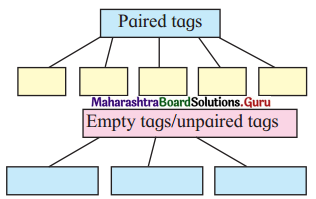
2. Complete the following Activity:

Question 1.
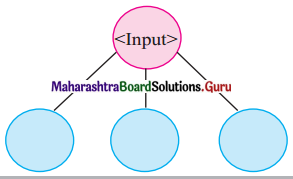
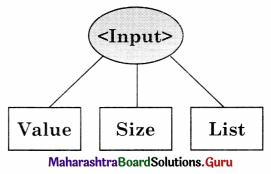
State at least three attributes of <Input>
Maharashtra Board Class 11 Information Technology Solutions Chapter 3 Impressive Web Designing 2 Q1
Answer:
Maharashtra Board Class 11 Information Technology Solutions Chapter 3 Impressive Web Designing 2 Q1.1

Question 2.
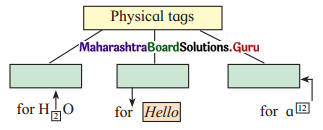
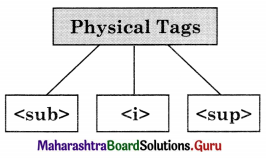
Maharashtra Board Class 11 Information Technology Solutions Chapter 3 Impressive Web Designing 2 Q2
Answer:
Maharashtra Board Class 11 Information Technology Solutions Chapter 3 Impressive Web Designing 2 Q2.1

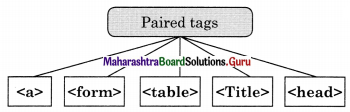
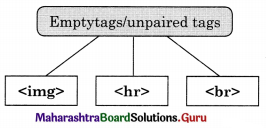
Question 3.
Group the Following.
Maharashtra Board Class 11 Information Technology Solutions Chapter 3 Impressive Web Designing 2 Q3
Answer:
Maharashtra Board Class 11 Information Technology Solutions Chapter 3 Impressive Web Designing 2 Q3.1
Maharashtra Board Class 11 Information Technology Solutions Chapter 3 Impressive Web Designing 2 Q3.2

Maharashtra Board Class 11 Information Technology Solutions Chapter 3 Impressive Web Designing

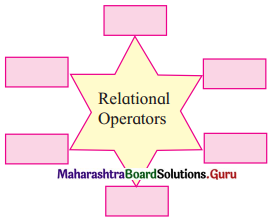
Question 4.
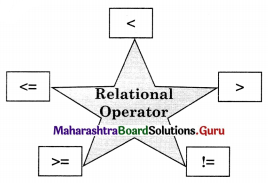
Write operator names with symbols in boxes.
Maharashtra Board Class 11 Information Technology Solutions Chapter 3 Impressive Web Designing 2 Q4
Answer:
Maharashtra Board Class 11 Information Technology Solutions Chapter 3 Impressive Web Designing 2 Q4.1

Question 5.
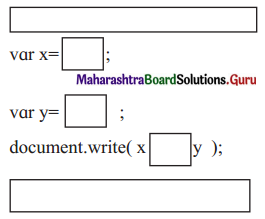
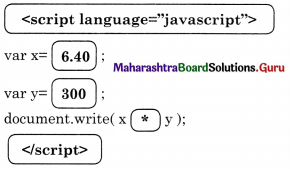
Complete following program to display multiplication of 6.40 and 300.
<!DOCTYPE html>
<html>
<head><title> Series </title></head>
<body>
Maharashtra Board Class 11 Information Technology Solutions Chapter 3 Impressive Web Designing 2 Q5
</html>
Answer:
<!DOCTYPE html>
<html>
<head><title> Series </title></head>
<body>
Maharashtra Board Class 11 Information Technology Solutions Chapter 3 Impressive Web Designing 2 Q5.1
</html>

3. Find out errors if any in the following javascript code.

Question 1.
var length, breadth;
length=4.5;
breadth=6;
area=1/2*length*breadth;
document.write(“Area of triangle is”area);
Answer:
Concatenate Operator ‘+’ is missing
document. write(“Area of triangle is” [+] area);

Maharashtra Board Class 11 Information Technology Solutions Chapter 3 Impressive Web Designing

4. Solve the following puzzles.

Question A.
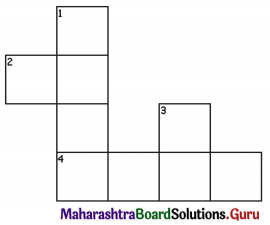
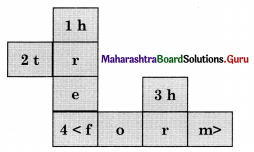
Fill the blocks
Maharashtra Board Class 11 Information Technology Solutions Chapter 3 Impressive Web Designing 4 Q1
1) Across
2. The tag is used to create a table row.
4. Tag to create a form

2) Down
1. The attribute is used to specify the path of a linked document.
3. The tag used to display horizontal ruled line
Answer:
Maharashtra Board Class 11 Information Technology Solutions Chapter 3 Impressive Web Designing 4 Q1.1
Across
2. <tr>
4. <form>
Down
1. href
3. <hr>

Question B.
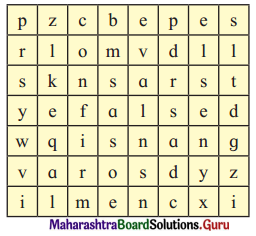
Solve the puzzle by finding words with the help of the hint given below.
Maharashtra Board Class 11 Information Technology Solutions Chapter 3 Impressive Web Designing 4 Q2
1. Boolean value.
2. Keyword used in conditional if statement.
3. Built-In function in JavaScript
4. Function to check given value is number or not
5. Keyword used to declare a variable
6. Function used to evaluate given expression
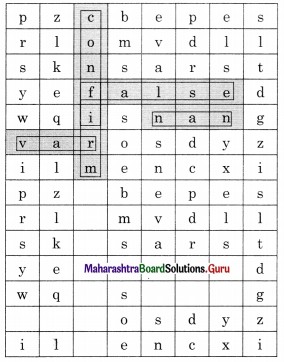
Answer:
Maharashtra Board Class 11 Information Technology Solutions Chapter 3 Impressive Web Designing 4 Q2.1
1. False
2. if
3. confirm
4. nan
5. var
6. False

Maharashtra Board Class 11 Information Technology Solutions Chapter 3 Impressive Web Designing

5. Trace the output of the following Html code.

Question 1.
<!DOCTYPE html>
<html>
<head>
<title>Heading tags</title></head>
<body>
<h1 align=left>Information Technology</h1>
<hr>
<h2 align=center>XI Standard</h2>
<h3 align=right>Division</h3>
</body>
</html>
Answer:
Maharashtra Board Class 11 Information Technology Solutions Chapter 3 Impressive Web Designing 5 Q1

6. Discuss the following and answer the questions.

Question 1.
A Jr. web designer wants to design a webpage to enter the employee’s name, address. He needs a button to clear the form content and submit the data.
Write the different controls he will use to create the web page.
State the tags to be used for the controls.
Answer:
A Junior Web designer will use the following controls to design web as follows:
1. Text – to create a single-line textbox for employee name
2. Text or Textarea – If he wants to create a single-line address the text control is used otherwise to create a multiline address textarea is used.
3. Submit – It is used to submit form data to the server.
4. Reset – It is used to clear form data.

Tags used for the controls are-
1. Employee Name :<Input type-”text”>
2. Address :<Input type=”text”> or
Address: <textarea rows=”4” cols-”30”><textarea>
3. <Input type=”submit” value=”submit”>
4. <Input type-”reset” value=”reset”>

Maharashtra Board Class 11 Information Technology Solutions Chapter 3 Impressive Web Designing

Question 2.
A teacher has asked a student to create a web page to accept numbers and check whether it is between 50 to 100.
List the variable, operators to be used.
Specify the built-in function used and structure used.
Answer:
Program:
<!DOCTYPE html>
<head>
</head>
<body>
<script language =”Javascript”>
//To check whether the given no is between 50 to 100
var n;
n=prompt(“Enter any number”);
if(n<50 | | n>100)
{
alert(“it is less than 50, Please Re-Enter”);
}
else
{
alert(“it is greater than 50. Please Re-Enter”);
}
</script>
</body>
</html>

Variables used ‘n’
Operators used Not is equals | | less then < grater then > etc
Function is Prompt(), Alert() if then Else

7. Create web pages for the following.

Question 1.
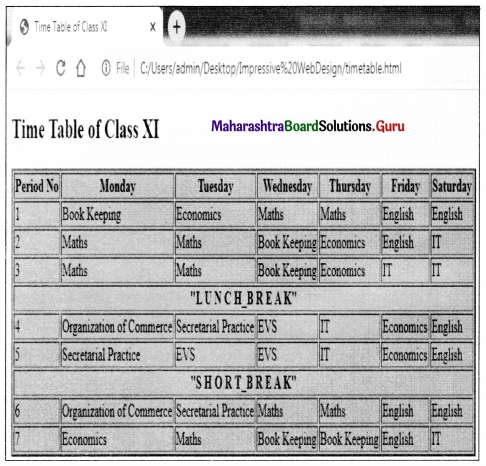
Write a program using HTML to design your class Time Table.
Answer:
Program <!Doctype Html>
<html>
<head><title> Time Table of Class XI</title>
</head>
<body bgcolor=yellow>
<h2>Time Table of Class XI</h2>
<table border=”2” bgcolor=skyblue>
<tr>
<th>Period No</th>
<th>Monday</th>
<th>Tuesday</th>
<th>Wednesday</th>
<th>Thursday</th>
<th>Friday</th>
<th>Saturday</th>
</tr>
<tr>
<td>1</td>
<td>Book Keeping</td>
<td>Economics</td>
<td>Maths</td>
<td>Maths</td>
<td>English</td>
<td>English</td>
</tr>
<tr>
<td>2</td>
<td>Maths</td>
<td>Maths</td>
<td>Book Keeping</td>
<td>Economics</td>
<td>English</td>
<td>IT</td>
</tr>
<tr>
<td>3</td>
<td>Maths</td>
<td>Maths</td>
<td>Book Keeping</td>
<td>Economics</td>
<td>IT</td>
<td>IT</td>
</tr>
<tr>
<th colspan=”7”>”L U N C H_B R E A K”</th>
</tr>
<tr>
<td>4</td>
<td>Organization of Commerce</td>
<td>Secretarial Practice</td>
<td>EVS</td>
<td>IT</td>
<td>Economics</td>
<td>English</td>
</tr>
<tr>
<td>5</td>
<td>Secretarial Practice</td>
<td>EVS</td>
<td>EVS</td>
<td>IT</td>
<td>Economics</td>
<td>English</td>
<tr>
<th colspan=”7”>”S H O R T_B R E A K”</th>
</tr>
<tr>
<td>6</td>
<td>Organization of Commerce</td>
<td>Secretarial Practice</td>
<td>Maths</td>
<td>Maths</td>
<td>English</td>
<td>English</td>
</tr>
<tr>
<td>7</td>
<td>Economics</td>
<td>Maths</td>
<td>Book Keeping</td>
<td>English</td>
<td>IT</td>
</tr>
</table>
</body>
</html>

Maharashtra Board Class 11 Information Technology Solutions Chapter 3 Impressive Web Designing 7 Q1

Maharashtra Board Class 11 Information Technology Solutions Chapter 3 Impressive Web Designing

Question 2.
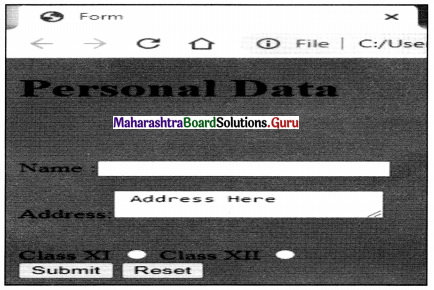
Write a program using HTML to create a form and submit it with personal data like name, address, and standard.
Answer:
Program:
<!DOCTYPE html>
<head>
<title> Form</title>
</head>
<body bgcolor=”#FF0100”>
<h1>Personal Data</h1><br><br><br>
Name :<input type=text name=t1><br><br>
Address:<Textarea> Address Here </textarea><p><br>
Class XI <input type=radio name=c1 value=xi>
Class XII <input type=radio name=c1 value=xii><br>
<input type=Submit name=b1 value=Submit>
<input type=reset name=b2 value=Reset>
</body>
</html>

Output:
Maharashtra Board Class 11 Information Technology Solutions Chapter 3 Impressive Web Designing 7 Q2

Question 3.
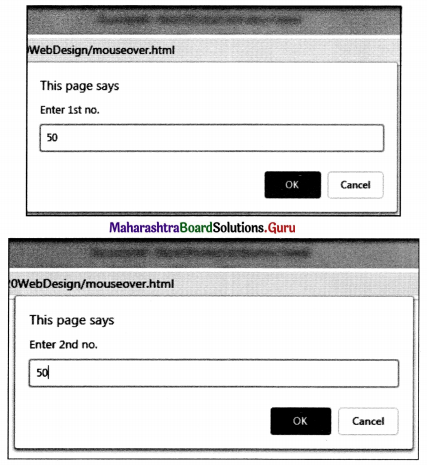
Write a javascript program to accept two numbers and perform the addition of two numbers by using the mouseover event.
Answer:
<html>
<head>
<title> JavaScript Program </title>
<script language = “JavaScript”>
function iload()
{
var c=0
a=parseInt(prompt(“Enter 1st no.”));
b=parseInt(prompt(“Enter 2nd no.”));
c=a+b
document.write(“Addition is”+c);
}
</script>
</head>
<body><center><br><br><br><br><br>
<a onMouseover=”iload();”>Addition</a></center>
</body>
</html>

Maharashtra Board Class 11 Information Technology Solutions Chapter 3 Impressive Web Designing 7 Q3
Maharashtra Board Class 11 Information Technology Solutions Chapter 3 Impressive Web Designing 7 Q3.1

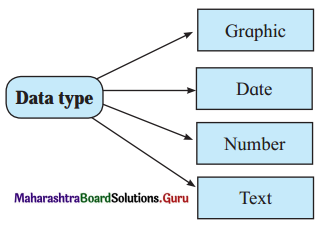
8. Complete the following.

Question 1.
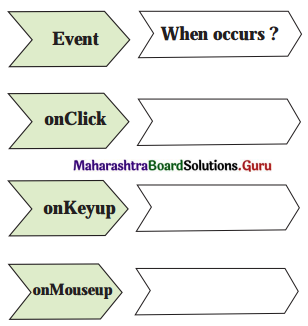
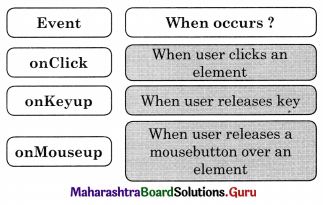
Maharashtra Board Class 11 Information Technology Solutions Chapter 3 Impressive Web Designing 8 Q1
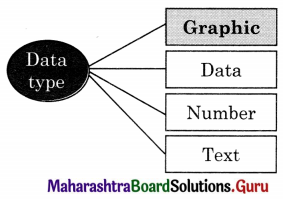
Answer:
Maharashtra Board Class 11 Information Technology Solutions Chapter 3 Impressive Web Designing 8 Q1.1

Maharashtra Board Class 11 Information Technology Solutions Chapter 3 Impressive Web Designing

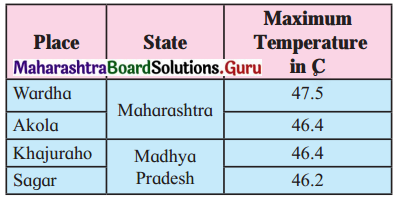
9. Write HTML Code for the following table.

Question 1.
Maharashtra Board Class 11 Information Technology Solutions Chapter 3 Impressive Web Designing 9 Q1
Answer:
<!DOCTYPE html>
<head>
<title>Html Program </title>
</head>
<BODY>
<table border=”1”>
<tr bgcolor=pink>
<th>Place</th>
<th>State</td>
<th>Max <br>Temperature <br>in C</th>
</tr>
<tr align=center bgcolor=skyblue>
<td>Wardha</td>
<th rowspan=”2”>Maharashtra</th>
<td>47.5</td>
</tr>
<tr align=center bgcolor=skyblue>
<td>Akola</td><td>46.4</td>
</tr>
<tr align=center bgcolor=skyblue>
<td>Khajuraho</td>
<th rowspan=”2”>Madhya Pradesh</th>
<td>46.4</td>
</tr>
<tr align=center bgcolor=skyblue>
<td>Sagar</td><td>46.2</td>
</tr>
</table>
</body>
</html>

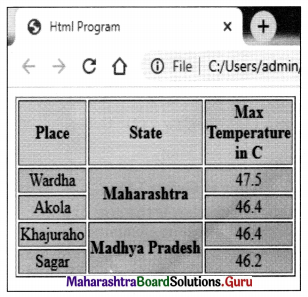
Maharashtra Board Class 11 Information Technology Solutions Chapter 3 Impressive Web Designing 9 Q1.1

10. Multiple choice one correct answer.

Question 1.
The default method of submitting form data is __________
(a) Post
(b) Get
(c) Submit
(d) Reset
Answer:
(b) Get

Maharashtra Board Class 11 Information Technology Solutions Chapter 3 Impressive Web Designing

Question 2.
In JavaScript the post increment operator is __________
(a) x++
(b) x–
(c) –x
(d) ++x
Answer:
(a) x++

Information Technology 11th Std Commerce 

11th Information Technology Chapter 2 Exercise Introduction to DBMS Practical Problems Solutions Maharashtra Board

Introduction to DBMS 11th Information Technology Chapter 2 Solutions Maharashtra Board

Balbharati Maharashtra State Board Class 11 Information Technology Solutions Chapter 2 Introduction to DBMS Textbook Exercise Questions and Answers.

Class 11 Information Technology Chapter 2 Exercise Solutions

1. Complete the following activity.

Question 1.
Tick whichever box is not valid.
Maharashtra Board Class 11 Information Technology Solutions Chapter 2 Introduction to DBMS 1 Q1
Answer:
Maharashtra Board Class 11 Information Technology Solutions Chapter 2 Introduction to DBMS 1 Q1.1

Question 2.
The student wants to create a field Pincode in a table, which data type he will choose?
Maharashtra Board Class 11 Information Technology Solutions Chapter 2 Introduction to DBMS 1 Q2
Answer:
Int

Maharashtra Board Class 11 Information Technology Solutions Chapter 2 Introduction to DBMS

Question 3.
Tick the appropriate box.
Maharashtra Board Class 11 Information Technology Solutions Chapter 2 Introduction to DBMS 1 Q3
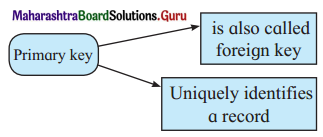
Answer:
Uniquely identifies a record

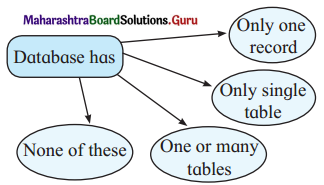
Question 4.
Tick the appropriate circle.
Maharashtra Board Class 11 Information Technology Solutions Chapter 2 Introduction to DBMS 1 Q4
Answer:
One or Many Tables

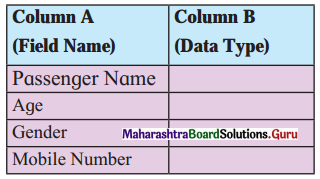
2. Observe the field names of a database given below in ‘Column A’ related to Bus reservation. Write suitable data types for each field in front of the respective field in ‘Column B’.

Question 1.
Maharashtra Board Class 11 Information Technology Solutions Chapter 2 Introduction to DBMS 2 Q1
Answer:

Column A (Field Name) Column B (DataType)
Passenger Name Varchar
Age Int
Gender Char
Mobile Number Int

Maharashtra Board Class 11 Information Technology Solutions Chapter 2 Introduction to DBMS

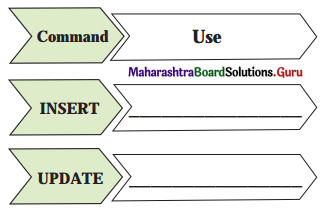
3. Write the use of the following SQL command.

Question 1.
Maharashtra Board Class 11 Information Technology Solutions Chapter 2 Introduction to DBMS 3 Q1
Answer:
Maharashtra Board Class 11 Information Technology Solutions Chapter 2 Introduction to DBMS 3 Q1.1

4. Create a table for the information given below by choosing appropriate data types. Specify proper primary key for the table (1) Movie (2) Actor

Question 1.
Movie (Registeration_no, movie_name, Realease_Date)
Answer:
CREATE TABLE Movie (Registeration_no int(20) PRIMARY KEY, movie_name VARCHAR(20), Realease_Date DATE);

Question 2.
Actor (actor_id, Actor_name, birth_date )
Answer:
CREATE TABLE Actor (actor_id int(20) PRIMARY KEY, Actor_name VARCHAR(20), Birth_Date DATE);

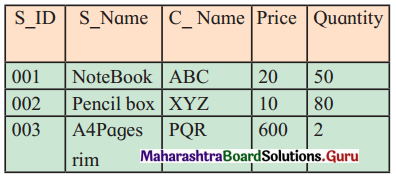
5. Consider the following table Stationary. Write SQL commands for the following statements.

Table: Stationary
Maharashtra Board Class 11 Information Technology Solutions Chapter 2 Introduction to DBMS 5 Q1

Question 1.
Write SQL command to create above Table.
Answer:
CREATE TABLE Stationary (S_ID int(20) PRIMARY KEY, S_Name VARCHAR(20), C_Name VARCHAR(20), Price int(20), Quantity int(20));

Question 2.
Write SQL command to insert the above-mentioned record in the table.
Answer:
INSERT INTO Stationary Values (001, ‘Note Book’, ‘ABC’, 20,50);
INSERT INTO Stationary Values (002, ‘Note Book’, ‘XYZ’, 10,80);
INSERT INTO Stationary Values (003, ‘Note Book’, ‘PQR’, 600,02);

Maharashtra Board Class 11 Information Technology Solutions Chapter 2 Introduction to DBMS

Question 3.
To delete the above table.
Answer:
DROP TABLE Stationery;

6. Answer the following questions.

Question 1.
What is a database?
Answer:
A DBMS is a collection of programs (computer-based system) that enables the user to create and maintain a database it is used to define, construct and manipulate the data in the database for various applications. It provides information storage, organization, and retrieval capabilities. The DBMS also enforces necessary access restrictions and security measures in order to protect the database.

Various types of control systems within the DBMS make sure that the database continues to function properly. They Include Integrity system Security system Concurrency control system Recovery control system Some DBMS enables us to define “views” of the database. A view is how the database appears to the user. This enables us to show only the relevant information to different types of users and it increases security, as certain users will not be able to see data which they are not meant to see.

Question 2.
What are the advantages of a DBMS?
Answer:
Advantages of a DBMS:
1. Redundancy is controlled: In File Processing System, duplicate data is created in many places because all the programs have their own files. This creates data redundancy which in turn wastes labor and space. ‘In Database Management System, all the files are integrated into a single database. The whole data is stored only once in a single place so there is no chance of duplicate data.

2. Sharing of Data: In a database, the users of the database can share the data among themselves. There are various levels of authorization to access the data. And consequently, the data can only be shared based on the correct authorization protocols being followed.

3. Data Security: Data Security is a vital concept in a database. Only authorized users should be allowed to access the database and their identity should be authenticated using a username and password. Unauthorized users should not be allowed to access the database under any circumstances as it violates the integrity constraints.

4. Enforces integrity constraints: Constraints are used to store accurate data because there are many users who feed data in the database. Data stored in the database should always be correct and accurate. DBMS provides the capability to enforce these constraints on the database.

5. Provides backup and recovery of data: Data loss is a very big problem for all organizations. In a traditional tile processing system, a user needs to back up the database after a regular interval of time that wastes lots of time and resources. If the volume of data is large then this process may take a very long time.

Question 3.
What do you understand by Data Model?
Answer:
A Database model defines the logical design and structure of a database and defines how data will be stored, accessed, and updated in a database management system. While the Relational Model is the most widely used database model.

Relational Model:
It is the most popular data model in DBMS. The relational model is the primary data model. Which is widely used for data processing. This model has all properties required to Process data with storage efficiency.

Maharashtra Board Class 11 Information Technology Solutions Chapter 2 Introduction to DBMS

Question 4.
What is a primary key?
Answer:
Primary Key: A column in the table that uniquely identifies each row in that table is called a primary key.

Question 5.
What is DDL (Data Definition Language)
Answer:
DDL statements or commands are used to define and modify the database structure of your tables or schema. When you execute a DDL statement, it takes effect immediately.
Some examples of DDL commands are CREATE, ALTER, and DROP.

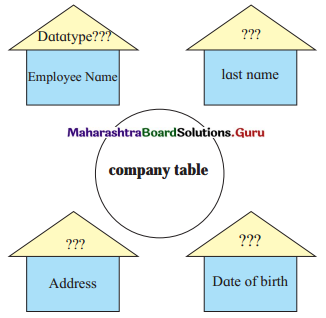
7. In a company the data is stored in a table under the following fields Employee number, Last name, Date of birth, Address. Which data type will you use for the above field?

Question 1.
Maharashtra Board Class 11 Information Technology Solutions Chapter 2 Introduction to DBMS 7 Q1
Answer:

Field Name Data Type
Employee Name Char
Last Name Char
Address Varchar
Date of Birth Date

8. Multiple choice select three correct answers.

Question 1.
Valid relationships in RDBMS are
(a) one to one
(b) one to two
(c) one to many
(d) many to two
(e) many to many
(f) one to three
Answer:
(a) one to one, (c) one to many, (e) many to many

Maharashtra Board Class 11 Information Technology Solutions Chapter 2 Introduction to DBMS

9. Complete the following.

Question 1.
Maharashtra Board Class 11 Information Technology Solutions Chapter 2 Introduction to DBMS 9 Q1
Answer:

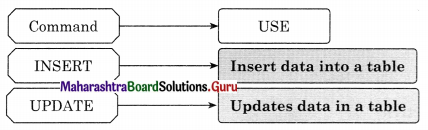
Use Command
To remove access rights or privileges from the database Revoke
Extracts data from a table Insert into Select

Information Technology 11th Std Commerce 

11th Information Technology Chapter 1 Exercise Basics of Information Technology Practical Problems Solutions Maharashtra Board

Basics of Information Technology 11th Information Technology Chapter 1 Solutions Maharashtra Board

Balbharati Maharashtra State Board Class 11 Information Technology Solutions Chapter 1 Basics of Information Technology Textbook Exercise Questions and Answers.

Class 11 Information Technology Chapter 1 Exercise Solutions

1. Complete the following activity.

Question 1.
Maharashtra Board Class 11 Information Technology Solutions Chapter 1 Basics of Information Technology 1 Q1
Answer:
Maharashtra Board Class 11 Information Technology Solutions Chapter 1 Basics of Information Technology 1 Q1.1

Question 2.
Tick the appropriate box.
Internet is a ____________ network connecting millions of computer.
Maharashtra Board Class 11 Information Technology Solutions Chapter 1 Basics of Information Technology 1 Q2
Answer:
Global

Maharashtra Board Class 11 Information Technology Solutions Chapter 1 Basics of Information Technology

Question 3.
Maharashtra Board Class 11 Information Technology Solutions Chapter 1 Basics of Information Technology 1 Q3
Answer:
Maharashtra Board Class 11 Information Technology Solutions Chapter 1 Basics of Information Technology 1 Q3.1

Question 4.
Tick the appropriate box.
Maharashtra Board Class 11 Information Technology Solutions Chapter 1 Basics of Information Technology 1 Q4
Answer:
Maharashtra Board Class 11 Information Technology Solutions Chapter 1 Basics of Information Technology 1 Q4.1

Question 5.
Maharashtra Board Class 11 Information Technology Solutions Chapter 1 Basics of Information Technology 1 Q5
Answer:
Maharashtra Board Class 11 Information Technology Solutions Chapter 1 Basics of Information Technology 1 Q5.1

Maharashtra Board Class 11 Information Technology Solutions Chapter 1 Basics of Information Technology

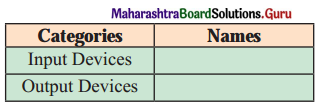
2. Divide the following list of devices into appropriate categories.

Question 1.
Monitor, Barcode reader, Printer, Keyboard. Optical character reader, Speaker
Maharashtra Board Class 11 Information Technology Solutions Chapter 1 Basics of Information Technology 2 Q1
Answer:

Categories Names
Input Devices Barcode reader, Keyboard, Optical Character reader
Output Devices Monitor, Printer, Speaker

3. Multiple choice two correct answers.

Question 1.
The primary memory consists of ____________ and ____________
(a) Pendrive
(b) Hard Disk
(c) RAM
(d) Scanner
(e) ROM
Answer:
(c) RAM, (e) ROM

Question 2.
The network architectures which are widely used are ____________
(a) Server
(b) Client
(c) Peer to peer
(d) Client-server
(e) Internet
Answer:
(c) Peer to peer, (d) Client-server

4. Match the following.

Question 1.

1. IS (a) change directory
2. FTP (b) Translates Network Address
3. CD (c) List of Directory
4. DNS (d) To transfer file on interent

Answer:

1. IS (c) List of Directory
2. FTP (d) To transfer file on interent
3. CD (a) change directory
4. DNS (b) Translates Network Address

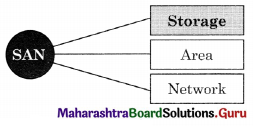
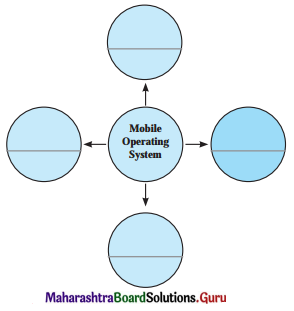
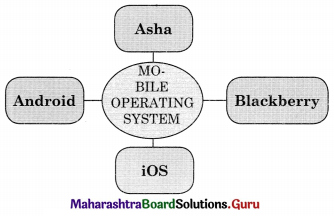
5. Name the following and complete the diagram.

Question 1.
Maharashtra Board Class 11 Information Technology Solutions Chapter 1 Basics of Information Technology 5 Q1
Answer:
Maharashtra Board Class 11 Information Technology Solutions Chapter 1 Basics of Information Technology 5 Q1.1

6. Complete the following with Linux commands with their use.

Question 1.
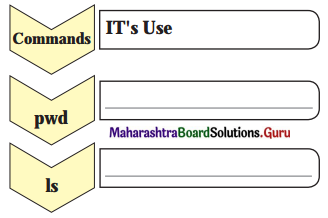
Maharashtra Board Class 11 Information Technology Solutions Chapter 1 Basics of Information Technology 6 Q1
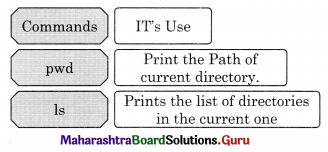
Answer:
Maharashtra Board Class 11 Information Technology Solutions Chapter 1 Basics of Information Technology 6 Q1.1

Maharashtra Board Class 11 Information Technology Solutions Chapter 1 Basics of Information Technology

7. Complete the list of the following protocols.

Question 1.
Maharashtra Board Class 11 Information Technology Solutions Chapter 1 Basics of Information Technology 7 Q1
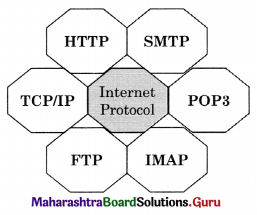
Answer:
Maharashtra Board Class 11 Information Technology Solutions Chapter 1 Basics of Information Technology 7 Q1.1

8. Complete the following Long form.

Question 1.
Maharashtra Board Class 11 Information Technology Solutions Chapter 1 Basics of Information Technology 8 Q1
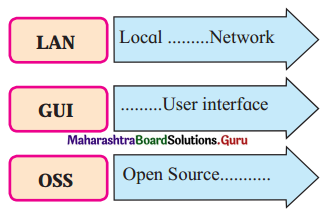
Answer:
Maharashtra Board Class 11 Information Technology Solutions Chapter 1 Basics of Information Technology 8 Q1.1

9. Identify the following activity.

Question 1.
You are typing a letter using a computer and suddenly there is a power failure.
Which type of Memory does this activity deal with?
Answer:
Random Access Memory

10. Answer the following.

Question 1.
What are Data and Information? Give examples of data and information.
Answer:
Data can be any character, text, word, number, or raw facts.
Example of Data:
Mumbai, 1234, Aditya, MG Road, Maharashtra, 9444444441, 411004

Information is data formatted in a manner that allows it to be utilized by human beings in some significant way.
Example of Information:
Aditya, 1234, MG Road, Mumbai 400004, Maharashtra, 944444444114.

Maharashtra Board Class 11 Information Technology Solutions Chapter 1 Basics of Information Technology

Question 2.
Explain functional units of a computer system.
Answer:
The computer system has the following three basic components:
Input Unit:
An input device is any hardware device that sends data to a computer, allowing you to interacts with and controls it. Data can be in the form of words, symbols, numbers, etc. The function of the input device is to direct commands and data into the computer.
For example keyboard, mouse, scanners, digital cameras, joysticks, and microphones.

Central Processing Unit:
After receiving data and commands from the user, a computer system has to process the instructions provided using Central Processing Unit (CPU). It has three elements:

(a) Arithmetic and Logic Unit: An arithmetic logic unit (ALU) is a major component of the central processing unit of a computer system. It does all processes related to arithmetic and logic operations like add, subtract, multiply, etc.

(b) Control Unit: The control unit (CU) is a component of a computer’s central processing unit (CPU) that directs the operation of the processor. It tells the computer’s memory, arithmetic, and logic unit, and input and output devices how to respond to the instructions that have been sent to the processor.

(c) Memory Unit: A memory unit is the amount of data that can be stored in the storage unit. Once the data has been entered using input devices, the system stores the data in the memory unit.

Types of Memory: Primary Memory & Secondary Memory.

  • Primary Memory: It has 18 internal memory of the computer also known as main memory. It is of two types RAM and ROM.
  • RAM (Random Access Memory): RAM stands for Random Access Memory also known as reading/write memory. Information stored in this memory is lost as the power supply to the computer is switched off; it is also called “Volatile Memory”.
  • ROM(Read Only Memory): ROM stands for Read-Only Memory. ROM is a permanent type of memory. The contents are not lost as the power supply to the computer is switched off. ROM cannot be overwritten by the computer. It is also called “Non Volatile Memory”.
  • Secondary Memory: It is the external memory of the computer which is used to store a large amount of data. The secondary storage devices are a Hard disk, Pen drive, CD, DVD, etc.

Output Unit:
An output device is any device used to send data from a computer to another device or user. Most computer data output that is ‘meant for humans is in the form of audio or video. Thus, most output devices used by humans are in these categories. Examples include monitors, projectors, speakers.

Question 3.
What is a storage unit? Explain types of primary memory storage.
Answer:
When a user enters data using input devices, the computer system stores this data in a memory unit i.e. storage unit. The storage unit uses a set of pre-programmed instructions to further transmit this data to other parts of the CPU. There are two types of memory

  • Primary Memory
  • Secondary Memory

RAM: It stands for Random Access Memory. RAM is known as reading/write memory. It is the main memory of the computer system. The information stored in this memory is lost as the power supply to the computer is switched off, so it is also called as “Volatile Memory”.

ROM: It stands for Read-Only Memory. ROM is permanent memory. The content is not lost when the power supply is switched off. ROM cannot be overwritten by the computer, so it is also called “Non-Volatile Memory”.

Maharashtra Board Class 11 Information Technology Solutions Chapter 1 Basics of Information Technology

Question 4.
Explain how Linux is different from Windows.
Answer:

  • Linux is open sources system whereas the window operating system is commercial.
  • Linux has access to source code and alters the code as per user need whereas a window does not have access to source code.
  • Linux distribution doesn’t collect user data” whereas Windows collects all the user details which leads to privacy concerns.
  • As the software is open to the public, it constantly updates, improves, and expands as more people can work on its improvement.

Question 5.
Write down the difference between LAN, MAN, and WAN.
Answer:

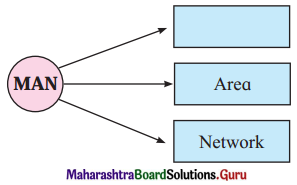
LAN (Local Area Network) MAN (Metropolitan Area Network) WAN (Wide Area Network)
LAN Stands for Local Area Network. MAN stands for Metropolitan Area Network. WAN stands for Wide Area Network.
A LAN is a network of connected devices that exist within a specific location. A public or private network is used to connect various locations including suburbs in metropolitan cities. A WAN is any network that crosses metropolitan, regional, or national boundaries.
LANs may be found in homes, offices, educational institutions, or other areas. A MAN is a network, which covers an entire city, but uses LAN topology. Most networking professionals define a WAN as any network that uses routers and public network links (e.g. Telephone lines).
LAN is easy to set up. MANs are formed by connecting multiple LANs. Due to long-distance transmission, the noise and errors are more in WAN.
Data transmits at a very fast rate. Examples of a MAN are the cable TV network in a city. The best example of WAN is the Internet.

Information Technology 11th Std Commerce 

11th Secretarial Practice Chapter 11 Exercise Correspondence with Banks Practical Problems Solutions Maharashtra Board

Correspondence with Banks 11th Secretarial Practice Chapter 11 Solutions Maharashtra Board

Balbharti Maharashtra State Board Class 11 Secretarial Practice Solutions Chapter 11 Correspondence with Banks Textbook Exercise Questions and Answers.

Class 11 Secretarial Practice Chapter 11 Exercise Solutions

1A. Select the correct answer from the options given below and rewrite the statements.

Question 1.
A company usually opens _____________ account in a bank.
(a) Current
(b) Saving
(c) Recurring
Answer:
(a) Current

Question 2.
Bank is a _____________ institution.
(a) financial
(b) social
(c) cultural
Answer:
(a) financial

Question 3.
The appointment of banker is usually made by the _____________
(a) Board of Directors
(b) Secretary
(c) Chairman
Answer:
(a) Board of Directors

Maharashtra Board Class 11 Secretarial Practice Solutions Chapter 11 Correspondence with Banks

Question 4.
Resolution for opening Bank Account is passed in the _____________ meeting.
(a) Board
(b) Statutory
(c) Annual General
Answer:
(a) Board

Question 5.
Bank provides overdraft facility to _____________ account holder.
(a) Current
(b) Saving
(c) Fixed Deposit
Answer:
(a) Current

Question 6.
_____________ is used for depositing cash into a bank account.
(a) Pay-in-slip
(b) Withdrawal slip
(c) Cheque
Answer:
(a) Pay-in-slip

Question 7.
Borrowing/Accepting and lending money are considered as _____________ functions of bank.
(a) Primary
(b) Secondary
(c) Agency
Answer:
(a) Primary

Question 8.
Withdrawals are not permitted from the _____________ deposit account.
(a) Fixed
(b) Current
(c) Savings
Answer:
(a) Fixed

Maharashtra Board Class 11 Secretarial Practice Solutions Chapter 11 Correspondence with Banks

Question 9.
_____________ account is suitable to salaried people.
(a) Savings
(b) Current
(c) Fixed
Answer:
(a) Savings

Question 10.
Generally Interest is not paid on _____________ deposit account.
(a) Current
(b) Saving
(c) Fixed
Answer:
(a) Current

Question 11.
A deposit which is kept for fixed period in bank is called _____________ deposit.
(a) Fixed
(b) Current
(c) Recurring
Answer:
(a) Fixed

1B. Match the pairs.

Question 1.

Group ‘A’ Group ‘B’
(a) Lost cheque (1) Board of Directors
(b) Appointment of Banker (2) Higher rate of interest
(c) Cash credit (3) Used for depositing cash and cheque
(d) Fixed Deposit Account (4) Stop Payment
(e) Savings Account (5) Restrictions on withdrawals
(f) Pay-in-slip (6) Separate Account
(g) Overdraft facility (7) Current Account
(8) Recurring Account
(9) Shareholders
(10) No interest is paid
(11) Used for withdrawing amount from the account
(12) Long term credit facility
(13) Certain restrictions on withdrawals
(14) Dealing in foreign exchange

Answer:

Group ‘A’ Group ‘B’
(a) Lost cheque (4) Stop Payment
(b) Appointment of Banker (1) Board of Directors
(c) Cash credit (6) Separate Account
(d) Fixed Deposit Account (2) Higher rate of interest
(e) Savings Account (5) Restrictions on withdrawals
(f) Pay-in-slip (3) Used for depositing cash and cheque
(g) Overdraft facility (7) Current Account

1C. Write a word or a term or a phrase that can substitute each of the following statements.

Question 1.
A slip is used for depositing cash and cheque in the Bank account.
Answer:
Pay-in-slip

Question 2.
Permission to withdraw excess amount from Current Account.
Answer:
Overdraft

Question 3.
Separate loan account under which the short-term loan facility is given by the bank to the business.
Answer:
Cash credit

Maharashtra Board Class 11 Secretarial Practice Solutions Chapter 11 Correspondence with Banks

Question 4.
The short-term credit facility is given by the bank to the current account holder.
Answer:
Overdraft

Question 5.
The account is generally opened by the business organization.
Answer:
Current Account

Question 6.
The request of Secretary to the bank not to make the payment of the cheque.
Answer:
Stop payment request

Question 7.
The type of account for which a higher rate of interest is paid to bank depositors.
Answer:
Fixed Deposit Account

Question 8.
The slip is used for withdrawing money from Savings Account.
Answer:
Withdrawal Slip

Question 9.
Negotiable Instrument which can be discounted with the bank.
Answer:
Bill of exchange

Maharashtra Board Class 11 Secretarial Practice Solutions Chapter 11 Correspondence with Banks

1D. State whether the following statements are True or False.

Question 1.
Joint Stock Company opens Current Account.
Answer:
True

Question 2.
Generally, no interest is paid by the bank on the Current Account.
Answer:
True

Question 3.
In cash credit, the customer’s account is credited by the bank with the sanctioned amount.
Answer:
True

Question 4.
Board resolution is not required to open the Current Account with the bank.
Answer:
False

Question 5.
The bank account of the company is operated by shareholders.
Answer:
False

Question 6.
Overdraft facility is granted to Savings account holders.
Answer:
False

Question 7.
Bank correspondence should be brief and to the point.
Answer:
True

Maharashtra Board Class 11 Secretarial Practice Solutions Chapter 11 Correspondence with Banks

Question 8.
It is necessary to instruct the bank to stop the payment of a cheque that is lost.
Answer:
True

Question 9.
A bank overdraft facility is a long-term facility.
Answer:
False

Question 10.
Banks grant long-term loans only.
Answer:
False

1E. Find the odd one.

Question 1.
Saving Deposit, Recurring Deposit, Cash Credit. Fixed Deposit
Answer:
Cash Credit

Question 2.
Overdraft, Fixed Deposit, Discounting of Bills, Cash Credit
Answer:
Fixed Deposit

1F. Complete the sentences.

Question 1.
A financial institution which receives deposits and lends money is called as _____________
Answer:
Bank

Question 2.
Accepting deposits and lending money are the primary functions of _____________
Answer:
Commercial Bank/Bank

Maharashtra Board Class 11 Secretarial Practice Solutions Chapter 11 Correspondence with Banks

Question 3.
A facility under which a customer can overdraw money from his account is called as _____________
Answer:
Overdraft facility

Question 4.
Overdraft facility is given to _____________
Answer:
Current Account Holder

1G. Select the correct option from the bracket.

Question 1.

Group ‘A’ Group ‘B’
(1) Overdraft …………………………
(2) Primary Function ………………………..
(3) International Trade Transactions ………………………..
(4) ……………………… Current Account

(Accepting Deposits, Current Account, Letter of Credit, Businessman)
Answer:

Group ‘A’ Group ‘B’
(1) Overdraft Current Account
(2) Primary Function Accepting Deposits
(3) International Trade Transactions Letter of Credit
(4) Businessman Current Account

1H. Answer in one sentence.

Question 1.
What is a Letter of Credit?
Answer:
A letter of credit is a payment method generally used for international trade transactions. Letter of credit is issued by a bank on behalf of its client, promising to pay a certain amount of money to the seller, in case the buyer fails to pay it.

Question 2.
Which facility is given to the Current Account holder?
Answer:
Overdraft facility is given to Current Account Holder by the Bank.

Maharashtra Board Class 11 Secretarial Practice Solutions Chapter 11 Correspondence with Banks

Question 3.
What do you mean by stop payment of cheque?
Answer:
When a cheque is issued by the company, there is a possibility of misplacement of the cheque or loss in transit. Then it is necessary to inform the bank to stop payment of such cheque.

1I. Correct the underlined word and rewrite the following sentences.

Question 1.
Accepting deposits is the secondary function of Banks.
Answer:
Accepting deposits is the primary function of Banks.

Question 2.
Businessman opens Fixed Deposit Account.
Answer:
Businessman opens Current Account.

Question 3.
Under cash credit facility businessman/account holder can overdraw from his account.
Answer:
Under an overdraft facility, a businessman/account holder can overdraw from his account.

2. Explain the following terms/concepts.

Question 1.
Bank
Answer:
A bank is a financial institution, in which people deposit their idle or surplus cash, and those who need funds borrow from banks.

Question 2.
Demand Deposits
Answer:
The deposits which are repayable on demand are called Demand Deposits.

Maharashtra Board Class 11 Secretarial Practice Solutions Chapter 11 Correspondence with Banks

Question 3.
Time Deposits
Answer:
The deposits which are not repayable on demand are called Time Deposits.

Question 4.
Savings Deposits
Answer:
To encourage saving habit among the people, the bank allows depositors to open a savings account. There are restrictions on the frequency and amount of withdrawals.

Question 5.
Current Deposits
Answer:
This account is normally opened by businessmen, firms, or companies. There is no limit on the amount or number of withdrawals.

Question 6.
Recurring Deposits
Answer:
The account which encourages the customers to make regular savings and to deposit a fixed sum of money for a specific period of time is called Recurring Deposits.

Question 7.
Fixed Deposits
Answer:
Fixed Deposits are the deposits received for a fixed period. The rate of interest is high for fixed deposits. The longer the period of deposit, the higher is the rate of interest.

Question 8.
Loans
Answer:
A loan granted for a specific time period against personal security, gold or silver, and other moveable or immovable assets is called a term loan.

Question 9.
Advances
Answer:
Advances is a credit facility provided by the bank to its customers. It differs from loans in the sense that loans may be granted for a longer period, while advances are for a shorter period.

Maharashtra Board Class 11 Secretarial Practice Solutions Chapter 11 Correspondence with Banks

Question 10.
Cash Credit
Answer:
Under a cash credit facility, a bank allows the borrower to withdraw amounts up to the specified limit. Such credits are allowed against the security of stock of raw material, finished goods, etc.

Question 11.
Overdraft
Answer:
It is a facility where the bank allows its customers to overdraw an amount up to a particular limit. Such facility is allowed against collateral securities like shares, FDR, LIC Policy, etc.

Question 12.
Discounting of Bill
Answer:
It is a short-term finance facility provided by the bank to its customers by allowing discounting of bills and making payment of bills before their due date.

Question 13.
Letter of Credit
Answer:
A letter of credit is a payment method generally used for international trade transactions. A letter of credit is issued by a bank on behalf of its client, promising to pay a certain amount of money to the seller in case the buyer fails to pay it.

Question 14.
Stop payments of cheque
Answer:
When a cheque is sent by the Company, there is a possibility of misplacement of cheque or loss in transit. In that case, it is necessary to inform the bank to stop the payment of such cheques.

3. Distinguish between the following.

Question 1.
Current Account and Savings Account.
Answer:

Basis Current Account Savings Account
1. Meaning It is a type of bank account that is generally opened by the businessman to carry out their business activities. It is a type of bank account which is opened by salaried and household people with an aim of saving their part of the income and earn interest.
2. Withdrawals There are no restrictions on the number of withdrawals. They can withdraw money by cheque. There are restrictions over the number of withdrawals. They can withdraw money either by cheque or by withdrawal slip.
3. Facilities Such account holder gets the facilities of Passbook, Cheque Book, Statement of Account and Pay-in-Slip Book. Such account holders get the facilities of Passbook, Cheque Book, and Pay-in-Slip Book.
4. Rate of Interest Generally, no interest is allowed on the Current Account. If it is allowed it is a very nominal rate. The rate of interest on the Saving Account is higher than the Current Account but less than fixed deposits.
5. Overdraft facility Overdraft facility is allowed to Current Account holders. Overdraft facility is not allowed to Saving Account holder.
6. Suitability It is suitable for traders, business firms, and institutions. It is suitable for salary earners, households, and fixed income groups.

Maharashtra Board Class 11 Secretarial Practice Solutions Chapter 11 Correspondence with Banks

Question 2.
Loan and Overdraft
Answer:

Basis Loan Overdraft
1. Meaning Amount granted for a specific period of time, against personal security, gold or silver, and other movable or immovable assets is called a loan. Overdraft is a credit facility granted by the bank to Current account holders. Under an overdraft facility, the bank allows its customers to overdraw an amount up to a particular limit.
2. Eligibility Savings account, Fixed, Recurring, and Current account holders are eligible for the loan facilities. Only Current account holders are eligible for an overdraft facility.
3. Duration The loan is a long period facility. Overdraft is a short period facility.
4. Purpose The purpose is to meet long-term requirements. The purpose is to meet short-term working capital requirements.
5. Repayment The amount of the loan may be repaid in installments or in a lump sum on its due date. The amount of overdraft is adjusted against the balance of Deposits in the Current account.
6. Security It is provided against personal security, gold or silver, and other movable or immovable assets. It is provided against collateral securities like shares, FDR, LIC Policy, etc.

Question 3.
Fixed Deposit Account and Recurring Deposit Account.
Answer:

Basis Fixed Deposit Account Recurring Deposit Account
1. Meaning Fixed Deposits are the deposits received for a fixed period of time. A Recurring Deposit account is that account where depositors regularly deposit a fixed amount for a specific period of time.
2. Facilities The bank gives a Fixed Deposit Receipt to the Fixed Deposit holders. The bank gives a Pass Book and Pay-in-Slip book to Recurring Deposit holders.
3. Rate of Interest The rate of interest allowed is higher. The longer the period of deposit, the higher will be the rate of interest. The rate of interest is less than Fixed Deposit Account.
4. Suitability It is suitable for those people having surplus income in hand. It is suitable for fixed-income groups and lower-income groups.

4. Answer in brief.

Question 1.
What are the points to be kept in mind by a Secretary while corresponding with Banks?
Answer:
The following precautions must be taken by the secretary while corresponding with banks:

  • Prompt reply: For any correspondence with the bank, the reply must be sent without delay is the responsibility of a secretary.
  • Brevity/Conciseness: Secretary should provide maximum information in minimum words. A letter should not be lengthy. Unnecessary details, irrelevant information or explanation, lengthy paragraphs should be avoided.
  • Courtesy: The letter to the bank should show empathy, respect, and mutual understanding. It is helpful for getting favourable responses and built up goodwill for the organization.
  • Accuracy: While corresponding with Bank ‘Accuracy’ and ‘Perfectness’ are very important. Whatever information or data provided must be accurate. No haphazard remarks or statements are to be made.
  • Clarity: The secretary must provide true, factual updates and clear information about his organization to the banker. Clarity is required to avoid misunderstandings with bankers.

Question 2.
Under what circumstances will a secretary correspond with the Banks?
Answer:
The following are the circumstances under which a secretary has to correspond with the banks:
(i) Letter for opening a Current Account with the Bank:
The decision of opening a Current account is taken in the Board meeting by passing a resolution. The Board instructs the secretary for opening a Current account. The Secretary has to write a letter to the Bank accordingly and enclose the necessary documents.

(ii) Letter requesting a bank to stop payment of cheque:
When cheques are sent by Companies, there are possibilities of misplacement of cheques or loss in transit. Thus, it is necessary to inform the bank to stop the payment of such cheques.

(iii) Letter requesting a Bank for granting an overdraft facility:
Certain credit facilities are provided by the Bank to their customers. The Bank allows a Current Account holder to withdraw excess amount than the available balance. Secretary has to correspond with the bank to prevail this facility.

(iv) Letter requesting bank to issue a letter of credit:
A letter of credit is a payment method generally used for international trade transactions. Letter of credit is issued by Bank on behalf of its client promising to pay a certain amount of money to the seller in case the buyer fails to pay it. Secretary has to correspond with the bank to obtain this letter of credit.

Maharashtra Board Class 11 Secretarial Practice Solutions Chapter 11 Correspondence with Banks

Question 3.
State the agency functions of Banks.
Answer:
Agency functions of banks are part of secondary functions.
Following are the agency functions of the Bank:

  • Bank collects the cheques and Bill of Exchange on behalf of the customers or account holders.
  • Bank collects dividends, interest, and salary and credits the account holder’s account.
  • Bank makes payment of rent, insurance premium, electricity bill, etc.
  • Bank act as a Depository Participant for purchase and sale of securities.
  • Transfer of money.
  • Fulfill standing instructions of depositors.
  • The bank acts as a trustee, an executor of the will, and an attorney for the account holder.
  • The bank acts as a Banker to the issue, Lead Manager, etc. for the companies.

Question 4.
State the utility functions of Banks.
Answer:
Commercial Bank provides general utility services to their customers or account holders to attract customers.
Utility functions of Banks are as follows:

  • Provide locker facility to customer utility function of banks are as follows.
  • Provide a letter of credit facility to account holders for international business transactions.
  • Helps to deal in Foreign Exchange.
  • Provide Credit cards, Debit cards, and A.T.M. facilities.
  • To assist in the purchase and sale of securities.
  • Provide traveler’s cheque to customers.

Question 5.
Explain the different types of Deposits.
Answer:
The Bank accepts two types of deposits from the people.
(i) Demand Deposits:
Demand Deposits are deposits, where money is repaid by the bank on the demand made by the depositors or customers of the bank.

Such deposit accounts are:
(a) Savings Deposits:
As the name indicate this account is opened and operated by that person who have regular and fixed income e.g. salary. In order to ‘save’ something out of current income, this account is opened.
Features of this account are:

  • It is mainly for saving purposes.
  • Money can be withdrawn on demand.
  • Minimum balance must be maintained.

(b) Current Deposits:
This account is opened by the businessman, firm, company, etc. for business purposes. There is no limit on the number of withdrawals. Generally, interest is not payable on this account. Overdraft facilities are also allowed to these depositors.

(ii) Time Deposits:
The deposits which are not repayable on demand are called ‘Time Deposits’. These deposits are payable after a specific period of time.

  • Fixed Deposits: In this deposit account, a certain sum is kept deposited for a fixed period. A higher rate of interest is paid on Fixed Deposit.
  • Recurring Deposits: In this deposit account, the customer deposit’s fixed amount on regular basis for a specific period. The money is deposited periodically. The rate of interest is more than Saving Deposits.

Maharashtra Board Class 11 Secretarial Practice Solutions Chapter 11 Correspondence with Banks

5. Justify the following statements.

Question 1.
The secretary has to correspond with the Banks under certain circumstances.
Answer:
Following are the circumstance under which a secretary has to enter into correspondence with banks:

  • Letter for opening a Current account with Bank.
  • Letter requesting a bank to stop payment of the cheque.
  • Letter requesting a bank for granting overdraft facility.
  • Letter requesting a bank to issue a letter of credit.
  • Letter to a bank enquiring about new banking facilities.
  • Letter to the bank for a long-term loan.
  • Thus, the secretary has to correspond with the Banks under certain circumstances.

Question 2.
The secretary should observe certain precautions while corresponding with the Banks.
Answer:
The following precautions must be taken by the secretary while corresponding with the banks:

  • Secretary should give a prompt reply.
  • Secretary should take care that the letter should not be lengthy.
  • Unnecessary details should be avoided.
  • Not to use any harsh or rude words while corresponding with the banker.
  • Provide true factual updates and clear information about his organization to the bankers.
  • Thus, the secretary should observe certain precautions while corresponding with the Banks.

Question 3.
The primary functions of Commercial Banks include-Accepting deposits and Lending funds.
Answer:
The main object of a commercial bank is to accept deposits and lending money to customers or account holders:

  • To encourage the people who have surplus funds.
  • To encourage the saving habit among the people.
  • To give support to businessmen for opening a current account.
  • To encourage people to make regular savings.
  • To lend loans and advances through various modes i.e. short-term loan, medium-term loan, long term loan, overdraft facility, cash credit facility, and discounting of the bill of exchange, etc.
  • Thus, the primary functions of Commercial Banks include-Accepting deposits and Lending funds.

Maharashtra Board Class 11 Secretarial Practice Solutions Chapter 11 Correspondence with Banks

Question 4.
The Bank accepts two types of deposits from the public i.e. Demand and Time Deposits.
Answer:

  • The basic aim of the bank is to pool the excess money to the bank and develop the habit of saving amount people.
  • Bank accepts deposits in two forms i.e. Demand Deposits and Time deposits.
  • Demand Deposits include – Current Deposits and Savings Deposits.
  • Time Deposits includes – Fixed Deposits and Recurring Deposits
  • Thus, the Bank accepts two types of deposits from the public i.e. Demand and Time Deposits.

Question 5.
There is a difference between Loans and Advances given by the Bank.
Answer:

  • Bank lends money in two ways – i.e. Loans and Advance.
  • The loan is granted for a specific period of time against personnel security, gold or silver, and other movable or immovable properties.
  • Advances is a credit facility provided by the bank to its customers against collateral securities like – shares, Government shares, F.D.R., L.I.C. Policy, Stock of raw materials, or finished goods.
  • Loans are granted for a longer period while Advances are granted for a shorter period.
  • Loans may be short-term, medium-term, or long-term while advances are in form of overdraft, cash credit, and discounting of bills.
  • Thus, there is a difference between Loans and Advances given by the Bank.

Question 6.
Overdraft facility is given only to current depositors.
Answer:
Overdraft is a credit facility allowed to current account holders:

  • Under an overdraft facility, the bank allows, customers, to withdraw an amount, up to a particular limit.
  • The collateral securities are usually accepted for an overdraft facility.
  • The rate of interest charged by commercial banks for overdraft is low.
  • Overdraft facility is given only to existing current depositors because they have good relations with the Bank.
  • Thus, an overdraft facility is given only to current depositors.

6. Attempt the following.

Question 1.
Write a letter to the bank for opening a Current Account.
Answer:

PRAGAT KRUSHI SEVA COMPANY LTD.
Registered office: Milind Sally Manjul,
Nashik Pune Highway, Sangamner
CIN: H353558 MH 2019 PLO 227244

Phone: 02425 – 223019
Fax: 02425 – 227230

Website: www.pragatksltd.com
Email: milinadkulkarni@gmail.com

Date: 10th March 2019.

Ref No. BlbRbl212019
The Bank Manager, IDBI Bank,
New Nagar Road,
Jantar Raja Maidan,
Sangamner.

Sub: Opening of Current Account.

Dear Sir,

The Board of Directors of a company have passed a resolution on 3rd March 2019 to open a Current Account in your bank in the name of the company i.e. “PRAGAT KRUSHI SEVA COMPANY LTD.” and to appoint you as the company’s banker.

Please find enclosed herewith the following documents for the purpose of opening the Current Account of our company.

  1. Account opening form duly filled, signed and dated.
  2. Certified copy of Memorandum of Association.
  3. Certified copy of Articles of Associations.
  4. Certified copy of Incorporation Certificate.
  5. Certified copy of Board resolution regarding opening a Current Account.
  6. Specimen signature of two directors Mr. Maithily Kulkarni and Mr. Ajit Godse and the company secretary
  7. Certified copy of the list of present Directors of the company.
  8. Duly filled up Pay-in-slip along with ₹ 5,000 (Rupees Five thousand only) in cash as initial deposit.
  9. Certified copies of PAN and TAN.

Thanking you,

Yours Faithfully,
for PRAGAT KRUSHI SEVA CO. LTD.
(Sign)
Company Secretary.

Encl: As above

Question 2.
Write a letter to the bank to stop the payment of the cheque.
Answer:

AVANI GLASS LIMITED COMPANY
Registered Office: Janata Raja Maidan,
Vidya Nagar, Sangamner.
CIN: B45453 MH 1992 PCL 123272

Phone: 02425 – 227244
Website: www.avaniglass.com

Fax: 02425 – 222340
Email: renukrushna@gmail.com

Date: 15th March 2019

Ref. No. B/PC/1/19-20
The Bank Manager,
New Nagar Road,
Sangamner.

Sub: Stop Payment of Cheque No 303592
Ref: Our Account No 30357090414


Dear Sir,

It is to bring to your notice, to stop payment of the Cheque no. 303592 dated 10th March 2019 of ₹ 75,000 (Rupee Seventy Five Thousand) issued by the company from Current Account no. 30357090414 in favour of Mr. Krushna Chaudhari, Nashik.

The said cheque is reported to be lost by the party. So we kindly request you to stop the payment of the said cheque.

We highly regret the inconvenience caused to you and wishing your kind co-operation in the above matter.

Thanking you,

Yours Faithfully,
for AVANI GLASS LIMITED COMPANY
(Sign)
Company Secretary.

Question 3.
Letter requesting a bank to issue a Letter of Credit.
Answer:

B.K. INDUSTRIES LTD.
Registered Office: 240, Apeksh.
F.C. Road, Pune 4
CIN: B40418 MH 2010PIL 373078

Phone: 020 – 3070901
Fax: 020 – 3145402

Website: www.BKundu.com
Email: unvitkrusha@gmail.com

Date: 25th May 2019

Ref. No. BP/23/19-20
The Bank Manager,
Bank of Maharastra,
F.C. Road,
Pune – 4.

Sub: Issue of Letter of Credit.
Ref: Our Current Account No 020304147911

Dear Sir,

We are pleased to inform you that, we want to import printing machine from America.

As per the quotation received from Mark Industries, America we have to place an order along with a letter of credit.

We, therefore, request you to issue a letter of credit in favor of the said company USD 4,50,0000. This letter may be issued on the basis of the credit balance in our current account and as per the prevailing exchange rate.

Kindly issue the letter of credit and oblige. This will enable us to place an order at an early date.

Thanking you,

Yours Faithfully
for B.K. INDUSTRIES LTD.
(Sign)
Company Secretary.

Maharashtra Board Class 11 Secretarial Practice Solutions Chapter 11 Correspondence with Banks

Question 4.
Write a letter requesting the bank to grant an overdraft facility.
Answer:

JAI MATA GLASS AGENCIES LTD.
Registered Office: 285, M.G. Road,
Dwarka. Nashik.

Phone: 0253 – 27304580
Fax: 0253 – 283048800

Website: jaymata.com
Email: jaymata@gmail.com

Date: 10th January, 2019

Ref. No. BK/7/20-19
The Manager,
RDBI Bank
Dwarka, Nashik.

Sub: Request for overdraft facility
Ref: Account No. 00303540451

Dear Sir,

The Board of Directors in their meeting held on 2nd January 2019 has decided to request you to grant our company an overdraft facility up to ₹ 10 lakhs for a period of 5 months from March 2019 to July 2019.

We are the manufacturer of Tuffen glass and we have a large export order for which we need to have working capital to fulfill our daily needs.

We request you to accept our security of Fixed Deposit worth ₹ 10 lakhs with your bank.
We would also like to bring to your notice that we are being your customer for the last 10 years.
Expecting your early reply in favor of our overdraft facility.

Thanking you,

Yours Faithfully,
for JAI MATA GLASS AGENCIES LTD.
(Sign)
Company Secretary

Activity (Textbook Page No. 168)

Visit a Bank and collect the form of opening a bank account and find out. The detail to be filled in and Documents needed to open an account.
Answer:
Yesterday, I visited the IDBI Bank of India, Sangamer Branch.
I collected the account opening form from Mr. Abhay Kulkarni Bank Officer.
The following are the details to be filled in in the Account opening form.

  1. Branch Name
  2. Date of opening account
  3. Branch Address
  4. Scheme Codes
  5. Account Number
  6. Type of Account
  7. Full name in Capital Letter
  8. Date of Birth
  9. Occupation
  10. PAN
  11. Name of Guardian
  12. Relationship with minor
  13. Operating instruction
  14. Facilities required
  15. Statement of Account through
  16. Other information
  17. Declaration, if any
  18. Specimen signature
  19. Signature

Document required for opening a Bank Account.

  1. Certified copy of Articles of Association and Memorandum of Association.
  2. Certified copy of Board Resolution regarding the opening of a Current Account.
  3. Specimen signature of Directors and Secretary.
  4. List of Directors
  5. Certificate of Incorporation.

Maharashtra State Board 11th Std Secretarial Practice Textbook Solutions Digest

11th Secretarial Practice Chapter 7 Exercise Company Meetings – I Practical Problems Solutions Maharashtra Board

Company Meetings – I 11th Secretarial Practice Chapter 7 Solutions Maharashtra Board

Balbharti Maharashtra State Board Class 11 Secretarial Practice Solutions Chapter 7 Company Meetings – I Textbook Exercise Questions and Answers.

Class 11 Secretarial Practice Chapter 7 Exercise Solutions

1A. Select the correct answer from the options given below and rewrite the statements.

Question 1.
The intimation to members stating the day, date, time, and place of meeting is known as ______________
(a) quorum
(b) agenda
(c) notice
Answer:
(c) notice

Question 2.
The notice of the general meeting must be sent to all members ______________ clear days before the meeting.
(a) 24
(b) 21
(c) 14
Answer:
(b) 21

Maharashtra Board Class 11 Secretarial Practice Solutions Chapter 7 Company Meetings - I

Question 3.
The person who presides over the meeting is known as ______________
(a) Secretary
(b) Chairman
(c) Director
Answer:
(b) Chairman

Question 4.
A proxy can vote only in the case of voting by ______________
(a) division
(b) show of hand
(c) poll
Answer:
(c) poll

Question 5.
The appointment of an auditor requires ______________
(a) resolution requiring special notice
(b) an ordinary resolution
(c) a special resolution.
Answer:
(b) an ordinary resolution

Question 6.
A ______________ is the proposal put before the meeting for discussion and decision.
(a) Motion
(b) Resolution
(c) Minutes
Answer:
(a) Motion

Question 7.
The right of casting vote is given to the ______________
(a) Director
(b) Chairman
(c) Secretary
Answer:
(b) Chairman

Question 8.
Minutes must be recorded within ______________ days of the conclusion of the meeting.
(a) 60
(b) 21
(c) 15
Answer:
(c) 15

Maharashtra Board Class 11 Secretarial Practice Solutions Chapter 7 Company Meetings - I

Question 9.
______________ resolutions are not passed in general meeting.
(a) Ordinary
(b) Special resolution
(c) Resolution by circulation
Answer:
(c) Resolution by circulation

Question 10.
For passing special resolution ______________ majority is required.
(a) 51%
(b) 66%
(c) 75%
Answer:
(c) 75%

Question 11.
For alterations in the Articles of Associations ______________ is required.
(a) a special resolution
(b) an ordinary resolution
(c) a resolution requiring a special notice
Answer:
(a) a special resolution

Question 12.
Provisions about resolutions are contained in ______________ of a company.
(a) Articles of Association
(b) Memorandum of Association
(c) Prospectus
Answer:
(a) Articles of Association

Question 13.
When a poll is demanded it must be taken within ______________ hours.
(a) 48
(b) 36
(c) 12
Answer:
(a) 48

1B. Match the pairs.

Question 1.

Group ‘A’ Group ‘B’
(a) Chairman (1) Proposal put before the meeting
(b) Quorum (2) Casting vote
(c) Motion (3) Amendment
(d) Minutes (4) Minimum number of members required for a valid meeting
(e) Notice (5) Voting
(f) Proxy (6) Maximum number of members required for a valid meeting
(7) Record of a meeting
(8) Accepted motion
(9) Intimation stating agenda, day, date, time and place of meeting
(10) Representative of a member
(11) Representative of a director
(12) Formal motion

Answer:

Group ‘A’ Group ‘B’
(a) Chairman (2) Casting vote
(b) Quorum (4) Minimum number of members required for a valid meeting
(c) Motion (1) Proposal put before the meeting
(d) Minutes (7) Record of a meeting
(e) Notice (9) Intimation stating agenda, day, date, time and place of meeting
(f) Proxy (10) Representative of a member

1C. Write a word or a term or a phrase which can substitute each of the following statements.

Question 1.
The person who signs the minutes of the meeting.
Answer:
Chairman

Question 2.
A method of voting where members can vote in proportion to the number of shares held.
Answer:
Voting by-poll

Maharashtra Board Class 11 Secretarial Practice Solutions Chapter 7 Company Meetings - I

Question 3.
A resolution passed by simple majority.
Answer:
Ordinary Resolution

Question 4.
A resolution passed by a 3/4 majority.
Answer:
Special Resolution

Question 5.
A company officer who is required to draft the minutes of the meeting.
Answer:
Secretary

Question 6.
A person who conducts the proceedings of the meeting.
Answer:
Chairman

1D. State whether the following statements are True or False.

Question 1.
Minutes are prepared before the meeting.
Answer:
False

Question 2.
A maximum number of members required to attend the meeting is called a Quorum.
Answer:
False

Maharashtra Board Class 11 Secretarial Practice Solutions Chapter 7 Company Meetings - I

Question 3.
Meetings are held only to review the progress of the company.
Answer:
False

Question 4.
Chairman has the right to conduct the meeting.
Answer:
True

1E. Find the odd one.

Question 1.
Next Business Motion, Previous Question Motion, Special Resolution.
Answer:
Special Resolution

Question 2.
Ordinary Resolution, Resolution requiring special notice, Substantive motion.
Answer:
Substantive Motion

1F. Complete the sentences.

Question 1.
The authority who can convene the general meeting of shareholders is ______________
Answer:
Board of Director

Question 2.
The advance intimation about the day, date, time, etc. of a meeting sent to the members is called as ______________
Answer:
Notice

Question 3.
The minimum number of members required to be present at a meeting is called as ______________
Answer:
Quorum

Maharashtra Board Class 11 Secretarial Practice Solutions Chapter 7 Company Meetings - I

Question 4.
A person who attends a general meeting and votes on behalf of a member is called as ______________
Answer:
Proxy

Question 5.
A proposal put before a meeting for consideration and adoption is called as ______________
Answer:
Motion

Question 6.
A formal and final decision taken in a meeting is called as ______________
Answer:
Resolution

Question 7.
The written records of proceedings of a meeting is called as ______________
Answer:
Minutes

1G. Select the correct option from the bracket.

Question 1.

Group ‘A’ Group ‘B’
(1) Voting by-poll …………………
(2) ……………………… Special resolution
(3) Substantive Motion …………………..
(4) ……………………… Chairman

(Presides over the meeting, Proxy, an amended Motion, 3/4 or 75% majority)
Answer:

Group ‘A’ Group ‘B’
(1) Voting by-poll Proxy
(2) 3/4 or 75% majority Special Resolution
(3) Substantive Motion an amended Motion
(4) Presides over a Meeting Chairman

1H. Answer in one sentence.

Question 1.
What are Minutes?
Answer:
Minutes are the written records of the proceedings of the meeting.

Question 2.
What is Notice?
Answer:
Notice is an advance intimation given by the company informing the day, date, time, and place of the meeting.

Question 3.
What is Ordinary Resolution?
Answer:
A resolution that is passed by a simple majority i.e., 50% or more is called Ordinary Resolution.

Maharashtra Board Class 11 Secretarial Practice Solutions Chapter 7 Company Meetings - I

Question 4.
What is the agenda?
Answer:
Agenda is a list of items to be discussed or things to be done at the meeting.

Question 5.
Who is Chairman?
Answer:
A chairman is a person who presides over a meeting.

Question 6.
What is the point of order?
Answer:
A point of order is an objection or question raised by any member regarding irregularity in the proceedings of the meeting.

1I. Correct the underlined word and rewrite the following sentences.

Question 1.
Minutes are prepared before the meeting.
Answer:
Minutes are prepared after the meeting.

Question 2.
Resolution is a proposal put before a meeting for discussion.
Answer:
Motion is a proposal put before a meeting for discussion.

Maharashtra Board Class 11 Secretarial Practice Solutions Chapter 7 Company Meetings - I

Question 3.
Polling papers are used for voting by show of hands.
Answer:
Polling papers are used for voting by-poll.

Question 4.
A Motion is a final decision taken in the meeting.
Answer:
A Resolution is a final decision taken in the meeting.

Question 5.
The agenda is prepared after the meeting.
Answer:
The agenda is prepared before the meeting.

1J. Arrange in proper order.

Question 1.
(a) Drafting Minutes
(b) Sending notice
(c) Confirming quorum
Answer:
(a) Sending Notice
(b) Confirming Quorum
(c) Drafting Minutes

Question 2.
(a) Motion
(b) Resolution
(c) Voting
Answer:
(a) Motion
(b) Voting
(c) Resolution

2. Explain the following terms/concepts:

Question 1.
Ordinary Resolution
Answer:
Ordinary Resolution (Section 114) A resolution that is passed by a simple majority i.e. 50% or more is called ordinary resolution. More than 50% of the votes should be in favour of the motion. An ordinary resolution need not be submitted to the Registrar of Companies. The notice of the meeting need not require to explain the particulars of an ordinary resolution.
Example:

  • Approval of Director’s report and Auditor report
  • Alteration of share capital
  • Declaration of dividend
  • Approval of final accounts
  • Election of director
  • Appointment of Secretary, Auditor, etc.

Maharashtra Board Class 11 Secretarial Practice Solutions Chapter 7 Company Meetings - I

Question 2.
Agenda
Answer:
Agenda is a list of items to be discussed or things to be done or the business to be transacted at the meeting. It is sent along with the notice. A secretary prepares the agenda in consultation with the Chairman. The business at the meeting is transacted according to the order in which it appears in the agenda, routine matter first followed by special matters. The agenda is prepared as per the nature and the scope of the meeting.

Question 3.
Quorum
Answer:
Quorum (Section 103) is the minimum number of members required to be present for transacting a valid business. Without quorum proceeding of the meeting becomes invalid. The quorum should be present throughout the meeting i.e. from beginning till the end of the meeting. Secretary must check the quorum before the commencement of the meeting.

Question 4.
Proxy
Answer:
A proxy is a person, who can attend and vote at the meeting on behalf of an absent member. Every member of a company has a statutory right to appoint a proxy. When a member is not in a position to attend the meeting, he can appoint his representative. The representative of an absent member is called a Proxy. He has no right to speak at the meeting.

Question 5.
Amendment
Answer:
An amendment is any alteration proposed by a member to the original motion when a motion is under discussion. Amendments are generally moved to alter original motion by

  • Adding some new words or
  • Deleting some words or
  • Replacing some words or
  • Changing the position or place of words.

The amendment should be relevant to the main motion and it must not alter the original motion.

Question 6.
Motion
Answer:
A motion is a proposal put before the meeting for discussion and decision. A person who proposes a motion is called a proposer or a mover of a motion. A motion is subject to alteration before it is adopted by the meeting.

Maharashtra Board Class 11 Secretarial Practice Solutions Chapter 7 Company Meetings - I

Question 7.
Special Resolution
Answer:
The resolution which is passed by a special majority is called a Special resolution. It is passed by 3/4th or 75% majority. The purpose of passing this resolution should be mentioned in the notice of the meeting. A special resolution is passed in general meetings only. Notice of special resolution has to be given to the members 21 clear days before the meeting. A copy of the special resolution must be filed with the Registrar of companies through e-filing on the MCA portal within 30 days of passing the resolution.
Examples:

  • Change in the name of the company (Section 13).
  • Change in the registered office of the company from one state to another (Section 12).
  • Alteration in the object clause of the company.
  • Reduction in the authorized share capital of the company.
  • Alteration in the Articles of Association of the company (Section 14)

Question 8.
Notice
Answer:
Proper notice must be given to a proper person for a valid meeting. Notice is an advance intimation given by the company informing the day, date, time, and place of meeting and business to be transacted at the meeting. It is given in writing to all those who are entitled to receive it. In case of general meeting, 21 days clear notice before meeting and 7 days in case of the Board meeting.

Question 9.
Minutes
Answer:
Minutes are the written records of proceedings of a meeting. It is a summary of all discussions and decisions taken at the meeting. It is a concise and accurate record of business transacted at the meeting. Minutes are prepared by the secretary within 15 days after the meeting. Minutes are recorded in minutes book and written in the past tense. After preparing minutes, it should be passed in consecutive meetings. Minutes book for General meetings and Board meetings are maintained separately.

Question 10.
Point of order
Answer:
A point of order is a question or objection raised by any member when he wants to point out an irregularity in the proceedings of the meeting. It is raised to draw the attention of the chairman.
The point of order can be raised on the following points:

  • Absence of quorum
  • Breach of any rule related to meeting
  • Misbehavior of any member
  • Unparliamentary or Improper language used by any member.

3. Study the following case/situation and express your opinion.

1. XYZ Ltd Co. sent notice of its Annual General meeting to its members. In the meeting, a resolution is to be passed on altering the Articles of Association.

Question (a).
Should agenda also be sent with Notice?
Answer:
Yes, the agenda should be sent along with the notice.

Question (b).
What type of resolution is needed to alter the Articles?
Answer:
A special resolution is needed to alter the Articles of Association.

Question (c).
Should the resolution for altering articles be filed with the Registrar of Companies?
Answer:
A copy of the special resolution passed for altering Articles of Association must be filed with the Registrar of Companies within 30 days of its passing.

Maharashtra Board Class 11 Secretarial Practice Solutions Chapter 7 Company Meetings - I

2. A General meeting of a public limited company is to be held. State the provision of quorum for-

Question (a).
meeting of the company which has less than 1000 members?
Answer:
The quorum for less than 1000 members is 5 members.

Question (b).
meeting of the company which has more than 5000 members?
Answer:
The quorum for more than 5000 members is 30 members.

Question (c).
meeting of the company which has 2500 members?
Answer:
The quorum for 2500 members is 15 members.

3. Mr. P is elected as chairman of the General Meeting. Please advise him on the following matters:

Question (a).
What should be done if the votes cast in favour and against the motion are equal?
Answer:
A chairman of the general meeting (Mr. P) can exercise casting votes in case of a tie in votes.

Question (b).
How many votes can a member cast under the poll method?
Answer:
Under the poll method, a member can cast his votes as per the number of shares held by him. ‘One shares One vote’ is a rule.
Eg. If Mr. A has 100 shares, he can cast 100 votes.

Question (c).
What should Mr. P do if any point of order is raised by a member?
Answer:
If the point of order is raised, Mr. P has to stop discussion on an original motion under discussion and give his ruling/decision immediately on point of order.

4. Distinguish between the following.

Question 1.
Agenda and Minutes
Answer:

Basis Agenda Minutes
1. Meaning Agenda is a list of ‘the things to be done or ‘business to be transacted at the meeting. Minutes are the record of the business transacted, resolutions passed and decisions arrived at by the meeting.
2. Contents Agenda, generally contains ‘what is to be done, motions, etc. Minutes generally contain ‘what has been done, resolution, etc.
3. When Prepared The agenda is prepared before the meeting. Minutes are prepared after the conclusion of the meeting.
4. Tense It is written in the future tense. It is always in the past tense.
5. Importance Agenda enables the members to know, what business the meeting is going to transact. The Chairman also can conduct the meeting as per the agenda. Minutes are evidence of the decisions taken at a meeting. Even an absent member can know about the proceedings of the meeting.
6. Legal Status Agenda has no legal importance. The Companies Act has not provided any rules regarding the drafting of an agenda. Minutes are the legal evidence of resolutions passed at the meeting. It provides abstract proof of the proceedings at the meeting. It can even be produced in the court of law as a legal document.
7. Approval The agenda is prepared by the secretary and approved by the Chairman, but no approval of the members is required. Minutes are prepared by the secretary and approved by the members, finally, it is confirmed by the Chairman.
8. Alterations Alterations in the order of items in an agenda can be made if the members attending the meeting agree to it. Minutes once recorded in the minute book, signed by the Chairman, and confirmed by the members cannot be altered.

Question 2.
Motion and Resolution
Answer:

Basis Motion Resolution
1. Meaning Motion is a written proposal placed before the meeting for discussion and decision. Resolution is a duly approved and accepted motion in the meeting.
2. Amendment Motion can be amended before it is put to vote. Resolution once passed, cannot be amended.
3. Recording A motion is not recorded in the minute’s book of a meeting. All resolutions must be recorded in the minute book of a meeting.
4. Filing The motion need not be filed with the Registrar of Companies. Special resolutions are required to be filed with the Registrar of the Companies within 30 days of the date of its passing.
5. Withdrawal It may be withdrawn by mover before it is put to vote. Once it is approved, it cannot be withdrawn.
6. Evidence It can not be used as evidence. It can be used as legal evidence.
7. Types Motion can be (a) Formal motion (b) Substantive motion Resolution can be (a) Ordinary resolution (b) Special resolution

Question 3.
Voting by show of hands and Voting by-poll.
Answer:

Basis Voting by show of hands Voting by-poll
1. Meaning Voting by show of hands is a method of voting in which members cast their votes by raising their hands. Voting by-poll is a method in which every member is given a paper to record their votes according to the number of shares held by them.
2. Secrecy Votes are given openly, hence secrecy is not maintained. Votes are recorded on voting papers, hence secrecy is maintained.
3. Voting by Proxy Proxies are not allowed to vote under this method. Proxies can vote only in this method.
4. No. of Votes ‘One man One vote’ is the principle of voting. ‘One share One vote’ is the principle of voting.
5. Effect The decision by show of hands is canceled, if the poll is demanded. The decision taken by-poll is final and it cannot be canceled.
6. Nature It is a democratic method of voting. It is a capitalistic method of voting.

5. Answer in brief.

Question 1.
State the importance of company meetings.
Answer:
The term meeting is derived from the Latin word ‘Maeta’ means ‘face to face.
A meeting may be defined as ‘Any gathering or assembly or coming together of two or more persons for transacting some lawful business of a common concern.’ – P.K.Ghosh.

Importance of Company Meetings:

  • Members get the opportunity to come together and discuss the work and progress of the company.
  • Minutes of the last meeting is read, which enables the absent and present member to get a clear idea about the matters discussed in the previous meeting.
  • It enables the management to discuss and decide about their policies, plan, programs, etc, and its implementation.
  • Problems faced by the company can be discussed at the meeting and a decision can be arrived.
  • Legal formalities related to convening and conducting meetings of the company are fulfilled by conducting meetings.
  • Appointment of directors and auditors, declaration of dividend, approvals of the annual report, financial statements, auditors report, etc. can be done in the meetings.
  • Strict action can be taken against defaulters in the meeting.

Maharashtra Board Class 11 Secretarial Practice Solutions Chapter 7 Company Meetings - I

Question 2.
State the legal provisions regarding Proxy.
Answer:
Legal Provisions regarding Proxy are as follows:

  • Appointment: Any member of a company entitled to attend and vote at the meeting shall be entitled to appoint a proxy to attend and vote at the meeting on his behalf. A minor cannot be appointed as a proxy. The proxy cannot be appointed for the Board Meeting. The appointment of a proxy is valid for an adjourned meeting.
  • Right: A proxy is not allowed to speak at the meeting. The proxy can vote only on resolutions passed by voting by-poll.
  • Membership: A person appointed as a proxy need not be a member of the company.
  • Proxy form: A member appointing a proxy must submit a duly completed proxy form in the registered office of the company at least 48 hours before the meeting.
  • Inspection: A member can inspect any proxy form by giving not less than three days’ notice to the company.

Question 3.
When can the point of order be raised?
Answer:
A point of order is a question or objection raised by any member when he wants to point out an irregularity in the proceedings of the meeting. It is raised to draw the attention of the chairman.
The point of order can be raised on the following points:

  • Absence of quorum
  • Breach of any rule related to meeting
  • Misbehaviour of any member
  • Unparliamentary or improper language used by any member.

When the point of order is raised, discussion on the original motion is stopped for some time. The chairman gives his decision on point of order. The decision given by the chairman is final and binding on the meeting.

Question 4.
Explain any four methods of Voting?
Answer:
Methods of Voting:
(i) Voting by Voice:
In this method, the members are requested to say ‘Yes’ if they favour the motion or say ‘No’ if they are against the motion. The decision is taken on the basis of the volume of voice. This method is rarely used. The volume of voice may not give a clear and correct idea about the majority of votes.

(ii) Voting by Division:
In this method, present members are divided into two groups. Members in favour and those against the motion are asked to go to different rooms. Then the sense of the meeting is ascertained by counting and the chairman declares the result.

(iii) Voting by show of Hands:
This method is used in the general meetings of a company. After the discussion on the motion, the Chairman requests the members to raise their hands in favour or against the motion. The chairman declares the result by counting a number of hands in favour or against the proposal. ‘One man One vote’ is the principle.

(iv) Voting by Poll:
The poll can be demanded after the declaration of result by show of hands. Under this method, each member can vote in proportion to the number of shares held by him. ‘One share One vote’ is the principle. Polling papers are given to members and proxies for recording their votes. The result of the poll is final and not to be challenged.

Maharashtra Board Class 11 Secretarial Practice Solutions Chapter 7 Company Meetings - I

Question 4.
State the importance of Minutes.
Answer:
The importance of Minutes are as follows:

  • Official record: Minutes provide a ready reference to all the activities related to the meeting. It is the most important, official, and authentic record on which people can trust.
  • Evidence: Minutes can be used as prima facie evidence in a court of law.
  • Future reference: Minutes is a permanent record. It can be used for taking future managerial decisions.
  • Legal provisions: Minutes are prepared in order to comply with the provisions of the Companies Act and Secretarial Standard.
  • Information to absent members: Minutes help the absent members to know the proceedings of the meeting, as it is not always possible for everyone to attend the meeting.
  • Reminder: The matters discussed at the meeting are noted down in minutes. It acts as a reminder to the concerned people.
  • Information about resolution: The motion and discussion on the motion are reflected in the resolution. Interested parties can always refer to the text of a resolution when there is contradiction or confusion.
  • Inspection of Minutes: As per the Companies Act, Minutes Book should be kept at the registered office of the company and every member has right to inspect the Minutes book at the general meetings.

6. Justify the following statements.

Question 1.
The meeting must be duly convened and properly constituted.
Answer:

  • A meeting is defined as Any gathering assembly or coming together of two or more persons for the transaction of some lawful business of the common concern.
  • A meeting becomes valid when it is duly convened and properly constituted.
  • A meeting should be convened by proper authority.
  • It must be convened as per the provisions of the Companies Act, 2013.
  • Notice and Agenda of the meeting must be given 21 clear days before the meeting to all those who are entitled to receive it.
  • Thus, meetings must be duly convened and properly constituted.

Question 2.
Chairman is responsible for the proper conduct of meetings.
Answer:

  • A Chairman is a person who presides over a meeting.
  • There should be a proper person in the chair i.e. chairman to conduct the proceedings of the meeting smoothly, fairly, and properly.
  • A chairman should maintain overall discipline in the meeting.
  • A chairman has to maintain order at the debate and decide the priority of speakers so that members can get a chance to express their views.
  • A chairman should give his ruling on point of order at the earliest.
  • A chairman can initiate an order for voting and declare the result of voting.
  • A chairman must prevent improper behaviour, if any, by the member and prevent the use of unparliamentary language.
  • Thus, Chairman is responsible for the proper conduct of meetings.

Maharashtra Board Class 11 Secretarial Practice Solutions Chapter 7 Company Meetings - I

Question 3.
Motion can be amended.
Answer:

  • A motion is a proposal put before the meeting for discussion and decision.
  • The amendment is an alteration proposed by a member to the original motion under discussion.
  • Amendment can be done by adding some new words or deleting some words in the original motion.
  • Amendment can be done by replacing some words or by changing the position of words to the original motion.
  • The amendment should be relevant to the original motion.
  • The amendment is done to make the original motion more effective and meaningful.
  • Amendment can be accepted or rejected. If accepted, it is considered for discussion. If approved by the meeting, it is incorporated in the original motion.
  • Thus, the motion can be amended.

Question 4.
The proxy can not speak in the meeting.
Answer:

  • A proxy is a representative of a member.
  • A proxy can attend and vote on behalf of an absent member.
  • If a member is not in a position to attend the meeting, he can appoint a proxy on his behalf.
  • A proxy need not be a member of the company.
  • A minor cannot be appointed as a proxy.
  • A proxy has no right to speak at the meeting.
  • A proxy can vote only under the poll method.
  • A member appointing a proxy must submit the proxy form in the registered office of the company at least 48 hours before the meeting.
  • Thus, Proxy can not speak in the meeting.

Question 5.
Notice is issued to members for a meeting along with the agenda.
Answer:

  • Notice is an advance intimation given by the company informing the day, date, time, and place of the meeting.
  • Agenda is given along with notice so that members can come well prepared for the meeting.
  • Members come to know about the matters to be discussed at the meeting.
  • If a member is not in a position to attend the meeting, he can appoint a proxy.
  • Member can advise his proxy to vote on certain matters.
  • Thus, a Notice is issued to members for a meeting along with the agenda.

7. Answer the following questions.

Question 1.
Explain the powers and duties of the chairman.
Answer:
A chairman is a person who presides over a meeting. There should be a proper person in the chair i.e. chairman to conduct the proceedings of the meeting smoothly, fairly, and properly.

Powers of Chairman:

  • To maintain order and conduct the meeting properly.
  • To maintain order at the debate.
  • To decide the priority of speakers.
  • To prevent improper behaviour and unparliamentary language.
  • To adjourn the meeting.
  • To exercise a casting vote.
  • To declare the result of the voting.
  • To give a ruling on point of order.

Duties of Chairman:

  • To see that the meeting is duly convened and properly constituted.
  • To see that the meeting is held according to the rules.
  • To see that the items are discussed as per the order of the agenda.
  • To maintain overall discipline in the meeting.
  • To give a fair chance to members to express their views.
  • To declare the result of voting.
  • To check and sign minutes book.
  • To act in the best interest of the company.

Maharashtra Board Class 11 Secretarial Practice Solutions Chapter 7 Company Meetings - I

Question 2.
Explain the different methods of voting.
Answer:
Different methods of voting are as follows:
(i) Voting by voice:
In this method, the members are requested to say “Yes’ if they favour the motion or say ‘No’ if they are against the motion. The decision is taken on the basis of the volume of voice. This method is rarely used. The volume of voice may not give a clear and correct idea about the majority of votes.

(ii) Voting by division:
In this method, present members are divided into two groups. Members in favour and those against the motion are asked to go to different rooms. Then the sense of the meeting is ascertained by counting and the chairman declares the result.

(iii) Voting by ballot:
Under this method, every member entitled to vote is asked to record the vote on a ballot paper and deposit it in the ballot box. The votes are counted and the result is declared. This method ensures secrecy in voting.

(iv) Voting by show of hands:
This method is used in the general meetings of a company. After the discussion on the motion, the Chairman requests the members to raise their hands in favour or against the motion. The chairman declares the result by counting a number of hands in favour or against the proposal. ‘One man One vote’ is the principle.

(v) Voting electronically:
The Central Government may prescribe certain companies for having compulsory electronic voting in general meeting. Members may exercise his right to vote by electronic means.

(vi) Voting by postal ballot:
The Central Government may prescribe certain companies for having voting by postal ballot. Ballot papers are sent by post to members.

(vii) Voting by Poll:
Poll can be demanded after the declaration of result by show of hands. Under this method each member can vote in proportion to the number of shares held by him. ‘One share One vote’ is the principle. Polling papers are given to members and proxies for recording their votes. The result of poll is final and not to be challenged.

Question 3.
Explain the types of resolution.
Answer:
Types of Resolution:
(i) Ordinary Resolution:
A resolution which is passed by simple majority is called ordinary resolution. More than 50% of the votes should be in favour of motion. An ordinary resolution need not be submitted to the Registrar of Companies. The notice of the meeting need not require to explain the particulars of an ordinary resolution.

Examples:

  • Approval of Directors report and Auditor report.
  • Alteration of share capital
  • Declaration of dividend, etc.

(ii) Special Resolution:
The resolution which is passed by special majority is called as Special resolution. It is passed by 3/4th or 75% majority. The purpose of passing this resolution should be mentioned in the notice of the meeting. A special resolution is passed in general meeting only. Notice of special resolution has to be given to the members 21 clear days before the meeting. A copy of special resolution must be filed with the Registrar of Companies through e-filing on MCA portal within 30 days of passing resolution.

Examples:

  • Change in the name of the company.
  • Change in the registered office of the company from one state to another.
  • Alteration in the object clause of company, etc.

(iii) Resolution requiring special notice:
Some resolutions require special notice as per the companies Act or Articles of Association of the company, hence such resolutions are called resolution requiring special notice. Special Notice resolution may be ordinary or special resolution. A proposer of a motion has to give a special notice of 14 days to the company. The company should then give a notice of that resolution to all members atleast 7 days before the meeting.

Examples:

  • Resolution to appoint a person as an auditor other than a retiring auditors.
  • A resolution providing that a retiring auditor shall not be reappointed.
  • Resolution to appoint director other than retiring director, etc.

(iv) Resolution requiring registration:
Resolution which are required to be registered with the Registrar of Companies are called as resolution requiring registration. Resolution should be filed with Registrar within 30 days of its passing.

Examples:

  • All special resolutions.
  • Resolution made by Board of Directors regarding appointment or re-appointment of Managing director.
  • Resolution by members regarding dissolution of the company, etc.

(v) Resolution by Circulation:
When directors have to take important and urgent decisions and do not have a sufficient time to call a meeting, then a draft resolution is prepared and forwarded to all directors to pass resolution. It is called as resolution by circulation.

Maharashtra Board Class 11 Secretarial Practice Solutions Chapter 7 Company Meetings - I

Activity: (Textbook Page No. 113)

Prepare an agenda for a meeting to discuss holding of Annual Day.
Answer:

AGENDA
Agenda for “Utsav – 2019”.
Annual day of Reliable Junior College, Mahim.

  1. To discuss the date, venue and time for Utsav – 2019.
  2. To decide and invite Chief guest for innaguration.
  3. To set up the various committees – Cultural Committee, Welcoming Committee, Refreshment Committee, Security Committee, Stage Committee.
  4. To assign the responsibilities to the various committees.
  5. To issue special passes for the VIP’s and guest.
  6. To fix the budget for the annual day.
  7. To decide the vendor for Momentos and Medals.

Maharashtra State Board 11th Std Secretarial Practice Textbook Solutions Digest

11th Secretarial Practice Chapter 9 Exercise Business Communication Skills of a Secretary Practical Problems Solutions Maharashtra Board

Business Communication Skills of a Secretary 11th Secretarial Practice Chapter 9 Solutions Maharashtra Board

Balbharti Maharashtra State Board Class 11 Secretarial Practice Solutions Chapter 9 Business Communication Skills of a Secretary Textbook Exercise Questions and Answers.

Class 11 Secretarial Practice Chapter 9 Exercise Solutions

1A. Select the correct answer from the options given below and rewrite the statements.

Question 1.
Business communication is concerned with ____________ activities.
(a) economic
(b) business
(c) social
Answer:
(b) business

Question 2.
Written communication is a ____________ record.
(a) permanent
(b) temporary
(c) unauthorised
Answer:
(a) permanent

Maharashtra Board Class 11 Secretarial Practice Solutions Chapter 9 Business Communication Skills of a Secretary

Question 3.
E-mail is ____________ mode of communication.
(a) fastest
(b) slowest
(c) costliest
Answer:
(a) fastest

Question 4.
A unique internet address of website is known as ____________
(a) World Wide Web
(b) Uniform Resource Locater
(c) .com
Answer:
(b) Uniform Resource Locater

Question 5.
____________ is an organised statement of facts.
(a) Report
(b) Notice
(c) Heading
Answer:
(a) Report

Question 6.
There should be proper ____________ between words, lines and between paragraphs.
(a) margin
(b) typing
(c) spacing
Answer:
(c) spacing

Question 7.
____________ refers to use of minimum words.
(a) Courtesy
(b) Conciseness
(c) Correctness
Answer:
(b) Conciseness

Maharashtra Board Class 11 Secretarial Practice Solutions Chapter 9 Business Communication Skills of a Secretary

Question 8.
A letter without ____________ is invalid.
(a) ‘You’ attitude
(b) signature
(c) clarity
Answer:
(b) signature

1B. Match the pairs.

Question 1.

Group ‘A’ Group ‘B’
(a) Twitter (1) Hearing and understanding
(b) Consideration (2) Personable
(c) Active listening (3) Harsh, rude words
(d) Body language (4) Social Media
(e) Courtesy (5) Non-verbal communication
(6) Blog
(7) ‘You’ attitude
(8) Empathy
(9) SMS
(10) Politeness

Answer:

Group ‘A’ Group ‘B’
(a) Twitter (4) Social Media
(b) Consideration (7) ‘You’ attitude
(c) Active listening (1) Hearing and understanding
(d) Body language (5) Non-verbal communication
(e) Courtesy (10) Politeness

1C. Write a word or a term or a phrase that can substitute each of the following statements.

Question 1.
Process of communication, conveying a message in spoken form.
Answer:
Verbal communication

Question 2.
A set of interconnected web pages located on a single web domain.
Answer:
Website

Question 3.
Part of a business letter that introduces the sender to the receiver.
Answer:
Heading

Question 4.
A written summary of the business transacted at the meeting.
Answer:
Minutes

Question 5.
Part of a letter that contains the name and address of the sender.
Answer:
Heading or Letterhead

Maharashtra Board Class 11 Secretarial Practice Solutions Chapter 9 Business Communication Skills of a Secretary

Question 6.
Audio-Visual means of electronic communication.
Answer:
Video conference

1D. State whether the following statements are True or False.

Question 1.
Notice is a written summary of business transacted at a meeting.
Answer:
False

Question 2.
Written communication provides permanent records.
Answer:
True

Question 3.
Active listening is essential for effective communication.
Answer:
True

Question 4.
The inside address gives the name and address of the sender.
Answer:
False

Question 5.
A letter without a date is incomplete and invalid.
Answer:
True

Maharashtra Board Class 11 Secretarial Practice Solutions Chapter 9 Business Communication Skills of a Secretary

Question 6.
The reference number shows the purpose of the letter.
Answer:
False

Question 7.
Coherence refers to the logical arrangement of the contents of a letter.
Answer:
True

Question 8.
A letter should have minimum folds.
Answer:
True

1E. Find the odd one.

Question 1.
Paper, Margin, Typing, Courtesy
Answer:
Courtesy

Question 2.
Clarity, Courtesy, Spacing, Correctness
Answer:
Spacing

Maharashtra Board Class 11 Secretarial Practice Solutions Chapter 9 Business Communication Skills of a Secretary

Question 3.
Date, Inside Address, Conciseness, Subject
Answer:
Conciseness

1F. Complete the sentences.

Question 1.
When communication is done through Reports, Letters, Circulars, etc it is called as ____________
Answer:
written communication

Question 2.
Proper arrangement of different parts of business letter is called as ____________
Answer:
layout

Question 3.
The part of the letter which contains the name and address of the receiver of the letter is called as ____________
Answer:
inside address

1G. Select the correct option from the bracket.

Question 1.

Group ‘A’ Group ‘B’
(1) You Attitude …………………………
(2) Conciseness ………………………..
(3) …………………. Complete information
(4) ………………… Polite language

(Minimum words, Completeness, Courtesy, Consideration)
Answer:

Group ‘A’ Group ‘B’
(1) You Attitude Consideration
(2) Conciseness Minimum words
(3) Completeness Complete Information
(4) Courtesy Polite language

1H. Answer in one sentence.

Question 1.
Name the type of communication in which words are not used.
Answer:
Non-verbal communication is the type of communication in which words are not used.

Question 2.
Name the type of communication in which communication is done in spoken form.
Answer:
Verbal communication is the type of communication in which communication is done in spoken form.

Maharashtra Board Class 11 Secretarial Practice Solutions Chapter 9 Business Communication Skills of a Secretary

Question 3.
Name the type of communication which can be re-read.
Answer:
Written communication is the type of communication that can be re-read.

1I. Correct the underlined word and rewrite the following sentences.

Question 1.
Consideration means the letter should be in a logical sequence.
Answer:
Coherence means the letter should be in a logical sequence.

Question 2.
Completeness means the use of minimum words.
Answer:
Conciseness means the use of minimum words.

Question 3.
Complimentary close contains greetings to the reader of the letter.
Answer:
Salutation contains greetings to the reader of the letter.

1J. Arrange in proper order.

Question 1.
(a) Heading
(b) Complimentary close
(c) Subject
Answer:
(a) Heading
(b) Subject
(c) Complimentary close

Question 2.
(a) Enclosure
(b) Body of letter
(c) Date
Answer:
(a) Date
(b) Body of letter
(c) Enclosure

2. Explain the following terms/concepts.

Question 1.
Communication
Answer:

  • Communication is derived from the Latin term ‘communis’ that means ‘common’- ‘Shared by all’.
  • Communication is an exchange of facts, ideas, opinions, or emotions by two or more persons.
  • Communication is a two-way process where the thoughts feelings and opinion is transmitted.
  • Effective communication is when a message is conveyed by the sender and received by the receiver exactly the same it was intended.
  • It is giving or exchanging information, signals, or messages by talk, gestures, or writing.

Maharashtra Board Class 11 Secretarial Practice Solutions Chapter 9 Business Communication Skills of a Secretary

Question 2.
Business Communication
Answer:

  • Business communication is the branch of general communication especially concerned with business activities.
  • It is a process through which information, facts, ideas, orders, decisions, etc. are exchanged between the person associated with the business.
  • The success of the business enterprise depends largely upon good communication.
  • Ineffective communication may cause loss of money and even goodwill of a business.
  • Thus, business communication relating to trade, law, management, finance, etc. of a business enterprise is termed as business communication.

Question 3.
Written Communication
Answer:

  • The exchange of information or ideas in a written form is known as written communication.
  • Written communication includes reports, letters, circulars, etc.
  • Written communication is the most important and the most effective mode of business communication.
  • The words written should convey specific meaning and should not confuse the reader.
  • Letters, memos, notices, circulars, reports, minutes are some common types of written communication.

Question 4.
Business Correspondence
Answer:

  • Communication through the exchange of letters is known as correspondence.
  • A businessman who writes letters in his day-to-day transactions is called business correspondence.
  • Business correspondence is a written communication between two parties.
  • Business correspondence takes place because the place of production and place of consumption is not the same.

Question 5.
Report
Answer:

  • A report is an organized statement of facts or opinions leading to some conclusion with or without some recommendations.
  • It is a systematic presentation of facts on a specific topic.
  • Some reports are made as per the Companies Act and some are prepared as per the requirement of the company.
  • A report may be prepared by an individual or by a committee.

Question 6.
Minutes
Answer:

  • It is a written summary of the business transacted at the meeting.
  • It is a concise and accurate official record of the discussion and decision at company meetings.
  • It can be used for future reference.
  • Minutes is the official record of the meeting so it is necessary to draft minutes in a proper format.
  • Minutes should be prepared by the secretary within 15 days of a meeting.
  • It is always written in the past tense.
  • Minutes are prepared by the secretary, confirmed by a member, signed by a chairman, and countersigned by the secretary.

Maharashtra Board Class 11 Secretarial Practice Solutions Chapter 9 Business Communication Skills of a Secretary

3. Study the following case/situation and express your opinion.

1. Mr. Rahul is the secretary who has been asked by the Managing Director to inform a director about a decision taken in a board meeting in which he was absent. Which aspect of essentials of a good business letter he follows:
(Clarity, conciseness, coherence, courtesy, completeness, correctness)

Question (a).
When he is giving the required information in a very short and brief manner?
Answer:
Clarity and conciseness

Question (b).
When he is using courteous words so as to be polite?
Answer:
Courtesy

Question (c).
When he is giving the entire information about the meeting in a proper manner?
Answer:
Coherence, completeness, and correctness.

4. Answer in brief.

Question 1.
Explain any four essentials of effective communication.
Answer:

  • Communication is an exchange of facts, ideas, opinions, or emotions by two or more persons.
  • Effective communication is when a message is conveyed by the sender and received by the receiver exactly the same it was intended.
  • Being able to communicate effectively is an essential skill.

The following are the essentials skills for effective communication:
(a) Listening:

  • One of the most important aspects of business communication is being a good listener.
  • Effective communication requires active listening.
  • Active listening involves hearing and understanding a person.

(b) Body language:

  • Body language is an important communication tool.
  • Body language should convey words.
  • Tone, hand gestures, and ensuring eye contact are involved in body language.

(c) Clear and concise:

  • The message should be conveyed by using as few words as possible, whether in person or through telephone, or e-mail.
  • The message should be clear concise and direct.
  • Excessive words should be avoided.
  • Thought should be given to the message before being conveyed in order to avoid confusion.

(d) Confident:

  • For effective communication, confidence is needed.
  • Making eye contact but having a friendly tone always shows confidence.

Maharashtra Board Class 11 Secretarial Practice Solutions Chapter 9 Business Communication Skills of a Secretary

Question 2.
State any four essentials of a good business letter.
Answer:

  • A business letter is a type of written communication written by the secretary.
  • Good letter writing is important for maintaining the image of the business.
  • It helps in understanding the objective of the content and helps to make the correct decision.

A business letter should possess the following qualities:
(a) Clarity:

  • The message of the letter must be clear.
  • Simple and common words are to be used.
  • Technical and short forms should be avoided.
  • Names and figures should be correct and clear.

(b) Conciseness:

  • The letter should be brief.
  • Minimum words are to be used.
  • Unnecessary and irrelevant information should be avoided.
  • A brief letter saves time for the reader.

(c) Completeness:

  • A letter must give complete information to the reader.
  • The letter should cover all possible facts related to the subject matter.
  • An incomplete letter does not achieve the desired results.

(d) Courtesy:

  • Courtesy means the language of the letter must be polite and kind.
  • A courteous letter gets a favorable response from the reader.
  • Harsh, rude words, insulting remarks must be avoided.

5. Justify the following statements.

Question 1.
Written communication is very useful to the organization.
Answer:

  • The exchange of information or ideas in a written form is known as written communication.
  • Written communication is the most important and effective mode of business communication.
  • It provides us with records, references, etc. on which important decisions are taken.
  • It provides legal defense to the organization through records, letters, instructions, etc.
  • It provides uniformity of policy and procedures and builds proper guidelines for the working of the organization.
  • It builds an image of the company.
  • It leads to accuracy and dependability.
  • Responsibility can be easily assigned through written communication.
  • It is permanent in nature.
  • Thus, written communication is very useful for the organization.

Question 2.
Social media network is very useful to the business.
Answer:

  • Social media are online interactive groups created using advanced mobile and web-based technologies.
  • From the business point of view, it provides a great opportunity to interact with the public and communicate about their product and services.
  • It helps in developing loyalties.
  • It builds a strong relationships with the audience and consumers.
  • Social networking makes relationships more personal.
  • Business can be promoted more effectively through advertising.
  • Thus, social media network is very useful to the business.

Maharashtra Board Class 11 Secretarial Practice Solutions Chapter 9 Business Communication Skills of a Secretary

Question 3.
Listening is the most important aspect of effective communication.
Answer:

  • The most important aspect of effective communication is being a good listener.
  • Effective communication requires active listening.
  • Active listening involves hearing and understanding what a person is saying to you.
  • Without the ability to listen effectively, messages are generally misunderstood.
  • Good listening skills can lead to better customer satisfaction.
  • It can increase productivity with fewer mistakes.
  • Increased sharing of information will lead to more creative and innovative work.
  • Thus listening is the most important aspect of communication.

6. Answer the following questions.

Question 1.
State the merits of written communication.
Answer:

  • When the exchange of information or ideas is in a written form is known as written communication.
  • Written communication includes reports, letters, circulars, etc.
  • Written communication is the most important and the most effective of any mode of business communication.
  • The words written should contain specific meaning and should not confuse the reader.
  • Letter, memos, notices, circulars, minutes are some common types of written communication.

The following are the merits of written communication:
(a) Accurate and precise:

  • Written communication is drafted with great care.
  • The communicator has to be accurate and factual as it is open to verification.
  • Therefore written communication focuses greater on accuracy and precision.

(b) Re-read many times:

  • The receiver of written communication can read the message any time again in the future.
  • He can re-read it till it is properly understood by him.

(c) Permanent record:
Written communication becomes a permanent record of the organization and can prove very useful for future reference.

(d) Documentary evidence:
Written communication is acceptable as legal documents and as legal evidence also.

(e) Wide access:
Written communication is the best channel of communication for conveying information to people living in different places.

(f) No need for personal contact:

  • It is not necessary for both parties to be available at the time of communication.
  • Messages can be sent to the concerned person who can read when receives and gets spare time.

(g) Completeness:

  • Written messages are prepared with perfect knowledge related to the matter.
  • So there is completeness in the message.

(h) Economical:

  • This method is economical when the receiver is far away from the business place.
  • E-mails are the most popular method of written communication.

Question 2.
Explain different parts of a business letter.
Answer:

  • A business letter is a type of written communication written by a secretary.
  • Good letter writing is important for maintaining the image of the business.
  • The business letters are written with the objective of understanding and take the correct decisions.

Maharashtra Board Class 11 Secretarial Practice Solutions Chapter 9 Business Communication Skills of a Secretary

The following are the different parts of the business letter:
(a) Heading:

  • The heading contains the name, address, telephone number, email id, website CIN of the company.
  • It is that part of the business letter which introduces the sender to the receiver.
Eg. TATA MOTORS LTD.
176, S.B. Road. MIDC,
Pune – 411015
CIN – L28920MH1945PLC004520
Telephone – (022)4756823
Email – tatamotors@gmail.com
Website – www.tatamotor.com

(b) Date:

  • The date is written on the right-hand side of the letter just below the heading.
  • The date includes the date, month, and year.
  • A letter without a date is incomplete.
  • The date is very important as the letter acts as legal evidence.
  • Eg. British style – 1st April 2019
    American style – April 1st, 2019

(c) Reference number:

  • It is written on the left-hand side below the heading.
  • The reference number is given to have a quick reference to the matter concerned.
  • The outgoing letter is given a reference number.

(d) Inside address:

  • It contains the name, address of the receiver of the letter.
  • It is written on the left-hand side of the letter.
  • For names, Mr, Shri, Mrs, or Smt are used and for firms, Messrs is used.

(e) Subject:

  • The reader gets the idea of the matter of the letter without reading the letter completely.
  • It helps to send it to the concerned section.
  • It is written in brief as the subject.

(f) Salutation:

  • Salutation is a greeting from the writer.
  • It creates a favorable impression on the reader’s mind.
  • It appears on the left margin below the inside address.

(g) Body of the letter:

  • It is the most important part of the business letter.
  • It contains the actual message for the receiver of the letter.
  • The message should be divided into paragraphs. The first paragraph, Main paragraph, Closing paragraph.

(h) Complimentary close:

  • This is the concluding part of the letter.
  • It is written below the body of the letter on the right-hand side.
  • It shows the polite end of the letter.
  • It should match salutation.

(i) Signature:

  • It is the final part of the letter.
  • A letter without a signature is incomplete and invalid.
  • Below the signature, the name and his or her designation are written.
  • The person who signs is responsible for the matter written in the letter.

(j) Enclosure:

  • It includes documents, cheques, etc. which are attached with the letter.
  • It is shown by word enclosure which is written on the left-hand side.

Maharashtra Board Class 11 Secretarial Practice Solutions Chapter 9 Business Communication Skills of a Secretary

Activity (Textbook Page No. 144)

How can a company use Twitter and Blogs to reach out to outsiders?
Answer:

  • Twitter is considered to be an effective tool to grow your business and its brand name.
  • Twitter uses attractive hashtags that attract the attention of the targeted audience or customers.
  • It is an excellent platform to approach and get connected to new audiences gaining their positive opinions.
  • The cost of Twitter is very nominal, so small business organizations can use its benefits easily.
  • Twitter helps to connect a huge number of new customers as well as keep connected to old customers.
  • It also helps to build the brand name and recognition with the help of advertisements.
  • It helps to create a customer support channel and recognition who tweets positively as well as negatively about your product. Thus company or firm can improve its brand name.
  • Similarly, blogging also helps businesses to compete with competitors in the market.
  • Blogging helps to post in detail the qualities of your product which reaches a number of customers.
  • Needed customers can easily approach your business or profession by viewing your blog.

Maharashtra State Board 11th Std Secretarial Practice Textbook Solutions Digest

11th Secretarial Practice Chapter 10 Exercise Correspondence with Directors Practical Problems Solutions Maharashtra Board

Correspondence with Directors 11th Secretarial Practice Chapter 10 Solutions Maharashtra Board

Balbharti Maharashtra State Board Class 11 Secretarial Practice Solutions Chapter 10 Correspondence with Directors Textbook Exercise Questions and Answers.

Class 11 Secretarial Practice Chapter 10 Exercise Solutions

1A. Select the correct answer from the options given below and rewrite the statements.

Question 1.
Representatives of shareholders are ____________
(a) directors
(b) employees
(c) servants
Answer:
(a) directors

Question 2.
The notice of the meeting of the Board of Directors must be accompanied by ____________
(a) agenda
(b) minutes
(c) resolution
Answer:
(a) agenda

Maharashtra Board Class 11 Secretarial Practice Solutions Chapter 10 Correspondence with Directors

Question 3.
____________ looks after the management of a company.
(a) Board of Directors
(b) Auditor
(c) Company Secretary
Answer:
(a) Board of Directors

Question 4.
The Directors take decisions at ____________ meeting.
(a) Annual General
(b) Board
(c) Statutory
Answer:
(b) Board

Question 5.
According to Section 167(1)(b) of the Companies Act 2013, if a director absents himself from all the meetings of the Board, for a period of ____________ months or more, with or without the leave of the Board, he shall be deemed to have vacated his office.
(a) 12
(b) 10
(c) 9
Answer:
(a) 12

Question 6.
Every company except OPC and the small company shall hold minimum ____________ Board Meetings in each year.
(a) 4
(b) 3
(c) 5
Answer:
(a) 4

Question 7.
The gap between two consecutive Board Meetings should not be more than ____________ days.
(a) 120
(b) 110
(c) 130
Answer:
(a) 120

Maharashtra Board Class 11 Secretarial Practice Solutions Chapter 10 Correspondence with Directors

1B. Match the pairs.

Question 1.

Group ‘A’ Group ‘B’
(a) Directors (1) At least 2 Directors
(b) Absenteeism of Director in Board Meetings (2) At least 3 Directors
(c) Public Company (3) Disqualification of director
(d) Private Company (4) Representatives of shareholders
(e) Notice of a Routine Board Meeting (5) 21 clear days
(6) 7 days
(7) 70 days
(8) Representative of the public
(9) At least 20 directors
(10) At least 30 directors

Answer:

Group ‘A’ Group ‘B’
(a) Directors (4) Representatives of shareholders
(b) Absenteeism of Director in Board Meetings (3) Disqualification of director
(c) Public Company (2) At least 3 Directors
(d) Private Company (1) At least 2 Directors
(e) Notice of a Routine Board Meeting (6) 7 days

1C. Write a word or a term or a phrase that can substitute each of the following statements.

Question 1.
Elected body of representatives of shareholders.
Answer:
Board of Directors

Question 2.
An employee of a company who provides guidance and advice to the Board of Directors about business matters.
Answer:
Company Secretary

Question 3.
A meeting of all the directors of a company.
Answer:
Board Meeting

Question 4.
A written invitation was given to the Director to attend the meeting.
Answer:
Notice of Board Meeting

1D. State whether the following statements are True or False.

Question 1.
A director can be removed before the expiry of his term.
Answer:
True

Question 2.
Directors act as trustees of the company.
Answer:
True

Maharashtra Board Class 11 Secretarial Practice Solutions Chapter 10 Correspondence with Directors

Question 3.
A director can remain absent for any number of Board Meetings.
Answer:
False

Question 4.
Directors act as agents and trustees of the company.
Answer:
True

Question 5.
Company Secretary need not attend the board meetings.
Answer:
False

Question 6.
Director can take decisions individually.
Answer:
False

1E. Complete the sentences.

Question 1.
The elected representatives of the shareholders are called as ____________
Answer:
Board of Directors

Question 2.
The meeting of all Directors is called as ____________
Answer:
Board Meeting

Question 3.
The notice period for Board Meeting shall not be less than ____________
Answer:
7 days

Maharashtra Board Class 11 Secretarial Practice Solutions Chapter 10 Correspondence with Directors

1F. Select the correct option from the bracket.

Question 1.

Group ‘A’ Group ‘B’
(1) Notice of Board Meeting ………………………..
(2) ………………….. Meeting of all directors
(3) Duty of Directors ………………………….

(Board Meeting, Not less than 7 days, Disclosure of personal interest)
Answer:

Group ‘A’ Group ‘B’
(1) Notice of Board Meeting Not less than 7 days
(2) Board Meeting Meeting of all directors
(3) Duty of Directors Disclosure of personal interest

1G. Answer in one sentence.

Question 1.
When does a Director vacate his office due to absenteeism at Board Meeting?
Answer:
When the director is absent for all meetings of the Board held during a period of twelve months, with or without the leave of absence from the board, he shall be deemed to have vacated his office.

Question 2.
Can a Director who was absent at the Board Meeting get a copy of the minutes of that Board Meeting?
Answer:
If the director is absent for a board meeting he has the right to get a copy of the minutes of that Board Meeting.

1H. Correct the underlined word and rewrite the following sentences.

Question 1.
Secretary is an elected representative of the shareholders.
Answer:
Director is an elected representative of the shareholders.

Question 2.
Secretary is responsible for the decision-making and framing policies of a company.
Answer:
Director is responsible for the decision-making and framing policies of a company.

2. Explain the following terms/concepts.

Question 1.
Director
Answer:
Director is any person occupying a position by whatever name called, Directors are authorized by shareholders to conduct the activities of the company. Director prepares policies to achieve the aims of the company.

Question 2.
Board of Directors
Answer:
Directors are elected representatives of shareholders. Directors are responsible for decision making, policy framing, and determination of plans for achieving the target set. They have to exercise proper control, direction, and supervision. Directors exercise their powers and authorities collectively as a “Board”.

Maharashtra Board Class 11 Secretarial Practice Solutions Chapter 10 Correspondence with Directors

Question 3.
Conciseness
Answer:
Business letters to directors must be brief and to the point. Unnecessary details, irrelevant matters must not be written, conciseness refers to ‘briefness’. It is said that ‘brevity is the soul of correspondence’.

Question 4.
Politeness
Answer:
While corresponding with Directors, simple words and language must be used. A letter must show empathy, respect, and mutual understanding. It helps to create goodwill. Unnecessary big terms, long sentences should be avoided. Secretary should not use any harsh words while corresponding with directors.

Question 5.
Initiative
Answer:
The secretary must take utmost care while corresponding with directors. He should take the lead to make arrangements for the board meetings. Secretary also helps the directors in conducting meetings.

Question 6.
Notice and Agenda of board meeting
Answer:
The notice of the Board meeting is a document that is sent to all directors of the company. All types of companies are required to give notice of at least 7 days along with agenda before the actual day of the meeting. Notice of Board meetings is generally sent by hand delivery or by post or by electronic means.

3. Answer in brief.

Question 1.
What are the points to be considered by a secretary while corresponding with the directors?
Answer:
Following are the points or precautions to be taken by the secretary while corresponding with Directors.

  • Initiative: The secretary must take utmost care while corresponding with directors. He should take the lead to make arrangements for the board meetings. Secretary also helps the directors in conducting meetings.
  • Accuracy: In correspondence with directors “accuracy” or perfectness is very much important. Whatever information, action, data, or reply is to be given, must be given accurately. Secretary should provide correct, accurate, and perfect information.
  • Promptness: Every letter must be dealt with promptly, whatever might be the subject matter. Prompt replies always create a good impression about your organization, delays in correspondence may prove to be costly in a later stage.
  • Brevity: The letter acts as a representative of the organization. Hence, the secretary should always provide all information in a compact manner. A letter should not be lengthy. Secretary should provide maximum information in minimum words.
  • Politeness: In correspondence with directors simple and words and language must be used. Unnecessary use of big terms, long sentences should be avoided. Secretary should not use any harsh words.

Maharashtra Board Class 11 Secretarial Practice Solutions Chapter 10 Correspondence with Directors

Question 2.
Under what circumstances will a secretary correspond with a director?
Answer:
Following are the circumstances when a company secretary corresponds with a Director:

  • Sending Notice and Agenda of routine Board Meeting.
  • Requesting a director to disclose his interest in a particular contract.
  • Forwarding the minutes of the meeting to the directors who were absent from the meeting.
  • Intimation to the director about the provisions regarding absenteeism at board meetings.

4. Justify the following statements.

Question 1.
Directors exercise their powers and authorities collectively as a Board.
Answer:

  • The Directors occupy a very important position in the company’s management.
  • They are elected representatives of the shareholders.
  • Directors are responsible for decision making, policy framing, and determination of plans for achieving the target set.
  • They have to exercise proper control, direction, and supervision.
  • Directors exercise their powers and authorities collectively as a “Board”.

Question 2.
The Secretary should take certain precautions while corresponding with Directors.
Answer:

  • The company secretary is an executive officer of a Joint Stock Company.
  • The decisions taken by the board of directors are implemented by the secretary.
  • The secretary acts as a link between the directors and other management personnel.
  • The secretary provides assistance to the directors and guidance to the directors.
  • Directors occupy key positions and are superiors, so the communication with them should be cautious and tactful.

Question 3.
The Board of Directors is the elected representative of the shareholders.
Answer:

  • A Joint Stock Company is a business organization with a wide scope of business activity.
  • Though shareholders of the company are the part of owners as well as the members of the Joint Stock Company, they cannot participate in the management and day-to-day functioning of the company since they are scattered over a large geographical area.
  • So, as such the shareholders during the Annual General Meeting elect the directors to act as their representatives and carry on the business activities of the company.

Maharashtra Board Class 11 Secretarial Practice Solutions Chapter 10 Correspondence with Directors

Question 4.
The Secretary has to correspond with Directors on important occasions.
Answer:

  • The company secretary is an executive officer of a joint-stock company.
  • The decisions taken by the board of directors are implemented by the secretary.
  • The secretary acts as a link between the directors.
  • The secretary is said to be the ears, eyes, hands, and mouthpiece of the Board.
  • So under the following circumstances, the secretary writes letters to Directors:
    • Sending Notice and Agenda of the routine Board meeting.
    • Requesting directors to disclose their interest in a particular contract.
    • Forwarding the minutes of the meeting to the directors, who were absent for the meeting.
    • Intimating the director, the provisions regarding absenteeism at consecutive board meetings.

5. Answer the following questions.

Question 1.
Draft the notice and agenda of routine board meetings.
Answer:

INFORT TECHNOLOGY LIMITED
Registered Office: 12, Swaraj Excellency,
British Library Lane, F.C. Road, Pune-411004
CIN: BOO160MH20375JLB400180

Phone:020-21173428
Fax: 020-32194237

Website: www.inforttechnology.com.
E-mail: infort@technology.com.

Date: 25th March 2019

Ref. No.: D/MR/13/19-20
The Director,
Mr. Anvit Gaurav Gaikwad,
Vastushodh, Building 42, Flat No. 107,
Urbangram, Kirkutwadi, Pune.

Sub: Notice of the Board Meeting dated 28th April 2019.

Dear Sir,

I wish to inform you that the monthly Board meeting will be held on 28th April 2019 at 10.00 a.m. at the registered office of the company to transact the following business.

AGENDA

  1. To confirm the minutes of the last meeting.
  2. To confirm the applications of shares.
  3. To consider the financial position of the company.
  4. To decide the date of the next board meeting.
  5. To discuss any other matter with the permission of the Chairman.

You are requested to be present at the meeting.
Thanking you,

Yours faithfully,
for Infort Technology Ltd.
Sign
Company Secretary

Maharashtra Board Class 11 Secretarial Practice Solutions Chapter 10 Correspondence with Directors

Question 2.
Write a letter to the director requesting him to disclose his personal interest in a contract.
Answer:

CHAUDHARI KANCHWALA LIMITED
Registered Office: S.N.1960, Kolhar Ghoti Highway,
Sangamner Akole Road,
Mangalapur.
CIN: B40408MH2019ABC1205

Phone: 02425-227244
Fax: 02425-221974

Website: www.chaudharikanchwala.com.
E-mail: chaudhari60@gmail.com

Date: 1st January 2019

Ref. No.: D/CK/23/19-20
The Director,
Mrs. Rajshri Atul Chaudhari,
Janata Raja Madian,
Vidyanagar, Sangamner.

Sub: Disclosure of personal interest.

Dear Madam,

I wish to inform you that the meeting of the Board of Directors of the company will be held on 21st January 2019. The Board decided to appoint Public Relations Officer for developing relations with customers and wholesalers.

As per information received from a reliable source, Mr. Vinayak Nehulkar your relative has applied for the post of PRO.

I wish to know whether the said information is true or false. In this case, if you have a personal interest in his appointment, kindly disclose your nature of interest as per Section 184 of the Companies Act, 2013.

Kindly revert as early as possible.

Thanking you,

Yours faithfully,
for Shri Chaudhari Kanchwala Ltd.
Sign
Company Secretary

Question 3.
Write a letter to the director who was absent for a Board Meeting to inform him about the proceeding of the meeting.
Answer:

PRABHAT OPTICAL COMPANY LTD.
Registered Office: Yuga Tower, Nashik-Pune Road,
Ganesh Nagar, Sangamner.

Phone: 02425-222697
Fax: 02425-232697

Website: www.prabhatoptical.com.
E-mail: ritivinayak@gmail.com.

Date: 20th May 2019.

Ref. No.: D/LB/16/19-20
The Director,
Mr. Vijay Kodur,
Tajane Mala, Navine Nagar Road,
Sangamner – 422605.

Sub: Information about the proceedings of the meeting.

Dear Sir,

Please find enclosed herewith a copy of the minutes of the Board Meeting held on 1st May 2019 for your information and record.

I invite your attention to paragraph No.25 of the minutes. A proposal to establish a branch office in Mumbai was moved by Mr. Laxman Gadekar. It was seconded by Mr. Atul Chaudhari. After a detailed discussion, the chairman finally concluded the meeting by accepting the proposal. The motion was passed with an 80% majority.

The other items on the agenda being of routine nature require no explanation.

Thanking you,

Yours faithfully,
for Prabhat Opticals Company Ltd.
Sign
Company Secretary

Encl.:- Copy of Minutes

Maharashtra Board Class 11 Secretarial Practice Solutions Chapter 10 Correspondence with Directors

Question 4.
Write a letter to the director reminding him about the provision relating to absenteeism at the Board Meeting.
Answer:

SURESH CABLES NETWORK COMPANY LIMITED
Registered Office: Shubham Heights,
Old Mumbai Agra Road, Ghoti.
CIN: H25301MH1999ABC14708

Phone: 042530
Fax: 312240

Website: www.sureshcnc.com
E-mail: sureshcable@gmail.com.

Date: 13th December 2019.

Ref. No.: D/CB/17/19-20
The Director,
Mrs. Archana Sumit Pawar,
Juna Adgaon Naka, Chavan Nagar,
Tapovan Road, Nashik.

Sub: Information about absenteeism in the board meeting.

Dear Madam,

This is to bring to your attention the fact that you have remained absent for two consecutive board meetings held on 15th October 2018 and 17th November 2018. The chairman has not received any intimation from you regarding your absence from these board meetings.

You are requested to note that Section 167(1)(b) of the Companies Act, 2013 provides that a director has to vacate his office if such absence is with or without the chairman’s permission.

The next board meeting of the company is to be conducted on 13th January 2019. Please make it convenient to attend this meeting or intimate the cause of absence to avoid disqualification under Section 167(l)(b). The notice and agenda of the Board Meeting have been already forwarded to you.

Thanking you,

Yours faithfully,
for Suresh Cable Network Company Ltd.
Sign
Company Secretary

Balbharti Maharashtra State Board Class 11 Secretarial Practice Solutions Chapter 10 Correspondence with Directors Textbook Exercise Questions and Answers.

Maharashtra State Board 11th Std Secretarial Practice Textbook Solutions Digest

12th OCM Chapter 8 Exercise Marketing Practical Problems Solutions Maharashtra Board

Marketing 12th OCM Chapter 8 Solutions Maharashtra Board

Balbharti Maharashtra State Board Organisation of Commerce and Management 12th Textbook Solutions Chapter 8 Marketing Textbook Exercise Questions and Answers.

Class 12 OCM Chapter 8 Exercise Solutions

1. (A) Select the correct options and rewrite the sentence

Question 1.
The term market is derived from the ………………. word ‘mercatus’.
(a) French
(b) Latin
(c) Italian
Answer:
Latin

Question 2.
In the ………………. concept of market, emphasis is given on ‘buying and selling of goods or services’.
[a) Place
(b) Exchange
(c) Customer
Answer:
Exchange

Maharashtra Board OCM 12th Commerce Solutions Chapter 8 Marketing

Question 3.
Perishable goods such as vegetables, fruits, milk products, etc. are sold in ………………. Market
(a) Very Short Period
(b) Short Period
(c) Long Period
Answer:
Very Short Period

Question 4.
Retail market is the market where retailer sells goods directly to the ……………… in small quantities.
(a) producer
(b) wholesaler
(c) consumer
Answer:
consumer

1. (B) Match the pairs

Question 1.

Group A Group B
(A) Market (1) Single Seller
(B) Registered brands (2) Stock Market
(C) Monopoly (3) Distinct Name
(D) Branding (4) Mercatus
(E) Digital (5) Single Buyer
(6) ISI
(7) Trademark
(8) Use of traditional media Marketing
(9) Multiple seller
(10) Use of digital media

Answer:

Group A Group B
(A) Market (4) Mercatus
(B) Registered brands (7) Trademark
(C) Monopoly (1) Single Seller
(D) Branding (3) Distinct Name
(E) Digital (10) Use of digital media

1. (C) Give one word/phrase/term for the following statements

Question 1.
The market for the commodities which Eire produced in one country and sold in other countries.
Answer:
International market

Question 2.
Type of market where durable commodities which are generally non-perishable in nature are sold.
Answer:
Long period Market

Question 3.
The market where goods Eire sold to the ultimate consumers or the users of the product.
Answer:
Retail Market

Question 4.
Two sellers, selling either a homogeneous product or a differentiated product.
Answer:
Duopoly

Question 5.
Giving of distinct name to one’s product.
Answer:
Branding

1. (D) State whether following the statements are True or False

Question 1.
The term market is derived from the Latin word ‘mercatus’.
Answer:
True

Question 2.
Market may be defined as aggregate demand by potential buyers for a product or service.
Answer:
True

Question 3.
The market for the commodities which are produced in one country and sold in another countries is known as national market.
Answer:
False

Maharashtra Board OCM 12th Commerce Solutions Chapter 8 Marketing

Question 4.
In wholesale market sellers are known as retailers and buyers are known as wholesaler.
Answer:
False

Question 5.
Regulated Market operates according to forces of demand and supply.
Answer:
False

1. (E) Find the odd one

Question 1.
Primary Market, Secondary Market, Retail Market, Terminal Market
Answer:
Retail Market

Question 2.
Stock Exchange, Foreign Exchange, Bullion Market, Manufactured Goods Market
Answer:
Manufactured Goods Market

Question 3.
Price, People, Promotion, Product
Answer:
People

Question 4.
People, Promotion, Physical Environment, Process
Answer:
Promotion

1. (F) Complete the sentences

Question 1.
……………. is the place where transaction of buying and selling of goods and services take place in exchange of money or money’s worth.
Answer:
Market

Question 2.
…………… refers to a market situation when there is a single buyer of a commodity or service.
Answer:
Monopsony

Question 3.
…………….. is a slip which is found on the product and provides all the information regarding the product and its producer.
Answer:
Label

1. (G) Select the correct option and complete the following table

(Mercatus, Industrial goods, Oligopoly, E. Jerome McCarthy, Booms & Bitner)

Group A Group B
1. Commodity Market ————–
2. ————– A few sellers
3. —————— To trade merchandise
4. 4 Ps ————–
5. ————– 3 Ps

Answer:

Group A Group B
1. Commodity Market Industrial goods
2. Oligopoly A few sellers
3. Mercatus To trade merchandise
4. 4 Ps E Jerome McCarthy
5. Booms & Bitner 3 Ps

1. (H) Answer in one sentence

Question 1.
What do you mean by ‘Local Market’?
Answer:
Local Market refers to local geographical area in the region within which goods and services are bought and sold, e.g. purchase of grocery from the grocery shop located near to residential area.

Question 2.
What do you mean by ‘Regulated Market’ ?
Answer:
Market which is governed (regulated) by the statutory or legal provisions of the country is called regulated market, e.g. Stock exchange, Foreign exchange, etc.

Question 3.
Define Market.
Answer:
Market is the place where two or more parties, i.e buyer and seller are involved in buying and selling of goods and services for money or money’s worth.

Question 4.
What do you mean by Standardisation?
Answer:
Standardisation means setting up of standards or fixing certain norms in relation to design, quality, size, process, weight, colour, etc. of the product.

Question 5.
What do you mean by Branding?
Answer:
Branding refers to a process in which separate identity to a product is given through unique brand name to differentiate it from other products.

1. (I) Correct the underlined word and rewrite the sentence

Question 1.
Commodity Market refers to the market for borrowing and lending long term capital required by business.
Answer:
Capital Market refers to the market for borrowing and lending long term capital required by business.

Question 2.
In duopoly there is a single seller.
Answer:
In monopoly there is a single seller.

Maharashtra Board OCM 12th Commerce Solutions Chapter 8 Marketing

Question 3.
Pricing bridges the time gap between production and sale of goods.
Answer:
Warehousing bridges the time gap between production and sale of goods.

Question 4.
Branding is the process of classification of products according to similar characteristics and/or quality.
Answer:
Grading is the process of classification of products according to similar characteristics and/or quality.

Question 5.
Grading helps in avoiding breakage, damage and destruction of the product.
Answer:
Packaging helps in avoiding breakage, damage and destruction of the product.

1. (J) Arrange in proper order

Question 1.
Local market, International market, National market.
Answer:
Local market, National market, International market.

Question 2.
Grading, Market Planning, Distribution.
Answer:
Market Planning, Grading, Distribution.

2. Explain the following terms/concepts

Question 1.
Market.
Answer:
(1) The word ‘market’ has originated from the Latin word ‘mercatus’ which means ‘to trade’, ‘to trade merchandise’ or ‘a place where business is transacted’. Thus, market refers to the specific place where buyers, sellers and other middlemen gather and buy and sell commodities for certain price which is predetermined or bargained.

(2) In earlier days, place played a significant role in defining the term ‘market’. However, in modern days of information technology it has got wider meaning. Now the term ‘market’ is no more restricted to specific place or area, but it implies a complex network of dealers linked physically by telephone, computer, internet and many other arrangements and facilities which effect transfer of goods and services at a place.

Question 2.
Place Concept of Market.
Answer:
Place concept of market : The place concept of market is usually taken to mean the place where the goods and services are bought and sold for money or money’s worth. In the place concept of market, emphasis is given on the place where trading takes place. It is referred to a place where buyers, sellers and other intermediaries meet and buy and sell goods and services. In ancient days the term market was defined on the basis of place only. However in recent era of information and technology market has wider meaning and not just a place.

Question 3.
Commodity Concept of Market.
Answer:
Commodity concept of market : In this concept of market more stress (significance) is given on exchange of goods and services. In this concept the process of exchange of goods and services is more important and not the place of exchange. The buyer and seller and commodity bought and sold among them play significant role in this process. Accordingly, commodity concept of market means ‘buying and selling of goods and services’.

Question 4.
Digital Concept of Market.
Answer:
Space or Digital concept of market : Growth and development of information technology gave rise to the new concept of the market known as space or digital concept. Now people can buy and sell any commodity easily and conveniently with the help of new and sophisticated E-commerce portals and mobile applications. The direct contact between buyer (customer) and seller is now possible through the communication media such as telephone, mobile, computer, internet, etc.

Question 5.
Product.
Answer:
Product : An article, goods, commodity, or service that is manufactured and offered to the customers for sale is called product. It has capacity to satisfy desire or need of the customers. The products may be either tangible or intangible. It can be in the form of goods or services. By undertaking extensive market research the business enterprises are required to decide the right type of products to be produced and sold. The product creates impact on the mind of the customers on which success or failure of business firm depends.

Question 6.
Price.
Answer:
Price : The amount of money given or required to buy a product is called price. It is essentially the amount that customer ready to pay for a product. The cost of the product, willingness of the customers to pay for the product, value and utility of the product are the main factors that businessmen have to considered while (determining) deciding the price of a product. Price of the product should be neither too high which affects the demand adversely nor too low which reduces the profitability of the business.

Question 7.
Promotion.
Answer:
Promotion : Promotion is one of the basic elements of marketing because it makes the customers aware of its product, creates brand recognition and sales. Promotion refers to any type of marketing communication used to inform and persuade potential buyers or consumers to buy the products by explaining them the regular merits of products, service, brand, etc. Promotion mix comprises of different tools such as advertising, sales promotion, direct marketing, personal selling, etc. promotional strategies to be used in the business depends on various factors such as budget, target market and the message wants to communicate.

Maharashtra Board OCM 12th Commerce Solutions Chapter 8 Marketing

Question 8.
Marketing Mix.
Answer:
(1) The term ‘marketing mix’ is of recent origin and it is often used in modern marketing. Marketing mix refers to the mixture or combination of various marketing variables that the business enterprises intermix and control to get expected result from the target market. In other words, marketing mix means placing the right product, at right price, in right place and at right time. It is considered as one of the important tools of marketing. Every business enterprise must develop appropriate marketing mix to expand turnover and achieve its objectives.

(2) The 4 Ps of marketing mix viz. product, price, place and promotion were introduced by E. Jerome McCarthy in 1960. Then in 1981, 4 Ps were further extended by Booms and Bitner by adding 3 new elements viz. People, Process and Physical Environment. The marketing mix is broadly categorised into two types, viz. Product Marketing Mix (first 4 Ps) and Service Marketing Mix (newly added 3 Ps). In brief, marketing mix implies taking appropriate decisions in the above stated 7 broad areas which are supplementary to one another by the business enterprise.

Question 9.
Packaging.
Answer:
Packaging : The term ‘Pack’ means a collected amount of anything wrapped up or tied together for carrying. Package is a parcel, box or container in which things are packed accordingly, packaging means a process by which a finished product is made ready for storage, delivery or transportation, usually by placing the product in container or providing it with a wrapping. It implies designing the package for the product. The aim of packaging is to protect the goods during transport and storage and to preserve the contents and the quality of the product. It facilitates easy handling of goods in transit and helps to avoid breakage, leakage, damage, spoilage, pilferage and destruction of the product.

Question 10.
Labelling.
Answer:
Labelling : The term, ‘label’ means a piece of paper, card or other material attached to an object. It is a slip affixed on the product which provides all detail information in respect to product and its producers. It also gives details of ingredients and their quantity used in the product. Labelling also gives information about the product i.e. its weight, size, price, date of manufacture and expiry name and address of manufacturer, etc. The slip on which all these information are printed is called label and its process is called labelling. A label may be part of the package or it may be attached as a tag on the product. Labelling serves as an effective tool of marketing the product. Label is used to indicate the brand, grade, quality, etc. of the product. Good labelling adds to products overall attractiveness.

3. Study the following case/situation and express your opinion

Question 1.
Mr X purchases goods from nearest shop. Mr Y purchases mobiles from Tokyo. Mr Z of Nandurbar purchases electronic goods from Delhi.

(i) From which type of market does Mr. X purchase?
(ii) Name the type of market from where Mr. Y deals.
(iii) State the type of market from where Mr. Z purchases goods.
Answer:
(i) Mr. X purchases goods from Local market.
(ii) Mr. Y purchase mobiles from Tokyo (foreign market) and hence he deals in International market.
(iii) Mr. Z of Nandurbar purchases electronic goods from Delhi, i.e. from National market.

Question 2.
Mr. X deals in import and export business so he needs different foreign currencies. For the expansion of his business, he borrows money from bank. He invests his funds in the equity shares.

(i) Name the market from where Mr. X borrows money.
(ii) Name the market where Mr. X invests his funds.
(iii) Which type of currency is required for international market?
Answer:
(i) Mr. X borrows money from capital market.
(ii) Mr. X invests his funds in the regulated market.
(iii) The different foreign currency is required by Mr. X for international market.

4. Answer in brief

Question 1.
Explain in detail the significance of marketing to the society.
Answer:
(1) Increase in standard of living : The main aim of marketing is to supply goods and services to fulfil the customers’ requirements. Marketing finds out the requirements of the customers and accordingly make efforts to supply quality products at cheaper prices. This in turn helps to maintain and raise the standard of living of the customers. In recent era, large scale production of products and services have considerably reduced their prices due to which poor people also attain reasonable level of living.

(2) Provide employment : Modern marketing i undertakes almost all functions of organisation such as buying, selling, financing, transport, warehousing, risk bearing, research and development, etc. which generate and create more job opportunities in different capacities and help to solve the problem of unemployment.

(3) Decreases distribution coats : Effective and proper utilisation of channel of distribution reduces overall cost of the products and services, Thus, marketing activities make the goods and services available to the society at cheaper prices. Due to reduction in the cost, number of potential consumers will also increase. It also gives guarantee of timely availability of the product.

(4) Consumer awareness : Marketing helps the society by educating consumers and by giving information of new products and services available in the requirements of consumers by providing relevant information, goods and services to the people as per their demand and taste. Marketing also includes information to help in making a purchase.

(5) Increase in National income : The scientifically well organised marketing activities facilitates rapid economic development of the nation. Well organised and effective marketing of products and services facilitates industrialisation, increases job opportunities and develop the economy. Effective marketing integrates agriculture and industry which in turn bring rapid development in the country.

(6) Managing consumer expectations : Marketing research enables the business organisations to understand the requirements of the consumers which helps in development of products to satisfy the customers expectation. The business organisations make certain changes in the product by considering customers’ review. Through marketing, business enterprises inform consumers about the major changes such as mergers, transfer in ownership which affect product offerings. Government regulations stop marketers to make false and misleading claims.

Question 2.
Explain 4Ps of product marketing mix.
Answer:
7 Ps of marketing are explained as follows:
(1) Product : An article, goods, commodity, or service that is manufactured and offered to the customers for sale is called product. It has capacity to satisfy desire or need of the customers. The products may be either tangible or intangible. It can be in the form of goods or services. By undertaking extensive market research the business enterprises are required to decide the right type of products to be produced and sold. The product creates impact on the mind of the customers on which success or failure of business firm depends.

(2) Price : The amount of money given or required to buy a product is called price. It is essentially the amount that customer ready to pay for a product. The cost of the product, willingness of the customers to pay for the product, value and utility of the product are the main factors that businessmen have to considered while (determining) deciding the price of a product. Price of the product should be neither too high which affects the demand adversely nor too low which reduces the profitability of the business.

(3) Place : The distribution or placement of product is a significant aspect of the marketing, Place is the element of marketing mix that ensures that right product is distribute and made conveniently available to the potential consumers or buyers at right price, at right location and at right time too. The business enterprises are required to distribute the products at a place easily approachable to the potential consumers or buyers. Place in this respect covers location, distribution and the ways of giving the products in the hand of the customers. The system of distribution decides the coverage of the product in the market.

(4) Promotion : Promotion is one of the basic elements of marketing because it makes the customers aware of its product, creates brand recognition and sales. Promotion refers to any type of marketing communication used to inform and persuade potential buyers or consumers to buy the products by explaining them the regular merits of products, service, brand, etc. Promotion mix comprises of different tools such as advertising, sales promotion, direct marketing, personal selling, etc. promotional strategies to be used in the business depends on various factors such as budget, target market and the message wants to communicate.

Maharashtra Board OCM 12th Commerce Solutions Chapter 8 Marketing

Question 3.
Explain 3Ps in marketing of services.
Answer:
1. People : The employees, i.e. people inside the business and consumers/customers, i.e. people outside of the business create direct or indirect impact (influence) on the business. People include all individuals that play key role in offering the product or service to the buyer or customer. People inside the business comprise employees who assist to deliver services to the customers. Right people appointed to work at right place definitely add value to the business. The management or employer of the business enterprises are required to recruit right people, train them, develop their skill and retain them for their success.

2. Process : The steps taken by the business organisation in carrying the products and services from the place of business to the doorsteps of customer are called process. Processes are significant to provide a quality service. Good process ensures same standard of service to the customers, save time and cost by enhancing efficiency. The growth and development of technology enable the business organisations in effective monitoring of the process of business and help to take corrective action if necessary.

3. Physical environment : Marketing environment in which the interaction between customer and firm takes place is called physical environment. While providing (offering) intangible services, the service providers always try to incorporate certain tangible elements into their offering to increase experience of customers. In the service market, physical or tangible evidence is essential to ensure that the service is successfully provided. Physical evidence enables the customers to trace conveniently the brand leaders in the market. The physical evidence comprises of location, layout, packaging, branding, interior design, dress of the employees, their action, waiting area, etc.

Question 4.
Explain types of market on the basis of area covered.
Answer:
On the basis of area covered:
(i) Local market: Local market refers to local geographical area in the region within which goods and services are bought and sold, e.g. purchase of grocery from grocery shop located in a market near to residential place.

(ii) National market : National market refers to the area of a country within which goods and services are bought and sold, e.g. purchase of apples on wholesale from the state of Haryana by a customer staying in Mumbai.

(iii) International market : The market where the goods and services which are manufactured in one country and sold in many other countries is called international market, e.g. purchase of petrol by Government of India from Saudi Arabia.

Question 5.
Explain types of market on the basis of time.
Answer:
On the Basis of time:
(i) Very short period market : The market which is organised and carried on for very short period of time is called very short period market. This market has existence for very short period say few hours or for a day at a particular time and place, e.g. market for perishable goods such as vegetables, milk, fish, milk products, meat, fruits, etc.

(ii) Short period market : The market which is organised and carried out its functions for short period of time is called short period market. This market has existence for a short period, weekly market, festival market, market during fairs, etc. are known as short period market. In this market mostly perishable goods and semi-durable goods are bought and sold.

(iii) Long period market : The market which is organised and continued its functions for long period of time is called long period market. This market has existence for long period of time. In this market usually durable commodities are bought and sold.

5. Justify the following statements

Question 1.
Marketing is significant to the consumers.
Answer:
Importance of marketing to the consumers:
(1) Promotes product awareness : Many companies undertake different marketing activities to promote their products and services. Marketing makes consumers aware about the different products, various brands and features of products and services available in the market. Marketing facilitates the consumers to take right decision on purchases of products. On the basis of marketing information consumers can compare product features, availability, price and other essentials. Marketing also improves the quality of life of the consumers.

(2) Provides quality products : On account of increasing competition in the market, consumers easily get information about the product and services available in the market. Marketing creates moral pressure on the business enterprises to sell quality products and services to the consumers. If business enterprises supply defective products to the consumers, sooner or later, it will create negative image of the business and adversely affect customers’ loyalty towards business and products.

(3) Provides variety of products : Marketing provides information to the consumers about the product and attracts them to purchase the same market segment or marketing plan becoming critical in any business on account of increase in customer population their preferences and availability of competitive options. The business organisation are required to launch product by considering market segment. Business organisations are required to make available variety of goods to fulfil the requirements of different market segments of the consumers. According to price, size and quality of products, variety’ may change.

(4) Helps in selection : In the competitive markets, different variety of products with different brands are available. Marketing enables the consumers to select the best products and services from the different options available.

Maharashtra Board OCM 12th Commerce Solutions Chapter 8 Marketing

Question 2.
Promotion plays an important role in marketing.
Answer:
(1) Promotion means any type of marketing communication used by the business enterprises to inform and persuade potential buyers to buy the products or services. In promotion merits of products, services, brand benefits, etc. are explained to the potential buyers to attract them towards the products. Promotion mix comprises of different tools such as advertising, sale, promotion, direct marketing, personal selling, publicity, etc.

(2) Business enterprises make use of combination of all or some of these five methods for promotion of their products and services as per the need of the business. Promotional activities help the organisation to increase brand awareness in the market. In brief promotion is concerned with informing the customers about the products of the firm and persuading them to buy the products.

(3) Promotional strategy to be used in the organisation depends on the various factors such as budget, the message it wants to communicate and target market. Promotion is an important element of marketing that creates brand recognition and ultimately increase sales.

(4) Business enterprises through promotion attract consumers to buy and taste the products. Promotion mix to be used will depend upon the nature of the product, type of customers, stage of demand, degree of competition, etc. Promotion helps business organisations to enhance the sales. Increase in sales, increases profit for the organisation. If the increased profit and income is reinvested in the business, it will earn more and more profits in the future. Promotion helps the organisation to create awareness about existing products, new arrivals and the company selling certain products in the market. It creates brand image among the buyers. Business organisations also use promotion to build customers’ layout base. This in turn expands sales and profits.

Question 3.
Market can be classified on the basis of competition.
Answer:
On the basis of competition:
(i) Perfect market : A type of market in which large numbers of buyers and large numbers of sellers exist to buy and sell homogeneous product at prevailing market price is called perfect market. In this market, all buyers and all sellers have equal access to all information and have perfect knowledge about the market conditions. Neither single buyer nor a single seller can influence price. One uniform single price prevails in the market, This model of perfect market is frequently used in economic analysis.

(ii) Imperfect market : A type of market which has distinct features of market imperfection such as single seller, imperfect knowledge of market conditions on the part of buyers or sellers, failure to make adjustment in demand and supply, etc. is called imperfect market, e.g. monopoly market. Imperfect market is further sub-divided into the following categories:

(a) Monopoly : The word monopoly is the combination of two words, viz. ‘mono’ means one and ‘poly’ means seller. Accordingly, a market structure which is characterised by a single seller selling unique product in the market is called monopoly. In monopoly, seller faces no competition as he is the sole seller of goods with no close substitute. He controls the entire supply and enjoys the power of setting the price for his goods. He is price maker.

(b) Duopoly : A market situation in which two suppliers dominate the entire market for a commodity or service. In this market, there are two sellers, who either sell a homogeneous product or differentiated product. They enjoy a monopoly in the product produced and sold by them.

(c) Oligopoly : Oligopoly is a state of limited competition in which market is shared by a limited number (few) of producers or sellers producing and selling either a homogeneous product or a differentiated product.

(d) Monopsony : Market situation in which there is only one buyer substantially controls the market as major and single purchaser of goods and services offered by many producers or sellers, is called monopsony market, e.g. labour market, a firm is the sole purchaser of a certain kind of labour.

Question 4.
Marketing helps in increasing consumer awareness.
Answer:
(1) Many companies undertake different marketing activities to promote their products and services. Marketing makes consumers aware about the different products, brands, features and usefulness of the products and services available in the market. Marketing facilitates the consumers to take right decisions on the purchases of right products and services.

(2) Marketing helps the society by educating consumers and through giving information of new products and services available in the market and their usefulness. Marketing identifies and satisfies the requirements of consumers by providing relevant information, goods and services to the people as per their demand and preferences. Marketing provides information to consumers to take right decisions.

(3) On the basis of marketing information, consumers can compare products features, availability, price and other essentials and chooses right products at right prices. Marketing also helps to improve the quality of life of the consumers. Marketing helps to create awareness about the existing products, new products entering into the market and the company selling specific products in the market. This in turn helps to raise awareness among the potential and prospective consumers. Marketing also creates brand image among the consumers.

(4) The business organisations use marketing to create awareness among the consumers regarding major changes such as mergers and transfer of ownership that influence products offerings or way to improve quality. Thus, marketing creates awareness among the consumers about the products available in the market and attracts the customers to buy the same.

Maharashtra Board OCM 12th Commerce Solutions Chapter 8 Marketing

Question 5.
There is a need of branding to get’ recognition among the consumers.
Answer:
(1) A name, design, term, symbol, sign, numeral or combination of them given to the product to identify the goods or services of the one manufacturer and to differentiate them from those of competitors, is called a brand. Branding, therefore means, giving a distinctive identity to a product. Bata, Surf, Coca-Cola, 501 soap, 50-50, etc. are some of the well-known brands. Registered brand is called trade mark. Trade mark cannot be copied by other firms. Branding is done mostly for manufactured goods.

(2) Brands are very effective for wide publicity. It helps sampling. Effectively established brands increases value of business in the industry. Good brand expands the business and create a positive impact on the business and the customers. The customers attracted towards the products are assured dependability and loyalty by using branded products. Strong branding helps to generate new customers and maintain the existing and regular customers.

(3) Branding helps the products and producers to get recognition among the consumers. Branding facilitates advertising and price control. Branded goods enjoy a wider market as the necessity or personal inspection or sample is avoided. By registering his brand, a businessman can protect his products from imitation.

(4) Branding helps to get new business and increase brand awareness in the market. It creates trust in the mind of consumers, potential consumers and people. The consumers prefer to do business with a company that has professional brand name in the market.

6. Attempt the following

Question 1.
Give classification of market in detail on the basis of ‘Volume of Transaction
Answer:
On the basis of volume of transaction:
(i) Wholesale market : Wholesale market refers to market in which goods purchased and sold in bulk (large) quantity at lower (cheaper) prices. In this market goods are purchased by the wholesalers in large quantity from manufacturers. He then sells these goods in moderate quantity to retailers who then sell these goods to consumers in small quantity. In brief, it is a market for bulk purchases and sales of goods. In this type of market, wholesalers are know as sellers and retailers are known as buyers.

(ii) Retail market : Retail market refers to market in which retailers sell goods directly to the ultimate consumers in small quantity or one to one basis, e.g. General provisional goods shop localised in market.

Question 2.
Give classification of market on the basis of ‘Time’.
Answer:
On the Basis of time:
(i) Very short period market : The market which is organised and carried on for very short period of time is called very short period market. This market has existence for very short period say few hours or for a day at a particular time and place, e.g. market for perishable goods such as vegetables, milk, fish, milk products, meat, fruits, etc.

(ii) Short period market : The market which is organised and carried out its functions for short period of time is called short period market. This market has existence for a short period, weekly market, festival market, market during fairs, etc. are known as short period market. In this market mostly perishable goods and semi-durable goods are bought and sold.

(iii) Long period market : The market which is organised and continued its functions for long period of time is called long period market. This market has existence for long period of time. In this market usually durable commodities are bought and sold.

Question 3.
Explain packaging and labelling.
Answer:
(1) Packaging : The term ‘Pack’ means a collected amount of anything wrapped up or tied together for carrying. Package is a parcel, box or container in which things are packed accordingly, packaging means a process by which a finished product is made ready for storage, delivery or transportation, usually by placing the product in container or providing it with a wrapping. It implies designing the package for the product. The aim of packaging is to protect the goods during transport and storage and to preserve the contents and the quality of the product. It facilitates easy handling of goods in transit and helps to avoid breakage, leakage, damage, spoilage, pilferage and destruction of the product.

Sealed packaging reduces the chances of adulteration or duplication of the products. Materials like bottles, containers, plastic bags, bubble bags, tin, jute bags, wooden boxes, packing foam, etc. are used for packing the product. Packaging decorates and beautifies a product and thereby creates a desire in the minds of the customers to buy the product even through they have no immediate need for it. Good packing increases durability of the product. In brief, packaging is an indispensable technique by which the goods are protected, handled, identified, advertised and sold on large scale. Thus, modern packaging promotes sales.

(2) Labelling : The term, ‘label’ means a piece of paper, card or other material attached to an object. It is a slip affixed on the product which provides all detail information in respect to product and its producers. It also gives details of ingredients and their quantity used in the product. Labelling also gives information about the product i.e. its weight, size, price, date of manufacture and expiry name and address of manufacturer, etc. The slip on which all these information are printed is called label and its process is called labelling. A label may be part of the package or it may be attached as a tag on the product. Labelling serves as an effective tool of marketing the product. Label is used to indicate the brand, grade, quality, etc. of the product. Good labelling adds to products overall attractiveness.

Question 4.
Explain standardisation and grading.
Answer:
(1) Standardisation : The term standard means an object, quality or measure serving as a basis or example to which others should confirm. It is a criterion, rule norm or measurement used for distinguishing one product from another so far its quality is concerned. Accordingly standardisation means fixing or determining certain norms or criteria with regard to the quality of a product. It may be related to process, size, quality, design, weight, colour, etc. of the product. It is a mental process of establishing standard as indicator of certain quality. It facilitates grading. Standardised commodities are easily and quickly sold even at high price in the market due to uniformity in their quality. Standardisation helps to achieve customers’ loyalty towards the product.

(2) Grading : The term ‘grade’ means a class or a category. Accordingly grading means physical sorting or classifying of products into different categories of similar characteristics or quality or set standards. Grading is done on the basis of certain features like size, shape, quality, etc. On the basis of grading, the goods are described as superior, good, better, best, inferior, medium, etc. It is necessary in agriculture, dairy, forest and mineral products. Standardisation and grading are interrelated process because without standardisation grading cannot take place and standardisation has no scope without grading.

Maharashtra Board OCM 12th Commerce Solutions Chapter 8 Marketing

Question 5.
Explain importance of marketing to the firm.
Answer:
The importance of marketing to the firm is explained as follows:
(1) Increases awareness : Marketing provides information and creates understanding among the consumers about the existing products, new arrivals and the company selling a particular product in the market. This in turn increases awareness among the potential consumers and creates brand image among the consumers.

(2) Increases sales : After providing information successfully about the products or services among the consumers, marketing attracts them to buy the products or services. Successful marketing campaign enables the business organisations to enhance the sales of the organisation. Expansion in sales increases profit for the organisation which is in turn reinvested in the business to earn more and more profits in the future. In recent era, survival of the business organisations depends on the effective and efficient marketing function.

(3) Create trust : The consumers usually prefer to buy required goods and services from those business enterprises which have trustworthy reputation in the market. To create trust among the customers longer time is required. Trustworthy business enterprises earn loyal customers. This trust worthiness creates customers loyalty. Satisfied customers enhance the brand image of the organisation in the market. Efficient and effective marketing plays significant role in creating good relationship between the customers and the organisation. Efficient pricing policy and appropriate after sales service improve image of the business enterprises. Majority of marketing activities move towards building brand equity of the business.

(4) Basis of making decisions : Every business organisation is required to take several decisions before delivering the final products or services to the consumers. The business organisation is required to considered or face many problems such as what to produce, how to produce, when to produce, and for whom to produce? When business expands, the decision making process becomes more complex. Effective marketing facilitates organisation to take right decisions at right time.

(5) Source of new ideas : Marketing enables the business organisations to know the requirements of the consumers. Feedbacks received from the consumers helps the manufacturers or producers to make improvement or desired changes in the existing products. Tastes and preferences of the consumers change rapidly. Due to marketing, business enterprises understand these changes and new demand pattern emerges in the market. Accordingly, Research and Development department develops the products. In the field of product development 4 Ps of marketing mix viz. product, price, place and promotion play major role. Inventions and innovations are made by the Research and Development team of the business when the need arises.

(6) Tackling the competition : On account of ; increasing competition among all the sectors of the economy, it is now difficult for any business enterprise to create monopoly for its products or services. Marketing creates brand loyalty in the mind of potential buyers. Marketing facilitates organisations to communicate the salient features and advantages of products and services to consumers and induce them to buy the same. Efficient marketing strategies depict better image of the business than competitors. The efficient management always uses modern technology for effective marketing.

7. Answer the following

Question 1.
Define Marketing and explain in detail the concepts of marketing.
Answer:
[A] Definition : The concept of ‘marketing’ has originated from the term ‘market’. The term ‘market’ implies any arrangement by which the buyers and sellers come into contact directly or indirectly to exchange goods and services at a price. Accordingly, marketing means an action or business of promoting and selling products including market research and advertising. It includes all the activities responsible for the flow of goods and services from the centre of production to ultimate consumers.

In brief, the sum total of all the activities involved in the promotion, distribution and selling of product or service from the producer or seller to the consumer or buyer is called marketing. According to Philip Kotler, “Marketing is a social process by which individuals and groups obtain what they need and want through creating, offering and freely exchanging products and services of value with others’’. Marketing is consumer-oriented. It creates customers for the goods produced in advance.

[B] Concept of marketing : The different concepts of marketing are explained below:
(1) Place concept of market : The place concept of market is usually taken to mean the place where the goods and services are bought and sold for money or money’s worth. In the place concept of market, emphasis is given on the place where trading takes place. It is referred to a place where buyers, sellers and other intermediaries meet and buy and sell goods and services. In ancient days the term market was defined on the basis of place only. However in recent era of information and technology market has wider meaning and not just a place.

(2) Commodity concept of market : In this concept of market more stress (significance) is given on exchange of goods and services. In this concept the process of exchange of goods and services is more important and not the place of exchange. The buyer and seller and commodity bought and sold among them play significant role in this process. Accordingly, commodity concept of market means ‘buying and selling of goods and services’.

(3) Exchange concept of market : Exchange concept of market has given stress on the selling and buying of goods and services between buyers and seller with free consent and mutual trust. During the buying and selling any coercion, undue influence or fraud should not be applied by either party to the transaction. The process between buyer and seller should be voluntary.

(4) Area concept of market: Area concept of market associated with exchange concept. This concept gives more stress on free association between buyers and seller to determine the price of goods to be bought and sold. To fix price it is not essential for buyer and seller to meet each other personally. With the help of different modern communication media, buyers and sellers can fix the price and complete the transaction of exchange of goods or services.

(5) Demand or customer concept of market : According to this concept, customer being the king of the market, so important side of the market is to assess (measure) then needs or demand of the customers. As per this concept market can be studied from the total size of demand or customers. This concept states that the aggregate (total) demand of prospective (potential) buyers for any product is a market.

(6) Space or Digital concept of market : Growth and development of information technology gave rise to the new concept of the market known as space or digital concept. Now people can buy and sell any commodity easily and conveniently with the help of new and sophisticated E-commerce portals and mobile applications. The direct contact between buyer (customer) and seller is now possible through the communication media such as telephone, mobile, computer, internet, etc.

Now it is easy for the customers to get information of quality, features, price, terms and conditions etc. of any products of any company. In brief, Digital market may be defined as, “market which uses Information Technology for buying and selling of the products or services and facilitate communication of quality, features, price, terms of exchange among them.

Question 2.
Explain different types of market in detail.
Answer:
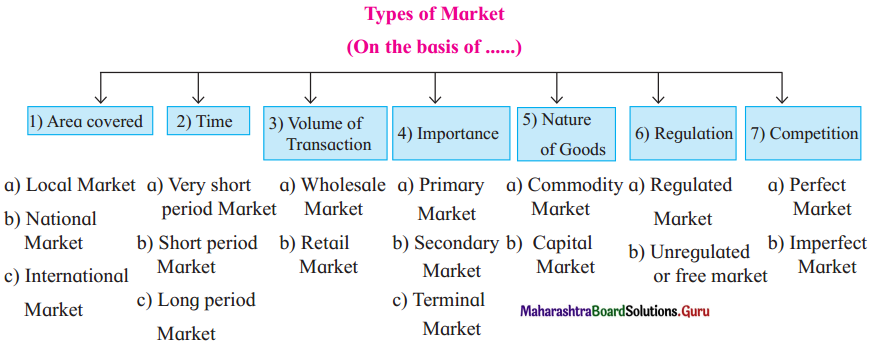
Maharashtra Board OCM 12th Commerce Solutions Chapter 8 Marketing 1
(1) On the basis of area covered:
(i) Local market: Local market refers to local geographical area in the region within which goods and services are bought and sold, e.g. purchase of grocery from grocery shop located in a market near to residential place.

(ii) National market : National market refers to the area of a country within which goods and services are bought and sold, e.g. purchase of apples on wholesale from the state of Haryana by a customer staying in Mumbai.

(iii) International market : The market where the goods and services which are manufactured in one country and sold in many other countries is called international market, e.g. purchase of petrol by Government of India from Saudi Arabia.

(2) On the Basis of time:
(i) Very short period market : The market which is organised and carried on for very short period of time is called very short period market. This market has existence for very short period say few hours or for a day at a particular time and place, e.g. market for perishable goods such as vegetables, milk, fish, milk products, meat, fruits, etc.

(ii) Short period market : The market which is organised and carried out its functions for short period of time is called short period market. This market has existence for a short period, weekly market, festival market, market during fairs, etc. are known as short period market. In this market mostly perishable goods and semi-durable goods are bought and sold.

(iii) Long period market : The market which is organised and continued its functions for long period of time is called long period market. This market has existence for long period of time. In this market usually durable commodities are bought and sold.

Maharashtra Board OCM 12th Commerce Solutions Chapter 8 Marketing

(3) On the basis of volume of transaction:
(i) Wholesale market : Wholesale market refers to market in which goods purchased and sold in bulk (large) quantity at lower (cheaper) prices. In this market goods are purchased by the wholesalers in large quantity from manufacturers. He then sells these goods in moderate quantity to retailers who then sell these goods to consumers in small quantity. In brief, it is a market for bulk purchases and sales of goods. In this type of market, wholesalers are know as sellers and retailers are known as buyers.

(ii) Retail market : Retail market refers to market in which retailers sell goods directly to the ultimate consumers in small quantity or one to one basis, e.g. General provisional goods shop localised in market.

(4) On the basis of importance:
(i) Primary market : The market for primary products like agricultural and forest products are called primary market, e.g. market for food grains, vegetables, fruits, etc.

(ii) Secondary market : The market for semi-manufactured goods and semi-processed goods is called secondary market, e.g. iron ore market, yarn market.

(iii) Terminal market : The market where finished goods are bought and then sold to the ultimate consumers or the users of the product.

(5) On the basis of nature of goods:
(i) Commodity market : The market for goods, material or produce is called commodity market, e.g. market for consumer goods, industrial goods, etc.

(ii) Capital market : A market place where long term funds required by business enterprises are borrowed and lent is called capital market, The financial assets which are bought and sold in the capital market have long or indefinite maturity period. It deals in both debt and equity with maturity ranging from 1 year to 10 years.

(6) On the basis of regulation:
(i) Regulated market : Markets which are governed (regulated) and controlled by the statutory or legal provisions of the country are called regulated market, e.g. stock exchanges, foreign exchanges, commodity exchanges, etc.

(ii) Unregulated or free market : The markets which are usually regulated and operated according to the forces of demand and supply and not controlled by any statutory provisions are called unregulated or free market, e.g. market for various S commodities and services.

(7) On the basis of competition:
(i) Perfect market : A type of market in which large numbers of buyers and large numbers of sellers exist to buy and sell homogeneous product at prevailing market price is called perfect market. In this market, all buyers and all sellers have equal access to all information and have perfect knowledge about the market conditions. Neither single buyer nor a single seller can influence price. One uniform single price prevails in the market, This model of perfect market is frequently used in economic analysis.

(ii) Imperfect market : A type of market which has distinct features of market imperfection such as single seller, imperfect knowledge of market conditions on the part of buyers or sellers, failure to make adjustment in demand and supply, etc. is called imperfect market, e.g. monopoly market. Imperfect market is further sub-divided into the following categories:

(a) Monopoly : The word monopoly is the combination of two words, viz. ‘mono’ means one and ‘poly’ means seller. Accordingly, a market structure which is characterised by a single seller selling unique product in the market is called monopoly. In monopoly, seller faces no competition as he is the sole seller of goods with no close substitute. He controls the entire supply and enjoys the power of setting the price for his goods. He is price maker.

(b) Duopoly : A market situation in which two suppliers dominate the entire market for a commodity or service. In this market, there are two sellers, who either sell a homogeneous product or differentiated product. They enjoy a monopoly in the product produced and sold by them.

(c) Oligopoly : Oligopoly is a state of limited competition in which market is shared by a limited number (few) of producers or sellers producing and selling either a homogeneous product or a differentiated product.

(d) Monopsony : Market situation in which there is only one buyer substantially controls the market as major and single purchaser of goods and services offered by many producers or sellers, is called monopsony market, e.g. labour market, a firm is the sole purchaser of a certain kind of labour.

Question 3.
Explain in detail 7Ps of Marketing.
Answer:
7 Ps of marketing are explained as follows:
(1) Product : An article, goods, commodity, or service that is manufactured and offered to the customers for sale is called product. It has capacity to satisfy desire or need of the customers. The products may be either tangible or intangible. It can be in the form of goods or services. By undertaking extensive market research the business enterprises are required to decide the right type of products to be produced and sold. The product creates impact on the mind of the customers on which success or failure of business firm depends.

(2) Price : The amount of money given or required to buy a product is called price. It is essentially the amount that customer ready to pay for a product. The cost of the product, willingness of the customers to pay for the product, value and utility of the product are the main factors that businessmen have to considered while (determining) deciding the price of a product. Price of the product should be neither too high which affects the demand adversely nor too low which reduces the profitability of the business.

(3) Place : The distribution or placement of product is a significant aspect of the marketing, Place is the element of marketing mix that ensures that right product is distribute and made conveniently available to the potential consumers or buyers at right price, at right location and at right time too. The business enterprises are required to distribute the products at a place easily approachable to the potential consumers or buyers. Place in this respect covers location, distribution and the ways of giving the products in the hand of the customers. The system of distribution decides the coverage of the product in the market.

(4) Promotion : Promotion is one of the basic elements of marketing because it makes the customers aware of its product, creates brand recognition and sales. Promotion refers to any type of marketing communication used to inform and persuade potential buyers or consumers to buy the products by explaining them the regular merits of products, service, brand, etc. Promotion mix comprises of different tools such as advertising, sales promotion, direct marketing, personal selling, etc. promotional strategies to be used in the business depends on various factors such as budget, target market and the message wants to communicate.

(5) People : The employees, i.e. people inside the business and consumers/customers, i.e. people outside of the business create direct or indirect impact (influence) on the business. People include all individuals that play key role in offering the product or service to the buyer or customer. People inside the business comprise employees who assist to deliver services to the customers. Right people appointed to work at right place definitely add value to the business. The management or employer of the business enterprises are required to recruit right people, train them, develop their skill and retain them for their success.

(6) Process : The steps taken by the business organisation in carrying the products and services from the place of business to the doorsteps of customer are called process. Processes are significant to provide a quality service. Good process ensures same standard of service to the customers, save time and cost by enhancing efficiency. The growth and development of technology enable the business organisations in effective monitoring of the process of business and help to take corrective action if necessary.

(7) Physical environment : Marketing environment in which the interaction between customer and firm takes place is called physical environment. While providing (offering) intangible services, the service providers always try to incorporate certain tangible elements into their offering to increase experience of customers. In the service market, physical or tangible evidence is essential to ensure that the service is successfully provided. Physical evidence enables the customers to trace conveniently the brand leaders in the market. The physical evidence comprises of location, layout, packaging, branding, interior design, dress of the employees, their action, waiting area, etc.

Maharashtra Board OCM 12th Commerce Solutions Chapter 8 Marketing

Question 4.
Explain the functions of marketing in detail.
Answer:
The functions of marketing are explained as follows:
(1) Marketing research : The process of identifying the need and want of the customers, gathering information from the consumers, analysing and interpreting that information is called marketing research. Marketing research helps to assess the need in the market, requirements of consumers, time of purchases, quantity of purchases and prices at which products are bought and sold, etc. Marketing Research helps the business organisations to take various decisions on the marketing of products.

(2) Buying and assembling : Buying and assembling involve buying and bringing raw materials at one place for production purpose. This marketing functions is more important because quality and price of raw materials determine (fix) cost and quality of the final product.

(3) Market planning : After estimating the need of marketing the business enterprises are required to outiine the marketing plan and strategies to accomplish the predetermined aims and objectives. Marketing planning refers to the process of defining, determining and organising the marketing aims and objectives of the business and preparing strategies to accomplish those aims and objectives. In brief, market planning is nothing but a comprehensive blueprint that outlines overall marketing efforts of the business enterprises.

(4) Product development : In recent years, product development and design become an important function of marketing. It plays significant role in marketing (selling) the products. Every business organisation is required to develop its products to suit the needs of the consumers. Product design implies decisions in the areas of quality, colour, standards, shape, design, packing, etc. of the product. Most of the consumers always buy better and attractively designed products. Good and attractive design of the product also provides competitive benefits to the business by increasing its turnover. Product development is ongoing process because the needs of the consumers change as time passes.

(5) Standardisation and grading : Standardisation means setting up of standards or fixing certain norms in relation to design, quality, size, process, weight, colour, etc. of the product. Standardisation ensures uniformity in quality of products and helps to gain customers’ loyalty towards the product. Grading means physical sorting and classifying of the products according to standards set up, i.e. similar characteristics or features. Grading is completed on the basis of some features such as size, shape, quality, etc. Usually grading is done in the case of agricultural commodities like rice, wheat, potatoes, sugar, cotton, etc.

(6) Packing and labelling : Attractive package and label make the product successful and create long lasting impression on the consumers about the product. Designing the package for the product in attractive manner is called packaging, Packaging protects the product from breakage, leakage, damage, and destruction. Botties, plastic bags, wooden boxes, bubble bags, containers, tins, jute bags, packing foams, etc. are used for packing the products. A slip providing information of product and its producer pasted or affixed on the product container is called label. It gives protection to the product and serves as an effective tool of marketing.

(7) Branding : Branding means giving a name, symbol, mark or numeral to a product for the purpose of giving a distinct identity to that product is called branding. A brand which is registered is called Trademark. No one can copy trademark in marketing field. Branding gives the product a separate identity and recognition among the consumers which helps to expand business and increase brand awareness in the market.

(8) Customer support service : As the customer is regarded as centre point or the king of the market, business organisation must take required steps to satisfy the customers. The business organisations are also required to take every possible steps to render support services to the customers. Regular support services given to the customers increase their loyalty towards the business organisation. The support services like pre-sales services, after-sales services, consumer helpline, technical assistance, product demonstration, etc. are usually provided to the customers by the businessmen. Customer support services facilitate the business organisations to get, retain and increase the customers.

(9) Pricing of product : Pricing of product is an important and challenging functions of marketing and plays significant role in the market having cut-throat competition. Many times success or failure of products depend on the price charged for the product. While fixing the price of the product the business organisation is required to considered several factor such as cost, desired profit, price of the competitions product, market condition, demand for the product, etc. As per the requirement of market, the businessmen are required to change the prices of the products. The price fixed should neither be too high which may lose customers nor too low which may compel business to incur loss. Hence for deciding the right price, extensive market research should be undertaken.

(10) Promotional channels : The process of convening the consumers information of the products, their features, prices, uses, etc. and inducing them to buy the products is called promotion. Important tools of promotion include personal selling, advertisement, publicity and sales promotion. The businessmen can use some of the tools or combination of some tools for promotion of their products. Promotional activities increase brand awareness in the market.

(11) Distribution: The activities which are related to movement of finished products from the place of business to the doorsteps of consumers are called distribution. The distribution comprises of transportation, material handling, order processing, packaging, warehousing, inventory control, market forecasting, plant and warehousing location and customer service. The business organisation is required to spend major part of marketing budget of the business or the distribution. The significance of physical distribution for business organisation mostly depends on the type of product and level of customer satisfaction.

(12) Transportation : Physical movement of finished products as well as raw material from the s place of origin or production to the doorsteps of consumers is called transportation. Transportation is necessary because production, sale and consumption cannot take place at one place. By carrying the products from the place of plenty to place of scarcity the transport creates place utility into the products. The factors such as geographical boundaries, nature of products, cost, target ; market, speed, reliability, frequency, safety, etc. help to decide the mode of transport to be used. The modes of transport used by the business are categorised as road, air, water, railways, pipeline transport.

(13) Warehousing : Warehousing means storing of goods in a godown to held them in stock from the time of production or purchase till the time of their sale. Warehousing enables the business organisation to keep and maintain a smooth flow of goods by maintaining balance between supply and demand of the products warehousing helps to stabilizes the prices in the market. This marketing function is carried out by manufacturers, wholesalers and retailers. By holding the stock of products over certain period, warehousing creates time utility in the products.

Question 5.
Explain importance of marketing to the society and consumers.
Answer:
[A] Importance of marketing to the society:
(1) Increase in standard of living : The main aim of marketing is to supply goods and services to fulfil the customers’ requirements. Marketing finds out the requirements of the customers and accordingly make efforts to supply quality products at cheaper prices. This in turn helps to maintain and raise the standard of living of the customers. In recent era, large scale production of products and services have considerably reduced their prices due to which poor people also attain reasonable level of living.

(2) Provide employment : Modern marketing i undertakes almost all functions of organisation such as buying, selling, financing, transport, warehousing, risk bearing, research and development, etc. which generate and create more job opportunities in different capacities and help to solve the problem of unemployment.

(3) Decreases distribution coats : Effective and proper utilisation of channel of distribution reduces overall cost of the products and services, Thus, marketing activities make the goods and services available to the society at cheaper prices. Due to reduction in the cost, number of potential consumers will also increase. It also gives guarantee of timely availability of the product.

(4) Consumer awareness : Marketing helps the society by educating consumers and by giving information of new products and services available in the requirements of consumers by providing relevant information, goods and services to the people as per their demand and taste. Marketing also includes information to help in making a purchase.

(5) Increase in National income : The scientifically well organised marketing activities facilitates rapid economic development of the nation. Well organised and effective marketing of products and services facilitates industrialisation, increases job opportunities and develop the economy. Effective marketing integrates agriculture and industry which in turn bring rapid development in the country.

(6) Managing consumer expectations : Marketing research enables the business organisations to understand the requirements of the consumers which helps in development of products to satisfy the customers expectation. The business organisations make certain changes in the product by considering customers’ review. Through marketing, business enterprises inform consumers about the major changes such as mergers, transfer in ownership which affect product offerings. Government regulations stop marketers to make false and misleading claims.

[B] Importance of marketing to the consumers:
(1) Promotes product awareness : Many companies undertake different marketing activities to promote their products and services. Marketing makes consumers aware about the different products, various brands and features of products and services available in the market. Marketing facilitates the consumers to take right decision on purchases of products. On the basis of marketing information consumers can compare product features, availability, price and other essentials. Marketing also improves the quality of life of the consumers.

(2) Provides quality products : On account of increasing competition in the market, consumers easily get information about the product and services available in the market. Marketing creates moral pressure on the business enterprises to sell quality products and services to the consumers. If business enterprises supply defective products to the consumers, sooner or later, it will create negative image of the business and adversely affect customers’ loyalty towards business and products.

(3) Provides variety of products : Marketing provides information to the consumers about the product and attracts them to purchase the same market segment or marketing plan becoming critical in any business on account of increase in customer population their preferences and availability of competitive options. The business organisation are required to launch product by considering market segment. The business organisations are required to make available variety of goods to fulfil the requirements of different market segments of the consumers. According to price, size and quality of products, variety’ may change.

(4) Helps in selection : In the competitive markets, different variety of products with different brands are available. Marketing enables the consumers to select the best products and services from the different options available.

Maharashtra Board OCM 12th Commerce Solutions Chapter 8 Marketing

(5) Consumer satisfaction : The main and primary aim of marketing policy is to advertise and give assurance of good quality product to the consumer. When the expectations and requirements of customers are fulfilled, the customers become more comfortable and get satisfied. Marketing efforts result into customers’ satisfaction by way of honest advertising, assurance of quality products and accessibility of innovative products. In this manner, marketing makes efforts to give satisfaction to the consumers.

(6) Regular supply of goods : Regular supply of goods to the consumers is practicable through effective and efficient distribution channel of marketing. Marketing also helps to keep and maintain the balance between demand and supply. As a result, prices get stabilised.

OCM 12th Commerce Textbook Solutions Digest

12th OCM Chapter 7 Exercise Consumer Protection Practical Problems Solutions Maharashtra Board

Consumer Protection 12th OCM Chapter 7 Solutions Maharashtra Board

Balbharti Maharashtra State Board Organisation of Commerce and Management 12th Textbook Solutions Chapter 7 Consumer Protection Textbook Exercise Questions and Answers.

Class 12 OCM Chapter 7 Exercise Solutions

1. (A) Select the correct options and rewrite the sentence

Question 1.
In India, the Consumer Protection Act was initiated in the year ………………
(a) 1947
(b) 1989
(c) 1986
Answer:
(c) 1986

Maharashtra Board OCM 12th Commerce Solutions Chapter 7 Consumer Protection

Question 2.
The President of District Commission is a ………………..
(a) District Judge
(b) High Court Judge
(c) Supreme Court Judge
Answer:
(a) District Judge

Question 3.
The main objective of the consumer organization is to protect the interest of the …………………
(a) consumer
(b) trader
(c) producer
Answer:
(a) consumer

Question 4.
……………… is the highest authority to settle the consumer dispute under Act.
(a) State Commission
(b) National Commission
(c) District Commission
Answer:
(b) National Commission

Question 5.
The Government has established ……………… to settle the consumer disputes by compromise.
(a) District Commission
(b) Lok Adalat
(c) Consumer organisation
Answer:
(b) Lok Adalat

Question 6.
National Commission has ……………… members.
(a) 2
(b) 3
(c) 4
Answer:
(c) 4

Question 7.
District Commission entertains complaints of consumer for compensation which is less than ………………..
(a) one crore
(b) ten lacs
(c) ten crore
Answer:
(a) one crore

Question 8.
…………………. is celebrated as World Consumer Day.
(a) 24th December
(b) 26th January
(c) 15th March
Answer:
(c) 15th March

Question 9.
In modern competitive market, consumer is regarded as the ………………
(a) King
(b) Agency
(c) Owner
Answer:
(a) King

1. (B) Match the pairs

Question 1.

Group A Group B
(A) King of the market (1) 1930
(B) National Commission (2) Socialist
(C) Mumbai Grahak Panchayat (3) Exceeds Rs ten crore
(D) Sale of Goods Act (4) Non-Government Organisation
(E) Consumer Right (5) Consumer
(6) Legislative Measures
(7) Exceeds Rs one crore but does not exceed Rs ten crore.
(8) 1956
(9) Consumer Protection Act
(10) Right to Information

Answer:

Group A Group B
(A) King of the market (5) Consumer
(B) National Commission (3) Exceeds Rs ten crore
(C) Mumbai Grahak Panchayat (4) Non-Government Organisation
(D) Sale of Goods Act (1) 1930
(E) Consumer Right (10) Right to Information

1. (C) Give one word/phrase/term for the following statement

Question 1.
The commission which entertains case where the value of the goods or services paid as consideration does not exceed Rs one crore.
Answer:
District Commission

Question 2.
A legal action initiated in a court of law regarding a matter of general public interest.
Answer:
Public Interest Litigation

Question 3.
Organizations which aim at promoting the welfare of the people.
Answer:
Non-Government Organizations

Question 4.
The right of consumer which is about safety and protection to his life and health.
Answer:
Right to Safety

Maharashtra Board OCM 12th Commerce Solutions Chapter 7 Consumer Protection

Question 5.
One who consumes or uses any commodity or service.
Answer:
Consumer.

1. (D) State whether the following statements are True or False

Question 1.
The seller has to recognize the rights of Consumer.
Answer:
True

Question 2.
Consumer Protection Act provides protection to the producer.
Answer:
False

Question 3.
Consumer Protection Act is not required in India.
Answer:
False

Question 4.
Lok Adalat cam righty be described as “People’s Court”.
Answer:
True

Question 5.
Consumer, being the king of market, does not have any responsibility.
Answer:
False

1. (E) Find the odd one

Question 1.
District Commission, State Commission, NGO, National Commission.
Answer:
NGO

Question 2.
District Judge, High Court Judge, Commissioner, Supreme Court Judge.
Answer:
Commissioner

1. (F) Complete the sentences

Question 1.
National Commission is to be established by ………………. Government.
Answer:
Centred

Question 2.
Any person who does not agree with the decision of District Commission can appeal to the ……………….
Answer:
State Commission

Maharashtra Board OCM 12th Commerce Solutions Chapter 7 Consumer Protection

Question 3.
State commission has ……………….. members.
Answer:
four

Question 4.
The President of National Commission is ………………. judge.
Answer:
Supreme Court

Question 5.
National Commission entertains complaints of consumer for compensation that exceeds Rs ………………
Answer:
ten crore

Question 6.
The Consumer Protection Act established ………………… tier quasi judicial system for consumer protection.
Answer:
three

1. (G) Select the correct option and complete the following table

(High Court Judge, Four, Consumer Organisations, does not exceeds Rs one crore, 2019)

Group A Group B
A. Amount of compensation in District Commission —————
B. ———————- State Commission
C. Consumer Protection Act ——————
D. ——————— Non-profit and non Political organisation
E. Members of National Commission ——————-

Answer:

Group A Group B
A. Amount of compensation in District Commission Does not exceed Rs one crore
B. High Court Judge State Commission
C. Consumer Protection Act 2019
D. Consumer Organisations Non-profit and non Political organisation
E. Members of National Commission 4

1. (H) Answer in one sentence

Question 1.
When do we observe a National Consumer Day?
Answer:
On 24th December every year we observe a National Consumer Day.

Question 2.
Who is a consumer?
Answer:
A consumer means any person who buys any goods, hires any service or services for a consideration which has been paid or promised to be paid in future or under any system of deferred payment.

Question 3.
What information should one check before buying a product?
Answer:
Before buying a product the consumer should enquire about the quality, quantity, price, utility of goods and services, etc.

Question 4.
Which forum is set up at the national level for redressal of consumer complaints?
Answer:
National Consumer Disputes Redressal Commission or National Commission is set up at the national level for redressal of consumer complaints.

Question 5.
Who shall be appointed as President of National Commission?
Answer:
A person, who is or has been a Judge of the Supreme Court, shall be appointed by the Central Government as the President of National Commission in consultation with Chief Justice of India.

Question 6.
When do we observe World Consumer’s Rights Day?
Answer:
On 15th March every year we observe World Consumer’s Rights Day.

1. (I) Arrange in proper order

Question 1.
National Commission, District Commission, State Commission.
Answer:
District Commission, State Commission, National Commission.

Question 2.
District Judge, Supreme Court Judge, High Court Judge.
Answer:
District Judge, High Court Judge, Supreme Court Judge.

1. (J) Correct the underlined word and rewrite the sentence

Question 1.
An appeal can be filed against the order of the National Commission to the State forum.
Answer:
Supreme Court

Question 2.
National Commission is established by the State Government.
Answer:
Central Government

Question 3.
District Commission is also referred as People’s Court.
Answer:
Lok Adalat

Question 4.
In India, sellers are widely dispersed and are not united.
Answer:
consumers

Maharashtra Board OCM 12th Commerce Solutions Chapter 7 Consumer Protection

Question 5.
National Commission entertains complaints where the value of the goods or services paid as consideration does not exceed Rs one crore.
Answer:
District Commission.

2. Explain the following term/concept:

Question 1.
District Commission.
Answer:
(1) Meaning : A consumer redressal agency established by the State Government in each district to give relief or settle the disputes of consumers who complain against manufacturers or traders, is called District Commission.

(2) Territorial Jurisdiction : District Commission can exercise its jurisdiction within the limits of its district.

(3) Monetary jurisdiction : District Commission has the jurisdiction to entertain complaints where the value of goods and services, including compensation, if any, does not exceed Rs 1 crore.

(4) Appeal : Any person not satisfied with the order of District Commission can appeal against it to the State Commission within 45 days from the date of the order in such form and manner may be prescribed.

Question 2.
National Commission.
Answer:
Meaning : A consumer disputes redressal agency at the national level established by the Central Government by notification is known as National Commission. It is also called as National Consumer Disputes Redressal Commission.

Composition : The National Commission shall consist of:
(a) President: A person who is or has been a Judge of the Supreme Court to be appointed by the Central Government as President of National Commission. Such appointment shall be made after consultation with the Chief Justice of India.

(b) Tenure : Every member of the National Commission shall hold office for a term of 5 years or up to the age prescribed whichever is earlier.

Question 3.
State Commission.
Answer:
Meaning : A consumer disputes redressal agency at state level established by each State Government is known as State Commission.

Composition : Each State Commission shall consist of:
(a) President : A person who is or has been a Judge of a High Court, shall be appointed by the State Government as the president of the State Commission in consultation with the Chief Justice of the High Court.

(b) Members : The number of other members shall not be less than 4 or not more than such number of members as may be prescribed in consultation with the Central Government.

(c) Tenure : Every member of the state commission shall hold office for a term of 5 years or up to the age of 67 years whichever is earlier.

Question 4.
Lok Adalat.
Answer:
Lok Adalat : Lok Adalat, i.e. People’s Court is established by the government to settle the disputes by compromise. It is the effective and economical system for quick redressal of public complaints and grievances. In this system the aggrieved party can directly approach the Lok Adalat with his complaint. In Lok Adalat, issues are discussed immediately and decisions are taken without delay.

The order passed by the Lok Adalat is given statutory recognition. In public sector, some organisations such as Railways, Maharashtra State Electricity Distribution Co. Ltd (MSEDCL). Maharashtra State Road Transport Corporation (MSRTC), Insurance Companies, Banks, etc. regularly hold Lok Adalat to resolve consumer’s problems through compromise.

Question 5.
Janhit Yachika.
Answer:
Public Interest Litigation (Janahit Yachika) : As name indicates it is a legal action initiated in a court of law in regard to a matter of general public interest. Under this, any person can approach a court of law in the interest of the public and ask for justice. It does not involve individual interest but interest of unrepresented groups of the society. After studying and verifying the case, the court gives justice which will benefit the specific group of society or entire society. It can be filed by any party which may not be related to grievance. In some cases Janahit Yachika can be filed in the High Court as well as in Supreme Court directly.

3. Study the following case/situation and express your opinion

Question 1.
Mr. Ashok visited a shop to buy a pair of shoes for Rs 700. The salesman forced him to buy a pair of bigger size shoes of ordinary company by claiming this size would be suitable to him. After reaching home, he discovered that shoes are still too big for him. He complained about the shoes to the shopkeeper. It was denied by the shopkeeper to replace the shoes despite of availability of stock. In above case-
(i) Which right has been violated?
(ii) Comment on the right which has been violated.
(iii) Where can Mr. Ashok file his complaint?
Answer:
(i) In the above case, Right to Choose has been violated.

(ii) In India, the choices are available to consumers to select goods and different services like telecommunications, travel and tourism, banking, electronics, consumer goods, etc. According to right to choose, consumer should be given full liberty j to select an article as per his requirements, liking and purchasing capacity. The seller cannot force or compel the customer to buy specific product or service In this manner monopoly is avoided and j prevented.

(iii) According to the Right to be Heard, Mr. Ashok can lodge complaint to the consumer forum. Mr Ashok can also file online complaint through portal or mobile applications to the trader as well as to the appropriate consumer commission or forum.

Maharashtra Board OCM 12th Commerce Solutions Chapter 7 Consumer Protection

Question 2.
Mrs. Meera a resident of Nagpur District bought a washing machine worth Rs 50,000 without cash memo with a warranty period of 2 years. After 1.5 years she noticed some defect and asked the company to repair or replace it. The company did not accept her complaint despite of the defective product.
In the above case,
(i) Suggest suitable redressal machinery to protect her right.
(ii) If she is not satisfied with the decision given by redressal machinery, where should she appeal?
(iii) What was the negligence of Mrs. Meera while buying the washing machine?
Answer:
(i) According to Right to Redressal, Mrs. Meera should file complaint for fair settlement of claim. This right enables Mrs. Meera to demand repair or replacement or compensation for defective product i.e., in above case washing machine supplied. Three tier quasi-judicial consumer dispute redressal machinery is established for the settlement of claim. Mrs. Meera can file complaint in District Commission established in her district as the value of machinery does not exceed Rs 1 crore.

(ii) If Mrs. Meera is not satisfied with the order or judgement given by District Commission, then she can appeal against such order to State Commission within 45 days from the date of such order, in such form and manner as may be prescribed.

(iii) Mrs. Meera did not collect or ask for cash memo and guarantee/warranty card for a period of 2 years as soon as she purchased the washing machine worth Rs 50,000.

4. Distinguish between

Question 1.
District Commission and State Commission
Answer:

District Commission State Commission
1. Meaning A consumer disputes redressal agency at the district level established by the State Government is known as District Commission. A consumer disputes redressal agency at the state level established by the State Government is known as State Commission.
2. President A person who is or retired or qualified as a judge of a district court is appointed as president of the. District Commission. A person who is or retired as a judge of a High Court is appointed as president of State Commission
3. Membership tenure Every member of District Commission shall hold office for a term of 5 years or up to the age of 65 years whichever is earlier. Every member of State Commission shall hold office for a term of 5 years or up to the age of 67 years whichever is earlier.
4. Area covered It has jurisdiction over a particular District. It has jurisdiction over a particular State.
5. Monetary jurisdiction It has the jurisdiction to entertain complaints where the value of goods or services, including compensation, if any, does not exceed Rs 1 crore. It has the jurisdiction to entertain complaints where the value of goods or services, including compensation, if any, exceeds Rs 1 crore but does not exceed Rs 10 crore.
6. Appeal Any person not satisfied with the order of District Commission can appeal against such order to the State Commission within 30 days of the order. Any person not satisfied with the order of the State Commission can appeal against such order to the National Commission within 30 days of the order.

Question 2.
State Commission and National Commission
Answer:

State Commission National Commission
1. Meaning A consumer disputes redressal agency at the state level established by each State Government is known as State Commission. A consumer disputes redressal agency at the national level established by the Centred Government is known as National Commission.
2. President A person who is or retired or qualified as a judge of a High Court is appointed as president of State Commission. A person who is or retired as a judge of a Supreme Court is appointed as president of National Commission.
3. Membership Tenure Every member of District Commission shall hold office for a term of 5 years or up to the age of 65 years whichever is earlier. Every member of State Commission shall hold office for a term of 5 years or up to the age of 67 years whichever is earlier.
4. Area covered It has jurisdiction over a particular State. It has jurisdiction over the entire nation
5. Monetary jurisdiction It has the jurisdiction to entertain complaints where the value of goods or services, including compensation, if any, exceeds Rs 1 crore, but does not exceed Rs 10 crore It has the monetary jurisdiction to entertain complaints where the value of goods and services, including compensation, if any, exceeds Rs 10 crore.
6. Appeal Any person not satisfied with the order of District Forum can appeal against such order to the State Commission within 30 days of the order. Any person not satisfied with the order of the National Commission may appeal against such order to the Supreme Court within a period of 30 days from the date of the order.

Question 3.
District Commission and National Commission
Answer:

District Commission National Commission
1. Meaning A consumer disputes redressal agency at the district level established by the State Government is known as District Commission. A consumer disputes redressal agency at the national level established by Central Government is known as National Commission.
2. Nature of complaint It can entertain only original cases which are within the local limits of district. It can entertain original cases as well as appeals against the order of State Commission which are within the geographical limits of the entire nation.
3. Membership Tenure Every member of District Forum shall hold office for a term of 5 years or up to the age of 65 years whichever is earlier Every member of National Commission shall hold office for a term of 5 years or up to the age prescribed whichever is earlier.
4. Area covered It has jurisdiction over a particular district. It has jurisdiction over the entire nation.
5. Monetary jurisdiction It has the jurisdiction to entertain complaints where the value of goods and services, including compensation, if any, does not exceed Rs 1 crore. It has the jurisdiction to entertain complaints where the value of goods and services, including compensation, if any, exceeds Rs 10 crore.
6. Appeal Any person not satisfied with the order of District Commission can appeal against such order to the State Commission within 30 days of the order. Any person not satisfied with the order of National Commission can appeal against such order to the Supreme Court within a period of 30 days from the date of the order.

5. Answer in brief

Question 1.
Explain any four needs of consumer protection.
Answer:
The need of consumer protection is explained as follows:
(1) Need of participation of consumers : It is noticed that most of the organisations or manufacturing companies take certain decisions which directly or indirectly affect the consumers’ interest without consulting them or their organisations. This leads to consumer exploitation. Only a Strong consumers’ organisation can force business organisations to allow consumers to participate in the decision-making process.

(2) Lack of information : Today consumers live in a dynamic and complex world. Due to vast distance between manufacturer and consumer, it is very difficult to establish direct contact between them. Now market is fully flooded with domestic as well as foreign products due to globalisation and liberalisation. However, it is very difficult for the consumer to get correct and reliable information about the products before they are purchased. He has to rely on trial and error method or on advertisements. In both the cases chances of consumer exploitation cannot be denied.

(3) Ignorance : One of the important causes of consumer exploitation is ignorance of consumers. In India, consumers are mostly ignorant about their rights, market conditions, price levels, product details, etc. Many a time consumers are not aware that they are being cheated by the sellers. An appropriate system is required to protect consumers from business malpractices.

(4) Unorganised consumers : The consumers are widespread and unorganised. Moreover, they are not united. Hence, they are easily exploited by the producers and sellers. Sellers are in better position as compared to unorganised consumers. An individual consumer cannot fight against the powerful manufacturers or sellers.

Question 2.
State any four rights of the consumer.
Answer:
The rights of consumers are explained as follows:
(1) Right to Safety : The right to safety means the right to be protected against products, production processes and services which are hazardous to consumer’s lives or health and property. It includes consumer’s long term interest and immediate requirements. This right demands that consumer must get full safety and protection to his/her life and health in relation to medicines, food, electrical appliances, etc. AGMARK, ISI – Indian Standard Institute, BIS – Bureau of Indian standards, Hallmark, etc. are the safety standards prescribed by the Government of India (GOI).

(2) Right to Information : The consumer has a right to get correct and adequate information of all aspects of goods and services like price, name of manufacturer, contents used, batch number, date of manufacture and expiry date, use manual and safety instructions, etc. This information helps the consumers to make right choice of goods and services. This right is applicable to medicines, food products, spare parts and other consumer products or services.

(3) Right to Choose : According to this right, the consumer has full freedom to select or choose the product or service as per his/her liking, requirement and purchasing capacity. The seller cannot force a consumer to purchase a particular product. This right aims at removing monopoly. The choices available to consumers in India include goods and different services such as telecommunications, travel and tourism, banking, electronics, Fast Moving Consumer Goods (FMCG) etc.

(4) Right to Be Heard : It is the responsibility of every business organisation to listen and solve difficulties, complaints and grievances of the consumers. This right gives an opportunity to the consumers to express and voice their complaints to the consumer forum. The consumers also have rights to give suggestions to the manufacturer as well as to the trader on the quality, quantity, price, packaging, etc. of the products they use. Nowadays consumers can file online complaints through portal or mobile applications.

Maharashtra Board OCM 12th Commerce Solutions Chapter 7 Consumer Protection

Question 3.
Explain any four responsibilities of the consumer.
Answer:
The responsibilities of the consumer are explained as follows:
(1) Consumer should use his rights : The consumers have many rights in respect to the goods and services they purchase. They must be aware of their rights while buying the products. They can use their rights if they are misled by advertisement or get faulty or defective articles.

(2) Cautious consumer : The consumers should be alert while dealing with the trader. They should be aware of their responsibilities while buying goods and services. Before buying any product or service, the consumer should make detail enquiry about the quality, quantity available, price, date of manufacture, expiry date, utility of goods and services, etc.

(3) Filing of complaint : If consumer has complaint about the products or services he has purchased, he should immediately approach the officer concerned and lodge complaints about the products or services. A delay in making complaints loses the rights and results in expiry of guarantee or warranty. If consumers ignore the dishonest acts of the traders, it may indirectly amount to encouragement to unethical business practices.

(4) Quality conscious : It is the responsibility of the consumers to buy quality goods. They should never compromise on the quality of goods. They should never buy inferior goods out of greed at lesser prices. For such behaviour of consumers, there is no protection. It is the responsibility of the consumer to ensure about the quality symbols like, ISI, AGMARK, Hallmark, Fruit Products Order (FPO), Food Safety and Standards Authority of India (FSSAI), etc. These are indicative of the good quality of the goods.

Question 4.
State the role of NGO in consumer protection.
Answer:
The role of Non-Government Organisations (NGOs) in consumer protection is explained as follows:
(1) NGOs organise campaigns and various programmes on consumer issues to create social awareness.

(2) They initiate and organise training i programmes for the consumers and make them : aware and conscious of their rights and various modes of redressal of their grievances.

(3) They publish journals and periodicals at regular interval to make the consumers understand and keep them informed about various consumer ) related developments.

(4) They provide legal advice free of charge to the members on the matters of consumer interest and help them to put up grievances before appropriate authority.

(5) NGO’s active members interact (communicate) with the businessmen and Chambers of Commerce and Industry for ensuring better deal for the consumers.

6. Justify the following statements

Question 1.
The Consumer Protection Act was passed in the interest of consumers.
Answer:
(1) The Consumer Protection Act came into force from 1986. Thereafter the Ministry of Law and Justice proposed new act in 2019. The Act has for the first time recognised six rights of the consumer:

  • the right to be protected against marketing of hazardous goods
  • the right to be informed about the price and features of goods
  • the right to make a choice out of a variety of goods
  • the right to make a complaint against unsatisfactory goods
  • the right to seek redressal against unfair trade practices
  • the right to consumer education. All the above rights are in the interest of the consumer and not the seller.

(2) The Act has made provision for the establishment of Consumer Protection Councils at the central and state levels for promoting and protecting these rights.

(3) The Act has created a quasi-judicial machinery consisting of the District Commission, State Commission and National Commission to entertain complaints and to give fair justice to the aggrieved consumers. The Act prescribes punishment of imprisonment not less than one month which may extend to 3 years and a fine which shall not be less than ? 25,000 which may extend to Rs 1 lakh or with both for guilty person.

(4) The strict enforcement of these rights creates a competition among the sellers. Consequently, the consumers get quality goods at fair prices. The government has also adopted various measures for creating public awareness about the rights of consumers. Various programmes are shown on television channels as well as programmes are broadcasted by All India to educate consumers.

Question 2.
Consumers have many responsibilities.
Answer:
The responsibilities of the consumer are explained as follows:
(1) Consumer should use his rights : The consumers have many rights in respect to the goods and services they purchase. They must be aware of their rights while buying the products. They can use their rights if they are misled by advertisement or get faulty or defective articles.

(2) Cautious consumer : The consumers should be alert while dealing with the trader. They should be aware of their responsibilities while buying goods and services. Before buying any product or service, the consumer should make detail enquiry about the quality, quantity available, price, date of manufacture, expiry date, utility of goods and services, etc.

(3) Filing of complaint : If consumer has complaint about the products or services he has purchased, he should immediately approach the officer concerned and lodge complaints about the products or services. A delay in making complaints loses the rights and results in expiry of guarantee or warranty. If consumers ignore the dishonest acts of the traders, it may indirectly amount to encouragement to unethical business practices.

(4) Quality conscious : It is the responsibility of the consumers to buy quality goods. They should never compromise on the quality of goods. They should never buy inferior goods out of greed at lesser prices. For such behaviour of consumers, there is no protection. It is the responsibility of the consumer to ensure about the quality symbols like, ISI, AGMARK, Hallmark, Fruit Products Order (FPO), Food Safety and Standards Authority of India (FSSAI), etc. These are indicative of the good quality of the goods.

(5) Beware from exaggerated advertisement: The sellers always provide various information of the products or services through advertisements to buyers. Many a time they exaggerate the facts in their advertisements. It is the responsibility of the consumers to find out or identify the truth of advertisement and then buy the products, or services.

Maharashtra Board OCM 12th Commerce Solutions Chapter 7 Consumer Protection

Question 3.
Aim of consumer organization is to protect the rights of the consumers.
Answer:
The role of Non-Government Organisations (NGOs) in consumer protection is explained as follows:
(1) NGOs organise campaigns and various programmes on consumer issues to create social awareness.

(2) They initiate and organise training i programmes for the consumers and make them : aware and conscious of their rights and various modes of redressal of their grievances.

(3) They publish journals and periodicals at regular interval to make the consumers understand and keep them informed about various consumer ) related developments.

(4) They provide legal advice free of charge to the members on the matters of consumer interest and help them to put up grievances before appropriate authority.

(5) NGO’s active members interact (communicate) with the businessmen and Chambers of Commerce and Industry for ensuring better deal for the consumers.

(6) They file Public Interest Litigation (Janhit Yachika) on important consumer issues like ban on a product or medicine injurious to public health. They also file cases in the court of law to safeguard the rights and protect the interest of general public.

(7) Few examples of NGOs working for the consumers are : Consumer Guidance Society of India (CGSI), Voluntary Organisation in Interest of Consumer Education (VOICE), Consumer Education and Research Centre (CERC), Consumers Association of India (CAI), Mumbai Grahak Panchayat (MGP), Grahak Shakti (GS), etc.

7. Attempt the following

Question 1.
State rights of the consumer.
Answer:
The rights of consumers are explained as follows:
(1) Right to Safety : The right to safety means the right to be protected against products, production processes and services which are hazardous to consumer’s lives or health and property. It includes consumer’s long term interest and immediate requirements. This right demands that consumer must get full safety and protection to his/her life and health in relation to medicines, food, electrical appliances, etc. AGMARK, ISI – Indian Standard Institute, BIS – Bureau of Indian standards, Hallmark, etc. are the safety standards prescribed by the Government of India (GOI).

(2) Right to Information : The consumer has a right to get correct and adequate information of all aspects of goods and services like price, name of manufacturer, contents used, batch number, date of manufacture and expiry date, use manual and safety instructions, etc. This information helps the consumers to make right choice of goods and services. This right is applicable to medicines, food products, spare parts and other consumer products or services.

(3) Right to Choose : According to this right, the consumer has full freedom to select or choose the product or service as per his/her liking, requirement and purchasing capacity. The seller cannot force a consumer to purchase a particular product. This right aims at removing monopoly. The choices available to consumers in India include goods and different services such as telecommunications, travel and tourism, banking, electronics, Fast Moving Consumer Goods (FMCG) etc.

(4) Right to Be Heard : It is the responsibility of every business organisation to listen and solve difficulties, complaints and grievances of the consumers. This right gives an opportunity to the consumers to express and voice their complaints to the consumer forum. The consumers also have rights to give suggestions to the manufacturer as well as to the trader on the quality, quantity, price, packaging, etc. of the products they use. Nowadays consumers can file online complaints through portal or mobile applications.

(5) Right to Consumer Education : The consumers have right to know about consumer rights and solutions to their problems. This is to create awareness among the consumers to make rational choice of goods and services and to protect themselves from the exploitation of unscrupulous (dishonest) businessmen. In this regard, the government, media and various Non-Government Organisations (NGOs) can play an important role to create awareness among the consumers and to educate them, e.g. Jago Grahak Jago campaign.

(6) Right to Represent : The Consumer Protection Act, 2019 gave an opportunity to individual consumer as well as to consumer groups to be represented by a person who is not professional advocate for consumer’s interest or complaint before consumer forum. This provision made in the Act in recognition of consumers’ right to represent.

Question 2.
State responsibilities of the consumer.
Answer:
The responsibilities of the consumer are explained as follows:
(1) Consumer should use his rights : The consumers have many rights in respect to the goods and services they purchase. They must be aware of their rights while buying the products. They can use their rights if they are misled by advertisement or get faulty or defective articles.

(2) Cautious consumer : The consumers should be alert while dealing with the trader. They should be aware of their responsibilities while buying goods and services. Before buying any product or service, the consumer should make detail enquiry about the quality, quantity available, price, date of manufacture, expiry date, utility of goods and services, etc.

(3) Filing of complaint : If consumer has complaint about the products or services he has purchased, he should immediately approach the officer concerned and lodge complaints about the products or services. A delay in making complaints loses the rights and results in expiry of guarantee or warranty. If consumers ignore the dishonest acts of the traders, it may indirectly amount to encouragement to unethical business practices.

(4) Quality conscious : It is the responsibility of the consumers to buy quality goods. They should never compromise on the quality of goods. They should never buy inferior goods out of greed at lesser prices. For such behaviour of consumers, there is no protection. It is the responsibility of the consumer to ensure about the quality symbols like, ISI, AGMARK, Hallmark, Fruit Products Order (FPO), Food Safety and Standards Authority of India (FSSAI), etc. These are indicative of the good quality of the goods.

(5) Beware from exaggerated advertisement: The sellers always provide various information of the products or services through advertisements to buyers. Many a time they exaggerate the facts in their advertisements. It is the responsibility of the consumers to find out or identify the truth of advertisement and then buy the products, or services.

(6) Demand of Invoice and Guarantee, Warranty Card : After purchasing the products, the consumer should ask for cash memo, guarantee or warranty card. The consumer should read and understand the contents of guarantee or warranty card. He should preserve the cash memo and guarantee or warranty card. If the products purchased are of inferior quality or become defective these cards are useful to settle the disputes and claim compensation or replacement of articles.

(7) Pre-planned buying : It is the responsibility of the consumer to make proper planning before buying any product. He should make an estimate of products they want to buy and quantity required, money to spend, etc. He should also decide in advance from which place to buy the products. He should not buy any product in a hurry or without thought.

(8) Organised efforts : The consumer is expected to shoulder the responsibility to promote and protect the interests of his own and other consumers. He should join the group or organisation which is working for the welfare of consumers. It is the responsibility of every consumer to unite for the welfare of all the consumers.

Maharashtra Board OCM 12th Commerce Solutions Chapter 7 Consumer Protection

Question 3.
State the need of consumer protection.
Answer:
The need of consumer protection is explained as follows:
(1) Need of participation of consumers : It is noticed that most of the organisations or manufacturing companies take certain decisions which directly or indirectly affect the consumers’ interest without consulting them or their organisations. This leads to consumer exploitation. Only a Strong consumers’ organisation can force business organisations to allow consumers to participate in the decision-making process.

(2) Lack of information : Today consumers live in a dynamic and complex world. Due to vast distance between manufacturer and consumer, it is very difficult to establish direct contact between them. Now market is fully flooded with domestic as well as foreign products due to globalisation and liberalisation. However, it is very difficult for the consumer to get correct and reliable information about the products before they are purchased. He has to rely on trial and error method or on advertisements. In both the cases chances of consumer exploitation cannot be denied.

(3) Ignorance : One of the important causes of consumer exploitation is ignorance of consumers. In India, consumers are mostly ignorant about their rights, market conditions, price levels, product details, etc. Many a time consumers are not aware that they are being cheated by the sellers. An appropriate system is required to protect consumers from business malpractices.

(4) Unorganised consumers : The consumers are widespread and unorganised. Moreover, they are not united. Hence, they are easily exploited by the producers and sellers. Sellers are in better position as compared to unorganised consumers. An individual consumer cannot fight against the powerful manufacturers or sellers.

(5) Spurious Goods : The consumers also face a major problem of duplicate goods. Some traders cheat the consumers by supplying them duplicate or defective goods of the popular brands. It is not possible for the consumers to find difference between genuine and duplicate product. It is therefore necessary to protect the consumers from such exploitation by fixing prescribed norms of quality and safety standards.

(6) Misleading advertising : Sometimes the advertisements of goods and services shown on television, in newspapers and magazines are misleading. They make tall claims about the benefits of the products but do not disclose the drawbacks. Most of the consumers are misled by the misleading advertisement and do not know the real and true quality of advertised products. Appropriate system or mechanism is required to prevent misleading advertisements.

(7) Malpractices of Businessmen : Many businessmen adopt fraudulent, unethical and monopolistic trade practices to earn more money. This leads to exploitation of consumers. Some times consumers get defective, inferior and substandard goods and services. Appropriate measures are necessary to protect the consumers against such malpractices.

(8) Trusteeship : The Gandhian philosophy states that businessmen are the trustees of the society’s wealth. So they should not misuse the society’s wealth for their own benefits. They should use the wealth of the society for the benefit of the people.

Question 4.
State the role of NGOs and consumer protection.
Answer:
The role of Non-Government Organisations (NGOs) in consumer protection is explained as follows:
(1) NGOs organise campaigns and various programmes on consumer issues to create social awareness.

(2) They initiate and organise training i programmes for the consumers and make them : aware and conscious of their rights and various modes of redressal of their grievances.

(3) They publish journals and periodicals at regular interval to make the consumers understand and keep them informed about various consumer ) related developments.

(4) They provide legal advice free of charge to the members on the matters of consumer interest and help them to put up grievances before appropriate authority.

(5) NGO’s active members interact (communicate) with the businessmen and Chambers of Commerce and Industry for ensuring better deal for the consumers.

(6) They file Public Interest Litigation (Janhit Yachika) on important consumer issues like ban on a product or medicine injurious to public health. They also file cases in the court of law to safeguard the rights and protect the interest of general public.

(7) Few examples of NGOs working for the consumers are : Consumer Guidance Society of India (CGSI), Voluntary Organisation in Interest of Consumer Education (VOICE), Consumer Education and Research Centre (CERC), Consumers Association of India (CAI), Mumbai Grahak Panchayat (MGP), Grahak Shakti (GS), etc.

Question 5.
State the composition and monetary jurisdiction of district commission.
Answer:
Composition : Each District Commission shall consist of-

  • President : A person who is or has been a .judge of a district court is appointed as president
    of the District Commission.
  • Members : The number of other members shall not be less than 2 and not more than such number of members as may be prescribed in consultation with the Central Government.
  • Tenure : President and every member of the District Commission shall hold office for a term of 5 years or up to the age of 65 years whichever is earlier.

Monetary jurisdiction : District Commission has the jurisdiction to entertain complaints where the value of goods and services, including compensation, if any, does not exceed Rs 1 crore.

Question 6.
State the composition and monetary jurisdiction of state commission.
Answer:
(2) Composition : Each State Commission shall consist of:

  • President : A person who is or has been a Judge of a High Court, shall be appointed by the State Government as the president of the State Commission in consultation with the Chief Justice of the High Court.
  • Members : The number of other members shall not be less than 4 or not more than such number of members as may be prescribed in consultation with the Central Government.
  • Tenure : Every member of the state commission shall hold office for a term of 5 years or up to the age of 67 years whichever is earlier.

Monetary Jurisdiction : To entertain complaints where the value of the goods or services and compensation exceeds Rs 1 crore but is not more than Rs 10 crore.

Question 7.
State the composition and monetary jurisdiction of national commission.
Answer:
Composition : The National Commission shall consist of:
(a) President: A person who is or has been a Judge of the Supreme Court to be appointed by the Central Government as President of National Commission. Such appointment shall be made after consultation with the Chief Justice of India.
(b) Tenure : Every member of the National Commission shall hold office for a term of 5 years or up to the age prescribed whichever is earlier.

Monetary Jurisdiction : To entertain the complaints where the value of the goods or services and compensation exceeds Rs 10 crore.

8. Answer the following

Question 1.
Who is Consumer? Explain the rights of the consumers.
Answer:
[A] Meaning : The word ‘consumer’ is derived from the Latin word ‘consumere’ which means ‘to eat or drink’. Accordingly consumer is one who consumes or uses any product or service available to him either from nature or through market. In other words, a consumer means any person who buys any product, hires any service or services for certain consideration in exchange of money which has been paid or promised to be paid in future for consumption or use and not for resale. For instance, if a businessman purchases furniture for selling it to the buyers, he is not a consumer. But if he buys a sofa set for his own use in his house, he becomes a consumer. We are all consumers when we use or consume foodgrains or use services like railways, hospitals, banks, etc.

[B] Rights of the Consumers : The rights of the consumers are shown:
Consumer Rights:

  1. Right to Safety
  2. Right to Information
  3. Right to Choose
  4. Right to be Heard
  5. Right to Consumers Education
  6. Right to Represent
  7. Right to Redress
  8. Right to Healthy
  9. Environment
  10. Right to Protect from Unfair Business Practices
  11. Right against Spurious Goods

The rights of consumers are explained as follows:
1. Right to Safety : The right to safety means the right to be protected against products, production processes and services which are hazardous to consumer’s lives or health and property. It includes consumer’s long term interest and immediate requirements. This right demands that consumer must get full safety and protection to his/her life and health in relation to medicines, food, electrical appliances, etc. AGMARK, ISI – Indian Standard Institute, BIS – Bureau of Indian standards, Hallmark, etc. are the safety standards prescribed by the Government of India (GOI).

2. Right to Information : The consumer has a right to get correct and adequate information of all aspects of goods and services like price, name of manufacturer, contents used, batch number, date of manufacture and expiry date, use manual and safety instructions, etc. This information helps the consumers to make right choice of goods and services. This right is applicable to medicines, food products, spare parts and other consumer products or services.

3. Right to Choose : According to this right, the consumer has full freedom to select or choose the product or service as per his/her liking, requirement and purchasing capacity. The seller cannot force a consumer to purchase a particular product. This right aims at removing monopoly. The choices available to consumers in India include goods and different services such as telecommunications, travel and tourism, banking, electronics, Fast Moving Consumer Goods (FMCG) etc.

Maharashtra Board OCM 12th Commerce Solutions Chapter 7 Consumer Protection

4. Right to Be Heard : It is the responsibility of every business organisation to listen and solve difficulties, complaints and grievances of the consumers. This right gives an opportunity to the consumers to express and voice their complaints to the consumer forum. The consumers also have rights to give suggestions to the manufacturer as well as to the trader on the quality, quantity, price, packaging, etc. of the products they use. Nowadays consumers can file online complaints through portal or mobile applications.

5. Right to Consumer Education : The consumers have right to know about consumer rights and solutions to their problems. This is to create awareness among the consumers to make rational choice of goods and services and to protect themselves from the exploitation of unscrupulous (dishonest) businessmen. In this regard, the government, media and various Non-Government Organisations (NGOs) can play an important role to create awareness among the consumers and to educate them, e.g. Jago Grahak Jago campaign.

6. Right to Represent : The Consumer Protection Act, 2019 gave an opportunity to individual consumer as well as to consumer groups to be represented by a person who is not professional advocate for consumer’s interest or complaint before consumer forum. This provision made in the Act in recognition of consumers’ right to represent.

7. Right to Redress : Right to redress implies fair settlement, just and reasonable claims of the consumers. In other words, consumer has the right to receive a fair amount of compensation or get the articles replaced or repaired free of cost for defective products and for poor services received from the manufacturer or trader. It is done through the Consumer Protection Act, 1986 under which District Commission, State Commission and National Commission are established. Thus, consumers are protected from cheating and malpractices.

8. Right to Healthy Environment: A consumer has a right to have a clean and healthy physical environment which is badly affected by pollution of noise, air and water. This is the direct effect of speedy industrialisation. Certain industries like chemicals, fertilisers, etc., add considerably to the pollution. As per this right, consumer can demand actions against such business organi¬sations. Businessmen and companies must take suitable measures to control pollution. All consumers have right to clean and healthy environment in present as well as in the future.

9. Right to Protect against Unfair Business Practices : This right protects the consumers against any kind of unfair business practices. The consumers have right to reuse the voice against the unfair business practices adopted by any trader e.g. using false measurement (weights), hoarding or stocking products to create artificial scarcity, black marketing, profiteering, adulteration, charging exorbitant high prices, selling goods after their expiry dates, etc.

10. Right against Spurious Goods : This right is against the marketing of goods which are health hazards, spurious (false or not genuine) and pose a danger to life itself. This right protects public health and life.

Question 2.
Explain the ways and means of Consumer Protection.
Answer:
The ways and means of consumer protection are stated as follows:

  1. Lok Adalat (People’s Court)
  2. Public Interest Litigation (Janhit Yachika)
  3. Redresssl Forums
  4. Awareness Programmes
  5. Consumer Organisations
  6. Consumer Welfare Fund
  7. Legislative Measures

1. Lok Adalat : Lok Adalat, i.e. People’s Court is established by the government to settle the disputes by compromise. It is the effective and economical system for quick redressal of public complaints and grievances. In this system the aggrieved party can directly approach the Lok Adalat with his complaint. In Lok Adalat, issues are discussed immediately and decisions are taken without delay. The order passed by the Lok Adalat is given statutory recognition. In public sector, some organisations such as Railways, Maharashtra State Electricity Distribution Co. Ltd (MSEDCL). Maharashtra State Road Transport Corporation (MSRTC), Insurance Companies, Banks, etc. regularly hold Lok Adalat to resolve consumer’s problems through compromise.

2. Public Interest Litigation (Janahit Yachika) : As name indicates it is a legal action initiated in a court of law in regard to a matter of general public interest. Under this, any person can approach a court of law in the interest of the public and ask for justice. It does not involve individual interest but interest of unrepresented groups of the society. After studying and verifying the case, the court gives justice which will benefit the specific group of society or entire society. It can be filed by any party which may not be related to grievance. In some cases Janahit Yachika can be filed in the High Court as well as in Supreme Court directly.

3. Redressal Forums : Under the Consumer Protection Act, 2019, Consumer Dispute Redressal agencies have been established by the Government to protect the rights of consumers and to offer speedy and inexpensive redressal for their complaints. These agencies are District Commission at district level. State Commission at state level and National Commission at national level. Any aggrieved consumer or association of consumers can file a complaint with respective commission depending on the value of goods and amount of claim for compensation.

4. Awareness Programmes : The Government of India has initiated various publicity measures such as use of journals, brochures, booklets and various posters depicting the rights and responsibilities of consumers redressal machineries, i.e. consumer courts, observation of International (World) Consumer Rights Day on 15th March and National Consumer Day on 24th December every year to create awareness among the consumers about their rights and responsi¬bilities. Various consumer related programmes are also telecast on various TV channels and broadcasted on radio, FM channels and social media to create awareness among the consumers.

5. Consumer Organisations : Many consumer organisations such as Consumer Guidance Society of India, Grahak Panchayat, Grahak Shakti, Consumers’ Association, etc., are active throughout India to fight for consumers’ rights through protest, campaigning, lobbying, etc. Consumer movement is also well active in India and helps individuals to get quick and adequate compensation and justice for their grievances. It is also necessary to strengthen consumer movement throughout India.

6. Consumer Welfare Fund (CWF) : This fund is created by the Department of Consumer Affairs for providing financial help to voluntary consumer movement specially in rural areas. This financial assistance is used for training and research in consumer education, complaint handling, counselling and guidance mechanism, product testing labs, etc.

7. Legislative Measures : The Government of India has passed several acts such as Sale of Goods Act, 1930; Essential Commodities Act, 1955; the Standards of Weights and Measures Act, 1956; Bureau of Indian Standards Act, 1969; Food Safety and Standards Act, 2006; National Food Security Act, 2013, etc. to protect the interest of consumers from unethical practices of businessmen.

However, these laws could not protect the consumers as such and therefore the Government of India has passed a powerful Act known as Consumer Protection Act, 2019 to protect the interest of consumers.

Maharashtra Board OCM 12th Commerce Solutions Chapter 7 Consumer Protection

Question 3.
Explain the three tier quasi-judicial machinery under the Act.
Answer:
The Consumer Protection Act, 2019
provides for three-tier quasi-judicial machinery as follows:

  1. District Commission
  2. State Commission
  3. National Commission

1. District Commission :
A. Meaning : A consumer redressal agency established by the State Government in each district to give relief or settle the disputes of consumers who complain against manufacturers or traders, is called District Commission.

B. Composition : Each District Commission shall consist of-

  • President : A person who is or has been a .judge of a district court is appointed as president
    of the District Commission.
  • Members : The number of other members shall not be less than 2 and not more than such number of members as may be prescribed in consultation with the Central Government.
  • Tenure : President and every member of the District Commission shall hold office for a term of 5 years or up to the age of 65 years whichever is earlier.

C. Qualifications : The members of a District Commission shall have the following qualifications :

  • Age : The age of each member should not be less than 35 years.
  • Education : They should possess a Bachelor’s Degree from a recognised University.
  • Experience : Members should have adequate knowledge and experience of at least 10 years in dealing with problems related to economics, law, commerce, accountancy, industries, public affairs or administration.

D. Territorial Jurisdiction : District Commission can exercise its jurisdiction within the limits of its district.

E. Monetary jurisdiction : District Commission has the jurisdiction to entertain complaints where the value of goods and services, including compensation, if any, does not exceed Rs 1 crore.

F. Appeal : Any person not satisfied with the order of District Commission can appeal against it to the State Commission within 45 days from the date of the order in such form and manner may be prescribed.

2. State Commission:
A. Meaning : A consumer disputes redressal agency at state level established by each State Government is known as State Commission.

B. Composition : Each State Commission shall consist of:

  • President : A person who is or has been a Judge of a High Court, shall be appointed by the State Government as the president of the State Commission in consultation with the Chief Justice of the High Court.
  • Members : The number of other members shall not be less than 4 or not more than such number of members as may be prescribed in consultation with the Central Government.
  • Tenure : Every member of the state commission shall hold office for a term of 5 years or up to the age of 67 years whichever is earlier.

C. Qualifications : The members shall have the following qualifications:

  • Age : The age of each member should not be less than 35 years.
  • Education : They should possess a Bachelor’s Degree from a recognised University.
  • Experience : Members should have adequate knowledge and experience of at least 10 years in dealing with problems related to economics, law, commerce, accountancy, industries, public affairs or administration.

D. Territorial Jurisdiction : The State Commission entertains original cases as well as appeals against the order of District Commission within the geographical limits of the state.

E. Monetary Jurisdiction : To entertain complaints where the value of the goods or services and compensation exceeds Rs 1 crore but is not more than Rs 10 crore.

(6) Appeal : Any person aggrieved by an order passed by the State Commission may make an appeal against such order to the National Commission within a period of 30 days from the date of the order in such form and manner as may be prescribed.

3. National Commission
A. Meaning : A consumer disputes redressal agency at the national level established by the Central Government by notification is known as National Commission. It is also called as National Consumer Disputes Redressal Commission.

B. Composition: The National Commission shall consist of:

  • President: A person who is or has been a Judge of the Supreme Court to be appointed by the Central Government as President of National Commission. Such appointment shall be made after consultation with the Chief Justice of India.
  • Tenure: Every member of the National Commission shall hold office for a term of 5 years or up to the age prescribed whichever is earlier.

Maharashtra Board OCM 12th Commerce Solutions Chapter 7 Consumer Protection

C. Qualifications: The members shall have the following qualifications:

  • Age: The age of each member should not be less than 35 years.
  • Education : They should possess a Bachelor’s Degree from a recognised University.
  • Experience : The members should have adequate knowledge and experience of at least 10 years in dealing with problems related to economics, law, commerce, accountancy, industries, public affairs or administration.

D. Territorial Jurisdiction : National Commission entertains original cases as well as appeals against the order passed by the State Commission which are within the geographical limits of the state.

E. Monetary Jurisdiction : To entertain the complaints where the value of the goods or services and compensation exceeds Rs 10 crore.

F. Appeal : Any person who does not agree with the order of the National Commission can appeal to the Supreme Court within 30 days from the date of such order.

OCM 12th Commerce Textbook Solutions Digest

12th OCM Chapter 6 Exercise Social Responsibilities of Business Practical Problems Solutions Maharashtra Board

Social Responsibilities of Business 12th OCM Chapter 6 Solutions Maharashtra Board

Balbharti Maharashtra State Board Organisation of Commerce and Management 12th Textbook Solutions Chapter 6 Social Responsibilities of Business Textbook Exercise Questions and Answers.

Class 12 OCM Chapter 6 Exercise Solutions

1. (A) Select the correct options and rewrite the sentence

Question 1.
Business is a ………………. activity.
(a) socio-economic
(b) service
(c) charitable
Answer:
socio-economic

Question 2.
Business organisation should try to make ……………… utilisation of natural resources.
(a) minimum
(b) maximum
(c) optimum
Answer:
optimum

Maharashtra Board OCM 12th Commerce Solutions Chapter 6 Social Responsibilities of Business

Question 3.
For economic growth and national security ………………. stability is required.
(a) political
(b) social
(c) economic
Answer:
political

Question 4.
Making timely payment of proper taxes is the responsibility of organisation towards ………………
(a) Shareholders
(b) Customers
(c) Government
Answer:
Government

Question 5.
Businessmen are ………………… of the society.
(a) Representatives
(b) Leaders
(c) Trustees
Answer:
Trustees

Question 6.
Business should provide periodic information to ………………
(a) customers
b) owners
(c) employees
Answer:
owners

Question 7.
Business should offer adequate opportunities of promotion to their ………………
(a) employees
(b) customers
(c) investors
Answer:
employees

Question 8.
The term ‘Ethics’ is derived from the ………………. word ‘Ethos’ which means character.
(a) Latin
(b) French
(c) Greek
Answer:
Greek

Question 9.
Business ethics refers to the ……………… system of principles.
(a) economic
(b) social
(c) moral
Answer:
moral

Question 10.
Business organisation should protect health and provide safety measures to ………………
(a) employees
(b) owners
(c) investors
Answer:
employees

Question 11.
At least ………………….. of the average net profit should be spent on C.S.R.
(a) 5%
(b) 2%
(c) 3%.
Answer:
2%.

1. (B) Match the pairs

Question 1.

Group A Group B
(A) Employees (1) Good quality product
(B) Responsibility to investors (2) To maintain solvency and prestige
(C) Responsibility towards government (3) To serve society
(D) Economic objective (4) Voluntary
(E) Business ethics (5) Job security
(6) Compulsory
(7) Respecting rules and regulations
(8) To earn profit
(9) Branch of Social Science
(10) Protection and environment

Answer:

Group A Group B
(A) E-business (5) Job security
(B) B2C (2) To maintain solvency and prestige
(C) Outsourcing (7) Respecting rules and regulations
(D) Digital cash (8) To earn profit
(E) Registration (9) Branch of Social Science

1. (C) Give one word/phrase/term for the following statement

Question 1.
Name the philosophy related to social responsibility propounded by Mahatma Gandhi.
Answer:
Trusteeship

Question 2.
Duties, obligations of business directed towards welfare of society.
Answer:
Social Responsibility

Question 3.
Getting good quality products is the basic right of this group of society.
Answer:
Consumers

Question 4.
Providing fair returns on investment is the responsibility of organisation towards this group.
Answer:
Investors

Maharashtra Board OCM 12th Commerce Solutions Chapter 6 Social Responsibilities of Business

Question 5.
Rules of standard dealing with morality in business environment.
Answer:
Business Ethics

Question 6.
An activity motivated by profit.
Answer:
Business

Question 7.
Earning foreign exchange is the responsibility of the organisation towards this group.
Answer:
Government

Question 8.
Employment generation is the responsibility of the organisation towards this group.
Answer:
Society

1. (D) State whether following statement are true or false

Question 1.
Businessmen are trustees of the society.
Answer:
True

Question 2.
Business ethics is a code of conduct.
Answer:
True

Question 3.
The commercial organisation are expected to uplift the weaker section of the society.
Answer:
True

Question 4.
It is the responsibility of commercial organisation to maintain industrial peace.
Answer:
True

Question 5.
Owners should not get complete and accurate information about the financial position.
Answer:
False

Question 6.
Media does not play important role in public life.
Answer:
False

Question 7.
Social responsibility is broader than legal responsibility of business.
Answer:
True

1. (E) Find the odd one

Question 1.
Job security, health and safety measures, good working condition, reasonable profit.
Answer:
reasonable profit

Question 2.
Good quality products, fair prices, honest advertising, prevent congestion in cities.
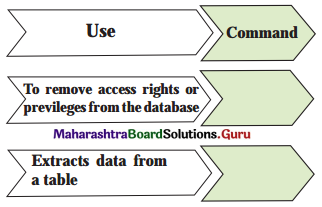
Answer:
prevent congestion in cities

Question 3.
Timely payment of taxes, earning foreign exchange, creating goodwill, political stability.
Answer:
creating goodwill

Question 4.
Protection of environment, maintain transparency, employment generation, development of backward region.
Answer:
maintain transparency

Question 5.
Proper conduct of meeting, careful use of capital, fair prices of products, maintain solvency and prestige.
Answer:
fair prices of products.

1. (F) Complete the sentences

Question 1.
Business organisation can maximise profitability by …………….. wastage.
Answer:
minimising

Question 2.
Social responsibility is broader than …………….. responsibility.
Answer:
legal

Question 3.
The concept of trusteeship was propounded by ……………….
Answer:
Mahatma Gandhi

Question 4.
Business should earn ………………. profit.
Answer:
reasonable

Maharashtra Board OCM 12th Commerce Solutions Chapter 6 Social Responsibilities of Business

Question 5.
……………….. should be fixed according to the nature and importance of work.
Answer:
Remuneration

Question 6.
The word ‘Ethics’ is derived from the Greek word ………………..
Answer:
Ethos

1. (g) Select the correct option

(Responsibilities towards shareholders, Responsibilities towards consumers, Responsibilities towards government. Responsibilities towards society)

Group A Group B
1. (1) After sales service ————–
2. (2) Timely payment of proper taxes ————–
3. —————— Protest Anti-Social activities
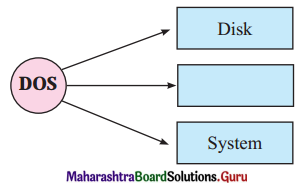
4. —————– Fair practices on Stock Exchange

Answer:

Group A Group B
1. After sales service Responsibilities towards consumers
2. Timely payment of proper taxes Responsibilities towards Government
3. Responsibilities towards Society Protest Anti-Social activities
4. Responsibilities towards shareholders Fair practices on Stock Exchange

1. (H) Answer in one sentence

Question 1.
Who can raise voice against business malpractices?
Answer:
Media can raise voice against business malpractices.

Question 2.
What should be done by management to keep workers updated?
Answer:
Guidance methods like ‘Introduction Training’, Refresher Training should be conducted to keep employees updated on the latest development to increase their efficiency and confidence.

Question 3.
What type of advertising should be avoided?
Answer:
False, misleading and vulgar advertisement should be avoided by the organisations.

Question 4.
What organisation should do to improve quality of goods and to reduce cost of production?
Answer:
Organisation should conduct research and development to improve the quality of goods and to reduce the cost of production which in turn will minimise the final prices charged to consumers.

1. (I) Correct the underlined word and rewrite the sentence

Question 1.
Social responsibility is narrower term than legal responsibility of business.
Answer:
Social responsibility is broader term than legal responsibility of business.

Question 2.
All sorts of fair practices related to stock exchange should be avoided.
Answer:
All sorts of unfair practices related to stock exchange should be avoided.

Question 3.
Management and union should agree strikes and lockouts to protect the interest of both the parties.
Answer:
Management and union should ban strikes and lockouts to protect the interest of both the parties.

Question 4.
MRP (Maximum Retail Price) should not be printed on every packet.
Answer:
MRP (Maximum Retail Price) should be printed on every packet.

Question 5.
Dishonest advertising can be appreciated by customers in the long run.
Answer:
Honest advertising can be appreciated by customers in the long run.

Question 6.
Financial help should be provided by business organisation for anti-social activities.
Answer:
Financial help should not be provided by business organisation for anti-social activities.

Question 7.
Business ethics is a compulsory term.
Answer:
Business ethics is a voluntary term.

Maharashtra Board OCM 12th Commerce Solutions Chapter 6 Social Responsibilities of Business

Question 8.
Business ethics is not a relative term.
Answer:
Business ethics is a relative term.

Question 9.
Social values are based on perceptions of right or wrong.
Answer:
Moral values are based on perceptions of right or wrong.

Question 10.
Moral values provide general guidelines for social conduct.
Answer:
Social values provide general guidelines for social conduct.

2. Explain the following term/concept

Question 1.
Social Responsibility.
Answer:
(1) Good Quality Products : It is the responsibility of a commercial organisation to produce and supply good quality products and services. To improve the quality, every business unit must have quality control department to reject inferior and substandard products. In this respect, International Standards Organisation (ISO) is the latest trend towards quality control. This ensures customers’ loyalty to products.

(2) Fair Prices : The commercial organisation must charge fair and reasonable prices for its goods. Maximum Retail Price (M.R.E) inclusive of all taxes must be printed on all packed products. The customers should not be cheated by being charged higher prices. It is not fair and practicable to fool the customers every time. Such practices bring disrepute to the organisation and spoil its image in the long run.

(3) Customer’s Safety : The organisation must ensure that the product supplied has no adverse effect on the life and health of the consumers. Unsafe products must not be marketed by the organisation. The manufacturers of the genuine products must warn the consumers about the imitation and unsafe products well in time.

Question 2.
Concept of Trusteeship.
Answer:
(1) Trusteeship is a socio-economic philosophy that was propounded by Mahatma Gandhi. According to the principle of trusteeship, “A business must be carried out in trust, legally and morally for the benefit and welfare of the people.” Businessmen are treated to be trustees of society.

(2) Trusteeship provides a means through which rich or wealthy people become trustees of different trusts that take care or look after the welfare (well-being) of the people in the society. Business organisations function and operate within society. They are the part and parcel of the society to which they belong. Therefore, it is now realised that the activity which is harmful to the society is not good (suitable) for the business organisations.

Question 3.
Business Ethics.
Answer:
Meaning : The word ‘ethics’ is derived from Greek word ‘Ethos’ which refers to human character and conduct. The dictionary meaning of ‘ethics’ is moral principles that control or influence a person’s behaviour. The term ‘business ethics’ refers to a system of moral principles or rules of conduct applied to business operations or activities. It is a code of conduct for regulating the activities of business towards society and others. Ethics is a branch of social science.

According to Wheeler, “Business ethics is an art or science of maintaining harmonious relationship with society, its various groups and institutions as well as reorganising the moral responsibility for the right or wrong conduct of business

Question 4.
Moral Values.
Answer:
(1) Moral values are the standards of right and wrong which govern an individual’s behaviour and choices. Moral values may be derived from society, government, religion or self. Moral values are based on the understanding of right and wrong. Business ethics deals with morality in the business environment.

(2) Business may be guided by some moral principles such as not to get involved in unfair trade practices, to be honest and truthful about quality, not to sell adulterated products as pure product, not to give false and misleading advertisements, charging fair prices, paying taxes, duties and fees to the government honestly, and in schedule time, etc.

Question 5.
Social Values.
Answer:
(1) Social values are set of moral principles that provide the general guidelines for our social conduct. Social values constitute an important aspect of the culture of the society. They are based on tradition, ego, honesty, integrity, fairness, hard work, co-operation, forgiveness, etc.

(2) Social values are the values (standards) concerned with the social aspects of human life, e.g. truth, justice, kindness, generosity, tolerance, patriotism, respect for seniors, excellence, etc. The business organisations should develop social, values through educative advertising, cultural programmes, national integration programmes, assistance to the educational institutes, etc.

3. Study the following case/situation and express your opinion

Question 1.
Yashwant Co. Ltd. is providing facilities for their female staff like day care centre for kids and work from home facility. Even management takes their suggestions while taking the decisions though they are members of trade union.

(i) By doing this they are following social responsibilities towards which interest groups?
(ii) What values are they presenting?
(iii) What kind of responsibilities employer follows in above case?
Answer:
(i) By treating the staff with dignity and respect the company follows the social responsibilities towards the employees.
(ii) Yashwant Co. Ltd. are presenting social values by showing co-operation to their female staff.
(iii) Management takes the employees’ suggestions while taking the decisions even though they are members of trade union. By doing this, management recognizes the right of employees to join, Trade Unions. The company also does not restrict employees from forming Trade Union. Thus they follow social responsibility towards employees.

Question 2.
An organisation manufacturing paints has been enjoying a prominent market position since many years. It has been dumping its untreated poisonous waste on the river bank: which has created many health problems for the nearby villages.

(i) Which responsibility is neglected by manufacturing organisation?
(ii) What kind of pollution are they doing?
(iii) What precautionary measures they need to take?
Answer:
(i) Responsibility towards protection of environment is regulated by manufacturing industries.
(ii) They are creating water pollution by dumping its untreated poisonous waste on the river bank.
(iii) Proper waste management techniques should be adopted by the organisation under which waste should be reduced, effort should be made to reuse the waste. Waste that cannot be reduced or reused should be recycled.

Question 3.
A vehicle manufacturing company has adopted the following practices:
(A) Only those components will be used by the company which are environment-friendly.
(B) There will be discharge of harmful wastes only after their proper treatment.
(C) Pollution level of every vehicle will be maintained as per international standards.

(i) By doing this, business organisation follows social responsibility towards which interest group?
(ii) What kind of pollution do they want to avoid ?
(iii) What kind of message do they want to convey ?
Answer:
(i) Business organisation follows social responsibility towards society for protection of environment.
(ii) They want to avoid air pollution.
(iii) They want to convey the message that business should be committed to protect the environment and should not create imbalance in nature.

4. Answer in brief

Question 1.
Give any four types of social responsibilities towards consumers.
Answer:
The social responsibilities of commercial organisation towards consumers are explained as follows:
(1) Good Quality Products : It is the responsibility of a commercial organisation to produce and supply good quality products and services. To improve the quality, every business unit must have quality control department to reject inferior and substandard products. In this respect, International Standards Organisation (ISO) is the latest trend towards quality control. This ensures customers’ loyalty to products.

(2) Fair Prices : The commercial organisation must charge fair and reasonable prices for its goods. Maximum Retail Price (M.R.E) inclusive of all taxes must be printed on all packed products. The customers should not be cheated by being charged higher prices. It is not fair and practicable to fool the customers every time. Such practices bring disrepute to the organisation and spoil its image in the long run.

(3) Customer’s Safety : The organisation must ensure that the product supplied has no adverse effect on the life and health of the consumers. Unsafe products must not be marketed by the organisation. The manufacturers of the genuine products must warn the consumers about the imitation and unsafe products well in time.

(4) Honest Advertising : The advertisement conveys varied information of the products like the facts, features, side effects, advantages, uses, etc. to the customers. The commercial organisations must see to it that their advertisement should not mislead the consumers by exaggerating the actual facts. The commercial organisations must not indulge in vulgar, false and misleading advertisement. Honest advertisements are always appreciated by the consumers and become beneficial in the long run.

(5) After Sales Service: The commercial organisation should offer quick, satisfactory and efficient after sales service specially in the case of consumer durable products for their maintenance during the period of warranty. Effective and efficient after sales services enable them to establish and maintain good relation with the consumers.

Maharashtra Board OCM 12th Commerce Solutions Chapter 6 Social Responsibilities of Business

Question 2.
What is Business Ethics ? What are elements of business ethics ?
Answer:
[A] Meaning : The word ‘ethics’ is derived from Greek word ‘Ethos’ which refers to human character and conduct. The dictionary meaning of ‘ethics’ is moral principles that control or influence a person’s behaviour. The term ‘business ethics’ refers to a system of moral principles or rules of conduct applied to business operations or activities. It is a code of conduct for regulating the activities of business towards society and others. Ethics is a branch of social science.

According to Wheeler, “Business ethics is an art or science of maintaining harmonious relationship with society, its various groups and institutions as well as reorganising the moral responsibility for the right or wrong conduct of business.

[B] Elements of business ethics : The elements of business ethics are explained as follows:
(1) Trustworthiness : Every business unit or organisation must work in all areas to maintain trustworthiness. This increases the confidence of clients or customers in the organisation. The clients usually believe in organisations for reliability and quality performance. Company or organisation functions and prospers on character, i fairness, truth, honour and ability.

(2) Honest service delivery : It is much better to be honest about what one can do rather than making empty promises. Empty or false promises ruin the reputation of the business organisation. Business organisation should fulfil or complete all its commitments and obligations and leave every customer feeling well served and satisfied.

(3) Confidentiality : The company or business organisation should strictly obey and follow its i internal confidential policy. It is utmost important for every business organisation to keep in secret the confidential details of its own clients. For private gain it should not disclose such information to any one. Similarly, it should not use any means to get information from competitors about certain formulae or methods of production.

(4) Openness : Good business ethics and continuous improvement also come from keeping an open mind. Business unit should follow the principle of openness. It should regularly demand opinions and feedback from both clients and team members. Even in times of business disagreement, business unit should welcome other’s opinions and ideas with respect and courtesy.

(5) Other common business ethics : (1) A large portion of our society is composed of common people with low purchasing power. Business enterprises should consider likes, dislikes and financial position of these people and accordingly manufacture and provide goods and services. (2) The guaranties and warranties given by the manufacturer should be proper and acceptable by the customers. (3) Advertisements given by the businessmen should not cross limit of decency.

Question 3.
State responsibilities of business towards government.
Answer:
Responsibilities of business towards government:
(1) Timely payment of taxes : Business organisations are expected to pay various taxes such as sales tax, income tax, corporate tax, excise duty, wealth tax, etc. levied by the government from time to time. These funds enable the government to undertake various development projects.

(2) Observing rules and regulations : The business organisations are expected to comply with the various laws, rules and regulations enacted by the government. The company should follow the laws regarding obtaining license of business operation, price determination and production, etc. They should conduct business in lawful manner.

(3) Earning foreign exchange : The business organisations Eire expected to export their products to foreign countries to earn foreign exchange. Foreign exchange is required by the government to import various goods, valuable and important products.

(4) Economic development : The government sets the targets for balanced growth and rapid economic development of the country. The business organisation is expected to provide necessary support to the government.

(5) Implementing socio-economic policies : The business organisations are expected to provide co-operation and required funds to the government in implementing various socio-economic programmes and policies.

Question 4.
State any four CSR activities.
Answer:
CSR, supports the following activities:

  1. Eradicating hunger, poverty & malnutrition, promoting preventive health care & sanitation & making available safe drinking water.
  2. Promoting education, including special education & employment enhancing vocation skills especially among children, women, elderly & the differently abled & livelihood enhancement projects.
  3. Reducing child mortality and improving maternal health by providing good hospital facilities and low cost medicines.
  4. Ensuring environmental sustainability, ecological balance, protection of flora & fauna, animal welfare, agro forestry, conservation of natural resources & maintaining quality of soil, air & water.
  5. Employment enhancing vocational skills, etc.

5. Justify the following statements.

Question 1.
Role of media has major influence on business organisation.
Answer:
(1) Media refers to the various means used by advertisers to inform the public about the products or services. The mass media include the press, social media, radio and television. Active media plays crucial role in the life of the people. Through internet, reach of social media to common people has become very easy.

(2) Media has efficiency to disburse any information, wrong policy, unfair trade practice adopted by any business organisation at a very fast pace to public at large that too at every corner of the world. Media is very vibrant and active.

(3) Media connects the people and creates influence on masses. It can make propaganda (or raise voice) against business malpractices and exploitation of consumers. It can do publicity through repetition of messages by different means.

(4) Newspapers, radio, television, internet, social media, etc. can easily give publicity to unfair practices of business organisations. So, media makes business organisations understand social values and exerts major influence.

Question 2.
Business should allow workers participation in management.
Answer:
(1) Workers are the real architects of success in any business unit. Investments in human resources (capital) gives rich rewards in the long run.

(2) The success and failure of the business organisations to greater extent depend on the support and participation of employees. Therefore, business organisations should encourage workers to participate in management through various schemes like giving suggestions, saving costs, quality circles, profit sharing co-ownership, etc.

(3) When workers are given opportunity to participate in the management, it will raise their morale. This in turn will give the workers a sense of belongingness. They will take an active part in completion of the work assigned to them.

(4) Workers’ participation in the management r enables the organisation to win the confidence of employees. It creates and maintains good, healthy and improved relationship between labour and management which is necessary for the success of any organisation.

Question 3.
Expectations of society towards business are changing.
Answer:
(1) Today the world is changing and expanding very fast. Social demands have changed gradually over the years. The business has to respond them positively.

(2) Now the people all over the globe are well aware of their rights. Overall knowledge level has also increased. In order to fulfil the growing needs of the people, the business firms must operate as per the expectations of society. Business units must give society what it actually wants.

(3) Consumer satisfaction is the ultimate purpose of business activities. A business organisation must give priority to consumer satisfaction over profit motive. Its survival, progress and reputation depend upon the consumer satisfaction. It must win the confidence of its customers by giving them useful services.

(4) Business organisations are expected to act in broad public interest and serve the objectives of mankind and society at large along with the objectives of earning profit. It must provide quality products to society at reasonable prices and above all contribute to the social welfare.

Question 4.
Business organisations should avoid environmental pollution and ecological imbalance.
Answer:
(1) Functioning of business units and industrialisation create air, water and sound pollution. The carbon particles, dust, harmful gases, chemicals, etc. create air pollution.

(2) Harmful chemicals, untreated sewage, industrial waste, fertilizers, pesticides, refuse, e-waste, etc. when get mixed with water, creates water pollution. Aeroplanes, motor vehicles, construction machines and industrial equipment create sound pollution.

(3) The business organisations are expected to take all possible measures to prevent air, water and sound pollution and to maintain the ecological balance. For the well-being of society every organisation should assist the concerned organisations engaged in pollution control programmes such as plantation of trees, preservation of wildlife and natural resources.

(4) Protecting the environment and maintaining ecological balance in the following manner:

  1. Business organisations save cost and money through minimising waste
  2. Business organi¬sations which follow green practices (plantation of more and more trees) get support from customers
  3. Business organisations which take precautions to protect environment create awareness among employees
  4. Protection of environment process cut carbon emission and create conditions for green growth which is beneficial to society
  5. Business organisations showing awareness towards environment protection get support and encouragement from the government.
    Thus, business organisation should avoid environmental pollution and ecological imbalance.

Question 5.
All sorts of unfair practices related to stock exchange should be avoided.
Answer:
(1) The persons who provide finance for short term as well as for long term to the company are called owners or investors. They invest their money and accept risk factor. Management is expected to provide full and factual information about the financial performance of the company to the owners and investors.

(2) Securities and Exchange Board of India (SEBI) plays a pivotal role in regulating and maintaining the interests of investors in the securities market. Law prohibits any sort of activity that are manipulative or unfair in the securities market. Thus, business organisations must avoid unfair practices related to stock exchange like insider trading, providing wrong and secret information about buying/selling or dealing with securities, etc. Any breach in the above mentioned practices may be considered unlawful and be made accountable by SEBI.

(3) Therefore, business organisation should consider responsibilities toward the owners and should avoid all sorts of unfair practices related to stock exchange.

Maharashtra Board OCM 12th Commerce Solutions Chapter 6 Social Responsibilities of Business

Question 6.
Business ethics contains moral and social values for doing business.
Answer:
(1) Business Ethics refer to code of conduct that a business organisation are expected to follow while doing a business. According to ‘Wheeler’, “Business ethics is an art or science of maintaining harmonious relationship with society, its various groups and institutions as well as recognizing the moral responsibility for right or wrong conduct of business. ”

(2) Moral values are based on perceptions of right and wrong. They provide the general guidelines for distinguishing between wrong and right path of business, between good and bad, fair and unfair, just and unjust, legal and illegal, proper and improper in respect to human actions. Ethics contain moral values for doing business, Honesty, transparency, fairness, integrity, etc. are moral values that create goodwill and gives economic gain in the long run.

(3) Social values form an important part of the culture of the society. They provide general guidelines for social conduct. Values such as fundamental rights, patriotism, respect for human dignity, rationality, sacrifice, equality, democracy, etc. influence our behaviour in many ways. These social values made the business socially acceptable. As business is a part of society, it can be successful in the long run by adopting social values.

Question 7.
Business ethics can be considered as a tool for social development.
Answer:
(1) Business ethics is a code of conduct evolved for regulating the activities of business towards the society and others.

(2) It calls for the importance of fair treatment to be given to the consumers, workers, suppliers, shareholders, competitors, government and the community at large. Business ethics promote the principles of honesty, sincerity, fairness, justice in business dealings.

(3) It protects the interests of all the constituents of the society. It creates healthy and competitive business atmosphere. It induces businessmen to introduce social security and welfare measures.

(4) The businessmen promote activities enhancing the cultural values of the society. Thus, business ethics, if practised by businessmen in the right spirit, can be considered as a tool for social development.

6. Attempt the following

Question 1.
What is social responsibility of commercial organisation towards consumers ?
Answer:
The social responsibilities of commercial organisation towards consumers are explained as follows:
(1) Good Quality Products : It is the responsibility of a commercial organisation to produce and supply good quality products and services. To improve the quality, every business unit must have quality control department to reject inferior and substandard products. In this respect, International Standards Organisation (ISO) is the latest trend towards quality control. This ensures customers’ loyalty to products.

(2) Fair Prices : The commercial organisation must charge fair and reasonable prices for its goods. Maximum Retail Price (M.R.E) inclusive of all taxes must be printed on all packed products. The customers should not be cheated by being charged higher prices. It is not fair and practicable to fool the customers every time. Such practices bring disrepute to the organisation and spoil its image in the long run.

(3) Customer’s Safety : The organisation must ensure that the product supplied has no adverse effect on the life and health of the consumers. Unsafe products must not be marketed by the organisation. The manufacturers of the genuine products must warn the consumers about the imitation and unsafe products well in time.

(4) Honest Advertising : The advertisement conveys varied information of the products like the facts, features, side effects, advantages, uses, etc. to the customers. The commercial organisations must see to it that their advertisement should not mislead the consumers by exaggerating the actual facts. The commercial organisations must not indulge in vulgar, false and misleading advertisement. Honest advertisements are always appreciated by the consumers and become beneficial in the long run.

(5) After Sales Service: The commercial organisation should offer quick, satisfactory and efficient after sales service specially in the case of consumer durable products for their maintenance during the period of warranty. Effective and efficient after sales services enable them to establish and maintain good relation with the consumers.

(6) Research and Development: The commercial organisation is expected to conduct research and development for the purpose of improving the quality of the product and reducing the cost of production. The commercial organisations must provide quality and branded products such as BIS – Bureau of Indian Standards, AGMARK – Agricultural Marketing, ISI – Indian Standards Institute, etc.

(7) Regular Supply: The commercial organisations are expected to provide goods and services to the consumers regularly as and when needed by them. The commercial organisations are not supposed to create artificial scarcity of goods by hoarding. They should not indulge in black marketing.

(8) Attend Complaints : The commercial organisations must attend to the complaints of consumers without any delay. For this, every organisation should implement quick, effective and suitable grievances redressal system. Suggestions of the customers for the improvement of products should be welcomed and gratefully acknowledged. Required modification in the products should be carried out.

(9) Training: The commercial organisation should organise training to their regular and potential consumers, from time to time, either free of cost or by charging nominal fees.

(10) Avoid Customer Exploitation : In order to avoid exploitation of consumers, the commercial organisations should not indulge in unfair trade practices. To protect the interest of consumers, organisations should avoid monopolistic competition in the market.

Question 2.
State different types of responsibilities towards society.
Answer:
The following are the social responsibilities of a business unit towards society community/ public in general:
(1) Protection of environment : In recent years, pollution becomes one of the major problems. Industries, chemical plants, cement plants, etc. create air pollution and water pollution. The business organisations must take all possible measures to prevent or minimise air and water pollution and maintain ecological balance.

(2) Better and maximum use of resources : The business firms must make proper and optimum use of available resources in the larger interest of the society. The resources such as water, land, fuel, raw materials, etc. should be used fairly and efficiently. However, care should be taken not to misuse or waste such resources.

(3) Reservation for weaker section : For upliftment of economically weaker section of society, the business organisations are expected to reserve certain positions in their organisations. They should also provide financial and other necessary help to them wherever expected.

(4) Development of backward regions : The society expects that the business firms should start their industries in less developed (backward) areas to create employment opportunities. It will increase purchasing power among these people. In this manner, business organisations should make development in backward regions.

(5) Protect against anti-social activities : The business organisations should neither undertake nor participate in anti-social activities. They should not provide any financial assistance to anti-social elements. The business firms should avoid anti-social activities such as smuggling, association with underworld (criminal) people, bribing government officials, etc.

Question 3.
Describe the responsibilities of commercial organisation towards investors.
Answer:
Responsibilities of business towards investors:
(1) Proper conduct of meetings : Whenever need arises, a company should call and organise meetings of investors to provide information about the business. Prior to meeting, proper notice and agenda should be sent well in advance. During the period of financial crisis, investors should be convinced and taken into confidence. Reasons for failure should be explained to the investors to gain their confidence.

(2) Return on Investment : Investors invest their money in the company by accepting risk. They are entitled by get fair returns on their investment at regular interval in the form of interest. Investors expect the following from the business organisations : (a) fair returns on their investment, (b) safety of their investment and (c) steady and gradual appreciation of the business.

(3) Handling grievances : A company is required to pay attention and handle the grievances and complaints of the investors amicably. There should be orderly procedure to solve and deal with grievances without any delay. The business management should answer all the queries of investors regarding any issue in satisfactory manner.

(4) Maintain transparency : Investors supply funds for long term and for working capital to carry on business more efficiently. Investors expect that business firms should maintain high degree of transparency in their operations.

(5) Proper disclosure of information : A company is expected to disclose full and factual information through regular reports, circulars and statement of profit. The company must provide its financial performance more correctly so that prospective investors are able to take right decisions to invest their money in future.

(6) Maintain solvency and prestige : Business organisation or a company is expected to maintain sound financial position, prestige, solvency and goodwill to gain confidence of investors. For this, company should undertake innovation, research and expansion programme on the continuous basis.

Question 4.
Describe the features of Business Ethics.
Answer:
The features of Business Ethics are explained as below:
(1) Code of conduct : Business ethics is a code of conduct developed and evolved for regulating business activities toward welfare of society. It explains what activities one is suppose to do and not do for the welfare of the society. All business units must follows this code of conduct.

(2) Based on moral and social values : Business ethics comprises social and moral principles i.e. rules for carrying out business activities smoothly. This contains self control, consumer protection and welfare, fair treatment to social group, service to society, not to harm (exploit) others, etc.

(3) Gives protection to social groups : Business ethics protects the interests of all the constituents (groups) of the society which include consumers, creditors, employees, small businessmen, shareholders, government, etc.

(4) Provides basic framework : Business ethics specifies the social, cultural, legal, economic and other limits of business within which business units are expected to plan, work out and conduct their functions and activities.

(5) Voluntary : The businessmen must follow (accept) business ethics voluntarily, i.e. on their own. Business ethics must be similar to self¬discipline. It should not be made compulsory by law.

(6) Requires education and guidance : Prior to introduction of business ethics in the organisation, businessmen must be properly educated, trained and given guidance. The businessmen must be convinced and motivated to implement business ethics.

(7) Relative term : Business ethics is a relative term. It differs or changes from one business to another business and from one country to another.
In one country whatever is considered good may be banned or bad for other country.

(8) New concept : Business ethics is considered as newer concept. It is strictly followed and applied in developed, i.e. advanced countries. It is not accepted and followed in developing and poor (backward) countries.

Maharashtra Board OCM 12th Commerce Solutions Chapter 6 Social Responsibilities of Business

Question 5.
What is Corporate Social Responsibility?
Answer:
(1) Corporate Social Responsibility (CSR) is the recent and newest management strategy which creates positive impact on society while doing business. It is a global concept. It is self regulating business model which aims at contributing towards social welfare and support ethically oriented practices. CSR makes a company socially accountable and responsible. CSR makes a company accountable towards itself, its stakeholders, public in general, etc. By undertaking and practising social responsibility company can be alert and awake about social, economic and environmental aspects of the society.

(2) According to UNIDO (United Nations Industrial Development Organization), “Corporate Social Responsibility is a management concept whereby companies integrate social and environmental concerns in their business operations and interactions with their stakeholders”.

According to Section 135 of the Companies Act, 2013 and Companies (CSR Policy) Rules 2014, the companies having net worth of 1500 Cr. or more or turnover of 1000 Cr. or more; or net profit of 15 Cr. or more during any financial year have to form a Corporate Social Responsibility Committee of the Board. The Board’s report will give information about the compositions of CSR committee with effect from 1st April, 2014.

(3) In every financial year, all companies should spend at least 2% of average net profits of last 3 years on their CSR policy. The CSR committee consists of 4 directors who meet at least 2 times in a year to discuss and review the CSR policy and CSR activities, prepare budget, explain the way to implement projects and to establish a transparent means to check progress.

(4) CSR, supports the following activities:

  1. Eradicating hunger, poverty & malnutrition, promoting preventive health care & sanitation & making available safe drinking water.
  2. Promoting education, including special education & employment enhancing vocation skills especially among children, women, elderly & the differently abled & livelihood enhancement projects.
  3. Reducing child mortality and improving maternal health by providing good hospital facilities and low cost medicines.
  4. Ensuring environmental sustainability, ecological balance, protection of flora & fauna, animal welfare, agro forestry, conservation of natural resources & maintaining quality of soil, air & water.
  5. Employment enhancing vocational skills, etc.

(5) Penalties for non-compliance of CSR activities (duties) would attract a fine of not less than Rs 50,000 which may increase to Rs 25,00,000 and every officer of the company in default is given punishment of imprisonment for 3 years or with fine of Rs 50,000 which may increase to Rs 5,00,000 or with both.

7. Answer the following

Question 1.
Explain the responsibilities of business towards employees.
Answer:
The responsibilities of business towards employees are explained as follows:
(1) Job security: Job security (guarantee) gives mental peace to the employees. In order to encourage employees to work with full concentration, dedication and commitment, the business organisation must give job security and frame rules for confirmation of their service and strictly adhere to them. This will in turn raise their morale, interest and loyalty towards the organisation.

(2) Fair remuneration : The business organisation should pay adequate and attractive salaries along with incentives like overtime allowance, bonus, etc. to all employees. Wages or salaries payable to employees should be fixed by considering nature of work. The business organisations should frame suitable wage plans for increments and timely revision of wages.

(3) Health and safety measures : The business organisations is expected to take necessary steps for protecting the health and hygiene of the employees. Proper sanitation, canteen, medical facilities, hygienic conditions, etc. must be provided to them. Proper maintenance of machines and premises must be done to prevent accidents and control pollution. Business organisation should provide safety equipment such as helmets, safety goggles, gloves, shoes, masks, etc. to the employees.

(4) Good working condition : The business organisations must provide good working conditions to their employees such as adequate lighting, ventilation, safe drinking water, etc. The business organisations are expected to take necessary steps to avoid and minimise air, sound and water pollution. The business organisation must fix proper working hours and norms (shiftwise, if any) with due provisions for lunch break, tea intervals, restrooms, etc.

(5) Recognition of Trade Unions : The business organisation must recognise the right of a worker to join a recognised trade union. The management or employer should not prevent workers from forming a trade union. The management should not follow the policy of “Divide and Rule”. Further, the management should solve the problems of the workers amicably by holding face to face interactions, talks, meetings and negotiations with unions. The management and union should agree to ban lockouts and strikes to protect the interest of both the parties. A business organisation is expected to maintain industrial harmony and peace.

(6) Education and training : The business organisations are expected to take efforts to educate and train the employees. Depending on the nature of job, the business organisation should offer education, training and guidance to their employees free of cost. To update their knowledge, on the latest development and to increase the S efficiency of the employees, the organisation should arrange ‘Refresher in service training’ and ‘Introduction Training’ at regular intervals.

(7) Workers participation in management : The business organisations are expected to encourage workers to participant in the management by forming workers’ committee. The management should encourage the workers ; through different schemes like suggestion schemes, profit sharing, etc. These schemes enable the management to raise employees’ morale and help the management to give them a sense of belonging.

(8) Promotion and career opportunities : Business organisations should offer enough opportunities of promotion to their qualified and talented employees. They should give detailed information about qualification, skills and I experience required to get promotions. This will increase awareness and motivate the workers to work hard.

(9) Proper grievance procedure : The organi-sation must introduce a suitable grievance (redressal) procedure to deal with the employees’ complaints. All their queries or problems should be sorted out and solved quickly and amicably.

The employees must feel satisfied that their complaints are attended properly. Management or employer must investigate and take necessary actions to settle the grievances and complaints.

(10) Miscellaneous : Management or employer should-

  1. give fair treatment to all employees.
  2. recognise, appreciate and encourage special skills and talents of the employees.
  3. introduce code of conduct for the employees.
  4. protect religious, social, political rights of the employees.
  5. allow employees to form informal groups.

Maharashtra Board OCM 12th Commerce Solutions Chapter 6 Social Responsibilities of Business

Question 2.
Define the concept of Social Responsibility and what is the need for social responsibility.
Answer:
[A] Meaning and Definition : Social responsibility is an obligation of the business organisation to take those decisions and perform those actions which are desirable to fulfil the objectives and add values to our society. The business organisations are expected to perform all the activities of their business in such a manner that such activities will not cause any harm to any part of the society.

In other words, the business enterprises should undertake such activities which will protect and contribute to the interest of society and fulfil their expectations. According to Howard D. Bowen “Social Responsibility is to pursue those policies to make those decisions, or to follow those lines of action which are desirable in terms of the objectives and values of our society.” In brief, social responsibility comprises of an element of voluntary action taken by the business people for the benefit of the society.

[B] Need for social responsibility:
(1) Concept of Trusteeship : Trusteeship is a socio-economic philosophy that was advocated by Mahatma Gandhi. According to it, rich (wealthy) people would be trustees of the trusts that take care of the welfare of the people in general. Businessmen are treated as trustees of society.

(2) Changing expectations of society : Over the years, society’s expectations from the business organisation have undergone severe change. In earlier days, business firms were recognised as the providers of goods and services. However in recent years society expects that every business organisation as a responsible citizen should contribute towards social welfare of the people in the society.

(3) Reputation : Business organisations spend large amount of money in brand building and in creating and strengthening their favourable image. The business organisations which care for every organ of the society and contribute to social well¬being enjoy a good reputation in the society. Such organisations always get good support from the public which in turn increases sales, profitability, attraction of talent and sustained growth.

(4) Protection of environment : It is the social responsibility of the business organisations to make proper and careful use of country’s natural resources. They should not cause environmental pollution (degradation) like contamination pollution of water resources, depletion of ozone layer, etc. Such type of pollutions result in poor health of the community and put a question mark on the survival of human species/race.

(5) Optimum utilisation of resources : Usually, large business organisations have huge amount of resources such as manpower, talent, finance and expert at their disposal to use. It is the social responsibility of business organisations to make optimum use of available resources to protect society’s interests. The organisation should always avoid wastage of resources.

(6) Pressure of trade union : The workers have now become more conscious of their rights and privileges. In recent years, trade unions play significant role in business environment. The workers have realised that their efforts contribute to the profits of the business organisation and expect management to pay them fair wages, bonus, etc. to minimise or avoid conflicts between trade unions and management. The business organisations should understand the responsibility towards employees to avoid conflicts and act accordingly.

(7) Growth of consumer movement : Advancement and growth in education, development of mass media and growing competition in the market create awareness among the consumers about their rights and powers. Hence, business organisation are required to follow consumer-oriented policies.

(8) Government control : From the side of business organisation, government rules and regulations are not desirable. This is because government put certain restrictions and limit the freedom of business organisations. In order to put moral and legal pressure on business, the government has enacted several laws such as Consumer Protection Act, 1986, Air Pollution Act, Food Adulteration Act, etc.

(9) Long term self interest : A business organisation and its image stand to earn handsome profit in the long run if its motive is providing services to the society. When the workers, consumers, shareholders, government officials and members of the public feel that a business organisation is indifferent to the social interests, they may withdraw their support to end co¬operation. Therefore, it is in the long-term interest of the business organisation to be socially useful and fulfil its social responsibility.

(10) Complexities of social problems : Many a time some business organisations themselves create social problems such as discrimination in treatment, unsafe workplaces, different types of pollutions, etc. It is the moral and social obligation of the business organisation to solve these social problems.

(11) Globalisation : In globalisation, business activities are conducted throughout the world. In recent years, the entire globe (world) has becomes the market place for buying and selling goods and services produced in any part of the world. Globalisation creates and provides more opportunities, threats and challenges to the business organisations. Those countries in the world which have followed good and fair trade practices capture and influence the entire world trade.

(12) Role of media : By using internet, it is easier to approach the common people. Media is dynamic and active which can influence large number of people in the society. Media is useful to raise voice against malpractice and exploitation of the consumers. Media plays important and active role in public life. Thus, Business organisation should not neglect the social values.

Question 3.
Explain the responsibilities of a business unit towards society at a large.
Answer:
The following are the social responsibilities of a business unit towards society community/ public in general:
(1) Protection of environment : In recent years, pollution becomes one of the major problems. Industries, chemical plants, cement plants, etc. create air pollution and water pollution. The business organisations must take all possible measures to prevent or minimise air and water pollution and maintain ecological balance.

(2) Better and maximum use of resources : The business firms must make proper and optimum use of available resources in the larger interest of the society. The resources such as water, land, fuel, raw materials, etc. should be used fairly and efficiently. However, care should be taken not to misuse or waste such resources.

(3) Reservation for weaker section : For upliftment of economically weaker section of society, the business organisations are expected to reserve certain positions in their organisations. They should also provide financial and other necessary help to them wherever expected.

(4) Development of backward regions : The society expects that the business firms should start their industries in less developed (backward) areas to create employment opportunities. It will increase purchasing power among these people. In this manner, business organisations should make development in backward regions.

(5) Protect against anti-social activities : The business organisations should neither undertake nor participate in anti-social activities. They should not provide any financial assistance to anti-social elements. The business firms should avoid anti-social activities such as smuggling, association with underworld (criminal) people, bribing government officials, etc.

(6) Financial assistance : The society expects financial helps and donations from the business organisations for various social welfare activities such as eradication of poverty, illiteracy, etc. The society also expects financial assistance from them to organise various awareness programmes like anti-drug campaigns, antinoise pollution campaigns, etc.

(7) Prevent congestions : The society expects that the business firms start industries in industrial zones and at different locations. It will minimise the adverse effects like pollution and overcrowded cities in residential areas. This facilitates business firms to provide jobs to local people. This in turn avoids congestion in big cities.

(8) Employment generation : The business units should generate and provide better job opportunities to young and well qualified people in all sections of the society. It should make maximum efforts to generate employment through expansion and diversification of its business. This will avoid unemployment and poverty in the society.

Maharashtra Board OCM 12th Commerce Solutions Chapter 6 Social Responsibilities of Business

Question 4.
What are the responsibilities of business towards investors and government?
Answer:
[A] Responsibilities of business towards investors:
(1) Proper conduct of meetings : Whenever need arises, a company should call and organise meetings of investors to provide information about the business. Prior to meeting, proper notice and agenda should be sent well in advance. During the period of financial crisis, investors should be convinced and taken into confidence. Reasons for failure should be explained to the investors to gain their confidence.

(2) Return on Investment : Investors invest their money in the company by accepting risk. They are entitled by get fair returns on their investment at regular interval in the form of interest. Investors expect the following from the business organisations : (a) fair returns on their investment, (b) safety of their investment and (c) steady and gradual appreciation of the business.

(3) Handling grievances : A company is required to pay attention and handle the grievances and complaints of the investors amicably. There should be orderly procedure to solve and deal with grievances without any delay. The business management should answer all the queries of investors regarding any issue in satisfactory manner.

(4) Maintain transparency : Investors supply funds for long term and for working capital to carry on business more efficiently. Investors expect that business firms should maintain high degree of transparency in their operations.

(5) Proper disclosure of information : A company is expected to disclose full and factual information through regular reports, circulars and statement of profit. The company must provide its financial performance more correctly so that prospective investors are able to take right decisions to invest their money in future.

(6) Maintain solvency and prestige : Business organisation or a company is expected to maintain sound financial position, prestige, solvency and goodwill to gain confidence of investors. For this, company should undertake innovation, research and expansion programme on the continuous basis.

[B] Responsibilities of business towards government:
(1) Timely payment of taxes : Business organisations are expected to pay various taxes such as sales tax, income tax, corporate tax, excise duty, wealth tax, etc. levied by the government from time to time. These funds enable the government to undertake various development projects.

(2) Observing rules and regulations : The business organisations are expected to comply with the various laws, rules and regulations enacted by the government. The company should follow the laws regarding obtaining license of business operation, price determination and production, etc. They should conduct business in lawful manner.

(3) Earning foreign exchange : The business organisations Eire expected to export their products to foreign countries to earn foreign exchange. Foreign exchange is required by the government to import various goods, valuable and important products.

(4) Economic development : The government sets the targets for balanced growth and rapid economic development of the country. The business organisation is expected to provide necessary support to the government.

(5) Implementing socio-economic policies : The business organisations are expected to provide co-operation and required funds to the government in implementing various socio-economic programmes and policies.

(6) Suggestions to the Government: The business organisations are expected to give suggestions to the government in framing important policies such as Industrial Policy, Import-Export Policy, Licensing Policy, etc. They are helpful to government in framing organisation friendly policies.

(7) No favours : The business organisation should not take any favour from the government officials by giving bribes or influencing them in any matter.

(8) Contributing to government treasury: The business organisation must contribute by extending financial aid to the government during emergencies and natural calamities like floods.

OCM 12th Commerce Textbook Solutions Digest