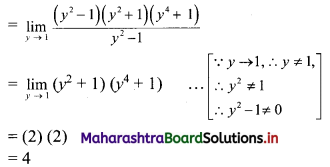
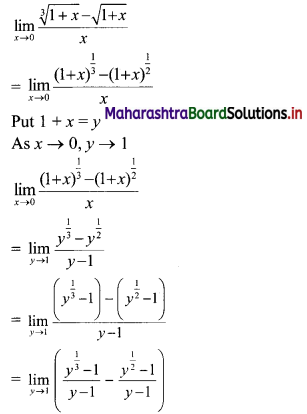
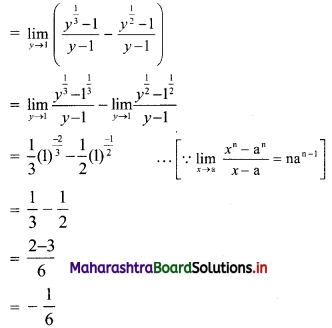
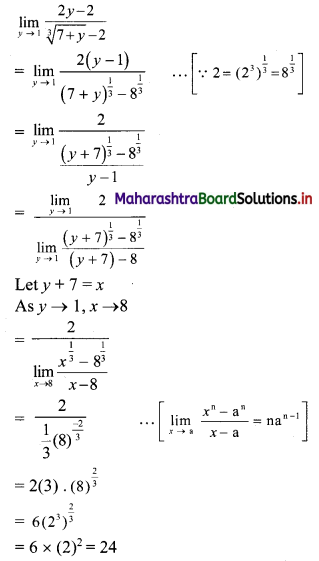
11th Commerce Maths 2 Chapter 1 Exercise 1.3 Answers Maharashtra Board

Partition Values Class 11 Commerce Maths 2 Chapter 1 Exercise 1.3 Answers Maharashtra Board

Balbharati Maharashtra State Board 11th Commerce Maths Solution Book Pdf Chapter 1 Partition Values Ex 1.3 Questions and Answers.

Std 11 Maths 2 Exercise 1.3 Solutions Commerce Maths

Question 1.
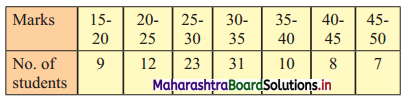
The following table gives the frequency distribution of marks of 100 students in an examination.
Maharashtra Board 11th Commerce Maths Solutions Chapter 1 Partition Values Ex 1.3 Q1
Determine D6, Q1, and P85 graphically.
Solution:
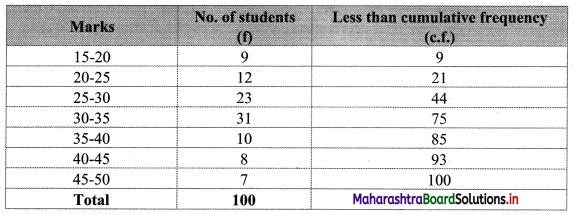
To draw an ogive curve, we construct the less than cumulative frequency table as given below:
Maharashtra Board 11th Commerce Maths Solutions Chapter 1 Partition Values Ex 1.3 Q1.1
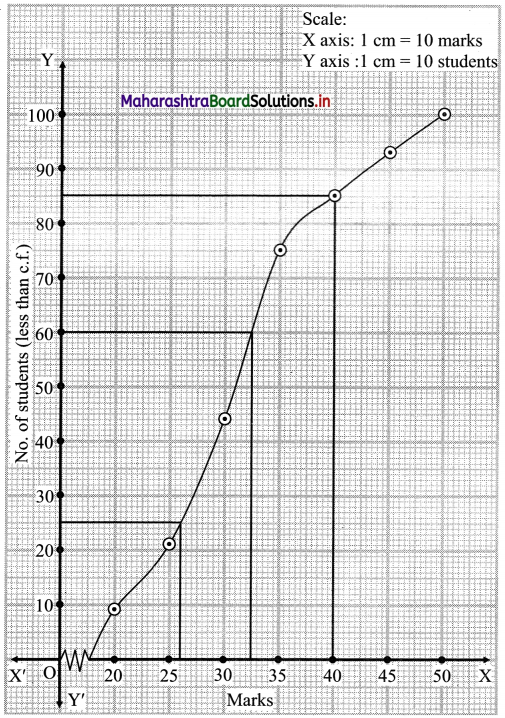
The points to be plotted for less than ogive are (20, 9), (25, 21), (30, 44), (35, 75), (40, 85), (45, 93), (50, 100).
Maharashtra Board 11th Commerce Maths Solutions Chapter 1 Partition Values Ex 1.3 Q1.2
Here, N = 100
For D6, \(\frac{6 \mathrm{~N}}{10}=\frac{6 \times 100}{10}\) = 60
For Q1, \(\frac{\mathrm{N}}{4}=\frac{100}{4}\) = 25
For P85, \(\frac{85 \mathrm{~N}}{100}=\frac{85 \times 100}{100}\) = 85
∴ We take the points having Y co-ordinates 60, 25 and 85 on Y-axis.
From these points, we draw lines parallel to X-axis.
From the points where these lines intersect the curve, we draw perpendiculars on X-axis.
X co-ordinates of these points give the values of D6, Q1 and P85.
∴ D6 = 32.5, Q1 = 26, P85 = 40

Maharashtra Board 11th Commerce Maths Solutions Chapter 1 Partition Values Ex 1.3

Question 2.
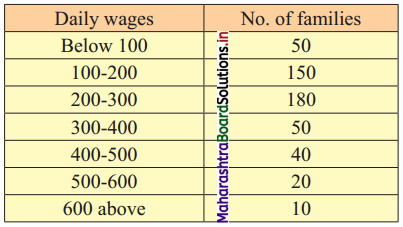
The following table gives the distribution of daily wages of 500 families in a certain city.
Maharashtra Board 11th Commerce Maths Solutions Chapter 1 Partition Values Ex 1.3 Q2
Draw a ‘less than’ ogive for the above data. Determine the median income and obtain the limits of income of central 50% of the families.
Solution:
To draw an ogive curve, we construct the less than cumulative frequency table as given below:
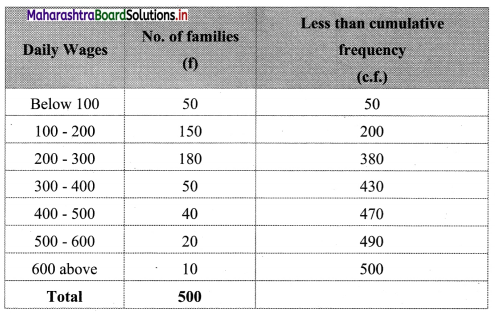
Maharashtra Board 11th Commerce Maths Solutions Chapter 1 Partition Values Ex 1.3 Q2.1
The points to be plotted for less than ogive are (100, 50), (200, 200), (300, 380), (400, 430), (500, 470), (600, 490) and (700, 500).
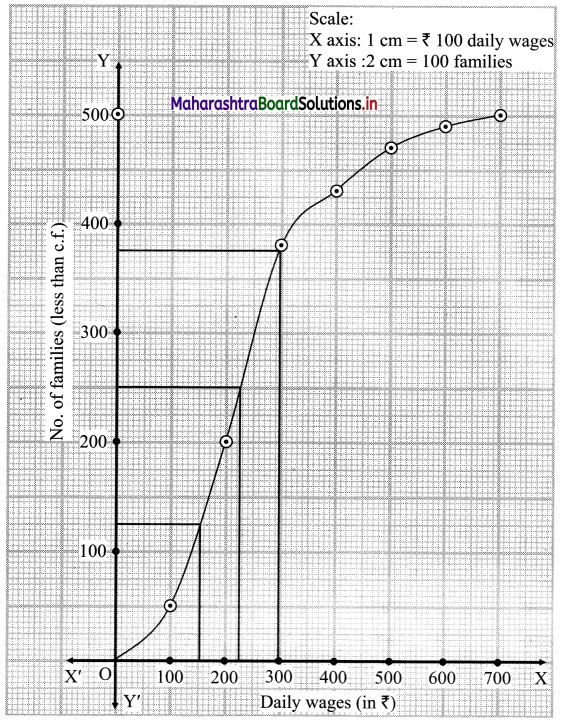
Maharashtra Board 11th Commerce Maths Solutions Chapter 1 Partition Values Ex 1.3 Q2.2
Here, N = 500
For Q1, \(\frac{\mathrm{N}}{4}=\frac{500}{4}\) = 125
For Q2, \(\frac{\mathrm{N}}{2}=\frac{500}{2}\) = 250
For Q3, \(\frac{3 \mathrm{~N}}{4}=\frac{3 \times 500}{4}\) = 375
∴ We take the points having Y co-ordinates 125, 250 and 375 on Y-axis.
From these points we draw lines parallel to X-axis.
From the points where these lines intersect the curve, we draw perpendiculars on X-axis.
X-Co-ordinates of these points give the values of Q1, Q2 and Q3.
∴ Q1 ~ 150, Q2 ~ 228, Q3 ~ 297
∴ Median = 228
50% families lie between Q1 and Q3
∴ Limits of income of central 50% families are from ₹ 150 to ₹ 297

Question 3.
From the following distribution, determine the median graphically.
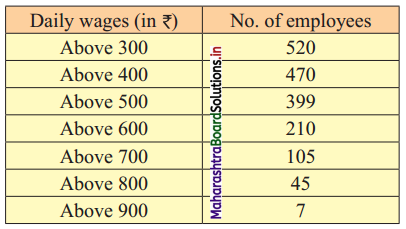
Maharashtra Board 11th Commerce Maths Solutions Chapter 1 Partition Values Ex 1.3 Q3
Solution:
To draw an ogive curve, we construct the less than and more than cumulative frequency table as given below:
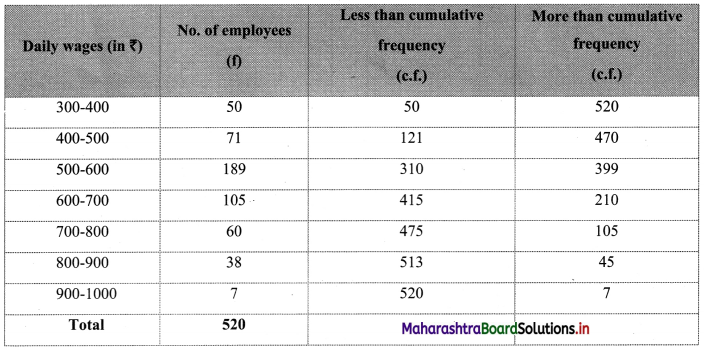
Maharashtra Board 11th Commerce Maths Solutions Chapter 1 Partition Values Ex 1.3 Q3.1
The points to be plotted for less than ogive are (400, 50), (500, 121), (600, 310), (700, 415), (800, 475), (900, 513) and (1000, 520) and that for more than ogive are (300, 520), (400, 470), (500, 399), (600, 210), (700, 105), (800, 45), (900, 7).
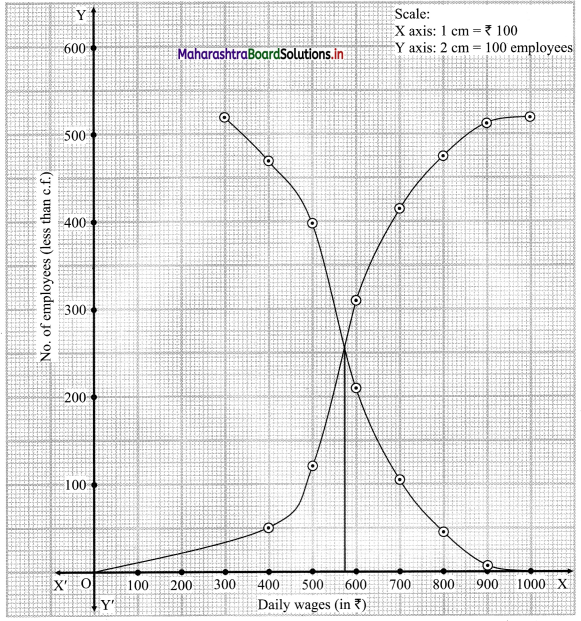
Maharashtra Board 11th Commerce Maths Solutions Chapter 1 Partition Values Ex 1.3 Q3.2
From the point of intersection of two ogives, we draw a perpendicular on X-axis.
The point where it meets the X-axis gives the value of the median.
∴ Median ~ 574

Maharashtra Board 11th Commerce Maths Solutions Chapter 1 Partition Values Ex 1.3

Question 4.
The following frequency distribution shows the profit (in ₹) of shops in a particular area of the city.
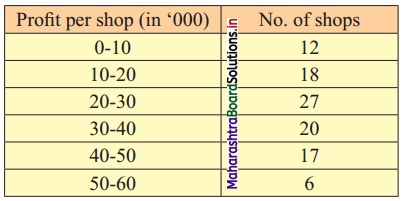
Maharashtra Board 11th Commerce Maths Solutions Chapter 1 Partition Values Ex 1.3 Q4
Find graphically
(i) the Unfits of middle 40% shops.
(ii) the number of shops having a profit of fewer than 35,000 rupees.
Solution:
To draw an ogive curve, we construct a less than cumulative frequency table as given below:
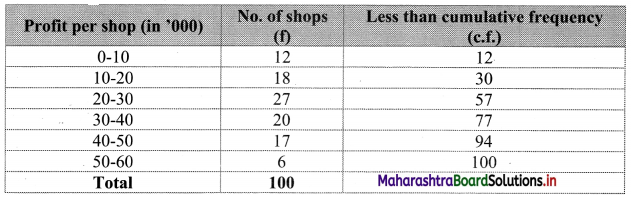
Maharashtra Board 11th Commerce Maths Solutions Chapter 1 Partition Values Ex 1.3 Q4.1
Points to be plotted are (10, 12), (20, 30), (30, 57), (40, 77), (50, 94), (60, 100).
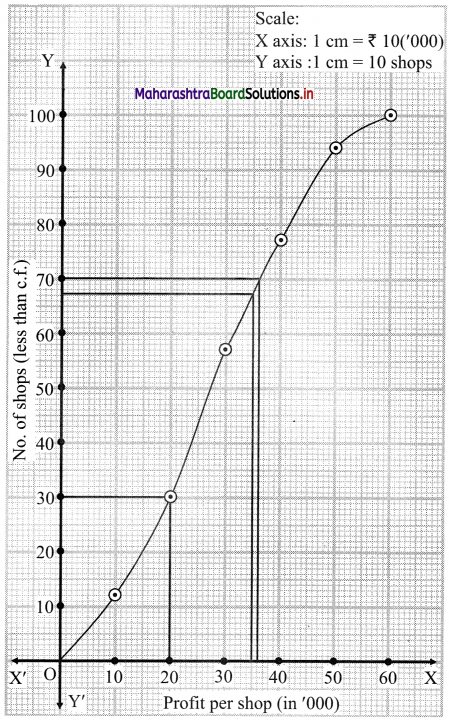
Maharashtra Board 11th Commerce Maths Solutions Chapter 1 Partition Values Ex 1.3 Q4.2
The Middle 40% value lies in between P30 and P70.
N = 100
For P30 = \(\frac{30 \mathrm{~N}}{100}=\frac{30 \times 100}{100}\) = 30
For P70 = \(\frac{70 \mathrm{~N}}{100}=\frac{70 \times 100}{100}\) = 70
∴ We take the points having Y co-ordinates 30 and 70 on Y-axis. From these points we draw lines parallel to X-axis.
From the points where these lines intersect the curve, we draw perpendiculars on X-axis.
X-Co-ordinates of these points give the values of P30 and P70.
∴ P30 ~ 20, P70 ~ 36
Limits of middle 40% shops lie between ₹ 20,000 to ₹ 36,000
To find the number of shops having a profit of less than ₹ 35,000, we take the value 35 on the X-axis.
From this point, we draw a line parallel to Y-axis, and from the point where it intersects the less than ogive we draw a perpendicular on Y-axis. It intersects the Y-axis at approximately 67.
∴ No. of shops having profit less than ₹ 35,000 is 67.

Question 5.
The following is the frequency distribution of overtime (per week) performed by various workers from a certain company. Determine the values of D2, Q2, and P61 graphically.
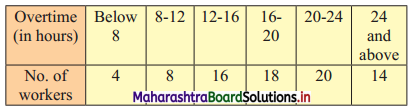
Maharashtra Board 11th Commerce Maths Solutions Chapter 1 Partition Values Ex 1.3 Q5
Solution:
To draw an ogive curve, we construct a less than cumulative frequency table as given below:
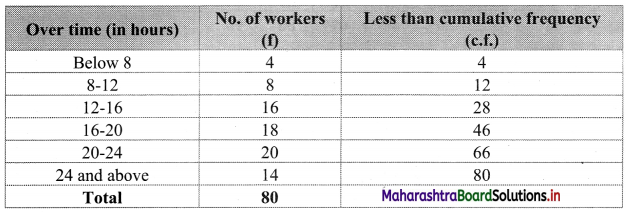
Maharashtra Board 11th Commerce Maths Solutions Chapter 1 Partition Values Ex 1.3 Q5.1
Points to be plotted are (8, 4), (12, 12), (16, 28), (20, 46), (24, 66) and (28, 80)
Here, N = 80
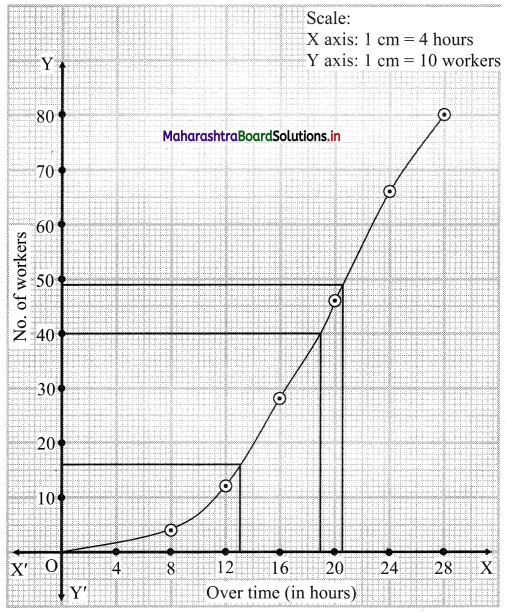
Maharashtra Board 11th Commerce Maths Solutions Chapter 1 Partition Values Ex 1.3 Q5.2
For D2, we have to consider \(\frac{2 \mathrm{~N}}{10}=\frac{2 \times 80}{10}\) = 16
For Q2, we have to consider \(\frac{\mathrm{N}}{2}=\frac{80}{2}\) = 40
and for P61, we have to consider \(\frac{61 \mathrm{~N}}{100}=\frac{61 \times 80}{100}\) = 48.8
∴ We consider the values 16, 40 and 48.8 on the Y-axis.
From these points, we draw the lines which are parallel to the X-axis.
From the points where they intersect the less than ogive, we draw perpendiculars to X-axis.
The values at the foot of perpendiculars represent the values of D2, Q2, and P61 respectively.
∴ D2 ~ 13, Q2 ~ 19, P61 ~ 20.5

Maharashtra Board 11th Commerce Maths Solutions Chapter 1 Partition Values Ex 1.3

Question 6.
Draw ogive for the following data and hence find the values of D1, Q1, and P40.
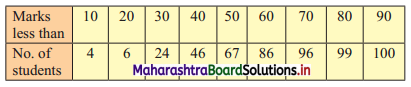
Maharashtra Board 11th Commerce Maths Solutions Chapter 1 Partition Values Ex 1.3 Q6
Solution:
N = 100
To draw the less than ogive we have to plot the points (10, 4), (20, 6), (30, 24), (40, 46), (50, 67), (60, 86), (70, 96), (80, 99), (90, 100).
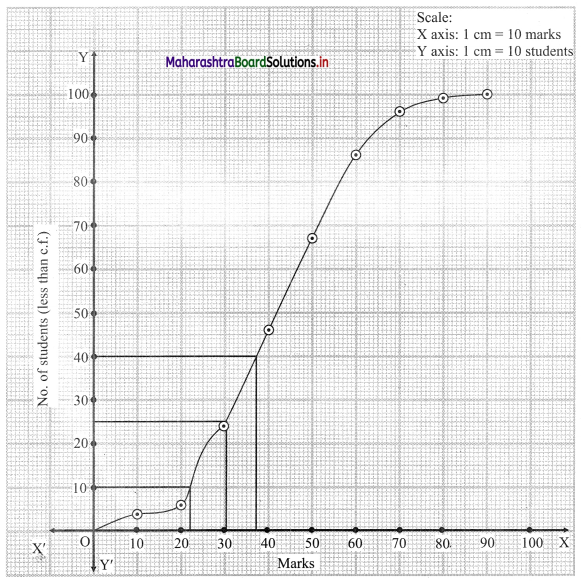
Maharashtra Board 11th Commerce Maths Solutions Chapter 1 Partition Values Ex 1.3 Q6.1
For D1, we have to consider \(\frac{\mathrm{N}}{10}=\frac{100}{10}\) = 10
For Q1, we have to consider \(\frac{\mathrm{N}}{4}=\frac{100}{4}\) = 25
For P40, we have to consider \(\frac{40 \mathrm{~N}}{100}=\frac{40 \times 100}{100}\) = 40
∴ We consider the values 10, 25 and 40 on the Y-axis. From these points we draw lines parallel to X-axis.
From the points where they intersect the less than ogive, we draw perpendiculars on the X-axis.
The values at the foot of perpendicular represent the values of D1, Q1 and P40 respectively.
∴ D1 ~ 22, Q1 ~ 30.5, P40 ~ 37

Question 7.
The following table shows the age distribution of heads of the families in a certain country. Determine the third, fifth, and eighth decile of the distribution graphically.
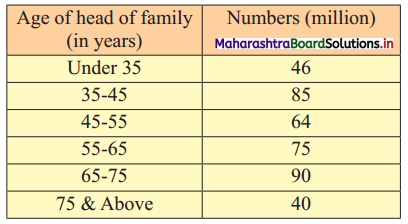
Maharashtra Board 11th Commerce Maths Solutions Chapter 1 Partition Values Ex 1.3 Q7
Solution:
To draw an ogive curve, we construct a less than cumulative frequency table as given below:
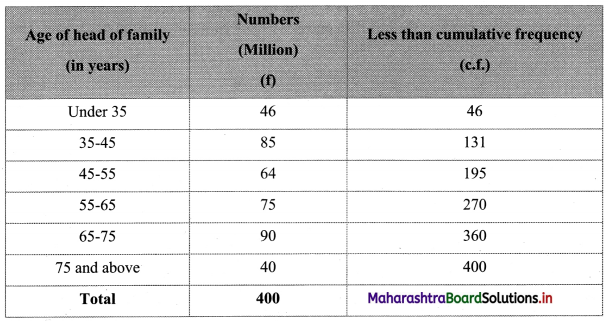
Maharashtra Board 11th Commerce Maths Solutions Chapter 1 Partition Values Ex 1.3 Q7.1
Points to be plotted are (35, 46), (45, 131), (55, 195), (65, 270), (75, 360), (85, 400).
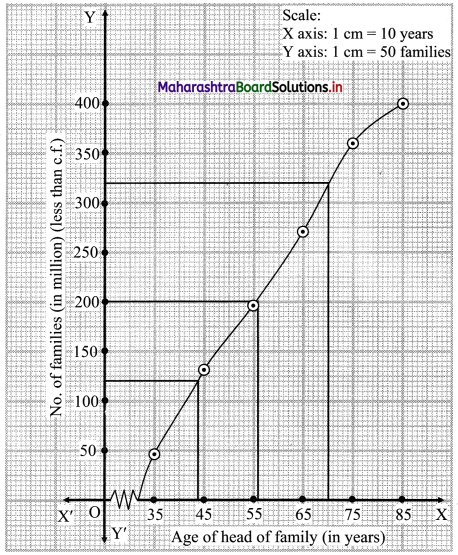
Maharashtra Board 11th Commerce Maths Solutions Chapter 1 Partition Values Ex 1.3 Q7.2
N = 400
For D3, we have to consider \(\frac{3 \mathrm{~N}}{10}=\frac{3 \times 400}{10}\) = 120
For D5, we have to consider \(\frac{5 \mathrm{~N}}{10}=\frac{5 \times 400}{10}\) = 200
For D8, we have to consider \(\frac{8 \mathrm{~N}}{10}=\frac{8 \times 400}{10}\) = 320
∴ We consider the values 120, 200 and 320 on Y-axis. From these points we draw the lines parallel to X-axis.
From the points where they intersect the less than ogive, we draw perpendiculars on the X-axis.
The foot of perpendicular represent the values of D3, D5 and D8.
∴ D3 ~ 44, D5 ~ 55.5 and D8 ~ 70

Maharashtra Board 11th Commerce Maths Solutions Chapter 1 Partition Values Ex 1.3

Question 8.
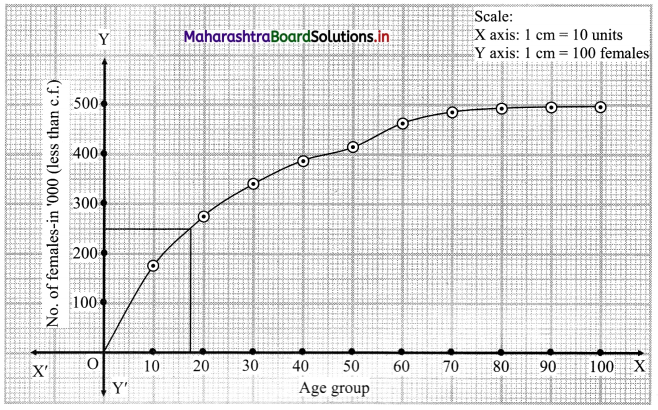
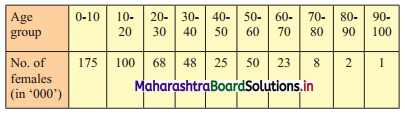
The following table gives the distribution of females in an Indian village. Determine the median age graphically.
Maharashtra Board 11th Commerce Maths Solutions Chapter 1 Partition Values Ex 1.3 Q8
Solution:
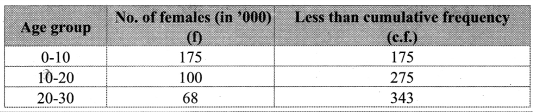
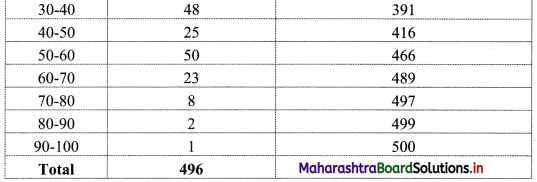
To draw an ogive curve, we construct the less than cumulative frequency table as given below:
Maharashtra Board 11th Commerce Maths Solutions Chapter 1 Partition Values Ex 1.3 Q8.1
Maharashtra Board 11th Commerce Maths Solutions Chapter 1 Partition Values Ex 1.3 Q8.2
Points to be plotted are (10, 175), (20, 275), (30, 343), (40, 391), (50, 416), (60, 466), (70, 489), (80, 497), (90, 499), (100, 500).
Maharashtra Board 11th Commerce Maths Solutions Chapter 1 Partition Values Ex 1.3 Q8.3
N = 500
For median we have to consider \(\frac{\mathrm{N}}{2}=\frac{500}{2}\) = 250
∴ We consider the value 250 on Y-axis. From this point, we draw a line parallel to X-axis.
From the point it intersects the less than ogive, we draw a perpendicular to X-axis.
The foot perpendicular represents the value of the median.
∴ Median ~ 17.5

Question 9.
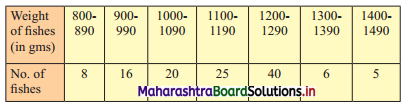
Draw ogive for the following distribution and hence find graphically the limits of the weight of middle 50% fishes.
Maharashtra Board 11th Commerce Maths Solutions Chapter 1 Partition Values Ex 1.3 Q9
Solution:
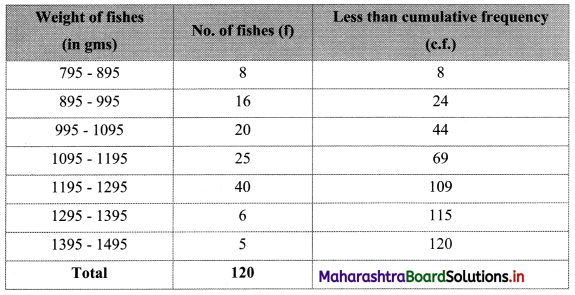
Since the given data is not continuous, we have to convert it into the continuous form by subtracting 5 from the lower limit and adding 5 to the upper limit of every class interval.
To draw an ogive curve, we construct the less than cumulative frequency table as given below:
Maharashtra Board 11th Commerce Maths Solutions Chapter 1 Partition Values Ex 1.3 Q9.1
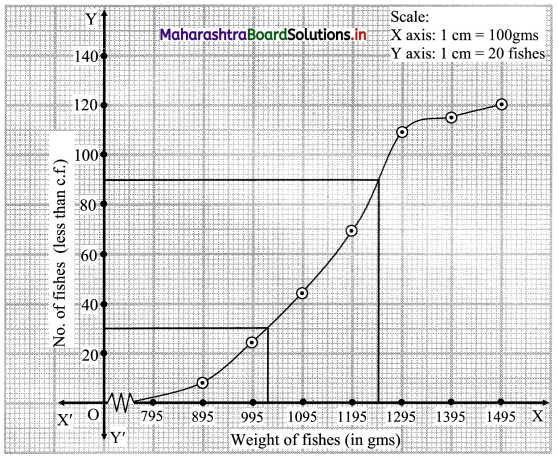
Points to be plotted are (895, 8), (995, 24), (1095, 44), (1195, 69), (1295, 109), (1395, 115), (1495, 120).
Maharashtra Board 11th Commerce Maths Solutions Chapter 1 Partition Values Ex 1.3 Q9.2
N = 120
For Q1 and Q3 we have to consider
\(\frac{\mathrm{N}}{4}=\frac{120}{4}\) = 30
\(\frac{3 \mathrm{~N}}{4}=\frac{3 \times 120}{4}\) = 90
For finding Q1 and Q3 we consider the values 30 and 90 on the Y-axis.
From these points, we draw the lines which are parallel to X-axis.
From the points where these lines intersect the less than ogive, we draw perpendicular on X-axis.
The feet of perpendiculars represent the values Q1 and Q2.
∴ Q1 ~ 1025 and Q3 ~ 1248
∴ the limits of the weight of the middle 50% of fishes lie between 1025 to 1248.

Maharashtra Board 11th Commerce Maths Solutions Chapter 1 Partition Values Ex 1.3

Question 10.
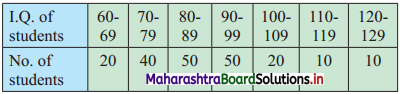
Find graphically the values of D3 and P65 for the data given below:
Maharashtra Board 11th Commerce Maths Solutions Chapter 1 Partition Values Ex 1.3 Q10
Solution:
Since the given data is not continuous, we have to convert it into a continuous form by subtracting 0.5 from the lower limit and adding 0.5 to the upper limit of every class interval.
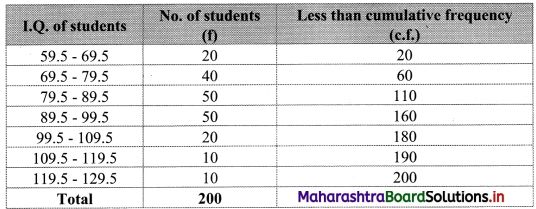
To draw an ogive curve, we construct the less than cumulative frequency table as given below:
Maharashtra Board 11th Commerce Maths Solutions Chapter 1 Partition Values Ex 1.3 Q10.1
Points to be plotted are (69.5, 20), (79.5, 60), (89.5, 110), (99.5, 160), (109.5, 180), (119.5, 190), (129.5, 200).
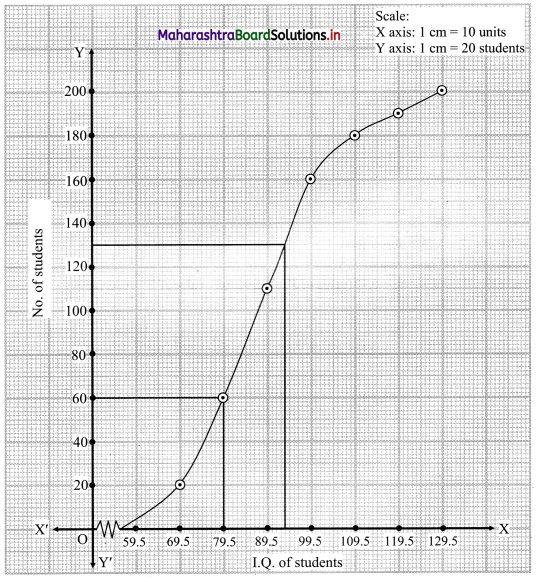
Maharashtra Board 11th Commerce Maths Solutions Chapter 1 Partition Values Ex 1.3 Q10.2
N = 200
For D3, \(\frac{3 \mathrm{N}}{10}=\frac{3 \times 200}{10}\) = 60
For P65, \(\frac{65 \mathrm{N}}{100}=\frac{65 \times 200}{100}\) = 130
∴ We take the values 60 and 130 on the Y-axis.
From these points we draw lines parallel to X-axis and from the points where these lines intersect less than ogive, we draw perpendiculars on X-axis.
The foot of perpendiculars represents the median of the values, D3 and P65.
∴ D3 = 79.5, P65 = 93.5

11th Commerce Maths Digest Pdf

11th Commerce Maths 2 Chapter 5 Exercise 5.1 Answers Maharashtra Board

Correlation Class 11 Commerce Maths 2 Chapter 5 Exercise 5.1 Answers Maharashtra Board

Balbharati Maharashtra State Board 11th Commerce Maths Solution Book Pdf Chapter 5 Correlation Ex 5.1 Questions and Answers.

Std 11 Maths 2 Exercise 5.1 Solutions Commerce Maths

Question 1.
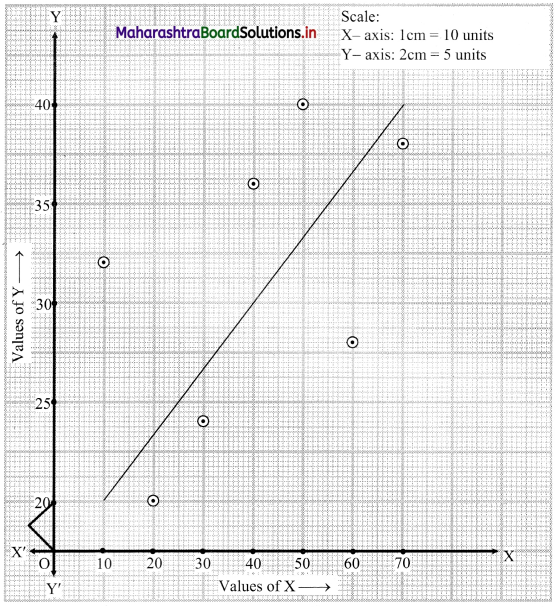
Draw a scatter diagram for the data given below and interpret it.
Maharashtra Board 11th Commerce Maths Solutions Chapter 5 Correlation Ex 5.1 Q1
Solution:
Maharashtra Board 11th Commerce Maths Solutions Chapter 5 Correlation Ex 5.1 Q1.1
Since all the points lie in a band rising from left to right.
Therefore, there is a positive correlation between the values of X and Y respectively.

Question 2.
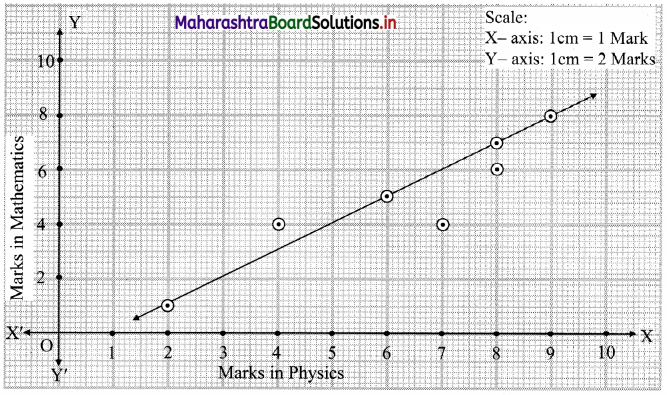
For the following data of marks of 7 students in Physics (x) and Mathematics (y), draw scatter diagram and state the type of correlation.
Maharashtra Board 11th Commerce Maths Solutions Chapter 5 Correlation Ex 5.1 Q2
Solution:
We take marks in Physics on X-axis and marks in Mathematics on Y-axis and plot the points as below.
Maharashtra Board 11th Commerce Maths Solutions Chapter 5 Correlation Ex 5.1 Q2.1
We get a band of points rising from left to right. This indicates the positive correlation between marks in Physics and marks in Mathematics.

Question 3.
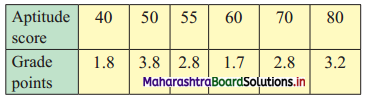
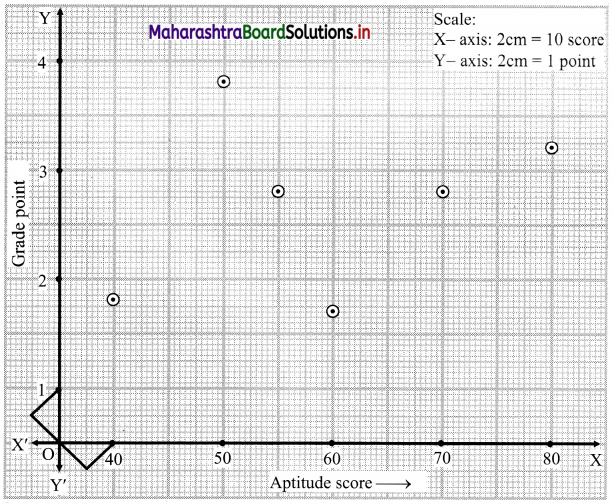
Draw a scatter diagram for the data given below. Is there any correlation between Aptitude score and Grade points?
Maharashtra Board 11th Commerce Maths Solutions Chapter 5 Correlation Ex 5.1 Q3
Solution:
Maharashtra Board 11th Commerce Maths Solutions Chapter 5 Correlation Ex 5.1 Q3.1
The points are completely scattered i.e., no trend is observed.
∴ there is no correlation between Aptitude score (X) and Grade point (Y).

Question 4.
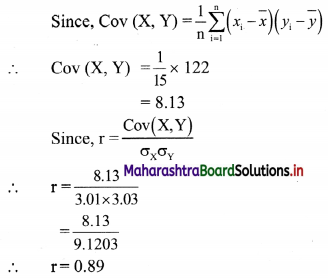
Find correlation coefficient between x andy series for the following data:
n = 15, \(\bar{x}\) = 25, \(\bar{y}\) = 18, σx = 3.01, σy = 3.03, \(\sum\left(x_{\mathrm{i}}-\bar{x}\right)\left(y_{\mathrm{i}}-\bar{y}\right)\) = 122
Solution:
Here, n = 15, \(\bar{x}\) = 25, \(\bar{y}\) = 18, σx = 3.01, σy = 3.03, \(\sum\left(x_{\mathrm{i}}-\bar{x}\right)\left(y_{\mathrm{i}}-\bar{y}\right)\) = 122
Maharashtra Board 11th Commerce Maths Solutions Chapter 5 Correlation Ex 5.1 Q4

Question 5.
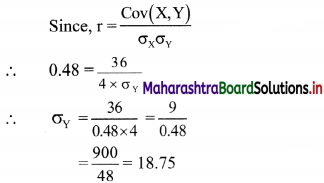
The correlation coefficient between two variables x and y are 0.48. The covariance is 36 and the variance of x is 16. Find the standard deviation of y.
Solution:
Given, r = 0.48, Cov(X, Y) = 36
Since \(\sigma_{X}^{2}\) = 16
∴ σx = 4
Maharashtra Board 11th Commerce Maths Solutions Chapter 5 Correlation Ex 5.1 Q5
∴ the standard deviation of y is 18.75.

Question 6.
In the following data, one of the values of y is missing. Arithmetic means of x and y series are 6 and 8 respectively. (√2 = 1.4142)
Maharashtra Board 11th Commerce Maths Solutions Chapter 5 Correlation Ex 5.1 Q6
(i) Estimate missing observation.
(ii) Calculate correlation coefficient.
Solution:
(i) Let X = xi, Y = yi and missing observation be ‘a’.
Given, \(\bar{x}\) = 6, \(\bar{y}\) = 8, n = 5
∴ 8 = \(\frac{35+a}{5}\)
∴ 40 = 35 + a
∴ a = 5
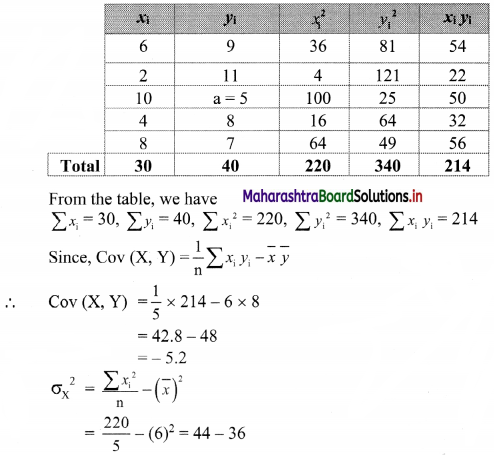
(ii) We construct the following table:
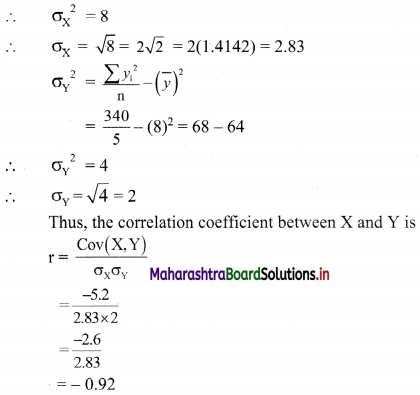
Maharashtra Board 11th Commerce Maths Solutions Chapter 5 Correlation Ex 5.1 Q6.1
Maharashtra Board 11th Commerce Maths Solutions Chapter 5 Correlation Ex 5.1 Q6.2

Question 7.
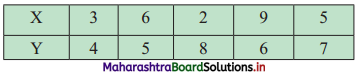
Find correlation coefficient from the following data. [Given: √3 = 1.732]
Maharashtra Board 11th Commerce Maths Solutions Chapter 5 Correlation Ex 5.1 Q7
Solution:
Maharashtra Board 11th Commerce Maths Solutions Chapter 5 Correlation Ex 5.1 Q7.1
Maharashtra Board 11th Commerce Maths Solutions Chapter 5 Correlation Ex 5.1 Q7.2
Maharashtra Board 11th Commerce Maths Solutions Chapter 5 Correlation Ex 5.1 Q7.3

Question 8.
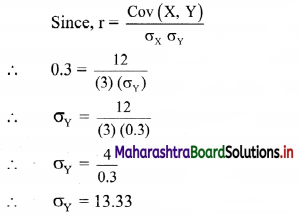
The correlation coefficient between x and y is 0.3 and their covariance is 12. The variance of x is 9, find the standard deviation of y.
Solution:
Given, r = 0.3, Cov(X, Y) = 12,
\(\sigma_{X}^{2}\) = 9
∴ \(\sigma_{\mathrm{X}}\) = 3
Maharashtra Board 11th Commerce Maths Solutions Chapter 5 Correlation Ex 5.1 Q8
∴ the standard deviation of y is 13.33.

Read More

11th Commerce Maths 1 Chapter 5 Exercise 5.4 Answers Maharashtra Board

Locus and Straight Line Class 11 Commerce Maths 1 Chapter 5 Exercise 5.4 Answers Maharashtra Board

Balbharati Maharashtra State Board 11th Commerce Maths Solution Book Pdf Chapter 5 Locus and Straight Line Ex 5.4 Questions and Answers.

Std 11 Maths 1 Exercise 5.4 Solutions Commerce Maths

Question 1.
Find the slope, x-intercept, y-intercept of each of the following lines.
(a) 2x + 3y – 6 = 0
(b) x + 2y = 0
Solution:
(a) Given equation of the line is 2x + 3y – 6 = 0
Comparing this equation with ax + by + c = 0, we get
a = 2, b = 3, c = -6
∴ Slope of the line = \(\frac{-a}{b}=\frac{-2}{3}\)
x-intercept = \(\frac{-\mathrm{c}}{\mathrm{a}}=\frac{-(-6)}{2}\) = 3
y-intercept = \(\frac{-\mathrm{c}}{\mathrm{b}}=\frac{-(-6)}{3}\) = 2

(b) Given equation of the line is x + 2y = 0
Comparing this equation with ax + by + c = 0, we get
a = 1, b = 2, c = 0
∴ Slope of the line = \(\frac{-a}{b}=\frac{-1}{2}\)
x-intercept = \(\frac{-c}{a}=\frac{-0}{1}\) = 0
y-intercept = \(\frac{-\mathrm{c}}{\mathrm{b}}=\frac{-0}{2}\) = 0

Maharashtra Board 11th Commerce Maths Solutions Chapter 5 Locus and Straight Line Ex 5.4

Question 2.
Write each of the following equations in ax + by + c = 0 form.
(a) y = 2x – 4
(b) y = 4
(c) \(\frac{x}{2}+\frac{y}{4}=1\)
(d) \(\frac{x}{3}=\frac{y}{2}\)
Solution:
(a) y = 2x – 4
∴ 2x – y – 4 = 0 is the equation in ax + by + c = 0 form.

(b) y = 4
∴ 0x + 1y – 4 = 0 is the equation in ax + by + c = 0 form.

(c) \(\frac{x}{2}+\frac{y}{4}=1\)
∴ \(\frac{2 x+y}{4}=1\)
∴ 2x + y = 4
∴ 2x + y – 4 = 0 is the equation in ax + by + c = 0 form.

(d) \(\frac{x}{3}=\frac{y}{2}\)
∴ 2x = 3y
∴ 2x – 3y + 0 = 0 is the equation in ax + by + c = 0 form.

Question 3.
Show that the lines x – 2y – 7 = 0 and 2x – 4y + 5 = 0 are parallel to each other.
Solution:
Let m1 be the slope of the line x – 2y – 7 = 0.
∴ m1 = \(\frac{-1}{-2}=\frac{1}{2}\)
Let m2 be the slope of the line 2x – 4y + 5 = 0.
∴ m2 = \(\frac{-2}{-4}=\frac{1}{2}\)
Since, m1 = m2
∴ The given lines are parallel to each other.

Question 4.
If the line 3x + 4y = p makes a triangle of area 24 square units with the co-ordinate axes, then find the value of p.
Solution:
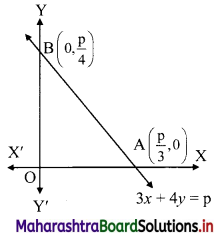
Let the line 3x + 4y = p cuts the X and Y-axes at points A and B respectively.
Maharashtra Board 11th Commerce Maths Solutions Chapter 5 Locus and Straight Line Ex 5.4 Q4
3x + 4y = p
∴ \(\frac{3 x}{\mathrm{p}}+\frac{4 y}{\mathrm{p}}=1\)
∴ \(\frac{x}{\frac{p}{3}}+\frac{y}{\frac{p}{4}}=1\)
The equation is of the form \(\frac{x}{a}+\frac{y}{b}=1\), with a = \(\frac{p}{3}\) and b = \(\frac{p}{4}\)
∴ A = (a, 0) = (\(\frac{p}{3}\), 0) and B = (0, b) = (0, \(\frac{p}{4}\))
∴ OA = \(\frac{p}{3}\) and OB = \(\frac{p}{4}\)
Given, A(∆OAB) = 24 sq. units
∴ \(\frac{1}{2}\) × OA × OB = 24
∴ \(\frac{1}{2}\) × \(\frac{p}{3}\) × \(\frac{p}{4}\) = 24
∴ p2 = 576
∴ p = ±24

Maharashtra Board 11th Commerce Maths Solutions Chapter 5 Locus and Straight Line Ex 5.4

Question 5.
Find the co-ordinates of the circumcentre of the triangle whose vertices are A(-2, 3), B(6, -1), C(4, 3).
Solution:
Here, A(-2, 3), B(6, -1), C(4, 3) are the vertices of ∆ABC.
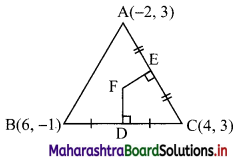
Let F be the circumcentre of ∆ABC.
Let FD and FE be the perpendicular bisectors of the sides BC and AC respectively.
Maharashtra Board 11th Commerce Maths Solutions Chapter 5 Locus and Straight Line Ex 5.4 Q5
∴ D and E are the midpoints of side BC and AC respectively.
∴ D = \(\left(\frac{6+4}{2}, \frac{-1+3}{2}\right)\) = (5, 1)
and E = \(\left(\frac{-2+4}{2}, \frac{3+3}{2}\right)\) = (1, 3)
Now, slope of BC = \(\frac{-1-3}{6-4}\) = -2
∴ slope of FD = \(\frac{1}{2}\) …..[∵ FD ⊥ BC]
Since, FD passes through (5, 1) and has slope \(\frac{1}{2}\)
∴ Equation of FD is y – 1 = \(\frac{1}{2}\)(x – 5)
∴ 2(y – 1) = x – 5
∴ x – 2y – 3 = 0 ……(i)
Since, both the points A and C have same y co-ordinates i.e. 3
∴ the points A and C lie on the liney = 3.
Since, FE passes through E(1, 3).
∴ the equation of FE is x = 1. …….(ii)
To find co-ordinates of circumcentre, we have to solve equations (i) and (ii).
Substituting the value of x in (i), we get
1 – 2y – 3 = 0
∴ y = -1
∴ Co-ordinates of circumcentre F = (1, -1).

Question 6.
Find the equation of the line whose x-intercept is 3 and which is perpendicular to the line 3x – y + 23 = 0.
Solution:
Slope of the line 3x – y + 23 = 0 is 3.
∴ slope of the required line which is perpendicular to 3x – y + 23 = 0 is \(\frac{-1}{3}\).
Since, the x-intercept of the required line is 3.
∴ it passes through (3, 0).
∴ the equation of the required line is
y – 0 = \(\frac{-1}{3}\) (x – 3)
∴ 3y = -x – 3
∴ x – 3y = 3

Maharashtra Board 11th Commerce Maths Solutions Chapter 5 Locus and Straight Line Ex 5.4

Question 7.
Find the distance of the point A(-2, 3) from the line 12x – 5y – 13 = 0.
Solution:
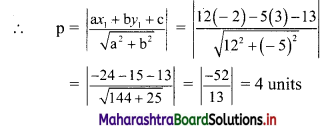
Let p be the perpendicular distance of the point A(-2, 3) from the line 12x – 5y – 13 = 0
Here, a = 12, b = -5, c = -13, x1 = -2, y1 = 3
Maharashtra Board 11th Commerce Maths Solutions Chapter 5 Locus and Straight Line Ex 5.4 Q7

Question 8.
Find the distance between parallel lines 9x + 6y – 1 = 0 and 9x + 6y – 32 = 0.
Solution:
Equations of the given parallel lines are 9x + 6y – 7 = 0 and 9x + 6y – 32 = 0.
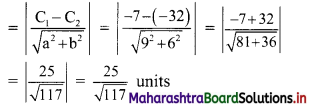
Here, a = 9, b = 6, C1 = -7 and C2 = -32
∴ Distance between the parallel lines
Maharashtra Board 11th Commerce Maths Solutions Chapter 5 Locus and Straight Line Ex 5.4 Q8

Question 9.
Find the equation of the line passing through the point of intersection of lines x + y – 2 = 0 and 2x – 3y + 4 = 0 and making intercept 3 on the X-axis.
Solution:
Given equations of lines are
x + y – 2 = 0 ……(i)
and 2x – 3y – 4 = 0 ……(ii)
Multiplying equation (i) by 3, we get
3x – 3y – 6 = 0 …..(iii)
Adding equation (ii) and (iii), we get
5x – 2 = 0
∴ x = \(\frac{2}{5}\)
Substituting x = \(\frac{2}{5}\) in equation (i), we get
\(\frac{2}{5}\) + y – 2 = 0
∴ y = 2 – \(\frac{2}{5}\) = \(\frac{8}{5}\)
∴ The required line passes through point (\(\frac{2}{5}\), \(\frac{8}{5}\)).
Also, the line makes intercept of 3 on X-axis
∴ it also passes through point (3, 0).
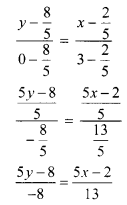
∴ required equation of line passing through points (\(\frac{2}{5}\), \(\frac{8}{5}\)) and (3, 0) is
Maharashtra Board 11th Commerce Maths Solutions Chapter 5 Locus and Straight Line Ex 5.4 Q9
∴ 13(5y – 8) = -8(5x – 2)
∴ 65y – 104 = -40x + 16
∴ 40x + 65y – 120 = 0
∴ 8x + 13y – 24 = 0 which is the equation of the required line.

Maharashtra Board 11th Commerce Maths Solutions Chapter 5 Locus and Straight Line Ex 5.4

Question 10.
D(-1, 8), E(4, -2), F(-5, -3) are midpoints of sides BC, CA and AB of ∆ABC. Find
(i) equations of sides of ∆ABC.
(ii) co-ordinates of the circumcentre of ∆ABC.
Solution:
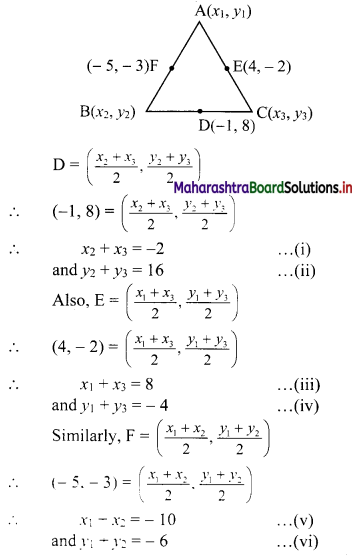
(i) Let A(x1, y1), B(x2, y2) and C(x3, y3) be the vertices of ∆ABC.
Given, points D, E and F are midpoints of sides BC, CA and AB respectively of ∆ABC.
Maharashtra Board 11th Commerce Maths Solutions Chapter 5 Locus and Straight Line Ex 5.4 Q10
For x-coordinates:
Adding (i), (iii) and (v), we get
2x1 + 2x2 + 2x3 = -4
∴ x1 + x2 + x3 = -2 …..(vii)
Solving (i) and (vii), we get x1 = 0
Solving (iii) and (vii), we get x2 = -10
Solving (v) and (vii), we get x3 = 8
For y-coordinates:
Adding (ii), (iv) and (vi), we get
2y1 + 2y2 + 2y3 = 6
∴ y1 + y2 + y3 = 3 …..(viii)
Solving (ii) and (viii), we get y1 = -13
Solving (iv) and (viii), we get y2 = 7
Solving (vi) and (viii), we get y3 = 9
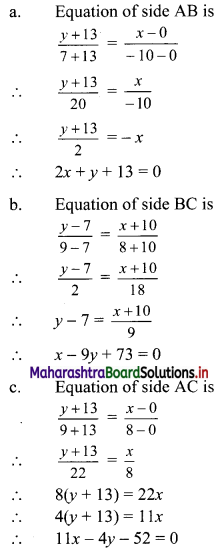
∴ Vertices of ∆ABC are A(0, -13), B(-10, 7), C(8, 9)
Maharashtra Board 11th Commerce Maths Solutions Chapter 5 Locus and Straight Line Ex 5.4 Q10.1

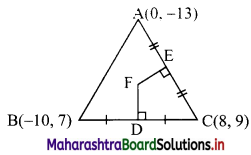
(ii) Here, A(0, -13), B(-10, 7), C(8, 9) are the vertices of ∆ABC.
Let F be the circumcentre of ∆ABC.
Let FD and FE be perpendicular bisectors of the sides BC and AC respectively.
Maharashtra Board 11th Commerce Maths Solutions Chapter 5 Locus and Straight Line Ex 5.4 Q10.2
∴ D and E are the midpoints of side BC and AC.
∴ D = \(\left(\frac{-10+8}{2} \cdot \frac{7+9}{2}\right)\) = (-1, 8)
and E = \(\left(\frac{0+8}{2}, \frac{-13+9}{2}\right)\) = (4, -2)
Now, slope of BC = \(\frac{7-9}{-10-8}=\frac{1}{9}\)
∴ slope of FD = -9 ……[∵ FD ⊥ BC]
Since, FD passes through (-1, 8) and has slope -9
∴ Equation of FD is y – 8 = -9(x + 1)
∴ y – 8 = -9x – 9
∴ y = -9x – 1 …..(i)
Also, slope of AC = \(\frac{-13-9}{0-8}=\frac{11}{4}\)
∴ Slope of FE = \(\frac{-4}{11}\) ….[∵ FE ⊥ AC]
Since, FE passes through (4, -2) and has slope \(\frac{-4}{11}\)
∴ Equation of FE is y + 2 = \(\frac{-4}{11}\)(x – 4)
∴ 11(y + 2) = -4(x – 4)
∴ 11y + 22 = -4x + 16
∴ 4x + 11y = -6 ….(ii)
To find co-ordinates of circumcentre, we have to solve equations (i) and (ii).
Substituting the value of y in (ii), we get
∴ 4x + 11(-9x – 1) = -6
∴ 4x – 99x – 11 = -6
∴ -95x = 5
∴ x = \(\frac{-1}{19}\)
Substituting the value of x in (i), we get
y = -9(\(\frac{-1}{19}\)) – 1 = \(\frac{-10}{19}\)
∴ Co-ordinates of circumcentre F = \(\left(\frac{-1}{19}, \frac{-10}{19}\right)\)

11th Commerce Maths Digest Pdf

11th Commerce Maths 1 Chapter 7 Exercise 7.2 Answers Maharashtra Board

Limits Class 11 Commerce Maths 1 Chapter 7 Exercise 7.2 Answers Maharashtra Board

Balbharati Maharashtra State Board 11th Commerce Maths Solution Book Pdf Chapter 7 Limits Ex 7.2 Questions and Answers.

Std 11 Maths 1 Exercise 7.2 Solutions Commerce Maths

I. Evaluate the following limits:

Question 1.
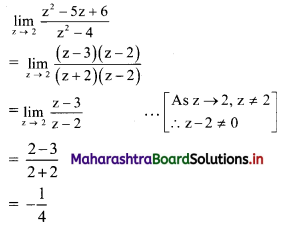
\(\lim _{z \rightarrow 2}\left[\frac{z^{2}-5 z+6}{z^{2}-4}\right]\)
Solution:
Maharashtra Board 11th Commerce Maths Solutions Chapter 7 Limits Ex 7.2 I Q1

Question 2.
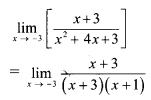
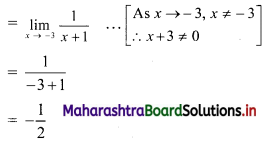
\(\lim _{x \rightarrow-3}\left[\frac{x+3}{x^{2}+4 x+3}\right]\)
Solution:
Maharashtra Board 11th Commerce Maths Solutions Chapter 7 Limits Ex 7.2 I Q2
Maharashtra Board 11th Commerce Maths Solutions Chapter 7 Limits Ex 7.2 I Q2.1

Maharashtra Board 11th Commerce Maths Solutions Chapter 7 Limits Ex 7.2

Question 3.
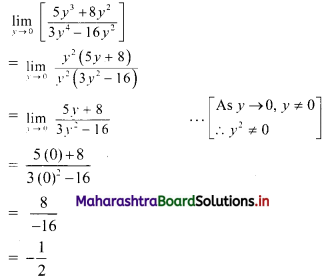
\(\lim _{y \rightarrow 0}\left[\frac{5 y^{3}+8 y^{2}}{3 y^{4}-16 y^{2}}\right]\)
Solution:
Maharashtra Board 11th Commerce Maths Solutions Chapter 7 Limits Ex 7.2 I Q3

Question 4.
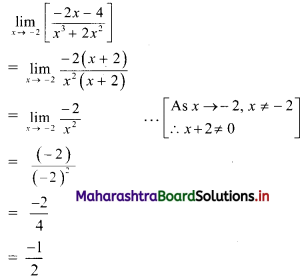
\(\lim _{x \rightarrow-2}\left[\frac{-2 x-4}{x^{3}+2 x^{2}}\right]\)
Solution:
Maharashtra Board 11th Commerce Maths Solutions Chapter 7 Limits Ex 7.2 I Q4

II. Evaluate the following limits:

Question 1.
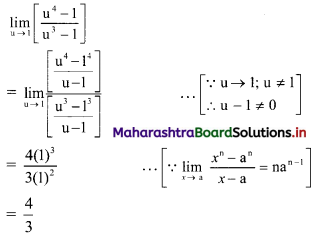
\(\lim _{u \rightarrow 1}\left[\frac{u^{4}-1}{u^{3}-1}\right]\)
Solution:
Maharashtra Board 11th Commerce Maths Solutions Chapter 7 Limits Ex 7.2 II Q1

Question 2.
\(\lim _{x \rightarrow 3}\left[\frac{1}{x-3}-\frac{9 x}{x^{3}-27}\right]\)
Solution:
Maharashtra Board 11th Commerce Maths Solutions Chapter 7 Limits Ex 7.2 II Q2

Maharashtra Board 11th Commerce Maths Solutions Chapter 7 Limits Ex 7.2

Question 3.
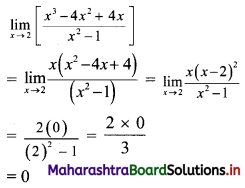
\(\lim _{x \rightarrow 2}\left[\frac{x^{3}-4 x^{2}+4 x}{x^{2}-1}\right]\)
Solution:
Maharashtra Board 11th Commerce Maths Solutions Chapter 7 Limits Ex 7.2 II Q3

III. Evaluate the following limits:

Question 1.
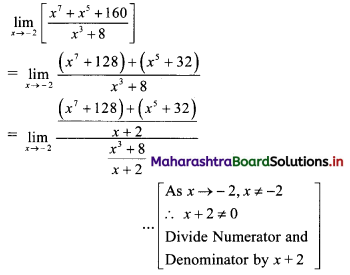
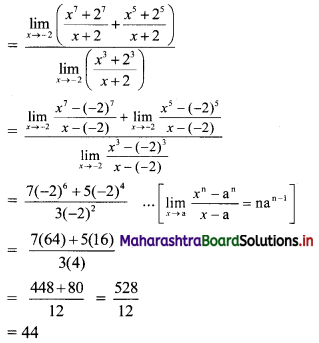
\(\lim _{x \rightarrow-2}\left[\frac{x^{7}+x^{5}+160}{x^{3}+8}\right]\)
Solution:
Maharashtra Board 11th Commerce Maths Solutions Chapter 7 Limits Ex 7.2 III Q1
Maharashtra Board 11th Commerce Maths Solutions Chapter 7 Limits Ex 7.2 III Q1.1

Question 2.
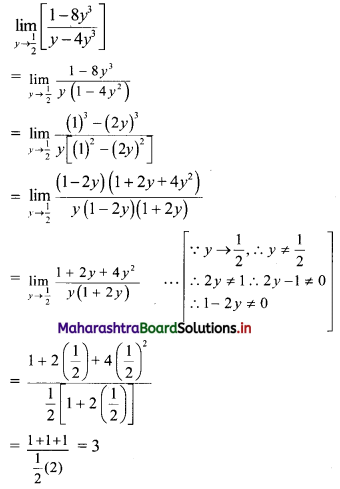
\(\lim _{y \rightarrow \frac{1}{2}}\left[\frac{1-8 y^{3}}{y-4 y^{3}}\right]\)
Solution:
Maharashtra Board 11th Commerce Maths Solutions Chapter 7 Limits Ex 7.2 III Q2

Question 3.
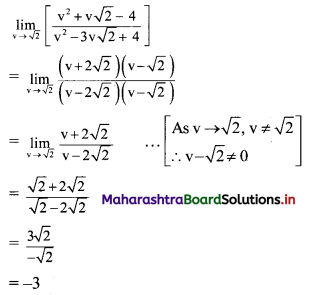
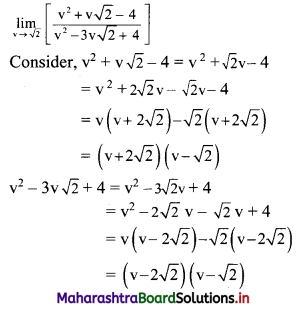
\(\lim _{v \rightarrow \sqrt{2}}\left[\frac{v^{2}+v \sqrt{2}-4}{v^{2}-3 v \sqrt{2}+4}\right]\)
Solution:
Maharashtra Board 11th Commerce Maths Solutions Chapter 7 Limits Ex 7.2 III Q3
Maharashtra Board 11th Commerce Maths Solutions Chapter 7 Limits Ex 7.2 III Q3.1

Maharashtra Board 11th Commerce Maths Solutions Chapter 7 Limits Ex 7.2

Question 4.
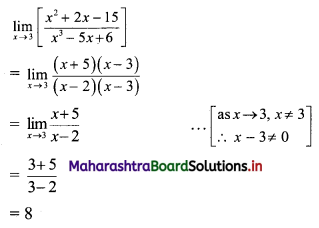
\(\lim _{x \rightarrow 3}\left[\frac{x^{2}+2 x-15}{x^{2}-5 x+6}\right]\)
Solution:
Maharashtra Board 11th Commerce Maths Solutions Chapter 7 Limits Ex 7.2 III Q4

11th Commerce Maths Digest Pdf
11th Commerce Maths 1 Chapter 3 Exercise 3.2 Answers Maharashtra Board

Complex Numbers Class 11 Commerce Maths 1 Chapter 3 Exercise 3.2 Answers Maharashtra Board

Balbharati Maharashtra State Board 11th Commerce Maths Solution Book Pdf Chapter 3 Complex Numbers Ex 3.2 Questions and Answers.

Std 11 Maths 1 Exercise 3.2 Solutions Commerce Maths

Question 1.
Find the square root of the following complex numbers:
(i) -8 – 6i
Solution:
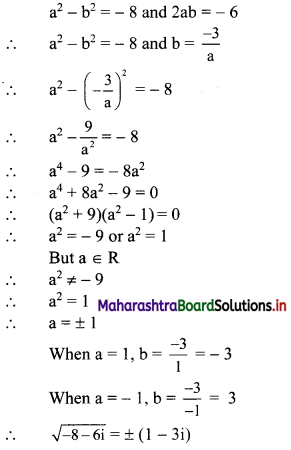
Let \(\sqrt{-8-6 i}\) = a + bi, where a, b ∈ R
Squaring on both sides, we get
-8 – 6i = (a + bi)2
-8 – 6i = a2 + b2i2 + 2abi
-8 – 6i = (a2 – b2) + 2abi …..[∵ i2 = -1]
Equating real and imaginary parts, we get
Maharashtra Board 11th Commerce Maths Solutions Chapter 3 Complex Numbers Ex 3.2 Q1 (i)

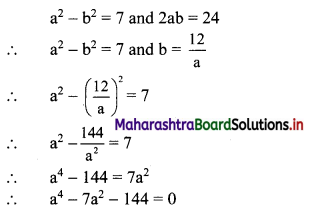
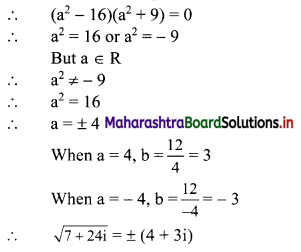
(ii) 7 + 24i
Solution:
Let \(\sqrt{7+24 i}\) = a + bi, where a, b ∈ R
Squaring on both sides, we get
7 + 24i = (a + bi)2
7 + 24i = a2 + b2i2 + 2abi
7 + 24i = (a2 – b2) + 2abi …..[∵ i2 = -1]
Equating real and imaginary parts, we get
Maharashtra Board 11th Commerce Maths Solutions Chapter 3 Complex Numbers Ex 3.2 Q1 (ii)
Maharashtra Board 11th Commerce Maths Solutions Chapter 3 Complex Numbers Ex 3.2 Q1 (ii).1

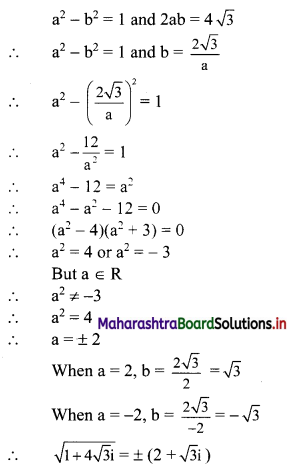
(iii) 1 + 4√3i
Solution:
Let \(\sqrt{1+4 \sqrt{3} i}\) = a + bi, where a, b ∈ R
Squaring on both sides, we get
1 + 4√3i = (a + bi)2
1 + 4√3i = a2 + b2i2 + 2abi
1 +4√3i = (a2 – b2) + 2abi ……[∵ i2 = -1]
Equating real and imaginary parts, we get
Maharashtra Board 11th Commerce Maths Solutions Chapter 3 Complex Numbers Ex 3.2 Q1 (iii)

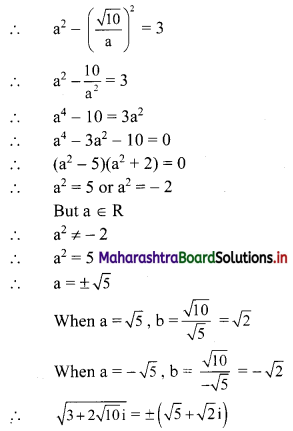
(iv) 3 + 2√10i
Solution:
Let \(\sqrt{3+2 \sqrt{10}} i\) = a + bi, where a, b ∈ R
Squaring on both sides, we get
3 + 2√10i = (a + bi)2
3 + 2√10i = a2 + b2i2 + 2abi
3 + 2√10i = (a2 – b2) + 2abi …..[∵ i2 = -1]
Equating real and imaginary parts, we get
a2 – b2 = 3 and 2ab = 2√10
a2 – b2 = 3 and b = \(\frac{\sqrt{10}}{a}\)
Maharashtra Board 11th Commerce Maths Solutions Chapter 3 Complex Numbers Ex 3.2 Q1 (iv)

Maharashtra Board 11th Commerce Maths Solutions Chapter 3 Complex Numbers Ex 3.2

(v) 2(1 – √3i)
Solution:
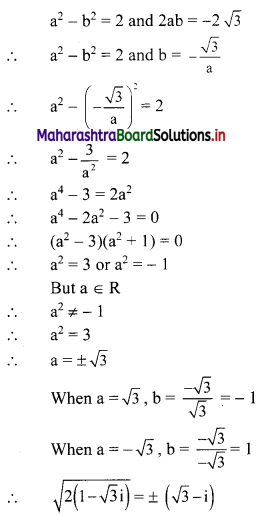
Let \(\sqrt{2(1-\sqrt{3} i)}\) = a + bi, where a, b ∈ R
Squaring on both sides, we get
2(1 – √3i) = (a + bi)2
2(1 – √3i) = a2 + b2i2 + 2abi
2 – 2√3i = (a2 – b2) + 2abi …..[∵ i2 = -1]
Equating real and imaginary parts, we get
Maharashtra Board 11th Commerce Maths Solutions Chapter 3 Complex Numbers Ex 3.2 Q1 (v)

Question 2.
Solve the following quadratic equations.
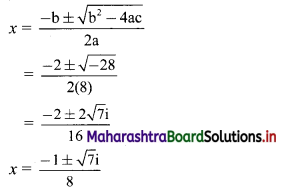
(i) 8x2 + 2x + 1 = 0
Solution:
Given equation is 8x2 + 2x + 1 = 0
Comparing with ax2 + bx + c = 0, we get
a = 8, b = 2, c = 1
Discriminant = b2 – 4ac
= (2)2 – 4 × 8 × 1
= 4 – 32
= -28 < 0
So, the given equation has complex roots.
These roots are given by
Maharashtra Board 11th Commerce Maths Solutions Chapter 3 Complex Numbers Ex 3.2 Q2 (i)
∴ the roots of the given equation are \(\frac{-1+\sqrt{7} \mathrm{i}}{8}\) and \(\frac{-1-\sqrt{7} \mathrm{i}}{8}\)

(ii) 2x2 – √3x + 1 = 0
Solution:
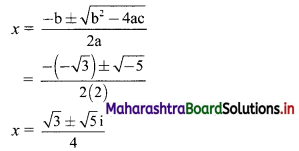
Given equation is 2x2 – √3x + 1 = 0
Comparing with ax2 + bx + c = 0, we get
a = 2, b = -√3, c = 1
Discriminant = b2 – 4ac
= (-√3)2 – 4 × 2 × 1
= 3 – 8
= -5 < 0
So, the given equation has complex roots.
These roots are given by
Maharashtra Board 11th Commerce Maths Solutions Chapter 3 Complex Numbers Ex 3.2 Q2 (ii)
∴ the roots of the given equation are \(\frac{\sqrt{3}+\sqrt{5} i}{4}\) and \(\frac{\sqrt{3}-\sqrt{5} i}{4}\)

(iii) 3x2 – 7x + 5 = 0
Solution:
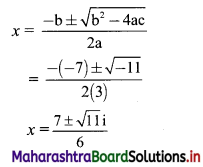
Given equation is 3x2 – 7x + 5 = 0
Comparing with ax2 + bx + c = 0, we get
a = 3, b = -7, c = 5
Discriminant = b2 – 4ac
= (-7)2 – 4 × 3 × 5
= 49 – 60
= -11 < 0
So, the given equation has complex roots.
These roots are given by
Maharashtra Board 11th Commerce Maths Solutions Chapter 3 Complex Numbers Ex 3.2 Q2 (iii)
∴ the roots of the given equation are \(\frac{7+\sqrt{11} i}{6}\) and \(\frac{7-\sqrt{11} i}{6}\)

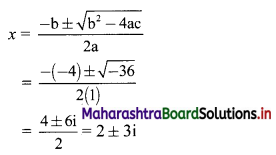
(iv) x2 – 4x + 13 = 0
Solution:
Given equation is x2 – 4x + 13 = 0
Comparing with ax2 + bx + c = 0, we get
a = 1, b = -4, c = 13
Discriminant = b2 – 4ac
= (-4)2 – 4 × 1 × 13
= 16 – 52
= -36 < 0
So, the given equation has complex roots.
These roots are given by
Maharashtra Board 11th Commerce Maths Solutions Chapter 3 Complex Numbers Ex 3.2 Q2 (iv)
∴ the roots of the given equation are 2 + 3i and 2 – 3i.

Maharashtra Board 11th Commerce Maths Solutions Chapter 3 Complex Numbers Ex 3.2

Question 3.
Solve the following quadratic equations.
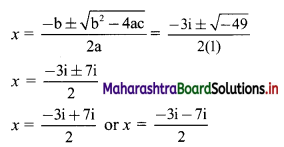
(i) x2 + 3ix + 10 = 0
Solution:
Given equation is x2 + 3ix + 10 = 0
Comparing with ax2 + bx + c = 0, we get
a = 1, b = 3i, c = 10
Discriminant = b2 – 4ac
= (3i)2 – 4 × 1 × 10
= 9i2 – 40
= -9 – 40 …..[∵ i2 = -1]
= -49
So, the given equation has complex roots.
These roots are given by
Maharashtra Board 11th Commerce Maths Solutions Chapter 3 Complex Numbers Ex 3.2 Q3 (i)
∴ x = 2i or x = -5i
∴ the roots of the given equation are 2i and -5i.
Check:
If x = 2i and x = -5i satisfy the given equation, then our answer is correct.
L.H.S. = x2 + 3ix + 10
= (2i)2 + 3i(2i) + 10i
= 4i2 + 6i2 + 10
= 10i2 + 10
= -10 + 10 ……[∵ i2 = -1]
= 0
= R.H.S.
L.H.S. = x2 + 3ix + 10
= (-5i)2 + 3i(-5i) + 10
= 25i2 – 15i2 + 10
= 10i2 + 10
= -10 + 10 …..[∵ i2 = -1]
= 0
= R.H.S.
Thus, our answer is correct.

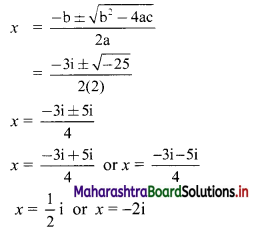
(ii) 2x2 + 3ix + 2 = 0
Solution:
Given equation is 2x2 + 3ix + 2 = 0
Comparing with ax2 + bx + c = 0, we get
a = 2, b = 3i, c = 2
Discriminant = b2 – 4ac
= (3i)2 – 4 × 2 × 2
= 9i2 – 16
= -9 – 16
= -25 < 0
So, the given equation has complex roots.
These roots are given by
Maharashtra Board 11th Commerce Maths Solutions Chapter 3 Complex Numbers Ex 3.2 Q3 (ii)
∴ the roots of the given equation are \(\frac{1}{2}\)i and -2i.

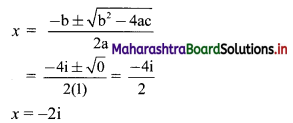
(iii) x2 + 4ix – 4 = 0
Solution:
Given equation is x2 + 4ix – 4 = 0
Comparing with ax2 + bx + c = 0, we get
a = 1, b = 4i, c = -4
Discriminant = b2 – 4ac
= (4i)2 – 4 × 1 × -4
= 16i2 + 16
= -16 + 16 …..[∵ i2 = -1]
= 0
So, the given equation has equal roots.
These roots are given by
Maharashtra Board 11th Commerce Maths Solutions Chapter 3 Complex Numbers Ex 3.2 Q3 (iii)
∴ the roots of the given equation are -2i and -2i.

(iv) ix2 – 4x – 4i = 0
Solution:
ix2 – 4x – 4i = 0
Multiplying throughout by i, we get
i2x2 – 4ix – 4i2 = 0
∴ -x2 – 4ix + 4 = 0 ……[∵ i2 = -1]
∴ x2 + 4ix – 4 = 0
Comparing with ax2 + bx + c = 0, we get
a = 1, b = 4i, c = -4
Discriminant = b2 – 4ac
= (4i)2 – 4 × 1 × -4
= 16i2 + 16
= -16 + 16 …..[∵ i2 = -1]
= 0
So, the given equation has equal roots.
These roots are given by
Maharashtra Board 11th Commerce Maths Solutions Chapter 3 Complex Numbers Ex 3.2 Q3 (iv)
∴ the roots of the given equation are -2i and -2i.

Maharashtra Board 11th Commerce Maths Solutions Chapter 3 Complex Numbers Ex 3.2

Question 4.
Solve the following quadratic equations.
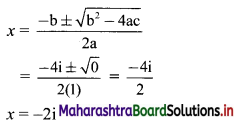
(i) x2 – (2 + i) x – (1 – 7i) = 0
Solution:
Given equation is x2 – (2 + i)x – (1 – 7i) = 0
Comparing with ax2 + bx + c = 0, we get
a = 1, b = -(2 + i), c = -(1 – 7i)
Discriminant = b2 – 4ac
= [-(2 + i)]2 – 4 × 1 × -(1 – 7i)
= 4 + 4i + i2 + 4 – 28i
= 4 + 4i – 1 + 4 – 28i …….[∵ i2 = -1]
= 7 – 24i
So, the given equation has complex roots.
These roots are given by
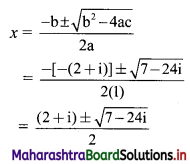
Maharashtra Board 11th Commerce Maths Solutions Chapter 3 Complex Numbers Ex 3.2 Q4 (i)
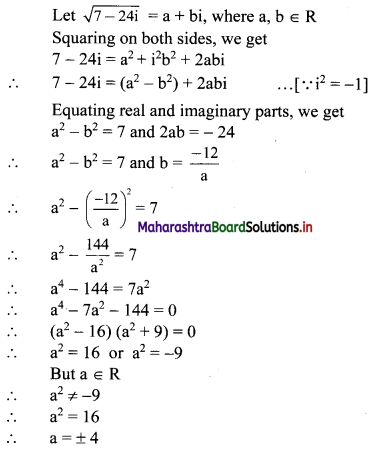
Maharashtra Board 11th Commerce Maths Solutions Chapter 3 Complex Numbers Ex 3.2 Q4 (i).1
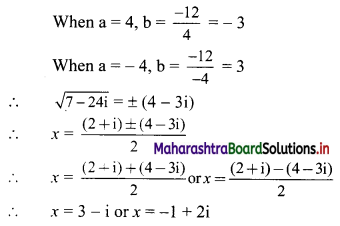
Maharashtra Board 11th Commerce Maths Solutions Chapter 3 Complex Numbers Ex 3.2 Q4 (i).2

(ii) x2 – (3√2 + 2i) x + 6√2i = 0
Solution:
Given equation is x2 – (3√2 + 2i) x + 6√2i = 0
Comparing with ax2 + bx + c = 0, we get
a = 1, b = -(3√2 + 2i), c = 6√2i
Discriminant = b2 – 4ac
= [-(3√2 + 2i)]2 – 4 × 1 × 6√2i
= 18 + 12√2i + 4i2 – 24√2i
= 18 – 12√2i – 4 …..[∵ i2 = -1]
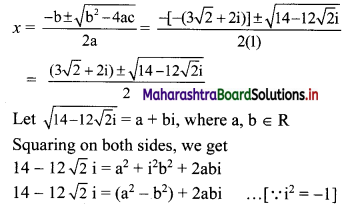
= 14 – 12√2i
So, the given equation has complex roots.
These roots are given by
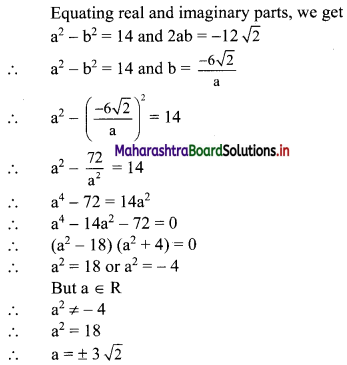
Maharashtra Board 11th Commerce Maths Solutions Chapter 3 Complex Numbers Ex 3.2 Q4 (ii)
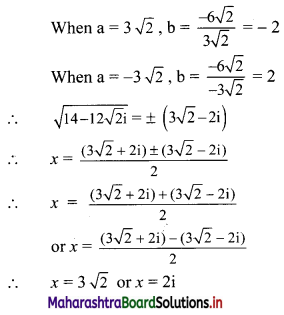
Maharashtra Board 11th Commerce Maths Solutions Chapter 3 Complex Numbers Ex 3.2 Q4 (ii).1
Maharashtra Board 11th Commerce Maths Solutions Chapter 3 Complex Numbers Ex 3.2 Q4 (ii).2

(iii) x2 – (5 – i) x + (18 + i) = 0
Solution:
Given equation is x2 – (5 – i)x + (18 + i) = 0
Comparing with ax2 + bx + c = 0, we get
a = 1, b = -(5 – i), c = 18 + i
Discriminant = b2 – 4ac
= [-(5 – i)]2 – 4 × 1 × (18 + i)
= 25 – 10i + i2 – 72 – 4i
= 25 – 10i – 1 – 72 – 4i …..[∵ i2 = -1]
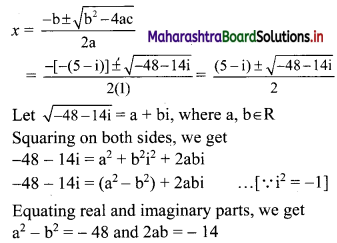
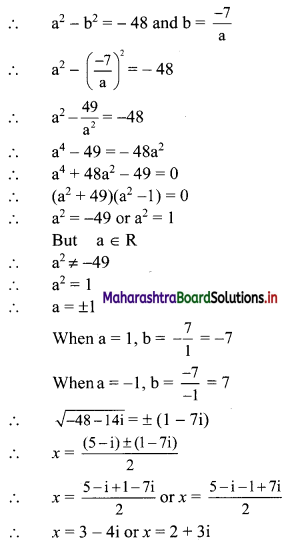
= -48 – 14i
So, the given equation has complex roots.
These roots are given by
Maharashtra Board 11th Commerce Maths Solutions Chapter 3 Complex Numbers Ex 3.2 Q4 (iii)
Maharashtra Board 11th Commerce Maths Solutions Chapter 3 Complex Numbers Ex 3.2 Q4 (iii).1

Maharashtra Board 11th Commerce Maths Solutions Chapter 3 Complex Numbers Ex 3.2

(iv) (2 + i) x2 – (5 – i) x + 2(1 – i) = 0
Solution:
Given equation is
(2 + i) x2 – (5 – i) x + 2(1 – i) = 0
Comparing with ax2 + bx + c = 0, we get
a = 2 + i, b = -(5 – i), c = 2(1 – i)
Discriminant = b2 – 4ac
= [-(5 – i)]2 – 4 × (2 + i) × 2(1 – i)
= 25 – 10i + i2 – 8(2 + i)(1 – i)
= 25 – 10i + i2 – 8(2 – 2i + i – i2)
= 25 – 10i – 1 – 8(2 – i + 1) …..[∵ i2 = -1]
= 25 – 10i – 1 – 16 + 8i – 8
= -2i
So, the given equation has complex roots.
These roots are given by
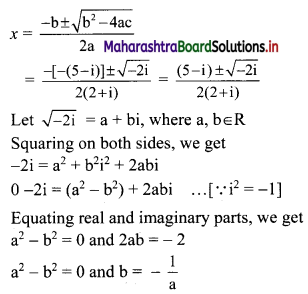
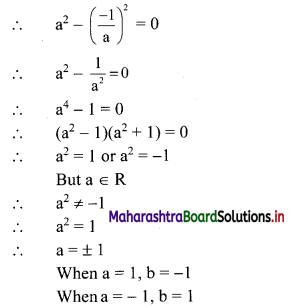
Maharashtra Board 11th Commerce Maths Solutions Chapter 3 Complex Numbers Ex 3.2 Q4 (iv)
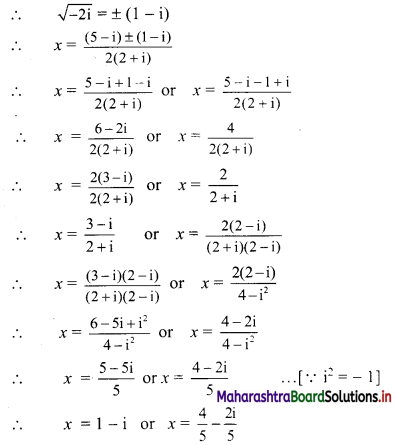
Maharashtra Board 11th Commerce Maths Solutions Chapter 3 Complex Numbers Ex 3.2 Q4 (iv).1
Maharashtra Board 11th Commerce Maths Solutions Chapter 3 Complex Numbers Ex 3.2 Q4 (iv).2

11th Commerce Maths Digest Pdf 
11th Commerce Maths 1 Chapter 7 Exercise 7.1 Answers Maharashtra Board

Limits Class 11 Commerce Maths 1 Chapter 7 Exercise 7.1 Answers Maharashtra Board

Balbharati Maharashtra State Board 11th Commerce Maths Solution Book Pdf Chapter 7 Limits Ex 7.1 Questions and Answers.

Std 11 Maths 1 Exercise 7.1 Solutions Commerce Maths

I. Evaluate the following limits:

Question 1.
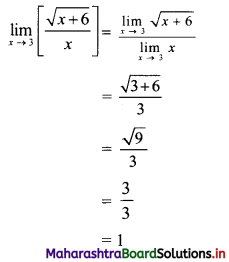
\(\lim _{x \rightarrow 3}\left[\frac{\sqrt{x+6}}{x}\right]\)
Solution:
Maharashtra Board 11th Commerce Maths Solutions Chapter 7 Limits Ex 7.1 I Q1

Question 2.
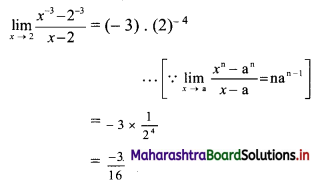
\(\lim _{x \rightarrow 2}\left[\frac{x^{-3}-2^{-3}}{x-2}\right]\)
Solution:
Maharashtra Board 11th Commerce Maths Solutions Chapter 7 Limits Ex 7.1 I Q2

Maharashtra Board 11th Commerce Maths Solutions Chapter 7 Limits Ex 7.1

Question 3.
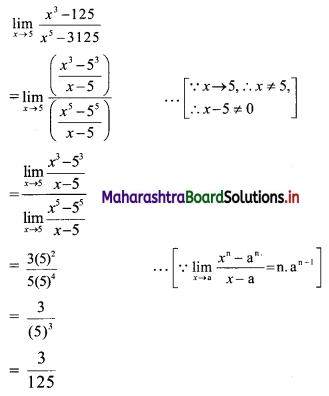
\(\lim _{x \rightarrow 5}\left[\frac{x^{3}-125}{x^{5}-3125}\right]\)
Solution:
Maharashtra Board 11th Commerce Maths Solutions Chapter 7 Limits Ex 7.1 I Q3

Question 4.
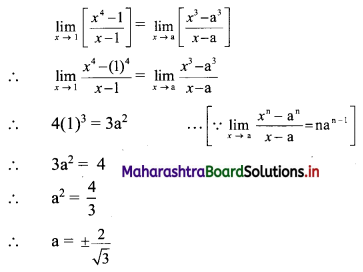
If \(\lim _{x \rightarrow 1}\left[\frac{x^{4}-1}{x-1}\right]=\lim _{x \rightarrow a}\left[\frac{x^{3}-a^{3}}{x-a}\right]\), find all possible values of a.
Solution:
Maharashtra Board 11th Commerce Maths Solutions Chapter 7 Limits Ex 7.1 I Q4

II. Evaluate the following limits:

Question 1.
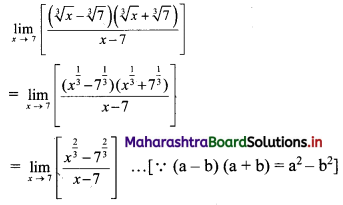
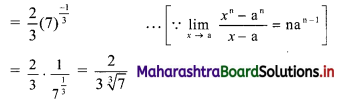
\(\lim _{x \rightarrow 7}\left[\frac{(\sqrt[3]{x}-\sqrt[3]{7})(\sqrt[3]{x}+\sqrt[3]{7})}{x-7}\right]\)
Solution:
Maharashtra Board 11th Commerce Maths Solutions Chapter 7 Limits Ex 7.1 II Q1
Maharashtra Board 11th Commerce Maths Solutions Chapter 7 Limits Ex 7.1 II Q1.1

Maharashtra Board 11th Commerce Maths Solutions Chapter 7 Limits Ex 7.1

Question 2.
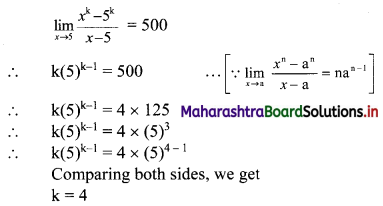
If \(\lim _{x \rightarrow 5}\left[\frac{x^{k}-5^{k}}{x-5}\right]=500\), find all possible values of k.
Solution:
Maharashtra Board 11th Commerce Maths Solutions Chapter 7 Limits Ex 7.1 II Q2

Question 3.
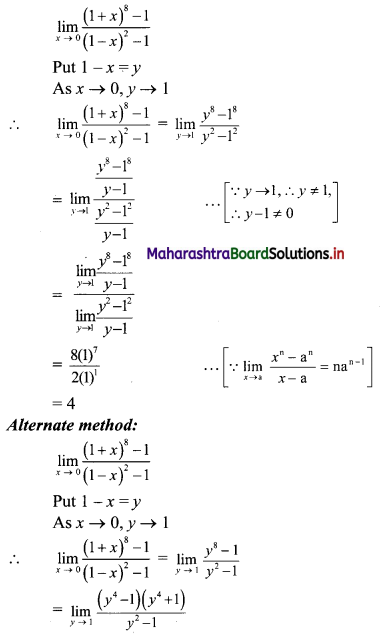
\(\lim _{x \rightarrow 0}\left[\frac{(1-x)^{8}-1}{(1-x)^{2}-1}\right]\)
Solution:
Maharashtra Board 11th Commerce Maths Solutions Chapter 7 Limits Ex 7.1 II Q3
Maharashtra Board 11th Commerce Maths Solutions Chapter 7 Limits Ex 7.1 II Q3.1

III. Evaluate the following limits:

Question 1.
\(\lim _{x \rightarrow 0}\left[\frac{\sqrt[3]{1+x}-\sqrt{1+x}}{x}\right]\)
Solution:
Maharashtra Board 11th Commerce Maths Solutions Chapter 7 Limits Ex 7.1 III Q1
Maharashtra Board 11th Commerce Maths Solutions Chapter 7 Limits Ex 7.1 III Q1.1

Question 2.
\(\lim _{y \rightarrow 1}\left[\frac{2 y-2}{\sqrt[3]{7+y}-2}\right]\)
Solution:
Maharashtra Board 11th Commerce Maths Solutions Chapter 7 Limits Ex 7.1 III Q2

Question 3.
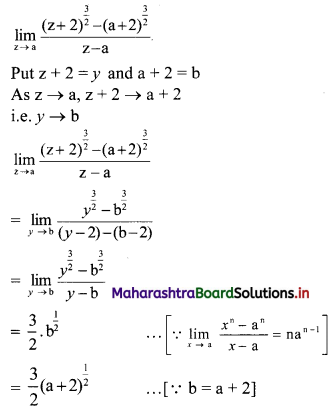
\(\lim _{z \rightarrow a}\left[\frac{(z+2)^{\frac{3}{2}}-(a+2)^{\frac{3}{2}}}{z-a}\right]\)
Solution:
Maharashtra Board 11th Commerce Maths Solutions Chapter 7 Limits Ex 7.1 III Q3

Maharashtra Board 11th Commerce Maths Solutions Chapter 7 Limits Ex 7.1

Question 4.
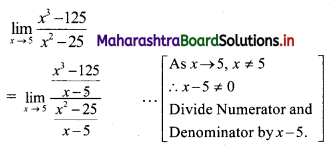
\(\lim _{x \rightarrow 5}\left[\frac{x^{3}-125}{x^{2}-25}\right]\)
Solution:
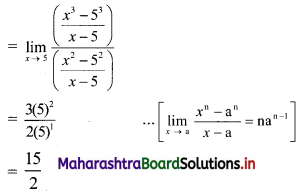
Maharashtra Board 11th Commerce Maths Solutions Chapter 7 Limits Ex 7.1 III Q4
Maharashtra Board 11th Commerce Maths Solutions Chapter 7 Limits Ex 7.1 III Q4.1

11th Commerce Maths Digest Pdf
11th Commerce Maths 1 Chapter 9 Exercise 9.1 Answers Maharashtra Board

Differentiation Class 11 Commerce Maths 1 Chapter 9 Exercise 9.1 Answers Maharashtra Board

Balbharati Maharashtra State Board 11th Commerce Maths Solution Book Pdf Chapter 9 Differentiation Ex 9.1 Questions and Answers.

Std 11 Maths 1 Exercise 9.1 Solutions Commerce Maths

I. Find the derivatives of the following functions w.r.t. x.

Question 1.
x12
Solution:
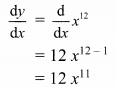
Let y = x12
Differentiating w.r.t. x, we get
Maharashtra Board 11th Commerce Maths Solutions Chapter 9 Differentiation Ex 9.1 I Q1

Question 2.
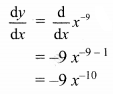
x-9
Solution:
Let y = x-9
Differentiating w.r.t. x, we get
Maharashtra Board 11th Commerce Maths Solutions Chapter 9 Differentiation Ex 9.1 I Q2

Maharashtra Board 11th Commerce Maths Solutions Chapter 9 Differentiation Ex 9.1

Question 3.
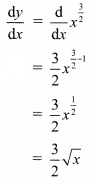
\(x^{\frac{3}{2}}\)
Solution:
Let y = \(x^{\frac{3}{2}}\)
Differentiating w.r.t. x, we get
Maharashtra Board 11th Commerce Maths Solutions Chapter 9 Differentiation Ex 9.1 I Q3

Question 4.
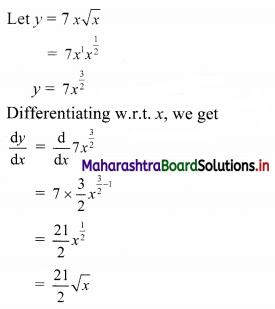
7x√x
Solution:
Maharashtra Board 11th Commerce Maths Solutions Chapter 9 Differentiation Ex 9.1 I Q4

Question 5.
35
Solution:
Let y = 35
Differentiating w.r.t. x, we get
\(\frac{d y}{d x}=\frac{d}{d x} 3^{5}=0\) …..[35 is a constant]

II. Differentiate the following w.r.t. x.

Question 1.
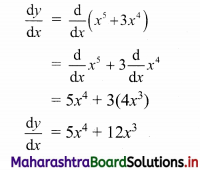
x5 + 3x4
Solution:
Let y = x5 + 3x4
Differentiating w.r.t. x, we get
Maharashtra Board 11th Commerce Maths Solutions Chapter 9 Differentiation Ex 9.1 II Q1

Maharashtra Board 11th Commerce Maths Solutions Chapter 9 Differentiation Ex 9.1

Question 2.
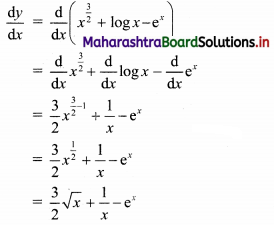
x√x + log x – ex
Solution:
Let y = x√x + log x – ex
= \(x^{\frac{3}{2}}+\log x-e^{x}\)
Differentiating w.r.t. x, we get
Maharashtra Board 11th Commerce Maths Solutions Chapter 9 Differentiation Ex 9.1 II Q2

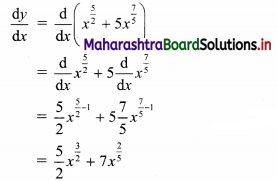
Question 3.
\(x^{\frac{5}{2}}+5 x^{\frac{7}{5}}\)
Solution:
Let y = \(x^{\frac{5}{2}}+5 x^{\frac{7}{5}}\)
Differentiating w.r.t. x, we get
Maharashtra Board 11th Commerce Maths Solutions Chapter 9 Differentiation Ex 9.1 II Q3

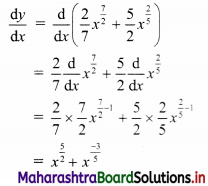
Question 4.
\(\frac{2}{7} x^{\frac{7}{2}}+\frac{5}{2} x^{\frac{2}{5}}\)
Solution:
Let y = \(\frac{2}{7} x^{\frac{7}{2}}+\frac{5}{2} x^{\frac{2}{5}}\)
Differentiating w.r.t. x, we get
Maharashtra Board 11th Commerce Maths Solutions Chapter 9 Differentiation Ex 9.1 II Q4

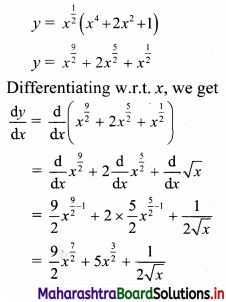
Question 5.
\(\sqrt{x}\left(x^{2}+1\right)^{2}\)
Solution:
Let y = \(\sqrt{x}\left(x^{2}+1\right)^{2}\)
Maharashtra Board 11th Commerce Maths Solutions Chapter 9 Differentiation Ex 9.1 II Q5

III. Differentiate the following w.r.t. x.

Question 1.
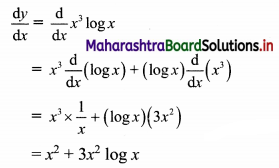
x3 log x
Solution:
Let y = x3 log x
Differentiating w.r.t. x, we get
Maharashtra Board 11th Commerce Maths Solutions Chapter 9 Differentiation Ex 9.1 III Q1

Maharashtra Board 11th Commerce Maths Solutions Chapter 9 Differentiation Ex 9.1

Question 2.
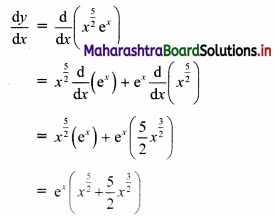
\(x^{\frac{5}{2}} e^{x}\)
Solution:
Let y = \(x^{\frac{5}{2}} e^{x}\)
Differentiating w.r.t. x, we get
Maharashtra Board 11th Commerce Maths Solutions Chapter 9 Differentiation Ex 9.1 III Q2

Question 3.
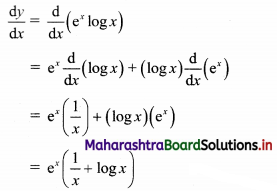
ex log x
Solution:
Let y = ex log x
Differentiating w.r.t. x, we get
Maharashtra Board 11th Commerce Maths Solutions Chapter 9 Differentiation Ex 9.1 III Q3

Question 4.
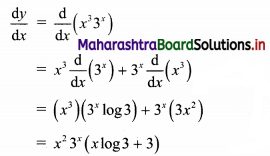
x3 . 3x
Solution:
Let y = x3 . 3x
Differentiating w.r.t. x, we get
Maharashtra Board 11th Commerce Maths Solutions Chapter 9 Differentiation Ex 9.1 III Q4

IV. Find the derivatives of the following w.r.t. x.

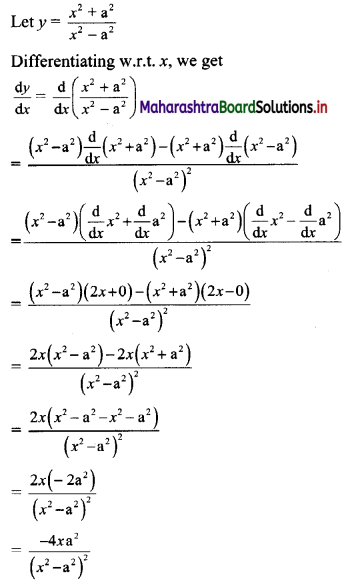
Question 1.
\(\frac{x^{2}+a^{2}}{x^{2}-a^{2}}\)
Solution:
Maharashtra Board 11th Commerce Maths Solutions Chapter 9 Differentiation Ex 9.1 IV Q1

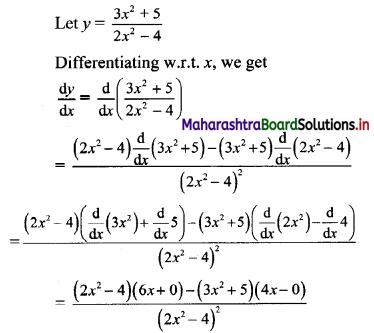
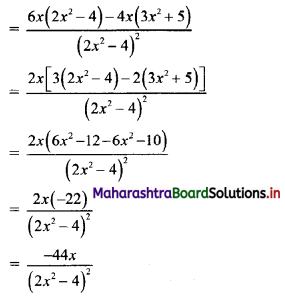
Question 2.
\(\frac{3 x^{2}+5}{2 x^{2}-4}\)
Solution:
Maharashtra Board 11th Commerce Maths Solutions Chapter 9 Differentiation Ex 9.1 IV Q2
Maharashtra Board 11th Commerce Maths Solutions Chapter 9 Differentiation Ex 9.1 IV Q2.1

Maharashtra Board 11th Commerce Maths Solutions Chapter 9 Differentiation Ex 9.1

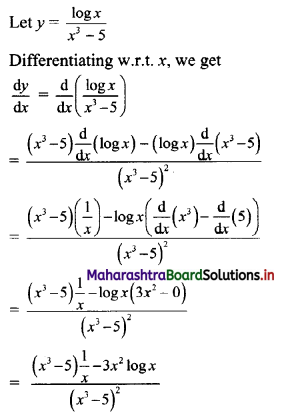
Question 3.
\(\frac{\log x}{x^{3}-5}\)
Solution:
Maharashtra Board 11th Commerce Maths Solutions Chapter 9 Differentiation Ex 9.1 IV Q3

Question 4.
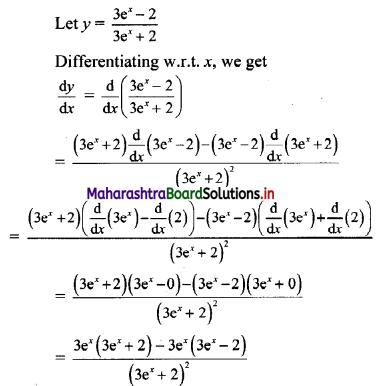
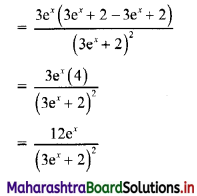
\(\frac{3 e^{x}-2}{3 e^{x}+2}\)
Solution:
Maharashtra Board 11th Commerce Maths Solutions Chapter 9 Differentiation Ex 9.1 IV Q4
Maharashtra Board 11th Commerce Maths Solutions Chapter 9 Differentiation Ex 9.1 IV Q4.1

Question 5.
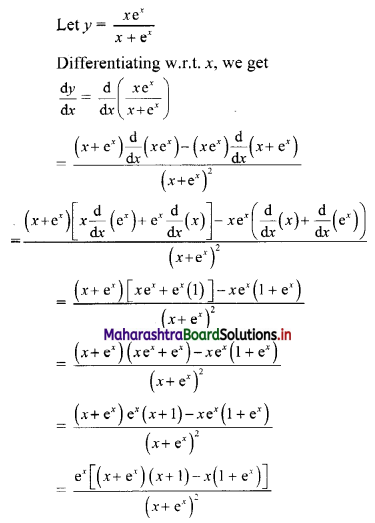
\(\frac{x \mathrm{e}^{x}}{x+\mathrm{e}^{x}}\)
Solution:
Maharashtra Board 11th Commerce Maths Solutions Chapter 9 Differentiation Ex 9.1 IV Q5

V. Find the derivatives of the following functions by the first principle:

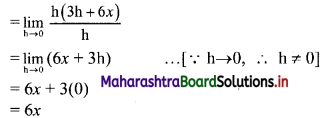
Question 1.
3x2 + 4
Solution:
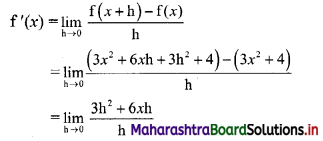
Let f(x) = 3x2 + 4
∴ f(x + h) = 3(x + h)2 + 4
= 3(x2 + 2xh + h2) + 4
= 3x2 + 6xh + 3h2 + 4
By first principle, we get
Maharashtra Board 11th Commerce Maths Solutions Chapter 9 Differentiation Ex 9.1 V Q1
Maharashtra Board 11th Commerce Maths Solutions Chapter 9 Differentiation Ex 9.1 V Q1.1

Maharashtra Board 11th Commerce Maths Solutions Chapter 9 Differentiation Ex 9.1

Question 2.
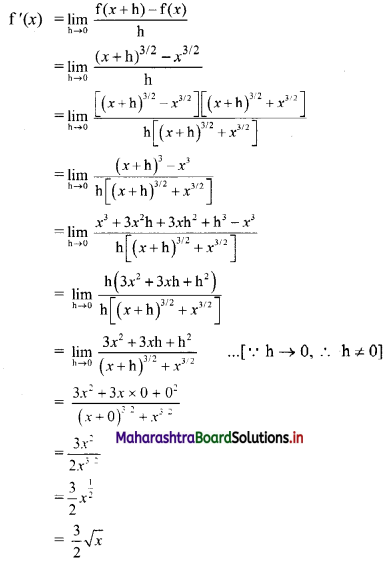
x√x
Solution:
Let f(x) = x√x
∴ f(x + h) = \((x+h)^{\frac{3}{2}}\)
By first principle, we get
Maharashtra Board 11th Commerce Maths Solutions Chapter 9 Differentiation Ex 9.1 V Q2

Question 3.
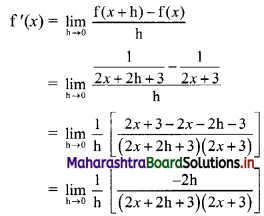
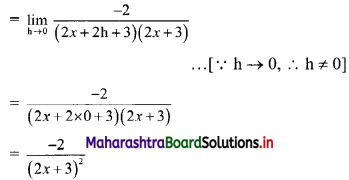
\(\frac{1}{2 x+3}\)
Solution:
Let f(x) = \(\frac{1}{2 x+3}\)
∴ f(x + h) = \(\frac{1}{2(x+\mathrm{h})+3}=\frac{1}{2 x+2 \mathrm{~h}+3}\)
By first principle, we get
Maharashtra Board 11th Commerce Maths Solutions Chapter 9 Differentiation Ex 9.1 V Q3
Maharashtra Board 11th Commerce Maths Solutions Chapter 9 Differentiation Ex 9.1 V Q3.1

Maharashtra Board 11th Commerce Maths Solutions Chapter 9 Differentiation Ex 9.1

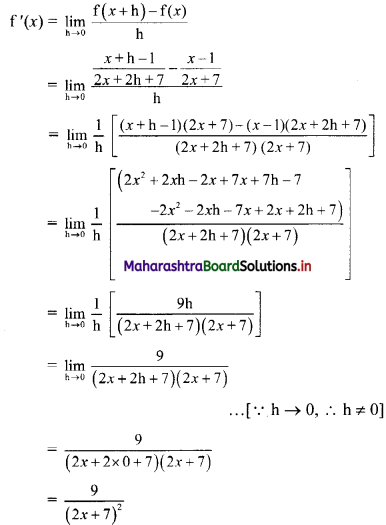
Question 4.
\(\frac{x-1}{2 x+7}\)
Solution:
Let f(x) = \(\frac{x-1}{2 x+7}\)
∴ f(x + h) = \(\frac{x+\mathrm{h}-1}{2(x+\mathrm{h})+7}=\frac{x+\mathrm{h}-1}{2 x+2 \mathrm{~h}+7}\)
By first principle, we get
Maharashtra Board 11th Commerce Maths Solutions Chapter 9 Differentiation Ex 9.1 V Q4

11th Commerce Maths Digest Pdf
11th Commerce Maths 1 Chapter 5 Exercise 5.3 Answers Maharashtra Board

Locus and Straight Line Class 11 Commerce Maths 1 Chapter 5 Exercise 5.3 Answers Maharashtra Board

Balbharati Maharashtra State Board 11th Commerce Maths Solution Book Pdf Chapter 5 Locus and Straight Line Ex 5.3 Questions and Answers.

Std 11 Maths 1 Exercise 5.3 Solutions Commerce Maths

Question 1.
Write the equation of the line:
(a) parallel to the X-axis and at a distance of 5 units from it and above it.
(b) parallel to the Y-axis and at a distance of 5 units from it and to the left of it.
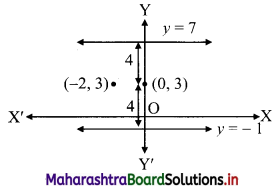
(c) parallel to the X-axis and at a distance of 4 units from the point (-2, 3).
Solution:
(a) Equation of a line parallel to the X-axis is y = k.
Since the line is at a distance of 5 units above the X-axis.
∴ k = 5
∴ the equation of the required line is y = 5.

(b) Equation of a line parallel to the Y-axis is x = h.
Since the line is at a distance of 5 units to the left of the Y-axis.
∴ h = -5
∴ the equation of the required line is x = -5.

(c) Equation of a line parallel to the X-axis is of the form y = k (k > 0 or k < 0).
Since, the line is at a distance of 4 units from the point (-2, 3).
∴ k = 3 + 4 = 7 or k = 3 – 4 = -1
∴ the equation of the required line is y = 7 or y = -1.
Maharashtra Board 11th Commerce Maths Solutions Chapter 5 Locus and Straight Line Ex 5.3 Q1

Question 2.
Obtain the equation of the line:
(a) parallel to the X-axis and making an intercept of 3 units on the Y-axis.
(b) parallel to the Y-axis and making an intercept of 4 units on the X-axis.
Solution:
(a) Equation of a line parallel to X-axis with y-intercept ‘k’ is y = k.
Here, y-intercept = 3
∴ the equation of the required line is y = 3.

(b) Equation of a line parallel to Y-axis with x-intercept ‘h’ is x = h.
Here, x-intercept = 4
∴ the equation of the required line is x = 4.

Maharashtra Board 11th Commerce Maths Solutions Chapter 5 Locus and Straight Line Ex 5.3

Question 3.
Obtain the equation of the line containing the point:
(a) A(2, -3) and parallel to the Y-axis.
(b) B(4, -3) and parallel to the X-axis.
Solution:
(a) Equation of a line parallel to the Y-axis is of the form x = h.
Since, the line passes through A(2, -3).
∴ h = 2
∴ the equation of the required line is x = 2.

(b) Equation of a line parallel to the X-axis is of the form y = k.
Since, the line passes through B(4, -3)
∴ k = -3
∴ the equation of the required line is y = -3.

Question 4.
Find the equation of the line passing through the points A(2, 0) and B(3, 4).
Solution:
The required line passes through the points A(2, 0) = (x1, y1) and B(3, 4) = (x2, y2) say.
Equation of the line in two-point form is
\(\frac{y-y_{1}}{y_{2}-y_{1}}=\frac{x-x_{1}}{x_{2}-x_{1}}\)
∴ the equation of the required line is
∴ \(\frac{y-0}{4-0}=\frac{x-2}{3-2}\)
∴ \(\frac{y}{4}=\frac{x-2}{1}\)
∴ y = 4(x – 2)
∴ y = 4x – 8
∴ 4x – y – 8 = 0

Check:
If the points A(2, 0) and B(3, 4) satisfy 4x – y – 8 = 0, then our answer is correct.
For point A(2, 0),
L.H.S. = 4x – y – 8
= 4(2) – 0 – 8
= 8 – 8
= 0
= R.H.S.
For point B(3, 4),
L.H.S. = 4x – y – 8
= 4(3) – 4 – 8
= 12 – 12
= 0
= R.H.S.
Thus, our answer is correct.

Maharashtra Board 11th Commerce Maths Solutions Chapter 5 Locus and Straight Line Ex 5.3

Question 5.
Line y = mx + c passes through the points A(2, 1) and B(3, 2). Determine m and c.
Solution:
Given, A(2, 1) and B(3, 2).
Equation of a line in two-point form is
\(\frac{y-y_{1}}{y_{2}-y_{1}}=\frac{x-x_{1}}{x_{2}-x_{1}}\)
∴ the equation of the passing through A and B line is
∴ \(\frac{y-1}{2-1}=\frac{x-2}{3-2}\)
∴ \(\frac{y-1}{1}=\frac{x-2}{1}\)
∴ y – 1 = x – 2
∴ y = x – 1
Comparing this equation with y = mx + c, we get
m = 1 and c = -1

Alternate method:
Points A(2, 1) and B(3, 2) lie on the line y = mx + c.
∴ They must satisfy the equation.
∴ 2m + c = 1 ……..(i)
and 3m + c = 2 ……(ii)
equation (ii) – equation (i) gives m = 1
Substituting m = 1 in (i), we get
2(1) – c = 1
∴ c = 1 – 2 = -1

Question 6.
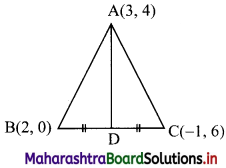
The vertices of a triangle are A(3, 4), B(2, 0), and C(-1, 6). Find the equations of
(a) side BC
(b) the median AD
(c) the midpoints of sides AB and BC.
Solution:
Vertices of ∆ABC are A(3, 4), B(2, 0) and C(-1, 6).
(a) Equation of a line in two-point form is
\(\frac{y-y_{1}}{y_{2}-y_{1}}=\frac{x-x_{1}}{x_{2}-x_{1}}\)
∴ the equation of the side BC is
\(\frac{y-0}{6-0}=\frac{x-2}{-1-2}\) ……[B = (x1, y1) = (2, 0), C = (x2, y2) = (-1, 6)]
∴ \(\frac{y}{6}=\frac{x-2}{-3}\)
∴ y = -2(x – 2)
∴ 2x + y – 4 = 0

(b) Let D be the midpoint of side BC.
Then, AD is the median through A.
∴ D = \(\left(\frac{2-1}{2}, \frac{0+6}{2}\right)=\left(\frac{1}{2}, 3\right)\)
The median AD passes through the points A(3, 4) and D(\(\frac{1}{2}\), 3)
Maharashtra Board 11th Commerce Maths Solutions Chapter 5 Locus and Straight Line Ex 5.3 Q6
∴ the equation of the median AD is
\(\frac{y-4}{3-4}=\frac{x-3}{\frac{1}{2}-3}\)
∴ \(\frac{y-4}{-1}=\frac{x-3}{-\frac{5}{2}}\)
∴ \(\frac{1}{2}\) (y – 4) = x – 3
∴ 5y – 20 = 2x – 6
∴ 2x – 5y + 14 = 0

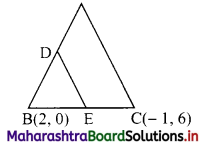
(c) Let D and E be the midpoints of side AB and side BC respectively.
∴ D = \(\left(\frac{3+2}{2}, \frac{4+0}{2}\right)=\left(\frac{5}{2}, 2\right)\) and
E = \(\left(\frac{2-1}{2}, \frac{0+6}{2}\right)=\left(\frac{1}{2}, 3\right)\)
Maharashtra Board 11th Commerce Maths Solutions Chapter 5 Locus and Straight Line Ex 5.3 Q6.1
the equation of the line DE is
\(\frac{y-2}{3-2}=\frac{x-\frac{5}{2}}{\frac{1}{2}-\frac{5}{2}}\)
∴ \(\frac{y-2}{1}=\frac{2 x-5}{-4}\)
∴ -4(y – 2) = 2x – 5
∴ -4y + 8 = 2x – 5
∴ 2x + 4y – 13 = 0

Maharashtra Board 11th Commerce Maths Solutions Chapter 5 Locus and Straight Line Ex 5.3

Question 7.
Find the x and y-intercepts of the following lines:
(a) \(\frac{x}{3}+\frac{y}{2}=1\)
(b) \(\frac{3 x}{2}+\frac{2 y}{3}=1\)
(c) 2x – 3y + 12 = 0
Solution:
(a) Given equation of the line is \(\frac{x}{3}+\frac{y}{2}=1\)
This is of the form \(\frac{x}{a}+\frac{y}{b}=1\),
where x-intercept = a, y-intercept = b
∴ x-intercept = 3, y-intercept = 2

(b) Given equation of the line is \(\frac{3 x}{2}+\frac{2 y}{3}=1\)
∴ \(\frac{x}{\left(\frac{2}{3}\right)}+\frac{y}{\left(\frac{3}{2}\right)}=1\)
This is of the form \(\frac{x}{a}+\frac{y}{b}=1\),
where x-intercept = a, y-intercept = b
∴ x-intercept = \(\frac{2}{3}\) and y-intercept = \(\frac{3}{2}\)

(c) Given equation of the line is 2x – 3y + 12 = 0
∴ 2x – 3y = -12
∴ \(\frac{2 x}{(-12)}-\frac{3 y}{(-12)}=1\)
∴ \(\frac{x}{-6}+\frac{y}{4}=1\)
This is of the form \(\frac{x}{a}+\frac{y}{b}=1\),
where x-intercept = a, y-intercept = b
∴ x-intercept = -6 and y-intercept = 4

Question 8.
Find the equations of a line containing the point A(3, 4) and make equal intercepts on the co-ordinate axes.
Solution:
Let the equation of the line be
\(\frac{x}{a}+\frac{y}{b}=1\) …..(i)
Since, the required line make equal intercepts on the co-ordinate axes.
∴ a = b
∴ (i) reduces to x + y = a …..(ii)
Since the line passes through A(3, 4).
∴ 3 + 4 = a
i.e. a = 7
Substituting a = 7 in (ii) to get
x + y = 7

Maharashtra Board 11th Commerce Maths Solutions Chapter 5 Locus and Straight Line Ex 5.3

Question 9.
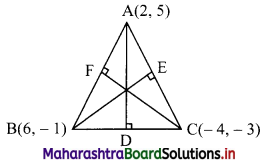
Find the equations of the altitudes of the triangle whose vertices are A(2, 5), B(6, -1) and C(-4, -3).
Solution:
Maharashtra Board 11th Commerce Maths Solutions Chapter 5 Locus and Straight Line Ex 5.3 Q9
A(2, 5), B(6, -1), C(-4, -3) are the vertices of ∆ABC.
Let AD, BE and CF be the altitudes through the vertices A, B and C respectively of ∆ABC.
Slope of BC = \(\frac{-3-(-1)}{-4-6}=\frac{-2}{-10}=\frac{1}{5}\)
∴ slope of AD = -5 ……..[∵ AD ⊥ BC]
Since, altitude AD passes through (2, 5) and has slope -5.
∴ the equation of the altitude AD is
y – 5 = -5(x – 2)
∴ y – 5 = – 5x + 10
∴ 5x + y – 15 = 0
Now, slope of AC = \(\frac{-3-5}{-4-2}=\frac{-8}{-6}=\frac{4}{3}\)
∴ slope of BE = \(\frac{-3}{4}\) …..[∵ BE ⊥ AC]
Since, altitude BE passes through (6, -1) and has slope \(\frac{-3}{4}\).
∴ the equation of the altitude BE is
y – (-1) = \(\frac{-3}{4}\)(x – 6)
∴ 4(y + 1) = -3(x – 6)
∴ 3x + 4y – 14 = 0
Also, slope of AB = \(\frac{-1-5}{6-2}=\frac{-6}{4}=\frac{-3}{2}\)
∴ slope of CF = \(\frac{2}{3}\) ………[∵ CF ⊥ AB]
Since, altitude CF passes through (-4, -3) and has slope \(\frac{2}{3}\).
∴ the equation of the altitude CF is
y – (-3) = \(\frac{2}{3}\) [x – (-4)]
∴ 3(y + 3) = 2(x + 4)
∴ 2x – 3y – 1 = 0

11th Commerce Maths Digest Pdf
11th Commerce Maths 1 Chapter 4 Exercise 4.5 Answers Maharashtra Board

Sequences and Series Class 11 Commerce Maths 1 Chapter 4 Exercise 4.5 Answers Maharashtra Board

Balbharati Maharashtra State Board 11th Commerce Maths Solution Book Pdf Chapter 4 Sequences and Series Ex 4.5 Questions and Answers.

Std 11 Maths 1 Exercise 4.5 Solutions Commerce Maths

Question 1.
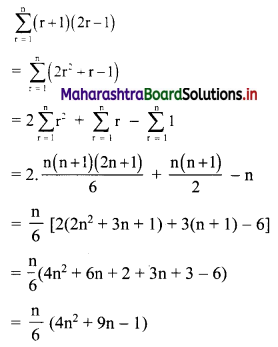
Find the sum \(\sum_{r=1}^{n}(r+1)(2 r-1)\).
Solution:
Maharashtra Board 11th Commerce Maths Solutions Chapter 4 Sequences and Series Ex 4.5 Q1

Question 2.
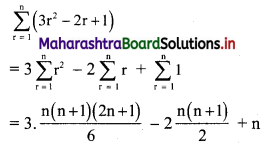
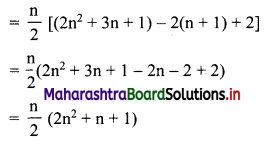
Find \(\sum_{r=1}^{n}\left(3 r^{2}-2 r+1\right)\).
Solution:
Maharashtra Board 11th Commerce Maths Solutions Chapter 4 Sequences and Series Ex 4.5 Q2
Maharashtra Board 11th Commerce Maths Solutions Chapter 4 Sequences and Series Ex 4.5 Q2.1

Question 3.
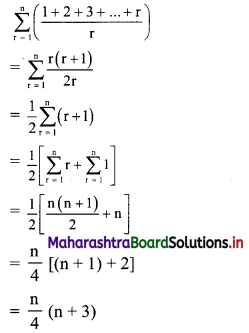
Find \(\sum_{r=1}^{n} \frac{1+2+3+\ldots+r}{r}\).
Solution:
Maharashtra Board 11th Commerce Maths Solutions Chapter 4 Sequences and Series Ex 4.5 Q3

Maharashtra Board 11th Commerce Maths Solutions Chapter 4 Sequences and Series Ex 4.5

Question 4.
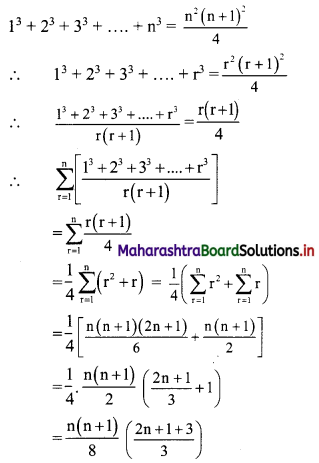
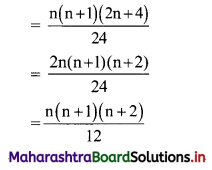
Find \(\sum_{r=1}^{n} \frac{1^{3}+2^{3}+\ldots+r^{3}}{r(r+1)}\).
Solution:
We know that,
Maharashtra Board 11th Commerce Maths Solutions Chapter 4 Sequences and Series Ex 4.5 Q4
Maharashtra Board 11th Commerce Maths Solutions Chapter 4 Sequences and Series Ex 4.5 Q4.1

Question 5.
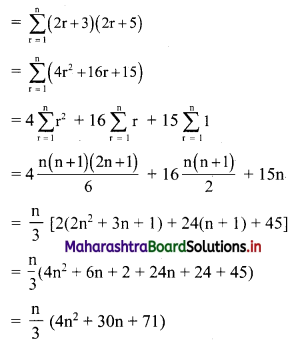
Find the sum 5 × 7 + 7 × 9 + 9 × 11 + 11 × 13 + …… upto n terms.
Solution:
5 × 7 + 7 × 9 + 9 × 11 + 11 × 13 + ….. upto n terms
Now, 5, 7, 9, 11, … are in A.P.
rth term = 5 + (r – 1) (2) = 2r + 3
7, 9, 11,. … are in A.P.
rth term = 7 + (r – 1) (2) = 2r + 5
∴ 5 × 7 + 7 × 9 + 9 × 11 + 11 × 13 + …… upto n terms
Maharashtra Board 11th Commerce Maths Solutions Chapter 4 Sequences and Series Ex 4.5 Q5

Question 6.
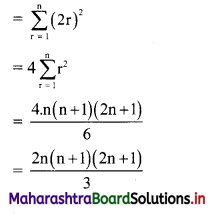
Find the sum 22 + 42 + 62 + 82 + …… upto n terms.
Solution:
22 + 42 + 62 + 82 + …… upto n terms
= (2 × 1)2 + (2 × 2)2 + (2 × 3)2 + (2 × 4)2 + ……
Maharashtra Board 11th Commerce Maths Solutions Chapter 4 Sequences and Series Ex 4.5 Q6

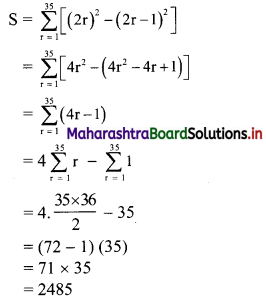
Question 7.
Find (702 – 692) + (682 – 672) + (662 – 652) + ……. + (22 – 12)
Solution:
Let S = (702 – 692) + (682 – 672) + …… +(22 – 12)
∴ S = (22 – 12) + (42 – 32) + …… + (702 – 692)
Here, 2, 4, 6,…, 70 is an A.P. with rth term = 2r
and 1, 3, 5,….., 69 in A.P. with rth term = 2r – 1
Maharashtra Board 11th Commerce Maths Solutions Chapter 4 Sequences and Series Ex 4.5 Q7

Maharashtra Board 11th Commerce Maths Solutions Chapter 4 Sequences and Series Ex 4.5

Question 8.
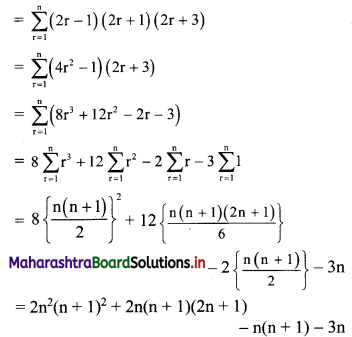
Find the sum 1 × 3 × 5 + 3 × 5 × 7 + 5 × 7 × 9 + …… + (2n – 1) (2n + 1) (2n + 3)
Solution:
1 × 3 × 5 + 3 × 5 × 7 + 5 × 7 × 9 + …… + (2n – 1) (2n + 1) (2n + 3)
Now, 1, 3, 5, 7, … are in A.P. with a = 1 and d = 2.
∴ rth term = 1 + (r – 1)2 = 2r – 1
3, 5, 7, 9, … are in A.P. with a = 3 and d = 2
∴ rth term = 3 + (r – 1)2 = 2r + 1
and 5, 7, 9, 11, … are in A.P. with a = 5 and d = 2
∴ rth term = 5 + (r – 1)2 = 2r + 3
∴ 1 × 3 × 5 + 3 × 5 × 7 + 5 × 7 × 9 + …… upto n terms
Maharashtra Board 11th Commerce Maths Solutions Chapter 4 Sequences and Series Ex 4.5 Q8
= n(n + 1)[2n(n + 1) + 4n + 2 – 1] – 3n
= n(n + l)(2n2 + 6n + 1) – 3n
= n(2n3 + 8n2 + 7n + 1 – 3)
= n(2n3 + 8n2 + 7n – 2)

Question 9.
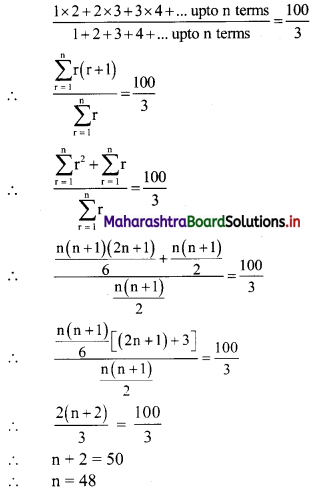
Find n, if \(\frac{1 \times 2+2 \times 3+3 \times 4+4 \times 5+\ldots+\text { upto } n \text { terms }}{1+2+3+4+\ldots+\text { upto } n \text { terms }}\) = \(\frac{100}{3}\)
Solution:
Maharashtra Board 11th Commerce Maths Solutions Chapter 4 Sequences and Series Ex 4.5 Q9

Maharashtra Board 11th Commerce Maths Solutions Chapter 4 Sequences and Series Ex 4.5

Question 10.
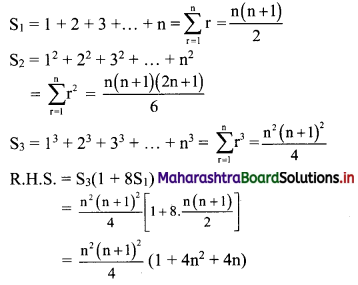
If S1, S2, and S3 are the sums of first n natural numbers, their squares, and their cubes respectively, then show that:
9\(S_{2}^{2}\) = S3(1 + 8S1).
Solution:
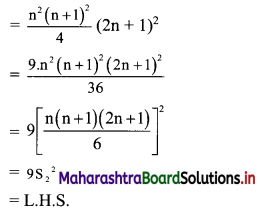
Maharashtra Board 11th Commerce Maths Solutions Chapter 4 Sequences and Series Ex 4.5 Q10
Maharashtra Board 11th Commerce Maths Solutions Chapter 4 Sequences and Series Ex 4.5 Q10.1

11th Commerce Maths Digest Pdf
11th Commerce Maths 1 Chapter 5 Exercise 5.2 Answers Maharashtra Board

Locus and Straight Line Class 11 Commerce Maths 1 Chapter 5 Exercise 5.2 Answers Maharashtra Board

Balbharati Maharashtra State Board 11th Commerce Maths Solution Book Pdf Chapter 5 Locus and Straight Line Ex 5.2 Questions and Answers.
Std 11 Maths 1 Exercise 5.2 Solutions Commerce Maths

Question 1.
Find the slope of each of the following lines which pass through the points:
(a) (2, -1), (4, 3)
(b) (-2, 3), (5, 7)
(c) (2, 3), (2, -1)
(d) (7, 1), (-3, 1)
Solution:
(a) Let A = (x1, y1) = (2, -1) and B = (x2, y2) = (4, 3).
Slope of line AB = \(\frac{y_{2}-y_{1}}{x_{2}-x_{1}}\)
= \(\frac{3-(-1)}{4-2}\)
= \(\frac{4}{2}\)
= 2

(b) Let C = (x1, y1) = (-2, 3) and D = (x2, y2) = (5, 7)
Slope of line CD = \(\frac{y_{2}-y_{1}}{x_{2}-x_{1}}\)
= \(\frac{7-3}{5-(-2)}\)
= \(\frac{4}{7}\)

Maharashtra Board 11th Commerce Maths Solutions Chapter 5 Locus and Straight Line Ex 5.2

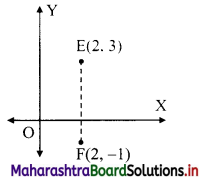
(c) Let E = (2, 3) = (x1, y1) and F = (2, -1) = (x2, y2)
Since x1 = x2 = 2
∴ The slope of EF is not defined. ……[EF || y-axis]
Maharashtra Board 11th Commerce Maths Solutions Chapter 5 Locus and Straight Line Ex 5.2 Q1

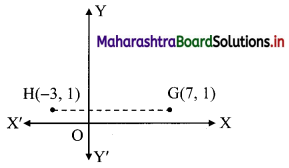
(d) Let G = (7, 1) = (x1, y1) and H = (-3, 1) = (x2, y2) say.
Since y1 = y2
∴ The slope of GH = 0 …..[GH || x-axis]
Maharashtra Board 11th Commerce Maths Solutions Chapter 5 Locus and Straight Line Ex 5.2 Q1.1

Question 2.
If the X and Y-intercepts of line L are 2 and 3 respectively, then find the slope of line L.
Solution:
Given, x-intercept of line L is 2 and y-intercept of line L is 3
∴ the line L intersects X-axis at (2, 0) and Y-axis at (0, 3).
i.e. the line L passes through (2, 0) = (x1, y1) and (0, 3) = (x2, y2) say.
Slope of line L = \(\frac{y_{2}-y_{1}}{x_{2}-x_{1}}\)
= \(\frac{3-0}{0-2}\)
= \(\frac{-3}{2}\)

Question 3.
Find the slope of the line whose inclination is 30°.
Solution:
Given, inclination (θ) = 30°
Slope of the line = tan θ = tan 30° = \(\frac{1}{\sqrt{3}}\)

Question 4.
Find the slope of the line whose inclination is 45°.
Solution:
Given, inclination (θ) = 45°
Slope of the line = tan θ = tan 45° = 1

Question 5.
A line makes intercepts 3 and 3 on the co-ordinate axes. Find the slope of the line.
Solution:
Given, x-intercept of line is 3 and y-intercept of line is 3
∴ The line intersects X-axis at (3, 0) and Y-axis at (0, 3).
i.e. the line passes through (3, 0) = (x1, y1) and (0, 3) = (x2, y2) say.
Slope of line = \(\frac{y_{2}-y_{1}}{x_{2}-x_{1}}\)
= \(\frac{3-0}{0-3}\)
= -1

Maharashtra Board 11th Commerce Maths Solutions Chapter 5 Locus and Straight Line Ex 5.2

Question 6.
Without using Pythagoras theorem, show that points A(4, 4), B(3, 5) and C(-1, -1) are the vertices of a right-angled triangle.
Solution:
Given, A(4, 4) = (x1, y1), B(3, 5) = (x2, y2), C(-1, -1) = (x3, y3)
Slope of AB = \(\frac{y_{2}-y_{1}}{x_{2}-x_{1}}=\frac{5-4}{3-4}=-1\)
Slope of BC = \(\frac{y_{3}-y_{2}}{x_{3}-x_{2}}=\frac{-1-5}{-1-3}=\frac{-6}{-4}=\frac{3}{2}\)
Slope of AC = \(\frac{y_{3}-y_{1}}{x_{3}-x_{1}}=\frac{-1-4}{-1-4}=\frac{-5}{-5}=1\)
Slope of AB × slope of AC = -1 × 1 = -1
∴ side AB ⊥ side AC
∴ ΔABC is a right angled triangle, right angled at A.
∴ The given points are the vertices of a right angled triangle.

Question 7.
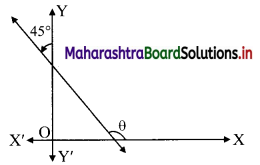
Find the slope of the line which makes angle of 45° with the positive direction of the Y-axis measured clockwise.
Solution:
Maharashtra Board 11th Commerce Maths Solutions Chapter 5 Locus and Straight Line Ex 5.2 Q7
Since, the line makes an angle of 45° with positive direction of Y-axis in anticlockwise direction.
∴ Inclination of the line (θ) = (90° + 45°)
∴ Slope of the line = tan(90° + 45°)
= -cot 45° …….[tan(90 + θ°) = -cot θ]
= -1

Question 8.
Find the value of k for which the points P(k, -1), Q(2, 1) and R(4, 5) are collinear.
Solution:
Given, points P(k, -1), Q(2, 1), and R(4, 5) are collinear.
∴ Slope of PQ = Slope of QR
∴ \(\frac{1-(-1)}{2-k}=\frac{5-1}{4-2}\)
∴ \(\frac{2}{2-k}=\frac{4}{2}\)
∴ 1 = 2 – k
∴ k = 2 – 1 = 1

Check:
For collinear points P, Q, R,
Slope of PQ = Slope of QR = Slop of PR
For k = 1, if the given points are collinear, then our answer is correct.
P(1, -1), Q(2, 1) and R(4, 5)
Slope of PQ = \(\frac{1-(-1)}{2-1}=\frac{2}{1}=2\)
Slope of QR = \(\frac{5-1}{4-2}=\frac{4}{2}=2\)
Slope of PQ = Slope of QR
∴ The given points are collinear.
Thus, our answer is correct.

11th Commerce Maths Digest Pdf