Metallurgy Class 10 Questions And Answers Maharashtra Board

Class 10 Science Part 1 Chapter 8

Balbharti Maharashtra State Board Class 10 Science Solutions Part 1 Chapter 8 Metallurgy Notes, Textbook Exercise Important Questions and Answers.

Std 10 Science Part 1 Chapter 8 Metallurgy Question Answer Maharashtra Board

Class 10 Science Part 1 Chapter 8 Metallurgy Question Answer Maharashtra Board

Question 1.
a. Alloy of sodium with mercury.
Answer:
Silver amalgam.

b.Molecular formula of common ore of aluminium.
Answer:
Al2O3.nH2O

c. The oxide that forms salt and water by reacting with both acid and base.
Answer:
Aluminium oxide (Al2O3).

d. device used for grinding an ore.
Answer:
The device used for grinding an ore is grinding mill.

e. The nonmetal having electrical conductivity.
Answer:
Graphite having electrical conductivity.

f. The reagent that dissolves noble metals.
Answer:
Aqua regia is the reagent that dissolves noble metals like gold and platinum.

Maharashtra Board Class 10 Science Solutions Part 1 Chapter 8 Metallurgy

Question 2.
Make pairs of substances and their properties.

Column I Column II
Substance Property
(1) Potassium bromide (a) Combustible
(2) Gold (b) Soluble in water
(3) Sulphur (c) No chemical reaction
(4) Neon (d) High ductility
(e) Magnetic ingredient

Answer:
(1) Potassium bromide – Soluble in water
(2) Gold – High ductility
(3) Sulphur – Combustible
(4) Neon – No chemical reaction

Question 3.
Identify the pairs of metals and their ores from the following.

Column I (ores) Column II (metals)
(1) Bauxite (a) Mercury
(2) Cassiterite (b) Aluminium
(3) Cinnabar (c) Tin
(d) Copper

Answer:
(1) Bauxite – Aluminium
(2) Cassiterite – Tin
(3) Cinnabar – Mercury

Question 4.
Explain the terms.
a. Metallurgy
Answer:
Metallurgy: The process used for extraction of metals in their pure form from their ores, then metals are further purified by different methods of purification. All the process is called metallurgy.

b. Ores.
Answer:
Ores: The minerals from which metals are extracted profitably and conveniently are called ores.
Examples: Bauxite (Al2O3.H2O), Cinnabar (HgS).

c. Minerals.
Answer:
Minerals: The naturally occurring compounds of metals along with other impurities are known as minerals.
Examples: Rocks are composed of mixtures of minerals. Talc and granite are minerals.

d. Gangue.
Answer:
Gangue: Ores contain metal compounds with some of the impurities like soil, sand, rocky material, etc. These impurities are called gangue.

Maharashtra Board Class 10 Science Solutions Part 1 Chapter 8 Metallurgy

Question 5.
Write scientific reasons.
a. Lemon or tamarind is used for cleaning copper vessels turned greenish.
Answer:

  • Copper undergoes oxidation in air to form black copper oxide. Copper oxide reacts slowly with carbon dioxide in air and gains a green coat. This green substance is copper carbonate.
  • Lemon and tamarind contain acid. The acid dissolves the green coating of basic copper carbonate present on the surface of a tarnished copper utensil and makes it shiny again.

b. Generally the ionic compounds have high melting points.
Answer:

  • The ionic compounds exist in solid state and are hard due to strong electrostatic force of attraction between oppositely charged ions.
  • The intermolecular force of attraction is high in ionic compounds and large energy is required to overcome it. Therefore, ionic compounds have high melting points.

c. Sodium is always kept in kerosene.
(OR)
Why is sodium stored in kerosene?
Answer:

  • Sodium reacts so vigorously with atmospheric oxygen that it catches fire if kept in the open.
  • It does not react with kerosene and sinks in it. Hence, to protect sodium and to prevent accidental fires it is always kept in kerosene.

d. Pine oil is used in the froth floatation process.
Answer:

  • In the concentration of an ore by froth floatation process, the ore is mixed with water and pine oil. When air is bubbled through the mixture a froth is formed.
  • The mineral particles in the ore are preferentially wetted by the oil and float on the top in the froth.
  • The gangue particles are wetted by water and settle down. Thus the mineral can be separated from the gangue and the ore is concentrated.

e. Anodes need to be replaced from time to time during the electrolysis of alumina.
Answer:

  • During electrolysis of alumina, the oxygen liberated at the carbon anode reacts with graphite rods (carbon anode) and forms carbon dioxide.
  • As the anodes get oxidised during electrolysis of alumina, they are continuously eroded. Hence, it is necessary to replace anodes from time to time.

Question 6.
When a copper coin is dipped in silver nitrate solution, a glitter appears on the coin after some time. Why does this happen? Write the chemical equation.
Answer:
When a copper coin is dipped in a silver nitrate solution, more reactive copper displaces silver from silver nitrate solution. The silver so liberated deposits on the copper coin. As a result, a shiny coat of silver is formed on the coin.
Cu(s) + 2AgNO3(aq) → Cu(NO3)2(aq) + 2Ag(s)

Maharashtra Board Class 10 Science Solutions Part 1 Chapter 8 Metallurgy

Question 7.
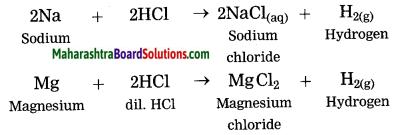
The electronic configuration of metal ‘A’ is 2, 8, 1 and that of metal ‘B’ is 2, 8, 2. Which of the two metals is more reactive? Identify these metals. Write their reaction with dilute hydrochloric acid. (Practice Activity Sheet – 1)
Answer:
If the number of electrons in the outermost orbit is less, then the metal is more reactive. Metal A contains one electron in the outermost shell, while metal B contains two electrons. Hence, metal A is more reactive than metal B.

Metal A is sodium and metal B is magnesium. Reactions of Na and Mg with dil. HCl are,
Maharashtra Board Class 10 Science Solutions Part 1 Chapter 8 Metallurgy 1

Question 8.
Draw a neat labelled diagram.
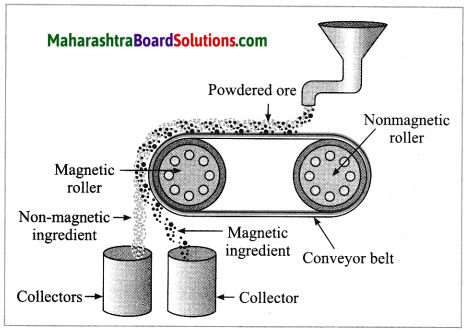
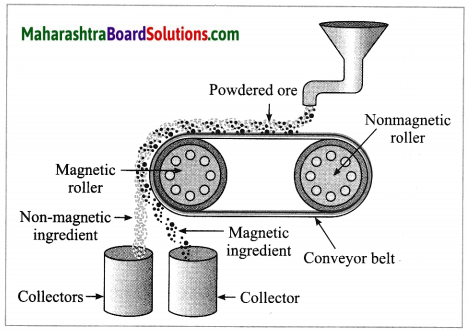
a. Magnetic separation method.
Answer:
Maharashtra Board Class 10 Science Solutions Part 1 Chapter 8 Metallurgy 2

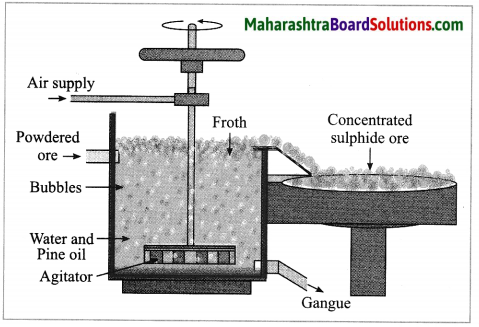
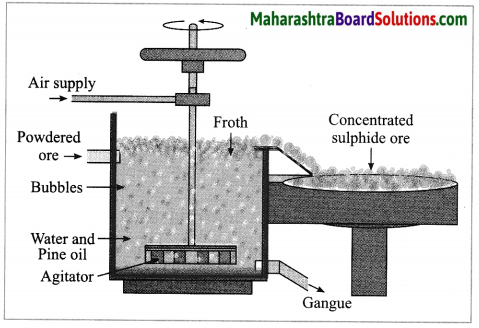
b. Forth floatation.
Answer:
Maharashtra Board Class 10 Science Solutions Part 1 Chapter 8 Metallurgy 3

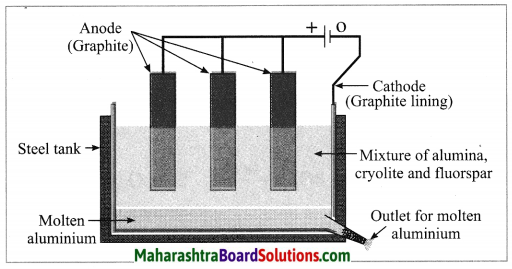
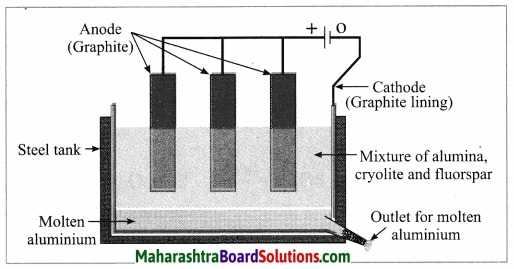
c. Electrolytic reduction of alumina.
Answer:
Maharashtra Board Class 10 Science Solutions Part 1 Chapter 8 Metallurgy 4

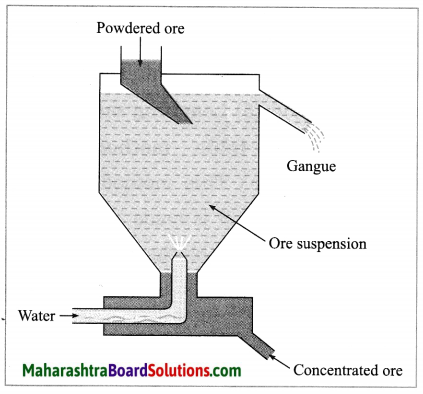
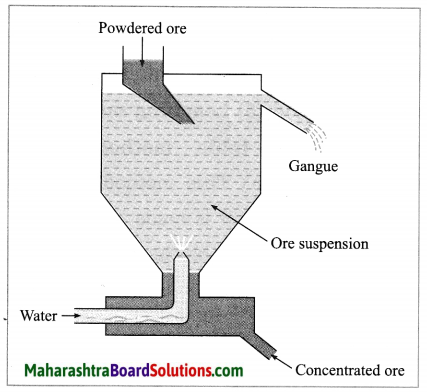
d. Hydraulic separation method.
Answer:
Maharashtra Board Class 10 Science Solutions Part 1 Chapter 8 Metallurgy 5

Maharashtra Board Class 10 Science Solutions Part 1 Chapter 8 Metallurgy

Question 9.
Write chemical equation for the following events.
a. Aluminium came in contact with air.
Answer:
When aluminium is exposed to air, it develops a thin oxide layer of aluminium.
Maharashtra Board Class 10 Science Solutions Part 1 Chapter 8 Metallurgy 6

b. Iron filings are dropped in aqueous solution of copper sulphate.
Answer:
When iron filings are dropped in copper sulphate solution, more reactive iron displaces copper from copper sulphate solution. The iron filings get coated with reddish brown copper metal and the blue colour of copper sulphate fades gradually and ferrous sulphate is formed.
Maharashtra Board Class 10 Science Solutions Part 1 Chapter 8 Metallurgy 7

c. A reaction was brought about between ferric oxide and aluminium.
Answer:
The reaction between ferric oxide and iron produces aluminium oxide and iron. It is a thermite reaction and is highly exothermic.
It produces a large amount of heat, which is released to melt oxygen and aluminium. This reaction is used in welding of machineries. It is also used in warfare to make grenades.

The chemical reaction for the above is as follows:
3Fe3O2 + 4Al → 2Al2O3 + 6Fe

d. Electrolysis of alumina is done.
Answer:
During electrolysis of alumina, aluminium is deposited at the cathode. Molten aluminium being heavier than the electrolyte, is collected at the bottom of the tank. Oxygen gas is liberated at the anode.
Anode reaction: 2O → O2 + 4e (Oxidation)
Cathode reaction: Al3+ + 3e → Al(l) (Reduction)

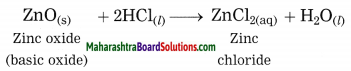
e. Zinc oxide is dissolved in dilute hydrochloric acid.
Answer:
Zinc oxide is dissolved in dilute hydrochloric acid, zinc chloride and water are formed.
Maharashtra Board Class 10 Science Solutions Part 1 Chapter 8 Metallurgy 8

Question 10.
Complete the following statement using every given options.
During the extraction of aluminium
a. Ingredients and gangue in bauxite.
b. Use of leuching during the concentration of ore.
c. Chemical reaction of transformation of bauxite into alumina by Hall’s process.
d. Heating the aluminium ore with concentrated caustic soda.
Answer:
c. Chemical reaction of transformation of bauxite into alumina by Hall’s process.

Maharashtra Board Class 10 Science Solutions Part 1 Chapter 8 Metallurgy

Question 11.
Divide the metals Cu, Zn, Ca, Mg, Fe, Na, Li into three groups, namely, reactive metals, moderately reactive metals and less reactive metals.
Answer:
Reactive metals: Na, Li, Ca
Moderately reactive metals: Zn, Fe, Mg,
Less reactive metals: Cu

Project: (Do it your self)

Collect metal vessels and various metal articles. Write detailed informciton. write the steps in the procedure that can be done in the laboratory for giving glitter to these. Seek guidance from your teacher.

Can you recall? (Text Book Page No. 93)

Question 1.
what are the physical properties of metals and nonmetals?
Answer:
Properties of metals:

  1. Solid state (Exception: Mercury and gallium)
  2. Typical lustre
  3. Malleability and ductility
  4. Hardness (Exception: Lithium, sodium and potassium)
  5. Good conductors of heat and electricity
  6. High melting and boiling points (On the other hand, the melting and boiling points of the metals sodium, potassium, mercury and galium are very low.)
  7. Sonorous and produce sound on striking a hard surface.

Properties or nonmetals:

  1. Gaseous or solid state (Exception: Bromine in liquid state)
  2. Lack of any typical lustre (Exception: Iodine and Diamond)
  3. Brittleness in the solid state (Exception: Diamond is the hardest natural substance)
  4. Bad conductors of heat and electricity (Exception: Graphite) (Diamond is good conductor of heat)
  5. Low melting and boiling points.

Can you recall? (Text Book Page No. 102)

Question 1.
What is the electronic definition of oxidation and reduction?
Answer:
When a metal loses çlectrons the process is called an oxidation while when a nonmetal gains electrons, it is called a reduction,
Na → Na+ + e (oxidation)
Cl + e → Cl (reduction)

Maharashtra Board Class 10 Science Solutions Part 1 Chapter 8 Metallurgy

Can you recall? (Text Book Page No. 106)

Question 1.
What is meant by corrosion?
Answer:
Corrosion is degradation of a material due toreaction with its environment.

Question 2.
Have you observed the following things?
(1) Old iron bars in the builthngs.
Answer:
When old iron bars in the buildings are exposed to moist air for a long time, they acquire a coating of browm nlaky substance called rust. (Fe2O3.H2O)

(2) Copper vessels not cleaned for a long time.
Answer:
If copper vessels are not cleaned for a long time, they react with moist carbon dioxide in the air, lose their shine and gain a green coat of copper carbonate. (CuCO3)

Question 3.
Silver ornaments or idols exposed to air for a long time.
Answer:
When silver ornaments or idols are kept exposed to air for a long time, silver reacts with sulphur in the air to form a coating of black silver sulphide. (Ag2S)

Question 4.
Old vehicles fit to be thrown away.
Answer:
The metallic parts of the body of old cars are corroded, eaten up and sometimes become perforated. The old cars also lose the original colour due to formation of flakes of rust.

Use your brain power! (Text Book Page No. 98)

Question 1.
In the reaction between chlorine and HBr a transformation or HBr into Br2 takes place. Can this transformation be called oxidation? What Is the oxidant that brings about this oxidation?
Answer:
The conversion of HBr to Br2 is an oxidation process. In the above reaction, Cl2 in the oxidant.

Maharashtra Board Class 10 Science Solutions Part 1 Chapter 8 Metallurgy

Can you tell? (Text Book Page No. 104)

Question 1.
what are the moderately reactive metals?
Answer:
In the middle of the reactivity series, metals such as iron. zinc, lead, copper are moderately reactive.

Question 2.
In which form to the moderately reactive metals occur in nature?
Answer:
The moderately reactive metals which occur in nature are in the form of their sulphide salts or carbonate salts.

Think about it (Text Book Page No. 106)

Question 1.
Why do silver articles turn blackish while copper vessels turn greenish on keeping in air for long time?
Answer:

  1. Silver articles turn blackish on exposure to air for a long time. This is because of silver sulphide (Ag2S) laver formed on the silver articles by the reaction of silver with hydrogen sulphide.
  2. Carbon dioxide in moist air reacts with copper vessel. Copper loses its lustre due to formation of greenish layer of copper carbonate (CuCO3) on its surface.

Question 2.
Why do pure gold and platinum always glitter?
Answer:
Gold and platinum are noble metals as they do not react with moisture, O2 and CO2 from air also acids and alkalis, therefore, pure gold and platinum always glitter.

Use your brain power! (Text Book Page No. 103)

Question 1.
Write the electrode reaction for electrolysis of molten magnesium chloride and calcium chloride.
Answer:
(1) Magnesium chloride (MgCl2):
MgCl2 → Mg2+ + 2Cl
At the cathode: Mg2+ + 2e → Mg
At the anode: 2Cl → Cl2 + 2e

(2) Calcium chloride (CaCl2):
At the cathode: Ca2+ + 2e → Ca
At the anode: 2Cl → Cl2 + 2e

Maharashtra Board Class 10 Science Solutions Part 1 Chapter 8 Metallurgy

Can you tell? (Text Book Page No. 106)

Question 1.
Which measures would you suggest to stop the corrosion of metallic articles or not allow the corrosion to start?
Answer:
Various types of methods are used to protect metals from corrosion. Almost in all the methods, special attention is paid so that iron does not rust. It is possible to lower the rate of the process of rusting of iron. Corrosion of metals can be stopped by detaching the air from metals.

Some methods are as follows :

  1. To fix a layer of some substance on the metal surface so that the contact of the metal with moisture and oxygen in the air is prevented and no reaction would occur between them.
  2. To prevent corrosion of metals by applying a layer of paint, oil, grease or varnish on their surface. For example, corrosion of iron can be prevented by this method.

Question 2.
What is done so to prevent rusting of iron windows and iron doors of your house?
Answer:
To prevent rusting of iron windows and iron doors in the house, they are painted so that they do not rust.

Question 3.
What is done so to prevent rusting or iron windows and iron doors of your house?
Answer:
To prevent rusting of iron windows and iron doors in the house, they are painted so that they do not rust.

Use your brain power! (Text Book Page No. 107)

Question 1.
Can we permanently prevent the rusting of an iron article by applying a layer of paint on its surface?
Answer:
The method of painting is alright for some time. We cannot protect the articles permanently from rusting by painting them.

Question 2.
Why do new iron sheets appear shiny?
Answer:
The new iron sheets appear shiny because a layer of non-corrosionable metal is fixed on the surface of corrosionable metal.

Collect information. (Text Book Page No. 108)

Question 1.
What are the various alloys used in daily life? Where are those used?
Answer:

Various alloys Uses
1. Bronze It is used to prepare: Coins, utensils, medals, statues
2. Brass Pipes, condenser tubes, utensils worshipping God.
3. Stainless steel Utensils, tools, dairy equipment, boilers.
4. Steel Construction of bridges and buildings, cutting tools, blades.
5. Tungsten steel High speed cutting tools
6. Amalgam Silver amalgam used by dentists
7. Duralumin Bodies of aircraft, buses, kitchenwares
8. Aluminium bronze Pigment in ink and paint
9. German silver Electrical heaters, resistors
10. Gun metal Guns, boiler fittings
11. Magnelium Beams of scientific balances, aircraft parts.
12. Gold with copper or nickel or silver or platinum Jewellery

Question 2.
What are the properties that the alloy used for minting coins should have?
Answer:
The alloy used for minting coins should have excellent wear resistance and anti-corrosion properties.

Fill in the blanks:

Question 1.
……………has the highest melting point.
Answer:
Tungsten has the highest melting point.

Question 2.
Mercury and…………are two metals in the liquid state at room temperature.
Answer:
Mercury and galium are two metals in the liquid state at room temperature.

Question 3.
…………is the hardest natural substance.
Answer:
Diamond is the hardest natural substance.

Question 4.
The naturally occurring compounds of metals along with other impurities are known as………….
Answer:
The naturally occurring compounds of metals along with other impurities are known as minerals.

Question 5.
The minerals from which metals are extracted profitably and conveniently are called…………..
Answer:
The minerals from which metals are extracted profitably and conveniently are called ores.

Question 6.
An ore contains some of the impurities like soil, sand, etc. These impurities are called…………
Answer:
An ore contains some of the impurities like soil, sand, etc. These impurities are called gangue.

Question 7.
The process of extraction of a metal from its ore is called……….
Answer:
The process of extraction of a metal from its ore is called metallurgy.

Question 8.
Bauxite is a common ore of………..
Answer:
Bauxite is a common ore of aluminium.

Question 9.
…………. process is used for the purification of bauxite.
Answer:
Bayer’s process is used for the purification of bauxite.

Question 10.
During the electrolysis of alumina, ………..is liberated at the anode.
Answer:
During the electrolysis of alumina, oxygen is liberated at the anode.

Question 11.
The reaction of iron oxide with aluminium is known as…………..reaction.
Answer:
The reaction of iron oxide with aluminium is known as thermit reaction.

Maharashtra Board Class 10 Science Solutions Part 1 Chapter 8 Metallurgy

Question 12.
The process of coating a thin layer of zinc on iron is known as…………
Answer:
The process of coating a thin layer of zinc on iron is known as galvanising.

Question 13.
The metal that produces a sound on striking a hard surface is said to be………….
Answer:
The metal that produces a sound on striking a hard surface is said to be sonorous.

Question 14.
The process in which carbonate ores are changed into oxides by heating strongly in limited air is known as …………….
Answer:
The process in which carbonate ores are changed into oxides by heating strongly in limited air is known as calcination.

Question 15.
…………compounds are insoluble in solvents like kerosene and petrol.
Answer:
Ionic compounds are insoluble in solvents like kerosene and petrol.

Question 16.
…………… is used to obtain pure metals from impure metals.
Answer:
Electrolys is method is used to obtain pure metals from impure metals.

Question 17.
Corrosion can be prevented-by putting a layer of…………metal on corrosionable metal.
Answer:
Corrosion can be prevented by putting a layer of non-corrosionable metal on corrosionable metal.

Rewrite the following statements by selecting the correct options:

Question 1.
………… is a metal.
(a) Mg
(b) S
(c) P
(d) Br
Answer:
Mg is a metal.

Question 2.
………. is a nonmetal.
(a) Au
(b) Hg
(c) Br
(d) Cu
Answer:
Br is a nonmetal.

Question 3.
………… is a metalloid.
(a) Aluminium
(b) Antimony
(c) Zinc
(d) Mercury
Answer:
Antimony is a metalloid.

Maharashtra Board Class 10 Science Solutions Part 1 Chapter 8 Metallurgy

Question 4.
Metalloids have properties of ………..
(a) metals
(b) nonmetals
(c) both metals and nonmetals
(d) neither metals nor nonmetals
Answer:
Metalloids have properties of both metals and nonmetals.

Question 5.
…………. is a good conductor of electricity.
(a) Bromine
(b) Iodine
(c) Graphite
(d) Sulphur
Answer:
Graphite is a good conductor of electricity.

Question 6.
………. is a metal which is in liquid form at ordinary temperature and pressure.
(a) Magnesium
(b) Sodium
(c) Scandium
(d) Mercury
Answer:
Mercury is a metal which is in liquid form at ordinary temperature and pressure.

Question 7.
………. is an amphoteric oxide.
(a) Na2O
(b) MgO
(c) ZnO
(d) SO2
Answer:
ZnO is an amphoteric oxide.

Question 8.
……….. is an acidic oxide.
(a) Na2O
(b) CO2
(c) FeO3
(d) H2O
Answer:
CO2 is an acidic oxide.

Question 9.
………. is a basic oxide.
(a) CO2
(b) K2O
(C) SO2
(d) Al2O3
Answer:
K2O is a basic oxide.

Question 10.
………… is an ore of aluminium.
(a) Cryolite
(b) Bauxite
(c) Haematite
(d) Aluminium carbonate
Answer:
Bauxite is an ore of aluminium.

Question 11.
Bronze is an alloy of ………..
(a) copper and tin
(b) copper and zinc
(c) copper and iron
(d) iron and nickel
Answer:
Bronze is an alloy of copper and tin.

Question 12.
An alloy prepared from iron, nickel and chromium is known as …………
(a) brass
(b) bronze
(c) stainless steel
(d) amalgam
Answer:
An alloy prepared from iron, nickel and chromium is known as stainless steel.

Question 13.
…………. is an allotropic form of a nonmetal which conducts electricity.
(a) Sulphur
(b) Graphite
(c) Chlorine
(d) Iodine
Answer:
Graphite is an allotropic form of a nonmetal which conducts electricity.

Question 14.
………….. has an oxide which is soluble in sodium hydroxide.
(a) Calcium
(b) Magnesium
(c) Iron
(d) Zinc.
Answer:
Zinc has an oxide which is soluble in sodium hydroxide.

Question 15.
………… prevents the rusting of iron.
(a) Copper
(b) Zinc
(c) Aluminium
(d) Silver
Answer:
Zinc prevents the rusting of iron.

Maharashtra Board Class 10 Science Solutions Part 1 Chapter 8 Metallurgy

Question 16.
………….. is obtained by the reduction of its oxide by carbon.
(a) Zinc
(b) Aluminium
(c) Sodium
(d) Potassium
Answer:
Zinc is obtained by the reduction of its oxide by carbon.

Question 17.
………….. is used as an anode during the electrolytic reduction of bauxite.
(a) Sulphur
(b) Graphite
(c) Platinum
(d) Aluminium
Answer:
Graphite is used as an anode during the electrolytic reduction of bauxite.

Question 18.
Silver gets corroded due to ………… in air.
(a) oxygen
(b) hydrogen sulphide
(c) carbon dioxide
(d) nitrogen
Answer:
Silver gets corroded due to hydrogen sulphide in air.

Question 19.
…………. is the hardest substance and has the highest melting and boiling points.
(a) Iodine
(b) Sulphur
(c) Diamond
(d) Phosphorus
Answer:
Diamond is the hardest substance and has the highest melting and boiling points.

Question 20.
Jewellery articles are gold plated ………….
(a) to prevent corrosion
(b) to prevent rusting of the base metal
(c) to make articles attractive
(d) all of these
Answer:
(d) all of these

Question 21.
To show that zinc is more reactive than copper, the correct procedure is to ………..
(a) prepare copper sulphate solution and dip a zinc strip in it
(b) prepare zinc sulphate solution and dip a copper strip in it
(c) heat together zinc and copper strips
(d) add dil. nitric acid to both the strips
Answer:
To show that zinc is more reactive than copper, the correct procedure is to prepare copper sulphate solution and dip a zinc strip in it.

Question 22.
Iron is ………
(a) more reactive than zinc
(b) more reactive than aluminuium
(c) less reactive than copper
(d) less reactive than aluminium
Answer:
Iron is less reactive than aluminium.

Question 23.
A solution of Al2(SO4)3 in water is …………
(a) blue
(b) pink
(c) green
(d) colourless
Answer:
A solution of Al2(SO4)3 in water is colourless.

Question 24.
A solution of ………… in water is blue in colour.
(a) CuSO4
(b) FeSO4
(c) ZnSO4
(d) Al2(SO4)3
Answer:
A solution of CuSO4 in water is blue in colour.

Question 25.
A solution of …………. n water is green in colour.
(a) CuSO4
(b) FeSO4
(c) ZnSO4
(d) Al2(SO4)3
Answer:
A solution of FeSO4 in water is green in colour.

Maharashtra Board Class 10 Science Solutions Part 1 Chapter 8 Metallurgy

Question 26.
What would be the correct order if Zn, Fe, Al and Cu are arranged in increasing order of reactivity?
(a) Cu, Fe, Zn, Al
(b) Al, Cu, Fe, Zn
(c) Zn, Al, Cu, Fe
(d) Fe, Zn, Al, Cu (Practice Activity Sheet – 2)
Answer:
(a) Cu, Fe, Zn, Al

Question 27.
During the extraction of aluminium ……….
(a) Ingredients and gangue in bauxite
(b) Use of leaching during the concentration of ore
(c) Chemical reaction of transformation of bauxite into alumina by Hall’s process.
(d) Heating the aluminium ore with concentrated caustic soda.
Answer:
During the extraction of aluminium Chemical reaction of transformation of bauxite into alumina by Hall’s process.

Question 28.
A solution of CuSO4 in water is ………… in colour.
(a) pink
(b) blue
(c) colourless
(d) green
Answer:
A solution of CuSO4 in water is blue in colour.

Question 29.
Which of the following process is to be carried out to avoid the formation of greenish layer on brass vessels due to corrosion?
(a) Plating
(b) Anodization
(c) Tinning
(d) Alloying (Practice Activity Sheet – 3)
Answer:
(c) Tinning

State whether the following statements are True or False (If a statement is false, correct it and rewrite it.):

Question 1.
Metals are known as sonar metals.
Answer:
True.

Question 2.
Diamond is the softest natural substance.
Answer:
False. (Diamond is the hardest natural substance.)

Question 3.
Electrolysis method is used to obtain pure metals from impure metals.
Answer:
True.

Question 4.
Iodine and diamond are lustrous substances.
Answer:
True.

Question 5.
Aqua Regia is a mixture of conc. HCl and conc. HNO3 in the ratio of 1:3.
Answer:
False. (Aqua Regia is a mixture of conc. HCl and conc. HNO3 in the ratio of 3:1.)

Question 6.
Corrosion of metals can be stopped by detaching the air from metals.
Answer:
True.

Question 7.
Due to corrosion a greenish layer forms on the surface of copper or brass vessel.
Answer:
True.

Question 8.
Ionic compounds are soluble in kerosene.
Answer:
False. (Ionic compounds are soluble in water and insoluble in kerosene.)

Question 9.
Ionic compounds in the solid state conduct electricity.
Answer:
False. (Ionic compounds in the solid state do not conduct electricity.)

Maharashtra Board Class 10 Science Solutions Part 1 Chapter 8 Metallurgy

Question 10.
Mercury, silver and gold are very reactive metals.
Answer:
False. (Mercury, silver and gold are least reactive metals.)

Question 11.
In electroplating a metal is coated with another metal using electrolysis.
Answer:
True.

Question 12.
In anodising method. the copper or aluminium article is used as anode.
Answer:
True.

Question 13.
Silver plated spoon, gold plated ornaments are the examples of alloying.
Answer:
False. (Silver plated spoon, gold plated ornaments are the examples of electroplating)

Question 14.
silver amalgam is mainly used by dentists.
Answer:
True.

Question 15.
Aluminium oxide is an acidic oxide.
Answer:
False. (Aluminium oxide is an amphoteric oxide.)

Question 16.
copper reacts with moist carbon form copper carbonate.
Answer:
True.

Question 17.
Corrosion is degradation of a reaction with its environment.
Answer:
True.

Find the correlation in the given pair and rewrite the answer:

Question 1.
Brass : Copper and Zinc :: Bronze :………….
Answer:
Brass : Copper and Zinc :: Bronze : Copper and tin

Question 2.
Tinning : Tin :: Galvanizing :…………….
Answer:
Tinning : Tin :: Galvanizing : Zinc

Question 3.
Pressure cooker : Anodizing :: Silver plated spoons :…………..
Answer:
Pressure cooker : Anodizing :: Silver plated spoons : Electro-plating

Question 4.
The sulphides ores are strongly heated in air : Roasting :: The carbonates ores are strongly heated in a limited supply of air :………….
Answer:
The sulphides ores are strongly heated in air : Roasting :: The carbonates ores are strongly heated in a limited supply of air : Calcination.

Question 5.
Sulphide ores : Froth floatation method : Cassiterite ore :………..
Answer:
Sulphide ores : Froth floatation method : Cassiterite ore : Magnetic separation method.

Find the odd one out:

Question 1.
Sodium, Potassium, Silver, Sulphur
Answer:
Sulphur. (All except sulphur, others are metals.)

Question 2.
Boron, Chlorine, Bromine, Fluorine
Answer:
Boron. (All except boron, others are nonmetals.)

Maharashtra Board Class 10 Science Solutions Part 1 Chapter 8 Metallurgy

Question 3.
Copper, Iron, Mercury, Brass
Answer:
Brass. (All except brass, others are metals.)

Question 4.
Brass, Bronze, Phosphorus, Stainless steel
Answer:
Phosphorus. (All except phosphorus, others are alloys.)

Question 5.
Magnesium chloride, Sodium chloride, Water, Zinc chloride
Answer:
Water. (All except water, others are ionic compounds.)

Question 6.
Tinning, Anodization, Alloying, Froth floatation (March 2019)
Answer:
Froth floatation. (All except froth floatation, others are processes of coating a thin layer of metal on the surface of other metals.)

Match the following:

Question 1.

Column I Column II
(1) ZnS (a) Cuprous sulphide
(2) HgS (b) Bauxite
(3) Cu2S (c) Zinc blend
(4) Al2O3.H2O (d) Cinnabar
(e) Cryolite

Answer:
(1) ZnS – Zinc blend
(2) HgS – Cinnabar
(3) Cu4S – Cuprous sulphide
(4) Al2O3.H2O – Bauxite.

Question 2.

Column I Column II
(1) Copper and zinc (a) Stainless steel
(2) Copper and tin (b) Zinc amalgam
(3) Iron, nickel and chromium (c) Bronze
(4) Mercury and zinc (d) Brass
(e) Steel

Answer:
(1) Copper and zinc – Brass
(2) Copper and tin – Bronze
(3) Iron, nickel and chromium – Stainless steel
(4) Mercury and zinc – Zinc amalgam.

Maharashtra Board Class 10 Science Solutions Part 1 Chapter 8 Metallurgy

Question 3.

Column I Column II
(1) Galvanising (a) Pressure cooker
(2) Tinning (b) Silver plated spoons
(3) Electroplating (c) Coating of tin on copper
(4) Anodizing (d) Coating of Zn on iron

Answer:
(1) Galvanising – Coating of Zn on iron
(2) Tinning – Coating of tin on copper
(3) Electroplating – Silver plated spoons
(4) Anodizing – Pressure cooker.

Translate the following statements into chemical equations and then balance them:

Question 1.
steam is passed over aluminium.
Answer:
Maharashtra Board Class 10 Science Solutions Part 1 Chapter 8 Metallurgy 9

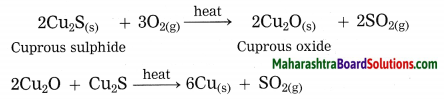
Question 2.
Extraction of copper from its sulphide ore.
Answer:
Maharashtra Board Class 10 Science Solutions Part 1 Chapter 8 Metallurgy 10
Maharashtra Board Class 10 Science Solutions Part 1 Chapter 8 Metallurgy 11

Question 3.
Thermit reaction.
Answer:
Maharashtra Board Class 10 Science Solutions Part 1 Chapter 8 Metallurgy 12

Question 4.
Magnesium reacts with hot water.
Answer:
Maharashtra Board Class 10 Science Solutions Part 1 Chapter 8 Metallurgy 13

Question 5.
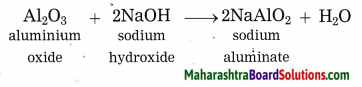
what happens when aluminium oxide dissolves in aqueous sodium hydroxide?
Answer:
Maharashtra Board Class 10 Science Solutions Part 1 Chapter 8 Metallurgy 14

Question 6.
Zinc reacts with sulphuric acid.
Answer:
Maharashtra Board Class 10 Science Solutions Part 1 Chapter 8 Metallurgy 15

Maharashtra Board Class 10 Science Solutions Part 1 Chapter 8 Metallurgy

Question 7.
Iron reacts with sulphuric acid.
Answer:
Maharashtra Board Class 10 Science Solutions Part 1 Chapter 8 Metallurgy 16

Name the following:

Question 1.
A metal which forms an amphoteric oxide.
Answer:
Aluminium forms an amphoteric oxide.

Question 2.
An alloy of copper and zinc.
Answer:
An alloy of copper and zinc is termed as brass.

Question 3.
A compound which is added to lower the fusion temperature.
Answer:
Cryolite (AlF3, 3NaF) and fluorspar (CaF2) are added to lower the fusion temperature.

Question 4.
A metal which does not react with cold water but reacts with steam.
Answer:
Aluminium does not react With cold water but reacts with Steam.

Question 5.
A common ore of aluminium.
Answer:
Bauxite (Al2O3.H2O) is a common ore of aluminium.

Question 6.
A metal which is in liquid state at ordinary temperature.
Answer:
Mercury is in liquid state at ordinary temperature.

Maharashtra Board Class 10 Science Solutions Part 1 Chapter 8 Metallurgy

Question 7.
Two metals which are malleable.
Answer:
Iron and aluminium are malleable metals.

Question 8.
Two metals which are ductile.
Answer:
Gold and silver are ductile metals.

Question 9.
Two metals which are good conductors of heat.
Answer:
Silver and copper are good conductors of heat.

Question 10.
Two metals which are good conductors of electricity.
Answer:
Copper and aluminium are good conductors of electricity.

Question 11.
Two metals which are used for making cooking vessels.
Answer:
Copper and aluminium are used in making cooking vessels.

Question 12.
Two metals having low melting points.
Answer:
Sodium and potassium have low melting points.

Question 13.
Two highly reactive metals.
Answer:
Sodium and potassium are highly reactive metals.

Question 14.
A nonmetal which is in liquid state at room temperature.
Answer:
Bromine is in liquid state at room temperature.

Question 15.
Two ionic compounds.
Answer:
Sodium chloride (NaCl) and magnesium chloride (MgCl2) are ionic compounds.

Question 16.
The process of heating the sulphide ore to a high temperature in the excess of air.
Answer:
In roasting, sulphide ore is heated to a high temperature in the excess of air.

Question 17.
The process of heating the carbonate ore to a high temperature in limited air.
Answer:
In calcination, carbonated ore is heated to a high temperature in limited air.

Maharashtra Board Class 10 Science Solutions Part 1 Chapter 8 Metallurgy

Question 18.
The compound formed by the reaction between aluminium oxide and sodium hydroxide.
Answer:
Sodium aluminate is formed by the reaction between aluminium oxide and sodium hydroxide.

Question 19.
Two metals which are found in the free state in nature.
Answer:
Gold (Au) and silver (Ag) are found in the free state in nature.

Question 20.
A metal which has the highest melting point.
Answer:
Tungsten has the highest melting point.

Question 21.
Two nonmetals which are lustrous.
Answer:
Iodine and diamond are lustrous in nature.

Answer the following questions in one sentence each:

Question 1.
State the property of the metals due to which they can be drawn into wires.
Answer:
The property of the metal due to which they can be drawn into wires is called ductility.

Question 2.
State the property of the metals due to which they can be beaten into thin sheets.
Answer:
The property of the metals due to which they can be beaten into thin sheets is called malleability.

Question 3.
Which is the hardest substance?
Answer:
Diamond which is a form of carbon is the hardest substance.

Question 4.
What material is used to coat electrical wires?
Answer:
PVC (Polyvinyl chloride) is used to coat electrical wires.

Question 5.
State two metals which can be cut easily with a knife.
Answer:
Sodium and potassium are soft metals and can be cut easily with a knife.

Question 6.
Which of the following metals react with cold water?
Sodium, iron, copper, potassium.
Answer:
Sodium and potassium metals react with cold water.

Question 7.
Which of the following metals do not react with cold water or hot water?
Sodium, potassium, aluminium, iron.
Answer:
Aluminium and iron do not react with cold water or hot water.

Question 8.
State two metals which displace hydrogen from dilute acids and two metals which do not do so.
Answer:
Metals which displace hydrogen from dilute acids are: Magnesium and zinc.
Metals which do not displace hydrogen from dilute acids are: Copper and silver.

Maharashtra Board Class 10 Science Solutions Part 1 Chapter 8 Metallurgy

Question 9.
Arrange the following metals in the increasing order of their activity:
Copper, Silver, Aluminium, Iron. (Practice Activity Sheet – 1)
Answer:
The arrangement of metals in the increasing order of their activity:
Silver < Copper < Iron < Aluminium

Question 10.
Write the chemical equation for the reaction of hot iron with steam.
Answer:
Maharashtra Board Class 10 Science Solutions Part 1 Chapter 8 Metallurgy 17

Question 11.
Complete the following reactions:
(1) Zn(s) + H2O(g) → _____________
Maharashtra Board Class 10 Science Solutions Part 1 Chapter 8 Metallurgy 18
Answer:
(1) Zn(s) + H2O(g) → ZnO(s) + H2(g)
Maharashtra Board Class 10 Science Solutions Part 1 Chapter 8 Metallurgy 19

Question 12.
Complete the following reactions:
Maharashtra Board Class 10 Science Solutions Part 1 Chapter 8 Metallurgy 20
Answer:
Maharashtra Board Class 10 Science Solutions Part 1 Chapter 8 Metallurgy 21

Question 13.
3MnO2 + 4Al → 3Mn + 2Al2O3 + heat.
Identify the substances undergone oxidation and reduction reactions.
Answer:
MnO2 is reduced to Mn.
Al is oxidised to Al2O3

Maharashtra Board Class 10 Science Solutions Part 1 Chapter 8 Metallurgy

Question 14.
State the impurities present in the bauxite ore.
Answer:
The main impurities present in the bauxite ore are silica (SiO2) and iron oxide (Fe2O3).

Question 15.
Write the formula of (i) bauxite (ii) cryolite.
Answer:
The formula of bauxite is Al2OH2O and that of cryolite is (Na3AlF6).

Question 16.
What is galvanization?
Answer:
The process of coating a thin layer of zinc on iron or steel is called galvanization.

Question 17.
Name the reaction in which aluminium is used as a reducing agent.
Answer:
The thermite reaction in which iron oxide is reduced by aluminium. Aluminium is used as a reducing agent in the thermit reaction.

Question 18.
What are the constituents of bronze?
Answer:
Copper and tin are the constituents of bronze.

Question 19.
State the term used to express the purity of gold.
Answer:
The purity of gold is expressed in carat.

Question 20.
What is meant by amalgam?
Answer:
The amalgam is an alloy in which one of the metals is mercury.

Question 21.
What is meant by electroplating?
Answer:
A process in which a less reactive metal is coated on a more reactive metal by electrolysis is called electroplating.

Question 22.
Why are metals called electropositive elements?
Answer:
Metals are reactive. They lose electrons and become positively charged ions. Therefore, metals are called electropositive elements.

Answer the following questions:

Question 1.
Distinguish between the physical properties of metals and nonmetals with respect to the following points:
(1) Physical state (2) Lustre (3) Ductility and malleability (4) Conduction of heat and electricity (5) Hardness (6) Melting and boiling points.
Answer:
(1) Physical state: Under ordinary conditions, metals are generally solids. Exceptions: mercury and gallium are liquids. Under ordinary conditions, nonmetals may be solids or gases. Exception: bromine is in liquid state.

(2) Lustre: Metals usually have a high lustre (called metallic lustre). They can be polished to give a highly reflective surface. With the exceptions of gold and copper, metals usually have silvery grey colour. Nonmetals lack lustre, exceptions: graphite and iodine. Some nonmetals are colourless and others possess a variety of colours.

(3) Ductility and malleability: Metals are ductile and malleable. Nonmetals are not ductile and mallfeable.

(4) Conduction of heat and electricity: Metals are good conductors of heat and electricity. Nonmetals are bad conductors of heat and electricity. Exception: Graphite is a good conductor of electricity.

(5) Hardness: Metals are usually hard, but not brittle, exceptions: sodium, potassium, lead, zinc. Nonmetals are brittle in the solid state, exception: diamond.

(6) Melting and boiling points: The melting and boiling points of metals are high, exceptions: sodium, potassium, mercury, gallium. The melting and boiling points of nonmetals are low, exceptions: carbon, silicon.

Maharashtra Board Class 10 Science Solutions Part 1 Chapter 8 Metallurgy

Question 2.
Write any three physical properties of nonmetals.
Answer:

  1. Nonmetals may be solid or gaseous.
  2. Nonmetals lack lustre. They are not ductile and malleable.
  3. The melting and boiling points of nonmetals are low.
  4. Nonmetals are bad conductors of heat and electricity.

Question 3.
Metals are good conductors of heat. Explain why.
Answer:
(1) The electrons in the outermost shells of atoms of a metal are free to move throughout the metal.
(2) When a metal is heated, these electrons start moving with higher velocity and conduct heat. Hence, metals are good conductors of heat.

Question 4.
Metals are good conductors of electricity. Explain why.
Answer:
(1) The electrons in the outermost shells of atoms of a metal are free to move throughout the metal.
(2) When a potential difference is applied between the ends of a metal wire, the net movement of the electrons in a particular direction, from a point at lower potential to a point at higher potential, constitutes an electric current. Hence, metals are good conductors of electricity.

Question 5.
A metal can be drawn into a wire. Explain why.
Answer:

  1. The property due to which a substance can be drawn into a thin wire without cracking or breaking is called ductility.
  2. Metals are ductile. Thus, a metal can be drawn into a wire.

Question 6.
A metal can be hammered into a thin sheet. Explain why.
Answer:

  1. The property due to which a substance can be hammered (or rolled) into a thin sheet without cracking is called malleability.
  2. Metals are malleable. Thus, a metal can be hammered to form a thin sheet.

Question 7.
How do metals react with oxygen?
Answer:
Metals combine with oxygen on heating in air and metal oxides are formed.
Metal + Oxygen → Metal oxide
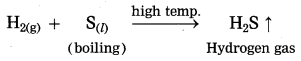
Maharashtra Board Class 10 Science Solutions Part 1 Chapter 8 Metallurgy 22

Question 8.
How does a metal react with water?
Answer:
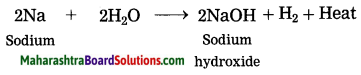
Sodium and potassium react vigorously with water to evolve hydrogen. Calcium reacts with water slowly and less vigorously to evolve hydrogen and the metal floats on water. Magnesium reacts with hot water to evolve hydrogen. Aluminium, iron and zinc do not react with cold or hot water but they react with steam to evolve their oxides and hydrogen.
2Na(s) + 2H2O(l) → 2NaOH(aq) + H2(g) + heat energy
2K(s) + 2H2O(l) → 2KOH(aq) + H2(g) + heat energy
2Ca(s) + 2H2O(l) → 2Ca(OH)2(aq) + H2(g)
Mg(s) + 2H2O(hot) → Mg(OH)2(aq) + H2(g)
2Al(s) + 3H2O steam → Al2O3(s) + 3H2(g)
3Fe(s) + 4H2O steam → Fe3O4 + 4H2(g)
Zn(s) + H2O steam → ZnO(s) + H2(g)

Maharashtra Board Class 10 Science Solutions Part 1 Chapter 8 Metallurgy

Question 9.
(9) How does a metal react with an acid?
Answer:
Reaction of metals with acids: Metals react with dilute hydrochloric acid or dilute sulphuric acid to form metal chloride or metal sulphate and hydrogen gas. The rate of evolution of H2 is maximum in case of magnesium. The reactivity decreases in the order
Mg > Al > Zn > Fe.
Mg(s) + 2HCl(aq) → MgCl2(s) + H2(g)
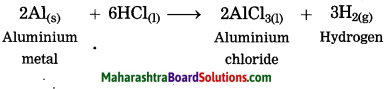
2Al(s) + 6HCl(aq) → 2AlCl3(aq) + 3H2(g)
Zn(s) + 2HCl(aq) → ZnCl2(aq) + H2(g)
Fe(s) + 2HCl(aq) → FeCl2(aq) + H2(g)
Fe(s) + H2SO4(aq) → FeSO4 + H2(g)
Zn(s) + H2SO4(aq) → ZnSO4 + H2(g)
Mg(s) + H2SO4(aq) → MgSO4(aq) + H2(g)

Question 10.
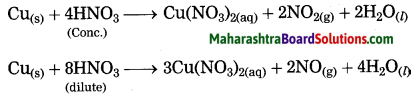
How does a metal react with nitric acid?
Answer:
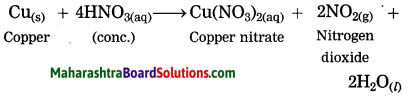
Metals react with nitric acid to form nitrate salts. Depending on the concentration of nitric acid, various oxides of nitrogen (NO, NO2) are formed.
Maharashtra Board Class 10 Science Solutions Part 1 Chapter 8 Metallurgy 23

Question 11.
Arrange the following metals in the decreasing order of chemical reactivity:
Cu, Mg, Fe, Ca, Zn, Na.
Answer:
The reactivity of metal decreases in the following order:
Na > Mg > Ca > Zn > Fe > Cu.

Question 12.
What is meant by aqua regia?
Answer:
Aqua regia is a highly corrosive and fuming liquid. It is a freshly prepared mixture of conc. HCl and conc. HNO3 in the ratio of 3:1. Most of the substances dissolve in it. Aqua regia is a reagent which dissolves gold and platinum.

Question 13.
How does a metal react with salts of other metals?
Answer:
The reaction of metals with solutions of salts of other metals is the displacement reaction. If a metal A displaces other metal B from the solution of its salt, it means that the metal A is more reactive than the metal B.
Metal A + Salt solution of metal B → Salt solution of metal A + metal B
Maharashtra Board Class 10 Science Solutions Part 1 Chapter 8 Metallurgy 24
In this reaction Fe has displaced Cu from CuSO4. It means Fe is more reactive than Cu.

Question 14.
Explain the reactivity series of the metals.
Answer:
The arrangement of metals in decreasing order of their reactivity in the form of a series is called the reactivity or activity series of the metals.
The most reactive metal is placed at the top of the list and least reactive metal is placed at the bottom of the list.

On the basis of reactivity, we can classify metals into the following categories:

  1. High reactivity metals
  2. Moderately reactive metals
  3. Less reactive metals.

1. Extraction of High reactivity metals: The metals which are placed at the top of the reactivity series are very reactive. They are never found in nature as free elements, e.g., sodium, potassium, calcium and aluminium. These metals are obtained by electrolytic reduction.

2. Extraction of Moderately reactive metals: The metals in the middle of reactivity series such as iron, zinc, lead, copper are moderately reactive. These elements are present as sulphides or carbonates in nature. Generally metals are obtained from their oxide as compared to their sulphides and carbonates.

3. Extraction of Less reactive metals: The metals which are placed at the bottom of the reactivity series are least reactive. They occur in free state, e.g. gold, silver and copper. Copper and silver are also found in the combined state as sulphide and oxide ores. These metals are obtained from their ores by just heating the ores in air.

Maharashtra Board Class 10 Science Solutions Part 1 Chapter 8 Metallurgy

Question 15.
Atomic number of metal “A” is 11, while atomic number of metal “B” is 20. Which of them will be more reactive? Write the chemical reaction of dilute HCl with metal “A”. (Practice Activity Sheet – 2)
Answer:
Metal ‘A’ is more reactive than metal ‘B’.
Atomic number of metal ‘A’ is 11, hence it is Na.
2Na + 2HCl → 2NaCl(aq) + H2(g)

Question 16.
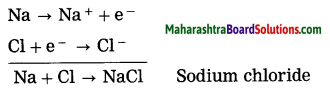
How does a metal react with a nonmetal?
Answer:
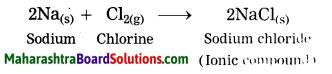
By oxidation of a metal, cations are formed, on the other hand by reduction of a nonmetal, anions are formed. The ionic compound is formed due to the metal losing electrons while the nonmetal accepts the electrons. The ionic compound of sodium chloride is formed as sodium loses one electron while chlorine accepts one electron.
Maharashtra Board Class 10 Science Solutions Part 1 Chapter 8 Metallurgy 25
Similarly Mg and K form ionic compounds MgCl2 and KCl.

Question 17.
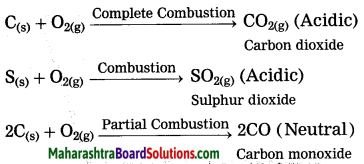
How do nonmetals react with oxygen?
Answer:
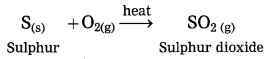
Nonmetals combine with oxygen to form acidic oxides. In some cases, neutral oxides are formed.
Maharashtra Board Class 10 Science Solutions Part 1 Chapter 8 Metallurgy 26

Question 18.
How do nonmetals react with water?
Answer:
Nonmetals do not react with water, (exception : halogen). Chlorine dissolves in water giving hypochlorous acid.
Maharashtra Board Class 10 Science Solutions Part 1 Chapter 8 Metallurgy 27

Question 19.
How do nonmetals react with dilute acids?
Answer:
Nonmetals do not react with dilute acid, (exception: halogen). Chlorine reacts with dil. hydrobromic acid to form bromine and HCl.
Maharashtra Board Class 10 Science Solutions Part 1 Chapter 8 Metallurgy 28

Question 20.
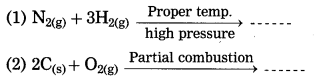
How do nonmetals react with hydrogen?
Answer:
Nonmetals react with hydrogen under certain conditions (such as proper temperature, pressure, catalyst, etc.)
Maharashtra Board Class 10 Science Solutions Part 1 Chapter 8 Metallurgy 29

Question 21.
What is meant by an ionic compound?
Answer:
The compound formed from two units, namely cation and anion is called an ionic compound.

Question 22.
What is meant by an ionic bond?
Answer:
The cation and anion being oppositely charged, there is an electrostatic force of attraction between them, this force of attraction between cation and anion is called the ionic bond.

Maharashtra Board Class 10 Science Solutions Part 1 Chapter 8 Metallurgy

Question 23.
State the general properties of ionic compounds.
Answer:

  1. Ionic compounds are solids and hard due to strong electrostatic force of attraction between oppositely charged ions.
  2. They are generally brittle. When pressure is applied they break into pieces.
  3. They have high melting and boiling points, due to intermolecular force of attraction is high in ionic compounds.
  4. They are soluble in water and insoluble in solvents such as kerosene and petrol.
  5. Ionic compounds cannot conduct electricity when in solid state, they are electrically neutral. They conduct electricity in the molten state and also in an aqueous solution.

Question 24.
Explain the following terms:
1. Concentration of ores
2. Roasting
3. Calcination
4. Refining
Answer:
1. Concentration of ores: The process of separating gangue from the other ores is called concentration of ores.
2. Roasting: The process of heating an ore to a high temperature in excess of air and converting it into its oxide is called roasting.
Examples: ZnS (zinc blend), PbS (Galena)
Maharashtra Board Class 10 Science Solutions Part 1 Chapter 8 Metallurgy 30
3. Calcination: The process of heating an ore in a limited supply of air and converting it into its oxide is called calcination.
Example: Zinc carbonate (ZnCO3)
ZnCO3 → ZnO + CO2
4. Refining: The metal obtained by chemical reduction contains impurities. The process of electrolysis method is used to obtain pure metals from impure metals is known as refining.

Question 25.
State two methods of concentration of ores in which the heavy particles of ores can be separated from the light gangue particles by the gravitational method.
Answer:

  1. Wilfley table method
  2. Hydraulic separation method are two methods of concentration of ores in which the heavy particles of ores can be separated from the light, gangue particles by the gravitational method.

Question 26.
What are the different methods used for removing gangue from ores?
(OR)
Write the five methods of concentration of ores.
Answer:

  1. Wilfley table method
  2. Hydraulic separation method
  3. Magnetic separation method
  4. Froth floatation method
  5. Leaching method.

Question 27.
Write short notes on: (1) Wilfley table method (2) Hydraulic separation method (3) Magnetic separation method (4) Froth floatation method (5) Leaching method.
Answer:
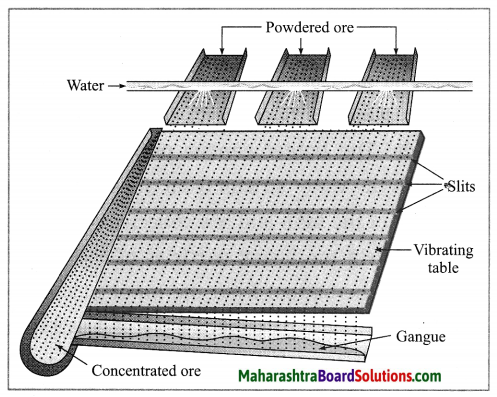
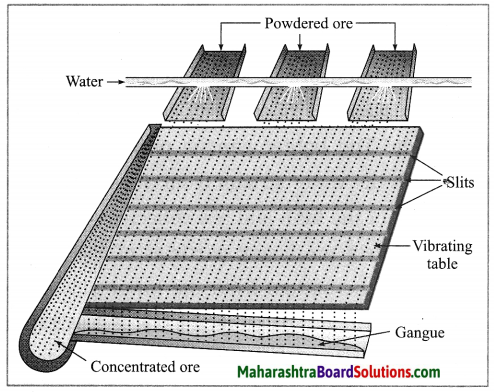
(1) Wilfley table method : (Separation based on gravitation) This method of separation uses the Wilfley table, it is made by fixing narrow and thin wooden wedges/blocks on inclined surface with low slope. The table is kept continuously vibrating.
Maharashtra Board Class 10 Science Solutions Part 1 Chapter 8 Metallurgy 31
Lumps of the ore is made powdered ore by using ball mill. This powdered ore is poured on the table and a stream of water is simultaneously released from the upper side. This result in the lighter gangue particles getting carried away along with the flowing water, while the heavier particles in which proportion of minerals is more and proportion of gangue particles is less, are blocked by the wooden wedges and is collected through the slits between them.

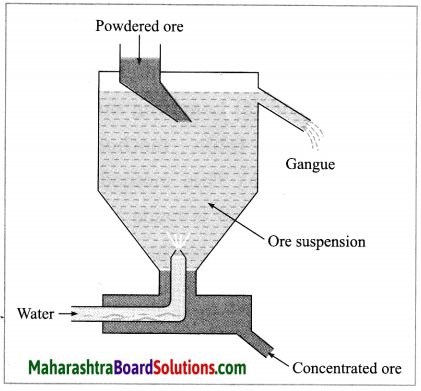
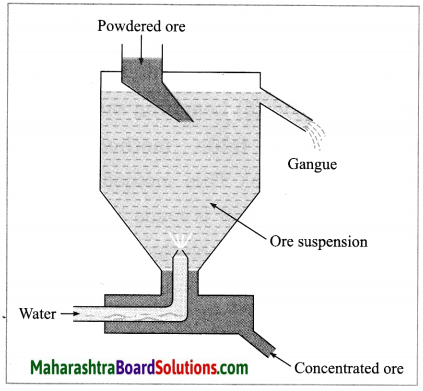
(2) Hydraulic separation method: The hydraulic separation method is based on the working of a mill. This is a tapering vessel similar to that used in a grinding mill. It opens in a tank like a container that is tapering on the lower side. The tank has an outlet for water on the upper side and a water inlet on the lower side.
Maharashtra Board Class 10 Science Solutions Part 1 Chapter 8 Metallurgy 32
Finely ground ore is added to the tank. A fast stream of water is released in the tank from the lower side. The lighter gangue particles flow out along with the water stream from the outlet on the upper side of the tank and are collected separately, simultaneously the heavy particles of the ore are collected at the bottom from the lower side of the tank. This method is based on the law of gravitation, wherein particles of the same size are separated by their weight with the help of water.

(3) Magnetic separation method: Electro-magnetic machine is used in this method. The main parts of this machine are two types of iron rollers and the conveyor belt continuously moving around them. One of the rollers is nonmagnetic while the other is electromagnetic. The conveyor belt moving around the rollers is made up of leather or brass (nonmagnetic). The powdered ore is poured at that end of the conveyor belt which is on the side of the nonmagnetic roller. Two collector vessels are placed below the magnetic roller.

The particles of the nonmagnetic part in the ore are not attracted towards the magnetic roller. Therefore, they are carried out further along the belt and fall in the collector vessel which is away from the magnetic roller. Simultaneously the particles of the magnetic ingredients of the ore stick to the magnetic roller and therefore fall in the collector vessel near the belt.
Maharashtra Board Class 10 Science Solutions Part 1 Chapter 8 Metallurgy 33
In this way the magnetic and nonmagnetic particles in the ore are separated because of their magnetic nature. For example, cassiterite is a tin ore. It contains mainly the nonmagnetic ingredient stannic oxide (SnO2) and the magnetic ingredient ferrous tungstate (FeWO4). These are separated by the electromagnetic method.

(4) Froth floatation method: The froth floatation method is based on the two opposite properties, hydrophilic and hydrophobic, of the particles. The metal sulphides particles get wet mainly with oil due to their hydrophobic property. The gangue particles get wet with water due to the hydrophilic property.
Maharashtra Board Class 10 Science Solutions Part 1 Chapter 8 Metallurgy 34
In this method the finely ground mineral is put into a big tank containing a lot of water. The finely powdered ore and vegetable oil such as pine oil, eucalyptus oil are mixed with water for formation of froth. The pressurised air is blown through the mixture. There is an agitator rotating around its axis in the centre of the floatation tank. The agitator is used as per the requirement. Bubbles are formed due to the blown air.

A foam is formed from oil, water and air bubbles together, due to the agitating. This foam rises to the surface of the water and floats. Hence this method is called froth floatation. Sulphide minerals float with the foam on water as they get and can be removed. The gangue particles are wetted by water, settles down at the bottom. This method is used for concentration of zinc blend (ZnS) and copper pyrite (CuFeS2).

(5) Leaching: Leaching is the first step in the extraction of the metals like aluminium, gold and silver from their ores. In this method the ore is soaked in a particular solution for long time. The ore dissolves in that solution due to specific chemical reaction. The gangue, however, does not react and therefore does not dissolve in that solution. It can be separated easily.

For example, concentration of bauxite, the aluminium ore, is done by leaching method. Bauxite is soaked in aqueous NaOH or aqueous Na2CO3 which dissolves the main ingredient alumina in it. This means that bauxite is leached by sodium hydroxide.

Maharashtra Board Class 10 Science Solutions Part 1 Chapter 8 Metallurgy

Question 28.
Draw a neat labelled diagram of the arrangement of the equipment used in (1) Wilfley table method (2) Hydraulic separation method.
Answer:
1. Wilfley table method:
Maharashtra Board Class 10 Science Solutions Part 1 Chapter 8 Metallurgy 35

2. Hydraulic separation method:
Maharashtra Board Class 10 Science Solutions Part 1 Chapter 8 Metallurgy 36

Question 29.
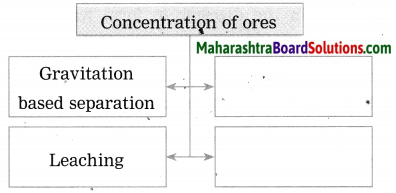
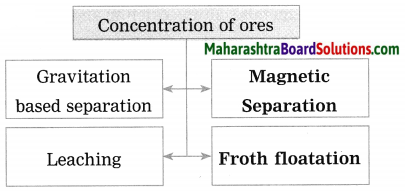
Complete the following flow chart and answer the questions below:
Maharashtra Board Class 10 Science Solutions Part 1 Chapter 8 Metallurgy 37
(i) In which method pine oil is used?
(ii) Explain that method of concentration in brief. (Practice Activity Sheet – 2)
Answer:
Maharashtra Board Class 10 Science Solutions Part 1 Chapter 8 Metallurgy 38
(i) Pine oil is used in froth floatation method.

(ii) The finely powdered ore and vegetable oil such as pine oil, eucalyptus oil are mixed with water for formation of froth. The pressurised air is blown through the mixture. The agitator is used as per the requirement. Bubbles are formed due to the blown air. A foam is formed from oil, water and air bubbles together, due to the agitating. This foam rises to the surface of the water and floats. Hence this method is called froth floatation. Sulphide minerals float with the foam on water as they get and can be removed. The gangue particles are wetted by water, settles down at the bottom. This method is used for concentration of zinc blend (ZnS) and copper pyrite (CuFeS2).

Question 30.
A tapping vessel opens in a tank like container that is tapering on the lower side. The tank has an outlet for water on the upper side and a water inlet on the lower side. Finely ground ore is released in the tank. A forceful jet of water is introduced in the tank from lower side and gangue particles and pure ore are separated by this method.
(i) The above description is of which gravitation separation method?
(ii) Draw labelled diagram of this method. (March 2019)
Answer:
(i) Hydraulic separation method.
(ii)
Maharashtra Board Class 10 Science Solutions Part 1 Chapter 8 Metallurgy 39

Question 31.
How are sodium, magnesium and potassium obtained from their molten chloride salts?
Answer:
The metals sodium, calcium and magnesium are obtained by electrolysis of their molten chloride salts. In this process metal is deposited on the cathode while chlorine gas is liberated at the anode.

Question 32.
Name the main ore of aluminium.
Answer:
Bauxite (Al2O3·H2O) is the main ore of aluminium.

Maharashtra Board Class 10 Science Solutions Part 1 Chapter 8 Metallurgy

Question 33.
What is bauxite? What are the main impurities found in this ore?
Answer:
Bauxite (Al2O3·H2O) is hydrated aluminium oxide. It contains 30% to 70% Al2O3. The main impurities present in it are iron oxide (Fe2O3) and sand (SiO2).

Question 34.
From which ore is aluminium extracted? What are the stages in its extraction (give only names)?
Answer:
Aluminium is extracted from bauxite (Al2O3·nH2O). Stages id the extraction: (i) Concentration of ore, i.e., conversion of bauxite into alumina, (ii) Electrolytic reduction of alumina.

Question 35.
Describe Bayer’s process for concentration of bauxite.
Answer:
(1) Bayer’s process is used to obtain pure aluminium oxide from bauxite.
(2) Bauxite is then concentrated by chemical separation. Bauxite contains impurities like iron oxide (Fe2O3) and silica (SiO2).
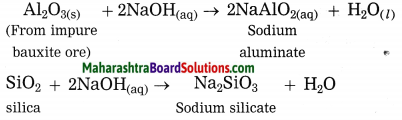
(3) Bauxite ore is powdered and heated with sodium hydroxide under high pressure for 2 to 8 hours at 140 °C in the digester. The aluminium oxide being amphoteric in nature present in bauxite reacts with sodium hydroxide to form water soluble sodium aluminate. This means that bauxite leached by sodium hydroxide. Silica reacts with sodium hydroxide to form soluble sodium silicate. The basic iron oxide (Fe2O3) in the gangue remains unaffected. It is separated by filtration.
Maharashtra Board Class 10 Science Solutions Part 1 Chapter 8 Metallurgy 40
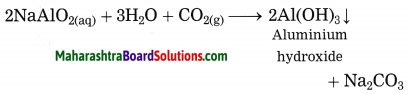
(4) The filtrate containing sodium aluminate and sodium silicate is stirred with water and then cooling to 50° C. It is hydrolysed to give precipitate of aluminium hydroxide.
Maharashtra Board Class 10 Science Solutions Part 1 Chapter 8 Metallurgy 41
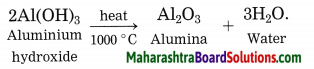
(5) Aluminium hydroxide is then filtered, washed with water, dried and then calcinated by heating at 1000 °C to get pure aluminium oxide.
Maharashtra Board Class 10 Science Solutions Part 1 Chapter 8 Metallurgy 42

Question 36.
Describe Hall’s process for concentration of bauxite.
Answer:
In Hall’s process the ore is powdered and then it is leached by heating with aqueous sodium carbonate in the digester to form water soluble sodium aluminate. Then the insoluble impurities are filtered opt. The filtrate is warmed and neutralised by passing carbon dioxide gas through it. This result in precipitation of aluminium hydroxide.
Maharashtra Board Class 10 Science Solutions Part 1 Chapter 8 Metallurgy 43
Maharashtra Board Class 10 Science Solutions Part 1 Chapter 8 Metallurgy 44
The precipitate of Al(OH)3 obtained in this processes is filtered, washed, dried and then calcinated by heating at 1000 °C to obtain alumina.
Maharashtra Board Class 10 Science Solutions Part 1 Chapter 8 Metallurgy 45

Question 37.
Describe the process of preparation of aluminium by the electrolysis of alumina.
(OR)
Draw and label the diagram of electrolysis of alumina and explain the electrolytic reduction of alumina.
Answer:
Electrolytic reduction of alumina:
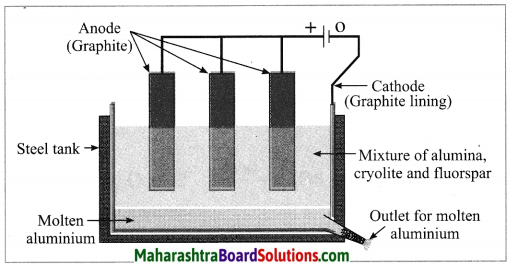
(1) The electrolytic cell consists of a rectangular steel tank lined from inside with graphite.
Maharashtra Board Class 10 Science Solutions Part 1 Chapter 8 Metallurgy 46
(2) The carbon lining (graphite) acts as a cathode. The anode consists of graphite rods suspended in the molten electrolyte.
(3) Alumina has very high melting point ( > 2000 °C). The electrolysis of alumina is carried out at a low temperature by dissolving it in molten cryolite (Na3AlF6). The solution of alumina in cryolite and small amount of fluorspar (CaF2) is added in the mixture to lower its melting point up to 1000 °C.
(4) On passing an electric current, alumina is electrolysed.
(5) Molten aluminium is collected at the cathode, while oxygen gas is evolved at the anode.
The electrode reactions are shown below:
Al2O3 → 2Al3+ + 3O2-
Anode reaction: 2O2- → O2(g) + 4e
Cathode reaction: Al3+ + 3e → Al
The molten aluminium is heavier than the electrolyte. Therefore, it sinks to the bottom of the electrolyte and is removed from time to time. About 99% pure aluminium is obtained by this process. The oxygen gas liberated reacts with carbon anode and forms carbon dioxide. As the anode gets oxidised during the electrolysis of alumina, it has to be replaced from time to time.

Maharashtra Board Class 10 Science Solutions Part 1 Chapter 8 Metallurgy

Question 38.
In the extraction of aluminium:
(i) Name the process of concentration of bauxite.
Answer:
The process of concentration of bauxite is known as Bayer’s process.

(ii) Write the cathode reaction in electrolytic reduction of alumina.
Answer:
At the cathode: Al3+ + 3e → Al.

(iii) Write the function and formula of cryolite in the extraction of aluminium.
Answer:
Cryolite is added to the molten mixture of alumina to reduce the melting point to about 1000 °C.
The formula of cryolite is (Na3AlF6) or AlF3, 3NaF.

(iv) write an equation for the action of heat on aluminium hydroxide.
Answer:
Maharashtra Board Class 10 Science Solutions Part 1 Chapter 8 Metallurgy 47

(v) Draw the diagram of extraction of aluminium.
Answer:
Maharashtra Board Class 10 Science Solutions Part 1 Chapter 8 Metallurgy 48

(vi) Write the anode reaction in electrolytic reduction of alumina.
Answer:
Al2O3 → 2Al3+ + 3O2-
At Anode: 2O2- → O2(g) + 4e

(vii) Write the cathode reaction in electrolytic reduction of alumina.
Answer:
Al2O3 → 2Al3+ + 3O2-
Cathode: Al3+ + 3e → Al(l)

Question 39.
What happens when aluminium ore is heated with caustic soda? Write the balanced chemical equation for the same.
Answer:
When aluminium ore is heated with caustic soda solution under high pressure for 2 to 8 hours and at 140 °C to 150 °C, aluminium oxide from aluminium ore, being amphoteric in nature, dissolves in caustic soda solution to form sodium aluminate.
Maharashtra Board Class 10 Science Solutions Part 1 Chapter 8 Metallurgy 49

Question 40.
How is zinc extracted from its ore zinc sulphide or zinc carbonate?
Answer:
The crude zinc sulphide ore is heated strongly in excess of air. Zinc sulphide is converted into zinc oxide. This process is known as roasting.
Maharashtra Board Class 10 Science Solutions Part 1 Chapter 8 Metallurgy 50
(OR)
The crude zinc carbonate ore is heated strongly in limited supply of air. Zinc carbonate is converted into zinc oxide. This process is known as calcination.
Maharashtra Board Class 10 Science Solutions Part 1 Chapter 8 Metallurgy 51
The zinc oxide is reduced to zinc by using a reducing agent such as carbon.
Maharashtra Board Class 10 Science Solutions Part 1 Chapter 8 Metallurgy 52

Question 41.
How is copper extracted from its sulphide ore?
Answer:
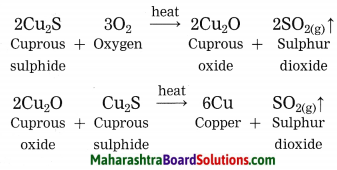
Copper is found as cuprous sulphide (Cu2S) in nature. When Cu2S is heated in air, copper is obtained.
Maharashtra Board Class 10 Science Solutions Part 1 Chapter 8 Metallurgy 53

Question 42.
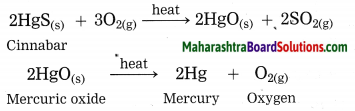
How is mercury extracted from cinnabar?
(OR)
Extraction of mercury from its ore cinnabar and write the corresponding chemical reaction.
Answer:
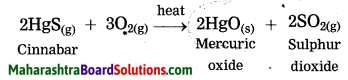
Cinnabar is an ore of mercury. When cinnabar is heated (roasted), it is converted into mercuric oxide (HgO). Mercuric oxide is then reduced to mercury on further heating.
Maharashtra Board Class 10 Science Solutions Part 1 Chapter 8 Metallurgy 54

Question 43.
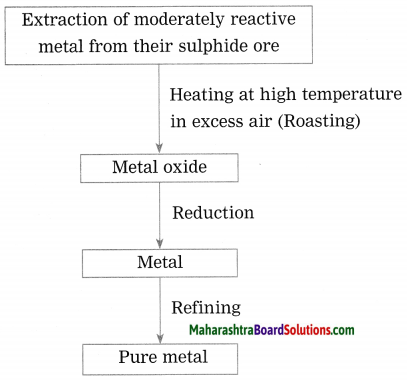
Show the steps involved in the extraction of moderately reactive metals from their sulphide ores.
Answer:
Moderately reactive elements are present as sulphides or carbonates in nature.
Maharashtra Board Class 10 Science Solutions Part 1 Chapter 8 Metallurgy 55

Question 44.
In the reactivity series of metals, some metals are misplaced. Rearrange these metals in the decreasing order of their reactivity.
Maharashtra Board Class 10 Science Solutions Part 1 Chapter 8 Metallurgy 56
Answer:
Maharashtra Board Class 10 Science Solutions Part 1 Chapter 8 Metallurgy 57

Maharashtra Board Class 10 Science Solutions Part 1 Chapter 8 Metallurgy

Question 45.
Complete the table, if a metal reacts with the reagent then mark ✓ and if not then ✗.

Metal Ferrous
sulphate
Silver
nitrate
Copper
sulphate
Zinc
sulphate
Cu
Al

Answer:

Metal Ferrous
sulphate
Silver
nitrate
Copper
sulphate
Zinc
sulphate
Cu
Al

Question 46.
Explain the term corrosion with a suitable example.
(OR)
What is corrosion ?
Answer:
The process in which a metal is destroyed gradually by the action of air, moisture or a chemical (like an acid) on its surface is called corrosion.
(OR)
Corrosion is degradation of a material due to reaction with its environment.
The major problem of corrosion occurs with iron, as it is used as a structural material in construction, bridges, shipbuilding.
Iron gets covered by reddish brown flakes when exposed to atmosphere. This is an example of corrosion.

Question 47.
Explain the different methods to prevent corrosion of metals.
Answer:
(1) Corrosion of a metal can be prevented if the contact between metal and air is cut off.
(2) Corrosion of a metal is prevented by coating with something which does not allow moisture and oxygen to react with it.
(3) A layer of oil or paint or grease is applied on the surface of a metal to prevent corrosion. The rusting or corrosion of iron can be prevented by this method.
(4) Corrosion is also prevented by coating a corrosive metal with a noncorrosive metal. Galvanising, tinning, electroplating, anodising and alloying are the different methods in which a metal is coated with a noncorrosive metal to prevent corrosion.

Question 48.
Write three methods of preventing rusting of iron.
Answer:

  1. The rusting of iron can be prevented by painting, oiling, greasing or varnishing its surface.
  2. Galvanisation is another method of protecting iron from rusting by coating iron with a thin layer of zinc.
  3. Corrosion of iron is prevented by coating iron with noncorrosive substance like carbon. This process is termed as alloying.

Question 49.
What is meant by an alloy? Give two examples with chemical composition.
Answer:
The homogeneous mixture formed by mixing a metal with other metals or nonmetals in certain proportion is called an alloy.
Examples:
1. Bronze: Bronze is an alloy formed from 90% copper and 10% tin. Bronze statues stay well in sun and rain.
2. Stainless steel: Stainless steel alloy is made from 74% iron, 18% chromium and 8% carbon. This alloy does not get stained with air or water and does not rust.

Write short notes on the following:

Question 1.
Galvanizing.
Answer:
(1) The process of coating a thin layer of zinc on iron or steel is called galvanization.
(2) In this method corrosion of zinc occurs first because zinc is more electropositive than iron. After a few years zinc layer goes away and the iron layer gets exposed and starts rusting.
(3) In galvanization an iron object is dipped into molten zinc. A thin layer of zinc is formed all over the iron object. Examples: Shiny iron nails, pin, iron pipes.

Question 2.
Tinning.
Answer:
The process of coating a thin layer of tin (molten tin) on copper or brass is called tinning. Cooking vessels made of copper and brass get a greenish coating due to corrosion. The greenish substance is copper carbonate and it is poisonous. If buttermilk or curry is placed in such a vessel it gets spoiled. Therefore, these vessels are coated with tin to prevent corrosion.

Maharashtra Board Class 10 Science Solutions Part 1 Chapter 8 Metallurgy

Question 3.
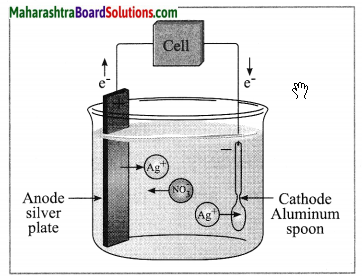
Electroplating.
Answer:
Maharashtra Board Class 10 Science Solutions Part 1 Chapter 8 Metallurgy 58
The process in which a less reactive metal is coated on a more reactive metal by electrolysis is called electroplating.
Examples: Silver-plated spoon, gold-plated jewellery.
(1) Which process will you study with the help of above material and solutions.
Answer:
With the help of above material and solutions, electroplating process is studied.

(2) Define the process.
Answer:
The process in which less reactive metal is coated on a more reactive metals by electrolysis is called electroplating.

(3) Write the anode and cathode reactions.
Answer:
At anode: Ag → Ag+ + e
At cathode: Ag+ + e → Ag

Question 4.
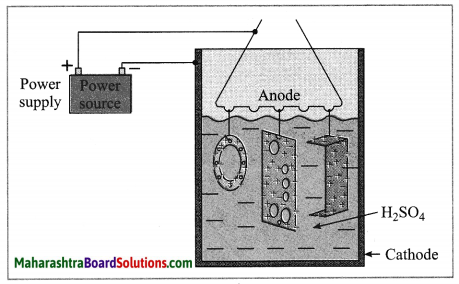
Anodizing.
(OR)
Identify the process shown in the above diagram and explain it in brief. (Practice Activity Sheet – 3)
Maharashtra Board Class 10 Science Solutions Part 1 Chapter 8 Metallurgy 59
Answer:
The anodizing technique is an application of electrolysis. In this method copper or aluminium article is used as anode and it is coated with a strong film of their oxides by means of electrolysis. This oxide layer is strong and uniform all over the surface. This thin film protects the metals from corrosion. The protection can be further increased by making the oxide layer thicker during the anodization.
Examples: Kitchen articles such as ; anodized pressure cooker and anodized pan.

Question 5.
Alloying.
Answer:
A homogenous mixture of two or more metals or a metal and a nonmetal in a definite proportion is called an alloy. The physical properties of an alloy are different from those of its constituents. Alloys are corrosion resistant. Alloy decreases the intensity of corrosion of metals.

Examples: Brass is made from copper and zinc, 90 % Copper and 10 % tin are used to make an alloy called bronze, Stainless steel is made from 74% iron, 8 % carbon and 18 % chromium.

Distinguish between: (Two points of distinction)

Question 1.
Metals and Nonmetals.
Answer:
Metals:

  1. Metals have a lustre.
  2. They are generally good conductors of heat and electricity.
  3. They are generally solids at room temperature.
    Exception: Mercury and gallium are liquids.
  4. Metals form basic oxides.

Nonmetals:

  1. Nonmetals have no lustre.
    Exception: Iodine and Diamond.
  2. They are bad conductors of heat and electricity.
    Exception: Graphite.
  3. They are generally gases and solids at room temperature.
    Exception: Bromine is a liquid.
  4. Nonmetals form acidic or neutral oxides.

Maharashtra Board Class 10 Science Solutions Part 1 Chapter 8 Metallurgy

Question 2.
Roasting and Calcination.
Answer:
Roasting:

  1. In this process, the ore is heated strongly in the presence of air.
  2. In this process, sulphide ore is converted into metal oxide.
  3. During this process SO2 is given out.

Calcination:

  1. In this process, the ore is heated strongly in the limited supply of air.
  2. In this process, carbonate ore is converted into metal oxide.
  3. During this process CO2 is given out.

Give scientific reasons for the following:

Question 1.
Calcium floats on water during the reaction with water.
Answer:

  1. Calcium reacts with water less vigorously hence the heat evolved is not sufficient for hydrogen to catch fire.
  2. Instead, calcium floats on water because the bubbles of hydrogen gas formed stick to the surface of the metal.

Question 2.
Common salt has high melting and boiling points.
Answer:

  • Common salt is an ionic compound. Common salt is solid and hard due to strong electrostatic attraction between oppositely charged Na+ and Cl- ions.
  • A large amount of energy is required to break the strong intermolecular attraction (strong ionic bond). Hence, common salt has high melting and boiling points.

Question 3.
Metals are good conductors, while non-metals are poor conductors of electricity.
Answer:

  • The electrons in the outermost orbit of atoms of a metal are free to move throughout the metal.
  • When a potential difference is applied between the ends of a metal wire, the movement of the electrons constitutes an electric current. Hence, metals are good conductors of electricity.
  • Nonmetals involve covalent bonding and do not have free electrons like metals. Hence, nonmetals are poor conductors of electricity.

Question 4.
Sodium is more reactive than aluminium.
Answer:

  • If the number of electrons in the outermost orbit of an atom of a metal is less, the metal is more reactive.
  • Sodium has electronic configuration (2, 8, 1) and aluminium has electronic configuration (2, 8, 3). The number of electrons in the outermost orbit of sodium and aluminium atoms are 1 and 3, respectively. Hence, sodium is more reactive than aluminium.

Maharashtra Board Class 10 Science Solutions Part 1 Chapter 8 Metallurgy

Question 5.
When zinc granules are added to copper sulphate solution, the blue coloured solution turns colourless.
Answer:

  • Zinc is more reactive than copper.
  • When zinc granules are added to copper sulphate solution, they displace copper from the copper sulphate solution to form zinc sulphate solution. As zinc sulphate is colourless, the blue coloured solution of copper sulphate disappears.

Question 6.
When an iron nail is dipped into a copper solution, a shiny coat of copper is formed on the nail.
Answer:

  • Iron is more reactive than copper.
  • When an iron nail is dipped into copper sulphate solution, iron displaces copper from the copper sulphate solution. The copper so liberated deposits on the iron nail. As a result, a shiny coat of copper is formed on the nail.

Question 7.
Cryolite (Na3AlF6) and fluorspar (CaF2) are added to the electrolytic mixture containing pure alumina.
Answer:
(1) Alumina has very high melting point ( > 2000 °C). Cryolite (Na3AlF6) and fluorspar (CaF2) lower the fusion temperature of the mixture containing alumina from 2000 ° C to 1000 ° C, thereby saving electrical energy.
(2) They increase the conductivity and the mobility of the fused mixture. Hence, cryolite and fluorspar are added to the electrolytic mixture containing pure alumina.

Question 8.
Air is bubbled through the mixture in Froth floatation process.
Answer:
(1) In the froth floatation process, in a tank water, ore and an oil are mixed. When air is bubbled through the mixture the oil forms froth.
(2) The mineral particles are wetted by the oil and float on the surface.
(3) The gangue particles are wetted by water and settle down. Hence, the ore can be concentrated. Hence, air is bubbled through the mixture in froth floatation process.

Question 9.
Silver amalgam is used for filling dental cavities.
Answer:
(1) Silver is a soft metal and wears off on constant usage particularly due to abrasion. Silver amalgam is an alloy of silver with mercury.
(2) It is a hard substance. It is nontoxic. Besides these properties it is a lustrous shining substance. It melts at a comparatively low temperature and can therefore conveniently fill in the cavities. Hence, silver amalgam is used for filling dental cavities.

Explain the following reactions with the help of balanced equations:

Question 1.
Out of sodium and sulphur which is a metal? Explain its reaction with oxygen. (March 2019)
Answer:
Sodium is a metal. Sodium reacts with oxygen in air at room temperature to form sodium oxide.
Maharashtra Board Class 10 Science Solutions Part 1 Chapter 8 Metallurgy 60

Maharashtra Board Class 10 Science Solutions Part 1 Chapter 8 Metallurgy

Question 2.
Magnesium burns in air.
Answer:
When magnesium bums in air, it combines with oxygen, emitting intense light and heat to form magnesium oxide.
Maharashtra Board Class 10 Science Solutions Part 1 Chapter 8 Metallurgy 61

Question 3.
Copper reacts with air.
Answer:
Copper tarnishes in moist air and forms black coloured oxide when strongly heated.
Maharashtra Board Class 10 Science Solutions Part 1 Chapter 8 Metallurgy 62

Question 4.
Sodium reacts with water.
Answer:
When sodium reacts with water, it evolves hydrogen which immediately catches fire producing a lot of heat.
Maharashtra Board Class 10 Science Solutions Part 1 Chapter 8 Metallurgy 63

Question 5.
Calcium reacts with water.
Answer:
Calcium reacts with water less vigorously to form hydrogen gas and calcium hydroxide. In this reaction, the heat evolved is not sufficient for hydrogen to catch fire.
Maharashtra Board Class 10 Science Solutions Part 1 Chapter 8 Metallurgy 64

Question 6.
Steam is passed over aluminium.
Answer:
When steam is passed over aluminium, hydrogen gas and aluminium oxide are formed.
Maharashtra Board Class 10 Science Solutions Part 1 Chapter 8 Metallurgy 65

Question 7.
Steam is passed over iron.
Answer:
When steam is passed over iron, iron (III) oxide and hydrogen gas are formed.
Maharashtra Board Class 10 Science Solutions Part 1 Chapter 8 Metallurgy 66

Question 8.
Magnesium reacts with dil. hydrochloric acid.
Answer:
When magnesium reacts with dil. hydrochloric acid, magnesium chloride is formed and hydrogen gas is evolved.
Maharashtra Board Class 10 Science Solutions Part 1 Chapter 8 Metallurgy 67

Question 9.
Aluminium is treated with dil. hydrochloric acid.
Answer:
When aluminium is treated with dil. hydrochloric acid, aluminium chloride and hydrogen gas are formed.
Maharashtra Board Class 10 Science Solutions Part 1 Chapter 8 Metallurgy 68

Question 10.
Zinc reacts with dil. hydrochloric acid.
Answer:
When zinc reacts with dil. hydrochloric acid, zinc chloride and hydrogen gas are formed.
Maharashtra Board Class 10 Science Solutions Part 1 Chapter 8 Metallurgy 69

Question 11.
Iron is treated with dil. hydrochloric acid.
Answer:
When iron reacts with dil. hydrochloric acid, ferrous chloride and hydrogen gas is formed.
Maharashtra Board Class 10 Science Solutions Part 1 Chapter 8 Metallurgy 70

Question 12.
Copper is reacted with cone, nitric acid.
Answer:
When copper is reacted with cone, nitric acid, copper nitrate and reddish brown nitrogen dioxide are formed.
Maharashtra Board Class 10 Science Solutions Part 1 Chapter 8 Metallurgy 71

Question 13.
Copper is reacted with dil. nitric acid.
Answer:
When copper is reacted with dil. nitric acid, copper nitrate and nitric oxide are formed.
Maharashtra Board Class 10 Science Solutions Part 1 Chapter 8 Metallurgy 72

Question 14.
Sodium metal is reacted chlorine gas.
Answer:
When sodium metal is reacted with chlorine, sodium chloride an ionic compound is formed.
Maharashtra Board Class 10 Science Solutions Part 1 Chapter 8 Metallurgy 73

Question 15.
Sulphur burns in air.
Answer:
When sulphur burns in air, it combines with oxygen to form acidic sulphur dioxide.
Maharashtra Board Class 10 Science Solutions Part 1 Chapter 8 Metallurgy 74

Question 16.
Chlorine dissolves in water.
Answer:
When chlorine dissolves in water, hypochlorous acid is formed.
Maharashtra Board Class 10 Science Solutions Part 1 Chapter 8 Metallurgy 75

Question 17.
Chlorine is treated with hydrobromic acid.
Answer:
When chlorine is treated with hydrobromic acid, chlorine displaces bromine from hydrobromic acid.
Cl2(g) + 2HBr(aq) → 2HCl(aq) + Br2(aq)

Question 18.
Hydrogen gas is passed over boiling sulphur.
Answer:
When hydrogen gas is passed over boiling sulphur, sulphur combines with hydrogen to form hydrogen sulphide which has rotten egg smell.
Maharashtra Board Class 10 Science Solutions Part 1 Chapter 8 Metallurgy 76

Maharashtra Board Class 10 Science Solutions Part 1 Chapter 8 Metallurgy

Question 19.
Sodium aluminate is treated with water.
Answer:
When sodium aluminate is treated with water, it is hydrolysed to give a precipitate of aluminium hydroxide.
Maharashtra Board Class 10 Science Solutions Part 1 Chapter 8 Metallurgy 77

Question 20.
Dry aluminium hydroxide is ignited at 1000 °C.
Answer:
When dry aluminium hydroxide is ignited at 1000 °C, alumina (Al2O3) formed.
Maharashtra Board Class 10 Science Solutions Part 1 Chapter 8 Metallurgy 78

Question 21.
Zinc sulphide is heated strongly in excess of air.
Answer:
When zinc sulphide is heated strongly in excess of air, it forms zinc oxide and sulphur dioxide gas.
Maharashtra Board Class 10 Science Solutions Part 1 Chapter 8 Metallurgy 79

Question 22.
Zinc carbonate is heated strongly in a limited supply of air.
Answer:
When zinc carbonate is heated strongly in a limited supply of air, it gives zinc oxide and carbon dioxide.
Maharashtra Board Class 10 Science Solutions Part 1 Chapter 8 Metallurgy 80

Question 23.
Zinc oxide is treated with carbon.
Answer:
When zinc oxide is treated with carbon, it is reduced to zinc. In this reaction, carbon acts as reducing agent.
Maharashtra Board Class 10 Science Solutions Part 1 Chapter 8 Metallurgy 81

Question 24.
Manganese dioxide is heated with aluminium.
Answer:
When manganese dioxide is heated with aluminium, manganese dioxide is reduced to manganese and large amount of heat is evolved.
Maharashtra Board Class 10 Science Solutions Part 1 Chapter 8 Metallurgy 82

Question 25.
Cinnabar is heated in air.
Answer:
When cinnabar is heated in air, it forms mercuric oxide and sulphur dioxide.
Maharashtra Board Class 10 Science Solutions Part 1 Chapter 8 Metallurgy 83

Question 26.
Cuprous sulphide is heated in air.
Answer:
When cuprous sulphide is heated in air, cuprous oxide is formed. Cuprous oxide is reduced to copper in the presence of ore.
Maharashtra Board Class 10 Science Solutions Part 1 Chapter 8 Metallurgy 84

Maharashtra Board Class 10 Science Solutions Part 1 Chapter 8 Metallurgy

Project: (Do it your self)

Project 1.
Which metals are used in day to day life? What are its uses?

Project 2.
Which nonmetals are used in day to day life? What are its uses?

10th Std Science Part 1 Questions And Answers:

Life Processes in Living Organisms Part – 2 Class 10 Questions And Answers Maharashtra Board

Class 10 Science Part 2 Chapter 3

Balbharti Maharashtra State Board Class 10 Science Solutions Part 2 Chapter 3 Life Processes in Living Organisms Part – 2 Notes, Textbook Exercise Important Questions and Answers.

Std 10 Science Part 2 Chapter 3 Life Processes in Living Organisms Part – 2 Question Answer Maharashtra Board

Class 10 Science Part 2 Chapter 3 Life Processes in Living Organisms Part – 2 Question Answer Maharashtra Board

Question 1.
Complete the following chart.

Asexual reproduction Sexual reproduction
1. Reproduction that occurs with the help of somatic cells is called asexual reproduction. 1. __________________________________________
____________________________________________
2. __________________________________________
____________________________________________
2. Male and female parent are necessary for sexual reproduction.
3. This reproduction occurs with the help of mitosis only. 3. __________________________________________
____________________________________________
4. __________________________________________
____________________________________________
4. New individual formed by this method is genetically different from parents.
5. Asexual reproduction occurs in different individuals by various methods like binary fission, multiple fission, budding, fragmentation, regeneration, vegetative propagation, spore production, etc. 5. __________________________________________
_____________________________________________
_____________________________________________
_____________________________________________

Answer:

Asexual reproduction Sexual reproduction
1. Reproduction that occurs with the help of somatic cells is called asexual reproduction. 1. Reproduction that occurs due to fertilization of gametes is called sexual reproduction.
2. For asexual reproduction only one parent is necessary. 2. Male and female parents are necessary for sexual reproduction.
3. This reproduction occurs with the help of mitosis only. 3. This reproduction occurs with the help of both mitosis and meiosis.
4. New individual formed by this method is genetically identical with parents. 4. New individual formed by this method is genetically different from parents.
5. Asexual reproduction occurs in different individuals by various methods like binary fission, multiple fission, budding, fragmentation, regeneration, vegetative propagation, spore production, etc. 5. Sexual reproduction occurs in two steps: First formation of haploid gametes by meiosis and then fertilization of these haploid gametes to form diploid zygote. There are no subtypes in the sexual reproduction.

Maharashtra Board Class 10 Science Solutions Part 2 Chapter 3 Life Processes in Living Organisms Part - 2

Question 2.
Fill in the blanks.
a. In humans, sperm production occurs in the organ …………
(a) prostate gland
(b) testis
(c) ovaries
(d) Cowper’s gland
Answer:
(b) testis

b. In humans, …………. chromosome is responsible for maleness.
(a) X
(b) Y
(c) Z
(d) O
Answer:
(b) Y

c. In male and female reproductive system of human, …………. gland is same.
Answer:
There is no similar gland in male and female reproductive system. There may be some homologies but there is no similarity.

d. Implantation of embryo occurs in …………
(a) ovaries
(b) fallopian duct
(c) uterus
(d) vagina
Answer:
(c) uterus

e. …………type of reproduction occurs without fusion of gametes.
(a) Asexual
(b) sexual
(c) Fertilization
(d) Gamete formation
Answer:
(a) Asexual

f. Body breaks up into several fragments and each fragment begins to live as a new individual.
This is ………. type of reproduction.
(a) regeneration
(b) fragmentation
(c) binary fission
(d) budding
Answer:
(b) fragmentation

g. Pollen grains are formed by division in locules of anthers.
(a) meiosis
(b) mitosis
(c) amitosis
(d) binary
Answer:
(a) meiosis

Question 3.
Complete the paragraph with the help of words given in the bracket:
(Luteinizing hormone, endometrium of uterus, follicle stimulating hormone, estrogen, progesterone, corpus luteum)
Growth of follicles present in the ovary occurs under the effect of ………….. This follicle secretes estrogen. Ovarian follicle along with oocyte grows/regenerates under the effect of estrogen. Under the effect of ………….., fully grown up follicle bursts, ovulation occurs and …………….. is formed from remaining part of follicle. It secretes ……………. and ………. Under the effect of these hormones, glands of ……….. are activated and it becomes ready for implantation.
Answer:
Growth of follicles present in the ovary occurs under the effect of follicle stimulating hormone. This follicle secretes estrogen. Ovarian follicle along with oocyte grows/regenerates under the effect of estrogen. Under the effect of Luteinizing hormone, fully grown up follicle bursts, ovulation occurs and corpus luteum is formed from remaining part of follicle. It secretes estrogen and progesterone. Under the effect of these hormones, glands of endometrium of uterus are activated and it becomes ready for implantation.

Maharashtra Board Class 10 Science Solutions Part 2 Chapter 3 Life Processes in Living Organisms Part - 2

Question 4.
Answer the following questions short.
a. Explain with examples types of asexual reproduction in unicellular organism.
Answer:
Maharashtra Board Class 10 Science Solutions Part 2 Chapter 2 Life Processes in Living Organisms Part - 2, 1
Maharashtra Board Class 10 Science Solutions Part 2 Chapter 2 Life Processes in Living Organisms Part - 2, 2
There are different methods of asexual reproduction in different unicellular animals.
(1) Binary fission: The process in which the parent cell divides to form two similar daughter cells
is binary fission. It takes place either by mitosis or amitosis. When there are favourable conditions and abundant food supply then the organisms undergo binary fission. Prokaryotes, Protists and eukaryotic 5 cell-organelle like mitochondria and chloroplasts perform binary fission.

Based on axis of fission there are three subtypes of binary fission.
(a) Simple binary fission: The plane of division is not definite, it can be in any direction due to lack of specific shape as in Amoeba.
(b) Transverse binary fission: The plane of J division is transverse, as in Paramoecium.
(c) Longitudinal binary fission: The plane of division is in length-wise direction as in Euglena.

(2) Multiple fission:
Maharashtra Board Class 10 Science Solutions Part 2 Chapter 2 Life Processes in Living Organisms Part - 2, 3
During unfavourable conditions when there is lack of food, multiple fission is shown by amoeba. Amoeba forms protective covering and becomes encysted. Inside the cyst, amoeba undergoes repeated nuclear division. This is followed by cytoplasmic divisions. Many amoebulae are formed which remain dormant inside the cyst. When favourable conditions reappear, they come out by breaking the cyst.

(3) Budding in yeast:
Maharashtra Board Class 10 Science Solutions Part 2 Chapter 2 Life Processes in Living Organisms Part - 2, 4
Yeast is unicellular fungus that performs budding. The parent cell produces two daughter nuclei by mitotic division. This results in a small bulgingbud on the surface of parent cell. One daughter nucleus enters the bud. It then grows and upon becoming big it separates from the parent cell to have independent life as new yeast cell.

b. Explain the concept of IVF.
Answer:
(1) IVF means In Vitro Fertilization (IVF)
(2) This is the technique in the modern medical field where childless couples can be blessed by their own child.
(3) IVF technique is used for childless couples who are faced with problems such as less sperm count, obstacles in oviduct, etc.
(4) The IVF technique is done by removing the oocyte from the mother and artificially fertilizing by the sperms collected from father. This fertilization is done in a test-tube. Thus it is also called test tube baby. The embryo formed is implanted in uterus of real mother or a surrogate mother at appropriate time.

c. Which precautions will you follow to maintain the reproductive health?
Answer:
About reproductive health one should have scientific and authentic information. The cleanliness of body is very essential but keeping the mind clean is also important to maintain good reproductive health. One should be careful about sexual relationships. These things should not be experimented in young age. Mistakes committed like these can change the sexual health forever. The cleanliness and hygiene during menstruation, the cleanliness of genitals and other private parts are the aspects of personal hygiene. When living in a society, one should always be away from cross-infections of venereal type.

d. What is menstrual cycle? Describe it in brief.
Answer:

  • Menstrual cycle is the events of cyclic changes that takes place with the interval of 28 to 30 days in mature woman.
  • Hormones from pituitary, FSH (Follicle Stimulating Hormone) and LH (Luteinizing Hormone) and hormones from ovary, estrogen and progesterone control the menstrual cycle.
  • Due to influence of FSH, the ovarian follicle grows along with the oocyte that is present in it.
  • This growing follicle produces estrogen.
  • Under the influence of estrogen, the uterine inner layer called endometrium grows or regenerates. In the meantime the development of follicle is completed.
  • LH from pituitary stimulates the bursting of ovarian follicle and releases the mature oocyte out of the follicle and the ovarian wall. This process is called ovulation.
  • The empty ovarian follicle after the ovulation becomes corpus luteum. Corpus luteum produces hormone progesterone.
  • Under the influence of progesterone, the glands from uterine endometrium start secreting. The oocyte if fertilized is implanted over this endometrium.
  • If oocyte is not fertilized, the corpus luteum becomes a degenerate body called corpus albicans. The corpus albicans cannot secrete estrogen and progesterone.
  • Due to lack of these hormones, the endometrial layer of the uterus collapses. The tissue debris, along with unfertilized egg is given out through the vagina as menstrual flow. This results in bleeding for about 5 days.
  • If woman is not pregnant, then this menstrual cycle keeps on repeating with regularity.

Question 5.
In case of sexual reproduction, newborn show similarities about characters. Explain this statement with suitable examples.
Answer:
(1) Sexual reproduction occurs due to two different gametes. One male gamete is from father while the other female gamete is from mother.
(2) Both the gametes are produced by meiosis.
(3) When the gametes unite it is called process of fertilization which produces diploid zygote.
(4) Due to the chromosomes of parents, their DNA pass to the next generation through such fertilization. Therefore, the characters of newborn show similarities with parents.

Question 6.
Sketch the labelled diagrams.
a. Human male reproductive system.
Answer:
Maharashtra Board Class 10 Science Solutions Part 2 Chapter 2 Life Processes in Living Organisms Part - 2, 5

b. Human female reproductive system.
Answer:
Maharashtra Board Class 10 Science Solutions Part 2 Chapter 2 Life Processes in Living Organisms Part - 2, 6

c. Flower with its reproductive organs.
Answer:
Maharashtra Board Class 10 Science Solutions Part 2 Chapter 2 Life Processes in Living Organisms Part - 2, 7

d. Menstrual cycle.
Answer:
Maharashtra Board Class 10 Science Solutions Part 2 Chapter 2 Life Processes in Living Organisms Part - 2, 8

Maharashtra Board Class 10 Science Solutions Part 2 Chapter 3 Life Processes in Living Organisms Part - 2

Question 7.
Give the names.
a. Hormones related with male reproductive system.
Answer:
Follicle stimulating hormone and ICSH or Luteinizing hormone secreted by pituitary gland, testosterone secreted by testis.

b. Hormones secreted by ovary of female reproductive system.
Answer:
Estrogen and progesterone.

c. Types of twins.
Answer:
Monozygotic twins, Siamese twins and Dizygotic twins.

d. Any two sexual diseases.
Answer:
Gonorrhea and Syphilis.

e. Methods of family planning.
Answer:
Copper T, condoms, oral contraceptive pills.

Question 8.
Gender of child is determined by the male? partner of couple. Explain with reasons whether this statement is true or false.
(OR)
“A couple shall have a male child or female child totally depends upon husband”. Prove truthfulness of this statement with scientific reason.
Answer:
Maharashtra Board Class 10 Science Solutions Part 2 Chapter 2 Life Processes in Living Organisms Part - 2, 9
Sex determination in Human being
(1) The statement Gender of child is determined by the male partner of couple is true.
(2) It is clearly seen from the diagram that there are two types of sperms produced by males. One sperm has a X chromosome while the other has a Y chromosome, apart from autosomes. The mother on the other hand has all X bearing oocytes. Thus the sperm that fertilizes the oocyte decides the sex of the child.
(3) If X bearing sperm fertilizes the oocyte, daughter is born and when Y bearing sperm fertilizes the oocyte, son is born.
(4) Thus father or male partner is responsible for the determination of the sex.

Question 9.
Explain asexual reproduction in plants.
Answer:
Maharashtra Board Class 10 Science Solutions Part 2 Chapter 2 Life Processes in Living Organisms Part - 2, 10

  • Vegetative propagation is the method of asexual reproduction in plants.
  • It takes place with the help of vegetative parts like root, stem, leaf and bud.
  • Potato, suran (Amorphophallus) and other tubes propagate with the help of ‘eyes’ which are buds. These eyes are present on the stem tubers.
  • In case of plants like sugarcane and grasses, buds present on nodes perform vegetative propagation.
  • Plants like Bryophyllum performs vegetative propagation with the help of buds present on leaf margin.

Maharashtra Board Class 10 Science Solutions Part 2 Chapter 3 Life Processes in Living Organisms Part - 2

Question 10.
Modern techniques like surrogate mother, sperm bank and IVF technique will help the human beings. Justify this statement.
OR
Despite various diagnostic tests, a couple could not have a child. In this situation, which remedies will you suggest? (July 2019)
Answer:
(1) Some couples want a child but they are not able to bear one due to various problems either in mother or in father. In such cases modern techniques such as IVF, surrogacy and sperm bank are useful in conceiving a child.

(2) These methods are as follows:
(i) Surrogacy: In woman if there is problem regarding the implantation of embryo in uterus, then help of another women is taken. This women is called surrogate mother.

Oocyte from real mother is taken out and fertilized with sperms collected from her husband. These gametes are fertilized outside in a test-tube and then the fertilized zygote is implanted in the surrogate mother.

(ii) In Vitro Fertilization (IVF) is done when there are problems like less sperm count or obstacles in oviduct. In IVF, fertilization is done in the test-tube. The embryo formed is implanted in uterus of woman for further growth.

(iii) Sperm bank: If man has problems with the sperm production, then the sperms are collected from the sperm bank. Sperm bank is the place where the donor’s donate the sperms and such sperms are kept stored. The donor’s identity is kept secret and he should also be physically and medically fit person.

Question 11.
Explain sexual reproduction in plants.
(OR)
Explain double fertilization in plants.
Answer:
Maharashtra Board Class 10 Science Solutions Part 2 Chapter 2 Life Processes in Living Organisms Part - 2, 11

  • Plants reproduce sexually with the help of flowers.
  • Androecium and gynoecium are male and female parts of the flowers respectively.
  • In the carpel, the ovule undergoes meiosis and forms embryo sac.
  • A haploid egg cell and two haploid polar nuclei are present in each embryo sac.
  • The pollen grains from the anther reach the stigma of flower by the process of pollination. They germinate here on the stigma.
  • As a result of germination, long pollen tube and two male gametes are formed.
  • The pollen tube travels through the style of flower and the male gametes present in the pollen tube are transferred till the embryo sac in ovary. Upon reaching there, tip of the pollen tube bursts releasing two male gametes in embryo sac.
  • One male gamete unites with the egg cell and forms zygote. While other male gamete unites with two polar nuclei forming the endosperm.
  • Because there are two nuclei participating in this process, therefore it is called double fertilization.
  • After fertilization ovule develops into seed and ovary forms a fruit. When the seed again gets favourable conditions, it can produce a new plant.

Activities: (Do it your self)

Question 1.
Collect the official data about present and a decade old population of various Asian countries and plot a graph of that data. With the help of it, draw your conclusions about demographic changes.

Question 2.
With the help of your teacher, compose and present a road show to increase the awareness about prenatal gender detection and gender bias.

Maharashtra Board Class 10 Science Solutions Part 2 Chapter 3 Life Processes in Living Organisms Part - 2

Can you recall? (Text Book Page No. 22)

Question 1.
Which are the important life processes in living organisms?
Answer:
The important life processes in living organisms are respiration, circulation, nutrition, excretion, sensation and response through nervous system.

Question 2.
Which life processes are essential for production of energy required by body?
Answer:
The oxidation of nutrients that are absorbed in body is done because of oxygen supplied to cells by respiratory and circulatory system. This helps in liberation of energy. Thus respiration, circulation and nutrition are the life processes that are essential for production of energy required by body.

Question 3.
Which are main types of cell division? What are the differences?
Answer:
The main types of cell division are mitosis and meiosis. In mitosis, the chromosome number remains the same. 2 daughter cells are obtained from one cell. In meiosis, the chromosome number is reduced to half. From one cell, four daughter cells are obtained.

Question 4.
What is the role of chromosomes in cell division?
Answer:
Due to chromosomes, the DNA from parental cells enter into daughter cells. The hereditary, characters are transmitted to next generation by cell division.

Can you recall? (Text Book Page No. 22)

Question 1.
What do we mean by maintenance of species?
Answer:
Maintenance of species means a species undertakes successful reproduction and produces individuals of its own kind. This keeps the species existing on the earth.

Question 2.
Whether the new organism is genetically exactly similar to earlier one that has produced it?
Answer:
No. The new organism produced from the old one is not genetically exactly similar to the parents. In meiotic cell division there is crossing over in the homologous chromosomes. This produces genetic recombination. Thus the new organism is different from the earlier one. However, if the reproduction is of asexual type, then the young one is exactly similar to the parents.

Maharashtra Board Class 10 Science Solutions Part 2 Chapter 3 Life Processes in Living Organisms Part - 2

Question 3.
Who determines whether the two organisms of a species will be exactly similar or not?
Answer:
The type of reproduction, whether it is asexual or sexual, the type of crossing over, the extent of genetic recombination, etc. determine the similarity among the parent organisms and their, offspring. Based on this genetic recombination the two organisms of a species do not show exact similarity. However, in case of monozygotic twins there is exact similarity. In asexual reproduction to there is similarity.

Question 4.
What is the relationship between the cell division and formation of new organism of same species by earlier existing organism?
Answer:
In the process of reproduction, there is division of chromosomes. Due to cell division, the gametes are formed. The union of gametes produce new offspring. In sexual reproduction, all these processes take place due to cell division. In asexual reproduction too there is cell division. Growth of new organism also occurs due to cell division.

Let’s Think: (Text Book Page No. 26)

Question 1.
What would have been happened if the male and female gametes had been diploid?
Answer:
Diploid (2n) gametes if united, they will form 4n, i.e. tetraploid variety. Such zygote will show severe abnormality. The chromosome number will not be maintained.

Question 2.
What would have been happened if any of the cells in nature had not been divided by meiosis?
Answer:
If meiosis does not happen the gametes produced will be diploid. This will create abnormality.

Can you recall? (Text Book Page No. 28)

Question 1.
Which different hormones control the functions of human reproductive system through chemical coordination?
Answer:
Pituitary gland secretes FSH and LH. LH is known as ICSH in males, as its function in the male body is different. From the gonads of male and female, hormones are secreted which are essential for male and female reproductive functions respectively. These hormones are testosterone secreted from testis in males and estrogen and progesterone secreted from the ovaries in females. Testosterone is essential for masculinity as well as for sperm production while female hormones are essential for changes in the female body leading to motherhood.

Question 2.
Which hormones are responsible for changes in human body occurring during onset of sexual maturity?
Answer:
Testosterone in male body and estrogen in female body are responsible for maturity onset changes in human body.

Maharashtra Board Class 10 Science Solutions Part 2 Chapter 3 Life Processes in Living Organisms Part - 2

Question 3.
Why has the Government of India enacted the law to fix the minimum age of marriage as 18 in girls and 21 in boys?
Answer:
The full growth of female body is not completed till the age of 18. Till 18 years of age the physical and emotional maturity is not attained. Therefore, she is not suitable for marriage, sexual relationship and pregnancy. Similarly, boy attains complete growth only the age of 21. Therefore, to keep individuals and their progeny safe and healthy the Government of India enacted the law to fix the minimum age of marriage as 18 in girls and 21 in boys.

Can you recall? (Text Book Page No. 31)

Question 1.
Which hormone is released from pituitary of mother once the foetal development is completed?
Answer:
The hormone oxytocin is released from the posterior pituitary of mother once the foetal development is completed.

Question 2.
Under the effect of that hormone, which organ of the female reproductive system starts to contract and thereby birth process (parturition) is facilitated?
Answer:
Due to oxytocin, uterus contracts involuntarily and the baby is expelled out. Thus initiation of birth process is possible due to contractions of uterus.

Use your brain power. (Text Book Page No. 24)

Question 1.
Does the parent cell exist after asexual reproduction-fission?
Answer:
In fission, the parent cell divides into two. This nucleus and cytoplasm, both are divided. Thus, parent cell does not exist any longer, it is converted into new cells.

Choose the correct alternative and write that alphabet against the sub-question number:

Question 1.
Pranav and Pritee are twins in your class. They belong to ……….. twins type.
(a) monozygotic
(b) dizyotic
(c) siamese
(d) none of the above
Answer:
(b) dizyotic

Question 2.
Longitudinal binary fission is seen in …………..
(a) Paramoecium
(b) Euglena
(c) Amoeba
(d) Spirogyra
Answer:
(b) Euglena

Question 3.
Yeast cell performs asexual reproduction by ……………..
(a) fragmentation
(b) budding
(c) binary fission
(d) regeneration
Answer:
(b) budding

Question 4.
Carrot and raddish undergoes …………. with the help of their roots.
(a) vegetative propagation
(b) fragmentation
(c) budding
(d) regeneration
Answer:
(a) vegetative propagation

Question 5.
Androecium and gynoecium are ……….. whorl of the flower.
(a) accessory
(b) essential
(c) external
(d) internal
Answer:
(b) essential

Question 6.
Flowers without stalk are called ……….. flowers.
(a) stalkless
(b) sessile
(c) incomplete
(d) complete
Answer:
(b) sessile

Question 7.
………….. on the inner surface of fallopian ducts (oviducts) push the egg towards uterus.
(a) Cilia
(b) Tentacles
(c) Flagella
(d) Fibres
Answer:
(a) Cilia

Question 8.
Pregnant mother supplies nourishment to her foetus through …………..
(a) breasts
(b) uterus
(c) placenta
(d) ovaries
Answer:
(c) placenta

Maharashtra Board Class 10 Science Solutions Part 2 Chapter 3 Life Processes in Living Organisms Part - 2

Question 9.
The length of a sperm is about …………. micrometers.
(a) 400
(b) 5
(c) 60
(d) 600 (July ’19)
Answer:
(c) 60

Question 10.
Vegetative propagation is performed with the help of ……….. in sweet potato.
(a) root
(b) stem
(c) leaf
(d) flower
Answer:
(a) root

Question 11.
Which of the following is not a unisexual flower?
(a) Coconut
(b) Papaya
(c) Gulmohar
(d) Maize
Answer:
(c) Gulmohar

Write whether the following statements are true or false, with the suitable reason:

Question 1.
Absence of genetic recombination is an advantage whereas fast process is drawback of asexual reproductive method.
Answer:
False. (Absence of genetic recombination is a drawback whereas fast process is advantage of asexual reproductive method.)

Question 2.
Prokaryotes show fission which occurs either by mitosis or amitosis.
Answer:
True. (Prokaryotes show fission by both the methods, i.e. mitosis and amitosis.)

Question 3.
During favourable conditions multiple fission is performed by amoeba.
Answer:
False. (During unfavourable conditions multiple fission is performed by amoeba.)

Question 4.
Any encysted Amoeba or any other protist is called ‘Cyst’.
Answer:
True. (Cyst is the tough capsule like structure which keeps the protists dormant inside it. This helps the organisms to tide over unfavourable conditions.)

Question 5.
If the body of Sycon breaks up accidentally into only large and few fragments, then only each fragment develops into new Sycon.
Answer:
False. (If the body of Sycon breaks up accidentally into many fragments, each fragment develops into new Sycon. Because the capacity to regenerate is very strong in poriferan Sycon, even a small piece of parent Sycon can give rise to entire new individual.)

Question 6.
Pollen tube reaches the zygote via style.
Answer:
False. (Pollen tube reaches the embryo sac via style. Later, double fertilization takes place and the zygote and endosperm are formed.)

Question 7.
There is glucose sugar in the semen.
Answer:
False. (There is fructose sugar in the semen. Glucose is not present in semen.)

Question 8.
Out of 2 – 4 million ova, approximately only 400 oocytes are released up to the age of menopause.
Answer:
True. (During the reproductive span of the woman, from menarche to menopause only one oocyte per one month is released in the span of 30 to 35 years.)

Question 9.
If the oocyte is fertilized, secretion of estrogen and progesterone stops completely.
Answer:
False. (If the oocyte is not fertilized, there is no need of corpus luteum which secretes progesterone. In absence of conception, the progesterone is not needed, thus corpus luteum degenerates and forms corpus albicans.)

Maharashtra Board Class 10 Science Solutions Part 2 Chapter 3 Life Processes in Living Organisms Part - 2

Question 10.
During menstruation there is need of rest along with special personal hygiene.
Answer:
True. (During phase of menstruation there is pain and bleeding in woman. Her body is also susceptible for infections. There is weakness and hence she needs rest along with special personal hygiene.)

Find the odd one out:

Question 1.
Circulation, Excretion, Sensation, Reproduction.
Answer:
Reproduction. (All others are processes necessary for survival of the individual.)

Question 2.
Budding in hydra, Regeneration, Binary fission, Fragmentation
Answer:
Binary fission. (All others are processes of asexual reproduction in multicellular organisms.)

Question 3.
Carrot, Radish, Potato, Sweet potato.
Answer:
Potato. (All others are edible roots.)

Question 4.
Vas eferens, vas deferens, prostate gland, epididymis.
Answer:
Prostate gland. (All others are duct systems in male reproductive system.)

Question 5.
Prostate gland, Bartholin’s gland, Cowper’s gland, Epididymis.
Answer:
Bartholin’s glands. (All others are parts of male reproductive system.)

Question 6.
Stigma, style, pollen, ovary.
Answer:
Pollen. (All others are parts of gynoecium.)

Identify the correlation between the first two words and suggest the suitable words in the fourth place:

Question 1.
Amoeba : Fission : : Hydra : ………….
Answer:
Amoeba : Fission : : Hydra : Budding

Question 2.
Transverse binary fission : Paramoecium : : Longitudinal binary fission : ………… (July ‘19)
Answer:
Transverse binary fission : Paramoecium : : Longitudinal binary fission : Euglena

Question 3.
Calyx : Sepals : : Corolla : ………….
Answer:
Calyx : Sepals : : Corolla : Petals

Question 4.
Accessory whorls : Calyx and corolla : : Essential whorls : ………..
Answer:
Accessory whorls : Calyx and corolla : : Essential whorls : Androecium and gynoeciuin

Question 5.
Bisexual flower : Hibiscus : : Unisexual flower : ………….
Answer:
Bisexual flower : Hibiscus : : Unisexual flower : Papaya

Question 6.
FSH : Development of qocyte : : LH : ………….
Answer:
FSH : Development of qocyte : : LH : Ovulation

Maharashtra Board Class 10 Science Solutions Part 2 Chapter 3 Life Processes in Living Organisms Part - 2

Define the following/Give meanings of the following:

Question 1.
Budding in yeast.
Answer:
Budding in yeast: Budding is the asexual reproductive process in which a! small bulge or bud appears on the surface of parent cell as seen in unicellular yeast.

Question 2.
Budding in hydra.
Answer:
Budding in hydra: Budding in hydra is asexual reproductive process in which an outgrowth is formed by repeated divisions of regenerative cells of body wall called bud.

Question 3.
Regeneration.
Answer:
Regeneration: Regeneration is the asexual reproduction in Planaria in which the body is broken up into two parts and resulting each part regenerates remaining part of the body.

Question 4.
Fragmentation.
Answer:
Fragmentation: Fragmentation is the asexual type of reproduction in which the body of parent organism breaks up into many fragments. Each fragment can start living independently.

Question 5.
Vegetative propagation.
Answer:
Vegetative propagation: Vegetative propagation is a type of asexual reproduction in plants that takes place with the help of vegetative parts like root, stem, leaf and bud.

Question 6.
Fertilization.
Answer:
Fertilization: The process by which two haploid gametes unite to form a diploid zygote is called fertilization.

Question 7.
Pedicel.
Answer:
Pedicel: The stalk of the flower which is for the support is called pedicel.

Question 8.
Pollination.
Answer:
Pollination: Transfer of pollen grains from anther to the stigma is called pollination.

Question 9.
Self-Pollination.
Answer:
Self-Pollination: Pollination involving only one flower or two flowers borne on same plant is called self-pollination.

Question 10.
Cross-Pollination.
Answer:
Cross-Pollination: Pollination involving two flowers borne on two plants of same species is cross-pollination.

Question 11.
Endosperm.
Answer:
Endosperm: Endosperm is the nourishing substance formed by the union of second male gamete with two polar nuclei at the time of fertilization in plants.

Question 12.
Embryo sac.
Answer:
Embryo sac: There are many ovules in the ovary, the structure formed in each of the ovule by meiosis is called embryo sac.

Question 13.
Menopause.
Answer:
Menopause: Stoppage of functioning of female reproductive system due to lack of synthesis of hormones due to advancing age is called menopause.

Question 14.
Placenta.
Answer:
Placenta: An organ developed in the uterus of the pregnant mother, through which the embryo is given nourishment is called placenta.

Maharashtra Board Class 10 Science Solutions Part 2 Chapter 3 Life Processes in Living Organisms Part - 2

Question 15.
Menstrual cycle.
Answer:
Menstrual cycle: The repetitive changes at the interval of every 28-30 days in female reproductive system that take place after puberty, form menstrual cycle.

Question 16.
Corpus luteum.
Answer:
Corpus luteum: Corpus luteum is the secondary structure that is formed from empty ovarian follicle after ovulation. This corpus luteum produces progesterone and thereby maintains pregnancy.

Question 17.
Corpus albicans.
Answer:
Corpus albicans: Corpus albicans is the degenerate body which is formed from corpus luteum, if the ovum is not fertilized.

Question 18.
Ovulation.
Answer:
Ovulation: Bursting of mature ovarian follicle under the influence of hormones to release the oocyte is called ovulation.

Question 19.
IVF.
Answer:
IVF: In Vitro Fertilization is the technique in which fertilization is brought about outside the female body but in the test-tube and the embryo is implanted in uterus of woman.

Question 20.
Sperm bank.
Answer:
Sperm bank: Sperm bank is the place where semen donated by the desired men is collected after their thorough physical and medical check-up and stored at sub-zero temperatures in sterile conditions.

Name the following/Give the names:

Question 1.
Different glands associated with male reproductive system.
Answer:
Seminal vesicles, Prostate gland, Cowper’s or bulbourethral glands.

Question 2.
Agents of pollination.
Answer:
Biotic: Insects, birds, few animals.
Abiotic: Water and wind.

Question 3.
Components of semen.
Answer:
Secretion of prostate gland seminal vesicles and Cowper’s glands along with sperms.

Question 4.
Two accessory whorls in flower.
Answer:
Calyx and corolla.

Maharashtra Board Class 10 Science Solutions Part 2 Chapter 3 Life Processes in Living Organisms Part - 2

Question 5.
Two essential whorls in flower.
Answer:
Androecium and gynoecium.

Question 6.
The modern techniques in reproduction.
Answer:
In Vitro Fertilization, Surrogate mother, Sperm bank.

Question 7.
Symptoms of gonorrhea.
Answer:
Painful and burning sensation during urination, oozing of pus through penis and vagina, inflammation of urinary tract, anus, throat, eyes, etc.

Question 8.
Symptoms of syphilis.
Answer:
Occurrence of chancre (patches) on various parts of body including genitals, rash, fever, inflammation of joints, alopecia, etc.

Write the functions of the following organs:

Question 1.
Sporangium.
Answer:
Storing the spores and releasing them by bursting.

Question 2.
Calyx.
Answer:
Protection of inner whorls of the flower.

Question 3.
Corolla.
Answer:
Attracting insects for pollination. Protecting inner whorls.

Question 4.
Androecium.
Answer:
Production of pollen grains, the male gametes of flower.

Question 5.
Gynoecium.
Answer:
Production of female gametes of flower. Participating in production of fruits.

Question 6.
Endosperm.
Answer:
Nourishment of the growing embryo.

Question 7.
Testis.
Answer:
Production of sperms and male hormone-testosterone.

Question 8.
Scrotum.
Answer:
Protection and temperature control of testis.

Question 9.
Seminal vesicles.
Answer:
Secretion of seminal fluid which forms major portion of semen. Nourishment of sperms.

Question 10.
Penis.
Answer:
Transferring of sperms to vagina at the time of intercourse. Release of urine at the time of urination.

Question 11.
Ovary.
Answer:
Production of oocytes and female hormones – estrogen and progesterone.

Question 12.
Uterus.
Answer:
Growth and development of foetus during pregnancy. Helping in parturition (childbirth) by contractions.

Question 13.
Fallopian tubes/ducts.
Answer:
Transporting the released oocyte after ovulation to the uterus. Providing space for fertilization of oocyte by sperm. Conception is possible only when sperm and oocyte meet in the fallopian tube.

Question 14.
Vagina.
Answer:
Passage for copulation/intercourse. Birth canal. Passage for menstrual flow.

Question 15.
Placenta.
Answer:
Supplying nourishment to the growing foetus.

Distinguish between:

Question 1.
Binary fission and Multiple fission.
Answer:
Binary fission:

  1. Two new individuals are formed from one old individual at one time.
  2. The division of nucleus and cytoplasm takes place initially.
  3. The axis of division can be transverse, longitudinal or any one axis as it is in simple binary fission.
  4. Formation of protective cyst does not take place.
  5. Binary fission can be done during favourable period.

Multiple fission:

  1. Many new individuals are formed from one old individual at one time.
  2. Only nucleus divides initially followed by division of cytoplasm.
  3. There is no exact axis for the fission.
  4. Protective covering is formed around dividing amoebulae which is called cyst.
  5. Multiple fission takes place only at the time of unfavourable period.

Question 2.
Human male and Human female reproduction system.
Answer:
Human male reproductive system:

  1. Testis are essential organs which are located outside the abdomen in the scrotal sacs.
  2. There is common urethra through which urine and semen, are passed out.
  3. Reproductive system of male continues to work even in old age.
  4. Sperms or male gametes are produced by meiosis in the testis.
  5. Sperms are produced in millions at one time.
  6. Three accessory glands are associated with the male reproductive system.
  7. Testis secrete testosterone which is essential male hormone.

Human female reproductive system:

  1. Ovaries are essential organs which are located along with all other organs inside the lower abdomen.
  2. Urethra and vagina are two separate openings that open to outside.
  3. Reproductive system works only till menopause.
  4. Oocytes or ova are produced by meiosis in the ovaries.
  5. Only single oocyte is produced per month.
  6. Only one gland is associated with female reproductive system.
  7. Ovaries produce estrogen and progesterone which are essential female hormones.

Maharashtra Board Class 10 Science Solutions Part 2 Chapter 3 Life Processes in Living Organisms Part - 2

Question 3.
Monozygotic twins and Dizygotic twins.
Answer:
Monozygotic twins:

  1. Two children developing from only one zygote are called monozygotic twins.
  2. Monozygotic twins develop from same oocyte.
  3. Gender of both the twins is same.
  4. The monozygotic twins are genetically exactly alike.

Dizygotic twins:

  1. Two children developing from two different zygotes are called dizygotic twins.
  2. Dizygotic twins develop from two different oocytes.
  3. Gender of both the twins can be same or can be different.
  4. The dizygotic twins are genetically not exactly alike.

Give scientific reasons:

Question 1.
Individual developed by sexual reproduction always carry recombined genes of both the parents.
Answer:

  • In sexual reproduction, the haploid male and female gametes are united to form diploid zygote.
  • The zygote thus carries chromosomes of both parents which are transferred via male and female gametes.
  • While producing gametes, there is meiosis in which genetic recombination takes place.
  • Therefore, the individual developed by sexual reproduction always carry recombined genes of both the parents.

Question 2.
Flower is the structural unit of sexual reproduction in plant.
Answer:

  • Flower produces male and female gametes.
  • For this purpose there are essential whorls of androecium and gynoecium.
  • The double fertilization also takes place in flower.
  • Therefore, flower is called the structural unit of sexual reproduction in plants.

Question 3.
Fertilization in plants is called double fertilization.
Answer:

  • After pollination the pollen grains drop on the sticky stigma of the flower.
  • They germinate here producing two male gametes and a long pollen tube.
  • The male gametes travel through the pollen tube till they reach the embryo sac.
  • Here the male gametes are released by bursting the pollen tube. One male gamete unites with the egg cell to form zygote while the second male gamete unites with two polar nuclei forming endosperm.
  • In this way because two nuclei participate in the fertilization process, therefore it is called double fertilization.

Question 4.
By the age of 45 – 50 women gets menopause.
Answer:

  • By the age of 45-50, the secretion of hormones which control the functioning of the reproductive system is reduced gradually and then it stops.
  • This causes end of menstrual cycle. This results into menopause.

Question 5.
Older mothers have greater chance of conceiving abnormal children.
Answer:

  • In older women the menopausal age approaches.
  • The oocytes, released from ovaries during this phase are not normal.
  • Their meiotic cell division is abnormal and thus oocyte becomes abnormal too.
  • If such abnormal oocytes are fertilized, the baby is born with many genetic problems, e.g. Down’s syndrome or Turner’s syndrome.

Question 6.
Indians should follow family planning for controlling the population.
Answer:

  • There is severe population explosion in India. It has almost reached to 121 crores.
  • This results into unemployment, decreasing per capita income and increasing loan, stress on natural resources, etc.
  • Only by controlling population, the quality of life can be restored.
  • Therefore, Indians should follow family planning for controlling the population.

Answer the following questions in short:

Question 1.
How does reproduction take place in fungus Mucor?
Answer:
Maharashtra Board Class 10 Science Solutions Part 2 Chapter 2 Life Processes in Living Organisms Part - 2, 12

  • Mucor reproduces asexually by spore formation.
  • It has filamentous body that possess sporangia.
  • When the spores are formed, the sporangia burst. The spores are released which settle down at suitable Places.
  • They germinate in moist and warm place forming a new fungal colony.

Question 2.
What is the type of asexual reproduction shown in the diagram below? (Board’s Model Activity Sheet)
Answer:
Maharashtra Board Class 10 Science Solutions Part 2 Chapter 2 Life Processes in Living Organisms Part - 2, 13
Type of asexual reproduction shown in the diagram above is fragmentation in Spirogyra.

Maharashtra Board Class 10 Science Solutions Part 2 Chapter 3 Life Processes in Living Organisms Part - 2

Question 3.
Describe the structure of a flower.
Maharashtra Board Class 10 Science Solutions Part 2 Chapter 2 Life Processes in Living Organisms Part - 2, 14
Answer:
(1) The structural unit of sexual reproduction in plants is flower. There are total four floral whorls. Of these, two are accessory floral whorls while two are essential floral whorls.
(2) Calyx and corolla are accessory whorls. They are protective in nature.
(3) Members of calyx are known as sepals. They are usually green in colour. They protect the inner whorls.
(4) The members of corolla are called petals. They can be of different colours.
(5) Androecium and gynoecium are essential whorls as they participate in sexual reproduction.
(6) The male whorl androecium is made up of stamens. Each stamen has a filament with anther located at the upper end. In the anther there are four locules. Inside the locules the meiosis takes place forming pollen grains. During suitable time, the pollen grains are released from anther lobes.
(7) Gynoecium is made up of carpels, either in separate form or are united. Each carpel is formed of ovary at the basal end hollow ‘style’ and the stigma at the tip of style. There are one or many ovules inside the ovary.
(8) In bisexual flowers both androecium and gynoecium are located in the same flower, e.g. Hibiscus.
(9) In unisexual flowers, androecium is present in male flowers and gynoecium is present in the female flowers, e.g. Papaya.

Question 4.
Describe the human male reproductive system.
Answer:
Maharashtra Board Class 10 Science Solutions Part 2 Chapter 2 Life Processes in Living Organisms Part - 2, 15
In human male reproductive system, the reproductive organs are as follows:

  • Testes, different types of duct systems and glands.
  • Testes are in pair. Each testis lies in the scrotum which lies outside to abdominal cavity.
  • Testes -consist of numerous seminiferous tubules. The germinal epithelium of seminiferous tubules form sperms by undergoing meiosis.
  • These sperm cells are immature.
  • They are pushed gradually through various duct systems till the penis.
  • This path is as follows:
    Rete testis → vas efferentia → epididymis → vasa deferentia → Ejaculatory duct → urethra
  • As the sperms are travelling, they gradually become mature. They are made capable to perform process of fertilization.
  • Seminal vesicles (in pairs), Single prostate gland and a pair of Cowper’s glands secrete their secretions. These secretions and the sperms together form semen.
  • This semen is deposited in the vagina with help of penis.

Question 5.
Describe the human female reproductive system.
Answer:
Maharashtra Board Class 10 Science Solutions Part 2 Chapter 2 Life Processes in Living Organisms Part - 2, 16

  • All the organs of the human female reproductive system are located inside the lower abdomen.
  • There are pair of ovaries, pair of fallopian ducts and a single median uterus.
  • The uterus opens out by vagina. In vaginal walls there are Bartholin’s glands.
  • The urethra in female body is separate and not a common passage as in male body.
  • The free end of fallopian duct is funnel-like having an opening in the centre. The oocyte released from the ovary due to ovulation is picked up by this funnel.
  • The other end of fallopian duct opens into uterus. There are cilia on inner surface of oviduct. With the help of the cilia the oocyte is pushed to the uterus through the fallopian duct.
  • The fertilization of oocyte can take place only in the middle’part of the fallopian duct.
  • The lower end of uterus opens into vagina. The contractions of uterus help in the process of parturition.
  • Vagina is the birth canal as well as copulatory passage. It is also a passage for menstrual flow.

Question 6.
What problems cause infertility in couple?
Answer:

  • In woman if there are problems like irregularity in menstrual cycle, difficulties in oocyte production or implantation in uterus, obstacles in the oviduct, etc.
  • In man if there are no sperms in the semen, slow movement of sperms, or anomalies in the sperms then he becomes sterile.
  • But now with the help of advanced medical techniques these problems can be overcome and a childless couple can be parents.

Question 7.
Answer the following questions: (July 2019)
(a) In our country, there seems to be lack of awareness regarding reproductive health. Why?
(b) Write the symptoms of disease gonorrhea.
(c) What precautions will you take to maintain reproductive health?
Answer:
(a) There is lack of awareness about reproductive health among majority of people of our country. This is due to social customs, traditions, illiteracy, social taboo and shyness.

(b) Symptoms of gonorrhea are as follows:

  1. Painful burning during urination.
  2. Oozing of pus through penis or vagina.
  3. Inflammation of urinary tract, anus, throat, eyes, etc.

(c) Precautions to maintain reproductive health are cleanliness and personal hygiene. Guarding against any sexual infections.

Question 8.
If a piece of bread is kept in a container in moist place for 2-3 days, (1) What will you see? (2) Write scientific name and a character of the organism you may observe.
Answer:
(1) If a piece of bread is kept in moist container we can see growth of fungus on it.
(2) Fungi belonging to species Mucor is seen. It has filamentous body and sporangia. Sporangia burst open to spread spores. It has saprophytic mode of nutrition as it devoid of chlorophyll.

Write short notes on:

Question 1.
Multiple fission.
Answer:
Maharashtra Board Class 10 Science Solutions Part 2 Chapter 2 Life Processes in Living Organisms Part - 2, 17
During unfavourable conditions when there is lack of food. multiple fission is shown by amoeba. Amoeba forms protective covering and becomes encysted. Inside the cyst, amoeba undergoes repeated nuclear division. This is followed by cytoplasmic divisions. Many amoebulae are formed which remain dormant inside the cyst. When favourable conditions reappear, they come out by breaking the cyst.

Question 2.
Regeneration.
Answer:
Maharashtra Board Class 10 Science Solutions Part 2 Chapter 2 Life Processes in Living Organisms Part - 2, 18
In developed animals like wall lizard the process of regeneration is used to restore the lost parts like tail or limbs. As the reproductive system is one of the fullfledged system in the body, the process of regeneration cannot be called type of reproduction.

But some primitive organisms such as Plarfaria use this method for procreation. Planaria breaks up its body into two parts. Each part has the ability to develop the lost part by process of regeneration. This forms two new Planaria.

Question 3.
Seed germination.
Answer:
Maharashtra Board Class 10 Science Solutions Part 2 Chapter 2 Life Processes in Living Organisms Part - 2, 19
Seed germination is the process in which the seed develops into a new plantlet. In the plants, after fertilization the ovule develops into seed and ovary turns into fruit. Seeds fallen on the ground due to bursting of the fruits start germinating. Only under favourable conditions in the soil, this germination takes place. The zygote present inside the seed uses food stored in endosperm of seed and hence develops further to produce a new plantlet.

Maharashtra Board Class 10 Science Solutions Part 2 Chapter 3 Life Processes in Living Organisms Part - 2

Question 4.
Budding in hydra.
Answer:
Maharashtra Board Class 10 Science Solutions Part 2 Chapter 2 Life Processes in Living Organisms Part - 2, 20
In multicellular organisms asexual reproduction by budding is shown by hydra. In fully grown Hydra, at specific part of its body there is development of bud.

This development is only during favourable period. The bud is an outgrowth developed due to repeated divisions of regenerative cells of body wall. It grows up gradually to form a small hydra. Parent hydra’s dermal layers and digestive cavity are in continuity with those of the budding hydra. It receives all the nutrition from parent hydra.When the budding hydra grows sufficiently, it detaches from parent hydra. Then it leads an independent life.

Question 5.
Fragmantation.
Answer:
Maharashtra Board Class 10 Science Solutions Part 2 Chapter 2 Life Processes in Living Organisms Part - 2, 21
Fragmentation is one of the type of asexual reproduction in multicellular organisms. During fragmentation, the body of parent organism breaks up into many fragments. All the resulting fragments start to develop as an independent new organism. In alga Spirogyra, and sponge like Sycon asexual reproduction takes place by fragmentation. Spirogyra grow up very fast and break up into many small fragments when there are favourable conditions. Each newly formed fragment lives independently as a new Spirogyra. Similarly the body of Sycon if accidentally broken into many fragments, develops into new Sycon from each old fragment.

Question 6.
Monozygotic twins.
Answer:
The twins developed from a single embryo are called monozygotic twins. If within 8 days of zygote formation i.e. in early embryonic development cells of that embryo divide into two groups. Each one develop as two separate embryos forming two monozygotic twins. Monozygotic twins are genetically exactly similar to each other. The gender of the twins is also same.

The Siamese twins develop from monozygotic twins, if the embryonic cells are divided into two groups 8 days after the zygote formation. These are conjoined twins where some parts of body are joined to each other. Also some organs are common in Siamese twins.

Read the paragraph and answer the questions given below:

Reproduction is the process by which the living species continues its existence. Lower organisms carry out asexual reproduction while higher plants and animals always show sexual reproduction. Plants reproduce asexually by methods such as fragmentation, vegetative propagation, budding, spore formation. For sexual reproduction they form gametes. In animal kingdom, budding, fission of different types and parthenogenesis are some of the methods that do not require both the sexes. Though regeneration also forms new individual, it is not considered to be a reproductive process because, basically it is a repair process. The ability to regenerate is lost in higher phyla. In human beings | it is restricted only to wound healing. Sexual reproduction is also undergoing lots of experimentation such as cloning which may make females capable of producing their own baby without intervention of any male.

Questions and Answers:

Question 1.
How do living species continue their existence?
Answer:
Through the process of reproduction, living species continue their existence.

Question 2.
Which are asexual methods of reproduction in kingdom Animalia?
Answer:
Fission, budding and parthenogenesis are the asexual methods of reproduction in Kingdom Animalia.

Question 3.
Why is regeneration not true method of reproduction?
Answer:
Regeneration is the repair process than a reproductive process. It is not done with the intention of producing offspring, but is for healing or repairing the lost part.

Question 4.
What are methods of reproduction in plants?
Answer:
Plants reproduce by asexual as well as sexual methods. Asexual reproduction is by fragmentation, vegetative propagation, budding, spore formation, while by formation of gametes, sexual reproduction is done.

Question 5.
What is the modern method of reproduction aimed at in higher organisms?
Answer:
Cloning is the modern method of reproduction by which production of young one can be aimed at.

Diagram-based Questions:

Question 1.
Observe the figure 3.18 and answer the questions below: (Board’s Model Activity Sheet)
Maharashtra Board Class 10 Science Solutions Part 2 Chapter 2 Life Processes in Living Organisms Part - 2, 22
(a) What does the figure 3.18 indicate?
Answer:
The figure indicates the menstrual cycle in human female.

(b) Which human organs are involved in this process?
Answer:
The ovary and uterus are primarily involved in this process. But the pituitary gland also controls this cycle.

(c) Which hormones take part in this process?
Answer:
Following hormones regulate this menstrual cycle.
Pituitary hormones: Follicle Stimulating Hormone (FSH) and Luteinizing Hormone (LH).
Ovarian hormones: Estrogen and progesterone.

(d) What is the periodicity for these changes?
Answer:
The menstrual cycle shows repetitive changes every 28 to 30 days.

(e) The body of woman undergoing this process is impure, she should remain away from other people. What is your opinion about this statement? Give justification for your opinion.
Answer:
A menstruating woman is not at all with impure body. It is a natural process in which the endometrium of the uterus is sloughed off and repaired.

She should get enough rest and nutrition during this period. It is painful period in which there is a possibility of infections. Therefore, she should take ! hygienic care and rest till the bleeding persists. But blind faith and superstition to keep her away from others should not be followed.

Maharashtra Board Class 10 Science Solutions Part 2 Chapter 3 Life Processes in Living Organisms Part - 2

Question 2.
Observe the diagram (Fig. 3.19) of menstrual cycle and answer the following questions:
Maharashtra Board Class 10 Science Solutions Part 2 Chapter 2 Life Processes in Living Organisms Part - 2, 23
(1) What is the period of menstruation?
Answer:
1 to 5 days is the period of menstruation.

(2) On which day does ovulation occur during menstrual cycle?
Answer:
Ovulation occurs on 14th or 15th day.

(3) During which period is corpus luteum active during menstrual cycle? Which hormones are secreted by corpus luteum ?
Answer:
Corpus luteum is active till the 28th day of menstrual cycle. During this time if there is no union of sperm and ovum, then corpus luteum degenerates. Corpus luteum secretes estrogen and progesterone.

(4) In menstrual cycle which reproductive organs undergo changes?
Answer:
Ovary and uterus undergo changes during menstrual cycle.

(5) Which period is said to be period of regeneration of endometrium?
Answer:
In menstrual cycle, days 5 to 14 are period of regeneration of endometrium.

(6) Which period is said to be period of secretions of glands in endometrium?
Answer:
Period of secretions of glands in endometrium is 15 to 28 days.

Question 3.
Observe the following picture and describe the type of reproduction shown in.
Maharashtra Board Class 10 Science Solutions Part 2 Chapter 2 Life Processes in Living Organisms Part - 2, 24
Answer:
In developed animals like wall lizard the process of regeneration is used to restore the lost parts like tail or limbs. As the reproductive system is one of the fullfledged system in the body. the process of regeneration cannot be called type of reproduction.

But some primitive organisms such as Planaria use this method for procreation. Planaria breaks up its body into two parts. Each part has the ability to develop the lost part by process of regeneration. This forms two new Planaria.

Question 4.
Answer the following questions: (March 2019)
(a) “Gender of child is determined by the male partner of couple.” Draw a diagram explaining the above statement.
Answer:
Maharashtra Board Class 10 Science Solutions Part 2 Chapter 2 Life Processes in Living Organisms Part - 2, 25

(b) Prepare a slogan for campaign against female foeticide.
Answer:

  • Save the girl child.
  • Daughters give lot of joy, it is not only the boy.

(c) In the following figure, explain how new fungal colonies of mucor are formed:
Maharashtra Board Class 10 Science Solutions Part 2 Chapter 2 Life Processes in Living Organisms Part - 2, 26
Answer:
Mucor is a fungus having filamentous body. The filaments bear sporangia. Mature sporangia burst and release spores. Spores germinate to form new hyphae upon getting favourable moist and warm place.

(d) Identify and state the type of reproduction represented in the above figure.
Ans. The spore formation is asexual type of reproduction seen in Mucor.

Question 5.
Write the type of asexual reproduction shown in the figure.
Maharashtra Board Class 10 Science Solutions Part 2 Chapter 2 Life Processes in Living Organisms Part - 2, 27
Answer:
The figure shows budding in yeast. Budding is the type of asexual reproduction.

Experiments:
(Try this: Text Book Pages 23 and 24)

(1) Observation of Paramoecia.
(2) Observation of yeast.
(3) Study of Hibiscus.
[For detailed information on practicals, refer to Vikas Science and Technology Experiment Book: Standard X]

Maharashtra Board Class 10 Science Solutions Part 2 Chapter 3 Life Processes in Living Organisms Part - 2

Projects:

Project 1.
Use of ICT. (Textbook page no. 27)
Make an video album of pollination and show it in the class.

Project 2.
Internet is my friend. (Textbook page no. 33)
You may have read that sometimes a woman may deliver more than two offspring at a time. Collect more information from internet about reasons for such incidences.

Project 3.
Get information. (Textbook page no. 34)
Visit a public health centre nearby your place and collect the information through an interview of health officer about meaning and various methods of family planning.

10th Std Science Part 2 Questions And Answers:

Std 8 History Chapter 3 Questions And Answers Effects of British Rule Maharashtra Board

Balbharti Maharashtra State Board Class 8 History Solutions Chapter 3 Effects of British Rule Notes, Textbook Exercise Important Questions and Answers.

Class 8 History Chapter 3 Effects of British Rule Questions And Answers Maharashtra Board

Effects of British Rule Class 8 Questions And Answers Chapter 3 Maharashtra Board

Class 8 History Chapter 3 Effects of British Rule Textbook Questions and Answers

1. Rewrite the statements by choosing the appropriate options:

Question 1.
Portuguese, ………….., French, British participated in the competition of capturing Indian market.
(a) Austrian
(b) Dutch
(c) German
(d) Swedish
Answer:
(b) Dutch

Question 2.
In 1802, Peshwa ………….. signed the Subsidiary Alliance with the British.
(a) Bajirao I
(b) Sawai Madhavrao
(c) Peshwa Nanasaheb
(d) Bajirao II
Answer:
(d) Bajirao II

Question 3.
Jamshedjee Tata started the manufacturing of steel at Tata Iron and Steel Industry established in ………….. .
(a) Mumbai
(b) Kolkata
(c) Jamshedpur
(d) Delhi
Answer:
(c) Jamshedpur

Maharashtra Board Class 8 History Solutions Chapter 3 Effects of British Rule

2. Explain the following concept:

Question 1.
Civil Services :
Answer:

  1. There was a need of bureaucrats to strengthen the British rule in India.
  2. Lord Cornwallis introduced Civil Services which became an important part of the British government.
  3. The territories occupied by the British were divided into districts for administrative convenience. The district administration was headed by Collector.
  4. The officers appointed through the Civil Services (ICS) were taken into administrative services.

Question 2.
Commercialisation of Agriculture :
Answer:

  1. In the pre-British period, farmers used to cultivate food grains to fulfill domestic need as well as need of the village.
  2. The British government gave encouragements to the cultivation of cash crops like indigo, cotton, tobacco, tea, etc.
  3. The shift from cultivation of foodgrains to profit-yielding cash crops is known as Commercialisation of Agriculture.

Question 3.
Economic Policy of British :
Answer:

  1. Capitalist economy prevailed in England due to the Industrial Revolution.
  2. This system was brought to India to nurture the British economy.
  3. It resulted in the economic gains for England but exploitation and impoverishment of India.

3. Explain the following statements with reasons:

Question 1.
Farmers in India became bankrupt.
Answer:
The British made number of changes in the existing system to increase the revenue.

  1. The payment of revenue was made compulsory in cash and within the prescribed time limit.
  2. Land was confiscated if the revenue was not paid in time.
  3. The land revenue collection differed from place to place which resulted in the exploitation of the farmers.
  4. Farmers were forced to sell their produce to the merchants and middlemen at a low price in order to pay revenue.
  5. Farmers mortgaged land to pay tax and became indebted to moneylenders.

In this way, the farmers became bankrupt in India.

Maharashtra Board Class 8 History Solutions Chapter 3 Effects of British Rule

Question 2.
There was decline of traditional industries in India.
Answer:

  1. The British government levied heavy duty on the goods exported from India to England.
  2. The goods imported from England were produced in factories on a large scale and at minimum cost.
  3. The duty levied on them by British was far too less.
  4. So, these goods were cheap as compared to traditional goods.
  5. The Indian artisans found it difficult to compete with low priced British goods.
  6. Eventually, this led to closing down of traditional industries in India.

4. Complete the following table:

Question.
Maharashtra Board Class 8 History Solutions Chapter 3 Effects of British Rule 1
Answer:
Maharashtra Board Class 8 History Solutions Chapter 3 Effects of British Rule 2

Do You Know?

Work done by Chhatrapati Pratapsingh :
Maharashtra Board Class 8 History Solutions Chapter 3 Effects of British Rule 3

  1. Water tank was built on back side of Yevteshwar temple and Mahadara which supplied water to Satara city.
  2. He built roads and planted trees on both the sides.
  3. Sanskrit, Marathi and English was taught to girls and boys in schools.
  4. Printing press was set up and many books were published.
  5. A book titled ‘Sabhaniti’ was printed on polity in 1827.
  6. A road connecting Satara to Mahabaleshwar to Pratapgad was built by him which was further extended to Mahad.aqs

Maharashtra Board Class 8 History Solutions Chapter 3 Effects of British Rule

Project:

Prepare detailed information with pictures about the development by British in administration, education, transport and communication in India.

Class 8 History Chapter 3 Effects of British Rule Additional Important Questions and Answers

Rewrite the statements by choosing the appropriate options:

Question 1.
………….. was the main centre of British in western India.
(a) Surat
(b) Cochin
(c) Goa
(d) Mumbai
Answer:
(d) Mumbai

Question 2.
With the treaty of ……………. in 1782 the first Anglo-Maratha war came to an end.
(a) Wadgaon
(b) Vasai
(c) Salbai
(d) Ahmednagar
Answer:
(c) Salbai

Question 3.
In 1848, Lord Dalhousie rejected the adoption policy and annexed the state of ………… .
(a) Pune
(b) Kolhapur
(c) Sangli
(d) Satara
Answer:
(d) Satara

Question 4.
A committee was set up to create a Code of Law, under the leadership of ………… .
(a) Lord Cornwallis
(b) Lord Macaulay
(c) Lord Warren Hastings
(d) Lord Robert Clive
Answer:
(b) Lord Macaulay

Question 5.
……………. started the first textile mill in 1853 at Mumbai.
(a) Jamshedji Tata
(b) Ratan Tata
(c) Kawasjee Nanabhoy Davar
(d) Jamshedji Jeejibhoy
Answer:
(c) Kawasjee Nanabhoy Davar

Question 6.
The first jute mill was set up at in Bengal.
(a) Kolkata
(b) Rishra
(c) Hooghli
(d) Dhakka
Answer:
(b) Rishra

Maharashtra Board Class 8 History Solutions Chapter 3 Effects of British Rule

Question 7.
The territory under the control of the English was divided into ………… for the convenience of administration.
(a) Subhas
(b) districts
(c) Paraganas
(d) mahajanpadas
Answer:
(b) districts

Question 8.
The process of giving stress on cultivation of cash crops instead of food grains is known as …………. of agriculture.
(a) Commercialisation
(b) Liberalisation
(c) Globalisation
(d) Rotation
Answer:
(a) Commercialisation

Question 9.
…………… wrote the book ‘Sabhaniti’ in 1827.
(a) Bajirao II
(b) Rango Bapuji Gupte
(c) Chhatrapati Shivaji Maharaj
(d) Chhatrapati Pratapsingh
Answer:
(d) Chhatrapati Pratapsingh

Question 10.
A German thinker …………… was a devout scholar of Indian religion, language and history.
(a) Max Mueller
(b) Lord Macaulay
(c) John Stuart Elphistone
(d) William Jones
Answer:
(a) Max Mueller

Name the following:

Question 1.
He started Subsidiary Alliance.
Answer:
Lord Wellesley

Question 2.
First Governor General according to the Regulating Act.
Answer:
Lord Warren Hastings

Question 3.
He started Dual Government system in Bengal.
Answer:
Robert Clive

Question 4.
Recommended English education in India.
Answer:
Lord Macaulay

Maharashtra Board Class 8 History Solutions Chapter 3 Effects of British Rule

Question 5.
Loyal officer of Chhatrapati Pratapsingh.
Answer:
Rango Bapuji Gupte.

Answer the following questions in one sentence each:

Question 1.
How were the officers in administrative services appointed?
Answer:
The officers in the administrative services were appointed through competitive examination known as Indian Civil Services (ICS).

Question 2.
Which principle was introduced by the British in the administration of Justice?
Answer:
The British introduced the principle of ‘equality before law’ in the administration of justice all over British India.

Question 3.
Which factors hindered the growth of new industries in India?
Answer:
The growth of new industries in India was hindered by the lack of British support, capital and experience of management.

Question 4.
Which cash crops were encouraged by the British Government?
Answer:
The British Government gave more encouragement to cash crops like cotton, indigo, tobacco, tea, etc.

Question 5.
Where were the universities established in 1857?
Answer:
The universities were established in Mumbai, Kolkata and Madras (Chennai) in 1857.

Maharashtra Board Class 8 History Solutions Chapter 3 Effects of British Rule

Question 6.
What was the effect of development of modern means of transport and communication ?
Answer:
The development of modern means of transport and communication helped to improve communication between the people and strengthened their sense of unity between Indians.

Question 7.
Which values shaped the new era in the 19th century Europe?
Answer:
The new era in the 19th century Europe was shaped on the values humanitarianism, democracy, nationalism and liberalism.

Do as Directed:

1. Complete the concept map:

Question 1.
Maharashtra Board Class 8 History Solutions Chapter 3 Effects of British Rule 4
Answer:
Maharashtra Board Class 8 History Solutions Chapter 3 Effects of British Rule 5

Question 2.
Maharashtra Board Class 8 History Solutions Chapter 3 Effects of British Rule 6
Answer:
Maharashtra Board Class 8 History Solutions Chapter 3 Effects of British Rule 7

Question 3.
Maharashtra Board Class 8 History Solutions Chapter 3 Effects of British Rule 8
Answer:
Maharashtra Board Class 8 History Solutions Chapter 3 Effects of British Rule 9

Maharashtra Board Class 8 History Solutions Chapter 3 Effects of British Rule

Question 4.
Maharashtra Board Class 8 History Solutions Chapter 3 Effects of British Rule 10
Answer:
Maharashtra Board Class 8 History Solutions Chapter 3 Effects of British Rule 11

2. Complete the following table:

Question 1.
Maharashtra Board Class 8 History Solutions Chapter 3 Effects of British Rule 12
Answer:
Maharashtra Board Class 8 History Solutions Chapter 3 Effects of British Rule 13

3. Complete the timeline:

Question 1.
Maharashtra Board Class 8 History Solutions Chapter 3 Effects of British Rule 14
Answer:
Maharashtra Board Class 8 History Solutions Chapter 3 Effects of British Rule 15

Explain the following concept:

Question 1.
Dual Government :
Answer:
1. The British East India Company in order to consolidate rule introduced new system of governance in India known as Dual Government.
2. It was introduced by Robert Clive in Bengal in 1765 wherein the East India Company took over the revenue collection. The maintenance of law and order was the responsibility of the Nawab of Bengal.

Answer the following in 25-30 words:

Question 1.
What were the conditions laid in Subsidiary Alliance?
Answer:
Lord Wellesley signed Subsidiary Alliance with many Indian rulers in 1798.
Its conditions were :

  1. Indian rulers should keep the British army in their Court.
  2. They have to pay the company towards the maintenance of these forces in cash or a part of their territory of equivalent amount of revenue.
  3. Without the intervention of the British, they would not have any alliance or declare war with any power.
  4. They should keep the British resident in their court.

Maharashtra Board Class 8 History Solutions Chapter 3 Effects of British Rule

Question 2.
What were the provisions in Regulating Act of 1773?
Answer:
According to Regulating Act of 1773:

  1. The Governor of Bengal was designated as the Governor General. Lord Warren Hastings became the first Governor General of India.
  2. It gave the Governor General controlling powers over the Bombay and Madras Presidencies.
  3. It provided a committee of four members to assist the Governor General.

Question 3.
Write about the Pitt’s India Act of 1784.
Answer:

1. The Pitt’s India Act of 1784 established a permanent Board of Control to regulate and manage administration of Company in India.
2. The Board was authorized to issue directives to the Company regarding the governance of India.

Question 4.
Write about the Judicial system introduced by the British in India.
Answer:

  1. The new Judicial system was introduced in India on the basis of the Judicial system in England.
  2. Accordingly, each district had a Civil and Criminal Court for the respective cases.
  3. High Courts were established to reconsider the judgements delivered by the District courts.

Question 5.
What were the functions of the military?
Answer:

  1. The functions of the military were to defend the Indian territories under the control of the British.
  2. It was expected to acquire new territories and quell any uprising/revolt against the British India.

Question 6.
What were the defects in the British Judicial System?
Answer:
The defects in the British Judicial System were as follows :

  1. There were different laws and separate courts for the Europeans.
  2. It was difficult for the Common people to understand the new laws.
  3. It was very expensive to fight a legal case.
  4. The cases got delayed and remained pending for years.

Maharashtra Board Class 8 History Solutions Chapter 3 Effects of British Rule

Question 7.
What reforms were introduced in the Judicial System by the British in India?
Answer:

  1. In the pre-British period, laws were different from place to place.
  2. There was difference in judgement on the basis of casteism.
  3. A committee was set up to create a uniform code of law under the leadership of Lord Macaulay.
  4. The Indian Penal Code was enforced all over British India with British principle of Equality before Law.

Question 8.
Write about introduction of the English education system?
Answer:

  1. The British were in need of Indians who had received English education in order to run the administration.
  2. English education was imparted in India according to the recommendations of Lord Macaulay in 1835.
  3. Indians were introduced to western thoughts, modem reforms, science and technology.
  4. They realised the need to study their history, culture, religions and also realised the drawbacks.
  5. The western educated Indian middle class was responsible for initiating social reforms in later period.

Explain the following statements with reasons:

Question 1.
Britishers entered into Maratha politics.
Answer:
1. Marathas had a strong hold on the areas in and around Mumbai which was prime centre of British in western India.
2. British tried to acquire nearby territories but the Marathas checked their expansion.
3. It was only after the death of Peshwa Madhavrao, that they got entry in Maratha politics. Raghunathrao in his greed for Peshwaship sought their help.
This led to the entry of the British in Maratha politics.

Maharashtra Board Class 8 History Solutions Chapter 3 Effects of British Rule

Question 2.
The British Parliament introduced some laws to keep control over the affairs of the company.
Answer:

  1. The ‘Dual Government’ system was introduced by Robert Clive in Bengal in 1765.
  2. But, sometimes, the officers of the company pocketed money.
  3. As monopoly of trade was given to East India Company, many trading companies in England envied them.
  4. The working system of the company was criticised in the British Parliament. So, to keep control on the affairs of the company, the British Parliament introduced some laws.

Question 3.
Salary of company officers were increased.
Answer:

  1. Lord Cornwallis introduced bureaucracy in India to strengthen the British rule in India.
  2. He restricted the private trade carried out by the company officers. For this reason, he increased the salary of the company officers.

Answer the following in detail:

Question 1.
Give an account of the Anglo- Maratha war.
Answer:

  1. Raghunathrao in his greed for the seat of Peshwa sought help of the British which facilitated their entry into Maratha politics.
  2. Three wars were fought between Marathas and the British between 1774 to 1818.
  3. As the Marathas fought unitedly, the Britishers were defeated in the first Anglo- Maratha War in 1782.
  4. In 1802, Bajirao II entered into Subsidiary Alliance with the British known as the Treaty of Vasai.
  5. The second Anglo-Maratha War took place as some Maratha Sardars opposed this treaty.
  6. Marathas were defeated in the second Anglo-Maratha War.
  7. The defeat of the Marathas led to the increase in interference of the British in the Maratha state.
  8. Bajirao II declared war against the British as he could not tolerate their interference.
  9. He lost the war and surrendered to the British in 1818.

Question 2.
Write about the public work done by Chhatrapati Pratapsingh.
Answer:
Chhatrapati Pratapsingh did the following public work :

  1. Water tank was built by him on the back side of Yevteshwar temple and Mahadara which supplied water to Satara city.
  2. He built roads and planted trees on both the sides.
  3. Sanskrit, Marathi and English was taught to girls and boys in schools built by him.
  4. Printing press was set up and many books were published.
  5. A book titled ‘Sabhaniti’ was printed on polity in 1827.
  6. A road connecting Satara – Mahabaleshwar – Pratapgad was built by him. This road was further extended to Mahad.

Question 3.
Compare the Land Revenue Policy in the pre-British period and during the British period.
Answer:
Maharashtra Board Class 8 History Solutions Chapter 3 Effects of British Rule 16

Question 4.
How did the British administrative system benefit India?
Answer:
There were many benefits of British administrative system in India.

  1. The British introduced railways in India.
  2. Telegraph system connected major cities and military stations got connected.
  3. Postal system was also introduced.
  4. These improved communication generated a sense of unity among the people of India.
  5. Coal, metal, sugar, cement and chemical industries also developed gradually.
  6. The western educated Indians learnt the values of humanism, rationalism, democracy, nationalism and liberalism.
  7. Indians felt the need to study Indian history, religion and traditions.
  8. Universities were established at Kolkata, Mumbai and Madras (Chennai).
  9. The newly educated Indian led the social reform movement in later period.

Maharashtra Board Class 8 History Solutions Chapter 3 Effects of British Rule

Question 5.
According to you, what were the two positive and two negative effects of British rule on India?
Answer:
The positive effects were :

  • English education laid the foundation of future progress in India.
  • Indian adopted the principles of freedom, equality and humanity.

The negative effects were :

  • The British policy of ‘Divide and Rule’ deepened its roots.
  • Regional languages got neglected as English got importance.

8th Std History Questions And Answers:

Towards Green Energy Class 10 Questions And Answers Maharashtra Board

Class 10 Science Part 2 Chapter 5

Balbharti Maharashtra State Board Class 10 Science Solutions Part 2 Chapter 5 Towards Green Energy Notes, Textbook Exercise Important Questions and Answers.

Std 10 Science Part 2 Chapter 5 Towards Green Energy Question Answer Maharashtra Board

Class 10 Science Part 2 Chapter 5 Towards Green Energy Question Answer Maharashtra Board

Question 1.
Remake the table taking into account relation between entries in three columns.

I II III
Coal Potential energy Wind electricity plant
Uranium Kinetic energy Hydroelectric plant
Water reservoir Nuclear energy Thermal plant
Wind Thermal energy Nuclear power plant

Answer:

I II III
Coal Thermal energy Thermal plant
Uranium Nuclear energy Nuclear power plant
Water reservoir Potential energy Hydroelectric plant
Wind Kinetic energy Wind electricity plant

Maharashtra Board Class 10 Science Solutions Part 2 Chapter 5 Towards Green Energy

Question 2.
Which fuel is used in thermal power plant? what are the problems associated with this type of power generation?
Answer:
(1) The fuel used in the thermal power plant is coal. Coal contains chemical energy. Upon burning it releases heat energy. This heat is used for generation of electricity in the thermal power plants.

(2) Problems associated with power 8enerations by thermal power plant:
(a) Air pollution: Due to burning of coal, there is emission of carbon dioxide, carbon monoxide, sulphur dioxide and nitrogen dioxide gases. These are harmful and toxic to health.
(b) Soot particles emitted during combustion can cause severe respiratory problems such as asthma.

Question 3.
Other than thermnl power plant. which power plants use thermal energy for power generation? In what different ways is the thermal energy obtained?
Answer:
(1) The power plant based on natural gas and the nuclear power plants also used thermal energy for the power generation. Apart from these, solar energy is also used to produce heat and thereby create the power.
(2) In nuclear power plant, the energy is released by carrying out fission of nuclei of atoms like Uranium or Plutonium. This energy is used to generate the steam of high temperature and high pressure. The steam rotates the turbine. The kinetic energy in steam drives the turbine and turbine in turn drives the generator.
(3) The combustion of natural gas produces gas, which is used to run the turbine. This gas is under high pressure and high temperature. This is used to produce thermal energy.
(4) In solar thermal power plant, thermal energy is generated with the help of solar radiation. For this reflectors and absorbers are used for concentrating solar radiation and converting it into thermal energy.

Question 4.
Which type/types of power generation involve maximum number of steps of energy conversion? In which power generation is the number minimum?
Answer:
The steps of energy conversion are maximum in the thermal power generation. They are minimum in wind energy generation.

Question 5.
Maharashtra Board Class 10 Science Solutions Part 2 Chapter 5 Towards Green Energy 1
a. Maximum energy generation in India is done using …………… energy.
Answer:
Maximum energy generation in India is done using thermal energy.

b. ………. energy is a renewable source of energy.
Answer:
wind energy is a renewable source of energy.

c.Solar energy can be called ……. energy.
Answer:
Solar energy can be called clean energy.

d. ……. energy of wind is used in wind mills.
Answer:
kinetic energy of wind is used in wind mills.

e. ………. energy of water in darns is used for generation of electricity.
Answer:
Potential energy of water in darns is used for generation of electricity.

Maharashtra Board Class 10 Science Solutions Part 2 Chapter 5 Towards Green Energy

Question 6.
Explain the difference.
a. Conventional and Non-conventional Sources of energy.
Answer:
Conventional Sources of energy:

  1. Conventional sources of energy are largely polluting, they release lot of carbon through its emissions.
  2. Conventional sources of energy are not eco¬friendly.
  3. The fuels produced from the conventional sources of energy are comparatively costlier.
  4. Conventional energy power plants require less area and its management cost is also less.
  5. Conventional source of energy are non-renewable.
  6. Conventional sources of energy are in the form of limited reserves. After few years they will be completely over. e.g. Fossil fuels, coal, crude oil, diesel, petrol, natural gas, etc.

Non-conventional Sources of energy:

  1. Non-conventional sources of energy are not polluting, They do not release carbon or other toxic gases.
  2. Non-conventional sources of energy are eco-friendly.
  3. The energy obtained from the non-conventional sources of energy are comparatively cheaper.
  4. Non-conventional energy power plants require more area and its management cost is also more.
  5. Non-conventional source of energy are renewable.
  6. Non-conventional energy sources qre in abundance on the earth. They are persistent and sustainable. Thus they will not get over. e.g. Solar energy, wind energy, etc.

b. Thermal electricity generation and Solar thermal electricity generation.
Answer:
Thermal electricity generation:

  1. After burning the coal, the heat that is produced is used in the generation of thermal electricity.
  2. For producing heat, the coal is burnt in the boilers.
  3. The combustion of coal produces heat. This heat converts water into steam, which is under very high temperature and pressure. By its force the turbines move. The turbines in turn are connected to generator which rotates and produces energy.
  4. Thermal energy is polluting and not eco-friendly.
  5. The fuel here is coal, its reserves are limited.

Solar thermal electricity generation:

  1. Solar radiations are used in solar thermal electricity production.
  2. For production of heat, many reflectors are used which reflect the radiations of the sun into the absorbent.
  3. Sun’s heat convert the water into steam that rotates the turbine. The turbines then rotate the generators. This generates the electricity.
  4. Solar energy is not polluting, it is eco-friendly.
  5. The solar radiations are in abundance and are sustainable and persistent.

Question 7.
What is meant by green energy? Which energy sources can be called green energy sources and why? Give examples.
Answer:
(1) Green energy means eco-friendly form of energy which does not cause environmental problems and are non-exhaustible, perpetual and sustainable.
(2) These sources of energy do not produce toxic gases or other pollutants, therefore they are safe.
(3) Examples of green energy: (i) Hydroelectric energy (ii) Wind energy (iii) Solar energy (iv) Energy obtained biofuels.

Question 8.
Explain the following sentences.
a. Energy obtained from fossil fuels is not green energy.
Answer:
Fossil fuels like petrol, diesel or natural gas when burnt, emit toxic gases and soot particles. Thus, fossil fuels cause air pollution. Burning of fossil fuels cause increased levels of carbon dioxide, carbon monoxide and nitrogen dioxide. The increased carbon dioxide emission results in global warming. Nitrogen oxide results later in acid-rain. Soot particles generated through burning of fuels cause respiratory problems iike asthma.

Moreover, the fossil fuels are non-renewable and exhaustible fuels. They have to be explored from the
deeper layers of the earth causing lots of environmental problems. Green energy is sustainable, renewable and abundant. It never creates any environmental problems and is non-polluting. Thus, energy obtained from fossil fuels is not at all a green energy.

b. Saving energy is the need of the hour.
Answer:
In modern civilization, continuous energy supply is needed for the technology and development. The energy has become a basic need for man. Most of the energy used in India is obtained from thermal power plant. For this energy generation, various fuels are used. The coal and fossil fuels are limited. Due to over-exploitation, these reserves are getting fast depleted. Use of fossil fuels is also resulting in pollution and climate change.

Nuclear energy can be very hazardous. Lot of research is being done in the field of green energy, but the tremendous human population always is in need of more energy. Therefore, each and every person should save the energy, as saving energy is the need of the hour.

Maharashtra Board Class 10 Science Solutions Part 2 Chapter 5 Towards Green Energy

Question 9.
Answer the following questions.
a. How can we get the required amount of energy by connecting solar panels?
Answer:

  • The photovoltaic solar cells can be connected in a series or in parallel to make a solar panel.
  • When solar cells are connected in a series, the potential difference of individual cells are added in the combination, however the currents from individual cells are not added.
  • When solar cells are connected in parallel, the currents of the individual cells are added in the combination, but the potential differences from individual cells are not added.
  • Through such connections the required potential difference and current can be obtained.
  • Many such solar panels are connected in series and in parallel to generate required current and potential difference.
  • When many solar panels connected in series they form a solar string. Many solar strings connected in parallel make a solar array. In such manner we can get the required amount of energy by connecting solar panels.

b. What are the advantages and limitations of solar energy?
Answer:
I. Advantages:

  • While generating the power through solar radiations, no fuel is burnt.
  • Solar energy generation thus does not create any type of pollution. The technology can be completely utilized in regions with abundant sunlight.
  • Solar energy is eco-friendly, green energy.

II. Limitations:

  • Sunlight is available only during day time. Thus solar cells can generate power only during day.
  • In rainy season and in cloudy conditions, solar power generation suffers.
  • The power present in the solar cells is DC while most of the domestic equipments work on AC.

Question 10.
Explain with diagram step-by-step energy conversion in
a. Thermal power plant.
Answer:
Maharashtra Board Class 10 Science Solutions Part 2 Chapter 5 Towards Green Energy 2a
In thermal power plant the turbines are rotated using steam. Here the coal is burnt. The heat energy liberated from this burning is used to heat the water in the boiler. This water produces steam of very high temperature and pressure. The kinetic energy in the steam rotates the turbines. The rotation of turbines produces its own mechanical kinetic energy.

The generators connected to turbines produce electrical energy. The steam is condensed in a condenser and converted back into water. In this way in thermal power plant, thermal energy to kinetic energy, kinetic energy into mechanical energy and mechanical energy to electrical energy, are the conversions that take place.

b. Nuclear power plant.
Answer:
Maharashtra Board Class 10 Science Solutions Part 2 Chapter 5 Towards Green Energy 3a
In nuclear power plant, the energy is releasdd by fission of nuclei of atbms like Uranium or Plutonium. This energy is used to generate the steam or high temperature ind high pressure. The kinetic energy in the steam rotates the turbine. The turbine in turn drives the generator to produce electricity.

c. Solar thermal power plant.
Answer:
Maharashtra Board Class 10 Science Solutions Part 2 Chapter 5 Towards Green Energy 4a
Solar radiation is used to produce thermal energy. For this purpose, many reflectors are used which concentrate the solar radiation on absorbers. The heat energy created due to solar radiations is used to make steam. The steam possesses kinetic energy. This kinetic energy drives turbine and generator. The electrical energy is thus created from this kinetic energy.

d. Hydroelectric power plant:
Answer:
Maharashtra Board Class 10 Science Solutions Part 2 Chapter 5 Towards Green Energy 5a
In hydroelectric plant the water stored in the reservoir is used as a source or potential energy. This water is made to fall at a great speed and hence there is production of kinetic energy in flowing water. This fast flowing water ralling down from the reservoir is brought to the turbine at the lower levels. The kinetic energy of the flowing water in turn drives the turbine, The turbine then drives the generator and electrical energy is produced.

Maharashtra Board Class 10 Science Solutions Part 2 Chapter 5 Towards Green Energy

Question 11.
Give scientific reasons:
a. The construction of turbine is different for different types of power plants.
Answer:

  • Generators work on the principles of electromagnetic induction.
  • For this the generator must be rotated.
  • For this purpose, there is a turbine for each generator.
  • This rotation needs energy. The turbines are different according to the type of energy source that is used for its rotation.
  • Therefore, the construction of turbine is different for each power plant.

b. It is absolutely necessary to control the fission reaction in nuclear power plants.
Answer:

  • Nuclear fission reaction is a type of chain reaction.
  • In nuclear power plants these reactions are closely controlled.
  • If these reactions are not managed properly, there can be more production of neutrons in an uncontrolled way.
  • Each released neutron further causes fission of 3 Uranium (U-235) atoms, such uncontrolled reactions can cause hazardous accidents, hence ft is absolutely necessary to control the fission reaction in nuclear power plants.

c. Hydroelectric energy, solar energy and wind energy are called renewable energies. (July ’19, Board’s Model Activity Sheet)
Answer:

  • Hydroelectric energy, solar energy and wind energy is obtained respectively from flowing water, solar radiations and flowing wind.
  • These sources, i.e. water reservoirs, sun and the wind are inexhaustible and sustainable. They will not be finished.
  • On the contrary, the conventional energy sources such as coal and fossil fuels have limited reserves.
  • They cannot be renewed and may get exhausted in future. Hydroelectric energy, solar energy and wind energy can be replenished and hence they are called renewable.

d. It is possible to produce energy from mW to MW using solar photovoltaic cells.
Answer:

  1. Solar panels can be constructed by connecting solar photovoltaic cells in either series or in parallels.
  2. The combinations are done in such a way that it can give the desired potential difference and the current.
  3. Solar strings are then made by joining solar panels in a series.
  4. When solar strings are joined in parallel; they form solar array.
  5. Therefore, by proper combinations, it becomes possible to produce energy from mW to MW using solar photovoltaic cells.

Question 12.
Draw a Schematic diagram of Solar thermal electric energy generation.
Answer:
Maharashtra Board Class 10 Science Solutions Part 2 Chapter 5 Towards Green Energy 6

Question 13.
Give your opinion about whether hydroelectric plants are environment-friendly or not?
Answer:

  • Hydroelectric plants are advantageous in some respect while in some aspects it does create problems.
  • Hydroelectric power generation does not need burning of fuels. Therefore, there is no problem regarding combustion of fuels and release of toxic pollutants.
  • Electricity can be obtained as and when required if there is enough water in the reservoir.
  • Water is replenished every time when there is sufficient rainfall.
  • All the above facts give an impression that hydroelectric power generation is eco-friendly but it is not.
  • Many villages and settlements are submerged when a dam and reservoir is constructed. The displaced people are given re-settlement, but it causes lot of emotional trauma to people.
  • Biodiversity is affected as forest lands is submerged. The river flow is obstructed by the dam which affects the aquatic organisms residing in such water.
  • Due to excessive pressure of water on land, it is said that the region gets prone to earthquakes.

Maharashtra Board Class 10 Science Solutions Part 2 Chapter 5 Towards Green Energy

Question 14.
Draw a neat labelled diagrams.
a. Energy transformation in solar thermal electric energy generation.
Answer:

Maharashtra Board Class 10 Science Solutions Part 2 Chapter 5 Towards Green Energy 7a

b. One solar panel produces a potential difference of 18 V and current of 3A. Describe how you can obtain a potential difference of 72 Volts and current of 9 A with a solar array using solar panels. You can use sign of a battery for a solar panel.
Answer:
Given Potential difference is 18 V and current is 3A. The requirement is potential difference of 72 V and current is 9A Voltage remains the same if connected in parallel and gets added it they are connected in series. Current remains the same if connected in series but adds if connected in parallel.
Maharashtra Board Class 10 Science Solutions Part 2 Chapter 5 Towards Green Energy 8

Question 15.
Write a short note on Electrical energy generation and environment.
Answer:
The energy obtained through the fossil fuels as well as nuclear energy can cause degradation of the environment. If such energy sources are used, they can cause harm to the environment.

(1) The burning of fossil fuels cause air pollution. The incomplete combustion of fossil fuels cause release of carbon monoxide. Some more toxic gases and soot particles cause various respiratory diseases. The carbon dioxide produced is creating global warming and climate change. The nitrogen dioxide released through burning is responsible for acid rains.

(2) Fossil fuels are limited. They are getting fast depleted. It has taken millions of years for the fossil fuels to form. The exploration of such fuels also cause environmental degradation and marine pollution too.

(3) In production of nuclear energy, there is a great risk of accidents. The safe disposal of nuclear waste is also a problem.

(4) Hydroelectric power from water reservoirs, wind power from wind, solar energy from sun and electricity from biofuels are eco-friendly alternatives.

Projects: (Do it your self)

Project 1.
Gather information about solar light, solar water heating system and solar cooker.

Project2.
Gather information about a power plant near your locality by visiting the plant.

Maharashtra Board Class 10 Science Solutions Part 2 Chapter 5 Towards Green Energy

Can you recall? (Text Book Page No. 47)

Question 1.
What is Energy?
Answer:
The capacity to do work is called energy.

Question 2.
What are different types of Energy?
Answer:
Potential energy and kinetic energy are the two types of energy.

Question 3.
What are different forms of Energy?
Answer:
Heat, light, electric energy, solar energy, chemical energy, nuclear energy, mechanical energy, etc. are different forms of energy.

Use your brain power! (Text Book Page No. 54)

Question 1.
The schematic of hydroelectric plant is shown in Figure 5.17 on text book page no. 54. Water from about middle of the total height of the dam is taken to the turbine, as shown by point B in the diagram.
Maharashtra Board Class 10 Science Solutions Part 2 Chapter 5 Towards Green Energy 9
(i) With reference to point B, potential energy of how much water reservoir in the dam will be converted into kinetic energy?
Answer:
When the sluice gate at point B is opened, the water from reservoir will start flowing. The potential energy of the stored water will become kinetic energy of the quantity of water that is let out through the sluice gates.

(ii) What will be the effect on electricity generation, if the channel taking water to turbine starts at point A?
Answer:
If the channel taking water to turbine starts at point A, then the water will flow with a greater speed. Since point A is at hSight, water will acquire speed. This will result into more efficient rotation of the blades of turbine. The electricity generation will thus become more efficient.

(iii) What will be the effect on electricity generation, if the channel taking water to turbine starts at point C?
Answer:
If the channel taking water to turbine starts at point C, it will affect the electricity generation adversely. Point C is on the lower height as compared to the channel that carries water to the turbine. The flow of the water thus will be affected resulting into improper rotation of blades of turbine. This will certainly affect the electricity generation.

Choose the correct alternative and write its alphabet against the sub-question number:

Question 1.
Large ……….. are used in commercial power generation plants.
(a) machines
(b) generators
(c) turbines
(d) pannels
Answer:
(b) generators

Question 2.
The principle of electromagnetic ……….. was invented by Michael Faraday.
(a) induction
(b) attraction
(c) repulsion
(d) expulsion
Answer:
(a) induction

Question 3.
………… is used to rotate the magnet in the generator.
(a) fan
(b) Generator
(c) Turbine
(d) Panels
Answer:
(c) Turbine

Question 4.
In thermal power plants, the ………… energy in the coal is converted into electrical energy through several steps.
(a) physical
(b) biological
(c) kinetic
(d) chemical
Answer:
(d) chemical

Question 5.
At ………. in Andhra Pradesh power plant based on natural gas has been installed.
(a) Hyderabad
(b) Vishakhapatnam
(c) Samaralkota
(d) Kakinada
Answer:
(c) Samaralkota

Question 6.
Burning of coal may cause serious health problems related to ……….. system.
(a) digestive
(b) respiratory
(c) nervous
(d) excretory
Answer:
(b) respiratory

Maharashtra Board Class 10 Science Solutions Part 2 Chapter 5 Towards Green Energy

Question 7.
Incomplete combustion of fuels leads to formation of ……….
(a) carbon dioxide
(b) carbon monoxide
(c) carbon tetrachloride
(d) All the above
Answer:
(b) carbon monoxide

Question 8.
Solar cells are made of a special type of material called semiconductor such as ………..
(a) silicon
(b) uranium
(c) borosilicate
(d) hydrogen
Answer:
(a) silicon

Question 9.
……….. of the following is eco-friendly energy resource. (Board’s Model Activity Sheet)
(a) Coal
(b) Hydroelectric power
(c) Fossil fuel
(d) Atomic energy
Answer:
(b) Hydroelectric power

Question 10.
Which is the most abundant and renewable energy?
(a) Thermal power
(b) Solar energy
(c) Fossil fuels
(d) Atomic power
Answer:
(b) Solar energy

Question 11.
What are the two technologies for harnessing solar energy?
(a) Solar photovoltaics and solar thermal
(b) Solar cooker and solar lamp
(c) Heat capturing and Heat conversation
(d) Active and passive technologies
Answer:
(a) Solar photovoltaics and solar thermal

Question 12.
Which of the following is used in solar cooker to harvest the solar energy?
(a) Solar panels
(b) Silicon cell
(c) Mirrors
(d) Glass lid
Answer:
(c) Mirrors

Question 13.
Which of the following is not the source of green energy?
(a) Wind
(b) Natural gas
(c) Sunlight
(d) Fossil fuel
Answer:
(d) Fossil fuel

Question 14.
The solar lamp uses the energy.
(a) Heat
(b) Wind
(c) Light
(d) Sound
Answer:
(c) Light

State whether the following statements are true or false with proper explanation:

Question 1.
In thermal power plants, the turbines work on solar energy.
Answer:
False. (In thermal power plant, the turbines work on steam. The turbines working on solar energy are not used.)

Question 2.
How to dispose the nuclear waste safely is a big challenge before the scientists.
Answer:
True. (Nuclear waste disposal is the greatest problem. It produces highly toxic effects in any ecosystem. Therefore, disposing such radioactive substances becomes a major challenge.)

Question 3.
The efficiency of power generation using coal plant is higher than that of power generation plant based on natural gas.
Answer:
False. (The efficiency of power generation using natural gas plant is higher than that of power generation plant based on coal.)

Question 4.
Energy obtained from nuclear fission is eco-friendly.
Answer:
False. (Energy obtained from nuclear fission is not eco-friendly, because if accidents happen it leads to hazardous accidents.)

Question 5.
In hydroelectric power plant, the kinetic energy in water stored in dam is converted into potential energy of water.
Answer:
False. (In hydroelectric power plant, the potential energy in water stored in dam is converted into kinetic energy of water. The forceful downpour of flowing water causes this kinetic energy.)

Maharashtra Board Class 10 Science Solutions Part 2 Chapter 5 Towards Green Energy

Question 6.
The turbine is connected to electric generator, therefore the magnet rotates and electric energy is thus produced.
Answer:
True. (The rotating wheels of turbine cause mechanical energy. This energy helps to produce electrical energy.)

Question 7.
Use of energy is unavoidable in our daily life, but we must use it carefully and only in the required amount.
Answer:
True. (The energy Supply for everyday use results into lot of pollution. This causes harmful effects in the surrounding environment. Therefore, energy should be used in minimal amount and with great care.)

Question 8.
The machine which converts the potential energy of wind to electrical energy is called wind-turbine.
Answer:
False. (When wind blows, the kinetic energy is present in it. This kinetic energy is converted into electricity. The flowing wind never has a potential energy.)

Question 9.
The potential difference available from a solar cell is independent of its area.
Answer:
True. (The potential difference available from a solar cell is independent of its area. However, it is dependent on the way in which solar cells are connected.)

Question 10.
The power available from the solar cells is AC.
Answer:
False. (The power available from solar cells is always DC while the domestic appliances that we use work on AC.)

Match the columns:

Question 1.

Column I Column II
(1) Polluting energy (a) Soot particles
(2) Eco-friendly energy (b) Thermal energy
(c) Nuclear energy
(d) Wind energy

Answer:
(1) Polluting energy – Thermal energy
(2) Eco-friendly energy – Wind energy

Maharashtra Board Class 10 Science Solutions Part 2 Chapter 5 Towards Green Energy

Question 2.

Column I Column II
(1) Pollutants (a) Soot particles
(2) Hazard to ecosystem (b) Thermal energy
(c) Nuclear energy
(d) Wind energy

Answer:
(1) Pollutants – Soot particles
(2) Hazard to ecosystem – Nuclear energy

Question 3.

Type of energy Problem
(1) Nuclear energy (a) Rehabilitation of displaced people
(2) Natural gas (b) Rainy season and darkness
(c) Limited reserves
(d) Disposal of wastes

Answer:
(1) Nuclear energy – Disposal of wastes
(2) Natural gas – Limited reserves

Question 4.

Type of energy Problem
(1) Solar energy (a) Rehabilitation of displaced people
(2) Hydroelectric  energy (b) Rainy season and darkness
(c) Limited reserves
(d) Disposal of wastes

Answer:
(1) Solar energy – Rainy season and darkness
(2) Hydroelectric energy – Rehabilitation of displaced people

Find the odd one out:

Question 1.
Kudankulam, Tarapur, Ravatabhata, Anjanvel
Answer:
Anjanvel. (All others are places having nuclear power plants.)

Question 2.
Samaralkota, Kudankulam, Bavanaa, Kondapalli
Answer:
Kudankulam. (All others are places having power plants based on natural gas.)

Question 3.
Tehari, Koyana, Srishailam, Tarapur
Answer:
Tarapur. (All others are places having hydroelectric projects.)

Question 4.
Edible oil, crude oil, LPG, CNG
Answer:
Edible oil. (All others are fossil fuels.)

Question 5.
Hydroelectric energy, Solar energy, Nuclear energy, Wind energy
Answer:
Nuclear energy. (All others are eco-friendly green energy types.)

Maharashtra Board Class 10 Science Solutions Part 2 Chapter 5 Towards Green Energy

Explain with diagram step-by-step energy conversion in:

Question 1.
Power plant based on natural gas.
Answer:
Maharashtra Board Class 10 Science Solutions Part 2 Chapter 5 Towards Green Energy 10a
In a power plant based on natural gas, there are three main sections of the plant. There is combustion chamber with compressor in which the steam under pressure is introduced. The natural gas burns in the presence of air in this combustion chamber. This results in a production of a gas which is at very high temperature and pressure. This generated gas from the chamber runs the turbine. The kinetic energy of the turbine drives the generator. The generator produces electrical energy.

Question 2.
Power plant based on wind energy.
Answer:
Maharashtra Board Class 10 Science Solutions Part 2 Chapter 5 Towards Green Energy 11a
Wind energy is used for moving turbines. The wind with specific speed is used to rotate the large fins of wind turbine. The kinetic energy in these fins is transferred to generator which then produces electrical energy.

Explain the following questions in detail:

Question 1.
What are the advantages of hydroelectric power generation? (March 2019)
Answer:

  1. Hydroelectric energy does not cause pollution.
  2. Generation of hydroelectric energy does not involve burning of fossil fuel.
  3. If sufficient water storage is available then electricity generation can be done as per requirement.
  4. Rainwater can replenish the water storage and power generation can thus be done uninterrupted.

Question 2.
How is nuclear fission reaction carried out in nuclear power plants?
Answer:

  • In nuclear power plants neutrons are bombarded on atom of Uranium – 235.
  • This causes conversion of Uranium – 235 into its isotope U – 236.
  • U-236 is very unstable and thus forms atoms of Barium and Krypton by nuclear fission. This forms 3 neutrons and 200 MeV energy.
  • In a similar way three more Uranium – 235 atoms are subjected to nuclear fission which then releases energy.
  • The neutrons released are again used for further nuclear fission reactions. In this way nuclear fission reactions are carried out in controlled manner in nuclear power plants.

Maharashtra Board Class 10 Science Solutions Part 2 Chapter 5 Towards Green Energy

Question 3.
Draw schematic of power plant based on natural gas and answer the following questions: (July 2019)
(a) At which place natural gas power plant is situated in Maharashtra?
(b) How is pollution reduced in natural gas based power plant?
(c) Give two examples of eco-friendly electricity process.
Answer:
(a) Natural gas power plant is situated at Anjanvel in Maharashtra.
(b) Natural gas does not contain sulfur. Burning of such natural gas does not produce pollution.
(c) Solar energy and wind energy are two examples of eco-friendly energy.
Maharashtra Board Class 10 Science Solutions Part 2 Chapter 5 Towards Green Energy 30

Complete the paragraph by choosing the appropriate words given in the brackets:

Question 1.
(marginal, array, cell, panel, string, current, power station, potential difference).
Many solar panels are connected in series and in parallel to generate required ………… and ……… Solar …………. is the basic unit in solar electric plant. Many solar cells come together to form a solar …………… Many solar panels connected in series form a solar ………., and many solar strings connected in parallel form a solar …………. As we can obtain as much electrical power as needed, they are used in applications which need ……….. power (e.g. calculators that run on solar energy) to ……….. of MW capacity.
Answer:
Many solar panels are connected in series and in parallel to generate required current and potential difference. Solar cell is the basic unit in solar electric plant. Many solar cells come together to form a solar panel. Many solar panels connected in series form a solar string, and many solar strings connected in parallel form a solar array. As we can obtain as much electrical power as needed, they are used in applications which need marginal power (e.g. calculators that run on solar energy) to power station of MW capacity.

Read the paragraph and answer the questions given below:

1. Renewable energy is, energy produced from sources that do not deplete or can be replenished within a human’s life time. The most common examples include wind, solar, geothermal, biorhass, and hydroelectric power. This is in contrast to non-renewable sources such as fossil fuels. Most renewable energy is derived directly or indirectly from the sun. Sunlight can be captured directly using solar technologies. The sun’s heat drives winds, whose energy is captured with turbines. Plants also rely on the sun to grow and their stored energy can be utilized for bioenergy. Not all renewable energy sources rely on the sun. For example, geothermal energy utilizes the Earth’s internal heat, tidal energy relies on the gravitational pull of the moon, and hydroelectric power relies on the flow of water.

Questions and Answers :
Question1.
What is renewable energy?
Answer:
Renewable energy is energy that is produced from sources which will not get exhausted within a human’s life time.

Question 2.
Give the examples of renewable energy.
Answer:
Wind, solar, geothermal, biomass and hydroelectric power are some examples of renewable energy.

Question 3.
Why will energy from fossil fuel be over soon?
Answer:
Fossil fuels are exhaustible in their amount. We have been using these extensively in the past 100 years and hence it may get over soon. It is a non-renewable resource.

Question 4.
Name the renewable sources of energy which are not dependent on sun. What are they dependent upon?
Answer:
Geothermal energy, tidal energy and hydroelectric power are renewable energy resources which are not dependent on sun. Geothermal energy utilizes the Earth’s internal heat, tidal energy relies on the gravitational pull of the moon, and hydropower relies on the flow of water.

Question 5.
Which type of energy do we mostly use in India?
Answer:
The most used energy resource is coal, i.e. fossil fuel based energy followed by hydroelectric energy.

Maharashtra Board Class 10 Science Solutions Part 2 Chapter 5 Towards Green Energy

2. Read the information given below and solve the questions based on it.
Electric energy is produced in various ways like hydroelectric, wind power, solar energy, bio-fuel, etc. These energy sources are inexhaustible, sustainable. Besides, it does not cause any environmental problem.

Questions and Answers:
Question 1.
Above information is about which type of energy?
Answer:
From the above information, we understand about green energy.

Question 2.
Whether the fossil fuel is an example of this energy?
Answer:
Fossil fuels are not green energy.

Question3.
Draw the flow chart of production of electric energy.
Answer:
Maharashtra Board Class 10 Science Solutions Part 2 Chapter 5 Towards Green Energy 12

Diagram based questions:

Question 1.
Observe the connections of cells shown in the following images.
Maharashtra Board Class 10 Science Solutions Part 2 Chapter 5 Towards Green Energy 13
Maharashtra Board Class 10 Science Solutions Part 2 Chapter 5 Towards Green Energy 14
(i) Which connection will give maximum potential difference?
Answer:
The solar cells shown in the diagram 5.19 (a) are connected in series. This gives maximum potential difference.

(ii) Give one advantage and one disadvantage of this energy.
Answer:
Advantage of Solar energy: Solar energy is eco-friendly which does not create pollution. It is boundless source.
Disadvantage of solar energy: Solar energy is available only when sun is in the sky. Therefore, it has to be stored in batteries.

Question 2.
Answer the following questions:
(a) Write the name of the device shown in the above diagram.
Answer:
Steam turbine is the device shown in the above diagram.

(b) Write briefly the work of this device.
Answer:
Turbine is a device with the blades. When the flow of liquid or gases is directed on the blades of the turbine, they rotate. The rotation produces kinetic energy. This turbine is then used to rotate the magnet in the electric generator. For this purpose, turbines are connected with the generators. The magnets rotate and produce electric energy by electromagnetic induction. The turbines working on steam are used in large commercial power generation plants.

Maharashtra Board Class 10 Science Solutions Part 2 Chapter 5 Towards Green Energy

Question 3.
Label the given diagram of Electromagnetic induction.
Answer:
Maharashtra Board Class 10 Science Solutions Part 2 Chapter 5 Towards Green Energy 15

Question 4.
Answer the questions with the help of picture.
Maharashtra Board Class 10 Science Solutions Part 2 Chapter 5 Towards Green Energy 16
(a) Which type of energy is produced?
(b) This power plant is based on which energy source.
(c) Is this power plant eco-friendly? How?
Answer:
(a) In the picture, it is shown that using wind energy electricity is produced.
(b) The power plant shown here is based on kinetic energy of wind which is converted to electric energy by utilizing kinetic energy from rotating turbines.
(c) This power plant is eco-friendly because it does not cause pollution. Wind energy is green energy which is non-exhaustible and perpetual.

Question 5.
Observe the figure and answer the questions given below.
Maharashtra Board Class 10 Science Solutions Part 2 Chapter 5 Towards Green Energy 17
Answer:
(a) Name the reaction.
Answer:
The reaction shown in nuclear fission or chain reaction.

(b) Where is this reaction used?
Answer:
This reaction is used in nuclear power plants where electricity is generated.

(c) Which element is used in it?
Answer:
Uranium-235 is used in the nuclear fission reactions.

(OR)

Identify the process shown in figure and name it. (March 2019)
Answer:
The above figure shows nuclear fission chain reaction of Uranium – 236.

Maharashtra Board Class 10 Science Solutions Part 2 Chapter 5 Towards Green Energy

Question 6.
Observe the diagram and answer the questions : (March 2019)
Maharashtra Board Class 10 Science Solutions Part 2 Chapter 5 Towards Green Energy 18
(a) Which energy is generated from the power plant?
Answer:
The diagram shows electricity generated from natural gas.

(b) State its source.
Answer:
The energy is generated from natural gas.

(c) Which is more eco-friendly – Power generation from coal or Power generation from natural gas? Why?
Answer:
Power generation from natural gas is more eco-friendly. Natural gas does not contain sulfur and hence its burning does not cause major pollution by forming sulphur dioxide. The efficiency of power generation by natural gas is also high.

Question 7.
Write the names of apparatus that is used in thermal power plant.
Answer:
Maharashtra Board Class 10 Science Solutions Part 2 Chapter 5 Towards Green Energy 19

Question 8.
Label correctly the diagram of Nuclear power plant.
Answer:
Maharashtra Board Class 10 Science Solutions Part 2 Chapter 5 Towards Green Energy 20

Question 9.
Label correctly the diagram of power plant baded on natural gas.
Answer:
Maharashtra Board Class 10 Science Solutions Part 2 Chapter 5 Towards Green Energy 21

Question 10.
Label correctly the structures seen in Windmill.
Answer:
Maharashtra Board Class 10 Science Solutions Part 2 Chapter 5 Towards Green Energy 22

Maharashtra Board Class 10 Science Solutions Part 2 Chapter 5 Towards Green Energy

Question 11.
Sketch two ways in which solar cells can be connected. Also draw the diagrams to show the arrangement of solar cells to form solar? panel and solar array.
a. Solar cells in series.
Answer:
Maharashtra Board Class 10 Science Solutions Part 2 Chapter 5 Towards Green Energy 23

(b) Solar cells in parallel.
Answer:
Maharashtra Board Class 10 Science Solutions Part 2 Chapter 5 Towards Green Energy 24

(c) Solar panel.
Answer:
Maharashtra Board Class 10 Science Solutions Part 2 Chapter 5 Towards Green Energy 25

(d) Solar array.
Answer:
Maharashtra Board Class 10 Science Solutions Part 2 Chapter 5 Towards Green Energy 26

Question 12.
Observe the figure given below and answer the given questions:
Maharashtra Board Class 10 Science Solutions Part 2 Chapter 5 Towards Green Energy 27
(a) Identify the type of energy generation process shown in this picture.
(b) Name any four equipments which use this type of energy. (Board’s Model Activity Sheet)
Answer:
(a) In this figure solar energy is converted into electrical energy. Solar energy is also called clean energy.
(b) Solar energy is used in following equipment:

  • Solar cooker
  • Solar heater
  • Calculator
  • Solar Photovoltaic cell.

Maharashtra Board Class 10 Science Solutions Part 2 Chapter 5 Towards Green Energy

Activity based questions.

Question 1.
Make a table: (Text Book Page No. 47)
Make a table based on forms of energy and corresponding devices.
Answer:

Forms of energy Devices based on this type of energy
(1) Electric Electric iron, Geyser, Heater, Oven, Refrigerator, Fans, Lights, Elevator.
(2) Mechanical Sewing machine, Car, Bicycle, Different machines.
(3) Thermal Chulha, Furnace, Steam engine
(4) Solar Solar cooker, Solar heater.

Question 2.
Let’s Think: (Text Book Page No. 52)
Which electricity generation process is eco-friendly and which not?
Answer:
Electricity generated through solar energy and wind energy are truly eco-friendly. Though it is said that hydroelectricity is non-polluting and eco-friendly, it is not true. Hydroelectric project cause destruction of biodiversity and displacement of the local people. Thermal energy, nuclear energy and energy obtained through natural gas are not at all eco-friendly.

Question 3.
Find out: (Text Book Page No. 55)
What is lake tapping? Why it takes place?
Answer:
A lake tap involves excavating a tunnel at the bottom of the lake. Dynamites are planted therein and blasted carefully. The water flows with greater force through the tunnel after such blasting is done. This increased flow of water is then driven to the hydroelectric power generation plant for increased electricity production. This technique is done to establish waterways for hydropower, for making drinking water available, for irrigation water purposes and also for the landing of oil and gas pipes from offshore fields.

Question 4.
Get information: (Text Book Page No. 56)
Get information about major wind-power stations in India and their capacity. Make a table of their location, state and their power generation capacity in MW.
Answer:

Location State Power generation capacity in MW
Muppandal, Kanyakumari Tamil Nadu 7,684.31
Dhule, Satara, Sangli, Dhalgaon Maharashtra 4,664.08
Bhuj Gujarat 4,227.31
Dangiri Wind Farm Jaisalmer Wind Park Rajasthan 4,123.35
Jogmatti BSES Karnataka 3,082.45
Bhopal at Nagda Hills near Dewas Madhya Pradesh 2,288.60
Tirumala hills Andhra Pradesh 1,866.35
Telangana 98.70
Kanjikode in Palakkad Kerala 43.50
Others 4.30
Total 28, 082.95

Question 5.
Find out: (Text Book Page No. 58)
Gather information about major solar photovoltaic power generating plants and their capacity in India.
Answer:
List of solar power stations:
Maharashtra Board Class 10 Science Solutions Part 2 Chapter 5 Towards Green Energy 28a
Maharashtra Board Class 10 Science Solutions Part 2 Chapter 5 Towards Green Energy 29

Maharashtra Board Class 10 Science Solutions Part 2 Chapter 5 Towards Green Energy

Project:

Project 1.
Let’s Discuss: (Text Book Page No. 47)
Make a list of the work that we do in our day-to-day life using energy. Which forms of energy do we use to do this work? Discuss with your friends.

Project 2.
Compare: (Text Book Page No. 51)
Observe the schematic of thermal power plant and the nuclear power plant. Discuss what are the similarities and differences between the two.

Project 3.
Use of ICT: (Text Book Page No. 49)
Prepare a presentation about thermal power plant using computerized presentation, animation, video, pictures, etc. Send it to others and upload on YouTube.

Project 4.
Internet is my friend: (Text Book Page No. 51)
Complete the following table for some important nuclear power plants in India.

10th Std Science Part 2 Questions And Answers:

Std 8 History Chapter 10 Questions And Answers Armed Revolutionary Movement Maharashtra Board

Balbharti Maharashtra State Board Class 8 History Solutions Chapter 10 Armed Revolutionary Movement Notes, Textbook Exercise Important Questions and Answers.

Class 8 History Chapter 10 Armed Revolutionary Movement Questions And Answers Maharashtra Board

Armed Revolutionary Movement Class 8 Questions And Answers Chapter 10 Maharashtra Board

Class 8 History Chapter 10 Armed Revolutionary Movement Textbook Questions and Answers

1. Rewrite the statements by choosing the appropriate options:
(Pandit Shyamji Krishna Varma, Mitramela, Ramsingh Kuka, Anant Laxman Kanhere, Birsa Munda)

Question 1.
Swatantryaveer Savarkar started a secret organization of revolutionaries named …………. .
Answer:
Mitramela

Question 2.
In Punjab, ………………. organised an uprising against the Government.
Answer:
Ramsinh Kuka

Maharashtra Board Class 8 History Solutions Chapter 10 Armed Revolutionary Movement

Question 3.
……………… founded the India House.
Answer:
Pandit Shyamji Krishna Varma

2. Complete the following table:

Question 1.
Maharashtra Board Class 8 History Solutions Chapter 10 Armed Revolutionary Movement 1
Answer:

Revolutionary Organisation
1. Swatantryaveer Savarkar Abhinav Bharat
2. Barindrakumar Ghosh Anushilan Samiti
3. Chandrashekhar Azad Hindustan Socialist Republican Army
4. Lala Hardayal Gadar

3. Explain the following statements with reasons:

Question 1.
Chafekar brothers killed Rand.
Answer:

  1. The Plague epidemic broke out in 1897 in Pune.
  2. Commissioner Rand was appointed to manage the Plague epidemic.
  3. In course of curtailing the epidemic, he resorted to tyranny and force.

As a revenge, the Chafekar brothers Damodar and Balkrishna shot him dead on 22 June, 1897.

Question 2.
Khudiram Bose was hanged to death.
Answer:

  1. Anushilan Samiti worked with the objective to overthrow the British rule with armed rebellion.
  2. Prafulla Chaki and Khudiram Bose were the members of Anushilan Samiti.
  3. They planned to kill a judge named Kingsford.
  4. They threw a bomb at a vehicle, assuming it to be of Kingsford but the vehicle was not the one carrying him.
  5. However, two English women were killed in this attack Khudiram Bose was caught by the police and was hanged.

Maharashtra Board Class 8 History Solutions Chapter 10 Armed Revolutionary Movement

Question 3.
Bhagat Singh and Batukeshwar Dutta threw bombs in the Central Legislative Assembly.
Answer:

  1. The Government had introduced two bills in the Central Legislature.
  2. The Bills curtailed civil rights of the people.
  3. To protest against these bills, Bhagat Singh and Batukeshwar Dutta threw bombs in the Central Legislative Assembly.

4. Answer the following in brief:

Question 1.
Write a detail description of the attack on Chittagong Armoury.
Answer:

  1. Surya Sen drew a plan to attack the armoury at Chittagong.
  2. He and his associates raided two government armouries on the 18th April, 1930.
  3. They seized arms and ammunition from the two armouries.
  4. He took revolutionaries like Anant Singh, Ganesh Ghosh, Kalpana Datta and Pritilata Waddedar with him.
  5. They cut off the telephone and telegraph connections and succeeded in paralysing the communication.

Question 2.
Give information about the work of India House.
Answer:

  1. India House, founded by Pandit Shyamji Krishna Verma in London, was the centre of revolutionary activities outside India.
  2. It provided assistance to the revolutionaries staying abroad.
  3. It gave scholarships to the Indian students studying in England.
  4. Swatantryaveer Savarkar received such scholarship.

Maharashtra Board Class 8 History Solutions Chapter 10 Armed Revolutionary Movement

Do you Know?

Maharashtra Board Class 8 History Solutions Chapter 10 Armed Revolutionary Movement 2

Literary and Social work of Swatantryaveer Savarkar:

  1. In his autobiography, ‘Majhi Janmathep’ he wrote about his experience of the terrible days in Andaman.
  2. After 10 years, he was taken to Ratnagiri and detained there.
  3. There Savarkar started many social movements such as removal of caste differences, removal of untouchability, common dining, purification of language, etc.
  4. In 1938, he presided over the Marathi Sahitya Sammelan at Mumbai.
  5. He wrote two books one The Indian War of Independence 1857′ and other biography of Joseph Mazzini, an Italian revolutionary.

Project:

Question 1.
Watch a movie or drama based on the life of revolutionaries and enact your favourite incident in the class.

Question 2.
Prepare a manual based on the saga of revolutionaries.

Class 8 History Chapter 10 Armed Revolutionary Movement Additional Important Questions and Answers

Rewrite the statements by choosing the appropriate options:

Question 1.
A youth named ………….. killed Jackson, the collector of Nashik.
Answer:
Anant Laxman Kanhere

Question 2.
Munda tribe in Bihar revolted under the leadership of ………….. .
Answer:
Birsa Munda.

Maharashtra Board Class 8 History Solutions Chapter 10 Armed Revolutionary Movement

Name the following:

Question 1.
Killed Rand
1. …………………………
2. …………………………
Answer:
1. Balkrishna Chafekar
2. Damodar Chafekar

Question 2.
Planned to kill Judge Kingsford and threw bomb on his vehicle
1. …………………………
2. …………………………
Answer:
1. Khudiram Bose
2. Prafulla Chaki

Question 3.
Leaders of Gadar organization
1. …………………………
2. …………………………
Answer:
1. Bhai Parmanand
2. Dr. Pandurang Sadashiv Khankhoje

Maharashtra Board Class 8 History Solutions Chapter 10 Armed Revolutionary Movement

Question 4.
Threw bomb in Central Legislative Assembly
1. …………………………
2. …………………………
Answer:
1. Bhagat Singh ?
2. Batukeshwar Dutta

Question 5.
Killed the District Judge
1. …………………………
2. …………………………
Answer:
1. Shanti Ghosh
2. Suniti Choudhary.

Rewrite the statements by choosing the appropriate options:

Question 1.
Vasudev Balwant Phadke took the training of arms from ………….. .
(a) Damodar Chafekar
(b) Vastad Lahuji Salve
(c) Swatantryaveer Savarkar
(d) Babarao Savarkar
Answer:
(b) Vastad Lahuji Salve

Maharashtra Board Class 8 History Solutions Chapter 10 Armed Revolutionary Movement

Question 2.
Anushilan Samiti’ received counsel and guidance from ……………. .
(a) Aurobindo Ghosh
(b) Barindrakumar Ghosh
(c) Khudiram Bose
(d) Rash Behari Bose
Answer:
(a) Aurobindo Ghosh

Question 3.
……………. raised the issue of India’s independence at the World Socialist Conference.
(a) Pritilata Waddedar
(b) Kalpana Dutta
(c) Madam Cama
(d) Shanti Ghosh
Answer:
(c) Madam Cama

Question 4.
……………. , a young girl shot dead the Governor during the convocation ceremony of Kolkata University.
(a) Shanti Ghosh
(b) Pritilata Waddedar
(c) Suniti Choudhary
(d) Bina Das
Answer:
(d) Bina Das

Question 5.
……………. died in an encounter with police at Alfred Park in Allahabad.
(a) Bhagat Singh
(b) Chandrashekhar Azad
(c) Madanlal Dhingra
(d) Khudiram Bose
Answer:
(b) Chandrashekhar Azad

Maharashtra Board Class 8 History Solutions Chapter 10 Armed Revolutionary Movement

Question 6.
In his autobiography, ……………. wrote about his experience of the terrible days in Andaman jail.
(a) Bhagat Singh
(b) Vasudev Balwant Phadke
(c) Swatantryaveer Savarkar
(d) Baba Savarkar
Answer:
(c) Swatantryaveer Savarkar

Question 7.
The Anushilan Samiti had a bomb manufacturing unit at ……………. .
(a) Kolkata
(b) Dhaka
(c) Maniktala
(d) Chittagong
Answer:
(c) Maniktala

Question 8.
The young men of Hindustan Socialist Republic were influenced by ……………. ideology.
(a) capitalistic
(b) imperialistic
(c) religious
(d) socialist
Answer:
(d) socialist

Question 9.
After the British traced the plan of revolt by Gadar Organisation ……………. escaped to Japan and continued his revolutionary work.
(a) Vishnu Shastri Pingle
(b) Khudiram Bose
(c) Rash Behari Bose
(d) Chandrashekhar Azad
Answer:
(c) Rash Behari Bose

Maharashtra Board Class 8 History Solutions Chapter 10 Armed Revolutionary Movement

Question 10.
……………. was the chief of revolutionary group in Bengal.
(a) Anant Singh
(b) Ganesh Ghosh
(c) Rash Behari Bose
(d) Surya Sen
Answer:
(d) Surya Sen

Identify the wrong pair, correct it and rewrite:

1. Threw bomb on Lord Hardinge – Khudiram Bose
2. Killed British officer Ash – Vanchhi Iyyer
3. Assassinated Curzon Wylie – Bhagat Singh
4. Killed Dyer in London – Sardar Udham Singh
Answer:
Wrong pair:
Assassinated Curzon Wylie – Bhagat Singh

Corrected pair:
Assassinated Curzon Wylie – Madanlal Dhingra.

Answer the following in one sentence each:

Question 1.
Who spread the network of revolutionary work outside Bengal?
Answer:
Rash Behari Bose and Sachindranath Sanyal spread the network of revolutionary organisation outside Bengal.

Question 2.
What was the objective in establishing India House?
Answer:
The revolutionary work in India received assistance from India House in London and Indian youth were given scholarships for higher education in England.

Question 3.
Who prepared anti-British plans with the help of German Foreign ministry?
Answer:
Veerendra Nath Chattopadhyay, Bhupen Dutta and Hardayal prepared anti-British plans with the help of German foreign ministry.

Question 4.
Who established Provincial Government of free India in Kabul?
Answer:
Mahendra Pratap, Barkatullah and Obaidullah Sindhi established Provincial Government of free India in Kabul.

Maharashtra Board Class 8 History Solutions Chapter 10 Armed Revolutionary Movement

Question 5.
What work was entrusted to a separate wing of ‘Hindustan Socialist Republican Army’?
Answer:
The work of gathering arms and execution of programmes was entrusted to a separate wing of Hindustan Socialist Republican Army.

Question 6.
How was the death of Lala Lajpat Rai avenged?
Answer:
Bhagat Singh and Rajguru fired bullets and killed officer Saunders to avenge death of Lala Lajpat Rai.

Do as Directed:

Complete the graphical presentation:

Question 1.
Maharashtra Board Class 8 History Solutions Chapter 10 Armed Revolutionary Movement 3
Answer:
Maharashtra Board Class 8 History Solutions Chapter 10 Armed Revolutionary Movement 4

Question 2.
Maharashtra Board Class 8 History Solutions Chapter 10 Armed Revolutionary Movement 5
Answer:
Maharashtra Board Class 8 History Solutions Chapter 10 Armed Revolutionary Movement 6

Question 3.
Maharashtra Board Class 8 History Solutions Chapter 10 Armed Revolutionary Movement 7
Answer:
Maharashtra Board Class 8 History Solutions Chapter 10 Armed Revolutionary Movement 8

Write short notes:

Question 1.
Vasudev Balwant Phadke:
Answer:

  1. Vasudev Baiwant Phadke gave an armed struggle against the British in Maharashtra.
  2. He was of the opinion that there should be armed struggle to fight against the British.
  3. Vastad Lahuji Salve gave him training of arms.
  4. He organized Ramoshis and led armed struggle in Maharashtra, but was unsuccessful.
  5. He was sent to Eden Jail by the British Government where he died in 1883.

Maharashtra Board Class 8 History Solutions Chapter 10 Armed Revolutionary Movement

Question 2.
Literary and Social work of Swatantryaveer Savarkar:
Answer:

  1. When Swatantryaveer Savarkar was detained in the Ratnagiri jail, he started many social movements such as removal of caste differences, removal of untouchability, common dining, purification of language, etc.
  2. in his autobiography, ‘Majhi Janmathep’ he wrote about his experiences of the terrible days in Andaman where he spent ten years.
  3. He wrote the book ‘The Indian War of Independence 1857’ in which he stated 1857 rebellion as the first war of independence.
  4. He wrote an inspiring biography of Joseph Mazzini.
  5. Savarkar was a great writer, social worker and revolutionary.

Question 3.
Kakori Conspiracy:
Answer:

  1. After Gandhiji suspended Civil Disobedience, many youngsters like Chandrashekhar Azad, Ram Prasad Bismil, Yogesh Chatterjee, Sachindra Nath f Sanyal got diverted to revolutionary ways.
  2. On 9th August, 1925 they looted the Government treasury that was on a train near Kakori railway station in Uttar Pradesh.
  3. However, due to the immediate action of the government the revolutionaries were arrested and put on trial.
  4. Ashfaqulla Khan, Ram Prasad Bismil, Roshan Singh, Rajendra Lahiri were hanged.
  5. Chandrashekhar Azad managed to escape.

Explain the following statements with reasons:

Question 1.
Swatantryaveer Savarkar was sentenced to fifty years of rigorous imprisonment.
Answer:

  1. On knowing the activities of Abhinav Bharat, the government arrested Babarao Savarkar and sentenced to life imprisonment.
  2. Anant Laxman Kanhere killed Jackson, collector of Nashik in retaliation.
  3. The government linked Abhinav Bharat and Savarkar with his murder.
  4. He was arrested and put on trial. So, the court sentenced him to fifty years of rigorous imprisonment.

Question 2.
Bhagat Singh, Sukhdev and Rajguru were hanged.
Answer:

  1. Bhagat Singh and Batukeshwar Dutta threw a bomb in Central Legislative Assembly.
  2. The British Government started arresting the revolutionaries. They immediately raided the centres of ‘Hindustan Socialist Republican Army’ and got clues related to the killing of Saunders.
  3. Bhagat Singh, Rajguru and Sukhdev were tried under the charge of sedition.
  4. They were hanged in the Lahore jail on 23 March 1931.

Maharashtra Board Class 8 History Solutions Chapter 10 Armed Revolutionary Movement

Question 3.
Madanlal Dhingra was hanged to death.
Answer:

  1. India House was an important centre which provided assistance to Indian revolutionaries staying abroad.
  2. Madanlal Dhingra was a youth associated with India House.
  3. He killed Curzon Wylie, a British Officer, therefore he was hanged to death.

Answer the following in brief:

Question 1.
State the aims and objectives of the ‘Hindustan Socialist Republican Association.
Answer:

  1. The main objective of the Hindustan Socialist Republican Association was to free India from British exploitation.
  2. It also aimed at overthrowing the unjust socio-economic order which exploited the farmers and workers.
  3. It aimed at creation of a society based on social justice and equality.

Question 2..
Explain the work of Madam Cama.
Answer:
1. Madam Cama was related with the revolutionary work of India House.
2. She raised the issue of India’s independence at the World Socialist Conference held at Stuttgart in Germany.
3. She unfurled the flag of India at this conference.

Answer the following in detail:

Question 1.
Explain the contribution of Swatantryaveer Savarkar in the armed revolutionary movement.
Answer:

  1. Swatantryaveer Savarkar founded ‘Mitramela’ in 1900 at Nashik and renamed it as ‘Abhinav Bharat’ in 1904.
  2. He went to England for higher studies, despatched revolutionary literature, guns to the members of Abhinav Bharat in India.
  3. The government linked murder of Jackson to Swatantryaveer Savarkar and arrested him.
  4. He was put under trial. The court ordered rigorous punishment for 50 years in Andaman jail.
  5. His contribution is great in the armed revolution of India.

Maharashtra Board Class 8 History Solutions Chapter 10 Armed Revolutionary Movement

Question 2.
Give a brief account of the ‘Anushilan Samiti’.
Answer:

  1. After the partition of Bengal, the outrage against the British became more severe.
  2. In Bengal, a revolutionary organisation called ‘Anushilan Samiti’ was active.
  3. This organisation received counsel and guidance from Aurobindo Ghosh.
  4. Barindrakumar Ghosh was chief of this organisation.
  5. In 1908, members of Anushilan Samiti, Prafulla Chaki and Khudiram Bose made an unsuccessful attempt to kill a judge Kingsford.
  6. During the investigation, police got information about the work of Anushilan Samiti.
  7. So, the government started arresting members of Anushilan Samiti.
  8. The government was unsuccessful in linking Aurobindo Ghosh to the manufacturing of bombs.
  9. Other members were sentenced to jail for longer period.

Question 3.
Write about the activities of Gadar Organisation.
Answer:

  1. The Indians settled in America and Canada established the Gadar Organisation.
  2. The word Gadar means revolt. The objective of the organisation was to revolt against the British and free India from British rule.
  3. Lala Hardayal, Bhai Parmanand, Dr. Pandurang Sadashiv Khankhoje were the important revolutionaries of the organisation.
  4. Gadar’ Journal, the mouthpiece of the organisation voiced the evil effects of the British rule on India and published the news regarding the heroic deeds of the Indian revolutionaries.
  5. It conveyed the message of patriotism and armed rebellion to the Indian people.
  6. During the British rule, the Gadar Organisation decided to take advantage of the discontent against the British rule.
  7. It incited the Indian soldiers to revolt against the government.
  8. Rash Behari Bose and Vishnu Ganesh Pingle were entrusted the responsibility to lead the revolt.
  9. However, the plan could not materialise due to treachery.
  10. Pingle was arrested and hanged.
  11. Rash Behari Bose managed to escape to Japan.

Question 4.
What difference have you noted between the Moderates, Extremists and Revolutionary.
Answer:
The struggle against the British was fought in three ways. The difference in the way is as follows:

1. The moderates advocated peaceful and constitutional means. They believed in appeals and petitions. They tried to disrupt the working of the government from within. After their demands were met, they would put forth new demands. Thus, they believed in constitutional methods.

2. The approach of extremists was severe. They were of the opinion that if lakhs of people take part in the freedom movement and challenge the British government only then success could be achieved.

3. Revolutionary wanted to fight the British in armed way. According to them, there should be armed struggle against the British. They adopted methods like killing the British officers, raiding the government treasury, disrupting transport and communication, etc.
All the three ways are different but had one objective of achieving Independence for India.

8th Std History Questions And Answers:

Introduction to Microbiology Class 10 Questions And Answers Maharashtra Board

Class 10 Science Part 2 Chapter 7

Balbharti Maharashtra State Board Class 10 Science Solutions Part 2 Chapter 7 Introduction to Microbiology Notes, Textbook Exercise Important Questions and Answers.

Std 10 Science Part 2 Chapter 7 Introduction to Microbiology Question Answer Maharashtra Board

Class 10 Science Part 2 Chapter 7 Introduction to Microbiology Question Answer Maharashtra Board

Question 1.
Rewrite the following statements using correct of the options and explain the completed statements.
(gluconic acid, coagulation, amino acid, 4% acetic acid, clostridium, lactobacilli)

a. Process of ……. of milk proteins occurs due to lactic acid.
Answer:
Process of Coagulation of milk proteins occurs due to lactic acid.
Explanation: The lactobacilli are the bacteria carrying out fermentation of the milk. In this process, the lactose sugar in the milk is converted into lactic acid. This lactic acid causes coagulation of the proteins present in the milk.

b. Harmful bacteria like ………. in the intestine are destroyed due to probiotics.
Answer:
Harmful bacteria like Clostridium in the intestine are destroyed due to probiotics.
Explanation: In probiotics, there are lactobacilli which are useful. They control other bacteria present in the alimentary canal and also their metabolism. These bacteria thus stop the action of Clostridium which is a harmful bacteria.

c. Chemically, vinegar is …………
Answer:
Chemically, vinegar is 4% Acetic acid.
Explanation: Chemically vinegar is 4% acetic acid. It is a good preservative of the food and thus while using it as additive to the food, it is called vinegar.

d. Salts which can be used as supplement of calcium and iron are obtained from ……………. acid.
Answer:
Salts which can be used as supplement of calcium and iron are obtained from Gluconic acid.
Explanation: The microbe Aspergillus niger is used on the source material of glucose and corn steep liquor to produce amino acid called Gluconic acid. Gluconic acid is used for the production of minerals used as supplement for calcium and iron.

Maharashtra Board Class 10 Science Solutions Part 2 Chapter 7 Introduction to Microbiology

Question 2.
Match the pairs.

‘A’ group ‘B’ group
(1) Xylitol (a) Pigment
(2) Citric acid (b) To impart sweetness
(3) Lycopene (c) Microbial restrictor
(4) Nycin (d) Protein binding emulsifier
(e) To impart acidity

[Note: In examination match the column question will ham 2 components in Column ‘A’ with 4 alternatives in Column ‘B’.]
Answer:
(1) Xylitol – To impart sweetness
(2) Citric acid – To impart acidity
(3) Lycopene – Pigment
(4) Nycin – Microbial restrictor.

Question 3.
Answer the following:
a. Which fuels can be obtained by microbial processes? Why is it necessary to increase the use of such fuels?
Answer:

  • Microbial anaerobic decomposition of urban agricultural and industrial waste forms the gaseous fuel in the form of methane gas.
  • Alcohol is another clean form of energy which is used in the form of ethanol. It is obtained by the fermentation of molasses by treating it with Saccharomyces-yeast.
  • By photoreduction of water with the help of bacteria, hydrogen gas is released in the process of bio-photolysis of water. This hydrogen gas is said to be the fuel of the future.
  • The conventional fuels are exhaustible. After few hundred years, they will be over completely. Moreover, these fossil fuels cause lot of air pollution due to emission of carbon dioxide. The fuels obtained by the microbial processes are not polluting. Therefore, it is necessary to increase the use of eco-friendly fuels.

b. How can the oil spills of rivers and oceans be cleaned?
Answer:

  • The oil spills in rivers or oceans are caused by crude oil or petroleum hydrocarbons.
  • This crude oil is highly toxic to the flora and fauna of the aquatic environment.
  • By using mechanical means the oil spill can be removed, but this is very difficult.
  • The biological way to remove this pollution is done by using culture of microbes like Pseudomonas spp. and Alcanovorax borkumensis.
  • They have the ability to destroy the pyridines and other chemicals present in the hydrocarbons.
  • These bacteria are called as hydrocarbono-clastic bacteria (HCB) which decompose the hydrocarbons and bring about the reaction of carbon with oxygen.
  • In the process CO2 and water are formed. In this way the oil spills are cleaned, by releasing HCB at the place of oil spills.

c. How can the soil polluted by acid rain be made fertile again?
Answer:

  • The soil polluted by the acid rain is made fertile again by using bacteria.
  • Acidophillium spp. and Acidobacillus ferroxidens are the bacteria which have the capacity to use sulphuric acid as their energy source.
  • Since this sulphuric acid present in the acid rain, can be controlled by these bacteria.
  • In this way, bacteria can control the soil pollution occurring due to acid rain, making the soil fertile again.

d. Explain the importance of bio pesticides in organic farming.
Answer:

  • By using bio pesticides, soil pollution is minimized. Otherwise by using chemical pesticides and fertilizers there is large scale soil pollution.
  • When chemical pesticides are used in agriculture, there is contamination of soil by fluoroacetamide – like chemicals.
  • These are harmful to other plants, animals as well as for-human beings. They may cause skin diseases in humans.
  • By using bacterial and fungal toxins the pests and pathogens can be destroyed. Such toxins are directly incorporated in the plant materials.
    E.g. Spinosad is a biopesticide produced as a by-product of fermentation.

e. What are the reasons for increasing the popularity of probiotic products?
Answer:

  • Probiotic substances are mostly milk products containing live bacteria. Such probiotics are very good for health.
  • The useful colonies of bacteria are produced in the alimentary canal of human beings due to the probiotics.
  • Probiotics decrease the population of harmful microbes like. Clostridium from our digestive tract.
  • The immunity is enhanced due to regular intake of probiotics in the diet.
  • The ill-effects of harmful substances formed during metabolic activities are reduced by the probiotics.
  • If someone takes the antibiotic treatment, then his or her useful intestinal bacterial flora becomes inactive or is eradicated. In such cases, probiotics restore the bacterial flora and make the person well again.

All these facts have made probiotics a popular choice for people.

f. How the bread and other products produced using baker’s yeast are nutritious?
Answer:

  • In order to make the bread the baker’s yeast – Saccharomyces cerevisiae is added to the flour for the fermentation process.
  • In commercial bakery, compressed yeast is used while in domestic settings dry, granular form of yeast is used.
  • The flour prepared by using commercial yeast contains various useful contents like carbohydrates, fats, proteins, various vitamins, and minerals.
  • The anaerobic fermentation also increases the nutritive content of the flour.
  • Due to this, bread and other products produced with the help of yeast become nutritive.

g. Which precautions are necessary for proper decomposition of domestic waste?
Answer:
The domestic waste should be properly segregated into biodegradable (wet waste) and non-biodegradable (dry waste). After segregation, these wastes should be stored separately into two different containers. The non-biodegradable substances should he either reused or sent for recycling. The biodegradable substances are decomposed naturally.

The decomposition process can be done at house-hold level too in a pot or a tank. This decomposition will yield a rich manure. The pot should be covered by a thin layer of soil and it should be kept in a dark but airy place.

The non-biodegradable things such as plastic articles, glass pieces, metal objects, unused 5 medicines, e-waste should never be thrown in wet wastes. The toxic substances and the insecticides if added to wet waste, will never allow the natural decomposition process. Therefore, only after taking proper precautions we can aim at proper decomposition of domestic wastes.

h. Why is it necessary to ban the use of plastic bags?
Answer:
Plastic is a non-biodegradable substance. It cannot be degraded back into its original constituents. It remains just like that for many hundreds of years. It causes solid waste pollution in any environment wherever it is thrown indiscriminately. If burnt, it releases very toxic gases. If dumped in landfills it obstructs the other decomposition processes.

If thrown in water bodies, it causes harm to aquatic life. Cattle graze on plastic unknowingly and are killed by it as it clogs inside their alimentary canal. The gutters and rain water drains get clogged due to plastic bags and this causes cities to submerge in water during heavy rains. Nowadays, the fishermen get more than half of plastic if they cast their net in the sea.

People use the plastic bags indiscriminately without any thought towards their environmental impact. There are better alternatives for plastic bags such as cloth bags which can be reused again and again. Therefore, it is absolutely necessary to ban the use of plastic bag.

Maharashtra Board Class 10 Science Solutions Part 2 Chapter 7 Introduction to Microbiology

Question 4.
Complete the following conceptual picture.
Maharashtra Board Class 10 Science Solutions Part 2 Chapter 7 Introduction to Microbiology 1
Answer:
Maharashtra Board Class 10 Science Solutions Part 2 Chapter 7 Introduction to Microbiology 2

Question 5.
Give scientific reasons.
a. Use of mutant strains has been increased in industrial microbiology.
Answer:

  • By using industrial microbiology, the commercial use of microbes is done.
  • In such experiments, various economic, social and environment related processes and products are included.
  • In this, fermentation processes are used to make bread, cheese, wines, enzymes, nutrients, etc.
  • Different types of antibiotics are also made by using processes of industrial microbiology.
  • In pollution control and solid waste management, the industrial microbiology becomes helpful.
  • In farming too biotechnology is used to produce BT crops.

b. Enzymes obtained by microbial process are mixed with detergents.
Answer:

  • When detergents are mixed with microbial enzymes, they start working more efficiently.
  • The cleaning process takes place at lesser temperatures.
  • Therefore, for better results, enzymes obtained by microbial process are mixed with detergents.

c. Microbial enzymes are used instead of chemical catalysts in chemical industry. (March 2019)
(OR)
Microbial enzymes are said to be eco-friendly.
Answer:

  • Microbial enzymes are active at low temperature, pH and pressure.
  • Due to this property, the energy is saved. The costlier erosion-proof instruments need not be used.
  • In enzymatic reactions, the unnecessary byproducts are not formed as the reactions are highly specific.
  • The expenses on purification of the product are minimized as no unnecessary products are formed.
  • The elimination and decomposition of waste material is avoided and enzymes can be reused again. Hence, microbial enzymes which are eco¬friendly are used in chemical industry.

Question 6.
Complete the following conceptual picture with respect to its uses. (Board’s Model Activity Sheet)
Maharashtra Board Class 10 Science Solutions Part 2 Chapter 7 Introduction to Microbiology 3
Answer:
Maharashtra Board Class 10 Science Solutions Part 2 Chapter 7 Introduction to Microbiology 4

Question 7.
Complete the following conceptual picture related to environmental management.
Maharashtra Board Class 10 Science Solutions Part 2 Chapter 7 Introduction to Microbiology 5
Answer:
Maharashtra Board Class 10 Science Solutions Part 2 Chapter 7 Introduction to Microbiology 6

Maharashtra Board Class 10 Science Solutions Part 2 Chapter 7 Introduction to Microbiology

Question 8.
Answer the following questions.
a. What is the role of microbes in compost production?
Answer:

  • Microbes can bring about natural decomposition of the organic compounds.
  • During the biodegradation, some bacteria andmfungi bring about such decomposition and release the inorganic constituents back into the nature.
  • Compost is formed in such a way by recycling process.

b. What are the benefits of mixing ethanol with petrol and diesel?
Answer:
When only diesel or petrol is used as fuel, there is increased air pollution. Morevoer, since these are non-renewable and exhaustible fuels, they will be finished in next some years. When petrol and diesel is mixed with ethanol, the proportion of CO2, CO, and hydrocarbons which are emitted in the atmosphere becomes lesser.

The particulate pollutants which otherwise are emitted through combustion of petrol and diesel are not formed when fuels are mixed with ethanol. By adding ethanol to the fuels, the cost of expensive petrol or diesel also becomes less. The ethanol burns more efficiently hence ethanol is mixed with petrol and diesel.

c. Which plants are cultivated to obtain the fuel?
Answer:

  • The ethanol is obtained from wheat, maize, beet, sugarcane and molasses of sugarcane.
  • For biodiesel, the soybean, rapeseed, jatropa, mahua, flaxseed, mustard, sunflower, palm, jute and some types of algae are cultivated.

d. Which fuels are obtained from biomass?
Answer:
From biomass, the biogas and biodiesel are mainly obtained. The biogas is obtained from dung of cattle. The fermentation of cattle dung gives rise to methane. From methane, methanol is obtained. Ethanol is obtained from molasses of sugarcane and some other crops. In some countries, special crops are cultivated for the biodiesel.

e. How does the bread become spongy?
Answer:

  • When the dough for bread is prepared, the baker’s yeast – Saccharomyces cerevisiae is added to it.
  • This yeast carries out anaerobic fermentation.
  • This results in formation of CO2 and ethanol.
  • The CO2 formed tries to escape out of the flour and thus the dough rise. When such dough is baked, it produces spongy bread.

Project: (Do it your self)

Project 1.
Find the ways to implement the zero garbage system at domestic level.

Project 2.
Which are the microbes that destroy the chemical pesticides in soil?

Project 3.
Collect more information about reasons for avoiding the use of chemical pesticides.

Maharashtra Board Class 10 Science Solutions Part 2 Chapter 7 Introduction to Microbiology

Can you recall? (Text Book Page No. 77)

Question 1.
Which different microbes are useful to us?
Answer:
Many microbes are useful to us, such as bacteria which are used for making curds from milk, yeast used to ferment the batter of bread, bacteria used for making other milk products, bacteria and fungi used for making antibiotics. The bacteria are even used for pollution control.

Question 2.
Which different products can he produced with the help of Microbes?
Answer:
Milk products, cheese, cocoa, pickles made from vegetables, wine and other beverages, bread, probiotic substances and cattle feed are produced with the help of microbes.

Use your brain power. (Text Book Page No. 79)

Question 1.
In the earlier class, you had prepared the solution of dry yeast for observation of yeast. Which substance is prepared by its use on commercial basis?
Answer:
The commercial production of bread and other bakery products need yeast. In wine and beer making also solution of yeast is required.

(Use your brain power. (Text Book Page No. 81)

Question 1.
Food materials like cold drinks, ice creams, cakes, juices are available in various colours and flavours. Whether these colours and flavours are really derived from fruits?
Answer:
The eatables can be made directly from fruits or essence of fruits. But most of the food products purchased from markets use these colours and flavours which are derived from synthetic chemicals.

Let’s Think: (Text Book Page No. 83)

Question .1
Why is it asked to segregate wet and dry waste in each home?
Answer:
The wet waste decomposes on its own as most of the matter therein is biodegradable. This waste can be converted into manure by composting. The dry waste can be picked up by the bhangarwala or kabadiwala. This waste can be reused or recycled. Therefore, if dry and wet wastes are kept separately, the solid waste management becomes much easier.

On the contrary if everything is dumped indiscriminately, it adds to the total volume of the solid wastes. This becomes unmanageable. Therefore, to reduce the problems of solid waste management, the dry and wet waste segregation must be done at every point source. This also could fetch wealth from waste.

Question 2.
What is done with the segregated waste?
Answer:
In big cities, there is a mechanism to pick up the solid waste every day or even twice a day at some places. The segregated garbage is taken by the municipal garbage trucks at the land filling sites. Here it is buried deep in the ground. The dry waste that can be reused or recycled, is sold to the recycling units.

Maharashtra Board Class 10 Science Solutions Part 2 Chapter 7 Introduction to Microbiology

Question 3.
Which is most appropriate method of disposal of dry waste?
Answer:
Reuse and recycle is the most appropriate method of disposal of dry waste.

Choose the correct alternative and write its alphabet against the sub-question number:

Question 1.
Enzyme ……….. obtained from fungi is used to produce vegetarian cheese.
(a) lipase
(b) protease
(c) amylase
(d) trypsin
Answer:
(b) protease

Question 2.
Milk is subjected to ………… at the beginning to destroy unwanted microbes.
(a) pasteurization
(b) fermentation
(c) coagulation
(d) decomposition
Answer:
(a) pasteurization

Question 3.
………….. like compounds are formed due to lactobacilli that gives characteristic taste to the yoghurt.
(a) Lactose
(b) Caesin
(c) Acetyldehyde
(d) All the above
Answer:
(c) Acetyldehyde

Question 4.
Methane can be obtained by …………. decomposition of urban agricultural and industrial waste.
(a) aerobic
(b) anaerobic
(c) microbial anaerobic
(d) chemical
Answer:
(c) microbial anaerobic

Question 5.
……….. gas is considered to be the fuel of future.
(a) Hydrogen
(b) Nitrogen
(c) Methane
(d) Butane
Answer:
(a) Hydrogen

Question 6.
………. are mixed with waste materials at land-filling sites for quicker decomposition.
(a) Microbes
(b) Bioreactors
(c) Fungi
(d) Worms
Answer:
(b) Bioreactors

Question 7.
…………. bacteria decompose the xenobiotic chemicals present in sewage.
(a) Hydrocarbonoclastic
(b) Decomposing
(c) E.coli
(d) Phenol oxidizing
Answer:
(d) Phenol oxidizing

Maharashtra Board Class 10 Science Solutions Part 2 Chapter 7 Introduction to Microbiology

Question 8.
Microbes are used for ………… of environment polluted due to sewage.
(a) protection
(b) conservation.
(c) bioremediaiion
(d) decomposition
Answer:
(c) bioremediaiion

Question 9.
……….. is a powerful antibiotic against tuberculosis.
(a) Streptomycin
(b) Tetracycline
(c) Rifamycin
(d) Bacitracin
Answer:
(c) Rifamycin

Question 10.
Bacteria are used to clear the oil spills are called ………….. bacteria.
(a) phenol oxidizing
(b) electrolytic
(c) hydrocarbonoclastic
(d) decomposing
Answer:
(c) hydrocarbonoclastic

Question 11.
………… convert these salts of uranium into insoluble salts.
(a) Saccharomyces
(b) Thiobacillus
(c) Acidobacillus
(d) Geobacter
Answer:
(d) Geobacter

Question 12.
………….., a byproduct of fermentation is a biopesticide.
(a) Fluoroacetamide
(b) Vanillin
(c) Aspertame
(d) Spinosad
Answer:
(d) Spinosad

Question 13.
…………. beverage is obtained by fermentation of apple juice. (July ’19)
(a) Cider
(b) Wine
(c) Coffee
(d) Cocoa
Answer:
(a) Cider

Question 14.
Vinegar is the chemically ………… acid. (Board’s Model Activity Sheet)
(a) Citric
(b) Gluconic
(c) Glutamic
(d) Acetic
Answer:
(d) Acetic

Question 15.
In which of the following industries microbial enzymes are not used?
(a) Glass industry
(b) Cheese industry
(c) Tanning industry
(d) Paper industry
Answer:
(a) Glass industry

Maharashtra Board Class 10 Science Solutions Part 2 Chapter 7 Introduction to Microbiology

Question 16.
Citric acid used in production of beverages, toffees, chocolates is obtained by fermentation of …….. by Aspergillus niger.
(a) grapes
(b) sugar molasses
(c) apple
(d) coffee nuts
Answer:
(b) sugar molasses

Match the pairs:

Question 1.

Column ‘A’ Column ‘B’
(1) Vinegar (a) Polylactic acid
(2) Xanthan gum (b) Molasses
(c) Icecreams and puddings
(d) Acetic acid

Answer:
(1) Vinegar – Acetic acid
(2) Xanthan gum – Icecreams and puddings

Find the odd one out:

Question 1.
Lactobacillus acidophilus, Lactobacillus casei, Bifidobacterium bifidum, Streptococcus thermophilus
Answer:
Streptococcus thermophilus. (All others are bacteria producing probiotics.)

Question 2.
Lactobacillus lactis, Bifidobacterium bifidtim, Lactobacillus cremoris, Streptococcus thermophilus
Answer:
Bifidobacterium bifidum. (All others are bacteria used in cheese production.)

Question 3.
Dark chocolate, Miso soup, Wafers, Corn syrup
Answer:
Wafers. (All others are probiotic products.)

Question 4.
Vinegar, Soya sauce, Ketchup, Monosodium glutamate
Answer:
Ketchup. (All others are products prepared by microbial fermentation.)

Question 5.
Actinomycetes, Streptomyces, Nocardia, yeast
Answer:
Yeast. (All others have ability of decomposing rubber from garbage.)

Maharashtra Board Class 10 Science Solutions Part 2 Chapter 7 Introduction to Microbiology

Find the correlation:

Question 1.
Bread Baker’s yeast : : Soya sauce : ……….
Answer:
Bread Baker’s yeast : : Soya sauce : Aspergillus oryzae

Question 2.
Coffee : Caffea arabica : : Cocoa : …………
Answer:
Coffee : Coffea arabica : : Cocoa : Theobroma cacao

Question 3.
Oil slick : Alcanovorax : Rubber from garbage : …………
Answer:
Oil slick : Alcanovorax : Rubber from garbage : Actinomycetes

Question 4.
Conversion of metals into comounds : Thiobacilli : : Conversion of uranium salts …………
Answer:
Conversion of metals into comounds : Thiobacilli : : Conversion of uranium salts Geobacter.

Name the following:

Question 1.
Microbial enzymes.
Answer:
Oxidoreductases, transferases, hydrolases, lyases, isomerases, ligases.

Question 2.
Emulsifiers.
Answer:
Polysaccharides and glycolipids.

Question 3.
Microbe used in preparation of wine and cider.
Answer:
Saccharomyces cerevisiae.

Question 4.
Effective antibiotic against tuberculosis.
Answer:
Rifamycin.

Question 5.
Antibiotics.
Answer:
Penicillin, cephalosporins, monobactam, erythromycin, gentamycin, neomycin, streptomycin, tetracyclins, vancomycin.

Maharashtra Board Class 10 Science Solutions Part 2 Chapter 7 Introduction to Microbiology

Question 6.
Bacteria that use sulphuric acid as source of energy.
Answer:
Acidobacillus ferroxidens, Acidophillium spp.

Question 7.
Substance that makes biodegradable plastic.
Answer:
Polylactic acid.

Question 8.
Curd like food product made from sheep milk.
Answer:
Kefir.

Question 9.
Enzyme used to make vegetarian cheese.
Answer:
Protease.

Question 10.
Fungus used for making soya sauce.
Answer:
Aspergillus oryzae.

Complete the charts:

Question 1.

Fruit Microbe used Name of beverage
___________________________ ___________________________ Coffee
Theobroma cacao Candida, Hansenula, Pichia, Saccharomyces ___________________________
Grapes ___________________________ ___________________________
Apple Saccharomyces cerevisiae ___________________________

Answer:

Fruit Microbe used Name of beverage
Caffea arabica Lactobacillus  brevis Coffee
Theobroma cacao Candida, Hansenula, Pichia, Saccharomyces Cocoa
Grapes Saccharomyces  cerevisiae Wine
Apple Saccharomyces cerevisiae Cider

Maharashtra Board Class 10 Science Solutions Part 2 Chapter 7 Introduction to Microbiology

Question 2.

Source Microbe Amino acid Use
Sugar and beet molasses, ammonia salt ___________________ ___________________ Production of monosodium glutamate (Ajinomoto).
___________________ Aspergillus niger ___________________ Drinks, toffees, chocolate production.
Glucose, corn steep liquor ___________________ Gluconic acid ___________________
Molasses, corn steep liquor Lactobacillus delbrueckii ___________________ ___________________
___________________ Aspergillus itaconius Itaconic acid ___________________

Answer:

Source Microbe Amino acid Use
Sugar and beet molasses, ammonia salt Brevibacterium, Corynobacterium L-glutamic acid Production of monosodium glutamate (Ajinomoto).
Sugar molasses, salt Aspergillus niger Citric acid Drinks, toffees, chocolate production.
Glucose, corn steep liquor Aspergillus niger Gluconic acid Production of minerals used as  supplement for calcium and iron. 
Molasses, corn steep liquor Lactobacillus delbrueckii Lactic acid Source of nitrogen, production of vitamins.
Molasses, corn steep liquor Aspergillus itaconius Itaconic acid Paper, textile, plastic industry, gum production

Question 3.

Source Microbe Amino acid
(1) Sugar molasses and salt ___________________ Citric acid
(2) ___________________ Lactobacillus delbrueckii ___________________
(3) Corn steep liquor Aspergillus itaconius ___________________

Answer:

Source Microbe Amino acid
(1) Sugar molasses and salt Aspergillus niger Citric acid
(2) Molasses, corn steep liquor Lactobacillus delbrueckii Lactic acid
(3) Corn steep liquor Aspergillus itaconius Itaconic acid

Maharashtra Board Class 10 Science Solutions Part 2 Chapter 7 Introduction to Microbiology

Answer the following questions:

Question 1.
Which microbes are used in the baking industries? (Board’s Model Activity Sheet)
Answer:
Yeast i.e. Saccharomyces cerevisiae is used in the baking industries.

Question 2.
There is an oil layer on the water surface of river in your area. What will you do? (March 2019)
Answer:
If there is an oil layer on the water surface, we shall use hydrocarbonoclastic bacteria like Pseudomonas to clean up the oil spill.

Question 3.
(a) How are microbes used in sewage management?
(b) How is the sludge produced in this process utilized? (Board’s Model Activity Sheet)
Answer:
(a)

  • In cities, the sewage is sent to processing plant and is treated with microbes.
  • Microbes that carry out decomposition, are mixed with sewage. Such microbes are able to destroy, pathogens as well as decompose any compounds.
  • Some microbes bring about bioremediation of environment, that are used for treating sewage pollution.
  • Upon decomposition of the carbon compounds present in sewage, microbes release methane and CO2.

(b) The sludge formed in this process, is used as fertilizer.

Question 4.
Answer the following questions:
(a) What is clean technology?
Answer:
Clean technology is the method to use microbes for controlling air, soil and water pollution. These microbes can degrade the manmade chemicals.

(b) Why is it essential to ban plastic bags?
Answer:
Plastic is a non-biodegradable substance. It cannot be degraded back into its original constituents. It remains just like that for many hundreds of years. It causes solid waste pollution in any environment wherever it is thrown indiscriminately. If burnt, it releases very toxic gases. If dumped in landfills it obstructs the other decomposition processes.

If thrown in water bodies, it causes harm to aquatic life. Cattle graze on plastic unknowingly and are killed by it as it clogs inside their alimentary canal. The gutters and rain water drains get clogged due to plastic bags and this causes cities to submerge in water during heavy rains. Nowadays, the fishermen get more than half of plastic if they cast their net in the sea.

People use the plastic bags indiscriminately without any thought towards their environmental impact. There are better alternatives for plastic bags such as cloth bags which can be reused again and again. Therefore, it is absolutely necessary to ban the use of plastic bag.

Write short notes on the following:

Question 1.
Production of Yoghurt.
Answer:

  • Yoghurt is one of the milk product produced from milk with the help of lactobacilli (inoculant).
  • In the industrial production of yoghurt, the milk is added with condensed milk powder. This increases the protein content of the milk. Then this milk is subjected to fermentation.
  • Milk is boiled and then it is cooled till it becomes lukewarm.
  • Then the bacterial strains of Streptococcus thermophiles and Lactobacillus delbrueckii are added to this lukewarm milk in 1:1 proportion.
  • The Streptococcus bacteria convert the milk into solution containing lactic acid. This makes the proteins to gel out. It makes the yoghurt dense.
  • The lactobacilli help in the formation of acetaldehyde like compounds giving a characteristic taste to the yoghurt.
  • For commercial reasons, various fruit juices are mixed with yoghurt to impart different flavours forming strawberry yoghurt, banana yoghurt, etc.
  • The pasteurization is carried out to increase the shelf life of yoghurt and improve its probiotic properties.

Maharashtra Board Class 10 Science Solutions Part 2 Chapter 7 Introduction to Microbiology

Question 2.
Production of cheese.
Answer:
Cheese is made from cow’s milk throughout the world. The steps in the process of cheese manufacture are as follows:

  • Chemical and microbiological testing of milk is done.
  • Three types of bacteria, viz. Lactobacillus lactis, Lactobacillus cremoris and Streptococcus thermophilus along with some colour is added to the milk.
  • It imparts sourness to the milk and it is converted into yoghurt like substance.
  • The water from this yoghurt, i.e. whey is not removed to make the yoghurt denser.
  • Enzyme, rennet or protease is added to the mixture to make it more denser.
  • Later cutting the solid yoghurt into pieces, washing, rubbing, salting, land mixing of essential microbes, pigments and flavours is done in suitable steps.
  • The pressed cheese is then cut in to pieces and stored for ripening.

Question 3.
Land-filling sites.
Answer:

  • In the land-filling sites the degradable wastes are transferred. Usually such sites are in urban areas.
  • The land-filling sites are away from the residential areas for the hygienic reasons. Here large pits arb dug in open spaces.
  • These pits are lined with plastic sheets. Therefore, the leaching of toxic and harmful materials is avoided to reduce the chance of soil pollution due to leachates.
  • Compressed waste is put in the pit and is covered with layers of soil, saw dust, leafy waste.
  • Specific biochemical substances are added for speedy decomposition.
  • Bioreactors which are mixtures of bacteria are mixed at some places.
  • Soil microbes and other top layers decompose the waste.
  • Soil slurry is used to seal the pits completely.
  • After a certain period, best quality compost is formed. Such land filling sites can be reused after removal of compost.

Complete the paragraph by choosing the appropriate words given in the brackets:

Question 1.
(Nocardia, Geobacter, Ideonella sakaiensis, Pseudomonas, Alcanovorax borkumensis, hydrocarbonoclastic, Acidophillium, streptomyces)
Bacteria like ………… spp. and ………. have the ability to destroy the pyridines and other chemicals. Hence, these bacteria are used to clear the oil spills. These are called ………. bacteria. It has been observed that species like Vibrio, …………… can decompose the PET. Similarly, species of fungi like ………… have ability of decomposing rubber from garbage. Sulphuric acid is source of energy for some species of bacteria like ………… Hence, these bacteria can control the soil pollution occurring due to acid rain. …………..convert the salts of uranium into insoluble salts.
Answer:
Bacteria like Pseudomonas spp. and Alcanovorax borkumensis have the ability to destroy the pyridines and other chemicals. Hence, these bacteria are used to clear the oil spills. These are called hydrocarbonoclastic bacteria. It has been observed that species like Vibrio, Ideonella sakaiensis can decompose the PET. Similarly, species of fungi like Nocardia have ability of decomposing rubber from garbage. Sulphuric acid is source of energy for some species of bacteria like Acidophillium. Hence, these bacteria can control the soil pollution occurring due to acid rain. Geobacter convert the salts of uranium into insoluble salts.

Read the paragraph and answer the questions given below:

Remediation is the process of removing dangerous or poisonous substances from the environment, or limiting the effect that they have on it. When any biological organism is used for remediation, it is called bioremediation. When plant species are used for the purpose of remediation, it is called phytoremediation. When any microbes are used then it is named as microbial remediation. The methods of such remediation have helped to clean the environment from toxic effluents, especially sewage and crude oil. Dr. Anand Chakraborty, a scientist of Indian origin, has worked on Pseudomonas aeruginosa which have reduced the crude oil films into carbon dioxide and water.

Questions and Answers:

Question 1.
What is the meaning of remediation?
Answer:
Remediation is the process by which dangerous or toxic substances are removed from the environment.

Question 2.
What is the difference between phytoremediation and microbial remediation?
Answer:
When any plant species are used for remediation process, then it is called phytoremediation, whereas when any microbe species used for remediation then it is called microbial remediation.

Question 3.
Which environmental pollutant is mainly removed through bioremediation processes?
Answer:
Toxicants released through sewage and crude oil are removed by bioremediation processes.

Question 4.
What is the role of Pseudomonas aeruginosa?
Answer:
Pseudomonas aeruginosa helps in bioremediation by acting on film of crude oil and reduces it to carbon dioxide and water.

Question 5.
Why Dr. Anand Chakraborty’s work phenomenal?
Answer:
Dr. Anand Chakraborty discovered that Pseudomonas aeruginosa bacteria can act on oil film which is toxic and reduce it to nontoxic products. This helps in controlling the oil pollution of marine waters which otherwise is very difficult to control.

Maharashtra Board Class 10 Science Solutions Part 2 Chapter 7 Introduction to Microbiology

Diagram based questions:

Question 1.
Observe the diagram and answer the following questions:
Maharashtra Board Class 10 Science Solutions Part 2 Chapter 7 Introduction to Microbiology 7
(a) Name the following method of solid waste management.
Answer:
The above diagram shows modern landfill site. This method is used for solid waste management.

(b) What type of waste is used in this method?
Answer:
In this method only degradable waste matter collected in cities can be used. Such solid waste can undergo biodegradation and hence can be managed in an eco-friendly way.

(c) What kind of useful substances can be obtained from such methods?
Answer:
From such decomposition, organic fertilizers and manure formed through composting are obtained. Methane gas is also obtained which is used as fuel.

Question 2.
Observe the Figure 7.1 and answer the following questions: (March 2019)
Maharashtra Board Class 10 Science Solutions Part 2 Chapter 7 Introduction to Microbiology 8
(a) Identify the process shown in the figure.
Answer:
The figure shows modern land fill site where microbial biodegradation process is carried out.

(b) Explain the process in short.
Answer:
Land-filling sites:

  • In the land-filling sites the degradable wastes are transferred. Usually such sites are in urban areas.
  • The land-filling sites are away from the residential areas for the hygienic reasons. Here large pits arb dug in open spaces.
  • These pits are lined with plastic sheets. Therefore, the leaching of toxic and harmful materials is avoided to reduce the chance of soil pollution due to leachates.
  • Compressed waste is put in the pit and is covered with layers of soil, saw dust, leafy waste.
  • Specific biochemical substances are added for speedy decomposition.
  • Bioreactors which are mixtures of bacteria are mixed at some places.
  • Soil microbes and other top layers decompose the waste.
  • Soil slurry is used to seal the pits completely.
  • After a certain period, best quality compost is formed. Such land filling sites can be reused after removal of compost.

Maharashtra Board Class 10 Science Solutions Part 2 Chapter 7 Introduction to Microbiology

Activity based questions:

Question 1.
Collect Information Search : (Textbook page no. 84)
(i) Which materials should not be present in garbage for its proper microbial decomposition?
Answer:
If there are non-biodegradable materials in the garbage, they will not decompose. The plastic, glass, metals etc. will not undergo microbial decomposition, therefore, such items should not be- there in the garbage. The toxic matter, hazardous chemicals and e-waste should also be removed. If such materials are present in the garbage, the microbes will be killed and the entire process of decomposition will be suffered.

(ii) How the sewage generated in your house or apartment is disposed off ?
Answer:
The sewage generated in our house is carried by the drainage pipes to municipal sewage treatment plants. Here, primary, secondary and tertiary treatment is done on the sewage. The safe water is then released into the ocean.

Question 2.
Observe: (Textbook page no. 83)
Observe the garbage vans of gram panchayat and municipality. Nowadays, there is facility of decreasing the volume of garbage by compaction in those vans. Explain the advantages of this activity.
Answer:
When the garbage is compressed, its volume is reduced. The trips of the vans that pick up the garbage can be reduced due to such measures. The land filling sites can also accommodate more garbage if it is compacted.

Question 3.
Observe the figure and answer the following:
Maharashtra Board Class 10 Science Solutions Part 2 Chapter 7 Introduction to Microbiology 9
(i) Lack of management of which factor is shown in the picture?
Answer:
The above picture shows the lack of management of sewage resulting in waste water being dumped carelessly.

(ii) How can that factor be managed with the help of microbes?
Answer:
Microbes which can destroy the pathogens of cholera, typhoid, etc. are mixed with sewage. They release methane and CO2 by decomposition of the carbon compounds present in sewage. Other microbes that decompose chemical compounds are also released. Phenol oxidizing bacteria decompose the xenobiotic chemicals present in sewage.

(iii) How are the oil spills in oceans cleared?
Answer:
Hydrocarbonoclastic bacteria like
Alcanivorax borkumensis and Pseudomonas are used to clear the oil spillage from ocean water. These bacteria decompose the hydrocarbons. They bring about the reaction of released carbon with oxygen to produced CO2 and water.

Maharashtra Board Class 10 Science Solutions Part 2 Chapter 7 Introduction to Microbiology

Projects: (Do it your self)

Project 1.
Search: (Textbook page no. 81)
Read the ingredients and their proportion printed on bottles of cold drinks and juices and wrappers of ice creams. Find out the natural and artificial ingredients.

Project 2.
Internet is My Friend: (Textbook page no. 85)
Collect pictures of various useful microbes. Display chart of their information in the classroom.

Project 3.
Observe the figure given on Textbook page no. 82. Discuss about bio-fuel?

10th Std Science Part 2 Questions And Answers:

Social Health Class 10 Questions And Answers Maharashtra Board

Class 10 Science Part 2 Chapter 9

Balbharti Maharashtra State Board Class 10 Science Solutions Part 2 Chapter 9 Social Health Notes, Textbook Exercise Important Questions and Answers.

Std 10 Science Part 2 Chapter 9 Social Health Question Answer Maharashtra Board

Class 10 Science Part 2 Chapter 9 Social Health Question Answer Maharashtra Board

Question 1.
Fill in the blanks with appropriate word.
a. Laughter club is a remedy to drive away …………..
(a) stress
(b) addictions
(c) lethargy
(d) epidemics
Answer:
(a) stress

b. Alcohol consumption mainly affects …………. system.
(a) digestive
(b) respiratory
(c) nervous
(d) excretory
Answer:
(c) nervous

c. IT Act 2000 is to control the ……….
(a) housebreaking
(b) cybercrimes
(c) cheating
(d) pickpocketing
Answer:
(b) cybercrimes

Maharashtra Board Class 10 Science Solutions Part 2 Chapter 9 Social Health

Question 2.
Answer the following.
a. Which factors affect the social health?
Answer:
(1) In order to maintain the social health of any community there should be good amenities for the people. E.g. food, water, shelter, clothing, medicines and medical help, equal opportunities for education, cleanliness of the surroundings, transport facilities etc. should be properly provided.

(2) The social and political conditions of the surrounding should be such that there should not be any connections with world of criminals. The presence of such criminal ties can affect the social health to a great extent.

(3) The gardens, playgrounds, the empty plots for outdoor games, sports clubs, etc. are important criteria for overall development of the society. This results into personality development and make people happy and strong.

(4) Addictions, criminal tendencies, pervert behaviour and perverse thinking affects other people in the society and this reflects negatively on the social health.

(5) Having large number of friends and relatives, proper use of time when alone and when along the peer group, trust in others, respect and acceptance for others build stronger social health.

b. Which changes occur in persons continuously using the internet and mobile phones?
Answer:

  • When a person continuously remains in contact with mobile phones, many physical problems can arise.
  • Tiredness, headache, insomnia, forgetfulness, tinnitus, joint pains and problems in vision occur due to radiation emanating from the cell phones. For young children this is more disastrous as these radiations can penetrate through their bones.
  • By logging into the internet for a long time, persons become solitary. Such individuals are unable to establish harmonious relations with relatives and other people around.
  • They tend to become self-centred and selfish, They lose sensitivity towards others.
  • Such people never take any social responsibility and the social health is thus disturbed.

c. Which problems does the common man face due to incidences of cybercrime?
Answer:

  • The numbers of Aadhaar card, PAN card, credit or debit card are obtained by the cheaters. This is a cybercrime. The PIN number can be misused and the money can be withdrawn from the bank accounts. The looters withdraw cash from our accounts in this way.
  • People can be cheated during online shopping.
  • Fake account on Facebook is opened and false information is displayed on it. Through such accounts the girls are emotionally and financially exploited.
  • Electronic media are misused for sending derogatory and vulgar messages, obscene pictxfres and provocative statements.
  • Through the internet, hackers can send virus to crash someone’s computer or even mobile phones.
    In all such different ways, common people can be victimized by cybercrime.

d. Explain the importance of good communication with others.
Answer:

  • Nowadays, there is fierce competition, insecurity and criminal tendencies in the society.
  • This kind of atmosphere is increasing mental and emotional stress.
  • If the stress remains buried in the mind, persons are depressed or frustrated. This causes, mental disorders if not treated in time. Depression can lead to addictions. The suicidal thoughts hover in the mind. If at that phase we can open our heart by good communication, many problems can be solved.
  • Help from counsellors can be taken to relieve the stress.
  • By good communication with parents or family members harmonious relations can be re-established.

Question 3.
Solve the following crossword.
Maharashtra Board Class 10 Science Solutions Part 2 Chapter 9 Social Health 1a
1. Continuous consumption of alcoholic and tobacco materials.
Answer:
Addiction

2. This app may cause the cybercrimes
Answer:
Facebook

3. A remedy to resolve stress.
Answer:
Singing

4. Requirement for stress free life.
Answer:
Goodfood

5. Various factors affect ……….. health.
Answer:
Social

6. Art of preparing food items.
Answer:
Cooking.

Maharashtra Board Class 10 Science Solutions Part 2 Chapter 9 Social Health

Question 4.
What are the various ways to minimize mental stress?
Answer:
The ways of stress-bursting are as follows:
(1) Laughter club: People gather together and laugh collectively to reduce stress.

(2) Good communication: One should establish good communication with friends, siblings, cousins, teachers, parents or anybody in whom we can confide and express our feelings.

(3) Writing: By writing and noting the thoughts we feel relieved. We can confess and analyse about our mistakes through writing to reduce our stress.

(4) Hobbies: Collecting curios, photography, reading good literature, music, cooking, gardening, bird watching, keeping a pet, sculpturing, drawing, rangoli, dancing, etc. are such hobbies which are necessary for utilizing our spare time by creativity. Persuading hobby is the best way to be stress-free. Music in particular is said to change the negative thoughts, therefore, listening to music, learning the music and singing helps to fight stress. By admiring nature too, stress is relieved.

(5) Outdoor games and physical exercise: By participating in the sports, there are various benefits such as physical exercise, improving discipline, interaction with others and creating the tendency of unity, becoming more social and reduce stress.

Question 5.
Give three examples of each.
a. Hobbies to reduce stress.
Answer:

  1. To listen to music
  2. Bird watching and nature trails
  3. Reading good books.

b. Diseases endangering the social health.
Answer:

  1. AIDS
  2. Tuberculosis
  3. Leprosy.

c. Physical problems arising due to excessive use of mobile phones.
Answer:

  1. Headache
  2. Vision problems
  3. Joint pains.

d. Activities under the jurisdiction of cybercrime laws.
Answer:

  1. To do bank transactions by procuring PIN number of somebody.
  2. Misuse of written material of someone or illegal sale of the same.
  3. Hacking the information of government institutes and companies.

Maharashtra Board Class 10 Science Solutions Part 2 Chapter 9 Social Health

Question 6.
What will you do? Why?
a. You are spending more time in internet/mobile games, phone, etc.
Answer:
In life, the time once spent never returns back. We therefore must use our time for studies, exercise or outdoor games and some entertainment. In the free time, we must also help our parents in house hold work. But if we are spending hours together on surfing the net without any perfect aim or playing the computer or cell phone games it is total waste of time.

There are many inappropriate sites on the internet, which should not be watched. This causes stress. Continuous use of mobile phone and being hooked to the social media slowly becomes an addiction. If these bad habits are creeping in us, we must try to leave the habits by conscious change.

b. Child of your neighbour is addicted to tobacco chewing. (July 2019)
Answer:
The hazards of tobacco chewing will be explained to this child. Different photographs and videos showing the conditions of oral cancer will be shown to this child to persuade him, so that he can stay away from tobacco. This addiction has to be removed, so help of his parents will be taken. They will be told about the child’s habit and asked to help ? him free from his addiction.

c. Your sister has become incommunicative. She prefers to remain alone. (July 2019)
Answer:
The individual who prefers to be incommunicative has lots of thoughts in his/her mind. If this is the case with sister, she will be taken into confidence and the reason behind this lack of communication will be found out. Most often such persons have depression. So she will not be left alone. Her friends will be invited at home, so that she can converse with them. She should be motivated to mix with her favourite people. She should be encouraged to pursue her hobbies. She should be helped in selecting such work, If nothing changes her, then the help of counsellor should be taken.

d. You have to use free space around your home for good purpose.
Answer:
The free space around our home can be used to make a small garden. The garden-soil can be bought and spread in this free space. Small saplings can be planted here and nurtured for further growth. Nursery of saplings can also be started in this free space.

The space can also be used for outdoor games. The net for Badminton can be fixed and evening times can be spent in playing the game. Also care will be taken to keep the space clean and without any garbage.

e. Your Mend has developed the hobby of snapping selfies. (July 2019)
Answer:
The habit of continuously taking selfie is bad. It shows that the friend is constantly thinking of himself only. His self-centredness is to be removed by counselling him. The reason behind this behaviour should also be understood. He should be diverted and motivated to take some other tasks so that his habit can be lessened. Taking selfies is not a hobby. It is a bad habit if someone is repeatedly engaged in it.

f. Your brother studying in XII has developed the stress.
Answer:
The syllabus for class XII is vast. If the studies are not taken seriously from the beginning of the academic year, then the stress develops due to the fear of examination and result. Therefore, instead of being stressed, he should practise time management and study schedule. He should think of only one subject at a time. The atmosphere in the house should be maintained happy and tension-free. Everybody in the house should interact with him so that he gets a feeling that he is not alone. He should be convinced, “study is for you and you are not for study”.

Question 7.
What type of changes occur in a home having chronically ill old person? How will you help to maintain good atmosphere?
Answer:
If there is a chronically ill old person in the house, the entire atmosphere of the house changes. There is tension and grief in the house. Doctor’s visits to the house become routine. The ill person’s diet and medicines are strictly followed.

In such times, everybody in the family should contribute to the work of taking care of the patient. We can help in bringing medicines. We can sit beside the patient during night time. We should maintain pleasant atmosphere in the house. We should help the person who is burdened by the duties towards the sick patient by helping in whatever little ways that we can.

Project: (Do it your self)

Project 1.
Enlist various factors affecting the social health in your residential area. Decide the necessary changes to correct the situation and implement those changes.

Maharashtra Board Class 10 Science Solutions Part 2 Chapter 9 Social Health

Let’s Think: (Text Book Page No. 101)

Question 1.
Elders always instruct you to get out of the home to interact with relatives and others and play outdoor games but not to spend time continuously with television, phone and internet. Why the children of your age are instructed same in each home?
Answer:
When we interact with the relative, it becomes easier to mix with other strangers later. The personality moulds when we talk and interact with different people. We can exchange the thoughts. We learn to converse in a rightful way. When we go to playground and take part in outdoor games, we get health benefits. Sitting at home and spending productive time in just mobile or computer games, does not benefit in any way.

Most of the serials on the television are of no use for any kind of personality development, instead they push us in a virtual world. Except for few channels like National Geographic and Animal Kingdom, we do not get any knowledge by television viewing.

The elders in the house are experienced people. They understand ‘what is good’ and ‘what is to be avoided’. They are also genuinely concerned about bright future of the youngsters in the house. By giving instructions to the youngsters, they never get benefitted but it is our generation that gets proper guidance. These instructions should be followed for a perfect personality and bright future.

Think: (Text Book Page No. 103)

Question 1.
Whether the incidence shown in the following picture is rational? Express your opinion.
Maharashtra Board Class 10 Science Solutions Part 2 Chapter 9 Social Health 2
Answer:
In the picture is seen a woman asking the beggar to move away. The beggar looks dirty and sick. In one way, the picture looks proper as the beggar may be causing inconvenience to the people in that house. He is unhygienic and may spread the- infection. But from the humanitarian point of view, he may be needing help. He may be starving. He may be sick. In such a case, Jie should be given food and help.

However, if he is a drug addict the police should be called and person should be transferred immediately. From the picture, the exact condition of the man is not clearly understood and hence, the exact opinion about the rationality of the incidence cannot be made.

Observe: (Text Book Page No. 103)

Question 1.
Two caricatures presenting the situations of the year 1998 and 2017 about playing on playground are given below. Observe those caricatures. Express your opinion about arising of such different situations.
Maharashtra Board Class 10 Science Solutions Part 2 Chapter 9 Social Health 3
Answer:
In 1998, the technology was not so much advanced as it is today. In every house, there were no computers or laptops. Mobile phones were not popular then. The children used to play games which were outdoor and physical. They used to spend quality time on the playground. They always wanted to rush to the playground after their school hours. Therefore, mothers of that time had the task to get back their children from the playground.

By 2017, the situations and the social and technological change became enormous. The constant growth of the cities also experienced the rising construction. This too resulted in loss of playgrounds. After school time, children started spending their time in mobile and computer games. The parents also became financially well-off and started providing all the amenities to the children.

Due to the internet and the computer at home, the children got hooked to these electronic media. They started spending all the available time in virtual games, Facebook, what’s app and other social media. Thus mothers, of recent times had to force their children out of the house, at least for some time, so that they can play physical games.

Two caricatures presenting the situations of the year 1998 and 2017 about playing on playground show the tremendous social change that has undergone in our society.

Maharashtra Board Class 10 Science Solutions Part 2 Chapter 9 Social Health

Observe: (Text Book Page No. 104)

Question 1.
Observe the images below. Is it rational? Why?
Maharashtra Board Class 10 Science Solutions Part 2 Chapter 9 Social Health 4
Maharashtra Board Class 10 Science Solutions Part 2 Chapter 9 Social Health 5
Maharashtra Board Class 10 Science Solutions Part 2 Chapter 9 Social Health 6
Answer:
In the above three pictures three incidences are shown. In the first picture (Fig. 9.3), the boy who is taking his lunch is shown. He is busy with his mobile while having his food. In second picture (Fig. 9.4), a young man is taking selfie while standing in the busy road. He is not aware of the approaching car too. In the third picture (Fig. 9.5), some men are taking pictures of the accident that has recently happened. The person is injured and bleeding. But these men-are busy in photographing him.

All the three pictures are showing irrational and improper behaviour. We should respect the food while eating. We should eat in a disciplined way. Standing in the middle of the road and taking selfie is like inviting the mishap. Selfie taken in such circumstances usually results in an accident. In the last picture, the sensitivity and the humanity to save the victim is lacking. If the victim is immediately rushed to hospital, his life can be saved. Instead of helping the victim if people are engrossed in taking pictures, then it is absolutely wrong.

Choose the correct alternative and write its alphabet against the sub-question number:

Question 1.
Our ……… has been changed to some extent in the age of technology.
(a) lifestyle
(b) habit
(c) circumstance
(d) passion
Answer:
(a) lifestyle

Question 2.
………… influence is stronger in case of adolescents.
(a) Teacher’s
(b) Father’s
(c) Relative’s
(d) Peer group
Answer:
(d) Peer group

Question 3.
Tobacco containing substances has ……….. effect on mouth and lungs.
(a) acidic
(b) alkaline
(c) carcinogenic
(d) neutral
Answer:
(c) carcinogenic

Question 4.
Persons continuously using computers and the internet become …………..
(a) courageous
(b) timid
(c) solitary
(d) criminal
Answer:
(c) solitary

Maharashtra Board Class 10 Science Solutions Part 2 Chapter 9 Social Health

Question 5.
…………. has been newly launched in Police Department.
(a) Cybercrime unit
(b) Women protection unit
(c) Senior citizen care unit
(d) Forensic unit
Answer:
(a) Cybercrime unit

Question 6.
…………. helps to improve concentration in the studies.
(a) Eatables
(b) Meditation
(c) Hobbies
(d) Sports
Answer:
(b) Meditation

Question 7.
Hobbies like rearing pet animal helps to create a …………..
(a) positive mindset
(b) negative attitude
(c) wealth
(d) concentration
Answer:
(a) positive mindset

Find the odd one out:

Question 1.
Transport facilities, Social security, Counselling, Toilets.
Answer:
Counselling. (All others are factors affecting social health. Counselling is the positive measure for mental health.)

Question 2.
Aadhaar card, PAN card, Greeting card, Credit card.
Answer:
Greeting card. (All others are important cards of personal use.)

Question 3.
What’s app, Instagram, Facebook, Textbook.
Answer:
Textbook. (All others are social media.)

Question 4.
Tobacco, Laughter club, Alcoholism, Drug abuse.
Answer:
Laughter club. (All others are addictions.)

Find out the correlation:

Question 1.
Movement against tobacco : Tata trust : : Education of slum children : …………..
Answer:
Movement against tobacco : Tata trust : : Education of slum children : Salaam Mumbai Foundation

Question 2.
Addictive substances : Drugs : : Carcinogenic (Cancer causing) substances : ………..
Answer:
Addictive substances : Drugs : : Carcinogenic (Cancer causing) substances : Tobacco

Question 3.
Radiations from cell phones : Headache : : ………….. : Hindrance to the brain development.
Answer:
Radiations from cell phones : Headache : : Alcoholism : Hindrance to the brain development.

Maharashtra Board Class 10 Science Solutions Part 2 Chapter 9 Social Health

Select the two options in the ‘B’ group related to ‘A’ group:

Question 1.

‘A’ Group ‘B’ Group
(1) Salaam Mumbai Foundation (a) Work against alcoholism
(b) Freedom from tobacco
(c) Laughter club
(d) Help to improve student’s lifestyle

Answer:
(1) Salaam Mumbai Foundation – (b) Freedom from tobacco (d) Help to improve student’s lifestyle.

Give scientific reasons:

Question 1.
Nowadays school going children suffer from mental stress.
Answer:

  • These days children stay in nuclear families. Due to need for earning and also due to her career choices, mother of the house is also away for long period of time.
  • The grandparents or other elders are not in the home. This makes the children alone in the house.
  • At school and during studies, there is fierce competition. The modern technology like internet or mobile phones are luring the children away from their regular exercises or outdoor games.
  • The wrong kind of peer pressure introduces addictive substances at the young age.
  • There is insecurity in the outside world for the young children.

These facts create emotional burden on the young minds and thus they suffer from mental stress.

Question 2.
Girls are facing the problem of stress due to such gender inequality.
Answer:

  • In most of the households there are many bindings on girls and excessive freedom for boys.
  • Boys do not participate in the domestic duties whereas girls have compulsion for the same.
  • In society too, girls have to face the problems like teasing and molestation.
  • This creates insecurity among the minds of girls.
  • The social change has made women independent and equal but still the male dominated society and the gender inequality persists causing more stress for young girls.

Question 3.
Consuming liquor is always bad.
Answer:

  • When the liquor is produced from alcohol wrong processes can be carried out which makes the liquor highly toxic.
  • It may cost the life too. Due to alcohol in the liquor, there is directly effect on the nervous system and especially on the brain.
  • Other vital organs such as liver and kidneys are harmed due to alcohol.
  • The lifespan of person decreases due to alcoholism.
  • In students, the brain functioning is affected and the ability to memorize and think rationally is lost. The learning process becomes slow.
  • Due to all these effects, there is social, mental and familial problems in the society. Therefore, consuming liquor is always bad.

Question 4.
We need to keep the PIN number of the debit card secret.
Answer:

  • Debit card is used to withdraw our money from the bank account.
  • During withdrawal, we have to use our PIN number.
  • If this PIN number is known to anybody, he or she can withdraw all our money and loot us.
  • Therefore, to prevent such financial loss, we have to keep the PIN number of the debit card secret.

Question 5.
Importance of outdoor games is unparalleled.
Answer:

  • Outdoor games give good physical exercise. These games give many physical benefits.
  • It improves personal discipline, interaction with fellow players and created sense of unity.
  • Through play by driving away the loneliness, mental stress and depression is reduced.
  • The person becomes more social.
  • Therefore, it is said that the importance of outdoor games is unparalleled.

Answer the following questions:

Question 1.
What is alcoholism? What are its effects?
Answer:

  • Alcoholism is the addiction to have alcohol in the form of different types of liquor. Liquor is produced from alcohol. Alcohol is in turn obtained by fermentation of different substances.
  • Consuming liquor becomes an addiction for a long-term. Due to alcohol, the efficiency of nervous system and especially the brain is affected.
  • Other vital organs such as kidneys and liver are adversely affected.
  • Lifespan of an alcoholic decreases due to constant drinking and malnourishment.
  • Especially in adolescent age if alcohol is consumed the brain functioning does not take place properly. The mental ability of memorization and learning becomes slow. There is lack of concentration in studies.
  • The alcoholic person lacks the rational thinking and hence faces with social, mental and familial problems along with physical illness.

Maharashtra Board Class 10 Science Solutions Part 2 Chapter 9 Social Health

Question 2.
How the excessive use of social media and technology is proving harmful?
Answer:
Excessive use of social media and modem technology is disturbing the social health. It is also affecting physical and mental health. Increase in cybercrime take place. People waste their time by watching useless and obscene material. Violence develops by watching few weird cartoon serials. Dependency on machine rises and persons lose self-reliance.

Question 3.
Explain the importance of exercise, yoga and meditation.
Answer:

  • Exercise, yoga and meditation are the ways to reduce mental and physical stress.
  • In yoga various asanas and pranayama are performed. It also includes good food and discipline of the body and mind.
  • Deep breathing, yogic sleep can help in the building up health.
  • Meditation helps in concentration and brings positivity to the mind. Especially, the students increase the concentration in the studies.

Write short notes on the following:

Question 1.
Cybercrimes.
Answer:

  • No personal information should be shared on the phone, especially the details of bank account, Aadhaar card, PAN card, credit card or debit card number, etc. Cheating persons by using this information is a greatest cybercrime.
  • If PIN of any debit or credit card is known to a stranger, he or she can make fraudulent transactions.
  • The PIN number and CVV number should be kept total secret. Otherwise, the bank transactions, are done using PIN without the knowledge of consumers.
  • In on-line purchases, many a times consumers are cheated. In this, the consumers are shown superior items on websites but actually the inferior ones are sold to them.
  • ‘Hacking of information’ is done by some programmers in which the confidential information about government, institutes and companies is obtained from internet with the help of computer programs.
  • Fake Facebook accounts are opened and false information is displayed there. This is for harassing girls or financially exploiting others.
  • In internet piracy, written literature, software, photos, videos, music, etc. of other persons are misused or illegally used.

Misuse of electronic media sending derogatory messages, spreading vulgar pictures and provocative statements is also a cybercrime. Very rapid exchange of information through media like email, Facebook and Whatsapp takes place these days. But we have to take care about leaking of our own important information.

However, when our personal information and phone numbers are automatically spread and reached to fraudulent people, then they commit malpractices which can hinder the function or shut of the cell phones or computers. All these are cybercrimes which are also indicative of mental health.

Question 2.
Addiction.
Answer:
(1) In adolescent age group, there is tremendous pressure of peers. This peer-group influence can be at times wrong, if the friends are not good. Instead of following advice of parents, the adolescent girls and boys tend to listen to the wrong advices of their friends.
(2) Due to lack of parental supervision, children in their early age start using tobacco, cigarette, gutkha, alcoholic drinks, drugs, etc. This may be due to peer-pressure.
(3) The children fall into the trap of addictions either due to peer-group pressure or due to false
symbol of high standard living. Sometimes they try to imitate their elders.
(4) The addictive substances are hazardous, and they cause long term effects. Some are temporarily intoxicating substances obtained from the plants. While some of the chemical ingredients in them can permanently damage the human nervous system, muscular system, heart, etc. Some tobacco like substances Eire carcinogenic in action especially on the mouth and lungs.

Complete the paragraph by choosing the appropriate words given in the bracket:

Question 1.
(lungs, heart, carcinogenic, nervous, intoxicating, hazardous, addictions, peer-group)
The children fall into the trap of …………. either due to ……….. pressure or due to false symbol of high standard living. Sometimes they try to imitate their elders. The addictive substances are ………….., and they cause long term effects. Some are temporarily ………… substances obtained from the plants. While some of the chemical ingredients in them can permanently damage the human ……… system, muscular system, …………, etc. Some tobacco like substances are ………. in action especially on the mouth and ………….
Answer:
The children fall into the trap of addictions either due to peer-group pressure or due to false symbol of high standard living. Sometimes they try to imitate their elders. The addictive substances are hazardous, and they cause long term effects. Some are temporarily intoxicating substances obtained from the plants. While some of the chemical ingredients in them can permanently damage the human nervous system, muscular system, heart, etc. Some tobacco like substances are Carcinogenic in action especiailly on the mouth and lungs.

Paragraph based questions:

1. Read the paragraph and answer the questions given below:
Social health involves your ability to form satisfying interpersonal relationships with others.
It also relates to your ability to adapt comfortably to different social situations and act appropriately in a variety of settings. Spouses, co-workers and acquaintances can all have healthy relationships with one another. Each of these relationships should include strong communication skills, empathy for others and a sense of accountability. In contrast, traits like being withdrawn, vindictive or selfish can have a negative impact on your social health. Overall, stress can be one of the most significant threats to a healthy relationship. Stress should be managed through proven techniques such as regular physical activity, deep breathing and positive self-talk.

Questions and Answers:

Question 1.
How can you be socially healthy?
Answer:
If one has ability to form satisfying interpersonal relationships with others, he or she can be socially healthy. In all social situations and settings there should be appropriate behaviour.

Question 2.
Which qualities are needed for having good social contacts?
Answer:
Strong communication skills, empathy for others and sense of accountability are the qualities needed for having good social contacts.

Question 3.
Which traits have negative impacts on social health?
Answer:
Being withdrawn, vindictive or selfish, and stressed out personality has negative impacts on the social health.

Maharashtra Board Class 10 Science Solutions Part 2 Chapter 9 Social Health

Question 4.
What are the stress management techniques?
Answer:
Regular physical activity, deep breathing and positive self-talk can be the simple stress management techniques.

Question 5.
What is the significant threat to social health of an adolescent in your opinion?
Answer:
General stress, addictions, wrong peer pressure, too much screen time, lack of parental care are threats to social health of an adolescent.

Activity based questions:

Question 1.
Fill in the boxes with the help of the given clue: (March ’19)
Continuous consumption of alcohol and tobacco material …………
Maharashtra Board Class 10 Science Solutions Part 2 Chapter 9 Social Health 7
Answer:
ADDICTION

Question 2.
Observe the pictures and answer the questions. (March’19)
(a) Playing games on mobile while eating is right or wrong. Justify.
Maharashtra Board Class 10 Science Solutions Part 2 Chapter 9 Social Health 8
Answer:
The boy taking his lunch is shown in the adjoining picture. He is busy with his mobile while having his food. His nutrition may affect due to such behavior.

(b) What do you conclude from the following picture?
Maharashtra Board Class 10 Science Solutions Part 2 Chapter 9 Social Health 9
Answer:
Cigarette contains carcinogenic nicotine. It should never be smoked. Similarly, always stay away from addictions such as drugs, alcohol, gutkha, etc. The pictures give message for control of addictions.

(c) Observe the following picture and state what can be the outcome?
Maharashtra Board Class 10 Science Solutions Part 2 Chapter 9 Social Health 10
Answer:
In picture, a young man is taking selfie while standing in the busy road. He is not aware of the approaching car too. This may cause an accident.

Question 3.
Complete the following:
Concept-diagram using factors harming the social health and based on it, answer the following questions :
(i) Tobacco products can be included in which of those factors?
(ii) How the tobacco products are harming the social health?
Answer:
(Answers are given in bold.)
Maharashtra Board Class 10 Science Solutions Part 2 Chapter 9 Social Health 11
(i) Tobacco products are included under addiction.
(ii) Tobacco is carcinogenic product. By its consumption personal and social health is affected on a large scale. Spitting tobacco anywhere is also common practice among tobacco chewers. This too affects public hygiene and cleanliness.

Question 4.
(9) Observe the following figure and answer the given questions: (Board’s Model Activity Sheet)
Maharashtra Board Class 10 Science Solutions Part 2 Chapter 9 Social Health 12
(a) What does this picture given in the textbook indicate?
(b) Explain any two causes for this problem.
(c) Describe any two measures to eradicate this problem.
Answer:
(a) Given picture indicates that person is suffering from mental problem. He is under sever depression and frustration. Person may be using the drugs.

(b) Causes of this problems are as under:

  1. Nuclear families and working parents.
  2. Poverty, divided family and unemployment. Addiction is major cause of this problem.

(c) Measures to eradicate this problem:

  • By good communication with parents or family members harmonious relation can be re-established.
  • Help from counsellors can be helpful to minimize the problem.

Maharashtra Board Class 10 Science Solutions Part 2 Chapter 9 Social Health

Question 5.
(i) Which mental illness is shown in the picture 9.5?
Maharashtra Board Class 10 Science Solutions Part 2 Chapter 9 Social Health 13
(ii) Which social message would you like to give through it.
Answer:
(i) The picture (figure 9.5) shows ‘insensitivity’, which is a type of human nature.
(ii)

  • Instead of shooting the accident the victim should be given first aid.
  • Call on 100 and 108 and seek immediate help from police and ambulance.
  • Disperse the crowd and try to save life of victim by giving CPR.

Question 6.
Write, which is an inappropriate action in the picture 9.5? (Board’s Model Activity Sheet)
Answer:
The picture shows lack of sensitivity and responsibility.

Question 7.
Observe the figure and answer the questions given below.
Maharashtra Board Class 10 Science Solutions Part 2 Chapter 9 Social Health 14
(a) What do these figures indicate?
(b) Which gadgets can be misused for these?
(c) Give two examples of such events.
(d) Name the act amended by Government of Maharashtra to control such events.
(e) What care should be taken by a person to avoid such events?
Answer:
(a) The above figures indicate different types of cybercrime.

(b) The gadgets that are usually used for cybercrime are internet connected computers, cell phones, ATM machines, debit and credit cards, etc. Also using aadhar and PAN cards of others.

(c) (1) Bank transactions are done without the knowledge of the account holder by stealing necessary numbers or pass codes. (2) By opening the fake accounts of social media and deceiving girls, harming them psychologically by teasing them. (3) Deceiving customers by showing superior options on the internet and providing inferior ones when bought. In online shopping many may be cheated in this way.

(d) IT Act-2000 is the act enacted since 17th Oct. 2000 and amended in 2008 that has been imposed by Government of Maharashtra to control cybercrimes.

(e) To prevent cybercrimes, one has to keep vigil over bank transactions. Never reveal any details on the phone. The ATM pin number and PAN or AADHAR details should not be revealed to anyone. While at ATM machines, the pin number should be covered. Always log out from the internet after the work is over.

Maharashtra Board Class 10 Science Solutions Part 2 Chapter 9 Social Health

Projects:

Project 1.
Observe and Discuss: Observe the chart given on textbook page 101. Discuss about the relationship of various factors shown therein with the social health. (Textbook page no. 101)

Project 2.
Try This! (Textbook page no. 101) Classify your classmates into following groups depending upon the observation for a week.
1. Highly interactive.
2. Occasionally interactive.
3. Non-interactive
Make a list of the friends of each of the above three group members and also mention the group to which you belong.

Project 3.
Compare: (Textbook page no. 103) Distribute the 24 hours of your daily routine as per various duties you have observed. Make two categories as time spent on your health and time spent on other responsibilities and compare both the categories.

Project 4.
Internet is my friend: Visit the website www.cyberswachhtakendra.gov.in

10th Std Science Part 2 Questions And Answers:

Gravitation Class 10 Questions And Answers Maharashtra Board

Class 10 Science Part 1 Chapter 1

Balbharti Maharashtra State Board Class 10 Science Solutions Part 1 Chapter 1 Gravitation Notes, Textbook Exercise Important Questions and Answers.

Std 10 Science Part 1 Chapter 1 Gravitation Question Answer Maharashtra Board

Class 10 Science Part 1 Chapter 1 Gravitation Question Answer Maharashtra Board

Class 10 Science Chapter 1 Gravitation Exercise Question 1.
Study the entries in the following table and rewrite them putting the connected items in a single row :

I II III
Mass m/s2 Zero at the centre of the earth
Weight kg Measure of inertia
Acceleration due to gravity N.m2/kg2 Same in the entire universe
Gravitational constant N Depends on height

Answer:

I II III
Mass kg Measure of inertia
Weight N Depends on height
Acceleration due to gravity m/s2 Zero at the centre of the earth
Gravitational constant N.m2/kg2 Same in the entire universe

Maharashtra Board Class 10 Science Solutions Part 1 Chapter 1 Gravitation

Gravitation Class 10 Maharashtra Board Question 2.
Answer the following questions.
(a) What is the difference between mass and weight of an object? Will the mass and weight of an object on the earth be the same as their values on Mars? Why?
Answer:
The mass of an object is the amount of matter present in it. It is same everywhere in the Universe and is never zero. It is a scalar quantity and its SI unit is kg. The weight of an object is the force with which the earth (or any other planet/ moon/star) attracts it. It is directed towards the centre of the earth. The weight of an object is different at different places on the earth. It is zero at the earth’s centre. It is a vector quantity and its SI unit is the newton (N). The magnitude of weight = mg.

The mass of an object will be the same on the earth and Mars, but the weight will not be the same because the value of g on Mars is different from that on the earth.

(b) what are (i) free fall, (ii) acceleration due to gravity (iii) escape velocity (iv) centripetal force?
Answer:
(i) Free fall:
Whenever an object moves under the influence of the force of gravity alone, it is said to be falling freely.

(ii) Acceleration due to gravity:
The acceleration produced in a body due to the gravitational force of the earth is called the acceleration due to gravity.
[Note: On the earth’s surface, the value of the acceleration due to gravity is almost uniform. If a body falls from a low altitude, the value of the acceleration due to gravity is almost the same.]

(iii) Escape velocity:
When a body is thrown vertically upward from the surface of the earth, the minimum initial velocity of the body for which the body is able to overcome the downward pull by the earth and can escape the earth forever is called the escape velocity.

(iv) Centripetal force:
In uniform circular motion of a body, the force acting on the body is directed towards the centre of the circle. This force is called centripetal force.

(c) Write the three laws given by Kepler. How did they help Newton to arrive at the inverse square law of gravity?
Kepler’s first law :
The orbit of a planet is an ellipse with the Sun at one of the foci.
Maharashtra Board Class 10 Science Solutions Part 1 Chapter 1 Gravitation 1
Figure 1.5 shows the elliptical orbit of a planet revolving around the Sun (S).

Kepler’s second law :
The line joining the planet and the Sun sweeps equal areas in equal intervals of time.
A → B, C → D and E → F are the displacements of the planet in equal intervals of time.
The straight lines AS, CS and ES sweep equal areas in equal intervals of time.
Area ASB = area CSD = area ESF.

Kepler’s third law :
The square of the period of revolution of a planet around the Sun is directly proportional to the cube of the mean distance of the planet from the Sun.
Thus, if r is the average distance of the planet from the Sun and T is its period of revolution, then,
T2 ∝ r2, i.e., \(\frac{T^{2}}{r^{3}}\) = constant = K

For simplicity, we shall assume the orbit to be a circle.
Maharashtra Board Class 10 Science Solutions Part 1 Chapter 1 Gravitation 2
In Fig. 1.6,
S denotes the position of the Sun, P denotes the position of a planet at a given instant and r denotes the radius of the orbit (= the distance of the planet from the Sun). Here, the speed of the planet is uniform.
Maharashtra Board Class 10 Science Solutions Part 1 Chapter 1 Gravitation 3
If m is the mass of the planet, the centripetal force exerted on the planet by the Sun (= gravitational force),
Maharashtra Board Class 10 Science Solutions Part 1 Chapter 1 Gravitation 4
According to Kepler’s third law,
Maharashtra Board Class 10 Science Solutions Part 1 Chapter 1 Gravitation 5
Thus, F ∝ \(\frac{1}{r^{2}}\) as \(\frac{4 \pi^{2} m}{K}\) is constant in a particular case.

(d) A stone thrown vertically upwards with initial velocity u reaches a height ‘h’ before coming down. Show that the time taken to go up is same as the time taken to come down.
Answer:
Maharashtra Board Class 10 Science Solutions Part 1 Chapter 1 Gravitation 6
We have, v = u + at …..(1)
and s = ut + \(\frac{1}{2}\) at2 …..(2)
∴ s = (v – at) t + \(\frac{1}{2}\) at2
= vt – at2 + \(\frac{1}{2}\) at2
∴ s = vt – \(\frac{1}{2}\) at2 …..(3)
As the stone moves upward from A → B,
s = AB = h, t = t1,
a = -g (retardation),
u = u and v = 0
∴ From Eq. (3), h = 0 – \(\frac{1}{2}\) (-g)t12
∴ h = \(\frac{1}{2}\)gt12 …..(4)
As the stone moves downward from B → A,
t = t2, u = 0, s = h and a = g
∴ from Eq. (2), h = \(\frac{1}{2}\) gt2 …..(5)
From Eqs. (4) and (5), t12 = t22
∴ t1 = t2 (∵ t1 and t2 are positive)

(e) If the value of g suddenly becomes twice its value, it will become two times more difficult to pull a heavy object along the floor. Why?
Answer:
To pull an object along the floor, it is necessary to do work against the force of friction between the object and the surface of the floor. This force of friction is proportional to the weight, mg, of the object. If the value of g becomes twice its value, the weight of the object and hence the force of friction will become double. Therefore, it will become two times more difficult to pull a heavy object along the floor.

10th Gravitation Chapter Exercise Question 3.
Explain why the value of g is zero at the centre of the earth.
The value of g changes while going deep inside the earth. It goes on decreasing as we go from the earth’s surface towards the earth’s centre.

We shall treat the earth as a sphere of uniform density. If we consider a particle of mass m at point P at a distance (R – d) from the earth’s centre, where R is the radius of the earth and d is the depth below the earth’s surface, the gravitational force on the particle due to the earth is
Maharashtra Board Class 10 Science Solutions Part 1 Chapter 1 Gravitation 7
F = \(\frac{G m M^{\prime}}{(R-d)^{2}}\), where ‘M’ is the mass of the sphere of radius (R – d).
Maharashtra Board Class 10 Science Solutions Part 1 Chapter 1 Gravitation 8
because the outer spherical shell is not effective (Fig. 1.10). In this case, the acceleration due to gravity is
Maharashtra Board Class 10 Science Solutions Part 1 Chapter 1 Gravitation 9
where M is the mass of the earth. Thus, g decreases as d increases. It is less than that at the earth’s surface (\(\frac{G M}{R^{2}}\)) At the earth’s centre, d = R
∴ g = 0.

[Note : The formulae given in the answer are not given in the textbook. The formula density = \(\frac{\text { mass }}{\text { volume }}\) is used to find M’.]

Maharashtra Board Class 10 Science Solutions Part 1 Chapter 1 Gravitation

Std 10 Science Chapter 1 Gravitation Question Answer Question 4.
Let the period of revolution of a planet at a distance R from a star be T. Prove that if it was at a distance of 2R from the star, its period of revolution will be \(\sqrt{8} T\).
Answer:
T= \(\frac{2 \pi}{\sqrt{G M}} \quad r^{3 / 2}\), where T = period of revolution of a planet around the Sun, M = mass of the Sun, G = gravitational constant and r = radius of the orbit assumed to be circular = distance of the planet from the Sun.
For r = R, T =T1.
Maharashtra Board Class 10 Science Solutions Part 1 Chapter 1 Gravitation 10

Class 10 Science 1 Chapter 1 Gravitation Question 5.
Solve the following examples.
(a) An object takes 5 s to reach the ground from a height of 5 m on a planet. What is the value of g on the planet?
Solution:
Data: u = 0 m/s, s = 5m, t = 5s, g = ?
Maharashtra Board Class 10 Science Solutions Part 1 Chapter 1 Gravitation 11

(b) The radius of planet A is half the radius of planet B. If the mass of A is MA, what must be the mass of B so that the value of g on B is half that of its value on A?  (Practice Activity Sheet – 4)
Solution:
Data : RA = RB/2, gB = \(\frac{1}{2}\) gA, MB = ?
Maharashtra Board Class 10 Science Solutions Part 1 Chapter 1 Gravitation 12

(c) The mass and weight of an object on the earth are 5 kg and 49 N respectively. What will be their values on the moon? Assume that the acceleration due to gravity on the moon is l/6th of that on the earth.
Solution:
Data: m = 5 kg, W = 49 N,
gM = \(\frac{g_{E}}{6}\),m (on the moon) = ?, W(on the moon) = ?
(i) The mass of the object on the moon = the mass of the object on the earth = 5 kg
(ii) W = mg
Maharashtra Board Class 10 Science Solutions Part 1 Chapter 1 Gravitation 13
(weight of the object on the moon).

(d) An object thrown vertically upwards reaches a height of 500 m. what was its initial velocity? How long will the object take to come back to the earth? Assume g = 10 m/s2
Solution:
100 mn/s and 20 s

(e) A ball falls off a table and reaches the ground in 1 s. Assuming g = 10 m/s2, calculate its speed on reaching the ground and the height of the table.
Solution:
Data: t = 1s, g = 10 m/s2, u = 0 m/s,
s = ?, v = ?
(i) s = ut + \(\frac{1}{2}\)gt2
= \(\frac{1}{2}\)gt2 for u = 0 m/s
∴ s = \(\frac{1}{2}\) × 10 m/s2 × (1s)2
=5 m
∴ The height of the table = 5 m.

(ii) v = u +at = u + gt
= 0 m/s + 10 m/s2 × 1 s
= 10m/s
∴ The velocity of the ball on reaching the ground = 10 m/s.

(f) The masses of the earth and moon are 6 × 1024 kg and 7.4 × 10²² kg, respectively. The distance between them is 3.84 × 10⁵ km. Calculate the gravitational force of attraction between the two. Use G = 6.7 × 10⁻¹¹ N.m2 kg-2.
Solution:
Data : m1 = 6 × 1024 kg,
m2 = 7.4 × 10²² kg,
r = 3.84 × 10⁵ km = 3.84 × 10⁸ m,
G = 6.7 × 10⁻¹¹ N.m2 kg-2, F = ?
Maharashtra Board Class 10 Science Solutions Part 1 Chapter 1 Gravitation 14
This is (the magnitude of) the gravitational force between the earth and the moon.

(g) The mass of the earth is 6 × 1024 kg. The distance between the earth and the Sun is 1.5 × 10¹¹ m. If the gravitational force between the two is 3.5 × 10²² N, what is the mass of the Sun? (Use G = 6.7 × 10⁻¹¹ N.m2 kg-2)
Solution:
Data : m1 = 6 × 1024 kg,
r = 1.5 × 10¹¹ m, F = 3.5 × 10²² N,
G = 6.7 × 10⁻¹¹ N.m2kg-2, m2 = ?
Maharashtra Board Class 10 Science Solutions Part 1 Chapter 1 Gravitation 15
= 1.96 × 1030 kg (mass of the sun)

Gravitation Class 10 Exercise Answers Project:
Take weights of five of your friends. Find out what their weights will be on the moon and the Mars.
Answer:
Help: The weight of a body
(i) On the earth. W1 = mg1
(ii) on the moon, W2 = mg2
(iii) on Mars, W3 = mg3
∴ W2 = W1 × \(\frac{g_{2}}{g_{1}}\) and W3 = W1 × \(\frac{g_{3}}{g_{1}}\)
Now, g1 = 9.81 m/s2, g2 = 1.67 m/s2 and g3 = 3.72 m/s2
If W1 = 500 N,
W2 = 500 × \(\frac{1.67}{9.81}\)N = 85.12N(approx.)
and W3 = 500 × \(\frac{3.72}{9.81}\)N = 189.6 N (approx.)

Can you recall? (Text Book Page No. 1)

10th Class Science Part 1 Chapter 1 Gravitation Exercise Question 1.
What are the effects of a force acting on an object? (Note: a body ≡ an object)
Answer:

  • A force can set a body in motion. For example, if a ball at rest on the floor is pushed, it rolls on the floor.
  • A force can stop a moving body. For example, a moving bicycle can be brought to rest by application of brakes.
  • A force acting on a body can change the speed of the body. For example, when brakes are applied to a moving bicycle, its speed decreases due to the friction between the brake shoes and the rim of the tire.
  • A force can change the direction of motion of the body. For example, in a uniform circular motion of a body, the direction of motion of the body keeps on changing due to the applied force.
  • A force can change the speed as well as the direction of motion of the body. For example, when a ball bowled by a bowler is hit by a batsman, there occurs a*change in the speed as well as the direction of motion of the ball.
  • A force can change the shape and size of the body on which it acts. For example, when a rubber ball is pressed, it gets deformed and hence no longer remains spherical. Also, there can be a decrease in its volume.

1 Gravitation Exercise Question 2.
What types of forces are you familiar with?
Answer:
The gravitational force between the earth and the moon, the electromagnetic force between two charged particles in motion, the nuclear force between a proton and a neutron in the nucleus of an atom.

Gravitation 10th Class Exercise Question 3.
What do you know about the gravitational force?
Answer:
The gravitational force is a universal force, i.e., it acts between any two objects in the universe.

Maharashtra Board Class 10 Science Solutions Part 1 Chapter 1 Gravitation

Can you recall? (Text Book Page No. 1)

Science Part 1 Gravitation Exercise Question 1.
What are Newton’s laws of motion?
Answer:
(1) Newton’s first law of motion: An object continues to remain at rest or in a state of uniform motion along a straight line unless an external unbalanced force acts on it.

(2) Newton’s second law of motion: The rate of change of momentum is proportional to the applied force and the change of momentum occurs in the direction of the force.

(3) Newton’s third law of motion: Every action force has an equal and opposite reaction force that acts simultaneously.
[Note: Equal in magnitude and opposite in direction.]

Use your brainpower! (Text Book Page No. 4)

10th Science Part 1 Gravitation Exercise Question 1.
If area ESF in figure 1.5 is equal to area ASB, what will you infer about EF?
Answer:
The time taken by the planet to move from E to F equals the time taken by the planet to move from A to B.

Use your brainpower (Text Book Page No. 7)

Gravitation Exercise 10th Class Question 1.
According to Newton’s law of gravitation, every object attracts every other object.
Thus, if the earth attracts an apple towards itself, the apple also attracts the earth towards itself with the same force. Why then does the apple fall towards the earth, but the earth does not move towards the apple?
Answer:
The earth and the apple move towards each other, but the magnitude of the displacement of the earth is negligible relative to that of the apple. Also the observer is located on the earth.
[Note: The mass of the earth is far greater than that of an apple. Hence, the magnitude of the acceleration of the earth is negligible relative to that of the apple.]

Gravitation Class 10 Question And Answer Question 2.
The gravitational force due to the earth also acts on the moon because of which it revolves around the earth. Similar situation exists for the artificial satellites orbiting the earth. The moon and the artificial satellites orbit the earth. The earth attracts them towards itself but unlike the falling apple, they do not fall on the earth, why?
Answer:
This is because of the velocity of the moon and the satellites along their orbits. If this velocity was not there, they would have fallen on the earth.

Think about it (Text Book Page No. 8)

Std 10 Science Chapter 1 Gravitation Exercise Question 1.
What would happen if there were no gravity?
Answer:
There would be no gravitational attraction between any two particles and hence no formation of the solar system, galaxy, etc.

Science 1 Gravitation Question 2.
What would happen if the value of G was twice as large?
Answer:
The gravitational force between any two particles would become double, also the value of g would become double.

Maharashtra Board Class 10 Science Solutions Part 1 Chapter 1 Gravitation

Can you tell? (Text Book Page No. 8)

Gravitation Class 10 Exercise Question 1.
What would be the value of g on the surface of the earth if its mass was twice as large and its radius half of what it is now? (March 2019)
Answer:
Maharashtra Board Class 10 Science Solutions Part 1 Chapter 1 Gravitation 16
∴ g2 = 8g1
Thus, the value of g on the surface of the earth would be eight times the present value.

Think about it (Text Book Page No. 9)

Std 10 Science Chapter 1 Gravitation Answers Question 1.
Will the direction of the gravitational force change as we go inside the earth?
Answer:
No.

Gravitation Class 11 Exercise Solutions State Board Question 2.
What will be the value of g at the centre of the earth?
Answer:
Zero.

Use your brain power! (Text Book Page No. 10)

10th Ssc Science Chapter 1 Gravitation Question 1.
Will your weight remain constant as you go above the surface of the earth?
Answer:
No. As we go above the surface of the earth, our weight will go on decreasing.

Class 10 Science Chapter 1 Gravitation Question 2.
Suppose you are standing on a tall ladder. If your distance from the centre of the earth is 2R, what will be your weight?
Answer:
Maharashtra Board Class 10 Science Solutions Part 1 Chapter 1 Gravitation 17
= \(\frac{1}{4}\left(\frac{G M m}{R^{2}}\right)\)
Maharashtra Board Class 10 Science Solutions Part 1 Chapter 1 Gravitation 18

Use your brain power! (Text Book Page No. 12)

Gravitation Class 11 Maharashtra Board Question 1.
According to Newton’s law of gravitation, the earth’s gravitational force is higher on an object of larger mass. Why doesn’t that object fall down with higher velocity as compared to an object with lower mass?
Answer:
F = ma and F = \(\frac{G M m}{r^{2}}\)
∴ Acceleration, a = \(\frac{G M}{r^{2}}\). This is independent of the mass (m) of the object. Hence, an object of larger mass and an object of lower mass fall down with the same velocity.

Use your brain power! (Text Book Page No. 6)

Question 1.
Assuming the acceleration in Example 2 above remains constant, how long will Mahendra take to move 1 cm towards Virat?
Answer:
Here, u = 0
Maharashtra Board Class 10 Science Solutions Part 1 Chapter 1 Gravitation 19
= 1935 s = 32 minutes 15 seconds.

Maharashtra Board Class 10 Science Solutions Part 1 Chapter 1 Gravitation

Fill in the blanks with appropriate words and write the completed sentences :

Question 1.
The ratio g(earth)/g(moon) is equal to……..
Answer:
The ratio g(earth)/g(moon) is equal to 6 (approximately)

Question 2.
The value of the acceleration due to gravity……..as we move from the equator to a pole.
Answer:
The value of the acceleration due to gravity increases as we move from the equator to a pole.

Question 3.
If the earth shrinks to half of its radius, its mass remaining the same, the weight of an object on the earth will become……..times.
Answer:
If the earth shrinks to half of its radius, its mass remaining the same, the weight of an object on the earth will become four times.

Question 4.
The SI unit of weight is the……..
Answer:
The SI unit of weight is the newton.

Question 5.
The CGS unit of weight is the……..
Answer:
The CGS unit of weight is the dyne

Question 6.
The weight of a body is ……..at the poles.
Answer:
The weight of a body is maximum at the poles.

Question 7.
Outside the earth, the weight of a body varies as……..
Answer:
Outside the earth, the weight of a body varies as 1/(R + h)2

Question 8.
Due to the …….. force, the earth attracts all objects towards it.
Answer:
Due to the gravitational force, the earth attracts all objects towards it. Gravitational

Question 9.
The acceleration due to gravity does not depend on the …….. of the body.
Answer:
The acceleration due to gravity does not depend on the mass of the body. Mass

Question 10.
According to Kepler’s first law, the orbit of a planet is …….. with the Sun at one of the……..
Answer:
According to Kepler’s first law, the orbit of a planet is an ellipse with the Sun at one of the foci

Question 11.
According to Kepler’s second law, the line joining the planet and the Sun …….. in equal intervals of time.
Answer:
According to Kepler’s second law, the line joining the planet and the Sun Sweeps equal areas in equal intervals of time.

Question 12.
According to Kepler’s third law T2 ∝ rn, where n = ……..
Answer:
According to Kepler’s third law T2 ∝ rn, where n = 3

Question 13.
For a freely falling object, we can write Newton’s second equation of motion as ……..
Answer:
For a freely falling object, we can write Newton’s second equation of motion as S = \(\frac{1}{2}\)gt2

Question 1.
(A) Write the proper answer in the square.  (Practice Activity Sheet – 1)
Maharashtra Board Class 10 Science Solutions Part 1 Chapter 1 Gravitation 20
If this F = x
Then F =
Answer:
F = \(\frac{x}{4}\)
Maharashtra Board Class 10 Science Solutions Part 1 Chapter 1 Gravitation 21

(B) Write the proper answer in the square.  (March 2019)
Maharashtra Board Class 10 Science Solutions Part 1 Chapter 1 Gravitation 22
If F = \(\frac{G m_{1} m_{2}}{d^{2}}\),
then F =
Answer:
F = \(\frac{G m_{1} m_{2}}{9 d^{2}}\)

Choose the correct alternative and rewrite the statements:

Question 1.
The gravitational force between two particles separated by a distance r varies as ……..
(a) \(\frac{1}{r}\)
(b) r
(c) r2
(d) \(\frac{1}{r^{2}}\)
Answer:
(d) \(\frac{1}{r^{2}}\)

Question 2.
In the usual notation, the acceleration due to gravity at a height h from the surface of the earth is ……..
Maharashtra Board Class 10 Science Solutions Part 1 Chapter 1 Gravitation 23
Answer:
(c) g = \(\frac{G M}{(R+h)^{2}}\)

Maharashtra Board Class 10 Science Solutions Part 1 Chapter 1 Gravitation

Question 3.
The SI unit of the universal constant of gravitation is ……..
(a) N.m2/kg2
(b) N.kg2/m2
(c) m/s2
(d) kg.m/s2
Answer:
(a) N.m2/kg2

Question 4.
The escape velocity of a body from the earth’s surface, vsec = …….
Maharashtra Board Class 10 Science Solutions Part 1 Chapter 1 Gravitation 24
Answer:
(c) \(\sqrt{\frac{2 G M}{R}}\)

Question 5.
How much will a person with 72 N weight on the earth, weigh on the moon?  (Practice Activity Sheet-1)
(a) 12 N
(b) 36 N
(c) 21 N
(d) 63 N
Answer:
(a) 12 N

Question 6.
What will be the weight of a person on the earth, who weighs 9N on the moon? (Practice Activity Sheet – 2)
(a) 3 N
(b) 15 N
(c) 45 N
(d) 54 N
Answer:
(d) 54 N

State whether the following statements are True or False :  (If a statement is false, correct it and rewrite it.)

Question 1.
If the separation between two particles is doubled, the gravitational force between the particles becomes half the initial force.
Answer:
False. (If the separation between two particles is doubled, the gravitational force between the particles becomes \(\frac{1}{4}\) times the initial force.)

Question 2.
The CGS unit of the universal constant or gravitation is the dyne cm2/gram2?
Answer:
True.

Question 3.
At the centre of the earth, the value of the acceleration due to gravity becomes zero.
Answer:
True.

Question 4.
The weight of a body is minimum at the poles.
Answer:
False. (The weight of a body is maximum at the poles.)

Question 5.
Mass is a vector quantity.
Answer:
False. (Mass is a scalar quantity.)

Question 6.
weight is a vector quantity.
Answer:
True.

Question 7.
g has maximum value at the equator.
Answer:
False. (g has maximum value at the poles.)

Question 8.
Outside the earth, g varies as 1/(R + h)2.
Answer:
True.

Question 9.
The value of G changes from place to place.
Answer:
False. (The value of G is the same throughout the universe.)

Question 10.
The value of g increases with altitude.
Answer:
False. (The value of g decreases with altitude.)

Question 11.
The escape velocity of a body does not depend on the mass of the body.
Answer:
True

Question 12.
The mass of a body is the amount of matter present in it.
Answer:
True

Maharashtra Board Class 10 Science Solutions Part 1 Chapter 1 Gravitation

Match the following :

Maharashtra Board Class 10 Science Solutions Part 1 Chapter 1 Gravitation 25
Answer:
(1) Escape velocity : \(\sqrt{\frac{2 G M}{R}}\)
(2) Gravitational acceleration : \(\frac{G M}{r^{2}}\) (r ≥ R)
(3) Gravitational potential energy : \(\frac{-G M m}{R+h}\)
(4) Gravitational force : \(\frac{G m_{1} m_{2}}{r^{2}}\)

Answer the following questions in one sentence each:

Question 1.
State the SI and CGS units of G.
Answer:
The SI unit of G is N.m2/kg2 and CGS unit is the dyne.cm2/g2.

Question 2.
State any one characteristic of gravitational force.
Answer:
Gravitational force between two particles does not depend on the nature of the medium between them.

Question 3.
Name the force that keeps a satellite in the orbit around the earth.
Answer:
The gravitational force due to the earth keeps a satellite in the orbit around the earth.

Question 4.
Name the force due to which the earth revolves around the Sun.
Answer:
The earth revolves around the Sun due to the gravitational force of attraction exerted on it by the Sun.

Question 5.
What is the acceleration due to gravity at a height h ( = radius of the earth) from the surface of the earth? (g = 9.8 m/s2)
Answer:
The acceleration due to gravity at a height h ( = radius of the earth) from the surface of the earth is 2.45 m/s2.
Maharashtra Board Class 10 Science Solutions Part 1 Chapter 1 Gravitation 26

Question 6.
What is the relation between the SI unit of weight and the CGS unit of weight?
Answer:
The relation between the SI unit of weight (the newton) and the CGS unit of weight (the dyne) is 1 newton = 105 dynes.

Question 7.
Write the formula for the centripetal force acting on a body performing circular motion.
Answer:
F = \(\frac{m v^{2}}{r}\)

Question 8.
Write the formula for the escape velocity of a body from the earth’s surface.
Answer:
Maharashtra Board Class 10 Science Solutions Part 1 Chapter 1 Gravitation 27

Question 9.
What is the value of the acceleration due to gravity at the centre of the earth?
Answer:
Zero.

Question 10.
What are the factors on which the maximum height attained by a body thrown upwards depends?
Answer:
The initial velocity of the body, the acceleration due to gravity at that place, the buoyant force and frictional force due to air.

Some of the important terms in chapter Gravitation are given in the following box. Find them :

Maharashtra Board Class 10 Science Solutions Part 1 Chapter 1 Gravitation 28
Answer:
(1) centripetal force
(2) escape velocity
(3) periodic time
(4) gravitational constant.

Answer the following questions:

Question 1.
What is centripetal force?
(OR)
Define centripetal force.
Answer:
In uniform circular motion of a body, the force acting on the body is directed towards the centre of the circle. This force is called centripetal force.

Question 2.
Give one example of centripetal force.
Answer:
The moon revolves around the earth due to the gravitational force exerted on it by the earth. This force is directed towards the centre of the earth and is thus a centripetal force.

Question 3.
Name the source responsible for the motion of a planet around the Sun.
Answer:
A planet revolves around the Sun due to the gravitational force exerted on it by the Sun.

Maharashtra Board Class 10 Science Solutions Part 1 Chapter 1 Gravitation

Answer the following questions:

Question 1.
In the following figure, an orbit of a planet around the Sun (S) has been shown. AB and CD are the distances covered by the planet in equal time. Lines AS ad CS sweep equal areas in equal intervals of time. Hence, areas ASB and CSD are equal.  (Practice Activity Sheet-1)
(a) Which laws do we understand from the above description?
(b) Write the law regarding the area swept.
(c) Write the law T2 ∝ r3 in your words.
Maharashtra Board Class 10 Science Solutions Part 1 Chapter 1 Gravitation 29
Answer:
(a) From the given description we understand Kepler’s three laws.
(b) Kepler’s law of areas: The line joining the planet and the Sun sweeps equal areas in equal intervals of time.
(c) Kepler’s law of periods: The square of the period of revolution of a planet around the Sun is directly proportional to the cube of the mean distance of the planet from the Sun.

Question 2.
Identify the law shown in Fig. 1.7 and state the three respective laws. (Practice Activity Sheet – 3)
Maharashtra Board Class 10 Science Solutions Part 1 Chapter 1 Gravitation 30
Answer:
(a) From the given description we understand Kepler’s three laws.
(b) Kepler’s law of areas: The line joining the planet and the Sun sweeps equal areas in equal intervals of time.
(c) Kepler’s law of periods: The square of the period of revolution or a planet around the Sun is directly proportional to the cube of the mean distance of the planet from the Sun.

Question 3.
Explain the term gravitational force. What is gravitation?
Answer:
There exists a force of attraction between any two particles of matter in the universe such that the force depends only on the masses of the particles and the separation between them. It is called the gravitational force and the mutual attraction is called gravitation.

Question 4.
State Newton’s universal law of gravitation. Express it in mathematical form.
Answer:
Newton’s universal law of gravitation :
Every object in the Universe attracts every other object with a definite force. This force is directly proportional to the product of the masses of the two objects and inversely proportional to the square of the distance between them.

Mathematical form: Consider two objects of masses m1 and m2. We assume that the objects are very small spheres of uniform density and the distance r between their centers is very large compared to the radii of the spheres (Fig. 1.8).
Maharashtra Board Class 10 Science Solutions Part 1 Chapter 1 Gravitation 31
The magnitude (F) of the gravitational force of attraction between the objects is directly proportional to m1m2 and inversely proportional to r2
∴ F ∝ \(\frac{m_{1} m_{2}}{r^{2}}\)
∴ F = \(G\frac{m_{1} m_{2}}{r^{2}}\)
where G is the constant of proportionality, called the universal gravitational constant.
[Note: In the textbook, the word object/body is used.
Newton’s law of gravitation applies to particles.]

Maharashtra Board Class 10 Science Solutions Part 1 Chapter 1 Gravitation

Question 5.
(i) Why is the constant of gravitation called a universal constant?
(ii) Newton’s law of gravitation is called the universal law of gravitation. Why?
Answer:
(i) The value of the constant of gravitation does not change with the nature, mass or the size of the material particles. It does not vary with the distance between the two particles. It is also independent of the nature of the medium between the two particles. Hence, it is called a universal constant.

(ii) As the law of gravitation given by Newton is applicable throughout the universe and to all particles, it is called universal law.

[ Note: The centre of mass of an object is the point inside or outside the object at which the total mass of the object can be assumed to be concentrated to study the effect of an applied force. The centre of mass of a spherical object having uniform density is at its geometrical centre. The centre of mass of an object having uniform density is at its centroid. If the two bodies are spherical and of uniform density, the gravitational force between them is always along the line joining the centres of the two bodies and the distance between the centres is taken to be r. When the bodies are not spherical or have irregular shape or have nonuniform density, the force is along the line joining their centres of mass and r is taken to be the distance between the two centres of mass.]

Question 6.
If the distance between two bodies is increased by a factor of 5, (i) by what factor will the gravitational force change if the masses are kept constant? (ii) by what factor will the mass of one of them have to be altered, keeping the other mass the same, to maintain the same gravitational force between the two bodies?
Answer:
If the distance between two bodies is increased by a factor of 5,
(i) the gravitational force between the bodies will decrease by a factor of 25 if the masses of the bodies are kept constant.
(ii) the mass of one of them will have to be increased by a factor of 25, keeping the mass of the other body the same, to maintain the same gravitational force between the two bodies.
[Note : Gravitational force F ∝ \(\frac{1}{r^{2}}\) and F ∝ m1m2.]

Question 7.
(i) Determine the SI unit of the universal constant of gravitation from the formula for the gravitational force between two particles. Hence, state the CGS unit of the constant of gravitation. (ii) Define G (universal gravitational constant).
Ans. (i) According to Newton’s law of gravitation, the gravitational force between two particles is
F = \(G\frac{m_{1} m_{2}}{r^{2}}\)
where m1 and m2 are the masses of the two particles, r is the distance between them and G is the universal constant of gravitation.
∴ G = \(\frac{F r^{2}}{m_{1} m_{2}}\)

The SI unit of force is the newton (N), that of distance is the metre (m) and that of mass is the kilogram (kg).
The SI unit of G is \(\frac{\mathrm{N} \cdot \mathrm{m}^{2}}{\mathrm{kg}^{2}}\).
The CGS unit of G is \(\frac{\text { dyne } \cdot \mathrm{cm}^{2}}{\mathrm{g}^{2}}\).

(ii) F = \(G\frac{m_{1} m_{2}}{r^{2}}\).
∴ G = \(\frac{F r^{2}}{m_{1} m_{2}}\)
If we take m1 = m2 = unit mass and r = unit distance, numerically, G = F, i.e., G (universal gravitational constant) represents the magnitude of the gravitational force of attraction between two unit masses, separated by a unit distance.

Maharashtra Board Class 10 Science Solutions Part 1 Chapter 1 Gravitation

Question 8.
State the importance of Newton’s universal law of gravitation.
Answer:
The importance of Newton’s universal law of gravitation :
This law explains successfully, i.e., with great accuracy,

  • The force that binds the objects on the earth to the earth
  • The motion of the moon and artificial satellites around the earth
  • The motion of the planets, asteroids, comets, etc., around the Sun
  • The tides of the sea due to the moon and the Sun.

Question 9.
Compare the gravitational force on a body of mass 1 kg due to the earth with the force on the same body due to another body of mass 1 kg at a distance of 1 m from the first body. (Mass of the earth = 6 × 1024 kg, radius of the earth = 6400 km)
Answer:
In the first case, m1 = 1kg,
m2 = 6 × 1024 kg and r = 6400 km = 6.4 × 10⁶ m
The gravitational force on the body.
Maharashtra Board Class 10 Science Solutions Part 1 Chapter 1 Gravitation 32
= \(\frac{G \times 6 \times 10^{24} \mathrm{kg}^{2}}{(6.4)^{2} \times 10^{12} \mathrm{m}^{2}}\)
In second case, m1 = 1 kg
m2 = 1 kg and r = 1m
Gravitational force on the body,
Maharashtra Board Class 10 Science Solutions Part 1 Chapter 1 Gravitation 33

Question 10.
Explain the term the earth’s gravitational force.
(OR)
Write a short note on the earth’s gravitational force.
Answer:
The earth attracts every object towards it because of the gravitational force. As the earth’s centre of mass is at its centre, the gravitational force exerted by the earth on an object is directed towards the earth’s centre. Hence, an object released from a point above the earth’s surface falls vertically downward towards the earth.

If an object is thrown vertically upward, its velocity goes on decreasing due to the earth’s gravitational force on the object. At one stage, the velocity of the body becomes zero and later the body falls back to the earth.

Question 11.
Take two balls of different masses, go to the top of a building, drop them simultaneously and observe what happens to the balls.
Answer:
The balls reach the ground almost at the same time.

Question 12.
Take two similar pages from your notebook. Crumple one paper and allow this and the other paper to fall on the ground simultaneously. What do you observe?
Answer:
The crumpled paper reaches the ground before the other one.

Question 13.
Take a feather and a paper. Allow them to fall to the ground simultaneously. Which will reach the ground earlier? Why?
Answer:
There is no unique answer. It depends on the feather and paper. Upthrust due to air and force due to friction with air play very important roles here. The acceleration of a body depends on the resultant of the earth’s gravitational force on the body and the upthrust and the force of friction due to air.

Question 14.
From Newton’s law of gravitation, derive the formula for the acceleration due to gravity.
Answer:
Suppose that a body of mass m is released from a distance r from the centre (O) of the earth (Fig. 1.9). Let M be the mass of the earth. According to Newton’s law of gravitation, the magnitude of the earth’s gravitational force acting on the body Is
F = G\(\frac{M m}{r^{2}}\)
where G is the universal constant of gravitation.
Maharashtra Board Class 10 Science Solutions Part 1 Chapter 1 Gravitation 34
The acceleration produced by this force, force F
Maharashtra Board Class 10 Science Solutions Part 1 Chapter 1 Gravitation 35

This is the formula for the acceleration due to gravity or the gravitational acceleration due to the earth. This acceleration is directed towards the earth’s centre.

If h denotes the altitude, r = R + h, where R is the radius of the earth.
∴ g = \(\frac{G M}{(R+h)^{2}}\)
For a body on the earth’s surface, h = 0 ∴ g = \(\frac{G M}{R^{2}}\)
[Note: When we consider the gravitational interaction between the earth and a body on the surface of the earth or at some height above the surface of the earth, for many practical purposes we can assume that the earth behaves as if its mass were concentrated at the earth’s centre. The proof is not expected here.]

Maharashtra Board Class 10 Science Solutions Part 1 Chapter 1 Gravitation

Question 15.
Explain the factors affecting the value of g.
Answer:
The value of the acceleration due to gravity, g, changes from place to place on the earth. It also varies with the altitude and depth below the earth’s surface. The factors affecting the’ value of g are the shape of the earth, altitude and depth below the earth’s surface.

(1) The earth is not perfectly spherical. It is somewhat flat at the poles and bulging at the equator. At the surface of the earth, the value of g is maximum (9.832 m/s2) at the poles as the polar radius is minimum, while it is minimum (9.78 m/s2) at the equator as the equatorial radius is maximum.

(2) As the height (h) above the earth’s surface increases, the value of g decreases. It varies as \(\frac{1}{(R+h)^{2}}\), where R is radius of the earth.

(3) In the interior of the earth, on average, the value of g is less than that at the earth’s surface. As the depth below the earth’s surface increases, the value of g decreases and finally it becomes zero at the centre of the earth.

Question 16.
If g = GM/r2, then where will the value^ of g be high, at Goa Beach or on the top of the Mount Everest? (Practice Activity Sheet – 3)
Answer:
The value of g will be high at Goa Beach.

Question 17.
Why does an object released from the hand, fall on the earth?
Answer:
When an object is held in the hand, the gravitational force acting on the object due to the earth is balanced by the person holding the object. When the object is released from the hand, it falls on the earth due to the earth’s gravitational force.

Question 18.
Does the value of g depend on the mass of the falling body? Why?
Answer:
The value of g does not depend on the mass of the falling body.
The reason is the gravitational force on a body due to the earth is directly proportional to the mass of the body and for a given force, the acceleration of a body is inversely proportional to the mass of the body.

Question 19.
Define mass. State its SI and CGS units.
Answer:
The mass of a body is the amount of matter present in it. Its SI unit is the kilogram (kg) and CGS unit is the gram (g).
[Note: Mass has only magnitude, not direction. Thus, it is a scalar quantity.]

Question 20.
Define weight. State its SI and CGS units.
Answer:
The weight of a body is defined as the force with which the earth attracts it. Its SI unit is the newton and CGS unit is the dyne.

[Note : In the usual notation, the magnitude of the weight of a body on the earth s surface is W = \(\frac{G m M}{R^{2}}\) = \(m\frac{G M}{R^{2}}\) = mg. Thus, W ∝ g. Hence, weight varies just like the acceleration due to gravity. It is maximum at the poles and minimum at the equator. It decreases with altitude (ft) and depth (d) below the earth’s surface. It becomes zero at the earth’s centre. At a height above the earth’s surface, W = \(\frac{G m M}{(R+h)^{2}}\) at a depth d below the earth’s surface, W = \(\frac{G m M(R-d)}{R^{3}}\). Weight has magnitude and direction (towards the earth’s centre). It is a vector quantity.]

Question 21.
As per the request of one of his friends from the equator, Rahul buys 100 grams of silver at the north pole. He hands it over to his friend at the equator. Will the friend agree with the weight of the silver bought? If not, why?
Answer:
The weight of a body is given by W = mg, where m is the mass of the body and g is the acceleration due to gravity, g varies from place to place. The value of g at the equator is less than that at the north pole (as well as the south pole). Hence, the weight of the silver bought at the north pole would be less when the silver is weighed at the equator. Therefore, Rahul’s friend will disagree about the weight of the silver.
[Note: The mass being independent of the value of g, Rahul’s friends will agree about the mass of the silver.]

Question 22.
What is the difference between mass and weight of an object? Will the mass and weight of an object on the earth be the same as their values on Mars? Why?
Answer:
The mass of an object is the amount of matter present in it. It is same everywhere in the Universe and is never zero. It is a scalar quantity and its SI unit is kg. The weight of an object is the force with which the earth (or any other planet/ moon/star) attracts it. It is directed towards the centre of the earth. The weight of an object is different at different places on the earth. It is zero at the earth’s centre. It is a vector quantity and its SI unit is the newton (N). The magnitude of weight = mg.

The mass of an object will be the same on the earth and Mars, but the weight will not be the same because the value of g on Mars is different from that on the earth.

Maharashtra Board Class 10 Science Solutions Part 1 Chapter 1 Gravitation

Question 23.
Explain the term free fall and state the corresponding kinematical equations of motion in the usual notation.
Answer:
When a body falls in air, there are three forces acting on the body : (1) the gravitational force due to the earth, acting downward (2) the force of buoyancy (upthrust) due to air, acting upward I (3) the force due to friction with air (called air resistance), acting upward (being always in the direction opposite to that of the velocity of the body).

Under certain conditions, the force of buoyancy due to air and friction with air can be ignored compared to the gravitational force of the earth. In that case (near the earth’s surface) the body falls with almost uniform acceleration (g). Whenever a body moves under the influence of the force of gravity alone, it is said to be falling freely. Strictly speaking, this is true only if the body falls in vacuum.

The kinematical equations of motion, in the usual i notation, are
v = u + gt, s = ut + \(\frac{1}{2}\) gt2 and v2 = u2 + 2gs.
If the initial velocity (u) of the body is zero,
v = gt, s = \(\frac{1}{2}\)gt2 and v2 = 2 gs.

Question 24.
During a free fall, will a heavier object accelerate more than a lighter one?
Answer:
No. The two objects will have the same acceleration.

Question 25.
If you had to calculate the mass of the earth, how would you do it?
Answer:
If the acceleration due to gravity (g), the constant of gravitation (G) and the radius of the earth (R) are known, the mass of the earth (M) can be calculated using the formula g = \(\frac{G M}{R^{2}}\)

Question 26.
What is gravitational potential energy?
(OR)
Define gravitational potential energy.
Write the formula for it.
Answer:
The energy stored in a body due to the gravitational force between the body and the earth is called the gravitational potential energy.

Gravitational potential energy of a body of mass m = \(-\frac{G M m}{R+h}\), where G = gravitational constant, M = mass of the earth, R = radius of the earth, h = height of the body from the surface of the earth.

[Note : As the body is bound to the earth due to the earth’s gravitational froce, the gravitational potential energy of the body is negative. If the body is given kinetic energy equal to \(\frac{G M m}{R+h}\) the body will overcome the earth’s gravitational force. It will then move to infinity and come to rest there.]

Question 27.
What is escape Velocity?
(OR)
Define escape velocity.
Answer:
When a body is thrown vertically upward from the surface of the earth, the minimum initial velocity of the body for which the body is able to overcome the downward pull by the earth and can escape the earth forever is called the escape velocity.

Question 28.
Explain the term escape velocity.
(OR)
Write a short note on escape velocity.
Answer:
In general, when a body is thrown vertically upward from the earth’s surface, its velocity goes on decreasing and after some time the body falls back to the ground. If its initial velocity is increased, the maximum height attained by it is more, but it does fall back to the ground. If the initial velocity is increased continuously, for a particular initial velocity, the body can overcome the earth’s gravitational force and move to infinity and come to rest there. This velocity is called the escape velocity.

Maharashtra Board Class 10 Science Solutions Part 1 Chapter 1 Gravitation

Question 29.
Using the law of conservation of energy, obtain the expression for the escape velocity.
Answer:
Here, we shall not consider the effects of air. Suppose a body of mass m is thrown vertically upward from the surface of the earth. Let the initial velocity of the body be the escape velocity (vsec).

When the body is on the earth’s surface, its total energy Ex = kinetic energy + potential energy = \(\frac{1}{2} m v^{2} \text { esc }\) + \(\left(-\frac{G m M}{R}\right)\) where G = universal gravitational constant, M = mass of the earth and R = radius of the earth.
Thus, E1 = \(\frac{1}{2} m v_{\mathrm{esc}}^{2}-\frac{G m M}{R}\)
When the body moves to infinity and comes to rest there, its total energy,
Maharashtra Board Class 10 Science Solutions Part 1 Chapter 1 Gravitation 36
According to the law of conservation of energy,
E1 = E2.
Maharashtra Board Class 10 Science Solutions Part 1 Chapter 1 Gravitation 37
This is the required expression.

Question 30.
Express escape velocity in terms of g and R.
Answer:
Escape velocity, vesc = \(\sqrt{\frac{2 G M}{R}}\)
Now, g = \(\frac{G M}{R^{2}}\)
∴ GM = gR2
Maharashtra Board Class 10 Science Solutions Part 1 Chapter 1 Gravitation 38

Question 31.
Express escape velocity in terms of G, R and ρ (the earth’s density)
Answer:
Maharashtra Board Class 10 Science Solutions Part 1 Chapter 1 Gravitation 39

Give scientific reasons:

Question 1.
If a feather and a stone are released from the top of a building simultaneously, the stone reaches the ground earlier than the feather.
Answer:
(a) The motion of a body falling in air accelerated due to the earth’s gravitational force on the body. The force due to buoyancy of air acts on the body in the upward direction. As the body falls, the friction with air opposes its motion.

(b) This opposition due to air depends on the size, shape, density and velocity of the body. It Is greater for a feather than for a stone. Hence, the stone has greater downward acceleration than the feather. Therefore, the stone reaches the ground earlier than the feather though ‘they are released simultaneously from the same height.

Question 2.
The weight of a body is different on different planets.
Answer:
(1) The weight of a body of mass m on the surface of a planet of mass M and radius R is
W = \(\frac{G m M}{R^{2}}\) usuai notation).

(2) For a given body, its mass is constant. G is the universal constant of gravitation. Different planets have different masses and radii such that the ratio (M/R2) is not the same. Hence, the weight of a body is different on different planets.

Maharashtra Board Class 10 Science Solutions Part 1 Chapter 1 Gravitation

Question 3.
With a specific initial velocity, we can jump higher on the moon than on the earth.
Answer:
The acceleration due to gravity on the moon is about \(\frac{1}{6}\) of that on the earth. Hence, with a specific initial velocity, we can jump higher on the moon than on the earth. This can be seen from the equation h = u2/2g.

Distinguish between the following:

Question 1.
mass and weight (2) universal gravitational constant and gravitational acceleration of the earth.
Answer:
(1) Mass:

  • The mass of a body is the amount of matter present in it.
  • It has magnitude, but not direction.
  • It does not change from place to place.
  • It can never be zero.
  • Its SI unit is the kilogram.

Weight:

  • The weight of a body is the force with which the earth attracts it.
  • It has both magnitude and direction.
  • It changes from place to place.
  • It is zero at the centre of the earth.
  • Its SI unit is the newton.

Question 2.
Universal gravitational constant:

  • The universal gravitational constant numerically equals the force of attraction masses separated by a unit distance.
  • Its value remains constant throughout the universe.
  • It has magnitude but not direction.
  • Its SI unit is N.m2/kg2.

Gravitational acceleration of the earth:

  • The gravitational between two unit acceleration of the earth is the acceleration produced in a body due to the gravitational force of the earth.
  • Its value changes from place to place.
  • It has both magnitude and direction.
  • Its SI unit is m/s2

Solve the following examples/numerical problems:
(G 6.67 × 10⁻¹¹ N.m2/kg2, g = 9.8 m/s2)

Question 1.
The time taken by the earth to complete one revolution around the Sun is 3.156 × 10⁷ s. The distance between the earth and the Sun is 1.5 × 10¹¹ m. Find the speed of revolution of the earth.
Solution:
Data : T = 3.156 × 10⁷ s,
r = 1.5 × 10¹¹ m, v =?
Maharashtra Board Class 10 Science Solutions Part 1 Chapter 1 Gravitation 40
= 2.987 × 10⁴ m/s = 29.87 km/s
This is the speed of revolution of the earth.

Question 2.
Assuming that the earth performs uniform circular motion around the Sun, flnd the centripetal acceleration of the earth. [Speed of the earth =3 × 10⁴ m/s, distance between the earth and the Sun = 1.5 × 10¹¹ m]
Solution:
Data: v = 3 × 10⁴ m/s, r=1.5 × 10¹¹ m
Centripetal force = \(\frac{m v^{2}}{r}\) = ma
∴ Centripetal acceleration of the earth,
Maharashtra Board Class 10 Science Solutions Part 1 Chapter 1 Gravitation 41
= 6 × 10⁻³ m/s2
It is directed towards the centre of the Sun.

Maharashtra Board Class 10 Science Solutions Part 1 Chapter 1 Gravitation

Question 3.
What will be the gravitational force on 60 kg man on the Moon, Mars and Jupiter? Are they the same? Why?
M (Moon) = 7.36 × 10²² kg, R (Moon) = 1.74 × 10⁶m,
M (Mars) = 6.4 × 10²³ kg, R (Mars) = 3.395 × 10⁶ m,
M (Jupiter) = 1.9 × 1027 kg.
R (Jupiter) = 7.15 × 10⁷ m,
G = 6.67 × 10⁻¹¹ N.m/kg2
Solution:
(1) Data : m1 = 60 kg, m2 = 7.36 × 10²² kg,
R = 1.74 × 10⁶ m, F = ?
Maharashtra Board Class 10 Science Solutions Part 1 Chapter 1 Gravitation 42
= 97.29 N
On the moon’s surface, the gravitational force on the man due to the moon = 97.29 N.

(2) Data : m1 = 60 kg, m2 = 6.4 × 10²³ kg,
R = 3.395 × 10⁶m, F = ?
Maharashtra Board Class 10 Science Solutions Part 1 Chapter 1 Gravitation 43
= 222.2 N
On the surface of Mars, the gravitational force on the man due to Mars = 222.2 N.

(3) Data : m1 = 60 kg, m2 = 1.9 × 1027 kg,
R = 7.15 × 10⁷ m, F = ?
Maharashtra Board Class 10 Science Solutions Part 1 Chapter 1 Gravitation 44
= 1487 N
On the surface of Jupiter, the gravitational force on the man due to Jupiter = 1487 N.

Thus, the forces on the man are not the same because the ratio (M/R2) is not the same in the case of the moon, Mars, and Jupiter.

Question 4.
Mahendra and Virat are sitting at a distance of 1 meter from each other. Their masses are 75 kg and 80 kg respectively. What is the gravitational force between them? G = 6.67 × 10⁻¹¹ N.m2/kg2. (Practice Activity Sheet – 3)
Solution:
Given: r = 1 m,
m1 = 75 kg,
m2 = 80 kg
G = 6.67 × 10⁻¹¹ N.m2/kg2
Maharashtra Board Class 10 Science Solutions Part 1 Chapter 1 Gravitation 45
= 4.002 × 10⁻⁷ N
The gravitational force between Mahendra and Virat is 4.002 × 10⁻⁷ N.

Question 5.
Spheres A and B of uniform density have masses 1 kg and 100 kg respectively. Their centres are separated by 100 m. (i) Find the gravitational force between them, (ii) Find the gravitational force on A due to the earth, (iii) Suppose A and B are initially at rest and A can move freely towards B. What will be the velocity of A one second after it starts moving towards B? How will this velocity change with time? How much time will A take to move towards B by 1 cm? (iv) if A begins to fall, starting from rest, due to the earth’s downward pull, what will be its velocity after one second? How much time will it take to fall through 1cm?
[M(earth) = 6 × 1024 kg, R(earth) = 6400 km]
Solution:Data: m1 = 1 kg, m2 = 100 kg, r = 100 m,
M =6 × 1024 kg,
R = 64o0 km = 6400 × 103 m,
t = 1 s, s = 1 cm = 1 × 10⁻² m,
G = 6.67 × 10⁻¹¹ N.m2/kg
F1 =?, F2 =?, v1 =?, t1 =?, v2 =?, t1 =?
Maharashtra Board Class 10 Science Solutions Part 1 Chapter 1 Gravitation 46
This is far greater than F1.
(iii) Ignoring variation of acceleration with distance,
Maharashtra Board Class 10 Science Solutions Part 1 Chapter 1 Gravitation 47
This velocity is directed from A to B. As the separation between A and B decreases, the acceleration of A and hence the velocity of A will increase.

Ignoring variation of acceleration with distance,
Maharashtra Board Class 10 Science Solutions Part 1 Chapter 1 Gravitation 48
Maharashtra Board Class 10 Science Solutions Part 1 Chapter 1 Gravitation 49

Maharashtra Board Class 10 Science Solutions Part 1 Chapter 1 Gravitation

Question 6.
Two spheres of uniform density have masses 10 kg and 40 kg. The distance between the centres of the spheres is 200 m. Find the gravitational force between them.
Solution:
Data: m1 = 10 kg, m2 = 40 kg,
r = 200 m, G = 6.67 × 10⁻¹¹ N.m2/kg2, F = ?
Maharashtra Board Class 10 Science Solutions Part 1 Chapter 1 Gravitation 50
The gravitational force between the two spheres = 6.67 × 10⁻¹³ N.

Question 7.
Find the gravitational force between a man of mass 50 kg and a car of mass 1500 kg separated by 10 m.
Solution: Data : m1 = 50 kg, m2 = 1500 kg,
r = 10 m, G = 6.67 × 10⁻¹¹ N.m2/kg2, F = ?
Maharashtra Board Class 10 Science Solutions Part 1 Chapter 1 Gravitation 51
= 5.0025 × 10⁻⁸ N
The gravitational force between the man and the car = 5.0025 × 10⁻⁸ N.

Question 8.
Find the magnitude of the gravitational force between the Sun and the earth. (Mass of the Sun = 2 × 1024 kg, mass of the earth=6 × 1024 kg and the thstance between the centres of the Sun and the earth 1.5 × 10¹¹ m,
G = 6.67 × 10⁻¹¹ N.m2/kg2)
Solution:
Data: m1 = 2 × 1030 kg,
m2 = 6 × 1024 kg, r = 1.5 × 10¹¹ m,
G = 6.67 × 10⁻¹¹ N.m2/kg2, F =?
Maharashtra Board Class 10 Science Solutions Part 1 Chapter 1 Gravitation 52
∴ F = 3.557 × 10²² N
The magnitude of the gravitational force between the Sun and the earth = 3.557 × 10²² N.

Question 9.
Find the magnitude of the acceleration due to gravity at the surface of the earth. (M= 6 × 1024 kg, R = 6400 km)
Solution:
Data: M = 6 × 1024 kg,
R = 6400km = 6.4 × 10⁶m,
G = 6.67 × 10⁻¹¹ N.m2/kg2, g =?
g = \(\frac{G M}{R^{2}}\)
Maharashtra Board Class 10 Science Solutions Part 1 Chapter 1 Gravitation 53
The magnitude of the acceleration due to gravity at the surface of the earth = 9.77 m/s2.

Question 10.
The mass of an imaginary planet is 3 times the mass of the earth. Its diameter is 25600 km arid the earth’s diameter is 12800 km. Find the acceleration due to gravity at the surface of the planet, [g (earth) = 9.8 m/s2]
Solution:
Data: \(\frac{M_{2}(\text { planet })}{M_{1}(\text { earth })}\) = 3
D1 (earth) = 12800 km
Maharashtra Board Class 10 Science Solutions Part 1 Chapter 1 Gravitation 54
g1 (earth) = 9.5 m/s2, g2 (planet) = ?
Maharashtra Board Class 10 Science Solutions Part 1 Chapter 1 Gravitation 55
The acceleration due to gravity at the surface of the planet = 7.35 m/s2.

Question 11.
If the acceleration due to gravity on the surface of the earth is 9.8 m/s2, what will be the acceleration due to gravity on the surface of a planet whose mass and radius both are two times the corresponding quantities for the earth?
Solution:
Data: ge = 9.8 m/s2, Mp = 2Me,
Rp = 2Re, gp = ?
Acceleration due to gravity, g = \(\frac{G M}{R^{2}}\)
Maharashtra Board Class 10 Science Solutions Part 1 Chapter 1 Gravitation 56
acceleration due to gravity on the surface of the planet = 4.9 m/s2.

Maharashtra Board Class 10 Science Solutions Part 1 Chapter 1 Gravitation

Question 12.
A body is released from the top of a building of height 19.6 m. Find the velocity with which the body hits the ground.
Solution:
Data: h = 19.6 m, u = 0 m/s,
g = 9.8 m/s2, s = 19.6 m, v = ?
v2 = u2 + 2 gs .
=2 gs …..(as u = 0 m/s)
= 2 × 9.8 m/s2 × 19.6 m
= (19.6 m/s)2
∴ v = 19.6 m/s (downward velocity)
The velocity with which the body hits the i ground = 19.6 m/s (downward).

Question 13.
A stone on a bridge on a river falls into the river. If it takes 3 seconds to reach the surface of water, find (i) the velocity of the stone at the instant it touches the surface of water (ii) the height of the bridge from the surface of water.
Solution:
Data: u = 0 m/s, t = 3 s,
g = 9.8 m/s2, v = ?, h = ?
(i) v = u + gt = 0 m/s + 9.8 m/s2 × 3 s
= 29.4 m/s
The velocity of the stone at the instant it touches the surface of water = 29.4 m/s

(ii) s = ut + \(\frac{1}{2}\)gt2
= 0 m/s × 3 s + \(\frac{1}{2}\) (9.8 m/s2) (3 s)2
= 4.9 × 9 m = 44.1 m
∴ The height of the bridge from the surface of water = 44.1 m.

Question 14.
A stone is dropped from rest from the top of a building 44.1 m high. It takes 3 s to reach the ground. Use this information to 1 calculate g.
Solution:
Data: u = 0 m/s, h = 44.1 m
∴ s = 44.1 m, t = 3 s, g =?
Maharashtra Board Class 10 Science Solutions Part 1 Chapter 1 Gravitation 57
It is the acceleration due to gravity.
g = 9.8 m/s2.

Question 15.
A metal ball of mass 5 kg falls from a height of 490 m. How much time will it take to reach the ground? (g = 9.8 m/s2) (March 2019)
Solution:
Data: s = 490 m, a = g = 9.8 m/s2,
u = 0 m/s, s = ut + \(\frac{1}{2}\)at2
∴ 490 = 0 × t + \(\frac{1}{2}\) × 9.8 × t2 = 4.9t2
∴ t2 = \(\frac{490}{4.9}\)
∴ t = 10 s This is the required time.

Question 16.
If the weight of a body on the surface of the moon is 100 N, what is its mass?  (g = 1.63 m/s2)
Solution:
Data: W= 100 N, g = 1.63 m/s2, m = ?
∴ W = mg
Maharashtra Board Class 10 Science Solutions Part 1 Chapter 1 Gravitation 58
∴ The mass of the body = 61.35 kg.

Question 17.
A 100 kg bag of wheat is placed on a plank of wood. What is the weight of the bag and what is the reaction force exerted by the plank?
Solution:
Data: m = 100 kg, g = 9.8 m/s2,
W = ?, reaction force = ?
Magnitude of the weight,
W = mg = 100 kg × 9.8 m/s2 = 980 N
The weight of the bag = 980 N acting downward.
The reaction force exerted by the plank on the bag = 980 N acting upward.

Question 18.
Find the gravitational potential energy of a body of mass 10 kg when it is on the earth’s surface. [M(earth) = 6 × 1024 kg, it(earth) = 6.4 × 10⁶m, G = 6.67 × 10⁻¹¹ N. m2/kg2]
Solution:
Data: m = 10 kg, M = 6 × 1024 kg,
R = 6.4 × 10⁶ m, G = 6.67 × 10⁻¹¹ N.m2/kg2
The gravitational potential energy of the body
Maharashtra Board Class 10 Science Solutions Part 1 Chapter 1 Gravitation 59

Question 19.
If the body in Ex. (26) performs uniform circular motion around the earth at a height of 3600 km from the earth’s surface, what will be its gravitational potential energy?
Solution:
Here, h = 3600 km = 3.6 × 10⁶ m
∴ The gravitational potential energy of the body
Maharashtra Board Class 10 Science Solutions Part 1 Chapter 1 Gravitation 60

Question 20.
A body of mass 20 kg is at rest on the earth’s surface, (i) Find its gravitational potential energy, (ii) Find the kinetic energy to be provided to the body to make it free from the gravitational influence of the earth. (g = 9.8 m/s2, R = 6400 km)
Solution:
Data : m = 20 kg, g = 9.8 m/s2,
R = 6400 km = 6.4 × 10⁶ m
(i) The gravitational potential energy of the body =
Maharashtra Board Class 10 Science Solutions Part 1 Chapter 1 Gravitation 61
= – 20 kg × 9.8 m/s2 × 6.4 × 106 m
= – 1.2544 × 10⁹ J.

(ii) To make the body free from the gravitational influence of the earth, it should be provided kinetic energy equal to 1.2544 × 10⁹ J.

Question 21.
If the body in Ex. (28) is moving at 100 m/s on-the earth’s surface, what will be its (i) kinetic energy (ii) total energy?
Solution:
Data : m = 20 kg, u = 100 m/s .
(i) The kinetic energy of the body
= \(\frac{1}{2}\)mv2 = \(\frac{1}{2}\) × 20 kg × (100 m/s)2 = 105 J.

(ii) The total energy of the body = kinetic energy + potential energy = 105 J + (- 1.2544 × 10⁹ J)
= (1 – 12544) × 105 J = – 12543 × 105 J
= – 1.2543 × 10⁹ J.

Question 22.
A satellite of mass 100 kg performs uniform circular motion around the earth at a height of 6400 km from the earth’s surface. Find its gravitational potential energy.  [g = 9.8 m/s2, R = 6400 km]
Solution:
Data: m = 100 kg, g = 9.8 m/s2,
R = 6400 km = 6.4 × 10⁶ m, h = 6.4 × 10⁶ m
The gravitational potential energy of the satellite
Maharashtra Board Class 10 Science Solutions Part 1 Chapter 1 Gravitation 62

Maharashtra Board Class 10 Science Solutions Part 1 Chapter 1 Gravitation

Question 23.
Find the escape velocity of a body from the earth. [M(earth) = 6 × 1024 kg, R (earth) = 6.4 × 10⁶ m, G = 6.67 × 10⁻¹¹ N.m2/ kg2]
Solution:
Data: M = 6 × 1024 kg, R = 6.4 × 10⁶ m,
G = 6.67 × 10⁻¹¹ N.m2/kg2
The escape velocity of a body from the earth,
Maharashtra Board Class 10 Science Solutions Part 1 Chapter 1 Gravitation 63

Question 24.
Find the escape velocity of a body from the earth. [R (earth) = 6.4 × 10⁶ m, ρ(earth) = 5.52 × 10³ kg/m3, G = 6.67 × 10⁻¹¹ N.m2/kg2]
Solution:
Data: R = 6.4 × 10⁶ m, ρ = 5.52 × 10³ kg/ m3, G = 6.67 × 10⁻¹¹ N.m2/kg2
The escape velocity of a body from the earth
Maharashtra Board Class 10 Science Solutions Part 1 Chapter 1 Gravitation 64

Question 25.
Calculate the escape velocity of a body from the moon. [g(moon) = 1.67 m/s2, R(moon) = 1.74 × 10⁶ m]
Solution:
Data: g = 1.67 m/s2, R = 1.74 × 10⁶ m
The escape velocity of a body from the moon,
Maharashtra Board Class 10 Science Solutions Part 1 Chapter 1 Gravitation 65

Question 26.
The mass of (an imaginary) planet is four times that of the earth and its radius is double the rathus of the earth. The escape velocity of a body from the earth is 11.2 × 10³ mn/s. Find the escape velocity or a body from the planet.
Solution:
Data: M2 = 4M1, R2 = 2R1,
Maharashtra Board Class 10 Science Solutions Part 1 Chapter 1 Gravitation 66
This is the escape velocity or a body from the planet.

Numerical Problems For Practice

[G = 6.67 × 1O-11 N.m2/kg2, mass or the earth =6 × 1024 kg, radius or the earthe 6.4 × 10⁶ m]

Question 1.
A satellite of mass 1000 kg revolves around the earth in a circular path. If the distance between the satellite and the centre of the earth is 40000 km, find the gravitational force exerted on the satellite by the earth.
Answer:
250.1 N

Question 2.
The masses of two spheres are 10 kg and 20 kg respectively. If the distance between their centers is 100 m, find the magnitude of the gravitational force between them.
Answer:
1.334 × 10⁻¹² N)

Question 3.
A satellite revolves around the earth along a circular path. If the mass of the satellite is 1000 kg and its distance from the center of the earth is 20000 km, find the magnitude of the earth’s gravitational force acting on the satellite.
Answer:
1000.5

Question 4.
Find the acceleration due to gravity at a distance of 20000 km from the center of the earth.
Answer:
1.0 m/s2

Question 5.
What is the weight of a body of mass 100 kg at the south pole? (g = 9.832 m/s2)
Answer:
983.2 N (downward)

Question 6.
What is the weight of a body of mass 20 kg at the equator? (g = 9.78 m/s2)
Answer:
195.6 N (downward)

Question 7.
A body is released from the top of a tower of height 50 m. Find the velocity with which the body hits the ground, (g = 9.8 m/s2)
Answer:
31.3 m/s (downward)

Question 8.
A body is thrown vertically upward with a velocity of 9.8 m/s. Calculate the maximum height attained by the body. (g = 9.8 m/s2)
Answer:
4.9 m

Question 9.
A particle of mass 10-6 kg performs uniform circular motion. Its period is 10 s and the radius of the circle is 2 m. Find (i) the speed of the particle (ii) the centripetal acceleration of the particle (iii) the centripetal force on the particle.
Answer:
(i) 1.257 m/s
(ii) 0.79 m/s2
(iii) 7.9 × 10⁻⁷ N

Question 10.
Find the gravitational potential energy of a body of mass 200 kg on the earth’s surface. [M(earth) = 6 × 1024 kg, R(earth) = 6400 km]
Answer:
-1.251 × 10¹⁰J

Question 11.
Find the gravitational potential energy of a body of mass 10 kg when it is at a height of 6400 km from the earth’s surface.  [Given: a mass of the earth and radius of the earth. See Ex. 10 above.]
Answer:
-3.127 × 10⁸ J

Maharashtra Board Class 10 Science Solutions Part 1 Chapter 1 Gravitation

Question 12.
Find the escape velocity of a body from the moon.
[M(moon) = 7.36 × 10²² kg, R(moon) = 1.74 × 10⁶ m]
Answer:
2.375 km/s

Class 10 Questions And Answers

10th Std Science Part 1 Questions And Answers:

Life Processes in Living Organisms Part – 1 Class 10 Questions And Answers Maharashtra Board
Class 10 Science Part 2 Chapter 2

Balbharti Maharashtra State Board Class 10 Science Solutions Part 2 Chapter 2 Life Processes in Living Organisms Part – 1 Notes, Textbook Exercise Important Questions and Answers.

Std 10 Science Part 2 Chapter 2 Life Processes in Living Organisms Part – 1 Question Answer Maharashtra Board

Class 10 Science Part 2 Chapter 2 Life Processes in Living Organisms Part – 1 Question Answer Maharashtra Board

Question 1.
Fill in the blanks and explain the statements.
a. After complete oxidation of a glucose molecules, ……….. number of ATP molecules are formed.
Answer:
After complete oxidation of a glucose molecules, 38 number of ATP molecules are formed.

b. At the end of glycolysis, ……………… molecules are obtained.
Answer:
At the end of glycolysis, pyruvate molecules are obtained.

c. Genetic recombination occurs in ………… phase of prophuse of meiosis-I.
Answer:
Genetic recombination occurs in pachytene phase of prophase of meiosis-I.

d. All chromosomes are arranged parallel to equatorial plane of cell in …………. phase of mitosis.
Answer:
All chromosomes are arranged parallel to equutorial plane of cell in metaphase phase of mitosis.

e. For formation of plasma membrane, phospholipid molecules are necessary.
Answer:
For formation of plasma membrane, …………… molecules are necessary.

f. Our muscle cells perform ……………… type of respiration during exercise.
Answer:
Our muscle cells perform anaerobic type of respiration during exercise.

Maharashtra Board Class 10 Science Solutions Part 2 Chapter 2 Life Processes in living organisms Part - 1

Question 2.
Write definitions.
a. Nutrition.
Answer:
Nutrition: The process of taking nutrients in the body and utilizing them by an organism is known as nutrition.

b. Nutrients.
Answer:
Nutrients: The substances like carbohydrates, proteins, lipids, vitamins, minerals etc. which are components of the food are called nutrients.

c. Proteins.
Answer:
Proteins: Protein is a macromolecule which is formed by many amino acids which are joined by peptide bonds.

d. Cellular respiration.
Answer:
Cellular respiration: Oxidation of glucose and other food components which takes place inside the cell in presence or absence of oxygen, is known as cellular respiration.

e. Aerobic respiration.
Answer:
Aerobic respiration: Cellular respiration taking place in presence of oxygen is known as aerobic respiration.

f. Glycolysis.
Answer:
Glycolysis: The process occurring in the cell where a molecule of glucose is oxidized in step by step process forming two molecules of each of pyruvic acid, ATP, NADH2 and water, is called glycolysis.

Question 3.
Distinguish between
a. Glycolysis and TCA cycle
Answer:
Glycolysis:

  • The process of glycolysis occurs in the cytoplasm of the cell.
  • In glycolysis, one molecule of glucose is oxidized step-by-step to produce two molecules each of pyruvic acid, ATP, NADH2 and water.
  • Glycolysis can take place in both aerobic and anaerobic respiration.
  • The first step in cellular respiration is glycolysis where glucose is converted into pyruvate.
  • Two molecules of pyruvate are obtained in glycolysis.
  • Two molecules of ATP are used up in glycolysis.
  • Four molecules of ATP are produced in glycolysis.
  • CO2 is not produced during glycolysis.

TCA cycle:

  • TCA cycle takes place in mitochondria.
    In TCA cycle, molecule of acetyl-co-A is completely oxidized and in the process CO2, H2O, NADH2, FADH2 and ATP is produced.
  • TCA cycle takes place only during aerobic respiration.
  • The second step in cellular respiration is TCA cycle.
  • Pyruvate is converted into CO2 and H2O during TCA cycle.
  • ATP molecules are not used up in TCA cycle.
  • Two molecules of ATP are produced in TCA cycle.
  • CO2 is produced in TCA cycle.

b. Mitosis and meiosis.
Answer:
Mitosis:

  • In mitosis the chromosome number does not change. Diploid cells remain diploid, without change.
  • One cell gives rise to two daughter cells in mitosis.
  • Karyokinesis of mitosis has four stages, viz. prophase, metaphase, anaphase and telophase.
  • Prophase of mitosis is not lengthy.
  • Genetic recombination does not happen in mitosis as there is no crossing over.
  • Mitosis is essential for growth and development.
  • Mitosis takes place both in somatic cells and germinal cells.

meiosis:

  • In meiosis, the chromosome number is reduced to half. The diploid cells become haploid.
  • One cell gives rise to four daughter cells in meiosis.
  • Meiosis has two major stages, viz. meiosis-I and meiosis-II. Each is further subdivided into prophase, metaphase, anaphase and telophase.
  • Prophase of meiosis-I is very lengthy.
  • Genetic recombination takes place in homologous chromosomes as there is crossing over during prophase-I.
  • Meiosis is essential for formation of gametes in sexual reproduction.
  • Meiosis takes place in only germinal cells. It does not take place in somatic cells.

c. Aerobic and anaerobic respiration.
Answer:
Aerobic respiration:

  • Oxygen is required for aerobic respiration.
  • Aerobic respiration takes place in nucleus as well as in cytoplasm.
  • At the end of aerobic respiration CO2 and H2O is formed.
  • Energy is produced in large amount in aerobic respiration.
  • Glucose is completely oxidized in aerobic respiration.
  • 38 molecules of ATP are formed during aerobic respiration.
  • Chemical reaction:
    C6H12O6 + 6O2 → 6H2O + 6 CO2 + 686 Kcal

Anaerobic respiration:

  • Oxygen is not required for anaerobic respiration.
  • Anaerobic respiration occurs only in the cytoplasm.
  • At the end of anaerobic respiration CO2 and C2H5OH are formed.
  • Energy is produced in lesser amount in anaerobic respiration.
  • Glucose is incompletely oxidized in anaerobic respiration.
  • 2 molecules of ATP are formed during anaerobic respiration.
  • Chemical reaction:
    C6H12O6 → 2 C2H5OH + 2 CO2 + 50 Kcal

Maharashtra Board Class 10 Science Solutions Part 2 Chapter 2 Life Processes in living organisms Part - 1

Question 4.
Give scientific reasons.
a. Oxygen is necessary for complete oxidation of glucose.
Answer:

  1. When glucose is completely oxidized in aerobic cellular respiration, it produces 38 molecules of ATP.
  2. In cellular respiration, three processes take place one after the other, these are glycolysis, Krebs cycle and electron transport chain reactions.
  3. In absence of oxygen only glycolysis can occur but further two reactions will not take place.
  4. If glycolysis occurs in absence of oxygen, it produces alcohol.
  5. By anaerobic glycolysis only two molecules of ATP are produced.
  6. This results in less energy supply to the body. Therefore, oxygen is necessary for complete oxidation of glucose.

b. Fibres are one of the important nutrients. (Board’s Model Activity Sheet)
Answer:

  1. Fibres are indigestible substance.
  2. They are thrown out along with other useless and undigested matter.
  3. This aids in egestion. Some fibres also help in digestion of other substances.
  4. Green leafy vegetables, fruits, cereals, etc. are considered as important in diet as they supply nutritious fibres.
  5. Thus, fibres are considered as one of the important nutrients.

c. Cell division is one of the important properties of cells and organisms.
Answer:

  1. Cell division is very essential for all the living organisms.
  2. The growth and development is possible only due to cell division.
  3. The emaciated body can be restored only through the cell division which adds new cells.
  4. Offspring is produced only through the cell division that take place in parents.
  5. In asexual reproduction, mitosis helps to give rise to new generation.
  6. In sexual reproduction, meiosis helps to form haploid gametes.
  7. All such functions show that cell division is one of the important properties of cells and organisms.

d. Sometimes, higher plants and animals too perform anaerobic respiration.
Answer:

  1. When there is deficiency of oxygen in the surrounding, the aerobic respiration is not possible.
  2. In such case, to survive, higher plants switch over to anaerobic respiration.
  3. In some animal tissues in case of oxygen deficiency cells perform anaerobic respiration.

e. Krebs cycle is also known as citric acid cycle.
Answer:

  1. Sir Hans Kreb proposed this cycle and hence it is called Krebs cycle.
  2. These are series of cyclic chain reactions which begins with acetyl-coenzyme-A molecules which act with molecules of oxaloacetic acid.
  3. The reactions are catalysed with the help of specific enzymes.
  4. The first molecule formed in this reaction is called citric acid. Therefore, Krebs cycle is also called citric acid cycle.

Maharashtra Board Class 10 Science Solutions Part 2 Chapter 2 Life Processes in living organisms Part - 1

Question 5.
Answer in detail.
a. Explain the glycolysis in detail.
Answer:

  • Carbohydrates are converted to glucose after the process of digestion is completed. The oxidation of glucose for releasing energy is called glycolysis which takes place in cytoplasm.
  • Glycolysis can occur in presence of oxygen or without oxygen too. The first type of glycolysis takes place in aerobic respiration and the second type is in anaerobic respiration.
  • In aerobic respiration, there is step-wise oxidation of glucose molecule forming two molecules each of pyruvic acid, ATP, NADH2 and water.
  • Later the pyruvic acid formed in this process is converted into molecules of Acetyl-Coenzyme-A along with two molecules of NADH2 and two molecules of CO2.
  • During anaerobic respiration along with glycolysis there is fermentation too. This is incomplete oxidation of glucose and thus it results in formation of lesser energy.
  • The process of glycolysis was discovered by Gustav Embden, Otto Meyerhof, and Jacob Parnas. Therefore, in their honour, glycolysis is also called as Embden-Meyerhof-Parnas pathway (EMP pathway). For the discovery they had performed experiments on muscles.

b. With the help of suitable diagrams, explain the mitosis in detail.
Answer:
(1) There are two stages of mitosis. These are
(a) Karyokinesis or nuclear division and
(b) Cytokinesis or cytoplasmic division. Karyokinesis takes place in further four phases, viz prophase, metaphase, anaphase and telophase.
Maharashtra Board Class 10 Science Solutions Part 2 Chapter 2 Life Processes in living organisms Part - 1, 1
Maharashtra Board Class 10 Science Solutions Part 2 Chapter 2 Life Processes in living organisms Part - 1, 2
Maharashtra Board Class 10 Science Solutions Part 2 Chapter 2 Life Processes in living organisms Part - 1, 3
(a) Karyokinesis:
(i) Prophase: During prophase, condensation of chromosomes starts. The thin and thread like chromosomes start thickening. They are seen with their pair of sister chromatids. In animal cells the centrioles are seen to duplicate and move to opposite poles of the cell. Nuclear membrane and nucleolus disappear.

(ii) Metaphase: Chromosomes complete their condensation and each one is seen with its sister chromatids. The chromosomes are seen in equatorial plane of the cell. The spindle fibres are formed from polar region, where centrioles are present, and they attach themselves to the centromere of each chromosome. Nuclear membrane now disappears completely.

(iii) Anaphase: The centromeres of the chromosomes now divide forming two daughter chromosomes. The spindle fibres pull apart the chromosomes from equatorial region to the opposite poles. Chromosomes moving to the poles appear like bunch of bananas. One set of chromosomes reach each pole by the end of the anaphase.

(iv) Telophase: Telophase is reverse of events that occurred in prophase. The thickened chromosomes decondense. They again assume the thin and thread like appearance. Nuclear membrane and nucleolus appear again. The spindle fibres are completely lost. The cell looks as if it has two nuclei in one cytoplasm.

(b) Cytokinesis: In animal cells a notch develops in the middle of the cell. This notch goes on deepening down and later the cytoplasm divides into two. In plant cells, cell plate formation takes place and then cytokinesis takes place.

c. With the help of suitable diagrams, explain the five stages of prophase-I of meiosis.
Answer:
Maharashtra Board Class 10 Science Solutions Part 2 Chapter 2 Life Processes in living organisms Part - 1, 4
Maharashtra Board Class 10 Science Solutions Part 2 Chapter 2 Life Processes in living organisms Part - 1, 5
Maharashtra Board Class 10 Science Solutions Part 2 Chapter 2 Life Processes in living organisms Part - 1, 6
Prophase-I: Prophase – I of meiosis is much longer phase of the meiosis.
It is subdivided into 5 substages, namely leptotene, zygotene, pachytene, diplotene, and diakinesis.
(1) Leptotene: Initially the chromosomes start condensation and they become compact during leptotene.

(2) Zygotene: In zygotene, homologous chromosomes start pairing. This pairing is called synapsis. The structure called synaptonemal complex develops to hold chromosomes in place during this pairing. Each chromosome’s chromatid arm divides and forms structure called bivalent or tetrad.

(3) Pachytene: During pachytene stage, crossing over of non-sister chromatids of homologous chromosomes takes place. Genetic recombination is produced due to such exchange. The homologous chromosomes still remain paired together at the sites of crossing over.

(4) Diplotene: During diplotene, synaptonemal complex dissolves and the homologous chromosomes of the bivalents separate except at the point of crossing over. Thus, it looks like X-shaped structures called the chiasmata.

(5) Diakinesis: The last phase of prophase is for termination of chiasmata. The spindle fibres originate, and the cross-over homologous chromosomes are now separated. The nucleQlus disappears, and the nuclear envelope breaks down.

d. How do all the life processes contribute to the growth and development of the body?
Answer:

  1. Different systems work in co-ordination with each other in the body of the living organisms. In human body the homoeostasis is very advanced.
  2. Digestive system, respiratory system, circulatory system, excretory system, nervous system and all the external and internal organs in the bodywork independently but in coordination with each other.
  3. The digested and absorbed nutrients of the food are transported to various cells with the help of circulatory system due to pumping of the heart. Simultaneously, the oxygen absorbed in the blood by lungs is also transported to each cell by RBCs.
  4. Mitochondria in every cell brings about oxidation of nutrients and produce energy required for all of these functions.
  5. The control is exercised by the nervous system on all these actions. This keeps the organism alive and helps in growth and development of the same.

e. Explain the Krebs cycle with reaction.
Answer:

  • Krebs cycle was proposed by Sir Hans Kreb. This cycle is named after him. It is also called tricarboxylic acid cycle or citric acid cycle.
  • The acetyl-coenzyme-A molecules enter the mitochondria located in the cytoplasm.
  • They participate in the chemical reactions taking place in Krebs cycle.
  • In the cyclic chemical reactions, acetyl- coenzyme-A is completely oxidised
  • It yields molecules of CO2, H2O, NADH2, FADH2 and ATP upon complete oxidation.

Maharashtra Board Class 10 Science Solutions Part 2 Chapter 2 Life Processes in living organisms Part - 1, 7

Maharashtra Board Class 10 Science Solutions Part 2 Chapter 2 Life Processes in living organisms Part - 1

Question 5.
How energy is formed from oxidation of carbohydrates, fats and proteins?
Correct the dagram below.
Maharashtra Board Class 10 Science Solutions Part 2 Chapter 2 Life Processes in living organisms Part - 1, 8
Answer:
(1) First of all the dietary carbohydrates are digested in the digestive system with the help of various enzymes and converted into glucose. Similarly, proteins are converted into amino acids and fats are broken down into fatty aid and glycerol (alcohol).

(2) Oxidation of carbohydrates takes place during cellular respiration. Glucose is oxidized by three steps during aerobic respiration, viz. glycolysis, tricarboxylic acid cycle or Krebs cycle and electron transfer chain.

(3) From one molecule of glucose two molecules of each pyruvic acid, ATP, NADH2 and water are formed during glycolysis. Pyruvic acid which is formed in this process is converted into Acetyl-Coenzyme-A along with release of two molecules each of NADH2 and CO2.

(4) In the next step, i.e. in TCA cycle, molecules of Acetyl-Co-A enter the mitochondria and a cyclic chain of reactions take place. Acetyl part of Acetyl- Co-A is completely oxidized through this cyclical process. The molecules CO2, H2O, NADH2, FADH2 are released in this process.

(5) In third step, i.e. in ETC reaction, NADH2 and FADH2 formed during first two steps are used for obtaining ATP molecules. 3 molecules of ATP are obtained from each NADH2 molecule and 2 molecules of ATP from each FADH2.

(6) Thus, one molecule of glucose upon complete oxidation in presence of oxygen yields 38 molecules of ATP. This is how from carbohydrates, energy is obtained.

(7) If carbohydrates are insufficient in diet, then proteins or lipids are used for energy production. Fatty acids derived from fats and amino acids derived from proteins are converted into Acetyl- Co-A. Acetyl-Co-A once again can yield energy through TCA cycle.

Corrected diagram:
Maharashtra Board Class 10 Science Solutions Part 2 Chapter 2 Life Processes in living organisms Part - 1, 9

Project:
With the help of information collected from internet, prepare the slides of various stages of mitosis and observe under the compound microscope.

Can you recall? (Text Book Page No. 12)

Question 1.
How are the food stuffs and their nutrient contents useful for body?
Answer:
The food stuffs are digested and converted into soluble nutrients. These nutrients are carried by blood to every cell of the body. The oxygen inhaled at the time of respiration is also carried to every cell. In the body cells, this oxygen carries out oxidation of nutrients and thus energy is produced. The energy helps the body to carry out all its functions. The nutrients help in the growth and development of the body.

Question 2.
What is the importance of balanced diet for body?
Answer:
Balanced diet has carbohydrates, proteins, fats, vitamins and minerals in the right proportion. Each nutrient carries a specific important function. In balanced diet all these nutrients are in right proportion. Since balanced diet is required for energy and nutrition, it is very important to maintain our health.

Maharashtra Board Class 10 Science Solutions Part 2 Chapter 2 Life Processes in living organisms Part - 1

Question 3.
Which different functions are performed by muscles in body?
Answer:
There are three 4ypes of muscles in our body. The voluntary muscles bring about all the movements according to our will. Involuntary muscles bring about all vital activities of the body. The visceral organs are under the control of involuntary muscles. The cardiac muscles control the movements of heart. Carbohydrates and proteins are stored in muscles.

Question 4.
What is the importance of digestive juices in digestive system?
Answer:
Digestive juice contains different enzymes. Enzymes act as catalysts and bring about the chemical reactions at faster pace. The digestive juices of stomach make pH of digestive tract acidic while that of intestinal juice make it alkaline.

Question 5.
Which system is in action for removal of waste materials produced in human body?
Answer:
Excretory system helps in the removal of nitrogenous waste materials produced in the human body.

Question 6.
What is the role of circulatory system in energy production?
Answer:
Due to circulatory system, glucose from digestive system and oxygen from respiratory system is transported to every cell. Red blood cells carry the oxygen as the blood is pumped by the heart. In every cell with the help of oxygen, glucose molecules yield the energy by the process of oxidation.

Question 7.
How are the various processes occurring in the human body controlled? In how many ways?
Answer:
The nervous system and the endocrine system brings about control by nervous and chemical coordination in the body. Due to such coordination different functions of the body are carried out in sequential and controlled manner.

Use your barain power:

Question 1.
Many players are seen consuming some food stuffs during breaks of the game. Why may be the players consuming these food stuffs? (Text Book Page No. 12)
Answer:

  1. Players require energy in greater amount.
  2. They perspire heavily at the time of game or sport which results in the loss of water and electrolytes from their body.
  3. This may affect their performance in sport. To prevent such unfavourable effect, they are given, juices or drinks.
  4. This helps them to restore the balance of water and electrolytes in their body. It also gives enhanced energy required for the performance.

Maharashtra Board Class 10 Science Solutions Part 2 Chapter 2 Life Processes in living organisms Part - 1

Question 2.
Many times, we experience dryness in mouth. (Text Book Page No. 17)
Answer:

  1. In our body there is 65-70% water. This proportion is always maintained.
  2. Sometimes we lose lots of water either through perspiration or due to unavailability of water for a long time. In such situations, we experience dryness in our mouth.
  3. Dryness is a natural feeling which creates urge in us to drink water, thereby the proportion of water in the body is brought back to its normal levels.

Question 3.
Oral rehydration solution (Salt-sugar- water) is frequently given to persons experiencing loose motions. (Text Book Page No. 17)
Answer:

  1. Loose motions cause lot of loss of water from the body.
  2. This may result in dehydration. This can be lethal if ignored.
  3. Especially in case of young children this is a very serious fatal problem.
  4. Thus, to bring back the normal proportion of water and electrolytes, oral rehydration solution or ORS is given to the patient who suffers from loose motions.

Question 4.
We sweat during summer and heavy exercise. (Text Book Page No. 17)
Answer:

  1. During summer, the environmental temperatures are high.
  2. This causes rise in our body temperature. Exercising also cause rise in the temperature. But since we can regulate our body temperature to a constant level, the sweat, glands g6t automatically stimulated.
  3. This induces perspiration.
  4. The sweat evaporates and causes fall in the body temperature. Thus, for regulation of body temperature, we sweat during summer or even after heavy exercise.

Question 5.
What do you mean by diploid (2n) cell? (Text Book Page No. 20)
Answer:

  • The cells in which chromosome number is double are known as diploid cells.
  • Male and female gametes unite together in the process of fertilization. Their chromosomes mix together in the zygote, therefore, the chromosome number is always diploid.
  • E.g. Diploid chromosome no. in human beings is 46. We hate 46 chromosomes in each of our body cells.

Question 6.
What do you mean by haploid (n) cell? (Text Book Page No. 20)
Answer:

  • The cells with only one set of chromosomes is known as haploid cell.
  • At the time of sexual reproduction, there is meiosis. In meiosis chromosome number of the parental germ cells are reduced to half. Therefore, gametes are haploid.
  • The haploid chromosome number (n) in human beings is 23.
  • Sperm and ovum both are haploid carrying 23 chromosomes each.

Question 7.
What do you mean by homologous chromosomes? (Text Book Page No. 20)
Answer:

  • Every species has definite number of chromosome pairs in their diploid cells.
  • In every pair, the two chromosomes are alike in shape, type and genes located over them.
  • Such chromosomes are called homologous chromosomes.
  • E.g. In human diploid cell, pair of chromosome no. 1 shows chromosome no. 1 from mother and chromosome no. 1 from father. These two chromosomes are homologous to each other.

Question 8.
Whether the gametes are diploid or haploid? Why? (Text Book Page No. 20)
Answer:
The cells that give rise to gametes are diploid (2n). But by meiosis they give rise to gametes which are haploid (n). Two haploid gametes undergo fertilization and the zygote formed becomes once again diploid (2n).

Question 9.
How are the haploid cells formed? (Text Book Page No. 20)
Answer:
Diploid cells undergo meiosis, which is a reduction division. In this way haploid cells are formed.

Maharashtra Board Class 10 Science Solutions Part 2 Chapter 2 Life Processes in living organisms Part - 1

Question 10.
What is the importance of haploid cells? (Text Book Page No. 20)
Answer:

  1. The gametes that take part in the sexual reproduction should be haploid.
  2. Otherwise the chromosome number will not be maintained at constancy. E.g. Parents have 2n = 46 chromosomes in their cells.
  3. If meiosis does not take place in them, the gametes formed will also contain 46 chromosomes.
  4. The resultant offspring will have 46 + 46 = 92 chromosomes.
  5. Such skewed number will produce large scale abnormalities.
  6. But due to meiosis, the gametes formed are haploid and thus the chromosome number is maintained constant for every species. Gametes are haploid cells, this is the most important fact.

Internet is my friend. (Text Book Page No. 17)

Collect information.
(a) What are symptoms of diseases like night blindness, rickets, beriberi, neuritis, pellagra, anaemia, scurvy?
Answer:

Disease Symptoms
Night blindness
  • Near sightedness, or blurred vision when looking at faraway objects
  • Cataracts, or clouding of the eye’s lens.
  • Inability to see in dark.
  • Sometimes blindness.
Rickets
  • Weak and soft bones
  • Stunted growth
  • In severe cases, skeletal deformities.
Beriberi
  • Decreased muscle function, particularly in the lower legs.
  • Tingling or loss of feeling in the feet and hands.
  • Pain
  • Mental confusion, difficulty in speaking
  • Vomiting
  • Involuntary eye movement, paralysis.
Neuritis
  • Numbness in hands and feet
  • Tingling sensation, sharp, jabbing, throbbing, freezing or burning pain.
  • Extreme sensitivity to touch.
  • Lack of coordination and falling.
Pellagra
  • Delusions or mental confusion.
  • Diarrhoea and nausea
  • Inflammed mucous membrane.
  • Scaly skin sores.
Anaemia
  • Fatigue and loss of energy
  • Unusually rapid heartbeat, particularly with exercise
  • Shortness of breath and headache, particularly with exercise
  • Difficulty in concentrating
  • Dizziness, Pale skin
  • Leg cramps, Insomnia
Scurvy
  • Anaemia, debility, exhaustion,
  • Spontaneous bleeding
  • Pain in the limbs, and especially the legs, swelling in some parts of the body
  • Ulceration of the gums and loss of teeth.

(b) What do you mean by coenzymes?
Answer:
Co-enzyme is a non-protein compound that is necessary for the functioning of an enzyme. It is bound to the enzyme as a catalyst. This increases the rate of reaction. Co-enzymes always act along the enzymes. They cannot work independently. But the same molecule of coenzyme can be used again and again.

Many co-enzymes are vitamins or derived from vitamins. When vitamin intake is too low, then an organism also lacks the co-enzymes that catalyse reactions. Water-soluble vitamins, which include all B complex vitamins and vitamin C, lead to the production of co-enzymes. Two of the most important and widespread vitamin-derived coenzymes are Nicotinamide Adenine Dinucleotide (NAD) and co-enzyme A.

(c) Find the full forms of FAD, FMN, NAD, NADP.
Answer:

FAD Flavin Adenine Dinucleotide
FMN Flavin Mono Nucleotide
NAD Nicotinamide Adenine Dinucleotide
NADP Nicotinamide Adenine Dinucleotide Phosphate

(d) How much quantity of each vitamin is required every day?
Answer:

Vitamin Daily requirement
A 700 and 900 μ grams
B Complex 100 mg/day for adults.
C 75 mg
D 5 μg
E 10 mg
K 80 μg

Maharashtra Board Class 10 Science Solutions Part 2 Chapter 2 Life Processes in living organisms Part - 1

Choose the correct alternative and write its alphabet against the sub-question number:

Question 1.
The process of glycolysis occurs in ……….
(a) cytoplasm
(b) mitochondria
(c) nucleus
(d) cell membrane
Answer:
The process of glycolysis occurs in cytoplasm.

Question 2.
ATP is called ………. of the cell.
(a) energy currency
(b) combustion fuel
(c) storage of glucose
(d) protein depot
Answer:
ATP is called protein depot of the cell.

Question 3.
Excess of carbohydrates are stored in liver and muscles in the form of ………….
(a) sugar
(b) glucose
(c) glycogen
(d) protein
Answer:
Excess of carbohydrates are stored in liver and muscles in the form of glycogen.

Question 4.
Chemically vitamin B2 is ………….
(a) Riboflavin
(b) Nicotinamide
(c) Cyanacobalomine
(d) Pantothetic acid
Answer:
Chemically vitamin B2 is Riboflavin

Question 5.
Somatic and stem cells undergo type of ………… division. (March 2019)
(a) meiosis
(b) mitosis
(c) budding
(d) cloning
Answer:
Somatic and stem cells undergo type of mitosis division.

Question 6.
We get ……….. energy from carbohydrates.
(a) 9 kcal/gm
(b) 9 cal/gm
(c) 4 cal/gm
(d) 4 kcal/gm
Answer:
We get 4 cal/gm energy from carbohydrates.

Question 7.
Which of the following vitamins is necessary for synthesis of NADH2?
(a) Vitamin B2
(b) Vitamin B3
(c) Vitamin
(d) Vitamin K
Answer:
(b) Vitamin B3

Write whether the following statements are true or false:

Question 1.
Glucose is oxidized step by step in the cells during the process of respiration at the body level.
Answer:
False. (Glucose is oxidized step by step in the cells during the process of cellular respiration.)

Question 2.
In aerobic respiration, glucose is oxidized in three steps.
Answer:
True

Question 3.
Glycolysis is also called Embden-Meyerhof-Paarnas pathway.
Answer:
True

Question 4.
Molecules of pyruvic acid formed in this glycolysis are converted into molecules of acetyl-co-enzyme A.
Answer:
True

Question 5.
Excess of ATP molecules obtained from proteins are not stored in the body.
Answer:
False. (Excess of ammo acids obtained from proteins are not stored in the body.)

Question 6.
Proteins of animal origin are called ‘first class’ proteins.
Answer:
True

Maharashtra Board Class 10 Science Solutions Part 2 Chapter 2 Life Processes in living organisms Part - 1

Question 7.
The disease related with the deficient synthesis of insulin is heart disease.
Answer:
False. (The disease related with the deficient synthesis of insulin is diabetes.)

Match the columns:

Protein Part of the body (July 2019)
(1) Haemoglobin (a) muscles
(2) Ossein (b) skin
(c) bones
(d) blood

Answer:
(1) Haemoglobin – blood
(2) Ossein – bones.

Protein Part of the body
(1) Keratin (a) muscles
(2) Myosin (b) skin
(c) bones
(d) blood

Answer:
(1) Keratin – skin
(2) Myosin – muscles.

Maharashtra Board Class 10 Science Solutions Part 2 Chapter 2 Life Processes in living organisms Part - 1

Find the odd one out:

Question 1.
Progesterone, Estrogen, Testosterone, Insulin
Answer:
Insulin. (All the others are hormones produced with the help of fatty acids.)

Question 2.
Actin, Ossein, Myosin, Melanin
Answer:
Melanin. (All the others are proteins concerned with locomotion of the body.)

Question 3.
Lipids, Carbohydrates, Fatty acids, Proteins
Answer:
Fatty acids. (All the others are food constituents; fatty acid is soluble nutrient.)

Question 4.
Alcohol, Vinegar, Pyruvic acid, Lactic acid.
Answer:
Pyruvic acid. (All the others are chemical substances formed by the process of fermentation.)

Question 5.
Tricarboxylic acid cycle, Citric acid cycle, Krebs cycle, EMP pathway.
Answer:
EMP pathway. (All the other terms are synonymous to each other.)

Considering the relationship in the first pair, complete the second pair by using a word or group of words:

Question 1.
Process that occurs in the cytoplasm : Glycolysis :: Process that occurs in the mitochondria ………
Answer:
Krebs cycle

Question 2.
Skin : Keratin :: Blood : …………
Answer:
Haemoglobin

Question 3.
Energy obtained from protein : 4 kcal :: Energy obtained from fats / lipids : …………
Answer:
9 Kcal

Question 4.
Breakdown of glucose molecule : Glycolysis :: Formation of glucose from proteins : …………….
Answer:
Gluconeogenesis

Maharashtra Board Class 10 Science Solutions Part 2 Chapter 2 Life Processes in living organisms Part - 1

Question 5.
Condensation of chromosomes : Prophase :: Formation of spindle fibres : …………
Answer:
Metaphase

Question 6.
Division of nucleus : Karyokinesis :: Division of cytoplasm :: ………..
Answer:
Cytokinesis.

Write definitions:

Question 1.
Gluconeogenesis.
Answer:
Gluconeogenesis: Formation of glucose through non-carbohydrate sources such a protein is called gluconeogenesis.

Question 2.
Fermentation.
Answer:
Fermentation: Conversion of pyruvic acid produced in the process of glycolysis into other organic acids or alcohol with the help of some enzymes is called fermentation.

Name the following:

Question 1.
Products formed after complete oxidation of acetyl part present in the molecule of acetyl-coenzyme-A.
Answer:
Molecules of CO2, H2O, NADH2, FADH2 and ATP.

Question 2.
Place where electron transfer chain reaction take place.
Answer:
Mitochondria present in the cytoplasm of the cell.

Question 3.
Two co-enzymes involved in cellular respiration.
Answer:
NAD → Nicotinamide Adenine Dinucleotide and FAD Flavin Adenine Dinucleotide.

Question 4.
Scientist who discovered the TCA cycle.
Answer:
Sir Hans Krebs.

Maharashtra Board Class 10 Science Solutions Part 2 Chapter 2 Life Processes in living organisms Part - 1

Question 5.
Steps of anaerobic respiration.
Answer:
Glycolysis and fermentation.

Question 6.
Most abundantly found protein nature.
Answer:
An enzyme RUBISCO present in plant chloroplasts.

Give scientific reasons:

Question 1.
We feel exhausted after exercising.
Answer:

  • When we undertake constant exercises, there may be shortage of oxygen for the cells.
  • Therefore, our muscles and other tissues perform anaerobic respiration in such condition.
  • In this process, lactic acid is formed.
  • Molecules of ATP produced in oxidation of food are also much less.
  • Thus, there is less energy in the body and accumulation of lactic acid too. All this brings about a feeling of exhaustion.

Answer the following questions in detail:

Question 1.
Write the forms to which the following food materials are converted after digestion:
(a) Milk (b) Potato (c) Oil (d) Chapati.
Answer:
(a) Milk: Proteins (casein) are converted into amino acids. Lactose sugar is converted into glucose. Lipids are converted into fatty acids and glycerol.
(b) Potato: Carbohydrates (starch) are converted into glucose.
(c) Oil: Lipids are converted into fatty acids and glycerol.
(d) Chapati: Carbohydrates (starch) are converted into glucose.

Question 2.
On which two levels does respiration take place in living organisms?
Answer:

  1. In organism respiration takes place at two levels, viz. Body level and Cellular level.
  2. Respiration at body level: The exchange of respiratory gases such as oxygen and carbon dioxide between body and surrounding is called respiration at body level.
  3. Cellular respiration: Oxidation of nutrients inside the cell with or without oxygen is called cellular respiration.

Question 3.
Answer the following questions: (July 2019)
(a) Write main types of vitamins.
Answer:
A, B, C, D, E and K are main types of vitamins.

(b) Name water soluble vitamins.
Answer:
Water soluble vitamins are B and C.

(c) Name fat soluble vitamins.
Answer:
Fat soluble vitamins are A, D, E and K.

Question 4.
Answer the following questions:
(a) Why some living organisms have to perform anaerobic respiration?
Answer:
Some bacteria and lower organisms do not live in the presence of oxygen. In order to survive, they have to perform anaerobic respiration. Sometimes, muscle cells and erythrocytes also perform anaerobic respiration when there is lack of enough oxygen.

(b) Give two examples of such living organisms.
Answer:
Yeast and bacteria.

(c) What are the two steps of anaerobic respiration?
Answer:
Glycolysis and fermentation are the two steps of anaerobic respiration.

Question 5.
Which is the energy currency of the cell? Explain it in detail.
Answer:

  • ATP or Adenosine triphosphate is the ‘energy currency’ of the cell.
  • Chemical composition of ATP is as follows: it is a triphosphate molecule having adenosine ribonucleoside. The nitrogenous compound-adenine, pentose sugar-ribose and three phosphate groups are present in ATP.
  • In this energy-rich molecule the energy remains trapped in the bonds by which phosphate groups are attached to each other.
  • ATP molecules are stored in the cells. As per the need, energy is derived by breaking the phosphate bond of ATP.
  • During cellular respiration, the oxidation of glucose yields 38 molecules of ATP. Whenever required they are consumed to liberate energy.

Maharashtra Board Class 10 Science Solutions Part 2 Chapter 2 Life Processes in living organisms Part - 1

Question 6.
How is energy obtained during starvation or hunger?
Answer:

  • Due to starvation or hunger, there is less supply of nutrients and energy to the body. In such condition, the stored carbohydrates in the body also deplete.
  • In such condition, fats and proteins present in the body are utilized.
  • Fats or lipids are converted into fatty acids and proteins are broken down to amino acids.
  • Fatty acids and amino acids both are converted to acetyl-coenzyme-A.
  • Acetyl-coenzyme-A can undergo series of cyclic reactions and oxidised to liberate energy in the form of ATP molecules.

Question 7.
Why glycolysis is also called EMP pathway?
Answer:
Process of glycolysis was discovered by Gustav Embden, Otto Meyerhof, and Jacob Pamas along with their colleagues. They performed experiments on muscles to understand glycolysis. Hence, in their honour, glycolysis is also edited Embden-Meyerhof-Parnas pathway or EMP pathway.

Question 8.
How are proteins obtained? What are the components of the proteins?
Answer:

  • Protein, is a macromolecule which is formed by amino acids.
  • When digestion of protein takes place, it forms different amino acids. These amino acids are transported to each cell by blood circulation.
  • By protein synthesis, these amino acids are again used to make different kinds of proteins which our body needs.
  • Animal proteins are said to be ‘first class proteins’ as they contain good quality amino acids.
  • 4 Kcal/gm energy is obtained from the proteins.

Question 9.
Where and in which forms the amino acids formed after digestion of food are used in the body?
Answer:
(1) After digestion of proteins, amino acids are formed. These amino acids are used to synthesise proteins in different forms. e.g.

  • In blood-Haemoglobin and antibodies are formed.
  • In skin – Melanin and keratin are formed.
  • In bones – Ossein is formed.
  • In pancreas-Insulin and trypsin are synthesized.
  • Pituitary and all other glands produce hormones by utilising amino acids.
  • In muscles – Actin and myosin are formed.
  • In all the cells, plasma membrane is formed by proteins. All enzymes are also synthesised using the amino acids.

Maharashtra Board Class 10 Science Solutions Part 2 Chapter 2 Life Processes in living organisms Part - 1

Question 10.
What are fatty acids? What are the different uses of fatty acids ?
Answer:
(1) The fatty acids are components of the lipids. When lipids are digested, it forms fatty acids and alcohol (glycerol).
(2) There are certain chemical bonds between fatty acids and alcohol.
(3) Fatty acids are very essential for the health.
(4) After digestion, fatty acids are absorbed into the blood and transported to the cells.
(5) Different types of cells produce their own substances from these fatty acids.
E.g. (a) Plasma membrane is produced from phospholipids.
(b) Hormones like testosterone, progesterone, estrogen, aldosterone are produced from fatty acids.
(c) The axonal coverings around the neurons are also made from fatty acids.

Give explanations for the following statements:

Question 1.
After complete oxidation of a glucose molecules, 38 number of ATP molecules are formed.
Answer:
I. Glycolysis: No. of ATP molecules formed = 4
No. of ATP molecules used = 2
II. Krebs cycle : No. of ATP molecules formed = 2
III. ETC Reaction :
NADH2: 10 NAD2 x 3 ATP = 30 ATP
FADH2 : 2 FADH2 x 2 ATP = 4 ATP
Total ATP molecules produced = (4+2+34)
= 40 ATP
ATP molecules used = 2 ATP
Therefore, total ATP molecules = 38 ATP

Question 2.
At the end of glycolysis, pyruvate molecules are obtained.
Answer:
The process of glycolysis takes place m the cytoplasm of the cell. One molecule of glucose is gradually oxidized step by step forming two molecules of each pyruvic acid, ATP, NADH2 and water. Of these, pyruvate or pyruvic acid takes part in the further reactions.

Question 3.
Genetic recombination occurs in pachytene phase of prophase of meiosis-I.
Answer:
In prophase of meiosis I there are total 5 stages. Of these in pachytene the process of crossing over takes place between homologous chromosomes as chromosomes come near each other forming synapsis.

Question 4.
All chromosomes are arranged parallel to equatorial plane of cell in metaphase of mitosis.
Answer:
In mitosis, the metaphase is the stage when dividing chromosomes lie on the equatorial plane of the cell. They are later pulled by the spindle fibres to the opposite poles.

Question 5.
For formation of plasma membrane, phospholipid molecules are necessary.
Answer:
Upon the digestion of fats, fatty acids and glycerol are formed. The fatty acids can be converted into phospholipid which are essential molecules for development of plasma membrane.

Maharashtra Board Class 10 Science Solutions Part 2 Chapter 2 Life Processes in living organisms Part - 1

Question 6.
Our muscle cells perform anaerobic type of respiration during exercise.
Answer:
When the proportion of oxygen is less, then the cells switch over to anaerobic respiration. When we are exercising there is increased demand of oxygen for muscle cells. If this is not fulfilled, they perform anaerobic respiration during exercise.

Question 7.
Excess of carbohydrates are stored in liver and muscles in the form of glycogen.
Answer:
The carbohydrates which are not used to produce energy cannot be stored in the body in the form of glucose. This glucose is therefore converted into complex compound called glycogen. Glycogen is stored in muscles and liver.

Complete the paragraph by choosing the appropriate words given in the brackets:

Question 1.
(gamete, crossing over, haploid, Meiosis-II, meiosis-I, diploid)
……….. is just like mitosis. In this stage, the two haploid daughter cells formed in ……… undergo division by separation of recombined sister chromatids and four ……….. daughter cells are formed. Process of …………… production and spore formation occurs by meiosis. In this type of cell division, four haploid (n) daughter cells are formed from one ……….. cell. During this cell division, ………… occurs between, the homologous chromosomes.
Answer:
Meiosis-II is just like mitosis. In this stage, the two haploid daughter cells formed in meiosis-I undergo division by separation of recombined sister chromatids and four haploid daughter cells are formed. Process of gamete production and spore formation occurs by meiosis. In this type of cell division, four haploid (n) daughter cells are formed from one diploid cell. During this cell division, crossing over occurs between the homologous chromosomes.

Question 2.
(external, inhalation, alveolar, breathing, respiration, exhalation)
Release of energy from the assimilated food is called …………. Inhalation and exhalation is called …….. When ……….. is done, air enters the lungs. The oxygen from this air enters the blood while carbon dioxide from the blood exits from the blood. Through exhalation, CO2 is given out. This gaseous exchange occurs through ……….. membrane. This is called ………….. respiration. The RBCs carry oxygen to every cell.
Answer:
Release of energy from the assimilated food is called respiration. Inhalation and exhalation is called breathing. When inhalation is done, air enters the lungs. The oxygen from this air enters the blood while carbon dioxide from the blood exits from the blood. Through exhalation, CO2 is given out. This gaseous exchange occurs through alveolar membrane. This is called external respiration. The RBCs carry oxygen to every cell.

Read the paragraph and answer the questions given below:

1. Dietary fibre — found mainly in fruits, vegetables, whole grains and legumes — is probably best known for its ability to prevent or relieve constipation. But foods containing fibre can provide other health benefits as well, such as helping to maintain a healthy weight and lowering your risk of diabetes, heart disease and some types of cancer. Dietary fibre, also known as roughage or bulk, includes the parts of plant foods your body can’t digest or absorb. Unlike other food components, such as fats, proteins or carbohydrates — which your body breaks down and absorbs — fibre isn’t digested by your body. Instead, it passes relatively intact through your stomach, small intestine and colon and out of your body.

Questions and Answers :

Question 1.
Which food items provide rich fibre content?
Answer:
Fruits, vegetables, whole grains and legumes give rich amount of dietary fibre.

Question 2.
Enlist the advantages of fibres in diet.
Answer:
Fibres help to relieve constipation and help in maintaining a healthy weight and lowering risk of diabetes, heart disease and some types of cancer.

Question 3.
Are fibres digested in the body?
Answer:
No, fibres are not digested in the body but are passed on without any alteration.

Question 4.
Which is the path through which fibres pass in the digestive tract?
Answer:
Fibres pass through stomach, small intestine and colon.

Question 5.
What is a roughage?
Answer:
Roughage is the fibre content of the food which consists of plant matter which cannot be digested by the human enzymes, hence form undigested bulk matter in the faeces.

Maharashtra Board Class 10 Science Solutions Part 2 Chapter 2 Life Processes in living organisms Part - 1

2. The substances formed by specific chemical bond between fatty acids and alcohol are called lipids. Digestion of lipids consumed by us is nothing but their conversion into fatty acids and alcohol. Fatty acids are absorbed and distributed everywhere within the body. From those fatty acids, different cells produce various substances necessary to themselves. Ex. the molecules called phospholipids which are essential for producing plasma membrane are formed from fatty acids. Besides, fatty acids are used for producing hormones like progesterone, estrogen, testosterone, aldosterone, etc. and the covering around the axons of nerve cells. We get 9 Kcal of energy per gram of lipids. Excess of lipids are stored in adipose connective tissue in the body.

Questions and Answers:

Question 1.
Define lipids.
Answer:
Lipids are molecules formed of fatty acids and glycerol (alcohol) which have specific bonds between them.

Question 2.
What happens to fats that are eaten in excess?
Answer:
When excess of fats are eaten, they are stored in adipose connective tissue.

Question 3.
Which hormones regulating reproductive functions are produced from fatty acids?
Answer:
Progesterone, estrogen and testosterone are the reproductive hormones produced from fatty acids.

Question 4.
How is plasma membrane of the cells formed?
Answer:
The digested fats are absorbed in the form of fatty acids. These are converted back to phospholipids from which plasma membrane of cells is formed.

Question 5.
What happens to lipids when their digestion is completed? How much energy do they provide?
Answer:
After complete digestion of lipids they are converted to fatty acids and glycerol. 1 gm of lipid provides 9 kcal of energy.

Diagram based questions:

Question 1.
Draw a neat diagram of the structure of chromosome and label the parts:
(a) Centromere (b) p-arm (March 2019)
Answer:
Maharashtra Board Class 10 Science Solutions Part 2 Chapter 2 Life Processes in living organisms Part - 1, 10

Question 2.
Sketch and label the diagram to show ATP – the energy currency of the cell.
Answer:
Maharashtra Board Class 10 Science Solutions Part 2 Chapter 2 Life Processes in living organisms Part - 1, 11

Maharashtra Board Class 10 Science Solutions Part 2 Chapter 2 Life Processes in living organisms Part - 1

Question 3.
Mitochondria and Krebs cycle:
Answer:
Maharashtra Board Class 10 Science Solutions Part 2 Chapter 2 Life Processes in living organisms Part - 1, 12

(a) Which co-enzymes are shown in the diagram?
Answer:
The co-enzymes NADH2 and FADH2 are shown in the above diagram.

(b) Which chemical reaction takes place in the mitochondria? Which molecules are produced in this reaction?
Answer:
The chemical reaction that takes place in the mitochondria is called Electronic Transport Chain reaction. The molecules of H2O, carbon dioxide and energy in the form of ATP are produced in this reaction.

Question 4.
Observe the diagrams 2.8 and 2.9 given on the Textbook page no. 19 and answer the following questions.
Maharashtra Board Class 10 Science Solutions Part 2 Chapter 2 Life Processes in living organisms Part - 1, 13
Maharashtra Board Class 10 Science Solutions Part 2 Chapter 2 Life Processes in living organisms Part - 1, 14
(a) Which peculiarity do you observe in the figure of Metaphase-I of meiosis ?
Answer:
The chromosomes are seen lying on the equatorial plane in the metaphase-I of meiosis.

(b) What is the important difference between Telophase-I and Telophase-II of meiosis?
Answer:
In figure of Telophase-I the diploid chromosomes are seen in two daughter cells. In Telophase-II four daughter cells are seen with haploid chromosomes in them.

(c) Which figure shows phenomena of crossing over?
Answer:
The third figure of Prophase-I shows phenomena of crossing over.

Maharashtra Board Class 10 Science Solutions Part 2 Chapter 2 Life Processes in living organisms Part - 1

Question 5.
Label the diagram below? Which phase of cell division is seen in the above diagram?
Answer:
The above figure shows Telophase-II of Meiosis-II.
Maharashtra Board Class 10 Science Solutions Part 2 Chapter 2 Life Processes in living organisms Part - 1, 15

Question 6.
Observe and label the diagram: (Text Book Page No. 13)
Answer:
Maharashtra Board Class 10 Science Solutions Part 2 Chapter 2 Life Processes in living organisms Part - 1, 16

Activity based questions:

Question 1.
Complete the following chart and state which process of energy production it represents: (March 2019)
Maharashtra Board Class 10 Science Solutions Part 2 Chapter 2 Life Processes in living organisms Part - 1, 17
Answer:
The chart shows process of energy production through aerobic respiration of carbohydrates, proteins and fats.
(Answers to the blanks in chart are given in bold.)

Maharashtra Board Class 10 Science Solutions Part 2 Chapter 2 Life Processes in living organisms Part - 1

Project:

Project 1.
Use of ICT: (Text Book Page No. 20)
Collect videos and photographs of different life processes in living organisms. Prepare a presentation and present it on the occasion of science exhibition.

Project 2.
Books are my friend: (Text Book Page No. 20)
Read different Encyclopaedias of technical terms in biology and anatomy and other reference books.

10th Std Science Part 2 Questions And Answers:

Std 8 History Chapter 6 Questions And Answers Beginning of Freedom Movement Maharashtra Board

Balbharti Maharashtra State Board Class 8 History Solutions Chapter 6 Beginning of Freedom Movement Notes, Textbook Exercise Important Questions and Answers.

Class 8 History Chapter 6 Beginning of Freedom Movement Questions And Answers Maharashtra Board
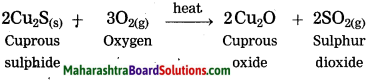
Beginning of Freedom Movement Class 8 Questions And Answers Chapter 6 Maharashtra Board

Class 8 History Chapter 6 Beginning of Freedom Movement Textbook Questions and Answers
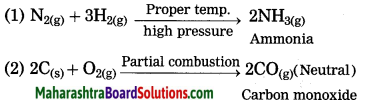
1. (A) Rewrite the statements by choosing the appropriate options:

Question 1.
The Servants of India Society was founded by
(a) Ganesh Vasudev Joshi
(b) Bhau Daji Lad
(c) M. G. Ranade
(d) Gopal Krishna Gokhale
Answer:
(d) Gopal Krishna Gokhale

Maharashtra Board Class 8 History Solutions Chapter 6 Beginning of Freedom Movement

Question 2.
The first session of Indian National Congress was held at
(a) Pune
(b) Mumbai
(c) Kolkata
(d) Lucknow
Answer:
(b) Mumbai

Question 3.
wrote Geeta Rahasya.
(a) Lokmanya Tilak
(b) Dadabhai Nowrojee
(c) Lala Lajpat Rai
(d) Bipinchandra Pal
Answer:
(a) Lokmanya Tilak

B. Write the Names :

Question 1.
Moderate leaders
(i) ……… (ii) ………
Answer:
(i) Gopal Krishna Gokhale
(ii) Ferozshah Mehta

Question 2.
Extremist leaders
(i) ……. (ii)………..
Answer:
(i) Lokmanya Tilak
(ii) Lala Lajpat Rai

2. Explain the following statements with reasons:

Question 1.
In the struggle for Independence, a sense of identity was awakened among the Indians.
Answer:

  1. Western education familiarised the educated Indians with modern values such as liberty, equality, democracy and nationalism.
  2. The Asiatic Society at Bengal edited and published hundreds of manuscripts in Sanskrit, Persian and other Indian languages.
  3. The realization that India had a rich ancient heritage aroused the feeling of national pride. This gave a sense of identity to Indians.

Question 2.
Two groups were formed in the Congress.
Answer:
1. Though at a slow pace, the contribution of Indian National Congress was consistent in the initial stage. But the extremists felt to intensify the freedom struggle.
2. Moderates and Extremists were unanimous about the objectives of Congress. But they had differences regarding the methods/ways to achieve it.
3. The moderates insisted on constitutional measures whereas extremists wanted to adopt severe methods.
4. The tension between these groups increased during the Surat session in 1907.
This led to the formation of two groups within the Congress.

Question 3.
Lord Curzon decided to partition Bengal.
Answer:
1. Bengal was a large province. So under the pretext of administrative convenience, the province of Bengal was partitioned by Lord Curzon.
2. Accordingly, the Muslim-majority East Bengal and the Hindu-Majority West Bengal were created in 1905.
3. The real motive was to create a divide between the Hindus and the Muslims and thereby weaken the nationalist movement. The British used the Policy of ‘Divide and Rule’.

Maharashtra Board Class 8 History Solutions Chapter 6 Beginning of Freedom Movement

3. Write short notes:

Question 1.
Objectives of the Indian National Congress :
Answer:
The Indian National Congress was established in 1885 with the following objectives:

  1. To bring together the people of India on a common platform.
  2. To create a feeling of unity among them, irrespective of religion, race, language, geographical territories.
  3. To provide opportunities to understand one another’s problems and views.
  4. To increase the feeling of unity among the people.
  5. To take measures for the upliftment of the country.

Question 2.
Anti Partition Movement :
Answer:

  1. With the motive to create a divide between the Hindus and the Muslims, Lord Curzon divided the province of Bengal in the Muslim-majority East Bengal and the Hindu-majority West Bengal in 1905.
  2. The day of partition, 16th October was observed as the ‘National Mourning Day’.
  3. All over India, protest meetings were organised to condemn the decision of the government.
  4. Singing of Vande Mataram and Raksha-bandhan programmes were arranged to mark the protest.
  5. Government-run schools and colleges were boycotted in large number by the students.
  6. Sensing the intensity and severity of dissatisfaction the British annulled the Partition of Bengal.

Question 3.
Four Point Programme of the Indian National Congress :
Answer:
In the session of 1906 of the Indian National Congress, the four-point programme was unanimously accepted.

  1. Swadeshi: To make use of capital, resources, manpower in our country so that it becomes self-sufficient.
  2. Boycott: It was decided to boycott foreign goods as a first step, and boycott of foreign rule be the next step. It would be an attack on the roots of British imperialism.
  3. Swaraj: The final objective is to attain freedom.
  4. National Education: To impart education which will create pride for the nation among people.

4. Explain the background behind the establishment of Indian National Congress with the help of following points:
1. Centralisation of administration
2. Economic exploitation
3. Western education
4. Study of Ancient Indian History
5. Role of newspapers
Answer:
The background behind the establishment of the Indian National Congress in 1885:

1. Centralisation of administration :

  1. The uniform policies, identical reforms and equality before law brought the nation under one roof.
  2. The network of roads and railways brought the people of India together.
  3. It developed the feeling of unity among Indians.

2. Economic exploitation :

  1. The economic exploitation of India through the imperialistic policies led to the drain of the Indian wealth to England.
  2. Industries declined and the farmers became bankrupt.
  3. Imposition of taxes on middle class and the exploitation of worker class by the capitalist led to growth of discontent.

3. Western education :

  1. Western education familiarised the educated Indians with modern values and principles such as liberty, equality and democracy.
  2. They accepted principles like rationalism, humanity and nationalism.
  3. They realised that they can carry out work of the country by following them.

4. Study of Ancient Indian History :

  1. The manuscripts in Sanskrit, Persian and many other languages were examined and research was published.
  2. Many western Scholars started to study Indian culture.
  3. The realisation that India had a rich ancient heritage aroused the feeling of national pride among Indians.

5. Role of newspapers :

  1. Newspapers in English and vernacular languages carried articles criticising the policies of the government.
  2. It led to social and political awakening.

Maharashtra Board Class 8 History Solutions Chapter 6 Beginning of Freedom Movement

Do you Know?

Maharashtra Board Class 8 History Solutions Chapter 6 Beginning of Freedom Movement 1

Project:

Collect additional information about the leaders of the early phase of Indian National Congress with the help of the internet.

Class 8 History Chapter 6 Beginning of Freedom Movement Additional Important Questions and Answers
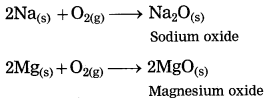
Rewrite the statements by choosing the appropriate options:

Question 1.
…………. newspaper was a mouthpiece of extremist ideology in Bengal.
(a) Dnyanoday
(b) Dnyanprakash
(c) Amrit Bazar Patrika
(d) Kesari
Answer:
(c) Amrit Bazar Patrika

Question 2.
………….. declared to give responsible political system to India.
(a) Montague
(b) Morley
(c) Dalhousie
(d) Chelmsford
Answer:
(a) Montague

Maharashtra Board Class 8 History Solutions Chapter 6 Beginning of Freedom Movement

Question 3.
A committee under the leadership of met …………… Governor-General Lord Minto.
(a) Sir Sayyad Ahmad Khan
(b) Abdul Latif
(c) Baddrudin Tayyabji
(d) Aga Khan
Answer:
(d) Aga Khan

Question 4.
The Home Rule Movement was launched in …………. against Colonialism.
(a) South Africa
(b) Ireland
(c) Scotland
(d) Switzerland
Answer:
(b) Ireland

Question 5.
…………… was established in 1906.
(a) The Indian National Congress
(b) Moderate Party
(c) Extremist Party
(d) The Muslim League
Answer:
(d) The Muslim League

Identify the wrong pair and correct it:

(1) The first President of Indian National Congress
– Wyomesh Chandra Banerjee
(2) Assassinated Rand
– The Chapekhar Brothers

(3) He pronounced the word Swaraj for the first time
– Lokmanya Tilak
(4) The British officer who took initiative in forming the Indian National Congress.
– Allen Octavian Hume
Answer:
Wrong Pair: He pronounced the word Swaraj for the first time.
– Lokmanya Tilak
Corrected pair: He pronounced the word Swaraj for the first time
– Dadabhai Nowrojee.

Maharashtra Board Class 8 History Solutions Chapter 6 Beginning of Freedom Movement

Write the Names:

Question 1.
They studied ancient Indian culture
(i) ……… (ii) …….
Answer:
(i) Dr. Bhau Daji Lad
(ii) Dr. R.G. Bhandarkar

Question 2.
Leaders of Home Rule Movement
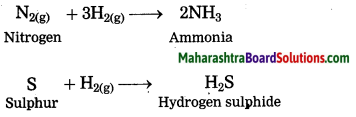
(i)……… (ii) ……
Answer:
(i) Dr. Annie Besant
(ii) Lokmanya Tilak.

Answer the following questions in one sentence each:
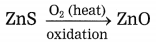
Question 1.
Which institute was established to study ancient Indian culture?
Answer:
The Asiatic Society was established in Bengal to study ancient Indian culture.

Question 2.
Which were the mediums initially used by the extremist leaders to create political awakening?
Answer:
The extremist leaders initially used the mediums of newspapers, national education and national festivals.
Question 3.
What was the objective of the extremist leaders in founding the educational institutions?
Answer:
The extremist leaders established educational institutions for creating a generation which will have concern for their own language and tradition.

Question 4.
Who led the Anti Partition Movement?
Answer:
Surendranath Banerjee, Anand Mohan Bose, Rabindranath Tagore and such other leaders led the Anti-Partition Movement.

Maharashtra Board Class 8 History Solutions Chapter 6 Beginning of Freedom Movement

Question 5.
How did Tilak criticise the Montague-Chelmsford Act?
Answer:
Lokmanya Tilak criticised the Moptague-Chelmsford Act in the following words, “This is neither Swaraj nor its foundation.”

Question 6.
What did Lokmanya Tilak firmly state?
Answer: Lokmanya firmly stated that “Swaraj is my birthright and I shall have it.”

Complete the graphical presentation:

Question 1.
Maharashtra Board Class 8 History Solutions Chapter 6 Beginning of Freedom Movement 2
Answer:
Maharashtra Board Class 8 History Solutions Chapter 6 Beginning of Freedom Movement 3

Question 2.
Maharashtra Board Class 8 History Solutions Chapter 6 Beginning of Freedom Movement 4
Answer:
Maharashtra Board Class 8 History Solutions Chapter 6 Beginning of Freedom Movement 5
Answer:
Maharashtra Board Class 8 History Solutions Chapter 6 Beginning of Freedom Movement 6

Question 3.
Maharashtra Board Class 8 History Solutions Chapter 6 Beginning of Freedom Movement 6
Answer:
Maharashtra Board Class 8 History Solutions Chapter 6 Beginning of Freedom Movement 7

Explain the Concept :

Question 1.
Moderates :
Answer:

  1. The Moderates were the leaders who wanted to carry out nationalistic movement within the constitutional methods and peaceful meAnswer:
  2. The leaders were realistic and highly educated and had faith in the justice of the British.
  3. They had hope that if they place their demands in constitutional manner the British will give justice to their demands.
  4. They were aware that a strong foundation needs to be built through organised work.
  5. The philosophy and principles of western thinkers like liberalism, freedom, equality, fraternity influenced them.

Maharashtra Board Class 8 History Solutions Chapter 6 Beginning of Freedom Movement

Question 2.
Extremists :
Answer:

  1. The leaders of the Indian National Congress who advocated intensification of the struggle to attain freedom were known as Extremists.
  2. Moderates and Extremists were unanimous about the objectives of Congress. The Extremists had no faith in the constitutional methods of the Moderates.
  3. According to Extremists, freedom will be attained only if lakhs of people participated in the freedom movement and challenge the British government.

Write short notes :

Question 1.
First session of Indian National Congress :
Answer:

  1. The founding session of the Indian National Congress took place on 28th December, 1885 at Gokuldas Tejpal Sanskrit school in Mumbai.
  2. It was presided by Wyomesh Chandra Banerjee, a renowned lawyer from Kolkata.
  3. It was attended by seventy-two delegates from different provinces of India.
  4. Allen Oct avian Hume took the initiative in establishing of the Indian National Congress.
  5. Increase in the number of Indians in the administration, reduction in military expenditure were the demands placed before the British government.

Question 2.
Servants of India Society :
Answer:
1. Gopal Krishna Gokhale founded the Servants of India Society in 1905.
2. Its main objectives were :

  • to create love for the county.
  • teach them sacrifice of self-interest.
  • no differentiation on the basis of caste and religion.
  • to create social harmony.
  • to spread education.

Question 3.
The Lucknow Pact :
Answer:

  1. An attempt was made under the leadership of Lokmanya Tilak to resolve differences in the Indian National Congress at its Lucknow session in 1916.
  2. In the same year, there was an agreement between Indian National Congress and the Muslim League, known as the Lucknow Pact.
  3. According to this Pact, Indian National Congress agreed to separate electorate for Muslims.
  4. In return, the Muslim League agreed to support the Indian National Congress in its work for getting political rights to India.

Question 4.
Home Rule Movement :
Answer:

  1. Home rule means self-rule or self-government.
  2. It was modelled after the Home Rule Movement in Ireland.
  3. It was led by Dr. Annie Besant and Lokmanya Tilak.
  4. They made extensive tours in different parts of the country so that the demand of self-government could reach the common people.

Maharashtra Board Class 8 History Solutions Chapter 6 Beginning of Freedom Movement

Explain the following statements with reasons:

Question 1.
A feeling of nationalism developed among the IndiAnswer:
Answer:

  1. The British established a centralised administration in India and applied uniform policies all over the country.
  2. They also laid down the principle of equality before law.
  3. They introduced the modern means of transport and communication.
  4. It benefited Indians as well. This made possible for the people living in different parts of India to establish contact with one another. This factors developed a feeling of nationalism among the Indians.

Question 2.
Lokmanya was imprisoned in 1897.
Answer:

  1. In 1897, hundreds of people died in Pune due to the epidemic of Plague.
  2. An officer name Rand was appointed to bring the epidemic under control.
  3. He started a search campaign to find Plague patients and adopted oppressive measures.
  4. To avenge this cruel and oppressive treatment meted out to people, the Chapekar brothers assassinated him.
  5. An unsuccessful attempt was made by the government to connect Lokmanya Tilak with this conspiracy.
  6. When they failed in their attempt, they imprisoned him with revenge.

Question 3.
The National Congress split at its Surat session in 1907.
Answer:

  1. The differences between the moderates and the extremists reached a climax in 1907.
  2. The moderates wanted to keep aside the resolution of Swadeshi and Boycott which was thwarted by the extremists.
  3. Some moderate leaders blamed the extremist leaders for trying to capture the Indian National Congress.
  4. It became impossible to arrive at a compromise between both the groups. As a result the Indian National Congress split at its Surat session in 1907.

Maharashtra Board Class 8 History Solutions Chapter 6 Beginning of Freedom Movement

Question 4.
The charge of sedition was put on Lokmanya Tilak.
Answer:

  1. There was wide protest against the partition of Bengal throughout the country.
  2. With a view to restrain the anti¬partition movements government resorted to many suppressive measures.
  3. Strict action was taken against extremists leaders which caused severe reactions in Bengal.
  4. The revolutionaries adopted means of firing and bomb blasts which was advocated by Lokmanya Tilak through his newspaper Kesari.

Therefore, the charge of sedition was put on Lokmanya Tilak by the British government for which he was sent to Mandalay jail for 6 years.

Question 5.
The government passed the Morley- Minto Act.
Answer:
1. The economic policies of the British increased poverty in India.
2. It created dissatisfaction in the minds of the people against British rule.
3. The oppressive measures adopted by Lord Curzon to suppress the protest of partition of Bengal, exclusion of educated Indians in government services and the unjust treatment towards Indians in Africa all this added to the dissatisfaction among the IndiAnswer:
4. Morley-Minto reforms were passed by the British government as a temporary remedy to calm discontent among the IndiAnswer:

Maharashtra Board Class 8 History Solutions Chapter 6 Beginning of Freedom Movement

Question 6.
The Montague-Chelmsford Act disappointed the people of India.
Answer:
The Montague-Chelmsford Act disappointed the people of India, because

  1. The British Government had declared its intention to gradually grant the right to self-rule and responsible government in 1917.
  2. In 1919, the British Parliament passed an act to bring constitutional reforms in India.
  3. According to the Act, less important departments were transferred to Indian ministers and important departments like Finance, Home affairs and Revenue was kept with the Governor.
  4. Thus, it belied the hope that the Act would lay foundation of responsible government in India and disappointed the people.

Answer the following questions in 25-30 words:

Question 1.
What realisation led to the emergence of a political organisation on all India level?
Answer:

  1. English educated Indians were instrumental to bring about Renaissance.
  2. They launched reform movements in social, political, religious, economic and cultural field in different parts of the country.
  3. The political organisations in different parts of the country formed during various movements felt the need to create a political organisation on an all India level having common goal.
  4. It was necessary to bring together groups and people who had political awareness.
  5. It was necessary to draw attention of the people towards questions of the nation. This led to the emergence of a political organization on all India level.

Maharashtra Board Class 8 History Solutions Chapter 6 Beginning of Freedom Movement

Question 2.
State the impact of imperialistic policy of the British on India.
Answer:

  1. The economic exploitation of India through the imperialistic policies led to the drain of the Indian wealth to England.
  2. The compulsion to grow cash crops, burden of land taxes and recurring famines made conditions of farmers miserable. All these broke the backbone of the Indian agriculture.
  3. With the decline of traditional industries, there was increase in unemployment.
  4. The workers were exploited by the capitalists.
  5. The middle class suffered due to imposition of various new taxes.
    This was the impact of the British imperialist policy which led to discontent among the IndiAnswer:

Question 3.
State the impact of western education?
Answer:

  1. Due to spread of western education, new ideas like Justice, Liberty, Equality, Democracy, etc. were introduced to the IndiAnswer:
  2. The young Indians imbibed the values like rationalism, humanity, nationalism and scientific attitude.
  3. They developed a feeling that they could carry out the work of the country.
  4. English became the new medium of communication.

Question 4.
What message did Dadabhai Nowrojee give at the session of Congress in 1906?
Answer:
At the session of the Indian National Congress in 1906, Dadabhai Nowrojee pronounced the word ‘Swaraj’ for the first time. He gave the message

  1. to remain united.
  2. try sincerely and fulfill the aim of Swaraj so that those who are poor, hungry and having diseases could be saved,
  3. India to get respectable position among the developed countries.

Question 5.
Write about the process of formation of Muslim League.
Answer:

  1. The British got very disturbed by the overwhelming public response to the Indian National Congress in the anti-partition movement.
  2. They once again resorted to the policy of ‘Divide and rule’.
  3. Many British officers suggested that a separate political organisation was necessary to safeguard the interests of the Muslims.
  4. Due to motivation of British government, under the leadership of Aga Khan a committee of upper-class Muslims met Governor-General Lord Minto.
  5. Thus, encouraged by Lord Minto and other British officers, the Muslim League was formed in 1906.

Question 6.
What were the provisions of Morley- Minto Act?
Answer:
1. The Morley-Minto Act of 1909 provided for increase of the number of Indian members in the legislatures and the inclusion of some elected Indian members.
2. It created separate electorates for the Indian Muslims.

Maharashtra Board Class 8 History Solutions Chapter 6 Beginning of Freedom Movement

Question 7.
What is Responsive Cooperation?
Answer:
1. India had to face the brunt of First World War which led to growing dissatisfaction among people.
2. To curb their dissatisfaction and get cooperation, Montague, the Secretary of State for India, declared in 1917 that Britain would gradually grant the right to self-rule and a responsible government to India. ,
3. Lokmanya Tilak declared that if the British Government showed sympathy and a considerate attitude to the demands of the people then the people of India would cooperate with the government. This is called ‘Responsive Cooperation’.

Write answer in details :

Question 1.
Give a brief account of the work of Extremist leaders in India’s freedom struggle.
Answer:

  1. Extremist leaders Lokmanya Tilak, Bipin Chandra Pal, Lala Lajpat Rai advocated intensification of the struggle since the British did not respond to the petitions and appeals.
  2. ) Initially, they used the mediums of newspapers, national festivals and national education to bring about political awakening.
  3. They formed educational institutions to sow the seeds of nationalism in society and to create a generation which will show concern about their language and tradition.
  4. Lokmanya Tilak severely criticised the suppressive policies or the British through the newspapers like ‘Kesari’ and ‘Maratha’.
  5. Lokmanya Tilak started Ganesh Utsav and Shiv Jayanti to bring people together.
  6. The leaders did not adopt the means of armed revolution but insisted on extensive agitations.
  7. Swaraj, Swadeshi, National Education and Boycott was the four-point ‘ programme accepted.
  8. The Moderates laid the foundation of freedom struggle and the Extremists carried it forward.

Question 3.
Which measures were taken by the : British government to suppress the Anti-Partition Movement?
Answer:
The British government adopted following measures to suppress the anti-partition movement:

  1. The public meetings were banned.
  2. Strict punishment was given to those who broke the law.
  3. Even school children were beaten up.
  4. Many restrictions were imposed on the newspapers.
  5. The British confiscated many printing/presses on false ground of criticising the ; government.
  6. Writers and editors were imprisoned.
  7. Strict actions were taken against many extremist leaders.
  8. Lokmanya Tilak was sent to Mandalay jail at Myanmar for 6 years on the charge of sedition.
  9. Bipin Chandra Pal was sent to jail and Lala Lajpat Rai was deported out of Punjab.

Maharashtra Board Class 8 History Solutions Chapter 6 Beginning of Freedom Movement

Identify the picture and write about his contribution to the freedom struggle.
Maharashtra Board Class 8 History Solutions Chapter 6 Beginning of Freedom Movement 8
Answer:

  1. The Above picture is of Lokmanya Tilak.
  2. He started the newspapers Kesari and Maratha.
  3. He started festivals like Ganesh Utsav and Shiv Jayanti for people to come together and get inspiration from contribution of national personalities.
  4. The bomb attacks by the revolutionary was advocated through newspaper Kesari and Maratha.
  5. Due to this, he was charged with sedition and put in Mandalay jail for 6 years.
  6. When he was in Mandalay prison he wrote Geetarahasya which advocated philosophy of Karmayoga and stressed upon the people to always remain in action.
  7. An attempt was made under his leadership to resolve differences between two groups in the Indian National Congress in its session of 1916.
  8. He started the Home Rule Movement along with Dr. Annie Besant.
  9. He travelled in different parts of India so that the demand for self government reach the common man.
  10. He firmly declared, ‘Swaraj is my birth right and I shall have it.’
  11. He criticised the Montague Chelmsford Reform Act when it failed to fulfill the demand of responsible government.

Question 4.
Do you feel the four-fold programme implemented by Indian National Congress needs to be implemented even today? Why?
Answer:
In the pre-independence period, Indian National Congress implemented the four-fold programme of Swaraj, Swadeshi, Boycott and National education. The programme needs to be implemented today but with slight changes.

1. Swaraj: Today we have political freedom but we lack good Governance. Common man, farmer, women and the backward classes still suffer.

2. Swadeshi: In the world of Globalisation, goods from other countries have entered Indian markets. It is necessary for the Indian industries to implement programme of Swadeshi to sustain.

3. Boycott: It is not possible to boycott foreign goods but we should insist on indigenous goods wherever possible.

4. National education: Schools in India impart education catering to different needs and ideologies but they fall short to create national pride and imparting character training.

8th Std History Questions And Answers: