An Astrologer’s Day 12th Question Answer English Chapter 1.1 Maharashtra Board

Class 12 English Chapter 1.1

Balbharti Yuvakbharati English 12th Digest Chapter 1.1 An Astrologer’s Day Notes, Textbook Exercise Important Questions and Answers.

Class 12 English Chapter 1.1 An Astrologer’s Day Question Answer Maharashtra Board

12th Std English Chapter 1.1 Brainstorming Question Answer

Yuvakbharati English Navneet 12th Digest PDF Free Download Maharashtra Board

Question 1.
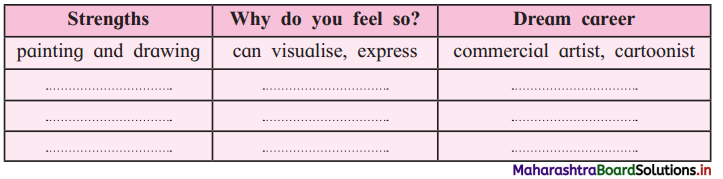
Discuss with your partner and complete the table:
Maharashtra Board Class 12 English Yuvakbharati Solutions Chapter 1.1 An Astrologer's Day 1
Answer:

Your Strengths Why do you feel so? Your Dream career
painting and drawing can visualise, express commercial artist, cartoonist
……………………. ……………………… ………………………….
…………………… ……………………… …………………………
………………….. ……………………….  ………………………..

Maharashtra Board Solutions

Question 2.
The scene in a local market of a village/ town/city is very attractive. People with different occupations sell their wares. Discuss with your partner the variety of activities at the local market.
Answer:

  1. selling flowers, selling grocery
  2. selling garments and cloth
  3. selling imitation jewellery and accessories
  4. selling snacks and fast food
  5. selling steel and earthenwares

Question 3.
In a village/town/city it is quite a common sight to see an astrologer sitting by the roadside with his professional equipment. Discuss with your partner and list the requirements for his trade.
Answer:

  1. parrot, cards, etc.
  2. turban, beard, dhoti
  3. dried leaves with writing on them
  4. cloth with mystic signs to spread his cards
  5. bead necklace, coins, shells, punchang, etc.

Question 4.
There are certain unreasonable beliefs among people living in our society. Certain common events are linked with superstitions. List such events, discuss the superstitions linked with them and the means of their eradication.
Answer:
Events and superstitions linked with them:

  1. A cat crossing your path (something bad will happen)
  2. Walking under a ladder (something unfortunate will happen)
  3. Wearing black clothes for an auspicious function (will bring bad luck to the hosts)
  4. Spilling salt (unlucky for the person)
  5. A black crow cawing outside your window (you will be having guests)

Means of eradication: The only means of eradication is through education. Scientific attitude must be developed in society. Religious heads must counsel and guide their followers. The elders in families must also get rid of old beliefs.

A1.

(i) Given below are some descriptions. Discuss them with your partner and find out one word for each of them.

Question (a)
The scientific study of the universe and the objects in it, including stars, planets, nebulae and galaxies:
Answer:
Astronomy

Maharashtra Board Solutions

Question (b)
The study of the movements of the planets, Sun, Moon, and Stars in the belief that these movements can have an influence on people’s lives:
Answer:
Astrology

Question (c)
A prediction of what will happen in the future:
Answer:
Prophecy

Question (d)
Scientific discipline that studies mental states and processes and behaviour in humans and other animals:
Answer:
Psychology

Question (ii)
In the story we are told that the Town Hall Park was a remarkable place in many ways for an astrologer to build his business. List the exceptional qualities of the place from this extract.
Answer:
The exceptional qualities of the place were:

  1. A surging crowd
  2. A variety of trades and occupations, like medicine sellers, sellers of stolen hardware and junk
  3. magicians
  4. auctioneers of cheap cloth
  5. a vociferous vendor of fried groundnuts.

Question (iii)
The astrologer never opened his mouth till the other had spoken for at least ten minutes. Discuss the reasons behind his act.
Answer:
(a) He was good at reading people.
(b) He obtained a lot of information about their lives from their talk.
(c) He could analyse their character and understand their problems.
(d) He could easily frame his statements to their satisfaction.

Maharashtra Board Solutions

A2.

Question (i)
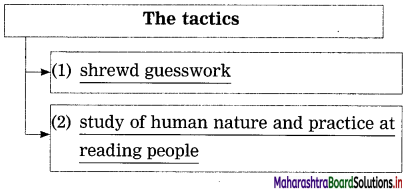
The tactics used by the astrologer to earn his wages are:
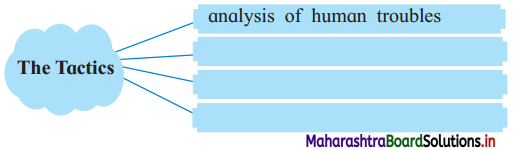
Maharashtra Board Class 12 English Yuvakbharati Solutions Chapter 1.1 An Astrologer's Day 2Maharashtra Board Class 12 English Yuvakbharati Solutions Chapter 1.1 An Astrologer's Day 2
Answer:
Maharashtra Board Class 12 English Yuvakbharati Solutions Chapter 1.1 An Astrologer's Day 3

Question (ii)
An astrologer’s appearance helps to create an impression on his clients. Complete the following:
(The answer is given directly and underlined.)
Answer:

  1. The turban on his head
  2. The sacred ash and vermilion on his forehead
  3. dark whiskers covering the face
  4. a sparkle in his eye accompanied by an abnormal gleam

1. Read the following sentences and choose the correct one:

Question (a)
The astrologer says that if Nayak does not leave his village again, he would –
(1) return the money
(2) face danger
(3) go back home and stop looking for the man who tried to kill him
(4) not find the killer.
Answer:
(2) face danger

Question (b)
According to the narrator, the astrologer’s success in his profession is primarily due to –
(1) luck
(2) the bargains he drives
(3) his appearance
(4) his understanding of people.
Answer:
(4) his understanding of people

Maharashtra Board Solutions

Question (c)
The story suggests that the astrologer’s comments and observations pleased people by –
(1) promising them success and good fortune
(2) proving, as time passes, to have been true
(3) flattering them or supporting their own views
(4) helping them to learn to solve their own problems.
Answer:
(3) flattering them or supporting their own views

Question (d)
Guru Nayak the astrologer because he wants to –
(1) understand the past
(2) find out who the astrologer is
(3) make some money through a bet
(4) get the answer to a specific question.
Answer:
(4) get the answer to a specific question.

Question (e)
Guru Nayak is looking for the man who tried to kill him –
(1) to take revenge
(2) to get an apology
(3) to demand an explanation
(4) to prove that the man was unsuccessful.
Answer:
(1) to take revenge

Question (f)
The astrologer’s remarks make Guru Nayak feel all of the following except –
(1) relieved
(2) suspicious
(3) impressed
(4) disappointed.
Answer:
(2) suspicious

Maharashtra Board Solutions

Question (g)
Reactions of the astrologer’s wife to his news suggest that she –
(1) was unaware of his past
(2) has been worried about his safety
(3) has known him since he was young
(4) is concerned about her future with him.
Answer:
(1) was unaware of his past

Question (iv)
Read the following sentences and find out the True and False sentences. Correct the False sentences:
(a) The astrologer gave a correct prediction to the client about his past that he was stabbed, thrown into a well and left for dead
(b) When the astrologer came to know that the man whom he killed is alive he felt that he was relieved of his guilt.
(c) The astrologer tried to back out of the deal and talked about the client’s past.
(d) The astrologer rescued himself from Guru Nayak’s revenge.
(e) The moral of the story is that we must be responsible about what we have done and should not run away from our mistakes.
Answer:
(a) True.
(b) True: When the astrologer came to know that the man whom he killed is alive he felt that he was relieved of his guilt.
(c) False
Corrected sentence. The astrologer struck a bargain with the client and then talked about the client’s past.
(d) True.
(e) False: The moral of the story is that we must be responsible about what we have done and should not run away from our mistakes.
Corrected sentence: The moral is that we should never believe in superstitions.

Maharashtra Board Solutions

Question (v)
The astrologer had changed his appearance and his persona when he arrived in the city. Give specific reasons for this.
Answer:
The astrologer thought that he had killed a man after a quarrel. He was afraid that he would be arrested and jailed for this crime. Hence, to avoid detection he changed his appearance and his persona when he arrived in the city.

Question (vi)
‘The darkness load that was inside the astrologer has disappeared’. Through this sentence, explain the significance of the title ‘An Astrologer’s Day’.
OR
(vii) The astrologer feels relieved that Guru is not dead as it relieves a great burden from him. Critically justify the statement and explain it.
Answer:
The astrologer thought that he had killed a man after a quarrel. Hence he had run away from his village, changed his appearance and his persona when he arrived in the city, and become an astrologer. However, he still felt guilty for what he had done. When he came to know that the man he thought he had killed was actually alive, the dark load inside him disappeared, and it made his day, i.e. he felt relieved and happy. This is the significance of the title ‘An Astrologer’s Day’.

Question (viii)
The astrologer wins/gets the sympathy/ criticism of the reader in the end. Express your opinion with the support of the main story.
Answer:
I think I sympathize with the astrologer. He did not try to intentionally kill Guru Nayak; it had happened in the heat of the moment. Of course, he should not have tried to run away but should have accepted responsibility for his crime. However, he is genuinely sorry for what had happened.

His words ‘a great load is gone from me today. I thought I had the blood of a man on my hands all these years’ indicates this. Hence, I sympathize with him and am happy that he can now live in peace.

Maharashtra Board Solutions

Question (ix)
Suggest some steps to eradicate superstitions and other ill practices from our society.
Answer:
To eradicate superstitions and other ill practices from our society the first and most important step is education. Schools and colleges must help their students to develop a scientific attitude and think logically and rationally.

Secondly, as people in India tend to listen to their religious heads, all religious heads should send out clear messages to their followers about the eradication of superstitions. And lastly, the older generation should change their opinions and ideas and get rid of silly superstitious beliefs.

Question (x)
In the story, the astrologer has great listening power. Listening helps in developing good relations with people. Express your opinion.
Answer:
Yes, listening helps in developing good relations with people. When we listen, we indicate to the speaker that we care about him/her and are interested in his/her problems/joys. We show that we are ready to help him/her if necessary. We share his/ her ideas. We also realize how we can deal with people successfully by listening to their views.

(A3)

Question (i)
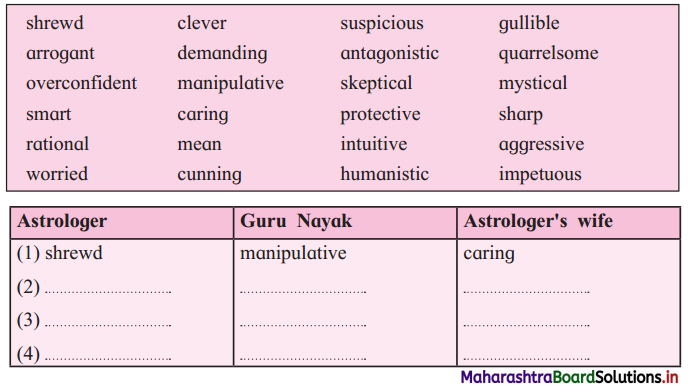
In the story, the astrologer, Guru Nayak and astrologer’s wife reveal their qualities through words and actions. Pick out from the box the words that describe them and write in the appropriate columns:
Maharashtra Board Class 12 English Yuvakbharati Solutions Chapter 1.1 An Astrologer's Day 4
Answer:

Astrologer Guru Nayak Astrologer’s wife
shrewd manipulative caring
clever gullible suspicious
smart quarrelsome protective
sharp arrogant worried
intuitive aggressive humanistic
mystical demanding rational
cunning antagonistic
mean sceptical
over­ impetuous
confident

Maharashtra Board Solutions

Question 1.
Match the suffixes with the words and make words:
Maharashtra Board Class 12 English Yuvakbharati Solutions Chapter 1.1 An Astrologer's Day 5
Answer:

Word Suffix Noun
auction able auctioneer
enchantment enchantment enchantment
know ment knowledge
prepare ure preparation
proceed tion procedure
appear (this word is not in the lesson) ment appearance
remark ure remarkable

Question (iii)
‘An Astrologer’s Day’ has ironic elements where the astrologer pretends to have ‘supernatural knowledge’ that coincidently turns out to be the truth. Find out an example of irony from the extract and write it down:
Find out the examples of irony from the extract and write them down.
Answer:
His eyes sparkled with a sharp abnormal gleam which was really an outcome of a continual searching look for customers, but which his simple clients took to be a prophetic light and felt comforted.
1. He knew no more of what was going to happen to others than he knew what was going to happen to himself the next minute.
2. He was as much a stranger to the stars as were his innocent customers.
3. He said things which pleased and astonished everyone : that was more a matter of study, practice, and shrewd guesswork.

Maharashtra Board Solutions

Question (iv)
Find the examples of code-mixing from the extract and write them down.
Answer:
1. ‘cowrie shells’
2. turban

Question (v)
There are some phrases where the word ‘crown’ is used with different shades of meaning. Use the following phrases to complete the sentences meaningfully. One is done for you.
Crowning achievement, to crown the effect, crown of thorns, crowning glory, to crown it all
Answer:
e.g. To crown the effect, he wound a saffron- coloured turban around his head.
(a) The works of Shakespeare are the crowning glory of English drama.
(b) Amitabh has given us awesome movies throughout five decades. But his crowning achievement is his performance in the movie ‘Black’.
(c) In her pursuit of success, Radha has distanced herself from her family. Her fame has become a real crown of thorns.
(d) They threw a wonderful party for me with costumes, games and to crown it all my favourite kind of ice cream.
(e) Medical science has great inventions, but organ transplantation is definitely a crowning achievement for human beings.

(A4)

Question (i)
Use the word given in the brackets and rewrite the sentence:
(a) The power of his eyes was considerably enhanced. (enhancement)
(b) He had a working analysis of mankind’s troubles, (worked)
(c) He knew what was going to happen to himself the next minute. (happening)
(d) If you find my answers satisfactory, will you give me five rupees? (satisfaction)
(e) He shook his head regretfully. (regret)
(f) It was a bewildering crisscross of light rays, (bewildered)
(g) “I should have been dead if some passer-by had not chanced to peep into the well,” exclaimed the other, overwhelmed by enthusiasm. (enthusiastically)
(h) You tried to kill him. (killing)
(i) I will prepare some nice stuff for her. (preparation)
(j) The other groaned on hearing it. (heard)
Answer:
(a) There was considerable enhancement in the power of his eyes.
(b) He had worked out an analysis of mankind’s troubles.
(c) He knew what could be happening to himself the next minute.
(d) If my answers give you satisfaction, will you give me five rupees?
(e) He shook his head with regret.
(f) He was bewildered by the crisscross of light rays.
(g) “I should have been dead if some passer-by had not chanced to peep into the well,” exclaimed the other enthusiastically.
(h) You tried killing him.
(i) I will make a preparation of some nice stuff for her.
(j) The other groaned when he heard it.

Maharashtra Board Solutions

(A5)

Question (i)
Prepare a speech on Science and Superstitions.
Answer:
Science and Superstitions
Respected teacher and my dear friends,

I wish you all a very good morning. Today we are celebrating Science day in our school, and on this occasion I, Rohan Kamte, would like to say a few words about Science and Superstitions.

Science and Superstitions are two opposite ends of a pole. Those who have the scientific attitude and believe in science cannot possibly believe in superstitions. After all, what exactly are superstitions? They are only some tales made up by people for some reason or the other. Let me give you an example. Many years ago, in a house in a village, they were having an auspicious function. A lot of food was being cooked.

A cat and her kitten were moving about here and there in the kitchen. Afraid that the cat would be trampled upon or may fall into one of the open fires, the mistress of the house ordered the servant to put the cat and its kitten under a basket, and to do so every time there was a function in the house. This became a ‘superstition’ and in some houses, people actually brought a cat into the house and put it under a basket whenever they had a function!

This is what superstitions are all about. The superstition of bad luck if you walk under a ladder too has its reasons. The ladder could fold up and injure a person walking beneath it, or something could fall on the person’s head.

So friends, I request you: In this age of Science, do not believe in silly superstitions. Keep your minds open. Be rational and logical. Analyse things. Believe something only if it has the backing of Science. Thank you.

(ii) Read the following proverbs. Share you views and expand the ideas.

Question (a)
Actions speak louder than words.
Answer:
Actions speak louder than words

Today a lot of importance is being given to the way we speak and what we speak. But we have to remember that ultimately it is not words but actions that are important. Mahatma Gandhi, the Father of our Nation, did not give any grand speeches. However, by his actions he saw that India gained her freedom. Our soldiers do not give long lectures on patriotism they merely act to defend the country. What would have happened if they had only spoken but not acted?

This very well-known proverb is very apt when it comes to parent-child interaction. It has been seen that children observe the actions of their parents and imitate them not their words. In the animal kingdom too, the actions of the parent are of paramount importance. During elections, politicians make loud speeches but later on do not work. It is because of this behaviour that they lose the trust of the people. Thus, we must act with responsibility, always remembering that people observe our actions and are not swayed by our words.

Maharashtra Board Solutions

Question (b)
The face is the index of the mind.
Answer:
[Points: facial expressions and eyes indicate one’s thoughts – this is. non-verbal communication – that is why we smile when happy and frown when sad – however, smart people can hide their feelings so that face does not show them – so one has to be careful while reading faces]

Question (c)
Speech is silver and silence is golden.
Answer:
[Points: we speak – we give others information or reveal our thoughts – others speak, we get information – sometimes we speak hastily and hurt others – create problems – remain silent and think – can find solutions – many leaders speak hastily – create international problems – better to be silent and let one’s actions speak]

Question (d)
Argument is the worst kind of communication.
Answer:
[Points: arguments – people get angry – angry words and raised voices – hurt people – confusion – relationships spoilt – instead talk softly and allow others to talk – accept that others can think in a different way – ‘a man convinced against his will is of the same opinion still’]

Question (e)
Attitudes are the real figures of speech.
Answer:
[Points: quote by Edwin H Friedman – in communication, more than the verbal message, the non-verbal message important – your attitude and behaviour have more impact than your words – for example, if you say ‘sorry’ in a harsh tone without any apology on your face – the word has no meaning – hence body language and attitude are very important)

Question (f)
The wise man has long ears and a short tongue
Answer:
[Points: better to listen than to speak – wise people listen more and speak only when they have something important to say – speech is silver and silerwe is golden – in any situation it is better to remain silent and evaluate situation – empty vessels make the most noise]

Maharashtra Board Solutions

(A6)

Question (i)
Bill Naughton has written a collection of wonderful stories which you can read in his book ‘The Goal Keeper’s Revenge and Other Stories’. Read all the stories and discuss their themes with your partner.

Question (ii)
Read R.K. Narayan’s humorous collections of short stories and novels. Here are some titles you can read.
(a) ‘Under The Banyan Tree’
(b) ‘The Doctor’s Word’
(c) ‘LawleyRoad’
(d) ‘A Horse and Two Goats’
(e) ‘Gateman’s Gift’

(A7)

Question 1.
Surf the internet and find out the career opportunities in Astronomy.

Yuvakbharati English 12th Digest Chapter 1.1 An Astrologer’s Day Additional Important Questions and Answers

Read the extract and complete the activities given below:

Global Understanding:

Question 1.
List the fancy names the vendor of fried groundnuts gave his wares.
Answer:
The fancy names the vendor of fried groundnuts gave his wares are:

  1. ‘Bombay Ice Cream’
  2. ‘Delhi Almond’
  3. ‘Raja’s Delicacy’, etc.

Question 2.
Complete the following:
(The answer is given directly and underlined.)
Answer:
If the astrologer had stayed in the village, he would have carried on the work of his forefathers-namely, tilling the land, living, marrying and growing old in his cornfield and ancestral home.

Maharashtra Board Solutions

Question 3.
The Town Hall Park was a remarkable place in many ways for an astrologer to build his business. List the exceptional qualities of the place from the extract.
Answer:
The exceptional qualities of the place were:

  1. lack of municipal lighting
  2. flare from the groundnut heap
  3. hissing gaslights, some with naked flares, and cycle lamps
  4. bewildering criss-cross of light rays and moving shadows

Question 4.
Complete the following:
(The answers are given directly and underlined.)
The signal for the astrologer to leave was when the nuts vendor blew out his flare and rose to go home.
The astrologer spoke only when his client had spoken for at least ten minutes.

Question 5.
Rearrange the following sentences in the order of their occurrence in the extract:

  1. “I will speak to you tomorrow.”
  2. “Oh, stop that,” the other said.
  3. “There is a woman ”
  4. “Or will you give me eight annas?”

Answer:

  1. “Oh, stop that,” the other said.
  2. “Or will you give me eight annas?”
  3. “I will speak to you tomorrow.”
  4. “There is a woman ………..”

Complex Factual:

Question 1.
Complete the following:
(The answer is given directly and underlined.) The tactics used by the astrologer to earn his wages are:
Answer:
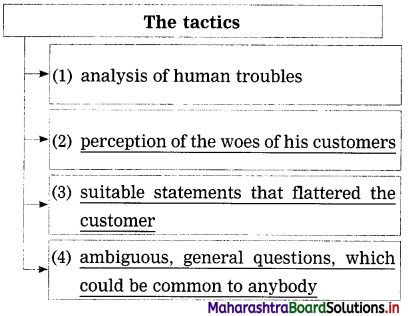
Maharashtra Board Class 12 English Yuvakbharati Solutions Chapter 1.1 An Astrologer's Day 6

Question 2.
Describe how the astrologer had left the village.
Answer:
The astrologer had left the village without any previous thought or plan. He had left home without telling anyone. He did not rest till he left behind his village a couple of miles.

Maharashtra Board Solutions

Question 3.
The astrologer could understand the problem in five minutes. Give reasons from the extract.
Answer:
The astrologer had a working analysis of mankind’s troubles like marriage, money and the tangle of human ties. Long practice had sharpened the way he perceived things, and thus he could understand the problem in five minutes.

Question 4.
Complete the following :
(The answer is given directly and underlined.)
Answer:
Maharashtra Board Class 12 English Yuvakbharati Solutions Chapter 1.1 An Astrologer's Day 7

Question 5.
Complete the web:
(The answers are given directly and underlined.)
Answer:
Maharashtra Board Class 12 English Yuvakbharati Solutions Chapter 1.1 An Astrologer's Day 8

Question 6.
Complete the following with what had happened to Guru Nayak’s enemy, according to the astrologer. According to the astrologer ………….. .
Answer:
According to the astrologer, Guru Nayak’s enemy had died. He had been crushed by a lorry.

Maharashtra Board Solutions

Question 7.
Describe the load on the astrologer’s mind.
Answer:
The astrologer thought that he had killed a man after a quarrel. He felt intensely guilty about this, and had run away from his village. This feeling of guilt was the load on his mind.

Question 8.
Was the astrologer’s wife happy with his day’s earnings? What did she plan to do with it?
Answer:
Yes, the astrologer’s wife was overjoyed with his day’s earnings. She planned to buy some jaggery and coconut and make some sweets for their daughter.

Inference/Interpretation/Analysis:

Question 1.
The presence of the groundnut vendor is beneficial to the astrologer. Justify.
Answer:
The vendor of fried groundnuts gave his wares fancy names like ‘Bombay Ice Cream’, ‘Delhi Almond’, ‘Raja’s Delicacy’ and so on. People were amused and attracted by this and flocked to him to buy groundnuts. As the astrologer was seated right next to him, the groundnut vendor’s customers dallied near the astrologer and were probably tempted to consult him.

Question 2.
Pick out the lines that tell you that the astrologer did not have any real knowledge of astrology.
Answer:

  1. He had not in the least intended to be an astrologer when he began life.
  2. He knew no more of what was going to happen to others than he knew what was going to happen to himself the next minute.
  3. He was as much a stranger to the stars as were his innocent customers.
  4. It was a bewildering crisscross of light rays and moving shadows. This suited the astrologer very well.

Question 3.
The astrologer could tell the person/client about his life. Describe the method he used.
Answer:
The astrologer would listen to his client talk for about ten minutes. He would thus get all the information about his life from him, and then cleverly pose questions which made it appear that he actually knew about the person’s life.

Maharashtra Board Solutions

Question 4.
‘Our friend felt piqued.’ Name the friend and give reasons for him feeling ‘piqued’.
Answer:
‘Our friend’ is the astrologer. He felt piqued because the man cut short his words rudely and told him to tell him something worthwhile. The astrologer was used to people listening eagerly and respectfully to whatever he had to say, and the behaviour of the man showed that he did not value the usual smooth talk. That is why the astrologer felt piqued.

Question 5.
Complete the following:
(The answers are given directly and underlined.)
Answer:
1. The man was left for dead because he had been pushed into a well in a field. Nobody normally looked into the well, and he would have died had there not been a passer-by who chanced to peep into the well.
2. The man looked gratified because his enemy had met his death by being crushed under a lorry. Guru Nayak felt that the man deserved such a terrible fate for what he had done to him.

Personal Response:

Question 1.
Do you like to hear predictions about your future? Give reasons.
Answer:
No, I do not like to hear predictions about my future. I do not believe that any person can foretell what is going to happen in someone’s life. Astrology is just a way of making money from gullible people. I believe that one must work hard and be a good human being if one wants to be successful in life.

Question 2.
Do you think that astrology is an art and can be studied? Discuss.
Answer:
Yes, astrology is an art. There are various methods of predicting the future, like palm-reading, reading the pulse, reading the horoscope, etc. These methods can be studied, or the knowledge can be inherited from one’s ancestors. However, the astrologer must have intuition and talent for this art.

Maharashtra Board Solutions

Question 3.
Explain with examples your reactions when someone challenges you.
Answer:
If the challenge is worthwhile, I take it up. For example, my friend Rohan challenged me to a bicycle race to the top of a nearby hill. I took it up as it was interesting, and I knew I could do it.

However, when my friend Soham challenged me to jump from the first floor of our building, I refused the challenge, as I knew it was dangerous and I was likely to break some bones. Though Soham scoffed at me, and said that he had already done it, I did not let his ridicule bother me.

Language Study:

Question 1.
The power of his eyes was considerably enhanced by their position.
(Rewrite beginning ‘The position …………’)
Answer:
The position of his eyes considerably enhanced their power.

Question 2.
This colour scheme never failed.
(Rewrite as an affirmative sentence.)
Answer:
This colour scheme was always successful.

Maharashtra Board Solutions

Question 3.
He had left his village without any previous thought or plan. (Rewrite using neither … nor …’)
Answer:
He had left his village with neither any previous thought nor plan.

Question 4.
One or two had hissing gaslights. (Identify the part of speech of the underlined word.)
Answer:
hissing – adjective (present participle used as an adjective)

Question 5.
He never opened his mouth till the other had spoken for at least ten minutes.
(Rewrite using ‘only’.)
Answer:
He opened his mouth only after the other had spoken for at least ten minutes.

Question 6.
He looked up and saw a man standing before him. (Rewrite as a simple sentence.)
Answer:
Looking up, he saw a man standing before him.

Question 7.
If I prove you are bluffing, you must return that anna to me with interest. (Pick out the clauses and state their type.)
Answer:
you must return that anna to me with interest-main clause
If I prove you are bluffing-adverb clause of condition

Question 8.
“Tell me something worthwhile.” (Identify the type of sentence.)
Answer:
Imperative sentence.

Maharashtra Board Solutions

Question 9.
Never travel southward again, and you will live to be a hundred. (Rewrite using ‘only if)
Answer:
You will live to be a hundred only if you never travel southward again.

Question 10.
He flung the coins at her and said “Count them. One man gave all that.” (Rewrite in reported speech.)
Answer:
He flung the coins at her and instructed her to count them. He added that one man had given all of it.

Question 11.
I will prepare some nice stuff for her. (Rewrite using the past perfect tense of the verb.)
Answer:
I had prepared some nice stuff for her.

Vocabulary:

Question 1.
Match the suffixes with the words and make words:
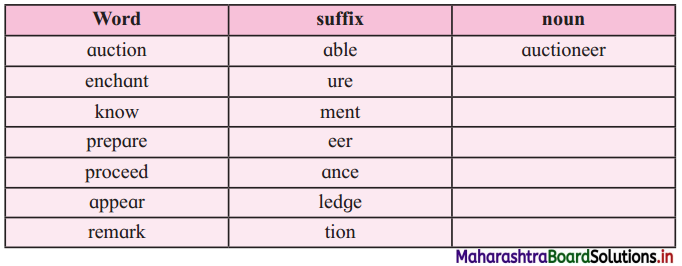
Answer:

Word Suffix Noun
innocent able innocence
reason ledge reasonable

Question 2.
Pick out two words from the extract that indicate sound.
Answer:
crackled, hissing

Question 3.
Guess the meaning of ‘pies’
Answer:
pies – is the plural form of pie which is a former bronze coin of India, the 12th part of an anna.

Maharashtra Board Solutions

Question 4.
Find an example of code mixing from the extract and write it down.
Answer:
pies

Question 5.
Find out the examples of irony from the extract and write them down.
Answer:
1. When he told the person before him, gazing at his palm, “In many ways you are not getting the fullest results for your efforts,” nine out of ten were disposed to agree with him.
2. “Most of your troubles are due to your nature. How can you be otherwise with Saturn where he is? You have an impetuous nature and a rough exterior.” This endeared him to their hearts immediately, for even the mildest of us loves to think that he has a forbidding exterior.

Question 6.
Guess the meaning of the words:

  1. tilting
  2. bluffing
  3. glimpse

Answer:

  1. tilting – to move into a sloping position.
  2. bluffing – deceiving, lying
  3. glimpse – to see someone or something for a very short time

Question 7.
Find examples of code mixing from the extract and write them down.
Answer:

  1. anna
  2. rupee
  3. cheroot
  4. jutka

Question 8.
Guess the meaning of the words:

  1. passer-by
  2. peep
  3. overwhelmed
  4. groaned

Answer:

  1. passer-by – a person who happens to be going past something or someone, especially on foot.
  2. peep – to peer into something cautiously
  3. overwhelmed – overcome
  4. groaned – made a low sound of distress.

Maharashtra Board Solutions

Question 9.
Find examples of code mixing from the extract and write them down.
Answer:
1. annas
2. pyol

Question 10.
Find from the extract the antonyms of the following words:

  1. light
  2. noise
  3. few
  4. dead

Answer:

  1. light × darkness
  2. noise × silence
  3. few × many
  4. dead × alive

Non-Textual Grammar:

1. Do as directed:

Question 1.
A stone struck the man on the head.
(Rewrite using the passive voice.)
Answer:
The man was struck on the head by a stone.

Maharashtra Board Solutions

Question 2.
You will not recover. Refrain from smoking.
(Rewrite using ‘unless’.)
Answer:
You will not recover unless you refrain from smoking.

Question 3.
He is certainly taller than his brother.
(Rewrite in the positive degree.)
Answer:
His brother is certainly not as tall as he is.

Spot the error in the following sentences:

Question 1.
His mouth watered when he saw a bouquet of grapes.
Answer:
His mouth watered when he saw a bunch of grapes.

Maharashtra Board Solutions

Question 2.
They left their luggages at the railway station.
Answer:
They left their luggage at the railway station.

12th Std English Questions And Answers:

Into the Wild 12th Question Answer English Chapter 1.6 Maharashtra Board

Class 12 English Chapter 1.6

Balbharti Yuvakbharati English 12th Digest Chapter 1.6 Into the Wild Notes, Textbook Exercise Important Questions and Answers.

Class 12 English Chapter 1.6 Into the Wild Question Answer Maharashtra Board

12th Std English Chapter 1.6 Brainstorming Question Answer

Yuvakbharati English Navneet 12th Digest PDF Free Download Maharashtra Board

Question 1.
Narrate in your class any of the incidents of your life when you were extremely terrified or awestruck.
Answer:
(Points: alone on a lonely road – lost somewhere – seeing a beautiful sunset – seeing beautiful mountains, etc.)

Maharashtra Board Solutions

Question 2.
Complete the given table regarding the factors/situations/reasons – why you sometimes get scared and the factors that add to it. Give possible solutions:
Answer:

Reasons Factors which add to it Solutions
1. While discussing about strange creatures At midnight/ In the absence of parents Avoid such discussions/ stories as they are baseless
2. If I get lost somewhere and cannot find my way home If I am alone/ if it is at night/ if the place is lonely Find out the way/route in detail before hand/Try not to go out at night alone.
3. Just before the exams. If I am not prepared for them/ if I have not studied Have a regular timetable for studies/make sure that I find ways to prepare subjects that I find difficult.

Question 3.
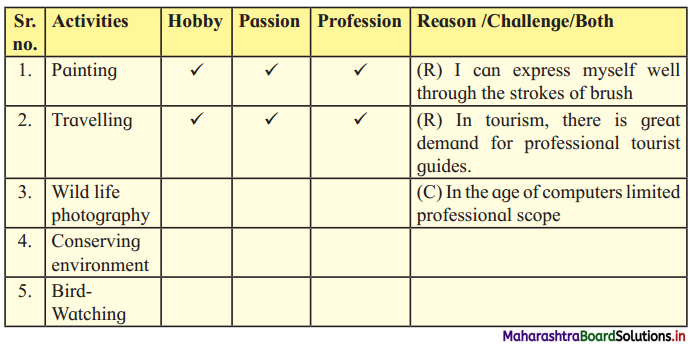
Given below are various activities which you can pursue as your hobby, passion, or profession. Complete the table accordingly:
Maharashtra Board Class 12 English Yuvakbharati Solutions Chapter 1.6 Into the Wild 1
Answer:

Activities Hobby Passion Pro­fession Reason/Challenge/Both
Painting (R) I can express myself well through the strokes of brush
Traveling (R) In tourism, there is great demand for professional tourist guides.
Wildlife photography (C) In the age of computers limited professional scope
Conserving environment (C) In a world which is careless, a tremendous challenge
Bird­ Watching (R) Extremely interesting and rewarding; professional opportunities few

Question 4.
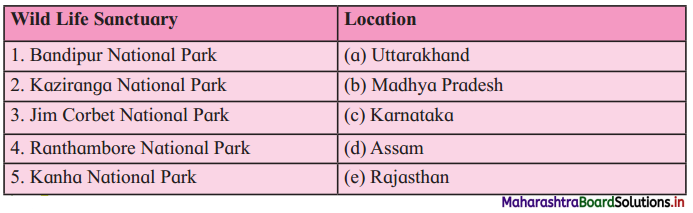
Match the following ‘Wildlife Sanctuaries’ with their locations:
Maharashtra Board Class 12 English Yuvakbharati Solutions Chapter 1.6 Into the Wild 2
Answer:

Wildlife Sanctuary Location
1. Bandipur National Park (c) Karnataka
2. Kaziranga National Park (d) Assam
3. Jim Corbett National Park (a) Uttarakhand
4. Ranthambore National Park (e) Rajasthan
5. Kanha National Park (b) Madhya Pradesh

Maharashtra Board Solutions

(A1)

Question (i)
In pairs, discuss the professions and challenges one can take happily if one is really passionate about the job.
(Points – professions: photography, environmental conservation, writing, reporting, music, choreography, etc. challenges – low salary, difficulties with organizations, uncooperative colleagues, severe competition, etc.

Question (ii)
In groups, organize a role play activity associated with ‘Wildlife Expert’/‘Wildlife Photographer’/ ‘Wildlife Conservator’, explaining the differences and similarities involved in their profession.
(Students can find out the details of each profession from the internet and organize a role play.)

(A2)

Question (ii)
Correct the false statements:
1. Earlier Shaaz was in the field of finance.
2. The writer saw the fight between the two leopards.
3. The photograph of the old leopard made Shaaz famous.
4. Saya is a black panther.
Answer:
False statements:
2. The writer saw the fight between the two leopards.
3. The photograph of the old leopard made Shaaz famous.
Corrected statements:
2. The writer did not see the fight between the two leopards.
3. The photograph of the young leopard made Shaaz famous.

Question (iii)
Complete the given web:
Maharashtra Board Class 12 English Yuvakbharati Solutions Chapter 1.6 Into the Wild 3
Answer:
Maharashtra Board Class 12 English Yuvakbharati Solutions Chapter 1.6 Into the Wild 4

Question (iv)
Complete the following:
Maharashtra Board Class 12 English Yuvakbharati Solutions Chapter 1.6 Into the Wild 5
Answer:
Maharashtra Board Class 12 English Yuvakbharati Solutions Chapter 1.6 Into the Wild 6

Maharashtra Board Solutions

Question (v)
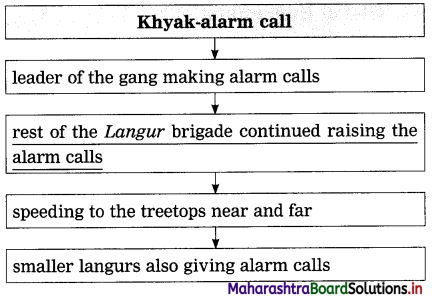
Complete the flow chart stating the reactions of the petrified Langurs due to the presence of the Leopard.
Maharashtra Board Class 12 English Yuvakbharati Solutions Chapter 1.6 Into the Wild 7
Answer:
Maharashtra Board Class 12 English Yuvakbharati Solutions Chapter 1.6 Into the Wild 8

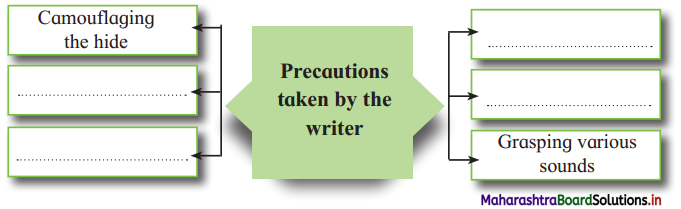
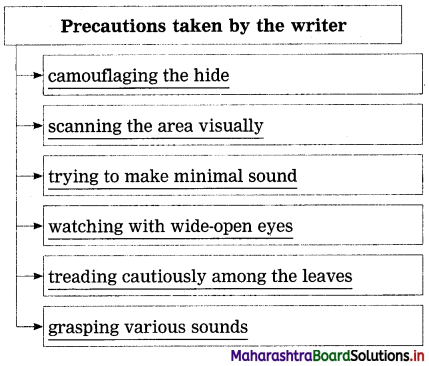
Question (vi)
Complete the web, describing each step taken by the writer as a solitary traveller while moving in the jungle with great precaution:
Maharashtra Board Class 12 English Yuvakbharati Solutions Chapter 1.6 Into the Wild 9
Answer:
Maharashtra Board Class 12 English Yuvakbharati Solutions Chapter 1.6 Into the Wild 10

Question (vii)
Complete the table explaining the qualities that you would like to imbibe from Nature within yourself and provide the reasons for the same:
Answer:

From Quality Reasons
Trees Patience Trees patiently bear up with seasons like winter and autumn, and the attacks on them by animals, birds and humans, and wait for spring, to bloom again.
Streams Perseverance Streams can even wear down rocks with their perseverance.

Maharashtra Board Solutions

(A3)

Question (i)
Choose the appropriate phrase/ expression from the extract given in the brackets: (time and again, to one’s heart’s content, in a jiffy)
(a) I was on a diet for some days but today I am going to eat ……………… .
(b) Every mother scolds her children …………… for the overuse of the mobile phone.
(c) All their educational problems were sorted out ………….. because of the funds given by an NGO.
(d) Raj ran at a ……………… to catch the train.
Answer:
I was on a diet for some days but today I am going to eat to my heart’s content.
Every mother scolds her children time and again for the overuse of the mobile phone.
All their educational problems were sorted out in a jiffy because of the funds given by an NGO.
Raj ran at a frantic speed to catch the train.

(A4)

(i) Begin the following sentences with the words given in the brackets:

Question (a)
I can guide visitors. (Visitors….)
Answer:
Visitors can be guided by me.

Question (b)
Animals are paying me back. (I……..)
Answer:
I am being paid back by animals.

Question (c)
Madegowda is employed by The Bison.
(The Bison )
Answer:
The Bison employs Madegowda.

Maharashtra Board Solutions

Question (d)
Older leopards like Pardus carry away livestock from villages. (Livestock….)
Answer:
Livestock are carried away from villages by older leopards like Pardus.

Question (e)
I have lost almost 80 per cent of a season’s yield of sugarcane. (Almost 80 per cent.)
Answer:
Almost 80 per cent of a season’s yield of sugarcane has been lost by me.

Question (f)
Tracking an animal also teaches you life lessons. (Life lessons)
Answer:
Life lessons are also taught by tracking an animal.

Question (g)
Many things have been taught to me by the forests. (The forests)
Answer:
The forests have taught me many things.

Question (h)
Resentment among locals towards the animals is created by this. (This)
Answer:
This creates resentment among locals towards the animals.

Maharashtra Board Solutions

(ii) Rewrite the sentences by using ‘not only…… but also’:

Question (i)
Rewrite the sentences by using ‘not only….but also’:
1. The petrified Langurs speeded to the trees near and far and secured their places on the treetops.
2. Umbarzara is the haven for Tigers, Leopards and Sloth Bears.
3. I crossed the cement pillar and stones stacked by the Forest Development Corporation.
Answer:
1. The petrified Langurs not only speeded to the trees near and far but also secured their places on the treetops.
2. Umbarzara is the haven not only for Tigers but also for Leopards and Sloth Bears.
3. I crossed not only the cement pillar but also the stones stacked by the Forest Development Corporation.

(A5)

Question (i)
Your college has decided to celebrate the World Environment Day. Mr. Kiran Purandare has been invited as the ‘Chief Guest’ for the event. Imagine you are the Secretary of the ‘Nature Club’ of your college and you have to conduct an interview of Mr. Kiran Purandare. Frame 8/10 questions for the same.
Answer:
Questions to interview Mr Kiran Purandare

Good morning, Sir. On behalf of the Nature Club of our college, I congratulate you on your achievements. We also loved your book ‘Sakha Nagzira’. I would like to ask you a few questions. May I? Thank you.

  1. Please tell us something about the ‘Environmental Studies’ Course that you studied’.
  2. Are there any such courses in India, especially in Maharashtra?
  3. How did you get interested in the conservation of the environment?
  4. Do you think that we, in Maharashtra, are doing enough to look after our environment?
  5. How can we get permission to spend time inside sanctuaries?
  6. You were mostly a solitary traveller inside the forest. What was the reason for this?
  7. Are there any excursions/expeditions in which you are going to participate, in the near future?
  8. How can we help you in your work?
  9. Any tips/message for our Nature Club?

Thank you, sir, for answering our questions so frankly. We wish you all the best in your future endeavours.

Maharashtra Board Solutions

Question (ii)
Imagine you have visited the jungles of Nagarhole. Write a report, to be published in your college magazine/in a local newspaper.
Answer:
A Week in a Jungle

Mysuru, 13 May: Four of us from N.S. College, Mysuru, spent a week at Nagarhole National Park (Rajiv Gandhi National Park), located in Kodagu District.

It was an exhilarating and educative week. The park is filled with waterfalls, hills, valleys, streams and forests. It is famous for its rich population of animals and birds. The Bengal Tiger, Indian Leopard, Sloth Bear, Striped Hyena, etc. are the predators that can be spotted in the park. Herbivores like Elephants, Chital, Sambar Deer and Barking Deer are also spotted around the national park.

As it was the month of May, and the water holes were drying up, plenty of animals visited the lake, and we had a grand time observing their habits from the machaan which was built for tourists. We were particularly careful not to disturb the environment by talking loudly or playing music. Hence, the animals were at their natural best. We were thrilled to see a pair of Bengal Tigers and a Leopard.

It was wonderful to see these majestic animals from such a close distance. It is truly an unforgettable experience. We could not see the Sloth Bear, but there were plenty of elephants and deer. After an experience like this one, all four of us have decided to visit various sanctuaries and take an avid interest in the wildlife of India.
– Shantanu Pratap.

Question (iii)
Shaaz has contributed towards conserving the wild animals and their habitat. Your college has decided to spread the message in society and arrange a rally. Prepare an ‘Appeal’ to ensure maximum participation informing about the day, date and other relevant details.
Answer:
Come One Come All!
Come With Friends And Family!

We need your help to save our planet!
Every species is essential for the survival of the planet.
Hence, we need to protect and conserve wild animals and their habitat.
You are the One With A Voice
Protect The Ones Without A Voice

Participate in our rally.
N.S. College Grounds To Forest Office
Date: 12 November Time: 9 a.m.
Save Animals-They Will Save You!

Maharashtra Board Solutions

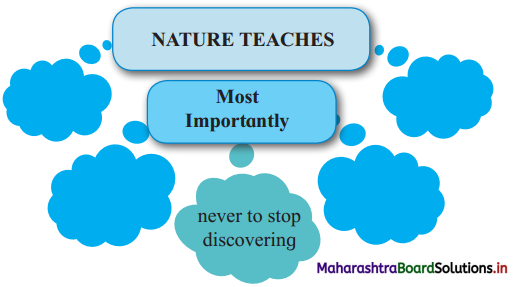
Question (iv)
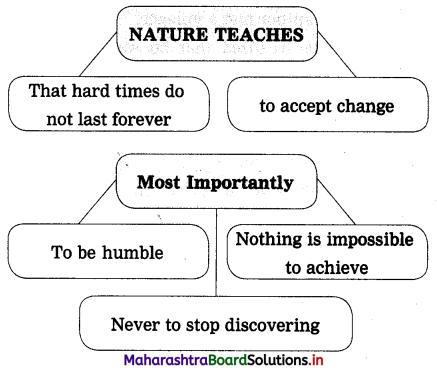
Nature is a great teacher and a guide. Complete the mind map as instructed as per the titled concept:
Maharashtra Board Class 12 English Yuvakbharati Solutions Chapter 1.6 Into the Wild 11
Answer:
Maharashtra Board Class 12 English Yuvakbharati Solutions Chapter 1.6 Into the Wild 12

(A6)

Question (i)
Surf the net and obtain more information about the conservation work done by Shaaz. Prepare posters to inspire others and display them on your college notice board.

Question (ii)
Find out the information about the I qualification and eligibility required in the professions related to wildlife such as …………

  • Forest officer/Ranger
  • Wildlife photographer
  • Environmentalist
  • Geologist
  • Tour Manager

Yuvakbharati English 12th Digest Chapter 1.6 Into the Wild Additional Important Questions and Answers

Read the extract and complete the activities given below:

Global Understanding:

Question 1.
Pick out the sentences that are false and write them correctly:
1. The narrator had made notes of the langurs in the region.
2. One has to be really alert while walking in the jungle.
3. The leopard was petrified.
4. There was a lot of noise in the jungle.
Answer:
False sentences:
1. The narrator had made notes of the langurs in the region.
3. The leopard was petrified.
Correct sentences:
1. The narrator had made notes of the birds in the region.
2. The langurs were petrified.

Maharashtra Board Solutions

Question 2.
Complete the following:
Answer:
1. Shaaz named the leopards:
(a) Saya
(b) Scarface
(c) Pardus
2. The visitors are welcomed because they can volunteer to teach a skills training class of their choice. This enables locals to find employment either at the numerous wildlife resorts in the region or in a city.

Question 3.
Correct the false statements:
1. BCRTI was founded out of the genuine urge to conserve the habitat of the wild life.
2. Shaaz failed to utilize the finance incurred out of tourism.
3. According to the local agriculturist seeing is more essential than listening.
4. There was no specific buffer zone around Nagarhole.
Answer:
False statements:
2. Shaaz failed to utilize the finance incurred out of tourism.
3. According to the local agriculturist seeing is more essential than listening.
Corrected statements :
2. Shaaz put the finance incurred out of tourism to good use.
3. According to the local agriculturist listening is more essential than seeing.

Complex Factual:

Question 1.
Pick out from the extract four sentences that show that the writer was frightened.
Answer:

  1. The evening breeze flew through my wet curled hair.
  2. My stomach was aching.
  3. My legs were trembling.
  4. The shaking of limbs had lessened a bit.

Maharashtra Board Solutions

Question 2.
Describe the meaning of the acronym BCRTI and explain its benefits to the local people.
Answer:
The BCRTI is ‘Buffer Conflict Resolution Trust of India’. It’s an agency that educates villagers who live on the fringe of the forest on the importance of conservation. Under the BCRTI umbrella, Shaaz provides locals with vocational training, with the aim of educating them on the merits of conservation and to help them benefit from tourist currency. The visitors at the resort are welcome to volunteer to teach a skills training class of their choice. The acquired skills enable locals to find employment.

Maharashtra Board Solutions

Inference/Interpretation/Analysis:

Question 1.
Explain: I was alone here like a fox:
Answer:
Foxes are solitary creatures. They move around and hunt alone. In the same way, the narrator was alone; he had come to the forest alone to do his research, and now he was going back to the village all alone. Hence, he compares himself to a fox.

Question 2.
Give the meaning of the word ‘hide’ in the context and give reasons for its usage here.
Answer:
A hide is a camouflaged shelter used to get a close view of wildlife. It is a place built to look like its surrounding. The writer was observing birds and noting their behaviour. If he was visible, the birds would not come near him or act in a natural manner. Hence, he had to build a hide, conceal himself in it and then observe birds unnoticed.

Question 3.
Give reasons:
Answer:
1. After meeting Raju, the writer and Raju both felt relaxed because now there were two of them-four eyes and four hands with a stick-to find their way out of the jungle and to battle predators.
2. The time was dreadful because it was evening and the sun was setting. Being alone in the jungle at night time with predators all around was dreadful.

Question 4.
What is called ‘silver lining’ of the trail by the writer? Why?
Answer:
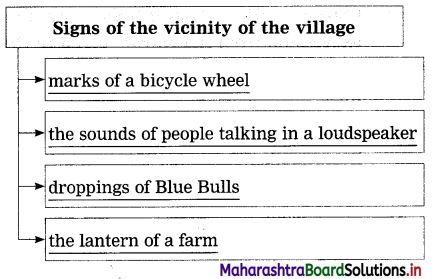
The writer had lost his way in the jungle and was desperate to find a village and civilization. Then he found a bright red soil trail with the marks of a bicycle wheel on it. These marks showed that there was a village nearby. To the frightened and desperate writer, this was like a ‘silver lining’.

Question 5.
The writer said, “There still exists a jungle where we can get lost, isn’t this our good luck?” What does he mean by this?
Answer:
Human beings have tried to take over all the natural areas of the world. We have encroached on jungles and forests, and there are human inhabitations within the jungles too. To find a jungle where there is no sign of human life, and one can still get lost, shows that there are some areas untouched by humans and left to nature. That is what the writer called ‘our good luck’.

Question 6.
Describe Shaaz’s meetings with Scarface.
Answer:
One day, at sunset, Shaaz and his companions went round a blind turn and saw an old leopard, well past his prime. Close to him was another very young, good-looking male leopard who was soon to come into his prime. It was like looking at the past and the present. It was clear that there was going to be a fight. However, they had to leave as it was sunset.

The next day, when Shaaz went back to the spot, sitting on the high rock was Scarface, blood dripping from a gash across his face. He sat there like he was the king of the jungle, and Shaaz knew that he had taken over from the old leopard, and it was a new journey for both of them.

Maharashtra Board Solutions

Question 7.
Find: The Bison is
Answer:
The Bison is an eco-friendly wildlife camp in South India. It offers some great opportunities for youngsters to learn about the area, people, the man-animal conflict, eco-tourism and hotel management.

Personal Response:

Question 1.
Describe a safari you have been on or a trip through a forest. Narrate your experience in brief.
Answer:
I have gone to the Periyar National Park in Kerala. It is in the Western Ghats. This wildlife sanctuary is home to tigers and elephants. There are also deer, leopards and Indian bison. I have also been on a boat ride in the Periyar Lake. It was a wonderful experience to see tigers drinking at the watering holes. I really enjoyed the experience and will repeat it as soon as I can.

Question 2.
Have you ever been lost/lost your way? Narrate the experience.
Answer:
Yes, once when I was in Panchgani with my family I got lost. I decided to go for a walk alone. I set out without finding out the name of the road on which our hotel was situated. As I was walking, it suddenly began to rain heavily, and got quite dark. When I looked around I found that I was in a sort of a jungle. I was terrified; then I met a villager, but he could not help me. I did not even have my cellphone with me. I was in tears when all at once I saw my hotel. I had walked round in circles! I was very relieved. It was indeed a frightening experience.

Question 3.
How do you relax at the end of a tiring day? Give a brief description.
Answer:
At the end of a tiring day, I pick up a nice book or watch a good film on TV or Netflix. This relaxes me completely. If I go to sleep j directly, I am too tired and do not get good sleep. But if I spend half an hour or so unwinding, I really feel relaxed and sleepy.

Question 4.
Would you like to meet wild animals face to face? Give reasons to support your answer.
Answer:
No, I would not. I like to see wild animals only on TV. I feel that we should not intrude into their territory, and leave them to live in peace. Besides, they are wild and not tame, and one never knows how they may behave. I have read about a lot of people being killed by wild animals.

Maharashtra Board Solutions

Language Study:

Question 1.
The surroundings were reminding me.
(Rewrite, beginning the sentence with ‘I…)
Answer:
I was being reminded by the surroundings.

Question 2.
I had apparently entered in the sanctum sanctorum of a miracle called leopard.
(Pick out the finite verb/s and state the tense.)
Answer:
had entered – past perfect tense.

Question 3.
Raju was amazed at my solitary visits to Umbarzara.
(Rewrite beginning ‘My solitary’)
Answer:
My solitary visits to Umbarzara amazed Raju.

Question 3.
Then we both resumed our walking tour, (Identify the part of speech of the underlined word.)
Answer:
walking-present participle acting as an adjective.

Question 4.
I found a bright red soil trail. (Rewrite beginning with‘A ’.)
Answer:
A bright red soil trail was found by me.

Maharashtra Board Solutions

Question 5.
I had no other way to climb the hillock before me. (Rewrite as an affirmative sentence.)
Answer:
This was the only way I had to climb the hillock before me.

Question 6.
I climbed one more hillock and tried to locate signs of human civilization. (Rewrite beginning ‘Climbing’.)
Answer:
Climbing one more hillock, I tried to locate signs of human civilization.

Question 7.
The behaviour of the first black panther is being documented. (They….)
Answer:
They are documenting the behaviour of the first black panther.

Question 8.
All the research on the animal has been done through camera traps. (They….)
Answer:
They have done all the research on the animal through camera traps.

Question 9.
Shaaz recalls the incident with great clarity.
(Rewrite the sentence replacing the underlined expression with a single word.)
Answer:
Shaaz recalls the incident clearly.

Maharashtra Board Solutions

Question 10.
Unfortunately, the sun was setting and we had to leave. (Rewrite using ‘because’.)
Answer:
Unfortunately, we had to leave because the sun was setting.

Question 11.
Use the word ‘guide’ as a noun and a verb in two separate sentences:
Answer:
1. We can guide children to behave well. {verb)
2. I hired a local guide to show me the sights of the palace, {noun)

Question 12.
The black panther has taught me patience. (Rewrite using the adjective form of the underlined word.)
Answer:
The black panther has taught me to be patient.

Question 13.
Listening is a sense far more important than sight. (Rewrite using ‘as…as…’)
Answer:
Sight is a sense not as important as listening.

Vocabulary:

Question 1.
Guess the meaning of the following words :

  1. upheaval
  2. predator
  3. hovering
  4. antelope

Answer:

  1. upheaval – uproar; disturbance.
  2. predator – an animal that preys on other animals.
  3. hovering – fluttering in the air.
  4. antelope – deer-like animal with hollow horns.

Question 2.
Give the meaning of the phrase ‘to stay put’ and use it in your own sentence.
Answer:
to stay put:
Meaning: remain somewhere without moving.
Sentence: My mother told me to stay put near the entrance when she went to buy the train ticket.

Maharashtra Board Solutions

Question 3.
Write two adjectives from the extract used for the leopard.
Answer:
mighty, elusive.

Question 4.
Choose the correct option for: spooked –
(a) frightened
(b) happy
(c) angry
Answer:
frightened

Question 5.
Find the contextual meaning of‘stacked’:
Answer:
stacked – piled one on top of the other

Question 6.
Guess the meaning of ‘in a jiffy’:
Answer:
in a jiffy – in a moment; very soon

Question 7.
Make sentences of your own using the words:
1. slumped
2. stumbled
Answer:
1. slumped: I was so tired after the trek that I slumped onto my bed and fell I asleep immediately.
2. stumbled: I did not see the stone in the middle of the road and stumbled over it.

Maharashtra Board Solutions

Question 8.
Guess the meaning of:
1. ‘felines’
2. chronicler
Answer:
1. felines: belonging to the cat family,
2. chronicler: a person who records something.

Question 9.
Pick out two pairs of antonyms from the : extract:
Answer:
1. old × young
2. past × present

Question 10.
Write the noun forms of:

  1. famous
  2. enviable
  3. collect
  4. including

Answer:

  1. famous – fame
  2. enviable – envy
  3. collect – collection
  4. including – inclusion

Question 11.
Write the adjective forms of the following:

  1. incursion
  2. territory
  3. resentment
  4. occasion
  5. employment
  6. region

Answer:

  1. incursion – incursive
  2. territory – territorial
  3. resentment – resentful
  4. occasion – occasional
  5. employment – employable
  6. region – regional ?

Maharashtra Board Solutions

Question 12.
Choose the correct simple past tense forms of the following from the brackets:

  1. teach – (teached, teaching, taught)
  2. lose – (loser, lost, loose)
  3. put – (put, putted, putting)
  4. learn – (lean, learnt, learns)

Answer:

  1. teach – taught
  2. lose – lost
  3. put – put
  4. learn – learnt.

Non Textual Grammar:

Do as directed:

Question 1.
He had won a prize in the drawing competition. (Rewrite using the future perfect tense of the verb.)
Answer:
He will have won a prize in the drawing competition.

Question 2.
How could I call him a liar? (Rewrite as an assertive sentence.)
Answer:
I could not call him a liar.

Question 3.
All other things are unimportant. (Add a question tag.)
Answer:
All other things are unimportant, aren’t they ?

Spot the error in the following sentences and rewrite them correctly:

Question 1.
Unless you do not listen to his advice, I am not going to help you.
Answer:
Unless you listen to his advice, I am not going to help you./If you do not listen to his ? advice, I am not going to help you.

Maharashtra Board Solutions

Question 2.
Hardly had I reached the airport where I heard about the change in plans.
Answer:
Hardly had I reached the airport when I heard about the change in plans.

12th Std English Questions And Answers:

On Saying “Please” 12th Question Answer English Chapter 1.2 Maharashtra Board

Class 12 English Chapter 1.2

Balbharti Yuvakbharati English 12th Digest Chapter 1.2 On Saying “Please” Notes, Textbook Exercise Important Questions and Answers.

Class 12 English Chapter 1.2 On Saying “Please” Question Answer Maharashtra Board

12th Std English Chapter 1.2 Brainstorming Question Answer

Yuvakbharati English Navneet 12th Digest PDF Free Download Maharashtra Board

Question 1.
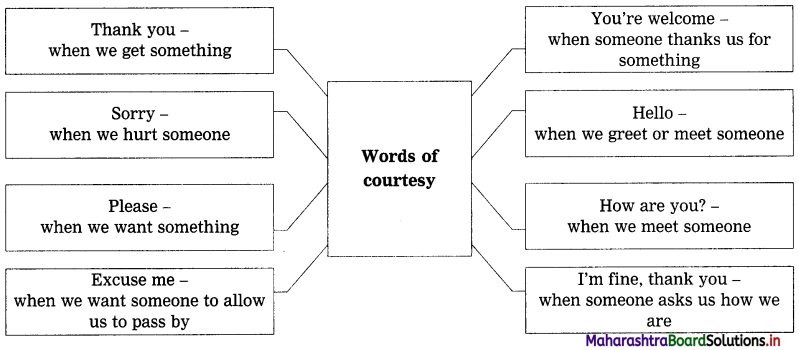
List the words of courtesy that we use in our daily life. Discuss them with your partner and explain the purpose of using each.
Maharashtra Board Class 12 English Yuvakbharati Solutions Chapter 1.2 On Saying “Please” 1
Answer:
Maharashtra Board Class 12 English Yuvakbharati Solutions Chapter 1.2 On Saying “Please” 2

Question 2.
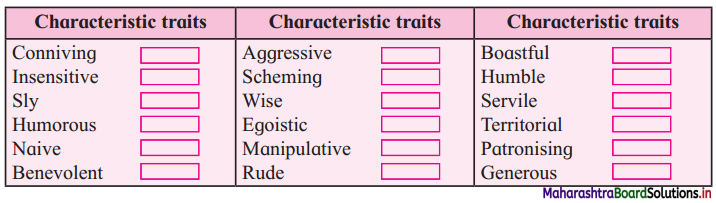
Listed below are a few character traits of people. Some are positive traits, while others are not. Tick [✓] the ones you feel are desirable.
Maharashtra Board Class 12 English Yuvakbharati Solutions Chapter 1.2 On Saying “Please” 3
Answer:
Maharashtra Board Class 12 English Yuvakbharati Solutions Chapter 1.2 On Saying “Please” 4

Question 3.
Etiquette and manners are very important for a person to live in the society. Read the following and put them in proper columns:

  1. To receive phone calls while you are in a lecture or class.
  2. To knock before you enter your Principal’s office.
  3. To thank the person who offers you tea or coffee.
  4. To be polite and courteous to others.
  5. To leave the classroom without the teacher’s permission.
  6. To occupy the seats reserved for ladies or physically challenged or elderly people on a bus or a train.

Answer:

Appropriate Inappropriate
1. To knock before you enter your Principal’s office. 1. To receive phone calls while you are in a lecture or class.
2. To thank the person who offers you tea or coffee. 2. To leave the classroom without the teacher’s permission.
3. To be polite and courteous to others. 3. To occupy the seats reserved for ladies or physically challenged or elderly people on a bus or a train.

(A1)

Question (i)
Form groups and explain the following words with examples:
Answer:
1. Humility: being free from pride and arrogance – greatest example our former President Dr. A.P.J. Abdul Kalam – remember that ‘pride comes before a fall’ – always realize that there are people better than you are – Socrates said ‘One thing only I know, and that is that I know nothing. ’
2. Self-esteem: self-respect; confidence in one’s own worth or abilities – accept oneself as one is – everyone is different and unique – highly positive quality – leads to achievements, success, healthy relationships – can be developed with a little effort.
3. Gratitude: thankfulness for something that you have got – ready to show appreciation for something – towards the Almighty, towards those who have helped you – strengthens relationships with others – creates positivity.
4. Courtesy: means good manners and polite behavior – means being kind and compassionate towards others – should be real, not artificial – creates good impression – one will be liked by all – human quality not present in animals.
5. Generosity: kindness; big-heartedness – the act of being kind, selfless and giving towards others – very positive trait – influences others – when one is generous, one feels good – many religions consider this a great virtue – encourage charity.
6. Sympathy: feelings of pity and sorrow for someone else’s misfortune – leads to stronger relationships – offering condolences when someone dies – helps us to bond with others-makes the other person’s distress less – beautiful emotion – should be developed.
7. Empathy: the ability to understand and share the feelings of another – putting yourself in the shoes of the other person – different from kindness or pity – listen when people talk – see things from the other person’s point of view – makes one a very humane person.

Question (ii)
Have a Group Discussion on the topic ‘The need of soft skills at the workplace’. Use the following points:
Answer:
(a) Written and verbal communication (writing notes, letters, memos, reports, instructions, speeches, presentations, etc.)
(b) Ways of interacting with others (showing courtesy, sympathy, cooperation, empathy, strictness, gratitude, humility, team work, etc.)
(c) Creative abilities (preparing reports, presentations, letters, etc.)
(d) Emotional intelligence (showing understanding, compassion, empathy, team work, motivation, self-awareness, etc.)

(A2)

Question (i)
Read the text and state whether the following statements are True or False. Correct the False statements.
(a) Bitter problems in day-to-day life can be solved by sweet words.
(b) Great wars could have been avoided by a little courtesy.
(c) Observance of etiquette in a normal situation is important but more important is their observance when the situation is adverse.
(d) Words like ‘please’ and ‘thank you’ help us in making our passage through life uneasy.
(e) The law permits anybody to use violence, if another person is discourteous.
Answer:
True statements:
(a) Bitter problems in day-to-day life can be solved by sweet words.
(b) Great wars could have been avoided by a little courtesy.
(c) Observance of etiquette in a normal situation is important but more important is their observance when the situation is adverse.

False statements:
(d) Words like ‘please’ and ‘thank you’ help us in making our passage through life uneasy.
(e) The law permits anybody to use violence, if ; another person is discourteous.

Corrected statements :
(d) Words like ‘please’ and ‘thank you’ help us in making our passage through life easy.
(e) The law does not permit anybody to use violence, if another person is discourteous.

Question (ii)
Select the most appropriate sentences which suggest the theme of the essay.
(a) The essay tells us about courtesy, civility, morality, responsibility and control.
(b) The essay explores the difficulties that can be incurred by an individual when dealing with the public.
(c) One can keep one’s peace of mind without having to lower themselves to the level of the perceived offender.
(d) People with low self-esteem are generally difficult to work with and they look down upon others to get a feeling of superiority.
Answer:
(a) The essay tells us about courtesy, civility, morality, responsibility and control.
(c) One can keep one’s peace of mind without having to lower themselves to the level of the
perceived offender.

(iii)

Question (a)
Find the reasons for the liftman’s uncivilized behaviour.
Answer:
Reasons for the liftman’s uncivilized behaviour when the passenger was rude and ill-mannered towards him:

  1. he was acutely hurt by the slur cast by the passenger on his social status
  2. the passenger’s discourtesy was a wound to his self-respect
  3. he felt insulted by the passenger’s discourtesy.

Question (b)
List the people and their behaviour that made the passenger rude and ill- mannered.
Maharashtra Board Class 12 English Yuvakbharati Solutions Chapter 1.2 On Saying “Please” 5
Answer:
The people who made the passenger rude and ill-mannered:
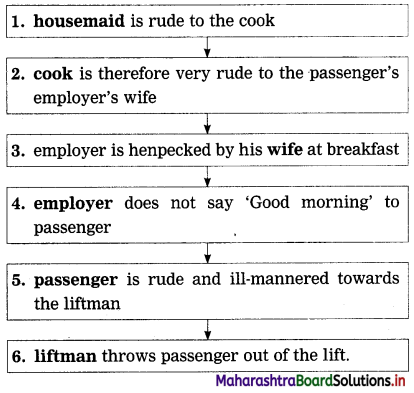
[housemaid] → [cook] → [employer’s wife] → [employer] → [passenger] → [lift-man]

Question (iv)
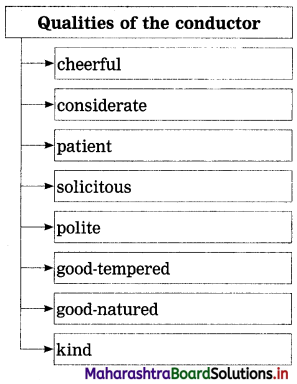
Good manners are required in our daily life for making our social contacts more cooperative and friendly. Illustrate the behaviour of the polite conductor with different people in various situations.
Maharashtra Board Class 12 English Yuvakbharati Solutions Chapter 1.2 On Saying “Please” 6
Answer:

Situation Behaviour
1. The writer’s sensitive toe was trampled on The conductor said sorry with an apology and courtesy.
2. In the rainy season dealing with people He would run up the stairs to give someone the tip that there was “room inside”.
3. Dealing with old people He was as considerate as a son.
4. Dealing with children He was as solicitous as a father.
5. Dealing with young people He always indulged in some merry jest with them.
6. Dealing with a blind man He set him down safely on the pavement and then took him wherever he wanted to go, after telling the driver to wait for a while.

Question (v)
Discuss and Write the impact of good temper and kindliness on society in the light of the good-mannered conductor.
Answer:
The conductor was always cheerful and kind-hearted to everyone in the bus. This spread to his passengers and they too became cheerful and good-humored. They would naturally pass on this feeling after getting off the bus. Thus, in society, if people are good-tempered, cheerful and kind, it will spread to others and they too will start behaving in a similar manner. This will lead to a happy and compassionate society.

Question (vi)
‘A modest calling can be made dignified by good temper and kindly feeling’. Explain the statement with examples.
Answer:
This means that whatever career or job one has, however simple or modest, it can be made more dignified by behaving in a good- tempered and cheerful manner and with kindliness towards the people one comes in contact with. For example, even a simple job like that of a security guard at a mall can be made pleasant and dignified if the guard smiles and says ‘Thank you’ or ‘Good morning’ every time he/she checks a person.

A sweeper’s job can also be made more dignified if he/she just nods and smiles at passers-by or helps them if they are in need.

Question (vii)
The service of the police is necessary for the implementation of law in our society. Do you think you require this service for a good social environment? Discuss and write.
Answer:
No, we cannot have the police monitoring us for social and moral offences. For example, one cannot be punished if one refuses to smile at an acquaintance or say Thank you’. One cannot be punished if one doesn’t hold the door open for the person who is following.

These are good manners, or courtesy, and they have to be taught right from childhood, and they will change in different cultures and different circumstances. Whether a person follows them or not depends on the individual. However, if these little courtesies are followed, life will become much simpler and more pleasant for everyone.

(A3)

Question (a)
Find out the words in Column B which collocate with the words in Column A:
Maharashtra Board Class 12 English Yuvakbharati Solutions Chapter 1.2 On Saying “Please” 7
Answer:

A B Answer
regular meal regular exercise
mid day concept mid-day meal
key food key concept
fast exercise fast food
try decorated try hard
richly hard richly decorated
free jam free time
traffic time traffic jam
social animal social justice
wild justice wild animal

Question (b)
Learning collocations is essential for making your English sound fluent and natural. Make the following collocations and use them in your own sentences.
Maharashtra Board Class 12 English Yuvakbharati Solutions Chapter 1.2 On Saying “Please” 8
Sentences:
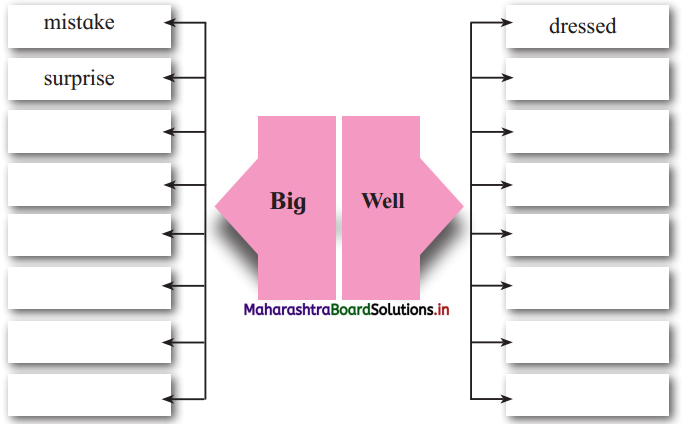
(1) BIG:

  1. It was a big mistake to hold a party on a rainy day.
  2. “Did you get a big surprise when you saw me?” asked the little girl to her mother.
  3. There was a big welcome waiting for the winning team.
  4. The hungry beggar prayed that he would get a big meal at the rich man’s home.
  5. Writing the difficult exam was no big deal for the intelligent boy.
  6. Rohan realized that it would be a big challenge for him to win the match.
  7. The discovery of a new element was big news in the scientific community.
  8. Losing the beauty contest was a big shock for the arrogant girl.

(2) WELL :

  1. The well-dressed man jumped over the puddle carefully.
  2. The advice the teacher gave Rita was well-meant, but Rita did not like it.
  3. The cook was happy to see the well-stocked cupboard.
  4. Little Naina was well-pleased with her birthday gift.

Question (ii)
Sometimes while using a word in a sentence, we have to change its word class. we can make several more words from the root word.
we can make several new words from the root word.
I asked Sumit to ……………. my pencil for me. (sharp).
I asked Sumit to sharpen my pencil for me.

Question 1.
Now read the following sentences and use the words given in the brackets. Change the word class and rewrite the sentences.
(a) Leena was eating a very …………. apple and obviously enjoying it. (crunch)
(b) This picture looks …………… (colour)
(c) I’m afraid that your behaviour is just not ……………. (accept)
(d) I like my elder brother. He is very ……………. (help)
Answer:
(a) Leena was eating a very crunchy apple and obviously enjoying it.
(b) This picture looks colourful.
(c) I’m afraid that your behaviour is just not acceptable.
(d) I like my elder brother. He is very helpful.

Complete the following table. Put a cross if a word class does not exist.
Maharashtra Board Class 12 English Yuvakbharati Solutions Chapter 1.2 On Saying “Please” 9

Question (iii)
Write appropriate expressions and words you have to use while facing an interview :
Answer:
(a) May I come in?
(b) May I have a seat?
(c) Thank you.
(d) I’m sorry, but I did not catch what you said.
(5) Please let me know

Question (b)
You are writing a letter of complaint. List the proper expressions that you would like to write.
Answer:

  1. I disagree.
  2. I’m sorry to say that….
  3. I would like to suggest….
  4. This was not expected from a company like yours.
  5. Please replace the defective piece as soon as possible.

Question (iv)
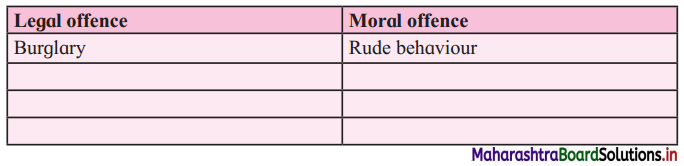
Distinguish between a legal offence and a moral offence on the basis of the extract.
Maharashtra Board Class 12 English Yuvakbharati Solutions Chapter 1.2 On Saying “Please” 10
Answer:

Legal offence Moral offence
Burglary Rude behaviour
Assault Discourtesy
Battery Haughtiness
Laceration of one’s feelings

Question (v)
Find out the meaning of the phrase ‘give and take’ and use it in your own sentence.
Answer:
give-and-take – Meaning: exchange of ideas Sentence – The TV stars engaged in an interesting give-and-take which was enjoyed by the audience.

Question (vi)
Complete the table with polite expressions that we must use in our day-to-day life:
Maharashtra Board Class 12 English Yuvakbharati Solutions Chapter 1.2 On Saying “Please” 11
Answer:

Don’ts Dos
I want a cup of tea. I would like to have a cup of tea.
Send me the mail. Please send me the mail.
Go away or leave me alone. Please let me be by myself.
You are wrong. Are you sure you’re right?
That’s a bad idea. That is not a very good idea, is it?
Your work isn’t good. Your work can do with some improvement

(A4)

Question (i)
Edit the given paragraph using a/ an/the wherever necessary:
Rakesh is a/an ideal son who remains devoted to his father as he grows professionally to become a/the famous doctor. As his father grows old, he takes care to spend time with his father, bringing him tea in a/the morning and taking him out for a/the walk in an/the evening.
Answer:
Rakesh is an ideal son who remains devoted to his father as he grows professionally to become a famous doctor. As his father grows old, he takes care to spend time with his father, bringing him tea in the morning and taking him out for a walk in the evening.

Question (ii)
Spot the errors in each of the following sentences and correct the incorrect ones:

Question (a)
Radha brought pens and distributed them between her five children.
Answer:
Radha bought pens and distributed them among her five children.

Question (b)
Jayshree and Sujata sat besides each other in complete silence.
Answer:
Jayshree and Sujata sat beside each other in complete silence.

Question (c)
His best friend Vijay was blind within one eye.
Answer:
His best friend Vijay was blind in one eye.

Question (d)
One could dare to encroach on his rights.
Answer:
One could not dare to encroach on his rights.

Question (e)
She was taken with surprise when she saw the famous Taj Mahal.
Answer:
She was taken by surprise when she saw the famous Taj Mahal.

Question (f)
It is not possible to exchange the goods once the sale has been completed.
Answer:
It is not possible to exchange goods once the sale has been completed, (‘the’ is deleted.)

Question (g)
Dr. Sengupta has been trying to master the craft for the last five years.
Answer:
No error in this sentence.

Question (h)
The top-ranking candidates will be appointed in senior jobs in banks.
Answer:
The top-ranking candidates will be appointed | to senior jobs in banks.

Question (i)
She knows very well what is expected from her but she is unable to perform.
Answer:
She knows very well what is expected of her but she is unable to perform.

Question (j)
They will put on a note in this regard for your consideration.
Answer:
They will put up a note in this regard for your consideration.

Question (iii)
Read the following.
Santosh purchased a computer. He read the operating manual and followed the instructions.
(a) He linked the monitor, keyboard and printer.
(b) He plugged in the main cable.
(c) He switched on the monitor at the back.
(d) When the light appeared on the screen, he placed the Day Disk in Drive A.
(e) He pushed in the disk until the button clicked out.
(It took about 30 seconds for the computer to load the program.)
(f) He pressed the Drive button and the disk shot out.
(g) He replaced the Day Disk with the Document Disk.
(h) He pressed function key 7.
Convert these sentences into passive voice by filling in the blanks.

Firstly the monitor, keyboard and printer were linked up. Then the main cable was plugged in. The monitor was switched on at the back. When the light appeared on the screen, the Day Disk was placed in Drive A. The disk was pushed in until the button clicked out. It took the computer 30 seconds to load the program. The drive button was pressed and the disk shot out. The Day Disk was replaced with the Document Disk. Finally, the function key 7 was pressed. The word processor was then ready to use.

(A5)

Question (i)
Write a speech on ‘Courtesy is the light of life’ with the help of the following points.
(a) People have a good impression of you.
(b) You will be acknowledged and appreciated by all.
(c) You will he happier and contented with life.
Answer:
Courtesy is the light of life
Dear friends,

Good morning. You may be surprised with the topic I have chosen for this speech, for today the word ‘Courtesy’ seems to be an old-fashioned word for us. But it is really the light of life. I, Shivam Goswami, would like to say a few words on why I think so.

First of all, what does courtesy mean? It means good manners and polite behaviour. It means being kind and compassionate towards someone. When you are courteous, people have a good impression of you; but that is not the reason for being courteous. Politeness should be real, and not artificial.

A courteous person will be appreciated by all. People will like to spend time with him/her and find pleasure in the person’s company. Someone may ask ‘What is courteous behaviour’? Saying simple words like ‘Please’, ‘Thank you’, ‘Excuse me’ and ‘Sorry’ is courteous behaviour. Helping a person who has fallen is courteous behaviour. Holding the lift door open for someone is courteous behaviour.

When a person is courteous, people are automatically courteous in return. This leads to a more polite and happier society. As I conclude, I would like to ask all of you to do something for a week: Be courteous. Then you will see the returns and realize the truth of what I am saying. Thank you for listening to me so patiently. Bye.

Question (ii)
‘Manners maketh man’ – Expand the idea in your own words with proper examples.
Answer:
Manners maketh man

‘Manners maketh Man’ : so goes a famous saying. In the world of today, people are judged by their manners and conduct. Manners distinguish us from animals, and make us human. A person who is courteous and considerate towards others is said to possess good manners. Such a person is respectful to his superiors, courteous to his equals and sympathetic towards his subordinates. He always shows concern for the well-being and comfort of others. He uses words like ‘Please’, ‘Thank you’ and ‘Sorry’ while talking to others; he helps senior citizens and those in need.

Everyone likes a person who speaks and behaves politely and treats others respectfully. Good manners cost practically nothing but can buy everything. They win us friends and help us influence people. They make the world a happier place to live in by reducing friction and avoiding tension.

When we meet a person for the first time, it is the person’s courtesy which impresses us deeply. Good manners are generally taught by parents at home, and by teachers in school. Manners that are learnt during childhood generally remain with us throughout our lives. They become a part of our personality. Hence, it is desirable that good manners are instilled in children when they are very young, so that they grow up to become courteous, considerate adults.

(A6)

Question (i)
Read A. G. Gardiner’s essay “The Open Window’ and compare its theme with the essay ‘On Saying “Please.”

Question (ii)
‘Nothing clears up my spirits like a fine day’ – Keats. Collect information of the poet Keats and write it in your notebook.

(A7)

Question (i)
Soft skills are required in all walks of life including careers and industries. They are increasingly becoming the essential skills of today’s workforce. Soft skills are an integral part of finding, attracting and retaining clients also. Highly developed presentation skills, networking abilities, and etiquette awareness can help you win new clients and gain more work. The following are considered the most important soft skills.
image

Question (ii)
Following are some of the institutions where you will get the courses related to soft skills.
(a) Indian Institute of Management, Ahmedabad, Gujarat
(b) Indian School of Business Management, Hyderabad
(c) XLRI – Xavier School of Management, Jamshedpur
(d) Indian Institute of Foreign Trade, New Delhi
Jobs available at –

  • Customer service centre
  • Management schools
  • Hotel industry, etc.

Yuvakbharati English 12th Digest Chapter 1.2 On Saying “Please” Additional Important Questions and Answers

Read the extract and complete the activities given below.:

Global Understanding:

Question 1.
Read the following sentences and find out True and False sentences. Correct the false sentences:
1. The liftman invited the passenger into the lift.
2. If you knock down a burglar, the law will acquit you.
3. There is no legislation against bad manners.
4. The complainant had to pay a fine.
Answer:
True sentences:
2. If you knock down a burglar, the law will acquit you.
3. There is no legislation against bad manners.

False sentences:
1. The liftman invited the passenger into the lift.
4. The complainant had to pay a fine,

Corrected sentences:
1. The liftman threw the passenger out of the lift.
4. The liftman had to pay a fine.

Question 2.
Explain the penalty, if any, that one has to pay if one is rude or boorish.
Answer:
There is no penalty to pay if one is rude or boorish except the penalty of being called a ill-mannered person.

Question 3.
The behaviour of the people who made the passenger rude and ill-mannered:
Answer:
Maharashtra Board Class 12 English Yuvakbharati Solutions Chapter 1.2 On Saying “Please” 12

Question 4.
Complete the following:
(The answers are given directly and underlined.)
Answer:
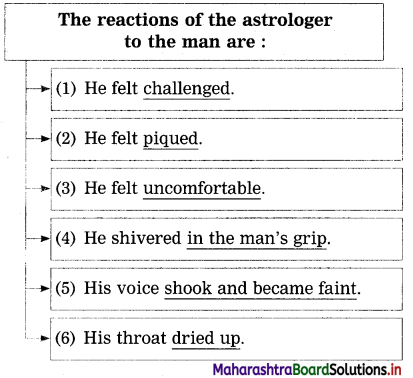
  1. The first requirement of civility is that we should acknowledge a service.
  2. The Underground Railway Company insists that their employees are civil.
  3. The words which make life smooth are ‘please’ and ‘thank you’.
  4. The job of a bus conductor is very difficult and sometimes painful.

Question 5.
Tick mark the correct words:
(The answers are marked directly.)
Answer:

  1. The author finally found/did not find the money for the ticket.
  2. The author thought he had left home with/ without any money.
  3. The conductor gave/did not give the author a ticket.
  4. The author was pleased/displeased with the conductor.

Question 6.
Complete the web by choosing the correct words from the brackets that describe the conductor: (mean cheerful considerate grumpy patient solicitous impatient polite irritable good-tempered haughty good-natured kind)
Answer:
Maharashtra Board Class 12 English Yuvakbharati Solutions Chapter 1.2 On Saying “Please” 13

Question 7.
Complete the following :
(The answers are given directly and underlined.)
Answer:
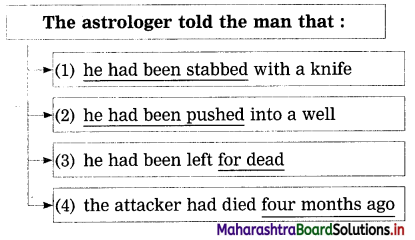
  1. A modest career can he made dignified by good temper and kindly feeling.
  2. The law can only protect us against material) attack.
  3. The narrator says he does not want to apologise for praising an unknown bus conductor.
  4. A man who is polite may lose material advantage but he always has the spiritual victory.

Complex Factual:

Question 1.
Explain what the liftman wanted the passenger to do, and what happened afterwards.
Answer:
The passenger, on entering the lift, said ‘Top’. The liftman wanted him to say ‘Top please’. The passenger refused to do so. The liftman, instead of taking him to the top floor, threw him out of the lift.

Question 2.
Explain the sentence: The pain of a kick on the shins soon passes away but the pain of a wound to our self-respect or our vanity may poison a whole day.
Answer:
This means that if we are physically attacked i and injured, the pain of the wounds will soon heal and be forgotten. But if our self-respect or pride is hurt, it may poison our lives and behaviour for a much longer time.

Question 3.
It is not possible for the law to become the guardian of our private manners. Explain.
Answer:
The area of moral offences is quite vast and no laws or commandments can cover this area. In addition, social civilities, speech and manners are of so many types and the interpretation of these (whether they are good or bad) is so different that no court could administer a law which governed them. Hence, it is not possible for the law to become the guardian of our private manners.

Question 4.
Mention a couple of ways to keep the machine of life oiled and running sweetly.
Answer:
We can keep the machine of life oiled and running sweetly by using courteous words like ‘Please’ and ‘Thank you’ to acknowledge a service.

Question 5.
Complete the following:
(The answer is given directly and underlined.)
Answer:
The public owes much to the Underground Railway Company because they insist on a certain standard of civility in their employees, and take care that the standard is observed.

Question 6.
Complete the table:
Answer:

The words Who said! To whom When
1. “I haven’t a copper on me.” The narrator The conductor When the conductor and the narrator found that he had left home without any money in his pocket.
2. “Oh, you’ll see me some day alright.” The conductor The narrator When the narrator address) he could send the borrowed asked where (to which money.
3. “Where shall I send the fare?” The narrator The conductor When the narrator wanted to repay the ticket money to the conductor.
4. “Where do you want to go?” The conductor The narrator When the narrator explained that he did not have any money on him, and the conductor

Question 7.
Write the narrator’s opinion about how the liftman should have dealt with the passenger’s uncivility. Give reasons for the same.
Answer:
In the opinion of the writer, the liftman, instead of throwing the passenger out of the lift, should have treated him with elaborate politeness. He would have then had the victory not only over the rude passenger, but also over himself, and that was the spiritual victory that was more important. His revenge would then have been more subtle and effective.

Inference/Interpretation/Analysis :

Question 1.
Name the ‘unpleasant specimen’ mentioned in the extract and describe his behaviour.
Answer:
The ‘unpleasant specimen’ mentioned in the extract is the type of bus conductor who regards his passengers as natural enemies whose chief purpose on the bus is to cheat him, and who can only be kept honest by using a loud voice and an aggressive manner.

Question 2.
Describe the stale old trick, according to the conductor.
Answer:
Pretending that you have forgotten your purse at home, and hence do not have the fare for the ticket is a stale old trick, according to the conductor. (The conductor does not say this the narrator only imagines that he may do so.)

Question 3.
Describe the reactions of the bus conductor.
Answer:
No, the conductor did not think that the narrator was dishonest. He cheerfully accepted what the narrator said without doubting him and offered him a free ticket.

Question 4.
Describe the experience which made the narrator comfortable in the bus.
Answer:
The conductor had trampled on the narrator’s sensitive toe, causing him pain and agony. However, the conductor had then explained matters and apologized so profusely that the narrator forgot his pain and anger. After this experience, the narrator always observed his constant good nature and cheerful behaviour with pleasure and felt comfortable in his presence.

Question 5.
Describe the narrator’s justification of his praise of the conductor.
Answer:
The narrator says that if the famous poet Wordsworth could gain wisdom from a poor leech-gatherer, he sees no reason why ordinary people should not take lessons on conduct from a bus conductor, who shows how a modest job can be made more dignified by behaving in a good-tempered and cheerful manner and with kindliness towards the people one comes in contact with.

Personal Response:

Question 1.
Describe a person you have come across who is always polite and helpful. What do you think about him/her?
Answer:
The security guard of our building is always polite and helpful. He will help senior citizens get in and out of their cars or into the lift; he will help any person who has heavy bags. He also replies politely to any question asked by anyone. We all like him very much and often share our chocolates and biscuits with him. We also give him books, stationery and toys for his little child.

Question 2.
Describe a pleasant/unpleasant experience you have had with a bus conductor.
Answer:
This is an experience I had when I was new to Mumbai. I got into a bus and asked the conductor for a ticket to Dadar. The conductor shook his head and told me that I had got into the bus going in the wrong direction. He patiently explained that I would have to get off at the next stop, cross the road, and catch a bus having the same number but going in the opposite direction. He even pointed out the bus stop to me. Though I felt a bit embarrassed, I thanked him for his kindness.

Question 3.
Give your opinion about the conductor’s behaviour.
Answer:
The conductor was really a good and kind human being who saw the best in everyone and believed everyone. He was ready to pay the fare for the narrator’s ticket himself, even though he was not sure whether it would be returned. It is difficult to find such generous and helpful people in the world today, and it leaves a very pleasant feeling in the heart when you do.

Language Study:

Question 1.
The law does not compel me to say ‘Please’.
(Rewrite as an interrogative sentence.)
Answer:
Does the law compel me to say ‘Please’?

Question 2.
It was a question of ‘Please’.
(Add a question tag.)
Answer:
It was a question of ‘Please’, wasn’t it?

Question 3.
It will permit me to retaliate with reasonable violence.
(Pick out the finite and non-finite verbs.)
Answer:
will permit – finite verb;
to retaliate – non-finite verb (infinitive)

Question 4.
The pain of a wound to our self-respect may poison a whole day.
(Pick out the auxiliary and state its function.)
Answer:
may – possibility

Question 5.
For there are few things more catching than bad temper.
(Write the part of speech of the underlined word.)
Answer:
Gerund

Question 6.
Bad manners probably do more to poison the stream of general life than all the crimes in the calendar. (Rewrite in the present perfect tense.)
Answer:
Bad manners have done probably more to poison the stream of general life than all the crimes in the calendar.

Question 7.
There is a social practice much older and much more sacred than any law which enjoins us to be civil.
(Rewrite using ‘not only … but also… ’)
Answer:
There is a social practice not only much older but also much more sacred than any law which enjoins us to be civil.

Question 8.
Most people will have a certain sympathy with him. (Rewrite using the verb form of the underlined word.)
Answer:
Most people will sympathize with him.

Question 9.
Here and there you will meet an unpleasant specimen who regards the passengers as his natural enemies. (Replace the verb in the future tense with a modal auxiliary showing possibility.)
Answer:
Here and there you might meet an unpleasant specimen who regards the passengers as his natural enemies.

Question 10.
I had left home without any money in my pocket. (Pick out the verb and state the tense.)
Answer:
had left-past perfect tense.

Question 11.
I know that stale old trick.
(Rewrite beginning ‘That stale old trick ’.)
Answer:
That stale old trick is known to me.

Question 12.
I said it was very kind of him.
(Identify the clauses.)
Answer:
I said – main clause
it was very kind of him – subordinate noun clause

Question 13.
I began to observe him whenever I boarded his bus. (Pick out the subordinate clause and state the type.)
Answer:
subordinate clause – whenever I boarded his bus; adverb clause of time.

Question 14.
He seemed to have an inexhaustible fund of patience and a gift for making his passengers comfortable. (Rewrite using ‘as well as…’)
Answer:
He seemed to have an inexhaustible fund of patience as well as a gift for making his passengers comfortable.

Question 15.
In lightening their spirits he lightened his own task. (Rewrite using the verb form of the underlined word.)
Answer:
When he lightened their spirits he lightened his own task.

Question 16.
A very modest calling may be dignified by good temper and kindly feeling. (Rewrite as an interrogative sentence.)
Answer:
Can’t a very modest calling be dignified by good temper and kindly feeling?

Question 17.
“I never give the wall to a scoundrel,” said a man who met Chesterfield one day in the street. “I always do,” said Chesterfield, stepping with a bow into the road. (Rewrite using reported speech.)
Answer:
A man who met Chesterfield one day in the street said that he never gave the wall to a scoundrel. Chesterfield, stepping with a bow into the road, replied that he always did.

Question 18.
The polite man may lose the material advantage, but he always has the spiritual victory. (Rewrite beginning ‘Though’)
Answer:
Though the polite man may lose the material advantage, he always has the spiritual victory.

Vocabulary:

Find out the meanings of the following phrases and use them in your own sentences.

Question 1.
knock someone down –
Answer:
Meaning: to hit someone forcefully so that he/she falls down
Sentence: The young boy was so angry with the bully that he knocked him down.

Question 2.
to comply with :
Answer:
Meaning: to obey.
Sentence: We must comply with the laws of the country we live in.

Question 3.
Find out 2 words with prefixes and 2 with suffixes from the extract and write them down.
Answer:
1. Words with prefixes : discourtesy, uncivil.
2. Words with suffixes : instruction, reasonable.

Question 4.
Complete the following:
Answer:

  1. A liftman is a person who is employed to operate a lift.
  2. An assailant is a person who attacks another person.
  3. A complainant is a person who makes a formal complaint in a law court.
  4. A burglar is a person who illegally enters houses and steals things.

Question 5.
Write the meanings of the following words :

  1. redress
  2. henpecked
  3. black eye.

Answer:

  1. redress – to set right to remedy.
  2. henpecked – being controlled by and frightened of one’s wife.
  3. black eye – an area of skin around the eye that has gone dark because it has been hit.

Question 6.
Use the phrase ‘a black eye’ in your own sentence.
Answer:
When I saw my friend with a black eye, I knew that he had been in a fight with someone.

Question 7.
Find out 2 words with suffixes and 2 compound words from the extract and write them down.
Answer:
1. words with suffixes: vanity, really.
2. Compound words: breakfast, housemaid.

Question 8.
Write the meaning of the following words:

  1. endorse
  2. verdict
  3. resentment
  4. calling

Answer:

  1. endorse – express support
  2. verdict – judgement
  3. resentment – anger
  4. calling – vocation or profession.

Question 9.
Find out 2 words with suffixes from the extract and write them down.
Answer:
Words with suffixes : sympathy, requirement.

Question 10.
Find out two words with prefixes and two with suffixes from the extract and write them down.
Answer:
1. Words with prefixes: unfriendliness, inconvenience
2. Words with suffixes: existence, discovery

Question 11.
Pick out four adverbs of manner from the extract.
Answer:
coldly, cheerfully, luckily, easily.

Question 12.
Write the meanings of the followings words:

  1. countenance
  2. treading
  3. assured (someone)
  4. benediction
  5. uncouth

Answer:

  1. countenance – face.’
  2. treading – walking on.
  3. assured (someone) – made something certain to someone.
  4. benediction – a blessing.
  5. uncouth – impolite, unrefined.

Question 13.
Find out 2 words with prefixes and 2 with suffixes from the extract and write them down.
Answer:
1. words with prefixes: inexhaustible, unusually
2. words with suffixes: investment, cheerful

Question 14.
Write the meaning of ‘moral affront’.
Answer:
moral affront: a deliberate offence or insult to one’s dignity or self-respect.

Question 15.
Find out the meaning of the following phrase and use it in your own
sentence: lower than the angels
Answer:
lower than the angels – Meaning : less than perfect
Sentence: The unexpected behaviour of the religious men was somewhat lower than the angels.

Question 16.
Write four words with suffixes from the extract and write them down.
Answer:
agreement, politeness, institution, sweeten.
Note: Students can find more words on their own.

Vocabulary:

A Collocation is a combination of words in a language that often go together. They habitually occur together and hence convey some meaning by association, e.g. early morning, hot dinner, fast train.

Non-Textual Grammar:

Do as directed:

Question 1.
Hearing the sound of music from a side street, Mona had an idea.
(Rewrite as a compound sentence.)
Answer:
Mona heard the sound of music from a side-street and had an idea.

Question 2.
Siddharth could not ask his father for a cricket bat.
(Rewrite using the antonym of ‘able’.)
Answer:
Siddharth was unable to ask his father for a cricket bat.

Question 3.
“I will try,” the lady smiled.
(Rewrite in indirect speech.)
Answer:
The lady smiled and said that she would try.

Spot the error in the following sentences and rewrite them correctly:

Question 1.
I picked some of the lovely, tasty fruits and had eaten my fill of them.
Answer:
I had picked some of the lovely, tasty fruits and had eaten my fill of them.

Question 2.
I miss my friends a lots.
Answer:
I miss my friends a lot.

12th Std English Questions And Answers:

Extracts of Drama – (B) An Enemy of the People 11th Question Answer English Chapter 4.3 Maharashtra Board

Class 11 English Chapter 4.3 B

Balbharti Yuvakbharati English 11th Digest Chapter 4.3 Extracts of Drama – (B) An Enemy of the People Notes, Textbook Exercise Important Questions and Answers.

Class 11 English Chapter 4.3 Extracts of Drama – (B) An Enemy of the People Question Answer Maharashtra Board

11th Std English Chapter 4.3 Brainstorming Question Answer

Yuvakbharati English Navneet 11th Digest PDF Free Download Maharashtra Board

Character:

Question 1.
Mayor Peter Stockmann is a contrast to Dr. Thomas Stockmann. Justify.
Answer:
There are lots of good things you can say about Dr. Stockmann, the protagonist of ‘An Enemy of the People’. He is an idealist and a man having great love and care for his family. He is generous with his neighbors and truly cares for his fellow men. Despite his troubles, he wishes to make the world a better place. Most importantly, the doctor is a man of principles willing to fight for justice no matter what it costs.

On the contrary, Mayor Peter Stockmann, his brother is a practical man. He is the antagonist in the play who is less worried about the common men in the city. Throughout the play, the Mayor, Stockmann mercilessly tries to ruin his brother’s life in order to keep the truth from being revealed. He hardly shows any affinity towards his brother. He never shows any feeling of guilt for the fact that he’s totally messing up the life of a family member.

Maharashtra Board Class 11 English Yuvakbharati Solutions Chapter 4.3 Extracts of Drama

Question 2.
Write the character sketch of Dr. Stockmann.
Answer:
Dr. Stockmann is the brother of the Mayor, Peter Stockmann and the protagonist/hero of the play. He is a practising medical doctor and the medical officer of the town baths. He is an ideal person who has great love for family, fellow citizens and social values. Dr. Stockmann believes strongly in individual freedom and the right of every man to express himself freely.

He is a man of morality and truth and is ready to fight against injustice. He tries to raise his voice against the hypocritical ways of his brother and the members of conservative government. The play revolves around his struggle to give justice to common men of the city. Finally, his fruitless efforts lead him to such misfortune to ruin everything in his profession and life. However, he is not ready to give up his efforts for truth. We see him as a man of patience and strength when he remarks – “The strongest man in the world is he who stands alone!”

3. Read the given extract.

Question (i)
Complete the following table. (Answers are given directly in bold)
Answer:

Character Supportive Character Incident
1. Dr. Stockmann (a) Mrs. Stockmann
(b) Petra Stockmann
(a) Ready to stand with him in every difficulty.
(b) Joins her father in his fight against injustice.
2. Peter Stockmann (a) Aslaksen
(b) Hovstad
(a) To stand in opposition of Dr. Stockmann
(b) Turned to the Mayor’s side in the final scene.
3. Aslaksen (a) Dr. Stockmann
(b) Tradesmen
(a) Trusted him for printing the article.
(b) Gave their support to him.

Maharashtra Board Class 11 English Yuvakbharati Solutions Chapter 4.3 Extracts of Drama

Question (ii)
Match the column ‘A’ with column ‘B’

Column ‘A’ Column ‘B’
1. Dr. Thomas Stockmann Opportunist
2. Katherine Vulnerable
3. Peter Honest and upright
4. Petra Coward
5. Hovstad Timid but supportive
6. Billing Cunning and corrupt
7. Aslaksen Courageous

Answer:

Column ‘A’ Column ‘B’
1. Dr. Thomas Stockmann Honest and upright
2. Katherine Vulnerable
3. Peter Cunning and corrupt
4. Petra Courageous
5. Hovstad Timid but supportive
6. Billing Opportunist
7. Aslaksen Coward

Plot:

Question 1.
Describe the climax scene in your own words. Write your comments on it.
Answer:
In the final scene, Dr. Stockmann realizes that no one is going to support him to publish the article as no one is ready to take any step against the Mayor. So, Stockmann asks Hovstad to give him back his papers (article). He announces in front of the Mayor that he will read out the article in a mass meeting for everybody to hear the voice of truth. But, the Mayor assures him that no one will lend him a hall in the city to do this.

Billing and Hovstad have also the same opinion. Mrs. Stockmann feels shameful to know the fact that no one is willing to give her husband a hall. She is rather shocked to know that everyone has turned against her husband. Dr. Stockmann is ready to hire a drum to walk on the city streets reading the article. It shows his determination to reveal the truth at any cost. All the family members are ready to stand with Dr. Stockmann in his sincere efforts to purify the society.

Maharashtra Board Class 11 English Yuvakbharati Solutions Chapter 4.3 Extracts of Drama

Question 2.
Describe in your own words the incident when Hovstad’s real intention to help Dr. Stockmann is exposed.
Answer:
When Dr. stockmann reached Hovstad’s office, he notices the Mayor’s stick and hat and suspects him of hiding in the next room. Dr. Stockmann enquired if Hovstad was going to publish the article in ‘People’s Messenger’. Hovstad answered him that he had to wait for publishing the article.

Hovstad didn’t refuse him but was not ready to publish it. He was under the influence of the Mayor and had personal interest. In addition, both Billing and Aslaksen supported the editor. Dr. Stockmann approached to Aslaksen for requesting him to atleast print the article as a pamphlet. However he denied doing so. Finally, Hovstad refused to print the article saying it would ruin doctor’s family. Here, the Dr. realized Hovstad’s real intention of not printing the article as he was doing everything to protect himself.

3. Write down the consequences of the following occurrences, with the help of the play.

Question (a)
Dr. Thomas Stockmann wants an article exposing social evils to be printed in the newspaper.
Answer:
Dr. Stockmann was an idealist and a lover of truth. When he came across the unhygienic condition of the baths which was a direct threat to the health of the people, he decided to publish the article in the newspaper exposing the Mayor and his cronies. This would directly affect the ruling government to lose their seats. In addition, it would raise public outcry against the social injustice of the Mayor and his stakeholders had to pay a large amount to rectify the issue.

Question (b)
The Mayor, Peter Stockmann persuades Mr. Hovstad and Mr. Billing from printing the article.
Answer:
The Mayor entered Hovstad’s office through the back doors. He didn’t want to let Dr. Stockmann know about his visit to Hovstad. When he met Hovstad and Billing, he told them that Dr. Stockmann is a headstrong man and had some wrong informations about the condition of the baths.

He also praised both Hovstad and Billing and assured them that he had another article to publish which would clear the doubts of all regarding the baths. He indirectly assured them to have their favour in this matter if they supported him. As Dr. Stockmann came to know about the Mayor’s visit to Hovstad’s office to persuade them, he was of the firm opinion that they would not publish his article.

Maharashtra Board Class 11 English Yuvakbharati Solutions Chapter 4.3 Extracts of Drama

Question (c)
Aslaksen declares that he would not print Dr. Stockmann’s article.
Answer:
As the Mayor told Aslaksen his idea of raising the money from the small tradesmen, Aslaksen thought that Dr. Stockmann’s idea of extensive alternation of the baths was unrealistic. So he decided not to print the article in the newspaper and save the small tradesmen from this unnecessary burden. As Aslaksen denied printing the article, Dr. Stockmann assured them that he would read the article in the mass meeting or raise the issue on the streets of the city. He would anyway expose the ruling government and give justice to common men.

Question (d)
Katherine encourages Dr. Stockmann to proceed in his attempts in the cause of public attempts.
Answer:
When the Mayor and his supporter opposed Dr. Stockmann, Mrs. Stockmann felt shameful that all of them turned against her husband. She put her arm onto his neck and told him that she was ready to stand with him. She encouraged him not to give up his idea and she and her children would help him in his mission. She finally promised to support him till the end. She added that her children Morten, Ejlif and Petra would follow him on the streets of the city.

Setting:

Question 1.
The setting of the act is the office of the newspaper ‘The Herald’. Explain how it is the proper background for the theme of the play.
Answer:
This act is set in the editor’s room at the office of ‘People’s Messenger’. One door leads to the printing office and another to the rest of the offices. There is a large table in the middle covered with books, papers and newspapers and there is a desk at the window. The room is described as ‘dingy and cheerless’.

The setting of the play is appropriate to the theme as the single door opening shows that truth is the only way to be followed by everyone. The dingy and clumsy atmosphere and old furniture urge need of change and renovation in the existing situation. The table covered with books and newspapers is a symbol of chaos and anarchy in the government.

The window stands for a ray of hope in the darkness of injustice. A few closed chairs symbolize time to wind-up prevailing conservative government and bring in new liberal governance. The glass panels stand for transparency and clarity in every section of the government.

Maharashtra Board Class 11 English Yuvakbharati Solutions Chapter 4.3 Extracts of Drama

Question 2.
Explain the use of the following property in the development of the play.
Answer:
(a) Hat – Hat plays an important role in the development of the play. It stands for the city’s authority, ‘the Mayor’ as it was a part of the official uniform. When Dr. Stockmann put on the hat, he told his brother that the entire city was in his hand. He also added that with that supreme power he would throw him off the existing government. Dr. Stockmann saw the Mayor’s hat in the editor’s room and could realize that the Mayor was hiding in the next room, listening his conversation with the editor. This made him understand the Mayor’s plot of ruining his article.

(b) Stick – The stick at certain instances was a symbol of assertiveness, commitment, new ideas or sticking to the old things. The stick in Dr. Stockmann’s hand suggests his assertiveness, commitment and new ideas in the existing government with the support of everyone. But the stick in the Mayor’s hand, suggests that the whole situation was groomed by him to turn against Dr. Stockmann. The stick in the hand of the Mayor also proves his authority and command over other people.

(c) An envelope containing the letter – The envelope of the letter focuses over the issue of grievance which everyone keeps by hiding a secret. Dr. Stockmann took various efforts to expose the issue but finally Hovstad returned the envelope to him, which suggests how everyone tried to conceal the burning issue. The issue needed immediate attention, but was hidden from the public as the letter was hidden by the envelope.

3. Explain the following statements with reference to the context.

Question (a)
And then, once the ring is broken, we’ll get to work and show the public every day just how incompetent the Mayor is!
Answer:
When both Hovstad and Billing read Dr. Stockmann’s article, they were shocked to know that the article would bring a revolution in the city. Hovstad was ready to publish that article the next day in ‘People’s Messenger’. Billing thought that if the Mayor didn’t like it then it would be a great trouble for them. But Hovstad was ready to take the risk as the problem was acute.

The Mayor would be in trouble from either by the small tradesmen and the householders’ association or by the shareholders in the bath. Anyhow the ring would be a broken and they would get a chance everyday to expose the Mayor through the newspaper and the entire government would go in the hands of the liberals.

Maharashtra Board Class 11 English Yuvakbharati Solutions Chapter 4.3 Extracts of Drama

Question (b)
From now on The Herald shall be my artillery.
Answer:
Billing, Aslaksen, Hovstad and Dr. Stockmann were discussing about the article. Hovstad was ready to publish the article in the ‘People’s Messenger’ on the next day only. Seeing this Aslaksen agreed with Hovstad to print whatever he wished to print. Dr. Stockmann was of the opinion that it would disrupt on the entire system.

Dr. Stockmann told them that the Mayor and his cronies tried to persuade him by all means but he was determined to publish the article at any cost. Now, Dr. Stockmann considered ‘People’s Messenger’ as his sheet-anchor (additional support)to use it as an artillery to attack on the Mayor with one article after another.

Question (c)
You ought to be ashamed of yourself.
Answer:
Petra visited Hovstad and she told him that she could not translate the novel he had given her. Hovstad asked the reason why she could not translate that book. She answered that the book was unrealistic and she didn’t find it to be read by the common men. At that time, Petra came to know Hovstad’s original intention not printing her father’s article revealing the truth. She thought him as a loyal person but he turned a traitor. So she said that he ought to be ashamed of himself.

Maharashtra Board Class 11 English Yuvakbharati Solutions Chapter 4.3 Extracts of Drama

Question (d)
Because your father can’t do without my help.
Answer:
Petra did not wish to translate the book as it was unrealistic. When she asked Hovstad about her father’s article, Hovstad told her that he was not going to print the article. She sensed the intention of Hovstad and his behaviour. She did not like his way of looking at the truth. She got upset when Hovstad told her that she was fighting against it as it was only a matter of her father. She became furious as she heard his remarks that her father couldn’t do anything without his help. She got to know the attitude of Hovstad to support the Mayor in the issue.

Question (e)
And it’s by no means the small sacrifice the town will have to make.
Answer:
The Mayor tried hard to persuade Aslaksen and Hovstad that they should not support Dr. Stockmann in his attempts to publish the article as it was not in favour of the small tradesmen and the householders. If the Mayor would go for the extensive alteration of the baths, the town would have to sacrifice. It would incur great expenditure on the municipal.

As a result, they would have to put extra burden of taxes over the tradesmen and commoners. In addition, the baths would be shut down for two years. In such condition, the householders would have to suffer a lot. Eventually, the city would have to be ready to make the sacrifice but Aslaksen was in no mood to put the additional burden over the tradesmen and householders.

Maharashtra Board Class 11 English Yuvakbharati Solutions Chapter 4.3 Extracts of Drama

Glossary:

  1. sledgehammer – mallet or a heavy hammer used for breaking rocks
  2. chicken-hearted – cowardly or easily frightened
  3. prudent – wise and sensible, shrewd
  4. bombard – attack/ assault/ bother
  5. bigwigs – VIP or important persons
  6. mince – cut/ chop/ crumble
  7. salvation – deliverance/ escape/ rescue
  8. alderman – an elected member of a city council /next in status to the mayor
  9. compositor – a person who arranges the text and pictures of a newspaper or a book before it is printed
  10. trembling – shake/shiver/vibrate
  11. dingy – dull/colourless
  12. hypocrite – fraud/ deceiver/ pretender
  13. trivial – unimportant/ little/ worthless
  14. subscription – membership fee/ donations/ contribution.

11th Std English Questions And Answers
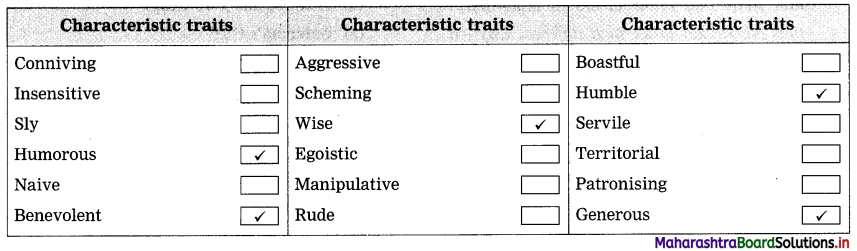
Extracts of Drama – (A) A Midsummer – Night’s Dream 11th Question Answer English Chapter 4.3 Maharashtra Board

Class 11 English Chapter 4.3 A

Balbharti Yuvakbharati English 11th Digest Chapter 4.3 Extracts of Drama – (A) A Midsummer – Night’s Dream Notes, Textbook Exercise Important Questions and Answers.

Class 11 English Chapter 4.3 Extracts of Drama – (A) A Midsummer – Night’s Dream Question Answer Maharashtra Board

11th Std English Chapter 4.3 Brainstorming Question Answer

Yuvakbharati English Navneet 11th Digest PDF Free Download Maharashtra Board

Characters:

1. Choose the odd one out.

Question (i)
Bottom, Moth, Mustard seed, Cobweb
Answer:
Bottom

Maharashtra Board Class 11 English Yuvakbharati Solutions Chapter 4.3 Extracts of Drama

Question (ii)
Flute, Snug, Quince, Cobweb
Answer:
Cobweb

Question 2.
Match the columns.

Column ‘A’ Column ‘B’
(a) Theseus 1. Robin Goodfellow
(b) Titania 2. Queen of the Amazons
(c) Puck 3. Duke of Athens
(d) Hippolyta 4. Fairies
(e) Cobweb, Moth 5. Queen of the fairies

Answer:

Column ‘A’ Column ‘B’
(a) Theseus 3. Duke of Athens
(b) Titania 5. Queen of the fairies
(c) Puck 1. Robin Goodfellow
(d) Hippolyta 2. Queen of the Amazons
(e) Cobweb, Moth 4. Fairies

Question 3.
Draw a character sketch of Oberon as an enemy of his wife but a friend of lovers.
Answer:
Oberon, the king of fairies, is shown having two faces. On the one hand, he is shown hatching a plan with the help of Puck by using ‘Love in Idleness’ ensuring that the proper lovers end up loving each other. He is also shown sympathising Helena on seeing Demetrius’ cold behaviour towards her. He brings blessings, good health and peace to all the newly married couples towards the end.

On the other hand, in his dealings with his wife Titania, Oberon is potrayed as a wicked man. At the beginning of the play, Oberon is shown fighting with Titania over the custody of an Indian boy. Here, he is however, trying to prove his authority as a male and win the boy. He also tricks his wife by casting a spell upon her that leaves her fall in love with Bottom. He then releases the spell off her when he gets what he has wanted – The boy.

Maharashtra Board Class 11 English Yuvakbharati Solutions Chapter 4.3 Extracts of Drama

Question 4.
Comment on the loving pair of Lysander and Helena from the point of view of developing their character sketch.
Answer:
Hermia and Lysander loved each other and they eloped in the forest to get married. Helena loved Demetrius but it was the effect of the love potion which was applied to Lysander’s eyes when he slept. Therefore, as he woke up he saw Helena and he started developing feelings for her. But Helena loved Demetrius. On her part Helena was very right. At the end both found their right companions Helena – Demetrius and Lysander – Hermia.

Setting:

1. Correct the given sentences with justification.

Question (i)
The play is restricted to only a part of the woods.
Answer:
The play is not restricted to only a part of the woods because the references, Quince’s cottage, in the another part of the wood etc., are there in the play.

Question (ii)
Since there is a reference to the Indian boy, there are some scenes from India too.
Answer:
The reference to the Indian boy is found in Act II scene I as Puck says “A lovely boy, stolen from an Indian king” and when Titania said that his mother was a votaress of my order and in the spiced Indian air. The reference of Titania’s Indian friend is also found.

Question 2.
The characters are a part of the stage setting. How does this reflect when the characters of the play range from the Duke and the Indian boy to the fairies?
Answer:
Characters are a part of stage setting. This reflects in ‘A Midsummer Night’s Dream’ from the Duke in the palace as he instructs Philostrate to arrange for the celebration with great revelry. However, in the another part of the wood Oberon and Titania struggle for the custody of the Indian boy. Oberon uses love potion on the eyelids of Titania when she sleeps. As the setting of the stage changes the characters change accordingly. Because of the presence of the fairies and an Indian boy, the characters in the play range from real to imaginary.

Question 3.
What changes in the stage setting would you suggest.
Answer:
The characters are the part of stage setting and the play starts with Theseus, Duke of Athens as he wins the queen of Amazons, Hippolyta. But later, in their marriage celebration there are the king and the queen of fairies, Oberon and Titania as well as other fairies and elves as imaginary characters. Characters are arranged from real to imaginary. I suggest that all characters should be real humans.

Maharashtra Board Class 11 English Yuvakbharati Solutions Chapter 4.3 Extracts of Drama

Question 4.
Comment on the versality and the aptness of the stage setting, as per the requirement of the play ‘A Midsummer Night’s Dream’.
Answer:
As per the requirement of the play ‘A Midsummer Night’s Dream’ the versality and the aptness of the stage setting go hand in hand. The play starts in the palace and then the stage of the play develops in two different parts of the wood. The stage-setting has been arranged according to the need of the characters and the plot. The characters are set accordingly onto the stage.

Plot:

Question 1.
State whether the following statements are True/False.

  1. Lysander and Demetrius fall in love with Helena as a result of the love potion.
  2. Oberon transforms Bottom’s head into that of an ass.
  3. Titania falls in love with an ass.
  4. Both Demetrius and Lysander fight for Helena.

Answer:

  1. True
  2. False
  3. False
  4. True

2. Give reasons:

Question (i)
Oberon and Titania fight for the custody of the Indian boy because –
(a) Oberon wants the custody of the Indian boy so that Titania would give him a lot time along with the boy.
(b) Titania wants the Indian boy because of her love and duty towards the small boy.

Maharashtra Board Class 11 English Yuvakbharati Solutions Chapter 4.3 Extracts of Drama

Question 3.
The consequences of Oberon ‘s jealousy for Titania are comic rather than tragic, comment.
Answer:
Oberon was jealous of his queen Titania because she refused to give the boy to him . She fell in love with Bottom. Oberon decided to seek revenge on his queen. It was Oberon himself who made Titania to fall in love with Bottom who wa§ having the head of a donkey. Comic incident was created by that scene in the drama.

Question 4.
There were some reasons why Theseus was initially against but later gave consent for the marrige of Hermia with Lysander. Explain.
Answer:
The reasons why Theseus was initially against but later gave consent for the marrige of Hermia with Lysander because Hermia’s father’s wish was that she should marry with Demetrius and she disobeyed her father. The Duke wants that Hermia should follow the rules and decision of her father. But she eloped with Lysander. It was Hermia’s true love for Lysander that made Theseus to change his decision and agreed that Hermia should marry with Lysander.

Form:

1. Select the correct options.

Question (i)
A Midsummers Night’s Dream is a _______
(a) poetic drama
(b) comedy of errors
(c) comedy based on fantasy
(d) a character play
(e) a revenge tragedy
(f) belongs to realm of dreams.
Answer:
A Midsummer Night’s Dream is a comedy of errors.

Question 2.
Find 2/4 expressions of humour from the extract.
Answer:
Expressions of humour from the extract are:
1. Helena: You do advance your cunning more and more –
Lysander: I had no judgement when to her I swore.
2. Hermia: What’s this to my Lysander? Where is he? Ah, good Demetrius, wilt thou give him me ?
Demetrius: I had rather give his carcass to my bounds.
Hermia: Out dog / out cur/ thou drivest me past the bounds.

Maharashtra Board Class 11 English Yuvakbharati Solutions Chapter 4.3 Extracts of Drama

Question 3.
‘A Midsummer Night’s Dream’ is one of the best examples of Shakespeare’s comedy of errors. Comment.
Answer:
A Midsummer Night’s Dream is one of the best examples of Shakespear’s comedy of errors because it has all the features of comedy of errors like conflict between characters, resolution over the problem, cleared confusions between the love triangle, reunion and marriage. It all seem very funny and interesting.

Theme:

Question 1.
Shakespeare is acknowledged as the greatest writer because he understood human nature better than anyone else. Explain the statement in context of the of play.
Answer:
Many authors have tried to potray love as human nature, however, none could display it better than Shakespeare does in his plays. In this play – ‘A Midsummer Night’s Dream’ he explains human nature of ‘control’ through love. He has given a clear picturisation of how love controls a person in the character of Theseus as he forgives Hermia and allows her to marry her love Lysander. It reveals that true love prevails and finds solace.

Shakespeare also explains human nature of conflicts between family and friends. He gives a clear picturisation of conflict when the magic potion ‘Love in Idleness’ was wrongly used on Lysander and he falls in love with Helena because of which Hermia and Helena start a quarrel. Another conflict potrayed, is between the family, when Hermia is given three choices by her father – marry Demetrius, become a nun or die to which she rebels against her father and decides to elope to the woods to marry her love Lysander. Hence, Shakespeare is acknowledged as the greatest writer of human nature.

Maharashtra Board Class 11 English Yuvakbharati Solutions Chapter 4.3 Extracts of Drama

Question 2.
Prove with the theme of the play/ extract that the deeper human emotion which profoundly interested Shakespeare, was jealousy.
Answer:
The theme of the play ‘A Midsummer Night’s Dream’ is love. Shakespeare portrays how people fall in love with those who appear beautiful to them. However, if one rejects other’s true love, then jealousy starts in the minds of the lovers. The same situation arises if one does not spend quality time with the other. In this play the example of Oberon and Titania is apt to describe human emotion.

Language:

Question 1.
Interpret the following lines in Simple English.
Puck: I’ll follow you.
Bottom: The finch, the sparrow.
Answer:
The song is sung by Bottom to try to keep his courage up as Puck has just turned his head into that of an ass. This transformation scared everyone around him and he is alone in the forest. But his song awakens Titania who falls in love with him immediately and the use of appropriate words and songs are there for the other parts of the wood also.

2. Comment on the literary device, used in the following lines.

Question (i)
Titania: Be kind and courteous to this gentleman
Answer:
Tautology. The words kind and courteous denote the same meaning to give dramatic effect.

Question (ii)
Titania: Come wait upon him: lead him to my bower.
Answer:
Repetition. The word him is repeated two times to give dramatic effect.
Apostrophe. Time has been addressed by Titania to other fairies.

Maharashtra Board Class 11 English Yuvakbharati Solutions Chapter 4.3 Extracts of Drama

Question 3.
Shakespeare’s poetry has come to be valued for its own sake on the stage. Comment with reference to the play ‘A Midsummer Night’s Dream’.
Answer:
Shakespeare’s poetry, in his ‘A Midsummer Night’s Dream’ is found outstanding and valued for it’s own sake on the stage. The expressions of love through poetry made his drama lively and interesting. Through the poetic language Shakespeare underlined the truth of human nature and through poetic expressions made the critical moments easier.

Yuvakbharati English 11th Digest Chapter 4.3 Extracts of Drama – A Midsummer – Night’s Dream Additional Important Questions and Answers

Question 1.
Then will two at once woo one;
That must needs be sport alone:
Answer:
Reference : These lines are taken from William Shakespeare’s famous comedy ‘A Midsummer Night’s Dream’. Act III scene II.
Context: The lines are said by Puck as he applied love potion on the eyelids of Demetrius with negligence. Explanation : In ‘A Midsummer Night’s Dream’, a comic character Puck was told by Oberon, the king of fairies to use the love potion on the eyelides of Demetrius so that he wakes up and sees Helena and will fall in love with her.
But Puck uses the love potion on the eyelids of Lysander, supposing him to be Demetrius. Helena sees the first person Lysander after waking up and falls in love with her instantly. A misunderstanding of Puck made a chaotic situation between the lovers.

Maharashtra Board Class 11 English Yuvakbharati Solutions Chapter 4.3 Extracts of Drama

Question 2.
Shakespeare’s poetry has come to be valued for its own sake on the stage. Comment with reference to the play ‘A midsummer Night’s Dream’
Answer:
In midsummer night’s dream, Shakespeare’s used theatrical circle simply as fantasy. In order to made it more effective he used poetic lines for enlightening the beauty of the actions in the drama. These poetic lines revealed the nature of characters and developed poetic structure of the drama.

Extracts of Drama – A Midsummer – Night’s Dream Summary in English

In the Palace:

Theseus, Duke of Athens wins Hippolyta in war and they are to be married. So, he instructs Philostrate to arrange for the celebration.

Egeus, the father of Hermia wants his daughter to be married with Demetrius. But she refuses to marry Demetrius as she is in love with Lysander. The Duke Theseus urges her to obey her father and gives her three alternatives: (1) marry Demetrius (2) become a nun or (3) suffer a death sentence. Hermia has time to decide until Theseus, The Duke of Athen’s marriage.

Hermia and Lysander decide to elope to the woods and get married but, Demetrius who used to love Helena, now rejected her love and is interested in Hermia. Hermia tries to win back the love of Demetrius for Helena. As Hermia elopes with Lysander, Demetrius follows her and Helena follows Demetrius.

At the Quinces Cottage:

The workmen from Athens wish to perform a play ‘Pyramus and Thisby’ at the Duke’s wedding. They all plan to meet in the forest for the rehearsal.

In the Woods:

A different world has been seen in the woods. The king of fairies, Oberon and Queen of fairies, Titania are having a fight over the custody of an Indian boy. To teach a lesson to her, Oberon, with the help of Puck, a mischievous spirit, plans to use the magic potion ‘Love in Idleness’, the juice if poured on the eyelids of a sleeping person, makes his/her fall madly in love with the first person he/she sees after waking up. He thus plans to madden Titania and get the custody of the Indian boy.

Oberon then sees Demetrius’ cold behaviour towards Helena and tries to help them by developing feelings in the heart of Demetrius for her. Therefore, he asks Puck to squeeze the magic juice on the eyelids of Demetrius Taking Lysander for Demetrius, Puck squeezes the magic juice on his eyelids.

Helena who enters the wood following Demetrius, proves to be the first person Lysander sees after waking up and falls in love with her instantly. Titania found too much interested in Bottom, one of the workmen of Athens. Puck bewitches him by transforming his head into that of an ass and it bewildered Titania.

In the Another Part of the Wood:

Puck wins the heart of Oberon for punishing Titania and Bottom. But when Oberon realises Puck’s mistake of using magic potion for Lysander instead of Demetrius, he himself squeezes it on the eyelids of Demetrius and orders Puck to fetch Helena as he wakes up to restore the love of Demetrius for Helena. He also corrects the relations of Lysander with Hermia as well as orders Puck to restore Bottom’s head and feels sorry for Titania.

Theseus, Hippolyta and Egeus enter and see the four Athenians and the love between them. He allows Demetrius and Helena and Hermia and Lysander to marry. At last, in the final scene, ‘Pyramus and Thisbe’ was performed for the marriage ceremony of Theseus and Hippolyta in the presence of Oberon and Titania with their fairies and elves to sing and dance and bless the newly wedded. Thus, the play ‘A Midsummer Night’s Dream’ ends on a happy note.

Maharashtra Board Class 11 English Yuvakbharati Solutions Chapter 4.3 Extracts of Drama

Glossary:

  1. night-rule – dark deeds,
  2. consecrated – sacred,
  3. dote on – to love,
  4. extremity – whole heartedly,
  5. patches – clowns,
  6. nuptial – marriage/ matrimonial/ moments of nuptial bliss,
  7. nole – head,
  8. mimic – commie actor,
  9. russet-pated choughs – birds of the crow family with reddish, brown (or grey) heads,
  10. sever – separate from each other,
  11. stamp – a noise made by bringing one’s foot heavily on the ground but, here – thing like ‘trick’ (i.e. giving
  12. Bottom an ass’s head),
  13. yielders – those who yield (giving up or surrender),
  14. latch’d – leached, anointed (love juice),
  15. ey’d – seen,
  16. antipodes – the opposite side of the earth,
  17. venus – the evening star,
  18. carcass – dead body,
  19. mispris’d – mistaken,
  20. an – and (or) even,
  21. adder – circuit,
  22. debt that bankrupt sleep doth sorrow owe – sleepless due to sorrow,
  23. confounding – confusing and breaking,
  24. Ioi tartars bow – weapon used by the Asian warriors who invaded Europe in the 13 century,
  25. cupid’s archery – Roman God of love,
  26. a lover’s fee – love requited,
  27. fond pageant – silly behaviour,
  28. tales – untrue stories,
  29. sport alone – fun by itself,
  30. devilish holy – a conflict between two truths,
  31. nymph – nature goddess,
  32. Taurus – a mountain range in Turkey,
  33. superpraise – praise excessively,
  34. conjure – summon/call,
  35. disparage – regards being of little worth,
  36. englids – brightens,
  37. confederacy – plot/plan,
  38. chid – rebuked/scold,
  39. artificial gods – creators of works of art,
  40. union in partition – two in one,
  41. incorporate – united,
  42. so in grace – so much in favour/in a good condition,
  43. ethiope – black face, but actually a scornful reference to her dark hair,
  44. canker blossom – a flower blighted by a worm lodged in the bud,
  45. stealth – stealing away,
  46. fond – foolish,
  47. suffer her to flout – allow her to mock,
  48. knot grass – a weed which creeps and makes entangling roots,
  49. officious – meddlesome/self assertive enthusiastic,
  50. aby – pay a heavy penalty,
  51. check by jowl – closely,
  52. king of shadows – fairy kings,
  53. sort – occur,
  54. welkin – sky,
  55. Acheron – the world of dead,
  56. rail thou – use violent language,
  57. Aurora’s harbinger – forerunner of the dawn (the morning star),
  58. wormy beds – graves,
  59. Neptune – the ocean, in ancient mythology,
  60. hither (archaic word) – to or towards this place,
  61. constraineth (archaic word) – to impose limitations,
  62. crust – (archaic words)to curse,
  63. a knavish lad – a mischievous boy,
  64. woe – great sorrow,
  65. bedabbled – sensuous,
  66. briers – wild shrubs,
  67. mare – an adult female horse,
  68. stalls – work-benches,
  69. barren – stupid/brainless,
  70. Anon – quickly,
  71. the creeping fowler eye – wild geese keep a close watch on hunter who is creeping up to shoot,
  72. of force she must be ey’d – inevitably (perforce) she will be seen,
  73. lay breath so bitter on your bitter foe – speak so bitterly to no one but your bitter enemy,
  74. may be bored – may have a hold driven right through it,
  75. dead – pale and bloodless,
  76. touch – feat,
  77. tender – attention and care,
  78. look – be sure,
  79. cheer – countenance.

11th Std English Questions And Answers
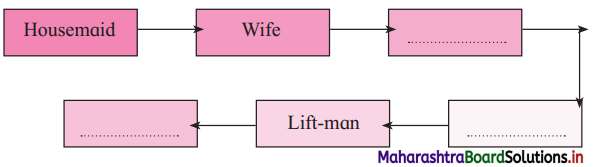
The Rising of the Moon 11th Question Answer English Chapter 4.2 Maharashtra Board

Class 11 English Chapter 4.2

Balbharti Yuvakbharati English 11th Digest Chapter 4.2 The Rising of the Moon Notes, Textbook Exercise Important Questions and Answers.

Class 11 English Chapter 4.2 The Rising of the Moon Question Answer Maharashtra Board

11th Std English Chapter 4.2 Brainstorming Question Answer

Yuvakbharati English Navneet 11th Digest PDF Free Download Maharashtra Board

(A1)

Question 1.
There are some dialogues that are short, but quite effective. They give us enjoyment and add beauty to the main story. Find some more from the text. (Answers are given directly in bold)
Maharashtra Board Class 11 English Yuvakbharati Solutions Chapter 4.2 The Rising of the Moon 1
Answer:
Maharashtra Board Class 11 English Yuvakbharati Solutions Chapter 4.2 The Rising of the Moon 2

Maharashtra Board Class 11 English Yuvakbharati Solutions Chapter 4.2 The Rising of the Moon

(A2)

Theme

Comment on the given statement after reading the given dialogue.

Question (a)
“And if we get him itself, nothing but abuse on our heads for it from the people, and may be from our own relations”.
Answer:
We don’t think of our society at large. If we catch the prisoner, Irish people will abuse us. They expect us to cooperate with the patriots as they are our own people. If we do not catch the escaped prisoner, the British Government will abuse us. In any case if we catch the prisoner or do not catch anyhow we are the one who are going to be abused.

Question (b)
“It’s a pity some honest man not to be better of that”.
Answer:
It was a good opportunity for the sergeant to show his honesty to the Britishers. He wanted to catch the escaped prisoner and also to get the reward.

Question (c)
“I wouldn’t be in your shoes if he reward me ten times as much. People generally fall victim to incentives. Some people stick to values”.
Answer:
Those who stick to values and are not templed at all, are the people of principles. Such people don’t betray anyone. They are very brave and loyal.

Maharashtra Board Class 11 English Yuvakbharati Solutions Chapter 4.2 The Rising of the Moon

Question (d)
“But when I saw a man in trouble, I could never help trying to set him out of it. It’s human to help others”.
Answer:
The sergeant was alone in the dangerous dark night. The man wanted to help the sergeant to keep a watch. He told the sergeant that he would help him in his task and would not demand any share in the reward that the sergeant gets for catching the escaped prisoner.

Question (ii)
The priorities of the sergeant are shifted. Complete the given table by using the given clues.
Answer:

Priorities of the Sergeant in the beginning Priorities at the end of the play
Law and duty patriotism
To Catch the escaped prisoner Sympathised the prisoner

Question (iii)
Find the sentence from the play selected to the given points.
Answer:
a. Loyalty in Irish nationalism.

(a) “May be Sergeant, you’ll be on the side of the country yet”.
(b) “I have my duties and I know them”.
(c) “I am in the force”.
(d) “We have to do our duty in the force”.

b. Tension between different loyalties.

(a) “It’s little we get but abuse from the people, and no choice but to obey our orders”.
(b) ‘You won’t betray me… the friend of Granuaile”.
(c) “May be Sergeant, it comes into your head sometimes, in spite of your belt and your tunic, that it might have been as well for you to have followed Granuaile”.
(d) “Stop that that’s no song to be singing in these times”.

Maharashtra Board Class 11 English Yuvakbharati Solutions Chapter 4.2 The Rising of the Moon

(A5)

The description of the character is given below. Identify the character from the play. Find some sentences which support your choice.

Question (a)
He is a brave but irresponsible person.
Answer:
The character is sergeant.
(Brave) (a) “I don’t want it. Bring it with you, He is irresponsible”.
(b) Sergeant (after a pause) – no one.

Question (b)
He is a major character. He dominates the story.
Answer:
The character is the man. ,
(Major) (a) “I know well the man you are waiting for”.
(Dominate) (b) “Will you let me pass or must I make you let me?”

Question (c)
He is smart as well as brave.
Answer:
The character is the man.
(Smart) (a) “Back to the town isn’t it?”
(Brave) (b) “You need’nt ask me who I am, that placard will tell you”.

Question (d)
He is the centre of the play.
Answer:
The character is sergeant.
(a) “Am I as great a fool as I think I am?”
(b) “Indeed it’s a hard thing to be in the force, out at night and no thanks for it, for all the danger we’re in. And it’s little we get but abuse from the people, and no choice but to obey our orders, and never asked when a man is sent into danger”.

Maharashtra Board Class 11 English Yuvakbharati Solutions Chapter 4.2 The Rising of the Moon

Question (e)
He is obedient and simple.
Answer:
The answer is the policeman B.
(Obedient) (a) “You bade us to come back here and keep watch with you”.
(Simple) (b) ‘You might want it. There are clouds coming up and you have the darkness of the night before you.”

Yuvakbharati English 11th Digest Chapter 4.2 The Rising of the Moon Additional Important Questions and Answers

Character Analysis:

Question 1.
Write your opinion about the man and the sergeant.
Answer:
The sergeant plays an important character and grips the audience’s attention. He is basicallyan Irish man, however, his duty requires him to serve the British and go against his own country. In the beginning of the play, he is in need of money. He is eager to arrest the prisoner who has escaped the gaol and get the reward of hundred pounds. He is seen as a loyal police officer under the British Government. His words, “The whole country depends on us to keep law and order”, is inspiring. However, his character undergoes a change as the play proceeds.

He develops arrogance and begins to argue with the ragged man. When the ragged man begins to sing patriotic ballads, the sergeant’s behaviour suddenly turns patriotic and reminds him of the days when he used to indulge in freeing Ireland from the chains of the Britishers. Towards the end of the play we see the sacrificing behaviour of the sergeant as he sacrifices his reward and promotion by not arresting the prisoner. He is shown to be less intelligent than the ragged man but soft-hearted. However, he then asks himself, “I wonder, now, am I as great a fool as I think I am?” As audience, we can term him foolish but also call him a great patriot.

On the other hand, the ragged man in the play is having heroic qualities as he is smart and a passionate lover of his country. He introduces himself as a ballad singer and also touches the heart of the police officer by singing love and patriotic ballads. He is so perfect in making-up his identity that the policeman (sergeant) cannot suspect him until he reveals his identity. He intelligently brings out stories from the sergeant which proves his wittiness.

He succeeds in bringing out the feelings of patriotism from the sergeant, turns himself into a friend of the sergeant and escapes safely from being imprisoned again. But before escaping, he expresses gratitude to the sergeant with a note of optimism. He promises him to pay back his good turn. He is optimistic and tells that a day will surely come that Ireland will be free from the British rules.

Maharashtra Board Class 11 English Yuvakbharati Solutions Chapter 4.2 The Rising of the Moon

Reference To Context:

Comment on the given statement after reading the given dialogue.

Question 1.
The man tries to enforce the sergeant in favour of the criminal.
Answer:
The man tries to enforce the sergeant in favour of the criminal by repetedly saying, “Never mind. I’m going. I wouldn’t be in your shoes if the reward was ten times as much”.

Thought-Provoking Questions:

Question 1.
The man and the sergeant need each other’s support. Find such examples.
Answer:
On that dark night, while keeping a watch, the man and the sergeant needed each other’s support. The man told the sergeant that he had seen the escaped criminal at his own place. Describing the criminal the man told that there wasn’t any weapon he didn’t know the use of. He also told that the escaped criminal was a strong and muscular man.

This description created fear in the mind of the sergeant and he actually needed the support of the man. The man also needed the sergeant’s support. He had planned to escape from the place which was not possible without the help of the sergeant. Thus the man and the sergeant both needed each other’s support.

Maharashtra Board Class 11 English Yuvakbharati Solutions Chapter 4.2 The Rising of the Moon

Question 2.
Find out the reason of the man for staying at the place.
Answer:
The ballad singer, as the ragged man introduces himself in the play, is actually the escaped prisoner. Using his intelligence he however tries to stay with the sergeant because he knows that the police are in search of him to put him back into custody. The hour is not safe for him to move and therefore he engages himself with the sergeant so that the other policemen do not doubt him and he can make a move when the time is safe.

Question 3.
Write about the persuasive approach of the man.
Answer:
The man (the escaped prisoner) introduced himself as a ballad singer. He started singing ballads to persuade the sergeant in believing his identity. He also told the sergeant that he was so poor that he would earn money by singing ballads and would arrange for his supper. The man was dominating enough as he stuck to the place in spite of repeated warnings of the sergeant to go away from the place.

Question 4.
Find the life of a singer that is mentioned in the play.
Answer:
The man introduces himself as a poor ballad singer who sings patriotic ballads for the sailors to earn himself a living.

Question 5.
The wavelength of the man and the sergeant goes together. Find the evidences from the text.
Answer:
The wavelength of the man and sergeant goes together, this can be proved when the sergeant is eager find the escaped prisoner for a hundred pounds and a promotion on the basis of which he can support his family in a better way. On the other hand, the man introduces himself as a ballad singer who sings patriotic ballads to the sailors to earh living. In the other part of the act, the ragged man proves his patriotism by hiding his identity of prisoner belonging to Ireland. As the play comes to an end, the sergeant allows the man to escape in spite of knowing that he is the prisoner they were in search of. This is because the ragged man belongs to Ireland, the nation the sergeant used to belong, in his youth.

Question 6.
Discussion about patriotic songs goes on. Find the points from the text.
Answer:
On the dark night while keeping a watch,the man sings patriotic songs to which the sergeant says, “Stop that that’s no song to be singing in these times”. The man then explains to the sergeant that he was only singing to keep his heart up. The sergeant sympathetically says, “Well, you can sing if it gives you more courage”.However, when the man continues to sing the sergeant corrects the lyrics. They also further discuss about ‘Granuaile’.

Question 7.
The sergeant’s reaction surprises the audience. Write your opinion. .
Answer:
In the begining of the play, the sergeant was loyal to the British Government. As the play unfolds we find that the man has successfully brought about a change in the mind of the sergeant. He has aroused patriotism in the sergeant. The sergeant now lets go the prisoner easily. This surprises the audience. The change from the loyal British sergeant into the man with patriotism in the mind is drastic and surprising for the readers.

Question 8.
The sergeant supports the man by misguiding his comrades. Write your views.
Answer:
The sergeant was the loyal British servant. He wanted to catch the escaped prisoner for a reward. As the play unfolded the man who introduced himself as a ballad singer brought about changes in the mind of the sergeant. During their discussion the man arouse patriotism in his mind and reminded him of his youth when he had joined a group of patriots. The sergeant was torn between his duty and his nation. But finally patriotism won and the sergeant helped the man to escape. He misguided his assistants in order to let the prisoner escape easily.

Maharashtra Board Class 11 English Yuvakbharati Solutions Chapter 4.2 The Rising of the Moon

Glossary:

  1. lonesome – lonely, without any company
  2. quay – wooden or metal platform projecting into the water for loading and unloading of ships
  3. sergeant – a police officer ranking below an inspector
  4. placard – a sign for public display, either posted on the wall or carried during a demonstration
  5. gaol – jail
  6. kelp – a large brown seaweed that typically has long, tough stalk
  7. assize – The court which sat at intervals in each country of England and Wales to administer the civil and
  8. criminal law
  9. plaid – a type of woolen cloth
  10. shuffles – move/walk by dragging one’s feet
  11. barrack – police accommodation
  12. queer – strange
  13. to keep one’s heart up – to keep oneself happy
  14. tunic – a loose garment
  15. pike – an infantry weapon with a pointed steel or iron head on a long wooden shaft.

11th Std English Questions And Answers
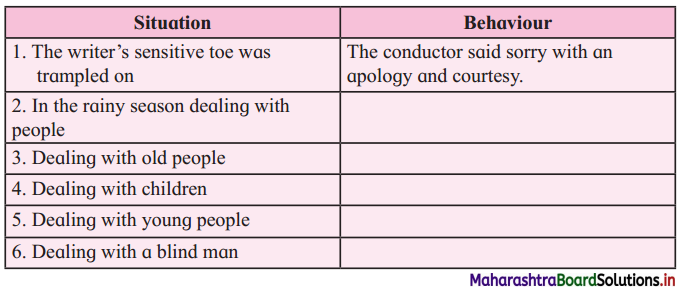
History of English Drama 11th Question Answer English Chapter 4.1 Maharashtra Board

Class 11 English Chapter 4.1

Balbharti Yuvakbharati English 11th Digest Chapter 4.1 History of English Drama Notes, Textbook Exercise Important Questions and Answers.

Class 11 English Chapter 4.1 History of English Drama Question Answer Maharashtra Board

11th Std English Chapter 4.1 Brainstorming Question Answer

Yuvakbharati English Navneet 11th Digest PDF Free Download Maharashtra Board

1. Name any four periods of History of British drama.

Question 1.
Name any four periods of History of British drama.
Answer:
The four periods of History of British drama are:

  1. Medieval Period or Early Period (11th to 15th Century)
  2. Renaissance Period (16th to 17th Century)
  3. Restoration Period (1660 onwards)
  4. Victorian Period (1837 to 1901)

Maharashtra Board Class 11 English Yuvakbharati Solutions Chapter 4.1 History of English Drama

2. List the four elements of drama.

Question 1.
List the four elements of drama.
Answer:
The four elements of drama are:

  1. Plot
  2. Characters
  3. Theme
  4. Stage directions

3. State a type of drama each from any four periods of history.

Question 1.
State a type of drama each from any four periods of history.
Answer:

  1. (Morality) Medieval period – Everyman (1490)
  2. (Comedy) Renaissance Period – A Midsummer Night’s Dream (1595)
  3. (Tragedy) Restoration Period – All for Love (1677)
  4. (19th Century Morality) Victorian Period – An Enemy of the People (1882)

4. Compare the features of comedy and tragedy.

Question 1.
Compare the features of comedy and tragedy.
Answer:

Comedy Tragedy
1. Comedy is a humorous story with a happy ending. 1. A tragedy is a serious story with a sad ending.
2. Characters in comedy are ordinary people from day to day life. 2. Characters in tragedy are royal personages, extraordinary and with divine qualities.
3. Comedy reveals truth in humourous way. 3. Tragedy reveals truth in realistic way.
4. Comedy gives emotional relief through laughter. E.g. As You Like It, A Midsummer Night’s Dream 4. Tragedy brings purgation through arousing pity and fear in the mind of audience. E.g. Hamlet, King Lear…

Maharashtra Board Class 11 English Yuvakbharati Solutions Chapter 4.1 History of English Drama

5. State the difference between poetry and drama.

Question 1.
State the difference between poetry and drama.
Answer:

Drama Poetry
1. Drama is a composition, normally in prose, telling a story and intended to be represented by actors imitating the characters and speaking the dialogue. 1. Poetry is a verse or a poetic presentation for recitation than performance.
2. Drama is presentation in acts and scenes and dialogues. 2. Poetry is presented in the form of stanzas and recited in rhyme and rhythm.
3. Drama is factual and realistic in its theme and message. 3. Poetry is imaginative and visualizes the experience or scenario.
4. Drama consists of a beginning, middle and end. It’s complete in itself. E.g. Pygmalion by Georgr Bernard Shaw. 4. Poetry doesn’t bother to be compact. It is beyond time, place and reason. E.g. Ozymandias by the poet P. B. Shelley.

6. State the difference between drama and novel.

Question 1.
State the difference between drama and novel.
Answer:

Drama Novel
1. Drama is a composition, normally in prose, telling a story and intended to be represented by actors imitating the characters and speaking the dialogue. 1. Novel is written in basic prose style and it is only for armchair reading not for performance.
2. Drama is a presentation in acts and scenes and dialogues. 2. Novel is a presentation of the events in the form of paragraphs.
3. Drama is a performance, so the characters are the mouthpieces of the dramatists. 3. Novel is a prose narrative, so the narrator plays important role in describing the characters and their actions.
4. Dialogue is the most essential element of drama and is a greater exposure for the characters. E.g. As You Like It by Shakespeare. 4. Although novels sometimes have dialogues, it is not a necessary part of the structure like it is for drama. E.g. Pride and Prejudice by Jane Austen..

7. Define drama.

Question 1.
Define drama.
Answer:
Drama is a Greek word meaning ‘act’ or ‘deed’. The Ancient Greek philosopher Aristotle used this term in a very influential treatise called the Poetics. In this text, Aristotle classified different forms of poetry according to basic features he thought could be commonly recognized in their composition.

Maharashtra Board Class 11 English Yuvakbharati Solutions Chapter 4.1 History of English Drama

8. Explain the term plot.

Question 1.
Explain the term plot.
Answer:
Plot is a logically developed chain of the events in a narrative. The events are arranged in such a way that the whole drama becomes an action. The plot of drama has six stages – Exposition, Conflict, Rising Action, Climax, Falling Action and Denouement or Ending. In short, Aristotle called plot as ‘a complete action’ and it means a plot consists of beginning, middle and end. The plot of a drama may be simple or complex.

9. Differentiate between characters and characterization.

Question 1.
Differentiate between characters and characterization.
Answer:
A character is a person, an animal, or a supernatural power performing action drama or any literary work. The dramatists create the characters as per their intentions and needs. The characters which are used to represent a particular trait or quality are stock or static characters. The characters which change and have varied angle are called round or dynamic characters.

On the other hand, characterization is an art and the techniques a dramatist or a writer used to create and develop characters. The dramatists take every effort to bring the characters to life by establishing their relation with the characters. In short, characterization is the process through which the dramatists try to reveal the characters and their personal qualities.

Maharashtra Board Class 11 English Yuvakbharati Solutions Chapter 4.1 History of English Drama

10. Enlist a few reasons for watching a drama live on the stage.

Question 1.
Enlist a few reasons for watching a drama live on the stage.
Answer:
The reasons for watching a drama live on the stage are:

  1. Live drama involves real people on real stage giving real experience to the audience.
  2. It boosts our literary knowledge and develops our understanding of drama.
  3. It has greater impact on our perspective towards life and helps to form objective approach.
  4. It helps us to present our views and respect others views. It guides us to take proper decisions in life.
  5. It gives direct purgation of our emotions and builds our confidence.

11th Std English Questions And Answers
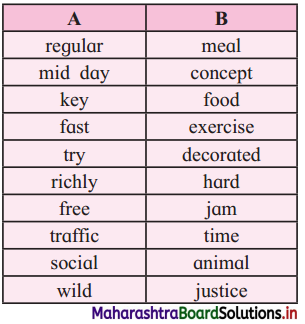
The Art of Compering 11th Question Answer English Chapter 3.6 Maharashtra Board

Class 11 English Chapter 3.6

Balbharti Yuvakbharati English 11th Digest Chapter 3.6 The Art of Compering Notes, Textbook Exercise Important Questions and Answers.

Class 11 English Chapter 3.6 The Art of Compering Question Answer Maharashtra Board

11th Std English Chapter 3.6 Brainstorming Question Answer

Yuvakbharati English Navneet 11th Digest PDF Free Download Maharashtra Board

Question 1.
Read the given words and share with your friend what comes to your mind.
Answer:
Anchoring:
It requires absence of stage fright, presence of mind and confidence.
Compering:
It requires, confidence and knowledge and smartness to make quick changes.
Hosting Programmes:
He has to shoulder responsibility of everything needed for the programme including stage arrangement, seating arrangement, lighting arrangement, mike, etc.
Public Speaking:
It requires communication skill and fluency in language.

Maharashtra Board Class 11 English Yuvakbharati Solutions Chapter 3.6 The Art of Compering

Question 2.
Discuss the essential qualities and also the precautions that a compere should take while compering a programme.
Maharashtra Board Class 11 English Yuvakbharati Solutions Chapter 3.6 The Art of Compering 1
Answer:
Precaution to be taken:

  1. A compere should keep the audience constantly engaged.
  2. He should be confident enough to handle the last minute change in the formal programme.
  3. He should take precaution to follow th protocol while anchoring the official programme.
  4. He should always keep in mind that he is not the star of the programme but only an anchor.

(A1)

Question 1.
Imagine that you wish to organize a cultural event in your college. Prepare your own web chart to indicate the qualities that you expect to have in a compere.
Maharashtra Board Class 11 English Yuvakbharati Solutions Chapter 3.6 The Art of Compering 2
Answer:
Maharashtra Board Class 11 English Yuvakbharati Solutions Chapter 3.6 The Art of Compering 3

Maharashtra Board Class 11 English Yuvakbharati Solutions Chapter 3.6 The Art of Compering

(A2)

Question (i)
Imagine that you are a compere of a prize distribution ceremony of your college. Write a script of the same. You can take help of the following points.
(a) Introduction
(b) Welcome speech
(c) Lighting the lamp
(d) Welcome song
(e) Main event
(f) Vote of thanks
Answer:
(a) Introduction: Honorable Chief Guest, respected Principal of the college, respected teachers and highly enthusiastic audience, I welcome one and all on behalf of our college.

(b) Welcome speech: Today, as we gather for the prize distribution ceremony, we are privileged to have Mr. Joy Joshi as the Guest of Honor. Mr. Joshi is a social worker and the Principal of New Era Art and Commerce College. I welcome Joshi sir on behalf the principal of our college. I request our Principal -to felicitate Joshi sir with a bouquet and a momentum as a token of respect.

(c) Lighting the lamp: To begin with our programme. I call upon our honorable Chief Guest Shri Joshi to light the traditional lamp. I also request all the dignitaries on the dais to join Joshi sir. Lighting of the traditional lamp symbolizes spread of knowledge. It leads us from darkness to light.

(d) Welcome song: Now I call upon the stage a group of students to recite the welcome song.
Thank you friends. It a nice presentation, we all enjoyed the song.

(e) Main event: Throughout the year, various co-curricular competitions were organised in college. It included music, dance, rangoli and elocution too. I request our Chief Guest to felicitate prize winning students. Let me begin the prize distribution ceremony by calling on stage Mukta Deo, the toper of the previous year. She secured 95% marks in the Board Examination. Congratulations to Mukta Deo.

Now, I call upon the stage Miss. Gauravi Khanna who stood first in the dance competition, Mr. Advait Kulkarni who bagged gold medal in inter-college swimming competition and Miss. Anahita More who stood first in inter-college singing competition.

It gives me immense sense of satisfaction the as we approach to the end of the programme. I feel honoured as many of my classmates and friends are honoured today. Friends, winning and losing is a part of game. What matters is participation in the event. Let’s again congratulate all the winners and the participants of all the contests. Let’s motivate them with a big round of applause for their journey towards progress. After all journey towards success begins with a single step.

Sincere thanks to Honourable Chief Guest Shri Joshi. Special thanks to our Vice Principal Mrs. Shreya Patil and teachers for organizing this programme, the audience for your presence. Your appreciation and motivation will help our friends in their journey towards success.

Thank You.

Maharashtra Board Class 11 English Yuvakbharati Solutions Chapter 3.6 The Art of Compering

Question (ii)
Mass media events often need comperes. Find out the area or sector in which a compere is a must. Write about the special skills needed to take up compering as a career and give some clues about how to acquire these skills.
Answer:
Programmes like prize distribution ceremony, music concert, dance competition, need a compere. Special skills are required for compering such programme.
(a) A compere must have good communication skill. He/She must have knowledge of the subject while compering any music show. He/She must know about the song, the singer, the film to which the song belongs. He/She must know the lyrics and the meaning of the song too. Sometimes certain incidents are related with songs. A compere must know everything so that he can use the same while compering if needed.

(b) Attire of the compere must be suitable for the event and he should be able to carry the same comfortably.

(c) Confidence is the most important criteria for choosing the career in compering.

(d) A compere must be able to use variations in his voice particularly while narrating emotional incidents, patriotic songs, sad songs, etc.

(e) The body language should reflect enthusiasm and high level of positive attitude.

(f) Flexibility and cooperative nature are essential to make career in compering because anything can happen at the last minute during the event. A compere should be able to handle the situation skillfully without disturbing the already declared schedule. This requires management skills.

(g) Many times being multilingual is the requirement of the programme. It is necessary that a compere must have the knowledge of the regional and the national language.

(h) Presence of mind is required to add or omit the last minute entry or exit in the contest.

Every aspirant in compering must develop all these skills. He/She must inculcate the habit of reading, punctuality and practice. He/She should update himself daily with the latest compering techniques. Reading and accurate pronunciation play important role in grooming the personality of a compere. He/She should be interested in the fields like politics, sports, music, current affairs, entertainment, etc. The practice of all these can make his personality a versatile one.

Maharashtra Board Class 11 English Yuvakbharati Solutions Chapter 3.6 The Art of Compering

(A3) Project:

Question 1.
Make a list of functions/events/programmes/activities organized in your junior college. Choose three events and plan a programme schedule of your own. Prepare a script as well to show the associating role of the compere for a particular event. Make your own sequence and design a template for the same.

Yuvakbharati English 11th Digest Chapter 3.6 The Art of Compering Additional Important Questions and Answers
Question 1.
Imagine that you have to arrange a ‘Teachers’ Day Celebration’ programme in your college. Prepare a schedule of the programme.
Answer:

  1. Introduction
  2. Welcome speech
  3. Lighting the lamp
  4. Welcome song
  5. Felicitation of the teachers
  6. Principal’s speech
  7. Speech of the Chief Guest
  8. Vote of thanks

Maharashtra Board Class 11 English Yuvakbharati Solutions Chapter 3.6 The Art of Compering

Glossary:

  1. compering – act as compere (host)
  2. ceremony – a celebration of an event, achievement or anniversary
  3. elegance – graceful and stylish in appearance
  4. confidence – the feeling of trust
  5. voice modulation – control or adjustment of voice
  6. language fluency – ability to speak or perform in a Language
  7. bountiful – ample.

11th Std English Questions And Answers:

Film Review 11th Question Answer English Chapter 3.5 Maharashtra Board

Class 11 English Chapter 3.5

Balbharti Yuvakbharati English 11th Digest Chapter 3.5 Film Review Notes, Textbook Exercise Important Questions and Answers.

Class 11 English Chapter 3.5 Film Review Question Answer Maharashtra Board

11th Std English Chapter 3.5 Brainstorming Question Answer

Yuvakbharati English Navneet 11th Digest PDF Free Download Maharashtra Board

1. Read the following conversation and complete the activities given below.

  • Minnie: Exams are over. I feel so relaxed! Let us plan something interesting.
  • Ritu: What about a movie?
  • Paddy: Great! Let’s go for “Aladdin”!
  • Minnie: Oh, no! I have seen it. It has only a ‘one-star’ rating.
  • Ritu: How about that new release Ummm….yes, “Harry Potter?
  • Della: It is boring. I have read the review this morning. I don’t want to waste my time.
  • Paddy: Wait, friends. I will check. Let’s decide later.

Maharashtra Board Class 11 English Yuvakbharati Solutions Chapter 3.5 Film Review

Question (i)
Choose the correct alternative from the following. From one star given to the movie we conclude that –
(a) The movie is very short.
(b) The movie is not worth watching.
(c) The movie is serious.
(d) The movie is in black and white.
Answer:
(b) The movie is not worth watching.

Question (ii)
Discuss how/why are ‘stars’ given to a movie.
Answer:
A star is a symbol of movie rating .It was in 1928 that a newspaper film critic Irene Thiner initiated the grading system on a scale of zero to three status. Star are given to a movie to know how good, bad or average a movie is.

Question (iii)
The word ‘Review’ is different from summarizing and appeal writing. Choose the correct statements of the following.
(a) Film review is an expression of your personal views towards a particular film, documentary or movie.
(b) A film review gives you an opportunity to express opinions about the movie, including its characters, plot and background.
(c) A film review gives appealing sentences that make your reader curious or anxious about the film.
(d) A review means explanation of each and every event of the film.
Answer:
(a) Film review is an expression of your personal views towards a particular film, documentary or movie,
(b) A film review gives you an opportunity to express opinions about the movie, including its characters, plot and background.

Maharashtra Board Class 11 English Yuvakbharati Solutions Chapter 3.5 Film Review

(A1)

Question (i)
Every movie is worth critiquing. Describe in detail each point related with the film review with the help of the following web.
Maharashtra Board Class 11 English Yuvakbharati Solutions Chapter 3.5 Film Review 1
Answer:
Film Review : Dangal

Genre: Dangal is the most inspiring and entertaining movie. The film also makes strong feminist statement showing girls at par with boys.

Script Writer: Script of the movie ‘Dangal’ is written by Nitesh Tiwari who has been successful in creating the interest of the audience not only in the story of the film but also in the sport of wrestling.

Direction: The direction is also done by Nitesh Tiwari. He won the Filmfare award for the Best Director, 2017 for Dangal.

Producer : The film is produced by the renowned actor Amir Khan. Kiran Rao and Siddharth Roy Kapoor.

Acting : Amir Khan played the role of Mahavir Singh Phogat and Sakshi Tanwar played the role of the wife of Mahavir Singh Phogat. Zaira Wasim and Fatima played the role of Geeta and Sanya Malhotra and – Suhani Bhatnagar played the role of Babita Phogat. Aparshakti Khurrana and Rutvik Sahora played the role of Omkar, the nephew of Mahavir Singh Phogat. A negative role is played by Girish Kulkarni, the coach of Geeta Phogat and Babita Phogat.

It is wonderful to see Amir Khan as Mahavir Singh Phogat on a big screen. His appearance as the father of his daughters, their coach, guide and strong supporter till the end touches the audience emotionally.

Music and Sound: Music director Pritam and lyricist Amitabh Bhattacharya smartly themed their music. Some of the songs evoke the innocence of every viewer.

Cinematography: The cinematographer of the movie is Sethu Sriram. (Satyajit Anand). He presented a senario of an authentic and real wrestling matches that kept the audience spell bound till Geeta Phogat the daughter of Mahavir Singh Phogat bags gold medal for the Nation.

Plot Analysis: The film Dangal focuses on the continuous efforts of Mahavir Singh Phogat and his daughters to realize the dream. Struggle of the daughters Geeta and Babita and their hard work are the main stroyline of the movie. Mahavir Singh Phogat the wrestling champion was forced to give up wrestling for better employment. He was highly discouraged because he wanted to win a Gold for the nation. He thought that his unborn son would do it. However, Mahavir Singh due to the birth of his daughters, loses hope of bagging gold medal yet, keeps his decision of training the daughters in wrestling.

Continuous and regular training make the daughters wrestlers. After defeating the boys in the village, Mahavir decides to admit the daughters in National Sports Academy. Discouraged due to different techniques taught there, Mahavir decides to train daughters personally. The coach decides to ban the daughters from playing wrestling but Mahavir Singh manages and the daughters continue to receive training in the academy. Inspite of many problems Mahavir provides training to his girls by watching videos of the matches played by the daughters.

The jealous coach locks Mahavir Singh in a room during the final match played by his daughter. Frustrated Mahavir stands up joyfully to hear the Indian National Anthem. Finally, the daughters bring smile on the face of Mahavir Singh Phogat. The cooperation of the daughters during their hard training, sacrificing small joys of life, overcoming every obstacle in the way is presented in a perfect manner.

Message: “Believe in Yourself’ and “Work hard till you achieve your Goal”. The film also arouses social cause of treating girls and boys equally.

Maharashtra Board Class 11 English Yuvakbharati Solutions Chapter 3.5 Film Review

Question (ii)
Discuss and explain the movie ‘The Jungle Book’ with the help of the following points.
(a) Classic elements
(b) Fantasy
(c) Photorealism
(d) Blending of emotions
Answer:
Rudyard Kipling, created an intense world with a description of the jungle and creatures living in it using his concept, Disney made the classic tale of Mowgli into film, wherein, Mowgli became the central character. It is interesting to watch the story of a boy after his fathers death is discovered by Bagheera, the black panther. A pack of wolves and Raksha are the boy’s caretakers. Mowgli’s jump, swinging from tree to tree, other live animals, running scenes are perfectly presented to make the audience believe about Mowgli’s inclination towards behaving like animals.

Sher Khan’s unsympathetic behaviour towards Mowgli and Mowgli’s decision to search human beings like him brings about acceptable twist in the story. Blood curdling incident of Kaa’s hypnotising attack on Mowgli is presented in a wonderful manner. Thus the movie ‘The Jungle Book’ takes the audience into a world of fantasy. There is a perfect blend of emotions which is brought by presenting Mowgli’s relation with the fatherfigure Bagheera, motherly Raksha, friendly pack of wolves. The film is also an incredible visual treat – with only one human character, introduction of various species of animals. The movie is interesting to watch and is highly recommended.

Question (iii)
‘It all builds on the charm of the 1967 film, which by itself is a must watch for any child.’
Explain the sentence in the context of the movie, focusing on the two given phrases ‘Charm of the 1967 film’ and a ‘must watch’.
Answer:
The year 1967 is considered to be very crucial in the film industry. It is the time when many revolutionary films were produced. New themes were introduced and very different stories were brought about. ‘An Introduction of the World of Fantasy’ is one them.

The Jungle Book is a perfect movie which easily takes the audience into the world of fantasy in a unique way. Though the mind does not believe on the story of Mowgli, him being handled safely by the wild animals, heart is made to believe the same. This is perfectly brought about by Jon Favreau in ‘The Jungle book.’ Thus the movie is really a charm of 1967 which is a must watch for all generations to come.

(A2)

Question (i)
Complete the following sentences.
Answer:
The factors that have made ‘The Jungle Book’ a great movie are –
(a) It is a fantasy world of wonder.
(b) The effective animation and presentation of the wildlife make the movie interesting.
(c) The story of the movie is unique.
(d) The film is a perfect blend of human emotions and a journey in the world of fantasy.

Question (ii)
The present review concludes with two words ‘Heartwarming and Enjoyable’. Write your opinion in about 100 to 150 words.
Answer:
The Jungle Book is a unique combination of Rudyard Kipling’s story and Favreau’s direction. It is an awesome experience to watch the same on the big screen. Presence of the orphan boy Mowgli in the forest, his interaction with wild animals, their love and care towards him, emotionally keeps the audience glued to the screen. The perfect landscaping and setting delves the audience into the world of the jungle throughout the movie. Mowgli’s behaviour following the laws of the Jungle, the supersized orangutan, dangerous python, Mowgli’s learning of practical wisdom from Bagheera the father figure, make it a wonderful experience to watch. Thus the movie is heartwarming and enjoyable.

Maharashtra Board Class 11 English Yuvakbharati Solutions Chapter 3.5 Film Review

(A3)

Question (i)
‘Narnia’ (Part 1, 2, 3, 4) is a film about four children who find a path to Narnia. Discuss the special effects and direction. Write a review with the help of the following points in about 100-150 words.
(a) Storyline
(b) Producer
(c) Director
(d) Music Director
(e) Characters / Casting
(d) Setting / Location
(f) Conflict
(g) Message
(i) Significance of the title
Answer:
‘Narnia’ potrays the history of Narnia, an imaginary world of fantasy and magic from its creation to its destruction. The movies, directed by Andrew Adamson (first two parts), Michael Apted (third partjand Joe Johnstaone (fourth parts) is based on C. S. Lewis’s series of novel. ‘The Chronicles of Narnia’.The movie revolves around the adventures of Pevensie siblings, Peter, Susan, Edmund and Lucy who are sent away to a safe place during the world war.

While playing hide and seek, they discover the magical wardrobe which on opening, takes them to the enchanted island of Narnia. The beautiful cinematography and performance of the children, world of fantasy and magic, speaking animals is an awesome experience to watch. The separation of the children from their mother, death of some animals, witches yelling,etc., are presented in a perfect way that brings tears rolling down from the audience’s eyes.

The basic conflict of the movies is the conflict between good and evil. Each part of the movie has slight different representation. Yet, they potray a single message of triumph of good over evil. The real success of the him is not only touching the heart of the audience but also making them believe in the world of imagination and fantasy. The cinematography and animation are so skillful that the animals look real. The him enlightens the audience by opening the doors of a new world of imagination. The movie teaches the audience beautiful special effects and sound, adventure, unity and sacrihce for each other.

(A4)

Question (i)
Form groups and try to write a script for a short him or documentary on any topic of your choice. The script must develop properly. You can take help of the following points.

  • choose a topic
  • central theme
  • the beginning, the middle and the end
  • the message

Answer:
[Students are expected to attempt this question on their own.]

Maharashtra Board Class 11 English Yuvakbharati Solutions Chapter 3.5 Film Review

Question (ii)
Form groups and use the ICT lab of your Junior College to make a shorthlm on the script that you have prepared. There are several soft-wares that can be used for editing. You can take professional help. One can upload his/her him on mediums like Youtube and submit the link to the subject teacher.
Answer:
[Students are expected to attempt this question on their own.]

Question (iii)
There are ample career opportunities in him making and producing hlms.
The following professions require different professional skills,write them accordingly.
table
‘The story of the movie decides it’s success’. Comment.
Answer:
The story is the heart of a play/film. The music, direction, cinematography, special effects are made to relate to the story. It is the story of the movie which makes the audience spellbound. The story always has a message to the audience. It is the story that helps the audience specially the youngsters, to imagine, to learn, to create interest in the world around, to get inspired and to think. Cinematography, music, animation, etc., give a wonderful experience to watch any movie on the big screen. All these revolve round the central theme ‘the story’ of the movie.

Question 5.
You must have heard about Film and Television Institute of India (FTII), Pune. It is India’s top media Institute. It plays an important role in providing talent to commercial cinema, TV and web serials. Browse the internet and find information about other institutes in India and abroad.
Answer:
[Students are expected to attempt this question on their own.]

Yuvakbharati English 11th Digest Chapter 3.5 Film Review Additional Important Questions and Answers
Question 1.
What are the steps and stages in review writing?
Answer:
A film critic is an article containing analysis and evaluation of a film, While writing a review about a film, a writer has to consider various things. A film critic should write about the relevance of the title, storyline and producer. He should write about the type of film, its director and the cast.

A film critic should write about various events, cinematography, set design, music, plot, characters and message given through the film. He/She should write about the sequence of the events according to its importance. Lastly, he/she should suggest to edit or add the title or content according to its necessity.

Maharashtra Board Class 11 English Yuvakbharati Solutions Chapter 3.5 Film Review

Question 2.
What are the aspect of the review?
Answer:
Film review is an analysis or evaluation of a film from the viewer’s point. Various aspect of review are the genre, plot analysis, characterization, cinematography, music, production and direction, plot, message given in the film (moral), sound, set designs and location.

Question 3.
What are the precautions to be taken while writing a film?
Answer:
Film review is an analysis or evaluation of a film from the viewer’s point. Precausions should be taken while writing a review of a film. A review should create curiosity about the movie but not discourage the reader. While commenting on the film dealing with social issues, the writer should not hurt the feelings of people. Critic should express opinion about the film.

A personal attack on any actor, producer, director should be avoided. A review writer should have knowledge of various aspect of editing and cinematography. He should avoid commenting on religious beliefs. While penning down the thoughts, a review writer should be careful about religious sentiments.

Maharashtra Board Class 11 English Yuvakbharati Solutions Chapter 3.5 Film Review

Glossary:

  1. photorealism – detail description of
  2. resourcefulness – ability to overcome difficulties
  3. relevance – appropriate
  4. genre – style or category of art/music/literature
  5. cinematography – the art of photography and camera work in film-making
  6. characterization – the creation of a fictional character
  7. plot – the main events of a play/novel/film.

11th Std English Questions And Answers:

Interview 11th Question Answer English Chapter 3.4 Maharashtra Board

Class 11 English Chapter 3.4

Balbharti Yuvakbharati English 11th Digest Chapter 3.4 Interview Notes, Textbook Exercise Important Questions and Answers.

Class 11 English Chapter 3.4 Interview Question Answer Maharashtra Board

11th Std English Chapter 3.4 Brainstorming Question Answer

Yuvakbharati English Navneet 11th Digest PDF Free Download Maharashtra Board

Question 1
Complete the following web diagram
Maharashtra Board Class 11 English Yuvakbharati Solutions Chapter 3.4 Interview 1Maharashtra Board Class 11 English Yuvakbharati Solutions Chapter 3.4 Interview 1
Answer:
Maharashtra Board Class 11 English Yuvakbharati Solutions Chapter 3.4 Interview 2

Maharashtra Board Class 11 English Yuvakbharati Solutions Chapter 3.4 Interview

Question 2.
Given below are the prerequisites of an interview. Fill up the boxes with suitable actions to be undertaken with reference to the given points.
Maharashtra Board Class 11 English Yuvakbharati Solutions Chapter 3.4 Interview 3
Answer:
Maharashtra Board Class 11 English Yuvakbharati Solutions Chapter 3.4 Interview 4

(A1)

Question (i)
Complete the following statements with the help of the text.
Answer:
To learn about meditation you have to see how vour mind is working.
Watch your thinking. Do not correct vour thoughts. Do not supress vour thinking.
Begin to learn, to observe. Just watch thoughts. Do not move vour eyeballs.

Maharashtra Board Class 11 English Yuvakbharati Solutions Chapter 3.4 Interview

(ii) Identify the incorrect statement from the following and correct them.

Question (a)
One wants others to change
Answer:
Correct

Question (b)
One can get rid of being ordinary
Answer:
Incorrect
Corrected Statement: One can get rid of being ordinary; not being ordinary.

Question (c)
Understanding the nature of greed does not ensure freedom from greed.
Answer:
Incorrect
Corrected Statement: Understanding the nature of greed ensures freedom from greed.

Question (d)
Learning is a finite process.
Answer:
Incorrect
Corrected Statement: Learning is an infinite process.

(A2)

Question (i)
Is an educated person the same as a degree holder? Make a list of the behaviours in educated people that you find unacceptable.
Answer:

  1. Throwing garbage along the roadside.
  2. Careless use of water, electricity and other natural resources.
  3. Waste of food.
  4. Careless use of public ammenities.
  5. Not following traffic rules.

Maharashtra Board Class 11 English Yuvakbharati Solutions Chapter 3.4 Interview

(ii) Suggest what would you do in the following situations:

Question (i)
Your close friend has been using a fake social media account to play prank on others and is not ready to stop in spite of several attempts by you.
Answer:
I would tell him the consequences of his behaviour. I would divert his mind towards some creative activities. I would tell him to focus on his hobby or any other creative work.

Question (ii)
You are going through a crisis that is making you short tempered and impatient, due to which you end up causing harm to your family and friends. They have started complaining about it quite often.
Answer:
I would try to solve my own problems and in case it is not possible I would take someone’s (my family members or near and dear one’s) help to solve it. I would control my anger and would meditate daily. I would focus on the positive things near me and try to learn time management and develop perseverance. This would help to repair my relation with my near and dear ones.

Question (iii)
One particular friend of yours is always late for college, social functions, movies etc, and delays everyone.
Answer:
I would tell him that time is precious, and all of us have time constraints. I would also tell him the benefits of doing things in time.

Question (iv)
You realise that you no longer want to pursue your studies in the stream you have selected.
Answer:
At first I would focus on the interesting areas in the same stream and try to get acquainted with it. I would explore in the same stream again. In spite of the efforts I have taken, if it does not work, I would go for the other stream with the help of an expert’s advice.

(A3)

Question (i)
Consult the thesaurus and note down synonyms for ordinary. Use the words in your own sentences.
Answer:
Ordinary – Banal, normal, common
(a) Ordinary – Her gown was too ordinary for the ceremony.
(b) Banal – He finds geometric problems very banal.
(c) Normal – I expected to be home at my normal time.
(d) Common – Maaz and Raj do not talk much as they do not share a common language.

Maharashtra Board Class 11 English Yuvakbharati Solutions Chapter 3.4 Interview

Question (ii)
Find the meanings of the following words and use them in your own sentences.
Answer:
(a) Trite – meaning: lacking originality
sentence: Sometimes we do come across many trite sayings/poems, but they are still quite interesting,
(b) Routine – meaning: regular, usual
sentence: That was my mother’s routine check-up.
(c) Cliched – meaning: a remark that is made often
sentence: This may round cliched, hut this is the truth you have to bear with,
(d) Regular – meaning: everyday
sentence: Exercise should be practised on a regular basis.

Question (iii)
Complete the table.
Answer:

The world around you what we should aim to be
Callous caring for people, environment, and life
Violent calm, unagressive behaviour, serene
Greedy helpful by nature, charitable and generous
Corrupt Honest in behaviour, ethical and virtuous

Question (iv)
Note down ways in which you can make your life less ordinary in terms of –
Answer:
(a) Utilisation of time: Everyone is alloted the same time of 24 hrs in a day. I will set small goals and achieve the same in a particular time. I will utilize the saved time for my (own development)/personality development and for any social coause. In this way I will utilize my time to the fullest.

(b) Pursuing goals other than the material goals: Pursuing good and healthy life or any spiritual goal is more important than material goal. I would set goals for pursuing it. For my spiritual growth I would learn and practice yoga and meditation. For pursuing healthy life I will practise healthy lifestyle, regular exercise, maintenance of hygiene.

(c) Nurturing relationships : I have good relation with my family members, neighbours and relatives. I will not only maintain but also develop it. I will always spend some time with them, respect their thoughts, feelings and take their care. I would always help them in their need.

(d) Being a better human being: In order to be a better human being I will develop the habit of helping others, honesty, open mindedness, positive attitude, punctuality and many other. At the same time I will keep myself always away from bad company, laziness, hatred, greed. I will always help the poor and the needy, respect my parents and teachers, elderly relatives and neighbours. I will use natural resources, water, electricity, public amenities judiciously. By planting trees, I would also contribute in reducing global warming.

Maharashtra Board Class 11 English Yuvakbharati Solutions Chapter 3.4 Interview

(A4)

Question 1.
Place the given areas of question from the list in the appropriate columns.

  • Future plans
  • Inspiration
  • Overcoming hurdles/ struggle
  • Coach/ mentor/ guide/ teacher
  • Message for the youngsters
  • Family support
  • Alternate career choice
  • First or maiden award / achievement / success / setbacks
  • Turning point in life / success formula / technique

Answer:

Section of the Interview Aspects to be covered
1. Introduction Welcoming / Greeting, Introduction of the guest/occasion.
2. Opening questions Inspiration
3. Main body Coach, guide, mentor, teacher Overcoming hurdles, struggle Family support

First award, achievement, success, setbacks Alternate career choice [memorable incident] Turning point, success formula, technique

4. Concluding Message for the youngsters and future plans
5. Summing up Concluding statement, Expressing gratitude.

Question (ii)
‘Once you begin to learn there is no end to learning’. Write your views on this statement.
Answer:
A person is a student throughout his life. When a child is born he learns to crawl, walk, run. In the school he learns various subjects along with sportsmanship, helping others nature, caring and sharing. He practises all of it in his life. There are many life skills too which man learns. It being a need of time throughout his life, one actually goes on learning various new things knowingly or unknowingly. Knowledge has no end.

Question (iii)
You are a class representive and you are assigned by the Principal of your college, to conduct an interview of a leading personality in a particular field. You have to conduct the interview
with the help of the points in the table provided above.
Answer:
Interview of Sachin Tendulkar.
[Sachin Tendulkar was invited as a Chief Guest for the prize distribution ceremony in our college. I was privileged to interview him.]

Student: Good morning sir. I welcome you in our college. It’s my privilege to interview a great youth icon like you. First I would like to ask you about your career.
When did you begin to play?
Sachin: Actually I started in my early childhood, when I was just 5 years. Then I started playing in my society. Following regular practice, a day came when I was selected in the Indian Cricket Team.
Student: Who inspired you to play cricket ?
Sachin: Initially my father was my inspiration. He was the one who inspired me to play cricket for our nation. At that moment I made a promise to myself that I will play for my nation. My elder brothers also inspired me. while playing and learning Cricket. Sunil Gavaskar, Kapil Dev and many others inspired me a lot. I did study many techniques and learnt a lot from them.
Student: What role did your coach play in your life?
Sachin: He actually shaped my life. It is because of his inspiration and guidance I could succeed. He is my guru in real sense.
Student: Can you share a memorable incident from your life?
Sachin: Actually there are many. The first is my selection in the Indian Cricket Team and the day. I got Bharatratna are the two most cherished moments of my life.
Student: How did your family members support you in this colourful journey?
Sachin: I owe a lot to my family. My parents, my brothers have always been a source of inspiration in my journey till today. I remember the days when I was too young to travel alone and the cricket ground was far away from my house. My Father would accompany me. He would wait for me till my practice got over. Not only that, even today they all are my strong support. Sometimes certain incidents would make me nervous. My brothers would encourage me. My mother always taught me to look at the positive side of life. I could overcome every obstacle in my life only because of their strong support.
Student: How did you become successful in this field?
Sachin: Hard work is the only keynote to success. I strongly believe that you can achieve anything in your life if you work hard. Sincerity an a whole hearted devotion is must. For me satisfaction matters more than success. I did not play cricket to become a hero. I played because it gave me immense joy and satisfaction. These is no short cut to success. If you follow the path of sincerity, honesty, hard work, devotion and focus towards achieving your goal. Success automatically follows you.

Student: What message would you like to give to the strugglers who wish to make career in cricket? Sachin: Now-a-days, I see many children who wish to make career in Cricket. I would suggest them to follow their heart. Practise regularly in such a way that it should be your passion. Ultimately what you give will come back a thousand times.

Set a goal which should be high and run after it till you achieve it. This is not just for Cricket but anything that you wish to achieve Swami Vivekanand said “Awake, arise and stop not till you achieve your dream”. Follow this from your heart and see that your dreams come true.
Student: What are your future plans?
Sachin: Actually I have taken formal retirement from Cricket. But this does not mean that I have stopped playing Cricket. I do play almost daily. I am planing to guide the freshers. Cricket as you know is my passion and I will never stop playing it.
Student: Sir, the youngsters, specially the Cricket aspirant will surely follow your advice. I thank you very much for your valuable guidance and for sparing your time for us.

Maharashtra Board Class 11 English Yuvakbharati Solutions Chapter 3.4 Interview

(A5)

Question (i)
‘Live as if you were to die tomorrow, learn as if you were to live forever’ Mahatma Gandhi. Collect some quotes on education by famous thinkers.
Answer:
An investment in knowledge pays the best investment’ – Benjamin Franklin
Education is the passport to the future for tomorrow belongs to those who prepare for it today- Malcolm X. Education is the most powerful weapon which you can use to change the would. Nelson Mandela Education is the ability to meet life’s situation – Dr John G Hibbenad

Yuvakbharati English 11th Digest Chapter 3.4 Interview Additional Important Questions and Answers
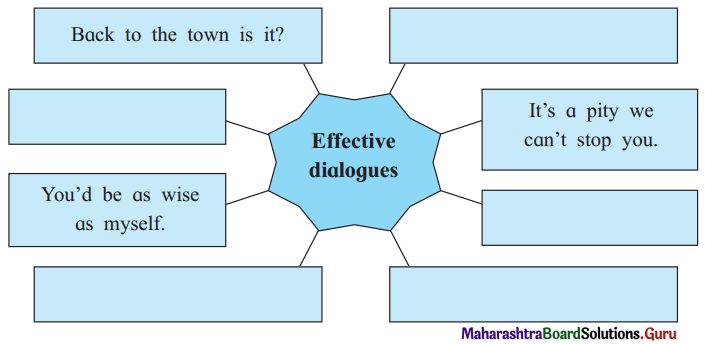
Question 1.
Prepare a list of questions to be asked while interviewing a jawan from Indian Army.
Answer:

  1. When did you join Indian Army?
  2. How did you prepare yourself for selection in Indian Army?
  3. Where were you posted while in Indian Army?
  4. How do you protect yourself while doing duty where there is an extreme weather ?
  5. How do you prepare yourself while going on a mission ?
  6. How did your family members support you when you joined Army?
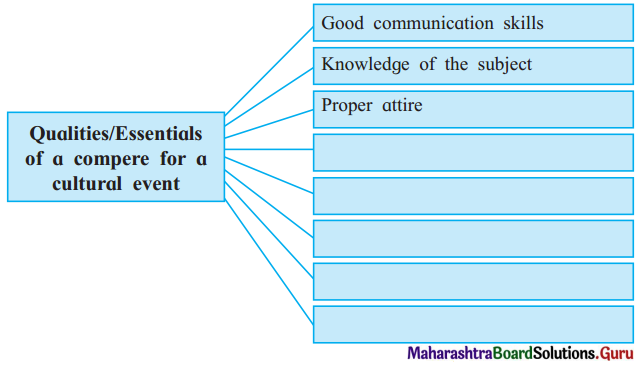
  7. Can you share any memorable incident from your life?
  8. What message would you like to give the youngsters struggling to get selected in Indian Army?
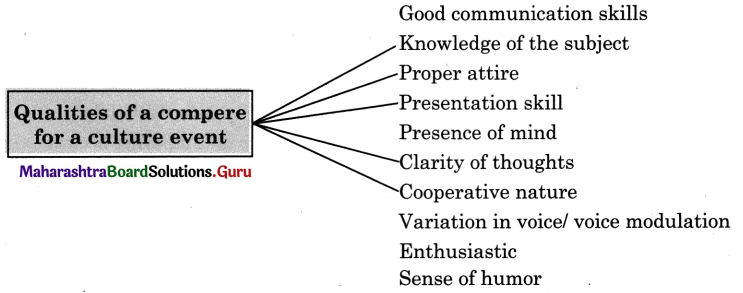
  9. what message would you give to the countrymen?

11th Std English Questions And Answers: