The Phantom Tollbooth Poem Questions and Answers Class 6 English Chapter 4.6 Maharashtra Board

Balbharti Maharashtra State Board Class 6 English Solutions Chapter 4.6 The Phantom Tollbooth Notes, Textbook Exercise Important Questions and Answers.

Std 6 English Lesson 4.6 The Phantom Tollbooth Question Answer Maharashtra Board

Class 6 English Chapter 4.6 The Phantom Tollbooth Textbook Questions and Answers

1. Read the passage and answer the following questions.

Question a.
Which book is introduced in the passage?
Answer:
The novel “The Phantom Tollbooth” is introduced in the passage.

Maharashtra Board Class 6 English Solutions Chapter 4.6 The Phantom Tollbooth

Question b.
Where does the story take place?
Answer:
The story takes place in San Francisco in the United States.

Question c.
Who is the main character in the story?
Answer:
Milo, a young boy who lived in San Francisco in the States is the main character in the story

Question d.
Why is the tollbooth called a ‘Phantom’ Tollbooth?
Answer:
“Phantom” (A ghost) is a character we read about in comics. No one knows where he comes from. The same is applicable to the tollbooth. Both Phantom and the tollbooth have one thing in common: ‘their mysterious appearance’ and so the name “The Phantom Tollbooth”.

Question e.
When was the book written?
Answer:
The book was written more than 50 years ago.

Maharashtra Board Class 6 English Solutions Chapter 4.6 The Phantom Tollbooth

Question f.
Who has written the book?
Answer:
The book has been written by Norman Juster.

2. List the various people and places mentioned in the passage. The places Milo visits and the people he meets have unusual names. Write the meanings of those names.

Question 1.
List the various people and places mentioned in the passage. The places Milo visits and the people he meets have unusual names. Write the meanings of those names.
Answer:
People he meets:

Names Meaning
1. Rhyme and Reason Purpose or explanation (usually used as a phrase: without any rhyme and reason)
2. Lethargarians People without energy and enthusiasm

People he visits:

Names Meaning
1. Land of expectations Land filled with anticipation of things to come
2. Kingdom of wisdom A land which reflected experience, knowledge and judgment.
3. Castles of air An imaginary fortified building
4. Doldrums A place in a state of inactivity

3. List the various things that the Lethargarians do or want to do. Can you sum up all of it in one word or phrase?

Question 1.
List the various things that the Lethargarians do or want to do. Can you sum up all of it in one word or phrase?
Answer:
Epitome of laziness

Maharashtra Board Class 6 English Solutions Chapter 4.6 The Phantom Tollbooth

4. In the novel, the Lethargarians give a whole day’s timetable of their activities. Can you guess what it would be like? Use your own ideas and prepare their timetable.

Question 1.
In the novel, the Lethargarians give a whole day’s timetable of their activities. Can you guess what it would be like? Use your own ideas and prepare their timetable.
Answer:
Timetable of Lethargarians

Time Activities Scheduled
6.15 a.m. – 8.15 a.m. Daydreaming
8.15 a.m. – 9.15 a.m. Taking naps
9.15 a.m. – 10.15 a.m. Dawdle and delay
10.15 a.m. – 11.15 a.m. Bide their time
11.15 a.m. – 1.15 p.m. Linger and loiter
1.15 p.m. – 2.15 p.m. Put off for tomorrow what they could do today
2.15 p.m. – 3.15 p.m. Loaf and lounge
3.15 p.m. – 4.15 p.m. Dillydally
4.15 p.m. – 8.15 p.m. Complain about busy schedule
8.15 p.m. – 10.15 p.m. Complain again that there is almost no time for brooding, lagging plodding or procrastinating.
10.15 p.m. Retire for the day

5. Try to write an interesting timetable for imaginary people or creatures.

Question 1.
Try to write an interesting timetable for imaginary people or creatures.
Answer:
Timetable of the Determinator alias “Team”

Time Activities Scheduled
6.15 a.m. – 8.15 a.m. Getting up and making a few resolutions
8.15 a.m. -9.15 a.m. Exercise
9.15 a.m. -10.15 a.m. Eat a healthy breakfast
10.15 a.m. – 11.15 a.m. Planning of immediate tasks
11.15 a.m. – 1.00 p.m. Execution of the task
1.00 p.m.-2.00 p.m. Lunch break
2.00 p.m. – 3.00 p.m. Afternoon siesta
3.00 p.m. – 4.00 p.m. Tea break
4.00 p.m. – 8.15 p.m. Continuation of the task
8.15 p.m.-9.00 p.m. Taking stock of the day’s activities
9.00 p.m. -10.00 p.m. Dinner
10.00 pm Retire for the day

Maharashtra Board Class 6 English Solutions Chapter 4.6 The Phantom Tollbooth

6. Activity.

Start a collection of new and interesting words. Write the words in coloured ink on cards of equal size and arrange them in alphabetical order. Try to use the words in your writing or conversation from time to time.

7. Discuss what makes the following sentences funny.

Question a.
Your wasted time will be refunded.
Answer:
We all know that time once lost is lost forever. The above lines from the lesson is funny because in the letter which was sent with the parcel along with other instructions, the above line too was included. This line is a continuation of the earlier part of the statement which said that results were not guaranteed and if not perfectly satisfied, your wasted time will be refunded. This impossible and improbable assurance makes it a funny statement.

Question b.
There was no highway attached to the booth.
Answer:
A highway is a main public road on which we find booths to make telephone calls or for toll collection. The tollbooth mentioned was erected by Milo. But there was no highway attached to the same. He wondered how a tollbooth could exist without a highway evoking laughter from the reader on the funny statement.

Maharashtra Board Class 6 English Solutions Chapter 4.6 The Phantom Tollbooth

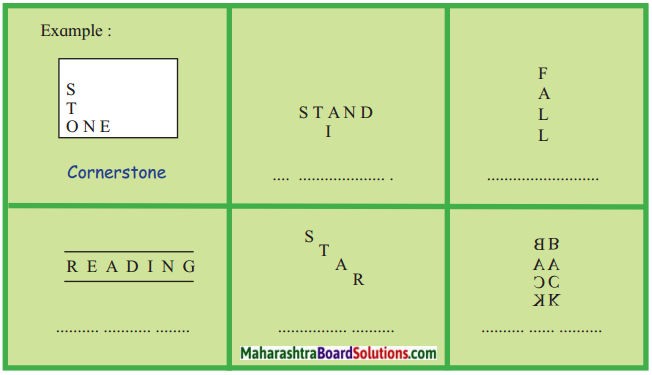
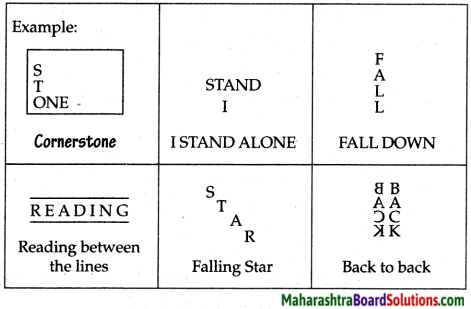
8. The following boxes represent a word or phrase through a special arrangement of letters. Guess the words.

Question a.
The following boxes represent a word or phrase through a special arrangement of letters. Guess the words.
Maharashtra Board Class 6 English Solutions Chapter 4.6 The Phantom Tollbooth (A Book Review) 1
Answer:
Maharashtra Board Class 6 English Solutions Chapter 4.6 The Phantom Tollbooth (A Book Review) 1.1

Question b.
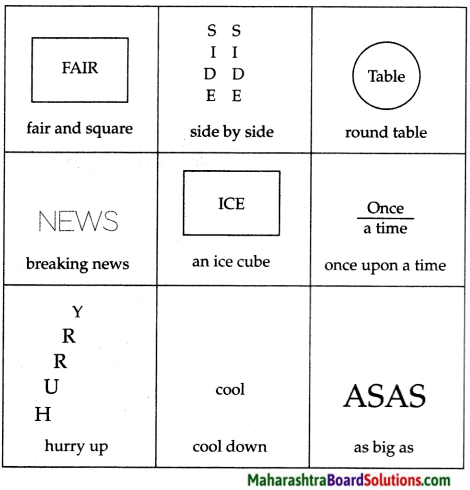
Try to represent the words or phrases using such special graphic arrangement.
Answer:
Maharashtra Board Class 6 English Solutions Chapter 4.6 The Phantom Tollbooth (A Book Review) 1.2

9. Write a review of your favourite book.

Question 1.
Write a review of your favourite book. Use the following points:

  1. Title of the book
  2. Author/Authors
  3. The central idea or story
  4. The important characters
  5. Some special features of the book
  6. Why is it your favourite book?

Class 6 English Chapter 4.6 The Phantom Tollbooth Additional Important Questions and Answers

Reading Skills, Vocabulary and Grammar.

Question 1.
Complete the boxes with two nouns from the extract:
Answer:
Maharashtra Board Class 6 English Solutions Chapter 4.6 The Phantom Tollbooth (A Book Review) 1.3

Question 2.
What does the passage deal with?
Answer:
The passage deals with an extract from the novel “The Phantom Tollbooth” and a short review of the same.

Maharashtra Board Class 6 English Solutions Chapter 4.6 The Phantom Tollbooth

Question 3.
Where did Milo find himself?
Answer:
Milo found himself speeding down a highway into an unknown territory.

Question 4.
Where did Milo’s journey begin from?
Answer:
Milo’s journey began from the land of expectations.

Question 5.
Where did Milo have many adventures?
Answer:
Milo had many adventures in the kingdom of wisdom.

Question 6.
Write any one adventure which Milo had in the kingdom of wisdom.
Answer:
Milo had to rescue the princesses Rhyme and Reason from castles of air.

Maharashtra Board Class 6 English Solutions Chapter 4.6 The Phantom Tollbooth

Question 7.
Pick out a word from the passage which means:
a. an exciting and daring experience
b. huge fortified building
Answer:
a. adventure
b. castle

Question 8.
Give the adjective forms of:
Answer:

  1. successful: success
  2. school: scholastic

Question 9.
You must read the novel to find out. (Pick out the modal and state its function)
Answer:

  1. Modal: must
  2. Function: compulsion

Maharashtra Board Class 6 English Solutions Chapter 4.6 The Phantom Tollbooth

Question 10.
Why should we read books?
Answer:
“Books are keys to wisdom’s treasure,
Books are roads to lands of pleasure”.

Books provide us with wisdom and it is also a pleasure time activity. It enhances our knowledge and helps to put our leisure time to good use. So we must read books. Let us pledge to “Read and Grow”.

Language Study.

Question 1.
Nothing really interested him. (State the word class of the underlined word)
Answer:
really – adverb

Question 2.
He couldn’t return the parcel. (Add a question tag)
Answer:
He couldn’t return the parcel, could he?

Maharashtra Board Class 6 English Solutions Chapter 4.6 The Phantom Tollbooth

Question 3.
Results are not guaranteed. (Form a Wh- question to get the underlined part as the answer)
Answer:
What are not guaranteed?

Question 4.
It was a proper booth with windows and a roof and a coin box. (Pick out two Naming words/Nouns)
Answer:
Naming words/Noun windows; roof

Question 5.
Milo was not sure that this new game would turn out to be interesting. (Write the antonyms of the underlined word and rewrite the sentence)
Answer:
Milo was unsure whether this new game would turn out to be interesting.

Question 6.
He sat in his toy car. The part of the speech of the underlined word is pronoun/adjective.
Answer:
Adjective.

Maharashtra Board Class 6 English Solutions Chapter 4.6 The Phantom Tollbooth

Question 7.
He had many adventures there. (Separate the subject and predicate)
Answer:
He – Subject
had many adventures there – Predicate

Question 8.
It is a fantasy. (Make it interrogative)
Answer:
Isn’t it a fantasy?

Question 9.
It has helped them to look at their school and studies in a new light. (Pick out the article)
Answer:
article – a

Maharashtra Board Class 6 English Solutions Chapter 4.6 The Phantom Tollbooth

Question 10.
Provide anagrams for: was, but
Answer:
saw, tub

Question 11.
A Book Review:
Answer:
Gulliver’s Travels:
The book ‘Gulliver’s Travels’ by Jonathan Swift was first published in 1726.
The book is a collection of Lemuel Gulliver’s fascinating voyages all over the world. The Gulliver was a surgeon who travelled to different places from 1699 to 1715.
The book is divided into 4 parts, each part containing Gullievr’s experience in a different land.

  1. Voyage to Liliput.
  2. Voyage to Brobdingnag
  3. Voyage to Laputa
  4. Voyage to the country of Honyhnhnms

The kids love to read the story of Gulliver and his adventures in the six inches dwarf like Lilliputians. ‘Gulliver’s Travels’ is loved and read and re-read by children and adults since centuries.

The Phantom Tollbooth Summary in English

A classic of children’s literature, this book written by Norman Juster has an important message for children and it has also helped them to look at their school and studies with a fc** new insight, a new perspective.

Introduction:

The novel “The Phantom Tollbooth” (A book review) reviews the book written fifty years ago.

Maharashtra Board Class 6 English Solutions Chapter 4.6 The Phantom Tollbooth

Glossary:

  1. admitted (v) – accepted/confessed
  2. intrigued (v) – aroused curiosity headed for
  3. genuine (adj) – truly what it is said to be
  4. precautionary (adj) – something done in advance
  5. cartographers (n) – experts in map-drawing
  6. depict (v) – represent in words or pictures
  7. regulations (n) – rules for control
  8. destination (n) – the place where one is headed for
  9. territory (n) – an area
  10. expectations (n) – things we regard as likely to happen
  11. reuse (v) – to use something again
  12. mission (n) – an important task
  13. in a new light (n) – in a new perspective leading to better understanding

Std 6 English Digest Other Chapters:

The Silver House Poem Questions and Answers Class 6 English Chapter 2.5 Maharashtra Board

Balbharti Maharashtra State Board Class 6 English Solutions Chapter 2.5 The Silver House Notes, Textbook Exercise Important Questions and Answers.

Std 6 English Lesson 2.5 The Silver House Question Answer Maharashtra Board

Class 6 English Chapter 2.5 The Silver House Textbook Questions and Answers

1. What do the following words in the poem mean?
(a) crown (b) round (c) draw (d) blind
Do these words have other meanings? List them.

Questio0n 1.
What do the following words in the poem mean?
(a) crown (b) round (c) draw (d) blind
Do these words have other meanings? List them.
Answer:

a. Crown: (in the poem) a princely ornament worn as a badge of royalty.
(Other meanings):

  1. A wreath for the head given as a reward of victory.
  2. The topmost part of the head.
  3. An award gained by a victory.
  4. An artificial replacement for the upper part of the tooth.

b. Round: (in the poem) spherical, having gentle curves
(Other meanings):

  1. Complete, whole
  2. Outspoken, plain and direct
  3. Finished; polished; not defective or abrupt

c. Draw: (in the poem) to move something by pulling
(Other meanings):

  1. To develop something (to sketch)
  2. To pull out (as a gun from a holster).

d. Blind: (in the poem) window coverings
(Other meanings):

  1. Unable to see
  2. Closed at one end or having a dead end
  3. Without prior knowledge

Maharashtra Board Class 6 English Solutions Chapter 2.5 The Silver House

2. Find four pairs of rhyming words from the poem.

Question 1.
Find four pairs of rhyming words from the poem.
Answer:
The pairs of rhyming words in the poem are:

  1. crown – down
  2. way – say
  3. blind – find
  4. bare – there

3. In each of the following line, spot the sound that is used repeatedly.

Question 1.
There’s a silver house in the lovely sky.
Answer:
The sound of the letter ‘s’ is used repeatedly.

Maharashtra Board Class 6 English Solutions Chapter 2.5 The Silver House

Question 2.
As round as a silver crown.
Answer:
The sound of the letter ‘a’ in the word ‘as’ is used repeatedly.

Question 3.
It takes two weeks to build it up. And two to pull it down.
Answer:
The sound of the letter ‘t’ is used repeatedly in the words ‘two’ and ‘to’. The sound of the letter ‘p’ is used repeatedly in the words ‘up’ and ‘puli’.

Maharashtra Board Class 6 English Solutions Chapter 2.5 The Silver House

4. What is implied in the following phrases or lines?

Question a.
A silver house in the lovely sky.
Answer:
It is implied in this sentence that the ‘silver house’, is actually the moon in the sky.

Question b.
It takes two weeks to build it up.
Answer:
It is implied in this sentence that the two weeks that are used to build the ‘silver house’ up are the weeks that are required for the moon to complete its journey from the ‘new moon phase’ to the ‘full moon phase’ (waxing).

Question c.
And two to pull it down.
Answer:
It is implied in this sentence that the period of two weeks is the time taken by the moon to change from the ‘full moon phase’ to the ‘new moon phase’ (waxing).

5. Make a pair presentation’ of the poem, in the class.

Question 1.
Make a pair presentation’ of the poem, in the class.

Maharashtra Board Class 6 English Solutions Chapter 2.5 The Silver House

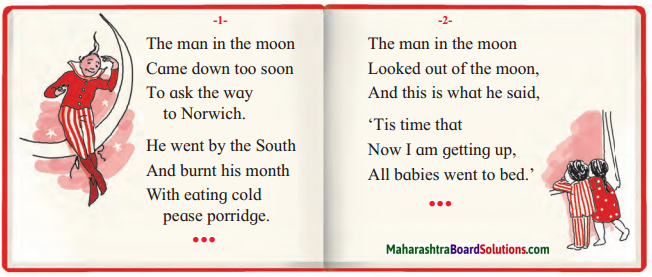
6. The man in the moon is mentioned in many nursery rhymes and stories. When people see the spots on the surface of the moon, they imagine that it’s a human face, or the figure of a man who lives on the moon. Sometimes, other characters like rabbits are also imagined to live with the man. Here are two nursery rhymes about the man in the moon.

Maharashtra Board Class 6 English Solutions Chapter 2.5 The Silver House 1

7. Are there any stories/legends about the moon or special names for the moon in your language? Talk to your friends and family members and collect this information.

Question 1.
Are there any stories/legends about the moon or special names for the moon in your language? Talk to your friends and family members and collect this information.
Answer:
Legend:
In the 1820s, the Bavarian astronomer Franz Von Paula Gruithuisen claimed to have glimpsed entire cities on the moon with his telescope. He wrote that the ‘lunarians who lived there had built sophisticated buildings, roads and forts. Most of his colleagues scoffed at his assertion, but he eventually got a small lunar crater named after him.

Sir William Herschel, a prominent British astronomer and composer, also thought aliens lived on the moon and made regular observations about the progress of their construction projects. In 1835, when the New York Sun published a series of fraudulent articles about the supposed existence of life on earth on the moon (pulling off the so-called “Great Moon Hoax”), it falsely credited Herschel’s son John, a famous astronomer in his own right, with the shocking discovery.

Special names of the moon in different languages:

  • Sanskrit: Himanshu
  • Marathi: Chandra ;
  • Hindi: Chand ‘
  • French: Lune German: Mond

(The students are expected to find out more legends and words on their own.)

Maharashtra Board Class 6 English Solutions Chapter 2.5 The Silver House

8. Do you know any poem or song about the moon in your own language? Sing it in the class.

Question 1.
Do you know any poem or song about the moon in your own language?:Sing it in the class.

9. Form pairs. Write a poem with rhyming lines on at least one of the following:
the moon, stars, a tree, a flower, a river/luke, rain, the wind, clouds.

Question 1.
Form pairs. Write a poem with rhyming lines on at least one of the following:
the moon, stars, a tree, a flower, a river/luke, rain, the wind, clouds.
Answer:

  • White (Poem in cloud)
  • Swirling clouds and shimmering sunlight,
  • Shifting in between dim and bright
  • Could stare all day and just night,
  • Spectacular delight,
  • Unable to fight,
  • Amazing night,
  • Outranks night,
  • Just right
  • White.

Class 6 English Chapter 2.5 The Silver House Important Questions and Answers

Reading Skills and Poetic Device:

Read the following extract and answer the questions given below.

Question 1.
What is there in the lovely sky?
Answer:
There is a silver house in the lovely sky.

Maharashtra Board Class 6 English Solutions Chapter 2.5 The Silver House

Question 2.
How much time does it take to build up and pull up the house?
Answer:
It takes two weeks to build up and pull down the silver house.

Question 3.
Who lives in the silver house? How is he?
Answer:
A man who seems to be lonely, whose name no one knows or no one likes to say; stays in the silver house.

Question 4.
What is the rhyme scheme of stanza 1 and 2?
Answer:
abed

Read the following extracts and answer the questions given below.

Question 1.
When and what should you do to find the lonely man?
Answer:
You should draw the blinds of the window and peep out at the silver moon at night in order to find the lonely man.

Maharashtra Board Class 6 English Solutions Chapter 2.5 The Silver House

Question 2.
List the pair of rhyming words in this
stanza.
Answer:
The pair of rhyming words in this stanza is

  • bare – there
  • blind – find.

The Silver House Summary in English

Paraphrase:

The poet John Lea is comparing the silver house in the sky to a moon. He describes the different phases of the moon as the time to build up and pull down the said ‘Silver House’.

The poet talks about a man that lives in the ‘Silver House’ and how no one knows or talks about the man. The poet further advises us to draw the window blind at night, before calling it a day, in order to see the lonely man. John Lea, the poet, states that if you cease to find the poor man in the sky, it is because the ‘Silver House’ has been taken down. The ‘Silver House’ will of course not be there due to the moon being in the ‘new moon’ phase.

Maharashtra Board Class 6 English Solutions Chapter 2.5 The Silver House

Introduction:

The poem The Silver House’ is a poem written by the poet John Lea that indirectly describes the phases of the moon. The poem describes a silver house which is as round as a silver crown in the sky which in fact, is the moon. The poem gradually explains that the house which actually is the moon, takes two weeks to build up and two weeks to pull down, which is the time the moon takes to change from the new moon phase to the full moon phase.

Glossary:

  1. crown (n) – a silver coin that was used in England in the past
  2. window blind (n) – a protective covering for the window. A window blind keeps out light.
  3. taken down (ph) – pulled down, dismantled

6th Std English Questions And Answers:

If I Can Stop One Heart From Breaking … Poem Questions and Answers Class 6 English Chapter 4.5 Maharashtra Board

Balbharti Maharashtra State Board Class 6 English Solutions Chapter 4.5 If I Can Stop One Heart From Breaking … Notes, Textbook Exercise Important Questions and Answers.

Std 6 English Lesson 4.5 If I Can Stop One Heart From Breaking … Question Answer Maharashtra Board

Class 6 English Chapter 4.5 If I Can Stop One Heart From Breaking … Textbook Questions and Answers

1. What does the poet want to do?

Question 1.
What does the poet want to do?
Answer:
The poet wants to stop a heart from breaking, i.e., help a person from becoming sad and help a fainting robin back into his nest again.

Maharashtra Board Class 6 English Solutions Chapter 4.5 If I Can Stop One Heart From Breaking …

Question 2.
Does the poet expect anything in return? What is the poet’s reward?
Answer:
No, the poet does not expect anything in return. The poet believes that through these acts, he can add meaning to his life and therein lies his reward.

Question 3.
List the phrases that indicate sorrow or pain.
Answer:
a. stop one heart from breaking;
b. ease one life the aching

Question 4.
Form groups of five and discuss. There are many things that seem small, minor or insignificant to some people but the same may be the cause of great pain, suffering for others.
Can you list such things? What can you do to provide help on these occasions? What do we do?
Answer:

  1. Some people may not give a lot of importance to money while there are others who are dying due to hunger and starvation. They are so poor that they cannot afford their basic needs,
  2. We should help organize food for the poor and the needy. We can request NGOs to help them.
  3. Some people leave the taps open and wastewater while there are thousands who are deprived of drinking water. We should create awareness about the need to save water and ensure that we do all we can to help people overcome water scarcity.
  4. Many people visit restaurants and waste food. They do it at home too, At the same time, there are so many people who sometimes starve to death.
  5. We can request hotels and restaurants to donate a part of whatever they prepare each day to those in need. (Students may add their ideas to the list)

Class 6 English Chapter 4.5 If I Can Stop One Heart From Breaking … Additional Important Questions and Answers

Answer in one sentence.

Question 1.
What is the message conveyed through this poem?
Answer:
The message conveyed through this poem is that we should do all we can to reduce the pain and suffering of human beings and other creatures of nature.

Maharashtra Board Class 6 English Solutions Chapter 4.5 If I Can Stop One Heart From Breaking …

Reading and Poetic Device.

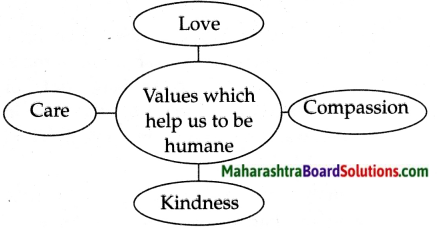
Question 1.
Complete the web diagram.
Answer:
Maharashtra Board Class 6 English Solutions Chapter 4.5 If I Can Stop One Heart From Breaking … 1

Question 2.
What is the central idea of the poem?
Answer:
The central idea of the poem is that by showing kindness to man and other creatures of nature like a bird, we will be making our life purposeful and meaningful.

Question 3.
Name two values highlighted in the poem.
Answer:
The two values highlighted in the poem are compassion and kindness.

Question 4.
Explain the lines: ‘If I can ease one life the aching, I shall not live in vain’.
Answer:
Through the above lines, the poetess is conveying the message that if she can reduce the pain and suffering of anyone in this world, her life will acquire meaning. It will be a purposeful life, well-lived.

Maharashtra Board Class 6 English Solutions Chapter 4.5 If I Can Stop One Heart From Breaking …

Question 5.
Pick out proof to show that the poetess doesn’t want to reserve her care and compassion to human beings alone.
Answer:
Or help one fainting robin
Unto his nest again,
I shall not live in vain

Question 6.
Complete the following:
If I can stop one heart from breaking
Answer:
I shall not live in vain.

Question 7.
Pick out two pairs of rhyming words from the poem.
Answer:
a. breaking – aching;
b. pain – again

Question 8.
Name the rhyme scheme used in the first four lines of the poem.
Answer:
ababcbb

Maharashtra Board Class 6 English Solutions Chapter 4.5 If I Can Stop One Heart From Breaking …

Question 9.
Pick out an archaic (old usage) word from the poem.
Answer:
unto

Question 10.
How will you make your life worthwhile?
Answer:
I believe: ‘It is blessed to give than to receive’. I will make my life worthwhile by caring for my fellow beings. I will also strive towards conservation, preservation and protection of the environment.

Language Study.

Question 1.
Pick out naming words from the poem, (any 4)
Answer:
Maharashtra Board Class 6 English Solutions Chapter 4.5 If I Can Stop One Heart From Breaking … 2

Question 2.
Pick out action words from the poem (any 4)
Answer:
Maharashtra Board Class 6 English Solutions Chapter 4.5 If I Can Stop One Heart From Breaking … 3

Question 3.
Write one word with the same sound.
Answer:
(a) one – won (b) pain – pane.

Maharashtra Board Class 6 English Solutions Chapter 4.5 If I Can Stop One Heart From Breaking …

Writing Skills.

Question 1.
Write an essay on: ‘Service to Humanity is Service to God’
Answer:
Woodrow Wilson has rightly said, “There is no higher religion than human service.” To work for the common good is the greatest creed.”

Our life acquires meaning only when we commit it towards the service of others. Love, care, compassion, kindness, empathy, sympathy, etc., are some of the vital values which will help us to reach out to those in need or to those in distress. There are several social workers who have committed their life in service of others. Whether it is Mother Teresa, Baba Amte, or Sant Cadge Maharaj, one thing they had in common was the unconditional love they had for their fellow beings.

We can make a world of difference by joining NGOs or participating in our school’s initiatives towards social work. Visiting home for the aged and spending time with the elderly, distributing gifts to the children in orphanages on our birthday, etc., are little acts of kindness which can make a big difference.

Let us remember the words of Mahatma Gandhi: “The best way to find yourself is to lose yourself in the service of others”. With a heart filled with generosity, with words that are kind and through acts of selflessness, let us build a world where love and happiness reign supreme.

Quote of the Day.

Use your voice for kindness

  1. your care for compassion
  2. your hands for charity
  3. your mind for truth
  4. your heart for love

If I Can Stop One Heart From Breaking … Summary in English

Emily Dickinson in her poem conveys the message that we should do whatever we can to make the life of those around us happier.
Little acts of care, compassion, concern and love can make a world of difference. Paraphrase:
The poet also advises us to be compassionate not only to human beings but also to the animals. We should do all we can to reduce pain and suffering.

Maharashtra Board Class 6 English Solutions Chapter 4.5 If I Can Stop One Heart From Breaking …

Introduction:

A beautiful poem which highlights the importance of reaching out to humans and other creatures of nature thus making a world of difference to them.

Glossary:

  1. stop heart from breaking – to help a person
  2. live in vain – live without purpose
  3. ease one life the aching – reduce sorrow in someone’s life
  4. cool one pain – reduce the pain, give relief from becoming sad
  5. unto – to (archaic use)

Std 6 English Digest Other Chapters:

Anak Krakatoa Poem Questions and Answers Class 6 English Chapter 2.4 Maharashtra Board

Balbharti Maharashtra State Board Class 6 English Solutions Chapter 2.4 Anak Krakatoa Notes, Textbook Exercise Important Questions and Answers.

Std 6 English Lesson 2.4 Anak Krakatoa Question Answer Maharashtra Board

Class 6 English Chapter 2.4 Anak Krakatoa Textbook Questions and Answers

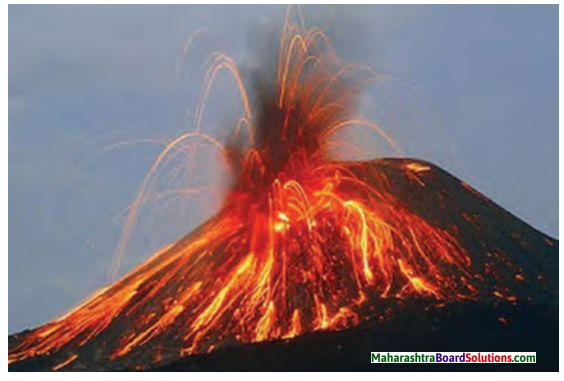
1. Draw a diagram to show a volcanic eruption from its description given in this passage. Label the diagram. Show the following in it: Volcano; earth’s crust; crack in the earth’s crust; hot molten rock; red, hot lava; smoke; ash; burning chunks of rock.

Question 1.
Draw a diagram to show a volcanic eruption from its description given in this passage. Label the diagram. Show the following in it: Volcano; earth’s crust; crack in the earth’s crust; hot molten rock; red, hot lava; smoke; ash; burning chunks of rock.
Answer:
Maharashtra Board Class 6 English Solutions Chapter 2.4 Anak Krakatoa 1

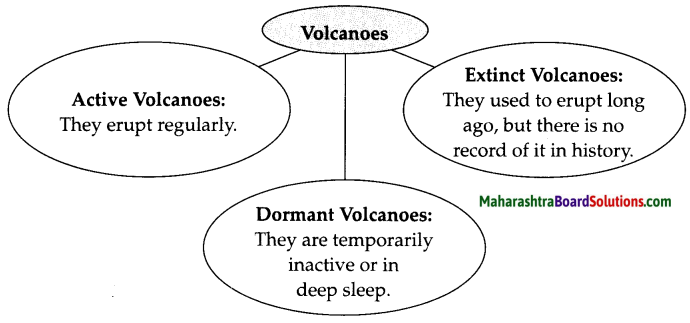
2. Show the three categories of volcanoes using the following tree diagram structure.

Maharashtra Board Class 6 English Solutions Chapter 2.4 Anak Krakatoa 2
Write a very short description of each category below the box.

Question 1.
Show the three categories of volcanoes using the following tree diagram structure.
Maharashtra Board Class 6 English Solutions Chapter 2.4 Anak Krakatoa 2
Write a very short description of each category below the box.
Answer:
Maharashtra Board Class 6 English Solutions Chapter 2.4 Anak Krakatoa 3

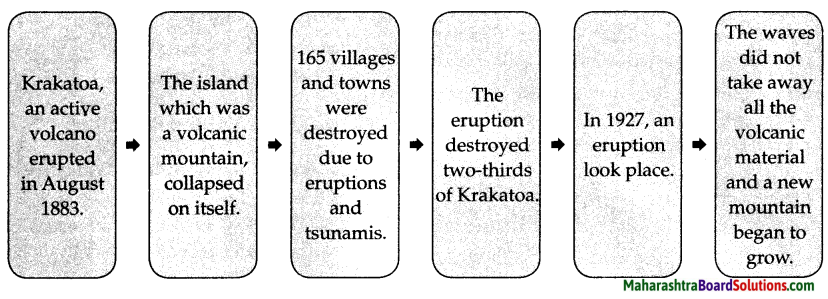
3. Show the stages in the process in which Krakatoa collapsed and then Anak Krakatoa formed in the course of volcanic eruptions. Use the flowchart given below.

Maharashtra Board Class 6 English Solutions Chapter 2.4 Anak Krakatoa 4

Question 1.
Show the stages in the process in which Krakatoa collapsed and then Anak Krakatoa formed in the course of volcanic eruptions. Use the flowchart given below.
Maharashtra Board Class 6 English Solutions Chapter 2.4 Anak Krakatoa 4
Answer:
Maharashtra Board Class 6 English Solutions Chapter 2.4 Anak Krakatoa 5

4. Draw a diagram to show how life returned to the island. Label the diagram.
(Use the technique of drawing diagrams when you study science, geography, etc.)

Question 1.
Draw a diagram to show how life returned to the island. Label the diagram.
(Use the technique of drawing diagrams when you study science, geography, etc.)

5. Write short notes on the following:

Question 1.
The 1883 eruption
Answer:
The August 1883 eruption that took place was the worst of the eruptions that took place. The sound of the volcanic eruption was heard more than 3500 kms away in Australia. The island which was a volcanic mountain, collapsed on itself. The dust rose up to 80 km. in the sky, which spread around the world and later settled in different parts thousands of kilometres away.

Giant tsunamis were caused by the eruption, destroying 165 villages and towns. Two-thirds of the island of Krakatoa was destroyed, which collapsed beneath the surface of the sea creating more than a 6 km. wide hole.

Maharashtra Board Class 6 English Solutions Chapter 2.4 Anak Krakatoa

Question 2.
The living world on Rakata
Answer:
Rakata, a part of Krakatoa is still visible in the sea, a little away from Anak Krakatoa. After the 1883 eruption, all the surrounding islands and coasts were covered with hot ash rendering the island lifeless. In 1884, a scientist found only one spider when he visited Rakata.

The wind and the sea brought seeds of the plants to the island. Plants and animals that lived in the sea came to the coasts again. Small land animals like ants, termites or even rats and lizards travelled to the island on plants floating in the sea. One edge of the island was soon teeming with plants and animals.

6. Find the pronunciation of the following words from a good dictionary.
strait, eruption, tremendous, dormant, extinct, tsunami, crater, plume.

Question 1.
Find the pronunciation of the following words from a good dictionary.
strait, eruption, tremendous, dormant, extinct, tsunami, crater, plume.

Maharashtra Board Class 6 English Solutions Chapter 2.4 Anak Krakatoa

7. Read aloud with the leader: Form groups of five. Read the passage aloud in groups. The leader begins every sentence and stops after a few words. The other members complete the sentence, reading it aloud in chorus.

Question 1.
Read aloud with the leader: Form groups of five. Read the passage aloud in groups. The leader begins every sentence and stops after a few words. The other members complete the sentence, reading it aloud in chorus.

8. Look at the following words carefully for one minute. Now close your book and try to write down as many of the words as you can remember.

Maharashtra Board Class 6 English Solutions Chapter 2.4 Anak Krakatoa 6

Question 1.
Look at the following words carefully for one minute. Now close your book and try to write down as many of the words as you can remember.

Maharashtra Board Class 6 English Solutions Chapter 2.4 Anak Krakatoa 6
Answer:
active, coast, crater, crust, disaster, dormant, eruption, extinct, inland, island, lava, molten, plume, tremendous, tsunami, volcanic.

Maharashtra Board Class 6 English Solutions Chapter 2.4 Anak Krakatoa

9. Read the passage and find the verbs used with the following nouns and phrases:
volcano, molten rock, volcanic mountain, dust, 165 village and towns, the wind and the sea, seeds, birds

Question 1.
Read the passage and find the verbs used with the following nouns and phrases:
volcano, molten rock, volcanic mountain, dust, 165 village and towns, the wind and the sea, seeds, birds
Answer:

Nouns/Phrases Verbs
Molten rock Erupts, is, has erupted,
Volcano Is
Volcanic mountain was
Dust was thrown up
165 villages and town were destroyed
The wind and the sea brought
Seeds came
Birds flew

Class 6 English Chapter 2.4 Anak Krakatoa Important Questions and Answers

Answer the following questions in one or two sentences.

Question 1.
What is Krakatoa known for?
Answer:
Krakatoa is known for its volcano which erupts regularly.

Maharashtra Board Class 6 English Solutions Chapter 2.4 Anak Krakatoa

Question 2.
Name the three categories of volcano.
Answer:

  • Active volcano
  • Dormant volcano
  • Extinct volcano

Question 3.
How loud was the sound of the eruption which took place in August 1883?
Answer:
The sound of the eruption in August 1883 was so loud that it was heard more than 3500 km. away in Australia.

Question 4.
What did the volcanic eruption in August 1883 cause?
Answer:
The volcanic eruption in August 1883 caused giant waves or tsunamis in the sea near the island.?

Question 5.
What was the new island named?
Answer:
The new island was named ‘Anak Krakatoa’ or the ‘Child of Krakatoa’.

Question 6.
Name the agents that helped to maintain the living world on Rakata.
Answer:

  1. The wind
  2. The sea
  3. The birds

Maharashtra Board Class 6 English Solutions Chapter 2.4 Anak Krakatoa

Question 7.
How did the western coast of Java become rich in wildlife?
Answer:
The wildlife in the western coast of Java grew naturally because there were no human beings to interfere with it. There was no one to cut the trees or kill animals.

Reading Skills, Vocabulary and Grammar

Read the extract and do the activities.

Question 1.
Write True or False:
a. Krakatoa is an island in the Sunda strait.
b. Great volcanic erruptions can change the land forms on an area.
Answer:
a. False
b. True

Question 2.
Where is the island of Krakatoa?
Answer:
The island of Krakatoa is in the Sunda Strait between Java and Sumatra in Indonesia.

Question 3.
What can a great volcanic eruption do?
Answer:
A great volcanic eruption can change the landforms in an area.

Grammar:

Question 1.
Pick out a word from the extract which means:
(a) glowing red hot
(b) great
Answer:
(a) molten
(b) tremendous

Maharashtra Board Class 6 English Solutions Chapter 2.4 Anak Krakatoa

Question 2.
Thick, dark clouds of smoke rise high from the opening. (Change into past continuous tense)
Answer:
Thick, dark clouds of smoke were rising high from the opening.

Question 3.
Pick out a word which is a combination of 2 meaningful words.
Answer:
Sometimes and landforms.

Personal Response:

Question 1.
Do you think animals are happy at the zoo? Why?
Answer:
No, I don’t think animals are happy at the zoo because they are caged and not free to move about. Though they get their food, they are disturbed by human visitors. They would love to be in their natural habitat.

Language Study

Frajne the questions using auxiliary verbs (helping verbs) for the given statements. Begin the question with the helping verb.

Question 1.
It was raining.
Answer:
Was it raining?

Question 2.
They were tired.
Answer:
Were they tired?

Question 3.
They did their duty.
Answer:
Did they do their duty?

Maharashtra Board Class 6 English Solutions Chapter 2.4 Anak Krakatoa

Question 4.
He works in all weathers.
Answer:
Does he work in all weathers?

Remember:

  • Helping (auxiliary) verbs help in changing the tense of the verb in the sentence.
  • Helping (auxiliary) verbs can also be used at the beginning of a sentence to frame a ‘Yes/ No’ question.

Turn each of these statements into a negative question.

Question 1.
It is hot today.
Answer:
Is it not hot today?

Question 2.
You are feeling hungry.
Answer:
Are you not feeling hungry?

Question 3.
She is enjoying the film.
Answer:
Is she not enjoying the film?

Maharashtra Board Class 6 English Solutions Chapter 2.4 Anak Krakatoa

Question 4.
They have eaten their dinner.
Answer:
Have they not eaten their dinner?

Do as directed:

Question 1.
What is a volcano? (State the kind of sentence.)
Answer:
Interrogative sentence

Question 2.
A great volcanic eruption can change the landforms in an area. (Pick out the modal auxiliary)
Answer:
Can – modal (verb) auxiliary

Question 3.
Krakatoa is an active volcano. (Change into a negative sentence)
Answer:
Krakatoa is not an inactive volcano.

Maharashtra Board Class 6 English Solutions Chapter 2.4 Anak Krakatoa

Question 4.
This region became rich in wildlife. (Add a question tag)
Answer:
This region became rich in wildlife, didn’t it?

Question 5.
A part of the old island known as Rakata is still visible in the sea. (Separate the subject and predicate)
Answer:
Subject – A part of the old island known as Rakata
Predicate – is still visible in the sea.

Question 6.
A volcanic eruption happens on a tremendous scale. (Underline the adjectives)
Answer:
Volcanic, tremendous.

Question 7.
Very hot mud and ash are also thrown out. (Name the word class of the underlined words)
Answer:
Very – adverb, hot – adjective, and – conjunction

Maharashtra Board Class 6 English Solutions Chapter 2.4 Anak Krakatoa

Question 8.
Complete the table.
Answer:

Adjective Noun Answers
1. extinct …………………………. extinction (n)
2. …………………………. mountain mountainous (adj)
3. volcanic …………………………. volcano (n)
4. …………………………. history historic (adj)
5. visible …………………………. vision (n)

Do as directed:

Question 1.
Write the noun form of:
Answer:

  • erupted – eruption
  • know – knowledge

Question 2.
Write the adjective form of:
Answer:

  • volcano – volcanic
  • regularly – regular

Question 3.
Add a prefix to:
Answer:

  • regularly – irregularly
  • known – unknown

Maharashtra Board Class 6 English Solutions Chapter 2.4 Anak Krakatoa

Writing Skills:

Question 1.
Write a paragraph on ‘Volcanoes’.
Answer:
Volcanoes are nothing but a natural way the earth has, of cooling off and releasing internal pressure and heat. Volcanoes have their advantages and disadvantages as well, that is the good and bad effects. The bad effects harm human life causing destruction of life and property.

There are many good effects of volcanoes, which not everyone is aware of. Volcanoes provide nutrients to the surrounding soil which is beneficial for plants. Volcanoes make islands. Volcanic ash is used as household cleaners. Volcanoes also create a spectacular sceneries. The most important of all is that volcanic gases are the source of all the water today.

Do you Know?

  • The word ‘valcano’ originally comes from the name of Roman god of fire-Vulcan
  • The Pacific Ring of Fire, an area around the Pacific Ocean, has evidence of 75% of the volcanoes on Earth.
  • While there are big volcanoes on the Earth, the biggest known volcano in our Solar System is actually on Mars, known as Olympus Mons.

Anak Krakatoa Summary in English

Anak Krakatoa which means ‘Child of Krakatoa’ is named after Krakatoa. It is still an active volcano. The worst of the eruptions took place in August 1883. A part of the old island known as Rakata, is still visible in the sea, a little away from the new arrival. After Krakatoa’s eruption in 1883, all the surrounding islands and coasts were covered with hot ash. No life remained. When a scientist visited in 1884, he found just one spider there.

Introduction:

‘Anak Krakatoa’ is an informative lesson about Krakatoa – an island in Indonesia which is known for its volcano which erupts regularly.

Maharashtra Board Class 6 English Solutions Chapter 2.4 Anak Krakatoa

Glossary:

  1. strait (n) – a narrow channel of water connecting two larger bodies of water
  2. eruption (n) – a sudden release of pressure, such as lava from a volcano
  3. tremendous (adj) – extremely large or great in amount, extent, degree, etc.
  4. dormant (adj) – inactive
  5. extinct (adj) – no longer in existence
  6. tsunami (n) – a destructive tidal wave
  7. crater (n) – any large, circular depression or hole
  8. plume (n) – an upswelling of molten material from the earth’s mantle
  9. island (n) – an area of land totally surrounded by water
  10. molten (adj) – glowing red hot
  11. disaster (n) – an event causing great loss

6th Std English Questions And Answers:

Children are Going to School … Questions and Answers Class 6 English Chapter 1.4 Maharashtra Board

Balbharti Maharashtra State Board Class 6 English Solutions Chapter 1.4 Children are Going to School … Notes, Textbook Exercise Important Questions and Answers.

Std 6 English Lesson 1.4 Children are Going to School … Question Answer Maharashtra Board

Class 6 English Chapter 1.4 Children are Going to School … Textbook Questions and Answers

1. Read the poem aloud.

Question 1.
Read the poem aloud.

2. Find atleast two things from the poem that show the following:

Question a.
It is early morning:
Answer:

  1. Morning light spreads over the earth.
  2. The sun, after his morning dip in the river dressed up in his golden muslin turban waits and smiles on one side of the road.

Maharashtra Board Class 6 English Solutions Chapter 1.4 Children are Going to School ...

Question b.
The atmosphere is pleasant.
Answer:

  1. Breezes sing their songs of blessings.
  2. Fragrant flowers awaken the sleepy roads with their melodies.

3. Apart from children, no other human beings are mentioned in the poem. However, many natural elements are shown to act like person. Name them and also write what they do.

Question 1.
Apart from children, no other human beings are mentioned in the poem. However, many natural elements are shown to act like person. Name them and also write what they do.
Answer:

  1. The sky: Sky bows his head in respect for children going to school.
  2. The sun: The sun waits and smiles on one side of the road for the children are going to school.
  3. The breezes: Through the green-topped branches, breezes sing their songs of blessings.
  4. The fragrant flowers: They awaken the sleepy roads with their melodies.
  5. The peepal tree: It waves his hands for the children going to school.
  6. Every particle of the earth: Throbs like a mother’s heart for the children going to school.
  7. Pigeons: Fly in the sky for children going to school.

Maharashtra Board Class 6 English Solutions Chapter 1.4 Children are Going to School ...

4. Draw a picture of the scene described in the poem.

Question 1.
Draw a picture of the scene described in the poem.

5. The whole world is happy because children are going to school. Why is it so? Discuss it in the classroom.

Question 1.
The whole world is happy because children are going to school. Why is it so? Discuss it in the classroom.
Answer:
Children going to school is a beautiful sight. The fun they have, the little games they play, the mischievous things they do enroute to the school, all make it a pretty picture. So, the whole world is happy to witness this sight. Apart from this, it is important that children go to school for their development and the development of the world at large. So, the whole world is happy because children are going to school.

6. Write about how your family supports you to go to school.

Question 1.
Write about how your family supports you to go to school.
Answer:
My family is my greatest support system. They support me in every way to go to school. Packing my lunch box and bag with books and learning material is done by my mother. My father helps me to keep my books complete. He also helps me to get ready to go to school before dropping me to school.

Maharashtra Board Class 6 English Solutions Chapter 1.4 Children are Going to School ...

7. What would happen if children didn’t go to school? Discuss the question in groups of 5-8 and prepare a short composition on it.

Question 1.
What would happen if children didn’t go to school? Discuss the question in groups of 5-8 and prepare a short composition on it.
Answer:
School is a temple of knowledge. If children didn’t go to school, they would not attain knowledge. In a school, they learn different subjects, good qualities and various skills. This helps them to become good individuals and great citizens. Children who don’t go to school will be denied all these experiences. They will also miss out all the fun other children have in schools.

We should ensure that every child is sent to school so that he receives good education. This will not only help him to realise his dreams but also help him contribute towards national development. Let us educate and empower ourselves and work towards a bright future.

8. Write in short about what your parents/guardians feel when they send you to school.

Question 1.
Write in short about what your parents/guardians feel when they send you to school.
Answer:
Parents/guardians experience mixed feelings when they send us to school. They feel happy that we are going to school to acquire knowledge, skills and values and at the same time they miss our absence from home too.
Sometimes, if the school is far away, parents and guardians are worried till we get back. At the same time they are aware that for our bright future it is essential to go to school. They are proud that we are doing our best in school by making the most of our experiences.

Maharashtra Board Class 6 English Solutions Chapter 1.4 Children are Going to School ...

9. List five of your favourite Hindi or Marathi poems or songs. Try to translate any one of them into English.

Question 1.
List five of your favourite Hindi or Marathi poems or songs. Try to translate any one of them into English.

10. Visit a library. Find a school poem. Recite it to your parents.

Question 1.
Visit a library. Find a school poem. Recite it to your parents.

Class 6 English Chapter 1.4 Children are Going to School … Additional Important Questions and Answers

Answer in one or two sentences.

Question 1.
When and to whom does the sky bow his head in respect?
Answer:
When the morning light spreads over the earth, the sky bows his head in respect to the children going to school.

Question 2.
How has the poet described the sun in the poem?
Answer:
The sun is described beautifully by the poet. He says that after the sun’s morning dip in the river, dressed up in golden muslin turban it waits and smiles on one side of the road for the children going to school.

Maharashtra Board Class 6 English Solutions Chapter 1.4 Children are Going to School ...

Question 3.
Who waves at the children going to school?
Answer:
The peepal tree waves his hands at the children going to school.

Question 4.
Why is every road shining bright?
Answer:
The angels of light have set out and so every road is shining bright.

Reading Skill, Vocabulary and Poetic Devices

Read the following extract and complete the activities that follow.

Question 1.
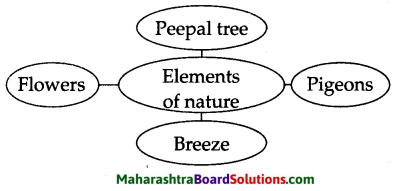
Complete the web diagram with the elements of nature mentioned in the extract.
Answer:
Maharashtra Board Class 6 English Solutions Chapter 1.4 Children are Going to School 1

Question 2.
What does the poet convey through the above poem?
Answer:
The poet conveys the happiness of all the elements of nature at the sight of children going to school.

Maharashtra Board Class 6 English Solutions Chapter 1.4 Children are Going to School ...

Question 3.
What do the breezes do as the children are going to school?
Answer:
Through the green-topped branches, the breezes sing their songs of blessings.

Question 4.
What do the fragrant flowers do as the children are going to school?
Answer:
The fragrant flowers awaken the sleepy roads with their melodies as the children are going to school.

Question 5.
What has the poet compared the throbbing of every particle of the earth to?
Answer:
The poet has compared the throbbing of every particle of the earth to the throb of a mother’s heart.

Question 6.
Explain the line:
Angels of light have set out Every road is a-gleam.
Answer: The sunlight is rejoicing at the sight of the children going to school and it has made the roads shining bright for the children.

Question 7.
Name the rhyme scheme used in the last four lines of the poem.
Answer:
abed

Question 8.
Pick out an example of Simile from the extract.
Answer:
At this hour, every particle of the earth throbs like a mother’s heart.

Maharashtra Board Class 6 English Solutions Chapter 1.4 Children are Going to School ...

Question 10.
What are the emotions you experience at the thought of going to school?
Answer:
I am filled with happiness and joy at the thought of going to school. I look forward to have fun, frolic and enjoyment in school and so I get very excited at the very thought.

Student’s Activity:

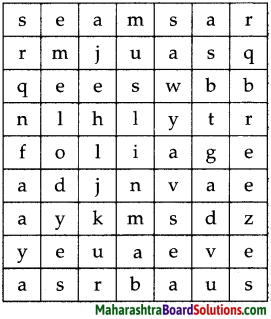
Spot the words based on the clues given.
Maharashtra Board Class 6 English Solutions Chapter 1.4 Children are Going to School 2
Answer:

  1. Greenery, leafy cover
  2. Sweet music
  3. A kind of soft cotton fabric
  4. Light wind

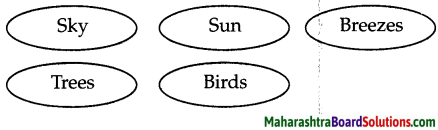
Observe the words given below. Write a story in about hundred words based on the same:

Maharashtra Board Class 6 English Solutions Chapter 1.4 Children are Going to School 3

Children are Going to School … Summary in English

‘Children Going to School’ is a beautiful poem translated from ‘Bachche School Ja Rahe Hai’ written by Nida Fazli. The poem talks about how natural elements like the sky, sun, breezes, fragrant flowers, peepal tree, every particle of the earth and pigeons etc., are happy at the sight of children going to school. They express their happiness in different ways as the children find their way to school.

Maharashtra Board Class 6 English Solutions Chapter 1.4 Children are Going to School ...

Introduction:

The poem highlights the reaction of different elements of nature at the sight of children going to school.

Glossary:

  1. dip (n) – plunge into the river (here)
  2. muslin (n) – a kind of soft cotton fabric
  3. green-topped branches – branches covered with leaves
  4. breezes (n) – light wind
  5. melodies (n) – sweet music
  6. foliage (n) – greenery, leafy cover
  7. gleam (n) – shining bright

6th Std English Questions And Answers:

A Mad Tea Party Poem Questions and Answers Class 6 English Chapter 4.4 Maharashtra Board

Balbharti Maharashtra State Board Class 6 English Solutions Chapter 4.4 A Mad Tea Party Notes, Textbook Exercise Important Questions and Answers.

Std 6 English Lesson 4.4 A Mad Tea Party Question Answer Maharashtra Board

Class 6 English Chapter 4.4 A Mad Tea Party Textbook Questions and Answers

1. Read the passage aloud playing the roles of different characters.

Question 1.
Read the passage aloud playing the roles of different characters.
Answer:
We all follow a class time table made by the school. Imagine for a minute what will happen if there was no time table for your class.

Maharashtra Board Class 6 English Solutions Chapter 4.4 A Mad Tea Party

2. Write any three of the silly remarks made by the characters other than Alice. Write why you think the remark is silly.

Question 1.
Write any three of the silly remarks made by the characters other than Alice. Write why you think the remark is silly.
Answer:
Three silly remarks made by the characters other than Alice:
a. I see what I eat – I eat what I see – Hatter
b. I like what I get – I get what I like – March Hare
c. I breathe when I sleep -1 sleep when I breathe – Dormouse
All have a statement and an inverted version of the same. There is no intention of conveying any message. They are spoken for the sake of speaking. However, they sound silly.

3. Read the following sentences.

Question 1.
1. I mean what I say. I say what I mean.
2. I see what I eat. I eat what I see.
Use your imagination to write a funny sentence on this pattern.
Answer:
1. I do what I love.
2. I love what I do.

Maharashtra Board Class 6 English Solutions Chapter 4.4 A Mad Tea Party

4. Write what would you like to do if ‘Time’ was your friend.

Question 1.
Write what would you like to do if ‘Time’ was your friend.
Answer:
If ‘Time’ was my friend, I would want to do a lot of things. I will want to get back to my childhood days. I would go back in time and keep my grandparents and all my near and dear ones (who are no more now) alive.

5. Can you think of a similarity between a raven and a writing desk? Write at least five differences between the two.

Question 1.
Can you think of a similarity between a raven and a writing desk? Write at least five differences between the two.
Answer:
Five differences between a raven and a writing desk:
a. A raven is a living creature whereas a writing desk is a non-living thing.
b. A raven can fly whereas a writing desk cannot fly.
c. A raven cannot be used for writing purposes but a writing desk can be used for the same purpose.
d. A raven can lay eggs but a writing desk cannot.
e. A raven is natural and a writing desk is man¬made.

Maharashtra Board Class 6 English Solutions Chapter 4.4 A Mad Tea Party

6. Visit a library: Read Lewis Carroll’s book ‘Alice in Wonderland’.

Question 1.
Visit a library: Read Lewis Carroll’s book ‘Alice in Wonderland’.
Answer:
Apart from class/school, where else are you likely to find a time table useful?

Class 6 English Chapter 4.4 A Mad Tea Party Additional Important Questions and Answers

Answer in one sentence.

Question 1.
How were March Hare, the Hatter and the Dormouse seated despite the large size of the table?
Answer:
Although the table was a large one, all the three of them were crowded together at one corner of the table.

Question 2.
What did all the three of them say when they saw Alice coming?
Answer:
When the Dormouse, the Hatter and the March Hare saw Alice coming, they shouted that there was no room (place) on the table to seat anyone.

Maharashtra Board Class 6 English Solutions Chapter 4.4 A Mad Tea Party

Question 3.
What was Alice’s response to this comment of no space being available on the table?
Answer:
On hearing the cry of all the three of them stating that there was no room on the table, Alice replied very angrily that there was PLENTY of room. Saying so, she sat down.

Question 4.
Ultimately, where did Alice sit down?
Answer:
Alice sat down in a large arm-chair at one end of the table.

Question 5.
What did the March Hare tell Alice after she sat down?
Answer:
The March Hare told Alice to have some wine, in an encouraging tone.

Question 6.
Did Alice see any wine on the table? If not, what did she find on the table?
Answer:
Alice did not see any wine on the table. Alice looked all around the table, but she found nothing on it except tea.

Maharashtra Board Class 6 English Solutions Chapter 4.4 A Mad Tea Party

Question 7.
What was Hatter’s first speech to Alice?
Answer:
Hatter remarked that Alice’s hair wants cutting.

Question 8.
How did Alice react?
Answer:
Alice spoke with severity that Hatter should learn not to make personal remarks as it is rude.

Question 9.
What kind of discussion did the Hatter, the March Hare and the Dormouse have with Alice?
Answer:
They had silly, senseless and stupid discussion with Alice.

Reading Skills, Vocabulary and Grammar

Question 1.
Where was the table set out?
Answer:
The table was set out under a tree in front of the house.

Maharashtra Board Class 6 English Solutions Chapter 4.4 A Mad Tea Party

Question 2.
Who all were seated at the table?
Answer:
The March Hare and the Hatter were having tea at the table and a Dormouse was sitting between them.

Question 3.
Why did Alice think that the Dormouse must be uncomfortable?
Answer:
The Dormouse was sitting between the March Hare and the Hatter. They both were using the Dormouse as a cushion, resting their elbows on it and talking over its head. So, Alice thought that the dormouse must be uncomfortable.

Question 4.
Why did the Dormouse not mind the discomfort, according to Alice?
Answer:
Alice thought that the Dormouse did not mind the discomfort caused by the March Hare and the Hatter only because it was asleep.

Question 5.
Give the antonyms of:
a. uncomfortable
b. asleep
Answer:
a. comfortable,
b. awake

Maharashtra Board Class 6 English Solutions Chapter 4.4 A Mad Tea Party

Question 6.
A Dormouse was sitting between them. (Identify the tense)
Answer:
was sitting – Past continuous

Question 7.
What does the paragraph remind you?
Answer:
The paragraph reminds me of a “Garden Tea Party”.

Language Study.

Question 1.
There was a table set out under a tree. (Separate the subject and predicate)
Answer:
a table – subject
was set out under a tree – predicate

Question 2.
A Dormouse was sitting between them. (Pick out the verb and state its tense)
Answer:
was sitting (verb) – Past continuous tense

Maharashtra Board Class 6 English Solutions Chapter 4.4 A Mad Tea Party

Question 3.
The table was a large one. (Add a question tag)
Answer:
The table was a large one, wasn’t it?

Question 4.
There’s plenty of room! (State the kind of sentence)
Answer:
Exclamatory sentence

Question 5.
The other two were using it as a cushion, resting their elbows on it, and talking over its head. (Pick out the conjunction)
Answer:
and – Conjunction

Question 6.
She sat down in a large arm-chair at one end of the table. (Pick out the preposition)
Answer:
in, at, of – prepositions

Question 7.
Pick out an example of an Imperative sentence from the passage.
Answer:
‘Have some wine’ – Imperative sentence

Question 8.
The three were all crowded together at one corner of it. (Pick out the adjective and state its kind)
Answer:
one – Adjective of number (Definite Numeral Adjective)

Maharashtra Board Class 6 English Solutions Chapter 4.4 A Mad Tea Party

Question 9.
The March Hare and the Hatter were having tea at it. (Pick out the nouns and state their kinds)
Answer:
March Hare, Hatter – proper nouns tea – common noun

Question 10.
I suppose it doesn’t mind. (Pick out the pronoun and state its kind)
Answer:
I – Personal pronoun (first-person pronoun)

Write the noun form of.

Question 1.

  1. waste
  2. silent
  3. know
  4. believe
  5. rude
  6. civil

Answer:

  1. wastage
  2. silence
  3. knowledge
  4. belief
  5. rudeness
  6. civility

Write the adjective forms of.

Question 1.

  1. severity
  2. curiosity
  3. conversation
  4. hair
  5. time
  6. table

Answer:

  1. severe
  2. curious
  3. conversational
  4. hairy
  5. timely
  6. tabular

Maharashtra Board Class 6 English Solutions Chapter 4.4 A Mad Tea Party

Write degrees of comparison of:

Question 1.
1. great
2. wide
3. loud
4. well
Answer:

Positive Comparative Superlative
great greater greatest
wide wider widest
loud louder loudest
well better best

Write the verb forms of:

Question 1.

  1. conversation
  2. head
  3. proposal
  4. beginning
  5. reason

Answer:

  1. converse
  2. behead
  3. propose
  4. begin
  5. reason

Maharashtra Board Class 6 English Solutions Chapter 4.4 A Mad Tea Party

Write the adverb forms of:

Question 1.

  1. bright
  2. feeble
  3. hoarse
  4. suppose
  5. alarmed

Answer:

  1. brightly
  2. feebly
  3. hoarsely
  4. supposedly
  5. alarmingly

Write the homophones of:

Question 1.

  1. as
  2. no
  3. once
  4. so
  5. in

Answer:

  1. ass
  2. know
  3. ones
  4. sow
  5. inn

Maharashtra Board Class 6 English Solutions Chapter 4.4 A Mad Tea Party

Writing Skills

Question 1.
Write a book review after reading “Alice in Wonderland”.
Answer:
‘Alice in Wonderland’ by Lewis Carroll is a nice book of fantasy. All the characters in the book are very interesting, even though they seem too funny to be real. The way Alice deals with all the three characters is also quite impressive. They way Alice experiences adventures after falling into the rabbit hole and travels to places makes for an interesting read. The book holds our attention and keep us imagining the scenes as we also travel along with Alice. Alice’s emotions and expressions also show her emotional side and how she cares and feels for the Dormouse, etc. On the whole, it is a captivating book which entertains us to a limitless extent.

Student’s Activity

Question 1.
A Project: Time Tables
Answer:
Make a time table of your daily routine.
1. On a school day
2. On a holiday, and
3. During examinations.
Start at the time you normally get up and list your acitivities hourly: 7 am to 8 am, and so on.

A Mad Tea Party Summary in English

Alice falls into a rabbit hide and happens to attend a tea party with the March Hare, the Mad Hatter and the Dormouse.
Alice makes herself comfortable on a large arm-chair at the corner of a large table, though all the three tell her that there was no space to accommodate her. After getting seated, Alice get into arguments with them for various reasons, due to their silly remarks. Ultimately all of them get tired of their own talks and the March Hare suggest that Alice should tell them a story. When Alice refuses, they suggest that the Dormouse who was sleeping should tell. The Dormouse opening his eyes tells that he wasn’t asleep all the while, but was listening to every word that they all were saying.

Maharashtra Board Class 6 English Solutions Chapter 4.4 A Mad Tea Party

Introduction:

‘A Mad Tea Party’ is a part of the fantasy novel ‘Alice in Wonderland’ written by Lewis Carroll. This novel is all about a little girl named Alice and all her adventures in a fantasy world. This particular part deals with a tea party attended by her along with the three particular creatures – The March Hare, the Mad Hatter and the Dormouse.

Glossary:

  1. fantasy (n) – imagination
  2. mingle (v) – mix
  3. peculiar – odd
  4. indignantly – angrily
  5. but – except
  6. civil-polite
  7. curiosity – eager desire to know or learn something
  8. severity – harshness
  9. hastily – hurriedly
  10. dropped – stopped (discussion)
  11. wearily – in a tired manner.
  12. contemptuously – a feeling of dislike
  13. cautiously – paying attention to warning/ safety
  14. to accounts for – provide to an explanation for
  15. to not stand – to not tolerate
  16. keep on good terms – keeps in good relations
  17. instance – a particular situation
  18. in a twinkling – in a very short time
  19. ventured – dares

Std 6 English Digest Other Chapters:

Why We Travel 12th Question Answer English Chapter 1.7 Maharashtra Board

Class 12 English Chapter 1.7

Balbharti Yuvakbharati English 12th Digest Chapter 1.7 Why We Travel Notes, Textbook Exercise Important Questions and Answers.

Class 12 English Chapter 1.7 Why We Travel Question Answer Maharashtra Board

12th Std English Chapter 1.7 Brainstorming Question Answer

Yuvakbharati English Navneet 12th Digest PDF Free Download Maharashtra Board

Question 1.
Share your views on how travelling can be a hobby:
Answer:
Students can discuss their views on travelling, both in India and in foreign countries, and how it can be a leisure time activity.

Maharashtra Board Solutions

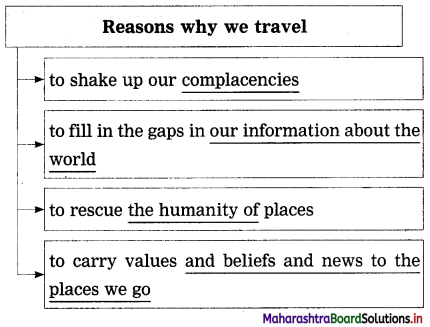
Question 2.
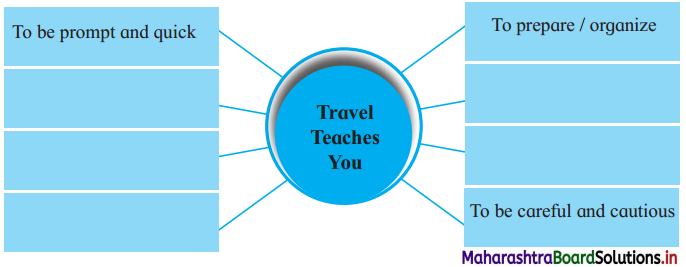
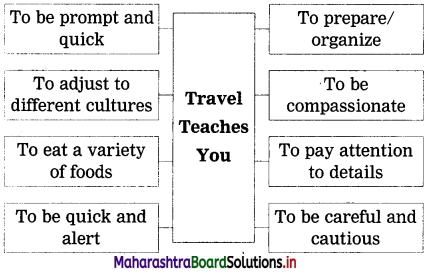
Discuss in the class the benefits of travelling and complete the web:
Maharashtra Board Class 12 English Yuvakbharati Solutions Chapter 1.7 Why We Travel 1
Answer:
Maharashtra Board Class 12 English Yuvakbharati Solutions Chapter 1.7 Why We Travel 2
Make a list of your expectations when you travel to some new place:
Answer:
(a) Food should be delicious and available whenever hungry.
(b) Travelling should be easy and comfortable.
(c) Hotel accommodation should be inexpensive and clean.
(d) Weather should be sunny and pleasant.

Question 3.
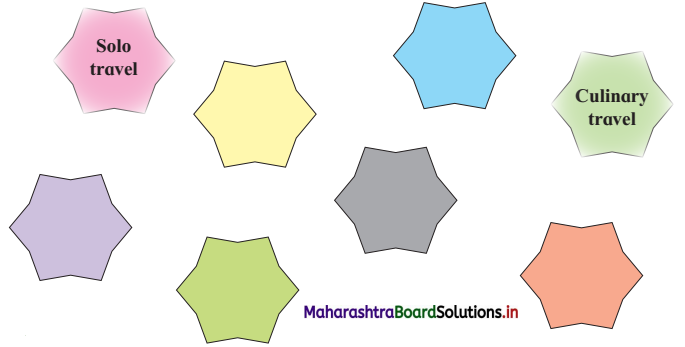
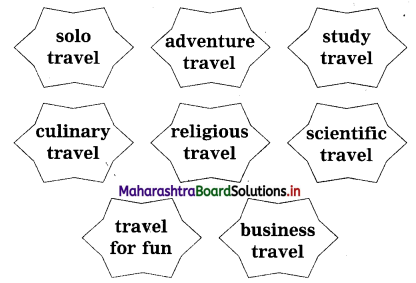
Discuss in the class the various types of travels. Add your own to ones given below:
Maharashtra Board Class 12 English Yuvakbharati Solutions Chapter 1.7 Why We Travel 3
Answer:
Maharashtra Board Class 12 English Yuvakbharati Solutions Chapter 1.7 Why We Travel 4

Maharashtra Board Solutions

(A1)

Question 1.
Read the first two paragraphs and write down the reasons one needs to travel.
Answer:
One needs to travel:

  1. initially, to lose ourselves next, to find ourselves
  2. to open our hearts and eyes and learn more about the world than our newspapers tell us.
  3. to bring our ignorance and knowledge to cultures which are rich in ways different from ours.
  4. to become young fools again
  5. to slow time down and to get taken in to fall in love once more
  6. to escape into open solitudes, into aimlessness, into accepting dangers and risks
  7. to sharpen the edge of life, and to taste hardship
  8. to leave all one’s beliefs and certainties at home, and see everything in a different light

(A2)

Question (i)
Read the sentence ‘If a diploma can famously ……………. in cultural relativism.’ of this extract on page 67 of the textbook. Pick the sentence which gives the meaning of the above statement from the alternatives given below.
(a) A diploma certificate can be used as a passport and a passport can be used as a diploma certificate.
(b) If one has a diploma, he does not need a passport and if he has a passport, he does not need a diploma.
(c) One can acquire permission to travel to foreign countries for educational purposes based on one’s academic achievements, and travelling to foreign countries enriches one the most regarding the knowledge and wisdom of the world.
Answer:
(c) One can acquire permission to travel to foreign countries for educational purposes based on one’s academic achievements, and travelling to foreign countries enriches one the most regarding the knowledge and wisdom of the world.

Question (ii)
Prepare a list of the litterateurs and their quotations mentioned by the writer in the extract.
Answer:
Names of the litterateurs: Camus, Christopher Isherwood
Quotations: Camus said, “What gives value to travel is fear”- Christopher Isherwood once said, “The ideal travel book should be perhaps a little like a crime story in which you’re in search of something.”

Maharashtra Board Solutions

Question (iii)
‘The real voyage of discovery consists not in seeing new places but in seeing with new eyes.’ – Marcel Proust. Justify with the help of the text.
Answer:
This means that we don’t really have to discover new landscapes or new sights to be in the real process of discovery. Often, we simply need to change our perspective, the way we look at things, to understand them and to raise them to a new, exhilarating level.

Question (iv)
Read the third paragraph and find the difference between a tourist and a traveller as revealed through the complaints made by them.
Answer:
1. A tourist is someone who does not leave his assumptions at home and complains, ‘Nothing here is the way it is at home’.
2. A traveller is someone who leaves his assumptions at home but grumbles, ‘Everything here is the same as it is in Cairo – or Cuzco or Kathmandu.’

Question (v)
Write sentences from the extract conveying the fact that travelling brings together the various cultures of the different parts of the world.
Answer:
1. You can teach them what they have to celebrate as much as you celebrate what they have to teach.
2. This, I think, is how tourism, which so obviously destroys cultures, can also resuscitate or revive them, how it has created new “traditional” dances in Bali, and caused craftsmen in India to pay s new attention to their works.

Maharashtra Board Solutions

Question (vi)
By quoting Camus, the writer has stated that travelling emancipates us from circumstances and all the habits behind which we hide. Write in detail your views about that.
Answer:
When we are at home, we have set ideas and habits, which we are reluctant to change. We dress in a particular way and we behave in a particular way, because the people around us know us and expect that behaviour. We hide behind all this. However, when we travel, no one knows us and there are no expectations about a particular type of behaviour, dress or habits. Hence, we have a feeling of freedom and emancipation from our circumstances and habits.

(A3)

Question (i)
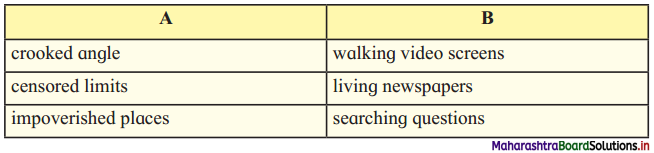
Read the following groups of words:
Maharashtra Board Class 12 English Yuvakbharati Solutions Chapter 1.7 Why We Travel 5

  1. crooked angle
  2. censored limits
  3. impoverished places
  4. walking video screens
  5. living newspapers
  6. searching questions

Discuss in pairs and make a list of some more adjectives like this and make sentences using them.
Answer:
1. burnt cottage
2. disturbed night
3. hidden house
4. missing necklace
5. probing questions
6. standing instructions
Sentences:
1. burnt cottage – The mystery of the burnt cottage was finally solved.
2. disturbed night – Rohan had a disturbed night because of the noise from the road construction.
3. hidden house – I could see the hidden house only after climbing a hill.
4. missing necklace – The detective was sure that the missing necklace would be soon found.
5. probing questions – The lawyer asked the witness some probing questions.
6. standing instructions – The queen had given standing instructions that she was never to be disturbed while sleeping.

Maharashtra Board Solutions

Question 1.
Read the following sentence and pick out the phrasal verb.
We travel, then, in part just to shake up our complacencies.
Answer:
shake-up

(A4)

Question 1.
Read the following sentences carefully and find out the infinitives :
(a) We travel, initially, to lose ourselves; and we travel, next, to find ourselves.
(b) We travel to bring what little we can, …………
(c) Yet one of the subtler beauties of travel is that it enables you to bring new eyes to the people you encounter.
Answer:
(a) to lose, to find
(b) to bring
(c) to bring

Question (ii)
Combine the two sentences into one using the word given in the brackets:
(a) I go to Iceland. I visit the lunar spaces within me. (to)
(b) We have the opportunity. We come into contact with more essential parts of ourselves, (of)
(c) Romantic poets inaugurated an era of travel. They were great apostles of open eyes.
(d) The travel spins us around. It shows us the sights and values ordinarily ignored, (showing)
Answer:
(a) I go to Iceland to visit the lunar spaces within me.
(b) We have the opportunity of coming into contact with more essential parts of ourselves.
(c) Romantic poets, being great apostles of open eyes, inaugurated an era of travel.
(d) The travel spins us around, showing us the sights and values ordinarily ignored.

Question (iii)
Read the sentences given below and state whether the underlined words are gerunds or present participles.
(a) As it’s a hot day, many people are swimming
(b) This is a swimming pool.
(c) It’s very bad that children are begging.
(d) Begging is a curse on humanity.
Answer:
(a) present participle
(b) present participle
(c) present participle
(d) gerund

(A5)

Question 1.
Write an email to your friends about your proposed trek. You can take help of the points given below. You can keep your parents informed about it by adding them in BCC.

  • A trek in the forest of Kodaikanal
  • Time and duration
  • Type of trek (cycle/ motorbike/ walk)
  • Facilities provided
  • Last date for registration
  • Fees

Maharashtra Board Solutions

(A6)

Question 1.
There is a boom in ‘Travel and Tourism’ career. Find information about different options in this field.

(A7)

Question (i)
Find information about:
(a) Fa Hien
(b) Huen Tsang
(c) Ibn Batuta
(d) Marco Polo
(e) Sir Richard Burton

Question (ii)
Further reading:

  • ‘Childe Harold’s Pilgrimage’ – Lord Byron
  • ‘Gulliver’s Travels’ – Jonathan Swift
  • ‘Twenty Thousand Leagues Under The Sea’ – Jules Verne
  • ‘Travelling Souls’ – Brian Bouldrey

Yuvakbharati English 12th Digest Chapter 1.7 Why We Travel Additional Important Questions and Answers

Read the extract and complete the activities given below:

Global Understanding:

Question 1.
Write the name of the litterateur and his quotation mentioned by the writer in the extract.
Answer:
Name of the litterateur – George Santayana.
Quotation:
George Santayana writes, “We need sometimes to escape into open solitudes, into aimlessness, into the moral holiday of running some pure hazard, in order to sharpen the edge of life, to taste hardship, and to be compelled to work desperately for a moment at no matter what.”

Question 2.
Based on the extract, complete the web:
(The answers are given directly and underlined.)
Answer:
Maharashtra Board Class 12 English Yuvakbharati Solutions Chapter 1.7 Why We Travel 6

Question 3.
From the extract, write the names of:
Answer:
1. 2 litterateurs : Proust, Hazlitt
2. 2 places : Bali, Tibet

Maharashtra Board Solutions

Question 4.
Pick out the false statements and write them correctly :
1. Holidays help you to appreciate your own home more.
2. Tourism can also revive cultures.
3. The writer spent many days in Bali in temples.
4. The writer finds Iceland full of chatter and routine.
Answer:
False statements:
3. The writer spent many days in Bali in temples.
4. The writer finds Iceland full of chatter and routine.

Corrected statements:
3. The writer spent many days in Tibet in temples.
4. The writer finds Iceland quiet and empty.

Question 5.
Write the name of the litterateur and his quotation mentioned by the writer in the extract.
Answer:
Name of the litterateur – Oliver Cromwell Quotation : “A man never goes so far as when he doesn’t know where he is going.”

Question 6.
Write if the following statements are True or False. Correct the false statements :
1. The posters at McDonald’s outlet in Kyoto have pictures of places in San Francisco.
2. The young people in Kyoto McDonald’s outlet look very American.
3. The writer was born in America.
4. Cities like Sydney and Toronto are a mix of many cultures.
True statements:
1. The posters at McDonald’s outlet in Kyoto have pictures of places in San Francisco.
4. Cities like Sydney and Toronto are a mix of many cultures.

False statements:
2. The young people in Kyoto McDonald’s outlet look very American.
3. The writer was born in America.

Corrected statements:
2. The young people in Kyoto McDonald’s outlet look very Japanese.
3. The writer was born in England.

Question 7.
Write from the extract:
Answer:
1. Names of 4 cities: Kyoto, Toronto, Sydney, Addis Ababa
2. Names of two food items: Teriyaki McBurgers, Bacon Potato Pies.

Maharashtra Board Solutions

Question 8.
Write the name of the litterateurs and their quotations mentioned by the writer in the extract.
Answer:
Names of the litterateurs: Sir John Mandeville, Emerson, Thoreau and Sir Thomas Browne.
Quotations: Emerson said, “Travelling is a fool’s paradise.”
Thoreau said, “I have travelled a good deal in Concord.”
Sir Thomas Browne sagely put it, “We carry within us the wonders we seek without us. There is Africa and her prodigies in us.”

Complex Factual:

Question 1.
Write sentences from the extract conveying the fact that travelling brings together the various cultures of the different parts of the world :
Answer:
1. We can become a kind of carrier pigeon in transporting back and forth what every culture needs.
2. I find that I always take Michael Jordan posters to Kyoto, and bring woven ikebana baskets back to California.
3. We become walking video screens and living newspapers, the only channels that can take people out of the censored limits of their homelands.
4. In closed or impoverished places, like Pagan or Lhasa or Havana, we are the eyes and ears of the people we meet, their only contact with the world outside and, very often, the closest, quite literally, they will ever come to Michael Jackson or Bill Clinton.
5. Not the least of the challenges of travel, therefore, is learning how to import – and export – dreams with tenderness.
6. We carry values and beliefs and news to the places we go.

Maharashtra Board Solutions

Question 2.
Complete the following:
Travel spins us round in two ways at once:
Answer:
Travel spins us round in two ways at once: It shows us the sights and values and issues that we might ordinarily ignore. It also shows us all the parts of ourselves that might otherwise grow rusty. For in travelling to a truly foreign place, we inevitably travel to moods and states of mind that we’d otherwise ignore.

Question 3.
Write sentences from the extract conveying the fact that travelling brings together the various cultures of the different parts of the world.
Answer:
1. For when we go to France, we often migrate to French, and the more childlike self, simple and polite, that speaking a foreign language educes.
2. Even when I’m not speaking pidgin English in Hanoi, I’m simplified in a positive way, and concerned not with expressing myself, but simply making sense.

Question 4.
Write sentences from the extract conveying the fact that travelling brings together the various cultures of the different parts of the world.
Answer:
1. When we go abroad we are objects of scrutiny as much as the people we scrutinize, and we are being consumed by the cultures we consume, as much on the road as when we are at home.
2. At the very least, we are objects of speculation (and even desire), who can seem as exotic to the people around us as they do to us.

Question 5.
Write the sentences from the extract conveying the fact that travelling brings together the various cultures of the different parts of the world.
Answer:
1. When you go to a McDonald’s outlet in Kyoto, you will find Teriyaki McBurgers and Bacon Potato Pies.
2. The placemats offer maps of the great temples of the city, and the posters all around broadcast the wonders of San Francisco.
3. And-most crucial of all-the young people eating their Big Macs, with baseball caps worn backwards, and tight 501 jeans, are still utterly and inalienably Japanese in the way they move, they nod, they sip their Oolong teas – and never to be mistaken for the patrons of a McDonald’s outlet in Rio, Morocco or Managua.
4. These days a whole new realm of exotica arises out of the way one culture colours and appropriates the products of another,
5. The other factor complicating and exciting all of this is people, who are, more and more, themselves as many-tongued and mongrel as cities like Sydney or Toronto or Hong Kong.
6. Besides, even those who don’t move around the world find the world moving more and more around them. Walk just six blocks, in Queens or Berkeley, and you’re travelling through several cultures in as many minutes; get into a cab outside the White House, and you’re often in a piece of Addis Ababa.

Maharashtra Board Solutions

Question 6.
Complete the following:
Answer:
1. Travel is a voyage into the imagination and is the conspiracy of perception and imagination.
2. Sir John Mandeville never visited the Far East but yet gave colourful accounts of it.
3. Emerson and Thoreau insist that reality is our creation and we invent the places we see as much as we do the books we read.

Question 7.
Complete the following, giving examples: (The answer is given directly.) The finest recent travel books are those that:
Answer:
1. undertake a parallel journey, matching the physical steps of a pilgrimage with the metaphysical steps of a questioning e.g. in Peter Matthiessen’s great “The Snow Leopard”.
2. chronicle a trip to the farthest reaches of human strangeness e.g. Oliver Sacks’ “Island of the Color-Blind,” which features a journey not just to a remote atoll in the Pacific, but to a realm where people actually see light differently).

Inference/Interpretation/Analysis:

Question 1.
Guess the difference : travel and travail:
Answer:
Travel guides us towards a better balance of wisdom and compassion, of seeing the world clearly and truly. Travail means agony, or hard toil, which will be the result of laborious travelling and hardships.

Question 2.
Describe the changes that come into us because of travels, especially to foreign countries.
Answer:
When we go abroad, we stay up late, do impulsive things and leave ourselves open to various experiences. We live for the moment, without any past or future; only the present. We may even become mysterious-to others, at first, and sometimes even to ourselves, behaving in new ways. We feel younger, as if we have been reborn.

Maharashtra Board Solutions

Question 3.
Explain in your own words how travel can be a kind of ‘monasticism’.
Answer:
‘Monasticism’ means living like monks, living a self-disciplined life that is isolated from other people. When we travel, even if we are living in a luxury hotel, we live more simply than we normally do at home. We have no more possessions than what we can carry, we surrender ourselves to chance, and to whatever may come in our way. Hence, travel can be a kind of ‘monasticism’.

Question 4.
Travelling abroad make us the object of scrutiny. Justify this statement,
Answer:
When we go abroad, the local people there are curious about us and our culture. We seem exotic and different to them and they scrutinize our ways and behaviour to learn and understand more about us.

Question 5.
The writer calls himself ‘many-tongued’ and ‘mongrel’. Give reasons.
Answer:
‘Many-tongued’ means that he knows many languages; ‘mongrel’ here means someone who has a mixed upbringing, someone of mixed cultures. The writer knows many languages. He was born of Indian parents, in England, and he moved to America when he was 7 years old. Hence, he says that he cannot really call himself an Indian, an American or an Englishman.

Question 6.
‘Get into a cab outside the White House, and you’re often in a piece of Addis Ababa.’ Explain the meaning of this sentence.
Answer:
Addis Ababa is the capital of Ethiopia, Africa. The sentence means that the driver of the cab outside the White House was probably an African American, may be originally from Africa.

Maharashtra Board Solutions

Question 7.
“We carry within us the wonders we seek without us.” Explain.
Answer:
This means that all the wonders and emotions are within us, and if we wish to, we can tap these forces. Everything is within our own hearts and imagination. Everything is internal. Whatever we find outside has first to be inside us for us to experience it. There is no necessity for any separate outside happenings for us to feel anything.

Personal Response:

Question 1.
Name the places you would like to visit the most. Give reasons to support your answer.
Answer:
I like to travel but I have not had much opportunity yet. I love seeing new places and meeting new people. I would love to travel to the North-Eastern parts of India and to foreign countries. I am also a nature lover and would love seeing high mountains, clear lakes and green pastures.

Question 2.
‘Travel helps you to appreciate your own home more’. Justify this statement.
Answer:
Holidays, especially holidays abroad, can certainly help us to appreciate our own homes more. For example, if we go to the African desert and see the problems they have with potable water supply, we will appreciate our own water resources more. If we see the problems faced by people living in very cold climates, we will appreciate the heat in our country, and even be grateful for it.

Question 3.
Do you think that people travel more, or in a different way, as compared to people fifty years back? Explain your view.
Answer:
Yes, people certainly travel more today. They also travel for different reasons. Fifty years back, in India, people generally travelled only for religious reasons or to meet relatives and family. Travelling for sightseeing was rarer. Today, in addition to these reasons, people also travel for fun, relaxation and sight-seeing. People also go on holidays abroad, which was not done often earlier.

Maharashtra Board Solutions

Question 4.
Do you think that we must always seek new experiences and new places? Or do you feel that the best place is home, and we must never move?
Answer:
If we just stick to our own homes, we will be like the frog in the pond, which thought its small pond was the whole world. This is not advisable in the world of today. To be happy and successful, we must be broad-minded and unbiased. We must see what the world and other cultures have to offer. We must try to imbibe the best from other cultures and places.

Language Study:

Question 1.
We carry values and beliefs and news to the places we go.
(Rewrite using ‘not only but also.)
Answer:
We carry not only values and beliefs but also news to the places we go.

Question 2.
Travel is the best way we have of rescuing the humanity of places.
(Use an infinitive in place of the gerund.)
Answer:
Travel is the best way we have to rescue the humanity of places.

Question 3.
The beauty of this process was best described by George Santayana.
(Rewrite beginning George Santayana)
Answer:
George Santayana best described the beauty of this process.

Maharashtra Board Solutions

Question 4.
Yet for me the first great joy of travelling is simply the luxury of leaving all my beliefs and certainties at home. (Pick out the finite verb and say whether the sentence is simple, compound or complex.)
Answer:
finite verb-is; simple sentence

Question 5.
Pick out the phrasal verb from this sentence:
Abroad is the place where we stay up late.
Answer:
stay up

Question 6.
Travelling is a way to reverse time. (Identify the part of speech of the underlined word.)
Answer:
travelling – gerund

Question 7.
I tend to believe more abroad than I do at home. (Rewrite using as….as..)
Answer:
I tend not to believe as much at home as I do abroad.

Question 8.
Pick out the phrasal verb from these sentences:
Answer:
1. I remember, in fact, after my first trip to Southeast Asia, more than a decade ago, how I would come back to my apartment in New York.
2. All, in that sense, believed in, “being moved”
Answer:
1. come back
2. believed in

Maharashtra Board Solutions

Question 9.
Anyone witnessing this strange scene would have drawn the right conclusion.
(Rewrite using ‘who’)
Answer:
Anyone who witnessed this strange scene would have drawn the right conclusion.

Question 10.
I remember how I would come back to my apartment in New York. (Rewrite using ‘used, to’.)
Answer:
I remember how I used to come back to my apartment in New York.

Question 11.
We have to carry our sense of destination. (Rewrite beginning‘Our sense….’)
Answer:
Our sense of destination has to be carried by us.

Question 12.
The most valuable Pacifies we explore will always be the vast expanses within us.
(Rewrite using more…than..)
Answer:
We will never explore more valuable Pacifies than the vast expanses within us.

Question 13.
It keeps the mind nimble. (Rewrite using the present perfect tense of the verb.)
Answer:
It has kept the mind nimble.

Vocabulary:

Question 1.
Guess the meaning: riches are differently dispersed
Answer:
cultures that are rich in ways different from ours.

Question 2.
Find out a past/present participle from the extract that has been used as an adjective :
Answer:
crooked angle (crooked-past participle)

Question 3.
Find out two pairs of antonyms from the extract:
Answer:
1. lose × find
2. ignorance × knowledge

Maharashtra Board Solutions

Question 4.
Guess the difference between provisional and provincial.
Answer:
Provisional means temporary, whereas provincial means limited in outlook narrow.

Question 5.
Find out from the extract a few past / present participles that have been used as adjectives:
1. walking video screens
2. censored limits
3. living newspapers
4. impoverished places
Answer:
censored, impoverished – past participles used as adjectives
walking, living – present participles used as adjectives

Question 6.
Pick out four proper nouns for places from the extract.
Answer:
Kyoto, Pagan, Lhasa, Havana.

Question 7.
Find from the extract one word for the following :
1. A Japanese art of flower arrangement
2. Satisfaction of one with oneself or one’s own achievements.
Answer:
1. ikebana
2. complacencies

Question 8.
Complete the table with the words given in the brackets:
(values celebrate now deeply discovery apprehend wonderfully distant quietude foreign appreciative spins)
Answer:

Noun Verb Adjective Adverb
discovery celebrate distant wonderfully
values apprehend foreign deeply
quietude spins appreciative now

Maharashtra Board Solutions

Question 9.
Find out a past/present participle from the extract that has been used as an adjective:
Answer:
searching questions (searching – present participle)

Question 10.
Discuss the pun implied by the writer, ecstasy (ex-stasis):
Answer:
ecstasy – great joy. ex-stasis – previous period of inactivity or boredom. The words sound alike but have different meanings.

Question 11.
Guess the meaning:

  1. many-tongued
  2. mongrel
  3. inheritance
  4. notions

Answer:

  1. many-tongued – a person who speaks many languages.
  2. mongrel – (here) someone who has a mixed upbringing, someone of mixed cultures.
  3. inheritance – the acquisition of a possession, condition, or trait from past generations.
  4. notions – ideas.

Question 12.
Match the adjectives in Column A with the nouns in Column B, with reference to the extract:

A B
1. great (a) specimen
2. new (b) versions
3. typical (c) temples
4. essential (d) world
5. synthetic (e) realm
6. foreign (f) notions

Answer:

  1. great temples
  2. new realm
  3. typical specimen
  4. essential notions
  5. synthetic versions
  6. foreign world

Maharashtra Board Solutions

Question 13.
Give the adjective forms of:

  1. perception
  2. imagination
  3. friendship
  4. reality

Answer:

  1. perception – perceptive
  2. imagination – imaginative
  3. friendship – friendly
  4. reality – realistic

Question 14.
Give the verb forms of:

  1. perception
  2. imagination
  3. friendship
  4. conspiracy

Answer:

  1. perception – perceive
  2. imagination – imagine
  3. friendship – befriend
  4. conspiracy – conspire

Question 15.
Guess the meaning:

  1. atoll
  2. prejudice
  3. fosters

Answer:

  1. atoll – a coral island consisting of a reef surrounding a lagoon
  2. prejudice – bias
  3. fosters – encourages

Maharashtra Board Solutions

Question 17.
Find from the extract the antonyms of:

  1. worthless
  2. public
  3. nearest
  4. familiar
  5. outside
  6. slow

Answer:

  1. worthless × valuable
  2. public × private
  3. nearest × farthest
  4. familiar × unfamiliar
  5. outside × inside
  6. slow × quick

Do as directed:

Question 1.
The queen loved her people and looked after the affairs of her kingdom well.
(Rewrite using ‘who’.)
Answer:
The queen, who loved her people, looked after the affairs of her kingdom well.

Question 2.
But I want to test this. (Change the voice.)
Answer:
But I want this to be tested.

Question 3.
The husband had a small smile on his lips while the wife looked sad.
(Rewrite beginning with ‘Though’)
Answer:
Though the husband had a small smile on his lips, the wife looked sad.

Maharashtra Board Solutions

Spot the error in the following sentences and rewrite them correctly:

Question 1.
You must neither tell me the whole story or at least the first part of it.
Answer:
You must either tell me the whole story or at least the first part of it.

Question 2.
No sooner did the Minister begin speaking, some rogues started shouting loudly.
Answer:
No sooner did the Minister begin speaking, than some rogues started shouting loudly.

12th Std English Questions And Answers:

The New Dress 12th Question Answer English Chapter 1.5 Maharashtra Board

Class 12 English Chapter 1.5

Balbharti Yuvakbharati English 12th Digest Chapter 1.5 The New Dress Notes, Textbook Exercise Important Questions and Answers.

Class 12 English Chapter 1.5 The New Dress Question Answer Maharashtra Board

12th Std English Chapter 1.5 Brainstorming Question Answer

Yuvakbharati English Navneet 12th Digest PDF Free Download Maharashtra Board

Question 1.
Write in Column ‘B’ the description of the clothes you would choose to wear for the occasions given in Column ‘A’:
Answer:

A B
A birthday party Casual jeans and a T-shirt
A prize distribution ceremony at school Formal shirt and trousers
A picnic Colourful casuals, or Shorts and T-shirt
An entertainment show Good jeans and a good T-shirt

Maharashtra Board Solutions

Question 2.
Discuss the criterion of the choice of your clothes with the help of given points:
Answer:
(a) Occasion: whether it is a birthday, wedding, picnic, college festival, etc.
(b) Society (people you may meet at the venue): friends, relatives, classmates, visitors, students from other colleges, etc.
(c) Availability: bought at a store, tailored, borrowed, etc.
(d) Fashion: designer clothes, casual, Indian formal, Western formal, etc.
(e) Your wish/whim: colour of my choice, style, etc.
(f) A suggestion or advice by someone (mother, sister, friend, etc.): Only advice by friends
(g) Any other than the above mentioned reasons: I would choose a dress that would suit me and set off my looks in the best possible way, even if it may be out of fashion. I would not go by whether it is expensive or branded.

Question 3.
Divide the class into groups. Discuss the role of costumes in enhancing your personality:
Answer:
(Points: clothes very important – first impressions important – colours, cut that suit a person – if the clothes are suitable, confidence level increases – however, it is not the cost of clothes but suitability to the wearer and occasion that are important – your clothes also depend on the culture and place.)

Question 4.
State whether you agree or disagree with the following statements and discuss the reasons:
Answer:
(a) A simple dress makes one’s personality look dull.
(Disagree – if the cut is good, the cloth is good – it suits the wearer – a simple dress can be excellent.)

(b) We should not judge ourselves from the comments we receive from others.
(Agree – we should have self-esteem – trust our judgement – do not have to seek approval from others – people may be envious, etc.)

(c) A fashionable and costly dress makes you look rich, intelligent and beautiful.
(Disagree – the dress must suit the wearer – should be worn with confidence – wearer should have good posture – accessories should be well-matched, etc.)

(d) We should choose a dress according to the fashion rather than our choice.
(Disagree – if we choose according to fashion, may not be comfortable – the fashion may not suit us-we may feel self-conscious – hence choose a dress according to our choice.)

Maharashtra Board Solutions

(A1)

Question (i)
There are a few other characters mentioned in this extract. Discuss the way their reactions help us to understand the inferiority complex of Mabel.
Answer:
Mabel told Robert Haydon that she felt like some dowdy, decrepit, horribly dingy old fly. She said it to reassure herself and appear detached and witty, and to show that she did not feel in the least out of anything.

Robert Haydon probably replied something to praise her, which Mabel felt was just politeness, and that he was being insincere. Though she was constantly looking for approval from others, she always felt suspicious when someone actually praised her, or said something in her favour. This shows that she has no self-esteem and a very big inferiority complex.

(A2)

Question (i)
Pick out the sentence/s from the extract which describe the ambience of the party at Mrs. Dalloway’s place.
Answer:
1. If she had been dressed like Rose Shaw, in lovely, clinging green with a ruffle of swansdown.
2. For she would not join Charles Burt and Rose Shaw, chattering like magpies and perhaps laughing at her by the fireplace.

Question (ii)
Mabel is thinking too much about her dress. Pick out two sentences supporting the above statement.
Answer:
1. It seemed to her that the yellow dress was a penance which she had deserved.
2. Then Mrs Holman was off, thinking her the most dried-up, unsympathetic twig she had ever met, absurdly dressed, too, and would tell every one about Mabel’s fantastic appearance.

Question (iii)
Critically analyze Mabel’s weak economic conditions in the past as one of the reasons that led her to choose the old-fashioned dress.
Answer:
Mabel did not belong to a rich family. She was one of a family of ten. They always had to be careful about their expenses, always counting the pennies. Her mother had to carry big cans the linoleum on the stairs was worn off, and there was always some minor domestic tragedy taking place.

Even when they went to seaside resorts, they stayed at lodges which never faced the sea directly, but at an odd angle, so that they had to squint to see the sea. Maybe indirectly she was still fighting with her weak economic conditions of the past, and this had made her choose the old-fashioned dress or it could have been some memories of the past that made her do it.

Question (iv)
The cause of Miss Mabel’s disappointment is not only her poor background in the past but her too much bookishness also Substantiate.
Answer:
To a certain extent this is true. She keeps thinking about the depressing lines she has read written by Shakespeare; she also keeps thinking of the story of the fly and the saucer, and how she is a fly and the others are dragonflies, butterflies and beautiful insects. Probably her over-active imagination, which led to her continuous disappointment with various things, was also due to extensive reading.

Maharashtra Board Solutions

Question (v)
Do you appreciate Mabel’s tendency of deciding her own value from the comments given by others? Explain your views.
Answer:
No, I don’t. We all have our own likes and dislikes; we should wear what we like and behave in the manner we think is appropriate. We should not depend on the approval and comments of others to decide our value and worth. This is done only by those who have no confidence in themselves and no self-esteem.

(A3)

Question (i)
Write the synonyms for the word ‘dress’ by filling appropriate letters in the blanks. One is done for you.
Answer:
(a) a t t i r e
(b) g a r b
(c) c o s t u m e
(d) g a r m e n t
(e) o u t f i t
(f) a p p a r e l

Question (ii)
Conchology means the scientific study or collection of mollusc shells. Find out the meanings of:
1. Etymology
2. Archaeology
Answer:
1. Etymology – the study of the origin and history of words.
2. Archaeology – the scientific study of material remains (such as tools, pottery, jewelry, stone walls, and monuments) of past human life and activities.

(A4)

(i) Use the correct tense form of the verbs given in the brackets and rewrite the sentences.

Question (a)
She ………………….. (take/takes/took/had taken) that old fashion book of her mother a few months back.
Answer:
She had taken that book of her mother a few months back.

Question (b)
She ……………… (pecking/pecks/pecked) at her left shoulder for quite some time.
Answer:
She pecked at her left shoulder for quite some time.

Question (c)
One human should (done /doing/be doing) this for another always.
Answer:
One human should be doing this for another always.

Maharashtra Board Solutions

Question (d)
All this (will be/is/have been) destroyed in a few years.
Answer:
All this will be destroyed in a few years.

Question (e)
She (feels/felt/will be feeling) like a dressmaker’s dummy standing there.
Answer:
She felt like a dressmaker’s dummy standing there.

(ii) Do as directed:

Question (a)
Lata will sing tonight. (Make it less certain.)
Answer:
Lata may sing tonight.

Question (b)
You should wear your uniform. (Show ability.)
Answer:
You can wear your uniform.

Question (c)
Sandeep may study to clear the examination. (Make it obligatory/compulsory.)
Answer:
Sandeep must study to clear the examination.

Question (d)
I can do it. (Make a sentence seeking permission.)
Answer:
May I do it?

(iii)

Question (a)
Frame three rules for the students of your college. (Non-textual grammar)
Answer:
1. Students must wear identity cards in the college premises.
2. Students must not loiter near the college gate.
3. Every student must have at least 75% attendance in every subject.

Maharashtra Board Solutions

Question (b)
Frame three sentences giving advice to your younger brother.
Answer:
1. You should make a timetable for revision at least a month before the exams.
2. You should not eat junk food.
3. You should visit your dentist at least once every six months.

Question (iv)
Fill-in the blanks with appropriate modal auxiliaries according to the situation given in the following sentences:
Answer:
(a) Take an umbrella. It might rain later.
(b) People must not walk on the grass.
(c) May I ask you a question?
(d) The signal has turned red. You must wait.
(e) I am going to the library. I could find my friend there.

(A5)

Question (i)
Virginia Woolf has created many characters other than Miss Mabel with great skill. Write a character sketch of any one of them.
Answer:
One of the guests at Mrs. Dalloway’s party was Charles Burt. Mabel was impressed by him and longing for some praise from him. However, he was a malicious person, with no heart, no fundamental kindness and only a superficial appearance of friendliness. He liked to poke fun at people and see their reactions. He probably also liked to gossip about people and discuss them behind their backs, but his opinion made a great difference to Mabel.

Question (ii)
‘Clothes mean nothing until someone lives in them.’ Expand the idea in your own words.
Answer:
Clothes mean nothing until someone lives in them These are the words of Marc Jacobs, a fashion designer. It means that clothes gain importance and character only when someone is wearing them. The first impression that people have of a person is not only through the clothes that one is wearing but the way one is wearing those clothes.

The style a person adopts tells people a lot about his/her personality and character. The best and most expensive clothes can be unimpressive if the wearer does not carry himself/herself well. On the contrary, the simplest of clothes can look good and impressive if the wearer has good posture, self-confidence and self-esteem.

Hence, when we are buying clothes, we must not only be sure that they will suit us but that we will be comfortable in them and able to carry them well. So, we must choose clothes that make us feel good about ourselves, confident and happy.

Maharashtra Board Solutions

(A6)

Question 1.
Go to a library and read the following books:
(a) ‘A Haunted House’ by Virginia Woolf
(b) ‘Mrs. Dalloway’ by Virginia Woolf

(A7)

Question 1.
Find out information about career opportunities in the following fields:

  1. Fashion designing
  2. Dress designing
  3. Textile industry
  4. Garment industry
  5. Image consultancy
  6. Psychology and Psychiatry

Yuvakbharati English 12th Digest Chapter 1.5 The New Dress Additional Important Questions and Answers

Read the extract and complete the activities given below:

A1. Global Understanding:

Question 1.
Complete the following:
Answer:
1. What depressed Mabel was her appalling inadequacy, her cowardice and her mean, water-sprinkled blood.
2. The feeling that grew stronger as she went upstairs was that something was not quite right.
3. The eyelids of the guests flickered and then shut rather tight.

Question 2.
Complete the following:
Answer:

  1. According to Mabel, fashion means cut, style, and cost, at least thirty guineas.
  2. When Mabel was sitting over the teacups, she had thought that she could not be fashionable.
  3. The book Mabel had chosen was an old Paris fashion book of her mother’s, of the time of the Empire.
  4. Rose Shaw’s lips had a little satirical pucker.

Maharashtra Board Solutions

Question 3.
Mabel knew that these were her main faults:
Answer:
envy and spite

Question 4.
Mable tried to imagine them like flies:
Answer:
Rose Shaw and all the other people

Question 5.
He stopped to listen to Mabel:
Answer:
Robert Haydon

Question 6.
She, Mabel, was a fly but the others were:
Answer:
dragonflies, butterflies, beautiful insects

Question 7.
Complete the following:
Answer:
1. Miss Milan’s workroom was terribly hot, stuffy and sordid, smelling of clothes and cabbage cooking.
2. When Mabel looked at herself in the glass, she saw a grey-white, mysteriously smiling, charming girl, the core of herself.

Maharashtra Board Solutions

Question 8.
Match the following and write the complete answers:

A B
1. Miss Milan wanted to know (a) pick a hemp seed from between her lips.
2. Miss Milan let the canary (b) to be so dependent on people’s opinions.
3. Mabel felt it was very weak (c) she suffered tortures and was awoken to reality.
4. When Mabel was in Miss Dalloway’s drawing-room. (d) about the length of the skirt.

Answer:

  1. Miss Milan wanted to know about the length of the skirt.
  2. Miss Milan let the canary pick a hemp
  3. Mabel felt it was very weak to be so dependent on people’s opinions.
  4. When Mabel was in Miss Dalloway’s drawing-room she suffered tortures and was awoken to reality.

Question 9.
Pick out the sentences that are false and write them correctly:
Answer:
1. Mabel was not at all confident when she went into the room.
2. Rose Shaw was actually looking very fierce and tragic.
3. Charles Burt wanted to talk to Mabel.
4. Charles Burt told Mabel that she was looking charming.
False sentences:
2. Rose Shaw was actually looking very fierce and tragic.
3. Charles Burt wanted to talk to Mabel.
4. Charles Burt told Mabel that she was looking charming.
Corrected sentences:
2. Mabel imagined that Rose Shaw would look very fierce and tragic.
3. Mabel wanted to talk to Charles Burt.
4. Mabel wished that Charles Burt had told her that she was looking charming.

Question 10.
Match the sentences from Box A and Box B and rewrite the completed sentences:
Answer:
A:
1. Mrs. Holman did not notice Mabel’s dress
2. Mabel was angry because
3. Mrs. Holman leaned forward and told Mabel
4. Mabel compared the clamour and greed of human beings for sympathy
B:
(a) Mrs. Holman treated her like a house agent or messenger boy.
(b) how her eldest boy had strained his heart running.
(c) to a row of cormorants, barking and flapping their wings.
(d) because she was worried about her family.
Answer:

  1. Mrs. Holman did not notice Mabel’s dress because she was worried about her family.
  2. Mabel was angry because Mrs. Holman treated her like a house agent or messenger boy.
  3. Mrs. Holman leaned forward and told Mabel how her eldest boy had strained his heart running.
  4. Mabel compared the clamour and greed of human beings for sympathy to a row of cormorants, barking and flapping their wings.

Maharashtra Board Solutions

Answer in very brief:

Question 1.
What did Mabel do to look busy?
Answer:
punched the cushions

Question 2.
Who were chatting near the fireplace?
Answer:
Charles Burt and Rose Shaw

Question 3.
What was Rose Shaw wearing?
Answer:
a lovely, clinging green dress with a ruffle of swansdown

Question 4.
What type of job did Hubert have?
Answer:
a safe, permanent underling’s job in the Law Courts

Question 5.
Who was Mabel’s hero?
Answer:
Sir Henry Lawrence

Question 6.
Where did Mabel dream of living?
Answer:
in India

Question 7.
Choose the correct alternative and fill in the blanks:

  1. The children ……………. as they paddled. (shouted/cried)
  2. The Goddess was …………….. but ……………. (ugly/kind/beautiful/cruel)
  3. Mabel was years old. (fifty/forty)
  4. All Mabel’s brothers and sisters were …………….. people, (strong/weak)
  5. Mabel went to the seaside at ……………. .(Christmas/Easter)
  6. Now that Mabel was older, the stories about the fly and the saucer would come more ……………… (seldom/often)

Answer:

  1. The children shouted as they paddled.
  2. The Goddess was beautiful but cruel.
  3. Mabel was forty years old.
  4. All Mabel’s brothers and sisters were weak people.
  5. Mabel went to the seaside at Easter.
  6. Now that Mabel was older, the stories about the fly and the saucer would come more seldom.

Question 8.
Who said to whom:
OR
Complete the following table:
Answer:

The Words Who said To whom
“I have enjoyed myself.” Mabel Mr. Dalloway
“Lies, lies, lies!” Mabel To herself
“But it’s too early to go.” Mrs. Dalloway Mabel
“Right in the Saucer!” Mabel To herself

Complex Factual:

Question 1.
Pick out the sentences from the extract which describe the ambience of the party at Mrs. Dalloway’s place.
Answer:
Mrs. Barnet, while handing her the mirror and touching the brushes and thus drawing her attention, perhaps rather markedly, to all the appliances for tidying and improving hair, complexion, clothes, which existed on the dressing table.

Maharashtra Board Solutions

Question 2.
Who was Mrs. Barnet? Describe her behaviour.
Answer:
Mrs. Barnet was probably the maid or housekeeper. She held the mirror, touched the brushes, and drew Mabel’s attention, rather markedly, to the appliances kept on the dressing table for improving one’s looks. She indirectly indicated to Mabel that something about Mabel’s looks was not quite right.

Question 3.
Mabel is thinking too much about her dress. Pick out a sentence supporting the above statement.
Answer:
She could not face the whole horror – the pale yellow, idiotically old-fashioned silk dress with its long skirt and its high sleeves and its waist and all the things that looked so charming in the fashion book, but not on her, not among all these ordinary people.

Question 4.
Pick out the sentences from the extract which describe the ambience of the party at Mrs. Dalloway’s place.
Answer:
Rose herself being dressed in the height of the fashion, precisely like everybody else, always.

Question 5.
Describe the dress Mabel was wearing, What had been Mabel’s thoughts about it earlier?
Answer:
The dress was a pale yellow, old-fashioned silk dress, with a long skirt and high sleeves and waist. It had looked so charming in the fashion book, but not on her. Mabel had thought earlier that the dress would I make her look modest, old-fashioned and charming.

Question 6.
Pick out the sentences from the extract which describe the ambience of the party at Mrs. Dalloway’s place.
Answer:
She was a fly, but the others were dragonflies, butterflies, beautiful insects, dancing, fluttering, skimming.

Question 7.
What did Mabel say to Robert Haydon, and why did she say it? Describe their interactions.
Answer:
Mabel said that she felt like some dowdy, decrepit, horribly dingy old fly. She said it to reassure herself and appear detached and witty, and to show that she did not feel in the least out of anything. Robert Haydon heard this and replied with some polite and insincere words.

Question 8.
Mabel is thinking too much about her dress. Pick out some sentences supporting the above statement.
Answer:
She looked at herself with the dress on, finished, an extraordinary bliss shot through her heart. Suffused with light, she sprang into existence.

Maharashtra Board Solutions

Question 9.
Describe Miss Milan.
Answer:
Miss Milan was poor and hard-working. Her face was red and her eyes bulged. Her pleasures in life were few and cheap; one of them was allowing her pet canary to pick a hemp-seed from between her lips. She was patient and had to endure a lot of difficulties.

Question 10.
Mabel is thinking too much about her dress. Pick out a sentence supporting the above statement.
Answer:
She issued out into the room, as if spears were thrown at her yellow dress from all sides.

Question 11.
Pick out the sentence/s from the extract which describe the ambience of the party at Mrs. Dalloway’s place.
Answer:
……….. and not be whipped all around in a second by coming into a room full of people.

Question 12.
Describe Mabel’s behaviour as she entered the room.
Answer:
Mabel went out into the room, as if spears were thrown at her yellow dress from all sides. But instead of looking fierce or tragic, she looked foolish and self-conscious. She smiled in a silly way, like a schoolgirl, and slouched across the room, moving quietly, as if she were a beaten dog. She then stood by herself and looked at a picture-from shame, from humiliation.

Question 13.
What had been Mabel’s dreams before marriage? Did they come true?
Answer:
Mabel had dreamt of living in India, married to some hero like Sir Henry Lawrence, or some empire builder. However, she had failed utterly, and had married Hubert, who had an ordinary job in the Law Courts. They lived in a small house without proper maids.

Question 14.
Discuss Mabel’s opinion of herself as a wife and mother.
Answer:
Mabel felt that she had always been a fretful, weak, unsatisfactory mother, and an unsteady and uncertain wife. She felt that she was hanging about lazily in a kind of twilight existence with nothing very clear or very bold, or standing out.

Maharashtra Board Solutions

Question 15.
Describe the actions of the fly in Mabel’s imagination. Would the fly behave in the same way (as it did in her imagination), now that she was forty?
Answer:The fly in her imagination suddenly struggled out sometimes. But now that she was forty, she felt that the fly, and she, Mabel, would gradually cease to struggle any more.

Question 16.
Pick out the sentences from the extract which describe the ambience of the party at Mrs. Dalloway’s place.
Answer:

  1. “But it’s too early to go,” said Mrs. Dalloway, who was always so charming.
  2. “I have enjoyed myself,” she said to Mr. Dalloway, whom she met on the stairs.
  3. She thanked Mrs. Barnet for helping her.

Question 2.
Describe Mabel’s plans and expectations for the next day.
Answer:
Mabel planned that she would go to the London Library the next day. She would find some wonderful, helpful, astonishing book, by a clergyman or by an American no one had ever heard of or she would walk down the Strand and drop into a hall where a miner was telling about the life in the pit, and suddenly she would become a new person. She would be transformed. She would wear a uniform; somebody would call her Sister : she would never give a thought to clothes again. And after that she would be perfectly clear about Charles Burt and Miss Milan forever.

Inference/Interpretation/Analysis:

Question 1.
There is another character mentioned in this extract. Discuss the way his/ her reactions help us to understand the inferiority complex of Mabel.
Answer:
Mrs. Barnet touched the brushes and drew Mabel’s attention, rather markedly, to the appliances kept on the dressing table for improving one’s looks. She indirectly indicated to Mabel that something about Mabel’s looks was not quite right. Mabel immediately lost whatever confidence she had. This shows us that Mabel’s inferiority complex was so deep and strong that even a housekeeper’s hint rattled her and made her lose confidence.

Maharashtra Board Solutions

Question 2.
Complete the following:
‘RIGHT’ signifies ………………. .
Answer:
‘RIGHT’ signifies the suitability of the dress for the occasion.

Question 3.
Complete the following:
She was afraid of looking in the mirror/glass because
Answer:
She was afraid of looking in the mirror/glass because she felt that she looked horrible in the pale yellow, old-fashioned silk dress, with a long skirt and high sleeves and waist.

Question 4.
There is another character mentioned in this extract. Discuss the way his/her reactions help us to understand the inferiority complex of Mabel.
Answer:
Rose Shaw looked at Mabel up and down, twisting her lips in a sarcastic manner, Mabel had expected her to do this. Mabel also felt that Rose and all the others present were dressed, as always, in the height of fashion. This shows us how sensitive Mabel was to the behaviour of others and how she thought j that they were always right in fashion, while she was not. This indicates Mabel’s lack of self-esteem and self-worth.

Question 5.
What was Mabel’s imagination about flies?
Answer:
Mabel felt that we are all like flies trying to crawl over the edge of the saucer, some crawling slowly with their wings stuck together. In order to make the other people at the party look insignificant and unimportant, she tried hard to visualize them as poor, struggling flies, trying to pull themselves out of something or into something.

However, her inferiority complex was so strong that she ultimately saw only herself as a fly trying to drag itself out of the saucer. She saw the others as dragonflies, butterflies, beautiful insects, dancing, fluttering and skimming lightly.

Maharashtra Board Solutions

Question 6.
Complete the following:
Answer:
Mabel’s eyes were filled with tears because she felt sorry for poor Miss Milan, who had such few pleasures in life. Those too were cheap ones, like allowing her pet canary to pick a hemp-seed from between her lips. Miss Milan was helping Mabel to become fashionable, and hence Mabel felt very fond of her and full of pity for her condition.

Question 7.
Discuss different pessimistic thoughts in Mabel’s mind.
Answer:
Mabel felt that all the thrill she had felt in her dress had vanished when she entered Mrs. Dalloway’s drawing room, and her eyes were opened to the reality of the dress. She felt depressed and weak that at her age, and with two children, she cared so much about the opinions of other people and did not have any principles or convictions of her own. She was upset that she could not take things lightly, as others did. She found plenty of faults in herself.

Question 8.
There is another character mentioned in this extract. Discuss the way his/ her reactions help us to understand the inferiority complex of Mabel.
Answer:
Mabel told Charles Burt that ‘it’ was old- fashioned, hoping that he would think it was the picture she was talking about, and not her dress. She longed for Charles’ approval, and hoped he would say that she looked charming. But Charles Burt laughed at her, and this upset her tremendously.

She wished she had the confidence to be sure that Miss Milan was right about her dress and Charles was wrong, but unfortunately that was not so, and Charles’ laughter and his malice made her feel even more humiliated and inferior than before. This shows us that Mabel depended heavily on the approval of others and had no self-esteem.

Question 9.
There is another character mentioned in this extract. Discuss the way his/her reactions help us to understand the inferiority complex of Mabel.
Answer:
When Mrs. Holman asked her questions about Elmthorpe and other things, Mabel was furious to be treated like a house agent or a messenger boy, to be made use of. It shows that she is insecure about herself, and feels that people are always humiliating her. Even a person like Mrs. Holman, who is having a difficult time with her family, can make Mabel feel insecure and inferior.

Question 10.
There are a few other characters mentioned in this extract. Discuss the way their reactions help us to understand the inferiority complex of Mabel.
Answer:
Mabel thought that Charles Burt and Rose Shaw were chatting together by the fireplace and laughing at her. She could not hear them, but this was her imagination and inferiority complex which made her think so. Mabel even felt that poor Mrs. Holman was laughing at her dress, and that she would tell everyone about it. Mrs. Holman had so many of her own problems that she probably never even thought of it, but Mabel’s lack of confidence made her feel so.

Question 11.
Describe Mabel’s ‘delicious/divine’ and ‘flat’ moments. Was there a reason for them?
Answer:
The delicious moments of Mabel’s life were reading contentedly in bed, or being down by the sea in the sun and sand at Easter, listening to the melody of the waves and the happy shouts of the children paddling in the water. Also, sometimes she had these moments with Hubert, when he was carving the mutton for Sunday lunch, opening a letter, or coming into the room. On the other hand, sometimes, when everything was arranged – music, weather, holidays – and there was every reason for happiness, it turned suddenly flat.

Maharashtra Board Solutions

Question 12.
Complete the following:
The last sentence suggests that
Answer:
The last sentence suggests that however hard Mabel tries to be stylish or fashionable, she is ultimately a middle-class, ordinary woman. She did not have enough money to buy a new cloak. She could not have competed with the rich, stylish people at the party. However, she did not want to accept this fact gracefully, but always felt inferior.

Question 13.
“I have enjoyed myself,” said Mabel. Was this the truth? Give reasons for your answer.
Answer:
This was not the truth. Though Mabel tells Mr. and Mrs. Dalloway that she has enjoyed herself, she says “Lies, lies, lies!” to herself while going down the stairs. She also mentions that she, like the fly, is right back in the saucer, implying that she would again have to struggle unhappily to climb out of it.

Personal Response:

Question 1.
List the criteria you use to choose a dress/outfit.
Answer:
When I buy a dress, the first thing I look at is the price. If it is beyond my budget, I don’t even think of buying it, however much I like it. I then look at the colour and cut. I do not go in for branded stuff as I feel they are unnecessarily expensive. I am careful while buying clothes as I have limited pocket money. I try to buy things which I can mix and match.

Question 2.
Describe the kind of clothes you wear to college. Do you feel that your clothes do not match to those worn by your friends?
Answer:
I normally wear jeans and T-shirts to college. Everyone else wears the same. All my friends belong to middle-class families, and none of us go in for very fashionable or expensive clothes. I only try to choose colours that I know will look good on me. So, I am quite comfortable with my clothes and know that I look what I am – a young college student!

Question 3.
Do you look for approval from others when you do something/wear something?
Answer:
Yes, to a certain extent I do. After all, we are not solitary human beings, we live in society. When I wear a dress that I think is good, I like others to approve of it too. But I do not get upset if they don’t, because I know that everybody’s tastes are different. In the same way, if I do something outstanding and no one notices it, I do get a bit upset but then I console myself that I am happy, and that is what matters.

Question 4.
Name some simple things that make you feel really happy. Explain why it is so.
Answer:
I feel really happy at the beginning of spring. Just outside my bedroom window there are a few trees which lose their leaves in winter, but get fresh, tender green leaves in March. I watch the increase of leaves daily, and feel very happy. It sort of makes me feel that there is hope and life everywhere, even after a dreary winter.

Question 5.
Does your attention often wander when people are talking to you? Give examples.
Answer:
No, in general it does not. I try to pay full attention when someone is talking to me. But if the person is very slow, or is talking on a very boring topic or boasting, then my attention does wander. For example, the other day my neighbour Aditya was telling me in great detail about some great thing that he did. Aditya is a big liar, and exaggerates everything, so my attention wandered and he got upset with me!

Question 6.
Do you feel nervous/confident when you are at a party? Give examples.
Answer:
If I am attending a party where I do not know the people very well, then I feel nervous. For example, I was invited to a party at my school teacher’s house, in the next building. I did not know anyone there except my teacher, and I felt quite nervous. But when I attend a friend’s party, or a family gathering then I do not feel nervous at all. In fact, I look forward to such parties.

Maharashtra Board Solutions

Question 7.
Describe your relationship with your siblings/cousins.
Answer:
I have an elder sister, who is two years older than me. I get along very well with her, because she is kind and very loving. She helps me a lot in my studies, and in choosing my clothes. She has many friends, and I know all of them and get along well with them. We enjoy watching movies at home and listening to music.

Question 8.
Describe one fulfilled/unfulfilled dream of yours.
Answer:
I am an avid reader. I have read many books written by English authors, in which they have described places in England and Scotland, and the beautiful green scenery. It had been my dream to see all this at least once, but it had seemed impossible, as it would have been very expensive. Then one fine day, a cousin got married in Scotland, and she wanted all of us to be present. My parents decided to go and take me along. We toured UK for fifteen days after the wedding, and my dream was fulfilled.

Language Study:

Question 1.
Mabel had her first serious suspicion that something was wrong as she took her cloak off.
(Frame a wh-question to get the underlined part as the answer.)
Answer:
When did Mabel have her first serious suspicion that something was wrong?

Question 2.
What a fright she looks! What a hideous new dress! (Rewrite as assertive sentences.)
Answer:
She looks a real fright. The new dress is very hideous.

Question 3.
Rewrite as an assertive sentence:
“How dull!”
Answer:
It was very dull.

Question 4.
She dared not look in the glass. She could not face the whole horror.
(Rewrite as affirmative sentences.)
Answer:
She was afraid to look in the glass. She was unable to face the whole horror.

Maharashtra Board Solutions

Question 5.
If she could say that over often enough, she would become numb, chill, frozen, dumb.
(Pick out the clauses and state their type.)
Answer:
she would become numb, chill, frozen, dumb – main clause
If she could say that over often enough – adverb clause of condition

Question 6.
“Lies! Lies! Lies!” (Rewrite as an assertive sentence.)
Answer:
It was all lies.

Question 7.
Now she could see flies crawling slowly out of a saucer of milk. (Rewrite using ‘able’.)
Answer:
Now she was able to see flies crawling slowly out of a saucer of milk.

Question 8.
It smelt of clothes and cabbage cooking; and yet, when Miss Milan put the glass in her hand, an extraordinary bliss shot through her heart. (Rewrite using ‘though’.)
Answer:
Though it smelt of clothes and cabbage cooking, when Miss Milan put the glass in her hand, an extraordinary bliss shot through her heart.

Question 9.
She felt much, much fonder of Miss Milan than of any one in the whole world.
(Rewrite using ‘asfond … as’.)
Answer:
She did not feel as fond of anyone in the whole world as she felt of Miss Milan.

Question 10.
Suffused with light, she sprang into existence. (Rewrite as a compound sentence.)
Answer:
She was suffused with light and sprang into existence.

Rewrite in indirect speech:

Question 1.
If he had only said, “Mabel, you’re looking charming tonight!” it would have changed her life.
Answer:
If he had only told Mabel that she was looking charming that night, it would have changed her life.

Maharashtra Board Solutions

Question 2.
“Mabel’s got a new dress!” he said.
Answer:
He said that Mabel had got a new dress.

Question 3.
“Why,” she asked herself, “can’t I feel one thing always, feel quite sure that Miss Milan is right, and Charles wrong and stick to it?”
Answer:
She asked herself why she couldn’t feel one thing always, feel quite sure that Miss Milan was right, and Charles wrong and stick to it?

Question 4.
Then Mrs. Holman, seeing her standing there, bore down upon her. (Rewrite as a complex sentence.)
Answer:
Then Mrs. Holman, who saw her standing there, bore down upon her.

Question 5.
Mrs. Holman looked at it suspiciously.
(Frame a wh-question to get the underlined word as the answer.)
Answer:
How did Mrs. Holman look at it?

Question 6.
Though Mrs. Holman was leaning forward and telling her how her eldest boy had strained his heart running, she could see her, too, quite detached in the looking glass. (Rewrite using ‘yet’.)
Answer:
Mrs. Holman was leaning forward and telling her how her eldest boy had strained his heart running; yet, she could see her, too, quite detached in the looking glass.

Question 7.
She knew that she was condemned.
(Identify the clauses.)
Answer:
She knew – main clause
that she was condemned – subordinate noun clause

Maharashtra Board Solutions

Question 8.
She would not join Charles Burt and Rose Shaw, chattering like magpies and perhaps laughing at her by the fireplace.
(Rewrite using ‘who’.)
Answer:
She would not join Charles Burt and Rose Shaw, who were chattering like magpies and perhaps laughing at her by the fireplace.

Question 9.
She had married Hubert, with his safe, permanent underling’s job in the Law Courts, and they managed tolerably in a smallish house, without proper maids.
(Pick out the verbs and state their tense.)
Answer:
had married – past perfect tense; managed – simple past tense.

Question 10.
By degrees she would cease to struggle any more. (Rewrite using an adverb of the same meaning in place of the underlined expression.)
Answer:
Gradually, she would cease to struggle any more.

Question 11.
It didn’t matter so long as one never said them. (Rewrite using ‘unless’)
Answer:
It didn’t matter unless one said them.

Question 12.
With Hubert sometimes she had divine moments.
(Rewrite beginning ‘Divine moments…’.)
Answer:
Divine moments were had with Hubert sometimes.

Question 13.
‘I have enjoyed myself,” she said to Mr. Dalloway, whom she met on the stairs. (Rewrite using indirect speech.)
Answer:
She told Mr. Dalloway, whom she met on the stairs, that she had enjoyed herself.

Question 14.
She thanked Mrs. Barnet for helping her.
(Rewrite using ‘because’.)
Answer:
She thanked Mrs. Barnet because she had helped her.

Question 15.
She would never give a thought to clothes again. (Add a question tag.)
Answer:
She would never give a thought to clothes again, would she?

Maharashtra Board Solutions

Vocabulary:

Question 1.
Pick out two words from the extract formed by using prefixes.
Answer:
inadequacy, dissatisfaction

Question 2.
Write the noun forms of:

  1. improve
  2. suspect
  3. attend
  4. depress

Answer:

  1. improve – improvement
  2. suspect – suspicion
  3. attend – attendance
  4. depress – depression

Question 3.
Write the adjective forms of the following words :

  1. fashion
  2. style
  3. horror
  4. thought

Answer:

  1. fashion – fashionable
  2. style – stylish
  3. horror – horrible
  4. thought – thoughtless/thoughtful

Question 4.
Write the meanings of:
1. satirical
2. chastised
Answer:
1. satirical – sarcastic
2. chastised – punished

Question 5.
Pick out four infinitives from the extract.
Answer:
to make, to hear, to reassure, to crawl.

Maharashtra Board Solutions

Question 6.
Pick out four words ending in ‘ing’ from the extract.
Answer:
trying, crossing, crawling, listening

Question 7.
Write the antonyms of the following words using prefixes:

  1. endurable
  2. polite
  3. sincere
  4. real

Answer:

  1. endurable × unendurable
  2. polite × impolite
  3. sincere × insincere
  4. real × unreal

Question 8.
Pick out four abstract nouns from the extract.
Answer:
bliss, existence, patience, endurance.

Question 9.
Pick out four adjectives from the extract:
Answer:
stuffy, sordid, charming, miserable.

Question 10.
Write the verb forms of:

  1. opinion
  2. endurance
  3. bulging
  4. hot

Answer:

  1. opinion – opine
  2. endurance – endure
  3. bulging – bulge
  4. hot-heat

Question 11.
Guess the meanings:
1. suffused
2. wrinkles
Answer:
1. suffused – filled with.
2. wrinkles – folds or creases in the skin.

Maharashtra Board Solutions

Question 12.
Match the words in Column A with their meanings in Column B:

A B
1. simpered (a) moving quietly and stealthily
2. slouched (b) pushed
3. slinking (c) smiled in an affectedly coy or silly manner
4. shoved (d) moved in a lazy, drooping way
5. ruffled (e) superficial appearance
6. veneer (f) loss of calmness.

Answer:

  1. simpered – smiled in an affectedly coy or silly manner
  2. slouched – moved in a lazy, drooping way
  3. slinking – moving quietly and stealthily
  4. shoved – pushed
  5. ruffled – loss of calmness.
  6. veneer – superficial appearance

Question 13.
Guess the meanings:
1. scarlet fever
2. self-loathing
Answer:
1. scarlet fever – a bacterial illness; symptoms are a bright red rash that covers most of the body, a sore throat and a high fever.
2. self-loathing – self-hatred.

Question 14.
Write the verb forms of the following :

  1. humiliation
  2. agony
  3. suspicious
  4. grudgingly

Answer:

  1. humiliation – humiliate
  2. agony – agonise
  3. suspicious – suspect
  4. grudgingly – grudge

Maharashtra Board Solutions

Question 15.
Match the adjectives in Column A with the nouns in Column B, based on the extract:

A B
1. domestic (a) twig
2. unsympathetic (b) house
3. feeble (c) tragedy
4. smallish (d) creature

Answer:

  1. domestic – tragedy
  2. unsympathetic – twig
  3. feeble – creature
  4. smallish – house

Question 16.
Pick out two compound words from the extract:
Answer:
backwater, seaside

Question 17.
Find the meaning:
1. crest of a wave
2. by degrees
Answer:
1. crest of a wave – the top of a wave
2. by degrees – gradually

Question 18.
Write two adjectives from the extract for each of the following, and write down which are the present participles from these:

  1. moments
  2. sky
  3. life
  4. wife

Answer:

  1. moments → divine, delicious
  2. sky → blue, smooth
  3. life → creeping, crawling
  4. wife → fretful, weak

Present participles: creeping, crawling.

Maharashtra Board Solutions

Non-Textual Grammar:

Do as directed:

Question 1.
Speechless, she smiled happily and gathered her daughter into her arms.
(Rewrite using the infinitive form of ‘speak’.)
Answer:
Unable to speak, she smiled happily and gathered her daughter into her arms.

Question 2.
He wiped the water off and gently wrapped it in pink paper. (Rewrite as a simple sentence.)
Answer:
Wiping the water off, he gently wrapped it in pink paper.

Question 3.
Dhruv had never received such a gift.
(Rewrite as an affirmative sentence.)
Answer:
It was the first time that Dhruv had received such a gift.

Maharashtra Board Solutions

Spot the error in the following sentences and rewrite them correctly:

Question 1.
Not only did his speech improve and his expression also became clearer.
Answer:
Not only did his speech improve but his expression also became clearer.

Question 2.
Must you pass me the salt, please?
Answer:
Can you pass me the salt, please?

12th Std English Questions And Answers:

Big Data-Big Insights 12th Question Answer English Chapter 1.4 Maharashtra Board

Class 12 English Chapter 1.4

Balbharti Yuvakbharati English 12th Digest Chapter 1.4 Big Data-Big Insights Notes, Textbook Exercise Important Questions and Answers.

Class 12 English Chapter 1.4 Big Data-Big Insights Question Answer Maharashtra Board

12th Std English Chapter 1.4 Brainstorming Question Answer

Yuvakbharati English Navneet 12th Digest PDF Free Download Maharashtra Board

Question 1.
Give business suggestions to the respective industry/company for the following situations. You have received data that –
Answer:
(a) Many passengers prefer morning flights between 7 am and 9 am from Mumbai to Delhi.
Suggestion: Increase the number of flights between 7 am and 9 am.

(b) Many students are opting for UPSC/ MPSC Exams.
Suggestion: Increase the number of examination centres as well as job opportunities.

(c) Many people go for a morning walk to Kamla Nehru Park.
Suggestion: Open the gates of the Park earlier and close them only at noon. Also, clean the Park the previous night before closing or very early in the morning. Keep security guards in the mornings to maintain discipline.

(d) Many people buy clothes from miracle.com an online shopping site.
Suggestion: Increase the variety and brands in clothes. Give discounts and incentives to new and regular customers. Start various schemes.

(e) The viewership on television is more between 8 pm and 10 pm.
Suggestion: Telecast serials with the highest TRPs and socially important ads (like eye donation, polio drops, etc.) at this time.

Maharashtra Board Solutions

Question 2.
People get information from various sources: Can you name a few?
Maharashtra Board Class 12 English Yuvakbharati Solutions Chapter 1.4 Big Data-Big Insights 1
Answer:
Sources of Information:

  1. Facebook
  2. Internet
  3. WhatsApp
  4. Dictionary
  5. Encyclopedia

(A1)

Question 1.
YouTube has many videos on various things. Listen to the uses and health benefits of ‘Lemon’ and share them with your friends.

(A2)

(i) Make pointwise notes from the lesson regarding the uses of Big Data in the following application. Do not write complete sentences.

Question (a)
‘Location Tracking’.
Answer:

  1. Used by Google Maps and GPS to identify and track location of a place.
  2. Geographic positioning, radio frequency identification sensors data about traffic conditions on particular route.
  3. Can plan route according to travel time, transportation of the goods.
  4. Companies reduce risks in transport improves speed, reliability in delivery.

Maharashtra Board Solutions

Question (b)
Health Care Industry.
Answer:
Uses of Big Data:
Various apps, smartwatches, gadgets, etc. collect data about various functions of our body.

  1. Data analyzed and feedback provided.
  2. Doctors can have a better diagnosis of any ailment effects of any drug.
  3. Past data of patients maintained suggestions, solutions for their problems given.
  4. Helps in monitoring the outbreaks of epidemics, diseases.

Question (c)
Education Industry.
Answer:

  1. Get information about the study patterns of students – can now prepare customized and dynamic learning programmes according to need of individual students.
  2. Every student’s comprehension level is different – course material designed to cater to different requirements of the students. One-size-fits-all pitfall avoided.
  3. Students’ choices, difficulties, results, etc. are available.
  4. Strengths and weaknesses gauged -guidance while choosing career.

Question (ii)
When you are asked for personal details on social media, mention precautions that you will take.
Answer:
When I am asked for personal details on social media, I first try to find out who wants them and why. I never reveal credit/ debit card pin numbers, even if it is a bank asking me. I never give my mobile/adhaar card numbers either. I also keep my social media accounts private and visible only to friends. Only after checking and re-checking do I give any details, for I know that there are many cases of exploitation going on.

Question (iii)
Do you think all the data we receive is used for positive things? If ‘No’, make a list of the negative things which can be done with the help of Big Data.
Answer:
Negative things which can be done with the help of Big Data:

  1. Loss of privacy-Big Data has all information about us.
  2. Misuse of personal information
  3. Leaking of information-this leads to thefts, blackmail, cheating, and so on.
  4. Data may fall into wrong hands, and a person may be harassed.
  5. Unsolicited calls and emails based on your internet history.

Maharashtra Board Solutions

(A3)

Question 1.
Guess the meaning of the following idioms and phrases and use them in sentences of your own. One is done for you.
One-size-fits-all – suitable for or used in all circumstances
The wrist watches have adjustable belts, so one – size – fits – all.

Question (a)
‘Once in a blue moon’:
Answer:
Meaning: very rarely.
Sentence: Our English teacher is very strict and smiles only once in a blue moon.

Question (b)
‘One man army’ :
Answer:
Meaning: A ‘one-man army’ is someone who can do, or thinks he can do, everything by himself and without assistance.

(A4)

Do as directed.

Question (a)
Advertisers are one of the biggest players in Big Data.
1. Begin the sentence with ‘Very few ……………’
2. Use ‘bigger than’ and rewrite the sentence.
Answer:
1. Very few players in Big data are as big as advertisers.
2. Very few players in Big Data are bigger than advertisers.

Maharashtra Board Solutions

Question (b)
No other diagnosis is as good as the diagnosis done with the help of Big Data.
1. Use ‘best’ and rewrite the sentence.
2. Use ‘better than’ and rewrite the sentence.
Answer:
1. The diagnosis done with the help of Big data is the best diagnosis.
2. No other diagnosis is better than the diagnosis done with the help of Big Data.

Question (c)
These internet giants provide the greatest data about people.
1. Begin the sentence with ‘No other ……………’
2. Use ‘greater than’ and rewrite the sentence.
Answer:
1. No other networking services provide greater data about people than these internet giants.
2. No other networking services provide greater data about people than these internet giants. OR These internet giants provide greater data about people than any other networking services.

Question (ii)
Read the sentence from the text.
New insights have enabled the banks and finance companies to come up with suitable plans.
Answer:
New insights have enabled either the banks or the finance companies to come up with suitable plans.

Question (a)
New insights have enabled the banks and finance companies to come up with suitable plans. (Rewrite using ‘either … or’.)
Answer:
New insights have enabled either the banks or the finance companies to come up with suitable plans.

Maharashtra Board Solutions

Question (b)
Whatever activity we do online is recorded, monitored and analysed. (Rewrite using ‘either … or’.)
Answer:
Whatever activity we do online is either recorded, monitored or analysed.

Question (c)
Weather sensors and satellites help us to understand the weather and help in weather forecasting. (Rewrite using ‘either … or’.)
Answer:
Weather sensors and satellites help us to either understand the weather or help in weather forecasting.

(A5)

Question (i)
Interview the students of your class regarding the career they would like to pursue and the reason for selecting that particular career. Collect the data and analyse the information you have collected. Answer:
(Sample questions)
Hi, Rohan. I would like to ask you a few questions regarding the career you would like to pursue and the reason for selecting that particular career. Are you ready? Thanks.

  1. Which are your favourite subjects?
  2. Have you decided on the career you would like to pursue?
  3. Why have you selected that particular career?
  4. What are the exams you have to pass or the qualifications you must have to pursue this career?
  5. What type of work does it involve?
  6. What are the job opportunities?
  7. Will you have chances of business travel?
  8. Is the salary structure good?
  9. Is your family happy with your choice?
  10. Is this your final choice, or are you still in the process of deciding?

Thanks, Rohan. I have learnt a lot from this interview today. Bye.

Maharashtra Board Solutions

Question (ii)
To listen well is as powerful a means of influence as to talk well and is essential to all true conversations.
Form a group and have a group discussion on the topics:
(a) Social Media – Curse or Boon (If used carefully and judiciously, a boon if misused, or people become addicts, then a curse)
(b) Women Empowerment and Equality (very important today-gender equality a must-the hand that rocks the cradle rules the world-however, women must not take advantage of this change-must be judicious in the use of the powers given)
(c) Climate Change (one of the biggest problems of today-must be taken very seriously-must change lifestyles-reduce consumption- recycle-carbon footprint)

(A6)

Question 1.
Find out job opportunities in the following areas and the skills required for them.
(a) Clinical Data Management
(b) Network Operations
(c) Data Processing
(d) Data Operations and Research
(e) Data Entry Operation

Yuvakbharati English 12th Digest Chapter 1.4 Big Data-Big Insights Additional Important Questions and Answers

Global Understanding:

Question 1.
Complete the web:
(The answers are given directly and underlined.)
Answer:
Maharashtra Board Class 12 English Yuvakbharati Solutions Chapter 1.4 Big Data-Big Insights 2

Maharashtra Board Solutions

Question 2.
Complete the following:
Answer:

  1. Big Data analytics is used to give insights that were previously incomprehensible.
  2. Big Data is so massive that it challenges the current computing technologies.
  3. It’s not the amount of data that is important but what the [organizations do with the data is what matters.
  4. Big Data analytics is the complex process of examining large and varied data sets or Big Data to uncover information.

Question 3.
Complete the web:
(The answers are given directly and underlined.)
Answer:
Maharashtra Board Class 12 English Yuvakbharati Solutions Chapter 1.4 Big Data-Big Insights 3

Question 4.
Complete the following:
(The answers are given directly and underlined.)
Answer:
Maharashtra Board Class 12 English Yuvakbharati Solutions Chapter 1.4 Big Data-Big Insights 4

Question 5.
Write whether you agree or disagree with the following statements:

  1. Today, the majority of equity trading takes place via data algorithms.
  2. Big Data analytics cannot help in studying the investment patterns of people.
  3. Big Data is useful in High-Frequency Trading.
  4. Big Data cannot predict possible spikes on servers.

Answer:

  1. Agree
  2. Disagree
  3. Agree
  4. Disagree

Maharashtra Board Solutions

Question 6.
Describe the ways used to create a huge database in sports.
Answer:
A huge data has been created over a period of time from the recording of matches, training sessions and workouts.

Question 7.
The database collected can help a sportsperson. Explain how.
Answer:
The data enables a sportsperson to study his own performance as well as that of the other players worldwide. It also helps in improving individual as well as team performance.

Question 8.
State the use of video analytics.
Answer:
Video analytics help one to see each and every performance minutely.

Question 9.
Name the Internet Giants mentioned in the extract.
Answer:
Facebook, Google, Twitter.

Question 10.
Pick out the False sentences, if any, and correct them:
1. Every student’s level of understanding is the same.
2.Big Data has brought about a big negative change in the education industry.
3. Designing the course material to cater to different requirements of the students is a good idea.
4. Big Data has provided a solution to the ‘one-size-fits-all’ pitfall.
Answer:
False sentences:
1. Every student’s level of understanding is the same.
2. Big Data has brought about a big negative change in the education industry.
Corrected sentences:
1. Every student’s level of understanding is different.
2. Big data has brought about a big positive change in the education industry.

Maharashtra Board Solutions

Complex Factual:

Question 1.
Complete the following describing the sources of the collection of data:
(The answers are given directly and underlined.)
Answer:
Maharashtra Board Class 12 English Yuvakbharati Solutions Chapter 1.4 Big Data-Big Insights 5

Question 2.
Mention the ways to reduce risk in transport.
Answer:
Big Data has been useful in identifying and tracking the exact location of a place. GPS and Google Maps make use of Big Data. With geographic positioning and radio frequency identification sensors we get the up-to-date data about traffic, congestion on a particular route, information if the route is closed or if it is a one-way route, understanding accident prone areas, etc. Thus, we can plan our own route according to the travel time and the transportation of goods.

If we have ordered something online we can track the location of our goods in transit, we can also track the condition of the goods. All this has immensely helped the logistics companies to reduce risks in transport, improve speed and reliability in delivery.

Maharashtra Board Solutions

Question 3.
Complete the following:
(The answers are given directly and underlined.)
Answer:

  1. Big Data helps to predict and prevent cybercrimes, card fraud detection, archival of audit trails, etc.
  2. Banks can predict future attempts of frauds by analyzing the past data of their customers and the data on previous brute force attacks.
  3. SEC is using Big Data to monitor financial markets for possible illegal trades and suspicious activities.
  4. Big Data algorithms are used to make trading decisions.

Question 4.
List the ways in which sensors help a person.
Answer:
Sensors help a person:

  1. to understand the game from close quarters
  2. to understand field conditions
  3. to understand the weather conditions
  4. to understand individual performances

Inference/Interpretation/ Analysis:

Question 1.
Discuss and write how Big data is increasing in volume, variation, velocity, veracity and value.
Answer:
When we like a post on Facebook or share a post on WhatsApp, visit any website, make online purchases, or watch videos, the variety of activity we do online is recorded, monitored and analysed. So a huge amount of data is collected. Data is also collected swiftly from different sources, for example web, sales, customer contact centre, social media, mobile data and so on.

Big Data analytics is used to give insights that were previously incomprehensible. As more and more people use the Internet, social media, make online purchases, use mobile phones, and are generally more active online, Big data is increasing in volume, variation, velocity, veracity and value in leaps and bounds.

Maharashtra Board Solutions

Question 2.
Do you think Big Data has improved the quality of life? Give reasons for your answer.
Answer:
Big Data has certainly improved the quality of life. Through various apps, we can maintain our body weight and exercise levels, and remain healthy. Our heart rate, sleep patterns, etc. can be monitored and any changes can be immediately reported to the doctor, who can then prescribe the correct treatment as soon as possible.

Age-related diseases like diabetes and arteriosclerosis can be treated at the early stages. Thus, we can lead healthier and more active lives. Big Data is also being used to. predict and monitor epidemics, thus ensuring that they affect as few people as possible.

Question 3.
Write some ways of the condition of the goods.
Answer:
When we order something online, we are given a tracking number. By logging into the website of the company and entering this tracking number in the given slot, we can find out the location and condition of the goods.

Question 4.
Can we understand the economy of the country by the data on Banking and Finance? Explain.
Answer:
Yes, we can. With the Big Data analytics the study of investment patterns of the people can be done. We can analyse the bank deposits made, the loans taken and the equity trading.

We can find out the business across borders. We can find out how many industries have come up, and what the industrial economy is. From all this information, we understand the economy of the country.

Maharashtra Board Solutions

Question 5.
Explain, giving an example, the technique used by Netflix and YouTube to increase viewership.
Answer:
Netflix and YouTube know through Big Data just what a person has viewed and his/her behaviour online. Based on this information, the person will be shown different recommendations. For example, if a person has viewed a couple of horror films from start to end, Netflix will know that the viewer is interested in horror films.

Accordingly, Netflix will recommend a few more horror films. The viewer is pleased with this easy access to his/her favourite genre, and continues to be a customer, thus increasing Netflix revenue.

Question 6.
Discuss a solution provided by Big Data.
Answer:
Through Big Data we have information about the study patterns of students, and we can now prepare customized and dynamic learning programmes according to the need of an individual student.

Personal Response:

Question 1.
Industries can be benefited from data. Explain with an example.
Answer:
Industries can benefit from the huge amount of data available. For example, in the tourism industry, through Big Data travel agencies and hotels can identify the times when there are more crowds and hence more demand for a certain tourist spot.

They can accordingly make arrangements for more flights, trains, buses, tours, labour, essential items, etc. Hotels can use big data to compile and analyse information about their main competitors so that they are aware of what other hotels or businesses are offering customers.

Question 2.
Do you have any app on your phone that monitors your health? Describe it in brief.
Answer:
Yes, I have an app that helps me to measure the calories I have eaten and I can thus plan my meals. It also records my weight and tells me whether it has gone up or down. There is a very clear graph too which gives me complete information of the ups and downs in my weight. I have managed to lose a few kilos with the help of this app and feel much healthier now.

Question 3.
Do you use GPS and Google Maps? If so, where and when?
Answer:
I drive a two-wheeler. If I have to go to a new shop/hotel or some other place, I find out the route through GPS and follow this route. I used Google Maps when I went to Goa with my family and wanted to calculate distances and use the best routes.

Maharashtra Board Solutions

Question 4.
Do you spend a lot of time on Facebook, Netflix, etc.? Do you think it is addictive?
Answer:
Yes, I do spend a lot of time on Facebook. I have a large number of friends, and hence the news feed is quite a lot. I like to know what my friends are doing, where they have gone, etc. It is addictive, and since I have Facebook on my mobile phone too, I can check it at any time. This is what most of my friends do too. I know it is not good, and I am trying to control screen time. I do not subscribe to Netflix.

Question 5.
Do you think Big Data will help to bring improvements in students? Give reasons for your answer.
Answer:
Yes, Big Data will certainly help to bring improvements in students. Students can learn topics/subj ects. according to their abilities and capacity. They can choose their careers after knowing their strengths and weaknesses, their mental make-up and abilities. Thus, there will be fewer drop-outs, and students will be happy in the careers they have chosen..

Language Study:

Question 1.
Whatever activity we do online is recorded, monitored and analysed. (Rewrite using ‘as well as’….)
Answer:
Whatever activity we do online is recorded, monitored, as well as analysed.

Maharashtra Board Solutions

Question 2.
The massive data available with us can really work wonders. (Rewrite using the noun form of the underlined word.)
Answer:
The availability of massive data with us can really work wonders.

Question 3.
Big Data analytics is the complex process of examining large and varied data sets or Big Data to uncover information. (Frame a wh-question to get the underlined part as the answer.)
Answer:
What is Big Data analytics?

Question 4.
Big Data helps in monitoring the outbreaks of epidemics and diseases. (Rewrite using ‘as well as …’)
Answer:
Big Data helps in monitoring the outbreaks of epidemics as well as diseases.

Question 5.
Big Data helps in monitoring the outbreaks of epidemics and diseases. (Rewrite using ‘either …or’.)
Answer:
Big Data helps in monitoring the outbreaks of either epidemics or diseases.

Maharashtra Board Solutions

Question 6.
Big Data has been useful in identifying and tracking the exact location of a place. (Rewrite using ‘as well as’.)
Answer:
Big Data has been useful in identifying as well as tracking the exact location of a place.

Question 7.
Big Data has been useful in identifying and tracking the exact location of a place. (Rewrite using ‘either … or’.)
Answer:
Big Data has been useful in either identifying or tracking the exact location of a place.

Question 8.
Weather sensors and satellites help us to understand the weather and help in weather forecasting. (Rewrite using ‘as well as’.)
Answer:
Weather sensors and satellites help us to understand the weather as well as help in weather forecasting.

Question 9.
Huge amount of data is continuously being I received from them. (Change the voice.)
Answer:
We continuously receive a huge amount of data from them.

Maharashtra Board Solutions

Question 10.
Big Data has enabled smooth functioning of these agencies and institutions. (Rewrite as an interrogative question.)
Answer:
Hasn’t Big Data enabled smooth functioning of these agencies and institutions?

Question 11.
Here, Big Data algorithms are used to make trading decisions. (Rewrite using a gerund in place of the underlined word.)
Answer:
Here, Big Data algorithms are used for making trading decisions.

Question 12.
Every student’s comprehension level is different. (Add a question tag.)
Answer:
Every student’s comprehension level is different, isn’t it?

Question 13.
This will also help in guiding the student regarding the best career for him. (Rewrite using the noun form of the underlined word.)
Answer:
This will also help in providing guidance to the student regarding the best career for him.

Maharashtra Board Solutions

Question 14.
This would, in general, enhance progress of all students. (Rewrite beginning ‘Progress….)
Answer:
Progress of all students, would in general, be enhanced.

Vocabulary:

Question 1.
From the extract, find the antonyms of the following words :

  1. understandable
  2. tiny
  3. sales
  4. simple

Answer:

  1. understandable × incomprehensible
  2. tiny × massive (huge)
  3. sales × purchase
  4. simple × complex

Question 2.
From the words given below, write down the ones that have been formed using prefixes:
industries, increasing, incomprehensible, unknown, examining, uncover, information, innumerable, important
Answer:
incomprehensible, unknown, uncover, innumerable

Maharashtra Board Solutions

Question 3.
Find the meanings of:
1. petabytes
2. exabytes
Answer:
1. petabytes – units of information equal to one thousand million 1000 tetrabytes.
2. exabytes – units of information equal to one quintillion 1000 petabytes

Question 4.
Pick out 4 words ending in ‘ing’ from the extract.
Answer:
identifying, tracking, positioning, understanding

Question 5.
Pick out 4 nouns ending in ‘tion’ from the extract.
Answer:
location, identification, congestion, information

Maharashtra Board Solutions

Question 6.
Complete the following, giving the meanings.
(The answers are given directly and underlined.)
Answer:
e.g. new insights: insights that are new.

  1. health-conscious people: people who are conscious of their health.
  2. smartwatches: watches that are smart.
  3. heart rate: the rate at which heart beats.
  4. blood pressure: the pressure of the blood.
  5. necessary precautions: precautions that are necessary.
  6. unnecessary guesswork: guesswork that is unnecessary.

Question 7.
Find adjectives from the extract having the following suffixes :
(-able, -ible, -ial, -ious, -al)
Answer:

  1. -able – suitable;
  2. -ible – possible;
  3. -ial – financial, social;
  4. -ious – suspicious, previous;
  5. -al-natural.

Question 8.
Match the words in Column A with the words in Column B to make collocations found in the extract:
Answer:

A B Answer
new crimes new insights
cyber seconds cyber crimes
future insights future attempts
split attempts split seconds

Maharashtra Board Solutions

Question 9.
Give the adjective forms of the following words:

  1. giant
  2. interest
  3. create
  4. behaviour

Answer:

  1. giant – gigantic
  2. interest – interesting
  3. create – creative
  4. behaviour – behavioural

Question 10.
Match the words in Box A with the meanings in Box B:
Answer:

  1. revenue – earnings
  2. gigantic – huge
  3. enables – allows
  4. embedded – implanted

Question 11.
Make sentences of your own using the following expressions/words :

  1. leaps and bounds
  2. enhance
  3. to make optimum use of

Answer:

  1. leaps and bounds: Suman’s progress in studies increased by leaps and bounds after her health improved.
  2. enhance: We can enhance our looks by having a pleasant expression on our faces.
  3. to make optimum use of: Saurav decided to make optimum use of the Diwali vacation to catch up with his studies.

Maharashtra Board Solutions

Oral Work:

Question 1.
Do you think people click consciously on Facebook? Discuss.
Answer:
[Points: in general, most people just press ‘like’ button on friends’ posts, many times not even reading the post-sometimes some only repeat the comment above theirs-some forwards and videos are not even seen-with so many posts and information many times there is no time to read everything]

Non-Textual Grammar

Do as directed:

Question 1.
Her family and their well-being were her highest priority. (Rewrite as an interrogative sentence.)
Answer:
Weren’t her family and their well-being her highest priority?

Maharashtra Board Solutions

Question 2.
The shadows were lengthening when Smita arrived at the college. (Identify the clauses.)
Answer:
The shadows were lengthening – Main Clause
when Smita arrived at the college – Subordinate Adverb Clause of Time

Question 3.
He had to find the books and read them before the day ended.
(Rewrite using ‘not only…but also’.)
Answer:
He had not only to find the books but also read them before the day ended.

Spot the error in the following sentences and rewrite them correctly:

Question 1.
I was either scared of people’s curious looks nor their awkward questions.
Answer:
I was neither scared of people’s curious looks nor their awkward questions.

Maharashtra Board Solutions

Question 2.
He was unable to participate due to a health problems.
Answer:
He was unable to participate due to a health problem.

12th Std English Questions And Answers:

The Sign of Four 12th Question Answer English Chapter 4.4 Maharashtra Board

Class 12 English Chapter 4.4

Balbharti Yuvakbharati English 12th Digest Chapter 4.4 The Sign of Four Notes, Textbook Exercise Important Questions and Answers.

Class 12 English Chapter 4.4 History of Novel Question Answer Maharashtra Board

12th Std English Chapter 4.4 Brainstorming Question Answer

Yuvakbharati English Navneet 12th Digest PDF Free Download Maharashtra Board

CHARACTER:

(A1)

Question (i)
Read the extract again and complete the web by highlighting the qualities of the following characters:
Maharashtra Board Class 12 English Yuvakbharati Solutions Chapter 4.4 The Sign of Four 1
Maharashtra Board Class 12 English Yuvakbharati Solutions Chapter 4.4 The Sign of Four 2
Answer:
Maharashtra Board Class 12 English Yuvakbharati Solutions Chapter 4.4 The Sign of Four 3
Maharashtra Board Class 12 English Yuvakbharati Solutions Chapter 4.4 The Sign of Four 4

Maharashtra Board Class 12 English Yuvakbharati Solutions Chapter 4.4 The Sign of Four

Question (ii)
Describe the character of Mary Morstan from Dr. Watson’s point of view.
Answer:
From Dr. Watson’s point of view: When I first saw Mary, she was dressed simply but tastefully. I could see that she was a person of limited means. Her expression was sweet and pleasant, and I could make out that her nature was refined and sensitive. My calculations told me that she was about 27 years old. She was agitated by the mystery surrounding her life. I found her attractive, though her face did not have regular features or a beautiful complexion. Her eyes showed that she was a sympathetic person. I was much impressed by her and attracted to her.

Question (iii)
Sherlock Holmes is the leading character in the extract. Explain.
Answer:
It is Sherlock Holmes who is the detective and the leading character. Mary Morstan had come to ask his advice about a problem that she was facing. Holmes was the one who took the lead and found out about Major Sholto; it was Holmes who analysed the handwriting in the letter that Mary had received. Holmes was sharp, accurate, intelligent and methodical. He had an excellent record of solving cases, and his deductions were always correct. Watson was merely his friend who helped him and kept a record of his cases.

Question (iv)
Dr. Watson, the narrator, is one of the major characters in the novel. Illustrate.
Answer:
Dr. Watson is the narrator. He was present when the case was brought to Holmes by Mary Morstan. He is generally always with Holmes, helping him to solve cases. He accompanied Holmes whenever necessary.

He also kept a record of all the cases that Holmes was a part of. In this extract, he is present when Mary recounts her case, and he accompanies Holmes and Mary to meet the writer of the anonymous letter. (He marries Mary in the end.)

Question (v)
Holmes is always one step ahead of Dr. Watson in solving cases. Elucidate.
Answer:
Where Watson is emotional, simple and trustful, Holmes is sharp, objective and methodical. Holmes is also analytical and notices the little details which give him clues to solving a case. Watson does not, and hence is often on the wrong track. Holmes is the real detective, while Watson is merely his companion. Holmes is always ahead of Watson and solves cases which Watson is not even near to cracking.

PLOT:

(A2)

Question (i)
Arrange the sentences in correct sequence as per their occurrence in the extract.
Answer:

Jumbled Incidents Correct Sequence
1. Holmes put a revolver in his pocket. (a) Mary Morstan was a well-dressed young lady.
2. Holmes gave Winwood’s book ‘Martyrdom of Man’ to Dr. Watson. (b) Mary’s father was an officer in an Indian regiment.
3. Mary received a large and lustrous pearl through the post. (c) Mary received a large and lustrous pearl through the post.
4. Mary’s father was an officer in an Indian regiment. (d) Holmes gave Winwood’s book ‘Martyrdom of Man’ to Dr. Watson.
5. Mary Morstan was a well-dressed young lady. (e) Holmes put a revolver in his pocket.

Maharashtra Board Class 12 English Yuvakbharati Solutions Chapter 4.4 The Sign of Four

(ii) Discuss the importance of the following statements from the light of the extract.

Question (a)
The trio-Holmes, Dr. Watson and Mary decide to visit Lyceum Theatre.
Answer:
Mary had received an anonymous letter asking her to be outside the Lyceum Theatre on a particular night at seven o’clock. The letter said that it would be to Mary’s advantage if she came. The letter also mentioned that she could bring two friends with her. However, she did not have any friends who could accompany her, and so she asked Holmes and Watson if they could do so. They agreed. Hence, Holmes, Dr. Watson and Mary decide to visit Lyceum Theatre. This was the first step to solving the case.

Question (b)
Mary received pearls every year on the same day.
Answer:
Major Sholto, Mary’s father’s friend, had cheated Mary’s father of his share in the Agra treasure. When he died, Major Sholto informed his son Thaddeus of this. Though Thaddeus did not have the treasure, he tried to rectify the matter to a certain extent by sending Mary a rare and expensive pearl every year, on the same day as he sent the first one.

Question (c)
Holmes carefully examined the paper given by Mary.
Answer:
Mary had found a curious paper in her father’s desk which no one could understand. Holmes deduced from the colour of the paper that it was an important document. He felt it was related in some way to the mystery on hand. Hence, he examined it carefully to get some clues which would help to solve the mystery.

SETTING:

(A3)

Question (i)
Cite various references (lines) from the extract that tell us about the time and period of the events:
Answer:

Lines Time and period
1. He disappeared upon the 3rd of December, 1878. – nearly ten years ago. Mary’s father had disappeared about ten years before she met Holmes and Watson on a particular day.
2. About six years ago – to be exact, upon the 4th of May, 1882 – an advertisement appeared in the Times asking for the address of Miss Mary Morstan. The same day there arrived through the post a small card-board box addressed to me, which I found to contain a very large and lustrous pearl. Mary first received an expensive and rare pearl six years before she received an anonymous letter/before she came to meet Holmes.
3. This morning I received this letter, which you will perhaps read for yourself. Mary receives an anonymous letter on the morning of the day on which she consults Holmes.
4. Major Sholto, of Upper Norword, late of the 34th Bombay Infantry, died upon the 28th of April, 1882. Within a week of his death Captain Morstan’s daughter receives a valuable present, which is repeated from year to year. Mary begins to receive the pearls immediately after Major Sholto’s death.
5. At the Lyceum Theatre the crowds were already thick at the side-entrances. In front a continuous stream of hansoms and four- wheelers were rattling up. Holmes, Watson and Mary reach the Lyceum Theatre on the evening of the day Mary receives the anonymous letter, as instructed by the writer of the letter. This was in the year 1888.
6. We had hardly done so before the driver whipped up his horse, and we plunged away at a furious pace through the foggy streets. This happens when Holmes, Watson and Mary are taken by the driver to meet the writer of the anonymous letter, on the evening when Mary receives it.
7. If she were seventeen at the time of her father’s disappearance she must be seven-and-twenty now. Watson, who is attracted to Mary, calculates that Mary must be twenty -seven years old in 1888 when she meets him and Holmes.
8. In the year 1878 my father, who was senior captain of his regiment, obtained twelve months’ leave and came home. This was the time, ten years earlier, when Captain Morstan disappeared.

Maharashtra Board Class 12 English Yuvakbharati Solutions Chapter 4.4 The Sign of Four

Question (ii)
Explain by citting references from the extract the ways the series of actions moves from London to India.
Answer:
The extract begins when Mary Morstan meets Sherlock Holmes at his house in London. They then meet Thaddeus Sholto in a rundown neighbourhood of London. Thaddeus reveals that his father Major Sholto had mistakenly killed Captain Morstan in London. They then go to Bartholomew Sholto’s house to get the treasure; however, Bartholomew is found dead.

Holmes follows Jonathan Small and Tonga, who have escaped by a steam launch, over the river Thames in London. When Small is captured, he tells them about the time he spent in India, where he was an accomplice in stealing the Agra treasure. Thus, the narration goes to India. Major Sholto and Captain Morstan were also at one time stationed in India.

Question (iii)
The extract begins when Mary Morstan meets Sherlock Holmes at his house. After that Holmes, Dr.Watson and Mary visit some places in London. Explain in detail the various places mentioned in the extract.
Answer:
Holmes, Dr.Watson and Mary were taken down the Strand, which was crowded, badly lit and humid. All kinds of people-sad, happy, old and young could be seen moving about in the dim light. Watson found it eerie and ghostlike, and he felt nervous and depressed. They then reached the Lyceum Theatre, where the crowds were pouring in.

A continuous stream of horse carriages could be seen, with stylish people getting out of them. Near the Lyceum Theatre they were met by a coachman who took them in his coach through Rochester Row and Vincent Square onto Vauxhall Bridge Road. They were on the Surrey side, on the bridge from where they got glimpses of the river Thames with lamps shining on the silent water.

The cab then took them through a maze of streets. Holmes could identify Wordsworth Road, Priory Road, Lark Hall Lane, Stockwell Place, Robert Street and Cold Harbor Lane. They were all rundown places. The cab took them further to a rather grim and shady neighbourhood with dull brick houses and cheap and showy public houses at the corner.

Holmes mentions that this was not a very fashionable or rich neighbourhood. This was followed by rows of two-storied villas each with a small front garden, and then again there were never-ending lines of new brick buildings, which were an extension of the city. The houses in the area were all dark and appeared uninhabited.

At last the cab drew up at the third house in a new terrace, which was also dark except for a light in the kitchen. However, when they knocked the door was opened instantly, and an Oriental figure of a servant clad in a yellow turban, white loose-fitting clothes, and a yellow sash stood there. It was strange to find an Oriental figure framed in the doorway of a cheap suburban house.

Question (iv)
Basically the setting of the extract is in London but it has some references of India, too. Explain how the settings of the extract contribute to the theme of the novel.
Answer:
The setting of the extract is in London, where Mary meets Holmes and Watson to explain her problem. She talks about her father being an officer in an Indian regiment. When he returned to England on leave, he called Mary to meet him at a London hotel, but disappeared mysteriously before she could do so. His only friend in London was a Major Sholto. Holmes finds that Major Sholto was also from the 34th Bombay Infantry.

Mary shows Holmes a piece of paper belonging to her father. The paper was of Indian origin, and three of the names written on it were also Indian. Holmes, Watson and Mary go to meet the anonymous letter writer at a rundown suburban house in London. Later they chase Jonathan Small and Tonga, who were trying to escape by boat on the river Thames. When Jonathan Small was captured, he spoke of being an accomplice in stealing the Agra treasure.

He was sent to the Andaman Islands, where Major Sholto and Captain Morstan were prison guards. At the end of the extract, the door of the anonymous letter writer’s house was opened by an Indian servant. His master used an Indian name to call him. Thus, we have a mingling of incidents both in London as well as in India, where the case had its roots.

Maharashtra Board Class 12 English Yuvakbharati Solutions Chapter 4.4 The Sign of Four

Question (v)
Describe in brief the importance of the following places in the extract.
(a) London
(b) Lyceum Theatre
(c) Edinburgh
(d) Agra
(e) Andaman Islands
Answer:
(a) London: The case starts here with Mary Morstan meeting Holmes at his place in London. They go to meet Thaddeus Sholto in London. They also chase Jonathan Small and Tonga in London. Tonga is killed and Small captured. Small then narrates the entire story.

(b) Lyceum Theatre: This is the place near which the writer of the anonymous letter told Mary Morstan to reach if she wished to get justice.

(c) Edinburgh: Mary spent her childhood till she was seventeen at a boarding school in Edinburgh.

(d) Agra: When Jonathan Small was standing guard one night at the Agra fortress, he was overpowered by two Sikh troopers, who forced him to waylay a servant of a Rajah and steal a valuable fortune in pearls and jewels. This was called the ‘Agra treasure’.

(e) Andaman Islands: Jonathan Small was arrested and imprisoned on the Andaman Islands for the robbery of the Agra treasure. After 20 years, Small made a deal with John Sholto and Arthur Morstan, who were the prison guards. Sholto would recover the treasure and in return send a boat to pick up Small and the Sikhs. Sholto double-crossed both Morstan and Small and stole the treasure for himself. Small vowed vengeance and four years later escaped from the Andaman Islands with an islander named Tonga after they both killed a prison guard.

Question (vi)
Complete:
Name the places/cities in India and England which are mentioned/have appeared in the extract. Describe their importance.
Answer:

India Importance London Importance
Andaman Islands Major Sholto and Captain Morstan were stationed here and in charge of the troops; Jonathan Small was also imprisoned here. Baker Street The residence of Sherlock Holmes and Dr. Watson. This was the place which Mary Morstan came to, to consult Holmes.
Agra Jonathan Small was a gatekeeper at the Agra fortress when he was forced to be an accomplice in the theft of the Rajah’s jewels. Langham Hotel This was the place Mary’s father stayed at when he came to London. He invited Mary to the hotel to meet him; but disappeared before her arrival.
Bombay (Now Mumbai) Major Sholto, and Captain Morstan were both from the regiment ‘the 34th Bombay Infantry’. Lyceum Theatre Mary was supposed to meet the writer of the anonymous letter or his messenger at the third pillar from the left outside the Lyceum Theatre.
River Thames Jonathan Small, who tried to escape by boat along the river Thames, was captured. His accomplice Tonga was killed.

Maharashtra Board Class 12 English Yuvakbharati Solutions Chapter 4.4 The Sign of Four

THEME:

(A4)

Question (i)
Write in brief the theme of the extract.
Answer:
The theme of the extract revolves round the mystery of the disappearance of Mary Morstan’s father, the receipt of expensive pearls by Mary and the mysterious letter received by her. It also involves the journey of Holmes, Watson and Mary Morstan to a strange house to meet the writer of the mysterious letter. The theme of the novel revolves around the Agra treasure.

Question (ii)
Write 4-5 sentences about the meeting of Miss Morstan with Holmes.
Answer:
Miss Morstan met Holmes and Watson at their house in Baker Street. She then discussed with them the mysterious disappearance of her father a few years earlier, the receipt of an expensive pearl every year for the past six years, and the receipt of a mysterious letter that morning asking her to meet the writer of the letter. Miss Morstan was intensely agitated and confused and did not know what to do. She showed Holmes the pearls, the boxes in which they had come and the letter. Then they planned to follow the instructions and meet the writer of the letter.

Question (iii)
Write the central idea of the given extract of the novel, “The Sign of Four”.
Answer:
The central idea is the meeting of Mary Morstan with Holmes and Watson, and her explanation of her problems. It is also about the short trip made by the three to meet I the writer of the mysterious letter. This is Watson’s first meeting with Miss Morstan and his attraction towards her.

Question (iv)
Complete the following giving reasons:
Answer:
(a) Miss Morstan plans to meet Sherlock Holmes to ask his advice about the disappearance of her father, the receipt of expensive pearls and the mysterious letter received by her.

(b) Miss Morstan gives the reference of Mrs. Cecil Forrester because Mrs. Cecil Forrester was her employer, whom Holmes had once helped to solve a domestic complication. Mrs. Forrester had been impressed by his kindness and skill.

(c) It’s a singular case because Miss Morstan’s father had come back to England and contacted her, and had seemed happy. After fixing a meeting ; with her at his hotel, he had suddenly ; disappeared and was never seen again, Even his only friend in town, Major Sholto, had not known either of his ; arrival or disappearance.

(d) Holmes needed some references to find out details about Major Sholto, who was the only friend Mary’s father had in England, and who had said that he did not know about his arrival in England.

(e) Miss Morstan received a pearl every year, when she replied to an advertisement asking for her address, adding that it would be to her advantage.

(f) The coachman confirmed that neither of Miss Morstan’s companion was a police officer because this was the condition made by the writer of the mysterious letter, whom they were going to meet.

Maharashtra Board Class 12 English Yuvakbharati Solutions Chapter 4.4 The Sign of Four

LANGUAGE:

(A5)

(i) Elaborate the following lines in the light of the novel/extract, “The Sign of Four”:

Question (a)
“You really are an automaton – a calculating machine”.
Answer:
These words are said by Watson to Holmes when Mary Morstan had left after discussing her case. Watson is attracted to her and full of admiration for her. When he voices his admiration, Holmes says that he had not noticed if she is attractive or not. Watson is indignant and calls him a calculating machine.

Question (b)
“The letter speaks of giving her justice.”
Discuss.
Answer:
These are the words of Holmes to Watson, when they are discussing the letter that Mary Morstan has received from an unknown person. He wondered what was the ‘justice’ that the letter spoke of, and who had done ’ something wrong to Mary that she now needed justice.

Question (c)
“Our quest does not appear to take us to very fashionable regions.”
Answer:
These words are said by Holmes to Watson and Mary Morstan, when they are being driven by the coachman to some strange place. They were going through narrow streets in an unfriendly and grim neighbourhood, which had dull brick rows of houses and cheap and showy public houses at the comer. Holmes mentions that this was not a very fashionable or rich neighbourhood.

Maharashtra Board Class 12 English Yuvakbharati Solutions Chapter 4.4 The Sign of Four

Question (ii)
Following are some dialogues of the major characters in the extract. Find out who the speaker is, his/her tone, style, significance, etc. of the dialogue.
Answer:

Dialogue Speaker To whom it is said Tone, Style, Significance etc.
1.  “… you have once enabled my employer, Mrs. Cecil Forrester, to unravel a little domestic omplication. She was much impressed by your kindness and skill.” Miss Morstan Sherlock Holmes Polite, cultured. Mary proves her identity, and how she came to know about Sherlock Holmes.
2. “You will, I am sure, excuse me.” Watson Miss Morstan and Sherlock Holmes Polite and courteous; Watson wants to make a good impression on Miss Morstan, and doesn’t want to poke his nose if he is not wanted.
3. “Your statement is most interesting. Has anything else occurred to you?” Sherlock Holmes Miss Morstan Polite tone, acknowledging the story told by Miss Morstan, and trying to get further information.
4. “Are you the parties who come with Miss Morstan?” A coachman/  messenger sent by the letter-writer. Sherlock Holmes and Watson Firm but respectful; cautious and asking for affirmation; shows that the person who had invited Miss Morstan was being very cautious, and checking them out.
5. “The Sahib awaits you.” Khitmutgar (a male servant) Miss Morstan, Sherlock Holmes and Watson Respectful, formal. Shows some connection with the east, especially India.

12th Std English Questions And Answers: