The Plate of Gold Poem Questions and Answers Class 8 English Chapter 3.1 Maharashtra Board

Balbharti Maharashtra State Board Class 8 English Solutions Chapter 3.1 The Plate of Gold Notes, Textbook Exercise Important Questions and Answers.

Std 8 English Lesson 3.1 The Plate of Gold Question Answer Maharashtra Board

Class 8 English Chapter 3.1 The Plate of Gold Textbook Questions and Answers

Warming Up:

1. Stories can be told even in the form of poetry. Such poems are called Narrative poems. Narrative poems do not always follow rhythmic patterns ola fixed rhyme scheme. Such poems are written ¡na style culled ‘Free Verse.’Recall and name some narrative poems you have done/read earlier.
Answer:
Students can discuss and think about the narrative poems in Free Verse done/read earlier e.g. ‘Vocation’ by Rabindranath Tagore.

Maharashtra Board Class 8 English Solutions Chapter 3.1 The Plate of Gold

2. Read the poem below and fill in the gaps, choosing appropriate pairs of rhyming words, to make them meaningful.

little things

Little drops of water,
Little groins of …………
Make the mighty ocean
And the pleasant …………
Thus the little minutes,
Humble though they ………..
Make the mighty ages
Of …………
Little deeds of kindness,
Little words of ………..
Make this earth an Eden,
Like the heaven a ………..

Answer:

Little things

Little drops of water,
Little grains of sand
Make the mighty ocean
And the pleasant land.
Thus the little minutes,
Humble though they be,
Make the mighty ages
Of eternity.
Little deeds of kindness,
Little words of love
Make this earth an Eden,
Like the heaven above.

What important messue does the aboe poem convey?
Answer:
It conveys the message that even little acts and gestures are important.We must not think that something is unimportant or insignificant just because it is small.

1. Pick out words from the poem to complete the sentences meaningfully:

Question a.
Stephen Hawking was a ________(famous) Astrophysicist.
Answer:
Renowned.

Question b.
The Government made a ________(announcement) about their new taxation policy.
Answer:
Proclamation.

Maharashtra Board Class 8 English Solutions Chapter 3.1 The Plate of Gold

Question c.
Everyone stood _______ (horrified) when the terrible accident took place.
Answer:
aghast.

Question d.
She _________(bargained) with the hawker to reduce the price.
Answer:
wrangled.

Question e.
Handicapped people should never be ______ (ignored and avoided)
Answer:
shunned.

2. Make a list of archaic words from the poem and give their modern equivalents.
Answer:

Archaic words Modern equivalents
Wondrous wonderful
Loveth loves
Dropt dropped
writ written
bestowed presented

Maharashtra Board Class 8 English Solutions Chapter 3.1 The Plate of Gold

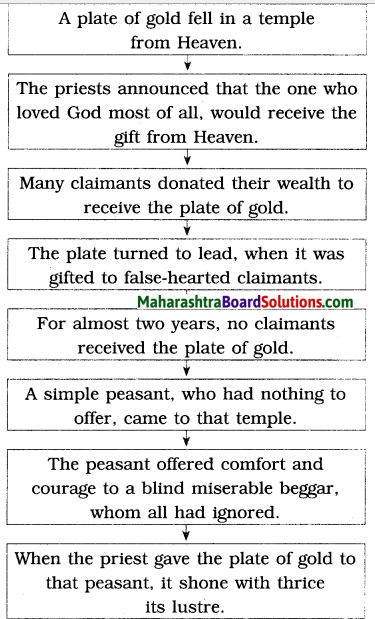
3. Rearrange the following in the proper order and insert them into a flow chart as per the poem:

(a) The plate turned to lead, when it was gifted to false-hearted claimants.
(b) Many claimants donated their wealth to receive the plate of gold.
(e) For almost two years, no clQimants received the plate of gold.
(d) A plate of gold fell in a temple from Heaven.
(e) The peasant offered comfort and courage to a blind miserable beggar. whom all had ignored.
(f) The priests announced that the one who loved God most of all, would receive the gift from Heaven.
(g) When the priest gave the plate of gold to that peasant, it shone with thrice its lustre.
(h) A simple peasant, who had nothing to offer, came to that temple.
Answer:
Maharashtra Board Class 8 English Solutions Chapter 3.1 The Plate of Gold 1

4. Which two sayings about God are conveyed through the poem bThe Plate of Gold’?
(a) God helps those, who help themselves.
(b) God loves those, who love their fellow beings.
(c) God loves those, who give away their wealth, to please Him.
(d) Service to mankind is service to God.
Answer:
(b) God loves those, who love their fellow beings.
(d) Service to mankind is service to God.

Maharashtra Board Class 8 English Solutions Chapter 3.1 The Plate of Gold

5. ‘But the peasant bowed and prayed to God ‘ What could he have prayed for?
Answer:
The peasant must have prayed for the well-being of all human beings and asked God to help everyone to bear their troubles bravely.

6. Imagine that you are the peasant. Compose a short prayer to God, after having received the plate of gold. Write it using stylish handwriting.

7. Read other poems by Leigh Hunt. especially ‘Abou Ben Adhem’. Compare the messages in that poem with those in ‘The Plate of Gold’. What do you
observe?

Class 8 English Chapter 3.1 The Plate of Gold Additional Important Questions and Answers

Complete the web:

Question 1.
Maharashtra Board Class 8 English Solutions Chapter 3.1 The Plate of Gold 6
Answer:
Maharashtra Board Class 8 English Solutions Chapter 3.1 The Plate of Gold 7

Name the following:

The Plate Of Gold Questions And Answers Question 1.
They made a proclamation:
Answer:
the priests

3.1 The Plate Of Gold Questions And Answers Question 2.
A gift from heaven:
Answer:
a plate of gold

3.1 The Plate Of Gold Question 3.
People assembled at this time:
Answer:
midday

Maharashtra Board Class 8 English Solutions Chapter 3.1 The Plate of Gold

The Plate Of Gold Question Answer Question 4.
The plate became this again when it touched the floor:
Answer:
gold

Complete the following:

The Plate Of Gold Questions And Answers Std 8 Question 1.
The plate of gold could be claimed by _______.
Answer:
the person who loved his fellow beings the best

The Plate Of Gold Poem Questions And Answers Question 2.
The priests gifted the plate of gold to ______.
Answer:
a man who within the year had distributed his whole estate among the poor

The Plate Of Gold Class 8 Question 3.
The poor peasant offered the blind beggar _____.
Answer:
sincere pity and love.

Maharashtra Board Class 8 English Solutions Chapter 3.1 The Plate of Gold

Answer the following:

Question 1.
What magical occurrence shocked the people?
Answer:
The golden plate turned to lead when touched by the man, and became gold again when it fell on the floor.
This magical occurrence shocked the people.

Question 2.
Pick out an example of Alliteration from the extract.
Answer:
‘A wondrous plate of gold, whereon these words were writ’. Repetition of the sound of ‘w’.

Question 3.
Pick out an example of Simile from the extract.
Answer:
‘The news ran as swift as light.’ The movement of the news is directly compared to the movement of light.

Question 4.
Pick out an example of Onomatopoeia from the extract.
Answer:
‘……… drop it clanging on the floor’. The word ‘clanging’ indicates sound.

Question 5.
Pick out an example of Inversion from the extract.
Answer:
‘……… the priests in solemn council sat and heard’. The correct prose order is: the priests sat and heard in solemn council.

Write if the following sentences are True or False:

Question 1.
The priests did not award the plate to anyone.
Answer:
False

Maharashtra Board Class 8 English Solutions Chapter 3.1 The Plate of Gold

Question 2.
There were very few beggars near the temple gate.
Answer:
False

Question 3.
The beggars got a lot of alms.
Answer:
True

Question 4.
The peasant was well aware of the race for the plate.
Answer:
False

Give reasons:

Question 1.
Many beggars had collected outside the temple.
Answer:
The golden plate from Heaven was to be bestowed on the person who loved his fellow beings the most. The people who came to the temple would want to prove their love by giving alms. Hence many beggars had collected outside the temple to receive the bountiful alms.

Question 2.
The pilgrims to the temple showered coins on the beggars.
Answer:
The golden plate from Heaven was to be bestowed on the person who loved his fellow beings the most. In order to prove that their love was the best and hence they were worthy of the plate, the pilgrims to the temple showered coins on the beggars.

Maharashtra Board Class 8 English Solutions Chapter 3.1 The Plate of Gold

Question 3.
What did the pilgrims fail to do?
Answer:
The pilgrims failed to see the unhappiness in the eyes of the beggars.

Match the adjectives in Column A with the nouns in Column B:

Question 1.

A B
(1) maimed (a) hands
(2) outstretched (b) pity
(3) simple (c) beggars
(4) sweet (d) peasant

Answer:

  1. maimed – beggars
  2. outstretched – hands
  3. simple – peasant
  4. sweet – pity

Activities based on Poetic Devices:

Question 1.
Pick out an example of Inversion from the extract.
Answer:
‘So for another twelve months sat the priests and judged.’ The correct prose order is: So for another twelve months the priests sat and judged.

Question 2.
Pick out an example of Repetition from the extract.
Answer:
‘Thrice they awarded thrice did Heaven refuse the gift.’ The word thrice is repeated for emphasis and rhythm.

Maharashtra Board Class 8 English Solutions Chapter 3.1 The Plate of Gold

Complete the following:

Question 1.
Maharashtra Board Class 8 English Solutions Chapter 3.1 The Plate of Gold 4
Answer:
Maharashtra Board Class 8 English Solutions Chapter 3.1 The Plate of Gold 2

Give reasons:

Question 1.
God had chosen the simple peasant as the most deserving of the plate of gold.
Answer:
The simple peasant offered the blind beggar sincere sympathy and love, which came from the depth of his heart.
He had no hidden motive for what he did. Hence God chose him as the most deserving of the plate of gold.

Question 2.
‘But the peasant bowed and prayed to God What could he have prayed for?
Answer:
The peasant must have prayed for the well-being of all human beings, and asked God to help everyone to bear their troubles bravely

Maharashtra Board Class 8 English Solutions Chapter 3.1 The Plate of Gold

Question 3.
Make a list of archaic words from the extract and give their modem equivalents:
Answer:

Archaic words Modem equivalents
thou You
thy Your
o’er Over
thine yours
lovest loves

Question 4.
Pick out an example of Inversion from the extract.
Answer:
And took both palms in his, and softly said.
The correct prose order should be: And took both palms in his, and said softly

Analysis/Appreciation of the Poem
Answer:

  • Poem and poet: The Plate of j Gold’ by James Henry Leigh Hunt.
  • Theme: God loves those who love their fellow beings Service to mankind is service to God.
  • Tone: A narrative, serious and moralistic.
  • Structure and stanzas: No uniformity in stanzas or the length of lines.
  • Rhyme and Rhythm: No rhyme scheme or rhythm; free verse.
  • Language and Imagery: Archaic language; plenty of imagery, especially when describing the peasant and the beggar.
  • Figures of Speech: Inversion, Repetition, Onomatopoeia, and Simile.

Read More:

The Bees Poem Questions and Answers Class 8 English Chapter 4.3 Maharashtra Board

Balbharti Maharashtra State Board Class 8 English Solutions Chapter 4.3 The Bees Notes, Textbook Exercise Important Questions, and Answers.

Std 8 English Lesson 4.3 The Bees Question Answer Maharashtra Board

Class 8 English Chapter 4.3 The Bees Textbook Questions and Answers

Warming Up:

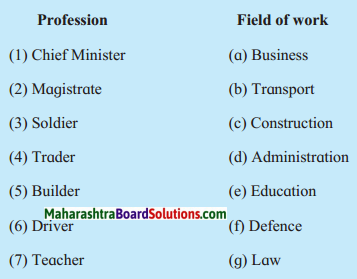
1. Match the professions with the field of work:
Maharashtra Board Class 8 English Solutions Chapter 4.3 The Bees 1
Answer:
(1) Chief Minister – Administration
(2) Magistrate – Law
(3) Soldier – Defence
(4) Trader – BusIness
(5) Builder – Construction
(6) Driver – Transport
(7) Teacher – Education

Maharashtra Board Class 8 English Solutions Chapter 4.3 The Bees

2. Living creatures, birds, animals, insects, etc. are often used in us – as comparisons, because of some special characteristics they hold.
Fill in the gaps, choosing words from the brackets to make appropriate comparisons.

(tall / quiet / humble / merry / busy / slippery / fast / sly /slow / big)

Question 1.
as _____ as a lark
Answer:
as merry as a lark

Question 2.
as _____ as a snail
Answer:
as slow as a snail

Question 3.
as ______ as a giraffe
Answer:
as tall as a giraffe

Question 4.
as _____ as a bee
Answer:
as busy as a bee

Question 5.
as ______ as an elephant
Answer:
as big as an elephant

Question 6.
as _____ as a mouse
Answer:
as quiet as a mouse

Maharashtra Board Class 8 English Solutions Chapter 4.3 The Bees

Question 7.
as _____ as an eel
Answer:
as slippery as an eel

Question 8.
as ______ as a fox
Answer:
as sly as a fox

Question 9.
as _____ as a deer
Answer:
as fast as a deer

Question 10.
as ____ as a worm
Answer:
as humble as a worm

1. Honey-bees live unorganized life like human beings. Discuss what work the following honey-bees do, us per the poem. Write it down in your own words, in your notebook.
(a) King / Emperor bee
(b) Magistrate bees
(c) Merchant bees
(d) Soldier bees
(e) Mason bees
(f) Civilian bees
(g) Porter bees
(h) Judge bee
Answer:
(a) King/Emperor bee – supervises the building of the beehive
(b) Magistrate bees – do corrective work
(c) Merchant bees – go out to trade for nectar
(d) Soldier bees – loot nectar from flowers and protect the hive
(e) Mason bees – build the hive
(f) Civilian bees – make honey from nectar
(g) Porter bees – carry the nectar brought by the other bees
(h) Judge bee – delivers his sentence

Maharashtra Board Class 8 English Solutions Chapter 4.3 The Bees

2. Complete the following choosing the appropriate option:

Question 1.
Human beings can learn from honey bees _________.
(i) How to make food
(ii) how to live joyfully
(iii) how to lead an organized nation
Answer:
how to lead an organized nation

Question 2.
The soldier-bees carry home _______.
(i) the velvet buds
(ii) nector, looted from flowers
(iii) their weapons
Answer:
nector, looted from flowers

Question 3.
The emperor-bee supervises the building of _________.
(i) the beehive
(ii) bridges
(iii) a tower
Answer:
the beehive

Question 4.
The ________ bees make honey from nectar
(i) officers
(ii) civilian citizens
(iii) magistrates
Answer:
civilian citizens

Question 5.
The drone is given a death sentence because he _______.
(i) attacked the emperor
(ii) killed other bees
(iii) does not do any work
Answer:
does not do any work

Maharashtra Board Class 8 English Solutions Chapter 4.3 The Bees

3. A. Complete the phrases using words from the poem:

(i) _______ march
Answer:
merry march

(ii) ________ tent
Answer:
royal tent

(iii) ________masons
Answer:
singing masons

(iv) ________ porters
Answer:
poor porters

(v) ________ burdens
Answer:
heavy burdens

(vi) ________ executors
Answer:
pale executors

3. B.
(i) Find any two Alliterative lines.
Answer:
Which pillage they with merry march bring home.Repetition of the sound of the letter ‘m’.
The civil citizens kneading up the honey. Repetition of the sound of the letter ‘c’.

(ii) Pick out the line that contains an Onomatopoetic word.
Answer:
The singing masons building roofs of gold. The word ‘singing’ indicates sound.

Maharashtra Board Class 8 English Solutions Chapter 4.3 The Bees

3. C.Pick out three tines that create an Imuqe In your mind of bees, busy at work.
Answer:
(i) Make boot upon the summer’s velvet buds.
(ii) The singing masons building roofs of gold.
(iii) The civil citizens kneading up the honey.

4. A. Refer to a good dictionur which carries phonetic transcriptions printed next to words. The words below are familiar to you. Copy their phonetic transcription from the dictionary and sa it aloud us ou write. (You may take our teacher’s help, if needed)

  • work
  • bees
  • boot
  • home
  • mason
  • citizen
  • porters

Stress – Stress is the extra force we use when pronouncing a syllable in a word.
For example: In the word ‘King-dom’ the syllable ‘king’ is stressed.
In the word re-li-gion the second syllable is stressed.
Stress upon a syllable can be shown with short vertical line above the syllable that is stressed.
Maharashtra Board Class 8 English Solutions Chapter 4.3 The Bees 3

4. B. Say the following words aloud and put the stress mark on the stressed syllables:

  1. crea-tures
  2. bur-den
  3. me-cha-nic
  4. e-xe-cu-tor
  5. de-li-ve-ring
  6. ma-gis-trate

Answer:

  1. crea-tures
  2. bur-den
  3. me-cha-nic
  4. e-xe-cu-tor
  5. de-live-ring
  6. ma-gis-trate

Maharashtra Board Class 8 English Solutions Chapter 4.3 The Bees

5. Project:

Gather information about the following insects. Draw their images or get pictures.
On one sheet each. fix the image I picture and below it write the information. Compile these pages and make a file of ‘Insects – our friends’.
Insects: Bee / Praying mantis / Butterfly
Beetle / Wasp / Dragon-fly

Class 8 English Chapter 4.3 The Bees Additional Important Questions and Answers

Complete the following:

Question 1.
The honey bees teach us the ______.
Answer:
art of organization and living in order

Question 2.
Roofs of gold refer to _______.
Answer:
the structure of the golden beehive

Question 3.
The death sentence is given to ________.
Answer:
the drones

Question 4.
The bee-hive is being built by _________.
Answer:
the mason bees

Maharashtra Board Class 8 English Solutions Chapter 4.3 The Bees

Answer the following:

Question 1.
Where does the emperor-bee sit and what does he do?
Answer:
The emperor-bee sits in a tent and supervises the building of the bee-hive.

Question 2.
Analysis/Appreciation Of The Poem
Answer:

  • Poem and poet: ‘The Bees’ by William Shakespeare.
  • Theme: The organized, disciplined lives of the bees, with death penalty to those who do nothing.
  • Tone: Reflective and serious: shows admiration for the organization of the bees.
  • Structure and stanzas: No separate stanzas; lines of unequal length
  • Rhyme and Rhythm: No rhymescheme or rhythm free verse
  • Language and Imagery: Language is old English Vivid images created of the activities of the bees.
  • Figures of Speech: Onomatopoeia, Alliteration, Inversion.

Read More:

Std 9 English Poem A True Story of Sea Turtles 2.2 Question Answer Maharashtra Board

Balbharti Maharashtra State Board Class 9 English Solutions Kumarbharati Chapter 2.2 A True Story of Sea Turtles Notes, Textbook Exercise Important Questions and Answers.

Class 9 English Chapter 2.2 Question Answer Maharashtra Board

A True Story of Sea Turtles Poem 9th Std Question Answer

Warming up

It is our world, too!

1. Observe the following photographs. What is common among all these animals? They are all endangered species. They are likely to die out completely, one of the reasons being human activity in their habitat. If these animals could think and speak like humans, what would they say?
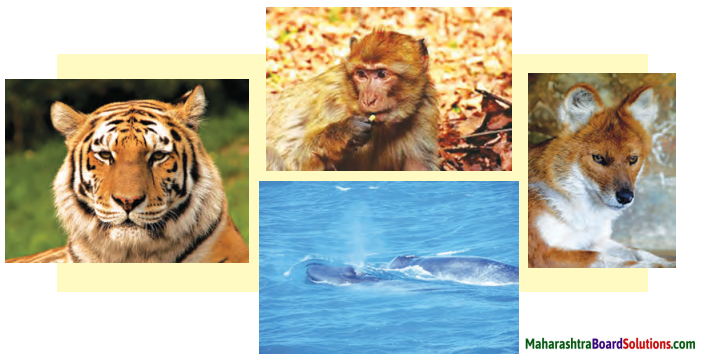
Maharashtra Board Class 9 English Kumarbharati Solutions Chapter 2.2 A True Story of Sea Turtles 1

Form groups of 5 – 8. Prepare short autobiographical speeches for each of these animals (10 – 15 lines). Use the following points:

  • How the animal lives – It’s the only way he/she can.
  • How he interacts with nature and other animals.
  • How humans interact with that species – whether it is fair, necessaiy or desirable, etc.
  • The possible ill effects of the way human beings treat the animals, for the whole living world.
  • The animal getting ready to bid farewell to this world.

Question 1.
Form groups of 5 – 8. Prepare short autobiographical speeches for each of these endangered animals (10 – 15 lines). Use the points given on page 30 of the textbook.
(Note: A complete autobiographical speech is given only for (c). Students may write the others based on the given points.)
Answer:
(a) Tiger:
(Points: lives in tropical, evergreen forests – eats different types of prey, mostly other large mammals – humans hunt them for their skin and destroy their habitats – if extinct, other species will run wild – ecosystem damaged.)

(b) Monkey:
(Points: proper name rhesus macaque – herbivorous – eats fruits, seeds, roots, . bark, cereals, etc. – found mostly in Asia – friendly and comes close to human habitations – in demand for research programmes because close to humans in behaviour – intelligent – fear of diseases being spread through these animals – important part of ecosystem.)

(c) Indian wild dog or the Dhole:
Hi there! You may wonder who I am, for I am not as popular as some of the other animals. I am called ‘dhole’, or the red wolf, or the Indian wild dog. I live only in Asia, in the mountainous regions, generally in the forested areas.

I am a very social animal and live together with my whole family. I am reddish in colour, and my home is a ‘den’. I am carnivorous, and mostly hunt during the day. My food is deer, monkeys, buffaloes, etc. I compete with tigers and leopards for food. I am endangered today because of the loss of the habitat in which I live and lack of food.

There is severe competition from other species too. I am also hunted for fun by humans. Unfortunately, many diseases have been transferred to me from domestic dogs, and many of my family members are dying due to these diseases. Today, there are less than 2,500 of us adults left. I ask you for your help in my conservation. Thank you.

(d) Whale:
(Points: marine animal – mammal – largest animal on earth – extinction due to overfishing, pollution, etc. – help regulate the flow of food – ensure that certain species do not overpopulate the ocean and threaten others.)

Maharashtra Board Class 9 English Kumarbharati Solutions Chapter 2.2 A True Story of Sea Turtles

2. Hold a classroom discussion on the following topics and later on, expand the themes on your own. (10 – 15 lines)

  • Why human beings need to use more and more natural resources.
  • Should we conserve only the most beautiful and most useful things in nature?
  • What is ‘beautiful’ or ‘useful’? Who has the right to decide that?

Question 1.
Hold a classroom discussion on the following topics and later on, expand the themes on your own. (10-15 lines)
Answer:
(a) Why human beings need to use more and more natural resources.
(Points: we don’t need to use more natural resources but to conserve them – we must conserve wood, oil, minerals, forests, water, etc. – we cannot create these things quickly – take years and years to form – must use them sparingly.)

(b) Should we conserve only the most beautiful and most useful things in nature?
(Points: what is beautiful to one may be dangerous to others – example: leopards seem beautiful to city dwellers but are dangerous to villagers – many animals like pollinating insects, bees, slugs – not beautiful but useful – nothing useless – every animal and plant contributes to the ecosystem in some way or the other – nothing should be allowed to become extinct.)

(c) What is ‘beautiful’ or ‘useful’? Who has the right to decide that?
(Points: no one is judge of what is useful and what is beautiful – no one has the right to decide that – beauty lies in the eyes of beholder – what is beautiful to one may be dangerous to others – we: must live in such a way so as to conserve as much flora and fauna as possible.)

Maharashtra Board Class 9 English Kumarbharati Solutions Chapter 2.2 A True Story of Sea Turtles

English Workshop:

1. Form groups. Discuss the first two paragraphs. Try to present their content in the form of a series of conversations among the (a) volunteers (b) the volunteers and the villagers.

Question 1.
Form groups. Discuss the first two paragraphs. Try to present their content in the form of a series of conversations among the (a) volunteers (b) the volunteers and the villagers.
Answer:
a. Conversation between volunteers:
Answer:

  • Volunteer A: Look, what are these things here? They look like egg shells! Where have they come from?
  • Vol. B: Eggshells? Where? Oh, yes, there they are. Deep in that pit in the sand!
  • Vol. C: I have never seen so many egg shells around here before!
  • Vol. A: It’s certainly unusual. Let’s ask these villagers about it.
  • Vol. B: I just asked. They say that they are turtle egg shells.
  • Vol. C: But we have never come across any turtle eggs in all our walks along the beaches of this region.
  • Vol. A: I wonder how this is possible.
  • Vol. B: I made some more enquiries. This beach has been sealed to the public for nearly one month.
  • Vol. C: Why?
  • Vol. B: To prevent the smuggling of silver bricks, it seems.
  • Vol. A: That means that these eggs are seen only after the beach has been sealed to the public,
  • Vol. C: Oh, Oh. Do you know what that implies?

b. Conversation between the volunteers and the villagers:
Answer:

  • Villager 1: Why have you brought us here ?
  • Volunteer A: We wanted to ask you about these egg shells. What are they?
  • Vill. 2: These are turtle egg shells, sir.
  • Vol. B: We have never seen them before, in all our walks along the Konkan coast.
  • Vill. 3: Well, sir, this beach has been sealed to the public since the past month to prevent smuggling activities.
  • Vol. C: Turtle eggs? But turtles are a protected species.
    (Students may continue the conversation of your own.)

2. Prepare a short note on sea turtles with the help of the information given in the passage.

Question 1.
Prepare a short note on sea turtles with the help of the information given in the passage.
Answer:
There are seven types of sea turtles in the world, five of which are found in India. The Olive Ridley turtles nest along the entire coastline of Maharashtra. Green turtles and Hawkbills have also been found. When the female turtle reaches maturity at about the age of fifteen years, she returns to the shore to lay her eggs at the same place where she was born. The female comes to the shore just to make a nest in the sand and lay her eggs and immediately returns to the sea. She does not return to the nest after that.

The eggs hatch after a period of 40-50 days, using natural heat. Innumerable dangers await the eggs on the land and the hatchlings in the deep sea, and they have to face them all on their own. Their survival rate is therefore very low. Turtles perform an important function – they keep the sea clean. Thus they occupy an important place in marine ecology.

Maharashtra Board Class 9 English Kumarbharati Solutions Chapter 2.2 A True Story of Sea Turtles

3. Prepare a poster to illustrate how the turtle eggs were/are protected. Include the following in the poster.

  • Some pictures of sea turtles and their habitat
  • Information about turtle nests and eggs
  • A picture and information about a ‘protected nest’
  • Appeal to the public to spread awareness about their conservation
  • Some data (figures) regarding the achievements so far

Question 1.
Prepare a poster to illustrate how the turtle eggs were/are protected. Include the following in the poster.

  • Some pictures of sea turtles and their habitat
  • Information about turtle nests and eggs
  • A picture and information about a ‘protected nest’
  • Appeal to the public to spread awareness about their conservation
  • Some data (figures) regarding the achievements so far

Maharashtra Board Class 9 English Kumarbharati Solutions Chapter 2.2 A True Story of Sea Turtles

4. Prepare a simple brochure regarding the ‘homestay’ facilities made available in the villages. Form groups and discuss the points you will use in the brochure. Remember to include the precautions that tourists have to take at the site, in your brochure.

Question 1.
Prepare a simple brochure regarding the ‘homestay’ facilities made available in the villages. Form groups and discuss the points you will use in the brochure. Remember to include the precautions that tourists have to take at the site, in your brochure.
(An example is given below.)
Welcome to: Kasav Mahotsav
Homestay facilities: ‘Nisarg’ Homestay
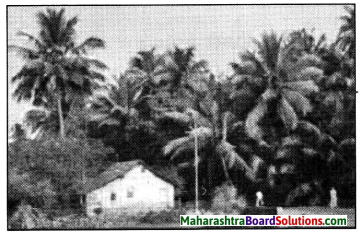
Maharashtra Board Class 9 English Kumarbharati Solutions Chapter 2.2 A True Story of Sea Turtles 2

  • Close to the beach
  • SpacIous arid clean rooms
  • Private toilets for every room
  • Delicious, fresh, home-cooked food
  • Green surroundings

A home away from home!

Additional facilities:
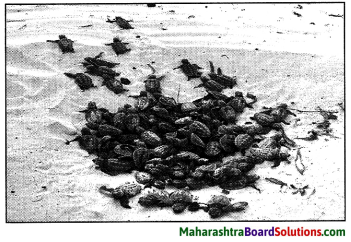
  • 24-hour wifi
  • tour guides

Maharashtra Board Class 9 English Kumarbharati Solutions Chapter 2.2 A True Story of Sea Turtles 3

  • boat ride in the sea

Precautions:

  • No flash to be used while photographing the hatchlings
  • Restricted entry into the sea
  • Barricades and rules to be respected

Contact us on:
Mobile: 98194 xxxxx
Email: nisargforyou@xxx.com

5. Explain the idea of conservation of Nature through Livelihood’ briefly, using the example given here.

Question 1.
Explain the idea of conservation of Nature through Livelihood’ briefly, using the example given here.
Answer:
Nature has to be conserved and protected. If, while doing this, people are also provided with employment, it becomes sustainable. In Velas village, tourists came in hordes to see the turtle hatchlings. These tourists were given food and accommodation by the villagers. This brought in business and money for them. However, in order to earn that money, it was important to protect the hatchlings, which the tourists came to see. Therefore, they took pains to protect the turtles, hence conserving this bit of nature. This is the idea of ‘Conservation of Nature through Livelihood’.

Maharashtra Board Class 9 English Kumarbharati Solutions Chapter 2.2 A True Story of Sea Turtles

6. Prepare bullet point presentations on the following:
(a) Scope for tourism in your locality
(b) Prudent utilisation of natural resources .

Question 1.
Prepare bullet point presentations on the following:

  • Scope for tourism in your locality
  • Prudent utilization of natural resources.

(Students may complete this activity in the computer labs.)

7. Read the following entries in the ‘Language Study pages :
(a) clause (b) sentence
Underline the main clause in the following sentences.
1. There are a few people in every village who keep combing the beach in the early hours of the morning, throughout the year.
2. When the female turtle comes onshore to nest and to lay eggs, she leaves behind a trail just like a track of wheels on the sand.
3. The egg hunters follow this trail right up to the nest which is about half a meter deep.

Question 1.
Underline the main clause in the following sentences:
(The answers are underlined directly.)
Answer:
1. There are a few people in every village who keep combing the beach in the early hours of the s morning, throughout the year.
2. When the female turtle comes on shore to nest and to lay eggs, she leaves behind a trail just like the track of wheels on the sand.
3. The egg hunters follow this trail right up to the nest which is about half a metre deep.
4. Enquiries with the villagers revealed that they s were turtle eggs.

Maharashtra Board Class 9 English Kumarbharati Solutions Chapter 2.2 A True Story of Sea Turtles

8. Read: ‘Last Chance to See’ by Douglas Adams and Mark Carwardine

Question 1.
Read: ‘Last Chance to See’ by Douglas Adams and Mark Carwardine

English Kumarbharati 9th Digest Chapter 2.2 A True Story of Sea Turtles Additional Important Questions and Answers

Read the following passages carefully and complete the activities:

Simple Factual Activity:

Question 1.
Complete the following statements:
(The answers are given directly and underlined.)
Answer:

  1. The volunteers were surveying the white-bellied sea-eagles in the summer that year.
  2. The volunteers had never come across turtle eggs in their walks in all the years.
  3. Turtles nest along the entire coastline of our state.
  4. The stolen turtle eggs are either eaten or sold in the market.

Question 2.
Why have these turtles been protected in India?
Answer:
The eggs of the turtles are stolen by egg hunters and then either eaten or sold in the market. If a turtle is spotted while it is still laying eggs, it is killed and eaten after it has finished laying the eggs. The turtles are an important part of the marine food chain. Hence they have been protected in India.

Maharashtra Board Class 9 English Kumarbharati Solutions Chapter 2.2 A True Story of Sea Turtles

Activity-based on Vocabulary:

Question 1.
Match the adjectives in Column A with the nouns in Column B:

A B
1. shallow (a) practice
2. unusual (b) pits
3. ruthless (c) bricks
4. silver (d) occurrence

Answer:

A B
1. shallow (b) pits
2. unusual (d) occurrence
3. ruthless (a) practice
4. silver  (c) bricks

Personal Response:

Question 1.
Do you think that we, in India, look after and nurture the flora and fauna around us?
Answer:
No, we don’t. People poach endangered species for the money they can earn from the skin, furs, etc. Trees are routinely cut down for agriculture, roads, buildings, and so on. In cities, trees are pruned very haphazardly and concrete is often poured round their roots. Domestic animals roam around the streets eating from garbage dumps. The list is endless. I think that people should be educated to respect nature.

Maharashtra Board Class 9 English Kumarbharati Solutions Chapter 2.2 A True Story of Sea Turtles

Simple Factual Activity:

Question 1.
State whether the following statements are Right or Wrong:
Answer:

  1. Turtles are a protected species in India. Right
  2. Many of the elderly villagers had seen hatchlings. Wrong
  3. In the first year, the volunteers protected 500 nests. Wrong
  4. The volunteers had no experience regarding sea turtles. Right

Complex Factual Activity:

Question 1.
Why were the people asked to look for the eggs or nests in the morning?
Answer:
Sea turtles usually come ashore at night to lay eggs. The people who were asked to .look for the eggs or nests in the morning, carefully removed the eggs from the nest and buried them in a similar pit. This new pit was protected with wire fencing to prevent thefts.

Question 2.
The elderly persons had seen the hatchlings for the first time. What does it indicate?
Answer:
This indicates that the theft of turtle eggs was so common that no eggs had been allowed to hatch for many years in the past.

Maharashtra Board Class 9 English Kumarbharati Solutions Chapter 2.2 A True Story of Sea Turtles

Activities based on Vocabulary:

Question 1.
Form adverbs from the following words:

  1. secret
  2. serious
  3. special
  4. careful

Answer:

  1. secret – secretly
  2. serious – seriously
  3. special – specially
  4. careful – carefully.

Question 2.
Form adjectives from the following words:

  1. secret
  2. spectacle
  3. protection
  4. information

Answer:

  1. secret – secret/secretive
  2. spectacle – spectacular
  3. protection – protective
  4. information – informative.

Activities based on Contextual Grammar:

Question 1.
Rewrite the following sentence using ‘never’:
It was for the first time that they had seen the hatchlings rushing to the sea.
Answer:
They had never before seen the hatchlings rushing to the sea.

Maharashtra Board Class 9 English Kumarbharati Solutions Chapter 2.2 A True Story of Sea Turtles

Question 2.
Frame a Wh-question to get the underlined part as the answer:
They had to watch over the protected nest to prevent thefts.
Answer:
Why did they have to watch over the protected nest?

Personal Response:

Question 1.
“Have you seen any turtles? If so, where? If not, would you like to see?
Answer:
I have seen turtles only at the zoo, in pictures and on TV. I am very fond of animals and I would certainly like to see turtles in their natural habitat. I would love to see the hatchlings rushing out to meet the sea.

Simple Factual Activity:

Choose the correct alternatives:

Question 1.
The Olive Ridley turtles nest along
(a) the hilly areas of Maharashtra
(b) the coastline of Maharashtra
(C) the Interiors of Maharashtra
Answer:
(b) the coastline of Maharashtra

Question 2.
The turtles reach maturity at the age of about
(a) one or two years
(b) 40-50 days
(c) 15 years
Answer:
(c) 15 years

Question 3.
The turtle eggs hatch after
(a) 40-50 days
(b) five to seven days
(c) 15 days
Answer:
(a) 40-50 days

Maharashtra Board Class 9 English Kumarbharati Solutions Chapter 2.2 A True Story of Sea Turtles

Question 4.
ProtectIon to the turtle was offered In – villages.
(a) 80
(b) 40-50
(c) all
Answer:
(a) 80

Complex Factual Activity:

Question 1.
Why was it necessary to undertake turtle protection on a large scale?
Answer:
Turtles perform an important function-they keep the sea clean. Thus, they occupy an important place in marine ecology. However, there are innumerable dangers awaiting the turtles, their eggs and the young hatchlings. The survival rate of the hatchlings is as low as just one or two turtles out of a thousand. Considering all these factors, it was necessary to undertake their protection on a large scale.

Activity-based on Vocabulary:

Fill in the blanks using the phrases given in the brackets:
(The answers are given directly and underlined.)
(to the shore, after a period of, on their own, to spread the message)

  1. It is necessary to spread the message of peace all over the world.
  2. You can withdraw your money after a period of three years.
  3. The boat returned to the shore after a long time.
  4. Students must learn to do their homework on their own.

Maharashtra Board Class 9 English Kumarbharati Solutions Chapter 2.2 A True Story of Sea Turtles

Personal Response:

Question 1.
Why were those who had stolen the eggs earlier, Involved In the work of protection? Give at least two reasons.
Answer:
The first reason is that those who had stolen the eggs earlier, knew the exact details of where and I when the turtles would lay their eggs. The second reason was to give them a sense of responsibility, so ‘ that they would not continue to steal the eggs.

Simple Factual Activity :

Name the following :
(The answers are given directly and underlined.)

  1. The Turtle festival: Kasav Mahotsava
  2. Accommodation for tourists in the homes of villagers: Homestay
  3. A sum of money saved for the protection of turtles: Turtle Protection Fund
  4. The organization that took the initiative to save turtles: Sahyadri Nisarg Mitra

Complex Factual Activities :

Question 1.
What do the ‘homestay’ families do?
Answer:
The ‘homestay’ families provide accommodation to the tourists. These families also give ten percent of their income from ‘homestay’ for the Turtle Protection Fund.

Maharashtra Board Class 9 English Kumarbharati Solutions Chapter 2.2 A True Story of Sea Turtles

Question 2.
Why was the project entrusted to the local people?
Answer:
The project was entrusted to the local people because it was believed that it is only the local villagers who can offer excellent protection to the local species.

Activity-based on Vocabulary:

Question 1.
Match the meanings of the following expressions with reference to the passage :

A B
1. novel concept (a) volunteered
2. unique spectacle (b) new idea
3. came forward (c) possible to be maintained
4. become sustainable (d) unusual sight

Answer:

A B
1. novel concept (b) new idea
2. unique spectacle (d) unusual sight
3. came forward (a) volunteered
4. become sustainable (c) possible to be maintained

Maharashtra Board Class 9 English Kumarbharati Solutions Chapter 2.2 A True Story of Sea Turtles

Activity-based on Contextual Grammar:

Rewrite using the noun form of the underlined words: 

Question 1.

  1. The tourists were accommodated in the homes of the villagers.
  2. We are happy to see the project running smoothly.

Answer:

  1. The tourists were given (provided) accommodation in the homes of the villagers.
  2. It gives us happiness to see the project running smoothly.

Simple Activities:

Question 1.
Make a meaningful sentence using the following phrase:
throughout the year
Answer:
Nowadays, mangoes are available throughout the year

Question 2.
Spot the error and correct the sentence:
Turtles nests along the entire coastline of our state.
Answer:
Turtles nest along the entire coastline of our state.

Maharashtra Board Class 9 English Kumarbharati Solutions Chapter 2.2 A True Story of Sea Turtles

Question 3.
Punctuate the following:
as soon as the eggs are laid it is caught and then killed and eaten
Answer:
As soon as the eggs are laid, it is caught and then killed and eaten.

Question 4.
Pick out the infinitive in the following sentence:
They had to prevent thefts.
Answer:
Infinitive – to prevent.

Question 5.
Identify the type of sentence:
We had never come across turtle eggs in our walks.
Answer:
Assertive sentence

Maharashtra Board Class 9 English Kumarbharati Solutions Chapter 2.2 A True Story of Sea Turtles

Question 6.
Find out two hidden words from the word ‘organisation’
Answer:
organization- organ, grain, (rain, nation)

Question 7.
Find a verb from the lesson that forms its past and present participles by doubling the last letter.
Answer:
spot – spotted, spotting

Question 8.
Arrange the words in alphabetical order:
turtle, trail, ruthless, response
Answer:
response, ruthless, trail, turtle

Medium-Level Activities:

Question 1.
A comprehensive booklet and a short film was prepared to spread the message.
(Change the voice beginning ‘We……’)
Answer:
We prepared a comprehensive booklet and a short film to spread the message.

Maharashtra Board Class 9 English Kumarbharati Solutions Chapter 2.2 A True Story of Sea Turtles

Question 2.
Use the word ‘leaves’ in two separate sentences, the word having different meanings (homographs):
Answer:
(a) The leaves of many trees turn yellow in autumn.
(b) A smart thief never leaves any clues behind.

Question 3.
They gave ten percent of their income from ‘homestay’ for the Turtle Protection Fund.
(Use the future continuous form of the verb.)
Answer:
They will be giving ten percent of their income from ‘homestay’ for the Turtle Protection Fund.

Question 4.
Some of the elderly villagers confessed that it was the first time that they had seen the hatchlings rushing to the sea.
(Rewrite indirect speech.)
Answer:
“It is the first time we have seen the hatchlings rushing to the sea,” confessed some of the elderly villagers.

Challenging Activities:

Question 1.
Use the word ‘harm’ as a noun and a verb in two separate sentences.
Answer:
(a) “You will come to no harm if you obey the rules,” said the teacher, (noun)
(b) If we harm the environment, we will suffer for it. (verb)

Maharashtra Board Class 9 English Kumarbharati Solutions Chapter 2.2 A True Story of Sea Turtles

Question 2.
A Turtle Friends Club was established in each village. (Rewrite using a modal auxiliary for advice.)
Answer:
A Turtle Friends Club should be established in each village.

Maharashtra State Board Class 9 English Solutions

9th Std English Questions And Answers:

A Time To Believe Poem Questions and Answers Class 8 English Chapter 1.1 Maharashtra Board

Balbharti Maharashtra State Board Class 8 English Solutions Chapter 1.1 A Time To Believe Notes, Textbook Exercise Important Questions and Answers.

Std 8 English Lesson 1.1 A Time To Believe Question Answer Maharashtra Board

Class 8 English Chapter 1.1 A Time To Believe Textbook Questions and Answers

Warming Up:

Question 1.
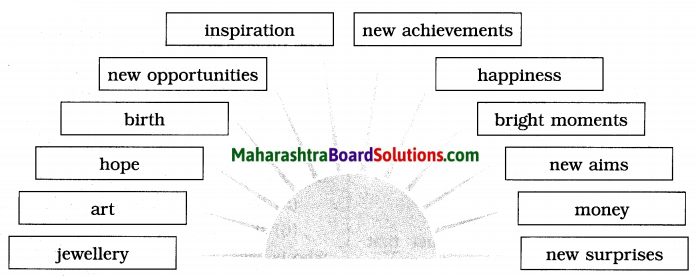
Think, choose and fill up the labels with what a ‘sunrise’ symbolizes.
(jewellery / art / hope / birth / anger / new opportunities / good manners / inspiration/ new achievements / happiness / misery / bright moments / new aims / money / newsurprises)
Maharashtra Board Class 8 English Solutions Chapter 1.1 A Time To Believe 4
Answer:
Maharashtra Board Class 8 English Solutions Chapter 1.1 A Time To Believe 5

Question 2.
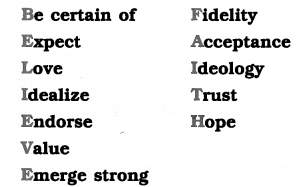
An acrostic is a poem or a write up in which the first letter of each line forms a word, when it is read vertically. Complete the acrostics of BELIEVE and FAITH.
Maharashtra Board Class 8 English Solutions Chapter 1.1 A Time To Believe 8
With your benchmate / group, complete the acrostic of BELIEVE and FAITH.
Answer:
Maharashtra Board Class 8 English Solutions Chapter 1.1 A Time To Believe 6

1.A. Rearrange the letters to make meaningful words, occurring in the poem.

  1. clearmis
  2. sowmid
  3. tabyue
  4. madres
  5. laveu
  6. downre

Answer:

  1. miracles
  2. wisdom
  3. beauty
  4. dreams
  5. value
  6. wonder

Maharashtra Board Class 8 English Solutions Chapter 1.1 A Time To Believe

1.B. Write words from the poem that describe the following.

  1. sky
  2. heart
  3. hand
  4. beginning

Answer:

  1. stardust sky
  2. nurturing heart
  3. aging hand
  4. new beginning

2. Say WHY. . . . .

Question a.
________ the sky has a magical quality.
Answer:
The sky has a magical quality because it has scurrying clouds, twinkling stars and a beautiful moon.

Question b.
_______ even an aging hand has beauty.
Answer:
because it can teach us how to love.

Question c.
_______we should believe that we are strong and courageous.
Answer:
We should believe that we are | strong and courageous so that we can recover after we have gone through difficulties and shocks, and return to our normal lives again.

3. Make a list of any six things that the poet wants us to accept as true.
Answer:
The poet wants us to accept as j true the following things :

  • that we have the strength and ( courage to get back to normal after a setback
  • that we are never alone
  • that life is a gift we must cherish
  • that there are wonderful surprises in store for us
  • that all our hopes and dreams are within reach
  • that great things will happen if we have belief in life and in ourselves

Maharashtra Board Class 8 English Solutions Chapter 1.1 A Time To Believe

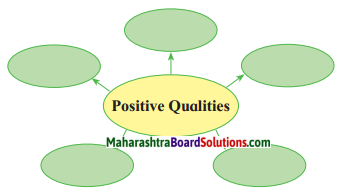
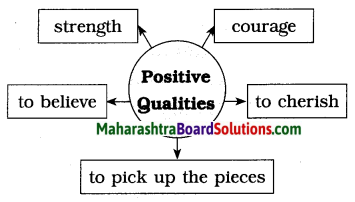
4. Find from the poem, positive qualities to fill up the web.
Maharashtra Board Class 8 English Solutions Chapter 1.1 A Time To Believe 3
Answer:
Maharashtra Board Class 8 English Solutions Chapter 1.1 A Time To Believe 2

5. Read the lines below.
(A) ‘To believe is to see angels dancing among the clouds’.
The above line contain a human characteristic ‘dancing’ given to something
non – human, ‘angels’. The Figure of Speech used in the line is called
‘Personification’.

(B) ‘To believe is to know that
Everyday is a new beginning’.

(C) To believe is to know ………. life is a gift
Lines in poetry, such as the above, state a general truth and can be used as sayings or
quotes etc. They contain the Figure of Speech called Epigram.
Epigram closely resembles a proverb.

Find from the poem three other examples of Epigram.
Answer:
(i) ‘To believe is to find the strength and courage that lies within us.’
(ii) ‘To believe is to know we are never alone, that life is a gift.’
(iii) ‘To believe is to know that wonderful surprises are just waiting to happen.’
(These lines state a general truth.)

Maharashtra Board Class 8 English Solutions Chapter 1.1 A Time To Believe

6. Divide the class into 5 groups. Each group can prepare a decorative chart / poster using an epigrammatic lines from the poem. You may use calligraphy / painting / or Paint programme on a computer. (With permission, put up these charts in your school.)

Class 8 English Chapter 1.1 A Time To Believe Additional Important Questions and Answers

Complete the following:

Question 1.
One should know and trust _______.
Answer:
One should know and trust that every day is a new beginning, that miracles happen and dreams really do come true.

Maharashtra Board Class 8 English Solutions Chapter 1.1 A Time To Believe

Question 2.
The two supernatural references in the second stanza _______.
Answer:
The two supernatural references in the second stanza are to angels and to the man in the moon.

Activities based on Poetic Devices/Vocabulary:

Question 1.
Find out an example of Personification from the extract.
Answer:
‘To believe is to see angels dancing among the clouds.’ (Here, the angels have been given the human quality of ‘dancing’.)

Question 2.
Pick out examples of Alliteration from the extract.
Answer:
(i) …. and the wisdom of the man in the moon’. (Repetition of the sound of the letter ‘m’.)
(ii) For it is through their teachings, we learn to love. (Repetition of the sound of the letters ‘t’ and T.)

Question 3.
Pick out an example of Repetition from the extract.
Answer:
The words ‘To believe is to ….’ are repeated at the beginning of each stanza. This provides emphasis to the message in the poem and gives rhythm to the stanzas.

Complete the following:

Question 1.
The two qualities that are needed to recover after a shocking event are _________.
Answer:
strength and courage.

Question 2.
The poet advises everybody to ______.
Answer:
have a positive attitude.

Maharashtra Board Class 8 English Solutions Chapter 1.1 A Time To Believe

Complex Factual Activities:

Question 1.
Explain why ….
…. we should believe that we are strong and courageous,
Answer:
We should believe that we are strong and courageous so that we can recover after we have gone through difficulties and shocks, and return to our normal lives again.

Activities based on Poetic Devices/Vocabulary :

Question 1.
Rearrange the letters to form meaningful words occurring in the extract.

  1. gearuoc
  2. rissupser
  3. gnehtrts
  4. irehchs

Answer:

  1. courage
  2. surprises
  3. strength
  4. cherish

Question 2.
Write word from the extract that describe the following :
surprises
Answer:
wonderful surprises

Question 3.
Pick out an example of Metaphor from the extract.
Answer:
‘That life is a gift.’ Life is implicitly compared to a gift.

Maharashtra Board Class 8 English Solutions Chapter 1.1 A Time To Believe

Question 4.
Pick out an example of Repetition from the extract.
Answer:
The words ‘To believe is to ….’ are repeated at the beginning of each stanza. This provides emphasis to the message in the poem and gives rhythm to the stanzas.

Question 5.
Analysis/Appreciation Of The Poem ‘A Time To Believe’
Answer:
Poem and poet: ‘A Time to Believe’ by B.J. Morbitzer.
Theme: To believe in ourselves and to have a positive and optimistic attitude towards life.
Tone: Serious and inspirational.
Structure and stanzas: 4 lines in each stanza, except in the last stanza, which has 5 lines.
Rhyme and Rhythm: No rhyme scheme; the poem is written in free verse.
Language and Imagery: The language is simple and direct. The only instances of Imagery are of ‘angels dancing among the clouds’ and the ‘stardust sky’.
Figures of Speech: Personification, Epigram, Repetition, Metaphor.

Read More:

Think Before You Speak Poem Questions and Answers Class 7 English Chapter 3.6 Maharashtra Board

Class 7 English Chapter 3.6

Balbharti Maharashtra State Board Class 7 English Solutions Chapter 3.6 Think Before You Speak Notes, Textbook Exercise Important Questions and Answers.

Std 7 English Lesson 3.6 Think Before You Speak Question Answer Maharashtra Board

Class 7 English Chapter 3.6 Think Before You Speak Textbook Questions and Answers

1. The same word can be used as a noun in some sentences and as a verb in others.

Question 1.
For example,
1. Many are the empty remarks …………….. Noun.
2. A wise man once remarked, ………….. Verb.
Make two sentences of your own with each of the words given below, using the same word as a noun in one and as a verb in another.
1. change
2. show throw
3. return
4. benefit
Answer:
1. Change:

  • Picnics are a welcome change from the daily routine. (Noun)
  • Change the way you think. (Verb)

2. Show:

  • The students put up a grand musical show. (Noun)
  • You need not show me your tickets. (Verb)

3 Throw:

  • That was an easy throw. (Noun)
  • You must throw garbage in the trash can. (Verb)

4 Return:

  • She promised to take me for a movie on her return from the market. (Noun)
  • Please return my book, as I need to complete it. (Verb)

5 Benefit:

  • I advice you for your own benefit. (Noun)
  • Children benefit from parents’ advice. (Verb)

Maharashtra Board Class 7 English Solutions Chapter 3.6 Think Before You Speak

2. Complete the following.

Question 1.
Our ears are like funnels because …………..
Answer:
they are open all the time and there is no door with which you can close them.

Question 2.
The two rows of teeth are like a fence because ……………..
Answer:
if we wish to speak our words have to pierce through them.

Question 3.
The two lips are like fence because ……………….
Answer:
before a word is spoken, it has to pass through it.

Question 4.
Harsh words are like scattered bits of paper carried away by the wind because ………………
Answer:
once you have spoken them aloud, it is very difficult to take them back.

3. Write a brief summary of the story of the young man and his spiritual teacher, making the young man the narrator.

Question 1.
You may begin as given below.
“I went quickly to my spiritual teacher for advice because I had ………….”
Answer:
I went quickly to my spiritual teacher for advice because I had hurt and insulted my dear friend with unkind and harsh words. When I asked him for the solution, he gave me a fresh sheet of blank paper and a pen and instructed me to write down on that paper all the harsh things I had told my friend. I obeyed. He then asked me to tear it into as many bits as I could and throw the bits out of the window.

The tiny bits scattered far and wide in no time. But to my surprise, he then asked me to collect as many bits as possible. I ran to collect them, but in vain. I couldn’t get hold of even in a single bit of paper. I returned all exhausted. He then revealed to me that spoken words are like those bits of paper, easy to scatter but difficult to take back. What was done, was done, and could not be altered. I learnt that I should think before I speak.

Maharashtra Board Class 7 English Solutions Chapter 3.6 Think Before You Speak

4. Language study.

Adverbial:
An adverbial is something that is used as an adverb. An adverbial is often one word, an adverb, as in the following example:
1.You have run fast.
But, it can also be a phrase or a clause.
2. We played on the playground.
3. I will go home when the bell rings.
In sentence 2, the phrase ‘on the playground’ is used as an adverb. In
sentence 3, the clause ‘when the bell rings’ Is used as an adverb.

Class 7 English Chapter 3.6 Think Before You Speak Additional Important Questions and Answers

Answer the following questions.

Question 1.
Was Disraeli trying to give a scientific reason?
Answer:
No, Disraeli wasn’t trying to give a scientific reason, but a logical one. He just wanted to draw our attention to the fact, that human physiology suggests that we should speak less and listen more.

Maharashtra Board Class 7 English Solutions Chapter 3.6 Think Before You Speak

Question 2.
Was he only trying to give a message in a light-hearted but effective way?
Answer:
Yes, he was only trying to give a message in a light-hearted but effective way.

Question 3.
Have you ever passed an empty remark or win statement that might hurt someone? What can you do to avoid it again?
Answer:
Yes, I have passed a vain statement about a classmate’s dressing sense only to realize later that she came from a poor financial background. I was lucky she didn’t hear it or else she would have been hurt. From that day I decided not to pass such remarks because often we do not know the complete background.

Answer the following in one or two sentences.

Question 1.
What did the wise teacher ask the young man to do?
Answer:
The wise teacher asked the young man to write down on a paper all the harsh things he had told his friend.

Maharashtra Board Class 7 English Solutions Chapter 3.6 Think Before You Speak

Question 2.
What did the wise teacher ask the young man to do with the sheet of paper?
Answer:
The wise teacher asked the young man to tear the sheet of paper into a hundred tiny pieces and throw the bits out of the window.

Question 3.
What is the similarity between the bits of paper scattered in the wind and spoken words?
Answer:
Just as bits of paper scattered in the wind are difficult to gather, similarly spoken words are impossible to take back.

Reading Skills, Vocabulary and Grammar.

Simple Factual Questions.

Question 1.

  1. Benjamin Disraeli was a great
  2. To speak eve one single words, it must
  3. We must think at least

Answer:

  1. Britsh Statesman
  2. pass through two walls – two fences,
  3. twice before we utter a word.

Maharashtra Board Class 7 English Solutions Chapter 3.6 Think Before You Speak

Complex Factual Questions.

Question 1.
How do we become slaves of words spoken by us?
Answer:
Once we have spoken a word we become slaves as we cannot take it back, no matter how hard we try. You cannot retrieve it.

Question 2.
What are unspoken words?
Answer:
Unspoken words are things one wants to say, but remain unsaid as thoughts in the mind.

Question 3.
How do spoken words make you a slave?
Answer:
Spoken words are meant to be honoured which means we have to stand by it. We say something and do not follow it, then we lose our credibility. Hence we need to think before we speak and become slave to our own words.

Maharashtra Board Class 7 English Solutions Chapter 3.6 Think Before You Speak

Question 4.
Two rows of teeth’. Thinks of similar expressions.
Answer:

  1. Two sets of five fingers.
  2. Two sets of five toes.
  3. A pairs of eyes
  4. A pair of ears are similar expression.

Vocabulary.

Question 1.
Use the words ‘left’ in separate sentences and show the difference in the meaning.
Answer:
My’sister uses her left hand efficiently. After the function, a lot of food was left behind. She lift without telling anybody.

Question 2.
Man was meant to listen more and talk less similarly make a sentence using words of opposite meaning.
Answer:
We breathe in oxygen and breath out carbon dioxide.

Grammar.

Question 1.
The wise teacher gave him a fresh sheet of blank paper and pen. (Rewrite ending with ‘the wise teacher’)
Answer:
He was given a fresh sheet of blank paper and pen by the wise teacher.

Maharashtra Board Class 7 English Solutions Chapter 3.6 Think Before You Speak

Question 2.
You cannot change them or control them. (Make affirmative)
Answer:
You can hardly change them or control them.

Question 3.
Spoken – unspoken
Write two similar antonyms using a prefix.
Answer:
1. able – unable
2. happy – unhappy

Form adjectives.

Question 1.

  1. thought
  2. remark
  3. nature
  4. man
  5. time

Answer:

  1. thoughtful/thoughtless
  2. remarkable
  3. natural
  4. manual/ manly
  5. timely

Personal Response.

Question 1.
Do you remember someone else speaking to you angrily, without thinking? What did you do on that occasion? Did you also speak angrily?
Answer:
Yes, I do remember a few occasions. When people have spoken to me angrily without a valid reason. Though I was angry, I did not speak angrily as I did not want an angry exchange in public.

Maharashtra Board Class 7 English Solutions Chapter 3.6 Think Before You Speak

Simple Factual Questions.

Question 1.
1. Socrates had influenced the lives of many youths for the better.
2. According to Socrates, one must never open one’s mouth to speak.
Answer:
1. True
2. False.

Complex Factual Questions.

Question 1.
What are three questions one needs to ask before speaking?
Answer:
Before speaking one needs to ask three questions such as – ‘Is it true?’, ‘Is it pleasant?’, ‘Is it useful?’.

Question 2.
Why should one ask the question ‘Is it true?’ before speaking?
Answer:
One must ask the question ‘Is it true?’ before speaking because if we are not sure about the truth of what we are saying, it is better we do not speak. When we speak words carelessly, we become transmitters of the untruth.

Maharashtra Board Class 7 English Solutions Chapter 3.6 Think Before You Speak

Question 3.
What is the importance of asking the question ‘ ‘Is it useful?’
Answer:
It is important to ask ‘Is it useful?’ before speaking because only if our words benefit the listener and comfort someone, they should be spoken.

Vocabulary.

Question 1.
Pick out a word from the extract that means ‘useless’.
Answer:
vain

Question 2.
Give antonyms.
1. ancient
2. affirmative
Answer:
1. recent / contemporary
2. negative

Grammar.

Question 1.
Socrates was one of the wise men of the ancient world. (Rewrite using ‘as … as’)
Answer:
Very few men of the ancient world were as wise as Socrates.

Maharashtra Board Class 7 English Solutions Chapter 3.6 Think Before You Speak

Question 2.
“O wise one, how may we know when it is right to speak?” they asked him. (Write in indirect speech)
Answer:
Addressing him as a wise one, they asked him how they might know when it was right time to speak.

Personal Response.

Question 1.
Do you agree that thinking before speaking saves one from many troubles? Explain.
Answer:
Yes, I definitely agree that thinking before speaking saves one from many troubles as we get time to analyse our thoughts and decide whether we should speak or not. Many a times when we are angry, if we think before speaking we will not have to regret what we have said. This saves many relationships.

Do as directed.

Question 1.
Write down on this paper all the harsh things you said to him. (Add a question tag)
Answer:
Write down on this paper all the harsh things you said to him, will you?

Maharashtra Board Class 7 English Solutions Chapter 3.6 Think Before You Speak

Question 2.
“Throw the bits out of this window” the teacher told him. (Write in indirect speech)
Answer:
The teacher instructed him to throw the bits out of that window.

Question 3.
It will be difficult indeed. (Make negative)
Answer:
It will not be easy indeed.

Question 4.
It will be difficult indeed, but do give it a try. (Rewrite using although)
Answer:
Although it will be difficult, give it a try.

Question 5.
Speak only when absolutely necessary. (Frame a Wh-question)
Answer:
When should one speak?

Maharashtra Board Class 7 English Solutions Chapter 3.6 Think Before You Speak

Question 6.
The young man went out. (Rewrite in question form)
Answer:
Didn’t the young man go out?

Question 7.
He returned half an hour later. (Rewrite using modal auxiliary of compulsion)
Answer:
He must return half an hour later.

Question 8.
Now tear up this sheet of paper into as many small bits as you can. (Rewrite beginning with ‘Let’)
Answer:
Let this sheet of paper be torn into as many small bits as you can.

Question 9.
Fill in the blanks with the appropriate phrases / idioms given below. Change the form where necessary to fill in the blanks. (far and wide, to make amends, taken aback, bring comfort)

  1. His reassuring words ………….. to my troubled mind.
  2. People come to see flamingos from …………… .
  3. Mishti ……………. by his brother’s arrogance.
  4. She ………….. for her rudeness by apologizing.

Answer:

  1. brought comfort
  2. far and wide
  3. was taken aback
  4. made amends.

Maharashtra Board Class 7 English Solutions Chapter 3.6 Think Before You Speak

Question 10.
Underline the adverbial in the following sentence.

  1. The birds flew over the trees.
  2. She speaks in a self tone.
  3. The workers left without permission
  4. The king promised to give then food to eat.
  5. Seema walked behind them briskly.
  6. The young man did as he was told.

Answer:

  1. over the trees
  2. food to eat
  3. without permission
  4. behind them briskly
  5. behind them briskly
  6. as he was told.

Think Before You Speak Summary in English

The great British statesment Benjamin Disraeli argued, that as man is endowed with two ears and one mouth it indicates that we should listen more and talk less. We are masters of unspoken words and slaves of the spoken ones.

The lesson narrates a story of a young man who had hurt his friend with his harsh words. Worried that he might lose his friend, he goes to a wise man who teaches him a lesson that words spoken are like scattered bits of paper thrown out in the wind. Easy to blow but difficult to collect. The advice of Socrates in the end nails the message quite forcefully. Socrates once told his disciples that when you wish to speak, ask three questions. If the answer to all of them is ‘Yes’, then go ahead and speak. The questions are – ‘Is it true?’, ‘Is it pleasant?’ and ‘Is it useful?’.

The lesson is a practical tip on how one can earn respect, happy relationships and peace of mind by speaking less and only when needed.

Introduction:

The lesson ‘Think Before You Speak!’ carries the message “speak only when necessary”.

Maharashtra Board Class 7 English Solutions Chapter 3.6 Think Before You Speak

Glossary:

  1. statesman (n) – a person experienced in the art of governance
  2. endowed (v) – to be provided with something
  3. funnels (n) – a tube or pipe that is wide at the top and narrow at the bottom
  4. pierce (v) – go into something
  5. stammer (v) – speak with sudden involuntary pause and repeat some letters
  6. exhausted (adj) – very tired
  7. counselled (v) – advised, guided
  8. affirmative (adj) – answer which is ‘yes’
  9. veracity (n) – truth
  10. transmitters (n) – persons who spread something, in this case, untruth
  11. vain (adj) – useless

7th Std English Questions And Answers:
How Doth the Little Busy Bee Poem Questions and Answers Class 7 English Chapter 2.4 Maharashtra Board

Class 7 English Chapter 2.4

Balbharti Maharashtra State Board Class 7 English Solutions Chapter 2.4 How Doth the Little Busy Bee Notes, Textbook Exercise Important Questions and Answers.

Std 7 English Lesson 2.4 How Doth the Little Busy Bee Question Answer Maharashtra Board

Class 7 English Chapter 2.4 How Doth the Little Busy Bee Textbook Questions and Answers

1. Write the meaning of:
doth, opening (in the context of the poem), cell.

Question 1.
Write the meaning of:
doth, opening (in the context of the poem), cell.
Answer:

  • Doth: In this poem the meaning of ‘doth’ is the word of old origin,
  • Meaning of doth: Archaic, third person singular present of do. Doth is a form of the word ‘do’ which is defined as to perform an action. They get back to their nest and relax.
  • Opening: Meaning of opening is blooming when a plant or tree blooms. It produces flowers. When a flower blooms, it opens.
  • Cell: Meaning of cell is functional and structural unit of life.

Maharashtra Board Class 7 English Solutions Chapter 2.4 How Doth the Little Busy Bee

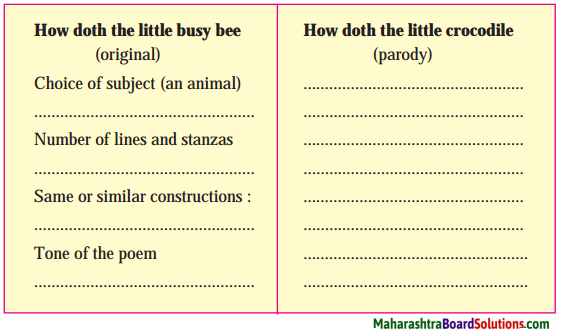
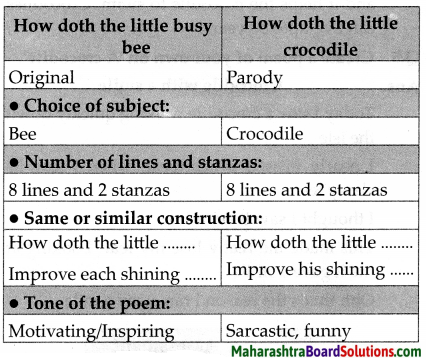
2. A parody is playful, comic imitation of a writer’s style. A parody is like a verbal cartoon. Compare the original poem and its parody given on page 35 using the following points:

Question 1.
Compare the original poem and its parody given on page 35 using the following points:
Maharashtra Board Class 7 English Solutions Chapter 2.4 How Doth the Little Busy Bee 1
Answer:
Maharashtra Board Class 7 English Solutions Chapter 2.4 How Doth the Little Busy Bee 2

3. Answer the following questions and write in short, why the parody sounds funny.

Question a.
What does the bee stand for?
Answer:
The bee stands for hard-work and positivity

Question b.
What does the crocodile stand for?
Answer:
The crocodile stands for laziness, mischief and negativity.

Maharashtra Board Class 7 English Solutions Chapter 2.4 How Doth the Little Busy Bee

Question c.
Why does the bee work hour after hour?
Answer:
The bee works hour after hour to store the nectar that it collects from the flowers.

Question d.
Why does the crocodile work?
Answer:
The crocodile works only to fill its stomach.

Question e.
Is the bee a gentle creature? Is the crocodile gentle?
Answer:
The bee is a gentle creature. The crocodile is not gentle.

4. Desciibe a crocodile in your own words. Which of the words and phrases in the poem will you use In a realistic description?
Put a tick mark against the ones you will use.

  • little [ ]
  • shining tail [ ]
  • golden scale [ ]
  • cheerful [ ]
  • grIn [ ]
  • claws [ ]
  • gently smiling [ ]
  • jaws [ ]

Question 1.
Describe the crocodile in your own words.
Answer:
The crocodile is a large reptile. The crocodile to me looks very frightening, ferocious and ugly. The scaly skin of the crocodile makes me feel very creepy. They have different colours which ranges from brown to grey. Some are greenish-brown in colour. They have sharp teeth and claws. They have big strong jaws. They appear to be grinning because of the way their jaw is placed. The tail of the crocodile is very powerful and it helps the crocodile to swim. Crocodiles can live upto 80 years!

Maharashtra Board Class 7 English Solutions Chapter 2.4 How Doth the Little Busy Bee

5. Note that most of the times well-known works are parodied, because people can enjoy the parody better when they know the original. Try to find more examples of parodies in English or other languages. 

Question 1.
Note that most of the times well-known works are parodied, because people can enjoy the parody better when they know the original. Try to find more examples of parodies in English or other languages.

6. What do you like better – the original poem or the parody? Why?

Question 1.
What do you like better – the original poem or the parody? Why?
Answer:
I like the parody. I like the parody because it is funny, interesting and the best part is that it is very easy to memorize.

Class 7 English Chapter 2.4 How Doth the Little Busy Bee Additional Important Questions and Answers

Answer the following questions.

Question 1.
Why does the parody sound funny?
Answer:
The parody sounds funny because it is just in complete contrast with ‘How doth the little busy bee’. The bee is hard working and positive. She is using every minute fruitfully while in contrast the crocodile is wasting its time doing nothing still manages to keep its stomach full.

Maharashtra Board Class 7 English Solutions Chapter 2.4 How Doth the Little Busy Bee

Question 2.
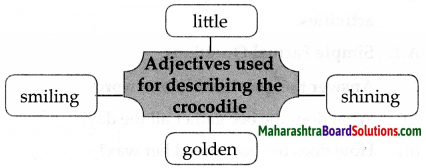
Match the nouns with the adjectives used to describe them:

Column ’A’ Column B’
1. bee a. shining
2. food b. smiling
3. tail c. busy
4. jaws d. sweet
5. scale e. little
6. crocodile f. golden

Answer:

Column ’A’ Column B’
1. bee c. busy
2. food d. sweet
3. tail a. shining
4. jaws b. smiling
5. scale f. golden
6. crocodile f. golden

Maharashtra Board Class 7 English Solutions Chapter 2.4 How Doth the Little Busy Bee

Read the following extract and do the activities.

Answer the questions in one word.

Question i.
What does the bee gather all the day?
Answer:
honey

Question ii.
How does the bee spread her wax?
Answer:
neatly

Complex Factual Questions:

Question 1.
How does the bee build her cell?
Answer:
The bee builds her cell skilfully.

Maharashtra Board Class 7 English Solutions Chapter 2.4 How Doth the Little Busy Bee

Question 2.
What food does the bee make?
Answer:
The bee makes sweet food.

Poetic Device:

Question 1.
Make a list of the rhyming words
Answer:
hour – flower; cell – well

Question 2.
What is the rhyme scheme of the first stanza?
Answer:
The rhyme scheme of the first stanza is abcb

Question 3.
What is the rhyme scheme of the second stanza?
Answer:
The rhyme scheme of the second stanza is abac

Read the following extract and do the activities.

Simple Factual Questions:

Question 1.
Complete the web.
Answer:
Maharashtra Board Class 7 English Solutions Chapter 2.4 How Doth the Little Busy Bee 3

Complex Factual Questions:

Question 1.
Which river is mentioned in the above poem?
Answer:
River Nile is mentioned in the above poem.

Maharashtra Board Class 7 English Solutions Chapter 2.4 How Doth the Little Busy Bee

Question 2.
Whom does the crocodile welcome?
Answer:
The crocodile welcomes little fishes.

Question 3.
How does the extract portray the crocodile?
Answer:
The extract portrays the crocodile as a deceiving, idle reptile.

Question 4.
Write the rhyme scheme for the 2nd stanza.
Answer:
The rhyme scheme is abab.

Question 5.
And welcomes little fishes in, With gently smiling jaws!
Identify the figure of speech of the above lines and explain.
Answer:

  • Personification: The human quality of welcoming and smiling is given to a reptile for better poetic effect.
  • Exclamation: The line ends with an exclamatory mark.

Maharashtra Board Class 7 English Solutions Chapter 2.4 How Doth the Little Busy Bee

Poetic Device:

Question 1.
Pick out the rhyming words from the 1st stanza.
Answer:
Crocodile – Nile, tail – scale

Writing Skills:

Question 1.
Create a poem of your own on ‘A crocodile’.
Answer:
Crocodile with a smile
Today I saw a crocodile walking quickly down the isle
I nearly missed a heartbeat, when I saw its clawy feet.
I thought I saw it cry a tear,
This made me really lose my fear. Looking at me it gave a smile
Ohh that’s the reason I ran away a mile.

How Doth the Little Busy Bee Summary in English

In this poem, the poet Isaac Watts tells us about the busy bee who does not waste time but works day in and day out to collect nectar from the flowers and stores it in the hives built by the bees. The poet appreciates the skills of the bees, used in making the cells and sealing them for future use. The poet is trying to tell us that we should take the example of these small creatures and use our time fruitfully. Isaac Watts

The parody “How doth the – a small little crocodile” written be Lewis Caroll tries to poke fun at the poem “How doth the little busy bee”. The parody in a humorous way speaks about the idleness and cunningness of a crocodile in contrast to the hardworking bee. The busy bee works all day for its honey but in contrast the crocodile remains idle yet gets his fill.

Introduction:

‘How doth the little busy bee’ written by Isaac Watts is a poem in which the hard work of the bee is appreciated. A parody is playful comic imitation of a writer’s style. A parody deliberately copies someone or something in an amusing way. It may be simply a humorous imitation of a well-known or popular work.

Maharashtra Board Class 7 English Solutions Chapter 2.4 How Doth the Little Busy Bee

Glossary:

  1. doth (v) – does (old English)
  2. opening (adj) – blooming
  3. cell (n) – a small hexagonal compartment in a honeycomb
  4. labours (v) – works hard
  5. grin (v) – to smile with lips parted to reveal the teeth
  6. claws (n) – curved pointed nail on each of the foot of a mammal, reptile or bird
  7. scale (n) – small flat hard and bony covering the skin, particularly of a fish or reptile
  8. jaw (n) – the part of the face below the mouth
  9. skilfully (adv) – cleverly.
  10. cheerfully (adv) – happily.
  11. gather (v) – to collect.
  12. parody (n) – a humorous way of writing in which the original work of another writer is copied in an exaggerated way.

7th Std English Questions And Answers:
In Time of Silver Rain Poem Questions and Answers Class 7 English Chapter 1.3 Maharashtra Board

Class 7 English Chapter 1.3

Balbharti Maharashtra State Board Class 7 English Solutions Chapter 1.3 In Time of Silver Rain Notes, Textbook Exercise Important Questions and Answers.

Std 7 English Lesson 1.3 In Time of Silver Rain Question Answer Maharashtra Board

Class 7 English Chapter 1.3 In Time of Silver Rain Textbook Questions and Answers

1. Find the pairs of rhyming words used at the end of the lines in the poem.

Question 1.
Find the pairs of rhyming words used at the end of the lines in the poem.
Answer:

Rain heads wings cry
Again spreads sing sky
Plain spring

Maharashtra Board Class 7 English Solutions Chapter 1.3 In Time of Silver Rain

2. Read the poem aloud using proper intonation.

Question 1.
Read the poem aloud using proper intonation.

3. If you were to draw a landscape on the basis of this poem, what elements will you show in It? What colours will you use?

Question 1.
If you were to draw a landscape on the basis of this poem, what elements will you show in It? What colours will you use?
Answer:
If I were to draw a landscape on the basis of this poem, I would show elements like a patch of lush green grass stretching far and wide, small flowers growing all over the plain tossing their heads, brightly coloured butterflies happily fluttering, a rainbow stretching across the sky.

I would also show a tree-lined road, and under the blue sky I would show boys and girls walking down the road enjoying themselves in the rain. I would use all sorts of colours. Green being promment, I would also use shades of bright colours to depict life, liveliness and joy in nature during spring.

Maharashtra Board Class 7 English Solutions Chapter 1.3 In Time of Silver Rain

4. The special arrangement of short lines makes you think about every detail. If you write the sentences In the usual manner, It does not have the same effect. For example, the first stanza would be something like ‘The earth puis forth new life again: green grasses grow and flowers lift their heads and the wonder of life spreads all over the plain in time of silver rain.’
Now try the following:
Write one or two sentences about something beautiful, using your own experience or imagination. Then rearrange the words In the sentences In a poetic form. You may write about a beautiful day, a beautiful night, a stream, a crop standing in a field, a graceful bird or animal, etc.
Answer:

  • A beautiful night
  • The people were enjoying
  • When the clouds were making noise and thundering.
  • But I was sitting along with no one aside.
  • My feelings were at night just like a sea tide.
  • It started raining and I cried
  • It started raining and I cried

5. Fill in the following blanks with reference to the poem.

Question 1.
‘In time of rain when spring and life are ……….., the butterflies lift ……….. wings to catch a ……….. cry and trees put forth …….. leaves to sing in ………… beneath the sky as ……….. boys and girls too ……… singing down the roadway’.
Answer:
In time of rain when rain and life are new, the butterflies lift silken wings to catch a rainbow cry and trees put forth new leaves to sing in joy beneath the sky as passing boys and girls too go singing down the roadway.

Maharashtra Board Class 7 English Solutions Chapter 1.3 In Time of Silver Rain

6. Think and answer :

Question a.
Is the poet talking about heavy rains in the rainy season or ram that has come after a long time?
Answer:
The poet is talking about rain that has come after a long time.

Maharashtra Board Class 7 English Solutions Chapter 1.3 In Time of Silver Rain

Question b.
Are the boys and girls happy that it is raining?
Answer:
Yes, the poet says that the boys and girls are singing as they pass down the roadway in the rain, so they are obviously happy that it is raining.

7. Find out the following with the help of your teacher and the internet.
Seasonal Rains (monsoon) in India and other countries.
Rain in countries like UK which experience spring-summer-autumn-winter.

Question 1.
Find out the following with the help of your teacher and the internet.
Seasonal Rains (monsoon) in India and other countries.
Rain in countries like UK which experience spring-summer-autumn-winter.
Answer:
We get seasonal rain monsoon the starting of June. some times it will receive very high rainfall in some coastal areas states like Kerala – Goa – Karnataka – Odisha etc. This states are receives high rain fall from starting to ending og June. some states have received monsoon in the July. And it continues with heavy rains and winds also.

In United Kingdom the month of June, July and August which is the summer season, and it is very hottest season with long sunny days. autumn can be dry but sometimes occational rains and winds also come.

  • Average rainfall in the months of winter December to February is 80 mm.
  • Average rainfall in the month of spring March to May is 55 mm.
  • Average rainfall in the month of Summer June to August is – 60 mm.
  • Average rainfall in the month of autumn September to November is 85 mm.

Maharashtra Board Class 7 English Solutions Chapter 1.3 In Time of Silver Rain

8. Talk about your favourite season. (A one-minute activity.)

Question 1.
Talk about your favourite season. (A one-minute activity.)
Answer:
My favourite season is winter as with the cold that it brings, it also brings an opportunity to sit by the fire-place and read my favourite book. The snow-clad landscapes look divine and radiate peace. What a pleasure it is to eat in this season! Keeping myself warm under the quilt and sharing roasted peanuts with my siblings is a passtime that brings immense joy.

9. Language Study: Alliteration: When the same sound occurs at the beginning of two or more words in the same line, it is called alliteration.
Example: Nayna needs new notebooks.
Find an example of alliteration from the poem.
Collect other examples of alliteration.

Maharashtra Board Class 7 English Solutions Chapter 1.3 In Time of Silver Rain

Class 7 English Chapter 1.3 In Time of Silver Rain Additional Important Questions and Answers

Think and answer.

Question 1.
Why does the poet say that life is new when it rains?
Answer:
The poet says that life is new when it rains because after the hot and dry summer, the flora and fauna come back to their former, lively and wonderful forms. People feel refreshed by rain as it provides a relief. Rain restores the energy and colour of the nature that get drained out during the harsh summers.

Answer the following questions.

Question 1.
What is the poem about?
Answer:
The poem is about the changes that take place in nature at the onset of spring, especially when it rains. It also talks about the joy that spring brings along with it.

Question 2.
What do the boys and girls do in happiness?
Answer:
The boys and girls sing in happiness as they pass down the roadway.

Question 3.
Give two examples of imagery used by the poet.
Answer:

  1. Butterflies lift their wings to catch a rainbow cry.
  2. Green grasses grow and flowers lift their heads.

Maharashtra Board Class 7 English Solutions Chapter 1.3 In Time of Silver Rain

Reading Skills and Poetic Device

Read the following extract and do the activities.

Simple Factual Questions:

Question 1.
Fill in the web with all that happens in nature during the time of new rain.
Answer:
Maharashtra Board Class 7 English Solutions Chapter 1.3 In Time of Silver Rain 1

Complex Factual Questions:

Question 1.
Which elements of nature are mentioned in the given extract?
Answer:
The elements of nature that are mentioned in the given extract are grass, trees, butterflies, rainbow, sky and flowers.

Maharashtra Board Class 7 English Solutions Chapter 1.3 In Time of Silver Rain

Question 2.
Why do the butterflies lift their silver wings?
Answer:
Butterflies lift their silver wings to catch a rainbow.

Question 3.
Which line in the poem tells us that the spring season has just begun?
Answer:
The line “In time of silver rain when spring and life are new” tells us that the spring season has just begun.

Question 4.
Who go singing down the roadway?
Answer:
The boys and girls go singing down the roadway.

Question 5.
Describe in your own words what happens during the time of silver rain.
Answer:
During the time of silver rain, the face of the earth completely changes. The earth puts forth new life, green grasses are seen on the surface. The flowers lift their heads in happiness. The butterflies lift their silky wings and trees put forth new leaves. The boys and girls are happy and go round singing. Thus everywhere we can see new life.

Maharashtra Board Class 7 English Solutions Chapter 1.3 In Time of Silver Rain

Poetic Device:

Question 1.
Pick out an example of Alliteration from the extract.
Answer:
Green grasses grow.

Question 2.
Give rhyming words of your own.
Answer:

  • life – knife
  • rain – main
  • grow – throw
  • spring – bring

Question 3.
Name and explain the figures of speech in the following lines.
Question i.
And overall the plain The wonder spreads
Answer:
Inversion: The word order has been changed. The correct order is “And the wonder spreads all over the plains”.

Maharashtra Board Class 7 English Solutions Chapter 1.3 In Time of Silver Rain

Question ii.
Of life, Of life, Of life!
Answer:
Repetition: The words ‘Of life’ are repeated thrice for better poetic effect.

Question ii.
And flowers lift their heads.
Answer:
Personification: The flowers are given the human quality of lifting their heads.

Question iv.
The butterflies lift silken wings To catch a rainbow cry
Answer:
Personification: The butterflies are given the human quality of catching.

Question v.
And trees put forth New leaves to sing In joy beneath the sky
Answer:
Personification: Leaves are given the human quality of singing for a better poetic effect.

Question vi.
As down the roadway Passing boys and girls Go singing, too
Answer:
Inversion: The word order has been changed. The correct word order is ‘As passing boys and girls, too, go singing down the roadway’.

Maharashtra Board Class 7 English Solutions Chapter 1.3 In Time of Silver Rain

Question 4.
Give the adjective used to describe ’rain’.
Answer:
’Silver1 is the adjective used to describe ’rain’.

Question 5.
Give the rhyme scheme of the first verse.
Answer:
a b a c d a d

In Time of Silver Rain Summary in English

The poem is an expression of joy and beauty of nature that spring brings, along with it filling our hearts with wonderment at the newness of life.

Paraphrase:

In the poem “In Time of Silver Rain” the poet Langston Hughes paints a vivid imagery of rains during springtime. He elaborates in his simple yet effective style, the majestic spread of life in nature. Grass and flowers stretching across green vistas act as symbols of newness in nature. The coming of rain in springtime invites butterflies that flutter around in the hope of catching a rainbow.

The trees give birth to new leaves to express their joy. The happiness in nature is so contagious that it extends to human beings as well. The boys and girls sing merrily as they walk down the road in the rains at the onset of spring season.

Maharashtra Board Class 7 English Solutions Chapter 1.3 In Time of Silver Rain

Glossary:

  1. spring (n) – a season
  2. put forth (v) – to bring out
  3. beneath (prep) – under
  4. joy (n) – happiness
  5. forth (adv) – away, forwards
  6. spreads (v) – disperses widely, scatters
  7. silken (adj) – like silkc

7th Std English Questions And Answers:
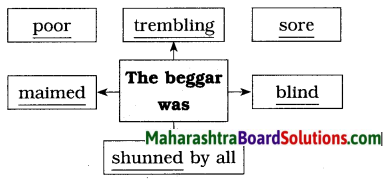
Unke Munke Timpetoo Poem Questions and Answers Class 7 English Chapter 4.2 Maharashtra Board

Class 7 English Chapter 4.2

Balbharti Maharashtra State Board Class 7 English Solutions Chapter 4.2 Unke Munke Timpetoo Notes, Textbook Exercise Important Questions and Answers.

Std 7 English Lesson 4.2 Unke Munke Timpetoo Question Answer Maharashtra Board

Class 7 English Chapter 4.2 Unke Munke Timpetoo Textbook Questions and Answers

1. Make adjectives from the following.

Question a.
harm
Answer:
harmful / harmless

Maharashtra Board Class 7 English Solutions Chapter 4.2 Unke Munke Timpetoo

Question b.
fear
Answer:
fearless/fearful/fearsome

Question c.
question
Answer:
questionable

Question d.
continue
Answer:
continuous

Question e.
thought
Answer:
thoughtful/ thoughtless

Question f.
courage
Answer:
courageous

Maharashtra Board Class 7 English Solutions Chapter 4.2 Unke Munke Timpetoo

Question g.
believe
Answer:
believable

Question h.
wish
Answer:
wishful

2. Choose the correct alternative.

Question a.
Rohan desperately wished for ………….. .
i. a pair of shoes
ii. a warm pullover
iii. a good friend
iv. a table-tennis set
Answer:
iv. a table-tennis set

Maharashtra Board Class 7 English Solutions Chapter 4.2 Unke Munke Timpetoo

Question b.
Rohan and Muk entered the garden at midnight ……………. .
i. to frighten Mrs. Groover
ii. to chant around the banyan tree
iii. to steal some fruits
iv. to look for a table-tennis set
Answer:
ii. to chant around the banyan tree

Question c.
Rohan had finished ……………… rounds of the tree before Mrs. Groover discovered him.
i. seventeen
ii. six
iii. eleven
iv. twelve
Answer:
iii. eleven

Question d.
The table-tennis set was gifted by
i. Mrs. Groover
ii. Rohan’s parents
iii. Muk
iv. Timpetoo
Answer:
i. Mrs. Groover

Maharashtra Board Class 7 English Solutions Chapter 4.2 Unke Munke Timpetoo

Question e.
The Principal turned out to be a very …………… lady.
i. poor and simple
ii. proud and rich
iii. kind and understanding
iv. sad and lonely
Answer:
kind and understanding

3. The story has a very heart-warming and touching end. Now try to change the end of the story to make it sound.

Question 1.
(i) very funny
(ii) full of horror and mystery.
Answer:
Mrs. Groover continued to look at me with a strange look in her eyes which frightened me. I asked her whether she believed in ‘Unke, Munke, Timpetoo’. She suddenly gave out a shriek and started moving towards me with hands outstretched. I was so scared that my feet did not move nor any words came out from my mouth. She had a savage look on her face. I felt that there was something more to Mrs. Groover, no wonder she was staying alone with an evil looking dog. Somehow. I managed to run away from Mrs. Groover. The next day I came to know that Mrs. Groover never stayed in that house.

Mrs. Groover continued to look at me with a strange look in her eyes. It looked as if she was judging me. I asked her, whether she believed in ‘Unke, Munke, Timpetoo’. She said, she did but she was trying to control her laughter. I wondered what had happened to her. She laughed till tears started rolling down her cheeks. She then took me into her house and played some music as I sat listening. The singer used the same chant ‘Unke Munke Timpetoo’. Hearing the chart, I too started laughing and both of us had a hearty laugh and we started humming the song along with the words ‘Unke Munke Timpetoo’, which actually meant nothing.

4. ‘Unke, Munke, Timpetoo.

I wish, my wish is coming true.’
Try to compose two other funny magical chants that have rhyming lines.

Maharashtra Board Class 7 English Solutions Chapter 4.2 Unke Munke Timpetoo

5. Language study.

Question a.
Prefix and suffix : A letter or group of letters added to the front of a word to change Its meaning and make a new word is called a prefix.
Examples:

  1. un + tie → untie
  2. non + stop → non-stop
  3. dis + like → dislike
  4. super + man → superman
  5. inter + national → international

Answer:
Prefix (before the root word)
e.g.

  1. un + tie = untie
  2. non + stop = nonstop
  3. dis + like = dislike
  4. super + man = superman
  5. inter + national = international

Question b.
Find at least 5 words with prefixes and identify the prefix in each word. A letter or group of letters added at the end of a word to make another word is called a suffix.
Examples:

  1. teach + er → teacher
  2. act + or → actor
  3. child + hood → childhood
  4. friend + ship →b friendship
  5. king + dom → kIngdom
  6. use + ful → useful
  7. frequent + ly → frequently
  8. act + ion → action
  9. star + ry → starry

Answer:
Suffix (after the root word)
e.g.

  1. teach + er = teacher
  2. act + or = actor
  3. child + hood = childhood
  4. friend + ship = friendship
  5. king + dom = kingdom
  6. use + ful = useful
  7. frequent + ly = frequently
  8. act + ion = action
  9. star + ry = starry

Maharashtra Board Class 7 English Solutions Chapter 4.2 Unke Munke Timpetoo

Question c.
Find 5 examples of words with the following suffixes from the lessons you have studied so far, or from other sources:

  1. -ship
  2. -less
  3. -ness
  4. -ly
  5. -ful
  6. -able

Answer:
suffixes:

  1. hard + ship = hardship
  2. home + less = homeless
  3. happy + ly = happily
  4. clever + ness = cleverness
  5. soft + ly = softly
  6. reason + able = reasonable

Class 7 English Chapter 4.2 Unke Munke Timpetoo Additional Important Questions and Answers

1. Answer the following questions.

Question 1.
Find the sentences in which the author and his friend claim that they do not believe in magic. What do their actions show?
Answer:
The sentences which claim that the author and his friends do not believe in magic are:

  1. I don’t say I believe in it but my cousin said it works.
  2. And there is no harm in trying.
  3. Why seventeen times and why at midnight?
  4. I thought it was all nonsense.

Their actions show, that though they say that they do not believe in the chanting and magic, yet they decided to try it out, convincing themselves that it did not matter just to try.

Maharashtra Board Class 7 English Solutions Chapter 4.2 Unke Munke Timpetoo

Question 2.
(i) If you hear about something that fulfils your wishes, would you try it?
(ii) Do you think that the author is brave?
Answer:
(i) Yes, If I hear about something that fulfils my wishes, I would surely try it while trying to convince myself that there is no harm in trying.
(ii) Yes, I think the author is brave because he dared to go out at midnight to chant around the banyan tree to get his wish fulfilled knowing very well that the banyan tree belonged to his Ex-Principal who was very strict.

Question 3.
How do we know that Muk was frightened?
Answer:
We know that Muk was frightened because as soon as he heard Mrs. Groover’s voice saying that she would let her ferocious dog loose on them, he started climbing up the tree.

Question 4.
What opinion do you form of Mrs. Groover from the way she treats the boys?
Answer:
According to me, Mrs. Groover is an able administrator and disciplinarian outside but from the inside, she seems to be a kind-hearted, sensitive and understanding person. She did not jump to conclusions. She patiently listened to the boys and allowed Rohan to complete the seventeen rounds around the banyan tree to fulfill his wish.

Maharashtra Board Class 7 English Solutions Chapter 4.2 Unke Munke Timpetoo

Question 5.
Did the author really rejoice over his shoes and pullover?
Answer:
No, the author did not really rejoice over his shoes and pullover. He pretended to be happy so as not to hurt the feelings of his parents.

Reading Skills, Vocabulary and Grammar.

Simple Factual Questions:
Question 1.
Complete the following sentences.

  1. Mrs. Groover’s garden had …………… .
  2. Rinkoo Lai of class X was …………… .
  3. “Come on, let us go and wish for my …………… .
  4. There was a banyan tree, its aerial roots swaying in the …………… .

Answer:

  1. a banyan tree
  2. a bully
  3. table tennis set
  4. gentle breeze of the night.

Complex Factual Questions.

Question 1.
Who was Muk?
Answer:
Muk was Rohan’s best firend.

Maharashtra Board Class 7 English Solutions Chapter 4.2 Unke Munke Timpetoo

Question 2.
Who was Mrs. Groover?
Answer:
Mrs. Groover was the Ex-Principal of the school Rohan studies in.

Question 3.
Where was the banyan tree located?
Answer:
The banyan tree was located in Mrs. Groover’s garden which was in Rohan’s neighborhood.

Question 4.
How did Rohan and Muk enter Mrs. Groover’s house?
Answer:
Roshan and Muk entered Mrs. Groover’s house by climbing the wall and jumping down.

Vocabulary.

Question 1.
Pick out a compound word from the extract.
Answer:
neighborhood

Maharashtra Board Class 7 English Solutions Chapter 4.2 Unke Munke Timpetoo

Question 2.
Pick out two words so as to get its opposite after adding a prefix. Write both words.
Answer:

  1. true × untrue
  2. done × undone
  3. harm × unharm

Question 3.
Give noun forms of:

  1. mocking
  2. true
  3. suppose
  4. enter
  5. silent

Answer:

  1. mockery
  2. Truth
  3. Supposition
  4. entry/ entrance
  5. silence

Question 4.
Pick out four adverbs from the passage.
Answer:

  1. thoughtfully
  2. badly
  3. along
  4. carefully

Maharashtra Board Class 7 English Solutions Chapter 4.2 Unke Munke Timpetoo

Question 5.
Express differently – ten minutes to twelve
Answer:
Eleven fifty.

Grammar.

Question 1.
I could not think of anything else. (Add a question tag)
Answer:
I could not think of anything else, could I?

Question 2.
One look from her piercing, pale, green eyes was enough to silence bullies. (Pick out the adjectives)
Answer:
one, piercing, pale, green.

Personal Response:

Question 1.
Do you believe in magic? Why?
Answer:
No, I do not believe in magic. I do not believe in magic because it is not proven by science.

Maharashtra Board Class 7 English Solutions Chapter 4.2 Unke Munke Timpetoo

Read the following passage and do the activities.

Simple Factual Questions:

Question 1.
Say whether true or false.

  1. A ferocious dog ran after Rohan and Muk.
  2. Mrs. Groover allowed Rohan to finish his rounds.
  3. Mrs. Groover bend down to unleash, the dog.
  4. Muk bodly faced the situation when the dog barked.

Answer:

  1. False
  2. True
  3. True
  4. False.

Question 2.
List the qualities of Mrs. Groover

Mrs. Groovers qualities
(i) ………………… (ii) ………………… (iii) ………………… (iv) …………………

Answer:

  1. able administrator
  2. empathetic
  3. compassionate
  4. loving and caring

Complex Factual Questions.

Question 1.
Why did Mrs. Groover threaten to unleash the dog?
Answer:
The barking of the dog awakened Mrs. Groover at night and in the darkness. She did not know who was there in the garden. Hence she asked who was there or else threatened to unleash the dog.

Maharashtra Board Class 7 English Solutions Chapter 4.2 Unke Munke Timpetoo

Question 2.
What was Rohan’s fear?
Answer:
Rohan’s fear was that Mrs. Groover might not believe him.

Vocabulary.

Give one word for the following.

  1. Stop continuous progress
  2. Say something indistinctly and quietly
  3. feel or show great joy
  4. set free

Answer:

  1. interrupt
  2. mumble
  3. rejoice
  4. unleash

Grammar.

Question 1.
State the tense in the following sentences.

  1. I told her everything
  2. I will explain if you let me.
  3. I had never received such a big parcel.

Answer:

  1. simple past tense
  2. Simple future tense
  3. Past perfect.

Maharashtra Board Class 7 English Solutions Chapter 4.2 Unke Munke Timpetoo

Question 2.
Form nouns.

  1. ferocious
  2. believe
  3. open
  4. softly

Answer:

  1. ferocity
  2. belief
  3. opening
  4. softness

Personal Response.

Question 1.
“and while leaving, would you mind using the front gate?” why do you think Mrs. Groover said that?
Answer:
Mrs. Groover being compassionate, understood the young boy’s heart. She knew that they had jumped into her compound. At midnight, as she wanted them to be safe, she was actually suggesting that they use the front gate.

Question 2.
“I swore that I would never return.” who said this and why.
Answer:
This was said by Rohan out of fear and frustration having gone through an unexpected turn of event in the middle of the night.

Maharashtra Board Class 7 English Solutions Chapter 4.2 Unke Munke Timpetoo

Question 3.
What is referred to as the ‘great moment’?
Answer:
To a little boy, opening gifts that he receives is a great moment. As it was Rohan’s birthday, he refers to unwrapping of the gifts he received.

Question 4.
Who had send the big parcel?
Answer:
The big parcel was from Unke, Munke, Timpetoo.

Read the following passage and do the activities.

Simple Factual Questions:

Question 1.
A few qualities have been listed below. Write suitable qualities under their names.

  1. disciplinarian
  2. friendly
  3. committed
  4. supportive
  5. good runner
  6. caring
  7. loving
  8. compassionate
  9. eager
  10. gratitude
  11. nervous

Answer:

Mrs. Groover Rohan Muk
disciplinarian good runner friendly
caring eager committed
compassionate gratitude supportive
nervous loving

Maharashtra Board Class 7 English Solutions Chapter 4.2 Unke Munke Timpetoo

Question 2.
Complete the following.

  1. I removed the colorful gift wrapping and found
  2. I wondered if Mrs. Groover was responsible
  3. She smiled and she looked so different,

Answer:

  1. a table tennis set
  2. for the surprise
  3. almost human

Complex Factual Questions.

Question 1.
Why did Rohan whisper “wow!”?
Answer:
Rohan whispered ‘wow!” because when he opened the colourful gift wrapping, he found a table tennis set which he was greatly longing for. Also he was too thriled or and surprised to . say anything else.

Vocabulary.

Question 1.
Form Noun

  1. remove
  2. wonder
  3. perfect
  4. quickly

Answer:

  1. removal
  2. wonderment
  3. perfection
  4. quickness

Maharashtra Board Class 7 English Solutions Chapter 4.2 Unke Munke Timpetoo

Question 2.
Give adverbs form of:

  1. imagine
  2. increase
  3. open
  4. scare

Answer:

  1. imaginatively
  2. increasingly
  3. openly
  4. scarily

Grammar.

Question 1.
Muk and I went to see Mrs. Groover quite often. Not only because she made the best tea and cookies. We went because we liked her. (Rewrite using not only… but also)
Answer:
Muk and I went to see Mrs. Groover quite often not only because she made the best tea and cookies but also because we liked her.

Maharashtra Board Class 7 English Solutions Chapter 4.2 Unke Munke Timpetoo

Question 2.
I removed the strings impatiently. (Pick out the adverb from the given sentence)
Answer:
impatiently

Personal Response.

Question 1.
Do you think Mrs. Groover was responsible for the surprise? Why?
Answer:
Little Rohan longed to get a table tennies set as gift for his birthday and decided to run around a banyan tree in Mrs. Groover’s garden chanting “Unke Munke Timpetoo” seventeen times at 12 midnight. Understanding the child’s mind and seeing him take so much trouble, she decided to make him happy by gifting a fabulous table tennis set, through not brand new.

Question 2.
Why did Rohan and Muk visit Mrs. Groover often?
Answer:
After the initial nervousness and hesitation, Rohan found out that Mrs. Groover also believed in Unke, Munke, Timpetoo. They saw the soft human side of their Ex. Principal and started loving her. She too welcomed them with good tea and cookies. Hence they visited her often.

Maharashtra Board Class 7 English Solutions Chapter 4.2 Unke Munke Timpetoo

Question 3.
Did the surprise gift really come from Unke, Munke, Timpetoo? In your opinion, who must have sent the gift?
Answer:
No, the surprise gift did not come from Unke, Munke, Timpetoo. I am sure the surprise gift was sent by Mrs. Groover.

Question 4.
What is ‘Unke, Munke, Timpetoo’ – a charm or an act of friendliness?
Answer:
‘Unke, Munke, Timpetoo’ is an act of friendliness. We must remember that an act of friendliness is an act of godliness. It keeps alive the humanity in us which is very necessary to make this world a happy one.

Language Study.

Question 1.
Affixes: An affix is a letter or series of letters added to the root (main) word that can change its meaning. Affixes can take the form of a prefix or a suffix.
Answer:
(a) Examples of prefixes:

  • trans + port = transport
  • tri + angle = triangle
  • uni + lateral = unilateral
  • anti + biotic = antibiotic
  • en + courage = encourage
  • fore + head = forehead
  • dis + appear = disappear
  • extra + ordinary = extraordinary
  • mid + way = midway
  • hyper + active = hyperactive
  • micro + scope = microscope
  • post + pone = postpone
  • ex + President = ex-President
  • thermo + meter = thermometer
  • super + star = superstar

(b) Some more suffixes:

  • fashion + able = fashionable
  • play + ful = playful
  • slow + ly = slowly
  • meaning + less = meaningless
  • close + ness = closeness
  • mad + ly = madly
  • effort + less = effortless
  • colour + less = colourless
  • sad + ness = sadness
  • owner + ship = ownership
  • love + able = lovable
  • beauty + ful = beautiful
  • workman + ship = workmanship
  • port + able = portable
  • help + ful = helpful
  • month + ly = monthly
  • quick + ly = quickly

(Add more to this list…)

Maharashtra Board Class 7 English Solutions Chapter 4.2 Unke Munke Timpetoo

Do as directed:

Question 1.
Why seventeen times and why at midnight? (Identify the kind of sentence)
Answer:
Interrogative sentence

Question 2.
Don’t ask me. (Add a question tag)
Answer:
Don’t ask me, will you?

Question 3.
Forget it. (Add a question tag)
Answer:
Forget it, won’t you? / will you?

Question 4.
The aerial roots were swaying in the breeze. (Separate the Subject and Predicate)
Answer:
Subject – The aerial roots
Predicate – were swaying in the breeze.

Maharashtra Board Class 7 English Solutions Chapter 4.2 Unke Munke Timpetoo

Question 5.
Muk was climbing the tree. (Identify whether theverbisTransitiveor Intransitive)
Answer:
was climbing – Transitive verb.

Question 6.
Add one of these prefixes to the words below: (un-, re-, dis-)

  1. Mother will ………….. (wrap) the gift.
  2. My dad had to ………….. (connect) the light.
  3. Jane had to ………….. (do) her homework.
  4. Mohan ………….. (likes) eating leafy vegetables.
  5. The knot on the rope is hard to ………….. (tie).

Answer:

  1. unwrap
  2. disconnect
  3. redo
  4. dislikes
  5. untie

Question 7.
Write a single word with the prefix ‘un-‘ or ‘dis-‘ to complete each sentence.

  1. My brother always ………….. (does not agree) with me.
  2. The answer to your question is ………….. (not known).
  3. My mother told me not to be ………….. (not honest).
  4. I thought I had seen him but he seems to have ………….. (not appear).
  5. I was ………….. (not happy) at being scolded.

Answer:

  1. disagrees
  2. unknown
  3. dishonest
  4. disappeared
  5. unhappy

Question 8.
Put the words in the brackets in the appropriate form. (Use a prefix or a suffix)

  1. He is acting in a very ………….. way. (child)
  2. She looked ………….. She started to cry. (happy)
  3. The team that he supported was able to win the ………….. (champion)
  4. There were only a ………….. of people at the match, (hand)
  5. I think you should ………….. your decision. (consider)
  6. He wants to be a ………….. when he grows up. (politics)

Answer:

  1. childish
  2. unhappy
  3. championship
  4. handful
  5. reconsider
  6. politician

Maharashtra Board Class 7 English Solutions Chapter 4.2 Unke Munke Timpetoo

Question 9.
Make adjectives from the following:

  1. nonsense
  2. secret
  3. knowledge
  4. poet
  5. city
  6. village
  7. humanity

Answer:

  1. nonsensical
  2. secretive
  3. knowledgeable
  4. poetical
  5. urban
  6. rural
  7. humane

Unke Munke Timpetoo Summary in English

This story ‘Unke Munke Timpetoo’ revolves round a young boy Rohan, whose birthday. Rohan’s birthday was soon approaching. He wished to have a table tennis set, which he knew his parents would not be able to afford. He tells his wish to his best friend Muk, who tells him that if he really wished for the set, then he would have to go seventeen times around a banyan tree, at midnight chanting ‘Unke Munke Timpetoo’. At first he was scared but decides to try his luck around the only banyan tree which belonged to his Ex-Principal Mrs. Groover.

A day before his birthday he, along with his friend goes to the banyan tree. Rohan nearly completes his round when Mrs. Groover comes out and Rohan explains to her what he was doing and why. The next day along with his birthday gifts, he gets the gift he wished for. Only it was not brand new. He did not mind it at all. He wonders who could have sent him the table tennis set. He decides to ask Mrs. Groover but does not have the courage. He then asked if she believed in the chant ‘Unke Munke Timpetoo’ to which she said yes. Rohan, Muk and Mrs. Groover became the best of friends.

Introduction:

This story ‘Unke Munke Timpetoo’ is written by Sigrun Srivastava. She is an Indian author of German origin. She has written over 25 books for children of all ages.

Maharashtra Board Class 7 English Solutions Chapter 4.2 Unke Munke Timpetoo

Glossary

  1. fantastic (adj) – fanciful, extraordinary
  2. bully (n) – a person who is cruel to others especially those who are weaker or have less power
  3. aerial (adj) – positioned high up in the air
  4. ferocious (adj) – fierce
  5. fabulous (adj) – marvelous, wonderful
  6. vanish (v) – to become invisible, disappear
  7. stutter (v) – to stammer

7th Std English Questions And Answers:
Abdul Becomes a Courtier Questions and Answers Class 7 English Chapter 2.3 Maharashtra Board

Class 7 English Chapter 2.3

Balbharti Maharashtra State Board Class 7 English Solutions Chapter 2.3 Abdul Becomes a Courtier Notes, Textbook Exercise Important Questions and Answers.

Std 7 English Lesson 2.3 Abdul Becomes a Courtier Question Answer Maharashtra Board

Class 7 English Chapter 2.3 Abdul Becomes a Courtier Textbook Questions and Answers

1. From the play, find all the words that are related to the following.
knowledge and learning, books, works
Add other related words you know to the list.

Question 1.
From the play, find all the words that are related to the following.
Add other related words you know to the list.

  1. knowledge and learning
  2. books
  3. works

Answer:

  1. Student, smart, thirst for knowledge, learned, philosophy, astronomy, arabic, persian, scholar, intellectual, sagacious, astute, university, degree.
  2. Student, smart, knowledge, learned, scholar, words, e-book.
  3. Merchant, serve, clerk, pay, office, poultry, keeper, salary, job.

Maharashtra Board Class 7 English Solutions Chapter 2.3 Abdul Becomes a Courtier

2. Discuss the following.
(a) Abdul gets what he wants in the end. What is the major factor that contributes to this success?

  • His learning of books
  • His intelligence
  • His attitude
  • His relations with other people
  • His luck

(b) The Emperor says he had realised earlier that Abdul has great talent. Does this tally with his actions? Give your opinion.

Question a.
Abdul gets what he wants in the end. What is the major factor that contributes to this success?

  • His learning of books
  • His intelligence
  • His attitude
  • His relations with other people
  • His luck

Answer:
His attitude

Maharashtra Board Class 7 English Solutions Chapter 2.3 Abdul Becomes a Courtier

Question b.
The Emperor says he had realised earlier that Abdul has great talent. Does this tally with his actions? Give your opinion.
Answer:
No, it does not. But according to me the Emperor wanted to know whether Abdul could put all his knowledge into practical use.

3. Write a letter from Abdul to the Emperor, requesting the Emperor to give Abdul a suitable job.

Question 1.
Write a letter from Abdul to the Emperor, requesting the Emperor to give Abdul a suitable job.
Answer:
Your Royal Highness,
I, Abdul, am a subject in your kingdom. I have learnt everything books could teach me. I would like to be at your service.
I will serve you with all the knowledge, I have gained, if your royal highness will give me the opportunity. All my knowledge would really be of great use and if given a chance I will do everything I can to the best of my ability. Hoping and awaiting a positive reply. Thanking you in anticipation.
Your loyal subject,
XYZ (Abdul)

Maharashtra Board Class 7 English Solutions Chapter 2.3 Abdul Becomes a Courtier

4. Rewrite the play in the form of a story.

Question 1.
Rewrite the play in the form of a story.

Rewrite the play in the form of a story.
Answer:
Abdul, the Achiever
Once upon a time during the reign of Emperor Akbar, there lived a very humble school teacher. He had an equally humble and down to earth son named Abdul. Abdul dreamt of becoming a scholar. His father could not fund him for the books because they were very costly. His father tried to borrow books from the school library but was unsuccessful. Abdul was disheartened.

He hit upon a brilliant idea to solve his problem. He decided to work for the rich, instead of taking money for services, he requested them to allow him to read the books in their stores. Abdul read and read and became a learned scholar that too one in a million. Now that he had completed his education he aspired to work in the Emperor’s office. The Emperor heard of him and was ready to appoint him. He was first put in charge of the Murgikhana.

Abdul was disappointed at first but then decided to put in his best. His efforts paid him well. The hens were healthier than before. The Emperor was surprised that Abdul had not used any money from the treasury. The Emperor was worried that the hens had died but Abdul told the Emperor that all the hens were in the pink of health because he was feeding them with the left-overs from the Emperor’s kitchen, which was free of cost and something the hens enjoyed and that was the secret of their health.

The Emperor was happy and put him in charge of the library. Abdul was unhappy because he aspired to be a courtier. But he took his job too as a challenge and started making changes in the library. A year later when the Emperor entered the library he was shocked to see that all the books had very expensive covering.

He thought that this would have cost a fortune. Abdul clarified the Emperor’s doubt and told him that it has cost nothing because he used the rich, discarded fabrics of the bags in which requests were sent to the Emperor. Abdul said that he had asked the royal tailors to stitch the jackets and covers for the books. The Emperor was so impressed that he immediately appointed Abdul his courtier.
Moral: Waste not, want not.

Maharashtra Board Class 7 English Solutions Chapter 2.3 Abdul Becomes a Courtier

5. Suggest at least one method of creating something useful or beautiful from waste.

Question 1.
Suggest at least one method of creating something useful or beautiful from waste.

6. Write how you take care of your books.

Question 1.
Write how you take care of your books.
Answer:
I see to it that my books are always covered, with my name written on it. I do not throw my books anywhere. I keep them neatly whether in my bag or on my table at home. I do not eat or drink anything with my books in front of me so as to avoid spilling and getting oil stains on my books.

7. Language Study: Common nouns – 3: Common nouns can be classified in one more way – concrete nouns and abstract nouns. Concrete nouns stand for things that you can actually touch or see.
Examples : school, house, bags, buttefflies, child.
Abstract nouns stand for ideas, feelings, qualities, actions, states, etc.
Examples: life, time, goodness, progress, kindness, childhood, honesty, mathematics
Can you spot at least three abstract nouns in the following paragraph?
‘We put the plan of action in motion immediately. We kept it a secret. We wanted to give Mrs Desai a surprise. But her intelligence is really appreciable. She spotted the change within a week.’
Now you know that plural forms of nouns have -s, -es, or -ies at the end. But the plurals of some nouns are formed differently. Look at the following forms.

  • child – children man – men
  • tooth – teeth foot – feet
  • leaf – leaves mouse – mice

Some nouns have the singular and the plural alike.
Examples: sheep, deer.

Maharashtra Board Class 7 English Solutions Chapter 2.3 Abdul Becomes a Courtier

Class 7 English Chapter 2.3 Abdul Becomes a Courtier Additional Important Questions and Answers

Answer the following questions.

Question 1.
How did Abdul manage to feed the birds well without spending money?
Answer:
Abdul was in charge of the Emperor’s ‘Murgikhana’. He fed the birds with the left-overs from the kitchen, like scraps, shells and kitchen waste, which the hens enjoyed. This diet not only made the hens healthy but was also free of cost.

Question 2.
How did the Emperor reward Abdul for his work? Do you think the Emperor’s action was right?
Answer:
The Emperor rewarded Abdul by making him in charge of the library. Yes, I think the Emperor’s action was right because he wanted to see how well Abdul would handle this task too.

Question 3.
How did Abdul manage to get expensive jackets for the books?
Answer:
Abdul had noticed that all the formal requests that came to the Emperor were in bags made of the best of fabrics which were discarded. He used these discarded silk, velvet and brocade to make beautiful covers and jackets for the books in the library.

Maharashtra Board Class 7 English Solutions Chapter 2.3 Abdul Becomes a Courtier

Reading Skills, Vocabulary and Grammar

Read the following passage and do the activities.

Simple Factual Questions:

Question 1.
Complete the sentences.
1. Abdul’s father was a ………… .
2. Abdul wanted his father to lend him
Answer:
1. schoolmaster
2. a little gold

Complex Factual Questions:

Question 1.
How many books could Abdul’s father get for him?
Answer:
Abdul’s father could not get any books for him.

Question 2.
What does Abdul want to do? How does he plan to do it?
Answer:
Abdul wants to acquire knowledge and become a scholar. He plans to buy books and study them to rise high and become famous.

Maharashtra Board Class 7 English Solutions Chapter 2.3 Abdul Becomes a Courtier

Question 3.
What are books and manuscripts compared to?
Answer:
Books and manuscripts are compared to treasures rare and exclusive.

Vocabulary:

Question 1.
Frame a sentence with the phrase ‘brighter tomorrow’.
Answer:
Rohan worked day and night for a brighter tomorrow.

Grammar:

Question 1.
How many books could you get? (Identify the kind of sentence)
Answer:
Interrogative.

Maharashtra Board Class 7 English Solutions Chapter 2.3 Abdul Becomes a Courtier

Question 2.
Pick out a word from the extract which means – to hope or to dream.
Answer:
aspire.

Question 3.
Guess the meaning of ‘a brighter tomorrow’ in context of the play.
Answer:
A brighter tomorrow means a better or brighter future.

Personal Response:

Question 1.
Do you like to read books? Why?
Answer:
Yes, I like to read books. I like to read books because it helps to increase our knowledge, gives us a lot of information and keeps us occupied when there is nothing to do. For me. books are my best friends.

Maharashtra Board Class 7 English Solutions Chapter 2.3 Abdul Becomes a Courtier

Question 2.
Abdul got the Royal Tailors to work for making the jackets. What skills does it reflect?
Answer:
The skill which comes out is making best from waste. It not only saves money but also helps to save the environment.

Read the following passage and do the activities.

Simple Factual Questions:

Question 1.
Complete the sentences.

  1. You appear to be smart,
  2. Quench my
  3. I am pleased with you
  4. made a poultry people?

Answer:

  1. be my clerk
  2. thirst for knowledge
  3. work and loving care!
  4. Intellectual, sagacious, astute

Maharashtra Board Class 7 English Solutions Chapter 2.3 Abdul Becomes a Courtier

Complex Factual Questions:

Question 1.
What request must Abdul have sent to the Emperor?
Answer:
Abdul must have requested the Emperor to give him a position in his court because he had gained all the knowledge which would help him in the job.

Question 2.
What was the merchant’s reaction to Abdul’s work?
Answer:
The merchant was very pleased with Abdul’s work and wanted to reward him.

Maharashtra Board Class 7 English Solutions Chapter 2.3 Abdul Becomes a Courtier

Question 3.
What job did the emperor give Abdul?
Answer:
The Emperor made Abdul his poultry keeper, in charge of the Royal Murgikhana.

Vocabulary:

Question 1.
Find words/phrases meaning ‘rare’.
Answer:
One in a million; a gem; unique

Question 2.
Guess the meaning of ‘a gem’ in the context of this play.
Answer:
The context ‘a gem’ in the play means someone very precious, of great value.

Question 3.
Find pairs of rhyming words used in this passage.
Answer:

  • serve – deserve
  • clerk – work
  • care – rare – fair
  • store – more
  • learned – yearned
  • notice – office
  • prayer – care
  • scholar – keeper
  • refuse – use
  • Persian – million.

Maharashtra Board Class 7 English Solutions Chapter 2.3 Abdul Becomes a Courtier

Grammar:

Question 1.
Write the noun forms of:

  1. move
  2. direct
  3. explore
  4. determine
  5. estitute
  6. hesitate
  7. compel
  8. treat

Answer:

  1. movement
  2. direction
  3. exploration
  4. determination
  5. destitution
  6. hesitation
  7. compulsion
  8. treatment

Language Study

Do as directed.

Question 1.
Can you spot at least three abstract nouns in the following paragraph?
‘We put the plan of action in motion immediately. We kept it a secret. We wanted to give Mrs Desai a surprise. But her intelligence is really appreciable. She spotted the change within a week.
Answer:
secret, surprise, intelligence.

Maharashtra Board Class 7 English Solutions Chapter 2.3 Abdul Becomes a Courtier

Question 2.
Now you know that plural forms of nouns have -s, -es or -ies at the end. But the plurals of some nouns are formed differently. Singular :

  1. woman
  2. person
  3. goose
  4. half
  5. wife
  6. potato
  7. cactus
  8. fungus
  9. oasis
  10. syllabus
  11. datum
  12. focus
  13. louse

Answer:

Plural:

  1. women
  2. persons /people
  3. geese
  4. halves
  5. wives
  6. potatoes
  7. cacti
  8. fungi
  9. oases
  10. syllabi/syllabuses
  11. data
  12. foci
  13. lice

Maharashtra Board Class 7 English Solutions Chapter 2.3 Abdul Becomes a Courtier

Question 3.
More of nouns having singular and plural alike.
Singular :

  1. news
  2. aircraft
  3. species
  4. darts
  5. pants
  6. trousers
  7. jeans
  8. glasses
  9. scissors
  10. fish
  11. salmon
  12. headquarters
  13. Chinese

Answer:
Plural:

  1. news
  2. aircraft
  3. species
  4. darts
  5. pants
  6. trousers
  7. jeans
  8. glasses
  9. scissors
  10. fish (if it is the same species)
  11. salmon
  12. headquarters
  13. Chinese

Question 4.
I’m happy to announce, now you are my courtier! (Kind of sentence)
Answer:
Exclamatory sentence.

Maharashtra Board Class 7 English Solutions Chapter 2.3 Abdul Becomes a Courtier

Question 5.
The Royal tailors made the jackets. (Change the voice)
Answer:
The jackets were made by the Royal tailors.

Question 6.
Abdul enters and bows before the Emperor. (Pick out the conjunction and state its kind)
Answer:
and – coordinating conjunction.

Question 7.
Days passed by, he learned and learned. (Identify the figure of speech and explain)
Answer:
Repetition: The word ‘learned’ has been repeated for better poetic effect.

Question 8.
I need nothing more. (Identify the figure of speech and explain)
Answer:
Alliteration: The sound of the letter ‘n’ has been repeated for better poetic effect.

Abdul Becomes a Courtier Summary in English

The story in this lesson revolves around Abdul who is very wise and intelligent and loves reading and learning. His father cannot afford the costly books and so Abdul works and accepts his reward only in kind and that too he asks for nothing more than reading books. He quenches his thirst for knowledge and desires to work in the Emperor’s office. Let us see how he gets this honourable position.

Introduction:

The lesson ‘Abdul Becomes a Courtier’ is taken from the series of Akbar and Birbal stories. It has been adapted into the dialogue form by Pratibha Nath who is a wonderful story teller and weaves stories for children.

Maharashtra Board Class 7 English Solutions Chapter 2.3 Abdul Becomes a Courtier

Glossary:

  1. erudition (n) – learning, scholarly work
  2. scores (n)- sets of twenty
  3. clerk (n) – a person who keeps records, accounts, etc.
  4. quench (v) – to satisfy
  5. office (n) – position, responsibility
  6. prayer (n) (here) – request
  7. sagacious (adj) – wise
  8. astute (adj) – intelligent, one who knows how to use a situation to his advantage
  9. zeal (n) – enthusiasm
  10. drive (n) – an effort made to achieve a certain purpose
  11. brains (n) – intelligence
  12. shirk (y) – avoid
  13. brocade (n) – rich fabric woven with golden or silver thread
  14. papers (n) – official documents
  15. aspire (y) – to hope or dream
  16. manuscripts (n) – written by hand, handwritten
  17. rare (adj) – uncommon, unique
  18. exclusive (adj) – of high quality
  19. dejected (adj) – sad
  20. rejected (adj) – not accepted
  21. yearned (v) – to long for
  22. conviction (n) – firm belief
  23. passion (n) – love
  24. relish (v) – enjoy
  25. thrive (v) – grow
  26. perseverance (n) – continuing to do something regardless of failure
  27. chores (n) – work
  28. poultry keeper (n) – a person who looks after chickens, ducks and other birds that are kept for their egg and meat.
  29. ration (n) (here) – food.
  30. jacket (n) – outer covering.
  31. discarded (v) – disposed off, thrown away.
  32. courtier (n) – a person who attends a royal court as an adviser to the king or queen.
  33. expensive (adj) – costly.
  34. ponders (v) – thinks deeply.

7th Std English Questions And Answers:
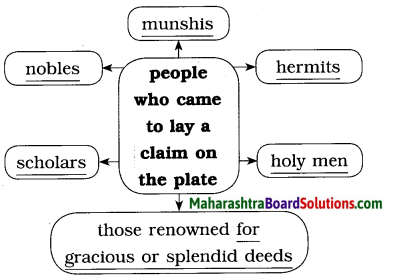
Papa Panov’s Special Christmas Poem Questions and Answers Class 7 English Chapter 4.6 Maharashtra Board

Class 7 English Chapter 4.6

Balbharti Maharashtra State Board Class 7 English Solutions Chapter 4.6 Papa Panov’s Special Christmas Notes, Textbook Exercise Important Questions and Answers.

Std 7 English Lesson 4.6 Papa Panov’s Special Christmas Question Answer Maharashtra Board

Class 7 English Chapter 4.6 Papa Panov’s Special Christmas Textbook Questions and Answers

1. Write the homophones (words which sound the same. of the following words in the story.

Question 1.
Write the homophones (words which sound the same. of the following words in the story.

  1. no: ……………………….
  2. dear: ……………………….
  3. here: ……………………….
  4. went: ……………………….
  5. pair: ……………………….
  6. knew: ……………………….
  7. through: ……………………….
  8. soul: ……………………….
  9. whole: ……………………….

Answer:

  1. know
  2. deer
  3. here
  4. vent
  5. pear, pare
  6. new
  7. threw
  8. sole
  9. hole

Examples for homophones along with the prior:

  1. steel-steal
  2. read – red
  3. see – sea
  4. eves – ice
  5. air – heir
  6. meet – meat
  7. grown – groan
  8. would – wood
  9. great – grate

2. Correct the following sentences and rewrite them.

Question 1.
The best shoes that Papa Panov had made were a pair of lady’s shoes.
Answer:
The best shoes that Papa Panov had made were a pair of tiny leather shoes.

Maharashtra Board Class 7 English Solutions Chapter 4.6 Papa Panov’s Special Christmas

Question 2.
Papa Panov gave hot soup to the sweeper, milk to the young mother and coffee to the beggars.
Answer:
Papa Panov gave hot coffee to the sweeper, milk to the baby and hot soup to the beggars.

Question 3.
By afternoon, Papa Panov had stopped looking out for Jesus.
Answer:
By the time dusk had fallen, Papa Panov had stopped looking out for Jesus.

Question 4.
Papa Panov saw the sweeper, the young mother and the beggars he had helped only once in the morning.
Answer:
Papa Panov saw the sweeper, the young mother and the beggars twice, once during the day and once at night.

Maharashtra Board Class 7 English Solutions Chapter 4.6 Papa Panov’s Special Christmas

Question 5.
Jesus, had actually visited Papa Panov only once on Christmas Eve.
Answer:
Jesus had visited Papa Panov only once on Christmas Eve and several times on Christmas day.

3. Write a character sketch of Papa Panov in your own words.

Question 1.
Write a character sketch of Papa Panov in your own words.
Answer:
Papa Panov was a kind and humble shoe-maker. He lived in a village in Russia. He was a cheerful man,who lived alone. He was widower and his grown up children had left home to seek their fortune. He has loved by his villagers. He was a happy man with laughter wrinkles on his face indicating his happy life.

He was quite old and had weak eyesight which made him wear spectacles. He earned a decent living. we come to know of this because he helped people in distress. He seems to be a god fearing and pious man because he not only dreamnt of God in his dreams but also spoke to him. Thpugh he was lonely he brightened himeself up by helping people when needed.

We can sum these qualities of Papa Panov as being a wonderful human being with a golden heart. He is filled with humaneness, empathy, selflessness and love for mankind making him God’s beloved creature.

4. Write your interpretation of the story.

Question 4.
Write your interpretation of the story.
Answer:
The story of ‘Papa Panov’ according to me is an interesting story to introduce to children, inculcating in them values of selflessness, empathy, sharing and love for humanity. God resides in those who love their kind, is vividly put forth through this story. This story has inspired me to go out and help those in need.

The smile and blessings I get when I help the needy makes my day and makes me feel blessed. It is rightly said ‘Service to man is service to God’.

Maharashtra Board Class 7 English Solutions Chapter 4.6 Papa Panov’s Special Christmas

5. Information about cold winters in Russia.

6. Do you know of similar stories in your mother tongue or in other languages? Narrate it in short.

7. Which season would you say is the hardest in your locality?

Question 1.
What help would the poor and homeless people need in that season?
Answer:
The rainy season is the hardest season in my locality. The poor and homeless people are without a roof and have to remain wet and , huddled under some shelter for hours. They do not have proper shelter, clothes, food and drinking water. This is a season which brings in a lot of sicknesses, which if not treated could be fatal. Medical help is also necessary for them in this season which is difficult for them to get.

Class 7 English Chapter 4.6 Papa Panov’s Special Christmas Additional Important Questions and Answers

Answer the following questions.

Question 1.
In the little village what shows that it is Christmas time?
Answer:
In the little village, although it is afternoon, lights begin to appear in the shops and houses, indicating that it is Christmas time.

Maharashtra Board Class 7 English Solutions Chapter 4.6 Papa Panov’s Special Christmas

Question 2.
Did Papa Panov have a shop away from his home?
Answer:
No, Papa Panov’s shop was his home.

Question 3.
Did he live alone? Why?
Answer:
Yes, Papa Panov lived alone because his wife had died and his grown-up children had all left his home.

Question 4.
What tells us that Papa Panov is a kind person?
Answer:
While reading the Christmas story from the Bible, he read how baby Jesus was born in a cowshed. He wished that Mary and Joseph had come to his home where he would have given them his bed and covered baby Jesus with his quilt to keep him warm. This feeling which comes up in Papa Panov’s mind shows us that he was a kind person.

Question 5.
What do the ‘laughter wrinkles’ tell us?
Answer:
The ‘laughter wrinkles’ tell us that Papa Panov is quite old. It also tells us about the number of happy times he had with family and friends.

Maharashtra Board Class 7 English Solutions Chapter 4.6 Papa Panov’s Special Christmas

Question 6.
Why is the small box dusty?
Answer:
The small box with a pair of tiny leather shoes was dusty because it was kept high up on the shelf and had not been touched or moved for years.

Question 7.
What thoughts did Papa Panov have before he fell asleep? Were they related to his dream?
Answer:
Papa Panov while reading the story of Christmas day from the Bible felt sad for Mary, Joseph and baby Jesus and thought if they were in his home he would have been of help to them. When he read about the splendid gifts given to baby Jesus by the wise men, the thought that he had nothing to give made him unhappy. The thought that he could give as gift the pair of tiny leather shoes which he had made years ago made him happy again. No, they were not related to his dream.

Question 8.
Did Papa Panov believe in his dream? In what forms did he imagine Jesus to visit him?
Answer:
Yes, Papa Panov believed in his dream. He imagined Jesus visiting him in the form of a little baby or a grown up man or a carpenter or as God’s son.

Question 9.
How does the author show that Papa Panov was disappointed?
Answer:
The winter dusk had fallen. Papa Panov went to the door and strained his eyes but he could not make out the passers by because it had gone very dark and most of them were at home. This made Papa Panov unhappy because it was too late for anyone to come.

Maharashtra Board Class 7 English Solutions Chapter 4.6 Papa Panov’s Special Christmas

Question 10.
What actions of Papa Panov suggest it?
Answer:
Papa Panov walked slowly back into his room, put up the shutters and sat down wearily indicating his disappointment.

Question 11.
How does the author describe Papa Panov’s happiness?
Answer:
Papa Panov’s heart was overflowing with happiness and peace which made him want to burst out singing, laughing and dancing with joy, knowing that Jesus had come to his home.

Reading Skills, Vocabulary and Grammar.

Simple Factual Questions:

Question 1.
Write whether true or false.
1. The setting of the story is in a Russian city.
2. Papa Panov was sad on Christmas Eve.
Answer:
1. False
2. True

Complex Factual Question.

Question 1.
What could be heard from the closed shutters?
Answer:
Muffled sounds of chatter and laughter could be heard from closed shutters.

Maharashtra Board Class 7 English Solutions Chapter 4.6 Papa Panov’s Special Christmas

Question 2.
What reminded Papa Panov of his past Christmas times?
Answer:
The sounds of happiness, the bright lights and the faint but delicious smells of Christmas cooking reminded Papa Panov of his happy past Christmas times.

Vocabulary.

Question 1.
Write the homophone for:

  1. one
  2. step
  3. been
  4. his

Answer:

  1. won
  2. steppe
  3. bean
  4. hiss

Grammar.

Question 1.
Old Papa Panov, the village shoemaker, stepped outside. (Separate the subject and predicate.
Answer:
Old Papa Panov, the village shoemaker – Subject; stepped outside – Predicate

Maharashtra Board Class 7 English Solutions Chapter 4.6 Papa Panov’s Special Christmas

Question 2.
With a sigh, he settled in his big armchair. (Separate the subject and predicate. ‘ <
Answer:
Subject – He; Predicate – settled/ in his big armchair with a sigh

Question 3.
Excited children scurried indoors. (Name the part of speech of the underlined words.
Answer:
excited – adjective, scurried – verb, indoors – adverb

Question 4.
It was Christmas Eve. (Add a question tag.
Answer:
It was Christmas Eve, wasn’t it?

Question 5.
Excited children scurried indoors. (Write whether the verb is transitive or intransitive.
Answer:
scurried – intransitive

Personal Response.

Question 1.
What do you do on festivals?
Answer:
I enjoy myself a lot. I celebrate every festival because people from all religions live in my locality. My friends and I visit houses, eat and enjoy. My relatives too come home to celebrate our festivals with us. I love it when my house is full of people.

Maharashtra Board Class 7 English Solutions Chapter 4.6 Papa Panov’s Special Christmas

Simple Factual Questions.

Question 1.
Complete the following sentences.

  1. The Street was deserted
  2. Papa Panov opened the shop door,
  3. The sweeper old clothes steamed
  4. Papa Panov watched him with satisfaction but,

Answer:

  1. I no one was stirring yet.
  2. letting in a thin stream of cold air.
  3. gently in the heat of the stove
  4. every now and then his eyes strayed to the window.

Complex Factual Questions.

Question 1.
Why did Papa Panov give hot coffee to the sweeper?
Answer:
When Papa Panov took down his shutters and looked out, all he saw was the road sweeper looking miserable and dirty working on Christmas Day, in the raw cold and bitter freezing mist which made him give the sweeper a hot cup of coffee to make him feel better.

Maharashtra Board Class 7 English Solutions Chapter 4.6 Papa Panov’s Special Christmas

Question 2.
Why did he tell the sweeper about his dream? Why did the sweeper smile?
Answer:
Papa Panov invited the sweeper to drink a cup of hot coffee to keep him warm from the cold. The sweeper noticed that all the time he was in the room, Papa Panov’s eyes strayed to the window now and then. This made the sweeper ask him if he was expecting a visitor which made Papa Panov relate his dream. The sweeper smiled because he was the special visitor, Jesus, Papa Panov was waiting for.

Vocabulary.

Question 1.
Give adverb form of

  1. gentle
  2. special
  3. actual
  4. comfort

Answer:

  1. gently
  2. specially
  3. actually
  4. comfortably

Grammar.

Question 1.
Pick out four adjectives from the passage
Answer:
might, cold, bitter, freezing

Maharashtra Board Class 7 English Solutions Chapter 4.6 Papa Panov’s Special Christmas

Question 2.
Papa Panov opened the door, letting in a thin stream of cold air. (Add a question tag.
Answer:
Papa Panov opened the door, letting in a thin stream of cold air, didn’t he?

Personal Response.

Question 1.
Have you ever noticed that some people have to work even on festivals? Who are they?
Answer:
Yes, I have noticed some people having to work on festivals. They are the newspaper man, the sweeper, our maid at home, the milkman, people employed in the public service such as the postman/postwoman, bus and train drivers and conductors, policemen/ women, soldiers protecting our country.

Simple Factual Questions.

Question 1.
Complete the following sentences.

  1. The young mother let him
  2. Papa Panov remembered the little
  3. The girl smiled happily and
  4. He took the milk from the stove and

Answer:

  1. Shepherd her indoors and to the comfort of the armchair.
  2. Shoes he had looked at last night.
  3. The baby gurgled with pleasure.
  4. and carefully fed the baby from a spoon, warming her tiny feet.

Maharashtra Board Class 7 English Solutions Chapter 4.6 Papa Panov’s Special Christmas

Complex Factual Questions.

Question 1.
What does the way the girl walked suggest?
Answer:
The way the girl walked suggests that she is very hungry, tired and very little energy left in her to move.

Vocabulary.

Question 1.
“You both need a warm by the fire and a rest”.
Answer:
They both needed to get the warmth from the fire in the fireplace and also some rest.

Question 2.
The young mother let him shepherd her indoors.
Answer:
The young mother allowed him to guide her into the house.

Do as directed.

Question 1.
It’s Christmas Day. (Add a Question Tag)
Answer:
It’s Christmas Day, isn’t it?

Maharashtra Board Class 7 English Solutions Chapter 4.6 Papa Panov’s Special Christmas

Question 2.
Expecting someone? (Kind of sentence)
Answer:
Interrogative sentence

Question 3.
The girl walked slowly and quietly. (Use ‘not only … but also’)
Answer:
The girl walked not only slowly but also quietly.

Question 4.
He remembered the little shoes. (Change into negative)
Answer:
He did not forget the little shoes.

Question 5.
I can’t afford the shoes. (Change into positive)
Answer:
I am unable to afford the shoes.

Question 6.
A great peace and happiness filled the room. (Change into exclamatory)
Answer:
What peace and happiness filled the room!

Personal Response.

Question 1.
Why did Papa Panov give the shoes to the baby though he had been keeping them for Jesus?
Answer:
Papa Panov noticed that the young girl with a baby was weary and hungry. He invited her to his home. He noticed that the baby’s feet were bare and the mother could not afford shohes for her child. He decided to give the little shoes he had kept for jesus, to the little baby because he was a very kind-hearted person and could not see them in difficulty.

Papa Panov’s Special Christmas Summary in English

Papa Panov is an elderly cobbler who lives all by himself in a small Russian village. It was Christmas Eve, and there was excitement everywhere. His wife had passed away and his children were all grown up and gone. Alone on Christmas Eve in his shop, Papa Panov decides to open the old family Bible and reads the Christmas story about the birth of Christ. That night he dreams about Jesus coming to him saying that he would visit Papa Panov in person the next day.

Papa Panov was very happy, waited anxiously to meet Jesus on Christmas Day. It was early in the morning and no one in sight. He saw a lone sweeper and invited him for a hot cup of coffee. In this way he helped the needy on Christmas day, all of them blessed him for his love and care. The day wore off but Jesus did not come to meet him. Feeling sad, he sat down in his armchair. He felt that he was not alone. He saw all the people who had come to him that day and as they passed each whispered, ‘Didn’t you see me, Papa Panov?’ Then he understood that Jesus had come to him in the form of the needy people he had helped. He was at peace and his heart danced with joy.

Introduction:

‘Papa Panov’s Special Christmas’ is a short children’s story written by Leo Tolstoy. This is an interesting story to introduce young children to the value of kindness.

Maharashtra Board Class 7 English Solutions Chapter 4.6 Papa Panov’s Special Christmas

Glossary:

  1. scurried (v) – to run with quick light steps
  2. muffled (adj) – sound which is covered up
  3. delicious (adj0 – tasty
  4. quilt (n) – a bed covering consisting of two layers stitched together with insulation between
  5. splendid (adj) – magnificent
  6. charcoal (n) – impure carbon, coal
  7. stove (n) – a device for heating food
  8. miserable (adj) – sad, poor hunger
  9. scanning (adj) – to examine part by part
  10. wrapped (v) – covered in thin material
  11. shepherd (v) – (here. to guide
  12. stirring (v) – action of movement
  13. gurgled (v) – to make a bubbling sound
  14. anxiously (adj) – in a worried manner
  15. hunk (n) – a large piece of something’
  16. bewildered (adj) – confused
  17. pinched (adj) – very thin, pale from cold or hunger.
  18. clasped (v) – to grab tightly

7th Std English Questions And Answers: