The Last Leaf Poem Questions and Answers Class 8 English Chapter 3.3 Maharashtra Board

Balbharti Maharashtra State Board Class 8 English Solutions Chapter 3.3 The Last Leaf Notes, Textbook Exercise Important Questions, and Answers.

Std 8 English Lesson 3.3 The Last Leaf Question Answer Maharashtra Board

Class 8 English Chapter 3.3 The Last Leaf Textbook Questions and Answers

3.3 The Last Leaf Warming Up:

1. Suppose you suffer from a long – term illness (one or two weeks), what should you do and what should you avoid? Fill up the table of Do’s and Don’ts:

Do’s Don’ts
(1) Go to a doctor for a diagnosis. (1) Do not …………..
(2) ………… (2) Do not avoid medication on time.
(3) Take a suitable diet. (3) Avoid …………..
(4) Take rest. (4) Avoid physical stress and exertion.
(5) Rest in a properly ventilated room. (5) Do not …………….
(6) Have cheerful thoughts, courage, a positive attitude. (6) Do not lose …….. and ………….

Answer:

Do’s Don’ts
(1) Go to a doctor for diagnosis. (1) Do not try any medication on your own.
(2) Take medicines on time. (2) Do not avoid medication on time.
(3) Take a suitable diet. (3) Avoid junk food.
(4) Take rest. (4) Avoid physical stress and exertion.
(5) Rest in a properly ventilated room. (5) Do not close doors and windows.
(6) Have cheerful thoughts, courage, a positive attitude. (6) Do not lose hope and courage.

Maharashtra Board Class 8 English Solutions Chapter 3.3 The Last Leaf

2. You already know that Homophones are pairs of words that sound the same but differ in spellings and meanings:
For example sum and some
There are some words that even have the same spelling and pronunciations, but have different meanings in different situations or contexts.
For example: bat (a bird) and ki (sports / games equipment)
Such words are called Homographs.
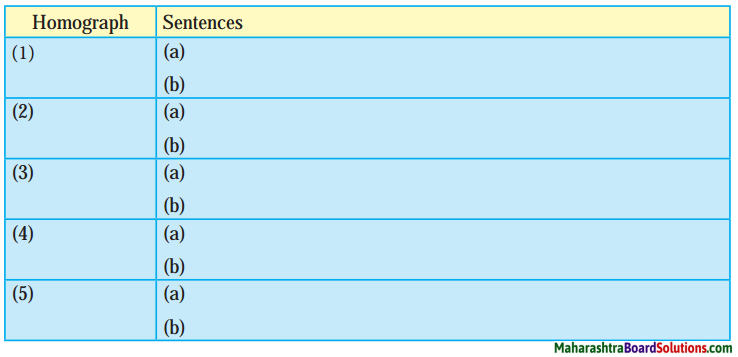
Make pairs of sentences of your own to point out the different meanings of the following Homographs

The Last Leaf Class 8 Questions And Answers Maharashtra Board Question 1.
fine:
Answer:
(i) The new driver had to pay a fine for breaking the signal.
(ii) We decided to go for a picnic only if the day was fine.

The Last Leaf Class 8 Questions And Answers Question 2.
wave:
Answer:
(i) Ronny waved to his father before going for the picnic.
(ii) The waves in the sea before the tsunami were huge.

The Last Leaf Question Answer Class 8 Question 3.
bear:
Answer:
(i) The grizzly bear hibernates during winter.
(ii) Simi could not bear to see the two cats fighting.

3.3 The Last Leaf Question 4.
rose:
Answer:
(i) The rose is a beautiful flower.
(ii) The teacher rose from her chair to explain the sum.

Maharashtra Board Class 8 English Solutions Chapter 3.3 The Last Leaf

3.3 The Last Leaf Questions And Answers Question 5.
lead:
Answer:
(i) Lead is used in pencils.
(ii) A good king leads his country to prosperity.

Class 8 English Chapter 3.3 The Last Leaf Question Answer Question 6.
match:
Answer:
(i) Though we lost the match, we were not upset,
(ii) “Buy the shoes only if they match the dress,” said mother to Madhu.

The Last Leaf Class 8 Questions And Answers Pdf Question 7.
second:
Answer:
(i) Every second counts when we are writing an examination paper.
(ii) “Take the second turn on the right,” directed the policeman.

The Last Leaf 8th Standard Question 8.
object:
Answer:
(i) The lawyer objected to what the witness said.
(ii) The objects on the table were taken away before the girl could see them properly.

1. Read the story and choose the appropriate meanings:

Question a.
Struggling artists:
(i) artists fighting with one another
(ii) artists trying hard to earn a living
(iii) artists painting war scenes
Answer:
(ii) artists trying hard to earn a living

Question b.
Skeleton branches:
(i) bones branching out from joints
(ii) leafy branches
(iii) bare branches
Answer:
(iii) bare branches

Question c.
Wielded the brush:
(i) painted skillfully
(ii) broke the brush
(iii) joined the broken brush
Answer:
(i) painted skillfully

Maharashtra Board Class 8 English Solutions Chapter 3.3 The Last Leaf

Question d.
Palette:
(i) the tip of the brush
(ii) a board used by artists to mix colours
(iii) a fancy dinner plate
Answer:
(ii) a board used by artists to mix colours

Question e.
Masterpiece:
(i) a master who promotes peace
(ii) the very first creation of on artist
(iii) an exceptionally beautiful work of art
Answer:
(iii) an exceptionally beautiful work of art

2. Make pairs of sentences to show the difference between the meanings of the following Homographs from the story:

Question a.
interest
Answer:
(i) The bank promised a high rate of interest to its customers.
(ii) The audience soon lost interest in the boring match.

Question b.
well
Answer:
(i) The well was so deep that one could not see the water.
(ii) The Principal sent Sumeet home as he was not feeling well.

Question c.
left
Answer:
(i) When Roma turned to her left, she saw a long line of taxis.
(ii) The Mayor had left before it begem to rain.

Maharashtra Board Class 8 English Solutions Chapter 3.3 The Last Leaf

Question d.
just
Answer:
(i) The children had just left when the magician arrived.
(ii) It is the duty of a judge to be just.

Question e.
mind
Answer:
(i) “Mind your language!” said the man to the rude young boy angrily.
(ii) We should try not to have any negative thoughts in our mind.

3. State the facts about the story:

Main characters:
Problem:
Attempts made to solve it:
Climax / Turning point:
Problem solved:
End:
Answer:
Main characters: Sue, Johnsy, the doctor and Behrman
Problem: Johnsy’s negative attitude, her lack of will to live and the fancy that she would die when the last leaf fell from the ivy vine.
Attempts made to solve it: The doctor informed Sue that Johnsy would recover only if she had the wish to live. Sue looked after her well and tried to make her think positively. Finally, Behrman painted a leaf on the wall so that the last leaf would never fall, and Johnsy would live.
Climax/Tuming point:
(i) When Johnsy sees the last leaf still clinging to the vine, and realizes that she has been given a message that she was wicked to want to die.
(ii) The sweeper finding Behrman in very wet clothes and shoes, with scattered brushes and a palette with yellow and green colors mixed on it.
Problem solved: Johnsy realizes her mistake and begins to look forward to life again.
End: Though Johnsy lives, Behrman, who painted the last leaf, contracts pneumonia due to exposure to rain and snow. He dies due to his efforts. He dies so that Johnsy lives.

Maharashtra Board Class 8 English Solutions Chapter 3.3 The Last Leaf

4. Say whether the following statements are right or wrong:

Question a.
Sue and Johnsy were very close friends.
Answer:
Right

Question b.
Sue was a rich girl.
Answer:
Wrong

Question c.
Johnsy was hopeful that she will live.
Answer:
Wrong

Question d.
Behrman was a hard-hearted person.
Answer:
Wrong

Question e.
The last leaf fell off during the rain.
Answer:
Right

Question f.
Johnsy realized that her thinking was wrong.
Answer:
Right

Question g.
Behrman did not know anything about the last leaf on the ivy.
Answer:
Wrong

5. Correct the following statements:

Question a.
Sue and Johnsy were good neighbours.
Answer:
Sue and Johnsy were very good friends.

Maharashtra Board Class 8 English Solutions Chapter 3.3 The Last Leaf

Question b.
Johnsy was eager to recover from her illness.
Answer:
Johnsy had made up her mind that she was not going to recover.

Question c.
Sue ignored Johnsy completely.
Answer:
Sue looked after Johnsy well.

Question d.
Behrman was a very heartless person.
Answer:
Behrman was a very kind-hearted person.

Question e.
The real ivy leaf did not fall off at all.
Answer:
The real ivy leaf fell off the night it rained and snowed.

Question f.
The last leaf was a real leaf that survived.
Answer:
The last leaf was a leaf painted on the wall by Behrman.

6. Read the descriptions of the following from the story and describe any one of them using your own words:

Question 1.
The ivy vine
Answer:
Outside the window there was an old ivy vine, gnarled and decayed at the roots. It had climbed half way up the brick wall. It had lost most of its leaves due to the cold autumn. Only a few bare branches were left, clinging to the bricks.

Maharashtra Board Class 8 English Solutions Chapter 3.3 The Last Leaf

Question 2.
Behrman
Answer:
Behrman was a struggling painter who lived on the ground floor of the building where Sue and Johnsy lived. He was a failure in art, for though he had been painting for forty years, he had not made any money. He always dreamt about painting a masterpiece, and often spoke about it, but had never got round to doing it. He served as a model for the young artists in the colony, who could not afford other models.

He was shocked when he heard about Johnsy’s fancy and thought that the place was not good for her. He was a generous, compassionate and kind- hearted man. Even though he was old, he braved the wind, rain and snow to go out and paint the last leaf on the wall. He died in order that Johnsy could live.

Question 3.
The last leaf that Johnsy saw
Answer:
The last leaf that Johnsy saw was not a real leaf but a leaf painted on the wall by Behrman. It was dark green near its stem, but its edges were tinted with yellow. It hung from a branch some twenty feet above the ground. Naturally it never fluttered or moved when the wind blew. It was Behrman’s masterpiece and had been painted the night when the real last leaf had fallen.

7. You have learnt that a Clause is a group of words that has a Subject and a Verb, and is a part of a larger sentence:
In the sentence, ‘We returned home, when school was over’ there are two clauses.
(i) We returned home and
(ii) When school was over’.
The first one makes complete sense, so it is called Main I Principal Clause. The second one is not complete by itself. It depends on the Main Clause to convey proper sense. So it is called Dependant or Subordinate Clause. ‘When’ is the joining word, and it is called o Subordinator.

In the following sentences, point out the Main Clause and Subordinate Clause. Encircle the Subordinator.

Question a.
There was a colony, where many struggling artists lived.
Answer:
Main Clause: There was a colony
Subordinate Clause: where many struggling artists lived
Subordlnator: where

Maharashtra Board Class 8 English Solutions Chapter 3.3 The Last Leaf

Question b.
Though Sue looked after her well, Johnsy showed no signs of improvement.
Answer:
Main Clause: Johnsy showed no signs of improvement
Subordinate Clause: Though Sue looked after her very well
Subordlnator: Though

Question c.
Sue thought that she had fallen asleep.
Answer:
Main Clause: Sue thought
Subordinate Clause: that she had fallen asleep
Subordinator: that

Question d.
Old Behrman was a painter, who lived on the ground floor.
Answer:
Main Clause: Old Behrman was a painter
Subordinate Clause: who lived on the ground floor
Subordlnator: who

Question e.
Johnsy was sleeping when the two went upstairs.
Answer:
Main Clause: Johnsy was sleeping
Subordinate Clause: when the two went upstairs
Subordlnator: when

Question f.
I want to see the last one before it falls.
Answer:
Main Clause: I want to see the last one
Subordinate Clause: before It falls
Subordlnator: before

Maharashtra Board Class 8 English Solutions Chapter 3.3 The Last Leaf

8. Compose an imaginary dialogue between Sue and Johns, when I realise what Behrman had done for Johnsy:
Answer:
Johnsy: Sue, did you know that Mr. Behrman had painted that last leaf?
Sue: No, I knew it just now, too.
Johnsy: Sue, that means that he got wet that night painting the last leaf!
Sue: And got pneumonia after that!
Johnsy: Yes, because of my stupid fancy that I would die when the last leaf fell.
Sue: It certainly was a stupid idea.
Johnsy: I feel so guilty now! Sue, it is as if …. as if …. he died for me!
Sue: Yes, so that you may live.
Johnsy: Oh, what a wonderful, compassionate man! To go out in that cold, wintry, snowy night just to paint that leaf!
Sue: And develop pneumonia ….
Johnsy: What can I do now? How can I ever thank him?
Sue: I know what you can do!
Johnsy: What? What?
Sue: Paint your masterpiece of the Bay of Naples and dedicate it to him.
Johnsy: Yes, I think that’s a good idea.Yes, I’ll do that. Thanks, Sue.

Class 8 English Chapter 3.3 The Last Leaf Additional Important Questions and Answers

Complex Factual Activities:

Question 1.
What did the doctor tell Sue about Johnsy?
Answer:
The doctor told Sue that Johnsy had one chance in ten. That chance was for Johnsy to want to live, and Johnsy had made up her mind that she was not going to get well. He also told Sue that medicines alone would not help if the patient did not want to live.

Question 2.
Describe the ivy vine outside the window.
Answer:
Outside the window, there was an old ivy vine, gnarled and decayed at the roots. It had climbed half way up the brick wall. It had lost most of its leaves due to the cold autumn. Only a few bare branches were left, clinging to the bricks.

Question 3.
Explain the false belief that Johnsy had about the ivy vine.
Answer:
Johnsy felt that when the last leaf fell off from the ivy vine, she too would die.

Maharashtra Board Class 8 English Solutions Chapter 3.3 The Last Leaf

Question 4.
Who was Behrman? Explain why Sue called Him to their flat.
Answer:
Behrman was a struggling painter who lived on the ground floor of the building where Sue and Johnsy lived. He served as a model for the young artists in the colony. Sue called him to their flat to act as a model for the old man that she was drawing.

Question 5.
What happened that night and what did the two friends see when the window was open?
Answer:
That night it rained and snowed. A fierce wind blew. When the window was open, the two friends saw one ivy leaf still clinging to the vine. It was dark green near the stem, but its edges were tinted with yellow. It hung from a branch some twenty feet above the ground.

Question 6.
What did Johnsy declare when she saw the last ivy leaf?
Answer:
When Johnsy saw the last ivy leaf, she declared that it would fall that day and she would die at the same time.

Question 7.
What change came over Johnsy the next day? Why?
Answer:
Johnsy now felt that she had been wicked earlier and it was a sin to want to die. She wanted to sit up in bed and was ready to have broth and milk. She looked forward to the future and hoped to paint the Bay of Naples some day. It was the sight of the last leaf staying on the vine that was the reason for her change.

Question 8.
Explain what happened to Mr. Behrman.
Answer:
Mr. Behrman had gone out in the rain and snow to paint the last leaf on the wall. He had got thoroughly wet and became ill with pneumonia. He died in a hospital two days later.

Question 9.
Who had saved Johnsy’s life and how?
Answer:
Mr. Behrman had saved Johnsy’s life. He had realized that Johnsy had a fancy that she would die after the last leaf; fell. He wanted to make certain that the last J leaf never fell, and hence he painted a false leaf on the wall. The sight of the persistent leaf, which Johnsy thought was real, made her come to her senses and want to live.

Maharashtra Board Class 8 English Solutions Chapter 3.3 The Last Leaf

Personal Response:

Question 1.
What type of attitude should a person have when he/she is ill?
Answer:
When a person is ill, he/she should have a positive attitude. He/She should have cheerful thoughts and courage and try to keep the mind occupied. Only then will medication help.

Question 2.
Do you think that Johnsy was talking nonsense? Or did she have some forewarning that she would die?
Answer:
I think that Johnsy was talking nonsense. How can the number of leaves on an ivy vine indicate when she was going to die? This is just having negative thoughts when the mind is idle and frightened.

Write who said the given words and to whom:

Question 1.

The words Who said To whom
(1) Open the window
(2) She is very ill and weak
(3) I have not heard of such a thing.
(4) It is the last one.

Answer:

The words Who said To whom
(1) Open the window Johnsy Sue
(2) She is very ill and weak Sue Behrman
(3) I have not heard of such a thing. Behrman Sue
(4) It is the last one. Johnsy Sue

Maharashtra Board Class 8 English Solutions Chapter 3.3 The Last Leaf

Write the words given below in the proper columns:

Question 1.
idiotic, fancy, foolish, weak, place, away, upstairs, work, rain, continuously,closed, window, fierce, bravely, branch,surely
Answer:

Nouns Adjectives Adverbs
fancy, place, idiotic, away,
work, rain, foolish, upstairs,
window, weak, continuously,
branch closed, bravely,
fierce surely

Do as directed:

Pick out two words from the lesson whose first letter is silent.
Answer:
pneumonia, gnarled.

Question 2.
Use the following phrase in your own sentence : above the ground
Answer:
During monsoon, the clouds are just a few feet above the ground in Ooty.

Question 3.
Add two letters before the given word to form three separate words:
own
Answer:
brown, crown, drown

Maharashtra Board Class 8 English Solutions Chapter 3.3 The Last Leaf

Question 4.
Find out four hidden words from the given word:
twilight (Each word should have at least 3 letters.)
Answer:
twilight: light, tight, wilt, tilt

Question 5.
Use the following word and its homophone in two separate sentences: earn
Answer:
(i) It is difficult to earn a living if you are illiterate.
(ii) I placed the flowers in an urn and poured water into it.

Question 6.
Pick out the main clause and subordinate clause from the following sentence:
Medicines alone did not help if the patient did not wish to live.
Answer:
Medicines alone did not help- the main clause if the patient did not wish to live-subordinate clause.

Question 7.
Rewrite in indirect speech :
“Open the window; I want to see,” she
ordered. Sue obeyed.
Answer:
She ordered Sue to open the window as she wanted to see. Sue obeyed.

Question 8.
Pick out the non-finite verb and state what it is:
He always talked of his coming masterpiece.
Answer:
coming – present participle

Question 9.
Rewrite as an affirmative sentence:
In those days, it was not easy to cure pneumonia patients.
Answer:
In those days, it was difficult to cure pneumonia patients.

Maharashtra Board Class 8 English Solutions Chapter 3.3 The Last Leaf

Question 10.
Rewrite using the positive form of the adjective:
They are falling faster now.
Answer:
They were not falling as fast as before.

Read More:

Std 9 English Poem Somebody’s Mother 2.3 Question Answer Maharashtra Board

Balbharti Maharashtra State Board Class 9 English Solutions Kumarbharati Chapter 2.3 Somebody’s Mother Notes, Textbook Exercise Important Questions and Answers.

Class 9 English Chapter 2.3 Question Answer Maharashtra Board

Somebody’s Mother Poem 9th Std Question Answer

Warming up :

1. Read the following proverb that has a biblical reference.
‘Do unto others as you would have others do unto you.’ Now find at least 5 other proverbs/axioms/quotations which convey the same message. Search the internet/dictionary of proverbs.
……………………………………………………………………….
……………………………………………………………………….
……………………………………………………………………….
……………………………………………………………………….
……………………………………………………………………….

Question 1.
‘Do unto others as you would have others do unto you.’ Find at least five other proverbs/ axioms/quotations that convey the same message.
Answer:

  1. They that sow the wind shall reap the whirlwind.
  2. Life is an echo – what you send out comes back.
  3. As you sow, so shall you reap.
  4. Love begets love.
  5. Love your neighbour like yourself.

Maharashtra Board Class 9 English Kumarbharati Solutions Chapter 2.3 Somebody’s Mother

2. Study the following sets of words :
Set A – pleased, happy, joyful, ecstatic
Set B – letter, word, sentence, paragraph
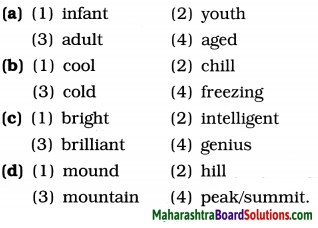
Note: The words in these sets are arranged in an ascending order, each word showing a higher degree than the previous one. Now rearrange the following groups of words in the ascending order.
Maharashtra Board Class 9 English Kumarbharati Solutions Chapter 2.3 Somebody’s Mother 1

Question 1.
Arrange the following groups of words in the ascending order : (The answer is given directly.)
Answer:
Maharashtra Board Class 9 English Kumarbharati Solutions Chapter 2.3 Somebody’s Mother 3

Maharashtra Board Class 9 English Kumarbharati Solutions Chapter 2.3 Somebody’s Mother

Question 2.
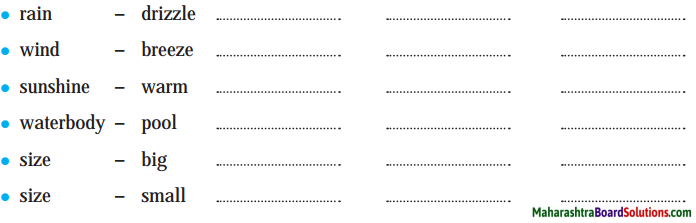
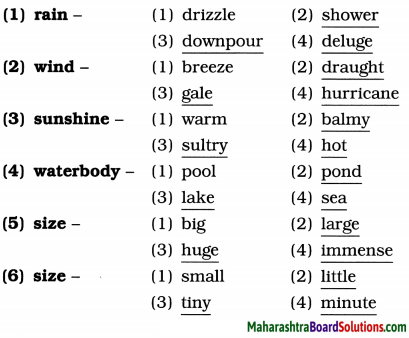
Prepare similar word chains using the following ideas : (The answer is given directly and underlined.)

Maharashtra Board Class 9 English Kumarbharati Solutions Chapter 2.3 Somebody’s Mother 2
Answer:
Maharashtra Board Class 9 English Kumarbharati Solutions Chapter 2.3 Somebody’s Mother 4

English Workshop:

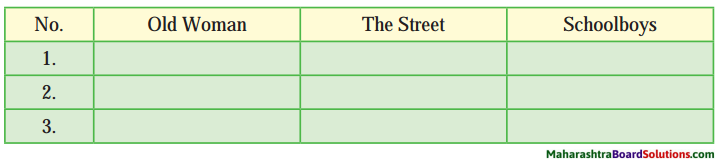
1. Pick out lines from the poem that help create images of the following in our mind and write them in the table.

Maharashtra Board Class 9 English Kumarbharati Solutions Chapter 2.3 Somebody’s Mother 5

Question 1.
Pick out lines from the poem that help create images of the following in our mind and write them in the table.
Answer:

Old Woman The Street School Boys
1. The woman was old and ragged and grey And bent with the chill of a winter’s day The streets were white with a recent snow Down the street with laughter and shout
2. At the crowded crossing she waited long, Jostled aside by the careless throng At the crowded crossing she waited long Came happy boys, like a flock of sheep,
3. Her aged hand on his strong young arm She placed, and so without hurt or harm He guided the tremblIng feet along Came happy boys, like a flock of sheep, Hailing the snow piled high and deep Past the woman so old and grey, Hastened the children on their way

Maharashtra Board Class 9 English Kumarbharati Solutions Chapter 2.3 Somebody’s Mother

2. Write at least 5 rhymes from the poem.

Question 1.
Write at least five rhymes from the extract.
Answer:

  1. Rhymes: troop – group, low – go, arm – harm, along – strong, went – content.
  2. Rhymes: gray – day, snow – slow, long – throng, by – eye, shout – out.

Maharashtra Board Class 9 English Kumarbharati Solutions Chapter 2.3 Somebody’s Mother

3. Give, in your own words, TWO reasons for each of the following :

Question a.
The woman was reluctant to cross the street by herself.
Answer:
The woman was reluctant to cross the street by herself because …

  1. the road was slippery because of the snow.
  2. there was heavy traffic of horse carriages on the road.

Question b.
The school boys were in a happy mood.
Answer:
The school boys were in a happy mood because …

  1. school was over for the day.
  2. the snow was piled high on the road.

Question c.
One of the schoolboys helped the old woman cross the street.
Answer:
One of the schoolboys helped the old woman cross the street because …

  1. she was old and afraid to cross on her own
  2. he hoped someone, sometime, may lend a hand to his own mother when he was not around.

Maharashtra Board Class 9 English Kumarbharati Solutions Chapter 2.3 Somebody’s Mother

Question d.
We must help those who are in need.
Answer:
We must help those who are in need because …

  1. we too may need help one day.
  2. we must show compassion to those in need.

4. Think and write In 5-6 lines, why most of the people on a road/street Ignore those In need of help. What about you? Write about your feelings after you have helped! not helped, when needed.
……………………………………………………………………………………………..
……………………………………………………………………………………………..
……………………………………………………………………………………………..
……………………………………………………………………………………………..
……………………………………………………………………………………………..

Question 1.
Think and write in 5-6 lines, why most of the people on a road/street ignore those in need of help. What about you? Write about your feelings after you have helped/not helped when needed.
Answer:
People, especially in the larger cities and towns, are always in a hurry to reach their place of work or their home. Hence they don’t have time to spare to help strangers. Some people may be purely selfish and don’t have compassion for others.

I always try to help people who genuinely need help. Once I lent a hand to an old man to get onto a bus. He was very grateful and thanked me. I felt very good about it.

I did not help a woman who had slipped and fallen down on the footpath during the monsoon. I just walked past her, ignoring her. I felt very guilty about it later. I wondered how I would feel if I had been in her place and had not got any help.

Maharashtra Board Class 9 English Kumarbharati Solutions Chapter 2.3 Somebody’s Mother

5. Read the poem: ‘Home they brought her warrior dead’ by Alfred Lord Tennyson

Question 1.
Read the poem: ‘Home they brought her warrior dead’ by Alfred Lord Tennyson

English Kumarbharati 9th Digest Chapter 2.3 Somebody’s Mother Additional Important Questions and Answers

Simple Factual Activity :

Question 1.
Write whether the following statements are True or False :
Answer:

  1. The woman’s feet were slow because of the snow. False
  2. The people around her did not bother about her. True
  3. The schoolboys were happy. True
  4. A boy came immediately to help the old woman. False

Guess the following, using references from the poem :

Question 1.
The setting-the region, the locality.
Answer:
The setting is a busy street, covered with a layer of fresh snow. The area is very crowded and there is a school nearby.

Maharashtra Board Class 9 English Kumarbharati Solutions Chapter 2.3 Somebody’s Mother

Question 2.
The time – the time of the year and the day.
Answer:
It is winter. The time of the day is probably late afternoon or early evening.

Activities based on Poetic Devices :

Question 1.
From the extract, pick out and explain an example of:

i. Simile –
Answer:
‘Came happy boys, like a flock of sheep.’ The happy boys have been directly compared to a flock of sheep.

ii. Alliteration –
Answer:
‘Should trample her down in the slippery street.’ Repetition of the sound of ‘s’ at the beginning of the words.

Maharashtra Board Class 9 English Kumarbharati Solutions Chapter 2.3 Somebody’s Mother

Simple Factual Activity :

Choose the correct alternative for each statement :

Question 1.
The person who helped the old lady was :
(i) hurt and harmed
(ii) kind and compassionate
(iii) slow and proud
(iv) dear and Jar away
Answer:
(ii) kind and compassionate

Question 2.
The old lady crossed the road :
(i) but fell down on the way
(ii) all by herself
(iii) with a merry troop
(iv) without hurt or harm
Answer:
(iv) without hurt or harm

Question 3.
The old lady was helped by :
(i) a group of young boys
(ii) a proud and nobleman
(iii) a strong and young boy
(iv) somebody’s mother
Answer:
(iii) a strong and young boy

Maharashtra Board Class 9 English Kumarbharati Solutions Chapter 2.3 Somebody’s Mother

Question 4.
The old lady at night :
(i) asked for blessings for the young boy
(ii) asked for a mother for the young boy
(iii) helped the young boy’s mother
(iv) helped somebody’s mother
Answer:
(i) asked for blessings for the young boy

Answer the following :

Question 1.
Was the old lady grateful to the young boy who had helped her? How do you know?
Answer:
Yes, the old lady was grateful to the young boy who had helped her. We know this because that night, in her home, she prayed to God to be kind to him.

Maharashtra Board Class 9 English Kumarbharati Solutions Chapter 2.3 Somebody’s Mother

Activities based on Poetic Devices :

Question 1.
From the extract, pick out and explain an example of:

i. Alliteration –
Answer:
‘His young heart happy and well-content.’ Repetition of the sound of ‘h’ at the beginning of the words.

ii. Inversion –
Answer:
‘Then back again to his friends he went.’ The correct prose order is : He then went back again to his friends.

Maharashtra Board Class 9 English Kumarbharati Solutions Chapter 2.3 Somebody’s Mother

Paragraph Format:

The poem ‘Somebody’s Mother’ is by Mary Dow Brine. The Rhyme Scheme of stanzas 3 and 6 is aabbcc. All the other stanzas have the rhyme scheme aabb. A Figure of Speech is Inversion: ‘At the crowded crossing she waited long.’ The correct prose order is She waited long at the crowded crossing. Other figures of speech are Simile and Alliteration.

The poem describes an incident in which a young boy helps a frightened old lady to cross the street when she was being ignored by everyone else. He tells his young friends that he hopes that when his own mother is old and needs help, someone will help her too if he is not at hand.

Maharashtra State Board Class 9 English Solutions

9th Std English Questions And Answers:

Std 9 English Poem Have you thought of the verb ‘have’ … 1.4 Question Answer Maharashtra Board

Balbharti Maharashtra State Board Class 9 English Solutions Kumarbharati Chapter 1.4 Have you thought of the verb ‘have’ … Notes, Textbook Exercise Important Questions and Answers.

Class 9 English Chapter 1.4 Question Answer Maharashtra Board

Have you thought of the verb ‘have’ … Poem 9th Std Question Answer

1. Add sentences to those given in the passage to illustrate the uses of ‘have’ :

(a) To show possession
(b) To indicate relationship
(c) To refer to eating/drinking
(d) To show ownership
(e) To refer to events, activities and experiences
(f) To refer to a physical condition

Question 1.
Add sentences to those given in the passage to illustrate the uses of ‘have’ :
Answer:
(a) To show possession :

  1. I have a new motorcycle.
  2. The children have identical school bags,
  3. My neighbour has three dogs.

(b) To indicate relationship :

  1. I have a sister in Holland.
  2. Do you have any siblings?
  3. I have an aunt who is a singer.

(c) To refer to eating/drinking :

  1. We usually have dinner at eight o’clock.
  2. May I have that last piece of cake?
  3. Have some juice if you are thirsty.

(d) To show ownership :

  1. Our building has two lifts.
  2. The company has two manufacturing units.
  3. They have retail outlets throughout the country.

(e) To refer to events, activities and experiences :

  1. We had a wonderful time at the picnic.
  2. They have a funfair in their building every month.
  3. Our children had a drawing exam yesterday.

(f) To refer to a physical condition :

  1. My friend had fever last night.
  2. My mother has a toothache quite often.
  3. I have a broken nail which is painful.

Maharashtra Board Class 9 English Kumarbharati Solutions Chapter 1.4 Have you thought of the verb ‘have’ ...

2. Look up the following verbs in a good dictionary. List at least 20 different uses of each. You may include their use with different prepositions, adverbs or in idioms.

Maharashtra Board Class 9 English Kumarbharati Solutions Chapter 1.4 Have you thought of the verb ‘have’ 1.

Question 1.
Look up the following verbs in a good dictionary. List at least 20 different uses of each. You may include their use with different prepositions, adverbs or in idioms.

Maharashtra State Board Class 9 English Solutions

9th Std English Questions And Answers:

The Happy Prince Poem Questions and Answers Class 8 English Chapter 2.5 Maharashtra Board

Balbharti Maharashtra State Board Class 8 English Solutions Chapter 2.5 The Happy Prince Notes, Textbook Exercise Important Questions and Answers.

Std 8 English Lesson 2.5 The Happy Prince Question Answer Maharashtra Board

Class 8 English Chapter 2.5 The Happy Prince Textbook Questions and Answers

2.5 The Happy Prince Warming Up:

1. There are different types of short stories. Use a dictionary/the Internet and find out what each of the following types refers to:

(a) fable :
(b) anecdote :
(c) fairy tale :
(d) parable :
(e) tragedy :
(f) humorous story :
(g) detective story :
(h) myth :
Answer:
(a) fable: moral bearing story with animal characters.
(b) anecdote: short amusing account of an incident.
(c) fairy tale: having supernatural characters/a moral for children.
(d) parable: having religious base and a message or moral.
(e) tragedy: serious and ends in a tragedy.
(f) humorous story: causing laughter and amusement; comic.
(g) detective story: the plot revolves around the investigation and solving of a crime/s.
(h) myth: originated in ancient times, authorship unknown.

Maharashtra Board Class 8 English Solutions Chapter 2.5 The Happy Prince

2. Have you heard of birds that fly from one part of the world to another in small or large flocks?
They are called Migratory birds. Discuss and write down two reasons why they migrate and return.
Answer:
Migratory birds’ migrate for food and for warmth. They return when the food supplies in their home area stabilize and winter changes to summer again.

3. Speech or dialogues can be reported in two ways Direct and Indirect.
When the exact words of the speaker are reported we call it Direct Speech. When the exact words of the speaker are not reported, but just its contents we call it Indirect Speech.
Direct Speech: Amar said, “I shall come to meet you, tomorrow, Sanket.”
Indirect Speech: Amar told Sanket that he would go to meet him, the next day.
Note down the changes you observe in the Indirect Speech.
Answer:

  • There are no inverted commas in j Indirect Speech.
  • The verb changes in Indirect ) Speech.
  • There is a change in the adverb in Indirect Speech.
  • The word‘that’is added in Indirect Speech.

1. Say whether these sentences are true or false and correct the false ones.

Question a.
The writer of the story is Wiiliam Blake.
Answer:
False
The writer of the story is Oscar wilde

Question b.
Everyone admired the statue of the Happy Prince.
Answer:
True

Maharashtra Board Class 8 English Solutions Chapter 2.5 The Happy Prince

Question c.
The mother was working, when the Swallow brought the yellow jewel.
Answer:
False
The mother was sleeping when the Swallow brought the yellow jewel.

Question d.
The two best things the servants brought to God were gold and jewel stones.
Answer:
False
The two best things the servants brought to God were broken heart and dead bird.

2. Find from the story the Homophones of the following words:
(Words that sound, the same, but differ in spellings and meanings.)
a. weak
b. their
c. blew
d. seo
e. read
f. waste
g. know
h. knot
i. threw
j. right
Answer:
a. weak – week
b. their – there
c. blew – blue
d. sea – see
e. read – – red
f. waste – waist
g. know – no
h. knot – not
i. threw – through
j. right – write

3. Answer the given questions in your own words:

Question a.
Where was the Happy Prince’s statue located?
Answer:
The Happy Prince statue located high above the city.

Question b.
Why did the swallow decide to stay under the statue of the Happy Prince at night?
Answer:
The Swallow decided to stay under the statue of the Happy Prince at night because it was high up, and so there was plenty of fresh air.

Maharashtra Board Class 8 English Solutions Chapter 2.5 The Happy Prince

Question c.
Why was the Prince sad?
Answer:
The Prince was sad to see all unhappiess of the city.

Question d.
What was the first task given to the Swallow?
Answer:
The Happy Prince asked the Swallow to take the great red jewel from his waist and give it to a poor woman whose son was ill and hungry. This was the Swallow’s first task.

Question e.
To whom did the Prince gift the two gemstones of his eyes?
Answer:
The prince gave one of the two gemstones of his eyes to a Door little girl whose eggs had fallen to the ground and broken.

Question f.
What decision did the Swallow finally make? Was it a wise one? Comment.
Answer:
The Swallow finally decided not to go to Egypt but to remain with the Happy Prince, whom he loved very much. It may not have been a wise decision because it led to the death of the Swallow, but it was a decision made from the heart and was an emotional decision that was rewarded in heaven.

Question g.
Why did the Swallow finally decide not to leave the Prince?
Answer:
The Swallow finally decided not to leave the prince because he loved him very much.

Maharashtra Board Class 8 English Solutions Chapter 2.5 The Happy Prince

Question h.
What message do you get from this story?
Answer:
The message that we get from this story is that we should be loyal, generous, and compassionate. We will not only get peace when on earth but will also get appreciation and reward in heaven.

4. inflnitives, Participles, Gerunds:

(a) Infinitives
In the sentences ‘1 have to study’ and ‘ I must study’, ‘study’ is in the infinitive form, because it does not take -s, -es or -cd aller it even if the number or person of the Subject changes.
Infinitives are generally preceded by ‘to’ or sometimes by a modal auxiliary.

(b) Participles
In the sentences ‘She dived into the swimming pool’ and ‘The writing table is in a mess’ ‘Swimming’ and ‘writing’ are in the verb + ing form and function as Adjectives. These are Present Pcirticiples. In the sentences, ‘The police recovered the stolen jewels’ and ‘He bandaged his
bruised arm’, stolen and bruised are in the verb + en I ed form and function as Adjectives.

(c) Gerunds
In the sentences, ‘I love swimming’ and ‘Reading is a good habit’, the verb + ing form fuction as Nouns (as the Subject or Object). These are called Verbal Nouns or Gerunds.

Say whether the underlined are Infinitives/Participles (Present or Past) Gerunds.

2.5 The Happy Prince 8 Question 1.
I wish to go to Egypt.
Answer:
Infinitive

The Happy Prince Question Answer Question 2.
They liked his written stories.
Answer:
Participle(past)

The Happy Prince Class 8 Question Answer Question 3.
He is trying to finish a story.
Answer:
Infinitive

Maharashtra Board Class 8 English Solutions Chapter 2.5 The Happy Prince

The Happy Prince Questions And Answers Class 8 Question 4.
Suffering is stranger than anything.
Answer:
Gerund

The Happy Prince Story Questions And Answers Question 5.
The dying swallow fell at his feet.
Answer:
Participle(Present)

The Happy Prince Class 8 Solutions Question 6.
He began to cry.
Answer:
Infinitive

Happy Prince Question And Answer Question 7.
He watched the working seamen
Answer:
Participle(Present)

5. Write the following dialogues from the story in the Indirect Speech:

(a) ‘Who are you?’ asked the bird. ‘I am the Happy Prince.’
‘Then why are you crying? I am wet with your tears.’

(b) The Happy Prince looked very sad, and the little Swallow was sorry for him. ‘It is very cold here,’ he said ‘but I will stay with you for one night. Tomorrow I will take the jewel.’
‘Thank you, little bird,’ said the prince.

(c) ‘Little bird, little bird,’ said the prince, ‘please will you stay with me for one more night?’
‘My friends arc waiting for me.’ answered the bird.

(d) Under a bridge, two little boys were lying close together to keep warm.
‘We are so hungry!’ they said. ‘You cannot lie there!’ shouted a guard.

(e) ‘Goodbye, dear prince!’ he said.
‘I urn glad that you are going to Egypt,’ said the prince. ‘You have stayed too long.’I am not going to Egypt,’ said the Swallow. ‘I am going to the House of God’

6. Divide the story into parts. Make 4 groups in your class. Each group should take one of the 4 parts to convert the story into a play and enact your part.

Maharashtra Board Class 8 English Solutions Chapter 2.5 The Happy Prince

7. If you could change the end of the story i.e. after the Swallow refused to fly to Egypt. how would you change it? Summarise your idea in 10 to 12 lines.
Answer:

Summary of the idea : A MIRACLE

The Swallow, battling the bitter cold, refuses to fly to Egypt and continues to live with the prince to support him in his time of need. God sees this love and friendship among the two and decides to do something. He restores the prince to his glory. The Happy Prince becomes golden and beautiful once again and is admired by all. The little Swallow develops extra layers of feathers to protect him from the cold, and the two continue to live with each other. The prince continues to be generous, but his wealth never diminishes. The Swallow is his messenger and informant. They become immortal. The two realize that these miracles are the work of God and they look towards heaven to thank God.

8. Think of one of your favorite stories. Fill in the following facts about the story:

  • Name of the story:
  • Type of story:
  • Setting (time and place):
  • ImportQnt characters:
  • Theme/Plot:
    Conflict/Dilemmu:
  • Solution:
  • End:

Answer:

  • Name of the story: Pride and Prejudice
  • Type of story: Romantic/Social
  • Setting (time and place): the early 1800s in England
  • Important characters: Elizabeth and Jane Bennet, Mrs. Bennet, Darcy.
  • Theme/Plot: The emotional development of the main characters.
  • Conflict/Dilemma: Darcy is rich and proud Elizabeth is strongly prejudiced against him. Their status and
  • lifestyles differ. However, they are attracted to each other.
  • Solution: How they overcome their prejudices and come together forms the main story of the novel.
  • End: Darcy and Elizabeth overcome their prejudices and their true emotions come through. The end is a happy one with everything ending well.

Class 8 English Chapter 2.5 The Happy Prince Additional Important Questions and Answers

Say whether the following sentences are True or False and correct the false ones:

Question 1.
One night a little swallow flew over the city with his friends.
Answer:
False
Corrected Sentence: One night a little l swallow flew alone over the city

Maharashtra Board Class 8 English Solutions Chapter 2.5 The Happy Prince

Question 2.
The Happy Prince saw that the Swallow was crying.
Answer:
False
Corrected Sentence: The Swallow saw that the Happy Prince was crying.

Question 3.
The Swallow felt sorry for the Happy Prince.
Answer:
True

Complete the following:

Question 1.
The Happy Prince’s statue was located ______.
Answer:
high above the city

Question 2.
The drops that fell on the swallow were ______.
Answer:
the tears from the eyes of the Happy Prince

Question 3.
The Swallow decided to stay under the statue of the Happy Prince at night ; because ______.
Answer:
it was high up, and so there was ; plenty of fresh air

Question 4.
The Prince was sad _________.
Answer:
to see all the unhappiness of the city

Question 5.
The first gift from the Happy Prince was _______.
Answer:
a great red jewel from his waist

Question 6.
he Swallow felt warm because ______.
Answer:
he had done a good thing

Maharashtra Board Class 8 English Solutions Chapter 2.5 The Happy Prince

Question 7.
The clever man was surprised _____.
Answer:
to see a swallow in the city in winter

Question 8.
The prince gave a _____ one of the two gemstones of his eyes.
Answer:
poor writer

Question 9.
The writer was trying hard ________.
Answer:
to complete the story

Question 10.
It was easy to get into the young man’s room because __________.
Answer:
there was a hole in the roof

Question 11.
The Swallow refused to take off the other eye because _______.
Answer:
then the prince would not be able to see

Question 11.
The prince gave one of the two gemstones of his eyes to _______.
Answer:
a poor little girl whose eggs had fallen to the ground and broken

Question 13.
Use the word ‘see’ and its ’ homophones in a single sentence of your own.
Answer:
sea-see: The children went all the way from Indore to Mumbai to see the sea.

Pick out the finite and non-finite verbs in the following sentence:

And he decided to fly away.
Answer:
decided-finite verb;
to fly-non- finite verb.

Maharashtra Board Class 8 English Solutions Chapter 2.5 The Happy Prince

Personal Response:

Have you ever observed statues and admired them? Name some.
Answer:
I admire statues which Eire artistic or tell us a story. For example, some of the statues of Shivaji are very well carved, with all the details. However, most of the time j statues in India are neglected, and only ! serve as resting places for birds.

Give reasons:

Question 1.
The mother was forced to ignore her ailing son.
Answer:
The mother was forced to ignore her ailing son as she did not have money to buy food, and could only give him water from the river. She was busy making a ; dress for one of the queen’s ladies. After doing this, she was so tired that she fell asleep.

Question 2.
What was the first task given to the Swallow?
Answer:
The Happy Prince asked the Swallow to take the great red jewel from his waist and give it to a poor woman whose son was ill and hungry. This was the Swallow’s first task.

Question 3.
The Swallow wished to go to Egypt.
Answer:
It was winter, and it would soon begin snowing. The Swallow would not be able to bear this cold weather. So, he wished to go to Egypt where the sun was warm and the leaves were green.

Find from the passage the Homophones of the following words:

  1. read
  2. threw

Answer:

  1. read-red
  2. threw-through

Write the noun forms of the following words:

  1. poor
  2. flew
  3. warm
  4. ill

Answer:

  1. poverty
  2. flight
  3. warmth
  4. illness

Maharashtra Board Class 8 English Solutions Chapter 2.5 The Happy Prince

Complex Factual Activities:

Question 1.
Why was the writer unable to complete his story?
Answer:
The writer was very cold, weak and hungry. There was no fire in his room. Due to all these reasons, he was unable to complete his story.

Question 2.
What did the writer conclude when he saw the blue jewel?
Answer:
When the writer saw the blue jewel, he concluded that it was a gift from someone who had read and liked his books.

Rewrite as an affirmative sentence:

But he is very cold and he cannot write.
Answer:
But he is very cold and he is unable to write.

Personal Response:

Have you seen birds migrating/flying in groups or information?
Answer:
Yes, I have. I did not realize what it meant in the beginning, but later I saw a documentary film about migratory birds. I like the way they fly in a formation, all of them flying at the same speed. I often wonder how they know where to go and what to do.

Complete the table and write who said the given words and to whom:

Question 1.

The words Who said them To whom
(1) You cannot see now
(2) She has no money to take home.
(3) This is a beautiful piece of glass!
(4) You must go to Egypt

Answer:

The words Who said them To whom
(1) You cannot see now The Swallow The prince
(2) She has no money to take home. The prince The Swallow
(3) This is a beautiful piece of glass! The little girl The Swallow
(4) You must go to Egypt The prince The Swallow

Maharashtra Board Class 8 English Solutions Chapter 2.5 The Happy Prince

Complete the table:

Question 1.

Positive Comparative Superlative
strange
beautiful
dear
wonderful

Answer:

Positive Comparative Superlative
strange stranger strangest
beautiful more beautiful most beautiful
dear dearer dearest
wonderful more wonderful most wonderful

Underline the pronouns in the following sentences:

Question 1.
She is selling eggs. her eggs have fallen on the ground and they are broken.
Answer:
She is selling eggs. Her eggs have fallen on the ground and they are broken.

Question 2.
“I will stay with you,” repeated the Swallow, and he slept at the Prince’s feet.
Answer:
“I will stay with you,” repeated the Swallow, and he slept at the Prince’s feet.

Personal Response:

How does the suffering of other people affect you?
Answer:
I feel very bad when I see someone suffering. I don’t like to see even animals suffer, and I often have fights with boys who are cruel to animals. If I see someone suffering, I try to help them if it is possible. I plan to become a doctor when I grow up so that I can help those who are in pain.

Maharashtra Board Class 8 English Solutions Chapter 2.5 The Happy Prince

Complete the table and write who said the given words to whom:

Question 1.

The words Who said them To whom
(1) You cannot lie there!
(2) Yes, you have brought the right things.

Answer:

The words Who said them To whom
(1) You cannot lie there! A guard Two little boys
(2) Yes, you have brought the right things. God His servants

Complex Factual Activities:

Question 1.
Describe the sufferings that the Swallow discovered and reported to the prince.
Answer:
The Swallow saw poor people sitting at the gate. He flew into the dark streets, where he saw hungry and sad children. Many children were cold and were treated badly by the guards in the city. These were the sufferings that the Swallow discovered and reported to the prince.

Question 2.
In what state did the important man in the city find the statue?
Answer:
The important man in the city found the statue looking dull. The red stone and the gemstones of the eyes had disappeared. The statue was not golden any longer, and looked like that of a beggar. There was also a dead swallow at the feet of the statue.

Question 3.
Why did the servants of God take the broken heart and the dead bird to God?
Answer:
The servants of God took the broken heart and the dead bird to God because they were the two best things in the city.

Maharashtra Board Class 8 English Solutions Chapter 2.5 The Happy Prince

Question 4.
Why did the Swallow finally decide not to leave the prince?
Answer:
The Swallow finally decided not to leave the prince because he loved him very much.

Question 5.
What decision did the Swallow ; finally make? Was it a wise one? Comment.
Answer:
The Swallow finally decided not to go to Egypt but to remain with the Happy Prince, whom he loved very much. It may not have been a wise decision because it led to the death of the Swallow but it was a decision made from the heart, and was an emotional decision which was rewarded in heaven.

Question 6.
What, do you think, was the part of the statue which did not melt?
Answer:
The part of the statue which did not melt was the heart of the Happy Prince.

Question 7.
What message do you get from this story?
Answer:
The message that we get from this story is that we should be loyal,generous and compassionate. We will not only get peace when on earth but will also get appreciation and reward in heaven.

Do as directed:

Question 1.
Pick out two compound words from the lesson.
Answer:
bedroom, daytime

Question 2.
Use the following phrase in your own sentence : to get in
Answer:
The thief found it difficult to get in through the narrow opening.

Question 3.
Underline the non-finite verb and say what type it is :
The boy is crying and his mother is so unhappy.
Answer:
The boy is crying and his mother is so unhappy.
crying – present participle

Question 4.
Find out four hidden words from the given word : (Each word should have at least 3 letters.)
flower
Answer:
flower: lower, flow, wolf, wore

Maharashtra Board Class 8 English Solutions Chapter 2.5 The Happy Prince

Question 5.
Use the following word and its homophone in a single sentence : heard
Answer:
The lion heard the herd of buffaloes chasing him.

Question 6.
Rewrite using a clause in place of | the underlined phrase :
I played with my friends in a very beautiful garden.
Answer:
I played with my friends in a garden which was very beautiful.

Question 7.
Rewrite as an affirmative \ sentence :
I did not know what lay on the other l side.
Answer:
I was unaware of what lay on the j other side.

Question 8. Punctuate :
I will stay here he thought it is high up so there is plenty of fresh air :
Answer:
“I will stay here,” he thought. “It is high up, so there is plenty of fresh air.”

Question 9.
Pick out the modal auxiliary and state its function :
I  must find another place.
Answer:
I must find another place, (must- indicates compulsion.)

Question 10.
Identify the type of sentence:
Tell me what you see there.
Answer:
Imperative sentence

Read More:

Vocation Poem Questions and Answers Class 8 English Chapter 2.1 Maharashtra Board

Balbharti Maharashtra State Board Class 8 English Solutions Chapter 2.1 Vocation Notes, Textbook Exercise Important Questions and Answers.

Std 8 English Lesson 2.1 Vocation Question Answer Maharashtra Board

Class 8 English Chapter 2.1 Vocation Textbook Questions and Answers

Warming Up

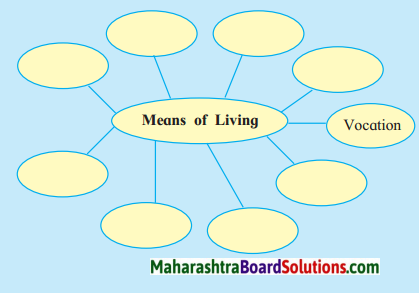
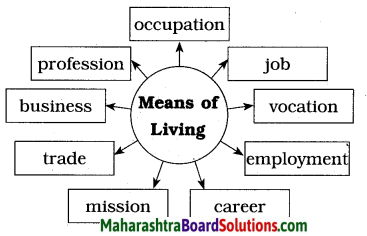
1. Pick out the words that refer to ‘means of living’ and fill them in the web:
(profession / recreation / occupation /job / pastime / employment / hobby / career / entertainment /mission/ trade / business / sports / retirement / placement)
Maharashtra Board Class 8 English Solutions Chapter 2.1 Vocation 1
Answer:
Maharashtra Board Class 8 English Solutions Chapter 2.1 Vocation 2

Maharashtra Board Class 8 English Solutions Chapter 2.1 Vocation

2. Using a good dictionary. find the shades of difference in the following:

2.1 Vocation Questions And Answers Question 1.
Profession
Answer:
‘Profession’ refers to a paid occupation, especially one that involves pro-longed training and a formal qualification.

Vocation Poem Class 8 Questions And Answers Maharashtra Board Question 2.
Vocation
Answer:
‘Vocation’ refers to an occupation for which a person is specially drawn or suited.

Vocation Poem Class 8 Questions And Answers Question 3.
Business
Answer:
‘Business’ refers to the activity of buying or selling goods or services; a commercial activity done by a person at his own risk.

Vocation Poem Class 8 Question 4.
Occupation
Answer:
‘Occupation’ refers to a person’s usual or principal work or business, especially as a means of earning a living.

Maharashtra Board Class 8 English Solutions Chapter 2.1 Vocation

3. When a word is formed from a sound associated with it, it is called an Onomatopoetic Word.

For example : bang, tap, tinkle. crash, whistle etc.
If an Onomatopoetic word occurs in the lines of a poem, the Figure of Speech in that line is Onomatopoeia.
Write down eight to ten Onomatopoetic words on your own.
Answer:

  1. buzz
  2. whoosh
  3. clang
  4. chirp
  5. clap
  6. howl
  7. hiss
  8. grunt
  9. purr
  10. quack

1. Which of the following words / phrases match in meaning to the underlined ones?
(a) deserted
(b) exposed to heat
(c) dirties the clothings
(d) no particular route
(e) following imaginary goals
(f) scolds and corrects

Maharashtra Board Class 8 English Solutions Chapter 2.1 Vocation

Vocation Poem Class 8 Questions And Answers State Board Question 1.
nobody takes him to task ………..
Answer:
scolds and corrects

Vocation Question Answer Class 8 Question 2.
………. if he gets baked in the sun …………..
Answer:
exposed to heat

Vocation Chapter 2.1 Question Answer Question 3.
………….chasing the shadows with my lantern ……………..
Answer:
following imaginary goals

Class 6 English Vocation Questions And Answers Question 4.
The lane is dark and lonely ……………..
Answer:
deserted

Class 6 English Vocation Question Answer Question 5.
………….. he soils his clothes with dust ………….
Answer:
dirties the clothings

Question 6.
…………. There is no road he must take ………….
Answer:
no particular route

Maharashtra Board Class 8 English Solutions Chapter 2.1 Vocation

2. Read the poem and fill in the table.

Time of the day Location Poet’s Activity Hawker’s Activities Gardener’s Activities Watchman’s Activities
Morning
Afternoon
Night

Answer:

Time of the day Location Poet’s Activity Hawker’s Activities Gardener’s Activities Watchman’s Activities
Morning In the lane Walking to school Selling Bangles
Afternoon Near the poet’s house Walking home from school Digging the ground
Night The poet’s home Watching thr watchman from his bed. Walking up and down the street.Swinging his latern.

3. Think and answer in your own words:

Question a.
What could be the age group of the speaker in the poem?
Answer:
The speaker in the poem is a young school-going boy.

Question b.
What is the difference between a hawker and a shopkeeper?
Answer:
The difference between a hawker and a shopkeeper is that a hawker does not have a fixed shop. He goes from street to street selling his wares. A shopkeeper has a fixed shop and people who want to buy his goods must go to his shop.

Maharashtra Board Class 8 English Solutions Chapter 2.1 Vocation

Question c.
How do parents react when they see children soil their clothes in dust and heat?
Answer:
When parents see their children exposed to heat or soil their clothes in the dust, they scold them and stop them from doing it.

Question d.
Why is the street light compared to a one-red-eyed-giant?
Answer:
The street light is very tall and has a single red light at the top. Hence it is compared to a giant with one red eye.

Question e.
What exactly does the speaker in the poem crave for?
Answer:
The speaker in the poem, who is a young school-going boy, craves for complete freedom to do whatever he wants and whenever he wants. He wants freedom from authority. He wants to lead a carefree life.

Maharashtra Board Class 8 English Solutions Chapter 2.1 Vocation

Question f.
Does the poet really wish to become a hawker/gardener/watchman? Justify your response.
Answer:
The poet does not really wish to become a hawker/gardener/watchman. He is childish and sees only what he thinks is their ‘carefree’ life. He does not see the difficulties. He actually only craves for complete freedom from authority.

4. Say why the speaker of the poem wishes to be:

Question a.
Hawker:
Answer:
The speaker in the poem feels that there is nothing to hurry the hawker. There is no fixed road he must travel by, no place that he must go to and no time when he must get back home. The speaker feels he is lucky and hence he wishes to be a hawker. It means that the speaker wants to be free to do what he wants and go where he wants to, without any restrictions.

Question b.
Gardener:
Answer:
The speaker in the poem sees that the gardener in the nearby house is digging the ground. He does what he likes with his spade. He is free to get his clothes soiled with mud, get baked in the sun or get wet. No one scolds him. Hence the speaker wishes to be a gardener so that he is able to enjoy freedom in the open without any restrictions.

Question c.
Watchman:
Answer:
The speaker is in his bed Through the open window, he can see the watchman walking up and down the dark and lonely street with a lantern in his hand. The speaker is resentful that he has to go to bed. He thinks that the watchman never goes to bed in his life. Hence he wishes to become a watchman and walk up and down in the dark street at night, having fun chasing the shadows with his lantern

5. Pick outlines that contain Alliteration. Simile, Repetition, Onomatopoeia:

(a) Alliteration:
(i) ‘I can see through the gate the gardener digging the ground.’ Repetition of the sound of the letter ‘t’ and ‘g’.
(ii) ‘He does what he likes with his spade, he soils his clothes…’ Repetition of the sound of the letter ‘h’.
(iii) ‘nobody takes him to task’ Repetition of the sound of the letter ‘t’.

Maharashtra Board Class 8 English Solutions Chapter 2.1 Vocation

(b) Simile:
‘The street lamp stands like a giant with one red eye in its head.’ The street lamp is directly compared to a giant, using the word ‘like’.

(c) Repetition:
(i) The words ‘Bangles, crystal bangles’ are repeated to create images in our mind of the hawker.
(ii) The words ‘no’ and ‘nobody’ are repeated for emphasis.

(d) Onomatopoeia:
‘the gong sounds ten’ : the word ‘gong’ is an onomatopoeic word formed from the sound associated with it.

6. Some poets do not use uniformity in rhyming words, nor a steady rhythm. Such poems with no uniformity in rhyme, rhythm, length of lines, or stanzas are called Free Verse. Walt Whitman, Ezra Pound, T.S. Eliot, Rabindranath Tagore are some famous poets who have composed poems in Free Verse.
A quick glance at the poem Vocution’ reveals that the style used by Tagore is Free Verse.
Now turn the pages of your textbook and see if you can find other poems in Free Verse.

7. ‘occupation/profession/business would you like to take up in the future?
Prepare a fact file for the same using the following points.

  1. Name of the vocation / profession / business ……….
  2. Educational qualifications required ………..
  3. Work profile/description………..
  4. Opportunities for advancement …………..
  5. our personal skills/talents for the choice …………..

Maharashtra Board Class 8 English Solutions Chapter 2.1 Vocation

Answer:

  1. Name of the vocation/profession/business: Engineering
  2. Educational qualifications required: B.E/B.Tech
  3. Work profile/description: Setting up of projects/setting up plants/inventing new instruments and machines
  4. Opportunities for advancement: Excellent in a developing country like India
  5. Your personal skills/talents for the choice: My interest in seeing how various machines work and my talent in repairing simple instruments.

8. Read and understand the following poem paper Boats’ and write its paraphrase in your own simple language. (You may take the help of a dictionary or the internet.) The first line is done for you.
(Day after day. one after another. I sail paper boats on the stream of flowing water.)
Answer:

Paper Boats

Day after day, one after another, I sail paper boats on the stream of flowing water. I write my name and the name of my village on the boats in big black letters. I hope that someone in some strange land will find them and know who I am. I fill my little boats with ‘shiuli’ flowers and hope that these flowers which I have picked at dawn will be carried safely to land in the night.

I set my paper boats in motion and look up at the sky. The little clouds have white bulging tails behind them that look like the sails of a boat. I do not know if there is a young child like me up in the sky, who wants to play with me, and sends his boats down through the air to race with my boats.
When it is night, I bury my face in my arms and dream that my paper boats are floating in the air under the stars at midnight. The fairies who bring sleep are sailing in them, and they are filling their baskets with dreams.

Maharashtra Board Class 8 English Solutions Chapter 2.1 Vocation

Class 8 English Chapter 2.1 Vocation Additional Important Questions and Answers

Choose the correct alternative and rewrite the complete sentence:

Vocation Question Answer Question 1.
The hawker is advertising aloud for selling metal bangles/crystal bangles.
Answer:
The hawker is advertising aloud for selling crystal bangles.

Vocation Poem Class 6 Question 2.
The narrator/The gardener is scolded if he gets dirty.
Answer:
The narrator is scolded if he gets dirty.

Vocation Std 8 Questions And Answers Question 3.
The speaker in the poem is a young school-going boy/an adult going to work.
Answer:
The speaker in the poem is a young school-going boy.

Complete the following:

Question 1.
The difference between a hawker and a shopkeeper is _____.
Answer:
that a hawker does not have a fixed shop. He goes from street to street selling his wares. A shopkeeper has a fixed shop and people who want to buy his goods must go to his shop

Maharashtra Board Class 8 English Solutions Chapter 2.1 Vocation

Question 2.
When parents see their children exposed to heat or soil their clothes in the dust, they ________.
Answer:
scold them and stop them from doing it.

Question 3.
The watchman is accompanied by _______.
Answer:
his lantern and his shadow.

Question 4.
The street lamp appears to be _______.
Answer:
a giant with one red eye in its head.

Question 5.
Analysis/Appreciation Of The Poem
Answer:

  1. Poem and poet: ‘Vocation’ by Rabindranath Tagore
  2. Theme: The longing of a young boy for freedom.
  3. Tone: direct; full of craving
  4. Structure and stanzas: Stanzas of unequal length; the number and length of lines vary.
  5. Rhyme and Rhythm: No rhymes or rhythm; the poem is in Free Verse.
  6. Language and Imagery: Simple and direct; vivid images of the hawker, the j gardener and the watchman.
  7. Figures of Speech: Alliteration, Simile, Repetition, Onomatopoeia.

Read More:

Std 9 English Poem The Road Not Taken 3.3 Question Answer Maharashtra Board

Balbharti Maharashtra State Board Class 9 English Solutions Kumarbharati Chapter 3.3 The Road Not Taken Notes, Textbook Exercise Important Questions and Answers.

Class 9 English Chapter 3.3 Question Answer Maharashtra Board

The Road Not Taken 9th Std Question Answer

Warming Up:

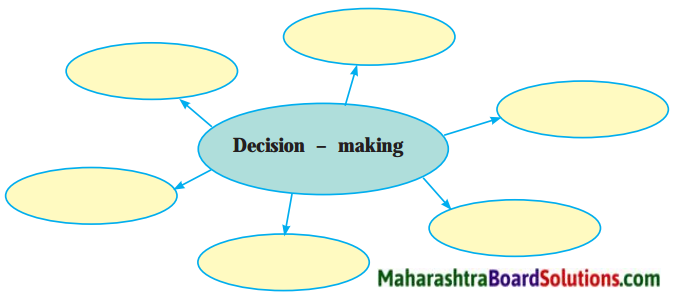
1. After your SSC Exams/Result you may have to take a decision regarding the choice of a career. What factors will you consider? Choose from the block below and complete the web-diagram.

  1. Is the option easy/difficult?
  2. Your capability
  3. Your likes/dislikes
  4. Friends’ decision
  5. Parents’ profession
  6. Your skills/inborn talents
  7. Study the ‘Job Profile’ carefully
  8. Easy money
  9. Possible difficulties
  10. Your ultimate aim

Maharashtra Board Class 9 English Solutions Chapter 3.3 The Road Not Taken 1

2. Form pairs or groups of four. Think of the situations when you have to choose between two things. Make a list of those situations. Then:

Question a.
Discuss how to decide what to choose.
Answer:
Points: ask parents – teachers – read articles – speak to others – think carefully, etc.

Maharashtra Board Class 9 English Kumarbharati Solutions Chapter 3.3 The Road Not Taken

Question b.
Write what you feel when your decision proves right.
Answer:
Points: happy – confident, etc.

Question c.
Write what you feel when you regret the decision.
Answer:
Points: unhappy – depressed – courageous, loss of confidence, etc.)

English Workshop:

1. Read the poem again. Does it have a uniform rhyme scheme throughout?

Question 1.
Read the poem again. Does it have a uniform rhyme scheme throughout? Write down the rhyme scheme of every stanza separately.

  1. 1st stanza ……………….
  2. 2nd stanza ……………..
  3. 3rd stanza ………………
  4. 4th stanza ………………

Answer:

  1. 1st stanza – abaab
  2. 2nd stanza – abaab
  3. 3rd stanza – abaab
  4. 4th stanza – abaab

Maharashtra Board Class 9 English Kumarbharati Solutions Chapter 3.3 The Road Not Taken

2. Write the symbols that are used in the poem to represent the following ideas:

Question 1.
Write the symbols that are used in the poem to represent the following ideas: (The answers are given directly and underlined.)
a. Choice of two options ………………….
b. I made a rare choice ……………………
c. Equally good options ……………………
d. It was tempting and needed to be tried …………….
e. Some other time ……………………
Answer:
a. Choice of two options: two roads diverged.
b. I made a rare choice: I took the one less travelled by.
c. Equally good options: just as fair.
d. It was tempting and needed to be tried: It was grassy and wanted wear.
e. Some other time: Another day.

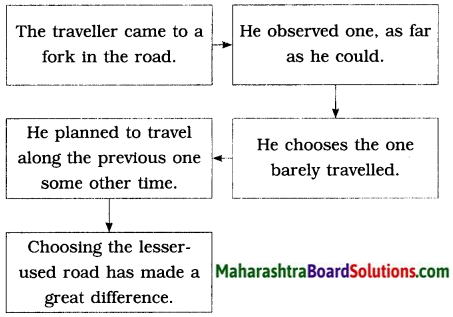
3. Rearrange the following facts in the proper order and fill in the flow chart.

Question 1.
Rearrange the following facts in the proper order and fill in the flow chart.
Maharashtra Board Class 9 English Solutions Chapter 3.3 The Road Not Taken 2
a. He chooses the one barely travelled.
b. Choosing the lesser-used road has made a great difference.
c. He observed one, as far as he could.
d. The traveller came to a fork in the road.
e. He planned to travel along the previous one some other time.
Answer:
Maharashtra Board Class 9 English Solutions Chapter 3.3 The Road Not Taken 3

4. Think and write in your own words.

Question a.
In which season does a greenwood turn j to a yellow wood? Which stage in our life can be compared to that season?
Answer:
A greenwood turns to a yellow wood in j autumn. The stage in our life that can be compared to that season is middle age.

Maharashtra Board Class 9 English Kumarbharati Solutions Chapter 3.3 The Road Not Taken

Question b.
Why does the traveller choose the road less travelled? What attribute of the traveller does it bring out?
Answer:
The traveller chooses the road less travelled because it seemed just as good as the other one and I
he felt it needed to be used. The traveller seems to be adventurous. He has an independent mind and does not want to follow what others have done.

Question c.
Why does the traveller doubt that he shall ever come back?
Answer:
The traveller feels that he will be so busy in his life with one thing leading to another, that he may not be ever able to come back.

Question d.
If you were in the traveller’s place, which road would you choose? Justify your choice.
Answer:
If I were in the traveller’s place, I would choose the road that was more travelled. I would not want to go on a strange road which many have not travelled by. I am not adventurous. I feel that there is safety in doing what others are doing or have done.

5. From any collection of classic poetry or the internet, find another famous poem by Robert Frost titled ‘Stopping by the Woods on a Snowy Evening’. Try to understand the symbolism used in that poem in 8-10 lines.

Maharashtra Board Class 9 English Kumarbharati Solutions Chapter 3.3 The Road Not Taken

Question 1.
From any collection of classic poetry or the internet, find another famous poem by Robert Frost titled ‘Stopping by the Woods on a Snowy Evening’. Try to understand the symbolism used in that poem in 8-10 lines.

6. Write a letter to your friend or cousin telling him/her about a difficult choice you have recently made.

Question 1.
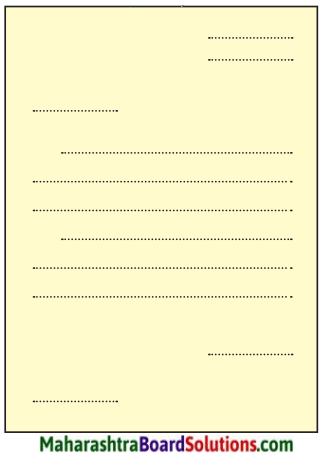
Write a letter to your friend or cousin telling him/her about a difficult choice you have recently made. Tell your friend/cousin how his/her example helped you to take a decision.
Maharashtra Board Class 9 English Solutions Chapter 3.3 The Road Not Taken 4
Answer:
Flat No. 3
‘Maria Mansion’
Pereira Nagar
Mahim 400 016
5th July 2020

Dear Sandeep,

Hi! How are you? I tried calling you, but your number : seems to have changed. Do let me have your new number.

Last week I had to make a rather difficult choice. I | had to choose between football and my studies. No guesses which one I chose – my studies, of course! I have made up my mind to give up football for the next two years. I will play in friendly, casual matches, j but nothing serious. I will also stop my regular daily I practice.

It’s been a very difficult decision to make, but then I j remembered what you had done. You too had given up cricket for two years, hadn’t you? And then you I picked up the threads again in college, when you had j more time. This is what has inspired me to make my j decision. Thanks, Sandy.

Will tell you more details when I meet you next.

Your loving friend,
Deep

Maharashtra Board Class 9 English Kumarbharati Solutions Chapter 3.3 The Road Not Taken

7. Collect quotations on the topic ‘Choice’.

Question 1.
Collect quotations on the topic ‘Choice’.
Example:
‘Decisions are the hardest thing to make, especially when it is a choice between where you should be and where you want to be.’
Present the quotations in a beautiful hand on cardpaper.

English Kumarbharati 9th Digest Chapter 3.3 The Road Not Taken Additional Important Questions and Answers

Simple Factual Activity.

1. The poet made his decision about which road to take very quickly – False
2. The season was Autumn – True
3. The poet wished he could travel along both the roads – True
4. He took the road which had been used more – False

Complex Factual Activity.

Question 1.
Why does the poet feel sorry?
Answer:
The poet feels sorry that he cannot travel along both the roads at the same time.

Maharashtra Board Class 9 English Kumarbharati Solutions Chapter 3.3 The Road Not Taken

Question 2.
Did the poet choose the road quickly?
Answer:
No, the poet did not choose the road quickly, He stood for a long time at the fork before he took a decision.

Question 3.
Was one of the roads better than the other?
Answer:
No, both were equally good.

Activities based on Poetic Devices.

Question 1.
Does the poem have a uniform rhyme scheme throughout?
Answer:
Yes, it does.

Maharashtra Board Class 9 English Kumarbharati Solutions Chapter 3.3 The Road Not Taken

Simple Factual Activity.

Question 1.
Complete the following statements: (The answers are given directly and underlined.)
Answer:

  1. The poet took the road less travelled by.
  2. He kept the first road for another day.
  3. He will be telling all this ages and ages later.
  4. His choice has made all the difference.

Complex Factual Activities.

Question 1.
Does the poet tell us what difference it made?
Answer:
No, he doesn’t.

Maharashtra Board Class 9 English Kumarbharati Solutions Chapter 3.3 The Road Not Taken

Activities based on Poetic Devices.

Question 1.
Pick out and explain an example of inversion from the extract.
Answer:
Inversion: ‘And both that morning equally lay in leaves ……… . The correct prose order is: And both lay equally that morning in leaves ………. .

Point Format (for understanding)

  • Title: The Road not Taken
  • Poet: Robert Frost
  • Rhyme Scheme: abaab.
  • Figures of Speech: Alliteration. ‘Though as for that the passing there.’ Repetition of the sound of the letter ‘t’. The other figure of speech is Inversion.
  • Theme/Central Idea: The poem Is about the journey of life and what the poet decides when he is at the crossroads. He tells us about a time that he came across two roads that diverged In a wood.

He knew that he could not travel both, so he took the road which was not as well-travelled as the other. It made a difference in his life.

Maharashtra Board Class 9 English Kumarbharati Solutions Chapter 3.3 The Road Not Taken

Paragraph Format.

This famous poem ‘The Road not Taken’ is by the equally famous poet Robert Frost.

The Rhyme Scheme of the poem is abaab. One Figure of Speech is Alliteration : ‘Though as for that the passing there.’ Repetition of the sound of the letter ‘t’. The other figure of speech is Inversion.

The poem is about the journey of life, and what the poet decides when the path forks off in two directions. He knew that he could not travel both, so he took the road which was not as well-travelled as the other. This made a difference in his life.

Maharashtra State Board Class 9 English Solutions

9th Std English Questions And Answers:

Std 9 English Poem Have you ever seen…? 1.3 Question Answer Maharashtra Board

Balbharti Maharashtra State Board Class 9 English Solutions Kumarbharati Chapter 1.3 Have you ever seen…? Notes, Textbook Exercise Important Questions and Answers.

Class 9 English Chapter 1.3 Question Answer Maharashtra Board

Have you ever seen…? Poem 9th Std Question Answer

Warming Up:

1. Words that have the same spelling, but differ in meaning when used in different contexts are called homographs. For example,
(a) A temple fair attracts a lot of crowd.
Her performance in the test was fair.
(b) A rose is the king of flowers.
The sun rose with a golden glow.
Think of 5 homographs and list them below. Then write 2 sentences of your own, to bring out the difference in meanings.

Maharashtra Board Class 9 English Kumarbharati Solutions Chapter 1.3 Have you ever seen. 1

Question 1.
Think of five homographs and list them down. Then write two sentences of your own, to bring out the difference in meaning :
Words that have the same spelling but differ in meaning when used in different contexts are called homographs.
Answer:

Homographs Sentences
1. bow (a) The prince slowly put down the bow and arrow.
(b) “Should I bow if I see the king?” asked the little boy.
2. content (a) One should always be content with what one has.
(b) You must always check the nutritional content of what you eat.
3. live (a) One must learn to live within one’s means.
(b)  It is dangerous to touch a live wire.
4. minute (a) His voice was getting louder every minute.
(b) There were minute particles of dust in the air.
5. tear (a) A tear fell from the eye of the old woman.
(b) “Tear the paper into four pieces,” said the teacher.

Maharashtra Board Class 9 English Kumarbharati Solutions Chapter 1.3 Have you ever seen...?

2. When words with the same spelling or pronunciation are used in such a way that they convey more than one meaning, the figure of speech involved is called pun. A pun is a play upon words. For example,
A: Hello! How’s life?
B: Hell, O! It’s a strife.
Find other examples of pun with the help of your parents/teacher.

  1. ………………….
  2. ………………..
  3. ………………….
  4. ………………….

Question 1.
Find other examples of pun with the help of your parents/teacher.
Answer:
Some examples :
1. Where do you find giant snails?
On the ends of giants’ fingers.
2. How do turtles talk to each other?
By using shell phones!
3. You can communicate with a fish by dropping it a line.
4. What do you get from a pampered goat?
Spoilt milk.

Maharashtra Board Class 9 English Kumarbharati Solutions Chapter 1.3 Have you ever seen...?

3. In poetry, when a question is asked, not to get an answer, but to emphasise a point or fact, it is an example of Interrogation.
For example :
When can their glory fade?
Isn’t it time for the autumn’s glow?
From a popular book of poems/the internet, write down 3-4 examples of Interrogation used in poetry.

  1. ………………….
  2. ………………….
  3. ………………….
  4. ………………….

Question 1.
write down 3-4 examples of Interrogation used in poetry.
Answer:

  1. If Winter comes, can Spring be far behind?
  2. If you prick us, do we not bleed?
  3. What’s in a name?

Maharashtra Board Class 9 English Kumarbharati Solutions Chapter 1.3 Have you ever seen...?

English Workshop:

1. From each line in the poem, pick out the word that is a homograph. Write its meaning in the context of the phrase used in the poem. Then write the other meaning implied in the question.

Maharashtra Board Class 9 English Kumarbharati Solutions Chapter 1.3 Have you ever seen. 2

Question 1.
1. From each line in the poem, pick out the word that is a homograph. Write its meaning in the context of the phrase used in the poem. Then write the other meaning implied in the question.
Answer:
Maharashtra Board Class 9 English Kumarbharati Solutions Chapter 1.3 Have you ever seen. 3

2. Write 2 lines from this poem which you find most humorous. Justify your choice.

…………………………………………………………………………………………………………………………………………………
…………………………………………………………………………………………………………………………………………………

Question 1.
Write two lines from the poem that you find the most humorous. Justify your choice.
Answer:
1. Can you tickle the ribs of a parasol?
I find this humorous because I can just imagine someone tickling the spokes of an umbrella and trying to get it to respond!
2. Does the needle ever wink its eye?
I find this humorous because I think of myself holding a needle that is winking!

Maharashtra Board Class 9 English Kumarbharati Solutions Chapter 1.3 Have you ever seen...?

3. Find from the poem, three examples of each :

(a) Interrogation
1. …………………….
2. ……………………
3. ……………………

(b) Pun
1. …………………….
2. ……………………
3. ……………………

(c) Personification
1. …………………….
2. ……………………
3. ……………………

(d) Alliteration
1. …………………….
2. ……………………
3. ……………………

Question 1.
Find from the poem, three examples of each:
(a) Interrogation
(b) Pun
(c) Personification
(d) Alliteration
Answer:
(a) Interrogation :

  1. Have you seen a sheet on a river bed?
  2. Does the needle ever wink its eye?
  3. Are the teeth of a rake ever going to bite?

(b) Pun :

  1. Has the foot of the mountain any toes?
  2. Can you tickle the ribs of a parasol?
  3. Have the hands of a clock any left or right?

(c) Personification :

  1. Has the foot of the mountain any toes?
  2. Does the needle ever wink its eye?
  3. Can you tickle the ribs of a parasol?

(d) Alliteration :

  1. Or a single hair from a hammer’s head?
  2. Or open the trunk of a tree at all?
  3. And what is the sound of the birch’s bark?

Maharashtra Board Class 9 English Kumarbharati Solutions Chapter 1.3 Have you ever seen...?

4. Form groups of four or five. Think, discuss and add at least one more stanza, using the same style and devices as the poet has used. It should include homographs, interrogation and the same rhythm and rhyme scheme.

Maharashtra Board Class 9 English Kumarbharati Solutions Chapter 1.3 Have you ever seen. 4

Question 1.
‘Form groups of four or five. Think, discuss and add at least one more stanza, using the same style and devices as the poet has used. It should include homographs, interrogation and the same rhythm and rhyme scheme.
Have/Does/Are  ………………………………………………………….
………………………………………………………………………………………..
………………………………………………………………………………………..
………………………………………………………………………………………..
Answer:

  • Do elephants bathe with their trunks on, all in a batch?
  • Have scientists created a flea from scratch?
  • Are the bees having a house swarming party with honey?
  • Did the lion spit out the clown because he tasted funny?

Maharashtra Board Class 9 English Kumarbharati Solutions Chapter 1.3 Have you ever seen...?

5. Read the following sentences carefully. Then fill in the blanks using appropriate words from the brackets, to make puns.
(struck, numbered, too tired, developed, put down, homeless, old fashioned, reaction)

Question 1.
Read the following sentences carefully. Then fill in the blanks using appropriate words from the brackets, to make puns.
(struck, numbered, too tired, developed, put down, homeless, old fashioned, reaction)

  1. She had a photographic memory but never …………………
  2. He was struggling to work out how lightning works when it …………………
  3. Every calendar’s days are …………………
  4. A bicycle cannot stand on its own because it is …………………
  5. I’m reading a book on anti-gravity. It’s impossible to ……………….. the book.
  6. I’d tell you a chemistry joke but I know I wouldn’t get …………………
  7. What do you call Watson when Sherlock isn’t around?………………..
  8. I would tell a history joke, but it is too ………………..

Answer:

  1. She had a photographic memory but never developed it.
  2. He was struggling to work out how lightning works when it struck him.
  3. Every calendar’s days are numbered.
  4. A bicycle cannot stand on its own because it is too tired.
  5. I’m reading a book on anti-gravity. It’s impossible to put down the book.
  6. I’d tell you a chemistry joke but I know I wouldn’t get a reaction.
  7. What do you call Watson when Sherlock isn’t around? homeless.
  8. I would tell a history joke, but it is too old-fashioned.

6. ‘Read: ‘Alice in Wonderland’ – by Lewis Carroll.

Question 1.
‘Read: ‘Alice in Wonderland’ – by Lewis Carroll.

Maharashtra Board Class 9 English Kumarbharati Solutions Chapter 1.3 Have you ever seen...?

English Kumarbharati 9th Digest Chapter 1.3 Have you ever seen…? Additional Important Questions and Answers

Read the following poem carefully and complete the activities :

Simple Factual Activity :

Question 1.
Fill in the blanks :
(The answers are given directly and underlined.)
The poet wonders if:

  1. the teeth of a rake will ever bite.
  2. the foot of a mountain has any toes.
  3. the ribs of an umbrella can be tickled.
  4. there can be a sheet on a river bed.

Complex Factual Activities :

Question 1.
What does the poet want to know about a hammer?
Answer:
The poet asks if anyone has seen a single hair on the head of a hammer.

Maharashtra Board Class 9 English Kumarbharati Solutions Chapter 1.3 Have you ever seen...?

Question 2.
What is the pun in the word ‘plot’ here?
Answer:
A plot means ‘an evil or wicked plan’. A plot ’ also means an area in a garden or some place. The poet asks how a garden ‘plot’ (one meaning of the word) can be evil and dark (the other meaning of the word).

Activities based on Poetic Devices :

Question 1.
Find the rhyming words from the poem.
Answer:

  • Stanza 1 – bed-head, toes-hose.
  • Stanza 2 – eye-fly, parasol-all.
  • Stanza 3 – bite-right, dark-bark.

Maharashtra State Board Class 9 English Solutions

9th Std English Questions And Answers:

Std 9 English Poem The Past in the Present 2.6 Question Answer Maharashtra Board

Balbharti Maharashtra State Board Class 9 English Solutions Kumarbharati Chapter 2.6 The Past in the Present Notes, Textbook Exercise Important Questions and Answers.

Class 9 English Chapter 2.6 Question Answer Maharashtra Board

The Past in the Present 9th Std Question Answer

Warming up:

1. We find the following in the script of a skit | or play. Rearrange the steps in these proper j order and write them down in the form of a flow chart:

Maharashtra Board Class 9 English Kumarbharati Solutions Chapter 2.6 The Past in the Present 1

Question 1.
We find the following in the script of a skit | or play. Rearrange the steps in these proper j order and write them down in the form of a flow chart:
Answer:
Maharashtra Board Class 9 English Kumarbharati Solutions Chapter 2.6 The Past in the Present 2

2. Think of a play/skit which you have seen enacted on the stage and which has impressed you. Write the following details about it.

  • Name of the play/skit: ……………………………..
  • Important characters: ……………………………..
  • Any famous actors/actresses: ……………………………..
  • Theme: ……………………………..
  • Climax: ……………………………..
  • Ending: ……………………………..
  • Use of lights and special effects if any: ……………………………..
  • Use of background music and sound effects if any: ……………………………..
  • Use of sets: ……………………………..
  • The costumes, make up, etc. of the characters: ……………………………..
  • How well the actors present the play and behave on the stage: ……………………………..
  • Your own opinion about the play: ……………………………..

Question 1.
Think of a play/skit which you have seen enacted on the stage and which has impressed you. Write the following details about it:
Answer:
1. Name of the play: Pygmalion (My Fair Lady)
2. Important characters: Professor Henry Higgins, Eliza Dolittle, Colonel Pickering, Mr. Dolittle (Eliza’s father) and Professor Higgins’ mother.
3. Any famous actors/actresses: No. The cast is made up of newcomers.

4. Theme: Bernard Shaw’s ‘Pygmalion’ centres round a bet made by Professor Henry Higgins, a well-know phonetician, with his best friend Colonel Pickering. The professor states that he can change a flower girl’s entire behaviour and speech in such a way that in a few months she can be passed off as a duchess.

5. Climax: The scene between Eliza and Professor Higgins, when she throws away the jewellery he had given her, and they have a grand fight.

6. Ending: An ambiguous ending, left to the imagination of the viewer.
7. Use of lights and special effects, if any: The lights change frequently to depict various scenes and places.

8. Use of background music and sound effects, if any: This is a musical, with superb foot-tapping music and amusing lyrics. The sound effects and background music add authenticity to the market place scene, Eliza’s diction, the Professor’s anger, etc. and are excellent.

9. Use of sets: The sets change appropriately as per the needs of the play. There is not much time wasted in between acts.

10. The costumes, make-up, etc. of the characters: Excellent. The costumes of the early and mid-20th century are entrancing. The big hats with feathers, the lovely gowns, the Professor’s elaborate I suits, etc. are a sight to behold. The make-up is suitable.

11. How well the actors present the play and behave on the stage: The dialogue delivery and the movement of the actors on stage was smooth and flawless. The song-and-dance sequences were enacted perfectly.

12. Your own opinion about the play: An excellent and interesting play, with a classic British sense of humour. The characters portray this sense of humour very well. As a result, every single sentence is worth listening to, and every single song is melodious and meaningful.

Maharashtra Board Class 9 English Kumarbharati Solutions Chapter 2.6 The Past in the Present

3. Present these points in the form of a review, and give it a suitable title.

Question 1.
Present these points in the form of a review, and give it a suitable title.
Answer:

Review of ‘Pygmalion’ Bernard Shaw’s ‘Pygmalion’ centres round a bet made by Professor Henry Higgins, a well-know phonetician, with his best friend Colonel Pickering. The professor states that he can change a flower girl’s entire behaviour and speech in such a way that in a few months she can be passed off as a duchess.

The important characters in the play are Professor Henry Higgins, Eliza Dolittle, Colonel Pickering, Mr. Dolittle (Eliza’s father) and Professor Higgins’ mother. The play has been performed by newcomers, and there are no known names. It is a musical, with superb foot-tapping music and amusing lyrics. The sound effects, sets and use of lights add authenticity to the market place scene, Eliza’s diction, the Professor’s anger, etc. and are excellent.

The climax is the scene between Eliza and Professor Higgins, where she angrily flings the jewellery he had given her, and they have a grand fight, resulting in Eliza walking off from the house. The ending is ambiguous and left to the imagination of the viewer.

The costumes of the early and mid – 20th century are entrancing. The big hats with feathers, the lovely gowns, the Professor’s elaborate suits, etc. are a sight to behold. The dialogue delivery and the movement of the actors on stage is smooth and flawless. The song- and-dance sequences are enacted perfectly.

Overall, an excellent and interesting play, with a classic British sense of humour. The characters portray this sense of humour very well. As a result, every single sentence is worth listening to, and every single song is melodious and meaningful.

Maharashtra Board Class 9 English Kumarbharati Solutions Chapter 2.6 The Past in the Present

4. Prepare a ‘power point’ presentation, using one slide for each of the above points. Present your review in a PPT format in the classroom.

Question 1.
Prepare a ‘power point’ presentation, using one slide for each of the above points. Present your review in a PPT format in the classroom.
Answer:
(Students can prepare the PPT in their Computer labs.)

English Workshop:

1. In the diagram below encircle the various features that make the script of a skit! play. List the other words and mention the form of writing of which it is a feature.

Maharashtra Board Class 9 English Kumarbharati Solutions Chapter 2.6 The Past in the Present 3

Question 1.
In the diagram below encircle the various features that make the script of a skit! play. List the other words and mention the form of writing of which it is a feature.
Answer:

  1. Sender’s address – Part of a letter.
  2. Salutation – Part of a letter.
  3. Leadline – Part of a news report.
  4. Diagram – Part of non-verbal communication.

2. Choose the proper alternative to complete the following:

Question i.
The skit covers a period of about ………………. in the past.
(a) 3000 years
(b) 1000 years
(c) 5000 years
(d) 1800 years
Answer:
(c) 5000 years

Maharashtra Board Class 9 English Kumarbharati Solutions Chapter 2.6 The Past in the Present

Question ii.
…………….. characters from Neel’s ancestral lineage make an appearance in the play.
(a) Fourteen
(b) Seven
(c) Sixteen
(d) Twelve
Answer:
(a) Fourteen

Question iii.
The task that all boys abhorred was ……………. .
(a) cleaning up their room
(b) farm-work
(c) filling up water
(d) making their beds
Answer:
(d) making their beds

Maharashtra Board Class 9 English Kumarbharati Solutions Chapter 2.6 The Past in the Present

Question iv.
The skit conveys that doing your daily chores at home ………………. .
(a) make you stronger
(b) sharpens your intellect
(c) saves a lot of expenses
(d) inculcates a sense of responsibility
Answer:
(d) inculcates a sense of responsibility

3. Fill in the table 

Maharashtra Board Class 9 English Kumarbharati Solutions Chapter 2.6 The Past in the Present 4

Question 1.
Fill in the table.
Answer:
Maharashtra Board Class 9 English Kumarbharati Solutions Chapter 2.6 The Past in the Present 5 Maharashtra Board Class 9 English Kumarbharati Solutions Chapter 2.6 The Past in the Present 6

4. Answer in your own words.

Question a.
What excuses did Neel give to avoid cleaning his room?
Answer:
Neel says that he is going out to meet his friends. He then says that he had cleaned his room just two days earlier. He wonders why it needs to be cleaned daily, for it makes no difference.

Maharashtra Board Class 9 English Kumarbharati Solutions Chapter 2.6 The Past in the Present

Question b.
Why does mother tell Neel about his Grandpa?
Answer:
Mother tells Neel about his Grandpa to make him realize that Grandpa had many more daily chores to finish than him, Neel, and much tougher ones too. He also had to make his bed, just like Neel would have to.

Question c.
What task did Grandpa wish to avoid?
Answer:
Grandpa wished to avoid the task of making his bed.

Question d.
What did the ancestor from 1910 wish to do instead of making his bed?
Answer:
The ancestor from 1910 wished to go to the riverside with his friends instead of making his bed.

Question e.
How many chores did the ancestor from 1800 have to do?
Answer:
The ancestor from 1800 had to do about six chores.

Maharashtra Board Class 9 English Kumarbharati Solutions Chapter 2.6 The Past in the Present

Question f.
How is the boy from 1500s dressed?
Answer:
The boy from 1500s is dressed in a loose, sleeveless, V-neck top and a short dhoti.

Question g.
What chores did the boys from the 1st century CE do on their farms/fields?
Answer:
In the 1st century CE, the boys would feed the poultry, tend to the sheep, keep away the birds and plaster the yard with dung.

Question h.
What did Neel realize from his encounter with his ancestors?
Answer:
From his encounter with his ancestors, Neel realized that at that time teenage boys had chores to do outdoors as well as in their homes. They also had to make their beds.

Maharashtra Board Class 9 English Kumarbharati Solutions Chapter 2.6 The Past in the Present

5. In the play two devices that make use of wheels are given.
The devices are 1. …………….., 2. ………………..
From the internet or other sources, trace the history of the use of the wheel. Write ‘An Autobiography of a Wheel’.

Question a
In the play, two devices that make use of wheels are given. The devices are:
Answer:
The devices are: 1. bicycle, 2. grinders

Question b.
From the internet and other sources, trace the history of the use of the wheel.
(Students can attempt this on their own.)

6. Imagine that the ancestor from 1910 CE visits Neel in his dream. Compose a dialogue between the two about the various gadgets the visitor sees in Neel’s room

Question 1.
Imagine that the ancestor from 1910 CE visits Neel in his dream. Compose a dialogue between the two about the various gadgets the visitor sees in Neel’s room
Answer:

  • Neel: Hello! Who are you, Sir?
  • Ancestor: I am your great-great-grandfather, Neel. I have heard a lot about your life, and I came to see you. Oh my! What are all these things here?
  • Neel: All these things? What things, great, great Grandpa?
  • Ancestor: This box here and that one there and this …
  • Neel: Oh, this is my TV set and that is my laptop. Haven’t you ever seen these things? This is my mobile phone.
  • Ancestor: TV? What is it? And phone – no, no, this is not a phone! Such a tiny thing!
    (Students can continue this conversation in this manner.)

Maharashtra Board Class 9 English Kumarbharati Solutions Chapter 2.6 The Past in the Present

7. Imagine and compare an argumentative dialogue between the mothers of the 2OthJ2lst century and those of the earlier era, about which life was better for women.

Question 1.
Imagine and compare an argumentative dialogue between the mothers of the 2OthJ2lst century and those of the earlier era, about which life was better for women.
Answer:

  • 21st Century mother: There’s no question. Your life was certainly better, Rukmini.
  • 19th Century mother: Better, Reena? You mean, bending over the old wood stove and the grinding stone was better?
  • 21st Century mother: That may have been difficult, Rukmini, but otherwise your life was peaceful. You only had to look after the home and family. While today, we …
  • 19th Century mother: ‘Only look after home and family’? That was a full-time job! There were no short cuts like takeaways and ready-made stuff! And what about freedom? The freedom you have!
  • 21st Century mother: Freedom with chains! I have to work hard both at home and in the office. I have to be a ‘supermom’ and ‘superboss’! Do you know how terrible it is?
    (Students can continue the dialogue in this manner.)

8. Read the entry about ‘voice’ in the ‘Language Study’ pages. Note that the speeches of all the boys are in the ‘active’ voice. Turn them into passive constructions.
Example:
Neel – I put the dishes in the dishwasher. (active)
Dishes have been put in the dishwasher. (passive)
195 Boy – I have watered the garden
………………………………………..
brought home the groceries
………………………………………..
dusted the living room
………………………………………..
cleaned my bicycle…

Maharashtra Board Class 9 English Kumarbharati Solutions Chapter 2.6 The Past in the Present

9. Think of suitable names for the boys from the earlier centuries.

Question 1.
Think of suitable names for the boys from the earlier centuries.
Answer:
(Some examples: Vitthal, Namdeo, Manu, etc.)

10. Form groups of 5-8. Translate the play into your mother tongue (or Hindi) as a group activity. Enact the translation in the classroom.

11. Read ‘The Story of the Amulet’ by E. Nesbit.

English Kumarbharati 9th Digest Chapter 2.6 The Past in the Present Additional Important Questions and Answers

Read the following passages carefully and complete the activities:

Simple Factual Activity:

Question 1.
Fill in the blanks:
Answer:

  1. Neel puts the dishes in the dishwasher.
  2. Neel had cleaned his room two days earlier.
  3. Neel forgets to make his bed.
  4. Neel’s mother remembers something about his Grandpa.

Question 2.
Write if the following sentences are True or False:
Answer:

  1. The 1910s boy was wearing loose trousers and a shirt. False
  2. The 1910s boy did many outdoor chores. True
  3. The 1800s boy was rude to his mother. False
  4. The 1800s boy wanted to play Ashtapada with his friends. False

Question 3.
Name the following:
Answer:

  1. The game the 3000 BCE boy wishes to play: Chaupar
  2. The yard is plastered with this: dung
  3. The game the 100 CE boy wishes to play: Bagh-chal
  4. Pots for cooking are made of this: mud

Maharashtra Board Class 9 English Kumarbharati Solutions Chapter 2.6 The Past in the Present

Question 4.
Complete the web :
(The answers are directly underlined.)
Answer:
Maharashtra Board Class 9 English Kumarbharati Solutions Chapter 2.6 The Past in the Present 7

Activity-based on Vocabulary:

Question 1.
Write the antonyms of the following:

  1. necessary
  2. forgot
  3. late
  4. tougher

Answer:

  1. necessary × unnecessary
  2. forgot × remembered
  3. late × early
  4. tougher × easier.

Question 2.
Match the given verbs with the nouns:

A B
1. fetched (a) yard
2. cleared (b) water
3. swept (c) weeds
4. pulled out (d) channels
(e) walls

Answer:

A B
1. fetched (b) water
2. cleared (d) channels
3. swept  (a) yard
4. pulled out (c) weeds

Maharashtra Board Class 9 English Kumarbharati Solutions Chapter 2.6 The Past in the Present

Question 2.
Fill in the blanks with the correct verbs from the brackets:
(fixed, washed, took, chopped)
The 1800s boy ……….. clothes, ………….. wood, ……….. the broken fence and ………….. the goats up to the hills to graze.
Answer:
The 1800s boy washed clothes, chopped wood, fixed the broken fence and took the goats up to the hills to graze.

Question 3.
Give the plurals of:

  1. jewellery
  2. wood
  3. grandfather
  4. terrace

Answer:

  1. jewellery – jewellery
  2. wood – wood
  3. grandfather – grandfathers
  4. terrace – terraces.

Maharashtra Board Class 9 English Kumarbharati Solutions Chapter 2.6 The Past in the Present

Question 4.
Give the noun forms of the following:

  1. recede
  2. enter
  3. repeat
  4. impossible

Answer:

  1. recede – recession
  2. enter – entry
  3. repeat – repetition
  4. impossible – impossibility

Activities based on Contextual Grammar:

Rewrite the following sentences in the passive voice:

Question 1.
I have watered the garden.
Answer:
The garden has been watered.

Maharashtra Board Class 9 English Kumarbharati Solutions Chapter 2.6 The Past in the Present

Question 2.
I have brought home the groceries.
Answer:
The groceries have been brought home.

Question 3.
I have dusted the living room.
Answer:
The living room has been dusted.

Question 4.
I have cleaned my bicycle.
Answer:
The bicycle has been cleaned.

Question 5.
Mummy, I collected wood for the stove.
Answer:
Mummy, wood for the stove has been collected.

Question 6.
I fixed the broken fence.
Answer:
The broken fence has been fixed.

Maharashtra Board Class 9 English Kumarbharati Solutions Chapter 2.6 The Past in the Present

Question 7.
Rewrite the sentence in passive voice:
I fed the poultry.
Answer:
The poultry have been fed.

Question 8.
Rewrite using the modal auxiliary for permission:
I need your kind permission to go out and play Chaupar with my friends.
Answer:
May I go out and play Chaupar with my friends?

Rewrite the following sentences as assertive sentences:

Question 1.
Is it necessary to clean up every day?
Answer:
It is not necessary to clean up every day.

Question 2.
What difference does it make?
Answer:
It does not make any difference.

Personal Response:

Question 1.
Do you think you should make your bed every day?
Answer:
Yes. In a dusty and tropical country like ours, we have to see that the beds are clean and dust- free. It also feels better to lie down on a clean and fresh bed. So we must make the beds every day.

Maharashtra Board Class 9 English Kumarbharati Solutions Chapter 2.6 The Past in the Present

Question 2.
Do you do any chores in the house? What chores?
Answer:
I dust the furniture every day. I lay and clear the table before and after every meal. I fold clothes and keep them in the cupboard. These are my daily chores, besides keeping my own things like books, shoes, etc. in their proper places.

Question 3.
What do you do when you have to do a chore that you do not like?
Answer:
If I have to do a chore that I don’t like, I first try to see if I can avoid it in some way, like getting someone to do it for me. If it is not a very important chore, like making beds, I ignore it till my mother shouts at me. If it is an important chore that cannot be avoided, I hurry up and do it as fast as I can to get it over with.

Question 4.
Which life would you prefer: your life of today or the life of a teenager in 3000 BCE?
Answer:
I would certainly prefer my life of today. It is more interesting and I have more freedom. Life at any time without the computer, the TV and the mobile phone would have been terribly dull and boring. Oh, yes, life today is much better than it could have been in 3000 BCE.

Add question tags to the following statements:

Question 1.
That’s your daily work.
Answer:
That’s your daily work, isn’t it?

Maharashtra Board Class 9 English Kumarbharati Solutions Chapter 2.6 The Past in the Present

Question 2.
I also chopped the wood.
Answer:
I also chopped the wood, didn’t I?

Complex Factual Activity :

Question 1.
How is the boy from 1500s dressed?
Answer:
The boy from 1500s is dressed in a loose, sleeveless, V-neck top and a short dhoti.

Question 2.
What chores did the boys from 1000 CE do on their farms/fields?
Answer:
The boys from 1000 CE had to fetch water, clear blocked channels, water the crops and pull out the weeds.

Activities based on Contextual Grammar:

Question 1.
Rewrite the following sentence in the passive voice:
I have fetched vegetables from our farm.
Answer:
Vegetables have been fetched from our farm.

Maharashtra Board Class 9 English Kumarbharati Solutions Chapter 2.6 The Past in the Present

Question 2.
Rewrite the following sentence as an assertive sentence:
Don’t talk back.
Answer:
You should not talk back.

Question 3.
What chores did the boys from 1000 CE do on their farms/fields?
Answer:
The boys from 1000 CE had to fetch water, clear blocked channels, water the crops and pull out the weeds.

Simple Activities:

Question 1.
Write two compound words from the lesson.
Answer:
dishwasher, grandfather

Question 2.
Make a meaningful sentence using the phrase: pulled out
Answer:
The slave pulled out the thorn from the lion’s paw.

Maharashtra Board Class 9 English Kumarbharati Solutions Chapter 2.6 The Past in the Present

Question 3.
Spot the error in the verb/verbs and correct the sentence:
I wish I had a robot to makes my bed and tidies up my room.
Answer:
I wish I had a robot to make my bed and tidy up my room.

Question 4.
Pick out the infinitive from the given sentence:
You forgot to make your bed.
Answer:
Infinitive – to make

Question 5.
Identity the type of sentence:
Ahhh! Yes! They didn’t have any electric grinders in those days!
Answer:
Exclamatory sentence.

Question 6.
Find out two hidden words from the word:
permission
Answer:
permission – mission, prism (prison, person)

Question 7.
Pick out the verb which forms its past participle with the last letter doubled.
collect, sleep, chop, tell
Answer:
chopped

Maharashtra Board Class 9 English Kumarbharati Solutions Chapter 2.6 The Past in the Present

Question 8.
Write the following words in alphabetical order:
triple, recede, revered, stacked
Answer:
recede, revered, stacked, triple

Medium-Level Activities:

Question 1.
You haven’t cleaned up your room.
(Change the voice starting ‘Your
Answer:
Your room hasn’t been cleaned up.

Question 2.
Use the word ‘right’ in two separate sentences, the word having different meanings (homographs):
Answer:
(a) What you have done is not right.
(b) “Turn to the right,” said the policeman.

Maharashtra Board Class 9 English Kumarbharati Solutions Chapter 2.6 The Past in the Present

Question 3.
I put the dishes in the dishwasher.
(Use the past tense of the verb.)
Answer:
I put the dishes in the dishwasher.

Question 4.
Prepare a word register for clothes.
Answer:
clothes – trousers, shirt, kurta, pyjama, saree, dhoti, kurta, tunic.

Challenging Activities:

Question 1.
Use the word ‘show’ in two separate sentences, once as a noun and once as a verb.
Answer:
(a) The last show ended at midnight, (noun)
(b) “Show me your ticket,” said the doorkeeper. (verb)

Question 2.
If you try you can make such a robot.
(Pick out the clauses.)
Answer:
you can make such a robot – Main Clause If you try – subordinate clause

Maharashtra Board Class 9 English Kumarbharati Solutions Chapter 2.6 The Past in the Present

Working Skills:

Question 1.
Write ‘An Autobiography of a Wheel’.
Answer:
An Autobiography of a Wheel
I am very, very proud of myself, for I am considered to be one of the most important of man’s inventions. Yes, I am the wheel.
It is said that my invention was the turning point in human civilization. Of course, no one knows exactly when I was invented and by whom. As soon as I was invented and perfected, there was a revolution in the manufacturing industry. I was used for everything and by everybody – right from the potter to the assembly line of super-luxury cars. Yes, and planes and helicopters too. I am even used to go into space.

I help human beings and animals to pull things. I make work easy for them. The principle on which I work is the basic principle in many mechanical devices. Many of the things that were invented along with me have been forgotten, but I am accepted and still in demand today, in some form or the other. If I was not there, there would have been no cars, buses, trains or aeroplanes. Or even bullock carts. I know I sound proud, but that is not so. It is only that I know my own worth, and that I will be around as long as the wheel of time turns!

Maharashtra State Board Class 9 English Solutions

9th Std English Questions And Answers:

The Plate of Gold Poem Questions and Answers Class 8 English Chapter 3.1 Maharashtra Board

Balbharti Maharashtra State Board Class 8 English Solutions Chapter 3.1 The Plate of Gold Notes, Textbook Exercise Important Questions and Answers.

Std 8 English Lesson 3.1 The Plate of Gold Question Answer Maharashtra Board

Class 8 English Chapter 3.1 The Plate of Gold Textbook Questions and Answers

Warming Up:

1. Stories can be told even in the form of poetry. Such poems are called Narrative poems. Narrative poems do not always follow rhythmic patterns ola fixed rhyme scheme. Such poems are written ¡na style culled ‘Free Verse.’Recall and name some narrative poems you have done/read earlier.
Answer:
Students can discuss and think about the narrative poems in Free Verse done/read earlier e.g. ‘Vocation’ by Rabindranath Tagore.

Maharashtra Board Class 8 English Solutions Chapter 3.1 The Plate of Gold

2. Read the poem below and fill in the gaps, choosing appropriate pairs of rhyming words, to make them meaningful.

little things

Little drops of water,
Little groins of …………
Make the mighty ocean
And the pleasant …………
Thus the little minutes,
Humble though they ………..
Make the mighty ages
Of …………
Little deeds of kindness,
Little words of ………..
Make this earth an Eden,
Like the heaven a ………..

Answer:

Little things

Little drops of water,
Little grains of sand
Make the mighty ocean
And the pleasant land.
Thus the little minutes,
Humble though they be,
Make the mighty ages
Of eternity.
Little deeds of kindness,
Little words of love
Make this earth an Eden,
Like the heaven above.

What important messue does the aboe poem convey?
Answer:
It conveys the message that even little acts and gestures are important.We must not think that something is unimportant or insignificant just because it is small.

1. Pick out words from the poem to complete the sentences meaningfully:

Question a.
Stephen Hawking was a ________(famous) Astrophysicist.
Answer:
Renowned.

Question b.
The Government made a ________(announcement) about their new taxation policy.
Answer:
Proclamation.

Maharashtra Board Class 8 English Solutions Chapter 3.1 The Plate of Gold

Question c.
Everyone stood _______ (horrified) when the terrible accident took place.
Answer:
aghast.

Question d.
She _________(bargained) with the hawker to reduce the price.
Answer:
wrangled.

Question e.
Handicapped people should never be ______ (ignored and avoided)
Answer:
shunned.

2. Make a list of archaic words from the poem and give their modern equivalents.
Answer:

Archaic words Modern equivalents
Wondrous wonderful
Loveth loves
Dropt dropped
writ written
bestowed presented

Maharashtra Board Class 8 English Solutions Chapter 3.1 The Plate of Gold

3. Rearrange the following in the proper order and insert them into a flow chart as per the poem:

(a) The plate turned to lead, when it was gifted to false-hearted claimants.
(b) Many claimants donated their wealth to receive the plate of gold.
(e) For almost two years, no clQimants received the plate of gold.
(d) A plate of gold fell in a temple from Heaven.
(e) The peasant offered comfort and courage to a blind miserable beggar. whom all had ignored.
(f) The priests announced that the one who loved God most of all, would receive the gift from Heaven.
(g) When the priest gave the plate of gold to that peasant, it shone with thrice its lustre.
(h) A simple peasant, who had nothing to offer, came to that temple.
Answer:
Maharashtra Board Class 8 English Solutions Chapter 3.1 The Plate of Gold 1

4. Which two sayings about God are conveyed through the poem bThe Plate of Gold’?
(a) God helps those, who help themselves.
(b) God loves those, who love their fellow beings.
(c) God loves those, who give away their wealth, to please Him.
(d) Service to mankind is service to God.
Answer:
(b) God loves those, who love their fellow beings.
(d) Service to mankind is service to God.

Maharashtra Board Class 8 English Solutions Chapter 3.1 The Plate of Gold

5. ‘But the peasant bowed and prayed to God ‘ What could he have prayed for?
Answer:
The peasant must have prayed for the well-being of all human beings and asked God to help everyone to bear their troubles bravely.

6. Imagine that you are the peasant. Compose a short prayer to God, after having received the plate of gold. Write it using stylish handwriting.

7. Read other poems by Leigh Hunt. especially ‘Abou Ben Adhem’. Compare the messages in that poem with those in ‘The Plate of Gold’. What do you
observe?

Class 8 English Chapter 3.1 The Plate of Gold Additional Important Questions and Answers

Complete the web:

Question 1.
Maharashtra Board Class 8 English Solutions Chapter 3.1 The Plate of Gold 6
Answer:
Maharashtra Board Class 8 English Solutions Chapter 3.1 The Plate of Gold 7

Name the following:

The Plate Of Gold Questions And Answers Question 1.
They made a proclamation:
Answer:
the priests

3.1 The Plate Of Gold Questions And Answers Question 2.
A gift from heaven:
Answer:
a plate of gold

3.1 The Plate Of Gold Question 3.
People assembled at this time:
Answer:
midday

Maharashtra Board Class 8 English Solutions Chapter 3.1 The Plate of Gold

The Plate Of Gold Question Answer Question 4.
The plate became this again when it touched the floor:
Answer:
gold

Complete the following:

The Plate Of Gold Questions And Answers Std 8 Question 1.
The plate of gold could be claimed by _______.
Answer:
the person who loved his fellow beings the best

The Plate Of Gold Poem Questions And Answers Question 2.
The priests gifted the plate of gold to ______.
Answer:
a man who within the year had distributed his whole estate among the poor

The Plate Of Gold Class 8 Question 3.
The poor peasant offered the blind beggar _____.
Answer:
sincere pity and love.

Maharashtra Board Class 8 English Solutions Chapter 3.1 The Plate of Gold

Answer the following:

Question 1.
What magical occurrence shocked the people?
Answer:
The golden plate turned to lead when touched by the man, and became gold again when it fell on the floor.
This magical occurrence shocked the people.

Question 2.
Pick out an example of Alliteration from the extract.
Answer:
‘A wondrous plate of gold, whereon these words were writ’. Repetition of the sound of ‘w’.

Question 3.
Pick out an example of Simile from the extract.
Answer:
‘The news ran as swift as light.’ The movement of the news is directly compared to the movement of light.

Question 4.
Pick out an example of Onomatopoeia from the extract.
Answer:
‘……… drop it clanging on the floor’. The word ‘clanging’ indicates sound.

Question 5.
Pick out an example of Inversion from the extract.
Answer:
‘……… the priests in solemn council sat and heard’. The correct prose order is: the priests sat and heard in solemn council.

Write if the following sentences are True or False:

Question 1.
The priests did not award the plate to anyone.
Answer:
False

Maharashtra Board Class 8 English Solutions Chapter 3.1 The Plate of Gold

Question 2.
There were very few beggars near the temple gate.
Answer:
False

Question 3.
The beggars got a lot of alms.
Answer:
True

Question 4.
The peasant was well aware of the race for the plate.
Answer:
False

Give reasons:

Question 1.
Many beggars had collected outside the temple.
Answer:
The golden plate from Heaven was to be bestowed on the person who loved his fellow beings the most. The people who came to the temple would want to prove their love by giving alms. Hence many beggars had collected outside the temple to receive the bountiful alms.

Question 2.
The pilgrims to the temple showered coins on the beggars.
Answer:
The golden plate from Heaven was to be bestowed on the person who loved his fellow beings the most. In order to prove that their love was the best and hence they were worthy of the plate, the pilgrims to the temple showered coins on the beggars.

Maharashtra Board Class 8 English Solutions Chapter 3.1 The Plate of Gold

Question 3.
What did the pilgrims fail to do?
Answer:
The pilgrims failed to see the unhappiness in the eyes of the beggars.

Match the adjectives in Column A with the nouns in Column B:

Question 1.

A B
(1) maimed (a) hands
(2) outstretched (b) pity
(3) simple (c) beggars
(4) sweet (d) peasant

Answer:

  1. maimed – beggars
  2. outstretched – hands
  3. simple – peasant
  4. sweet – pity

Activities based on Poetic Devices:

Question 1.
Pick out an example of Inversion from the extract.
Answer:
‘So for another twelve months sat the priests and judged.’ The correct prose order is: So for another twelve months the priests sat and judged.

Question 2.
Pick out an example of Repetition from the extract.
Answer:
‘Thrice they awarded thrice did Heaven refuse the gift.’ The word thrice is repeated for emphasis and rhythm.

Maharashtra Board Class 8 English Solutions Chapter 3.1 The Plate of Gold

Complete the following:

Question 1.
Maharashtra Board Class 8 English Solutions Chapter 3.1 The Plate of Gold 4
Answer:
Maharashtra Board Class 8 English Solutions Chapter 3.1 The Plate of Gold 2

Give reasons:

Question 1.
God had chosen the simple peasant as the most deserving of the plate of gold.
Answer:
The simple peasant offered the blind beggar sincere sympathy and love, which came from the depth of his heart.
He had no hidden motive for what he did. Hence God chose him as the most deserving of the plate of gold.

Question 2.
‘But the peasant bowed and prayed to God What could he have prayed for?
Answer:
The peasant must have prayed for the well-being of all human beings, and asked God to help everyone to bear their troubles bravely

Maharashtra Board Class 8 English Solutions Chapter 3.1 The Plate of Gold

Question 3.
Make a list of archaic words from the extract and give their modem equivalents:
Answer:

Archaic words Modem equivalents
thou You
thy Your
o’er Over
thine yours
lovest loves

Question 4.
Pick out an example of Inversion from the extract.
Answer:
And took both palms in his, and softly said.
The correct prose order should be: And took both palms in his, and said softly

Analysis/Appreciation of the Poem
Answer:

  • Poem and poet: The Plate of j Gold’ by James Henry Leigh Hunt.
  • Theme: God loves those who love their fellow beings Service to mankind is service to God.
  • Tone: A narrative, serious and moralistic.
  • Structure and stanzas: No uniformity in stanzas or the length of lines.
  • Rhyme and Rhythm: No rhyme scheme or rhythm; free verse.
  • Language and Imagery: Archaic language; plenty of imagery, especially when describing the peasant and the beggar.
  • Figures of Speech: Inversion, Repetition, Onomatopoeia, and Simile.

Read More:

The Bees Poem Questions and Answers Class 8 English Chapter 4.3 Maharashtra Board

Balbharti Maharashtra State Board Class 8 English Solutions Chapter 4.3 The Bees Notes, Textbook Exercise Important Questions, and Answers.

Std 8 English Lesson 4.3 The Bees Question Answer Maharashtra Board

Class 8 English Chapter 4.3 The Bees Textbook Questions and Answers

Warming Up:

1. Match the professions with the field of work:
Maharashtra Board Class 8 English Solutions Chapter 4.3 The Bees 1
Answer:
(1) Chief Minister – Administration
(2) Magistrate – Law
(3) Soldier – Defence
(4) Trader – BusIness
(5) Builder – Construction
(6) Driver – Transport
(7) Teacher – Education

Maharashtra Board Class 8 English Solutions Chapter 4.3 The Bees

2. Living creatures, birds, animals, insects, etc. are often used in us – as comparisons, because of some special characteristics they hold.
Fill in the gaps, choosing words from the brackets to make appropriate comparisons.

(tall / quiet / humble / merry / busy / slippery / fast / sly /slow / big)

Question 1.
as _____ as a lark
Answer:
as merry as a lark

Question 2.
as _____ as a snail
Answer:
as slow as a snail

Question 3.
as ______ as a giraffe
Answer:
as tall as a giraffe

Question 4.
as _____ as a bee
Answer:
as busy as a bee

Question 5.
as ______ as an elephant
Answer:
as big as an elephant

Question 6.
as _____ as a mouse
Answer:
as quiet as a mouse

Maharashtra Board Class 8 English Solutions Chapter 4.3 The Bees

Question 7.
as _____ as an eel
Answer:
as slippery as an eel

Question 8.
as ______ as a fox
Answer:
as sly as a fox

Question 9.
as _____ as a deer
Answer:
as fast as a deer

Question 10.
as ____ as a worm
Answer:
as humble as a worm

1. Honey-bees live unorganized life like human beings. Discuss what work the following honey-bees do, us per the poem. Write it down in your own words, in your notebook.
(a) King / Emperor bee
(b) Magistrate bees
(c) Merchant bees
(d) Soldier bees
(e) Mason bees
(f) Civilian bees
(g) Porter bees
(h) Judge bee
Answer:
(a) King/Emperor bee – supervises the building of the beehive
(b) Magistrate bees – do corrective work
(c) Merchant bees – go out to trade for nectar
(d) Soldier bees – loot nectar from flowers and protect the hive
(e) Mason bees – build the hive
(f) Civilian bees – make honey from nectar
(g) Porter bees – carry the nectar brought by the other bees
(h) Judge bee – delivers his sentence

Maharashtra Board Class 8 English Solutions Chapter 4.3 The Bees

2. Complete the following choosing the appropriate option:

Question 1.
Human beings can learn from honey bees _________.
(i) How to make food
(ii) how to live joyfully
(iii) how to lead an organized nation
Answer:
how to lead an organized nation

Question 2.
The soldier-bees carry home _______.
(i) the velvet buds
(ii) nector, looted from flowers
(iii) their weapons
Answer:
nector, looted from flowers

Question 3.
The emperor-bee supervises the building of _________.
(i) the beehive
(ii) bridges
(iii) a tower
Answer:
the beehive

Question 4.
The ________ bees make honey from nectar
(i) officers
(ii) civilian citizens
(iii) magistrates
Answer:
civilian citizens

Question 5.
The drone is given a death sentence because he _______.
(i) attacked the emperor
(ii) killed other bees
(iii) does not do any work
Answer:
does not do any work

Maharashtra Board Class 8 English Solutions Chapter 4.3 The Bees

3. A. Complete the phrases using words from the poem:

(i) _______ march
Answer:
merry march

(ii) ________ tent
Answer:
royal tent

(iii) ________masons
Answer:
singing masons

(iv) ________ porters
Answer:
poor porters

(v) ________ burdens
Answer:
heavy burdens

(vi) ________ executors
Answer:
pale executors

3. B.
(i) Find any two Alliterative lines.
Answer:
Which pillage they with merry march bring home.Repetition of the sound of the letter ‘m’.
The civil citizens kneading up the honey. Repetition of the sound of the letter ‘c’.

(ii) Pick out the line that contains an Onomatopoetic word.
Answer:
The singing masons building roofs of gold. The word ‘singing’ indicates sound.

Maharashtra Board Class 8 English Solutions Chapter 4.3 The Bees

3. C.Pick out three tines that create an Imuqe In your mind of bees, busy at work.
Answer:
(i) Make boot upon the summer’s velvet buds.
(ii) The singing masons building roofs of gold.
(iii) The civil citizens kneading up the honey.

4. A. Refer to a good dictionur which carries phonetic transcriptions printed next to words. The words below are familiar to you. Copy their phonetic transcription from the dictionary and sa it aloud us ou write. (You may take our teacher’s help, if needed)

  • work
  • bees
  • boot
  • home
  • mason
  • citizen
  • porters

Stress – Stress is the extra force we use when pronouncing a syllable in a word.
For example: In the word ‘King-dom’ the syllable ‘king’ is stressed.
In the word re-li-gion the second syllable is stressed.
Stress upon a syllable can be shown with short vertical line above the syllable that is stressed.
Maharashtra Board Class 8 English Solutions Chapter 4.3 The Bees 3

4. B. Say the following words aloud and put the stress mark on the stressed syllables:

  1. crea-tures
  2. bur-den
  3. me-cha-nic
  4. e-xe-cu-tor
  5. de-li-ve-ring
  6. ma-gis-trate

Answer:

  1. crea-tures
  2. bur-den
  3. me-cha-nic
  4. e-xe-cu-tor
  5. de-live-ring
  6. ma-gis-trate

Maharashtra Board Class 8 English Solutions Chapter 4.3 The Bees

5. Project:

Gather information about the following insects. Draw their images or get pictures.
On one sheet each. fix the image I picture and below it write the information. Compile these pages and make a file of ‘Insects – our friends’.
Insects: Bee / Praying mantis / Butterfly
Beetle / Wasp / Dragon-fly

Class 8 English Chapter 4.3 The Bees Additional Important Questions and Answers

Complete the following:

Question 1.
The honey bees teach us the ______.
Answer:
art of organization and living in order

Question 2.
Roofs of gold refer to _______.
Answer:
the structure of the golden beehive

Question 3.
The death sentence is given to ________.
Answer:
the drones

Question 4.
The bee-hive is being built by _________.
Answer:
the mason bees

Maharashtra Board Class 8 English Solutions Chapter 4.3 The Bees

Answer the following:

Question 1.
Where does the emperor-bee sit and what does he do?
Answer:
The emperor-bee sits in a tent and supervises the building of the bee-hive.

Question 2.
Analysis/Appreciation Of The Poem
Answer:

  • Poem and poet: ‘The Bees’ by William Shakespeare.
  • Theme: The organized, disciplined lives of the bees, with death penalty to those who do nothing.
  • Tone: Reflective and serious: shows admiration for the organization of the bees.
  • Structure and stanzas: No separate stanzas; lines of unequal length
  • Rhyme and Rhythm: No rhymescheme or rhythm free verse
  • Language and Imagery: Language is old English Vivid images created of the activities of the bees.
  • Figures of Speech: Onomatopoeia, Alliteration, Inversion.

Read More: