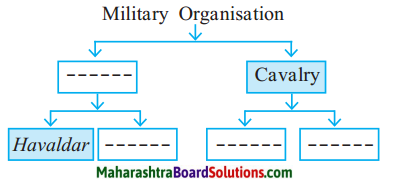
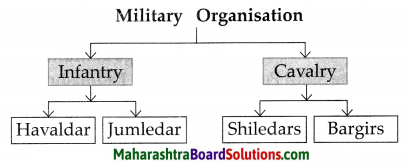
The Expansion of the Maratha Power Question Answer Class 7 History Chapter 10 Maharashtra Board

Balbharti Maharashtra State Board Class 7 History Solutions Chapter 10 The Expansion of the Maratha Power Notes, Textbook Exercise Important Questions and Answers.

Std 7 History Chapter 10 Question Answer The Expansion of the Maratha Power Maharashtra Board

Class 7 History Chapter 10 The Expansion of the Maratha Power Question Answer Maharashtra Board

The Expansion of the Maratha Power Class 7 Questions And Answers

1. Write the meaning:

The Expansion Of The Maratha Power Question Answer  Question 1.
Chauthai.
Answer:
One fourth part of the revenue

The Expansion Of The Maratha Power Question 2.
Sardeshmukhi.
Answer:
One tenth part of the revenue

Maharashtra Board Class 7 History Solutions Chapter 10 The Expansion of the Maratha Power

2. Write the answer in one word:

Class 7 History Chapter 10 The Expansion Of The Maratha Power Question 1.
Balaji was from this town in Konkan.
Answer:
Shrivardhan

The Expansion Of The Maratha Power Class 7 Question 2.
He ruled Bundelkhand.
Answer:
King Chhatrasal

10 The Expansion Of The Maratha Power Question 3.
Bajirao died at this place.
Answer:
Raverkhedi

The Expansion Of The Maratha Power Answer Question 4.
He defeated the Portuguese.
Answer:
Chimajiappa

3. Write about them in your own words:

10. The Expansion Of The Maratha Power Question 1.
KanhojiAngre
Answer:

  • Kanhoji Angre was the chief of the Maratha Navy.
  • He choose Maharani Tarabai’s side.
  • He attacked areas which belong to Shahu Maharaj.
  • Shahu Maharaj appointed Balaji as Peshwa.
  • Balaji was sent against Kanhoji.
  • Balaji diplomatically turned Kanhoji towards Shahu Maharaj’s side.

Maharashtra Board Class 7 History Solutions Chapter 10 The Expansion of the Maratha Power

Question 2.
The Battle of Palkhed
Answer:

  • Mughal Emperor Farukhsear appointed Nijam-ul-Mulk as the Subhedar of Deccan.
  • The Emperor gave Marathas the right to collect chauthai, Sardeshmukhi from the Mughals.
  • The Nizam was against it.
  • Bajirao decided to attack the Nizam and he defeated Nizam at Palkhed near Aurangabad.

Question 3.
Balaji Vishwanath:
Answer:

  • Balaji Vishwanath was a prominent Maratha Sardar.
  • He hailed from Shrivardhan, a town in Konkan.
  • He was industrious and experienced.
  • He convinced many Sardars to join hands with Shahu Maharaj.
  • Kanhoji Angre, the chief of the Maratha Navy was against Shahu Maharaj and sided with Maharani Tarabai.
  • He was sent against Kanhoji.
  • Balaji avoided the war and diplomatically turned Kanhoji towards Shahu Maharaj’s side.

Question 4.
Bajirao I
Answer:
(i) After the death of Balaji Vishwanath, Shahu Maharaj made Bajirao I Peshwa in CE1720.

(ii) He expanded the Maratha Empire during his tenure of 20 years.

(iii) Nizam, the Subhedar of Deccan did not allow the Marathas the right to collect chauthai and sardeshmukhi.

(iv) Bajirao attacked Nizam and defeated him at Palkhed near Aurangabad.

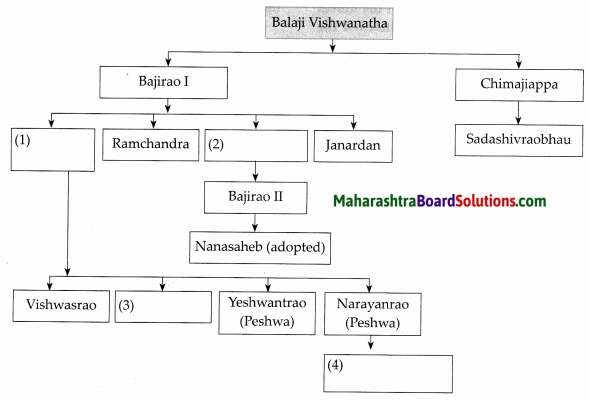
(v) Under the leadership of his brother Chimajiappa. Bajirao sent Malharrao Holkar,: Ranoji Shinde and Udaji Pawar to strengthen the position of the Marathas in Malwa.

(vi) Mughal Subhedar Mohammad Khan Bangush attacked on Bundelkhand. The king of Bundelkhand, Chhatrasal requested Bajirao to help him.

(vii) Bajirao defeated Bangush. The King Chhatrasal honoured Bajirao on large scale.

Maharashtra Board Class 7 History Solutions Chapter 10 The Expansion of the Maratha Power

4. Give reasons:

Question 1.
Two separate Maratha States were formed.
Answer:
(i) There was a battle between Shahu Maharaj and Maharani Tarabai for the throne/gadi.

(ii) Shahu Maharaj won the battle and captured Satara.

(iii) He got himself crowned and Satara became the capital of the Maratha kingdom.

(iv) In 1710, Maharani Tarabai declared her minor son Shivaji II as Chhatrapati at Panhalgad. Since then, a separate state of Kolhapur apart from Satara state came into existence in the Maratha Empire.

Question 2.
Azamshah released Chattrapati Shahu Maharaj from his custody.
Answer:
(i) Azamshah thought that if he released Shahu Maharaj from his custody, then there will be a fight between Maharani Tarabai and Shahu Maharaj for the throne of Chhatrapati.

(ii) The Maratha power will become weak and therefore Azamshah released Chhatrapati Shahu Maharaj from his custody.

Question 3.
Delhi Darbar needed the help of the Marathas.
Answer:
(i) The Mughal Empire was threatened by the north-west Irani and Afgani attacks.

(ii) Local kings like Pathans, Rajputs, Jats and Rohilas also posed a threat for them.

(iii) The internal competition and tussle in die court also weakened the Mughal powers. Hence, Delhi Darbar needed the help Marathas.

Activity:

Get a biography of Maharani Tarabai and present an inspiring event in her life.

Maharashtra Board Class 7 History Solutions Chapter 10 The Expansion of the Maratha Power

Class 7 History Chapter 10 The Expansion of the Maratha Power Additional Important Questions and Answers

Complete the sentence by choosing the appropriate word from the options given below:

Question 1.
Chhatrapati Shahu Maharaj had got himself crowned at _______.(Pune, Satara, Malwa)
Answer:
Satara

Question 2.
At the time of Aurangzeb’s death, Shahajada _______ was in the south. (Azamshah, Aurangzeb, Farukhsear)
Answer:
Azamshah

Question 3.
Maharani Tarabai declared her minor son as Chhatrapati _______ at Panhala. (Shivaji II, Savai, Madhavrao)
Answer:
Shivaji II

Question 4.
_______ became the Subhedar of the Deccan. (Nijam-ul-Mulk, Farukhsear, Madhavrao)
Answer:
Nijam-ul-Mulk

Question 5.
Bajirao sent his brother ________ to subdue the Portuguese. (Chimajiappa, Malharrao Holkar, Ranoji Shinde)
Answer:
Chimajiappa

Question 6.
Bajirao defeated _________ of Bundelkhand. (Bangush, Nadir Shah, Farukhsear)
Answer:
Bangush

Question 7.
When Kanhoji Angre attacked Shahu Maharaj, he sent ______ against Kanhoji Angre. (Balaji Vishwanath, Bajirao, Shahu Maharaj)
Answer:
Balaji Vishwanath

Maharashtra Board Class 7 History Solutions Chapter 10 The Expansion of the Maratha Power

Question 8.
After the death of Balaji Vishwanath, Shahu Maharaj made ________ as the Peshwa. (Chimajiappa, Bajirao I, Udaji Pawar)
Answer:
Bajirao I

Question 9.
Iran’s Emperor ___________ attack on India. (Nadirshah, Abdulla (Hassan), Hussein Ali)
Answer:
Nadirshah

Question 10.
After the death of Aurangzeb ________ and ______ dominated the Mughal Court.(Abdulla (Hasan), Hussein Ali, Nijam-Ul-Mulk)
Answer:
Abdulla (Hasan) and Hussein Ali

Question 11.
After the death of Emperor Aurangzeb the fight for __________ started between his sons. (Delhi’s throne, Chauthai-Sardeshmukhi, Subhedar of Deccan)
Answer:
Delhi’s throne

Question 12.
Prince Shahu was in the custody of _________ (Maharani Tarabai, Azamshah, Bahadur Shah)
Answer:
Azamshah

Question 13.
_______ became the capital of Maratha kingdom. (Satara, Kolhapur, Pune)
Answer:
Satara

Question 14.
__________was the chief of the Maratha Navy. (Balaji, Vishwanath, Kanhoji Angre, Bajirao I)
Answer:
Kanhoji Angre

Question 15.
Bajirao took his last breath at _______ (Raverkhedi, Bhopal, Palkhed)
Answer:
Raverkhedi

Question 16.
________ established the Maratha domination in North India by his bravery.
(Chimajiappa, Bajirao, King Chhatrasal)
Answer:
Bajirao

Match the following:

Question 1.

Column ‘A’ Column ‘B’
(1) Shahu Maharaj

(2)Shivaji II

(3) Nijam-ul-Mulk

(4) Nadir Shah

(a)  Iran’s Emperor

(b)  Satara

(c) Panhalgad

(d)  Subhedar of Deccan

Answer:
1 – b
2 – c
3 – a
4 – d

Maharashtra Board Class 7 History Solutions Chapter 10 The Expansion of the Maratha Power

Question 2.

Column ‘A’ Column ‘B’
(1) King Chhatrasal

(2)The Battle of Bhopal

(3) Chauthai

(4) Sardeshmukhi

(a)     One fourth part of the income

(b)     Bundelkhand

(c)     Bajirao

(d)     One tenth part of the income.

Answer:
1 – b
2 – d
3 – a
4 – c

Explain the meanings of:

Question 1.
Subhedar.
Answer:
Historical rank in the army

Question 2.
Sanad.
Answer:
Authority

Write the answer in one word:

Question 1.
These places were under Portuguese rule.
Answer:
Vasai and Thane

Question 2.
The Emperor of Iran who invaded India.
Answer:
Nadir Shah

Question 3.
He was the chief of the Maratha Navy.
Answer:
KanhojiAngre

Question 4.
He was a great warrior.
Answer:
Bajirao

Maharashtra Board Class 7 History Solutions Chapter 10 The Expansion of the Maratha Power

Question 5.
He was the first Peshwa.
Answer:
Balaji Vishwanath

Question 6.
The second Peshwa.
Answer:
Bajirao

Question 7.
Aurangzeb’s son.
Answer:
Shahajada Azamshah

Question 8.
Tarabai proclaimed her younger son as.
Answer:
Chhatrapati Shivaji II

Answer the following in one sentences:

Question 1.
Who was in the custody of Azamshah?
Answer:
Prince Shahu was in the custody of Azamshah.

Question 2.
What was the new political policy of Marathas?
Answer:
The new political policy of the Marathas was to protect and expand their own Empire instead of fighting with Mughal powers.

Question 3.
What had weakened the Mughal powers?
Answer:
The threat from local kings, internal competition and tussle in the court weakened the Mughal powers.

Question 4.
Who was Kanhoji Angre?
Answer:
Kanhoji Angre was the Chief of the Maratha Navy.

Question 5.
With whose help did Balaji receive the authority to recover Chauthai and Sardeshmukhi?
Answer:
With the help of Sayyid brothers, Abdulla (Hassan) and Hussein Ali, Balaji received the authority to recover Chauthai and Sardeshmukhi.

Question 6.
Whom did Bajirao send to Malwa to strengthen the position of the Marathas?
Answer:
Bajirao sent Malharrao Holkar, Ranoji Shinde and Udaji Pawar under the leadership of his x brother Chimajiappa to Malwa to strengthen the position of Marathas.

Maharashtra Board Class 7 History Solutions Chapter 10 The Expansion of the Maratha Power

Question 7.
Whose help did King Chhatrasal seek to protect his kingdom Bundelkhand.
Answer:
The King Chhatrasal requested Bajirao to protect his kingdom Bundelkhand.

Question 8.
Which parts from Konkan coastal area were under Portuguese rule?
Answer:
Vasai and Thane from Konkan coastal area were under Portuguese rule.

Question 9.
Whom did Bajirao send to defeat Portuguese? ‘
Answer:
Bajirao sent his brother Chimajiappa to defeat the Portuguese.

Question 10.
What rights did Balaji get from the Mughal Emperor?
Answer:
Balaji got from the Mughal Emperor the sanads to collect Chauthai and Sardeshmukhi

Question 11.
Why did Chhatrasal ask Balaji for help?
Answer:
Mohammad Khan Bangush, the Mughal Subhedar of Allahabad attacked Bundelkhand and defeated Chhatrasal. So, Chhatrasal asked Balaji for help.

Question 12.
Where did Bajirao defeat the Nizam?
Answer:
Bajirao defeated the Nizam at Palkhed near Aurangabad.

Question 13.
What were the great qualities of Bajirao?
Answer:
Bajirao was a great warrior, a powerful ruler who established the Maratha dominance in North.

Maharashtra Board Class 7 History Solutions Chapter 10 The Expansion of the Maratha Power

Write notes on the following:

Question 1.
The Battle of Bhopal
Answer:

  • The emperor became restless due to Bajirao’s attack.
  • He called the Nizam to protect Delhi.
  • The Nizam attacked Bajirao with his large army.
  • Bajirao defeated him at Bhopal.
  • The Nizam agreed to secure the sanad of Malwa subhedari to Marathas from the Badshah.

Give explanations for the following:

Question 1.
Portuguese.
Answer:

  • Vasai and Thane from Konkan coastal area were under Portuguese rule.
  • Portuguese rulers used to exploit people.

Question 2.
King Chhatrasal requested Bajirao for help.
Answer:

  • King Chhatrasal established his own kingdom in Bundelkhand.
  • Mughal Subhedar Mohammad Khari Bangush attacked Bundelkhand and defeated king Chhatrasal.
  • Hence, King Chhatrasal requested Bajirao for help.

Question 3.
Shahu Maharaj knew the integrities of the Mughals.
Answer:

  • The early part of Shahu Maharaj’s life was spent in Mughal camps.
  • He has seen Mughal politics from close quarters.
  • He was aware of the strong and weak points of the Mughal empire very well.
  • He also knew some influential people in Mughal Darbar.
  • All these factors helped him in the changing circumstances to decide the new direction for Maratha politics.

Answer the following in short:

Question 1.
How did Balaji Vishwanath turned Kanhoji towards the side of Shahu Maharaj?
Answer:

  • Kanhoji Angre was the chief of the Maratha Navy.
  • He chose Maharani Tarabai’s side.
  • He attacked areas which belonged to Shahu Maharaj.
  • Shahu Maharaj sent Balaji Vishwanath against Kanhoji.
  • Balaji avoided the war and won Kanhoji towards the side of Shahu Maharaj.

Maharashtra Board Class 7 History Solutions Chapter 10 The Expansion of the Maratha Power

Question 2.
Why did Bajirao decide to attack Delhi?
Answer:

  • The Marathas established their supremacy in Malwa and Bundelkhand.
  • Bajirao demanded Malwa Subhedari from the Badshah (Emperor).
  • The Emperor rejected his demand Hence Bajirao decided to attack Delhi.

7th Std History Questions And Answers:

The Maratha War of Independence Question Answer Class 7 History Chapter 9 Maharashtra Board

Balbharti Maharashtra State Board Class 7 History Solutions Chapter 9 The Maratha War of Independence Notes, Textbook Exercise Important Questions and Answers.

Std 7 History Chapter 9 Question Answer The Maratha War of Independence Maharashtra Board

Class 7 History Chapter 9 The Maratha War of Independence Question Answer Maharashtra Board

The Maratha War of Independence Class 7 Questions And Answers

1. Choose the correct option:

The Maratha War Of Independence Class 7 Question 1.
Aurangzeb was annoyed by his bravery.
(a) Shahajada Akbar
(b) Chhatrapati Shivaji Maharaj
(c) Chhatrapati Rajaram Maharaj
Answer:
(b) Chhatrapati Shivaji Maharaj

Maharashtra Board Class 7 History Solutions Chapter 9 The Maratha War of Independence

The Maratha War Of Independence Question Answer Question 2.
These decamped with the golden pinnacle from the Emperor’s tent.
(a) Santaji and Dhanaji
(b) Santaji Ghorpade and Vithoji Chavan
(c) Khando Ballal and Rupaji Bhosale
Answer:
(b) Santaji Ghorpade and Vithoji Chavan

Std 7 History Chapter 9 The Maratha War Of Independence Question 3.
He fought very bravely in the Goa battle.
(a) Yesaji Kank
(b) Nemaji Shinde
(c) Pralhad Niraji
Answer:
(a) Yesaji Kank

2. Find in the text in the lesson and write answers:

Class 7 History Chapter 9 The Maratha War Of Independence Question 1.
Why did Sambhaji Maharaj return halfway from the Janjira campaign? ‘
Answer:
(a) Sambhaji Maharaj started a campaign against the Siddi of Janjira in 1682 CE.
(b) The Marathas laid siege to Siddi’s Dandarajpuri and battered the fort of Janjira with the artillery.
(c) But on the other hand, the Mughal army invaded Swaraj. Hence Sambhaji Maharaj returned halfway from the Janjira campaign to protect/defend his kingdom.

Maharashtra Board Class 7 History Solutions Chapter 9 The Maratha War of Independence

9 The Maratha War Of Independence Question 2.
Why did Sambhaji Maharaj decide to teach a lesson to the Portuguese?
Answer:
The Portuguese of Goa joined hands with the Emperor against Sambhaji Maharaj so ) the Maharaj decided to teach a lesson to the Portuguese.

The Maratha War Of Independence Question 3.
While going to Jinji, Rajaram Maharaj left the responsibility of protecting Swaraj to whom?
Answer:
While going to Jinji, Rajaram Maharaj had assigned the duty to protect Swaraj to Ramchandrapant, Amatya, Shankaraji, Narayan Sachiv, Santaji Ghorpade and Dhanaji Jadhav.

9 The Maratha War Of Independence Class 7 Question 4.
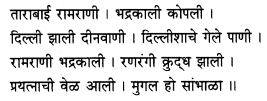
Devdatta has described Maharani Tarabai’s Valour in which words?
Answer:
Devdatta has described Maharani Tarabai’s valour in his Marathi poem:

Maharashtra Board Class 7 History Solutions Chapter 9 The Maratha War of Independence 3

3. Give reasons:

Question 1.
Aurangzeb turned his aim towards Adilshahi and Qutubshahi Kingdom.
Answer:
(a) Aurangzeb was not able to succeed his campaign against the Marathas.
(b) Therefore he suspended the campaign and turned his aim towards Adilshahi and Kutubshahi states.

Question 2.
After the death of Sambhaji Maharaj, the Marathas intensified their war with the Mughals.
Answer:
(a) Sambhaji Maharaj was brutally put to death by Aurangzeb.
(b) The Marathas took inspiration from his sacrifice and intensified their fight against the Mughals.

Question 3.
It was decided that the Raigad fort should be fought under the leadership of Maharani Yesubai.
Answer:
(a) Zulfikarkhan put Raigad under siege.
(b) Rajaram Maharaj and his wife Maharani Tarabai, Sambhaji Maharaj’s wife, Maharani Yesubai and his son Shahu were in Raigad.
(c) It was very risky for all members of the royal family to stay at one place.
(d) It was decided that Rajaram should escape from Raigad and the fight to defend Raigad would continue under the leadership of Maharani Yesubai.

Activity:

Show Goa, Bijapur, Golconda, Jinji, Ahmadabad and Ahmednagar on a map of India.

Class 7 History Chapter 9 The Maratha War of Independence Additional Important Questions and Answers

Choose the correct option:

Question 1.
Akbar sought shelter with –
(a) Sambhaji Maharaj
(b) Mukarrab Khan
(c) Rajaram Maharaj
Answer:
Sambhaji Maharaj

Maharashtra Board Class 7 History Solutions Chapter 9 The Maratha War of Independence

Question 2.
Aurangzeb died in 1707 at –
(a) Kolhapur
(b) Janjira
(c) Ahmadnagar
Answer:
Ahmadnagar

Arrange the events chronologically:

  • Aurangzeb died at Ahmadnagar.
  • Sambhaji Maharaj was put to death.
  • Rajaram Maharaj escaped from Raigad fort.
  • Aurangzeb descended to the South.
  • Maharani Yesubai and Shahu put under arrest.

Answer:

  • Aurangzeb descended to the South.
  • Sambhaji Maharaj was put to death.
  • Rajaram Maharaj escaped from Raigad fort.
  • Maharani Yesubai and Shahu put under arrest.
  • Aurangzeb died at Ahmadnagar.

Write the meaning of:

Question 1.
Artillery
Answer:
The army unit that uses big guns with big barrels.

Question 2.
Killedar / Kiledar
Answer:
In charge of the fort.

Question 3.
Guerilla tactics
Answer:
The use of surprise raids hit and run by the army and repetitive attacks on the enemy.

Find from the text and write the answers:

Question 1.
Who took away the golden pinnacle from the Emperor’s own tent?
Answer:
(a) Santaji Ghorpade
(b) Vithoji Chavan

Maharashtra Board Class 7 History Solutions Chapter 9 The Maratha War of Independence

Question 2.
Name the faithful Sardars of Raj aram Maharaj who joined him in the Jinji campaign.
Answer:
(a) Pralhad Niraji
(b) Khando Ballal
(c) Rupaji Bhosale.

Question 3.
What was Tarabai’s warfare method called?
Answer:
Tarabai’s warfare method was called ‘Safe deposit locker system’.

Question 4.
How did Aurangzeb entice many Maratha Sardars on his side?
Answer:
Aurangzeb enticed many Maratha Sardars on his side by giving them watans and jagirs.

Question 5.
Why was it decided that Rajaram Maharaj should escape from Raigad and go to Jinji?
Answer:
(a) The Jinji fort was far off in the south and was invincible.
(b) It was not an easy task for the Mughals to capture this fort.
Hence Rajaram escaped from Raigad and went to Jinji.

Question 6.
How does Khafikhan describe Maharani Tarabai?
Answer:
Khafikhan described Maharani Tarabai in the following words “She is intelligent and wise. She became very famous for her management of army and administration even during the rule of her husband”.

Question 7.
When was the sign of the tilting of the balance to the other end seen?
Answer:
It was when trusted Sardars like Krishnaji Sawant, Khanderao Dabhada, Dhanaji Jadhav and Nemaji Shinde started the battles on various fronts against the Mughals outside Maharashtra which gave a sign of the tilting of the balance to the other end.

Maharashtra Board Class 7 History Solutions Chapter 9 The Maratha War of Independence

Find out and write:

Question 1.
They were in the forefront to invade Mughal territories.
Answer:
Santaji and Dhanaji

Question 2.
He died in March 1700.
Answer:
Rajaram Maharaj

Question 3.
He rebelled against his father and sought shelter with Sambhaji Maharaj.
Answer:
Prince Akbar

Question 4.
The Incharge of the Kolhapur province.
Answer:
Mukarrabkhan

Question 5.
The Great Maratha soldier of whom the Mughal soldiers were scared of.
Answer:
Dhanaji

Question 6.
The Historian Riyasatkar G.S. Sardesai described Rajaram Maharaj as.
Answer:
‘Sthirbuddhi’ (Level Headed)

Maharashtra Board Class 7 History Solutions Chapter 9 The Maratha War of Independence

Give reasons:

Question 1.
Sambhaji Maharaj had to abandon the Janjira campaign and turn back.
Answer:

  • Sambhaji Maharaj started a campaign against Siddi in 1682 CE.
  • His army laid a siege to Dandarajpuri fort and battered the fort of Janjira with the artillery.
  • But at the same time, the Mughal army invaded Swaraj.
  • Sambhaji Maharaj had to abandon the Janjira campaign and turn back.

Question 2.
Noted historian Riyasatkar G.S. Sardesai has described Rajaram Maharaj by using the adjective ‘Sthirbuddhi’. (Level Headed)
Answer:

  • Rajaram Maharaj was thoughtful and kind- hearted.
  • He brought together all the capable people in the Maratha empire.
  • He united them and thus created a new enthusiasm amongst them.
  • After the death of Sambhaji Maharaj, he fought against Aurangzeb for 11 years with great courage and tenacity.
  • Rajaram Maharaj’s greatest achievement is that he protected Swaraj in those extremely difficult times.

Question 3.
The Eighteenth century is known as the Maratha Century.
Answer:

  • After the death of Aurangzeb, not only did the Marathas filled the vacuum in the political arena, but also lead the political affairs.
  • They ruled over Delhi’s throne and almost all parts of Hindustan and also protected it.
  • Due to sequence of events, the 18th century is known as the ‘Maratha Century’.

Maharashtra Board Class 7 History Solutions Chapter 9 The Maratha War of Independence

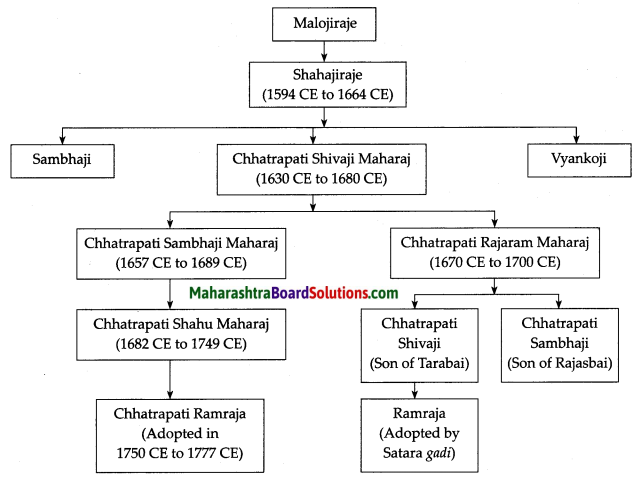
Complete the following flow chart:

The lineage of the Bhosale family.
Maharashtra Board Class 7 History Solutions Chapter 9 The Maratha War of Independence 2
Answer:
Maharashtra Board Class 7 History Solutions Chapter 9 The Maratha War of Independence 1

7th Std History Questions And Answers:

Rocks and Rock Types Question Answer Class 6 Geography Chapter 7 Maharashtra Board

Balbharti Maharashtra State Board Class 6 Geography Solutions Chapter 7 Rocks and Rock Types Notes, Textbook Exercise Important Questions and Answers.

Std 6 Geography Chapter 7 Question Answer Rocks and Rock Types Maharashtra Board

Class 6 Geography Chapter 7 Rocks and Rock Types Question Answer Maharashtra Board

Rocks and Rock Types Class 6 Questions And Answers

B. Which of the following monuments are built in igneous rock?
(1) The Taj Mahal
(2) Fort Raigad
(3) The Red Fort
(4) Ellora Sculpture
Answer:
Ellora Sculpture

Maharashtra Board Class 6 Geography Solutions Chapter 7 Rocks and Rock Types

C. Find the differences between:

Question 1.
Igneous and sedimentary rocks
Answer:

Igneous rocks Sedimentary rocks
(i) Igneous rocks are rocks formed by cooling and solidifying of molten materials.

(ii) Igneous rocks are hard and homogeneous.

(iii)  Examples: Basalt, pumice

(i) Rocks that are formed through deposition and compaction of sediments, especially rock particles transported by rivers, glaciers, wind, etc., are called sedimentary rocks.
(ii) Sedimentary rocks are generally brittle and light weight.
(iii) Examples: Sandstone, limestone, shale, corals

Question 2.
Sedimentary and metamorphic rocks
Answer:

Sedimentary rocks Metamorphic rocks
(i) Rocks that are formed through deposition and compaction of sediments, especially rock particles transported by rivers, glaciers, wind, etc., are called sedimentary rocks. (i) Rocks are formed due to the process of metamorphosis are called metamorphic rocks.
(ii) One may find fossils in sedimentary rocks.

(iii) Sedimentary rocks are brittle and light weight. Examples: Shale, corals

(ii) Metamorphic rocks do not contain fossils.

(iii) Metamorphic rocks are heavy and hard. Examples: Marble, slate

Question 3.
Igneous and metamorphic rocks
Answer:

igneous rocks Metamorphic rocks
(i) Igneous rocks are rocks formed by cooling and solidifying of molten material.
(ii) Igneous rocks are hard and homogeneous.
(iii) Examples: Basalt, pumice
(i) Rocks formed due to the process of metamorphosis are called metamorphic rocks.
(ii) Metamorphic rocks are heavy and hard.
(iii) Examples: Gneiss, slate

D. Which types of rocks are predominantly found at the following locations?
(1) Central Maharashtra
(2) South Konkan
(3) Vidarbha
Answer:

Locations Types of rocks
(1) Central Maharashtra (a) Basalt
(2) South Konkan (b) Laterite and granite
(3) Vidharbha (c) Basalt, granite and sedimentary rocks

Activity:

Collect rock specimens from your surroundings and also during your travels. Classify them with the help of your teacher. Make a small museum of rocks for your school and place your specimens there. Keep a note of the place from where you have collected them. (See a specimen
display on page 65.)

Visit the historical sites in your surroundings, e.g., hill forts, masonry dams, land forts, bastions, wadas, temples, mosques, etc. and observe with the help of your teacher, the rock used for their construction.

Maharashtra Board Class 6 Geography Solutions Chapter 7 Rocks and Rock Types

Class 6 Geography Chapter 7 Rocks and Rock Types InText Questions and Answers

Do it yourself!

From the hills, river-beds or the land in your vicinity, collect rock specimens of different types, shapes, colours, etc. Observe the rock specimens and note down the following.

Question 1.
Place where the rock was found:
Answer:
Sahyadri mountain (Basalt)

Question 2.
Colours of the rock:
Answer:
Dark-black colour.

Question 3.
Spots on the rock and their colour:
Answer:
Dark grey to black.

Question 4.
Weight of the rock (estimated, heavy/light):
Answer:
Heavy.

Question 5.
Hardness of the rock, (hard/ brittle/medium):
Answer:
Hard.

Question 6.
Structure of the rock, (uniform grains/layers/ hollowness):
Answer:
Uniform grains.

Question 7.
Porosity of the rock, (porous/non-porous):
Answer:
Non-porous.

Maharashtra Board Class 6 Geography Solutions Chapter 7 Rocks and Rock Types

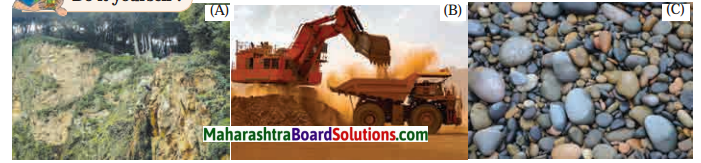
Observe the pictures given below and answer the questions:

Maharashtra Board Class 6 Geography Solutions Chapter 7 Rocks and Rock Types 1
Question 1.
What is the hill in ‘A’ made up of?
Answer:
Hill in ‘A’ is made up of soils and rocks.

Question 2.
What is being done in B’?
Answer:
In ’B’, the process of digging is shown. The land is dug and the rocks and soil that is extracted is loaded in to a truck.

Question 3.
What do we see in ‘C’?
Answer:
In ‘C’ we see pebbles and rocks of different types, shapes, colours, etc.

Question 4.
Is there any relationship between the three things shown above?
Answer:
Yes, these are all pictures of naturally occurring processes on land leading to rock and soil formation.

Question 5.
For what purpose do we use the things shown in A and C?
Answer:
We use things shown in A and C for construction purposes; coloured pebbles are used for decoration.

Use your brain power!

Question 1.
What rock was used for building the forts in Maharashtra? Why?
Answer:
Igneous rocks were used for building the forts in Maharashtra as they are hard, homogeneous and heavy.

Question 2.
Find the meaning of this line from a famous Marathi poem:
राकट देशा, कणखर देशा. दगडांच्या देशा
Answer:
The poet through this line conveys the message that our land is made up of hard rocks. We are a powerful entity and nothing can pose a threat to our Motherland. We can understand all odds.

Similarly like our terrains which are strong, the people of our country are also strong and invincible, incapable of being conquered.
We have imbibed the value of resilience and courage and the ability to withstand all challenges from our terrain.

Maharashtra Board Class 6 Geography Solutions Chapter 7 Rocks and Rock Types

What will you do?

Ajit is interested in sculpting. He wants to prepare a sculpture of Dr. APJ Abdul Kalam.
He cannot decide which rock he should use for this, igneous, sedimentary or metamorphic? What will be your advice?
Answer:
I would advise him to use a metamorphic rock like marble. Due to the translucent nature of the marble, it will give the sculpture a glow. Properties like softness and easy availability makes the metamorphic rock, marble an ideal choice. These rocks are heavy and hard. Hence, they are ideal for making sculptures.

Class 6 Geography Chapter 7 Rocks and Rock Types Additional Important Questions and Answers

Fill in the blanks choosing the correct options from the bracket:

Question 1.
Rocks are a mixture of different minerals formed by natural processes in the _____. (lithosphere, atmosphere, hydrosphere)
Answer:
lithosphere

Question 2.
There are ______ types of rocks according to their formation process. (four, three, five)
Answer:
three

Question 3.
When the molten material, known as magma within the crust and lava on the surface, cools down, it solidifies giving rise to ____ rocks. (Sedimentary, Igneous, Metamorphic)
Answer:
Igneous

Question 4.
We get fossils in ______ rocks. (Sedimentary, Igneous, Metamorphic)
Answer:
Sedimentary

Question 5.
The Maharashtra plateau and the Sahyadris are formed out of _______ rocks. (Sedimentary, Igneous, Metamorphic)
Answer:
Igneous

Question 6.
______ is a major example of igneous rocks. (Shale, Basalt, Corals)
Answer:
Basalt

Maharashtra Board Class 6 Geography Solutions Chapter 7 Rocks and Rock Types

Question 7.
Water percolating through rocks dissolves the soluble minerals leading to ________ of rocks, (weathering, compaction, increased porosity)
Answer:
weathering

Question 8.
_______ is a sedimentary rock. (Basalt, Sandstone, Pumice)
Answer:
Sandstone

Question 9.
The study of _______ provide information about life in that period. (metamorphosedrocks, Igneous rocks, fossils)
Answer:
fossils

Question 10.
_______ gets metamorphosed when it undergoes heavy pressure, and intense heat. (Coal,,Peat, Silica)
Answer:
Coal

Question 11.
_______ rock is found in the eastern parts and in South Konkap. (Granite,.Marble,Pumice)
Answer:
Granite

Question 12.
________ activity is concentrated in South Konkan and eastern Maharashtra. (Fishing, Mining, Construction)
Answer:
Mining

Question 13.
_____ is referred to as primary rocks. (Igneous rock, Sedimentary rock, Metamorphic rocks)
Answer:
Igneous rock

Question 14.
________ is a major example of igneous rock. (Basalt, Pumice, Sedimentary)
Answer:
Basalt

Maharashtra Board Class 6 Geography Solutions Chapter 7 Rocks and Rock Types

Question 15.
______ rocks are ‘formed due to compaction of material. (Metamorphic, Sedimentary, Igneous)
Answer:
Sedimentary

Question 16.
_________ rocks are heavy and hard. (Sedimentary, Metamorphic, Igneous)
Answer:
Metamorphic

Question 17.
When coal gets metamorphosed into ______ , its price increases. (garnet, diamond, opal)
Answer:
diamond

Question 18.
______ is found in South Konkan Maharashtra. (Granite, Laterite, Basalt)
Answer:
Laterite

Match the pairs correctly:

Question 1.

Column A Column B
(1) Igneous rocks (a) brittle and light weight
(2) Sedimentary rocks (b) heavy and hard
(3) Metamorphic rocks (c) hard and homogeneous

Answer:
1 – c
2 – a
3 – b

Complete the tabular form:

Original Rock Metamorphosed Rock
Granite _________
Basalt __________
_________ Marble
Coal ___________
Sand Stone __________
_________ Slate

Answer:

Original Rock Metamorphosed Rock
Granite Gneiss
Basalt Amphibolite
Limestone Marble
Coal Diamond
Sand Stone Quartizte
Shale Slate

Maharashtra Board Class 6 Geography Solutions Chapter 7 Rocks and Rock Types

Name the following:

Question 1.
Two major rock-forming minerals:
Answer:
Silica, aluminium.

Question 2.
Hard and homogeneous rocks:
Answer:
Igneous rocks.

Question 3.
Two sedimentary rocks:
Answer:
Shale, corals.

Question 4.
Rocks which does not contain fossils:
Answer:
Metamorphic and Igneous rock

Question 5.
One use of diamonds:
Answer:
Ornament making.

Question 6.
One activity which leads to increased pressure and heat in that region:
Answer:
Volcanic eruption.

Question 7.
Rock found in South Konkan:
Answer:
Laterite.

Question 8.
Rocks that formed by metamorphosis:
Answer:
Metamorphic rocks.

Question 9.
Two metamorphosised rocks:
Answer:
Marble, Slate.

Question 10.
Two igneous rocks:
Answer:
Granite and Basalt.

State whether the following statements are true or false:

Question 1.
The properties of rocks depend on their constituent minerals and their proportion alone.
Answer:
False.

Maharashtra Board Class 6 Geography Solutions Chapter 7 Rocks and Rock Types

Question 2.
Silica is a rock forming mineral.
Answer:
True

Question 3.
One may find fossils in Igneous rocks.
Answer:
False

Question 4.
Weathering of rocks leads to its disintegration or decomposition.
Answer:
True

Question 5.
Sedimentary rocks are hard and homogeneous.
Answer:
False

Question 6.
Maharashtra has large reserves of mineral wealth.
Answer:
False

Question 7.
The Maharashtra plateau and the Sahyadris are formed out of igneous rocks.
Answer:
True

Question 8.
Most of the hill forts in Maharashtra do not have lakes or elephant yards.
Answer:
False

Question 9.
One can easily see layers in the sedimentary rocks.
Answer:
True

Question 10.
Sedimentary rocks are generally heavy weight.
Answer:
False

Question 11.
Metamorphic rocks do not contain fossils.
Answer:
True

Question 12.
Metamorphic rocks are brittle and lightweight.
Answer:
false

Maharashtra Board Class 6 Geography Solutions Chapter 7 Rocks and Rock Types

Answer the following questions in short:

Question 1.
What are rocks?
Answer:
Rocks are a mixture of different minerals formed by natural processes in the lithosphere. Rocks are found on land surface and also below it.

Question 2.
What do the properties of rocks depend on?
Answer:
The properties of rocks depend on the constituent minerals and their proportion as well as on the formation process. Silica, aluminium, magnesium and iron are the major rock-forming minerals.

Question 3.
What are the three types of rocks?
Answer:
Igneous rocks, Sedimentary rocks and Metamorphic rocks are the three types of rocks.

Question 4.
What are Igneous Rocks?
Answer:
When the molten material, known as magma within the crust and lava on the surface cools down, it solidifies giving rise to igneous rocks.

Question 5.
What information does the study of fossils provide?
Answer:
Study of fossils provide information about the life in the olden period.

Question 6.
Write any two characteristics of metamorphic rocks.
Answer:
Metamorphic rocks are heavy and hard.

Question 7.
When does coal get metamorphosed?
Answer:
When coal undergoes heavy pressure and intense heat it gets metamorphosed.

Question 8.
When does the price of coal increase?
Answer:
The price of coal increases when it gets metamorphosed into diamonds.

Maharashtra Board Class 6 Geography Solutions Chapter 7 Rocks and Rock Types

Question 9.
What is referred to as primary rocks?
Answer:
Rocks are formed out of the material from the interior of the earth, these are referred to as primary rocks.

Question 10.
What is called fossils?
Answer:
The buried remains of dead animals or plants embedded in the rocks and preserved petrified form are called fossils.

Give geographical reasons for the following statements:

Question 1.
Igneous rocks are also referred to as primary rocks.
Answer:
As Igneous rocks are formed out of the material from the interior of the earth, these rocks are also referred to as primary rocks.

Question 2.
Most of the hill forts in Maharashtra have lakes or elephant yards.
Answer:
(i) Hillforts in Maharashtra are old quarry sites from which stone or other materials have been extracted for the construction of the fort and other buildings.

(ii) In the pits and dugouts left behind after rock extraction, water was allowed to accumulate and these lakes, banks, etc., were created.

(iii) Therefore, most of the hill forts in Maharashtra have lakes or elephant yards.

Question 3.
Weathering of rocks occurs.
Answer:

  • Due to continuous variations in temperature, rocks develop cracks.
  • Similarly, the water percolating through rocks dissolves the soluble minerals.
  • This leads to the weathering of rocks.

Maharashtra Board Class 6 Geography Solutions Chapter 7 Rocks and Rock Types

Question 4.
One may find fossils in sedimentary rocks.
Answer:

  • One can easily see layers in sedimentary rocks.
  • While layers are getting deposited, the remains of the dead animals or plants get buried in these layers at times.
  • Therefore, one may find fossils in sedimentary rocks.

Question 5.
Changes in nature, as well as the chemical composition of the original rocks, is witnessed.
Answer:

  • Volcanic activity and other earth movements constantly take place on the earth.
  • While these are occurring, the igneous and sedimentary rocks in that region are subjected to tremendous pressure and heat.
  • This leads to changes in nature as well as the chemical composition of the original rocks.

Question 6.
Maharashtra does not have a large reserve of mineral wealth.
Answer:
Maharashtra does not have a large reserve of mineral wealth due to the thick and extensive layers of basalt rocks.

Answer the following questions in detail:

Question 1.
What leads to the development of sedimentary rocks?
Answer:

  • Due to continuous variations in the temperature, rocks develop cracks.
  • Similarly, the water percolating through rocks dissolves the soluble minerals leading to the weathering of rocks.
  • They get disintegrated or decomposed i.e. reduced to pieces.
  • These rock particles get transported by rivers, glaciers, wind, etc. towards low lying area and are deposited there.
  • One after the other, layers of sediments gets deposited in this way.
  • The upper layers exert heavy pressure on the lower layers.
  • This leads to compaction of materials and development of sedimentary rocks.

Question 2.
How are Metamorphic rocks formed?
Answer:

  • Volcanic activity and other earth movements | constantly take place on the earth.
  • While these are occurring, the igneous or sedimentary rocks in that region are subjected to tremendous pressure and heat.
  • This leads to changes in the nature as well as the chemical composition of original rocks.
  • The crystals in the original rock gets recrystalized, the rock gets metamorphosed.
  • The rocks formed through such a process are ! called Metamorphic rocks.

Maharashtra Board Class 6 Geography Solutions Chapter 7 Rocks and Rock Types

Question 3.
How is sand that flows in a river formed? Collect some information about where the sand comes from.
Answer:

  • Moving streams are so powerful that it can wear away soil rocks.
  • Rocks on higher land get eroded due to the strong current of the streams and they in turn get carried away into the sea.
  • Silt too is brought down from the mountain top from where the streams originate.
  • Most of the sand in the river is silt carried by the streams and the weather material from inland rocks transported by the streams.
  • The moving of soil and rock with the stream, termed as erosion can be summed up as the cause of sand formation in a river.

6th Std Geography Questions And Answers:

India before the Times of Shivaji Maharaj Question Answer Class 7 History Chapter 2 Maharashtra Board

Balbharti Maharashtra State Board Class 7 History Solutions Chapter 2 India before the Times of Shivaji Maharaj Notes, Textbook Exercise Important Questions and Answers.

Std 7 History Chapter 2 Question Answer India before the Times of Shivaji Maharaj Maharashtra Board

Class 7 History Chapter 2 India before the Times of Shivaji Maharaj Question Answer Maharashtra Board

India before the Times of Shivaji Maharaj Class 7 Questions And Answers

1. Name the following:

Question 1.
The Queen of Gondvana –
Answer:
Rani Durgavati

Question 2.
The son of Udaysingh –
Answer:
Maharana Pratap

Maharashtra Board Class 7 History Solutions Chapter 2 India before the Times of Shivaji Maharaj

Question 3.
The founder of Mughal dynasty –
Answer:
Babur

Question 4.
The first Sultan of the Bahamani kingdom–
Answer:
Hasan Gangu

Question 5.
The fighting force established by Guru Gobindsingh –
Answer:
Khalsa Dal

2. Find the odd one out:

Question 1.
Sultan Mahmud, Qutubuddin Aibak, Muhammad Ghuri, Babur
Answer:
Sultan Mahmud

Question 2.
Adilshahi, Nizamshahi, Sultanate,Baridshahi
Answer:
Sultanate

Question 3.
Akbar, Humayun, Shershah, Aurangzeb
Answer:
Shershah

Maharashtra Board Class 7 History Solutions Chapter 2 India before the Times of Shivaji Maharaj

3. Answer briefly:

Question 1.
How did the kingdoms of Vijaynagar and Bahamani emerge?
Answer:
(i) During the reign of Sultan Muhammad Tughlaq of Delhi, there were many revolts in the South against the central power of Delhi.
(ii) From these revolts arose the formidable Vijaynagar and Bahamani kingdoms.

Question 2.
What reforms did Mahmud Gawan make?
Answer:
(i) Mahmud Gawan strengthened the Bahamani kingdom.
(ii) He started paying the soldiers their salary in cash instead of through land grants.
(iii) He brought discipline in the army.
(iv) He introduced many reforms in the land revenue system. He opened a Madarsa at Bidar for Arabic and Persian studies.

Question 3.
Why did it become impossible for the Mughals to strengthen their base in Assam?
Answer:
(i) While Aurangzeb ruled, the Ahoms had a prolonged struggle with the Mughals.
(ii) The Mughals attacked the Ahoms’ region.
(iii) The Ahoms united under the leadership of Gadadharsinha. Commander Lachit Borphukan gave an intense battle against the Mughals.
(iv) The Ahoms used the guerilla technique in the conflict against the Mughals.
(v) It became impossible for Mughals to create a strong base in Assam.

4. Write about them briefly in your own words.

Question 1.
Krishnadevaraya
Answer:
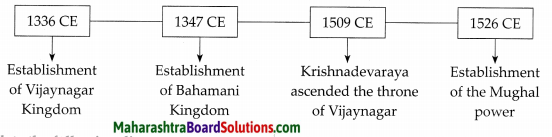
(a) Krishnadevaraya, ascended the throne of Vijaynagar in 1509 CE. He conquered Vijaywada, Rajmahendri and annexed the regions to his kingdom.
(b) He successfully took on the armies of the Sultans who had united under the leadership of the Bahamani Sultan Mahmud Shah.
(c) During his reign the Vijaynagar kingdom extended far and wide.
(d) He built the Hazar Ram temple and Vitthal temple in Vijaynagar.
(e) A scholar he wrote ‘Amuktamalyada’, a Telugu compendium on polity.
(f) Decline of the Vijaynagar kingdom began with his death in the year 1530 CE.

Question 2.
Chandbibi was murdered.
Answer:
(a) Chandbibi, the capable daughter of Husain Nizamshah of Ahmadnagar, bravely defended the fort displaying courage and valour.
(b) At this time, there was an internal strife among the factions of the Sardars in Nizamshahi’s kingdom resulting in the murder of Chandbibi.

Question 3.
Rani Durgavati
Answer:
(a) Rani Durgavati, bom in the dynasty Chandel Rajput became the queen of Gondvana after her marriage.
(b) She was an excellent administrator. Her struggle against the Mughals is important in Medieval history.
(c) After her husband’s death, Durgavati laid down her life but refused to surrender while fighting against Akbar.

5. Give reasons:

Question 1.
The Bahamani Kingdom disintegrated into five fragments.
Answer:
(a) After the death of Mahmud Gawan, factionsim increased among the Bahamani Sardars.
(b) The conflict with the Vijaynagar kingdom had an adverse effect on the Bahamani kingdom.
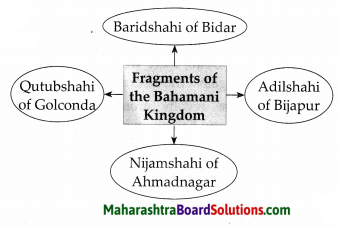
(c) The provincial Governors began to act more independently. This led to the disintegration of the Bahamani kingdom into five small power-Imadshahi of Varhad, Baridshahi of Bidar, Adilshahi of Bijapur, Nizamshahi of Ahmadnagar and Qutubshahi of Golconda.

Maharashtra Board Class 7 History Solutions Chapter 2 India before the Times of Shivaji Maharaj

Question 2.
Rana Sanga’s army was defeated.
Answer:
(a) After the battle of Panipat, Rana Sanga of Mewad brought all Rajput kings together.
(b) There was a battle between Babur and Rana Sanga at Khanua.
(c) Babur’s artillery and reserved force played a key role in this battle and Rana Sanga’s army was defeated.

Question 3.
Rana Pratap has become immortal in history.
Answer:
(a) After the death of Udaysingh, Maharana Pratap ascended the throne of Mewad.
(b) He continued the struggle for Mewad’s existence.
(c) Till the very end he struggled with Akbar to maintain his independence.
(d) He has become immortal in history due to his qualities of valour, courage, self-respect and sacrifice.

Question 4.
Aurangzeb imprisoned Guru Tegh Bahadur.
Answer:
(a) Guru Tegh Bahadur, protested strongly against Aurangzeb’s policy of religious intolerance.
(b) Aurangzeb imprisoned him and beheaded him in 1675.

Question 5.
The Rajputs fought against the Mughals.
Answer:
(a) Akbar had secured the cooperation of the Rajputs with his policy of amicable relations.
(b) Aurangzeb could not obtain the cooperation of Rajputs. After the death of Rana Jaswantsingh of Marwad, Aurangzeb annexed his kingdom to the Mughal empire.
(c) Durgadas Rathod crowned Jaswantsingh’s minor son of Ajitsingh of Marwad.
(d) Durgadas Rathod fought hard against the Mughals and continued his struggle against the Mughals for the existence of Marwad.

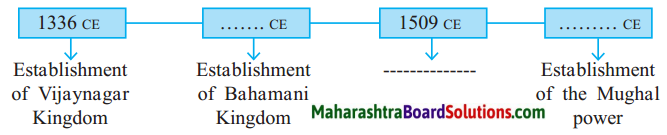
6. Complete the timeline.
Maharashtra Board Class 7 History Solutions Chapter 2 India before the Times of Shivaji Maharaj 1
Answer:
Maharashtra Board Class 7 History Solutions Chapter 2 India before the Times of Shivaji Maharaj 2

7. Using the internet, find out more about any one of the personalities you have studied here, and fill in the box below.
Maharashtra Board Class 7 History Solutions Chapter 2 India before the Times of Shivaji Maharaj 3

Activity

Obtain more information about the personalities mentioned in this chapter.Use reference books, the internet, newspapers, etc. Prepare a collage of the pictures information in your activity book and display it in the history cell.

Class 7 History Chapter 2 India before the Times of Shivaji Maharaj Additional Important Questions and Answers

Complete the sentences by choosing the appropriate words from the options given below:

Question 1.
‘Pal’ in the ______ was a famous dynasty in Bengal. (seventh century, eight century, ninth century)
Answer:
eight century

Question 2.
Prithviraj Chauhan belonged to _______ dynasty. (Rajput dynasty, Chauhan dynasty, Chola dynasty)
Answer:
Chauhan dynasty

Maharashtra Board Class 7 History Solutions Chapter 2 India before the Times of Shivaji Maharaj

Question 3.
The _____ period is considered to be the golden period of Marathi language. (Yadava, Rashtrakuta, Chola)
Answer:
Yadava

Question 4.
In the eleventh Century CE, the _____ began to invade India and reached the north-western frontier of India. (Afghans, Mughals, Turks)
Answer:
Turks

Question 5.
______ was the last Sultan and he was defeated by Babur, bringing the Sultanate to an end. (Muhammad Ghuri, Bulban, Ibrahim Lodi)
Answer:
Ibrahim Lodi

Question 6.
Hampi in today’s ______ was the capital of the kingdom of Vijaynagar. (Kerala, Karnataka, Tamil Nadu)
Answer:
Karnataka

Question 7.
Krishnadevaraya wrote ‘Amuktamalyada’, a Telugu Compendium on _______. (polity, economics, sociology)
Answer:
polity

Question 8.
______ was the first Sultan of the Bahamani kingdom. (Muhammad-bin-Tughlaq, Mahmud Gawan, Hasan Gangu)
Answer:
Hasan Gangu

Question 9.
In ______ the Sultanate of Delhi came to an end. (1526 CE, 1556 CE, 1605 CE)
Answer:
1526 CE

Question 10.
_______ was the Governor of Punjab under the Sultanate. (Babur, Ibrahim Lodi, Daulatkhan Lodi)
Answer:
Daulatkhan Lodi

Question 11.
_______ was the most powerful king of the Mughal dynasty. (Shahajahan, Akbar, Jahangir)
Answer:
Akbar

Question 12.
The struggle of Gondvana queen Durgavati against Mughals is important in ______ history. (modern, medieval, ancient)
Answer:
medieval

Question 13.
______ became the emperor in 1658 CE. (Shahajahan, Aurangzeb, Akbar)
Answer:
Aurangzeb

Question 14.
In the thirteenth century CE, the people of the Shaan community settled down in the valley of river ______. (Ganga, Brahmaputra, Yamuna)
Answer:
Brahmaputra

Question 15.
The ninth Guru of the Sikhs was ______.(Guru Gobind Singh, Guru Tegh Bahadur, Guru Nanak)
Answer:
Guru Tegh Bahadur

Question 16.
______ organised the Sikh youths into a fighting force called Khalsa Dal. (Guru Gobind Singh, Guru Tegh Bahadur, Guru Nanak)
Answer:
Guru Gobind Singh

Maharashtra Board Class 7 History Solutions Chapter 2 India before the Times of Shivaji Maharaj

Question 17.
Akbar had secured the co-operation of the ______ with his policy of amicable relations. (Rajputs, Marathas, Ahoms)
Answer:
Rajputs

Question 18.
In Maharashtra, the ______ Marathas offered stiff resistance to and defended their independence. (Babur, Humayun, Aurangzeb)
Answer:
Aurangzeb

Match the following:

Question 1.

Column ‘A’ Column ‘B’
(1) Imadshahi (a) Bidar
(2) Baridshahi (b) Ahmadnagar
(3) Adilshahi (c) Golconda
(4) Nizamshahi (d) Varhad
(5) Qutubshahi (e) Bijapur

Answer:
1 – d
2 – a
3 – e
4 – b
5 – c

Name the following:

Question 1.
Two important dynasties among the Rajput dynasties in North India.
Answer:
(a) The Gahadwal dynasty
(b) Parmar dynasty

Question 2.
Eminent rulers belonging to the Chola dynasty in Tamil Nadu.
Answer:
(a) Rajaraj I
(b) Rajendra I

Question 3.
The king belonging to the Hoysala dynasty.
Answer:
King Vishnuvardhan

Question 4.
The King who conquered the whole of Karnataka.
Answer:
King Vishnuvardhan

Question 5.
The Varkari movement emerged in
Answer:
The Yadava period

Question 6.
During his reign Rashtrakuta dynasty in Maharashtra the Rashtrakut power spread from Kanauj up to Rameshwar.
Answer:
Govind III

Question 7.
The last prosperous power before the period of Shivaji Maharaj.
Answer:
TheYadavas

Question 8.
The capital of Bhillam V of the Yadava dynasty which was near Aurangabad.
Answer:
Deogiri

Question 9.
The golden period of the Marathi Language.
Answer:
The Yadava period

Maharashtra Board Class 7 History Solutions Chapter 2 India before the Times of Shivaji Maharaj

Question 10.
The Arab General attacked the Sindh province in the eighth century.
Answer:
Muhammad-bin-Qasim

Question 11.
The power which began to invade India in eleventh century CE.
Answer:
The Turks

Question 12.
He invaded India many times and plundered the rich temples at Mathura, Vrindavan Kanauj and Somnath and carried away enormous wealth with him.
Answer:
Sultan Mahmud of Ghazni

Question 13.
In 1775 CE and 1178 CE, the Sultan of Ghur from Afghanistan who invaded India.
Answer:
Muhammad Ghuri

Question 14.
During his reign there were many revolts in the South against the central power of Delhi.
Answer:
Sultan Muhammad-bin-Tughluque

Question 15.
The brothers from South India who were Sardars in the service of Delhi Sultanate.
Answer:
(a) Harihar
(b) Bukka

Question 16.
The Hazar Ram temple and Vitthal temple were built in Vijaynagar during his reign.
Answer:
Krishnadevaraya

Question 17.
He defeated the army of the Sultan of Delhi.
Answer:
Hasan Gangu

Question 18.
The Chief Wazir of the Bahamani kingdom who started paying the soldiers their salaries in cash instead of giving land grants.
Answer:
Mahmud Gawan

Question 19.
The king of Farghana in Central Asia.
Answer:
Babur

Question 20.
After the battle of Panipat, he brought all Rajput kings together.
Answer:
Rana Sanga of Mewad

Question 21.
After ascending the throne of Mewad, he continued the struggle for Mewad’s existence.
Answer:
Maharana Pratap

Question 22.
The capable daughter of Husain Nizamshah of Ahmadn^gar who defended the fort of Ahmadnagar.
Answer:
Chandbibi

Question 23.
The Ahoms united under his leadership.
Answer:
Gadadharsinha

Maharashtra Board Class 7 History Solutions Chapter 2 India before the Times of Shivaji Maharaj

Question 24.
The commander who gave intense battle against the Mughals.
Answer:
Commander Lachit Borphukan

Question 25.
The ninth Guru of Sikhs who protested strongly against Aurangzeb’s policy of religious intolerance.
Answer:
Guru Tegh Bahadur

Question 26.
There was an attempt on the life of Guru Gobind Singh in 1708 CE at this place.
Answer:
Nanded

Question 27.
After his death Aurangzeb annexed his kingdom to the Mughal empire.
Answer:
Rana Jaswantsingh of Marwad.

Question 28.
In Maharashtra, Swaraj was established under his leadership.
Answer:
Shivaji Maharaj

Find out the odd man out:

Question 1.
Gadadharsinha, Rana Jaswantsingh, Durgadas Rathod, Ajit Singh.
Answer:
Gadadharsinha

Question 2.
Babur, Humayun, Krishnadevaraya, Jahangir
Answer:
Krishnadevaraya

Answer in one sentence:

Question 1.
Name the regions upto which the Gurjar- Pratihar power spread.
Answer:
The Gurjar-Pratihar power spread up to Andhra, Kalinga, Vidarbha, West Kathewad, Kanauj and Gujarat.

Question 2.
Which places did the Cholas conquer using their naval strength?
Answer:
The Cholas conquered the Maidive Islands and Sri Lanka using their naval strength.

Question 3.
In which period did the Mahanubhav Panth and the Varkari movement emerge?
Answer:
The Mahanubhav Panth and the Varkari movement emerged in the Yadava period.

Maharashtra Board Class 7 History Solutions Chapter 2 India before the Times of Shivaji Maharaj

Question 4.
Why did the Arab rulers turn towards India?
Answer:
The Arab rulers turned towards India to expand their empire.

Question 5.
Write the extent of the kingdom of Vij aynagar during Krishnadevaraya’s reign?
Answer:
During Krishnadevaraya’s reign, the kingdom of Vijaynagar extended from Cuttack in the east up to Goa in the West and from the Raichur Doab in the North up to the Indian Ocean in the South.

Question 6.
Who opposed Akbar when he tried to bring India under his central authority?
Answer:
When Akbar tried to bring India under his central authority he had to face the opposition of Maharana Pratap, Chandbibi and Rani Durgavati.

Question 7.
Which qualities of Maharana Pratap made him immortal in history?
Answer:
Maharana Pratap became immortal in history due to his qualities of valour, courage, self-respect and sacrifice.

Question 8.
Which regions together formed the Gondvana?
Answer:
Gondvana can be broadly said to comprise the eastern part of Vidarbha, part of Madhya Pradesh to its North, the Western part of today’s Chhattisgarh, Northern part of Andhra Pradesh and Western part of Odisha.

Question 9.
How did the Marathas defend their independence?
Answer:
Marathas offered stiff resistance to Aurangzeb and defended their independence.

Give reasons:

Question 1.
Babur invaded India.
Answer:
(a) The reigning Sultan of Delhi at that time was Ibrahim Lodi.
(b) Daulatkhan Lodi, was the governor of Punjab under the Sultanate.
(c) The relationship between Ibrahim Lodi and Daulatkhan Lodi was strained.
(d) Daulatkhan Lodi invited Babur to march to India. Taking this opportunity, Babur invaded India.

Write briefly in your own words:

Question 1.
The First Battle of Panipat
Answer:
(a) Ibrahim Lodi was the Sultan of Delhi and Daulat Khan Lodi was the Governor of Punjab.
(b) The relationship between Ibrahim Lodi and Daulatkhan Lodi became strained.
(c) Daulatkhan Lodi invited Babur to march on India.
(d) Taking advantage of this opportunity, Babur invaded India.
(e) To repel Babur’s invasion Ibrahim Lodi started with his army.
(f) There was a battle between Ibrahim Lodi and Babur on 21st April 1526 at Panipat.
(g) Babur defeated Ibrahim Lodi’s army. This is known as the First Battle of Panipat.

Maharashtra Board Class 7 History Solutions Chapter 2 India before the Times of Shivaji Maharaj

Answer briefly:

Question 1.
Write in brief about the conflict of the Mughals with the Marathas.
Answer:
(i) In Maharashtra, Sivaraj was established under the leadership of Shivaji Maharaj.
(ii) In his efforts to establish Swaraj, Shivaji Maharaj had to fight the Mughals too along with the other enemies.
(iii) Aurangzeb came down to the Deccan after the death of Chhatrapati Shivaji Maharaj with the intention of conquering the whole of South India.
(iv) But the Marathas offered stiff resistance to Aurangzeb and defended their independence.

Complete the following diagrams:

Question 1.
Maharashtra Board Class 7 History Solutions Chapter 2 India before the Times of Shivaji Maharaj 7
Answer:
Maharashtra Board Class 7 History Solutions Chapter 2 India before the Times of Shivaji Maharaj 4

Question 2.
Maharashtra Board Class 7 History Solutions Chapter 2 India before the Times of Shivaji Maharaj 8
Answer:
Maharashtra Board Class 7 History Solutions Chapter 2 India before the Times of Shivaji Maharaj 5

Maharashtra Board Class 7 History Solutions Chapter 2 India before the Times of Shivaji Maharaj

Complete the following table:

Question 1.

S.No Political Power Founders / Rulers Capital

Answer:

S.No Political Power Founders / Rulers Capital
(1) Yadava Bhillam V Deogiri
(2) Vijaynagar Harihar & Bukka Hampi
(3) Bahamani Hasan Gangu Gulbarga
(4) Mughal Babur Delhi

7th Std History Questions And Answers:

Maharashtra before the Times of Shivaji Maharaj Question Answer Class 7 History Chapter 4 Maharashtra Board

Balbharti Maharashtra State Board Class 7 History Solutions Chapter 4 Maharashtra before the Times of Shivaji Maharaj Notes, Textbook Exercise Important Questions and Answers.

Std 7 History Chapter 4 Question Answer Maharashtra before the Times of Shivaji Maharaj Maharashtra Board

Class 7 History Chapter 4 Maharashtra before the Times of Shivaji Maharaj Question Answer Maharashtra Board

Maharashtra before the Times of Shivaji Maharaj Class 7 Questions And Answers

1. Complete the following chart:

Question 1.

Village (Mauja) Kasba Pargana
What it means ……… …………. ………….
Officers …………….. …………….. ……………..
Example ……….. ………….. …………….

Answer:

Village (Mauja) Kasba Pargana
What it means A small village A big village Group of Villages
Officers Patil Kulkarni The Shete
The Mahajan
The Deshmukh
TheDeshpande
Example Bavdhan Wai Kasba of Wai Pargana The Pune Paragana

2. Write the meaning:

Maharashtra Before The Time Of Shivaji Maharaj Question Answer Question 1.
Budruk
Answer:
(i) ‘Badruk’ is a suffix added to the name of the village, which indicated that the village was independent.
(ii) The original town was called Budruk.
(iii) Example: Vadgaon Budruk.

Maharashtra Before Shivaji Question 2.
Baluta
Answer:
(i) A share of the agricultural produce paid by peasants to the artisans for their services to the villagers.
(ii) This share was known as Baluta.

Maharashtra Board Class 7 History Solutions Chapter 4 Maharashtra before the Times of Shivaji Maharaj

Maharashtra Before The Times Of Shivaji Maharaj Question 3.
Vatan
Answer:
Vatan is an Arabic word. In Maharashtra it is used to refer to hereditary land to which the holder does not have to pay revenue.

3. Find out and write:

Maharashtra Before Shivaji Maharaj Question 1.
People from Africa who had settled along the Konkan coastline –
Answer:
Siddi

Maharashtra Before Shivaji Question Answer Question 2.
The author of ‘Amrutanubhav’ –
Answer:
Sant Dnyaneshwar

Maharashtra Before Shivaji, Question And Answer Question 3.
The place where Sant Tukaram belonged to –
Answer:
Dehu near Pune

Question 4.
He composed Bharuds –
Answer:
Sant Eknath

Question 5.
He explained the importance of physical fitness
Answer:
Sant Ramdas

Question 6.
Women Sants –
Answer:
Sant Soyrabai, Sant Nirmalabai, Sant Muktabai, Sant Janabai

Maharashtra Board Class 7 History Solutions Chapter 4 Maharashtra before the Times of Shivaji Maharaj

4. Write about these personalities and their work in your own words:

Question 1.
Sant Namdeo
Answer:

  • Sant Namdeo was a great saint of the Varkari movement.
  • He awakened the sense of equality in men and women belonging to all castes through the medium of his excellent Keertan.
  • His abhanga compositions are well-known.
  • He travelled to Punjab and propagated his thoughts.
  • His compositions are included in the ‘Guru Grant Sahib’ of the Sikhs.
  • He propagated the message of Bhagwat religion (from village to village) in all quarters.

Question 2.
Sant Dnyaneshwar
Answer:

  • Sant Dnyaneshwar wrote the ‘Bhavartha- deepika’ or ‘Dnyaneshwari’.
  • He also composed Amrutanubhav.
  • He showed a simple way of worship and conduct which the common people could follow easily.
  • His ‘Pasayadaan in Dnyaneshwari uplifts the mind.

Question 3.
Sant Eknath
Answer:

  • His compositions include abhanga, gavalana, bharud, etc.
  • He had stated the Bhagvat Dharma in detail in a simple manner.
  • His abhangas show the warmth of devotion.
  • He presented people’s life in Bhavarth Ramayana.
  • He believed that the Marathi language was inferior to no other language.

Question 4.
Sant Tukaram
Answer:

  • Sant Tukaram belonged to Dehu near Pune.
  • His compositions or abhangas are very pleasing and lucid, reaching the greatest poetic heights.
  • His ‘Gatha’ is a precious treasure of the Marathi language.
  • He freed many poor families from the bonds of loan.
  • He criticized the prevalent hypocrisy and superstitions in the society.

Maharashtra Board Class 7 History Solutions Chapter 4 Maharashtra before the Times of Shivaji Maharaj

5. Why were droughts a great calamity for the people?
Answer:
The droughts were a great calamity for the people because:

  • The prices of food grain had risen.
  • There was a severe scarcity of food grains.
  • Entire families were destroyed.
  • There was no fodder for cattle.
  • Water became scarce.
  • Cattle and farm animals died.
  • Agriculture was completely ruined.
  • All financial transactions came to a standstill.

Activities

  1. Plan how you will help a Varkari Dindi.
  2. Dress up as Sants and present their compositions.

Class 7 History Chapter 4 Maharashtra before the Times of Shivaji Maharaj Additional Important Questions and Answers

Complete the sentence by choosing the appropriate word from the options given below:

Question 1.
______ was made up of many villages. (Mauja, Kasba, Pargana)
Answer:
Pargana

Question 2.
The chief of the village was the ______ (Patil, Kulkarni, Mahajan)
Answer:
Patil

Question 3.
The ______ was the chief of Patils in Pargana. (Deshpande, Deshmukh, Kulkarni)
Answer:
Deshmukh

Question 4.
The compositions of _______ are included in the ‘Guru Granth Sahib’ of Sikhs. (Sant Namdeo, Sant Eknath, Sant Tukaram)
Answer:
Sant Namdeo

Question 5.
__________ was the main occupation of people. (Fishing, Pottery, Agriculture)
Answer:
Agriculture

Maharashtra Board Class 7 History Solutions Chapter 4 Maharashtra before the Times of Shivaji Maharaj

Question 6.
Pune was a big Pargana consisting of ______ villages. (64,290,40)
Answer:
290

Question 7.
‘Amrutanubhav’ was composed by _______ . (Sant Eknath, Sant Namdeo, Sant Dnyaneshwar)
Answer:
Sant Dnyaneshwar

Question 8.
A great famine occured in Maharashtra in ________ CE. (1630,1635,1648)
Answer:
1630

Question 9.
The Mahajan maintained the accounts of the _______. (Kasba, Peth, Mauja)
Answer:
Peth

Question 10.
________ is a precious treasure of the Marathilanguage. (Gatha, Abhanga, Keertans)
Answer:
Gatha

Question 11.
The headquarters of a pargana was called _______. (Peth, Kasba, Mauja)
Answer:
Kasba

Question 12.
Sant Dnyaneshwar’s _______ in Dnyaneshwari uplifts the mind. (Pasayadaan, Gaulana, Gatha)
Answer:
Pasayadaan

Question 13.
________ was at the centre of the Sant movement. (Pandharpur, Dehu, Peth)
Answer:
Pandharpur

Question 14.
________ criticized the hypocrisy and superstition in the society in very strong terms. (Sant Tukaram, Sant Dnyaneshwar, Sant Eknath)
Answer:
Sant Tukaram

Question 15.
______officers were the link between the people and the government. (Mahajan, Watandar, Kasba)
Answer:
Watandar

Question 16.
A ______ was a big village and the headquarters of the Pargana. (Kasba, Mauja, Peth)
Answer:
Kasba

Question 17.
Chakan Pargana had _______ villages and Shirwal had only ______ villages.
(64, 40, 290)
Answer:
64, 40

Maharashtra Board Class 7 History Solutions Chapter 4 Maharashtra before the Times of Shivaji Maharaj

Question 18.
Sant _______ composed abhanga, gavalana, bharud, etc. (Eknath, Namdeo, Dnyaneshwar)
Answer:
Eknath

Match the following:

Question 1.

Column ‘A’ Column ‘B’
(1) The Deshmukh

(2) The Deshpande

(3) The Kulkarni

(4) The Patil

(a)   Maintained peace in the village.

(b)     Maintained record of the revenue.

(c)   Chief of the Kulkarnis.

(d)  Chief of the Patils.

Answer:
1 – d
2 – c
3 – b
4 – a

Question 2.

Column ‘A’ Column ‘B’
(1) Mauja (a) A big village
(2) Kasba (b) A small village
(3) Pargana (c) A market
(4) Peth (d) Many villages together

Answer:
1 – b
2 – a
3 – d
4 – c

Question 3.

Column ‘A’ Column ‘B’
(1) Sant Namdeo (a) He composed the ‘Amrutanubhav’.
(2) Sant Dnyaneshwar (b) He built a memorial to Sant Chokhamela at Pandharpur.
(3) Sant Eknath (c) His Gatha is a precious treasure of Marathi language.
(4) Sant Tukaram (d) He believed that the Marathi language was inferior to no other language.

Answer:
1 – b
2 – a
3 – d
4 – c

Maharashtra Board Class 7 History Solutions Chapter 4 Maharashtra before the Times of Shivaji Maharaj

Find out and write:

Question 1.
The headquarters of a Pargana –
Answer:
Kasha

Question 2.
Watandars of the Peth –
Answer:
The Shete and the Mahajan

Question 3.
A peth established in the name of Shivaji Maharaj –
Answer:
Shivapur

Question 4.
He was from Jamb in Marathwada –
Answer:
Ramdas Swami

Explain the meanings of:

Question 1.
Abhanga
Answer:
Abhanga is a form of devotional poetry sung in praise of the Hindu God.

Question 2.
Dnyaneshwari
Answer:
Dnyaneshwari is the first book to describe the translation of Bhagavad Gita from Sanskrit to Marathi.

Question 3.
Kasba
Answer:
A Kasba was like a big village. It was usually the headquarters of a Pargana. For e.g. Wai kasba of Wai parganas were the headquarter of those Parganas.

Question 4.
Watandar Officers
Answer:
Watandar officers were the link between the people and the government.

Answer the following question in one sentence:

Question 1.
What work did Sant Dnyaneshwar compose?
Answer:
Sant Dnyaneshwar composed Bhavartha-deepika or Dnyaneshwari and Amrutanubhav.

Question 2.
How were the compositions or abhangas of Sant Tukaram?
Answer:
The compositions or abhangas of Sant Tukaram were very pleasing and lucid thereby reaching the greatest poetic heights.

Question 3.
Who were the disciples of Sant Tukaram?
Answer:
Sant Tukaram’s disciples were of different castes and creeds.

Maharashtra Board Class 7 History Solutions Chapter 4 Maharashtra before the Times of Shivaji Maharaj

Question 4.
Name a few associates of Sant Tukaram.
Answer:
The associates of Sant Tukaram included Navji Mali, Gavnarshet Wani, Shivba Kasar, Santaji Jagnade, Mahadajipant Kulkami and Bahinabai Siurkar.

Question 5.
What was the duty of the Patil in the village?
Answer:
The duty of the Patil was to settle any disputes and maintain peace.

Question 6.
What was Baluta?
Answer:
The peasants gave a share of their agricultural produce to the artisans for their services to the village community. This share was known as Baluta.

Question 7.
Who were the Deshmukhs and Deshpandes?
Answer:
The Deshmukhs and the Deshpandes were the Watandar officers of the Pargana. The Deshmukh was the chief of Patils and the Deshpande was the chief of Kulkamis in the Pargana.

Question 8.
Who were called ‘Topikar’?
Answer:
The Portuguese, the British, the French and the Dutch who had come from Europe were facing intense rivalry during the period. There was stiff competition amongst them to capture the market for trade. These different people from Europe on the basis of their customary headgear were called ‘Topikar’.

Question 9.
Which European powers had a stiff competition amongst them to capture the markets for trade in Maharashtra?
Answer:
The Portuguese, Dutch, British and the French had a stiff competition amongst them to capture the markets for trade in Maharashtra.

Question 10.
Which social evils greatly influenced society in the times before Shivaji Maharaj?
Answer:
Blind beliefs and rituals greatly influenced society in the times before Shivaji Maharaj.

Answer the following in brief:

Question 1.
Who were the Watandars and how did they misuse their power?
Answer:
(i) Watandars were the officers. They were the link between the people and the government.
(ii) At the time of invasion from the enemy or drought, they represented the grievance to the government.
(iii) Sometimes, watandars collected more money from the people and did not send it to the government in time.
(iv) So, the people suffered harassment.

Question 2.
Contribution of the Sants:
Answer:
(i) Sants gave the message of equality and taught humanity.
(ii) They preached that people should live together in harmony, unity and love.
(iii) They created self confidence, amongst the people of Maharashtra.
(iv) They taught the true meaning of religion.
(v) They showed the path of devotion by living amongst the people and sharing their joys and sorrow.

Let’s Discuss:

Collect more information about the Pandharpur Vari and discuss the following topic.
Question 1.
In which month do the Varkaris go on the vari?
Answer:
On Ashadhi Ekadashi, that is in the month of July.

Maharashtra Board Class 7 History Solutions Chapter 4 Maharashtra before the Times of Shivaji Maharaj

Question 2.
How is the vari planned?
Answer:
(i) The whole group is divided into sub group called as Dindi.
(ii) Each Dindi has 100 to 500 members.
(iii) The Palkhi is at the centre of the vari and the Dindi are ahead.
(iv) The time table of vari route is published in advance and followed.
(v) All the details are given before, the locations, breaks including lunch, rest, night stay location etc.
(vi) Every dindi has one truck or vehicle to carry luggage and food material.
(vii) The tents are set up and food is prepared before the dindi arrives at the location.
(viii) The dindi’s even decides the sequences of the Abhang to be sung.
(ix) The Doctors also devote 21 days in the Vari and take care of the members health.
In this way the Vari is well planned in advance.

Question 3.
Plan how you will help a Varkari Dindi
Answer:
(i) Arranging drinking water on the route for the Varkaris.
(ii) I will make a list of the things which needs to be arranged and then make the necessary arrangements accordingly.

Question 4.
A few lines said by the Sants have been given in Marathi in this chapter. Try to find their meaning by taking the help of your teacher, parents, internet, books, etc.
Answer:
(i) Translation: Dance to the time of Keertans. Light the lamps of knowledge in the world.
Meaning: Sant Namdeo asks to spread knowledge in the world through Keertans.

(ii) Translation: Sanskrit language is made by God Then is Prakrit made by thieves?
Meaning: The scriptures were in Sanskrit and only priests could read scriptures in Pre-Shivaji’s times. Sant Eknath said that all languages were languages of God.

(iii) Translation: The one who calls the tormented and unhappy people as their own, Only he is a true saint. There is God only there.
Meaning: Sant Tukaram says that a true saint calls the weak and tormented people as their own. And God resides only at such places.

(iv) Translation: Gather wealth by ideal actions, spend it seriously
Meaning: Sant Tukaram says that a person should not earn by wrong methods and should not spend wealth carelessly.

(v) Translation: Tukaram says only he is a saint who shares sorrows of the world.
Meaning: Sant Tukaram says that only a person who reduces the sorrow from this world is a true saint.

(vi) Translation: Onions, raddish, vegetables, There resides my God.
Meaning: Sant Sawata says in these lines that God resides in all things in life including farm work.

(vii) Translation: Gather all the Marathas, Propagate Maharashtra religion.
Meaning: Ramdas Swami asks the Maratha people to be united and spread their culture.

7th Std History Questions And Answers:

An Ideal Ruler Question Answer Class 7 History Chapter 8 Maharashtra Board

Balbharti Maharashtra State Board Class 7 History Solutions Chapter 8 An Ideal Ruler Notes, Textbook Exercise Important Questions and Answers.

Std 7 History Chapter 8 Question Answer An Ideal Ruler Maharashtra Board

Class 7 History Chapter 8 An Ideal Ruler Question Answer Maharashtra Board

An Ideal Ruler Class 7 Questions And Answers

1. Find it from the chapter:

Std 7 History Chapter 8 An Ideal Ruler Question 1.
Grave dangers in the life of Shivaji Maharaj.
Answer:

  • The meeting with Afzalkhan.
  • The siege of Panhala.
  • The attack on Shaistakhan.
  • The escape from Agra.

Maharashtra Board Class 7 History Solutions Chapter 8 An Ideal Ruler

Class 7 History Chapter 8 An Ideal Ruler Question 2.
They risked their life at the time when the Maharaj escaped from Agra.
Answer:
(a) Hiroji Farjand
(b) Madari Meheter

An Ideal Ruler Std 7 Questions And Answers Question 3.
What warning did Shivaji Maharaj issue to the Deshmukh of Rohida Valley?
Answer:
Maharaj warned the Deshmukh of the Rohida Valley not to fail in his duty to the ryot.

An Ideal Ruler Std 7 Question Answer Question 4.
What inspiration can future generations draw ‘ from the life of Shivaji Maharaj?
Answer:
The future generation will continue to draw inspiration from the work of Shivaji Maharaj, who laid the foundation of Swaraj and turning ,
it into Surajya, as an ideal and a source of inspiration.

2. Write about it in your own words:

8. An Ideal Ruler Question 1.
the Deshmukh to avoid any loss of the ryot?
Answer:

  • Maharaj warned the Deshmukh of the Rohida Valley not to fail in his duty to the Ryot.
  • He told him to visit every village and shift people to a safe place down the ghats.
  • He strictly told him not to delay even for a moment.

Maharashtra Board Class 7 History Solutions Chapter 8 An Ideal Ruler

An Ideal Ruler Std 7 Question 2.
How do we know that his religious policy was that of tolerance?
Answer:
(i) The Maharaj had to struggle against the Islamic rulers such the Adilshahi, the Mughals and the Siddis. But he considered the Muslims in Swaraj as his own people.

(ii) While meeting Afzalkhan, Siddi Ibrahim was a servant in his army.

(iii) Siddi Hilal was a soldier in the army.

(iv) Daulatkhan was an important officer in his navy.

(v) During the campaign, the soldiers were instructed not to harm a mosque. If they came in possession of a copy of the Holy Quran, they should hand over the same with due respect to a Muslim.

An Ideal Ruler Question Answer Question 3.
Explain Shivaji Maharaj’s policy regarding the army.
Answer:

  • There was strict discipline in the army.
  • The soldiers were paid salaries regularly.
  • They were paid cash and not jagirs.
  • There was a strict order to the army that the valuable collected from the enemy territories were to be deposited with the government.
  • Soldiers were honoured for their bravery.
  • Maintenance of the families of soldiers who died in battles were looked after.
  • He took care of the wounded soldiers and the enemy soldiers who had surrendered.

3. Give one word for:

8.An Ideal Ruler Question 1.
An important officer in the navy of Swaraj.
Answer:
Daulatkhan

An Ideal Ruler Question 2.
A Tamil poet who composed a poem on Shivaji Maharaj.
Answer:
Subramanyam Bharati

Maharashtra Board Class 7 History Solutions Chapter 8 An Ideal Ruler

An Ideal Ruler Std 7 Chapter 8 Question 3.
Created an independent kingdom in Bundelkhand.
Answer:
Chhatrasal

8 An Ideal Ruler Std 7 Question 4.
He composed Powadas on the greatness of Shivaji Maharaj.
Answer:
Mahatma Jyotirao Phule

Activities:

  1. Tell how you help your friend in his need.
  2. List the places named after famous personalities.

Class 7 History Chapter 8 An Ideal Ruler InText Questions and Answers

Can you tell?

Question 1.
How is the waste in your area managed?
Answer:
(i) Recycling: The waste materials such as old newspaper pieces of glass, bottles, empty tins are sold and later are used by recycling it.

(ii) Many NGOs are working for waste management. They are helping the rag pickers to collect the recycling waste from the door steps, rather than collecting from the soil in the bad and dirty condition.
Creating Awareness for waste management.

  • Use cloth bags instead of plastic.
  • Bye food that has less packaging.
  • Reduce paper usage.
  • Separating the dry and the wet waste in separate bins.

Question 2.
State the name of the machinery that looks after waste management.
Answer:
BMC: Brihanmumbai Municipal Corporation.

Maharashtra Board Class 7 History Solutions Chapter 8 An Ideal Ruler

Think about it:

Question 1.
Why is it necessary to grow trees?
Answer:

  • Trees are very important on this planet.
  • They give us oxygen, store carbon.
  • They stabilise the soil and gives life.
  • They absorb carbon dioxide and harmful gases such as sulphur dioxide, carbon monoxide from air.
  • They provide habitat and food for birds and other animals.
  • They provide us the materials for tools and shelter

Class 7 History Chapter 8 An Ideal Ruler Additional Important Questions and Answers

Complete the sentence by choosing the appropriate word from the options given below:

Question 1.
______ was an important officer in the navy of the Swaraj. (Daulatkhan, Siddi Hilal, Tanaji Malusare)
Answer:
Daulatkhan

Question 2.
The Maharaj inspired _______ to create an independent kingdom in Bundelkhand. (Chhatrasal, Jim Mahal, Daulatkhan)
Answer:
Chhatrasal

Question 3.
_______ was a Sardar in the army of the Maharaj. (Siddi Ibrahim, Siddi Hilal, Daulatkhan)
Answer:
Siddi Hilal

Question 4.
______ has written a book about the greatness of Maharaj. (Pandit fawaharlal Nehru, Kahfikhan, Lala Lajpatrai)
Answer:
Lala Lajpatrai

Question 5.
__________ sacrificed his life while conquering Sinhagad. (Hiroji Farjand, Jiva Mahal, Tanaji Malusare)
Answer:
Tanaji Malusare

Maharashtra Board Class 7 History Solutions Chapter 8 An Ideal Ruler

Question 6.
________ crossed the sledge of Panhalagad in disguise of Shivaji Maharaj. (kind, cash, gold)
Answer:
Shiva Kashid

Question 7.
Maharaj made arrangements to pay the salaries of soldiers in _______ (Shiva Kashid, Tanaji Malusare, Kanhoji)
Answer:
cash

Question 8.
_______ described in his powadas the greatness of Shivaji Maharaj. (Lokmanya Tilak, Mahatma jyotirao Phule, Lola Lajpatrai)
Answer:
Mahatma Jyotirao Phule

Give one word for:

Question 1.
Built sea forts and created a navy.
Answer:
Sindhudurg

Question 2.
Written long poem on Maharaj.
Answer:
Vishwakavi Rabindranath Tagore.

Answer in one or two sentences each:

Question 1.
Which powers ruled over Maharashtra before the foundation of Swaraj?
Answer:
Adilshahi, the Portuguese and Mughal powers ruled over Maharashtra.

Question 2.
Which four major dangers did Shivaji Maharaj face?
Answer:
(a) Meeting with Afzalkhan
(b) Siege of Panhala
(c) Attack on Shaistakhan
(d) Escape from Agra

Maharashtra Board Class 7 History Solutions Chapter 8 An Ideal Ruler

Question 3.
What had Pandit Jawaharlal Nehru said about Shivaji Maharaj?
Answer:
“The Maharaj did not belong to Maharashtra alone, he belonged to the whole Indian nation”, was said by Pandit Jawaharlal Nehru.

Question 4.
What shows that Shivaji Maharaj was a great environmentalist?
Answer:
(a) The garbage in his fort was burnt in an allotted space.
(b) Even vegetables had to be grown on its ash. These lines show that Shivaji Maharaj was a great environmentalist.

Question 5.
Mention few qualities of Shivaji Maharaj.
Answer:
Shivaji Maharaj had innumerable qualities like leadership, management, foresight, political diplomacy, military administration, loyalty towards truth and justice, etc.

Question 6.
Which actions of Shivaji Maharaj prove that he was a pioneer of a new era?
Answer:
Maharaj established Swaraj while fighting against many enemies. This action itself proves that he was a pioneer of a new era.

Question 7.
What did Shivaji Maharaj aim to establish?
Answer:
Shivaji Maharaj aimed at establishing and maintaining an independent and sovereign existence, that did not accept the dominance of any power.

Question 8.
What was deeply installed in Shivaji Maharaj’s mind?
Answer:
The teachings of his parents towards the establishmnet of Swaraj and ethics were deeply instilled in his mind.

Question 9.
How did Tagore see Shivaji Maharaj’s efforts of founding Swaraj?
Answer:
Tagore saw his efforts on founding Swaraj as efforts for realizing a noble cause.

Find it from the chapter:

Question 1.
What advice did Shivaji Maharaj give theageing Kanhoji when he fell ill?
Answer:
When the ageing Kanhoji fell ill, Maharaj told him not to neglect his medicines or treatment on any account.

Write about the following in your own words:

Question 1.
What inspiration can you draw from Shivaji Maharaj’s life?
Answer:
(i) Future generation will continue to look upon the work of Shivaji Maharaj of founding the Swaraj and turning it into Surajya as an ideal and a source of inspiration.

(ii) Shivaji Maharaj was a great National Hero.

(iii) All Indian languages have works that talk about him as an ideal ruler and a source of inspiration.

Maharashtra Board Class 7 History Solutions Chapter 8 An Ideal Ruler

Question 2.
Organisational skills of the Maharaj.
Answer:
The organisational skills of the Maharaj were unparallel and for this he had his royal associates.

  • Jiva Mahala killed Sayyid Banda during the meeting with Afzalkhan.
  • Bajiprabhu Deshpande blocked the advances of the enemy on the way to Vishalgad.
  • Murarbaji Deshpande defended the fort of Purandar.
  • Tanaji Malusare sacrificed his life while conquering Sinhagad.

7th Std History Questions And Answers:

Importance of Oceans Question Answer Class 6 Geography Chapter 6 Maharashtra Board

Balbharti Maharashtra State Board Class 6 Geography Solutions Chapter 6 Importance of Oceans Notes, Textbook Exercise Important Questions and Answers.

Std 6 Geography Chapter 6 Question Answer Importance of Oceans Maharashtra Board

Class 6 Geography Chapter 6 Importance of Oceans Question Answer Maharashtra Board

Importance of Oceans Class 6 Questions And Answers

A. Find the odd man out:

Question 1.
Shell, fish, crab, ship
Answer:
ship

Question 2.
Arabian Sea, Mediterranean Sea, Dead Sea, Caspian Sea
Answer:
Dead Sea

Maharashtra Board Class 6 Geography Solutions Chapter 6 Importance of Oceans

Question 3.
Sri Lanka, India, Norway, Peru
Answer:
Sri Lanka

Question 4.
Southern Ocean, Indian Ocean, Pacific Ocean, Bay of Bengal
Answer:
Bay of Bengal

Question 5.
Natural gas, salt, gold, manganese
Answer:
Natural gas

B. Write the answers:

Question 1.
Which items does man get from the oceans?
Answer:
Salt, fish, shells and other products, minerals like iron, lead, cobalt, sodium, manganese, chromium, zinc, mineral oil and natural gas are the items man gets from oceans.

Question 2.
Why It is economic to carry out transport by water ways.
Answer:

  • Waterways is a cost-effective, fuel efficient and relatively more environment friendly means of transportation.
  • Large scale transport of goods can be carried out with the help of ships, trawlers, boats, etc. at a low cost.
  • So it is economic to carry out transport by waterway.

Maharashtra Board Class 6 Geography Solutions Chapter 6 Importance of Oceans

Question 3.
Why There is a difference in the climate of regions close to the oceans and regions far away from the oceans.
Answer:
(i) The oceans influence the climatic condition of a place. Coastal areas are cooler and wetter than regions away from the ocean.

(ii) There is a difference in the maximum and minimum temperature with the difference being less in coastal region (nearness to the sea) while it is more in the region far away from the sea (continentality).

(iii) The temperature in coastal areas remains equable due to the mixing of vapour released through evaporation of water from these water bodies into air. This vapour absorbs and stores the heat released from the land.

Question 4.
Which continents are located along the coast of the Pacific Ocean?
Answer:
Asia, Australia, North America and South America are the continents located along the coast of the Pacific Ocean.

Activity:

Colour the different oceans on an outline map of the world and prepare an index for the map. (See inside front cover, figure B.)

Project:

Group work: Make five groups. Each group should collect some information and pictures of one ocean. With the help of the information collected, each group should make a poster and make presentation.

Class 6 Geography Chapter 6 Importance of Oceans InText Questions and Answers

Think a little!

Question 1.
Where does the water flowing through the rivers go in the end?
Answer:
The water flowing through the rivers goes into the oceans in the end.

Question 2.
Are there volcanic eruptions in the seas?
Answer:
Yes, volcanic eruptions take place in the seas.

Question 3.
What would have happened if man had not discovered sea routes?
Answer:

  • If there were no sea routes, we would lose out on the most economic option of transportation.
  • Large scale transport of goods would become inconvenient.
  • International trade too would suffer.

Maharashtra Board Class 6 Geography Solutions Chapter 6 Importance of Oceans

Use your brain power!

Question 1.
Where did all this water on the earth come from?
Answer:
While some scientists believe that water was created due to the impact of comets there are others who believe that Earth’s waters have existed since the birth of planet earth.

Find out:

Question 1.
Collect information about how a natural pearl is formed.
Answer:

  • Natural pearls form when an irritant- usually a parasite and not the proverbial grain of sand – works its way into an oyster, mussel, or clam.
  • As a defense mechanism, a fluid is used to coat the irritant.
  • Layer upon layer of this coating called ‘nacre’ is deposited until a pearl is formed.

Question 2.
Which oceanic organism develops in it?
Answer:
The oceanic organism oyster develops in it.

Question 3.
In which sea is it found in India?
Answer:
The Arabian Sea.

What will you do?

Question 1.
Different marine animals like the blue whale, turtle, starfish, etc. appear before you in your dream and complain to you. They say, “You humans are not allowing us to live properly. You throw the waste and chemicals that you do not want into our house. The youngsters in our house are falling ill due to this. Some are getting killed. You must think about this situation and remove the pollution from the seas.” Now tell what you will do.
Answer:
“Environmental problems begin with people as the cause and end with people as the victims.” Different ways to remove pollution from sea are:

  • Creating awareness amongst people.
  • Organising a clean-up operation.
  • Insisting that government take steps to prevent marine pollution caused due to waste disposal.
  • Following the principle of recycling waste and proper treatment of sewage before its disposal into water bodies.
  • Generating a sense of responsibility amongst the citizens.

Maharashtra Board Class 6 Geography Solutions Chapter 6 Importance of Oceans

Can you do it?

Question 1.
Sameer and Sania are playing a game of showing the waterways on a map of the world. Their routes are going in opposite directions. One of the following the eastern route while the other is making a route that takes to the west.

From Mumbai port some goods are to be taken to London in UK. On a map of the world, show at least two such routes with a pencil.
Write down the names of the ports of different nations that fall on the route followed by each.

Ports on the route followed by Sameer:
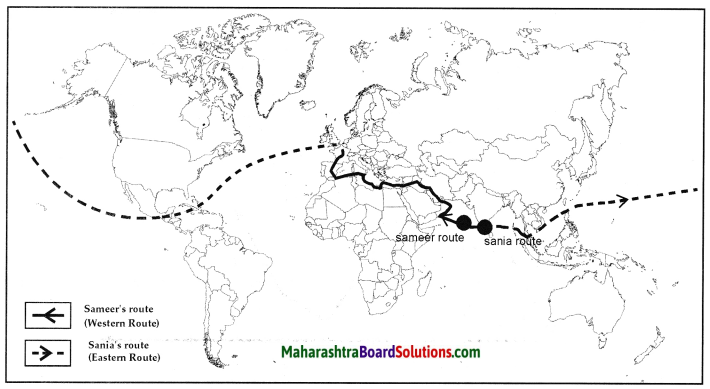
Maharashtra Board Class 6 Geography Solutions Chapter 6 Importance of Oceans 1
Answer:

  • JNPT – India
  • Nish tun – Yemen
  • Salal – Oman
  • Port of Berbera – Somalia
  • Port of A1 Qusayr – Egypt
  • Port of Said – Egypt Suez
  • port – Egypt
  • Port of Tenes – Algeria
  • Port of Tunis – Tunisia
  • Port of Bone facia – France
  • Port of Aguilas – Spain
  • Port of Adra – Spain
  • Port of Gibraltar – Gibraltar
  • Port of Sines – Portugal
  • Swange Pier – UK
  • Whitstable harbour – UK
  • Purfleet Thames Terminal – UK
  • Port of London – UK

Ports on the route followed by Sania:

  • Port of Mergui – Myanmar
  • Port of Ramong – Thailand
  • Port of Krueng Raya – Indonesia, etc.

Question 2.
Which of the routes you feel is shorter? That of Sameer’s or Sania’s?
Answer:
Sameer’s route is shorter.

Question 3.
Which oceans does one have to pass through if one follows Sameer’s route or Sania’s route?
Answer:
If one follows Sameer’s route one has to pass through the Indian Ocean and North Atlantic Ocean. If Sania’s route is taken she has to pass through the Pacific and North Atlantic Ocean.

Question 4.
What are Panama and Suez? For what purpose were they constructed?
Answer:

  • Panama and Suez are the canals in the sea built for commercial purpose.
  • It helped in saving time, money and energy and gave a fillip to international trade due to the shorter distance and easy accessibility.

Maharashtra Board Class 6 Geography Solutions Chapter 6 Importance of Oceans

Question 5.
Have they been used in Sameer’s and Sania’s routes?
Answer:
Yes, Suez Canal is used in Sameer’s route while Panama Canal is used in Sania’s route.

Class 6 Geography Chapter 6 Importance of Oceans Additional Important Questions and Answers

Fill the blanks choosing the correct alternatives from the brackets:

Question 1.
The ______ includes all the water bodies like oceans, seas, rivers and their tributaries, lakes, reservoirs and also ground water that exist on the earth.
(lithosphere, atmosphere, hydrosphere)
Answer:
hydrosphere

Question 2.
Total global water 97.7% is contained in ______ (lakes, oceans, seas)
Answer:
oceans

Question 3.
The ocean with an area 166,240,977 sq. km is the _______ ocean. (Indian, Atlantic, Pacific)
Answer:
Pacific

Question 4.
All rivers flowing from mountains or hilly areas finally meet in the ________.(lakes, seas, oceans)
Answer:
oceans

Question 5.
Salinity is expressed in terms of ______.(mils, ml, gms)
Answer:
mils

Question 6.
The average salinity of oceanic water is _______.(80%, 332%, 35%)
Answer:
35%

Question 7.
The salinity of the Dead Sea is _____.(332 %, 35%, 60%)
Answer:
332 %

Question 8.
About ________ of the surface of the earth is occupied by water. (90%, 95%, 70.8%)
Answer:
70.8%

Maharashtra Board Class 6 Geography Solutions Chapter 6 Importance of Oceans

Question 9.
Salt as a substance is obtained by constructing ______. (sea bed, salt pan, river bunds)
Answer:
salt pan

Question 10.
________ is conducted on a much higher scale as compared to the other modes of transport. (Water transport, Air transport, Road transport)
Answer:
Water transport

Question 11.
Pollution of _________ water is caused due to oil spills. (river, lake, oceanic)
Answer:
oceanic

Question 12.
Winds blowing due to pressure difference in the belts is called ______. (planetary winds, oceanic winds, minerals)
Answer:
planetary winds

Match the pairs correctly:

Question 1.

Oceans The area in sq. km
(1) Pacific (a) 20,327,000
(2) Atlantic (b) 73,426,163
(3) Indian (c) 166,240,977
(4) Southern (d) 13,224,479
(5) the Arctic (e) 86,557,402

Answer:
1 – c
2 – e
3 – b
4 – a
5 – d

Find the odd man out:

Question 1.
Pearls, corals, diamonds, medicinal plants
Answer:
diamonds

Maharashtra Board Class 6 Geography Solutions Chapter 6 Importance of Oceans

Question 2.
Spain, Norway, Japan, India
Answer:
India

Question 3.
Blue whale, sea turtles, seerfish, dolphins
Answer:
seerfish

Name the following:

Question 1.
Water bodies which are a part of the . hydrosphere.
Answer:
Oceans, seas, rivers and their tributaries, lakes, reservoirs, ground water.
Question 2.
Percentage of global waters contained in oceans.
Answer:
97.7%

Question 3.
Two aquatic animals found in the ocean.
Answer:

  • Microscopic planktons
  • Huge whales

Question 5.
Places where volcanic eruptions occur.
Answer:

  • Land
  • Ocean

Question 6.
Two minerals obtained from the sea.
Answer:

  • Phosphates
  • Sulphates

Question 7.
Two uses of marine animals.
Answer:

  • Production of fertilisers
  • Production of pharmaceuticals

Question 8.
Two countries with coastline which largely depends on the sea for their livelihood.
Answer:

  • Seychelles
  • Mauritius

Maharashtra Board Class 6 Geography Solutions Chapter 6 Importance of Oceans

Question 9.
The controller of global temperature and source of rains.
Answer:
Oceans.

Question 10.
The beginning and end of the water cycle takes place here.
Answer:
Oceans.

Question 11.
Two minerals obtained from the ocean floor.
Answer:

  • Cobalt
  • Sodium

Question 12.
Precious items obtained from the seas.
Answer:

  • Pearls
  • Corals

Question 13.
Mode of transport used for large scale transportation of goods.
Answer:

  • Ships
  • Trawlers

Question 14.
Two actions by man which has lead to large scale pollution in oceanic waters.
Answer:

  • Oil spills
  • Exploitative fishing

Answer the following in one sentence each:

Question 1.
What happens when aquatic animals die?
Answer:
When aquatic animals die, their remains accumulate in the oceans.

Question 2.
What enters the ocean with the rain water?
Answer:
Sediments from eroded lands, trees and bushes flowing with water, dead remains, etc. enter the ocean with the river water.

Maharashtra Board Class 6 Geography Solutions Chapter 6 Importance of Oceans

Question 3.
What happens when the dead remains in the ocean decompose?
Answer:
When the dead remains in the oceans decompose it releases various minerals and salts in the ocean water.

Question 4.
Where do we find maximum salinity?
Answer:
The Dead Sea is known to have the maximum salinity of 332%.

Question 5.
How is salt obtained?
Answer:
Salt as a substance is obtained by constructing salt pans in the coastal areas.

Question 6.
Which is one of the ancient occupations of human beings and what is the major purpose of his activity?
Answer:
Fishing is one of the ancient occupation and the major purpose of this activity is to obtain food.

Question 7.
How does the earth get rainfall?
Answer:
The oceans have a vast expanse, therefore huge amounts of vapour get created and this process goes on continuously and from this vapour the earth gets rainfall.

Question 8.
How is pollution caused in oceanic water?
Answer:
In order to fulfill his requirements, man undertakes many activities that lead to the production of huge amounts of different types of waste materials which cause pollution.

Question 9.
Write anyone cause of pollution of oceanic waters.
Answer:
Cutting of mangroves forests in coastal areas is one of the main cause of pollution in oceanic waters.

Question 10.
How does oceanic pollution affect the aquatic animals?
Answer:
Due to oceanic pollution many aquatic animals are under the threat of being extinct. For example, the blue whale, some types of sea turtles, dolphins, etc.

Maharashtra Board Class 6 Geography Solutions Chapter 6 Importance of Oceans

Question 11.
Which items does man get from the oceans?
Answer:
Salt, fish, shells and other products, minerals like iron, lead, cobalt, sodium, manganese, chromium, zinc, mineral oil and natural gas are the items man gets from oceans.

Question 12.
Which continents are located along the coast of the Pacific Ocean?
Answer:
Asia, Australia, North America and South America are the continents located along the coast of the Pacific Ocean.

Give geographical reasons for the following statements:

Question 1.
The ocean water is saltier than drinking water.
Answer:

(i) In drinking water, the proportion of salts is quite low. Water from oceans and seas has a greater amount of salt. Hence it tastes salty.

(ii) Volcanic eruptions leads to increase in the level of salts and minerals in ocean water.

(iii) Volcanic eruptions takes place in the oceans. During volcanic eruptions different minerals, ashes, salts and gases are added to the water. This increases the level of salts and minerals in ocean water.

(iv) Due to continuous evaporation of oceanic water, the proportion of salt increase.

Question 2.
The temperature in coastal areas remains equable.
Answer:

(i) In regions close to the oceans, seas or large reservoirs, there is not much of a difference in the temperature throughout the day.

(ii) The main reason for this is the mixing of vapour released through evaporation of water from these water bodies into air.

(iii) This vapour in the air absorbs and stores the heat released from the land.

(iv) Hence, the temperature in coastal regions remain equable.

Question 3.
It is economic to carry out transport by water ways.
Answer:

  • Waterways is a cost-effective, fuel efficient and relatively more environment friendly means of transportation.
  • Large scale transport of goods can be carried out with the help of ships, trawlers, boats, etc. at a low cost.
  • So it is economic to carry out transport by waterway.

Question 4.
There is a difference in the climate of regions close to the oceans and regions far away from the oceans.
Answer:
(i) The oceans influence the climatic condition of a place. Coastal areas are cooler and wetter than regions away from the ocean.

(ii) There is a difference in the maximum and minimum temperature with the difference being less in coastal region (nearness to the sea) while it is more in the region far away from the sea (continentality).

(iii) The temperature in coastal areas remains equable due to the mixing of vapour released through evaporation of water from these water bodies into air. This vapour absorbs and stores the heat released from the land.

Question 5.
Oceans act as the controller of global temperature.
Answer:

(i) Winds move the oceanic water in the form of currents.

(ii) Ocean currents move from the equatorial region to polar regions and from polar regions to the equatorial region.

(iii) This leads to the redistribution of heat on the earth.

(iv) The cold currents moving towards the equatorial region making the temperature of coastal areas in that zone milder whereas the warm currents coming in the colder region cause the temperature in coastal areas to rise. Hence, the oceans act as the controller of global temperature.

Answer the following questions in brief:

Question 1.
What are planetary winds?
Answer:

  • Equatorial regions receives perpendicular sunrays.
  • As a result these areas get more heat whereas the polar regions receive highly slant rays.
  • This differential heating creates imbalance in the temperature of air in different parts leading to formation of belts of high and low pressure on earth.
  • Winds blow1 due to the pressure differences in these belts. These winds are called Planetary Winds.

Maharashtra Board Class 6 Geography Solutions Chapter 6 Importance of Oceans

Question 2.
Write in brief about oceanic transport.
Answer:

  • Oceans have provided us the most economic option of transportation.
  • Large scale transportation of goods is carried out with the help of ships, trawlers, boats, etc.
  • International trade is carried out on a large scale using waterways.
  • Countries like Spain, Norway, Japan have a good coastline due to which goods are transported by ocean routes, making these countries important.

Question 3.
How do ocean currents aid water transport?
Answer:

  • Ocean currents are quite important in water transport.
  • As far as possible water transport is carried out along ocean currents.
  • They accelerate the speed of the ships and also save fuel to a considerable extent.

Question 4.
List the causes that lead to large scale pollution of oceanic water.
Answer:
The causes that lead to large scale pollution of oceanic water are:

  • Oil spills.
  • Releasing the waste produced in the coastal cities into the seas.
  • Materials thrown out from ships.
  • Exploitative fishing.
  • Cutting of mangrove forests in coastal areas.
  • Disasters caused by the water mines.
  • Sewage released by industries and cities.
  • Excavation carried out in the seas.

Do it yourself!

Question 1.
Calculate the difference between the mean maximum and minimum temperature and write in the last column

Place Country Mean Max. Temp. °C Mean Min. Temp. °C Range of Temperature
Beijing China 18.4 08.4 10
Istanbul Turkey 18.0 10.0 08 _______
Madrid Spain 19.0 09.0 10
New York66 United States 16.3 08.3 08 ________
Denver United States 16.2 02.2 14
Kabul Afghanistan 14.7 05.2 09.5 ________
Baghdad Iraq 30.4 14.7 15.7

Question 2.
Highlight the rows for the places having a range of temperatures over 10°C with red colour, other rows in blue colour (Refer the above table)
Question 3.
Find the locations of these places from an atlas. (Students activity)
Question 4.
Which places are closer to the oceans? Tell whether the range of temperature at these
places is l ess or more?
Answer:
Istanbul and New York are closer to the oceans. These places which are closer to the oceans have lesser range of temperature.

Question 5.
What might be the main reason leading to differences in the temperature range in different places?
Answer:
The main reason leading to differences in temperature range in different places is because of the location of the place on the planet earth. Other factors like latitude, altitude, atmosphere, ocean currents, planetary winds etc. too have their impact.

Question 6.
In which thermal zone are all these places located?
Answer:
All these places are located in the temperate thermal zone.

Maharashtra Board Class 6 Geography Solutions Chapter 6 Importance of Oceans

Question 7.
Which places are fai away from the oceans?
Do these places have a greater or smaller temperature range?
Answer:
Istanbul, Denver, Kabul and Baghdad are far away from the ocean as these places have a greater temperature range.

Question 8.
Mention the places having the smallest and greatest temperature ranges.
Answer:
Istanbul and New York have the smallest temperature range while Baghdad has the greatest temperature range.

Question 9.
Draw a graph for the above data. Use a proper colour scheme.
Answer:
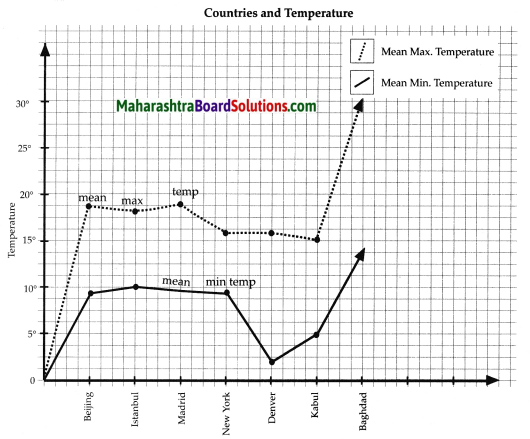
Maharashtra Board Class 6 Geography Solutions Chapter 6 Importance of Oceans 2

6th Std Geography Questions And Answers:

The Administration of the Swaraj Question Answer Class 7 History Chapter 7 Maharashtra Board

Balbharti Maharashtra State Board Class 7 History Solutions Chapter 7 The Administration of the Swaraj Notes, Textbook Exercise Important Questions and Answers.

Std 7 History Chapter 7 Question Answer The Administration of the Swaraj Maharashtra Board

Class 7 History Chapter 7 The Administration of the Swaraj Question Answer Maharashtra Board

The Administration of the Swaraj Class 7 Questions And Answers

1. Can you tell ?

Class 7 History Chapter 7 The Administration Of The Swaraj Question 1.
A Council with eight departments –
Answer:
Ashtapradhan Mandal

The Administration Of The Swaraj Std 7 Question Answer Question 2.
Bahirj Naik was the Head of this department –
Answer:
Intelligence department.

Maharashtra Board Class 7 History Solutions Chapter 7 The Administration of the Swaraj

The Administration Of The Swaraj Std 7 Question 3.
The sea fort built by Maharaj near Malvan –
Answer:
Sindhudurga

7 The Administration Of The Swaraj Question Answer Question 4.
He looked after the war materials on the fort –
Answer:
The Karkhanis.

2. Write about it in your own words:

The Administration Of The Swaraj Question 1.
Shivaji Maharaj’s Policy regarding agriculture.
Answer:

  • Agriculture was the backbone of the village/ rural economy
  • Shivaji Maharaj paid attention to the welfare of the peasants.
  • The officers were warned not to collect more revenue than the fixed amount.
  • Peasants were encouraged to bring more land under cultivation.
  • Special concession was granted if: There was famine, floods or if any army of the enemy had devasted the area.
  • Bullocks, ploughs and good seeds were provided to the peasants.

Maharashtra Board Class 7 History Solutions Chapter 7 The Administration of the Swaraj

Question 2.
Shivaji Maharaj – a ruler concerned about the welfare of his subjects.
Answer:
(i) Shivaji Maharaj had an excellent agricultural policy like fixed revenue. He paid attention to the welfare of the peasants.

(ii) Concessions to the farmers who had crop failure due to floods, famine, etc.

(iii) He provided bullocks, ploughs and good seeds to the farmers.

(iv) He increased trade so that kingdom could prosper.

(v) He protected industries, e.g. The salt industry in the Konkan.

(vi) Salt imported from the Portuguese territory would then cost more so he protected the salt industry in Konkan. Hence the above stories reveal that Shivaji Maharaj was concerned about the welfare of his subjects.

3. Give reasons:

Question 1.
Shivaji Maharaj appointed a Council of Eight Ministers.
Answer:

  • Shivaji Maharaj divided the administration in to eight different departments.
  • For the convenience of the administration, Shivaji Maharaj appointed a Council of Eight Ministers called ‘Ashtapradhan Mandal’.

Question 2.
Shivaji Maharaj raised a navy.
Answer:

  • The enemies on the west coast of India created obstacles in the work of expansion of the Swaraj.
  • It was necessary to curb their activities and to protect the west coast.
  • Shivaji Maharaj also realized that the one who has a navy, controls the sea. Hence, Shivaji Maharaj raised a navy.

Maharashtra Board Class 7 History Solutions Chapter 7 The Administration of the Swaraj

4. Complete the chart:

Question 1.
Maharashtra Board Class 7 History Solutions Chapter 7 The Administration of the Swaraj 1
Answer:
Maharashtra Board Class 7 History Solutions Chapter 7 The Administration of the Swaraj 2

Activities:

  1. Interview a person in your neighbourhood who has served in the armed forces.
  2. Visit a market in your town. List the items prepared/grown in the neighbourhood and those that come from outside.

Class 7 History Chapter 7 The Administration of the Swaraj Additional Important Questions and Answers

Complete the sentence by choosing the appropriate words from the options given below:

Question 1.
Shivaji Maharaj entrusted the responsibility of organizing the land revenue system to _____ .(Bahuji Naik, Netaji Palkar, Annaji Datto)
Answer:
Annaji Datto

Question 2.
_________ was the highest officer in the cavalry. (Sarnobat, Havaldar, Naik)
Answer:
Sarnobat

Question 3.
One of the excellent sea forts was ________ (Sindhudurga, Padmadurga, Rajgad)
Answer:
Sindhudurga

Question 4.
______ looked after the storage of food grains and maintenance of war material on the fort. (Killedar, Karkhanis, Sabnis)
Answer:
Karkhanis

Maharashtra Board Class 7 History Solutions Chapter 7 The Administration of the Swaraj

Question 5.
______ was the backbone of rural economy. (Navy, Agriculture, Army)
Answer:
Agriculture

Question 6.
Shivaji Maharaj appointed a _______ Council of Ministers. (four, eight, seven)
Answer:
Eight

Question 7.
Shivaji Maharaj knew the importance of __________ (trade, agriculture, industries)
Answer:
agriculture

Name the following:

Question 1.
He is the chief of the infantry.
Answer:
Sarnobat

Question 2.
Officers of infantry.
Answer:
(a) Havaldar
(b) Jumledar

Question 3.
Two type of cavalrymen.
Answer:
(a) Shiledars
(b) Bargirs

Question 4.
Number of forts in Swaraj.
Answer:
300 Forts

Maharashtra Board Class 7 History Solutions Chapter 7 The Administration of the Swaraj

Question 5.
Number of ships of various kind in Navy.
Answer:
400 ships

Answer the following questions in one or two sentences:

Question 1.
Which officers were there on the forts?
Answer:
There was a Killedar, Sabnis and a Karkhanis on every fort.

Question 2.
Which were the hill forts built by Shivaji Maharaj?
Answer:
(i) Pratapgad
(ii) Pavangad
(iii) Rajgad

Question 3.
Name the battleships in the Navy of Shivaji Maharaj.
Answer:
(i) Gurab
(ii) Galbat
(iii) Pal

Question 4.
What were the two types of cavalrymen?
Answer:
(i) The Shiledar with his own horse and weapons
(ii) The Bargirs who were provided with a horse and weapons by the state.

Question 5.
Who were the Chief Naval Commanders?
Answer:
Maynak Bhandari and Daulatkhan were the Chief Naval Commanders.

Maharashtra Board Class 7 History Solutions Chapter 7 The Administration of the Swaraj

Question 6.
Name the enemies on the west coast, who created obstacles in the expansion of Swaraj.
Answer:

  • The Portuguese of Goa
  • The Siddi of Janjira
  • The British factors of Surat
  • The Rajapur.

Question 7.
What constituted the ‘Ashtapradhan Mandal’?
Answer:
Shivaji Maharaj appointed a council of eight ministers handling the affairs of eight different departments. These eight heads of department constituted the Ashtapradhan Mandal.

Question 8.
How did Shivaji Maharaj appoint the council of ministers?
Answer:
Shivaji Maharaj appointed the council on the basis of their merits and achievements, and they were paid handsome salaries.

Question 9.
How did Shivaji Maharaj describe the merchants?
Answer:
Shivaji Maharaj described the merchants as “Merchants are the ornaments of the kingdom and the glory of the king”.

Question 10.
Name some of the famous sarnobats (officers) of the cavalry.
Answer:

  • Netaji Palkar
  • Prataprao
  • Gujar
  • Hambirrao Mohite.

Maharashtra Board Class 7 History Solutions Chapter 7 The Administration of the Swaraj

Give reasons:

Question 1.
Shivaji Maharaj encouraged trade.
Answer:

  • Shivaji knew that a kingdom does not prosper if the trade does not increase.
  • Necessary goods could be brought in the kingdom.
  • Goods were available in plenty.
  • Prosperity of trade increased the wealth.

Question 2.
Shivaji Maharaj protected the salt industry in Konkan.
Answer:

  • At that time, traders imported salt from the Portuguese territory and sold in Swaraj.
  • They paid heavy duty on the salt.
  • That affected the local trade in Konkan areas. Hence Shivaji Maharaj protected the salt Industry in Konkan.

Question 3.
Forts were of great importance.
Answer:

  • Possession of a fort made it possible to keep an eye on the surrounding area.
  • In case of a foreign invasion, it was possible to protect the people by taking shelter in the fort.
  • It was possible to stock the fort with food grains, war materials, ammunition and military garrison.
  • Hence forts were of great importance.

Maharashtra Board Class 7 History Solutions Chapter 7 The Administration of the Swaraj

Write about the following in your own words:

Question 1.
Bahirji Naik
Answer:

  • Bahirji Naik was the head of the intelligence department.
  • He was extremely skilled in his job.
  • He collected accurate and detailed information about the subject.

Question 2.
Ashtapradhan Mandal of Shivaji Maharaj.
Answer:

Name of the Minister Designation Work
1. Moro Trimbak Pingle Pradhan Run the administration and make arrangement for the conquered territories.
2. Ramchandra Nilkanth Muzumdar Amatya Keeping the accounts of the state.
3. Annaji Datto Sachiv To prepare royal edicts.
4. Dattaji Trimbak Waknis Mantri Correspondence
5. Hambirrao Mohite Senapati Organisation of the Army and protecting the kingdom.
6. Ramchandra Trimbak Dabir Sumant Foreign relation.
7. Niraji Rawaji Nyayadhish Dispense justice.
8. Moreshwar Panditrao Panditrao Look after religious matters.

Lets Learn:

Obtain information about the Armed Forces of India

Question 1.
State the names of the three Armed forces.
Answer:

  • The Indian Army
  • The Indian Navy
  • The Indian Air force

Question 2.
What is the designation of the head of each forces?
Answer:

  • The Indian Army – General
  • The Indian Navy – Admiral
  • The Indian Air force – Air Chief Marshal

Maharashtra Board Class 7 History Solutions Chapter 7 The Administration of the Swaraj

Question 3.
Who is the head of all the three forces?
Answer:
The President of India is the head of all the three forces.

7th Std History Questions And Answers:

Sources of History Question Answer Class 7 History Chapter 1 Maharashtra Board

Balbharti Maharashtra State Board Class 7 History Solutions Chapter 1 Sources of History Notes, Textbook Exercise Important Questions and Answers.

Std 7 History Chapter 1 Question Answer Sources of History Maharashtra Board

Class 7 History Chapter 1 Sources of History Question Answer Maharashtra Board

Sources Of History Class 7 Questions And Answers

1. Complete the names of the following sources of history:

Class 7 History Chapter 1 Sources Of History Questions And Answers Question 1.
l _ _ _ _ d
Answer:
legend

Sources Of History Class 7 Question 2.
t _ _ _ _ h
Answer:
tarikh

Maharashtra Board Class 7 History Solutions Chapter 1 Sources of History

Class 9 History Chapter 1 Sources Of History Questions And Answers Question 3.
b _ _ _ _ r
Answer:
bakhar

Sources Of History Class 7 Question Answer Question 4.
p _ _ _ _a
Answer:
Powada

Maharashtra Board Class 7 History Solutions Question 5.
i _ _ _ _ i _ _ i _ n
Answer:
inscription

Class 7 History Chapter 1 Questions And Answers Question 6.
m _ _ u _ _ _ t
Answer:
monument

2. Let’s write:

Maharashtra State Board Class 7 History Solutions  Question 1.
What do monuments include?
Answer:
Monuments include samadhis, graves and veergalas and buildings.

Class 8 History Chapter 1 Sources Of History Questions And Answers Question 2.
What is a Tarikh?
Answer:
Tarikh or Tavarikh means the sequence of events.

Sources Of History Question And Answer  Question 3.
What qualities of the author are important in the writing of history?
Answer:
The author’s integrity, impartiality and neutrality are very important in writing history.

3. Find the odd man out:

Bakhar Is A Source Of History  Question 1.
Material sources, written sources, unwritten sources, oral sources.
Answer:
unwritten sources

Chapter 1 Class 7 History Question 2.
Monuments, coins, cave sculptures, stories.
Answer:
stories

Maharashtra Board Class 7 History Solutions Chapter 1 Sources of History

Class 7 History Chapter Question 3.
Bhurjapatra, temples, treatises, paintings.
Answer:
temples

Question 4.
Owis, tarikhs, folk tales, myths.
Answer:
tarikhs

4. Explain the following concepts:

Question 1.
Material sources
Answer:
Those authentic material evidences or proofs of the ancient period which support our study of historical events are called material sources of history, e.g. memorials, buildings, cave sculptures, inscription, coins, copper, plates, forts, etc.

Question 2.
Written sources
Answer:
Those authentic evidences or proof of the ancient period which are in written form are called written sources of history, e.g. Documents of proceedings in Courts of kings, genealogies, Shakavali, correspondence, dispatches, treatises, biographies, travelogues, chronicles, Tavarikh, etc.

Question 3.
Oral sources
Answer:
We understand various aspects of folk life through folk literature traditionally passed from generation to generation and they are known as oral sources of history, e.g. Myths, Folk songs, Gatha, Shlokas, Abhangas, Powadas Proverbs, Legends, etc.

5. Is it necessary to evaluate sources of history ? Give your opinion.
Answer:
(i) Yes, it is necessary to evaluate the sources of history.
(ii) Just because a source is old does not mean it is reliable or true. We should examine their authenticity and see which sources are genuine and which are fake.
(iii) We must evaluate its quality with the help of different methods and through critical analysis.
(iv) It is necessary to determine the integrity, impartiality and neutrality of the authors by knowing their personal interests, the period during which they lived and political pressures on them.

6. Write why in your words:

Question 1.
A stone inscription is considered to be an authentic source of history.
Answer:
A stone inscription, i.e. a carving on the stone is a very authentic source of history as it throws light on different features of the ancient time like the language of communication which existed, script used and the social, political and economic life of a period, etc.

Maharashtra Board Class 7 History Solutions Chapter 1 Sources of History

Question 2.
Oral sources reveal various aspects of people’s lives.
Answer:
(i) Various aspects of folk life through folk literature passed on to us by our ancestors.
(ii) They are pearls of wisdom and they hold a wealth of knowledge about the past.
(iii) It throws light on the rich cultural life of the past and different art forms which were practised in those times.

Activity:

Visit any museum that is nearby. Gather information about the sources of history from the period that you are studying and record it in your activity book.

Class 7 History Chapter 1 Sources of History InText Questions and Answers

Formative Evaluation

Can you tell?

Question 1.
How do coins narrate history?
Answer:
(i) The coins made by different rulers using metals like gold, silver, copper are important sources of history.
(ii) From these coins we learn about the rulers, the period they ruled in, governance, religious ideas, personal details and use of language in that period.
(iii) Similarly, we also learn about the financial transactions and economic conditions, the advancement in metallurgy prevailing at that time.
(iv) From the images of Ram-Sita on the coins of Emperor Akbar or Shiva Parvati on the coins of Hyder Ali we see religious co-ordination of those days.

Speak your thoughts:

Question 1.
Suggest measures for preserving sources of history.
Answer:
(i) Written documents can be digitized and at the same time the original source should be preserved.
(ii) Controlling moisture by storing artefacts in an encasement which is oxygen free can help in their preservation.
(iii) Museums and other institutions must put in place steps and measures to preserve material sources of history in a scientific manner.
(iv) Handling, storage and display of artefacts must be done with care.
(v) Artefacts and other sources must be kept locked and continuous monitoring must be ensured to avoid any loss.
If any artefacts show signs of deterioration, conservationist must be called in for restoration of the same.

Class 7 History Chapter 1 Sources of History Additional Important Questions and Answers

Complete the sentence by choosing the appropriate words from the options given below:

Question 1.
The period from the ninth century CE till the end of the eighteenth century is considered to be the _____ period of Indian history. (Ancient, Medieval, Modern)
Answer:
Medieval

Maharashtra Board Class 7 History Solutions Chapter 1 Sources of History

Question 2.
History gives us a chronological, scientific and systematic account of ______ events. (past, present, future)
Answer:
past

Question 3.
Historical sources should be used judiciously and only after a ______. (thorough reading, indepth study, critical analysis)
Answer:
critical analysis

Question 4.
Veergala is a ________. (fort, monument, palace)
Answer:
monument

Question 5.
The Peshwas used the _______ language on their coins. (Arabic or Persian, Hindi or Sanskrit, Pali)
Answer:
Arabic or Persian

Question 6.
Travellers of other countries who came to India have written ______ or accounts of their travels, (biography, autobiography, travelogues)
Answer:
travelogues

Question 7.
Tavarikh or Tarikh means the ______. (information about past, sequence of events, dates)
Answer:
sequence of events

Question 8.
The author’s ______ is very important in writing history. (viexvpoint, perspective, impartiality and neu trality)
Answer:
impartiality and neutrality

Question 9.
An, _____ is a carving on a stone, or a wall. (metal plate, inscription, edict)
Answer:
inscription

Question 10.
______ is a type of chronicle that originated in Maharashtra. (Bakhar, Myths, Travelogues)
Answer:
Bakhar

Find the odd man out:

Question 1.
Genealogies, Travelogue, Chronicles, Inscription.
Answer:
Inscription

Question 2.
Churches, Temples, Mosques, Myths
Answer:
Myths

Maharashtra Board Class 7 History Solutions Chapter 1 Sources of History

Name the following:

Question 1.
The subject which gives us a chronological, scientific and systematic account of past events.
Answer:
History.

Question 2.
Any two metals used by different rulers in the past to make coins.
Answer:
Gold, Silver

Question 3.
One place in Tanjavur where inscriptions are found.
Answer:
Brihadishwara temple premises.

Question 4.
Two things inscribed on copper plates.
Answer:
(a) Royal edicts
(b) Verdicts

Question 5.
Any two scripts used in the Medieval period.
Answer:
(a) Devanagari
(b) Arabic

Question 6.
Written accounts of the travels by the travellers from other countries.
Answer:
Travelogues.

Question 7.
Any two travellers who visited India in the Medieval period.
Answer:
(a) A1 Biruni
(b) Ibn Batuta

Maharashtra Board Class 7 History Solutions Chapter 1 Sources of History

Question 8.
Sanskrit biography of Shivaji Maharaj was composed by this poet.
Answer:
Paramanand.

Question 9.
A source of history which means the sequence of events.
Answer:
Tavarikh or Tarikh.

Question 10.
Two people who compiled Tavarikh.
Answer:
(a) A1 Biruni
(b) Ziauddin Barani.

Question 11.
A type of chronicle that originated in Maharashtra.
Answer:
Bakhar.

Question 12.
Any two chronicles written in Marathi.
Answer:
(a) Mahikavatichi Bakhar
(b) Sabhasad Bakhar

Question 13.
Any two contemporary western historians.
Answer:
(a) Robert Arm
(b) Grant Duff

Question 14.
Any two oral sources of history.
Answer:
(a) Owis
(b) Folk songs

Answer in one sentence:

Question 1.
What information does history give us?
Answer:
History gives us a chronological and systematic account of past events.

Question 2.
What must history be based on?
Answer:
History must be based on authentic evidence or proofs which are known as sources of history.

Question 3.
What are the different sources of history?
Answer:
Material sources, written sources and oral sources are the three different sources of history.

Maharashtra Board Class 7 History Solutions Chapter 1 Sources of History

Question 4.
How should we use different sources of history?
Answer:
We have to use the different sources of history judiciously and only after critical analysis.

Question 5.
What do we learn when we look at forts and monuments built in the past?
Answer:
When we look at the forts and monuments we come to know about the development of architecture, the economic conditions, the quality of art, style of the building construction and people’s standard of living in that particular period.

Question 6.
Why is an inscription considered to be a very important and reliable source of history?
Answer:
An inscription is considered to be a very important and reliable source of history because it helps us to understand features like the language, script, social life of a period etc.

Question 7.
What are known as copper plates?
Answer:
Inscriptions carved on sheets of copper are known as ‘copper plates’.

Question 8.
How do we understand various aspects of folk life?
Answer:
We understand various aspects of folk life through folk literature traditionally passed from generation to generation.

Explain the following terms:

Question 1.
History
Answer:
History is a chronological, scientific and systematic account of past events.

Question 2.
An inscription
Answer:
An inscription is a carving on a stone or a wall.

Question 3.
Tavarikh or Tarikh
Answer:
Tavarikh or Tarikh means the sequence of events.

Maharashtra Board Class 7 History Solutions Chapter 1 Sources of History

Question 4.
Bakhar
Answer:
Bakhar is a type of chronicle that originated in Maharashtra.

Question 5.
Chronicles
Answer:
Chronicles are written sources of history which help in understanding aspects like the contemporary political happenings, linguistic transaction, cultural life, social conditions, etc.

Classify the following into Material sources, Written sources and Oral sources of history:

Question 1.
Ornaments, Fort, Owis, Myths, Utensils, Folk songs, Weapons, Travelogue, Well, Biographies, Clothing, Powada, Copper plate, Folk tales, Coins, Shloka, Temples, Books
Answer:

Written Sources Material Sources Oral Sources
Books, Travelogue, Copper plate, Coins, Temples Ornaments, Forts, Utensils, Weapons, Well, Clothing Owis, Myths, Folk songs, Hearsays, Powada, Folk tales, Shloka

Complete the following diagrams:

Question 1.

Maharashtra Board Class 7 History Solutions Chapter 1 Sources of History 2
Answer:

Maharashtra Board Class 7 History Solutions Chapter 1 Sources of History 1

Question 2.

Maharashtra Board Class 7 History Solutions Chapter 1 Sources of History 4
Answer:

Maharashtra Board Class 7 History Solutions Chapter 1 Sources of History 3

Maharashtra Board Class 7 History Solutions Chapter 1 Sources of History

Question 3.

Maharashtra Board Class 7 History Solutions Chapter 1 Sources of History 6
Answer:

Maharashtra Board Class 7 History Solutions Chapter 1 Sources of History 5

7th Std History Questions And Answers:
Human Occupations Question Answer Class 6 Geography Chapter 10 Maharashtra Board

Balbharti Maharashtra State Board Class 6 Geography Solutions Chapter 10 Human Occupations Notes, Textbook Exercise Important Questions and Answers.

Std 6 Geography Chapter 10 Question Answer Human Occupations Maharashtra Board

Class 6 Geography Chapter 10 Human Occupations Question Answer Maharashtra Board

Human Occupations Class 6 Questions And Answers

A. Select the correct option:

Question 1.
Serving as a ______ is a tertiary type of occupation.(bus conductor, veterinary doctor, brick kiln worker)
Answer:
bus conductor

Maharashtra Board Class 6 Geography Solutions Chapter 10 Human Occupations

Question 2.
In the tropical areas, we mainly see ________ occupations. (primary; secondary, tertiary)
Answer:
primary

Question 3.
Amol’s Granny sells papads and pickles. This is a _______ occupation. (primary, secondary, tertiary)
Answer:
secondary

B. Give reasons:

Question 1.
The type of occupation determines a person’s
income.
Answer:
(i) Occupation is a job, a person’s role in society wherein a regular activity is carried out for income.

(ii) Certain occupations bring greater economic benefits to the society and the nation at large while certain occupations bring relatively less economic benefits.

(iii) Similarly some occupations require higher level of knowledge and skill while some can be carried out with little or no skill or expertise. Person’s income is proportionate to the economic benefit his occupation brings with it and the land of his knowledge and skill. So the type of occupation determines a person’s income.

Question 2.
Primary occupations are associated with developing countries while tertiary, with developed countries.
Answer:
(i) Countries which are developing have low income as they are in a state of development and their main source of income comes from production carried out in primary sector.

(ii) Developed countries are rich with high income and so they practice tertiary occupation. They have enough money to invest in business which creates tertiary occupations which requires huge investment.

Question 3.
Quaternary occupations are not commonly seen.
Answer:
Quaternary occupations are occupations which require special knowledge, skills and expertise. This sectorevolves in well-developed countries and requires skilled workforce apart from sufficient money to invest in fields like IT, research and development, quality testing, etc.

Maharashtra Board Class 6 Geography Solutions Chapter 10 Human Occupations

Activity:

  • Visit a secondary occupation in your area.
  • Gather information related to that occupation
  • using the following points and note it down.
  • Name of the occupation
  • Raw material used
  • Source of raw material
  • Finished product
  • Market for finished product
  • Tertiary occupations required in it.

Class 6 Geography Chapter 10 Human Occupations InText Questions and Answers

Look at the figure and answer the following questions:

Maharashtra Board Class 6 Geography Solutions Chapter 10 Human Occupations 4
Maharashtra Board Class 6 Geography Solutions Chapter 10 Human Occupations 5
Maharashtra Board Class 6 Geography Solutions Chapter 10 Human Occupations 6
Question 1.
What are the cows and buffaloes in picture A doing?
Answer:
The animals, cows and buffaloes are grazing in the pasture, i.e. land covered with grass and other low plants.

Question 2.
What is being obtained in picture B?
Answer:
Milk is being obtained in picture B.

Question 3.
What is happening at the Milk Collection Centre in picture C?
Answer:
Milk is being filled for storage and sold at the milk collection centre.

Maharashtra Board Class 6 Geography Solutions Chapter 10 Human Occupations

Question 4.
In picture D, what is being transported? Where could the tanker be going?
Answer:
Milk is being transported to the milk processing centre. The tanker is on the truck

Question 5.
Which products are seen in picture E? From what have these products been made?
Answer:
Curd, ghee, butter, cheese and shrikhand are the products seen in picture E and these products have been made from milk.

Question 6.
What else is happening in picture E?
Answer:
In picture E, person is testing the quality of the prepared milk products.

Question 7.
Out of the products shown in picture F, which products do you use?
Answer:
I use all the products shown in picture F as milk products are high on nutrients and good for health.

Question 8.
What would be main difference between milk and milk products?
Answer:
Milk is a beverage obtained from nature, directly from different animals. While milk products are obtained by processing milk into different products.

Question 9.
Do these products perish quickly like milk?
Answer:
No, they have a longer life unlike milk.

Look at the figure and answer the following questions:

Maharashtra Board Class 6 Geography Solutions Chapter 10 Human Occupations 4
Maharashtra Board Class 6 Geography Solutions Chapter 10 Human Occupations 5
Maharashtra Board Class 6 Geography Solutions Chapter 10 Human Occupations 6
Question 1.
Which of these activities is undertaken to obtain a product from nature?
Answer:
Obtaining milk from the cow is the activity undertaken to obtain a product from nature.

Maharashtra Board Class 6 Geography Solutions Chapter 10 Human Occupations

Question 2.
How long does this product last?
Answer:
If refrigerated it will last for about five days to one week.

Question 3.
In which picture is the product obtained from nature being collected?
Answer:
In picture C, the product obtained from nature is being collected.

Question 4.
Which service did the milk producer get through this activity?
Answer:
Transport and unloading of milk, a tertiary service is the service which the milk producer received.

Question 5.
Where is milk being taken? What happens to the milk thereafter?
Answer:
The milk is being taken to the milk processing centre for processing milk to make milk products.

Question 6.
What milk products are seen in the picture?
Answer:
Ghee, butter, cheese, shrikhand are the products seen in the picture.

Question 7.
Who inspects these products?
Answer:
A food inspector, a person with special skill and expertise inspects these products.

Question 8.
What does the shopkeeper do with these products?
Answer:
The shopkeeper sells these products to the consumer.

Question 9.
Which of these products are perishable and which are non- perishable?
Answer:
All are the products, even after proper storage will deteriorate and perish over a period of time.

Question 10
Will the price and weight of these products be same as that of the milk?
Answer:
The price and weight of these products will be higher after processing. These products will be more durable and its quality too will be enhanced and so their price will be also higher.

Use your brainpower!

Question 1.
Milk is available at ₹ 40 per litre while dahi at ₹ 60 per kg and paneer at ₹ 200 per kg. If both are obtained from milk, why is there so much difference in their prices?
Answer:
Milk is being processed, obtained from nature and made it into different products. These products are more durable. Their quality its enhanced and therefore their price is higher.

Maharashtra Board Class 6 Geography Solutions Chapter 10 Human Occupations

Answer the following questions based on the pie charts:

Maharashtra Board Class 6 Geography Solutions Chapter 10 Human Occupations 3
Question 1.
Which country has more manpower engaged in primary occupation?
Answer:
Bangladesh.

Question 2.
Which country has more manpower engaged in secondary occupation?
Answer:
Turkey.

Question 3.
Which country has more manpower engaged in tertiary occupations?
Answer:
United Arab Emirates.

Question 4.
Which country has almost equal manpower engaged in all the occupations?
Answer:
Turkey.

Think a little!

Who am I?

Question 1.
Who examines us when we fall ill?
Answer:
Doctor

Question 2.
Who checks our examination papers?
Answer:
Teacher

Question 3.
Who prepares the designs of buildings?
Answer:
Architect
Maharashtra Board Class 6 Geography Solutions Chapter 10 Human Occupations

Question 4.
Who produces machines and looks after their maintenance and repairs?
Answer:
Engineer

Observe figure and answer the questions related to sugar production:

Maharashtra Board Class 6 Geography Solutions Chapter 10 Human Occupations 1
Maharashtra Board Class 6 Geography Solutions Chapter 10 Human Occupations 2
Question 1.
Classify the occupations from primary to quaternary
Answer:

Primary Secondary Tertiary Quaternary
Harvesting of sugarcane Sugarcane being collected at factory Transport of sugarcane Quality check
Processing of sugarcane juice Sacks of sugar being canned Inspection and
maintenance of
machinery in the factory
Sugar production Sale of goods

Question 2.
Which raw material is used in the secondary occupation?
Answer:
Sugarcane is the raw material used in the secondary occupation.

Question 3.
Which is the finished product obtained in the secondary occupation?
Answer:
Sugar is the finished product obtained in the secondary occupation.

Question 4.
What are the services in tertiary occupations?
Answer:
Transport of sugarcane, sacks of sugar being carried and sales of goods are the services in tertiary occupations.

Question 5.
Which picture is related to a quaternary occupation? Can you name the occupation?
Answer:
Picture G is related to a quaternary occupation. The occupation is quality testing.

Maharashtra Board Class 6 Geography Solutions Chapter 10 Human Occupations

Think and discuss:

What effect does nature have on our occupations? Think a little. Give a thought to the following issues. Discuss them in the class. Write two paragraphs about it.

  • There have been no rain at all (drought).
  • A storm strikes
  • There was an earthquake.
  • Untimely rains
  • Good rains
  • Excessive rains and floods
  • All of a sudden, a volcano erupts
  • A tsunami hits.

Answer:
Primary occupations like agriculture can be totally disrupted if there are no rains or excessive rains while good rains will usher with good agricultural output. When we receive good agricultural yield it will have a positive input on all secondary occupations which rely on agriculture. It will bring about all-round growth in both agricultural and industrial sector.

Natural calamities like storms, earthquake, volcanoes and tsunami can have adverse impact on various occupations. It can bring all the primary, secondary, tertiary and quaternary occupations to a standstill. Occupations related to production, storage, distribution, etc. will be greatly affected as rescue and rehabilitation of the people and reconstruction of the damaged caused, becomes a priority.

Do it yourself!

Question 1.
Which occupations are found in your area?
Answer:
I live in Maharashtra and occupations like textile manufacture, manufacture of sugar, pharmaceutical, petrochemicals, electronics, automobiles, engineering services, food processing, etc. are practised here.

Question 2.
Which occupation is practised on a large scale?
Answer:
Sugar manufacturing is an occupation which is practised on a large scale.

Question 3.
Find the reason behind it.
Answer:
Advantageous location of Maharashtra, progressive government policies, availability of raw material, i.e. sugarcane, good infrastructure and above all the ownership given to farmers in sugar factories are the reasons why this occupation is practised on a large scale.

Question 4.
Both human and natural factors affect occupations. Can you find those factors?
Answer:
Development of industries, availability of technical know-how and skilled manpower, existing labour laws and government policies pertaining to occupations development of infrastructure are the human factors that affect occupations.
Climate, terrain of a region, fertility of soil, susceptibility to natural calamities, availability of raw materials, etc. are the natural factors which affect occupations.

Question 5.
Obtain information about the damage caused to the environment through different occupations.
Answer:
Pollution of the environment in all its form – air, water, soil and land, deforestation, soil erosion, depletion of the ozone layer, etc. are some of the damages caused due to different occupations practised.

While practising occupations we should be careful not be cause of hazardous air emissions, land contamination leading to soil pollution, marine and coastal pollution caused due to untreated waste water, etc. Sustainable development, let us remember should be the need of the hour.

Maharashtra Board Class 6 Geography Solutions Chapter 10 Human Occupations

Visit a secondary occupation in your area gather information related to that occupation using the following points and note it down:
Answer:

Name of the occupation Pharmaceutical manufacturing.
Raw material used Animal extracts, herbal extracts, additives like glaze, talc, etc. and chemical substances.
Sources of raw material From different parts of India, some raw materials are imported from other countries.
Finished products Medicine and other pharma products.
Market of finished products National and international markets including US, UK, Australia, Russia, Germany, etc.
Tertiary occupations Transport of goods, loading and unloading of goods and sale of goods.

Class 6 Geography Chapter 10 Human Occupations Additional Important Questions and Answers

Complete the following statements by choosing the correct options:

Question 1.
Occupations which are dependent on nature are called _______ occupations. (secondary, primary, tertiary)
Answer:
primary

Question 2.
Processed products are ________.(non-perishable, more durable, less durable)
Answer:
more durable

Question 3.
Occupations dependent on primary occupations are called ______ occupations. (primary, secondary, quaternary)
Answer:
secondary

Question 4.
The occupations which provide complimentary services to the other two occupations are called _________ occupations. (tertiary, secondary, primary)
Answer:
tertiary

Question 5.
Countries which have more manpower engaged in _______ activities are considered to be developed countries. (primary , secondary, tertiary)
Answer:
tertiary

Question 6.
Countries which have more manpower engaged in primary activities are considered to be _____ countries. (developed, developing, under developed)
Answer:
developing

Maharashtra Board Class 6 Geography Solutions Chapter 10 Human Occupations

Question 7.
transactions decide the country’s ______.(production, occupation, manpower)
Answer:
primary

Arrange the following in proper order:

  • Selling milk products in the market.
  • Obtaining milk and selling milk.
  • Processing milk at milk processing centres.
  • Rearing of domestic animals.
  • Making ghee, butter, cheese, shrikhand, paneer, milk powder, etc.

Answer:

  • Rearing of domestic animals.
  • Obtaining milk and selling milk.
  • Processing milk at milk processing centre.
  • Making ghee, butter, cheese, shrikhand, paneer, milk powder, etc.
  • Selling milk products in the market.

Match the pairs correctly:

Question 1.

Column A Column B
(1) Animal husbandry and fishing (a) secondary occupation
(2) Processing of milk (b) tertiary occupation
(3) Transport of goods (c) quaternary occupation
(4) Quality testing of product (d) primary occupation
(5) Transaction of the country (e) economic transactions
(f) production

Answer:
1 – d
2 – a
3 – b
4 – c
5 – f

Name the following:

Question 1.
Any two products obtained after processing milk at milk processing centre:
Answer:

  1. Butter
  2. Cheese

Maharashtra Board Class 6 Geography Solutions Chapter 10 Human Occupations

Question 2.
Any two animals domesticated by man:
Answer:

  1. Cow
  2. Buffalo

Question 3.
Occupation which is directly dependent on nature:
Answer:
Primary occupations.

Question 4.
Occupations dependent on primary occupations:
Answer:
Secondary occupations.

Question 5.
Occupations which provide complementary services to primary and secondary occupations:
Answer:
Tertiary occupations.

Question 6.
Occupations like sale of goods
Answer:
Tertiary occupations or service occupations

Question 7.
Occupations which requires special expertise:
Answer:
Quaternary occupations.

Question 8.
Countries which have more manpower engaged in tertiary activities:
Answer:
Developed countries.

Question 9.
Countries which have more manpower engaged in primary activities:
Answer:
Developing countries.

Complete the table:

Occupations Definition Examples
Primary
Secondary
Tertiary
Quaternary

Answer:

Occupations Definition Examples
Primary Occupation which directly depend on nature are called primary occupations. Farming, animal husbandry, mining, foresting, fishing.
Secondary Occupations dependent on primary occupations are called secondary occupations. Food processing, manufacturing, construction.
Tertiary Occupations which provide complementary services to primary and secondary occupations are called tertiary occupations. Transport of goods, commercial services, loading and unloading goods, sale of goods.
Quaternary The occupations which requires special expertise and special skills are called quaternary occupations. Quality testing of food products, inspection and maintenance., IT.

Answer the following questions in one sentence each:

Question 1.
Why does man undertake various activities?
Answer:
Man undertakes various activities to satisfy his need.

Question 2.
How are activities undertaken by man classified?
Answer:
Activities undertaken by man are classified on the basis of their nature and the products they yield.

Maharashtra Board Class 6 Geography Solutions Chapter 10 Human Occupations

Question 3.
Where are raw materials supplied to the industries often obtained from?
Answer:
Raw materials supplied to the industries are often obtained from nature.

Question 4.
Which occupations require special skills and expertise?
Answer:
Quaternary occupations requires special skills and expertise.

Answer the following questions in short:

Question 1.
Why are the prices of processed milk products higher?
Answer:

  • Milk obtained from nature is processed and made into different products which involves high cost.
  • These products are more durable.
  • Their quality too is enhanced.
  • Therefore their price is also higher.

Question 2.
Explain the term “Service occupation”.
Answer:

  • The occupations which provide complementary services to the other two occupations, i.e., primary and secondary occupations are tertiary occupations.
  • These occupations are complementary i.e., supportive to all other occupations.
  • These occupations are called as service occupation e.g., transport of goods, loading and unloading of goods and sale of goods, etc.

Question 3.
A person testing the quality of a product is practising a quaternary occupation. Elaborate.
Answer:

  • To test the quality of a product, a person must have some special skills.
  • This service is not an ordinary one but the one which requires special expertise.
  • Such services which requires special skills and expertise are called quaternary occupations.

Question 4.
How can we decide the extent of the country’s development?
Answer:

  • Different occupations are practised in different countries of the world.
  • Through these occupations, economic transactions occur within a country and between various countries.
  • These transactions decide the country’s production of various goods and their national income.
  • This, in turn, is used to decide the extent of a country’s development.

Question 5.
What decides the country’s annual income?
Answer:
Different occupations are practised in different countries of the world through which economic transactions occur within country and various countries which decide the country’s production of various goods and their annual income.

Maharashtra Board Class 6 Geography Solutions Chapter 10 Human Occupations

I can do this!

Question 1.
Answer:

Name different occupations
  • Primary occupation
  • Secondary occupation
  • Tertiary occupation
  • Quaternary occupation
Differences
  • Primary occupations are those occupations which are dependent on nature, e.g. Agriculture.
  • Occupations dependent on primary occupations are called secondary occupations, e.g. Food processing.
  • Those occupations which provide complementary services to primary and secondary occupation are called tertiary occupations, e.g. Sale of goods.
  • While occupation which requires special skills and expertise are called quaternary occupation, e.g. Quality assurance.

Question 2.
Classify the occupations from primary to quaternary.
Answer:

Primary occupations Secondary occupations Tertiary occupations Quaternary occupations
Farming, mining, forestry, animal husbandry, fishing Manufacturing, construction, food processing Commercial services, transport of goods, loading and unloading of goods, sale of goods Research and development, IT, quality assurance, inspection and maintenance

6th Std Geography Questions And Answers: