Std 8 Geography Chapter 1 Questions And Answers Local Time and Standard Time Maharashtra Board

Balbharti Maharashtra State Board Class 8 Geography Solutions Chapter 1 Local Time and Standard Time Notes, Textbook Exercise Important Questions and Answers.

Class 8 Geography Chapter 1 Local Time and Standard Time Questions And Answers Maharashtra Board

Local Time and Standard Time Class 8 Questions And Answers Chapter 1 Maharashtra Board

Class 8 Geography Chapter 1 Local Time and Standard Time Textbook Questions and Answers

1. Complete the sentence by selecting the correct option:

Question a.
The earth requires 24 hours for one rotation. In one hour, ……………. .
(a) 5 longitudes will face the sun
(b) 10 longitudes will face the sun
(c) 15 longitudes will face the sun
(d) 20 longitudes will face the sun
Answer:
(c) 15 longitudes will face the sun

Question b.
To calculate the difference between the local times of any two places on the earth, …………. .
(a) the noon time at both the places should be known
(b) the difference in degrees of their longitudes should be known
(c) the difference in standard times of both the places should be known
(d) changes need to be made according to International Date Line.
Answer:
(b) the difference in degrees of their longitudes should be known

Maharashtra Board Class 8 Geography Solutions Chapter 1 Local Time and Standard Time

Question c.
The difference between the local time of any two consecutive longitudes is …………… .
(a) 15 minutes
(b) 04 minutes
(c) 30 minutes
(d) 60 minutes
Answer:
(b) 04 minutes

2. Give geographical reasons for the following:

Question a.
The local time is decided by the noontime.
Answer:
1. When at a particular place, the sun reaches the maximum height in the sky it is assumed that almost half of the daytime is over and this time is considered 12 noon.

2. The time of a particular place as decided by the overhead position of the sun in the sky is considered as the local time of that place.

3. During the rotation of the earth, when a particular longitude comes exactly in front of the sun, it is considered as noontime (12 noon) on that longitude. This noontime is considered as local time of that longitude.

In this way, the local time is decided by the noontime.

Maharashtra Board Class 8 Geography Solutions Chapter 1 Local Time and Standard Time

Question b.
The local time at Greenwich is considered to be the International Standard Time.
Answer:

  1. The International Standard Time has been decided according to 0° longitude.
  2. 0° longitude passes through Greenwich, England.
  3. For an international coordination, it is essential to bring compatibility between the standard times of various countries in the world.

For this purpose, the local time at Greenwich is considered to be the International Standard Time.

Question c.
The standard time of India has been decided by the local time at 82°30′ E longitude.
Answer:

  1. With respect to the longitudinal extent, 82°30’E longitude passes through the middle of India.
  2. The difference between the local time at 82°30’E longitude and the local time at the extreme east and west longitude passing through India is not more than one hour.

Therefore, the standard time of India has been decided by the local time at 82°30’E longitude.

Question d.
Canada has 6 different standard times.
Answer:

  1. The longitudinal extent of Canada is between 52°37′ W and 141° W.
  2. Thus, the difference between the extreme east and west longitude passing through Canada is of 88 degrees.
  3. The difference between the local time at extreme east and west longitude passing through Canada is of 352 minutes i.e. 5 hours and 52 minutes.

Therefore, it is not practically helpful to consider single standard time in Canada. Therefore, for synchronizing the routine activities in the country, Canada has 6 different standard times.

Maharashtra Board Class 8 Geography Solutions Chapter 1 Local Time and Standard Time

3. Answer in brief:

Question a.
If it is 12 noon at 60° E longitude, then explain what would be the time at 30° W longitude.
Answer:
1. The difference between 60° E longitude and 30° W longitude will be of 90 degrees. (The difference of 60 degrees between 0° and 60° E + the difference of 30 degrees between 0° and 30° W = 90 degrees.)

2. Difference in local time = 90 × 4
= 360 minutes.
= 360 minutes ÷ 60 minutes = 6 hours.
3. Longitudes lying to the east of any longitude are ahead of the time of that longitude while those lying to the west are behind.
4. Therefore, if it is 12 noon at 60° E longitude, then it would be 6 a.m. at 30° W longitude, (behind by 6 hours)

Question b.
How is the standard time of a place determined?
Answer:
1. The local time at the longitude passing through the middle of a country/ place is generally considered as a standard time of that country/place.

2. If the difference between the local time at the extreme east and west longitude passing through a country is less than one or two hours, one standard time is considered for a country. Thus, there exists only one standard time in a country having comparatively less longitudinal (east-west) extent.

3. If the difference between the local time at the extreme east and west longitude passing through a country is more than one or two hours, more than one standard time zones are considered for a country. Thus, there exists more than one standard time zones in a country having comparatively more longitudinal (east-west) extent.

Question c.
A football match being played at Sao Paulo, Brazil started in India at 6 a.m. IST. Explain what would be the local time at Sao Paulo?
Answer:
1. Statement: For any longitude lying to the west of particular longitude, the local time decreases by 4 minutes for every longitude. (Sao Paulo is located to the west of India)

2. The difference between the longitudes of Sao Paulo and India = 127°30’.

3. Difference in local time = 127.5 × 4
= 510 minutes.
= 510 minutes ÷ 60 minutes
= 8 hours 30 minutes.

4. Thus, if it is 6 a.m. at India, it would be 9.30 p.m. of the previous day at Sao Paulo. Therefore, if a football match being played at Sao Paulo, Brazil started in India at 6 a.m. 1ST, the local time at Sao Paulo would be 9.30 p.m. of previous day.

Maharashtra Board Class 8 Geography Solutions Chapter 1 Local Time and Standard Time

4. Complete the following table:

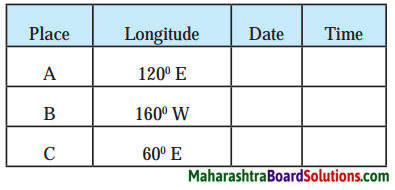
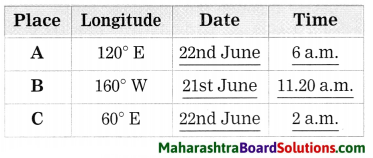
If it is 10 pm on 21st June at Prime Meridian, write the dates and time at A, B and C in the following table:
(Note: The answer is given directly.)

Question 1.
Maharashtra Board Class 8 Geography Solutions Chapter 1 Local Time and Standard Time 1
Answer:
Maharashtra Board Class 8 Geography Solutions Chapter 1 Local Time and Standard Time 2

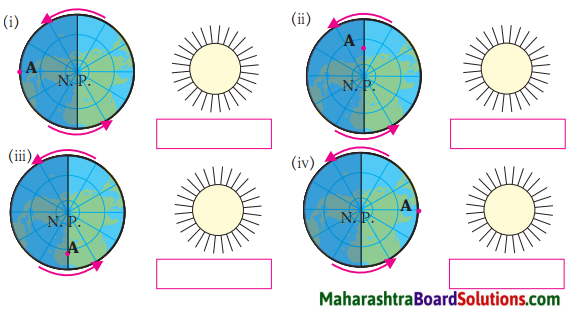
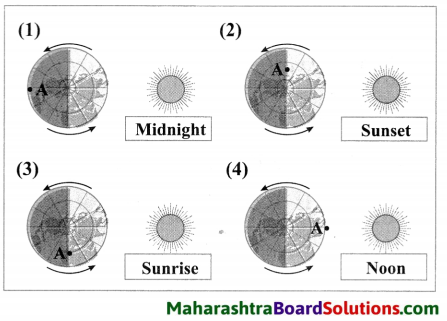
5. Write the situation of place A shown in these diagrams in the boxes below them:

Question 1.
Write the situation of place A shown in these diagrams in the boxes below them
(i) Sunrise
(ii) Midnight
(iii) Noon
(iv) Sunset
Maharashtra Board Class 8 Geography Solutions Chapter 1 Local Time and Standard Time 3
Answer:

Maharashtra Board Class 8 Geography Solutions Chapter 1 Local Time and Standard Time 4.1

Let’s recall: 

Question 1.
Why does the duration of day and night keep changing?
Answer:
The duration of day and night keeps changing as the earth is tilted at an angle of 23.5 degrees.

Maharashtra Board Class 8 Geography Solutions Chapter 1 Local Time and Standard Time

Question 2.
How many longitudes can be drawn on a world map keeping an interval of 1° each?
Answer:
360 longitudes can be drawn on a world map keeping an interval of 10 each.

Question 3.
The apparent movement of the sun from east to west is a result of what?
Answer:
The apparent movement of the sun from east to west is a result of the rotation of the earth from west to east.

Question 4.
What is the direction of the rotation of the earth?
Answer:
The direction of the rotation of the earth is from west to east.

Question 5.
While the earth rotates, how many longitudes face the sun daily?
Answer:
While the earth rotates, 360 longitudes face the sun dally.

Question 6.
At which longitude does the date change?
Answer:
The date changes at 1800 longitude.

Maharashtra Board Class 8 Geography Solutions Chapter 1 Local Time and Standard Time

Question 7.
How was the time measured in olden days?
Answer:
In olden days, the time was measured with the help of the natural events of sunrise and sunset and the instruments like Ghatikapaatra, sand timer, etc.

Question 8.
In present tunes, what are the instruments used for time measurement?
Answer:
In present times, the instruments like watches, calendars, etc. are used for time measurement.

Maharashtra Board Class 8 Geography Solutions Chapter 1 Local Time and Standard Time

Activity:

Question 1.
Look for the actual granny’s clock in Shri Acharya Atre’s poem: “Aajiche Ghadyal” (Granny’s clock). Look for this poem on the internet or in reference book.

Question 2.
Find out the velocity of the earth’s rotation in km/hour.

Class 8 Geography Chapter 1 Local Time and Standard Time Additional Important Questions and Answers

Complete the sentence by selecting the correct option:

Question a.
There are …………. time zones in the world.
(a) 360
(b) 24
(c) 100
(d) 365
Answer:
(b) 24

Maharashtra Board Class 8 Geography Solutions Chapter 1 Local Time and Standard Time

Question b.
Indian Standard Time is …………..
(a) ahead of Greenwich Mean Time by 5 hours 30 minutes
(b) ahead of Greenwich Mean Time by 3 hours 50 minutes
(c) behind Greenwich Mean Time by 5 hours 30 minutes
(d) behind Greenwich Mean Time by 3 hours 50 minutes
Answer:
(a) ahead of Greenwich Mean Time by 5 hours 30 minutes

Examine the following statements and correct the incorrect ones:

Question 1.
Mumbai is located at 73° E longitude.
Answer:
Correct.

Question 2.
In India, three standard times exist.
Answer:
Incorrect.
Correct statement: In India, one standard time exists.

Question 3.
If the difference between two longitudes is of 20 degrees, the difference in their local times will be of four hours.
Answer:
Incorrect.
Correct statement: If the difference between two longitudes is of 20 degrees, the difference in their local times will be of 1 hour and 20 minutes.

Answer the following questions in one sentence each:

Question 1.
Think about it.
Question a.
What is the maximum number of local times that can there be in the world?
Answer:
The maximum number of local times that can be there in the world is 360.

Maharashtra Board Class 8 Geography Solutions Chapter 1 Local Time and Standard Time

Question b.
How many longitudes pass the sun in one hour?
Answer:
15 longitudes pass the sun in one hour.

Question 2.
How much time does the earth take to complete one rotation?
Answer:
The earth takes nearly 24 hours to complete one rotation.

Question 3.
What is meant by the local time of a place?
Answer:
When the sun is directly overhead at a particular place, it is considered as noon at that place and that time is considered as a local time of that place.

Solve the following:

1. Try this:

Question A.
Mashad, a town in Iran, is located on the 60° E longitude. When it is 12 noon at Greenwich, calculate the local time of Mashad town.
Answer:
1. Statement: As we move towards the east of the Prime Meridian, the local time increases by four minutes for every longitude. (Mashad is located to the east of Greenwich.)

2. The difference between the longitudes of Greenwich and Mashad = 60°.

3. Difference in local time
= 60 × 4
= 240 minutes.
= 240 minutes ÷ 60 minutes
= 4 hours. ‘

4. Therefore, when it is noon at Greenwich, it would be 4 p.m. at Mashad. (Ahead of Greenwich Mean Time by 4 hours.)

Maharashtra Board Class 8 Geography Solutions Chapter 1 Local Time and Standard Time

Question B.
Manaus city in Brazil is located on 60° W longitude. What would be the local time at Manaus when it is 12 noon at Greenwich?
Answer:
1. Statement: As we move towards the west of the Prime Meridian, the local time decrease by four minutes for every longitude. (Manaus is located to the west of Greenwich.)

2. The difference between the longitudes of Greenwich and Manaus = 60°.

3. Difference in local time = 60 × 4
= 240 minutes.
= 240 minutes ÷ 60 minutes
= 4 hours.

4. Therefore, when it is noon at Greenwich, it would be 8 a.m. at Manaus. (Behind Greenwich Mean Time by 4 hours.)

2. Can you tell?

Question A.
Mumbai is located at 73° E longitude. Kolkata is located at 88° E longitude. Find the difference between the longitudes of these two cities.
Answer:
Mumbai is located at 73° E longitude. Kolkata is located at 88° E longitude. Therefore, the difference between the longitudes of these two cities would be of (88 – 73 = 15) 15°.

Question B.
If the local time at Mumbai is 3 p.m. then what would be the local time at Kolkata?
Answer:
1. Statement: For any longitude lying to the east of particular longitude, the local time increases by 4 minutes for every longitude.

2. The difference between the longitudes of Mumbai and Kolkata = 15°.

3. Difference in local time = 15 × 4
= 60 minutes.
= 60 minutes -r- 60 minutes = 1 hour.

4. Kolkata is located to the east of Mumbai. Therefore, if it is 3 p.m. at Mumbai, then it would be 4 p.m. at Kolkata. (ahead by 1 hour)

Answer the following questions in brief:

Question a.
Give brief information about the Indian Standard Time.
Answer:
1. The Indian Standard Time (IST) is calculated on the basis of 82°30’E longitude, passing through Mirzapur, near Allahabad in Uttar Pradesh.

2. With respect to longitudinal extent, 82°30′ E longitude passes through the middle of India.

3. When the sun is directly overhead on this longitude, it is considered that it is 12 noon at every place in India. Thus, the local time at 82°30’E longitude is considered as the Standard time of India.

4. The difference between the local time at 82°30′ E longitude and the local time at the extreme east and west longitude passing through India is not more than one hour.

Maharashtra Board Class 8 Geography Solutions Chapter 1 Local Time and Standard Time

Question b.
Give brief information about Universal Standard Time.
Answer:
1. As the standard time is essential for synchronizing routine activities in a country with comparatively more j longitudinal extent, the universal standard i time is essential for an international coordinating between the countries in the world.

2. For this purpose, the local time at Greenwich (Greenwich Mean Time) in England is considered to be the International/Universal Standard Time (UST).

3. With reference to GMT, the differences in standard times of various countries in the world are calculated.

4. The Indian Standard Time is ahead of GMT by 5 hours and 30 minutes. For example, if it is 12 noon at Greenwich, then it would be 5.30 p.m. in India.

Give geographical reasons for the following:

Question a.
In the countries with larger area, it is convenient to use one standard time instead of more than one local times.
Answer:
1. In the countries with larger area, much difference between the local times at extreme east and west longitude passing through the countries is found.

2. In such countries, if more than one local times are followed, it could lead to lots of confusion and chaos.

3. For example, if more than one local times are followed, it will become difficult to synchronize the timetable of railways, airways, etc. Therefore, in countries with comparatively larger area, it is convenient to use one standard time instead of more than one local times.

Study the following map/ figure/graph and answer the following questions:

1. Can you tell?
Study the figure 1.3 given on page 4 of the textbook and answer the following questions:

Question 1.
Between which longitudes does the region experience daytime?
Answer:
The region shown between 90° W and 90° E in the figure experiences daytime.

Question 2.
Which longitudes experience noon and the midnight respectively?
Answer:
0° longitude and 180° longitude experience noon and the midnight respectively.

Maharashtra Board Class 8 Geography Solutions Chapter 1 Local Time and Standard Time

Question 3.
Edward from New Orleans is on which longitude?
Answer:
Edward from New Orleans is on 90° W longitude.

Question 4.
What is the time at Accra city?
Answer:
It is 12 noon at Accra city.

Question 5.
At the same time, what is Sharad from Patna and Yakaito from Japan doing? What time is it in these cities?
Answer:
At the same time, Sharad is returning home from school and Yakaito from Japan is preparing for the night’s sleep. At the same time, it is 5.30 p.m. at Patna and 9.20 p.m. at Japan.

Question 6.
Select any one longitude. Calculate the local time of the longitudes lying 1° to the west and east of this longitude.
Answer:

  1. The selected longitude: 60° E. The local time of the selected longitude is 4 p.m.
  2. The local time of the longitude lying 1° to the west of the selected longitude (59° E) will be 3.56 p.m.
  3. The local time of the longitude lying 1° to the east of the selected longitude (61° E) will be 4.04 p.m.

2. Can you tell?

Study the figure 1.4 given on page 6 of the textbook and answer the following questions:

Question 1.
Considering the longitudinal extent of India, how many longitudes with a difference of 1° can be drawn on a map?
Answer:
Considering the longitudinal extent of India, 29 longitudes with a difference of 1° can be drawn on a map.

Maharashtra Board Class 8 Geography Solutions Chapter 1 Local Time and Standard Time

Question 2.
By how many minutes do two consecutive longitudes differ?
Answer:
Two consecutive longitudes differ by 4 minutes.

Question 3.
What is the value of degrees of longitude at Mirzapur?
Answer:
The value of longitude at Mirzapur is 82°30′.

Question 4.
If it is 8 a.m. at 82°30′ E, what would be the time in their clocks at the following places: Jammu, Madurai, Jaisalmer, Guwahati.
Answer:
If it is 8 a.m. at 82°30′ E, it would be 8 a.m. in their clocks at Jammu, Madurai, Jaisalmer, Guwahati.
(Note: In India, the time at 82°30′ E is considered as standard time of India and therefore the same time will be considered everywhere in India.)

Question 5.
Though the distance between them is more why doesn’t the standard time differ in these places?
Answer:
In India, the time at 82°30′ E is considered as standard time of India and therefore the same time will be considered everywhere in India. Therefore, though the distance between them is more, the standard time doesn’t differ in these places.

Maharashtra Board Class 8 Geography Solutions Chapter 1 Local Time and Standard Time

Thought-Provoking Questions:

1. Think about it.

Question 1.
At the poles, sunrise occurs on one equinox and sunsets on the next equinox. If you happen to be at any of the poles during this time, then what would be the route of the sun in the daytime?
Answer:
At the poles, sun rises on one equinox and sets on the next equinox. If we happen to be at any of the poles during this time, then the following would be the route of the sun in the daytime:
(A) North Pole:
1. The sun will rise at the North Pole approximately on March 21.

2. Approximately, from March 21 to June 21, the sun will rise higher in the sky with each advancing day. It will reach the maximum height approximately on June 21. Approximately, from June 21 to September 21, the sun will start sinking towards the horizon in the sky with each advancing day.

3. The sun will set at the North Pole approximately on September 21.

(B) South Pole:
1. The sun will rise at the South Pole approximately on September 21.

2. Approximately, from September 21 to December 21, the sun will rise higher in the sky with each advancing day. It will reach the maximum height approximately on December 21.

3. Approximately, from December 21 to March 21, the sun will start sinking towards the horizon in the sky with each advancing day.

4. The sun will set at the South Pole approximately on March 21.

Maharashtra Board Class 8 Geography Solutions Chapter 1 Local Time and Standard Time

Question 2.
On which day, would the sun appear at the highest point in the sky?
Answer:

  1. On the North Pole, approximately on June 21, the sun would appear at the highest point in the sky.
  2. On the South Pole, approximately on December 21, the sun would appear at the highest point in the sky.

2. Use your brainpower:

Question 1.
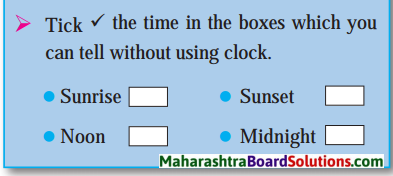
Tick ✓ the time in the boxes which you can tell without using clock.
(Note: The answer is given directly.)
Maharashtra Board Class 8 Geography Solutions Chapter 1 Local Time and Standard Time 5
Answer:
Maharashtra Board Class 8 Geography Solutions Chapter 1 Local Time and Standard Time 6

3. Give it a try.

Question 1.
If it is 8 a.m. in India, what is the time in Greenwich?
Answer:
If it is 8 a.m. in India, it would be 2.30 a.m. in Greenwich.

Maharashtra Board Class 8 Geography Solutions Chapter 1 Local Time and Standard Time

Question 2.
When it is 2 p.m. in India, in which countries would it be 2 p.m. exactly?
Answer:
When it is 2 p.m. in India, it would be 2 p.m. exactly in Sri Lanka.

Question 3.
When it is 9 a.m. in India, what would be the time at 82°30′ W longitude?
Answer:
When it is 9 a.m. in India, it would be 10 p.m. of the previous day at 82°30′ W longitude.

Question 4.
What would be the time at Prime Meridian when a new day starts at 180° longitude?
Answer:
It would be 12 noon at Prime Meridian when a new day starts at 180° longitude.

4. Think about it.

Question 1.
In which of the following countries, does only one standard time exist? (Mexico, Sri Lanka, New Zealand, China)
Answer:
From the given countries, only one time exists in Sri Lanka, New Zealand and China.

Maharashtra Board Class 8 Geography Solutions Chapter 1 Local Time and Standard Time

Question 2.
Why does a country having a large latitudinal extent have only one standard time?
Answer:
The places lying on the same longitude have the same local time. Therefore, a country having a large latitudinal extent have only one standard time.

Question 3.
Which discrepancies will emerge if more than one local times, instead of one standard time are followed in a country with huge longitudinal extent?
Answer:
The following discrepancies will emerge if more than one local times, instead of one standard time are followed in a country with huge longitudinal extent:

  1. It will become difficult to synchronize the timetable of rail transportation, air transportation, etc. in a country.
  2. It will become difficult to synchronize the timings of schools, colleges, banks, libraries, etc. in a country.
  3. We will always have to adjust the time in watch as we move from one place to another in a country.

8th Std Geography Questions And Answers:

Std 8 Geography Chapter 10 Questions And Answers Field Visit Maharashtra Board

Balbharti Maharashtra State Board Class 8 Geography Solutions Chapter 10 Field Visit Notes, Textbook Exercise Important Questions and Answers.

Class 8 Geography Chapter 10 Field Visit Questions And Answers Maharashtra Board

Field Visit Class 8 Questions And Answers Chapter 10 Maharashtra Board

Class 8 Geography Chapter 10 Field Visit Textbook Questions and Answers

Question a.
Prepare a questionnaire for a visit to a NGO working for cleanliness of marine beaches.
Answer:
A questionnaire for a visit to a NGO working for cleanliness of marine beaches is as follows :

  1. What is the year of establishment of this NGO?
  2. What are the aims and objectives of this NGO?
  3. Which activities/programmes are carried out for the cleanliness of marine beaches?
  4. How are the people from surrounding areas involved in those various activities and programmes?
  5. What are the future plans of this NGO?

Field trip:

  • Nature: Field trip is an important study method in geography.
  • Importance: Field trip helps in understanding various geographical concepts, elements and processes through direct experiences. It helps in understanding the correlation between humans and environment.
  • Planning: Planning of field trip includes deciding the aim, place, duration, etc. about the field trip.
  • Preparations : Preparations of field trip includes deciding the place of field visit, maintaining essential materials like notebook, pen, pencil, camera, etc., deciding the schedule for field visit, preparing questionnaire, etc.
  • Precautions : One should ensure that there is no harm to the environment in any way during field trip /visit.

Report writing:

  • Nature : A field report should be written on the basis of information obtained after field visit is complete.
  • Basis : The field report can be written on the basis of information gathered from field visit, photographs, maps, informative charts, questionnaire, etc.
  • Points : The field report can be written with the help of the following points :
    (a) Introduction
    (b) Presentation of information obtained
    (c) Conclusion, etc.

Field trips help in enhancing the understanding and sensitivity about the historical, economic, social, and cultural facts about the selected field. Report on field visit should be presented in the classroom.

Maharashtra Board Class 8 Geography Solutions Chapter 10 Field Visit

8th Std Geography Questions And Answers:

Std 9 Political Science Chapter 5 Question Answer Maharashtra Board

Balbharti Maharashtra State Board Class 9 Political Science Solutions Chapter 5 India and Other Countries Notes, Textbook Exercise Important Questions and Answers.

India and Other Countries Class 9 Questions And Answers Maharashtra Board

Class 9 Political Science Chapter 5 India and Other Countries Questions And Answers Maharashtra Board

Political Science Class 9 Chapter 5 Question Answer Maharashtra Board

1. Choose the right option and rewrite the sentence:

Question 1.
The country that has a free international border with India _______.
(a) Pakistan
(b) Bangladesh
(c) Nepal
(d) Myanmar
Answer:
(c) Nepal

Maharashtra Board Class Maharashtra Board Class 9 Political Science Solutions Chapter 5 India and Other Countries

Question 2.
The countries that have tense relations with India _______.
(a) Pakistan and China
(b) Nepal and Bhutan
(c) Myanmar and Maldives
(d) Afghanistan and America
Answer:
(a) Pakistan and China

Question 3.
Factors that have an influence on the relations between India and Pakistan _____.
(a) Difference in the world view of both the countries
(b) Kashmir issue
(c) Nuclear Rivalry
(d) All of the above
Answer:
(d) All of the above

2. Explain with reasons whether the following statements are true or false:

Question 1.
India has an important position among the South Asian countries.
Answer:
True.

  • India’s position in Asia is geographically and politically important.
  • Afghanistan, Pakistan, Sri Lanka, Bangladesh, Myanmar, Nepal, Bhutan, China and Maldives are India’s neighbours.
  • The values of equality and mutual respect have a great importance in India’s foreign policy. India has established relations with neighbouring countries on the basis of these values.
  • India is the biggest country in the Indian subcontinent. Similarly, India is economically and technologically more advanced. It is thus natural that India has a great influence among the South Asian countries.

Maharashtra Board Class Maharashtra Board Class 9 Political Science Solutions Chapter 5 India and Other Countries

Question 2.
Sino-Indian relations are friendly.
Answer:
False.

  • The conflict between India and China is connected to two issues : (a) Border issue and (b) The status of Tibet.
  • The border dispute between India and China is related to the Aksai Chin area and the Macmahon line.
  • China claims that the area, South of Aksai Chin and Macmahon line (Arunachal Pradesh) is Chinese Territory. China is not willing to agree that Macmahon Line is an international border.
  • India made several efforts to sort this border dispute by means of dialogue, but it has not met with much success. In 1962, China Attacked India.
  • When China was stepping up its military control in Tibet, Dalai Lama took asylum in India. This issue has been responsible for the conflict between the two countries.

Question 3.
India sent a peacekeeping force to help the Sri Lankan government.
Answer:
True.

  • India has friendly relations with the southern neighbour Sri Lanka.
  • Political instability in Sri Lanka after 1985 was a result of the differences between the Tamil and the Sri Lankan Government. At that time,
    India had sent a peace keeping force to help the Sri Lankan government.
  • Friendly relations with Sri Lanka are important from the point of view of security in the Indian Ocean.

3. Complete the following chart.

Question 1.

Treaties/Exchanges Countries
………….. India and Pakistan
Macmahon Line ……………..
………………… India and Bangladesh
Import of natural gas …………..
………….. India and Africa

Answer:

Treaties/Exchanges Countries
Shimla Agreement, Tashkent Agreement India and Pakistan
Macmahon Line India and China
Treaties about sharing river waters and borders India and Bangladesh
Import of natural gas Myanmar
Civil Nuclear Agreement India and Africa

4. Write short notes :

Question 1.
Shimla Agreement
Answer:
(i) India tried to solve Indo-Pak conflict bi-laterally. The Shimla Agreement of 1972 was based on these principles.

(ii) Pakistan considers Kashmir as the biggest hurdle in establishing relations with India.

(iii) The first Indo-Pak war took place in 1965, over Kashmir. The Tashkent Agreement was signed in 1966, but nothing much came out of it.

(iv) Even though the 1971 war was about the creation of Bangladesh, it also had the dimension of the Kashmir problem to it.

(v) The Shimla Agreement in 1972 provided a new format to the interaction between India and Pakistan.

Question 2.
Indo-Nepalese Friendship Treaty
Answer:
(i) The foundation of friendship between India and Nepal was laid with Indo-Nepalese Friendship Treaty in 1950.

(ii) According to this treaty, Nepalese citizens can not only enter India, but they are also permitted to take up government jobs and carry on trade in India.

(iii) The year 1990 marked the beginning of Nepal’s transition to democracy.

(iv) Nepal is dependent upon India for economic progress, basic facilities, food related needs, trade and energy needs.

(v) India sent a lot of help to Nepal at the time of the 2015 earthquake.

Maharashtra Board Class Maharashtra Board Class 9 Political Science Solutions Chapter 5 India and Other Countries

Question 3.
MacMahonLine
Answer:
(i) The conflict between India and China is connected to two issues :

  • Border issue
  • The status of Tibet

(ii) The border dispute between India and China is related to Aksai Chin area and the Macmahon line.
(iii) China claims that the area South of Aksai Chin and Macmahon line (Arunachal Pradesh) is Chinese Territory.
(iv) China is not willing to agree that Macmahon Line is an international border.
(v) India made several efforts to sort this border dispute by means of dialogue, but it has not met with much success.
(vi) In 1962, China attacked India.

Question 4.
Indo-Afghanistan Relation
Answer:
(i) There is a lot of political instability in Afghanistan.

(ii) The dominance of the terrorist organisation, Taliban is responsible for this.

(iii) India has extended help to bring peace, security and stability, curb violence and establish a democratic government.

(iv) Similarly, India is also helping Afghanistan in re-establishing communication facilities that have got destroyed due to war, build roads, cooperate in the fields of science and technology, build schools, health facilities and irrigation projects.

5. Answer the following questions in brief:

Question 1.
Explain the background of cooperative relations between India and America.
Answer:
India and America are two powerful nations who have democratic political systems. Right from the beginning, America was India’s most important trading partner.

(i) Many Indians have gone to America for education or work. Due to the presence of these non-resident Indians, the cultural, social and economic relations between America and India have been increasing.

(ii) After the end of Cold War, the military relations between India and America have increased on a large scale.

(iii) After India accepted free market economy, the speed of economic progress slowly increased. It resulted in further strengthening the trade relations between India and America.

(iv) When India conducted nuclear tests in 1998, there was tension in the relations between the two countries.

(v) Many rounds of discussions took place after that to improve the relations. Through these rounds of talks, America came to believe that India will use its nuclear weapons with responsibility. This completely transformed the Indo-American relations.

(vi) The Civil Nuclear Agreement signed in 2005 that was approved by the U.S. Congress in 2008 was an important landmark in Indo-American relations.

Question 2.
Give some information about the efforts taken by India for the establishment of democracy in neighbouring countries with examples.
Answer:
India upheld sovereignty and democratic values in Nepal, Afghanistan, Sri Lanka and Pakistan.

(i) Nepal was a Hindu Kingdom which adopted democratic government in 2006. India backed up its decision of adopting popular rule by helping Nepal with constitutional guidelines.

(ii) India also extended friendly relations to Ashraf Ghani through SAARC and other international platforms after the collapse of Taliban there.

(iii) India sent a peacekeeping force to Sri Lanka to bring about a cease fire between Sinhalese and Tamils and enforce peace and democracy.

(iv) The regime of Pervez Musharraf had adopted aggressive foreign policies and oppressed public opinion in Pakistan which led to violence and chaos. India had also criticised military rule in Pakistan.

Maharashtra Board Class Maharashtra Board Class 9 Political Science Solutions Chapter 5 India and Other Countries

Question 3.
What is the role of South Asian Association for Regional Cooperation?
Answer:
SAARC is a regional organisation established by the South Asian countries in 1985.

(i) The aim of this organisation is to encourage economic co-operation between South Asian nations and thereby achieve the development of the South Asian region.

(ii) The organisation of SAARC is a platform for South Asian countries to come together and discuss common questions and interests.

(iii) Some common interests of South Asian countries are alleviation of poverty, development of agriculture and technological revolution.

(iv) Some treaties were signed on the SAARC platform to make it easy for South Asian countries to trade with each other.

(v) As a part of this, it has been decided that South Asia should be made into a free trade area. For an equitable development of South Asian nations, a treaty about forming South Asian Free Trade Area was signed and South Asian University was established.

6. Give your own opinion about :

Question 1.
What remedies would you suggest in order to reduce the tensions in the relations between India and Pakistan?
Answer:
(i) To reduce tensions in the relations between India and Pakistan, I suggest that

(ii) Cultural exchange between the two nations must be enhanced by allowing and inviting artists of these nations to perform in each other’s countries. Films and sports would also work wonders to improve relations between them.

(iii) Since India is the largest democracy in the world, it should assist and uphold establishment of democratic systems in Pakistan, where government is either overpowered or practically governed by military.

(iv) Pakistan should be convinced through world opinion at international summits, conferences and organisations such as the UN.

(v) India should ascertain that the media does not mislead people in both the nations, by telecasting exaggerated content which might negatively influence the relations.

(vi) India should appeal the Pakistani Government for preservation of Hindu and Sikh pilgrimage places and cultural sites. India must also promote tourism in both the countries, so that civilians across borders have cordial relations.

(vii) Incidents of cross-border terrorism, violence and infiltration must be taken to international forums. Government of India should frame suitable policies for retrieval of Indian subjects, Prisoners of War and fishermen held in captivity of Pakistani Government.

Question 2.
Do you agree with the statement: ‘Hurdles are created in the way of internal development due to tense relations of India with neighbouring countries/ Explain with reasons.
Answer:
(i) Yes, I agree that hurdles are created in the way of internal development due to tense relations of India with neighbouring countries. Due to tense relations with the neighbours, India is unable to focus on the internal law and order situation and social welfare.

(ii) Non-cordial relations with the neighbours will force India to embark on military and nuclear mobilisation to retaliate the pressure of foreign aggression. This might culminate into a war.

(iii) War with neighbours will disturb the peace in the Indian subcontinent and compel India to divert its resources and efforts towards defence and manufacturing weapons.

(iv) Money and resources which should be invested for constructive purposes like health, education and infrastructure would be diverted towards destruction.

(v) A war with her neighbours can put tremendous pressure on India’s economy giving rise to problems like scarcity and inflation.

Question 3.
Do you think that strong healthy relations of India with America are conducive to India’s economic development?
Answer:
(i) Yes, I believe that strong healthy relations of India with America are conducive to India’s economic development.

(ii) America is an undisputable super power of the world and India is on its way to become a super power. Co-operation between these two countries can thwart terrorism in the world, which is a big challenge in the path of economic development.

(iii) Both countries follow democratic systems of government and free market economies. Co-operation from America is a must to enhance India’s economic prospects.

(iv) The non-resident Indians in America have helped to improve on Indian Foreign Reserves. With Indians taking up more employment in America, India can boost its foreign exchange.

(v) Call centres of American MNCs and other ways of outsourcing have provided employment opportunities to the Indian youth. American companies such as Coca Cola, Colgate and MacDonald established their franchises in India, whereas Indian IITians have dominated the Silicon Valley. An Indian – Sundar Pichai, today is the CEO of ‘Google’ – an American company.

(vi) As American companies find Indian economy very promising, FDI has also increased. The ’Make in India’ drive is now seeking empowerment of Indian economy and employment of Indians through such FDI’s.

Maharashtra Board Class Maharashtra Board Class 9 Political Science Solutions Chapter 5 India and Other Countries

Class 9 Political Science Chapter 5 India and Other Countries Additional Important Questions and Answers

Choose the correct option from the given options and rewrite the statements:

Question 1.
in l972,______ provided a new format to the interaction between India and Pakistan.
(a) Tashkent Agreement
(b) Shimla Agreement
(c) Civil Nuclear Agreement
(d) Nuclear Non-Proliferation Treaty
Answer:
(b) Shimla Agreement

Question 2.
Aung Sang Su Kyi is credited with having established democracy in ______.
(a) Bhutan
(b) Myanmar
(c) Cambodia
(d) the Maldives
Answer:
(b) Myanmar

Question 3.
The border dispute between India and China is related to ______ area and the Macmahon line.
(a) Sir Creek Area
(b) Siachien
(c) Aksai Chin
(d) Baltistan
Answer:
(c) Aksai Chin

Question 4.
Due to a series of tripartite talks between ____, China and India, Sino-Indian relations are improving slowly.
(a) Pakistan
(b) America
(c) Russia
(d) Japan
Answer:
(b) America

Question 5.
When China was stepping up its military control in Tibet,_____ took asylum in India.
(a) Dalai Lama
(b) Avalokiteshwara
(c) Bodhisattvas
(d) Vajarayana followers
Answer:
(a) Dalai Lama

Question 6.
The ______ signed in 2005 that was approved by the U.S. Congress in 2008 was an important landmark in Indo-American relations.
(a) Comprehensive Test Ban Treaty
(b) Nuclear Non-Proliferation Treaty
(c) Civil Nuclear Agreement
(d) Treaty of Friendship and Co-operation
Answer:
(c) Civil Nuclear Agreement

Question 7.
The policy of increasing trade with South-East Asian nations is known as the ______ policy.
(a) Act East
(b) Pact East
(c) Look East
(d) Seek East
Answer:
(c) Look East

Maharashtra Board Class Maharashtra Board Class 9 Political Science Solutions Chapter 5 India and Other Countries

Question 8.
The Summit Conference of India and Africa was held in 2015 with representatives from all _____ African nations attending it.
(a) 54
(b) 56
(c) 58
(d) 53
Answer:
(a) 54

Question 9.
India has co-operated in the project to produced ______ on a large scale, using the water source in Bhutan.
(a) Irrigation facilities
(b) Hydel power
(c) Tube wells
(d) Water reservoirs
Answer:
(b) Hydel power

Question 10.
_______has agreed to extend cooperation and technological help to India in the development and security of coastal areas.
(a) Malaysia
(b) Indonesia
(c) Brunei
(d) Japan
Answer:
(d) Japan

Question 11.
European Nations, especially ______ invest on a large scale in the field of technology in India.
(a) Greece and Italy
(b) Germany and France
(c) Belgium and Netherlands
(d) Spain and Portugal
Answer:
(b) Germany and France

Question 12.
The dominance of the terrorist organisation _______ is responsible for political instability in Afghanistan.
(a) Lashkar-e-Taiba
(b) Jamaat-ud-Dawa
(c) Taliban
(d) Al-Qaeda
Answer:
(c) Taliban

State whether the following statements are true or false with reasons:

Question 1.
Write about India’s relation with Maldives.
Answer:
(i) India’s relations with Maldives have been friendly right from the beginning. This small nation to the South of India is dependent on India for a lot of reasons.

(ii) Trade relations have been established between the two since 1981.

(iii) India has helped Maldives in the development of basic facilities or infrastructure, health and communication.

(iv) From 2006 onwards, co-operation in the military field also started between the two countries.

(v) They have entered into treaties with respect to cooperation in space research, conservation of historical objects and tourism. Similarly, they have decided to co-operate in the area of fighting against terrorism.

Maharashtra Board Class Maharashtra Board Class 9 Political Science Solutions Chapter 5 India and Other Countries

Write short notes:

Question 1.
SAARC
Answer:
(i) SAARC is a regional organisation established by the South Asian countries in 1985.

(ii) The aim of this organisation is to encourage economic co-operation between South Asian nations and there by, achieve the development of the South Asian region.

(iii) The organisation of SAARC is a platform for South Asian countries to come together and discuss common questions and interests.

(iv) Some common interests of South Asian countries are alleviation of poverty, development of agriculture and technological revolution.

(v) Some treaties were signed on the SAARC platform to make it easy for South Asian countries to trade with each other.

Do as directed:

Complete the following charts:

Question 1.

S.No Column ’A’ Column ’B’
(1) Joint Naval Exercises ……….
(2) Oil imports ………..
(3) Security in the Indian Ocean ……….
(4) Hydel Power Plant ………….

Answer:

S.No Column ’A’ Column ’B’
(1) Joint Naval Exercises Japan
(2) Oil imports United Arab Emirates
(3) Security in the Indian Ocean Sri Lanka
(4) Hydel Power Plant Bhutan

Question 2.

S.No. Help extended by India Beneficiary Nations
(1) Sent Peacekeeping Force to restore peace Sri Lanka
(2) Supplies during 2015 earthquake Nepal
(3) Communication facilities, roads, science and technology, schools, health and irrigation projects Afghanistan
(4) Helped in the freedom struggle Bangladesh
(5) Cooperation in the project to produce Hydel Power Bhutan

Answer:

S.No. Help extended by India Beneficiary Nations
(1) Sent Peacekeeping Force to restore peace Sri Lanka
(2) Supplies during 2015 earthquake Nepal
(3) Communication facilities, roads, science and technology, schools, health and irrigation projects Afghanistan
(4) Helped in the freedom struggle Bangladesh
(5) Cooperation in the project to produce Hydel Power Bhutan

Prepare the following flow charts:

Question 1.
Maharashtra Board Class 9 Political Science Solutions Chapter 5 India and Other Countries 4
Answer:
Maharashtra Board Class 9 Political Science Solutions Chapter 5 India and Other Countries 1

Question 2.
Maharashtra Board Class 9 Political Science Solutions Chapter 5 India and Other Countries 5
Answer:
Maharashtra Board Class 9 Political Science Solutions Chapter 5 India and Other Countries 2

Question 3.
Maharashtra Board Class 9 Political Science Solutions Chapter 5 India and Other Countries 6
Answer:
Maharashtra Board Class 9 Political Science Solutions Chapter 5 India and Other Countries 3

Answer the following questions in brief.

Question 1.
Illustrate the differences in world views between India and Pakistan.
Answer:
(i) India and Pakistan have totally different world views.

(ii) In line with the Indian world view, India opposed the military alliances of the Cold War and tried to solve the Indo-Pak conflict bilaterally.

(iii) On the other hand, Pakistan tried to maintain relations with the Islamic world and China entered into a military agreement with America.

Question 2.
Describe the Kashmir issue between India and Pakistan.
Answer:
(i) Pakistan considers Kashmir as the biggest hurdle in establishing relations with India.

(ii) The first Indo-Pak war took place in 1965 over Kashmir.

(iii) The Tashkent Agreement was signed in 1966, but nothing much came out of it.

(iv) Even though the 1971 war was about the creation of Bangladesh, it also had the dimension of the Kashmir problem to it.

(v) The Shimla Agreement in 1972 provided a new format to the interaction between India and Pakistan.

(vi) In 1999, there was a conflict between India and Pakistan over the infiltration by Pakistan in the Kargil region.

(vii) Even today, the Kashmir question is the basic cause of conflict between the two countries.

Question 3.
Sino-Pak Friendship has affected the security of India. Explain.
Answer:
(i) The threat to India’s security is increasing due to friendship between China and Pakistan, supply of weapons from China to Pakistan and also transfer of missile and nuclear weapons technology.

(ii) The increasing friendship between China and Pakistan and increasing influence of China over India’s other neighbours is a cause of concern for India.

Maharashtra Board Class Maharashtra Board Class 9 Political Science Solutions Chapter 5 India and Other Countries

Question 4.
How is India trying to resolve its differences with China?
Answer:
(i) India has always made efforts to improve relations with China.

(ii) A joint executive group has been set up to solve the Sino-Indian border dispute.

(iii) When the rate of economic growth of both India and China increased, the trade relations between both the countries began to get strengthened.

(iv) Because of improvement in economic and trade relations between India and China and a series of tripartite talks between Russia, China and India, Sino-Indian relations are improving slowly.

(v) Even though the border dispute is not completely resolved, it has taken a back seat and relations in other areas have become more important.

Question 5.
How was Bangladesh created?
Answer:
(i) Today’s Bangladesh is the erstwhile East Pakistan. When Pakistan was created, it had two parts: West and East Pakistan.

(ii) There was linguistic difference between them. There were other political conflicts as well.

(iii) The movement to liberate Bangladesh emerged out of this.

(iv) This movement tried to free Bangladesh from the dominance of West Pakistan.

(v) India helped Bangladesh in its freedom struggle. Bangladesh was formed in 1971.

Maharashtra Board Class Maharashtra Board Class 9 Political Science Solutions Chapter 5 India and Other Countries

Question 6.
How could India and African nations benefits from each other?
Answer:
(i) Having close relations with Africa will be beneficial from the point of view of both.

(ii) Many countries in Africa are developing rapidly.

(iii) MaharashtraBoardSoLutions.com diness to help in the all-round development of African youth. India has also agreed to give economic help and even grants to bring about development in different areas like technology, agriculture, tourism, etc.

(iv) India’s energy needs can be fulfilled by the energy rich countries like Egypt, Nigeria, Angola and Sudan.

(v) India is making efforts to increase trade with Africa.

9th Std Political Science Questions And Answers:

Std 9 History Chapter 9 Question Answer Maharashtra Board

Balbharti Maharashtra State Board Class 9 History Solutions Chapter 9 Changing Life 1 Notes, Textbook Exercise Important Questions and Answers.

Changing Life 1 Class 9 Questions And Answers Maharashtra Board

Class 9 History Chapter 9 Changing Life 1 Questions And Answers Maharashtra Board

History Class 9 Chapter 9 Question Answer Maharashtra Board

1. Choose the proper option and rewrite the completed statements:

Question 1.
The first open-heart surgery under the leadership of Dr N Gopinath was successfully performed in the city of _____.
(a) Chennai
(b) Vellore
(c) Hyderabad
(d) Mumbai
Answer:
(b) Vellore

Maharashtra Board Class 9 History Solutions Chapter 9 Changing Life 1

Question 2.
_______is known as the father of the ‘Jaipur foot’.
(a) Dr N. Gopinathan
(b) Dr Pramod Sethi
(c) Dr Mohan Rao
(d) None of the above
Answer:
(b) Dr Pramod Sethi

2. Identify the wrong pair and rewrite the corrected one:

Question 1.
(1) Dr N. Gopinath – open heart surgery
(2) Ramchandra Sharma – a skilled craftsman
(3) Dr Subhash Mukhopadhyaya – test tube baby
(4) Dr Mohan Rao – polio
Answer:
Wrong Pair: Dr Mohan Rao – polio

3. Explain the concepts:

Question 1.
The institution of the family.
Answer:
The institution of family can be explained as follows:

  • During the pre-independence period, the institution of the family was an important identifying feature of Indian society.
  • India was known all over the world as the country of joint families.
  • However, the wave of globalisation has now given an impetus to the system of nuclear families.

Question 2.
Jaipur Foot technology
Answer:
(i) Dr Pramod Sethi designed and manufactured artificial limbs, noses and ears, with the help of the skilled craftsman Ramchandra Sharma.

(ii) These artificial body parts manufactured with the help of the Jaipur foot technology have made it easy for the differently-abled to walk bare-foot on rough surfaces, run, go cycling, work in the fields, climb trees, and even climb mountains, etc.

Maharashtra Board Class 9 History Solutions Chapter 9 Changing Life 1

Question 3.
Urbanization
Answer:
(i) Urbanisation is a process of the concentration of population in a city or urban area. Increasing population is one major reason for urbanisation.

(ii) A few other factors affecting urbanisation are air, water and the economic as well as social organisations necessary for community life.

(iii) In the context of post-independence India, the increase in urban population is also due to factors such as a reduction in the mortality rate, industrialisation, unavailability of means of livelihood in rural areas, job opportunities in cities and the resulting migration.

Question 4.
Changing economic life
Answer:
(i) Earlier, every village was economically self-sufficient. A majority of the villagers were dependent on farming. Farm produce used to be distributed among artisans as payment for their work.
(ii) Now this situation has changed. Rural areas are engaged in agriculture and occupations ancillary to farming while urban society is engaged in non-agricultural production and the service sector.

4. Give reasons:

Question 1.
The campaign for pulse polio immunisation was initiated.
Answer:
The campaign of pulse polio immunisation was initiated because:

  • Before 1978, every year, six Indian infants out of every 10 who were bom faced fatal health problems in the very first year of their birth.
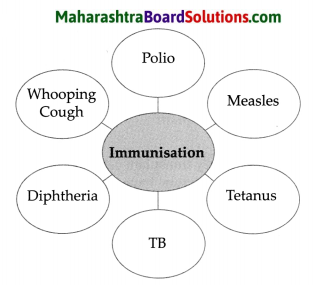
  • The immunisation programme was taken up to overcome the threat of polio, measles, tetanus, TB, diphtheria, and whooping cough.
  • The ‘pulse polio’ immunisation programme started in 1995 has controlled polio.

Question 2.
The Rural Water Supply Scheme was started.
Answer:
The State started the Rural Water Supply Scheme for sinking wells and providing piped water because:

(i) It is necessary to give priority to facilities for public hygiene and health-care. However even today, the rural population faces problems related to year-round provision of drinking water, toilets, open drainage, narrow roads, inadequate electrification and lack of facilities for medical treatment.

(ii) There is a lack of good quality educational facilities from primary level to higher education, centres for recreation and libraries.

(iii) The collective development scheme had an important place in all the first four five year plans of the government of India. The State of Maharashtra registered remarkable achievements under this scheme. By 1971,1677 small dams had also been built.

5. Answer the following questions in 25-30 words:

Question 1.
Which kinds of discrimination does the Constitution prohibit?
Answer:
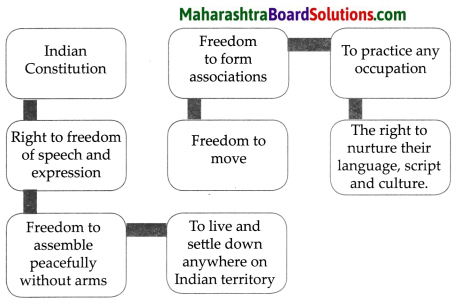
(i) According to our Constitution, all Indians are equal before the law, and they cannot be discriminated against on the basis of religion, race, caste, gender or place of birth.

(ii) All citizens have the right to freedom of speech and expression, freedom to assemble peacefully without arms, freedom to form associations, freedom to move, to live and settle down anywhere on Indian territory and to practice any occupation.

(iii) Indian citizens living anywhere in India enjoy the right to nurture their language, script and culture.

Maharashtra Board Class 9 History Solutions Chapter 9 Changing Life 1

Question 2.
What is the aim of the social welfare programme?
Answer:
(i) The objective to establish the welfare state has been incorporated in the Constitution itself.

(ii) The social welfare programmes aim to make opportunities for full-time employment, health care, education and development available to all Indian citizens. Indian society is riddled with large scale economic, social, educational and cultural inequalities.

(iii) However, it is necessary that opportunities for development reach women, children, the differently-abled, the scheduled castes and tribes as well as other minorities.

(iv) Hence on 14th June 1964, the government of India constituted the Ministry of Social Welfare. Under this ministry, various programmes are implemented for nutrition and child- development, social security and social protection, women’s welfare and development.

Question 3.
What are the challenges facing rural development?
Answer:

(i) In 1961, 82% of India’s population resided in villages. In 1971, the percentage was 80.01%.
(ii) So far, the rural area has shouldered the responsibility of providing food grains and other raw material to urban areas, supplying labour to the industrial sectors of the city, and taking care of natural resources.
(iii) However there are three major challenges with reference to rural development, namely, bringing about economic development, developing facilities to meet social needs and finally bringing about a change of attitude in matters concerning society, culture and ways of thinking.
(iv) It is also equally necessary to expedite irrigation projects and bring about land reforms.

6. Write a brief review of the significant events in the field of public health in India.
Answer:
The Constitution of India states that the primary duty of the government is to raise the people’s standard of living, to ensure proper nutrition and to improve public health. The Ministry of Health and Social Welfare at the Centre helps the state governments in this regard.

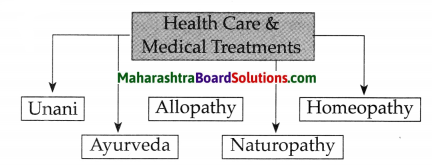
(i) To make primary health services as well as medical care available to rural people, the tribals and the poor was an objective of the Sixth Five Year plan. Efforts were made towards helping people maintain good health by giving recognition to Unani, Homoeopathy, Ayurveda and Naturopathy in addition to Allopathy.

(ii) In 1962, the first successful open heart surgery was performed under the leadership of Dr N. Gopinath at Christian Medical College Hospital at Vellore in Tamil Nadu. Hence, it is no longer necessary to go abroad for such treatment.

(iii) The invention of the ‘Jaipur Foot’ has transformed the lives of the disabled in India.

(iv) Before 1968, if a person lost a leg in an accident, he had to suffer for the rest of his life. In order to remedy the situation, Dr Pramod Sethi designed and manufactured artificial limbs, noses and ears, with the help of the skilled craftsman Ramchandra Sharma.

(v) These artificial body parts manufactured with the help of the Jaipur foot technology have made it easy for the differently-abled to walk bare-foot on rough surfaces, run, go cycling, work in the fields, climb trees, and even climb mountains, etc.

(vi) They save on the expenses on shoes as there is no need for footwear on these artificial limbs. They can bend their legs at the knees and sit cross-legged.

(vii) These feet are also convenient while working in water or under wet conditions.

Class 9 History Chapter 9 Changing Life 1 Additional Important Questions and Answers

Choose the correct option from the given options and rewrite the statements:

Question 1.
On 14th June 1964, the government of India constituted the Ministry of ________.
(a) Home Affairs
(b) Social Justice
(c) Social Welfare
(d) Education
Answer:
(c) Social Welfare

Question 2.
According to the 1971 Census, _____ people in India belonged to scheduled castes.
(a) 21%
(b) 22%
(c) 23%
(d) 24%
Answer:
(b) 22%

Maharashtra Board Class 9 History Solutions Chapter 9 Changing Life 1

Question 3.
UNESCO awarded its international prize for the spread of literacy to ______ in 1972 and tribes.
(a) Gujarat
(b) Bengal
(c) Maharashtra
(d) Karnataka
Answer:
(c) Maharashtra

Question 4.
‘Sinhagad Express’ on the Pune-Mumbai route and ‘ _____’ on the Mumbai-Kolkata route were started which had no class divisions.
(a) Karmabhoomi Express
(b) Howrah Mail
(c) Shalimar Express
(d) Gitanjali Express
Answer:
(d) Gitanjali Express

Question 5.
A _______ was formed to help the development of industry in rural areas.
(a) Village Industries Planning Committee
(b) Co-operative Credit Societies
(c) Industrial Development Association
(d) Rural Industrial Council
Answer:
(a) Village Industries Planning Committee

Question 6.
A settlement smaller than a village is called a _____.
(a) Town
(b) Taluka
(c) Hamlet
(d) Locality
Answer:
(c) Hamlet

Identify and write the wrong pair in the following sets:

Question 1.
(1) Kothari Commission – Agricultural Universities
(2) Durga – Open heart surgery
(3) Pramod Sethi – Artifical limbs
(4) Dr Mohan Rao – Kidney transplant
Answer:
Wrong Pair : Durga – Open heart surgery

Question 2.
(1) Christian Medical College – Tamil Nadu
(2) Vidya Niketan – Chikhaldara
(3) Gitanjali Express – Pune-Mumbai route
(4) First successful artificial conception – Kolkata
Answer:
Wrong Pair : Gitanjali Express – Pune-Mumbai route

Maharashtra Board Class 9 History Solutions Chapter 9 Changing Life 1

Question 3.
(1) Ministry of Social welfare established in -1962
(2) Pulse polio immunisation started – 1995
(3) Maharashtra received a prize for literacy in Maharashtra -1972
(4) Rural Electrification Corporation – 1969
Answer:
Wrong Pair : Ministry of Social welfare established in -1962

Question 4.
(1) Village Industries Planning Committee – Development of Industries in rural areas
(2) Vidya Niketan – residential highschools
(3) Rural water supply schemes – sinking wells
(4) Objective of Sixth Five Year Plan – Advanced technology
Answer:
Wrong Pair : Objective of Sixth five year plan – Advanced technology

Do as Directed:

Complete the table

Question 1.
Answer:

Institutes Location
Rural Electrification Co-operative societies Andhra Pradesh, Gujarat, Karnataka, Maharashtra and Uttar Pradesh
Agriculture Universities Rahuri, Akola, Parbhani and Dapoli in Maharashtra
Vidya Niketan Satara, Aurangabad, Nasik and Chikhaldara

Question 2.
Answer:

Rural Community in Pre-Globalisation period Urban Community in Pre-Globalisation period
Priority to farming and ancillary vocations (jobs) Priority to nonagricultural production and services.
Small in size, homogeneous in terms of language, culture and tradition. Large in size, heterogeneous in terms of languages, cultures and traditions.
Elementary kinds of vocations; trend of sending villagers to cities rather than accommodating outsiders in rural occupations. Large industries, production for global consumption, accommodating outsiders.
Large proportion of vocations running in the family Less proportion of vocations running in the family.
Priority to the head of the family and to the family as an institution. Joint family system. Family secondary, priority to individuals. Trend towards – nuclear families.

Maharashtra Board Class 9 History Solutions Chapter 9 Changing Life 1

Complete the web diagram

Question 1.
Answer:
Maharashtra Board Class 9 History Solutions Chapter 9 Changing Life 1 2

Question 2.
Answer:
Maharashtra Board Class 9 History Solutions Chapter 9 Changing Life 1 3

Write short notes:

Question 1.
Rural Development
Answer:
(i) In 1961, 82% of India’s population resided in villages.

(ii) In 1971, the percentage was 80.01%. So far, the rural area has shouldered the responsibility of providing food grains and other raw material to urban areas, supplying labour to the industrial sectors of the city, and taking care of natural resources.

(iii) There are three major challenges with reference to rural development, namely, bringing about economic development, developing facilities to meet social needs and finally bringing about a change of attitude in matters concerning society, culture and ways of thinking.

(iv) It is equally necessary to expedite irrigation projects and bring about land reforms.

Question 2.
Social Welfare
Answer:
(i) The objective to establish the welfare state has been incorporated in the Constitution itself. India is the first country in the world to do so.

(ii) The social welfare programmes aim to make opportunities for full-time employment, health care, education and development available to all Indian citizens.

(iii) It is necessary that opportunities for development reach women, children, the differently abled, the scheduled castes and tribes as well as other minorities.

(iv) This was the greatest challenge facing the government during the post-independence period

(v) That is why, on 14 June 1964, the government of India constituted the Ministry of Social Welfare.

(vi) Under this ministry various programmes are implemented for nutrition and child development, social security and social protection, women’s welfare and development.

Maharashtra Board Class 9 History Solutions Chapter 9 Changing Life 1

Question 3.
Kidney transplant
Answer:
(i) Since kidney transplant can now be performed in India, doctors have succeeded in saving patients’ lives. Such surgeries were not so common in India till 1971.

(ii) But in 1971, it was successfully performed at the Christian Medical College hospital at Vellore in Tamil Nadu.

(iii) Dr. Johny and Dr. Mohan Rao transplanted the kidney donated by a living person into the patient’s body.

(iv) Nowadays, patients from underdeveloped countries come to India for such surgeries.

Question 4.
Test-tube baby
Answer:
(i) Right from early times, having a baby is considered to be of utmost importance in the Indian family system.
(ii) The support of ‘test-tube baby’ technology has been available to childless couples since 1978.
(iii) It was under the supervision of Dr. Subhash Mukhopadhyaya that the experiment of the test-tube baby was successfully carried out at Kolkata.
(iv) This was the first successful attempt at artificial conception. A girl named Durga was born.
(v) This technology helped to solve the problem of childless couples who wanted children.

Explain statements with reason:

Question 1.
Rural electrification is essential.
Answer:
Rural electrification is essential because:

(i) Electricity is essential for the development of rural areas. Automatic pumps are needed to water the fields.

(ii) Electricity is also needed to preserve perishable food items such as milk, eggs, fruits, and vegetables, to run fertilizer projects and for fans and TV, and for lights for studying at night.

(iii) During the first five-year plan, electricity had been provided to three thousand villages in India. By 1973, it reached 1,38,646 villages. From 1966, it was decided to supply more electricity for pumps and borewells.

(iv) ‘Rural Electrification Corporation’ was established in 1969.

Question 2.
It is necessary to give special attention to rural areas.
Answer:
(i) It is necessary to give priority to facilities for public hygiene and health-care.

(ii) Even today the rural population faces problems related to year round provision of drinking water, toilets, open drainage, narrow roads, inadequate electrification and lack of facilities for medical treatment.

(iii) There is a lack of good quality educational facilities from primary level to higher education, centres for recreation and libraries. That is why it is necessary to give special attention to rural areas.

Question 3.
The Rural Local Self-Government was empowered with more authority.
Answer:
(i) Keeping in mind the goal of rural development, the collective development scheme has come into force.

(ii) Plans were made for improving farming technology, increasing the area of irrigated land, extending educational facilities, enacting the laws for land reform under this scheme.

(iii) It also aimed at increasing agricultural produce as well as expanding the means of transport, health services and scope for education in the rural areas.

(iv) The government undertook this work through the medium of Gram Panchayats which included the people from all castes and tribes.

(v) To achieve this, the Gram Panchayats, Panchayat Samitis and Zilla Parishads were empowered with more authority.

Maharashtra Board Class 9 History Solutions Chapter 9 Changing Life 1

Read the following passage and answer the questions below:

Public health: The Constitution of India states that ‘ the primary duty of the government is to raise the people’s standard of living, to ensure proper nutrition i and to improve public health. The ministry of health i and Social Welfare at the Centre helps the state governments in this regard. To make primary health services as well as medical care available to rural people, the tribals and the poor was an objective of the Sixth Five Year plan. Efforts were made towards helping people maintain good health by giving recognition to Unani, Homoeopathy, Ayurveda and Naturopathy in addition to Allopathy, Progress in the medical field has made the life of Indians relatively free of health concerns. In 1962, the first successful open heart surgery was performed under the leadership of Dr. N. Gopinath at Christian Medical College Hospital at Vellore in Tamil Nadu, Hence, it is no longer necessary to go abroad for such treatment.

Question 1.
Prepare a concept map of recognised health care and medical treatments in India.
Answer:
Maharashtra Board Class 9 History Solutions Chapter 9 Changing Life 1 1

Question 2.
Who was Dr. N. Gopinath? State his achievement?
Answer:
Dr. N. Gopinath was an experienced surgeon at Christian Medical College Hospital of Vellore under whose leadership an Open Heart Surgery was performed for the first time in India in 1962.

Question 3.
Which disease among children do you consider most threatful? Why?
Answer:
I would consider Polio as one of the most threatening diseases. It renders an infant physically impaired or incapacitated for life. Without physical development, it is not possible for a child to lead a normal life. He/she becomes dependent on others for daily chores and cannot become self-reliant.

Answer the following questions in detail:

Question 1.
State the achievements of Christian Medical College Hospital.
Answer:
(i) In 1962, the first successful open heart surgery was performed under the leadership of Dr. N. Gopinath at Christian Medical College Hospital at Vellore in Tamil Nadu.

(ii) In 1971, kidney transplant was successfully performed at the Christian Medical College hospital at Vellore in Tamil Nadu. Dr Johny and Dr Mohan Rao transplanted the kidney donated by a living person into the patient’s body.

Maharashtra Board Class 9 History Solutions Chapter 9 Changing Life 1

Question 2.
Explain, how ‘Jaipur Foot’ has transformed the lives of the disabled in India?
Answer:
(i) The invention of the ‘Jaipur Foot’ has transformed the lives of the disabled in India. Before 1968, if a person lost a leg in an accident, he had to suffer for the rest of his life.

(ii) In order to remedy the situation, Dr Pramod Sethi designed and manufactured artificial limbs, noses and ears, with the help of the skilled craftsman Ramchandra Sharma.

(iii) These artificial body parts manufactured with the help of the Jaipur foot technology have made it easy for the differently abled to walk bare-foot on rough surfaces, rim, go cycling, work in the fields, climb trees, and even climb mountains, etc.

(iv) They save on the expenses on shoes as there is no need for footwear on these artificial limbs. They can bend their legs at the knees and sit cross-legged.

(v) These feet are also convenient while working in water or wet conditions.

Question 3.
What measures were taken up to uplift the scheduled castes and tribes?
Answer:
(i) According to the 1971 Census, 22% people in India belonged to scheduled castes and tribes.

(ii) Laws were enacted so that they got educational scholarships, and representation in Parliament as well State Assemblies. Some seats are also reserved for them in Government services.

Question 4.
Give an account of the collective development scheme that was featured in the first four Five Year Plans.
Answer:
(i) The collective development scheme had an important place in all the first four five year plans of the government of India.

(ii) The State of Maharashtra registered remarkable achievements under this scheme. For example, ‘Zilla Parishads’ was established in 1962.

(iii) Nutritious diet scheme was launched in 1970-1971. The State also started the ‘Rural Water Supply Scheme’ for sinking wells and providing piped water.

(iv) By 1971,1677 small dams had also been built.

9th Std History Questions And Answers:

Std 8 Geography Chapter 3 Questions And Answers Humidity and Clouds Maharashtra Board

Balbharti Maharashtra State Board Class 8 Geography Solutions Chapter 3 Humidity and Clouds Notes, Textbook Exercise Important Questions and Answers.

Class 8 Geography Chapter 3 Humidity and Clouds Questions And Answers Maharashtra Board

Humidity and Clouds Class 8 Questions And Answers Chapter 3 Maharashtra Board

Class 8 Geography Chapter 3 Humidity and Clouds Textbook Questions and Answers

1. Match the column and complete the chain: 

‘A’ Column ‘B’ Column ‘C’ Column
1. Cirrus i. Vertical extent in the sky a. Roaring clouds
2. Cumulonimbus ii. Higher altitude b. Floating clouds
3. Nimbostratus iii. Medium altitude c. Continuous rainfall
4. Alto-cumulus iv Low altitude d. Snowflake clouds

Answer:

‘A’ Column ‘B’ Column ‘C’ Column
1. Cirrus ii. Higher altitude d. Snowflake clouds
2. Cumulonimbus i. Vertical extent in the sky a. Roaring clouds
3. Nimbostratus iv Low altitude c. Continuous rainfall
4. Alto-cumulus iii. Medium altitude b. Floating clouds

2. Choose the correct word from the brackets and complete the sentences:
(Options: Cumulonimbus, relative humidity, absolute humidity, condensation, vapor-holding capacity)

Question a.
The ………….. of the air is dependent on the temperature of the air.
Answer:
vapour-holding capacity

Maharashtra Board Class 8 Geography Solutions Chapter 3 Humidity and Clouds

Question b.
The amount of vapour in 1 cu.m, of air shows the ………….
Answer:
absolute humidity

Question c.
As …………. is less in the desert areas, the air is dry there.
Answer:
relative humidity

Question d.
……………. type of clouds are indicators of the storm.
Answer:
Cumulonimbus

Maharashtra Board Class 8 Geography Solutions Chapter 3 Humidity and Clouds

Question e.
In a free environment, the ………….. of the vapour present in the atmosphere takes place around the dust particles.
Answer:
condensation

3. Differentiate between: 

Question a.
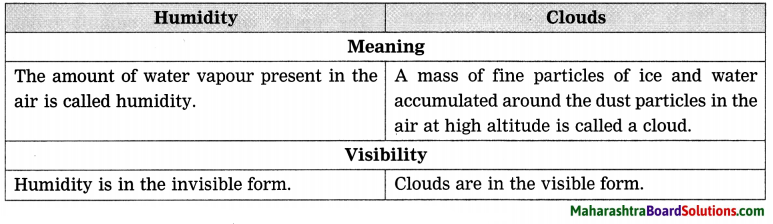
Humidity and clouds:
Answer:
Maharashtra Board Class 8 Geography Solutions Chapter 3 Humidity and Clouds 1

Question b.
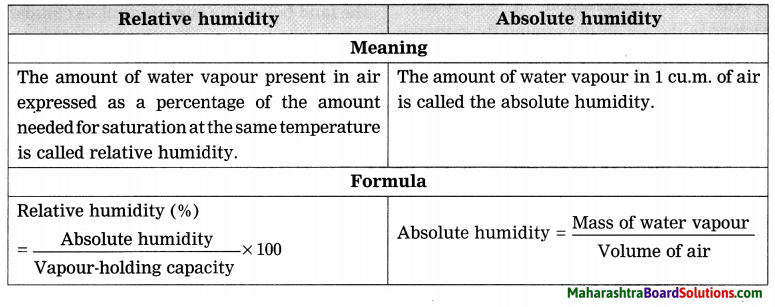
Relative humidity and Absolute humidity
Answer:
Maharashtra Board Class 8 Geography Solutions Chapter 3 Humidity and Clouds 2

Question c.
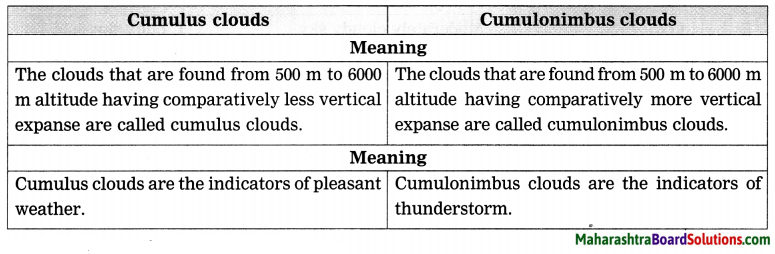
Cumulus clouds and Cumulonimbus clouds
Answer:
Maharashtra Board Class 8 Geography Solutions Chapter 3 Humidity and Clouds 3

4. Answer the following questions:

Question a.
Why is the air in a region dry?
Answer:
Due to the low amount of the moisture in the air, the air in a region is I dry.

Maharashtra Board Class 8 Geography Solutions Chapter 3 Humidity and Clouds

Question b.
How is humidity measured?
Answer:
1. The amount of water vapour in 1 cu.m, of air is called the absolute humidity.

2. Absolute humidity is measured with the help the following formula:
Absolute humidity
= \(\frac{\text { Mass of water vapour }}{\text { Volume of air }}\)

3. The amount of water vapour present in air expressed as a percentage of the amount needed for saturation at the same temperature is called relative humidity.

4. Relative humidity is measured with the help of the following formula: Relative humidity (%)

Maharashtra Board Class 8 Geography Solutions Chapter 3 Humidity and Clouds 5

Question c.
What are the prerequisites for condensation?
Answer:
High relative humidity and dew point temperature of the air are the j prerequisites for condensation.

Question d.
What is a cloud? Write its types.
Answer:
A. Meaning:
A visible mass of fine particles of ice and water accumulated around the dust particles in the air at high altitude is called a cloud.

B. Types:
The following are the types of clouds:

  1. High clouds: Clouds at an altitude of 7000 m to 14000 m are considered as high clouds. Cirrus, Cirro-Stratus and CirroCumulus are high clouds.
  2. Medium clouds: Clouds at an altitude of 2000 m to 7000 m are considered as medium clouds. Alto-Stratus and Alto Cumulus are medium clouds.
  3. Low clouds: Clouds at an altitude of less than 2000m are considered as low clouds. Strato-Cumulus, Stratus, Nimbostratus, Cumulus and Cumulonimbus are low clouds

Maharashtra Board Class 8 Geography Solutions Chapter 3 Humidity and Clouds

Question e.
Which type of clouds give rain?
Answer:
Nimbostratus and cumulonimbus type of clouds give rain.

Question f.
On what does the percentage of relative humidity depend?
Answer:
The percentage of relative humidity depends on the absolute humidity and vapour-holding capacity of the air at a given temperature.

5. Give geographical reasons:

Question a.
Clouds float in the sky.
Answer:

  1. The condensed water or fine particles of snow accumulate around dust particles at high altitudes leading to formation of clouds.
  2. The condensed water or fine particles in the clouds are almost weightless. Therefore, clouds float in the sky.

Question b.
The proportion of relative humidity changes according to altitude.
Answer:
1. The temperature is found to be comparatively high in the areas at sea level. Due to high temperature, moisture-holding capacity of air near sea level is found to be high. Therefore, the humidity of the air at sea level is comparatively high.

2. The temperature is found to be comparatively low in the areas at high altitude. Due to low temperature, moisture-holding capacity of air at high altitudes is found to below. Therefore, the humidity of the air at high altitude is comparatively low. In this way, the proportion of relative humidity changes according to the altitude.

Maharashtra Board Class 8 Geography Solutions Chapter 3 Humidity and Clouds

Question c.
Air becomes saturated.
Answer:

  1. At certain temperature, the moisture-holding capacity of air gets fulfilled and it becomes equal to the proportion of the moisture present in it.
  2. At this state, no more moisture can be absorbed by the air. Thus, air becomes saturated.

Question d.
Cumulus clouds change into cumulonimbus clouds.
Answer:

  1. Cumulus clouds are found between 500 m to 6000 m altitude. They are mostly formed due to the vertical flow of the air.
  2. Sometimes, the vertical expanse of the cumulus clouds increases and it leads to formation of huge mountain-like cumulonimbus clouds. Thus, cumulus clouds change into cumulonimbus clouds.

6. Solve the following:

Question a.

When the temperature of the air is 30° C, its vapour-holding capacity is 30.37 gms/cu.m., If absolute humidity is 18 gms/cu.m., then what will be the relative humidity?
Answer:
Relative humidity (%)
Maharashtra Board Class 8 Geography Solutions Chapter 3 Humidity and Clouds 6

Question b.
What would be the absolute humidity of air if 1 cu.m, air contains 4.08 gms of vapour at 0° C temperature.
Answer:
Absolute humidity
Maharashtra Board Class 8 Geography Solutions Chapter 3 Humidity and Clouds 7

7. Collect the weather related information from newspapers for the month of July. Relate the difference in the maximum and minimum temperatures with humidity.

Activity:

Question a.
Make a table showing the types of clouds. Use various photographs.
Answer:

Maharashtra Board Class 8 Geography Solutions Chapter 3 Humidity and Clouds 9
Maharashtra Board Class 8 Geography Solutions Chapter 3 Humidity and Clouds 8

Class 8 Geography Chapter 3 Humidity and Clouds Additional Important Questions and Answers

Examine the following statements and correct the incorrect ones:

Question a.
Cumulonimbus clouds are the indicators of the pleasant atmosphere.
Answer:
Incorrect.
Correct statement: Cumulonimbus clouds are the indicators of the thunderstorm.

Maharashtra Board Class 8 Geography Solutions Chapter 3 Humidity and Clouds

Question b.
The relative humidity is found to be high in desert region.
Answer:
Incorrect.
Correct statement: The relative
humidity is found to be less in desert region.

Question c.
The high temperature of the air leads to rapid evaporation.
Answer:
Correct.

Question d.
When the humidity in the air is 0 gm/cu.m. at any temperature, the air is said to be humid.
Answer:
Incorrect.
Correct statement: When the humidity in the air is o gm/cu.m. at any temperature, the air Is said to be dry.

Question e.
Cirrostratus appears like a bed sheet with wrinkles.
Answer:
Correct.

Answer the following questions in one sentence each:

Question a.
What is evaporation?
Answer:
The process of converting water into steam or water vapour is called evaporation.

Question b.
What is meant by the moisture-holding capacity of air?
Answer:
The capacity of air to hold moisture at a given temperature, is called the moisture-holding capacity of air.

Maharashtra Board Class 8 Geography Solutions Chapter 3 Humidity and Clouds

Question c.
What is meant by the saturation of the air?
Answer:
The condition of air at a certain temperature, in which the moisture-holding capacity of air becomes equal to the I proportion of moisture present in it, is called saturation of the air.

Answer the following questions in brief:

Question a.
Write in brief about the features of high clouds.
Answer:
Clouds at an altitude of 7000 m to 14000 m are considered as high clouds. High clouds are mainly made up of ice particles. Cirrus, Cirro-Stratus and Cirro-Cumulus are high clouds. The following are the features of high clouds :

  1. Cirrus: Cirrus are wispy.
  2. Cirro-Stratus: Cirro-Stratus look like bed sheet with wrinkles. A halo is generally seen around these clouds.
  3. Cirro-Cumulus clouds: Cirro- Cumulus look like groups of small waves.

Question b.
Write in brief about the features of medium clouds.
Answer:
Clouds at an altitude of 2000 m to 7000 m are considered as medium clouds. Alto-Stratus and Alto-Cumulus are medium clouds. The following are the features of medium clouds :

  1. Alto-Stratus : Alto-Stratus are comparatively thin. The sun is visible through these clouds as if seen through a milky glass.
  2. Alto-Cumulus : Alto-Cumulus are in the form of layers. They have wave-like structure. They are white in colour and have a grey shade.

Question c.
Write in brief about the features of Strato-Cumulus, Stratus and Nimbostratus.
Answer:
The features of Strato-Cumulus, Stratus and Nimbostratus are as follows :

  1. Strato-Cumulus: Strato-Cumulus have layers. These clouds are mostly seen in round clusters. They are white to earthy in colour.
  2. Stratus: Stratus are found in layers. They have uniform base. They are ash coloured.
  3. Nimbostratus: Nimbostratus have thick layers. They are greyish in colour. They cause continuous rainfall. They are also responsible for snowfall.

Maharashtra Board Class 8 Geography Solutions Chapter 3 Humidity and Clouds

Question d.
Write in brief about the features of Cumulus and Cumulonimbus.
Answer:
The features of Cumulus and Cumulonimbus are as follows :
1. Cumulus : Cumulus are found between 500 m to 6000 m altitude. They are mostly formed due to the vertical flow of the air. They have huge size and dome-like shape. They are grey in colour. They indicate pleasant atmosphere. With an increase in the vertical expanse, these clouds turn into cumulonimbus clouds and bring rain.

2. Cumulonimbus : Cumulonimbus appear like huge mountain. They are dense and dark in colour. They have anvil-like shape at the top. They are the indicators of thunder, lightning and storm. They bring rain with storm. Sometimes they also bring hailstones. The raindrops of these clouds are found to be larger in size.

Give geographical reasons for the following:

Question a.
The absolute humidity of air in coastal region is higher than humidity of air in inland areas.
Answer:
1. The rate of evaporation is found to be high in the coastal region. As its effect, the amount of moisture in air in coastal region is found to be high. This results in high absolute humidity of air in coastal region.

2. On the other hand, the rate of evaporation is found to be low in the inland areas. As its effect, the amount of moisture in air in inland regions is found to be low. This results in low absolute humidity of air in inland areas. Thus, the absolute humidity of air in coastal region is higher than humidity of air in inland areas.

Question b.
The absolute humidity of air in equatorial region is higher than humidity of air in polar region.
Answer:
1. Equatorial region receives perpendicular sunrays throughout the year leading to high temperature. High temperature increases the rate of evaporation and this further leads to high absolute humidity of air in equatorial region.

2. Polar regions receive extremely slanted sunrays throughout the year leading to very low temperature. Very low temperature decreases the rate of evaporation and this further leads to very low absolute humidity of air in polar region. Thus, the absolute humidity of air in equatorial region is higher than humidity of air in polar region.

Maharashtra Board Class 8 Geography Solutions Chapter 3 Humidity and Clouds

Question c.
Damp air is found in the coastal regions.
Answer:

  1. The rate of evaporation is found to be high in the coastal region. As its effect, the amount of moisture in air in coastal region is found to be high.
  2. The absolute humidity of the air near coastal region is found to be high. Therefore, damp air is found in the coastal regions.

Question d.
Dry air is found in the inland regions.
Answer:

  1. The rate of evaporation is found to be low in inland region. As its effect, the amount of moisture in air in inland region is found to be low.
  2. The absolute humidity of the air in inland region is found to be low. Therefore, dry air is found in inland regions.

Differentiate between the following :

Question a.
Densification and Sublimation :
Answer:
Maharashtra Board Class 8 Geography Solutions Chapter 3 Humidity and Clouds 4

Study the following map/figure /graph and answer the following questions:

1. Study the figure 3.7 given on page 20 of the textbook and answer the following questions :

Question a.
What is the maximum diameter of the raindrop?
Answer:
The maximum diameter of the raindrop is 5 mm.

Question b.
Around what does the condensation of the water vapour in the air occur?
Answer:
The condensation of the water vapour in the air occurs around the minute particles of dust or salt in the air.

2. Study the Figure 3.9 given on page 22 of the textbook and answer the following questions :

Question a.
Which type of charge is found at the upper end of the cumulonimbus clouds?
Answer:
Positive charge is found at the upper end of the cumulonimbus clouds.

Maharashtra Board Class 8 Geography Solutions Chapter 3 Humidity and Clouds

Question b.
Which type of charge is found at the low end of the cumulonimbus clouds?
Answer:
Negative charge is found at the low end of the cumulonimbus clouds.

Question c.
Which type of charge is found on the land below the cumulonimbus clouds?
Answer:
Positive charge is found on the land below the cumulonimbus clouds.

Use your brainpower!

Find where the symbols given below are used while showing the weather of a place. Write their meanings in the boxes given below:
(Note: The answer is given directly.)

Question a
Maharashtra Board Class 8 Geography Solutions Chapter 3 Humidity and Clouds 10
Answer:
Maharashtra Board Class 8 Geography Solutions Chapter 3 Humidity and Clouds 12

Thought-Provoking Questions:

Think about it.

Question a.
During winters, when you exhale on the glass of your mirror, what happens. If you do this in summer why doesn’t it happen?
Answer:
1. During winters, the moisture-holding capacity of air is low due to low temperature. Therefore during winters, when we exhale on the glass of mirror, the condensation of water vapour present in the exhaled air takes place. As its effect very thin water drops are found on the glass of mirror.

2. During summer, the moisture-holding capacity of air is high due to high temperature. Therefore during summer, when we exhale on the glass of mirror, the water vapour present in the exhaled air gets absorbed in air. Therefore, no water drops are found on the glass of mirror.

Maharashtra Board Class 8 Geography Solutions Chapter 3 Humidity and Clouds

Give it a try.

The vapour-holding capacity of 1 cu.m, of air in various temperature is given in the following table.

Calculate the difference in the capacities by observing the following table :
(Note: The answer is given directly.)

Question a.
Maharashtra Board Class 8 Geography Solutions Chapter 3 Humidity and Clouds 11
Answer:

Temperature of the air (°C) Vapour-holding (gm/cu.m3 (gm/cu.m3)capacity Difference in the capacities (gm/cu.m3)
-5 3.26
0 4.85 1.59
5 6.80 1.95
10 9.40 2.60
15 12.83 3.43
20 17.30 4.47
30 30.37 13.07
40 51.12 20.75

Use your brain power!

Question a.
In which season is humidity generally more?
Answer:
Humidity is generally more in monsoon.

Question b.
How does the humidity affect the human body?
Answer:
The rate of respiration and sweating increases due to humidity.

Question c.
Observe how humidity affects the food materials at our home and write about the same.
Answer:
Due to humidity, fungus flourish on food materials at our home and it gets spoiled.

Maharashtra Board Class 8 Geography Solutions Chapter 3 Humidity and Clouds

Question d.
Is there any relationship between formation of fungus and humidity?
Answer:
There is a direct relationship between formation of fungus and humidity. Humidity supports the growth of fungus.

Question e.
How is the early or late drying up of clothes related to humidity?
Answer:
As the moisture-holding capacity is found to be high in low humidity air, it leads to early drying up of clothes. As the moisture-holding capacity is found to be low in high humidity air, it leads to late drying up of clothes.

Think about it.

Question a.
What will happen if the temperature of saturated air at 20° C drops to 10° C abruptly?
Answer:

  1. If the temperature of saturated air at 20° C drops to 10° C abruptly, the relative humidity of the air will increase abruptly.
  2. Rise in the relative humidity will lead to condensation or sublimation of water vapour in the air. This in turn, will lead to precipitation or snowfall.

Maharashtra Board Class 8 Geography Solutions Chapter 3 Humidity and Clouds

Open-Ended Question:

Question a.
Explain the effect of humidity on human life.
Answer:

  1. High humidity increases the rate of sweating and respiration. This adversely affects the daily functioning.
  2. Low humidity with pleasant atmosphere, have favourable effects on the daily routine.
  3. High humidity leads to late drying up of clothes and early spoiling of food materials.
  4. Low humidity leads to early drying up of clothes and late spoiling of food materials.

8th Std Geography Questions And Answers:

Std 8 Geography Chapter 6 Questions And Answers Land Use Maharashtra Board

Balbharti Maharashtra State Board Class 8 Geography Solutions Chapter 6 Land Use Notes, Textbook Exercise Important Questions and Answers.

Class 8 Geography Chapter 6 Land Use Questions And Answers Maharashtra Board

Land Use Class 8 Questions And Answers Chapter 6 Maharashtra Board

Class 8 Geography Chapter 6 Land Use Textbook Questions and Answers

1. Examine the following statements and correct the incorrect ones:

Question A.
Mining Is not type of land use.
Answer:
Incorrect.
Correct statement: Mining is a type of land use.

Question B.
There are factories in the Central Business District.
Answer:
Incorrect.
Correct statement: There are many shops, banks and offices in the Central Business District.

Question C.
In urban areas, the largest area is used for residential purposes.
Answer:
Correct.

Maharashtra Board Class 8 Geography Solutions Chapter 6 Land Use

Question D.
The village attendant issues the 7/12 extract.
Answer:
Incorrect.
Correct statement: The village talathi issues the 7/12 extract.

Question E.
In rural areas, residential areas occupy large tracts.
Answer:
Incorrect.
Correct statement: In rural areas, residential areas occupy small tracts.

Question F.
Extract 7 indicates Record of Rights.
Answer:
Correct.

Question G.
Extract 12 indicates change in ownership.
Answer:
Incorrect.
Correct statement: Extract 12 indicates tracts under cultivation.

2. Give geographical reasons.

Question A.
Land use for public facility is extremely important in urban areas.
Answer:

  1. Government provides various services to fulfill the needs of citizens. The land used for fulfilling these needs is known as public utility/ facility area.
  2. The lands used for post offices, police stations, public grounds, public schools, public hospitals, etc. are included public facility land use.
  3. Land use for public facility increases the’ social welfare. Therefore, land use for public facility is extremely important in urban areas.

Maharashtra Board Class 8 Geography Solutions Chapter 6 Land Use

Question B.
The record of ownership of non- agricultural land is same as that of agricultural land.
Answer:
1. The record of agricultural land is maintained in the form of 7/12 extract. Similarly the record of ownership of non-agricultural land is maintained in the form of property card.

2. Like 7/12 extract, property card provides details of ownership of land, city survey number, plot number, amount of tax, area of property assessed, right to access, etc. Thus, the record of ownership of non-agricultural land is same as that of agricultural land.

Question C.
A region can be classified as developed or developing on the basis of land use.
Answer:

  1. The land used in a particular region for agriculture, grazing, etc. indicates that the region is underdeveloped or developing.
  2. The land used in a particular region for commercial purposes, transportation, recreation, etc. indicates that the region is developed. In this way, a region can be classified as developed or developing on the basis of land use.

3. Write answers:

Question A.
Why is agriculture important in rural land use?
Answer:

  1. In India, agriculture is the main occupation of most of people in rural areas.
  2. In India, farming occupation is very important as it satisfies the need of food grain and provides raw material to industries.
  3. The maximum land in rural areas is used for carrying out agricultural activities. Therefore, agriculture is important in rural land use.

Question B.
State the factors affecting land use.
Answer:
(a) The factors affecting rural land use :

  1. The factors like climatic conditions, fertility of soil, altitude and slope of land, irrigational facilities, natural resources, government policies, etc. affect rural land use.
  2. For example, the land with gentle slope is not used for residential purpose, but is used for step farming.

(b) The factors affecting urban land use :

1. The factors like location of land, natural resources, housing development policies of government, transportation routes, industrialisation, trade and commerce, entertainment facilities, government policies, etc. affect urban land use.

2. For example, the land site near the railway station, market, etc. is mostly used for commercial purposes.

Maharashtra Board Class 8 Geography Solutions Chapter 6 Land Use

Question C.
Clarify the differences between rural and urban land use.
Answer:
The differences between rural and urban land use are as follows :

  1. Land in rural areas is used for limited purposes. On the other hand, land in urban areas is used for many purposes.
  2. The pattern of rural land use is comparatively simple. On the other hand, the pattern of urban land use is comparatively complex.
  3. Use of land for cultivation is the major form of rural land use. On the other hand, use of land for commercial activities and residence are the major forms of urban land use.

Question D.
Differentiate between 7/12 extract and property card.
Answer:
The differences between 7/12 extract and property card are as follows :

  1. 7/12 extract is issued by public revenue department of the government. On the other hand, property card is issued by city survey office of government.
  2. 7/12 extract is the land record of ownership and history of ownership of the land in rural areas. Property card is the land record of ownership and history of ownership of the land in urban areas.

Activity:

Question A.
Obtain information about a town close to your village based on the following points and make a presentation in class.
(site, condition. development, land use pattern work)
a. Classify your settlement as rural or urban
b. Note the changes in land use from Central Business District outwards to the periphery in your settlement after consulting elders. Prepare a land use pattern.

Question B.
Study the 7/12 extract or the Property Card in your house and write a note.

Class 8 Geography Chapter 6 Land Use Additional Important Questions and Answers

Choose the correct answer:

Question a.
Recreational land use is use of land for …………………
(A) garden
(B) farming
(C) industry
(D) rail route
Answer:
(A) garden

Question b.
Which of the following is a planned city in India?
(A) Seoul
(B) Zurich
(C) Chandigarh
(D) Brasilia
Answer:
(C) Chandigarh

Maharashtra Board Class 8 Geography Solutions Chapter 6 Land Use

Question c.
Of which city are Bandra, Bhandup, etc. suburbs?
(A) Pune
(B) Nagpur
(C) Nashik
(D) Mumbai
Answer:
(D) Mumbai

Examine the following statements and correct the incorrect ones:

Question A.
Government policies affect the land use.
Answer:
Correct.

Question B.
The areas of mixed land use are found in cities.
Answer:
Correct.

Answer the following questions in one sentence each:

Question A.
What is meant by land use?
Answer:
Land use is the way or purpose for which land in a particular region is used.

Maharashtra Board Class 8 Geography Solutions Chapter 6 Land Use

Question B.
What is called fallow land?
Answer:
The agricultural land which is temporarily not in use is called fallow land.

Question C.
What is called forest land?
Answer:
The land which is reserved for forest area is called forest land.

Question D.
Which products are obtained from forest areas?
Answer:
The products like firewood, flowers, fruits, gum, grass, honey, etc. are obtained from forest areas.

Question E.
What is called grassland?
Answer:
The land owned by Village Panchayat or the government and which is used for grazing is called grassland.

Maharashtra Board Class 8 Geography Solutions Chapter 6 Land Use

Question F.
What is meant by commercial land use?
Answer:
Commercial land use is the use of land in urban areas for commercial purpose.

Question G.
What is meant by mixed land use?
Answer:
Mixed land use is the use of land in urban areas for more than one purpose at a time.

Answer the following questions in brief:

Question A.
How does the pattern of land use get developed?
Answer:

  1. The pattern of land use gets developed through the continuous interactions between man and geographical factors.
  2. The interaction between the factors like availability of land, quality of land, human needs, etc. leads to the development of specific pattern of land use.
  3. For example, mineral rich land is used for carrying out mining activity.
  4. For example, fertile piece of land is used for carrying out farming activity, etc.

Question B.
Write in brief about residential land use in rural areas.
Answer:

  1. The density of population is found to be low in rural areas.
  2. As population in rural areas is comparatively limited, the residential land use in rural areas is found to be limited.
  3. In rural areas, the land close to the areas of main occupations is used for settlements.
  4. For example, farmers’ residences are found near farms, fishermen’s settlements are found near coastal areas, etc.

Maharashtra Board Class 8 Geography Solutions Chapter 6 Land Use

Question C.
Write in brief about features of trAnswer:itional areas.
Answer:
The following are the features of transitional areas:

  1. The intermediate areas between rural settlements and urban settlements are known as transitional areas.
  2. The blend of rural and urban land use and culture is found in transitional areas.
  3. Over time, trAnswer:itional areas are converted into urban areas and they are called suburbs.
  4. For example, Bandra, Bhandup, etc. are the suburbs of Mumbai city.

Question D.
Write in brief about property card.
Answer:
The brief information of property card is as follows:

  1. Property card is the land record of ownership and history of ownership of the land in urban areas.
  2.  It is a land record of non-agricultural land.
  3. Property card is issued by city survey office of government.
  4. Property cards provide details of city survey number, plot number, amount of tax, area of property assessed, right to access, etc.

Answer the following questions in detail:

Question A.
Give information about arable land use and fallow land use in rural areas.
Answer:
The information about arable land : use and fallow land use in rural areas is as follows :
(a) Arable land use :

  1. The use of land for cultivation is called arable land use.
  2. In India, in 2011, nearly 57 per cent of land was under arable land use.
  3. Generally, arable land is owned I individually.
  4. The arable land can be classified on the basis of ownership of the land and types of agriculture.

(b) Fallow land use:

  1. The agricultural land which is temporarily not in use is called fallow land.
  2. Fallow land use is a form of rural land use.
  3. To increase the fertility of soil, farmers do not use a part of agricultural land for few seasons.

Maharashtra Board Class 8 Geography Solutions Chapter 6 Land Use

Question B.
Give information about grassland use and forest land use in rural areas.
Answer:
The information about grassland use and forest land use in rural areas is as follows:
(a) Grassland land use:

  1. The land owned by village panchayat or the government and which is used for grazing purpose is called grassland.
  2. It is also called pastureland.
  3. Mostly, grassland is owned by entire village. Very limited individual ownership of grassland is found.

(b) Forest land use:

  1. The land kept reserved for forest area is called forest land.
  2. Large trees, bushes, creepers and grass are found in forest land.
  3. The forest products like firewood, fruits, flowers, gum, grass, honey, etc. are obtained from forest land.

Question C.
Give information about commercial land use and residential land use in urban areas.
Answer:
The information about commercial land use and residential land use in urban areas is as follows:
(a) Commercial land use:

  1. The use of urban land for commercial use is called commercial land use.
  2. Many shops, banks and offices are found in commercial land areas.
  3. The concept of Central Business District (CBD) has emerged from commercial land use.
  4. For example, Fort area or BKC (Bandra Kurla Complex) in Mumbai are the areas of commercial land use.

(b) Residential land use:

  1. The use of urban land for residential purpose is called residential land use.
  2. Houses and residential buildings are found in residential land areas.
  3. The density of population is found to be high in urban areas. As its effect, the percentage of residential land use in urban areas is increasing day by day.

Maharashtra Board Class 8 Geography Solutions Chapter 6 Land Use

Question D.
Give information about trAnswer:port land use and public utility area in urban areas.
Answer:
The information about transport land use and Public utility area in urban areas is as follows:
(a) TrAnswer:port land use:

  1. The use of urban land for providing transportation facilities is called transport land use.
  2. The land used for roadways, railways, petrol pumps, vehicle repairing centres, etc. is included in transport land use.

(b) Public utility area:

  1. Government provides various services to fulfill the needs of citizens. The land used for fulfilling these needs is known as public utility area.
  2. Post offices, police stations, public grounds, public schools, public hospitals, etc. are included in public utility area.

Question E.
Give information about recreational land use and mixed land use in urban areas.
Answer:
The information about recreational land use and mixed land use in urban areas is as follows:
(a) Recreational land use:

  1. Recreational land use is a use of urban land for fulfilling the needs of entertainment of people.
  2. Public parks, swimming pools, theatres, etc. are included in recreational land use.

(b) Mixed land use:

  1. Mixed land use is a use of urban land for fulfilling more than one wants at a time.
  2. For example, area used for residential and entertainment purposes.

Maharashtra Board Class 8 Geography Solutions Chapter 6 Land Use

Question F.
Write about the features of planned cities.
Answer:
The features of planned cities are as follows:
(a) Need:

  1. After industrial revolution, unplanned urbanisation occurred on a large scale all over the world.
  2. Due to unplanned urbanisation, cities began to develop in a very haphazard manner.
  3. People started migrating to cities in search of employment opportunities.

(b) Nature: City which is developed as per the pre-determined and planned layout of land use is called planned city.

(c) Singapore, Seoul from South Korea, Zurich from Switzerland, Washington D.C. from U.S.A., Brasilia from Brazil, Chandigarh, Bhubaneshwar from India are the examples of planned cities.

Question G.
Give information about 7/12 extract.
Answer:
The information about 7/12 extract is as follows:

  1. 7/12 is an extract published and given by public revenue department of the government.
  2. 7/12 extract gives detailed information of a particular registered land.
  3. The register of the revenue department keeps a record of details of ownership rights of family, status of debt and loans, transfer of ownership, areas under different crops etc. related to registered land.
  4. Village form no. 7 and Village form no. 12 are combined and 7/12 extract is prepared.
  5. These village forms are available with the talathi of every village.
  6. The accurate reading of 7/12 extract gives exact idea about ownership of land, tax levied on land, status of loan taken, etc.

Study the following map/figure/graph and answer the following questions:

Can you tell?

Maharashtra Board Class 8 Geography Solutions Chapter 6 Land Use 1

Study the Figure and answer the following questions:

Question A.
In which country is the land under forests more?
Answer:
The land under forests is more in Japan.

Question B.
In which country is the land under agriculture more?
Answer:
The land under agriculture is more in India.

Maharashtra Board Class 8 Geography Solutions Chapter 6 Land Use

Question C.
Considering the two questions above, how will you relate the physiography and climate of India and Japan with their respective land uses?
Answer:
Due to plains and monsoon climatic conditions, the population in India is more. Therefore, agricultural land use is prominent in India. Due to mountainous region and more proportion of precipitation, the forest land use is prominent in Japan.

Question D.
Correlate their land use and development.
Answer:
The land use in India shows comparatively low development. On the other hand, land use in Japan shows comparatively high development.

Question E.
Which land use is found in Japan?
Answer:
The land use like agricultural land use, forest land use, grassland land use, other land use, etc. are found in Japan.

Question F.
Considering the land use in both the countries, make a list of factors affecting land use.
Answer:
Considering the land use in both the countries, lists of factors affecting land use are as follows:
(a) Factors affecting land use in India:

  1. Fertility of soil
  2. Climatic conditions
  3. Natural resources
  4. Slope of land, etc.

(b) Factors affecting land use in Japan:

  1. Technical advancement
  2. Availability of resources
  3. Government policies, etc.

Can you tell?

Maharashtra Board Class 8 Geography Solutions Chapter 6 Land Use 5 Maharashtra Board Class 8 Geography Solutions Chapter 6 Land Use 6 Maharashtra Board Class 8 Geography Solutions Chapter 6 Land Use 7

Study the Figure and answer the following questions:

Question A.
What kind of land use is shown in Figure 6.2 and 6.3?
Answer:
Land use shown in Figure 6.2 is agricultural land use and land use shown in Figure 6.3 is non-agricultural land use.

Maharashtra Board Class 8 Geography Solutions Chapter 6 Land Use

Question B.
Can you tell in which area the property is located?
Answer:
The property shown in Figure 6.2 is located in rural areas and the property shown in Figure 6.3 is located in urban areas.

Can you tell?

Maharashtra Board Class 8 Geography Solutions Chapter 6 Land Use 2

Study the Figure and answer the following questions:

Question A.
Which are the land uses of 1990-91 that show decline in 2010-11? What could be reasons for this?
Answer:
Total agricultural land use and other non-agricultural land use of 1990-91 show decline in 2010-11. Increased urbanisation could be reason for this.

Question B.
Which type of land use is the maximum? What would be the impact of this on India’s environment?
Answer:
Agricultural land use is the maximum. It indicates that India is an agrarian country and its environment is comparatively more natural.

Maharashtra Board Class 8 Geography Solutions Chapter 6 Land Use

Question C.
Can a decline in the area under agriculture equated with food shortage?
Answer:
A decline in the area under agriculture cannot be equated with food shortage. With modern technology, the maximum agricultural food production can be undertaken in limited areas.

Can you tell?

Maharashtra Board Class 8 Geography Solutions Chapter 6 Land Use 3

Study the figure and answer the following questions:

Question A.
What is the percentage of land suitable for cultivation?
Answer:
The percentage of land suitable for cultivation is 56.8.

Question B.
What is the percentage of barren land?
Answer:
The percentage of barren land is 8.3.

Maharashtra Board Class 8 Geography Solutions Chapter 6 Land Use

Question C.
What is the percentage of land under forest in Maharashtra?
Answer:
The percentage of land under forest in Maharashtra is 16.9.

Question D.
What is the percentage of non- agricultural land in Maharashtra?
Answer:
The percentage of non-agricultural land in Maharashtra is 10.2.

Give it a try.

Maharashtra Board Class 8 Geography Solutions Chapter 6 Land Use 4

Study the Figure. It shows the satellite images of Mondha Village (Taluka – Hingna, District – Nagpur).

Question A.
Find out the changes in land use pattern over time and write a note.
Answer:

  1. The satellite image of Mondha Village in Hingna taluka in Nagpur district shows that agricultural land use in the village has declined from 2010 to 2017.
  2. The satellite image of Mondha Village in Hingna taluka in Nagpur district shows that residential land use in the village has increased from 2010 to 2017.
  3. Urbanisation, increasing population, etc. factors must be responsible for changes in land use pattern over time in Mondha Village.

Thought Provoking Question:

Think about it.

Question A.
If land is left fallow, or is not in use, then can it be termed as a kind of land use?
Answer:
1. The agricultural land which is temporarily not in use is called fallow land.
2. Fallow land use is a form of rural land use.
3. To increase the fertility of soil, farmers do not use a part of agricultural land for few seasons. After one or two seasons fallow land is again utilized for cultivation. Therefore, if land is left fallow, or is not in use, then it can be termed as a kind of land use.

Maharashtra Board Class 8 Geography Solutions Chapter 6 Land Use

Open-Ended Question:

Question A.
Write the advantages of planned cities in your own words.
Answer:
The advantages of planned cities are as follows:

  1. There will not be a problem of traffic jam in planned cities.
  2. The level of pollution will be the minimum in the planned cities.
  3. The planned cities will be clean and they will maintain environmental balance.
  4. The quality of human life will be superior in planned cities.

8th Std Geography Questions And Answers:

Std 8 Geography Chapter 8 Questions And Answers Industries Maharashtra Board

Balbharti Maharashtra State Board Class 8 Geography Solutions Chapter 8 Industries Notes, Textbook Exercise Important Questions and Answers.

Class 8 Geography Chapter 8 Industries Questions And Answers Maharashtra Board

Industries Class 8 Questions And Answers Chapter 8 Maharashtra Board

Class 8 Geography Chapter 8 Industries Textbook Questions and Answers

1. Mark ✓ in the box next to the right alternative:
(Note: The answers are given directly.)

Question A.
Which factors among those mentioned below does not directly impact industrial development?
(i) Water [ ]
(ii) Electricity [ ]
(iii) Labour [ ]
(iv) Air [ ]
Answer:
(iv) Air [✓]

Maharashtra Board Class 8 Geography Solutions Chapter 8 Industries

Question B.
Which of the following is a small industry?
(i) Machine parts industry [ ]
(ii) Book binding industry [ ]
(iii) Silk industry [ ]
(iv) Sugar industry [ ]
Answer:
(ii) Book binding industry [✓]

Question C.
Which of the following cities is not an IT centre?
(i) Old Delhi [ ]
(ii) New Delhi [ ]
(iii) Noida [ ]
(iv) Bangaluru [ ]
Answer:
(i) Old Delhi [✓]

Question D.
An amount of 2% of the profits have to be utilized for which purpose by industries?
(i) Income tax [ ]
(ii) Corporate social responsibility [ ]
(iii) Goods and service tax [ ]
(iv) Sales tax [ ]
Answer:
(ii) Corporate social responsibility [✓]

2. State whether the following statements are true or false. Correct the incorrect Statements.

Question a.
Small and medium industries of a country are harmful to heavy industries.
Answer:
Incorrect.
Correct sentence: Small and medium industries of a country are supportive to heavy industries.

Question b.
The level of industrialization is an indicator of the economic development of a country.
Answer:
Correct.

Maharashtra Board Class 8 Geography Solutions Chapter 8 Industries

Question c.
The aim of the industrial development corporations is to decentralize industrialization.
Answer:
Correct.

Question d.
Corporate social responsibility is compulsory for every industries.
Answer:
Incorrect.
Correct sentence: Corporate social responsibility is not compulsory for every industries.

3. Answer the following questions in three to four lines.

Question a.
What are the facilities provided by the government to industrial estates?
Answer:
The following are the facilities provided by the government to industrial estates:

  1. Government gives concessional rates to the estates for electricity, water and taxes.
  2. Estates are also provided piece of land at concessional rates by the government.

Question b.
Write in your words how industrial development impacts national development.
Answer:

  1. Industrial development generates employment opportunities.
  2. Due to increased employment level, people get jobs and per capita income increases. This further increases the standard of living of people.
  3. Industrial development increases the value of the Gross National Product.
  4. Industrial development increases the production of various goods. By exporting the surplus goods, country can earn foreign exchange. In this way, industrial development positively impacts national development.

Maharashtra Board Class 8 Geography Solutions Chapter 8 Industries

Question c.
Give your opinion in short on the usefulness of corporate social responsibility.
Answer:
1. Corporate social responsibility is responsibility shown by the industrialists by working for the betterment of the society and for conserving environment.

2. Industries making annual profit of more than 5 crores are expected to spend 2% of their profits on some of the following acts:

  • Providing educational or health facilities
  • Establishing centres for mentally or physically challenged, widows, other needy people
  • Developing a particular village or region
  • Establishing environmental development centres, etc.

3. Corporate social responsibility increases the welfare of people and so proves beneficial to the society.

Question d.
Mention three features of small industries.
Answer:
Three features of small industries ! are as follows:

  1. Small industries require comparatively less amount of inputs like capital, machinery and manpower.
  2. Small industries require comparatively less premise for its day-to-day operations.
  3. Generally, the goods produced in small industries have local/regional markets.

4. Write detailed answers to the following questions.

Question a.
Explain the factors affecting industrial development.
Answer:
The factors affecting industrial development are as follows:
1. Scientific and technological advancement, quantity and quality of labour, speedy transportation facilities, ready markets, availability of raw materials, government policies, political stability, etc. are factors that influence the industrial development of a nation.

2. For example, dense forest areas, mountainous areas, desert regions have extreme physiographical features. Transport facilities are found to be limited in such regions. Therefore, industrial development is found to be limited in such regions.

3. For example, agriculture is developed on a large scale in the fertile plains and the regions of moderate rainfall. Agriculture provides raw materials to many industries. Therefore, industrial development is found to be high in such regions.

Maharashtra Board Class 8 Geography Solutions Chapter 8 Industries

Question b.
State the advantages of the Maharashtra Industrial Development Corporation.
Answer:
The advantages of the Maharashtra Industrial Development Corporation are as follows:

  1. The state government of Maharashtra established Maharashtra Industrial Development Corporation (MIDC) on 1st August, 1962.
  2. Through MIDC, government has set  up industries in all districts of Maharashtra. MIDC supports the industrial growth and decentralization of industries.
  3. Government gives concessional rates to the estates/industries for electricity, water and taxes. Estates/industries are also provided piece of land at concessional rates by the government.
  4. MIDC has been playing an important role in generating employment opportunities in all the 36 districts of Maharashtra.
  5. MIDC has been playing an important indirect role in increasing the per capita income and standards of living of people in Maharashtra.

Question c.
Explain the importance of I.T. industry.
Answer:
1. Information technology industry includes various components like searching for technical information, obtaining information, analyzing information, compiling information, graphic presentation of information and providing information.

2. Information technology industry provides various types of information through internet on computers, mobiles and other devices. This industry provides information at comparatively less cost, time and efforts.

3. The obtained information can be used for personal, economic, social, cultural, etc. development. India has made rapid progress in this industry.

Question d.
Considering India’s population, the development of industries is a good solution to the problem of unemployment. Explain.
Answer:
1. According to Census, 2011, the population of India was nearly 121 crores.

2. In India, majority of people are engaged in agriculture. In India, agriculture is seasonal in nature. Therefore, the unemployment rate is found to be high in India. Therefore, it is essential to develop industries in India.

3. By developing small industries, unemployed people will get employment opportunities. Small industries will help in providing jobs to less skilled, less educated people.

4. By developing medium and large industries in rural areas, the process of urbanisation can be boosted in villages. It will also restrict migration of people from villages to towns and cities. The employment level in a nation can be raised by developing industries. Thus, considering India’s population, the development of industries is a good solution to the problem of unemployment.

5. Prepare a flow chart for the following statements:

Question a.
The journey of clothes we use from the farm to ourselves.
Answer:
Maharashtra Board Class 8 Geography Solutions Chapter 8 Industries 1

Question b.
Essential factors for the location of any one industry.
Answer:
Maharashtra Board Class 8 Geography Solutions Chapter 8 Industries 2

6. Highlight the differences.

Question a.
Medium industries and heavy industries.
Answer:
Maharashtra Board Class 8 Geography Solutions Chapter 8 Industries 3

Maharashtra Board Class 8 Geography Solutions Chapter 8 Industries

Question b.
Agro-based industries and Information technology industries.
Answer:
Maharashtra Board Class 8 Geography Solutions Chapter 8 Industries 4

Maharashtra Board Class 8 Geography Solutions Chapter 8 Industries

Projects:

Collect information about any one project undertaken in your village/city under the Corporate Social Responsibility and present it in the class.

Class 8 Geography Chapter 8 Industries Additional Important Questions and Answers

Mark ✓ in the box next to the right alternative:

Question A.
Which of the following is a medium industry?
(i) Sugar industry [ ]
(ii) Textile industry [ ]
(iii) Cement industry [ ]
(iv) Food processing industry [ ]
Answer:
(iv) Food processing industry [✓]

Examine the following statements and correct the incorrect ones:

Question a.
Localization of sugar industry is found near Jamshedpur.
Answer:
Incorrect.
Correct sentence: Localization of iron and steel industry is found near Jamshedpur.

Question b.
India is predominantly manufacturing country.
Answer:
Incorrect.
Correct sentence: India is predominant¬ly agrarian country. ,

Maharashtra Board Class 8 Geography Solutions Chapter 8 Industries

Question c.
Poverty decreases the speed of industrial growth.
Answer:
Correct.

Answer the following questions in one sentence each:

Question a.
What is manufacturing?
Answer:
The process of converting raw materials into finished goods is called manufacturing. ‘

Question b.
What is called factory?
Answer:
A place where raw materials are converted into finished goods is called a factory.

Answer the following questions in brief:

Question a.
Mention three features of large industries.
Answer:
Three features of large industries ; are as follows:

  1. Large industries require huge amount of inputs like capital, machinery and manpower.
  2. Large industries require huge premise for its day-to-day operations.
  3. The goods produced in large industries have wide markets.

Answer the following questions in detail:

Question a.
Give information about agro-based industries in India.
Answer:
1. India is predominantly agrarian country. Agriculture is the main occupation of majority of people in India.

2. In India, food crops, cash crops, fruits, flowers, vegetables, etc. are cultivated on a large scale. The agricultural produce provides raw material to many industries in India. For example, sugar cane is raw material for sugar industry. Thus many industries in India are agro-based industries. RIES 83

3. The industries processing agricultural products like fruit processing industries, food processing industries, dairy industries, etc. have also flourished in India.

5. Agro based industries play an important role in rural economy by generating employment opportunities in rural areas.

Highlight differences/Distinguish between the following:

Question a.
Small industries and Medium industries.
Answer:
Maharashtra Board Class 8 Geography Solutions Chapter 8 Industries 5 Maharashtra Board Class 8 Geography Solutions Chapter 8 Industries 6

Study the following map/figure/graph and answer the following questions:

Can you tell? 

Maharashtra Board Class 8 Geography Solutions Chapter 8 Industries 7

Study the Figure and answer the following questions :

Question a.
Name the industry at Jamshedpur.
Answer:
The name of the industry at Jamshedpur is Iron and steel industry.

Question b.
Which raw material is required for this industry?
Answer:
Raw material required for this industry is iron, manganese, limestone, coal, etc.

Maharashtra Board Class 8 Geography Solutions Chapter 8 Industries

Question c.
From which areas is this raw material obtained?
Answer:
This raw material is obtained from the areas of Jamshedpur, Kulaisila, Gurumahisani, Jgharia, etc.

Question d.
Why is coal used in this industry?
Answer:
Coal is used in this industry as fuel to heat iron to a certain temperature.

Question e.
State with reasons if it would be feasible to set up an iron and steel industry in your district.
Answer:
It would not be feasible to set up an iron and steel industry in our district as there are no reserves of iron ore, manganese, limestone, etc. found in our district.
(Note : Students, here it is assumed that you stay in Thane district. Write answer to j the above question as per the district in which you live.)

Give it a try.

Maharashtra Board Class 8 Geography Solutions Chapter 8 Industries 8

Observe the picture and answer the following questions:

Question a.
In what context is this logo?
Answer:
This logo is about ‘Make in India’ programme.

Question b.
What will be the benefit of this programme?
Answer:
This programme will boost the production of various industries located all over India.

Maharashtra Board Class 8 Geography Solutions Chapter 8 Industries

Question c.
What is correlation between this programme and employment?
Answer:
This programme will generate employment opportunities on a large scale.

Question d.
Which are the Navratna industries in India?
Answer:
The Navratna industries in India are as follows :

  1. Gas Authority of India
  2. Bharat Heavy Electricals Limited
  3. Coal India Limited
  4. Indian Oil Corporation Limite
  5. National Thermal Power Corporation
  6. Oil and Natural Gas Corporation, etc.

Question e.
Why do you think they have been accorded this status of Navratna?
Answer:
Navratna industries have been accorded the status of Navratna to function effectively to fulfill various needs of public.

Show the following details on the outline map of India with index:

Give it a try. (Textbook page 58)

Question a.
Important information technology centres are called IT hubs. Find out with the help of the internet in which cities such hubs have developed and mark them on an outline map of India.
Answer:
Important information technology centres known as IT hubs:

  1. Bangaluru
  2. Hyderabad
  3. Chennai
  4. Mumba
  5. New Delhi
  6. Pune
  7. Kolkata
  8. Ahmadabad.

Maharashtra Board Class 8 Geography Solutions Chapter 8 Industries 13

Thought-Provoking Questions:

Let’s recall.

1. In Figure, the sequence of two industrial processes has been given. Arrange the pictures in proper sequence and write the sequential number in the boxes given below and answer the following questions:

Maharashtra Board Class 8 Geography Solutions Chapter 8 Industries 9

Questions:

Question a.
Name the two industries.
Answer:
The two industries are:

  1. Sugar industry
  2. Textile industry.

Maharashtra Board Class 8 Geography Solutions Chapter 8 Industries

Question b.
Name the raw material and the finished product of both these industries.
Answer:
The raw material and finished product in sugar industry are sugarcane and sugar respectively. Similarly the raw material and finished product in textile industry are cotton and cloth.

Question c.
How is the raw material converted into the finished product?
Answer:
The raw material is converted into the finished product by processing the raw material at various level.

Question d.
Why is it necessary to convert the raw material into finished goods?
Answer:
The raw material in its original form, cannot satisfy human wants directly. Therefore it is necessary to convert the raw material into finished goods.

2. Study the following figure showing the factors affecting the location of an industry. Taking into account the factors shown in the figure, note in different colours the favourable factors required for (1) Iron and steel (2) Textiles and (3) Sugar industry and answer the following questions:

Maharashtra Board Class 8 Geography Solutions Chapter 8 Industries 10

Questions:

Question a.
For each industry, prepare a list of necessary factors.
Answer:
A list of necessary factors for each industry:

  1. Iron and steel industry: Iron ore, manganese, coal, water, etc.
  2. Textile industry: Cotton, transportation services, water, electricity, etc.
  3. Sugar industry: Sugar cane, water, electricity, etc.

Maharashtra Board Class 8 Geography Solutions Chapter 8 Industries

Question b.
For each industry give an explanation for the location suggested by you.
Answer:
1. Iron and steel industry: The raw material of iron and steel industry is bulky in nature. The transportation of this raw material is not feasible. Therefore, the location of iron and steel industry is suggested near mineral field.

2. Textile industry: The raw material of textile industry is cotton. Cotton is light in weight. Therefore, it can be transported easily. Therefore, the location of textile industry is suggested near highway and at a place where labours are available.

3. Sugar industry: The raw material of sugar industry is sugar cane. This raw material is comparatively less durable. Therefore, its transport at a distant location is difficult. Therefore, the location of sugar industry is suggested near the cultivation area.

Question c.
In a similar manner for which other industries can you decide a suitable location?
Answer:
In a similar manner, a suitable location can be decided for the industries like fruit processing industry, cement industry, etc.

Give it a try. 

Study the factors given below and state which industries could develop in these regions:

Question a.
Excellent transport facilities, skilled labours, uninterrupted supply of electricity,
Answer:
Textile industries, vehicle manufacturing industries, fertilizer manufacturing industries, etc. could develop in the regions of excellent transport facilities, skilled labours, uninterrupted supply of electricity.

Question b.
Limestone deposits, cheap labour, uninterrupted supply of water and electricity, increasing urbanisation,
Answer:
Mining industries could develop in the regions of limestone deposits, cheap labour, uninterrupted supply of water and electricity, increasing urbanisation.

Maharashtra Board Class 8 Geography Solutions Chapter 8 Industries

Question c.
Fruit orchards, labour, excellent transportation facilities, unlimited water supply, uninterrupted electricity and ready market.
Answer:
Fruit processing industries could develop in the regions of fruit orchards, labour, excellent transportation facilities, unlimited water supply, uninterrupted electricity and ready market.

Use your brainpower! 

Maharashtra Board Class 8 Geography Solutions Chapter 8 Industries 15

Question a.
Identify the industries shown in the pictures given on page 54 of the textbook and state their suitable locations.
Answer:
A. The industries shown in the pictures given on page 54 of the textbook are as follows:

  1. Information technology industry
  2. Fish canning industry
  3. Milk industry.

B. The suitable locations for these industries are as follows:

  1. Information technology industry: A place connected with transportation facilities
  2. Fish canning industry: A place near coastal region
  3. Milk industry: A place near the cattle rearing is practised.

Think about it. 

Maharashtra Board Class 8 Geography Solutions Chapter 8 Industries 14

Examine pictures (A), (B) and (C) given on page 54 of the textbook and answer the following questions:

Question a.
Name the industry shown in picture (A).
Answer:
The name of the industry shown in picture (A) is Papad making industry.

Maharashtra Board Class 8 Geography Solutions Chapter 8 Industries

Question b.
What is the difference between the industries shown in pictures (A) and (B)?
Answer:
(A) Industry requires comparatively less amount of capital, manpower, machinery and space. On the other hand, (B) industry requires comparatively more amount of capital, manpower, machinery and space.

Question c.
What is distinctive about the industry in picture (C)?
Answer:
The industry in picture (C) requires capital, manpower, machinery and space on a very large scale.

Question d.
Identify the industry shown in each picture.
Answer:
The industries shown are as follows:

  1. Industry shown in picture (A) is Small industry
  2. Industry shown in picture (B) is Medium industry
  3. Industry shown in picture (C) is Large industry

Question d.
Name some more similar industries.
Answer:

  1. Small industries: Cane products and handicraft industry, earthen pot making industry, etc.
  2. Medium industry: Fruit processing industry, jaggery making industry, etc.
  3. Large industry: Sugar manufacturing industry, fertilizer manufacturing industry, Automobile manufacturing industry, etc.

Give it a try. 

Question a.
Complete the following list with reference to industries:
(Note: The answer is given directly.)
Maharashtra Board Class 8 Geography Solutions Chapter 8 Industries 11
Answer:

Industry Type Raw material
1. Manufacture of iron rods Large industry Iron, water, electricity, etc.
2. Manufacture of candle Small industry Wax, water, mould, etc.
3. Furniture manufacture Medium industry Wood, saw, polish, etc.
4. Paper manufacture Medium industry Pulp, water, colour, etc.
5. Manufacture of medicines Large industry Medicinal chemicals, water, etc.
6. Sugar manufacture Large industry Sugar cane, water, electricity, etc.
7. Jaggery manufacture Medium industry Sugar cane, water, etc.
8. Agarbatti manufacturing Small industry Bamboo sticks, incense powder, etc.
9. Manufacture of cotton cloth Large industry Cotton, water, colour, etc.
10. Manufacture of railway engines Large industry Iron, steel, glass, etc.
11. Papad making Small industry Pulse tour, salt, water, etc.

Can you tell? 

Maharashtra Board Class 8 Geography Solutions Chapter 8 Industries 12

Question a.
Study the factors given in Figure 8.7 given on page 56 of the textbook and classify them as per their advantages and disadvantages in relation to industry:
Answer:
1. Advantages in relation to industry: Employment, Development of agriculture, Population, Stable prices of commodities, Skilled manpower, Improvement in the standard of living, Supply of labour, the Market, More land under irrigation, Development of transport facilities, Communication, Cultural development, Literacy, Boost to urbanization, Ample water, Uninterrupted power supply.

2. Disadvantages in relation to industry: Depletion of forest land, Pollution, Increasing land prices, Slums, Number of migrants, poverty.

Think about it.

Question a.
Talk about the interrelationship between human resource and industry.
Answer:

  1. The optimum level and high quality of human resource increases the industrial growth.
  2. Shortage and low quality of human resource decreases the industrial growth.

Use your brainpower!

Question a.
Which type of industries can stem the flow of people towards urban areas?
Answer:
Large industries can stem the flow of people towards urban areas.

Maharashtra Board Class 8 Geography Solutions Chapter 8 Industries

Question b.
Where is it necessary to establish these industries?
Answer:
It is necessary to establish these industries in rural areas.

Think about it. 

Question
If you become an industrialist, which of the following would you do?:

  1. Only make profits
  2. Start a second industry from the earlier one as a supplementary industry
  3. Will spend some amount for the society after the deduction of tax
  4. Provide help for the creation of new industrialist.

Answer:
If become industrialist, will do the following:

  1. Start a second industry from the earlier one as a supplementary industry
  2. Will spend some amount for the society after the deduction of tax
  3. Provide help for the creation of new industrialist.

Open-Ended Question:

Use your brainpower! 

Question 1.
Which industries could be profitably set up in your surrounding area/locality?
Answer:
As fruits like mangoes, jackfruits, cashew nuts are largely grown, the fruit processing industries could be profitably set up in our surrounding area/locality.
(Note: Students here it is assumed that you live in Sindhudurg district of Maharashtra.
Write answer to the above question as per the district in which you live.)

8th Std Geography Questions And Answers:

Std 9 History Chapter 4 Question Answer Maharashtra Board

Balbharti Maharashtra State Board Class 9 History Solutions Chapter 4 Economic Development Notes, Textbook Exercise Important Questions and Answers.

Economic Development Class 9 Questions And Answers Maharashtra Board

Class 9 History Chapter 4 Economic Development Questions And Answers Maharashtra Board

History Class 9 Chapter 4 Question Answer Maharashtra Board

1.A Choose right option and write the sentence:

Question 1.
On 19th July, 1969 ______ major banks in India were nationalised.
(a) 12
(b) 14
(c) 16
(d) 18
Answer:
(b) 14

Question 2.
_________ declared a 20 – point programme.
(a) Pandit Nehru
(b) Lai Bahadur Shastri
(c) Indira Gandhi
(d) P.V. Narasimha Rao
Answer:
(c) Indira Gandhi

Maharashtra Board Class 9 History Solutions Chapter 4 Economic Development

B. Identify the wrong pair and rewrite the corrected one:

Question 1.
(1) Kawasajee Dawar – Iron and Steel factory.
(2) Dr. Datta Samant – Leadership of mill workers.
(3) N. M. Lokhande – Holiday for mill workers.
(4) Narayan Surve – Depiction of lives of workers through poems.
Answer:
Wrong Pair : Kawasajee Dawar – Iron and Steel factory.

2.A Complete the following chart:

Question 1.

Five Year Plan Duration Purposes
First ………………. Agriculture and Social Development
Second 1956 -1961 Industrialisation
Third ……………… Elimination of inequality, increasing opportunities for employment, increase in national income.
…………. 1969 -1974 Scientific research, health and family planning.
Fifth ……………. …………………..

Answer:

Five Year Plan Duration Purposes
First 1951 -1956 Agriculture and Social Development
Second 1956 -1961 Industrialisation
Third 1961 -1966 Elimination of inequality, increasing opportunities for employment, increase in national income.
Fourth 1969 -1974 Scientific research, health and family planning.
Fifth 1974 -1979 Making India economically self-sufficient by alleviating poverty.

B. Explain the concepts:

Question 1.
Mixed Economy
Answer:
(i) In a capitalist system, the means of production are privately owned. In a socialist economy, the means of production are owned by the State in the name of the society.
(ii) A mixed economy works both in the private and the public sector.
(iii) In order to achieve economic development of modem India, we gave preference to a model of ‘mixed economy’. We can see three parts in this kind of economy:

(a) Public Sector: The industries in this sector are completely under the control and management of the government. For example, production of defence equipment.

(b) Private Sector: The industries in this sector are owned by private industrialists. Of course, the government supervises and controls them too. For example, consumer goods.

(c) Joint Sector: In this sector, some industries are owned by private industrialists, while some are run under government management.

(iv) For mixed economy to run smoothly there is a need for co-ordination between the private sector and the public sector.
(v) This system aims at maximisation of production and popular participation on a large scale.
(vi) An effort has been made in this system to bring together the good aspects of both the capitalist and the socialist systems.
(vii) A mixed economy cannot ignore the profit motive, entrepreneurship, discipline, time bound planning, etc.

Question 2.
20 – Point Programme
Answer:
20-Point Programme: Prime Minister Indira Gandhi announced the 20-Point Programme on 1st July 1975 and resolved to make efforts towards rapidly becoming a developed nation. The main provisions of the 20 point programme are as follows:

  • Land ceiling for cities and agricultural land, equal division of wealth, minimum wages for workers, increase in water conservation schemes.
  • Workers’ participation in industry, national training scheme, freeing bonded labour.
  • Prevention of tax evasion, economic crimes and smuggling.
  • Regulation of prices of basic necessities, improvement in the public distribution system.
  • Improvement in the textile industry by developing handloom sector, waiving loans for weaker sections, housing, communication facilities, making educational equipment available to schools.

Maharashtra Board Class 9 History Solutions Chapter 4 Economic Development

3.A Give reasons.

Question 1.
Independent India opted for mixed economy.
Answer:
(i) Our Prime Minister Pandit Nehru adopted the middle path rather than taking recourse to any extremes. Some countries had adopted Capitalism, while some had adopted Socialism. Each type of economy had its own advantages.

(ii) In a capitalist system, the means of production are privately owned. In a socialist economy, the means of production are owned by the State in the name of the society.

(iii) A mixed economy works both in the private and the public sector. In order to achieve economic development of modem India, we gave preference to a model of ‘mixed economy’.

Question 2.
Banks were nationalised in 1969.
Answer:
(i) During the tenure of Prime Ministers Pandit Nehru and Lai Bahadur Shastri, banking was a monopoly of the private sector.

(ii) These banks represented different industrial groups. The Directors of these banks were working towards developing industrial sector and increasing its profit.

(iii) In order to stop this, the government nationalised the ‘Imperial Bank’ in 1955 and it got converted into State Bank of India.

(iv) This Bank opened several branches all over the country in a short while and played a major role in development.

(v) India had adopted a mixed economy after independence. Nationalisation of banks was essential to cover the deficits if they occurred while implementing different schemes.

(vi) Also the profit of these banks would come into the government treasury once they were nationalised. Prime Minister Indira Gandhi nationalised 14 banks on 19th July, 1969.

Question 3.
Mill workers went on strike.
Answer:
(i) During the Diwali of 1981, the workers expected to get a bonus of 20%.
(ii) The Rashtriya Mill Mazdoor Sangh, which was negotiating with the employers, agreed upon 8 to 17% bonus without taking the workers into confidence.
(iii) The cut in the bonus proved to be the cause of unrest. Some workers went to Dr. Datta Samant.
(iv) They asked him to accept their leadership. Workers of 65 mills came together and Dr. Datta Samant led the strike. On 18th January 1982, two and a half lakh workers went on strike.

B. Answer the following questions in 25 to 30 words.

Question 1.
Which programmes were started in the Eighth Five Year Plan?
Answer:
Following programmes were started in the Eighth Five Year Plan:

  • Pradhanmantri Rozgar Yojana
  • Mahila Samriddhi Yojana
  • Rashtriya Samajik, Arthik Sahayya Yojana
  • Midday Meal Scheme
  • Indira Mahila Scheme
  • Ganga Kalyan Scheme

Question 2.
Which heavy industries were set up under the Second Five Year Plan?
OR
Which projects were started in the Second Five Year Plan?
Answer:
(i) Iron and steel industries at Durgapur, Bhilai and Rourkela; Chemical fertilisers plant at Sindri; rail engine factory at Chittaranjan; factory of railway bogies at Perambur, Ship building factory at Vishakhapattanam and other heavy industries were set up in the Public Sector.

(ii) Huge dams like Bhakra-Nangal, Damodar, etc. were built to make water available for agriculture.

Class 9 History Chapter 4 Economic Development Additional Important Questions and Answers

Choose the correct option from the given options and and rewrite the statements:

Question 1.
India removed the import restriction on several commodities for _____ countries.
(a) BRICS
(b) SAARC
(c) Third – World
(d) Middle – East countries
Answer:
SAARC

Maharashtra Board Class 9 History Solutions Chapter 4 Economic Development

Question 2.
The efforts of _____ resulted in the weekly Sunday holiday for mill workers from 1st January 1882.
(a) Mahatma Jyotirao Phule
(b) Sane Guruji
(c) Babu Jagjeevan Ram
(d) Narayan Meghaji Lokhande
Answer:
Narayan Meghaji Lokhande

Question 3.
During the tenure of Prime Minister Indira Gandhi ,________ a group in the Congress Party, made a demand for nationalisation of commercial banks.
(a) Congress Socialist Party
(b) Congress Forum for Socialist Action
(c) Congress wing of Socialist Propaganda
(d) Agency of Socialist Congress
Answer:
Congress Forum for Socialist Action

Question 4.
In 1995, India became a member of _______.
(a) World Trade Organisation
(b) International Monetary Fund
(c) GATT
(d) SAARC
Answer:
World Trade Organisation

Question 5.
In order to overcome drought and food shortages ______ undertook the experiment of Green Revolution.
(a) Chaudhary Charansingh
(b) Gulzarilal Nanda
(c) H D Deve Gowda
(d) Lal Bahadur Shastri
Answer:
Lal Bahadur Shastri

Question 6.
During the tenure of Prime Minister P.V. Narasimha Rao, _______ was our Finance Minister.
(a) John Mathai
(b) Yashwant Sinha
(c) P. Chidambaram
(d) Dr. Manmohan Singh
Answer:
Dr. Manmohan Singh

Question 7.
The first textile mill was started in Mumbai on 11th July, 1851 by _______.
(a) Pirojsha Burjorji Godrej
(b) Jamsedji Nusserwanji Tata
(c) Kawasjee Dawar
(d) Azim Hashim Premji
Answer:
Kawasjee Dawar

Question 8.
The new government of Janata Party ended the fifth Five Year plan by March 1978 and started the _______ from April 1978.
(a) Development Plan
(b) Enrolling Plan
(c) Rolling Plan
(d) Redemption Plan
Answer:
Rolling Plan

Question 9.
Manmohan Singh signed the agreement with the WTO and launched the policy of privatisation, ______ and globalisation.
(a) Liberalisation
(b) Industrialisation
(c) Maximisation
(d) Profitisation
Answer:
Liberalisation

Question 10.
On 18th January 1982, two and a half lakh workers went on a strike under the leadership of _________.
(a) Dhondo Keshav Karve
(b) Baba Amte
(c) Dr. Datta Samant
(d) Anna Hazare
Answer:
Dr. Datta Samant

Question 11.
The _______ plan is a reflection of the liberalisation and free market policy adopted in 1991.
(a) Seventh
(b) Eighth
(c) Fifth
(d) Sixth
Answer:
Eighth

Question 12.
The government nationalised the ‘Imperial Bank’ in 1955 and it got converted into ______
(a) Syndicate Bank
(b) Bank of India
(c) State Bank of India
(d) Reserve Bank of India
Answer:
State Bank of India

Question 13.
The term ‘Girangaon’ means ________.
(a) Town of hills
(b) Town of mills
(c) Group of industries
(d) Cottage industries
Answer:
Town of mills

Maharashtra Board Class 9 History Solutions Chapter 4 Economic Development

Identify and write the wrong pair in the following sets:

Question 1.
(1) Public Sector – Controlled and managed by government
(2) Mixed Economy – Coordination in private and public sector
(3) 20 point programme – Nationalisation of 13 textile mills.
(4) Increased oil prices – Invasion of Kuwait by Iraq.
Answer:
Wrong Pair : 20 point programme Nationalisation of 13 textile mills.

Question 2.
(1) Congress Forum for Socialist Action – demanded nationalisation of banks.
(2) Rashtriya Mill Mazdoor Sangh – negotiations with the employer.
(3) Imperial Bank – converted in State Bank of India.
(4) National Stock Exchange – existed before WTO.
Answer:
Wrong Pair : National Stock Exchange – existed before WTO.

Question 3.
(1) SAPTA – Preferential trade
(2) SAARC – removal of import restrictions by India
(3) SEBI – established in 1998
(4) WTO – regulate global trade
Answer:
Wrong Pair : SEBI – established in 1998

Question 4.
(1) Barrister A.R.Antulay – leader of Rashtriya Mill Mazdoor Sangh
(2) Dr. Manmohan Singh – Finance Minister
(3) Indira Gandhi – nationalised 14 banks
(4) V.P. Singh – waived off loans of the farmers
Answer:
Wrong Pair : Barrister A.R.Antulay – leader of Rashtriya Mill Mazdoor Sangh

Question 5.
(1) Babasaheb Bhonsale – Chief Minster of Maharashtra
(2) Namdev Dhasal – Marathi Poet
(3) Shahir Sable – Programmes of public education
(4) Chandrashekhar – Associate of Mahatma Jyotirao Phule.
Answer:
Wrong Pair : Chandrashekhar – Associate of Mahatma Jyotirao Phule.

Complete the concept maps and flow charts of various programmes and schemes introduced:

Question 1.
Answer:

SECOND FIVE YEAR PLAN (1956-1961)
Iron and Steel industries Durgapur, Bhilai, Rourkela
Chemical Fertilisers Plant Sindri
Rail Engine Factory Chittaranjan
Factory of railway bogies Perambur
Ship building Factory Vishakhapattanam

Question 2.
Answer:
Maharashtra Board Class 9 History Solutions Chapter 4 Economic Development 1

Question 3.
Answer:
Maharashtra Board Class 9 History Solutions Chapter 4 Economic Development 2

Question 4.
Answer:
Maharashtra Board Class 9 History Solutions Chapter 4 Economic Development 3

Question 5.
Answer:
Maharashtra Board Class 9 History Solutions Chapter 4 Economic Development 4

Question 6.
Answer:
Maharashtra Board Class 9 History Solutions Chapter 4 Economic Development 5

Maharashtra Board Class 9 History Solutions Chapter 4 Economic Development

Question 7.
Answer:
Maharashtra Board Class 9 History Solutions Chapter 4 Economic Development 6

Give Reasons:

Question 1.
India established the Planning Commission to deal with economic repercussions of British colonialism,
Answer:
(i) The colonial power had exploited India economically. The country faced severe problems like poverty, unemployment, population growth, low standards of living, low productivity of agriculture and industries and backwardness in the fields of knowledge, science and technology. Planning was essential to solve these problems.

(ii) India established the Planning Commission in 1950 with Prime Minister Pandit Jawaharlal Nehru as its Chairman.

(iii) It formulated India’s five year plans that included rural and agricultural development, : balanced industrialisation, provision for a minimum standard of living and economic development consistent with democratic ideals.

(iv) It focused on people’s participation and individual development in the formulation and implementation of the five year plans.

Read the passage and answer the questions.

Passage I

Issues of workers: The first textile mill was started in Mumbai on 11th July, 1851 by Kawasjee Dawar. Eventually, mills started in Dadar, Parel, Bhaykhala, Shivdi, Prabhadevi and Worli. This part came to be i known as Girangaon or ‘town of mills’. In the 1980s, the increasing unrest among workers was due to the economic conditions in other sectors. In some industries the wages of the workers were increasing. They were also getting more amounts as bonus. They were getting more facilities than the textile mill workers.
In the Diwali of 1981, the workers expected to get a bonus of 20%. The Rashtriya Mill Mazdoor Sangh, which was negotiating with the employers, agreed upon 8 to 17% bonus without taking the workers into confidence. The cut in the bonus proved to be the cause of unrest. Some workers went to Dr. Datta Samant. They asked him to accept their leadership, Workers of 65 mills came together and Dr. Datta Samant led the strike. On 18th January 1982, two and a half lakh workers went on strike. Girangaon mills stopped running making it seem like Mumbai’s heart topped throbbing.
The Chief Minister of Maharashtra, Barrister A. R. , Antulay set up a committee to solve this issue. Later Babasaheb Bhosale became the Chief Minister of Maharashtra State. He insisted that as per law, he would talk only with the Rashtriya Mill Mazdoor Sangha. Dr. Datta Samant demanded that the law be revoked. In the beginning, the striking workers received help from their native villages. It was also , not very difficult for them to help each other. They set up departmental committees and distributed food grains, assistance in the form of funds, etc. The left parties had supported the strike. As the strike , dragged on, efforts were made to split the striking workers’ ranks. Even as the strike completed 6 months, the central government completely ignored it. The workers started a Jail Bharo Agitation’. In , September 1982, one and a half lakh workers took a march on the Legislative Assembly of Maharashtra State. It didn’t help at all. The strike completed a year. This was the first strike to have gone on for a year. In this period, about one and a half lakh workers became unemployed. As polyester had come into greater demand than cotton cloth, the sale of mill , cloth had already got affected. The mills moved from Mumbai to Surat in Gujarat. The Central government nationalised 13 textile mills. Appointment of i arbitrators did not help to resolve the issue.

Question 1.
Name the worker’s union mentioned in the passage. Why were the workers agitated with it?
Answer:
(i) The worker’s organisation mentioned in the passage is Rashtriya Mill Mazdoor Sangh.
(ii) The workers were agitated because they received less bonus and facilities in their textile mills, whereas economic conditions in the other sectors of the economy were far better.
(iii) The Rashtriya Mill Mazdoor Sangh that negotiated with the employers, settled at 8 to 17% of bonus as against the expectation of 20% by the workers.
(iv) The cut in the bonus led to the workers agitation.

Maharashtra Board Class 9 History Solutions Chapter 4 Economic Development

Question 2.
State the contribution of Dr. Datta Samant in raising workers issues in Maharashtra?
Answer:
(i) Dr. Datta Samant was the leader of two and a half lakh workers who went on strike.
(ii) He demanded that the law be revoked which had empowered Rashtriya Mill Mazdoor Sangh alone to talk on behalf of the workers.

Question 3.
What is mixed economy?
Answer:
(i) In a capitalist system, the means of production are privately owned. In a socialist economy, the means of production are owned by the State in the name of the society.
(ii) A mixed economy works both in the private and the public sector.
(iii) In order to achieve economic development of modem India, we gave preference to a model of ‘mixed economy’.

Passage II

General Agreement on Tariffs and Trade (GATT) existed at the international level before the World Trade Organisation came into being. It regulated commerce. In India there were opposed, extreme views about the World Trade Organisation. Yet India decided to take its membership. The provisions of the World Trade Organisation are regarding grants, import-export, foreign investment, agriculture, technology and services. The sectors of electricity, water transportation, education and health rapidly commercialised since India became a member of the World Trade Organisation. As per the various reports of the World Trade Organisation, India has made a considerable improvement in different areas like reduction in the below poverty line (BPL) population, decline in infant mortality, availability of facilities regarding drinking water and waste water management. India signed the South Asian Preferential Trade Agreement (SAPTA) along the lines of the World Trade Organisation. India removed the import restrictions on several commodities for SAARC countries. India also gave discounts on import duties. India opened up the insurance sector to private and foreign investment.

Question 1.
Study the passage and give the full forms of GATT and SAPTA.
Answer:
GATT – General Agreement on Tariff and Trade.
SAPTA – South Asian Preferential Trade Agreement.

Question 2.
Explain, in your own words, the economic policy of “Make in India”.
Answer:
’Make in India’ is an economic policy as well as an organised progamme of the Government of India to encourage and promote various companies and enterprises to start manufacturing and producing goods in India. The aim of this initiative is to generate employment, enhance the skill of Indians and also to attract foreign investment.

Question 3.
What do the provisions of the WTO cater to?
Answer:
The provisions of the WTO cater to grants, import -export, foreign investment, agriculture, technology and services.

Answer the following questions in detail:

Question 1.
What is the fundamental principle of the Five Year Plans? Which economic goals are set forth by the Government?
Answer:
Fundamental principle of planning: A general principle of planning is the proportionate distribution of the resources of a country and the appropriate use of the human resources to fulfill the needs of the people.
Goals of Plans:
The general goals of the economic planning of India are as follows:

  • Increase in the national income.
  • Bringing about rapid industrialisation by focusing on the basic industries.
  • Bringing about an increase in agricultural production so that the country becomes self-sufficient in foodgrain production.
  • Use the human resources in the country optimally by availing increasing employment opportunities.
  • Remove inequality in earnings and wealth.
  • Maintain stable prices of commodities.
  • Controlling the growth of population through family planning.
  • Improve the standard of living by eradicating poverty.
  • Develop social services.
  • Make the economy self-sufficient.

Maharashtra Board Class 9 History Solutions Chapter 4 Economic Development

Question 2.
Describe the prolonged agitation of the mill workers under Dr. Datta Samant.
Answer:
(i) In the beginning, the striking workers received help from their native villages. It was also not very difficult for them to help each other.

(ii) They set up departmental committees and distributed food grains, assistance in the form of funds, etc

(iii) The left parties had supported the strike. As the strike dragged on, efforts were made to split the striking workers’ ranks.

(iv) Even as the strike completed 6 months, the central government completely ignored it. The workers started a ‘Jail Bharo Agitation’.

(v) In September 1982, one and a half lakh workers took a march on the Legislative Assembly of Maharashtra State.

(vi) It didn’t help at all. The strike completed a year. This was the first strike to have gone on for a year.

(vii) In this period, about one and a half lakh workers became unemployed.

(viii) As polyester had come into greater demand than cotton cloth, the sale of mill cloth got affected. The mills moved from Mumbai to Surat in Gujarat.

(ix) The Central government nationalised 13 textile mills. Appointment of arbitrators did not help to resolve the issue.

Question 3.
Which enterprises came under government due to the lack of capital investment?
Answer:
(i) The industries like defence, scientific research, education, roads, railways, waterways, sea port and airport development require huge capital investment but the returns in these areas are delayed.
(ii) Not many private industrialists are keen to invest in these areas. In such a situation, the government has to take the initiative.

Question 4.
State the Industrial policy of 1973.
Answer:
(i) The industrial policy of 1973 increased the speed of development.
(ii) Priority was given in this policy to control the influence of heavy industries, industrial families and foreign industries and remove the imbalance in regional development.
(iii) The government focused on the development of small scale industries and cottage industries.

Question 5.
What were the aims of the ‘Third Five Year Plan’?
Answer:
(i) This plan was aimed at bringing about a balance in industries and agriculture.
(ii) The other goals of the plan included increase in national income, heavy industries, development in transport and mineral industry, alleviation of poverty and to expand the opportunities for employment.

Question 6.
What was the background for . the nationalisation of banks?
Answer:
(i) India had adopted a mixed economy after independence.
(ii) Nationalisation of banks was essential to cover the deficits if they occurred while implementing different schemes.
(iii) Also the profits of these banks would come into the government treasury once they are nationalised.

Question 7.
State the cultural contributions of the working class.
Answer:
(i) The working class has contributed culturally as well through folk theatre, folk art and literature. Anna Bhau Sathe, Shahir Amar Sheikh, Shahir Sable were popular for their programmes aimed at public education.
(ii) Poets like Narayan Surve, Namdev Dhasal, etc., portrayed the real life of the workers through their poems.

Maharashtra Board Class 9 History Solutions Chapter 4 Economic Development

Question 8.
Who took responsibility to bring the Indian economy in sync with the global mainstream?
Answer:
(i) The year 1991 is very important in the history of modem India. After the 10th General elections, P. V. Narasimha Rao became the Prime Minister of India.

(ii) With Dr. Manmohan Singh as Finance Minister, he adopted the new economic policy of linking India’s economy with the global economy.

(iii) For this, fundamental changes were brought about in the Indian economy. Indian economy was brought in tune with the global mainstream.

Question 9.
Which corrective measures were taken by Manmohan Singh to relieve the crisis of the Indian economy?
Answer:
(i) Dr. Singh undertook many corrective measures. The situation began to change.
(ii) He removed the restrictions on foreign investments.
(iii) He restricted the licence system to 18 industries. In view of the increasing losses in the public sector industries, he opened up the public sector for investment by private industries.
(iv) In order to bring the share market under control, he established the Securities and Exchange Board of India (SEBI) in 1992.
(v) National Stock Exchange was computerised. He gave priority to remove the spectre of recession.

Question 10.
State the impact of corrective measures taken by Dr. Manmohan Singh on the economy of our country.
Answer:
(i) Foreign Investment in India grew during the first tenure of Dr. Manmohan Singh as Finance Minister.
(ii) India could recover the gold mortgaged with the Bank of England.
(iii) The government got the support of the capitalist class as well as the middle class.
(iv) As the government opened up the telecom sector, mobile phone services started all over the country.
(v) Dr. Manmohan Singh signed the agreement with the World Trade Organisation and launched the policy of “privatisation, liberalisation and globalisation.”

Question 11.
What were the objectives of the WTO?
Answer:
(i) In 1995, India became a member of the World Trade Organisation (WTO).
(ii) The organisation had the following objectives: to free trade between countries, to put an end to all those discriminatory laws, restrictions, rules and policies that are hurdles in the way of international free trade and to regulate global trade with the help of a formal multi – party mechanism.

Question 12.
Do you agree that membership with the WTO has ushered in changes in the economic sector of our country? State the reason for your answer.
Answer:
(i) Yes, of course. The provisions of the World Trade Organisation have included grants, import-export, foreign investment, agriculture, technology and services.

(ii) The sectors of electricity, water transportation, education and health have been rapidly commercialised since India became a member of the World Trade Organisation.

Question 13.
State the improvements which have occurred in our economy as per the reports of WTO.
Answer:
As per the various reports of the World Trade Organisation, India has made considerable improvement in different areas like reduction in the below poverty line (BPL) population, decline in infant mortality, availability of facilities regarding drinking water and waste water management.

Maharashtra Board Class 9 History Solutions Chapter 4 Economic Development

Question 14.
Which economic challenges were faced by the Government of Prime Minister Chandra Shekhar?
Answer:
(i) During the tenure of Chandra Shekhar the rate of inflation was 17%.
(ii) Economic growth rate had decreased by 1.1%. India had foreign exchange reserves only enough to last for imports for a week.
(iii) It had become difficult to pay back its loan and the interest on it.
(iv) In May 1991, the government had tried to control the situation by selling some of its gold reserves and by mortgaging some.

Question 15.
Which economic liabilities were incurred by V. P. Singh government?
Answer:
(i) The V. P. Singh government had incurred a liability of over 10 thousand crore rupees on the economy by waiving off the loans of all the farmers.
(ii) The proportion of internal loans of central and state government together to the Gross Domestic Product was 55%.
(iii) In 1980-81 foreign loan was 2350 crore dollars. It increased to 8380 crore dollars in 1990-91.
(iv) At this time, India had foreign exchange reserves of only 100 crore dollars.
(v) This also had the background of the increased oil prices due to the invasion of Kuwait by Iraq.
(vi) It became difficult for India to raise a loan. Even the non-resident Indians started withdrawing their deposits in foreign currency from India.

Identify the picture and give relevant information.

Question 1.
Maharashtra Board Class 9 History Solutions Chapter 4 Economic Development 7
Answer:
(i) Nationalisation of banks was essential to cover the deficits if they occurred while implementing different schemes and profit of these banks came under the government treasury.

(ii) Also the profit of these banks would come into the government treasury once they were nationalised. Prime Minister Indira Gandhi nationalised 14 banks on 19th July, 1969.

Question 2.
Maharashtra Board Class 9 History Solutions Chapter 4 Economic Development 8
Answer:
(i) P. V. Narasimha Rao and Manmohan Singh.
(ii) They removed the restrictions on foreign investments.
(iii) Restricted the license system to 18 industries.
(iv) Opened up the public sector for investment by private industries.
(v) Established the SEBI (Securities and Exchange Board of India) in 1992 to regulate and bring share market under control.
(vi) Foreign investment in India grew.
(vii) India could recover the gold mortgaged with the Bank of England.

9th Std History Questions And Answers:

Std 9 Political Science Chapter 4 Question Answer Maharashtra Board

Balbharti Maharashtra State Board Class 9 Political Science Solutions Chapter 4 The United Nations Notes, Textbook Exercise Important Questions and Answers.

The United Nations Class 9 Questions And Answers Maharashtra Board

Class 9 Political Science Chapter 4 The United Nations Questions And Answers Maharashtra Board

Political Science Class 9 Chapter 4 Question Answer Maharashtra Board

1. Choose the right option and rewrite the sentence:

Question 1.
This country is not a permanent member of United Nations Security Council _____.
(a) America
(b) Russia
(c) Germany
(d) China
Answer:
(c) Germany

Maharashtra Board Class Maharashtra Board Class 9 Political Science Solutions Chapter 4 The United Nations

Question 2.
The United Nations has _______ number of members.
(a) 190
(b) 193
(c) 198
(d) 199
Answer:
(b) 193

Question 3.
This international organisation conducts workshops in India on remedial measures to tackle the problem of malnutrition among children
(a) UNICEF
(b) UNESCO
(c) Trusteeship Council
(d) Red Cross
Answer:
(a) UNICEF

2. Explain with reasons whether the following statements are true or false:

Question 1.
The United Nations General Assembly is a platform to discuss global problems.
Answer:
True.

  • Every year the General Assembly meets in its session. During the session, the General Assembly discusses important issues like environment, disarmament, etc.
  • The significance of the General Assembly lies in it being a platform for representatives of member nations to come together and discuss and make policy decisions on issues of global importance.

Maharashtra Board Class Maharashtra Board Class 9 Political Science Solutions Chapter 4 The United Nations

Question 2.
The status of all the member nations of the United Nations is not equal.
Answer:
False.

  • As mentioned in the principles of UN, all member nations have the same status.
  • There is no discrimination among nations based on geographical size, economic or military power.

Question 3.
A resolution can be passed even if China exercises its veto power.
Answer:
False

  • China is one of the five permanent members of the UN and the permanent members have veto power.
  • If even one of the five permanent members uses it’s veto i.e. gives a negative vote, the decision cannot be taken.

Question 4.
India has played a major role in the work of the United Nations.
Answer:
True.

  • India has always sent her troops to participate in the United Nations peacekeeping forces.
  • India has participated in bringing issues like decolonisation, disarmament, racial segregation on the United Nations platform.

3. Explain the following concepts:

Question 1.
Veto
Answer:
(i) Security Council has 5 permanent members and 10 non-permanent members.
(ii) For any decision to be taken, the assent of all five permanent members and four non¬permanent members is necessary.
(iii) America, Russia, England, France and China are permanent members of the Security Council. They have the veto power.
(iv) If even one of the five permanent member uses its veto i.e. gives a negative vote, the decision cannot be taken

Question 2.
UNICEF
Answer:
(i) UNICEF is an affiliated organisation of the United Nations.
(ii) It works towards making nutritious food and health care available to children.
(iii) Several workshops were organised in India to find out measures to overcome malnutrition among babies and children.

4. Answer the following questions in brief:

Question 1.
Write the reasons for the establishment of the United Nations.
Answer:
The United Nations is the world’s largest international organisation. The reasons for the establishment of the United Nations are:

(i) Two World Wars were fought at the beginning of the twentieth century.

(ii) Life and property were destroyed on a large scale in these wars.

(iii) As a result, the League of Nations was established after the First World War and the United Nations was established after the Second World War out of a realisation that there has to be a mechanism to establish world peace.

(iv) The League of Nations did not succeed at all.

(v) But after the use of the nuclear weapons in the . Second World War, the idea took root that such destructive wars should be stopped and that it is the collective responsibility of all nations to do so.

(vi) The United Nations was established after the Second World War to instill this understanding among all nations.

(vii) Hence, the United Nations, an international organisation was established to ensure peace and security at the international level.

Maharashtra Board Class Maharashtra Board Class 9 Political Science Solutions Chapter 4 The United Nations

Question 2.
Write the objectives of the United Nations.
Answer:
The United Nations has its own definite objectives. They are as follows:

  • To establish friendly relations among nations.
  • To enhance international security by solving international disputes.
  • To safeguard and foster human rights and freedom.
  • Along with these, the United Nations also aim at enhancing economic cooperation at the international level.

Question 3.
What is the role of the Peacekeeping Forces of the United Nations?
Answer:
(i) The peacekeeping activity of the United Nations involves creating appropriate circumstances favourable for bringing about permanent peace in strife-tom areas.
(ii) The peacekeeping forces help these areas to progress towards peace.
(iii) In conflict ridden areas, security is provided and at the same time, help is extended for establishing peace.
(iv) The United Nations takes up peacekeeping as one of the tasks for safeguarding and fostering peace in the world.

5. Do as directed:

Question 1.
Complete the following chart giving information about the organs of the United Nations.

S.No Organ Number of members Functions
1. United Nations General Assembly ………. …………….
2. United Nations Security Council ………….. …………….
3. International Court of Justice ………….. ……………….
4. Economic and Social Council ………….. ………………..

Answer:

S.No. Organ Number of members Functions
(1) United
Nations
General Assembly
193 (1) To elect the non-permanent members of the Security Council.
(2)  To choose the United Nations Secretary General and the judges of the International Court of Justice (ICJ) in consultation with the Security Council.
(3) To pass the annual budget of the United Nations.
(2) United Nations Security Council 15

(5 Permanent and 10 NonPermanent)

(1) To maintain international peace and security.
(2) To prepare policies for arms control.
(3) To play a joint role along with the General Assembly in the appointments of the judges of the International Court of Justice and of the United Nations Secretary General.
(3) International Court of Justice 15 judges (1) To settle the disputes between two or more member nations of the United Nations.
(2) To interpret international law authentically.
(3) To advise the various organs or subsidiary bodies of the United Nations about legal issues.
(4) Economic and Social Council 54 members (1) Initiate discussions at the global level on issues like poverty, unemployment, economic and social inequality and suggest policies to tackle these problems.
(2) Discuss issues like women’s questions, empowerment of women, human rights, fundamental freedoms, global trade, health related issues, etc., and make decisions.
(3) Make efforts to establish cultural and educational cooperation at the international level.
(4) Coordinate the functioning of the different organisations working in association with the United Nations.

Question 2.
Show the chronology of the establishment of the United Nations.
Maharashtra Board Class 9 Political Science Solutions Chapter 4 The United Nations 4
Answer:
Maharashtra Board Class 9 Political Science Solutions Chapter 4 The United Nations 3

Maharashtra Board Class Maharashtra Board Class 9 Political Science Solutions Chapter 4 The United Nations

Question 3.
Complete the following tree diagram about the United Nations.
Maharashtra Board Class 9 Political Science Solutions Chapter 4 The United Nations 10
Answer:
Maharashtra Board Class 9 Political Science Solutions Chapter 4 The United Nations 9

Class 9 Political Science Chapter 4 The United Nations Intext Questions and Answers

Answer the following in brief:

Question 1.
Did India participate in the conferences during the Second World War?
Answer:
India was among the original members of the United Nations that signed the Declaration by United Nations at Washington, D.C. on 1st January, 1942 and also participated in the United Nations Conference on International Organization at San Francisco from 25th April to 26th June 1945.

Question 2.
Which day is celebrated as United Nations day?
Answer:
United Nations was established on 24th October 1945. The day is now celebrated each year . around the world as United Nations Day.

Question 3.
Can the United Nations intervene militarily if there is a serious threat to international peace?
Answer:
The United Nations can’t intervene militarily if there is a serious threat to international peace. The UN, after approval by the Security Council, sends peacekeepers to regions where armed conflict has recently ceased or stalled to enforce the terms of peace agreements and to discourage combatants from resuming hostilities.

Question 4.
What steps have the United Nations taken to foster human rights and freedom?
Answer:
One of the UN’s primary purposes is to promote and encourage respect for human rights and to ensure fundamental freedoms for all without distinction on the basis of race, sex, language, or religion. In 1948, the General Assembly adopted a Universal Declaration of Human Rights. In 1979, the General Assembly adopted the Convention on the Elimination of All Forms of Discrimination against Women, followed by the Convention on the Rights of the Child, in 1989. United Nations Commission on Human Rights was formed in 1993 to oversee human rights issues for the UN.

Maharashtra Board Class Maharashtra Board Class 9 Political Science Solutions Chapter 4 The United Nations

Question 5.
Only one Indian has so far been the President of the UN General Assembly. Who is that person? When and at which session?
Answer:
Mrs. Vijayalakshmi Pandit is the only Indian so far who has been the President of the UN General Assembly, at the eighth session in 1953.

Activity:

Question 1.
Write the names of United Nations Secretary Generals until now.
Answer:
(i) Mr. Trygve Lie
(ii) Mr. Dag Hammarskjold
(iii) Mr. U. Thant
(iv) Mr. Kurt Waldheim
(v) Mr. Javier Perez de Cuellar
(vi) Mr. Boutros Boutros Ghali
(vii) Mr. Kofi Annan
(viii) Mr. Ban Ki Moon
(ix) Mr. Antonio Guterres

Question 2.
Is it necessary that the Secretary-General should be a citizen of the great powers/the big five?
Answer:
It is not necessary that the Secretary General should be a citizen of one of the great powers/ the big five. Here is the list of Secretary Generals with their countries: Mr. Trygve Lie (Norway) Mr. Dag Hammarskjold (Sweden)

  • Mr. U. Thant (Mayanmar)
  • Mr. Kurt Waldheim (Austria)
  • Mr. Javier Perez de Cuellar (Peru)
  • Mr. Boutros Boutros Ghali (Egypt)
  • Mr. Kofi Annan (Ghana)
  • Mr. Ban Ki Moon (South Korea)
  • Mr. Antonio Guterres (Portugal)

Question 3.
Are citizens of a particular country given priority for being Secretary-General?
Answer:
The citizens of no particular country are given priority for being Secretary General.

Question 4.
Who is the current Secretary General and which country does he belong to?
Answer:
The current Secretary General is Antonio Guterres and he belongs to Portugal.

Class 9 Political Science Chapter 4 The United Nations Additional Important Questions and Answers

Choose the correct option from the given options and rewrite the statements:

Question 1.
The United Nations Organisation was founded on _______.
(a) August 9,1944
(b) October 24,1944
(c) October 24,1945
(d) December 10,1945
Answer:
(c) October 24,1945

Maharashtra Board Class Maharashtra Board Class 9 Political Science Solutions Chapter 4 The United Nations

Question 2.
The United Nations has ____ main organs.
(a) four
(b) five
(c) six
(d) seven
Answer:
(c) six

Question 3.
The United Nations has ______ official languages.
(a) four
(b) five
(c)six
(d) three
Answer:
(c)six

Question 4.
This language is not an official language of the United Nations
(a) French
(b) Spanish
(c) Arabic
(d) Italian
Answer:
(d) Italian

Question 5.
There are ______ permanent members in the Security Council.
(a) four
(b) five
(c)six
(d) seven
Answer:
(b) five

Question 6.
There are ________ non-permanent members in the Security Council.
(a) ten
(b) five
(c) fifteen
(d) seven
Answer:
(a) ten

Question 7.
The term of a non-permanent member of the Security Council is of ______.
(a) four years
(b) five years
(c) two years
(d) one year
Answer:
(c) two years

Question 8.
Which organ of the United Nations has suspended its operations since 1994?
(a) Trusteeship Council
(b) Economic and Social Council
(c) Secretariat
(d) International Court of Justice
Answer:
(a) Trusteeship Council

Question 9.
How many Judges are there in the International Court of Justice?
(a) 9
(b) 10
(c) 12
(d) 15
Answer:
(d) 15

Question 10.
What is the term of the United Nations Secretary General?
(a) 3 years
(b) 4 years
(c) 6 years
(d) 5 years
Answer:
(d) 5 years

Maharashtra Board Class Maharashtra Board Class 9 Political Science Solutions Chapter 4 The United Nations

Question 11.
UN Secretary General heads which principal organ of the United Nations Organisation?.
(a) General Assembly
(b) Security Council
(c) Economic and Social Council
(d) The Secretariat
Answer:
(d) The Secretariat

Question 12.
What is the term of a judge of the International Court of Justice?
(a) 9 years
(b) 4 years
(c) 6 years
(d) 5 years
Answer:
(a) 9 years

Question 13.
How many members does the Economic and Social Council have?
(a) 33
(b) 40
(c) 15
(d) 54
Answer:
(d) 54

Give the full forms of the following acronyms:

Question 1.
ILO:
Answer:
International Labour Organisation

Question 2.
FAO:
Answer:
Food and Agriculture Organisation

Question 3.
WHO:
Answer:
World Health Organisation

Question 4.
WB:
Answer:
World Bank

Question 5.
IMF:
Answer:
International Monetary Fund

Question 6.
UNICEF:
Answer:
United Nations Children’s Fund

Question 7.
UNESCO:
Answer:
United Nations Educational, Scientific and Cultural Organisation

State whether the following statements are true or false with reasons:

Question 1.
UNICEF is the main organ of UN.
Answer:
False.
(i) The United Nations has six main organs:

  1. General Assembly
  2. Security Council
  3. Economic and Social Council
  4. International Court of Justice
  5. Trusteeship Council and
  6. Secretariat.

(ii) UNICEF is an affiliated organisation of the United Nations. It works towards making nutritious food and health care available to children.

Maharashtra Board Class Maharashtra Board Class 9 Political Science Solutions Chapter 4 The United Nations

Explain the following concepts:

Question 1.
Millennium Development Goals
Answer:
The United Nations member nations came together in 2000 and decided upon the development goals for the new millennium. Some of the important goals are as follows:

  • To eliminate poverty and hunger.
  • To make the facilities of primary education available.
  • To bring about women’s empowerment, reduce infant mortality rate.
  • To take special care of the health of pregnant women.
  • To fight diseases like AIDS, malaria, etc.
  • To protect the environment and increase the cooperation between developed and developing countries.

Question 2.
International Criminal Court
Answer:
(i) The International Criminal Court is an inter-governmental organisation and an international tribunal.
(ii) Its headquarters are at The Hague in the Netherlands.
(iii) The International Criminal Court has the jurisdiction to prosecute individuals for international crimes of genocide, crimes against humanity and war crimes that are of concern to the international community.

Question 3.
International Court of Justice.
Answer:
(i) International Court of Justice means the judicial branch of the United Nations. The International Court of Justice is located at The Hague in the Netherlands.
(ii) There are 15 judges in the International Court of Justice.
(iii) They are chosen by the General Assembly and the Security Council. Every judge has tenure of nine years.
(iv) Functions:

  • To settle the disputes between two or more member nations of the United Nations.
  • To interpret international law authentically.
  • To advise the various organs or subsidiary bodies of the United Nations about legal issues.

Question 4.
The UN Security Council.
Answer:
Security Council is one of the 6 main organs of the UN:

(i) There are 15 members in the Security Council. Of them, five are permanent members, while ten are non-permanent members.

(ii) The non-permanent members are chosen every two years by the General Assembly. America, Russia, England, France and China are permanent members of the Security Council. They have the veto power.

(iii) For any decision to be taken, the assent of all five permanent members and four non permanent members is necessary. If even one of the five permanent member uses his veto i.e. gives a negative vote, the decision cannot be taken.

(iv) Functions of the Security Council:

(a) The main responsibility of the Security Council is to maintain international peace and security.
The Security Council may suggest one among the following alternatives in situations of international conflict:

  • End/resolve conflict and make efforts to establish peace
  • Impose economic sanctions or take a decision of military action against the aggressor nation.

(b) To prepare policies for arms control.
(c) To play a joint role along with the General Assembly in the appointments of the judges of the International Court of Justice and of the United Nations Secretary General.

Complete the following table:

Question 1.

(1) WHO (a) ………….
(2) UNESCO (b) …………..
(3) UNICEF (c) …………
(4) ILO (d) …………….

Answer:

(1) WHO (a) World Health Organization
(2) UNESCO (b) United Nations Educational Scientific and Cultural Organization
(3) UNICEF (c) United Nations Children’s, Fund
(4) ILO (d) International Labour Organization

Maharashtra Board Class Maharashtra Board Class 9 Political Science Solutions Chapter 4 The United Nations

Question 2.

(1) New York (a) ……….
(2) Hague, Netherlands (b) …………
(3) San Francisco (c) ………..

Answer:

(1) New York (a) Headquarters of UN
(2) Hague, Netherlands (b) International Court of Justice
(3) San Francisco (c) Drafting of UN Charter

Complete the flow chart:

Question 1.
Maharashtra Board Class 9 Political Science Solutions Chapter 4 The United Nations 1
Answer:
Maharashtra Board Class 9 Political Science Solutions Chapter 4 The United Nations 2

Complete the chart:

Question 1.
Maharashtra Board Class 9 Political Science Solutions Chapter 4 The United Nations 6
Answer:
Maharashtra Board Class 9 Political Science Solutions Chapter 4 The United Nations 5

Question 2.
Maharashtra Board Class 9 Political Science Solutions Chapter 4 The United Nations 8
Answer:
Maharashtra Board Class 9 Political Science Solutions Chapter 4 The United Nations 7

Answer the following in brief:

Question 1.
State the role of UN General Assembly as platform to discuss global problems.
Answer:
The United Nations General Assembly is a platform to discuss global problems because:

  • Every year the General Assembly meets in its session from September to December.
  • During the session, the General Assembly discusses important issues like environment, disarmament, etc
  • The decisions in the General Assembly are taken by the majority. These decisions are in the form of resolutions.
  • The significance of the General Assembly lies in being a platform for representatives of member nations to come together and discuss and make policy decisions on issues of global importance.

Question 2.
United Nations plays an important role in preservation of peace. Explain the statement.
Answer:
(i) The objective of the United Nations is to settle international conflict peacefully.

(ii) The United Nations Charter lays down the ways and means to be employed to achieve this goal.

(iii) It includes appointing an intermediary acceptable to the nations involved in the conflict, use the legal procedure, appoint an arbitrator to solve the dispute and if needed, to take recourse to military means and ensure that conflict will not occur again.

(iv) In modem times, human security has been threatened by terrorism, racist and religious conflict. As a result, the function of securing peace of the United Nations has acquired a lot of importance.

(v) The United Nations makes efforts to ensure that violence does not erupt in strife-tom areas and normalcy is restored as soon as possible, by (for example), starting schools, creating awareness among the people about human rights, making social, economic, political facilities available, conducting elections, etc.

Question 3.
How had India helped to solve international conflicts peacefully?
Answer:
(i) India had participated in the different Conferences that were held before the establishment of the United Nations.

(ii) India has participated in bringing issues like decolonisation, disarmament and racial segregation on the United Nations platform.

(iii) In 1946, India was the first country to raise . the question of racism in the United Nations.India has always led the discussions about the problems of undeveloped and developing countries.

(iv) India has always sent her troops to participate in the United Nations peacekeeping forces. Not just that, India has sent an all-woman peacekeeping force as well.

(v) It is evident from the foregoing analysis that India makes serious efforts to solve international conflicts by peaceful means.

Question 4.
What is the role of UNESCO?
Answer:
UNESCO, is an affiliated organisation of the United Nations works towards peace and security in the world by promoting cooperation between member countries in the fields of education, science and culture.

Maharashtra Board Class Maharashtra Board Class 9 Political Science Solutions Chapter 4 The United Nations

Question 5.
What are the principles of the United Nations?
Answer:
The United Nations is an organisation created by the coming together of sovereign nations. Naturally, it is based on certain principles or rules. They are as follows:

  • All member nations will have the same status. There is no discrimination among nations based on geographical size, economic or military power.
  • All member nations of the United Nations should respect the freedom and geographical unity of other member nations.
  • All member nations should solve their international disputes and mutual issues peacefully.

Question 6.
What are the functions of the General Assembly?
Answer:
The United Nations General Assembly is a platform to discuss global problems. Functions of General Assembly are:

  • To elect the non-permanent members of the Security Council.
  • To choose the United Nations Secretary General and the judges of the International Court of Justice (ICJ) in consultation with the Security Council.
  • To pass the annual budget of the United Nations.

Question 7.
What are the specialised agencies of UN?
Answer:
(i) Apart from these six major organs, there are many affiliated organisations of the United Nations that help it in its functions. They are called specialised agencies.

(ii) Working in specific areas, they help different nations in those areas.

(iii) The following are some of these important agencies:

  • International Labour Organisation (ILO)
  • Food and Agriculture Organisation (FAO)
  • World Health Organisation (WHO)
  • World Bank (WB)
  • International Monetary Fund (IMF)
  • United Nations Children’s Fund (UNICEF)
  • United Nations Educational, Scientific and Cultural Organisation (UNESCO)

Question 8.
Why was the Trusteeship Council setup and why has it suspended its operations?
Answer:
(i) After the Second World War, the territories that were undeveloped were placed under the responsibility of the developed nations.

(ii) The latter were supposed to help bring about the development of the trust territories and once they attain independence from their colonies, help establish democracy.

(iii) The work of the Trusteeship Council is over as there are no trust territories left.

(iv) The work of the Trusteeship Council ended when Palau got independence on 1st November 1994.

Question 9.
Write about the phases in establishment of the United Nations.
Answer:
The United Nations is an international organisation of sovereign nations. It was established in the following manner:

(i) The Atlantic Treaty was signed between Prime Minister of England, Sir Winston Churchill and American, President Franklin D Roosevelt during the Second World War on 14th August 1941.

(ii) According to this treaty, a decision was taken to set up a permanent mechanism to establish international security after the Second World War was over.

(iii) Detailed discussions followed on this decision in two conferences among allied powers in 1944 and 1945.

(iv) A draft of the treaty to establish an international organisation was prepared.

(v) At San Francisco in America, representatives of fifty countries drafted the Charter of the United Nations after discussions.

(vi) As soon as the war was over, the Charter was signed on 24th October, 1945 and the United Nations was established.

Question 10.
Explain the characteristics of the Economic and Social Council.
Answer:
Economic and Social Council:

(i) The main objective of this organisation is to coordinate the economic and social policies of the United Nations.
(ii) The Council has 54 members. They are selected by the General Assembly.
(iii) Each member has a tenure of three years and each year, one-third of the members are newly chosen. Decisions are taken by majority vote.
(iv) Functions:

  •  Initiate discussions at the global level on issues like poverty, unemployment, economic and social inequality and suggest policies to tackle these problems.
  • Discuss issues like women’s questions, empowerment of women, human rights, fundamental freedoms, global trade, health related issues, etc. and make decisions.
  • Make efforts to establish cultural and educational cooperation at the international level.
  • Coordinate the functioning of the different organisations working in association with the United Nations.

Activity:

Question 1.
Name the UN Secretary-General who later on became the President of his country.
Answer:
Mr. Kurt Waldheim of Austria.

Maharashtra Board Class Maharashtra Board Class 9 Political Science Solutions Chapter 4 The United Nations

Question 2.
Name the UN Secretary-General who died in an air-crash.
Answer:
Dag Hammarskjold of Sweden, died on September 18, 1961, during a Congo Mission.

9th Std Political Science Questions And Answers:
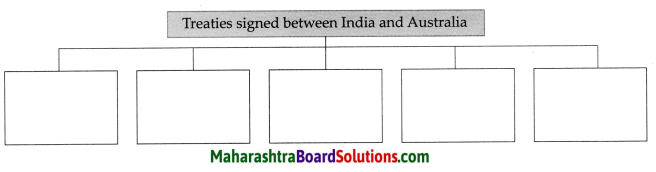
Std 8 Geography Chapter 9 Questions And Answers Map Scale Maharashtra Board

Balbharti Maharashtra State Board Class 8 Geography Solutions Chapter 9 Map Scale Notes, Textbook Exercise Important Questions and Answers.

Class 8 Geography Chapter 9 Map Scale Questions And Answers Maharashtra Board

Map Scale Class 8 Questions And Answers Chapter 9 Maharashtra Board

Class 8 Geography Chapter 9 Map Scale Textbook Questions and Answers

1. 

Map Scale Std 8 Question a.
Classify maps showing the following areas into small scale or large scale:
(1) Building (2) School (3) Country of India (4) Church (5) Mall (6) World map (7) Garden (8) Dispensary (9) Maharashtra state (10) The north sky at night.
Answer:
The classification of maps showing the given areas is as follows:
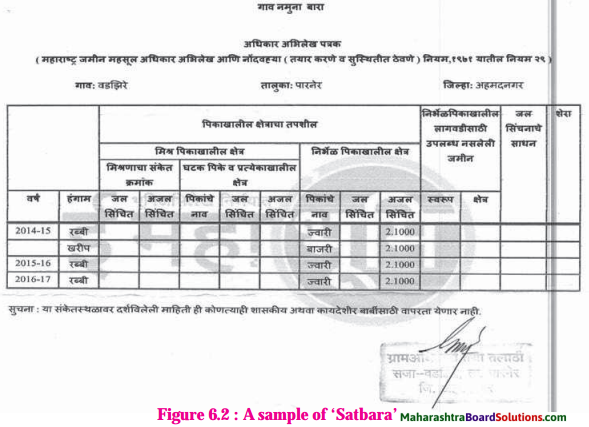
(A) Small scale maps:
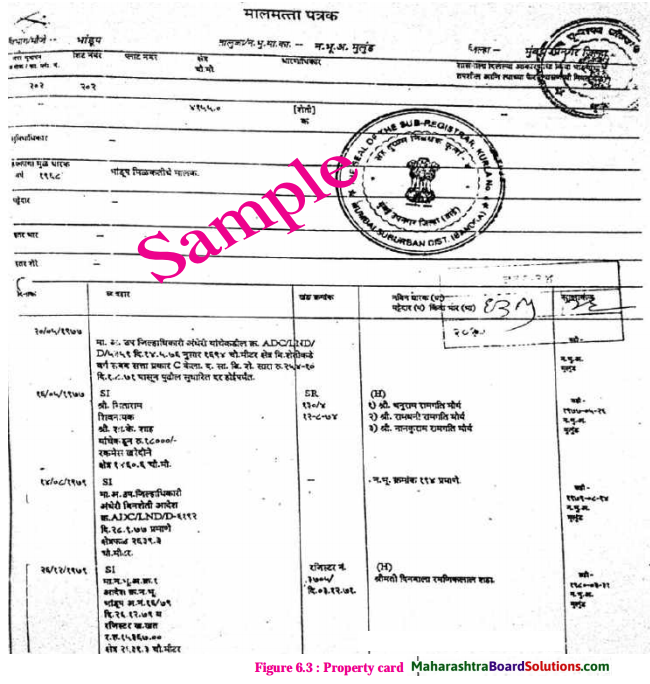
  1. Country of India
  2. World map
  3. Maharashtra state
  4. The north sky at night.

(B) Large scale maps :

  1. Building
  2. School
  3. Church
  4. Mall
  5. Garden!
  6. Dispensary.

Maharashtra Board Class 8 Geography Solutions Chapter 9 Map Scale

Map Scale Class 8 Geography Question b.
There are two maps with respective scales of 1cm = 100 m and 1cm = 100 km. Give well reasoned answer as to which of them would be a large scale map and which a small scale map. Recognize the types of maps.
Answer:
A. Out of the two maps with respective scales of 1 cm = 100 m and 1 cm = 100 km, a map with respective scale of 1 cm = 100 m would be a large scale map.
B. Reasons :

  1. 1 metre is equal to 100 centimetres and 100 metre is equal to 10000 centimetres.
  2. Thus, the value of the given verbal scale (1cm = 100 m) is 1 : 10000 in numerical terms (scale).
  3. A map having a numerical scale of 1 : 10,000 or less than it is called large scale map. Therefore, 1cm = 100 m would be a large scale map.

C. Types of maps :

  1. Maps of villages, church, agricultural fields, etc. are the large scale maps.
  2. Maps of state, country, continent, world, etc. are the small scale maps.

2. Using a map of India from the atlas measure straight Line distance between the following cities and complete the table below.

Question a.
Maharashtra Board Class 8 Geography Solutions Chapter 9 Map Scale 1
Answer:

Cities Distance on a map Actual distance
1. Mumbai to Bangaluru 0.98 cm 980 km
2. Vijaypura to Jaipur 2 cm 2000 km
3. Hyderabad to Surat 0.9 cm 900 km
4. Ujjain to Shimla 1.14 cm 1140 km
5. Patna to Raipur 0.75 cm 750 km
6. Delhi to Kolkata 1 cm 1000 km

Maharashtra Board Class 8 Geography Solutions Chapter 9 Map Scale

3. 

Map Scale Std 8 Questions And Answers Question a.
The distance between two points A and B on the ground is 500 m. Show this distance on paper by a line of 2 cm. Express the map scale by any one method and mention it.
Answer:
Maharashtra Board Class 8 Geography Solutions Chapter 9 Map Scale 2

Question b.
Convert verbal scale of 1cm = 53 km to a numerical scale.
Answer:

  1. 1 kilometre is equal to 100000 centimetres. Therefore, 53 kilometres is equal to 5300000 centimetres.
  2. Therefore, the verbal scale of 1 cm = 53 km can be converted to a numerical scale as – 1 : 5300000.

Maharashtra Board Class 8 Geography Solutions Chapter 9 Map Scale

Class 8 Geography Chapter 9 Map Scale Question c.
Convert numerical scale of 1 : 10000000 to a verbal scale in the metric system.
Answer:

  1. 100000 centimetres is equal to 1 kilometre. Thus, 10000000 centimetres is equal to 100 kilometres.
  2. Therefore, numerical scale of 1 : 10000000 to a verbal scale in the metric system can be converted as 1 cm = 100 km.

4. Help them, using road and railway maps of the state of Maharashtra. Use the scale given in the maps.

Std 8 Geography Chapter 9 Map Scale Question a.
Ajay wants to arrange a family trip. Beed-Aurangabad-Dhule-Nasik Mumbal-Pune-Solapur-Beed. He wants to visit tourist places along this route. The cost of the vehicle is Rs 12/- per km. What would be the approximate cost of travel?

Map Scale Questions And Answers Question b.
Saloni has been asked to organize a trip by her teacher. She has selected Nagpur Chandrapur-Nanded-Washim-Akola Malkapur. What would be the total coverage in kilometers?

Geography Class 8 Chapter 9 Question c.
Vishawasrao is transporting goods in a vehicle from Alibag (district Raigad) to Naldurg (district – Osmanabad). How many km. will he be covering aproximately for a to and fro travel?

Projects:

Map Scale Questions Question a.
Measure the length and breadth of your school. Prepare a sketch according to scale. Show different parts of your school on the sketch.

Maharashtra State Board Class 8 Geography Solutions Question b.
With the help of google maps find the distance between your village and your neighbouring village. Represent all the three methods of map scale on paper.

Class 8 Geography Chapter 9 Map Scale Additional Important Questions and Answers

Mark ✓ the box next to the right alternative:
(Note: The answers are given directly.)

Question a.
Which of the following factor’s map will be a large scale map?
(a) Temple [ ]
(b) State [ ]
(c) Nation [ ]
(d) Continent [ ]
Answer:
(a) Temple [✓]

Maharashtra Board Class 8 Geography Solutions Chapter 9 Map Scale

Question b.
Which of the following scale indicates small scale map?
(a) 1 : 100 [ ]
(b) 1 : 1000 [ ]
(c) 1 : 10000 [ ]
(d) 1 : 100000 [ ]
Answer:
(d) 1 : 100000 [✓]

Answer the following questions in one sentence each:

Question a.
What is verbal scale?
Answer:
A scale in which distances are expressed with the use of words indicating measurement is called verbal scale.

Question b.
What is numerical scale?
Answer:
A scale in which distances are expressed as ratio is called numerical scale.

Question c.
What is linear scale?
Answer:
A scale in which distances are expressed by drawing graphical scale is called linear scale.

Maharashtra Board Class 8 Geography Solutions Chapter 9 Map Scale

Question d.
What is large scale map?
Answer:
A map in which a particular part of ground covers comparatively more area is called large scale map.

Question e.
What is small scale map?
Answer:
A map in which a particular part of ground covers comparatively less area is called small scale map.

Write short notes on:

Question a.
Verbal scale.
Answer:
1. A scale in which distances are expressed with the use of words indicating measurement is called verbal scale.
2. For example, 1cm = 100 km.

3. In verbal scale, the word indicating measurement on the left hand side indicates the distance between any two points on a s map. On the other hand, the word indicating 1 measurement on the right hand side! indicates the ground distance between those two points.

4. When the map is reduced or enlarged by taking its photo copy, the verbal scale on the original map does not change.

Question b.
Numerical scale.
Answer:

  1. Numerical scale: A scale in which distances are expressed as ratio is called numerical scale.
  2. For example, 1:10000. It is also known as representative fraction.
  3. In numerical scale, the same measuring unit is used for the figures on the left hand side and right hand side. However, no words are used to indicate this measuring unit.
  4. In numerical scale, number 1 on the left hand side indicates the distance between any two points on a map. On the other hand, the number 10000 on the right hand side indicates the ground distance between those two points.
  5. When the map is reduced or enlarged by taking its photo copy, the numerical scale on the original map does not change.

Maharashtra Board Class 8 Geography Solutions Chapter 9 Map Scale

Question c.
Linear scale.
Answer:

  1. A scale in which distances are expressed by drawing graphical scale is called linear scale.
  2. For example,
    Maharashtra Board Class 8 Geography Solutions Chapter 9 Map Scale 3
  3. Compass or blade of grass is used if the ruler is not available for the measurement.
  4. A thread is used for measuring the curved distances between two points shown in a map.
  5. When the map is reduced or enlarged by taking its photo copy, the linear scale drawn on the original map changes as per the changing size of the map.

Highlight differences /Distinguish between the following:

Question a.
Large scale map and Small scale map.
Answer:
Maharashtra Board Class 8 Geography Solutions Chapter 9 Map Scale 4

Maharashtra Board Class 8 Geography Solutions Chapter 9 Map Scale

Question b.
Numerical scale and Linear scale.
Answer:
Maharashtra Board Class 8 Geography Solutions Chapter 9 Map Scale 5

Study the following map /figure/graph and answer the following questions:

Maharashtra Board Class 8 Geography Solutions Chapter 9 Map Scale 6

Study the Figure and answer the following questions:

Question a.
How much is the ground distance between Mumbai and Gondia?
Answer:
The ground distance between Mumbai and Gondia is approximately 810 kilometres.

Maharashtra Board Class 8 Geography Solutions Chapter 9 Map Scale

Question b.
How much is the distance between Satara and Sangli on a map?
Answer:
The distance between Satara and Sangli on a map is approximately 1.5 centimetres.

Thought-Provoking Question:

Think about it. 

Question a.
What is the need to use map scale? Think about it and write a paragraph.
Answer:

  1. If the map scale is not mentioned in a map, it will become difficult to know the ground (actual) distance between any two points shown in a map.
  2. Map scale is important element of a map. It facilitates map reading.
  3. If the map scale is mentioned in a map, it will become very easy to understand the ground (actual) distance between any two points shown in a map.

Open-Ended Question:

Question a.
Which of the following scale will you prefer to use: (a) Verbal scale (b) Numerical scale (c) Linear scale?
Answer:

  1. Different measuring units are used in different countries of the world. Due to linguistic differences, particular verbal scale or linear scale may not be used with ease in all the countries.
  2. Numerical scale is a global scale. It can be used universally. Therefore, we will prefer numerical scale.

8th Std Geography Questions And Answers: