Fundamental Rights Part 2 Question Answer Class 7 Civics Chapter 5 Maharashtra Board

Balbharti Maharashtra State Board Class 7 Civics Solutions Chapter 5 Fundamental Rights Part 2 Notes, Textbook Exercise Important Questions and Answers.

Std 7 Civics Chapter 5 Question Answer Fundamental Rights Part 2 Maharashtra Board

Class 7 Civics Chapter 5 Fundamental Rights Part 2 Question Answer Maharashtra Board

Fundamental Rights Part 2 Class 7 Questions And Answers

1. Write about the following:

Question 1.
The Constitution prevents the imposition of religious taxes.
Answer:

  • State cannot impose religious taxes that might be used to encourage a particular religion. That is, our Constitution forbids religious taxes.
  • This is done in order to broaden the scope of religious freedom.

Maharashtra Board Class 7 Civics Solutions Chapter 5 Fundamental Rights Part 2

Question 2.
What is meant by Right to Constitutional Remedies?
Answer:

  • In case of encroachment of Fundamental Rights, the Indian citizens have the right to get judicial remedies is also a fundamental right.
  • This is called the Right to Constitutional Remedies.
  • This means providing legal remedies in case people’s rights get violated.
  • So, it becomes a Constitutional duty of the courts to protect the rights of the people.

2. Find one appropriate word:

Question 1.
Protection from illegal arrest and detention.
Answer:
Habeas Corpus

Question 2.
To restrain a person from acting in an office to which he is not entitled.
Answer:
Quo Warranto

Question 3.
The order of the Supreme Court or the High Court commanding the government to perform an action that is its duty to perform.
Answer:
Mandamus

Question 4.
The order preventing a Subordinate Court from exceeding its jurisdiction.
Answer:
Prohibition.

3. State the reason why we are free to practise the following:

Question 1.
All Indian citizens can celebrate all festivals joyfully, because
Answer:

  • In India, we have a great diversity of festivals. Our Constitution has given the different communities the right to preserve their cultural uniqueness.
  • This is guaranteed by our Constitution by giving the citizens the Right to Freedom of Religion.
  • So we are free to celebrate all festivals joyfully.

Question 2.
We can make efforts towards the preservation and propagation of our language, its script and literature, because…
Answer:

  • Cultural and Educational Rights in our Constitution gives the communities the right to preserve their cultural uniqueness.
  • So we are free to make efforts towards preservation and propagation our language, its script and literature

Maharashtra Board Class 7 Civics Solutions Chapter 5 Fundamental Rights Part 2

4. Fill in the blanks with appropriate words:

Question 1.
We can approach the ______ in case of infringement of our rights (Court, Police, Government)
Answer:
Court

Question 2.
________ education cannot be made compulsory in educational institutions that get aid from the state. (Political, Religious, Racial)
Answer:
Religious

Class 7 Civics Chapter 5 Fundamental Rights Part 2 Additional Important Questions and Answers

Complete the sentence by choosing the appropriate words from the options given below:

Question 1.
_____ right provides freedom to establish institutions for religious reasons. (Right to Religion, Cultural and Educational Rights, Right to Constitutional remedies)
Answer:
Right to Religion

Question 2.
_____ is the right which gives people freedom to preserve their own language, script and literature. (Right to Freedom of Religion, Right to Equality, Cultural and Educational Rights)
Answer:
Cultural and Educational Rights

Question 3.
Sometimes the rights that are guaranteed to us by the Constitution may get encroached upon and we are not able to exercise our rights and this is called _______.(violation of our rights, infringement of our rights, deprivation of our rights)
Answer:
infringement of our rights

Question 4.
The writ which ensures protection from unlawful arrest and detention is ________. (Mandamus, Certiorari, Habeas Corpus)
Answer:
Habeas Corpus

Question 5.
The writ which prevents a subordinate court from exceeding its jurisdiction is _____. (Prohibition, Quo Warranto, Certiorari)
Answer:
Prohibition

Maharashtra Board Class 7 Civics Solutions Chapter 5 Fundamental Rights Part 2

Question 6.
The writ which restrains a person from acting in an office to which he is not entitled is ________. (Prohibition, Quo Warranto, Mandamus)
Answer:
Quo Warranto

Question 7.
The writ which orders removal of a lawsuit from a subordinate court to superior court is ______. (Habeas corpus, Mandamus, Certiorari)
Answer:
Certiorari

Question 8.
There are ______, protection available for judicial rights. (judicial, religious, educational)
Answer:
judicial

Question 9.
There are _______ official languages in Indian Constitution. (22, 28, 24)
Answer:
22

Question 10.
While considering fundamental rights, we also need to remember our _______. (duties, belief, self-interest)
Answer:
duties

Maharashtra Board Class 7 Civics Solutions Chapter 5 Fundamental Rights Part 2

Answer in one or two sentence:

Question 1.
In which educational institutions is it not allowed to make religious education compulsory?
Answer:
Religious education cannot be made compulsory in educational institutions that receives aid from the state.

Question 2.
In which aspects of social life of our country do we witness diversity?
Answer:
We can see that there is a great diversity of festivals, food and ways of life in the social life of our country.

Question 3.
Write any one right given to the different communities to preserve their cultural uniqueness.
Answer:
The communities can establish institutions for the development of their language.

Question 4.
Which Fundamental Right ensures that there is no encroachment on our Fundamental Rights?
Answer:
The Right to Constitutional Remedies is the Fundamental Right which ensures that there is no encroachment on our Fundamental Rights.

Question 5.
What is called an infringement of our rights?
Answer:
Sometimes the rights that are guaranteed to us by the Constitution may get encroached upon and we are not able to exercise our rights. This is called an infringement of our rights.

Question 6.
What does protection of Fundamental Rights by the courts ensure?
Answer:
Protection of Fundamental Rights by courts ensure that the citizens are able to exercise their Fundamental Rights and that they can fulfil their roles as alert, responsible and active citizens.

State the reason why we are free to practice the following:

Question 1.
We can move to court if there is encroachment of Fundamental Rights because….
Answer:
(i) In case of encroachment of Fundamental Rights, the Indian citizens have the right to get judicial remedies.

(ii) The Right to Constitutional Remedies is a Fundamental Right. So we can move the court if there is an encroachment on Fundamental Rights.

Maharashtra Board Class 7 Civics Solutions Chapter 5 Fundamental Rights Part 2

Write about the following:

Question 1.
what is each Indian free to practise?
Answer:
According to Right to Freedom of Religion, each Indian citizen is free to practise any religion and to establish institutions for religious reasons.

Question 2.
What right has our Constitution given to different communities?
Answer:

  • One of our Fundamental Rights is Cultural and Educational Rights.
  • Our Constitution has given the different communities the rights to preserve their cultural uniqueness.

Question 3.
What does the court do if there is infringement of our rights?
Answer:
The court considers our complaint, investigates it and in case it is convinced that rights have indeed been infringed upon and injustice has been done to the aggrieved individual, the court gives an appropriate verdict.

Question 4.
Give some instances which illustrate the infringement of rights:
Answer:
Some instances of infringement of rights are:

  • Arresting an individual without reason.
  • Preventing a person from leaving a village or a town without giving a valid reason.
  • Refusing food, water or medicines to jail inmates.

Maharashtra Board Class 7 Civics Solutions Chapter 5 Fundamental Rights Part 2

Let’s us discuss:

Question 1.
How many official languages are listed in the Constitution?
Answer:
Currently there are 22 scheduled languages in India.

Question 2.
Which institutions have been established by the Maharashtra State Government for the further development of the Marathi language?
Answer:
Some institutions established by Maharashtra State Government for the further development of Marathi language are:

  • Akhil Bharatiya Marathi Nathya Parishad.
  • Maharashtra Sahitya Parishad – Pune.
  • Rajya Marathi Vikas Sanstha.
  • Akhil Bharatiya Marathi Sahitya Mahamandal.

Question 3.
Is the reaction of this Government official right or wrong?
An officer tells a woman who presents all the documents for getting the benefits of a scheme i for destitutes, “You don’t look like a destitute” and refuses her the benefits of the scheme. In this instance, do you think the woman’s right has been infringed? Where should she go to get redressal?
Answer:

  • The reaction of this government official is incorrect since the woman has presented all the documents pertaining to the scheme.
  • This is encroachment of her Fundamental Rights.
  • She should move to court and lodge a complaint and seek constitutional remedy for infringement of her rights.

Find out and discuss:

Question 1.
How many official languages are listed in the Constitution?
Answer:
The Eight schedules of the Constitution consists,of the following 22 languages:

  1. Assamese
  2. Bengali
  3. Gujarati
  4. Hindi
  5. Kannada
  6. Kashmiri
  7. Konkani
  8. Malayalam
  9. Manipuri
  10. Marathi
  11. Nepali
  12. Oriya
  13. Punjabi
  14. Sanskrit
  15. Sindhi
  16. Tamil
  17. Telugu
  18. Urdu
  19. Bodo
  20. Santhali
  21. Maithili
  22. Dogri.

Maharashtra Board Class 7 Civics Solutions Chapter 5 Fundamental Rights Part 2

Question 2.
Do you think that all the work of the government and the courts should be done in Marathi in Maharashtra? What should be done to do so?
Answer:
Yes, I do think that all the work of the government and courts should be done in Marathi in Maharashtra since Marathi is the official language of Maharashtra To achieve this

  • Marathi, as well as non-Marathi speakers working in the government organizations and courts, should be given formal training in Marathi.
  • Workshops can be conducted to train people for conversing and corresponding in Marathi.
  • What should be done at the school – level

Question 3.
for the development of your language and culture?
Answer:

  • Schools should encourage reading of books written in the respective language.
  • School should make students acquainted with different fors of literature.
  • School should establish a language club.

7th Std Civics Questions And Answers:

The Sun, the Moon and the Earth Question Answer Class 7 Geography Chapter 2 Maharashtra Board

Balbharti Maharashtra State Board Class 7 Geography Solutions Chapter 2 The Sun, the Moon and the Earth Notes, Textbook Exercise Important Questions and Answers.

Std 7 Geography Chapter 2 Question Answer The Sun, the Moon and the Earth Maharashtra Board

Class 7 Geography Chapter 2 The Sun, the Moon and the Earth Question Answer Maharashtra Board

The Sun, the Moon and the Earth Class 7 Questions And Answers

1. Correct the wrong statements. Write down the corrected ones.

Question 1.
The moon revolves around the sun.
Answer:
Wrong – The moon revolves around the earth.

Question 2.
On a full moon day, the moon, the sun and the earth are positioned in this sequence.
Answer:
Wrong – On a full moon day, the sun, the earth and the moon are positioned in this sequence.

Question 3.
The revolutionary orbits of the earth and the moon are in the same plane.
Answer:
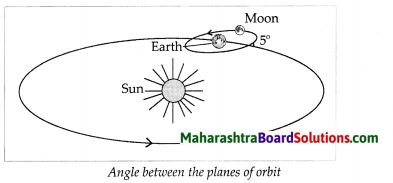
Wrong – The revolutionary orbits of the earth and the moon are not in the same plane. The moon’s revolutionary orbit makes an angle of about 5° with that the earth.

Maharashtra Board Class 7 Geography Solutions Chapter 2 The Sun, the Moon and the Earth

Question 4.
In one revolution of the moon, its orbit intersects the earth’s orbit only once.
Answer:
Wrong – In one revolution of the moon, its orbit intersects the earth’s orbit twice.

Question 5.
It is alright to observe a solar eclipse without protecting the eyes.
Answer:
Wrong – It is necessary to view the sun disc through dark glasses or through special goggles made for that purpose, otherwise the intense light of the sun can be harmful to the naked eye.

Question 6.
An annular solar eclipse occurs when the moon is in the perigee position.
Answer:
Wrong – An annular solar eclipse occurs when the moon is in the apogee position.

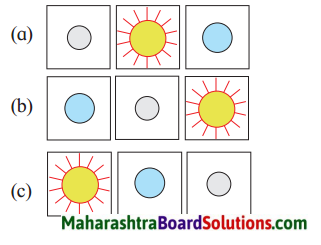
2. Select the correct option.

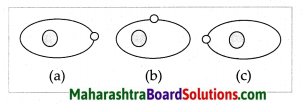
Question 1.
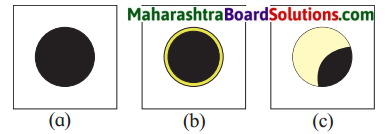
Solar eclipse
Maharashtra Board Class 7 Geography Solutions Chapter 2 The Sun, the Moon and the Earth 1
Answer:
(b)

Question 2.
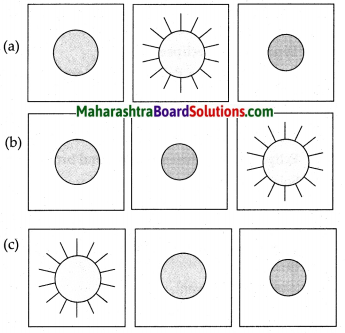
The shape of sun disc at the time of annular solar eclipse.
Maharashtra Board Class 7 Geography Solutions Chapter 2 The Sun, the Moon and the Earth 2
Answer:
(a)

Maharashtra Board Class 7 Geography Solutions Chapter 2 The Sun, the Moon and the Earth

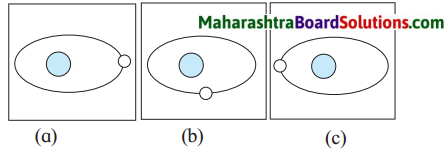
Question 3.
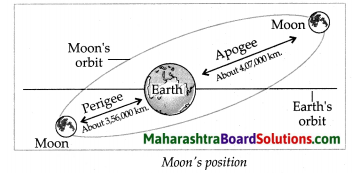
Apogee position of the moon.
Maharashtra Board Class 7 Geography Solutions Chapter 2 The Sun, the Moon and the Earth 3
Answer:
(c)

3. Complete the following table.

Details Lunar Eclipse Solar Eclipse
Phase of the moon ………… …………….
Sequence Moon-Earth- Sun ………….
Type of Eclipse …………. …………..
Maximum duration of total eclipse 107 minutes …………….

Answer:

Details Lunar Eclipse Solar Eclipse
Phase of the moon Full Moon Day New Moon Day
Sequence Moon-Earth-Sun Moon-Earth-Sun
Type of Eclipse Total and Partial Total, Partial, Annular
Maximum duration of total eclipse 107 minutes 440 Seconds

4. Draw and label the diagrams.

Question 1.
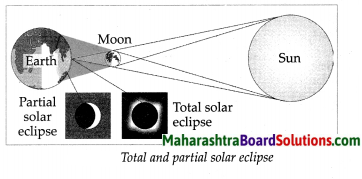
Total and partial solar eclipse:
Answer:
Maharashtra Board Class 7 Geography Solutions Chapter 2 The Sun, the Moon and the Earth 4

Question 2.
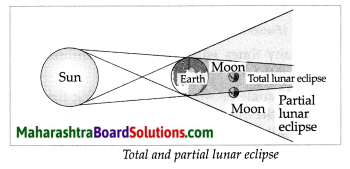
Total and partial lunar eclipse:
Answer:
Maharashtra Board Class 7 Geography Solutions Chapter 2 The Sun, the Moon and the Earth 5

5. Answer the following:

Question 1.
Why do the sun, the moon and the earth not lie in one and the same line on every full moon and new moon day?
Answer:
(i) The orbital path of the earth and that of moon are not in the same plane.
(i) The moon’s revolutionary orbit makes an angle of about 5° with that of the earth.
(iii) On each new moon day, the lines joining the earth and the sun and the moon make an angle of 0° whereas on each full moon day, this angle is 180°.
(iv) So, the sun, the earth and the moon may not be in one straight line in the same plane on every new moon or full moon day.

Question 2.
When a total solar eclipse occurs why is the partial eclipse also seen from the earth?
Answer:
(i) On a new moon day if the sun, the moon & the earth fall in one line & are in the same plane, the shadow of the moon falls on the earth
(ii) This shadow is of two types – the central portion of the shadow is darker & the periphery is light.
(iii) In the area where the dark shadow falls, the sun becomes completely invisible. Such an area experiences a total solar eclipse.
(iv) However during the same period, at the places where the shadow is lighter, the sun disc appears partially covered. Such an area experience partial solar eclipse. Thus when a total solar eclipse occurs a partial eclipse is also seen from the earth.

Maharashtra Board Class 7 Geography Solutions Chapter 2 The Sun, the Moon and the Earth

Question 3.
Suggest measures that can be taken to eradicate the superstitions related to the eclipses.
Answer:
The following measures can be taken to eradicate superstition related to eclipses:

  • Use of media to create awareness.
  • Parental guidance to help think logically.
  • Teachers guidance to help students develop a scientific outlook.
  • Campaigns, public meetings and lectures especially in rural areas to eradicate superstitions.

Question 4.
What precautions should we take while observing a solar eclipse?
Answer:
The precautions to be taken while observing a solar eclipse are:

  • We should not observe a solar eclipse with naked eyes as the intense light of the sun can harm them.
  • We must use dark glasses or goggles that are specially designed for viewing the solar eclipse.

Question 5.
What types of Solar eclipses will occur in perigee conditions?
Answer:
Total and Partial solar eclipse will occur in perigee condition.
(1) Total solar eclipse :

  • On a new moon day, the sun, the moon the earth are in a straight line & the shadow of the moon falls on the earth
  • The area of dark shadow falls on the earth, the sun becomes completely invisible. This condition is known as total solar eclipse.

(2) Partial solar eclipse:

  • However during the same period at places where the shadow is lighter, the sun disc appears partially covered,
  • This condition is described as partial solar eclipse.

Activities:

  1. Collect paper cuttings about eclipses and paste them in a notebook.
  2. Write a note on an eclipse that you have seen.
  3. Using the internet, ‘Panchanga’ and calendar collect information about the eclipses that are likely to occur this year.

Class 7 Geography Chapter 2 The Sun, the Moon and the Earth InText Questions and Answers

Use your brain power:

Question 1.
On the day of solar eclipse, in which part of the earth will it not be seen?
Answer:
Solar eclipse will not be seen where there is night.

Question 2.
Can we see total and annular solar eclipses on the same occasion?
Answer:
No, total and annular solar eclipses cannot be seen on the same occasion.

Question 3.
Why is an annular lunar eclipse not seen?
Answer:
An annular lunar eclipse cannot be seen because:

  • The size of the earth is bigger than that of the moon.
  • As compared to the sun, the moon is close to the earth.
  • Therefore, it is not possible that a dark shadow of the earth is cast in space & does not reach the moon.

Question 4.
Which eclipses will you see from the moon?
Answer:
Solar eclipses can be seen from the moon.

Maharashtra Board Class 7 Geography Solutions Chapter 2 The Sun, the Moon and the Earth

Question 5.
Why are solar eclipses caused by the other planets not seen from the earth?
Answer:
(i) A Solar eclipse occurs when the moon comes in between the sun & the earth & all of them are in the same plane & fall in one line on a new moon day.
(ii) Similarly, when Venus & Mercury come in between the earth & the sun, they make a small speck against the surface of the sun as they are too far away.
(iii) The other planets have orbits outside the earth’s & cannot fall in line between the earth & the sun.
(iv) Hence, the solar eclipse caused by other planets are not seen from the earth.

Think about it:

Question 1.
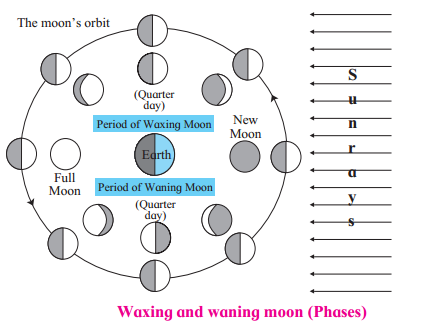
Figure shows positions of the moon as seen from the space and as seen from the earth. How will you identify which are which?
Maharashtra Board Class 7 Geography Solutions Chapter 2 The Sun, the Moon and the Earth 6
Answer:
Half of the moon’s portion is illuminated by the sun, and the other half remains dark. However, only some part of this illuminated portion of the moon can be seen from the earth. The position of the moon from the Earth is as follows:

  • New moon
  • Waxing crescent
  • 1st Quarter
  • Waxing Gibbous
  • Full moon
  • Waning Gibbous
  • Last quarter
  • Waning crescent

Question 2.
Like sunlight and moonlight, is there anything called the earth light? If yes, where do you think it is found?
Answer:
Yes, Earthlight is the partial illumination of the dark portion of the moon’s surface by light reflected from the earth’s airglow.

Question 3.
When solar eclipses do not occur on a new moon day, does it mean that the moon does not have any shadow at all?
Answer:
The moon casts a shadow on every new moon day, but solar eclipse occurs only when the moon’s shadow falls on the earth.

Class 7 Geography Chapter 2 The Sun, the Moon and the Earth Additional Important Questions and Answers

Fill in the blanks choosing the correct options from the brackets:

Question 1.
The shape of the moon’s orbit is _________. (round, elliptical, square)
Answer:
elliptical

Question 2.
The moon has _____ and ______ motions. (axial, orbital, elliptical)
Answer:
axial, orbital

Question 3.
When the moon is closest to the earth it is said to be in ________. (apogee, perigee, orbit)
Answer:
perigee

Question 4.
When the moon is farthest to the earth it is said to be in ______. (apogee, perigee, arial)
(round, elliptical, square)
Answer:
apogee

Question 5.
Solar Eclipse occurs on the _______ day. (full moon, new moon, quarter moon)
Answer:
new moon

Question 6.
Lunar Eclipse occurs on the ______ day. (full moon, new moon, quarter)
Answer:
full moon

Question 7.
_______ solar eclipse is a rare phenomenon. (Total, Partial, Annular)
Answer:
Annular

Maharashtra Board Class 7 Geography Solutions Chapter 2 The Sun, the Moon and the Earth

Question 8.
When the shadow of the moon on the central portion of the earth is darker while the periphery is lighter it is known as a _______ solar eclipse.
(partial, total, lunar)
Answer:
total

Question 9.
When the shadow of the moon on the central portion of the earth is lighter and the sun disc appears to be partially covered, it is known _________ solar eclipse.
(total, partial, solar)
Answer:
partial

Question 10.
The moon is ________ when the earth, the moon and the sun make an angle of 90°. (full, semicircular, crescent)
Answer:
semicircular

Question 11.
Occultation occurs with reference to the _____. (sun, moon, earth)
Answer:
moon

Question 12.
Transit is associated with the _______ .(sun, moon, earth)
Answer:
sun

Question 13.
During the period of _______ eclipse, a large number of birds and animals get confused. (solar, lunar, annular)
Answer:
solar

Correct the wrong statements. Write down the correct ones:

Question 1.
When the moon is closest to the earth it is said to be in apogee and when it is the farthest, the position is called perigee.
Answer:
Wrong – When the moon is closest to the earth it is said to be in perigee and when it is the farthest, the position is called apogee.

Question 2.
The moon wanes from the new moon day to the full moon day and waxes from the full moon to the new moon day.
Answer:
Wrong – The moon waxes from the new moon day to the full moon day and wanes from the full moon to the new moon day.

Select the correct options:

Question 1.
Maharashtra Board Class 7 Geography Solutions Chapter 2 The Sun, the Moon and the Earth 9
Answer:
(c)

Question 2.
Maharashtra Board Class 7 Geography Solutions Chapter 2 The Sun, the Moon and the Earth 10
Answer:
(c)

Maharashtra Board Class 7 Geography Solutions Chapter 2 The Sun, the Moon and the Earth

Complete the following table:

Question 1.

Details Numerical facts
1. Perigee distance ……….
2. Apogee distance ……….
3. Angular distance between the moon’s and the earth’s orbit ………..
4. Maximum duration of a total solar eclipse ……….
5. Maximum duration of a total lunar eclipse …………
6. Number of solar eclipse (types) ………….
7. Number of lunar eclipse (types) ……………

Answer:

Details Numerical facts
1. Perigee distance 3,56,000 km
2. Apogee distance 4,07,000 km
3. Angular distance between the moon’s and the earth’s orbit
4. Maximum duration of a total solar eclipse 7 minutes 20 seconds
5. Maximum duration of a total lunar eclipse 107 minutes
6. Number of solar eclipse (types) 3
7. Number of lunar eclipse (types) 2

Name the following:
Question 1.
Motions of the moon.
Answer:
Axial and orbital motion.

Question 2.
Types of solar eclipse.
Answer:
Total solar eclipse, Partial solar eclipse, Annular solar eclipse.

Question 3.
Types of lunar eclipse.
Answer:
Total lunar eclipse and Partial lunar eclipse.

Question 4.
Eclipse that confuses animals and birds.
Answer:
Solar eclipse.

Question 5.
An example of occultation.
Answer:
Total solar eclipse.

Question 6.
The event of the occurrence of solar eclipse or lunar eclipse.
Answer:
Astronomical event.

Maharashtra Board Class 7 Geography Solutions Chapter 2 The Sun, the Moon and the Earth

Define the following:

Question 1.
Perigee:
Answer:
When the moon is the closest to the earth in its orbit, it is perigee.

Question 2.
Apogee:
Answer:
When the moon is at the farthest from the earth in its orbit, it is apogee.

Question 3.
Occultation:
Answer:
The moon revolves around the earth. While doing so, it obscures1 a star or a planet and that celestial2 body appears to hide behind the moon. This is called occultation.

Question 4.
Transit:
Answer:
If an inner planet like Mercury or Venus comes in between the line of the earth and the sun, a transit occurs. At that time a small dot appears to move across the sun’s disc.

Question 5.
Phases of the moon:
Answer:
The illuminated portion of the moon disc observed from the earth that keeps on changing every day within a lunar month are called the phases of the moon.

Question 6.
Solar Eclipse:
Answer:
If the moon comes between the earth and the sun in a straight line on new moon day, the shadow of the moon falls on the earth and the sun becomes totally or partially invisible in the shadow zone. This phenomenon is called the solar eclipse.

Question 7.
Lunar Eclipse:
Answer:
On a full moon day, the . moon’s path of revolution passes through the thick shadow of the earth and the moon becomes totally or partially invisible. This phenomenon is called lunar eclipse.

Question 8.
Annular Solar eclipse
Answer:
Sometimes when the moon is in apogee position, a deep shadow of the moon is cast in space & does not reach the earth. From a very small region of the earth, only an illuminated edge of the sun disc is seen in the form of a ring. This is called annular solar eclipse.

Answer in one sentence:

Question 1.
What is the period of waxing moon?
Answer:
The period of waxing moon is the fortnight from new moon to full moon in which the illuminated part of the moon from the earth keeps on increasing (waxing)

Question 2.
What is the period of waning moon?
Answer:
The period of waning moon is the fortnight from full moon to new moon in which the illuminated part of the moon seen from the earth keeps on decreasing (waning)

Question 3.
Why can we see the phases of the moon from the earth?
Answer:
We can see the phases of the moon from the earth due to the sunlight reflected from the moon.

Maharashtra Board Class 7 Geography Solutions Chapter 2 The Sun, the Moon and the Earth

Question 4.
When does the moon appear semi-circular in shape in the sky?
Answer:
On the first and the third quarter days, the moon, the earth & the sun make an angle of 90° due to which we see half the portion of the illuminated moon in a semi-circular shape in the sky.

Question 5.
What types of solar eclipses occur in perigee position?
Answer:
Total & Partial Solar eclipses occur in perigee position.

Question 6.
When does a lunar eclipse occur?
Answer:
A lunar eclipse occurs when the moon enters the shadow of the earth while revolving around it.

Give geographical reasons for the following statements:

Question 1.
We constantly see only one and the same side of the moon.
Answer:

  • The time, the moon takes to make one revolution around the earth and one rotation around itself is the same.
  • As the axial and the orbital motions of the moon are almost of the same duration, only one, the same side of the moon faces the earth.
  • Therefore, we constantly see only one and the same side of the moon.

Question 2.
The distance between the moon and the earth keeps on changing.
Answer:

  • The moon’s orbit of the revolution is elliptical to that of the earth.
  • Hence the distance of the moon from the earth is not the same everywhere along its orbit while revolving.
  • When it is the closest to the earth it is said to be in perigee and when it is at the farthest, the position is called apogee.

Question 3.
Eclipses do not occur on each new moon or full moon day.
Answer:

  • The orbital path of the earth and that of the moon are not in the same plane.
  • The moon’s revolutionary orbit makes an angle of about 5° with that of the earth.
  • So, the sun, the earth and the moon may not be in one straight line in the same plane on every new moon or full moon day.
  • Hence, eclipses do not occur on each new moon or full moon day.

Question 4.
The Annular solar eclipse is rarely seen.
Answer:
The Annular solar eclipse is rarely seen because

  • The moon is in apogee position.
  • The deep shadow of the moon is cast in space and does not reach the earth.
  • From a very small region of the earth, only an illuminated edge of the sun disc is seen in the form of a ring.

Question 5.
Birds and animals are confused during the solar eclipse.
Answer:
Birds and animals are confused during the solar eclipse because –

  • Untimely darkness sets in.
  • The event does not suit their biological clock.
  • Their response to the event is also unusual.

Question 6.
On the first and third quarter days, the moon appears semicircular in shape.
Answer:

  • On the first and third quarter days, the moon, the earth and the sun make an angle of 90°
  • At these positions, we see half the portion of an illuminated moon.
  • Hence, in the sky, the moon appears semi-circular in shape.

Answer the following:

Question 1.
What precautions should we take while observing a solar eclipse?
Answer:
The precautions to be taken while observing a solar eclipse are:

  • We should not observe a solar eclipse with naked eyes as the intense light of the sun can harm them.
  • We must use dark glasses or goggles that are specially designed for viewing the solar eclipse.

Maharashtra Board Class 7 Geography Solutions Chapter 2 The Sun, the Moon and the Earth

Question 2.
What types of Solar eclipses will occur in perigee condition?
Answer:
Total and Partial solar eclipse will occur in perigee condition.
(i) Total solar eclipse :

  • On a new moon day, the sun, the moon the earth are in a straight line & the shadow of the moon falls on the earth
  • The area of dark shadow falls on the earth, the sun becomes completely invisible. This condition is known as total solar eclipse.

(ii) Partial solar eclipse:

  • However during the same period at places where the shadow is lighter, the sun disc appears partially covered,
  • This condition is described as partial solar eclipse.

Question 3.
How are lunar eclipses formed?
Answer:
(i) A lunar eclipse occurs when the moon enters the shadow of the earth while revolving around it.
(ii) On a full moon day if the sun, the earth & the moon, are in a straight line, the orbital path of the moon passes through the dark shadow of the earth.
(iii) If the moon is totally hidden within the shadow, a total lunar eclipse is seen & if only a part of the moon is in the shadow, a partial lunar eclipse is seen.

Write short notes on:

Question 1.
Characteristics of solar eclipse.
Answer:

  • A solar eclipse occurs on a new moon day, but not on every new moon day.
  • If and only if, the sun, the moon and the earth are in the same plane and fall in one line, the solar eclipses occur.
  • The maximum duration of a total solar eclipse is 7 minutes and 20 seconds Question 40 seconds).

Question 2.
Characteristics of lunar eclipse.
Answer:

  • A lunar eclipse occurs on a full moon day, but not on every full moon day.
  • A lunar eclipse occurs if and only if the sun, the moon and the earth are in the same plane and fall in one line.
  • The maximum duration of a total lunar eclipse is 107 minutes.

Question 3.
Occupation.
Answer:

  • This is a typical event occurring in space.
  • The moon revolves around the earth, while doing so, it obscures a star or a planet and that celestial body appears to hide behind the moon. This is called occultation.

Question 4.
What is a Transit?
Answer:

  • If an inner planet like a Mercury or Venus comes in between the line of the earth and the sun, a transit occurs.
  • At that time, a small dot appears to move across the sun’s disc.
  • Transit is a type of solar eclipse.

Maharashtra Board Class 7 Geography Solutions Chapter 2 The Sun, the Moon and the Earth

Distinguish between the following:

Question 1.
Solar eclipse and Lunar eclipse :
Answer:

Solar eclipse   Lunar eclipse     
(i) A solar eclipse occurs on a new moon day.

(ii) If and only if the sun, the moon and the earth are in the same plane and fall in one line, the solar eclipse occurs.

(iii) The maximum duration of total solar eclipse
is 7 minutes and 20 seconds (440 seconds).

(i) A lunar eclipse occurs on a full moon day.

(ii) A lunar eclipse occurs if and only if the sun, the earth and the moon are in the same plane and fall in one line.

(iii) The maximum duration of a total lunar eclipse is 107 minutes.

Question 2.
Total Solar eclipse and Annular Solar eclipse.
Answer:

Total Solar eclipse Annular Solar eclipse
(i) When the moon is between the sun and the earth all the three celestial objects are on the same plane and fall in one line. (i) moon is in apogee position. This means it is farthest from the earth.
(ii) The central portion of the shadow of the moon is darker and the periphery is light. (ii) A deep shadow of the moon is cast in space and does not reach the earth.
(iii) In the area of dark shadow on the earth, the sun becomes completely invisible. This condition is known as total solar eclipse (iii) From a very small region of the earth, only an illuminated edge of the sun as a disc is seen in the form of a ring. This is called an annular eclipse.

Draw and label the diagrams:

Question 1.
Moon’s Positions:
Answer:
Maharashtra Board Class 7 Geography Solutions Chapter 2 The Sun, the Moon and the Earth 7

Question 2.
Angle between the planes of orbit.
Answer:
Maharashtra Board Class 7 Geography Solutions Chapter 2 The Sun, the Moon and the Earth 8

Question 3.
Consider the relative positions of the sun, the moon, and the earth on the new moon day and both the quarters. What will be the angle between the lines joining the earth and the moon as well as the earth and the sun? How many times will this angle be formed in a month?
Answer:
The angle between the lines joining the earth and the moon as well as the earth and the sun is 90°. This angle will be formed twice a month.

7th Std Geography Questions And Answers:

Fundamental Rights Part 1 Question Answer Class 7 Civics Chapter 4 Maharashtra Board

Balbharti Maharashtra State Board Class 7 Civics Solutions Chapter 4 Fundamental Rights Part 1 Notes, Textbook Exercise Important Questions and Answers.

Std 7 Civics Chapter 4 Question Answer Fundamental Rights Part 1 Maharashtra Board

Class 7 Civics Chapter 4 Fundamental Rights Part 1 Question Answer Maharashtra Board

Fundamental Rights Part 1 Class 7 Questions And Answers

1. Answer the following questions in brief:

Question 1.
What do you understand by ‘Fundamental Rights’?
Answer:
(i) Demanding one’s rights is insisting on creating an atmosphere conducive to the development of the self as well as the entire society.

(ii) The Indian Constitution has guaranteed equal rights to all citizens in order to create this conducive atmosphere.

(iii) These rights are Fundamental Rights.

Question 2.
Name the awards that are conferred by the Government upon people for their distinguished contribution in different fields.
Answer:
Padmashree, Padmabhushan, Padmavibhushan.

Maharashtra Board Class 7 Civics Solutions Chapter 4 Fundamental Rights Part 1

Question 3.
Why is it prohibited to employ children under 14 years of age in hazardous places?
Answer:
(i) Employing children under 14 years of age in hazardous places can be dangerous. Children may be grievously injured and they may even lose their life.

(ii) To prevent the exploitation of children and ban oppression of any kind, it is prohibited to employ children under 14 years of age in hazardous places.

Question 4.
Why has the Constitution given equal rights to all citizens?
Answer:
(i) We get rights at birth. Every newborn baby has a right to live.

(ii) The entire society and government takes efforts to ensure that the baby is in the best of health.

(iii) Only when all individuals get protection from injustice, exploitation, discrimination and deprivation, will they be able to develop their skills and qualities.

(iv) Demanding one’s rights is insisting on creating an atmosphere conducive to the development of the self as well as the entire society.

(v) The Indian Constitution has guaranteed equal rights to all citizens in order to create this conducive atmosphere.

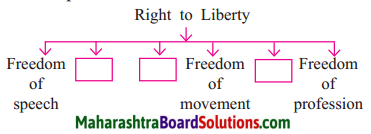
2. Prepare a picture strip on the right to liberty
Answer:
Maharashtra Board Class 7 Civics Solutions Chapter 4 Fundamental Rights Part 1 2

3. Correct and rewrite the following sentences:

Question 1.
No one gets rights at birth.
Answer:
We get rights at birth.

Question 2.
Government can deprive you of a job by discriminating on the basis of religion, sex, place of birth while giving government jobs.
Answer:
According to the Right to Equality mentioned in our Constitution the State cannot discriminate against any citizen on grounds of religion, sex, place of birth or other grounds

Maharashtra Board Class 7 Civics Solutions Chapter 4 Fundamental Rights Part 1

4. Complete the following graphical description.
Maharashtra Board Class 7 Civics Solutions Chapter 4 Fundamental Rights Part 1 1
Answer:
Maharashtra Board Class 7 Civics Solutions Chapter 4 Fundamental Rights Part 1 2

Activities:

  • Collect news clippings about certain important rights like the right to information, right to education, etc.
  • If you find small children working on construction sites in your neighbourhood, talk to them and their parents about their problems and present the problems in your class.

Class 7 Civics Chapter 4 Fundamental Rights Part 1 InText Questions and Answers

Do this:

Following are the actions of A, B and C. Which kind of freedom do you connect them with?

Question 1.
‘A’ established ‘Adivasi Co-operation Forum’ to solve the problems of the tribal people.
Answer:
Freedom to Assemble Peacefully.

Question 2.
‘B’ decided to move his father’s bakery production from Goa to Maharashtra.
Answer:
Freedom to move freely throughout the territory of India.

Question 3.
‘C’ found some lacunae in the new tax policy of the Government. He wrote an artide about it and sent it to a newspaper for publication.
Answer:
Freedom of Speech and Expression.

Let’s discuss:

Question 1.

  • Children are not employed here.
  • Workers are paid daily here.

You see such boards in shops and hotels. In what way are they related to the Fundamental rights in the Constitution?
Answer:
They ensure that the Right against Exploitation mentioned in the Constitution is honoured and the right is not denied to the workers and children.

Maharashtra Board Class 7 Civics Solutions Chapter 4 Fundamental Rights Part 1

Question 2.
You must be aware of children’s rights. Can you name two important rights of children?
Answer:
(a) Right to Protection:

  • Right to be protected from all sorts of violence.
  • Right to be protected from physicaL and sexual abuse.
  • Right to be protected from dangerous drugs.

(b) Right to Development

  • Right to education
  • Right to learn
  • Right to relax and play
  • Right to all forms of development – emotional, mental and physical.

Question 3.
Can rights be taken away?
Answer:
No, the rights cannot be taken away by anyone.

Question 4.
If rights are taken away, who should we contact for redressal?
Answer:
If rights are taken away one may appeal in the courts to seek justice for the same.

Question 5.
If the pet animals could speak, what rights do you think they would ask from you?
Answer:

  • The right to roam around freely, wherever and whenever they wish.
  • Right to expression
  • Right to eat whatever they want whenever they want.

Question 6.
What are the advantages of equality before law and equal protection of the law?
Answer:

  • There is no discrimination among citizens as superior – inferior, as men-women or while extending any protections like protection from arrest without a warrant.
  • There is no discrimination among the citizens on the basis of religion, caste, race, sex, place of birth or residence.
  • The inhuman practice of untouchability has been abolished in order to establish equality in the Indian society.
  • Titles like Raja, Maharaja, Raobahadur etc. have also been abolished.

Class 7 Civics Chapter 4 Fundamental Rights Part 1 Additional Important Questions and Answers

Complete the sentence by choosing the appropriate words from the options given below:

Question 1.
The ______ has guaranteed equal rights to all citizens in order to create a conducive atmosphere.(Indian judiciary, Indian Government, Indian Constitution)
Answer:
Indian Constitution

Question 2.
We have protection from arrest without _______. (prior intimation, proof, warrant)
Answer:
warrant

Question 3.
________ gives a guarantee of all the liberties necessary from the point of view of an individual. (Right to Equality, Right to Liberty Right against Exploitation)
Answer:
Right to Liberty

Maharashtra Board Class 7 Civics Solutions Chapter 4 Fundamental Rights Part 1

Question 4.
______ implies getting a guarantee to live and availability of a conducive environment for living. (Right against Exploitation, Right to
Liberty, Right to Life)
Answer:
Right to Life

Question 5.
All children between 6 and ______ years of age are entitled to get education as a Fundamental Right. (11,10,14)
Answer:
14

Question 6.
It is prohibited to employ children under _______ years of age in hazardous places. (10,14,16)
Answer:
16

Match the following:

Question 1.

Column ‘A’ Column ‘B’
(1) Right to Equality (a) liberties necessary from the point of view of individuals
(2) Right to Liberty (b) bans all types of oppression.
(3) Right against (c) No discrimination
Exploitation amongst citizens.

Answer:
1 – c
2 – a
3 – b

Name the following:

Question 1.
The equal rights guaranteed to all citizens by the Indian Constitution in order to create a conducive atmosphere for the development of the self and the entire society.
Answer:
Fundamental Rights.

Question 2.
According to this right, the State cannot discriminate among citizens as superior- interior or men-women and cannot give different treatment or privileges to anybody.
Answer:
Right to Equality.

Question 3.
The State cannot discriminate against any citizen on these grounds for government employment.
Answer:
Religion, caste, race, sex, descent or place of birth or religion.

Maharashtra Board Class 7 Civics Solutions Chapter 4 Fundamental Rights Part 1

Question 4.
This inhuman practice that was prevalent in our country has been abolished by law.
Answer:
Untouchability.

Question 5.
These titles have been abolished as it creates artificial hierarchy among people.
Answer:
Raja, Maharaja, Raobahadur.

Question 6.
Any two freedoms we enjoy as Indian citizens.
Answer:
Freedom of Speech and Expression, Freedom to Assemble Peacefully.

Question 7.
The new right included in the Right to Liberty.
Answer:
Right to Education.

Question 8.
Children between this age group are entitled to get education as a Fundamental Right.
Answer:
6-14 years.

Question 9.
Two places where children cannot be made to work.
Answer:
Factories, Mines.

Question 10.
It implies getting a guarantee to live and availability of a conducive environment for living.
Answer:
Right to Life.

Maharashtra Board Class 7 Civics Solutions Chapter 4 Fundamental Rights Part 1

Answer in one or two sentences:

Question 1.
When will individual be able to develop their skills and qualities?
Answer:
Only when all individuals get protection from injustice, exploitation, discrimination and deprivation, will the individuals be able to j develop their skills and qualities.

Question 2.
What does demanding one’s rights imply?
Answer:
Demanding one’s rights is insisting on creating an atmosphere conducive to the development of the self as well as the entire society.

Question 3.
What does the Right to Education ensure?
Answer: Right to Education ensures that no child between the age of 6 and 14 will be deprived of education.

Question 4.
Which are the different forms of exploitation which are prevented through Right against Exploitation?
Answer:
Bonded labour or forcing somebody to work against his wish, treating somebody like a slave, denying them legitimate compensation, making them do excessive or strenuous work, starving them or ill-treating them are different forms of exploitation which are prevented through Right against Exploitation

Write short notes on:

Question 1.
Right to Equality
Answer:
According to the Right to Equality, the State cannot discriminate among citizens as superior-inferior or a men-women and cannot give different treatment or privileges to anybody. The same law applies equally to all. Many laws give protection. For example, we have protection from arrest without warrant. The State cannot discriminate even while extending such protection.

Question 2.
Right to Liberty
Answer:
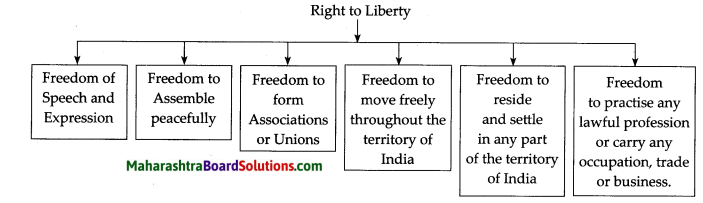
This is a very important right given by the Constitution. It gives a guarantee of all the liberties necessary from the point of view of the individual. As Indian citizens, we have the right to:

  • Freedom of speech and expression.
  • Freedom to assemble peacefully.
  • Freedom to form associations or unions.
  • Freedom to move freely throughout the territory of India.
  • Freedom to reside and settle in any part of the territory of India.
  • Freedom to practise any profession, or to carry on any occupation, trade or business.

Question 3.
Right against Exploitation
Answer:
(i) The right against exploitation implies the right to prevent exploitation.

(ii) While the Constitution has banned all types of oppressions through the right against exploitation, it has made a special provision to prevent the exploitation of children.

(iii) Accordingly, it is prohibited to employ children under 14 years of age in hazardous places.

(iv) Children cannot be employed or made to work in factories and mines.

(v) Exploitation includes bonded labour or forcing somebody to work against his wish, treating somebody like a slave, denying them legitimate compensation, making them do excessive or strenuous work, starving them or ill-treating them.

(vi) Generally women, children, the weaker sections of society and powerless people are exploited.

(vii) This right enables us to stand up against any kind of exploitation.

Maharashtra Board Class 7 Civics Solutions Chapter 4 Fundamental Rights Part 1

Correct and rewrite the following sentences:

Question 1.
No one gets rights at birth.
Answer:
We get rights at birth.

Question 2.
The government can deprive you of a job by discriminating on the basis of religion, sex, place of birth while giving government jobs.
Answer:
According to the Right to Equality mentioned in our Constitution the State cannot discriminate against any citizen on grounds of religion, sex, place of birth or other grounds.

Question 3.
People can have titles like Raja, Maharaja, Raobahadur etc.
Answer:
The Constitution has abolished titles like Raja,, Maharaja, Raobahadur etc., that create aq artificial hierarchy among people.

7th Std Civics Questions And Answers:

Human Settlements Question Answer Class 7 Geography Chapter 10 Maharashtra Board

Balbharti Maharashtra State Board Class 7 Geography Solutions Chapter 10 Human Settlements Notes, Textbook Exercise Important Questions and Answers.

Std 7 Geography Chapter 10 Question Answer Human Settlements Maharashtra Board

Class 7 Geography Chapter 10 Human Settlements Question Answer Maharashtra Board

Human Settlements Class 7 Questions And Answers

1. Answer in short:

Human Settlements Std 7 Question 1.
Explain the various types of human settlements.
Answer:
(a) Scattered settlements:

  • In scattered settlements, houses are few and far from each other.
  • They are found in the areas of high relief, dense forests, grasslands, hot deserts and extensive agricultural lands.

(b) Nucleated settlements:

  • These settlements are close to water sources like brooks, rivulets, rivers, lakes, reservoirs, etc.
  • Fertile plains, transport hubs, mining centres and commercial centres often lead to the development of this type of settlement.

(c) Linear settlements:

  • Linear settlements are seen along roads, railways, rivers sea coasts and in foothill regions.
  • They are narrow in shape and spread along a straight line.

Maharashtra Board Class 7 Geography Solutions Chapter 10 Human Settlements

Human Settlements Std 7 Chapter 10 Question 2.
Difference between nucleated and scattered settlements.
Answer:

Nucleated Settlements Scattered Settlements
(i) Houses are close together.
(ii) These settlements are close to water sources. They are self dependent due to fertile plains, transport hubs, mining centres, defense, health, education and social factors.
(iii) People from different castes, religions, races and ideologies live together in these settlements and hence they have a better social life.
(i) Houses are far away from each other.
(ii) They depend on centrally located villages for their day to day requirements. Facilities and services in these settlements are not adequate.
(iii) These settlements have limited population, so they do not have much social life.

7th Maharashtra Board Geography Solutions Question 3.
Explain in natural factors affecting the location of human settlements
Answer:
(a) The natural factors like physiography, land / soils, climate, water supply, river banks, etc. affect the location of human settlements.

(b) Low population & few houses are found in regions of high relief forests, grasslands, hot deserts, etc. whereas high population & nucleated settlements are found in region of fertile plains.

(c) Regions having adequate supply of water has high population & nucleated settlements. Water is essential for occupation of agriculture. Hence early civilizations developed near sources of water like rivers, lakes, reservoirs etc.

(d) In region of extreme climate scattered settlements are found due to difficult living condition whereas in region of favourable climate, nucleated or linear settlements are found.

Human Settlement Class 10 Question 4.
Explain how human settlements have evolved.
Answer:

  • Human settlements have evolved in accordance with the natural conditions.
  • Using the resources from his surroundings, man constructed houses and started living in them.
  • Rural settlement is the first step towards a stable life in human history.
  • Urban settlements have evolved through the expansion and growth of rural settlements.
  • There are large scale correlations between rural and urban settlements
  • Modernization, science and technology lead to transformation in both types of settlements.

Class 7 Geography Chapter 10 Question 5.
Difference between a hamlet & a village
Answer:

Hamlet Village
Size of population is small in a hamlet (i) Size of population is comparatively large in a village.
Most of people living in a hamlet are engaged a particular occupation which is dependent on locally available natural resource. (ii) People in a village are engaged in different occupations like agriculture, fishery, etc.
A hamlet is scattered settlement (iii) A village is majorly a nucleated settlement.

2. Identify the types of human settlements from the follwing statements:

Chapter 10 Human Settlements Notes Question 1.
Their money and time is saved by living on the farm.
Answer:
Scattered settlements.

Chapter 10 Human Settlements Question 2.
There is a lot of social life in this settlement.
Answer:
Nucleated settlements.

Human Settlement Class 7 Question 3.
Shops are located on both the sides of the road.
Answer:
Linear settlements.

Maharashtra Board Class 7 Geography Solutions Chapter 10 Human Settlements

Class 7th Geography Chapter 10 Question 4.
This settlement is found at the foothills of mountains or along the coast.
Answer:
Linear settlements.

Maharashtra State Board Class 7 Geography Solutions Question 5.
Each house is located away from the other.
Answer:
Scattered settlement.

Grade 7 Geography Textbook Answers Question 6.
This settlement is good from security point of view.
Answer:
Nucleated settlements.

Question 7.
Having houses away from each other is good for health.
Answer:
Scattered settlements.

Question 8.
The houses are too close to each other.
Answer:
Nucleated settlement.

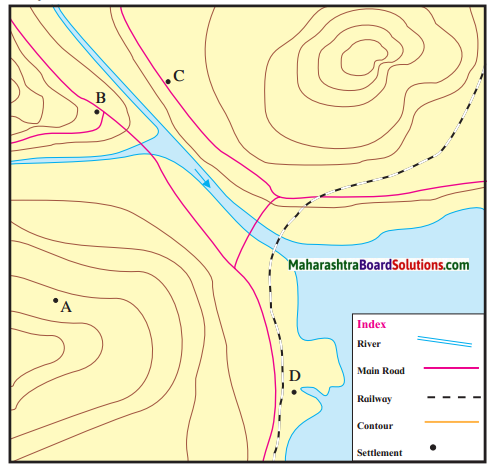
3. Study the diagram and identify the types of settlements:

Maharashtra Board Class 7 Geography Solutions Chapter 10 Human Settlements 1
Question 1.
Settlement ‘A’ has 5-6 houses and the place does not have other facilities.
Answer:
Scattered settlement.

Question 2.
‘B’ has a high school, a big market and a small theatre.
Answer:
Nucleated settlement.

Question 3.
‘C’ has houses, farmers, many shops and small industries.
Answer:
Linear settlement.

Question 4.
‘D’ has a natural harbour. Many industries have been established here.
Answer:
Linear settlement.

Question 5.
‘C’ is a settlement that has developed along the road side. Give two reasons of its location here.
Answer:
The reasons for settlement ‘C’ developing along the roadside are:

  • It has direct & easy access to the main road which helps in easy movement of people & agricultural & industrial goods as houses, farms & small industries are found here.
  • It is located at the foothill close to the main river.

Maharashtra Board Class 7 Geography Solutions Chapter 10 Human Settlements

ICT Activity :

With the help of the internet, find the image of your village/city. On that basis, write about the type and characteristics of your settlement.

Class 7 Geography Chapter 10 Human Settlements InText Questions and Answers

Try this

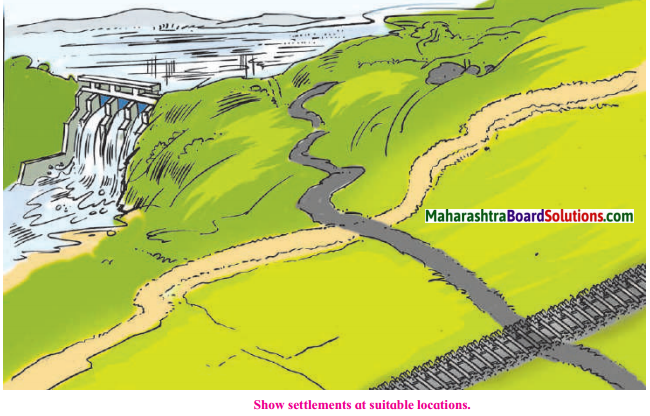
Look at the following picture. Find suitable location for human settlement and show them in picture:
Maharashtra Board Class 7 Geography Solutions Chapter 10 Human Settlements 2

Question 1.
Why were the settlements shown at specific places? Why should they be located there? Why can’t they be located in other places?
Answer:
(i) Settlement A is located at a place which has direct access to main road as well as railway line which will help in easy movement of passenger as well as goods transport.
(ii) Settlement ‘B’ is located on plain land. Its location near a water body will be beneficial for agricultural purpose.
(iii) A large portion of the area shown in the picture is a region of uneven topography which is not favourable for human settlement

Can you tell?

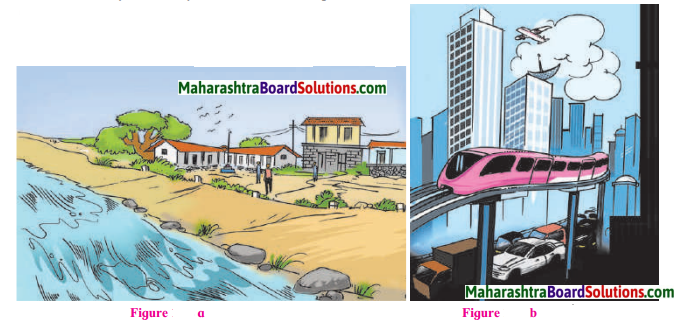
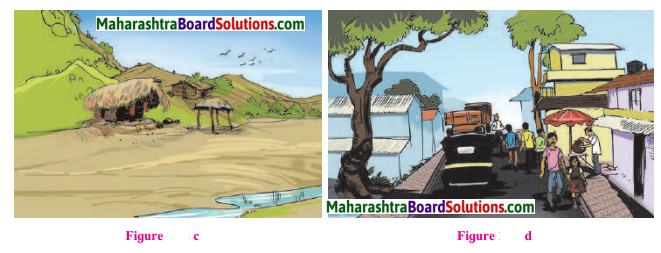
Observe the pictures given in figures (a, b, c, d). Think and answer the following questions:

Maharashtra Board Class 7 Geography Solutions Chapter 10 Human Settlements 9

Maharashtra Board Class 7 Geography Solutions Chapter 10 Human Settlements 4

Maharashtra Board Class 7 Geography Solutions Chapter 10 Human Settlements

Question 1.
What all can you see in the picture?
Answer:
(a) Rural: settlement small houses made of mud are seen with river flowing and farmland.
(b) City: Monorail, sky scrapers and lot of traffic with vehicles moving.
(c) Tribal hamlet: with sparse1 population.
(d) Town: Vehicles moving, vendors, shops and small houses.

Question 2.
What are the familiar features?
Answer:
All pictures show some type of human settlements.

Question 3.
Which picture shows sparse settlements?
Answer:
Tribal Hamlet shows sparse population.

Question 4.
Which picture shows agriculture?
Answer:
Rural settlement shows agriculture.

Question 5.
Which picture shows dense settlements?
Answer:
City shows dense settlement.

Question 6.
Which picture shows high rise building?
Answer:
City shows high rise building.

Question 7.
From the following, assign a suitable names for each of the pictures: Rural settlement, Tribal hamlet, Town, City.
Answer:
(a) Rural settlements
(b) City
(c) Tribal Hamlet
(d) Town.

Question 8.
Arrange the picture according to the level of development in the settlements?
Answer:
Tribal Hamlets, Rural Settlements, Towns, Cities.

Maharashtra Board Class 7 Geography Solutions Chapter 10 Human Settlements

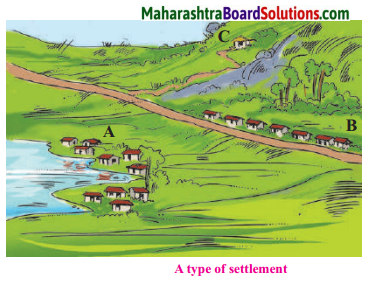
Observe the Fig. and discuss the following questions:

Maharashtra Board Class 7 Geography Solutions Chapter 10 Human Settlements 5

Question 1.
What is the difference between the human settlement at ‘A’ and ‘B’ ?
Answer:
A is Nucleated settlement & ’B’ is a Linear settlement

Question 2.
What is the difference between the settlement at B’ and C ?
Answer:
B is Linear settlement & ‘C’ is a type of tribal hamlet.

Question 3.
Where do you find less than 2 houses?
Answer:
‘C’ is tribal hamlet having less than 2 houses.

Question 4.
In what type of settlement do you live?
Answer:
I stay in ‘A’ type of settlement. (Students may answer as per their settlement type)

Think about it: 

Question 1.
Think about the possible processes that take place during the growth and development of settlements. Make a list of such processes.
Answer:
(i) Human settlements rise in places with favourable geographic conditions – such a availability of water, conducive climate, fertile land, etc.

(ii) In such settlements the occupations are majorly based on natural resources. These are called rural settlements.

(iii) With the passage of time, other associated occupations in these settlements grow & people of surrounding areas migrate & settle there, this leading to increase in the population of such settlements.

(iv) The proportion of people engaged in primary occupation declines & the importance of secondary & tertiary occupations increases
leading to transformation of rural settlements into urban settlements.

(v) Over a period of time when the population & the necessary amenities increase on a large scale, the urban areas grow into metropolitan cities.

Give it a try: 

Question 1.
Name the metropolitan cities of India.
Answer:
Mumbai, Chennai, Delhi, Kolkata, Hyderabad, Bangalore, Pune, Ahmedabad, etc. are some of the metropolitian cities of India.

Question 2.
Identify the type of settlement where you live.
Answer:
Students are expected to answer this questions on their own.

Maharashtra Board Class 7 Geography Solutions Chapter 10 Human Settlements

Question 3.
Observe the photographs given below. Identify the type of settlements shown here and write about them.
Maharashtra Board Class 7 Geography Solutions Chapter 10 Human Settlements 7
Answer:
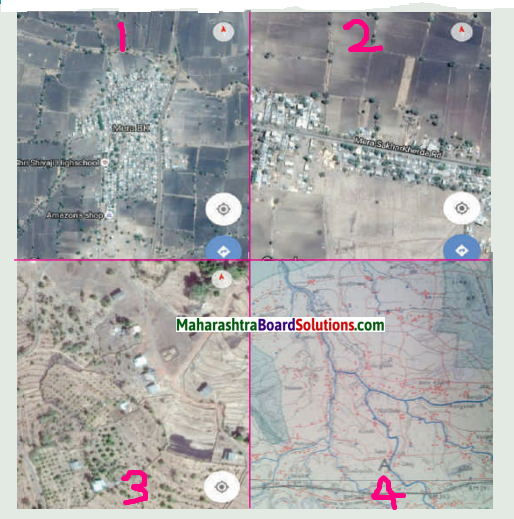
Fig. 1 is Urban settlement: Houses, schools shops are close to each other. Densely populated.
Fig. 2 is Linear settlement: Houses are built along the Mera Sakharkevda road in three to four rows.
Fig. 3 is a Scattered settlements: Houses are far from each other, sparse population, very little transport.
In Fig. 4 Linear settlements can be seen along the roads whereas scattered settlements also seen

Make friends with maps:

Observe Fig. and answer the following questions:

Maharashtra Board Class 7 Geography Solutions Chapter 10 Human Settlements 6

Question 1.
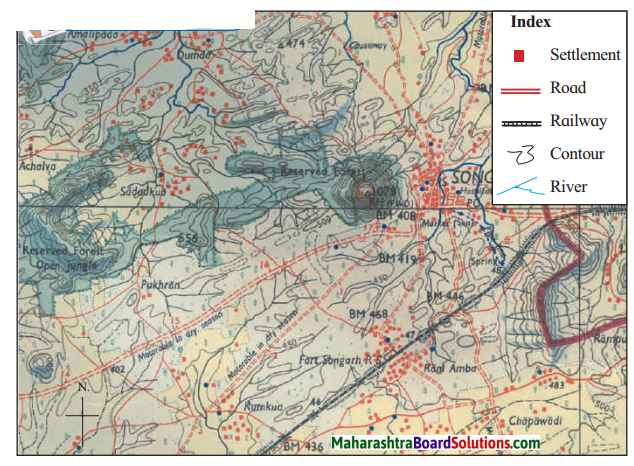
Name some of the settlements shown in the map.
Answer:
Amalipada, Achalva, Sadadkua, Dumda, Pukhram, Rani Amba, Kumkua, Chapawadi, are some settlements shown in the map.

Question 2.
Which of the settlements in the map are in a scattered form?
Answer:
Pukhran, Achalva, Chapawadi and Sadadkua have scattered settlements.

Question 3.
How are the houses in the settlements along the roads arranged?
Answer:
Houses are arranged in a line on both sides of the roads. They are linear settlement.

Maharashtra Board Class 7 Geography Solutions Chapter 10 Human Settlements

Question 4.
In which settlements are the houses close together? What could be the reason behind this density?
Answer:
The houses in Sangarh are close together.
Reasons:

  • Proximity to river
  • Amenities like water pipeline, hospital, post office
  • Easy access to transport routes like roads & railways which helps in easy movement of passengers & goods.

Question 5.
Can you now classify the settlements on the basis of these pattern?
Answer:

  • Dunda, Sodadkua, Pukhran, etc. have scattered settlements
  • Rani Amba is a linear settlement
  • Songarh is a nucleated settlement.

Class 7 Geography Chapter 10 Human Settlements Additional Important Questions and Answers

Fill in the blanks:

Question 1.
Human settlements flourished at places with favorable ________ conditions.
Answer:
geographic

Question 2.
In the early settlements, the occupation of the people were dependent on the locally available ________ resources.
Answer:
natural

Question 3.
People along the sea coast are engaged in _______.
Answer:
fishing

Question 4.
Settlements have provided man with _______.
Answer:
stability

Question 5.
In ______ settlements, houses are few and far from each other.
Answer:
scattered²

Question 6.
Increase in the population of rural settlements is the beginning of _________.
Answer:
urbanization

Question 7.
____ settlements are seen along roads, railways, rivers, sea coasts and foot hill regions, etc.
Answer:
Linear

Question 8.
In the deserts of Rajasthan we find _______ settlements.
Answer:
nucleated

Question 9.
_______ is the first step towards a stable life in human history.
Answer:
Rural settlement

Maharashtra Board Class 7 Geography Solutions Chapter 10 Human Settlements

Question 10.
Life in urban settlement is more _____.
Answer:
dynamic

Question 11.
_______ settlements have limited population as in small hamlets.
Answer:
Scattered

Complete the following sentence:

Question 1.
Human settlement flourished at places with favourable geographical conditions such as ______.
Answer:
availability of water, a conducive climate, fertile land, etc.

Question 2.
When rural area converts into urban area, the importance of secondary and tertiary occupations increases and _______.
Answer:
the proportion of people engaged in primary occupations decline

Question 3.
If the population and the necessary amenities increase on a large scale ______.
Answer:
the urban areas grow into metropolitan cities.

Question 4.
Patterns of human settlements evolve in _______.
Answer:
accordance with the natural conditions

Question 5.
Increase in population of rural settlements is ______.
Answer:
is the beginning of urbanization

Question 6.
The day to day food requirement of the urban population is _______.
Answer:
fulfilled by rural settlements

Question 7.
In the deserts of Rajasthan we find _______.
Answer:
nucleated settlements near assured sources of water

Question 8.
Linear settlements are seen along _______.
Answer:
roads, railways, rivers, sea coasts and in foothill regions

Question 9.
There are large scale correlations _______.
Answer:
between rural and urban settlements

Question 10.
Urban settlements have evolved through _______.
Answer:
the expansion² and growth of rural settlements

Maharashtra Board Class 7 Geography Solutions Chapter 10 Human Settlements

Match the column:

Question 1.

Column ‘A’ Column ‘B’
(1) Limited population (a) Linear settlements
(2) Tribal people (b) Nucleated settlements
(3) Have better social life (c) Scattered settlements
(4) On National or State highways (d) Hamlets

Answer:
1 – c
2 – d
3 – b
4 – a

Identify the types of human settlements from the following statements:

Question 1.
These settlements are closer to nature, they are free from pollution.
Answer:
Scattered settlements.

Question 2.
Settlements found along the coastal tracts, major rivers and national or state highways.
Answer:
Linear settlements.

Question 3.
These settlements are found in fertile plains, transport hubs and mining centres, commercial centres.
Answer:
Nucleated settlements.

Question 4.
These settlements have limited population and inadequate facilities.
Answer:
Scattered settlements.

Answer in one or two sentences:

Question 1.
Where do human settlements flourish?
Answer:
Human settlements flourish at places with favourable geographic conditions – such as availability of water, a conducive climate, fertile land, etc.

Question 2.
What did forest dwellers or tribal people use for their livelihood?
Answer:
Forest dwellers or tribal people used forest produce for their livelihood.

Question 3.
Where do the farmer & his family live?
Answer:
They live in a house built in or near the fields.

Question 4.
Which settlements are called rural settlements?
Answer:
The settlements where the original occupation of the majority of the people are based on natural resources are called rural settlements.

Maharashtra Board Class 7 Geography Solutions Chapter 10 Human Settlements

Question 5.
Wnen do the urban areas grow into metropolitan cities?
Answer:
When the population and the necessary amenities increase on a large scale, the urban areas grow into metropolitan cities.

Question 6.
Where do we find scattered settlements?
Answer:
Scattered settlements are found in the areas of high relief, dense forests, grasslands, hot deserts and extensive agricultural lands.

Question 7.
Where do we find nucleated settlements?
Answer:
Nucleated settlements are generally close to water sources like brooks, rivulets, rivers, lakes reservoirs, etc.

Question 8.
Where do we see Linear settlements?
Answer:
Linear settlements are seen along roads, railways, rivers, sea coasts, in foothill regions, etc.

Question 9.
What makes a city a metropolis?
Answer:
A metropolis is a large city or urban area, which is a significant economic, political and cultural center for a country or region and an important hub for regional or international connections, commerce and communications.

Answer in one or two sentences:

Question 1.
Where do human settlements flourish?
Answer:
Human settlements flourish at places with favourable geographic conditions – such as availability of water, a conducive climate, fertile land, etc.

Question 2.
What did forest dwellers or tribal people use for their livelihood?
Answer:
Forest dwellers or tribal people used forest produce for their livelihood.

Question 3.
Where do the farmer & his family live?
Answer:
They live in a house built in or near the fields.

Question 4.
Which settlements are called rural settlements?
Answer:
The settlements where the original occupation of the majority of the people are based on natural resources are called rural settlements.

Question 5.
When do the urban areas grow into metropolitan cities?
Answer:
When the population and the necessary amenities increase on a large scale, the urban areas grow into metropolitan cities.

Question 6.
Where do we find scattered settlements?
Answer:
Scattered settlements are found in the areas of high relief, dense forests, grasslands, hot deserts and extensive agricultural lands.

Maharashtra Board Class 7 Geography Solutions Chapter 10 Human Settlements

Question 7.
Where do we find nucleated settlements?
Answer:
Nucleated settlements are generally close to water sources like brooks, rivulets, rivers, lakes reservoirs, etc.

Question 8.
Where do we see Linear settlements?
Answer:
Linear settlements are seen along roads, railways, rivers, sea coasts, in foothill regions, etc.

Question 9.
What makes a city a metropolis?
Answer:
A metropolis is a large city or urban area, which is a significant economic, political and cultural center for a country or region and an important hub for regional or international connections, commerce and communications.

Answer in short:

Question 1.
Distinguish between Scattered Settlements & Linear Settlements.
Answer:

Scattered Settlements Linear Settlements
(i) In scattered settlements houses are far away from each other.
(ii) There settlements have limited population as in small hamlets.
(iii) These settlements are found in the areas of high relief, dense forest, grasslands, hot deserts and extensive agricultural land
(i) In Linear settlements houses are spread along a straight line.
(ii) These settlements have comparatively more population.
(iii) These settlements grow along the coastal tracts, major rivers, national or state highways, railways in the foothill regions, etc.

Question 2.
Describe Linear Settlements.
Answer:

  • Linear settlements are seen along roads, railways, rivers, sea coast and in foothill regions, etc.
  • Houses in these settlements are along a straight line, in a row.
  • As the settlement grows in the course of time, multiple lines emerge.
  • Besides houses, some shops can also be seen.
  • Such settlements are found along the coastal tracts, major rivers and national of state highways in our country.

Question 3.
What leads to transformation of rural settlement into urban settlement?
Answer:
(i) The settlements where the original occupations of the majority of the people are based on natural resources are called rural settlements. Agriculture, fishery, etc. are some of these occupation

(ii) With the passage of time other associated occupations also develop gradually in these rural settlement.

(iii) As a result people from surrounding areas migrate & settle there leading to an increase in rural population.

(iv) Houses are built & different facilities are developed for the growing population.

(v) Importance of secondary & tertiary occupations increases & the proportion of primary occupations declines.

This process leads to the transformation of rural settlement into urban settlements

Maharashtra Board Class 7 Geography Solutions Chapter 10 Human Settlements

Question 4.
Describe man’s future plans in terms of settlements.
Answer:

  • Man started using resources from the surroundings.
  • Man constructed houses and started living in them.
  • They have even built sky-scrapers.
  • In future, man is thinking of constructing colonies on other planets and their satellites too.

7th Std Geography Questions And Answers:

Winds Question Answer Class 7 Geography Chapter 5 Maharashtra Board

Balbharti Maharashtra State Board Class 7 Geography Solutions Chapter 5 Winds Notes, Textbook Exercise Important Questions and Answers.

Std 7 Geography Chapter 5 Question Answer Winds Maharashtra Board

Class 7 Geography Chapter 5 Winds Question Answer Maharashtra Board

Winds Class 7 Questions And Answers

1. Rewrite the following statements after choosing the correct option:

Question 1.
When the air expands, it ______.
(a) becomes solid,
(b) becomes thinner,
(c) gets lost.
(d) becomes humid.
Answer:
(b) becomes thinner,

Maharashtra Board Class 7 Geography Solutions Chapter 5 Winds

Question 2.
From high air pressure regions, winds ______.
(a) blow to regions of still higher pressure.
(b) blow towards regions of cooler air.
(c) blow towards regions of low air pressure.
(d) remains still.
Answer:
(c) blow towards regions of low air pressure.

Question 3.
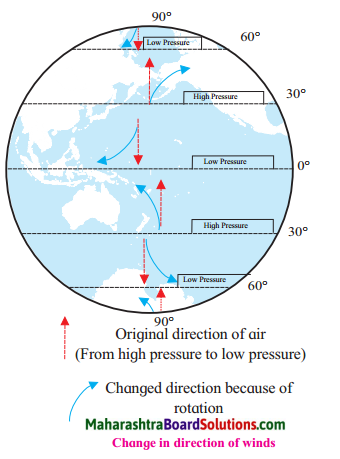
In the northern hemisphere, winds blowing towards the equator due to the _____.
rotation of the earth.
(a) turn to the south
(b) turn to the east,
(c) turn to the west
(d) turn to the north.
Answer:
(c) turn to the west

Question 4.
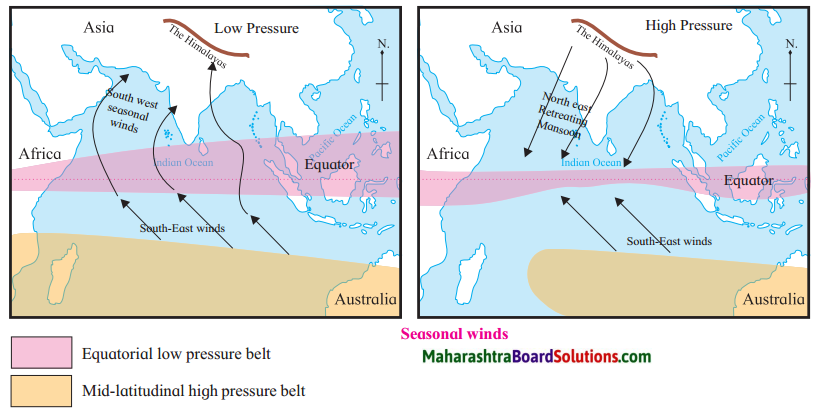
The direction of seasonal winds blowing over the Indian subcontinent during winter is from the _____.
(a) south-east to north-west.
(b) south-west towards north-east.
(c) north-east to south-west.
(d) north-west to south-east.
Answer:
(c) north-east to south-west.

Question 5.
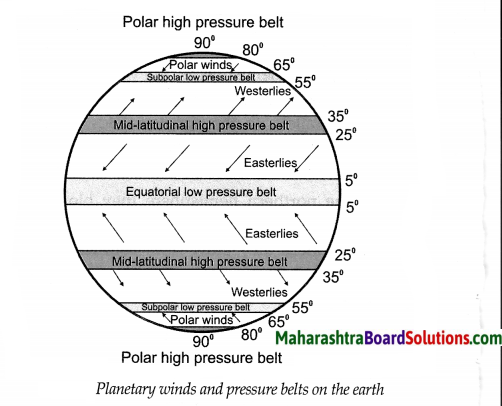
The Roaring Forties in the southern hemisphere ______.
(a) blow towards the equator.
(b) blow in the areas around 40°S parallel.
(c) blow from the subpolar region of low pressure.
Answer:
(b) blow in the areas around 40°S parallel.

2. Identify the type of winds from the description given below:

Question 1.
These winds from the south-west bring rains to Indian subcontinent. During June to September, India gets rains. After this period these winds retreat.
Answer:
South West Monsoon Winds.

Question 2.
These winds blowing from the north pole region towards 60°N parallel cause cold wave conditions in extensive areas covering North America, Europe and Russia
Answer:
Polar Winds.

Maharashtra Board Class 7 Geography Solutions Chapter 5 Winds

Question 3.
Hilltops get heated quickly during the day. The air in this part becomes hot, light and starts ascending. Hence, a low pressure area forms in this region. At the same time the air at the foothills become cooler and also experiences high pressure. Air in that area blows towards low pressure.
Answer:
Valley Winds.

3. Given below are the values of air pressure in millibars. Using the same, draw diagrams to show a cyclone and an anticyclone:

Question 1.
990, 994, 996,1000
Answer:
Maharashtra Board Class 7 Geography Solutions Chapter 5 Winds 3

Question 2.
1030,1020,1010,1000
Answer:
Maharashtra Board Class 7 Geography Solutions Chapter 5 Winds 4

4. State one reason why:

Question 1.
A belt of calm exists near the equator.
Answer:
(i) A belt of calm exists near the equator because there is not much difference in the temperature and air pressure.
(ii) So winds do not blow in this region.

Question 2.
The winds coming from the north-west in the southern hemisphere have greater velocities than the winds coming from the south-west in the northern hemisphere.
Answer:
(i) In the southern hemisphere the obstacle caused by the relief of the land surface is almost absent.
(ii) Therefore the winds coming from the north – west in the southern hemisphere have greater velocity than the winds coming from the south-west in the northern hemisphere.

Question 3.
The monsoon winds in the summer come from the sea but the retreating monsoon winds come from land.
Answer:
(i) Monsoon winds are generated due to the uneven heating of land and water in the different seasons.

(ii) During summers, land heats up quickly as compared to water & an area of low pressure is created on the land whereas an area of high pressure is created on the water.

(iii) But during winters low pressure is created on the water and an area of high pressure is created on land as it cools down quickly as compared to the water.

(iv) As winds blow from high pressure areas to low pressure areas, it blows from sea to land in summers & from land to sea in winters.
Thus the monsoon winds in summer come from sea but the retreating monsoon winds come from land.

Maharashtra Board Class 7 Geography Solutions Chapter 5 Winds

5. Complete the flow chart:
Maharashtra Board Class 7 Geography Solutions Chapter 5 Winds 1
Answer:
Maharashtra Board Class 7 Geography Solutions Chapter 5 Winds 2

6. Answer in short:

Question 1.
Why is the air pressure high in polar areas in both the hemispheres?
Answer:

  • In both the polar areas the temperature here is below 0°C.
  • Hence the air is cold & heavy.
  • Hence the air pressure is high in the polar areas in both the hemispheres.

Question 2.
What effect does the rotation of the earth have on the wind?
Answer:

  • The direction of the winds is influenced by the rotation of the earth.
  • In the northern hemisphere, winds get deflected towards the right of their original direction, whereas in the southern hemisphere they get deflected toward the left of their original direction.

Question 3.
Why do the cyclonic winds blow in a circular manner?
Answer:
(i) Cyclones are created when a low pressure area is surrounded by high pressure areas. In these conditions, winds start blowing towards the low pressure area from the surrounding high pressure areas.

(ii) But due to the rotation of the earth in the northern hemisphere the winds deflected towards the right of their original direction whereas in the southern hemisphere they get deflected towards the left of their original direction which causes the cyclone winds to blow in a circular manner.

Question 4.
State the reasons that lead to the formation of cyclones and describe the effects of cyclones.
Answer:
(i) Cyclonic conditions are created when a low pressure area is surrounded by high pressure areas.
(ii) In these conditions, winds start blowing towards the low pressure area from the surrounding high pressure areas.
(iii) The effects of cyclone are as follows.

  • The sky is cloudy
  • Winds blow with a very high velocity
  • It rains heavily
  • It may cause loss of life and property in coastal regions.

Activity:

Using the internet, obtain information, photos and maps of the recent cyclone that arrived at India’s eastern coast.
Write the social and economic effects of that cyclone.

ICT Question:

Use the mobile app ‘Windyty’ and try to know the direction of winds and pressure areas in the world.

Maharashtra Board Class 7 Geography Solutions Chapter 5 Winds

Class 7 Geography Chapter 5 Winds InText Questions and Answers

Formative Assessment
Can you tell?

Observe the diagrams given below. Answer the questions related to sea and land breeze
Maharashtra Board Class 7 Geography Solutions Chapter 5 Winds 9
Maharashtra Board Class 7 Geography Solutions Chapter 5 Winds 10
Question 1.
Why do the breezes blow from the sea to the land during the day?
Answer:
During the day as land gets heated up faster than water, an area of low pressure is created on land whereas there is a region of comparatively higher pressure on the sea. As a result the breezes blow from the sea to the land during the day.

Question 2.
When do the winds blow from the d to the sea?
Answer:
The winds blow from land to the sea during the night.

Question 3.
Describe the winds shown in fig. (a).
Answer:
It is sea breeze.

Question 4.
Compare fig.(a) and (b) with reference fo temperature conditions, air pressure and
winds.
Answer:
In figure (a) the temperature is higher on land & the pressure is low so winds blow from sea to land. In figure (b) the temperature is low on the land & the pressure is high. Winds blow from land to sea.

Question 5.
Which winds are called sea breezes and which are called land breezes? Why?
Answer:
Winds in (a) are sea breeze because they blow from the sea and (b) are land breeze because they blow from the land.

Maharashtra Board Class 7 Geography Solutions Chapter 5 Winds

Question 6.
In which part of India are land and sea breezes experienced?
Answer:
In India, it is experienced near the coastal areas.

Question 7.
Do you experience sea and land breezes in your area?
Answer:
The answer may vary.

Give it a try.

Write the changed directions of the wind in the table below:

Question 1.

Pressure Belts Northern Hemisphere Southern Hemisphere
Mid Latitudes ……….. …………..
………… …………..
Poles ……………….. …………….

Answer:

Pressure Belts Northern Hemisphere Southern Hemisphere
Mid Latitudes (1) Easterlies blow from northeast to south west Easterlies blow from south east to northwest
(2) Westerlies blow from southwest to northeast Westerlies blow from northwest to southeast
Poles Polar winds blow from northeast to south west Polar winds blow from southeast to northwest

Try this:

Question 1.
Observe the pictures given below and describe the valley breeze considering the elevation of land, the heating and cooling properties of land and water, the air pressure, etc.
Maharashtra Board Class 7 Geography Solutions Chapter 5 Winds 11
Answer:
Characteristics of Valley Breeze:

  • Valleys are cooler compared to mountain tops during the day.
  • Mountains are comparatively warmer.
  • Air pressure is greater in the valley.
  • Winds blow from valley to the mountain tops.
  • Hot and light air from the mountains descend downwards and cool air from valleys ascend upwards.
  • Valley breeze are set after the sun rises.

Question 2.
Read the following information carefully and draw a diagram for the mountain breeze accordingly.
Characteristics of the Mountain breeze:

  • Mountains cool down quickly at night.
  • The valley zone is comparatively warmer.
  • Air pressure is greater on the mountains.
  • Winds blow from the mountain towards the valley.
  • The hot and light air from the valley is pushed upwards and the cool air rushes down into the valley.
  • Mountain winds set in after sunset.

Maharashtra Board Class 7 Geography Solutions Chapter 5 Winds

Answer:
Maharashtra Board Class 7 Geography Solutions Chapter 5 Winds 12

Try this:

  • Fold a piece of paper into two same sized rolls.
  • Keep both the paper rolls on one side of a table
  • You & your friend should select one roll each.

Question 1.
Without touching the roll of the paper on the table, what can be done to move the paper rolls to the other end of the table?
Answer:
To move the paper rolls to the other end of the table without touching a person can

  • Blow the air from his mouth towards the roll of paper
  • Use a newspaper a book or a hand fan
  • Tilt the table towards the other end.

Question 2.
See who moves the paper roll first to the other end of the table:
Answer:
The object which blows the air with maximum force, moves the paper roll first to the other end of the table.

Question 3.
What could be the reason of the delay in making the rolls reach to the other end of the table?
Answer:
There will be a delay in making the rolls reach the other end of the table if the air is blown with lesser force.

Question 4.
What can we do to move the rolls to the other end of the table with a greater speed?
Answer:
We mostly use the technique/object which will blow air with maximum force to move the rolls to the other end of the table with a greater speed.

Question 5.
Can a bottle filled with water be moved to the other end of the table in this manner? Can we use the same method that you tried for moving paper rolls?
Answer:
A bottle filled with water cannot be moved to the other end of the table in this manner. We cannot use the same methods that we tried for moving paper rolls to move a bottle filled with water as it is heavier in weight, (we can if we tilt the table which was an option.)

Class 7 Geography Chapter 5 Winds Additional Important Questions and Answers

Fill in the blanks choosing the correct option from the bracket:

Question 1.
Air moves from high pressure to low pressure areas in a ______ manner. (vertical, horizontal, parallel)
Answer:
horizontal.

Maharashtra Board Class 7 Geography Solutions Chapter 5 Winds

Question 2.
Winds velocity is measured in the units of ________. (knots, metres, seconds)
Answer:
knots.

Question 3.
Wind which cover a large portion of the earth are called _____ wind. (local, polar, planetary)
Answer:
planetary.

Question 4.
Winds blowing between mid latitudinal high pressure belt and the equator are called ______. (westerlies, easterlies, polar)
Answer:
easterlies.

Question 5.
Winds blowing between mid latitudinal high pressure belt and the sub polar low pressure belt are called _______. (easterlies, westerlies, polar)
Answer:
westerlies.

Question 6.
Winds that blow for a short duration of time, over a limited area are called ______. wind. (polar, local, easterlies)
Answer:
local.

Question 7.
Mountain winds blow during ______ .(morning, night, midday)
Answer:
night.

Question 8.
Winds that blow at night in coastal areas are called ________ breeze, (sea, land, valley)
Answer:
land.

Question 9.
Cyclones occurring in the western part of the Pacific ocean are called ______.(hurricane, typhoons)
Answer:
typhoons.

Question 10.
Hot winds blowing in the Thar Desert are called the _______ (simoons, loo, chinook)
Answer:
loo.

Rewrite the following statements after choosing the correct option:

Question 1.
During an anticyclone the sky ______.
(a) is dark.
(b) is cloudy.
(c) is clear.
(d) is white.
Answer:
(c) is clear.

Maharashtra Board Class 7 Geography Solutions Chapter 5 Winds

Question 2.
Winds blowing from the polar high pressure to sub polar low pressure belt
(a) blow from west to east.
(b) blow from east to west.
(c) blow from south to north.
(d) blow from north to south.
Answer:
(b) blow from east to west.

Question 3.
The minimum velocity of cyclonic storms is ________.
(a) 50 km per hour
(b) 60 km per hour
(c) 70 km per hour
(d) 80 km per hour.
Answer:
(b) 60 km per hour

Question 4.
Winds which originate in specific regions and blow over a limited area are called _____.
(a) local winds.
(b) seasonal winds
(c) monsoon winds
(d) planetary winds
Answer:
(a) local winds.

Find out the odd man out and give reason for your answer:

Question 1.
Polar winds, Local winds, Easterlies, Westerlies
Answer:
Local winds – Others are names of planetary winds.

Question 2.
Landbreeze, Valley winds, Westerlies, Mountain winds.
Answer:
Westerlies – Others are names of local winds.

Question 3.
Mistral, Bora, Pampero, Foehn
Answer:
Foehn – Others are cold and dry winds.

Question 4.
Loo, Foehn, Mistral, Simoon
Answer:
Mistral – Others are hot and dry winds.

Question 5.
Mistral, Bora, Chinook, Foehn
Answer:
Chinook – Others originate in the Alps Mountain.

Question 6.
Southeast Asia, West Europe, East Africa, North Australia.
Answer:
West Europe – Others receive monsoon rains.

Maharashtra Board Class 7 Geography Solutions Chapter 5 Winds

Question 7.
India, Japan, China, Phillippines.
Answer:
India – Others experience typhoons.

Question 8.
Furious Fifties, Screaming Seventies, Screeching Sixties,, Roaring Forties.
Answer:
Screaming Seventies – Others are names of winds in the southern hemisphere.

Place a tick mark (✓) against the correct option:

Question 1.
Towards which direction do the southern hemisphere winds get deflected? .
(a) Towards the left.
(b) Towards the right.
(c) Towards the centre.
Answer:
(a) Towards the left.

Question 2.
What are the winds blowing between polar high pressure belt and subpolar low pressure belt called?
(a) Monsoon winds
(b) Polar winds
(c) Westerlies winds
Answer:
(a) Monsoon winds

Question 3.
Hot and destructive winds blowing in the Sahara
(a) Chinook
(b) Simoom
(c) Loo
Answer:
(b) Simoom

Question 4.
Cold winds around the Mediterranean.
(a) Foehn
(b) Pampero
(c) Mistral
Answer:
(b) Pampero

Question 5.
How is cyclonic condition created?
(a) Low pressure area is surrounded by high pressure.
(b) A high pressure area is surrounded by low pressure.
(c) A low pressure area is surrounded by mid pressure.
Answer:
(c) A low pressure area is surrounded by mid pressure.

Identify the type of winds from the description given below:

Question 1.
In coastal areas, land cools down faster as compared to the sea, the air blows from land to sea.
Answer:
Land Breeze.

Question 2.
In the Indian subcontinent, dry winds blow from the Indian Subcontinent towards the equator.
Answer:
North-East monsoon winds.

Maharashtra Board Class 7 Geography Solutions Chapter 5 Winds

Question 3.
The winds blowing over the earth’s surface throughout the year and covering a large portion of the earth.
Answer:
Planetary winds.

Question 4.
The winds that blow for a short duration of time, originate in specific regions & blow over a limited area.
Answer:
Local winds.

Match the pairs correctly:

Question 1.

Name of the Wind Nature of the Wind
(1) Loo (a) Hot and dry
(2) Simoom (b) Cold and dry
(3) Chinook (c) Hot, dry and destructive
(4) Mistral (d) Warm and dry

Answer:
1 – a
2 – c
3 – d
4 – b

Define the following terms:

Question 1.
Roaring Forties:
Answer:
Beyond 40°S winds blow with tremendous velocity. These winds are called the Roaring Forties.

Question 2.
Furious Fifties:
Answer:
Around 50°S winds are stormy hence they are called the Furious Fifties.

Question 3.
Screeching Sixties:
Answer:
The stormy winds around 60°S make tremendous noise and hence they are called the Screeching Sixties.

Maharashtra Board Class 7 Geography Solutions Chapter 5 Winds

Question 4.
Local Winds:
Answer:
The winds that blow for a short duration of time, originate in specific region and blow over a limited area are called Local Winds.

Question 5.
Doldrums:
Answer:
The region up to 5° North and 5° South of the equator remains calm for most of the year and winds do not blow in this region. It is called the equatorial calm zone or Doldrums.

Question 6.
Horse Latitudes:
Answer:
In the area near the Tropic of Cancer and Tropic of Capricorn, that is between 25° and 35° north and south, there exist a high pressure belt, which is a calm belt. This belt is called as the Horse latitudes.

Question 7.
Typhoons:
Answer:
Storms arising in the months between June and October in the western part of the Pacific Ocean which blow with high velocity winds and heavy rains causing destruction are called Typhoons.

Question 8.
Hurricanes:
Answer:
The cyclones in the Caribbean sea which are destructive in nature are called Hurricanes.

Observe the pictures given below of Seasonal winds and write its characteristics:

Question 1.
Maharashtra Board Class 7 Geography Solutions Chapter 5 Winds 13
Answer:
Characteristics of the Seasonal winds (Monsoon):

  • Monsoon winds are generated due to the uneven heating of land and water in the different seasons.
  • During summer, monsoon winds blow from the sea to the land and in winter they blow from the land to the sea.
  • Southern Asia, East Africa, North Australia are the regions where the pronounced effects of these winds are felt.
  • The influence of monsoon winds is seen in the summer and winter seasons in the Indian subcontinent.

Maharashtra Board Class 7 Geography Solutions Chapter 5 Winds

change in direction of wind:
Maharashtra Board Class 7 Geography Solutions Chapter 5 Winds 14

Draw a neat labelled diagram:

Question 1.
Planetary winds and pressure belts on the earth
Answer:
Maharashtra Board Class 7 Geography Solutions Chapter 5 Winds 15

Distinguish between the following:

Question 1.
Easterlies and Westerlies:
Answer:

Easterlies Westerlies
(i) Easterlies blow from mid latitudinal high pressure belt to equatorial low pressure belt in both the hemispheres (i) Westerlies blow from mid latitudinal high pressure belt to subpolar low pressure belt in both the hemispheres
(ii) In the northern hemisphere, they blow from the northeast to the southwest. (ii) In the northern hemisphere, they blow from the southwest to the northeast.
(iii) In the southern hemisphere, they blow from the southeast to the northwest. (iii) In the southern hemisphere, they blow from northwest to the southeast.

Maharashtra Board Class 7 Geography Solutions Chapter 5 Winds

Question 2.
Valley breeze and Mountain breeze:
Answer:

Valley Breeze Mountain Breeze
(i) Valley breeze blow during the day. (i) Mountain breeze blow during the night.
(ii) Winds blow from the valley to the mountain. (ii) Winds blow from the mountain to the valley.
(iii) Valley breeze blows because of the high pressure area created iin the valley. (iii) Mountain Breeze blows because of the high pressure area created on the mountains.

Question 3.
Cyclones and Anticyclones:
Answer:

Cyclones Anticyclones
(i) Cyclonic conditions are created when a low pressure area is surrounded by high pressure areas. (i) Anticyclonic conditions are created when a high pressure area is surrounded by low pressure areas.
(ii) The cyclonic winds move in an anticlockwise direction in the northern hemisphere and clockwise direction in the southern hemisphere. (ii) The anticyclonic winds move in a clockwise direction in the northern hemisphere and anticlockwise direction in the southern hemisphere.
(iii) The sky is cloudy. (iii) The skies are clear.
(iv) The velocity of wind is very high and cause rain. (iv) The velocity of wind is less and weather is pleasant.

State one reason why:

Question 1.
Planetary winds change their original direction.
Answer:
The rotation from the west to east causes the change in the original direction of the planetary winds.

Question 2.
The air pressure in land and water is different
Answer:
(a) The land is made up of dense matter. Land is stable and opaque. As a result, heat is transferred at a greater speed and in a higher proportion. Hence, land gets heated quickly.

(b) The density of water is comparatively less. Water is transparent and unstable. Hence, water does not get heated quickly.

(c) As a result, the air pressure in land and water areas is different.

Question 3.
The Indian subcontinent experiences monsoon and retreating monsoon seasons.
Answer:
(a) Monsoon winds are generated due to uneven heating of land & water in different seasons. During summers, monsoon winds blow from sea to land & in winter they blow from land to the sea.

(b) The influence of monsoon winds is seen in summer season in the Indian subcontinent due to high temperature & low pressure in Thar desert region & Punjab plains.

(c) As these winds blow from sea to land the Indian subcontinent experiences monsoon (rainy) season.

(d) During winters, due to high pressure & low temperature in the Indian subcontinent & comparatively low pressure & high temperature in the Indian ocean winds blow from land to sea.

(e) This is the retreating monsoon season in the Indian subcontinent.
Thus the Indian subcontinent experiences monsoon & retreating monsoon season.

Answer the following in detail:

Question 1.
Give detailed information about the types of planetary winds.
Answer:
The following are the types of Planetary winds:
(i) Easterlies:

  • In both the hemispheres, the winds that blow from the high pressure area between 25° & 35° parallels, to the equatorial low pressure belt (between 5°N & 5°S parallel) are called Easterlies.
  • In the northern hemisphere they blow from northeast to southwest whereas in the southern hemisphere they blow from southeast to the northwest.

(ii) Westerlies:

  • In both the hemispheres, winds that blow from the mid-latitudinal high pressure belt to sub polar low pressure belt situated near 60° parallel are called westerlies.
  • In the northern hemisphere, these winds blow from the southwest to the northeast & in the southern hemisphere, they blow from the northwest to the southeast.

(iii) Polar winds:

  • In both the hemispheres, winds blowing from the polar high pressure belt to the sub polar low pressure belt (55° to 65°) are called polar winds.
  • Generally they blow from east to west.

Maharashtra Board Class 7 Geography Solutions Chapter 5 Winds

Question 2.
Write in detail about cyclonic storms.
Answer:
(i) Cyclones occurring in the western part of the Pacific ocean along the coasts of Japan, China, Philippines, etc. are known as ‘Typhoons’.
(ii) These storms arise in the months between June & October.
(iii) Due to high velocity winds & heavy rains, these prove to be destructive.
(iv) The cyclones in the Caribbean Sea are known as ‘hurricanes’. These are also destructive in nature.
(v) During these storms, the minimum velocity of the wind is 60 km per hour.
(vi) Cyclones also originate in the temperate zone but they are not so powerful & hence are not destructive.

Question 3.
What are anticyclones?
Answer:
(i) Under specific atmospheric conditions, the air pressure in a particular region increases & the pressure in the surrounding areas remain low.

(ii) In this situation, winds blow from the centre towards the surrounding areas in a circular manner.

(iii) In the northern hemisphere, these winds blow in a clockwise direction whereas in the southern hemisphere they blow in an anticlockwise direction.

(iv) During anticyclone, the skies are clear, winds blow with lesser velocities and the weather is pleasant.

Can you tell?

Observe the picture given below and answer the following questions.:
Maharashtra Board Class 7 Geography Solutions Chapter 5 Winds 15
Question 1.
Which are the winds in the northern hemisphere that blow from the mid latitudinal high pressure belt to the equatorial low pressure belt?
Answer:
Easterlies blow from mid latitudinal high pressure belt to equatorial low pressure belt in the northern hemisphere

Question 2.
What is the direction of the Westerlies in the southern hemisphere?
Answer:
Westerlies blow from north west to south east in the southern hemisphere

Question 3.
Which planetary winds blow from the mid-latitudinal high pressure belts to the subpolar low pressure belts in the northern hemisphere?
Answer:
The Westerlies blow from mid latitudinal high pressure belts to subpolar low pressure belts in the northern hemisphere

Question 4.
Why is the direction of polar winds not the same in both the hemispheres?
Answer:
The rotation of the earth causes the change in the direction of winds in both the hemisphere. So polar winds blow from northeast to south west in the northern hemisphere & from south east to north-west in the southern hemisphere.

Maharashtra Board Class 7 Geography Solutions Chapter 5 Winds

Question 5.
Name the winds that blow in the southern hemisphere.
Answer:
Easterlies, Westerlies and Polar Winds blow in the southern hemisphere.

Question 6.
In which direction do the Easterlies blow in the Northern and Southern hemisphere?
Answer:
Easterlies blow from northeast to southeast in northern hemisphere & from southeast to northwest in the southern hemisphere.

7th Std Geography Questions And Answers:

Features of the Constitution Question Answer Class 7 Civics Chapter 3 Maharashtra Board

Balbharti Maharashtra State Board Class 7 Civics Solutions Chapter 3 Features of the Constitution Notes, Textbook Exercise Important Questions and Answers.

Std 7 Civics Chapter 3 Question Answer Features of the Constitution Maharashtra Board

Class 7 Civics Chapter 3 Features of the Constitution Question Answer Maharashtra Board

Features of the Constitution Class 7 Questions And Answers

1. Prepare a table to show the separation of powers in a Federal Government.
Maharashtra Board Class 7 Civics Solutions Chapter 3 Features of the Constitution 1
Answer:

Union List State List Concurrent List
Defence, foreign relations, war and peace, currency, international trade, etc. Agriculture, law and order, local government, health, prison administration etc. Employment, environment economic and social planning, personal law, education, etc.

2. Find one word for:

Question 1.
The Government at the centre which carries out the administration of the entire country.
Answer:
Union Government

Maharashtra Board Class 7 Civics Solutions Chapter 3 Features of the Constitution

Question 2.
The machinery with whom rests the responsibility of conducting elections in a free and fair atmosphere.
Answer:
Election Commission.

Question 3.
The third list of subjects for making laws
Answer:
The Concurrent List

3. Answer the following questions.

Question 1.
Why does the Government function at two levels in a Federation?
Answer:
(i) One of the important features of our Constitution is the Federal System.

(ii) In countries with large territories and huge populations, the Government is run by a Federal System.

(iii) Ruling a large territory from a single capital city is not only difficult but may also lead to the neglect of some far-flung areas.

(iv) People residing there cannot participate in the affairs of the Government. Therefore, the governments function at two levels in a § Federation.

Question 2.
What do you understand by Residuaiy Powers?
Answer:
(i) Our Constitution has given three lists on various subjects.

(ii) The first list is called Union List. It contains 97 subjects on which the Union Government makes laws.

(iii) The State List is for the State Governments to legislate upon. It contains 66 subjects.

(iv) Apart from these two lists, there is a Concurrent List which contains 47 subjects.

(v) Both governments can make laws on subjects included in this list. If a subject comes up that is not included in any of the lists, the Union Government is entitled to make laws on it. These powers are termed as ‘Residuary Powers’.

Maharashtra Board Class 7 Civics Solutions Chapter 3 Features of the Constitution

Question 3.
Why has the Constitution created an independent Judiciary in India?
Answer:
(i) The Judiciary of India is independent machinery according to the provisions of the Constitution.

(ii) It is separate from the Executive and Legislative bodies of the Indian Government.

(iii) The Supreme Court is the guardian of the Constitution which ensures that the Fundamental Rights of the citizens are not violated.

(iv) To carry out its duties without fear or favour or external pressure, the Judiciary in India is independent.

4. Hold a group discussion on the merits and demerits of an independent judicial system.
Answer:
Merits of an independent judicial system:

  • The judicial system enables the courts to give impartial judgements.
  • Judiciary does not act under any political pressure.
  • As the judges are appointed by the President and not by the Government.

Demerits of an independent judicial system:

  • As the judiciary is independent, it is out of the scope of the government’s control.
  • The judiciary is not answerable to anyone if the process of dispensing justice is slow.

5. Find out about the Electronic Voting Machine (EVM) and discuss the advantages of conducting elections with EVM.
Answer:

  • Difficult to tamper/cheat
  • Cost-effective and economical
  • Time-saving
  • Calculation is faster
  • Easy to use / carry / transport
  • Data can be saved for later use.

Activity:

Establish an Election Commission in your class, decide upon the positions you would like to fill through elections. Then conduct elections under the guidance of this Commission.

Class 7 Civics Chapter 3 Features of the Constitution InText Questions and Answers

Do this:

Question 1.
Make a list of North-Eastern Indian States and name their capital cities.
Answer:

State Capital
Arunachal Pradesh Itanagar
Assam Dispur
Meghalaya Shillong
Manipur Imphal
Mizoram Aizwal
Nagaland Kohima
Tripura Agartala

Maharashtra Board Class 7 Civics Solutions Chapter 3 Features of the Constitution

Find out:

Question 1.
Find out about the Electronic Voting Machine (EVM) and discuss the advantages of conducting elections with EVM.
Answer:

  • Difficult to tamper/cheat
  • Cost effective and economical
  • Time saving
  • Calculation is faster
  • Easy to use / carry / transport
  • Data can be saved for later use.

Question 2.
How many amendments have been made in the Indian Constitution till date?
Answer:
As of September 2016, there have been 101 (latest of List Bill) amendments to the Constitution of India, since it was first enacted in 1950.

Class 7 Civics Chapter 3 Features of the Constitution Additional Important Questions and Answers

Complete the sentence by choosing the appropriate words from the options given below:

Question 1.
One of the important features of our Constitution is the _______ System. (Federal, Unitary, Republic)
Answer:
Federal

Question 2.
The Government functions at ________ levels in a Federation. (two, three, four)
Answer:
two

Question 3.
The Government that oversees the administration of the region that we live in is called _______.(Union Government, State Government, None of the above)
Answer:
State Government

Question 4.
The system of running the administration of a country cooperatively by the governments at two levels, making laws about different subjects is called __________. (Socialism, Communism, Federalism)
Answer:
Federalism

Question 5.
The ______ is for the Union Government to make laws. (State List, Union List, Concurrent List)
Answer:
Federalism

Maharashtra Board Class 7 Civics Solutions Chapter 3 Features of the Constitution

Question 6.
The _______ is for the State Government to legislate upon. (Union List, State List, Concurrent List)
Answer:
State List

Question 7.
The ______ List contains 47 subjects and both the Government can make laws on these subjects. (Concurrent List, Union List, State List)
Answer:
Concurrent List

Question 8.
If a subject comes up and it is not included in any of the Lists, the _______ is entitled to make laws. (State Government, Union Government, President)
Answer:
Union Government

Question 9.
In India, there are ____ State Governments and _______ Union Territories.(29, 7 ; 28, 8)
Answer:
29, 7

Question 10.
The ______ System of Government the Legislature has the highest decision making power. (Parliamentary, Autocratic, Communist)
Answer:
Parliamentary

Question 11.
The ______ who runs the administration emerge from the Lok Sabha and is / are answerable to the Lok Sabha for all its / their decisions.
(Opposition Ministers, Council of Ministers,President)
Answer:
Council of Ministers

Question 12.
Judges are appointed by the ______ (President, Government, Vice-President)
Answer:
President

Question 13.
The Indian Constitution has granted _________ to all Indians. (Single citizenship, Dual citizenship, None of these)
Answer:
Single citizenship

Question 14.
The ________ ensures free, fair and just atmosphere for the election. (President, Election Commission, Ruling Party)
Answer:
Election Commission.

Maharashtra Board Class 7 Civics Solutions Chapter 3 Features of the Constitution

Match the following:

Question 1.

Column ‘A’ Column ‘B’
(1) War and peace
(2) Law and order
(3) Economic and Social planning
(a)  State Government
(b) Both Union and State Government
(c) Union Government

Answer:
1 – c
2 – a
3 – b

State whether the following statements are true or false with reasons:

Question 1.
Defence is a subject on which the State Government makes laws.
Answer:
False:

  • The Constitution has divided the subjects for making laws between the Union and the State Government.
  • Defence is a subject on which Union Government makes laws.

Question 2.
The Union List contains 97 subjects and defence is one of the subjects included in it.
Answer:
True.

Question 3.
Chandigarh is controlled by the State Government.
Answer:
False: Chandigarh is one of the seven Union Territories of India. The Union Government controls the Union Territories.

Question 4.
In India, the Executive has the highest decision-making power.
Answer:
False: The Indian Constitution has provided for a Parliamentary System of Government. In such a system the Parliament, i.e. the Legislature has the highest decision-making power.

Maharashtra Board Class 7 Civics Solutions Chapter 3 Features of the Constitution

Name the following:

Question 1.
The system which is an important feature of our Constitution.
Answer:
Federalism

Question 2.
The Government that oversees the administration of the place we live.
Answer:
State Government

Question 3.
Number of subjects in the Union List on which the Union Government makes laws.
Answer:
97 Subjects

Question 4.
The list with 66 subjects which the State government legislates upon.
Answer:
The State List

Question 5.
The powers of the Union Government to make laws on a subject which comes up and is not mentioned in any list.
Answer:
Residuary Powers

Question 6.
Any two subjects with the Union Government.
Answer:
Defence, Currency

Question 7.
Subjects with the State Government
Answer:
Health, Prison

Maharashtra Board Class 7 Civics Solutions Chapter 3 Features of the Constitution

Question 8.
Subjects with both the governments.
Answer:
Employment, Education

Question 9.
2 Union Territories in India.
Answer:
Daman and Diu, New Delhi

Question 10.
Answerable to the Lok Sabha
Answer:
The Council of Ministers.

Question 11.
An example to show that the Indian Judiciary is independent.
Answer:
Appointment of Judges by the President

Question 12.
The type of citizenship granted to the citizens by the Indian Constitution.
Answer:
Single citizenship

Answer in one or two sentences:

Question 1.
Write any one of the important features of our Constitution.
Answer:
Federal system is one of the important features of our Constitution.

Question 2.
In which countries are governments run by the Federal System?
Answer:
In countries with large territories and huge population, the Government is run by a Federal System.

Maharashtra Board Class 7 Civics Solutions Chapter 3 Features of the Constitution

Question 3.
What is the problem faced while ruling a large territory from a single capital?
Answer:
Ruling a large territory from a single capital city is not only difficult but may also lead to neglect of some far-flung areas.

Question 4.
Explain the term Union Government.
Answer:
The Government at the centre carries out tasks like defence of the entire country, foreign policy, establishing peace, etc. It is called ‘Union Government or ‘Federal Government’.

Question 5.
What do you mean by State Government?
Answer:
The Government that oversees the administration of the region that we live in is called State Government.

Question 6.
What is called ‘Federalism’?
Answer:
The system of running the administration of a country cooperatively by the Governments at two levels, making laws about different subjects is called ‘Federalism’.

Question 7.
Which are the three lists into which the Constitution has divided subjects for making Laws?
Answer:
The three lists into which the Constitution has divided subjects for making laws are State List, Union List and Concurrent List.

Question 8.
Which powers are termed as Residuary Powers?
Answer:
(a) If a subject comes up that is not included in any of the three Lists, the Union List, the State List or the Concurrent List, the Union Government is entitled to make laws on it
(b) These powers are termed as residuary powers.

Question 9.
Which are the seven Union territories in India?
Answer:
The seven Union Territories in India are New Delhi, Daman and Diu, Puducherry, Chandigarh, Dadra and Nagar Haveli, Andaman and Nicobar Islands and Lakshadweep.

Question 10.
In the Parliamentary system of Government, who has the highest decision-making power?
Answer:
In the Parliamentary system of Government, the Parliament has the highest decision-making power.

Question 11.
What does the Indian Parliament include?
Answer:
The Indian Parliament includes the President, the Lbk Sabha or the House of the People and the Rajya Sabha or the Council of States.

Question 12.
Whom is the Council of Ministers answerable to, for all its decisions?
Answer:
The Council of Ministers is answerable to the Lok Sabha for all its decisions.

Maharashtra Board Class 7 Civics Solutions Chapter 3 Features of the Constitution

Question 13.
What have great significance in Parliamentary Democracy?
Answer:
In Parliamentary Democracy, the discussion and debates that take place in the Parliament have great significance.

Question 14.
Which disputes are referred to the Judiciary?
Answer:
The disputes that cannot be resolved mutually are referred to the Judiciary.

Question 15.
Which are the two provisions in the Constitution which ensures that the Judiciary remains more independent?
Answer:
The two provisions in the Constitution which ensures independence of Judiciary are that the judges are appointed by the President and not by the Government, and it is not easy to remove the Judges from their office.

Question 16.
Why is it necessary to amend the Constitution?
Answer:
There comes up a need to make changes or amendments in the provisions of the Constitution due to the changing circumstances.

Question 17.
What can frequent amendments in the Constitution lead to?
Answer:
Frequent amendments in the Constitution may lead to instability.

Question 18.
Write a short note on Parliamentary System of Government.
Answer:
(i) The Indian Constitution has provided for a Parliamentary System of Government.

(ii) In such a system, the Parliament, i.e. the Legislature has the highest decision-making power.

(iii) The Indian Parliament includes the President, the Lok Sabha or the House of the People and the Rajya Sabha or the Council of States.

(iv) The Council of Ministers that run the administration emerge from the Lok Sabha and is answerable to the Lok Sabha for all its decisions. In Parliamentary Democracy, the discussion and debates that take place in the Parliament have great significance.

7th Std Civics Questions And Answers:

Agriculture Question Answer Class 7 Geography Chapter 9 Maharashtra Board

Balbharti Maharashtra State Board Class 7 Geography Solutions Chapter 9 Agriculture Notes, Textbook Exercise Important Questions and Answers.

Std 7 Geography Chapter 9 Question Answer Agriculture Maharashtra Board

Class 7 Geography Chapter 9 Agriculture Question Answer Maharashtra Board

Agriculture Class 7 Questions And Answers

1. Select the proper option for the following statements:

Question 1.
In which of the following type of farming
are the crops rotated?
(a) Intensive.
(c) Commercial.
(b) Plantation.
(d) All of these.
Answer:
(a) Intensive.

Maharashtra Board Class 7 Geography Solutions Chapter 9 Agriculture

Question 2.
Agriculture requires the following:
(a) Only ploughing
(b) Use of animals, implements, machines and manpower.
(c) Use of only manpower.
(d) Just cultivate the crop.
Answer:
(b) Use of animals, implements, machines and manpower.

Question 3.
In India, agriculture has developed because…
(a) There are two seasons of agriculture in India.
(b) Majority of the people depend on agriculture.
(c) Traditional agriculture is practised in India.
(d) In India factors like climate, soils, water, etc. are conducive.
Answer:
(d) In India factors like climate, soils, water, etc. are conducive.

Question 4.
It is necessary that modern methods and technology be used in agriculture in India because…
(a) There are factories producing improved seeds.
(b) There are industries producing fertilizers
(c) Population is growing and there are agro-based industries.
(d) Modern means and machines are available.
Answer:
(c) Population is growing and there are agro-based industries.

2. Give short answers for the following questions:

Question 1.
Describe the importance of irrigation for agriculture.
Answer:
(i) Irrigation means the process of supplying of water through artificial means such as pipes, canals, sprinklers, etc.
(ii) Irrigation helps the farmers to be less dependent on rain water for the purpose of agriculture.
(iii) Since monsoons are uncertain & highly variable, farming cannot entirely depend upon rains
(iv) Hence irrigation is needed to grow assured crops & also to grow crops in the months after the monsoon season.

Maharashtra Board Class 7 Geography Solutions Chapter 9 Agriculture

Question 2.
Distinguish between intensive farming & shifting cultivation.
Answer:

intensive farming Shifting Cultivation
(i) Intensive farming is carried out in one and the same farm for years together.
(ii) This type of farming is mostly seen in the developing regions.
(iii) In this type of farming the cultivator and his family are totally dependent on farming. Farm production is sufficient only for the requirement of the family.
(i) In shifting Cultivation, every year a new area is chosen for cultivation.
(ii) This type of cultivation is practised in the tropics in densely forested areas or hilly tracts.
(iii) The production obtained from shifting cultivation is not sufficient to fulfill the food requirement. So people undertake hunting, fishing and gathering of bulbs and roots from forest.

Question 3.
Mention the major types of farming and give information about intensive farming and extensive grain farming?
Answer:
Broadly the following types of farming are identified
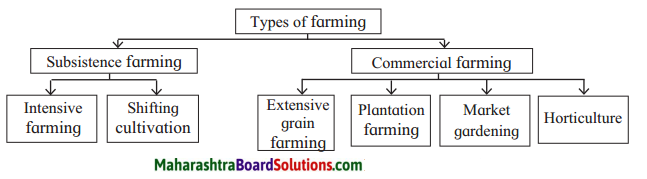
Maharashtra Board Class 7 Geography Solutions Chapter 9 Agriculture 1
Intensive farming:

  • Intensive farming is a type of traditional farming. It is carried out in one and the same farm for years together.
  • Getting maximum production from a minimum area is the characteristic of Intensive farming.
  • Due to large population or limited availability of land, per head holding is small.
  • This type of farming is mostly seen in developing region.
  • The cultivator and his family are totally dependent on farming. The farm production is sufficient only for the requirements of the cultivators family.
  • As farm production is low hence the economic condition of the cultivator is also poor.

Extensive farming:

  • Extensive grain farming is a type of commercial farming.
  • Farm size is greater than 200 hectares.
  • Due to large farm size and sparse population in the region, this type of farming is carried out with the help of machines like tractors and crushers.
  • Helicopters or planes are used for spraying pesticides.
  • Mono crop cultivation is the main characteristic.
  • Crops like wheat, corn, barley, oats, soyabean are cultivated.
  • Heavy capital investment is necessary. Since huge expenditures are needed for purchase of machinery, fertilisers, pesticides, godowns, transport cost, etc.
  • Droughts, attack by pests, locusts, market fluctuation, etc. are the problems in extensive grain farming.
  • This type of farming is carried out in the temperate grassland regions.

Maharashtra Board Class 7 Geography Solutions Chapter 9 Agriculture

Question 4.
Describe the characteristics of plantation farming.
Answer:
(i) Plantation farming is a type of commercial farming.
(ii) Farm size is 40 hectares or above.
(iii) As plantation agriculture is practised in hilly tracts of tropical regions, use of machines are not possible hence local manpower is used.
(iv) This is a single crop cultivation practice.
(v) Only commercial crops like tea, rubber, coffee, coconut, cocoa, spices, etc. are planted.
(vi) This type of farming requires large scale capital investment.
(vii) Major issues faced are climate, manpower, deterioration of environment, economic and managerial problems.
(viii) Plantation farming is practised in India and other South Asian countries, Africa, South and Central America.

Question 5.
Which are the crops cultivated in your area? What are the geographical reasons for that?
Answer:
(i) I live in the konkan region of the state of Maharashtra
(ii) The main crops cultivated in our area are mangoes, rice, coconut, cashew, etc.
(iii) Konkan region has hot & humid climate, heavy rainfall which favours the growth of these crops.
(iv) This region has fertile laterite soil which is suitable for cultivation of fruits.

Question 6.
Why is the agriculture in India seasonal in nature? What are the difficulties for perennial agriculture?
Answer:
(i) Most of the agriculture in India is dependent on monsoon rainfall. 80% of the rainfall in India is received from south west monsoon winds from June to September.
(ii) Since monsoon in India is seasonal; agriculture in India is also seasonal in nature.
Difficulties for perennial agriculture
(i) Rainfall in India is highly irregular & uncertain. Also there is lack of irrigation facilities.
(ii) There is lack of capital investment, godowns, transportation, etc.
(iii) There is lack of awareness with respect to scientific methods of crop cultivation.

Activity:

Visit a farm where modern technology is used for agriculture. Collect information about it.

Use of ICT

Question 1.
Collect the pictures of improved seeds and means of irrigation from the internet.
Question 2.
Collect information regarding agricultural in Israel from the internet. and present it.

Class 7 Geography Chapter 9 Agriculture InText Questions and Answers

Can you tell?
Observe the picture and briefly describe the type of agriculture shown.

Question 1.
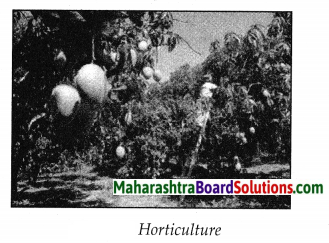
Maharashtra Board Class 7 Geography Solutions Chapter 9 Agriculture 4

Answer:
(a) For the growth of fruits a large number of similar trees are grown in a vast area. Such land areas are called farms or orchards, for e.g. mango, coconut.
(b) In this type of farming modern as well as traditional methods are used.
(c) Use of irrigation, chemical fertilizers, green houses, etc. is being made for getting more profit.

Question 2.
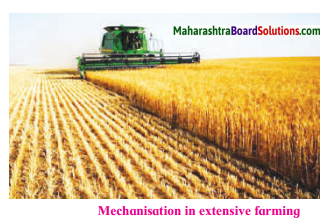
Maharashtra Board Class 7 Geography Solutions Chapter 9 Agriculture 5
Answer:
(a) One single crop is grown in a large area.
(b) The use of man power is less, whereas most of the farmwork is done with the help of machines like tractors, harvesters, threshers, etc.
(c) Heavy capital investment is necessary for this type of farming.

Question 3.
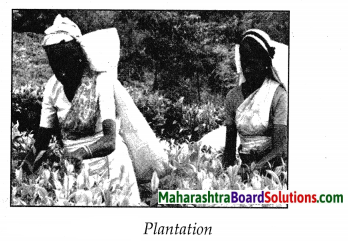
Maharashtra Board Class 7 Geography Solutions Chapter 9 Agriculture 6
Answer:
(a) One single tree crop is grown on a large scale.
(b) Only commercial crops like tea, rubber, coffee, cocoa, coconut, spices, etc. are planted.
(c) It requires lot of capital investment due to the long duration of crops, use of scientific methods, exportable production, processing,

Maharashtra Board Class 7 Geography Solutions Chapter 9 Agriculture

Question 4.
Maharashtra Board Class 7 Geography Solutions Chapter 9 Agriculture 7
Answer:
(a) Crops are grown on small farm lands with the help of bovine (animal) and human resources.
(b) The profits earned are very low despite intensive care taken.
(c) The crops that are grown are used for home consumption and the excess, if any, is sold in the local market.

Observe the picture and answer:
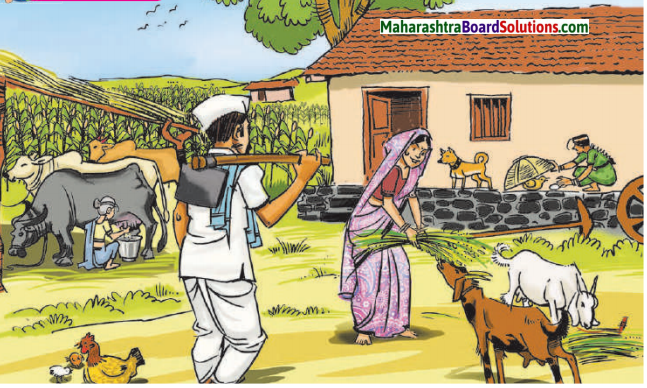
Maharashtra Board Class 7 Geography Solutions Chapter 9 Agriculture 2
Question 1.
What all do you see in the picture?
Answer:
A farmer’s house, a farmer keeps cows, hens, sheep, goats and cattle, a standing crop, a plough share, farmers wife grazing the cattle.

Question 2.
Why has the family kept goats and hens?
Answer:
Farmer gets milk from goats and eggs from the hens.

Question 3.
Which implements are seen in the picture?
Answer:
The spade and plough are seen in the picture

Question 4.
How are these implements used?
Answer:
Spade is a hand tool used to dig or loosen ground or break lumps in the soil. A plough is used for ploughing the fields. Ploughing turns organic matter into soil to increase decomposition and add nutrients from organic matter to the soil.

Maharashtra Board Class 7 Geography Solutions Chapter 9 Agriculture

Question 5.
In which major occupation type will the activities shown here be included?
Answer:
The activities shown in the picture mostly fall under the occupation of agriculture.

Question 6.
What could be the main occupation of these people?
Answer:
The main occupation of these people could be cultivation of crops.

Question 7.
Who could be the owner of the house?
Answer:
The farmer himself could be the owner of the house.

Question 8.
Which products shown in the above picture do you use?
Answer:
Milk and dairy products, eggs are used in our day to day lives.

Give it a try:

Observe the pictures and answer the following questions.
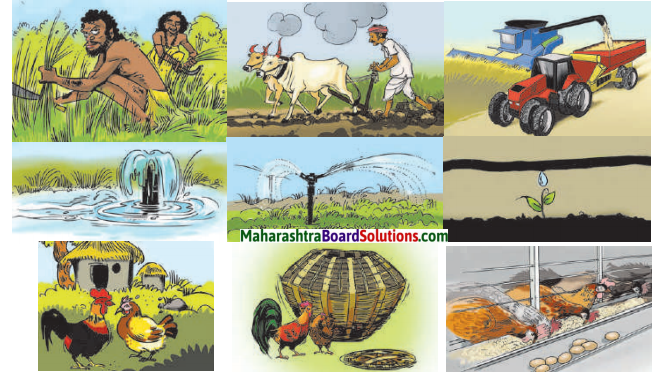
Maharashtra Board Class 7 Geography Solutions Chapter 9 Agriculture 3
Question 1.
What differences do you observe these pictures?
Answer:
In the pictures we can observe the changes in agricultural practices. It shows the transition from traditional to modern agriculture.
(a) Initially man cultivated crops using only manual labour. Later he started using various animals like bullocks to cultivate crops.
Today we use modern machines for various agricultural practices.

(b) Irrigation too has changed – from water allowed to flow freely in the field though pipes, man now uses modern methods like sprinkler & drip irrigation.

(c) Poultry farming is supplementary to cultivation of crops & is included in agriculture. Initially hens were reared in small numbers in open areas. But today hens are reared on a large scale. With use of modem techniques it leads to large scale production of eggs.

Question 2.
What changes have taken place in traditional agricultural practices?
Answer:
Traditionally agriculture was carried out using manual labour & bovine power. Today modem methods of agriculture include using machines tractors, harvests, fertilizers, insecticides, pesticides, etc. for better yield of crop.

Irrigation is used for ample water supply throughout the year to maximize crop production. Modern, scientific techniques & use of hybrid seed, leads to more productivity of land, (more crop production in limited land area)

Maharashtra Board Class 7 Geography Solutions Chapter 9 Agriculture

Answer the following questions:

Question 1.
Which improper practices arising out of man’s greed are observed in agriculture.
Answer:
In order to produce the fruits and vegetables early and sell them quickly, man uses artificial chemical, which harms the soil & hampers the quality of production.

Question 2.
What means of irrigation are available in your area?
Answer:
(a) Drip and Sprinkler irrigation is used in many orchards across the konkan region of Maharashtra.
(b) Wells & tube wells are other methods used on large scale.

Question 3.
Have you observed the wastage of water in agriculture? If yes, describe it.
Answer:
There was a field in my native place. The farmer would water the field leaving the water pipe on the field. Lot of water would be wasted. But now the same farmer waters the field using sprinkler irrigation method. As a result there is no wastage of water, any more.

Question 4.
Which steps can easily be taken to avoid improper practices in agriculture?
Answer:
(a) System of Agricultural Produce Market committee should be established at taluka level and farmers should be encouraged to bring their produce and sell to the traders here

(b) As farm produce is perishable, there has to be a proper arrangement for its sale to avoid,wastage.

(c) Institutes like farmer’s organizations, consumer societies, etc. help and try to protect farmers from exploitation by agents, mediators and others.

(d) Farmers should not use artificial chemicals and pesticides.

Use your brainpower:

Question 1.
Why does extensive commercial farming need more capital?
Answer:
(a) Farm size is greater than 200 hectares.
(b) Due to large farm size and sparse population in the region, this type of farming is carried out with the help of machines like tractors and crushers.
(c) Pesticides are sprayed with the help of helicopters or planes.
(d) Since huge expenditures are needed for the purchase of machinery, fertilizers, pesticides, godowns, transport cost, etc. So extensive commercial farming needs more capital.

Question 2.
Why does plantation farming need skilled and experienced labour?
Answer:
(a) Farm size in plantation farming is 40 hectares or above.
(b) Plantation farming is practised in hilly tracts, so use of machines is not possible.
Hence, plantation farming needs skilled and experienced labour.

Question 3.
In what different ways is ground water obtained for agriculture?
Answer:
(a) Ground water is the water that is found underground.
(b) When it rains, about 20% of the rain water seeps into the ground, forming a water table.
(c) A well as deep as the water table is dug, in order for it to pump water to the fields for agriculture.
(d) Now days use of tube wells have become popular too

Maharashtra Board Class 7 Geography Solutions Chapter 9 Agriculture

Class 7 Geography Chapter 9 Agriculture Additional Important Questions and Answers

Fill in the blanks choosing the correct options from the bracket:

Question 1.
Commercial dairy fanning is mainly undertaken for _________. (milk and fish, meat and milk, meat and poultry)
Answer:
meat and milk

Question 2.
Sheep rearing is carried out to obtain ________. (cotton, silk, wool)
Answer:
wool

Question 3.
In order to achieve the best growth of fish, ________ methods are employed. (pisciculture, scientific, electronic)
Answer:
scientific

Question 4.
Silk thread is obtained from the ______ of the silk moth. (cocoon, mulberry, skin)
Answer:
cocoon

Question 5.
Leaves of the ______ trees are the main food for the silk worms. (mulberry, pepal, coconut)
Answer:
mulberry

Question 6.
______ farming is a highly specialized type of farming of the modem era. (Intensive, Subsistence, Modern)
Answer:
Greenhouse

Question 7.
Intensive farming and shifting cultivation are the two types in ______ farming. (extensive, traditional, intensive)
Answer:
traditional

Question 8.
Shifting cultivation is a ________ type of cultivation, (primitive, extensive, intensive)
Answer:
primitive

Question 9.
Cultivation of flowers and fruits is a subtype of _______ gardening. (market, organic, plantation)
Answer:
market

Fill in the blanks:

Question 1.
_______ is a new field of tourism.
Answer:
Agrotourism

Question 2.
Most of the farmers are ________ weak and cannot market their product on their own.
Answer:
economically

Question 3.
As farm produce is ______ there has to be a proper arrangement for its sale.
Answer:
perishable

Maharashtra Board Class 7 Geography Solutions Chapter 9 Agriculture

Question 4.
Some of the farm produce is directly used by industries as ______.
Answer:
raw material

Question 5.
_____ is a major exporter of fresh farm produce.
Answer:
Israel

Question 6.
International markets are now becoming easily available for farm produce due to _____.
Answer:
globalization

Question 7.
France and Italy are famous for ________.
Answer:
horticulture

Question 8.
____ is obtained from organic waste.
Answer:
Vermicompost

Select the proper option for the following statements:

Question 1.
Heavy capital investment is necessary for
(a) Subsistence farming
(b) Extensive grain farming
(c) Shifting cultivation
(d) Dairy farming
Answer:
(b) Extensive grain farming

Question 2.
Getting maximum production from a minimum area is the characteristic of
(a) Plantation farming
(b) Intensive farming
(c) Horticulture
(d) Extensive grain farming
Answer:
(b) Intensive farming

Complete the following sentence:

Question 1.
For our basic needs of food and clothing ______.
Answer:
we make use of plants and animals

Question 2.
In agricultural occupation, resources like _______.
Answer:
manpower, animals, implements, etc. are used

Maharashtra Board Class 7 Geography Solutions Chapter 9 Agriculture

Question 3.
In the past primitive man had to wander in the forest to ______.
Answer:
sustain himself on the collected forest produce

Question 4.
Bees in order to collect honey, _______.
Answer:
hover around the plants that bear flowers

Question 5.
Silk thread is obtained from the _________.
Answer:
cocoon of the silk moth

Question 6.
Greenhouse farming facilitates _______.
Answer:
getting maximum product from the land

Question 7.
Greenhouse farming is ________.
Answer:
highly specialized type of farming of the modern era

Question 8.
Different types of agriculture has evolved due to _______.
Answer:
geographical and cultural diversity and technological differences in different regions

Question 9.
Intensive farming is carried out in ________.
Answer:
one and the same farm for years together

Question 10.
In shifting cultivation, ________.
Answer:
every year a new area is chosen for cultivation

Question 11.
The problems in extensive grain farming are ______.
Answer:
droughts, attacks by pests, locusts, etc. and also market fluctuation

Question 12.
Market gardening has developed mainly as a _______.
Answer:
result of urbanization and the ready markets available in urban centres

Question 13.
Cultivation of flowers and fruits is a ________.
Answer:
subtype of market gardening

Maharashtra Board Class 7 Geography Solutions Chapter 9 Agriculture

Question 14.
As farm produce is perishable, _________.
Answer:
there has to be a proper arrangement for its sale

Question 15.
Most of the farmers are ______.
Answer:
economically weak and cannot market their production on their own.

Question 16.
By advertising on the internet, ______.
Answer:
the agricultural products get sold in local as well as international markets

Answer in one sentence:

Question 1.
What do we depend on for our basic needs of food and clothing?
Answer:
For our basic needs of food and clothing, we make use of plants and animals.

Question 2.
What is considered to be the main and the most important occupation in agriculture?
Answer:
In agriculture, cultivation of crops is considered to be the main and the most important occupation.

Question 3.
Why had the primitive man to wander in the forest in the past?
Answer:
Primitive man had to wander in the forest to sustain himself on the collected forest produce.

Question 4.
What is the core of animal husbandry?
Answer:
Rearing different animals and obtaining various products from them for subsistence is the core of animal husbandry.

Question 5.
On what do sheep and goats survive?
Answer:
Sheep and goats survive on short grass, shrubs and acacia, grown in remote hilly areas away from urban settlements.

Question 6.
What do we obtain from Beekeeping occupation?
Answer:
We obtain honey and wax from Beekeeping.

Question 7.
What is Pisciculture?
Answer:
Pisciculture is also called fish farming in which fish seeds are released in the pond to achieve the best growth of fish.

Maharashtra Board Class 7 Geography Solutions Chapter 9 Agriculture

Question 8.
Name the fish reared in fish farms.
Answer:
Warn, Roha, Rawas, Kolambi are reared in fish farms.

Question 9.
What is used to weave soft silk cloth?
Answer:
Fine and strong silk thread obtained from the cocoon of the silk moth are used to weave soft silk cloth.

Question 10.
Which is the highly specialized type of farming of the modem era?
Answer:
Greenhouse farming is a highly specialized type of farming of the modem era.

Question 11.
Which are the two types in traditional farming?
Answer:
Intensive farming and shifting cultivation are the two types in traditional farming.

Question 12.
What is the characteristic of intensive farming?
Answer:
Getting maximum production from a minimum area of land is the characteristic of intensive farming.

Question 13.
Where is shifting cultivation practised?
Answer:
Shifting cultivation is practised in the tropics in densely forested areas or hilly tracts.

Question 14.
Name the two major types of farming covered under commercial farming.
Answer:
Extensive grain farming and plantation agriculture are the two major types of farming covered under commercial farming.

Question 15.
What are the problems in extensive grain farming?
Answer:
The problems in extensive grain farming are droughts, attack by pests, locusts, etc. and market fluctuations.

Question 16.
What are the major issues faced by the plantation farming?
Answer:
Climate, manpower, deterioration of environment, economic and managerial problems are the major issues faced by the plantation farming.

Question 17.
Where is plantation farming practised?
Answer:
Plantation farming is practised in India and other South Asian countries, Africa, South and Central America, etc.

Question 18.
What is a subtype of market gardening?
Answer:
Cultivation of flowers and fruits is a subtype of market gardening.

Question 19.
What are the major products of horticulture?
Answer:
Major products of horticulture are flowers like lily, gerbera, tulip, dahlia, chrysanthemum, marigold, etc.

Maharashtra Board Class 7 Geography Solutions Chapter 9 Agriculture

Question 20.
Name some native and exotic fruits cultivated in fruit farming.
Answer:
Different native and exotic fruits like mangoes, custard apples, grapes, bananas, pomegranates, dragon fruits, cherries, oranges, strawberries, raspberries, etc.

Question 21.
What is organic farming?
Answer:
When farming is done using all vestal matter mixed in the soil, it is called organic farming.

Question 22.
Why do city dwellers visit the rural areas?
Answer:
City dwellers are curious about the farmers life and environment so they visit the rural areas to see the rural life, local customs and culture.

Question 23.
Why are some fruits and vegetables harmful to health?
Answer:
Some fruits and vegetables may have been produced using artificial chemicals, and pesticides for quicker production. Such fruits and vegetables are harmful to health.

Give geographical reasons:

Question 1.
The system of Agricultural Produce Market Committees is established at the Taluka level.
Answer:

  • Most of the farmers are economically weak.
  • These farmers cannot market their production on their own.
  • At these places, farmers bring their produce and sell to the traders.
  • Hence, the system of Agricultural produce market committee is established at taluka level.

Question 2.
Poultry occupation is generally located in big cities.
Answer:

  • Running a poultry on commercial basis requires a lot of care.
  • For this scientific methods are employed.
  • Areas in big cities provide a ready market for this occupation.
  • Hence poultry occupation is generally located in big cities.

Maharashtra Board Class 7 Geography Solutions Chapter 9 Agriculture

Question 3.
Bee keeping is an important occupation with respect to agriculture.
Answer:

  • Beekeeping occupation is undertaken to obtain honey and wax.
  • In order to collect honey, bees hover around the plants that bear flowers.
  • This promotes the process of pollination .
  • Pollination helps the trees to bear large number of fruits and increase the yield of crops. Hence, Bee keeping is an important occupation with respect to agriculture.

Question 4.
Specific type of fish species are reared separately.
Answer:

  • During fishing, different types of fish and other aquatic organisms get caught in the fishing nets.
  • Separating them becomes a major task.
  • All organisms do not fetch the same price. Due to the above factors specific type of fish species are reared separately.

Question 5.
The expenditure of planting mulberry trees every year is saved.
Answer:

  • Leaves of mulberry trees are the main food for the silk worms.
  • Once planted, the mulberry trees survive for a minimum period of 15 years.
  • Hence, the expenditure of planting mulberry trees every year is saved.

Question 6.
Last few years, has seen the development of nurseries.
Answer:

  • In the last few years, the area under floriculture cultivation of medicinal and aromatic plants and horticulture has increased.
  • These plantations require a high standard of seedlings, cuttings, bulbs and seeds.
  • Nurseries give good returns.
  • This has led to the development of nurseries.

Question 7.
Heavy capital investment is necessary for extensive grain fanning.
Answer:

  • Extensive grain farming Is carried out with the help of machines like tractors and crushers.
  • Pesticides are sprayed with the help of helicopters or planes.
  • Huge expenditures are needed for the purchase of machinery, fertilizers, pesticides, godowns, transport cost, etc.
  • So heavy capital investment is necessary for extensive grain farming.

Question 8.
Market gardening is also known as truck farming.
Answer:

(i) Market gardening has developed as a result of urbanization and the ready markets available in urban centres.

(ii) Farmers cultivate vegetables and other items in the vicinity of urban centres to cater to the demands of city dwellers.

(iii) Market gardening is dependent on good transport network.

(iv) The quality and price of the product is determined by rapid transport. Hence, market gardening is also known as ‘truck farming’.

Maharashtra Board Class 7 Geography Solutions Chapter 9 Agriculture

Question 9.
Agrotourism is financially beneficial for the farmer and his village.
Answer:

  • Agrotourism is a new field in tourism.
  • In the tropics, various types of agricultural products are cultivated.
  • City dwellers are curious about the farmer’s life and environment.
  • Many of the city dwellers visit the rural areas to see this. So, Agrotourism is financially beneficial for the farmer and his village.

Question 10.
In intensive farming the economic condition of the cultivator is poor.
Answer:

  • Intensive farming is practised in areas of high population.
  • Due to large population per head holding is small.
  • Because of small land holding & traditional methods of cultivation farm production is sufficient only for the requirement of the family.
  • As the farm production is low, the economic conditions of the cultivator is poor.

Question 11.
How do farmers grow their crops?
Answer:

  • After deciding what to grow, farmers often till the land by loosening the soil.
  • The soil is then mixed with fertilizers.
  • Then they sow seeds or plant seedlings.
  • When the crops are growing farmer must water the seed and kill crop pests.

Write short notes on:

Question 1.
Greenhouse farming:
Answer:
(i) Greenhouse farming is a highly specialized type of farming of the modem era.

(ii) For erecting a greenhouse galvanized iron pipes and plastic sheets are used. It can have total control on natural factors like climate, heat, atmospheric moisture as well as soil moisture.

(iii) Its main aim is to control pest attack by controlling water, light & temperature.

(iv) Green house farming facilitates getting maximum product from land. It assists in getting maximum economic benefit

(e) Greenhouses are used on large scale for growing flowers like lily & gerbera to igive maximum returns.

Question 2.
Market gardening:
Answer:
(i) Market gardening is a type of cultivation developed mainly as a result of urbanization & ready markets available in urban centres.

(ii) Farmers cultivate vegetables & other items in the vicinity1 of urban centres to cater to the demands of city dwellers.

(iii) The landholding is small. Use of irrigation, organic & chemical fertilizers, low investment, use of manpower, demand of markets, use of science & technology are the characteristics of market gardening.

(iv) It is dependent on good transport network. The quality & price of the product is determined by rapid transport. Hence this type of farming is also called truck farming.

Maharashtra Board Class 7 Geography Solutions Chapter 9 Agriculture

Question 3.
Organic farming:
Answer:

(i) The nutrient requirements of the crops is fulfilled by soil & therefore replenishment of used up nutrients is necessary.

(ii) Nutrients are also used abundantly to increase the yield. Organic fertilizers are prepared for this purpose

(iii) The litter should be decomposed in the ground. Grass like resbania or jute are also buried in the soil for making manures Cowdung & compost manures are used. Vermicompost is obtained from organic waste.

(iv) When farming is done using all the vestal matter mixed in the soil it is called organic farming

(v) The crop obtained from organic farming is high in quality.

Question 4.
Agrotourism:
Answer:

  • Agrotourism is a new field in tourism.
  • Vicinity – the area near or surrounding a particular place.
  • In the tropics various types of agricultural products are cultivated. Hence there is greater scope for agrotourism.
  • In agrarian countries the rural life, local customs & culture are utilized for agrotourism.
  • City dwellers are curious about the farmers’ life & environment and many of them visit rural areas just to see this.
  • Agrotourism is financially beneficial for the farmer & his village.

Question 5.
Importance of marketing system in India:
Answer:
The following points explain the importance of marketing systems in countries like India:

  • Agriculture in India is scattered over vast areas.
  • All farmers are not organized.
  • Most of the farmers are economically weak & cannot market their production on their own.
  • As farm produce is perishable, there has to be a proper arrangement for its sale.

Question 6.
Beekeeping.
Answer:

  • Beekeeping is an important occupation with respect to agriculture
  • It is undertaken to obtain honey & wax. In order to collect honey, bees hover around the plants that bear flowers.
  • This promotes the process of pollination.
  • As a result, the trees bear large number of fruits & the crop yields increase.

Question 7.
Pisciculture or Fish farming:
Answer:

  • Farm ponds are dug out for the purpose of pisciculture. Water is stored in such ponds.
  • Fish seeds are released in the ponds. For this seeds of fresh water species are used.
  • In order to achieve the best growth of fish, scientific methods are employed.

Maharashtra Board Class 7 Geography Solutions Chapter 9 Agriculture

Question 8.
Give comparative account of any two methods of irrigation
Answer:
Well irrigation, canal irrigation, drip & sprinkler irrigation, tank irrigation etc. are various methods of irrigation. Wells & canals have been used for irrigation since ancient times.

Well irrigation:-

  • In this type of irrigation, a well is dug in the ground from which ground water is taken out for irrigation,
  • The area required for digging wells is less,
  • It is a cheap, dependable & popular method of irrigation in India.

Canal irrigation:-

  • In this type of irrigation, dams are constructed on rivers & water of the river is stored in the reservoir,
  • The stored water is then supplied to fields with the help of canals,
  • Canal irrigation requires vast area for construction of dam as well as constructing network of canals,
  • Canal irrigation is dependable but costly method of irrigation.

Question 9.
Sericulture:
Answer:

  • Rearing of silkworm in order to obtain silk is sericulture.
  • Leaves of the mulberry trees are the main food for these silk worms.
  • Once planted the mulberry trees survive for a minimum period of 15 years.
  • Silk thread is obtained from the cocoon of the silk. These threads are very fine & strong. They are used to weave silk cloth.

7th Std Geography Questions And Answers:

How Seasons Occur Part 1 Question Answer Class 7 Geography Chapter 1 Maharashtra Board

Balbharti Maharashtra State Board Class 7 Geography Solutions Part 1 Chapter 1 How Seasons Occur Part 1 Notes, Textbook Exercise Important Questions and Answers.

Std 7 Geography Chapter 1 Question Answer How Seasons Occur Part 1 Maharashtra Board

Class 7 Geography Chapter 1 How Seasons Occur Part 1 Question Answer Maharashtra Board

How Seasons Occur Part 1 Class 7 Questions And Answers

1. Answer the following questions in one sentence:

Question 1.
How do day and nigbt occur on the earth?
Answer:
Day and night occur on the earth because of the earths rotation.

Question 2.
What term is used to describe the earth’s revolution around the sun?
Answer:
The term orbital motion is used to describe the earth’s revolution around the sun.

Maharashtra Board Class 7 Geography Solutions Chapter 1 How Seasons Occur Part 1

Question 3.
How long does the earth take to do so?
Answer:
The earth takes 365 days and 6 hours to complete one revolution.

Question 4.
In which hemispheres is our country located?
Answer:
Our country lies in the northeastern hemisphere.

Question 5.
Why don’t the sun’s rays fall perpendicularly at all places on the earth?
Answer:
The sun’s rays do not fall perpendicularly at all the places on the earth because the earth is not flat but spherical in shape.

2. Can you tell?

Records of the entries of sunrise and sunset for the month of June are given below. Answer the questions, that follow.

Date Sunrise Sunset  Day  Night Source of Information
19th June 06.01 19:18 13 Hrs. 16 Min. 10 Hrs. 44 Min. Time and date
20th June 06.02 19:18 13 Hrs. 16 Min. 10 Hrs. 44 Min. Time and date
21st June 06.02 19:18 13 Hrs. 16 Min. 10 Hrs. 44 Min. Time and date
22nd June 06.02 19:18 13 Hrs. 16 Min. 10 Hrs. 44 Min. Time and date
23rd June 06.02 19:19 13 Hrs. 16 Min. 10 Hrs. 44 Min. Time and date
24th June 06.02 19:19 13 Hrs. 16 Min. 10 Hrs. 44 Min. Time and date
25th June 06.03 19:19 13 Hrs. 16 Min. 10 Hrs. 44 Min. Time and date
26th June 06.03 19:19 13 Hrs. 16 Min. 10 Hrs. 44 Min. Time and date
27th June 06.03 19:19 13 Hrs. 15 Min. 10 Hrs. 45 Min. Time and date
28th June 06.04 19:19 13 Hrs. 15 Min. 10 Hrs. 45 Min. Time and date

Question 1.
Refer to the table above and state which are the longest days?
Answer:
The longest days are from 19th June to 26th June.

Maharashtra Board Class 7 Geography Solutions Chapter 1 How Seasons Occur Part 1

Question 2.
What difference do you notice in the duration of the nights from 19th June to 28th June?
Answer:
The duration of the nights keeps on increasing day by day.

Question 3.
What is the reason behind it?
Answer:
The sun is now moving southwards.

Question 4.
How did you find out the duration of the night?
Answer:
The duration of the day is subtracted from 24 hours to get the duration of the night.

Question 5.
Which two dates have days and nights of the same duration?
Answer:
March 22 and September 23 have the same duration of days and nights.

Question 6.
With the help of the table, you saw how the duration of the day and the night changes. Do you think such a change occurs everywhere on the earth?
Answer:
Yes, duration of day and night changes everywhere on the earth.

Question 7.
Use the above format to record the duration of daytime from 19th to 28th of every month from September to December.
Answer:
Students should expected to attempt the activity & answer on their own.

3. Think about it:

Question 1.
If the position of the shadow on the wall moves towards the north, in which direction does the location of sunrise or sunset appear to shift?
Answer:
If the position of the shadow on the wall moves towards the north, the location of sunrise or sunset will shift southwards.

Class 7 Geography Chapter 1 How Seasons Occur Part 1 Additional Important Questions and Answers

Fill in the blanks choosing the correct options from the brackets:

Question 1.
The earth’s _______ has enabled us to measure time in terms of days. (revolution, rotation, orbital motion)
Answer:
rotation

Question 2.
The earth rotates from _________ (north to south, east to west, west to east)
Answer:
west to east

Maharashtra Board Class 7 Geography Solutions Chapter 1 How Seasons Occur Part 1

Question 3.
The Earth takes _______ hours to rotate around itself. (365,144, 24)
Answer:
24

Question 4.
India lies in the ____ hemisphere. (northeastern, northwestern, southeastern)
Answer:
northeastern

Question 5.
The ________of sunrise and the sunset on the horizon³ for the whole year keep on changing. (position, shadow, rotation)
Answer:
position

7th Std Geography Questions And Answers:

Preamble to the Constitution Question Answer Class 7 Civics Chapter 2 Maharashtra Board

Balbharti Maharashtra State Board Class 7 Civics Solutions Chapter 2 Preamble to the Constitution Notes, Textbook Exercise Important Questions and Answers.

Std 7 Civics Chapter 2 Question Answer Preamble to the Constitution Maharashtra Board

Class 7 Civics Chapter 2 Preamble to the Constitution Question Answer Maharashtra Board

Preamble to the Constitution Class 7 Questions And Answers

1. Find the following words in the grid:

Maharashtra Board Class 7 Civics Solutions Chapter 2 Preamble to the Constitution 1
Question 1.
A sense of ‘we-feeling’ and empathy towards fellow citizens
Answer:
Fraternity.

Maharashtra Board Class 7 Civics Solutions Chapter 2 Preamble to the Constitution

Question 2.
A system in which sovereign power is in the hands of the people
Answer:
Democracy.

Question 3.
Introduction to the Constitution
Answer:
Preamble.

Question 4.
A system in which all religions are considered equal
Answer:
Secular

Maharashtra Board Class 7 Civics Solutions Chapter 2 Preamble to the Constitution 2

2. Answer the following questions.

Question 1.
What are the provisions in a secular Constitution?
Answer:

  • In a Secular State, all religions are considered as equal.
  • No religion is considered to be the state religion. The citizens are free to follow their own religion.
  • The state cannot discriminate among citizens on the basis of religion.

Maharashtra Board Class 7 Civics Solutions Chapter 2 Preamble to the Constitution

Question 2.
What is meant by adult franchise?
Answer:

  • Adult franchise means all citizens completing 18 years of age have the right to vote in the elections.
  • This enables equal participation of citizens in the running of our country.

Question 3.
What right does economic justice ensure?
Answer:
Economic justice ensures our right to a source of livelihood so as to look after oneself and one’s family.

Question 4.
How will human dignity be established in a society?
Answer:
When every individual respects another and honours their freedom and rights, dignity of the individual will be established.

3. How should we make use of our freedom ? Write your views about it.
Answer:

  • Pandit Jawaharlal Nehru has rightly said. ‘We have to assume the responsibility ourselves of what we do’.
  • Freedom must be exercised with care, with a sense of responsibility.
  • Our freedom and independence which we gained after innumerable sacrificies must be safeguarded.
  • We should use the different freedoms endowed on us by our Constitution to bring out the best in us and build a better nation, a better world
  • The future lies in our hands.

4. Explain the following concepts.

Question 1.
Socialist State
Answer:

  • A Socialist State is such a State where the gap between the rich and the poor is minimum.
  • All have a right over the wealth of the country.
  • It is ensured that wealth is not concentrated in the hands of a few people.

Question 2.
Equality
Answer:
(i) The Preamble guarantees the Indian citizens equality of status and there will be no discrimination based on caste, creed, race, sex, place of birth, etc.

(ii) The guarantee of equality means that there should be no discrimination between people in terms of high-low, superior-inferior.

Question 3.
Sovereign State
Answer:
The word sovereign means that a state is not under the control of a foreign power. The most important goal of our freedom struggle was to acquire sovereignty. ‘Sovereignty’ means the ultimate authority to govern oneself. In a democracy, sovereignty rests with the people

Maharashtra Board Class 7 Civics Solutions Chapter 2 Preamble to the Constitution

Question 4.
Equality of opportunity.
Answer:
Equality means the state of being equal in status, rights or opportunities. Equality of status, and of opportunity means that all have equal human status and there will be no discrimination based on caste, creed, race, sex, place of birth, etc. All will get the opportunities for development without any discrimination.

5. Make a list of the key words in the Preamble. Look for their meanings in a dictionary. Prepare a chart in the following way:
Maharashtra Board Class 7 Civics Solutions Chapter 2 Preamble to the Constitution 4
Answer:
Maharashtra Board Class 7 Civics Solutions Chapter 2 Preamble to the Constitution 3

Activities:

  1. Visit your Tehsil office with your teacher to understand how a vote is cast and how the electronic voting machine works.
  2. Make a list of newspapers available in your locality.

Class 7 Civics Chapter 2 Preamble to the Constitution InText Questions and Answers

Answer the following concepts:

Question 1.
Liberty
Answer:
(i) Liberty implies that there should be no coercive, unfair restrictions upon us and that ’ there should be an atmosphere conducive to the development of our inherent capacities.

(ii) In a democracy, citizens enjoy liberty. In fact, democracy becomes mature only if the citizens enjoy freedom.

Discuss:

Question 1.
Some statements regarding freedom have been given below for discussion. Express your views.
(a) While publicly celebrating our festivals, we need to follow some rules. That does not restrict our freedom,
(b) Freedom means behaving in a responsible way, not as per our whims and fancies.
Answer:
Yes, With freedom comes responsibilities. Rules should be followed while exercising freedom for a smooth life and to ensure that we work towards responsible citizenship.

Maharashtra Board Class 7 Civics Solutions Chapter 2 Preamble to the Constitution

Question 2.
Read what Deepa has written on the topic: “My Family’.
Answer:
Democracy does not only imply elections. My parents do all the household work together. We also participate in it. We ensure that we talk cordially with each other. Even if we happen to fight, we try to listen to each others views by stopping the fight as soon as possible. If any change has to be made, even the grandparents are consulted. Anuja wants to take up agricultural research as her career. Her decision was appreciated by everybody.

Question 3.
Do you think that Deepa’s house functions in a democratic way? Which features of democracy can be found in this passage.
Answer:
Yes. They function in a democratic way and the features of democracy displayed here are:

  • Carrying out responsibilities collectively as a unit.
  • Mutual respect.
  • Honouring opinions which are not in line with our views.
  • Consensus in decision making.
  • Freedom of thought and expression.
  • Freedom of occupation.

Activities:

Question 1.
Visit your Tehsil office with your teacher to understand how a vote is cast and how the electronic voting ntachine (EVM) works.
Answer:
The voting machines used in India are a combination of two components. First component is called the Balloting unit on which the voters press the button. The other part is called the Control unit. This unit gives supervising power to the polling officer stationed at the poll booth.

The two units are connected by a five-meter cable. The voter places his /her vote on the Balloting unit which is placed inside the Voting compartment.

An EVM runs on 6-volt batteries to eliminate the need of any external power source. It is designed to record 64 candidate names and 3,840 votes at the max. The 64 candidate names can be split across (a maximum of) 4 balloting units connected in parallel, with 16 candidate names on each of the unit.

Maharashtra Board Class 7 Civics Solutions Chapter 2 Preamble to the Constitution

Question 2.
Make a list of newspapers available in your locality.
Answer:

English News Papers:

  • The Times of India
  • Economic Times
  • Financial Express
  • Indian Express
  • Mumbai Mirror
  • Mid-day
  • DNA (Daily News and Analysis)
  • Business- Standard
  • Hindustan Times
  • Free Press Journal

Hindi News Papers (Including Urdu Daily):

  • Hindi Mid-Day
  • Tehalka News
  • Navbharat Times
  • Humara Mahanagar
  • Aaj Ka Anand
  • YashoBhoomi
  • Dopahar
  • Saamna
  • Hindmata
  • Mumbai Sandhya

Marathi News Papers:

  • Loksatta
  • Maharashtra Times
  • Navshakti
  • Navakal
  • Vartahar
  • Saamna (saamana)
  • Sakai
  • Sandesh
  • Lokmat
  • Divyabhaskar
  • Mumbai Mitra
  • Sandhyanand
  • Punya Nagri
  • Samrat

Class 7 Civics Chapter 2 Preamble to the Constitution Additional Important Questions and Answers

Complete the sentence by choosing the appropriate words from the options given below:

Question 1.
The _______ to the Indian Constitution is called the ‘Preamble’. (Preface, Preview, Annexure)
Answer:
Preface

Question 2.
The Preamble sets out the ______ of our Constitution. (declaration, objectives, theme of the Articles)
Answer:
objectives

Maharashtra Board Class 7 Civics Solutions Chapter 2 Preamble to the Constitution

Question 3.
It talks about the resolve of the Indians to constitute India into a ‘Sovereign, Socialist, _______ Democratic Republic’. (Theocratic, Autocratic, Secular)
Answer:
Secular

Question 4.
Our country became independent on _______. (15th August 1947, 26th January 1950, 26th November 1949)
Answer:
15th August 1947

Question 5.
The word _______ means that a state is not under the control of a foreign power. (Sovereign, Secular, Socialist)
Answer:
Sovereign

Question 6.
A Socialist State is such a State where the gap between the rich and the poor ______. (is maximum, is minimum, does not exist)
Answer:
is minimum

Question 7.
In _________ State, all religions are considered equal and no religion is considered as a State religion. (secular, socialist, sovereign)
Answer:
secular

Question 8.
In a _______ the sovereign power is in thehands of the people. (democracy, autocracy, monarchy)
Answer:
democracy

Question 9.
Elections are conducted in India after a fixed period when voters elect their ______. (President, Vice-president, Representatives)
Answer:
Representatives

Question 10.
The Parliament or Legislature and the Executive take decisions for the entire population as per the procedure laid down by the ______.(High Court, Supreme Court, Constitution)
Answer:
Constitution

Question 11.
________ implies removal of injustice and ensuring that everybody has the opportunity for progress. (Liberty, Justice, Equality)
Answer:
Justice

Maharashtra Board Class 7 Civics Solutions Chapter 2 Preamble to the Constitution

Question 12.
________ ensures that as human beings all have the right to the same dignity and respect, the same status. (Political justice, Social justice, Economic justice)
Answer:
Social justice

Question 13.
Since we have adopted universal adult franchise, all citizens completing ________ years of age have the right to vote in the elections. (18, 20, 21)
Answer:
18

Question 14.
The liberty of belief, faith and worship implies ______ freedom. (economic, social, religious)
Answer:
religious

Question 15.
_____ implies a ‘we-feeling’ towards one another. (Fraternity, Empathy, Sympathy)
Answer:
Fraternity

Question 16.
________ implies equal respect to each (Human Rights, Equality, Dignity)
Answer:
Equality

Match the following:

Question 1.

(1) Sovereignty

(2) Socialist State

(3) Secular

(4) Democratic

(a) Equal right over the wealth of the country.

(b) No discrimination on the basis of religion.

(c) Sovereign power is in the hands of the people.

(d) Public positions elected by the people.

(e) Ultimate authority to govern ownself.

Answer:
1 – e
2 – a
3 – b
4 – c

Name the following:

Question 1.
The fundamental and the highest law of the land which is an important document clarifying the rules of the administration.
Answer:
Constitution.

Question 2.
A systematic arrangement of all the aims and objectives of a law which is the preface to the Constitution.
Answer:
Preamble

Question 3.
The words with which the Preamble begins,
Answer:
’We, the people of India’.

Question 4.
The word that means that a State is not under the control of a foreign power.
Answer:
Sovereign

Question 5.
A state where the gap between the rich and poor is minimum.
Answer:
Socialist.

Question 6.
A state wherein all religions are considered equal.
Answer:
Secular state.

Question 7.
In this form of governance, the sovereign power is in the hands of the people.
Answer:
Democracy.

Maharashtra Board Class 7 Civics Solutions Chapter 2 Preamble to the Constitution

Question 8.
Institutions in India created by our Constitution.
Answer:

  • Parliament
  • Legislature
  • Executive.

Question 9.
In this form of government, all positions are elected by the people and no public position is occupied on the basis of hereditary succession.
Answer:
Republic.

Question 10.
Three types of Justice talked of in the Constitution.
Answer:
Social Justice, Economic Justice, Political Justice.

Question 11.
This implies that there should be no coercive, unfair restrictions upon us and that there should be an atmosphere conducive to the development of our inherent capacities.
Answer:
Liberty

Question 12.
The most fundamental freedom of an individual.
Answer:
Freedom of Thought and Expression.

Question 13.
The liberty of belief, faith and worship implies this value.
Answer:
Religious freedom.

Question 14.
The goal which is included in the Constitution which implies a ‘we-feeling ‘ and feeling of empathy.
Answer:
Fraternity.

State whether the following statements are true or false with reason:

Question 1.
The Preamble begins with the mention that the people of India have given the Constitution to themselves.
Answer:
False : The Preamble begins with the words ‘We, the People of India’.

Question 2.
In a democracy, the sovereign power is in the hands of the people.
Answer:
True: Democracy is the Government of the people, by the people and for the people.

Maharashtra Board Class 7 Civics Solutions Chapter 2 Preamble to the Constitution

Question 3.
In a democracy, citizens enjoy liberty.
Answer:
True : In fact democracy becomes mature only if citizens enjoy liberty.

Answer the following questions:

Question 1.
The Preamble guarantees the Indian citizens equality of status and of opportunity. Explain.
Answer:

  • It means that all have equal human status and there will be no discrimination based on caste, creed, race, sex, place of birth, high or low status or superior-inferior.
  • The Preamble has given great importance to equality of opportunity as well.
  • Each one gets the opportunities for development without discrimination.

Answer the following concepts:

Question 1.
Constitution and Preamble
Answer:

  • Our Constitution is the fundamental and the highest law of the land.
  • There are definite aims or purposes in making any law.
  • Basic provisions in the law are made, after clarifying these objectives.
  • A systematic arrangement of all the aims and objectives of a law is the Preface to the law.
  • The Preface to the Indian Constitution is called the ‘Preamble’. The Preamble sets out the objectives of our Constitution.

Question 2.
Republic and how is it different from Monarchy.
Answer:

  • Along with being a democracy, we are a Republic. All public positions in a Republic are elected by the people.
  • No public position is occupied on the basis of hereditary succession.
  • The position like the President, the Prime Minister, the Governor, the Chief Minister, the , Mayor, the Sarpanch, etc. are public positions.
  • Any Indian citizen fulfilling the prescribed age criterion can get himself/herself elected to any of these positions.

Question 3.
Fraternity
Answer:

  • Fraternity implies a ‘we-feeling’ towards one another.
  • It creates a feeling of empathy.
  • People become more understanding towards each other’s problems and needs.

Explain the terms:

Question 1.
Justice
Answer:

  • Justice implies removal of injustice and ensuring that everybody has the opportunity for progress.
  • Establishing justice is adopting such policies that will promote public good.

Maharashtra Board Class 7 Civics Solutions Chapter 2 Preamble to the Constitution

Question 2.
Social Justice
Answer:

  • There should be no discrimination among individuals on the basis of caste, creed, race, language, region, place of birth or sex.
  • As human beings, all have the right to the same dignity and respect, the same status.

Question 3.
Economic Justice
Answer:

  • Poverty leads to the evils of hunger, hunger -deaths or malnourishment.
  • If poverty is to be eradicated, everyone should have the right to a source of livelihood so as to look after oneself and one’s family.
  • Our Constitution has given this right to every citizen without any discrimination.

Question 4.
Political Justice
Answer:

  • We have adopted universal adult franchise to enable equal participation in the running of the country.
  • Accordingly, all citizens completing 18 years of age have the right to vote in elections.

Give reason:

Question 1.
India is a sovereign state.
Answer:

  • India was ruled by Britain for a long period.
  • The British rule ended on 15th August, 1947. Our country became independent and India became sovereign i.e a state not under the control of a foreign power.

Question 2.
India is a secular state.
Answer:

  • In India, all religions are considered as equal.
  • No one religion is considered to be a state religion. The citizens are free to follow their own religion. So, India is a secular state.

Question 3.
Freedom of thought and expression is the most fundamental freedom for an individual.
Answer:

  • Freedom of thought and expression is the most fundamental freedom for an individual.
  • Everyone is free to express their own views and opinions. A give-and-take of ideas enhances the spirit of cooperation and unity amongst us.
  • Similarly, it also enables us to understand the various dimensions of any problem.

Maharashtra Board Class 7 Civics Solutions Chapter 2 Preamble to the Constitution

Question 4.
Promotions of fraternity has been included in the Preamble as a goal.
Answer:

  • The makers of the Constitution believed that merely guaranteeing justice, freedom and equality would not lead to establishing equality in Indian society.
  • No amount of laws would help us achieve these goals if fraternity is lacking among Indians.
  • Hence the promotion of fraternity has been included in the Preamble as a goal.

Question 5.
Fraternity is closely related with human dignity.
Answer:

  • Human dignity implies equal respect to each individual as a human being. .
  • It does not depend upon the criteria of caste, creed, race, sex, language, etc.
  • Just as we would like to be treated with dignity and respect by others, we should treat others with the same dignity and respect.
  • When every individual respects another and honours their freedom and rights, dignity of the individual will get established.
  • This will also develop fraternity, a ‘we-feeling’ towards one another.

7th Std Civics Questions And Answers:
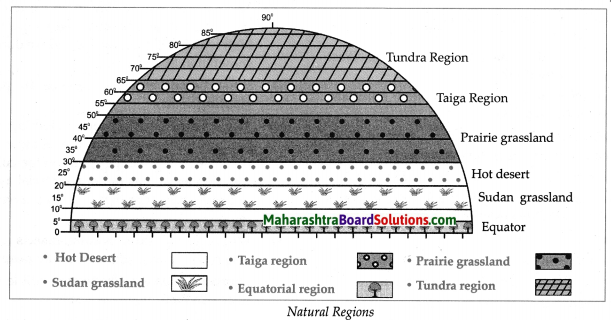
How Seasons Occur Part 2 Question Answer Class 7 Geography Chapter 8 Maharashtra Board

Balbharti Maharashtra State Board Class 7 Geography Solutions Part 1 Chapter Chapter 8 How Seasons Occur Part 2 Notes, Textbook Exercise Important Questions and Answers.

Std 7 Geography Chapter 8 Question Answer How Seasons Occur Part 2 Maharashtra Board

Class 7 Geography Chapter 8 How Seasons Occur Part 2 Question Answer Maharashtra Board

How Seasons Occur Part 2 Class 7 Questions And Answers

1. Complete the statements using correct options:
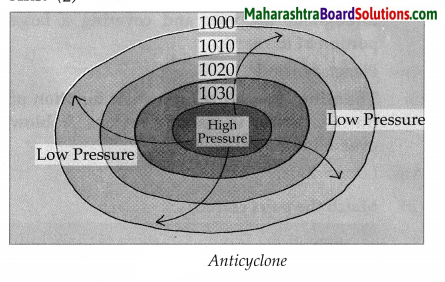
How Seasons Occur Part 2 Class 7 Question 1.
The apparent movement of the sun means that ________.
(a) the sun revolves around the earth in a year.
(b) it appears that the sun moves to the north or south in a year.
(c) the earth keeps on changing its position.
Answer:
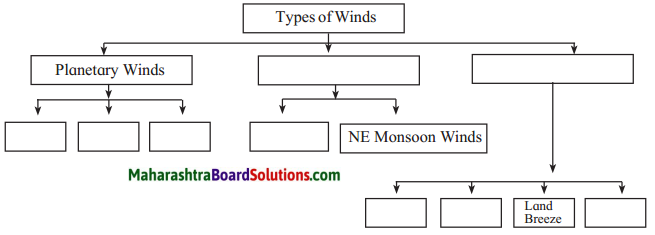
(b) it appears that the sun moves to the north or south in a year.

Maharashtra Board Class 7 Geography Solutions Chapter 8 How Seasons Occur Part 2

How Seasons Occur Part 2 Question 2.
If the axis of the earth were not tilted ________.
(a) the earth would not have rotated around , itself.
(b) the earth would have revolved around the sun with greater velocity.
(c) different parallels on the earth would have experienced the same climate throughout the year.
Answer:
(c) different parallels on the earth would have experienced the same climate throughout the year.

How Seasons Occur – Part 2 Class 7 Questions And Answers Question 3.
21sl June and 22nd December are solstice days, that is ________.
(a) the sun starts its southward journey from Tropic of Cancer on 21st June and Northward journey from Tropic of Capricon on 22nd December.
(b) the Dakshinayan of the sun takes place between 21st June and 22nd December.
(c) the Uttarayan of the earth takes place between 22nd December and 21st June.
Answer:
(a) the sun starts its southward journey from Tropic of Cancer on 21st June and Northward journey from Tropic of Capricon on 22nd December.

How Seasons Occur – Part 2 Class 7 Answers Question 4.
The revolution of the earth around the Sun and the tilt of the axis of the earth together are responsible for the ______.
(a) summer, rainy season, retreat of monsoon, winter.
(b) summer, winter and spring.
(c) summer and winter.
Answer:
(c) summer and winter.

2. Answer the following questions:

How Seasons Occur – Part 2 Questions And Answers Question 1.
What leads to the occurrence of seasons?
Answer:
(i) Seasons occur due to the revolution of the earth.
(ii) Seasons also occur due to the tilt of the earth’s axis of rotation.

Maharashtra Board Class 7 Geography Solutions Chapter 8 How Seasons Occur Part 2

Class 7 Geography Chapter 8 How Seasons Occur Part 2 Question 2.
What is the duration of the day on equinox?
Answer:
(i) The circle of illumination divides all the parallels from the north pole to the south pole equally.
(ii) Everywhere on the earth, the night time and day time are of equal duration. This condition is called equinox.
(iii) Thus, the duration of the day will be twelve hours on equinox.

How Seasons Occur – Part 1 Class 7 Questions And Answers Question 3.
Why is the effect of the seasons not experienced in the equatorial region?
Answer:
(i) Seasons have been decided on the basis of the duration of sunlight, equinoxes & solstices
(i) The equatorial region receives perpendicular sunray almost throughout the year.
(ii) Hence the climate of that region does not change at all in the year.
(iii) Hence the effect of the seasons is not experienced in the equatorial region.

How Seasons Occur – Part 1 Questions And Answers Question 4.
Why is the sun visible for more than 24 hours during Dakshinayan in the region between the Antarctic Circle and the South Pole?
Answer:
(i) Sunrays are never perpendicular on any of the parallels between Tropic of Cancer & the North pole or between Tropic of Capricorn & the South pole.
(ii) In the period from 23rd September to 21st March (Dakshinayan) the region between Antarctic circle and the south faces the sun. The whole of Antarctic Circle falls within the zone of illumination.
(iii) So the sun is visible in the sky for more than 24 hours.

Geography Class 7 How Seasons Occur – Part 2 Question 5.
Why are penguins not found at the North Pole?
Answer:
(i) The living world on the earth is affected by the cycle of seasons.
(ii) Penguins are native to south pole. Penguins have adapted to the natural conditions prevailing in the Antarctic regions of the south pole.
(iii) Besides predators like polar bears roam within the Arctic Circle. Hence penguins are found at the South pole & not at the North pole.

3. Rewrite the following statements after correcting them:

Question 1.
The earth’s velocity varies according to the period of revolution.
Answer:
The earth’s velocity varies due to the rotation of the earth.

Question 2.
If we observe from the northern hemisphere we see the apparent movement of the sun.
Answer:
We see the apparent movement of the sun from both the northern & southern hemispheres.

Question 3.
The dates of equinox change every year.
Answer:
The dates of equinox does not change every year. They vary by a day or so.

Question 4.
North Canada experiences summer from September to March.
Answer:
North Canada experience winter from September to March.

Maharashtra Board Class 7 Geography Solutions Chapter 8 How Seasons Occur Part 2

Question 5.
When it is summer in South Africa, Australia has winter.
Answer:
When it is summer in South Africa, Australia has summer.

Question 6.
Duration of daytime is less on the vernal and autumnal equinoxes.
Answer:
On the vernal (spring) equinox and autumnal equinox, day and night time are of the same duration.

4. Spot the error in the diagram given below:
Maharashtra Board Class 7 Geography Solutions Chapter 8 How Seasons Occur Part 2 1
Answer:
Spring Equinox – 21st March
Summer Solstice – 21st June
Winter Solstice – 22nd December

5. Draw a diagram showing the cycle of seasons in the southern hemisphere.
Answer:
Maharashtra Board Class 7 Geography Solutions Chapter 8 How Seasons Occur Part 2 6

ICT Question :

Question 1.
Using the internet sites or a calendar, find and note the duration of the day for specific dates between 22nd March and 23rd September. Calculate the duration of the nights too. Using this information draw a compound bar graph.
Question 2.
Draw a diagram of aphelion and perihelion positions of the earth on the computer.

Activity:

Using the internet, collect pictorial information of any four migratory birds/animals.

Class 7 Geography Chapter 8 How Seasons Occur Part 2 InText Questions and Answers

Can you tell:

Figure shows the position of the earth with its tilted axis on 21st June and 22nd December. It also shows its illuminated and dark positions. Observe the figure and answer the following.
Maharashtra Board Class 7 Geography Solutions Chapter 8 How Seasons Occur Part 2 2
Question 1.
In fig ‘A which pole is receiving sunlight?
Answer:
North Pole is receiving sunlight in Fig ‘A’

Question 2.
In fig ‘B’ which pole is not receiving sunlight?
Answer:
North Pole is not receiving sunlight in Fig. ‘B’

Question 3.
Which hemisphere has the longest daytime on 21st June?
Answer:
Northern hemisphere has the longest daytime on 21st June.

Question 4.
Which hemisphere will have the longest night on 22nd December?
Answer:
Northern hemisphere will have the largest night in 22nd December.

Maharashtra Board Class 7 Geography Solutions Chapter 8 How Seasons Occur Part 2

Question 5.
On which date will the Tropic of Cancer receive perpendicular sunrays?
Answer:
The Tropic of Cancer will receive perpendicular sunrays on 21st June.

Question 6.
Considering the position of the north pole, which season will prevail in the northern hemisphere from 22nd March to 23rd September?
Answer:
Summer season will prevail in the northern hemisphere from 22nd March to 23rd September.

Question 7.
The cricket matches in Australia are generally in summer, when does Australia have summer?
Answer:
Summer season prevails in Australia from 23rd September to 21st March.

Question 8.
In which period is the ‘midnight sun’ observable in Norway? Which season will there be at that time?
Answer:
Midnight sun is observable in Norway from 21st March to 23rd September. It will be summer in Norway that time.

Question 9.
At what time will the midnight sun be visible at the “Bharati Research Station” of India at Antarctica? What will be the season there at that time?
Answer:
The midnight sun will be visible at Bharati Research Station of India at Antarctica from 23rd September to 21st March. It will be summer season there.

Use your brain power:

Question 1.
The summer capital of Jammu & Kashmir is Srinagar while the winter capital is Jammu. What could be the reason?
Answer:
(i) Jammu is located in the southern part of the state of Jammu & Kashmir whereas Srinagar is located to its north.

(ii) Also Jammu is located at an altitude of 350m whereas Srinagar is located at an altitude of approximately 1500m.

(iii) So Jammu has higher temperature in summer as compared to Srinagar. As Srinagar has pleasant climate in summer, it acts as summer capital of the state.

(iv) As winters are not very cold in Jammu & it is early accessible, it acts as a winter capital of the state.

Question 2.
While India & England are located in the same hemisphere why are the cricket matches in these two countries arranged in different months?
Answer:
(i) As India is a tropical country summers temperature are very high. England on the other hand falls in the temperate zone which has mild summers. Hence, England is suitable for cricket matches in summer.

(ii) As England lies in the temperate zone it her very cold winters. India on the other hand has mild winters as it is a tropical country. Thus India is suitable for cricket matches in winters. Hence, although India & England are located in the same hemisphere, due to latitudinal differences, the cricket matches in these two countries are arranged in different months.

Question 3.
On 21st March and 23rd September, daytime and night time are same all over the earth. But why do some parts experience summer and some winter on the these days?
Answer:
(i) If the earth’s axis were not tilted, the same climatic conditions would have prevailed on each of the different parallels throughout the year.

(ii) The seasons would not have occurred. It is due to the tilt of the earth’s axis that some parts of the earth experience summer and some winter on these days.

Question 4.
Mention any two countries in the world where one needs woollen clothing in the month of May. Also mention their latitudinal positions.
Answer:
South Africa is on 23°S latitude.
Iceland is on 65°N latitude.

Question 5.
On equinox days, the two poles experience either sunrise or sunset. On which pole will it be sunrise on 21st March?
Answer:
Sunrise will be experienced on the North pole.

Think about it:

Question 1.
In which direction will the location of sunrise and sunset appear to move after 22nd of December?
Answer:
On 22nd December the sun reaches the southernmost position as seen from the earth. The sun seems to stand still at the Tropic of Capricon and then reverses its direction. The sun appears to move northwards after 22nd December.

Maharashtra Board Class 7 Geography Solutions Chapter 8 How Seasons Occur Part 2

Observe Fig of textbook page 47 carefully & answer:
Maharashtra Board Class 7 Geography Solutions Chapter 8 How Seasons Occur Part 2 5

Question 2.
positioned relative to the sun on the dates given in the figure?
Answer:
(i) The northern hemisphere is tilted towards the sun in the period between 21st March is 23rd September. Hence, northern hemisphere experiences summer season.

(ii) It is tilted away from the sun in the period between 23rd September to 21st March. Hence, northern hemisphere experiences winter season.

Question 3.
Which season will you experience in the northern hemisphere around 22nd December?
Answer:
We will experience Winter season in the northern hemisphere around 22nd December.

Question 4.
What would be the season in the northern hemisphere around 21st June?
Answer:
It will be Summer season in the northern hemisphere around 21st June.

Question 5.
If it is winter in the northern hemisphere which season will it be in opposite hemisphere?
Answer:
If it is winter in the northern hemisphere, the southern hemisphere will experience summer season.

Maharashtra Board Class 7 Geography Solutions Chapter 8 How Seasons Occur Part 2

Question 6.
At any given point of time why are the season in the northern and southern hemisphere different?
Answer:
(i) Regardless of the time of the year, the northern and southern hemisphere experience opposite seasons.

(ii) In the period from 21st March to 23rd September the northern hemisphere is exposed to more direct sunlight because this hemisphere faces the sun.

(iii) In the period from 23rd September to 21st March the southern hemisphere is exposed to more direct sunlight.

(iv) It is the tilt of the Earth that causes the difference in the seasons.

Question 7.
What effects do the seasons have on the biodiversity in India? Write briefly about it:
Answer:
(i) The living world on the earth is affected by the cycle of seasons.

(ii) Change in seasons cause immense biodiversity loss, affecting both individual species and their ecosystem that support economic growth and human well being.

(iii) Greater frequency and severity of heat waves and extreme weather is a threat to the survival of mankind and animals too.

(iv) Floral and animal activity variation depends on seasonal temperature variation with different species flowering at specific times before or after monsoon seasons.

(v) Any change in rainfall pattern poses a threat to agriculture.

Give it a try:

Question 1.
Regarding daytime & the cycle of season, what conditions would have prevailed at the following place, if the earth’s axis were not tilled? (Canada, Tasmania, Nigeria, West Indies, Peru, Borneo)
Answer:

  • Effect on day & night time: If the earth’s axis were not titled the duration of day time & night time would have been equal throughout the year.
  • Effect on seasons: There would be no seasonal change on the earth.
  • Canada and Tasmania would experience winter throughout the year as they are located near the poles.
  • West Indies, Peru, Nigeria, Borneo would experience summer throughout the year as they are located near the equator.

Can you tell:

Discuss the activity you have been carrying out since June (Refer ch. 1) make use of the observation tables for the months of June, September & December.

Question 1.
In which month the duration of the day was around 12 hours?
Answer:
The duration of the day was around 12 hours in the month of September.

Question 2.
What could be the reason behind it?
Answer:
The duration of day is 12 hours in the month of September because both the hemispheres of the earth are at equal distance from the sun & the equator receives perpendicular rays of the sun.

Question 3.
Bring out the differences between the duration of daytime in the months of June, September & December.
Answer:
The duration of day is around 13 hours in the month of June. It decreases to around 12 hours in the month of September. It is around 11 hours in the month of December.

Maharashtra Board Class 7 Geography Solutions Chapter 8 How Seasons Occur Part 2

Question 4.
What could be the reason for the change in the shadow of the stick?
Answer:
There is a change in the shadow of the stick because there is a change in position of the sunrise & sunset.

Question 5.
What did you observe about the position of the sun at the horizon at the time of sunrise & sunset?
Answer:
(i) After 21st June the position of the sun at the horizon at the time of sunrise & sunset shifted southwards.
(ii) After 22nd December the position of the sun at the horizon at the time of sunrise & sunset shifted north wards.

Question 6.
Which of the following factors could be related with the change in the position of the shadow of the stick & the difference in the duration of daytime?
(i) Rotation of the earth
(ii) Distance between the earth & the sun
(iii) Revolution of the earth.
(iv) The axis of the earth.
Answer:
(i) Revolution of the earth
(ii) The axis of the earth.

Class 7 Geography Chapter 8 How Seasons Occur Part 2 Additional Important Questions and Answers

Fill in the blanks:

Question 1.
The position of the sun at sunrise, appears to change on the ______ everyday.
Answer:
horizon

Question 2.
_______ occurs only with reference to the northern and the southern hemispheres.
Answer:
Seasons

Question 3.
The path of the revolution of the earth around the sun is ______.
Answer:
elliptical

Question 4.
As the earth revolves around the sun, its perpendicular rays fall on the _____ twice a year.
Answer:
equator

Question 5.
In the northern hemisphere prevails from 21st March to 21st June, while ______ prevails from 23rd September to 22nd December.
Answer:
spring, autumn

Question 6.
________ is the longest day and has the shortest night in the northern hemisphere.
Answer:
21st June

Question 7.
_____ marks the longest day and the shortest night in the southern hemisphere.
Answer:
22nd December

Question 8.
On the _____ the duration of day and night is the same throughout the year.
Answer:
equator

Question 9.
The occurrence of seasons one after the other leads to the ______.
Answer:
cycle of seasons

Question 10.
Agricultural seasons also depend on the local ________ conditions.
Answer:
climatic

Maharashtra Board Class 7 Geography Solutions Chapter 8 How Seasons Occur Part 2

Question 11.
Continuous, occurrence of rain in a specific period gives rise to additional _______ besides summer and winter.
Answer:
season

Question 12.
On _____ and ______ day time and night time are same all over the earth.
Answer:
21st March, 23rd September

Question 13.
The period in which the position of the rising sun keeps moving towards the south is called _______.
Answer:
Dakshinayan

Question 14.
The period in which the position of the rising sun keeps moving towards the north is called _______.
Answer:
Uttarayan

Question 15.
In the northern hemisphere 23rd September is called ____ equinox.
Answer:
Autumnal

Complete the following sentence:

Question 1.
The movement of the sun towards the north or south in a year is called ________.
Answer:
the apparent movement of the sun

Question 2.
Seasons occur only with reference to _______.
Answer:
the northern and the southern hemisphere

Question 3.
The diurnal apparent movement of the sun is related to _______.
Answer:
the rotation of the earth

Question 4.
The annual apparent movement of the sun is related to ______.
Answer:
the revolution of the earth and the tilt of earth’s axis

Question 5.
In the first week of July, the earth is at _______.
Answer:
the farthest point from the sun.

Question 6.
The circle of illumination1 divides ______.
Answer:
all the parallels from the north pole to the south pole equally.

Question 7.
In the northern hemisphere, spring prevails ______.
Answer:
from 21st March to 21st June.

Question 8.
In the northern hemisphere, autumn prevails ______.
Answer:
from 23rd September to 22nd December.

Question 9.
Only on 21st June and 22nd December, the sun rays become _____.
Answer:
perpendicular on the Tropic of Cancer and Tropic of Capricon respectively

Maharashtra Board Class 7 Geography Solutions Chapter 8 How Seasons Occur Part 2

Question 10.
Seasons have been decided on the basis of _________.
Answer:
the duration of sunlight, equinoxes and solstices

Question 11.
The living world on the earth is affected by ________.
Answer:
the cycle of seasons.

Question 12.
Continuous occurrence of rain in a specific period gives rise to _____.
Answer:
an additional season besides summer and winter.

Complete the statements using the correct options:

Question 1.
In the course of one year, Arctic tern has to travel in search of food.
(a) around 50,000 km.
(b) around 70,000 km.
(c) around 90,000 km.
Answer:
(b) around 70,000 km.

Question 2.
Due to severe winter and lack of food, Siberian cranes from the cold northern regions visit India travelling around
(a) 8 to 10 thousand kilometers.
(b) 10 to 12 thousand kilometers.
(c) 12 to 14 thousand kilometers.
Answer:
(a) 8 to 10 thousand kilometers.

Question 3.
The two Poles experience either sunrise or sunset on
(a) Solstice days.
(b) Equinox days.
(c) Dakshinayan.
Answer:
(b) Equinox days.

Question 4.
The diurnal apparent movement of the sun is related to
(a) the revolution of the earth.
(b) rotation of the earth.
(c) tilt of the earth’s axis.
Answer:
(b) rotation of the earth

Maharashtra Board Class 7 Geography Solutions Chapter 8 How Seasons Occur Part 2

Answer in one sentence:

Question 1.
What is the apparent movement of the sun?
Answer:
The movement of the sun towards the north or south in a year is called the apparent movement of the sun.

Question 2.
What is Equinox?
Answer:
On 21st March and 23rd September, the north pole and the south pole are at the same distance from the earth due to which the daytime & night time are of equal duration every where on earth. This is called Equinox.

Question 3.
How have seasons been decided?
Answer:
Seasons have been decided on the basis of the duration of sunlight, equinoxes and solstices.

Question 4.
Name the four seasons of Europe and North America.
Answer:
The four seasons in Europe and North America are summer, autumn, winter and spring.

Question 5.
Which living creatures are found in the Antarctic region?
Answer:
Birds like penguins, fish like seal and animals like walruses are found in the Antarctic region.

Question 6.
Which animals are found in the polar region of the northern hemisphere?
Answer:
In the polar region of the northern hemisphere animals like reindeer, polar bears, Arctic foxes, etc are found.

Question 7.
What are the factors that influence the seasons?
Answer:
The changes in the atmosphere, vapour in the air, the wind and the precipitation influence the seasons.

Question 8.
What do you mean by Dakshinayan?
Answer:
The period in which (from 21st June to 22nd December) the position of the rising sun keeps on moving towards the south is called as Dakshinayan.

Question 9.
What is Uttarayan?
Answer:
The period in which (from 22nd December to 21st June) the position of the rising sun keeps on moving towards the north is called as Uttarayan.

Answer the following questions:

Question 1.
What is called perihelion position of the earth?
Answer:

  • As the earth moves in an ellipse, its distance from the sun does not remain the same.
  •  It is at its minimum distance in the first week of January.
  • This is called the perihelion position of the earth.

Maharashtra Board Class 7 Geography Solutions Chapter 8 How Seasons Occur Part 2

Question 2.
What is called aphelion position of the earth.
Answer:

  • In the first week of July, the earth is at the farthest point from the sun.
  • This is called the aphelion position.

Question 3.
What is called circle of illumination?
Answer:

  • The illuminated and dark portions of all the parallels including the equator is called circle of illumination.
  • It divides all the parallels from the north pole to the south pole equally.

Question 4.
What are Solstice days?
Answer:

  • Solstice days are the days when the earth’s tilt towards the sun is at its maximum.
  • On 21st June the northern hemisphere is tilted towards the sun and the Tropic of Cancer starts receiving perpendicular rays of the sun.
  • On 22nd December the Southern hemisphere is tilted towards the sun & the Tropic of Capricorn starts receiving perpendicular rays of the sun.
  • These two days are called solstice days.

Question 5.
Draw the diagram showing the Aphelion and perihelion position:
Answer:
Maharashtra Board Class 7 Geography Solutions Chapter 8 How Seasons Occur Part 2 3

Maharashtra State Board Class 7 Geography Solutions

7th Std Geography Questions And Answers: