Forms of Market Question Answer Class 12 Economics Chapter 5 Maharashtra Board

Balbharti Maharashtra State Board Class 12 Economics Solutions Chapter 5 Forms of Market Textbook Exercise Questions and Answers.

Std 12 Economics Chapter 5 Question Answer Forms of Market Maharashtra Board

Class 12 Economics Chapter 5 Forms of Market Question Answer Maharashtra Board

Economics Class 12 Chapter 5 Question Answer Maharashtra Board

1. Choose the correct option:

Question 1.
In an economic sense, the market includes the following activities
a) The place where goods are sold and purchased.
b) An arrangement through which buyers and sellers come in close contact with each other directly or indirectly.
c) A shop where goods are sold.
d) All of the above.
Options :
1) a and b
2) b and c
3) a, b and c
4) only b
Answer:
4) only b

Maharashtra Board Class 12 Economics Solutions Chapter 4 Supply Analysis

Question 2.
Classification of markets on the basis of place
a) Local market, National market, International market
b) Very short period market, Local market, National market.
c) Short period market, National market, International market.
d) Local market, National market, Short period market.
Options :
1) a, b and c
2) b. c and d
3) only a
4) a and d
Answers:
3) only a

Question 3.
Homogeneous product is a feature of this market.
a) Monopoly
b) Monopolistic competition
c) Perfect competition
d) Oligopoly
Options:
1) c and d
2) a, b and c
3) a, c and d
4) only c
Answer:
4) only c

Question 4.
Under Perfect competition, sellers are
a) Price makers
b) Price takers
c) Price discriminators
d) None of these
Oplions:
1) a, b and c
2) only b
3) only c
4) a and c
Answers:
2) only b

2. Give economic terms:

1) The market where there are few sellers.
2) The point where demand and supply curve intersect.
3) The cost incurred by the firm to promote sales.
4) Number of firms producing identical product.
5) Charging different prices to different consumers for the same product or services.
Answers:

  1. Oligopoly
  2. Equilibrium point
  3. Selling cost
  4. Homogeneous
  5. Discriminating monopoly

Maharashtra Board Class 12 Economics Solutions Chapter 4 Supply Analysis

3. Complete the Correlation:

1) Perfect competition : Free entry and exit :: ……………. : Barriers to entry.
2) Price taker …………….:: Price maker:: Monopoly.
3) Single price : Perfect competition :: Discriminated prices : …………….
Answers:

  1. Monopoly
  2. Perfect competition
  3. Monopoly

4. Find the odd word out:

1) Selling cost : Free gifts, Advertisement hoardings. Window displays. Patents.
2) Market sructure on the basis of competition : Monopoly. Oligopoly. Very Short Period market. Perfect competition.
3) Features of monopoly : Price maker, Entry barriers, Many sellers. Lack of substitutes.
4) Legal monopoly : Patent. OPEC. Copyright. Trade mark.
Answers:

  1. Free gift
  2. Very short period
  3. Many sellers
  4. OPEC

5. Answer the following:

Question 1.
Explain the features of Oligopoly.
Answer:
The term Oligopoly is derived from the Greek words ‘Oligo’ which means few and ‘Poly’ which means sellers. Hence, following are its features –

1. Many buyers and few sellers : There are many buyers and a few sellers or firms (may be five or six) who dominate the market and have major control over the price of a product.

2. Interdependence : Since the number of firms are less, any change in price, output, product etc. by one firm will affect the rival firms and will force them to change their price, output, etc. E.g. In case of Coke and Pepsi in soft drink market.

3. Selling cost or advertising : Each firm in order to sell more of its product takes aggressive steps to advertise or through free samples. This helps them to capture larger sales.

4. Barrier to entry : The firm can easily exit from the industry whenever it wants, but to enter a new industry it has certain entry barriers like government license, patent right, etc.

5. Uncertainty : There is a great uncertainty in this market if the rival firms join hands and may try to fight each other.

6. Lack of Uniformity : The firms may produce either homogeneous or differentiated products. Eg. In automobile industry, Maruti, Indica are examples of differentiated product but cooking gas of Bharat Petroleum and Hindustan Petroleum are examples of homogeneous product or pure oligopoly.

Maharashtra Board Class 12 Economics Solutions Chapter 4 Supply Analysis

Question 2.
Explain the types of Monopoly.
Answer:
There are different types of monopoly as analysed below:

(1) Natural Monopoly : A natural monopoly arises when a particular type of natural resource is located in a particular region like petrol or crude oil in Gulf countries. Also natural advantages such as good location, business reputation, age – old establishment s etc., confer natural monopoly. Similarly, many professional skills, natural talents give monopoly power. E.g. A singer or actor has monopoly of his skill, talent.

(2) Legal Monopoly : Legal monopolies are those monopolies which are recognised by law. Legal protection granted by the Government in the form of trade mark, copy rights, license etc., give monopoly power to j the firms. Here the potential competitors are j not allowed to copy the product registered under the given brand names, patents or trade marks according to the law.

(3) Joint Monopoly or Voluntary Monopoly : This monopoly arises through mutual agreement and business combinations like the formation of cartels, syndicate, trust etc. For e.g. Oil producing nations have come together and formed a Cartel OPEC Organisation of Petroleum Exporting Countries.

(4) Simple Monopoly : A simple monopoly firm charges a uniform price for its product to all the buyers.

(5) Discriminating Monopoly : A discriminating monopoly firm charges different prices for the same product to ) different buyers. E.g. a doctor, a teacher, a lawyer, etc., charges different fees from the people. The practice of charging different j prices from different buyers is called “Price discrimination.”

(6) Private Monopoly : When an individual or a private firm enjoys the monopoly of manufacturing and supplying a particular product, it is called private monopoly. The main aim of private monopolist is profit maximisation.

(7) Public Monopoly : When a field of production is solely owned, controlled and operated by the government, it is regarded as public monopoly. Eg. Public utility service like Railways, Electricity, Water Supply etc. Since these monopolies are service motivated and welfare oriented they are also called welfare monopolies.

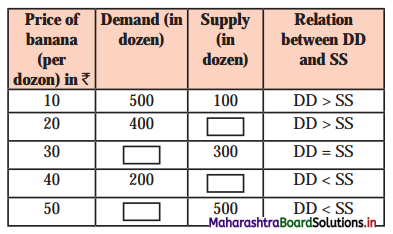
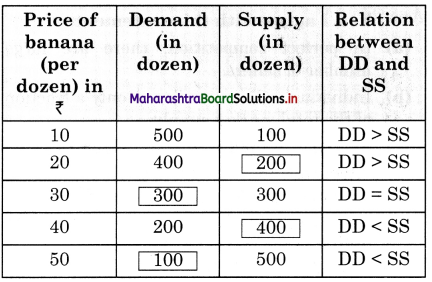
6. Observe the table and answer the questions:

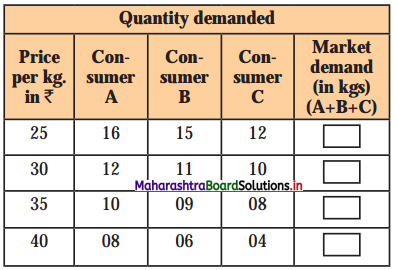
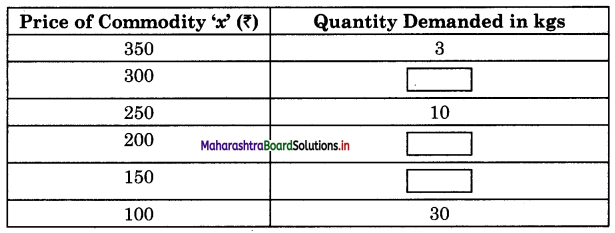
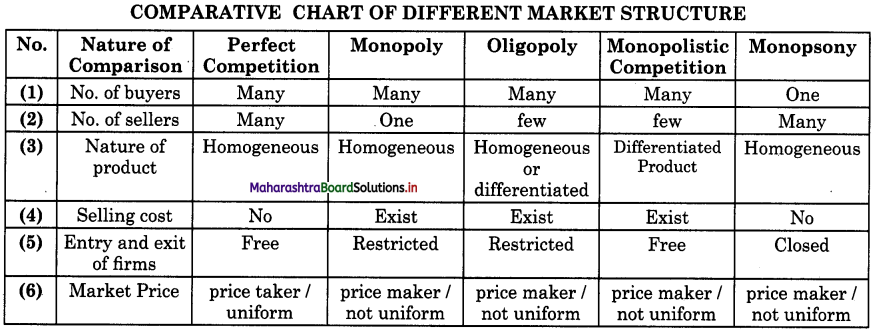
Maharashtra Board Class 12 Economics Solutions Chapter 5 Forms of Market 1

Question 1.
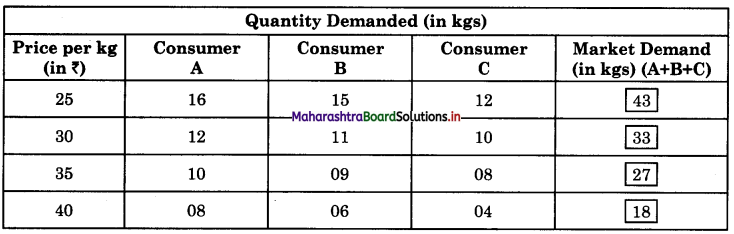
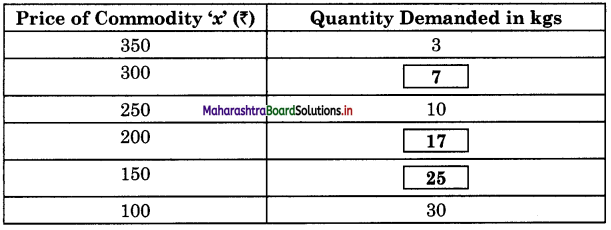
Fill in the blanks in the above schedule.
Answer:
Maharashtra Board Class 12 Economics Solutions Chapter 5 Forms of Market 2

Maharashtra Board Class 12 Economics Solutions Chapter 4 Supply Analysis

Question 2.
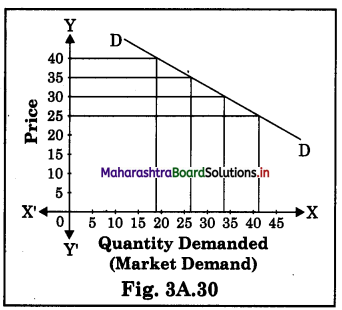
Derive the equilibrium price from the above schedule with the help of a suitable diagram.
Maharashtra Board Class 12 Economics Solutions Chapter 5 Forms of Market 3
Answer:
In the diagram, equilibrium price is ₹ 30/- because at this point dd curve insects SS curve at point ‘P’. At this point DD is 300 doz of bananas and sellers are ready to sell 300 doz at price ₹ 3.

7. Answer in detail:

Question 1.
Explain the meaning of Monopolistic competition with its features.
Answer:
Maharashtra Board Class 12 Economics Solutions Chapter 5 Forms of Market 4
(1) Fairly large number of Sellers : There are large number of sellers selling closely related, but not identical products. There is tough competition among sellers. An individual seller supply is just a small part) of the total supply, so he has limited degree l of control over market supply and price. Each firm (seller) can formulate its own price and output policy independently.

(2) Fairly large number of Buyers: There are large numbers of buyers in a monopolistic competition market. Each buyer enjoys his preference over a particular brand and chooses to buy a specific brand of product. Hence, the buying is by choice and not by chance.

(3) Product Differentiation : The most distinguishing feature of monopolistic competition is that the product produced by different firms are not identical, they are slightly different from each other but they are close substitutes. The product differentiation can be done in different ways like may be in the form of brand names say Raymonds. It can be differentiated in terms of colour, size, design, etc., say soap, mobiles etc., or through sales technique. For e.g. cars, two wheelers, air conditioners, etc.

(4) Free Entry of Firms: A firm is free to enter the market as there are no entry barriers. Similarly there are no restrictions if the firm wants to quit the market. Freedom of entry leads to occurrence of only normal profit in the long run.

(5) Selling Cost : One of the special features of monopolistic competition is the selling cost. Selling costs are those costs, which are incurred by firms to create more and more demand for its products through advertisement, salesmanship, free samples, exhibitions, etc.

(6) Downward Sloping Elastic Demand Curve : The demand curve faced by each firm is downward sloping and comparatively more elastic. It implies that an individual firm can sell more only by reducing the price.
Maharashtra Board Class 12 Economics Solutions Chapter 5 Forms of Market 5

(7) Concept of Group : Under monopolistic competition, Prof. E. H. Chamberlin introduced the concept of group in place of Marshallian concept of industry. Industry means a number of firms producing identical products. A group means a number of firms producing differentiated product, which are close substitutes.

Maharashtra Board Class 12 Economics Solutions Chapter 4 Supply Analysis

Question 2.
Explain the meaning of Perfect competition with its features.
Answer:
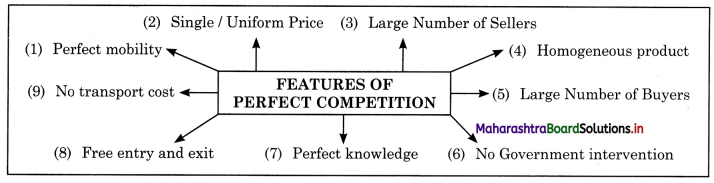
Maharashtra Board Class 12 Economics Solutions Chapter 5 Forms of Market 6
(1) Perfect Mobility of Factors of Production : Factors of production that is land, labour, capital are perfectly free to move from one firm to another or from one industry to another from one region to another or from one occupation to another. This ensures freedom of entry and exit for individuals and firms.

(2) Single / Uniform Price : There exists a single price for homogeneous product in the entire market at a given point of time. The price is determined by forces of demand and supply.

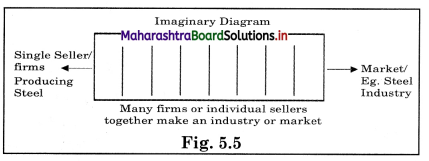
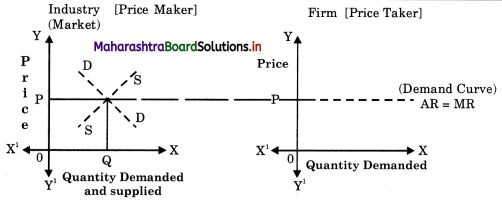
(3) Large Numbers of ellers : There are many sellers in this market. The number of sellers (firms) are so large that a single seller cannot influence the market price nor the total output in the market (Industry). The contribution of one seller is insignificant and microscopic. The price in the market is determined by the forces of market demand and market supply. Hence, a firm or seller is a ‘price taker’ and not a ‘price maker.’
Maharashtra Board Class 12 Economics Solutions Chapter 5 Forms of Market 7
Maharashtra Board Class 12 Economics Solutions Chapter 5 Forms of Market 8
(4) Homogeneous Product : The products produced by all the firms in the industry are identical and are perfect substitute to each other. The products are identical in shape, size, colour, etc. and hence uniform price rules the market for the product.

(5) Large Number of Buyers : There are large number of buyers in the market. One individual buyer’s demand is only a small fraction of total market demand so he is not in a position to influence the price. He is a price taker.

(6) No Government Intervention : It is assumed that the government does not interfere with the working of market economy. There are no tariffs, subsidies, licensing policy or other government interventions. This non – intervention of government is necessary to permit free entry of firms and automatic adjustment of demand and supply. In short, laissez faire policy prevails under perfect

(7) Perfect Knowledge : There is perfect knowledge on the part of buyers and sellers regarding the market conditions especially regarding market price. As a result no buyer will pay a higher price than the market price and no seller will charge a lower price than the market price. So a single price would prevail for a commodity in the entire market.

(8) Free Entry and Free Exit : There is freedom for new firms or sellers to enter the industry or market. There are no legal, j economic or any other type of restrictions or; barriers for new firms to enter the industry or an existing firms to quit the industry, Entry of new firm usually takes place j when existing firms enjoy abnormal profit. Similarly, existing firms quit the industry when they face losses.

Maharashtra Board Class 12 Economics Solutions Chapter 4 Supply Analysis

(9) No Transport Cost: It is assumed that all firms are close to the market and hence there  is no transport cost. If the transport cost are added to the price of product then the homogeneous commodity will have different prices depending upon the distance from the place of supply to the market.

Question 1.
Do you know? (Textbook Page 50)
What is monopsony?
Answer:
Monopsony is opposite of monopoly market but it is rarely found in reality.
In monopsony, there are large number of sellers but buyer is only one. So buyer has complete control over the price in the market. He can bargain with the sellers and fix the price at his terms.

Find out (Textbook Page 50)

What are the types of monopoly of the following products or services and give reason.
(1) Tea in Assam, (2) Atomic energy, (3) Logo of a commercial bank
Answer:

Product / Service Types of Monopoly Reason due to
Tea in Assam Natural Monopoly suitable climatic conditions and hilly regions of Assam.
Atomic energy Public Monopoly Atomic energy is owned and controlled by the government.
Logo of a Commercial Bank Public Monopoly Commercial Banks are owned and controlled by the government.

Maharashtra Board Class 12 Economics Solutions Chapter 4 Supply Analysis

Find out (Textbook Page 51)

Find the close substitutes for the following products:
Answer:

Products Substitutes
(a) Gemini Oil Saffola Oil
(b) Colgate Toothpaste Meswak Toothpaste
(c) Red Label Tea Girnar Tea
(d) Bru Cafe Nescafe
(e) Activa Two-wheeler Aviator – Two-wheeler

Maharashtra Board Class 12 Economics Solutions Chapter 5 Forms of Market 9

12th Std Economics Questions And Answers:

Utility Analysis Question Answer Class 12 Economics Chapter 2 Maharashtra Board

Balbharti Maharashtra State Board Class 12 Economics Solutions Chapter 2 Utility Analysis Textbook Exercise Questions and Answers.

Std 12 Economics Chapter 2 Question Answer Utility Analysis Maharashtra Board

Class 12 Economics Chapter 2 Utility Analysis Question Answer Maharashtra Board

Economics Class 12 Chapter 2 Question Answer Maharashtra Board

1. Complete the following statements by choosing the correct alternatives.

Question 1.
In the law of diminishing marginal utility, Alfred Marshall assumes that marginal utility of money …………..
(a) increases
(b) remains constant
(c) decreases
(d) rises and then falls
Answer:
(b) remains constant

Maharashtra Board Class 12 Economics Solutions Chapter 2 Utility Analysis

Question 2.
As per the law of diminishing marginal utility, measurement of utility is assumed to be ……………
(a) ordinal
(b) cardinal
(c) both ordinal and cardinal
(d) none of the above
Answer:
(b) cardinal

Question 3.
MU of the commodity becomes negative when TU of a commodity is ………….
(a) rising
(b) constant
(c) falling
(d) zero
Answer:
(c) falling

Question 4.
Point of satiety means ……………….
(a) TU is rising and MU is falling
(b) TU is falling and MU is negative
(c) TU is maximum and MU is zero
(d) MU is falling and TU is rising
Answer:
(c) TU is maximum and MU is zero

Maharashtra Board Class 12 Economics Solutions Chapter 2 Utility Analysis

Question 5.
When MU is falling, TU is ………………
(a) rising
(b) falling
(c) not changing
(d) maximum
Answer:
(a) rising

2. Choose the correct option:

Question 1.

Group ‘A’ Group ‘B’
1. Time utility (a) Transportation
2. Place utility (b) Blood bank
3. Service utility (c) Mobile phone
4. Knowledge utility (d) Doctor
(e) Music

Options :
(1) 1 – d, 2 – b, 3 – a, 4 – c.
(2) 1 – b, 2 – a, 3 – d, 4 – c.
(3) 1 – a, 2 – b, 3 – e, 4 – d.
(4) 1 – b, 2 – c, 3 – d, 4 – e.
Answer:
(2) 1 – b, 2 – a, 3 – d, 4 – c.

Question 2.
Statments Indicating consumer equilibrium:
a) MU is greater than price
b) MU is equal to price
c) MU is less than price
d) Price is less than one
Options:
I) a and b
II) a, b,c and d
Ill) a,b and c
IV) only b
Answer:
IV) only b

3. Identify and explain the concept from the given illustrations.

Question 1.
Salma purchased sweater for her father in winter season.
Answer:
Concept: Time utility.
Explanation : When utility of a commodity increases during a particular season it is called time utility.
Utility of sweater increases in winter season.

Question 2.
Nilesh purchased ornaments for his sister.
Answer:
Concept: Possession utility.
Explanation : When the ownership of a product changes from seller to buyer, it is called possession utility.
In the given example, ornaments are purchased by Nilesh for his sister. Ownership of a product changed, so it is an example of possession utility.

Maharashtra Board Class 12 Economics Solutions Chapter 2 Utility Analysis

Question 3.
Kavita consumed five units of oranges one after the other.
Answer:
Concept: Successive consumption.
Explanation : To experience the law of DMU, there should be consumption of units of commodity, without time gap. It is called successive consumption.
The given example explains that five oranges are consumed by Kavita one after another without interval of time.

Question 4.
Bhushan refused to eat fifth chapati after eating four chapatis.
Answer:
Concept: Disutility.
Explanation : When the want is fully satisfied, a consumer realises full satisfaction i.e. point of satiety.
But, beyond this point, he experiences negative utility. So, he refuses to consume any more unit of commodity.
If consumption continues, it results into disutility.

Question 5.
Lalita satisfied her want of writing on essay by using pen and notebook.
Answer:
Concept: Utility.
Explanation : Utility is want satisfying capacity of a commodity.

The given example explains that, Lalita’s want of writing an essay can be satisfied with the help of pen and note-book.

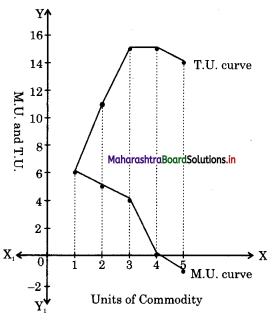
4. Observe the given table and answer the questions:

Units of Com. ‘X’ TU Units MU Units
1 6 6
2 11 5
3 15 4
4 15 0
5 14 -1

1) Draw total utility curve and marginal utility curve.
2) a) When total utility is maximum marginal utility is …………….
b) When total utility falls, marginal utility becomes ……………
Answers:
1.
Maharashtra Board Class 12 Economics Solutions Chapter 2 Utility Analysis 1
2. Zero
3. Negative

5. Answer in detail:

Question 1.
State and explain the law of diminishing margmal utility with exceptions.
OR
State and explain the law of DMU? Explain its assumptions.
Answer:
Law of Diminishing Marginal Utility :
(A) Introduction:
The law of diminishing M.U. explains economic behaviour of a rational consumer.
The law was first proposed by Prof. Gossen and further explained in detail by Prof. Alfred Marshall in his book “Principles of J economics” published in 1890.
The law of DMU is universal in nature. It ) indicates common consumer’s behaviour that Marginal Utility diminishes with reduction in the intensity of want.

Maharashtra Board Class 12 Economics Solutions Chapter 2 Utility Analysis

(B) Statement of the Law :
According to Prof. Alfred Marshall, “Other things remaining constant, the additional benefit which a person derives from a given increase in his stock of a thing, diminishes with every increase in the stock that he already has”.
In simple words, law of DMU can be stated as follows :
“Other things being the same, MU goes on ) diminishing with every successive unit of a j commodity consumed.”

Thus, the law of DMU explains that, the more of a thing you have, the less you want to have more of it.
In short, as consumption of identical units of commodity increases, MU diminishes.

(C) Assumptions of the law of DMU :
Assumptions are those conditions which are necessary for the validity of the law. They are as follows :

  • Cardinal Measurement: The law assumes that utility can be measured cardinally i.e. in numbers. So, it is possible to express and compare the utility derived from each unit of commodity consumed.
  • Homogeneity : It is assumed that all the units of commodity consumed are homogeneous or same. They are identical in case of size, shape, taste, colour, flavor, etc.
  • Rationality : A consumer is assumed to be rational. His behaviour is normal from economic’s point of view. It means, he tries to get maximum satisfaction.
  • Continuity : All units of commodity are consumed successively, one after another, without time interval.
  • Reasonability : The law assumes that, all the units of commodity consumed are reasonable in size. The unit of measurement is neither too big nor too small e.g. a cup of tea, glass of water, etc.
  • Divisibility : A commodity is assumed to be divisible. So it is possible to divide the units of commodity in a proper size.
  • Constancy : It is assumed that related factors like income, taste and preference, habits, choice of a consumer remain constant. MU of money is also assumed to be constant.
  • Single want: A given commodity is used to satisfy a single want of a person. So that it is possible to experience full satisfaction from a single want.
  • Schedule and Diagram :
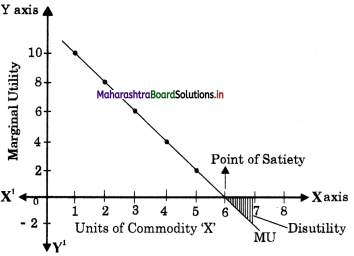
    The law can be explained with the help of following schedule and diagram :
Units of Commodity Marginal Utility (M.U)
1 10
2 8
3 6
4 4
5 2
6 0
7 -2

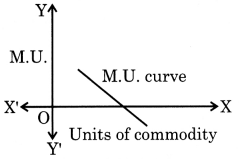
The above given schedule shows that MU goes on diminishing with an increases in units of commodity consumed.
Graphical Presentation :
Maharashtra Board Class 12 Economics Solutions Chapter 2 Utility Analysis 2

In the above given diagram, X-axis indicates units of commodity and Y-axis measures marginal utility.
Various points are plotted on the graph which indicates MU derived from each unit } of commodity consumed.
When all these point are joined, we get MU curve. It slopes downward from left to right. It shows that MU diminishes as consumption of a commodity increases.
The shaded portion of the diagram shows negative utility. It is because, beyond a certain level, further consumption of a commodity results into disutility.

(E) Exceptions to the law of Diminishing M.U.
Exceptions are those cases for which the law is not applicable. They are as follows :

  1. Hobbies
  2. Miser
  3. Addictions
  4. Power
  5. Money
  6. Reading

They are explained as under :
(1) Hobbies : The law of DMU is not applicable in case of collection of stamps, coins, rare paintings, etc. It is because, when its stock increases, M.U. may increases because it gives more and more satisfaction.
However, it violates the assumptions like homogeneity and continuity.

(2) Miser : For a miser, every additional rupee gives him more and more pleasure.
So, when the stock of money increases, MU of money tends to rise.
However, the behavior of a miser is irrational. It violates the assumption of rationality.
Maharashtra Board Class 12 Economics Solutions Chapter 2 Utility Analysis

(3) Addictions : It is said that, the level of intoxication increases for drunkard with every additional consumption of liquor. It may increase MU for him.
This condition is similar to most of the addictions.
Here again, the assumptions like rationality and continuity are violated.

(4) Power: It is an exception to the law of DMU because, when a person acquires power, his craze for power increases MU from power. As a person gets power, he desires to have more and more of it.
But, it violates the rationality, assumption.

(5) Money : Money is used as a medium of exchange. It helps to buy goods to satisfy human want. So MU of money increases with an increase in its stock.
MU of money never becomes zero. The law holds true to money too. MU of money declines slowly as its stock increases. So MU of money is more for poor than rich people.

(6) Reading : When a person reads more and more, he gets deeper and deeper knowledge so MU of reading tends to increase. Similarly the law does not hold true in case of music, dance, etc.
However, assumptions like continuity, homogeneity, etc. are violated.
The law of DMU is universal in nature. These cases are not real exceptions as they violate some assumptions.
So, it is said that, there are no real exceptions to the law of DMU.

Intect Questions

Try this (Textbook Page 8)

Make a list of 10 commodities which satisfy your wants.
Answer:
Book, pen, mobile, foot-wear, watch, umbrella, bag, dress, bed sheet, soap.

Try this (Textbook Page 8)

Make a list of 10 commodities which ( satisfy the wants of particular individuals performing specific activities. For example, A chalk has utility for a teacher.
Answer:

  • A stethoscope has utility for a doctor.
  • A net has utility for a fisherman.
  • A thermometer has utility for a nurse.
  • A cow has utility for a farmer.
  • Cooking gas has utility for a housewife.
  • A scissor has utility for a barber.
  • Wood has utility for a carpenter.
  • Needle has utility for a tailor.
  • Mud has utility for a potter.
  • A pen has utility for a writer.

Try this (Textbook Page 10) :

Following are the various types of utility and their respective examples. Arrange the information in the form of pairs:
Answer:
Types of utility : Time utility, possession utility, service utility and place utility.
Examples :

  • A dentist giving dental treatment to a patient.
  • A mountaineer using oxygen cylinder at a high altitude.
  • A farmer selling rice stored in the warehouse at the end of the season.
  • A retail trader purchasing 100 chairs from the wholesale trader.
Example Type of Utility
(a) A dentist giving dental treatment to a patient. Service utility
(b) A mountaineer using oxygen cylinder at a high altitude. Place utility
(c) A farmer selling rice stored in the warehouse at the end of the season Time utility
(d) A retail trader purchasing 100 chairs from the wholesale trader. Possession utility

Maharashtra Board Class 12 Economics Solutions Chapter 2 Utility Analysis

Try this (Textbook Page 11)

Complete the following chart :
Answer:
Total Utility :

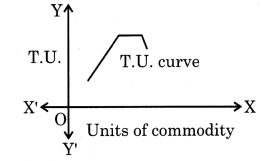
(a) Total Utility is the sum total of the individual utilities derived from the consumption of all units of good.
(b) Total Utility increases at a diminishing rate.
(c) At a point of satiety, Total Utility is maximum.
(d) Total Utility declines if consumption continues.
(e) Total Utility determines value-in-use of a commodity.
(f) Total Utility is always positive.
Maharashtra Board Class 12 Economics Solutions Chapter 2 Utility Analysis 3

Marginal Utility :
(a) Marginal Utility is the addition made to the Total Utility from every additional unit consumed.
(b) Marginal Utility goes an diminishing.
(c) At a point of satiety, Marginal Utility = 0
(d) Marginal Utility becomes negative if consumption continues.
(e) Marginal Utility determines value-in­exchange of a commodity.
(f) Marginal Utility can be positive, zero or negative.
Maharashtra Board Class 12 Economics Solutions Chapter 2 Utility Analysis 4

Maharashtra Board Class 12 Economics Solutions Chapter 2 Utility Analysis

Try this (Textbook Page 14) :

Write an informative note on paradox of values along with examples.
Answer:
Paradox of values –
The concept of value paradox is introduced by Adam Smith.
The term value has two meanings
(i) Value in use
(ii) Value in exchange
Some goods have greater value in use but smaller value in exchange e.g. water.
However, some goods have smaller value in use but greater value in exchange e.g. diamond.
So, paradox of value is also called as water-diamond dilemma.
Greater value in use denotes high total utility whereas, greater value in exchange shows high marginal utility.
Thus, the concept paradox of value is very useful to understand the concepts of utility i.e., Total Utility & Marginal Utility.

12th Std Economics Questions And Answers:

Elasticity of Demand Question Answer Class 12 Economics Chapter 3B Maharashtra Board

Balbharti Maharashtra State Board Class 12 Economics Solutions Chapter 3B Elasticity of Demand Textbook Exercise Questions and Answers.

Std 12 Economics Chapter 3B Question Answer Elasticity of Demand Maharashtra Board

Class 12 Economics Chapter 3B Elasticity of Demand Question Answer Maharashtra Board

Economics Class 12 Chapter 3B Question Answer Maharashtra Board

1. Complete the following statements:

Question 1.
When the supply curve is upward sloping, its slope is ……………….
a) positive
b) negative
c) first positive then negative
d) zero
Answer:
a) positive

Question 2.
An upward movement along the same supply curve shows ………………..
a) contraction of supply
b) decrease in supply
c) expansion of supply
d) increase in supply
Answer:
c) expansion of supply

Maharashtra Board Class 12 Economics Solutions Chapter 4 Supply Analysis

Question 3.
A rightward shift in supply curve shows ………………..
a) contraction of supply
b) decrease in supply
c) expansion of supply
d) increase in supply
Answer:
d) increase in supply

Question 4.
Other factors remaining constant, when less quantity is supplied only due to a fall in price, it shows ………………..
a) contraction of supply
b) decrease in supply
c) expansion of supply
d) increase in supply
Answer:
a) contraction of supply

Question 5.
Net addition made to the total revenue by selling an extra unit of a commodity is ………………..
a) total Revenue
b) marginal Revenue
c) average Revenue
d) marginal Cost
Answer:
b) marginal Revenue

2. Complete the Correlation:

1) Expansion of supply: Price rises:: Contraction of supply: ………………….
2) Total revenue : …………………. :: Average revenue :TR/TQ
3) Total cost : TFC + TVC :: Average cost : ………………….
4) Demand curve : …………………. :: Supply curve : Upward
5) …………………. : Change in supply :: Other factors constant: Variation of supply
Answers:
(1) Price falls
(2) PxQ
(3) TC ÷ TQ
(4) Downward
(5) Other factor changes

3. Give economic terms:

1) Cost incurred on fIxed factor.
2) Cost incurred per unit of output.
3) Net addition made to total cost of production.
4) Revenue per unit of output sold.
Answers:
(1) Fixed Cost
(2) Average Cost
(3) Marginal Cost
(4) Average Revenue

Maharashtra Board Class 12 Economics Solutions Chapter 4 Supply Analysis

4. Distinguish between:

Question 1.
Stock and Supply.
Answer:

Stock Supply
(a) Stock refers to the total quantity of commodity available with producer for sale. (a)Supply is that part of stock which the seller is willing to offer for sale at a given price.
(b) It is outcome of production. If production increases, stock will also increase. (b) It is outcome of stock. Stock is the basis of supply.
(c) It is a fund or reservoir and a static concept (inelastic). (c) It is a flow concept. It changes according to change in price (elastic).
(d) It can exceed supply. (d) It cannot exceed stock.

Question 2.
Expansion of Supply and Increase in Supply.
Answer:
Expansion / Extension of Supply

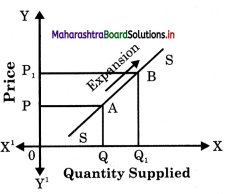
  1. When the supply of a commodity rises only due to the rise in the price of the commodity, then it is said to be extension in supply.
  2. Extension of supply is a case of variation in supply.
  3. Rise in price is the only factor due to which supply expands / extends.
  4. When there is extension in supply, there is an upward movement on the same supply curve.
    Maharashtra Board Class 12 Economics Solutions Chapter 4 Supply Analysis 1

Increase in Supply :

  1. The supply is said to increase if at the same price more is supplied.
  2. Increase in supply is a case of changes in supply.
  3. Supply increases due to
    (1) fall in cost of production
    (2) improvement in transport facility
    (3) introduction of modern technology
    (4) government subsidies
    (5) more imports etc.
  4. When there is an increase in supply, the supply curve shifts to the right of original supply curve.

Maharashtra Board Class 12 Economics Solutions Chapter 4 Supply Analysis 2

Question 3.
Contraction of Supply and Decrease in Supply.
Answer:
Contraction of Supply

  1. Contraction of supply occurs when quantity supplied of a commodity falls due to a fall in price alone.
  2. It is a case of variation in supply.
  3. Supply contracts due to fall in price alone.
  4. When there is a downward n curve.

Maharashtra Board Class 12 Economics Solutions Chapter 4 Supply Analysis 3
Decrease in Supply

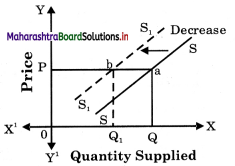
  1. Decrease in supply occurs when less quantity is supplied at the same price.
  2. It is a case of changes in supply.
  3. Supply decreases due to –
    (1) increase in cost of production
    (2) transport strike
    (3) outdated technique
    (4) heavy taxes imposed by government.
    (5) more exports etc.
  4. When there is curve shifts to curve.
    Maharashtra Board Class 12 Economics Solutions Chapter 4 Supply Analysis 4

Maharashtra Board Class 12 Economics Solutions Chapter 4 Supply Analysis

Question 4.
Average Revenue and Average Cost.
Answer:

Average Revenue (AR) Average Cost (AC)
(a) Average revenue refers to average income earned per unit of a sold commodity. (a)Average cost refers per unit of cost of production of a commodity produced.
(b) It is calculated by dividing total revenue (TR) earned by number of unit sold. (b) It is calculated by dividing total cost (TC)by number of units of that commodity produced.
(c) Symbolically it in expressed as \( [latex]\frac { Total Revenue }{ Total Quantity sold }\) [/latex] (c) Symbolically it is expressed as \(\frac { Total Cost }{ Total Quantity produced }\)
E.g. If TR from sale of 10 units of a commodity is Rs. 1000 then, AP =  1000/10 = Rs. 100 E.g. If TC of 100 units a commodity is Rs. 1000 then, AC =  \(\frac { 1000 }{ 100 }\) = Rs. 10

5. Observe the following table and answer the questions.

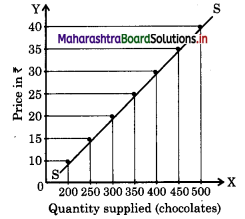
A) Supply schedule of chocolates

Price in Rs. Quantity supplied in units
10 200
15 ………
20 300
25 350
30 ……..
35 ……..
40 ……..

Question 1.
Complete the above supply schedule.
Answer:

Price in Rs. Quantity supplied in units
10 200
15 250
20 300
25 350
30 400
35 450
40 500

Question 2.
Draw a diagram for the above supply schedule.
Answer:
Maharashtra Board Class 12 Economics Solutions Chapter 4 Supply Analysis 6

Maharashtra Board Class 12 Economics Solutions Chapter 4 Supply Analysis

Question 3.
State the relationship between price and quantity supplied.
Answer:
This diagram shows the direct relationship / between price and quantity supplied of) chocolates. When its price is ? 10, 200 units ( are supplied and as price rises to 15, 20, 25 ? …. and so on, quantity supplied also rises to )
When the schedule is plotted on the graph we 250, 300, 350 and so on. This is the law of supply of an individual firm.

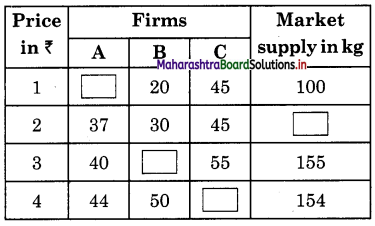
B) Observe the market supply schedule of potatoes and answer the following questions.

Maharashtra Board Class 12 Economics Solutions Chapter 4 Supply Analysis 7

Question 1.
Complete the quantity of potato supplied by the firms to the market in the above table.
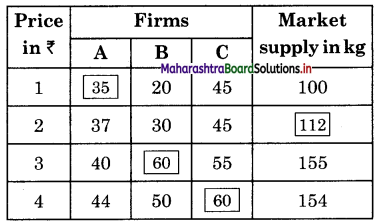
Answer:
Maharashtra Board Class 12 Economics Solutions Chapter 4 Supply Analysis 8

Question 2.
Draw the market supply curve from the schedule and explain it.
Answer:
Maharashtra Board Class 12 Economics Solutions Chapter 4 Supply Analysis 9
When the schedule is plotted on the graph we get a market supply curve ‘SS’ which is upward sloping. This curve shows that as price rises from ₹ 1 to ₹ 2, supply rises from 1oo to 112 kg, but when price rises from ₹ 2 to ₹ 3, supply rises to a greater extent from 112 kg to 155 kg in the market. When price rises to ₹ 4 Supply falls from 155 kg to 154 kg. This may be because of perishable or seasonal good that supply could not Jj be increased and supply falls. This show backward bending supply curve, showing partly an exception to the supply curve.

6. Answer the following questions:

Question 1.
Explain the concept of total cost and total revenue.
Answer:
Total Cost (TC): It is the total expenditure incurred by a fir m on the factors of production required for the production of goods and services. Total cost is the sum of Total Fixed Cost (TFC) and Total Variable Cost (TVC). Total Fixed Cost is the cost incurred on fixed factors of production like land, factory, building, capital, etc. These factors cannot be changed in the short period. They remain constant. Total Variable Cost is the cost incurred on variable factors such as raw – materials, labour, etc. These factors can be varied or changed according to the change in output level. So the variable cost varies. Total Cost = Total Fixed Cost + Total Variable Cost
i.e., TC = TFC + TVC
TC increases as the level of output increases.

Total Revenue :
(Income) refers to total receipts of the firm from its sales of commodity. It is obtained by multiplying the price per unit of the  commodity with the total number of units!; of commodity sold to the consumers. Thus, Total Revenue = Price per unit Total  Number of units of commodity sold.
Example : If the firm sells lo units of a commodity at ₹ 100 per unit then total revenuewifibe TR = 100 x 10. TR= ₹ 1000

Maharashtra Board Class 12 Economics Solutions Chapter 4 Supply Analysis

Question 2.
Explain determinants of supply.
Answer:

  1. Cost of Production : Changes in the price of factors of production like rent, wages, interest affects the cost of production. When cost of production increases, supply decreases.
  2. Price of Other Goods : The supply of a given commodity depends on the price of other commodity. E.g. if the price of wheat rises and that of rice remains the constant, then the producer will think of producing J more of wheat. This will affect the supply of rice.
  3. price of the Commodity : Price is an important factor influencing the supply. More is supplied at a higher price and less at a lower price. So price and supply are 5 directly related.
  4. Climatic Conditions : The supply of j commodity is also influenced by the forces
  5. Government Policy : Government policies like taxation, subsidies, industrial policies etc., may encourage or discourage production and supply. A tax on the commodity will raise the cost of production and reduce the supply while a subsidy on the other hand will provide an incentive to increase production and supply.
  6. Exports and Imports : When the
    government resort to imports, supply expands, at the same time heavy exports would reduce the supply in the domestic market.
  7. Nature of Market : In a competitive market, the supply would be more but in a monopoly market the seller may create artificial scarcity to raise the price.
  8. Future Expectation : If future trends indicate a rise in price, the supply decreases at present. On the other hand if the sellers expect the future price to fall, supply would increase in the current period.
  9. Technique of Production : Improvement in the technique of production will lead to increase in supply. Application of advanced technology enables the producer to produce goods on large scale at a lower cost and lesser price.
  10. Infrastructure Facility : If means of transport and communication are well developed, the extent of market would be wide. i.e. supply will increase.
  11. Natural and Man-made Calamities : Natural calamities like earthquake, cyclone, flood etc., will affect the supply in the market. Even man-made calamities like a bomb-blast, affects supply. Even a strike call can affect supply in the market.

7. Answer in detail :

Question 1.
State and explain law of supply with exceptions.
Answer:
Law of Supply :
(A) Introduction : The law of supply was introduced by Dr. Alfred Marshall in his book “Principles of Economics” published in 1890. The law establishes a functional relationship between the price of a commodity and quantity supplied of that commodity. It explains the general tendency of the sellers in offering more goods for sale at a higher price than at a lower price.

(B) Statement of the Law : According to Prof. Alfred Marshall “Other things remaining constant, the higher the price of the commodity, greater is the quantity supplied and lower the price of the commodity, smaller is the quantity supplied.”In other words, quantity supplied of a commodity varies directly with price i.e., with a fall in price supply contract and with a rise in price supply expands.
S = f (P) [S = Supply, P = Price, f = Function of]
The law can be better understood with the help of a market supply schedule and market supply curve.

(C) Market Supply Schedule : Market supply schedule is a tabular representation of various quantities of a commodity offered for sale by all the sellers in the market at different prices during a given period of time. The schedule is a hypothetical one except one price rest are imaginary prices.

The above schedule clearly shows that sellers in general want to sell more at high prices and less at low price. E.g., at a low price of Rs.10 per unit the seller supplies only 100 units per day and at high price of Rs. 50 the supply rises to 500 units of ‘X’ per day.

Maharashtra Board Class 12 Economics Solutions Chapter 4 Supply Analysis

(D) Market Supply Curve : It is graphical representation of the above market supply schedule. Price is measured on ‘Y’ axis and quantity supplied on ‘X’ axis and above schedule is plotted. We derive a supply curve SS.

Market Supply Schedule

Price of ‘X’ per unit (in ?) Total Market Supply per day (in units)
10 100
20 200
30 300
40 400
50 500

There are some exceptions to the law of s supply. Following are such cases when supply may fall with the rises in price or rise with the fall in price.

(1) Labour supply : Supply of labour in the ) terms of hours of work is an important exception pointed out by economists. Generally when wages rise, workers work more, but after a certain point if wages continue to rise, supply of labour falls i.e. workers wish to earn more by work in for less hours and supply curve of labour would bend backwards as shown below :
Maharashtra Board Class 12 Economics Solutions Chapter 4 Supply Analysis 10
In this figure as wage rate rises up to 0W, ;i supply of labor also rises up to ON, but when wage rate rises to 0W., labour supply falls from ON to 0Nr Hence an exception.

(2) Saving : In case of savings generally it is observed that as the rate of interest rises, savings also rises but some people want to have a fixed regular income by way of interest. They may save less at a higher rate of interest and save more at a lower rate of interest. For example : suppose a person is interested in earning a fixed income of ₹ 800 p.a. then he saves ₹ 10,000/- at 8% rate of interest but when rate of interest increases to 10%, he will save only ₹ 8,000/-.

(3) Future Expectations: If the seller expects a fall in price in future, then he will supply more today even at a low price. But if he expects the prices to rise further in future he will withhold the supply today to supply more in future at a high price.

(4) Need for Cash : When the sellers are in urgent need of liquid cash, then even at a lower price they will offer more goods for sale.

(5) Rare Goods : In case of rare collections such as rare painting, old coins, antique, the law is not applicable as the supply remains fixed. The supply curve is a vertical straight line parallel to Y axis.

(6) Agricultural Goods: Supply of agricultural product is influenced by natural factors like climatic conditions, rainfall etc., which cannot be controlled by man. So in bad weather condition, even at a higher price the supply of agricultural commodities will not increase.

Maharashtra Board Class 12 Economics Solutions Chapter 4 Supply Analysis

Intext Questions

Question 1.
“Concept of supply is a micro concept but concept of aggregate supply is a macro concept”. Explain. (Textbook Page No. 43)
Answer:
Micro economics studies about economic behavior of units like households, firm market and particular commodities. Whereas macro economics deals with the broad economic concepts like total demand, total supply, national income, etc.
Supply refers to supply of an individual seller and aggregate supply refers to total supply of a commodity.
Hence, supply is a microscopic concept and aggregate supply is macro concept.

Question 2.
What do you mean by aggregate supply? (Textbook Page No. 43)
Answer:
Aggregate supply refers to the minimum amount of sales proceeds which the entrepreneurs expect to receive from the sale of output at a given level of employment.

Find out (Textbook Page No. 43)

If a firm produces 600 units of a commodity in a day and incurs a total cost of ₹ 30,000. Calculate the Average Cost.
Answer:
Average cost refers to the cost of production per unit cost of a commodity. It is calculated by dividing total cost by total quantity of a commodity. Hence,
AC = \(\frac{\mathrm{TC}}{\mathrm{TQ}}=\frac{30,000}{600}\) = ₹ 50 per unit

Maharashtra Board Class 12 Economics Solutions Chapter 4 Supply Analysis

Find out (Textbook Page No. 43)

If a firm sells 400 units of a commodity at ₹ 10 unit. Calculate the TR and AR.
Answer:
TR = Price X Quantity
= 10 x 400
= 4,000
AR = \(\frac{\mathrm{TR}}{\mathrm{TQ}}\)
= \(\frac{4,000}{400}\)
= ₹ 10

12th Std Economics Questions And Answers:

Introduction to Micro and Macro Economics Question Answer Class 12 Economics Chapter 1 Maharashtra Board

Balbharti Maharashtra State Board Class 12 Economics Solutions Chapter 1 Introduction to Micro and Macro Economics Textbook Exercise Questions and Answers.

Std 12 Economics Chapter 1 Question Answer Introduction to Micro and Macro Economics Maharashtra Board

Class 12 Economics Chapter 1 Introduction to Micro and Macro Economics Question Answer Maharashtra Board

Economics Class 12 Chapter 1 Question Answer Maharashtra Board

1. Choose the correct option:

Question 1.
The branch of economics that deals with the allocation of resources.
a) Microeconomics
b) Macroeconomics
c) Econometrics
d) None of these
Options:
1) a, b and c
2) a and b
3) only a
4) None of these
Answer:
3) only a

Maharashtra Board Class 12 Economics Solutions Chapter 1 Introduction to Micro and Macro Economics

Question 2.
Concepts studied under Micro economics.
a) National income
b) General price level
c) Factor pricing
d) Product pricing
Options :
1) b and c
2) b, c and d
3) a, b and c
4) c and d
Answer:
4) c and d

Question 3.
Method adopted in micro economic analysis.
a) Lumping method
b)Aggregative method
c) Slicing method
d) Inclusive method
Options :
1) a, c and d
2) a. b and d
3) only c
4) only a
Answer:
3) only c

Question 4.
Concepts studied under Macro economics.
a) Whole economy
b) Economic development
c) Aggregate supply
d) Product pricing
Options:
1) a, b and c
2) b, c and d
3) only d
4) a, b, c and d
Answer:
1) a, b and c

Maharashtra Board Class 12 Economics Solutions Chapter 1 Introduction to Micro and Macro Economics

2. Complete the correlation:

1) Micro economics : Slicing method : : Macro economics: ……………. 1
2) Micro economics: Tree : : Macro economics: …………….. 2
3) Macro economic theory : Income and employment:: Micro economics : ……………. 4
4) Makros : Macro economics:: Mikros : ……………… 3
5) General equilibrium : Macro economics :: …………….. : Micro economics 5
Answers:

  1. Lumping method
  2. Forest
  3. Price theory
  4. Micro economics
  5. partial equilibrium

3. Identify and explain the concepts from the given illustrations:

Question 1.
Gauri collected the information about the income of a particular firm.
Answer:
Concept: Micro economics / Slicing method.
Explanation : Micro economics refers to the study of small unit from whole economy. Micro economics uses slicing method to split the whole economy into small individual units.
Gauri has used slicing method from micro economics to collect information about the income of a particular firm from various firms.

Question 2.
Ramesh decided to take all decisions related to production, such as what and how to produce?
Answer:
Concept: Free market economy.
Explanation : A free market economy is that economy where the economic decisions regarding production of goods are taken at individual level.

Eg. What to produce? How much to produce? How to produce? etc. decisions are taken by producers.
With the help of free market economy Ramesh has taken decision related to production such as What to produce? and How to produce?

Question 3.
Shabana paid wages to workers in her factory and interest on her bank loan.
Answer:
Concept : Factor Pricing.
Explanation : Theory of factor pricing refers to determining the factor rewards for land, labour, capital and entrepreneur in the form of rent, wages, interest and profit respectively.

Shabana is an entrepreneur who has paid wages to its worker in a factory for production of goods and also paid interest on her bank loan in form of rewards to the factors of production.

Maharashtra Board Class 12 Economics Solutions Chapter 1 Introduction to Micro and Macro Economics

4. Answer the following:

Question 1.
Explain the features of Micro economics.
OR
Explain the characteristics or nature of micro economics.
Answer:
Features of Micro Economics :

  • Based on certain ssumption : Micro economics is based on ‘ceteris paribus’ assumption i.e., other things remaining constant like full employment, laissez faire policy, perfect competition, pure capitalism, etc.
  • Study of Individual units : Micro economics deals with the study of behaviour of small individual units of the economy such as individual units of the economy such as individual consumer, individual firm, individual industries, individual prices, etc.
  • Slicing Method : It divides or slices the economy into small units and studies each unit in detail e.g. study of a particular household demand in detail.
  • Analysis of Market Structures : Micro economics analyses different market structures such as perfect competition, monopoly, monopolistic competition, oligopoly, etc.
  • Use of Marginalism Principle : The term ‘marginal’ means change brought in total by an additional unit. Marginal analysis helps to study a variable through the changes by which producers and consumers take economic decisions using this principle.
  • Price Theory : Micro economics is known as price theory because it determines the prices of goods and services as well as prices of factors of production.
  • Limited Scope : The study of micro economics is limited to individual economic unit only. It does not deal with macro problems like unemployment, inflation, deflation, poverty, unemployment, population, etc.
  • Partial I quilibrium : Micro economics analysis deals with partial equilibrium which analyses equilibrium position of an individual economic unit i.e. individual consumer, individual firm, etc.

Question 2.
Explain the importance of Macro economics.
Answer:
Importance of Macro Economics :

  • Functioning of an Economy : It gives an idea of functioning of an economic system and help us to understand the behavioural pattern of aggregate variables.
  • Economic fluctuations : It helps to analyse the causes of fluctuation in income, output and employment.
  • National Income : It helps to study about National Income and makes possible to formulate correct economic policies.
  • Economic Development : It helps us to understand the problems of the developing countries such as poverty, difference in the standards of living, etc., and suggest important steps to achieve economic development.
  • Performance of an Economy : It helps us to analyse the performance of an economy where National Income estimates are used to measure the same.
  • Study of Macro-economic Variables :
    Study of macro economic variables are important to understand the working of the economy.
  • Level of Employment : Macro economics helps to analyse the general level of employment and output in an economy.

Maharashtra Board Class 12 Economics Solutions Chapter 1 Introduction to Micro and Macro Economics

Question 3.
Explain the scope of Macro economics.
OR
“Scope of Macro Economics is wide.” Explain.
OR
Macro Economics is comprehensive in nature.
OR
Explain the subject matter of macro economics.
Answer:
Scope of Macro Economics:
The given chart helps us to understand the scope of macro economics.
Maharashtra Board Class 12 Economics Solutions Chapter 1 Introduction to Micro and Macro Economics 1
1. Theory of Income and Employment : It explains which factors determine the level of National Income and employment and what j causes fluctuations in the level of income, output and employment.
To understand how the level of employment is determined, we have to study the consumption function. It includes theory of business cycles.

2. Theory of General Price Level and Inflation: Macro economics analyses shows how the general price level is determined and the causes for fluctuations in it. This study is important for understanding the  problems created by inflation and deflation.

3. Theory of Economic Growth and Development : Macro economics studies the causes of under development and poverty in poor countries and suggests strategies for accelerating growth and development in the country.

4.  Macro theory of Distribution : Macro theory of distribution deals with the relative share of rent, wages, interest and profit in j the total national income of various classes.

5. State with reasons whether you agree or disagree with the following statements:

Question 1.
The scope of micro economics is unlimited.
Answer:
No, I do not agree with this statement.

  • Micro economics deals with small or individual units.
  • Micro economics is the study of particular firm, particular household, individual prices, wages, incomes, individual industries, particular commodities.
  • Micro economics deals with small part of National economy. It does not deal with whole economy like National income, Aggregate demand, Aggregate supply, poverty, inflation, etc.
  • Hence, the scope of micro economics is limited.

Question 2.
Macro economics deals with the study of individual behaviour.
OR
Macro economics studies small units.
Answer:
No, I do not agree with this statement.
OR
Macro Economics is the study of I aggregate.
OR
Macro economics is concerned with macro economic variables.
Yes, I agree with this statement.

  • Macro Economics studies the behaviour ofthe economy as a whole and not individual behaviour.
  • It studies about larger economic units or aggregate economic variables like aggregate demand, aggregate supply, total investment, total savings, total employment, etc.
  • It studies the general price level and macro theory of distribution.
  • Whereas Micro Economics deals with individual behaviour of the people in the economy. It studies about individual demand, market demand, individual income, price of particular commodity etc.
  • According to Prof. Kenneth E. Boulding “Macro Economics deals not with individual; quantities as such, but with aggregates of these quantities, not with individual income but with National Income, not with individual prices but with general price level, not with individual output but with National Output.

Maharashtra Board Class 12 Economics Solutions Chapter 1 Introduction to Micro and Macro Economics

Question 3.
Macro economics is different from micro economics.
OR
Macro economics is wider than Micro economics.
OR
There is difference between micro economics and macro economics.
Answer:
Yes, I agree with this statement.

  • Micro economics is a study of a particular unit of an economy. On the other hand macro economics is the study of entire economy.
  • Micro economics studies individual demand, individual supply, individual income, price determination of particular product, etc. On the other hand macro economics studies aggregate demand, aggregate supply, national income, etc.
  • Micro economics follows partial equilibrium analysis and macro economics follows general equilibrium analysis.
  • Micro economics uses slicing method for study of small unit and macro economics uses lumping method for study of large unit.
  • Therefore, macro economics is different from micro economics.

Question 4.
Micro economics uses slicing method.
Answer:
Yes, I agree with this statement.

  • Micro economics deals with small or individual units.
  • Micro economics divides or slices the economy into small units and studies each unit in detail.
  • It is concerned with microscopic study of these units.
  • It is the study of particular firm, particular household, individual prices, wages, incomes, etc.
  • Hence, micro economics uses slicing method.

Question 5.
Micro economics is known as Income theory.
Answer:
No, I do not agree with this statement.
OR Micro economics is also known as price theory.
Yes, I agree with this statement.

  • Micro Economics is known as ‘Price Theory’.
  • The scope of micro economics includes the study of product pricing and factor pricing.
  • The theory of product pricing explains how the price of food grains, vegetables, clothes, etc., are determined.
  • They are determined by the interaction of market demand and supply forces.
  • The theory of factor pricing explains the distribution of factor income such as rent on land, wages to labourers, interest on capital and profit to entrepreneurs.
  • The factor prices are also determined by the demand and supply forces.
  • Therefore, Micro Economics is also known as ‘Price Theory’.

Maharashtra Board Class 12 Economics Solutions Chapter 1 Introduction to Micro and Macro Economics

6. Answer in detail :

Question 1.
Explain the importance of Micro economics.
Answer:
Introduction : Micro economics is the Js branch of economics that studies the behaviour of individuals.
It includes individual prices, wages, income, individual industries, particular commodities, particular household, etc.
(1) Definition :
(a) According to Maurice Dobb – “Micro economics is in fact a microscopic study of l the economy.
(b) According to Prof. A. P. Lerner – “Micro economics consists of looking at the economy ? through a microscope as it were to see how the millions of cell in the body of economy – the individuals or households as consumers and individuals or firms as producers play their part in the working of the whole economics organism.

(2) Meaning:
Micro economics deals with small individual economics units such as an individual ( consumer, individual producer, the price of a particular commodity or factor etc.

(3) Importance :
(a) Price Determination : Micro economics j explains how the prices of different products < and various factprs of production are determined.

(b) Free Market Economy : A free market economy is that economy where the economic decisions are taken at individual levels without intervention by the government. Decisions are regarding production of goods such as What to produce? How much to produce? How to produce? etc.

(c) Foreign Trade : Micro economics also explains gains from foreign trade, effects of tarrifs, factors affecting exchange rate, etc.

(d) Economic Model Building : Micro
economics helps in understanding various complex economic situations with the help of economic models.

(e) Business Decision : Micro economics theories are helpful to businessman for taking important business decision related to determination of cost of production and prices of goods, maximization of output & profit, etc.

(f) Useful to Government : It is useful in formulating and evaluating economic policies including pricing and distribution policies that promote economic welfare. It is useful in determining tax policy, public, expenditure policy, etc.

(g) Basis of Welfare Economics : It explains how optimum use of resources can be made to increase the welfare of the society. It also studies how taxes affect social welfare.

Question 2.
Explain the concept of Macro economics and its features.
Answer:
Introduction : Macro economics is the branch of economics that studies the behaviour and performance of an economy as a whole. It includes inflation, unemployment, working of the monetary system, business cycles, economic policies, etc.

(1) Definition:
(a) J. L. Hansen : “Macro economics is that branch of economics which considers the relationship between large aggregates such as the volume of employment, total amount of savings, investment, national income, etc”.
(b) Prof. Carl Shapiro : “Macro economics deals with the functioning of the economy as a whole. ”

(2) Meaning:
Macro economics is the study of aggregates national income, total employment, total consumption, inflation, total saving, etc.

(3) Features:
(a) Study of Aggregate : Macro economics deals with the study of entire economy. It studies the overall condition in the economy, such as National Income, National Output, Total Employment, General Price levels, etc.

(b) General Price Level : Macro economic studies the determination and changes in general price level which is the average of all prices of goods and services currently being produced in the economy.

(c) policy Oriented : Macro economics is a policy oriented science which is useful in formulating economic policies to promote economic growth, to control inflation and depression, to generate employment, etc.

(d) Lumping Method : Lumping method is the study of the whole economy rather than in part. It considers aggregates like National Income, Total consumption, etc. instead of personal income, PCC, etc.

(e) General Equilibrium Analysis : Macro Economics analysis is based on general equilibrium which deals with the economic system as a whole and studies the inter relationships between the various macro variables in an economy. General equilibrium deals with the behaviour of demand, supply and prices in the whole economy.

(f) Income Theory : Macro economics studies the concept of National Income and its causes of fluctuations that lead to business cycles i.e. inflation and deflation.

(g) Growth Models : Macro economics studies various factors that contribute to economic growth and development. These growth models are used for studying economic development.

(h) Interdependence : There is an element of interdependence among the macro economic variables such as income, output, employment, investment, price level, etc.

Intext Questions

Try this (Textbook Page 6)

Visit the vegetable market in the nearest area and try to get information about income and expenditure items of a particular seller.
Answer:
[Note : Students should do this activity by themselves.]

12th Std Economics Questions And Answers:

Public Finance in India Question Answer Class 12 Economics Chapter 8 Maharashtra Board

Balbharti Maharashtra State Board Class 12 Economics Solutions Chapter 8 Public Finance in India Textbook Exercise Questions and Answers.

Std 12 Economics Chapter 8 Question Answer Public Finance in India Maharashtra Board

Class 12 Economics Chapter 8 Public Finance in India Question Answer Maharashtra Board

Economics Class 12 Chapter 8 Question Answer Maharashtra Board

1. Choose the correct option

Question 1.
Optional functions of Government:
a) Protection from external attack
b) Provision of education and health services
c) Provision of social security measures
d) Collection of tax
Options:
1) b and c
2) a, b and c
3) b, c and d
4) All of the above
Answer:
1) b and c

Maharashtra Board Class 12 Economics Solutions Chapter 8 Public Finance in India

Question 2.
Obligatory functions of the Government:
a) Provision of employment
b) Maintaining internal law and order
c) Welfare measures
d) Exporting goods and services
Options:
1) c and d
2) a and b
3) only b
4) a, c and d
Answer:
3) only b

Question 3.
Public finance is one of those subjects which are on the borderline between economics and politics’ ……………. is the view of
a) Adam Smith
b) Alfred Marshall
e) Prof. Hugh Dalton
d) Prof. Findlay Shirras
Options:
1) only a
2) only b
3) only c
4) only d
Answer:
3) only c

Question 4.
Non-tax sources of revenue:
a) Direct and Indirect Tax
b) Direct Tax and Fees
c) Fees
d) Special Levy
Options:
1) b and c
2) a and c
3) a, b, c andd
4) c and d
Answer:
4) c and d

Question 5.
Trends shown by Public expenditure of any Government shows following trend.
a) Constant
b) Increasing
c) Decreasing
d) Fluctuating
Options:
1) only a
2) only b
3) only c
4) only d
Answer:
2) only b

Maharashtra Board Class 12 Economics Solutions Chapter 8 Public Finance in India

Question 6.
Identify the right group of pairs from the given options.
I) Direct tax – a) Non-tax revenue
ii) Indirect tax – b) Inflation
iii) Fees and Fines – c) GST
iv) Surplus budget – d) Personal income tax
Options:
a) i-d ii-c iii-b iv-a
b) i-c li-d ill-a iv-b
c) i-d li-c ill-a iv-b
d) i-a li-b iii-c iv-d
Answer:
c) i-d li-c ill-a iv-b

2. Distingwish between following concepts:

Question 1.
Public finance and Private finance.
Answer:

Public Finance Private Finance
(a) Public finance refers to income and expenditure of public authorities. (a) Private finance refers to income and expenditure of individual and private sector organisations.
(b) The objective of public finance is to offer maximum social advantage. (b) The objective of private finance is to fulfil private interest.
(c) Credit availability is more to increase public finance. (c) Credit availability is limited to increase private finance.
(d) The supply of public finance is more elastic. (d) The supply of private finance is less elastic.
(e) In case of public finance, government first determines the volume and different ways of it’s expenditure. (e) In case of private finance, an individual considers income first and then determines the volume of expenditure.

Question 2.
Internal debt and External debt.
Answer:

Internal Debt External Debt
(a) It refers to borrowings of the government to raise fund within the economy. (a) It refers to borrowings of the government to raise fund outside the economy.
(b) In case of internal debt, domestic currency is used. (b) In case of external debt, foreign currency is used.
(c) It is less complex to manage internal debt. (c) It is more complex to manage external debt.
(d)  E.g. borrowings from RBI, nationalized banks and business organisations within a country. (d) E.g. borrowings from foreign government and international organisation like IMF, World Bank, etc.

Maharashtra Board Class 12 Economics Solutions Chapter 8 Public Finance in India

Question 3.
Developmental expenditure and Non developmental expenditure.
Answer:

Developmental Expenditure Non-developmental Expenditure
(a) The government expenditure which gives productive impact is called developmental expenditure. (a) The government expenditure which does not yield any direct productive impact, is called non-developmental expenditure.
(b) Developmental expenditure results in the generation of employment, an increase in production, etc. (b) Non-developmental expenditure does not help to increase employment or production level.
(c) Expenditure on     education, industrial

developmental expenditure.

(c) Administration cost, war expenses, etc. are examples of non-developmental expenditure.
(d) They are productive in nature. (d) They are unproductive in nature.

Question 4.
Special assessment and Special levy.
Answer:

Special Assessment Special Levy
(a) The charges paid by the citizens for getting certain special facilities by authorities are called special assessment. (a) Special Levy are the charges levied on those commodities, whose consumption is harmful to human health.
(b) The objective behind taking special assessment is to provide extra special facilities to people. (b) The objective behind charging special levy is to discourage the consumption of harmful commodities.
(c) Special assessment is taken from residents of a particular area. (c) Special levy is taken from consumers of particular commodities.
(d) E.g. Special assessment is paid for the provision of special facilities like roads, water supply, etc. (d) Special levy is paid for using commodities like wine, opium and other intoxicants, etc.

Question 5.
Direct Tax and Indirect tax.
Answer:

Direct Tax Indirect Tax
(a) It refers to that tax which is paid by a person on whom it is legally imposed. (a) It refers to that tax which is imposed on one person but paid by the other.
(b) A direct tax is paid by a person on whom it is legally imposed. It cannot be transferred. (b) Indirect tax is imposed on one person but paid by the other.
(e) In case of public finance, government first determines the volume and different ways of it’s expenditure. (e) In case of private finance, an individual considers income first and then determines the volume of expenditure.

3. State with reasons whether you agree or disagree with the following statement:

Question 1.
Obligatory function is the only function of the Govenment.
Answer:
No, I do not agree with this statement.
It is essential to perform obligatory functions for the government like protection from external attack, maintaining law and order, defence and civil administration, etc.
But modern government also perform some optional functions also. They are necessary for social and economic development of the country such as provision of education and health services, provision of social security like pensions and other welfare measures.
So, government has to perform obligatory as well as optional functions.

Maharashtra Board Class 12 Economics Solutions Chapter 8 Public Finance in India

Question 2.
Fines and penalties are a major source of revenue for the Government.
Answer:
No, I do not agree with this statement.
Public revenue is the aggregate income, with the government, comes through various sources.
These sources are classified as tax-revenue and non-tax revenue.
Tax revenue is a compulsory contribution from people to government without getting any special benefits to tax-payers.
So, tax revenue is the major source of revenue for the government.
However, fines and penalties are sources of non-tax revenue.
The government imposes fines and penalties { only on those who violate the laws of a country. So, the income from this source is ) very small.

Question 3.
The goods and services tax (GST) has replaced almost all indirect taxes in India.
Answer:
Yes, I agree with this statement.
The Goods and Service Tax (GST) came into effect in India on 1st July, 2017.
GST is an indirect tax used in India, on the supply of goods and services.
GST simplified the tax system in a country.
GST is different from an excise or sales tax imposed on the manufacture or sale of ; a product. GST is a tax levied on supply of goods and services.
GST replaced almost all indirect taxes like central excise duty, service tax, entry tax, entertainment tax, etc.
Because, GST is a comprehensive tax base with nationwide coverage of goods and ; services.

Question 4.
Democratic Governments do not lead to increase in public expenditure.
Answer:
No, I do not agree with this statement. i Public expenditure is that expenditure which is incurred by the public authority (i.e., central, state and local government). Public expenditure is required for protection of the citizens, for satisfying their collective needs and for promoting economic and social welfare of the people.
In a democratic state, government has to ( perform the obligatory functions like, defence and civil administration, maintaining internal law and order, etc.
Government also performs optional functions like provision of education and health services, provision of social security, etc.
To perform all these functions more efficiently, democratic government leads to increase in public expenditure.

Maharashtra Board Class 12 Economics Solutions Chapter 8 Public Finance in India

Question 5.
Public finance is more elastic than private finance.
Answer:
Yes, I agree with this statement.
Public finance refers to the income and expenditure of public authorities, whereas, private finance is the income and expenditure of individuals and private sector organisations.

The main objective of public finance is to offer maximum social advantage, while the main motive of private finance is to fulfil private interest.

Public finance is more elastic compare to private finance because credit provision is much more in the market to increase public finance but, credit availability is limited to increase private finance.
It is also possible to the government to adjust revenue and expenditure with one another in case of public finance.

4. Read the given passage and answer the questions:

‘The conventional notion of social security is that the government would make periodic payments to look after people in their old age, ill-health. disability and poverty. This idea should itself change from writing a cheque for the beneficiary to institutional arrangements to care for beneficiaries. including by enabling them to look after themselves. to a large extent.

The write-a-cheque model of social security is a legacy from the rich world at the optimal phase of its demographic transition, when the working population was numerals enough and earning enough to generate the taxes to pay for the care of those not working. This model is ill-suited for less, well- off India with growing life expectancy. increasing urbanization and resultant migration. Social security
under urbanization will be different from social security in a static society.

Question 1.
State the conventional notion of social security.
Answer:
The conventional notion of social security is that the government would make periodic payments to look after people in their old age, ill-health, disability and poverty.

Question 2.
What kind of conceptual change is suggested in the given paragraph.
Answer:
The given paragraph suggests that, the idea should change from writing a cheque for the beneficiary to institutional arrangement to care for beneficiaries.
It will enable them to look after themselves to a large extent.

Question 3.
What is a legacy of social security from the rich world?
Answer:
The write-a-cheque model of social security i is a legacy from the rich world.

Maharashtra Board Class 12 Economics Solutions Chapter 8 Public Finance in India

Question 4.
Which features of India make the traditional model of social security ill-suited for the
economy?
Answer:
Growing life expectancy, increasing urbanization and resultant migration are the features of India that make the traditional model of social security ill suited for the economy.

5. Answer the following:

Question 1.
State the types and importance of Government budget.
Answer:
(B) Importance of Budget:
Budget is important in number of ways.

(1) Tax rates presented in the budget indicates disposable income of the tax payer. It also determines the development of business and individuals.
(2) Government expenditure is also a part of budget. This public expenditure on defence, administration, infrastructure, education, health care, etc. affects the lives of the citizens and overall economy.
(3) Government uses budget as a medium for implementing economy policies in the country.
(4) Budgetary actions of the government affect production size and distribution of income, utilization of human and material resources of the country.
Thus, implementing suitable budgetary policy is very important for overall development of the economy.

Question 2.
Explain the principles of taxation.
Answer:
Principles of taxation are also called canons of taxation. There are four principles (canons) of taxation, propounded by Adam Smith
(1) Canon of Equity or Equality
(2) Canon of Certainty
(3) Canon of Convenience
(4) Canon of Economy

They are explained as follows :

1. Canon of Equity or Equality : According to Adam Smith, every person should pay taxes to the government in proportion to his ability to pay.
Canon of equity or equality means rich people should pay more tax as compared to poor.

2. Canon of Certainty : Adam Smith suggested that the tax payer should know in advance that, how much tax he has to pay, at what time and in what form he has to pay tax to the government.

3. Canon of Convenience : According to this principle, every tax should be levied in such a manner and at such a time that, it becomes convenient to the tax payer to make payment.

Maharashtra Board Class 12 Economics Solutions Chapter 8 Public Finance in India

4. Canon of Economy : This principle suggests that the cost of tax collection should be the minimum. If tax is collected economically, then such a tax is considered to be a good tax.
Every citizen of a country has to pay tax, imposed upon him as it is compulsory contribution to the government.
Tax is a major source of revenue to the government.
Therefore, public authority (Government) must consider all the principles (canons) of taxation in the preparation and implementation of tax system.

Question 3.
Explain non-tax sources of revenue of the Government.
Answer:
Non-tax revenue refers to the revenue received by the government from various ? sources other than taxes.
The sources of non-tax revenue are as follows:

Fees : It refers to charges paid, in return for certain specific services rendered by the government. E.g. fees paid for registration of house, car, education fees, etc.

Prices of Public Goods and Services : Various types of goods and services are produced, supplied and sold by modern government to the citizens. It; is added to public revenue when people s purchase them and pay their prices.

Special Assessment : It is special kind of tax, which is levied by local government on the residents of a particular area. In exchange of it, government provides some special facilities to them.

Fines and Penalties : It is imposed by government on those who violate the laws of the country.
E.g. a traffic police charges fine and collects money if someone violates traffic rule. The objective behind collection of fines and penalties is not to earn money but to discourage the people from violating the laws framed by the government It is small source of income.

Gifts, Grants and Donations : The government receives gifts from its citizens and others. It is included in public revenue. The government may also get grants from foreign government and institutions for general and specific purposes.
Foreign aid is also an important form of public revenue for developing country like India. However, this source of revenue is uncertain in nature.

Special Levies : It refers to the charges levied by government on those commodities, whose consumption is harmful to human health.
Special levies are paid for using commodities like wine, opium and other intoxicants. Special levy is imposed, not to earn income, but to discourage the people from using harmful products.

Borrowings: Government borrows to raise fund because government expenditure generally exceeds government revenue, in a welfare state.

When government borrows from foreign government or international organisations, it is known as external debt. It is more popular source of public revenue for investment in development of projects. Thus, public revenue in form of non-tax sources play very important role in socio¬economic development of a country. Explain the classification of public expenditure.

6. Answer in detail :

Question 1.
Explain various reasons for the growth of public
expenditure.
Answer:
Public expense is the expense incurred by the government (central, state and) local government). It is necessary for the protection of the citizens, for satisfying collective needs of the society and for ? promoting economy.and social welfare of a S country.

Public expense is necessary to perform various functions of the government Public ; expense consists of revenue and capital expenses as well as developmental and non-developmental expenses.

1. High Growth of Population : In a developing country like India, population is rising rapidly. Therefore, government has to incur greater expense to fulfil the needs of growing population.

(2) Growing Urbanisation : Due to expansion of urban sector, government expense increases. Government has to make the provision of water supply, roads, energy, schools and colleges, public transport, hospitals, welfare centres, sanitation, drainage system, etc.
It leads to growth in public expense.

(3) Public Health Care : Public health is a top most priority of modern welfare state. Government undertakes public vaccination programme, maintenance of dispensaries, maternity care and child welfare centres, etc
.
(4) Democracy : There is a democracy in India. A democratic form of government is very expensive due to regular elections and other public works.
It leads to growth in public expense.

(5) An increase in Defence Expense : Government has to incur defence expense to protect the country from external attacks as well as to maintain law and order in a country. Hence, an increase in defence expense leads to growth of public expense.

(6) Disaster Management : Many natural calamities like earthquakes, flood, cyclones, Covid-19 and man-made problems like social unrest, economic instability, etc. occur frequently. In such cases, government has to spend for disaster management which increases public expense.

(7) Infrastructure Development : It is necessary to make provision of economic infrastructure like energy, transport, communication and social infrastructure like education, health, etc. for rapid economic development of a country.
Thus, development of infrastructure facilities results into growth of public expense.

(8) Inflation : Due to inflation, prices of goods and services tend to rise. When government buys goods and services from the market for development of a country, government has to pay higher cost which raises public expense.

(9) Industrial Development : An increase in production depends upon industrial development. It leads to an increase in level of employment and overall economy growth. So, government implements various schemes and programmes for industrial development.
It results into growth of public expense.

(10) Increase in Government Activities : The modern government performs various obligatory and optional functions for social and economic development of a country. It requires huge fund to spend on education, public health, public recreation, social welfare schemes, etc.

Many other functions like maintenance of roads, lighting, public streets, construction of public houses, protecting life and property, public vaccination, garbage collection and ; disposal, prevention and control of epidemics etc. lead to growth of public expenses.

Government also spends on provision of pure water supply, removal of slums, checking ) food adulteration, etc.
All these factors are responsible for the j growth of public expense.

Maharashtra Board Class 12 Economics Solutions Chapter 8 Public Finance in India

Intext Questions

Find out (Textbook Page 70) :

More examples of obligatory and optional functions of the government.
Answer:

Obligatory Functions of Govt. Optional Functions of Govt.
(a) Supply and maintenance of water works. (a) Construction of public parks and gardens.
(b) Extinguishing fires and protecting life and property when fire occurs. (b) Town planning
(c) Prevention and control of epidemics (e.g. Corona) (c) Housing for low income group
(d) Garbage collection and disposal (d) Construction and maintenance of rest- houses
(e) Public vaccination (e) Organising cultural events, sports etc.

Find out (Textbook Page 73) :

Reasons for growth in public expenditure other than given in the text-book.
Answer:

  1. Rise in per capita income.
  2. Rural development.
  3. Provision of transport and communication.
  4. Reducing inequalities.
  5. Expenditure on social services (like food, housing, education etc.)
  6. Effects of war.
  7. Pressure of social progress.

Maharashtra Board Class 12 Economics Solutions Chapter 8 Public Finance in India

Find out (Textbook Page 73) :

Important Social Welfare Schemes in India.
Answer:

Name of the Scheme Date of Launch Main Objective
1. Atal Pension Yojana May 2015 A contribution based program for poor people to receive pension.
2. Deen Dayal Upadhyaya Grameen Kaushalya Yojana Sept. 2014 Providing gainful employment to rural Youth, through training.
3. Pradhan Mantri Gramin Awaas Yojana June 2015 Providing financial assistance to rural poor for their houses.
4. Integrated Child Development Services Oct. 1975 To tackle malnutrition and health problems in children below 6 years.
5. Midday Meal Scheme Aug. 1995 Lunch (free of cost) to school children on all working days.
6. Suraksha Bima Yojana May 2015 Accidental insurance with a premium of Rs. 12/- per year.
7.Rashtriya Krishi Vikas Yojana Aug. 2007 Provision for development of agriculture and its allied sector

12th Std Economics Questions And Answers:

National Income Question Answer Class 12 Economics Chapter 7 Maharashtra Board

Balbharti Maharashtra State Board Class 12 Economics Solutions Chapter 7 National Income Textbook Exercise Questions and Answers.

Std 12 Economics Chapter 7 Question Answer National Income Maharashtra Board

Class 12 Economics Chapter 7 National Income Question Answer Maharashtra Board

Economics Class 12 Chapter 7 Question Answer Maharashtra Board

1. Complete the following statements:

Question 1.
While estimating national income, we include the only the value of final goods and services in order to
a) make computation easier
b) avoid double counting
c) maximize national welfare of the people
d) evaluate the total economic performance of a nation
Answer:
b) avoid double counting

Question 2.
NDP is obtained by
a) deducting depreciation from GNP
b) deducting depreciation from GDP
c) including depreciation in GDP
d) including depreciation in GNP
Answer:
b) deducting depreciation from GDP

Maharashtra Board Class 12 Economics Solutions Chapter 7 National Income

Question 3.
In India, national income is estimated using
a) output method
b) income method
c) expenditure method
d) combination of output and income method
Answer:
d) combination of output and income method

2. Complete the Correlation:

1) ……………… :C+I+G+(X-M)::GNP:C+I+G + (X-M) + (R-P).
2) Output method : ……………… :: Income method : Factor cost method
3) Theoretical difficulty : Transfer payments :: ……………… : Valuation of Inventories
Answer:

  1. GDP
  2. Product / Inventory method
  3. Practical difficulty

3. Identify the incorrect pair:

a) National Income Committee — 1949
b) Financial year 1’ April to 31st March
c) Income method — National Income = Rent + Wages + Interest + Profit + Mixed income + Net Income from abroad
d) Expenditure method – National Income = Rent + Wages + Interest + Profit
Options:
1) a 2) b 3) c 4) d
Answer:
d) Expenditure method — National Income = Rent + Wages + Interest + Profit

4. Identify and Explain the following concepts:

Question 1.
Vrinda receives monthly pension of Rs.5,000/- from the State Government.
Answer:
Concept: Transfer payment.
Explanation : Pension is a part of money income earned by an employee during his service period with the entrepreneur.
Such income is paid by Government to an employee after his retiement so as to make employee survive during his retirement period.
Thus, transfer income is not included in National Income. It is just an government expenditure.

Question 2.
Viru kept aside 1oo kgs. out of 500 kgs. of wheat produced in his farm for his family.
Answer:
Concept: Production for self-consumption. Explanation : In above case, Viru’s total production is 500 kgs but he keep aside 100 kgs for his self consumption.
This 100 kg will not be shown by him as his income and hence it will not be included in national income accounting.
Such output kept for self consumption is called as theoretical difficulty in measurement of national income.

Question 3.
Sheetal purchased wheat flour for her bakery from the flour mill.
Answer:
Concept: Intermediate goods.
Explanation : In the above case, wheat flour is not the final product.
Wheat flour will be used by Sheetal to produce cake or pastry or biscuits which will be final product for her.
So, in above case wheat flour is considered j! (8) as intermediate goods. Intermediate goods are excluded while calculating NI by Final ( Ans. Goods approach method and included while calculating by Value Added approach method.

Question 4.
Shobha collected data regarding the money value of all final goods and services produced in the country for the financial year 2018-2019.
Answer:
Concept: National Income.
Explanation : National Income estimate ( measures the column of commodities and ) services turned out during a given period, counted without duplication.
NI is the macro concept. It is flow concept.

Maharashtra Board Class 12 Economics Solutions Chapter 7 National Income

Question 5.
Rajendra has a total stock of 500 gel pens in his shop which includes 200 gel pens produced in the previous financial year.
Answer:
Concept: Flow Concept
Explanation : National Income accounting considers the production of goods and services in a current year. The production of previous year is ignored.
Thus, out of total inventory, of Mr Rajendra, only 300 pens will be taken into consideration while calculating NI for the current year.

5. Answer the following

Question 1.
Explain the two sector model of circular flow of national income.
OR
Explain the circular flow of National Income.
Answer:
The two sector economy consists of household J and business firm. The income is circulated between household and business firm. It is explained with the help of following diagram.
Maharashtra Board Class 12 Economics Solutions Chapter 7 National Income 1
In every economy there is household sector on one hand and business firm on the other hand.

(A) Household is the basic consuming unit. It) centres around a family. Its main function j is to consume goods and services. Business firm is the basic producing unit. Its main function is to produce goods and services with the aim of maximising profits. When s the household supplies factor services (land, ^ labour, capital, enterprise to business firms, business firms supply goods and services to the household. This is known as Real Flow.

(B) In a money economy when the household supplies factor services, there is a flow of income from the business firm to the j household in form of rent, wages, interest and profit. This income comes from the firms to the household sector. The household ; sector uses this income to satisfy the wants. Therefore, there is a flow of consumption expenditure from the household to the business firms. The flow of factor payments from business sector to household sector and corresponding flow of consumption expenditure from household sector to business firms. This is known as Money Flow. Both the money flow and real flow should balance for the smooth functioning of the economy. If the money flow is greater j than real flow there would be inflation and if the money flow is less than the real flow there would be deflation.

Maharashtra Board Class 12 Economics Solutions Chapter 7 National Income

(C) In the above diagram, the inner circle represents the Real flow and the outer circle represents the Money flow. There is circular and continuous flow of money income as production is a continuous activity due to never ending human wants. The circular J flow shows interdependence in the economy.

Question 2
Explain the importance of national income.
Answer:
National income data is very useful for various purposes. It is as follow :

  • For the Economy : National income data are very important for macro economic analysis and performance of the economy.
  • National Policies : National income gives the industrial policy, agricultural policy, export promotion policy etc.
  • Economic Planning : The data of national income is very important tools for long term and short term economic planning e.g. planning for aggregate saving, investment, output, etc.
  • Economic Research: The data of national income is very useful to the research students to study in detail how income is produced, how it is distributed, how much is spent, saved or taxed.
  • Comparison of Standard of Living :
    Because of national income, it is possible to do comparison between the standard of living of the people of different countries and home country.
  • Distribution of Income : The data of national income is very important to understand the disparities in the income of different sections of the society and to make the policies to reduce the disparities in income.
  • Speed of Economic Growth : Because of national income, it is possible to know the trends or speed of the economic growth of our country in relation to previous years.

Question 3.
Explain the features of national income.
Answer:
(1) Flow Concept : National Income is the flow of goods and services produced in the economy during a year. The flow of goods takes place when there is production activity in the economy. It generates flow of income in the form of rent, wages, interest and profit.

(2) Avoid Double Counting: While estimating National Income we include only the value of final goods and services and not the value of intermediate goods or raw materials to avoid double counting.

(3) National Income is the net aggregate value : National Income includes net value of goods and services produced. It does not include depreciation cost. Depreciation is wear and tear of capital goods due to their continuous use in production.

(4) Transfer Income : Transfer Income in J the form of old age pension, lottery prize, scholarship, etc. are not to be included as they are received without contributing anything to the current national income.

(5) National Income is money valuation of goods: National Income is always expressed ( in money terms. Only those goods and services which are exchanged for money are included. Unpaid services like the service of housewife should not be included.

(6) National Income is calculated for one year : National Income is always expressed with reference to time period i.e. generally one financial year from 1st April to 31st March of every year.

(7) Net Income from Abroad: While estimating National Income net Income from abroad i.e. difference between exports and imports (X – M) as well as net income from foreign investment should be included (R – P).

(8) Macro Economic Concepts : National Income is a macro economic concepts as it is the aggregate income of the country. It includes the value of goods and services produced in the different sectors of the economy. National Income data present the (1) There are many theoretical difficulties picture of the performance of the economy in the measurement of National Income, during a given period of time.

(9) National Income is calculated at current and constant price: National Income when calculated at the prevailing market price it is called National Income at current price and when it is calculated at the base year price, it is called National Income at constant price

Maharashtra Board Class 12 Economics Solutions Chapter 7 National Income

Question 4.
Explain the concept of Green GNP.
Answer:
The Green GNP is the measurement of the national income adjusted for degradation of environment.
E.g. The National Income for a current year is 8,000 units and the degradation of environment is 500 units, so Green GNP is ( 8000 – 500 = 7500 units.
The green GNP considers the environmental degradation or resource depletion.
It is defined as, “Green GNP is an indicator of sustainable use of natural environment and equitable distribution of benefits of development.”

The features of Green GNP are :

  1. Sustainable economic development means economic development without creating pollution or environmental degradation.
  2. The benefits of sustainable economic development should be equally distributed. In the long period of time it helps to promote economic welfare.
    Green GNP = (Net fall in stock of natural capital + Pollution load)

6. State with reasons, whether you agree or disagree with the following statements:

Question 1.
There are many theoretical difficulties in the measurement of national income.
Answer:
Yes, I agree with this statement.
National income is a very broad concept and it is difficult to precisely define what exactly should be included and not to be included.

  • Transfer payment: If it included in national income then there will be overestimation of NI. E.g. pension, gifts, unemployment allowances, etc. are excluded.
  • Unpaid services : The value of unpaid services are not included in national income as they are not paid for. E.g. services of housewife.
  • Illegal income : The income from illegal activities are not included in NI. E.g. black marketing, smuggling.
  • Production kept for self-consumption :
    It is not accounted for in the national income as such product does not enter the

Question 2.
Under output method, value added approach is used to avoid double counting.
Answer:
Yes, I agree with this statement.

  • The value added approach is the difference between the value of final output and input at each stage of production.
  • In this approach, the value added at each stage of production is considered.
  • E.g.
    Maharashtra Board Class 12 Economics Solutions Chapter 7 National Income 2
  • In the above example, value of groundnut with shell is ₹ 50, after removing shells value of groundnut is ₹ 80, after crushing groundnut value oil ₹ 120 and when oil is packed its value ₹ 150.
  • So, the value added raw groundnut (₹ 50), groundnut (₹ 30), oil (₹ 40), packed oil (₹ 30), total value ₹ 150 is included in national income.

7. Answer in detall:

Question 1.
Explain the practical difficulties involved in the measurement of national income.
Answer:
National Income means money value of) goods and services produced in the country in a year.
AccordingtoNationallncome Committee:
“A national income estimate measures the volume of goods and services turned out during a period without duplication.” National income is a very broad concept and it is difficult to precisely define what exactly should be included and not to be included. So, there are many practical difficulties in the measurement of NI.

Practical Difficulties or Statistical Difficulties :

  • Problem of double counting: In case of certain goods it is difficult to distinguish properly between final goods and intermediate goods. That’s why problem of double counting arises e.g. flour is final goods for housewife, but it is intermediate goods for the bakery.
  • Existence of non-monetised sector : In India large non-monetised sector exists in rural area specially in agriculture. In agriculture many places goods and services are exchanged with goods that’s why it is difficult to count in national income.
  • Inadequate and unreliable data : Because of illiteracy it is difficult to get adequate and reliable data from unorganised sector, small enterprises, agriculture, etc.
  • Depreciation : Its difficult to measure exact value of depreciation. There are no uniform common accepted standard rates of depreciation applicable to the various capital assets.
  • Capital gain or loss : Due to capital gain there is over estimation and due to capital loss there is under estimation of national income.
  • Illiteracy and ignorance : Majority of small producer in developing counties are illiterate and ignorant and are not able to keep accounts of their productive activities.
  • Lack of systematic, occupational classification: There is lack of systematic occupational classification, which makes the calculation of national income difficult. Especially in rural areas where many villagers work on farms for some time and also take some other job during off season.
  • Untrained and incompetent staff: Due to untrained and incompetent staff, accurate and timely, information cannot be obtained.

Importance of National Income (NI) :
For the economy : National income data are particularly important for macro economic analysis and performance of the economy.

Question 2.
Explain the income method and expenditure method of measuring national income.
OR
Explain any two methods of measuring National Income.
Answer:
National Income is macro economic concept. National Income means money value of goods and services produced in the country in a year. There are three methods to measure national income.
(1) The Output Method,
(2) The Income Method,
(3) The Expenditure Method.

(A) The Income Method : This method is also known as factor cost method. According to this method national income is the sum of income received by all factors of production in a year. So national income is the income received by all the citizens of the country in a year. In income method national income studied from the distribution side. According to income method national income or GNP is
NI = R + W + I + P + MI + (X – M)

  • Rent (R) : Rent and Royalty is usually treated as the payment for the land, building, machines that are rented.
  • Wages (W) : It includes wages and salaries earned by labour as well as it includes commission, bonus, social security payments, fringe benefits, etc.
  • Interest (I) : Interest is the payment for using the services of capital. It includes interest paid by banks, insurance companies etc.
  • Profit (P) : It includes the profit of private and public sector companies.
  • Mixed Income (MI) : It is the income which is earned by self-employed. They earn income through various sources like wages for effort put, rent on own property, interest on own capital, etc.
  • Net Exports (X – M) : It is the difference between export and imports.

Precautions :

  • Transfer payment : It should not be included in national income. E.g. pension, gifts, unemployment allowances, lottery prize, etc.
  • Unpaid services : It should not be included in national income. E.g. services of housewife, teacher teaching her own child, etc.
  • Second hand goods : The income from sale of second hand goods should not be included.
  • Financial asset : The income from sale of shares and bonds should not be included in national income.
  • Tax revenue : The revenue of government through taxes should not be included in national income.
  • Undistributed profits of companies, income from government property and profits from public enterprise should be included.
  • The imputed value of production kept for self-consumption and rental value of owner-occupied houses should be included in national income.

Maharashtra Board Class 12 Economics Solutions Chapter 7 National Income

(B) Expenditure Method :
This method also known as outlay method. NI = C + I + G + (X – M) + (R – P)
National Income can also be calculated by adding up the expenditure incurred on purchase of final goods and services. We can get National Income by summing up all consumption expenditure, investment expenditure made by all individuals, firms as well as the government of a country during a year.

  • Consumption Expenditure (C) : It includes all expenditure incurred on goods and services by households during the year. It includes expenditure mostly on durable and non-durable goods, which are consumed by the consumers. E.g. food, medical care, clothing, car, computer and services, etc.
  • Investment Expenditure (I) : It refers to the investment made by private businessman on capital goods like machinery, plants, factories, warehouses, etc.
  • Government Expenditure on goods and services (G) : Government expenditure refers to expenditure on consumption and investment –
    • Consumption expenditure : It refers to expenditure incurred on various administrative services like law and order, defence education, generation and distribution of electricity.
    • Investment expenditure : It refers to expenditure incurred by government on construction of roads, railways, dams, canals, etc.
  • Net Exports (X – M): It refers to difference between exports and imports of the country. If the exports are more than imports then net exports will be positive, it is called Trade Surplus and if imports are greater than exports, the net exports will be negative, it is called as Trade Deficit.
  • Net Receipts (R-P) : It is the difference between expenditure incurred by foreigners in the country (R) and expenditure incurred abroad by Nationals (P). Net Receipts can also be Positive or Negative.
    Net National Expenditure = NNE = C + I + G + (X – M) + (R – P) – Depreciation. NNPFC or NI = C + I + G + (X -M) + (R -P) “Depreciation “ Indirect Tax + Subsidies.

Precautions :
The following precautions should be taken while estimating National Income.

  • To avoid double-counting take the expenditure incurred only on final goods and services.
  • Government expenditure on transfer payments to be excluded like unemployment allowances, old age pension, etc.
  • Expenditure on second-hand goods like furniture, house, land, and financial assets { like shares, bonds, etc. should be excluded.
  • Exclude expenditure incurred on the purchase of financial assets such as shares, bonds, etc.
  • Deduct indirect tax and add subsidies. Out of these methods, output method and income method are extensively used.
  • The expenditure method is rarely used because of its practical difficulties.
  • In India, the Central Statistical Organisation (CSO) adopts a combination of output method and income method to estimate N.I. of India.

12th Std Economics Questions And Answers:

Forms of Market Question Answer Class 12 Economics Chapter 6 Maharashtra Board

Balbharti Maharashtra State Board Class 12 Economics Solutions Chapter 5 Forms of Market Textbook Exercise Questions and Answers.

Std 12 Economics Chapter 6 Question Answer Forms of Market Maharashtra Board

Class 12 Economics Chapter 6 Forms of Market Question Answer Maharashtra Board

Economics Class 12 Chapter 6 Question Answer Maharashtra Board

1. Choose the correct option:

Question 1.
Statements that are incorrect in relation to index numbers.
a) Index number is a geographical tool.
b) Index numbers measure changes in the air pressure.
c) Index numbers measure relative changes in an economic variable.
d) Index numbers are specialized averages.
Options :
1) c and d
2) a and b
3) b and c
4) a and d
Answer:
2) a and b

Maharashtra Board Class 12 Economics Solutions Chapter 6 Index Numbers

Question 2.
Statements that highlight the significance of index numbers.
a) Index numbers are useful for making future predictions.
b) Index numbers help in the measurement of inflation.
c) Index numbers help to frame suitable policies.
d) Index numbers can be misused.
Options :
1) b, c and d
2) a, c and d
3) a, b and d
4) a, b and c
Answer:
4) a, b and c

Question 3.
Statements that apply to weighted index
numbers.
a) Every commodity is given equal importance.
b) It assigns suitable ‘weights’ to various commodities.
c) In most of the cases, quantities are used as weights.
d) Laaspeyre’s and Paasche’s method is used in the calculation of weighted index numbers.
Options :
1) b, c and d
2) a, c and d
3) a, b and d
4)a, b, c and d
Answer:
1) b, c and d

Question 4.
Statements related to limitations of index numbers.
a) Index numbers are not completely reliable.
b) There may be a bias in the data collected.
c) Every formula has sorne kind of defect.
d) Index numbers ignore changes in the qualities of products.
Options :
1) a, c and d
2) a, b, c and d
3) a, b and d
4) b, c and d
Answer:
2) a, b, c and d

Question 5.
Choose the correct pair:
Maharashtra Board Class 12 Economics Solutions Chapter 6 Index Numbers 1
Options :
1) 1-d, 2-c, 3-a, 4-b
2) 1-d, 2-a, 3-b, 4-c
3) 1-b, 2-c, 3-d, 4-a
4) 1-c, 2-d, 3-a, 4-b
Answer:
2) 1-d, 2-a, 3-b, 4-c

2. Complete the Correlation:

1) Price Index: Inflation :: ………………. : Agricultural production
2) ……………….: Base year prices :: P1 : Current year prices
3) Laaspeyre’s index : ………………. :: Paasches index : Current year quantities
4) ……………….: Single variable :: Composite index: Group of variables
Answers:

  1. Quantity Index
  2. P0
  3. Base year quantity
  4. Univariate Index

3. Solve the following:

Question 1.
Calculate Price Index number from the given data:
Maharashtra Board Class 12 Economics Solutions Chapter 6 Index Numbers 2
Answer:

Commodity Base Year price 2005 (P0)

Current Year price 2006
(P1)

A 6 8
B 16 18
C 24 28
D 4 6
Total Σp0 = 50 Σp1 = 60

Steps:
Add the price of base year (p0)
Add the price of current year (p1)
P01 = \(\frac{\Sigma p_{1}}{\Sigma p_{0}}\) x 100
= \(\frac{60}{50}\) x 100
= 120
Hence P01 = 120

Maharashtra Board Class 12 Economics Solutions Chapter 6 Index Numbers

Question 2.
Calculate Quantity Index number from the given data:
Maharashtra Board Class 12 Economics Solutions Chapter 6 Index Numbers 3
Answer:

Commodity Base Year Qty.(q0)

Current Year Qty. (p1)

P 170 90
Q 150 70
R 100 75
S 195 150
T 205 95
Total Σp0 = 820 Σp1 = 480

Steps : Add quantities of base year (q0).
Add quantities of current year (q ).
Q01 = \(\frac{\Sigma q_{1}}{\Sigma q_{0}}\) x 100
= \(\frac{480}{820}\) x 100
= 58.53
Hence, Q01 = 58.53
As quantity in the current year has fallen Q01 is less than loo.

Question 3.
Calculate Value Index number from the given data:
Maharashtra Board Class 12 Economics Solutions Chapter 6 Index Numbers 4
Answer:
Steps:
(1) Formula used for Value Index Number
= V01 = Zpq x 100
(2) We find product of prices and their respective quantities of the different commodities for the base year to derive p0q0, then take the sum total of the products to derive Zp0q0.
(3) Similarly, find the product of prices and their respective quantities for the current year to derive p1q1, then take the sum total of the products to derive p1q1.
Maharashtra Board Class 12 Economics Solutions Chapter 6 Index Numbers 5
Value Index Number = \(\frac{\Sigma p_{1} q_{1}}{\Sigma p_{0} q_{0}}\) x 100
= \(\frac{6,540}{1,890}\) x 100
= 346.03
Value Index Number = 346.03

Question 4.
Calculate Laaspeyre’s and Paasche’s index from the given dala:
Maharashtra Board Class 12 Economics Solutions Chapter 6 Index Numbers 6
Answer:
I’m 7
Price Index P01 = \(\frac{\Sigma p_{1}}{\Sigma p_{0}}\) x 100
= \(\frac{42}{40}\) x 100
= 105
Hence, P01 = 105

4. Distinguish between:

Question 1.
Simple Index Numbers and Weighted Index Numbers.
Answer:

Simple Index Number Weighted Index Number
(a) Simple index number is a simple average of index number of individual goods. (a) Weighted index number is a weighted average of products after assigning suitable weights to individual goods.
(b) It is easy to calculate. (b) It is difficult to calculate.
(c) All commodities are given equal importance. (c) All commodities are given different levels of importance.
(d) It gives rough estimates of price change (d) It gives an accurate estimate of price change.
(e) It is less used in practice. (e) It is mostly used in practice.

Question 2.
Price Index and Quantity Index.
Answer:

Price Index Number Quantity Index Number
(a) Price index number measures the changes in price over a period of time. (a) Quantity index number measures the changes in quantity over a period of time.
(b) It can be used for measuring the changes in prices as well as other purpose e.g. in fixing wages, interest rates, tax rates, etc. (b) It can be used only for measuring the changes in the quantities e.g. of items like exports, imports, etc.
(c) It is a very popular concept and can be easily calculated and understood. (c) It is not so popular as it cannot be easily calculated.

Maharashtra Board Class 12 Economics Solutions Chapter 6 Index Numbers

Question 3.
Laaspeyre’s Index and Paasche’s Index.
Answer:

Laspeyre’s Index Number

Paasche’s Index Number
(a) Laspeyre uses base year quantity (Q0) as weights to calculate index numbers. (a) Paasche uses current year quantity (Qt) as weights to calculate index number.
(b) He gave this formula P01 = \( \frac{\Sigma p_{1} q_{0}}{\Sigma p_{0} q_{0}} \) [where P01 = Price index number

p0 = Price of the base year
p1 = Price of the current year
q0 = Quantities of the base year]

(b) He gave this formula = P01 = \( \frac{\Sigma p_{1} q_{1}}{\Sigma p_{0} q_{1}} \) [where P01 = Price index number

p0 = Price of the base year
p1 = Price of the current year
q0 = Quantities of the base year]

(c) He is a German Economist who gave the method of calculating Index Number in the year 1871.      . (c) He is a German Statistician who devised the method of calculating Index Number in the year 1874.

5. State with reasons whether you agree or disagree with the following statements:

Question 1.
Index numbers measure changes in the price level only.
Answer:
No, I do not agree with this statement.

  • Index numbers are statistical devices which are used to measure changes in some quantities which cannot be measured directly.
  • It shows the changes in the variables like price, quantity of output, exports, standard of living, cost of living, stock markets, etc.
  • Index numbers are like economic barometers, measuring changes in variables over time with respect to a chosen base year.
  • Hence, it is not right to say Index Numbers measures changes in price only.

Question 2.
Index numbers are free from limitations.
Answer:
No, I do not agree with this statement.
Although index numbers are very useful in business and industry, they suffer from following limitation:

  • Bias in the data: If the data is not collected properly, we may not get proper index numbers.
  • Based on samples : If the samples are not collected properly, there may be error in index number calculations.
  • Misuse of index number : We compare the index numbers with the base year, but if a businessman chooses a base year in which profits are high and show that his profits are falling now.
  • Changes in the economy : In long run habits, tastes, etc of people may change, so it is difficult to include all such changes in index number.
    Hence, it is not right to say that index numbers are free from limitations.

Question 3.
Index numbers can be constructed without the base year.
Answer:
No, I do not agree with this statement.
Index numbers can be constructed without the base year because :

  • Index Numbers are the tools for measuring J the changes in the magnitude of a variable or a group of variables over time with respect to a chosen year.
  • Prices of some goods may increase and of other may decrease during the two periods. Index numbers solves this problem by taking the average change.
  • For example, to know cost of living of people in general in India, Government chooses a base year 2010 which is taken as 100. Then  cost of living is calculated in 2019 which may be 140.
  • This difference of 40(140-100) shows that cost of living in India has increased by 40% ( since 2010.
    Hence, Index Numbers cannot be constructed – without the base year.

Maharashtra Board Class 12 Economics Solutions Chapter 6 Index Numbers

6. Answer the following:

Question 1.
Explain the features of index numbers.
Answer:
Features of Index Numbers :

  • Index numbers are a specialised form of averages.
  • They are expressed in percentage form without using a percentage sign.
  • The year for which index number is being prepared is the current year.
  • The year from which index number is being prepared is called the base year which is ? always taken as 100.
  • They are used in measuring the changes ( in magnitudes which cannot be measured directly.
  • The formula used for Price Index Number = \(\frac { Total price of the current year }{ Total price of the base year }\) x 100
  • They are considered as barometer of economic activity.
  • Index number which is calculated from a single variable is called “univariate index” and which is constructed from a group of variables is called a “composite index”.

Question 2.
Explain the significance of index numbers in economics
Answer:
Index numbers are significant tools of economic analysis in the following ways:

(1) Help in formulating Policies : Index numbers help the government and business organisations in framing their suitable economic policies for agriculture and industrial sector, wage and dearness allowance policies, etc.

(2) Help in the study of Trends and Tendencies : Index numbers study the relative changes in the level of phenomenon of different periods of time, so they can be used to predict future events. The economists can study the general trends of changes in price levels, agricultural and industrial production, export, imports, etc.

(3) Economic Barometer : Just as barometer is used to measure atmospheric pressure, index numbers measure the level of economic and business behaviour. They are very important for an economist, businessman, planners, policy makers, etc.

(4) Helps in Measurement of Inflation :
It helps the government to take measures against inflation by giving additional D.A. to the employees on the basis of Dearness Index.

(5) Help to adjust National Income : By comparing current year’s national product prices with the base year’s prices, the Domestic Product (GDP) produced. Hence, this shows changes in real national income.

(6) To present Financial Data in Real Income : Index numbers are used to adjust price change, wage change, etc. Thus deflating helps to present the financial data at constant prices.
(Note: Deflating means to make adjustments in the original data)

(7) Helps in determining Depreciation
Cost: The price index helps in determining the depreciation cost of durable goods. At the time of inflation, it is useful to know the original cost of the commodities.

Maharashtra Board Class 12 Economics Solutions Chapter 6 Index Numbers

7. Answer in detail:

Question 1.
Explain the steps involved in the construction of index numbers.
Answer:
Steps involved in the construction of j index numbers are as follows :
1. Purpose of an Index Number : Before constructing an index number, one must know the purpose for which the index number is constructed. E.g. for the whole c sale price or retail price or for agricultural – output, etc.

2. Selection of a Base Year : It is important to select a base year against which comparisons are made. So base year or reference year should be
(i) a recent year and not a distant past.
(ii) it should be normal and free from natural calamities, war, etc.

3. Selection of Commodities: When the cost c of living index number of the middle class jj families is to be constructed, the items that are used by middle class families in everyday life should be included and items like big cars, AC’s, etc. should not be included.

4. Selection of Prices : Prices differ from city to city and even from shop to shop in the same city. Hence, we should take a few standard shops from where middle class families buy goods and take the average of the prices of goods sold by them. Otherwise index number
constructed may be misleading.

5. Selection of suitable Average : An ; index number is a special kind of average, Generally arithmetic mean is commonly ? used for construction of index number as it is simple to calculate.

6. Selection of Formula : Number of formulae can be used for construction, of index numbers. Economists have to decide which formula to use for the construction of a particular index number.

7. Assigning proper Weights : Weights refer to the relative importance of different items in the construction of an index number. ( Weights may either be quantity weights (q) or value weights (p). All weights may not be equally important. Therefore, by s assigning specific weights better result can be obtained.

Index Questions

Find out (Textbook Page 58) :

(a) List of crops included in the Index of Agricultural Production in India.
Answer:
Food grains : Rice, Wheat, Jowar, Bajra, Maize, Ragi, Barley and Small Millets. Gram, Tur and other pulses.
Fibres: Cotton, Jute, Mesta and Sannhemp.
Non-food grains : Oilseeds Groundnut, Sesame, Rapeseed and Mustard, Linseed, Castorseed, Safflower, Nigerseed, Soyabean, Sunflower, Coconut and Cottonseed.
Plantation crops: Tea, Coffee and Rubber.
Condiments and Spices : Pepper, Ginger, Garlic, Chillies, Turmeric, Arecanut, Coriander and Cardamom.
Fruits and Vegetables : Potato, Onion, Banana, Cashewnut, Tapioca and Sweet Potato.
Other Crops : Sugarcane, Tobacco and Guarseed.

(b) List of products included in the Index j of Industrial Production in India.
Answer:
Index of Industrial Production in ; India includes – Consumer Durable goods, Consumer non-durable goods, manufacturing goods, mining, electricity, infrastructure or construction goods, etc.

Find out (Textbook Page 59) :

Newspaper headlines related to the following types of index numbers :
(a) Price Index
(b) Agricultural Productivity Index
(c) Index of Industrial Production
(d) Equity Share Price Index
Answer:
[Students should do this activity by themselves.]

12th Std Economics Questions And Answers:

Money Market and Capital Market in India Question Answer Class 12 Economics Chapter 9 Maharashtra Board

Balbharti Maharashtra State Board Class 12 Economics Solutions Chapter 9 Money Market and Capital Market in India Textbook Exercise Questions and Answers.

Std 12 Economics Chapter 9 Question Answer Money Market and Capital Market in India Maharashtra Board

Class 12 Economics Chapter 9 Money Market and Capital Market in India Question Answer Maharashtra Board

Economics Class 12 Chapter 9 Question Answer Maharashtra Board

1. Complete the following statements:

Question 1.
Development financial institutions were established to …………………
a) provide short-term funds.
b) develop industry, agriculture, and other key sectors.
c) regulate the money market.
d) regulate the capital market.
Answer:
b) develop industry, agriculture, and other key sectors.

Maharashtra Board Class 12 Economics Solutions Chapter 9 Money Market and Capital Market in India

Question 2.
The money market faces a shortage of funds due to
a) inadequate savings.
b) growing demand for cash.
c) presence of unorganized sector.
d) financial mismanagement.
Answer:
a) inadequate savings.

Question 3.
Individual investors have lost confidence in the
capital market due to
a) lack of financial instruments.
b) high transaction costs.
c) low returns.
d) financial scams.
Answer:
d) financial scams.

Question 4.
Commercial banks act as intermediaries in the financial system to
a) make profits
b) accelerate the country’s economic growth.
c) mobilize the savings and allocating them to various sectors of the economy.
d) control the credit.
Answer:
c) mobilize the savings and allocating them to various sectors of the economy.

2. Complete the correlation:

1) Money market : Short term funds :: …………….. : Long term funds
2) …………….. : Central Bank:: SBI : Commercial Bank
3) Co-operative banks : Organized sector :: Indigenous bankers : ……………..
4) Primary market : …………….. :: Secondary market : Old issues
Answers:

  1. Capital market
  2. RBI
  3. Unorganised sector
  4. New issue

Maharashtra Board Class 12 Economics Solutions Chapter 9 Money Market and Capital Market in India

3. Find the odd word:

Question 1.
Types of Bank Accounts:
Answer:
Saving A/c, D-mat A/c, Recurring A/c, Current A/c.

Question 2.
Unregulated Financial Intermediates:
Answer:
Mutual fund, Nidhi, Chit fund, Loan Companies.

Question 3.
Financial Assets:
Answer:
Bonds, Land, Government Securities,
Derivatives.

Question 4.
Quantitative Tools:
Answer:
Bank Rate, Open Market Operation, Foreign Exchange Rate, Variable Reserve Ratio.

4. Assertion and Reasoning:

Question 1.
Assertion (A) : Money market economizes use of cash
Reasoning (R) : Money market deals with financial instruments that are close substitutes of money
Options: 1) (A) is True, but (R) is False
2) (A) is False, but (R) is True
3) Both (A) and (R) are True and (R) is the correct explanation of (A)
4) Both (A) and (R) are True and (R) is not the correct explanation of (A)
Answer:
3) Both (A) and (R) are True and (R) is the correct explanation of (A)

Maharashtra Board Class 12 Economics Solutions Chapter 9 Money Market and Capital Market in India

Question 2.
Assertion (A) : Regional stock exchanges have witnessed a sharp decline in the volume of trade.
Reasoning (R) : Investors prefer to trade in securities listed in premier stock exchanges like BSE, NSE etc.
Options:
1) (A) is True, but (R) is False
2) (A) is False, but (R) is True
3) Both (A) and (R) are True and (R) is the correct explanation of (A)
4) Both (A) and (R) are True and (R) is not the correct explanation of (A)
Answer:
3) Both (A) and (R) are True and (R) is the correct explanation of (A)

Question 3.
Assertion (A) : The unorganized sector of the money market lacks transparency.
Reasoning (R) : Activities of the unorganized sector are largely confined to rural areas.
Options:
1) (A) is True, but (R) is False
2) (A) is False, but (R) is True
3) Both (A) and (R) are True and (R) is the correct explanation of (A)
4) Both (A) and (R) are True and (R) is not the correct explanation of (A)
Answer:
4) Both (A) and (R) are True and (R) is not the correct explanation of (A)

Question 4.
Assertion (A) : Foreign exchange management and control is undertaken by commercial banks.
Reasoning (R) : RBI has to maintain the official rate of exchange of rupee and ensure its stability.
Options:
1) (A) is True, but (R) is False
2) (A) is False, but (R) is True
3) Both (A) and (R) are True and (R) is the correct explanation of (A)
4) Both (A) and (R) are True and (R) is not the correct explanation of (A)
Answer:
3) Both (A) and (R) are True and (R) is the correct explanation of (A)

Maharashtra Board Class 12 Economics Solutions Chapter 9 Money Market and Capital Market in India

5. Identify and explain the concepts from the given illustrations:

Question 1.
Raghu’s father regularly invests his money in stocks and bonds.
Answer:
Concept: Financial Market
Explanation : Financial Market refers to a market where financial assets such as bonds, stocks, derivatives, government securities foreign currency, etc. are sold and purchased.

Question 2.
Sara makes a monthly contribution to a fund jointly created by her friends. The collected fund is then given to a chosen member through lucky draw.
Answer:
Concept: Chit fund
Explanation : Under chit fund, members make regular contribution to the fund, bids or draws are made on the basis of a criteria mutually agreed upon by members.

Question 3.
Tina deposited a lurnpsurn amount of 50,000 in the bank for a period of one year.
Answer:
Concept: Fixed deposit
Explanation : Fixed deposit refers to a lumpsum amount deposited by a customer for a specified period of time. Compared to all other deposits, fixed deposits carry a high rate of interest.

Question 4.
ABC bank provides d-mat facility, safe deposit lockers, internet banking facilities to its customers.
Answer:
Concept: Ancillary function of Commercial Bank
Explanation : Ancillary services are those services of commercial banks which are provided beside the primary services of bank. Ancillary services are transfer of j funds collection of money, making periodical payments on behalf of the customer, merchant banking, foreign exchange, safe deposits lockers, D-mat facility, internet banking.

Maharashtra Board Class 12 Economics Solutions Chapter 9 Money Market and Capital Market in India

6. Distinguish between:

Question 1.
Money market and Capital market.
Answer:

Money Market Capital Market
(a) Money market is a market for lending and borrowing of short term funds. It is a market for “near money”. (a) Capital market is a market for long-term funds both equity and debt, raised within and outside the country.
(b) Money market is divided into 2 structure  Organised sector of money market Unorganised sector of money market (b) Capital market is divided into 4 parts.
Government securities

  1. Industrial securities market
  2. Development financial institutions
  3. Financial Intermediaries.

Question 2.
Demand deposit and Time deposit.
Answer:

Demand Deposits Time Deposits
(a) Deposits that are withdrawable on demand are known as demand deposits. (a) Deposits that are repayable after a certain period of time are known as time deposits.
(b) Example :
1. Current Account
2. Saving Account
(b) Example :
1. Recurring Deposits
2. Fixed Deposits

Question 3.
Organized sector and Unorganized sector of money market.
Answer:

Organized Sector Unorganized Sector
(a) The organized sector of the money market is within the direct purview of RBI regulation. (a) This market is unorganized because its activities are not systematically co-ordinated by the RBI.
(b) It consist of Reserve Bank of India. Commercial Bank, Co-operative Bank, Regulated Financial Intermediaries, etc. (b) The unorganized Indian Money market is largely made up of indigenous bankers, money lenders and unregulated non-bank financial intermediaries.

7. Answer the following:

Question 1.
Explain the problems faced by the money market in India.
Answer:
Following are the problems of money market in India:
(a) Shortages of Funds : Generally, there is shortage of funds in Indian Money Market on account of various factors like inadequate banking facilities, low savings, lack of banking habits, existence of parallel economy,- etc. have also been responsible for the paucity of funds in the money market.

(b) Existence of Unorganised Money Market : This is one of the major defects of Indian Money Market. It does distinguish between short term and long term finance, and also between the purposes of finance. Since it is outside the control and supervision of RBI. It limits the RBI’s control over money market.

(c) Delays in technological up-gradation: Use of advanced technology is a pre requisite for the development and smooth functioning of financial markets. Delays in up-gradation of technology hampers the working of the money market.

(d) Absence of Well Organized Banking Sector : Branch expansion was very slow before bank nationalization in 1969. Even now the banks are largely concentrated in large towns and small cities. There is lack of movement of funds. Indian banking system is not yet a well organized sector.

(e) No Uniformity in the rates of interest:
There exists too many rates of interest in the Indian Money Market such as the borrowing rate of government, deposits and lending rates of co-operatives and commercial banks, lending rates of financial institutions, etc. This is due to lack of mobility of funds from one section of the money market to another.

(f) Seasonal fluctuations : The seasonal stringency of money and high rate of interest during the busy season (November to June) is striking feature of Indian Money market. There are wide fluctuation in the interest rates from one season to another. Money Market add money into the money market during the busy season and withdraw funds during the slack seasons.

Maharashtra Board Class 12 Economics Solutions Chapter 9 Money Market and Capital Market in India

Question 2.
Explain the functions of commercial bank.
Answer:
(A) Meaning A bank is a dealer in credit. Any institution that accepts deposits from public who have more cash than it needs immediately and gives loans to those who are need is called as a bank. Commercial bank performs all these functions for earning profit. Commercial banks play an important role in mobilizing savings and allocating ) them to various sectors of the economy. It includes both scheduled commercial banks l and non scheduled commercial banks.

(B) Definition of Commercial Bank :
Banking Regulation Act 1949 “”Banking means the accepting for the purpose of lending or investment of deposits of money from public repayable on demand or otherwise and withdrawable by cheque, demand draft, order or otherwise.
The above definition clearly indicates the essential function of a bank is mainly dealing in money and credit.

(C) Functions of a Commercial Bank :
Commercial Bank performs a variety of functions to satisfy the needs of the various S sectors of the economy.

The functions of Commercial Banks are as follows:

(I) Accepting Deposits:
The most significant and traditional function of commercial bank is accepting ? deposits from public. A commercial bank acts as the custodian of public deposits. This l function is very important because it helps in the mobilisation of funds from households to businessman for production purposes, Commercial banks act as intermediary by accepting deposits and paying interest on them and giving loans and charging interest) from borrowers at a high rate. The difference j between the two is the profit of the bank. Commercial bank accepts the following types of deposits :

(A) Demand Deposits
(B) Time Deposits

(A) Demand Deposits : The deposits which ; are withdrawable on demand, are known as demand deposits. They are of two types (1) Current Account Deposits (2) Saving) Account Deposits

(1) Current Account Deposits : Current j account deposits are usually held by businessmen, industrial enterprises, public bodies for business transactions. Money deposited in current account can be withdrawn in part or full at any time and any number of times by the depositors without any prior notice. Overdraft facilities and agency service are provided by the bank to the current account holders. Very low or no interest is paid on these accounts as the banks cannot utilise these short term deposits. Banks may charge certain amount of service charges on account holders.

(2) Saving Account Deposits : Saving account deposits are opened by salaried class or people with fixed income for holding their short term savings. Money deposited in these accounts retain high degree of liquidity. At the same time it earns nominal interest. It is a kind of demand deposits which is generally kept by people for sake of safety.

(B) Time Deposits : These are deposits, which are repayable after a certain period of time. They are of two types – (1) Recurring Deposits (2) Fixed Deposits

(1) Recurring Deposits : These are deposits under which people deposit a fixed amount at regular interval for specified period of time. These deposits encourage savings and carry high rate of interest.
(2) Fixed Deposits : Fixed deposits are time deposits or term deposits, which attract fund for a specific period. It is a time bound deposit as the amount deposited cannot be withdrawn before the maturity of the period. However, loans can be taken from the bank against the security of this deposit, within that period. These deposits earn a higher rate of interest.

(II) Advancing / Granting Loans :
The second major function of a commercial bank is to make loans and advances out of the money, which comes to it from the public by way of deposits. Direct loans and advances are given to all types of persons particularly to businessmen and investors against personal security, gold, silver and other assets. The profit earning capacity of commercial banks depends on this function of lending. Generally banks grant loans and advances to the borrowers in the following forms :
(1) Loans (2) Cash Credit (3) Overdraft facility (4) Discounting of bills.

(III) Ancillary Functions :
Commercial Banks also provide variety of ancillary services like – transfer of funds, j collection of money, making periodical ( payments on behalf of the customer, merchant banking, foreign exchange, safe deposit lockers, D-mat facility, internet banking, mobile banking, ATM facility, purchase and sale of securities, etc.

(IV) Credit Creation :
It is an important function of commercial banks. Commercial banks are the creators  of credit.
Commercial Bank collects deposits from public which is called as primary deposits. After deducting required reserves, bank lends money to the borrower which is called j as secondary deposits or derivative deposits. This procedure is followed by entire banking [ system in a country leading to creation of credit.
Thus, every loan creates deposits and every deposits creates loans.

Maharashtra Board Class 12 Economics Solutions Chapter 9 Money Market and Capital Market in India

Question 3.
Explain the role of capital market in India.
Answer:
Role of Capital Market:

  1. Mobilizes long term savings : Capital market helps to mobilize long term savings from various section of the population through the sale of securities.
  2. Provides equity capital : Capital market provides equity capital or share capital to entrepreneurs which will be used by entrepreneurs to purchase business assets and also to fund the business operations.
  3. Operational efficiency : Capital market helps to achieve operational efficiency by lowering the transaction costs, simplifying transaction procedures, lowering settlement timings in purchase and sale of stocks.
  4. Quick valuation : Capital market helps to determine a fair and quick value of both equity (shares) and debt (bonds, debentures) instruments.
  5. Integration : Capital market brings integration among real and financial sectors, equity and debt instruments, government and private sector, domestic and external funds, etc.

Question 4.
Explain the problems of capital market in India.
Answer:
Following are the problems of capital market in India :

  • Scams : It is observed that different types of financial scams in the stock exchange have affected the confidence of individual investors in the securities market. Scams involve manipulation of larger amount of money, which results in public distrust and loss of confidence among the individual investors.
  • Inadequate debt instruments : There is less trading in debt securities due to narrow investor base, high cost of issue, lack of accessibility to small and medium enterprises.
  • Lack of informational efficiency : Indian stock markets lacks informational efficiency as compared to advanced countries.
  • Decline in volume of trade : There is sharp decline in the volume of trade in regional stock exchanges. This is due to investors preferring trading in securities listed in premier stock exchanges like BSE and NSE.

8. Answer in detail:

Question 1.
Explain the role of money market in India.
Answer:
(A) Meaning:
Money market is a market for lending and borrowing short term funds.
It is a market for near money.
It deals in short term instruments like trade bills, government securities, promissory notes, etc.

Money market centres are located at Mumbai, Delhi and Kolkata. Money market consists of organised as well as unorganised j sector.

Role of Money Market in India :

(a) Portfolio Management : Money market deals with different types of financial instruments which are designed to suit the risk and return preferences of the investors. This enables the investors to hold a portfolio of different financial assets which in turn, j helps in minimizing risk and maximizing returns.

(b) Implementation of monetary policy :
Various monetary policies are implemented by the Central Bank, with an aim to manage the quantity of money, to meet the requirements of different sectors of the economy and to increase the pace of economic growth. Money market ensures successful implementation of these monetary policies. It also guides the central bank in developing an appropriate interest policy.

(c) Growth of Commerce, Industry and Trade : Money market facilitates discounting bills of exchange to local and international traders who are in urgent need of short-term funds. It also provides working capital for agriculture and small scale industries.

(d) Financial requirements of the Government : Money market helps the Government to fulfil its short term financial requirements on the basis of Treasury Bills.

Economizes the use of cash : Money market deals with various financial instruments that are close substitutes of money and not actual money. Thus, it economizes the use of cash.

Equilibrating mechanism : Money
market helps to establish equilibrium between the demand for and supply of short term funds by allocating rationally the available resources and thus mobilizing the savings of public into fruitful investment channels.

Liquidity Management : Money Market, through the monetary authorities facilitates better management of liquidity and money in the economy. This, in turn, leads to economic stability and development of the country.

Short-term requirements of borrowers :
Money market provides short-term financial needs of the borrowers at reasonable prices.

Question 2.
Explain the functions of RBI.
Answer:
(A) Introduction: Central Bank is the apex or the supreme monetary banking authority and occupies an important position in the monetary and banking structure of the country.
The guiding principle of a Central Bank is to act only in public interest and for the welfare of the country without regards to profit as primary consideration.
In India, The Reserve Bank of India is the Central Bank. It was established as shareholder’s bank on 1st April, 1935. It was nationalized on 1st January, 1949.

(B) Definitions :
(1) According to M. H. de Kock –
“A Central Bank is one which constitutes the apex of the monetary and banking structure of the country. ”

“(2) According to Prof. W. A. Shaw –
“Central Bank is a bank which controls credit.”

(C) Functions of Central Bank :
(1) Issue of Currency Notes : The Central i Bank has been authorised to print and issue ; currency notes. The RBI enjoys the monopoly of note issue of all denominations except one rupee note. The one rupee note and coins are issued by the Ministry of Finance of the government of India but their distribution is undertaken by RBI.

(2) Banker to the Government: The Central Bank acts as (A) a banker, (B) advisor, and (C) agent to the government. It performs all these functions which commercial banks do for their customers.
As a banker to the government, central bank transacts the business of Central and State governments. It accepts money and makes payments on behalf of these governments.
As an advisor, central bank advises the government on various economic issues and policies.
As an agent, central bank acts as a representative of central bank and attends l the international meetings of IMF and World Bank.
In short, it is a friend, philosopher and guide to the government.

(3) Bankers’ Bank : It supervises, co-ordinates j and controls the operations and activities of the commercial banks. As their bank it undertakes the following functions:
(a) acts as custodian of cash reserve.
(b) acts a lender of the last resort.
(c) provides clearing house function.

(4) Controller of Credit or Money Supply : Central Bank regulates the volume of credit and money supply in the country. The main objective behind this is to maintain price and ; economic stability in the country.
There are various methods which Central Bank uses to control the supply of credit in : the economy. They are –

  • Quantitative Measures control the quantity or volume of credit created by the commercial banks. They are bank rate, open market operation and cash reserve ratio.
  • Qualitative Measures or Selective Measures deal with the purpose and direction of credit. They are – varying margin requirements, regulation of credit, moral suasion and direct action.

(5) Custodian of Foreign Exchange Reserve of the Country: The Central Bank is also a custodian of country’s gold and major foreign currencies like US dollar, Euro the British Pound, etc. obtained by government from international trade.
The central bank also maintains international liquidity.

(6) Developmental and Promotional Functions : In developing countries like India, a very important function of Central Bank is to promote economic development.

  • To promote banking habits among the poor people.
  • To provide agriculture finance through NABARD and to promote rural and agricultural development.
  • To provide industrial finance through IDBI, SFC and IFCI and boost the growth of industrial sector.
  • To provide export – import finance through EXIM bank.
  • To encourage small savings through Unit Trust of India.

(7) Data Collection and Publicity : The Central Bank also collects and publishes information relating to agriculture, industrial and financial sectors of the economy, exports and imports, banking, trends in money and capital market, etc.
Its main publications include – Report on Currency and Finance, RBI Bulletin, RBI Journals and various research papers.

Intext Questions

Try this (Textbook Page 81)

Identify the type of finance into – Personal finance, Corporate finance or Public finance.
Answer:

Personal Finance Corporate Finance Public Finance
Building a retirement corpus. Raising share capital through sale of equity shares. Collection of tax revenue.
Clearing home loan through EMI (Equated Monthly Instalment) Managing working capital needs. Expenditure on social infrastructure such as health and education.

Find out (Textbook Page 83)

Find out names of the Central Banks of the following countries.

(1) USA
(2) Canada
(3) Russia
(4) Germany
(5) China
(6) UK (United Kingdom)
(7) Sweden
(8) France
(9) Japan
(10) Australia
Answer:
(1) USA : Federal Reserve System ;
(2) Canada : Bank of Canada
(3) Russia : Central Bank of Russia
(4) Germany : Deutsche Bundes bank
(5) China : People’s Bank of China
(6) UK (United Kingdom) : Bank of England
(7) Sweden : Sveriges Riksbank
(8) France : Banque de France
(9) Japan : Bank of Japan
(10) Australia : Reserve Bank of Australia

Try this (Textbook Page 85)

Pair the logos given with their respective banks as given in the bracket below :
(State Bank of India, HSBC Bank, Union Bank of India, Axis Bank, Standard Chartered Bank, HDFC Bank)
Answer:
Maharashtra Board Class 12 Economics Solutions Chapter 9 Money Market and Capital Market in India 1
Maharashtra Board Class 12 Economics Solutions Chapter 9 Money Market and Capital Market in India 2

Try this (Textbook Page 85)

Collect information of Co-operative banks in your region at different levels.
Answer:
[Students should do this activity by themselves]

Find out (Textbook Page 90):

List the regional stock exchanges in India.
Answer:

  • Regional Stock Exchanges in India :
  • Bombay Stock Exchange (BSE)
  • National Stock Exchange (NSE)
  • Calcutta Stock Exchange (CSE) Metropolitan Stock Exchange (MSE)
  • India International Exchange (India INX)
  • NSE IFSC Ltd.

12th Std Economics Questions And Answers:

Renaissance in Europe and Development of Science Question Answer Class 12 History Chapter 1 Maharashtra Board

Balbharti Maharashtra State Board Class 12 History Solutions Chapter 1 Renaissance in Europe and Development of Science Textbook Exercise Questions and Answers.

Std 12 History Chapter 1 Question Answer Renaissance in Europe and Development of Science Maharashtra Board

Class 12 History Chapter 1 Renaissance in Europe and Development of Science Question Answer Maharashtra Board

History Class 12 Chapter 1 Question Answer Maharashtra Board

1A. Choose the correct alternative and rewrite the statement.

Question 1.
In 1440 ________ started the printing press.
(a) James Watt
(b) Gutenberg
(c) Aristotle
(d) Homer
Answer:
(b) Gutenberg

Question 2.
In 1609 _______ made a modified telescope.
(a) John Kay
(b) Copernicus
(c) Galileo
(d) Kepler
Answer:
(c) Galileo

Maharashtra Board Class 12 History Solutions Chapter 1 Renaissance in Europe and Development of Science

Question 3.
_________ was the first explorer to circumnavigate the African continent.
(a) Henry the Navigator
(b) Marco Polo
(c) Bartholomew Dias
(d) Columbus
Answer:
(c) Bartholomew Dias

B. Find the incorrect pair from group ‘B’ and write the corrected one.

Question 1.

Group ‘A’ Group ‘B’
(a) John Kay Flying shuttle
(b) Samuel Crompton Cotton gin
(c) Edmund Cartwright Power loom
(d) James Watt Steam engine

Answer:
Samuel Crompton – Spinning Mule

2. Write the names of historical places/persons/events.

Question 1.
Father of the empirical science —
Answer:
Galileo

Question 2.
Scientists who told the world that the centre of our planetary system is the ‘Sun’ and not the ‘Earth’ —
Answer:
Nicolaus Copernicus

Question 3.
The treatise was written by Varahmihir —
Answer:
Brihatsamhita

Maharashtra Board Class 12 History Solutions Chapter 1 Renaissance in Europe and Development of Science

3. Complete the following concept map.

Question 1.
Maharashtra Board Class 12 History Solutions Chapter 1 Renaissance in Europe and Development of Science Q3
Answer:
Maharashtra Board Class 12 History Solutions Chapter 1 Renaissance in Europe and Development of Science Q3.1

4. Write short notes.

Question 1.
European Crusades.
Answer:

  1. The two cities of Jerusalem and Bethlehem considered holy by the Jews, Christians, and Muslims were under Islamic rule in the 11th century.
  2. Christians of Europe wanted to regain hold over these cities and fought several wars known as ‘Crusaders’.
  3. The common people in Europe were highly inspired to be part of such religious wars.
  4. When the Pope announced that the sins of those who took part in such wars would be forgiven and would immediately go to Heaven, there was spontaneous participation by the common people in the crusaders.
  5. Besides social and political circumstances, the Roman emperors were also trying to bring Syria and Asia Minor under their control.
  6. Moreover, the rich merchants in Genova and Venice in Italy were looking for Central Asian markets to establish their trade.
  7. The first crusade started in 1096 C.E.
  8. A second call for the crusade was given by Pope Eugenius III who sought help from the French King Louis VII and the German King Conrad III.
  9. The crusaders were ultimately defeated by the Turks and in 1187 C.E. Saladin, the Sultan of Egypt defeated the crusaders by conquering Jerusalem.
  10. However, the crusaders failed for several reasons such as the attitude of the Pope and the European rulers common people losing faith, the rift between the Pope and the European kings, etc.

Maharashtra Board Class 12 History Solutions Chapter 1 Renaissance in Europe and Development of Science

Question 2.
Metallurgy in Europe.
Answer:

  1. England had a number of iron mines.
  2. Therefore, it was necessary to advance the technique of smelting iron to acquire purified iron from it.
  3. The fuel for iron furnaces was replaced from wood to coal.
  4. Special machines were made to keep the furnaces at a set temperature and to maintain their aeration.
  5. In 1865, the process of producing steel from molten iron was invented and the nature of the iron industry underwent a major transformation.
  6. At about the same time, a method was adopted to pour the molten metal into casts for making iron bars (e.g. rails).

5. Explain the following statements with reasons.

Question 1.
The European Renaissance is supposed to have reached its zenith in the 15th-16th centuries.
Answer:

  1. The European Renaissance began in the 14th century C.E.
  2. It reached its zenith in the 15th and 16th centuries.
  3. These three centuries laid the foundations of a culture based on rationalism and science.
  4. This age gave a new direction to human intellect genius and way of life.
  5. People started writing poetry, drama, and fiction.
  6. Novel experiments were conducted in the field of science.
  7. In the pre-renaissance period, the thought about the existence of the universe revolved around ‘God’.
  8. In short, in this period new inventions, machinery, art, drama, literature, and geographical discoveries have taken place.

Question 2.
The ‘Industrial Revolution first began in England.
Answer:
‘Industrial Revolution’ indicates the transition from manual production to mechanized production.

  1. In England, the atmosphere was suitable for the industrial revolution.
  2. Large amounts of iron ore and coal were available.
  3. The humid climate of England was suitable for producing yarn.
  4. These conditions proved to be favourable for the textile industry in England.
  5. England had also established a large number of colonies by then so England could obtain raw material at cheap rates from these colonies.
  6. England could also export the processed goods and sell it in their colonies with large profit margins using their navy.
  7. The availability of cheap labour made it possible for them to maintain an optimum level of costs.
  8. These factors prepared the ground for the industrial revolution in England thus giving a boost to its economy. Because of the above reasons Industrial revolution first began in England.

Maharashtra Board Class 12 History Solutions Chapter 1 Renaissance in Europe and Development of Science

6. State your opinion.

Question 1.
The European natural scientists of the 17th century laid the foundations of modern science.
Answer:
The scientists of the 17th century emphasized the following things:

  • To prove that scientific principles established by empirical experiments are true despite time and space.
  • To convert the emergent scientific rules into scientific formulae.
  • To create new scientific parlance and so on.
    These efforts helped the progress of science.

Question 2.
The economy based on surplus production supported economic nationalism and also imperialism.
Answer:

  • Economic nationalism began the vicious circle of continuously capturing new marketplaces, searching for sources of a cheap supply of raw material, maintaining an unbroken chain supply of raw material), to attract more and more investors, to safeguard their investments. This resulted in limitless exploitation of the colonies.
  • Extreme nationalism, industrialization, concepts of racial superiority, aggressive colonial policies further supported the growth of imperialism.
  • The result was the immense expanse of the empires like England, France, Belgium, Germany, etc.

7. Answer the following questions in detail.

Question 1.
Explain the causes and effects of European crusades.
Answer:
Causes of European crusades:

  • The two cities of Jerusalem and Bethlehem considered holy by the Jews, Christians, and Muslims were under Islamic rule in the 11th century.
  • Christians of Europe wanted to regain hold over these cities and fought several wars known as ‘Crusaders’.
  • The common people in Europe were highly inspired to be part of such religious wars.
  • When the Pope announced that the sins of those who took part in such wars would be forgiven and would immediately go to Heaven, there was spontaneous participation by the common people in the crusaders.
  • Besides social and political circumstances, the Roman emperors were also trying to bring Syria and Asia Minor under their control.
  • Moreover, the rich merchants in Genova and Venice in Italy were looking for Central Asian markets to establish their trade.
  • The first crusade started in 1096 C.E.
  • A second call for the crusade was given by Pope Eugenius III who sought help from the French King Louis VII and the German King Conrad III.
  • The crusaders were ultimately defeated by the Turks and in 1187 C.E. Saladin, the Sultan of Egypt defeated the crusaders by conquering Jerusalem.
  • However, the crusaders failed for several reasons such as the attitude of the Pope and the European rulers common people losing faith, the rift between the Pope and the European kings, etc.

The crusades had far-reaching effects:

  • According to some historians, the crusades led to the end of feudalism in Europe.
  • The faith in the Pope began to decline.
  • The contact with the regions in Central Asia led to the increased trade and new venues were opened for cities in Italy and Germany.
  • It led to the rise of a new class of traders.
  • European warfare went through many changes for e.g. they acquired expertise in building forts, managing the forts as military outposts, building bridges, etc.
  • The European kings levied new taxes which were added to the royal treasury.
  • The Europeans were introduced to newer types of plants, fruits, perfumes, etc.
  • The Europeans came in contact with the Arabs and adopted many Arabic words in Alchemy, Music, and Commerce.

Question 2.
Give detailed information on the development of science and scientific inventions during the renaissance period.
Answer:
The scientists of the 17th century emphasized the following things:

  • To prove that scientific principles established by empirical experiments are true despite time and space.
  • To convert the emergent scientific rules into scientific formulae.
  • To create new scientific parlance and so on.
  • These efforts helped the progress of science.
  • The compass, the barometer, telescope, and the thermometer were invented during this period.
  • Microscopes were invented to observe various types of micro-organisms.
  • Robert Boyle, an alchemist discovered that that the absolute pressure and the volume of a gas are inversely proportional.
  • The research in physics was more focused on heat and sound.
  • In zoology, a methodology known as ‘Taxonomy’ was developed to classify animals.
  • Benjamin Franklin’s research was on lightning and electricity. He coined many technical terms which are used in science even today.

Class 12 History Chapter 1 Renaissance in Europe and Development of Science Intext Questions and Answers

Try to do this. (Textbook Page No. 3)

Collect information about how the early European universities worked.
Answer:

  • Early European universities were the University of Bologna in 1088 or the University of Paris (1150-1170).
  • the University of Bologna is considered the ‘mother of universities’.
  • European universities concentrated on science and research
  • Original Medieval universities arose from the Roman Catholic Church schools
  • Purposes included training of professionals, scientific investigation, and teaching critical thinking and research.
  • During Renaissance, the humanist ideas were slowly accepted
  • Universities began preparing the student for a civilized life
  • The curriculum included liberal arts such as Trivium (grammar, rhetoric, logic) and Quadrivium (arithmetic, geometry, astronomy, music)

Find it out. (Textbook Page No. 8)

Make a list of the European countries where the Industrial Revolution spread in its first stage.
Answer:
The industrial revolution first began in Britain in the late 1770s and first spread to Belgium followed by France and the German states and in North America.

Maharashtra Board Class 12 History Solutions Chapter 1 Renaissance in Europe and Development of Science

Project (Textbook Page No. 9)

Collect detailed information about the voyages of Bartholomew Dias and Vasco-da- Gama and read it aloud in the class.
Answer:
(A) Bartholomew Dias:

  • Bartholomew Dias was a Portuguese explorer.
  • He was the first European to sail around the southern tip of Africa which the Portuguese would name as the ‘Cape of Good Hope.
  • Dias and his crew departed from Lisbon, Portugal in August 1487 with three ships.
  • Dias’s expedition sailed along the African coast following the route of Diogo Cao who had earlier sailed along the African coast in the 1480s.
  • Near the southern tip of Africa Dias’s 3 ships sailed into a dangerous storm that pushed them away from the African coast. They sailed around the tip of Africa in January 1488 without seeing the land.
  • After 30 days without seeing land, he entered what he named Aguada de Sao Bras (Bay of Saint Blaise) in February 1488.
  • Dias wanted to continue to India but he was forced to turn back when his crew refused to go further and the rest of the officers favored going back home.
  • It was on his return journey that he actually discovered the Cape of Good Hope in May 1488.
  • Dias returned to Lisbon in December 1488 after an absence of 16 months and 17 days.

(B) Vasco da Gama:

  • Vasco da Gama was a Portuguese explorer and the first European to reach India by sea.
  • His initial voyage to India was the first to link Europe and Asia by an ocean route, connecting the Atlantic and Indian Oceans and therefore the West and the Orient.
  • This discovery is considered to be a milestone in world history.
  • Vasco da Gama’s discovery of the sea route to India opened the way for an age of imperialism in Asia.
  • Vasco da Gama landed in Calicut, India on May 20, 1498.
  • This boosted the economy of the Portuguese Empire.
  • Vasco da Gama led the two of the India Armadas, the first and the fourth.
  • In 1524, Vasco da Gama was appointed as Governor of India, with the title of Viceroy, and was ennobled as Count of Vidigueria in 1519.

12th Std History Questions And Answers:

Std 8 Civics Chapter 2 Questions And Answers The Indian Parliament Maharashtra Board
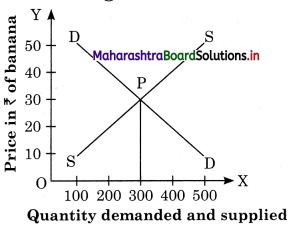
Balbharti Maharashtra State Board Class 8 Civics Solutions Chapter 2 The Indian Parliament Notes, Textbook Exercise Important Questions and Answers.

Class 8 Civics Chapter 2 The Indian Parliament Questions And Answers Maharashtra Board
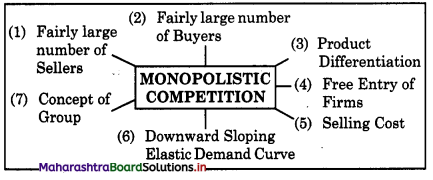
The Indian Parliament Class 8 Questions And Answers Chapter 2 Maharashtra Board
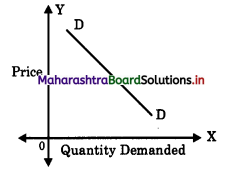
Class 8 Civics Chapter 2 The Indian Parliament System Textbook Questions and Answers
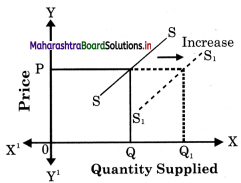
1. Complete the following sentences by choosing the correct option.

Question 1.
Candidates to the Lok Sabha are elected through ……….. .
(a) Territorial constituencies
(b) Religious constituencies
(c) Local bodies
(d) Proportional Representation System
Answer:
(a) Territorial constituencies

Maharashtra Board Class 8 Civics Solutions Chapter 2 The Indian Parliament

Question 2.
The ………….. of India is the ex-officio chairman of the Rajya Sabha.
(a) President
(b) Vice-President
(c) Prime Minister
(d) Chief Justice
Answer:
(b) Vice-President

2. Find and write. 

Question 1.
Members of Lok Sabha and Rajya Sabha are known as ……………….. .
Answer:
Members of Parliament (MPs)

Question 2.
The responsibility of making laws is with the ……………… .
Answer:
Parliament

3. Explain the following statements with reasons:

Question 1.
Rajya Sabha is a permanent House.
Answer:

  1. The tenure of the members of Rajya Sabha does not get over at the same time.
  2. 1/3rd of the total membership of Rajya Sabha retire after every two years and equal number of new members get elected.
  3. Because the limited members of Rajys Sabha retire step by step, it can function continuously.
    Since Rajya Sabha is never dissolved completely it is called a permanent House.

Maharashtra Board Class 8 Civics Solutions Chapter 2 The Indian Parliament

Question 2.
Lok Sabha is known as the first House.
Answer:

  1. Lok Sabha is the lower and the first House of the Parliament of India.
  2. Lok Sabha is the House of Representatives directly elected by the people. Hence, Lok Sabha is known as the first House.

4. Answer the following in 25 to 30 words:

Question 1.
How are members of the Lok Sabha elected?
Answer:

  1. As per the Constitution, there can be a maximum of 552 members in Lok Sabha.
  2. General elections to Lok Sabha are held after every five years and members are directly elected by the people.
  3. To ensure equal representation to all sections of the community, some seats are reserved for members belonging to Scheduled Castes and Scheduled Tribes.
  4. In case there are no representation from the Anglo-Indian community, the President can appoint two members from this community to the Lok Sabha.
  5. Thus, Lok Sabha is the representative body of the citizens of India.

Maharashtra Board Class 8 Civics Solutions Chapter 2 The Indian Parliament

Question 2.
Explain the functions of the Speaker of Lok Sabha.
Answer:
The functions of the Speaker of Lok Sabha are :

  1. To conduct the business of the House in an unbiased manner.
  2. To take care of the rights and privileges of the members of Lok Sabha.
  3. To interpret the rules of daily functioning of the House and work accordingly.
  4. To maintain the decorum and dignity of the House.

5. Explain the step involved in the lawmaking process.

Question 1.
Parliament :
Answer:

  1. The Legislature at the national level is called the Parliament.
  2. It consists of the President and two houses, i.e., the Lok Sabha and the Rajya Sabha.
  3. Though the President is an inseparable part of the Parliament, he/she cannot participate in the discussions in either of the Houses of the Parliament.
  4. The Constitution of India has created the Parliament.

Question 2.
Amendment to the Constitution :
Answer:

  1. According to the changing times, certain necessary changes have to be made in some laws. The process of making such changes is called Amendment.
  2. Only the Parliament has the right to make such amendments to the Constitution.
  3. The Constitution amendment bill is considered to be an important bill.
  4. The Parliament discusses why the amendment is required and decides whether to accept it or not.

Maharashtra Board Class 8 Civics Solutions Chapter 2 The Indian Parliament

Question 3.
Members of Parliament :
Answer:

  1. The members of Lok Sabha and Rajya Sabha are known as Members of Parliament (MPs).
  2. The members of Lok Sabha are directly elected by the people.
  3. The members of Rajya Sabha are elected from the constituent States and Union Territories.
  4. MPs try to resolve the queries and complaints of their constituencies by raising questions in the Parliament.
  5. MPs also participate in the process of formulation of laws.
  6. The Government allocates funds to MPs to carry out development activities in their constituencies.

Question 4.
Bill of Law:
Answer:

  1. At the initial stage of lawmaking process, a rough draft of the law is prepared.
  2. This rough draft or outline is known as ‘draft proposal of the law’ or ‘bill of law’.
  3. The Bill clearly mentions the objectives and the details of the proposed law.
  4. Every bill has to undergo three readings in both the Houses, and then it is put to vote.

Can you find out?

For the purpose of elections, the State is divided into territorial constituencies. The constituent States in India get seats on the basis of their population. For e.g.

  • Maharashtra – 48 seats
  • Gujarat – 26 seats
  • Madhya Pradesh – 29 seats
  • Goa – 02 seats
  • Uttar Pradesh – 80 seats

Maharashtra Board Class 8 Civics Solutions Chapter 2 The Indian Parliament

Understand It:
(The gist of the conversation held between Mazy, Radhika, Ran veer and others.)

  1. Any Indian citizen who has completed 18 years of age is only eligible to vote.
  2. An Indian citizens who has completed 25 years of age can contest for Lok Sabha election.
  3. A citizen of India can contest for election from any constituency of any State.
  4. Citizens of other countries cannot contest for elections of Lok Sabha and Rajya Sabha.
  5. Just as there are set criteria for qualifying for election, there are set criteria for disqualification as well.

Rights regarding passing of Bills:

  1. Though Lok Sabha and Rajya Sabha have same set of rights, Lok Sabha has certain rights which are not available for Rajya Sabha.
  2. Bills related to finance (Money Bills) and such other bills are first introduced and passed in Lok Sabha.
  3. Rajya Sabha has limited powers with respect to money bills.
  4. Rajya Sabha can pass a resolution on the subject in the State List.

Can you tell?

Certain laws which become out-of-date (obsolete) are abolished. Can you give examples of such obsolete laws? For example, Privy purses.

Know this too:

  1. Every year, on 1 February the Union Finance Minister presents the national budget to the Lok Sabha. Previously, it was presented on 28 February.
  2. The State Legislatures also follow the same procedure of law making as in the Parliament.
  3. The bill passed can become a law only after it is signed by the President at the Union level and by the Governor at the State level.

Maharashtra Board Class 8 Civics Solutions Chapter 2 The Indian Parliament

Project:

The President nominates 12 members to the Rajya Sabha. Collect information on what are the criteria for their selection.

Class 8 Civics Chapter 2 The Indian Parliament Additional Important Questions and Answers
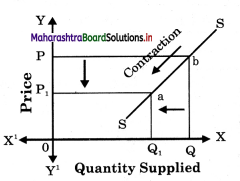
Complete the following sentences by choosing the correct option:

Question 1.
…………….. is the upper House of the Parliament.
(a) Legislative Assembly
(b) Lok Sabha
(c) Rajya Sabha
(d) Legislative Council
Answer:
(c) Rajya Sabha

Question 2.
The …………… of India has created the Parliament of India.
(a) Legislature
(b) Executive
(c) Constitution
(d) British Law
Answer:
(c) Constitution

Maharashtra Board Class 8 Civics Solutions Chapter 2 The Indian Parliament

Question 3.
1/3rd members of total membership of Rajya Sabha, who have completed their tenure of six years, retire after every ……………….. years.
(a) two
(b) four
(c) five
(d) six
Answer:
(a) two

Question 4.
If ……………….. feels that the Parliament should make a law of the subject in the state list, it can pass a resolution to that effect.
(a) Lok Sabha
(b) Rajya Sabha
(c) Executive
(d) President
Answer:
(b) Rajya Sabha

Question 5.
Every year in the month of February, the ………….. presents the national budget to the Lok Sabha.
(a) Prime Minister
(b) President
(c) Finance Minister
(d) Speaker
Answer:
(c) Finance Minister

Question 6.
The President appoints ……………….. distinguished personalities to the Rajya Sabha.
(a) two
(b) eight
(c) fifteen
(d) twelve
Answer:
(d) twelve

Maharashtra Board Class 8 Civics Solutions Chapter 2 The Indian Parliament

Find and write:

Question 1.
……………. represent the Lok Sabha.
Answer:
The Speaker

Question 2.
The bill passed by the State legislature becomes a law after it is signed by the ………….. .
Answer:
Governor

Question 3.
The House that gives representation to 29 States and 7 Union Territories is ………………. .
Answer:
Rajya Sabha

Complete the following Concept maps:

Question 1.
Maharashtra Board Class 8 Civics Solutions Chapter 2 The Indian Parliament 1
Answer:
Maharashtra Board Class 8 Civics Solutions Chapter 2 The Indian Parliament 2

Question 2.
Maharashtra Board Class 8 Civics Solutions Chapter 2 The Indian Parliament 3
Answer:
Maharashtra Board Class 8 Civics Solutions Chapter 2 The Indian Parliament 4

Question 3.
Maharashtra Board Class 8 Civics Solutions Chapter 2 The Indian Parliament 5
Answer:
Maharashtra Board Class 8 Civics Solutions Chapter 2 The Indian Parliament 6

Write short notes on:

Question 1.
The Chairman of Rajya Sabha :
Answer:

  1. The Vice-President of India is the ex-officio Chairman of Rajya Sabha.
  2. He exercises a control over the functioning of Rajya Sabha.
  3. Maintaining discipline in the House is the function of the Chairman of Rajya Sabha.
  4. He also has the responsibility of facilitating discussions in the House by giving members a chance to speak, etc.

Maharashtra Board Class 8 Civics Solutions Chapter 2 The Indian Parliament

Question 2.
Speaker of Lok Sabha :
Answer:

  1. The speaker is elected in the very first meeting after the election of Lok Sabha.
  2. The members of Lok Sabha elect one member among them as the Speaker.
  3. Lok Sabha functions under the guidance and control of the Speaker.
  4. It is the responsibility of the speaker to conduct the business of the House in an unbiased manner.
  5. The Speaker has to maintain decorum and dignity of the House.
  6. Moreover, he has to interpret the rules and work accordingly.

Question 3.
Control over Council of Ministers :
Answer:

  1. Council of Ministers are drawn from the Parliament and hence Parliament exercises control over them.
  2. The members of Parliament exercise this control through multiple ways.
  3. It is the responsibility of the Parliament to see that the Council of Ministers does not disregard the Parliament.
  4. In case the Lok Sabha passes a no-confidence motion against the Council of Ministers, it has to resign.

Answer the following in 25 to 30 words :

Question 1.
Write about Lok Sabha elections.
Answer:

  1. Since Lok Sabha is a House of people’s representatives, elections are held after every five years.
  2. Elections to Lok Sabha which are held every five years are known as General elections.
  3. When Lok Sabha is dissolved before the completion of five years and elections are held, such elections are called mid- term elections.
  4. When a member resigns or dies suddenly, election held for such a seat is called by-election.

Question 2.
Explain the composition of Rajya Sabha.
Answer:
The composition of Rajya Sabha is as follows :

  1. The total membership of Rajya Sabha is 250 members.
  2. Amongst them, 238 members are elected from the constituent states and Union Territories.
  3. Remaining twelve members, who are distinguished personalities from the fields of literature, arts, science, sports and social work, are appointed by the President.
  4. The members of Rajya Sabha are elected through the system of proportional representation.

Maharashtra Board Class 8 Civics Solutions Chapter 2 The Indian Parliament

Question 3.
Explain the functions of the Parliament.
Answer:
In order to achieve welfare of the people and the objectives of the 8 Constitution, the Parliament has to perform 8 following functions :

  1. To formulate new laws and to repeal the outdated laws.
  2. To make necessary changes in the existing laws.
  3. To amend the Constitution wherever necessary.
  4. To keep control over Council of Ministers.

Question 4.
Mention the ways of amending the Constitution.
Answer:
The Constitution can be amended in following ways :

  1. Few provisions in the Indian Constitution can be amended by simple majority.
  2. Some provisions require special (2/3rd) majority of the Parliament.
  3. Few other provisions can be amended by special majority plus consent from more than half of the constituent states.

Explain the following statements with reasons:

Question 1.
Though Lok Sabha is the Lower House, it is more powerful than Rajya Sabha.
Answer:

  1. Since members of Lok Sabha are directly elected by the people, it represents the people of the nation in the true sense.
  2. Money bills related to financial matters are presented in Lok Sabha. Rajya Sabha has very limited powers with respect to Money Bills.
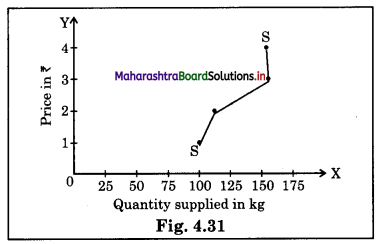
  3. Since the total membership of Lok Sabha is more than Rajya Sabha, it always gets an upper hand when decisions are taken in the joint meeting of both the Houses.
  4. Only Lok Sabha can pass a no-confidence motion against the Council of Ministers.

Hence, though Lok Sabha is the lower House, it is more powerful than Rajya Sabha.

Maharashtra Board Class 8 Civics Solutions Chapter 2 The Indian Parliament

Answer the following questions in details:

Question 1.
Explain the steps involved in the law-making process.
Answer:
The Bill undergoes following process in order to be converted into a Law (Act).
1. First reading :

  • The minister of the concerned department/ministry or member of the Parliament presents the bill in the House.
  • The objectives and the structure of the Bill are mentioned.

2. Second reading :

  • The positive and negative points of the bill are discussed.
  • The defects and faults in the bill are stressed.
  • After removing the defects and the faults, the bill is put to vote.

3. Committee Stage :

  • Sometimes, if required, the Bill is sent to the committee of the House.
  • The Bill is discussed in the Committee in details.
  • The Committee report consisting of instructions and recommendations is sent to the House.
  • The Bill is discussed clause by clause and then voting is taken.

4. Third reading :

  • The Bill is once again discussed in the House.
  • Voting is taken for approving the Bill.

5. Approval of the other House :

  • The Bill has to undergo the same procedure even in the other House.
  • The Bill is approved by majority.

6. Assent by the President :

  • After getting an approval from both the Houses, the Bill is further sent for assent by the President.
  • After the final assent and signature of the President, the Bill is converted into Law.

Maharashtra Board Class 8 Civics Solutions Chapter 2 The Indian Parliament

Question 2.
Distinguish between Lok Sabha and Rajya Sabha on the basis of following points:
1. Number of members
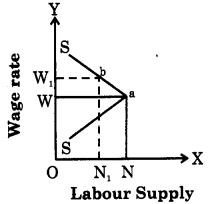
2. Age limit
3. Election
4. Tenure
Answer:

Points Lok Sabha Rajya Sabha
1. Number of members Maximum 552 members Total 250 members.
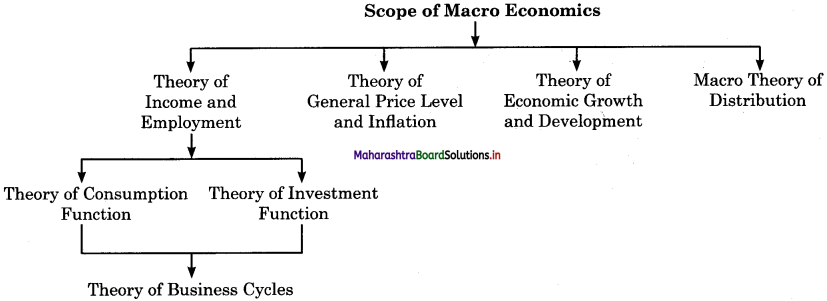
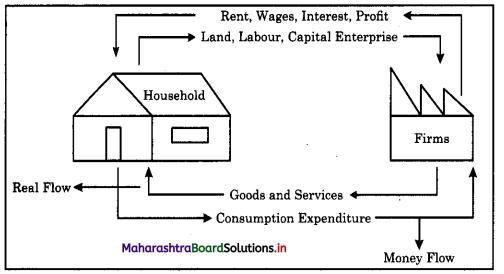
2. Age limit 25 years 30 years
3. Election Directly elected by the people 238 members elected from the constituent states and Union Territories. 12 members appointed by the President.
4. Tenure 5 years Permanent House. Tenure of every member is 6 years.

Question 3.
Why, according to you, the Constitution must have granted the President, the right to appoint twelve members to the Rajya Sabha?
Answer:
1. The President appoints twelve members to the Rajya Sabha. These members are usually experienced and distinguished personalities from the fields of literature, arts, science, sports and social service.

2. Such personalities are very active and totally devoted to their respective fields. Hence, they have no time for contesting the elections.

3. They keep themselves away from election procedures like campaigning, conducting meetings, etc. So their election to the Parliament is not possible.

4. But, to derive benefit from their profound knowledge and experience for making of laws, their presence in the Parliament is essential.
Therefore, I feel that the Constitution has granted the President, the right to appoint twelve members to the Rajya Sabha.

8th Std Civics Questions And Answers: